Was Avraham a Lamdan?

Was Avraham a Lamdan?
By Ezra Brand

I would like to thank Eliezer Brodt for reviewing this article and discussing it with me, and my father for editing this article.

Some time ago there was a discussion in cyberspace regarding whether the Avos kept all of the mitzvos. The discussion was started when a video on Youtube made fun of the idea, and a response to the video was published on the Hirhurim blog (here), as well as counter-response (here). I’d like to discuss some of the basic issues involved.

The Mishnah at the end of Kiddushin says that Avraham kept the whole Torah.[1] The Rambam (Hil. Melachim 9:1) brings down the mitzvos that each of the Avos innovated. Many laws are learned from the stories in Bereishis even though they happened before the giving of the Torah.[2]

However, Chazal do not discuss any of the questions arising from the statement that the Avos “kept the Torah.”[3] Here and there, the commentators discussed some of the more obvious questions. For example, the Ramban in his commentary on the Torah (Gen. 26:5) famously asks how Ya’akov could have married two sisters, something prohibited by the Torah. This question in particular seemed to have intrigued many commentators.

The later commentators discussed whether the Avos and their children had the status of Jews or non-Jews, since they lived before Matan Torah. This question is discussed extensively by the author of the Mishneh L’melech in his sefer P’rashas D’rachim. Later, this was discussed at length by R’ Yosef Engel in the first volume of the encyclopedia he started to write, called Beis Ha’otzar, under the entry “Avos.” An interesting question that was first posed by R’ Pinchas Horowitz, one of the rebbeim of the Chasam Sofer, in his commentary on the Torah, Panim Yafos, is the following: According to the opinion that the Avos were inherently non-Jews, how could they keep the whole Torah, which includes keeping Shabbos? We know that a non-Jew is prohibited from keeping Shabbos, so what did they do? Many ingenious answers are given to this question.[4]

A few hundred years ago, a popular method of learning was the “pilpul” method. In short, this method consisted of explaining difficult passages in the Gemara by connecting the passage under discussion with other seemingly unconnected passages of Gemara in other places. This style was not limited to Gemara, but was also used when explaining the Chumash. This method was attacked by R’ Yair Chaim Bachrach, author of the Chavos Yair, as well as by others.[5] In any case, in these seforim pilpul was used to answer questions on the Avos’s actions.[6] To quote the Encyclopedia Judaica (1st edition, Volume 13, entry “Pilpul,” pg. 527): “Criticism was much more lenient regarding the application of pilpul to the exposition of the Bible and the homiletic literature, since this was considered irrelevant to a true understanding of halakhah. Consequentially, popular preachers used to strain their imagination by adducing the most complicated talmudic passages and controversies in order to throw new light on a story from the Bible or the Midrash.”

In the past 150 years, literature on the attempted synthesis of the Torah Shebichsav (Written Torah) and the Torah Shebal Peh (Oral Torah) has exploded. This literature was meant to show that the explanations of Chazal, Torah Shebaal Peh, are in truth hinted to in the Torah Shebichsav itself. Originally, the reason for this was the attacks of the maskilim on the tradition of Torah Shebaal Peh. This led to the commentaries of R’ Shamshon Rephael Hirsch, the Malbim, the sefer Haksav V’Hakabbalah, and the sefer Meshech Chochma. In addition, many anthologies of the words of Chazal regarding the written Torah were collected and put in the order of the Torah. Examples of this include the sefer Torah Temimah, as well as the still-incomplete Torah Shleimah. [7]

However, these commentaries, in their comments on Sefer Bereishis, do not systematically try to harmonize the actions of the Avos with the accepted halachah.[8] This is somewhat surprising, since the point of their commentaries is to harmonize the Torah Shebichsav with the Torah Shebaal Peh, and this would seem to be a part of that job description.

With the contemporary stress in the yeshivos on the learning of Gemara to the exclusion of almost everything else (excluding perhaps mussar seforim), and the great stress on “lomdus”, some recent seforim have followed the trend of harmonizing Torah Shebichsav with Torah Shebaal Peh to the extreme. (Lomdus is an expression used in yeshivos to refer to the Brisk analytic-style of identifying and analyzing concepts. The Yiddish term reid is also used to mean the same thing.) These modern seforim will treat the possuk like a piece of Gemara, ignoring possible theological or philological explanations, and only answer using lomdus. This lomdus can be taken to such extremes that it is often very similar to the pilpul commentaries on the Torah of the 17th century. These seforim basically spend a long time trying to answer a question in any possible way, without trying to actually fit the explanation into the passuk in any way.

The sefer Chavatzeles Hasharon by R’ Mordechai Carlebach (on Bereishis, Yerushalayim 5765) is the most popular of this genre. This sefer essentially contains essays of lomdus based on the parshah, including many questions on the halachic acceptability of the Avos’s actions. Even more recently, the sefer Arugas Habosem by R’ Menachem Ben Yakov (on Bereishis and Shemos, Yerushalayim 5772) is almost an exact copy of Chavatzeles Hasharon, not only in content but also in the physical layout. A sefer by a nephew of R’ Shlomo Zalman Auerbach, R’ Baruch Rakovski, called Birchas Avos (Yerushalayim 5750), is completely devoted to questions on the Avos’s actions, as is the sefer Mili D’Avos (by R’ Shmuel Yaffah, Lakewood 5770).

Recently, seforim which collect divrei torah on the parshah from different sources have gained popularity.[9] One of the first of this genre is the Pardes Yosef (by R’ Yosef Pazanavski, incomplete, Bereishis, Piotrkow 5690, Shmos and Vayikra, Lodz 5697).[10] This was followed many years later by R’ Yisachar Rubin’s very popular Talelei Oros (10 volumes, Bnei Brak 5753-5757). Another sefer of this genre is K’motzei Shallal Rav, which collects divrei torah on the parshah from places one would normally not expect to find them, such as in introductions to a halachic works. Since these divrei torah are in the context of a halachic work, many times they are very halachically oriented. Hence, these divrei torah also fall into the category of trying to synthesize. Pilpula Charifta, by R’ Natan Margolis (on Bereshis, volume 1, Yerushalayim 5755, volume 2, Yerushalayim 5750), also collects divrei torah in the same manner.

Are these kinds of explanations part of the “Seventy Faces of Torah”? Do the authors of these explanations themselves think there is any truth to the explanations they are presenting? The author of the Klei Chemda writes in his introduction that much of what he wrote in the sefer is “לחדודי בעלמא”, to sharpen the mind. This idea comes from the Gemara, which says that sometimes teachers who say a false din in order to get their students thinking, and ultimately to correct them.[11]

I think that a similar question has to be asked on many Chassidic explanations, as well as the common “vort.” Did the authors of these explanations really think this was a possible explanation of the text? I think not. In fact, many times authors will write that their explanation is “בדרך צחות”. So why do they bother writing them? There are two possible explanations. First of all, even if the explanation is not true, the parts leading up to it are. (Assuming there is more than one part to the explanation.) The vort is a fun way to teach people the intermediate parts. In addition, they will be able to remember the intermediate parts more easily, since they are logically connected to an interesting end.[12] A second possible explanation for why the authors wrote such explanations is that there is an underlying moral message (assuming there is an underlying moral message). As with the first explanation, the vort is an enjoyable, and therefore effective, way of getting across a moral lesson.

Would a Chassidic Rebbe admit that his “Toyreh” is not the true explanation of the verse? That is a question that I cannot answer.[13]

[1] also Yoma 28b; Yerushalmi Kiddushin Perek 2 Halacha 12; Vayikra Rabbah 50:10; Tanchuma Lech L’cha 11; and many more places. See Encylopedia Talmudit, Volume 1, entry “אבות”, pg. 36-37.

[2] See Encylopedia Talmudit, Volume 1, entry “אין למדין מקודם מתן תורה”, pg. 635ff. However, see the Encyclopedia Talmudit ibid. that quotes the Yerushalmi that says that we don’t learn laws from stories of events that happened before the giving of the Torah. See Encyclopedia Talmudit ibid. for various attempted explanations.

[3] See Sanhedrin 58b where the Gemara discusses some of the marriages of the Avos in the context of discussing the laws of incest for b’nei no’ach. However, the laws of b’nei no’ach are far less than what a Jew must keep. The Gemara in Yoma (referenced in note 1) says that Avraham even kept rabbinically mandated laws.

[4] Regarding all this see Encyclopedia Talmudit referenced in note 1. See also Maharatz Chayes in Toras Hanevi’im, Chapter 11, pg. 63-72; Nefesh Hachaim, Sha’ar 1, Chapter 21; Leket Yosef (available here); Steven Wilf, The Law Before The Law, Lexington Books, 2008 (here).

[5] R’ Bachrach attacked the pilpul method in Shu”t Chavos Ya’ir, siman 123, and at length in an unpublished sefer of his called Ya’ir Nesiv. Parts of it were published by Jellenik in the journal Bikurim, Vienna 5624, pg. 4. Pilpul was also attacked by the Maharal and the Shelah. See also the ostensibly anonymous K’sav Yosher, published in 5544, pg. 9b, (here). It’s author was Saul Berlin of Besomim Rosh infamy.

[6] I’d like to point out at this point that much of what I will write also applies to the Jews after matan torah. There are many questions on how their actions fit with the commonly accepted halacha. However, I am mainly focusing here on the actions of the Avos. As for the actions of the Bnei Yisroel after matan torah, the Gemara discusses these questions in many places. Many times the answer of the Gemara is that the action was a hora’as sha’ah, i.e. a temporary waiver of the prohibition. See at length Encyclopedia Talmudit, Volume 8, entry “הוראת שעה”. R’ Yitzchok Halevy in his monumental Doros Harishonim, in the volume discussing Tanach and aimed at refuting the Bible Critics, tries to answer many of the questions of the maskilim on the Torah Shebaal Peh based on Tanach. Another sefer that I am aware of that discusses these questions is the commentary Mussar Hanevi’im, on Nevi’im Rishonim (by R’ Yehuda Leib Ginzburg, Volume 1, St. Louis 5705, Volume 2, Yerushalayim 5736, available here and here).

[7] Interestingly, a hundred years before the publishing of the Torah Temimah, R’ Dov Ber Treves, who was on the beis din of Vilna at the time of the Gra, also wrote a commentary on the Torah bringing down many of the saying of the Gemara in order of the Torah. In fact, the Torah Temimah was accused of plagiarizing from the Revid Hazahav. Another little known work of this sort is the Be’er Heiteiv (Vayikra, Vilna 5627), available here. The Chazon Ish writes on this workוראיתי להגאון האדיר ר’ אריה ממינסק בספרו באר היטב… (חזון איש, קדשים ס’ כו אות טז).

[8] They do, however, discuss these questions in many places, especially the Meshech Chochma. The Netziv in his commentary on the Torah, Ha’amek Davar, also incorporates much from Torah Sheba’al Peh, and answers questions on the Avos’s actions.

[9] There is a similar phenomenon of seforim collecting the different explanations of the commentators on the Talmud, such as Machon Yerushalayim’s Otzar Mefarshei HaTalmud, Frankel’s Mafte’ach, and many others.

[10] For a description of the Pardes Yosef, see an earlier post on the Seforim Blog here.

[11] Eiruvin 13a, and other places. This is one of the contexts in which it is permitted to lie. See R’ Yosef Chaim, Shu”t Torah Lishmah, siman 364, Yerushalayim 5736, pg. 250 s.v. ובגמרא דעירובין. R’ Yosef Chaim in that response collects all the places in which it is permitted to lie. Contrary to popular belief, it permitted to lie in far more than the three places the Gemara in Bava Metzia 23b says. One of the most surprising cases in which it is permitted to lie, is the following: If a person knows that a certain halacha is true, but because of his low standing in people’s eyes, when he says it, it will not be accepted, he is permitted to say that a certain gadol said that halacha, even if that gadol never said such a thing! See at least four examples of this in Torah Lishmah there (pg. 250, s.v. ובגמרא דשבת; ibid. s.v. עוד שם בדף נא; pg. 251. s.v. ובגמרא דפסחים; pg. 252, s.v. עוד שם בדף כ. This would seem to cause problems for the mesorah of Torah Shebaal Peh, and was in fact one of the maskilim’s questions on the veracity of the mesorah. See I.H. Weiss, Dor Dor V’Dorshov, Part 1, Chapter 1, pg. 4.

[12] This is similar to what the Rambam writes in the introduction to his Peirush Hamishnah (Mossad HaRav Kook edition pg. 10) regarding asmachtos. He writes that the Gemara never intended to to say that asmachtos are true explanations of the verse. Rather, the asmachta is a formula to help people remember the halacha, as in the times of Chazal it was prohibited to write Torah Shebaal Peh. This view is atacked harshly by the Ritva, Rosh Hashonoh 17a. See Encyclopedia Talmudit, Volume 2, entry “אסמכתא”, pg. 106, footnote 16 and 28.

[13] A possible nafkah minah (halachic ramification) is whether it is permitted to learn the explanation in the bathroom, where learning Torah is generally prohibited. However, this nafkah minah is mostly theoretical, because, as was pointed out, even if the explanation itself is not true, many times the constituent steps are Torah. See Yisroel Bazenson, Messilat Hak’sharim (Tel Aviv 5766), (this sefer is written by a follower of Breslov and attempts to formulate “rules” for learning Likutei Moharan) pg. 153, where the author asks this question regarding the teachings of R’ Nachman of Breslov; he points out that many times R’ Nachman’s explanations even go so far as to contradict the simple meaning of the phrase he is coming to explain. Bazenson answers:

ברוב הפסוקים ומאמרי חז”ל שהוא שהוא מפרש על פי דרכו הפנימית , לאף שנראה כמשנה או אפילו כסותר הפירוש הרגיל , אם יזגה המעיין ישיג את המקום שבו שני הפירושים מתחברים ועולים בקנה אחד. ואז הפירוש הרגיל יקבל, כתוצאה מחיבור זה, תוספת בהירות שמעולם לא היתה לו.

Bazenson then goes on to bring three examples of such places in Likutei Moharan, and attempts to show how in fact the nistar complements the nigleh. (I would like to thank Eliezer Shore for pointing out this source to me.) I have not studied his explanations in depth to see if they are convincing.


Review: Daniel Sperber, On Changes in Jewish Liturgy

Review: Daniel Sperber, On Changes in Jewish Liturgy

By Dan Rabinowitz and Eliezer Brodt


Daniel Sperber, On Changes in Jewish Liturgy, Options & Limitations, Urim Publications, Israel: 2010, 221, [1] pp.

The ever prolific Professor Daniel Sperber’s most recent book focuses on Tefillah. This book, as some of his others, has drawn some sharp criticism, most notably from Professor Aryeh Frimer in Hakirah (available here). To be sure, this post does not attempt to defend Professor Sperber or the feminist movement with regard to these issues, but, in the course of our review we hope to offer some relevant comments that will further this important discussion. Our main interest remains the substance of the book on this important topic – changes to the Jewish liturgy.

This book grew out of a lecture given at the Jewish Orthodox Feminist Alliance. Professor Sperber then decided to revisit the broader issue of the parameters of acceptable changes to the liturgy.

The prayerbook has become – and this is not a new trend – a battleground. In 19th century, the battle lines were drawn between Reform and Orthodox movements. Of course, earlier heterodox movements had also created their own prayerbooks, such as the Karaites, but in those instance, the praybook was more a reflection and outgrowth of the movement and was not, in and of itself, one of the wedge issues. In the modern period, however, the advent of the Reform movement argued for a variety of changes to the prayerbook to account and adjust for modernity. In this instance, it was both the substance of the prayers as well as their execution (Hebrew or not) that was at issue See generally, Jacob J. Petuchowski, Prayerbook Reform in Europe, New York, 1968.

Earlier examples of prayerbook controversy touched upon other theological debates; for example, some questioned the inclusion of Machnesi Rachamim as it can be read as a request for assistance from angels and not God (see here). Others questioned the inclusion of piyutim generally. Ibn Ezra’s critical comments regarding this topic are well-known. Sometimes prayer itself was employed for polemical purposes. Naftali Weider discusses a version of the blessing over the Friday night candles that incorporated a polemic against Karaism (see N. Weider, Hisgavshos Nusach HaTefillah B’Mizrach U’BeMaariv, Jerusalem, 1998, 329). And, of course, one must mention the oft-discussed blessing against heretics [in some versions] in the Shemoneh Esrei (see, most recently, Ruth Langer, Cursing the Christians?: A History of the Birkat HaMinim, Oxford Univ. Press: 2011).
Thus, it is scarcely surprising that discussing changes to the prayerbook might arouse controversy. That said, we must note – and this is the essential point of this book – the texts of the prayers have never been static, and they have been constantly evolving. At times this evolution was controversial while at other times the evolution and changes to the liturgy appears to have passed almost without notice.
Dr. Sperber focuses in this book on historic changes in an effort to support change today, mainly changes that are more sensitive to women. Sperber discusses a variety of changes to the prayerbook that are non-standard. For example, we have added whole sections, a liturgy for Kabbalat Shabbat (essentially created in the 16th century), abbreviated others – yotzrot, piyutim – and changed texts for a variety of reasons – grammatical, Kabbalah, and nationalist. For the most part, to those familiar with the history of the prayerbook, as well as Sperber’s prior works, much of this book is well-tread territory. Moreover, as Sperber notes, the notion of a a fixed nusach is absurd insofar as a large segment for those professing orthodoxy regarding the siddur, themselves pray in an entirely new nusach, one developed in the the past 200 years, namely the rite known as nusach Sefard. While this nusach may have antecedents in the Sefad Kabbalistic movement, that only moves it back to the 16th centruy, a veritable spring chicken vis-a-vis the purported codifiers of tefilah, Anshe Kenneset ha-Gedolah.
Sperber’s focus is on changes that incorporate women more directly into the tefilot as well as adapting the tefilot to be more sensitive to women. He then discusses exactly what the acceptable parameters for change are and discusses specific examples of historical change. He provides detailed discussions both in the body of the work as well as the numerous appendixes.
Sperber does an admirable job distinguishing between permanently fixed language to which change is prohibited, and the lesser fixed portions for which change is permissible. Sperber notes that even is quasi-fixed prayers, like those appearing in the first three and last three blessing in Shemonei Esreh, historically, we have altered those blessings. On this point Professor Frimer takes issue with some of Sperber’s conclusions, but some of Frimer’s criticism is rather weak. Rather than directly addressing the issue, Frimer attempts to delegitimatize and discredit the manuscripts that Sperber relies upon. (p. 76 note 38) Frimer merely states that we know little about those manuscripts that Sperber relies upon, or, in other words, Frimer, without any compelling argument or proof doubts the veracity of the manuscripts. This argument has been used by many in what has been coined the Chazon Ish’s Shitta about new manuscripts and the like. In this case the attempt is really to go further and dismiss much of the Geonic literature that has been discovered in the past century and, and Frimer’s reliance upon this argument demonstrates a serious lack of awareness of the scholarship in the area of manuscript authentication (a topic which we hope to return to at length in a future post).
Indeed, independently of the manuscript sources, Sperber goes even further showing that during the Ten Days of Repentance, we add and alter the first and last (supposedly immutable) blessing, but those alterations cannot be dated to Hazel or the Anshei Kenest ha-Gedola but date rather to the Geonim. Some, however, have argued that changes by the Geonim or Rishonim proves nothing, as they are special but we are not. Their argument goes (and Frimer is an ardent supporter of this) that somehow those persons were allowed to change prayer. Unfortunately, this argument is unsatisfying. Simply put, that rationale begs the question of what power did those persons use to make changes? Was it based upon their own view that they were worthy of changing the prayers? That is, if the only rule is “great people can change prayer” who told them at the time that they qualified as “great people?” Or, is this entirely post-hoc rationale just the tautology that because they changed the prayers and only special people can change prayer they must be special people? Sperber, however, has surveyed the literature and offered concrete rules of when and how to change the prayers that do not fall prey to these logical infirmities. Indeed, he would concede that certain prayers are immutable.
Sperber’s also takes a more reasonable view of which prayers are ripe for change. His view is that if some find it offensive, we should, if we can, attempt to appease those persons. Others have taken the somewhat counter-intuitive position that even if some find a prayer offensive if there is a non-offensive explanation for the prayer, that is satisfactory. Of course, this position ignores the very real fact that some may be offended by those prayers, no matter how many explanations are offered. Sperber’s position is that insofar as there is no prohibition to change, why not attempt to remove the offensive text entirely?
One of the changes that Sperber suggests is related to the שלא עשני אשה controversy and concerns the suggestion to remove it completely as it is offensive toward woman. This suggestion has been discussed in numerous articles, and Sperber cites many of them. Everyone feels they can add their two cents on the suggestion, so we will too. I will begin by saying that having davened in many shuls of all kinds in my life, I have almost never even heard them say this berachah out loud in the first place. While many woman, especially today, find this Beracha offensive and for this alone there might be grounds to remove it (as other berachos were removed over the ages for similar reasons – see Tzvi Groner’s excellent book for a good list) I (EB) personally do not understand why this issue is so contentious.
I will just quote three ideas from others on the topic which I honestly believe is not apologetic but, of course, some may disagree.
R. Yaakov Emden writes:
מה ששמעו אזני בשבוע זו… כי ערל אחד חרש רעה על היהודים שמברכים בכל יום ברוך שלא עשני גוי, אמר היהודים אינם מחשיבים לגוי אלא כבהמה מפקירים דמו וקנינו רוכושו, אמרתי אני שגם זה הבל זה הערל לא לבד ערל בשר אלא גם ערל לב הוא, ושלא היה לו לב לדעת מה שאנו אומרים עוד שתי ברכות הסמכות לזו ברוך שלא עשני עבד, ברוך שלא עשני אשה, הלא בודאי אין אנו נוהגין מנהג הפקר לא אפילו בעבד כנעני שחייב במצות שאשה חייבת בהן, ואמר איוב אם אמאס משפט עבדי כו’, אצ”ל באשה שלנו שאנו חייבים בכבודה וכבדה יותר מגופינו, הלא יראה מזה שנשתבש אותו המוציא דבה עלינו בעבור זה, אבל הענין ברכה זו לפי שהגוי אינו מצווה בתרי”ג מצות כמונו יוצאי מצרים ולכן אינו מצווה גם כן על שביתת שבת ויום טוב כמונו, כמו שהוא ענין בברכותינו על ,שלא עשנו עבד ושלא עשנו אשה שהעבד גם כן אינו מחוייב במצות רק כאשה, ואשה אינה חייבת רק במצות עשה שאין הזמן גרמא, ונכנעת תחת בעלה והוא ימשול בה, מ”מ חביבין עלינו כגופותינו כן הוא הענין בגוי [הקשורים ליעקב, עמ’ ריט].
R. Reuven Margolios writes:
ולאשר האשה אינה נענשת על בטול המצות עשה שהזמן גרמא וחלקה בעולם הבא כחלק האיש הי’ מקום למי אשר לא הגיע לחזות בנועם ה’ לומר מי יתן והייתי אשה שאז נפטרתי מעול כל מצות אלו לכן תקנו חכמינו ע”ה שימסור כל איש מודעה כי המצות האלו כן תקנו גם הודאה כוללת לכל זרע ישראל שנתחייבו במצות הרבה בכדי להגיע לחיי עולם הבא בעוד אשר הנכרי המקיים מצותיו השבע הוא בן עולם הבא והי’ מקום להמתרשל לומר מי יתן והייתי בן לאחד מגוי הארצות ולא נתחייבתי בכל אלו, לשלול זה יודה כל בן או בת ישראל לה’ על שלא עשהו גוי להורות שעושה המצות מאהבה (טל תחייה, עמ’ מז).
In regard to the topic of feminism in general see the Kesav ve-ha-Kabbalah who writes an important insight in his work on the Siddur:
והתבונן עוד כי מצות התורה יש להם סדר מיוחד לאיש איש כפי כח הכנתו הנפשית, יש מן המצות הערוכים ושמורים לכל נפשות זרע ישראל, ומהם נערכים במשקל ובמדה נאמנה לנפש זולת נפש, כי מהן המחוייבות רק לכהנים לבדם, ומהן ללויים לבדן ומהן לכהן גדול לבדו, ומהן לזכרים לבדם ולא לנקבות, כי לפי שהתורה מאת אדון כל היוצר רוח האדם בקרבו לא יפלא ממנו דבר, לחקוק חקים ומפשטים לפי ערך ומדרגת כל נפש, עד שיהיו מקובלים על לב כל אחד מהם, והם אפשרי הקיום לפי הכנת נפשו, עד”מ שאין ספק כי זרע אהרן הכהן מוכשרים הנפשות שנאצלו בהן כחות יקרות בשיעור רב מה שאין שאר זרע ישראל מוכשרים אליהן, וכן משפחות הלוי, וכפי הבדל נפשותיהן נבדלו בענין המעשים והעבודות המקבילות נגד נפשותיהן המעולות. וכן הכהן הגדול בעבור היות נפשו עוד נבדלת מכל אחיו הכהנים בכחות יקרות פנימיות הנודעות ליוצר כל ית’ , לכן מוכשר לקבל עוד מצות היתרות על שאר הכהנים, וכן הבדל כחות הנפש שבין זכרים לנקבות, הוא המסבב הבדל חיוביהן במצות, כי המצות הערכים במשקל ובמדה נאותה לפי הכנת על נפש ונפש, עד שאין מצות ממצותיה וחוק מחקותיה יוצא מגדר באפשרי משום נפש, לפי חלוף מצבי הנפשות בכחותיהן , ועל זה אמר ומתקן ומקבל. התורה במצותיה מתקנת ומסודרת, עד שהיא מתקבלת בלב כל איש ואיש לפי מצב נפשו וכח הכנתו, ואין אחד מהם יוכל לומר קיום דבר זה אצלי מסוג הנמנעות (עיון תפילה, דף נ ע”ב-נא ע”א).
Another offending passage Sperber discusses (pp. 46-47) is found in the Ve-hu Rachum tefilah where it says ושקצונו כטומאת הנדה. Sperber brings versions that did not have these words and suggests that we take it out. He then concludes (p. 50) that maybe this whole tefilah of Ve-hu Rachum should be made into a private tefilah and not obligatory, as its a late addition to the liturgy in the first place. Now it should be noted that although this sounds radical, in reality it is not. The omission of this prayer is common amongst Chassidm for far weaker reasons. Many omit it for any and all yarzheits of anyone who ever wore the mantel of “Rebbi.” Thus, Sperber appears to be in good company.
In regard to Sperber’s suggested change to add in the Imahot in the first bracha of Shemonah Esrei, although he does provide evidence that changes were made even in these berachos, I (EB) find it hard to accept these suggestions and I would have to agree with the issues Frimer raises in this regard.
One last point: while this study definitely shows that many changes were made in our liturgy, it is still not clear as to when and how and why. Exact guidelines, if there are any, need to be defined more clearly it is buried in a mass of amazing historical and bibliographical notes. Summaries and more exact conclusions should be written out more clearly, as this is such a dangerous topic as Sperber himself is well aware (see p. 129 and 124).
Here are some general notes and sources to add to Sperber’s plethora of sources. We would just like to mention that today, because of the internet, the study of Siddur has and will greatly change. Many rare and early printed siddurim and manuscripts related to Siddur are available for viewing in ones’s own home instead of being only available in far-flung libraries, available to professional scholars. Using these sources alone can revolutionize the study of the development of the Siddur.
Suggested Additions
p.9 on the Prayer for State of Israel see Joel Rappel, “The Identity of the Author of the Prayer for the State of Israel,” in Shulamit Eliash, Itamar Warhaftig, Uri Desberg, eds., Masuah Le-Yitzhak: Rabbi Yitzhak Isaac ha-Levi Herzog Memorial Volume (Jerusalem: Yad ha-Rav Herzog, 2008; Hebrew), 594-620, and his “The Convergence of Politics and Prayer: Jewish Prayers for the Government and the State of Israel,” (PhD dissertation, Boston University, 2008).
p. 23. regarding studies on Kabbalat Shabbat: to date the most comprehensive study on this topic is from Rabbi Y. Goldhaber, Kovetz Beis Aron V’Yisroel, 64: 119-138; 70: 125-146; 73: 119-13. Hopefully he will collect and update all this into a full length book in the near future.
p. 32 note 2 there is a typo it should read Shmuel Askenazi.
p. 36 see also D. Rabinowitz, “Rayna Batya and other Learned Women: A Reevaluation of Rabbi Barukh Halevi Epstein’s Sources,” Tradition 35 (2001).
p. 33-39:On the Shelo Asani Ishah controversy see E. Fram, My Dear Daughter, HUCP 2007, pp.37-41.
p. 34. On Rabbi Aaron Worms of Metz see the important article from Y. Speigel, Yerushasnu, 3, 2009, pp. 269-309; R. Dovid Tzvi Hillman, Yeshurun, 25, 2011, pp. 619-621.
p.40 and onwards; related to the שלא עשני אשה controversy see Yoel Kahn, The Three blessings Boundaries, Censorship, and Identity in Jewish Liturgy, Oxford 2010.
p. 41-42: On R Abraham Farissol see David B. Ruderman, The World of a Renaissance Jew, the life and thought of Avrhom Ben Mordechai Farissol, HUCP, 1981.
p. 52 D. Rabinowitz, “Is the Modern Placement of Bameh Madlikin A Polemic Against Hassidim?” Or Yisrael, 2007, 180-84.
p. 73 note 4 there is a typo, it should say R. Dovid Cohen.
p. 80 see D. Rabinowitz, “The Pitfalls of Changing the Liturgy: On Changes to the Nikkud of Kaddish,” Or Yisrael, 158-62, 2007.
p.100 See E. Brodt, The Avudraham and his usage of the Tur and Pirush of R Yehudah Ben Yakar (In print).
pp. 108-109: In regard to R. Emanuel Hai Ricchi see: B. Naor, Post Sabbatian Sabbatianism, pp. 53-57: Yeshurun, 24, p. 444.
p. 109: Darchei Noam is worth mentioning as this work is one of the only works that received a Haskamah from the Gra, see Eliach, Hagaon 3, p. 1257.
p. 133: It should say the brother of the Ketzot Ha-choshen, R. Yehudah author of the Terumot Ha-Kerei.
p. 157: On R. Yakov Emden’s Siddur and additions from others over the years. It is worth mentioning that a few years ago the printing house Eshkol printed a new version of the siddur including many new additions of R. Emden himself, from a manuscript of the siddur. One of the important features in this edition is they put all the material that was not R. Emden’s in different fonts so one can see exactly what was added by others over the years. Additionally, they provided a photo reproduction of the original siddur at the end of volume two.
p. 177: Sperber brings the special work of the Aderes on Tefilah. Sperber notes this books is full of textual changes, some based on manuscript but mostly on his own. To be more exact and correct, what Sperber writes about this work a very small part was printed in the Journal, Knesset Hagedolah. Many years later a few pieces of this work was printed in the journal Yeshurun. In 2002, Y. Amechi printed this work from manuscripts with many notes. In 2004 Ahavat Sholom printed this work again based on even more manuscripts. They also included other articles of his printed elsewhere related to Tefilah. The main thing worth noting is that this is a very special work related to Tefilah.
p. 179 on the well-known reason why during the week we say Magdil and on Shabbat we say Migdol, see: Shut Lev Shlomo, Siman 23; Noam Megidim, p. 13b; R. Reuven Margolios, Haggadah Shel Pesach p. 60; Y. Speigel, Yeshurun 6, 1999, pp. 759-762.
p. 189: A wealth of sources on the topic worthy of mention, regarding adding Zachrenu Lechaim during Aseret Yemei Teshuvah can be found in R. Dovid Zvi Rothstein, Sefer Torah Menukod, in Kovetz Ohel Sarah Leah, 1999, pp.632-771. See also the important article on this from U. Fuchs, Tarbitz 75 (2006), pp. 129-154.


Attack on Rabbinic Judaism and Historical Orthopraxy

What is perhaps one of the more intreging sefarim ever published. Behinat HaKabbalah is two books in one. The first, Kol Shakal (the voice of a fool), is a scathing attack on Rabbinic Judaism. Basically, anything not found explictly in the Torah is claimed as false. For example, the requirment of mikva is deemed wrong as the verse only requires one to “wash one’s body.” This first portion takes up the majority of the book. The second half, Sa’agas Areyeh, (roar of the lion) is a defense of Rabbinic Judaism. However, the defense in some sense proves the first half as it is so sparse leaving the reader to posit that the author of Sha’agas Areyeh actually agreed with the author of Kol Shakal. Some even go so far to claim the author really wrote both works in an extremly sly attempt to gain wider readership. That is, they created a work which externally would be viewed as a defense of Rabbinic Judaism i.e. Sha’agas Areyeh, only to be able to slip in the most more persausive Kol Shakal.

Typically, the second portion is attributed to R. Yehuda Areyeh of Modena. (Mar Gavriel has an excellent post on him here). If that is so, some then argue he was a closet heritic or perhaps in today’s vernacular- Orthoprax. That is, although R. Modena sat on the Venice Bet Din, wrote numerous traditional sefarim, and even authored on the selichot that is said on Yom Kippur Katan, in his heart he really did not believe in any of it. This, of course, is rather shocking.

In truth, the authorship of both of these works is somewhat up in the air. As mentioned, some attribute it to R. Modena, however, this is not certian. The reason being, this work was not published until 1852 and Modena died in 1648. The work was first published by Isaac Shmuel Reggio (YaSHar) a rather interesting character in his own right. [As an aside, Reggio was far from what many would consider “traditionally orthodox” he permitted shaving on Hol HaMoad which got him into trouble. (His father wrote a pamphelet against him on that issue). However, this year someone from Monsey reprinted his commentary on the Torah, apparently Reggio’s biography was unknown to the sponser of the printing.] Reggio claimed to have published this from a manuscript in Modena’s own hand. He has an extensive introduction as well as notes thourhout.

Others have questioned Reggio’s assertion that it emenates from Modena. One has even pointed to Saul Berlin the author of the noted forgery Besamim Rosh as the author of this. However, that has been discredited.

In the end, whom ever the author maybe this work still stands as one the most interesting and entertaining attacks on Rabbinic Judaism.

There is much in this area and the interested reader can consult Reggio’s introduction; T. Fishman, Or Hadash al Zemano shel Sefer Kol Shakal v’al Mekom Hibburo, in Tarbiz 59 (1990) 171-190; Fishman’s book length treatment in “Shaking the Pillars of Exile‘Voice of a Fool,’ an Early Modern Jewish Critique of Rabbinic Culture;” E. Rivkin, Leon da Modena and the Kol sakhal; B. Kahlar, Shagas Areyeh al Kol Shakal in Mehkarim v’Inyuim (Tel Aviv, 1954) 357-378.


New Journal Announcement: Mekhilta

New Journal Announcement

By Eliezer Brodt

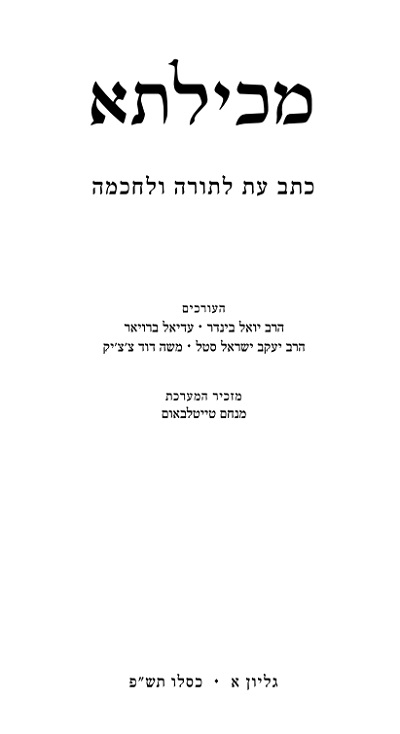
מכילתא, כתב עת לתורה ולחכמה, ריואל בינדר, עדיאל ברויאר, יעקב ישראל סטל ומשה דוד צציק (עורכים), גליון א, כסלו תשפ, 364 עמודים

A new Journal just came out tonight called Mekhilta. The volume begins with their mission statement and will be published biannually.

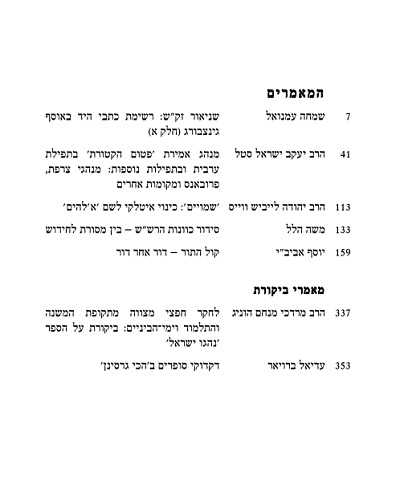
The first issue has an all-star lineup of writers on great topics. Some of the writers are Professor Simcha Emanuel & Rabbi Yakov Stahl (on the Minhag of saying Pitum Haketoros); I have written about both of them in the past (here and here).

Some less familiar names are Rabbi Leibish Weiss, (see here for an article of his on the blog) and Rabbi Moshe Hillel. Readers might be familiar with Hillel’s various recent works (printed in limited editions) on some forged works, including Megilat Kuzin and Agudat Shmuel (on the strange Hagahot found in many editions of Rashi on Nach) or his excellent work Ohel Ram on the Gerer Rebbe’s seforim library.

Another article is authored by Rabbi Adiel Breuer on the Hachi Garsinan Talmud site. Rabbi Adiel is well known for his expertise and writings dealing with Geonica and Rishonim.

Another article worth a shout out is from an old friend Rabbi Mordechai Honig. In this article, Honig reviews another friend’s recent incredible work, Rabbi Yakov Stahl’s NaHagu BiYisroel on various Minhaghim related to the Daled Minim. The book draws on an extremely wide range of sources including archeological material and includes one hundred and seventeen pictures. [Copies of this work are still available for purchase.]

The longest article in this volume (178 pp.) is from Rabbi Yosef Avivi and deals with the authorship and authenticity of the famous work Kol HaTor attributed to the Gra. Avivi is famous for numerous masterpieces. Worth mentioning is his most recent four-volume work on Rav Kook where he demonstrated a new way to read R’ Kook (showing him to be even greater than he was thought to be up until now) and his very special three volume work mapping out the Arizal’s Kabbalah.

A few years ago, I heard from some friends that Avivi had an unpublished work on the subject of the Kol HaTor and I hoped that it would see the light of day. This work is included in this new journal. Academics and scholars have been debating this book heavily over the years; just a few months ago Professor Emanuel Etkes authored a work on the subject. It’s written in Avivi’s unique style and will surely generate discussion and debates just as his other works have done. Its timing is perfect as yet again the academic world is busy with the Gra this year as it’s the three hundredth year from his birth. I am aware of three conventions dedicated to him so far.

Copies of this volume are available for purchase through me (while the limited edition lasts) and will help support the efforts of the Seforim Blog. Contact me at Eliezerbrodt@gmail.com

Here is the Table of contents of the new journal.


Surrounding Independence Day

Surrounding Independence Day
by Aaron Ahrend

Dr. Aaron Ahrend, a senior lecturer in the Department of Talmud at Bar-Ilan University, has published many studies on Talmudic commentary and Jewish liturgy.

The ancients established a sign by which one could determine on which days certain holidays occur. The sign is based on the pairing of the letters Aleph and Tav (א”ת) and the days of the Passover holiday.[1] Thus is the sign: Aleph-Tav (א”ת) = the day of the week on which the first day of Passover falls is the same day that Tisha B’Av falls in that year. Bet-Shin (ב”ש) = on the day of the week on which the second day of Passover falls, Shavuot falls. Gimel-Resh (ג”ר) = on the day of the week on which the third day of Passover falls, Rosh Hashanah falls. Dalet-Kuf (ד”ק) = on the day of the week on which the fourth day of Passover falls, the reading of the Torah occurs, i.e., Simchat Torah outside of Israel on the second day of Shemini Atzeret. Hei-Tzadi (ה”צ) = on the day of the week on which the fifth day of Passover falls, the fast, Yom Kippur, falls. Vav-Peh (ו”פ) = on the day of the week on which the sixth day of Passover falls, Purim falls before it. The final sign, Zayin-Ayin (ז”ע), remains unresolved: there was no holiday whose name begins with the letter Ayin that fell on the day that the seventh day of Passover falls.

And behold, when the State of Israel was established, the sign was completed: Zayin-Ayin (ז”ע) = the day of the week on which the seventh day of Passover falls is the day on which Independence Day falls, namely the 5th of Iyar (when it is not postponed or deferred). The inclusion of Independence Day within the framework of the אתב”ש signs of the holidays serves as a kind of proof or hint of its status as one of Israel’s holidays. At the entrance of the Tunisian synagogue Or Torah in Acre, a beautiful artistic creation dedicated to Independence Day was established. It was painted blue, the prominent color in the flag of the State of Israel, and it features symbols of the country, the IDF emblem, the flag of Israel, the walls of Jerusalem, the Hatikvah anthem, the blessing Shehecheyanu, excerpts of prayers, and above all these – the seven signs of אתב”ש representing the integration of Independence Day within the framework of Israel’s holidays.

There exists a great similarity between the essence of the seventh day of Passover, when the Egyptians drowned in the Red Sea while pursuing the Israelites upon their exodus from Egypt, and the essence of Independence Day: in both, there was a confrontation between the people of Israel and Egypt, and in it Israel prevailed despite having no chance of victory on its own against Egypt, with its organized army and sophisticated weapons.[2] Therefore, it was determined that the Haftarah of “Od Hayom” read abroad on the second day of the seventh day of Passover would be the Haftarah for Independence Day in the Land of Israel, as it is appropriate in content for this day.

Regarding the aforementioned sign, Rabbi Yoel Bin-Nun added:[3]

Isn’t Zayin-Ayin (ז”ע) a heavenly hint? Didn’t the British Mandate truly end on Saturday, the 6th of Iyar, at midnight, and only because David Ben-Gurion and his colleagues decided to honor the Sabbath, they advanced the declaration of independence of the State of Israel to Friday, the 5th of Iyar, which corresponds to the seventh day of Passover. This alone provides a sufficient reason for all God-fearing individuals to truly celebrate Independence Day.

In other words, the declaration of independence of the state on Friday, the 5th of Iyar, which allows for the sign Zayin-Ayin (ז”ע), occurred solely due to the consent of the heads of state, who were not religious, to consider the Sabbath. This surprising and joyful consideration alone is sufficient reason to celebrate Independence Day.

* * *

Many devout Jews do not celebrate Independence Day at all and do not acknowledge to the Holy One, blessed be He, for the establishment of the State of Israel. In contrast, Zionist rabbis believe that thanks should be given to the Holy One, blessed be He, for the wonder and great miracle of the State’s existence, even though it is not particularly a religious state.[4]

For those who do not celebrate the establishment of the state and Independence Day, we bring here the words of Rabbi Shimon Deutsch (1814? – 1878), one of the important disciples of the Hatam Sofer. This sage had a strong connection and love for the land of Israel, and even ascended and resided in Jerusalem. In his book Imrei Shefer on Tractate Berakhot, he discusses the Mishnah (54a): “One who sees a place where miracles were performed for Israel says: Blessed is He who performed miracles for our ancestors in this place.” Rabbi Deutsch asks why the Mishnah uses the plural form: “where miracles were performed,” when even a person who sees a place where only one miracle was performed for our ancestors should bless with this blessing? He answers: Sometimes the Holy One, blessed be He, performs a miracle for a person, but the one experiencing the miracle does not recognize his miracle. Therefore, it is said: “You give to those who fear You a banner to rally to” (Psalms 60:6), meaning, giving a person a miracle that he recognizes as a miracle. In other words: He will have the miracle that he recognizes and acknowledges to the Holy One, blessed be He. Therefore, when a person blesses for any miracle, there are here two miracles, since recognizing the miracle is considered an additional miracle. In light of this, it is understood why even for one miracle, the Mishnah uses the word ‘miracles’ in the plural form.

On Independence Day every year, we are obligated to thank the Holy One, blessed be He, for many miracles: the establishment of the State of Israel, the victory in the War of Independence of the few against the many, the ingathering of exiles, the development of the Torah world, and the country’s progress in many areas. Many have described the numerous achievements of the State of Israel over the years. Here is an excerpt from the words of Rabbi Jonathan Sacks in his unique formulation:

Israel has done extraordinary things. It has absorbed immigrants from 103 countries, speaking 82 languages. It has turned a desolate landscape into a place of forests and fields. It has developed cutting-edge agricultural and medical techniques and created one of the world’s most advanced high-tech economies. It has produced great poets and novelists, artists and sculptors, symphony orchestras, universities and research institutes. It has presided over the rebirth of the great Talmudic academies destroyed in Eastern Europe during the Holocaust. Wherever there is a humanitarian disaster in the world, Israel is often the first to offer aid and the most efficient in doing so — if only allowed to. It has shared its technologies with other developing countries.[5]

* * *

Following the war that broke out during Simchat Torah this year, synagogues began to increase prayers for the well-being of IDF soldiers, the wounded, and the captives, more than usual.[6] Even artists expressed their opinions on these prayers and designed them in unique forms, two examples of which are presented here.

The company A La Mode from Modi’in designed the Mi Sheberach prayer for IDF soldiers and the prayer for the peace of the State of Israel written on glass perspex within a frame creating the shape of the map of Israel.[7]

The artist Kalman Gavriel from the Jewish Quarter of Jerusalem focused on the soldier. He painted a soldier seen from his back, praying and wrapped in a blue tallit, resembling the flag of the country. The figure of the soldier is composed of words: in the center of the tallit is the Mi Sheberach prayer for the soldiers, at the hem are fitting verses from Psalms: “The Lord shall guard your going out and your coming in, from now and to eternity” (Psalms 121:8), “I will lie down and sleep in peace, for You alone, Lord, make me dwell securely” (Psalms 4:9), and the phrase “He who believes does not fear”; the soldier’s pants and boots are formed from the verse speaking of walking: “Even though I walk through the valley of the shadow of death, I will fear no evil, for You are with me” (Psalms 23:4); on the sides of the soldier there is a sort of “border” composed of symbols of the combat units of the IDF; at the bottom, planes are drawn, a soldier hangs a flag symbolizing the victory in the War of Independence, and three soldiers gaze upward symbolizing the victory in the Six-Day War.

Notes:

[This article is a translation of Aaron Ahrend, “Surrounding Independence Day,” Daf Shvui (Bar-Ilan University), no. 1568: Parashat Kedoshim (11 May 2024): 3-4 (Hebrew).]

[1] Rashi to Arakhin 9b s.v. Sheneihem; Rabbi Simcha Vitry, Machzor Vitry II, 581 (Hebrew).
[2] Yaakov Shmuel Spiegel, “Allusions and Derashot on Yom Haatzmaut,” in Aaron Ahrend, Israel’s Independence Day: Research Studies (Jerusalem: Office of the Campus Rabbi of Bar-Ilan University, 1998), 244-252 (Hebrew).
[3] Yoel Bin-Nun, Nes Kibbutz Galuyot (Jerusalem, 2011), 86 (Hebrew).
[4] Aaron Ahrend, Israel’s Independence Day: Research Studies (Jerusalem: Office of the Campus Rabbi of Bar-Ilan University, 1998), 13-19, 38-41 (Hebrew).
[5] Jonathan Sacks, Future Tense (Jerusalem: Maggid, 2021), 141 (Hebrew). In another context, he raises an interesting point: “I seriously suspect that if Herzl were to rise today for the resurrection, he would recite the Shehecheyanu blessing and also say Al HaNissim. For even he did not envision anything as impressive as the State of Israel today.” See Jonathan Sacks, “Interview with Rabbi Nahum Rabinovitch,” in Nahum Rabinovitch, Mesilot Bilvavam (Maaleh Adumim, Israel: Hotsaʼat Maʻaliyot, 2015), 505 (Hebrew).
[6] Even in the Hasidic world, which does not typically pray for the well-being of soldiers, additional prayers were added as a result of the war. See Levi Cooper, “Hasidim Praying for Soldiers,” in Aviad Hacohen and Menachem Butler, eds., Praying for the Defenders of Our Destiny: The Mi Sheberach for IDF Soldiers (Cambridge, MA: The Institute for Jewish Research and Publications, 2023), 173-197.
[7] In Kehillat Ahavat Tzion in Ramat Beit Shemesh Aleph, members acquired the artwork of the Mi Sheberach prayer for soldiers and placed it on a wall in the synagogue, thereby expressing solidarity with praying families whose children were drafted into the war.


Magnes Press Sale

For a limited time, Magnes Press is having a sale, buy one book get the second at 70% off. They have some great new titles including Censorship, Editing and the text Catholic Censorship and Hebrew Literature in the Sixteenth Century; two books from the Italia series one devoted to Shmuel David Luzzato (Shadal) and other about R. Yehuda Areyah of Modena and many others including some other noteworthy ones that Manuscriptboy has recently blogged about.