The Custom of Azharot on Shavous

The Custom of Azharot on Shavous
by R Eliezer Brodt

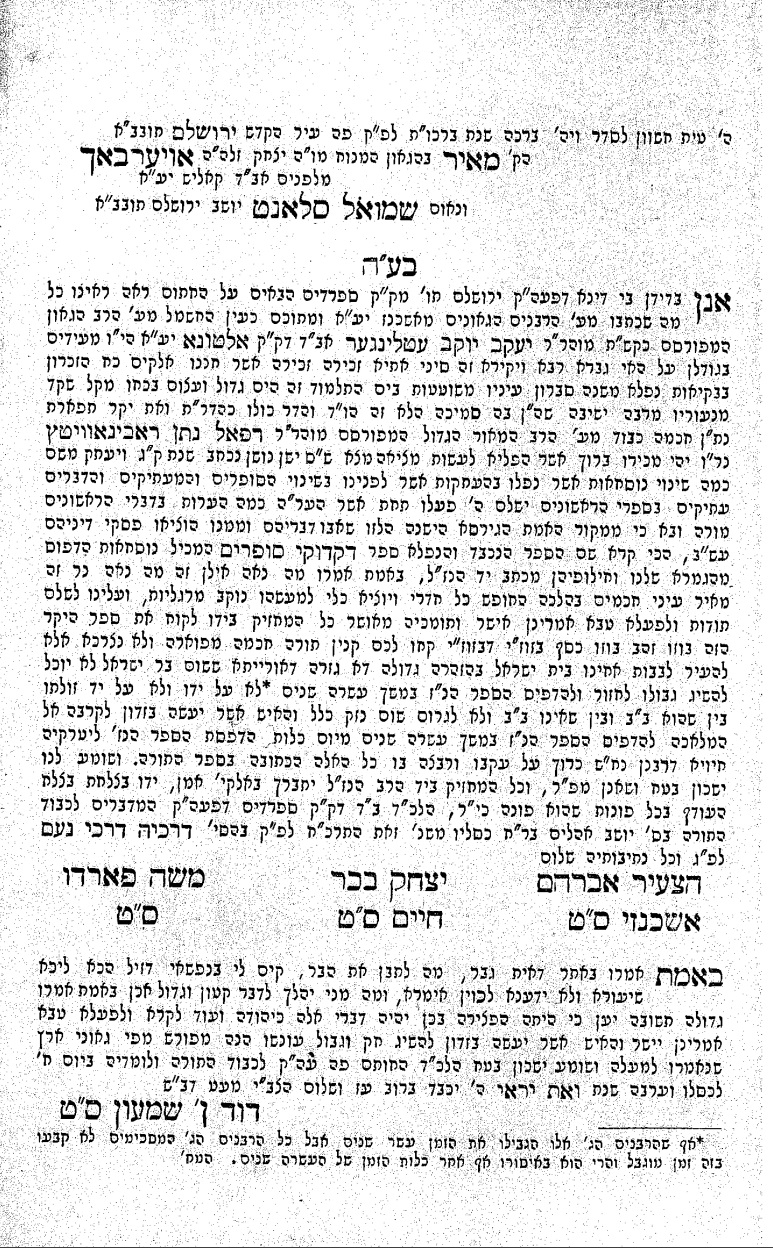
The Yom tov of Shavous called Yom Matan Torahsenu as it is the day we received the Torah thousands of years ago at Har Sinai. It has many minhaghim that we do to remind us of this such as putting up grass and flowers or eating dairy dishes. Another minhag which many Jews have is to say azharot today. In this post I would like to discuss a bit of interesting bibliographic information about some specific azharot and their authors. On this topic, we will (1) discuss the numbering of the mitzvos in general; (2) next the meaning of azharot; (3) those who took exception to reciting the azharot; and (4) specifically which azharot are frowned upon.

In order to understand this topic a small introduction is needed. According to most opinions Jews are commanded to follow 613 mitzvos from the Torah. While 613 the most common number used, it is actually disputed by a few people. R Yeruchem Fischel Perlow records that R Yonah Ibn Ganach questioned the number. A little later than R. Ibn Ganach, we find that the Ibn Ezra questions this number and does so at great length in his Yesod Moreh, Shar Shenei (pg 91 and onwards). After that we find that the famous kabbalist R. Yosef Gikatilla, says (in his K’lalei Hamitzvos Erech Manah) that it’s impossible to give a number to the mitzvos. The Ramban also questions this number at length in the beginning of his work on the mitzvos. Gersonides (RaLBaG) in his commentary on shmos also questions the number (pg 76 Mossad Harav Kook edition). If we now skip a few hundred years, there is an interesting statement, attributed to the Gra, recorded by his brother R Avrohom at the beginning of his work Ma’alos haTorah where he has the Gra saying that the 613 is only the shoroshim (see there at length and the menucha vekedusha pg 20). R Shlomo Zalman Auerbach writes that this is the reason why we do not find that the Gra wrote on this area although he wrote on every other area of torah (Halichos Shlomo, Shavous, pg 374) due to its unending nature.

Aside from the above opinions, the 613 number has been accepted by most. After one agrees on a final number, the next question is commandments are included in this number. There was two main groups of numbers counters – the BaHaG who gave one listing of the 613 mitzvos and for a few hundred years this was the accepted method of counting the commandments. Then along came the Rambam with many arguments on the BaHaG’s method of counting which he devotes his introduction to his Sefer haMitzvos where he explains why he why he argued against the other shitos and counted the ones he did. Afterwards a whole collection of literature has been written on this topic from many rishonim and achronim.

Besides for the actual count of the mitzvos, there were many composers in the era of the Geonim and Rishonim who composed poems (piyyutim) counting the mitzvos some of these poems are known as azharot.

First, what is the meaning of the word Azharot? Professor Ezra Fleischer writes (Shirat Hakodesh Haivrit B’yemi Habenyayimm pg 73) that it’s not clear from where did the name אזהרת come from, it appears to be the opening sentence of a piyyut now lost. Others point out that אזהרת is the gematriah of 613. Moritz Steinschneider writes (Jewish Literature pg 159) that these piyyutim were based on halachic subjects which instruction was to be given on the Shabbos before the Yom tovim therefore they were called azharot meaning instructions. There are also azharot said on Shabboas Hagodal. A sample of one from R Klonomius can be found in the Shomer Zion Haneman (issue 95-97 year תרטו) (see also Davidsin Otzar Hashira Vhapiyyut vol 2 # 1042). Professor Ezra Fleischer also writes (Shirat Hakodesh Haivrit B’yemi Habenyayimm pg 384) that others such as R Yehudah Halevi wrote azharot for Pesach.

Zunz says the earliest azharot we have are from the end of Eighth century called אתה הנחלת (see also Otzar Haseforim from Ben Yakov pg 33). Amongst the other early ones we have are from R Saddiah Goan, R Binyomin ben Shmuel, R Eliyha haZaken R Shlomo Ibn Gabriel and R. Yitchack Albargeloni.

The Chida in Shem Hagedolim says that the recitation of azharot on Shavous, is done by most Jews. Much earlier we find in the Tzeda laDerach (mamar 4 klal 4 perek 6) that in Spain they said from R Shlomo Ibn Gabriel’s and in Ashkenaz and France they said the one from R. Eliyahu Hazakan The Abudrham (p. 246) also brings that they said from R Shlomo Ibn Gabriel. Even earlier we find both the Siddur Rav Amram Goan (Goldshmidt edition pg 131) and R Saddiah Goan (pg 156 and onwards) also discuss when exactly azharot were said during mussaf. R Saadiah Goan went even further he writes that he saw that everyone says during mussaf the 613 mitzvos from a piyyut called אתה הנחלתה (the earliest known azharot) but saw that it was missing a bunch of mitzvos so he composed a completely new version including all the mitzvos. One of the versions he composed was showing the 613 mitzvos in the asres hadebros (see the article of R Shmual Askenazi in Kovetz Beis Aaron V’yisroel 1991 issue 5 pg 109-114).

The Shelah, Sedar Hayom, and Chida bring that there were those that said the azharot of R Shlomo Ibn Gabriel when they stayed up Shavous night (See Shorshei Minhag Ashkenaz Vol 3 pg 296-298).

The reason for saying the azharot on Shavous suggests Profesor Frankel is perhaps based on a medrash which says that at matan torah the Jews were told after every mitzvah do you accept it with all its applications and after each one they said yes so it could be on shavous the day we got the torah we do this as its like a review of what happened than (Goldshmidt Machzaor Pg 11).

Aside from all the above, not everyone was so enamored with azharot. Two people specifically – Ibn Ezra and the Rambam – were against at least some azharot.

The Ibn Ezra writes in his Yesod Moreh (Bar Ilan 2002 pg 107) “that the authors of azharot are like people who count the blades of grass mentioned in the medical books not realizing the purpose of each one thus these people count the same thing twice because its mentioned twice.” The Rambam writes in his introduction to Sefer haMitzvos while talking about the different minyan hamitzvos that “there are many azharot from Spain and you can not blame them for making mistakes as they were composers not Rabanim.”

It is possible that the Rambam’s opinion was influenced by Ibn Ezra. In the Rambam’s last will and testament, he spoke highly of Ibn Ezra and recommended his son R. Abraham study Ibn Ezra. (See the Koreh haDoros pg 19 and R Emanuel Abuhav in his Bemavak Al Archa Shel Torah pg 247). But, using this source would be a mistake. As was already noted by the Mahrshal who questions whether in fact the will attributed to the Rambam is in fact from the Rambam. Similarly, R Yakov Emden in his Mitpachas Seforim (pgs 101-02) also writes that it must be a forgery. Today, Yitchzach Shilat, has demonstrated conclusively that in fact the will, attributed to the Rambam is a forgery. (Iggros Harambam vol 2 pg 697-698; see also G Scholem in Mechkeria Kabblah Vol 1 pg 190). While the will may not be real, this is still some evidence that the Rambam was influenced by the Ibn Ezra’s work Yesod Moreh in general (see R Yeruchem Fischel Perlow in his introduction to his work on R Saddaih Goan pg 15).

Setting aside where the Rambam got this anti-azharot idea, the next issue is which azharot were the Rambam and Ibn Ezra disapproving of?

R Chaim Heller in his notes (#34) on the Sefer Hamitzvos references a teshuva written by the Radbaz (vol. 3 siman 645) where the Radbaz writes that the Rambam is referring to Reb Shlomo Ibn Gabriel. R Y. Kapach also writes the Rambam is referring to R Shlomo Ibn Gabriel and R Yitzchack Albargeloni. The Sefer HaYechsin (pg 219) also assumes the Rambam was referring to both R Shlomo Ibn Gabriel and R Yitzchack Albargeloni. The Koreh Hadoros when quoting the Rambam’s above statement about the azharot takes this attribution one step further where the Koreh Hadoros just includes in the quote from the Rambam R. Shlomo Ibn Gabriel and R Yitzchack Albargeloni making it appear as if the Rambam says these names specifically. Landshuth, in his Amudei Avodah also assumes the Rambam is referring to R Shlomo Ibn Gabriel (pg 313).

The attribution to R. Shlomo Ibn Gabriel is problematic, mainly because it seems both him and his piyyutim where highly regarded. Although the Tashbatz already writes in his Zohar Harokea (a commentary on azharot of R Shlomo Ibn Gabriel) that this composer was not a great expert in Talmud; most others dispute this characterization. The Rogachaver Goan in his notes (see also Tiferes Zvi on the Zohar Vol 1 pg 189) on the Tashbatz writes that it’s a chutzpah to write such a thing on this amazing composer! [In a joking manner I wanted to suggest its strange that the Rogatchver would stick up for a a rishon as its well known he argued on Rishonim all the time so I wanted to suggest that he wanted to defend R Shlomo Ibn Gabriel so that he would be able to argue on the Tashbatz.]

But one thing we see from this for certain is that the Rogatchver held he was a great Talmud Chacham. Further more there is a different teshuvah (vol 3 siman 532) from the Radvaz where he writes that R. Shlomo Ibn Gabriel was a great person and Ibn Gabriel’s words are holy! This would seem to contradict the previously quoted words of the Radbaz. R. Matsyahu Strashun (Mivchar Kesavim Pg 116-118) suggests because of this apparent contradiction and some others that the Radbaz lived a very long life of 110 years and he wrote over 2000 teshuvot so its possible that over this great length of time he forgot his own earlier words.

R. Shlomo Ibn Gabriel’s contemporaries also held him in high regard. The Ravad (Sefer Hakablah pg 81) Meiri (Sefer Hakablah, Ofek ed., pg 136) Avudraham and Yechsin all call him a great chacham. In one place the Sefer haYeuchsin writes that לא קם כמוהו לפניו ואחריו. The Chida also writes that it can not be that the Rambam was referring to R Shlomo ibn Gabriel. R Yeruchem Fischel Perlow in his work on the Sefer haMitzvos of the Rasag he calls R Shlomo Ibn Gabriel a Godal. The Yechsin writes (and from there the Tzemach Dovid and Koreh Hadoros) that he was the rebbi of Rashi! However R Shmuel Askenazi already points out that the years are impossible because Rashi was ten years old living in France when R Shlomo Ibn Gabriel died in Spain (see his notes to the Kav Hayashar pg 20).

The Kav Hayashar writes that R Shlomo Ibn Gabriel was a great mekubal. The Sefer Metzref Lechochma even (pg 9b) brings that he created a woman golem! (see M Idel, Golem pg 200 and 343) This story shows he was familiar with kabblah maseyois.

There is a famous story brought down by many people [Shalsheles Hakablah (pg 89) Yesod Yosef (perek 87) Kav Hayashar (perek 86) Sefer Zechirah (pg 243) others bring down this story with R Shlomo Alkabetz see Amodei Ha’avodah pg 310.] in regard to R. Shlomo Ibn Gabriel’s death. A non-Jew was jealous of Ibn Gabriel’s wisdom so he killed him burying him under his fig tree. In time, the tree started bearing excellent figs, so great were these figs, that the king heard about it. The king wanted to know what his trick to get such good figs. The fig tree owner obviously did not want to reveal his secret. The king was not satisfied and had the fig tree owner tortured. The fig tree owner eventually confessed that he killed a Jew and buried him there. The king had the fig tree owner killed.
The Kav Hayashar and others use the above story to demonstrate the authors of our piyyutim were great people so we should be say them having the authors name in mind and that his merits should help us. However R. Shmuel Ashkenazi has already pointed out based on the Sefer Tachmoni that this story is not true and instead, R. Shlomo Ibn Gabriel died at the age of twenty nine from a harsh sickness in 1040 (see his notes to the Kav Hayashar pg 19 not the date 1070 given by the Sefer Yuchsin and Zinberg Toldos Hasafros B’yisroel vol 1 pg 72 For more on his sickness see Chaim Shirman in Toldos Hashira Haivrit b’Sefard Hamuslamit pg 265-268).

Abraham Haberman brings down in his Toldos Hapiyyut V’haShira (vol 1 pg 179) a legend from a Temani manuscript that describes the story behind R Shlomo Ibn Gabriel writing of his azharot. R Shlomo Ibn Gabriel was learning in a Yeshivia where the Rebbe had a daughter of marriageable age. The Rebbi said who ever gives me a new fruit can marry her. That night R Shlomo Ibn Gabriel wrote the azharot gave it to the Rebbe and the Rebbe announced the engagement. They got married eruv Shavous!

Another piyyut which R Shlomo Ibn Gabriel is famous for is Keter Malchus which in nusach Sefard machzorim it was said on Yom Kippur at night others say it during the day (see I. Davidson, Otzar Hashira Vehapiyyut # 581). Many people discuss how there are many kabblastic concepts in this piyyut (see Chaim Shirman, Toldos Hashira Hivrit B’sefard Hamuslmit pg 331-345).

Besides for composing songs R Shlomo Ibn Gabriel authored a few seforim one called Tikin Midos Hanefesh others attribute to him the Mivchar Pinenim. However besides for this he authored another sefer which was a classic in philosophy called Mekor Chaim. An interesting thing happened with it it was translated to Latin called Fons Vitae and it became a world classic but the authors name was written as Avicebron and know one knew that a Jew was the real author. In 1846, S Munk figured out that it’s really from R Shlomo Ibn Gabriel and he printed it. Eventually it was printed in Hebrew. There has been much written on this sefer to show that R Shlomo Ibn Gabriel was familiar with kabblah (see G. Scholem, Mechkeria Kabblah Vol 1 pg 39-66).

[For more on R Shlomo Ibn Gabriel see Elbogen, Hatefilah B’yisroel pg 258-259: Zinberg in Toldos Safrus B’yisroel vol 1 pg 34-73: A Haberman Toldos Hapiyyut Vehashira vol 1 pg 175-180: Chaim Shirman in Toldos Hashira Hivrit bsefard hamuslmit pg 257-345.]

From all this, it is clear that neither the Rambam or Ibn Ezra were referring to Ibn Gabriel, so we now turn to another candidate – R Yitzchack Albargeloni. R. Albargeloni lived in the era of the Rif and Ravad. The Sefer Hakabalah also says that R. Albargeloni was a great talmid chacham who wrote works on Kesuvos and Eruvin. The Meiri in Sefer HaKabbalah also (pg 134) writes that he was a great chacham. These works of his on kesuvos and eruvin were lost however Profesor Ta-Shma has found some pieces of his in other works of Rishonim (See his Hasafrut Haparshnut Le’talmud volume 1 pg 168-169). Besides for this he also translated the sefer Mekeach umemkar of Rav Hai Goan from Arabic to Hebrew when he was thirty five years old (see amudei havodah pg 126 and Or hachaim Chaim Michael pg 510). Thus the Chida writes the Rambam was not referring to R Yitzchack Albargeloni.

Another early composer of azharot which was recently found active before R Shlomo Ibn Gabriel and R Yitzchack Albargeloni was from R Binyomin Ben Shmuel. Professor Ezra Fleischer printed them in kovetz al yad (vol 11 pg 1-77) R Binyomin lived according to Zunz before Rashi in the first half of the eleventh century. According to some he was the brother of R Yosef Tov Elem. [For more on this Rishon see Fleischer in his extensive intro to his work and Professor A Grossman in Chachmei Tzarfat Harishonim pg 47-51.]

Another early composer of azharot – before R Shlomo Ibn Gabriel was R Eliyayhu Hazakon his azharot are quoted in Tosafot throughout shas and by many other Rishonim so its highly unlikely that the Ibn Ezra and Rambam were referring to him. The Marshal (shut siman 29) and Chida write that he was the brother in law of Rav Hai Goan but recent historians show that he might have been mistaken and he was a bit later than that See Prof A Grossman in Chachmei Tzarfat Harishonim pg 88-90 . [For a listing of the rishonim who bring him down see Amudei Avodah pg 14-15: Chaim Michael, Or Hachaim pg 180: Davidson, Otzar Hashira Vehapiyyut vol 1 #6022 and the introduction of the Mezack Azharot by R Yisroel Shaprio.] Professor A Grossman discusses his life and works at great length in his work Chachmei Tzarfat Harishonim pg 84-107.

Many commentaries were written on these different azharot by Rishonim and Achronhim. On the azharot of R Saadiah Goan we have the excellent encyclopedic work of R Yeruchem Fischel Perlow where he basically has and average of ten pages per every word of R Saadiah Goan he also discusses all the other opinions of the geonim and rishonim on the relevant topics. On the azharot of R Yitzchack Albargeloni we have the commentary Nesiv Mitzvosecha from R Shaul Hakohen from Gerba (he also wrote on the azharot of R Shlomo Ibn Gabriel.) On R Eliyhau Hazakan we have an early in depth commentary from him printed in the Kovetz al Yad (vol 11 part 1) from E Kuffer from some talmidim of talmidi Rabenu Tam. In 1900, R Mordechaei Slutski printed a pirish called Hiddur Zakon. This work has haskamas from the Meshech Chochma and Minchas Borouch. In 1972 R Yisroel Issur Shaprio (son of R Refael Shaprio) wrote an excellent in depth work called Matzack Azharot where he has a lengthy commentary on every word of R Eliyahu Hazakan. In 2001, Yitzhach Meiseles put out a complete critical edition of these azharot.

On the azharot of R shlomo Ibn Gabriel we have many works amongst them the Tashbatz’s Zohar Ha’rokeah. The Zohar Ha’rokeah has its own recent extensive edition from R A David including many useful footnotes and the notes of the Shoel U’mashiv, Rogatchver, R Yeruchem Fischel Perlow and R Menachem Kasher. A while back in a sinai a few pieces of the Adres’s notes were printed on the azharot of R Shlomo Ibn Gabriel.

Another person who we find wrote a commentary on the azharot of אזהרת ראשית was R Shmuel Chassid the father of R Yehudah Hachassid but they are only in manuscript as of now (see E E Aurbach ed., Arugot Habosem vol 4 pg 89 ) For a complete history of R Shmuel Hachassid see the article from Abraham Epstein in his Ketvim vol 1 pg 247-268.

So at least these few authors can not be the ones the Ibn Ezra and Rambam were referring to. So the Chida writes it must be they were referring to the many other composers of azharot. It is clear that this is the case as the Ramban writes in the beginning of his notes on the Rambam shorshim that there were many piyyutim and azharots written of the mitzvos.

General sources see: Chida in Shem Hagedolim Erech Azharot: Elbogen, Hatefilah b’yisroel pg 163: Extensive introduction of Prof. Yonah Frankel in the Goldshmidt Machzor on Shavous pg 11-14 and pgs 36-48: Introduction of R. A. David to his Zohar Harokeah.


Rav Shmuel Ashkenazi: a Hidden Genius

Rav Shmuel Ashkenazi: a Hidden Genius
By Eliezer Brodt

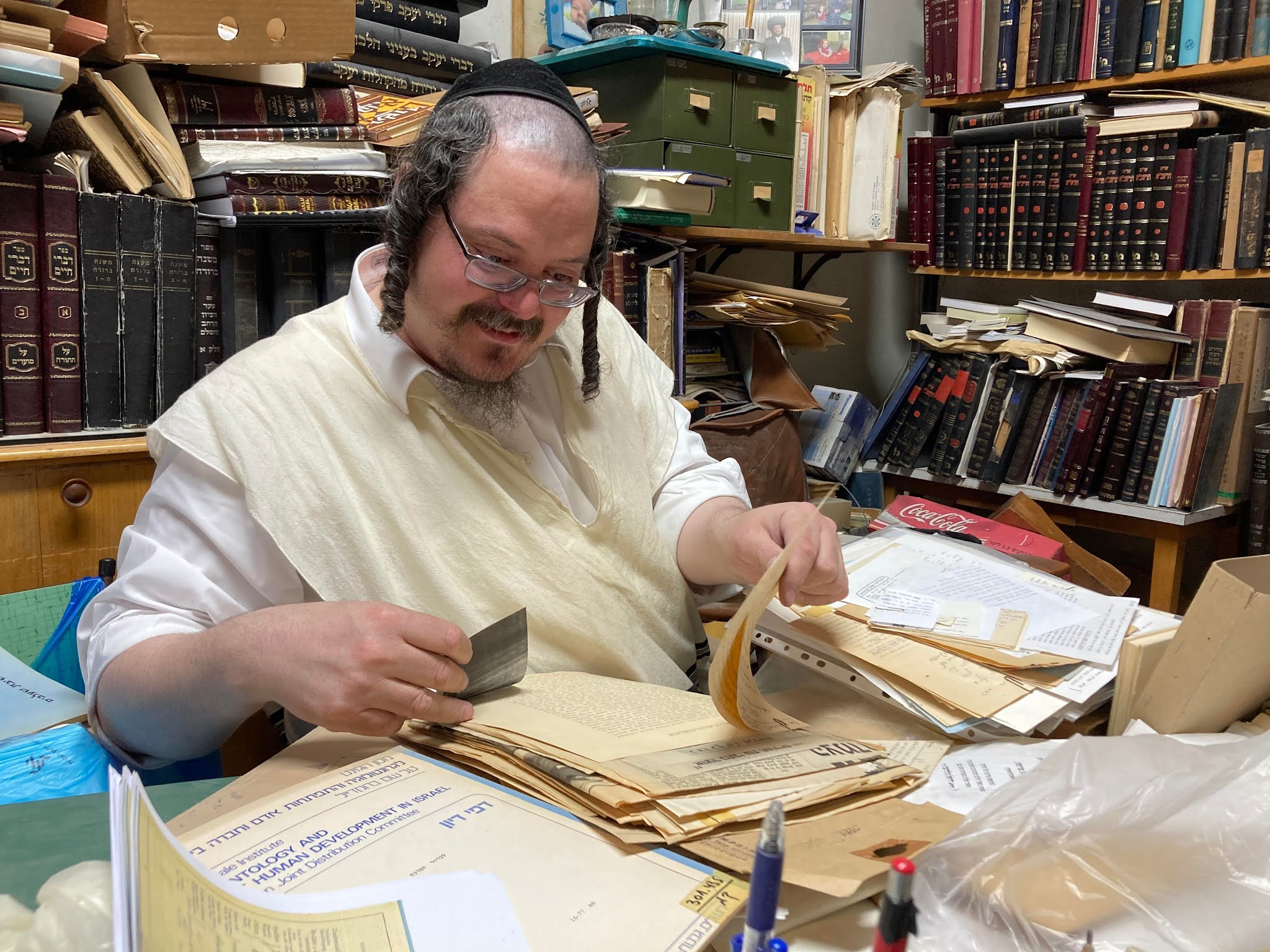
This Monday night is the first yahrzeit marking the passing of a unique Talmid Chacham, R’ Shmuel Ashkenazi of Yerushalayim, at the age of ninety-eight. R’ Shmuel was one of the hidden giants of the seforim world, in both ultra-orthodox and academic circles. I had the Zechus to learn much from him and in this article, I wish to describe this fascinating but hardly known Gaon and what we can learn from his life. An earlier abridged version of this article appeared in the Ami Magazine last year. IY”H in the future I will expand this essay.

One day back in 2000, while learning in the Mir as a Bochur, I was having a conversation with a friend, R’ Yaakov Yisrael Stahl, and R’ Shmuel Ashkenazi’s name came up, R’ Yaakov described him as an extraordinary Talmid Chacham. A little while later, during one of my daily seforim store trips I noticed a recent arrival, a very heavy sefer (844 pp.) with a peculiar title, Alfa Beta Kadmita de-Shmuel Zeira. I opened it up and immediately put two and two together, realizing that the author is the same R’ Shmuel Ashkenazi I just heard about. Upon purchasing it, I could not put it down. Learning through it I was immediately able to tell that my friend had not exaggerated in the slightest way. It appeared that this person knew literally everything about anything connected to Torah.

First Meeting

At the time, I had been working on researching and publishing my first article which dealt with tracing everything about the custom of not sleeping on Rosh Hashanah. One of the earliest sources quoted was in the name of a Yerushalmi which appeared to have been lost at some point. I had been searching all over for any information on this topic, and it was then that I noticed that R’ Ashkenazi was planning on writing about this topic in the next volume of his. I am not sure why but at the time I did not make an effort to speak with him about this. I returned to the US for a few years, and while in the US I drafted a letter to him listing all of my issues on this topic but I never got around to sending it. When I returned to Eretz Yisroel in 2004, one of the first of my planned stops was to visit R’ Shmuel Ashkenazi. Almost immediately upon returning a newly made friend, R’ Duvid Vieder, a Toldos Aharon Chossid who was close to R’ Ashkenazi, brought me into him to visit. From then on, I began to visit him regularly, this custom continued until a few weeks before the 2020 coronavirus lockdowns. At times I visited him once a week for an hour or so, other times once a month, other times I would speak to him on the phone.

I must preface my reminiscences by saying that, sadly, I did not heed the advice of the Chasam Sofer who told his children and talmidim that since he won’t be around forever, they should “chap arein” and listen to his stories. Unfortunately, this is not the first person with whom this has happened to me. I took for granted that Rav Ashkenazi would be around forever, (he did die at the age of 98!) and assumed I would always be able to ask him again for a particular story or an idea that he mentioned.

What was the connection?

Basically, each visit I would prepare lists of questions to ask him. I would also bring him new seforim or articles (printed out in big letters, to help him read it easier). Sometimes when I would ask him something, he would say he is old and his head does not work, other times it was amazing what he remembered – on the spot. Sometimes he would pull down a file of material stored in – no jokes here – old cornflakes boxes.

I would then scan some of the material. Other times he offhand did not have anything to add on a particular topic but when looking at a particular sefer I would find a note written on the side or in a paper stored in the sefer that would be related to what I was searching. Other times I would find something else which was of great importance. Rarely did I leave his house empty handed. We both shared a love for seforim and information on a wide range of topics.

Love of Seforim

What drew me to him, and particular developed my relationship with him, was our shared love of seforim. I would update him on new seforim. At times he would ask me to purchase it for him or would borrow my copy for a bit. He told me numerous times how he enjoyed visiting and buying seforim from various shops for many years and that he started collecting when he was seven years old! Now he could not go to stores as he was too old; I got to know him when he was over eighty.

When I joined the editorial board of the journal Yeshurun, I would bring him each new volume as it was printed. Each visit he would ask me to check on the shelf where he kept them, to see if he was up to date and if needed, to update him with any missing volumes. A true lover of seforim, his face would lit up at each new volume. I would then point out some of the articles I thought he would enjoy and he would put in markers to read them.

I always wondered if he read the various volumes of Yeshurun I brought him. After he was niftar, while going through his seforim, I found inserted in one rare book a small paper which he wrote: “for more information about this author see the article in Yeshurun”. Then in a different pen he added another cite from another issue from Yeshrun from a few years later.

This small story also demonstrates a bit of his methodology; he would collect all kinds of information and store them at times in a related sefer and would constantly update these notes.

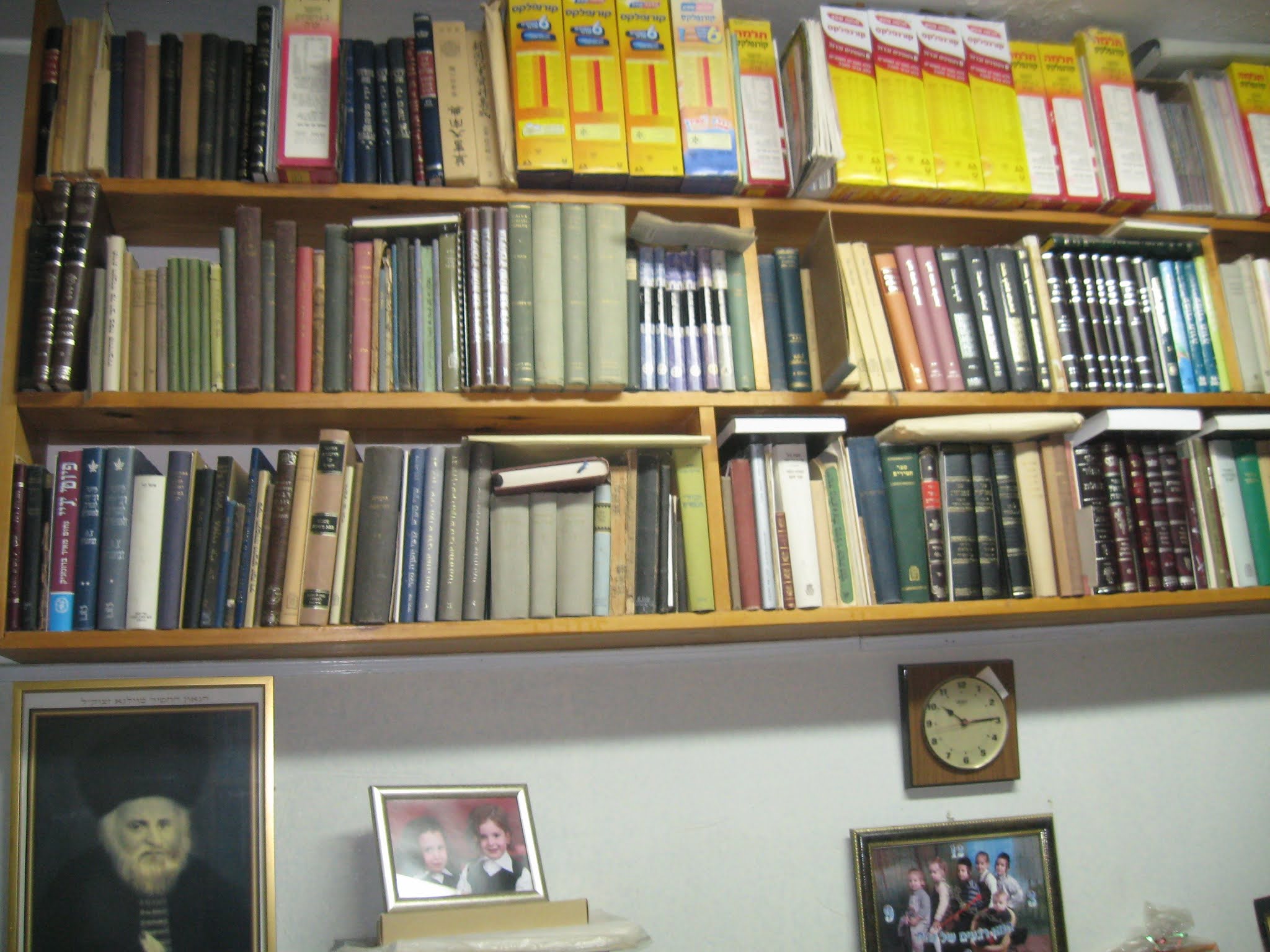
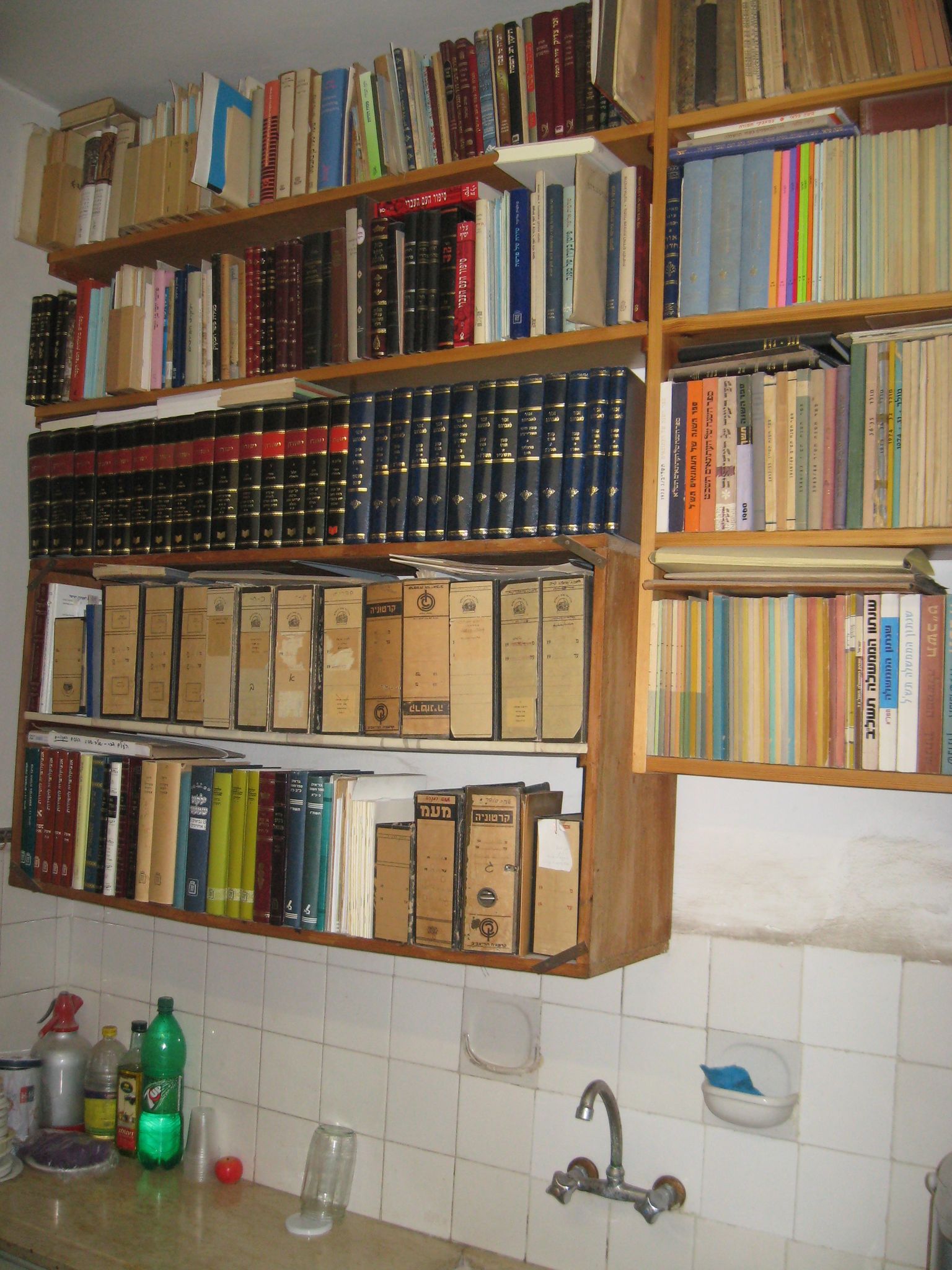
His love for seforim was something unique, the glow on his face when he opened up a new sefer, especially of someone he was into, was simply priceless. He would look carefully at the Shaar and if it was a reprint of an older sefer he would immediately check if they included the front page of the older edition to compare. He had seforim in every space possible in the four rooms of his apartment, including his porch. Many visitors noticed how even his kitchen was lined with seforim!

Dikdueki Sofrim Haskomot

An interesting story happened with me and his library. While working on an article about the Dikdueki Sofrim I was unable to track down some recorded Haskomot that the author R’ R.N.N. Rabinowitz had received for the first edition of his work. I, along with other scholars, had searched numerous copies of the first edition, but with no luck. Late one night, I came to R’ Ashkenazi’s house and mentioned to him my problem. He said “show me the issue inside,” keeping with his custom to take care to always view the source material firsthand (Osiosi Machkemios – a topic he wrote a lot about). I took down his copy of the sefer, and lo and behold it was a first edition with the missing Haskamot! I published these missing Haskamot in my article on the Didukei Sofrim, and attributed this rare and miraculous find to his extraordinary library.

His History:

Where this unique Talmid Chacham came from is simply a mystery. He was born in Yerushalayim and lived in Batei Ungarn. He learned by Rav Yosef Tzvi Dushinsky of the Edah HaChareidis. Originally, his name was Deutsch but, at some point changed it to Ashkenazi. He had four children with his wife who died over forty years ago. Since then, he lived alone in his apartment near some of his children. His son did an excellent job of Kibud Av bringing him food every day and looking on him a few times a day. Yom Tov and Simchos he spent time with his family.

When I and others asked him, who was his Rebbe, he would just smile and say no one in particular. The truth is the Mishnah in Avos states: Knei Lecha Chaver. Aside from the simple peshat, Rashi explains this Mishnah by citing some who say it means via Seforim others commentators explain this as ‘buying a pen’ (see R’ Ashkenazi’s in-depth article on this for sources). R’ Ashkenazi employed all of these methods; his friends and teachers were his seforim and his pen.

R’ Ashkenazi was a short, quiet and unassuming person. Most, having seen him walking on the street, would never believe he was such an erudite Gaon. Many times, R’ Ashkenazi did not express much emotion except to give a pleasant smile and was friendly and polite in conversation. But there were times he got very excited; for example, when he recalled a good story from his younger years or something unique that he discovered years ago. He was very polite and was a real Yekeh; for example as soon as they bentched Rosh Chodesh Kislev his Menorah was already prepared in the window.

R’ Yechiel Goldhaber, a Talmid Chacham and author of numerous articles and seforim had a close relationship with R’ Ashkenazi for many years. He recalled when he was introduced to R’ Ashkenazi for the first time by his father-in-law, he thought to himself who is this simple looking man? He soon learned that this man was a master of all of Torah and swiftly became a close Talmid of his.

Many times, he would tell me he wishes he could come visit my library. In Later years he would spend his Yomim Tovim at his daughter. One Chol Hamoed Succos, when he was over ninety, he made the difficult trek from her house to mine in order to spend time in my library.

He would love to read everything he could get his hands on. I visited him at many different times of day, even late at night and I always found him learning a sefer – even when he was over ninety. He read everything newspapers, books – he was just curious about everything with an incredible thirst for knowledge.

I recall visiting him a few times when he eighty-five and noticed he was learning the Shelah Hakodosh very carefully. I asked him why (of course he had learned through this sefer numerous times before!) and he responded that someone is reprinting the sefer and asked him to go through the sefer and send comments. He therefore sat down to learn the whole sefer, line by line, after which he wrote a ten-page letter with his comments on the sefer.

Over time, I learned again and again that R’ Ashkenazi personally believed his purpose in this world was to help people with the incredible amounts of information that he had gathered over the years of intense learning. This incredible Middah can be seen in this light; he did not feel that he was the “owner” of this extraordinary wealth of information he had collected, and thus gave very willingly without any conditions. He never asked me to cite him when he gave me some rare source even – although I always told him I would; he just was so happy to help someone else.

He would collect and catalog much of what he read. He had all kinds of systems to file the information he had gathered over eighty plus years of learning. When he would read an important article in a magazine or journal, he would cut out the parts and store them in their appropriate place. He gathered information on thousands and thousands of subjects (not an exaggeration in any form) which had some connection to our rich heritage. What’s more astounding is that R’ Ashkenazi never used a computer or the internet; all of his erudition came about simple by learning through thousands of seforim; a great many of them rare or unknown.

Over the years he helped so many people and for many years after he retired, he would visit the National Library of Israel on Tuesdays, where throngs of people would line up in wait to speak with him about all kinds of subjects.

Many years ago, he received a call from a young chassidish Talmid Chacham living in Monsey who was starting to work on publishing a new edition of the classic historical work Seder Hadorot. He started asking him questions about various issues he had. Over many phone-calls R’ Ashkenazi answered many of his difficulties while training him in proper research and writing skills. This year some volumes finally were published (see here). And this was not a onetime occurrence – he helped so many more people. He used to remark to me that when he was younger so many people would come to visit him – until the late hours of the night.

He was an expert in so many different topics, whether it was the standard ones like Tanach, Chazal, Halacha, Minhag or Chassidus or less commonly studied subjects such as Tefilah, Piyut, Dikduk, Kabbalah, Philosophy, Machshavah, History and Bibliography. In all of these areas his expertise was remarkable.

His Uniqueness

A sample of his bekius; one time I noted that the Maharsha often quotes a “Sefer Yoshon Noshon” and asked if we have any idea which sefer this is? He immediately responded that he found it usually refers to R’ Todros Abulafiah’s Otzar Hakavod.

His incredible Bekius was bolstered by an almost photographic memory, as the following story demonstrates. Once someone used the Bar-Ilan Responsa search engine to locate a passage in the Tana DeBei Eliyahu to no avail. He went to ask R’ Ashkenazi who immediately told him where the passage could be found. Checking the Bar-Ilan text, it was discovered that when the sefer was being entered into their database the passage in question had been mistakenly omitted. I first heard this story from someone else, so to make sure it was accurate I asked him about it and he confirmed it. A similar story happened with him and a passage from the Shut Chasam Sofer.

A few years back a friend was working on publishing out an esoteric Rishon on Mesechet Megillah. He thought no one ever heard of this author and randomly mentioned this to R’ Ashkenazi – without batting an eyelash – replied “of course, and one can find material by this author in the work of Rav Shlomoh Alkabetz on Megillas Esther (Manos Halevi). The fellow was stunned in elation; he had just been gifted new and important material for his project.

This remarkable Bekius which even beat out computer search engines, was just one aspect that made him remarkable. He would receive numerous calls and letters from all over the world from people of all walks of life seeking his assistance in tracking down a statement. He had an incredible knowledge of all of Chazal. I do not just mean the “standards”; Bavli, Yerushalmi and Midrash – even all the numerous and very often almost unknown Midrashim printed over the years. He was also expert in what is known as the lost Midrashim. Over the years many Midrashim we had were lost but some traces of them can be found in various Piyutim, cited by Rishonim or in other obscure places. Through his incredible amounts of learning and his phenomenal memory he was able to recall so much in this field.

To illustrate this with some samples. A few years back someone who was editing for publication a never before printed pirush of a Rishon on Avos came across a few statements in the name of Chazal. This person, a Talmid Chacham in his own right and familiar with tracking down such material, could not locate sources for these statements. Immediately he penned a letter to R’ Ashkenazi. A few days after he received a letter from R’ Ashkenazi with various incredible sources for his questions. This was a very common occurrence.

Piyut, Tefilah and language

Earlier, I mentioned his expertise in Piyut, Tefilah and language. A bit of background is needed to explain this. Rabbi Joseph B. Soloveitchik, when describing Rabbi Elazar Hakalir’s greatness, (Koren Mesorat Harav Kinot (pp. 386-388) wrote the following:

The piyutim of Rabbi Elazar HaKalir, including his kinot, serve two purposes. The first is limmud, learning. Every sentence of the piyut quotes m’aamarei Chazal… The second purpose is tokhaha, rebuking the people for their misdeeds and instructing them in the proper way to act. These piyyutim deal with… repentance… acknowledgment of God’s justice. The shali’ah Tzibbur was not merely a chazan…, but was one of the great scholars of the generation who was the principal… moral critic of the people… Rabbi Elazar HaKalir was (also) a master of the Hebrew language and very creative in his use of Hebrew. If not for him, modern Hebrew could not have come into existence. Before HaKalir, the Hebrew language was very rigid. For example, the noun and verbs were fixed in their form… But HaKalir made a critical contribution to the development of the Hebrew language by endowing the language with flexibility… Rabbi Elazar haKalir’s piyutim served two purposes: limmud, study… As for the element of study, one of the dimensions of HaKalir’s piyyutim is that they are compilations of the statements of the sages. Most of us, who are expert in neither Hebrew nor aggadot Hazal, find HaKalir’s corpus of piyutim boring. But it is not boring at all; it is like a gold mine. His piyutim for Yom Tov explain the essence of the Yom Tov. The midrashim concerning Sukkot are replete with information about the sukka, etrog and lulav, and all the explanations in the Midrash, all the ta’amei sukka, the reasons for the sukka, all of the ma’amarei Hazal, are together in the HaKalir’s piyutim for the first day of Sukkot… If one were to study carefully and thoroughly the piyutim of Rabbi Elazar HaKalir for Rosh HaSahana, Yom Kippur, Sukkot, and Pesah, one would find many applicable halakhot and the entire pertinent Midrash, including many midrashim that are unknown to us from any other source.

Rav Ashkenazi was an expert on everything related to Tefilah and Piyut. He somehow read it all and retained it. But in addition, he was able to use his expertise in Chazal and Hebrew language to understand it on a much higher level and as a result was often contacted by the world experts on Tefilah and Piyut for his assistance. These requests came from experts such as Professor Shalom Speigel, Chaim Schirmann, Avraham Haberman, Ezra Fleischer and Daniel Goldschmidt who constantly sought his assistance while working on their Tefilah and Piyut related projects.

In an interview with Ami Magazine printed a few years back, Professor Shulamit Elitzur mentioned:

“there’s another amazing thing I find when doing research. I am constantly coming across midrashim that were lost to the ages… example, everyone knows that Haman was referred to as ‘the Agagi’ because Shaul allowed Agag to live one extra night, which allowed Haman’s ancestor to be born. However, the earliest makor we find in writing in the 16th century; this fact was discovered by Rav Shmuel Ashkenazi of Yerushalayim. But I found a ktav yad of a piyut about Purim that describes this very story and explains how Haman’s ancestor was born, which gives us a source from 1,000 years earlier! And there are many similar examples of lost midrashim being kept alive through unknown piyutim.”

R’ Ashkenazi wrote some articles on Piyut and Tefilah, but we have found much more among his papers and hopefully if I can raise enough funding all his fascinating material on Tefilah will come to light.

When the important Siddur Ezer Eliyahu (sponsored by his late friend Yeshaya Vinograd) was first printed, one can see R’ Ashkenazi’s name in the introduction, thanking him for his assistance (he assisted them for some of the later additions) and his great knowledge in this field.

I mentioned that he had an incredible knowledge of Dikduk and the Hebrew language and used it towards better understanding Piyut and Tefilah. He also authored articles on these subjects and in 1967, when reviewing an important dictionary, wrote a long article demonstrating this very point – and article that garnered much praise. He was very proud of this essay and mentioned it to me many times. A few years ago, I reprinted it with additions he had made in his own copy and a nine-page topical index.

One of the ways he developed this expertise was via learning Tanach so many times. He was an expert in Tanach and all the Rishonic commentaries (including the unknown ones); he even authored a small book of Riddles of Tanach.

He also used his extraordinary skills to become a master editor. However, in addition to the work he was born with an incredible innate sensitivity for text and language which made him one of the best editors out there. For many years he worked at the famous publishing house Mossad HaRav Kook, editing various works. He told me more than once how there was an expert there who would brag (jokingly) that after he read through an article it was impossible to find mistakes. The only person who could still find mistakes was R’ Ashkenazi. He had razor-sharp vision and could immediately spot a mistake.

Many times, I would bring an edited piece of mine to read. As soon as I put it down in front of him, he would take out a red pen and start marking it up and say to me “are you sure it’s been edited?”. He told me he had to mark up everything before he could read it properly, errata were so painful for him to see that it was hard for him to read something on Shabbos! He told me he was punished; when his work Alfa Beta Kadmita de-Shmuel Zeira came out, although he had edited it numerous times, he still found mistakes.

During his learning over the years, he found many people, great Gedolim as well as famous academics, had made mistakes, sometimes quite basic ones. At one point he printed two articles about this. However, he prefaced his articles that his intent was not to mock those who erred but to vividly illustrate that people are human and mistakes will happen. He was a master of humility and never held it over anyone that they did not know what he knew.

He was not only a great expert in all aspects of the Hebrew language but was an expert in Aramaic and Yiddish, both of which he displayed in various publications of his. Related to his expertise in Aramaic, which is very important for learning Gemara, is a very unique essay which he authored related to the Rambam as a translator of the Gemara. One of the world experts in old Yiddish is Professor Chava Turniansky, who has noted on many occasions that one of the people who have always helped her from her days as a student, was R’ Ashkenazi.

Related to this was another talent of his, which at first appears trivial; he was an expert on acronyms. This led to authoring a thesaurus of acronyms together with Dov Yardan, called Otzar Roshei Tevot, with a multitude of obscure and often almost impossible entries. His sensitivity to the text and work in the field of editing drew him to this field. Anyone who learns a lot, especially older material comes across abbreviations, and many times they cause great difficulty in understanding various passages. Abbreviations were employed in writing, sometimes as mnemonic devices and other times simply to save on printing costs. But over time many meanings were forgotten. This work is an extremely useful tool for solving this issue.

Ghostwriting

One day I was in a used bookstore and I noticed a small sefer titled Harif Umishnaso about the Rif. I recalled that this title appeared in the list in beginning of his work, Alfa Beta Kadmita de-Shmuel Zeira which listed out the various works he helped with over the years. I asked R. Ashkenazi if it’s worth buying and what his connection to the book was, as a different name appears on the cover.

R’ Ashkenazi replied “I can tell you it’s an important sefer and worthwhile to buy.” I noticed he was hesitant to continue the conversation. He then said “I will tell you something I did not tell anyone in over forty years – I wrote the whole sefer from beginning to end and it was one of the most important works I ever wrote.” The original plan was to for him to write a series of biographies on various Rishonim – in this book he already references a work on the Ri Migash – but due to a lack of funding this series was discontinued. However, not all of this remained unpenned; he wrote numerous entries in various encyclopedias. It turns out that R’ Ashkenazi had over fifteen different pen names!

I would like to elaborate on this work a bit more and thus cast further light upon R’ Ashkenazi’s uniqueness and greatness. The Rif’s Halachic work is one of the most important sources in Halacha, but what exactly makes it so unique has remained a mystery. R’ Ashkenazi sought to answer this question by collecting and collating all the authentic information we have about the Rif, from the Rif and from other Rishonim. He went through the Rif carefully examining what he did to each Gemara evaluating if remarks or material was added or not and to figure out why, allowing the reader to begin to understand the Rif’s significance. R’ Ashkenazi’s writing methods were honed to precision. He had an uncanny ability to utilize every piece of information without writing an extra letter and assemble it all in perfect order sans speculations commonly found in historical works. At times one does not need grand theories to understand something; just seeing all the known material in proper order helps one understand things. The wealth of material that Rav Ashkenazi commanded in producing this work is outstanding; this book was written in 1967 – long before any of the various search engines used today.

Haggadah Sheleimah

Similar to this is another work by R’ Ashkenazi, Haggadah Sheleimah. I hope to publish an article about this work in the near future, including the numerous additions R’ Ashkenazi found over the years and kept in his files. This work is highly unique for the following reasons. The collected bibliographies by Avraham Ya’ari and Yitzchak Yudlov bear witness to thousands of Haggados written throughout the generations in a multitude of styles, such as Pilpul, Peshat, Kabbalah, Derush and more. However, until 1955 there was no one work on the Haggadah which collected all the sources for each and every Halacha and minhag related to the Seder night. There was no volume which dealt with the various manuscripts of Geonim and Rishonim and at the same time to deal with the exact text of the Haggadah. Haggadah Sheleimah set out to fill those needs, and at the same time offer a running collection of Pirushim culled from over fifty different commentators focusing just on Peshat. In order to produce such an exacting work, it’s not good enough to just be a talented writer, one must also possess a keen understanding of all the material and relay this with incredible clarity. R’ Ashkenazi was such a person; one who sought out the simple Peshat, able to put this myriad of information together in so beautiful a fashion, and with tremendous clarity. His work in Haggadah Sheleimah is so clearly organized and always straight to the point that it is no wonder that to this day Haggadah Sheleimah remains a classic in both the Torah and Academic worlds.

Rav Ashkenazi once explained to me that one has to write precisely and to the point, not lengthily. He said he believed that one of the reasons Rashi’s works survived was due to his concise way it was written, as opposed to various works of Geonim which did not really survive as they were written in a much lengthier format.

Why didn’t he publish his material?

A few years ago, a partial bibliography of his writings was printed in his Alfa Beta Kadmita de-Shmuel Zeira. The listing is close to three hundred articles and seforim that he wrote or assisted in on some level. He started writing under various pen names over eighty years ago. The background to the publication of this volume was, as I mentioned previously, R’ Ashkenazi had been writing and collection information on thousands of topics for over eighty years. Unfortunately, he did not print much of what he gathered. The main reason for this was R. Ashkenazi’s “weakness”; he demanded incredible levels of perfection from himself. Although he strived for great perfection, nonetheless he stressed to me numerous times that he was mistaken in that approach and that I should not follow in his path. In his words it is better I print my work to the best of my current abilities and that worse comes to worse you can always reprint with additions and corrections. Over twenty years ago, R’ Teflinsky somehow convinced R’ Ashkenazi that his material needed to be printed. Together they began compiling some of his material for print, resulting in a volume over eight hundred pages!

After that experience both R’ Ashkenazi and R’ Teflinsky stopped, with no plans of continuing this project. A few years later my good friend, R’ Yaakov Yisrael Stahl and myself were able to convince him to continue. R’ Stahl took upon himself the daunting task to prepare the material for publishing; since, than three more volumes were printed.

Here is a small video clip of R’ Ashkenazi, when we brought him copies of the second and third volumes of his writings, ten years ago.

The topics that these works deal with cover, on some level, virtually everything; sources for expressions and idioms, for minhag, Halacha, the evolution of famous stories, bibliography, corrections of authors’ errors, encyclopedic style information on thousands of topics culled from thousands of seforim – many of them very rare or unknown. (A PDF of the Table of contents of this work is available upon request).

His Letters

Earlier I mentioned the story of someone who wrote him a letter seeking help. This was not a one-time occurrence. He authored well over a thousand such letters in response to such questions. Some requests were for sources to various Halachos or Minhagim, numerous others are various queries related to out rich literature. R’ Ashkenazi always invested his time to answer properly and clearly. Recently, R’ Stahl and I collected these letters for publication and the result is a three-volume set, available for purchase.

Over seventy years ago he purchased a typewriter which he used until his passing.

In an article written by the late Gaon R’ S. Deblitsky, he writes out various proper actions a Rav should “observe.” One of them is to respond to people who write to him, whether the issues are big or small. R’ Ashkenazi was very careful to try to respond promptly. Many people would send him their seforim after they were printed asking him for his comments. He would usually respond with a multi-page letter, beginning by thanking the author for sending it to him, then listing out some criticisms, usually written delicately, while adding all kinds of comments. He always tried to look to say something positive. Some people who heard of him through various channels over the years contacted him before they printed their works. Many times, he would write a collection of comments and corrections to such works. A sample listing of some of those works that benefited from him before going to print include recent editions of: Sefer Zechirah, Kav Hayasher, Sefer Hachayim and many others.

Thanks to the efforts of my special friend Menachem Butler, various academics wrote some praises about the significances of these letters; to partially quote one letter written by the esteemed Professor Shnayer Z. Leiman:

Reb Shmuel was

“bibliographer, bibliophile, and book collector, and his encyclopedic knowledge of all of Hebrew and Yiddish literature remains unparalleled in our time.” His collected writings are an intellectual treasure trove, “covering a wide range of topics in the field of Jewish Studies. Aside from his scholarly distinction, R. Shmuel Ashkenazi wrote in an elegant Hebrew with its own special charm. Not only did he advance discussion, but he did so in an aesthetically pleasing manner. Let it be said openly: this… set will enlighten every reader and will significantly advance scholarship. Anyone concerned with advancing the cause of quality Jewish scholarship will take special delight in the publication of these volumes…During his lifetime [Ashkenazi] corresponded with the greatest Jewish scholars and bibliographers the world over. They wrote to him, for only he could solve the countless historical and literary problems that stumped them…”

Another person to whom Menachem Butler reached out to via his numerous contacts was former editor of Mekizei Nirdamim’s journal Kabez Al Yad, Professor Shulamit Elizur of the Hebrew University of Jerusalem. In her aforementioned interview in Ami Magazine several years ago she said this:

“I am unequal to the task of adequately singing the praises of Rabbi Shmuel Ashkenazi, an erudite bibliophile. His familiarity with rabbinic writings from throughout Jewish history is unparalleled, and he is well-versed in the research literature of academic Jewish studies as well. I first met Rabbi Shmuel Ashkenazi through my teacher, the late Professor Ezra Fleischer. Prof. Fleischer, who was one of the greatest scholars of all time, would often chat with Rabbi Ashkenazi on scholarly topics, and he was careful to send Ashkenazi every article or book he published, knowing that in return he would receive enlightening comments on his work. When I began my own research, Prof. Fleischer instructed me in turn to send my publications to Rabbi Ashkenazi, and I too was privileged to learn a great deal from his comments. It once happened that I was searching for a particular midrashic theme which was alluded to in a liturgical poem (piyut), and although I consulted the leading scholars of Jerusalem who responded that it was a well-known homily, I was unable to locate its specific source. In my hour of need, I turned to Rabbi Ashkenazi, who immediately gave me several references. It emerged that every one of these references post-dated the piyut by almost a thousand years, and that this ancient tradition alluded to in the poem had been transmitted orally for that long period before being committed to writing in the later midrashim. Rabbi Shmuel Ashkenazi’s correspondence is a tremendous resource of Torah and scholarship. Every paragraph encapsulates a great deal in just a few words, and sometimes even with allusions whose explication require deep learning.”

Here is a short letter from Professor Gershom Scholem to R’ Ashkenazi:

Expressions and famous stories

In his writings some of the topics of these are about tracing expressions or the evolution of famous stories. Based on his knowledge, he was able to contribute a lot to these areas even editing some works on these topics.

One such story related to a supposed legend of a portrait of Moshe Rabbeinu which caused a great controversy over a century ago. In 1830, Rav Yisroel Lipschutz started printing his magnum opus, a commentary on the Mishnah titled Tiferes Yisroel. In the section on Maseches Kiddushin first printed in 1843, he brings a story about a king who lived in the time of Moshe, who, after hearing incredible things about this great leader, hired a painter to paint a picture of him so he could have his features analyzed by experts. The people who analyzed the picture reported that the person pictured was evil. The king went in person to visit Moshe Rabbeinu in the midbar and asked him how was it that an analysis of his pictures showed him to be of such wicked character. Moshe told him that the analysis was indeed true; however, after much work, he changed his character and became the great Moshe Rabbeinu.

In 1894 a booklet by the Vilkomir Maggid was printed railing against this story. This booklet presented numerous sources stating that Moshe Rabbeinu was born a kadosh and it was unthinkable to print such a story about him. Indeed, this story was censored out of the 1956 edition of the Tiferes Yisroel. In truth, this ancient legend can be found in various sources and in regard to different luminaries, some claiming it about Aristotle others, Socrates. In fact, R’ Ashkenazi documented it was long used in various Musar and Chasidus sefarim cited as an important lesson that one can change one’s born nature for the good, but not that it actually was true about Moshe Rabbeinu.

Another such story relates to a famous legend about the site where the Beis Hamikdash was built. Told in short, two brothers inherited a field, one brother had a family one did not. At the end of the harvest they divided up the wheat equally. That night the childless brother felt bad for his brother with a large family and said to himself “it’s unfair that while my brother needs more than I, we shared equally”, so he brought over from his pile to his brothers. The other brother thought that since his brother was childless, he should have a larger share of the crop, as consolation, so he added from his share to his brother’s. In the morning each brother realized their piles remained the same and this went on for two more nights. On the third night they met, realized each of their intentions was out of deep consideration for the other and hugged. Numerous people have searched for the early sources for this story. I decided to ask R’ Ashkenazi if he had any material on the subject. He found his file on the story and within was a letter from R’ Yudlov who had been asked by someone in the Education Ministry for the sources on this story. R’ Ashkenazi traced its first appearance in print to 1832 and from there he traced it to other sources.

Bibliography

I would like to conclude with just one more area in which R’ Ashkenazi was truly a legendary master: Bibliography. For many years, R’ Ashkenazi worked in the (now) National Library’s Bibliography of the Jewish Book Project. He also contributed to some of the important bibliographical works and journals written in the past century such as Kiryat Sefer, Otzar Sefer Haivri (Vinegrad) and Sifrei Yerushalyim Harishonim.

A few years back, while working on an article about the origins of eating Hamantaschen (see here), I found an important article from Dov Sadan containing sources on this topic. One of the sources was the interesting, controversial work Machberet Emanuel. I had a nice conversation with R’ Ashkenazi about this work – he had helped Dov Yardan prepare a critical edition of the work and even wrote a long book review on it (which he said he received a lot of Kovod for).

He mentioned two points of interest which will serve as a sample to some of his expertise. One, he noted that Emanuel of Rome wrote a commentary on sefer Mishlei. Interestingly, the preface to the Mishlei commentary sefer is signed Emanuel son of Yaakov, whereas Emanuel’s father’s name was Shlomo. Some have noted that this discrepancy and explained it is a mistake. R’ Ashkenazi suggested this was not a mistake, rather an intentional typo intended by the author to hide his connection to his controversial Machberes Emanuel. The second point he made to me was how the Chida writes in Shem Hagedolim that the best commentary to learn on Mishlei that by Emanuel of Rome. R’ Ashkenazi said he checked into the words of the Chida and he learned through all the works on Mishlei and concluded that the Chida was quite correct. He once had a dream to write a whole work on Mishlei, he even started to pen his comments in a special notebook, but the plans never worked out.

One final last story about R’ Ashkenazi’s bibliographic acumen. In 2009 my special friend Dr. S. Sprecher z”l (about him see this article on the seforim blog here) wished to reprint and distribute a small work called Tshuvah Be’Inyan Kriat HaKetubah, in honor of his son’s upcoming wedding, under that assumption that, just as the title page and the publisher’s introduction indicated, it represented an actual Halakhic Responsum issued in 1835 by the Chief Rabbi of Bialystok, one Rabbi Nechemiah. Sprecher wrote:

However, our close reading of this Tshuvah led us in an entirely different direction. To us, the work’s style manifested clear Maskilic echoes, and its arguments rejecting the binding nature of centuries-old Minhagim were clearly not in accord with 19th–century Halakhic thought. Our reaction was that the work must certainly be pseudepigraphal and could not have arisen from the pen of the Chief Rabbi of Bialystok. In fact, a quick perusal of the reference literature demonstrated that there never was any Chief Rabbi of Bialystok named Nechemiah.

At an impasse, we reached out to Professor Shnayer Z. Leiman, who suggested that the scholar most likely to solve the mystery would be the doyen of Israeli bibliographers, Rabbi Shmuel Ashkenazi. We were rewarded thanks to the tireless efforts of Eliezer Brodt who, on our behalf, pestered the aged Jerusalem sage until he successfully unmasked the name, but not quite the identity, of the author. Rabbi Ashkenazi concluded that the first line of the introductory poem that prefaced the Halakhic query contained the acrostic – “Meir Ish-Shalom”. (His initial contention was that this could not be the noted 19th–century Viennese scholar, Meir Ish-Shalom, because his heretofore known literary output began only some five years later, with his publication of the Sifre in 1864.)

Once Rabbi Ashkenazi had provided the key to the author’s name via the acrostic, it became apparent that all along the title page had been proclaiming that very same message. Let us recall the passage in Bavli Eruvin 13b where it is recorded that the celebrated Tanna, known to us as Rabbi Meir, was actually named Nehorai, according to one opinion; or alternatively, that both Meir and Nehorai were laudatory appellations reflecting his enlightening wisdom, whereas his actual name was Nechemiah. Recall also that the query first originated with Rabbi “Shalom” of Novgorod, and the word “shalom” appears twice more on the title page and is highlighted by the placement of a circle above one of its appearances.

In his copy of this work that Dr Sprecher printed for the Chasunah which I brought him, I found this paper inside:

A few weeks after R’ Ashkenazi’s Petirah the national library held a session devoted to him where Professor Zev Gries, Professor Chava Turniansky and R’ Yechiel Goldhaber spoke about him (here is a link to the whole session). I too had the privilege of being interviewed about him that night (Here is a link to my interview).

Publication of his writings

Last year, immediately after Rabbi Shmuel Ashkenazi was niftar I, along with my special friend Menachem Butler, initiated a campaign to raise funds to publish R. Ashkenazi’s letters via the Seforim blog. Baruch HaShem, and thanks to the help of some readers, enough money was raised to go to print and in the beginning of this past January copies of the book, coming in at over 1,700 pages, (three volumes!) arrived as announced (here). The Letters sold out in a few days. A second edition was printed right before Pesach (see here). Currently copies of the second edition are available for sale.

Future volumes

Already during the Shivah, R’ Stahl began going through the materials of R’ Ashkenazi to sort out what materials are print worthy.

Here is a picture of R’ Stahl taken during one such session which a friend of his humorously put side by side a famous picture of Solomon Schecter when working on Geniza documents.

We never imagined we would find so much print-worthy material that we were not previously aware of; at least eight volumes’ worth of prepared writings which we hope to print. Currently, we are in the process of categorizing the material. Among the topics are: Tefilah, Minhag, articles on Seforim and authors – and much, much more. As we sort and scan R’ Ashkenazi’s legacy, some material is already being sent out to be typed up for publication. Each of the above endeavors comes at a price, and every contribution to the cause helps greatly. IY”H in the near future I will make a more formal announcement with precise details regarding the works slated for print. Anyone wishing to help with funding this project can contact me at Eliezerbrodt@gmail.com


Wine Strength and Dilution

Wine Strength and Dilution
by Isaiah Cox
June 2009

Isaiah Cox trained as an historian at Princeton, and conducted postgraduate work in medieval history at King’s College London. He is also a technologist, with over 50 patents pending or issued to date. iwcox@alumni.princeton.edu

There is a common understanding among rabbonim that wines in the time of the Gemara were stronger than they are today.[1] This is inferred because we know from the Gemara that wine was customarily diluted by at least three-to-one, and as much as six-to-one, without compromising its essence as kosher wine, suitable for hagafen.  While repeated by numerous sources and rabbonim, the earliest suggestion that wines were stronger appears to be Rashi himself.[2]
[3]
In the Torah, wine is mentioned many times, though there is no mention of diluting it. The only clear reference to diluted wine in ancient Jewish sources is negative: “Your silver has become dross, your wine mixed with water.”[4] In ancient Israel, wine was preferred without water.[5]  Hashem would provide “a feast of fats, and feast of lees — rich fats and concentrated lees,”[6] ‘lees’ being shmarim, the sediment
from fermentation. Lees are the most flavorful and strong part of the wine, particularly sweet and alcoholic – more like a fortified port than a regular wine.[7]
Yet if we jump forward to the time of the Mishna and Gemara: wine was considered undrinkable unless water was added?!
In Rashi’s world, wine was drunk neat, and he concludes that wine must have been stronger in the past. We could work with this thesis, except that there is a glaring inconsistency: the Rambam a scant hundred years later shared the opinion of the Rishonim: we require wine for the Arba Kosot to be diluted “in order that the drinking of the wine should be pleasant, all according to the wine and the taste of the consumer.”[8][9] We need not believe that wine was stronger both during the time of the Gemara, and in Rambam’s day — but not for Rashi sandwiched between them.  Indeed, Rambam seems to put his finger on the nub of the issue: the preferences of the consumer.[10]
Today we drink liquors that are far more powerful than wine (distillation as we know it was not known in Europe or the Mediterranean until centuries after the Rambam): cask strength whiskies can be watered down by 4:1 and achieve the same alcoholic concentration as wine – but we like strong whiskies. Wine itself can be distilled into grappa, and we enjoy that drink without adding water. Given sweet and potent liqueurs like Drambuie, it seems quite logical that if wine could be made more alcoholic, we would enjoy it that way as well.
While the Mishnah and Gemara are clear that wine should be drunk diluted, the opinion that wine was too strong to drink came from later
commentators, writing hundreds of years later. In the Gemara itself, Rav Oshaya says that the reason to dilute wine is because a mitzvah must be done in the choicest manner.[11] Indeed, the Gemara itself seems to allow that undiluted wines were drinkable – it was just
not considered civilized behavior. A ben sorer umoreh, a rebellious son, is one who drinks wine — wine which is insufficiently diluted, as gluttons drink.[12] In other words, undiluted wine was drinkable, but it was not the civilized thing to do.
A review of the history of civilizations reveals the origin of the preference for diluting wine: Greek culture. The first mention of diluted wine in Jewish texts is found in the apocrypha: about 124 BCE, “It is harmful to drink wine alone, or again, to drink water alone, while wine mixed
with water is sweet and delicious and enhances one’s enjoyment,”[13] The source, it is critical to point out, was written in Greek, outside the land of Israel.
Greek culture and practices started being influential in the Mediterranean in the final two centuries BCE, and by the time of the Gemara, had become the dominant traditions for all “civilized” people in the known world. When the Mishna was written, for example, all educated Romans spoke Greek, and Latin had become the language of the lower classes. Greek customs were the customs of all civilized people.
And Greeks loved to dilute their wine. Earlier in the latter part of the second century Clement of Alexandria stated:
It is best for the wine to be mixed with as much water as possible. . . . For both are works of God, and the mixing of the two, both of water and wine produces health, because life is composed of a necessary element and a useful element. To the necessary element, the water, which is in the greatest quantity, there is to be mixed in some of the useful element.[14]
Today, wine is not diluted; the very thought of it is repulsive to oenophiles. But just as in Isaiah’s day diluted wine was considered poor (and concentrated dregs were considered choice), the Greeks only liked their wine watered down.[15] We have hundreds of references to diluting wine in ancient Greece through the late Roman period – ancient Greeks diluted wine that Israelites preferred straight. In Greece, wine was always diluted with water before drinking in a vase called “kratiras,” derived from the Greek word krasis, meaning the mixture of wine and water.[16]   As early as the 10th Century BCE (the same time as Isaiah), Greek hip flasks had built-in spoons for measuring the dilution. [17]  Homer, from the 8th or 9th Century BCE, mentions a ratio of 20 to 1, twenty parts water to one part wine. But while their ratios varied, the Greeks most assuredly did not drink their wine straight.[18]  To Greeks, ratios of just 1 to 1 was called “strong wine.” Drinking wine unmixed, on the other hand, was looked upon as a “Scythian” or barbarian custom. This snobbery was not based solely on rumor; Diodorus Siculus, a Greek (Sicilian) historian and contemporary of Julius Caeser, is among the many Greeks who explained that exports of wine to places like Gaul were strong in part because the inhabitants of that region, like Rashi a millennium later, liked to drink the wine undiluted. This fact leads us to an inescapable conclusion: there is no evidence that Greek wine was any stronger than that of ancient Israel, Rome, Egypt, or anywhere else. Greeks and Romans liked their wine with water. Ancient Jews and Gauls liked the very same wine straight up.[19]  We know that it was the same wine, because wine was one of the most important trade products of the ancient world, traveling long distances from vineyard to market. A major trade route went from Egypt through ancient Israel to both northern and eastern climes.[20] Patrick McGovern, a senior research scientist at the University of Pennsylvania, and one of the world’s leading ancient wine experts, believes wine-making became established in Egypt due to “early Bronze Age trade between Egypt and Palestine, encompassing modern Israel, the West Bank and Gaza, and Jordan.”[21]
[22]
By the time of the Gemara, Hellenistic cultural preferences had become so common that nobody even thought of them as “Greek” anymore; civilized people acted in this way. Rambam would no more have thought having water with wine to be a specifically Greek custom than we would consider wearing a shirt with a collar to be the contamination of our Judaism by medieval English affectations.
Another possible reason why certain peoples preferred their wine watered down[23] is that ancient wine was more likely to cause a hangover. The key triggers for a hangover are identified as follows:
1. A bad harvest. If you are drinking wine that comes from a country where a small change in the climate can make a big difference to the quality of wine (France, Germany, New Zealand), then in a bad season the wine contains many more substances that cause hangovers.
2. Drinking it too young. Almost all red wines and Chardonnay are matured in oak barrels so that they will keep and improve. If you drink this wine younger than three years there will be a higher level of nasties that can cause hangovers. If left to mature these nasties change to neutral substances and don’t cause hangovers. As a rule of thumb, wine stored in oak barrels for six months should be acceptable to drink within the first year. If the wine is stored for twelve months or more in oak barrels, it should then be aged at least four years. Some winemakers have been known to add oak chips directly into the wine to enhance flavors (especially in a weak vintage and especially in cheaper wines); this can take years to become neutral.[24]
In other words, in the ancient world, with less precise agriculture, and minimal control over fermentation – and the common consumption of young wine that was not kept in barrels, the wine was surely “stronger” in the sense that the after-effects were far more potent, meriting dilution.
We can also explain the Rashi/Rambam difference of opinion using cultural norms. Greek culture, which dominated the Mediterranen  and Babylonia for hundreds of years, ceased to be dominant in Gaul and elsewhere in Northern Europe after the decline of the Roman Empire. But in the Mediterranean, region, Greek and Roman customs remained dominant in non-Muslim circles for far longer. Rashi was in France, where the natives had never preferred their wine diluted. The Rambam was in Alexandria, where wine, made anywhere in the Mediterranean region (including Israel) had been drunk with water for a thousand years.


Part II
A Brief History of Wine Technology and Dilution
Wine is one of mankind’s oldest inventions; the archaeological record shows wine dating back to at least 3000 BCE, and the Torah describes Noach consciously and deliberately planting a vineyard and getting inebriated. But technology has changed a great deal since then, not always for the better. For starters, wine was always basically made the same way: crush the grapes and let them ferment. Grapes are a wondrous food, in that they collect, on their outer skins, the agents for their own fermentation. Yeast, of various kinds, settle on the exterior skin, and as soon as the skin is broken (when the grape is crushed), the yeasts mix and start to react with the sweet juice inside.
The problem is that there are thousands of different yeasts, and while some of them make fine wine, many others will make an alcoholic beverage that tastes awful.[25] Additionally, there are many bacteria that also feast on grape juice, producing a wide range of compounds that affect the taste of the finished product.
The end result, in classic wine making, was that the product was highly unpredictable. Today, sulfites (sulphur dioxide compounds) are added as the grapes are crushed, killing the native yeast and bacteria that otherwise would have fermented in an unpredictable way. Then the winemaker adds the yeast combinations of his choice, yielding a predictable, and enjoyable product. Today, virtually every wine made in the world includes added sulfites for this very reason. Adding sulfites prior to fermentation was NOT employed in the ancient world, and was only pioneered two centuries ago. There is no mention of killing the native yeast in the Gemara or in the Torah, nor of adding sulfites.
With the advent of Pasteur  in the 19th century, and a new understanding of the fermentation process and of yeasts, the process of winemaking turned from an art to a cookbook science. Wines steadily improved as winemakers learned to add sulfites and custom yeasts, leading to today’s fine wines.
Ancient
Israel and Egypt
Ancient
Greece and Early Rome
Late
Roman – medieval
Europe,
16th Century onward
Europe
19th century to present
Controlled
fermentation
Poorly understood. Unstable results.[26]
Though when wine was boiled before fermentation, it allowed for a more
controlled product.[27]
Poorly understood, with unstable results. Salt-water was often added to the must to
control fermentation.[28]
Wine cellars were sometimes fumigated prior to crushing the grapes.[29]
Grape Juice was known, and could be made to keep.[30]
Poorly understood, with unstable results. Salt-water was often added to the must to control fermentation.[31]
Wine cellars were sometimes fumigated prior to crushing the grapes.[32]
Sulfides became known, and then consciously applied.
Controlled
environments became the norm.
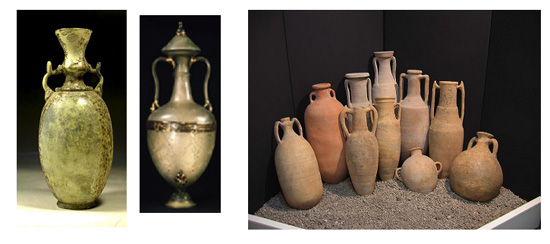
Storage of wine was another matter. The ancient world was better at preserving wine after it was made. In the ancient world (from Egypt through Greece and early Rome), wine was kept in amphorae.
Amphorae are earthenware vessels, typically with a small mouth on top. The amphorae were sealed with clay, wax, cork or gypsum. The
insides of the amphorae, if made of clay, were sealed with pitch, to make them airtight. It was well understood that if air got in, the wine would turn bad, and eventually to vinegar. Some amphorae were even made of glass, and then carefully sealed with gypsum, specifically to preserve the wine.


Wine Strength and Dilution
With proper amphorae, if the wine was good when it went into the vessel, it was quite likely to be good when it was retrieved, even if it was years later. The Egyptians and Greeks and Romans had vintage wines – wines that they could pull out of the cellar decades after it had been made.


But amphorae represented the pinnacle of wine storage, unmatched until the glass bottle was invented in the 19th century.
Around the time of the destruction of the Second Beis Hamikdash, the technology shifted. Barrels became prevalent[33], and remained the standard until the advent of the glass bottle in the 19th century. Barrels are made of wood, and they breathe. Without proper sealing, wine that is uncovered, untopped or unprotected by insufficient sulfur dioxide has a much shorter shelf life. Once a wine goes still (stops fermenting), it’s critical to protect it.[34]
Ancient
Israel and Egypt
Ancient
Greece and Early Rome
Late
Roman – medieval
Europe,
16th Century onward
Europe
19th century to present
Storage
Sometimes sealed amphorae; sometimes poor ones.[35]
Amphorae with good seals.[36]
Sulfur candles were sometimes used. Romans and Greeks continued to add salt
water when the wine was sealed – as well as boiling and using pitch.[37]
Sealed wine is valued.[38]
Even so, amphorae fell out of use, and were replaced with wooden barrels,
which breathe.  But  Gemara forbids sulphur in korbanos.[39]
Wooden
barrels continue.
Wine bottles are used. For the first time since the time of the Beis Hamikdash,
wine can be safely stored for a long time.
Predictability proved to be another major problem for winemakers, especially in the ancient world.
Ancient
Israel and Egypt
Ancient
Greece and Early Rome
Late
Roman – medieval
Europe,
16th Century onward
Europe
19th century to present
Predictability
of product
If the wine was good when sealed, predictability was excellent.
But sulfides were not understood well enough to make the raw product consistently drinkable.
Unpredictable.
Very much a “buyer beware” market, with no warranty, and a belief in mazal to
keep wine good.[40]
Slightly more predictable, as sulfides were sometimes used.
Very good. Storage was good, in barrels.
Excellent. Advances in understanding the role of yeast and bacteria, and the addition of
selected wine yeasts means that wine is highly predictable.
Marcus Porcius Cato (234-150 B.C.), refers to some of the problems related to the preservation of fermented wine. In Cato alludes to such problems when he speaks of the terms “for the sale of wine in jars.” One of the conditions was that “only wine which is neither sour nor musty will be sold. Within three days it shall be tasted subject to the decision of an honest man, and if the purchaser fails to have this done, it
will be considered tasted; but any delay in the tasting caused by the owner will add as many days to the time allowed the purchaser.”[41] Pliny, for example, frankly acknowledges  that “it is a peculiarity of wine among liquids to go moldy or else to turn into vinegar; and whole volumes of instructions how to remedy this have been published.”[42]
Sulfites, which are used now for fermentation and also for stored wine, were in occasional (if not consistent) use in the ancient world as well. The Gemara speaks of “sulfurating baskets,” for example.[43] It is well-documented that by 100 B.C.E. Roman winemakers often burned
sulfur wicks inside their barrels to help prevent the wine from spoiling.[44] They also sealed barrels and amphorae with sulfur compounds, with the same goal. The practise was not universal, and it was not well understood, so results varied widely. Freshly pressed grape juice has a tendency to spoil due to contamination from bacteria and wild yeasts present on the grape skins. Not only does sulfur dioxide inhibit the growth of molds and bacteria, but it also stops oxidation (browning) and preserves the wine’s natural flavor.[45] From the Romans until the 16th Century, wine preservation in the barrel was not reliably achieved; throughout the medieval and early modern period all wine was drunk young, usually within a year of the vintage.[46]… wines kept in barrels generally lasted only a year before becoming unpalatable.
In the 16th century, Dutch traders found that only wine treated with sulfur could survive the long sea voyages without it turning to vinegar. [47] 15th  century German wine laws restored the Roman practise, with the decree that sulfur candles be burned inside barrels before filling them with wine, and by the 18th century sulfur candles were regularly used to sterilize barrels in Bordeaux. The sulfur dioxide left on the container would dissolve into the wine, becoming the preservative we call sulfites. Even then, they were clever enough to realize that the sulfur addition improved wine quality.[48]
Ancient
Israel and Egypt
Ancient
Greece and Early Rome
Late
Roman – medieval
Europe,
16th Century onward
Europe
19th century to present
Shelf
life
Boiled wine lasted a long time, making storage and exports less risky, at the cost
of reduced quality.[49]
Variable, but could be excellent. Vintage wines existed, and old wines were prized.[50]
There were no corks, so wine did not breathe in storage.[51]
By the time of the Gemara, wine only 3 years old was considered very old.   Wine aged very poorly. And the Romans
abandoned the use of sulfites in wine storage.[52]
Shelf life is somewhat longer, as sulfides are rediscovered.  Bottles were introduced in the late 17th
century. Corks also come into use.
Vintage wines once again exist. Corks allow for wine to age in a bottle – the
tradeoff is that shelf life is more limited than in the ancient world.[53]
In the ancient world, wine flavorings appear to be as old as wine itself! The oldest archaeological record of wine-making shows that figs
were used in the wine as well – as we have said, wine made without benefit of sulfites, will be unpredictable at best; fig juice would sweeten the wine and make it more palatable.[54] But with all the added flavorings in the world, the process itself often led to some pretty unattractive results.
The impregnation with resin has been still preserved, with the result of making some modern Greek wines unpalatable save to the modern Greeks themselves. … Ancient wines were also exposed in smoky garrets until reduced to a thick syrup, when they had to be strained before they were drunk. Habit only it seems could have endeared these pickled and pitched and smoked wines to the Greek and Roman palates, as it has endeared to some of our own caviare and putrescent game.[55]
When Hecamede prepares a drink for Nestor, she sprinkles her cup of Pramnian wine with grated cheese, perhaps a sort of Gruyere, and flour.[56] The most popular of these compound beverages was the  (mulsum), or honey wine, said by Pliny (xiv. 4) to have been invented by Aristaeus.
Ancient
Israel and Egypt
Ancient
Greece and Early Rome
Late
Roman – medieval
Europe,
16th Century onward
Europe
19th century to present
Flavorings
Highly variable, and usually added.[57][58]
Added in copious quantities and varieties, almost surely to cover odd tastes and oxidation caused by poor manufacture and storage techniques.[59]
Cornels, figs, medlars, roses, cumin, asparagus, parsley, radishes, laurels,
absinthium, junipers, cassia, peppers, cinnamon, and saffron, with many other particulars, were also used for flavouring wines.[60]
Greeks added grated goat’s milk cheese and white barley before consumption of wine.[61]
Discriminating Romans even kept flavor packets with them when they traveled, so they could flavour wines they were served in taverns along the way.
Became less common, as it is acknowledged that flavorings were to cover failings in
the wine.
Post fermentation,
flavorings are almost never used.
Wine from a bottle is consistently more pure in the modern age than it
ever was before.
Virtually unheard of; to add a flavour to wine would be considered a gross insult to
the winemaker, and the noble grape itself.
Trade also changed greatly over time.  The ancient Mediterranean was a hotbed of trade, and wine was also shipped overland. Many wine presses and storage cisterns have been found from Mount Hermon to the Negev. Inscriptions and seals of wine jars illustrate that wine was a commercial commodity being shipped in goatskin or jugs from ports such as Dor, Ashkelon and Joppa (Jaffa). The vineyards of Galilee and Judea were mentioned then; wines with names like Sharon, Carmel and from places like Gaza, Ashkelon and Lod were famous.[62] Wine was a major export from ancient Israel.
This situation was mirrored in Greece and Rome. Wine was traded throughout the Mediterranean (it was as easy to ship wine 100 miles by
ship as it was to haul it 1 mile across land). But Roman wines were popular, and were shipped overland to Gaul and elsewhere.
In the later Roman period, the spread of winemaking inland (away from the convenient Mediterranean) meant that wines were rarely shipped far. The wine trade remained for the benefit of the very wealthy for over a thousand years, only resuming in the 16th and 17th centuries. And today, of course, the wine trade is ubiquitous, with wines available from around the world.
Grape juice was almost always fermented; before Pasteur, avoiding the fermentation of wine was not well understood, and any grape juice
that is not sulfated will ferment if yeast is added to it. Still, the concept of grape juice was understood before wine – the butler squeezed grapes directly in Pharoah’s cup, after all.  And the Gemara calls it “new wine.”[63] It certainly could be drunk then, though it was far from achieving its full potency.
Ancient
Israel and Egypt
Ancient
Greece through medieval
Europe,
16th Century onward
Europe
19th century to present
Cultural
consumption
In Israel, wine was drunk straight.  Drunkenness was discouraged; self control
praised.
Drunkenness was http://seforim.blogspot.com/2012/10/wine-strength-and-dilution.html#_ftn64″ name=”_ftnref64″ title=””>[64]
wine was consumed in large quantities.
Dilution is seen as a way to cheat the consumer; common in lower class taverns.
Social drinking is praised; wine is drunk to achieve the same buzz the Greeks
praised.
It is evident that wine was seen in ancient times as a medicine (and as a solvent for medicines) and of course as a beverage. Yet as a beverage it was always thought of as a mixed drink. Plutarch (Symposiacs III, ix), for instance, states. “We call a mixture ‘wine,’ although the larger of
the component parts is water.” The ratio of water might vary, but only barbarians drank it unmixed, and a mixture of wine and water of equal parts was seen as “strong drink” and frowned upon. The term “wine” or  oinos in the ancient world, then, did not mean wine as we understand it today but wine mixed with water. Usually a writer simply referred to the mixture of water and wine as “wine.” To indicate that the beverage was not a mixture of water and wine he would say “unmixed (akratesteron) wine.”[65]
There is some question whether or not what “wine” and “strong drink” Leviticus 10:8, 9, Deuteronomy 14:26; 29:6; Judges 13:4, 7, 14; First Samuel 1:15: Proverbs 20:1; 31:4,6: Isaiah 5:11, 22; 28:7; 29:9; 56:12; and Micah 2:11. “Strong drink” is most likely another fermented product – beer. Beer can be made from any grain, and would be contrasted with wine most obviously because it was substantially less expensive  (typically 1/5th the cost, in ancient Egypt) while still offering about the same alcohol content.[66]  (Yeast works the same way in both).
Ancient
Israel and Egypt
Ancient
Greece through medieval
Europe,
16th Century onward
Europe
19th century to present
Watered
down
Isaiah refers to watered wine perjoratively.
Greeks watered down wine, as they preferred to drink large quantities. They knew of
people who drank undiluted wine, but considered it a barbaric practise.. Wine was customarily diluted with water in a
three-to-one ratio of water to wine during Talmudic times.[67]
Still even the famously strong Falernian wines were sometimes drunk straight.[68]
Wine is not diluted, at least not in better establishments
Consumer never drinks wine known to be diluted.
Why did people water down wine? One possibility, given in Section I is that certain wines were more likely to cause a hangover. [69] The more commonly suggested solution than the presence of hangover-inducing components, is that wine served as a disinfectant for water that itself might be unsafe.
Today, we know this is true. Drinking wine makes our water safer to drink, and it also helps sanitize the food we eat at meals when we
drink wine. Living typhoid and other microbes have been shown to die quickly when exposed to wine. [70] Research shows that wine (as well as grape juice)[71], are highly effective against foodborne pathogens[72] while not significantly weakening “good” probiotic bacteria.[73]
In one study, it was shown that wine that was diluted to 40% was still effective against foodborne pathogens, and drier wines were much better at killing dangerous bacteria.
The ancients believed that wine was good for one’s health[74], even if they didn’t have the faintest idea why this was so. Microbes were only discovered in the 19th century, and ancient medicine was in many respects indistinguishable from witchcraft.  Still, it seems hard to deny that Romans and Greeks at least grasped some of the medicinal value of the grape; wines were a common ingredient in many Roman medicines.[75] And given the antibacterial powers of wine, it is obvious that a patient who drank diluted wine instead of water would be helping his body by not adding dangerous microbes when the body was already weakened by something else.
Still, the evidence remains anecdotal. The Torah does not mention wine as having medicinal benefits, though the New Testament does suggest wine as a cure for poor digestion[76] – entirely consistent with what we know about wine’s antibacterial properties. And as noted by the Jewish Encyclopedia, the Gemara reflects many of Galen’s positions on the health-giving qualities of wine:
Wine taken in moderation was considered a healthful stimulant, possessing many curative elements. The Jewish sages were wont to say, “Wine is the greatest of all medicines; where wine is lacking, there drugs are necessary” (B. B. 58b).  …  R. Papa thought that when one could substitute beer for wine, it should be done for the sake of economy. But his view is opposed on the ground that the preservation of one’s health is paramount to considerations of economy (Shab. 140b). Three things, wine, white bread, and fat meat, reduce the feces, lend erectness to one’s bearing, and strengthen the sight. Very old wine benefits the whole body (Pes. 42b). Ordinary wine is harmful to the intestines, but old wine is beneficial (Ber. 51a). Rabbi was cured of a severe disorder of the bowels by drinking apple-wine seventy years old, a Gentile having stored away 300 casks of it (‘Ab. Zarah 40b). “The good things of Egypt” (Gen. xlv. 23) which Joseph sent to his father are supposed by R. Eleazar to have included “old wine,” which satisfies the elderly person (Meg. 16b).   Until the age of forty liberal eating is beneficial; but after forty it is better to drink more and eat less (Shab. 152a). R. Papa said wine is more nourishing when taken in large mouthfuls. Raba advised students who were provided with little wine to take it in liberal drafts (Suk. 49b) in order to secure the greatest possible benefit from it. Wine gives an appetite, cheers the body, and satisfies the stomach (Ber. 35b).[77]
Others have made the bolder argument  — that the core purpose of dilution was to purify water for drinking.[78]
The ancients began by adding wine to water (to decontaminate it) and finished by adding water to wine (so that they didn’t get too drunk too quickly). A letter, written in brownish ink on a pottery shard dating from the seventh century BC, instructs Eliashiv, the Judaean commander of the Arad fortress in southern Israel, to supply his Greek mercenaries with flour, oil and wine.
The [Israel Museum in Jerusalem] exhibition’s curator, Michal Dayagi-Mendels, explains that the oil and flour were for making bread; the wine was not for keeping them happy, but for purifying brackish water. To prove her point, she displays a collection of tenth-century BC hip flasks, with built-in spoons for measuring the dosage.[79]
While the archaeological record is strong in this respect, the lack of textual support, in this author’s opinion, means that there is more evidence that wine was diluted for cultural reasons than because there was a conscious understanding that wine made water safe to drink.
Ancient
Israel and Egypt
Ancient
Greece and Early Rome
Late
Roman – medieval
Europe
19th century to present
Used for health reasons
No direct evidence
Mainstay for medicine; perceived as valuable to health
With safer water, wine not as important.
Recently, wine is prized for its resveratrol for health and longevity, instead of anti-microbial properties as previously.
[1] “Up to and including the time of the Gemara, wines were so strong that they could not be drunk without dilution…. Nowadays, our wines are not so strong, and we no longer dilute them.” Rabbi Avraham Rosenthal (link), “During the time of the Talmud, wine was very concentrated, and was normally diluted with water before drinking. “Rav Ezra Bick (link), “In Talmudic times, wine was sold in a strong, undiluted form, which only attained optimal drinking taste after being diluted with water.” Rabbi Yonason Sacks,  (link), “Records indicate that the alcohol content of wine in the ancient days was very high. Therefore, it was a common practice to dilute the wine with water in order to make it drinkable.” (link), “In ancient times, wines were powerfully strong and adding water to dilute their taste and power was common. … Pure wine, undiluted with water, is highly concentrated and difficult to drink. Rabbi Gershon Tennenbaum, (link), “In the days of the Talmud the wine was so strong and concentrated that without dilution it was not drinkable.” Zvi Akiva Fleisher, (link), “During the time of the Talmud, wine was very concentrated, and was normally diluted with water before drinking.” Rav Yair Kahn, (link), “Our wines, which are considerably weaker than those used in the days of Chazal, are better if they are not diluted.” (link)
[2] Rashi on Berachos 50b
[3] Wine naturally ferments to no more than 16% alcohol (typically 12-14%) before the alcohol kills the yeast off. Alcohol boils away at a lower temperature than water, so boiling wine does not concentrate it. And without the technology of distillation (which was not known in the ancient world), the only practical method that might have concentrated the alcohol in a wine would be to add plaster of paris; water would be absorbed, and the alcohol would be concentrated. But we have no evidence that this was done; it would have been far more than a mere flavoring. (see)
[4] Isaiah 1:22
[5] Spices and flavorings, on the other hand, were considered fit for guests and offerings: Proverbs 9:2,5 and Isaiah 65:11 both refer to wine which is “mem-samech-ches”, meaning that it has been spiced and is ready to serve. This is the best of wine, though as warned in Proverbs 23:30, such wine has dangerous side effects. This is entirely consistent with what we know of wine flavorings in the ancient world (see Part II): spices made wine more palatable, so it could more easily be consumed to excess.
[6] Isaiah 25:6
[7] Dr. Uprichard adds: Fermentation is the conversion of complex sugars, via glucose and pyruvic acid into ethanol and CO2. Natural yeasts die when the alcohol content of their culture medium (i.e. the liquid that is being produced for human consumption) exceeds a certain limit. Limit varies depending on the yeast and other factors, but is generally somewhere between 12-15% alcohol by volume. For wine to be stronger, it has to be fortified. Fortification is a process in which spirit is added to the wine. There are many fortified wines made around the world. However there are only two basic ways of fortification:
1: The Sherry Method – the must, which is a mixture of juice, pulp, skins and seeds, is fermented out, leaving a dry wine. The spirit is then added. Consequently all sherry method wines are dry to begin with. If the final style of wine is other than dry, sweetening is added prior to bottling. Sherry was invented in the 8th Century, CE.
2: The Port Method – the must is only partly fermented, and the process is stopped by the addition of sufficient spirit to prevent the yeast working. ie the alcohol content is raised to a level which kills the yeasts and leaves much of the sugar unfermented. Consequently port-method wines are generally sweet. Adding sugar will feed the process but only until the yeasts (which are effectively the enzymes in the reaction) are used up (or in this case killed off). The Rambam, who diluted wine, did NOT consider fortified wine to be suitable for Kiddush; his wine was unfortified, and undistilled, and therefore could not exceed 15-16% alcohol.
[8] Hilchot Chametz UMatzah 7:9
[9] Rambam considered young new wine (presumably only lightly fermented) to be distinctly unhealthy (see).
[10] It is clear that personal and cultural preferences remain very important when talking about whether to use wine or grape juice for Kiddush or the Arba Kossos. Rav Soloveitichik writes that if one does not enjoy wine, he should use grape juice for the Arba Kosot, as that will be a pleasant drink according to his taste.
[11] Berachos, 50b
[12] Sanhedrin 70a. The Greeks had the same standard: to drink wine diluted 1:1 was repudiated as disgraceful (see).
[13] II Maccabees 15:39
[14] Instructor II, ii, 23.3—24.1
[15] Athenaeus quotes Mnesitheus of Athens: “The gods has revealed wine to mortals, to be the greatest blessing for those who use it aright, but for those who use it without measure, the reverse. For it gives food to them that take it and strength in mind and body. In medicine it is most beneficial; it can be mixed with liquid and drugs and it brings aid to the wounded. In daily intercourse, to those who mix and drink it moderately, it gives good cheer; but if you overstep the bounds, it brings violence. Mix it half and half, and you get madness; unmixed, bodily collapse.” [Odyssey IX, 232.]
[18] Pliny (Natural History XIV, vi, 54) mentions a ratio of eight parts water to one part wine. In one ancient work, Athenaeus’s The Learned Banquet, written around A.D.  200, we find in Book Ten a collection of statements from earlier writers about drinking practices. A quotation from a play by Aristophanes reads: “‘Here, drink this also, mingled three and two.’ Demus. ‘Zeus! But it’s sweet and bears the three parts well!’”
[19] http://www.mmdtkw.org/VRomanWine.html.  Why did the Greeks enjoy diluted wine, and the Jews of ancient Israel preferred it straight?  We cannot be certain of the answer, but it is clear that the Greeks praised drinking very large quantities; it was a feature of every meal, which regularly lasted for hours. For them, wine was a necessity, and the culture rotated around its unrestrained consumption – the Greeks drank by the gallon. Undiluted wine, however, cannot be drunk by the gallon. Greeks liked to get drunk, but they wanted it to take time. Ceremonious, sociable consumption of wine was the core communal act of the Greek aristocratic system. [http://tinyurl.com/cmlsbu].
By contrast, in the Torah wine is consistently praised – in moderation. Drunkenness is never a virtue in Judaism, and the shucking off of self control and loss of inhibitions that was part and parcel of Dionysian rites is considered unacceptable to G-d fearing Jews. So wine, in full strength, was praised and consumed, but consumption for its own sake was not encouraged.
[20] Hundreds of clay jars of wine (with a total volume of some 4,500 liters (118.78 gallons) were buried with one of the first Egyptian kings, Scorpion I (about 3150 B.C.E.). Analysis of the clay shows that the jars were made in the modern Israel-Palestine region. http://www.answers.com/topic/wine-in-the-ancient-world
[22] Had there been any significant qualitative difference between wine grown in one place as opposed to another, it would be apparent by the archaeological and written records we have; the ancient Greeks, for example, spent a lot of ink writing about wine, with no mention that any wine was significantly stronger than any other.
[23] Proposed by Brian Foont
[25] As written about a modern wine that is made without sulfides: “we had an organic, ‘no sulfite added’ chardonnay on the menu. It was an amazing wine to behold. That is when it wasn’t brown and vaguely reminiscent of sewage, which was about one out of every four bottles.” http://winekulers.com/11_1_08.htm . See http://en.wikipedia.org/wiki/Yeast#Wine for more information about the process in general. Ancient wineries, lacking modern sanitation, would have had a much lower “success” rate.
[26] Egyptian wines cannot have been very stable because the grapes were picked and crushed in August, then were slowly crushed and pressed and then rapidly fermented, all in the summer heat. http://www.answers.com/topic/wine-in-the-ancient-world
[27] http://tinyurl.com/dl5ypr . Though according to oeniphiles, boiling the wine at any time destroys the flavor. Boiled wine was not allowed as a korban, though it would have led to a more predictable (if mediocre) product. Terumos 11:1 – Rabbi Yehuda, in a minority opinion, considers boiled wine to be superior.
[28] “Some people—and indeed almost all the Greeks—preserve must with salt or sea-water.” Columella, On Agriculture 12.25.1. Columella recommended the addition of one pint of salt water for six gallons of wine.
[30] Fresh must, when boiled, could have been stored in amphorae and kept sweet, and this could be the boiled wine mentioned in the Gemara. Certainly we don’t need to speculate in the case of the Romans, as http://www.biblicalperspectives.com/books/wine_in_the_bible/3.html writes: Columella gives us an informative description of how they did it: “That must may remain always as sweet as though it were fresh, do as follows. Before the grape-skins are put under the press, take from the vat some of the freshest possible must and put it in a new wine-jar; then daub it over and cover it carefully with pitch, that thus no water may be able to get in. Then sink the whole flagon in a pool of cold, fresh water so that no part of it is above the surface. Then after forty days take it out of the water. The must will then keep sweet for as much as a year.”  [Columella, On Agriculture 12, 37, 1]… This method of preserving grape juice must have been in use long before the time of Pliny and Columella, because Cato (234-149 B.C.) mentions it two centuries before them: “If you wish to keep grape juice through the whole year, put the grape juice in an amphora, seal the stopper with pitch, and sink in the pond. Take it out after thirty days; it will remain sweet the whole year.” [Marcus Cato, On Agriculture 120, 1.]
[31] “Some people—and indeed almost all the Greeks—preserve must with salt or sea-water.” Columella, On Agriculture 12.25.1.
[33] Barrels have many advantages: they are less expensive and less prone to breakage; they stack and roll, and generally allow for easier transportation. The downside of a shortened shelf life for the wine was apparently considered an acceptable price to pay for these advantages.
[35] In Egypt, the clay jars were slightly porous (unless they were coated with resin or oil), which would have led to a degree of oxidation. There was no premium on aging wine here, and there are records of wine going bad after twelve to eighteen months. http://www.answers.com/topic/wine-in-the-ancient-world
[36] Jeremiah 48:11, Moab is compared to a container of fine wine that is not disturbed: “therefore its taste has stayed in it, and its scent was not diminished.” Unsealed wine in the ancient world was known to lose its essence.
[38] The foster-mother of Abaye is authority for the statement that a six-measure cask properly sealed is worth more than an eight-measure cask that is not sealed (B. ‑3. 12a)
[39] John Kitto’s Cyclopedia of Biblical Literature says: “When the Mishna forbids smoked wines from being used in offerings (Manachoth,
viii. 6, et comment.), it has chiefly reference to the Roman practice of fumigating them with sulphur, the vapor of which absorbed the oxygen, and thus arrested the fermentation. The Jews carefully eschewed the wines and vinegar of the Gentiles.” But presumably smoked wines were acceptable for consumption, even if not for offerings?
[40] Rab said that for three days after purchase the seller is responsible if the wine turns sour; but after that his responsibility ceases. R. Samuel declared that responsibility falls upon the purchaser immediately upon the delivery of the wine, the rule being “Wine rests on the owner’s shoulders.” R. ‑Hiyya b. Joseph said, “Wine must share the owner’s luck” (B. B. 96a, b, 98a). If one sells a cellarful of wine, the purchaser must accept ten casks of sour wine in every hundred (Tosef., B. B. vi. 6).
[41] On Agriculture, Chapter 148. http://penelope.uchicago.edu/Thayer/E/Roman/Texts/Cato/De_Agricultura/J*.html .  Cato shares the opinion of Rav: “For three days after purchase the seller is responsible if the wine turns sour; but after that his responsibility ceases.” B. B. 96a.
[43] Berachos 27b, line 14.
[46] Wine and the Vine: An Historical Geography of Viticulture and the Wine Trade Tim Unwin
[47] http://search.japantimes.co.jp/cgi-bin/fg20040813wc.html . Even snakes could recognize the dropoff in quality– only boiled wine, if it
were left uncovered, could be drunk the next morning (Avodah Zarah 30a).
[49] Yerushalmi, on Terumos 11:1 notes that cooked wine is inferior in quality to uncooked wine, but is superior in the sense that it lasts longer.
[50] “The good things of Egypt” (Gen. xlv. 23) which Joseph sent to his father are supposed by R. Eleazar to have included “old wine,” which satisfies the elderly person (Meg. 16b). At the great banquet given by King Ahasuerus the wine put before each guest was from the province whence he came and of thevintage of the year of his birth (Meg. 12a). In Rome, wines were preferred to  aged anywhere from 10 to 25 years. In fact, the Emperor Caligula was once presented with a 160 year old vintage that was considered a supreme treat. http://penelope.uchicago.edu/~grout/encyclopaedia_romana/wine/wine.html
[51] Vintage wines of the ancient world were lost when sealed amphorae were replaced with wooden barrels at the end of the second century, AD (Techernia, 1986), and their reappearance had to await the development in the 17th century of glass bottles stoppered with cork. From “Wine and the Vine: An Historical Geography of Viticulture and Wine Trade”
[52] If William Younger is to be believed, the Romans had entirely abandoned sulfites by the end of their millenium of winemaking. http://www.winecrimes.com/winecrimes/
[53] Singer, Holmyard, Hall et cie “History of Technology”
[55] http://chestofbooks.com/food/beverages/Drinks-Of-The-World/Roman-Wines.html
[57] To prevent wine from becoming acid, moldy, or bad-smelling a host of preservatives were used such as salt, sea-water, liquid or solid pitch, boiled-down must, marble dust, lime, sulphur fumes or crushed iris.
[58] The aroma, taste and texture of Egyptian wines are lost to us, but in any case the wine was often flavored with herbs and spices before being consumed. [http://www.answers.com/topic/wine-in-the-ancient-world]
[59] (1) “alun‑mit,” made of old wine, with a mixture of very clear water and balsam; used especially after bathing (Tosef., Dem. i. 24; ‘Ab. Zarah 30a); (2) “‑3afrisin” (caper-wine, or, according to Rashi, Cyprus wine), an ingredient of the sacred incense (Ker. 6a); (3) “yen ‑ìimmu‑3in” (raisin-wine); (4) “inomilin,” wine mixed with honey and pepper (Shab. xx. 2; ‘Ab. Zarah l.c.); (5) “ilyoston”, a sweet wine (“vinum dulce”) from grapes dried in the sun for three days, and then gathered and trodden in the midday heat (Men. viii. 6; B. B. 97b); (6) “me’ushshan,” from the juice of smoked or fumigated sweet grapes (Men. l.c.); not fit for libation; (7) “enogeron,” a sauce of oil and garum to which wine was added; (8) “api‑3‑mewizin,” a wine emetic, taken before a meal (Shab. 12a); (9) “‑3undi‑mon” (“conditum”), a spiced wine (‘Ab. Zarah ii. 3); (10) “pesinti‑mon” (“absinthiatum”), a bitter wine (Yer. ‘Ab. Zarah ii. 3);
[63] Rabbi Hanina B. Kahana answers the question: “How long is it called new wine?” by saying, “As long as it is in the first stage of fermentation . . . and how long is this first stage? Three days.” Sanhedrin 70a.
[64] The Greeks were aware of the results of excessive consumption of wine, and it was recommended that wine be diluted with water in order to avoid this. It was also seen as socially stigmatizing to drink undiluted wine, and this was often seen as “a habit confined to barbarians”. The Romans were also well aware of the results of drunkenness, and Pliny’s famous comment “in vino verias” is not to be a disinterested observation, but a chastisement of those who “do not keep to themselves words that will come back to them through a slit in their throat.” [http://www.mta.ca/faculty/humanities/classics/Course_Materials/CLAS3051/Food/Wine.html]
[66] Beer is typically less alcoholic than wine; typical brewing yeast cannot survive at alcohol concentrations above 12% by volume. http://en.wikipedia.org/wiki/Beer Wine can run to 15-16%.
[67] R. Eliezer says “boreh pri hagefen” is pronounced only when the wine has been properly mixed with water.
[68] Catullus wrote: Postumia more tipsy than the tipsy grape. But water, begone, away with you, water, destruction of wine, and take up abode with scrupulous folk. This is the pure Thyonian god. [http://ammonastery.wordpress.com/2008/03/16/wine-le-vin/ ] . Falernian wines were as strong as fifteen or sixteen percent alcohol. http://penelope.uchicago.edu/~grout/encyclopaedia_romana/wine/wine.html
[69] Proposed by Brian Foont
[70] http://tinyurl.com/cnzwes [The Origins and Ancient History of Wine By Patrick McGovern, Stuart James Fleming, Solomon H. Katz]
[71] Grape juice and wine are much more beneficial to health than beer with the same alcohol content – other properties of the grape, even before fermentation, are good for people. This means that diluted grape juice (and boiled grape juice or wine) also had health benefits even without alcohol.
[72] such as Helicobacter pylori, Listeria monocytogenes, Escherichia coli O157:H7, Salmonella Typhimurium and Shigella boydii,
[74] A passage in the Hippocratic writings from the section “regimen in Health” draws upon this basic assumption: “Laymen…should in winter…drink as little as possible; drink should be wine as undiluted as possible…when spring comes, increase drink and make it very diluted…in summer…the drink diluted and copious.” [http://www.mta.ca/faculty/humanities/classics/Course_Materials/CLAS3051/Food/Wine.html – Hippocrates dates from 400 BCE] Drugs such as horehound, squills, wormwood, and myrtle-berries, were introduced to wine to produce hygienic effects.
[75] http://en.wikipedia.org/wiki/Ancient_Rome_and_wine The Romans believed that wine had both healing and destructive powers. It could heal the mind from depression, memory loss and grief as well as the body from various ailments-including bloating, constipation, diarrhea, gout, halitosis, snakebites, tapeworms, urinary problems and vertigo. Cato wrote extensively on the medical uses of wine, including espousing a recipe for creating wine that could aid as laxative by using grapes whose vines were treated to a mixture of ashes, manure and hellebore. He wrote that the flowers of certain plants like juniper and myrtle could be soaked in wine to help with snakebites and gout. Cato believed that a mixture of old wine and juniper, boiled in a lead pot could aid in urinary issues and that mixing wines with very acidic pomegranates would cure tapeworms.[23]
The 2nd century AD Greco-Roman physician Galen provides several details about how wine was used medicinally in later Roman times. In Pergamon, Galen was responsible for the diet and care of the gladiator. He made liberal use of wine in his practice and boasted that not a single gladiator died in his care. For wounds, he would bath them in wine as an antiseptic. He would also use wine as analgesic for surgery. When Galen became the physician of Emperor Marcus Aurelius, he worked on developed pharmaceutical drugs and concoctions made from wine known as theriacs. The abilities of the these theriacs developed superstitious beliefs that lasted till the 18th century and revolved around their “miraculous” ability to protect against poisons and cure everything from the plague to mouth sores. In his work De Antidotis, Galen notes the trend of Roman tastes from thick, sweet wines to lighter, dry wines that were easier to digest.[14]
[76] Paul commands Timothy to use alcohol with his water due to his frequent illness (1 Timothy 5:23). Evidently Timothy had been drinking only water, and that was causing sickness.
[78] Inhibitory activity of diluted wine on bacterial growth: the secret of water purification in antiquity, International Journal of Antimicrobial Agents, Volume 26, Issue 4, Pages 338-340 P.Dolara, S.Arrigucci, M.Cassetta, S.Fallani, A.Novelli


The Mysteries of Hoshana Rabbah

THE MYSTERIES OF HOSHANA RABBAH

By Eliezer Brodt


This article originally appeared last year in Ami Magazine (2016) This version has a many updates and corrections. I hope to revisit this subject shortly.


The sources of our Yomim Tovim are relatively easy to find, as one simply locates the relevant pesukim or Gemara and starts from there. However, one Yom Tov does not have such a starting point: Hoshana Rabbah. Its roots and numerous customs are shrouded in mystery. This article is an attempt to shed a bit of light on some of the early sources and customs behind this special day.[1]


A very early mention is in an anonymous attack against Yiddishkeit apparently written around the year 1500, where we already find Hoshana Rabbah under attack.[1a] At a later date we find in a work which records a debate about Kabbalah, written in 1825 that the origins of Hoshana Rabbah were also dealt with harshly.[1b]


The Name


Today we know this special day as Hoshana Rabbah, but it wasn’t always called by this name. In earlier sources, such as the Mishnah and Gemara, the Yom Tov is never called Hoshana Rabbah but “Yom Aravah” or “Yom Hoshana.” In a recent article, Rabbi Yaakov Stahl traces mentions of these names through numerous Geonim, Paytanim and Rishonim and concludes that the earliest known mention of the name “Hoshana Rabbah” is in the piyyutim of Rav Yosef Avitur, who passed away in 1024. However, it took a long time for the name to become popular.[2]


The Chayei Adam writes that the name Hoshana Rabbah references the many tefillos recited on this day that begin with the word “hoshana.”[3] This idea can be found as early as 1599 in the Seder Hayom. Rav Eliyahu Bachur writes in his Sefer HaTishbi that the aravos we take on Sukkos are called hoshanos because we call out hoshana, a contraction of the words hoshia na (please save), while holding them.[4]


YOM ARAVAH


In the fourth perek of Maseches Sukkah (42b-45a), the mishnayos and Gemara discuss the extra aravah that was used in the Beis Hamikdash in addition to the one included in the daled minim. Each day the kohanim would circle the mizbei’ach one time, and on the seventh day they would do so seven times. Rishonim differ as to whether they went around with both the aravah and the daled minim, or with the daled minim alone, as well as if the Yisraelim went around as well.[5]


On the seventh day, they would do chavatah on the ground with the aravos. Rashi (ibid. 44b) understands this to mean shaking the aravos, whereas the Rambam writes that it means to bang them two or three times on the floor or on a utensil[6] without making a brachah, in keeping with a minhag hanevi’im.[7] Since the destruction of the Beis Hamikdash, we go around with daled minim only, and not with the aravah, since it is not mentioned in the Torah.[8] The Rambam writes that nowadays we go around the bimah as a zecher l’Mikdash, where they circled the mizbei’ach.[9]


These mishnayos are the earliest sources for the hakafos we do once each day on Sukkos and seven times on Hoshana Rabbah. There are numerous sources from the Geonim onward about this.


It’s worth mentioning the powerful words of Rav Yosef Hahn Norlingen (1570-1637) in Yosef Ometz, first printed in 1723. He writes that one should make a great effort to go around each day with the lulav, to the extent that it’s worthwhile to spend a lot of money on the daled minim for this aspect of the mitzvah alone. He writes sharply against those who leave early and avoid hakafos and describes how he completed the circuit every day, even when there was a lot of pushing, especially on Hoshana Rabbah when the children pushed a lot.[10] A similar point is made by the anonymous work Chemdas Yomim.[11]


We see from this the great significance of completing a circuit around the bimah each day, which ties into zecher l’Mikdash, a concept that stands behind numerous halachos.[12]


But what else—besides for circling the bimah seven times and banging the aravos—is done differently on Hoshana Rabbah than the other days of Chol Hamoed Sukkos?


MISHNEH TORAH[13]


Many have the custom to hear Mishneh Torah, or Sefer Devarim, on Hoshana Rabbah night.[14]


Where did this custom originate?


Avudraham writes that in his time, a few people had the custom to read the whole Torah on the night of Hoshana Rabbah in case they didn’t complete shnayim mikra that year. He personally does not endorse this minhag and feels one should make up any missed shnayim mikra over Sukkos, or better yet, during the Aseres Yemei Teshuvah.[15] Tashbetz, a talmid of the Maharam MiRotenburg, is also wary of this custom, giving the strong opinion that it doesn’t help for anything.[16] However, the Shibolei Haleket writes that it is a worthy practice, and the Magen Avraham mentions it as well. The Shibolei Haleket links this custom to the fact that it is the yom hadin for water, and though the Gemara says one should really finish shnayim mikra before Yom Kippur, if one does not, now is a good time.[17]


The anonymous early Italian work Minhag Tov also describes this custom and says he has seen people practice it. His reasoning for it is interesting: on Rosh Hashanah, we are judged for life and death. In case death was decreed upon him, he will have reviewed his learning.[18] Agudas Eizov adds that through learning, one will be reminded to do teshuvah.[19]


Rav Yaakov Emden suggests that the reason for this custom is to remember the king’s Torah reading at Hakhel, but says that this may be a bit farfetched. He also points out that chumash is not generally to be learned at night.[20] However, he concludes “I bend my head to a custom that is already accepted.” However, he is discussing the Mishneh Torah, not the reading of the entire Torah mentioned by the Rishonim.[21] Rabbi Yosef Ginsburg also writes that the custom is to read only the Mishneh Torah.[22] What’s the source for this?


Shulchan Aruch HaArizal, first printed around 1660, writes that on the night of Hoshana Rabbah one should read Mishneh Torah.[23] Basically, the earliest source for the custom is the Arizal.[24]


The minhagim of the Arizal became widespread through various “bestseller” sefarim. [25] To point to just three “bestsellers,” that helped spread this minhag, one was the Tikunei Shabbos, first printed in 1613,[26] and another the Shaarei Tzion by Rav Nassan Hanover, first printed in 1662.[27] These two works saw dozens of editions and were extremely popular and widespread. Both contain a full Hoshana Rabbah learning seder, famously known as the Tikun Leil Hoshana Rabbah. These works inspired other versions based on Kabbalah.[28] A third work that also helped spread this seder was the very popular (and anonymous) Chemdas Yamim, first printed in 1731.


What was farfetched to Rav Yaakov Emden was fact for the Aderes, who writes in his anonymous[29] work on Hakhel that the reason behind the minhag of Mishneh Torah is for a remembrance of Hakhel.[30] Elsewhere, he writes that he himself would lein Mishneh Torah each year in his sukkah from his own sefer Torah.[31]


Rav Charlop did the same.[32] Many gedolim would also say this tikkun. For example, the Chida records this in his autobiography many times.[33] The Chasam Sofer would say tikkun and then go to sleep.[34]


Interestingly, Rabbi Chaim Benveniste (1603-1673) in Shiurei Knesses Hagedolah[35] and others[36] bring down that many have a minhag to say selichos on Hoshana Rabbah night.[37] Others say selichos during the hakafos in the morning and even blow shofar after each circuit of the bimah.[38]


By contrast, in Vilna it appears there were those who said selichos on Hoshana Rabbah night and the Gra wanted to abolish it because of Simchas Yom Tov. It’s even recorded that on Hoshana Rabbah night the Gra was noheg Simchas Beis Hashoeivah like the rest of the nights of Chol Hamoed but he stopped it after one  Hoshana Rabbah night someone died.[39a]


TEHILLIM


Other early sources, such as Rav Avraham Galante write that one should say the whole Sefer Tehillim on Hoshana Rabbah.[39] Rav Moshe Machir, in his classic Seder Hayom, cites such a custom, as does Rav Yuzpeh Shamash (1604-1678) of Worms[40] and Rav Yosef Hahn Norlingen. The Chasam Sofer would say the whole Sefer Tehillim and go to sleep,[41] as did R’ Shlomo Zalman Auerbach.[41a] Rabbi Hertz Scheir would pay people to say Tehillim the whole night.[42]


Rav Chaim Stein, Rosh Yeshivah of Telz, in his incredible World War II diary chronicling his great mesiras nefesh for whatever mitzvos he was able to do during that time, also writes that he and his friends stayed up saying all of Tehillim.[43]


The Butchasher Rav (1771-1841) gives an additional interesting reason for doing so: because Hoshana Rabbah is the ushpizin night of Dovid Hamelech. Dovid was known not to sleep for longer than sixty horse breadths,[44] and we try to emulate that.[45]


CHECKING SHADOWS[46]


Avudraham also records an elaborate Hoshana Rabbah custom: at night, some wrap themselves in sheets and go out to the shade of the moon. If they find their shadow complete, they are happy; if the head is missing, they assume they will die during the coming year. Depending on the appearance of the shadow, one can tell if other family members will survive the year. (A possible similarity can be found in Maseches Horayos.)


However, the Avudraham concludes not to do it.[47] This custom is found in numerous Rishonim—Ramban, Rav Yehudah Hachasid, Rokei’ach, Rikanati,[48] Tzioni, and Rav Aharon Hakohen Miluneil, to list a few. At the end of a manuscript written by Rav Eliyahu Bachur in 1515, he notes, “I completed this sefer on Hoshana Rabbah, when I saw my head in the shadows of the moon, so I know that I will not die this year.”[49] Rav Chaim Benveniste writes that the purpose of this custom is to do teshuvah, for if one sees that the shadows are not in his favor, he will daven for the decree to be abolished.[50]


Interestingly, Rav Yosef Karo makes no mention of this minhag, but the Rama in Darchei Moshe cites the Avudraham without giving his own opinion about it. However, in his glosses on Shulchan Aruch, he stresses not to do it,[51] writing that we do not understand exactly how to do it and in general it is not advisable to look into the future. Rav Yosef Hahn Norlingen and the Mateh Moshe[52] write the same. (It’s worth pointing out, though, that the Arizal was an adherent of this custom.)[53]


Returning to the previously mentioned minhag, that of reading the whole Torah throughout the night of Hoshana Rabbah, the Agudas Eizov adds that another reason to learn is to amass zechusim so that one’s shadow will be complete on Hoshana Rabbah. What lies behind this unique custom?


There are many more minhagim of Hoshana Rabbah, almost all for the same reason.


ECHOES OF YOM KIPPUR[54]


The Tur and numerous other Rishonim mention the lighting of candles. Leket Yosher writes that his rebbe, the Terumas Hadeshen, would use in part leftover candles from Yom Kippur.[55] Rav Zalman of St. Goar, in his work Sefer Maharil, writes that he observed his rebbe, the Maharil, doing the same.[56] Rav Isaac Tirna describes the same in his Sefer Minhagim.[57]


Another minhag echoing Rosh Hashanah and Yom Kippur is mentioned by Rav Zalman of St. Goar, who writes that he observed the Maharil wearing a kittel on Hoshana Rabbah.[58] The Rama cites a similar practice in Darchei Moshe and the Mapah. The Magen Avraham does the same, but says that the minhag in Poland is to wear Shabbos clothes, but not a kittel.[59] Rabbi Henkin writes that the minhag is only for the chazan to wear a kittel.[60]


Rav Isaac Tirna in his Sefer Minhaghim,[61] the Rama, Rav Yosef Hahn Norlingen and others bring that some go to the mikvah on the morning of Hoshana Rabbah.[62] Rav Chaim Benveniste writes in Shiurei Knesses Hagedolah that it’s better to do so in the evening. The Mateh Moshe,[63] Rabbi Yuzpeh Shamash (1604-1678) of Worms and others[64] write that it’s one of the five days of the year on which one should wake up early.[65]


The Tur and other Rishonim write that the minhag is to daven as on the morning of a Yom Tov, with a longer Pesukei Dezimrah.[66] However, it is unclear if they mean to include Nishmas. Numerous sources describe that the custom was to say it, such as in the French Work on Minhaghim written between 1360-1390 [66a], In the Zecher Yosef from 1467,[67] the Kabbalistic work Agudas Eizov,[68] Rav Chaim Benveniste’s description of Izmir, Turkey, in Shiurei Knesses Hagedolah, the Kaf Naki’s,[69] description of Morocco, and other descriptions of Italy.[70] However, the Rama says not to say Nishmas.


The Kitzur Shibolei Haleket writes that he heard some say Zachreinu L’chayim. Rav Chaim Benveniste cites others who had such a minhag.The Maharam would say Hamelech Hakadosh and Hamelech Hamishpat,[71] and in some early manuscripts, the tefillah of Unesaneh Tokef includes the words “Ub’Hoshana Rabbah yeichaseimun.”[72]


What is the common denominator of all these minhagim? The answer is simple. Hoshana Rabbah is a day of judgement. The question is, for what?


According to the Gemara (Rosh Hashanah 16a), it is a day of judgment for water. As the Taz[73] and Gra[74] point out, water is one of the most important human needs. The aravah grows by the water, says the Rokeach, so we take it up on this day. Of course it is well-known in Kabbalistic literature that this day marks the chasimah of the din handed down on Rosh Hashanah, but it is clear that sources who were not familiar with the Zohar also knew this. For example, the Manhig writes that the reason for lighting candles as on Yom Kippur, among other minhagim, is because on this day the judgment is sealed.[75] Some manuscripts of the Machzor Vitri write that we say Hashem hu haElokim seven times on Hoshana Rabbah, like we do on Yom Kippur, to symbolize the completion of judgment.[76] Others point to a cryptic line in the Yerushalmi in Rosh Hashanah to claim it as a final day of judgment.[77]


Based on these sources, it makes sense that all the many different minhagim are due to Hoshana Rabbah being a final day of judgment.[78] The question, though, is in the secrecy of it. Why are Rosh Hashanah and Yom Kippur openly discussed by Chazal as a day of judgment, while Hoshana Rabbah goes unmentioned? If it were such an important day, one would expect Chazal to let us in on the secret.[79]


Rav Yaakov Kamenetsky answers[80] this with an interesting idea, similar to one proposed by Rav Shlomo Zalman Auerbach.[81] They explain that Chazal felt that if the concept ever “got out,” it would disrupt simchas Yom Tov. At that time, the secret was only told to special people, but due to yeridas hadoros, it soon became clear that Hoshana Rabbah’s judgment would not affect simchah all that much. So the secret of the day’s tremendous significance was let out to the masses.
It is worth noting a similarly interesting statement from Rav Yehoshua Ibn Shuaib, talmid of the Rashba, that one of the reasons we do not find an open discussion of Rosh Hashanah’s judgment in the Torah is because such concepts are very hard to comprehend and discuss openly.[82]


STRANGE CUSTOM


In a letter in 1488, Rav Ovadiah miBartenura writes that in Italy, on Yom Kippur and Hoshana Rabbah nights, the aron was opened after davening and women would line up to kiss the Torah the whole night.[83] Rav Yehoshua Falk describes a similar practice in Pressburg. He links these customs, once again, to the fact of the final din.[84]


CHALLAH IN THE SHAPE OF A BIRD


Related to all of this, we find in a 19th-century Lithuanian memoir that white bread for Hoshana Rabbah was baked in the shape of a bird, because on this day, a final decision is made as to who will live or die that year. In folk tradition, this bird would fly to heaven and bring the determination on a scrap of paper.[85]  In Mattersdorf, the challahs of the Yomim Nora’im were baked in a round pan and stamped with a picture of a bird, probably for a similar reason.[86]


BANGING OF ARAVOS


After saying the hoshanos, we bang the bundle of aravos on the floor five times. The Chayei Adam[87] writes that children bang it until there are no leaves left, because of their exuberance for the mitzvah.[88] Rav Yair Chaim Bachrach of Worms (1638-1702) writes in the Mekor Chaim that fools bang it until no leaves are left. We bang it a few times, but why?


Rabbi Alexander Moshe Lapidos answers this question,[89] but to illustrate it clearly, some background is helpful. On Rosh Hashanah, we have a custom to eat various fruits and say accompanying tefillos. Numerous Acharonim [90] explain this minhag by pointing to a Ramban[91] that states that when an action is done in this world, it has an effect in shamayim, which in turn causes something to happen down here.[92] For instance, there is a custom among some to keep their hands open when reciting the words “Posei’ach es yadecha,” as though waiting to receive the parnasah.[93] This reasoning is in part what is behind the banging of the aravos.


THE FATE OF ARAVOS AFTER WE FINISH BANGING THEM


After we finish banging the aravos, what do we do with them? Many are noheg to place them on top of the aron kodesh, but it is not clear how far back this minhag can be traced, or if it is even permissible to do so.


Interestingly The Chayei Adam writes (153:3) one should burn the Aravos afterwards as does the Aruch Hashulchan (664:6).


The Munkatcher did not hold of throwing it onto the aron kodesh. However the Marsham points to a Malbushei Yom Tov which mentions that they did do so in his time. This work was written by the Tosfos Yom Tov (1579-1654) on the Levush, but was only first printed from manuscript in 1895.[94] However, this piece is already brought down by the Eliyhau Raba who had this work in manuscript and quotes from it often. [94a]


The sefer Tanya Rabbasi by Rav Yechiel HaRofei (1240-1289) records that “The custom we received from our fathers is that after we finish the mitzvah of aravah on Hoshana Rabbah, we take it home with us and put it next to our beds to show the love for mitzvos, and this is a kosher minhag.”[95] It is clear that in his time, the aravos were brought back home. The Mekor Chaim quotes the Tanya Rabbasi as saying that he heard that this practice serves as a protection when traveling.
We find segulos in numerous sefarim relating to saving a piece of the aravos, beginning with Derech Hayashar, written in Krakow in 1646. From there, it is also found in Uber Orach, Sefer Zechirah,[96] and Tzeidah Lederech, first printed in 1760.[97] It became famous in its Sefer Zechirah printing, as Rav Zechariah Simnar’s work was extremely popular in its time.[98] The custom is also found in the Chemdas Yomim.[99] All these sefarim write that one should use some of the candles of Yom Kippur for this practice to work, and that it saves one from robbery. Sefer Zechirah adds that you don’t need to carry the aravah on you for it to work, as long as you know where it is in your house.[100]


Numerous Rishonim and Acharonim advise that the aravos be saved and burned with the chametz,[101] because it is good to do mitzvos with objects already used for a mitzvah. None of these many sources mention throwing the aravos on top of the aron kodesh, even in passing.


SEGULAH WITH THE ESROG


One last famous Hoshana Rabbah segulah is the custom of women who are expecting to bite off the pitum of an esrog, daven that the birth not be painful, and then give tzedakah. The earliest source for this can be found in Rav Yaakov MiYanev’s classic Tz’ena Ur’ena.[102] This sefer, first printed around 1622, was reprinted over 200 times,[103] which explains why the minhag is so famous and popular. This practice is also cited by Rav Zechariah Simnar in Sefer Zechirah [104].


The reason for this minhag, as given by the Tz’ena Ur’ena, is because the fruit of the Eitz Hadaas that Chavah gave to Adam was an esrog. This caused the curse of painful childbirth. Since they did not pasel the esrog or eat from it all Sukkos, and do not do so even now that Sukkos is over, the tefillah of women is that they should not suffer because of Chavah’s sin, and instead have an easy labor.


May we all be zocheh to be inscribed in the sefer hachayim.


[1] For useful collections on this topic see; A. Berliner, Kesavim Nivcharim, 2, pp. 100-103; L. Zunz, Minhagei Tefah Upiut BiKhilot Yisrael, pp. 95-96,284- 288; R. Shlomo Y. Zevin, Moadim Bahalachah, pp. 142-149; Encyclopedia Talmudit, 8, pp. 527-535; Daniel Goldshmidt–Yonah Frankel, Machzor Sukkos, pp. 20-22; Daniel Goldshmidt, Mechkarei Tefillah Upiyut, pp. 392- 394; R’ Mordechai Spielman, Tiferes Tzvi, 3 pp.335-349; R’ Betzalel Landau, Machanayim 74 (1963), pp. 30-39; R’ Yechiel Goldhaver, Minhagei Hakehilot 2, pp. 136- 146; R’ Ovadiah Yosef, Chazon Ovadiah (Sukkos), pp. 438-450; R’ Ben Ish Chai, HaModiah (1999), pp. 14-15 [Thanks to R’ Menachem Silber for this source]; R’ Deblitsky, Kitzur Hilchos HaMoadim (Sukkos), pp. 224-237; R’ Tchezner, Sharei Chag HaSukkos, pp. 249-256, 450-458; Rabbi Tuviah Freund, Moadim L’Simchah,1, pp. 422- 451; Pardes Eliezer, Sukkos, pp. 227 and onwards; Luach HaHalachos Uminhaghim, pp. 102-111.I hope to return to all this more extensively in the near future in a hebrew work.
[1a] Bechinas haKabbalah, p. 50. See T. Fishman, Shaking the Pillars of Exile, 1997, p. 140; R’ Eliyahu Benamozegh, Tam LiShad, p.12, 29.
[1b] Shadal, Vikuach Al Chochmas Hakabbalah, introduction. On this work see Jordan Penkower, The Dates of Composition of the Zohar, pp.75-116.
[2] Yerushaseinu 9 (2016), pp. 155-201.
[3] 153:2.
[4] Sefer HaTishbi, Erech Hoshana.
[5] See Biur Hagra, 660;1, 664;12; R’ Shimon Horowitz, Biur Marsha (on Sefer Tanya Rabbasi), p. 198; R’ Elyukim Horowitz, Zichron Yerushalayim p. 50.
[6] See R’ Eliyahu Posek, Ki Ha’adam Eitz Hasadeh, p. 136.
[7] Hilchos Lulav 7:22. See also R’ Eliyahu Posek, Ki Ha’adam Eitz Hasadeh, p.136.
[8] See Beis Yosef, 664. See also Rama, 664:7. However the Taz (5) concludes one should hold both as does the Eliyhau Raba (11). See also R’ Henkin in Shut Gevurat Eliyahu, p.299.
[9] Hilchos Lulav 7:23. See R’ Yosef Dubovick, ‘MiTorat Rav Shmuel Ben Chafni Gaon: Inyanei Aravah Beyom Shvi’i Shel Sukkos,’Asifat Chachamim Boyan 12 (2013) pp. 13-22 R. Shlomo Y. Zevin, Moadim Bahalacha, pp. 142-146; Yosef Tabori, Moadei Yisrael Bitkufat HaMishnah V’haTalmud, 2000, pp. 190-194; R’ Shlomo Pick, Ilana D’Chaye Sarah (1986), pp. 51-61; Otzar Mefarshei Hoshanos (Machon Yerushalayim) 2003, pp. 19-34.
[10] Yosef Ometz, Siman 1048.
[11] Chemdas Yomim, 83b.
[12] See the work from the Aderet called Zecher L’mikdash, and Zichron Yerushalayim from R’ Elyakim Horowitz both devoted to this topic. See especially pp. 50-52 in Zichron Yerushalayim.
[13] R’ Yechiel Goldhaver, Minhagei Hakehilot, 2, pp. 136-137. See also R’ Weiss Binah L’itim, Tishrei, pp. 525-527 (staying up); see ibid, 527-530 (on finishing Chumash); Herman Pollack, Jewish Folkways in Germanic Lands (1648-1806), p.173; J. Lauterbach, Rabbinical Essays, pp. 328-329. For a very interesting article connecting this minhag to Coffee, see Elliott Horowitz, “Coffee, Coffeehouses, and the Nocturnal Rituals of Early Modern Jewry,” AJS Review 14:1 (Spring 1989), pp. 17-46; Assaf Nabarro, Tikkun from Lurianic Kabbalah to popular culture, Phd Ben Gurion University 2006, p. 87. See also R’ Aron Felder, Sh’eilot Aron, Siman 16 [Thanks to Menachem Butler for this source].
[14] It’s interesting that R’ Moshe Machir in Seder Hayom brings this minhag and the problems mentioned here for Simchas Torah at night. R’ Dovid Sasso writes in Masot Bavel (p. 197) that in Baghdad they would lein the whole Torah on Shmini Atzeres.
[15] Avudraham, Hoshana Rabbah.
[16] Tashbetz (Schneerson edition), siman 410.
[18] Shibolei Haleket, Siman 371.
[19] Minhag Tov, #76. On the dating of this work see Y. Ta Shema, Collected Writings 3, p. 248.
[20] p. 263
[21] R’ Henkin also raises this issue in Shut Gevurat Eliyahu, p.298
[22] Siddur R’ Yaakov Emden 2, p. 407
[23] Itim LeBinah, p. 220.
[24] The importance of this work was that it was one of the main sources for the Magen Avraham when quoting the Arizal. See Eliezer Brodt, Halachic Commentaries to the Shulchan Aruch on Orach Chayim from Ashkenaz and Poland in the Seventeenth Century, PhD, Bar Ian University) July 2015. pp. 191-198.
[25] See for example Sefer Kavanos HaYashan, Jerusalem 2014, p. 285.
[26] See also R’ Yechiel Goldhaver, Minhagei Hakehilot, 2, pp. 137-142.
[27] On the Significance and editions of this work see Eliezer Brodt, Halachic Commentaries to the Shulchan Aruch on Orach Chayim from Ashkenaz and Poland in the Seventeenth Century, PhD, Bar Ian University) July 2015, pp. 265-266. 29. [See the Appendix here]. See Assaf Nabarro, Tikkun from Lurianic Kabbalah to popular culture, PhD, Ben Gurion University, 2006, pp. 88-121. I hope to deal with this work in an article in the near future, iyH.
[28] See for example E. Landshuth, Amudei Ha’avodah pp. 218-220. See also Yosef Yahalom, Alei Ayin, pp. 130-143.
[29] He even gave a haskamah to his own work. See Yaakov Spiegel, Amudim Betoldot Hasefer Haivri, BiSharei Defus, pp. 35-36.
[30] Zecher L’mikdash, p. 19. See also Seder Eliyahu, Nefesh Dovid, p. 139.
[31] Seder Eliyahu, Nefesh Dovid, p. 139. R’ Moshe Feinstein was against leining from a Sefer Torah for Mishna Torah (Mesorat Moshe 2, p. 151).
[32] R’ Deblitsky, Binu Shnos Dor Vador, p. 63, 70
[33] Meir Benayahu, Ha-Chida, p. 533.
[34] See Zichronos Umesoros al HaChasam Sofer, pp. 205-206; Minhagei Raboseinu V’hilchosam, p. 170.
[35] He brings this from the Arizal, which is one of the only times he quotes him in his sefarim on Orach Chaim.
[36] R’ Yechiel Goldhaver, Minhagei Hakehilot, 2, pp. 138-139.
[37] See Avraham Yari, Toldos Chag Simchas Hatorah, pp. 292-295, about those who thought there was a custom to say Selichos on the night of Simchas Torah, when in reality they got confused and it was really on the night of Hoshana Rabbah. See Kaf Naki, Lud 2014, p. 108 who writes he could not find early sources for this minhag.
[38] See for example R’ Moshe Machir in Seder Hayom; R’ Meir Soloveitchick, Ha-Meir La’aretz, p. 104.
[38a] Aliyot Eliyahu, Maylot HaSulum 13, pp. 32-33.
[39] S. Schechter, Studies in Judaism, Philadelphia 1908, 2, p. 296. About this see Moshe Chalamish, HaKabbalah Betefillah Uminhag, pp. 332-355. See also Meir Benayahu, Dor Echad Ba’aretz, p. 268.
[40] Minhaghim D’Kehal Vermeiza, (1988), pp. 214
[41] See his own testimony in Sefer Zikaron, p.3 about a dream he had.
[41a] Halichos Shlomo (Tishrei), p. 241. See About R’ Moshe Feinstein, in Mesorat Moshe 1, p. 119 that he would “say” Mishnah Torah at night and finish Tehilim during the day. See also Mesorat Moshe 2, p. 151; R’ Henkin in Shut Gevurat Eliyahu, p.298.
[42] Turei Zahav, p. 16 (introduction).
[43] Mi-Telz Ad Telz, p. 276.
[44] See my Bein Kesseh LeAssur, pp. 173-215.
[45] Peninim Yekarim # 8 (printed in back of Da’as Kedoshim on Yoreh Deah, Tel Aviv 1959). Thanks to R’ Yehuda Spitz for this source.
[46] A. Berliner, Kesavim Nivcharim, 2, p. 101; R’ Eliyahu Benamozegh, Tam LiShad, p. 59, 217; Y. Weinstock, B’Maagalei Haniglah V’hanistar, pp. 245-269; Dov Sadan, Gilgul Moadim, pp. 163-178; R’ Lipshitz, Iyunim B’-Rabbeinu Bechaye, pp.327-331; Daniel Sperber, Minhagei Yisrael, 6, pp. 173-182; Daniel Speber, The Jewish Life Cycle, pp. 373-383; Ibid, Sefer Zikaron Heichal Hanefesh, pp. 369-376; Y. Ta-Shema, Ha-Niglah She-Benistar, pp. 30-31,120; R’ Yaakov Stahl, Sefer Gimatriyos, 2, Appendix pp. 866-874; Yisroel Ta-Shema, Kneset Mechkarim 4, p. 234. See this recent post.
[47] Avudraham, Hoshana Rabbah.
[48] He even mentions some trying to do it on a bird. The Mateh Moshe brings this down, but Mekor Chaim comments on this that it’s strange.
[49] About this passage see Y. Weinstock, B’Maagalei Haniglah V’hanistar, p.259; Dov Sadan, Gilgul Moadim, p.165. About R’ Eliyahu Bachur and Kabbalah see my Likutei Eliezer, pp. 71-72.
[50] Shiurei Knesses Hagedolah, 664. See also Sha’arei Tzion from R’ Nassan Hanover, p. 142. [51] See the Gilyon of the Magen Avraham here.
[52] Mateh Moshe, 957 (at the end). See the comments of R’ Chaim Ulma on Yosef Ometz (Mechon Yerushalayim ed.), p. 294.
[53] Sefer Kavanos HaYashan, Jerusalem 2014 pp. 286-287.
[54] See Herman Pollack, Jewish Folkways in Germanic Lands (1648-1806), p. 173; R’ Yechiel Goldhaver, Minhagei Hakehilot, 2, p.96,135.
[55] Leket Yosher,(2010), p. 334.
[56] Maharil, p.381.
[57] p. 125.
[58] Maharil, p. 381. See Yerushaseinu 3 (2009), pp. 90-93 about wearing a Kittel and saying Nishmas.
[59] Magen Avraham, 664;3. See Halichos Shlomo (Tishrei), p. 241 about what R’ Shlomo Zalman Auerach did.
[60] Shut Gevurat Eliyahu, p.298. See also R’ Deblitsky, Kitzur Hilchos HaMoadim (Sukkos), p. 229 Ftnt, 23 from Shar Mayim Rabim, p. 611. See also R’ Nosson Kamentsky, Making of a Godol, p. 131.
[61] p. 125.
[62] See what the Leket Yosher writes about his Rebbe the Terumas Hadeshen, p. 333.
[63] Matteh Moshe, 958.
[64] See for example the early collection of Minhagim in Genuzot 2 (1985), p. 14.
[65] Minhagim D’Kehal Vermeiza, (1988), pp. 214
[66] See Likutei Chaim (talmid of Minchas Chinuch), pp. 329-330. See also R’ Yitzchak Weiss, Shut Siach Yitzchak, Siman 318; Eishel Avraham (Butchatch) 664:1; Orchos Chaim (Spinka), about saying Mizmor Shir L’Yom HaShabbos.
[66 a] See the recent article from R’ Stahl, Yeshrun 37 (2017), p.185 where he printed parts of this manuscript for the first time. See also the additional early source from manuscript in footnote 47.
[67] Manuscript printed by Yaakov Spiegel, Moriah 30 (2011) 10-12 (358-360) p. 18. See also L. Zunz, Minhagei Tefah Upiut B’kehilot Yisrael, p. 285; Nevei Shalom, p. 27a.
[68] p. 264.
[69] Lud 2014, p. 108.
[70] Megilas Sedarim, (2002), p.85
[71] See Tiferes Shmuel end of Brachos (quoted by Da’as Torah, 664:1)
[72] A. Berliner, Kesavim Nivcharim, 2, p. 102. See the manuscript from 1560-1590 in  the recent article from R’ Stahl, Yeshrun 37 (2017), p.187 and Footnote 56.
[73] 664;1.
[74] 664:5. See R’ Dovid Cohen, Zeman Simchaseinu, pp. 87-97
[75] Sefer Hamanhig, 2, pp. 402-403.
[76] Machzor Vitri 3 (Goldsmidt ed,) , p. 876
[77] See Yerushalmi Rosh Hashanah 4:4. See also Yefeh Mareh; Mareh Panim. See R’ Meir Soloveitchik, Ha-Meir La’aretz, p. 104; R’ Zevin (above note 1), p. 147; R’ Reuven Margolis, Nefesh Chayah, 664; R’ Yissachar Tamar, Alei Tamar, Moed 2, pp. 226-227,128-129, 310; Y. Brand in B’Rosh Hashanah Yikaseivun (2003), p. 37-39 [Thanks to R’ Yakov Stahl for this source]. For more sources on it being the Gemar Din see: R’ Yaakov Emden, Shut Sh’eilat Yaavetz, 1, 33 (end); R’ Meir Don Polotzky (letter in back of Toldos HaRama Mifano, p. 87; R’ Eliyahu Posek, Shut Mor Oheles, p. 35a; R’ Dovid Hanazir, Kol HaNevuah, pp. 251-252. See also the recent article of R’ Urile Biner, HaOtzar 8, pp. 155-167; R’ Stahl, Yeshrun 37 (2017), p.184-185 footnote 44; See also his forthcoming work Minhag Avos where he deals with this at length tracing sources for this concept in early Paytanyim.
[78] See R’ Yitzchak Weiss, Shut Siach Yitzchak, Siman 315 who deals with why we say hallel if it’s a Yom Hadin.
[79] See R’ Eliyahu Nissim, Aderet Eliyahu, p. 29-30; R’ Eliyahu Benamozegh, Tam LiShad, pp. 19-21, 5; R’ Schick, Shut Rashban, Siman 252.
[80] Emes LeYaakov, pp.398-399. R’ Yaakov Kamenetsky writes an interesting language about the person who asked this question to him
הרגשתי בקושיא זו קושיא של קנטור כנגד דברי הזוהר
I once speculated that perhaps the reason for this comment was that R’ Yaakov had read the work of Shadal, VeKuach Al Chochomas Kabalah which begins with a debate between two people on Hoshana Rabba debating the origins of the Day and via this lead to a full fledged discussion of the origins of Kabbalah. However I have no evidence for the speculation that R’ Yaakov read or was familiar with this work.
[81] Halichos Shlomo (Tishrei), pp. 241, 428-435 See also Shalmei Moed, pp.169-170.
[82] Drasha L’Rosh Hashanah.
[83] Igrot Eretz Yisrael, p. 106. See also A. Grossman, Chasidus Umorodot, p. 302.
[84] Choshvei Machshavos, p. 71.
[85] Pauline Wengeroff, Memoirs of a Grandmother, 2010, p. 166. See also Herman Pollack, Jewish Folkways in Germanic Lands (1648-1806), p. 276 note 47.
[86] R’ Yechiel Goldhaver, Minhagei Hakehilot, 2, p. 28. See also R’ Yaakov Stahl, Yerushaseinu 9 (2016), p. 177.
[87] 153:3.
[88] See the Sefer Hakundos from 1824 in the 1997 edition, p. 66.
[89] See R’ Hirshevitz, Minhagei Yeshurun, p. 112; Toras Hagaon R’ Alexander Moshe Lapidos, p.430.
[90] See for example R’ Margolis in his Shut Machlos Hamachanayim, pp. 27b-28a
[91] Breishis, 12:6; 48:22
[92] See Daniel Sperber, Minhagei Yisrael, 3, pp. 113-172
[93] R’ Yosef ben Naim, Noheg BiChachmah, pp. 167-168. See Daniel Sperber, Minhagei Yisrael, 3, pp. 113-172.
[94] See Eliyhau Rabbah, 664:11: Darchei Chaim VeSholom, p. 292; Orchos Chaim (Spinka) 664:6; Luach HaHalachos Uminhaghim p. 109 – quoting Shut Marsham, 4:57 who mentions that they did this. See also  R’ Moshe Harari, Mikraei Kodesh, (Daled Minim), 2017 pp. 828-829.
[94a] This was one of many manuscripts used by the Eliyhau Rabba see R’ Tzi Leher, Yeshurn 35 (2106), pp.729-730.
[95] Siman 86, Brought in the Eliyhau Rabbah (13). See this recent article of R’ Yaakov Stal about this Minhag.
[96] p. 270-271.
[97] In 2001 edition p. 7.
[98] Sefer Zechira, p. 271. On this work see my Likutei Eliezer, pp. 13-25.
[99] Chemdas Yomim, p. 90b.
[100] See also R; Chaim Palagi, Ruach Chaim; Yifah LiLev; Segulot Yisroel, Erech Eyen, 61-62; Orchas Chaim (Spinka) 664:8; R’ Eliyahu Posek, Kie Hadem Etz haSudeh, p.139a.
[101] See for example sources brought in the Beis Yosef and Darchei Moshe here. See also my article in Yerushaseinu 2 (2008), p. 219.
[102] Bershis Jerusalem 1975, p. 34.
[103] See Introduction to Old Yiddish Literature, Jean Baumgarten, Oxford 2005, pp. 113-121; C. Shmeruk, Safrut Yiddish BePolin, pp. 147-164.

[104] Sefer Zechirah, p. 241; See also R’ Eliyahu Posek, Ki Ha’adam Eitz Hasadeh, p. 127b, 138b ; Chaim Uberachah, 228. See the extensive article from R’ Daniel Racah, Or Yisrael 41 (2006), pp. 167-188. On eating esrogim see A. Shemesh, Plants, Nourishments and ways of eating in Blessing Literature 1492-2000 (heb.) (2014), pp. 240-243.


Was Avraham a Lamdan?

Was Avraham a Lamdan?
By Ezra Brand

I would like to thank Eliezer Brodt for reviewing this article and discussing it with me, and my father for editing this article.

Some time ago there was a discussion in cyberspace regarding whether the Avos kept all of the mitzvos. The discussion was started when a video on Youtube made fun of the idea, and a response to the video was published on the Hirhurim blog (here), as well as counter-response (here). I’d like to discuss some of the basic issues involved.

The Mishnah at the end of Kiddushin says that Avraham kept the whole Torah.[1] The Rambam (Hil. Melachim 9:1) brings down the mitzvos that each of the Avos innovated. Many laws are learned from the stories in Bereishis even though they happened before the giving of the Torah.[2]

However, Chazal do not discuss any of the questions arising from the statement that the Avos “kept the Torah.”[3] Here and there, the commentators discussed some of the more obvious questions. For example, the Ramban in his commentary on the Torah (Gen. 26:5) famously asks how Ya’akov could have married two sisters, something prohibited by the Torah. This question in particular seemed to have intrigued many commentators.

The later commentators discussed whether the Avos and their children had the status of Jews or non-Jews, since they lived before Matan Torah. This question is discussed extensively by the author of the Mishneh L’melech in his sefer P’rashas D’rachim. Later, this was discussed at length by R’ Yosef Engel in the first volume of the encyclopedia he started to write, called Beis Ha’otzar, under the entry “Avos.” An interesting question that was first posed by R’ Pinchas Horowitz, one of the rebbeim of the Chasam Sofer, in his commentary on the Torah, Panim Yafos, is the following: According to the opinion that the Avos were inherently non-Jews, how could they keep the whole Torah, which includes keeping Shabbos? We know that a non-Jew is prohibited from keeping Shabbos, so what did they do? Many ingenious answers are given to this question.[4]

A few hundred years ago, a popular method of learning was the “pilpul” method. In short, this method consisted of explaining difficult passages in the Gemara by connecting the passage under discussion with other seemingly unconnected passages of Gemara in other places. This style was not limited to Gemara, but was also used when explaining the Chumash. This method was attacked by R’ Yair Chaim Bachrach, author of the Chavos Yair, as well as by others.[5] In any case, in these seforim pilpul was used to answer questions on the Avos’s actions.[6] To quote the Encyclopedia Judaica (1st edition, Volume 13, entry “Pilpul,” pg. 527): “Criticism was much more lenient regarding the application of pilpul to the exposition of the Bible and the homiletic literature, since this was considered irrelevant to a true understanding of halakhah. Consequentially, popular preachers used to strain their imagination by adducing the most complicated talmudic passages and controversies in order to throw new light on a story from the Bible or the Midrash.”

In the past 150 years, literature on the attempted synthesis of the Torah Shebichsav (Written Torah) and the Torah Shebal Peh (Oral Torah) has exploded. This literature was meant to show that the explanations of Chazal, Torah Shebaal Peh, are in truth hinted to in the Torah Shebichsav itself. Originally, the reason for this was the attacks of the maskilim on the tradition of Torah Shebaal Peh. This led to the commentaries of R’ Shamshon Rephael Hirsch, the Malbim, the sefer Haksav V’Hakabbalah, and the sefer Meshech Chochma. In addition, many anthologies of the words of Chazal regarding the written Torah were collected and put in the order of the Torah. Examples of this include the sefer Torah Temimah, as well as the still-incomplete Torah Shleimah. [7]

However, these commentaries, in their comments on Sefer Bereishis, do not systematically try to harmonize the actions of the Avos with the accepted halachah.[8] This is somewhat surprising, since the point of their commentaries is to harmonize the Torah Shebichsav with the Torah Shebaal Peh, and this would seem to be a part of that job description.

With the contemporary stress in the yeshivos on the learning of Gemara to the exclusion of almost everything else (excluding perhaps mussar seforim), and the great stress on “lomdus”, some recent seforim have followed the trend of harmonizing Torah Shebichsav with Torah Shebaal Peh to the extreme. (Lomdus is an expression used in yeshivos to refer to the Brisk analytic-style of identifying and analyzing concepts. The Yiddish term reid is also used to mean the same thing.) These modern seforim will treat the possuk like a piece of Gemara, ignoring possible theological or philological explanations, and only answer using lomdus. This lomdus can be taken to such extremes that it is often very similar to the pilpul commentaries on the Torah of the 17th century. These seforim basically spend a long time trying to answer a question in any possible way, without trying to actually fit the explanation into the passuk in any way.

The sefer Chavatzeles Hasharon by R’ Mordechai Carlebach (on Bereishis, Yerushalayim 5765) is the most popular of this genre. This sefer essentially contains essays of lomdus based on the parshah, including many questions on the halachic acceptability of the Avos’s actions. Even more recently, the sefer Arugas Habosem by R’ Menachem Ben Yakov (on Bereishis and Shemos, Yerushalayim 5772) is almost an exact copy of Chavatzeles Hasharon, not only in content but also in the physical layout. A sefer by a nephew of R’ Shlomo Zalman Auerbach, R’ Baruch Rakovski, called Birchas Avos (Yerushalayim 5750), is completely devoted to questions on the Avos’s actions, as is the sefer Mili D’Avos (by R’ Shmuel Yaffah, Lakewood 5770).

Recently, seforim which collect divrei torah on the parshah from different sources have gained popularity.[9] One of the first of this genre is the Pardes Yosef (by R’ Yosef Pazanavski, incomplete, Bereishis, Piotrkow 5690, Shmos and Vayikra, Lodz 5697).[10] This was followed many years later by R’ Yisachar Rubin’s very popular Talelei Oros (10 volumes, Bnei Brak 5753-5757). Another sefer of this genre is K’motzei Shallal Rav, which collects divrei torah on the parshah from places one would normally not expect to find them, such as in introductions to a halachic works. Since these divrei torah are in the context of a halachic work, many times they are very halachically oriented. Hence, these divrei torah also fall into the category of trying to synthesize. Pilpula Charifta, by R’ Natan Margolis (on Bereshis, volume 1, Yerushalayim 5755, volume 2, Yerushalayim 5750), also collects divrei torah in the same manner.

Are these kinds of explanations part of the “Seventy Faces of Torah”? Do the authors of these explanations themselves think there is any truth to the explanations they are presenting? The author of the Klei Chemda writes in his introduction that much of what he wrote in the sefer is “לחדודי בעלמא”, to sharpen the mind. This idea comes from the Gemara, which says that sometimes teachers who say a false din in order to get their students thinking, and ultimately to correct them.[11]

I think that a similar question has to be asked on many Chassidic explanations, as well as the common “vort.” Did the authors of these explanations really think this was a possible explanation of the text? I think not. In fact, many times authors will write that their explanation is “בדרך צחות”. So why do they bother writing them? There are two possible explanations. First of all, even if the explanation is not true, the parts leading up to it are. (Assuming there is more than one part to the explanation.) The vort is a fun way to teach people the intermediate parts. In addition, they will be able to remember the intermediate parts more easily, since they are logically connected to an interesting end.[12] A second possible explanation for why the authors wrote such explanations is that there is an underlying moral message (assuming there is an underlying moral message). As with the first explanation, the vort is an enjoyable, and therefore effective, way of getting across a moral lesson.

Would a Chassidic Rebbe admit that his “Toyreh” is not the true explanation of the verse? That is a question that I cannot answer.[13]

[1] also Yoma 28b; Yerushalmi Kiddushin Perek 2 Halacha 12; Vayikra Rabbah 50:10; Tanchuma Lech L’cha 11; and many more places. See Encylopedia Talmudit, Volume 1, entry “אבות”, pg. 36-37.

[2] See Encylopedia Talmudit, Volume 1, entry “אין למדין מקודם מתן תורה”, pg. 635ff. However, see the Encyclopedia Talmudit ibid. that quotes the Yerushalmi that says that we don’t learn laws from stories of events that happened before the giving of the Torah. See Encyclopedia Talmudit ibid. for various attempted explanations.

[3] See Sanhedrin 58b where the Gemara discusses some of the marriages of the Avos in the context of discussing the laws of incest for b’nei no’ach. However, the laws of b’nei no’ach are far less than what a Jew must keep. The Gemara in Yoma (referenced in note 1) says that Avraham even kept rabbinically mandated laws.

[4] Regarding all this see Encyclopedia Talmudit referenced in note 1. See also Maharatz Chayes in Toras Hanevi’im, Chapter 11, pg. 63-72; Nefesh Hachaim, Sha’ar 1, Chapter 21; Leket Yosef (available here); Steven Wilf, The Law Before The Law, Lexington Books, 2008 (here).

[5] R’ Bachrach attacked the pilpul method in Shu”t Chavos Ya’ir, siman 123, and at length in an unpublished sefer of his called Ya’ir Nesiv. Parts of it were published by Jellenik in the journal Bikurim, Vienna 5624, pg. 4. Pilpul was also attacked by the Maharal and the Shelah. See also the ostensibly anonymous K’sav Yosher, published in 5544, pg. 9b, (here). It’s author was Saul Berlin of Besomim Rosh infamy.

[6] I’d like to point out at this point that much of what I will write also applies to the Jews after matan torah. There are many questions on how their actions fit with the commonly accepted halacha. However, I am mainly focusing here on the actions of the Avos. As for the actions of the Bnei Yisroel after matan torah, the Gemara discusses these questions in many places. Many times the answer of the Gemara is that the action was a hora’as sha’ah, i.e. a temporary waiver of the prohibition. See at length Encyclopedia Talmudit, Volume 8, entry “הוראת שעה”. R’ Yitzchok Halevy in his monumental Doros Harishonim, in the volume discussing Tanach and aimed at refuting the Bible Critics, tries to answer many of the questions of the maskilim on the Torah Shebaal Peh based on Tanach. Another sefer that I am aware of that discusses these questions is the commentary Mussar Hanevi’im, on Nevi’im Rishonim (by R’ Yehuda Leib Ginzburg, Volume 1, St. Louis 5705, Volume 2, Yerushalayim 5736, available here and here).

[7] Interestingly, a hundred years before the publishing of the Torah Temimah, R’ Dov Ber Treves, who was on the beis din of Vilna at the time of the Gra, also wrote a commentary on the Torah bringing down many of the saying of the Gemara in order of the Torah. In fact, the Torah Temimah was accused of plagiarizing from the Revid Hazahav. Another little known work of this sort is the Be’er Heiteiv (Vayikra, Vilna 5627), available here. The Chazon Ish writes on this workוראיתי להגאון האדיר ר’ אריה ממינסק בספרו באר היטב… (חזון איש, קדשים ס’ כו אות טז).

[8] They do, however, discuss these questions in many places, especially the Meshech Chochma. The Netziv in his commentary on the Torah, Ha’amek Davar, also incorporates much from Torah Sheba’al Peh, and answers questions on the Avos’s actions.

[9] There is a similar phenomenon of seforim collecting the different explanations of the commentators on the Talmud, such as Machon Yerushalayim’s Otzar Mefarshei HaTalmud, Frankel’s Mafte’ach, and many others.

[10] For a description of the Pardes Yosef, see an earlier post on the Seforim Blog here.

[11] Eiruvin 13a, and other places. This is one of the contexts in which it is permitted to lie. See R’ Yosef Chaim, Shu”t Torah Lishmah, siman 364, Yerushalayim 5736, pg. 250 s.v. ובגמרא דעירובין. R’ Yosef Chaim in that response collects all the places in which it is permitted to lie. Contrary to popular belief, it permitted to lie in far more than the three places the Gemara in Bava Metzia 23b says. One of the most surprising cases in which it is permitted to lie, is the following: If a person knows that a certain halacha is true, but because of his low standing in people’s eyes, when he says it, it will not be accepted, he is permitted to say that a certain gadol said that halacha, even if that gadol never said such a thing! See at least four examples of this in Torah Lishmah there (pg. 250, s.v. ובגמרא דשבת; ibid. s.v. עוד שם בדף נא; pg. 251. s.v. ובגמרא דפסחים; pg. 252, s.v. עוד שם בדף כ. This would seem to cause problems for the mesorah of Torah Shebaal Peh, and was in fact one of the maskilim’s questions on the veracity of the mesorah. See I.H. Weiss, Dor Dor V’Dorshov, Part 1, Chapter 1, pg. 4.

[12] This is similar to what the Rambam writes in the introduction to his Peirush Hamishnah (Mossad HaRav Kook edition pg. 10) regarding asmachtos. He writes that the Gemara never intended to to say that asmachtos are true explanations of the verse. Rather, the asmachta is a formula to help people remember the halacha, as in the times of Chazal it was prohibited to write Torah Shebaal Peh. This view is atacked harshly by the Ritva, Rosh Hashonoh 17a. See Encyclopedia Talmudit, Volume 2, entry “אסמכתא”, pg. 106, footnote 16 and 28.

[13] A possible nafkah minah (halachic ramification) is whether it is permitted to learn the explanation in the bathroom, where learning Torah is generally prohibited. However, this nafkah minah is mostly theoretical, because, as was pointed out, even if the explanation itself is not true, many times the constituent steps are Torah. See Yisroel Bazenson, Messilat Hak’sharim (Tel Aviv 5766), (this sefer is written by a follower of Breslov and attempts to formulate “rules” for learning Likutei Moharan) pg. 153, where the author asks this question regarding the teachings of R’ Nachman of Breslov; he points out that many times R’ Nachman’s explanations even go so far as to contradict the simple meaning of the phrase he is coming to explain. Bazenson answers:

ברוב הפסוקים ומאמרי חז”ל שהוא שהוא מפרש על פי דרכו הפנימית , לאף שנראה כמשנה או אפילו כסותר הפירוש הרגיל , אם יזגה המעיין ישיג את המקום שבו שני הפירושים מתחברים ועולים בקנה אחד. ואז הפירוש הרגיל יקבל, כתוצאה מחיבור זה, תוספת בהירות שמעולם לא היתה לו.

Bazenson then goes on to bring three examples of such places in Likutei Moharan, and attempts to show how in fact the nistar complements the nigleh. (I would like to thank Eliezer Shore for pointing out this source to me.) I have not studied his explanations in depth to see if they are convincing.


The Birkhat ha-Mazon as an Early Modern Supplementary Prayerbook

The Birkhat ha-Mazon as an Early Modern Supplementary Prayerbook

Morris M. Faierstein Ph.D.

morrisfaierstein.academia.edu

The opportunity to meet the liturgical needs of the Jewish community in the age of printing presented both possibilities and problems for the publishers and printers who wished to publish prayerbooks. Unlike biblical and rabbinic texts that were the same for all Jewish communities, prayerbooks were very diverse with different communities having their own rites and sub-rites. Another problem was what to include and what not to include in the text of given prayerbook. To include everything that one might need for the whole cycle of the year, was not practical as one sixteenth century printer explained in his introduction:

Observing that the material in this work is constantly increasing, that it is attaining the size of the Shulhan Arukh … and has become too cumbersome to be carried into the synagogue, the present publisher, with a pure heart, decided to print the siddur in two volumes, the first to contain the daily prayers, and the second the prayers for the holy days. This arrangement will enable one to purchase either part, as he may desire.”[1]

In addition to the division of the prayerbooks into one for the daily and weekly prayers and a second volume for the annual holidays, more specialized texts were published like Kinot for the Ninth of Ab, and the Passover Haggadah. The subject of this study is a subgenre of the daily /weekly prayerbook. It is called Birkhat ha-Mazon or Siddur Berakhah[2] but is very different from the modern publications of this name. The Early Modern prayerbook typically had the regular prayers but did not include all the other prayers and rituals that were not part of the synagogue services but still played an important role in Jewish religious life. The Seder Tefillot, as it was commonly called, contained the standard prayers for the morning [Shaharit], afternoon [Minchah] and evening [Ma’ariv] services for weekdays and Sabbaths, and occasionally added the special prayers for the New Moon [Rosh Hodesh]. These prayerbooks also had to be adjusted to the specific rite of its intended market. The Ashkenazi prayerbook usually came in either the Ashkenazi rite, which meant Germany, and the Polish rite,[3] which covered the area from Bohemia eastward to Poland and Lithuania. These prayerbooks did not normally include the special prayers for holidays. To solve this problem, another genre of prayerbook was created, called the Mahzor. This was not the large medieval Mahzor that contained the whole cycle of the year’s prayers along with rules and laws.[4] Rather it was small book that contained those parts of the High Holiday and Festival services that were unique to those occasions and not included in the standard prayerbook. Jacob ben Abraham of Meseritz, who published a Mahzor in 1599 describes the situation that he saw that convinced him of the need publish his Mahzor. He writes in his preface:

Blessed be the Lord, God of Israel, forever and ever, who helped me to print small Mahzorim for the whole year according to the Ashkenazi Rite, in order to benefit the public. I saw the great need for every Jew, and particularly in this time when Jews travel and make journeys from land to land, city to city, and place to place, with merchandise and for other needs. I decided to print a small Mahzor to lighten their load, and it should be in the hands of everyone. In particular, the visitors to the fair in the holy community of Frankfurt, on the three Pilgrim Festivals and the High Holy Days. It should be in their hands, to bring it with them to the holy community, to the fair where God has been gracious to me, and to fulfill their [religious] obligations in this way. I saw with my own eyes, the visitors standing outside the synagogue, running back and forth, and not paying attention to the cantor reciting the piyyutim. The reason for this is that each person does not have a Mahzor in their hand. Therefore, I was awakened, and many householders in the holy community of Frankfurt agreed with me, to print this Mahzor so that it will be in the hands of everyone, like this small prayerbook. With it, everyone will be able to fulfill their [religious] obligation.[5]

Another group of prayers and rituals that were missing from the Early Modern prayerbook were a whole variety of prayers and rituals that were not part of the normal prayer service but were integral to Jewish religious life. To meet the need for a collection of these prayers, another type of prayerbook which contained the prayers and rituals of Jewish life, was created, called, Birkhat ha-Mazon or Seder Berakhot.[6] This subgenre of prayerbook has not been the subject of previous scholarly study. The term Birkhat ha-Mazon has come to refer in the modern world to a small pamphlet containing the Grace after meals [Birkhat ha-Mazon] along with Sabbath songs and occasionally some other additions. The Early Modern Birkhat ha-Mazon was a much larger and more significant source of religious rituals and prayers. It was the repository for the prayers and rituals that were not part of the statutory daily prayers but were integral to the cycle of Jewish life and the rhythms of the Jewish calendar.

This study of the Early Modern Birkhat ha-Mazon as a supplementary prayerbook is preliminary for several reasons. First and foremost, it is based on a sample and not on a comprehensive survey of every work bearing this title. There are at least 25-30 editions of books entitled Birkhat ha-Mazon and Siddur Berakhot that can be found in the classic bibliographies of the Hebrew Book that are not included in this study.[7] A certain percentage of these are the small pamphlet that only includes the Birkhat ha-Mazon and some Sabbath songs, like the modern pamphlets of this name. My sample consists of twenty-four editions that I was able to download and examine the complete text. The publication dates ranged from 1563 to 1780. Seventeen editions are titled Birkhat ha-Mazon and are Ashkenazi in their ritual. All of these editions are bilingual, Hebrew-Yiddish. Six other editions were published in Italy and represent the Ashkenazi (3), Sephardi, Italian, and Rome (one each) rites. These editions are all in Hebrew but may have directions or brief discussions applicable laws and rules in a different language.[8] The last edition is the most unusual. It was published in Amsterdam in 1640 and has Hebrew and Spanish texts on facing pages.[9] The editions I chose to study were based on availability. The parameters were from the beginning of printing until 1800. I included every edition that I was able to find digitized and readable online or downloadable, so that a thorough description of the contents would be possible. Each edition included in this study is described in the Appendix.

The selection of prayers that were included in all of these editions, Ashkenazi, and Italian/Sephardi, are more or less similar. All of them include Festival prayers that are not part of the synagogue liturgy and prayers for the major life cycle events. Beyond that there is some variation in the exclusion or addition of prayers that were not as central. The sequence of some of the prayers also varies, but these variations are not of consequence for this study. They are editorial decisions made by the printer. The most significant difference between the two groups is the bilingualism of the Ashkenazi editions. All of them are bilingual, with most of the prayers translated into Yiddish along with the Hebrew originals. Occasionally a prayer or group of prayers will only be in Hebrew. Most commonly, the prayers relating to the circumcision ceremony and the redemption of the firstborn are only in Hebrew. On the other hand, the prayers relating to the wedding ceremony are usually translated. This is understandable, since in the first two cases, a rabbi or specialist officiates and translation of the prayers is not important, since everyone understands what is happening and why. On the other hand, people who are not fluent in Hebrew might have an interest in the meaning of the blessings that are part of the wedding ceremony.

The prayers of the Italian/Sephardi editions are completely in Hebrew and do not have translations. Even the Italian edition for the Ashkenazi rite does not have Yiddish translations of the prayers. All of the sixteenth and seventeenth century editions have instructions only in Hebrew. The two eighteenth century editions, published in 1737 and 1739, for the Italian and Ashkenazi communities in Italy respectively, have instructions in Italian, in the Latin alphabet. Most unusual is the Amsterdam, 1640 edition, which has a long Introduction in Spanish, and the text is completely translated with facing pages of Hebrew and Spanish. This edition was prepared for the recently organized community in Amsterdam whose members had a low level of Hebrew knowledge, which explains the variation for the Spanish–Portuguese community in Amsterdam.

Another interesting question is the introduction of kabbalistic elements, which were introduced into different communities at different times and ways. The earliest kabbalistic influence is found in the Venice, 1623. It includes the three Sabbath hymns attributed to Rabbi Isaac Luria. They were to be sung at the beginning of the three Sabbath meals, one for each meal. These hymns were mentioned only once more, for a second time in the Venice, 1739 Seder Berakhah. The Ashkenazi Birkhat ha-Mazon has no explicit kabbalistic material before the Frankfurt am Oder, 1753 edition. It includes for the first time the suggestion to sing Shalom Aleichem and Eshet Hayil before the Friday night meal.[10] The Prague, 1773 edition also recommends these two hymns and]adds the suggestion to recite Psalm 137 before the Birkhat ha-Mazon during the week and Psalm 126 instead on the Sabbath and Festivals.[11]

The question of Early Modern Ashkenazi bilingualism needs some clarification. There was a clear division between public worship and private worship and study. Public worship was only in Hebrew and the prayerbooks published for worship were only in Hebrew, though many did have brief instructions in Yiddish. On the other hand, Yiddish was a tool for study and was acceptable for private prayers by women and others who might not understand the meaning of the Hebrew prayers. Tehinnot, prayers of petition, in Yiddish are well known and both women and even men would pray in Yiddish at appropriate occasions.[12] However, when one moves into the realm of the texts used for public worship, prayerbooks and Humashim, to follow the Torah reading in the synagogue, are always in Hebrew. At most we find prayerbooks that have brief instructions in Yiddish.

There are a few prayerbooks and Humashim that might challenge this conclusion and need to be considered. I found three editions of Yiddish prayerbooks in the course of my research that should be considered. The oldest published Yiddish prayerbook was published by Joseph ben Yakar in Ichenhausen, 1555. The Introduction makes it clear that it was published for women who did not understand Hebrew, so that they could study it and understand the meaning of the prayers.[13]The second prayerbook was published in Mantua in 1562 and reprinted in Venice, in 1599. This prayerbook is unusual in that it was bilingual, Hebrew and Yiddish. It was the only one that I could find that was bilingual. The printer offers very little in the way of explanation for the publication. He writes in the title page, “Prayer book for the whole year, in Hebrew and Yiddish, the like of which you have never seen. men and women will see that nothing is missing. Blessed be the one who made it for us with such skill.”[14] Similarly, there were Humashim published in Yiddish, but they too were for personal study or for educational use to teach children. They could not have been used to follow the Torah reading in the synagogue.[15]

The purpose of this preliminary study has been to establish the existence of the Birkhat ha-Mazon/ Siddur Berakhah as a distinct subgenre within the broader category of Jewish liturgical texts. Many questions remain about these texts. Why do the particular prayers vary from edition to edition? Are there things that should have been included that were not, and vice versa? What is their place in Jewish society? The editions published in Western and Central Europe are bilingual, while the Italian editions are only in Hebrew. We know that Ashkenazi Jews in Italy abandoned Yiddish for Italian as early as 1600.[16] Sephardi and Roman Jews in Italy bever used Yiddish. Was Yiddish a liturgical language or just a language of study is an important question. A preliminary conclusion is that was used as a language of study and private prayer, but Hebrew remained the language of public prayer. There are other questions that may be of interest to experts in the history of Jewish prayer and its development. These remain for further research and study.

Birkhat ha-Mazon Editions

The majority of editions do not have a Preface, colophon or other paratexts beyond the title page. In the few case where these items are found, they will be included. Some editions are illustrated. This has been noted. The list of prayers in each individual work follows the sequence found in that edition. It is worth noting that there is no standard order, as one finds in Hebrew prayerbooks.

Libraries where the digitized editions are found.

Basel – University of Basel Library, online
FKT – Digitized Yiddish book collection, University of Frankfurt, online
HB – Hebrewbooks.org
NLI National Library of Israel, digitized books, online

Part I. Birkhat ha-Mazon editions. All of these editions have all or a majority of the prayers in both Hebrew and Yiddish. Occasionally, a few prayers are only in Hebrew.

1. Prague, 1580? [NLI][17]

2. Contents.

1. Title page is missing. 2. Begins in middle of Zemirot. 3. Havdalah. 4. 5. Hanukkah. 6. Song for Shabbat Hanukkah. 7. Purim Song. 8. Purim Reshut. 9. Wedding ceremony. 10. Circumcision ceremony. 11. Redemption of the first born. 12. Eruv Tavshilin. 13. Kapparot. 14. Visiting the cemetery on the eve of Rosh Hashanah and Yom Kippur. 15. Shema before sleeping. 16. Kiddush for Pesach, Shavuot, Sukkot. 17. Passover Haggadah. Ends ¾ through the Haggadah, end is missing. [95 pages]

2. Basel, 1600. [Basel]
1. Title Page.

Birkhat ha-Mazon

Songs printed in Hebrew and in Yiddish that the women understand what they are blessing or what the songs say, and also the blessings that they are obligated to recite over all food, before and after. Also, over wine, and over fruit, and all drinks. I also added the Four Questions [the Passover Haggadah], which has not yet been found in any bentshen, and also how we do things on Passover, as will be shown below.

Commissioned by Jacob son of Abraham, of blessed memory, Tihinger, along with Jacob son of Abraham, of blessed memory, Pollak, who is called Jacob the Bookseller, from the land of Reisen, from the holy community of Mezeritz of Lithuania, near Brisk.,
Here in Basel the great city.
At the press of Konrad Waldkirch and household.
In the year, “Bestow Your faithful care on those devoted to You”[18] [360] in the small counting.

2. Preface.

I, Jacob ben Abraham, may his memory be for a blessing, the writer, have published this Yiddish bentshen for all pious women. Therefore, dear ladies, pay attention to me and buy the book quickly, so that I may rush home to my wife and children as soon as possible, for I have been in German lands for three years. I pray to God that my children are not ashamed by the fact that I carried around books. I hope that no one will speak badly of me. I behaved well in this endeavor, and I was held in esteem by others. My name is Jacob the bookseller; I am known throughout the German lands. I hope to have a good reward for fulfilling the commandment from this. In all the communities they ask for me, when will the bookseller come here, so that he might bring us books? At home, I did not have, because of our many sins, anything to eat, when I was in the land of Reisen. However, in Germany, God almighty did not forget my need. I hope to Him that I will also not, heaven forbid, forget Him. Therefore, I have had this Yiddish bentshen published. Your heart will rejoice in it. I hope you will always think well of me when I will be far from you. Therefore, dear ladies, buy it quickly from me, so that I will soon be able to run to my wife and children, since I have been away too long. My wife and children will be worried about me. With this you will be worthy that you will soon come to the Holy Land. This prays your servant, Jacob Pollack, bookseller.

3. Contents.

1. Psalm 23. 2. Birkhat ha-Mazon. 3. Zemirot. 4. Havdalah. 5. Hanukkah. 6. Purim songs. 7. Purim Reshut. 8. Wedding ceremony. 9. Eruv Tavshilin and Eruv Hazerot. 10. Kapparot. 11. Prayers for visiting Cemetery. 12. Circumcision ceremony. 13. Shema at Bedtime. 14. Sabbath Kiddush. 15. Kiddush for Rosh Hashanah. 16. Kiddush for Pesach, Shavuot, Sukkot. 17. Havdalah for festivals when the second day is a Sabbath. 18. Passover Haggadah. 19. Birkhot ha-Nehenin. 20. Al ha-Michyah. 21. Tehinnah for women to be recited after candle lighting on Friday night. [150 pages]

3. Wilhermsdorf, 1687. [NLI – Has Illustrations].

1. Title Page.

Seder Birkhat ha-Mazon

The Zemirot printed in Hebrew and in Yiddish. The Ma Nishtana [Haggadah] also beautifully and finely printed with all of the illustrations, as in the large Haggadot, with good paper and ink: As we find in the Italian Haggadot with Yiddish on the side, much nicer than the previous ones. With many laws in Yiddish on the side: This was newly produced.

Under the rule of our lord, Baron Wolfgang Julius, General Field Marshall, His Highness, May his lordship be glorified and magnified, and he have long life, amen selah.
Printed here in the holy community of Wilhermsdorf
By the printer, Isaac son of Leib Yudel’s Katz, of blessed memory, of the Gershuni family.
Satisfy us with Your Goodness”[19][447], in the small counting.

2. Contents.

1. Birkhat ha-Mazon. 2. Zemirot. 3. Havdalah. 4. Hanukkah. 5. Song for Shabbat Hanukkah. 6. Purim songs. 7. Purim Reshut. 8. Wedding ceremony. 9. Circumcision ceremony. 10. Redemption of the First Born. 11. Eruv Tavshilin and Hazerot. 12. Kapparot. 13. Shema for bedtime. 14. Passover Haggadah. 15. Birkhot ha-Nehenin. [104 pages]

4. Dyhernfurth, 1692. [HB – Has Illustrations.]

1. Title Page.

Seder Birkhat ha-Mazon

The Zemirot printed in Hebrew and in Yiddish. The Ma Nishtana [Haggadah] also beautifully and finely printed with all of the illustrations, as in the large Haggadot, with good paper and ink: As we find in the Italian Haggadot with Yiddish on the side, much nicer than the previous ones. With many laws in Yiddish on the side: This was newly produced.[20]

Printed here in Dyhernfurth
By the noble Rabbi Shabbetai Bass, may his Creator protect him, from Prague:
Printed in the year, “Please, my blessing” [452], in the small counting.
Cum Licentia Superiorum

2. Contents.

1. Birkhat ha-Mazon. 2. Zemirot. 3. Havdalah. 4. Hanukkah. 5. Purim. 6. Wedding ceremony. 7. Circumcision ceremony. 8. Eruv Tavshilin and Hazerot. 9. Kapparot. 10. Shema for bedtime. 11. Kiddush for Sabbath and Festivals. 12. Passover Haggadah. [100 pages]

5. Wilhermsdorf. 1694 (?).[20] [Basel – Has Illustrations.]

1. Title Page.

Seder Birkhat ha-Mazon

The Zemirot printed in Hebrew and in Yiddish. The Ma Nishtana [Haggadah] also beautifully and finely printed with all of the illustrations, as in the large Haggadot, with good paper and ink: As we find in the Italian Haggadot with Yiddish on the side, much nicer than the previous ones. With many laws in Yiddish on the side: This was newly produced.

Under the rule of our lord, Baron Wolfgang Julius, General Field Marshall, His Highness, May his lordship be glorified and magnified, and he have long life, amen selah.
Printed here in the holy community of Wilhermsdorf
By the printer, Isaac son of Leib Yudel’s Katz, of blessed memory, of the Gershuni family.

2. Contents.

1. Birkhat ha-Mazon. 2. Zemirot. 3. Havdalah. 4. Hanukkah. 5. Song for Sabbath of Hanukkah. 6. Purim. 7. Wedding ceremony. 7. Circumcision ceremony. 8. Redemption of the Firstborn. 9. Eruv Tavshilin and Hazerot. 10. Kapparot. 11. Shema for bedtime. 12. Kiddush for Sabbath and Festivals. 13. Passover Haggadah. 14. Birkhot ha-Nehenin. [100 pages]

6. Frankfurt a. Main, 1696. [NLI].

1. Title Page.

Birkhat ha-Mazon for Satiety and not for Hunger

Bless us, Lord our God

This Bentshen is printed according to the customs of Ashkenaz and Poland together, so that everyone should be able to understand the Hebrew and the Yiddish with ease. Therefore, you pious men and women, look at this new Bentshen. Nothing like it has been printed before, with Vayishlach and Ribono shel Olam that we recite Saturday night.

The flower of the staff ,in the small counting.
Aaron of the house of Levi [456]
Printed in Frankfurt am Main
In the new Press of Juspa Tadir Katz

2. Contents.

1. Birkhat ha-Mazon. 2. Zemirot. 3. Havdalah. 4. Hanukkah. 5. Purim Reshut. 6. Wedding ceremony. 7. Circumcision ceremony. 8. Redemption of the firstborn. 9. Eruv Tavshilin and Hazerot. 10. Kapparot. 11. Prayers for visiting cemetery. 12. Prayers for visiting cemetery before High Holy Days. 13. Tehinnot on the eve of the High Holy Days. 14. Shema for bedtime. 15. Kiddush for Sabbath and Festivals. 16. Passover Haggadah. 17. Birkhot ha-Nehenin. [95 pages]

7. Frankfurt a. Oder, 1701. [NLI –Has Illustrations.]

1. Title Page.

Seder Birkhat ha-Mazon

The zemirot printed in Yiddish. The Ma Nishtana [Haggadah] also beautifully and finely printed with all of the illustrations, as in the large Haggadot, with good paper and ink: As we find in the Italian Haggadot with Yiddish on the side, much nicer than the previous ones. With many laws in Yiddish on the side: This was newly produced.

Printed in the year 461, in the small counting.
Here in the holy community of Frankfurt am Oder
Under the rule of our lord, His Majesty, king of Prussia, Fredrick the Third, and Grand Duke of Brandenburg. May God elevate his majesty and his kingdom, higher and higher, amen.
Printed in the press of the noble Michael Gottschalk:
Commissioned by the noble Rabbi Gershon Wiener from Frankfurt am Oder:

2. Contents.

1. Psalm 23. 2. Birkhat ha-Mazon. 3. Zemirot. 4. Havdalah. 5. Hanukkah. 6. Shabbat Hanukkah. 7. Purim Reshut. 8. Wedding ceremony. 9. Circumcision ceremony. 10. Redemption of the firstborn. 11. Eruv Tavshilin and Hazerot. 12. Kapparot. 13. Shema at bedtime. 14. Kiddush for Sabbath, Rosh Hashanah, and Festivals. 15. Havdalah when second day is Saturday night. 16. Passover Haggadah. [115 pages]

8. Amsterdam, 1701. [NLI].

1. Title page.

Birkhat ha-Mazon

This Bentshen is printed according to the customs of Ashkenaz and Poland together, so that everyone should be able to understand the Hebrew and the Yiddish with ease. Therefore, you pious men and women, look at this new Bentshen. Your children will rejoice when they read in this Bentshen. Through this you will be worthy to soon come into the land of Israel. May the Messiah of David come speedily in our days. Amen, so may it be His will:

In Amsterdam
In the House of and commissioned by the young man Emanuel son of the venerable Joseph Athias, of blessed memory
Then Israel sang this song”[Exodus, 15:1], in the small counting [461]

2. Contents.

1. Psalm 23. 2. Birkhat ha-Mazon. 3. Zemirot. 4. Havdalah. 5. Hanukkah. 6. Shabbat Hanukkah. 7. Purim songs and Reshut. 8. Wedding ceremony. 9. Circumcision ceremony. 10. Redemption of the firstborn. 11 Eruv Tavshilin and Hazerot. 12. Kapparot. 13. Prayers for visiting cemetery. 14. Prayers for visiting cemetery before Rosh Hashanah and Yom Kippur. 15. Shema at bedtime. 16. Kiddush for Sabbath, Rosh Hashanah, and Festivals. 17. Passover Haggadah. 18. Birkhot ha-Nehenin. 19. Tehinnah for women to be recited after candle lighting on Friday night. 20. Yiddish prayer to be recited every day before the prayers. 21. Additional prayers after Havdalah. 22. Counting the Omer. [143 pages]

9. Amsterdam, 1702. [NLI].[22]

1. Title page.

Birkhat ha-Mazon

The Bentshen according to the custom of Ashkenaz and Poland

We have had it printed anew, with many more blessings and accompanying laws. Also, translated the zemirot completely differently. This is because much was missing in previous translations. Therefore, everyone laments that that they cannot have any understanding from the Yiddish translation. I hired someone who made the rhymes so that one should be able to sing them with one’s own tune, very beautifully. For women and maidens who do not understand Hebrew. each law is placed separately. It will be a wonder for the one who reads it. I have not spared any money, and all the mistakes from the previous Bentshen corrected, and everything has been placed in its proper order. The has never been anything like it in the world. I know that everyone will be well pleased, and nobody will be disappointed with what he paid for it.

Commissioned by the young man, Solomon son of Rabbi Joseph Katz, of blessed memory, Proops, bookseller.
In Amsterdam
In the House of the young man Emanuel son of the venerable Joseph Athias, of blessed memory
In the year, “The writing was God’s writing” [Exodus, 32:16], [462]

2. Contents.

1. Birkhat ha-Mazon. 2. Tehinnah for women to be recited after candle lighting on Friday night. 3. Kiddush for Sabbath. 4. Zemirot. 5. Havdalah. 6. Hanukkah. 7. Shabbat Hanukkah. 8. Purim songs. 9. Wedding ceremony. 10. Circumcision ceremony. 11. Redemption of the firstborn. 12. Eruv Tavshilin. 13. Kapparot. 14. Prayers for visiting cemetery. 15. Prayers for visiting cemetery before Rosh Hashanah and Yom Kippur. 16. Shema at bedtime. 17. Kiddush for Rosh Hashanah, and Festivals. 18. Passover Haggadah. 19. Birkhot ha-Nehenin. 20. Yiddish prayer to be recited every day before the prayers. [141 pages]

10. Frankfurt a. Main, 1713. [FKT].

1. Title page.

Birkhat ha-Mazon for Satiety and not for Hunger
The Bentshen according to the custom of Ashkenaz and Poland

Set very evenly to live by it. At the end as at the beginning nothing has been spared. Beautiful print and paper. It will not be too expensive for anyone, sharply printed and beautiful, so that the women and maidens will be able to understand. No money has been spared for it, and many mistakes corrected. One will see that not much remained standing. I did what I could, and with this it has an end. The Holy One should send us the Messiah soon, and the exile should soon be removed from us, speedily in our days. May the Lord our God bless us. Amen, so may it be His will:

Printed here in the holy community of Frankfurt am Main, with the fonts of
Amsterdam
In the year, “When you have eaten your fill, give thanks to your God” [Deuteronomy, 8:10], in the small counting

2. Contents.

1. Birkhat ha-Mazon. 2. Kiddush for Sabbath. 3. Zemirot. 4. Havdalah. 5. Hanukkah. 6. Shabbat Hanukkah. 7. Purim songs. 8. Wedding ceremony. 9. Circumcision ceremony. 10. Eruv Tavshilin. 11. Kapparot. 12. Prayers for visiting cemetery. 13. Shema at bedtime. 14. Kiddush for Rosh Hashanah, and Festivals. 15. Passover Haggadah. 16. Passover Haggadah. 17. Birkhot ha-Nehenin. 18. Prayers for Kiddush ha-Levanah. [93 pages]

11. Amsterdam, 1722. [NLI – Has Illustrations].

1. Title Page.

Birkhat ha-Mazon
According to the custom of Ashkenaz and Poland
The Bentshen

We have had it printed anew, with many more blessings and accompanying laws. Also, translated the zemirot completely differently. This is because much was missing in previous translations. Therefore, everyone laments that that they cannot have any understanding from the Yiddish translation. We have made the rhymes in Yiddish so that one should be able to sing them, with one’s own tune, very beautifully, and it will please everyone. For women and maidens who do not understand Hebrew. Each law is placed separately. It will be a wonder for the one who reads it. I have included much more in this printing. One can see everything in it, how many illustrations are in it, and to honor the Holy One. In order that children become accustomed to like the commandments. Everything is placed in order, and it’s like has not yet been seen in the world.

In Amsterdam
Commissioned by and at the press of
Rabbi Solomon son of Rabbi Joseph Katz, of blessed memory, Proops, bookseller.
In the year, “The Lord your God will bless all your enterprises” [Deuteronomy, 14:29], in the small counting [482]

2. Colophon.

This expanded Bentshen and all sorts of books, which make it exceptional. It can be purchased from the printer himself, the famous bookseller, Rabbi Solomon, Katz, may His Creator protect him, Proops, living in the Broad Street in Amsterdam.

3. Contents.

1. Birkhat ha-Mazon. 2. Tehinnah for women to be recited after candle lighting on Friday night. 3. Kiddush for Sabbath. 4. Zemirot. 5. Havdalah. 6. Hanukkah. 7. Shabbat Hanukkah. 8. Purim. 9. Wedding ceremony. 10. Circumcision ceremony. 11. Redemption of the firstborn. 12. Eruv Tavshilin and Eruv Hazerot. 13. Kapparot. 14. Prayers for visiting cemetery. 15. Prayers for visiting cemetery before Rosh Hashanah and Yom Kippur. 16. Shema at bedtime. 17. Kiddush for Rosh Hashanah, and Festivals. 18. Passover Haggadah. 19. Birkhot ha-Nehenin. 20. Yiddish prayer to be recited every day before the prayers. [141 pages]

12. Amsterdam, 1723. [HB – Has Illustrations].[23]

1. Title Page.

Birkhat ha-Mazon
According to the custom of Ashkenaz and Poland
The Bentshen

We have had it printed anew, with many more blessings and accompanying laws. Also, translated the zemirot completely differently. This is because much was missing in previous translations. Therefore, everyone laments that that they cannot have any understanding from the Yiddish translation. We have made the rhymes in Yiddish so that one should be able to sing them, with one’s own tune, very beautifully, and it will please everyone. For women and maidens who do not understand Hebrew. Each law is placed separately. It will be a wonder for the one who reads it. I have included much more in this printing. One can see everything in it, how many illustrations are in it, and to honor the Holy One. In order that children become accustomed to like the commandments. Everything is placed in order, and it’s like has not yet been seen in the world.[24]

In Amsterdam
In the house and press of
Rabbi Isaac, son of, Jacob De Cordova bookseller
In the year, “All who are inscribed for life in Jerusalem” [Isaiah, 4:3], in the small counting [483]

2. Contents.

1. Birkhat ha-Mazon. 2. Tehinnah for women to be recited after candle lighting on Friday night. 3. Kiddush for Sabbath. 4. Zemirot. 5. Havdalah. 6. Hanukkah. 7. Shabbat Hanukkah. 8. Purim. 9. Wedding ceremony. 10. Circumcision ceremony. 11. Redemption of the firstborn. 12. Eruv Tavshilin and Eruv Hazerot. 13. Kapparot. 14. Prayers for visiting cemetery. 15. Prayers for visiting cemetery before Rosh Hashanah and Yom Kippur. 16. Shema at bedtime. 17. Kiddush for Rosh Hashanah, and Festivals. 18. Passover Haggadah. 19. Birkhot ha-Nehenin. 20. Yiddish prayer to be recited every day before the prayers. [142 pages]

13. Frankfurt a.M., 1727. [HB – Has Illustrations].

1. Title Page.

Birkhat ha-Mazon
According to the custom of Ashkenaz and Poland
The Bentshen

We have had it printed anew, with many more blessings and accompanying laws. Also, translated the zemirot completely differently. This is because much was missing in previous translations. Therefore, everyone laments that that they cannot have any understanding from the Yiddish translation. We have made the rhymes in Yiddish so that one should be able to sing them, with one’s own tune, very beautifully, and it will please everyone. For women and maidens who do not understand Hebrew. Each law is placed separately. It will be a wonder for the one who reads it. I have included much more in this printing. One can see everything in it, how many illustrations are in it, and to honor the Holy One. In order that children become accustomed to like the commandments. Everything is placed in order, and it’s like has not yet been seen in the world.[25]

Printed here in the holy community of Frankfurt am Main
Commissioned by and published by the printers
Rabbi Zalman, son of, Rabbi David Aptrood, may he live long:
And Moses, son of, Rabbi Jonah Gomberg, of blessed memory
In the fonts of Amsterdam:
In the year, “The Lord your God will bless all your enterprises” [Deuteronomy, 14:29], in the small counting [487]
Printed by Henrich Bayerhefer

2. Colophon.

Bentshen and all sorts of books can be obtained for purchase without exception, from the printers themselves, the famous bookseller, the famous, Moses, son of, Rabbi Jonah Gomberg, of blessed memory, who lives near the Jews bridge in Frankfurt am Main:

3. Content.

1. Birkhat ha-Mazon. 2. Tehinnah for women to be recited after candle lighting on Friday night. 3. Kiddush for Sabbath. 4. Zemirot. 5. Havdalah. 6. Hanukkah. 7. Shabbat Hanukkah. 8. Wedding ceremony. 9. Circumcision ceremony. 10. Redemption of the firstborn. 11. Eruv Tavshilin and Eruv Hazerot. 12. Kapparot. 13. Prayers for visiting cemetery. 14. Shema at bedtime. 15. Kiddush for Rosh Hashanah, and Festivals. 16. Passover Haggadah. 17. Birkhot ha-Nehenin. [93 pages]

14. Homburg a.d.Hohe, 1727. [NLI – Has Illustrations]

1. Title Page.

Birkhat ha-Mazon
According to the custom of Ashkenaz and Poland
The Bentshen

We have had it printed anew, with many more blessings and accompanying laws. Also, translated the zemirot completely differently. This is because much was missing in previous translations. Therefore, everyone laments that that they cannot have any understanding from the Yiddish translation. We have made the rhymes in Yiddish so that one should be able to sing them, with one’s own tune, very beautifully, and it will please everyone. For women and maidens who do not understand Hebrew. Each law is placed separately. It will be a wonder for the one who reads it. I have included much more in this printing. One can see everything in it, how many illustrations are in it, and to honor the Holy One. In order that children become accustomed to like the commandments. Everything is placed in order, and it’s like has not yet been seen in the world:[26]

Printed here in the holy community of Homburg an der Hohe
Established by Seligman, son of, Itzik Rothschild
In the fonts of Amsterdam:
In the year, “The Lord your God will bless all your enterprises” [Deuteronomy, 14:29], in the small counting [487]

2. Contents.

1. Birkhat ha-Mazon. 2. Tehinnah for women to be recited after candle lighting on Friday night. 3. Kiddush for Sabbath. 4. Zemirot. 5. Havdalah. 6. Hanukkah. 7. Shabbat Hanukkah. 8. Wedding ceremony. 9. Circumcision ceremony. 10. Redemption of the firstborn. 11. Eruv Tavshilin and Eruv Hazerot. 12. Kapparot. 13. Prayers for visiting cemetery. 14. Shema at bedtime. 15. Kiddush for Rosh Hashanah, and Festivals. 16. Passover Haggadah. 17. Birkhot ha-Nehenin. Missing some pages at the end. [82 pages]

15. Frankfurt a. O., 1753. [NLI – Has Illustrations]

1. Title Page.

This edition is missing the title page and several pages at the beginning. Bibliographical information is taken from NLI catalog entry.

2. Contents.

1. Birkhat ha-Mazon. 2. Tehinnah for women to be recited after candle lighting on Friday night. 3. Tikkunei Shabbat [Includes Shalom Aleichem and Eshet Hayil].[27] 4. Zemirot. 5. Havdalah. 6. Hanukkah. 7. Shabbat Hanukkah. 8. Wedding ceremony. 9. Circumcision ceremony. 10. Redemption of the firstborn. 11. Eruv Tavshilin and Eruv Hazerot. 12. Kapparot. 13. Prayers for visiting cemetery. 14. Shema at bedtime. 15. Kiddush for Rosh Hashanah, and Festivals. 16. Passover Haggadah. [83 pages]

16. Prague, 1773. [NLI – Has Illustrations]

1. Title Page.

Seder Birkhat ha-Mazon

With all the laws, Zemirot, Shema before bed, Kiddush for the whole year, Wedding ceremony, Circumcision and Redemption of the Firstborn, Kapparot, Prayers recited at the cemetery, Passover Haggadah. Also, with the Yiddish translation and all the illustrations included. This is very necessary, so come running and buy this. Pay what you can afford. The Messiah should come in our days, amen.

Printed here in Prague

Under the rule of the noble lady …[28] Maria Theresa, Queen of Hungary and Bohemia … and Austria … may her kingdom flourish, and may no stranger occupy her throne, and may her honor and her kingdom exceed that of her fellows, for length of days forever. Amen, so may it be Your will.

Gedruckt zu Ding in der Kakischen Buchdruck[29]

2. Colophon.

Completed, Praise to the Lord, Creator of the world
By the worker in the holy craft the typesetter and printer, Rabbi Selig, son of, Rabbi Wolf Bak, craftsman, judge, and teacher, here in Prague, may his memory be for a blessing.
By the worker in the holy craft the typesetter, the young man, David son of Lipman Bak, may his Creator protect him.
By the worker in the holy craft the printer, Lieberl, son of Rabbi Meir Stroz, of blessed memory. Grandson of Rabbi Lieberl, Rabbi, and teacher, here in Prague, author of Sefer Matitya’

3. Contents.

1. Proper practices for meals. [these are all in Yiddish]. 2. Hand washing, with laws relating to it, and Psalm 23. 3. Viduy [Confession] in the singular. 4. Good customs before eating, along with tehinnot to be recited. 5. Laws of ha-Motzi blessing and proper practices relating to meals. 6. “By the waters of Babylon” [Psalm 137] and “A song of Ascent when we returned to Zion” [Psalm 126]. These are recited before the Birkhat ha-Mazon.[30] 7. Laws and rules relating to Birkhat ha-Mazon. 8. Birkhat ha-Mazon. 9. Shema before bed. 10. Laws relating to lighting candles on the Sabbath and other festivals. 11. Laws relating to Friday night, including the following prayers, Shalom Aleichem, a Tehinnah, and Eshet Hayil.[31] 12. Laws relation to the recitation of Kiddush. 13. Kiddush. 14. Kiddush for Festivals. 15. Kiddush for Rosh Hashanah along with customs for Rosh Hashanah. 16. Zemirot for Shabbat. 17. Havdalah, preceded by laws and customs. 18. Laws and customs for Sanctification of the New Moon, along with appropriate prayers. 19. Laws and prayers for Hanukkah candle lighting. 20. Shabbat Hanukkah. 21. Laws concerning the Fast of Esther and Purim. 22. Wedding ceremony. 23. Circumcision ceremony. 24. Redemption of the Firstborn. 25. Laws and customs for Shavuot. 26. Tehinnot for visiting cemetery. 27. Laws and customs for the Ninth of Ab. 28. Kapparot. 29. Laws relating to Yom Kippur and the Sukkot. 30. Laws of Passover and text of the Haggadah. 31. Eruv Tavshilin and Eruv Hazerot. [151 pages]

17. Fürth, 1780.[32][FKT]

1. Title Page.

Birkhat ha-Mazon
According to the custom of Ashkenaz and Poland
The Bentshen

We have had it printed anew, with many more blessings and accompanying laws. Also, translated the zemirot completely differently. This is because much was missing in previous translations. Therefore, everyone laments that that they cannot have any understanding from the Yiddish translation. We have made the rhymes in Yiddish so that one should be able to sing them, with one’s own tune, very beautifully, and it will please everyone. For women and maidens who do not understand Hebrew. Each law is placed separately. It will be a wonder for the one who reads it. I have included much more in this printing. One can see everything in it, how many illustrations are in it, and to honor the Holy One. In order that children become accustomed to like the commandments. Everything is placed in order, and it’s like has not yet been seen in the world.

Printed here in the holy community of Fürth
In the house and praiseworthy and learned press of, Rabbi Itzik, may his Creator protect him, son of Rabbi David, of blessed memory.
In the fonts of Amsterdam:
In the year, “The Lord your God will bless all your enterprises” [Deuteronomy, 14:29], in the small counting [540]

2. Contents.

The contents of this edition are also a reprint of the Amsterdam, 1722 edition. [78 pages]

Part II. Italian and Spanish editions. All of the editions in this section are from the NLI.

1. Mantua, 1563. [NLI]

1. Title page.

Order of Blessings
According to the custom of the Ashkenazim
See, this is new, containing the blessings for things that are enjoyed. Everyone who sees its explanations and additions will appreciate it.
Here in Mantua
Under the rule of our lord, his majesty Duke Gulielmo Gonzaga
By Rabbi Joseph son of Rabbi Jacob, of blessed memory of Padua

2. Colophons.

a. First Colophon.

Completed

To the blessed Lord I give pleasantries that we have lived to this time, to benefit the populace, young and old. They should praise the name of God with them, since the exalted task of the making of these zemirot completely, with the addition of the prayer, “the compounding of the incense” and other beautiful things. On the twelfth of Adar I, 323 [1563], in the small counting.

Here in Mantua
By Rabbi Joseph son of Rabbi Jacob, of blessed memory of Padua

b. Second Colophon.

Completed, praise to the Lord of the world

Rosh Hodesh Adar II, 323 [1563], in the small counting, by Jacob of Gezolo and Rabbi Joseph son of Rabbi Jacob, of blessed memory of Padua

3. Contents.

1. Psalm 23. 2. Birkhat ha-Mazon. 3. Zemirot. 4. Havdalah. 5. Hanukkah. 6. Shabbat Hanukkah 7. Purim. 8. Wedding ceremony. 9. Shema before bedtime. 10. Circumcision ceremony. 11. Redemption of Firstborn. 12. Bettering a bad dream [Hatavat Halom].13. Eruv Tavshilin and Eruv Hazerot. 14. Kapparot. 15. Pitum ha-Ketoret.[33] 16. Prayers for visiting Cemetery. 17. Funeral prayers. 18. Birkhot ha-Nehenin with explanations. 19. Sabbath Kiddush. 20. Kiddush for Rosh Hashanah. 21. Kiddush for Pesach, Shavuot, Sukkot. 22. First colophon. 23. Passover Haggadah. 24. Second colophon. [103 pages]

2. Venice, 1617. [NLI]

1. Title Page.

Order of Blessings
According to the custom of the holy community of Sepharad:
Printed at the request of the humble Abraham Haver Tov:
Commissioned by their excellencies
Pietro and Lorenzo Bragadin
In the house of Giovanni Kiutz, in the year 377 [1617]
Apresso i Clar. Sig. Pietro Lorēzo Bragadin

2. Contents.

1. Birkhat ha-Mazon. 2. Sabbath Kiddush. 3. Havdalah. 4. Shema before bedtime. 5. Bettering a bad dream [Hatavat Halom]. 6. Sanctification of the New Moon. 7. Hanukkah. 8. Purim. 9. Passover Haggadah. 10. Kiddush for Rosh Hashana, Shavuot, Sukkot. 11. Blessings for Lulav, Sukkah. 12. Wedding ceremony. 13. Circumcision ceremony. 14. Eruv Tavshilin and Eruv Hazerot. 15. Prayer upon leaving the city. 16. Prayer when someone has a miracle happen for him. 17. Prayer after bathroom use. 18. Prayer before bloodletting. 19. Birkhot ha-Nehenin. 20. Deathbed confession. 21. Prayers for mourners. 22. Laws of slaughtering. [110 pages]

3. Venice, 1623. [NLI]

1. Title Page.

Order of Blessings
According to the custom of the holy community of Ashkenazim, may their Creator protect them:
Commissioned by and printed by their excellencies, Pietro and Lorenzo Bragadini:
In Venice, in the year, 5383 [1623]
In the house of Giovanni Coliani
Appresso gli Illustris. Sig Pietro e Lorenzo Brag.

2. Contents.

1. Birkhat ha-Mazon. 2. Azamer Bishevakhin, Asader be-Seudeta, Bnei Heichalah.[34] 3. Zemirot. 4. Havdalah. 5. Hanukkah. 6. Shabbat Hanukkah 7. Purim. 8. Wedding ceremony. 9. Circumcision ceremony. 10. Redemption of Firstborn. 11. Bettering a bad dream [Hatavat Halom]. 12. Eruv Tavshilin and Eruv Hazerot. 13. Kapparot. 14. Prayers for visiting Cemetery. 15. Funeral prayers. 16. Birkhot ha-Nehenin with explanations. 17. Miscellaneous Blessings. 18. Sabbath Kiddush. 19. Kiddush for Rosh Hashanah. 20. Kiddush for Pesach, Shavuot, Sukkot. [77 pages]

4. Amsterdam, 1640. [NLI]

1. Title Page.

Order of Blessings
Orden de BENDICION conforme el uso K. K. de Sepharad.
Añadido y acrescentado en muchas cosas a las prededentes imprensiones.
Estampado en casa de IMANUEL Benbeniste, Año 5400.

2. Introduction.

It has a seven-page Introduction, “To the Reader.” The prayers are in Spanish and Hebrew on facing pages. The Spanish is written in the Latin Alphabet.

3. Contents.

1. Birkhat ha-Mazon. 2. Sabbath Kiddush. 3. Havdalah. 4. Shema before bedtime. . 5. Bettering a bad dream [Hatavat Halom]. 6. Sanctification of the New Moon. 7. Hanukkah. 8. Purim. 9. Passover Haggadah. 10. Kiddush for Rosh Hashana, Shavuot, Sukkot. 11. Blessings for Lulav, Sukkah. 12. Wedding ceremony. 13. Eruv Tavshilin and Eruv Hazerot. 15. Prayer upon leaving the city [Tefillat ha-Derekh]. 16. Birkhot ha-Nehenin. 17. Deathbed confession. 18. Prayers for mourners. 19. Circumcision ceremony. 20. Redemption of the Firstborn. [191 pages]

5. Venice, 1673. [NLI]

1. Title Page.

Order of Blessings
According to the custom of the holy community of Rome, may their Creator protect them:
Including everything that was previously done:
I greatly rejoice in the Lord, my whole being exults in my God” [Isaiah, 61:10] [1673]
In Venice
At the Bragadin press
IN VENETIA, M.DC.LXXIII
Nella Stamperia Bragadina. Per Christoforo Ambrosini.
Con Licenza de Superiori, e Pruilegio

2. Contents.

1. 1. Psalm for the Day, from Sunday to Friday. 2. Laws concerning Birkhat ha-Mazon [Hebrew]. 3. Birkhat ha-Mazon 4. A brief Birkhat ha-Mazon for workers having their meal at the place of their employer. 5. A piyyut to be recited Friday evening before prayers, composed by R. Judah Moscato [in the same place and time as Lekha Dodi would be in other communities. 6. Piyyutim for Shabbat [many same as Zemirot]. 7. Psalm 92 and other Psalms to be recited before the meal on Friday night. 8. Kiddush for Shabbat. 9. Zemirot. 10. Psalms 111, 15 recited for Shabbat. 11. Prayers and songs for conclusion of Shabbat. 12. Havdalah. 13. Sanctification of the New Moon. 14. Hanukkah. 15. Purim. 16. Passover Haggadah. 17. Eruv Tavshilin and Hazerot. 18. Kiddush for Rosh Hashana, Shavuot, Sukkot. 19. Circumcision ceremony. 20. Redemption of the Firstborn. 21. Engagement and wedding ceremony. 22. Funeral service. 23. Bettering a bad dream [Hatavat Halom]. 24. Shema before bedtime. 25. Prayer for travelers. 26. Havinenu prayer. 27. One Hundred blessings [various prayers]. 28. Birkhat ha-Nehenin. [175 pages]

6. Venice, 1737. [NLI]

1. Title Page.

Order of Blessings
According to the custom of the holy community of the Italians, may God protect them:
Con tutte le dichiarationi In volgare, & Haggadah Con la sua cerimonia ben Distinta.
Printed for the desire of the pleasant student Gad, son of the physician, Rabbi Isaac Foa may his Creator protect him
In Venice
NELLA STAM. BRAGADI.
Con Licenza de Superiori.
In the year, “Yea, you shall leave in joy” [Isaiah, 55:12], in the small counting [1737]

2. Contents.[35]

1. Psalm for the Day, from Sunday to Friday. 2. Zemirot. 3. Sabbath Kiddush. 4. More zemirot. 5. Havdalah. 6. Sanctification of the New Moon. 7. Hanukkah. 8. Purim. 9. Passover Haggadah. 10. Counting the Omer. 11. Eruv Tavshilin and Hazerot. 12. Kiddush for Rosh Hashana, Shavuot, Sukkot. 13. Wedding ceremony. 14. Circumcision ceremony. 15. Redemption of the Firstborn. 16. Prayers for Ninth of Ab. 17. Funeral service. 18. Bettering a bad dream [Hatavat Halom]. 19. Shema before bedtime. 20. Havinenu prayer. 21. Prayer for travelers. 22. One Hundred blessings [various prayers]. [107 pages]

7. Venice, 1739. [NLI]

1. Title Page.

Order of Blessings
According to the custom of the holy community of Ashkenazim, may their Creator protect them:
With greater vigor for the ancients
Con tutte ie dichiarationi In volgare; Et l, הגדה Con la sua cerimonia ben Distinta.
Now printed anew
In Venice
Nella Stamparia Vendramin, Con Licenza de Superiori,
In the year 5499, in the large counting.

2. Colophon.

By the one who works in the holy craft, David the son of the sage Raphael Hayyim Bueno, of blessed memory.

3. Contents.[36]

1. Psalms 23. 2. The psalms for each day of the week. 3. Birkhat ha-Mazon. 4. Three Sabbath Hymns by R. Isaac Luria.[37] 5. Zemirot. 6. Havdalah. 7. Hanukkah. 8. Shabbat Hanukkah. 9. Purim. 10. Kapparot. 11. Prayers for eve of Rosh Hashanah and Yom Kippur. 12. Kiddush for Sabbath. 13. Kiddush for Rosh Hashana, Shavuot, Sukkot. 14. Passover Haggadah. 15. Counting the Omer. 16. Eruv Tavshilin and Hazerot. 17. Wedding ceremony. 18. Circumcision ceremony. 19. Redemption of the Firstborn. 20. Funeral service. 21. Bettering a bad dream [Hatavat Halom]. 22. Shema before bedtime. 23. Prayer for travelers. 24. Pitum ha-Ketoret.[38] 25. Havinenu prayer. 26. Birkhat ha-Nehenin. 27. One Hundred blessings [various prayers]. [99 pages]

[1] Quotation from, J.D. Eisenstein, “Prayerbooks.” Jewish Encyclopedia. 12 Vols. New York: Funk & Wagnalls, 1909, 10: 172.[28]
[2] The former term is used in the Ashkenazi realm while the latter term is used by Sephardi and Italian communities.
[3]
In medieval rabbinic literature, it is also called minhag Ostreich (Austria).
[4]
A well-known example of the medieval Mahzor is the Mahzor Vitry, by Simcha of Vitry.
[5]
This is taken from the Preface to the Mahzor for the Whole Year, published by the partners, Jacob bar Abraham o.b.m. Tihinger and second, Jacob bar Abraham o.b.m from the holy community of Meseritz of Lithuania, in the land of Reisen, who is called Jacob the Bookseller. Basel: Waldkirch, 1599. For more details see, Joseph Prijs, Die Basler Hebräischen Drucke. Freiburg im Breisgau: Urs Graf Verlag, 1964, No. 157.
[6]
For convenience, the term Birkhat ha-Mazon will be used to describe both, but as we will see, their contents and format are similar.
[7]
These include: M. Steinschneider, Catalogus Librorum Hebraeorum in Bibliotheca Bodleiana. 2 Vols. Berlin: Friedlander, 1852-1860, Nos. 2599 – 2658; C.B. Friedberg, Bet Eked Sefarim. 4 Vols. Tel Aviv: Friedberg, 1951, s.v., Birkhat ha-Mazon; Y. Vinogard, Ozar Sefer ha-Ivri. Jerusalem: Institute for Computerized Bibliography, 1994, s.v., Birkhat ha-Mazon.
[8]
These details are included in the discussions of the individual editions in the Appendix.
[9]
The Spanish text is in the Latin alphabet.
[10]
Faierstein, Morris M. Jewish Customs of Kabbalistic Origin. Boston: Academic Studies Press, 2013, 39.
[11]
Ibid. 18-20.
[12]
The role of Tehinnot is discussed at greater length in,Morris M. Faierstein, “The Earliest Published Yiddish Tehinnot (1590–1609). Hebrew Union College Annual 91 (2020): 157–206.
[13]
For more details about this edition and the text of the Introduction see, A. M. Habermann, “The Printer Hayyim Shachor, His Son Isaac, and his Son-in-Law Joseph ben Yakar.” Studies in the History of Hebrew Printers [Hebrew]. Jerusalem: Reuben Mass, 1978, 122–124, No. 17.
[14]
Chava Turniansky, and Erika Timm. Yiddish in Italia: Manuscripts and Printed Books. Milan: Associazione Italiana Amici dell’Uuniversità di Gerusalemme, 2003, 22, No. 13 and 24, No. 14.
[15]
This is discussed in my forthcoming monograph, The Early Modern Yiddish Bible: From the Mirkevet ha-Mishneh to Blitz and Witzenhausen. Cincinnati: Hebrew Union College Press, forthcoming.
[16]
This is documented in Turniansky, and Timm, Yiddish in Italia.
[17]
The bibliographical information for this text is taken from Isaac Yudlov, Sefer Ginzei Yisrael: Osef Dr. Yisrael Mehlman. Jerusalem: National and University Library, 1985, No. 271.
[18]
The verse is from Psalms, 36:11.
[19]
The phrase is taken from the Sabbath morning Amidah prayer.
[20]
This text is the same as the Wilhermsdorf, 1687 edition.
[21] This edition does not have a date on the title page and there is no colophon. According to Isaac Ben-Jacob, Otzar ha-Sefarim. Romm: Vilna, 1880, 88, no. 663, lists a second Wilhermsdorf edition in 1694. Perhaps this is that edition. This copy is found in the Basel University library.
[22] Yudlov, Sefer Ginzei Yisrael, No. 273.
[23] This edition is a copy of the Amsterdam, 1722 edition. The publisher is different.
[24] The Yiddish text is the same as the Amsterdam, 1722 edition.
[25] The Yiddish text is the same as the Amsterdam, 1722 edition.
[26] The Yiddish text is the same as the Amsterdam, 1722 edition.
[27] This is the first edition that contains these kabbalistically influenced hymns.
[28] This indicates words that can’t be read.
[29] This and a number of other things are approximations, as the print is indistinct.
[30] These are kabbalistic innovations. See, Morris M. Faierstein, Jewish Customs of Kabbalistic Origin. Boston: Academic Studies Press, 2013, 18-20.
[31] Ibid., 39. This was also introduced by the Safed kabbalists.
[32] This edition is the same as the Amsterdam, 1722 edition.
[33] A group of prayers relating to the incense in the Temple. It was believed to be a protection against the plague.
[34] These three passages are from the Zohar and are recommended by Rabbi Isaac Luria to be recited at the three Sabbath meals. See, Faierstein, Jewish Customs of Kabbalistic Origin, 40-41. It is particularly interesting that it is quite early to be included in a prayerbook and particularly in an Ashkenazi one.
[35] This edition has discussions of applicable laws and instructions in Italian in the Latin alphabet.
[36] This edition has instructions in Italian, written in the Latin alphabet.
[37] For more details, see the Venice, 1623 edition above.
[38] A group of prayers relating to the incense in the Temple. It was believed to be a protection against the plague.