Life After Death: The Afterlife of Tombstone Inscriptions in the Old Jewish Cemetery of Vilna

Life After Death: The Afterlife of Tombstone Inscriptions in the Old Jewish Cemetery of Vilna

By Shnayer Leiman

The ultimate purpose of any Jewish cemetery is to provide a resting place, with dignity, for the Jewish dead. Jewish law and custom have played a major role in regulating almost every aspect of burial from the moment of death through the funeral itself, the period of mourning that follows the funeral, and – ultimately – the erection of a tombstone over the grave.[1] Once the tombstone is in place, the living return to the cemetery for occasional visits, usually on the anniversary of the death (yahrzeit) of a dear one, or to pray at the grave of a righteous rabbi or ancestor in a moment of need.

And, of course, the living return to the cemetery in order to attend the funerals of others. But the last mentioned occurs only in “living” cemeteries, i.e. cemeteries that still bury the dead. But, at some point, cemeteries run out of space, and/or are forced to close by municipal ordinance. In 1830, after serving Vilna’s Jewish community for well over 250 years, the Jewish cemetery ran out of space and the municipal authorities forced it to close.[2] It was no longer a “living”cemetery and it transitioned into a pilgrimage site, where Jews came to pray at their ancestors’ graves, and at the graves of the great Jewish heroes of the past.

Any such transition comes at a cost. It became necessary to provide for the security of the cemetery, despite the lack of income from regular funerals. Guards had to be hired, fences had to be built and repaired, caretakers had to maintain the cemetery grounds, and guides had to be provided for those searching for specific graves in the cemetery. In this brief essay we will focus on only one interesting phenomenon: the need to identify “celebrity” graves, and to create markers, often on the tombstones themselves, that identified the person buried at the foot of the tombstone as a celebrity, or as a close relative of a celebrity (e.g., אם הגאון רבינו אליהו “The Mother of the Gaon R. Eliyahu [of Vilna],” and אבי הרב הגאונים ר‘ חיים ורש זלמן מוואלאזין The Father of the Rabbis and Gaonim R. Hayyim and R. S[hlomo] Zalman of Volozhin ).[3] Clearly, this need was made necessary – in large part – by the wear and tear on the tombstone inscriptions that made many of them almost impossible to read by the end of the19th century. But it was also made necessary by the passage of time, when a younger generation no longer recognized the names of the deceased, who often were the parents or spouses of celebrities of the past and present.

Our evidence will come mostly from photographs of tombstones in the Old Jewish Cemetery taken during the first decades of the 20th century.[4] These will be supplemented by the hand copies of the same tombstones published mostly in the second half of the 19th century.[5] First, a word of caution.

While photographs don’t lie, they often mislead. Thus, a recent work – and a superb one at that – on the leading 20th century rabbinic figure in Vilna’s long history of rabbinic scholars, i.e., Rabbi Hayyim Ozer Grodzenski (d. 1940), inadvertently suggests that R. Mordechai Meltzer (1797-1883), a distinguished 19th century Vilna Talmudist, was buried in the Old Jewish cemetery of Vilna.[6] The suggestion is based upon a poor photograph of a group of graves in the Old Jewish cemetery. The Hebrew legend under the photograph reads “The tombstone of the Gaon Rabbi Mordechai Meltzer in Vilna.” Here is the photograph, as it appears in the volume, p. 180:

With a magnifying glass, one can barely make out above the second tombstone from the right, the title and name: הרב הגאון ר‘ מרדכי מעלצער The Rabbi and Gaon R. Mordechai Meltzer.” Since the third tombstone from the right is clearly identifiable as marking the grave of R. Abraham Danzig (d. 1820), a distinguished Vilna rabbinic scholar who was certainly buried in the Old Jewish cemetery, there is perhaps some reason to think that R. Mordechai Meltzer was, in fact, buried next to him, in the same cemetery.[7]

Interestingly, the author himself states openly the Rabbi Meltzer left Vilna and ultimately served as Rabbi of Lida (today in Belarus), “where he died in 1883.” Apparently, the author assumes that Rabbi Meltzer died in Lida, but was somehow brought to burial in the Old Jewish cemetery of Vilna.

Alas, it cannot be, for many reasons. Among them:

a) R. Mordechai Meltzer died in 1883. The Old Jewish cemetery was officially closed in 1830. No Jew was buried in the Old Jewish cemetery after 1830. From 1831 until 1941, all Jews who died in Vilna, including its most famous rabbis in that period, were buried in the Zaretcha Jewish cemetery (Vilna’s second Jewish cemetery).

b) R. Mordechai Meltzer, after serving 19 years as Chief Rabbi of Lida, was buried in Lida. A mausoleum was built over his grave, one of the few in the Lida Jewish cemetery, and it became a major pilgrimage site until it was destroyed during the Holocaust and its aftermath.[8]

c) More importantly, here is a clear photograph of the tombstone misidentified in the Grodzenski biography. The photograph will also introduce the first of 6 samples of celebrity markers on tombstones.

Sample1. R. Asher Klatzko (d. 1820).[9]

The second tombstone from the right is that of Rabbi Asher Klatzko (d. 1820), father of Rabbi Mordechai Meltzer. One can still read (in the photo) the original epitaph that mentions Asher and his father’s name, Isaac.[10] [Asher was a great talmudic scholar in his own right, and no one would have marked his grave in 1820 with an epitaph that mentions his 23 year-old son, Mordechai, who held no official position at the time. But in 1860 or so, long after the cemetery was no longer a living cemetery, few remembered who “R. Asher son of R. Isaac” was, but everyone knew who R. Mordechai Meltzer was: the head of Vilna’s Ramajles (ראמיילעס) Yeshiva during the first half of the 19th century, an official rabbi of Vilna with the title מורה צדק, teacher of Vilna’s most distinguished rabbis, and among the Vilna leaders who officially greeted Moses Montefiore when he visited Vilna in 1846.[11] And so the top of the tombstone frame was marked:

הוא אבי הרב הגאון ר‘ מרדכי מעלצער “He [Asher, the person buried here] is the father of the Rabbi and Gaon, R. Mordechai Meltzer.” The message seems to be clear: This is a celebrity related grave, not to be overlooked. This is our first sample of a phenomenon that characterizes the Old Jewish cemetery in its second phase, i.e. after it was no longer a living cemetery. Aside from repairing broken tombstones and re-inking the faded epitaphs, the cemetery authorities saw a need to introduce markers that provided new information that identified celebrity graves of one kind or another. Nor did the cemetery authorities hesitate to post those markers on the original tombstones themselves, when there was sufficient space to do so.

Sample 2. R. Yehuda Leib Gordon (d. circa 1825).

The third tombstone from the right, whose epitaph (in the center of the tombstone) is no longer legible, and is not recorded elsewhere, was accorded a celebrity inscription which reads: פנ חותן הרב הגאון ר‘ מרדכי מעלצער Here lies buried the father-in-law of the Rabbi and Gaon, R. Mordechai Meltzer.” The father-in-law, R. Yehudah Leib Gordon, was a member of a distinguished Vilna family that produced a long line of communal leaders and rabbis.[12]

Sample 3. R. Yosef b. R. Shmuel Zaskewitz (d. 1829).

In the same photo as at Sample 2 above, the first tombstone at the right has a celebrity marker at its top. The outer rim of its rooftop reads:

י[פנ ה]רבני המופלג מוה יוסף [בן ה]אבד דקק זאסקעווץ “Here lies buried the outstanding rabbinic authority, our teacher and rabbi Yosef, son of the Chief Rabbi of Zaskewitz.” Inside the rooftop, a celebrity marker has been added. It reads: אבי הרב הגאון ר‘ שמואל שטראשון “The Father of the Rabbi and Gaon, R. Shmuel Strashun.” By 1860 or so, few knew who R. Yosef b. R. Shmuel Zaskewitz was. But every learned Jew in Vilna knew precisely who R. Shmuel Strashun was,[13] and so R. Yosef was now properly identified as the father of R. Shmuel Strashun.[14]

Sample 4. R. Baruch b. R. Shmuel Zaskewitz (d. 1829).

In the same photo as at Sample 2 above, adjacent to R. Yosef b. Shmuel, rests his brother R. Barukh, who also died in 1829. Not surprisingly, he too was accorded a celebrity marker. It reads: דד הרב הגאון ר‘ שמואל שטראשון “The uncle of the Rabbi and Gaon, R. Shmuel Strashun.” In case you don’t know who R. Baruch was, now you know.[14a]

Sample 5. R. Zvi Hirsch b. R. David ha-Levi (d. 1830).

In the same photo as at Sample 2 above, at the extreme left, is the tombstone of R. Zvi Hirsch of Libau, who served with distinction as the lead cantor of the Great Synagogue of Vilna from 1822 until his death in 1830. The original epitaph is legible in the photograph, and has been recorded.[15] It makes no mention of his son. At a later date, perhaps in the 1860’s or later (see below), few remembered who R. Zvi Hirsch was, but everyone knew who his son was. Indeed his son not only eclipsed his father as a cantor, he eclipsed every cantor who would ever serve as lead cantor of Vilna. The son, the legendary “Vilner Balabesel” (Yiddish for: young and married householder in Vilna), R. Yoel David Strashunsky, succeeded his father upon his death in 1830, only 14 years old at the time. At that young age, there was much communal strife as to whether it was appropriate for him to serve as the lead cantor. It was decided that he would share the post with an older cantor until 1836, when in fact, he became the sole lead cantor. There was more trouble ahead, when in 1842 he left Vilna for Warsaw, where he performed in public concerts of operatic music. Ultimately he suffered from severe depression, and – on and off – either lost his voice, or lost his interest in serving as a cantor. He died in a hospital for the mentally ill in Warsaw in 1850, and was buried in Warsaw. He was 34 years old at the time of his death.[16] And so R. Zvi Hirsch too was accorded posthumous celebrity status. The inscription added to the rooftop portion of his tombstone reads:

פנ השץ מקק ליפי ופה קק ווילנא אבי ר‘ יואל דוד שץ דפה “Here lies buried the Cantor from the holy community of Libau and [who also served] here in the holy community of Vilna, the father of R. Yoel David, the Cantor [who served] here.”

Some, but hardly all, of the celebrity markers include the date when they were installed by the cemetery authorities. It is of particular interest to establish the date when R. Yoel David’s name was entered on his father’s tombstone, given the controversy that surrounded his name. It just happens to be that in the case of R. Zvi Hirsch of Libau, the celebrity marker included the date of its instillation, at least initially, but it no longer is entirely legible. The text at the bottom of the rooftop inscription reads:

 _ _נתחדש עי גבאי דצג בשנת תר “It [the grave site][17] was refurbished by the adjutants of the Zedakah Gedolah Society[18] in the year [5]6_ _.” The last two digits are illegible, leaving us with a range of years between 1840 and 1939. We can quickly close the gap a bit, since the photograph at Sample 2 was taken circa 1913.[19] Interestingly, the neighboring grave site just to the right of that of R.Zvi Hirsch Libau in the photograph at Sample 2, was also refurbished by the Zedakah Gedolah Society, and the date of instillation of its new inscription is included. It is the grave site of a pious woman named Roza, about whom we know almost nothing, other than the fact that she died in 1830 or earlier and was buried in the Old Jewish cemetery of Vilna. The text in the rooftop inscription reads: פנ ה[אשההצנועה המפורסמת מ[רתרוזאנתחדש עי גבאי דצג בשנת תרעג

“Here lies buried Mrs. Roza, the woman renowned for her modesty. It [the grave site] was refurbished by the adjutants of the Zedakah Gedolah Society in the year 673.”[20] The Hebrew year [5]673 was mostly in 1913. Almost certainly, both these grave sites were refurbished at the same time, in 1913. By that year, Yoel David Strashunsky was a legendary figure not only in Vilna, but indeed throughout the world of Yiddish speaking Jews. We will examine one more interesting celebrity marker that, as an aside, provides linguistic support for our dating of the R. Zvi Hirsch of Libau celebrity marker to circa 1913.

Sample 6. R. Shmuel b. R. Hayyim Shebsils (d. 1818).[21

Little is known about him, other than that he was a distinguished talmudic scholar, pedigreed, wealthy, charitable, and modest. He adopted the surname Landau, and one of his sons, R. Yitzchak Eliyahu Landau (1801-1876), was appointed rabbi and official preacher (מורה צדק ומגיד מישרים) of Vilna in 1868. Landau was a remarkable preacher and a prolific author who left an indelible impression on all who knew him. In 1870, among many other charitable deeds, he personally raised the funds necessary to rebuild the fence that surrounded the entire Old Jewish cemetery, where his father was buried.[22]

When his father died in 1818, there was no reason for the epitaph on his father’s tombstone to make mention of his 17 year old son. But this would change in 1912, if not earlier. As can be seen on the photo, the outer rim of the tombstone’s rooftop reads: פה מצבת הרב ר‘ שמואל בהרב ר‘ חיים שבתילס “Here is the tombstone of the rabbi R. Shmuel, son of the rabbi R. Hayyim Shebsils [sic].” Inside the rooftop, a celebrity marker has been added. It reads:

אבי הרב ר‘ יצחק אליהו לנדא ממ דפה “ Father of the rabbi R. Yitzchak Eliyahu Landau, [who served as] official preacher here.” Just under, and to the right, of the inscription on the outer rim, one reads: נתחדש עי גבאי דצג בשנת תרעב “Refurbished by the adjutants of the Zedakah Gedolah Society in the year 672.” The Hebrew year [5]672 was mostly in 1912. Here too, few, if anyone, really remembered who R. Shmuel b. R. Hayyim Shebsils was, but every learned Jew knew who R. Yitzchak Eliyahu Landau was. Gems from his sermons were repeated orally, and his books were published and republished in Vilna, Warsaw, and elsewhere. A celebrity marker was necessary in order to identify R. Shmuel b. R. Hayyim Shebsils.

It is interesting to note that the celebrity markers that highlight the names of Cantor Yoel David Strashunsky and Official Preacher R. Yitzchak Eliyahu Landau, share a specific – and ambiguous – Hebrew turn of phrase. Cantor Yoel David is called שץ דפה and R. Yitzchak Eliyahu is called ממ דפה. The term דפה can be rendered as present tense: “who presently serves as…” or past tense: “who served as…” I have preferred the latter sense in the English translations above, largely because in the case of R. Yitzchak Eliyahu Landau, the date of the refurbishing is clearly given as 1912. R. Yitzchak Eliyahu Landau was surely no longer alive in1912; as indicated above, he died in 1876. But it is possible that the celebrity markers come from an even earlier period, and were entered on the tombstones during the lifetime of Strashunsky (in the 1840’s) and Landau (in the 1870’s). When the ink faded, they were redone in 1912.

What argues against this possibility, however, is the written record. None of the 19th century publications of the tombstone inscriptions discussed in this essay record (or even seem to be aware of) any of the celebrity markers.

In sum, our purpose has been to introduce a topic – the afterlife of tombstone inscriptions – that needs to be developed and applied to many Jewish cemeteries, sooner rather than later.[23] Our purpose has not been to present an exhaustive treatment of celebrity markers – one category of the afterlife of tombstone inscriptions — in the Old Jewish cemetery of Vilna. That would require much research, and would result in a hefty monograph, both of which are well beyond our means. The few samples we examined, however, surely serve to underscore the fact that the study of the afterlife of tombstone inscriptions remains a scholarly desideratum.

Notes

[1] For a comprehensive bibliography on the Jewish cemetery, see Falk Wiesemann, Sepulcra Judaica: Jewish Cemeteries, Death, Burial and Mourning from the Period of Hellenism to the Present, A Bibliography (Essen: Druckerei Runge, 2005). For an eminently readable summary of contemporary Jewish halakhic practice and custom relating to erecting tombstones and visiting graves, see Chaim Binyamin Goldberg, Mourning and Halachah: The Laws and Customs of the Year of Mourning (New York: Mesorah Publications, 14th edition, 2012), pp. 382-399.
[2] [] See Israel Klausner, קורות ביתהעלמין הישן בוילנה (Wilno: An-ski Jewish Historical and Ethnographical Society of Vilna, 1935), pp. 30-32.
[3] For these markers, see the photographs below:

a) 

b) 

a) Tombstone of R. Yitzhak b. R. Hayyim of Volozhin, and just behind it, the tombstone of Traina, mother of the Gaon of Vilna.
b) Frontal view of Traina’s tombstone (in the center of the photograph, and to the right of R. Yitzhak b. R. Hayyim of Volozhin’s tombstone).

R. Yitzhak b. R. Hayyim died in 1780. At the time, his son R. Hayyim of Volozhin was 31 years old, and had just recently been appointed Rabbi of Volozhin, hardly a large and significant Jewish community in Lithuania at the time. The Yeshiva of Volozhin was not founded until 1802. R. Yitzhak’s son R. Shlomo Zalman was 24 years old when his father died, and relatively unknown. Indeed, R. Yitzhak’ eldest son, R. Simhah, 39 years old at the time, and a practicing rabbi, is not even mentioned by the marker. Clearly, the markers come from a much later period when R. Hayyim and R. Shlomo Zalman were the only names (of R. Yitzhak’s 5 sons) that were known widely by learned Jews, and by visitors to the Old Jewish cemetery of Vilna. For R. Hayyim of Volozhin, see, e.g., Dov Eliach, אבי הישיבות (Jerusalem: Moreshet ha-Yeshivot, revised and expanded edition, 2012); and Shaul Stampfer, Lithuanian Yeshivas of the Nineteenth Century (Oxford: Littman Library of Jewish Civilization, 2015), pp. 15-47. For his younger brother R. Shlomo Zalman, see, e.g., R. Yehezkel Feivel, תולדות אדם השלם (Jerusalem: Makhon Moreshet ha-Gra, 2012).

For the little that is known about Traina, who died in 1742, see Bezalel Landau, הגאון החסיד מוילנא (Jerusalem: Torah mi-Ziyyon, third edition, 1978), p. 15, note 14; and Dov Eliach, הגאון (Jerusalem: Moreshet ha-Yeshivot, 2002), vol. 1, pp. 66-70. For the epitaph on her tombstone, see Klausner, op. cit., p. 56. The marker was surely added after the lifetime of Gaon of Vilna (d.1797), who would not have tolerated seeing the title “Gaon” next to his name, permanently etched in stone as it were, in the Old Jewish cemetery. In photo b, one can actually see how an earlier marker on the upper portion of the tombstone, “פנ אם הגאון רבינו אליהו“, after fading away, was replaced by new marker “פנ אם הגרא” .
[4] Photographs of Vilna’s Old Jewish cemetery abound in a wide variety of publications and periodicals in different languages. These include: Hebrew (e.g., Y. Kremerman, מוילנא ירושלים דליטא‘ עד חיפה [n.p: privately published, 1995]); Yiddish (e.g., Leyzer Ran, אש פון ירושלים דליטא [New York: Wilner Ferlag, 1959]); Russian (e.g., G. Agranovskii and I. Guzenberg, Litovskii Ierusalim [Vilnius: Lituanus, 1992]); Lithuanian (e.g., K. Binkis and P. Tarulis, Vilnius 1323-1923 [Kaunas-Vilnius: Švyturio Bendroves Leidinys, 1923]); German (e.g., Paul Monty, Wanderstunden in Wilna [Wilna: Verlag der Wilnaer Zeitung, 1916]); and English (e.g., Gerard Silvain and Henri Minczeles, Yiddishland [Corte Madera, CA: Ginko Press, 1999]), and total many more publications than can possibly be listed here. Postcard reproductions of photos were produced and sold before, during, and after World War I, serving as a major source for some of the publications mentioned above. Some of these photos are posted on line in various collections of ephemera. Numerous photos, not yet published, are available in private collections. All the photos in this essay (with the exception of the misidentified photo in the recently published Grodzenski volume) are from original photographs and postcards in my possession. Artists have also depicted a variety of scenes from the Old Jewish cemetery (e.g., Walter Buhe, “Wilnaer Judenfriedhof,” 1916; a copy can be viewed online at the Wikipedia entry for Walter Buhe, sub: Images for Walter Buhe).
[5] The hand copies were published mostly by Samuel Joseph Fuenn, קריה נאמנה, second edition (Vilna: Notes and Schweilik, 1915), henceforth: Fuenn; Hillel Noah Steinschneider, עיר ווילנא (Vilna: Romm Publishing Company, 1900), henceforth: Steinschneider; and Israel Klausner (see above, note 2), henceforth: Klausner.
[6] R. Dovid Kamenetsky, רבנו חיים עוזררבן של כל בני הגולה (Jerusalem: n.p., 2021), volume 1.
[7] Our author may have been misled by Leyzer Ran, ירושלים דליטא (New York: Wilner Verlag, 1974), vol. 1, p. 101, who mistakenly identified the same photograph as containing the graves of both R. Mordechai Meltzer and R. Abraham Danzig in the Old Jewish cemetery of Vilna. The same error appears in Y. Kremerman (see above, note 4), p. 267.
[8] See R. Mordechai Meltzer’s posthumous publication, תכלת מרדכי (Vilna: Matz, 1889). On the reverse side of the second title page, the full text of the lengthy epitaph on his tombstone in Lida appears in print. A short biography appears on pp. 20-24, which makes mention of the mausoleum constructed over his grave, and that it has become a pilgrimage site. Cf. A. Manor et al, eds., ספר לידא (Tel-Aviv: Or-Li Publishers, 1970), pp. 91-92.
[9] See Steinschneider, p. 122, note 1.
[10] Klausner, p. 75, notes that the inner epitaph was no longer extant in 1935.
[11] See Isaac Meyer Dik, האורח (Vilna, 1846), pp. 30-31. The place and date of publication are uncertain; and the volume may have been co-authored. For bibliographical discussions, see the sources cited in the entry האורח in מפעל הביבליוגרפיה העברית accessed at:  https://uli.nli.org.il/permalink/972NNL_ULI_C/4upfj/alma99682727008422).
[12] Steinschneider, pp. 123 and 194.
[13] For R.Shmuel Strashun, see Zvi Harkavy’s “,תולדות רשש וכתביו” appended to his edition of מקורי הרמבם לרשש (Jerusalem: ha-Eretz Yisraelit, 1957), pp. 53-58. Cf. David Abraham, פנקסו של שמואל (Jerusalem: Makhon Yerushalayim, 2011).
[14] For the text of the inner epitaph, see Fuenn, pp. 254-255.
[14a] See note 14.
[15] Klausner, p. 74.
[16] A vast literature has developed regarding the history and legends surrounding the life of R. Yoel David Strashunsky. These include novels, plays, and film productions. For one of the many failed attempts to distinguish fact from fiction, but fascinating nonetheless, see Samuel Vigoda, Legendary Voices (New York: M.P. Press, 1981), pp. 390-427.

Some of the more important scholarly studies are: Hillel Noah Steinschneider “תולדות השץ הנפלא מווילנא ר‘ יואל דוד לעוווענשטיין” in תלפיות (Berditchev, 1895), part 12, pp. 8-13; Abraham Z. Idelsohn, “תולדות השץ יואל דוד בעל הביתל” in Hebrew Union College Monthly 20 (May-June 1933), pp. 27-29; Isaac Schiper, “אונבעקאנטע ארכיון– מאטעריאלען וועגען דעם אויפהאלט פון ווילנער בעלהביתל אין ווארשא אין יהאר 1842 Haynt, September 23, 1934, p. 9; Silja Haller et al, eds., Joachim Stutchewsky Der Wilnaer Balebessel (Wiesbaden: Otto Harrassowitz, 2013; and James Loeffler, “Promising Harmonies: The Aural Politics of Polish-Jewish Relations in the Russian Empire,” Jewish Social Studies 20:3 (2014), pp. 1-36 (especially pp. 19-25). קבר
[17] I translate “grave site” [for Hebrew קבר] rather than “tombstone” [for Hebrew מצבה], for –strictly speaking – the form נתחדש can only be the passive verbal form for a masculine noun. But I have some doubts about whether the sign painters in 19th and 20th century Vilna cared very much about Hebrew grammar. See below, in the center of the photograph at Sample 6, where the celebrity marker at the top refers to מצבת, yet under it, the marker specifically states נתחדש. In any event, the masculine noun קבר, ordinarily rendered “grave,” bears secondary meanings including “grave site” and “tombstone.” See Klausner, passim, who uses the term regularly for “grave site” and “tombstone; and cf. A. Even-Shoshan, מלון אבן-שושן (Tel-Aviv: Am Oved, 2003), vol. 5, p. 1623.
[18] The Zedakah Gedolah Society was Jewish Vilna’s official communal institution in charge of public welfare. Given the rampant poverty that prevailed throughout much of Vilna’s Jewish history, this was one of the most important institutions in Vilna. It assumed even greater significance when the Czarist regime abolished Jewish Vilna’s “Kahal” structure in 1844. One of the Zedakah Gedolah’s many tasks was to provide the lion’s share of the funding necessary for the upkeep of Vilna’s Jewish cemeteries. See Israel Cohen, Vilna (Philadelphia: Jewish Publication Society, 1943), pp. 121-122; cf. Israel Klausner, וילנה ירושלים דליטאדורות הראשונים 1495-1881 (Tel-Aviv: Kibbutz Ha-Me’uhad, 1988), pp. 393-394. For a vivid description of how the Zedakah Gedolah provided Passover aid for the poor in late 19th century Vilna, see David Livni, ירושלים דליטא (Tel-Aviv, 1930), vol. 1, pp. 9-43. With the advent of World War I, it fell into a period of steady decline and would ultimately be liquidated under Polish rule in 1931. See Israel Cohen, op. cit., pp. 394-397; and cf. Andrew N. Koss, “Two Rabbis and a Rebbetzin: The Vilna Rabbinate during the First World War,” European Judaism 48:1 (2015), pp. 120-122.
[19] It is clearly a Jan Bulhak photograph, taken between 1912-1915 at the Old Jewish cemetery.
[20] The date תרעג = [5]673 = 1913, and not תרסג = [5]663 = 1903, is confirmed by several different photographs, taken from different angles, of Roza’s grave site (in my personal collection of Vilna materials).
[21] Fuenn, p. 230 and cf. his Introduction, p. xxxi. R. Hayyim’s father’s name was Shabsai. For the form “Shebsil” derived from “Shabsai,” see Alexander Beider, A Dictionary of Ashkenazic Given Names (Avotaynu: Bergenfield, 2001), pp. 409-411.
[22] Steinschneider, p. 97. For the date, see the essay “דער אלטער בית עולם” authored by “במב” in the weekly ווילנער וואכענבלאט, August 12, 1910, pp. 2-3.
[23] Anyone who has frequented, for example, the old Jewish cemeteries in Frankfurt, Mainz, Worms, Prague, and Cracow, will know that celebrity markers are commonplace and mostly late, and that many faded tombstones have been re-inked, often wrongly. Sadly, even the Gaon of Vilna’s epitaph, while yet in the Old Jewish cemetery, was – in part – re-inked wrongly. See the discussion of the Gaon’s epitaph in my “The Paper Brigade’s Recording of Epitaphs in Vilna’s Old Jewish Cemetery: A Literary Analysis,” The Seforim Blog, February 26, 2024 (SeforimBlog.com). It should also be noted that there are different categories of celebrity markers, such as large maps or lists of famous names (often encased in glass) at the cemetery entrance, arrows posted along the route to a celebrity grave, new inscriptions on old tombstones or mausoleums, and entirely redone tombstones (enlarged and enhanced to underscore their celebrity status). I am indebted to Marcin Wodzinski (Professor of Jewish Studies at the University of Wroclaw in Poland), who in a personal communication kindly informed me about yet another factor that plays a role in celebrity markers: the material out of which a tombstone is made, and its malleability. If you cannot easily engrave an inscription on a tombstone, others ways will be found to mark a celebrity grave. Thus, local geophysical factors may well influence the kind of celebrity markers used in a particular cemetery.

In Praise of Ephemera: A Picture Postcard from Vilna Reveals its Secrets More than One Hundred Years after its Original Publication

In Praise of Ephemera:
A Picture Postcard from Vilna Reveals its Secrets
More than One Hundred Years after its Original Publication*

by Shnayer Leiman

I belong to a small group of inveterate collectors of Jewish ephemera. We collect artifacts that many others consider of little or no significance, such as postage stamps; coins and medallions; old posters, broadsides, and newspaper clippings; outdated New Years cards; wine-stained Passover Haggadot; Jewish ornaments, objects (e.g., Chanukkah dreidels) and artwork of a previous generation; photographs and postcards; and the like. The items we collect – all of Jewish interest – take up much space in our homes; they can also be costly at times. Often, we end up paying much more for an item than it is really worth, especially if it completes a set. Collectors of ephemera suffer from a disease that has no known remedy. The only respite we have from the disease is when we write scholarly essays about what we have collected, for – as I know from experience – it is not possible to write scholarly essays and actively collect ephemera at the same time.

The Picture Postcard.

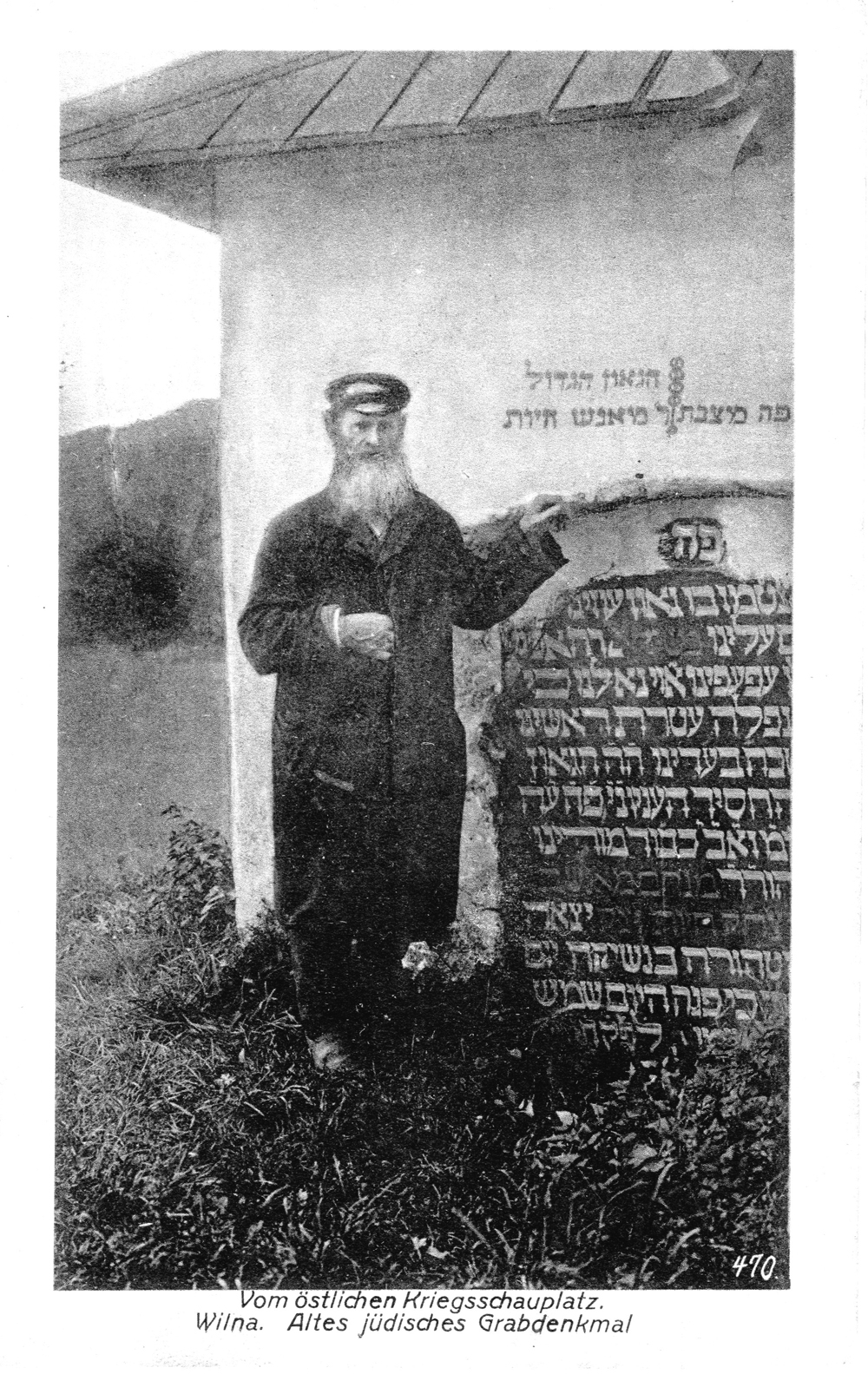
Several years ago, I acquired the following postcard. It measures 5½ inches by 3½ inches, a standard size for its time. It is a mint copy, meaning that no message was penned on its back and it was never mailed. Thus, I cannot date the postcard by a recorded date or postmark on its reverse side (but see below). We present the obverse and the reverse of the postcard for the benefit of the reader:

Obverse. The obverse presents a black and white photograph, also standard for its time. It features a tombstone with a Hebrew inscription; a mausoleum behind the tombstone, with a brief Hebrew inscription; and what appears to be a cemetery attendant, with his hand atop the tombstone. Most important, it contains a German heading under the photograph, which reads in translation: “From the Eastern Front of the Theater of War, Wilna, An Old Jewish Tombstone [with Inscription].”

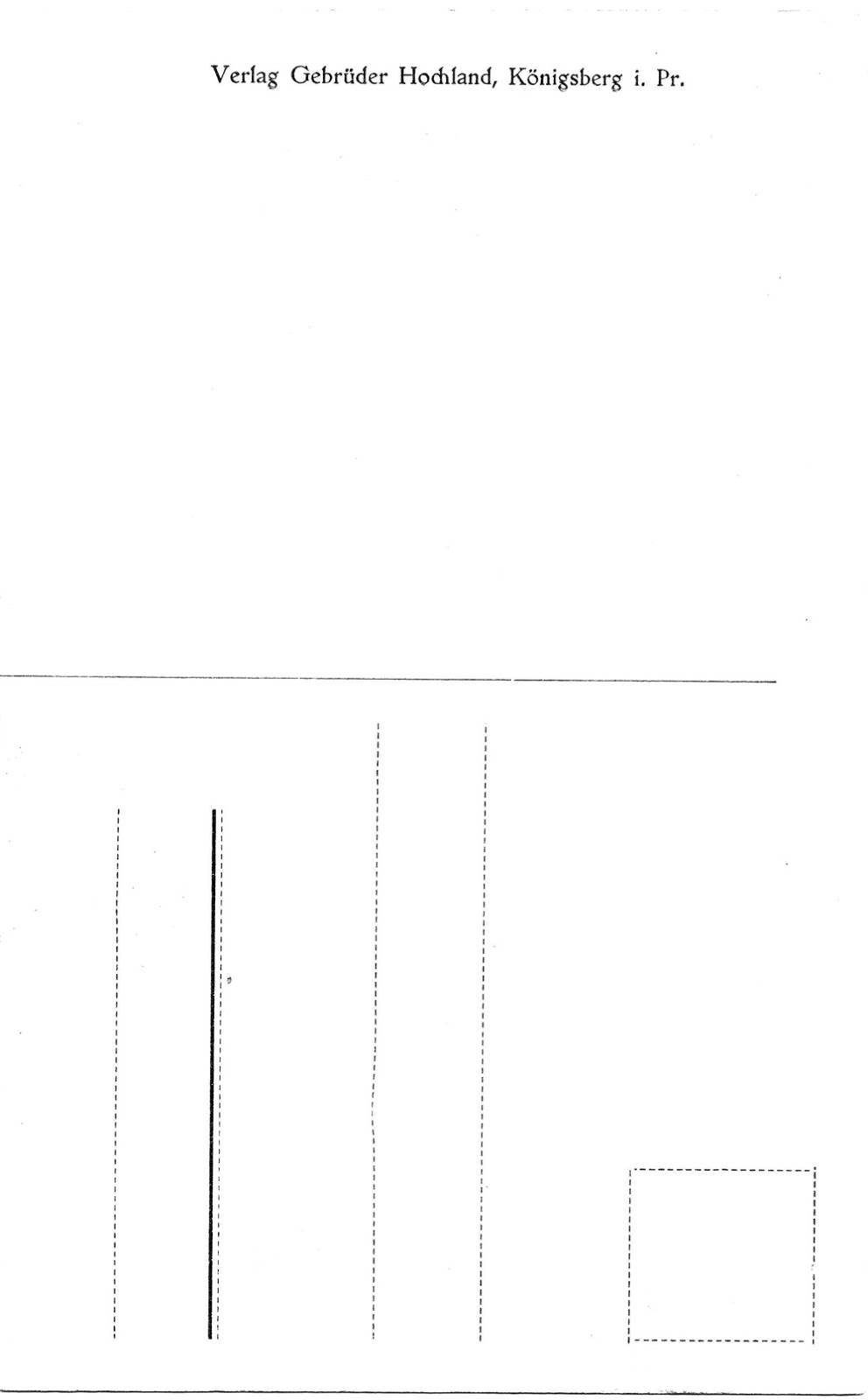
Reverse. The reverse prints the name of the publishing company that produced the postcard: “The Brothers Hochland in Koenigsberg, Prussia.”

Historical Context.

In terms of historical context, the information provided by the postcard (a German heading; Vilna is defined as the eastern front of the theater of war; the postcard was produced in Koenigsberg) can lead to only one conclusion, namely that the postcard was produced on behalf of the German troops that had occupied, and dominated, Vilna during World War I. German troops occupied Vilna on September 18, 1915 and remained in Vilna until the collapse of the Kaiser’s army on the western front, which forced the withdrawal of all German troops in foreign countries at the very end of 1918. Thus, our photograph was taken, and the postcard was produced, during the period just described. Its Sitz im Leben was the need for soldiers to send brief messages back home in an approved format. The ancient sites of the occupied city made for an attractive postcard. (This may have been especially true for Jewish soldiers serving in the German army.)

Due to a wonderful coincidence, a distinguished scholar of Yiddish and a dear colleague, Professor Dovid Katz, recently published a copy of the very same postcard we publish here.[1] Unlike my copy, his copy includes on the reverse side a dated message penned by the German soldier who mailed it, as well as a dated postmark. The message was written on December 3, 1917 and postmarked the next day, on December 4. Thus, we can narrow the timeline somewhat, and suggest that the postcard was almost certainly produced circa 1916 or 1917.

The Old Jewish Cemetery.

The old Jewish cemetery was the first Jewish cemetery established in Vilna. According to Vilna Jewish tradition, it was founded in 1487. Modern scholars, based on extant documentary evidence, date the founding of the cemetery to 1593, but admit that an earlier date cannot be ruled out. The cemetery, still standing today (but denuded of its tombstones), lies just north of the center of the city of Vilna, across the Neris River, in the section of Vilna called Shnipishkes (Yiddish: Shnipishok). It is across the river from, and just opposite, one of Vilna’s most significant landmarks, Castle Hill with its Gediminas Tower. The cemetery was in use from the year it was founded until 1831, when it was officially closed by the municipal authorities. Although burials no longer were possible in the old Jewish cemetery, it became a pilgrimage site, and thousands of Jews visited annually the graves of the righteous heroes and rabbis buried there, especially the graves of the Ger Zedek (Avraham ben Avraham, also known as Graf Potocki, d. 1749), the Gaon of Vilna (R. Eliyahu ben R. Shlomo, d. 1797), and the Hayye Adam (R. Avraham Danzig, d. 1820). Such visits still took place even after World War II.

The cemetery, more or less rectangular in shape, was spread over a narrow portion of a sloped hill, the bottom of the hill almost bordering on the Neris River. The postcard captures the oldest mausoleum and rabbinic grave in the old Jewish cemetery, exactly at the spot where the bottom of the hill almost borders on the Neris River. It was an especially scenic, and historically significant, site in the old Jewish cemetery, and it is no accident that the photographer chose this site for the postcard.

The Tombstone and its Hebrew Inscription.

The tombstone is that of R. Menahem Manes Chajes (1560-1636). He was among the earliest Chief Rabbis of Vilna. Indeed, his grave was the oldest extant dated grave in the Jewish cemetery, when Jewish historians first began to record its epitaphs in the nineteenth century. R. Menahem Manes’ father, R. Yitzchok Chajes (d. 1615), was a prolific author who served as Chief Rabbi of Prague. Like his father, R. Menahem Manes published several rabbinic works in his lifetime, and some of R. Menahem Manes’ unpublished writings are still extant in the Bodleian Library at Oxford University. His epitaph reads:[2]

The Mausoleum and its Hebrew Inscription.

In the old Jewish cemetery, many of the more famous rabbis were buried in mausoleums. All rabbis buried in mausoleums were buried underground. The mausoleum itself served as an honorific place of prayer that a visitor could enter and then pray at the grave of the rabbi of his choice. All tombstones were placed outside the mausoleum, and were affixed to its outside wall, directly opposite the body of the deceased rabbi named on the tombstone (but buried inside the mausoleum). Often, the names of famous rabbis were painted on the outside wall of the mausoleum (much like street signs) identifying who was buried in it. The mausoleums sometimes contained the graves of several famous rabbis. R. Menahem Manes Chajes was buried in the mausoleum that can be seen behind his tombstone. A famous rabbi buried in the same mausoleum was R. Moshe Rivkes (d. 1672), author of באר הגולה on the Shulhan Arukh.[3] The inscription on its wall, and above the tombstone of R. Menahem Manes, reads:

פה מצבת הגאון הגדול ר‘ מאנש חיות

Here is the tombstone of the great Gaon, R. Manes Chajes

The Cemetery Attendant.

What has remained a mystery for more than one hundred years is the identity of the cemetery attendant. We shall attempt to identify him, and to restore him to his proper place in Jewish history.

The reader will wonder how I know that the person in the photograph was a cemetery attendant. Perhaps he was a tourist who just happened to be there on the day the Hochland Brothers Publishing Company arranged for a photograph to be taken for its postcard collection?

Initially, it was simply a hunch, largely due to ephemera, that is, other photos of visitors to the old Jewish cemetery in the interwar period. I have a collection of such photos, and either they feature the tourist (who handed his camera to the tour guide or to the cemetery attendant, and asked that his picture be taken in front of the Vilna Gaon’s tombstone or at the Ger Zedek’s mausoleum), or they feature a cemetery attendant who stands in those places, while the tourist, who knows how to use the camera, takes the photo. The tourists can always be recognized by their garb, which matches nothing worn by anyone else in Vilna. The cemetery attendants, functionaries of a division of the Jewish Kehilla (called Zedakah Gedolah at the time), all wear the same dress, a “Chofetz Chaim” type cap and a long coat, both inevitably dark grey or black. While I am not aware of another old Jewish cemetery photograph featuring the specific cemetery attendant seen in our postcard, his dress is precisely that of all the other cemetery attendants whose photos have been preserved.

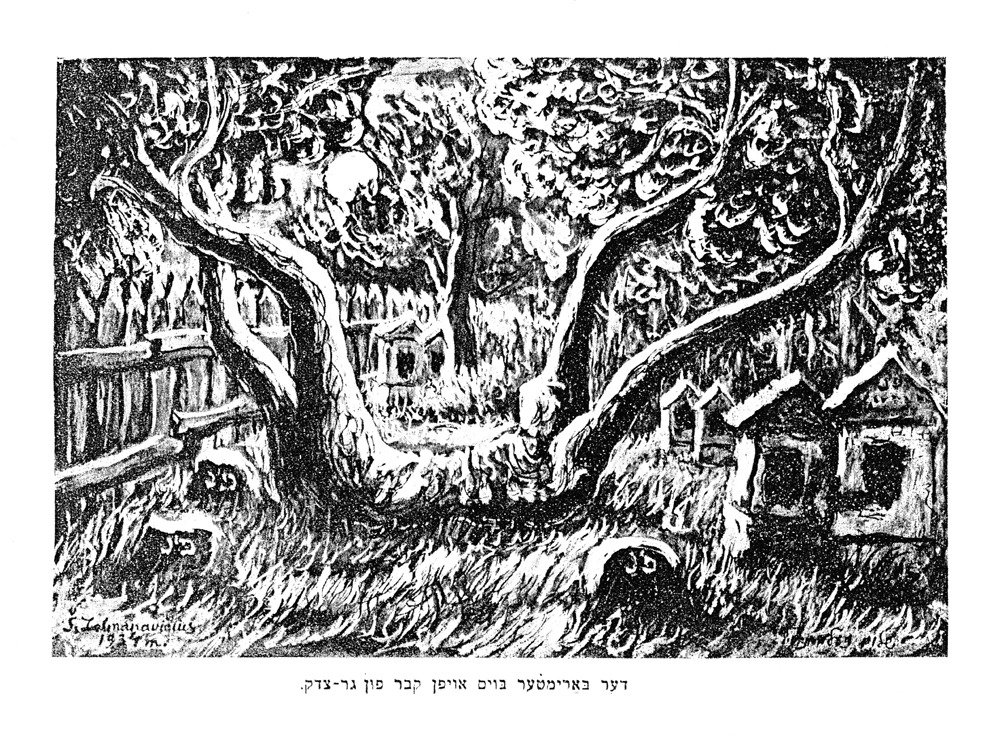
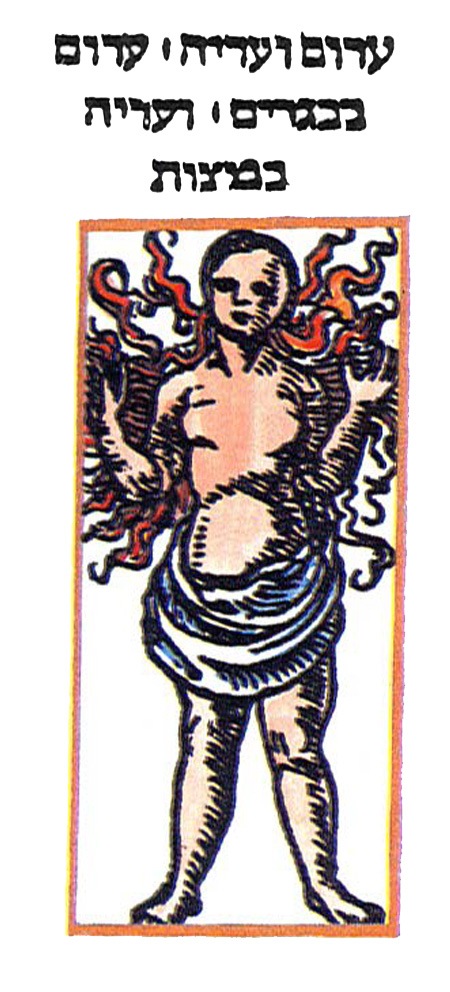
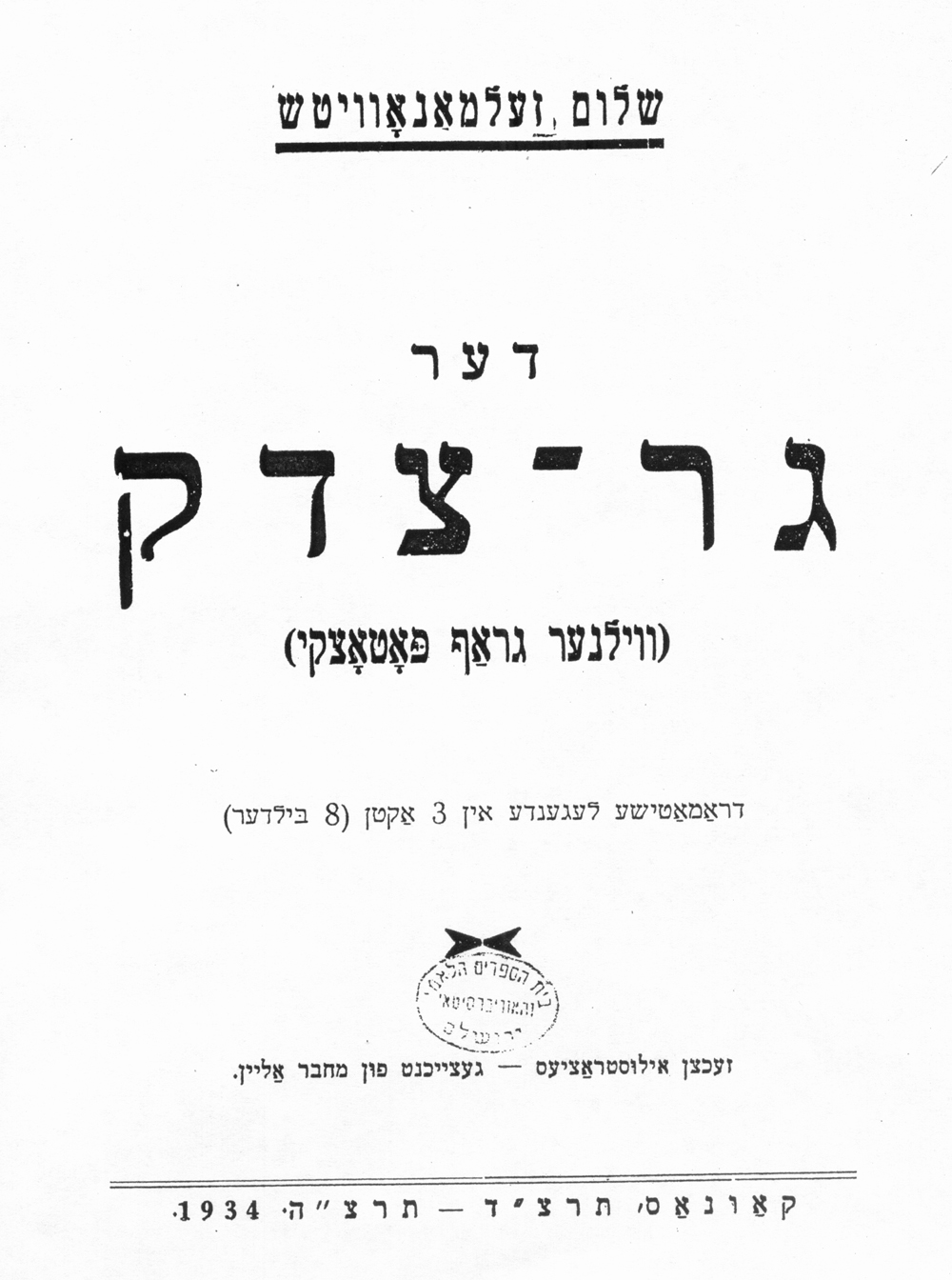
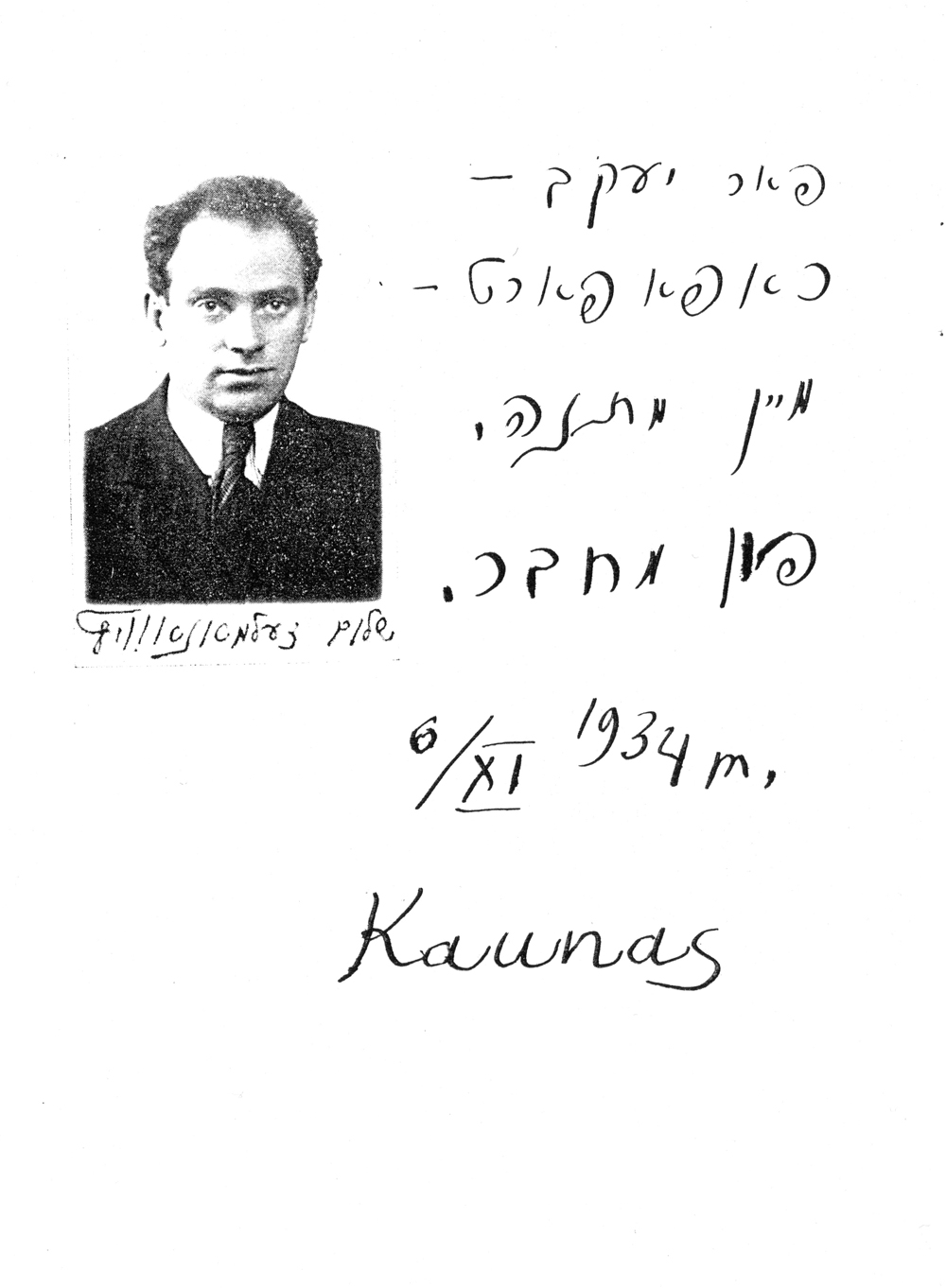
But there is no need for guesswork here. Sholom Zelmanovich, a talented artist and Yiddish playwright, published his דער גרצדקווילנער גראף פאטאצקי  in 1934.[4]

This three-act play commemorates the life and death of the legendary Ger Zedek of Vilna in a new and mystical mode.[5] The volume includes sixteen original drawings by Zelmanovich. Several of the drawings preserve details of Vilna’s old Jewish cemetery with seemingly incredible accuracy. Thus, for example, Zelmanovich depicts the northern entrance gate to the old Jewish cemetery, as well as the nearby Jewish caretaker’s house on the cemetery grounds, even though few photographs are extant that even begin to capture the details of those sites. His depiction of the Ger Zedek’s grave (and the human-like tree that hovered over it) is perfectly located in the south-eastern corner of the old Jewish cemetery, and is surrounded by the wooden fence that existed in that corner prior to 1926. Only someone who spent quality time in Vilna’s old Jewish cemetery could have known exactly where to place the entrance gate, the caretaker’s house, and the Ger Zedek’s grave.

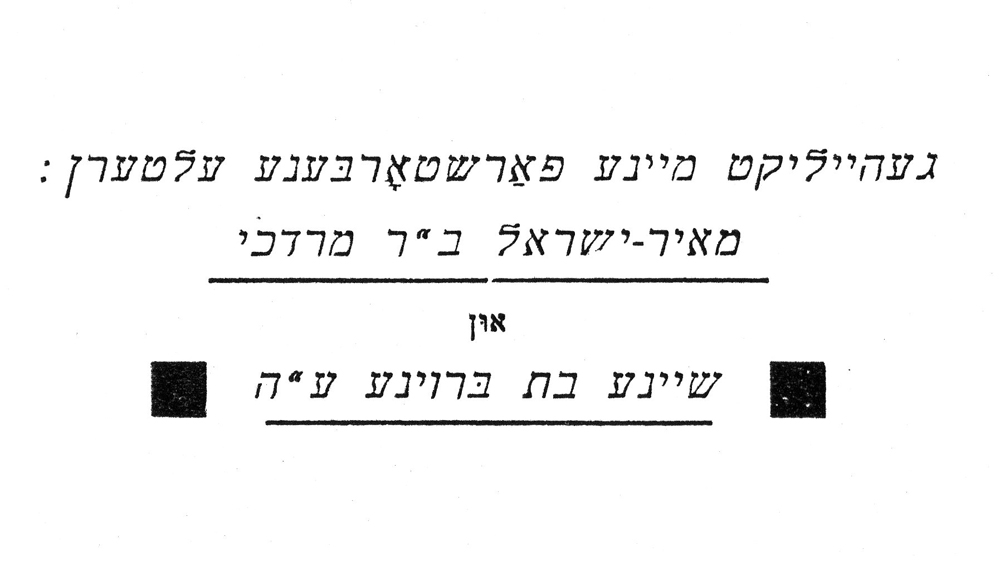
One other matter needs to be noticed. Zelmanovich dedicated the volume in memory of his deceased parents, Meir Yisrael son of Mordechai and Sheyne daughter of Broyne.[6]

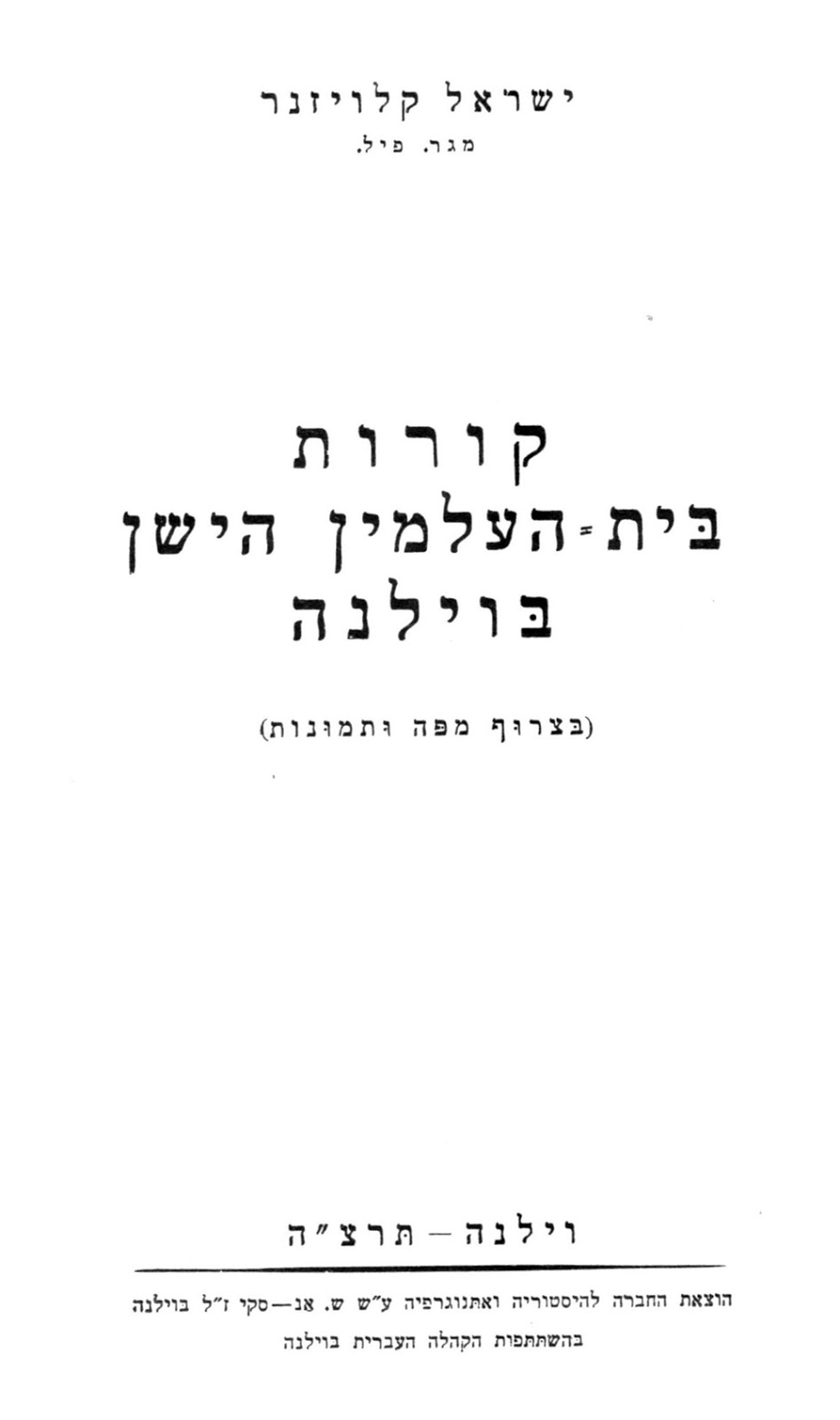
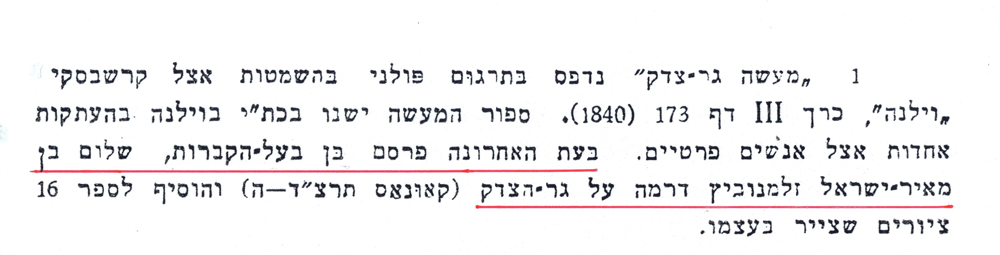
In the summer of 1935, the municipal authorities of Vilna, then under Polish rule, announced their plan to demolish Vilna’s old Jewish cemetery and replace it with a soccer stadium. Vilna – and worldwide – Jewry did not stand idly by. Instead, they engaged in an extensive, and ultimately successful, battle against the municipal authorities. As part of its efforts to win over the municipal authorities, the Vilna Jewish community charged a young Jewish scholar, Israel Klausner,[7] with writing a history of the old Jewish cemetery. It would offer clear documentation and prove beyond doubt that various Polish kings and municipal authorities throughout the centuries had authorized the Jewish community to construct the cemetery and maintain it. The cemetery was legally the property of Vilna’s Jewish community. Klausner’s monograph, entitled קורות בית-העלמין הישן בוילנה (Vilna, 1935), includes a discussion of the Ger Zedek’s grave. In a footnote,[8] Klausner mentions in passing Sholom Zelmanovich’s “recently published drama on the Ger Zedek,” and adds that Zelmanovich was the son of the caretaker of the old Jewish cemetery (Hebrew: בן בעלהקברות ), Meir Yisrael Zelmanovich! The plot thickens.

The full force of the Hebrew term בעלהקברות is not really captured by the English term “caretaker.” There were a variety of cemetery attendants who worked in the old Jewish cemetery in various capacities (such as guiding visitors and leading them to the graves they wished to visit, reciting prayers at the graves, ground-keeping, repairing broken tombstones and re-inking their inscriptions, and guard duty). But one cemetery attendant was in charge of all the other attendants, and as we shall see, he and his family lived in the house on the cemetery grounds. He was called: בעלהקברות, perhaps best rendered as: “Cemetery Keeper” or “Managing Director” of the old Jewish cemetery. We have established that Meir Zelmanovich served in that capacity. But who was he when did he live?

Meir Zelmanovich.

Sadly, almost nothing is known about the life of Meir Zelmanovich. He published no books and wrote no essays. As best I can tell, only one newspaper report mentions his name during his lifetime.[9] The report itself is significant. It records a complaint made by Meir Zelmanovich in 1919 that the Polish legionnaires had desecrated the old Jewish cemetery. But it would be Zelmanovich’s tragic death in 1920 that would perpetuate his memory. Here, we need to provide some historical context. Israel Cohen begins his discussion of the impact of World War I on Vilna, as follows:[10]

Within the small space of eight years, from 1914 to 1922, the Jews of Vilna tasted of the blessings of nine different governments, and suffered from a combination of other evils even more noxious. They became a prey to economic depression, military requisitions, unemployment, famine and disease; thousands of them were subjected to forced labor, imprisonment, plunder and brutal attacks; and physical and material deterioration inevitably engendered a certain degree of social demoralization. All the variegated differences of principle, of religious outlook and sociological doctrine, were now forgotten in the inferno created by the common foe. The long protracted fight for civil and political rights had to yield to the more primitive and desperate struggle for mere existence.

Almost certainly, the greatest concentration of Jewish suffering in this period came in April of 1919, when the Polish legionnaires unleashed a pogrom against Vilna’s Jews. Israel Cohen describes the horrors that followed:[11]

The [Polish] legionnaires[12] defiled and desecrated the [old Jewish] cemetery, smashed the tombstones, and opened the graves (including some of Vilna’s earliest rabbis) in the belief that they would find in them arms and money. Disappointed in their search, the Poles transferred their attentions from the dead to the living and ran amuck in the Jewish quarter. For three days they seized Jews in the streets, dragged them out of their homes, bludgeoned them savagely, and looted their houses and shops. About 80 Jews were shot, mostly in the suburb of Lipuvka, where some were ordered to dig their own graves; others were buried alive, and others were drowned, with their hands tied, in the Vilia [now: Neris] River… All sorts of outrages were committed in those days by the Poles in celebration of their victory. They tied a Jew to a horse and dragged him through the streets for three miles. They took a sadistic delight in cutting off the beards and earlocks of pious Jews. They even arrested, assaulted and humiliated Rabbi Rubinstein and Dr. Shabad. Altogether, thousands of Jews in Vilna, as well as in Lida and Bialystock were imprisoned in various concentration camps where they were ill fed and beaten, and where they suffered from hunger and typhoid. Moreover the total loss due to destruction and pillaging of Jewish people in the pogrom, in Vilna alone, was estimated at about 20 million roubles (about $10,000,000).

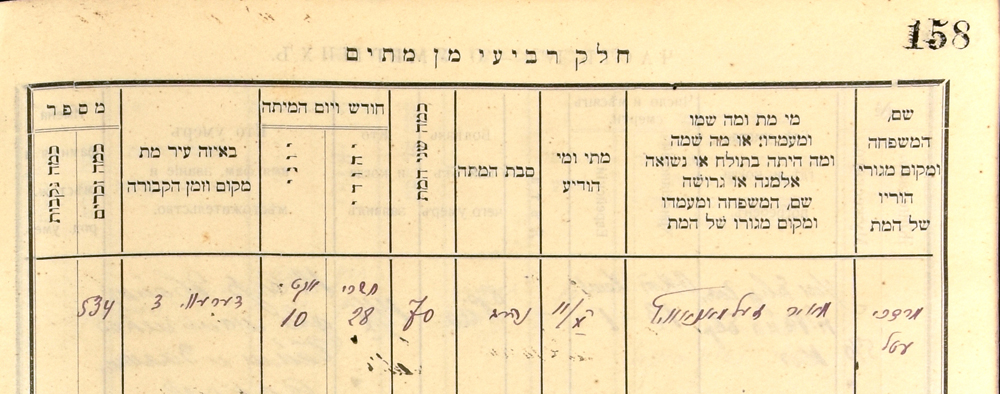
Polish rule of Vilna came to an end when the Russians recaptured Vilna on July 14, 1920. Russian rule lasted for six weeks, after which the Russians retreated and left Vilna in the control of the Lithuanians. Lithuanian rule lasted until October 8, 1920, when the Poles once again recaptured Vilna. One can only imagine the fear that gripped the Jewish community in Vilna, when they heard the sounds of the approaching Polish legionnaires. In fact, hundreds (some claim: thousands) of Vilna’s Jews fled on October 8 to Kovno, then part of Independent Lithuania.[13] Indeed, there was what to fear, for the Polish legionnaires were free again to wreak havoc with Jewish lives. And although the severity of the pogrom of 1919 did not repeat itself, the indiscriminate murder, rape, and looting of Jews that took place in Vilna between October 8-10, 1920 was, at least in the eyes of the victims, yet another pogrom.[14] Briefly, eye-witness Yiddish accounts[15] record that at least 6 Jewish men and women were murdered, numerous women were raped, and some 80 Jews were mugged and robbed. No one was brought to justice for committing these crimes! On October 10, 1920 Meir Zelmanovich, Cemetery Keeper of the old Jewish cemetery in Vilna was murdered by the Polish legionnaires. He was 70 years old when he died. The official Jewish record of his death lists his home address as “Derewnicka 3.” This is the address of the house on the grounds of the old Jewish cemetery. It is no wonder that Sholom Zelmanovitch could depict so vividly the northern entrance gate to the cemetery, its nearby caretaker’s house, and the human-like tree hovering over the Ger Zedek’s grave. His childhood playground was the old Jewish cemetery in Vilna.

On the picture postcard from 1916-1917, one sees an elderly Jew. One possibility is that it depicts none other than Meir Zelmanovitch, the Cemetery Keeper of the old Jewish cemetery until his death in 1920 at age 70. I suspected that this was the case, but could not prove it until recently — when a small miracle occurred.

Miracles Sometimes Do Occur.

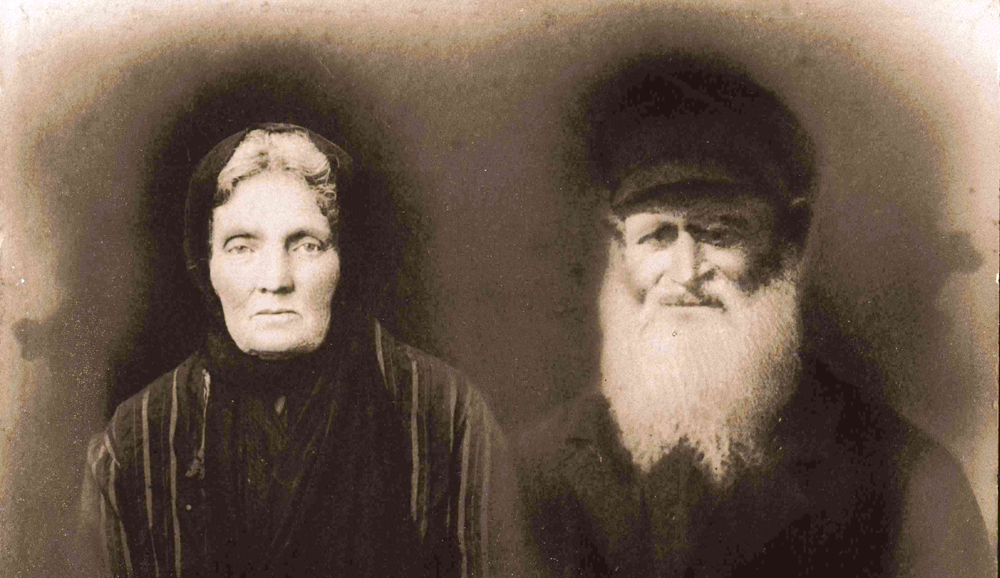
In March of this year, out of the clear blue sky, I was contacted by Laurie Cowan, who introduced herself as a great-granddaughter of Meir Zelmanovich! She basically was interested in any information I could provide about her great-grandfather that she didn’t already know. I was delighted to make her acquaintance, but wondered what led her to me. It turns out that both of us were seeking information about the same person – Meir Zelmanovich – from the Lithuanian State Historical Archives in Vilnius. An alert researcher at the Archives noticed this, and made the “shidduch” between us. I shared with Laurie whatever I knew about her great-grandfather. In turn, I asked her to send me copies of whatever documents she had relating to her great-grandfather. She sent me a scan of the following photograph of her great-grandmother and great-grandfather, Sheyne[16] and Meir Zelmanovich:

Never has it been so easy to identify an unidentified picture on a one-hundred year old picture postcard! One suspects that the picture postcard company representative, and a photographer, met with the Cemetery Keeper Meir Zelmanovich at the old Jewish cemetery in Shnipishok. He led them to the mausoleum of R. Menahem Manes Chajes, and was asked to pose at the tombstone just outside it. He graciously accepted the invitation. This may well have been the last photo taken of Zelmanovich, and it preserves, together with the photo provided by Laurie Cowan, the likeness of a martyr who fell during the October 1920 mini-pogrom in Vilna.[17]

At least six Jews were murdered between October 8-10 in 1920 in Vilna. They died for one reason only, namely, because they were Jews. Such Jews are regarded as martyrs and their names, at the very least, deserve to be recorded and remembered. Until now, none of the names of the Vilna martyrs of 1920 have been published in any public Jewish record, whether in a contemporary Jewish newspaper, or a Jewish historical essay or book, or an online posting. Having examined the extant records in the Lithuanian State Historical Archives, I have been able to retrieve the 6 names of the Jewish victims who were murdered in Vilna in October of 1920. In each case, the Jewish Kehillah records of Vilna in 1920 state clearly in Hebrew that the cause of death was either נהרג or נהרגה (i.e., murdered). The names are:

1. Shmuel ben Mendel Katz, age 56, died October 9.

2. Etel Natin, age 36, died October 9.

3. Basya Natin, age 32, died October 9.

4. Rokhl Blume Shuster, age 45, died October 9.

5. Meir Zelmanovich, age 70, died October 10.

6. Shlomo Abramovich, age 17, died October 12.[18]

May the memory of these martyrs be forever for a blessing! [19]

NOTES:

עם הספר, the People of the Book the world over, mourn the death of R. Shmuel Ashkenazi in Jerusalem, at the age of 98. He was שר הספר, the consummate master of the Hebrew book. Bibliographer, bibliophile, and book collector, his encyclopedic knowledge of all of Hebrew and Yiddish literature remains unparalleled in our time. His most recent contributions appeared in three massive volumes, replete with some 1,794 pages of immaculate scholarship. He never wasted a word; he wrote with precision and parsimony. Among his many accomplishments, he edited the Kasher Passover Haggadah, one of the most significant scholarly editions of the Passover Haggadah ever published. He was largely responsible for the single most accurate bibliography of Hebrew books ever produced, מפעל הביבליוגרפיה העבריתThe Bibliography of the Hebrew Book 1473-1960. Aside from his scholarly distinction, R. Shmuel Ashkenazi wrote in an elegant Hebrew with its own special charm. Not only did he advance discussion, but he did so in an aesthetically pleasing manner. For those of us who knew him personally, he evinced the same charm in his personal relationships that he did in his writings. He set a standard of excellence that we can only strive to emulate, but never really replicate. יהא זכרו ברוך!

This essay is dedicated to his memory, a token of appreciation for all he has taught me.

[1] Dovid Katz, “World War I Postcard of the Grave of Rabbi Menachem Manes Chayes (1560-1636) in the Old Vilna Jewish Cemetery,” Defending History (11 March 2020), available here) A copy of our postcard can also be seen online at ‘YIVO 1000 Towns’, record ID 10743 (http://yivo1000towns.cjh.org).
[2] For a fuller discussion of R. Menahem Manes Chajes and his epitaph, see S. Leiman, “A Picture and its One Thousand Words: The Old Jewish Cemetery of Vilna Revisited,” The Seforim Blog, January 14, 2016, especially notes 7-11, online here.
[3] Aside from his pivotal commentary on R. Joseph Karo’s Shulhan Arukh, R. Moshe Rivkes was a great-great grandfather of the Vilna Gaon.
[4] Precious little is known about Sholom Zelmanovich (1898-1941). See the brief biographical entry in לעקסיקאן פון דער נייער יידישער ליטעראטור (Martin Press: New York, 1960), vol. 3, column 670, which mistakenly lists him as being born in a town near Kovno, circa 1903. He was born in Vilna in 1898 (JewishGen) and died during one of the first Nazi aktions in the Kovno Ghetto.
[5] In general, see Joseph H. Prouser, Noble Soul: The Life and Legend of the Vilna Ger Tzedek Count Walenty Potocki (Gorgias Press: Piscataway, 2005). Prouser’s excellent monograph is a study of the many literary reworkings of the legends surrounding the Vilna Ger Zedek, with primary focus on 20th century Jewish literary contributions. Strangely, he offers no discussion of Zelmanovich’s contribution.
[6] On the feminine Yiddish name “Broyne,” see Alexander Beider, Dictionary of Ashkenazic Given Names (Avotaynu: Bergenfield, 2001), pp. 484-486.
[7] Klausner (1905-1981) settled in Palestine in 1936 and continued to be a prolific author of studies and books on the history of Vilna’s Jewish community. Aside from several important monographs, like his history of the old Jewish cemetery, he wrote a two-volume history of Jewish Vilna entitled 1939-1881 וילנה ירושלים דליטאדורות האחרונים (Ghetto Fighters’ House: Tel-Aviv, 1983), to which a third volume treating 1495-1881 was added posthumously, based largely on studies previously published by Klausner.
[8] קורות ביתהעלמין הישן בוילנהp. 45, note 1.
[9] See Vytautas Jogela, “The Old Jewish Cemetery in the Nineteenth and Twentieth Centuries,” Lituanus, vol. 61, no. 4 (2015), pp. 81-82.
[10] Israel Cohen, Vilna (Jewish Publication Society: Philadelphia, 1943), pp. 358-359.
[11] Ibid., pp. 378-379.
[12] Cohen regularly spells the word: “legionaries.” For the sake of consistency, I have spelled the word “legionnaires” throughout this essay.
[13] See, e.g., Boaz Wolfson, “מיטלליטע” in פנקס פאר דער געשיכטע פון ווילנע אין די יארן פון מלחמה און אקופאציע (B. Zionson: Vilna, 1922), column 387.
[14] There are probably as many definitions of “pogrom” as there are scholars and politicians. Since it is unclear whether the crimes committed on October 8-10, 1920 were planned and implemented by either a government or a political action committee, and since the duration of the attacks was short and rather swiftly brought under control, historians are reluctant to refer to the events that occurred on October 8-10, 1920 as a pogrom. On the other hand, to label those events a mere “disturbance” does not begin to capture the malevolent intent of the perpetrators directed specifically against Jews, and does not address the intensity of Jewish suffering at the time. For some of the different views regarding the definition of “pogrom,” and how the term has been manipulated by political interests, see Szymon Rudnicki’s forthcoming essay “The Vilna Pogrom of 19-21 April 1919,” to appear in Polin 33 (2020). Professor Rudnicki kindly allowed me to see a pre-publication copy of his lucid and informative essay.
[15] Wolfson, loc. cit. Cf. Jacob Wygodski, אין שטורם (B. Kletzkin: Vilna, 1926), pp. 217-221.
[16] Sheyne Zelmanovich died in Vilna on October 26, 1921, at age 68 (JewishGen). She lived in her home on the old Jewish cemetery grounds until her death. In a personal communication, Laurie Cowan informed me that the Zelmanoviches had 10 children who survived to adulthood. The 6th child, Beirach (popularly called: Berik; and later, Ben), was her grandfather, an older brother of Sholom mentioned above.
[17] The only other extant likeness of Meir Zelmanovich (known to me, and recovered on July 15, 2020) is an undated passport photo (circa 1916) preserved in the Lithuanian State Historical Archives. During the German occupation, all residents of Vilna were required to have – and to carry at all times – a German passport (we would call it: an Identity Card). Meir Zelmanovich’s German passport photo confirms the identity and authenticity of the photos of Zelmanovich published in this essay. All three photos are of one, and the same, person.
[18] One suspects that Abramovich may have been shot or beaten on October 9 and 10, like the others, but did not die from his wounds until the 12th.
[19] This essay could not have been written without the help of Regina Kopilevich, researcher (and tour guide) extraordinaire, who located whatever documents I sought at the Lithuanian State Historical Archives (Lietuvos Valstybes Istorijos Archyvas) in Vilnius. I am indebted to the librarians at the Archives for allowing her and me to examine these and other documents during my visits to Vilnius. Next to Google, JewishGen is a modern Jewish historian’s best friend, and we are grateful to all who contribute to making JewishGen the great historical resource that it is. Matt Jelen’s careful reading of an earlier draft has significantly improved the final version. I alone am responsible for whatever errors appear in this essay.


PIYYUT ON THE SURVIVAL OF THE JEWS OF BRECLAV (LUNDENBURG) ON JANUARY 23, 1698

PIYYUT ON THE SURVIVAL OF THE JEWS OF BRECLAV (LUNDENBURG)[1] ON JANUARY 23, 1698
By David Roth[2]
I found a printed pamphlet in the National Library of Israel[3] entitled סליחות מה שאומרים כאן ק”ק לונדענבורג בי”א טבת בכל שנה והמאורע יבואר בתוך הסליחות …, translated as “the selihoth prayers that are recited here [in] the community of Lundenberg (Břeclav), on the 11th of Teveth every year, and the event [commemorated] will be told in the selihoth”.  The pamphlet was published in 5655 [1894-1895], almost two hundred years after the event took place, meaning that the practice of commemorating this date lasted for quite a long time, very possibly until the outbreak of World War II.[4]
What happened to the Jewish community of Lundenburg?
In the חטאנו piyyut contained in this pamphlet, we have a description of the events of 11 Teveth 5458, corresponding to January 23, 1698.[5]  On that day, the dome of the Synagogue collapsed, and the members of the community were almost killed, but they were miraculously saved.  As such, the community established for itself and future generations to fast half a day, and to celebrate the other half of the day, a construct commonly referred to as a “Purim”.  Note that this is the day after a public fast day, so by establishing this fast, the community accepted upon itself to fast half a day immediately after fasting a full day, something that is fairly unusual.  While the practice of establishing local fasts and Purim celebrations is well documented[6] and was practiced in many communities, this particular holiday celebrated in this community is not so well known.
About the order of the selihoth:
The order of the selihoth in the pamphlet is as follows:
  • The pamphlet begins with an instruction that the chazzan repeats the Amidah until מחל לנו מלכנו כי פשענו and then begins the selihoth, something that was common to all selihoth for fast days.
  • It then contains a selihoth service, including the full text of the piyyut איה קנאתך וגבורתך, the pizmon יי יי א-ל רחום וחנון, and the akeidah [7]אם אפס רבע הקן, with the thirteen attributes of mercy (י”ג מדות הרחמים) before and after each piyyut.
  • The service then continues with זכור רחמיך, until חטאנו צורינו, at which point the חטאנו piyyut, described at length below, is recited.
  • After the חטאנו, the service continues with זכור לנו ברית אבות[8], שמע קולינו,and וידוי until הרחמים והסליחות, with an instruction to continue ואל יעכב, meaning that at this point the chazzan finishes his repetition of the Amidah.
In addition to the pamphlet already mentioned, in אוצר השירה והפיוט (index of piyyutim), Davidson makes reference to this piyyut (number 8498א), and he refers to an article where this piyyut was previously published – אוצר הספרות ח”ב, עמ’ 112.  The article – entitled מקורות לקורות בני ישראל by דוד קויפמאנן, was published in תרמ”ח (1888), before the other pamphlet of the selihoth described above, meaning that it must have been based on an earlier printing or manuscript of this piyyut.  In the article, the earlier piyyutim (meaning everything prior to the chatanu) are not printed in full, but rather the service is summarized as follows:
והם הסליחות שאומרים בי”א בטבת
איה קנאתך וגבורתך, סימן ו
פזמון י”ג מדות יי יי א-ל, [סימן] פה
עקידה מצום גדליה: אם אפס, [סימן] מט
זכור: עד אל רשעו ואל חטאתו
ואחרי כך סליחה זו:
[טקסט השלם של החטאנו]
And for a rough translation of the service summary:
Ayei kinathecha u-gevorothekha – number 6
Pizmon – 13 attributes – [number] 85
Akeidah for the Fast of Gedaliah – im afes – number 49
Zekhor until el rish’o ve-el hatatho, and afterwards he says this: [the full text of the chatanu piyyut].
Based on this, we can infer that the selihoth service was originally distributed to members of the community as an insert to put in their selihoth book for yamim noraim.  Furthermore, the numbers listed in this description for the first three selihoth show that this community recited selihoth according to the Bohemian rite, one of the forms of the Eastern Ashkenazic rite.
Noteworthy observations:
The presence of one selihah, a pizmon, an akeidah, and a chatanu is in and of itself something very unusual, as usually a selihot service would have more than one selihah, and the presence of an akeidah would imply a longer selihot service since this type of piyyut is not always present in a selihot service.[9]
There are several unusual things that must be noted about this chatanu piyyut.  As discussed earlier, this community recited selihoth according to the Bohemian rite, one of the Eastern Ashkenazic selihoth rites. The existence of a חטאנו piyyut in an Eastern Ashkenazic selihoth rite is, in and of itself, a phenomenon that is worth noting.  While Western European rites recite a חטאנו piyyut at almost all occasions that they recite selihoth, חטאנו piyyutim in Eastern European rites, at least in print, rarely recite chatanu piyyutim.[10] It is surprising that somebody who is, most likely, not extremely familiar with this type of piyyut would see it fit to write one for this occasion.
Additionally, the structure of the piyyut is extremely bizarre.  In general, chatanu piyyutim repeat the phrase חטאנו צורנו סלח לנו יוצרנו after every two stanzas; in this piyyut, there is an instruction to recite this phrase after every stanza.  Furthermore, in most חטאנו piyyutim, there is שרשור (anadiplosis), meaning that the last word of each stanza is identical to the first word of the next stanza; this poetic phenomenon does not exist in our piyyut.  This leads me to believe that our poet either wrote this as a chatanu without fully understanding the structure of a chatanu, or it is possible that he wrote it as a different type of piyyut and somebody else inserted it in this place and added the refrain of חטאנו צורנו after each stanza.
The piyyut is signed “אני אלעזר הלוי אב”ד בקהלתינו ל”ב חזק ואמץ, I am Elazar the Levite, Rabbi our community L.B. (=Lundenburg), be strong and courageous.”  Although special emphasis is not given to all of the letters, the letters אבד, which in the context of our piyyut means “was lost” but can also serve as the abbreviation for אב בית דין, “Rabbi of the community”, are written as א”ב”ד, making clear that it is supposed to be part of the acrostic.  Unfortunately, I was not able to find any additional information about this Rabbi, although he was presumably the Rabbi of Břeclav/Lundenburg at the time of this event or slightly afterwards, and the אוצר הספרות article says that he was the rabbi at the time of the event although doesn’t cite a source for that claim.
Text and translation of Piyyut:
Below, I have typed up the text of the פיוט.  The אוצר הספרות version of the piyyut is unvocalized; the version in the pamphlet is vocalized, but the vocalization is at times problematic and contains obvious errors. As such, I have used the pamphlet as my base text, but corrected obvious problems to the vocalization.  I have also added notes on where I think there may be an alternative reading, and noted any major (anything other than מלא/חסר) variants in the other text of the piyyut I have available to me.  I have also added references to idioms from Tanakh and Rabbinic sources, and provided an approximate translation.
Text in Hebrew:
חָטָאנוּ צוּרֵנוּ סְלַח לָנוּ יוֹצְרֵנוּ
  אֶ֯ת יי נוֹדֶה בְּפִינוּ וּבְתוֹךְ רַבִּים נְהֲלְּלֶנּוּ
  אֲמִתְּךָ וְחַסְדְּךָ תָּמִיד יִצְּרוּנוּ
  יֵאָמְנוּ צִדְקוֹתֶיךָ אֲשֶׁר בְּךָ מִבְטָחֵינוּ
  מַה נְּדַבֵּר וּמַה נִּצְטַדָּק[11] אֶל אֱ-לוֹהֵינוּ חטאנו
5  נִ֯כְלַמְנוּ בַּעֲווֹנֵינוּ בּוֹשְׁנוּ בְּמַעֲשֵׂינוּ
  וְנָהִינוּ נָא אַל תִּזְכָּר לָנוּ אֶת עֲווֹנוֹתֵינוּ
  לְקִרְיַת נָוְךָ נַהֲלֵינוּ
  בְּךָ תוֹחַלְתֵּינוּ וְאַתָּה יי מְחוֹלֲלֵינוּ חטאנו
  י֯וֹם זֶה קָבַעְנוּ לָנוּ לְצוֹם וְלִזְעָקָה
10 חֲצִי לַיי וַחֲצִי לָכֶם[12] לְחַלְּקָה
   לְהוֹדוֹת וּלְהַלֵּל עַל הַנִּיסִים[13] שֶׁעָשָׂה לָנוּ לְתָמְכָהּ וּלְחָזְקָהּ
   לְבַל הָיָה[14] לָנוּ לְמִכְשׁוֹל וּלְפוּקָה חטאנו
   אֶ֯ל֯ בֵּית מִקְדָּשֵׁינוּ מְעַט[15] לְהִתְפַּלֵּל מִנְחָה הָלַכְנוּ בְּאוֹרַח יְשָׁרָה
   דָּפַקְנוּ דַּלְתוֹת הַבַּיִת יָבֹא אֶל הַקֹּדֶשׁ בְּיִרְאָה וּבְמִצְוַת בָּרָה
15 פִּתְאוֹם הָיִינוּ נִלְכָּדִים ח”ו בִּמְצוּדָה רָעָה[16] זוּ תּוֹרָה וְזוּ שְׂכָרָהּ[17]?!
   בְּי”א בְּטֵבֵת שְׁנַת חָתָ”ן תּוֹרָה
חָטָאנוּ צוּרֵנוּ סְלַח לָנוּ יוֹצְרֵנוּ[18]
   עֵ֯זֶ֯ר וּתְרוּפָה הָיָה לְכוּלָּנוּ
   לוּלֵי יי עֶזְרָתָה לָּנוּ
   כִּמְעַט כִּסְדוֹם הָיִינוּ וְלַעֲמוֹרָה דָּמִינוּ
20 יְהִי חַסְדְּךָ יי עָלֵינוּ[19] חטאנו
   הַ֯לְ֯וִ֯יִּ֯ם וְאַהֲרוֹנִים, וְכָל הָעֵדָה רוּבָּם כְּכוּלָּם הָיִּינוּ עוֹמְדִים לִפְנֵי הַר הַבַּיִת לַעֲרוֹךְ
תַּחֲנוּנִים
   וּבְיַד צִיר נֶאֱמָן[20] הַמִפְתֵּחוֹת לִפְתּוֹחַ בּוֹנִים[21]
   וּבְפָתְחוֹ הַדְּבִיר עָמְדוּ כָּל הָעָם לִכְנוֹס לִפְנַי וְלִפְנִים[22]
   כִּי לְכָל דָבָר שֶׁבִּקְדוּשָּׁה[23] הֵמָּה רִאשׁוֹנִים חטאנו
25 אָ֯בַ֯ד֯ הָיָה כִּמְעַט תִּקְוָתֵינוּ וּמִבְּנֵי יִשְׂרָאֵל[24] וּמֵהוֹנוֹ כָּל אֶחָד יוּפְרָשׁ
   כִּי בְּזוּ הָרֶגַע נָפְלָה הַכִּיפָּה מִבֵּית יי וּכְמוֹ טִיט הַיּוֹצֵר הָיִינוּ רְמָס
   לֹא נִשְׁאַר מִשֹּׂנְאֵינוּ[25] שָׂרִיד וּפָלִיט רַק צָרָה וְצַלְמָוֶת יִירָשׁ
   וְאַתָּה יי בִּזְכוּת נָשֵׁינוּ וְטַפֵּינוּ הִצִּיל אוֹתָנוּ וְשָׁפַךְ חֲמָתוֹ עַל עֵצִים וַאֲבָנִים[26] וְהָיוּ לְמִרְמָס
חטאנו
   בִּ֯קְ֯הִ֯לָּ֯תֵ֯י֯נ֯וּ֯ הַקְּדוֹשָׁה קִבַּלְנוּ עָלֵינוּ וְעַל זַרְעֵינוּ
30 לִגְזוֹר תַּעֲנִית[27] בְּזֶה הַיּוֹם בְּכָל שָׁנָה וְשָׁנָה עַד בִּיאַת מְשִׁיחֵנוּ
   קְרָאנוּךָ בֶּאֱמֶת מְהֵרָה חוּשָׁה לְעֶזְרָתֵינוּ וּלְהוֹשִׁיעֵנוּ[28]
   פָּנֶיךָ אַל תַּסְתִּיר אֵלֶיךָ בְּשַׁוְעֵינוּ חטאנו
   לֵ֯ב֯ חָכָם יַשְׂכִּיל פִּיו וְעַל שְׂפָתָיו יוֹסִיף לָקְחָה
   אֲשֶׁר הִצִּיל אֹתָנוּ מִמָּוֶת לְחַיִּים מַעֲרָכָה מוּל מַעֲרָכָה[29],[30]
35 כְּבִימֵי הָמָן עָמַד לָּנוּ הַצָּלָה וְהַרְוָחָה
   עַל כֵּן קָבַעְנוּ אַחַר חֲצוֹת הַיּוֹם לְמִשְׁתֶּה וּלְשִׂמְחָה וְלִיתֵּן הוֹדָיָה וּשְׁבָחָה חטאנו
חִ֯זְ֯ק֯וּ וְ֯אֲ֯מְ֯צ֯וּ[31] לְבַבְכֶם אֶל יי אֱ-לוֹהֵינוּ
שְמַע יי קוֹל תַּחֲנוּנֵינוּ
בְּשַׁוְעֵינוּ אֵלֶיךָ נוֹרָאוֹת בְּצֶדֶק תַּעֲנֵינוּ
40 הֲשִׁיבֵנוּ יי אֵלֶיךָ וְנָשׁוּבָה וּכְקֶדֶם חַדֵּשׁ יָמֵינוּ[32] חטאנו
   רְצֵה נִדְבַת שְׂפָתֵינוּ בְּשִׁלּוּם פָּרִים
   סְלַח וּמְחַל לְכָל קְהַל הֲמוֹנִים
   וְאַל תְּבִיאֵנוּ בָּאֵשׁ וּבַמַּיִם[33] הַזֵּדוֹנִים
   כִּי שֹׁמֵעַ אֶל אֶבְיוֹנִים חטאנו
45 חַסְדֵּי הַקַּדְמוֹנִים זְכוֹר וּמִלְפָנֶיךָ רֵיקָם אַל תְּשִׁיבֵינוּ
   לְמַעַנְךָ עֲשֵׂה חִישׁ וּפְדֵנוּ
   יָשׁוּב נָא אַפְּךָ וּתְנַחֲמֵנוּ
   וְסָלַחְתָּ לַעֲו‍ֹנֵנוּ וּלְחַטָּאתֵנוּ[34]
חָטָאנוּ צוּרֵנוּ סְלַח לָנוּ יוֹצְרֵנוּ
Translation of Piyyut:
            We have sinned, our Creator, forgive us, our Maker.
   We will thank G-d our mouths and praise Him publicly.
   Your mercy and truth have always preserved me
   We rely on your righteous ways
   What should we say and how can we justify ourselves to G-d
(We have sinned …)
5   We have perished with our sins, and we are embarrassed by our actions
    And we cried out to G-d not to remember our sins
    To Your chosen place, you should guide us
    We rely on You, for You are our creator
(We have sinned …)
This day we established for fasting and prayer
10 To be divided half for G-d and half for you [to enjoy]
    To praise and give thanks for the miracles He did to support us
    So that we shouldn’t stumble
(We have sinned …)
To our Synagogue we went to pray Mincha, we went in a direct route
    We were about to go inside with fear and trembling
15 Suddenly we were, Heaven forbid, trapped in a bad trap. Is this Torah and its
         reward?!
    On the 11th of Teveth the year of Chatan Torah [5458 – 1698]
(We have sinned …)
    Help and healing was given to all of us
    Were it not for G-d we would have been in trouble
    We were almost overturned like Sodom and Gomorrah
20 G-d’s mercy should be upon us
(We have sinned …)
The Levites and Kohanim and all of the people we were standing in front of the
         synagogue to pray
     And with the hands of the reliable shepherd the keys were held
     And when they opened the Synagogue everyone stood up to go inside.
     They were first for all holy matters.
(We have sinned …)
25 We almost lost hope and at this time everyone will be separated from his wealth
    The roof of the Synagogue collapsed and we were trampled
    And nobody would have survived
    And You G-d, in the merit of our wives and children, saved us and let out Your
         anger on wood and stones and they were trampled.
(We have sinned …)
In our community, we accepted upon ourselves
30 To accept a fast day every year on this day until the coming of Messiah
    We called to You to listen to our prayers
    And to save us and listen to our prayers
(We have sinned …)
    The smart ones will thank G-d who saved us from death to life
    In battle after battle[35]
35 Like in the days of Haman he brought about a salvation
    Therefore, in the afternoon we established a feast to give praise and thanks.
(We have sinned …)
    Strong and courageously pray to G-d
    G-d should listen to our prayers
    When we pray to You, you should answer us
40 G-d should return to us and we will return, and like old He will return things to
         the way they used to be
(We have sinned …)
    Accept the saying of our mouths as if we brought sacrifices
    Grant forgiveness to all of the people of the multitudes
    And do not bring us to the destructive fire and waters
    For He hears the pleas of the needy
(We have sinned …)
45 The good deeds of the forefathers remember and do not return our prayers
         unanswered
For your own sake do, listen, and redeem us
    You should return from your wrath and comfort us
    And forgive us for our sins.
(We have sinned …)
[1] Lundenburg is the German and Yiddish name for the city, but the Czech name is Břeclav.  See, for example, here, accessed 19 October 2017.
[2] I would like to thank my Mother, Avraham Fraenkel, and Gabriel Wasserman for their invaluable comments and suggestions for this article.
[3] See here, accessed 19 October 2017.
[4] Nevertheless, I did not find any mention of this holiday in the ledger of the Hevreh Kadisha (Burial Society) of this community (Budapest – Orszagos Rabbinkepzo Intezet Konyvtara K 47), a microfilm of which is found in the Institute of Microfilmed Hebrew Manuscripts (47032).  This is not extremely surprising since this ledger only begins with 5522 (1762), some sixty-five years after the occurrence of the miracle, but the community was certainly still commemorating these events during this time period, so it would not have been surprising if I would have found something about this holiday in the manuscript.
[5] 11 Teveth 5458 corresponds to January 23, 1698 on the Gregorian calendar.  At this point, many countries in Europe were still using the Julian calendar, according to which this Hebrew date would have corresponded to January 13, 1698.
[6] See, for example, חיי אדם, כלל קמה, סי’ מא.  See also Zunz, Ritus, pages 127-130 (131-133 in Hebrew edition) for a list of many such local holidays.
[7] The fact that the akeidah piyyut appears after the pizmon is an indication that this community recited selihot according to an Eastern Ashkenazic rite, as Western Ashkenazic rites (as well as the Lithuanian Eastern rite) always recite an akeidah before the pizmon.
[8] The presence of שמע קולינו is also an indication that this community recited סליחות according to one of the versions of the Eastern Ashkenazic rite, as שמע קולינו is not found in the selihoth of Western Ashkenazic rites.
[9] Akeidah piyyutim are generally not recited at all on fast days, or on the days of selihot up until Erev Rosh Hashanah.
[10] Chatanu piyyutim are recited in the Eastern Ashkeanzic rite at all of the prayers of Yom Kippur.  In addition, the piyyut of א-ל נא רפא is recited in Eastern Ashkenazic communities on fast days, especially the Fast of Esther or if children are ill within the community.  Aside from these, I am not aware of any chatanu piyyutim in any printed Eastern Ashkenazic rite.
[11] בראשית מד:טז.
[12] ע”פ פסחים סח ע”ב ועוד.
[13] ע”פ פסחים קטז ע”ב.
[14] במהדורת אוצר הספרות: יהיה.
[15] ע”פ יחזקאל יא:טז.
[16] ע”פ קהלת ט:יב (ובפס’ כתוב מצודה רעה עם חולם, אבל בקונטרס הסליחות מנוקד עם שורוק).
[17] מסכת שמחות ח:יב.
[18] משום מה, אחרי מחרוזת זו, ‘חטאנו’ מודפס בשלימות במהדורת תרנ”ה, וכך העתקתי פה.
[19] תהלים לג:כב.
[20] משלי כה:יג.
[21] כך כתוב, אבל אולי צ”ל לפתוח כֵּוָנִים, ובמובן המשנה תמיד ג:ו שפותח כֵּיוָן היינו לפתוח ישר = directly.
[22] ברכות ז ע”א ועוד.
[23] מו”ק כח ע”ב ועוד.
[24] במהדורת אוצר הספרות במקום “ומבני ישראל”: ומבי’.
[25] ע”פ שמות יד:כח.
[26] ע”פ איכה רבתי פרשה ד, סי’ יא.
[27] ע”פ משנה תענית טו ע”ב ועוד.
[28] במהדורת אוצר הספרות: חושה להושיענו (ולא גרסינן לעזרתינו).
[29] ע”פ שמואל א יז:כא. הפייטן מדמה את המות והחיים לקרב שעומד כמו בין שני אויבים, והקב”ה הציל אותם בנצחון החיים.
[30] החרוז ‘מערכה’ לא מתאים לחרוז ‘לקחה’ ‘והרוחה’ ‘ושבחה’.  ואם כן אולי זה לא סוף שורה, ובמקום חיתוך זה צריכים לחתוך את שורה 36 ב-‘למשתה ולשמחה’, אבל אם כן הסימטריה של אורך השורות לא הגיונית, וצ”ע.
[31] הניקוד פה יכול להיות וְאֲמְצוּ או וְאִמְצוּ.  ובמקור מנוקד וְאַמְצוּ.
[32] ע”פ איכה ה:כא.
[33] ע”פ תהלים סו:יב.
[34] שמות לד:ט.
[35] The poet is metaphorically comparing life and death to two enemies standing at battle, and G-d saves them and makes life win.


Who was Reb Shlomo?

Who was Reb Shlomo? by Natan Ophir (Offenbacher)
 
Natan Ophir’s book, Rabbi Shlomo Carlebach: Life, Mission, and Legacy, has just appeared. This is a complete biography of Carlebach’s life (not a hagiography) and is essential for anyone with an interest in Carlebach. The Seforim Blog is happy to include this excerpt from the book, pp. 413-419.
1.      Who was Reb Shlomo?
Who was Reb Shlomo Carlebach? This question was deliberated in the obituaries after his death. Elli Wohlgelernter of The Jerusalem Post tried to describe Shlomo’s elusive uniqueness:
The obituaries referred to Rabbi Shlomo Carlebach as the “Singing Rabbi,” but that’s like describing Yankee Stadium as just some ballpark in the Bronx…. To have spent any time with Shlomo – that’s all he was called, never Rabbi Carlebach – was to understand this: he was his own kind of rabbi and they were his own songs, and they will be sung for as long as Jews gather to sing and dance….He was part hippie, part yippie, part beatnik, and part New Age. He was Dylan, Elvis, Arlo and Seeger all rolled into one, with a touch of Sholem Aleichem and Mark Twain.[1]
Indeed, Shlomo just didn’t seem to fit into any restrictive defining label. Menachem Daum, in a video report for Religion News and Ethics, labeled Rabbi Carlebach as the “most unorthodox Orthodox rabbi.” Moshe Stern, the internationally renowned cantor, characterized Carlebach as a combination of “a prodigal tzaddik, a musical genius, perhaps a religious exegete, a hippie in religious-ultra-orthodox garb.” Stern highlighted the all-encompassing nature of Reb Shlomo’s personality which defied categorization:
His greatest strength was and remains chiefly his ability to be all encompassing, a kind of prototype for felling the divides, for blurring the borders. This, it seems, is what the ears and souls of many in that younger generation latched onto, seeking as they did an escape path from the rigid categorizing enforced on them by the split reality of Israeli life.[2]
Similarly, Robert L. Cohen asks: Was there ever such an “embodied paradox, a bundle of contradictions?”[3] Cohen enumerates some of the seemingly contradictory aspects of Shlomo’s life. For example:
A thoroughgoing traditionalist, with Orthodox yeshiva education and rabbinical ordination, he outraged the Orthodox; a man for whom “pluralism” was an alien, ill-fitting concept, he was an implicit pluralist – teaching and singing everywhere, honoring rabbis of every denomination and encouraging others’ unorthodox paths.[4]
Shlomo was equally at home with the Admor of Amshinov, the homeless in Riverside Park, and Hadassah women. But there were subtle differences in how he presented himself. It was a different type of Shlomo comforting soldiers in hospitals during the Yom Kippur War, and another Shlomo singing for Christians in Poland and Germany.
A 1994 obituary by Yossi Klein Halevi in The Jerusalem Report used the term “Pied Piper of Judaism” to describe how Shlomo “taught an orphaned generation numbed by the Holocaust and assimilation how to return to joy.” Halevi captured the uniqueness of Shlomo’s concerts:
A Shlomo concert was part 60s-style happening, part Hasidic revival…. Shlomo always appeared with an entourage – strung-out street people, rebellious yeshivah boys, spiritual seekers, groupies… The only constant was Shlomo himself: his beautiful melodies; his deep, sure voice; his at-once profound and hokey rap ranging from Hasidic stories to exhortations for people to love each other, to mocking and very funny critiques of both ultra-Orthodoxy and Reform Judaism.[5]
The question of who was Reb Shlomo was often a reflection of how people related to him. Sometimes, it was Rabbi Shlomo Carlebach officiating in rabbinical functions such as weddings. Most disciples preferred the appellation “Reb Shlomo” to indicate a Hasidic closeness and warmth.[6] But for many followers, it was simply “Shlomo,” the best friend, informal confidant, eschewing titles or other artificial barriers. He was the rabbi poised at the entrance to his shul on West 79th St. to welcome all with a bear hug. In the setting of Manhattan’s street corners, he was a “holy brother” to many a “holy beggar.”
With a natural ease, Reb Shlomo also assumed the role of a charismatic prayer leader. For example, on Hoshana Rabbah services at West 79th St., wearing a white kittel and black gartel, he was like a choirmaster orchestrating the musical accompaniment of trumpet, violin and
singing congregation. In the full hour-long video dated September 26, 1994 at the Carlebach Shul, one can see the epitome of the new religious structure invented by Reb Shlomo: integrating a selection of his songs for the Hallel, each setting a different mood and spiritual direction; the symbolic waving of the lulav and arava with joyful dancing, and interjections in English creating a thoughtful direction.[7]
This is the Shlomo leading a new form of religious experience specifically adapted to the Orthodox community.
Shlomo was able to blend in to so many different types of communities because he reflected sundry images to diverse audiences. Prof. Shaul Magid uses the metaphor of a mirror:
Most remember him as a mirror: They saw in him what they wanted him to be, or what they imagined themselves to be…. each of his followers heard what he or she wanted and constructed him in their image. The Orthodox offer one reading, the neo-Hasidim another, Diaspora Jews another, Israeli Jews another; leftists read him one way, Jewish militants another. The point is none of them really know… He bequeathed a “Judaism of uncertainty” (“what do we know?” was his catchphrase) so that everything could be reviewed and revised, in the spirit of love and not separation, on compassion and not exclusion.[8]
Nonetheless, of all the images of Shlomo, the most well-known is that of the Singing Rabbi, the father of modern Hasidic music.
2. The Foremost Songwriter in Judaism?
Ari Goldman, in The New York Times obituary in 1994, designated Shlomo Carlebach “the foremost songwriter in contemporary Judaism.”[9] Recently, Goldman reiterated this statement, adding that it has never been disputed.[10] In 1997, music historian, Robert L. Cohen, referred to Shlomo as “the most prolific composer of liturgical folk melodies in this, perhaps any, century.”[11] In a later article, Cohen explained that Carlebach “opened the gates for a new generation of niggun makers” by creating music with a Hasidic flavor that could be accessible to young Americans:
Shlomo Carlebach had a phenomenal gift for melodies that conveyed yearning and joy, sweetness and exultation all at once… His
example inspired an entire generation to set traditional, and some original, verses to their own new melodies… The result has been a garland of new Jewish music – of new wings for our prayers.[12]
This type of recognition recurs in various Jewish encyclopedias and year books. Mark K. Bauman in the 2011 Jewish American Chronology, recognized Shlomo as “the twentieth century’s most prolific and influential composer of Jewish music and a key ambassador of spirituality,
especially to Jewish youth.”[13] Judah M. Cohen, in the Encyclopaedia Judaica entry, defined Carlebach’s extraordinary influence:
At the time of his death, Shlomo Carlebach had become a legend of sorts, having recorded over 25 albums, composed up to 5,000 songs, performed on five continents, released two official songbooks, amassed a broad following, granted semikhah to both male and female students, and given away nearly all his earnings. Several of his songs, moreover, had become “traditional” during Jewish events; revelers would sing such songs as “Esa Einai,” “David Melekh Yisrael,” “Am Yisrael Chai,” and “Od Yeshoma.”[14]
Mark Kligman, professor of Jewish Musicology at Hebrew Union College in New York, in his survey of contemporary Jewish music in the American Jewish Year Book (2001) stated: “Jewish musical artists of today consider Shlomo Carlebach the father of contemporary Jewish music.”[15] Kligman explains that the most innovative part of Shlomo’s musical success was “the blending of Hassidic song with folk music”:
Combining the participatory ease of folk music, the energy of the newly created music from Israel, and the religious fervor of the Hassidic niggun, he succeeded in moving liturgical music out of the synagogue and into a wide range of other settings, including concert halls and night clubs, and used his music to educate and inspire Jews to renew their Jewish identity and discover the beauty of Jewish life.[16]
Nonetheless, not all Jewish musicologists have recognized Shlomo’s importance. Cantor Macy Nulman in his 1975 comprehensive encyclopedia of Jewish music does not have an entry for Shlomo Carlebach.[17] Similarly, in his 1992 masterful survey of Jewish musical traditions, Hebrew University Professor of Musicology, Amnon Shiloah, does not mention Shlomo.[18] Presumably, part of the reason is that popular Hasidic folk songs are not on the same level as professional music. Indeed, Shlomo’s musical success is remarkable considering that he never really trained as a professional musician, and apart from a few voice lessons in Manhattan, was not an expert cantor. Or as Shlomo self-effacingly explained in an interview to Elli Wohlgelenter:
I don’t think I have a good voice. I think my voice is just good enough to inspire people to sing with me. If I would have a gevalt voice like, let’s say, Moshe Koussevitzky, then nobody would want to sing with me, because then they’ll think they don’t want to miss my voice, but my voice is just good enough to make them sing.[19]
Shlomo’s self-comparison to the renowned cantor Moshe Koussevitzky highlights a key ingredient of his musical success. Rather than impress an audience by a beautiful recital, Shlomo led a sing-along of catchy tunes. A typical Carlebach tune is easy to follow.[20] At Shlomo events, participants quickly learned his new songs thus furthering their popularity.
Musicologist Velvel Pasternak explained that if judged by objective musical standards, Shlomo was not the most outstanding composer, singer or guitarist, but his success was due to an uncanny ability to strike an immediate responsive chord in the ears of his listeners:
Even a seemingly banal sounding melody became a hypnotic and mesmerizing chant. The simplicity of his melody line, the intensity of his performances, the charisma of his personality, served to create a worldwide musical following.[21]
Furthermore, by adapting the form and fervor of a Hasidic farbrengen (see above, Chapter 6), Shlomo constructed a new hybrid of folk singing and semi-prayer. To quote the insightful appraisal of Motti Regev and Edwin Seroussi:
Armed with a guitar, dressed like an “orthodox hippie,” and using the most basic harmonies and short, repetitive melodies, Carlebach appeared at concerts that became a kind of unorthodox prayer that recalled the traditional Hassidic tish, an assembly of Hassidim around the table of the rebbe, held on special dates, and characterized by singing and dancing.[22]
In sum, the amalgamation of a Hasidic tish, inspirational storytelling, emotional insights, and ethical exhortations created the innovative Carlebachian musical experience. Samuel C. Heilman, professor of Sociology at Queens College CUNY, describes Shlomo Carlebach as a product of a synergy between Hasidic, Israeli, and American trends:
He attached himself to Hasidic prayer styles from which he took the idea of expressive enthusiasms in prayer and devotional ecstasy as part of Jewish outreach. From American new folk idioms, he took the guitar, rhythms, the practice of sing-alongs, the “talking blues,” concertizing, and the idea of making recordings. From Israeli culture, he borrowed the idea of shirah b’tzibbur, i.e., choral singing as a tool of social solidarity. All these he mixed syncretistically to develop his particular style.[23]
Indeed, this description sums up the secret of the appeal to Reb Shlomo’s music. He was able to bring together the popular folk music of the 1960s and the fervor of Hasidic niggunim to create a new genre of music. But Heilman goes further and explains:
Contemporary Carlebach minyanim have elevated him and his approach to a kind of mythic status. Reb Shlomo, as devotees refer to him these days, is the modern Jew’s counterpart to the Hasidic rebbes and other immortals that the Haredi world has enshrined. Like these rebbes, he is frequently resurrected in stories, songs, aphorisms, and teachings that are meant to shape the attitudes and religious character of those who invoke his memory.[24]
.
[1] Elli Wohlgelernter, “Simply Shlomo,” The Jerusalem Post, April 20, 1995.
[2] Ronit Tzach in Yediot Aharonot, Seven Day Magazine, Feb. 4, 2005, 34. Cited in Shmuel Barzilai, Chassidic Ecstasy in Music (Frankfurt am Main: 2009), 152.
[3] This witty aphorism is a quote from Charles Caleb Colton (1780–1832), Lacon or Many things in Few Words: Addressed to Those Who Think,vol.1, books?id=6AclAAAAMAAJ&pg=PA180&img=1&pgis=1&dq=paradox&sig=ACfU3U0aMhUVF-mTU8guK4hy2jQQRHDH4A&edge=0CCCCVII, p. 1980.
[4] Robert L. Cohen, “Jewish Soul Man.” Moment, August 1997, 59–64, 83.
[5] Yossi Klein Halevi, “The Pied Piper of Judaism,” The Jerusalem Report, Nov. 17, 1994, 45.
[6] Shlomo explained the advantages of using the designation “Reb” rather than “Rabbi” by playfully distinguishing the letters. “Rabbi” is a combination of Ra (Hebrew for “bad”) and Bi (“he gets by”), whereas “Reb” is a shortened form of “Rebbe,” and in Hebrew means “Rabbi” with the letter yod, signifying the Divine Presence – “God is so tremendous inside” – God’s Light in you. Shlomo’s explanation can be heard on segment 4:53–5:11 in part 4 of “Rabbi Shlomo In Concert”, YouTube, http://bit.ly/1bq3rE0. This is from his concert in Feb. 1994 in Miami Beach.
[7] For an hour long program of Reb Shlomo leading the singing for the Hoshana Rabbah service at the Carlebach Shul on 79th St., see Kikarhashabat.co.il; http://bit.ly/16CTaBM. Compare http://bit.ly/1dbGmHj; http://bit.ly/18pI96e. A record was produced entitled R. Shlomo Carlebach – The Last Hoshana Raba, http://bit.ly/HjJRAv, http://bit.ly/1g44CyH; http://bit.ly/18pHZMk.
[8] Shaul Magid, “Carlebach’s Broken Mirror,” Tablet Magazine, Nov. 1, 2012, TabletMag.com, http://www.tabletmag.com; http://bit.ly/1ac2Yc6.
[9] Ari L. Goldman, “Rabbi Shlomo Carlebach,” New York Times, Oct. 22, 1994.
[10] Ari L. Goldman, “Why Carlebach Matters,” The Jewish Week, May 8, 2009.
[11] Cohen, “Jewish Soul Man,” 59.
[12] Robert Cohen, “New Wings for Our Prayers: On American Jewish Music,” Open the Gates!, vol. 1, 2005, excerpted in Tikkun, March 27, 2008, Tikkun.org, http://bit.ly/17Qyw1k. Cohen’s essay accompanies the CD American-Jewish Music for Prayer and describes Jewish religious folk music, its inspiration in the Hasidic movement and its cultural roots in American folk music. The CD includes 18 different composers and performers of prayerful melodies and #17 is “Ein Keilokeinu” of Shlomo Carlebach.
[13] Mark K. Bauman, Jewish American Chronology: Chronologies of the American Mosaic (Santa Barbara, California: 2011), 119.
[14] Judah M. Cohen, “Carlebach, Shlomo,” Encyclopaedia Judaica, 2nd ed., vol. 4, 481–482.
[15] Mark Kligman, “Contemporary Jewish Music in America,” in David Singer and Lawrence Grossman (eds.), American Jewish Year Book. New York: 2001, vol. 101, 88–140.
[16] Kligman, “Contemporary Jewish Music.”
[17] Macy Nulman, The Concise Encyclopedia of Jewish
Music
(New Zealand: 1975).
[18] Amnon Shiloah, Jewish Musical Traditions (Detroit: 1992). His book is based on a course in Hebrew that Shiloah prepared for the Open University in the years 1985–1987.
[19] Wohlgelernter, “Simply Shlomo.”
[20] A typical Carlebach tune has two contrasting sections of only eight bars each, with the second one in a higher register, melodic sequences, and constant syncopation (with the rhythm accenting a normally weak beat) – see Motti Regev and Edwin Seroussi, Popular Music and National Culture in Israel (Berkeley–Los Angeles–London: 2004), 129.
[21] Velvel Pasternak, “A Musical Legacy,” Aquarian Minyan Newsletter, Autumn–Winter, 1995, reprinted in David Wolfe-Blank (ed.), The Aquarian Minyan KhaZak! Khazak!, 388–389.
[22] Regev and Seroussi, Popular Music, 127–128.
[23] Adapted from Samuel C. Heilman, Sliding to the Right: The Contest for the Future of American Jewish Orthodoxy (Berkeley and Los Angeles: 2006), 291.
[24] Ibid.


A Few Comments Regarding The First Woodcut Border Accompanying The Prague 1526 Haggadah

A Few Comments Regarding The First Woodcut Border Accompanying The Prague 1526 Haggadah

The Prague 1526 edition of the Haggadah is one of the most important illustrated haggadot ever published.  It is perhaps the earliest printed illustrated haggadah for a Jewish audience and served as a model for many subsequent illustrated haggadot.[1] The earliest printed haggadah with illustration was published in 1512 in Latin and for a non-Jewish audience. That haggadah contains six woodcuts, and was intended as a response to the infamous anti-Semite Pfefferkorn’s screeds against Judaism.[2]The woodcut accompanying the first page shows three Jews around the seder who have four cups in front of them.  Although the Talmud explicitly states that one is not required to have four distinct cups of wine, presumably the image is a crude method of indicating the four-fold nature of the wine during the seder rather than prescribing custom.

The Prague 1526 edition was published by Gershom and his brother Gronom Katz on Sunday, 26th of Tevet 5287 or December 30, 1526.[3] This detailed publication information does not appear on the title page, rather it appears at the end of the book and is  referred to as a colophon.  The colophon is a manuscript convention that was incorporated into earlier printed books. The Prague 1526 edition does not have a title page at all.  At that time, the usage of the title page was only in its early stages.[4]

  1.          The Earliest Hebrew Title Pages

As with non-Hebrew titles, the title page developed over time, both in terms of content as well as usage.[5]   The first Hebrew title page is that of the Sefer Rokeah published in Fano in 1505.[6] But that title page is really one of the more basic forms of the title page, known as a “label title page” providing only the title and author and no other ornamentation or information.[7] In that same year, an edition of Abarbanel’s Zevah Pesach was published in Constantinople.  This edition was the first to contain a border with the title and author, but no place or date of publication.[8] The first Hebrew book containing all the elements of a traditional title page, border, title, author, place and date is likely the 1511 Pesaro edition of the Talmud published by Soncino.[9]

Traditionally, the Hebrew title page is referred to as a “sha’ar” or gate.  The theory behind this description is that many title page borders are comprised of “gates,” the most common are the pillars that adorn many Hebrew books and are assumed to be those at Saint Peter’s Basillica in Rome.  Their inclusion in Hebrew books is perhaps linked to the (discredited) notion that the Catholic Church maintains certain portions of the Jewish Temple, and these pillars were actually in the Temple.  The first Hebrew book to use an architectural border is Daniel Bomberg’s edition of the Jerusalem Talmud published in 1522.[10]

  1. Illustrations in Hebrew Books

Returning to the Prague 1526 haggadah, as mentioned previously, this edition was copiously illustrated, including the first page of the book. This is not the first example of Hebrew printed illustrations.  The earliest illustration to appear in a Hebrew book is that of a lulav and a handful of other explanatory images accompanying the Rome edition of the Sefer Mitzvot Gedolot dated to before 1480.[11]


The first fully illustrated Hebrew book was published in the incunabula period as well, it is Isaac ben Solomon Ibn Sahula’s Meshal ha-Qadmoni, printed in Italy, circa 1491, by Gershom Soncino.[12]

The border surrounding the first page of the Prague 1526 incorporates both Jewish as well as non-Jewish elements.  First, it is obvious that a Jew had a hand in the border as, in the inset, it displays someone performing bedikat hametz (searching for the bread) where he is using the traditional implements of a candle and chicken feather.  The outside border is less Jewish, and as many have noted, appears to be a copy of Italian/German renaissance borders.  The two most likely candidates for models for Prague are the border first used in the 1518 edition of Sacri Doctoris by Raymond Lulli (available here) or a border first used in 1519 for Paolo Ricci’s, Lepida et litere in Augsburg and reused in an Augsburg 1522 edition of Erasmus, Ad reverendum (available here).  Although we cannot pinpoint exactly which of these, if any, served as a model, what is clear is that among the images included in this border are bare-breasted women.

The use of bare breasted women to illustrate the haggadah is not limited to Prague. Both Charles Wengrov and Elliot Horowitz have pointed to earlier manuscript antecedents for Prague’s usage of such illustrations.[13] Aside from the printed example of the Prague 1526 Haggadah, this convention continued in manuscripts as well illuminated after 1526.  There are at least four such 16th century examples.[14] Additionally, and contrary to Horwitz’s contention that Spanish Jews were less accepting of such displays,[15] the Sarajevo Haggadah, which originated in Spain around 1350, includes two panels of Adam and Eve both depicting a bare-breasted Eve.


Likewise, the Golden Haggadah, 1320 Spanish manuscript includes the same form of illustration of the Adam and Eve scene.  Additionally, the Golden Haggadah includes images of nude bathers when it depicts Miriam standing from afar to see what will become of baby Moses.[16]

III.            Censorship in Modern Reprints of Prague 1526

            These historical antecedents notwithstanding, recent reprints of Prague 1526 have not been as accepting.  This initial border has been altered to airbrush and removes the bare breasts.  In 1989, a facsimile edition of Prague 1526 was published with the commentary of the Prague rabbi, Rabbi Yehuda Loew (Maharal). This border has been “touched up.”

Similarly, in 1998, a colorized facsimile edition of Prague 1526 was published.  Although the publishers took great pains to provide color where before there was black and white, they also altered this border.

Oddly enough, although they found this image offensive, they decided to reproduce it in two other places in this reprint even though this image only appears once in the original. Here is the original:

Not only is the first border altered, but other instances of bare breasts have been removed; most notably the image accompanying the verse from Ezekiel 16:7 “I made you grow like a plant of the field. You grew up and developed and became the most beautiful of jewels. Your breasts were formed and your hair grew, you who were naked and bare.”

(As discussed previously here a later, Venice 1609, edition also altered this page.)  Again in 2001, a facsimile of Prague 1526 “published by the Religious Council of Efrat in honor of the settlement’s twentieth anniversary . . . . two illustrations are surreptitiously deleted: the bare breasted woman” accompanying the verse from Ezekiel.[17] Most recently, in 2009, the airbrushed image of this woman was reproduced in The Schechter Haggadah: art, history; commentary.[18]

[1] There may be an earlier illustrated print haggadah, however, only 12 leaves of this haggadah are extant making it difficult to date (or identify the country of origin).  For a bibliography regarding this fragment haggadah see Y. Yudlov, Otzar haHaggadot, Magnes Press, Jerusalem:1997, entry 9; and most recently, Eva Frojmovic, “From Naples to Constantinople: The Aesop Workshop’s Woodcuts in the Oldest Illustration Printed Haggadah,” in The Library, Sixth Series, Vol. XVIII, No. 2, June:1996, pp. 87-109.

[2]  See R. Cohen, Jewish Icons: Art & Society in Modern Europe, University of California Press, CA:1998, pp. 21-22; see also Y.H. Yerushalmi, Haggadah; History: A Panorama in Facsimile, Philidelphia:1978, plates 6-8.

[3] Aside from the edition discussed herein, there is at least one copy of another haggadah that is also published by Cohen in Prague that same year.  While both versions are substantially similar, some of the images and borders have been changed.  Relevant for our purposes, is that the image accompanying “Sefokh” which is a full
page border with images of bare breasted women, has been replaced with a more innocuous border found elsewhere in the haggadah.  See Yudlov, Otzar, entry 8; A. Ya’ari, Bibliography of the Passover Haggadah,
Bamberg & Wahrman, Jerusalem:1960, entry 7; Rabbi Charles Wengrov, Haggadah & Woodcut: an Introduction to the Passover Haggadah Completed by Gershom Cohen in Prague, Shulsinger Bros., New York:1967, pp. 78-9.

[4] The first Prague imprint to include a separate title page is in a 1526 edition of Yotzrot published by Cohen.  See Wengrov, Haggadah & Woodcut, p. 82 n.238.

[5] Although, with regard to the adoption of the title page, Jews appear to adopt this convention at or near the time as society at large, that was not the case with other literary advances.  While the majority of the western world adopted the codex and discarded the scroll some time in the third century, the first recorded Jewish reference to the codex does not occur until the late
eighth or the early ninth centuries.  See Anthony Grafton, “From Roll to Codex: A Christian Initiative,” in Crossing Borders, Hebrew Manuscripts as a Meeting-place of Cultures, ed. Piet van Boxel & Sabine Arndt, Bodleian Library:2012, pp. 15-20.

[6] A.M. Habermann, Title Pages of Hebrew Books, Museum of Printing Art, Safed:1969, pp. 8-9.

[7] For a discussion of the development of the title page as well as the different types, i.e., label, border, end-title, see M.M. Smith, The Title-Page its early development 1460-1510, The British Library & Oak Knoll Press, London & Deleware:2000.

[8] See M.J. Heller, The Sixteenth Century Hebrew Book: An Abridged Thesaurus, Brill, Leiden & Boston:2004, vol. I, pp. 6-7.

[9] The border used for the Pesaro Talmuds first appeared in Decachordum Christianum (The Christian Ten String Harpsichord) published in Fano, 1507 by Gershom Soncino.  See M.J. Heller, Printing the Talmud, pp. 104-117  Additionally, see Heller’s discussion, id. p. 113, regarding Soncino’s reuse of the Dechachaordum‘s frames.  In reality, although the frames were originally cut for Decachordum, they were first used on Gershom’s edition of Bahya ibn Pakua’s commentary on the Torah, published four months prior to Decachordum.  See M.J. Heller, The Sixteenth Century Hebrew Book: An Abridged Thesaurus, Brill, Leiden & Boston:2004, vol. I, p. 41; Smith, The Title-Page, supra, pp. 47-59 (discussing the use of the blank title page).

[10]  See A.M. Habermann, “The Jewish Art of the Printed Book,” in Jewish Art, An Illustrated History, ed. Cecil Roth [revised ed. by B. Narkiss], New York Graphic Society Ltd., Connecticut:1971, pp. 167-68.  In Habermann’s earlier work, Title Pages of Hebrew Books, p. 9, he erroneously asserts that the earliest works to include architectural title pages were Soncino’s Melitza le-Maskil and Bomberg’s Tanach, both published in 1524/25.

[11]  See Joshua Bloch, “The Library’s Roman Hebrew Incunabula,” in Hebrew Printing & Bibliography, ed. Charles Berlin, New York:1976, p. 140.  For a description of this work see S. Iakerson, Catalogue of Hebrew Incunabula from the Collection of the Library of the Jewish Theological Seminary of America, JTS, New York & Jerusalem:2005, entry 7.

[12] See A.M. Habermann, “The Jewish Art of the Printed Book,” supra, at 169.  Habermann appears to argue that this is first printed Hebrew book containing illustrations, is incorrect. As discussed above, the first was the Rome edition of Sefer Mitzvot Gedolot. He is not alone in this error.  Ursula Schubert makes the same error.  See Ursula Schubert, Jewish Book Art, From the Renaissance until Emancipation, [Hebrew], Kibbutz hami-Uchad, Tel Aviv:1994, p. 27.  Habermann, id., notes that the great Hebrew bibliographer, Mortiz Steinschneider, was tricked with regard to one of the illustrations contained in Meshal
ha-Qadmoni
.  Steinschneider, in a discussion about the alleged Christian origins of these illustrations, called attention to the fact that in one of them contains a monk wearing a crucifix. But, in the interim we have learned “that this last embellishment was a
practical joke played by a Christian scholar. . . [the crucifix] having been added by [a later] hand!”  Regarding the history and origins of the images included in Meshal ha-Qadmoni, see César Merchán-Hamann, “Fables from East to West,” in Crossing Borders, pp. 35-44; Ursula Schubert, Jewish Book Art, pp. 27-8.

[13]  Rabbi Charles Wengrov, Haggadah & Woodcut, p. 47 nn.112-13;Elliot Horowitz, “Between Cleanliness and Godliness,” in Tov Elem: Memory, Community & Gender in Medieval & Early Modern Jewish Societies, ed. E. Baumgarten, et al., Bialik Institute, Jerusalem:2011, *38-*39.

[14] Mendel Metzger, La Haggada Enluminée, E.J. Brill:1973, plate LIV, nos. 303-305; Chantily Haggadah, Musée Condé, Ms.
732, fol. 13, reproduced in Index of Jewish Art, eds. B. Narkiss & G. Sed-Rajna, Jerusalem-Paris:1976, vol. I, card no. 36.

[15] Horowitz, “Between Cleanliness,” at *38, (“One suspects that a Spanish Jew coming to Germany in the early 15th century would have been equally surprised to see an image of a naked woman” in a Hebrew manuscript.).

[16]  The Golden Haggadah, ed. Bezalel Narkiss, Pomegranate Artbooks, California:1997, figs. 17 & 24.

[17]  Id. n.37.  Horowitz only notes the 2001 example of censorship of Prague 1526, and apparently is unaware of the earlier
examples.  Additionally, he chastises the Efrat reproduction for erroneously indicating a 1527 publication date.  Efrat is not only in erring regarding the secular date.  The first facsimile edition (Berlin:1925), which includes a scholarly introduction, full title
is:  “Die Pessach Haggadah Des Gerschom Kohen Gedruckt Zu Prag 5287/1527.” Perhaps one can excuse the error as, in reality, it was completed on the eve of 1527, December 30, 1526.

[18] The Schechter Haggadah: Art, History & Commentary, [illustrations selected and annotated by David Golinkin], Schechter Institute of Jewish Studies, Jerusalem:2009, p. 36, fig. 16.1.


Kitniyot and Stimulants: Coffee and Marijuana on Passover

Kitniyot and Stimulants: Coffee and Marijuana on Passover
One of the more interesting customs for Pesach in that of refraining from kitniyot. There is much discussion regarding the origins of this mysterious custom.  That is, the exact time this custom began, as well as it initial rationale is cloaked in mystery. That is not to say that numerous reasons haven’t been offered, only that we probably will never know for certain why this was enacted.  Moreover, what exactly is encompassed in this custom is similarly cloaked in mystery.  We have food items running the gamut.  Aside from the standard fare of rice, we have those prohibiting such seemingly odd foods as garlic and carrots.  Thus, it should come as no surprise that many have included foods that there is no legitimate reason for doing so. Indeed, as we shall see, in some instances the foods in question are prohibited although it is clear that the persons prohibiting them have no idea what exactly the foods are.  This hearkens to the idea espoused by Dr. Daniel Sperber, discussed in this article, and expanded upon in this book, that if one understanding of history, bibliography and other relevant areas is lacking this may lead one to make grievous errors in halakhic matters. In this post we will deal with two foods, both of which were prohibited under the rubric of kitniyot, and, apparently, those who made these decisions were unaware of the actual characteristics of the foods in question.  The two items we shall deal with are coffee and cannabis (hemp, hemp seed, and marijuana). [Our discussion below is with the recognition that one must always comply with all relevant federal and state laws and we limit our discussion to what position Jewish law takes regarding this topic.]
Coffee
Coffee was introduced to Western Europe in the 17th century. [See David Liss’s excellent fictionalized account of the burgeoning coffee trade in Jewish Amsterdam, The Coffee Trader. (Avner Gold has an Artscroll book, A Scandal in Amsterdam, that uses much of the same material, one wonders if it was “influenced” by Liss’s book.)]  With its introduction, some rabbis began dealing with its halakhic status, which blessing is required and, as relevant here, whether it is permissible on Passover.  R. Ya’akov Reischer (1670-1733), in his Shevut Ya’akov (vol. 2 no. 5), deals with both these questions.  Regarding the first, he holds a shehakol is the correct blessing.  Regarding the issue of Passover, he permits coffee.  He is skeptical that coffee would be considered kitniyot because “he has been told” that coffee is grown on trees, and whatever one may think about the scope of kitniyot, it does not encompass tree fruits.  But, R. Reischer hedges a bit and notes that even if coffee would be deemed kitniyot, as coffee is roasted, or, as he refers to it “burnt prior to Passover” this renders coffee unfit for even a dog and permissible on Passover.
R. Yosef b. David of Breslau, in Hok Yosef (no. 457, first published in 1730), however, disagrees.  He first questions the argument regarding roasting or burning the beans and notes that the roasting process is an integral part of coffee process.  More fundamentally, he argues that indeed coffee is kitniyot. He notes that his father-in-law, R. Abraham Broda, similarly held that coffee is kitniyot and prohibited.
R. Hayyim Yosef David Azulai (HIDA), disputes this holding in very strong terms.  HIDA explains (Shu”t Tov Eyin, no. 8) that these rabbis “should be forgiven [for holding coffee is prohibited as kitniyot] because coffee is the fruit of a tree.”  Regarding this classification HIDA is not speaking from second hand accounts like R. Reischer, rather HIDA notes that “a few years ago I saw a coffee tree in Amsterdam in the botanical gardens, as well as in Pisa and thus there is no reason to be strict regarding coffee.”  HIDA in his travelogue describes in detail his visit to the Amsterdam botanical gardens, Hortus Medicus. On the 18th of Iyar, 1778, in the afternoon,  HIDA went to the gardens. He says “that these gardens are truly indescribable they are so beautiful, all the plants and grasses are in rows, and everything is so clean, it is a testament to human intelligence.  Every plant is labeled. There are plants from America, Portugal and Turkey all in rows according their nationalities.  The wall have holes where fires can be lit to control the temperature of the gardens and ensure that the plants can survive even in the cold climate of Amsterdam.  Among the plants I saw was the coffee plant.”  (Ma’agel Tov ha-Shalem p. 150-51 ) While HIDA is unwilling to accede that these rabbis were completely unaware that coffee is tree fruit, it begs the question what those who prohibit coffee were thinking in considering coffee kitniyot.
It is not only those who prohibit coffee who seem to be unaware of exactly what they are discussing.  More recently, R. Yitzhak Isa’ak Weiss (1875-1944), one of the Spinka Rebbis, discusses “two” types of coffee, one grown on trees and the other grown “in gardens.”  He ultimately holds that both types of coffee are permitted, but the issue is that coffee always grows on tress.  There are two major types of coffee, arabica and robusta, both of which grow on trees.  Perhaps what R. Weiss is discussing is another type of coffee – one that was commonly substituted for coffee – but is not in fact coffee.  The common substitute, which has its own history and own halakhic issues, is chicory. [See. R. Y. Goldhaver’s excellent articles regarding chicory and its treatment under Jewish law in Yeshurun 19:792-834, 20:839-864] Chicory is indeed a bush and not a tree and perhaps is what R. Weiss is discussing.
Today, for most (with Passover, one can almost always find a group that prohibits something) coffee is not deemed kitniyot and is Kosher for Passover.  Indeed, one of the more common haggadot is the one produced by the Maxwell House Coffee company. (For more on the Maxwell House haggadah see our  post, “On The Maxwell House Haggadah.”)  One scholar has commented on this phenomenon: “As always, entrepreneurs, Jewish and otherwise, capitalized on wives’ and mothers’ desires to have just the right foods on the table for Passover, that longest standing of traditions.  Maxwell House coffee, reportedly, caused a stir at many seder meals when it introduced a new ‘tradition’ of drinking coffee rather than tea at the end of the sumptuous holiday banquet. A decade or so later, the company would print its own Haggadah to insure a ‘unique relationship between a product and a people.” (Jeffrey S. Gurock, Orthodox Jews in America (Bloomington: Indiana University Press, 2009), p. 151.) Maxwell House even advertised in Yiddish in HaPardes: [Thanks to M. Butler for these two sources.]


Marijuana
In 2007, the Green Party in Israel made headlines in coming out that Ashkenzim should not smoke marijuana on Passover.  There were articles from the Jerusalem Post on the topic as well as other publications.  Most are notable only in that how poor they are in substance.  Indeed, another recent example can be found here.  Although from reading these articles one may get the sense that rabbis haven’t discussed the marijuana, indeed there is at least one responsa on cannabis, the plant from which marijuana is derived, and its status on Passover.
R. Yitzhak Ya’akov Weiss (1902-1989), in Shu”t Minhat Yitzhak (vol. 3 no. 138(b)), discusses cannabis on Passover.  Specifically, he is dealing with two foods, cannabis and cotton-seed oil, but we will focus on cannabis. Prior to engaging in this discussion we should note that the cannabis plant produces three things: (1) hemp which is fibrous and can be used to make clothing, and was commonly used to make strong rope; (2) hemp seed, which is used in food and in some homeopathic remedies; and (3) as a narcotic referred to as marijuana. [See also Y. Felix, Marot ha-Mishna, Jerusalem: 1977, p. 131; and Z. Amar, “Hashish and the Hashishim in Eretz Yisrael and Syria During the Medieval Period,” in Ariel 120 (1997), pp. 277-282 (he discusses, among other topics the band of assassins that are associated with the narcotic).]  R. Weiss first notes that cannabis shouldn’t be questionable at all for Passover as Rambam, in the laws of prohibited mixing of seeds, labels cannabis as a vegetable and not kitniyot.  However, R. Weiss points out that there is an internal problem with the Rambam, one that many of commentaries on Rambam have dealt with, but not to R. Weiss’s satisfaction. It should be noted that one commentary, Radbaz (1479-1589 or 1463-1573), in his discussion of this issue makes it apparent that he is aware of cannabis’s narcotic use.  He explains that “in Egypt they eat [smoke?] cannabis and become high and those who do report that it makes them very happy . . . in other places they use cannabis to make clothing like linen.” Returning to the conflict in Rambam, R. Weiss’s solution is that there is no conflict and instead Rambam is referring to two distinct plants both of which are called cannabis.  He arrives at this conclusion by noting that cannabis is defined differently.  Some define cannabis as a fiber and others refer to it as a food item.  Thus, he concludes that there must be two different plants which share the same name.  This conclusions is of course wrong.  There are not two distinct plants but a single plant that has a variety of uses.  [Additionally, it should be noted that R. Weiss “proves” his point by referencing a Mishna that contains nikkudot.  He doesn’t identify which edition he is referring to – Kehati or some other, but using such a source is highly questionable. The Kaufmann Mishna, one of the oldest examples of a nikkud mishna doesn’t contain both mentions of cannabis in the Mishna and therefore it is impossible to determine if the nikkud follows that advocated by R. Weiss.]
R. Weiss, based upon his non-existent two plant types, concludes that hemp would be included in the prohibition of kitniyot. In so doing, R. Weiss provides yet another example of someone incorrectly categorizing a food based on lack of knowledge of the plant itself. In all events, this responsum of R. Weiss, even though it is incorrect, is not referred to in any of the above cited articles.  Indeed, the Star-K reaches the opposite conclusion and lists hemp and hemp seed as permitted on Passover (so long as one ensures there are no errant grains mixed in). Thus, it appears that marijuana would equally be deemed non-kitniyot.
Even if one accepts that marijuana is kitniyot, there is another reason that smoking it on Passover would be permitted.  This is so as R. Ya’akov Emden, (Mor u-Kitziya no. 511) discusses using tobacco on Passover where there is a fear that the tobacco may have been soaked in beer.  R. Emden explains that using such tobacco poses no problem on Passover for many reasons.  In fact, he is so sure that such tobacco is permitted he “would have announced that Jew can affirmatively soak his tobacco in beer prior to Passover, but for the fact that am haratzim would view this as wrong.” [In part this sweeping permission is due to the fact that tobacco is inedible and thus immediately after the beer is mixed in it is no longer edible.]  R. Emden concludes that he “remembers that his father [R. Tzvi Ashkenzi, Hakham Tzvi] used to laugh at those who displayed piety (mit-hassdim) and purchased Kosher for Passover tobacco.”  R. Emden’s rationale applies with equal force to marijuana.  In particular, R. Emden explains that smoking is merely deriving benefit and not considered ingesting the item in question.  This is so even if one derives benefit through one’s mouth.  R. Emden goes further to allow one to use snuff where one is partially ingesting the tobacco.  Thus, according to R. Emden, smoking something that contains hametz (beer) is not a problem, surely something that is kitniyot would pose no problem. Therefore, presuming one is smoking marijuana, this would be allowed on Passover even according to those who consider it kitniyot.
What is particularly surprising is that if one is resorting to Jewish law to determine the status of marijuana, this question is not limited to Passover.  Indeed, irrespective of marijuana’s status vis-à-vis Passover, various Rabbis have opined that using marijuana is always prohibited. For example, R. Moshe Feinstein (Shu”t Iggerot Moshe, Y”D vol. 3, no. 35) was asked about “the Yeshiva bochorim that have begun to smoke hashish (marijuana)” and if this is permissible.  R. Feinstein replies unequivocally that according to Jewish law the practice is prohibited. Similarly, R. Shlomo Zalman Auerbach prohibits the use of marijuana.  (Nishmat Avraham, O”H no. 155, no. 4)  He also deals with the issue of if one is under the influence what is their halakhic status. (Shulchan Shelmo, Refuah, vol. 2, p. 223).
Additional Sources Regarding Kitniyot Generally:
Israel Ta-Shma, “Prohibition of Kitniyot on Pesach,” Early Franco-German Ritual and Custom (Jerusalem: Hebrew University Magnes Press, 1992), p.271-282 (Hebrew)
R. Shlomo Yosef Zevin, Ha-Mo’adim be-Halakha, pp. 305-312
Simcha Emanuel, Deroshot ha-Rokeach le-Pesach, Mossad Bialik, pp. 51-53 (reviewed here)
Shut Beis Mordecai (Fogelman) #23
R.Yakov Chaim Sofer, Menuchas Sholom 7, 93-99, Menuchas Sholom, 8, p. 219-230
Minhag Avotenu be-Yadnu, 2, Chapter 20
There is also a chapter on kitniyot in Mo’adim le-Simcha although there are some inaccuracies contained therein.  Additionally, some of those inaccuaries are the same that appear in the early article in Minhag Yisrael Torah vol. 2 no. 457, thus providing yet another example of plagiarism on the Mo’adim le-Simcha‘s part.