Some recent seforim

Some recent seforim
By Eliezer Brodt
This is a list of some of the recent seforim I have seen around during my seforim shopping. This is not an attempt to include everything or even close to that. I just like to list a wide variety of works. I note that for some of these works that I can provide a table of contents if you request it, email me at Eliezerbrodt@gmail.com.
א. מסכת קידושין חלק א, מכון תלמוד הישראלי
ב. שו”ת הרשב”א, חלק ג, תשובות השייכים למסכת ברכות וסדר זרעים, מאת חיים דימיטרובסקי, מוסד רב קוק.
This is the much awaited continuation of Dimitrovsky edition of the Rashba. Mossad Rav Kook also reprinted the very sought after first two volumes of this set. On the first two volumes professor Yisroel Ta- Shema writes:
מגוון ההערות משוכלל מאוד, ומאיר עיניים ותורם תרומה יוצאת דופן להבנת סוגיות קשות אלו (הספרות הפרשנית לתלמוד, חלק שני, עמ’ 62).
ג. מגלת קהלת איכה, מהדורת תורת חיים, מוסד רב קוק.
ד. שבלי הלקט, מכון זכרון אהרן, שני חלקים.

This edition contains new notes, the Shibalei Ha-leket Hakotzer and two article of Professor Yakov Spiegel on this work. Unfortunately the parts of this work on Chosen Mishpat and Even Ha-ezer have still not been printed in book form.
ה. שערי דורא עם הרבה הוספות על פי כת”י וכו’ מכון המאור.

An excellent review appears in the most recent issue of Ha’mayan trashing this work, available here.

ו. פירוש ר”י אלמדנדרי על מסכת ר”ה, מכתבי ידות, על ידי ר’ יוסף ברנשטיין, עט עמודים.
ז. פירוש ר”י אלמדנדרי על מסכת מגילה, יומא, מכתבי ידות, על ידי ר’ יוסף ברנשטיין, צד+מג עמודים.
ח. ר’ יעקב צמח, נגיד ומצוה, על פי כתבי יד עם הערות והוספות, מכון שובי נפשי, שמח עמודים.
This book is based on manuscripts but none of the important discussions of Yosef Avivi or Zev Gris were mentioned in the introduction.
ט. זכרון אבות, ר’ אליעזר פואה, תלמיד של הרמ”ע מפאנו, על פי הרבה כ”י, שיח עמודים, עם מבוא, הערות ומפתחות.
 Simply put, this work was beautifully done, by the editor Yehudah Hershkowitz.
י. ר’ שלמה תווינא, פ’ שמע שלמה על קהלת, כולל מבוא גדול הערות ומפתחות מ שאול רגב ויעקב זמיר, רעה עמודים.
יא. מאיר השחר, ר’ מאיר סג”ל מליסא, על עניני ברכת התורה וברכה אהבה רבה שפוטרתה, והמסתעף בדיני ק”ש וברכת התורה ובכללי מנין המצות, [נדפס פעם ראשונה בתק”ט] כולל מבוא והערות מאת ידידי, ר’ שלום דזשייקאב, קסב עמודים.
יב. שו”ת צפנת פענח החדשות, כולל שו”ת מכתבים ואגרות, גליונות על שלחן ערוך יורה דעה והשאלתות, תקנה עמודים.
יג. חידושי בעל שרידי אש על הש”ס, חלק ג, פסחים, חולין, עם כמה מכתבים בסוף, תקסב עמודים.
יד. נטעי אד”ם, ר’ דוד מאיר אייזנשטיין, מכון הרב פרנק, כולל ב’ חלקים בכרך אחד, תכד עמודים. חלק א, חידושי תורה ובירורי הלכה, חלק ב, חיבור שלם על יש אם למקרא יש אם למסורות (170 עמודים).
טו. שלחן ערוך אורח חיים חלק ה- מכון ירושלים, הלכות עירובין.
טז. אוצר מפרשי התלמוד, קידושין, חלק ב.
יז. נחל יצחק ר’ יצחק אלחן ספקטור, ד’ חלקים, מכון ירושלים.
יח. יד דוד, ר’ דוד זינצהיים, קדשים, מכון ירושלים.
יט. חידוש רבי ישעיה רייניגר, דרשות’ מכון ירושלים.
כ. מנחת חינוך, בשולי המנחה כרך שני.
כא. יד אלימלך, ר’ דוד אלימלך שטורמלויפר, חידושי ושו”ת עם גדלי גליציה, מכון ירושלים.
כב. תולדות יעקב, ר’ יעקב מאהלער, חידושים על ש”ס, מכון ירושלים.
כג. ר’ אביגדר נבנצל, תשובות אביגדר הלוי, אורח חיים, תקטז עמודים
כד. ר’ אביגדר נבנצל, ירושלים במועדיה, שבת קודש, חלק ג, על ל”ט מלאכות, שמו עמודים
כה. ר’ יעקב הלל, שו”ת וישב הים, חלק ג.
כו. ר’ יצחק דרזי, שבות יצחק, מלאכת בורר, ש+סח עמודים.
כז. ר’ יצחק דרזי, שבות יצחק, דיני יום טוב, קעד עמודים.
כח. כל חפציך לא ישוו בה, שיחות מר’ שמואל אויערבאך, מב עמודים.
כט. ר’ יוסף אפרתי, ישא יוסף חלק ג, או”ח, יו”ד
ל. מחשבת סופר, ר’ ישראל ברוורמן, הלכות בורר, רסה עמודים.
לא. מראות האדם, הל’ עגונות, ר’ אריה דודלסון.
לב. ר’ דוד פלק, בתורתו יהגה, עיוני הלכות בעניני הפטורים והאסורים בתלמוד תורה, [נשים, נכרים, אבלים ותשעה באב, חכמת הקבלה, תלמד שאינו הגון, מקרא בלילה, דבר בשם אמרו ועוד], תקלח עמודים.
לג. ר’ חיים בניש, שערים על הפנימיות, מושגי יסוד בקבלה ובחסידות, על פי ספרי רבותנו גדולי ההגות והמחשבה, ובפרט הספר הק’ שפת אמת, תרסט עמודים.
לד. הרבצת תורה, עצות מר’ שטינמן והגר”ח קניבסקי שליט”א, וק’ מרבה חיים מפסקיו של ר’ חיים פנחס שיינברג, 71 עמודים.
לה. דעת יהודה, תשובות בהלכה ובהנהגה של ר’ יהודה שפירא, מתלמידי החזון איש, רמט עמודים.
This work is full of interesting tidbits. To list one, in regard to the now famous statement of the Chofetz Chaim’s son that he wrote parts of the Mishana Berurah for his father, he writes:
המשנה ברורה כותב בתחילת ספרו כל זה חברתי בעזה”י ופשיטא דזהו אמת ואם נסתייע פעמים בקרוב ודאי עבר על זה בעצמו, וחלילה להכנס בלב מחשבות כאלו. ובהערה שם מביא בשם ר’ חיים קניבסקי שליט”א, שמעתי ממרן החזון איש שאין זה נכון אמנם עזר לאביו אבל החפץ חיים עבר על הכל, ומש”כ שיש סתירות אינו נכון ואין שום סתירה והוא טעה עכ”ד.
לו. שיבת ציון, ר’ אברהם סלוצקי, קובץ מאמרי גאוני הדור בשבח ישוב ארץ ישראל, כולל מבוא והערות, 438 עמודים.
לז. המעין גליון 202, אפשר לראות הכל כאן.
לח. בר מצוה, אוצר הלכות ודרשות והדרכה לבר מצוה, ר’ משה קרויזר, שפד עמודים
לט. אנציקלופדיה תלמודית, אוצר התפילה, ר’ דוד כהן, 280 עמודים.

It is well known that Rav Dovid Cohen wrote the entry of tefilah for the Encyclopedia Talmudit many years ago. Perhaps he wanted to see it out in some form already, so they printed it as he wrote it then. That is, this work was completed and submitted in 1964. It was edited but no additions were made since its composition in 1964. What is impressive about the work is the amount of sources that he had and used while writing it. Unfortunately the very important topic of tefilah did not have a proper work on it – until now. This recent volume definitely helps one with this huge and extremely important topic, but the information in this work is only based on what had been printed until 1964. However since then there have been many great discoveries related to this siddur and tefilah in general which were not used in this work.
מ. רבבות קודש, ר’ אלישע אלטרמן, מבוא לכל לשונות חז”ל, תרגום אונקלוס, תרגום הכתובים ועוד, סד עמודים.
מא. ר’ אלחן שאף, ברכתא ושירתא, על מסכת ברכות כולל חומר מעניין על עניני הלכה ואגדה מתוך אלפי ספרים, 587 עמודים. בסוף הספר יש ק’ של כמה הערות מהגאון ר’ משה פינשטיין שלא נדפס.
מב. ר’ דוד בן שמעון, שערי צדק,- שער החצר, עניני ארץ ישראל, ב’ חלקים עם הערות.
מג. ר’ יצחק שילת, זכרון תרועה, [ספר מצוין] בסוגיות תקיעות שופר, 706 עמודים. נדפס מחדש.

This special work has been out of print for many years.

מד. ר’ יונה מרצבך, עלה ליונה, תקפב עמודים.

This special work has been out of print for many years as well. The new edition claims to fix typos from the first edition and add in a few pieces. It is annoying that they do not tell the reader which are the new pieces. It is also annoying that they changed around the order of the sefer making it confusing for one when citing a piece. But on balance it’s good that they reprinted this important work.
מה. חכמה פנימית וכמה חיצונית, – חכמת ישראל וחכמת יוון, ר’ צבי אינפלד, מוסד הרב קוק, 247 עמודים
מו. רבי עקיבא ודורו של שמד, מנהגי ימי העומר, ר’ צבי אינפלד, מוסד הרב קוק, 325 עמודים
מז. מילי דחסידותא, חוברת בענין החומרא, קמב עמודים.
מח. ירושתנו חלק ו, מכון מורשת אשכנז, תלה +77 עמודים, [ניתן לקבל תוכן הענינים

I have heard from many people that they were not excited about this issue compared to the previous volumes. I disagree; I think this volume has some very good articles. The first (seventy pages) article on Tosefos Shantz on Mesechtas Kidushin is a veritable work of art. This author wrote an incredible article on Rashi Nedarim in an earlier volume (4) of this journal. Another article of interest based on some new discoveries is related to the controversy of Pozna about learning philosophy, especially the Moreh Nevuchim. This article continues after the recent article of Professor Elchanan Reiner in the Ta-Shema Memorial Volume. Another article of interest is from Dr. Rami Reiner about various gravestones discovered in Wuerzburg based on his recent work on the topic. Another article I enjoyed was from Profesor Yakov Speigel related to abbreviations and gematriyos. A very special article in this volume was written by Rabbi Hamberger. This article deals with the siddur printed recently called Tefilos Yishurin. In this article Rabbi Hamberger deals with many issues related to siddur and Nussach that have been posed to him due to this edition of the siddur. Another great piece in this journal is Rabbi Dovid Kamenetsky’s response to the attack mentioned a while back against him in regard to Panim Yafos being a chassidic work [pdf available upon request]. Another article of great interest written in English is from Rabbi Yakov Lorch about Rabbi Breuer. This article (77 pages) is well researched, gathering much new material focusing especially about this great Gadol’s personality. Just to list some other articles of interest related to the world of Minhag:
– נוסח ספירת העומר הקודם
-מהג ק”ק מגנצא בסדר התפילה ונוסחאותיה
-רווח בין פסוק לפסוק בכתיבת סת”ם
-מנהגי קריאת התורה ביום שמיני עצרת
-ביאור חי העולמים וניקודו
-נוסח חתימת ברכת השכיבנו בלילה שבת
מט. אוריתא, חלק כא [תשע”א], השואה, תרח עמודים, כולל אוסף חשוב על השואה בהרבה תחומים.
נ. בתורתו של ר’ גדליה, מדברי תורתו של הגאון ר’ גליהו נדל, ר’ יצחק שילת, הדפסה שניה עם הוספות, קצט עמודים.
This book sold out as soon as it came out, it has been sought after by many. It was available on the web in different places and then removed from some of them. This work was supposedly never going to be reprinted again as this book was the source of great controversy. However Rav Shilat decided to reprint the book including twenty pages of new material and two more pages of an introduction. In this new introduction he writes that there are many more tapes of Rav Nadel on interesting potentially explosive topics waiting to be printed. One can only hope that they are printed in the near future. Copies of this work are available at Biegeleisen in New York or through me [eliezerbrodt@gmail.com].
מחקר ושאר עינינים
א. שירת הי”ם, שירת חייו של איש ירושלים הרב יעקב משה חרל”פ, 584 עמודים.
ב. חכמי ישראל כרופאים, דוד מרגליות, 222 עמודים
ג. המאסר הראשון, יהושע מונדשיין, מאסרו הראשון של בעל התניא, מאבקי המתנגדים והחסידים בוולינא המלשינויות ומאסריו של הגר”א מווילנא לאור תעודות ומסמכים חדשים גם ישנים, 681 עמודים. This work continues in his famous path, of course he cannot resist attacking R. Eliach and R. Kamentsky on various issues.
ד. משנתו של רבי עמרם, שיחה עם רב עמרם בלויא, מנהיג נטורי קרתא, 176 עמודים.
ה. כלי מחזיק ברכה, עיצוב המשנה כפרשנות, מרדכי מאיר, 120 עמודים.
This work contains some of the articles of Meir related to the mishna topic include:
-הממד הפרשני בניקודן של מילים במשנה
– פיסוק המשנה כפעולת הכרעה פרשנית
– עריכת המשנה כפועלת הכרעת פרשנית
– המשמעות הפרשנית של החלוקה למשניות
-משניות הפותחות פרק בשעה שאמורות היו לחתום את הפרק שלפניהם
ו. גרשום שלום ויוסף וייס חליפת מכתבים 1948-1964 עורך נועם זדוף, הוצאת כרמל, 413 עמודים
ז. על אמונה, על אהבה, וגם על אמנות מחקרים בחכמת ישראל, לאה נעמי פוגלמן, הוצאת כרמל, 220 עמודים, [אוסף מאמרים וכת”י על דברים שונים ומעניינים].
ח. שמות מקומות קדומים בארץ ישראל השתמרותם וגלגוליהם, יואל אליצור, מהדורה שנייה משופרת, 511 עמודים, יד יצחק בן צבי.
ט. וזאת ליהודה, ספר היובל לכבוד יהודה ליבס, מוסד ביאליק, [ניתן לקבל תוכן הענינים.
י. ר’ מנחם פלאטו, רבי יצחק אלחן ספקטור, ספר תולדות חייו, 256 עמודים.
This work does not appear to be impressive comparing it to the other recent Toldot on him printed in the introduction of the volume called Teshuvot Rabbenu Yitzchack Elchanan Spector from Mechon Yerushlayim.
יא. תעלומת הכתר, המצור אחר כתב היד החשבו ביותר של התנ”ך, מתי פרידמן, 288 עמודים
This work came out in English at the same time, the title is The Aleppo Codex. As far as I have seen the two works are identical. Some recent weekly magazines, amongst them Mishpacha (both in Hebrew and in English), printed a nice interview with the author about his new work. The main point of this work is to trace the story of the Aleppo Codex from the riots in Aleppo until today. The book reads like a modern day action thriller and has nice conspiracy theories which might very well be true. I do not want to mention the accusations that he makes at various people, some more of a stretch than others, as I do not want to ruin the book for someone who did not read it yet. All in all it makes for a very exciting and entertaining read.

English titles


1. The Gaon of Vilna and his Messianic Vision, Aryeh Morgenstern, Gefen Press, 446 pp.
2. Collected writings of Rabbi Samson Raphael Hirsch, volume 9, 362 pp. This work includes an index of all the previous volumes [Many thanks to Naftoli Lorch for tipping me off about this work and providing me with a copy].
3. Rabbi J. David Bleich, Contemporary Halakhic Problems, Volume 6, Ktav press, 455 pp.
4. Defining the moment of death, understanding Brain Death in Halakhah, Rabbi David Shabtai, 417 pp.
5. In his ways, Reb Dov (Schwartzman), R. Shmuel Wittow, 189 pp.


Taliban Women and More

Taliban Women and More

Marc B. Shapiro

1. In this post I am going to respond to a number of emails and requests to deal with certain topics. I can’t get to everything I was asked about, and will only touch on some topics, but here is a start.
Let’s begin with the common practice in the Israeli haredi world of ignoring what the Sages tell us in Kiddushin 29a and not teaching young men a trade so that instead they can devote themselves to Torah study.[1] People assume that this is a late twentieth-century phenomenon. While it is true that the numbers of people who currently follow this approach is much larger than ever before in history, it must be noted that even in previous years there were those who acted in the same fashion. We see this from R. Pinhas Horowitz’ strong words against this approach in his Sefer ha-Berit, vol. 2, ma’amar 12, ch. 10.
R. Meir Mazuz has recently suggested that this negative attitude towards work explains a passage in one of the most popular Shabbat zemirot.[2] The following lines appear in Mah Yedidot.

חפציך בו אסורים וגם לחשוב חשבונות, הרהורים מותרים ולשדך הבנות, ותינוק ללמדו ספר למנצח בנגינות
Artscroll, Family Zemiros, translates as follows:

Your mundane affairs are forbidden on it [Shabbat] and also to calculate accounts; Reflections are permitted and to arrange matches for maidens; To arrange for a child to be taught Scripture, to sing a song of praise.

(R. Jonathan Sacks, in his siddur, p. 388, translates the last words similarly: “singing songs of praise.”)
The first thing to note is that the translation is incorrect. The words למנצח בנגינות do not mean “to sing a song of praise”. The word למנצח is not an infinitive (that would be לנצח, patah under the nun). It is a noun with a prefix, and means “to the choirmaster” or something like that. Artscroll, in its Tanach (Ps. 6:1), translates למנצח בנגינות: “For the conductor, with the neginos.” The note tells us that neginos are a type of musical instrument.
I sympathize with Artscroll when confronted with the need to translate the words למנצח בנגינות in the song. It is obvious that the words make no sense. Until then the passage was speaking about what was permitted on the Sabbath and then you have למנצח בנגינות .
This is an old problem and while a couple of forced answers have been suggested, others have argued that what we have here a mistaken reading, and instead of למנצח בנגינות it should read וללמדו אומנות (perhaps even reading אומנות with a final holam in order to make it rhyme). The entire paragraph in Mah Yedidot is derived from Shabbat 150a, and there it states: משדכין על התינוקות ליארס בשבת ועל התינוק ללמדו ספר וללמדו אומנות. After seeing this, can anyone still have a doubt that the standard version is incorrect?

R. Mazuz is apparently unaware that others before him had already suggested that וללמדו אומנות was the original version,[3] but he is the only one to suggest why the text was changed. Although it strikes me as a bit far-fetched, he assumes that when people stopped teaching their sons a trade this verse became problematic, and therefore someone took it upon himself to alter the text.
After criticizing Artscroll’s translation (and in future posts I will have more such examples), let me now mention an instance where of all the translations I have consulted, only Artscroll gets it right.

Every Friday night we say the following (which is based on Isaiah 52:1):
התנערי מעפר קומי לבשי בגדי תפארתך עמי
Sacks translates: “Shake yourself off, arise from the dust! Put on your clothes of glory, My people.” All the translations I have consulted render along these lines. The problem, however, is obvious. If “My people” is being addressed, then why are the verbs and the suffix of תפארתך  feminine?
Artscroll recognized the problem and translates: “Shake off the dust – arise! Don your splendid clothes, My people.” The translation is explained in the note: “Jerusalem – your most splendid garment is Israel. Let the redemption come so that they may inhabit you in holiness once more.” In other words, Jerusalem is being addressed, not the people of Israel. “My people” is therefore identified metaphorically with “your splendid clothes.” The stanza thus needs to be read as a continuation of the prior stanza – מקדש מלך עיר מלוכה – which is also addressed to Jerusalem.
Furthermore, if you look at Isaiah 52:1, upon which the text is based, it reads: לבשי בגדי תפארתך ירושלים עיר הקודש  “Put on your beautiful garments, O Jerusalem, the holy city.” So we see that also in the original verse it is Jerusalem that is being addressed. Artscroll cites this interpretation in the name of Iyun Tefillah (found in Otzar ha-Tefilot) and refers to it as “novel”. This understanding (which is actually the peshat of the words) was also suggested by R. Kook[4] R. Baruch Epstein,[5] and R. David Hadad.[6] 
2. A long time ago I was asked to deal with the so-called Jewish Taliban women, who completely cover their faces when they go out. I know that everyone has downplayed their significance and referred to them as crazy. I think that this is too optimistic an assumption. Although I am not predicting it, I would not be surprised if this turned into a real phenomenon. All these women need is one somewhat respected Torah scholar to support them and they will then become just another faction in extremist Orthodoxy. You will then have groups that don’t allow women to drive (or smoke, or use a cellular phone, etc.), and another group that also requires that they cover their faces when they leave home. The real difference today is that while with the other groups we have men telling women how to behave for reasons of tzeniut, the Taliban group is completely female driven and led.

The truth of the matter is that the Taliban women make a certain amount of sense. They are part of a community that forbids women’s (and even little girl’s) pictures to appear in printed matter because seeing this might arouse sexual thoughts in men.[7] Even though these women never studied Talmud, we know that one doesn’t need to be talmid hakham to derive a basic kal va-homer. Even these uneducated women can conclude that if men’s souls can be destroyed by seeing a picture of a woman or a little girl, how much more so can they be driven to sexual frenzy by seeing a live woman or girl? As such, it makes perfect sense that when they go out on the street they are completely covered and only their husband and children are permitted see their faces.[8] It is their opponents in the haredi word who have to explain why it is permitted to see the faces of real live women but forbidden to see their pictures. It doesn’t make a lot of sense, as the Taliban women have rightly concluded.
I am sure that any rabbinic authorities that come to support the Taliban women will be able to find relevant sources to defend this lifestyle. I know this will surprise readers, especially as many rabbis have declared that the Taliban women are completely distorting Jewish rules of modesty. These rabbis have claimed that unlike Arabs, Jewish women have never dressed this way (unless they were forced to) as the face is not ervah. Therefore, these rabbis have asserted, Jewish tzeniut has never, has ve-shalom, seen it as a value for women to completely cover their faces.

Lines like this are good for applause in a Modern Orthodox (and even a haredi) shul, among people anxious to be reassured that these Taliban women couldn’t possibly have any sources in our tradition for their actions. The truth of the matter is that, whether we like it or not, there are sources that are strong supports for the Taliban women, and there is no reason to deny that they exist.[9] Sotah 10b is clearly praising Tamar when it mentions that she was so modest that she covered her face in her father-in-law’s house. R. Joseph Messas (Mayim Hayyim, vol. 2, Orah Hayyim no. 140) points out that Shabbat 6:6 refers to Arabian Jewish women going out veiled, which means that their entire face was covered except for their eyes. He also points to Shabbat 8:3: כחול כדי לכחול עין אחת, which as explained in the Talmud refers to those women who were so modest that they were completely veiled, with only one eye showing in order for them to see (see Rashi, ad loc. See also Rashi to Isaiah 3:19.) Messas tells us that in his youth he personally saw Jewish women who dressed like this: וכן ראינו בימי נעורנו. R. Meir Mazuz’s mother testified that brides in Djerba would only show one eye, also for reasons of modesty.[10]

Here we have evidence that the Taliban dress was actually a traditional Jewish dress, just the sort of material that can be used to support the new dress code. In fact, one doesn’t even need to look to Morocco or Djerba, or even to talmudic literature, to find sources that women dressed this way. It is found right in the Song of Songs 4:9. This verse states: “Thou has ravished my heart with one of thine eyes.” The Soncino translation explains: “It is customary for an Eastern woman to unveil one of her eyes when addressing someone.” In other words, normally, for reasons of modesty, the woman is entirely covered (although this covering would be see-through so she could walk properly), and only at certain times would she remove it to reveal one eye. I know some people are thinking that this is exactly the sort of explanation you can expect from Soncino, which loves to quote non-Orthodox and even non-Jewish commentators, and if you look at the various traditional commentaries they do indeed provide all sorts of allegorical meanings for this verse. Yet the Jerusalem Talmud, Shabbat 8:3, also understands the verse as giving an example of modest behavior on the part of the woman, that she only uncovers one eye. As explained by Korban ha-Edah:
מביא פסוק זה לראיה שדרך הצנועות לצאת באחת מעיניה מכוסה ואחת מגולה
(Korban ha-Edah and all the other traditional commentaries I have seen assume that the woman always goes with one eye uncovered, while Soncino explains that she only uncovers this one eye on special occasions.)
R. Baruch Epstein takes note of this passage in the Jerusalem Talmud in his commentary to Song of Songs, and adds.
לפנים בעת שהיו נוהגות הנשים ללכת עטופות היו מגלות רק עין אחת כדי לראות מהלכן, ומכאן רמז שמנהג כזה הוא מנהג כשר וצנוע, שהרי כן משבחה הכתוב שלבבתו בעין אחת.
If this practice is, as Epstein says, a מנהג כשר וצנוע, then I don’t think we should be surprised if some circles attempt to bring it back into style.
A few paragraphs above I quoted a responsum of R. Joseph Messas.[11] In this teshuvah he also explains why women can’t be given aliyotAs is well known, in earlier days this was permitted but the Sages later forbid it on account of kevod ha-tzibbur (Megillah 23a). There have been lots of interpretations of what kevod ha-tzibbur means, but Messas has a very original perspective. He claims that the reason women were banned from receiving aliyot is because this would lead to sexual arousal among the male congregants. Messas believes that this came from the actual experience of the Sages, who saw what happened when women received aliyot. He also assumes that these women would have been dressed in a Taliban-like fashion[12]: בהסתר פנים כמנהג נשים קדמוניות. But even such a woman, covered head to toe, still created problems with the sexually fixated men.[13]
ובדורות שאחריהם ראו שיש בזה מחשבת עריות, שהצבור היו שואלים זה לזה, מי זאת עולה . . . ואם היה קולה ערב מוסיף להבעיר אש היצר, ולכן עמדו ובטלו את הדבר.
Knowing how concerned the Sages were about avoiding situations that could lead to sexual thoughts, it makes sense that they would ban the practice if they thought that women’s aliyot would lead in this direction.[14] But Messas now has a problem, because the Talmud doesn’t give this as a reason for abolishing women’s aliyot. Instead, it states that they were abolished because of kevod ha-tzibbur. This leads Messas to offer one of the wonderfully original interpretations that can be found so often in his writings. He claims that because the Sages didn’t want to insult the (male) community by telling them the real reason why they abolished the aliyot, namely, that even during Torah reading men can’t control themselves from sexual thoughts, therefore they invented the concept of kevod ha-tzibbur! However, this is not the real reason, and therefore all attempts to explain the meaning of the term are irrelevant. The real reason is the male sexual desire which as Messas states, is always in need to being fenced in:[15]
וכדי שלא להראות את הצבור שחשדו אותם, תלו הטעם מפני כבוד הציבור, שלא תהא האשה הפטורה מן הדבר מתערבת עם האנשים המחוייבים בו וכן בכל דור היו גודרים גדרים בעריות
Based on this male weakness, Messas claims that the mehitzah has to be built in such a fashion that the men cannot see the women. He even has a most original way to explain to the women why they are placed in what amounts to a completely other room. Rather than being a sign of their insignificance, it is a sign of how important they are. The proof of this importance is that men are constantly drawn to look at them. Therefore, by building a high mehitzah we are able to save the men from themselves.
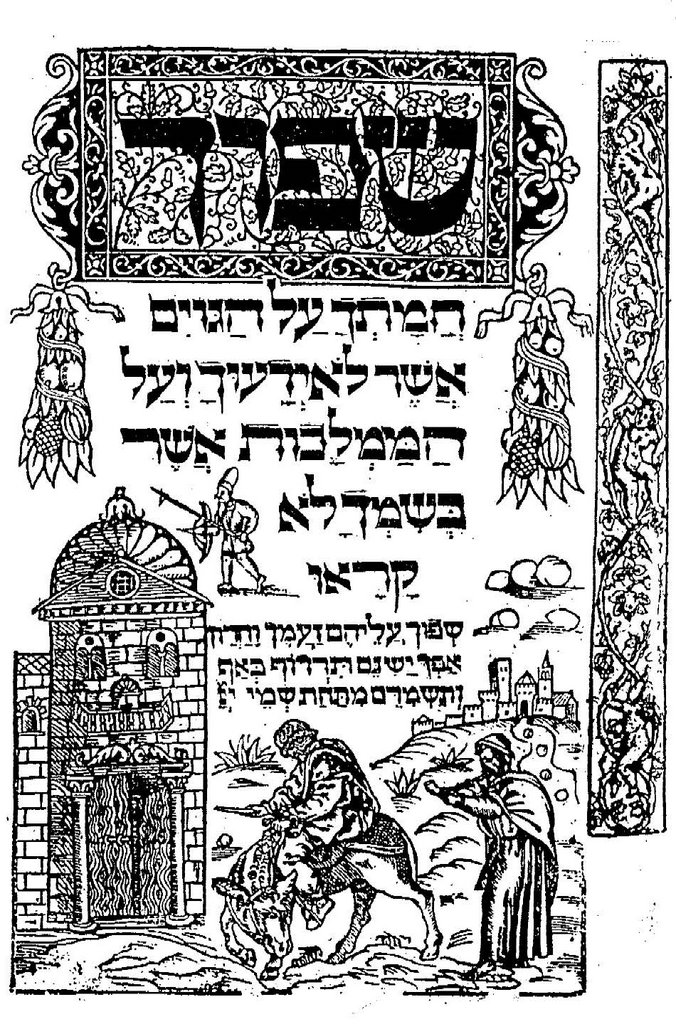
I haven’t yet mentioned the shawls that some women have started wearing (and which was the practice in the days of the Rambam; see Hilkhot Ishut 13:11) Most shawl-wearers are not so extreme as to completely cover their faces, and because of this the practice has been defended by some fairly mainstream people. According to R. Ovadiah Yosef’s son-in-law, R. Aharon Abutbol, and R. David Benizri, R. Ovadiah sees the practice in a positive light for those women who are able to take it on.[16] Among others who have spoken out in favor of the shawls are R. Yitzhak Ratsaby,[17] R. Avraham Baruch,[18] and R. Mendel Fuchs, a dayan for the Edah Haredit (who refers to the “heilige shawl”).[19] There is even a fairly recent book that discusses the matter in detail. It is Ahoti Kalah, by R. Avraham Arbel. Here is the title page.
Arbel is a great talmid hakham.[20] His book carries haskamot from mainstream figures, including R. Ovadiah, R. Neuwirth, and R. Nebenzahl. In the book, he explains the importance of the shawl, how women are not supposed to leave their home and if they must go out they should appear unattractive so that men are not drawn to them, and how it is absolutely forbidden for women to wear jewelry outside their home. (Recently, Arbel expanded the section of the book dealing with women’s tzeniut into a full-fledged book of its own.)

3. In the last post I quoted R. Kook’s comments about the holiness of the am ha’aretz. This is not a sentiment that has been widely shared among the rabbinic elite, and negative comments about the am ha’aretz abound in rabbinic literature from all eras. Most of these comments appear in non-halakhic contexts, but there are plenty that are found in classic halakhic works. See for example Shulhan Arukh, Yoreh Deah 198:48, where R. Moses Isserles states that if a woman coming home from the mikveh enounters a דבר טמא או גוי , if she is pious she will immerse again. This is obviously not so applicable today, as in any big city in the Diaspora, where people walk to the mikveh, it is impossible not to come across a non-Jew on the way home. The formulation of Rama was made in an era when Jews lived in their own quarters, and at night it wouldn’t be common to come into contact with non-Jews. On this halakhah, the Shakh quotes the Sha’arei Dura who expands the lists of things a woman hopes to avoid on the way home to include an am ha’aretz. (This formulation obviously troubled some, and Pithei Teshuvah quotes the opinion that only an am ha’aretz gamur is meant, i.e., one who doesn’t even recite keriat shema [due to his ignorance]. This definition of an am ha’aretz is found in Berakhot 47b and Sotah 22a. Examination of rabbinic literature shows that the term “am ha’aretz” has a variety of meaning, ranging from a simple ignoramus to one who is actually quite wicked and hates the Sages.)
Speaking of the am ha’aretz, here is something interesting, as it includes both a difficult comment of Rashi (actually, the commentary falsely attributed to Rashi) and what might be is an example of Artscroll purposely omitting mention of it because of how problematic it would be to explain. Nedarim 49a states: “Rav Judah said: The soft part of a pumpkin [should be eaten] with beet; the soft part of linseed is good with kutah. But this may not be told to the am ha’aretz.”
Why don’t we tell this to the am ha’aretz? Artscroll quotes the explanation of the Ran that if the boors knew about this, they would uproot the plants before they could be harvested. Tosafot claims that the ignoramuses won’t believe what we tell them and they will mock the teaching of the Sages. “Rashi” has a completely different explanation. He writes:
משום דדבר מעולה הוא לרפואה ואסור לומר להם שום דבר שיהנו ממנו
What this means is that we don’t let the am ha’aretz know about the medicinal property of this plant. In other words, we don’t want the am ha’aretz, even though he is another Jew, to benefit, and he is thus treated no differently than an idolater. (Tosafot cites this explanation and rejects it.) Even though “Rashi” is referring to a real am ha’aretz, as per the Talmud’s description in Berakhot 47b, it is still quite a shocking explanation. It is true that there is a passage in Pesahim 49b which states: “R. Eleazar said: An am ha’aretz, it is permitted to stab him [even] on the Day of Atonement which falls on the Sabbath . . . R. Samuel b. Nahmani said in R. Johanan’s name: One may tear an am ha’aretz like a fish.” Still, these passages are according to almost everyone not meant to be taken literally,[21] while “Rashi,” on the other hand, means exactly what he says.
[1] Many have discussed why Maimonides doesn’t explicitly record this halakhah in the Mishneh Torah. See the interesting approach of R. Hayyim Eleazar Shapira, Divrei Torah, Eighth Series, no. 18 (p. 974), which can be used to justify the Israeli haredi perspective.
[2] See Or Torah, Heshvan 5772, pp. 169-170. R. Mazuz’s own attitude towards yeshiva students preparing themselves to earn a living is seen in his haskamah to R. Hayyim Amsalem’s Gadol ha-Neheneh mi-Yegio. The book is available here.
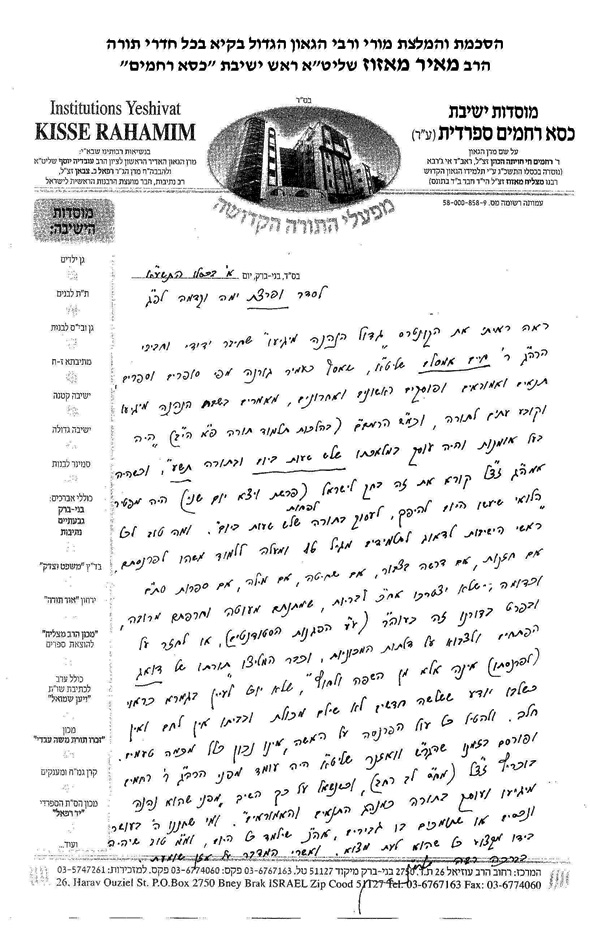
Here is R. Mazuz’s haskamah.

Here is the letter of R. Mazuz that appears at the end of the volume.

There are numerous texts I could bring in opposition to the approach of Amsalem and Mazuz (which I believe is also the approach of the Sages). One noteworthy one is found in Ateret Menahem, p. 23a, where R. Menahem Mendel of Rimanov is quoted as follows:

אם א’ אומר לחתנו היושב ולומד תורה בהתמדה שיתחיל לעסוק במו”מ עבור כי איתא [אבות פ”ב מ”ב] יפה ת”ת עם דרך ארץ וכו’, זה הוא מערב רב חו”ש
[3] See e.g., Naftali ben Menahem, Zemirot shel Shabbat (Jerusalem, 1949), p. 134.
[4] See Zev Rabiner, Or Mufla, p. 92.
[5] Barukh She-Amar, p. 238.
[6] See R. Meir Mazuz, Darkhei ha-Iyun, pp. 127ff.
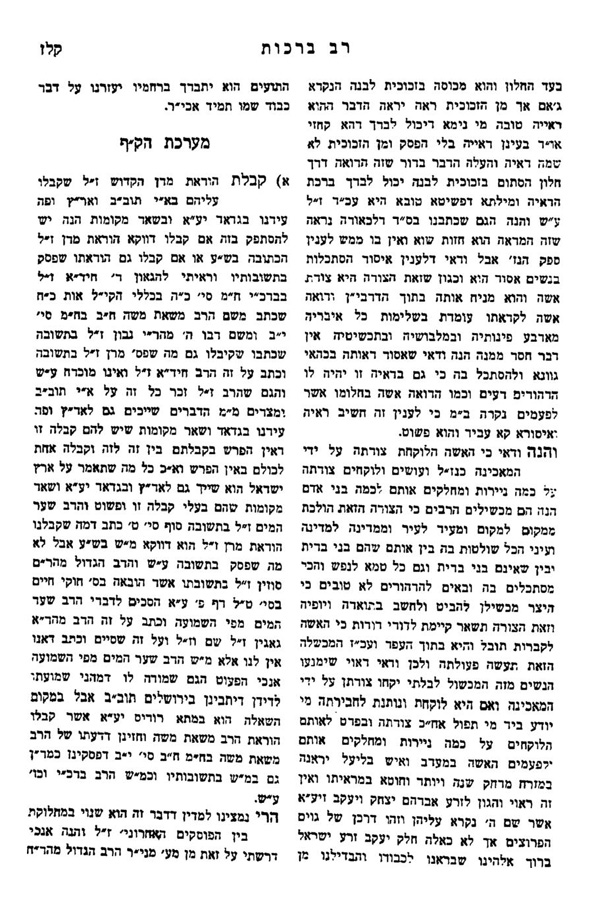
[7] Regarding not seeing women’s pictures, this position can also find sources to support it. R. Joseph Hayyim, Rav Berakhot, ma’arekhet tzadi (p. 137), writes quite strongly against women’s pictures, because men will come to look at them. Here is the page.

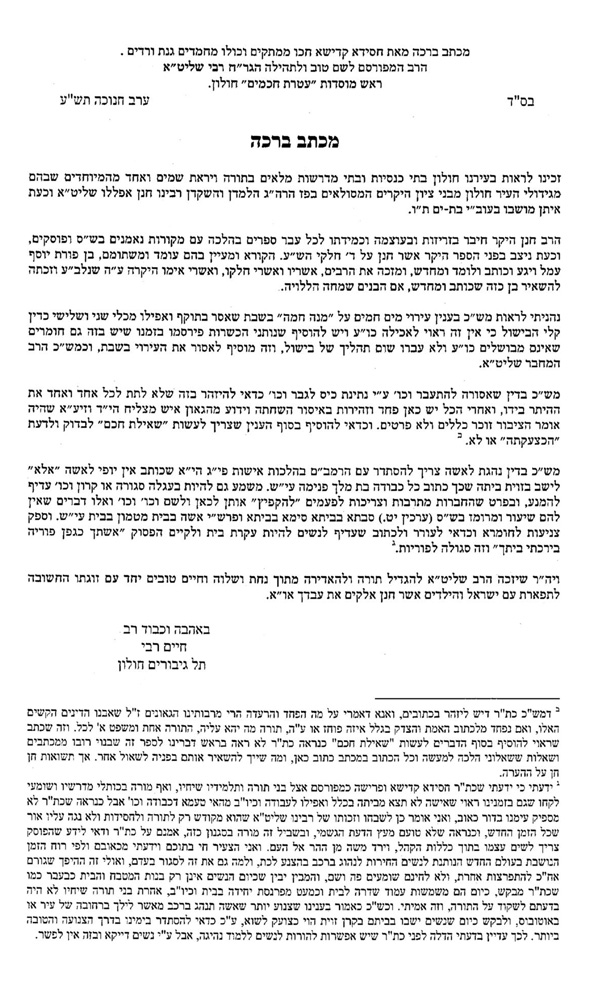
[8] For some, it is better if the women basically do not go out of the house at all at all. Such a position is held by R. Hayyim Rabbi, a mainstream Sephardic rabbi (who like all significant Sephardic rabbis, also has a website. See here).
Here is his haskamah to R. Hanan Aflalo’s, Asher Hanan, vol. 3, and see Aflalo’s response that a rabbi has to actually be part of a community and know its situation in order to properly decide matters for it.

While Aflalo’s reply is phrased very respectfully, his feeling that Rabbi is way off base comes through very clearly.

Rabbi’s position about a woman not leaving the house can find support in a variety of traditional texts (not least, the Rambam, Hilkhot Ishut 13:11). What makes it significant is that he offers this advice even today. While it is true that in the Islamic world Jewish women were more accustomed to stay inside than their co-religionists in Europe, we also find European rishonim who see this as something to strive for. See e.g.,, Radak to 2 Samuel 13:2: ודרך הבתולות בישראל להיות צנועות בבית ולא תצאנה החוצה. See also Rashi, Deut. 22:23: פרצה קוראה לגנב הא אלו ישבה בביתה לא אירע לה. For other relevant sources, see R. Mazuz’s comment in R. Raphael Kadir Tzaban, Nefesh Hayah, vol. 2, p. 267.
I was surprised to find that the Moroccan R. Raphael Ankawa, in the twentieth century, ruled that a husband could forbid his wife from leaving the house without his permission. If she didn’t listen, she would lose her ketubah. See Toafot Re’em, no. 3. In a letter of support for Ankawa by R. Shlomo Ibn Danan and R. Mattityahu Serero they go so far as to state that if the woman doesn’t go along with the husband’s command and take an oath binding herself in this matter, the husband can, if he wishes, refuse to divorce her and she will remain an “agunah” her entire life without any financial support from him! He, of course, will be given permission to remarry.
ואם לא ירצה לגרשה תשב עד שתלבין ראשה ונותנין לו רשות לישא אשה אחרת אחר ההתראות הראויות והיא אבדה כתוב’ ואין לה לא מזונות ולא פרנסה ולא שום תנאי מתנאי הכתובה.
(As late as 1965, another Moroccan posek, R. Yedidyah Monsenego, ruled that where the husband had reason to suspect his wife of being unfaithful, he could require her to never leave home without him, even to visit relatives, except when she had to go to work. See Peat ha-Yam, no. 24)
All I can say is that contemporary women should be thankful that the RCA beit din and many of the rabbinic courts in the State of Israel have realized that in modern times men and women must be treated equally in the divorce proceedings, and women can no longer be held prisoner in a dead marriage as was often the case in earlier times. With this in mind, let me remind people that in an earlier post, available here, I wrote as follows:
R. Hayyim Benveniste, Keneset ha-Gedolah, Even ha-Ezer 154, Hagahot Beit Yosef no. 59, in discussing when we can force a husband to give a divorce, writes:
ובעל משפט צדק ח”א סי’ נ”ט כתב דאפי’ רודף אחריה בסכין להכותה אין כופין אותו לגרש ואפי’ לו’ לו שחייב להוציא.
Can anyone imagine a posek, from even the most right-wing community, advocating such a viewpoint? I assume the logic behind this position is that even if the man is running after her with the knife, we don’t assume that he will actually kill her. He must just be doing it to scare her, and that is not enough of a reason to force him to divorce her. And if we are wrong, and he really does kill her? I guess the reply would be that this isn’t anything we could have anticipated even if we saw the knife in his hand, sort of like all those who have let pedophiles run loose in the yeshivot, presumably on the assumption that just because a man abused children in the past, that doesn’t mean that he will continue to do so.
(I will return to the issue of sexual abuse in a future post, because readers might recall that I expressed doubt that any rabbis would ever join the Agudah’s proposed rabbinic panel to determine if an accusation warranted going to the police. See here. The Agudah has just acknowledged that it was impossible to form such a panel precisely because of the legal jeopardy it would place the rabbis in. See here. Since it looks like all the public pressure will lead to clergy being made mandated reporters, it will be interesting to see what the Agudah response will then be. Will they instruct their followers to follow the law or expect them to go to jail in order to avoid mesirah?)
Regarding Aflalo’s point mentioned earlier in this note that a rabbi has to know the situation of a community, I recently found a very interesting comment by R. Levi Yitzhak of Berdichev, Kedushat Levi ha-Shalem (Jerusalem, 1958), Likutim, pp. 316-317. He asks why we say תשבי יתרץ קושיות ואבעיות, that in Messianic days Elijah will answer all problems. Since Moses will be resurrected, and he is the giver of the Torah, why don’t we say that he will provide the answers? R. Levi Yitzhak explains that only one who is living in this world knows what the situation is and how the halakhah should be decided. This is not the case with one who is dead and has lost his worldly connection. This explains why Elijah will provide all the answers, as he never died and was always part of the world. Therefore, unlike Moses, Elijah is the one qualified to decide matters affecting us. The lesson here is obvious, especially for those who think that every issue must be decided in Israel by authorities who really have really no conception of how American Jews live.

[9] I can’t tell you how often I have been with people (usually at Shabbat meals) who go on about how backwards the Muslims are, the proof being how they treat their women. This is usually contrasted to Judaism, which puts women on a pedestal. As an example of this “backwardness” people have pointed out that in Saudi Arabia (which is only one Muslim country, mind you), women are not even permitted to drive. I never have the heart to point out that there are hasidic sects, less than an hour away from where we are, that also don’t allow women to drive.
[10] See Ma’amar Esther, printed together with Va-Ya’an Shmuel (n.p., 2001), vol. 4, p. 19 (third numbering).
[11] Messas’ responsum is analyzed by Avinoam Rosenack, “Dignity of the Congregation” as a Defense Mechanism: A Halakhic Ruling by Rabbi Joseph Messas,” Nashim 13 (2007), pp. 183-206. On p. 201 n. 41, he provides references to scholarly literature that discusses medieval Jewish women’s adoption of Muslim modes of dress.
[12] Contrary to what Messas assumes, as far as I know there is absolutely no evidence that Jewish women generally dressed like this in the Rabbinic period. The fact that the Mishnah specifies the Arabian Jewish women shows that only one specific group dressed this way.
[13] Since he mentions women’s voices, let me return briefly to my second to last post which dealt with kol isha. I neglected to note the pesak of R. Abraham Yaffe-Schlesinger, Be’er Sarim, vol. 2, no. 54, who sees it as obvious that a woman is permitted to sing in front of non-Jews.
In the post, I mentioned three Modern Orthodox high schools that allow young women to sing solos. I was informed that the North Shore Hebrew Academy also has to be added to this list. See here.
My correspondent further wrote: “I wanted to let you know that the son of Rabbi _____ (former president of the RCA [name deleted by MS]) told me that his father used to go to see Broadway shows based on the Psak of the Rav, who felt that if you couldn’t totally make out the face of the female singer it would be permitted.”
One of the commenters on the post called attention to R. Yehudah Herzl Henkin, Bnei Vanim, vol. 4, no. 7. In this responsum, he says a couple of things very relevant to the post. To begin with, he writes that it is permitted to listen to the singing of a single woman if this is something that you are used it, and it will not be sexually arousing.
לע”ד מדינא מותר לשמוע קול שיר של בתולות אם רגיל בקולן שאז שמיעתן זהה לראיית שערן
This is the same viewpoint I quoted from R. Jacob Pardo, who distinguishes between married women, whose singing is always forbidden, and single women whose singing is only forbidden if it is sensual song. Also noteworthy is that R. Henkin rejects the viewpoint found in various aharonim that a post-pubescent female (i.e., niddah) has the same status as a married woman, and her singing is therefore forbidden:
וכיון שנהגו להקל בשערן של בתולות ולא חלקו בין נדות לטהורות הוא הדין בקולן, כל שהוא רגיל בו ואינו מהרהר.
He concludes his responsum by stating that if the song is not sensual, and the woman’s voice is heard on the radio or out of a loudspeaker, since this is not really “her” voice it is permissible to listen. What this apparently means is that any time a woman sings into a microphone, it is permissible to listen to her (assuming her very appearance is not arousing). This basically gets rid of the entire kol isha prohibition in our time (when the songs aren’t sensual), since today every event with a woman singer uses a microphone. Based on R. Henkin’s responsum, all Modern Orthodox high schools could once more return to having young women sing solos (even though I am certain that this is not his intention).. Here is his conclusion (emphasis added):
ולא מפני שאנו מדמים נעשה מעשה להתיר לכתחילה לשמוע קול אשה המזמרת לפננו לבדה, אבל בשירה ברדיו או דרך רמקול וכו’ שעל פי דין אינה קולה ממש ובצירוף עוד טעמים [ראה להלן מאמר כ’] ובתנאי שהשירה אינה של עגבים נראה פשוט להקל.
In Bnei Vanim, vol. 2, p. 211, he quotes his grandfather as even permitting watching a woman sing on the television, because again, the voice is not her actual voice. He also notes that his grandfather later expressed doubt on this point.
שמעתי מפיו הקדוש שקול אשה על הרדיו אינו נקרא קול אשה ומותר לשמעו [בפעם הראשונה ששאלתי אותו על זה אמר בפירוש שגם בטלביזיה אינו נקרא קול אשה ומותר לשמעו, אבל כשחזרתי ושאלתי אותו על זה אחרי זמן לא היה ברור אצלו – ואולי מפני חולשתו]

In vol. 4, p. 30, he refers to a woman singing the national anthem, which based on his argumentation would, I think, be quite easy to permit, even watching on television. As he notes, this is not the sort of song that arouses sexual thoughts:
ורבים מקילים לשמוע קול שיר של אשה ברדיו כשהיא אינה לפניהם, ואינה שרה שירי עגבים אלא שירי מולדת וכיוצא באלה ורחוק שיהרהרו בה ואינו תלוי באם מכירה או לא.
I would also like to share an email I received from Benny Hutman which relates to R. Moshe Feinstein’s opinion. In my post I called attention to a responsum of R. Moshe Feinstein which I claimed cast doubt on R. Mordechai Tendler’s assertion that according to R. Moshe kol isha is entirely situational and depends on whether or not someone is aroused.
Benny writes:

It seems to me that R’ Moshe must hold that the prohibition on Kol Isha depends on whether a person is used to hearing women sing. R’ Moshe holds like the Aruch Hashulchan that nowadays one can say Shema in front of a woman with uncovered hair because the reality is that we are constantly confronted with such hair and therefore it is no longer arousing. For this to make sense we need to understand the Gemara in Berachos when it says “sear b’isha erva” to mean that hair could be ervah, meaning I would have thought that ervah by definition could only refer to parts of her body, ka mashma lan that hair despite not being skin can be ervah. However it won’t actually be ervah unless it is normally covered. Since the language of the Gemara is exactly the same (as is the source) it follows that the gemara means that Kol Isha could be ervah despite not physically being attached to the body at all. However, just as R’Moshe says that our constant exposure to uncovered hair makes sear no longer be ervah, the same logic dictates that if someone has been listening to women sing all his life kol isha will not be ervah. Arguably it can also be situational so that if someone has been going to the opera all his life such singing will not be kol isha, but pop music will be. It seems to me that this heter should apply to almost all Modern Orthodox men. This would explain how Rabbi Tendler could say that R’ Moshe held that the prohibition is situational despite R’ Moshe’s tshuva apparently holding it is forbidden. It depends on who is asking the question and the time, place and manner of the singing.

Finally, R. Hayyim Amsalem, in his recently published Derekh Hayyim, p. 45, states that it is a well known fact that great Torah scholars and chief rabbis have in the past been present at various official events that included women singing, and they did not walk out. As he explains:
הם ידעו לחשב שכר “מצוה” כנגד הפסדה, ושגדול כבוד הבריות שדוחה לא תעשה שבתורה (ברכות דף יט ע”ב), שלא לדבר על העלבת פנים העלולה להגרם, והרי המלבין פני חברו ברבים אין לו חלק לעוה”ב (בבא מציעא דף נט ע”א), יתכן וכשהיו יכולים להשתמט מלהופיע בטקס כזה שידעו מראש שיכלול גם שירת נשים היו נמנעים מלהופיע, אבל היכן שההכרח אלצם להשתתף הרי שמעולם לא נשמע רינון אחריהם על השתתפותם, או על העלבת המעמד ביציאה פומבית.
[14] Rosenack writes (“Dignity”, p. 190): “Messas’s remarks allow the inference that he knew of an ancient tradition—either from the days of his own ancestors, or from the time of the talmudic sages—of women going up to the Torah, before the institution of the [talmudic] prohibition discussed here.” This is incorrect. What Messas is doing in this responsum is describing what he imagines the situation was like in the era that women received aliyot, and why this was later prohibited. There is not even the hint that he knew of any ancient tradition in this regard, and he certainly did not.
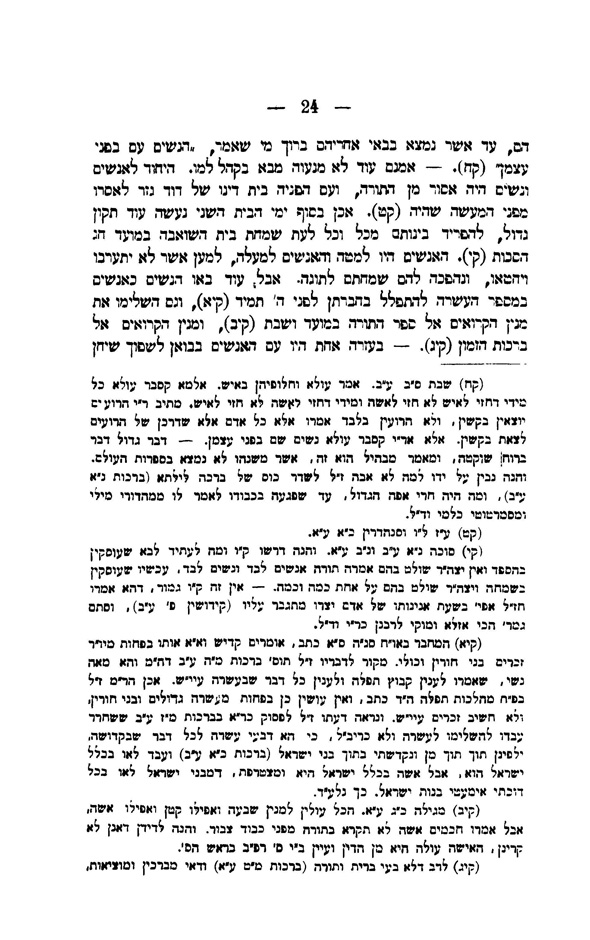
In terms of women’s aliyot, in my post here I called attention to R. Samuel Portaleone’s opinion that in theory it is permitted to give a woman an aliyah in a private synagogue. Without knowing of Portaleone’s view, R. Yehuda Herzl Henkin concluded that ”if done without fanfare, an occasional aliyyah by a woman in a private minyan of men held on Shabbat in a home and not in a synagogue sanctuary or hall can perhaps be countenanced or at least overlooked.” “Qeriat Ha-Torah by Women: Where We Stand Today,” Edah Journal 1:2 (5761), p. 6. (Henkin also assumes that women’s aliyot on Simhat Torah are permissible.) There is another source in this regard that has been overlooked by those arguing for women’s aliyot in so-called partnership minyanim (I hate this term!). R. Moses Salmon, Netiv Moshe (Vienna, 1899), p. 24 n. 112, sees no problem with women getting aliyot today. As mentioned already, women are denied aliyot because of kevod ha-tzibur. Yet according to Salmon, since today men who get aliyot no longer read from the Torah, kevod ha-tzibur is no longer a concern. This was all theoretical for Salmon, as no one in his Hungarian town was dreaming of calling women up to the Torah, but from the standpoint of pure halakhah, he saw no objection. He also claims that according to Maimonides, women can be counted in a minyan. See ibid., n. 111. Here is the page from Salmon.
[15] The same approach is adopted by R. Matzliah Mazuz, Ish Matzliah, vol. 1 no. 10. He writes:
לע”ד כבוד ציבור דהתם, אינו כפשוטו, אלא לישנא מעליא, ועיקר הכוונה כאותה ששנינו בסוכה דנ”א תיקון גדול

[16] See here and here.
[17] See here and here. See also his Shulhan Arukh ha-Mekutzar, vol. 6, pp. 246ff., and here for a placard signed by some leading Sephardic rabbis.
[18] See here. He thinks that a woman who refuses to say good morning to her male neighbor is demonstrating proper tzeniut.
[19] See here.
[20] Incidentally, in no. 328:2, he states that there is no longer a problem taking medicine on Shabbat, since people today do not grind their own medicine.

  • [21] See the numerous explanations of these passages in R. Moshe Zuriel, Leket Perushei Aggadah, ad loc. Tosafot, ad loc., quotes one opinion that does take the passage literally, but this opinion assumes that the am ha’aretz spoken of is a violent person suspected of murder

Hunted Bears, Cantonists and Nazi Victims

by Yitzhak, בין דין לדין.
I thank Dan Rabinowitz for graciously allowing me to post this essay.
Hunted Bears

This is the cover image of the Gary Larson collection Beyond The Far Side:

I have long found this cartoon profoundly depressing, in its humorous but acute portrayal of the moral degradation of which we are capable. עור בעד עור, וכל אשר לאיש יתן בעד נפשו 1; the desperate bear grins inanely as he attempts to persuade the hunter to shoot his companion instead of himself.

Several months ago, though, I had an epiphany; it is all very well to consider the matter from a literary-psychological perspective, but what is the view of the Halachah 2?

Cantonists and ‘Chappers’

The thought lay dormant in my mind, until I read the following paragraph in Dr. Marc Shapiro’s typically erudite and fascinating article Rabbis and Communism at The Seforim Blog:

When dealing with anti-clericalism in Russia, we must also not forget the masses’ long memory of how some (many?, most?) rabbis were silent during the era of the chappers. This was when children were grabbed for 25 years of military service in the Cantonists, often never again to see their parents and usually succumbing to incessant pressure (including torture) to be baptized. Yet it wasn’t the children of the rich or the rabbis who were taken, but the poor children. Jacob Lifshitz’ defense of the way the Jewish community dealt with the Cantonist tragedy – which he regards as worse than even the destruction of the Temple! – and his insistence that no one can judge the community leaders unless they themselves had been in such a difficult circumstance, is something we must bear in mind. Yet all such ex post facto justifications would have no impact on the outlook of those that actually suffered during the Cantonist era, and it is no wonder that many of the common people would not regard the rabbis in a sympathetic light. The rabbis were certainly able to come up with a justification why their sons, the future Torah scholars, should not be taken to the army, just as they continue to make this argument. Yet this would only serve to show the masses that some children’s blood was indeed redder than others.

This post shall attempt to clarify the relevant controlling Halachos for both scenarios: may a bear attempt to save his life at the expense of his comrade’s, and may a potential or actual draftee, or a friend of his, attempt to evade the draft if the consequence will be the drafting of another instead.3

The Yerushalmi

The locus classicus for this discussion is a passage in the Yerushalmi Bava Kama:

שור שעלה בחבירו ובא בעל השור ושמטו מתחתיו אם עד שלא עלה שמטו ונפל ומת פטור ואם דחהו ונפל ומת חייב

אמר רבי יוסי ותישמע מינה ראה אמת המים שוטפת ובאה לתוך שדהו רשאי לפנותן למקום אחר משנכנסו אין רשאי לפנותן למקום אחר
אהן כריסו ארגירא עד דלא ייתי אהן כריסו ארגירא שרי מימר פלן עביד עבדיתי פלן עביד עבדיתי. מן דייתי אהן כריסו ארגירא אסיר.

הדין אכסניי פרכא עד דלא ייתון רומאי שרי מיחשדוניה ומן דייתון רומאי אסיר.4

The Nimukei Yosef cites the second paragraph of the Yerushalmi, about the Amas Hamayim 5.
Rema rules:

היה רואה נזק בא עליו מותר להציל עצמו אף על פי שעל ידי זה בא הנזק לאחר6

Rema only cites the permissive component of the Yerushalmi; he omits the Yerushalmi’s stringency, prohibiting the shifting onto another of a misfortune that is considered to have already befallen. Sema does indeed cite the latter part of the Yerushalmi:

שם בנימוקי יוסף סיים וכתב דאם כבר בא עליו אסור לסלקו ממנו כשגורם בזה היזק לחבירו:7

but why does Rema omit it? This question is raised by Rav Haim Yehudah Leib Epstein, who infers that Rema does not actually accept the stringency of the Yerushalmi L’Halachah, a position for which he offers various justifications, which are beyond the scope of this post 8. Although we shall see that The consensus of the Poskim, however, seems to accept the Yerushalmi in its entirety as Halachah 9.
The Hafetz Haim discusses this Yerushalmi; he is curiously tentative about its application to the question of Lashon Ha’Ra that he is considering, the deflection of blame from oneself in a situation in which so doing will consequently cause another to be accused:

אבל אם על ידי זה [שמשיב מי שנחשד מחבירו בעשיית דבר שלא כהוגן נגדו שאכן הוא לא עשאו] ממילא יוודע לו העושה, כגון שלא היה לו הספק כי אם על שניהם, תלוי בזה: אם הוא באמת דבר שאינו הגון, נראה דמותר לדחות זה מעל עצמו, אף שממילא יתגלגל הדבר על חבירו. אבל אם באמת דבר זה איננו עוולה, רק להשואל נראה שהדבר הזה הוא עוולה, צריך עיון אם מותר להשיב לו אפילו בלשון: אני לא עשיתי את הדבר, כיון שעל ידי זה ממילא יתגנדר הדבר על חבירו.10

ונראה שדבר זה תלוי במה שמבואר בחושן משפט, בסימן שפ”ח (סוף סעיף ב) בהגהה … ועיין בסמ”ע שם … ומשמע מביאור הגר”א שם (אות כ”ט) שהוא מסכים להסמ”ע. והכא נמי אם הוא רואה שנחלט לעת עתה חשדא אצל השואל עליו, אסור לו לגלות כדי להסירה מעליו ולתיתה על חבירו, ועיין בביאור הגר”א שם, ואם אינו בגדר זה, מותר. ואף על פי כן, דבר זה אינו מבורר אצלי היטב למעשה.

Draft Evasion

Rav Yosef Ibn Lev discusses a case apparently very similar to one of the scenarios in the Yerushalmi:

שאלה ראובן היה לו אהבה עם השרים ויועצי המלכות ולפעמים היו תופסין מחמת המלכות לקצת יהודים עשירים והיו כותבין לשראפי”ש או לשאר אומניות כמנהג המלכות הלז וזה היהודי שיש לו אהבה עם השרים יש לאל ידו להציל איזה יהודי מאותה הצרה אבל ירא לנפשו שאם יציל לשמעון יקחו ללוי תחתיו ומאן לימא ליה דדמא דשמעון סומק טפי דילמא דמה דלוי סומק טפי ועל זה שאל אם הרשות בידו להציל לשמעון מצרתו:

תשובה עיקרא דהאי מילתא איתא ביבמות פרק הערל אמרינן התם מאי שנא הני אמר רב הונא העבירום לפני הארון כל שהארון קולטו למיתה כל שאין הארון קולטו לחיים מתיב רב חנה בר ביזנא ויחמול המלך על מפיבושת בן יהונתן בן שאול שלא העבירו וכי משוא פנים יש בדבר אלא שהעבירו וקלטו ובקש רחמים ופלטו ואכתי משוא פנים יש בדבר אלא שבקש רחמים שלא יקלטנו הארון מהך שמעינן בנדון דידן שאם כבר כתבו ליהודי אחד לשארא”ף ותפשו אותו והדבר ידוע שאם ימלט זה שיקחו אחר תחתיו אין להשתדל להצילו אבל אם יצתה גזרה לקחת קצת יהודים לאומנות המלך לשרא”ף וכיוצא בו הרשות נתונה להשתדל להציל לכל מי שירצה

והאי דכתבינא דאם כבר נכתב למלכות דאסור להשתדל להצילו כיון דמנהג הוא לקחת אחר תחתיו היינו דוקא היכא דהוי ודאי דלית ספיקא אבל היכא דאיכא ספיקא די עידנא ישתנה ויעבור זעם ולא יקחו אחר תחתיו אין ספק מוציא מידי ודאי …11

Shach endorses Ibn Lev’s ruling distinguishing between where the royal decree specifies particular individuals and where it merely demands a quota, and he says that the inference from the Mefiboshes passage is compelling12. It is curious, though, that neither Ibn Lev nor Shach mention in this context the Yerushalmi that we have been discussing until now; Rav Akiva Eiger 13, Rav Baruch Frankel14, Rav Meir Ya’akov Ginzberg15, and Pis’hei Teshuvah16 all refer the reader to the Yerushalmi. We shall presently see a suggestion for why Ibn Lev and Shach do not cite the Yerushalmi.

Rav Shmuel Landau discusses whether it is permitted to take action to save particular individuals from a governmental draft, even though the result will inevitably be the seizure of others:

… ועל דבר שאלתו שאלת חכם חצי תשובה קשה להורות בדבר הנוגע לנפשות תחלה ומי ירים ראש בדברים כאלה. …

אבל לבי מהסס בדבר אם מותר לישראל להשתדל עבור איזה אנשים שלא יקחו אותם. ודבר זה מבואר בתשובות מהר”י בן לב .. הובא בש”ך … ואם כן גם בנדון דידן אם עדיין לא לקח השר ולא פרט מי שיהיה יכולים להשתדל דרך שלילה על אנשים ידועים שלא יקחו אותם:
ובאמת תמיה לי טובא על הש”ך בסימן [ק]ס”ג שהביא ממרחק לחמו מתשובת מהר”י בן לב הנ”ל הלא דבר זה מפורש בש”ע ברמ”א סימן שפ”ח סוף סעיף ב’ … הרי ממש כפסק של מהר”י בן לב וגם הסמ”ע שם כתב … הרי ממש כפסק של מהר”י בן לב:

ואפשר ליישב דמהרמ”א לקמן נשמע דאותו אדם עצמו כשרואה דהנזק בא עליו דמותר להציל עצמו אבל שיהיה לאחרים רשות להשתדל עבורו לא שמענו ולכך הביא הש”ך דברי מהר”י בן לב ופסק דגם אחרים יכולים להשתדל עבורו אם עדיין לא בא הנזק וראייתו מדוד שהתפלל על מפיבושת שלא יקלטנו הארון: [ועיין שם שהאריך לפלפל בסוגיא דיחדו לאחד מהם.]17

Rav Avraham Maskil Le’Eisan cites this responsum and suggests that one may permitted to save himself at another’s expense even if he has already been selected for misfortune:

ועיין בנודע ביהודה .. שכתב דאם כבר לקחו אנשים ידועים אסור להשתדל להצילם רק קודם שנלקח אף א’ מותר להשתדל להציל א’. וכמו שכתב הש”ך .. ובהג”ה שם (ש”פ) [לכאורה צ”ל שפ”ח].

ונראה שהוא עצמו יכול להשתדל אף שנלקח דחייך קודמין:18

This is incomprehensible; as we have seen, the entire point of Rav Landau is that the reason that Ibn Lev and Shach do not derive their permission to save someone at another’s expense from the Yerushalmi is because they are allowing a third party to save a victim, whereas the Yerushalmi is discussing efforts by the victim himself, and yet the Yerushalmi explicitly forbids even such efforts when the misfortune is specific to the victim! Perhaps Rav Maskil Le’Eisan holds like Rav Epstein, that the Rema’s omission of the Yerushalmi’s prohibition indicates that it is not normative, but given that the Sema does cite the prohibition, and none of the major commentaries reject it, if Rav Maskil Le’Eisan really held like Rav Epstein, he should have said so explicitly 19.

“At Risk” Youths

In his article, Shapiro comments that:

Michael Stanislawski notes that in one community the communal leaders wanted to grab a poor tailor since he wasn’t observant, but the local rabbi forbid it. …

In a strong defense of the rabbis against the charge that they collaborated with the rich people in order to ensure that the poor were taken, R. Moses Solomon Kazarnov calls attention to all that the rabbis did to defend the children of the lower class. But he acknowledges that the rabbis would hand over the non-religious kids, including their own!

In the continuation of his responsum, Rav Landau, no mere local Rabbi, issues an uncompromising rejection of religious laxity as a justification for handing someone over to the government. He unequivocally, passionately and eloquently rejects a suggestion of his questioner that the community satisfy the government’s demands with some “נערים קלים ופרוצים ביותר”; indeed, he seems horrified by the idea:

ומה שכתב מעלתו דיש שם איזה נערים קלים ופרוצים ביותר. אהובי ידידי אין אנו יכולים לדון דיני נפשות דעל כל פנים הנערים אינן בכלל מורידין אף שהם נוהגין בקלות קצת והרבה הילדות עושה וניתן להענישם בתפיסה ומכת מרדות וכדומה אבל חלילה למסור אותם בידים ואל ידח ממנו נידח להדיחם לגמרי מקהל עדת ישראל ואף שיש ביד טובי העיר והבית דין לדון בכל עונשים חמורים למגדר מלתא היינו אם העם פרוץ בו וגם לזה צריך שיהיה דוקא גדולי הדור או טובי העיר שהמחום רבים עליהם … אבל היכא דליכא משום מגדר מלתא שאין העם פרוצים רק איזה נערים הקלים מי ירים ראש לדון בזה. …

[ועיין שם שפלפל עוד בזה, והעלה:] ויהיה איך שיהיה … בנדון דידן אף שיש נערים קלים ועוברים על איזה מצות אין אנו רשאין בשביל כן להעניש אותם כפלי כפלים ככל חטאותם ולסכן אותם בידים ובפרט שלא נתברר בעדות ברורה אם עברו על עבירה חמורה בשאט נפש לכן שארית ישראל לא יעשו עולה כזו.20

We must note that Rav Landau’s unwillingness to countenance the seizure of the religiously dubious youths is apparently predicated on his assertion that they are not in the category of Moridin; if it were reliably established that they were thoroughly irreligious21, he may indeed not object to their seizure.
Rav Landau concludes with an apparent reiteration of his earlier ruling permitting action which is merely evasive:

אך את זה יכולים לעשות להשתדל דרך שלילה על אדם חשוב וכשר שלא יקחו את זה כל זמן שלא קראו לו בפירוש שאותו הם מבקשים אבל אם כבר בא הפקודה לאחד קשה להורות להתיר להשתדל עבורו אם על ידי שזה יוצא לחירות ילכד אחר במצודה זו ומאי חזית דדמי דהאי סומק טפי מדמי דאיש אחר אשר יבא אחריו.

וידעתי שבנדון זה קשה להורות ועל זה אמרו חז”ל כשם שמצוה לומר דבר הנשמע כן מצוה שלא לומר דבר שאינו נשמע והמשכיל בעת ההיא ידום אבל על כל פנים זה מחויב למחות ביד מי שרוצה למסור בידים.

The Hasam Sofer has a similarily strong denunciation of the unfair selection by the community of particular individuals, even alleged “פוחזים וריקים”, to be drafted:

ועל דבר עם בני ישראל הנלקחים לצבא המלחמה למלכיות השתיקה יפה מדיבורינו בזה וגדולי ישראל ע”כ יעלימו עין והניחו להם להממונים מקהל לעשות כראות עיניהם לפי הזמן ועת לחשות

ומכל מקום אומר כי גוף ענין דינא דמלכותא להטיל מס על כל עמו להעמיד מהם אנשים לצבא מלחמתו וזה הוא מחק מלכותו ודינו דין וממילא מוטל אקרקפתא דכל מי שראוי לצאת ושאין לו אשה ובנים כפי נימוס וחק מלכותו אך לא אבחורים לומדי תורה שאפילו לא פטרום המלכות בפירוש מכל מקום מדין תורה פטורים דאמרינן בפרק קמא דבבא בתרא ח’ ע”א הכל לכרי’ פתייא אפילו רבנן והני מילי דלא נפקי באוכלזא אבל נפקי באוכלזא רבנן לאו בני מיפק באוכלזא נינהו ומכל שכן שהמלכות יר”ה פטרם וכבר כמה פעמים כשנתתי אטעסט לבני מדינו’ פיהם ומעהר”ין שהם לומדים ויצליחו לנהוג ציבור נפטרו מלהעמיד עצמם לצבא ואם כן כל הנוגע בהם נוגע בבבת עין:

ואידך מהראוי שיעמדו עצמם כולם בשוה לפני העדה ויטילו גורל ועל מי שיפול עליו הגורל הוא ישתדל לעצמו במה שיכול לפטור בממון או להעמיד אחר במקומו או ילך בעצמו וכל ישראל מחויבים לסייעו ויקר פדיון נפשו אבל לאנוס אנשים בלי גורל ולומר שהם פוחזים ורקים אפילו מגלי עריות ומחללי שבת בעיני הוא כגונב נפש ומכרו כי מי נותן זה חליפי זה כיון שחיוב המלכות ופקודתו על כולם בשוה והמוסרו כמוסר לתוא מכמר אפילו מחוי אתיבנא חייב מכל שכן מוסר נפשו ורע ומר יותר כי הטובים הנאנסים עוברים על המצות באונס ולעתים רחוקים ואלו יעשו ברצון ואנו מדחים אחר הנופל עיין פרק קמא דקידושין לענין מכר עצמו לנכרים:

אך מה שנמצאים עתה למאות המוכרים עצמם מרצונם וברצי כסף ולכן אף על גב דהמה גריעי מכולהו שהרי בשאט נפשם מתנים לחלל שבתות ולאכול איסורים מכל מקום כיון דשכיחי טובא ולא הוה כתרי עיברא נהרי ואם אין קהלה זו קונהו ימכור עצמו במקום אחר אם כן קלקלתם בעו”ה תקנה קצת וכן עשו בכל גלילותינו והוא כעין בחירת הרע במיעוטו
והנה קצרתי מאוד כי אין ראוי להאריך בענין זה כמובן …22

Hasam Sofer prohibits seizing even youths who are מגלי עריות ומחללי שבת, but perhaps he is referring only to those who yield to temptation, and are therefore not considered Apikorsim, Minim or Meshumadim, and are not in the category of Moridin 23.
Although both Rav Landau and the Hasam Sofer are unequivocal in their condemnation of the unfair seizure by the community of particular individuals in order to save others, I do not know if their opposition would extend to a mere request to the government that it draft them, or to the attempt by the targeted bear in the Far Side cartoon to convince the hunter to shoot his companion instead of himself. Normally these actions might constitute Mesirah, but in these situations, where the government will inevitably seize some individuals, and the hunter will certainly shoot a bear, and the request is merely determining who the victim(s) will be, perhaps the permissive rulings of the Yerushalmi and Ibn Lev still apply, since in any event the Yerushalmi seems to be a dispensation of the law of Grama B’Nizakin, which would presumably normally forbid the causing of harm to another even in the indirect forms under discussion.

Kapos, Quotas and Cards

Rav Zvi Hirsch Meisels relates the following heartbreaking story:

מסחר נפשות עם הקאפו”ס

והנה ליום המחרת, שהיא יום א’ דראש השנה, אשר כל באי עולם יעברון לפניו כבני מרון, היה יום מהומה ומבוכה, ומפה לאוזן נתפשטה השמועה בכל המחנה, שלעת ערב יקחו את הנערים לבית המוקד, … ולהרבה אנשים שבמחנה הי’ להם בנם יחידם, אשר נשארו להם לפליטה, בתוך אלו הנערים או שאר בשרם הקרובים אליהם, או סתם ידידים אהובים אנשי עירם, והמה רצו כל היום בראש מבולבל מסביב הבלאק המוסגר, אולי יופתח איזה קרן אור להציל משם את הנער היקר להם עד שלא תחשך השמש.

אך השומרים הקאפו”ס לא שעו אל כל תחנוניהם ובכיותיהם להוציא איזה נער וילד, מבין המסוגרים אשר נדונים לשריפה, … במקרה הלזה הי’ גם טענתם בטענה צודקת בפיהם, היות שהם אחראים על סכום הילדים שהופקדו לשומרים אליהם, אשר היה במספר מדויק, ולעת ערב עליהם למסור אותם לידי אנשי הס’ ס’ ימ”ש במספר ובמנין כאשר מסרו להם, ואם יחסר אחד מהם אז דמם בראשם ויקחו אותם לשריפה, נפש תחת נפש.

אכן סוף סוף אחרי הרבה השתדלות ומו”מ של הקרובים עמהם גברה בהם תאות הממון, והסכימו בעד תשלום סכומים גדולים, לשחרר איזה נער וילד, ותיכף חטפו במקומו איזה נער אחר, מן הבא בידם בתוך המחנה, (מאלו שהצליחו להתחמק מהאוסף של אתמול או שנשתחררו בעת הבירור על ידי נגיעת ראשם בדף) וסגרוהו בהבלאק הנ”ל במקום הנער הפדוי כדי שיהיה המספר שלם.

והנה להרבה אנשים הי’ עוד סכומי כספים, או חתיכת זהב או מרגליות, טמון במטמונים ובמנעלים לעת הצורך, וכמובן שהי’ כמה אנשים פשוטים ובעלי קוצר השגה שלא עשו שום חשבונות מה נעשה במקום נער הנפדה, וקיבצו במסירת נפש כל הונם הנשאר להם או שהשתדלו לאסוף סכום הנצרך, מאחרים ידידים ומכירים, ופדו את בנם המסוגר מכליון בטוח, וככה נמשך סחר-מכר הלזה משך רוב יום הדין לעיני כל האנשים שבמחנה, …

אמנם כמובן שהי’ הרבה אנשים בעלי השגה, שלא רצו לפדות את בנם, על חשבון חייו של ילד אחר, כמאמר חכמז”ל מאי חזית, ולעולם לא אשכח עובדא נוראה אחת, אשר עיני ראו ואזני שמעו, אז בשעת ענין הנ”ל, אשר מעשה הלזה מסמל את קדושת בני ישראל, והתמסרותם לדרכי התורה הקדושה בתמימות אף בעת צרתם וסבלותם הנוראה.

מסירות נפש של אב מלהציל בנו יחידו

הנה ניגש אלי איש יהודי, שהיה נראה ליהודי פשוט מאויבערלנד, מתמימות הדברים שלו שאמר לי כדברים האלה.

רבי, הבן יחיד שלי, היקר לי מבבת עיני, נמצא שמה בתוך הנערים הנידונים לשריפה, ויש בידי היכולת לפדותו, והיות שידוע לנו, בלי שום ספק, שהקאפו”ס יתפסו אחר במקומו, על כן אני שואל מהרבי שאלה להלכה ולמעשה, לפסוק לי הדין על פי התורה אם אני רשאי לפדותו, וכאשר יפסוק כן אעשה.

[ועיין שם שלא רצה לפסוק הלכה בדבר זה, בלי ספרים, בלי רבנים אחרים ובלי ישוב הדעת, והתחנן אל השואל שאל יטיל עליו את האחריות הנוראה הזו. אולם האב השואל החליט, מתוך סרבנותו של הרב מייזליש להשיב תשובה ברורה, שהדבר אסור, ואמר שאם כן הוא מוכן להקריב את בנו יחידו על פי התורה וההלכה, ושהוא מקבל את זה באהבה ובשמחה, וכך עשה:] וגם ככה קיים דבריו ולא פדה את בנו, והיה כל היום, יומא דראש השנה, הולך ומדבר לעצמו בשמחה שזוכה להקריב את בנו יחידו לה’ כי אף שיש ביכולת בידו לפדותו עם כל זה אינו פודהו מחמת שרואה שהתורה לא התירה לו לעשות כזאת ויהיה חשוב לפני השי”ת כעקידת יצחק אבינו שהי’ גם כן ביום ראש השנה. …24

In a footnote, Rav Meisels analyzes the question Halachically. He begins by citing the Rema, Sema (citing the Nimukei Yosef citing the continuation of the Yerushalmi, as above), Shach (citing Ibn Lev), and Rav Landau, and he then proceeds as follows:

ונסתפקתי בנידן דידן אם האב לגבי בנו רשאי להשתדל לפדותו אף שיודע שעל ידי זה יותפס אחר. לפי מה שכתב בהגהות יד אברהם .. דנראה שהוא בעצמו יכול להשתדל בהצלתו אף אחר שנתפס, אף על גב שיודע שעל ידי זה יקחו אחר במקומו, מכל מקום אמרינן חייך קודמין, ודוקא לפדות לאחרים אסור להשתדל להציל, אם על ידי זה יקחו אחר במקומו ע”ש. ואם כן יש להסתפק אם אב לפדות את בנו בכי האי גוונא שיקחו אחר במקומו, אם האב נידון כאחר ואסור להציל בנו בכי האי גוונא או דגם האב לגבי בנו אמרינן חיי בנך קודמין לחיי אחרים. ועיין בבא בתרא (קל”ו ע”ב) פלוגתא אי בנו עדיף ליה מנפשיה ע”ש וצ”ע.

As I have argued earlier, the Yad Avraham’s assertion is quite puzzling, since it seems to contradict the Yerushalmi. Rav Meisel’s acceptance of it is even more baffling, since he has just cited both the Sema and Rav Landau’s responsum, which eliminates my earlier suggestion that the Yad Avraham disagrees with the Sema and does not accept the stringency of the Yerushalmi as normative.
Irving J. Rosenbaum cites the following discussion of Rav Efraim Oshry:

On the twenty-third of Elul, 5701 (September 15, 1941), the German supervisor of the Kovno ghetto (Jordan) provided the Aeltestenrat (Judenrat) five thousand “white cards” to be distributed to workers and craftsmen in the ghetto and their families. Only those having “white cards” would be allowed to remain. At that time there were about thirty thousand souls in the ghetto, of whom about ten thousand were such workers and their families. In consternation, those workers who were the strongest forcibly seized “white cards” for themselver from the Aeltestenrat. Rabbi Oshry perceived two halakhic questions involved in the matter. … The second: Was it permissible for a worker to snatch a card for himself, even though by so doing he would certainly be causing the death of another – since there were only five thousand cards for ten thousand workers? …

The second question – the permissibility of seizing a card and saving one’s own life at the expense of another – also has precedent in Jewish law. The first is found in the Shakh … However, Rabbi Oshry rejects this as a precedent for our case, since the Shakh’s decision applies only when the men have not yet been seized. Then it is permissible to try to prevent them from being taken, even though others would suffer as a result. However, the Shakh would most probably rule that if two men were already in custody, it would not be permitted to attempt to free them; for it would then be inevitable that two others would be taken in their stead. In the Kovno ghetto situation, one could say that the entire community was already “taken prisoner”. If so, the decision of the Shakh would not apply, and it would be forbidden for the workers to seize the “white cards.”

Yet it might be held, Rabbi Oshry continues, that in our case it would still be permissible. For as the Yad Avraham .. points out, it is only forbidden for others to try to rescue the imprisoned men when this will simply lead to different victimes being seized. However, it is certainly not forbidden for the prisoner himself to attempt to escape even though someone else will suffer. So too, here, the worker who seizes the card is saving himself, not another. But upon close examination this analogy proves imperfect. For the Yad Avraham is referring to a case where his action does not directly cause another to die. It is simply that if he escapes another is imprisoned in his place. Though the second man may ultimately die because of this, his death is not directly resultant from the act of the first. But in the Kovno ghetto, the seizure of the card by one workman would directly result in the death of one who was denied a card by his action.
It is possible to support this distinction between direct and indirect action from the classic case in the Talmud, Baba Metzia 62a.

If two men are traveling on a journey [far from civilization] and one has a pitcher of water, if both drink they will both die, but if one only drinks, he can reach civilization. Ben Patura taught: “It is better that both should drink and die, rather than that one should behold his companion’s death.” Until Rabbi Akiba came and taught: “‘that thy brother may live with thee’ (Lev. 25:36), thy life takes precedence over his life.”

As Rabbi Oshry explains Ben Patura’s point of view, it is the drinking by the one man that causes the death of the other. The saving of his own life is, thus, the direct cause of his fellow’s death. Ben Patura does not believe that the injunction of “and live by them” (Lev. 18:5) – not die by them – applies if one gains his own life by not attempting to save his comrade’s. And though Rabbi Akiba disagrees with Ben Patura, it is only in this case of the two travelers, where the one takes no direct physical action to injure his fellow, but simply refrains from giving him water, that Rabbi Akiba would sanction his behavior. However, in our case, where as a result of the direct action of seizing the card, a fellow workman will be delivered over to the murderers, it is quite possible that Rabbi Akiba would agree with ben Patura and forbid the action. … 25

Summary

To summarize, we have the following principles:

  • Actively, directly harming others, even קלים, ריקים, פוחזים, פרוצים ביותר, מגלי עריות ומחללי שבת, in order to save oneself is forbidden.
  • Mere evasive action, even with the inevitable consequence of harm to another, is permitted to both a potential victim himself as well as a friend of his, provided that the harm has not yet befallen the victim.
  • Once the harm has already befallen the victim, it is forbidden to shift it onto another. Some still allow the victim himself to take evasive action, but this view is problematic.

Postscript

The idea that Halachah allows the privileged, the rich and the well connected to utilize their wealth and influence to shift, even indirectly, the burden of military service onto their less fortunate brethren26 will very likely trouble those (such as me) with modern, Western value systems. This is apparently a classic example of the celebrated maxim of Rav Ya’akov Weil:

[פסקי] בעלי בתים ופסקי לומדים שני הפכים הם27

Notes

1 Job 2:4
2 One can, of course, consider the matter from an ethical perspective without invoking Halachah, and there may even be an ethic independent of Halachah, but our discussion will be limited to the Halachah.
3 Dr. Shapiro read a draft of this essay, and commented helpfully thereon.
4 בבא קמא פרק ג’ הלכה א
5 Bava Basra, p. 10 in the Rif pagination. He also cites the fourth paragraph, but he apparently understands it to be stating a different rule.
6 הגהת שו”ע חו”מ סימן שפ”ח סוף סעיף ב
7 שם ס”ק י
8 שו”ת פרי חיים חו”מ סימן ד
9 עיין בדברי החפץ חיים שנביא להלן, ובפתחי תשובה סימן קס”ג ס”ק כ”ז, ובתשובת רב שמואל לנדא שנביא להלן. ועיין להלן מה שנביא מהיד אברהם
10 ספר חפץ חיים הלכות לשון הרע כלל י’ באר מים חיים אות מ”ג
11 שו”ת מהר”י ן’ לב חלק ב’ סימן מ
12 חו”מ סימן קפ”ג ס”ק י”ח
13 גליון שו”ע שם
14 חדושי אמרי ברוך שם
15 חדושי מוהרי”ג שם
16 שם ס”ק כ”ז
17 שו”ת נודע ביהודה תנינא יו”ד סימן ע”ד, ציינו הפתחי תשובה חו”מ שם וגם הביא קצת מדבריו ביו”ד סימן קנ”ז ס”ק י”ג
18 יד אברהם, שו”ע יו”ד סימן קנ”ז סעיף א
19 But note that the introduction to the Shulhan Aruch states that the Yad Avraham was published posthumously from manuscript, so perhaps something was lost in transcription.
20 The objection of Rav Landau and of Hasam Sofer (see below) to the seizure of religiously lax youths is noted by Dr. Shapiro in footnote 16 of his article.
21 The question of Tinok She’Nishbeh is beyond the scope of this post.
22 שו”ת חת”ם סופר חלק ששי סימן כ”ט ד”ה ועל דבר, ציינו הפתחי תשובה חו”מ שם
23 עיין רמב”ם הלכות תשובה פרק ג’ הלכה ט’, הלכות רוצח פרק ד’ הלכה י’, שולחן ערוך יו”ד סימן קנ”ח סעיף ב’, אנצקלופדיה תלמודית ערך אפיקורוס
24 שאלות ותשובות מקדשי השם, שער מחמדים, עמודים ד – ו. Rav Meisel’s narrative is cited (in English translation) by Irving J. Rosenbaum, The Holocaust and Halakhah, pp. 3 – 5, and see his discussion of it in the endnote on p. 158. I thank Dr. Shapiro for bringing this story to my attention.
25 The Holocaust and Halakhah, pp. 24 – 30. He is citing Rabb Oshry’s Divre Efrayim, p. 95, a work to which I do not currently have access.
26 I have seen no discussion of whether there’s any ethical imperative, such as Lifnim Mi’Shuras Ha’Din or Middas Hassidus, to refrain from so doing.
27 שו”ת מהר”י ווייל סוף סימן קמ”ו, הובא בסמ”ע סימן ג’ ס”ק י”ג


Eliyahu Drinking from the Cup

I hope to have a few posts in the coming days discussing some of the artwork found in various haggdah. While for hundreds of years artwork played an integral part of the haggadah recently this has fell into disuse. While there are few notable exceptions to this, Raskin, Moss Haggadahs, this practice of richly illustrating the haggdah has been replaced with a focus on commentaries.

One of the reasons, however, the practice of illustrating the haggadah, can be found in the discussion which sheds light on the custom of pretending or assuming that Eliyahu, who according to legend, visits each home on Pesach night.

The last cup of wine poured is for Eliyahu. While originally this cup was not necessarily connected to Eliyahu, today it has become associated with him. The cup of Eliyahu is not mentioned until the 15th century. Various reasons are given. The Gra explains as there is a controversy whether one must drink 4 or 5 cups, a controversy which will be resolved only when Eliyahu comes. (Divrei Eliyahu, Parshat Va’arah p. 35). The earliest source to discuss the cup, R. Zeligman Benga (student of Mahril), says that the custom to pour a cup for Eliyahu is as the night of Passover is an auspicious night for redemption, we await Eliyahu’s coming and therefore we need a cup for him.

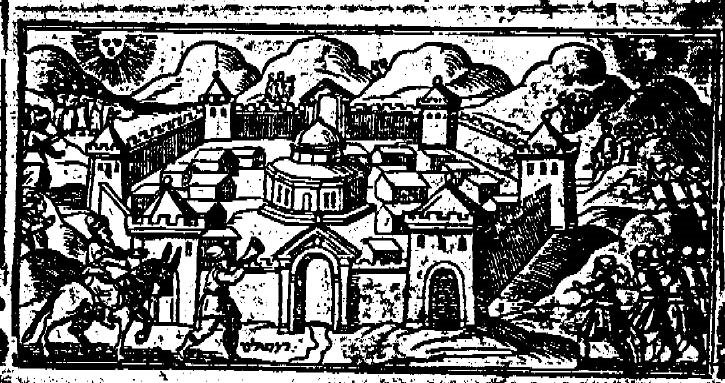
A rather interesting custom sprang up in connection with Eliyahu’s visit on Pesach night. R. Jousep Schammes (1604-1678), records that the custom in Worms was to draw depictions of Eliyahu and the Messiah in order to bring to life the belief in these figures. As you can see from the pictures on the side, this was common in the Haggadah. The first picture is a depiction of Messiah on his donkey. This was originally depicted in smaller format in the Prague 1526 haggadah, but in this edition, Mantua, 1560 is greatly enlarged. The second picture comes from the Venice 1629 hagaddah. As you can see it is again the Messiah coming in to Jerusalem, but note the prominence of the Dome of the Rock in the center.

In Frankfort they went one step further than just drawing Eliyahu and the Messiah. R. Yosef Jousep Hahn (1570-1637) says they used to hang a dummy who looked like Eliyahu or the Messiah behind the door. When they would open the door for Eliyahu the dummy would drop down and seem as if he had appeared. (He then goes on to record a long story of a dybuk who invaded the body of a women who questioned whether the Exodus happened.) It is worthwhile noting that not everyone was thrilled with these depictions. R. Yair Hayyim Bacharach (1639-1702) who became the Rabbi in Worms at the very end of his life, says these types of things only make a mockery of the seder.

However, we see from the above, that there was, at least among some, an effort to create a feeling that Eliyahu actually would visit the seder. Some did it through pictures, others through reenactments. Although today those have fallen to the wayside, it would seem the idea that Eliyahu actually drinks from the cup is a form of those methods.

Sources: Yerusalmi, Haggadah and History; Shmuel and Zev Safrai, Haggadah of the Sages, p 177-78. Minhagei Vermisai, p. פז; R. Y. Bacharach, Mekor Hayyim.


Kalir, False Accusations, and More

Kalir, False Accusations, and More
by Marc B. Shapiro
1. I now want to return to Kalir and the criticism of me. To recap, I had earlier mentioned how Artscroll originally correctly identified Kalir as post-tannaitic, but later changed what it wrote in order to be in line with Tosafot’s opinion that he was a tanna. Some think that it is wrong to criticize Artscroll by using academic methodology instead of judging them by traditional sources, since they don’t recognize the academic approach.
My first response is that this is nonsense and a textbook example of obscurantism. If there is evidence of a certain fact, one can’t say that it is only a fact if it appears in some “traditional” source, and therefore one who ignores this evidence gets a pass.
Furthermore, when it comes to Kalir one can also date him using traditional sources.[1] One of these sources is quite fascinating. Whether there is any truth to the event described, I can’t say, but the fact that a traditional source dates him after the tannaitic era is what is important for us at present. This shows that Tosafot’s dating is not the only traditional source in this matter. The source I refer to is the medieval R. Ephraim of Bonn who states that the paytan Yannai, who is usually dated to the seventh century but could even be a few centuries earlier (but still post-tannaitic), was the teacher of Kalir.
R. Ephraim notes that Yannai was not the most kind of teachers and he was jealous of his student Kalir, showing that the Sages’ statement that people are jealous of all, except for a son and student (Sanhedrin 105b), can have exceptions. In order to deal with his problem, Yannai decided to terminate Kalir, with extreme prejudice of course. He therefore put a scorpion in Kalir’s sandal which took care of matters. R. Ephraim reports that because of this murder, in Lombardy (Italy) they refused to recite one of Yannai’s hymns.[2]
אוני פטרי רחמתים. ואמר העולם שהוא יסוד ר’ יניי רבו של רבי אלעזר בר קליר, אבל בכל ארץ לומברדיאה אין אומרים אותו, כי אומרים עליו שנתקנא בר’ אלעזר תלמידו והטיל לו עקרב במנעלו והרגו. יסלח ה’ לכל האומרין עליו אם לא כן היה.
R. Ephraim is the source for this report and as you can see from his final words, he took the report very seriously and literally, declaring that if it wasn’t true then those who spread this rumor were in need of repentance. Israel Davidson, however, claims that to take the report literally would be “absurd”, and the report of the scorpion is merely an “idiom, undoubtedly Oriental in origin, for expressing unfriendliness.”[3] The problem with this is, as we have seen, R. Ephraim and the community of Lombardy did take the report literally, so why should Davidson, living well over a thousand years after the supposed event, know more than people who lived in medieval times?[4] It is one thing to say that the murder never occurred, but that doesn’t mean that the story as told was not meant to be understood literally, and there is every reason to assume that it means what it says. If it happened, it would hardly be the first murder committed by a Jew. Thus, although the story is almost certainly a legend, our reason for making this determination is not because it is impossible to imagine one Jew doing such a thing to another.
Another important source is found in R. Hayyim Joseph David Azulai, Mahazik Berakhah, Orah Hayyim 112 (end). Azulai, as we all (should) know, had a keen bibliographical sense, and knew rabbinic history very well. After mentioning how Tosafot and the Rosh state that Kalir was really the tanna R. Eleazar ben Shimon,[5] the Hida quotes R. Isaac Luria as follows:
דהפייטן היה בו ניצוץ מנשמת ר’ אלעזר ברבי שמעון.
In other words, it is not that Kalir was actually a tanna, but that his soul was connected with R. Eleazar ben Shimon. I presume that this is an attempt to preserve the old tradition identifying the two, while at the same time recognizing that historically they were two different people. We find the same approach among many commentaries that deal with aggadic statements that make all sorts of identifications, of what can perhaps be called the rabbinic “conservation of people.” In other words, there is a tendency to identify biblical figures with other known biblical figures, such as Elijah with Pinhas and Harbonah, Hagar with Keturah, Pharaoh with the King of Nineveh, Yocheved and Miriam with Shifrah and Puah, Mordechai with Malachi[6] and Ezra, Tziporah with the Cushite woman,[7] Balaam with Laban, Daniel and Haman with Memukhan, to mention just a few.[8]
I don’t think people should be surprised that also among traditional commentators one can find the viewpoint that these identifications are not to be taken literally[9]—kabbalists are often inclined to see these texts as referring to reincarnation[10]—and some modern scholars have spoken of these identifications as examples of what they term “rabbinic fancy.” Some of these identifications are so far-fetched that I have no doubt that R. Azariah de Rossi and R. Zvi Hirsch Chajes are correct that the Sages who expounded them never intended them to be taken literally.[11]  Although I haven’t investigated the matter, I assume one would find the same tendency to non-literal interpretation when dealing with Aggadot that insert historical figures into other biblical episodes, e.g., Balaam and Jethro becoming Pharoah’s advisors, or when the Aggadah identifies spouses, e.g., Caleb marrying Miriam and Rahab marrying Joshua (and having daughters with him[12]).
2. In the previous post I quoted what the late R. David Zvi Hillman said in the name of R. Shlomo Yosef Zevin regarding Saul Lieberman. Some people were incredulous, and this raises the question of how reliable Hillman was and if he would distort things for ideological purposes.[13] I have spoken about him before, and I reproduced his defense of the Frankel edition of the Mishneh Torah not citing R. Kook.[14] Despite his strong ideological leanings, as of yet I haven’t found any evidence that he would purposely distort. My sense is that he was quite honest in his scholarship (and the issue with R. Zevin and Lieberman might have been something he misunderstood or perhaps R. Zevin wasn’t clear in what he said. It simply is impossible now to reconstruct events.)
Even though I believe that Hillman was honest in his scholarship (i.e., not intentionally distorting as is so often the case with haredi writers), we do find that his ideology led him to unfounded conclusions. These are not intentional distortions because he really believed what he was saying, but they are distortions nonetheless. Here is one example.
In 1999 a memorial volume appeared called Ohel Sarah Leah. Beginning on p. 246 is an article by Hillman dealing with R. Joseph Saul Nathanson’s view of the International Date Line. In this article, he deals with a letter by R. Zvi Pesah Frank published by R. Menachem M. Kasher. He believes that Kasher added material to the letter so as to align it with his own viewpoint. The fact that Kasher published the letter in 1954, almost seven years before R. Zvi Pesah Frank’s death, does not deter Hillman from his argument. Other than Hillman, I think everyone realizes that if you are going to forge something in another’s name, you don’t do it when they are still alive![15] We can thus completely discount Hillman’s argument and see it as an ideologically based distortion.
Despite this defense of Kasher, it must also be pointed out that there are serious questions about the reliability of some things he published. In Between the Yeshiva World and Modern Orthodoxy I mentioned R. Eliezer Berkovits’ claim that the Weinberg letter Kasher published was not authentic. Berkovits clearly thought that Kasher forged it, but when I pressed him to say so openly, he wouldn’t. All Berkovits would say is that Weinberg never wrote such a letter, and it was fraudulent. When I asked, “So R. Kasher forged it?” he replied that he wasn’t going to speculate about this, and would only say that the letter did not exist. Being that Kasher claimed that Weinberg wrote the letter to him, this means that Berkovits was accusing him of forgery, but for whatever reason did not want to say so openly.
I have a 1982 letter from Berkovits to another rabbi, and in this letter he is not as circumspect as he was with me. Here he pretty much states that Kasher forged the letter “le-shem shamayim.”
בענין מו”ר הגאון זצ”ל אני בטוח שהוא מעולם לא כתב אותם הדברים שהרב כשר מוסר בשמו בנועם. אדרבה יראה לנו את מכתבו של מו”ר זצ”ל. לפני כשנה כתבתי לו בדואר רשום ובקשתי בעד צילום או העתק של מכתבו של הרב וויינברג זצ”ל. עד היום לא קבלתי תשובה ממנו. מבטחני שהדברים שנאמרו ושנכתבו בשמו אינם אמיתייים. בעונותינו הרבים הגענו למצב שגם אנשים ירא שמים וכו’ מורים היתר לעצמם בכל מיני ענינים כשהם חושבים שכל כוונתם לשם שמים היא. והוא רחום יכפר וכו’.
In the recently published Genazim u-She’elot u-Teshuvot Hazon Ish, pp. 263ff. the unnamed editor also levels serious accusations against Kasher, in a chapter entitled הזיוף החמור והנורא. He puts forth a series of claims designed to show that another letter Kasher published on the International Date Line, this time a posthumous letter from R. Isser Zalman Meltzer, is also forged. I have to say that in this example, unlike the one dealt with by Hillman, there is at least circumstantial evidence, but no smoking gun. The most powerful proof comes from Kasher himself in which he tells of a meeting with the Hazon Ish and how at that meeting he told the Hazon Ish about the letter he received from R. Isser Zalman in opposition to the Hazon Ish’s position. Yet the letter Kasher publishes from R. Isser Zalman is dated from after the Hazon Ish’s death. There is clearly a problem here, but more likely than assuming forgery is that Kasher was simply mistaken in his description of his visit with the Hazon Ish. Let’s not forget that this element of the account of his visit was published thirty-three years after the event, and it is possible that Kasher didn’t recall everything that was said. The followers of the Hazon Ish have indeed always claimed that his description of his visit, in Ha-Kav ha-Ta’arikh ha-Yisraeli (Jerusalem, 1977), pp. 13-14, is not to be relied upon. Since his own recollection of his visit is the strongest evidence in favor of Kasher forging R. Isser Zalman’s letter, it is not very convincing.
In the previous paragraph I wrote that “this element” of Kasher’s account was published thirty-three years after his visit, so let me explain by what I mean by that. In Ha-Pardes, Shevat 5714, p. 30, soon after the Hazon Ish’s death, he originally published his account. Only when he later published his Kav ha-Ta’arikh ha-Yisraeli did he mention that he told the Hazon Ish that he received letters from R. Zvi Pesah and R. Isser Zalman, and this point is mentioned after his description of his visit. In his original description he mentions nothing about receiving letters, only that R. Zvi Pesah told him his opinion and R. Isser Zalman agreed with this. I think what likely happened is that in the passing decades Kasher forgot that the letters he received only arrived after the Hazon Ish’s death. As mentioned, if you look at what he wrote right after the death of the Hazon Ish, he doesn’t mention any letters, and he even states explicitly that he didn’t have anything in print from R. Zvi Pesah. I think this shows that while Kasher’s recollection was not exact, there is no evidence that he forged the letter.
I do, however, have to mention that in the 1977 version of the visit Kasher adds something that is not in the original recollection and must therefore be called into question. In the original recollection he reports that the Hazon Ish began reading Kasher’s work on the dateline and then said that he is tired and asked if he could hold on to the work to read later. In the 1977 version Kasher then adds the following, which shows the Hazon Ish as not very committed to his own position, a point which is at odds with everything else we know about the Hazon Ish and the dateline:
והוסיף בזה הלשון: נו, יעדער מעג (קען) זיך האלטען ווי ער פערשטעהט. [כל אחד רשאי (יכול) להחזיק כפי הבנתו].
Kasher was also involved in another problematic episode related to his book Ha-Tekufah ha-Gedolah, which is dedicated to showing the messianic significance of the State of Israel. In the book, pp. 374ff., he includes a proclamation urging participation in the Israeli elections. This proclamation is signed my many rabbinic greats and states that the State of Israel is the beginning of the redemption. This is a very significant document and is often referred to, because among the signatories are some who were never identified with Religious Zionism.
But is the document authentic? Zvi Weinman has shown (and provided the visual evidence) that a number of the rabbis signed a document that did not mention anything about athalta di-geula but instead referred to kibutz galuyot.[16] In Kasher’s book, their names are listed together with those who signed the document referring to athalta di-geula, even though they never agreed with this formulation. This would appear to be a Religious Zionist forgery (unless it is simply a careless error), although it is impossible to know whether Kasher was responsible for this or if he was misled by someone else.
If it can ever be proven that Kasher was indeed responsible for a forgery, there is still a possible limud zekhut for this type of behavior (and I mentioned it in a prior post): If you are convinced of the correctness of your position, it is not hard to construct an argument, based on traditional Jewish sources, that false attribution and even forgery is permissible. In the book I am currently working on I bring all sorts of examples of this which I think will be very distressing for readers, as it is in complete opposition to what most of us regard as basic intellectual honesty.
Returning to the recently published Genazim u-She’elot u-Teshuvot Hazon Ish, the editor also makes an outrageous accusation and I am surprised that no one has yet publicly protested. The canard is leveled at Chief Rabbi Isaac Herzog, whose saintliness was universally acknowledged even by those who opposed his Zionist outlook. It was R. Herzog who in early 1940 flew to London and was able to convince the English government to grant a number of visas for Torah scholars. He was thus directly responsible for saving the lives of, among many others, R. Velvel Soloveitchik and R. Shakh.[17] This fact alone should have been enough to prevent any scurillous accusations directed against R. Herzog.
On pp. 226ff. there appears a 1941 letter, dated 24 Elul, from R. Shlomo Yosef Zevin to the Hazon Ish asking him about the problem of Shabbat in Japan for those who had escaped the Nazi clutches. R. Zevin wrote to the Hazon Ish at the request of R. Herzog, who said that only two people in the Land of Israel were expert in this matter, R. Tukatchinzky and the Hazon Ish.
There is a good deal that can be said about R. Zevin’s letter and the Hazon Ish’s response, but that is not my concern at present. Yet I must at least mention that the editor provides another letter from the Hazon Ish in which he expresses his displeasure that R. Zevin’s Torah writings had appeared in the newspaper Ha-Tzofeh. According to the Hazon Ish, these should have been published as a special booklet, as it is inappropriate to publish Torah articles in a newspaper that in the end is used to wrap food in. He also mentions that Ha-Tzofeh itself is not suitable, referring obviously to its Religious Zionist outlook. (R. Zevin would, over his lifetime, write hundreds of articles for Ha-Tzofeh, many of which have not yet been collected in book form.)
Also noteworthy is that in his reply to R. Zevin the Hazon Ish raises the possibility that the viewpoint of the rishonim would have to be rejected if it turns out that they were mistaken in their understanding of the metziut.

העומד עדיין על הפרק הוא אם טעם הראשונים ז”ל הוסד על המחשבה שאין ישוב בתחתית הכדור, ואז נקח עמידה נועזה לנטות מהוראת רבותינו ז”ל ולעשות למעשה היפוך דבריהם הקדושים לנו ולכל ישראל, או שאין לדבריהם שום זיקה לשאלת ישוב התחתון.
(In a later letter, quoted on p. 231, we see a different perspective.) In R. Zevin’s letter he mentions why the issue of Shabbat in Japan was so pressing. R. Herzog had recently received a telegram from Kobe, Japan, asking on what day the Jewish refugees should fast.[18] Here is a copy of the telegram, as it appears in David A. Mandelbaum’s Giborei ha-Hayil, vol. 1.


Genazim u-She’elot u-Teshuvot Hazon Ish, p. 227, makes the astounding assertion that this telegram was a scheme cooked up by the Chief Rabbinate (i.e., R. Herzog).This would enable R. Herzog to call a gathering a great Torah scholars at which time he could push them to accept his opinion in opposition to the viewpoint of the “gedolei Yisrael.” It is hard to imagine a more outrageous accusation directed against a man of unquestioned piety such as R. Herzog.

Quite apart from the slander I have just pointed to, the volume also contains a good deal of ideologically based distortion, which is why it is noteworthy that it not only includes the letter from the Hazon Ish to Saul Lieberman (p. 330) that I published in Saul Lieberman and the Orthodox,,[19] but even identifies him in the following respectful way:
המכתב נשלח לבן דודו פרופ’ ר’ שאול ליברמן ז”ל מחה”ס תוספתא כפשוטה, ירושלמי כפשוטו וש”ס.
Considering how Lieberman is persona non grata in the haredi world, I find this identification, as well as mention of his books, nothing sort of remarkable.[20]
In fact, the story gets even more interesting. A couple of months ago volume two of Genazim u-She’elot u-Teshuvot Hazon Ish appeared. Before I was able to get a copy, people emailed me to let me know that this volume contained a lengthy letter from Lieberman to the Hazon Ish. (I thank Ariel Fuss for sending me a copy of the letter.) It appears on pages 207-209 and is really fascinating. Leaving aside the talmudic analysis, the end of the letter shows the different outlooks of these cousins. We see that the Hazon Ish had criticized Lieberman for referring to Prof. Jacob Nahum Epstein as mori ve-rabbi. Lieberman didn’t understand why the Hazon Ish found this objectionable, since Epstein was a pious Jew and Lieberman learnt many things from him, “true Torah and not the path of the maskilim but that of our teachers of blessed memory, who search for the truth in the words of Hazal, in all possible ways, and many obscure places in the Jerusalem Talmud were explained to me precisely through this approach.”[21]
Lieberman then turns to another criticism of him by the Hazon Ish, that he was not devoting himself adequately to his Torah study. It is hard to know what to make of this critique, as who was more devoted to his studies than Lieberman. Lieberman defends himself from this accusation, noting:
אני לפעמים נופל על הספסל מחוסר אונים מרוב התאמצות ויושב אני לפעמים כמה ימים על סוגיא אחת עם ראש חבוש.
Here is Lieberman’s grave, in the Sanhedria cemetery. Note who he is buried next to. (As I mentioned in Saul Lieberman and the Orthodox, according to Chaim Herzog, Lieberman was R. Herzog’s closest friend. It is therefore fitting that he be buried next to R. Jacob David.)
3. Regarding the last post, a number of people emailed me pointing out other “immodest” title pages and also learned women that I didn’t mention. I thank all who emailed. Many of the other title pages I knew about and might refer to at a future time, but the post was specifically concerned with censorship of title pages, and this explains the ones I cited. One of the commenters did refer to a title page that I did not know, from a 1731 Hamburg manuscript. See here (the rest of the Haggadah has other interesting pictures). If you ever needed an example of how what we today regard as unacceptable is not necessarily how people hundreds of years ago viewed matters, this is it.[22]
Regarding learned women, a great deal has obviously been written about this and I don’t see it as my purpose to simply repeat what others have written elsewhere. I hope that in the prior post (and indeed in all my posts), people find new material and learn things that they wouldn’t know from elsewhere, even those who are experts in the various topics.
Since the matter has been raised again, le me mention something that I originally was going to write about. At the last minute I took it out, as I was convinced (by both a scholar who will remain anonymous and Prof. Shamma Friedman) that I was in error.
Tosefta Ketubot 4:7 (and the parallel passage in J. Ketubot 5:2) reads:
נושא אדם אשה . . . על מנת שתהא זנתו ומפרנסתו ומלמדתו תורה.
It then follows by telling us that R. Joshua son of R. Akiva arranged exactly this sort of marriage. I think that if you show this passage to people, and cover up the commentaries, they will translate it to mean that a man can marry a woman on the condition that she will take care of his physical sustenance “and will teach him Torah.” (This is how Neusner translates in his Tosefta and Yerushalmi translation, and is also found in some academic articles.) Yet all of the traditional commentaries understand this text to mean that the woman provides the financial support her husband needs in order that he is able to study Torah on his own. For a while I assumed that this was an apologetic understanding by the commentators, and we know that the Talmud does offer a few examples of learned women. Yet as mentioned, I was convinced of my error.[23] In email correspondence, Friedman also called attention to other unusual Hebrew formulations which don’t mean what they literally say. For example, Yevamot 13:12 states: בא על יבמה גדולה תגדלנו. Yet this does not mean that she has to raise the boy, but only that she has to wait until he is of age to give her a divorce. He also pointed to Nazir 2:6 (and see also 2:5) which uses the language of הרי עלי לגלח חצי נזיר and this has nothing to do with shaving the Nazir.
One final point I would like to make about learned women is that before drawing any conclusions about their knowledge, we must be sure that we are not dealing with ghost writers. For example, Dov Katz, Tenuat ha-Mussar (Jerusalem, 1982), vol. 1, p. 242 n. 30, refers to the wife of R. Aryeh Leib Horowitz (the son of R. Israel Salanter) as a “learned woman” based on the introduction she wrote to her deceased husband’s Hayyei Aryeh (Vilna, 1907). Here is the text.

I can’t prove it, but I am very confident that someone wrote this on behalf of the wife, who was a traditional rebbetzin, not a maskilah.

4. In preparation for the trip I am leading to Italy in July (we still have room for some more people, and also for the August trip to Central Europe), I thought it would be helpful to read the letters of R. Ovadiah Bartenura. Right at the beginning of the first letter[24] I found something very interesting. I immediately suspected that this passage would be omitted from a translation directed towards the Orthodox masses. I checked, and lo and behold, the passage is indeed deleted. Here is the text:

Note how R. Ovadiah testifies that while the Jews in Palermo were careful about not drinking non-Jewish wine, which was noteworthy since elsewhere in Italy Jews routinely consumed this, their sexual morality and observance of the Niddah laws left something to be desired. He claims that most young women there were already pregnant at their wedding.
Here is how the page appears in the translation by Yaakov Dovid Shulman:
This text was censored even though the preface to the book states: “In publishing these letters in their entirety, including the critical comments made by Rabbi Ovadiah Bartenura of those people and practices of which he disapproved, the assumption is made that these criticisms were written to instruct the reader and not to denigrate any individuals.” As you can see, the letter has not been published in its entirety, and if one were to go through the text carefully, perhaps some other deleted passages would be discovered.[25]
5. I have done six posts on R. Kook and from email I receive I know that some people want me to return to this. I plan to, but I still have a few more posts to do before I get to that. In the meantime, however, I want to inform readers that a new volume of R. Kook’s writings has just appeared. It is called Ginzei ha-Rav Kook and I thank R. Moshe Zuriel for drawing my attention to it. My sense is that this volume does not have much importance, as much of it, and maybe even the majority, has already appeared in other collections, particularly the Shemonah Kevatzim. I was able to determine this using the R. Kook database, which except for the most recently published material includes all of R. Kook’s writings.
I did find one passage (p. 87, no. 85) which I am pretty sure has not yet appeared, even in the most recent writings. It relates back to a point I already called attention to in R. Kook, namely, his privileging of the pious masses over the Torah scholars in certain ways. One rabbinic text that would appear to oppose R. Kook’s conception is the famous Avot 2:5: ולא עם הארץ חסיד. See how R. Kook neutralizes this text, pointing out that there are a lot of things more important than being a hasid. Here is R. Kook, a member of the rabbinic elite, nevertheless insisting that the am ha-aretz can have just as much holiness as the Torah scholar, be visited by Elijah, and even have ruah ha-kodesh:
“ולא עם הארץ חסיד”. אבל מה שהוא למעלה מהחסידות, כמו קדושה וענוה ותחית-המתים וגילוי אליהו ורוח-הקודש, מפני גודל קדושתם הם שוים לכל נפש. כי כל לבבות דורש ד’, ואחד המרבה ואחד הממעיט ובלבד שיכוון לבו לשמים, ומעיד אני עלי שמים וארץ, אמר אליהו, בין איש בין אישה, בין עבד בין שפחה, בין נכרי בין ישראל, הכל לפי מעשיו רוח הקודש שורה עליו. וכיון שלא יצאו שפחה ונכרי מכלל רוח-הקודש, קל-וחומר שלא יצא עם-הארץ שהוא מזרע קודש, מעם ה’ וצבאותיו אשר הוציא ממצרים להיות לו לעם נחלה כיום הזה, סגולה מכל העמים.
(The reference to Elijah is from Tanna de-Vei Eliyahu, ch. 9.)
P. 112, no. 104, returns to a theme I have also dealt with, that study of halakhic details can be problematic for a mystical personality such as R. Kook.[26] Yet he adds that this is still the job of the righteous ones, and we can see here an autobiographical reflection.
אף על פי שלימודם של המצוות המעשיות בדקדוק קיומם מכביד לפעמים הרבה על הצדיקים הגדולים השרויים תמיד באור המחשבה העליונה, מכל מקום מתוך כח היראה העליונה שבלבבם, מתגברים הם גם על שפע קדושתם, ועוסקים בתורה ובמצוות במעשה ובדקדוק, אף על פי שהם צריכים למעט על ידי זה את אורם העליון.
Can we also see an autobiographical reflection on p. 114, no. 106, where R. Kook speaks about the righteous who want the world to recognize their greatness and holiness?
לפעמים מתגלה בצדיקים גדולים תשוקה גדולה, שיכירו הכל את מעלתם ושיאמינו בקדושתם. ואין תשוקה זו באה כלל משום גסות הרוח או אהבת כבוד המדומה, כי אם מפני החשק הפנימי של התפשטות האור הטוב שבהם על חוג היותר רחב האפשרי. וזהו מעין התשוקה של הופעת החכמה על ידי המצאות טובות וספרים טובים שכשהיא אידיאלית היא עומדת בנקודה היותר עליונה שבאור הנשמה הא-להית.
He then returns to the difficulty the Tzaddik has with halakhic particulars (p. 115):
ישנם צדיקים גדולים כאלה, שהם למעלה מכל שרש הדינים, ועל כן אינם יכולים ללמוד שום דבר הלכה. וכשהם מתגברים על טבעם ועוסקים בעומקא של הלכה, מתעלים למעלה גדולה לאין חקר, והם ממתקים את הדינים בשרשם.
[1] R. Yaakov Yisrael Stoll, in his recently published Segulah (Jerusalem, 2012), pp. 50ff., takes it as a given that Kalir is post-tannaitic.
[2] Israel Davidson, Mahzor Yannai (New York, 1919), p. xlix                     
[3] Ibid, p. xxv.
[4] Unless R. Ephraim was misinformed about Lombardy, this practice must have changed at some time because we know that in Lombardy the piyut was recited on Shabbat ha-Gadol. See R. Moshe Rosenwasser, Le-Hodot u-le-Halel  (Jerusalem, 2001), p. 379. As Rosenwasser points out, R. Ephraim is also the source for the story of R. Amnon of Mainz writing U-Netaneh Tokef.
[5] This is impossible as in one of his hymns he tells us that is father’s name is Jacob. See R. Simon Federbush, Ha-Lashon ha-Ivrit be-Yisrael u-ve-ha-Amim (Jerusalem, 1967), pp. 70-71.
[6] This identification explains how in Italy Jews with the Hebrew name Mordechai were sometimes given the vernacular name Angelo (= מלאכי). See Cecil Roth, Venice (Philadelphia, 1930), p. 168.
[7] This identification is rejected by Rashbam. See his commentary to Num. 12:1. Regarding Rashbam’s comment, see the lengthy discussion of Lockshin in his translation. While Rashbam rejects the notion that the Cushite is Tzipporah, he apparently has no problem repeating the legend  that “Moses reigned in the land of Cush for forty years and married a certain queen [from there].” He knew this legend from the work Divrei ha-Yamim de-Moshe Rabbenu, although as Lockshin mentions, it is also found in more “kosher” sources, such as Yalkut Shimoni. Ibn Ezra also cites the legend of Moses ruling in Cush in his commentary to Num. 12:1, despite the fact that in his commentary to Ex. 2:22 he writes:
Do not believe what is written in the book called the History of Moses. I will give you a general rule. We should not rely on any book not written by prophets or by the sages who transcribed traditions passed on to them. We definitely should not rely on these books when they contradict reason. The same applies to the Book of Zerubavel, the Book of Eldad ha-Dani, and similar compositions.
In a previous post I discussed Rashi’s understanding of the word Cushite, and how it is not to be taken literally. Ibn Ezra does take it literally (and still thinks that it refers to Tziporah). As with Rashi, he assumes that Cushites are not very attractive and explains that Miriam and Aaron, who spoke negatively about Moses, “suspected that Moses refrained from sleeping with Tzipporah only because she was not beautiful.” (Commentary to Num. 12:1).
Regarding the Cushite woman, I found something strange in R. Joseph Solomon of Posen’s Yesod Yosef (Munkacs, 1907), p. 8b. This is how he explains Aaron’s and Miriam’s talk against Moses on account of the Cushite he married (Num. 12:1):
מרים ואהרן רצו לתלות בוקי סריקי במשה ולהטיל מום בקדשי’ לפי דברי התרגום שני שפירש אשה כושית מלכה כוש שטימא את ברית קודש ובעל בת אל נכר וכל ביאה שאינה בהיתר נקרא הוצאת זרע לבטלה
R. Joseph Solomon goes on to explain why Aaron and Miriam were mistaken in their judgment.
[8] See R. Joseph Zekhariah Stern, Zekher Yehosef, Orah Hayyim no. 121 (p. 34a). R. Shmuel Avraham Adler, Aspaklaryah, vol. 27, s.v. shem, pp. 119ff
[9] R. Menahem Azariah of Fano acknowledges that when it comes to Elijah-Pinhas, most scholars understood this literally. Yet he rejected this position, perhaps because it would require Pinhas to have lived at least 350 years.) See Asarah Ma’amarot, Hikur Din section 4 ch. 18:
ואף על פי שיש מרבותינו אומרים בפשיטות פינחס הוא אליהו אין הדבר כמחשבת המון החכמים שפינחס לא מת ושקיים בעצמו שנוי השם.
[10] Opponents of gilgul had argued that if this was an authentic Jewish doctrine, certainly the Talmud would have mentioned it. R. Elijah Benamozegh argues that these texts, identifying various people as one and the same, are the proof that the talmudic sages indeed accepted reincarnation. He assumes that for many of these passages, where the different eras of the individuals mentioned is an obvious problem, no one with any intelligence can believe that the Talmud meant these passages to be understood literally. The meaning must therefore be reincarnation. See Eimat Mafgia, vol. 2, p. 2b:
איככה יוכל האיש לא טח עיניו מראות להניח כי לבן הארמי אשר חי בימי יעקב אבינו הוא עצמו בלעם הרשע, אשר היה בימי בני בניו האחרונים . . . וחירם שהיה בימי שלמה הוא אשר היה בימי יחזקאל . . . כיצד נוכל לייחס הבנתם הפשטית לחכמינו הקדושים אשר גם לפי דעות המנגדים לא יתכן לתלות בהם חסרון ושגעון כ”כ עצום כאשר כל אחד יראה בדמיונות האלה.
There are two books entitled Eimat Mafgia, one by Benamozegh and the other by R. Moses ben Ephraim of Brody (Warsaw, 1888). Both of them are directed against R. Leon Modena’s Ari Nohem. The title comes from Shabbat 87b: אימת מפגיע על ארי
[11] Meor Einayim, ch. 18; Mevo ha-Talmud, ch. 21, in Kol Sifrei Maharatz Chajes, vol. 1. In other words, the peshat is not literal. According to traditional commentaries, we find plenty of examples of this in the Bible also. Thus, when the Torah speaks of God’s outstretched arm, Maimonides insists that the peshat is that these words are not to be understood literally. Many have argued that even according to the peshat “an eye for an eye” is not to be understood literally. I think that most people today who read the book of Job will conclude, as did Maimonides, that the peshat is that it is not a historical tale.
[12] See Megillah 14b, Tosafot, Megillah 3b s.v. melamed, Maharsha, Hidushei Aggadot, Eruvin 63b (why does he quote Tosafot and not the Talmud in Megillah14b?), R. Samuel Strashun’s note to Eruvin 63a.
[13] Some people might have been led to thinking this because his letter was published in Yeshurun, which has in the past published articles that have engaged in censorship and ideological distortion. In the most recent volume, Nisan 5772, which also contains the Hillman letter, we find another instance of the disrespect for Torah scholars that is routine, and almost required, in haredi literature, and which in previous posts I have provided numerous examples of. (I refer obviously to Torah scholars not in the haredi camp.) On pp. 456-467,  there are letters from five deceased rabbis to R. Avraham Zeleznik. Four of them have the acronym זצ”ל put after their name. The only one who doesn’t merit זצ”ל, and instead is given ז”ל , is the Zionist R. Avraham Shapira (who incidentally was by far the most distinguished Torah scholar of the five.) R. Shapira also wasn’t provided with a short biography, presumably because then his position as Rosh Yeshiva of Merkaz ha-Rav and Chief Rabbi of the State of Israel would have to be mentioned.
[14] See here. With regard to Hillman, in this post I misstated his genealogy. Prof. Shlomo Zalman Havlin wrote to me as follows:
יש לתקן: הגרד”צ אינו נכד של הגרמ”מ חן הי”ד כפי שכתב [ע”פ האיזכור מבטאון חב”ד שהשתבש.] הוא בנו של ד”ר אשר הילמן בעל משרד רו”ח בת”א, נינו של הגרד”צ, רבה הידוע של צ’רניגוב, אביו של הרמ”מ. אגב, גם המשוררת זלדה [מישקובסקי] היתה נכדת הגרד”צ מצ’רניגוב, ואף אחיינית האדמו”ר האחרון מליובאוויטש.מאחיו של הגרמ”מ היה הרב אברהם חן, שהיה סופר מעולה, מחבר ‘במלכות היהדות’, קונטרס יפה ומרגש על אביו  
הגאון. היה רבה של שכונת בית הכרם [כמדומה שהיתה זו שכונה שלא נזקקה לרב]. מעניין לעניין, כדאי להוסיף, כי לגרמ”מ דובר בשעתו שידוך עם בתו של ר’ חיים מבריסק. לצ’רניגוב בא שליח להכיר את החתן המיועד, ולפי התיאורים ששמעתי ,הוא היה כנראה הגאון ר’ זלמן סענדר, אביו של הגאון ר’ אברהם בעל דבר אברהם, ורבה של קובנה [הוזכר ג”כ במאמר זה]. וכמה נשים ממשפחת הגרד”צ נסעו לבריסק להכיר את הכלה ומשפחתה. בגלל שיבושי הדואר הרוסי, חשבו בצ’רניגוב שאין תשובה, בעוד התשובה החיובית נדדה לעיר אחרת, והשידוך כידוע לא יצא אל הפועל. אגב, שמעתי, כי הנשים ממשפחת הגרד”צ כששבו אמרו, שלאור המסופר על גדולת ר’ ‘חיים וכו’, הרי כאשר שמעוהו בתפילת ערבית, אמרו, אצל אבא רואים יותר אפילו ב”אשר יצר
[15] See the response to Hillman by R. Ephraim Greenbaum (Kasher’s grandson), in Ohel Leah Sarah, pp. 942-943.
[16] Mi-Katovitz ad Heh be-Iyar (Jerusalem, 1995),  pp. 130ff.
[17] See A. Bernstein et al., Yeshivat Mir: Ha-Zerihah be-Fa’atei Kedem (Bnei Brak, 1999), vol. 1, pp. 218-219.
[18] One of my high school teachers was with the Mir yeshiva during the War. He told us how on Yom Kippur some people actually fasted for two days, eating pahot mi-ke-shiur after the first day so that they would be able to fulfill both the opinion of R. Herzog and the rabbis aligned with him as well the Hazon Ish’s view.
Fasting two days on Yom Kippur is actually not new. Ibn Ezra records how certain people did it in medieval times. He minces no words about what he thinks of them. See Sefer ha-Ibur, ed. Halbertam, pp. 4a-b:
ואם טען טוען הלא אתם אומרים כי שני ימים טובים צוו לעשות קדמונינו בעבור הספק למה לא קבעתם צום כפור שני ימים גם יש טפשי עולם מחברינו שיתענו שני ימים ואני אראה להם שלא יועיל להם תעניתם כי הוא שוא ושקר.
[19] This letter was previously printed in Sefer Zikaron Tuv Moshe (Bnei Brak, 2008), p. 253, and here too Lieberman is referred to respectfully. This book does not inform the reader where it found this letter, although Genazim u-She’elot u-Teshuvot Hazon Ish informs us that its source is Sefer Zikaron Tuv Moshe. I know that a number of copies of Saul Lieberman and the Orthodox made their way around Bnei Brak, and one of them apparently found its way to the editor of Sefer Zikaron Tuv Moshe.
[20] With reference to the Hazon Ish’s family, in Saul Lieberman and the Orthodox I noted how the Steipler stated that one should not study Lieberman’s books since he left the Orthodox world. Last year a new edition of the Tosefta was published and included some questions to R. Chaim Kanievsky. In the original question the authors spoke negatively about Lieberman. When they gave the page with their question and R. Hayyim Kanievsky’s reply to the typist (who might even have been a woman) they added the word להשמיט with reference to the comment about Lieberman. Perhaps this was because they didn’t want people to know about the family connection between the Hazon Ish and Lieberman. However, the typesetter didn’t understand their intention and included the word להשמיט, thinking that this word was to be added to the text. Here is the page (click to enlarge, or see detail directly below it).

Portions of the letter of the Hazon Ish to Lieberman, referred to on this page, are also found in Kovetz Iggerot Hazon Ish, vol. 3, no. 2.

I just mentioned women typists, which is common in the haredi world (Kitvei R. Weinberg vol. 1, which was printed by a Satmar company, was typed by a woman.) Let me now turn to what I think is an example of a woman translator, and I thank Elchonon Burton for bringing this text to my attention. Here are two pages from R. Shakh’s Lule Toratekha.

In it he mentions how the Hafetz Hayyim famously referred to Adam ha-Kohen as yemah shemo. Adam ha-Kohen was the pen name of Abraham Dov Baer Lebensohn, and for more on how the Hafetz Hayyim viewed him, see S.’s post here. Note how R. Shakh adds שר”י  to Adam ha-Kohen’s name. This stands for שם רשעים ירקב (“the name of the wicked shall rot” – Prov. 10:7) and is only applied to the most wicked.

Here is how this passage appears in Artscroll’s English translation, Rav Shach on Chumash.

The translator did not understand what שר”י means and assumed that it was part of his name, creating a previously unknown maskil, Adam HaKohen Sherry. Based on this error, I assume that the initial translation was done by a woman who knew modern Hebrew but not “rabbinic code.” The final translator, who is a talmid hakham, probably just revised the initial translation. Now knowing anything about the Haskalah, when he saw the name Sherry it didn’t raise a red flag leading him to check the original. S. pointed out to me that in the Wikipedia entry for Yimach Shemo, Adam HaKohen Sherry also makes an appearance.

[21] While on the topic of Lieberman, let me note that he has an unknown article in Otzar ha-Hokhmah 10 (1934), pp. 83-84, signed ש. ל.. In this short article he criticizes some of what R. Leopold Greenwald wrote about the Jerusalem Talmud. I refer to this article as “unknown” because I have never seen anyone refer to it, and it is not found in Tuvia Preschel’s bibliography of his writings included in Sefer ha-Zikaron le-Rabbi Shaul Lieberman, ed. Shamma Friedman (New York and Jerusalem, 1993).
 [22] After writing these words I saw that the title page of this haggadah was included in Leon Wieseltier’s article in the most recent Jewish Review of Books (Spring 2012), which is presumably where the commenter saw it. See here. See also this post regarding a different Haggadah, and see also Dan’s post here.
Here are some other pictures that I think people will find interesting. They appear in R. Leon Modena’s Tzemah Tzadik (Venice, 1660). This is not found on hebrewbooks.org but is on Otzar ha-Hokhmah (at least for now). This particular copy was originally part of Elkan Nathan Adler’s collection. (Adler used for his middle name the name of his father, R. Nathan Adler, chief rabbi of England. This was not unusual. To give another example, R. Samson Raphael Hirsch’s father’s name was Raphael.) Here is Adler’s book plate. His Hebrew name was Elhanan.
From Tzemah Tzadik, here is an illustration showing love of people.
Here is one showing love of man and wife.

Here is an “immodest” picture showing mermaids, which Modena, like so many others of his time, believed in.

Modena’s name does not appear on the title page of Tzemah Tzedek, but he reveals his authorship at the beginning of ch. 1, where first letters of the first sixteen words read: יהודה אריה ממודינא

Here is the page.

[23] He had already corrected Tal Ilan in this regard. See “A Good Story Deserves Retelling – The Unfolding of the Akiva Legend,” Jewish Studies Internet Journal 3 (2004), p. 85 n. 96.
[24] Darkhei Tziyon (Kolomea, 1886), pp. 5a-b
[25] As part of my preparations for the trip I have also been reading Elliot Horowitz’ many important articles on Italy. Not long after finding the censored text I saw that Horowitz had already discussed this passage and showed that there is indeed a history of omitting and distorting it. See “Towards a Social History of Jewish Popular Religion: Obadiah of Bertinoro on the Jews of Palermo,” Journal of Religious History 17 (1992), pp. 140ff. While the examples Horowitz discussed are motivated by a Victorian style of writing, the example I give is probably motivated by a desire to shield the masses from the knowledge that even in pre-Reform Europe violation of halakhah was in many places a common phenomenon. It never ceases to amaze me how little knowledge of history some otherwise very intelligent people have, which I guess means that the censorship and rewriting of history is having an effect. Not long ago I was with someone who had spent a number of years in yeshiva, and he really believed that in 19th century Eastern Europe the porters and wagon drivers were all great talmidei hakhamim whose free time was devoted to mastering Shas.
[26] See also Tomer Persico, “Ha-Rav Kook: Al Tzadikim Gedolim ve-Yishrei Lev – be-Ma’alah ha-Hasagah ha-Mistit,” Moreshet Yisrael 5 (2008), available here.


Post-script by S. of On the Main Line:

Two points may be of further interest.

1) Regarding the Western Askenazic custom of using the father’s name as a middle name ala  the aforementioned R. Hirsch and Elkan Nathan Adler, E. N.’s two older half brothers also used  their father’s name, Nathan, as middle names; there was Marcus Nathan Adler, best known for his edition of Benjamin of Tudela’s Travels. In addition, Chief Rabbi Herman Adler also used it as a middle name, especially in his earlier years. In his university matriculation record from 1856 he is listed as “Hermann Nathan Adler.”

2) In addition to the coded acrostic self-reference by the author of Zemach Zedek in the opening lines referred to above (‘יושר האהבה וכו), R. Yehuda Aryeh Modena also refers to himself in the opening lines of the hakdamat ha-mekhaber: נודע ביהודה אלקים ובישראל אריה שאג.


Identity of the Unknown Tomb. Who is buried in the unmarked grave next to the Vilna Gaon?

 Identity of the Unknown Tomb.
Who is buried in the unmarked grave next to the Vilna Gaon?

Ariel Fuss & Yoel Kabalkin

Prologue

Among the seven graves in the Ohel of the Vilna Gaon (R’ Eliyahu M’vilna) there is one without an identifying headstone. The sign above the entrance to the Ohel identifies this grave as the resting place for the ashes of the Ger Tzedek of Vilna, Avraham ben Avraham Potocki[1] This identification is accepted without questioning by many books and articles written about the Gaon when the origins of this theory and its veracity are suspect. This article will investigate how this theory came about and the issues with it and will then put forth a new theory as to who the occupant of this grave is.

Introduction

The Vilna Gaon was originally buried in the old cemetery in Shnipishok located in the northern part of Vilna in 1797 (תקנ”ח). Probably sometime in 1949/1950 the soviet government gave notice to the community that they intended to level the cemetery. The Jewish community received permission to move a few graves and chose to move the Vilna Gaon and a few others to the new cemetery in Vilna.[2] Due to Vilna being behind the iron curtain and information being hard to come by, the exact details of this transfer, who was taken, by whom, and to which cemetery was not known. There were conflicting reports about who was moved together with the Gaon until Prof Shnayer Leiman in an article in Jewish Action proved that most of the speculation was for naught.[3] Since most of the graves had been moved along with their headstones, all one needed to do was read them. The Gaon lay among 6 other graves in the newest cemetery in Vilna and contrary to all the different theories on who was worthy of being moved, there was no effort to traverse the cemetery and take other important people that had been buried there. It turns out that those that transferred the Gaon had just taken a part of the row he was buried on and moved everyone together. They clearly wanted to move the Vilna Gaon given his enormous profile and while doing so moved his neighbors. The identities of the graves in order from left to right are,

  1. R Zvi Hersh Pesseles

  2. R Yissachar Ber – The Gaon’s brother

  3. Vilna Gaon – Prof Leiman wrote a convincing article on the Seforim Blog[4] that the headstone is backwards and this is the Gaon’s true grave.

  4. R Noach (Mindes) Lipshutz – The Gaon’s Mechutan. He shares a headstone with his predecessor.

  5. Minda Lipshutz – R Noach’s wife

  6. Devora Pesseles – Tzi Hersh’s mother

  7. Unknown/Ger Tzedek

Thanks to Prof Leiman we now know the identity of six of the graves, but we are still left with 3 unanswered questions.

  1. Who is in the 7th grave?

  2. Why is there no identifying headstone?

  3. Why was R Zvi Hersh’s grave moved to a different location within the group?

Theory

There are many articles and books that mention the Ger Tzedek being buried in the Ohel. As early as 1956 a report in Ha-tzofe discussing moving the Vilna Gaon to Israel mentions that the Ger Tzedek was moved and is buried alongside the Gaon.[5] A 1983 report in the newspaper Davar about the Gaon’s Ohel asserts the same.[6]

This identification is now common knowledge to the extent that tour guides will tell you so and it even states as much on the sign outside the Ohel. There are two reasons for why people have assumed that the community moved the Ger Tzedek.[7] One being that he was an integral component of Vilna’s history and therefore it stands to reason that they would have moved him.[8] Secondly and possibly the main reason for why the theory has such staying power is the lack of a headstone. Since every other grave in the Ohel has a headstone the only reason the last one would not have one is because it lacked one to begin with. The sign outside the Ohel should not be used as proof positive of this identification because it is a late addition and on the same sign it also states that the Gaon is buried with his family which we know to be false. Although this theory is possible, there are many issues with it. Some of these issues are as follows:

  1. Those very same articles which propound this theory are riddled with other factual errors. For example, in the the Ha-zofe article they include R’ Shmuel ben Avigdor; the Gaon’s father; and son R Avrohom, among those that were moved. Just a quick glance at the headstones in the present day Ohel will tell you that this claim is false. This error occurred because as we have stated previously, accurate information from inside the iron curtain was hard to come by. Surprisingly, although we know today that these reports were false, the inclusion of the Ger Tzedek persists.

  2. Since Prof Leiman has shown that those who moved the graves just transferred those that were in the Ohel, it seems odd that they would specifically take the Ger Tzedek and not for example, R’ Moshe Rivkes (the Beer Hagolah), or R Avraham Danzig (the Chayei Adam), and many other important figures that were buried in the same cemetery and warranted preservation too.[9]

  3. There are accounts that contradict this theory. Dr Henry Shoshkes, a renowned Jewish writer and traveling reporter for “Der Tag Morgen Journal”, traveled to Vilna in 1956. While there he went to visit the new kever of the Vilna Gaon. He describes being told by the secretary of the community, one Leib Sarapej,[10] who claimed to have been involved in moving the bodies, that there was nothing of the Ger Tzedek to move. This was because what was buried of him originally was only the ashes of his body and it had dissipated over time.[11] R Yitzchak Zilber who visited Vilna while still behind the iron curtain, spoke with the lay leader of the community at the time of the transfer, a man called Heshel Kab, who was involved in the transfer of the Gaon. He stated that while they searched for the Ger Tzedek’s grave, they could not find his ashes and therefor did not move him.[12]

These issues lead us to question this theory and to try to come up with a better explanation, especially as there doesn’t seem to be a strong basis to this belief to begin with. 

In order to offer up a novel theory we must deal with a greater question first. When looking at the map of the cemetery in Israel Klausner’s book on the Vilna cemetery[13] you will notice that there were 11 people buried in the main sanctuary of the original Ohel, starting from number 20, and ending at 27 (there are 3 joint tombstones). Their identities are detailed in Klausner’s list below:

Out of the said 11 people buried in the original Ohel we know of 6 people who are now interred in the new Ohel. In Bold and in Green I have highlighted which gravestones are today in the new Ohel.

שלמה זלמן אבי הגר”א

[20]

אליהו בן משה מפינסק

[20]

היסו”ד

[21]

חיה אשת היסו”ד

[21]

הרב צבי הירש

[22]

דבורה

[23]

מינדל אשת ר‘ נח ליפשיץ

[24]

ר נח ליפשיץ

[25]

הגרא

[25]

הרב ישכר בער אחי הגרא

[26]

הרב יהושע העשל

[27]

So, once we know who was buried in the same Ohel, several questions immediately come to mind: Why did they move only these six graves and not the other ones from the same Ohel?

Why did they only start from R Zvi Hersh (22) and stop after R Yissachar Ber (26) and leave out R Yehoshua Heshel (27)? Why not move the Gaon’s father (20)? Why not move the YESOD (21), a very central and known figure in Vilna history? To answer these questions, we need to examine the original Ohel a bit closer. In the picture of the Ohel that appears in Klausner’s book we can see that there is a space between the Yesod and his wife (jointly number 21), and R Tzvi Hersh (22).

Why is there an empty wall between the Yesod and R Zvi Hirsch?

If we look at the picture below, taken at a different (probably earlier) time, one can see that in this area instead of a wall there is a shape of a door!

It is possible that when they made the main entrance to the Ohel on the opposite side, this door was closed. In any event, this gap can explain why the first four graves were not moved; they only took those that were to the right of the door![14] Now that we addressed the first half of our question, we are left with the second: If they took the entire row starting by the door why did they stop by R Yissachar Ber (26) and not take also R Yehoshua Heshel (27)? The evidence points us to the simplest conclusion, that in fact they did transfer him although without his headstone! In other words, of the 11 graves in the Ohel there were 4 to the left of the door and 7 to the right and they moved the entire batch from the door to the wall to the new cemetery, and thus unsurprisingly there are exactly seven graves in the new Ohel of the Gaon.

Thus, I am proposing that the additional grave with no headstone in the Gaon’s Ohel today is not the Ger Tzedek and is not the Chayeh Adam, but Simply Reb Yehoshua Heshel who was originally in the Gaon’s proximity.

This possibility has been generally ignored until now[15] for 2 reasons,

1.Since there were a few others in the Ohel that were not transferred it never struck people as odd why Reb Yehoshua Heshel was not either. However, since we’ve established an explanation for why the other 4 were not moved, it behooves us to find an explanation for why he wasn’t included.

2. The fact that there was no headstone led people to associate the grave with someone who would not have had a headstone to begin with, namely the Ger Tzedek.

Looking at Klausner’s description of Reb Yehoshua Heshel’s tombstone leads us to a possible solution to this second issue. His description is as follows: “the tombstone on the grave of the rav is made of wood and is preserved nicely”;[16] he even provides a picture of it on the next page. This fact, that the tombstone was made of wood as opposed to stone like the others in the Ohel, gives us a possible explanation for why it was not moved along with his body. It is possible that the wood was harder to move or that it possibly broke in the process.

In conclusion, the identification of the 7th grave with the Ger Tzedek doesn’t have much historical basis and is flawed for a few reasons, therefore we offer a new theory. The identity is none other than R Yehoshua Heshel who was buried in the original Ohel together with the rest of the row. This is the most plausible explanation which until now was ignored due to there not being a headstone, and not having an explanation for why these specific 7 graves were chosen as opposed to the others. We showed that a door was added to the Ohel and those that were involved in the transfer moved everyone from the right of the door until the end of the row including R Yehoshua Heshel. The reason his headstone was not moved was because it was made of material that was not conducive to transfer and possibly might have broken along the way.

B.

Essentially, we are left with one remaining question – Why was Rabbi Zvi Hersh moved from the extreme right to the extreme left in the order of the graves?

To propose an answer to this question, we need to go on a long detour. As previously mentioned, in 1956, Dr. Henry Shoshkes, visited the Soviet Union and Vilna, and then reported about his travels in the Tag, a Yiddish newspaper in New York. This was one of the first documented visits to the Jewish cemetery in Vilna after the transfer of the Gaon’s grave and is indirectly the source of many of the rumors surrounding the Vilna Gaon’s grave. In one of the articles describing his visit to the grave there is also a picture of the grave and a better one is published in Dr. Shoshkes’s book[17] – מהקרמלין עד הפרמידות. What is unique about the picture is that it is one of only two pictures that I know of, of the Gaon’s grave after it was transferred but before a new Ohel was erected.[18]

One can see several tombstones one next to the other but clearly there is no tombstone to the right of the Gaon’s headstone. Shoshkes writes that this grave without a headstone is the grave of the Chaye Adam – Rav Avraham Danzig. I believe otherwise.

I am assuming that this picture is taken facing south, with the headstones positioned at the head of the graves.[19] In other words, the headstones are arranged as they were on the outside wall of the Ohel in the old cemetery, but in the opposite direction compared to their current setup in the new Ohel. If we consider the old Ohel’s arrangement, the gravestone that should be to the right of the Gaon is the tombstone of his brother Rav Yissachar Ber. This of course raises the question – Why is it not there?

Let us return to Klausner’s picture and accompanying numbers. We observe that the numbers are in sequential order from left to right but one number is missing – number 26. That number corresponds to R. Yissachar Ber the Gaon’s brother. It is quite peculiar – why is the Gaon’s brother not listed beneath the picture?

For that we must go back to the wider picture of the old Ohel.

And then zoom in on the right upper corner of the Ohel:

What is that sign? We can see and understand it better by looking at an illustration made of the Gaon’s old Ohel. It is not exact but gives a very good idea.

In this illustration we can observe that beneath the plaque in the upper right corner there is a gravestone. By counting the number of gravestones to the right of the door, we reach an undeniable conclusion: there are two separate headstones, that to the right of the Gaon’s gravestone, positioned one on top of the other. The one adjacent to the Gaon corresponds to Klausner’s number 27, which is R. Yehoshua Heshel. On top of that, in the right upper corner, we find the headstone of Reb Yissachar Ber, that Gaon’s brother [26].

To fully comprehend this, we must recall the sequence of events. Initially, R. Yehoshua Heshel passed away, followed by the Gaon, much later. A few months after the Gaon’s burial, his Mechutan, Reb Noach Mindes, passed away and was interned to the left of the Gaon, sharing a joint gravestone. Several years later, when the Gaon’s brother died, there was a desire to bury him next to his brother, resulting in him being “squeezed” in between the Gaon and R. Yehoshua Heshel. Evidently there was sufficient space to accommodate the body, but during placement of the headstones on the outside of the Ohel, there was insufficient space. Consequently, R. Yissachar Ber’s headstone was positioned on top of R Yehoshua Heshel’s headstone.

Therefore, the key point of this story is that although R. Yissachar Ber was buried right next to the Gaon in the old Ohel, the headstone closest to the Gaon on the right side belonged to R Yehoshua Heshel. Based on this observation, I would propose that since, as mentioned, R. Yehoshua Heshel’s wooden headstone was never transferred, those responsible for arranging the headstones in the new cemetery left the grave next to the Gaon without a headstone, aligning it with their understanding of the headstones arrangement in the old Ohel.

We have one final question regarding Shoshkes’s picture: On the left side of the Gaon’s headstone, we can observe two additional headstones. The inscriptions are illegible, but judging by the size and shape of the gravestones, it would be reasonable to assume that the first one belongs to Mindel [24], the wife of Reb Noach. However, the issue lies with the second one. It should be Devorah’s grave [23], but it appears more similar to the gravestone of her son, Reb Zvi Hersch [22]. Why is Devorah’s gravestone missing?

If we examine the gravestones inside the Ohel, it becomes evident that Devorah’s gravestone is significantly taller than the others. It is possible that it was too challenging to set up without the support of an Ohel wall. Indeed, if we observe the current picture of Devorah’s gravestone inside the Ohel, it is clearly seen to be broken into two parts.

Now, let us consider the thesis proposed. I suggest that during the construction of the new Ohel, they reconnected the broken parts of Devorah’s headstone and returned her to her original position in the line-up. However, due to the need to relocate Reb Zvi Hersch, he was placed next to Reb Yissachar Ber instead of being positioned beside his mother, Devorah, where he rightfully belongs.[20]

In conclusion, I firmly believe that the order of the bodies has never been altered, and they are positioned precisely as they were in the old Ohel. However, there seems to have been a mix-up in arranging the headstones. Below, I present a summary outlining my understanding of the arrangement of the bodies in relation to the current placement of the headstones:

In a forthcoming article, I will delve into an in-depth analysis and present fresh evidence and explanations regarding the numerous rumors surrounding the relocation of the Gaon. I will explore questions such as who was responsible for moving him, the timing of the transfers, the frequency of the relocations, the fate of those involved in the process, and the condition of the Gaon’s body.

[1] For the purposes of this article the debate on the historicity of the Ger Tzedek matters little. Whether it happened like the stories or not, the fact is that there was a grave for him in the old cemetery that could’ve been moved. For the debate on the historicity of the Ger Tzedek see the Seforim Blog’s article about the topic here

Also see Magda Teter. (2005). The Legend of Ger Ẓedek of Wilno as Polemic and Reassurance. AJS Review29(2), 237–263. http://www.jstor.org/stable/4131733.
[2] There are some reports who claim that he was moved twice, once to the Zaretcha cemetery which was the cemetery used after the old one was filled up and only later was he moved to his present resting place in the Saltonishkiu cemetery. See footnote number 2 in Lieman’s article in the Seforim Blog.
[3] For a full list of the different reports see his article.
[4] https://seforimblog.com/2012/09/who-is-buried-in-vilna-gaons-tomb/

[5] There is a similar issue with descriptions of the Ger Tzedek’s original burial place. Many of these descriptions assume that he was buried next to the Gaon when in reality he was on the other end of the cemetery.
[6] See further such references in Leiman’s Jewish Action article.
[7] Prof Leiman also introduces the possibility that the Ger Tzedek was moved but was buried without a grave and leaves the seventh grave unidentified.
[8] As we will see later even people that claimed he wasn’t moved said that they searched for his remains but didn’t find anything of substance to move.
[9] This is probably the original reason for all the confusion around who was moved. There are many people who warrant preservation due to their status. Although as we stated previously it is possible that the Ger Tzedek was of a higher profile.
[10] Leib Sarapej later managed to immigrate to the United States, and reunite with his daughter in Richmond, Virginia. In 1970 wrote a letter to the editor of The Forward, in which he mentions his involvement in the transfer of the Gaon’s grave. This is the only first-hand record of someone who was directly involved in the transfer that I know of, and to the best of my knowledge has not been mentioned to date. https://www.nli.org.il/he/newspapers/frw/1970/05/11/01/article/31.
[11]  https://www.nli.org.il/he/newspapers/dertog/1956/10/28/01/article/100. The way the article is written it would sound as if the Goan was then interred in the Zaretcha Cemetery (and not where he is currently buried) as right after Shoshkes describes the Gaon’s new resting place he goes on to describe other parts of the cemetery which were all found in the Zaretcha Cemetery. As odd as it may sound it would seem that Shoshkes had merged his visit to two different cemeteries into one account even though he is writing the article only a short while after being there. It could be that because of this Leyzer Ran, in his book referenced in comment 18 hereafter, wrote next to the picture of the Gaon’s headstone that he is buried in Zaretcha.
[12] See R.Yitzchak Zilber, To Remain a Jew (Jerusalem, 2010), pp. 389-390. Kab also said that the Gaon’s hairs “were as firm as needles”.
[13] Korot bet Halmin Hayashan D’Vilna. Can be found here.
[14]  The grouping can also be derived from Klausner p 45 who when describing the graves divides them into ones on the right and left in exactly this manner.
[15] Although Leiman does include it passing as one of the possibilities.
[16]]

[17] Page 28.
[18] The other such picture appears in Ran L., Jerusalem of Lithuania: illustrated and documented, 1974, p. That picture does not show anything but the headstone and so has limited importance. I suspect the picture in Ran’s book was also provided by Dr. Shoskes, from the same visit.
[19] This does however pose some difficulties for the lack of other graves in the picture. This is an issue I will address inter alia in a future article.
[20] Be it as Leiman purposes in order to have all the men on one side or for some other reason.