Errors in New Kuntras HaTeshuvot

As some have already noted, there is a completely new edition of Boaz Cohen’s Kuntras HaTeshuvot. This edition edited by Shmuel Glick totally reworks Cohen’s work. Supposedly this new work benefited from many subsequent bibliographies as well as the Institute for Jewish Bibliography.

While this is an vast improvement in my quick read (I only received it today) I was amazed at what this lacked and in my mind errors.

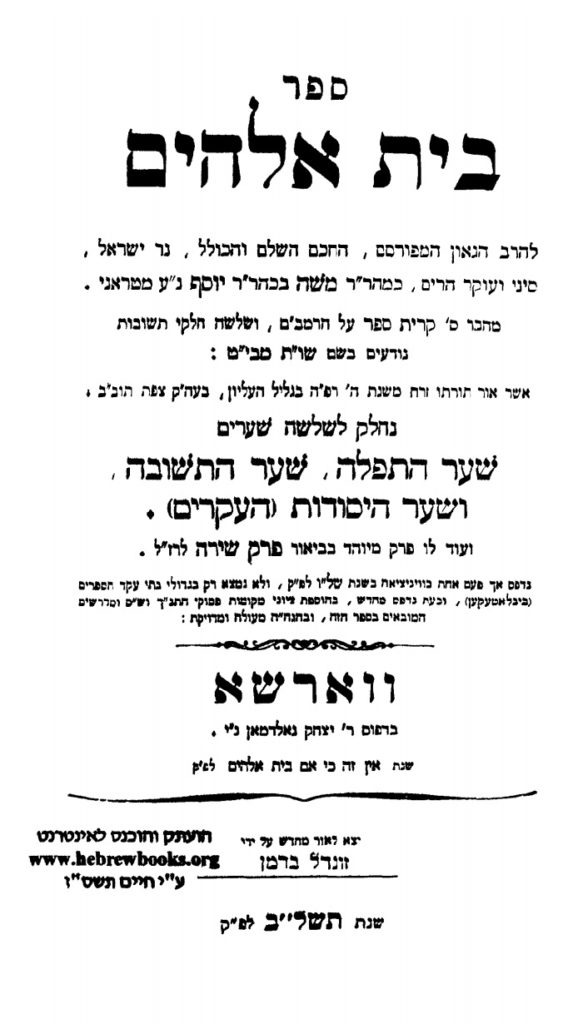
The first is for the entry for the Besamim Rosh the famed possible forgery attributed to R. Asher b. Yecheil. In their entry they first note that examined the Krakow 1881 edition. Now aside from not looking at the first edition which is not hard to come by there is a greater error here. Specifically, they do not note that this edition is missing two teshuvot. So while they provide a bibliography listing articles discussing the Besamim Rosh they fail to mention the most important thing that if one gets the wrong edition they will not have the full text. Even though they comment there are 392 teshuvot they did not bother to count or to even read the articles they cite (which note this absence). This are not minor teshuvot either, in fact, the one on suicide which this edition leaves out is perhaps the most well-known and cited one from the entire volume.

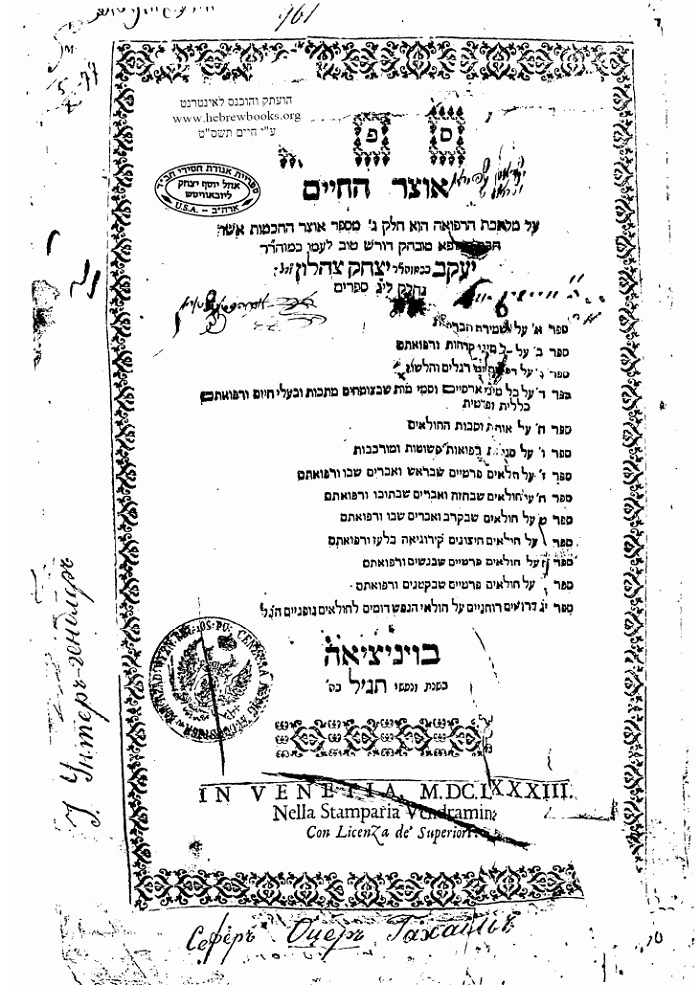
The next error is in regards to the Hatam Sofer. Again they have a long entry about the various editions and then list the various editions. But here they totally missed out on the first edition of this work. The first time teshuvot from the Hatam Sofer appeared was not as a separate work but as part of another work. In Prague 1826 edition of the Ri Megash from pages 31b until 42a there is Kuntras Hiddushi Torah v’Gam She’alot v’Teshuvot m’admu HaRav HaGaon . . . R. Moshe Sofer. In fact, on the title pages it even notes that this includes teshuvot from Hatam Sofer. This is listed in the Bibliography of the Hebrew Book and a simple computer search would have revealed this information.

Additionally, the sources which are provided are rather uneven. Again, this is only from my limited viewing of it and I may revise but if one looks at the entry for Eleh Divrei HaBrit which deals with, among other things, the controversy regarding placing an organ in shul. In that entry they provide Haberman’s article on the topic but not Binayahu’s article or Samet’s which both appeared in Asuphot vol. 1 and 5 respectively. In fact, the book Ohr Nogeh which is Liberman’s book on the topic does not have an entry. While perhaps they considered this part of the work Nogeah HaTzedek there doesn’t seem to be a reason to do so. Also, they do not include the book Tzror Hayyim which was published a year after Eleh and is devote to the very same topics in their list of books and articles discussing the organ. This is so eventhough the first teshuva discussed the organ exclusively.


Rav Kook’s Attitude towards Keren Hayesod – United Israel Appeal

Rav
Kook’s Attitude towards Keren Hayesod – United Israel Appeal
By Rav Eitam Henkin, Hy”d
 (Translated into English by Rachelle Emanuel)
This
article originally appeared
in Hebrew in HaMayan 51:4 (2011), pp. 75-90.

Today is the yahrzeit of the Rav Eitam and Naama Henkin, who were cruelly murdered one year ago. May Rav Eitam’s important writings, surely with us only thanks to Naama’s support, be an aliyat neshama for both. Hy”d.

·        
“It is well known that the person
who heads the above [body]” supports Keren Hayesod
·        
What is the difference between Keren
Kayemet Le-Yisrael – the Jewish National Fund – and Keren Hayesod — the United
Israel Appeal?
·        
The forgery in the 1926 public letter
·        
The significance of supporting Keren
Hayesod
·        
The halakhic letter of 1928
·        
The joint declaration with Rav Isser
Zalman Meltzer
·        
Conclusion
“It
is well known that the person who heads the above [body]” supports Keren
Hayesod

The
philosophy of Rav Elĥanan Bunem
Wasserman, follower of the Ĥafetz
Chaim and Rosh Yeshiva of the Baranovich Yeshiva (Lithuania), and among the
most extreme of eastern European Torah leaders between the world wars in his
anti-Zionist approach, is still considered today as having significant
influence on the ideology concerning Zionism and the State of Israel prevalent
in the Hareidi community. In this respect he constitutes almost an antithesis
to the Chief Rabbi of Eretz Yisrael, Rav Avraham Yitzchak HaKohen Kook, in
whose philosophy religious Zionism found its main ideological support for its approach
and outlook.[1]
 
One
rare statement made by Rav Wasserman, aimed apparently at Rav Kook, has found
resonance with part of the Haredi public, and is used by them as justification
for rejecting Rav Kook and his teachings. In fact, we are not talking of a
direct reference, but of words that appear in a letter sent to Rav Yosef Tzvi
Dushinski, who took over Rav Yosef Ĥaim Zonnenfeld’s position as head of the Eidah Ĥareidit, on June
25, 1924:
A proposal has been made to combine the Ĥareidi Beit
Din with the Chief Rabbinate. It is well known that he who heads [the Chief
Rabbinate] has written and signed on a declaration calling on Jews to
contribute to Keren Hayesod. It is also known that the funds of Keren Hayesod
go towards educating intentional heretics. If that is the case, he who
encourages supporting this organization causes the public to sin on a most
terrible level.  Rabbeinu Yona in Sha’arei
Teshuva
explains the verse “The
refining pot is for silver, and the furnace for gold, and a man is tried by his
praise” (Prov. 27:21)  as
meaning that in order to examine a person one must look at what he praises. If
we see that he praises the wicked, we know that he is an utterly wicked person,
and it is clear that it is forbidden to associate with such a person.[2]
As
far as Rav Wasserman was concerned, because the head of the Chief Rabbinate
publicized statements in which he called to support Keren Hayesod, which among
other activities, funded a secular-Zionist education system, he was causing the
public to sin and it was forbidden to be associated with him.[3]
However,
it seems that Rav Wasserman’s sharp assertion is based on a factual error.[4]
According to Rav Kook’s son, Rav Z.Y. Kook, his father supported Keren Kayemet
Le-Yisrael
, and called on others to support them, but his attitude towards Keren
Hayesod was completely different.
… as a result of the claims and complaints about
their behavior concerning religion and Judaism, [Rav Kook] later delayed giving
words of support to Keren Hayesod, and none of the entreaties and efforts of
Keren Hayesod’s activists could move him. In contrast, even though he continued
to constantly protest concerning those claims and complaints, he never
hesitated giving words of support to Keren Kayemet. None of the entreaties and
efforts of those who opposed Keren Kayemet could change this. On the contrary, with
his sacred fire, he increased his support and encouragement for Keren Kayemet, [considering
its projects as] a mitzvah of redeeming and conquering the Land.[5]
If
these words are correct, Rav Wasserman’s protest loses ground. In light of the
above we would have to say that Rav Wasserman’s sharp statement about Rav Kook
relies on the shaky basis (“It is well known…”) of rumors that were
widespread in certain localities in East Europe.[6]
However, precise research shows that despite Rav Z. Y. Kook’s clear testimony, for
which we will bring below explicit references from Rav Kook himself, Rav
Wasserman’s words were not just based on vague rumors alone. It turns out that
even while Rav Kook was alive, propaganda attempts were made to attribute to
him support for Keren Hayesod. In one case, at least, it was intentional fraud,
upon which it seems Rav Wasserman unwittingly based himself.
What
is the difference between Keren Kayemet LeYisrael – the Jewish National Fund –
and Keren Hayesod – the United Israel Appeal?

Whatever
the case may be, the reader will ask: what is the difference between the Keren
Kayemet and the Keren Hayesod? Perhaps in Rav Wasserman’s opinion they both
were “abominations,” since both organizations were headed by “heretics”;
and even though Keren Kayemet did not deal with education, nevertheless it
enabled heretics to settle on its land. If that was the case even supporting Keren
Kayemet falls into the category of lauding the wicked, etc.! However, one
cannot ignore the fact that R. Wasserman was talking about Keren Hayesod in
particular, on the grounds that its funds were “going towards raising
intentional heretics” in the educational institutions – something not
relevant to the activity of Keren Kayemet. The Keren Kayemet was a veteran
institution, founded at the beginning of the century for very specific,
accepted goals – redeeming land from the hands of gentiles, whereas Keren
Hayesod was established at the beginning of the twenties in a very different
political reality, and its fields of activity were much broader. Rav Kook
himself, in a response from winter 1925 to the famous letter from four Hasidic
rebbes (Ger, Sokolov, Ostrovtza, and Radzhin) who had heard that “your
Honor is indignant over our opposition to giving aid to the Keren Kayemet and
Keren Hayesod,” and in which they explained their opposition, gave his
reasons in full for supporting the Keren Kayemet, and only the Keren Kayemet.[7] In an
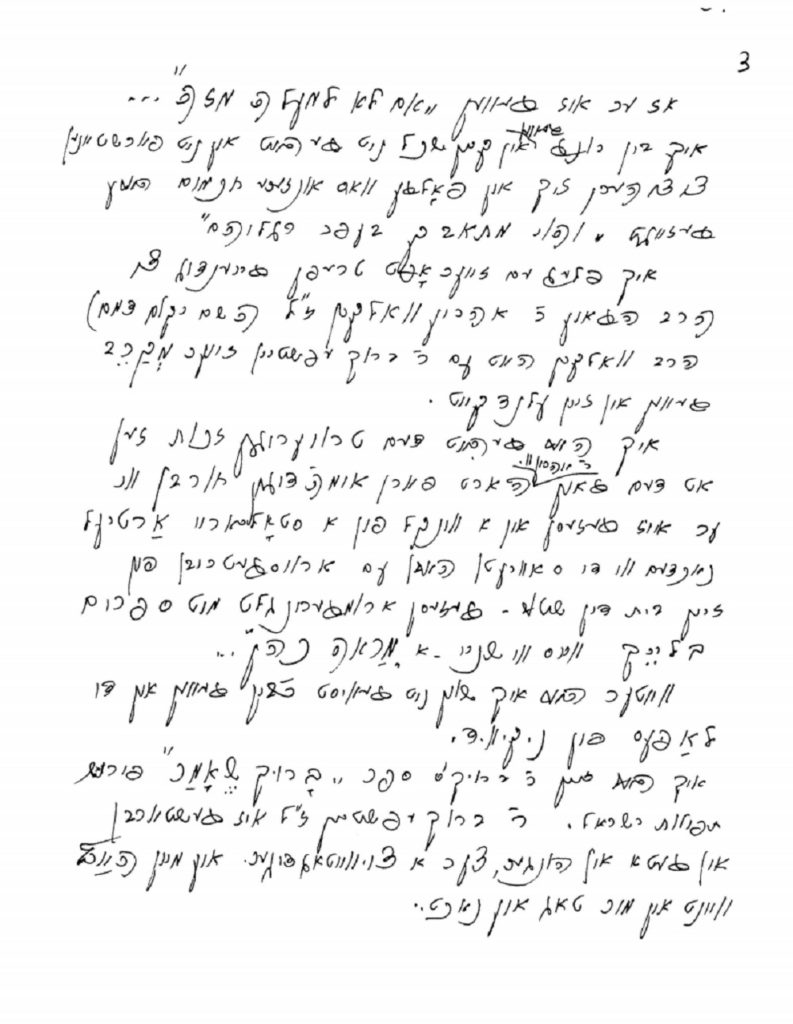
earlier draft of his response, in his handwriting, preserved in his archive, he
explicitly notes the difference in his approach to the two organizations:
I myself, in the past gave credentials for aid to
Keren Kayemet alone […] which is busy transferring land from the hands of
gentiles to Jewish possession, […] and for that I gave Keren Kayemet’s activists
a recommendation over the course of several years. This is not the case with
Keren Hayesod, which does not deal in redeeming land, but rather in settling it
and in matters of education. I have never yet given them a recommendation [and
will not do so] until the matter will, please God, be put right, and at least a
significant part of the funds will be assigned to settling Eretz Yisrael in the
way of our holy Torah.[8]
There
is indeed a large amount of information about the extensive relations that Rav
Kook had with Keren Kayemet, most of which involved continuous support for its tremendous
project of redeeming land, together with constantly keeping his eye on,  and immediately objecting to, any deviation
from the way of the Torah that was perpetrated on its grounds.[9] On
the other hand, in all the writings of Rav Kook published till now, there are
only a few mentions of Keren Hayesod, and they show reservations in principle
from the organization.[10] Whoever
is fed by rumors and presents Rav Kook as one who “lends his hand to
evil-doers” without reservations, will anyway assume, “as it is
known,” that he similarly called for support of Keren Hayesod. In
contrast, for someone who knows about Rav Kook’s life story, his work, and his
letters, the idea that he would be capable of calling for support for an
organization which directly causes ĥilul Shabbat, secular education, and
so on, is utterly baseless. Even his support for Keren Kayemet was not
complete, but with conditions, restrictions, and even warnings attached. The
following are some salient examples that are sufficient to prove that if Keren
Kayemet had been involved in projects opposed to the spirit of the Torah — as
was the case with Keren Hayesod — Rav Kook would not have agreed to support it
either:
In
a letter to the chairman of Keren Kayemet, Menahem Ussishkin, from February 4,
1927, concerning violations of Shabbat in the Borokhov neighborhood located on
Keren Kayemet land (by the residents, not by Keren Kayemet itself), Rav Kook
warned them “that if they do not take the necessary steps to correct these
wrongdoings that have gone beyond all limits, I will be forced to publicize the
matter in an open letter, loud and clearly, to the whole Jewish People.”[11]
In
a letter to Tnuva from March 2, 1932, that was sent following a report
concerning ĥilul Shabbat on Kibbutz Mizra, Rav Kook announced that so
long as the kibbutz members did not mend their ways, their milk would be
considered as ĥalav akum (milked by a non-Jew) and Tnuva would be
forbidden from using it.[12]
In
a letter to Ussishkin from April 3, 1929, Rav Kook complained about the fact
that Keren Kayemet had started to publish literary pamphlets, “which are
not its subject matter. Money dedicated to the redemption of the Land was not
for literary purposes. Moreover, the essence of this literature damages its
image in public, spreading false views in direct opposition to the sanctity of our
pure faith […] I hope that these few words will have the correct effect, and
that the obstacle will be removed without delay, so that we will all together,
as one, be able to carry out the sacred work of redeeming the Land with the
help of Keren Kayemet Le-Yisrael.”[13]
The
forgery in the 1926 public letter

 However, as has been said, because of the
significant weight that Rav Kook’s position bore, over the years many attempts
were made by the supporters of Keren Hayesod to ascribe to him outright support
of the fund. The most prominent case occurred in the winter of 1926 (about a
year after the above-mentioned letter to the hasidic rebbes). Several months
previously the yishuv in Eretz Yisrael entered a severe economic crisis which
seriously hindered its development, causing unemployment of a third of the work
force, a decrease in the number of immigrants, and a steady flow of emigrants
from the country.[14] This
crisis, considered the worst experienced by the yishuv during the
British Mandate, was the first time that the impetus of the yishuv‘s
development, which had been increasing since the end of the First World War, was
brought to a standstill. Against the backdrop of this situation, the Zionist
leadership initiated a “special aid project of Keren Hayesod for the
benefit of the unemployed in Eretz Yisrael.” Because of the severity of
the situation, Rav Kook also volunteered to encourage contributions to improve
the economic situation in Eretz Yisrael, and when R. Moshe Ostrovsky (Hameiri)
left for Poland to help with the appeal, Rav Kook gave him a general letter of
encouragement for the Jews in eastern Europe.[15] At
the same time, on November 8, 1926, Rav Kook wrote a public letter calling for
support of the Zionist leadership’s initiative, in which he wrote, inter alia:
To our dear brothers, scattered throughout the
Diaspora, whose hearts and souls yearn for the building of Zion and all its
assemblies; beloved brethren! The hard times which our beloved yishuv in
the Land of our fathers is experiencing, brings me to raise my voice with the
call, “Help us, now.” Our holy edifice, the national home for which
the heart of every Jew holds great hopes, is now facing a temporary crisis
which requires the help of brothers to their fellow sufferers in order to
endure […] Therefore I am convinced that the great declaration which the
Zionist leadership is proclaiming throughout the borders of Israel, to make
every effort to come to the aid and relief of this crisis, will be heard with
great attention; and that, besides all the frequent donations for all the
general matters of holiness which our brothers wherever they live will give for
the sake of Zion and Jerusalem, all the sacred institutions will raise their
hands for the sake of God, His people, and His Land, to give willingly to the appeal
to relieve the present crisis, until the required sum will be quickly
collected.
Although
the appeal was made through the organization of Keren Hayesod, Rav Kook avoided
mentioning the name of the fund because of his principled refusal to publicize
support for it (as he explained in the letter to the hasidic rebbes). The
version quoted above is what was published in the newspapers of Eretz Yisrael,
under the title “For the Relief of the Crisis.”[16]
However, amazingly, it becomes apparent that in the version published some
weeks later in Warsaw’s newspapers, the words “the Zionist
leadership” were changed in favor of the words “the head office of
Keren Hayesod
,” and accordingly, the words were presented as nothing
less than “Rav Kook’s public letter in favor of Keren Hayesod“![17]
Even
if we didn’t have any information other than the two versions of this public
letter, there is no doubt that the authentic version is the one published by
his acquaintances, the editors of Ha-Hed and Ha-Tor in Eretz
Yisrael, close to, and seen by Rav Kook. In contrast, when members of Keren
Hayesod circulated Rav Kook’s public letter among Poland’s newspapers, they were
not concerned that the author would come across the version they had published
in a remote location. They even had a clear interest to insert into Rav Kook’s
words a precedential reference to Keren Hayesod. Even if we only had before us
the east-European version of the letter, we could determine that foreign hands
had touched it. This is not only because of Rav Kook’s words in his letter to
the hasidic rebbes sent about a year earlier, but because of a letter that Rav
Kook sent to the heads of Keren Hayesod a few weeks prior to writing the public
letter. In this letter to Keren Hayesod he informs them in brief that he is
prevented from cooperating with the management of the fund or even visiting its
offices (!) until the list of demands that he presented them with, in the field
of how they conduct religious affairs, would be met. The background to this
letter is a request sent to Rav Kook on December 7, 1926, after the
inauguration of Keren Hayesod’s new building on the site of “the national
institutions” in Jerusalem. The directors of the head office of Keren
Hayesod wrote: “It would give us great joy, and would be a great honor if
our master would be so good as to visit our office – the office of the global
management of Keren Hayesod.”[18] In
reply to this request, Rav Kook wrote a letter – which is published here for
the first time – to the heads of Keren Hayesod, (Arye) Leib Yaffe and Arthur
Menaĥem Hentke:
8th Tevet 5687 [December 13, 1926]
To the honorable sirs, Dr. Yaffe and A. Hentke,
I received your invitation to visit your esteemed
office. I hereby inform you that I will be able to cooperate for the benefit of
Keren Hayesod, and I will, bli neder, also visit Keren Hayesod’s main
office, after Keren Hayesod’s management and the Zionist leadership will
fulfill my minimal demands concerning religious issues in the kibbutzim and in
education.
Yours, with all due respect …[19]
During
the course of the years there were, nevertheless, several opportunities when
Rav Kook came into contact with members of Keren Hayesod, mainly in connection
with matters of budgets for religious needs.[20]
However, as this letter illustrates, even such limited cooperation was
dependent, from Rav Kook’s point of view, on the demand to change the way the
fund conducted its matters with respect to religion.[21] What
were Rav Kook’s exact demands of Keren Hayesod, in order for it to be
considered as having “put things right” (as he wrote in his letter to
the hasidic rebbes), and to benefit from his support and cooperation? We can
clarify this from a document which is also being published here for the first
time. This document, whose heading is “Rav Kook’s answers” to Keren
Hayesod, was apparently written after the previous letter, in reply to a
question addressed to him by Keren Hayesod concerning his attitude towards
them. It was probably written against the backdrop of rumors that Rav Kook
forbade (!) support of Keren Hayesod.[22] We only
have a copy of the document in our possession, but it is written in first
person, meaning that Rav Kook wrote it himself, and the person who copied it
apparently chose to copy just the body of the letter without the opening and
end signature:

1.      I
have never expressed any prohibition, God forbid, against Keren Hayesod. On the
contrary – I am very displeased with those who do so.
2.      Concerning
my attitude towards the Zionist funds: my reply was that I willingly support
Keren Kayemet at every opportunity without any reservations. However,
concerning Keren Hayesod, at the moment I am withholding my letter in its
benefit until the Zionist management corrects major shortcomings that I demand
be put right, as follows:
a.      
That nowhere in Eretz Yisrael will
education be without religious instruction, not just as literature, but as the
sacred basis of Jewish faith.
b.     
That all the general religious needs be
immediately taken care of in every moshav and kibbutz. For example, shoĥet,
synagogue, ritual bath, and where a rabbi is necessary – also a rabbi.
c.      
That there will be no public profanation
of that which is sacred in any of the places supported by Keren Hayesod, such
as ĥilul Shabbat and ĥag in public.
d.     
That the kitchens, at least the general
ones, will be particular about kashrut.
e.       That
all the details here which concern the residents of Keren Hayesod’s locations,
will be listed in the contract as matters hindering use of the property by the
resident, and which will give him benefit of the land only on condition that he
fulfills these basic principles.
And because I strongly hope that the management will
finally obey these demands, I therefore am postponing my support of Keren
Hayesod until they are fulfilled. I hope that my endeavors for the benefit of
settling and building our Holy Land will then be complete.

It
should be noted that these conditions are similar in essence to those that Rav
Kook set with Keren Kayemet. However, the latter’s dealings were with redeeming
the Land, in contrast to Keren Hayesod where the areas referred to in Rav
Kook’s demands were at the center of its activity. Therefore, as far as the
Keren Kayemet was concerned, Rav Kook did not give the fulfillment of his
demands as a basic condition for his cooperation and call for support; but he
certainly did so with regard to Keren Hayesod.[23]
Whatever
the case may be, if R. Wasserman did indeed see the public letter of 1926,
without doubt he saw the falsified version published in the Polish newspapers,
and therefore he held on to the opinion that: “It is well known that he
who heads [the Chief Rabbinate] has written and signed on a declaration calling
on Jews to contribute to Keren Hayesod.”[24]
However, as has been clarified, these words have no basis.
The
significance of supporting Keren Hayesod

As
has been said Rav Kook was not prepared to support Keren Hayesod, which dealt
in education and such matters “until the matter will … be put right, and
at least a significant part” of the funds activities will be directed to
settling the Land according to the Torah. The words “at least a
significant part …” seem to give the impression that if a significant part
of the fund’s activity were directed to activity in the spirit of the Torah,
then Rav Kook would give his support even if another part were still directed
to secular education. However, in practice, there is no doubt that Rav Kook’s
demand was much stricter. In Keren Hayesod’s regulations it was determined that
only about 20% of its resources would be directed to education[25] (and
only a certain amount of that budget would be allocated to
“problematic” education) — and despite this fact Rav Kook refused to
call for its support. It must be emphasized that this policy in Keren Hayesod’s
regulations was strictly applied. An inclusive summary of the fund’s activity
between the years 1921-1930, indicates that 61.4% of its resources were
invested in aliya and settlement (aliya training, aid for refugees,
agricultural and urban settlement, housing, trade, and industry), 19.6% in
public and national services (security, health, administration), and only 19.0%
in education and culture – from which a certain part was allocated for
religious needs: education; salaries for rabbis, shoĥtim, and kashrut
supervisors; maintenance of ritual baths, eruvim, and religious
articles; aid for the settlements of Bnei Brak, Kfar Ĥasidim, etc.[26] In
light of this data, it seems that R. Wasserman’s claim against those who call
for support of Keren Hayesod, and his defining them as “utterly
wicked” people, is not essentially different from the parallel claim
against those who demand the paying of required taxes to the State – a claim
heard today only by extreme marginal groups within the Ĥaredi sector.
Indeed,
not surprisingly, it transpires that there were in fact some well-known rabbis
of that generation who did call to contribute to Keren Hayesod, despite the
problematic issues of some of its activity.[27] Just
several months before the publication of Rav Kook’s afore-mentioned public
letter, another declaration was published, explicitly calling for support of
Keren Hayesod, signed by more than eighty rabbis from Poland and Russia. Among
them were well-known personalities such as R. Ĥanokh Henikh Eigash, author of Marĥeshet;
R. Meshulam Rothe; R. Reuven Katz, and more.[28]
Moreover, in several locations, particularly in America, support of Keren
Hayesod was considered as consensus among the rabbis,[29] and
even Rav Kook’s colleague in the Chief Rabbinate, R. Ya’akov Meir, called for
support of Keren Hayesod.[30]
Would R. Wasserman have defined all of these scores of rabbis as evil ones
“who cause the public to sin on the most terrible level”?[31] Whatever
the case may be, it transpires that it was specifically Rav Kook who stands out
as being the most stringent among them, and he consistently agreed to publicize
support only for Keren Hakayemet. In the light of all the data detailed here,
one wonders whether R. Wasserman’s extreme words to R. Dushinski[32] were
only written in order to deter him from cooperating with the Chief Rabbinate
(which he strongly opposed), and perhaps this is the reason that he avoided
mentioning Rav Kook explicitly by name.[33]
The
halakhic letter of 1928

The
public letter of 1926 was indeed the only one in which Rav Kook’s words were
falsified in order to create support for Keren Hayesod. However, in the
following years, too, attempts were made to present what he had written as an
expression of direct support of Keren Hayesod. The element the two cases have
in common is that they were both published far from Rav Kook’s location. In 1928,
an announcement from the “Secretariat for Propaganda among the
Ĥaredim” was published in the Torah monthly journal Degel Yisrael,
published in New York and edited by R. Ya’akov Iskolsky. This secretariat
published a special letter from Rav Kook in Degel Yisrael, emphasizing
that the letter had not yet been publicized anywhere else. According to the
secretariat, the context in which the words were written was the following:

An
occurrence in a town in Europe, where the community demanded that all its
members contribute towards Keren Hayesod, and the opponents disputed
this before the government, and took the matter to court. The judges demanded
that the community leaders prove to them that the matter was done in accordance
to Jewish law, and on the basis of the above responsum (of Rav Kook) the
members of the community were acquitted.[34]

In
other words, according to those who publicized the Rav Kook’s letter, it was
written in order to help the heads of one European community to force all its
members to donate to Keren Hayesod. The problem is that examination of the
letter (see below) raises different conclusions. Similar to what appears above
(note 27) concerning the letter written by R. Meir Simĥa Ha-Kohen of Dvinsk,
here there is also no mention at all of Keren Hayesod. The explanations in the
letter are not relevant to the majority of Keren Hayesod’s projects, and the
letter only deals with clarifying the general virtue of settling Eretz Yisrael
and the obligation to support its inhabitants. Even the title prefacing the
letter only talks about “one community that agreed to impose a tax on its
members for the settlement and building of Eretz Yisrael,” without
mentioning that this was a tax specifically for Keren Hayesod. Towards the end
of the letter it is mentioned only that “the Zionist leadership in Eretz
Yisrael deals with many issues concerning settling the Land,” without any
specific reference to Keren Hayesod, even if the fund was the organization that
managed the appeal for the Zionist Organization. Thus, we again find that
whereas according to those that publicized the letter — the concerned parties —
the letter constitutes declared support for Keren Hayesod, in Rav Kook’s actual
words there is no mention of that.
The
letter, which as far as I know was never printed a second time, is brought here
in full:
When I was asked whether a Jewish community can impose
on an individual the obligation to give charity for maintaining the settlement
of Eretz Yisrael, I hereby reply that there is no doubt in the matter, considering
that the halakha is that one forces a person to give charity, and makes
him pawn his property for that purpose even before Shabbat, as explained in Bava
Batra
8b, and as Rambam wrote in Hilkhot Matnot Aniyim 7:10:
concerning someone who does not want to give charity, or who gives less than
what is fitting for him, the court forces him until he gives the amount they
estimated he should give, and one makes him pawn his property for charity even
before Shabbat. The same is written in Shulĥan
Arukh
, Yore Dei’a, 248:1-2. If
this is the case in all charities, all the more so is it the case concerning
charity for strengthening Eretz Yisrael, for this is explicit in Sifrei, and quoted in Beit Yosef, Yore
Dei’a
, §251, that the poor of Eretz Yisrael have priority over
the poor outside the Land. And because one forces a person to give charity for
the poor outside the Land, it is clearly even more the case concerning charity
for strengthening the Land and its poor. The obligation to settle in Eretz
Yisrael is very great, as it says in the Talmud Ketubot 110b, and is brought by Rambam as a halakhic
ruling in Hilkhot Melakhim 5:12: A person should always live in Eretz
Yisrael, and even in a town where the majority are idol worshippers, rather
than live outside the Land, even in a town where the majority are Jews. In Sefer Ha-Mitzvot (mitzvah 4) Nachmanides wrote: that we were
commanded to inhabit the Land; “and this is a positive mitzvah for all
generations, and every one of us is obligated,” and even during the period
of exile, as is known from the Talmud in many places.
A great Torah principle is that all Jews are responsible for one another.
Therefore, those who are unable themselves to keep the mitzvah of living in
Eretz Yisrael, are obligated to help and support those who live there, and it
will be considered as though they themselves are living in Eretz Yisrael so
long as they do not have the possibility of keeping this big mitzvah
themselves. It is therefore obvious that any Jewish community can require an
individual to give charity for the benefit of settling Eretz Yisrael and
supporting its inhabitants; and G-d forbid that an individual will separate
himself from the community. Someone who separates himself from the ways of the
community is considered one of the worst types of sinners, as Rambam writes in Hilkhot
Teshuva
3:11. Just as the community must guide the individuals towards all
things good and beneficial, and any general mitzvah, thus must it ensure that
no individual separates himself from the community concerning matters of
charity in general, and all the more so concerning matters of charity relating
to Eretz Yisrael and support of its inhabitants, as I have written. No one can
deny that which is revealed to all, that the Zionist leadership in Eretz
Yisrael deals with al lot of matters concerning settling Eretz Yisrael, hence
it is clear that its income is included in the principle of charity for Eretz
Yisrael.
And as a sign of truth and justice, I hereby sign … Avraham Yitzĥak HaKohen
Kook
The
joint declaration with Rav Isser Zalman Meltzer

Just
as the public letter of 1926 (in the version published in Poland) quickly came
to the notice of the zealots of Jerusalem, who rushed to claim that Rav Kook
supports “a baseless fund,” the same thing happened with the 1928
letter: following its publication under the above headline, the zealots rushed
to upgrade their accusations and to claim that Rav Kook ruled that one may
“force a person to give charity to Keren Hayesod” (see below).
This
fact brings us to yet another claim, raised only recently, that Rav Kook did
indeed sign on a declaration in support of Keren Hayesod. A few years ago,
Professor Menaĥem Friedman wrote about an event that occurred in winter 1930,
when the zealots of the Jerusalem faction of Agudath Israel, with Reb Amram
Blau at their head, came out with a particularly sharp street poster against
Rav Kook. The background to the attack was the joint declaration of Rav Kook,
R. Isser Zalman Meltzer, and R. Abba Yaakov Borokhov, that was published before
the convening of the 17th Zionist Congress in Basel, calling to the
attendants of the convention and its supporters to exert their influence to
prevent ĥilul Shabbat, etc; at the side of this request, writes Prof.
Friedman, was a “call to donate to Keren Hayesod.”[35]
However,
in fact matters are not so clear at all. Prof. Friedman brings no support at
all for his words, and the only source that he brings concerning the event is
that same street poster that the zealots published. It seems that Prof.
Friedman never actually saw the said declaration, but rather assumed its
contents from the information that appears in parallel sources, such as the opposing
street poster, in which there is the claim that Rav Kook ruled that one may
“force people to give charity to Keren Hayesod,” but of course that
does not constitute an acceptable historical source.[36]
An
addition to this affair appears in a manuscript of R. Isser Zalman Meltzer,
which was published several years ago. This is a draft of a public announcement
from 1921, which shows that indeed there were those who understood that the
signature on the declaration meant support of Keren Hayesod (and other such
organizations) — but R. Meltzer clarifies that this was not the case:
Being that I signed on a call to the donors of the
Zionist funds, demanding that they do not support with their money those who
profane the Shabbat, and those who eat non-kosher food, I therefore declare
that my opinion is like it always has been: that so long as schools in Eretz
Yisrael that instill heretical ideas are supported by these funds, it is
forbidden to support them or give them aid in any way whatsoever. Those who
support and help them are destroying our holy Torah, and are ruining the yishuv.
I added my signature only to ask those who support those funds that at least
they should make every effort to influence those funds not to feed Jewish
people in kitchens that provide non-kosher food, and not to support those that
profane the Shabbat, etc.[37]
This
clarification was apparently written after reactions of amazement among some of
the Jerusalem public were voiced in the wake of the publication of the joint
declaration of R. Meltzer, Rav Kook, and R. Borokhov. From R. Meltzer’s words
it becomes clear that the joint declaration was not a call to support Keren
Hayesod, but a call to the supporters of the fund and to the attendants of the
Zionist Congress that they should anyway insist that their money should not be
used for unfitting purposes.[38]
Conclusion

Rav
Kook’s path was falsified many times, both during his lifetime and after his
death, sometimes unintentionally and sometimes intentionally. In what we have
written here, it is proven beyond all doubt that R. Elĥanan Wasserman’s claim
that Rav Kook called for the support of Keren Hayesod — a claim through which
he explained his opposition to cooperation between the Eidah Ĥareidit and the
Chief Rabbinate — is based on a mistake. The historical truth is that Rav Kook,
in his dealings with the institutions of the yishuv, more than once took
a more aggressive and stringent stand than did other rabbis of his generation,
as is expressed in the issue at hand.


[1] In
light of this contrast, it is interesting that Rabbi Wasserman, as a youth, was
privileged to learn from Rav Kook for a while. In 1890 Rabbi Wasserman’s family
moved to Bauska (Boisk),
and five years later Rav Kook was appointed as rabbi of the town. At the time
Rabbi Wasserman was a student in the Telz Yeshiva, and when he returned home
during vacation, he would participate in the classes given by Rav Kook (See R.
Ze’ev Arye Rabbiner, “Shalosh Kehilot Kodesh,” Yahadut Latvia:
Sefer Zikaron
[Tel Aviv, 1953], 268; Aharon Surasky, Ohr Elĥanan I [Jerusalem,
1978], 30).
[2] Kovetz
Ma’amarim Ve-Igrot

I (Jerusalem, 2001), 153; previously in Kuntres Be-Ein Ĥazon (Jerusalem,
1969), 92. Concerning R. Wasserman’s dealings with the issues of the Jews in
Eretz Yisrael, we bring the words of R. Ĥaim Ozer Grodzensky, R. Wasserman’s
brother-in-law, which he wrote less than two months later in a reply to R.
Reuven Katz’s complaint regarding the open letter published by R. Wasserman to
Poalei Agudath Israel in Eretz Yisrael, calling on them not to accept help from
Zionist organizations: “I, too, am surprised at what [R. Wasserman] saw
that he publicized his personal opinion without consulting us, and I did not
know of it. He also exaggerated. The matters of the yishuv in Eretz
Yisrael cannot be compared to private matters in the Diaspora for several reasons,
and certainly it is impossible to give a ruling on such a serious matter from
afar without knowing the details…” (Aĥiezer – Kovetz Igrot [Bnei Brak, 1970], 1:299; see ibid., 200-1, a letter to Histadrut
Pagi, where the words are repeated. For R. Wasserman’s open letter and more
material on this subject, see Kovetz Ma’amarim Ve-Igrot I, 133-152).
[3] This
statement is based on the words of Rabeinu Yonah Gerondi (Sha’arei Teshuva,
3:148), and R. Wasserman’s interpretation of them elsewhere (“Ikvete De-Meshiĥa,
§ 36, translated into Hebrew from the Yiddish by R. Moshe Schonfeld and
printed as a pamphlet in 1942, and in Kovetz Ma’amarim [Jerusalem 1963],
127-28). However, it seems that there is an essential difference between the
actual words of Rabeinu Yona and R. Wasserman’s interpretation (compare with a
parallel commentary of Rabeinu Yona to m. Avot 4:6, and the way his
words were interpreted by Rashbatz, “Magen Avot” 4:8, and R. Yisrael Elnekave,
Menorat Ha-Ma’or, Enlau edition, 310-11), and let this suffice. For an
example of a diametrically opposed position, see: R. Tzadok Ha-Kohen, Pri
Tzadik
, Vayikra (Lublin 1922), 221.
[4] See R. Yitzchak
Dadon, Imrei Shefer (Jerusalem, 2008), 273.
[5] “Li-Shelosha
be-Elul” (Jerusalem, 1938) §24
(p.22). See also Siĥot Ha-Rav Tzvi Yehuda – Eretz Yisrael (Jerusalem,
2005), 84. On the other hand, R. Shmuel HaKohen Weingarten, who also heard from
Rav Tzvi Yehuda about his father’s refusal to call for support of Keren Hayesod,
pointed out an item in the newspaper Dos Idishe Licht (May 23, 1924),
according to which Rav Kook refused to support a proposal raised at the
American Union of Rabbis to boycott Keren Hayesod (Halikhot 33 [Tel
Aviv, Tishrei 1966], 27). Compare Rav Kook’s reasons for not waging a public
war against the Gymnasia Ha-Ivrit high school, despite his intense opposition
to the school (Igrot Ha-Re’iya II, 160-61).
[6] The existence
of false rumors concerning Rav Kook was mentioned already in 1921 by the Gerrer
Rebbe, R. Avraham Mordechai Alter, in his well-known letter written on the
boat: “Outside Eretz Yisrael what is thought and imagined is different
from the reality. For according to the information heard, the Gaon Rav Kook was
considered to be an enlightened rabbi who ran after bribes. He was attacked
with excommunication and curses. Even the newspapers Yud and Ha-Derekh
sometimes published these one-sided reports. But this is not the correct way of
behavior – to listen to one side, no matter who it is…” (Osef
Mikhtavim U-Devarim
[Warsaw, 1937], 68). R. Moshe Tzvi Neriya’s description
is typical: “…these news items even made their way into sealed Russia.
They said: “He’s close to the high echelons, and he has an official
position. This opinion excluded him from the usual description of a great Rav.
And then again it was said, ‘He’s close to the Zionists,’ and he was imagined
to be an ‘enlightened’ rabbi […] however, all those description and imaginations
completely melted away on seeing him.” (Likutei Ha-Re’iya [Kefar
Haro’eh, 1991], 1:13-14). An amazingly similar description was written by R.
Yitzchak Gerstenkorn, founder of Bnei Brak: “I imagined Rav Kook, of
blessed memory, as a modern rabbi […] and how amazed I was, on my first visit
to Rav Kook, when I saw before me a sacred, pious person, few of whom live in
our generation…” (Zikhronotai al Bnei Brak I [Jerusalem, 1942],
74).
[7] See Igrot
la-Re’iya
, 303-306. See also his 1923 declaration in support of Keren
Kayemet in which he emphasizes that “it is intended only for redemption of
the Land” (Raz, Malakhim ki-Venei Adam [Jerusalem, 1994], 238) —
meaning, not for educational and other such purposes as those of Keren Hayesod.
In this connection it should be noted that there was sometimes tension between
Keren Kayemet and Keren Hayesod because of the impression created that the
latter also dealt in redeeming lands (see Protokolim shel Yeshivot Ha-Keren
Kayemet Le-Yisrael
, Central Zionist Archives, Jerusalem, 4:109, 498/33 —
protocols from March 31 and July 7, 1922. See also the joint agreement of the
two funds, Ha-Olam 10:14 [January 27, 1921], 16). In order to illustrate
the Keren Kayemet’s well-established status among substantial sections of the
rabbinical world, we will refer to the 32nd annual convention of the
Union of Orthodox Rabbis of the United States and Canada, 1937. In the second
section of the convention’s resolutions it states: “The Union of Rabbis
imposes a sacred debt on all Orthodox Jews who will lend generous support to
Keren Kayemet Leyisrael.” It should be noted that the majority of
America’s great rabbis of the time participated in this convention (see Ha-Yehudi
2:10 [New York, Iyar 1927], 195. A similar resolution was made in previous
conventions; see, for example, HaPardes 5:3 [Sivan 1931], p. 31, § 7; HaPardes 6:3 [Sivan 1932], p.
25, § 5-8).
[8] This draft is
quoted by R. Yaakov Filber, Kokhav Ohr (Jerusalem, 1993), 21-22 (Slight
changes in style have been made according to a photocopy in my possession).
Negatives statements about Keren Hayesod were omitted from the response that
was actually sent, and only the positive statements about Keren Kayemet were
included. R. Filber posits that, based on the letter that Rav Kook sent to his
son, Rav Z. Y. Kook, about a week later (ibid.), the reason for the omission
was Rav Kook’s concern that the negative sentences might be used as a means to
attack the Zionist funds in general. In my opinion, taking into account Rav
Kook’s style, it is unlikely that he had such a concern, but rather the omission
is probably connected to his wish not to take part in a public boycott of Keren
Hayesod (see above, note 5).
[9] See R. Neriya
Goutel, “Hilkhot Ve-Halikhot Ha-Keren Ha-Kayemet Le-Yisrael Ve-Haĥug Ha-Hityashvuti
Be-Ma’arekhet Hitkatvuyotav shel Ha-Rav Kook,” Sinai 121 (1998),
103-115; Ĥaim Peles, “Teguvotav shel Ha-Rav A. Y. Kook al Ĥilulei Ha-Shabat
al Admat Ha-Keren Ha-Kayemet Le-Yisrael,” Sinai 115 (1995),
180-186; see also Rav Kook, Ĥazon Ha-Geula (Jerusalem, 1937), 220-230;
ibid., 33-34, et seq. (I have expanded on the topic of Rav Kook’s relationship
with the Keren Kayemet elsewhere).
[10] In a letter
from winter 1924 to R. Dov Arye Leventhal of the Union of Rabbis, about his
trip to America, Rav Kook writes that one of the questions that his trip
depends upon is “whether there will not be a tendency to confuse his
support for this [the Union of Rabbis] with Keren Hayesod” (Igrot Ha-Re’iya
IV (Jerusalem 1984), 177. In a letter from winter 1925 to R. Akiva Glasner of Klausenburg,
he calls on him to make use of “the Zionist funds of Keren Hayesod”
for purposes such as sheĥita and ritual baths in a settlement of
Transylvanian immigrants in Eretz Yisrael. He comments that when all is said
and done, in most places the donors are religious Jews; but of course he should
ensure that everything is done according to the Torah (ibid., 216).
[11] Sinai
115 (1995), 181; the full letter was printed in Mikhtavim Ve-Igrot Kodesh
(ed. R. David Avraham Mandelbaum, New York, 2003), 588. Here, as in the third
example (see below), Rav Kook hints that if they do not take the necessary
steps, he will stop supporting the Keren Kayemet, and will even publicize the
matter.
[12] Sinai
115 (1995), 183
[13] R. Moshe
Zuriel, Otzarot Ha-Re’iya I (Rishon Lezion, 2002), 487.
[14] See inter al.:
Dan Giladi, Ha-Yishuv Bi-Tekufat Ha-Aliya Ha-Revi’it: Beĥina Kalkalit U-Politit
(Tel Aviv, 1973), 171-192. The cause of the crisis was twofold: on the one
hand, the especially large amount of new immigrants in the two years prior to
the crisis, for which the economy was unprepared; on the other hand, the severe
limitations that the Polish government enforced on taking money out of the
country (in an attempt to fight the hyperinflation of the value of the zloty),
which harmed both the donations to Eretz Yisrael, and the capability of the new
immigrants to bring their possessions with them to Eretz Yisrael.
[15] For details of
R. Ostrovsky’s trip see Ha-Zefira 66:30 (February 4, 1927), 8. For the
blessings for success that he received from R. Yeĥiel Moshe Segalovitz, head of
the Mława rabbinical court, see ibid. 66:34 (February 9, 1927), 3. Rav
Kook’s letter to Polish Jewry was published in Ha-Olam on March 4, 1927,
and again in Zuriel, Otzarot Ha-Re’iya II (1998 edition), 1075.
[16] See the monthly
Ha-Hed, Kislev 1926, p.12, and the weekly Ha-Tor 7:16 (November
19, 1926), front page. This version was printed later in Ĥazon Ha-Geula,
180. The version quoted here is based on minor corrections of mistakes that
appeared in one of the sources. In the description attached to the public
letter in Ha-Hed the following was written: “In honor of Keren
Hayesod’s special aid program for the benefit of the unemployed in Eretz
Yisrael, Rav Kook published a special public letter….”
[17] Ha-Zefira
65:50 (Warsaw, November 29, 1926), 3. In the description attached to the public
letter it said: “On 2 Kislev [November 8, 1926), the Chief Rabbi of Eretz
Yisrael, Rav A.Y. Ha-Kohen Kook sent the following public letter to the head
office of Keren Hayesod….” A few days later the letter was also published
in Ha-Olam 14:50 (London, December 3, 1926), 944, with the same headline
and description as in Ha-Zefira, but without the insertion of
“Keren Hayesod” in the body of the letter; see also Ha-Olam
14:48 (December 19), 906, where it was reported that “Rav Kook published a
public letter to world Jewry to aid Keren Hayesod, thereby easing the crisis in
Eretz Yisrael.”
[18] Central Zionist
Archives, KH421036. As is explained in this file, Rav Kook’s colleague, R. Y.
Meir, visited the offices of Keren Hayesod.
[19] From a copy of
the letter in the possession of R. Ze’ev Neuman, to whom I am most grateful. It
should be noted that Leib Yaffe was a relative of Rav Kook: his paternal
grandfather, R. Mordechai Gimpel Yaffe, was Rav Kook’s paternal grandmother’s
brother. Nevertheless, at the opening of the letter, Rav Kook does not show any
family sentiment, but starts with a completely neutral tone.
[20] About two years
before the above letter, in 1925, Rav Kook, together with other rabbis,
participated in a meeting with Keren Hayesod where sums allocated for religious
needs, and other allocation options, were decided upon (Yehoshua Radler-Feldman
[R. Binyamin], Otzar Ha-aretz [Jerusalem, 1926], 72-73; see also note 10
above).
[21] The reader
should note the letter of both the chief rabbis from March 27, 1927 – about two
months after the above letter – which was sent, among others, to the secretary
of Keren Hayesod, Mordechai Helfman, with the demand to prevent the profanation
of Shabbat and kashrut in settlements located on the land of Keren Kayemet, or
that are supported by Keren Hayesod. In his reply from March 30 (quoted in
Motti Ze’ira, Keru’im Anu [Jerusalem, 2002], 172), Helfman justified
himself saying: “The management of Keren Hayesod is only a mechanism for
collecting money […] We are, of course, ready to help in [attempting to] have
moral influence, and we hereby promise his honor, that we will use our
influence at every opportunity to emphasize that which is wrong.”
[22] The document
can be found in the Central Zionist Archive KH1/220/2. I am grateful to Mr.
Yitzĥak Dadon, who made me aware of the document’s existence and gave me a
photocopy. Most of the demands in this document were repeated, with different
emphases, in a declaration publicized by Rav Kook in the spring of 1931 (see
note 37 below).
[23] Even though Rav
Kook repeated in this letter that he was not prohibiting support of Keren
Hayesod, later, when in 1932 the Jewish Agency did not fulfill its promise to
transfer an allocated sum for religious matters, Rav Kook protested the matter
in a sharp letter in which he warned that if at least part of the promised sum
was not transferred, he would be forced to turn to the rabbis in America and to
members of Mizrachi in Poland, with the demand to prevent support of the Keren
Hayesod appeal (letter from April 6, 1932, Central Zionist Archive
S255894-419).
[24] Information
about Rav Kook’s supposed support of Keren Hayesod, based on the east-European
version of the public letter, quickly reached Rav Kook’s opponents in Eretz
Yisrael and even in America. In a letter from December 29, 1926, Meir
Heller-Semnitzer, one of the most extreme zealots in Jerusalem (around whom,
that same summer, a major scandal erupted, concerning a harsh declaration that
he published against the Gerrer Rebbe and Rav Kook), informed Reb Zvi Hirsch
Friedman of New York (a distinguished zealot himself who, a year previously, had
been expelled from the Union of Rabbis in America because of attacks against
Rav Kook that he had published in one of his books), that Rav Kook issued a
proclamation calling for support of “the baseless fund” [play on words:
yesod means base]. See Friedman, Zvi ĤemedMishpati im
Dayanei Medinat Yisrael
(Brooklyn, 1960), 67.
[25] As R. Y. Y.
Trunk pointed out already in 1921 (see note 27 below).
[26] A. Elitzur, “Keren
Hayesod Be-mivĥan Ha-zeman” in Luaĥ Yerushalayim – 5706 (Jerusalem,
1945), 259-268; see also Otzar Ha-aretz, 70-76.
[27] In this
connection it is customary to mention R. Meir Simĥa Ha-Kohen of Dvinsk, author
of Ohr Same’aĥ, who acceded to the request of an emissary of the World
Zionist Organization in preparation for the appeal of Keren Hayesod in Latvia,
and wrote his famous letter calling for support of the yishuv in Eretz
Yisrael (printed in Ha-Tor, 3, 1922, and also in R. Ze’ev Arye Rabiner, Rabeinu
Meir
Same’aĥ Kohen [Tel Aviv, 1967], 163-165, et al.). However, even
though the historical context involves the Keren Hayesod, the letter itself
deals with general support of settling Eretz Yisrael, and contains no explicit
mention of Keren Hayesod or any other Zionist organization. Hence it is
difficult to see in the letter a ruling concerning the fundamental question of
whether to support Keren Hayesod despite the fact that part of its budget goes
towards secular education. The same applies to a similar letter written in the
same year and in the same connection by R. Eliezer Dan Yiĥye of Lucyn (See Otzar
Ha-aretz
, 84-86). In contrast, R. Yitzĥak Yehuda Trunk of Kotnya, the
grandson of the author of Yeshu’ot Malko and one of the rabbis of the
Mizrachi movement in Poland, wrote a detailed letter in the same year,
explicitly calling for support of Keren Hayesod. He wrote at length rejecting
the arguments against contributing to the fund (See Sinai 85 [Nisan-Elul 1979],
95-96). See also in the following footnotes.
[28] See Otzar
Ha-aretz
, 78-82. It should be added that the Chief Rabbi of Tel Aviv (later
the Rishon le-Tziyon), R. Ben-Tziyon Ĥai Uziel, participated, himself, in the
activity of Keren Hayesod (see his books, Mikhmanei Uziel IV (Jerusalem,
2007) 31-32, 283-284, and in vol. VI, 297-299, et al.), as did R. Ostrovsky (as
mentioned above), and others.
[29] In an issue of
Ha-Olam
(18:46 [London, November 11, 1930], 911) in honor of Keren
Hayesod’s tenth anniversary, “the declaration of Eretz Yisrael’s rabbis
concerning Keren Hayesod” from September 1930, was published. Hundreds of
rabbis signed the declaration, the majority from America, and others from Eretz
Yisrael, Europe, and Eastern countries. The declaration included an explicit
call to strengthen Keren Hayesod, “which for the last ten years has borne
on its shoulders the elevated task of building our sacred inheritance, and
faithfully supporting all projects that bring us close to that great aim.”
It seems that there is not one well-known rabbi who was active in the Union of
Orthodox Rabbis of the United States and Canada who did not sign this
declaration: R. Yehuda Leib Graubart, R. Elazar Preil, R. Ĥaim Fischel Epstein,
R. Yosef Kanowitz, R. Yosef Eliyahu Henkin, R. Eliezer Silver, R. Ze’ev Wolf
Leiter, R. Ĥaim Yitzĥak Bloch, R. Yehuda Leib Salzer, etc., etc. (nevertheless,
in light of the scope and rare variety of the signatories, one wonders whether
this was a declaration approved by majority vote at the conference of the Union
of Rabbis, such that the weight of the opponents was not reflected, and
therefore the names of all the Union’s members were given as signatories).
[30] See Otzar
Ha-aretz
, 77, his letter from December 8, 1925 calling for support of Keren
Hayesod. See note 18, and more below.
[31] A most
interesting fact in this connection is that R. Wasserman’s relative by marriage
from 1929 (the father-in-law of his son R. Elazar Simĥa), R. Meir Abowitz, head
of the rabbinical court of Novardok and author of Pnei Meir on Talmud
Yerushalmi
, not only was an avowed member of the Mizrachi movement, and in
1923 even signed a call to join the movement (see Encyclopedia of Religious
Zionism
I [Jerusalem, 1958], columns 1-2), but also was one of the
signatories on the aforementioned declaration in favor of Keren Hayesod! (Otzar
Ha-aretz
, 81). The fact that R. Wasserman was involved in R. Abowitz’s
younger daughter’s marriage, is testimony to the good relationship between the
families (see R. Wasserman’s daughter-in-law’s testimony in the photocopied
edition of Pnei Meir on the tractate Shabbat [USA, 1944], at the end of
the introduction. R. Abowitz’s letters to his son-in-law are published at the
end of R. Wasserman’s Kovetz Shiurim II [Tel Aviv, 1989], 117-119).
[32] It is
worthwhile comparing these words with R. Yosef Ĥaim Zonnenfeld’s moderate
language in a letter to his brother written in 1921, in which he gives the
benefit of the doubt to the donors of Keren Hayesod: “Those naïve ones,
who contribute to Keren Hayesod out of pure love in order to aid in the
establishment of the settlement in our holy Land, certainly have a mitzvah. I
do not know to what purpose they will actually put the money of Keren Hayesod,
but if it is given into faithful hands, who will use it honestly for settling
the Land, this is anyway a big mitzvah. However, as has been said, it must be
in such hands that will use it for building and not for destruction […] ‘and
because of our sins we were exiled from our Land'” (translated from
Yiddish, S.Z. Zonnenfeld, Ha-ish al Ha-ĥoma III [Jerusalem, 1975], 436).
[33] Although R.
Ya’akov Meir, who explicitly supported Keren Hayesod, was also one ” who
heads the above [i.e. the Chief Rabbinate],” nevertheless, R. Wasserman’s
words are taken to be addressed specifically to Rav Kook. On the other hand, it
is interesting that in a letter that R. Wasserman wrote to his brother on July
30, 1935, the following sentence appears: “What is Rav Kook’s malady, and
how is he feeling now?” (Kovetz Ma’amarim Ve-igrot II, 124).
[34] Degel
Yisrael
2:11 (New York, December 1928), 12-13 (the emphasis is mine). The date
of the secretariat’s letter is April 26, 1928.
[35] Friedman,
“Pashkevilim U-moda’ot kir Ba-ĥevra Ha-Ĥareidit,” in Pashkevilim
(Tel Aviv, 2005), 20. See also his book Ĥevra Va-dat (Jerusalem, 1978),
337.
[36] In the same
year, October 1930, in an issue devoted to the tenth anniversary of Keren
Hayesod, a declaration from Rav Kook was printed under the heading
“Mi-ma’amakei Ha-kodesh,” in which a process of awakening in the
country among the people and the new yishuv is described, together with
a call to base activities on sanctity and to unite (Ha-Olam 18:45
[November 2, 1930], 900). Here, too, there is no explicit mention of Keren
Hayesod or any other organization, even though explicit calls by other
personalities for support of the fund were published close to his declaration
(See also an additional article by Rav Kook, (Ha-Olam 18:47 [November
18, 1930], 926).
[37] Mikhtavim
Ve-Igrot Kodesh
, 624. The date of R. Meltzer’s signature on the declaration
is February 18, 1921. He writes using the plural form: “schools … are
supported by these funds,” but in fact only Keren Hayesod referred funds
to educational institutions, such that his main opposition was actually
directed against it in particular, and not against Keren Hakayemet (see next
note). For the moment I have been unable to locate the call mentioned in his
words, which Prof. Friedman dealt with, however it is probably a very similar
declaration to the one published in Ha-Hed, April 1931 (and again in Otzarot
Ha-Re’iya
II, 426), in which Rav Kook calls, in preparation for the
“coming Zionist Congress” to present a series of demands in the field
of religion, which have to come together with “material fundraising”
and aid to build up the country. It is superfluous to note that there is no
mention of Keren Hayesod in the declaration, as well as to no other official
institution.
[38] For comparison,
see a similar public letter that the three rabbis, Rav Kook, R. Meltzer, and R.
Borokhov, together with R. Yaakov Meir, published in 1929, calling to the heads
of the Zionist organizations “to immediately send a last warning to the
kibbutzim and moshavot supported by you, that if they do not stop
profaning our religion, and everything sacred, you will stop your support of
them altogether. If our words are not obeyed by you, we will unfortunately be
forced to wage a defensive war against these destroyers of our People and our
Land […] even though this will harm the funds which support the new yishuv”
(printed in Ha-Tor 9:37 [August 9, 1929], and again in Keruzei
Ha-Re’iya
[Jerusalem, 2000], 90) 


Special Summer sale of books

Special Summer sale of books
By: Eliezer Brodt
 
This list consists of a few parts. Part two is a special clearance sale from the Mekizei Nirdamim Publishing house. This list includes some very good titles which will not be available much longer. There are a few copies of each title. Part three and four is composed of seforim and books which I came across while hunting for seforim at different places. Most of these titles are very hard to find. Some of the prices are better than others, but all in all I think they are fair. Almost all the books are in great shape. There is only one copy of most of these titles so they are being sold on a first come, first serve basis. E mail your order to eliezerbrodt@gmail.com. I will then send you a bill based on what is available. Payment will be done Via Pay Pal. Shipping is not included in the price; that depends on the order and size, ranging between 6-9 dollars (with a few exceptions) a book. All books will be air mailed out after I receive the money.
Feel free to ask for details about any specific book on the list. All questions should be sent to me at eliezerbrodt@gmail.com thank you and enjoy.
Part of the proceeds of this sale will be going to help support the efforts of the Seforim blog.
חלק א
אלפא ביתא קדמיתא דשמואל זעירא, ר’ שמואל אשכנזי, 842 עמודים, $52
This is the first volume of Rabbi Shmuel Askenazi’s work printed 12 years ago. This volume is out of print for some time and very hard to find. Recently I came across a few copies, available on a first come first serve basis. If you enjoyed the recently printed two volumes [which are still available] you will certainly enjoy this volume.   
חלק ב                                                                                                      
All books, #1-16, in this section are $10 each. Table of contents of the Kovetz Al Yad volumes are available.
1. אלף המגן: פירוש על אגדות מסכת מגילה לר’ שמריה בן אליהו האקריטי, מהדורת אהרן ארנד, ירושלים תשס”ג
2. לדויד מזמור: פיוטי דויד הנשיא בן יחזקיהו ראש הגולה, מהדורת טובה בארי, ירושלים תשס”ט
3. מעשה נסים: פירוש לתורה לר’ נסים בן ר’ משה ממרסיי, מהדורת חיים קרייסל, ירושלים תש”ס
4. פיוטי ר’ יחיאל בר אברהם מרומא, אבי ר’ נתן בעל הערוך, מהדורת אברהם פרנקל, ירושלים תשס”ז
5. פירוש רש”י למסכת מגילה: מהדורה ביקורתית, מהדורת אהרן ארנד, ירושלים תשס”ח
6. פנקס קהילת שנייטאך, מהדורת מאיר הילדסהיימר, ירושלים תשנ”ב
7. קיצור ספר מצוות גדול לר’ אברהם ב”ר אפרים,, מהדורת יהושע הורוביץ, ירושלים תשס”ה
8. שירי ר’ אהרן אלעמאני, מהדורת שרה כהן, ירושלים תשס”ח
9. קבץ על יד, כרך יג (תשנ”ו)
10.  קבץ על יד, כרך יד (תשנ”ח)
11.  קבץ על יד, כרך טו (תשס”א)
12.  קבץ על יד, כרך טז (תשס”ב)
13.  קבץ על יד, כרך יז (תשס”ג)
14.  קבץ על יד, כרך יח (תשס”ה)
15.  קבץ על יד, כרך יט (תשס”ו)
16.  קבץ על יד, כרך כ (תשע”א)
חלק ג- part one
א.      דברי התלמוד ר’ אברהם קפלן 22$
ב.       שו”ת מלמד להועיל 27$
ג.        שו”ת יד הלוי חלק א 20$
ד.       שו”ת יד הלוי חלק ב 20$
ה.      ר’ עקביא יהוסף שלעזינגר, שלשה ספרים נפתחים: ברית עולם חברה מחזירי עטרה ליושנה עם כולל העברים קו’ שמרו משפט, 18$
ו.        שנת השבע, ר’ קלמן כהנא 18$
ז.        שו”ת הדר כרמל, או”ח, 24$
ח.      אגרת ר’ שרירא גאון, מהדורת נתן דוד רבינוביץ 19$
ט.      חוג הארץ, על גבולות ארץ ישראל, ר’ שלמה חעלמא, בעל המרכבת המשנה 19$
י.        ספר זכרון להריטב”א, מהדורת ר’ קלמן כהנא 18$
יא.    הגהות חת”ס על ש”ס י”ל ע”י אברהם סופר 22$ [עם חתימת המחבר]
יב.     ביאור מהר”י [תרומת הדשן] על רש”י ירעות שלמה [מהרש”ל] על רש”י, 18$
יג.      בית מדרש, ילניק, [כל החלקים בתוך שני חלקים] 50$
יד.     ארח מישרים, שו”ע למידות, 17$
טו.    ר’ יהוסף שווארץ, תבואות הארץ 27$
טז.    חקר ועיון ר’ קלמן כהנא חלק ד 16$
יז.      חקר ועיון ר’ קלמן כהנא חלק ה 16$
יח.    הלכות הנגיד ר’ שמואל הנגיד 23$
יט.    דרשה לפסח לרוקח [מהדיר ש’ עמנואל] עותק אחרון 19$
כ.       שירי מנחה לר’ חנוך ארנטרוי 20$
כא.   קומץ המנחה לר’ חנוך ארנטרוי 20$
כב.   מנחת פיתם ב’ חלקים לר’ חנוך ארנטרוי 28$
כג.    שובע שמחות לר’ שריה דבליצקי, הל’ שבע ברכות, 16$
כד.   מדרש תנאים על ספר דברים [ר’ דוד הופמן] 23$
כה.   עקב ענוה [חיבור חשוב על גאוה וענוה] ווילנא תרס”ב, 16$
כו.    רביד הזהב שני חלקים, בראשית שמות עם פי’ יוסף אברהם  36$
כז.    עלה ליונה ר’ יונה מרצבך, [מהדורה ראשונה] 15$
כח.   פרנס לדורו, ר’ אליעזר ליפמן פרינץ, התכתבות עם חכמי דורו, 23$
כט.   פרנס לדורות ר’ אליעזר ליפמן פרינץ, הגהות ומאמרים, 23$
ל.       אוצר המצות הטעמים והמנהגים: כולל פועל צדק להש”ך מאמרי המנהגים לר’ משה חגיז ספר מטעמים ספר מטעמים החדשמקורי מנהגים שו”ת כרם שלמה דברי חכמים וחידותם ספר זכירה 15$
לא.   רבי רפאל ביטראן, מדות טובות פירוש המכילתא, מכון הרב יד נסים, תס”ח עמודים, 24$
לב.   אגרות ר’ יהודה בן קוריש תל אביב תשי”ב 17$
לג.    אגרות ר’ שמואל בן עלי 18$
לד.   ר’ יוסף אבן כספי שולחן כסף [כת”י נדפס לראשונה תשנ”ו] עותקים אחרונים 21$
לה.   ספר הפרדס לר’ אשר בן רבי חיים על הלכות ברכות 13$
לו.    א’ קופפר, מהדיר, פירושי מסכת פסחים וסוכה מבית מדרשו של רש”י, מקיצי נרדמים, ירושלים תשמ”ד 15$
לז. קרבן שבת צלותא דמעלי שבתא תיקוני שבת 12$
לח.   בארות נתן, ר’ נתן רבינוביץ ביאורים על הש”ס, 12$.
לט.   עקב ענוה [חיבור חשוב על גאונה וענוה] ווילנא תרס”ב, 16$
מ.   מנוחה וקדושה 22$ [תלמוד של ר’ חיים מוולאזין מהודרה שלמה]
מא.  ילקוט מכירי, ישיעה משלי 16$
מב.   צאינה וראינה, בראשית, כולל מבוא והערות 17$
מג. מסכת אבות על פי כתבי יד, ב’ חלקים, כארולוס טילור 32$
מד.   ספר ויקרא ב’ חלקים עם פירוש של ר’ דוד הופמן 50$
מה.  אור פני יצחק,  על ר’ יצחק פייגענבוים 13$
מו. עזר הדת, ר’ יצחק פולקר, 16$
מז. ילקוט חדש, 9$
מח.  יין הטוב, על התרגומים – חלק על חמש מגילות 11$
מט.  יין הטוב, על התרגומים – חלק על תהלים 11$
נ.        שו”ת מן השמים עם פירוש קסת הסופר לר’ אהרן מרקוס 8$
נא. ר’ יהודה חלאוה, אמרי שפר על התורה 13$
נב. מנחת יהודה על שו”ס 14$ [תלמיד של נחלת דוד]
נג. ר’ ישכר טייכטאל, דרשות משנה שכיר, מועדים ב’ חלקים, מכת”י, 38$
נד. תורי זהב על שיר השירים שקל הקודש על מגילת אסתר ברית קודש על עניני מילה, לר’ שמואל באנדי 22$
נה. בתורתו של ר’ גדליה (נדל) [מהדורה שניה] 24$
נו. תכלת מרדכי, ר’ מרדכי גימפל יפה, פירוש על רמב”ן על התורה, קפו עמודים, 17$
נז. כור זהב ר’ אריה ליב שטיינהארט פ’ על רמב”ן על התורה, ירושלים תרצ”ו, קע”ב עמודים, 20$
נח. דרשות נפוצות יהודה, ר’ יהודה מוסקאטו [פורמוט גדול] 18$
נט. גבעת פנחס, ר’ פנחס מפאלאצק, תלמיד הגר”א 12$.
ס.   אהבת ציון וירושלים ר’ דוב רטנר, ביצה תענית 8$
סא.  מדרש אגדה בראשית עם פ’ ענף יוסף, עץ יוסף, ויד יוסף, 8$
סב.    ר’ יצחק וויס, שיח יצחק על התורה מכון ירושלים 9$
סג. מאורות נתןברך משה ר’ נתן אלעווסקיא, מכון ירושלים 9$
סד.   מגן אבות- חיבור על מנהגים להמאירי, עם מבוא והערות על פי כת”י, י”ל ע”י ר”י כהן, 19$
סה.    משברי ים ר’ משה לייטר, ביאורים וחידושים לתלמוד בבלי, רעט עמודים, מוסד רב קוק תשל”ט, 15$
סו. קובץ ספרי הגאונים: כולל ה’ חיבורים של ר’ בנימין משה לוין: אוצר חילוף מנהגים בין בני ארץ ישראל ובני בבל ספר מתיבות ספר חפץ לתלמוד רב שרירא גאון, תולדות חיים אגרות רב שרירא גאון [שני הנוסחות וכו’]: 19$
סז.    משיבת נפש ר’ יעקב פעלדמאן על ספר תורה תמימה 550 עמודים 35$
סח.  קובץ מפרשי המהרש”א: חמשה ספרים בכרך אחד: הוראה שעה בית אברהם אמרי בינה מחנה אפרים ישוב הדעת. 16$
סט.  תהלוכות היבשה [הלכות הולכי דרכים] [נדפס ב1869] 14$
ע.       ספר היסודות לר’ יצחק הישראלי 20$
עא.   ירחון תבונה לר’ ישראל סלנטר 10$
עב.   ספר ישעיה מתורגם איטלקית ומפורש עברית ע”י שד”ל, 32$
עג.    מסכת מכות על פי כתב יד עם הערות מאיר איש שלום 15$
עד.   מסכת מגילה ומועד קטן על פי כתב יד ע”י י’ פרייס, 14$
עה.   חקר ועיון חלק ג ר’ קלמן כהנא 8$
עו.    אמת קנה ספר חסידים [אחיין של הרא”ש] דרך טוביםדרך סלולה דרך חיים מגילת סדרים [ר’ יהודה הורובייץ ויכוח ומחקר בין מקובלים ותלמידים] צל המעלות 9$
עז.    תלמוד בבלי: עם תרגום עברי ופרוש חדש, חלופי גרסאות ומראי-מקומות ירושלים, תשי”ב-תש”ך.
הוצאת דביר-מסדה ג’ חלקים
1.  בבא קמא / תרגם ופרש עזרא ציון מלמד 1952  210 עמ’. 10$
2.  בבא בתרא / תרגם ופירש שרגא אברמסון 1958 210 עמ’. 10$
3. בבא מציעא / תרגמו ופרשו משה צובל, וחיים זלמן דימיטרובסקי (1960), 232 עמ’. 10$
חלק ג  part two
א.      שני כרובים, רבותינו התוספות יום טוב וקצות החושן, מאיר הרשקוביץ, 24$
ב.       רבני פרנקפורט, ר’ מרדכי הלוי הורוויץ, מוסד רב קוק, 33$
ג.        אסיף- מפרי העט והעת, מרדכי ברואיר [אוסף מאמרים חשובים], 24$
ד.       אגרות סופרים 17$
ה.      להודות ולהלל, פיוטים מפורשים ומבוארים ומקורתיהם בהלכה ובאגדה לארבע פרשיות להפסקות ולשבת הגדול, ע”י ר’ משה רוזנווסר, תשי”א עמודים, 22$
ו.        ‫ אשא דעי למרחוק: פרקי זכרונות / בנימין זאב יעקבזון, 18$
ז.        שמחה אסף, תקופת הגאונים וספרותה 20$
ח.      ירים משה [אגרות רמח”ל] 18$
ט.      הרב הירש משנתו ושיטתו 22$
י.        אהבת ציון ואנשי הו”ד : יהודי גרמניה וישוב ארץ-ישראל במאה הי”ט, מרדכי אליאב, 16$
יא.    ר’ חיים קרויס, מכלל חיים בחסד,  שני חלקים בכרך אחד [בענין הזכרת הגשם והטל בתפלות יהיה רצון שבין התקיעות] 24$
יב.     תולדות תנאים ואמוראים, ר’ היניימן ג’ חלקים 50$
יג.      תורה לשמה [חיבור חשוב על נפש החיים ועוד] נחום לאם 22$
יד.     גחלתן של חכמים יצחק זימר, [עותק אחרון] 34$
טו.    כתבים נבחרים, ב’ חלקים, [כולל חיבור על תפילה ועוד דברים חשובים] אברהם ברלניר, מוסד רב קוק 30$
טז.    שרי האלף, ר’ מנחם כשר, ב’ חלקים 24$ [רשימת הספרים עד תקופת הבית יוסף].
יז.      תולדות השואה בתמונות 50$
יח.    יספור לדור, יונה עמנואל 17$  על השואה [יש לציין שר’ שלמה זלמן אורבעך היה קורא בחיבור זה בתשעה באב]
יט.    ר’ שמואל ן’ ששון, אבני השהם, י”ל ע”י ח’ חמיאל [משנת 1328 בערך] 16$
כ.       דיואן שמואל הנגיד, בן תהלים מהדיר דב ירדן, ירושלים תשמ”ה, 376 עמודים, 34$
כא.   ד’ תמר מחקרים בתולודת היהודים בארץ ישראל בארצות המזרח מוסד רב קוק 21$
כב.   לקורות התהוות הבבלי, אברהם ווייס [נדיר] 30$
כג.    יוסף כהן, מקורות וקורות [כולל הרבה מחקרים חשובים כמו: מסכת אבות פירושיה ותרגומיה, סדר קבלת שבת ופזמון לכד דודי מגילת אסתר בצפת במאה הט”ז ועוד ועוד] 28$
כד.   אבות עטרה לבנים, אריה ליפשיץ [חומר חשוב ומעניין] 19$
כה.   מחקרים באגדה, תרגומים ותפילות ישראל לזכר יוסף היינימן, 24$
כו.    אוצר ההגדות– יצחק יודלב, ביבליוגראפיה של הגדות של פסח מראשית הדפוס העברי עד שנת תש”ך, 70$ (עותקים אחרונים)
כז.    רבי חיים ב”ר בצלאל מרידרג, אחי מהר”ל מפראג, מוסד רב קוק 10$
כח.   זכרונות ר’ דוד מבוליחוב 16$
כט.   ע’ שוחט, עם חילופי תקופות, [ראשית ההשכלה ביהדות גרמניה] [חיבור חשוב] 16$
ל.       השחיטה וצער בעלי חיים ר’ ישראל לוינגר 11$
לא.   זכריה פרנקל, מבוא הירושלמי 23$
לב.   חברה ודעת, מנחם פרידמן 24$ [עותקים אחרונים[ – האורטודוקסיה הלא ציונית בארץ ישראל 1918-1936
לג.    אברהם פוקס האדמ”ר מסאטמר, 30$
לד.   מרדכי סבתו, כתב יד תימני למסכת סנהדרין (בבלי) ומקומו במסורת הנוסח 22$ [עותקים אחרונים]
לה.   מבוא המשנה, יעקב ברילל, שני חלקים 36$
לו.    שמואל קליין, תולדות הישוב היהודי בארץ ישראל, מחתימת התלמוד עד תנועת ישוב א”י,(תרצ”ה), 311 עמודים, 27$
לז.    בעקבות תולעת השני הארץ ישראלית, זהר עמר 16$
לח.   ר’ יהודה גרשוני, משפט המלוכה, על הלכות מלכים להרמב”ם 11$
לט.   לתולדות התנועה הפראנקית, מאיר בלבן, שני חלקים מצב מצוין 45$
מ.   ספר המצרף, ביאורים והגהות לאגדות חז”ל, אברהם דובזויץ, (דפוס צילום, אודעסא תרל”ו) 14$
מא.  מקדמוניות היהודים [על מדרשים ועוד חומר חשוב] אברהם עפשטיין 25$
מב.   שערי זמרה הארוך לר’ זלמן הענא 11$
מג. יוסף דרנבורג, משא ארץ ישראל 17$
מד.   גרשום שלום, מחקרים שבתאות 775 עמודים, עותק אחרון $35
מה.  יוונית ולטינית בספרות התנאים והאמוראים, ד’ שפרבר ירושלים תשמ”ב [נדיר] 40$
מו. מעלות היוחסין מאת ר’ אפרים זלמן מרגליות, עם הערות 10$
מז. ר’ יוחנן לדברמן, מגילת רזין על הרוגצי’ובי 7$
מח.  עם הארץ הגלילי אברהם ביכלר, 12$
מט.  דניאל שפרבר, תרבות חומרית בארץ ישראל בימי התלמוד חלק ב  16$
נ.         ספר חסידים, חיבור גנוז בגונתה של החסידות, 14$
נא. פנקס התקנות והרישומים של החברה קדישה דג”ח וורמיישא, תע”ו-תקצ”ז, א’ אונא, מוסד רב קוק תש”ם, 204 עמודים 12$.
נב. בן ציון אלפס, מעשה אלפס, ישראל תשל”ח, רכ עמודים, 8$
נג. פתיחות והסתגרות, י’ אלבוים, 18$
נד. ש’ קוק עיונים ומחקרים חלק א 20$
נה. יצחק אלפסי החכם המופלא, הרב שלמה הארנסון, הרב הראשי הראשון לתל אביב 11$
נו. כלי זכוכית בספרות התלמוד, ד”ר יהושע בראנד מוסד רב קוק 20$
נז. ספר המלבי”ם (נצח) [כולל כמה ספרים תולדות ע”י א’ סורסקי, שנת היובל נכתב ע”י המלבי”ם, עלה לתרופה –על הל’ דעות להרמב”ם, משל ומליצה – נכתב ע”י המלבי”ם], רסג עמודים, 15$
נח. הלכה הליכה ומשיחיות בכת מדבר יהודה 18$
נט. ר’ דוד צבי הופמן המשנה הראשונה ופלוגתא דתנאי 9$
ס.   ש”י עולומת, דן סדן 9$
סא..ישעיה תשבי, נתיבי אמונה ומינות (כריכה רכה), $24
סב.  שמואל ורסס, השכלה ושבתאות תולדותיו של מאבק, $26
סג  מאה שערים, עיונים בעולמם הרוחני של ישראל בימי הביניים לזכר יצחק טברסקי, [נדיר, וחשוב] $65.
סד. אברהם אמיר, מוסדות ותארים בספרות התלמוד, מוסד רב קוק, $17
סה. ר’ מתתיהו שטראשון, מבחר כתבים, מוסד רב קוק, $20
סו. עמודי שש דעת קדושים אלפי מנשה חלק ב, $19
סז.י’ וינשטוק במעגלי הנגלה והנסתר, מחקרים בתולדות הפילוסופיה והמסתורין בישראל, מוסד רב קוק, $28
סח. יצחק פנקובר, נוסח התורה בכתר ארם צובה, בר אילן, [נדיר] $28
סט.  The Brooklyn Musem Aramaic papyri – $30
ע.   Yonah Emanuel, Dignity to survive– $18
עא. Magicians Theologians and doctors, H. J. Zimmels, $25
עב.   The Influence of Samson Raphael Hirsch on Jewish Life and thought, Dayan Grunfeld Three generations – $24
עג.  Julius Kaplan – $40, Redaction of the Babylonian Talmud
עד. Napoleon The Jews and the Sanhedrin, Simon Schwarzfuchs- $24


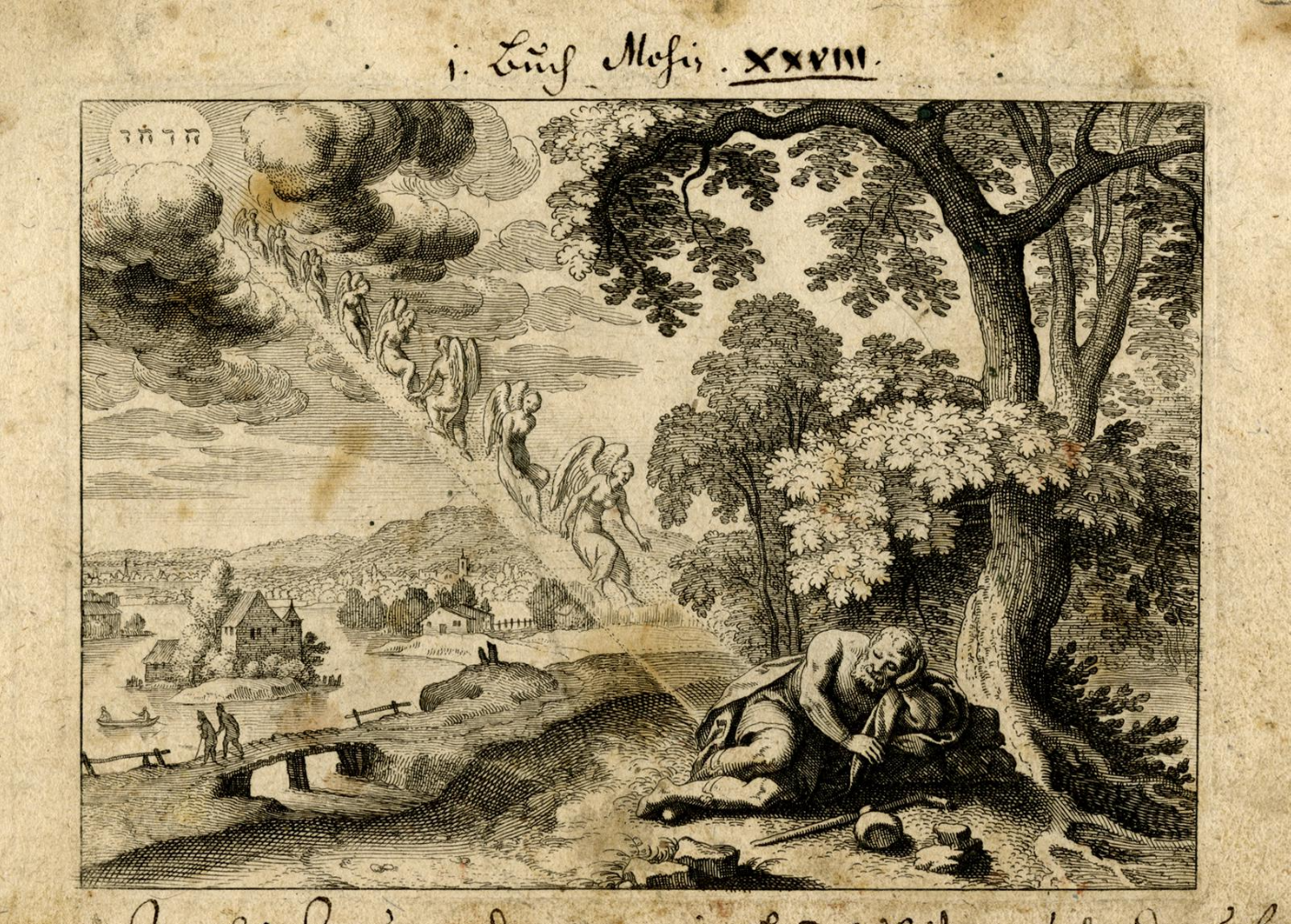
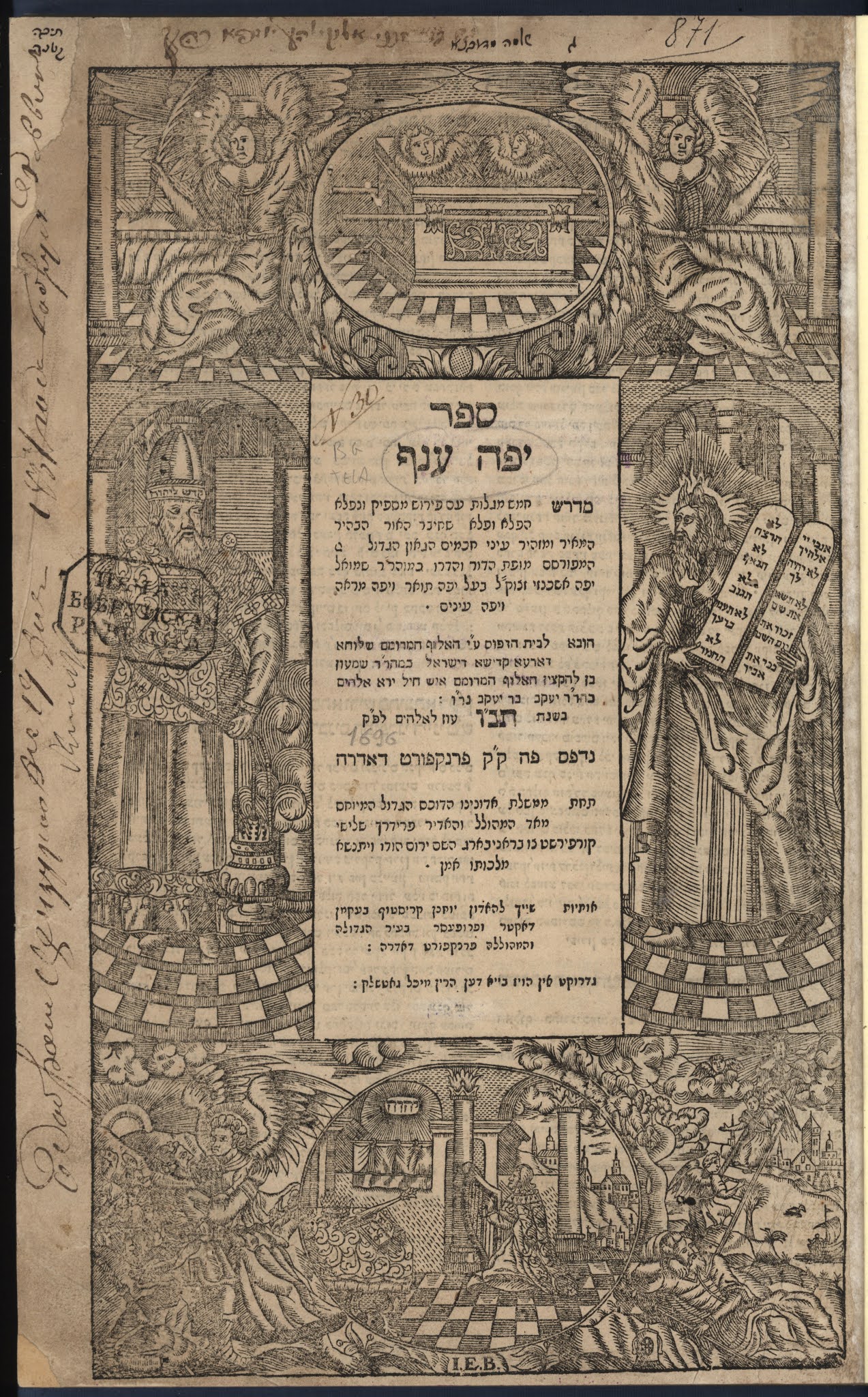
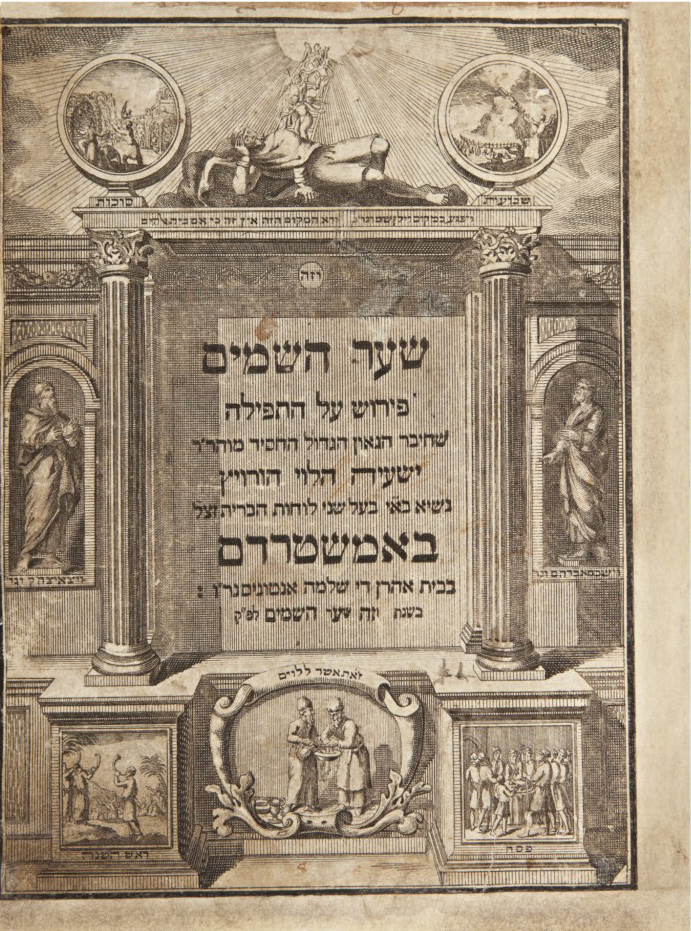
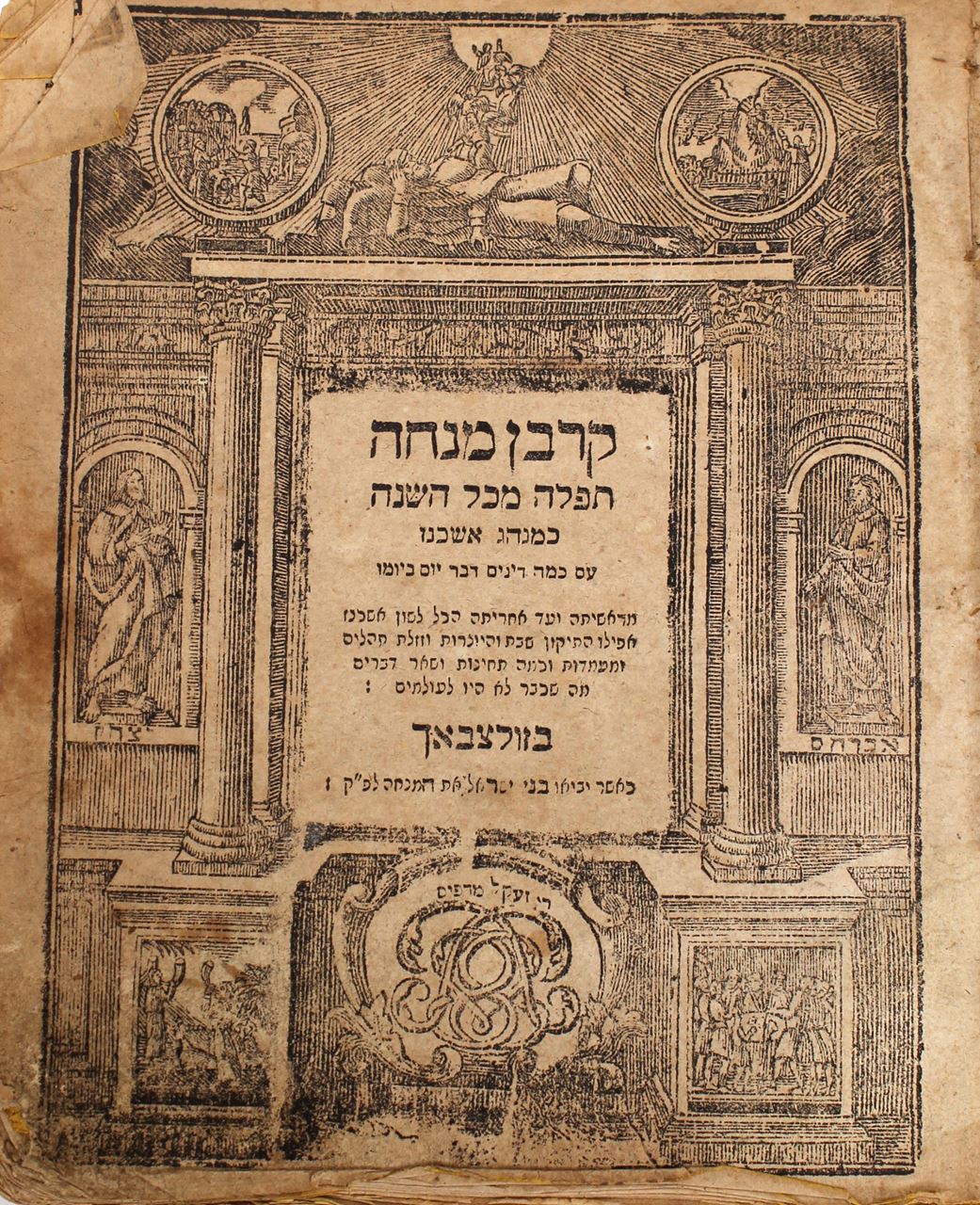
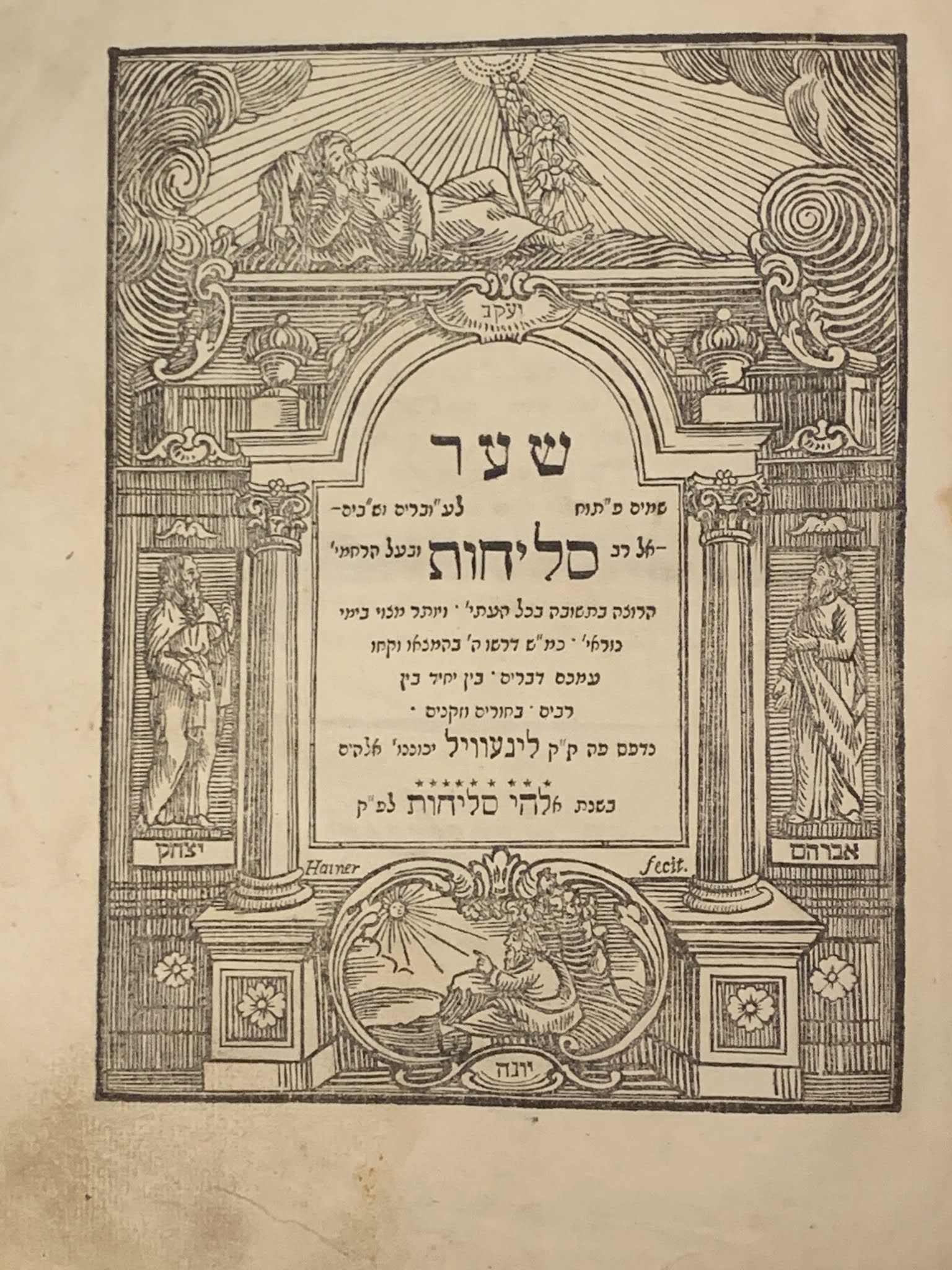
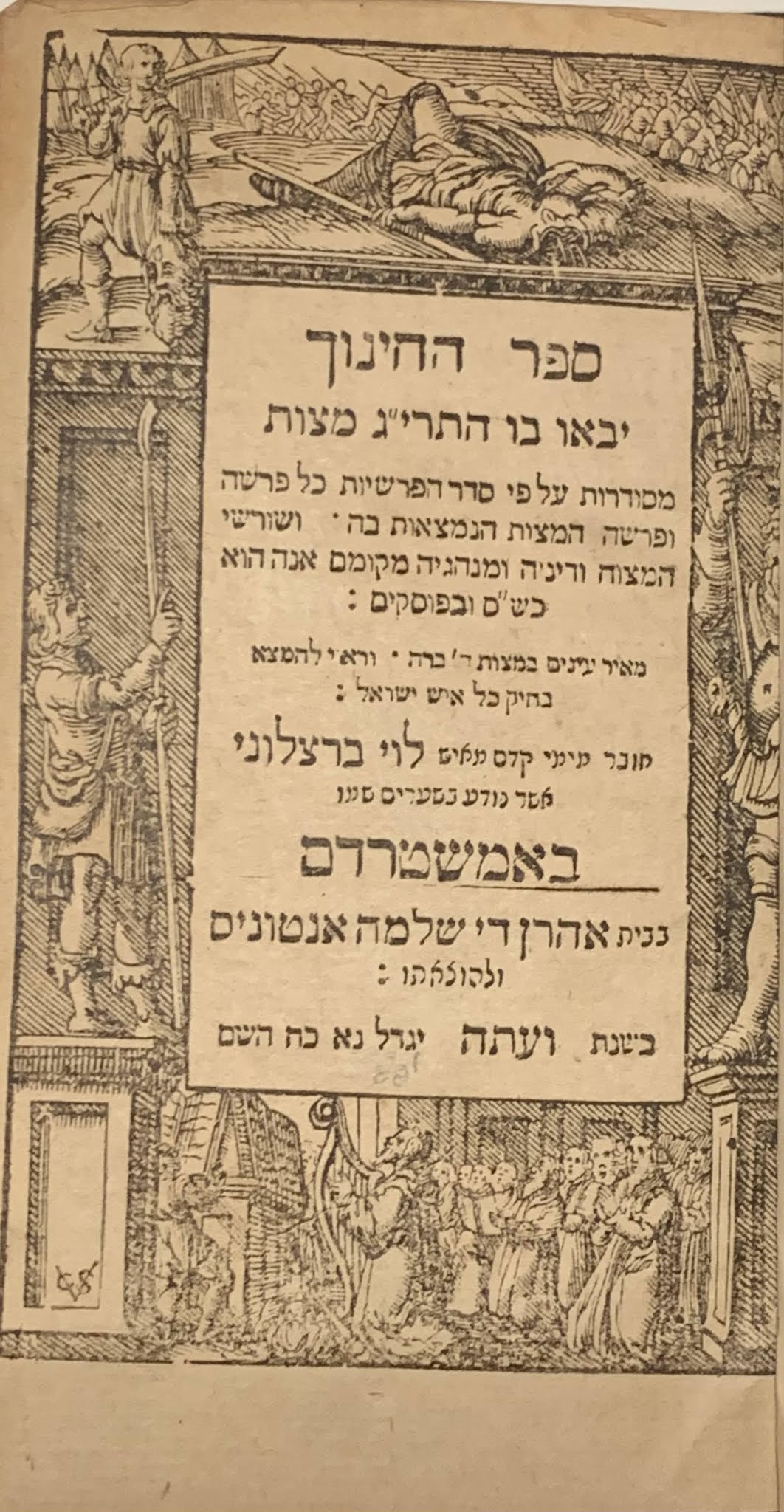
Jacob’s Dream: Reproducing a Talismanic Illustrated Title Page

Jacob’s Dream: Reproducing a Talismanic Illustrated Title Page

(Illustrations are from the following sources: the Edut Be Yosef, Rabot, Shivim Tekunei Zohar, and Yefeh Anaf are from the Gross Family Collection.  The Minhat Shai is from Dan Rabinowitz’s personal collection, and the rest are courtesy of the internet.)

One of the earliest examples of Jewish art are the biblical paintings at the Dura Europos Synagogue, completed in 244-5 C.E. Among those images is that of Jacob’s dream. The importance of the Dura Europos iconography in the development of Jewish art is hard to overestimate. “The iconographic formulas, seen for the first time in the Dura synagogue would recur both in Jewish art and Christian art, in widely differing media – manuscripts, murals, mosaics, ivories and silver utensils – frequently without modification, or with only the modifications necessitated by different materials or techniques, or the need to emphasize a new theological perspective.”[1]

By the time of its discovery in the 1920s, only a fragment of Jacob’s dream scene remained visible. Nonetheless it is possible to discern the subtly of the artist. In the fragment, Jacob is depicted as a figure wearing Greek costume – the then contemporary dress – leaning on his elbow, in the posture of Palmyrene funerary reliefs. Only the body is preserved, the head and upper body are lost. Near the figure is planted an inclined ladder, which one or perhaps two (it is unclear) personages in Persian dress are ascending. This custom, consisting of a short-belted tunic adorned with braid at the throat and hem, and wide trousers gathered into short supple boots, represents in the language of the Dura painter the garb of kings and princes, and court temple  personnel.[2] 

Scholars have voiced a number of opinions to explain the Persian court dress. According to one scholar the artist was referencing a midrash that appears in Pirkei de-Reb Eliezer. The angels, rather than merely serving as Jacob’s protection, also allude to “the four kingdoms that would conquer and subjugate the Jews, each as represented by its prince.”[3]One of the kingdoms is Persia. Thus, the artist’s choice of iconography was deliberate.

Jewish Title Pages

The first illustrated Jewish title pages appeared in the early seventeenth century. In 1693, the first depiction of Jacob’s dream graced a Jewish title page. That book, Sefer Rabbot, Midrash Rabba, with the commentary of R. Yisachar ben Naftali Katz, printed in Frankfurt on the Oder by Michael Gottschalk.


He was a local bookbinder and bookdealer who took over the management of Johann Christoph Beckman’s printing press in Frankfort d.O. in 1693, and led the press for almost forty years.[4]  Sefer Rabbot’s title page includes Moses and Aaron (who first appear in the 1610 edition of the She’a lot u-Teshuvot Mahril, printed in Hanau (see “Aaron the Jewish Bishop”), at the top, angels around the ark, and at the bottom, three biblical scenes, Jacob wrestling with the angel, David praying, and Jacob’s dream. It is obvious that these images are modeled after Matthaeus Merian’s engravings of biblical scenes that accompanied his Icones Biblicae printed between 1625-1630. All three of these images can be traced to Merian based upon a number of similarities and artist conventions.

The image of Jacob’s dream depicts, in both instances, Jacob laying next to a tree, boats and houses appear in the background, and angels’ hands are outstretched to greet Jacob. There is one significant puzzling difference. In Merian’s depiction, he substitutes the letters (reversed) of tetragram for God. In the Jewish book, God is depicted as an old man with a beard wearing a crown. This, despite Judaism’s strong prohibition on depicting God in a human form.

(This is not the only instance of a Jewish book containing a human image for God. The title-page of the first edition of R. Yedidia Shlomo of Norzi’s commentary on the biblical mesorah, Minhat Shai, Mantua, 1742-44, includes a depiction of God with a human face.   The images on the title page are various biblical vignettes and in the one for the resurrection of the “dry bones” that appears in Yehkezkel, God is shown as an old man with a white beard.)

Here is that image in detail:

Michael Gottschalk reused the Rabot title page at least five times; in 1695, for R. Shmuel Yaffe, Yafe Anaf, in 1696, Mattityahu ben Asher Lemle Liebermann, Mattat Yah, in 1698 in R. Benjamin Ze’ev Wolf ben Samuel Romaner’s Ir Binyamin,  in 1699 in Ohel Yaakov, and in 1602 in Yisrael b. Aaron Yaffa, Or Yisrael.


These title pages are just a few of Gottchalk’s illustrated title pages. Gottshalk artistic sensibilities are on full display in his 1697-99 edition of the Talmud, a work for which the Frankfurt press is best known to this day. It contains arguably the most magnificent Talmudic title page ever printed.

In 1695, the first illustrated copperplate Haggadah was published in Amsterdam. All the images are modeled based upon Merian. The title page too contains a number of biblical scenes in circular medallions. One of which is Jacob’s dream.

The next title page that depicts Jacob’s dream appears in Tzvi Hirsch ben Rachmiel Chotsh’s, Shiv’im Tikunei ha-Zohar, Hemdat Tzvi, Amsterdam, Moshe ben Avraham Mendes Coutinho, 1706.[5] Like the Gottchalk’s image that includes heretical iconography, those of Shiv’im Tikunei ha-Zohar would prove equally problematic.[6]

Despite Hemdat Tzvi’s impressive approbations, R. Jacob Emden accused Chotsh, and specifically this book, of holding and expressing Sabbatian beliefs.[7] It has been conclusively demonstrated that indeed Chotsh’s book contains Sabbatian ideas.[8] Evidence of Chotsh’s embrace of Sabbateanism is identifiable amongst the title page images. Indeed, Chotsh calls attention to the larger meaning of the title page’s images. At the bottom of the title page Chotsh provides that “whosoever wishes to know the secret of the above frontispiece, should see the introduction to the Tikkunim at the beginning of the first article.” An inspection of that section yields likely Sabbatian passages. Thus, Chotsh is indicating that like the introduction, the title page also contains allusions to Sabbateanism.

The title page depicts a variety of biblical figures and Jacob’s dream appears at the top center of the page. Above that are two deer holding a crown with the verse from Isaiah 28:5, “On that day will the Lord of the hosts be for a crown of glory, and for a diadem of beauty.” The “crown of glory” or in Hebrew “Ateret tzvi” has a double meaning here, “glory” and “deer” and, of course, is alluding to Sabbatia Tzvi, who, “on that day” will be presumably wearing the crown.[9]

The most long-lasting depiction of Jacob’s dream is that which appeared in Siddur Shaarei Shamyim from R. Isaiah ha-Levi Horowitz (Shelah), Amsterdam, 1717.[10]

This title page is notable in that the accompanying images that align with the book which was not always the case. This is a complete machzor and as such four holidays, Sukkot, Pesach, Shavout, and Rosh Hashana, are represented on the top encased in circles, and underneath the columns. On one side of the bottom of the pillars. On either side is a niche, on the right with Abraham with the legend and on the left, Isaac, underneath each is a verse corresponding to prayer. Displayed prominently at top center, depicting his dream, with the verse from which the book’s title is derived. Underneath the title is a depiction of the Levites pouring water over the priest’s hands with the legend above, Ze hasher la-leviim. This is a reference to R. Horowitz’s lineage. All of the biblical images correspond with Merian’s depictions.

This title page, with small modifications, was repeatedly copied and is found in books from across Europe. One explanation for the ubiquity of this title page is that the Siddur ha-Shelah was imbued with talismanic effect. R. Yoel Sirkes in his approbation assures that whoever prays from this book their prayers would be answered. As evidence of the talismanic effect of the book one only needs to look to recent auctions where the book is regularly sold for tens of thousands of dollars. Perhaps printers looking to capitalize on the aura surrounding the Siddur ha-Shelah incorporated the images in their books.

For example, the title page appears in Edut be-Yaakov, Sulzbach, 1741,[11] in 1765, Furth, Siddur Korban Minha, and in 1797, in the north west of France in Luneville, Sha’ar Selihot ve-Tahanunim. In the latter, the Levite is substituted for Jonah as that is more aligned with the High Holiday themes of the book, and the four depictions of the holidays are removed because they conflict with the singular nature of the book.

Illustrated Hebrew title pages are perhaps the most ubiquitous, and certainly the most accessible form of Jewish art. Yet, the study of the art of the Hebrew title page has not attracted commensurate scholarly interest. Our example, tracing the depiction of Jacob’s dream, is but one instance that illustrated Hebrew title pages fit within the larger history of Jewish art. Here, the Hebrew title pages seventeenth- and eighteenth-century Hebrew books harken back to the iconography identified at Dura Europos that continued to appear in Jewish artistic forms, in this instance books.

[1] Gabrielle Sed-Rajna, Jewish Art (New York: Harry N. Abrams, Inc., 1997), 127.

[2] Gabrielle Sed-Rajna, Jewish Art (New York: Harry N. Abrams, Inc., 1997), 559.

[3] E.L. Sukenik, Bet-haKeneset shel Dura-Europa ve-Tserayav (Jerusalem: Mossad Bialik 1947), 112-3.

[4] B. Friedberg, History of Hebrew Typography in Central Europe (Antwerp, 1935), 35-49.

[5] Like Gottschalk, Coutinho also produced a number of other illustrated title pages with biblical images.In 1696, the year before he published the siddur, he published at least two books with illustrated title pages, Sefer Hinukh and the Mishna. This title page was reused in Coutinho’s 1698 edition of R. Hayim Moshe Karinal, Yemin Moshe.   

[6] Bezalel Naor, Post-Sabbatian Sabbatianism, (Spring Valley, NY: Orot, 1999),79-82.

[7] See Shnayer Leiman, “Sefarim ha-Hashudim be-Shabbta’ot: Rishimat shel ha-Gaon Yavet”z Tzal,” in Sefer ha-Zikhron le-Rebi Moshe Lifschitz, (New York, 1996), 890

[8] See Naor, Post-Sabbatian, 80-81 and the sources cited therein.

[9] Of course, Shabbatai Tzvi is not the only “Tzvi,” Chotsh’s first name is Tzvi. Perhaps the image is an allusion to his name – a somewhat common theme in Hebrew title page illustrations. Recently, however, one scholar noted that the deers are not the only Sabbatian reference. According to his theory, the layout of the biblical figures aligns with kabbalistic representations of the sefirot.  See Naor, 81.

[10] Horowitz’s other book, Sheni Luhot ha-Brit, Amsterdam, 1698, also contains a beautifully illustrated title page.

[11] The title page was reused for decades in the Sulzbach presses. As late as 1794, there are examples of the title page. See, e.g. Tsenah u-Renah, Sulzbach, 1794.


A nay bintl briv: Personal Reminiscences of Rabbis Baruch ha-Levi Epstein and Aaron Walkin from the Yiddish Republic of Letters

A nay bintl briv:

Personal Reminiscences of Rabbis Baruch ha-Levi Epstein and Aaron Walkin

from the Yiddish Republic of Letters

Shaul Seidler-Feller

Editor’s note: The present post is part two of a two-part essay. Part one can be found here.

Second Letter

Approximately eight and a half years after his column on the Hafets Hayyim appeared, Rabbi Aaron B. Shurin penned another essay, entitled “The Mistake of the Austrian Emperor” and about the meaning behind the observance of the Three Weeks, which was published 18 Tammuz 5756 (July 5, 1996), a day after they had begun.[1] In the first line, he quoted Rabbi Baruch ha-Levi Epstein (1860–1941/1942) as citing a story about Austrian Emperor Franz Joseph I’s (1830–1916) negative response to a group of Hungarian nationalists who wished to establish a day of mourning for the loss of their independence in 1848, using the Jews’ observance of Tish‘ah be-Av as a model.[2] This prompted Simon Paktor to write in:


SCHENECTADY 9.5.96.

זייער געערטער און חשובער
.הרב ר״ אהרון בן ציון שוּרין נ״י


עס איז מיר זייער פארדראסיג וואס כ׳האב ניט בעוויזן
צו שרייבן מאמענטאל, און זיך הארציג בעדאנקען פאר
.אייער ארטיקל ״פאָרווערטס״ דעם 5-טן יולי ה.י

ווי געוויינליך ווען די אידישע צייטונג קומט
אן צו מיר, איז עס ביי מיר ווי א גוטער פריינד
וואלט געקומען פון דער אלטער אומפארגעסליכער
..פארשניטענער היים… און מיר ריידן א[וי]ף יידיש

איך האב ממש א ציטער געטאן ווען כ׳האב
אין אייער ארטיקל וועלכן איך לייען שטענדיג מיט דעם
גרעסטן אינטערעס דערזען אין דער ערשטער שוּרה דעם
טייערן נאמען ״הרב ר׳ ברוך עפשטיין (מחבר פון
פירוש ״תורה תמימה״ אויף חומש) דערציילט אין
[3](זיין זכרונות ספר ״מקור ברוּך״ א.א.וו

איך האב געהאט די זכיה צו קענען
אט דעם ״אִיש פֶלֶא״ כבין געווען א פריינד
פון א פינסק-קארלין משפחה וועלכע האט זיך
געיחוס׳ט מיט קרובישאפט. דער פאטער פון דער
פאמיליע האט בעת א שבת׳דיגן וויזיט צוגעטראגן צו מיר
דעם ספר ״מקור ברוך״ און בעוויזן אז ר׳ ברוך

2

ווייזט אן אז אין שׁימל פון ברויט ליגט
דער פאטער אלתר סלוּצקי .PENECiLiN רְפוּאָה ווי
איז געווען א לאַווניק אין שטאט ראַט און די טאכטער האט
געארבעט אין דער יידישער אפטיילונג. אזוי ווי פינסק
האט געהאט א פנקס פון 800 יאר האט זיך זי געהאט די
א מעגליכקייט אויסגעפינען און אנטקעגן קומען ר׳ ברוך עפשטיינס
ביטעס אין די ארכיווע אויסצוזוכן. ער פלעגט זיך שטענדיג
בעדאנקען צו איר דורך שיקן א ״באָמבאניערקע״
דא הייסט עס א באַקס שאקאלאד)… איך)
.מיט טרערן אין די אייגן און מוז א וויילע איבערייסן

.ער האט מיר אויסגעלערנט אן אריטמעטיג פארמוּלע
איך דערמאן זיך ווען כ׳האב שבת נאכן דאוונען אין פינסקער
גרייסער שוּל אראבגעגאנגען צום ברעג פון אונזער
און בעמערקט ר׳ ברוך עפשטיין ז”ל PiNA שיינער טייך
זיצט אויף א באַנק כ׳בין צוגעגאנגען צו עם און געזאגט

״גוט שבת ר׳ ברוּך גום ברוך יהיה״

ער האט געענטפערט ״גם אתם״ און צובייגענדיג צו מיר
געפרעגט ״אפשר האט איר די פאָלקס צייטונג״
(א בונדיסטישע צייטונג וואס איז ארויס אין ווארשע)
(ווען איך האב עס דערציילט א היגן רָב (ניט קיין ראביי
האט ער צו מיר געזאגט יעצט זע איך

3

…אז ער איז געווען ״אם לא למעלה מזה״
איך בין יונג געווען און קיין שכל ניט געהאט און ניט פארשטאנען
צו צוהערן זיך און פאָלגן וואס אונזערע חכמים האבן
געזאגט ״והוי מתאבק בעפר רגליהם״

איך פלעג עם זייער אָפט טרעפן גייענדיג צו
(הרב הגאון ר׳ אהרון וואלקין ז״ל השם יקום דמם
הרב וואלקין האט עם ר׳ ברוך עפשטיין זייער מְקַרֵב
.געווען אין זיין עלנדקייט

איך האב געהאט דעם טרויעריגן זכות זען
אט דעם גאון ר׳ אהרון וו. הארט פארן אימה׳דיגן חורבן ווי
ער איז געזעסן אין א ווינקל פון א סטאָליאריי אַרטיעל
נאכדעם ווי די סאוויעטן האבן עם ארויסגעטריבן פון
זיין בית דין שטוב. געזעסן ארומגערינגלט מיט ספרים
…בליֵיך ווייס ווי שניי. א ״מַראה כהן״

ווייטער האב איך שוין ניט געווּסט כ׳בין געווען אין די
.לאַפּעס פון נ.ק.וו.ד

איך האב זיין ר׳ ברוּך׳ס ספר ״בָרוּך שֶאָמַר״ פירוּש
תפילות ישראל. ר׳ ברוך עפשטיין ז״ל איז געשטארבן
אין געטא אין הונגער, צער א צוּווייטאגדיגער. און מיין האַרץ
..וויינט אין מיר טאג און נאכט

4

מיין הארציגן דאנק צו אייך פאר דערמאנען
אין אייער ארטיקל (דער טעות….) אט דעם טייערן
.נאמען

כווינטש אייך געזונט און אריכת ימים ושנים
צו שרייבן אזעלכע ״צום האַרצן״ ארטיקלען אין
יידיש

מיט דאנקבארקייט און כבוד צו אייך
.לשנה טובה תכתבו ותחתמו
.שמעון פאקטאר
Schenectady NY.

Schenectady 9.5.96

To the highly esteemed and eminent Rabbi Aaron Benzion Shurin, may his light shine,

I am greatly displeased that I did not manage to write immediately to offer my sincere thanks for your column in this year’s July 5th issue of the Forverts.

As is usual when the Yiddish newspaper is delivered, I felt then as if a good friend had arrived from the unforgettable, obliterated old country… and we were having a conversation in Yiddish…

I literally shuddered when I noticed in the first line of your column – which I always read with the greatest interest – the dear name “Rabbi Baruch Epstein (author of the Torah temimah commentary on the Pentateuch) relates in his memoir Mekor barukh,” etc.

I had the good fortune to know that “amazing man.” I was friendly with a family in Pinsk-Karlin that took pride in its kinship with him. The head of the family, during a visit of mine one Sabbath, brought me the book Mekor barukh and showed me that R. Baruch

2

points out that medicine akin to penicillin can be found in moldy bread.[4] The father, Alter Slutzky, was an alderman on the city council, and his daughter worked in its Jewish division.[5] Since Pinsk had a communal register going back 800 years,[6] she had the opportunity to learn of and accommodate R. Baruch Epstein’s requests to search in the archive. He would always thank her by sending a bombonierka (here, we would call it a box of chocolates)…[7] I write this with tears in my eyes and must pause for a moment.

He taught me an arithmetic formula. I remember how one Sabbath, after services in the Great Synagogue of Pinsk,[8] I descended to the banks of our beautiful Pina River and caught sight of R. Baruch Epstein, of blessed memory, sitting on a bench.[9] I approached him and said, “Good Sabbath, R. Baruch – may you, too, be blessed [barukh].”[10] He responded, “The same to you”[11] and, leaning over to me, asked, “Maybe you have a copy of the Folkstsaytung?” (a Bundist newspaper published in Warsaw). When I recounted this story to a local rov (not some non-Orthodox rabbi),[12] he said to me, “Now I see

3

that he was ‘if not even higher than that’[13]…”[14] I was young and foolish and did not realize that I should really listen to and follow that which our Sages taught: “And sit in the dust of their feet.”[15]

I would very often meet him on his way to the ga’on Rabbi Aaron Walkin, of blessed memory (may God avenge their blood). R. Walkin drew quite close to R. Baruch Epstein in his loneliness.

I had the tragic fortune to see that ga’on, R. Aaron W., right before the horrific Holocaust, sitting in a corner of a carpentry workers’ cooperative after the Soviets had banished him from his rabbinic courtroom. He sat surrounded by books, his complexion pale white as snow, like leprosy shown to a priest…[16]

I knew nothing more of him; I was caught in the clutches of the NKVD.

I have R. Baruch’s book Barukh she-amar, a commentary on the Jewish prayers.[17] R. Baruch Epstein, of blessed memory, died in the ghetto a distressed man, starving and suffering. And my heart cries within me day and night…

4

My sincere thanks to you for mentioning in your column (“The Mistake…”) that precious name.

I wish you health and many long days and years so that you might continue writing such “heartwarming” columns in Yiddish.

With gratitude and esteem,
May you be inscribed and sealed for a good year,
Simon Paktor
Schenectady, NY

Although the author of our letter offers precious few details about himself in the body of the document, we know from other sources that he was born to Moishe and Gittel Paktor on January 18, 1913 in Pinsk (then part of Russia, now in Belarus).[18] At the time, Pinsk was one of the most Jewish (percentage-wise) of the major cities in Eastern Europe, with a Jewish population in 1914 of 28,063 out of 38,686 total residents (approximately 72.5%).[19] Presumably because Paktor was young and politically active, the NKVD (Soviet secret police) arrested him toward the beginning of World War II, when Pinsk was occupied by the Red Army, and sent him eastward to a Siberian labor camp, thereby inadvertently saving his life.[20] When he was released, he traveled to Munich where he met and married his first wife, Helen (1925–2019), and the two of them, together with their young son David Leon (b. 1949), immigrated to the United States in 1952.[21] Sometime thereafter the couple divorced, and in 1973 Simon moved to Schenectady to serve as the Ritual Director at Congregation Agudat Achim, a Conservative synagogue (located at 2117 Union Street).[22] There, in 1976, he married Anne Smuckler (1914–2014), whose own husband had passed away three years prior,[23] and continued serving the shul faithfully until his retirement in 1993.[24]

Paktor’s letter, like Dickman’s before it, transports us back in time, providing rare firsthand testimony that sheds light on several aspects of interwar Eastern European rabbinic culture. It deals primarily with the figure of R. Epstein, a brilliant Talmudist and polymath who decided not to enter the rabbinate but instead to support his family as a banker, all the while composing important Torah works in a non-professional capacity.[25] Perhaps the most eclectic of these is Sefer mekor barukh (Vilna, 1928), a multivolume compilation of his novellae and studies in various fields of Jewish scholarship, as well as personal reminiscences about members of his family. Paktor’s letter briefly discusses this book but also, en passant, and intriguingly, references Epstein’s research in the Pinsk Jewish communal archive; could he have been working there on his never-published bilingual (Hebrew and Yiddish) treatise on the history of Pinsk, written in the aftermath of World War I?[26]

Also interesting is Epstein’s request for a copy of the daily Folkstsaytung, not only on account of the paper’s strictly secular orientation – indeed, it, like the Forverts, was published on Shabbat and yom tov[27] – but also because halakhah, according to a number of interpretations, generally disapproves of reading printed matter like newspapers on Shabbat[28] (some would say during the week as well[29]). In apparently seeing nothing wrong with this practice, Epstein was following the example of his maternal uncle and eventual brother-in-law, Rabbi Naphtali Zevi Judah Berlin (Netsiv; 1816–1893), last rosh yeshivah of the famous yeshivah in Volozhin (present-day Vałožyn, Belarus), who, by Epstein’s own account, would regularly peruse a newspaper on Shabbat day.[30]

In addition, the letter opens a window onto the relationship between Epstein and Rabbi Aaron Walkin (alternatively spelled Wolkin; 1865–1941/1942).[31] By the period in question, Epstein had suffered a number of tragedies and personal setbacks: his wife Sophia (Sheyne), the daughter of Eleazar Moses ha-Levi Horowitz (Reb Leyzer Pinsker; 1817–1890), former chief rabbi of Pinsk, had passed away due to influenza in 1899 before the age of 40; the Mutual Credit Society, the large private bank at which Epstein had worked as an officer, closed at the beginning of World War I; and three of his four children were no longer in Pinsk.[32] Though his daughter Fania (Feygl) remained in the city,[33] Epstein was lonely and lived in a hotel.[34] Into this void stepped Walkin, who arrived in Pinsk circa 1923,[35] becoming its chief rabbi in 1933[36] and there growing close to Epstein. The two men had much in common: both had studied at the feet of Netsiv in Volozhin, married around the age of 18, endured great misfortune, visited America but decided to return to Europe, and sympathized (at least somewhat) with the Zionist movement.[37] As Paktor testifies, Epstein, who lived (as of 1930) at 89 Dominikańska (present-day Gor’kogo [renamed by the Soviets]) Street,[38] would often visit Walkin at his home at 71 Dominikańska, a claim confirmed by the latter’s son, Rabbi Samuel David (1900–1979),[39] who refers to Epstein on at least one occasion as yedidi ne’eman beitenu (my friend, a confidante of our household).[40]

Finally, the letter touches directly on the last years of Walkin’s and Epstein’s lives. Shortly after Soviet forces entered Pinsk on September 17, 1939, they banned Hebrew language instruction, abolished the traditional Sabbath and Jewish holidays, and converted the Great Synagogue into a theater.[41] We know from Paktor’s letter and other sources that Walkin, who had been imprisoned by the Russians previously,[42] largely escaped persecution at the hands of the Soviets and even managed to continue performing his rabbinic functions, including scholarly writing, in secret.[43] Epstein, by contrast, was evicted from the hotel in which he had been living and was forced to wander, further weakening him in his old age.[44]

With the Nazi advance into Pinsk on July 4, 1941, an already dire situation was made even more terrifying: Jews were wantonly robbed and beaten, forced to wear Stars of David, ordered to provision the German occupiers, forbidden to leave the city, and detained for labor or ransom. About a month later, on August 5–7, the first Aktion took place, in which the Nazis murdered approximately eight thousand Jewish men outside the city. The following May 1, a ghetto meant to concentrate the approximately twenty thousand remaining Jews was established in the poorest and most crowded part of town; this was later almost completely liquidated in the second Aktion of October 29–November 1, 1942.[45]

What became of Walkin and Epstein during this frightful time? Theories about each man’s demise abound. R. Samuel David refers to his father on several occasions with the acronym reserved for martyrs, H[ashem] y[ikkom] d[amo], following his name.[46] Indeed, at least two Pinsk natives have written that R. Aaron perished together with his flock (presumably in one of the two major Aktionen).[47] Others have hazarded guesses dating his passing to around Passover 1941 or to the summer of 1942.[48] Similarly, as surveyed recently in part by Shemaryah Gershuni, hypotheses regarding Epstein’s date of death range from 1940 to 1942 and, regarding the circumstances of his death, from natural to painful to violent.[49]

In his letter, Paktor himself could not say what had happened to Walkin, while with respect to Epstein, he claimed that he had died in the Pinsk ghetto (he, too, adds Hashem yikkom damam after mentioning them).[50] However, so far as I have been able to ascertain, and as already pointed out by Gershuni, the only eyewitness testimony to have come down to us – that of a nurse named Mila/Michla Ratnowska (b. 1916) who, together with her mother Zlata (1890–1962) and four others, survived the Nazi occupation of Pinsk in hiding – records that both men died (at home) due to illness in the winter of 1941–1942.[51] This timing is corroborated, if only implicitly, by the absence of Walkin and Epstein from the list of over eighteen thousand Jews living in the Pinsk ghetto, drawn up by the Germans “sometime in 1942.”[52] Until additional evidence surfaces, it would seem prudent to accept this as the most reliable version of the events leading up to the passing of these great men, about whom we can say (with a bit of poetic license) that they were “beloved and cherished in their lifetimes, and they never parted, even in death” (II Sam. 1:23).

Conclusion

Like the giants about whom they wrote, Shurin, Dickman, and Paktor have all passed on (in 2012, 2011,[53] and 2003, respectively). How fortunate we are, though, that their memories are preserved for us in this nay (new) bintl briv! Through these simple documents – penned in an age (not too long ago) when people still took the time to correspond thoughtfully with journalists after reading and reflecting on their essays – we are able to reconstruct, if only partially, the lives and deeds of some of the most prominent leaders of Eastern European Jewry in a prewar world now lost.


* I would like to thank Yehuda Geberer for respectfully commenting that he felt I had made a mistake in the first part of this essay, in which I had identified the Chaim Lieberman who assisted Shurin in landing a job at the Forverts as “the famed historian and bibliophile” who lived 1892–1991 (and who often spelled his name Haim Liberman in English). While Geberer is almost certainly correct that Shurin was actually helped by the man of the same name (1890–1963) who, according to his entry in the Leksikon fun forverts shrayber zint 1897, 42-43, worked as a teacher of Yiddish literature and Forverts Yiddish literary critic, I was influenced (apparently unduly so) in my (mis)identification by Yisroel Besser who, in his Mishpacha article (p. 30), writes as follows: “He went to meet the person he considers the greatest Orthodox writer of the century, Chaim Lieberman. Lieberman was a bibliophile, researcher, and historian, who suggested that young Shurin leave him some writings to peruse.”

I also wish to thank Yehudah Zirkind for kindly bringing to my attention another Yiddish-language memoir about the Hafets Hayyim, in which the author, a Radin native, tells a number of interesting stories about the great sage and also notes that he passed away “before reaching his ninety-fourth birthday”; see Abrashka-Kives Rogovski, “Der khofets-khayim in radin,” Oksforder yidish 3 (1995): 193-200, at col. 200.

[1] Aaron B. Shurin, “Der toes fun estraykhishn keyzer,” Forverts (July 5, 1996): 9, 20.
[2] See Baruch ha-Levi Epstein, Sefer mekor barukh, pt. 2 (Vilna: Romm, 1928), 515a-b, citing what he heard from Isaac Hirsch Weiss of Vienna (1815–1905). Epstein refers to the ruler as Franz Joseph II, but in point of fact the relevant Austrian emperor at the time was Franz Joseph I (whose official grand title, interestingly, included the style “King of Jerusalem”).
[3] The quotation of the original Yiddish here is not exact but is certainly close enough.
[4] I have so far been unable to locate the passage referred to.
[5] Jacob-Alter Slutzky was a prominent Orthodox lay leader of the Jewish community of Pinsk who was s/elected to serve on the city council at several points during the interwar period when Pinsk was under Polish rule; see Azriel Shohet, The Jews of Pinsk, 1881 to 1941, ed. Mark Jay Mirsky and Moshe Rosman, trans. Faigie Tropper and Moshe Rosman (Stanford: Stanford University Press, 2012), 469-470, 552-556, 559, 580-581. For the original Hebrew, see Wolf Zeev Rabinowitsch (ed.), Pinsk: sefer edut ve-zikkaron li-kehillat pinsk-karlin, vol. 1, pt. 2 (Tel Aviv; Haifa: Irgun Yotse’ei Pinsk-Karlin bi-Medinat Yisra’el, 1977; also available through the New York Public Library Yizkor Book online portal [accessed August 19, 2019]), using the index. See also Slutzky’s mini-bio in Nachman Tamir (Mirski) (ed.), Pinsk: sefer edut ve-zikkaron li-kehillat pinsk-karlin, vol. 2 (Tel Aviv: Irgun Yotse’ei Pinsk-Karlin bi-Medinat Yisra’el, 1966; also available through the New York Public Library Yizkor Book online portal [accessed August 19, 2019]), 538, where it is noted that Slutzky, like Epstein, was a member of Netsiv’s family (see below) and that he had two daughters, Zhenya and Eve. Based on a daf-ed filed by the former’s sister-in-law, Sonia Goberman (accessed August 19, 2019), it appears that Zhenya was the one who worked in the Jewish division. For Epstein’s endorsement of Slutzky during a campaign season, see “Eyn goldene keyt fun maysim toyvim,” Unzer pinsker lebn 3,42 (102) (October 16, 1936): 5.
[6] An old Pinsker tradition has it that the Jewish community was founded some time in the tenth century; see Benzion Hoffman (ed.), Toyznt yor pinsk (New York: Pinsker Branch 210, Workmen’s Circle, 1941), ix-x (notice the book’s title), and Tamir, Pinsk, 249, 252. Some have averred that an exact date for the start of the community cannot be established at present, given the number of times the Great Synagogue, and any historical documents it may have housed, burned down (on which, see n. 8 below); see, e.g., Saul Mendel ha-Levi Rabinowitsch, “Al pinsk-karlin ve-yosheveihen,” in Judah ha-Levi Levick and Dovberush Yeruchamsohn (eds.), Talpiyyot (me’assef-sifruti) (Berdychiv: Joseph Hayyim Zablinsky, 1895), 7-17, at p. 7. In any event, the current mainstream position holds that it began around 1506, the year in which a privilege issued by Fyodor Ivanovich Yaroslavich, Prince of Pinsk, granted local Jews land for a synagogue and cemetery in perpetuity; see Mordechai Nadav, The Jews of Pinsk, 1506 to 1880, ed. Mark Jay Mirsky and Moshe Rosman, trans. Moshe Rosman and Faigie Tropper (Stanford: Stanford University Press, 2008), 13-14.
[7] For a similar story, see Hillel Seidman, “Ha-rav r. barukh epstein – pinsk,” in Isaac Lewin (ed.), Elleh ezkerah: osef toledot kedoshei [5]700-[5]705, vol. 1 (New York: Research Institute of Religious Jewry, Inc., 1956), 142-149, at p. 145; reprinted with some variations in Seidman’s Ishim she-hikkarti: demuyyot me-avar karov be-mizrah eiropah (Jerusalem: Mossad Harav Kook, 1970), 108-116, at p. 111. Relatedly, see the Rosh Hashanah greetings sent to Epstein by the typesetters and printers of the Pinsker vort 2,40 (86) (September 30, 1932): 1, and of ibid. 3,38 (138) (September 20, 1933): 1.
[8] For some of the turbulent history of the Great Synagogue of Pinsk, which fell victim to fires on multiple occasions, see Nadav, The Jews of Pinsk, 1506 to 1880, 463-465; Shohet, The Jews of Pinsk, 1881 to 1941, 217-220, 300-301, 463, 648, 656; and Tamir, Pinsk, 249-252. For photographs of the synagogue, see here and here (accessed August 19, 2019). For a map of Pinsk from 1864 illustrating the location of the Great Synagogue, see Hoffman, Toyznt yor pinsk, 88-89 (in Yiddish), and Nadav, The Jews of Pinsk, 1506 to 1880, 498-499 (in English). For later maps of Jewish Pinsk, see Hoffman, Toyznt yor pinsk, 232-233, and Tamir, Pinskfoldout preceding p. 97.
[9] Epstein generally prayed not in the Great Synagogue but in the Pinsker Kloyz, a beit midrash with a firmly mitnaggedic orientation. Ze’ev Rabinowitsch reports that, “in years past, it was said that the walls of the Pinsker Kloyz do not give out in deference to R. Baruch Epstein…” (“Akhsanye shel toyre,” in Tamir, Pinsk, 264). See also Rabinowitsch, Pinsk, 412.
[10] See Gen. 27:33.
[11] In Yiddish, one appropriate response to a greeting like gut shabes! is gam atem!, using the plural atem even when only one person is being addressed. See Sol Steinmetz, Dictionary of Jewish Usage: A Guide to the Use of Jewish Terms (Lanham, MD: Rowman & Littlefield Publishers, Inc., 2005), 53.
[12] American Yiddish will often distinguish between Orthodox and non-Orthodox (particularly Reform) rabbis by referring to the former as rov/rabonim (singular/plural) and the latter as rabay/rabays (singular/plural). As essentially transliterations from the English, these terms for non-Orthodox rabbis are usually intended somewhat derogatorily in the mouths of frum Yiddish speakers.
[13] Oyb nisht nokh hekher or, as the phrase appears here in Hebrew, Im lo le-ma‘lah mi-zeh, is the title of a short story by the famous Yiddish and Hebrew classicist I.L. Peretz (1852–1915) about a Litvak who refuses to believe that the Nemirover Rebbe (a fictional character probably based on Rabbi Nathan Sternharz of Niemirów [1780–1845]) ascends on High during the annual period of selihot, as his Hasidim claim he does, instead of coming to the synagogue. Determined to find out where the Rebbe disappears to, he hides under the Rebbe’s bed one night and is amazed to discover that the Rebbe wakes early in the morning, dresses as a Polish peasant, and goes out to the forest to chop firewood for poor bedridden Jewish widows. He thereupon decides to join the Rebbe’s Hasidim, and from then on whenever anyone claims that the Rebbe flies up to Heaven to petition on behalf of his flock before Rosh Hashanah, this Litvak-turned-Hasid responds, “If not even higher than that.”

The story was first published in Yiddish in 1900 as “Oyb nisht nokh hekher! A khsidishe ertseylung,” Der yud 2,1 (January 11, 1900): 12-13. The following year, it appeared, in the author’s own Hebrew adaptation, as “Im lo le-ma‘lah mi-zeh,” Ha-dor 1,17 (1901): 207-211; for the Hebrew text, see here (accessed August 19, 2019). For editions using modern Yiddish orthography, see here and here (accessed August 19, 2019). For side-by-side Yiddish with English translation, see “Oyb nisht nokh hekher/And Maybe Even Higher,” in Itche Goldberg and Eli Katz (eds.), Selected Stories: Bilingual Edition, trans. Eli Katz (New York: Zhitlowsky Foundation for Jewish Culture, 1991), 270-281. For extensive discussions of the story’s subversive messages, historical sources, and inspirations, see Menashe Unger, “Mekoyrim fun peretses folkstimlekhe geshikhtn,” Yidishe kultur 7,3-4 (March–April 1945): 54-59, at pp. 56-57; Samuel Niger, Y.l. perets: zayn lebn, zayn firndike perzenlekhkeyt, zayne hebreishe un yidishe shriftn, zayn virkung (Buenos Aires: Confederacion pro Cultura Judia, 1952), 286-289; and Nicham Ross, Margalit temunah ba-hol: y.l. perets u-ma‘asiyyot hasidim (Jerusalem: Magnes Press, 2013), 17-83 (ch. 2).

In our context, the phrase is deployed by Paktor’s rabbinic interlocutor to express his realization that Epstein was even greater than he had originally thought.
[14] Paktor apparently also shared this story about Epstein and the Folkstsaytung with Mark Jay Mirsky; see the latter’s introduction to Shohet, The Jews of Pinsk, 1881 to 1941, xxix-xxx.
[15] mAvot 1:4.
[16] The Hebrew phrase deployed here is mar’eh kohen, a reference to the requirement that those afflicted with biblical tsara‘at must consult with a priest before the healing/atonement process can move forward (see Lev. 13). The expression, as used by Paktor, does double-duty by playing on the title of the well-known piyyut recited on Yom Kippur, which refers to the priest’s (radiant) appearance, not that of the biblical skin disease.
[17] Barukh she-amar was the last book Epstein printed before he passed away. It originally appeared in Pinsk in 1939 (publisher: Drukarnia Wolowełskiego), but, according to Aaron Z. Tarshish, Rabbi barukh ha-levi epstein[,] ba‘al “torah temimah” (Jerusalem: Mossad Harav Kook, 1967), 189, even though the work achieved great popularity within the city, it did not spread beyond. Epstein sent a single copy to the famous Strashun Library in Vilna, which then passed it on to YIVO, and the latter institution transferred it to its headquarters in New York (see the online catalog record for this copy here [accessed August 19, 2019]). This, then, was apparently the only exemplar of the book to survive the war, and when it was discovered at YIVO some time thereafter, it was used to print the photo-offset reproduction published in Tel Aviv in three parts: vol. 1 on the haggadah (1965), vol. 2 on Pirkei avot (1965), and vol. 3 on the siddur itself (1968). (For a slightly different account of Barukh she-amar’s original publication and rediscovery after the war, see Seidman, “Ha-rav r. barukh epstein,” 148. Based on a helpful personal communication from Lyudmila Sholokhova, Director of the YIVO Library, it would appear that Tarshish’s version of the story is the more accurate one.)

I assume that Paktor owned a copy of the Tel Aviv reprint, not the original Pinsk edition.
[18] See the obituary for Rev. Simon Paktor published in the Albany Times Union (March 2–3, 2003), available here (accessed August 19, 2019).

Franz J. Beranek, in his Das Pinsker Jiddisch und seine Stellung im gesamtjiddischen Sprachraum (Berlin: Walter de Gruyter & Co., 1958), discusses certain distinctive features of the dialect of Yiddish spoken in Pinsk. Upon examination of our letter, we find some of the markers of this litvish (Northeastern Yiddish) dialect reflected in such forms as eygn (eyes; see p. 33, §38, 1), greyser (large; see p. 25, §26), arobgegangen (descended; see p. 53, §48, 2a), em (him; see p. 21, §18, 1), etc. (I suspect that his use of the forms idishe [Jewish/Yiddish], reydn [to speak], and fardrosig/hartsig/shtendig/etc. [displeased/sincerely/always/etc.], instead of the expected yidisheredn, and fardrosik/harstik/shtendik/etc., is the result of Paktor following common journalistic orthographic conventions and is not reflective of his actual pronunciation of those words.) (For a recent look at Beranek’s relationship with some of his Yiddish scholarly contemporaries, see Kalman Weiser, “‘One of Hitler’s Professors’: Max Weinreich and Solomon Birnbaum confront Franz Beranek,” Jewish Quarterly Review 108,1 [2018]: 106-124.)
[19] See Mordechai Nadav, “Pinsk,” in Shmuel Spector (ed.), Pinkas ha-kehillot: polin, vol. 5 (Jerusalem: Yad Vashem, 1990), 276-299, at p. 276 (available in English translation here [accessed August 19, 2019]). See also Dov Levin, Tekufah be-sograyim, 1939–1941: temurot be-hayyei ha-yehudim, ba-ezorim she-suppehu li-berit-ha-mo‘atsot bi-tehillat milhemet ha-olam ha-sheniyyah (Jerusalem: Hebrew University of Jerusalem; Tel Aviv: Hakibbutz Hameuchad, 1980), 26, for a chart comparing the populations of cities in eastern Poland in 1931.
[20] See the aforementioned obituary for Paktor published in the Albany Times Union. On NKVD activity in Pinsk during the Soviet occupation, see Pesah Pakacz, “Shilton ha-soviyyetim be-pinsk,” in Tamir, Pinsk, 315-320, at pp. 317-320, and Shohet, The Jews of Pinsk, 1881 to 1941, 639-650. On NKVD activity among occupied Polish Jewry in general, see Yosef Litvak, Pelitim yehudim mi-polin bi-berit ha-mo‘atsot[,] 1939–1946 (Jerusalem: Hebrew University of Jerusalem; Tel Aviv: Ghetto Fighters’ House; Hakibbutz Hameuchad, 1988), 118-156. As noted by Eliyana R. Adler, the similar situation of Baltic Jews exiled to the east by the Soviets demonstrates that had they not suffered that fate, they most likely would have fallen victim to the Nazis when the latter invaded the Soviet Union on June 22, 1941; see her “Exile and Survival: Lithuanian Jewish Deportees in the Soviet Union,” in Michal Ben Ya’akov, Gershon Greenberg, and Sigalit Rosmarin (eds.), Ha-kayits ha-nora ha-hu…: 70 shanah le-hashmadat ha-kehillot ha-yehudiyyot be-arei ha-sadeh be-lita: historiyyah, hagut, re’aliyyah (Jerusalem: Efrata College Publications, 2013), xxvii-xlix, at pp. xlv-xlvi.
[21] See the Holocaust remembrance seminar announcement published in the Clifton Journal (October 30, 2015), p. 36 (available here [accessed August 19, 2019]; make sure to click “View Details”). The Air Passenger Manifest recording the Paktors’ arrival in New York, available to subscribers through the MyHeritage database (accessed June 20, 2019), is dated May 19, 1952; curiously, it lists Simon’s wife’s name as Sabina.
[22] According to Michael C. Duke, “Historian Is CBY Scholar In Residence, Oct. 8–10,” Jewish Herald-Voice (October 7, 2010) (accessed August 19, 2019), Paktor was trained as a rabbi. While I could find no direct corroborating evidence for this claim elsewhere, it is true that he is sometimes referred to in writing with the title “Reverend.” His work at the shul, for which he came to be well loved and respected, included serving as cantor and Torah reader, running the daily minyanim, preparing youth for their bar and bat mitzvahs, and even teaching Yiddish classes; Stephen M. Berk, Year of Crisis, Year of Hope: Russian Jewry and the Pogroms of 1881–1882 (Westport, CN; London: Greenwood Press, 1985), xv, credits Paktor with introducing him to the world of Yiddish scholarship. See also the aforementioned obituary in the Albany Times Union and the above article by Duke. I thank Robert Kasman, Stephen M. Berk, and Mendel Siegel for the information they provided me on Paktor’s life and service to the shul in personal communications.
[23] See the obituary for Anne Paktor published here (accessed August 19, 2019).
[24] Henry Skoburn, The Agudat Achim Chronicle: Commemorating 120 Years[,] 1892–2012 (Schenectady: Congregation Agudat Achim, 2012), 10, 12.
[25] The only book-length biography of Epstein is Tarshish’s (above, n. 17), though, as noted by Eitam Henkin, “Perakim be-toledot ba‘al arukh ha-shulhan: mishpahto ve-tse’etsa’av,” Yeshurun 27 (2012): 879-895, at p. 879, this work is in need of a thorough update that takes a scholarly-critical approach and considers the abundant literature on Epstein and his oeuvre that has appeared over the past fifty-plus years. For a shorter essay on Epstein’s life, see Seidman’s “Ha-rav r. barukh epstein” (above, n. 7). And for a famous photograph of Epstein in his younger years, see Hoffman, Toyznt yor pinsk, 335; reproduced (seemingly with modifications) as the frontispiece of Tarshish’s biography and in Zvi Kaplan, “Hiddushim ba-halakhah shel gedolei pinsk ve-karlin,” in Rabinowitsch, Pinsk, 367-406, at p. 393. (I find it hard to believe that the person in the portrait accompanying the Epstein mini-biography printed in Tamir, Pinsk, 489-491, is actually him but would be happy to be corrected.)
[26] See Baruch ha-Levi Epstein, Sefer mekor barukh, introduction (Vilna: Romm, 1928), 2 n. 1.
[27] The Folkstsaytung (People’s Paper) was the official organ of the General Jewish Workers Union in Poland, also known as the Bund. As such, it espoused a secularist, socialist Weltanschauung and polemicized against Communists, Zionists, and Orthodox Jews, among others. In addition to covering politics and workers’ issues, the paper devoted space to science and technology, sports, culture, and (Jewish and non-Jewish) literature. At its height in 1935, the Folkstsaytung had an approximate circulation of eighteen thousand. See Jacob Shalom Hertz, “‘Folkstsaytung’ 1918–1939,” in David Flinker, Mordechai Tsanin, Shalom Rosenfeld et al. (eds.), Di yidishe prese vos iz geven (Tel Aviv: Veltfarband fun di Yidishe Zhurnalistn, 1975), 151-169, and Boris Kotlerman, “Folks-tsaytung,” trans. I. Michael Aronson, in the digitized YIVO Encyclopedia of Jews in Eastern Europe (accessed August 19, 2019).

According to Seidman, “Ha-rav r. barukh epstein,” 144-145:

[Epstein] had an expansive [intellectual] horizon. He was interested in and familiar with all that was happening in the world. He read Russian and German newspapers. He also visited Vienna and Berlin in the ’20s, meeting with scholars and intellectuals there, and maintained an epistolary correspondence with the towering Jewish figures of the generation. When they visited Pinsk, he would host them. In 1914, Rabbi Hayyim Soloveichik visited Pinsk and stayed with Rabbi Baruch Epstein for Shabbat.

In addition to regularly reading the paper, Epstein also contributed to a number of (rabbinic and general Jewish) periodicals, including HavatseletYagdil torahHa-levanonHa-maggidHa-melits, and Ha-pardes; see Baruch ha-Levi Epstein, Sefer mekor barukh, pt. 3 (Vilna: Romm, 1928), 701b, and Shemaryah Gershuni, “Rabbi barukh epstein – ba‘al ha-torah temimah: beirur nesibbot petirato,” Yeshurun 29 (2013): 885-892, at pp. 886 n. 13, 889 n. 25. He even wrote a weekly column on the parashah for the Pinsker shtime; see Seidman, “Ha-rav r. barukh epstein,” 145, 148-149. While I have not examined issues of the Pinsker shtime, I know that Epstein’s parashah columns in a different local paper, Pinsker vort, were entitled Fun gebentshtn kval (=Mi-makor barukh); see the announcement in the February 20, 1931 edition, p. 1.
[28] For a summary of some of the halakhic literature on the topic and a defense (in most cases) of the widespread contemporary disregard of this prohibition, see Eitam Henkin, “Keri’at divrei defus be-shabbat be-yameineu le-or din shetarei hedyotot,” Melilot 3 (2010): 49-63 (the pagination in the printed version is slightly different from that of what I presume to be the prepublication copy available on Henkin’s website).
[29] Indeed, the Hafets Hayyim was particularly vociferous in his opposition to the practice of many of his contemporaries to regularly read newspapers, not only because of their often-improper content (heresy, scoffing, leshon ha-ra, licentiousness, etc.), but also due to the drain on one’s time involved in their consumption. See, e.g., Israel Meir ha-Kohen, Kunteres zekhor le-miryam (Piotrków: Hanokh Henekh Fallman, 1925), 8b; Aryeh Leib Poupko, Mikhtevei ha-rav hafets hayyim z[ekher] ts[addik] l[i-berakhah]: korot hayyav, derakhav, nimmukav ve-sihotav, 1st ed. (Warsaw: B. Liebeskind, 1937), 96-98 (second pagination; no. 42); ibid., 42-43 (third pagination; par. 82); idem, Mikhtevei ha-rav hafets hayyim z[ekher] ts[addik] l[i-berakhah], ed. S. Artsi, 2 vols. (Bnei Brak: n.p., 1986), 2:157-158. Relatedly, see also idem, Mikhtevei, 1st ed., 27-29 (second pagination; no. 9). It is clear, however, that the Hafets Hayyim was, at times, exposed to periodical literature; for a letter he sent to the Haredi paper Kol ya‘akov, responding to an earlier issue thereof, see idem, Mikhtevei, ed. S. Artsi, 1:297-298 (no. 122).
[30] See Baruch ha-Levi Epstein, Sefer mekor barukh, pt. 4 (Vilna: Romm, 1928), 895b, 897b-898a. Epstein’s report about his uncle’s behavior in this connection has aroused a good deal of controversy, as discussed by, e.g., Eliezer Brodt, “The Netziv, Reading Newspapers on Shabbos & Censorship,” Seforim Blogpt. 1 (March 5, 2014) and pt. 2 (April 29, 2015). Like Brodt, Marc B. Shapiro, “Clarifications of Previous Posts,” Seforim Blog (January 16, 2008) (accessed August 19, 2019), believes that one can rely upon this account. On the general question of the historical accuracy of Sefer mekor barukh, see, e.g., Eitam Henkin, “R. yehi’el mikhl epstein ve-ha-‘tsemah tsedek’ ba-adashat ha-sefer ‘mekor barukh’,” Alonei mamre 123 (Winter 2011): 189-215, and Moshe Maimon, “Od be-inyan ba‘al ha-torah temimah u-sefarav,” Kovets ets hayyim 12,1 (2018): 409-420 (among many others).
[31] Probably the two most authoritative biographies of Walkin to date are that appended to the beginning of the second volume of the New York, 1951 photo-offset edition of his responsa, Sefer she’elot u-teshuvot zekan aharon, composed by his son, Rabbi Samuel David (on whom, see below), and entitled “Toledot maran ha-ga’on ha-mehabber z[ekher] ts[addik] v[e-]k[adosh] l[i-berakhah]”; and Hillel Seidman, “Ha-rav r. aharon walkin – pinsk,” in Lewin, Elleh ezkerah, 64-71; reprinted with some variations in Seidman’s Ishim she-hikkarti, 20-28. Eliezer Katzman used these two sources in compiling much of his own profile of Walkin – “Ne‘imut ha-torah: ha-g[a’on] r[av] aharon walkin z[ekher] ts[addik] v[e-]k[adosh] l[i-berakhah,] a[v] b[eit] d[in] pinsk[,] ba‘al beit aharon, zekan aharon v[e-]ku[llei],” Yeshurun 11 (2002): 891-904; 12 (2003): 727-739 – but added some material not found in either. (It seems that unacknowledged verbatim use was made of Seidman’s and/or Katzman’s work in the Walkin biography printed in Daniel Bitton’s editions of Sefer beit aharon on Bava kamma [Jerusalem: Mekhon ha-Ma’or, 2003] and of Sefer hoshen aharon [Jerusalem: Mekhon ha-Ma’or, 2005].) For additional appreciations of Walkin’s Torah, see Kaplan, “Hiddushim ba-halakhah,” 399-406, an earlier version of which had appeared as “Ba‘al ha-‘battim’,” Ha-tsofeh 10159 (June 24, 1966): 5, 7; and of his religious persona, see the excerpt from Rabbi Joseph B. Soloveitchik’s letter to R. Samuel David, dated 8 Shevat [5]712 (February 4, 1952) and printed at the foot of the introduction to Aaron Walkin, Sefer beit aharon al massekhet gittin, 2nd ed. (New York: S. Walkin, 1955).

For photographs of Walkin, see Anon., “Shlukhim fun agudes yisroel shoyn do,” Yidishes tageblat (December 11, 1913): 8; Anon., “Visiting Rabbis Explain International Jewish Union,” The Pittsburg [sic] Press (January 27, 1914): 3; Anon., “Noted European Rabbis Greeted by Orthodox Jews of Greater Boston,” The Boston Post (February 7, 1914): 16; Kaplan, “Hiddushim ba-halakhah,” 399; Moshe Rosman, “Pinsk,” in the digitized YIVO Encyclopedia of Jews in Eastern Europe (accessed August 19, 2019); Marc B. Shapiro, “A Tale of Two Lost Archives,” Seforim Blog (August 12, 2008) (accessed August 19, 2019); the Jewish Pinsk memorial page here (accessed August 19, 2019) (Walkin is leading the Agudah procession); and David Zaretsky, “Rabbah ha-aharon shel pinsk: le-hofa‘ato me-hadash shel ha-sefer sh[e’elot] u-t[eshuvot] ‘zekan aharon’,” in Zikhram li-berakhah: ge’onei ha-dorot ve-ishei segullah (Israel: n.p., 2015?), 33-39.
[32] See Jacob Goldman’s obituary for Sophia Epstein, entitled “Allon bakhut,” in Ha-tsefirah 26,60 (March 24, 1899): 293. See also the report issued by Aaron Tänzer, “Von Brest-Litowsk nach Pinsk,” Allgemeine Zeitung des Judentums 80,1 (January 7, 1916): 6-10, at p. 9, in which he mentions Epstein’s widowhood and the bank closure. Of Epstein’s four children – Cecilia (Tsile), Meir, Eleazar Moses, and Fania – Tänzer makes specific reference only to the last, suggesting that the other three were no longer in Pinsk by that point. Indeed, we know that Cecilia’s husband Nathan (Nahum) Bakstansky (Bakst) arrived at Ellis Island in 1907 (see his Geni record here [accessed August 19, 2019]); that they and their children Aaron and Jacob were registered voters as of 1924 (see Anon., “List of Registered Voters for the Year 1924: Borough of Brooklyn—Sixteenth Assembly District,” The City Record [October 16, 1924]: 2); and that Cecilia is registered as the copyright holder for the New York, 1928 edition of her father’s Torah temimah (see Anon., Catalogue of Copyright Entries: Part 1, Group 1 […] for the Year 1929 [Washington: United States Government Printing Office, 1930], 1825-1826). In addition, according to family records made available to Henkin, Eleazar Moses had moved to Leningrad (present-day St. Petersburg, Russia) (see the corrections appended to the online version of his aforementioned article, “Perakim be-toledot”). And if Seidman is correct that one of Epstein’s sons wound up working as a physician in New York (see the Ishim she-hikkarti version of his article, p. 110), that may mean Meir, like Cecilia, made it to America as well. (I find the idea that Meir and Fania died in their youth, as reported on Henkin’s website, difficult to believe, considering that Tänzer makes no mention of this in 1916, based on a visit to Pinsk in November 1915; see also next note. But until additional information becomes available, this will be virtually impossible to definitively reject [or accept].) In this connection, see also Maimon, “Od be-inyan,” 418-419, for an interesting interpretation of a passage in Sefer mekor barukh, pt. 4.
[33] Fania was instrumental in founding a Jewish girls’ gymnasium in Pinsk in the fall of 1915, reportedly with her father’s approval. See Tänzer, “Von Brest-Litowsk,” 9, and Shohet, The Jews of Pinsk, 1881 to 1941, 34, 183, 350-351, 596-597; see also Tamir, Pinsk, 510-512. She apparently passed away during World War II, given that she (like her father) is listed among the martyrs of Pinsk in Tamir, Pinsk, 627. (It is unclear to me whether or not the Meir cited there was R. Baruch’s son.)
[34] As of Tänzer’s visit, it seems that Fania attended to the needs of her father’s house (“Von Brest-Litowsk,” 9). Tarshish notes, however, that at a certain point he began living in a local hotel, whose proprietors took care of him honorably and with dedication (Rabbi, 127; though cf. below, n. 38). Seidman adds that he ate his meals at a restaurant in the city while living in the hotel (“Ha-rav r. barukh epstein,” 144). Three hotels, all under Jewish ownership, are named in the “List of Subscribers of the Telephone Network of the Postal and Telegraph Directorate in Wilno in 1939” (select p. 52 from the drop-down menu) (accessed August 19, 2019). I have not been able to ascertain at which of these three Epstein lived.
[35] See Kaplan, “Hiddushim ba-halakhah,” 399; see also Ben-Mem, “Ha-ga’on r. aharon walkin z[ekher] ts[addik] l[i-berakhah],” in Tamir, Pinsk, 499-500, who notes that Walkin eulogized Rabbi Jacob Mazeh of Moscow (1859–1924) within the first year of his arrival in the city. Cf. the introduction to Aaron Walkin, Sefer beit aharon al massekhet bava kamma (Vilna: Shraga Feivel Garber, 1923), which the author signed (seemingly in 1923) while living in the Jewish community of Amtshislav (present-day Mscisłaŭ, Belarus). Cf. also Anon., “Horav r. arn wolkin vegn zayn raykher lebns-fargangenheyt,” Unzer grodner ekspres 2,79 (April 2, 1929): 1, the second part of an interview with Walkin, which claims that he emigrated from Russia in 1922; as well as Aaron B. Shurin, “Tsvey shayles utshuves sforim fun letstn pinsker rov,” Forverts (October 14, 1977): 3, 6, at p. 3, who writes that Walkin came to Pinsk in 1924. (On his way from Russia to Poland, he had an extended stopover in Danzig; see M. Lyubart, “Vegn yidishn lebn in danzig,” Pinsker vort 2,11 [57] [March 11, 1932]: 5.)
[36] See Anon., “Horav walkin oysgeveylt als rov fun pinsker kehile,” Pinsker vort 3,32 (132) (August 11, 1933): 6, and Shohet, The Jews of Pinsk, 1881 to 1941, 571. Cf. Ben-Mem, “Ha-ga’on r. aharon walkin,” 500, who gives the date as [5]688 (1927–1928). (His election to the rabbinate of neighboring Karlin had taken place over a year earlier; see Anon., “Horav walkin als karliner rov,” Pinsker vort 2,6 [52] [February 5, 1932]: 6.)

Relatedly, see Dov Rabin (ed.), Grodnah-Grodne (Jerusalem: Encyclopaedia of the Jewish Diaspora, 1973; also available through the New York Public Library Yizkor Book online portal [accessed August 19, 2019]), col. 352, on the brief period in 1929 when the Jews of Grodno – then part of Poland but now in Belarus – considered appointing Walkin as the chief rabbi of their community (an episode that deserves fuller historiographic exploration); see also Anon., “Kehile-rat geg[n] horav wolkin,” Unzer grodner ekspres 2,88 (April 12, 1929): 15.
[37] For Epstein, see Tarshish, Rabbi, 70-80 (relationship with Netsiv), 84-89 (marriage at approx. 18), 120-126 (visit to America), 134-135, 148-149 (Zionist sympathies) (all based primarily on passages in Sefer mekor barukh); Shohet, The Jews of Pinsk, 1881 to 1941, 536 (Zionist sympathies); and Gershuni, “Rabbi barukh epstein,” 890-892 (visit to America). For Walkin, see his undated introduction to Sefer beit aharon al massekhet bava kamma (visit to America); the postscript to his undated introduction to the commentary Saviv li-yere’av, vol. 1 (Pinsk: Drukarnia Wolowełskiego, 1935), and the wishes of nehamah printed in Dos naye pinsker vort 7,51 (356) (December 3, 1937): 6 (personal misfortune); his son’s “Toledot maran ha-ga’on ha-mehabber” (relationship with Netsiv, marriage at approx. 18, visit to America); and Ben-Mem, “Ha-ga’on r. aharon walkin,” 500, and Rabin, Grodnah-Grodne, col. 352 (Zionist sympathies). Relatedly, Walkin’s son Hayyim married the daughter of Rabbi Abraham Isaac ha-Kohen Kook (1865–1935); see the mazl tov wishes on the occasion of their engagement printed in Do’ar ha-yom 8,182 (April 28, 1926): 1, and in Ha-arets 9,2041 (May 2, 1926): 4.

For a lecture delivered in Yiddish during Walkin’s visit to the United States, undertaken December 1913–February 1914 in order to help establish Agudath Israel in America, see Aaron Walkin, Di printsipen un tsveke fun agudes yisroel: fortrog gehalten fir amerikaner idn (New York: Office of Agudath Israel, n.d.). (During his trip, Walkin visited the Rabbi Isaac Elchanan Theological Seminary at 156 Henry Street; for his comparison of the yeshivah with that of Volozhin [!], see Anon., “Agudes yisroel shlukhim in yeshives rabeynu yitskhok elkhonen,” Der morgen zhurnal [December 24, 1913]: 4. Cf. Anon., “Horav wolkin begaystert fun idishe anshtalten in amerika,” Der morgen zhurnal [January 13, 1914]: 4.)

Tragically, Epstein and Walkin shared another fate: each printed a sefer in 1939 in Pinsk, only one copy of which survived the war and was later used for photo-offset reprinting. On Epstein’s Barukh she-amar, see above, n. 17, and on Walkin’s Sefer beit aharon al massekhet gittin, see his son’s introduction to the 1955 edition.
[38] See the address given for Epstein on the title page of his Sefer tosefet berakhah ha-kolel he‘arot ve-he’arot le-sefer “megillat sefer” al hamesh megillot ha-kodem (Krakow: [Michael Horowicz], 1930) (the same address appears on the title pages of the five parts of Sefer gishmei berakhah that appeared at the same press in the same year). It is unclear to me at what point he moved into the hotel referred to by Tarshish (see above, n. 34), though it seems, based on the aforementioned “List of Subscribers,” that as of 1939 a fellow named Dawid Giler was living at Epstein’s former address on Dominikańska Street.
[39] For several biographical sketches of R. Samuel David, the only child of R. Aaron to survive the war, see Samuel David Walkin, Sefer ramat shemu’el al ha-torah: sefer be-reshit (Jerusalem: Walkin Family, 1982), 11-27; the unpaginated introductions to idem, Sefer shevivei or: likkutim, ed. Samuel David Walkin [the grandson], 2nd ed. (Jerusalem: n.p., 2011); and idem, Sparks of Light: Jewels of Wisdom from the Chofetz Chaim ZT”L (New York: Kol Publishers, 2012), 83-86. For descriptions of R. Samuel David’s efforts on behalf of his fellow Pinskers, see Rabinowitsch, Pinsk, 547, and Tamir, Pinsk, 598-599. Unsurprisingly, given the interconnectedness of Lithuanian rabbinic dynasties, R. Samuel David became close with both the Hafets Hayyim and R. Soloveitchik; for photographs of him with the former, see the plates at the end of Sparks of Light, and with the latter, see Marc B. Shapiro, “Assorted Matters,” Seforim Blog (February 17, 2016) (accessed August 19, 2019).
[40] See Samuel David Walkin, Sefer kitvei abba mari: hiddushim u-be’urim al tanakh u-midrashav, ed. Moishe Joel Walkin (Kew Gardens: Yeshiva Beth Aron, 1989), 345; see also pp. 73, 132, 160, 266, 497, 512. For other instances of R. Samuel David quoting Epstein, often preceded by honorifics, see idem, Sefer ramat shemu’el al ha-torah, 108-109, and idem, Sefer kitvei abba mari: hiddushim u-be’urim al massekhtot ha-shas, u-mo‘adei ha-shanah[,] ve-nosaf aleihem derashot ve-he‘arot be-inyanei de-yoma, ed. Moishe Joel Walkin (Kew Gardens: Yeshiva Beth Aron, 1982), 33, 176, 193, 277, 314. For a reproduction of a letter written by Epstein (on his own letterhead) to R. Samuel David on the occasion of the latter’s appointment to the rabbinate of Lukatsh (present-day Lokachi, Ukraine) in 1935, see Tamir, Pinsk, 490. On the relationship between Epstein and R. Aaron, see also Seidman, “Ha-rav r. barukh epstein,” 144, 149. (Seidman, “Ha-rav r. aharon walkin,” 69, notes that Walkin opened his home and heart “to anyone suffering or in pain.” See also Zaretsky, “Rabbah ha-aharon shel pinsk,” 36. For a similar description of R. Samuel David, see Aaron B. Shurin, “Horav hagoen r. shmul wolkin, vitse prezident fun agudes horabonim, iz nifter gevorn,” Forverts [August 29, 1979]: 1, 8, at p. 1.) Another home Epstein visited was that of Yankev Epstein in Minsk; see Devora Gliksman, A Tale of Two Worlds (Brooklyn: Mesorah Publications, ltd, 2009), 113-114.
[41] Shohet, The Jews of Pinsk, 1881 to 1941, 642, 648; see also Tamir, Pinsk, 319-320.
[42] Walkin himself refers to this, en passant, in the introduction to Sefer beit aharon al massekhet bava kamma, saying that he was jailed bi-shevil alilah, hattat ha-kahal hu (on account of libel; it is the sin of the community). R. Samuel David, in “Toledot maran ha-ga’on ha-mehabber,” explains that his father was one of those fighting to defend Jewish tradition against the edicts of the Bolsheviks and was therefore imprisoned for about half a year. Seidman, “Ha-rav r. aharon walkin,” 67, adds (perhaps by logical deduction) that the Yevsektsiya (Jewish section of the Communist Party) was responsible for informing on him to the authorities.
[43] For examples of Walkin’s wartime rabbinic activities, see Shohet, The Jews of Pinsk, 1881 to 1941, 649; Tamir, Pinsk, 320; and Seidman, “Ha-rav r. aharon walkin,” 69, 71. For his commitment especially to Torah study and creativity in this period, see the excerpt from the last letter R. Samuel David received from him printed in “Toledot maran ha-ga’on ha-mehabber,” as well as the excerpt from a letter by Rabbi Zalman Sorotzkin (1881–1966) reproduced in the introduction to Aaron Walkin, Sefer beit aharon al massekhet kiddushin, ed. Aaron ben Moishe Joel Walkin (Queens: Aaron Walkin, n.d.).
[44] See Tarshish, Rabbi, 127; see also p. 128 on Epstein’s avoidance of the Soviet authorities, even when it meant skipping meals. Zvi Gitelman, “Afterword: Pinsk in Wartime and from 1945 to the Present,” in Shohet, The Jews of Pinsk, 1881 to 1941, 652-659, at p. 653, notes that local leaders organized a committee to aid impoverished clergy, including Epstein, during this period.
[45] For harrowingly detailed accounts of the fate of Pinsk Jewry during the Nazi onslaught, see Nahum Boneh (Mular), “Ha-sho’ah ve-ha-meri,” in Tamir, Pinsk, 325-388 (a Yiddish translation by Leib Morgenthau appears on pp. 389-458 and an English translation by Ellen Stepak appears online here [accessed August 19, 2019]); Nadav, “Pinsk,” 294-298; Tikva Fatal-Knaani, “The Jews of Pinsk, 1939–1943, Through the Prism of New Documentation,” trans. Naftali Greenwood, Yad Vashem Studies 29 (2001): 149-182; Gitelman, “Afterword,” 652-654; and Katharina von Kellenbach, Nahum Boneh, and Ellen Stepak, “Pinsk,” in Martin Dean with Mel Hecker (eds.), The United States Holocaust Memorial Museum Encyclopedia of Camps and Ghettos, 1933–1945, vol. II, pt. B (Bloomington and Indianapolis: Indiana University Press, 2012), 1442-1444. For a map of the Pinsk ghetto, see Tamir, Pinsk, 334 (in Hebrew), and here (in English) (accessed August 19, 2019). For photographs of the memorials set up on the sites of mass murder, see here (accessed August 19, 2019).
[46] See, e.g., R. Samuel David’s introductions to Sefer she’elot u-teshuvot zekan aharon, vol. 2 (the one entitled “Hakdamat ben ha-mehabber maran ha-ga’on z[ekher] ts[addik] l[i-berakhah]”) and to Sefer beit aharon al massekhet gittin; see also the entries on R. Aaron maintained by Yad Vashem (1234) (accessed August 19, 2019). (I am aware that Hy”d is sometimes used even when a person was not literally killed by an enemy but rather died as a[n in]direct result of enemy persecution.) Strangely, Tamir, Pinsk, 636, does not list any members of the Walkin family among the martyrs of Pinsk.
[47] See Tamir, Pinsk, 500, and Zaretsky, “Rabbah ha-aharon shel pinsk,” 33, 37. For a relatively recent study of rabbinic leadership during the Holocaust, see Havi Dreifuss (Ben-Sasson), “‘Ka-tson asher ein lo ro‘eh’? rabbanim u-ma‘amadam ba-sho’ah,” in Asaf Yedidya, Nathan Cohen, and Esther Farbstein (eds.), Zikkaron ba-sefer: korot ha-sho’ah ba-mevoʼot la-sifrut ha-rabbanit (Jerusalem: Rubin Mass, 2008), 143-167.
[48] See Aaron B. Shurin, “Ha-rav aharon walkin: rabbah ha-aharon shel pinsk,” in Keshet gibborim: demuyyot ba-ofek ha-yehudi shel dor aharon, vol. 3 (Jerusalem: Mossad Harav Kook, 2004), 92-97, at p. 92 (ca. Passover 1941), and Seidman, “Ha-rav r. aharon walkin,” 71 (summer 1942).
[49] See Gershuni, “Rabbi barukh epstein,” 887-890. It seems that Tarshish’s version of the events (Rabbi, 128), according to which Epstein died in a Jewish hospital shortly after the Germans’ invasion in July 1941, has gained some traction. See, e.g., N.T. Erline’s epilogue in Baruch ha-Levi Epstein, My Uncle The Netziv, trans. Moshe Dombey, ed. N.T. Erline (Brooklyn: Mesorah Publications, 1988), 223; Prof. Meir Bar-Ilan’s family tree (accessed August 19, 2019); and Pnina Meislish, “Epstein, barukh, ben yehi’el mikhl,” Rabbanim she-nispu ba-sho’ah (accessed August 19, 2019). By contrast, Gitelman, “Afterword,” 728 n. 7, claims that “Epstein died a natural death in Pinsk in 1940,” while Ber Schwartz, Sefer artsot ha-hayyim (Brooklyn: B. Schwartz, 1992), 23, writes that Epstein was killed by the Nazis in 1942. Here again, Samuel David Walkin, Sefer ramat shemu’el al ha-torah, 108, refers to Epstein with the acronym Hy”d, suggesting martyrdom; see also the entries on Epstein maintained by Yad Vashem (123) (accessed August 19, 2019).
[50] Paktor could not have directly witnessed Epstein passing away in the ghetto, as by the time of its establishment he had long been exiled to Siberia by the Soviets. Interestingly, Aaron B. Shurin, in an article published about six years after Paktor sent this letter, also writes that Epstein died in the ghetto (“Ha-rav barukh epstein: mehabber ‘torah temimah’,” in Keshet gibborim, vol. 3, pp. 38-44, at p. 44). He adds (without citing a source) that Epstein was buried in the Karlin Jewish cemetery next to the grave of Rabbi David Friedman of Karlin (1828–1915). Unfortunately, the Karlin cemetery is no longer extant, making it difficult to verify this claim; see here (accessed November 24, 2019).
[51] Ratnowska’s account (committed to writing twenty years after the Holocaust) is cited by Boneh, “Ha-sho’ah ve-ha-meri,” 333. (Pnina Meislish, it should be noted, accepts this timing with respect to Walkin’s passing only; see “Walkin, aharon, ben yosef tsevi,” Rabbanim she-nispu ba-sho’ah [accessed August 19, 2019].) Cf. Rabinowitsch, Pinsk, 399 n. 3, where he quotes slightly conflicting testimony from Ratnowska, according to which Epstein passed away “suddenly” a few weeks before the establishment of the Pinsk ghetto (which sounds more like springtime than winter). In addition, according to her, Epstein was buried in the cemetery in Pinsk, not in the Karlin cemetery as posited by Shurin (see previous note). For Ratnowska’s description of life in hiding during the war, see Boneh, “Ha-sho’ah ve-ha-meri,” 357.

Interestingly, Irina Yelenskaya places both rabbis’ deaths more specifically in January 1942 in her article on Pinsk for the Shtetl Routes project (accessed November 4, 2019), though I do not know on which of her sources she bases this date.
[52] See the description of the Pinsk Ghetto Database available here (accessed August 19, 2019). By contrast, Rachel Walkin (1876–1942?), R. Aaron’s wife, is listed in the Database as living at 35 Polnocna (in German: Nord) Street (the present-day approximate equivalent is Leningradskaya Street). Also listed are Mila Ratnowska and Eve Slutzky (who is presumably to be identified with the daughter of alderman Jacob-Alter bearing the same name).
[53] See the May 2, 2011 funeral announcement published in the Chicago Tribune and currently available here (accessed August 19, 2019).


Towards a Bibliography of Coronavirus-related Articles & Seforim written in the past month

Towards a Bibliography of Coronavirus-related Articles & Seforim written in the past month
By Eliezer Brodt


Many of us have been under lockdown for over a month – some of us for less, some for more. However, this has not silenced the ‘voice of the Torah’; all kinds of Shiurim & classes on a wide range of topics have been made available via various methods. Otzar Hachochmah has made their database available free of charge as have others. Others have chosen to spread Torah by putting digital pen to Digital paper. 

The truth is, like almost every other topic, it’s hard come up with something truly new;  plagues and the like have occurred numerous times throughout our long history. 

The famous bibliographer Avraham Ya’ari devoted a chapter of a book of his to Seforim which were written during plagues.[1]

During each of these times many discussions related to aspects of plagues and epidemics arose.[2] The sources range from descriptions of the situation, discussions of what one should do, i.e. stay put or run,[3] tefilot[4] and/or segulot[5] to Halachik rulings regarding observing various Halachos.[6] Right before Pesach, Machon Yerushalayim released a 300 page, digital work collecting hundreds of such sources (item #8).

In the most recent issue of the journal Ha-Ma’ayan (#233) released this past month my good friend R’ Moshe Dovid Chechik wrote an article titled “The Prohibition or the Obligation to Flee the city during an Epidemic” (item #1). Since, others have written about it [see below (#4&5)]. 

Much has been written about R’ Akiva Eiger and the 1831 Cholera outbreak (see below – R’ Elli Fisher and Dr. Eddie Reichman’s articles items 1,2 and 9). [See also Rabbi Pinni Dunner here]. I too am working on an article on the topic and hope to complete it IYH within the next few days.

This terrible time has already seen many Teshuvot written, especially in regard to Pesach. See especially bellow #11-15. Much has been written and will continue to be written about davening with a Minyan (see below #15, see also R’ Avishay Elbaum’s recent post [here]).

See below (Appendix Three for a Teshuvah I came across recently, about a wedding with less than 10 people for a minyan, published in Russia in 1928 in the Journal Yagdil Torah edited by Rav Zevin and R’ Abramsky.

All of the items mentioned in the Bibliography below are available from me free of charge – just e-mail me at eliezerbrodt@gmail.com.

English 

1. Rabbi Elli Fischer, Rov in a Time of Cholera (here).
2. Dr. Eddie Reichman, From Cholera to Coronavirus: Recurring Pandemics, Recurring Rabbinic Responses (here).
3. Dr. Eddie Reichman, Incensed by Coronavirus: Prayer and Ketoret in Times of Epidemic (here).
4. Rabbi Gil Student, Talmudic Advice on Epidemics (here).
5. Dr. Tamara Morsel-Eisenberg, “Is It Permitted to Flee the City?” (here).

Hebrew

  1.  ר’ משה דוד צ’צ’יק, האיסור או החובה לברוח מן העיר בשעת המגפה, כאן
  2.  ר’ מנחם מענדל רוזנפלד, זמן מגיפה: הורים ילדים ומפחדים, כאן
  3. [נאמנו מאד, עדויות גדולי ישראל על הליכותיהם ומנהגיהם בימי חולי ומגיפה, אשר נאספו ונלקטו מתוך כתביהם וחיבוריהם, מכון ירושלים, [ספר שלם, 300 עמודים
  4. [שמירת הסופר להינצל מחולי ומגפה מתורת החתם סופר [ספר שלם, קמא עמודים
  5. ר’ שמואל ויטל, סדר משמרה לזמן המגפה, מכתב יד, בההדרת ר’ ישראל זאב גוטמאן
  6.  [אוסף של31  תשובות של הרב צבי שכטר שליט”א [בעברית וחלקם גם באנלגיש
  7.  [פסקי קורונה מאת הרב צבי שכטר שליט”א [51 עמודים
  8.  [מנחת אשר, לקט שיעורים תשובות אגרות ומאמרים הנוגעים למגפת הקורונה מאת הרב אשר וייס שליט”א [100 עמודים
  9. קונטרס פסקי הלכות, בשאלות שהזמן גרמן, מתוך כתבי ר’ אברהם יחיאל סגל דויטש שליט”א
  10. ר’ צבי ריזמן, ‘צירוף למנין תפילה בציבור וברכת כהנים ב’בידוד בקורונה’
  11. [קובץ תורני מה טובו אהליך יעקב, גליון י [כל הקובץ] [585 עמודים] [עניני פסח וקורונה
  12. קישור לאוסף מאמרים על חג הפסח והמגיפות בהיסטוריה, בספרות בפיוט ובהגות.  המאמרים פרי עטם של חברי וחברות סגל הפקולטה למדעי היהדות באוניברסיטת בר-אילן, כאן
  13. [קובץ עץ חיים גליון לג [יש כמה מאמרים על קורונה

Appendix One:

In a post from a few years back I wrote about R’ Yaakov Zahalon (1630-1693), a graduate of medical college in Rome, became a doctor at the age of twenty-six, and for several years, was also a Rav and Baal Darshan in Rome. He was famous for his important medical work, Otzar Ha-Hayyim. I also wrote a little about the work (see here).

He was very involved in the famous plague in the ghetto of Rome in 1656, which he describes at length in his work, Otzar Ha-Hayyim. Here is the very interesting passage about it which has relevance today.

Appendix One:


Appendix Two:


Appendix Three:


[1] Mechkerey Sefer, pp. 90-99. See also Marvin Heller, Further Studies in the making of the early Hebrew Book, pp.79-90. See these recent posts here & here.
[2] See for example about one in Italy 1630-1631: R’ Yehudah Aryeh Modena, The Autobiography of a Seventeenth Century Venetian Rabbi, pp. 134-136; Sefer Olam Hafukh, a History of the Plague in Padua in the Year 1631, by Abraham Catalano, Kovetz Al Yad 4 (XIV) (1946), pp. 65-101 (printed by Cecil Roth).
[3] See Asher Ziv, HaRama, pp. 112-116. See Appendix Two for an important chapter from the Mabit’s incredible work Beis Elokiym related to Plagues in Hashkafah. See also, R’ Raphael Mordechai Malchi, Medical Essays, (ed. M. Benayahu), pp, 139-140. See also his Grandson, R’ David De Silva, Pri Megaddim, [Zohar Amar, Ed.], pp. 71-74.
[4] Two weeks, ago Rabbi Guttman released online, a PDF of a manuscript of R’ Shmuel Vital of Seder Tefilos based on Kabbalah, to say during such times (item #11). See also #3, Dr. Eddie Reichman’s article on the topic.

[5] About Fasting, see Omer Ahituv, Fasting in Ashkenaz at the Beginning of the Seventeenth Century, MA thesis, Tel Aviv University 2019, (Heb.) pp. 70-74.
[6] See the very special work by H.J. Zimmels, Magicians, Theologians and Doctors, pp. 99-110, 228-233 who has an excellent collection of material on this.

In middle of a teshuvah about Pidyon Shivyoim the Shvut Yaakov wrote:

אבל עכשיו בעוה שנתרבה עלינו עול הגלות ועלילות שקרימשונאינו שמעלילין עלינו כאלו הדבר בא עי ישראל דוקא וכשהיה הדבר בשנת תעג ברוב מקומות שהיו שמה מבני עמינו היה סוגרים רחוב היהודים באין יוצא ואין בא ממש ובדוחק עפ שתדלנוגדול שהניחו להביא להם צרכי מזונותיהם ובאיזה מקומות הוצרכו לילך ולחבות עצמן ביערים ומערות וישראל שהיו בדרך ועל פני השדה היו ממש מופקרים למות ואשרי מי שלא חמאן בצער ודוחק גדול כזה ואין לך שבי גדול מזו דגרע מכולהן דכולהן איתנהו ביה על כן אין צריך לפנים דמצוה זו הוי ממש פדיון שבוים ואפשר דגדול ממנו ולא הוי שינוי מדעת הנותן כי אין שעת הדחק גדול מזו (שבות יעקב, ב, סיפד).

See also the excellent work, Julius Preuss, Biblical and Talmudic Medicine, (translated by Fred Rosner), pp. 151-160.