Kitniyot and Mechirat Chametz: Paradoxical Approaches to the Chametz Prohibition

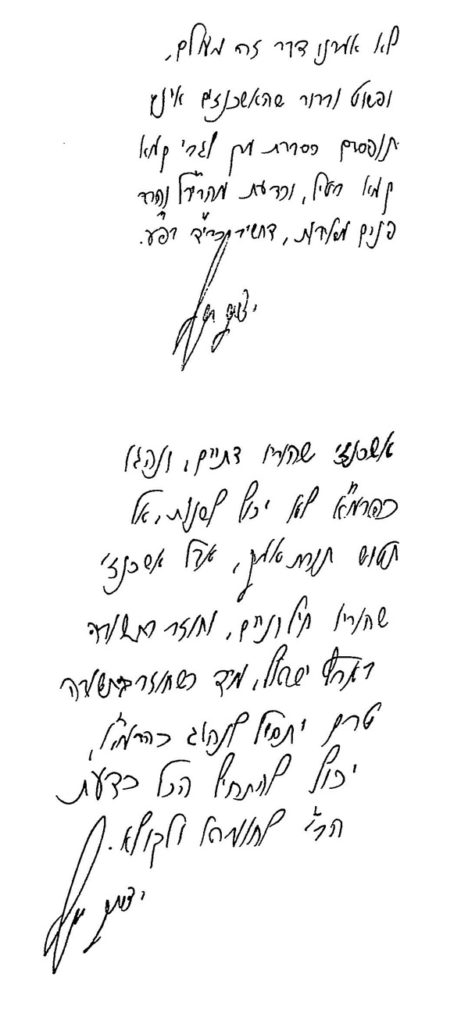
Contemporary Rabbis don’t bother to interrogate the sources of law and custom; instead, their purpose is to traffic in chumrot and create new prohibitions. They are unable to appreciate their hypocrisy … on the one hand, they roar like a lion against those who are open to change and the reformists, that one cannot alter an iota from what the kadmonim imposed, while on the other hand, casually discard the kadmonim whenever the achronim create new chumrot and they fight with all their might…to impose these new prohibitions.”

R. Yitzhak Shmuel Reggio, Yalkut YaShaR, Gorizia 1854.

Kitniyot and Mechirat Chametz: Paradoxical Approaches to the Chametz Prohibition

By Dan Rabinowitz

Some Pesach rituals trace their history for millennia. Others are of more recent vintage and continue to evolve significantly without any indication of stopping. Two in that category define the contours of chametz prohibition, one expanding and the other contracting its perimeters. Each’s creation was itself a radical departure from the status quo. In both instances, rabbis readily overcame established legal precedent. But their methodologies differ substantially and, at times, are contradictory. Yet, the intersection between the two, mechirat chametz and kitniyot, remains unexplored, and their conflicts unresolved.[1]

Mechirat Chametz

The present-day practice of “mechirat chametz” consists of the pre-Pesach transference of the title to the Jew’s chametz to a non-Jew, and upon the conclusion of Pesach, the chametz reverts to the Jew at no cost. The Torah prohibits any relationship between a Jew and their chametz on Pesach. Aside from the usual restrictions against eating or otherwise enjoying a prohibited item, here, the Torah proscribes even possession. One must destroy their chametz. The Mishna (Pesachim, 21a) and Talmud (Pesachim 13a) recognize that one can avoid liability if they sell their chametz to a non-Jew. But those transactions were permanent and irreversible, and the chametz never returned to the Jew. The first instance of a reversible transaction appears in the Tosefta (Pesachim 2:6).

ישראל ונכרי שהיו באין בספינה וחמץ ביד ישראל הז מוכרו לנכרי ונותנו במתנה וחוזר ולוקח ממנו לאחר הפסח ובלבד שיתנו לו במתנה גמורה

A Jew and a non-Jew are boarding a ship on the eve of Pesach, and the Jew has chametz, he can gift it or sell it to the non-Jew and get it back afterward so long as it was an absolute gift.

The Jew is boarding a ship on Erev Pesach,[2] on a journey that will extend beyond the holiday. There is enough non-chametz for Pesach, but if he destroys his chametz now, he likely will not survive the remainder of the journey. Can one violate Pesach and keep the chametz?  If the chametz is necessary to survive Pesach, he can keep it and even eat it on the holiday. But does a future pikuah nefesh issue justify violating the law now? According to the Tosefta, a reversible transaction will avoid liability for the chametz, so long as it is “matanah gemurah,” an unconditional gift, and not matanah ‘al meant le-hachzer.   One can justify relying on pure legal formalism and comply with all the technical requirements of a transaction, even if the practical effect of this transaction is a nullity.  

Another version of the Tosefta seems to envision an even more restrictive view of the transaction.  In this version, in addition to the requirement that the transaction is a “matanah gemurah,” there is one more caveat, “u-belvad she-lo yarim,” “so long as it is not a trick.” [3]

According to Rav Amram Gaon (810-875) and Rishonim, “no trickery” codifies the implicit limitation of the Tosefta, that this solution is exceptional (expressed nautically) and can never become the norm. This approach remained the practice for hundreds of years, and there was no yearly mechirat chametz. The Rambam and the Rosh repeat the case described in the Tosefta, occurring on a ship, not in any other context. [4]

R. Yisrael Isserlein (1390-1460), in his collection Terumat HaDeshen, is the first recorded instance of a Jew seeking to avoid financial loss affirmatively engaging in the Tosefta’s solution. He discusses a case where someone owns a significant amount of chametz and would incur a loss if he destroys it. But there is a non-Jewish acquaintance that is willing to accept the chametz gift with the understanding that he will return it after Pesach. Isserlein permits this approach so long as it is a gift without explicit conditions. Isserlein does not limit the frequency of resorting to this approach.[5]    

The immediate impact, and rate of adoption, of his decision, remains unclear. Indeed, some question the historicity of Isserlein’s responsa. They claim that the issues described are theoretical and are not in response to actual queries or events.

In the 16th century, R. Yosef Karo (1488-1575) discusses the legal issue of the retrievable sale in his commentary on the Tur, Bet Yosef, and records Isserlein’s ruling in Shulchan Orach but does not indicate whether it was commonplace.  In his commentary on Shulchan Orach, R. Moshe Isserless (1530-1572) (Rema) is silent on this issue entirely and does not mention a yearly custom to sell chametz.  The first to widely apply this technique and significantly lower the requirements was R. Yoel Sirkes (1561-1640).  

With the introduction of propination laws in the 16th century and the rise of the arendtor, there was consolidation in the alcohol industry, shifting control from localized production by peasants to the ruling class. Many of those licenses were managed or leased to Jews. By the late 16th century, Jews in Poland and Lithuania were firmly entrenched in the alcohol industry.  For many non-Jews, arendtor and Jew were synonymous. According to one account, Jews held a monopoly on the entire alcohol trade in Cracow. This created an issue for Pesach.  While Isserlein and Karo, and many others accept that one can sell their chametz, they all explicitly require, like any standard transaction, that the non-Jew remove the chametz he bought. Karo, in Shulchan Orach, codifies the requirement that the chametz is “me-chutz le-bayit,” outside of the Jews’ control. The Jew’s house was chametz-free.  But it was impractical to remove the distillers’ chametz from their property because of the substantial amounts and the fear that with alcohol, the non-Jew might not return it. [6] 

Faced with these issues, Sirkes created a new approach to the sale. Mechirat chametz is not just chametz, he also counseled to sell the ground underneath the chametz. It effectively created non-Jewish property within the Jew’s home. The chametz was “me-chutz le-bayit,” but remained in situ.

Sirkes’ ingenious solution created another issue. When the sale was just for chametz (a transportable good), a monetary transaction, even a nominal one, sufficed. But a written contract is required to sell land to a non-Jew.  Rather than change the process for the sale of chametz and mandate a written contract, Sirkes relaxed the contractual requirement.  He reasoned that requiring a contract for mechirat chametz potentially created another economic issue. He explained that a written agreement might otherwise induce the non-Jew to think the Jew fully sold the chametz and might keep it! This would trigger significant losses, and Sirkes was willing to forego the contract entirely.  He justifies both the sale and the diminution of its legal requirements because of potential economic harm.[7]  

Sirkes’ solution generally relaxed the legal requirements, but he did add two new aspects to mechirat chametz.  First, one must explicitly acknowledge the deficiency of the sale and announce that “I am selling you the room where the chametz is for money and even though I didn’t write a contract.”  He explains that this formulation works according to Tur and R. Karo in Bet Yosef (Choshen Mishpat 194), even for a land sale. Left unmentioned is that Sirkes rejects that position in that same section.

Second, the Jew must give the non-Jew a key to the house. Without that, no external action signifies the chametz is not the Jews, and the sale is clearly a sham.  By the early twentieth century, R. Yisrael Meir Kagan, in his Mishna Berurah, further eroded the key requirement and nullified the need for it entirely for all intents and purposes.  Rather than a physical transfer of the key, the Mishna Berurah allows one merely to identify the key’s location. Like the chametz, the keys can remain in the Jew’s possession, on their regular hook, and in the Jew’s control. There is no independent source for this leniency.  Instead, according to R. Kagan, it is “pashut.” [8] 

The key requirement was not the only aspect of Sirkes’ formula that fell by the wayside. Almost immediately after Sirkes created his workaround, it was being degraded.  Both R. Avraham Gombiner (1635-82), in his Magen Avraham, and R. David HaLevi Segal, in his Turei Zahav, hold that even giving a key is unnecessary. Simply setting aside a place for the chametz is enough.  (Although it seems that the key’s association with mechirat chametz was so pervasive that people began to sell the key rather than the chametz.) [9]

Sirkes’ idea that one can include non-chametz items in the fictional sale was adopted in a different context, again because of the effect of the alcohol trade. At the time, most distilling occurred with rye. The process produced a significant amount of spent rye, while otherwise useless, could be turned into cattle feed. Jewish cattle farmers recognized that they needed to sell their animal feed, and they did so. But, without that feed, the animal’s health and well-being were affected, and it took them time to recover after Pesach. Thus, it became customary to sell not only the chametz but also the cow. Now the non-Jews could come and feed the now non-Jewish cattle their regular diet. While this was initially frowned upon by some, many ultimately accepted it. [10]

The Dispute in Jassy Regarding Modifications to the Process

Despite all of these changes, until the 19th century, one aspect of the sale remained consistent; the individual conducted it, and there was no public communal sale of everyone’s chametz. Yet, leaving it to the individual proved problematic. According to some, there were widespread issues of sales not conforming with the (then) acceptable formulations, inattention to the transaction details, and a general failure to consummate the sale. To accommodate those realities, another shift in the process occurred. The most conspicuous example of introducing the new approach occurred in Romania in the 1840s. R. Yosef Landau and R. Aaron Moshe Taub, two of the leading rabbis in the same city, Jassy, disagreed about the propriety of instituting this new method. Collectively, they published six titles and five books supporting their respective opinions. 

Additionally, Landau asked one of the most well-known legal authorities in the region, R. Shlomo Kluger (1785-1869), to adjudicate the dispute. He wrote a lengthy teshuva siding with Landau’s approach. Yet, this remained unsettled in his mind, and some years later, he retracted his position and agreed with Tauber.

R. Yosef Landau (1791-1853) came from a rabbinic family and, in his youth, studied with R. Levi Yitzhak of Bardichiv. He married young, and when his first wife died at 18, he remarried. His father-in-law was wealthy and generously supported Landau, enabling him to study full-time. At 22, he accepted the position as Liytin’s rabbi. In 1834, at the suggestion of the Ruzhiner Rebbe, Landau took the position of chief rabbi of Jassy.

Jassy (Iași) is today located within northeastern Romania, near the border with Moldovia. In 1565, it became the capital of the former principality of Moldovia and today is the second-largest city in Romania. Jassy had long been the spiritual center for Jews throughout Romania/Moldovia. By the early 19th century, it became a hub for Chasidim. In 1808, R. Yehoshua Heschel Shor, the Apter Rebbe, settled in Jassy.

The early to mid-19th century was arguably the high point of Jewish life in Jassy. At the opening of the century, there were less than 2,000 Jews. By 1838, there were almost 30,000 Jews, accounting for over 40% of the total population. Concurrent with the influx of Jews into Jassy was a general improvement of its finances, especially after the Russian Turkish peace of Adrianople in 1829. Jews played a sizeable role in the city’s overall commerce. They held monopiles to several industries, cattle, cheese, cereals, and dominated in others, such as banking, and owned most commercial buildings in the center of town.

While progress had been good for Jassy, it came with challenges. The combination of the sprawling populace and robust commercial market created complexities that required a revision to the process. After Landau arrived in Jassy, he instituted a new form of mechirat chametz. He established a system where individuals would no longer transact directly with a non-Jew. A handful of select people would buy everyone else’s chametz, and those designated ones would execute the final sale to the non-Jew. Appointing a few knowledgeable people ensured consistency and greater compliance.

Sometime before 1842, Landau published the rationale for this decision. There are no extant copies of that book, Seyag le-Torah, and consequently, the publication date has confused some bibliographers. Friedberg, and after him, Vinograd, date Seyag le-Torah to 1846, which would place it at the tail end of the controversy, its final book, published after three years of silence. But Shmuel Ashkenazi demonstrated that Seyag le-Torah is the first book published regarding the communal mechirat chametz controversy in Jassy and was printed around 1842. The rest of our discussion follows Ashkenazi’s reconstruction of the dispute. [11]

By 1842 Landau could no longer lead the community alone. He requested for the Jewish community to hire a second rabbi. With Landau’s blessing, R. Aaron Moshe Tauber (1787-1852), originally from Lviv, was engaged. Tauber also came from a storied rabbinic family and was the grandson of R. Yoel Sirkes. He also married into a wealthy family in Przemysl, Poland, and studied there for a few years after marriage. He began a relationship with R. Yaakov Meshulum Orenstein (author of the Yeshuot Ya’akov), then rabbi in Jaroslaw, about ten miles from Przemysl. Tauber eventually left Przemysl and returned to Lviv. By this time, Orenstein was the chief rabbi of Lviv, and he and Tauber reconnected. Tauber also began regularly studying with R. Shlomo Kluger, then rabbi in Kulykiv, on the outskirts of Lviv. In 1817, Kluger would leave Kukykiv for Brody, but Tauber remained until 1820. When he was 32, he took a position in the hamlet of Snyatyn, Ukraine, over 150 miles south of Lviv. In 1831, he made an unsuccessful bid for the chief rabbi of Óbuda (one of the three towns that merged in 1873 to form Budapest). In 1842, after 24 years in Snyatyn, Tauber moved further south to Jassy as the new co-rabbi.

Soon after arriving, he learned of Landau’s mechirat chametz process and disapproved. In a public address, Tauber criticized the practice but declined to take any more concrete action against it because he deemed it an entrenched and accepted custom. Nonetheless, he counseled those “who have the fear and trembling of God in their heart” to execute a private sale. According to Tauber, Landau started a whisper campaign that all private sales of chametz are ineffective. Nonetheless, Tauber “remained silent” and held himself back from a direct conflict with Landau.

By Pesach of 1843, all the gloves were off. Tauber claimed that he identified additional issues with the new procedure that convinced him he must act; otherwise, all Jassy’s Jews risked liability. On the eve of Pesach 1843, he published Modo’ah Rabba (An Important Announcement), identifying issues with Landau’s approach to a communal mechirat chametz. Landau had his response ready and published Mishmeret Seyag le-Torah defending his position in Seyag le-Torah within a month. A second title, Bitul Modo’ah (A Nullification of the Announcement), specifically addressed the issues Tauber raised in Modo’ah Rabba appeared at the end of the book. While Landau was formulating and printing his response, Tauber was working to explain his position further.

A short time later, Tauber published Hagu Segim (Remove the Detritus, based upon Misheli 25:4), offering additional evidence against the new practice. But, he wrote this before seeing Landau’s Mishmeret Seyag le-Torah and did not discuss its arguments. To address that, soon after, Tauber published another pamphlet, Hareset Mishmeret (Destroying the Guardian), that attempted to rebut Landau’s rejoinder of Tauber’s rejoinder of Landau’s original defense.

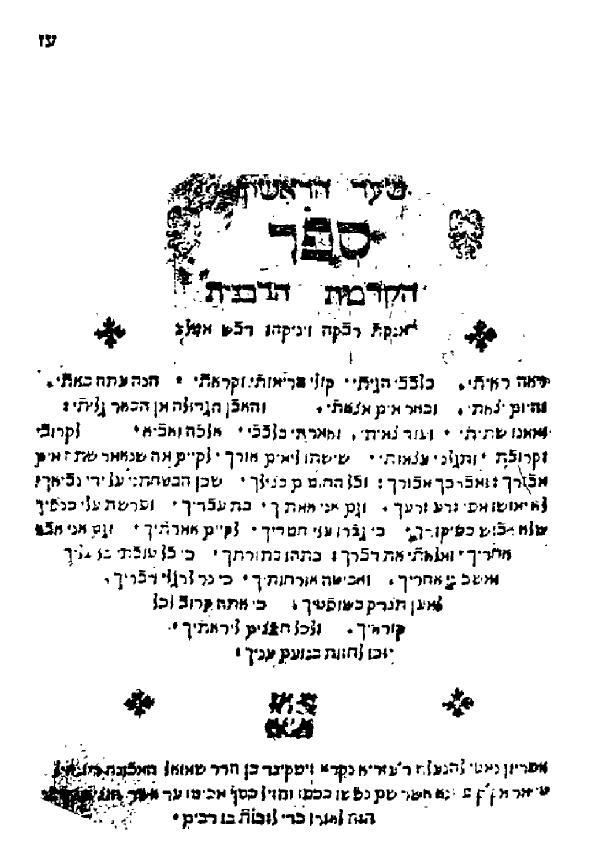
Meshmeret Seyag Le-Torah, Jassy, 1842

A few copies of Landau’s Mishmeret le-Seyag with Bitul Mo’dah and Tauber’s Hareset Mishmeret survive. There are no extant copies of the other books. Mishmeret le-Seyag/Bittul Mo’dah and Hareset Mishmeret are now available online. But both digital versions are flawed. The National Library of Israel’s copy of Hareset Mishmeret is damaged, and some text is lost. But Tauber autographed the final page of that copy.
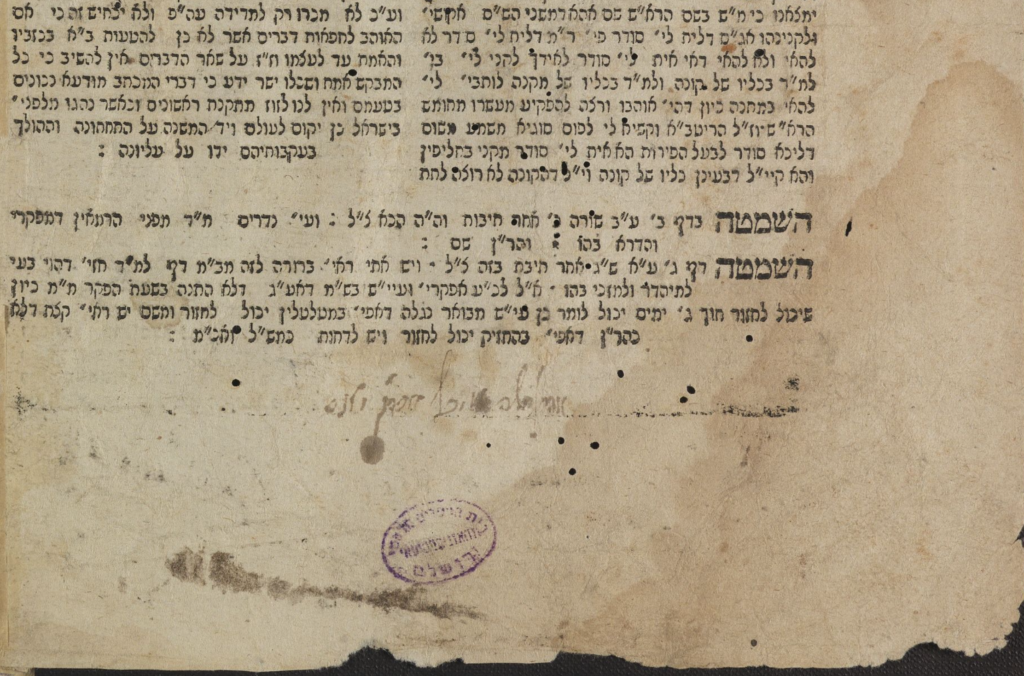
Final leaf from National Library of Israel copy with Tauber’s signature

The issue with the copy of Mishmeret le-Seyag le-Torah on Hebrewbooks.org is more significant. There is no title page, and the text begins on the first page. Typically, the verso of the title-page is blank or contains copyright information. This copy was originally reproduced by Copy Corner.  In the pre-internet era, the Goldberg brothers photocopied rare and out of print books and bound them in a rudimentary hardcover and distributed them through Beigeleisen Books in Boro Park. Through their efforts thousands of seforim were accessible to the wider public at very reasonable prices.  For those without access to libraries with significant seforim collections, Copy Corner’s catalog stepped in to address that gap. When Copy Corner photocopied the books they added their publication information to the verso of the title page. Normally not an issue, here it results in a blank page with just the Copy Corner legend substituted for the second page of the text of Mishmeret le-Seyag le-Torah.

Hareset Mishmeret was the last public missive, but the two sides remained at loggerheads privately. Communal leaders unsuccessfully pressed for a resolution but eventually, the two reconciled. Love instigated the cessation of hostilities.

In 1846, R. Landau’s son, Mattityahu, married Tauber’s daughter. But the marriage almost didn’t happen. Not because of the controversy over mechirat chametz. Instead, the bride’s and groom’s mothers shared the same name, Hindi. Some view such a match as taboo. But the Ruzhiner Rebbe, R. Yisrael Friedman, endorsed the match. He reasoned that there is no prohibition here because neither mother uses her given name. They both go by “Rebbetzin.” [12]

Sometime before the intermarriage of the two families, Landau requested R. Shlomo Kluger’s assistance to resolve the dispute and determine which approach to adopt. Kluger’s reply begins that he is personally unacquainted with R. Landau but that Tauber is a childhood friend. Despite that friendship, Kluger sides with Landau.

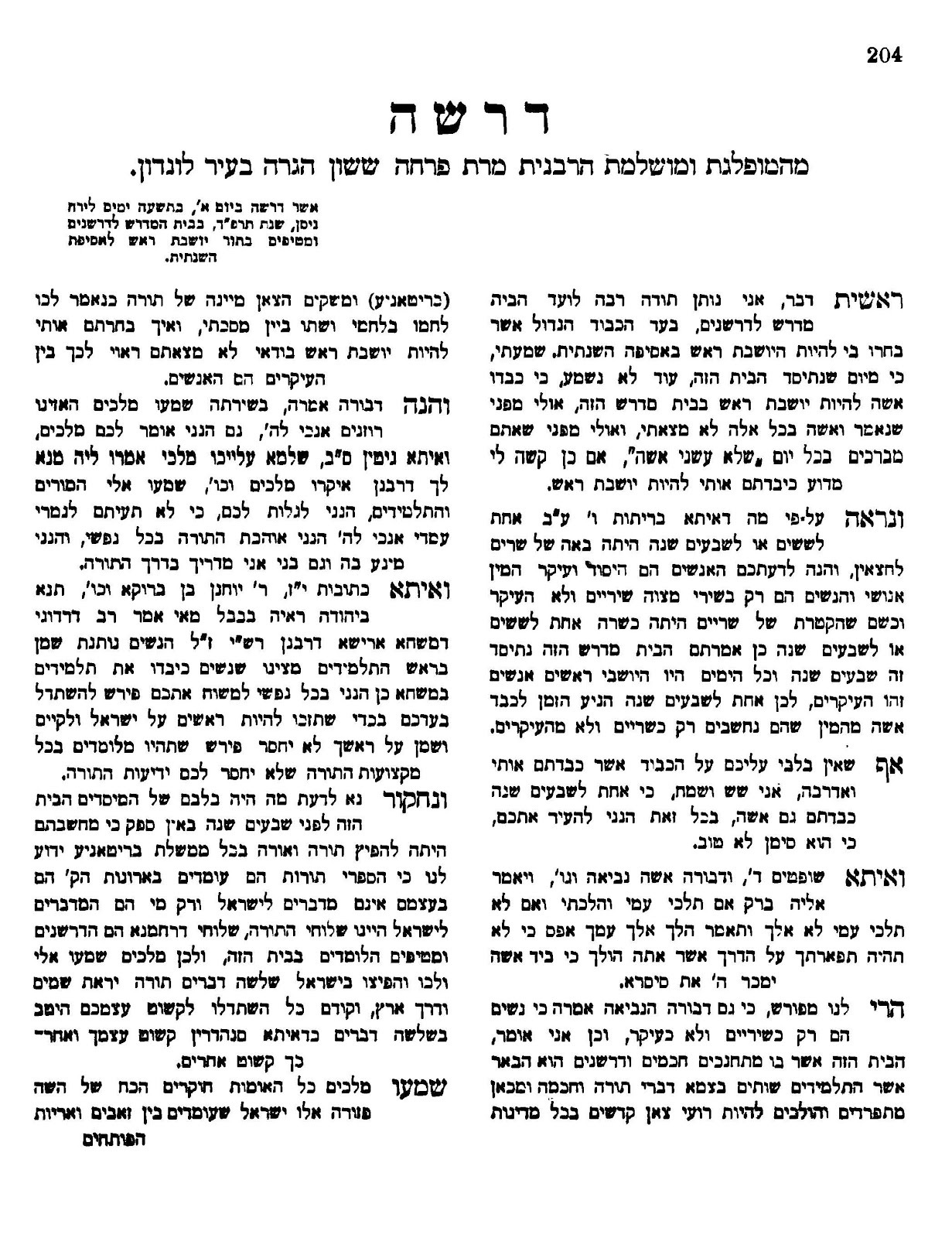
Tauber only recently arrived in Jassy, the largest city in Moldovia, and was unwise to the realities of a big city. Kluger attributes Tauber’s objections to his naivety. Tauber spent the last twenty-two as the rabbi of the small town of Sniatyn, where there were around 2,000 Jews compared to Jassy’s 30,000. The traditional practice of private transactions might work in a town the size of Sniatyn, where Tauber was able to supervise the process. Jassy was a different animal. Landau was responding to those realities when he restructured mechirat chametz. Kluger was the rabbi of Brody, a substantial city of an estimated 15,000 Jews, and saw first-hand the challenges of a large and more cosmopolitan community. Like Landau, Kluger adopted the revised mechirat chametz. Indeed, he had already done so six years earlier! Over the next seven printed double-column pages, Kluger justifies his and Landau’s mechirat chametz ritual, concludes that Landau’s approach is correct, and describes it as “takanah Gedolah,” a worthy edict. Kluger, however, notes that he finds the whole episode distasteful and that he doesn’t have time to engage in these sorts of controversies and communicates his mystification that such a vicious dispute could arise over a “davar katan” like this.

Despite Kluger’s comprehensive defense of the communal mechirat chametz ceremony, he ultimately regretted that position. Kluger included an addendum when this responsum went to press in 1851. After seeing the effects of the new approach, he explained that he was reversing his stance. With the consolidation of mechirat chametz into a communal sale, an industry arose. Profiteers saw an opportunity and began competing for people to sell them their chametz. With money as their only motive, they were incredibly sloppy with the sales. With the single points of failure, there was often no legally recognized transfer, leaving countless people owning chametz on Pesach. Kluger disavowed his lengthy defense. He ascribed it to alternative motives, preserving Landau’s honor. Kluger concluded with the recommendation that every individual execute their own contract with the non-Jew, i.e., Tauber’s position.[13]

During that same period, R. Moshe Sofer, in a very lengthy responsum, supports preserving the less than 100-year-old practice of selling chametz and rebuffing the many reasons it seemingly conflicts with established Jewish law. Despite his leading the rallying cry of “hadash assur min ha-Torah,” Sofer, who rejects new approaches because of their novelty, unqualifiedly approved of mechirat chametz.

R. Ephraim Zalman Margolis wrote to Sofer and raised issues with the current process as it was nothing more than “ha-aramah” and that certainly selling one’s animal is prohibited. Sofer began by noting that there are instances where ha-aramah is permitted. Hazal crafted those exceptions because they recognized that “אין כל המקומות והזמנים שוים.” Ultimately, he concluded that despite the sham nature of the modern procedure, it is a fully-realized transaction that discharges ownership for purposes of chametz and even permits the Jew to sell their cattle with the chametz. [14]

Sometime after the widespread adoption of communal mechirat chametz, there was another revision to the practice. Now, the individual no longer sells his chametz to the rabbi and the individual never directly executes a sale. Instead, the individual approaches the rabbi not to sell him the chametz but appoint him an agent to sell it on their behalf.[15]

The most recent shift in mechirat chametz is that it is no longer de facto but de jure.  According to some, R. Shlomo Yosef Eliashiv among them, today, mechirat chametz is obligatory even if one destroyed their chametz. [16]  

(Bardak, recently satirized the contemporary practice, with all its details, in an episode that imagined a very sophisticated purchaser that presses their rights, legal and political.)

Kitniyot

The historical approach to mechirat chametz and the willingness to adapt biblical law to the realities of modern society stands in sharp contrast to another chametz-related issue, kitniyot. There is no doubt that the biblical prohibition against chametz did not include kitniyot. The Mishna and Talmud agree that it is permissible. At best, it is an Ashkenazi custom and/or edict whose earliest record is the 13th century and was never universally adopted by all Jews. Consequently, many rabbis explicitly rejected the prohibition as either a “minhag ta’ot” or even a “minhag shetut.” Yet, according to some, kitniyot is such a powerful legal concept that even in instances of severe famine, kitniyot remains prohibited. Kitniyot is even more pervasive now than ever before, with new items added yearly to the list. [17]

There have been attempts to repeal kitniyot custom since the 18th century, without significant success. In the case of the nascent Reform Judaism movement, like many other laws and customs, it overturned kitniyot without any specific halakhic justification. But the other attempts came with substantial legal analysis that supported removing the prohibition. Many raised economic arguments to justify reversing kitniyot. In the case of mechirat chametz, the initial beneficiaries of the sale were well-to-do Jews who held large amounts of chametz. The kitniyot restrictions mainly affected the poor who could not afford expensive matza and for whom kitniyot’s low cost would provide a more economically feasible alternative to satisfy their daily caloric needs.

R. Tzvi Ashkenazi, Chakham Tzvi (1656-1718), one of the leading rabbis in Western Europe, first articulated this argument. Chakham Tzvi concluded that the economic harm justifies removing the restriction. Nonetheless, he declined to act alone, and without others joining his approach, the rule remained in effect even in the communities he served. Likewise, his son, R. Yaakov Emden (1697-1776), agreed with removing the restriction against kitniyot but required consensus among rabbis to make any practical change. [18]

Eventually, beginning at the turn of the 19th century, a handful of communities in Western Europe acted upon the approach of Hakham Tzvi (in addition to marshaling other arguments) and abolished the prohibition against kitniyot.[19] The first to do so was a community under French control, the Consistory of Kingdom of Westphalia, created by Napoleon in 1807, today located in the north-western corner of Germany. The argument for the repeal was initially only on behalf of garrisoned soldiers in the area. They did not have access to large amounts of matzo, and permitting kitniyot would alleviate their hunger. Ultimately, the kitniyot repeal applied to all Jews in the area. Perhaps the most well-known rabbi involved, R. Menahem Mendel Steinhardt, authored a lengthy defense of the dispensation and many other changes and sent it to his close friend R. Wolf Heidenheim (1757-1832). Although Steinhardt specifically told Heidenheim to keep the letter private, Heidenheim believed that the analysis was too compelling to hold back from the public. Heidenheim went ahead and published it without consent at his own expense. He also appended some of his notes to the book. The book, Divrei Iggeret, published in 1812, contains one of the most cogent published arguments for the abolition of kitniyot. Nonetheless, Steinhardt’s defense was rejected by many.

Despite those rejections, in addition to Heidenheim, others continued to support him, if not his kitniyot position. His former havruta, R. Betzalel of Ronsburg (1760-1820), who provided a haskamah to Steinhardt’s responsa work, Divrei Menahem, still held him in high esteem long after Divrei Iggeret. He also secured two subsequent rabbinic positions in other Jewish communities. Others, however, cast him as a villain.

One recent book characterizes Steinhardt and others as “the wicked maskilim may their names be blotted out” and ascribes their motivations as solely driven “to disparage the kadmonim.” Rather than concern for the poor, according to the book, the true purpose of reversing the prohibition against kitniyot is to permit chametz on Pesach eventually. [20]

Heidenheim’s support troubled some because he is an accepted orthodox figure. One approach is to attribute Heideheim’s willingness to publish Divrei Iggeret as a favor to Steindhardt’s uncle, R. Yosef Steinhardt, with whom Heidenheim studied in his teens.[21] This explanation seems implausible. First, this approach ignores Heidenheim’s unreserved praise of the force of Menahem’s arguments. Heidenheim justified his decision to unilaterally publish Menahem’s letter so that “every honest, sensitive, and intelligent person will see that [Menahem’s] purpose is to teach Beni Yehuda avodat Hashem, to fear and love Him in the ways of truth and peace . . . and to respond to the detractors and support the poor and provide them as much food as possible.” Second, when Divrei Iggeret was published, Yosef Steinhardt had been dead thirty-six years, and when he passed, his nephew, Menachem, was only seven years old. Indeed, another author, Benyamin Shlomo Hamburger, highlights this lack of connection between uncle and nephew to diminish any family prestige that might inure to Menachem.

Likewise, Hamburger turns Menachem’s adoption of his uncle’s surname (and not the more traditional approach of using his birthplace, Hainesport, as the surname) into a liability. Hamburger sees this as a blatant example of carpetbagging, trading on his uncle’s reputation. Similarly, Hamburger delegitimates Menachem’s responsa work, Divrei Menachem, and describes it as entirely self-interested, simply “an attempt to get any rabbinic position.”

Although Steinhardt’s approach to kitniyot did not significantly alter the orthodox practice, he substantially changed Jewish liturgical practices despite attempts to marginalize him. Steinhardt’s Divrei Iggeret comprises ten letters, one of which is devoted to kitniyot. The other nine argued for changes to other Jewish practices. The seventh letter addresses the custom to recite the mourner’s Kaddish.

Until the 19th century, the accepted Ashkenazi custom was to have each mourner recite the Kaddish individually. Steinhardt argued for adopting the Sefardic tradition of all the mourners reciting Kaddish in unison. While some rejected that position as a change to the status quo, including R. Moshe Sofer, Steinhardt’s modification of the practice is today widely accepted. His opinion was first cited approvingly in the commentary to Shulchan Orach, Piskei Teshuva, with the instruction to review Divrei Iggeret for its compelling arguments. Many of those arguments mirror those Steinhardt relied upon for his repeal of kitniyot. Among those that kitniyot lacks Talmudic sources, the current restriction did more harm than good, the Sefardim already do it, and R. Emden theoretically permits its annulment.

Steinhardt first categorizes the entire kaddish ritual as a custom that “has absolutely no root or foundation.” He challenges any attempt to find early sources that support incorporating Kaddish into the standard prayers. Neither the Bavli nor Yerushalmi nor the “Rishonim” incorporate the practice. Steinhardt dismisses midrashic sources, presumably the Zohar Hadash (Achrei Mot, 112), as irrelevant to determining practice. Second, the current custom of assigning only one mourner to right to lead Kaddish is detrimental because it leads to fighting for priority and a general lack of decorum. Third, the modification is the standard practice amongst Sefardim. Fourth, in theory, R. Yaakov Emden’s willingness to overturn the Ashkenazi custom in favor of the Sefardic one. Fourth, he cites R. Moshe Hagiz’s that implies reciting kaddish unison is permitted. He concludes that despite canceling the historical practice, his position is also ancient.[23]

Steinhardt’s change was embraced by conventional rabbis, explicitly citing the Divrei Iggeret and incorporating the change into their codifications. For example, Kitzur Shulchan Orach, Ta’amei Minhagim, Kol Bo’ al Avelut, and the more recent Peni Barukh associate the change with Divrei Iggeret. R. Gavriel Zinner, in his work on the laws of mourning, Neta Gavriel, didn’t just cite the Divrei Iggeret; he reproduces the entire letter from “ha-Gaon Rebbi Mendel Steinhardt.”[24]

Hamburger is again troubled by the seeming approval of Menahem’s modification of Kaddish and asks, “how is it possible that Divrei Iggeret received such a positive reception that he became the source of this [new] law?” The answer: Steinhardt hoodwinked the Eastern European rabbis. They thought that the change occurred with the consent of all the German rabbis and was unaware that Menahem acted alone and his true purpose was radical reform. Left unexplained is why many of the same Eastern European rabbis were aware of his actual intentions when it came to kitniyot.[25]

Likewise, many of those same personalities that vigorously defended the retention and extension of the leniency of mechirat chametz refused to budge on the custom of kitniyot. Despite the lack of supporting evidence, R. Moshe Sofer held that repealing the kitniyot restriction is impossible because it is a universally accepted formal edict. Nonetheless, among his arguments in defense of mechirat chametz was that “any restriction that the Talmud does not explicitly mention we cannot decree that is prohibited.” [26]

R. Tzvi Hirsh Chajes defends the practice of mechirat chametz. He accepted that the justification for mechirat chametz is economic. Nonetheless, he rejects the elimination of kitniyot as a too substantial reformation of Jewish practice to allow, even though it too caused significant financial hardship. According to him, because the Reform movement abolished kitniyot, any other attempt is tainted and assumed to be driven by the same anti-Orthodox sentiments and must be rejected to maintain the status quo. Even though the first major successful attempt to remove kitniyot was not a Reform congregation but an Orthodox one, headed by notable Orthodox rabbis, who based their decision on the law. [27]

The practice of mechirat chametz significantly altered the landscape of Pesach compliance. Each stage of its evolution required creative solutions to contemporary issues as they arose. Rather than invoking the general rule that chametz demands a strict reading of the law, leniencies were repeatedly devised and were near-universally adopted. Indeed, R. Isserlein, in his responsum permitting mechirat chametz, rejects that principle’s applicability to mechirat chametz. With limited exception, until the 17th century, Jews complied with the straightforward reading of the Biblical restriction, “chametz shall not be found in your houses.” The changing economics of the 17th century forced the rabbis to confront a new reality where it was no longer financially possible to physically remove one’s chametz. One rabbi’s solution was universally adopted, altering the mechirat “chametz” to include a second sale, that of the land. In less than a century, his formulation proved insufficient to deal with the continuing changing reality. Other Rabbis instituted additional modifications to the process. Now there is no direct sale of chametz, and the mechirat chametz ritual consists of appointing an agent. Each of these changes required reliance on leniencies, and in nearly every instance, the modifications themselves created ancillary issues. Ultimately, rabbis overcame all the objections, and the mechirat chametz ceremony remains in full effect.[28]

Paradoxically, kitniyot, despite the many reasons marshaled against retaining the practice, each of these is ruled insufficient to justify repealing kitniyot. Instead, the principle of “the severity of the prohibition of chametz (leavened food) mandates rejecting leniencies” was applied to kitniyot (non-leavening foods) to justify its endless expansion and ignored for mechirat “chametz.” As of now, mechirat chametz does not apply to kitniyot, and the two practices remain isolated from one another, just as they have in their development and legal approach. Both, however, remain examples of the dynamic nature of Jewish practice even within Orthodoxy.

NOTES

[1] This article is not intended to provide a comprehensive survey of all the literature regarding mechirat chametz and kitniyot. The focus of the article is the historical modifications to the practices. For a general discussion regarding the history and application of mechirat chametz, see Shmuel Eliezer Stern, Mechirat Hametz ke-Hilkhato (Bene Brak: 1989); R. Shlomo Yosef Zevin, Ha-Mo’adim be-Halakha, vol. 2 (Jerusalem: Talmud HaYisraeli HaShalem, 1980), 294-304; Tuvia Friend, Mo’adim le-Simha, vol. 4 (Jerusalem: Otzar haPoskim, 2004), 151-223.

For a comprehensive discussion regarding kitniyot, see the recently published book by Yosef Ben Lulu, Kitniyot be-Pesach: Gilgulo ve-Hetatputhoto ha-Halakhtit ve-Historiyt shel Minhag Zeh be-Adat Yisrael ’ad Yamenu (Be’er Sheva: Dani Sefarim, 2021); see also our discussion, “Kitniyot and Stimulants: Coffee and Marijuana on Passover,” Seforim blog, March 9, 2010.
[2] The scenario of boarding on the eve of Pesach is problematic. The Tosefta prohibits boarding a ship within three days of Shabbat. Tosefta Shabbat 13:13. He is already in breach of one prohibition confirms that this is an extraordinary case.
[3] This is an alternative text and not a later interpolation. See Leiberman, Tosefta ke-Peshuto, Seder Mo’ad, vol. 4 (New York: JTS, 2002), 495-96. But R. Yosef Karo mistook this just to be the commentary of the BaHaG and not part of the text because otherwise, it would prohibit the then-current form of mechirat chametz. Karo dismissed “shelo yarim” as an independent requirement and treated it as simply a reiteration of the prohibition against an explicitly conditional gift. See R. Shlomo Yosef Zevin, Ha-Mo’adim be-Halakha, vol. 2 (Jerusalem: Talmud HaYisraeli HaShalem, 1980), 295.
[4] See Lieberman, id. at 496, collecting sources.
[5] See R. Israel Isserlein, Shmuel Avitan ed., Terumat ha-Deshen (Jerusalem: 1991), no. 120, 93. Of note is that Isserlein does explicitly cite the Tosefta as his source. Indeed, his “rayah” “prooftext” is a passage from Talmud Bavli (Gitten 20b). He argues that the Talmudic source generally recognizes a transaction even when the parties’ intent is for the recipient to return it. It is possible that he held the Tosfeta alone is insufficient justification for the broad applicability of a reversible gift. Instead, he needed to prove the general efficacy of this type of transaction.
[6] Gershon Hundert, Jews in Poland-Lithuania in the Eighteenth Century (Berkley: University of California Press, 2004), 14-15, 36-37; see generally, YIVO Encyclopedia, Tavernkeepers; Glenn Dynner, Yankel’s Tavern: Jews, Liquor, & Life in the Kingdom of Poland (Cambridge: Oxford University Press, 2013). Jews’ association with the liquor trade persists today in Poland. Since the 1980s, Kosher and “Jewish style” vodka has become popular with Poles. These vodkas are considered premium brands, allegedly so pure as to stave off any ill effects the next morning. See Andrew Ingall, “Making a Tsimes, Distilling a Performance: Vodka and Jewish Culture in Poland Today,” Gastronomica, 3 (1), (2003), 22-27.
[7] Sirkes assumes that a written contract is unnecessary. The contemporary practice of executing a written agreement occurred later. See Mechirat Chametz ke-Helkhato, 68-9.
[8] For a survey of sources requiring giving the key, see Mechirat Chametz ke-Hilkhato, 13n18. Mishna Berurah, 448:12 & Sha’arei Tzyion, id. He asserts that this position is alluded to in the Hemed Moshe. But the Hemed Moshe (448:6) discusses an instance where the non-Jew decides to return the keys to the Jew unilaterally. In that instance, the Jew does not violate the law. But this scenario still contemplates the Jew physically transferring the key to the non-Jew. There is no indication that the Jew can forego the entire transaction by simply referencing the existence of a key.

R. Yechiel Epstein (Arukh ha-Shulchan 448) also rules that the mere identification of the key’s location is sufficient to avoid liability. He also holds that he need not go alone if the non-Jew uses the key to access the room, not for chametz but to get something else. The Jew is permitted to accompany him to ensure the integrity of the goods.
[9] See Mechirat Chametz Ke-Hilkahto, 13.
[10] For an exhaustive collection of sources, see R. Yitzhak Eliezer Jacob’s 2003 book, Tevu’at be-Ko’ah Shor, devoted to the topic; see also Mehirat Hametz ke-Hilkhato, 30-31.
[11] See Yisrael Landau’s son, Mattityahu Landau, wrote a biography of his father. Toldot Yosef, (Bardichiv, 1908), 13-16; Shmuel Ashkenazi, “Ha-Mahloket bein Rabanei Yus be-Shenat 1843,” Ali Sefer, 4 (June 1977), 174-77. Iasi, Yivo Encyclopedia; Iasi, Pinkas Kehilot Romania.

For biographical information for Tauber, see Hayyim Nasson Dembitzer, Kelilat Yofei (Cracow, 1888), 151n1.
[12] Landau, Toldot Yosef, 15.
[13] Shlomo Kluger, Shu” T meha-Gaon Mofes ha-Dor R. Shlomo Kluger, in David Shlomo Eibsheuctz, Na’ot Desha (Lemberg: 1851) 3a-6b (at the back of the book). Avraham Binyamin Kluger, Shlomo Kluger’s son, published the book.

A few years later, another Pesach controversy, machine-made matza, also involved R. Shlomo Kluger. He was against using the new technology for Pesach. See Meir Hildesheimer and Yehoshua Lieberman, “The Controversy Surrounding Machine-made Matzot: Halakhic, Social, and Economic Repercussions,” Hebrew Union College Annual 75 (2004), 193-26.
[14] Shu’T Hatam Sofer, OH, 62.
[15] Like the other solutions, using an agent created its issues. But none were significant enough to undermine the efficacy or acceptance of the practice. See Mechirat Chametz ke-Hilkhato, 5-6, 110-19.
[16] See Mechirat Chametz ke-Hilkhato, 7. The legitimacy of the sale is of such force that even if someone completely ignores it and continues to eat and use their chametz, the sale is still effective for anything that remains. See R. Moshe Feinstein, Iggerot Moshe, Orach Hayim 1 (New York: 1959), 203 (no. 149).
[17] Ben Lulu, Kitniyot, 31-93.
[18] Yaakov Emden, Mor u-Ketiah, 453.
[19] Another early attempt to rescind kitniyot was the inclusion of a responsum in Besamim Rosh that alleges kitniyot source is from the Karaites. There is no basis for this assertion. On the contrary, the extant evidence demonstrates that Karaites affirmatively rejected any prohibition against kitniyot. See Ben Lulu, Kitniyot,173-75. See here for our previous discussions regarding the Besamim Rosh.
[20] Moadim LeSimcha 241-42
[21] See R. Nosson David Rabinowich, “Be-Mabat le-Ahor: Kamma he-Orot be-Inyan “Heter” Achilat Kitniyot be-Pesach,” Kovetz Etz Chaim 15(2011), pp. 345–348.
[22] Binyamin Shlomo Hamberger, Ha-Yeshiva ha-Ramah be-Feyorda: Ir Torah be-Dorom Germaniyah ve-Geon’eha (Bene Brak: Machon Moreshet Ashkenaz, 2010), 398-422.
[23] See Divrei Iggeret, no. 7, 10b-11a; Tzvi Hirsch Eisenstadt, Piskei Teshuva, Yoreh De’ah, 376:6.
[24] Gavriel Zinner, Neta Gavriel: Helkhot Avelut (Jerusalem: Congregation Nitei Gavriel, 2001), 344n2.
[25] Hamburger, Ha-Yeshiva, 412-417.
[26] For a discussion of R. Moshe Sofer’s position regarding kitniyot and his involvement in the controversy, see Ben Lulu, Kitniyot, 185-88.
[27] See Darkei ha-Hora’ah, chap. 2, Kol Kitvei MaHaRiTz, vol. 1, 223-225; Minhat Kenot, Kol Kitvei MaHaRiTz Hiyut, vol. 2, 975-1031.
[28] Some refrain from selling certain forms of chametz out of an abundance of caution, but the custom of the vast majority of Jews is to sell all types of chametz. See Mehirat Chametz, 5-6.

Armin Wilkowitch about Shabbes Shekolim in his youth in Russia

Armin Wilkowitch about Shabbes Shekolim in his youth in Russia

by Gabriel Wasserman and Phillip Minden

Shabbes Shekolim (Shabbat Sheqalim) is the first of the four special Sabbaths in or near the month of Adar, when special passages are read from the Torah. In addition to the special readings from the Torah, Ashkenazic Jewry has distinguished these four Sabbaths with the inclusion of special piyyutim in the Sabbath service; these piyyutim – most, and perhaps all – are by Eleazar b. Qallir (or Qillir) of sixth- to seventh-century Eretz Yisrael, and they have been part of the liturgy of Ashkenazic Jewry ever since there has been such a thing as Ashkenazic Jewry, since before the year 1000 CE. Although many Ashkenazic communities today omit the piyyutim for Shekolim, happily there are still many Ashkenazic communities that maintain them through today, unlike many piyyutim for other occasions in the year, which have suffered almost complete extinction in living usage.

(As an aside: In the middle ages, many non-Ashkenazic communities, as well, recited piyyutim, different from the Ashkenazic ones, on the four special Sabbaths of Adar. These have fallen into complete disuse today, other than the piyyut “Mi Khamokha” by R. Judah Hallevi for Shabbat Zakhor. These piyyutim will not be the subject of this post.)

In the past, Shabbes Shekolim and the recitation, or singing, of these piyyutim had an aura of great emotional significance for many Ashkenazic communities. As an example of this, the Seforim Blog will present here a piece by Cantor Armin Wilkowitsch, originally published in the Österreichisch-Ungarische Cantoren-Zeitung (supplement to Die Wahrheit), vol. 24 no. 10 (4 March 1904), p. 10. Wilkowitsch writes here about the composition of a setting for the piyyut “Eshkol Ivvuy” (אשכל אווי), the opening of the piyyutim for Musaf of this Sabbath. Wasserman’s research, in a project to collect musical settings for all Ashkenazic piyyutim for special Sabbaths, has uncovered thirty different musical settings for “Eshkol Ivvuy,” and further research may discover far more; this piyyut was clearly very important to cantors, and communities, in generations preceding ours.

According to the biography on Geni.com, Cantor Wilkowitsch, was born in Kalvarija, in the Russian Empire (see map here), today in Lithuania. He lived most of his adult life in the Austro-Hungarian empire, and served as chief cantor of a community in Eger (Erlau, Cheb), in Hungary, for 32 years. In 1939, under Nazi occupation, Wilkowitsch got a visa to escape to America, to join his wife and children who were already there. He boarded the ship, but, in light of the terrible events going on in Europe at the time, he lost the will to live and committed suicide by jumping off the ship. Very sad, and creepy.

In his youth, Wilkowitsch was a meshorer in his native Russia. Meshorerim were a standard phenomenon in pre-modern Ashkenazic synagogues: a group of men and small boys who would accompany the cantor as a kind of choir, though without the Western rules of four-part counterpoint that define modern choirs.

Perhaps the most picturesque line in the story is: “the Special Sabbaths are coming, which are soon bound to chase the polar bear out of the land” (es kommen die ausgezechneten Sabbathe, die den Eisbären bald aus dem Land verjagen).

Wilkowitsch refers to a species of fish, eaten at shalleshuddes, by the Yiddish word shtinkes. This word may be familiar to some readers of this blog from halakhic literature (see, e.g., the commentary of Rashash on Sukka 18a, and here).

The text of Wilkowitch’s piece will be presented here, first in the original German (the educated language throughout the Austro-Hungarian Empire) and then in English translation. Hopefully it will give the readers a sense of what Shabbes Shekolim was like in those bygone days – as Wilkowitsch writes, in the Italian expression that concludes his story, tempi passati.

Jugenderinnerungen.
Von Kantor Armin Wilkowitsch.

Jüngst suchte ich unter meinen alten, längst ad acta gelegten Notenblättern herum. Wie pochte da plötzlich mein Herz, und als begegnete ich meinen besten Jugendfreunden, die mir Grüße von meiner Heimat brachte und längst vergangene und verschollene Geschichtchen auffrischten, so sprachen mich diese vergilbten, nach Moder riechenden Notenblätter an. Es waren hunderte von ein- und mehrstimmigen Kompositionen, die ich mir von verschiedenen Chasanim auf meinen Meschorer-Wanderungen mit vieler Mühe erworben hatte. Darunter auch russische und jüdisch-deutsche Liedlein, selbst Sabbathsemiroth, wie Zur mischelo ochalnu, oder Joh, ribbon olam, die ich in meinem Elternhause, im Vereine mit meinen Geschwistern, allsabbathlich sang. Später, als ich Einblick in die Harmonielehre gewann, gab ich den Semiroth regelrechte Rhythmen und bearbeitete sie für zwei Soprane und Klavierbegleitung.

Unter diesen losen Blättern fand ich u. a. für Sabbath-Schekolim einen Eschkol, welcher als Introduktion eine längere, polonaiseartige Melodie vorgespannt hatte und in einer „phrygischen“* Tonart sich bewegte. Herr Oberkantor Singer-Wien nennt, wenn ich nicht irre, diese Skala  „jüdische Tonleiter.“ Den russischen Chasanim ist aber meines Wissens keine jüdische Tonleiter bekannt und, wie gerne ich auch uns Juden eine Eigenart in der Musik einräumen möchte, muß ich trotzdem gestehen, daß ich dieser Skala schon bei mehreren kleinrussischen Volksliedern begegnete; auch das rumänische Volkslied dürfte wohl diese Tonart sich zu eigen gemacht haben.** Daß Anton Rubinstein die Melodie für die Worte:  „und der Sklave sprach“, in seinem  „Asra“ einem jüdischen Chasan abgelauscht hat, möchte ich stark bezweifeln. Das eine ist jedoch gewiß, daß den Deutschen diese Intervalle fremd sind, aber deswegen sind sie noch nicht speziell „jüdisch“.

Bei diesem Eschkol verweilte ich lange, lange…. Habe ich doch denselben  „mitkomponieren“ geholfen.

Der Kantor in Rußland betet nicht jeden Sabbath vor, höchstens, daß er am Sabbath-meworachim Jehi rozôn und Jechadschehu absingt, das weitere betet ein Balbos oder der Schammes, und hat der Chasan Chanukalichtlein mit den Meschorerim und Klesmorim entzündet, dann hält er seinen Winterschlaf, bis Sabbath-Schekolim, der erste von den ausgezeichneten Sabbathen, ins Land zieht.

Hui, wie tobt draußen der Sturm! Neue Schneeflocken häufen sich auf die längst zu Eis erstarrten und der grausame Winter herrscht noch mit unbeschränkter Macht. Was gilt ihm die Armut? Was die Not? Despot ist Despot! — Aber im Herzen regt sich die Hoffnung: es kommen die ausgezeichneten Sabbathe, die den Eisbären bald aus dem Lande verjagen, und ein Frühlingsahnen überkommt die geplagte Menschheit.

Es war Sabbath vor Schekolim. Wir, Meschorerim, saßen beim Chasan und halfen ihm zum Scholasch-sudos die länglichen, schmalen Stinkes (Fischlein) vertilgen. Da sprach Schimschon, der Tenor:  „Nu, Chasanleben, was wird sein mit eppes a neuen Eschkol? Wieder und aber die alten Trallalaikes?!“ Der Chasan ließ sich Majim-acharonim zum  „Benschen“ geben und machte dann eine Handbewegung, die soviel heißen sollte, wie:  „Bleibt alle hier!” Nach dem Tischgebet sprach er:  „Paßt auf!“ und fing leise eine Melodie zu singen an. Diese Melodie sangen wir, Soprane, einigemal nach, der Chasan sang indessen mit den Altisten die zweite Stimme, während die Tenöre und Bassisten sich nach eigenem Gutdünken ihre Stimmen bildeten. Und so entstand in zirka einer Stunde ein Eschkol fix und fertig, mit dem wir dann „die Welt eingenommen haben.“ Tempi passati!

Childhood memories

By Cantor Armin Wilkowitsch

Recently, I leafed through my old sheet music I had long filed away. How did my heart suddenly pound, and these yellowed sheets with their fusty odour talked to me as if I were meeting my dearest boyhood friends, who brought greetings from my homeland and revived stories long past and lost. There were hundreds of compositions for one and for several voices, which I had acquired with great effort from several chazzanim during my meshorer wanderings. Among them also Russian and Jewish-German songs, even Sabbath zemiroth such as Tzur mishelo ochalnu or Yoh, ribbon olam, which I used to sing every Sabbath in my parental home together with my siblings. Later, having gained some insight into harmonics, I gave regular rhythms to the zemiroth and arranged them for two sopranos with piano accompaniment.

Among other things, I found an “Eshkol” for Sabbath Shekolim in these unbound leaves, which was preceded by a longer polonaise-like tune as an introduction and moved in a “Phrygian”* mode. If I am not mistaken, Chief Cantor Singer of Vienna calls this scale “Jewish mode”. As far as I know, though, the Russian chazzanim are not aware of any Jewish modes or keys, and much as I should like to grant an original feature in music to us Jews, I have to concede that I’ve met this scale in several Little Russian [=Ukrainian] folk songs already, and it can be stated that the Roumanian folk song has embraced this mode as well.** I strongly venture to doubt that Anton Rubinstein overheard a Jewish chazzan and copied the tune for the words “und der Sklave sprach” [“and the slave said”] in his “Der Asra”. These intervals are certainly alien to Germans, but that does not make them specifically “Jewish”.

I dwelled long on this “Eshkol”… After all, I helped compose it.

A cantor in Russia doesn’t lead the prayers every Sabbath; at most he will sing “Yehi rotzon” and “Yechadshehu” on Sabbath Mevorachim, and a balbos or the shammes will lead the other prayers. As soon as the chazzan has kindled the Chanukkah lights with the meshorerim and the klezmorim, he goes into hibernation until Sabbath Shekolim, the first of the Special Sabbaths, comes round.

Oh, how does the storm rage out there! Fresh snowflakes pile onto those long frozen to ice, and grim winter still rules with unlimited power. What does it care about hardship? About affliction? A despot is a despot! But hope is rising in the hearts: the Special Sabbaths are coming, which are soon bound to chase the polar bear out of the land, and a hunch of spring spreads in plagued humankind.

It was the Sabbath before Shekolim. We meshorerim were sitting with the chazzan, helping him to devour the oblong, narrow shtinkes (little fish) during sholash-sudos. Shimshon, the tenor, then said: “So, my dear chazzan, is there maybe going to be a new ‘Eshkol’? Again and again the old trallalaikes?” The chazzan had mayim acharonim given to him for “benshen” and then waved his hand in a sense of “Everybody stay here!” When Grace After Meals was finished, he said “Listen!” and started to sing a tune in a low voice. We, the sopranos, repeated this melody a few times, the chazzan added the second voice with the altos, while the tenors and basses formed their voices as they seemed fit. And so, an “Eshkol” came into being, all done and ready in the course of approximately one hour, with which we then “conquered the world”. Tempi passati!

[1] d, es, fis, g, a, b, cis, d. Warum die Chasanim diese Skala  „phrygisch“ nennen, weiß ich freilich nicht, vielleicht aber findet sich ein Kollege, der uns Aufschluß zu geben vermag.
[2] Ich hatte einst Gelegenheit, in Wien eine Familie kennen zu lernen, die mehrere Jahre in Bukarest gelebt hatte. Eine Tochter des Hauses, die sich dem Gesangsstudium widmen wollte, trug mir ein rumänisches Lied mit Klavierbegleitung vor, in welchem ich wieder derselben Tonleiter begegnete.
[3] D, E flat, F sharp, G, A, B flat, C sharp, D. Why the chazzanim call this mode “Phrygian”, I cannot tell, however. But maybe a fellow cantor will be found who can enlighten us there.
[4] Once I had the opportunity to make the acquaintance of a family in Vienna who had lived in Bucharest for several years. The daughter of the house, who intended to dedicate herself to voice studies, performed a Roumanian song with piano accompaniment for me, in which I again encountered the same mode.


Answers to Quiz Questions and Other Comments, part 2

Answers to Quiz Questions and Other Comments, part 2
 
by Marc B. Shapiro
1. In my previous post, in discussing the words in Ecclesiastes 2:8 עשיתי לי שרים ושרות, I referred to the interpretation in Kohelet Rabbati. This very section of Kohelet Rabbati has an amazing comment, which as far as I know was never referred to in the dispute over Sara Hurwitz’ rabbinical ordination. Commenting on the words שדה ושדות, which appear in the same sentence as שרים ושרות, the Midrash states:

שדה ושדות: דיינים זכרים ודיינות נקבות
In other words, Solomon is portrayed as appointing female dayanim! (See also Ruth Rabbah 1:1 where Deborah and Yael are described as judges.[1]) The standard commentaries find this passage very difficult and offer alternative explanations, sometimes in opposition to the plain sense of the words. Etz Yosef suggests that the job of the women was to judge other women. R. David Luria adopts the lav davka approach, and assumes that דיינות must mean policewomen of sorts.
ודיינות נקבות: לאו דווקא דיינות דאשה פסולה לדון. אלא שופטת להשגיח שלא ישלטו [ישלחו?] הנשים בעולתה איש לרעותה את ידה
His position is rejected by R. Abraham Horowitz, Kinyan Torah ba-Halakhah, vol 1, no. 8:3. Rabbi Horowitz, who was a member of the Edah Haredit beit din, assumed that when the Midrash referred to female dayanim, it didn’t mean that they actually took part in beit din proceedings, but it did mean that they decided halakhic matters, and in that sense they are דיינות. Here are his words, which everyone should examine closely.
ובאמת ל”י [לא ידעתי] מה החרדה הזאת דהא הפת”ש בחו”מ סי’ ז’ סק”ה הביא מספר החינוך מצוה קנ”ח דאשה חכמה ראוי’ להורות . . . אפש”ל דיינות שנתמנו [ע”י שלמה] רק לפסוק הוראה ולא לדון. ועימנ”ח סו”מ ע”ח דפשיטא לי’ דנשים מצטרפות לרוב חכמי הדור אם חולקין באיזו דין . . . מכ”ז נראה דאין לזלזל בסמכות אשה כשירה
I requested that readers examine his words, because in the backlash over Hurwitz’ ordination a number of statements were made the upshot of which was that halakhic decision-making is reserved for men. Ironically, this position is given support by at least some of the women serving as yoatzot, for they are careful to stress that while they provide guidance, they don’t, Heaven forbid, actually decide halakhah. When there is a real halakhic question they turn to the experts, that is, the male rabbis. The message of this is, of course, that women, no matter how learned, are disqualified from deciding halakhah.[2]
Returning to Kohelet Rabbati, R. Yisrael Be’eri accepts that the Midrash means what it says when it refers to dayanim, but suggests that Solomon not only had female courts, but also “co-ed” batei din. See Ha-Midrash ka-Halakhah (Nes Tziyonah, 1960), p. 317:
ולולי מסתפינא אמינא שזה היה הרכב זוגי ז”א אותו דין היה מתברר בפני בי”ד רגיל וכן הוסיף שיתברר בפני דיינות נקבות שאולי יש בהן בינה יתירה וגישה מיוחדת ואחר כך שוקלין זה מול זה ואז היה מתברר הדין בדקדוק ושיקול מיוחד וצ”ע.
It is noteworthy that he sees value in having the female dayanim examine the matter, since they can bring a feminine perspective to bear. If I just presented the text without telling you who the author was and when it was written, I am sure people would assume that only a modern feminist type could have penned these words. Yet we see that this is not the case.
R. Hayyim David Halevi also deals with this Midrash (Aseh Lekha Rav, vol. 8, pp. 247-248). He suggests that the Midrash is indeed operating under the assumption that there is no problem with women dayanim. Alternatively, he suggests that Solomon and his council accepted the authority of the women, and therefore this was permissible. In other words, there is only a halakhic problem when a woman is made a dayan against the will of the community, but if she is accepted by them, then she can serve. And how do we determine if the community accepts her as a dayan? Halevi explains:
וקבלה ודאי שמועילה, והכל כשרים לדון בקבלה, וקבלת גדולי הקהל מספיקה ואין צורך שכל העומדים לדין יקבלו עליהם. וכן מצאנו “דיינות נקבות” כלשון המדרש, ואין סתירה להלכה
What this means is that if the leaders of the community accept women dayanim, then this is sufficient. (I am speaking about in matters of Hoshen Mishpat, not dayanim for Even ha-Ezer.) Therefore, if leaders of the OU or the RCA declare that they accept women, that would open the door to appointing a woman as a dayan on the RCA beit din. Halevi refers to acceptance by גדולי הקהל. In the context of the United States, where there are lots of different kehilot, I would assume that this means that if the leaders of any one community, or even of one synagogue, agree to accept a woman as dayan, then this is sufficient.
R. Ben Zion Uziel also claimed that women can serve as dayanim, and the means of achieving this would be through a takanah. He cites meta-halakhic reasons to explain why this is not a good idea, but from a pure halakhic standpoint, he sees it as entirely acceptable.[3]
Leaving aside the issue of serving as a dayan, it is obvious to me that women rabbis are coming to Modern Orthodoxy, even if the powers that be are standing firmly against it. Yet they have already let the genie out of the bottle. By sanctioning advanced Torah study for women, there is no question that the time will come when there will be women scholars of halakhah who are able to decide issues of Jewish law. The notion that a woman who has the knowledge can “poskin” is not really controversial, and has been acknowledged by many haredi writers as well.[4] Very few rabbis are poskim, but every posek is by definition a “rabbi”, whether he, or she, has received ordination or not.[5] So when we have women who are answering difficult questions of Jewish law, they will be “rabbis”,[6] and no declarations by the RCA or the Agudah will be able to change matters. I am not talking about pulpit rabbis, as this position has its own dynamic and for practical reasons may indeed not be suitable for a woman. Yet as we all know, very few rabbis function in a pulpit setting, and much fewer will ever serve as a dayan on a beit din.
The reason why the issue of ordaining women has been so problematic is because the Orthodox community is simply not ready for it. Yet when women will achieve the level of scholarship that I refer to, and are already deciding matters of halakhah, then their “ordination” will not be regarded as at all controversial in the Modern Orthodox world, and will be seen as a natural progression. People will respond to this no differently than how they responded to the creation of advanced Torah institutes for women. [7] Since women were already being taught Talmud, the creation of these institutes was a natural step.
There is one more thing that needs to be added, and that is that we have not reached the point where there are women halakhic authorities.[8] I hope I won’t be accused of bashing women by pointing out the following fact, that as of 2012 not one traditional sefer, in Hebrew, written by a woman has been published. By traditional sefer I mean a halakhic work or a commentary on a talmudic tractate. I am waiting for this day, which I hope won’t be too long in the future. I also hope that a learned woman is currently working on a commentary to a tractate, even if it is one of the easier tractates such as Megillah. The point is that for women to be recognized as talmudic and halakhic authorities they will have to do exactly what the men do, and that is show the world that they are serious talmidot hakhamim. The major way to do this is through publishing. (Publishing has its own significance, even if no one actually reads the book. Let’s be honest, of the many volumes of commentary on talmudic tractates that are published by people in yeshiva and kollel every year, does anyone read them? With so many great works of rishonim and aharonim on the tractates, as well as the writings of contemporary gedolim, the modern commentaries by unknown talmidei hakhamim are understandably not anyone’s focus. Yet they are of great benefit to the author, in developing his ideas and advancing his learning, and that is reason enough for the works to appear.)
I agree that it isn’t “fair” that while men can be given the title “rabbi” simply by learning sections of Yoreh Deah, the women must do a lot more to be accepted. But that is required any time new developments come into place. I have been assured by people in the know that the day is coming when we will have first-rate women halakhists and talmudists. It will be fascinating to see what insights they bring to matters, and if a woman’s perspective affects how halakhah is decided. But we haven’t reached that day yet, and just as importantly, the Orthodox world as a whole is not yet ready for that day, as they have not yet become comfortable with the idea of a woman poseket.
In note 7 I refer to the recent article by Broyde and Brody in Hakirah 11. While they leave open the possibility of a future with women rabbis, R. Hershel Schachter also has a very short article in that issue, and he is completely opposed. What I think is interesting is that the only recent authority he cites in support of his rejection of women rabbis is “Rabbi Shaul Lieberman.” I guess R. Schachter regards Lieberman as one of the gedolei Yisrael.[9]
Regarding R. Schachter’s opposition to women rabbis, there is one other point worth noting. In an earlier post, available here, I wrote as follows:
R. Hayyim Joseph David Azulai has an entry for “rabbanit” in his Shem ha-Gedolim. He lists there a few learned women. When Azulai uses the term rabbanit, it does not mean “rebbetzin” but “female rabbi”. I am sure that there are those who would object to the Hida that these women were never “ordained”. Yet the Hida also includes many others who were not ordained, but I don’t think anyone would take the title of “rabbi” away from them. One such figure is Moses ben Maimon.
My point in this was to show that women have already been given the title approximating that of rabbi by no less than the Hida (obviously in a pre-feminist context).[10] As far as I know, I was the only one to make this point during the hullabaloo a couple of years ago about the ordination of Sara Hurwitz. I was surprised that no one else picked up on this as I happen to think it would give the pro-ordination side a strong piece of ammunition.
My post went up on June 25, 2010, and someone must have mentioned this to R. Schachter because on July 7, 2010 he responded. You can listen to what he says here (beginning at minute 6). He mentions that the Hida’s use of rabbanit was cited in support of women’s ordination, and concludes that nevertheless this proof is “not so conclusive.” [11]
Flora Sassoon (1859-1936) was an extremely learned woman who lived too late to be included by the Hida.[12] In 2007 the Sassoon family published Nahalat Avot, which is a large collection of letters sent to the Sassoons by great Torah figures. Many of the Torah letters in this book were sent to Flora, and she is addressed in a number of them as “rabbanit”. Her husband held no rabbinic office and I think we can therefore conclude that the term “rabbanit” is being used as a title of respect for her knowledge.[13] Another example of this is seen in how she is introduced by R. Joel Herzog, who published a derashah she delivered in his Imrei Yoel, vol. 3, pp. 204-206. (Are there any other examples of a traditional sefer including something written by a woman?) Herzog too uses the term rabbanit as a title of respect.
Finally, with regard to women’s roles, let me call attention to what I think is a little known fact. Liberal Orthodoxy is very interested in finding ways to expand the opportunities for women to be involved in Jewish rituals. This encompasses everything from reading the Torah and leading Kabbalat Shabbat, to reciting sheva berakhot and reading the ketubah at a wedding. I haven’t yet seen any proposals to have a woman serve as a sandak. This would not be a new practice. R. Meir of Rothenburg writes that in his day in “most places” a woman sat in the synagogue and held the baby during circumcision.[14] In other words, this was the mainstream Ashkenazic minhag. R. Meir opposed this practice and made efforts to uproot it. This opposition was successful and is the background of R. Moses Isserles, Shulhan Arukh, Yoreh Deah 265:11, declaring that a woman cannot be a sandak, because it is peritzut.[15] Yet despite Rama’s comment, my experience is that this is the sort of judgment that the liberal Orthodox are quick to revise. Certainly, the Rama would assume that there is more peritzut in having a woman serve as a hazzan than in holding the baby during a circumcision. Yet for some reason, while the latter has become accepted on the left of Orthodoxy, I haven’t heard anyone speak about instituting female sandakot. (If there are places where women are indeed serving as sandakot, please leave a comment.)
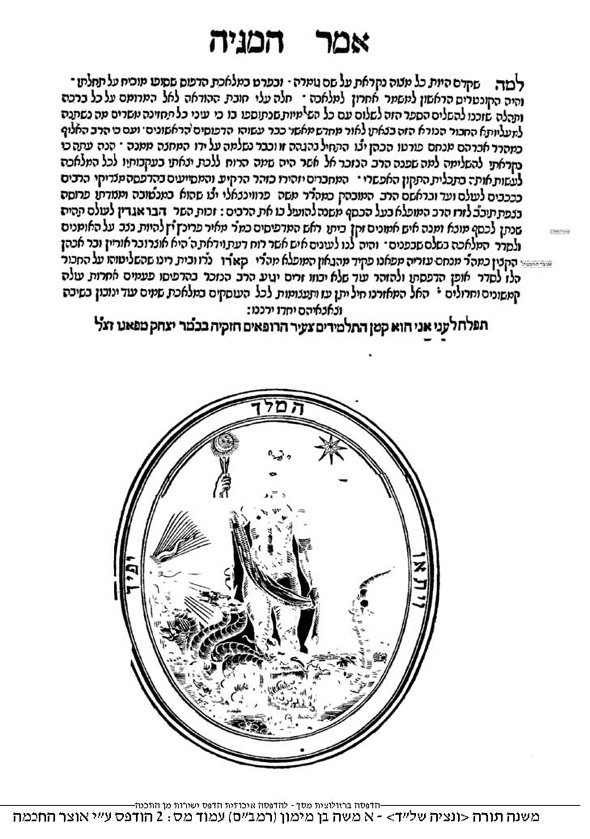
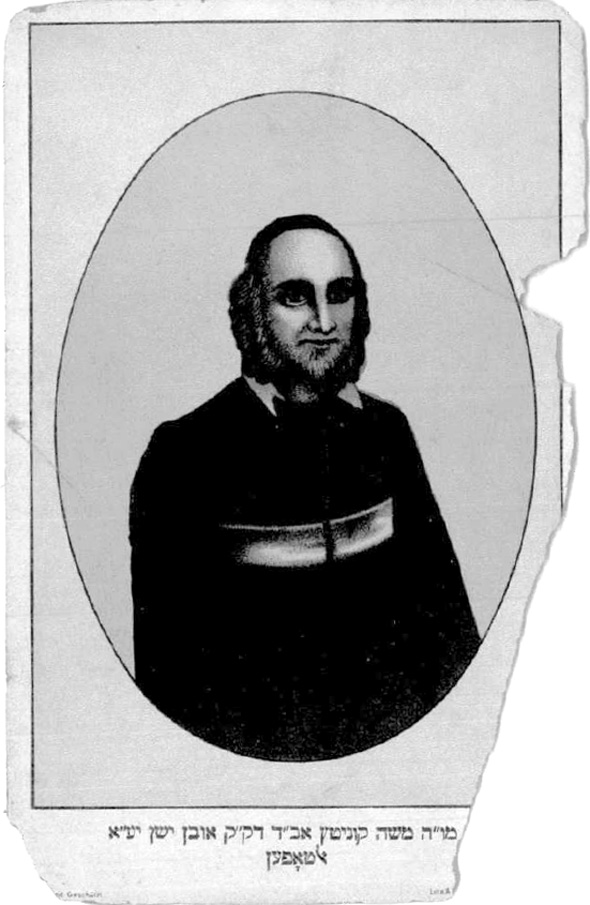
2. In an earlier post I discussed how R. Moses Kunitz’s biography of R. Judah the Prince was censored from a recent printing of the classic Vilna Mishnah. I also included a picture of Kunitz. Here is another, completely unknown, picture of Kunitz.
I found it in the Yeshiva University Archives, call no. 1992.008, and I thank the Archives for permission to publish it here.
In the earlier post dealing with Kunitz, I wrote:
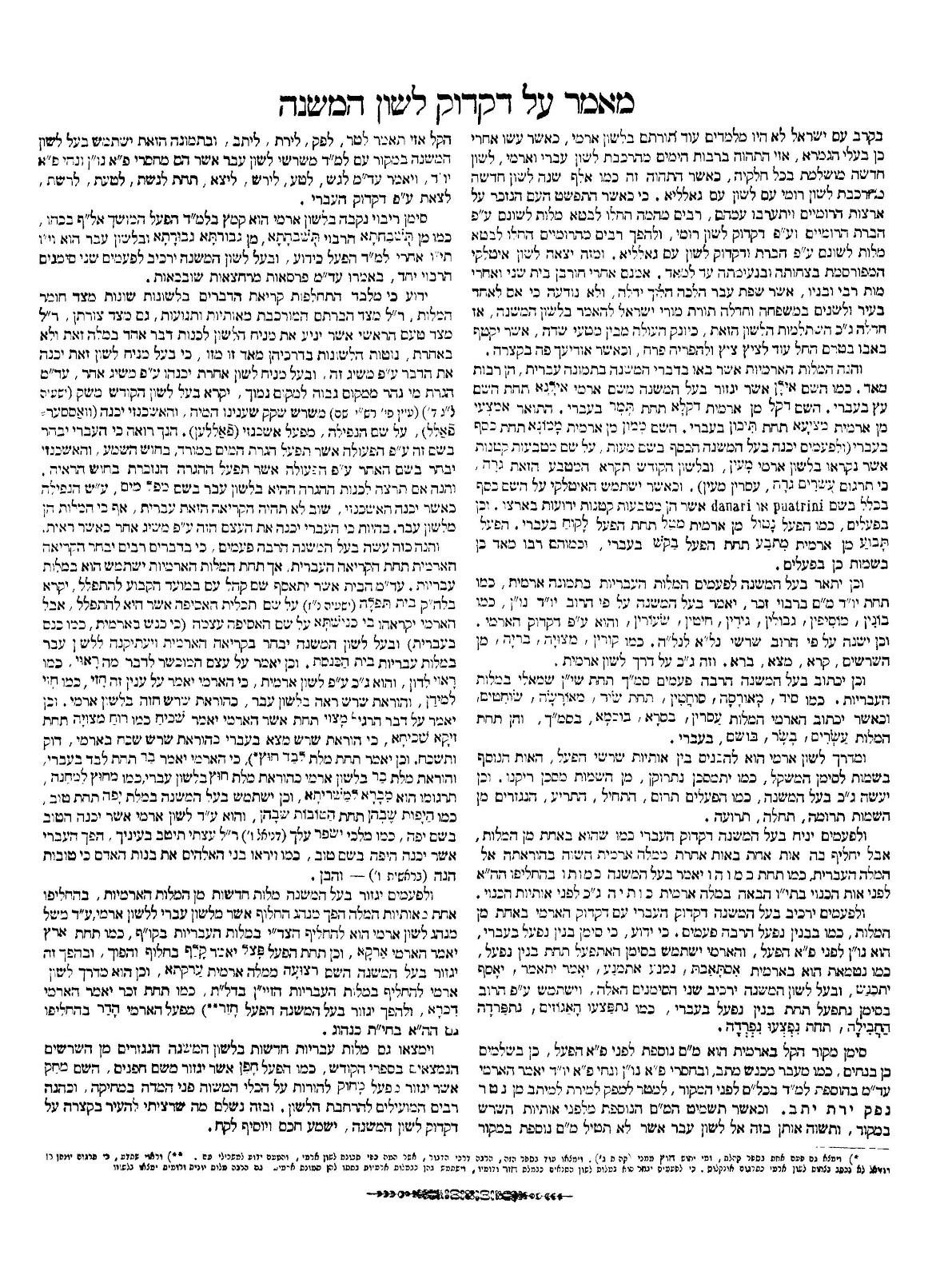
Immediately following Kunitz’ essay, there is another article on the grammar of Mishnaic Hebrew by Solomon Loewisohn.[16] In the very first note he refers to the book of Ecclesiastes, and concludes his comment with והטעם ידוע למשכילי עם. What he is alluding to in this note is that Ecclesiastes is a late biblical book, and thus could not have been written by Solomon. To show this he points to the word חוץ, which in its usage in Ecclesiastes 2:25 is an Aramaism, and thus post-dates the biblical Hebrew of Solomon’s day. To use an expression of the Sages, we live in an olam hafukh. Kunitz’ essay was thought worthy of censorship, and at the same time this note remains in every printing of the Vilna edition of the Mishnah. Yet as I mentioned above, let’s see how long it is before this note, or even the complete essay, is also removed.
What I didn’t realize, and I thank an anonymous commenter for pointing out, is that this note has already been tampered with, and in such an ingenious fashion that there is now no need for it to be deleted. Here is how it appears in the Vilna Mishnah.[17]
And here is the page in the 1999 Zekher Hanokh edition of the Mishnah, published by Wagshal (an edition which also deletes Kunitz’ introduction).
Now, instead of והטעם ידוע למשכילי עם, we have והדבר ידוע למשכילי עם. In the original, Loewisohn is telling the reader that the reason why there is an Aramaism in Ecclesiastes is known to the wise (i.e., the book is post-Solomonic), In the Zekher Hanokh edition all he is saying is that the existence of Aramaisms in Ecclesiastes is known to the wise, with no daring implication as to dating.
I also found something else of interest. Here is the last page of Kunitz’ essay on R. Judah the Prince.
Notice how he mentions Mendelssohn, Rabe’s German translation of the Mishnah, and how in his opinion R. Judah would be happy with such a translation.
This all sounds a little too “maskilish,” and here is what same page looks like as it appears on Otzar ha-Hokhmah.
Look at what has been removed. Is there really such an edition with the removed lines, or did Otzar ha-Hokhmah censor the material itself? (I will return to the censorship of Kunitz in the next post, as new information regarding this has recently come to light.)
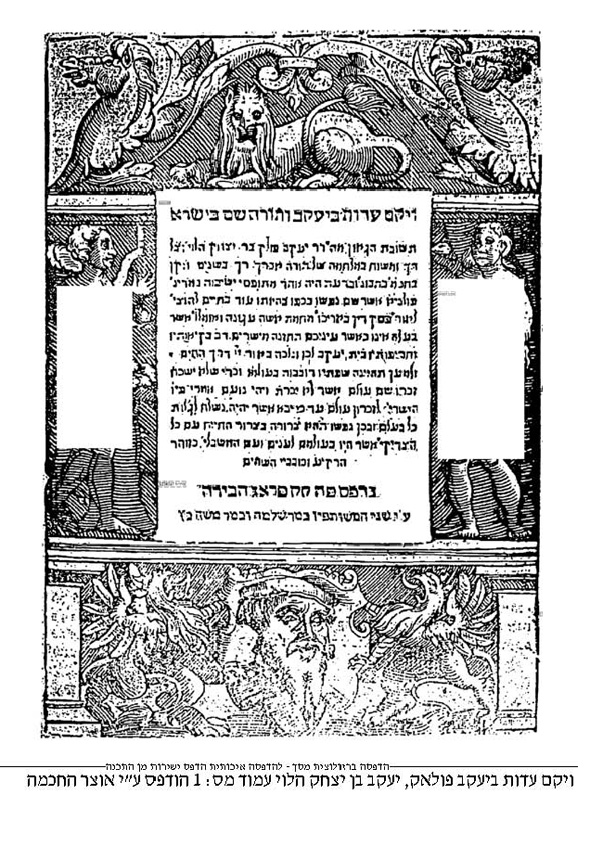
There are other examples where I think it is Otzar ha-Hokhmah that is responsible for the censorship. Here is the title page of the book Va-Yakem Edut be-Yaakov (Prague, 1594) as it appears on Otzar ha-Hokhmah
Here is the uncensored page, as is found on hebrewbooks.org
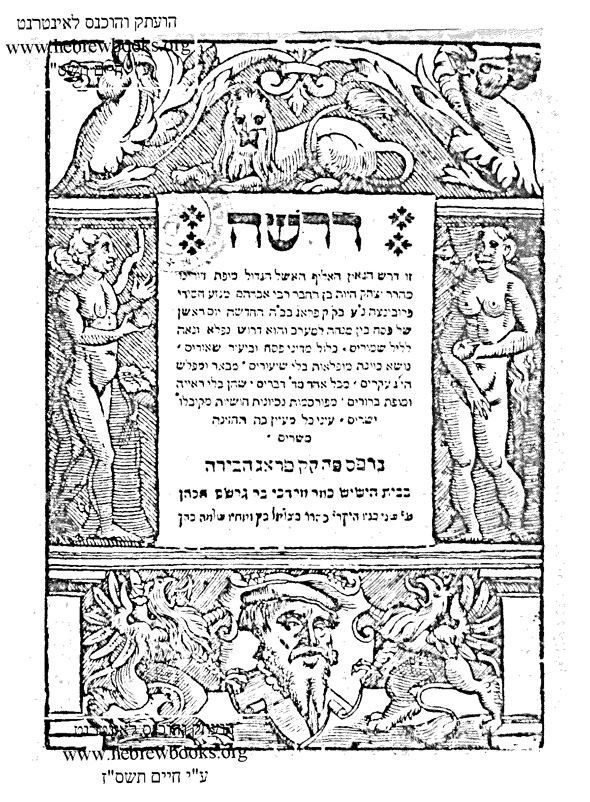
Incidentally, the title page of R. Yitzhak Chajes’ Derashah (Prague, 1589) used the exact same model.
Dan already discussed the Chajes title page here and called attention to how an auction catalog ridiculously suggested, without any evidence whatsoever, that the non-Jewish workers of the Jewish publisher put this immodest picture in.
How were the workers able to get away with this? The catalog has the “religiously correct” answer: it was hol ha-moed and the owner was not around! Since a pious Jew would never have anything to do with such a picture, the non-Jewish workers must have used their own money to buy the plates for this engraving. And why would the non-Jewish workers have spent their own money doing something that would anger the owner and get them fired? It must be that they wanted to cause Jews trouble, which is what non-Jews are always interested in. Knowing that when the owner saw what they did he would never agree to sell a book with such a title page, the non-Jewish workers must have taken all the books from the printing press and, at their own expense, sent them out to all the book sellers. All this could happen without the owner being aware because it was hol ha-moed and during this time the owner of the press wouldn’t dream of dropping by his shop (so much did he trust his workers), just like today none of us know any religious Jews who would ever consider going to work on hol ha-moed.
The title page of Va-Yakem Edut be-Yaakov, published in Prague five years after Chajes’ Derashah appeared, shows us that the non-Jewish workers must have once more, on hol ha-moed of course, surreptitiously inserted the same picture as a title page for a different book. I think everyone has to wonder, why didn’t the publisher learn anything from the first time these non-Jewish trouble makers played around with a Jewish printing press?
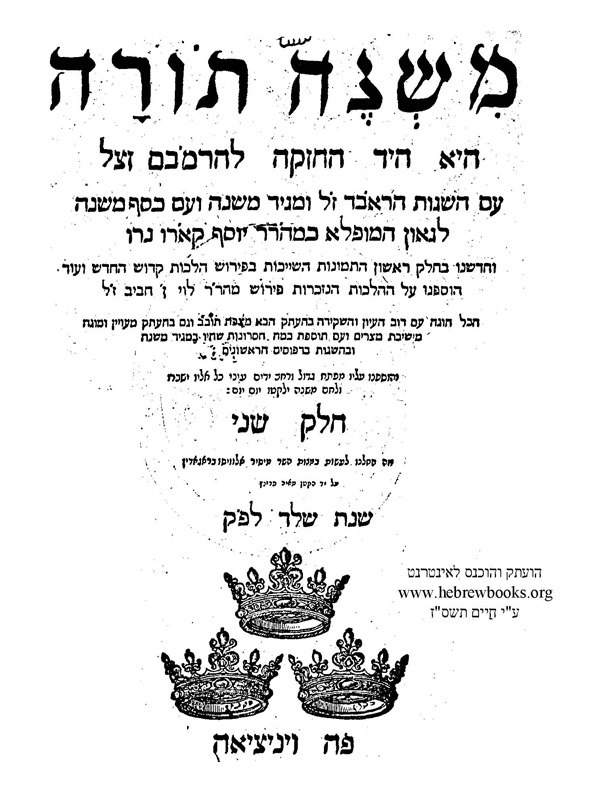
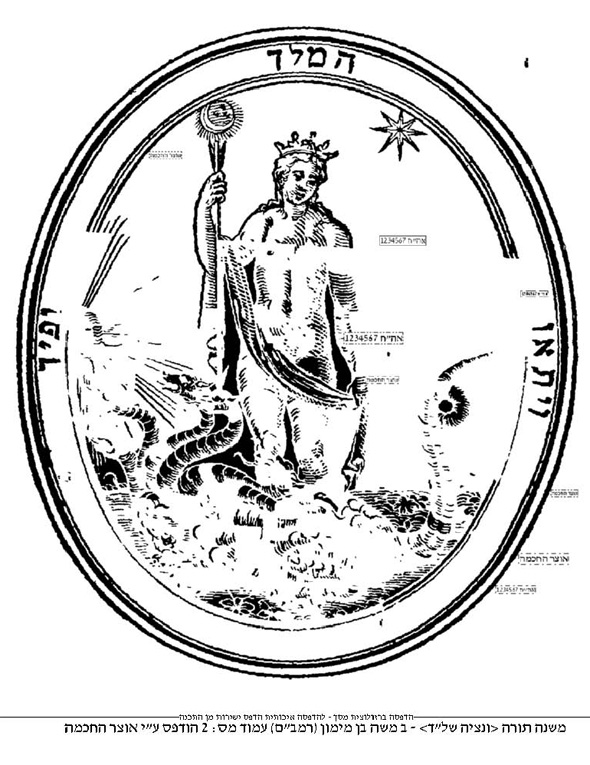
Another example of censorship on Otzar ha-Hokhmah is seen with the Venice 1574 edition of the Mishneh Torah. Here is the title page.
Here is how the second page looks, from volume 2 (as seen on hebrewbooks.org). The verse along the edges is from Psalm 45:12: “The king shall desire your beauty.”.
This edition was published in four volumes. In the copy on Otzar ha-Hokhmah, three of the four volumes contain the second page. Two of the pictures are significantly whited out, and in the second picture below you can see that they have whited out enough so that the reader will think he is looking at a man.
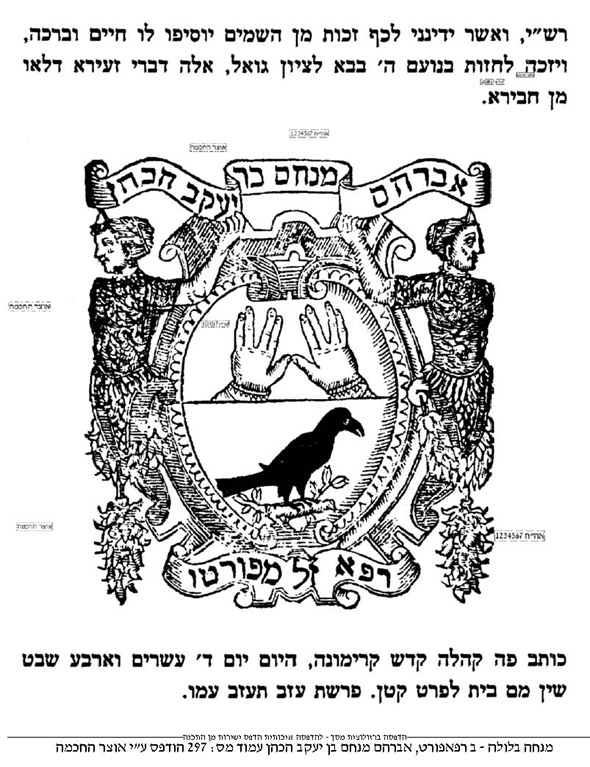
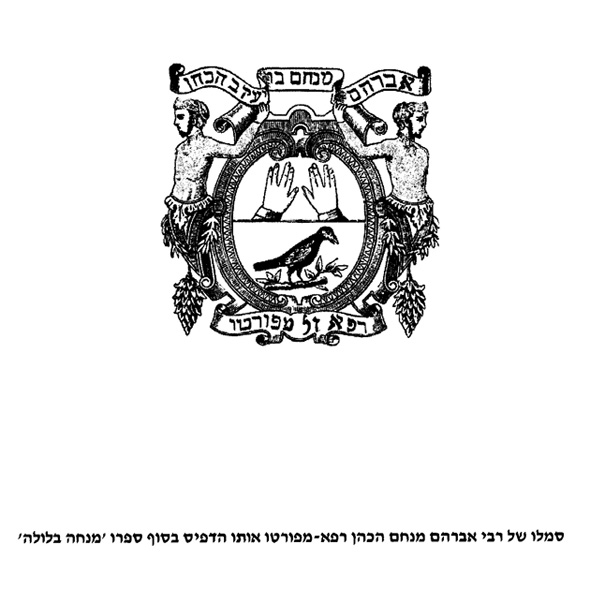
There are, to be sure, plenty of examples where the pictures appear without any censorship on Otzar ha-Hokhmah (and even with the examples I have given, it is not clear if Otzar ha-Hokhmah is responsible for the censorship or the book came to them this way). Here, for example, is the famous family crest of R. Abraham Menahem Rapa of Porto, which appears at the end of his Minhah Belulah.
S. has already pointed out that this picture was altered in a recent printing of the sefer.[18] Here is what the altered version looks like.
Michael Silber has noted that in Binyamin Shlomo Hamburger’s recent book Ha-Yeshiva be-Fiorda, the women have been turned into men, complete with beards![19]
Here is what the Encyclopaedia Judaica, s.v. Rapoport, writes:
The name Rapa originated in the German Rabe (Rappe in Middle High German), i.e., a raven. In order to distinguish themselves from other members of the Rapa family, the members of this family added the name of the town of Porto, and thus the name Rapoport was formed . . . The family escutcheon of Abraham Rapa of Porto shows a raven surmounted by two hands raised in blessing (indicating the family’s priestly descent).
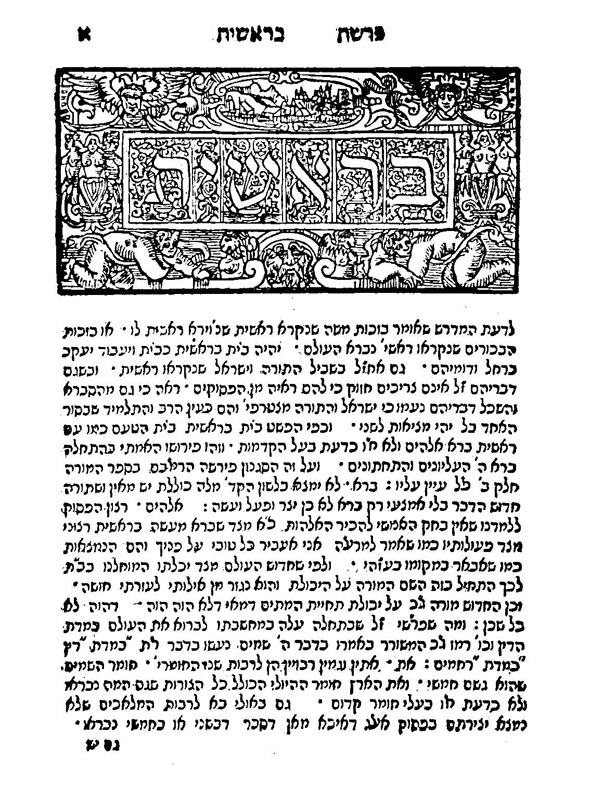
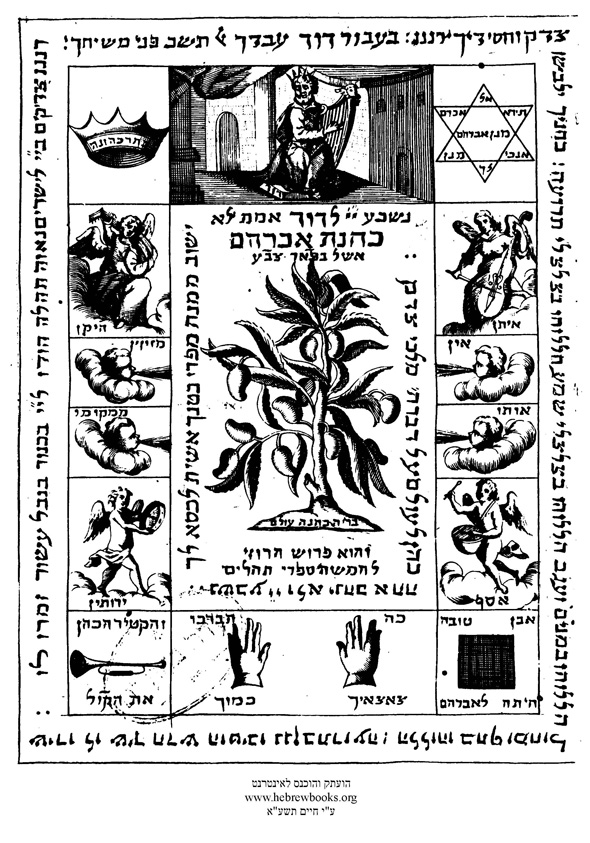
Regarding the sefer Minhah Belulah, at the beginning of each book of the Pentateuch the following “immodest” picture also appears.
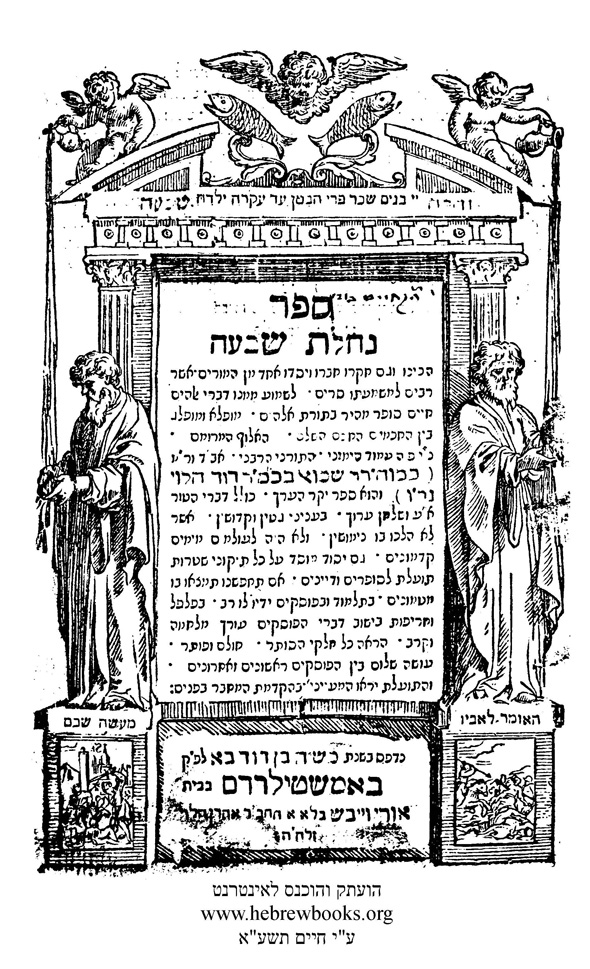
As far as I know, hebrewbooks.org has not censored any of the books that appear on the site. (We have previously discussed books that it refuses to put up.) A few years ago the Reich collection of reprints was added to hebrewbooks.org and these have all sorts of interesting title pages. Here is the title page of R. Samuel ben David Ha-Levi’s Nahalat Shivah.
The year is expressed as משיח בן דוד בא. This adds up to 427 (i.e., 5427), and is an allusion towards Shabbetai Zvi. The year 5427 corresponded to 1666-1667, and the convention normally would be to write 1667 (and this is the date given in the Harvard catalog). However, in this case I assume it is more accurate to give the date as 1666. We know that Shabbetai Zvi converted on September 15, 1666. By 1667 this information would have reached Amsterdam and the title page would no longer refer to him as the Messiah. Therefore, I think we can conclude that the book appeared after Rosh ha-Shanah of 1666, but before January 1, 1667. Nevertheless, it is noteworthy that if you look at the end of the book there is a comment by the typesetter from which we see that, despite the date on the title page, the book was not actually ready for publication until the beginning of 1668. In other words, the title page was not changed in the interim, despite Shabbetai Zvi’s apostasy.
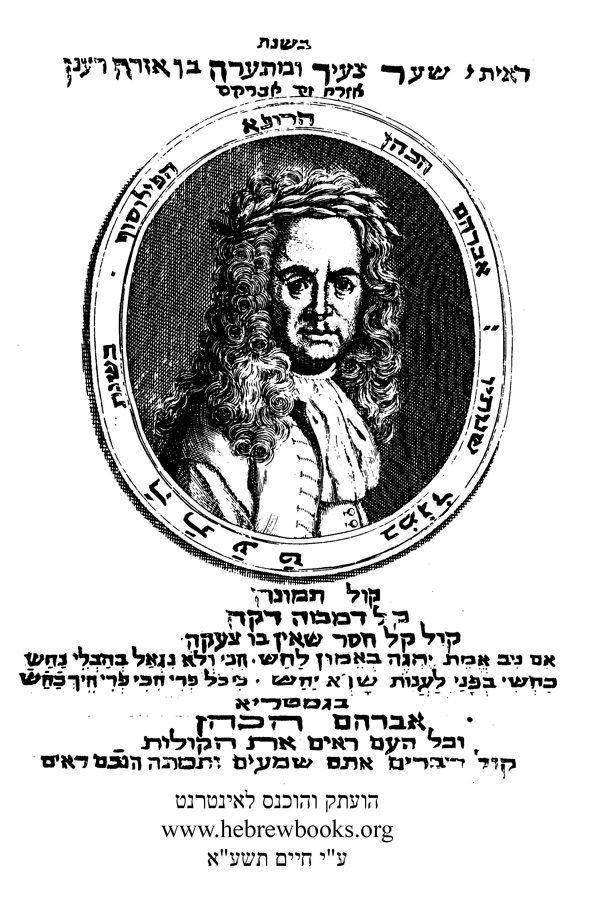
Among the Reich reprints, here is another fascinating title page (actually the first of two title pages in this book). It is from R. Abraham ben Shabbetai’s Kehunat Avraham (Venice 1719).
Here is the author’s picture, that appears on the second page. He clearly is wearing a wig.
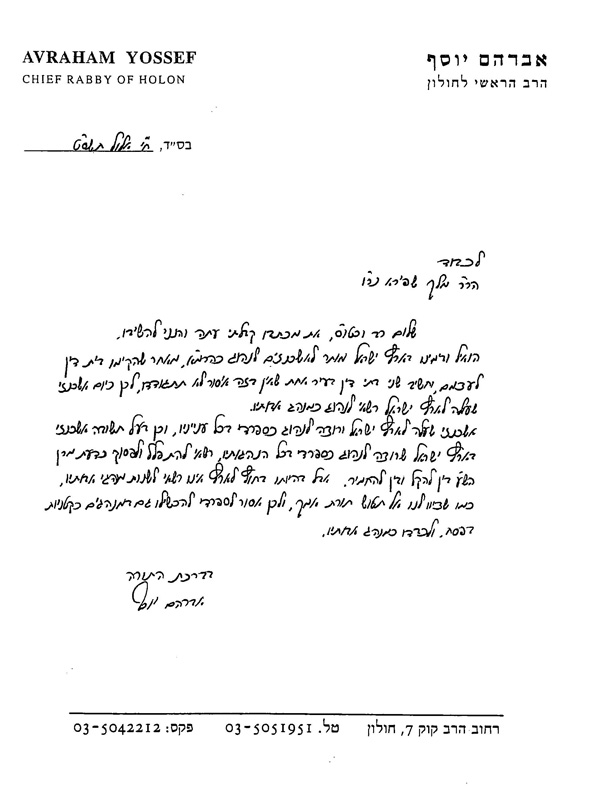
3. In the previous post I mentioned something I was told by R. Avraham Yosef, the son of R. Ovadiah. He is the chief rabbi of Holon and while a great talmid hakham, unlike his brothers R. Yitzhak and R. David he has not published very much. Here is his picture.
Like his father, R. Avraham is known for some controversial statements. He has also surprised people with his viewpoints. See here, for example, where he expressed his support for Livni becoming prime minister. I have found that he is very accessible and will answer any letter written to him. Since we are approaching Passover, let me share with readers the following.
From reading the works of R. Ovadiah Yosef,[20] I have always assumed that in his opinion even Ashkenazim living in Israel are obligated to follow R. Joseph Karo. Despite what R. Yitzhak states in his letter published below, I haven’t seen any convincing explanation as to why the Moroccans and the Yemenites should be obligated in this according to R. Ovadiah, but not the Ashkenazim. And yet R. Ovadiah does not say so openly, perhaps to avoid involving himself in controversy. He also doesn’t say that Ashkenazim should keep their practices in the Land of Israel, except for one issue, namely, kitniyot, where he is explicit that Ashkenazim are obligated to follow their tradition.[21] However, based on my assumptions from reading R. Ovadiah, I assumed that the obligation of kitniyot in the Land of Israel only applied to those who identified as Ashkenazim. If, on the other hand, someone wanted to “convert,” as it were, to Sephardi practice, he would no longer be obligated in kitniyot.
To test my theory, I wrote to three of R. Ovadiah’s sons, R. David, R. Yitzhak, and R. Avraham, asking if it was permissible for an Ashkenazi to adopt Sephardi practices in all areas, meaning that he would no longer have to avoid kitniyot. R. David never replied, but I did receive replies from R. Yitzhak and R. Avraham. Readers might recall how R. David and R. Yitzhak differed about what blessing should be recited over Bamba, and each claimed to have the support of their father. In the kitniyot case as well there is a dispute. R. Yitzhak wrote to me that an Ashkenazi, even in Israel, is bound to his communal practices. The only exception is if he is a baal teshuvah., In this case, he hasn’t yet adopted the Ashkenazic practices, and he can therefore “become Sephardi”. Here is R. Yitzhak’s letter (it was one letter, with two signatures).
However, R. Avraham has a different perspective, believing that he too is properly representing his father’s outlook (and what he writes is what I also assumed based on my own reading of R. Ovadiah). According to R. Avraham, an Ashkenazi in Israel (and only in Israel) is permitted to become Sephardi, בין לטוב ובין למוטב. Here is R. Avraham’s letter.
4. Rabbi Moshe Shamah’s commentary on the Torah has recently appeared. At over one thousand pages, it is titled Recalling the Covenant: A Contemporary Commentary on the Five Books of the Torah. In a future post I hope to deal in more detail with one of Shamah’s essays, but in the meantime I wanted to let readers know about the book’s appearance. Many volumes of Torah commentary appear each year, usually written in the same style. Shamah’s book is different. The sources used and the questions asked will be eye-opening for many. It is not derush and does not psychoanalyze biblical figures. Rather, Shamah’s book is high level Torah scholarship in the tradition of the great peshat commentators, both medieval and modern,. I also found it interesting that the book contains a blurb from the noted biblical scholar Gary Anderson (as well from Yaakov Elman, Barry Eichler, and Jack Sasson).
Just as I was about to send in this post I also received Rabbi Nathaniel Helfgot’s just published Mikra and Meaning: Studies in Bible and Its Interpretation. This is a collection of essays on different themes in Tanakh and is a good example of the Modern Orthodox revolution in the study of Bible. Just as the Rav commented that that it would be impossible today to (successfully) teach Talmud to students who are secularly educated if not for R. Chaim’s approach, something similar can be said regarding Tanakh. For those with a secular education, who have read great books, it is very difficult to connect to Tanakh without the new approach that has been developed in the last forty years or so. As R. Yoel Bin Nun puts in his preface to Helfgot’s book: “It is impossible to study Tanakh in the land of Israel as if we are still residing in Eastern Europe prior to the Holocaust.”[22]
[1] There are, to be sure, opposing passages. See e.g., Bamidbar Rabbah 10:17, where it records that Manoah stated: והנשים אינם בנות הוראה. This text is cited by a number of halakhists to show that women are not to issue halakhic rulings. Both R. Hayyim Hirschensohn, Malki ba-Kodesh, vol. 4 p. 104 and R. Yissachar Tamar, Alei Tamar, Zeraim, p. 151, reject drawing any conclusions from the passage. Both of them claim that one can’t rely on what Manoah said, as he was an am ha-aretz (see Berakhot 61a: מנוח עם הארץ היה). This is an interesting point, but I wonder if it has any validity. It obviously depends on how one is supposed to read Midrash. On the one hand, Manoah may have been an am ha-aretz, but the sage who put this expression in his mouth was not, and neither was the redactor of the text, so perhaps Manoah’s statement should indeed be seen as a rabbinic position. On the other hand, since it was put in the mouth of an am ha’aretz, perhaps it should be regarded as simply that, namely, an uninformed opinion.
It is interesting that the well-known author, R. Aaron Hyman, responded to Hirschensohn in Malki ba-Kodesh, vol. 6, p. 204. He criticized Hirschensohn for writing as if he believed that because the Midrash quoted a statement of Manoah, that the historical Manoah actually said this:
ומה שמביא חתנו הלשון מבמ”ר נשים אינן בנות הוראה, ורוצה אדוני לתלות יען שמנוח ע”ה הי’ אומר דבר זה, חס מלהזכיר שיאמין כבודו שבאמת מנוח אמר דבר זה, האם אמרו חז”ל מדברי נביאות או בקבלה, הלא אך בדרך דרש אמר הדרשן כן וכן והוא דברי הדרשן הי’ מי שהי’ אבל מדרש הוא ואדם גדול קבצם, וכן ידוע כל השקלא וטריא שהיה בין קרח ומשה בענין טלית שכלה תכלת והאלמנה והכבשה, זהו אך מליצה נשגבה אבל לא שבאמת היה כן.
See Hirschensohn’s reply, ibid., p. 209, that his intent was only that the Midrash, בדרך דרש, attributed words to Manoah.
[2] Another irony is that the halakhic textbook written by the most distinguished of these yoatzot turns out to be more stringent, and requires consultation with rabbis more often, than halakhic texts written by men. See Aviad Stollman’s review of Deena R. Zimmerman’s A Lifetime Companion to the Laws of Jewish Family Life in Meorot 6 (2007), p. 5. I can’t imagine that women think that there is an advantage in having halakhic works written by other women if these works actually reduce female autonomy in intimate hilkhot niddah matters and require more consultation with male rabbis.
With regard to calling the women yoatzot and not poskot, Stollman, p. 8, n. 20, believes that “this is merely a tribute to Orthodox political correctness.” Maybe someone who knows the situation better than I can comment on Stollman’s point. That is, are these women really giving halakhic decisions and merely “covering” themselves by using the politically correct term yoatzot?
Regarding Stollman, I should point out that he is an academic scholar, and in addition to articles has published a critical edition and commentary of Eruvin, ch. 10, Ha-Motze Tefillin (Jerusalem, 2008). He has also published a volume of responsa, Pele Yoetz (Jerusalem, 2011). Responsum no. 45 is, I think, unique in responsa literature. Stollman was asked if it is permitted to create Santa Claus dolls that sing Jingle Bells. He rules that it is permissible. If I’m not mistaken, Stollman is the first one since R. Jehiel Jacob Weinberg to combine academic Talmud study with the writing of halakhic responsa.
Returning to yoatzot, I think many will find interesting that in Yemen and in some of the Sephardic world there was never a concept of asking a rabbi intimate niddah questions. This was because the women were embarrassed to do so, seeing it as “untzniusdik”. I mention this only because I have heard rabbis say that in truth there are no tzeniut issues with this, and women shouldn’t be embarrassed. They make it seem that it is only due to modern values that all of a sudden this sort of thing is uncomfortable for women. This is clearly not the case, as we see from what happened in the Yemenite and some of Sephardic worlds, hardly centers of modernity. (I am only speaking of the historical reality, not the wisdom of the Yemenite and Sephardic approaches, which usually meant that any doubt would be assumed to render the woman impure.) R. Yitzhak Shehebar, the Sephardic rav of Buenos Aires, writes as follows in his Yitzhak Yeranen, no. 95 (quoted in Beit Hillel, Tamuz 5769), p. 120:
ואשר לעניין מראות הדמים לא נהגנו בזה כלל, כי מעולם לא ראיתי להרבנים באר”צ [ארם צובה] שטפלו בזה, אך הנהיגו את הנשים שכל מראה הדומה למראית אדמומית שהוא טמא, זולתי אם יהיה כמראה לבן או ירוק שהוא טוהר.
Regarding Yemen, R. Yitzhak Ratsaby writes (Piskei Maharitz, vol. 3, section Be’erot Yitzhak, pp. 339-340):
אצלנו בק”ק תימן יע”א אין שואלין כלל לחכמים בעניין הכרת מראות הדמים, ובכל ספק הנשים מחזיקות עצמן טמאות ויושבות ז’ נקיים [ואפי’ לבעליהן נמנעות מלהראות כדי שלא יתגנו בעיניהן . . .] וכ”ה גם ברב ק”ק ספרדים יע”א . . . האידנא דהשאלה בדרך כלל היא רק לעיתים רחוקות, עי”ז נשתלשל הדבר שנמנעו מלשאול לגמרי מחמת בושתן היתירה וצניעותן המרובה כנודע
Ratsaby points out that this practice developed even though talmudic literature provides plenty of examples showing that in the days of the tannaim and amoraim the Sages did examine ketamim.
Regarding Yemen, see also R. Nachum Eliezer Rabinovitch, Siah Nahum, no. 60. In this responsum, Rabinovitch supports the institution of yoatzot and suggests that this practice, of turning to women in niddah matters, even existed in tannaitic times: כי לפנות לאשה חכמה אין חשש שמא תתגנה
In a note to this responsum, the editor provides further testimony about Yemen.
שמעתי עדות מחכם נאמן, שהיו מקומות בתימן בהם היו זקנות שהיו מוחזקות כבקיאות בעניני מראות, והנשים היו פונות אליהן, ומעולם לא ערער אדם על כך.
R. Moshe Maimon called my attention to the Meam Loez’s discussion of the laws of niddah, addressed to both men and women, and there is no mention there of bringing anything to the rabbi. This omission was rectified by R. Aryeh Kaplan, who in his translation (vol. 1, p. 136) adds: “When in doubt, a competent rabbi should be consulted.”
[3] Mishpetei Uziel, Hoshen Mishpat, no. 5.
[4] For sources on women deciding halakhic questions, see the three responsa in support of Sara Hurwitz’ being ordained as a “Maharat,” authored by Rabbis Yoel Bin-Nun, Daniel Sperber, and Joshua Maroof, available here.
[5] The Hafetz Hayyim, who was a “rabbi” if there ever was one, only received semikhah when he was 85 years old, and that was to satisfy a bureaucratic requirement. See Moshe Meir Yashar, He-Hafetz Hayyim (Tel Aviv, 1958), vol. 1, p. 19. According to R. Isaac Abarbanel, rabbinic ordination as currently practiced arose due to Christian influence. See Nahalat Avot, beginning of ch. 6:
אחרי בואי באיטאליאה מצאתי שנתפשט המנהג לסמוך אלו לאלו. וראיתי התחלתו בין האשכנזים כלם סומכים ונסמכים ורבנים. לא ידעתי מאין בא להם ההתר הזה אם לא שקנאו מדרכי הגוים העושים דוקטורי ויעשו גם הם.
[6] The title “rabbi” is indeed significant. This can be seen by the fact that when Sara Hurwitz was called Maharat there wasn’t any outcry, but when she was given the title “rabba” that is when the controversy really broke out, even though her job description didn’t change in the slightest. Does this mean that there was no objection to a woman functioning as a rabbi as long as she didn’t have the title? Only after she was renamed “rabba” did the RCA adopt a resolution rejecting the “recognition of women as members of the Orthodox rabbinate, regardless of the title.” Yet despite that resolution, there are synagogues where women are still serving, for all intents and purposes, as members of the rabbinate minus the title.
[7] Similar, though not identical, perspectives have recently been offered by Rabbis Norman Lamm, Michael Broyde and Shlomo Brody. See Broyde and Brody, “Orthodox Women Rabbis? Tentative Thoughts that Distinguish Between the Timely and the Timeless,” Hakirah 11 (Spring 2011), pp. 25-58. None of them reject the notion of Orthodox women rabbis at some time in the future. From speaking to many people, my own sense is that a majority of the Modern Orthodox community supports women rabbis (although not necessarily pulpit rabbis). When I say “support,” I mean if asked the question, the reply will be yes. But at the same time, the overwhelming majority of the Modern Orthodox world doesn’t care about this issue at all, and this includes women also. However, I believe that the minority will continue to push this issue, and when women rabbis become a reality, the Modern Orthodox will not reject these women or the congregations that employ them, as we can already see at present with Rabba Hurwitz and other female synagogue rabbis (in everything but name). I think this will happen before the natural development of female poskot who, as already indicated, will by definition be rabbis even without a formal ordination.
One more point that needs to be mentioned with regard to women rabbis is the issue of economic fairness. There are significant tax savings, due to parsonage, that an ordained clergyman receives from the government. While it is true that R. Michael Broyde has written that even women teaching Torah are eligible for this even under current tax laws (see here) and a prominent New York law has firm also expressed this opinion, many yeshiva day schools, acting under the advice of their accountants, have refused to adopt this policy. Some sort of formal ordination for women would settle the parsonage question, and give a financial boost to many of our underpaid teachers.
[8] There are, however, a number of very good articles on halakhah written by women. See e.g., Devorah Koren’s article in the recently published Milin Havivin 5 (2011), available here.
[9] Regarding Lieberman, I would like to call readers’ attention to what appears in the latest Yeshurun, vol. 25. On p. 21 the following footnote appears:
“How Much Greek in Jewish Palestine לגרסאות ופירוש תיבות אלה, ראה דברי הגר”ש ליברמן “
Here Lieberman is given the title due a gadol be-Yisrael. Perhaps this can be seen as making up for the censorship of references to Lieberman (and Louis Ginzberg) in an article by R. Mordechai Gifter that appeared in an earlier Yeshurun. See Saul Lieberman and the Orthodox, p. 32 n. 117. After my book appeared, I was informed by one of the editors of Yeshurun that the censorship of R. Gifter’s piece was carried out by the one who prepared the article for print, and the editors knew nothing about this and were upset when they learnt what had occurred.
On p. 632 of the new Yeshurun there is a letter from R. David Zvi Hillman to Prof. Shlomo Zalman Havlin in which he states the following: In the early volumes of the Encylopedia Talmudit Lieberman was referred to as ר”ש ליברמן, a point I noted in Saul Lieberman and the Orthodox. Yet American rabbis protested and insisted that he not be mentioned. These rabbis are identified with the Rabbinical Council of America: מהסתדרות הרבנים ר”ל המזרחניקים. In response to this, R. Zevin from that point on only mentioned the name of Lieberman’s books but not Lieberman himself. A Bar Ilan search reveals that vol. 13 is the last volume where ר”ש ליברמן is mentioned. (Vol. 15 was the last volume to appear in R. Zevin’s lifetime. See Zevin, Ishim ve-Shitot [Jerusalem, 2007], p. 40 [first pagination]).
Why would R. Zevin agree to this? The answer is obvious: money. The Mizrachi in America was an important source of funds for the Encyclopedia Talmudit.
[10] The term “rabbanit” was primarily used for the wife of a rabbi. See Robert Bonfil, Rabbis and Jewish Communities in Renaissance Italy, p. 77 n. 186. My point is only that it was also used for scholarly women.
[11] The continuation of the shiur is also of great interest, as he explains that if one ends up in a hotel on Shabbat and sees that the lights in the hall go one every time one leaves one’s room, it is still permissible to walk in the hallway and it is not even regarded as a pesik reisha.
[12] See the biography and picture of her here. For pictures of Flora and her family, see also here.
[13] Rivka bat Meir of Prague (died 1605) was another learned woman who was called “rabbanit”, see Frauke von Rohden, ed. Meneket Rivkah (Philadelphia, 2009), pp. 6-7. Rivka authored the Yiddish mussar work Meineket Rivka, published in Prague, 1609. On the title page she is referred to as הרבנית הדרשנית . (In the Altneuschul memorial book it also says that she preached. See Von Rohden, p. 6) Here is the first page of the book, where she is again referred to as “rabbanit”.
Lest anyone misunderstand, I must stress that Rivka only served as a rabbi and preacher for other women, and was therefore not a prototype for twenty-first century women rabbis. My point in referring to her is to highlight the use of the term “rabbanit” as designating a learned woman.
[14] Teshuvot Pesakim u-Minhagim, vol. 2, ed. Kahana, nos. 155-156.
[15] See Daniel Sperber, Minhagei Yisrael, vol. 1, pp. 65-66.
[16] I originally wrote Levinsohn, and thank a helpful reader for the correction. Loewisohn’s essay originally appeared in his posthumously published Mehkerei Lashon (Vilna, 1849).
[17] Incidentally, the note as it appears in the Vilna Mishnah has also been altered from what appears in the original work. In the original it states אשר אינם על טהרת לשון עבר, and in order that people understand what Loewisohn was saying, these words were altered to read: אשר המה כפי תכונת לשון הארמי
[18] See here.
[19] See here. As one of the commenters pointed out to this post, the women appear to be mermaids. He helpfully provided this link.
[20] For my essay on R. Ovadiah, see here.
[21] See Yabia Omer, vol. 5, Orah Hayyim no. 37, Yehaveh Da’at, vol. 1, no. 9, vol. 5 no. 32.
[22] R. Aharon Lichtenstein also has a preface to the book, where his ambivalence about the new approach comes through very clearly. This short essay deserves its own analysis.


Young Rabbis and All About Olives

Young Rabbis and All About Olives

Marc B. Shapiro
I am currently working on a book focused on the thought of R. Kook, in particular his newly released publications. A book recently appeared titled Siah ha-Re’iyah, by R. David Gavrieli and R. Menahem Weitzman. It discusses a number of important letters of R. Kook. In addition to the analysis of the letters, each of the letters is printed with explanatory words that make them easier to understand. We are also given biographical details about the recipients of R. Kook’s letters. Here is the title page.
In reading the book, I once again found myself asking the question, how can intelligent people sometimes say nonsensical things? On p. 252 the book states that R. Menahem Mendel Cohen studied in yeshivot in Tiberias and Safed, and was appointed as chief rabbi of the Ashkenazic community of Cairo in 1896 when he was only ten years old!

How is it possible for anyone to write such a sentence, that a ten-year-old was appointed as a communal rabbi? Let me explain what happened here, but first, I must note that the name of the man we are referring to is not R. Menahem Mendel Cohen, but R. Aaron Mendel Cohen. Here is his picture, which comes from a very nice Hebrew Wikipedia article on him.

As for R. Cohen being appointed rabbi at age ten, whoever prepared the biographical introduction must have had a source which mistakenly stated that R. Cohen was born in 1886. Since this source also said that he became rabbi in Cairo in 1896, this means that he was ten years old was he was appointed rabbi. Yet we can only wonder how the authors did not see the obvious impossibility of a ten-year-old being appointed rabbi of Cairo, which should have led them to investigate a little further. Simply by googling R. Cohen’s name in Hebrew, the Wikipedia article will come up, and it tells us that R. Cohen was born not in 1886 but in 1866. Thus, instead of a ten-year-old rabbi he is now thirty years old.

With regard to young rabbis, let me repeat, with some slight edits, something I wrote in an earlier post here.

In terms of young achievers in the Lithuanian Torah world, I wonder how many have ever heard of R. Meir Shafit. He lived in the nineteenth century and wrote Sefer Nir, a commentary on the Jerusalem Talmud, when not many were studying it. Here is the title page of one of the volumes, where it tells us that he became rav of a community at the age of fifteen.

The Hazon Ish once remarked that the young Rabbi Shafit would mischievously throw pillows at his gabbaim![1]

Regarding R. Jacob Schorr [mentioned earlier in the original post] being a childhood genius, this letter from him to R. Shlomo Kluger appeared in Moriah, Av 5767.

As you can see, the letter was written in 1860 (although I can’t make out what the handwriting says after תר”ך). We are informed, correctly, that R. Schorr was born in 1853, which would mean that he was seven years old when he wrote the letter. This, I believe, would make him the greatest child genius in Jewish history, as I don’t think the Vilna Gaon could even write like this at age seven. Furthermore, if you read the letter you see that two years prior to this R. Schorr had also written to R. Kluger. Are there any other examples of a five-year-old writing Torah letters to one of the gedolei ha-dor? From the letter we also see that the seven-year-old Schorr was also the rav of the town of Mariampol! (The Mariampol in Galicia, not Lithuania.) I would have thought that this merited some mention by the person publishing this letter. After all, R. Schorr would be the only seven-year-old communal rav in history, and this letter would be the only evidence that he ever served as rav in this town. Unfortunately, the man who published this document and the editor of the journal are entirely oblivious to what, on the face of things, must be one of the most fascinating letters in all of Jewish history.

Yet all that I have written assumes that the letter was actually written by R. Schorr. Once again, we must thank R. Yaakov Hayyim Sofer for setting the record straight. In his recently published Shuvi ha-Shulamit (Jerusalem, 2009), vol. 7, p. 101, he calls attention to the error and points out, citing Wunder, Meorei Galicia, that the rav of Mariampol, Galicia was another man entirely, who was also named Jacob Schorr.

This is what I wrote in the prior post. Let me now add some additional information about R. Shafit, the fifteen-year-old communal rav. The first thing I want to point out relates to the city in which R. Shafit became rav at age fifteen. If you look at the title page you can see that its name is מיצד. This is actually an alternate way of spelling the city which is better known as מייצ’ט. Anyone who knows their Lithuanian rabbinic history will recognize this city as Meitchet (Molchad in English), made famous by the great R. Solomon Polachek, known as the Meitcheter Iluy. (R. Polachek was not actually born in Meitchet, but in a small town nearby.) There is so much to say about R. Polachek, but it will have to wait for a future post.

Returning to R. Shafit, although he is hardly a household name, in his day he was actually quite a well-known rabbi. He contributed to R. Israel Salanter’s journal Tevunah,[2] and those who study the Jerusalem Talmud know that his commentary is a very important work.[3] R. Adin Steinsaltz, who is from R. Shafit’s family, even took time away from his own work on the Talmud to publish from manuscript a commentary of R. Shafit on the Jerusalem Talmud. Here is the volume that appeared in 1979.


In the preface, R. Steinsaltz writes:

כל החכמים הלומדים בירושלמי בכל השיטות, למן חכמי בית המדרש נוסח ליטא העתיקה עד לאנשי המדע המובהקים, כולם כאחד הודו שפירוש “הניר” הוא מחשובי הפירושים שנכתבו אי פעם על התלמוד הירושלמי
I do not need go into more detail on R. Shafit since in 2014 Hillel Rotenberg published an entire book on him.[4] And while it is true that, as mentioned already, R. Shafit is not a household name, there are today people who celebrate his hillula. See here. In case you are wondering what a Lithuanian rabbi is doing with a hillula, R. Shafit was actually a Slonimer Hasid.

In response to my earlier comments about the young R. Shafit, Seforim Blog contributor R. Ovadiah Hoffman sent me another example of a young rabbi: Avigdor Aptowitzer. Aptowitzer, who was one of the twentieth-century’s leading academic scholars of rabbinic literature, is best known as the editor of R. Eliezer ben Joel Halevi’s halakhic work Ra’avyah, concerning which he published another important volume as an introduction to the Ra’avyah, and a book called Hosafot ve-Tikunim le-Sefer Ra’avyah (Jerusalem, 1936). 

According to Abraham Meir Habermann, when Aptowitzer was around seven years old his father, the rabbi of Tarnopol, became ill. Young Avigdor took the place of his father as rabbi. During the week he taught students and on Shabbat people carried him to the synagogue so that he could deliver the derashah.[5] As far as I know, this makes Aptowitzer the youngest person ever to serve as a communal rabbi, even though he was never officially appointed to the position.

It is also reported that R. Shimon Sofer, the son of R. Abraham Samuel Sofer (the Ketav Sofer), was so learned as a child that he received the title חבר from R. Judah Aszod when he was only nine years old.[6]

In speaking about young rabbis, it is also important to mention a passage in R. David Abudarham’s[7] commentary on the Haggadah, s.v. אמר רבי אלעזר הרי אני כבן שבעים שנה. Abudarham cites the Jerusalem Talmud, Berakhot 4:1, that R. Elazar ben Azariah was appointed nasi of the Sanhedrin at age 13. Our version of the Jerusalem Talmud has “age 16”, but the version cited by Abudarham appears in other early sources.[8]

Regarding age 16, R. Solomon Ibn Gabirol wrote his azharot for Shavuot when he was that old. At the beginning of the azharot he wrote (with great self-confidence, I might add):[9]

והנני בשש עשרה שנותי ובי שכל כמו בן השמונים
Avodah Zarah 56b tells about a child who learned Tractate Avodah Zarah when he was six years old. The Talmud describes how he was asked halakhic questions on the tractate, and his replies apparently signify that he was deciding halakhic matters at the age of six.

He was asked, ‘May [an Israelite] tread grapes together with a heathen in a press?’ He replied, ‘It is lawful to tread grapes together with a heathen in a press.’ [To the objection] ‘But he renders it yein nesekh [10] by [the touch of] his hands!’ [he answered], ‘We tie his hands up.’ [To the further objection] ‘But he renders it yein nesekh by [the touch of] his feet!’ [he answered], ‘Wine touched by the feet is not called nesekh.’  

Although not an example of a child rabbi, I think it is worthwhile to mention R. Jacob Berab’s statement that when he was only eighteen years old, and did not yet have a beard, he was the rabbi and halakhic authority for a community of 5000 families in Fez.[11]

Returning to Aptowitzer, R. Meir Mazuz directs a comment at him in a recent issue of his weekly Bayit Ne’eman.[12] In discussing the proper size of a kezayit, R. Mazuz notes that the Ashkenazic rishonim did not have any personal knowledge of olives, and thus did not know how big they were.[13] He cites R. Eliezer ben Joel Halevi, the Ra’avyah, who writes as follows:[14]

וכל היכא שצריך כזית צריך שיהיה מאכל בהרווחה, לפי שאין אנו בקיאין בשיעור זית כדי, שלא תהיה ברכה לבטלה
You cannot get any clearer than this that R. Eliezer, who lived throughout Germany, had no idea how big an olive was.[15] Yet in Aptowitzer’s note to the words לפי שאין אנו בקיאין בשיעור זית, he writes:

כלו’ אלא ע”י מדידה וחשבון, וכאן שבברכה אחרונה אנו עסוקין וכבר אכל ואי אפשר לחשוב ולמדוד, לכן יזהר שיאכל מתחילה שיעור גדול שאין להסתפק בו שהוא כזית
He explains the Ra’avyah to be saying that we do not know how large our portion of food is without measuring it. Since we are dealing with the final blessing and the food is already eaten and thus can no longer be measured, people should eat enough so that there is no doubt that they ate an olive’s worth and thus no problem with a berakhah le-vatalah.

It is hard to understand how Aptowitzer could have written something so obviously incorrect, as there is no doubt as to the passage’s meaning. R. Mazuz writes:

איזה “חכם”, שנכון שאחרי שכבר אכל את הזית לא יכול למדוד, אבל לפני שאכל הוא רואה את הגודל אז למה צריך לאכול בהרווחה?! אלא לא היו מכירים את הזיתים
Here is something else relevant to Aptowitzer. Nahmanides, Commentary to Genesis 31:35, writes (Chavel translation):

The correct interpretation appears to me to be that in ancient days menstruants kept very isolated for they were ever referred to as niddoth on account of their isolation since they did not approach people and did not speak to them. For the ancients in their wisdom knew that their breath is harmful, their gaze is detrimental and makes a bad impression, as the philosophers have explained. I will yet mention their experiences in this matter. And the menstruants dwelled isolated in tents where no one entered, just as our Rabbis have mentioned in the Beraitha of Tractate Niddah: “A learned man is forbidden to greet a menstruant. Rabbi Nechemyah says, ‘even the utterance of her mouth is unclean.’ Said Rabbi Yochanan: ‘One is forbidden to walk after a menstruant and tread upon her footsteps, which are as unclean as a corpse; so is the dust upon which the menstruant stepped unclean, and it is forbidden to derive any benefit from her work.’”

Baraita de-Masekhet Niddah is a strange work, with all sorts of extreme statements not found in mainstream rabbinic literature. This is not the place to review in any detail the various scholarly views about the text’s origin.[16] Suffice it to say that Saul Lieberman thought that the author was a sectarian, but not a Karaite.[17] Aptowitzer, however, took issue with Lieberman and argued that Baraita de-Masekhet Niddah is a Karaite forgery designed to insert Karaite views into the Rabbanite community, and also to make the Sages look like fools. As an example of the latter, Aptowitzer quoted the “halakhah” recorded in Baraita de-Masekhet Niddah that a kohen whose family member – by which it means one he lives with – is a niddah cannot offer a sacrifice or perform birkat kohanim.[18] Aptowitzer concluded that it is “very unfortunate” that some rishonim were misled by this forgery, thinking it an authentic work.[19]

Aptowitzer’s work, Mehkarim be-Sifrut ha-Geonim, in which he expressed this judgment, was published by Mossad ha-Rav Kook. R. Hayyim Dov Chavel also published his commentary on Nahmanides with Mossad ha-Rav Kook, and on the just-mentioned passage of Nahmanides to Genesis 31:35, R. Chavel quotes Aptowitzer’s view.

It is easy to see why, from a traditional perspective, what Aptowitzer said is problematic. After all, he posits that Nahmanides, one of the greatest of the medieval sages, was taken in by a heretic’s forgery. His apology, as it were, that Nahmanides and other medieval sages were not critical scholars, and thus it is not a cause for wonder that they were fooled in this matter, is not the sort of thing that will be seen as respectful in traditional circles. It is one thing to write about more recent sages being fooled by Besamim Rosh and the Yerushalmi on Kodashim, but when dealing with a figure like Nahmanides such a position is bound to be more controversial.

This is exactly what happened, and R. Chavel must have been subjected to criticism for citing Aptowitzer in this matter. In the second edition of his commentary, vol. 1, p. 554, R. Chavel backtracks from what he wrote. Had he been able to reset the type and delete the entire note from the text of the commentary I am sure he would have done so. However, he had to settle for a comment in the hashmatot u-miluim, which most people never bother to look at. He writes as follows:

על דעת בקורתית זו יש להוסיף: אף כי חכם גדול היה ר’ אביגדור אפטוביצר, ונאמן רוח לתורה ולחכמה, נתפס כאן לסברה בעלמא, שלא שזפה עינו החדה כי הברייתא הזאת (ברייתא דמסכת נידה) היא עדות מוכחת עד כמה גידרו קדמונינו עצמם להתרחק מטומאת הנדה. כטומאת הנדה היתה דרכם לפני (יחזקאל לו, יח). ואף שלא היו הדורות נוהגים למעשה בכל החומרות הנזכרות בברייתא זו, הלא כבר כתב ה”חתם סופר” [או”ח  סי’ כג] שאולי נשתנו הטבעים והמקומות, או כיון שדשו בה רבים שומר פתאים ה
As readers can see, R. Chavel’s point is completely dogmatic without any scholarly argument. 

Returning to Nahmanides’ comment to Genesis 31:35, he tells us that he will have more to say on this matter. This is found in his commentary to Leviticus 18:19, where he writes that the blood of menstruation “is deadly poisonous, capable of causing the death of any creature that drinks or eats it.” He further states:

If a menstruant woman at the beginning of her issue were to concentrate her gaze for some time upon a polished iron mirror, there would appear in the mirror red spots resembling drops of blood, for the bad part therein [i.e., in the issue] that is by its nature harmful, causes a certain odium, and the unhealthy condition of the air attaches to the mirror, just as a viper kills with its gaze.

I find it noteworthy that such a great figure as Nahmanides, who was also a doctor, was able to be taken in by these fairy tales. He certainly had never seen any red spots showing up on a mirror so why did he believe such a story without attempting to confirm its accuracy himself? I realize that in medieval times people were much more credulous, and repeated all sorts of far-fetched things that they heard.[20] Nahmanides himself repeats that people in Germany would make use of demons, and he had no reason to doubt this report.[21]

שמעתי בבירור שמנהג אלמניי”ו לעסוק בדברי השדים ומשביעים אותם, ומשלחים אותם ומשתמשים בהם בכמה ענינים
He also believed a report that travelers to the east had discovered the Garden of Eden, but were then killed by the flaming sword that guards the Garden.[22]

 ובספרי הרפואות היונים הקדמונים, וכן בספר אסף היהודי סיפרו כי אספלקינוס חכם מקדוני וארבעים איש מן החרטומים מלומדי הספרים הלכו הלוך בארץ ועברו מעבר להודו קדמת עדן למצוא קצת עלי הרפואות ועץ החיים למען תגדל תפארתם על כל חכמי הארץ, ובבואם אל המקום ההוא ויברק עליהם להט החרב המתהפכת, ויתלהטו כלם בשביבי הברק, ולא נמלט מהם איש
However, when dealing with red spots on a mirror this was something that Nahmanides could have easily confirmed, and yet instead he relied on what he heard, or perhaps read. In seeking to understand how Nahmanides could have been misled in this matter, it helps to be reminded of Bertrand Russell’s famous comment made with reference to Aristotle’s assertion that men have more teeth than women.

To modern educated people, it seems obvious that matters of fact are to be ascertained by observation, not by consulting ancient authorities. But this is an entirely modern conception, which hardly existed before the seventeenth century. Aristotle maintained that women have fewer teeth than men; although he was twice married, it never occurred to him to verify this statement by examining his wives’ mouths.[23]

Returning to the matter of olives, it is noteworthy that the halakhic authorities, including those in the twentieth and twenty-first centuries, who argued that olives have shrunk since the days of the Sages did not actually seek to prove this with historical evidence. Had they done so they would have found that the size of olives has not changed. However, concerning another measurement we find that the Steipler was indeed interested in what the historical record revealed. R. Avrohom Marmorstein and Jacob Djmal both called my attention to a letter of the Steipler that was recently up for auction. Here is the item from Kedem’s January 2018 auction catalog (catalog no. 59), pp. 269-270 (item no. 298).

This letter already appeared in Aleh Yonah (Jerusalem-Bnei Brak, 1989), p. 134.

We see that in trying to determine the size of a cubit, the Steipler actually wrote to the archaeology department at “the university” (i.e., Hebrew University). This sort of effort is exactly what is required when trying to investigate a matter such as this. Yet look what happened when this letter was published in the Steipler’s Karyana de-Igarta, vol. 2, no. 402. The section showing that the Steipler reached out to the academic world was simply deleted, with no indication given that anything has been removed from the letter.

Finally, it is worth mentioning the Hazon Ish’s position that although the various measurements go back to Sinai, the actual size of the measurements required in order to fulfill an obligation was established by the Sages. In other words, while the measurement of a kezayit is mi-deoraita, how big this olive is – as there are different size olives – was given to the Sages to be determined.[24]

וכשנאמרו שיעורין בסיני נאמרו על האומד ומה שנראה לו לאדם זהו שיעורו, ואמנם הדבר מסור לחכמים לקבוע גדרי השיעור לכל ישראל וכמו שאמרו חכמים כזית שנאמרו זה אגורי כשעורה זו מדברית כעדשה זו מצרית לא שנאמרה למשה כך אלא נאמרה סתם והיא הבינונית אלא חכמים עיינו בדבר וקבעו לכל ישראל שכזית אגורי ושעורה מדברית ועדשה מצרית הם הבינונים, וכשם שמסור לדעתו של רואה להכריע על הבינוני של הפרי בין חביריו הגדולים והקטנים כן מסור לחכמים לקבוע את המדידה שיש להגיד עליה שפירותיה הם הבינונים בהגלילים והארצות השונות
Regarding the kezayit measurement, there is one other point worth mentioning. Everyone knows that one is required to eat a kezayit of maror at the Seder. Nevertheless, the practice of the Ropshitz hasidim used to be precisely the opposite, as they were careful not to eat a kezayit of maror. This strange practice goes back to the founder of the Ropshitz dynasty, R. Naphtali Zvi Horowitz (1760-1827). (I don’t know if the practice continues today.) Not only is the lack of a kezayit problematic, but there is the other issue regarding whether one can even say a blessing on the maror with less than a kezayit

R. Aryeh Zvi Frommer deals with Ropshitz practice, and also mentions that he heard that R. Shalom of Belz and R. Ezekiel of Shinova also told people to eat less than a kezayit of maror and to make the blessing on it.[25] R. Frommer attempts to justify this practice halakhically, and he states explicitly that he is doing so in order that the actions of these hasidic masters not be in contradiction to the Mishnah, Pesahim 2:6, the meaning of which appears to be that a kezayit is the minimum amount required for maror.[26] He also notes that he wants to justify the practice of “most of Israel” who use horseradish for maror and also do not eat a kezayit. His justification is only of eating less than a kezayit of horseradish, so it does not seem that this will be of any help with regard to the view of the Ropshitzer, as his avoidance of a kezayit of maror apparently applied to all types of maror, even lettuce. 

Many people probably remember their grandparents telling them that in Europe they used horseradish for maror, but that unlike today there was no concept of being careful to eat a kezayit. If you had any doubts about what your grandparents reported, R. Frommer tells us the exact same thing. Are we to say that most Jews in Europe did not fulfill the mitzvah of maror? This is a conclusion that no rabbi wants to reach, and that is why R. Frommer is motivated to find some justification for the practice.

כנלע”ד ליישב דברי הצדיקים ז”ל שלא יסתרו למשנה מפורשת הנ”ל וליישב מנהג רוב ישראל שאוכלין למרור חריין פחות מכזית ומברכין עליו על אכילת מרור
R. Frommer was obviously concerned that what he wrote would be regarded as too radical. Thus, on the very last page of the book, where one finds the corrections, he stressed that his words were only a limud zekhut because most people do not eat a kezayit, but le-khathilah one cannot rule this way.

כ”ז כתבתי רק דרך למוד זכות מחמת שרוב ההמון ונשים נוהגין כן אבל לכתחלה אין להורות כן וכ”מ באבני נזר סי’ שפ”ג

R. Frommer has another relevant comment on this matter:[27]

ביום ג’ שמות חלם לי, שהגידו לי בשם הרה”צ ר’ פינשע ז”ל מפילץ דאף מי שמגיע לו יסורים ר”ל, סגי ביסורים כ”ש [כל שהוא], דלא עדיף ממרור דלא בעי כזית, ומה”ת סגי במשהו כמ”ש הרא”ש פ”י דפסחים סי’ כ”ה, כמו בזה סגי במשהו
There is no need for me to go into this matter in any detail, as it has been comprehensively analyzed in a wonderful article by Levi Cooper.[28] I would just like to call attention to some sources not mentioned by Cooper. 

1. R. Mordechai Shabetai Eisenberger, Berurei Halakhot (Netanya, 2006), no. 51, offers a halakhic justification for the Ropshitzer, and claims that it is only applicable to horseradish.

2. The following story, quoting R. Aaron Rokeach, the Belzer Rebbe, appears in Aharon Pollak, ed., Beito Na’avah Kodesh (2007), vol. 2, p. 482:

פ”א, בליל הסדר שנת תש”ט, נכח דודי הר”ר יוסף צבי וועבער ז”ל (לאחר שניצל מגיא ההריגה במלחמה  באירופה, וזכה לעלות ארצה אחר החורבן שם), והנה כ”ק מרן זי”ע נתן לו בידו מעט מאוד מה”מרור”. אחד מן הנוכחים שם, הרהיב עוז והעיר למרן זי”ע, ש”זה רק כל שהוא”. נענה מרן זי”ע והתבטא בלשונו “ער האט  שוין געהאט גענוג מרירות”! – (בשם בעל העובדא
3. The following story, that R. Joel Teitelbaum of Satmar refused to follow his father-in-law’s practice of eating less than a kezayit of maror, appears in Aharon Perlow, Otzroteihem shel Tzadikim al ha-Torah ve-ha-Moadim (2006 edition), p. 323, quoting Moshian shel Yisrael, vol. 4, p. 17:

בליל התקדש חג הפסח בעריכת הסדר היה המנהג בבית דזיקוב לברך על אכילת מרור בשיעור פחות מכזית, וכן נהגו גם בפלאנטש. אולם רבינו (כ”ק מרן אדמו”ר מסאטמאר) ז”ל נהג כפשטות לשון הפוסקים וכנהוג בבית אבותיו הק’ לאכול שיעור מרור כזית כדאיפסקא הילכתא. וכשהיה רבינו ז”ל סמוך על שולחן חותנו (מזיוו”ר – הרה”ק רבי אברהם חיים הורביץ מפלאנטש זצוק”ל) לא נתנו לו שיעור מרור כראוי. ורק פחות מכזית – כמנהגם – ולא רצו שרבינו ז”ל יתנהג אחרת ממנהגם. אבל רבינו ז”ל השכיל להכין ולהצניע מראש מקדם בכיס הגלימא שלו שיעור כזית לאכילת מרור, ובעת עריכת הסדר כשהגיע לקיים מצות אכילת מרור אכל רבינו כשיעור
  
4. Matityahu Gutman, Belz (Tel Aviv, 1912), p. 31, states:

רבי יהושע מבלז אמר: אבי היה פוסק, והוא אמר שאין צריך לאכול כזית מרור, ובתשובות הנדפסות בסו”ס אמרי נועם למועדים כותב שמקובל כך מזקנו הק’ מרופשיץ וכן היו נוהגין כל בני ביתו, מחמת אי בריאות

The words I have underlined are how later generations mistakenly attempted to reconcile the practice of the Ropshitzer and his descendants with the halakhah.

Excursus

Another proof that the medieval German sages never actually saw olives is provided by R. Hayyim Benish – the expert in all matters of halakhic measurements and times – in what is still probably the best discussion of the history and halakhah of the kezayit measurement (and he did not need an entire book to make his points). See Benish, “Shiur Kezayit: Berur Da’at ha-Rishonim ve-ha-Aharonim,” Beit Aharon ve-Yisrael 50 (Kislev-Tevet, 5754), pp. 107-116. 

R. Benish calls attention to a medieval Ashkenazic series of halakhic rulings published by Shlomo Spitzer in Moriah 8 (Sivan 5738). On p. 4, in discussing the size of an olive and the problem created by the medieval Ashkenazic assumption that two olives equal one egg, the unknown author writes:

ולי הכותב אינו קשה כי ראיתי זיתים בא”י ובירושלים אפילו ששה אינם גדולים כביצה
From this we see that the medieval Ashkenazic sages did not know what an olive looked like, and because of this they were mistaken in their assumption that two olives equal one egg. The author himself, who had journeyed to Eretz Yisrael and had seen actual olives, was able to correct his Ashkenazic contemporaries. Yet his statement that an olive is not even one sixth the size of an egg is not in line with the Rashba, Torat ha-BayitMishmeret ha-Bayit, Mossad ha-Rav Kook ed., vol. 2, col. 52 (bayit revi’i, sha’ar rishon), who had olives at his disposal and describes them as less than one fourth the size of an olive. (See R. Benish, p. 109, for the common view that according to Maimonides an olive is one third of an egg.) See also R. Jacob Moelin, Sefer Maharil, ed. Spitzer (Jerusalem, 1989), Likutim, no. 55, that whereas two olives equal one egg, three dried figs also equal an egg. In other words, he believed that a fig is smaller than an olive, which could only be said by someone who never saw an olive. Perhaps he never saw a fig either, but the measurement of three figs equaling one egg is held by the geonim and Maimonides. See R. Eliyahu Zini, Etz Erez, vol. 3, pp. 201-202.
There are, of course, different types of olives, and R. Benish, p. 114, has a chart with the different measurements. Regarding the anonymous medieval Ashkenazic author, who stated that an olive is not even a sixth the size of an egg, it is possible that when he returned to Germany he forgot the exact size, and recalled them as being smaller than they actually were.
The editor of Torat ha-Bayit, R. Moshe Brun, finds the Rashba’s statement that an olive is not even a quarter of an egg so significant that he remarks:

חדוש גדול חידש לנו רבינו בהלכות שיעורין, דיותר מד’ זיתים בכביצה
R. Benish concludes that the size of a kezayit is 7.5 square centimeters. Recognizing that this is a good deal smaller than what people are told today, he concludes with the following important words which explain why a kezayit by definition must be a really small size.[29] What he says would appear to be basic to all of the Sages’ measurements, but for some reason I was never taught this in yeshiva:

רבים יתמהו ודאי, האם בשיעור זעיר כל כך מקיימים מצוות אכילה הכתובה בתורה. תמיה זו יסודה בחוסר הבנה במושג שיעורי תורה בכלל, ובשיעור אכילה בפרט. בסיס השיעורים בכל מקום ומקום הוא השיעור המזערי ביותר שעליו ניתן לומר שיש לו מהות. וכמו שיעור רוחב אגודל במדות האורך – מדה מחייבת בענינים התלויים במדות אורך (כמו לאו דהשגת גבול. ראה רמב”ם הל’ גנבה פ”ז הי”א), ושיעור פרוטה, שיעור מתחייב בממון, למרות שהוא שיעור זעיר ביותר . . , ואם יקדש אשה בשיעורי ממון זה – מקודשת. וכן הוא ה”כזית” – שיעור אכילה: השיעור המיזערי ביותר שיצא מכלל פירור ויש בו חשיבות אוכל . . . ואין תנאי במצות אכילה שיהיה בו שיעור מיתבא דעתא או שביעה
See also Beit Aharon ve-Yisrael 53 (Sivan-Tamuz 5754), pp. 91ff., where R. Benish responds to criticisms of his article. On p. 96 he mentions that one person criticized him by saying that the information he wrote about should not be made public!

והנה אמר לי חכם אחד: לא חידשת במאמרך מאומה, הדברים הינם ידועים, אלא שנאמרו, אפילו ע”י גדולי הפוסקים, מפה לאוזן, ואתה הוצאת זאת שלא כדין ושלא לצורך לרשות הרבים
Finally, no mention of the size of an olive would be complete without referring to R. Natan Slifkin’s essay on the topic available here.
One complicating factor in any discussion of the kezayit is that R. Joseph Karo, Shulhan ArukhOrah Hayyim 586:1, writes:

שיעור כזית יש אומרים דהוי כחצי ביצה
R. Karo knew what an olive looked like, so why in his codification of the Passover laws would he record the view that it is the size of half an egg? Furthermore, why does he ignore the views of R. Isaac Alfasi, Maimonides, and R. Asher who held that a kezayit is less than this? And finally, how come in Orah Hayyim 210 when he discusses the kezayit he does not define it as half an egg? 

These points are all raised by R. Hadar Yehudah Margolin in support of R. Benish’s position that when, in the laws of Passover, R. Karo mentions the view that a kezayit is half an egg, this is only to be regarded as a humra. However, R. Karo himself holds that the basic law is that a kezayit is really the actual size of an olive (which is certainly smaller than half an egg). See Beit Aharon ve-Yisrael 51 (Shevat-Adar 5754), p. 119.

In the recently published De-Haziteih le-Rabbi Meir (Jerusalem, 2018), vol. 1, p. 399, we see that R. Meir Soloveitchik did not like the suggestion that medieval Ashkenazic sages did not know how big an olive was.

אמר על כך הגר”מ שהרי ההגהות מיימוניות (פרק א’ ממאכלות אסורות אות מ’) מביאים שרבינו תם נתקשה בסימני עוף טהור, ואז עף אל שולחנו עוף טהור, ועל ידי זה ידע את הסימנים. ומזה רואים כמה סייעתא דשמיא היה להם שלא יטעו לומר דבר שאינו נכון, וא”כ איך אפשר לומר שכיון שלא ראו זיתים לכן לא ידעו מה שיעור כזית
* * * *

My Torah in Motion 2019 summer trips will be to Morocco, Central Europe, and Greece. Information about them will soon be up on the Torah in Motion website.

Notes

[1] A. Horowitz, Orhot Rabbenu (Bnei Brak, 1991), vol. 1, p. 364. Horowitz adds that he asked the Steipler how they could appoint a fifteen-year-old rabbi when it says in Shulhan Arukh, Hoshen Mishpat that a dayan has to be eighteen-years-old. The Steipler replied that a rabbi is not a dayan, as he only decides halakhic questions and is not on a beit din. Horowitz also asked the Steipler about what appears in the Beit Yosef, that semikhah should not be given to anyone under eighteen. The Steipler replied that this is only a general rule, but there are exceptions.

Regarding eighteen as the minimum age of a dayan, contrary to what Horowitz states, this is actually not recorded as halakhah in the Shulhan Arukh. R. Karo writes as follows inHoshen Mishpat 7:3:

יש אומרים שאינו ראוי לדון אלא מבן י”ח ומעלה והביא שתי שערות. וי”א דמבן י”ג ומעלה כשר ואפילו לא הביא שתי שערות
This is actually a case of יש אומרים ויש אומרים, and according to R. Yitzhak Yosef the general rule in such a case is that the second opinion is the one we accept. See Ein Yitzhak, vol. 3, pp. 438ff. (Kelalim be-Da’at ha-Shulhan Arukh, no. 28).

Sefer Meirat Einayim explains the position that allows a thirteen-year-old dayan as due to the fact that being a dayan is only dependent on חריפותו ובקיאותו .
R. Kook refused to give semikhah to a young man as he believed that semikhah should only be given to one who was knowledgeable in the entire Torah (!). See his responsum published in Peri ha-Aretz 5 (1982), pp. 6-9.
[2] Tevunah (1861), nos. 39, 40.
[3] Sections of this commentary that have not yet appeared in print were recently offered for sale at an auction. See here.
[4] Ha-Gaon ha-Hasid Rabbi Meir Marim Shafit. See also the very nice story about R. Shafit recorded here.
[5] Habermann, Anshei Sefer ve-Anshei Ma’aseh (Jerusalem, 1974), p. 139.
[6] R. Asher Anshel Yehudah Miller, Olamo shel Abba (Jerusalem, 1984), p. 181.
[7] The common pronunciation of his name as “Abudraham” is a mistake. See here.
[8] See R. Menahem Kasher, Haggadah Shelemah, p. 17 n. 141.
[9] Israel Davidson, Otzar ha-Shirah ve-ha-Piyut (New York, 1924), vol. 1, p. 303. As Davidson notes, this is the correct version of the text.
[10] This is how the words are pronounced, not yayin nesekh.
[11] See R. Levi Ibn Habib, Teshuvot, no. 147 (Kuntres ha-Semikhah, no. 4), s.v. ומתחלה. R. Baruch Rabinovich, about whom I have written a good deal in recent posts (and more is to come) was appointed גאב”ד of Munkatch immediately upon his marriage, when he was only eighteen years old. See R. Nathan David Rabinowich, ed., Hashav Nevonim (N.Y.-Jerusalem, 2016), p. 9.

This post deals with young rabbis, not precocious children. However, regarding children wise beyond their years, I just came across the following from R. Hayyim ben Bezalel, Be’er Mayim Hayim (London, 1964), vol. 1, p. 165:

ואני בעודי נער כמו בן ז’ שנים פעם אחת בליל שבת של פרשה זו הסיבו יחד זקנים בעלי הוראה ונתנו ונשאו בזאת הקושיא והייתי מקשיב לקולם לאחר דבריהם אמרתי לחוות דעי גם אני ברשותם . . . והודי לי רבותיי והנהתי להם מאד

[11] No. 99 (18 Shevat 5778), p. 6 n. 35. Regarding R. Mazuz, I think readers will enjoy the song devoted to him that recently appeared.


Here are other songs devoted to him


Here is Lipa Schmeltzer on Sukkot 2018 singing before R. Mazuz and R. Shlomo Amar. The first song he sings is a poem that R. Mazuz wrote about Maimonides.

[13] R. Mazuz also shows that the medieval French sages never saw a date, and this explains why they describe it incorrectly. See Bayit Ne’eman, Orah Hayyim, no. 25 (pp. 135, 137-138).

[14] Berakhot no. 107.
[15] See Excursus.
[16] Interested readers can consult the numerous sources listed by R. Eliezer Brodt, Likutei Eliezer, pp. 38ff.
[17] Sheki’in (Jerusalem, 1939), p. 22.
[18] See R. Moses Sofer, She’elot u-Teshuvot Hatam Sofer, Orah Hayyim, no. 23, who discusses the matter of birkat kohanim, as it is also quoted by Rabad in his commentary to Tamid 33b from Sefer ha-Mikzto’ot. R. Efraim Zalman Margulies, Beit Efrayim, Orah Hayyim no. 6, explains the Ashkenazic practice of not reciting birkat kohanim every day as due to the concern that there might be a niddah in a kohen’s house. With reference to the notion that a kohen does not recite birkat kohanim if there is a niddah in his house, which as just noted is quoted by Rabad from Sefer ha-Miktzo’ot, R. Joseph Kafih writes (commentary to Moreh Nevukhim 3:47, n. 31):

והדעות הללו חדרו גם לשכבות מסוימות של היהדות והחלו להתנהג במנהגותיהם, ראה לדוגמא פירוש הראב”ד למסכת תמיד הפרק האחרון בשם ספר המקצעות
In other words, R. Kafih is in agreement with Aptowitzer that this is an example of sectarian ideas finding their way into the writings of rishonim

The late Yaakov Elman even saw Zoroastrian influence in a practice that would become part of the Niddah laws. He wrote the following here:

As to the non-elitist Babylonian Jews, we have a report regarding the ordinary Babylonian Jewish women. Rabbi Zera reports that the “daughters of Israel had undertaken to be so strict with themselves as to wait for seven [clean] days [after the appearance] of a drop of blood the size of a mustard seed [although biblically they are required only to separate for seven days from the onset of menstruation]” (Berakhot, fol. 31a; Megillah, fol. 28b; Niddah, fol. 66a). It is clear from Niddah (fol. 66a) that this stringency was a popular practice and not a rabbinic prohibition, probably in response to a “holier than thou” attitude perceived by the populace as emanating from their Persian neighbors. It seems that Babylonian Jewish women had internalized their Zoroastrian neighbors’ critique of Rabbinic Judaism’s relatively “easy-going” ways in this regard.
[19] Mehkarim be-Sifrut ha-Geonim (Jerusalem, 1941), pp. 166-168.
[20] Of course, in modern times people can also be quite credulous. Since we are discussing menstruation, here is another myth repeated by R. Hayyim David Halevi, Mekor Hayyim, vol. 5, p. 70:

וכבר הוכח שאחיזת יד האשה הנדה בפרחים ממהרת נבילתם
[21] Kitvei Ramban, ed. Chavel, vol. 1, p. 381. See also ibid., p. 149, that he believed it is possible for necromancers to raise the spirits of the dead.
[22] Kitvei Ramban, vol. 2, p. 296. Nahmanides wrote this in the thirteenth century when all sorts of tall tales were believed. Yet I still recall how surprised I was when told by a high school rebbe in the 1980s that he believed that the Ten Tribes were hidden somewhere on earth, waiting to be discovered. Perhaps relevant to this, R. Aharon Leib Steinman writes that the reason we cannot find the Sambatyon river is because of hester panim. See Ayelet ha-Shahar, Devarim, p. 190.
In general, it never ceases to amaze me how even very great figures have been taken in by phony stories. For one example (and I could provide a very long list of similar examples), here is a story about the power of the evil eye that R. Joseph Zechariah Stern records inZekher Yehosef, vol. 4, Tahalukhot ha-Agaddot, p. 13a. It actually upset me when I saw this, as I am a big admirer of R. Stern and was disappointed that he, too, readily accepted a phony story as fact.

ובענין עין הרע שנמצא באגדות הנה גם אנשים שאין להם חלק בתלמוד מחכמיהם ענו אמן על התאמתם וכנודע ע”פ מ”ע [מכתבי עת] כי הרופאים בע”מ פ”ב [בעיר מלוכה פטרבורג] עשו נסיון מבחינה שעשו שהניחו ככר לחם לפני אחד מחייבי מיתות ושהרעיבו אותו שלש ימים מקודם, ואותו חלק מהלחם שהניחו לפניו מבלי ליתן אותו לנגוע בו רק במבטי עיניו נהפך אח”כ לסם המות
This source, and the one from R. Steinman mentioned earlier in this note, are referred to in the recently published Otzar Hemdah (n.p., 2018), pp. 81, 150. See also ibid., p. 219, which cites R. Elijah David Rabinowitz-Teomim, Over Orah (Jerusalem, 2003), p. 237:

כבר נודע שבעת פריחת הגפנים אז גם היין שכבר הוא מכמה שנים במרתפים תוסס, (וכן אנו רואים בעת פריחת התבואות אז העיסה תוססת), ודבר זה נעלם מחכמי הטבע, אבל הכל רואים דבר זה בחוש, וא”כ ודאי שגם מה שכשאומרים דבר שמועה בשמו גורם ששפתותיו דובבות בקבר אין להתפלא כלל, אף שאין אנו מבינים דבר
How is it that R. Rabinowitz-Teomim can write that everyone sees the phenomenon with grapes and wheat he describes when the entire description is completely without basis? Otzar Hemdah, p. 219, cites a similar passage from R. Hayyim Joseph David Azulai,Homat Anakh (Jerusalem, 1986), parashat Matot (p. 67a):

הלא תראה היין שהוא במרתף ומונח בחבית סתומה בעת שדורכים הענבים אף שהוא רחוק מאד היין שבחבית מתנועע והוא פלא
Again, we have to ask, how is it that so many people believed that they saw something which never occurred?
[23] The Impact of Science on Society (London and New York, 2016), p. 6.
[24] Hazon Ish, Hilkhot Shabbat 39:1 (Kuntres ha-Shiurim).
[25] Eretz Tzvi, vol. 1, no. 85.
[26] I say the meaning “appears to be,” as there is a famous comment of R. Asher ben Jehiel, Pesahim, ch. 10, no. 25, which some understand to be suggesting a different approach to maror and the obligation of kezayit. See R. Aryeh Leib Gunzberg, Sha’agat Aryeh, no. 100; R. Mordechai Shabbetai Eisenberger, Berurei Halakhot (Netanya, 2006), no. 51; R. Samuel Pardes, Avnei Shmuel (Jerusalem, 1993), no. 13; R. Asher Weiss, Minhat Asher: Haggadah shel Pesah (Jerusalem, 2004), pp. 203ff.
[27]  Eretz Tzvi, vol. 2, p. 401.
[28] “Bitter Herbs in Hasidic Galicia,” Jewish Studies Internet Journal 12 (2013), pp. 1-40.
[29] See also R. Naphtali Zvi Judah Berlin, Meromei Sadeh, Pesahim 39a, who states that a kezayit is very small:
וזה ברור דשיעור כזית המבואר בשו”ע הוא שיעור קטן מאד


How much Greek in “Greek Wisdom”? On the Meaning of Hokhmat Yevanit

How much Greek in “Greek Wisdom”? On the Meaning of Hokhmat Yevanit

by Eliyahu Krakowski

      In the medieval controversies over the study of philosophy, one of the major points of contention was the Talmudic prohibition against hokhmat yevanit. Modern historians, who are generally well-disposed toward the Maimonidean proponents of philosophy (often at the expense of the anti-rationalists), nevertheless often assume that the anti-rationalists had the better of this particular argument. The Maimonidean defense of philosophy against the Talmudic stricture, if not an outright distortion, was at least a forced explanation.[1] However, the truth seems to be the opposite—it was not the defenders of philosophy who “redefined” the Talmudic passages, it was philosophy’s opponents. The success of this redefinition indeed put the proponents of philosophy on the defensive, but without good reason. To demonstrate this thesis, we will briefly consider the Talmudic evidence, and then turn to the history of the interpretation of the phrase hokhmat yevanit. Most contemporary scholars who have discussed the Talmudic passages have concluded, with varying degrees of certainty, that hokhmat yevanit incorporates Greek philosophy. Gerald Blidstein, noting the indeterminacy of the sources nevertheless concludes, “Though no Talmudic source indicates what is included in this wisdom, it is likely that literature, rhetoric, and philosophy are what is meant, while language instruction in a matter of further debate.”[2] Louis Feldman likewise claims that, “when the Talmud imposes a curse on those who instruct their sons in Greek wisdom, a good guess is that this wisdom is philosophy,” and “that the rabbis were strongly opposed to the study of philosophy may be inferred from the fact that … its teaching is cursed together with swine herding, and hence is associated with the antithesis of Judaism.”[3] Noah Efron claims unambiguously that, “if one wants still more evidence of rabbinic indifference toward philosophy of nature, it is worth considering that, in many places in the Talmud (and then for centuries after the Talmud), a synonym for philosophy of nature was ‘Greek wisdom.’”[4] David Shatz formulates his position more carefully: Regarding Talmudic and Midrashic literature, Shatz says, “we find no evidence of extensive involvement with philosophy… and we even encounter statements that could be construed as opposed to ‘Greek wisdom,’ ‘the wisdom of the nations,’ and ‘logic.’[5]

However, when we turn to the Talmudic passages in question, the evidence for the identification of hokhmat yevanit with philosophy is lacking. In context, these passages support a narrower definition of hokhmat yevanit:

בבא קמא (פב ע”ב – פג ע”א): תנו רבנן: כשצרו בית חשמונאי זה על זה, היה הורקנוס מבפנים ואריסטובלוס מבחוץ. ובכל יום היו משלשים להם בקופה דינרין, והיו מעלים להם תמידין. היה שם זקן אחד שהיה מכיר בחכמת יוונית, אמר להם: כל זמן שעוסקין בעבודה אין נמסרים בידכם. למחר שילשלו דינרין בקופה, והעלו להם חזיר. כיון שהגיע לחצי החומה נעץ צפרניו בחומה, ונזדעזעה ארץ ישראל ארבע מאות פרסה על ארבע מאות פרסה. באותה שעה אמרו: ארור האיש שיגדל חזירים, וארור האדם שילמד את בנו חכמת יוונית… וחכמת יוונית מי אסירא? והתניא, אמר רבי: בארץ ישראל לשון סורסי למה? או לשון הקדש או לשון יונית! … אמרי: לשון יוני לחוד, חכמת יונית לחוד. וחכמת יונית מי אסירא? והאמר רב יהודה אמר שמואל משום רשב”ג: (איכה ג) עיני עוללה לנפשי מכל בנות עירי – אלף ילדים היו בבית אבא, חמש מאות מהם למדו תורה, חמש מאות למדו חכמת יונית, ולא נשתייר מהם אלא אני כאן ובן אחי אבא בעסיא! אמרי: שאני בית רבן גמליאל, שהיו קרובים למלכות; וכדתניא: המספר קומי הרי זה מדרכי האמורי, אבטולמוס בר ראובן התירו לו לספר קומי, מפני שהוא קרוב למלכות; של בית רבן גמליאל התירו להם לספר בחכמת יונית, מפני שקרובים למלכות.

In this passage, the knowledge of hokhmat yevanit enables communication with the Greek enemy. Furthermore, the initial confusion between “lashon yevani” and “hokhmat yevanit” and the use of the verb “lesapper”—to speak—regarding hokhmat yevanit indicate that we are discussing a linguistic phenomenon. The next Talmudic relevant passage is more problematic, and seemingly presents a prohibition on everything but Torah study:

מנחות צט ע”ב: שאל בן דמה בן אחותו של ר’ ישמעאל את ר’ ישמעאל: כגון אני שלמדתי כל התורה כולה, מהו ללמוד חכמת יונית? קרא עליו המקרא הזה: לא ימוש ספר התורה הזה מפיך והגית בו יומם ולילה, צא ובדוק שעה שאינה לא מן היום ולא מן הלילה ולמוד בה חכמת יונית.

However, in light of the prohibition on hokhmat yevanit, it would seem more likely that R. Yishmael’s response should not be construed as a prohibition on all non-Torah pursuits, but as a rhetorical enforcement of the existing ban on hokhmat yevanit. This reading receives support from a parallel in the Jerusalem Talmud:

ירושלמי סוטה פ”ט הט”ו: שאלו רבי יהושע מהו שילמד אדם את בנו יונית. אמר להן ילמדנו בשעה שאינה לא יום ולא לילה דכתיב והגית בו יומם ולילה. מעתה אסור לאדם ללמד את בנו אומנות בגין דכתיב והגית בו יומם ולילה. והתני רבי ישמעאל ובחרת בחיים זו אומנות. רבי בא בריה דרבי חייה בר בא בשם ר’ יוחנן מפני המסורות.

Turning now to the medieval commentators, Maimonides addresses the definition of this term in his commentary on the Mishnah (Sotah 9:15):

ואמרו יונית, רוצה לומר חכמה יונית, לפי שהיו מכנים את הרמזים שבדבור, וכן דברים שאינם כפשוטם אלא יש להן ענין נסתר חכמה. ובתלמוד אמרו ר’ משתעי לשון חכמה והזכירו דברי חידה כמו שנתבאר בגמר עבודה זרה. והיה אצל היונים דברים מעין אלה מיוחדים אצל אומה זו שמשוחחים בהם מה שרוצים כעין רמזים וחידות, וטעם אסור דבר זה לפי שבזמן בית שני צר אחד ממלכי בני חשמונאי על ירושלם והיו אנשי ירושלם משלשלין להם למחנה קופה דינרין בכל יום ונותנין להם בהם שני תמידין לקרבן והיה שם איש היודע אלו הרמזים שהמציאו היונים ודבר עמהם בהם, וכך הוא לשון התלמוד לעז להם בחכמה יונית שכל זמן שהם מקריבין לא תוכלו לכבשם והפסיקו מהם הקרבן, באותה שעה אסרו שילמד שום אדם אותם הרמזים שהמציאו היונים לדבר בהם. ודבר זה אין לי ספק שנשתקע ולא נשאר ממנו בעולם היום לא מעט ולא הרבה.

According to Maimonides, hokhmat yevanit has nothing to do with Greek philosophy, and Maimonides adds emphatically, whatever coded language intended by this term is undoubtedly no longer in existence. In accordance with his position here, Maimonides makes no mention of what is now an obsolete prohibition in his code. A number of contemporary scholars have assumed that Maimonides’ explanation is the result of his predetermined position on the merit of Aristotelian philosophy, and therefore an attempt to redefine a problematic prohibition.[6] Yet if we look at Maimonides predecessors, his position is hardly novel. Rashi in his Talmudic commentary takes a position essentially identical to Maimonides. In his commentary to Menahot (64b) Rashi defines hokhmat yevanit in one word: “רמיזות”. In the Sotah passage (49b), Rashi explains further: חכמת יוונית – לשון חכמה שמדברים בו בני פלטין ואין שאר העם מכירין בו. This position is not unique to Rashi. Tosafot likewise assume as self-understood that hokhmat yevanit refers to a coded language. Thus in explaining the Talmudic passage according to which Babylonia has no “ketav,” Tosafot (Avodah Zarah 10a) cite R. Isaac of Dampierre who explains this to mean that Babylonia lacks its own “important language” akin to hokhmat yevanit:

לכך פירש ר”י כתב לשון חשוב שהמלכים משתמשין בו כעין חכמת יונית והיינו דאמרינן במגילה (דף י: ושם( והכרתי לבבל שם ושאר שם זה לשון ומאי קאמר דהא בלשון ארמי הם מספרים ועודם משתמשין בו אלא בודאי לשון מלכות קאמר.[7]

Nor is this view of hokhmat yevanit limited to Ashkenazi predecessors of Maimonides. An anonymous Gaon (quoted in R. Betzalel Ashkenazi’s Shitah Mekubetzet to Bava Kama 83a) also explains: חכמת יונית לחוד. דחכמת יונית אסורה והאי חכמת יונית ברמיזה הוה. גאון ז”ל. Likewise, later halakhists who believed that it is prohibited to sudy Greek philosophy nevertheless did not understand the prohibition of hokhmat yevanit as a prohibition against philosophy. For example, R. Isaac b. Sheshet (Rivash) was asked whether hokhmat yevanit refers to Aristotle’s Physics and Metaphysics. Although he forbids study of these works, Rivash argues that they are not prohibited as hokhmat yevanit:

ומה ששאלת: מה היא חכמת יונית אשר יתרחק האדם? ואם הם אותם ספרים המפורסמים בעולם כשמע טבעי, ומה שאחר הטבע? … נראה, שאין הספרים ההם בכלל גזרה זו, שאם מצד שהם כתובים בלשון יוני, הלשון לא נאסר, וכלם היו בקיאין בו… ואם מצד החכמה בעצמה, מהו זה שלעז להם הזקן ההוא? ולכן נ”ל, שחכמת יונית היא לדבר בלשון יוני בחידות ובלשון סתום, שלא יבינו אותו ההמון, רק אותם שלמדו והורגלו באותן החידות. דמיון מ”ש (בפרק כיצד מעברין נג:): אמהתא דבי רבי, כי הוו משתעון בלשון חכמה, אמרין הכי: עלת נקפ’ בכד ידאון נשריא לקיניהון. ור”ל שהכלי הקטן ששואבין בו היין מן החבית, מנקפת בשולי החבית, לפי שכבר כלה היין, ולכן שיעופו וילכו התלמידים למקומם… וחידות כאלו, כשנאמר בלשון יוני, נקראים חכמה יונית… אמנם, ספרי הטבע המפורסמים, לא מן השם הוא זה, אבל ראוי לימנע מהם, אם הם מתאמצים לעקור עקרי תורתינו הקדושה. ובפרט שני עמודי התווך אשר היא נכונה עליהם, שזהו, חדוש העולם, והשגחת השם יתברך בפרטי המין האנושי. והם מביאים ראיות ומופתים לפי דעתם לקיים קדמות העולם, ושהוא מחוייב מן השם יתברך, כמו שהאור מחוייב מן השמש, והצל מן האילן, ואין יכולת לשם יתברך לשנות דבר מטבעו, ולא להאריך כנף הזבוב, ולא לקצר רגל הנמלה; כמו שאין יכולת בשמש לשנות האור הנמשך ממנו, ולא האילן הצל. וכן, שהשגחת השם יתברך לא תהיה במה שהוא למטה מגלגל הירח. וכתבו בספריהם, שאין ידיעה שלמה רק אותה שהיא מצד החקיר’, לא מצד הקבלה. ואנחנו מקבלי האמת, דעתנו, שהתורה שלנו שלמה, שבאה אלינו במעמד הר סיני מפי הגבורה ובאמצעות אדון הנביאים ע”ה, היא למעלה מהכל, וכל חקירתם אפס ותהו לערכה.[8]

It is not hard to see the reason for this commentatorial consensus. The Talmudic account refers to an old man communicating with the enemy in hokhmat yevanit as the cause for this prohibition. It is hard to see how Greek philosophy could have served as an effective mode for secret communication.[9] But there is another reason to prefer this identification as well. The Talmud consistently refers to hokhmat yevanit, not to hokhmah yevanit. The latter should indeed be translated as “Greek wisdom”; the former, however, means instead “wisdom of Greek.” Here the word “Greek” is not an adjective describing the kind of wisdom, but a noun, meaning the Greek language. This nuance is reflected in the commentaries which understand hokhmat yevanit not as Greek wisdom but as a cryptic language based on Greek. If not from the traditional Talmudic commentators, where then does the identification of hokhmat yevanit with “Greek wisdom” come from? As far as I can tell, the first to identify “hokhmat yevanit” with Greek philosophy is R. Yehudah Halevi. In a well-known poem, Halevi warns a friend not to be seduced by hokhmat yevanit: ואל תשיאך חכמת יונית אשר אין לה פרי כי אם פרחים. ופריה – כי אדמה לא רקועה וכי לא אהלי שחק מתוחים. ואין ראשית לכל מעשה בראשית ואין אחרית לחדוש הירחים.[10] Halevi alludes to the Aristotelian doctrine of eternal matter, which he sees as flower without fruit, or appearance without substance. Were Halevi’s anti-Aristotelian poem the first source for this explanation, we would have reason to remain skeptical about its veracity. However, despite Halevi’s use of the term “hokhmat yevanit,” there is little reason to assume that Halevi really believes this is the meaning of these words in the Talmud. Using a poetic license, it would be hard for an anti-Aristotelian like Halevi to pass up the rhetorical opportunity granted by the Talmud’s curse on teaching hokhmat yevanit, which, even if not literally the same, at least provides a negative association for the accursed ‘Greek wisdom.’[11] Bernard Septimus notes what he views as use of this term by a twelfth century proponent of Aristotelian philosophy, Abraham ibn Daud.[12] In his Sefer ha-Qabbalah, ibn Daud describes the positive attributes of some of his predecessors:

והיה [האמורא, שמואל] חכם גדול בכל חכמה יונית מוסף על תורתו.[13] ומוסף על חכמתו ותורתו היה פייטן גדול ויודע בחכמה יונית ורבץ תורה הרבה והעמיד תלמידים הרבה.[14] היה רב ברוך זה יודע בחכמה יונית מוסף על תורתו וחכמתו והעמיד תלמידים הרבה ואני קטן שבכלם. [15] ר’ משה בר’ יעקב בן עזרא מזרע המשרה וחכם גדול בתורה ובחכמה יונית.[16]

However, in all these cases, ibn Daud refers not to hokhmat yevanit, which is the term used by the Talmud for the prohibited subject matter, but hokhmah yevanit, which indeed must mean “Greek wisdom.” As a proponent of Greek philosophy, it is hard to imagine ibn Daud would not have made this distinction. For if hokhmah yevanit is identical with the Talmud’s prohibited subject, ibn Daud, at very least has some explaining to do, which evidently he does not feel to be the case. Thus, instead of support for the theory that hokhmat yevanit refers to Greek philosophy, ibn Daud provides indirect support for the difference between “Greek wisdom”—hokhmah yevanit—and that which the Talmud calls hokhmat yevanit. If we are correct, we have yet to find the first usage of hokhmat yevanit to refer to Greek philosophy in an unambiguously literal sense. Interestingly, it seems that the first documented examples of this usage occur in rapid succession during the controversy over the study of Greek philosophy in the 1230s. R. Yehudah Alfakar, in his letter to R. David Kimhi in opposition to the pro-philosophic faction, refers to hokhmat yevanit a number of times:

ואינו כדאי מופת חכמת יונית לעקור את הכל שנאמר ובא האות והמופת וגו’ וכתוב בתריה לא תשמע אל דברי הנביא, ועוד שאפילו לדבריהם שהם מדברי סופרים ולא מפי ספרים, כי כל מופת שלם צריך עיון גדול עד מאד מפני שפעמים יתערב בו דבר מתעה מאותה חכמה שקרנית שנקרא בלשון יון סופיסטיק”ה ובהתחברות אליו יעשה מרמה ללכוד חכמים בערמה כגון שיהיה באות ובמופת או בהקדמות מהקדמותיו עד סוף כל העולם אחד מן המומים הפוסלין המחפפים משותפים או טענות מחופות מזוייפות צנומות דקות שדופות ונמצאים תולדותיהם כיוצא בהם שאינן משיחין לפי תומם כי זנתה אמם לפי דרכנו למדנו שהסומך על דבריהם בדברי תורתו לא יצא ידי חובתו וכל שכן לענין מופת הקדמות שהוא פוסל את השבת במומו… מפני שהיתה כונתו שלא לשנות מנהגו של עולם למען העמיד התורה עם חכמת היונית יחד לחבר את האהל להיות אחד ודימה היות הראשונה עם השניה כשתי עפרים תאמי צביה והיתה תאניה ואניה ולא נשא אותם הארץ לשבת יחדו להיות כשתי אחיות כי לא כנשים המצריות העבריות ופוסחים על שתי הסעיפים והם חושבים כי הם לכאן ולכאן והם באמת יורדים ואינם עולים אלא עומדים בתוך לנדה ביניהם לא אור התורה נגה עליהם ולא שם חכמה יונית נקרא בהם.[17]

According to Alfakar, all philosophy risks sophistry, and should therefore not be relied on for religious purposes. In light of Alfakar’s hostility toward ‘Greek wisdom,’ it is interesting that he does not refer directly to the Talmud’s prohibition. If this is out of respect for the “Andalusian tradition,” his fellow Spanish anti-Maimonidean, R. Joseph ben Todros Abulafia, feels no such constraint:

והנה איך יתחמץ לב אדם על רבותינו הצרפתים וכליותיו ישתוק אשר גזרו לבל ילחם אדם בלחם חכמי יונים בצלם אל יתלונן דהא ודאי קדמום רבנן ואסור ללחום בלחמם שחטיהם שחטי מנית(?) [מינות?] ואמרו ארור המלמד בנו חכמה יונית והנה גם מלכי הערב בתחלת מלכותם חכמו השכילו זאת הבינו לאחריתם ושמו בראשית חקיהם ודתם לבל יהגה אדם בכל חכמת ההגיון ובכל חכמות יונים מפני שבדבריהם דברי מינים, ואתם בעקבות חכמי הקבלה לא יצאתם וכמשפטי הגוים אשר סביבותיכם לא עשיתם, ואם לחשך אדם לומר דע מה שתשיב את אפיקורס: לקומם חרבות האמונה יאמרו, לא להרוס, כי תשובת חכמי היונים הם האפיקורסים הם המינים, ודבריהם הם נכוחות למשמע אזנים ולחפצים לפרוק מעליהם עול מלכות שמים ודבריהם קרובים להבין ואזני הפתאים קשובות להאזין אם ימתק בפיהם ענינם יכחידו תחת לשונם, ואף אם ישמעו עליהם דברי רבנו בספר המורה בתשובות נצחות ולשון מדברת צחות קרובים דבריו בפיהם ורחוקים מכליותיהם.[18]

Unsurprisingly, this position was also taken by an Ashkenazi polemic at the time of the controversy: כל גאוני צרפת ואשכנז אשר לא שתו לבם לשעות בדברי שוא ולעזוב מקור חיים הלכות ואגדות לעסוק בחכמה יונית אשר אסרו חכמים ללמד את בנו חכמה יונית[19]

This term occurs again in the controversy of the 1230s in the conciliatory letter of Nahmanides to the French rabbis:

הביטו וראו היש מכאוב כמכאובינו, כי גלו בנים מעל שלחן אביהם ויתגאלו בפת בג המלך וביין משתיהם ויתערבו בגויים וילמדו ממעשיהם אף כי חרב השמד אשר בעוונותינו שרד בגלות ירושלים אשר בספרד והותר לקרובי מלכות ללמוד חכמת יוונית להבין במלאכת הרפואות לשער כל מדה ולדעת כל תבנית ויתר החכמות ותחבולותם להחיות נפשם בחצרות המלכים ובטירותם אף כי אלה חכמות מותרות [ו]רבותינו ז”ל הזהירונו בהם וצוונו עליהם וכאשר אבדו ספרי חכמותנו באבדן מולדתנו והוצרכ[נ]ו ללמד בהם מספרי היונים והעמים שונים נמשכו הלבבות אחר המינות התחילו בשבח וסיימו בגנות[20]

Nahmanides argues that the Ashkenazi rabbis must recognize the plight of Spanish Jewry, who in her exile was contaminated. In this context, he makes use of the Talmud’s leniency for kerovim la-malkhut to study hokhmat yevanit—clearly this does not refer to the coded language of earlier commentators, but Nahmanides’ exact position regarding Greek wisdom here remains somewhat unclear. The fact that the interpretation of hokhmat yevanit as Greek philosophy first arose in the controversy over the legitimacy of the study of this subject, by the opponents of such study, should alert us to the possibility that this is not the original intent of the Talmudic passage. Yet to participants in the controversy, even to the proponents of philosophy, this point was not so obvious. R. Yaakov Anatoli, author of the philosophical Malmad ha-Talmidim addresses the question of “foreign study” in the introduction to his work:

גם אם אחד בדור ימלאנו לבו ללמוד החכמות הנמצאות בלשון אחרת המועילות להשלים כונת התורה, יחשב הלמוד ההוא לעון אצל רוב בני דורו. ונותנים טעם לדבריהם ממה שאמרו רז”ל: מנעו בניכם מן ההגיון וכן ממה שהזהירו שלא ללמוד חכמת יונית. ואין ספק למי שבוחן שאר דבריהם שאותה המניעה אינה כוללת אבל היא לנערים וכיוצא בם, לפי שהחכמה ההיא אם לא יקדים לה למוד התורה ותלמודה ובלבד שיהא הלומד ההוא איש נעים ובעל מדות טובות הנכללות ביראת שמים היא בלא ספק גורמת להוציא האדם מן הכלל. לפי שהחכמה ההיא עמוקה מאד וכל ראיותיה משקול הדעות ומעט הם הראויים לה, כי היא צריכה אנשי לב נבונים ירא אלהים יודעי התורה ותלמודה, והם שנכנסים לפרדס בשלום ויוצאים בשלום לפי שמטים ספיקותיהם אחר האמת המקובלת אצלם מצד התורה הנטועה בלבם אבל חסר לב יקצץ נטיעות לפי המבוכה היוצאת לו בקצת ענינים ומקשים לבם ומגלים פנים בתורה ומטים הספיקות אחרי יצרם ושרירות לבם ולפיכך היתה המניעה ראויה אל הרוב. [21]

Anatoli accepts the anti-philosophic definition of hokhmat yevanit, but argues that anyone familiar with the corpus of Hazal must recognize that this prohibition cannot be construed as a blanket prohibition, but as a limitation on those who are unprepared. Likewise, R. Samuel b. Abraham Saporta, a defender of the philosophic camp, does not reject this interpretation of hokhmat yevanit but rather argues that the prohibition could not have been based on heretical content, because then the dispensation for kerovei malkhut would be incomprehensible:

והנה אפילו לאומרים שהחכמות האלה הן החכמה היונית, לא גזרו עליהם מפני שישי בה מינית, אלא מפני מעשה שהיה כאשר הוא מפורש באותה שאמרו ארור אדם שיגדל חזירים וארור שילמד את בנו חכמה יונית, והרי חכמה יונית הותרה לקרובי מלכות ואם היה בה שמץ מינות אפילו להבין ולהורות נאסר ללמדה, כמו שאמרו הלמד דבר אחד מן המכשף מן המגושי חייב מיתה, ואלו הם לא התירוה לקרובי מלכות ומצינו למדין שהחכמה היונית לא נאסרה מפני צד מינות.[22]

Although the “philosophical” interpretation of hokhmat yevanit was born during the first Maimonidean controversy, it did not die with the controversy’s end. The Spanish kabbalist Abraham Abulafia, active during the second half of the thirteenth century, uses this definition in a discussion of the relationship between divine, revealed wisdom and “human” wisdom, including mathematics, logic and dialectics:

ועל דרך האמת אשר אין בה ספק למי שחננו חונן הדעת מדע והשכל, כי החכמה העליונה האלהית התוריית אינה חכמה היוונית הנקרא לימודית ושמה בלשון יון מתימתיק”א, ולא החכמה אשר שמה הגיון ובלשון יון דיאליטיק”א וגם לוגיק”א, שעל החכמה ההיא אמרו מקבלי האמת מנעו בניכם מן ההגיון. [ור’ שמואל בן תיבון ז”ל אמר עליו פירושים זרים מהאמת, שאמר כי על כן אמרו מנעו בניכם מן ההגיון] ולא עצמכם, כלומר שבניכם אינם יכולים לקבל החכמה. ולפי דעתי מהחכמה האלהית, דבר נראה בעיניי פירושו מעולה מאד ואין ספק כי הוא טעם טוב לבעלי ההגיון אבל לא לנו, שכבר ידענו באמת עיקר המאמר הנכבד הנבואי ההוא, והוא בלא ספק שהזהירונו חכמי האמת מהשתדל בחכמות היווניות ההן, מפני שאנחנו עם הקודש עם יי’, יש לנו תורה קדושה מורה אמיתת שתי החכמות אשר הם מקדימים החכמה הלימודית להן כדי לאמתן במופתים לפי סברת שכלם, כי לא השיגו מה שראוי להשיג עד שידעו אמיתתן מבלי הקדמת ספריהם. ובאמת כי הם עשו דבר גדול במה שעשו, ולפי מה שקראתיו אני מספריהם ראיתיו שהשיגו דברים רבים שמספיק להשגתם כח השכל האנושי, אבל בדברים שהוצרכו אל השכל האלהי לאמתם, לא השיגו להם עניין כלל, ועל כן טעו ברובם כמו שנודע מספריהם. ושתי החכמות ההן הן חכמת הטבע וחכמת האלהות, שהן כוללות כל עצמות המציאות ונקראו בלשוננו מעשה בראשית ומעשה מרכבה. וההבדל אשר בינינו לבינם שאנחנו קראנום בשמות מורים חידוש מעשים נבראים בכוונה וראשון, והם קראום בשמות מורים קדמות מעשים נמצאים בחכמה תמידית בלתי כוונה רצונית, ודעתם הפך מדעתנו בלא ספק… אבל אין ספק אצלנו אנחנו בעלי התורה אשר קבלנו ממנה הקבלות האלהיות, שהתורה השלמה היא מגדת לנו כל מה שסופק להם.[23]

Abulafia recognizes the achievements of human reason, but denies their necessity for a people possessed of divine revelation. Abulafia also accepts the Maimonidean definition of ma’aseh bereishit and ma’aseh merkavah as hokhmat ha-teva’ and hokhmat ha-elohut—but says the terminological distinction between the Greeks and the Hebrews points to their essential difference, namely creation vs. eternity. This fundamental difference is based on the power of revelation to solve the doubts which philosophy cannot resolve. In contrast to the opponents of philosophy, for Abulafia, the Torah and Greek wisdom have a hierarchical relationship. The results of philosophical inquiry are valuable, but incomplete. R. Abba Mari ha-Yarhi, the primary instigator of the “Maimonidean controversy” of 1303-1305, took a position similar to Abulafia’s. In his Minhat Kena’ot, R. Abba Mari defends Aristotle for his belief in eternity of the universe:

על כן אני אומר על ארסטו כי עינו הטעתו בראותו עולם כמנהגו נוהג גזר ואמר כי כל חלוף דבר מטבע נמנע והביא ראיות על הקדמות ואין לענשו על כך כי אין זה מכלל ז’ מצות שנצטוו בני נח אך על זה יזכר לטוב כי הביא ראיות על מציאת האל יתברך ואחדותו והיותו בלתי גשם ולא ישיגהו הפעלות ושינוי ובזה הלך אחרי עקבות אברהם ע”ה שהיה תחלה לגרים, וכן נמצא כתוב בספר התפוח כי הוא תשתדל לבטל הדעות הנפסדות כמו שעשה אברהם ראש לפלסופים אשר בטל עבודת שמש וירח בחרן ע”כ.[24]

According to R. Abba Mari, Aristotle cannot be faulted for his belief in the eternity of the world, because after all, that is not one of the seven Noahide commandments.[25] Instead, Aristotle should be credited for following in the footsteps of Abraham, a view supported by Aristotle’s own alleged recognition of Abraham as the father of philosophy. At the same time, R. Abba Mari expresses his deep ambivalence about philosophy as a legitimate enterprise for Jews:

באמת ובברור בקושי גדול ובהכרח התירו ללמוד מספרי החכמות, ואפי’ לשבח המאמרים שלהם אע”פ שאין בהם דבר רע כלל… וארז”ל בספרי: ודברת בם, עשה אותן עיקר ואל תעשהם טפלה, שלא יהיה משאך ומתנך אלא בהם, שלא תערב בהם דברים אחרים, שמא תאמר למדתי חכמת ישראל אלך ואלמד חכמת האומות, ת”ל ללכת בם ולא להפטר מתוכם, וגרסינן במנחת פ’ שתי הלחם, שאל בן דמא בן אחותו של ר’ ישמעאל את ר’ ישמעאל אני שלמדתי כל התורה מהו שאלמוד חכמת יונית? קרא עליו המקרא הזה, לא ימוש ספר התורה הזה מפיך והגית בו יומם ולילה, צא ובדוק שעה שאינה לא מן היום ולא מן הלילה. ולאותם שהם קרובים למלכות, התירו להם ללמוד חכמת יונית מפני שהם קרובים למלכות.[26]

R. Abba Mari’s ambivalence about philosophy, together with his respect and admiration for Maimonides himself, mark the contrast between this episode of the Maimonidean controversy and its previous outbreak in the 1230s. This time, the debate was not over the legitimacy of Maimonides, but over the true legacy of Maimonides.[27] R. Abba Mari, like Abulafia, did not deny the efficacy of philosophy but argued that the Jewish people, in possession of revelation, were not in need of its benefits. Another participant in the controversy, R. Menahem ha-Meiri, a moderate Maimonidean, took two opposing views of hokhmat yevanit in his Talmudic commentaries. In his commentary on Hagigah, Meiri takes the traditional view of hokhmat yevanit as a secret language:

בית הבחירה (חגיגה ז.): יש דברים שאין להם מן התורה שיעור למטה וחכמים נתנו שיעור בקצתן וכלן יש בהוספתן מצוה עד שאין להם ג”כ שיעור למעלה ואלו הן … ותלמוד תורה שלמטה אף בקריאת שמע שחרית וערבית קיים והגית בו יומם ולילה ואין צריך לומר שאין לה שיעור למעלה ואמרו עליה בתלמוד המערב שאלו לר’ יהושע מהו ללמד את בנו חכמה יונית אמר להם כתיב והגית בו יומם ולילה צא וראה אי זו שעה שאינה לא מן היום ולא מן הלילה, כלו’ ואך אפשר בכך? מעתה יהא אסור ללמדו אומנות, והא תני ר’ ישמעאל ובחרת בחיים זו אומנות, א”ר יוחנן מפני המסורות. ופירשוה חכמי נארבונאה שלא אסרה ר’ יהושע אלא מפני המסורות שלא יהו בקיאים בה וכמו שאמרו בפרק מרבה (פ”ב ע”ב) על אותו זקן שלעז להם בלשון יוני ולמדו מכאן שחכמת רמיזה בלבד הוא שאסרו. ושנו עוד שם ר’ אבהו בשם ר’ יוחנן מותר ללמד את בתו תורה מפני שתכשיט הוא. שמע שמעון ברבא אמר בגין דו בעי מילפא לבנתיה תלי ליה בר’ יוחנן, יהא עלי אם שמעה מר’ יוחנן.[28]

However, in his commentary to Bava Kama (82b), Meiri adopts the newer view of hokhmat yevanit as philosophy, while giving a new interpretation to the scope of the prohibition:

לשון יוני כבר בארנו במגלה שהוא ממאושרים שבלשונות ומ”מ חכמה שלהם אסור ללמדה מפני שמושכת לבו של אדם והורסת הרבה מפנות הדת וקרובי מלכות שלהם מצד שהם צריכים בה לכמה דברים בתכסיסי מלכיהם שהיו נמשכים אחר חקירת החכמה עד להרבה ולא היו מקרבים כל כך אלא מי שהוא שלם בחכמות ודעתו צלולה בכל הדברים הותר להם ללמדה ואף החכמים השלמים שכבר מלאו כרסם בשר ויין ר”ל התורה ותלמודה וסודות מצותיה אין לך קרובים למלכות יותר מהם והרי נאמר בי מלכים ימלוכו ומותר להם ללמדה כדי להשיב עליהם ולחזק ענין הדת במסמרים לא ימוט.

Perhaps this second interpretation, in which Meiri abandons the tradition of Talmudic commentators in favor of the “polemical” view, reflects Meiri’s newfound awareness of the dangers of unrestricted philosophic engagement. Not all the opponents of philosophy in this wave of the controversy shared R. Abba Mari’s moderate position. R. Asher b. Yehiel, the great Ashkenazi Talmudist who left his native Germany in 1303, arriving in Spain via Provence in 1305, only reluctantly supported the Rashba’s ban on philosophy—because it did not go far enough. According to the ban, philosophy was only forbidden until the age of twenty five, but according to R. Asher, alluding to the Talmudic passage in Menahot, it is never permitted: ועוד כי החרימו על דת משה דכתיב והגית בו יומם ולילה, ולאותה חכמה צריך שעה שאינה לא מן היום ולא מן הלילה.[29] ,[30] Yisrael Ta Shma pointed to another dispute in which R. Asher argued against philosophy, this time against using “philosophical reasoning” in determining halakha. R. Yisrael b. Yosef ha-Yisraeli, a member of R. Asher’s beit din, argued that in a case of communal decrees, questions must be decided not on the basis of Talmudic knowledge, but by possession of sound logic and knowledge of the literary Arabic in which the decrees were composed:

מאחר שהכל מודים שיש לנו להתנהג בירושת האשה על פי תקנת הנישואין, ואין חולק בדבר הזה, מעתה אין לנו עסק בדין זה עם הגמרא כלל, ואין ראוי שיפסוק אלא מי שיש בו שני הדברים הללו, האחד שיהיה בעל סברא נכונה, והשני שיהיה בקי בלשון ערב האמיתית, וכשיהיה בתכלית השלימות בשנים הללו, ראוי לסמוך עליו ולעשות על פיו, ואפילו אם יבא רב אשי ויחלוק עליו אין שומעין לו.

This position earned the fierce denunciation of R. Asher:

הצעה הראשונה שכתבת שאין ראוי שיפסוק דין זה אלא מי שיש בו שני דברים הללו, שיהיה בעל סברא נכונה… תהלה לאל חנני אלקים ויש לי כל בסברא אמיתית של תורת משה רבינו ע”ה ככל חכמי ספרד הנמצאים בימים האלה, ואע”פ שלא ידעתי מחכמה החיצונית שלכם בריך רחמנא דשיזבן מינה כי בא האות והמופת להדיח האדם מיראת השם ותורתו… ועל שכתבת מגזרת השכל וגזרת הדת, מה אשיב על זה, לא תהא תורה שלנו כשיחה בטילה שלכם, חכמת הגיונכם אשר הרחיקו כל חכמי הדת נביא ממנה לחייב ולזכות, לאסור ולהתיר, והלא חוצבי מקורה לא האמינו במשה ובמשפטים ובחוקים צדיקים אשר נתנו על ידו בכתב ובקבלה, ואיך שואבי מימיה יביאו ראיה מהם לחוקים ומשפטים של משה רבינו עליו השלום ולפסוק דינין במשלים שהורגלו בהם בחכמת הגיונם? האף אין זאת וכי בימי ובמקומי יפסקו הדינין על פי המשלים, ת”ל בעודי חי עוד יש תורה בישראל להביא ראיה מהמשנה וגמרא, בבלית וירושלמית, ולא יצטרכו להביא משלים לפסקי הדינים, כי חכמת הפילוסופיא וחכמת התורה והמשפטים אינן על דרך אחת, כי חכמת התורה היא קבלה למשה מסיני, והחכם ידרוש בה במדות שנתנה לידרש בהם ומדמה מילתא למילתא, אע”פ שאין הדברים נמשכים אחר חכמת הטבע אנו הולכין על פי הקבלה. אבל חכמת הפילוסופיא היא טבעית וחכמים גדולים היו והעמידו כל דבר על טבעו ומרוב חכמתם העמיקו שחתו והוצרכו לכפור בתורת משה לפי שאין כל התורה טבעית אלא קבלה… ועל זה אמר החכם כל באיה לא ישובון, רוצה לומר כל הבא ונכנס מתחלה בחכמה זו לא יוכל לצאת ממנה להכנס בלבו חכמת התורה, כי לא יוכל לשוב מחכמה טבעית שהורגל בה כי לבו תמיד נמשך אחריה. ומחמת זה לא ישיג לעמוד על חכמת התורה שהיא ארחות חיים כי יהיה לבו תמיד על חכמת הטבע ותעלה ברוחו להשוות שתי החכמות יחד ולהביא ראיה מזו לזו ומתוך זה יעוות המשפט כי שני הפכים הם צרות זו לזו ולא ישכנו במקום אחד.[31]

The ideological background of this dispute becomes clearer when we keep in mind R. Asher’s position on philosophy in general, and compare it to that of R. Yisrael:

ראוי לאדם להקדים תחילה לימוד התורה והתלמוד והלכותיו ולהגות בו ולדקדק עד אשר ישקע בלבו וידע כלליו ופרטיו ודיניו ומשפטיו ואח”כ ילמוד החכמות החיצוניות כדי לדעת תשובות הטועים וינצחם וטענותיהם. ולכן אחז”ל, “מנעו בניכם מן ההגיון” (ברכות כח ע”ב) ולא אמרו מנעו עצמכם, לפי שהבנים לא ריוו צמאון שכלם בתורה ובתלמוד, ואם ילמדו מיד ההגיון, והוא ההקדמה ללימוד שאר החכמות, אולי ישתבשו בסברתם ויצאו מהרה מן הכלל בר מינן, וכן אמרו ארור המלמד את בנו חכמה יוונית, ולא אמרו ארור שילמוד חכמה יוונית… לא הזכירו רק את בנו.[32]

R. Yisrael adopts the position of Shmuel ibn Tibbon, and R. Asher does not take kindly to that position.[33] A new argument against the identification of hokhmat yevanit with philosophy appears in the work of R. Levi b. Avraham, a prime target of the anti-philosophy camp in the controversy of 1303-1305. In a recently published section of his work Livyat hen, R. Levi distinguishes between two forms of hokhmat yevanit, one which is forbidden because it falls under the prohibition of hukkot ha-emori, and another form which is forbidden because it is a waste of time:

יודע לך כי חכמה יוונית הם שני מינין: המין האחד הוא ספרי דתם ונימוסיהם שהם כחקות האמורי, וזה אסור להתעסק בו… המין השני סיפורי מלכיהם ודברי הימים, בכלל זה ההתמדה במלאכת השיר, בהשתמשו בו בדברים דלים פחותים… וזה המין אין בו איסור אבל כליון הזמן, וכן הענין בספר בן סירא, ועל זה שנינו במסכת מנחות פר’ שתי הלחם: שאל בן דמה בן אחותו של ר’ ישמעאל את ר’ ישמעאל כגון אני שלמדתי כל התורה מהו שאלמד חכמה יוונית, קרא עליו מקרא הזה והגית בו יומם ולילה… כלומ’ כי ראוי לעסוק תמיד בתורה ובחכמה שהיא בכלל התורה… אבל לא דיברו בספרי החכמה שחיברו הפילוסופים האמתיים כסוקראט ואפלטון וארסטו ודומיה’, כי חדשים היו בימים ההם ועדיין לא התפשטו בכל, כי זה המין מן החכמה היה מצוי בין חכמי ישראל בספרים עבריים מיוחדים לזה, וכל חכמה מפוארת לא היו מייחסים רק [=אלא] לישראל, כמו שאמ’ כי היא חכמתכם ובינתכם. וצווי למנוע דברים אלה מן הילדים, גם מן ההגיון שהוא התחלה לשאר החכמות, להיותם דברים מושכים את הלב, ויהיה זה גורם להם לעזוב הקבלה, ועוד כי לתגבורת החומר בהם יטו אל דעת הכופרים דשאני מינות דמשכח [צ”ל דמשכה—א.ק.]…[34]

R. Levi objects to the classification of the philosophy known to us by means of Socrates, Plato and Aristotle as “Greek wisdom” because the sages would not have attributed such wisdom to the Greeks, but “only” to the Jews, from whom this wisdom was lost. The same argument is presented by R. David ha-Kokhavi, a Provencal Maimonidean and halakhist, in his Sefer ha-batim:

כבר כתבנו בהקדמתנו בחלק השני כי ראיות רבות יש מדברי התורה והנביאים ומאמרי רבותינו שידיעת ה’ על דרך האמת בראיות מופתיות הוא העקר, אשר ההתחלה הצריכה לזה היא מלאכת ההגיון, כדי לדעת דרכי ההקש ועשיית המופת ועניני הנצוח ההטעאה. ומה שטענו החולקים על זה בקצת הענות מדברי רבותינו, אחת מהם אמרם כי רבותינו אסרו להתעסק במלאכה הזאת והביא ראיה מאמרם מנעו בניכם מן ההגיון והושיבום בין ברכי החכמים, וכן אמרו שאסרו חכמה יונית, ואומרים כי “חכמת הטבע” והאלקות היא המיוחסת לחכמה יונית ואסורה. נאמר כי מה שאמרו רבותינו מנעו בניכם מן ההגיון בארוהו קצת מהמפרשים שלא נאמר על מה שאנו קורין היום “הגיון” שהוא כלי לחכמות, אך כוונו אל דרכי חידות הדיבור אין תועלת בו, והוא מפעל הבטלה כמו שבאר הר”ם בחכמה יונית כמו שאבאר… ומה שאמרנו [צ”ל: שאמרו] שהחכמה יונית היא חכמת הטבע והאלוקות, הנה הם רחוקים מכוונתנו. כי ידוע הוא כמו שהורנו הר”מ מורה צדק שמעשה בראשית ומעשה מרכבה הם חכמת הטבע והאלקות, וחכמה זו איננה יונית, וחלילה שתתיחס רק [=אלא] לזרע קדש והיא חכמת משה והנביאים והמדברים ברוח הקודש, וזה יתבאר לאשר יתן לו ה’ לב לדעת דברי תורה והנביאים.[35]

Both of these Provencal Maimonideans object to describing Greek philosophy as Greek, when it should properly be described instead as Jewish. Abraham Bibago, in his Derekh Emunah, gives this argument a universalist twist. Hokhmat yevanit cannot refer to philosophical speculation, because such inquiry belongs no more to one nation than another—it is the property of mankind as a whole:

ולהתיר הספקות נאמר כי החכמה היונית איננה חכמת החקירה המופתית הנאמרת, כי חכמת החקירה היא חכמה שכלית והיא לאדם במה שהוא אדם, אם כן היא חכמה אנושית לא חכמה יונית, והחכמה הנקראת חכמה יונית היא דבר מיוחד לאומת יון לא לאומה אחרת. וכבר נודעה חכמת שלמה ע”ה שקובל ממנו היות אלו החכמות באות מספריו, כי נאבדו לאורך הזמנים, ונעתקו ללשונות האומות הזרות, אם כן אלו החכמות הן הנה חכמות אנושיות לא חכמות יוניות… ולמה שהוא מצד צורתו הכוללת שהוא בה אדם, יהיה בעל שכל וישכיל וישלם בהשכלה, הנה ראוי לו ומחוייב ללמוד החכמה, כי בה יהיה אדם ויבדל מיתר בעלי חיים היותר חסרים ממנו…

For Bibago, the tradition of the Solomonic origins of philosophy proves that philosophy belongs neither to the Greeks nor to the Jews, but to mankind. R. Meir ibn Gabbai, the post-expulsion Spanish kabbalist, uses Bibago’s argument about the universality of philosophy as its own undoing. If philosophy is as universal as Bibago suggested, as no doubt it is, it cannot be the same as Solomon’s wisdom:

הפלוסופיא, והיא הנקראת חכמה יונית לרז”ל, ונתיחסה ליונים לפי שמהם יצאה והם המציאוה בעולם ובדוה מלבם, לפי שנתנו דעתם לחקור על הנמצאות ולשקלם בשקל שכלם ונקראת בלשון פלוסופי בני עמנו חכמת הנמצאות, לפי שהתחכמו בהן לפי דעתם, ובלשון יון פלוסופיא, היא אסורה לכל אשר בשם ישראל יכנה, ואיסורה מבואר ממה שאמרו בסוטה פרק עגלה ערופה, ובקמא פרק מרובה, אמרו שם בזה הלשון תנו רבנן כשצרו בית חשמונאי זה על זה, היה הורקנוס מבפנים ואריסטובלוס מבחוץ, ובכל יום ויום היו משלשלים להם בקופה דינרין, והיו מעלים להם תמידים, היה שם זקן אחד שהיה מכיר בחכמה יונית, אמר להם כל זמן שעוסקין בעבודה אין נמסרים בידכם, למחר שלשלו דינרין בקופה והעלו להם שועל, כיון שהגיע לחצי החומה נעץ צפרניו בחומה, נזדעזעה ארץ ישראל ארבע מאות פרסה על ארבע מאות פרסה. באותה שעה אמרו אסור לאיש מישראל שיגדל שועלים, (!) וארור האדם שילמד את בנו חכמה יונית… והחכם ר’ אברהם ביבאגי’ ז”ל יצא לישע הפלוסופיא והליץ בעדה והתירה לבא בקהל, ולהרים מכשול מדרך עם הקדש אביא דבריו בזה בקצרה, ואם הוא האריך והשיב עליהם ואשוב להוכיח כי הפלוסופיא והיא החכמה העיונית המופתית, אסורה לבא בקהל וגזרת רז”ל היתה עליה בייחוד… וכבר הארכתי בזה בפרק י”ו מהחלק הב’ מזה הספר בסייעתא דשמיא יבוקש משם, כי הוא פלא וחלילה שתיוחס החכמה השכלית לישראל, אבל היא חלק שאר האומות להיותה אנושית, ולזה נמצאו באומות חכמים ונבונים בה יותר ויותר הרבה ממה שנמצאו בישראל, בזמן שנתפתו אחריה גדולי פלוסופי בני עמנו, אבל חכמת ישראל פנימית אלהית מקובלת מפי הגבורה לא זכו בה האומות, וכמו שכתוב מגיד דבריו ליעקב וגו’ לא עשה כן לכל גוי, וחכמת שלמה ע”ה אלהית נתונה לו במתנה שנאמר ויי’ נתן חכמה לשלמה ומעולם לא יצא חוץ לאומה והיא מיוחדת לישראל, ומעולם לא זכו בה שום אומה ולשון, ואלו היתה שכלית אנושית היתה שוה לכל… ויראת יי’ היא חכמת האלהות שהיודעה הן הוא ירא הש”י וכו’, אמת כי היודע חכמת האלהות ירא את יי’ ואוהבו, אבל אינה החכמה שבדא היוני מלבו לאלהות כי לא השיג האמת ואיך איפשר שתמשך היראה ממנה.[36]

Ibn Gabbai was preceded in this argument by R. Shem Tov b. Shem Tov, who objected to the identification of ma’aseh bereishit and ma’aseh merkavah with physics and metaphysics because, “If that were so then these mysteries are available to all, to the pure and the impure, to the believer and the heretic, to the Canaanite, Hittite, Amonite and Moabite.”[37] Whereas R. Levi b. Abraham and R. David ha-Kokhavi are indignant at the thought that philosophical wisdom should be ascribed to the Greeks and not to the Jews, ibn Gabbai and Shem Tov are equally horrified that such universal wisdom be ascribed to the Jews. Ibn Gabbai (unlike Shem Tov) also rejects the notion of the Jewish roots of philosophy, so favored by proponents of philosophy. Philosophy as a discipline is properly named “Greek wisdom” because it is an invention of the Greeks. The true wisdom of Solomon is not the product of the Socratic method, but of divine revelation. Warren Harvey has noted that for medieval Jewish Aristotelians, Aristotle is simply “ha-filosof,” which means not merely that he is the Philosopher, but that his identity transcends the bounds of nationality and religion such that he needs no accompanying description. In contrast, anti-Aristotelians such as Halevi, Nahmanides and Crescas refer to Aristotle as “ha-yevani”—he is not a universal figure who escaped the bounds of his culture and place, he is a Greek, and his philosophy is not universal, it is Greek. [38]What is implicit in one’s choice of titles for Aristotle becomes explicit when it comes to classifying his philosophy. Bibago, foreshadowed by his Provencal predecessors, disputed the “Greekness” of philosophy. Ibn Gabbai, on the other hand, argued that the Greekness of philosophy is inseparable from its essence. [39] In the twentieth century, the argument that “Greek wisdom” is universal wisdom was challenged as itself being based on Greek premises. Philosophy following Plato seeks to move from the world of matter to the world of forms, to discover the universal essence which lies behind the particular instance. This underlies the idea that Greek philosophy expresses universal truth. However, there is a paradox in the idea that Greek philosophy represents universal wisdom. For the Greeks, the only things worthy of consideration is the unchanging essence, because only that is universal—but the idea that only universals are worthy of consideration is particularly Greek. Instead of the opposition of faith and reason, the philosopher Horace Kallen argued that the source of the ancient dichotomy between Athens and Jerusalem, or between Hebraism and Hellenism, is their respective interpretations of existence. For the Greek, the world represents “structure, harmony, order immutable, eternal; for the Hebrew, flux, mutation, imminence, disorder… In a word, for the Greeks, change is unreal and evil; for the Hebrews the essence of reality is change.”[40] William Barrett likewise contrasts Hebraism and Hellenism, where the “Hebraic” viewpoint is a precursor for existentialist philosophy’s shift of perspective to the individual: Hebraism does not raise its eyes to the universal and abstract; its vision is always of the concrete, particular, individual man. The Greeks, on the other hand, were the first thinkers in history; they discovered the universal, the abstract and timeless essences, forms, and Ideas… [For the Greeks,] the ‘really real’ objects in the universe, ta ontos onta, are the universals or Ideas. Particular things are half real and half unreal—real only insofar as they participate in the eternal universals. The universal is fully real because it is eternal; the fleeting and changing particular has only a shadowy kind of reality because it passes and is then as if it had never been. Humanity, the universal, is more real than any individual man.”[41] With this backdrop, we can now answer the following question: If the evidence for hokhmat yevanit as Greek philosophy is so weak, how did the anti-philosophy interpretation become so prevalent? The answer, in part, is because of the rationalists’ rejection of the dichotomy between Athens and Jerusalem. For them, the project of reconciling philosophy and Judaism was one of recovery, of reinstituting the lost Jewish tradition of philosophy. For the medieval rationalists, the content of Jewish revelation had to be understood in light of Greek reason. It was the anti-rationalists who challenged this identification. Of course, in the history of Western thought, the anti-rationalists won this argument, and the dichotomy of Athens and Jerusalem or Hebraism and Hellenism became firmly entrenched. To the eyes of history, there was no question—the anti-rationalists won the argument about the opposition between Athens and Jerusalem. This “victory” explains the readiness of modern authors to accept the anti-rationalist interpretation of hokhmat yevanit as Greek philosophy, despite the lack of evidence for this conclusion. The broad interpretation of hokhmat yevanit aligns perfectly with the Athens-Jerusalem dichotomy so well-ingrained for moderns. In fact, however, this interpretation which was created during the controversies over philosophy in the thirteenth and early fourteenth centuries, subsequently waned. Forged as a polemical weapon, it is withdrawn again only by authors like R. Shem Tov b. Shem Tov and R. Meir ibn Gabbai for whom philosophy is an enemy to be combated by all means. [42]


[1] The typical position is concisely summarized by David Berger, “Judaism and General Culture in Medieval and Early Modern Times,” in Judaism’s Encounter with Other Cultures: Rejection or Integration, ed. Jacob J. Schacter (Northvale, NJ: Jason Aronson, 1997), p. 92: “The rationalists were clearly uncomfortable with the Talmudic prohibition of ‘Greek wisdom’ and we find efforts at redefinition that limit the meaning of the term to a kind of coded language that has not survived and that therefore poses no limitation whatever to the philosopher’s intellectual agenda.” See further for some additional examples of this view, which prevalent in most of the recent discussion of this topic.
[2] Gerald Blidstein, “Rabbinic Judaism and General Culture: Normative Discussion and Attitudes,” in Judaism’s Encounter with Other Cultures, p. 9.
[3] Louis H. Feldman, Judaism and Hellenism Reconsidered (Brill, 2006), pp. 22-23. Cf. Feldman, Jew and Gentile in the Ancient World: Attitudes and Interactions from Alexander to Justinian (Princeton University Press, 1996), p. 467 n. 82.
[4] Noah J. Efron, Judaism and Science: A Historical Introduction (Westport, CT and London: Greenwood Press, 2007), p. 44. See also R. Isaac Herzog, Judaism: Law and Ethics (London, 1974), pp. 183-191, who accepts a definition of hokhmat yevanit that includes Greek philosophy.
[5] David Shatz, “The Biblical and Rabbinic Background to Medieval Jewish Philosophy,” The Cambridge Companion to Medieval Jewish Philosophy (Cambridge University Press, 2003), p. 29. Interestingly, Saul Lieberman, in his frequently referenced article “The Alleged Ban on Greek Wisdom,” Hellenism in Jewish Palestine, (New York, 1962) remains agnostic as to the definition of what he calls “Greek Wisdom”—see p. 105 and n. 35. See also W.Z. Harvey, “Rabbinic Attitudes Toward Philosophy,” in Blumberg et al., eds., “Open Thou Mine Eyes”: Essays on Aggadah and Judaica Presented to Rabbi William G. Braude (Ktav, 1992), p. 89. According to Harvey, “it would be an exaggeration to say that the Rabbis considered philosophy to be subversive. However, they certainly did have an ambivalent attitude toward what they called ‘Greek Wisdom,’ whatever this cryptic term means.”
[6] Isadore Twersky refers to Maimonides’ “special definition” which “helps clear the way for his exaltation of philosophy” (Introduction to the Code of Maimonides, p. 366 n. 25; cf. Twersky, Halakha ve-hagut: kavei yesod be-mishnato shel ha-rambam, pp. 91-92). Others are less charitable: Adolphe Franck, referring to Maimonides’ interpretation, says, “This opinion is utterly ridiculous, and does not deserve further consideration” (Franck, The Kabbalah: The Religious Philosophy of the Hebrews [New York, 1926], p. 230).
[7] This view is also cited by R. Isaac’s brother, R. Samson of Sens, in his Tosafot to the same passage: תוספות הר”ש (בשיטת הקדמונים) עבודה זרה דף י’ ע”א: וי”מ דכתב ולשון דהכא היינו כתב ולשון של מלכות שמשתמשין בו המלכים כעין חכמת יונית דסוף מרובה.
[8] שו”ת הריב”ש סימן מה
[9] This point has been noted by the one recent author I have seen who accepts this definition of hokhmat yevanit: “We are at first sight on familiar terrain: to us, Greek wisdom evokes the founding figures of Western philosophy, Socrates, Plato and Aristotle. However these philosophers are nowhere mentioned in rabbinic writings; it is clear that the rabbis’ awareness of Greek philosophy must have differed considerably from ours. Moreover, it is unlikely that ‘Greek wisdom’ refers… to philosophy, for the phrase ‘he informed on them in Greek wisdom’ would then be nonsensical” (Sacha Stern, Jewish Identity in Early Rabbinic Writings [Leiden, New York & Köln, 1994], pp. 176-177).
[10] Ha-shirah ha-ʻivrit bi-Sefarad uve-Provans: mivhעar shirim ve-sipurim mehעorazim, ed. J. Schirmann (Jerusalem: Bialik Publishing, 1960), vol. 1b, pp. 493-494. This passage is cited by B. Septimus (Hispano-Jewish Culture in Transition: The Career and Controversies of Ramah, Harvard University Press, 1982, p. 85), D. Schwartz (“Hokhmah yevanit: behinah mehudeshet be-tekufat ha-pulmus ‘al limmud filosofiah,” Sinai vol. 104, p. 149) and Berger (pp. 77-78).
[11] Shmuel ha-Naggid, who did not share Halevi’s antipathy for Greek philosophy, avoids this potential trap when in an autobiographical poem written in the third person he acknowledges God who והודיעך תבונת היונים והשכילך בחכמת הערבים (Diwan Shmuel ha-Naggid, ed. D. Yarden, vol. 1 p. 58).
[12] Septimus, Hispano-Jewish Culture, p. 85.
[13] Sefer ha-Qabbalah: The Book of Tradition, ed. G. Cohen (Philadelphia, 1967), p. 24.
[14] Ibid., p. 61. Gerson Cohen notes that, “The enumeration of secular learning (lit., wisdom) and Greek wisdom as discrete categories alongside that of Torah may be intended to correspond to the three fold division of philosophical sciences adopted by medieval Jewish philosophers, among them ibn Daud: mathematics (‘secular learning’; cf. Abot 3.18); physics (‘Greek wisdom’), theology (‘Torah’).”
[15] Ibid., p. 65.
[16] Ibid., p. 73.
[17] ר’ יהודה אלפאכר, קובץ תשובות הרמב”ם, הובאו לדפוס ע״י אברהם ליכטענבערג, לפסיא, תרי״ט, אגרות קנאות, עמ’ ב.
[18] Kevutzat mikhtavim be-‘inyanei ha-mahloket ‘al devar sefer ha-moreh ve-ha-madda (Bamberg 1875), S.J. Halberstamm, ed., p. 14, qtd. in Berger, 90. Compare R. Yosef’s brother, R. Meir Abulafia (Ramah), cited in R. Betzalel Ashkenazi, Shitah Mekubetzet, Bava Kama 83a: והרמ”ה ז”ל כתב בפרטיו דחכמת יונית היינו כגון אלה חוזים בכוכבים מודיעים לחדשים ע”כ.
[19] י’ שצמילר, “לתמונת המחלוקת הראשונה על כתבי הרמב”ם”, ציון לד (תשכ”ט), עמ’ 139
[20] Kitvei ramban, ed. C.D. Chavel, Vol. 1, p. 339, with modifications based on J. Perles, MGWJ 5 (1860), p. 186.
[21] Anatoli’s conclusion ולפיכך היתה המניעה ראויה אל הרוב is noteworthy in light of Maimonides well-known description of Torah law (Guide III:34) as directed toward the majority, without exceptions for the minority for whom it may be harmful (ibn Tibbon translation): מה שצריך שתדעהו גם כן, שהתורה לא תביט לדבר הזר, ולא תהיה התורה כפי הענין המועט, אבל כל מה שירצה ללמדו מדעת או מדה או מעשה מועיל, אמנם יכוון בו הענינים שהם על הרוב ולא יביט לענין הנמצא מעט ולא להזק שיבא לאחד מבני אדם מפני השעור ההוא וההנהגה ההיא התורייה, כי התורה היא ענין אלהי, ועליך לבחון הענינים הטבעיים אשר התועלות ההם הכוללות הנמצאות בהם יש בכללם, ויתחייב מהם נזקים פרטים כמו שהתבאר מדברינו ודברי זולתנו, ולפי זאת הבחינה גם כן אין לתמוה מהיות כונת התורה לא תשלם בכל איש ואיש, אבל יתחייב בהכרח מציאות אנשים לא תשלימם ההנהגה ההיא התורייה.
[22] קבוצת מכתבים, עמ’ 95
[23] אבולעפיה, סתרי תורה, ירושלים תשס”ב, עמ’ לה-לז, צוטט ע”י מרדכי ברויאר, “מנעו בניכם מן ההגיון”, בספר מכתם לדוד: ספר זכרון הרב דוד אוקס (רמת גן, תשל”ח), עמ’ 254; Jellinek, Philosophie und Kabbalah (Leipzig, 1854), p. 38. The bracketed passage was omitted in the version cited by Breuer and Jellinek, (probably because of a טעות הדומות). Significantly, this means that R. Jacob Anatoli’s father in law, R. Shmuel ibn Tibbon, was likely the uncredited originator of the distinction between teaching children and independent learning of these subjects. Ibn Tibbon, in turn, was likely responding to his own opponents. His defensive posture reflects his self-perception as a member of a beleaguered pro-philosophic minority, although this preceded the major controversy of the 1230s—see Aviezer Ravitzky, “Samuel ibn Tibbon and the Esoteric Character of the Guide of the Perplexed,” in History and Faith: Studies in Jewish Philosophy (Amsterdam, 1996), pp. 206-208.
[24] R. Abba Mari of Lunel, Minhat Kenaot, (Pressburg, 1838), qtd. in D. Schwartz, “Changing Fronts in the Controversies over Philosophy in Medieval Spain and Provence,” Journal of Jewish Thought and Philosophy Vol. 7 (1997), p. 73. Sefer ha-tappuah is a medieval pseudo-Aristotelian work.
[25] This passage is relevant to the debate between Maimonides and Mendelssohn over the question of whether Noahides are obligated to keep their commandments because they were revealed to Moses or because they are required by reason (see, e.g., S. Schwarzschild, “Do Noachites Have to Believe in Revelation,” in The Pursuit of the Ideal: Jewish writings of Steven Schwarzschild, ed. M. Kellner, pp. 29-60.) In R. Abba Mari’s (overlooked) view, Noahides are not obligated to believe in creation, because unlike Jews, they are not responsible for the contents of revelation.
[26] ר’ אבא מארי, ספר הירח (בתוך מנחת קנאות) פרק י”ג
[27] D. Schwartz, “Changing Fronts”; Moshe Halbertal, Bein Torah le-Hokhmah: Rabi Menahem ha-Meʼiri u-vaʻale ha-halakhah ha-Maimonim be-Provans (Jerusalem, 2000), ch. 5.
[28] Meiri apparently had a variant text of the Yerushalmi, according to which instead of R. Abbahu permitting one to teach his daughter Greek, he permits teaching her Torah; although this makes little sense contextually, it has far more contemporary resonance.
[29] רא”ש, מנחת קנאות, מכתב צט (עמ’ 178). This position was also espoused by the fourteen Provencal rabbis who wrote to support the Rashba, seeמנחת קנאות מכתב צג .
[30] The Rashba himself apparently did not agree with the Rosh about the scope of the Talmudic prohibition, and felt that his decree was based on the needs of the time (cf. Lieberman, p. 103 n.24). Interestingly, the Rashba’s student R. Bahye b. Asher follows the position of the Rosh against that of his teacher (Commentary, Deuteronomy 30:12): …ומכאן שאין להתעסק בשאר החכמות אלא בעיקר שהיא תורתנו. צא ולמד משמואל שלא היה מתעסק בהם אלא במקום האסור לדבר שם דברי תורה, והוא מקום בלתי טהור, וכן אמרו רז”ל (מנחות צט ב): צא ובקש שעה שאינה לא מן היום ולא מן הלילה ולמד חכמת יונית. והטעם מפני שמתוך עסק שאר החכמות יבא האדם לפעמים בדת לידי נטיה מדרך האמת, כי אין לך שום חכמה בעולם שאין בה פסולת וסיג, כי לכך נמשלות החכמות כלן לכסף, כי הכסף ברוב יש בו סיגים ואינו כסף צרוף, אבל תורתנו כסף שאין בו סיג כלל, ולכך נמשלת לכסף צרוף, הוא שכתוב: (תהלים יב, ז) “כסף צרוף בעליל לארץ מזוקק שבעתים. This becomes more perplexing in light of R. Bahye’s own hermeneutical method which includes philosophical interpretation as the third of the four levels of Pardes (which R. Bahye often refers to as derekh ha-sekhel). In fact, R. Bahye was criticized harshly for his incorporation of philosophy by the 16th century anti-philosophical reactionary R. Joseph Ashkenazi: ומה ארבה לדבר הלא מוטב היה לו לרבינו בחיי להניח דרך השכל שהוא דרך השקר ולכתוב דרך הקבלה שאמר הוא עצמו שהוא דרך האמת… מי התיר לו לפרש התורה בדרך חיצוני אשר לא דרכו אותה אבותינו כי הלא לא מבני ישראל הוא … (ג’ שלום, “ידיעות חדשות על ר’ יוסף אשכנזי, ה’תנא’ מצפת”, תרביץ שנה כח, עמ’ 85-86). Obviously, R. Bahye’s philosophical interpretation does not contradict his position on external wisdom, because for R. Bahye philosophic interpretation is not ‘external wisdom’ but one of the layers of Torah meaning. It is nonetheless discordant.
[31] שו”ת הרא”ש כלל נ”ה; תא שמע, “שיקולים פילוסופיים בהכרעת ההלכה בספרד”, ספונות 18, עמ’ 101-102.
[32] ר’ ישראל בן יוסף, פי’ לאבות ב:יד, תא שמע, עמ’ 105. This position received the endorsement of Saul Lieberman, pp. 102-104. Jacob Howland argues that the prohibition according to this interpretation, “bears comparison to Socrates’ assertion that no one under thirty years of age should be exposed to dialectical argumentation, lest he be ‘filled with lawlessness’ (Republic 537e)” (Howland, Plato and the Talmud, Cambridge University Press, 2011, p. 8).
[33] Cf. Berger, pp. 111-112.
[34] לוי בן אברהם: לוית חן, דב שוורץ: “‘חכמה יוונית’—בחינה מחודשת בתקופת הפולמוס על לימוד הפילוסופיה”
[35] ספר הבתים: ספר מצוה, בעריכת מ’ הרשלר (ירושלים, תשמ”ב), מ’ ל”ת א (עמ’ רפד-רפה)
[36] ר”מ אבן גבאי, עבודת הקודש, חלק התכלית פרק ט”ז-י”ז
[37] Sefer Ha-Emunot, qtd. in Jacobs, “Attitudes of the Kabbalists and Hasidim Towards Maimonides,” The Solomon Goldman Lectures 5 (1990), p. 46. Interestingly, R. Shem Tov adopts the “moderate” position of Meiri (and Nahmanides) with regards to the prohibition of hokhmat yevanit: ויען וביען בארך הגלות נסגרו דלתי האמונות הנכוחות במשלים וחדות הנביאים והחכמים בספריהם ואי אפשר לעמוד על עקר האמונות מתוך חבור אחד על כל דיני התורה והמצות וגם בזה נפלו מחלוקות גדולות בכל הדורות הוצרכו רבים ונכבדים בספרד ובמלכיות אחרות מחשובי בני הגולה לחקור ולדרוש בדרכי היונים והישמעלים והנוצרים ויתר האומות הנמשכים אחריהם בדרכי החקירה, ואף שרבותינו הקדושים גזרו על חכמה יונית, מהם שהיו קרובים למלכות והוצרכו לעיון בדרכי הכבוד ופתחו להם פתח ועלו בסולם לאמונות… (ספר האמונות, בתוך: עמודי הקבלה, ירושלים, 2001, עמ’ ג).
[38] W. Z. Harvey, R. Hעasdai Kעresלkעasל (Jerusalem: Merkaz Zalman Shazar, 2010), p. 46 [Hebrew].
[39] Reflecting these two views, the Maharal takes two opposite views on the question of the identity of hokhmat yevanit. In his Hiddushei Aggadot (Menahot 64b), the Maharal adopts the view of ibn Gabbai, in which external wisdom is unequivocally forbidden: באותה שעה אמרו וכו׳… ארור מי שמלמד בנו חכמת יונית וכו׳. פי׳ ‘חכמת יונית’ היינו חכמת הטבע, וכל חכמות הטבע הם בכלל חכמת יונית כל אשר הוא חוץ מן התורה… ואין מותר רק חשוב תקופות ומזלות שיביט פועל השם, אבל שאר החכמות אסור ללמוד אם לא ע״י התורה, ועל זה אמרו: הפוך בה והפוך בה דכולה בה, שהכל יוצא מן התורה, ובענין זה יש ללמוד אותם, אבל בעצמם מבלי שיצא מן התורה אסור ללמוד חכמת יונית, כך יראה והוא נכון. ומכ״ש שיש דברים באלו חכמות שהם קוצים גמורים והם דברי סרה על ה׳ ועל תורתו, ומזה לא דברו חכמים, רק דברו מן הדברים אשר אינם מגיעים אל האמונה כמו ספר הטבע וספר חוש ומוחש וספר אותות עליונות וכיוצא בהם אלו דברי׳ נקראו חכמת יונית. However, in his Netivot ‘Olam, the Maharal argues at length against the interpretation which he accepted in his Hiddushei Aggadot. Here, the Maharal accepts Bibago’s argument that knowledge of nature cannot be described as Greek inasmuch as it is the property of all mankind: ומה שאמרו שחכמת הטבע נקראת חכמה גמורה… מזה נראה כי יש ללמוד חכמת האומות, כי למה לא ילמד החכמה שהיא מן השם יתברך, שהרי חכמת האומות גם כן מן השם יתברך שהרי נתן להם מחכמתו יתברך. ואין סברא לומר כי אף שהחכמה היא חכמה גמורה, מכל מקום אין לו לסור מן התורה כדכתיב “והגית בו יומם ולילה”, ויש להביא ראיה אל סברא זאת ממסכת מנחות (צט ע״ב): שאל בן דמא בן אחותו של רבי ישמעאל: כגון אני שלמדתי כל התורה כולה מהו שאלמד חכמת יונית? קרא עליו המקרא הזה “לא ימוש ספר התורה הזה מפיך”, צא ובדוק איזה היא שעה שלא מן היום ולא מן הלילה ולמוד בה חכמת יונית, ואם כן מוכח דחכמת יונית אסורה ללמוד מפני שכתוב “והגית בה יומם ולילה”. אבל נראה דחכמת יונית דהתם איירי חכמה שאין לה שייכות אל התורה כלל, כמו חכמה שהיא במליצה או משל, וחכמה זאת אין לה שייכות כלל אל התורה וכתיב (יהושע א׳) “והגית בו יומם ולילה”. אבל החכמות לעמוד על המציאות וסדר העולם, בודאי מותר ללמוד. והכי מוכח דפירוש ‘חכמת יונית’ היינו מליצה ולשון, דבפרק מרובה (ב״ק פב ע״ב) אמרינן: באותה שעה אמרו ארור האיש שיגדל חזרים וארור האדם שילמד את בנו חכמת יונים, של בית ר״ג התירו להם לספר בחכמת יונית מפני שקרובים למלכות, ומדאמר ‘לספר’ שמע מינה שהוא שייך אל הלשון. ומפני כי דבר זה אין בו תועלת להבין חכמת התורה, ולכך אסרוה. אבל דברי חכמה אינו אסור כי החכמה הזאת היא כמו סולם לעלות בה אל חכמת התורה. ועוד כי למה היו קוראין אותו ‘חכמת יונית’, אם היא לעמוד על המציאות שהוא בעולם, הלא החכמה הזאת היא חכמת כל אדם? (נתיב התורה פרק יד נתיבות עולם א עמוד נט-ס)
[40] H.M. Kallen, “Hebraism and Current Tendencies in Philosophy,” in Judaism at Bay (Bloch Publishing Co., 1932), p. 9. See also H.A. Wolfson, “Maimonides and Halevi: A Study in Typical Jewish Attitudes toward Greek Philosophy,” JQR, NS, Vol. 2, No. 3 (Jan., 1912), pp. 297-330.
[41] William Barrett, Irrational Man: A Study in Existential Philosophy (Anchor Books, 1962), pp. 77, 85.
[42] At the close of the fourteenth century, the classification of philosophy as “hokhmat yevanit” is no longer the commonplace that it was during the thirteenth and early fourteenth centuries. R. Shem Tov ibn Shem Tov and R. Meir ibn Gabbai are two exceptions which prove the general rule, that Talmudists and kabbalists opposed to philosophy do not classify it under the prohibition of “hokhmat yevanit.” We have already mentioned the case of R. Isaac b. Sheshet who, despite his opposition to philosophy, does not classify it under this Talmudic prohibition. Rivash’s senior colleague, R. Shimon b. Zemah Duran, whose position on the merit of philosophy is rather ambivalent, also rejects this classification. See his Magen Avot to Avot 2:19 and 5:26. In the sixteenth century, R. Solomon Luria (Maharshal), in his letter rebuking R. Moshe Isserles for his study of philosophy, likewise fails to cite this prohibition (She’elot u-teshuvot ha-Rema, 6). See also שו”ת רדב”ז מכתב יד (חלק ח’) סימן קצא (בני ברק, תשמ”ב). (The attribution of this responsum to Radbaz has been called into doubt. See David Tamar, “Al teshuvah be-inyanei filosofia ha-meyyuheset be-ta’ut la-radbaz,” Sinai vol. 78, pp. 66-71. According to Tamar, the responsa is the product of R. Eliyahu Halevi, another 16th century Egyptian rabbi, who was a student of R. Eliyahu Mizrahi. Tamar’s position appears to have been ignored by subsequent authors. See e.g.,אבי שגיא, “הפולמוס על החכמות החיצוניות בספרות השו”ת: עיון בשלוש גישות בשאלת היחס לתרבות שב’חוץ'”, – available at <http://lib.cet.ac.il/pages/item.asp?item=16868>; Introduction to Radbaz, Metzudat David, ed. Moshe Tzuriel (Jerusalem, 2003), pp. 14-15.)


ArtScroll and More

ArtScroll and More
by Marc B. Shapiro
Continued from here.
1. As mentioned, I believe that on occasion ArtScroll is unaware that the text it is explaining is a censored text. Sometimes it might even be an internally censored text (i.e., censored by Jews so as to avoid difficulties with the non-Jewish authorities). This same problem is often found with aharonim. How about with rishonim? For example, was Rashi ever misled by an internally censored text? I would hesitate to say so but this is exactly what is suggested by R. Elijah David Rabinowitz-Teomim (the Aderet), though he piously prefaces his remarks with the words לולי דברי רש”י.
Sanhedrin 58b states:
Resh Lakish said: A heathen who keeps a day of rest, deserves death, for it is written, “And a day and a night they shall not rest” (Gen. 8:22), and a master has said: Their prohibition is their death sentence. Ravina said: Even if he rested on a Monday.
The Aderet sees it as obvious (פשוט) that the original version of Ravina’s statement was “Even if he rested on Sunday,” and this was changed to “Monday” due to fear of the Christians.[1] Rashi, however, offers an explanation as to why “Monday” is mentioned, meaning that if the Aderet is correct then even Rashi was misled by the altered text.[2]
As part of his explanation on this passage, Rashi also writes: אחד בשבת ששובתין בו הנוצרים. This is the authentic version of Rashi which appears in the early Talmud printings. It is also found in Steinsaltz and Oz ve-Hadar. The censored Vilna Talmud, followed by ArtScroll, omit the word הנוצרים.
Even in the censored Vilna Talmud the word הנוצרים appears in Ta’anit 27b where we find the following:

Our Rabbis have taught: The men of the Mishmar prayed over the sacrifice of their brethren that it may be favorably accepted, whilst the men of the Ma’amad assembled in their synagogues and observed four fasts, on Monday, Tuesday, Wednesday and Thursday of that week. On Monday [they fasted] for those that go down to the sea; on Tuesday for those who travel in the deserts; on Wednesday that croup may not attack children; on Thursday for pregnant women and nursing mothers, that pregnant women should not suffer a miscarriage, and that nursing mothers may be able to nurse their infants; on Friday they did not fast out of respect for the Sabbath; and certainly not on the Sabbath. Why did they not fast on Sunday? — R. Johanan said: Because of the Christians (הנוצרים). R. Samuel b. Nahmani said: Because it is the third day after the creation of Man. Resh Lakish said: Because of the additional soul. For Resh Lakish said: Man is given an additional soul on Friday, but at the termination of the Sabbath it is taken away from him, as it is said, “He ceased from work and rested” [shavat va-yinafash], that is to say, once the rest had ceased, woe! that soul is gone.

There is something very strange about this passage, and yet it is not noted in Soncino, ArtScroll, Koren, or by R. Zvi Hirsch Chajes whom I could have expected to pick up on it. I assume that most people read this passage without even realizing the problem, which for the rishonim was not a problem as I will explain. The Sages, in describing what went on in Second Temple days, make clear that the men of the Ma’amad did not fast on Sunday. R. Johanan, who lived in third-century Eretz Yisrael, says that this was because of the Christians. Rashi explains that the Christians “make this day [Sunday] their holiday.”[3] R. Gershom, in his commentary on the passage, writes that the Christians’ “holiday is on Sunday and if the Jews would fast they [the Christians] would be angered.”[4]
The problem with all this is that in the days of the Second Temple there was no significant Christian community for Jews to be concerned with. Furthermore, these early followers of Jesus would not have observed the Sabbath on Sunday.[5] I think the answer to this problem is that the talmudic sages regarded Jesus as a student of R. Joshua ben Perahyah who flourished in the latter part of the second century BCE (i.e., ca. 130-100 BCE). In other words, in the talmudic conception Jesus lived at least a century earlier than the historical record tells us, and the amoraim assumed that the Christianity as they knew it was also practiced centuries before. Robert Travers Herford writes: “R. Johanan transferred to the time of the Temple a feature of the religious life of his own totally different time.”[6] The predating of Jesus’ life was also shared by the rishonim, which explains why the chronological problem did not trouble them.
Ketubot 102b states:

If a man died and left a young son with his mother, [and while] the father’s heirs demand, ‘Let him be brought up with us’, his mother claims, ‘My son should be brought up by me’, [the son] must be left with his mother and may not be left with anyone who is entitled to be his heir. Such a case once occurred and [the heirs] killed him ער”ה.

What does ער”ה mean? The first thing to note is that these letters are not part of the original talmudic text. In talmudic manuscripts, the writings of the rishonim, and also the early printed editions in Pesaro and Venice, the uncensored text reads “killed him on the eve of Passover.”[7] Because this is the authentic reading, this is how it appears in Steinsaltz, Koren, and Soncino. ArtScroll, however, translates the last words of the passage as “They butchered him on the first evening of his stay,” reading ער”ה as ערב הראשון.
ArtScroll’s action is quite strange, as there is absolutely no question what the authentic reading of the text is. Not only does ArtScroll translate the false acronym, but it even offers an explanation of it. “They were so eager for his blood that he did not even last a single night with him. They killed him on the evening of his arrival.” This is wildly incorrect as the acronym ער”ה is simply a printer’s invention.
ArtScroll continues its explanation as follows:

The words ערב הראשון, the first evening, are not actually found in the Baraisa. Rather, the Baraisa contains an acronym – ער”ה – which is read as ערב הראשון (see Rosh; Mesoras HaShas). Another interpretation of this acronym reads it as ערב הפסח, on Pesach eve (Meiri; Hagahos Yavetz)

This note also needs to be corrected as there is no dispute among rishonim about how to how to read the acronym, as the acronym did not exist in the days of the rishonim. It is an invention of one of the printed editions. Thus, contrary to what the note states, Meiri never gave an interpretation of the acronym to mean ערב הפסח. Rather, these words were in his text of the Talmud, and they were also in the Rosh’s text of the Talmud and appear in the manuscripts of the Rosh. The printed version of the Rosh has been “corrected”, just like the text of the Talmud and Rif was “corrected”.[8]
Why did printed editions of the Talmud begin to use the acronym? This talmudic passage was cited by anti-Semites to support the blood libel, namely, that Jews would kill Christian children before Passover to use their blood.[9] Thus, this “correction”, like so many others, was designed to undermine anti-Semitic attacks against the Talmud.[10]       
Seth Leibowitz called my attention to the Stone Chumash, p. 407, where in the introduction to the Ten Commandments it states:

Rambam (Moreh Nevuchim II:32) comments that they only heard the first two [commandments] from God, but they could hear only the sound of the Divine voice, as it were, and could not understand the words He was saying. . . . Thus, the people experienced prophecy, for they heard God’s voice, but their faith in Moses was reinforced, because only he understood what God was saying.

The first thing to note is that the reference should be II:33 not II:32. The passage just quoted states that the people experienced prophecy. Does Maimonides say this? Guide 2:33 is a very difficult chapter and any interpretation given can be challenged with alternative perspectives. (See Yaakov Levinger, Ha-Rambam ke-Filosof u-khe-Fosek, ch. 3.) Yet I think I am on safe ground in saying that Maimonides does not believe that what the people as a whole experienced is to be regarded as prophecy. While Guide 2:33 might be ambiguous in this matter, the previous chapter, 2:32, states explicitly: “As for the Gathering at Mount Sinai, though through a miracle all the people saw the great fire and heard the frightening and terrifying voices, only those who were fit for it achieved the rank of prophecy, and even those in various degrees.”
Shem Tov explains:
ואחר שסלק הרב אלו הטעיות אשר יראה מהם שהשם ינבא כל איש מבני אדם, סלק מעלינו ספק גדול והוא מעמד הר סיני אשר אנשים ונשים סכלים ובלתי ראויים כל היו נביאים וזה יביא לחשוב שהשם ית’ ינבא כל מי שירצה מבלתי שיהיה מוכן, ואמר שאף שכלם היו רואים האש הגדולה ושומעים הקולות הנוראות המפחידות וזה היה על צד הפלא, לא הגיע למדרגת הנבואה אלא הראוי לה והראויים יתחלפו מדרגותיהם ג”כ
Finally, so that all the attention is not on ArtScroll, the following point was called to my attention by Benjamin Apfel. Here is the first page of Jastrow’s introduction to his dictionary. Read the last paragraph.

Here is the first page of Philip Birnbaum’s introduction to his translation of sections of the Mishneh Torah.[11]
The first paragraph is lifted from Jastrow. Would it have been so difficult for Birnbaum to simply add a note indicating that he was adapting Jastrow’s words?
2. In my post here I referred to selections from Rashbam’s commentary on Psalms that were recently printed from manuscript. This should be distinguished from Rashbam’s commentary on Psalms published in Vienna in 1816 by Isaac Satanow. Here is the title page which tells us that the manuscript comes from the royal library in Berlin.
This commentary on Psalms is a forgery. While the volume is attributed to Rashbam it was actually written by Satanow. Regarding this forgery, David Rosin writes as follows:[12]
הכי קרא שמו יצחק ויהי כצחוק בעיניו להתחפש במעטה רבנו שמואל ולעשות מעשהו ולעבוד עבודתו. זר מעשהו ונכריה עבודתו, כל השומע יצחק לו
3. In my post here I quoted R. Moses Isaac Ashkenazi in his Ho’il Moshe that King David is not to be regarded as a prophet as he only had ruah ha-kodesh. One of the commenters wrote:

Rashi Megilla 14a quotes a Halachot Gedolot which names David as [a] prophet. Rashi speaks specifically about prophets as opposed to Ruach Hakodesh, and excludes Daniel based on Megilla 3a.

 Another commenter was more strident:

Wonderful example how modern scholars have no place in the Torah world! As first commenter pointed out, Dovid Hamelech is prominent in the list of 48 neviim, and there are scores of sugyos based on the nevuah of DH. The makom mizbeach, etc. Pure AmHaaRatzus!

I am not sure if I am the am ha-aretz he is referring to, which in any case would be uncalled for since I never said that David only had ruah ha-kodesh and was therefore not a prophet. All I did was point out that R. Moses Isaac Ashkenazi said this. When I called the commenter’s attention to the fact that his strong words were directed against R. Ashkenazi, he wrote:

I wouldn’t start up with Hoil Moshe, but was pointing out the danger of someone reading this post, and then taking it at face value. For anyone fluent in Shas they will find numerous references to DH’s nevua. Ruach HaKodesh wouldn’t work for all the halachos we learn out from DH. . . . I do thoroughly enjoy your posts, but find them quite dangerous. I would prefer my children at least stick to Artscroll and have their basics –DH’s nevua – straight!

Now let me say something that I did not put in the comments because I want the entire audience to see it, not just the tiny group that reads the comments. The commenter just quoted is a perfect example of one who is certain of something, and certain that the opposing position is incorrect, and this leads to very harsh language. Let’s leave aside R. Moses Isaac Ashkenazi who is not an important scholar. All would agree that R. Moses Sofer, the Hatam Sofer, is important and certainly not an am ha’aretz (which is the term the commenter used). Yet the Hatam Sofer is explicit that David was not a prophet and only had ruah ha-kodesh, which is exactly what R. Ashkenazi states and what the commenter so harshly attacks. Here are the Hatam Sofer’s words in Torat Moshe ha-ShalemBa-Midbar, p. 74.

הנה לא מצינו לישראל מלך שיהי’ גם נביא משולח לעם כי אם משה רבינו ע”ה, דכתיב גבי’ (דברים ל”ג ה’) ויהי בישורון מלך, אבל שארי נביאים לא היו מלכים והמלכים לא התנבאו, ודוד המלך ע”ה רה”ק הו”ל ולא נבואה, ולכן אחז”ל (גיטין נ”ט ע”א) מימות משה עד רבי לא מצינו תורה וגדולה במקום אחד, דאלו כל הנביאים היו עליהם בגדולה השופט והמלך שבימיו, וכל המלכים אפי’ דוד ושלמה היו הנביאים שבדורם גדולים מהם בתורה . . . שהרי אין מלך נביא.

This notion, that the kings were not prophets (other than Moses), is also stated in Zohar, Terumah, p. 154a, and this is presumably the Hatam Sofer’s source. I don’t deny that there are other authoritative sources that contradict this, including passages in the Talmud. Some of them are cited by R. Reuven Margaliyot in his note to the Zohar, ad loc., and we can speculate as to why the Hatam Sofer preferred the Zohar over these other sources. I cite this only to show that commenters should be very careful before labeling something as am ha’aratzus, as you never know whom you might be insulting with this comment.

4. The latest book in my series with Academic Studies Press has recently appeared. It is Sara Reguer, My Father’s Journey: A Memoir of Lost Worlds of Jewish Lithuania. (Reguer is the granddaughter of R. Simcha Zelig Reguer, the dayan of Brisk.) Here is the book’s description.

Born into a leading Lithuanian-Jewish rabbinic family, Moshe Aron Reguer initially followed the path of traditional yeshiva education. His adolescence coincided with World War I and its upheavals, pandemics, and pogroms, as well as with new ideas of Haskalah, Zionism, and socialism. His memoir, recently discovered and here translated and published for the first time, discusses his internal struggles and describes the world around him and the people who influenced him. Moshe Aron Reguer wrote his memoir at the age of 23, on the eve of his departure for Eretz Israel in 1926. However, his story did not end there, but continued in British Mandated Palestine and the United States. He kept in touch with the family in Brest-Litovsk until the Nazis destroyed Jewish Lithuania, and some of their correspondence is included within this volume.

Anyone who is interested in Jewish Lithuania and the great yeshivot will find this book of value.

I also want to call attention to the recent publication of Menachem Kellner, Jewish Universalism, edited by Hava Tirosh-Samuelson and Aaron W. Hughes. Kellner’s work has made a great impact, not only in Jewish scholarship but among thinking Jews in general. This small volume is a wonderful read and contains an intellectual portrait of Kellner written by James A. Diamond as well as a lengthy interview with Kellner.

This book is number 12 in Brill’s Library of Contemporary Jewish Philosophers. Here is what has appeared so far and what if forthcoming (taken from the Brill website).

Published Volumes

Vol. 1: Eliezer Schweid: The Responsibility of Jewish Philosophy
Vol. 2: Jonathan Sacks: Universalizing Particularity
Vol. 3: David Novak: Natural Law and Revealed Torah
Vol. 4: Eugene B. Borowitz: Rethinking God and Ethics
Vol. 5: Elliot N. Dorff: In Search of the Good Life
Vol. 6: Judith Plaskow: Feminism, Theology, and Justice
Vol. 7: David R. Blumenthal: Living with God and Humanity
Vol. 8: Moshe Idel: Representing God
Vol. 9: Lenn E. Goodman: Judaism, Humanity, and Nature
Vol. 10: Avi Sagi: Existentialism, Pluralism, and Identity
Vol. 11: Elliot R. Wolfson: Poetic Thinking
Vol. 12: Menachem Kellner: Jewish Universalism

Forthcoming Volumes

Vol. 13: J. David Bleich: Where Halakhah and Philosophy Meet (est. October 2015)
Vol. 14: Michael Fishbane: Jewish Hermeneutical Theology (est. October 2015)
Vol. 15: Norbert M. Samuelson: Reasoned Faith (est. November 2015)
Vol. 16: Arthur Green: Hasidism for Tomorrow (est. January 2016)

5. The issue of truth-telling in halakhic matters, discussed in the last chapter of my new book, has been of interest to many people. I did not want to be too lengthy in my response to Aryeh Frimer here, because it was not my own independent post. So let me now add some more details. DG reminded me of the following source. According to R. Jacob Moellin, when the Talmud states that a law is rabbinic but a verse is brought as an asmachta, this was done so as to mislead the people into thinking that it is a Torah law so that they would observe it more carefully.[13] In other words, the Sages were engaging in falsehood for a higher purpose.

This is exactly the sort of thing that Frimer claimed is not part of mainstream halakhic thought, a point which I disputed. It also is very relevant to my discussion of the dispute between the Hatam Sofer and R. Zvi Hirsch Chajes regarding “raising the prohibition”. Here are the Maharil’s words, as quoted by his student.

כל היכא דאיתמר מדרבנן הוא וקרא אסמכתא בעלמא, הכי פירושו ודאי תקנתא דרבנן הוא והם יצאו ובדקו ומצאו להם סמך מקרא, וסמכו דבריהם עליו כדי להחזיקם שיהיו סבורים דהוא מדאורייתא ויחמירו בו, ולא אתו לזלזל ולהקל בדברי חכמים

In the notes to this text, the editor informs us that one of the manuscripts has a different version. Instead of כדי להחזיקם שיהיו סבורים it reads להטעות הבריות שהם סבורים. This text is even more explicit that the Sages were not being honest with the masses. This manuscript has a handwritten note explaining that instead of reading להטעות הבריות it should say להטעים לבריות because the word להטעות is a דבר מגונה . In other words, the person who made this “correction” was troubled by the explicit statement that the Sages would deceive people, even if it was for a higher cause.

If there is one thing people have learnt from my posts over the years, it is that whenever you find a passage that diverges radically from what others think is appropriate, you will find those who deny the passage’s authenticity. In this case, the most prominent of the deniers is R. Joseph Engel[14]:

לענ”ד לא מיסתברי כלל ולא אאמין כלל שיצאו מפה קדוש המהרי”ל ז”ל

R. Simhah Klein writes[15]:
וכי ישקרו חז”ל לחזק דבריהם שיהיו סבורין דהוא דאורייתא

However, R. Eliyahu Bohbut is not at all bothered by the claim of the Maharil that the Sages engaged in a form of deception vis-à-vis the masses. After quoting the passage he explains matter-of-factly[16]:

כלומר דאסמכתא באה כביכול “להטעות” את העם שיסברו דאיכא איסור דאורייתא “ויחמירו בו”

Regarding one of the other matters I discussed in the book, namely, so-called “Orthodox history”, the folllowing appears in Divrei David (p. 30a), a collection of teachings of R. David Moses Friedman, the first Chortkover Rebbe.

פ”א סיפרו לפניו על איזה מעשה שאדמ”ור מרוזין זי”ע סיפר אותו פעם בסינגון זה ופעם בסיגנון אחר אמר על זה מרן אדמ”ור זי”ע שהסיפורי מעשיות שמספרים הצדיקים הוא לפי מה שצריך באותו שעה

This is an acknowledgment that the stories told by the rebbes are not really history, as they are designed to serve the needs of the present. As I think most people today realize, haredi “historical” writing in general is as much about the present as the past, and it is precisely because of this that authors feel it is legitimate to cover up or even alter the historical record in order to best serve the religious needs of the present.

Finally, a few people have asked about what I wrote on p. 244, that the strand of Jewish tradition that countenances falsehood “deserves to be understood in a sympathetic manner as well”. This does not mean that people need to agree with those who countenance falsehood, and I certainly do not. However, in writing an academic study as opposed to a polemic, it is important to recognize that approaches that today we might regard as unacceptable, were viewed very differently in other times and cultures (and for some, these “other times and cultures” continue into our own day). I am interested in understanding what leads people to diverge so dramatically from a value that I regard as important. In my book I did not set out to judge them, but in a sympathetic manner, i.e, with a sensitivity to their worldview, attempt to understand them. (When I used the word “sympathetic”, I did not mean that I approved of what I was describing, only that I was sensitive to the motivations behind the approach.) By the same token, when I see that great figures from earlier years have written troubling things about non-Jews or women, I also approach this in a sympathetic manner, understanding that for these people, living in a vastly different time and often suffering under terrible anti-Semitism, it made sense that they would express certain thoughts that today pretty much everyone regards as unacceptable. One need not be a complete historicist to acknowledge that all people are influenced by their era, for good and for bad. This is what I mean by understanding in a sympathetic manner.

Coming Soon: R. Ysoscher Katz and Modern Orthodox Halakhah; The Nineteenth- and Early Twentieth-Century Dispute Regarding the Historicity of the Hanukkah Miracle; R. Steinman and the Messianic Belief; R. Mazuz’s Short-Lived Entry into Politics; and a response to R. Aharon Lopiansky’s article in Dialogue.


[1] See his note in Mekabtzi’el 36 (2009), p. 64.
[2] Was Maimonides ever misled by a censored text? According to R. Eliyahu Zini, Eretz Hemdatenu, p. 75, this was indeed the case. Mishneh Torah, Hilkhot Avodah Zarah 9:13 states:
 המוכר ביתו לעבודה זרה דמיו אסורין בהנייה ויוליך אותם לים המלח
As Kesef Mishneh and others point out, the origin of this halakhah is Gittin 44a. Yet the authentic reading there is המוכר ביתו לגוי (the Vilna Talmud has לעובד כוכבים). As Dikdukei Soferim ha-Shalem (Jerusalem, 2001), ad loc., informs us, לגוי is the reading in all surviving manuscripts and early printings. Meiri, ad loc., explains the halakhah as follows:
שהמוכר בית לגוי בארץ ישראל ר”ל לאחד מעובדי האלילים דמיו אסורים מתורת קנס על שנתן לעובדי האלילים חנייה בקרקע
Since Maimonides had the reading לעבודה זרה, R. Zini concludes that the talmudic manuscript he used had been altered. This is much more compelling than the explanation offered by Kesef Mishneh and Lehem Mishneh that Maimonides interpreted לגוי to mean לעבודה זרה.
Yet there is no doubt that R. Zini is incorrect. As has been pointed out by many, one who examines Tosefta, Avodah Zarah 7:2, will see that this, and not Gittin 44a, is the source for Maimonides, and Kesef Mishneh and Lehem Mishneh were simply unaware of this source. It is significant that לעבודה זרה appears even in manuscripts of the Tosefta. 

Regarding Tosefta, Avodah Zarah 7:2 and Gittin 44a, I assume that only one of the versions preserves the authentic text, but I don’t think we can determine which one it is. The only thing that remains to be explained is why Maimonides did not codify the halakhah in Gittin 44a. (It could be that his version of Gittin 44a was indeed the same as that which appears in the Tosefta, but this has nothing to do with censorship.)

[3] Kesef Mishneh, Hilkhot Melakhim 10:9, cites Rashi. You can see the uncensored text of Kesef Mishneh in the Frankel edition. The version of Kesef Mishneh that appears in older editions of the Mishneh Torah is a censored text, and instead of recording Rashi’s statement about Sunday, the following appears: או בע”ש ששובתים בו הישמעלים. For printers in the Christian world there was no problem speaking about Muslim beliefs and practices, so in this case the original statement, made with reference to Christians, was substituted with one referring to Muslims. The printers who made this “correction” had the same misconception as many today, namely, that Friday is a day of rest for Muslims. It is not. Friday is a day of gathering for prayer, but Muslims do not have a sabbath, i.e., a day of rest.
[4] Interestingly, I found an anonymous medieval Italian text that records a “minhag tov” not to eat meat on Sunday. One reason offered is kevod Shabbat, namely, by having meat so soon after Shabbat one lessens the special nature of this day in which meat is the main dish. (Obviously, meat was not regarded as an everyday meal in this author’s time and place.) The second reason is מפני קלון הנוצרים. What this means is that since Sunday is the Christians’ holy day, Jews should avoid eating a special food like meat on that day. See Minhag Tov, ed. Weiss (Budapest, 1929), p. 230, no. 47.
[5] See Reuven Kimelman, “Birkat ha-Minim and the Lack of Evidence for an Anti-Christian Jewish Prayer in Late Antiquity,” in E. P. Sanders, et al., eds., Jewish and Christian Self-Definition (Philadelphia, 1981), vol. 2, p. 242.
[6] Christianity in Talmud and Midrash (London, 1903), p. 172. His first name “Robert” never appears in his works, as he went by “R. Travers Herford”. I supplied the first name in full as I did not want people to assume that we are dealing with “Rabbi Travers Herford”. Herford wrote a number of works about the Pharisees. His positive portrayal of them was in opposition to the standard Christian view. This highly impressed R. Zvi Yehudah Kook, who suggested translating Herford’s works into Hebrew. See his letter here where he writes:
חשבתי אז להעירו ע”ד ספריו החשובים של החכם האנגלי הרפורד, – היודע ואוהב את היהדות באופן נפלא, –  ע”ד תורת היהדות הפרושית וערכה העולמי, כהמשכה האמיתי של הנבואה בחיוניותה הנמשכת עד היום. כדאי וחשוב מאד היה לתרגמם לעברית, בשביל הנוער שלנו המתחשב מאד עם דבריו של גוי, וביחוד לעומת הרבוי של תרגומי דברי תפלות, שזכו ומזכים בהם את ספרותנו החדשה. אולי יואיל כ’ לזכות במצוה זו בהתמחות זריזותו ושקידתו
Herford’s commentary on Pirkei Avot is full of interesting points. To give one example, he argues that the proper vocalization of אמרו  in Avot 1:5: באשתו אמרו קל וחומר באשת חבירו, is amaro, not amru. (R. Mazuz told me that this is definitely incorrect.)
[7] See Dikdukei Soferim ha-Shalem, ad loc., Saul Lieberman, Tosefta ki-Feshutah, Ketubot, p. 365.
[8] See R. Yonatan Binyamin Buchinger in Or Yisrael 46 (Tevet 5767), pp. 237ff., ibid. 48 (Tamuz 5767), pp. 240-241, ibid. 51 (Adar Sheni 5768), p. 246. The authentic text of the Rif, which reads ערב הפסח, is found in the Constantinople 1509 edition. See Hilkhot Rav Alfas, ed. Zaks (Jerusalem, 1969), vol. 2, p. 128.
[9] See Ariel Toaff, Blood Passover (available online) ch. 8 n. 8. (Unfortunately, this book continues to give ammunition to anti-Semites.)
[10] See F. H. Wettstein, Halifat Mikhtavim (Cracow, 1900), p. 97; R. Dovid Cohen, He-Akov le-Mishor (Brooklyn, 1993), to Ketubot 102b (p. 106); Soncino’s note, Ketubot 102b.
[11] Maimonides’ Mishneh Torah (New York, 1967).
[12] Introduction to his edition of Rashbam on the Pentateuch, p. xix. See also Reuven Elitzur, Degel Mahaneh Reuven (n.p., n.d.), pp. 365ff. Not knowing who Satanow was, R. Yisrael Yaakov Fisher of the Edah Haredit refers to him as ר’ יצחק מסטנוב ז”ל. See Even Yisrael, vol. 8, no. 9. I found the same lack of awareness in R. Aryeh Leib Neimark, Even Yaakov (Slutzk, 1910), p. 57b: יפה פירש החכם מהר”י סאטנאב
[13] Sefer Maharil, ed. Spitzer (Jerusalem, 1989), Likutim, no. 70 (p. 629).
[14] Beit ha-Otzar, vol. 1, kelal 190 (p. 118b).
[15] Peleitat Soferim 1 (2012), p. 87 n. 7.
[16] Shoshanat ha-Amakim (Jerusalem, 2008), p. 257.