Satmar From As Seen By An Insider: A Review of the New English Biography of Rabbi Yoel Teitelbaum, the Satmar Rebbe
Satmar From As Seen By An Insider: A Review of the New English Biography of Rabbi Yoel Teitelbaum, the Satmar Rebbe
by Ezra Brand
I recently bought the new biography of the Satmar Rebbe, called “The Rebbe. The Extraordinary Life & Worldview of Rabbeinu Yoel Teitelbaum. The Satmar Rebbe זי”ע”, by Rabbi Dovid Meisels (Canada 2011, distributed by Israel Book Shop). Rabbi Meisels is related to Rabbi Teitelbaum, and a staunch Satmar chossid, so you can be sure that the views espoused in the book are Satmar’s true opinions. I also recently bought Solomon Poll’s classic study if chassidim in Williamsburg in the 1950’s, during which Rabbi Meisel’s book is also mostly set. It was interesting comparing the two very different views–that of a Satmar chossid looking back at those times, and that of a contemporary secular scholar like Poll. (See also an interesting review, and comments on it, here.)
The book discusses many opinions of the Rebbe. Besides for his famous anti-Zionist opinion, the book discusses such sundry topics as the required height of the mechitza in shul, metzitza b’peh, television, derech halimud, mikvaos,tznius (married women wearing sheitels, married women shaving their hair, women required to wear thick stockings—at least 90 denier), and the times for beginning and end of shabbos. It is somewhat surprising that the book doesn’t mention the Rebbe’s famous opinion that a boy and a girl shouldn’t meet more than two or three times before getting engaged. On pg. 364 the book does mention the Rebbe’s opposition to “the chosson spend[ing] time with the kallah before and after the engagement,” but no mention is made of how many times the Rebbe held the boy and girl should meet. There is a famous story told, that Reb Moshe Bick, a prominent chassidishe posek in the Bronx, decided that boys and girls should meet at least ten times before getting married. He felt that America was different than Europe, and too many divorces were happening because of improper matches. The Rebbe was strongly opposed to this. Reb Moshe Bick explained that the difference of opinion stemmed from the fact that he was a mesader gittin, while the Rebbe was a mesader kiddushin!
Almost no sources other than Satmar publications are listed as sources. These Satmar sources are listed at the end of the book in the “Bibliography;” there are about thirty or so. The only non-Satmar sources I found were “A Concise History of Agudath Israel” (pg. 97), “Uvdos Vehanhagos Leveis Brisk” (pg. 137) (basically Satmar!), “Hamodia” (pg. 220), and “Rav Shach Speaks” (pg. 528). However, it is a breath of fresh air to see at least some sources listed; most heimishe publication until now have opted to leave them out.
The book is notable in that it is very politically incorrect. It doesn’t beat around the bush when it confronts Reb Yoel’s opinion on Zionism. Reb Yoel was famously extremely anti-Zionist—as are both camps of Satmar today—and Rabbi Meisels emotively explains the basis of his opinion. Of course, there are a lot of polemics, such as the story on page 313, where Rabbi Meisels writes:
Indeed, one measure of the impact of Vayoel Moshe is that whatever books the Zionists have since published purporting to refute it (notably Hatekufah Hagedolah and Nefesh Adah) have not been taken seriously in the general Torah world. To this day, no serious mainstream work has been written to refute Vayoel Moshe. Even those rabbis who continue to advocate voting in the Zionist elections use the terms “eis laasos” and “aveirah lishmah,” indicating that at least in theory they agree with the central concepts of Vayoel Moshe.
Notice that the all-inclusive term “Zionists” is used, without even using the word “rabbis,” even though the authors of the “Zionist books” cited were undoubtedly great Talmidei Chachomim. This pattern of not giving those who hold of Zionism any titles of respect holds true throughout the book. For example, on page 294, Rabbi Yehuda Leib Maimon, the founder of Mossad Harav Kook, is referred to as “Yehuda Leib Maimon.” It is therefore somewhat surprising that on page 317, the Minister of Religious Affairs is referred to as “Rabbi Yaakov Moshe Toledano.” Maybe only Sefardim are allowed to be Zionists!
On pg. 178, the book says about the Satmar newspaper, Der Yid: “The policy of Der Yid was that whenever the State of Israel (Medinas Yisroel) was mentioned, the word “Yisroel” was placed in quotation marks to show that Torah Jewry, the true Israel, did not recognize the Zionists’ right to use their name.” (Notice “Torah Jewry,” not just Satmar.) This is followed by Rabbi Meisels himself, such as on pg. 249 (“…State of “Israel.” “). Usually, just the term “Zionist state” is used (e.g., on pg. 247). It is surprising that on pg. 523 the book mention “[t]he Israeli authorities.” I am sure this oversight will be corrected in future editions.
Throughout the book, the author hints to the Satmar opinion that kiruv rechokim is problematic. On page 13 he writes: “One of the secrets of the Rebbe’s success is that he never tried to perfect all of American Jewry and bring it into his fold. Instead, he worked hard to keep himself and his own community, which was mostly made up of post-War immigrants, unscathed.” Satmar is famous for disagreeing with Lubavitch on this point, however this disagreement is never stated explicitly. Rather, the author says that this is why Rabbonim before the War were not successful in planting Yiddishkeit in America (page 150): “A certain writer wrote that he heard from the Rebbe in 1955, ‘Why was I more successful in planting Torah in America than all the other gedolim who tried? Because they took in too much, they wanted to make the whole America good. In order to reach people, they had to make compromises. But I realized that Yiddishkeit can only grow if you plant perfect seeds. It doesn’t grow from compromises.” This completely ignores the fact that the Satmar Rebbe was working with people who had relatively recently been forcibly plucked from their homes in Hungary, straight into Williamsburg. On the other hand, earlier Rabbonim were dealing with people who had willingly left their very religious hometowns in Eastern Europe to go to America, a much more secular country. In addition, some of the American Jews had been in America for decades, and had gotten used to the freedom of acting how they pleased, without operating within the very strict confines of the Chassidic community. On pg. 515, the book discusses the Rebbe’s opposition to Lubavitcher chassidim putting tefillin on secular Israeli soldiers, based on halachic problems. Impressively, the book quotes the Lubavitchers answer back, albeit with a rejoinder.
For some reason, the Rebbe did not like the chassidim in Borough Park. This is despite the fact that there were also Satmar chassidim in Borough Park. On pg. 400 and pg. 429 derogatory remarks said about Borough Park by the Rebbe are recounted.
Very harsh words are quoted from the Rebbe about the Lithuanian derech halimud. On pg. 457, he is quoted to have said, in response to why bochurim in Litvish yeshivas “undeniably” learn with more enthusiasm and hasmadah than the Satmar bochurim: “…Here too, there is no truth in the ‘belly logic’ (boich svaros) used in these yeshivas. It’s all their own made up ideas, and it’s fun for them to think about ideas that they themselves made up.” And again: “Their style is not more than three generations old. They created it in order to save the younger generation from the Haskalah. It’s a totally new derech. Wesee that not one halachic authority came out from them. There is one of them who paskens shailos, and he wreaks terrible destruction. It’s a totally new derech, and it’s not Toras Emes.” The Rebbe isn’t exactly the open-minded or “eilu ve’eilu divrei elokim chaim” type. I’m curious to know which specific posek he was referring to that he feels “wreaks terrible destruction.” It shouldn’t be too hard to figure out, because he is the only Lithuanian who paskens! I’m assuming he meant Reb Moshe Feinstein, with whom the Rebbe had many halachic/ ideological disputes.
An interesting story is told on pg. 474. One of the founding parents of “Bais Ruchel”– the Satmar girls’ school—came to the Rebbe with a complaint. “He [had] discovered that the teacher had instructed the girls to write the Hebrew words “Ani ohev es habeged (I love the garment) as writing practice.” Now, you might think the parent had a complaint that the sentence is grammatically incorrect. A girl writing this sentence should write “ani oheves es habeged.” Or, he complained that his daughter shouldn’t be taught to love her clothing, but rather Hashem. But no. His complaint is: “The Rebbe founded a girls’ school to raise a new generation of girls like our mothers and grandmothers in Europe. Now I see that my daughter brought home a notebook in which she wrote ‘Ani ohev es habeged.’ The Rebbetzin argues that the girls can’t be so ignorant; they are allowed to understand what they are saying when they daven. I had a grandmother who passed away at 103, and she knew the entire Tehillim and Maamados by heart. But she didn’t understand what she was saying. That’s how our children should grow up as well.” The Rebbe said to his rebbetzin: “ ‘He’s right!’ “ In other words, this man’s grandmother had lived to such a ripe old age because she didn’t know the words she was saying! Rather, they should be some magical formula not to be understood.
The book discusses at relative length the process of founding “Kiryas Yoel.” On pg. 528, we read that “[a] Yekke from Washington Heights, who agreed with the Rebbe’s views on many issues, wanted to move to the new town. The Rebbe invited him, ‘Bring another nine Ashkenazim with you, and you can start your own minyan in Kiryas Yoel.” I wonder who this “Yekke” was., and how long he would have lasted among the thousands of chassidim in Kiryas Yoel!
On pg. 45, R’ Meisels bring the famous myth that the town “Satmar” in Hungary is named after St. Mary. He writes: “The Rebbe never pronounced the name Satmar, since it is the name of avodah zarah. Instead he would say ‘Sakmar.’ This pronunciation was also customary in Tzanz.” Throughout the book, when the Rebbe himself mentions the name “Satmar,” “Sakmar” is used instead. In truth, “Satmar” is a combination of the Latin word “Sattu,” meaning village, and the Romanian word “Mare,” meaning large. (See the beginning of the Wikipedia article on Satmar here.)
Something that I felt was lacking was any sign of Yiddish whatsoever. The Satmar Rebbe was known as a smart person, and the book brings a nice amount of stories that contain the Rebbe’s witticisms. I enjoy seeing the actual expression used, and since the Rebbe only spoke Yiddish, as the book says on pg. 26, the Rebbe obviously said whatever he said in Yiddish. Most such biographies quote the exact expression, and then translate. Possibly, Rabbi Meisels didn’t use any English lehavdil bein kodesh lechol. I’ll explain. On pg. 13, R’ Meisels writes that he really shouldn’t be writing the book in English, since the Rebbe was against the use of English “as a medium of speaking and reading within the Jewish community.” But since there were many outside of Satmar who were interested in the life of the Rebbe, the decision was reached to write a book in English. On pg. 488, R’ Meisels writes with pride that in the Satmar summer camps, for two months the campers “did not even hear a single English word.” I guess once the decision was reached not to use Yiddish, Yiddish could never be used!
Some surprising stories are told about talmidei chachamim, which seem to be against halacha:
1) On pg. 144, R’ Meisels talks about how after the Rebbe came to America from Israel in 1946, R’ Michoel Ber Weissmandel (Rosh Yeshiva of Nitra Yeshiva in Mount Kisco) wanted to make sure he wouldn’t return to Israel. He therefore took the Rebbe’s passport and ripped it up. What is the heter to destroy someone else’s passport just because you think he shouldn’t continue travelling?
2) The book speaks about how the Rebbe was “very particular not to use tainted or impure money” (pg. 187). It goes on to write that “[m]any times, they also witnessed him taking undesirable money and flushing it down the toilet.” Similarly, on pg. 190-191, it is told that after accepting a ten-dollar bill from “a man who was not properly observant,” the Rebbe “took that ten-dollar bill, rolled it up and began to use it to scratch his ears. Soon he tore off a piece, and continued to scratch his ears with the remainder. He tore off another piece, until the entire bill was gone.” First of all, didn’t all those people who gave the money give it to support charitable causes? Didn’t they want the zchus of their money being put to good use? If the Rebbe was planning on destroying the money, he should not have accepted the money in the first place. In addition, according to American law, it is illegal to destroy money. What happened to dina d’malchusa dina? However, it is possible that the Rebbe wasn’t aware that this was illegal.
3) On pg. 193-194, the book tells how the a man gave money to the Rebbe to pay his debts: “…As soon as the old man heard this, he brought the Rebbe 20,000 crowns. ‘Now you can go and pay your debts.’ “ Soon after, the Rebbe gave the money to a poor girl for her dowry. When the person who gave money to the Rebbe found out, he protested: “ ‘But I gave you the money only on condition that you would use it to pay your debts, not for tzedaka!’ the old chassid protested. The Rebbe replied: ‘The yetzer hara has already been arguing with me for quite some time, trying to convince me to stop giving tzedaka. And now you are arguing with me as well. Don’t worry, I will soon give you back your money.’ “ Here ends the story. The problem is, the halacha clearly states that if a person gives tzedaka with intentions that the money should be used for a specific purpose, the money cannot be used for any other purpose. See Rama; Yoreh De’ah 256:4; Shach ibid. s”k 10; Shulchan Aruch, Choshen Mishpat 125:1; ibid. se’if 5; ibid. se’if 6; ibid. se’if 7; Shach ibid. s”k 25. However, it is possible that the Rebbe thought that the donor wouldn’t mind. But if so, the book should speak that out.
On pg. 268, the book describes the tricks Neturei Karta used to make sure they would win control of the Eidah Hachareidis: “Shortly before the election, the Neturei Karta divided their candidates into two parties, Neturei Karta, under Reb Amram, and Mesores Vene’emanus, under Rabbi Eliyahu Nachum Porush. In the second party they placed candidates who were not so well-known. The goal was that some voters who did not support Neturei Karta would vote for this party and thus take away votes from Agudah.” This kind of book obviously doesn’t bring any stories about its allies which they feel were done wrongly. It is therefore surprising that the book describes these devious schemes were used to rig the election.
All in all, the book tells many interesting stories about the Satmar Rebbe. It also provides a good overview of the growth of Satmar in America from after the War until the 1970’s. However, some of the stories and views are a little extreme for the litvishe palette, and the book is very polemical in nature. However, this biography will be treasured for giving over a truly unique viewpoint of a gadol, a biography so different than other “heimeshe”, biographies.
Concerning Athei Merahiq, Nasog Ahor, and the Ravia Mugrash, and More
Concerning Athei Merahiq, Nasog Ahor, and the Ravia Mugrash, and More
by Rabbi Avi Grossman
(The author would like to express his gratitude to those who supported the recent publication of his Haggadat Hapesah. Contact him at avrohom.grossman@gmail.com to obtain a copy. Parts of this post originally appeared here.)
Recently, I was privileged to be part of a fun-yet-esoteric discussion on matters of Hebrew grammar. First, some background: there is a grammatical phenomenon in Biblical Hebrew known as “nasog ahor,” literally, “stepped back.” In certain words that are accented on the last syllable but have an earlier syllable that is open, sometimes the accent is shifted to that earlier syllable if the proceeding, grammatically connected word is accented on one of its earlier syllables. Examples with which many are familiar include the blessing on the Torah, wherein the word בחר, when connected to the next word, BA-nu, becomes “a-sher BA-har BA-nu,” or the blessing on the bread, wherein the word would normally be ham-mo-TZI, but when connected to LE-hem, it becomes ham-MO-tzi LE-hem.
The second is a phenomenon that is often a consequence of the first, and it is not well known at all. “Athei merahiq,” lit. “coming from afar,” is when a word ends with an open, unaccented syllable vowelized with a qamatz or segol and is joined to the proceeding word that is accented on the first syllable, placing a dagesh in the first letter of that latter word. The fact that the first word’s last syllable is unaccented may be due to the “stepped back” phenomenon described above, but not always. Examples that come to mind from recent Torah readings include Genesis 30:33, w’A-n’tha BI, in which the beth has a dagesh, and 31:12, O-seh LACH, in which the lamed has a dagesh.
While the nasog ahor phenomenon makes sense to me, and interestingly enough, has its parallels in spoken English, for instance, I do not understand the latter phenomenon, nor am I aware of any explanation among the various authorities. However, based on the theories I outline in mybook, I can tolerate why this phenomenon of basically closing the final syllable of the first word would happen only with the segol or qamatz. The segol is a t’nu’a q’tana, a minor or short vowel, and the only t’nu’a q’tana that occurs in open, accented syllables that end words, making it more versatile than the patah, the only other short vowel that occurs in open or accented syllables, and because it does not have a natural semivowel at its end (the Y sound at the end of the long E and A sounds, or the W at the end of long O or U sounds), closing its syllable does not result in an unaccented consonant cluster, which, as explicated by Gesenius, is not allowed. As for the qamatz, it is the only t’nu’a g’dola, major or long vowel, that does not have a natural semivowel conclusion, and once again closing its syllable does not result in the formation of a consonant cluster, although this would then require us to explain why an ordinary qamatz is treated like the other major vowels if it is lacking this essential feature.
Like every rule, athei merahiq has its exceptions. For example, we read A-sa LO in Genesis 37:3 , and in that case, the lamed should have a dagesh, but it does not, or in 1:5, QA-ra LAY-la, and once again the lamed should have a dagesh, but it does not. It seems that whenever a past tense, singular, masculine verb in the pa’al conjugation that ends with a silent hei or alef is accented on its first syllable, it does not place a dagesh at the beginning of the next word. I have not yet found an explanation as to why this class of verbs should not follow the athei merahiq rule, and it is quite surprising being that their female counterparts (words like קראה and עשתה, etc.) are sometimes accented on their first syllables and then follow the rule of athei merahiq.
Recently, Dr. Marc Shapiro, k’darko baqodesh and blogs, released anothermust-read article on the Seforim blog. In it he made the following point:
In the ArtScroll siddur, p. 86 it reads:
ועל מאורי אור שעשית, יפארוך, סלה
There is a dagesh in the ס of סלה. This means that the comma after יפארוך is a mistake, as you cannot place a dagesh in this ס if preceded by a comma.
Dr. Shapiro’s assumptions in this matter are that the samech of sela receives a dagesh because of the athei merahiq rule, meaning that the previous word, y’fa-a-RU-cha, must be connected to it, and therefore it would be wrong to have a comma between the words. If there were a comma, then the samech would not receive a dagesh. It is then that I took issue with his argument, and wrote the following to him:
Actually you can have a dagesh. For example, אַ֭שְׁרֵי יֽוֹשְׁבֵ֣י בֵיתֶ֑ךָ ע֝֗וֹד יְֽהַלְל֥וּךָ סֶּֽלָה.
This is a well-known verse from the Psalms.
Now, you might be initially inclined to dismiss this example, as in this case, sela is connected to the previous word by the trop, but the truth is that in the Sifrei Emeth, what would normally be a mercha tip’ha (pause) siluq succession (in the other 24 books), does not and cannot exist when the word with the siluq is less than three whole syllables (or when accented before the last syllable, four whole syllables). Instead, what would be the tip’ha, the mafsiq, becomes the m’shareth of the siluq. For example, in Chronicles we have this well-known verse
The trop of the word ki is not the tip’ha-mafsiq that exists in the other books, rather, it is also a m’shareth:
This happens to also hold true for the etnah in Sifrei Emeth, which, according to R’ Breuer, and as you can see from this example, has the weight of a zaqef of the other books, and also converts its mafsiqmishneh into a m’shareth when the word with the etnah is “short.” I have yet to figure out why this is. So, for example, if the verse lha’alotner (mafsik) tamid were to be in Psalms, it would just be lha’alot ner tamid. Or the verse nagila w’nism’ha vo. In the Torah, it would have been nagila w’nism’ha (pause) Bo, but because bo is a short word, it is automatically connected to the previous. Every time the word sela appears at the end of a verse, it must be connected to the previous word, even if in context, the mafsiq that was supposed to be right before it would indicate the highest grammatical disjunction. For example, in the above verse, if sela were not there, it would be read “ashrei (pause) yosh’veiveithecha; od, y’hal’lucha (full stop).” And the same is true for basically every verse in Psalms that ends with sela.
Logically, according to our accepted use of commas, all of those verses should have a comma, or perhaps even a period, right after the penultimate word. “The Lord of Hosts is with us; Our stronghold is the God of Jacob. Sela!” Yet, here sela is once again connected to the previous word.
So yes, if “m’oreior she’asita, y’faarucha, sela” were a verse in Psalms, the last two words would be connected (because y’fa’arucha is accented on an early syllable and ends with a qamatz) and the samech would have a dagesh.
Dr. Shapiro had some follow up questions:
I see that you are assuming that a tipcha equals a comma (and let’s assume we are dealing with Tehillim). Leaving aside the issue of since when do siddurim insert commas before words like they did before סלה? I have not seen that anywhere. But is a tipcha really a comma?
He also complimented me, and I wrote the following response to him:
The answer is that tip’ha is sometimes a comma. The rule in the 21 ordinary books of scripture is that tip’ha is the mafsiq before the siluq. Every verse in those books has at the very least a siluq and a tip’ha.
This needs to be clarified. There are probably only a few dozen or so verses wherein the last mafsiq before the siluq is an ethnah, but in those cases, the ethnah is preceded by a tip’ha.
However, the objective value of the tip’ha depends on the entire context of the particular verse. In a short verse, like “Adam Sheth Enosh” (I Chronicles 1:1) it corresponds to absolutely no punctuation. In וַיָּ֥זֶד יַֽעֲקֹ֖ב נָזִ֑יד וַיָּבֹ֥א עֵשָׂ֛ו מִן־הַשָּׂדֶ֖ה וְה֥וּא עָיֵֽף׃, the second tip’ha has the value of what we would call a comma, while the first tip’ha (under Yaakov) [does not.] If the word sela would ever end any verse in the 21 books, it would be preceded by a tip’ha, by definition, or perhaps the even stronger ethnah, and then you would have to examine the verse’s context and meaning to determine what ever mafsiqim are featured. As you know, in some verses, there aren’t even zaqefim, let alone etnahim, before the tip’ha, e.g. וְהָי֞וּ הַדְּבָרִ֣ים הָאֵ֗לֶּה אֲשֶׁ֨ר אָֽנֹכִ֧י מְצַוְּךָ֛ הַיּ֖וֹם עַל־לְבָבֶֽךָ׃
In contrast, the verses in Sifrei Emeth have almost half a dozen ways of ending! Some have a ravia mugrash where the tip’ha would be, some turn the final ravia into a m’shareth (like the examples I showed you earlier), and some have a string of m’shar’thim with no mafsiqim, once again due to the shortness of all the words: עֵֽינֵי־כֹ֭ל אֵלֶ֣יךָ יְשַׂבֵּ֑רוּ וְאַתָּ֤ה נֽוֹתֵן־לָהֶ֖ם אֶת־אָכְלָ֣ם בְּעִתּֽוֹ׃
My guess is that this has something to do with certain musical rules.
The sages noted that the verses of Sifrei Emeth tend to be shorter than the verses in the rest of the Bible. I would also add that after careful analysis, including a thorough comparison of the verses and passages that appear in both (David’s victory song, for example), the verses of Emeth tend to have less mafsiqim. I would really like to find someone with whom to work to understand these phenomena, but alas, I immigrated to Israel after R’ Breuer and R’ Kappah left us.
Therefore, in answer to your question, I insert the comma because that is how the verse is to be understood when translated, and that is how the English language and modern Hebrew work, but in the scriptural form, the laws of grammar/music dictate that the pause be subsumed due to the shortness of the word. My belief is that the siddur makers should always leave in the trop where ever possible, but certain liturgies are not biblical, and therefore the siddur makers try to help the reader by adding our Western conventions.
(75:4 is also a perfect example, by the way: נְֽמֹגִ֗ים אֶ֥רֶץ וְכׇל־יֹשְׁבֶ֑יהָ
אָנֹכִ֨י תִכַּ֖נְתִּי עַמּוּדֶ֣יהָ סֶּֽלָה
If we were to parse this verse using modern commas and periods, the period would be before the word sela. And that is how, for example, the JPS 1917 has it.)
Consider: How should one say “al tig’u bimshihai“? In Chronicles, there is a disjunctive pashta on the first word, leaving the dagesh in the following beth, but in the Psalms, tig’u has a conjunctive mercha, making the next word “vimshihai.” Or “Lo tirtsah, lo tinaf.” When read with one set of trop, the tavim are strong, while when read with the other set, the tavim are weak. When you are speaking or lecturing, or perhaps reciting those verses as part of your prayers but not as part of whole paragraphs, which set of trop do you use? I have no answer at the moment. But this doubt must exist when the liturgy adds sela to the end of a sentence. Do we read it as though it were one of the Psalms?
In the three books of Emeth, there are many verses that conclude with a series of connected words, whereas in the other books, such a series would demand a number of mafsiqim preceding the end of the verse. However, with regards to the beginnings of verses, the opposite is true, when we deal with unusually long words. In the books of Emeth, the tendency is to have more mafsiqim, whereas in the other books, there are sequences of many connected words, usually leading into the flourishing mafsiqim of the fourth level, pazer, t’lisha, gershayim, etc. This might have something to do with those flourishes. Because the books of Emeth are more musical, the flourishes tend to be at the ends, so that would allow for more conjunctives, whereas in the other books, the flourishes and conjunctives are concentrated at the beginnings of verses.
…
There is much to be said about the ravia mugrash (the trop that marks words such this: נַ֝פְשִׁ֗י,) one of the most common disjunctives found before the conclusion of verses in the books of Emeth. Most often, it does fill the role of the tip’ha found before the conclusion of the vast majority of verses in the rest of the Bible, but not always.
The zaqef gadol that occurs on “long” words that, due to their lack of an open syllable that is not accentable, can not receive a secondary accent (ta’am mishneh) is represented by the ordinary symbol for the zaqef qaton and another symbol, called a m’thiga, the symbol that normally represents the qadma or pashta, placed above the second letter of the word. Together, these two symbols signify the zaqef gadol, and not, as many believe, that the word is actually hosting both the accent of the zaqef and the secondary accent of the pashta/qadma. An illustration: לְזַ֨רְעֲךָ֔. In this case, all of the accents and musical notes should be placed on the final syllable, and no accent whatsoever is put on the first syllable, zar, the one under the m’thiga. Many are misled by the m’thiga, and it is unfortunate.
The ravia mugrash is similar to this type of zaqef gadol in that it is represented by the combination of two symbols, in this case the common ravia above the accented syllable plus another symbol, the one that normally represents the geresh, above the first letter of the word. Once again, these two symbols combine to form one unified symbol, and the presence of the geresh symbol on the first letter does not indicate secondary accentage. However, there are a number of cases in which a single word does have multiple trops, and the lesser of the two does indicate a secondary accent, for example, in words that have a munah and a zaqef qaton, or both qadma and azla (geresh), or, in rare cases, a tip’ha and an ethnah (Numbers 28:26) or the like on exceptionally long words.
The ravia mugrash mostoftenappears toward the end of a verse when what follows is a “long” word, or at least two words. Generally speaking, a “long” word is one that has three full syllables, whereas two words will do the trick even if combined they only have two full syllables. When discussing post-talmudic Hebrew poetry, the terms t’nu’a (lit., a “movement”) and yathed (lit., a “peg”) are used to describe the two types of syllables that can be formed in Hebrew. The former refers to a pure syllable, whether closed by a consonantal sound or not, while the latter refers to a pure syllable preceded by the sound of a consonant marked with a sh’wa na‘* (or a guttural letter vowelized with some sort of hataf vowel, which are types of sh’wa na’.). For the purposes of Emeth, both t’nu’oth and y’thedoth are (often literally) counted as syllables, whereas in the other books of the Bible, there are cases in which this categorical lumping is not admitted. (In later Hebrew terminology, including modern Hebrew, t’nu’a is also the word for a vowel sound, with the connection being that every syllable has but one vowel sound, with options for consonantal sounds to both precede and follow the vowel.) Rabbi Meir Mazuz uses this piyut as an example for beginners:
adon (yathed, as the alef is vowelized with a hatafpatah) ‘o-lam (two t’nu’oth, pure syllables) asher (yathed) ma-lach (two t’nu’oth)…
These definitions of syllables are entirely unlike the ones with which we are familiar from our spoken languages. Indeed, we must also keep in mind that throughout the Bible, words connected by maqqafim (hyphen-like symbols) are, for all of our grammatical intents and purposes, considered as one word. Whether a compound noun, adjective, or adverb is “hyphenated” into one compound word or not is a delicate syntactical matter, and sometimes both forms appear in a single verse.
In a particular verse, if there is only one word (according to our liberal definition) after the word that can potentially receive the ravia mugrash, in order for the ravia mugrash to appear, that ultimate word must, as we have said, have at least three syllables. Therefore, the following are not considered syllables:
Any syllable that may be after the accented syllable. That is, in words accented mil’eil, before the last syllable, the latter syllables do not count. Thus, words like KE-sef and ME-lech are considered monosyllabic for our purposes, while huq-QE-cha, and yag-GI-duare merely disyllabic.
Similarly, the patah g’nuva necessitated by the combination of long vowels closed with final guttural consonants also does not count as a syllable: ya-REI-ah and ma-NO-a’only have two syllables for our purposes, while Noah is a monosyllabic name.
Any letter vowelized with a sh’wa na’ or hataf vowel also does not form a countable syllable. Therefore, words like l’o-LAM only have two syllables. In poetry terms, both y’thedoth and t’nu’oth count as only one syllable each.
When a prefix waw with a sh’wa is converted to a shuruq because it precedes a labial letter, and therefore seemingly forms a third syllable, it still does not count, and it is viewed as though it remained a waw with a sh’wa na’. Examples: u-va-A-retz (Psalms 113:6) and u-vi-NA (Proverbs 23:23) are both still considered as disyllabic, the former because the last syllable is after the accented syllable. (When the prefix waw becomes a shuruq because the first letter of the word is vowelized with a sh’wa, in most cases a new, countable syllable is formed with the original first letter, e.g., וּשְמוֹ ush-MO or וּבְיוֹם uv-YOM, and in some exceptional cases recorded in the masora, the waw/shuruq forms its own syllable, and the subsequent sh’wa is na’ is still connected to the next syllable, e.g., u-Z’HAV (Genesis 2:12). In either of these cases, a syllable is added to the count.)
Lastly, if a word has every type of additional factor that does not increase its syllable count, i.e., both of its true syllables are preceded by some form of sh’wa na’ or hataf and it has another, third syllable after the accented syllable, then it may be considered a long word, e.g., l’sho-L’HE-cha (Proverbs 22:21), y’va-R’CHU-cha (Psalms 145:10) , and y’sha-R’THEI-ni (Psalms 101:6), but as can be seen from Psalms 145:6, asap-P’REN-na, this is not always the case.
Thus, in Proverbs 29:22, the hyphenated word rav-PA-sha is not considered two words because of the maqqaf, nor is it considered a “long word” because it only has “two syllables,” the third syllable not being considered because it proceeds the accent, and therefore the preceding word is marked with a conjunctive munah, and the same can be said about the word y’shar-DA-rech five verses later, while in Psalms 145:4 EIN HE-qer does allow for a preceding ravia mugrash despite its lack of syllables because the words remain unhyphenated.
The d’hi, (as in: ר֭וּחוֹ ) which we have addressed earlier, is also slightly misleading, due to its resemblance to both the disjunctive tip’ha of the rest of the Bible and the connectivetip’ha of Emeth, and the fact that it is always written before the word, thus never indicating which syllable is to be accented. Further, the rules we have stated above regarding the ravia mugrash before the silluq apply to the d’hi that appears before the ethnah, i.e., that it is replaced by a connective trop in certain circumstances, but with one important addition: If no other word appears in the ethnah‘s domain before the word that is to receive the d’hi, and no other words are to appear connected to the word with the ethnah after the d’hi, the d’hi is replaced by a mercha, its counterpart conjunctive. This explains the phenomenon in the example I brought earlier, in the following verse with which many are familiar (I Chronicles 16:22):
the word is vim-shi-HAI, with a weak, veth sound. The (compound) word al-tig-G’U before the (long) wordvim-shi-HAIhas no other words before it, and therefore it is not marked with the disjunctive d’hi. This also explains the following noticeable break in the pattern in the final psalm, which is a good illustration of most of the rules we have discussed until this point:
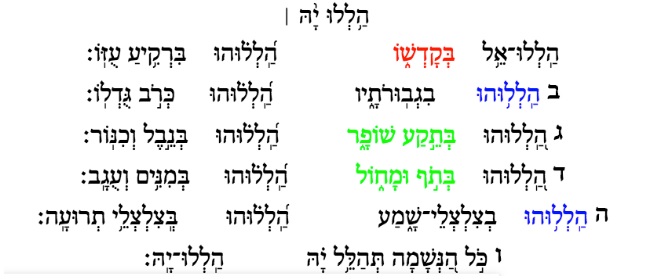
As you can see, the word hal’luhu, is usually marked with a disjunctive, because it is a verb followed by an object composed of multiple words (as in the conclusions of these verses), but in the second and fifth verses, the first hal’luhu‘s (in blue) have no words before them, nor do the subsequent words with the ethnah’s have other conjoined words. Thus, the hal’luhu‘s in those verses lose their disjunctive d’hi’s, and the following words (or hyphenated compound word), are modified, vig-vu-ro-THAW or v’tzil-tz’lei-SHA-ma’, respectively, and the prefix beth in each word is weak. In verses 3 and 4, the word hal’luhu in the first halves is proceeded by multiple words in the domain of the ethnah (the green words), and therefore it keeps its disjunctive d’hi. Now, one may ask, why is it that in verse 5 b’tziltzlei shama’ becomes one hyphenated word, whereas in verse 3, the seemingly shorter words b’theqa shofar remain separate? The answer lies in the fact, that, based on what we wrote above, b’tziltz’lei and b’theqa are both “short” words, but b’theqa has an open syllable capable of receiving an accent, whereas b’tziltz’lei does not have an accentable syllable that would not be adjacent to the accented syllable of SHA-ma’. Its latter syllable is obviously unfit due to proximity, and its first syllable is closed, making it also ineligible. Secondary accents may only be placed on open syllables.
…
A major exception to these rules occurs a number of times in the shortest verses of Emeth. In the verses that open each of the principles speeches in Job, (3:2, 4:1, 6:1, etc.) there are only three or four words, and we find that either a ravia (in the three-word verses that introduce Elihu or Job’s speeches) or a ravia mugrash (in the four-word verses that introduce the others with the longer names) precedes the final word, even though that final word is accented on its penultimate syllable. This can be explained by the perhaps-necessary proposition that every single verse needs at least one internal disjunctive trop, and there is no other place to put one in those verses, or that the final word actually is a “long” word, and we are just left with the question as to why “way-yo-MAR,” which is normally accented milra’, is here accented mil’eil, like its counterpart way-YO-mer, which has the same meaning, but normally appears at the beginning of a phrase. I hope the readership has any insights regarding this matter.
An opposite exception is in Job 6:4, whereby the “long” word YA-‘ar-CHU-ni is still connected to the previous word. I can hypothesize that this word should be considered short, as it was once pronounced with “only” two countable syllables, as though vowelized thusly: יַעְרְכוּנִי, ya’-R’CHU-ni.
….
One will also take note of the fact that in the Mechon Mamre edition (the online edition from which I borrowed these visual aids) and the various MHK editions edited by R’ Breuer, some verses have ordinary ravia’s instead of the ravia mugrash. For example, in the last verse of Psalm 150 above, the penultimate word has a ravia, but in the various Koren publications, for instance, and other traditionally Ashkenazi texts, those words also have a ravia mugrash. Apparently, R’ Breuer was of the opinion that a ravia mugrash can only appear in verses that already have an ethnah (or one of its replacements). The others do not subscribe to such a rule. Also, I find it interesting that in verses like those that conclude the last five psalms, we find a striking pattern that effectively divides the verse into three parts, instead of the usual two. Most verses in the Psalms follow the symmetrical division pattern, with the half-way point marked by an ethnah, and the quarters marked by a d’hi and raviamugrash, respectively, but in these cases, the ordinarily symmetrical verse has the climactic Hallelujah added at the end, and because the ravia (mugrash) has to come before the silluq, what would have been the silluq is downgraded to a raviamugrash, necessitating the downgrading of the the ethnah at what would have been the verse’s midpoint, resulting in it also receiving a ravia. This dispute between the publishers and the phenomenon of the verse being effectively divided into three by the ravia’s indicates to me that for our purposes both types of ravia (ordinary and mugrash) have the same punctuational value, and that in whatever theory we use to explain the hierarchy among the ta’ameiemeth, the simple analogy of emperors, kings, viceroys (primary, secondary, and tertiary disjunctives), etc., that features in the other books of the Bible is not adequate for the books of Emeth. For example, in his introduction to the Daat Mikra Psalms, R’ Breuer wrote about how there are no “emperors” in ta’amei emeth, except for the silluqim, and how both the ravia and ethnah are on the same level, both being “kings.” I would like to offer that if we must use the nomenclature and analogies familiar from the other books, the silluq and oleh w’yoreid are the emperors, and the ethnah is the king, ravia’s are viceroys, etc., except that, in a radical departure from the rest of the Bible, most of the verses of Emeth, due to their shortness, have only one emperor, the silluq, and often the kings are also missing, as in those verses in which, as pointed out by R’ Breuer, some sort of ravia takes the ethnah‘s place because there are not enough words proceeding it that can be furthered divided.
One should also note how in the following two verses,
:וַיְדַבֵּ֣ר יְהוָ֔ה אֶֽל־אַהֲרֹ֖ן לֵאמֹֽר
and
:וַיְדַבֵּ֥ר יְהוָ֖ה אֶל־מֹשֶׁ֥ה לֵּאמֹֽר
the only difference is that the name of the object in the latter verse is slightly longer, and not even by a syllable. We see that the mere addition of a hei with a hatafpatah lengthens the name Aharon enough so that it justifies upgrading the mercha before the silluq to a tip’ha, and the tip’ha that was already marking the Divine Name to be upgraded to a zaqef. Not only would this not fly in Emeth, as I have mentioned before, this shows the general tendency of the cantillation in most biblical books to have more disjunctives, especially when close to the “emperors,” whereas in Emeth the tendency is toward more conjunctives, especially as words get closer to the primary disjunctives. It is telling that the silluq, ethnah, zaqef, and tip’ha of most of the Bible have at most two words in their immediate domains connected to them by the trop, whereas the lesser disjunctives, e.g. the pazer, t’vir, and pashta are often preceded by three and sometimes four words marked with conjunctives. A comparison of similar words and phrases indicates for example, that the disjunctive t’vir of the rest of the bible is often converted to a conjunctive in Emeth.
….
In the rest of the books of the Bible, this idea that the sh’wa na’ forms one syllable with that which follows is often preserved in the phenomenon of the athei me’rahiq. In the second reading of Wayeira, we have the combination ha-LI-la L’CHA, whereby the lamed of l’cha receives a dagesh because it is part of an accented syllable that is immediately preceded by a connected word that ends with an unaccented qamatz in an open syllable.
Yet, there is also the phenomenon that a rule that distinguishes between two possible trops is even more specific than syllable count; sometimes, for instance, whether a word is marked with a qadma or munah, both conjunctives, depends on whether that word is accented on its very first letter, and that, in turn, effects the subsequent disjunctive. Two ready examples are Deuteronomy 15:7, V’CHA, and 17:18, w’CHA-thav. Words like these are either marked 1.with a munah if accented on their first letters, or 2. marked with a qadma if accented on any other letter. These examples show how exactly this rule is followed, as in both of them the first (compound) syllable is accented, but that is not sufficient to allow for the munah. Consequently, the following words are then, despite their being eligible to receive a gershayim, marked with a geresh, as there can not be a word marked with gershayim immediately following a word marked with a qadma.
With this in mind, we can understand an unusual difference of opinion. In Numbers 33:9, most of the tiqqunim have the words שתים עשרה marked with a qadma and azla (geresh). Had the word esreh appeared alone, (which technically could not happen because the word, as vowelized, only exists in conjunction with another,) it would have been marked with a gershayim because it is accented on its latter syllable, but because the word שתֵּים, which by our definition is monosyllabic, is not accented on its firstletter, it therefore receives a qadma, which in turn converts the gershayim on עשרה into a geresh. (The word gershayim itself is unusual in that if it or any word of its mishqal were to appear in the Bible, it could never be marked with a gershayim precisely because it is accented mil’eil! It is very odd that thousands of young men are taught the trop by singing their names, thus becoming familiar with the “ger-sha-YIM.”) However, in MHK publications and in the Mechon Mamre edition, שתֵּים is marked a munah, and this makes perhaps more sense, as in the words שְתַּיִם, שְתֵּי, and שְתֵּים the taw is still strong, indicating the tradition that in these words, the sh’wa under the shin is not pronounced na’ and it would have been more appropriate for me to represent שְתֵּים as shteim, without the apostrophe I have been using to represent the sh’wa na. If the shin is indeed read in one consonant cluster with the taw, then this word is now accented on its very first letter (along with all four of its letters), thus calling for its trop to be a munah and not a qadma. In Diqduq Eliyahu and Lehem Habikkurim, this strange circumstance is illustrated by placing a phantom alef vowelized with a short vowel before the shin, thus making the shin appear to close a syllable and “immobilizing” its sh’wa. In a similar word, the singular masculine form of the imperative “drink,” שְתֵה, the shin is pronounced with a sh’wa na’ and therefore the taw is weak, while when the word שְתֵּי is prefixed with a mem, e.g., in Judges 16:28, indicating the contracted word מִן, the shin does receive a dagesh to compensate for the missing nun, making its sh’wa a sh’wa na’, and the taw does lose its dagesh.
Taking Issue with the Ish Matzliah
Rabbi Mazuz is the leading authority on all things grammatical, and it is a testament to his influence and greatness that two of his more questionable opinions, opinions that can not be reconciled with the traditions we have received, have become more and more popular, and is partly attributable to the fact that the tiqqun published by his students, Tiqqun Qor’im Ish Matzliah, and the subsequent Hummash of the same name for synagogue use have become fixtures in many synagogues.
The first involves the public reading of Genesis 35:22, the Reuben incident. According to the traditional practice, this verse describing Reuben’s actions is combined with the next verse (what should be 35:23, “And the children of Israel were twelve,” but in many editions is not numbered) thus eliminating its silluq, the Torah reader’s cue for the Targum reader, depriving the Targum reader a chance to actually read the translation to the former verse aloud, and when he hears the silluq of the latter verse, he only reads the Targum thereto. The author of the weekly letter “Tamey Torah” (spelled in Hebrew טעמי תורה, tameytorah@gmail.com) has pointed out in the name of the Rabbi Jacob Emden that this is the explanation for the alternate sets of trop that accompany the Decalogue, both iterations of which are traditionally read publicly in the ta’am elyon, a set of trop which recombines the traditional verses, i.e. rearranges the silluqim, such that some verses are thereby combined into one verse, whereas another verse is divided into multiple short verses, thus cuing to the Targum reader to read his lines after individual commandments and not actual verses. The standard set of trop is referred to as the ta’am tahton, and the usual systems of numbering the verses follow it.
For centuries now, most Jewish communities have not been reading the Targum along with the public Torah reading, and based on this explanation, there is no longer any reason for us to continue reading these three sections with the ta’am ‘elyon, and indeed there are places in which the practice of reading the Decalogue with the ta’am ‘elyon has been suspended. However, in places where the Targum is still read publicly, this upholds the talmudic imperative to not translate the account of the Reuben incident (M’gilla 4:10, Laws of Prayer and Torah Reading 12:12). Rabbi Emden’s understanding is even mentioned by Rabbi Mazuz in his introduction to his tiqqun, yet, it was his father’s practice (see Tamey Torah for written sources) to read Genesis 35:22 twice, once on its own and once connected to the next verse, in order to thereby read the verse with both sets of trop, as though to satisfy all of the opinions because we can not know which is the correct set of trop to follow. Tamey Torah has documented a number of sefarim, all of North African origin, that record this practice, which, aside from the fact that it utilizes theReductio Ad Opinionibus At Dissiderentfallacy instead of trying to come to sort of halachic solution, has the negative consequence of now having Reuben’s incident read in front of native Hebrew-speakers twice, ensuring that they clearly hear the verse as is, and maybe even provoking them to look into it further, because attention has now been drawn to it. In both this case and the next, it is surprising that the Lehem Habikkurim “died from a kashya” and altered the practice, because in other lands, the answer to his kashya (“why are there two sets of trop?”) had already been offered and accepted, thereby upholding the traditional practice. Tamey Torah also notes that the Vatican manuscript they claim as a source is misunderstood: its marginal note is merely pointing out the existence of two sets of trop, and does not literally mean that both sets should somehow be read publicly.
As a side note, the other peculiarity found in the Vatican manuscript, indicating that Genesis 35:22 should feature a zarqa–segol series in the ta’am elyon, was also included in the tiqqun. Now, there are two competing schools of thought regarding what exactly a segol is supposed to be:
Segol is a disjunctive trop on the level of an ethnah, and together they divide the verse into three parts, the first third concluding with the segol, the second with the ethnah. This explains why the segol always precedes the ethnah. (I know of only one verse in the Bible that has a segol but no ethnah.) When examining many verses, you can see that this makes a lot of sense, and is attributed to the Ibn Ezra and others, and is also endorsed by Rabbi Mazuz.
Segol is a disjunctive on the level of a strong zaqef, and when a verse calls for many trops of that level, the first becomes a segol, under specific conditions. Jacobson brings a number of verses, including I Samuel 5:3-4 to illustrate this, and this is the position of Rav Breuer, among others, and explains why the segol‘s second mishneh is a ravi’a and not a zaqef, but it does not explain why segol is always before the ethnah.
According to the common tradition, Genesis 35:22 is to be read thusly:
and the subsequent verse, which as I mentioned, is not independently numbered in many editions, appears thusly:
וַיִּֽהְי֥וּ בְנֵֽי־יַעֲקֹ֖ב שְׁנֵ֥ים עָשָֽׂר׃
Now, there are two main ways we could have combined these verses into one long verse and preserve the hierarchy of the trop:
The first verse is now only half a verse, and therefore, it’s silluq is downgraded to an ethnah, and its z’qefim and tip’hoth should be downgraded to pashtoth, r’vi’im, t’virim etc.,
or
being that the latter verse has no ethnah, we could perhaps divide the combined verse into thirds, with the first verse containing the first two thirds, and its silluq becoming an ethnah and its own ethnah becoming a segol, but, as pointed by R’ Breuer and others, even if one were to assume that a segol is a disjunctive on the level of an ethnah, there is no such thing as a segol in such proximity to an ethnah. Therefore, this possibility is ruled out.
Yet, in the original verse, the zaqef on the word ההִוא is the strongest internal disjunctive after the ethnah of אביו, and when the verses are combined, because the original ethnah is downgraded, it stands to reason that the zaqef of hahi should have been downgraded to a ravia, and certainly not upgraded to a segol as it has been in the Tiqqun Ish Matzliah. On the contrary, if the Reuben verse is then extended by a new phrase that is “ruled by an emperor,” then the segol should at least be placed where the Reuben verse’s ethnah appeared, and I would therefore argue that if anything, we could only entertain a segol on the word hahi in the ta’am tahton of that verse.
Elsewhere in the tiqqun, the words ohela (genesis 18:6 and elsewhere) and tzo’ara (ibid 19:23) are, in accordance with the opinion of the Lehem Habikkurim, accented on their last syllables, o-he’LA and tzo-a’RA’, respectively, whereas in most tiqqunim, the words are accented on their first syllables, as is seemingly indicated in the oldest manuscripts, O-he’la and TZO-a’ra’. The argument for this position is as follows: Normally, the addition of an unaccented suffix qamatz-silent hei is an alternate form of the directional el or the prefix lamed (the same suffix when accented indicates femininity). “To Hebron” can either be el hevron, or l’hevron, or hevrona. In the latter case, the accent stays on the syllable that is normally accented, and the additional syllable formed by the qamatz and silent hei is not accented. Note also what happens to a word like goshen, which is of the same mishqal as tzo’ar and ohel. The normal pronunciation of the word is GO-shen, and when the directional is appended, it becomes GOSH-na, with the shin now closing the strong vowel of the accented syllable, but in the case of these two words, the presence of the guttural letter vowelized with a hataf, hei with a hataf segol and ‘ayin with a hataf patah, respectively, creates what appears to be a third syllable. Now, according to the rules of grammar with which we are familiar, those gutturals can not receive the accents because they have hatafim, and no hataf or sh’wa na’ is accented. Further, and this is the crux of the dispute, the first syllables of these words should not receive the accents either because that would result in words that are primarily accented too far away from the end of the words, and they are vowelized with holam, necessitating the subsequent guttural letters to be vowelized with forms of hataf vowels, themselves types of shwa na’, which according to another rule, can not follow a full vowel, a tnu’a g’dola, that is accented. Normally, Hebrew words are accented milra’, on the last syllable, whereas in some cases the word is mil’eil, accented before the last syllable, but even in those cases, the accent is at least on the syllable right before the last. There is no such thing as a word accented on a syllable two or more syllables away from the last syllable, and when there is a full vowel in an accented syllable, it can be closed by a shwa nah. For example, in אומרים o-m’RIM, the accented syllable has a hiriq gadol and is closed by the (unwritten) shwa nah of the mem, and in אומר o-MER, the tzeirei of the accented syllable is closed by the shwa nah of the reish.
However this argument is mistaken, because, as we have now learned, consonants, whether guttural or not, when vowelized with sh’wa na’ or any form of hataf do not count as syllables. Therefore, in the words ohela and tzoara, it is not the case that the first of three syllables is accented. Rather, it is just that the first of two syllables is accented. Also, because this first argument could be rejected by the editors of the tiqqun because they may not hold of this theory of explaining the vowels, it must be pointed out that even according to their own theory, when words do have full vowels in their final, accented and closed syllables and the final consonant is a pronounced guttural letter (‘ayin, heth, or a non-silent (“mappiq“) hei), then we add a phantom patah between the vowel and the consonant. If words like ohela and tzo’ara were to follow this model, we would have to pronounce them like אֹ ַהְלָה Oah-la and צֹ ַעְרָה TZOa’-ra, thus adding another seeming syllable to the word. (I added spaces within these words to show where the patah sound would be inserted. In words like תפוּחַ most people know to articulate the patah between the shuruq and the final heth.) In a word like GOSH-na, we would not be confronted with any problem because we already have a precedent for closing a holam‘s accented syllable with a shin sound without having to add a phantom patah, e.g., ראש, rosh. The truth is that in these unusual words, which are ideally accented on their first syllables which feature full vowels closed by guttural consonantal sounds, we have few options.
I welcome whatever insights the readers can offer.
* For almost twenty years, I have followed the Soncino Talmud’s convention of representing the waw as a “w” and thaw as “th” in transliteration. This, despite its unpopularity, eliminates many ambiguities and more accurately reflects the proper pronunciation.
Sefer Kohelet, the Book of Kohelet, was written approximately 700-600 BC according to Rabbinic sources,[2] and is dated to somewhere between that time and the early to mid-third century BC by academic sources.[3] Its wisdom is traditionally attributed to King Solomon.[4]
The book is part of ancient Hebrew wisdom literature, and is known for its existential, philosophic lessons and motifs. But alongside that also, the book is suffused with sophisticated poetry and wordplay, and I’d like to use this essay to point out a few examples.
The Meaninglessness of Huvel
The book begins with its most well-known verse, summarizing the work’s theme and setting its tone.
הבל הבלים אמר קהלת, הבל הבלים הכל הבל. קהלת א ב
Huvel of huvel,[5] said Kohelet, huvel of huvel, all is huvel.
The word huvel can be translated variously as air,[6] vapor, meaninglessness, vanity,[7] folly, futility, absurdity,[8] or nothingness.[9] The word is repeated throughout the book as a motif, describing aspects of human endeavor and life experience.
The book begins with a bang, so to speak; a strong summary statement that captures the book’s theme, while also the reader’s attention; and the theme is then explained, elaborated upon, and expanded throughout the rest of the book. The sentence is only eight words long, and a remarkable five of them, more than half of the sentence, are the same word, essentially nothing.
Using a word that also means air, or vapor, as the book’s theme is not accidental, for in the author’s effort to examine life’s purpose, meaning and sense, to dig into it and to pin it down, he (and we, alongside) discovers ultimate meaning and sense to be elusive. We think we understand things, and our minds naturally intuit purpose and endow things with meaning, but the moment we try to pin it down and fully capture it, it slips through our fingers like so much vaporous air.
In fact, the word huvel itself symbolizes its meaning onomatopoeically well, being composed of only soft consonants,[10] its vocalization almost entirely pure breath itself, with no hard sounds; an unusual verbal formulation. The entire sentence, in fact, is composed almost completely of “air” with almost no hard consonants, the only two being the hard ‘k’ sounds in Kohelet and hakol, balancing each other out at the two ends of the sentence. When the sentence is read aloud, particularly with its ancient Hebrew pronunciation and syllabic emphasis, it has a very lilting, bouncing and poetically balanced quality to it.[11]
It is also intriguing to notice that the hard ‘k’ sound in hakol is in fact the only thing that distinguishes the word from the similar word huvel – in fact, even more so, the tiniest difference between the letters kuf and vet are what distinguish absolutely everything from nothing! And the only other ‘k’ sound in the verse is in the only other physical object that appears in the sentence, the speaker of the sentence at its opposite end, who is examining everything, and turning it into nothing.[12] And so, essentially, nothing appears in the sentence until almost its very end, and when something does appear, everything appears all at once with the one simple word, hakol, and it’s all immediately revealed to in fact be… hevel, nothing at all.
Onomatopoeia
The book includes many beautiful examples of onomatopoeia. In addition to the word huvel and its use as mentioned, some of the best are the following.[13]
כל הנחלים הלכים אל הים והים איננו מלא, אל מקום שהנחלים הלכים שם הם שבים ללכת[14]. קהלת א ז
We hear the pitter-patter of water bouncing, running and tumbling through the brook down the mountainside.
סובב סבב הולך הרוח ועל סביבתיו שב הרוח[15]. קהלת א ו
The wind’s whistle and howl comes through.
כי כקול הסירים תחת הסיר, כן שחק הכסיל[16]. קהלת ז ו
We can clearly hear the kindling under the kettle crackle and hiss,[17] and the fool’s braying cackle alongside.
אם ישך הנחש בלוא לחש, ואין יתרון לבעל הלשון[18]. קהלת י יא
Here we hear the hiss of the snake, and the whispered sounds of the luchash, in the sounds of the sentence. There’s also a poetically ringing rhyme to the verse, and the gossip whisperer’s tongue coming at the end of it circles poetically back to the snake at its start, whose bite is also viscerally associated with its flicking tongue (snakes hunt by smelling prey through their tongue).
He Gives Another, His Portion
כי יש אדם שעמלו בחכמה ובדעת ובכשרון ולאדם שלא עמל בו יתננו חלקו[19]. קהלת ב כא
The word chelko at the end of the sentence seems initially extraneous and off-balance, for when we read the sentence from its start, it seems complete with the word yitnenu. The word chelko then appears, almost an added appendage at the sentence’s end.
It seems that the word chelko (his portion) would have fit the sentence better had the preceding word been yiten (he gives) instead of yitnenu (he gives it to him). Since the word yitnenu includes a subject-reference, it’s odd to refer to the subject again in the next word. Noticing this odd juxtaposition and double subject reference clues in the reader to understand that the person (and portion) described in chelko can also be read as referring to the receiver.[20]
In other words, the sentence is written so as to create in the reader an initial visceral perception of chelko as referring to the giver, followed by an understanding that it refers to the receiver; providing – in prose – an illustration of the very act described by the prose itself, namely having chelko, the portion, ‘pass’ as it were, from the giver to the receiver![21]
Making Meaning of Experience
ראיתי את הענין אשר נתן אלהים לבני האדם לענות בו. קהלת ג י
The words “inyan’ and “la’anot” in this sentence have at least four translations, all of which fit together to provide a fuller meaning to the sentence.
La’anot and inyan can mean suffering, pain and negative experience, as in,
וכאשר יענו אותו. שמות א יב
כל נדר וכל שבעת אסר לענת נפש. במדבר ל יד
יום ענות אדם נפשו. ישעיהו נח ה
This translation is given to the words by the Targum,[22] and in this reading the sentence means, “I saw the suffering that God gave people to be afflicted with.”
La’anot and inyan can also mean celebration,[23] happiness and positive experience, as in,
קול ענות אנכי שמע[24]. שמות לב יח
כי האלהים מענה בשמחת לבו[25]. קהלת ה יט
This translation is given by Mordechai Zer-Kavod in his commentary to Mossad Harav Kook’s edition of Kohelet, and at Kohelet 1-13 he notes a similar translation by R. Shlomo Kluger. In this reading, the sentence means, “I saw the experience that God gave people to be enjoyed with.”
La’anot and inyan can also simply mean experience, with no negative or positive connotations, similar to the Rabbinic Hebrew, and from there modern Hebrew’s, use of the common word inyan,[26] as in,
וענתה שמה כימי נעוריה. הושע ב יז
R Sa’adia Gaon, Rashi, Rashbam, Ibn Ezra and Ralbag provide similar translations of the word.[27] In this reading the word inyan means a matter, or engagement, la’anot means something like “to be engaged in” or “exercised with”, and the sentence is translated as, “I saw the engagement that God gave people to be exercised with.”[28]
So, it turns out, there are three different ways to translate the words inyan and la’anot, each of which changes the overall meaning of the verse, and each of which diverse translations are accurate, work in the sentence structure, and can provide meaning to the sentence.[29] Which is all to say, that our interpretation of experience and how we see it, provides the meaning we give to it!
Finally, la’anot and inyan can also mean to witness, as in,
לא תענה ברעך עד שקר. שמות כ ב
לענות בו סרה. דברים יט טז
וענתה השירה הזאת לפניו לעד. דברים לא כא
In this translation the verse means, “I saw the experiences that G-d gave to people to witness (i.e., to see and experience)”.[30]
Here too, are two layers of meaning, for in one sense, to say that one has ‘witnessed’ an event is simply another way of saying that one has seen and experienced it. But in a deeper sense, it is the witnessing of the event itself that gives meaning, shape and form to the event; and with no witness, the event would be formless and without meaning.[31] This reading, of course, fits right into, and complements, the first three readings of the verse, for it is our experience of an event, and the way in which we witness it, that creates it as an event for us, provides us its meaning, and makes it what it is to us.[32] [33]
Relax, In the End Nothing Makes Sense
הבל הבלים אמר הקוהלת הכל הבל. קהלת יב ח
The same sentence that began the book, bookends it again as its conclusion.[34] [35] Its meaning at both ends, however, can be read differently.
In writing and in reading the book, and in working through its problems, questions, discussions, and thematic variations, the author and his readers undertake a journey of exploration of life’s contradictions and paradoxes. Taking that journey, in depth, leaves the traveler different at the end than at its start, for along the way, the reader has discovered, and partly through their own thoughtful exploration of the author’s words, that the only choice, and inherent to life’s experience, is acceptance of the absurdities and paradoxes intrinsic to it.[36] [37]
In this way, what began as a lament of discomfiture at life’s impossible contradictions, ends as a statement of their factuality and acceptance. As we initially began peeling away the layers of life’s onion, and realizing that things don’t make as much sense as we intuitively feel they should, our natural, instinctive need for sense is disturbed. But at the journey’s end, once we’ve gone through the process of internalizing experience’s innate senselessness, its fuller realization and our more complete understanding that it’s all simply part of life’s inherence, permits us to accept things for what they are; and having done that, our experience becomes all the easier for it, rather than harder. Things are not really meant to make sense anyhow, they never completely will, and in the final analysis, it gives us permission to take our life in hand once again, accept it, make of it its best, and live it calmly[38] and productively,[39] prudently and judiciously,[40] happily[41] and to the fullest of our efforts.[42] Like the t-shirt that reads, “Relax, nothing is under control”, the excision of our attempts at understanding releases us from them when they don’t serve us well.
Relax, do what you can to live a good life… “before the silver cord snaps, before the golden cup shatters…[43]
.הבל הבלים אמר הקוהלת הכל הבל
[1] The author is the creator of the youtube channel “Understanding Kohelet”, here. [2] בבא בתרא טו-א [3] See, e.g., here. Ibn Ezra also seems to note that at least some of the book’s editing was done after the first temple period, for example at 2-25. In other verses as well, ibn Ezra and other commentators note language and word choices resembling writing of times closer to the Rabbinic period. See also the Preface to Mossad Harav Kook’s edition of Kohelet, Section 5, Part 4. [4] קהלת רבא א-א, סנהדרין כ-ב [5] In its simple reading, the double havel havulim can be understood as emphasis, i.e., the epitome of vanity, or utter vanity, similar to the words shir hashirim, and many other double words used in Tanach. In a deeper sense it can also be understood to intimate that huvel, meaninglessness, is itself also meaningless (a double negative that cancels itself out), because by the end of the book, and through its exploration, we discover together with the author, that in as much as things can never be fully and truly understood, an overemphatic focus on meaninglessness is itself meaningless and purposeless. [6] In referring to air, the author is foreshadowing the many other verses in which the book uses air and wind to represent the ephemeral, fleeting nature of life and experience, e.g., 1-6, 1-14, 12-7, and many others. [7] Not in the contemporarily more common use of the word vain, as narcissistic pride, but vain as futile. [8] Not with its commonly used definition of farcically ridiculous, but something much closer to its existentialist philosophic meaning of senselessness, as used in, for example, Albert Camus’ The Myth of Sisyphus. [9] If our attempt to pin down a precise meaning for the word huvel is frustrated, we are not the first to experience such frustration, for R Sa’adia Gaon, as well, mentions five potential Arabic translations of the word.
Defining the book’s theme through a word that has many translations and interpretations is in no way coincidental, for that is a practice and theme throughout the work, using words and constructing phrases in such ways that exploration and thought is required to unpack and fully understand them in their context, and through such exploration and understanding, different aspects of the intended message are communicated.
[10] The letter vet in ancient Hebrew was pronounced with a “w” sound, similar to its contemporary Yemenite pronunciation.
[11] This is true of much of Tanach, an appreciation of which has been lost due to historic changes in reading style and pronunciation.
[12] The phrase havel havulim umar kohelet may also allude to the fact that even the statements and attempts of the author to examine the world and its meaning are also impossible and vain, as elaborated upon later on in the book, for example chapter 1, verses 8, 13, and 17, and chapter 7, verse 23. So the analysis too, and the attempt at finding meaning, is itself meaningless. See also Ralbag at 12-8.
[13] The poetry and onomatopoeia comes through best when the sentences are read with the sound, pronunciation and syllabic emphasis of original, ancient Hebrew.
[14] All the rivers go to the sea, and the sea is not full; to the place the rivers go, there they return to go.
[15] Circling in circulation, goes the wind, and on its circulation, returns the wind.
[16] For like the sound of the twigs under the pot, so is the laugh of the fool.
[17] In fact, the sounds are very similar to the English words, ‘cackle’ and ‘hiss’, which themselves sound like their meaning.
[18] If the snake bites, without a hiss/spell, and there is no advantage to the master of the tongue.
[19] For there may be a person whose efforts are with intelligence and with wisdom, and with suitability, and to a person who expended no effort over it, he gives (it to) him, his portion.
[20] See Targum, which translates the phrase as יתנניה למהוי חולקיה, “he gives it to become his portion”, clearly reading the portion as attached to the receiver, presumably because of the otherwise odd double subject reference. Ibn Ezra also reads chelko as referring to a subject receiver. Rashbam too, reads chelko as attaching to the receiver, but states that the giver in yitenenu is God (presumably due to the otherwise double subject reference), and in this reading perhaps yitnenu means “it shall be given [by God]”, rather than he shall give it, since the giver in yitnenu is not referring back to the person described in the first half of the sentence.
On the other hand, R Sa’adia Gaon’s commentary clearly translates chelko as referring to the giver. R Moshe Yitzchok Ashkenazi (Tedeschi) in Ho’il Moshe also provides a grammatical reading of the sentence in which chelko refers to the giver.
Reading yitnenu as attaching to the receiver’s object referred to in chelko is also somewhat supported by the ta’amim, since yitnenu is given a munach, tying it to its succeeding word chelko, rather than to its preceding phrase (i.e., the phrase ‘he gives’ modifies ‘his portion’, rather than any object that may have been described earlier in the sentence, in amulo or in bo). Consider also that the object being passed from the giver to the receiver has not yet been explicitly articulated into the sentence prior to the appearance of the word chelko, since, arguably, amulo is describing only the giver’s efforts, not the fruit of those efforts, which would be the object actually being passed; and the word bo in and of itself, does not either provide the sentence with a subject.
[21] Mordechai Zer-Kavod in the Mossad Harav Kook edition of Kohelet describes a third potential subject to which chelko might refer, which is the fruits of the giver’s labor, and in this reading the word chelko means “part of”, i.e., a part of the giver’s possessions, and the sentence reads as, “For there is a person whose efforts are with intelligence… and to a person that labored not for it, he gives part of it.” See also Rashi on the verse for a similar formulation based on midrash.
[22] In Kohelet 1-13, the verse includes a similar formulation
ונתתי את־לבי לדרוש ולתור בחכמה על כל־אשר נעשה תחת השמים הוא ענין רע נתן אלהים לבני האדם לענות בו
and Targum, ibn Ezra and Tanchum Yerushalmi provide a similar translation to the words inyan and la’anot in that verse, while Metzudat Tzion provides a similar translation for the word la’anot, although not for the word inyan, and Ri Karo provides a similar translation for the word inyan, although not for the word la’anot.
[23] It is quite possible that the root of the word enu as it is used in phrases like
עלי באר ענו לה, במדבר כא יז, ענו לה׳ בתודה, תהלים קמז ז, ביום ההוא כרם חמר ענו לה, ישעיהו כז ב
is also related to the word celebration, although in these cases it is also, and perhaps more closely, related to word respond or say.
[24] See for example, Ibn Ezra, Ramban, Ralbag and R’ Avraham ben Harambam, although others provide different translations of the word in this sentence too.
[25] See Rashbam and Ralbag, although there are also other ways to translate the word in this sentence as well.
[26] In reviewing the related words and meanings in all of these similar verses, as parsed through the various commentaries, it seems to me also that the general word inyan in this reading, as meaning something close to an engagement, or more simply a thing, something that is, may also be etymologically related to use of the similar word and root for the concept of residing in or simply being in, as in the word ma’on.
[27] In some cases these translations are in Kohelet 1-13, and as between the different commentators, they are provided with varying nuance as to the precise translation and word usage.
[28] In the larger context of the chapter, this sentence is a response to the verses coming just before it, which read,
לכל זמן, ועת לכל חפץ, תחת השמים. עת ללדת ועת למות… עת לאהב ועת לשנא, עת מלחמה ועת שלום. מה יתרון העושה באשר הוא עמל
This well-known section of Kohelet questions the point of a life of constant change and dissolution, where the pendulum of experience always swings from one side to the other, and where every effort invested, and even the things invested in, often ends and changes to its opposite; and therefore, the question is begged, “what advantage the doer in such that he toils?”
It is this question that the present verse responds to, explaining that these fluctuations and changes in expended effort, and in life and experience, in fact have as their purpose the engagement and exercise of people in and with their life and experiences. In other words, the goal settings, fluctuations, achievements, disappointments, moving goal-posts, and corrections, are actually the very things that create the life of engagement and attunement, and a life lived in one straight line would be pointless and meaningless, and lacking in engagement.
The other translations as well, are responsive to the prior verses and question in a similar way. The frustrated and constantly changing efforts can be seen as a form of immiseration that people are afflicted with (in this reading, the present verse in 3-10, is simply extending the question and problem discussed in the prior verse), or they can be seen as challenges which can be invigorating, and bring a person joy when approached from the perspective of, and with a purpose to, building and improving.
[29] This is a good representative illustration of a lot of the messaging in Kohelet, which often revolves around purpose, perception and meaning, and how these are multi-layered, and appear different from different vantage points, or when different factors or interpretations are brought to bear. This is also the key to understanding the many seeming ‘contradictions’ in Kohelet (בבלי, שבת ל׳ ב׳) – for when the meanings and contexts of what are being said are fully understood, they are clearly seen not to be contradictions at all.
[30] And in a fifth translation, which fits right in alongside the rest and is related to witness, the word la-anot can also mean to respond, see medrash rabah here, and ibn Ezra at Kohelet 1-13. And, believe it or not, with these five translations we have still not exhausted all the possible translations of the word as used in the sentence, see for example Rashi, Ri Karo, and Tanchum Yerushalmi in the parallel verse at Kohelet 1-13, each with other, additional translations.
[31] In fact it might questionably even be called an “event” at all.
[32] This theme comes up in art too, for example in Albert Camus’ “The Stranger”, and Jonathan Blow’s “The Witness”.
[33] This verse is a good example of what we find with many of the verses and statements in Kohelet, which is that they can be translated and interpreted from a number of different vantage points, with several layers of meanings able to be peeled back like layers of an onion, while all of those layers of meaning interact with, and nest within, each other to provide an ultimate interpretation and meaning to the sentence. And while it’s easy to assume that some or many of these interpretations are unintentional, and arise coincidentally due to the poetic nature of the text, or due to the brevity of ancient Hebrew which, because it has relatively few words compared to other languages, consequently more meanings and translations for each of its words; on closer reading and familiarity with the nuances of the book’s style and messaging it seems likely that the varied and rich layers of meaning were seeded intentionally.
[34] Rashbam notes that the book’s ending, from this verse on, was appended at a later time by its editors. This is also evident from the style, tone and content of verses 12-9 through 12-14, which differ from the rest of the book. See also Ralbag, Ho’il Moshe at 12-7, and Metzudas Dovid, Shadal at 12-8. It’s also possible that verses 1-2, and 12-8 (the two bookending huvel verses), which more closely resemble the rest of the book, were part of the original earlier work, while verses 1-1 and 12-9 through 12-14 were added later as a kind of prologue and epilogue. See also FN 3 regarding the book’s editing.
[35] The end of the book and its beginning also mirror each other in that the lead-in from the summary sentence to the rest of the book (verses 1-4 to 1-7), and the lead out from the book to the closing summary sentence (verses 12-2 to 12-7) are composed of evocatively colorful imagery, which express their messages of the ephemerality of existence and the eventuality of life’s and of experience’s end, not only in the literal statements of their message, but also in the impressionist emotions that their images create in the reader. As well, some of the same elemental imagery of earth, sun, air and water is mirrored between the start of the book and its end (compare Chapter 1 verses 4, 5, 6 and 7 with Chapter 12 verses 2, 6 and 7).
[36] One cannot point to any one verse that states the premise of this point explicitly, rather it is an idea that develops organically and expands its realization over the course of the work in the perceptions experientially realized by the reader through their effort in working through the book’s perambulatory contemplations and exploratory deliberations. One can point in support, however, among various verses, to 9-7 through 9-10, which in a sense can be seen as the conclusion of the first part of the book (which begins at 1-12). Arguably, it is the author’s intent is for the reader to discover the point’s salience for themself as they work through the book’s ideas together with the author.
[37] That the present verse’s summary conclusion is a result of the conclave of ideas preceding it is also supported by the verse’s choice of wording, ‘umar hakohelet‘, with the definitive article, ‘the’ kohelet – for it is the gathering together and synthesizing of the various strands of thought through the course of the book that produce the conclusions reached at its end. In this interpretation we translate the word kohelet as ‘a coming-together’ or a ‘gathering (n.)’, as in ‘the results of the act of gathering’, or ‘the things that have been gathered’, conjugating the root verb ko-h-el, similar to words such as toelet and pesolet.
Interestingly, the same conjugation of the root also produces the feminine verb, a point made by wordplay in Chapter 7, verse 27, where, as compared to the word construction in our present sentence, the author changed the word kohelet from a noun to a feminine verb simply by moving the letter ‘heh’ over one word (changing amrah kohelt to amar hakohelet).
[38] 12-3 to 4, in its emotional resonance.
[39] E.g., Chapter 11, generally.
[40] Verses 11-8 to 12-1.
[41] Verses 9-7 to 9, and 11-8 to 9.
[42] Verse 9-10.
[43] Verse 12-6.
Eliyahu Bachur in Isny
ELIYAHU BACHUR (1469 – 1549) IN ISNY
by: Dan Yardeni
Dan Yardeni, an engineer by profession (Technion – Israel Institute of Technology, 1963), is entrepreneur specializing in cutting edge materials and materials production processes.
As sideline, he researches problems in the history of Hebrew books printing and printers. He also contributes articles to the Culture and Literature sections of Haaretz and other Israeli newspapers. This is his first post at the Seforim blog.
A little street in Tel Aviv commemorates the personality of a colorful Jewish culture hero at the time of the Italian Renaissance, known as Eliah Levita by Christians and Eliyahu Bachur by Jews. While he considered himself primarily a linguist, he was also a teacher, translator, writer and editor, debater, poet, singer and humanist with a deep sense of social awareness, which he expressed in sharply worded satires. While all his life he was an observant Jew, he was also a close friend and teacher of the greatest Christian scholars of his day and became a foremost “cultural agent” between Judaism and Christianity.
Eliahu Bachur’s unusual name is due to the fact that he remained a bachelor for a long time, and later adopted the epithet in the sense of Bachur – Chosen (see his preface to Sefer HaBachur, Isny 1542 where he explains the name of the book and comments: “…. היות שם כינויי משונה ובשם בחור מכונה …. ” ). He was born in southern Germany in 1469 and died and was buried in Venice at the age of 81, a rather advanced age at the time.
Most of his life he lived and worked in Italy. For a brief period of two and a half years, between 1540 and 1542, Eliyahu Bachur moved to the small town of Isny in the picturesque Allgäu region of southern Germany. Isny was at that time a a free self-governing city organized as a republic within the Holy Roman Empire, then under the rule of Charles V. Eliyahu Bachur was invited by the Christian reformer and Hebraist Paulus Fagius to work with him as editor and proofreader in the printing-house, which Fagius had founded in Isny. Despite the burden of his seventy-one years, Eliyahu accepted the invitation, left his home in Venice and crossed the Alps to live in that little town. Why did he do it? The large and world famous printing-house of Daniel Bomberg in Venice, where he had worked as an editor and proofreader for many years, ceased operating at that time and Fagius was offering him a good job and, most important, undertook to print the books Eliyahu had written.
Eliyahu Bachur describes his journey to Isny at the end of his book ‘Tishbi,’ the first of his books to be published in the new printing-house. (The name of the book alludes to his name, Eliyahu). The book, printed in typical Ashkenazi Hebrew typography, constitutes a kind of dictionary describing 712 roots of Hebrew words. And so he writes in the preface to the book: “… I beg anyone, scholar or student who reads this book and finds a mistake or error, to note that it is the fruit of haste since I was in a hurry to reach this place and when I left my house the book was not yet finished, and as I was en route, crossing lands of raining hills and mountains I stood trembling, weighing matters up in my mind and writing them in my heart, and then, when I reached the inn, I opened my case, took out my notebook and wrote down the things which the Lord had put into my heart.”
We know of sixteen titles (sometimes in 2 editions, with and without Latin translation), which Eliyahu Bachur published in Isny. He may have printed more, of which no copies survived. Most of the time he was the only Jew in that Christian town which was so devoutly Protestant that it did not allow Catholic Christians to reside within its walls. The contents of his books, and the texts which he wrote and appended to them, are of great interest still today. Most touching is the reflected conflict between his desire to publish the books he had written and the longing for his family and for Venice, the town where he had lived most of his life.
While being a deeply religious and observant Jew, Eliyahu Bachur displayed cultural openness to the Christian world. He did this in spite of the fierce opposition of rabbis, who regarded him with suspicion, as someone who was prepared to venture beyond the self-imposed barriers surrounding the Jewish scholarly community (See his preface to Masoret Ha-Massoret book printed in Venice 1938 and later). He also had the courage and intellectual honesty to admit that he had been helped in translating difficult Greek words to Hebrew by the learned Christian cardinal Egidio Viterbo, to whom he had taught Hebrew during his sojourn in Rome years earlier. He dared to state, in face of virulent opposition from leading orthodox rabbis, that the punctuation of the Hebrew language was a later invention and not as ancient as had been thought until then. In his rhyming introduction to his book ‘Tishbi,’ he challenged those who disagreed with him to react still in his lifetime:
“….. / כי אומנם לא שקר מילי / אם לא איפא מי יכזיבני / מה שגיתי יבין אותי / יכתוב לו ספר איש ריבי / אך יעשה זאת טרם אמות / כי מה אשיב אחרי שכבי / או ימות גם הוא כמוני / או ימתין לי עד שובי / …….”
“…Indeed my words are not a lie /So who will dispute me? /If I erred, please show me where /And my rival may write his own opinion /But let him do it before I die /Because once I died how could I reply? / Or possibly he too may meanwhile pass away / Or he mighthave to wait for my resurrection from the dead….”
Later, in a playful rhymed foreword, combining genuine modesty with an awareness of his own value, he added a well-known fable attributed to Pliny the Elder, which Eliyahu claims to remember from his youth:
“אפתחה במשל פי / אשר שמעתי בימי חרפי / כי היה באחד המקומות / אשר נקבו בשמות / אמן אחד צייר / וצייר צלם איש על נייר / והיה האיש ההוא / תם וישר / יפה תואר ומשוח בששר / וידביקהו על לוח עץ / ועל פתח ביתו היה אותו נועץ / להראות העמים והשרים את יופיו / כי כליל הוא מהדרו וצבי עדיו / ויהי כאשר כל העם רואים / והנה בתוך הבאים / זקן אחד רצען / על משענתו נשען / וראה והביט גם הוא / אחרי כן פתח את פיהו / ויאמר הנני עומד משתאה / איך הצייר שגה ברואה / הלא תראו כי שרוך הנעל / הפוך למטה למעל / וכשמוע הצייר את זאת / יצא גם הוא לראות / וירא ויניע ראש / והודה ולא בוש / ויאמר צדקת אתה הזקן / אך הלילה המעוות אתקן / וכן תקנהו טרם הלך לישון / ולמחרתו הוציאו כמשפט הראשון / ויבוא הרצען שנית / ויוסף להביט בתבנית / ויאמר לצייר יפה תיקנת ועשית / אבל בדבר אחד שגית / כי רואה אני דבר נבזה / כי הברכיים אינם דומים זה לזה / האחד גדול והאחד קטן / ויאמר לו הצייר לך אל השטן / כי משרוך הנעל ולמעלה/ אין לך בחכמה חלק ונחלה / ויהי הרצען לבושה ולכלימה / ויפן וילך בחימה / וכן יראתי גם אני / שכמקרה הרצען יקרני / בעניין זה החיבור / רעה עלי ידובר / ויאמר אלי מי שהוא / מה לך פה אליהו / כלך למדברך אצל דקדוק ומסורות / אין לך עסק בנסתרות / אל תחמוד כבוד יותר מלימודך / ואל תנבל כסא כבודך / ולכן יראתי לקרב אל המלאכה / פן לא אראה בה סימן ברכה / אך רוחי הציקתני / ואש עצור בעצמותי ושרפתני / וכלכל לא יכולתי / ומאת השם עזר שאלתי / יצרף לי למעשה המחשבה / ויורני בדרך הטובה / כי מכיר אני את מקומי / שיותר מידי נטלתי גדולה לעצמי / שמלאני לבי לפרש כל השורשים / אשר בשום מקום אינם מפורשים / ואף מאותם המפורשים כבר / אחדש בכל אחד איזה דבר / ורובם מן הגמרא ומדברי רבותינו / כגון בראשית רבא ותנחומא וילמדנו / ואף שבעוונותיי / כבר עברו רוב שנותיי / ולא ראיתי בטובה / בהוויות אביי ורבא / ולחכמים מעט שימשתי / ומשאם ומתנם לא בשתי ביקשתי / מכל מקום לבי לא מנעני / ובאגדות ובמדרשים יגעתי / להוציא מהם דברים חשוקים / ובפרושי ומדרשי הפסוקים / עד שרוב גירסתם היא לי ידועה / וזה יהיה לי לישועה / את הספר הזה לחבר / ולברר וללבן את אשר אדבר / …………/.
The fable tells the story of the famous Greek painter Apelles (a contemporary of Alexander the Great), and a cobbler,. Apelles drew a beautiful young man and pasted the painting on wooden board that he placed at his doorway to impress all passers–by. Among them was an old cobbler, leaning on his cane. The cobbler gazed at the painting and commented: “I am surprised how the artist made such a mistake. You see, the shoelace goes upside down”. When the artist heard that, he went out to see, nodded his head and consented: “You are right, old man. But tonight I shall correct the mistake”. And so he did before going to sleep and the next day he hung the painting in place as before. And the old cobbler came again. He looked at the painting and told the artist: “Well done but there is still another mistake:the knees are not alike, one is bigger than the other”. The artist said then commented angrily: “Go to hell. From the shoelace upwards you know nothing”. The cobbler was ridiculed by all around and turned away in a rage. And, says Eliahu Bachur,he is afraid that the same will happen to him with this book, the “Tishbi”. Somebody will say: “What are you doing here? Go back to Hebrew grammar and Massoret. Don’t deal in what you don’t know and don’t ask to be honoredin doing so“. Therefore, he was afraid to undertake that work, in which he might fail. However, he could notrestrain himself and asked God for help in showing him the right way. Eliyahu adds that he knows his place and that he may be presumptuous in daring to explain all the Hebrew roots, which are not explained elsewhere,adding that even to those that had been explained, he was still bringing something new from the Gmaraand other sources.
Particularly impressive is the friendship and mutual respect that developed between the old Jew and the Christian preacher Paulus Fagius in the course of their work together in Isny, about which Eliyahu writes in the foreword to the book:
“……..ובבואי הנה תהיתי בקנקנו ומצאתיו מלא ישן ולא הוגד לי החצי מחכמתו וידיעתו, ורבים שואבים מי תורתו, ודורש טוב לעמו, נאה דורש ונאה מפרש ………..ובראותו הספר הזה אשר חיברתי והכיר רוב טובו ותועלתו, נזדרז מאד והעתיק אותו ללשון לאטין אשר קראו קדמונינו לשון רומי וחיבר שתי הלשונות יחד ונשים עיוננו עליו בכל מאמצי כוחנו, הוא מצד אחד ואני מצד אחר.ונקרא איש אל אלוהיו שיצליח את מלאכתנו ………”
“…And when I came hither I wondered about his character, and I found him full of wisdom, and I had not been informed about the breadth of his knowledge, and many come to learn from him, and he performs good deeds, in sickness and in health… And when he saw the book which I had written he recognized its worth, and hastened to translate it into Latin, which was the language of ancient Rome, and together we made connections between the two languages, he on the one hand and I on the other, and each one of us sought guidance and help from his God.” (my emphasis, D.Y.)
Being a devoted Christian Pastor, Fagius didn’t abandon his missionary vision and one of the books he printed in Isny, ‘The Book of Belief’ (Sefer Amana), is unmistakably a missionary tract. The book was published in two versions, Hebrew and Latin. In the introduction to the Hebrew edition Paulus Fagius wrote in Hebrew: “The Book of Belief is a goodly and pleasant book which was written by a wise Israelite a few years ago in order to teach and prove quite clearly that the belief of Messianic in the Lord the father, his son, and the holy spirit, and other things is entire, correct and without doubt…”. We can only imagine how uncomfortable Eliahu Bachur felt in proofreading this book.
Now, as was customary in those days when printers took pride in their work, Paulus Fagius placed a colophon at the end of the books he printed with his printer’s emblem, an elaborate and beautiful woodcut of a tree surrounded by verses, which he regarded as his motto in life. Among them was one verse, which appeared with slight variations in most of the books that were printed at Isny:“תקוותי במשיח הנשלח שהוא עתיד לדון חיים ומתים“ “My hope is in the Messiah who was sent (נשלח) and who will judge the living and dead.”
As stated, ‘The Book of Belief’ appeared in Hebrew, apparently intended for the Jews, and in Latin for the Christians. The Latin version ends with the verse cited above, while at the end of the Hebrew version the printer’s emblem appears with a slight difference, which is not immediately discernible:
תקוותי במשיח הנשלך אשר הוא יבוא לדון את חיים ומתים
My hope is in the Messiah who was dismissed (הנשלך) and who will come to judge the living and dead.
There can be no doubt that this is no printer’s error but a subtle message sent by Eliyahu Bachur in his capacity as the book’s proofreader to his Jewish brethren down the ages, saying: “I have not betrayed. You know what I think about this”. I noticed this subtle difference when I examined the books, which are kept in the amazingly well preserved study of Paulus Fagius next to the Church of Saint Nicholas in Isny, where he preached nearly 500 years ago. When I brought it to the attention of the extremely kind priest who escorted me and who now occupies Fagius’s chair, he was very surprised and, I fear, somewhat offended.
Eliyahu Bachur was attuned to the need to disseminate knowledge not only to the educated Jewish elite but also to the general Jewish community, men and women. Therefore, another book, which Eliyahu Bachur printed in Isny in the year 1541, was ‘Bovo d’Antona’, a popular adventure novel about knights, which he translated into the Judeo-German dialect, Ivri Teitsch (western Yiddish From the introduction he wrote to the book, we learn about the status of women in Jewish society at that time and about their reading habits. In rhymed introduction, he tells all righteous women“איך אליה לוי דער שרייבר, דינר אלר ורומן וויבר” that there are women who complain that he does not print for them in Ivri Teitsch the books that he has written, and they are right. And since he has written eight or nine books in Hebrew and since he is now rather old, he wishes to publish all these books and poetry in Ivri-Teitsch. The first of which will be the “Bovo Buch,” which he translated from Italian thirty-four years earlier. Since this translation contains words in Italian, he will print a glossary at the end of the book explaining their meaning [and so he did, D.Y.]. Naturally he cannot transmit,the melody by which the book should be read. “איך זינג עש מיט איינם ועלשן גיזנק, קאן ער דרויף מכן איין ביסרן, זא הב ער דאנק” . He himself sings it in the Italian melody but everyone can adapt a better melody to the text, as he wishes. At the end of the book, Eliyahu Bachur adds that he hopes to print more books in Ivri Teitsch, but apparently he did not, or perhaps no copy has reached us. Of the ‘Bovo d’Antona’ book, only a single copy (Unicum) survives, which is preserved in the Zurich Public Library. However, the book was so popular at the time that its name has given rise to the expression that we use still today, “Bobe Meise” in the sense of silly, nonsense tale.
The book ‘Meturgaman’, (“Translator”), which Eliyahu Bachur composed and printed in Isny in 1542, was intended to be a dictionary which “Will explain all words, difficult and easy alike, which appear in the Aramaic translations of the bible and Talmud Yerushalmi”. To the book Eliyahu Bachur added a colophon, which sheds light on a touching side of his personality. In the colophon Eliyahu printed a delicate and sweet love song to his wife whom he had left behind in Venice:
“והנה מאחר שקפצה עלי הזיקנה / ואני איש זקן וכבד מאד / ומידי יום יום תכהה עיני ונס ליחי / אשוב מצבא העבודה ולא אעבוד עוד / ואלך לי אל ארצי אשר יצאתי משם / היא מדינת וונציה/ ואמות בעירי עם אשתי הזקנה / ולא אניד עוד רגל ממנה / והיא תשת עלי עינה / ורק המוות יפריד ביני ובינה/ ואשב שם כל ימי חיותי/ ואשלים חיבור הספרים אשר החילותי/ אז אומר לאל אשר יצר אותי/ קח נא את חיי כי טוב מותי”.
The song is translated here without modifications or explanations, though the charming wording in Hebrew is lost:
“And since I became old and heavy, and each day my eye sight weakens and my strength is leaving me, I shall retire from work and go back to the homeland that I left, the land of Venice, and die there with my old wife, and I shall never move again from her, and she will keep an eye on me and only death shallpart us, and I shall live there the rest of my life and complete the books which I have already started to write. Then I shall ask the Lord who created me:take my life, it is better that I die”.
And in another song below this one, the old scholar summarize his life and work in most touching words:
“הלל אל אל המלך נאמןאבינו האב הרחמן
שהחייני עד הגעתיעתה אל זה היום וזמן
היה איתי עד נטעתי זה הנטע נטע נעמן
בו נגלות כל המילותהעבריות עם תרגומן
גם הוא מורה בגיליון איה תחנותן ומקומן
הוא כמליץ שהוא ממליץובטוב מילין הוא מטעימן
ויי שוכן שמיםוממנו דבר לא נטמן
ידע כי לא עשיתי זאתלהיות נקרא רב או אמן
כי הנותן לכסיל כבודכצרור אבן תוך ארגמן
לאל בלבד נאה כבודולזולתו הא ליכא מאן
הן לכבודו ולאהבתובלבד רשמתי רישומן
אנא אלי לי ולאשתי החסד גם האמת מן
שהיא לא תהיה אלמנה ואני לא אהיה אלמן
יחד נמות ובגן עדנותתוך חיקה אישן עד לזמן
יבוא הקץ ואזי נקיץולחיי עד יחד נזדמן
ובכך תמו גם נשלמודברי השירה עד תומן
ואני אליה המחברלפרט זאת השנה סימן“
Praise the God, faithful king
Our merciful father
That kept me alive
To this date and time
Be with me till I plant
This pleasant plant
In which all Hebrew words are revealed
With their translation
And also indicate
Where they are located,
Explaining them
In plain words.
God in heaven
Fromhim nothing hides
He knows that I did not do that
To be calledrabbi or scholar,
Because rendering honor to a fool
Is like wrappingstone in expensive textile
Only God deserves honor
Nobody else
And to his honor and love
I wrote what I wrote.
Please God, to me and my wife
bestowgrace and truth
That she will not become a widow
And I shall not become a widower
Together we shall die and in Garden of Eden
In her bosom I shall sleepuntil
End of time and then we shall awake
Andforeverbe together
And here ended and completed
This song
I Eliyhau the writer
In the year …..
Eliyahu Bachur’s wish was only partly fulfilled. He returned to Venice after the short-lived printing house in Isny closed down, and even though he edited and proofread a few more books for printers who replaced Bomberg’s enterprise, his strength continued to weaken. His long time co-worker in the printing business, Cornelio Adelkind in a letter to the humanist Andrea Masius in 1547 calls Eliyahu איש ערירי (Lonely man) which implies that his wife passed away few years before him. Eliyahu Bachur died in the month of Shevat in the year Shin Tet (1549) and was buried in the old Jewish cemetery in the isle of Lido near Venice. The headstone on his grave is still to be seen. I visited his grave, put a little stone on it and read the engraved epitaph, which includes sophisticated wording and allusions in Hebrew. This and the fact that the epitaph does not refer to the day of his death may suggest that he composed the text himself:
ש”ט לפ”ק
ר’ אליהו הלוי בחור ומדקדק
הלא אבן בקיר תזעק ותהמה לכל עובר
עלי זאת ה-קבורה
עלי רבן-אשר נלקח ועלה בשמיים
אלי-יה ב-סערה
הלא הוא זה אשר האיר בדקדוק אפלתו
ושם אותו לאורה
שנת שט שט בחדש שבט בסופו, ונפשו ב
בצרור חיים צרורה
It was impossible to translate the delicate playing in words that is concealed through the epitaph. The text below is only a shadow of its poetic brilliance.
Shin Tet le Prat Katan
Rabbi Eliyahu Halevi Bachur And Grammarian
A stone from wall will cry and moan to every passer by
On this grave
On rabbi Eliyahu who went to heaven
To God by a storm
He is the one who lightened the darkness of [Hebrew] grammar
And put it to light
Year Shin Tet at the end of the month of Shevat and his soul
In the bonds of life be bound
תנצב”ה
Review of Shaul Stampfer, Families, Rabbis & Education
Review of Shaul Stampfer, Families, Rabbis and Education: Traditional Jewish Society in Nineteenth-Century Eastern Europe
by Marc B. Shapiro
The continuation of my last post will be ready soon, but in the meantime I am posting my short review of Shaul Stampfer’s new book. It appeared on the H-Judaic listserv, but since most readers of Seforim Blog probably did not see it, I am posting it here as well.
For many years, Shaul Stampfer has been recognized as an authority in all things dealing with nineteenth-century Jewish Eastern Europe. In his newest book, we have a collection of numerous essays representing more than twenty years of his scholarship, including one essay published for the first time (“The Missing Rabbis of Eastern Europe”). Stampfer’s focus is not on the purely intellectual debates between rabbinic elites. He is more interested in social history, how average people and in particular women lived. Even his discussions of rabbis emphasize such matters as inheritance of rabbinic positions and the rabbi’s role in communal life. His sources are quite broad: traditional rabbinic works as well as Hebrew, Yiddish, and Russian texts and newspapers.
I could write extensively about every essay, each of which taught me a great deal. (And I never imagined that an entire essay could be written on the pushke and its development.) Yet to remain within the word limit for this review, let me just mention some of Stampfer’s most important points, the major theses of the book.
People have generally assumed that marriages in Jewish Eastern Europe were very stable, with divorce being quite rare. Stampfer, however, provides evidence to demonstrate that divorce was common and not shameful. Based on his evidence, he is fundamentally correct. In addition to citing statistics, Stampfer also refers to memoir literature that mentions divorce. Yet I also think that Stampfer (and ChaeRan Y. Freeze before him) exaggerates the frequency of divorce. For example, one of his statistics of marriage and divorce is from the 1860s in the city of Berdichev where for every three to four marriages, there was one divorce. He cites similar statistics for Odessa (p. 46). Stampfer goes so far as to claim that “it may well be the case that there were thirty divorces for every hundred weddings in the nineteenth century” (p. 128). However, these numbers are certainly skewed for the simple reason that while marriages took place in every town, to obtain a divorce couples had to travel to a larger city where there was a beit din and scribe. Thus, divorces from any one city do not reveal a ratio of marriage to divorce. The situation is identical to what happens today. Couples get married anywhere they want, but must come to a central location for their divorce.
Stampfer also argues that contrary to another popular stereotype, early teenage marriage was not at all common in traditional Jewish society. While it occurred among the economic and intellectual elite, and is immortalized in memoirs of the latter, early teenage marriage does not reflect the life experience of the average young Jew. Similarly, the lower class, which encompassed most Jews, did not have much use for matchmaker services, and indeed, romance was a factor in their marriages.
Tied to the points made so far is the place of women in society. Many of us are accustomed to think of traditional society as one in which men had all the power and made all the decisions, and in which the husband went out to work while the wife served as a homemaker. Yet Stampfer shows that while this perception fits in very well with contemporary “family values,” it is not how East European Jewish society functioned. Women generally worked, were involved in business ventures, and were thus “out of the home.” Unlike today, the stay-at-home wife and mother was not necessarily an ideal. Stampfer also notes that many Jewish names were created from women’s names, which he thinks “reflects a reality in which both men and women could be in the centre” (p. 133).
Adding to these arguments, Stampfer includes the following suggestive comment: “Another indication of the place of women in Jewish society can be found in the aesthetics of Jews in Eastern Europe. Males were regarded as attractive if they were thin, had white hands, and wore glasses. These were all reflections of lives devoted to study and perhaps to asceticism. On the other hand, attractive women had full bodies and were strong and active. Their appearance promised work and support. Different ideals are expressed here, but the image of the ideal woman is not one of weakness” (p. 133). In short, East European Jewish society was not what we would regard as a patriarchy. Conservative views on the importance of women staying in the home to raise children might be sound social policy, yet we should not assume that this is how East European Jews ever actually lived.
Another fact noted by Stampfer, which will no doubt be surprising to readers, is the existence of coed heders. This is certainly not the image that people have of this institution. Yet while the coed aspect is interesting, especially, as Stampfer states, “given the contemporary concern (or obsession) in certain very Orthodox Jewish circles regarding co-educational education even in elementary grades,” even more significant is what this says about education for girls (p. 169 n. 11; see also p. 32). Contrary to what many think, there were East European Jewish girls who were educated just like their brothers, and Stampfer thinks that the ratio of girls to boys in heder was approximately one to eight (p. 170).
As for education in general, while some people like to imagine Eastern Europe as a placenwhere Torah study always thrived, Stampfer notes that “one can safely conclude that by the mid-1930s there were far more young Jewish males in secondary schools than in yeshivas” (p. 272). Also worthy of note is Stampfer’s point that the kollel (a school of rabbinic studies for married men) system developed because there were no longer many rich fathers-in-law willing to support a son-in-law who was studying. In addition, he argues that the shrinking of the job market for rabbis also had a share in the development of the kollel.
Let me conclude with some minor comments and corrections. On page 69, note 39, the proper reference in Pithei Teshuvah is Even ha-Ezer 9:5, and the rabbi cited should be R. David Ibn Zimra (Radbaz), not R. Jacob Willowski (Ridbaz).On page 181, Stampfer discusses the famous description by R. Barukh Epstein of his aunt, Rayna Batya, the wife of R. Naphtali Zvi Judah Berlin. While acknowledging that some have doubted the veracity of Epstein’s story, Stampfer states that “the account seems plausible.” Here I must disagree. While there can be no doubt that Batya was an unusual woman, Epstein’s account of his conversations with her, as with much else in his autobiography, cannot be relied on. I have discussed this at length elsewhere, and readers can examine my arguments at the Seforim Blog here.
On page 285, Stampfer refers to the Moscow crown rabbi Jacob Mazeh (1859-1924) as having been martyred. Yet this is incorrect as Mazeh died a natural death. On page 326, note 6, regarding the Vilna Gaon’s attitude toward R. Jonathan Eibeschuetz, see Sid Z. Leiman, “When a Rabbi Is Accused of Heresy: The Stance of the Gaon of Vilna in the Emden-Eibeschuetz Controversy,” in Ezra Flescher, et al, eds., Meah Shearim (2001). Finally, on page 327, Stampfer offers evidence of criticism of the Vilna Gaon during his lifetime. In my September 12, 2009, post at the Seforim Blog, available here, I offer another example of such criticism. This is reported by R. Hayyim Dov Ber Gulevsky who heard it from his grandfather, R. Simhah Zelig Rieger, the dayan of Brisk. (Incidentally, Gulevsky is quoted by Stampfer on page 353.)
As mentioned at the beginning of this review, there is much more that can be said about Stampfer’s careful scholarship, which is a treat for all readers. I know that many share my wish to soon see in print the English edition of his classic work on the Lithuanian yeshivot.
* * *
Let me now add a few additional comments especially for the benefit of those who had already read the review before I posted it here.
1. Stampfer’s book is published by my favorite press, Littman Library. I want to call readers’ attention to another recent and wonderful book published by Littman: Sharon Flatto, The Kabbalistic Culture of Eighteenth-Century Prague. Interestingly, two dissertations were written at the same time on the Noda bi-Yehudah. The other was by David Katz, which bears the interesting title “A Case Study in the Formation of a Super-Rabbi: The Early Years of Rabbi Ezekiel Landau, 1713-1754 (University of Maryland, 2004). Although Katz’ dissertation has not yet appeared in print, there is definitely room for the two as they focus on different areas and are both works of great learning. (Yet I hope that when Katz publishes his book, he changes the title. It is bad enough that today we have people writing about how they “consulted Daas Torah” as if there is such an individual so named. The only thing worse would be to hear people recount how “I asked the Super-Rabbi his opinion” or to have Yated tell how how “The Super-Rabbi has issued his Daas Torah.” That will surely leave the religious Zionists reaching for their kryptonite.)
Regarding how Landau was indeed a “Super-Rabbi,” to use Katz’ expression, I found interesting testimony in R. Shraga Feivish Shneebalg, Shraga ha-Meir, vol. 2, no. 76. He states that he heard from R. Dov Berish Wiedenfeld, who heard from R. Meir Arik, that the Noda bi-Yehudah was the posek ha-dor. Assuming there is such a position, I don’t know of anyone more qualified for it than Landau. I must admit, however, that this is an Ashkenazic-centered perspective, because it is unimaginable that a Sephardic scholar would ever come into consideration by most of those who like to speak of the gadol ha-dor. Thus when people refer to R. Yitzhak Elhanan Spektor, R. Hayyim Ozer Grodzinski, etc. as the gadol ha-dor. they never wonder if perhaps there was a great sage in the Sephardic world who fit the bill. When people speak about the gadol or posek ha-dor, it really means the gadol or posek of their world.
Returning to Arik, he said that after the Noda bi-Yehudah the Hatam Sofer held that role. Here again, I don’t think there will be much argument. But the names he gives after this show how Arik, a Galician scholar, sees matters differently than a Lithuanian. He claimed that R. Solomon Drimer was the next posek ha-dor, yet I don’t think most people reading this post have even heard of him. For the next period, he gave the Hungarian posek R. Solomon Leib Tabak of Sighet (died 1908), author of Erekh Shai. Again, I don’t think most people reading this post have ever heard of Tabak. Yet Arik regarded him as the posek ha-dor. As a Galician, not a Lithuanian, Arik had a different perspective on who the great poskim were.[1] Yet a Lithuanian hearing this would laugh. If you asked him who the posek ha-dor was for the period of Tabak, he could give all sorts of names: R. Yitzhak Elhanan Spektor, R. Naftali Zvi Judah Berlin, R. Jehiel Michel Epstein, R. Joseph Zechariah Stern, and the list goes on, but Tabak wouildn’t even make it to the top twenty.
This different perspective was recognized by R. Jehiel Jacob Weinberg. In one responsum (Kitvei R. Weinberg, vol. 1, no. 11), after quoting a position of a Hungarian posek, Weinberg writes:
ודאי שרבני ליטא ופולין ילעגו על דברים אלה ואולם המחבר הנ”ל הי’ גאון וצדיק מפורסם וחלילה לבטל דבריו בתנופת יד גרידא. כתבתי כל הנ”ל כדי להוכיחו שצריך הוא להיות זהיר ומתון ולא להמשך אחרי הקולות של רבני ליטא ופולין שהם גדולים וחכמים בהלכה אבל בהוראה למעשה עולה עליהם רבני אונגארן וגאליציען ומובחרי השו”ת בהוראה למעשה שיצאו בזמן האחרון נתחברו על ידם.
Earlier in this responsum Weinberg writes:
כבר רמזתי לכת”ר שבעינים כאלו יש לסמוך יותר על רבני אונגארן הקרובה לאשכנז ויודעים מצב הדברים באשכנז יותר מרבני פולין וליטא. ובכלל נוטה אני מדעת חברי ורבותי רבני פולין וליטא שאינם משגיחים הרבה ברבני אונגארן. גם אני הייתי סבור כן קודם בואי לכאן, אבל אח”כ ראיתי כי בעניני הוראה עולים הם על רבני פולין וליטא, כי יש להם חוש מיוחד להוראה מעשית וכמעט כולם נתחנכו בבית מדרשו של רבינו שבגולה החת”ס ז”ל שהוא הי’ עמוד ההוראה כידוע ומפורסם.
These words are amazing because Weinberg is admitting that before he came to Germany, he too shared the feeling of superiority that he describes here. Before then it was unimaginable to him that a posek outside of Lithuania or Poland would have had much of value to add.
2. In a previous post, available here, I wrote about rabbis who began writing books at a very young age. I was asked if there are additional examples of this. There are indeed a number, and in a future post I will discuss one in more detail. For now, here is the title page of R. Aaron Friedlander’s Avrekh, where it tells us that part of the book was written when the author was nine years old! See also the approbations to this volume.
Here is the title page of R. Hezekiah David Abulafia’s Ben Zekunim. If you read the introduction you will see that the first part of this book was written when the author was thirteen years old.
R. Yitzhak Arieli reported being told by R. Kook that the latter authored a book on Song of Songs when he was only eleven years old. You can find Arieli’s testimony here.
As I am writing this people are once again outraged by something R. Ovadiah Yosef said, in that he attributed the fires in Israel to lack of Sabbath observance. Obviously, this is not the sort of comment that appeals to those with a modern temperament, but in traditional societies it is an expectation of the people that the leading rabbis will find some spiritual reason to explain tragedies. So why I am mentioning this now? Because in the document from Arieli, no. 38, he quotes R. Kook as saying something that people will find even more shocking than anything R. Ovadiah has ever said. (I don’t think you will find the students of R. Kook ever repeating it.) R. Kook wondered if the 1929 pogrom in Hebron was perhaps due to the fact that the Hebron Yeshiva brought in their “modern” ways to Israel, by which he means their way of dressing, hair style and beardless faces.
בהפרעות (בשנת תרפ”ט) בחברון מצאתיו ביום ראשון יושב ובוכה והבליט מפיו שמא מפני שהכניסו תלבושת והנהגה חדשה בארץ (היה מתנגד לגלוח הזקן (כמובן במכונה או בסם) ובלורית ואולי גם בגדים קצרים, ובישיבה העיר כ”פ ע”ז ( אבל קשה היה לשנות ההרגלים שבחו”ל).
I agree that this sounds shocking and offensive to modern ears, especially to those who lost family members in this event. I mean, can you imagine telling someone whose child was killed that it was because certain yeshiva students were dressing in a modern fashion? But again, the traditional mind works differently than the modern mind. I say this not to recommend that we all reprogram our minds so that these sorts of explanations are once again appealing, any more than I would wish that, as with Jews in medieval Germany, we once again believe that demons are all around us causing all sorts of problems. I mention it only to add some context and help explain how the most influential rabbinic mind of the twentieth century could say something which to modern ears sounds outrageous. Just as it wrong to judge pre-modern science negatively because it didn’t have access to modern technology, so too we must be careful about being prejudiced against traditionalist explanations because we might no longer share the same assumptions as our predecessors
3. With regard to R. Baruch Epstein’s discussions about his uncle the Netziv in Mekor Barukh, the irony is that the Netziv thought that there was no good purpose in reading the biographies of great Torah sages. He thought that this was nothing less than bitul Torah. See the letter from R. Hayyim Berlin printed at the beginning of his father’s Meromei Sadeh.
The Netziv’s concern with bitul Torah was such that when his wife (I presume his first wife, Rayna Batya) had to have an operation and the students wanted to say Tehillim for her, the Netziv refused to stop the learning for this. After the students continued to push, he agreed to allow five minutes of tehillim. This was reported by R. Zvi Yehudah Kook, who must have heard it from his father. See R. Hayyim Avihu Schwartz, Be-Tokh ha-Torah ha-Goelet (Beit El, 2006), p. 201.
In an e-mail discussion with one reader, he contrasted the Netziv to R. Chaim Soloveitchik and R. Velvel ,saying that the Netziv was so “normal”. I don’t want to use words like that, and while R. Chaim had many unique qualities, I don’t think the stories told about him are any more unusual than those told of other gedolim. Most of these stories are, in fact, quite inspiring. The stories about R. Velvel are, I admit, of a different flavor. I mentioned two such examples here.
Yet lest one thing that these type of stories are unique to R. Velvel, let me mention a story about the Aderet “brought down” (to use the yeshiva lingo) in the book I just referred to, Be-Tokh ha-Torah ha-Goelet, p. 324. R. Zvi Yehudah told how one of the Aderet’s sons died right after birth, just as Shabbat was starting . The Aderet told his wife that she should perpare the Shalom Zakhor as if everything was normal, for there is no avelut on Shabbat and the community does not need to know that anything is wrong. When the Rebbetzin began to cry the Aderet replied to her that she is acting this way because she doesn’t study Talmud. If she studied Talmud she would know that there are often times when we are left with questions, and the same is true in life.
4. Stampfer’s point about the frequency, and lack of shame, of divorce in Eastern Europe was an eye-opener to me. In Between the Yeshiva World and Modern Orthodoxy, p. 22, I mention that divorce was very uncommon in traditional Lithuanian Jewish society, and almost unheard of among the rabbinate. I now see that I was mistaken in this assumption (which was based on my general impressions, not on the sort of evidence Stampfer makes use of). For examples of rabbinic figures who got divorced, see here.
5. I referred to Daas Torah above, and since someone asked me if I could write up what I said about it in a recent lecture, I will do so now. In this lecture I quoted what appears in R. Yitzhak Dadon’s new book, Rosh Devarkha. This is the follow-up to his earlier book, Imrei Shefer, both of which record the teachings of R. Avraham Shapiro, Rosh Yeshiva of Merkaz ha-Rav. On p. 10 one finds R. Avraham’s very harsh comments against Daas Torah. He would refer to it as Ziyuf ha-Torah. Here are some of his words:
האם התורה עוברת רק דרך אדם אחד?! בחו”ל לא היה כדבר הזה! זה אמר כך, וגדול פלוני חלק עליו וחשב אחרת, מישהוא אמר שהפלוני הזה הוא נגד “דעת תורה”?! מהיכן הביאו את הדבר הזה? אם ה”חפץ חיים” סבר כך ורבי מאיר שמחה אחרת ופלוני גדול אחר
חלק עליהם, יש מי מהם שהוא נגד “דעת תורה”? איזו הנהגה היא זו? זו השתלטות על דעת הרבנים, ולא היה כזאת בעם ישראל.
As for the practice of declaring what the Daas Torah is through the newspaper or through placards, without any sources to support this, here are R. Avraham’s strong words (and apologies if any wives are offended):
כלפי רבנים המוצאים חוות-דעת ותלמידיהם מפרסמים זאת תחת הכותרת: “דעת תורה”, בלי שום אסמכתאות ומקורות נאמנים היה מרן זצ”ל אומר: “איזו מין דעת תורה היא זו? כשאדם אומר “דעת תורה” בלי שום מקורות, אז הכוונה היא כזאת: זה קצת מבוסס על מה שהוא למד, והרוב זה מה שאשתו אמרה לו, זה הפירוש דעת תורה.
Anyone who is honest will admit that the current practice of Daas Torah is completely phony. My proof of this is very simple. If tomorrow R. Elyashiv would declare that everyone has to say hallel on Yom ha-Atzmaut, would the Lithuanian yeshiva world listen to his Daas Torah? Of course not. They would simply replace him with another gadol whose Daas Torah is more palatable to them. In other words, the gadol only has Daas Torah because the masses, or the askanim, let him have it, and only when they like what he says. (I am curious. Has R. Elyashiv’s ruling that fashionable sheitls are forbidden had any effect on his supposed followers?).
Try to imagine what would happen if someone in the haredi world discovered a letter from the Hazon Ish, the ultimate Daas Torah authority, in which he said that only the best and the brightest in the State of Israel should devote themselves to Torah study. However, everyone else should go to work. Does anyone think that this letter would ever see the light of day? Of course not! We all know what would happen. The letter would be kept hidden, and if by chance some rebel did publish it, the haredi world would find a way to justify why they don’t accept the Hazon Ish’s viewpoint.
6. In this post I referred to a mistaken point by R. Ezriel Tauber in his recent book Pirkei Mahashavah al Yud Gimel Ikarim le-ha-Rambam. I was asked if my negative comment relates to the entire book, or just the one point I referred to. My answer is that I wasn’t referring to the entire book, and I am sure that people will find things that are valuable in it. Yet I have to say that I don’t find it helpful when an author like Tauber asserts, p. 428, that people who claim to be atheists are really not. Rather, they just don’t want to believe, but deep down they know the truth.
Contrary to Tauber (and he is not the only one to express himself this way), the only intellectually honest position is to take people like Christopher Hitchens at their word and deal with it. Claiming that the atheist really believes is no better than the atheist saying that the believer really knows the truth that there is no God.
Furthermore, from my perspective I can’t take an author seriously when he says things like how in the Far East there are people who have the power to use black magic, and their knowledge is part of a tradition that goes back to Abraham. P. 133:
ואכן במזרח הרחוק יודעים שמות של טומאה, ויש להניח ששורש הידיעה היא מאברהם אבינו. ואף על פי שהם כוחות אמיתיים, אסור לנו להשתמש בהם.
* * *
I want to take this opportunity to invite all Seforim Blog readers on what I know will be an amazing Jewish heritage tour to Central Europe this summer. Details can be found here. They are still working on the price, and it will be posted soon. Those who want further details are invited to contact me.
With Christmas Eve almost upon us, I also invite readers to watch, or listen to, my lecture “Torah Study (or Lack of It) On Christmas Eve: The History of a Very Strange Practice.” It is available here. The few dollars (Canadian) that it costs go to support a very worthy organization, Torah in Motion.
Notes
[1] Wiedenfeld, who is the source for the information from Arik, actually had a special place in the eyes of the Lithuanian yeshiva world. Haym Soloveitchik writes (TUMJ 7 [1997], p. 144):
Intellectually, the Lithuanian approach to talmudic study (derekh ha-limmud) has triumphed. One could scarcely imagine a Hungarian rosh yeshiva being considered as a candidate to head a Lithuanian yeshiva. Nor is it accidental that with one early, minor exception (the Tchebiner Rav [Wiedenfeld]), all the embodiments of da’at Torah, both in America and Israel, have been Lithuanian.
Towards Decoding Ha-Yeriah Ha-Gedolah (The Great Parchment), A Cryptic 14th Century Italian Kabbalistic Text
Towards Decoding Ha-Yeriah Ha-Gedolah (The Great Parchment), A Cryptic 14th Century Italian Kabbalistic Text
By Ezra Brand
Ezra Brand is an independent researcher based in NYC. He has an MA from Revel Graduate School at Yeshiva University in Medieval Jewish History. His main research focus is currently 13th and 14th century sefirotic Kabbalah, and he is interested in using digital and computational tools in historical research. His previous contributions to the Seforim Blog can be found here, and a selection of his academic research can be found here. He can be reached at ezrabrand-at-gmail.com; any and all feedback is greatly appreciated.[1]
Sefirotic Kabbalah has its origins in thirteenth century Provence and Spain. It reached its apotheosis in the Zohar, which began to appear in Castile in the late thirteenth century. Kabbalistic literature started appearing in Italy soon after. Moshe Idel, in his masterly survey of kabbalah in medieval Italy, shows how “Rome was a place where Catalan Jewish culture, philosophical and kabbalistic, were already well established in the 1280s.”[2] And further: “Thus, in one decade, approximately 1280-1290, the Jewish culture in Rome was enriched by the arrival of a variety of Jewish esoteric material: theosophical and ecstatic Kabbalah, as well as Ashkenazi esoteric material.”[3] Idel raises the possibility that “a massive importation of kabbalistic literature took place in Italy at the very end of the thirteenth century.”[4] Idel make programmatic statement that “a pluralistic vision of the history of Kabbalah, which entails deemphasizing the centrality of Spain in the history of Kabbalah, will help to distinguish more precisely the specific contributions of Kabbalah in Italy.”[5]
Ha-Yeriah Ha-Gedolah (from here on: YG) is a fascinating, enigmatic work, which provides a window into this first flourishing of Italian Kabbalah. According to Giulio Busi, the academic scholar who first published YG from manuscript in 2004, “Ha-Yeri‘ah ha-Gedolah was probably written at the beginning of the 14th century by an author whose name remains unknown to us. Most likely, he was an Italian kabbalist, since all the preserved manuscripts have been copied by scribes working on the Italian peninsula.”[6]
The first modern academic scholar to mention YG was Gershom Scholem in his 1937 list of commentaries on the Ten Sefirot. Scholem also mentioned the line-by-line commentary on YG written by the fourteenth-century Italian kabbalist Reuven Tzarfati.[7] Scholem’s student Efraim Gottlieb, in a pioneering study on Tzarfati, discusses YG briefly.[8]
In 2004, Giulio Busi, with Simonetta M. Bondoni and Saverio Campanini, published YG for the first time, based on the extant manuscripts.[9] It comes out to 71 pages, with at most around 13 lines on a page.[10] Busi gives an introduction summarizing previous research and presenting his own research on this work, and an overview of the extant manuscripts of YG and Tzarfati’s commentary. (Busi’s introduction is available online.)
Like the thirteenth-century Zoharic literature[11] and related kabbalistic works, YG interprets biblical stories and topics in terms of the interplay between the sefirot. Busi describes it as a “forgotten masterpiece of kabbalistic literature,[12] and as “one of the most obscure texts of the whole kabbalah”.[13]
Even after its appearance in print, YG does not appear to have evinced very much interest, either among academic scholars or among enthusiasts of Kabbalistic literature. I am not aware of any further scholarship on this work. In a previous paper of mine, I gave an overview of some aspects of YG. Here, I’d like to revisit this enigmatic work, provide some suggestions for a way forward in decoding it, and hopefully spur further interest and research.[14]
YG is set up as work made up of sixteen “Sections” (sippurim).[15] Busi describes YG as “a booklet of a few extremely dense and symbolic pages.”[16] He further writes: “There is no doubt, however, that the Great Parchment is one of the most obscure texts of the whole kabbalah.”[17] Busi in his introduction gives an overview of each story based on Tzarfati’s commentary, prefacing: “Obviously, there is no guarantee that Sarfatti’s exegesis always reflects the thought of the unknown author of the work. Nevertheless, the detailed analysis of this early commentator represents the only starting point we possess with which to explore this still unknown chapter of late medieval kabbalah.”
I would claim that Busi overstates the obscurity of this work. I would like to point out a few aspects of YG that would aid in making progress in decoding this fascinating work.
Indexing Sefirotic Correspondences
Busi writes: “Apparently rebelling against the laws of meaning, [YG] is striking for its capacity to evoke waves of esoteric implications without ever mentioning directly the kabbalistic secrets.”[18] And further: “The key is offered by a scheme of correspondences that the author never enunciates openly but the reader must be aware of”.[19]
Again, I believe that this is somewhat overstated. Admittedly, the overarching narrative of the sections is often unclear. The work is dense with biblical and Talmudic quotations and allusions, and written in a kind of associative, stream-of-consciousness style, making the overall narrative difficult to untangle. There are often what appear to be throwaway lines that don’t seem to be relevant in context. As I mention below, it may be that the author was simply writing with stream-of-consciousness, and never intended every line to have a deeper meaning. In any case, YG is by no means the only esoteric work to have been composed in a purposefully enigmatic style.
With all this in mind, the fact is that throughout the work, YG explicitly mentions sefirotic correspondences. Unlike the Zoharic literature, YG is replete with explicit usage of the standard terms for the ten sefirot. The Temple is a clear theme throughout (see below), and YG explicitly indexes the one-to-one correspondences between ten items in the Temple and the ten sefirot, using the sefirot’s standard names.[20] Another explication of symbols can be found in YG’s discussion of Ezekiel’s Vision of the Chariot, where the correspondence of the Four Faces with specific angels, cardinal directions, and sefirot are given, again using the sefirot’s standard names.[21]
Certain terms are used consistently for Evil (or closeness to Evil) throughout, such as Sha’atnez, Woman, Snake, Calf, Donkey, Limping Thigh, Mixture.[22] Specific terms recur with presumably consistent sefirotic equivalences, such as Ruth and Upper Pool.[23]
Even if YG never explicitly defines the meaning of a symbol, comparison with other thirteenth- and fourteenth-century works should allow for fairly certain elucidation.[24]
Close Commentary of Biblical Texts or Specific Topics
In many sections, YG very closely hews to biblical texts, quoting the biblical words and performing an extremely close interpretation, sometimes phrase-by-phrase, or even word-by-word. Busi’s edition does a tremendous service by italicizing the biblical quotes, but many quotes fall through the cracks and are not italicized. YG is often written in a way that only a single word is added to biblical text, or a biblical word is paraphrased, the order of words is switched, words are skipped words, or a pastiche between two biblical verses is made. These techniques presumably impart meaning. Closely separating the biblical quotes from YG’s additions or paraphrase helps clarify what exactly YG is attempting to convey.
Even when YG is not closely interpreting a biblical text line-by-line, the topic is often still clearly defined.
By comparing how other thirteenth- and fourteenth-century kabbalistic works interpret these biblical stories and topics, it is likely that much light would be shed on the discourses of YG.
Please see the appendix of this article for a chart comparing YG’s Sections with corresponding biblical stories or topics.
Word Associations
A striking aspect of YG is the continuous flow of writing, using word associations and wordplay. This is true both in terms of how it interprets biblical verses, as well as how it segues into new topics seemingly based on linguistic similarities alone. This interest in wordplay likely ties in to the ideas of “Linguistic Kabbalah,” which were influenced by Abraham Abulafia.[25] As mentioned earlier, YG was most likely written by an Italian kabbalist at the beginning of the fourteenth century, a time when Abulafia’s influence was strongly felt.
Some particularly notable examples of this can be found in Section 7, which is devoted to Jacob/Tiferet. I’ll adduce one example from there, a riff on the word “Tiferet” (my underlines, italics of biblical verses and biblical citations in Busi’s original, with small changes in punctuation where it seems appropriate):[26]
ועל כן לא יאכלו בני ישראל את גיד הנשה [בראשית לב לג]. לא יכרתו החוט הבא עליהם בשפע אמיתי, הנשה שלא ישכחו התורה, הה״ד ישראל לא תנשני [ישעיה מד כא]. והחוט הוא הוא״ו הנאצלת על תפארת הה״ד <ישראל> אשר בך אתפאר [ישעיה מט ג] ולקדוש ישראל כי פארך [ישעיה ס ט] זה ואלהי יעקב.[27]אפריון עשה לו המלך שלמה מעצי הלבנון [שיר השירים ג ט]. ובית תפארתיאפאר [ישעיה ס ז]. ועם כל זה לא תפאר אחריך [דברים כד כ] בעשרה היניקות היונקות ונאצלות מן הקו האמצעי קדוש ונורא [תהלים קיא ט]. כי תחלת העשרה הוא השם הגדול א׳[28]. על כן <לא> תסיר האצילות מהם. אם הם שפלים (אם) בעיניך, פאר הראש הם וגדולים, כי בן בג בג עומד על גבה.
The overall message of this passage is fairly clear: First, the author closely interprets the verse in Genesis as saying that Jews should not block the flow (YG interprets “gid” to mean “chut”), and should not forget the Torah (interpreting the next word “hanashe” to mean “forgetting”, using the verse in Isaiah to show that “hanashe” can mean forgetting[29]).
The passage then clearly begins to riff on the root “Pe’er,” which is the root of the word Tiferet, the sefirah under discussion in this Section. YG brings quotes which use “Pe’er” in five different ways (התפאר, פאר, אפריון, תפארת, פיאר). The passage is saying not to “remove” the ten sefirot which emanate from Tiferet,[30] since the beginning of the ten sefirot are Keter. It may very well be that the individual verses do not add an additional mystical meaning, and the author is simply reveling in adducing additional verses with the same root.
Post-Biblical Sources
As mentioned, YG is dense not just with biblical quotes and allusions, but also with quotes of and allusions to Talmud, Midrash, and other medieval sources.[31]
YG mentions the messianic figures of Menachem ben Amiel and Nehemiah ben Hushiel,[32] who appear in early medieval works, such as the apocalyptic Sefer Zerubavel and Pirkei D’Rabbi Eliezer.
YG supports an idea with a quote that seems to be an adage that was popular among medieval Jewish authors:[33]
״הה״ד אשרי המדבר באוזן שומעת״
The first source that I could find for this adage is Ramban in his early work Milhamot Hashem, at the end of a long piece, where he lyrically writes that a certain opinion is correct:[34]
It therefore seems clear that YG’s ״באוזן״ should correctly be ״לאוזן״ as the Munich manuscript has it.[35] Soon after Ramban, this saying is used by Meiri and Sefer HaHinuch in a similar way: As an exhortation at the end of passage, and certainly not as a quote.[36]
Some Greek philosophical concepts are mentioned in YG, such as the Five Senses and the tripartite soul.[37]
A sampling of interesting scientific statements made by YG: “Water is good at all times and for all living creatures, which is not the case for other liquids”. [38] “The dove has no gallbladder.”[39]
While discussing YG’s sources and quotations, I can’t help but discuss a fascinating passage found in the discussion on the Sotah:[40]
״מה שאמרו ז״ל סוטה לא הייתה ולא נבראת, ר״ל במעשה מפורסם, ואם תאמר המעשה שמביאין שאשה אחת שתתה מי סוטה בחילוף אחותה ולא הזיקו לה ואחרי כן <באה> אצל אחותה ונקשה ומן הריח מיד <וצבתה> בטנה ונפלה ירכה [במדבר ה כז] כי היא הייתה טמאה, זה סיוע לדברינו, ורצו באומרם [זה המעשה][41] כי כל הדיעות[42] חוצבו ממקום אחד ואדם אחד ישיג השגת <העדן ואדם אחד ישיג השגת> גיהנם.״
YG starts off with a(n allegedly) rabbinic quote which makes the shocking statement that the Sotah ritual never actually happened. The quote is cryptically explained by YG to mean “במעשה המפורסם”, presumably meaning that in fact the Sotah ritual occurred, but that there was never a “famous” (or “publicly-known” or “well-known”) case.[43]YG then continues that if you may question this explanation on the basis of “a story which is brought” (״ואם תאמר המעשה שמביאין״). The story appears as described in more than one Midrashic source.[44] For convenience, I’ll quote the Midrash Tanhuma’s rendition with the online Sefaria translation:
“[There is] a story about two sisters who resembled each other. Now one was married in one city and the other was married in another city. The husband of one of them wanted to accuse her of infidelity and have her drink the bitter water in Jerusalem. She went to that city where her married sister was. Her sister said to her, “What was your reason for coming here?” She said to her, “My husband wants to have me drink [the bitter water].” Her sister said to her, “I will go in your place and drink it.” She said to her, “Go.” She put on her sister’s clothes, went in her place, drank the bitter water, and was found clean. When she returned to her sister’s house, she joyfully went out to meet her, then embraced and kissed her on the mouth. As soon as the one kissed the other, she smelled the bitter water and immediately died, in order to fulfill what is stated (in Eccl. 8:8), “No human has control over the wind to contain the wind, nor is there control on the day of death […].”
YG goes on to say that on the contrary, this story actually supports his explanation (״זה סיוע לדברינו״). It is likely that what YG means is that since in the story of the two sisters the actual death of the sister occurred in private, it was not a publicly-known case.[45]
YG next says the story of the two sisters can be understood allegorically to mean that all “knowledge” (or “evil”) comes from one place. In other words, the story of the Sotah water being passed from the innocent sister to the guilty sister should be understood allegorically. The Sotah water has inherent power, but the power that it has really depends on the person imbibing it. The innocent sister was unharmed by the Sotah water, but when it reached her unfaithful sister, it had an effect. In the same way, all knowledge starts off the same, but whether this knowledge is reified as good or evil depends on the person comprehending the knowledge.
I could not find any source for YG’s quote that “סוטה לא הייתה ולא נבראת”. YG prefaces the quote with ״ומה שאמרו ז״ל״, which generally means that it’s a quote from the Talmud or Midrash. The Talmud Bavli in Sanhedrin 71a uses the formulation “לא היה ולא נברא” regarding the Wayward Son and City of Idol Worshippers (בן סורר ומורה ועיר הנידחת), but not about Sotah.
Ishay Rosen-Zvi made this very same claim from a critical historical perspective in his 2008 book (based on his doctoral dissertation), that the Sotah ritual never actually happened and was essentially a purely theoretical law.[46] Meir Bar-Ilan harshly criticized Rozen-Zvi’s thesis, in a review article called “Between False Reality and Fictional History”, available on his homepage here.[47] Bar-Ilan admits that there are instances where even the Talmudic rabbis said that a biblical story or a biblical ritual never actually occurred, but he believes that Sotah is not one of these cases. It would be interesting to discover additional traditional sources that state that the Sotah ritual (or “Sotah ordeal”, as Bar-Ilan believes is the more accurate appellation) never actually took place.
Let me point to another case of YG claiming that a story recounted in an authoritative text was not an actual historical event. This time, shockingly, it is regarding the Sacrifice of Isaac, where YG claims that this was a dream:[48]
“שעשה חסד לעקוד את יצחק בנו להיות זריז על מצות המלך שעקדת יצחק חלום היה ולא דבר אחר”.
Marc Shapiro in his book Changing the Immutable cites other medieval sources (including possibly Maimonides) which also say that the Sacrifice of Isaac never happened, and shows how this idea was considered so problematic by a later printer of Moreh Nevuchim that it was censored out of the Ephodi commentary.[49]
In any case, the two parts of the statement would seem to contradict each other : If YG assumes that the Akedah was only a dream, then what was the great “kindness” (״חסד״) to offer up Isaac? It is very likely that this line in YG needs to be read sefirotically: Isaac is a common reference to Gevurah while Abraham is a reference to Hesed. The Akeda is being read as an amelioration of Gevurah by Hesed. If this is true, the meaning of this line in YG is as follows: Since the Akedah was a dream, and not a historical event, we cannot explain the story in a straightforward way, for example as illustrating Abraham’s submission to God’s will. Rather, it must be understood sefirotically, as illustrating the interplay of Gevuah and Hesed.[50]
Temple Vessels and Rituals
Many of the of biblical sections interpreted by YG, as well as topics discussed, relate to the Temple. As I mentioned earlier, YG clearly indexes the correspondences between items in the Temple and the sefirot.[51] A majority of the Sections begin with an item from the Temple. The Scapegoat, sent into the desert by the High Priest on Yom Kippur as part of the Yom Kippur Temple service, is a recurring symbol of evil in YG.[52] Most of Section 11 is an extended discussion of the Candelabrum, in turn interpreting the verses relating to the Candelabrum in Zachariah, Ezekiel, and the Pentateuch. The entireties of Sections 14 and 15 are devoted to verse-by-verse interpretations of the Bible verses on the Sotah and the Red Heifer, respectively. Both of these rituals were performed at, or at least near, the Temple.
Conclusion
YG is an early, fascinating, and cryptic work. I have attempted in this article to give an overview of some themes of the work, as well as some fascinating statements that I could not find elsewhere. I am hoping that someone will take upon themselves to publish Reuven Tzarfati’s commentary in some form, which should greatly further progress in understanding YG.[53]
Appendix
Breakdown by Section of Interpretation of Biblical Texts or Topics
Story #
biblical verses
topic
page(s)
1
layout of Eden; creation of Adam and Eve; eating from Tree of Knowledge; curse on the Snake (Genesis 2: 9-14, 25; 3: 6)
[7] For more on Tzarfati, see Idel, Kabbalah in Italy, pp. 148-150, and index.
[8] In Efraim Gottlieb, Studies in the Kabbala Literature (Hebrew), ed. J. Hacker (Tel Aviv: Tel Aviv University, 1976).
[9] Busi’s book includes Flavius Mithridates’s Latin translation of YG, which Mithridates had prepared for the well-known fifteenth-century Italian Renaissance nobleman and philosopher Giovanni Pico della Mirandola. Busi also includes an English translation of the Latin.
[11] I use “Zoharic literature” to mean “The Zohar”, as is now common in academic scholarship.
[12]The Great Parchment. Flavius Mithridates’ Latin Translation, the Hebrew Text, and an English Version, Edited by Giulio Busi with Simonetta M. Bondoni and Saverio Campanini, Turin, Nino Aragno Editore, 2004, pp. 21, 28.
[14] I still have not had a chance to study Tzarfati’s full commentary to YG. Busi says he has a transcription of it (pg. 29, footnote 19). Unfortunately I could not get access to this transcription. A few manuscripts of Tzarfati’s commentary are available through National Library of Israel’s Ketiv website. I read through a few pages of the commentary in Moscow RSL 134, which had the advantage of being available for download (the manuscript pages on Ketiv’s online reader load very slowly, and often buffer endlessly and don’t load at all).
I was excited to discover a new automated tool being developed for transcribing Hebrew manuscripts, which launched a few months ago, called Tikkoun Sofrim: https://tikkoun-sofrim.firebaseapp.com/en. I read their documentation and contributed a few lines to each of the two manuscripts they have up, and I was quite impressed. I look forward to being able to use the tool to assist in transcribing additional manuscripts.
[15] Although YG is called in some manuscripts “Iggeret Sippurim”, “sippurim” in this context likely means “sections”, as pointed out by Gottlieb. This is because there are no “stories” per se being told. For this reason I use the term “Sections” for YG’s “sippurim”, contra Busi who uses the term “Tales” to describe the Sections. That YG doesn’t contain any literal tales is in contrast to the Zoharic literature, where kabbalistic and midrashic interpretations are generally framed within tales of R’ Shimon bar Yochai and his circle. For a recent comprehensive study of this important aspect of the Zohar, see Eitan Fishbane’s, The Art of Mystical Narrative: A Poetics of the Zohar, Oxford University Press, 2018.
[21] Pg. 169. The correspondences there are not completely clear to me, as mixed in with the standard names for sefirot are other superlatives, and it’s not completely clear to me how to punctuate the text. The sefirot seem to be grouped there into four parts as follows: 1) Keter; 2) Tiferet, Chochma, Bina; 3) Shechina (=Malchut); Gedulah (=Chessed), Gevurah; Netzach; 4) Hod, Yesod.
As an aside, I want to point out another confusing detail in this passage :
״וצורת אדם גבריאל ד׳ אלפין מרוח ימה.״
It would appear that רוח ימה in this context actually means East, and not West as it typically does. This is for two reasons: First of all, on pg. 183 YG states explicitly that צורת אדם corresponds with East. In addition, it is clear that it is actually צורת שור that corresponds to West, as it says in the continuation of pg. 169, as well as on pg. 183.
[24] Eliyahu Peretz’s index of sefirot of selected thirteenth- and fourteenth-century kabbalistic works is especially useful in this respect: E. Peretz, Ma’alot ha-Zohar, Jerusalem 1987. I would like to thank Dr. Daniel Matt for bringing this work to my attention.
[25] For more on this, see my previous article on YG, as well as my article “Joseph Gikatilla’s “Hasagot on the Moreh”: A Linguistic Kabbalist Reads Moreh Nevuchim”, which can be found here.
[26] Pg. 144. Another very interesting illustrative example can be found earlier in that page, where one of the words in the association is not explicit:
״ואשרי המחכה ויגיע [דניאל יב יב] לקץ הימין, בזמן שהם עושים רצון השלשלת העליונה, ולא לקץ השמאל, הצולעה שנשמט מירך יעקב, ולא מישראל כי שרה עם אלהים, שאמר <גרש> האמה <הזאת> ואת בנה [בראשית כא י]״.
It seems clear that the connection being made is due to the wordplay of the homonyms spelled שרה, in the two verses, which is explicitly quoted in the first verse (where it means “struggled”), and implicit in the second verse (where “Sarah” is the speaker). Incidentally, this is an example of the word “Limping” being used a symbol for Evil, “Limping” being a common symbol in YG for Evil.
[27] “Velohei Yaakov” seems to be a reference to a biblical phrase, which appears three times in the Bible. See Mithradates’ translation (pg. 216). It is unclear to me if Mithradates’ interpretation is correct.
[28] This letter most likely is a shortening of “Akatriel,” which is used throughout the work to mean Keter.
[29] This may also be a play on “Yisrael” used in the verse in Isaiah, which can also mean Jacob.
[30] The idea of each sefirah having its own secondary emanation of ten sefirot emanating from it, is a theme of YG, as Busi mentions in his introduction.
[31] Busi’s edition does give those sources a handful of times, but mostly does not, even when a source is explicitly being quoted.
[36] Meiri in his commentary to Bavli Berahot 3b s.v. “לעולם” (last line); Sefer HaHinuch, Parshat Va’ethanan, Mitzvah 419, s.v. “ומה שאמרו”. In subsequent generations, the adage is almost exclusively formulated in a more biblical style, as ״אשרי המדבר על אוזן שומעת״, on the pattern of Proverbs 25:12. It is formulated this way already by Meiri in his Magen Avot, Topic 1, s.v. ״ואף בשאלתות״ (last line).
[37] Pg. 187. The manuscript on which the text is based only has two parts of the soul, but the apparatus in fn. 1025 says that the JTS manuscript has all three parts written.
[38] Pg. 187: ״המים טובים בכל זמן ולכל בעלי חיים, מה שאין כן בשאר משקים״.
[39] Pg. 141: ״ועל כן היונה אין לה מרה״. I also found this, using a search, in the Rashba (in his commentary on Bavli Hulin 42a s.v. “kol”) and in other medieval works.
[41] This word is added in a MS, according to the apparatus.
[42] According to the apparatus, one MS has “הרעות” in place of “הדיעות”, which may be the more correct version, based on the context.
[43] See my footnote below for a discussion of this explanation and how to parse the whole passage of YG.
[44] This story appears in Midrash Tanhuma parshat Naso (on one of the Sotah verses – Numbers 5:12), §10 in the Buber edition, and §6 in the regular version, and in Bamidbar Rabbah (on that same verse) 9:9. As an aside, the story is also referenced by Rashi in his commentary on Numbers 5:13.
[45] I would like to thank Binyamin Goldstein for clarifying this for me. Admittedly, the flow of the passage is confusing, with first stating the story as a question, and then suddenly saying that it’s in fact support.
[46] Rosen-Zvi, The Rite that Was Not: Temple, Midrash and Gender in Tractate Sotah, Jerusalem: Magnes, 2008 (Hebrew).
[47] Pp. 12-19. (See there pp.19-22 for an interesting discussion about the authenticity of Mishnaic descriptions of the Yom Kippur service in the Temple and the Red Heifer.) Bar-Ilan there in a footnote (fn. 42) points out that another scholar previously posited in her 1984 book that the Sotah ritual never happened and is totally theoretical.
I’d like to point out what appears to be a clear error made by Rozen-Zvi, not pointed out by Bar-Ilan (even though Bar-Ilan, pg. 13, quotes this passage in Rozen-Zvi verbatim). Rozen-Tzvi remarks, pg. 156, in reference to a story about a Sotah in the Mishnah in Eduyot 5:6 (parentheses and exclamation mark in the original):
״זוהי העדות היחידה (בכלל, לא רק בספרות חז״ל!) שנותרה על מאורע מסוים של השקיית סוטה בתקופת הבית.״
The Midrashic story quoted by YG is at least one instance of exactly such a textual witness. (As to whether the Midrash Bamidbar Rabbah and the Tanhuma are within the bounds of “Hazalic literature” is a separate discussion, but Rozen-Zvi explicitly adds there’s no such witness even outside of Hazalic/Talmudic literature.)
[49] Shapiro, Changing the Immutable, pp. 67-73. I’d like to thank Marc Shapiro for telling me about this by email a few years ago, before Changing the Immutable was published.
[50] I would like to thank Marc Shapiro and Jonathan Dauber for their insightful comments on this passage, when I was writing my first paper on this topic.
[52] See especially the lines at the end of Section #11 (pp. 169-170):
״ושעיר המשתלח הפך המנורה. שמים חשך לאור ואור לחשך [ישעיהו ה כ], הה״ד בפיו ובשפתיו כבדוני ולבו רחוק ממני ותהי יראתם אותי מצות אנשים מלומדה [ישעיהו כט יג]. ושעיר המשתלח היה מעור סמאל. והמשלח את השעיר [לעזאזל] יכבס בגדיו [ויקרא טז כו].״
It is possible that עור סמאל is a play on אור, mentioned earlier in the section quoted, as עור being the opposite of אור is a common idea in Kabbalah. In general, I would be remiss if I didn’t mention the relevant well-known comment of the Ramban in his commentary on the biblical verse of the Scapegoat, where he makes the surprising comment that sending the Scapegoat to the desert is intended as a way to appease the forces of evil.
[53] Reuven Tzarfati is an important Kabbalist in his own right, whose works deserve further study, according to Moshe Idel, one of the pre-eminent scholars of kabbalah. See Idel, Kabbalah in Italy, 1280-1510: A Survey, pp. 148.