Reading Over the Brisker Rav’s Shoulder

The Jewish Review of Books recently published its Fall issue, which features several excellent articles, including a discussion of the recently published Chaim Grade novel. Below is a reprint of an article from their Summer issue,Golden Ledgersby Dan Rabinowitz, with a short postscript.
Seforim Blog readers can get a 50% discount on a subscription to the Jewish Review of Books by using this link


Golden Ledgers
by: Dan Rabinowitz

To get to the Judaica Research Centre archives in the Martynas Mažvydas National Library of Lithuania, you have to navigate through a series of passageways, across dark, empty rooms, and step over high thresholds. As your eyes adjust to the light, you are welcomed by rows of metal shelves filled with stacks of thousands of documents and dozens of bankers boxes overflowing with papers.

I was there again last summer looking for new material about Vilna’s Strashun Bibliotek, the first Jewish public library. I wrote a book about the Strashun Library a few years ago, but I was sure that there was more to learn. Lara Lempertiene, the director of Judaica, had set aside some correspondence related to the library for me, along with four large volumes. There didn’t seem to be much in the letters, so I turned to the books. They were ledgers, really, two of which bore some kind of Russian governmental red wax seal on the title page. The other two were water stained, and the cover of one was severely warped. My hands quickly blackened with dust and dirt accumulated over decades as I turned the books’ pages. They appeared to record a partial listing of the Strashun Library’s holdings, which had begun with a bequest from an erudite, idiosyncratic Torah scholar named Mattityahu Strashun. At first glance, these lists were interesting in the variety of books listed but didn’t seem to yield anything new.

 By then, it was almost time for my lunch date with Andrius Romanovskis at the Neringa Hotel, a recently restored midcentury modern building from the Soviet era (and a one-time favorite of the KGB). Andrius runs a lobbying firm, and his glamorous wife, Irina Rybakova, works in the fashion industry. Between the two of them, they seem to know everyone who is anyone in the city. Whenever we sit down for coffee, the acquaintances stop by our table—Lithuania’s former interim president; a TV broadcaster; a hipster couple; a photographer; the curator of MO, Vilnius’s museum of modern art; a government studies student; and a leading professor of modern propaganda. But Andrius, who comes from a Turkish Karaite family (the community has been in Lithuania since the fourteenth century), is deeply interested in Lithuania’s Jews, and after lunch we decided to walk back to the center.

Above: The St. George book chamber that housed Jewish books and materials during the Soviet era. (Courtesy of Raimondas Paknys.) Right: Four ledger volumes originally from the Strashun Library. (Photo by Dan Rabinowitz.)

I introduced Andrius to Lara, but, of course, they were already acquainted. We opened one of the large black books with the dramatic wax seals. On the title page was a handwritten Cyrillic inscription, which Andrius quickly translated as “A Ledger to Record All Printed Works, Without Exception, Issued for Reading from the Library of the Reading Room Located in the Building of the Vilna Main Synagogue.” When he did so, we suddenly realized what we actually had before us. These ledgers did not record the books on the shelves. Their thousands of pages were a daily record of every patron at the Strashun Library and the books they had requested for the day. What we had discovered was not a catalog of books; it was a lost catalog of Jewish intellectual culture in action.

In 1895, Russian government censors began monitoring library reading rooms throughout the empire for subversive literature. When the Strashun Library opened to the public in 1902, it was no exception. The wax seals I had seen on the title page of the volumes were from the censor’s office. Librarians were required to maintain a ledger documenting every patron and the books they read in the library’s reading room; it wasn’t a lending library—all books had to be read at one of two long tables, with chairs available on a democratic first-come-first-served basis. Even after the fall of the Russian Empire, the librarians maintained the ledger system.

The Reading Room at the Strashun Library.
(From the Archives and Library of the YIVO Institute for Jewish Research, New York.)

The library opened its doors on November 14, 1902. According to the ledger, the first book requested was Otzar Lashon Hakodesh by Julius Fürst, a German Jewish Hebraist who had studied with Hegel and Gesenius. A patron named Aaron Spiro requested the book, which was from Strashun’s original collection and probably could not have been found anywhere else in the city, certainly not in any Vilna yeshiva or beit midrash. The fifty-six other books requested that day included kabbalistic works by Chaim Vital, Heinrich Graetz’s History of the Jews, and the Hebrew writer Abraham Mapu’s second novel.

Ledger page highlighting entries from the Soloveitchik family. (Photo by Dan Rabinowitz.)

In 1902, only a few women came to the library, but their numbers steadily grew. By January 17, 1934, the third ledger records forty-five women among the 150 patrons. A woman named Shayna checked out Jabotinsky’s historical novel Samson, Zipporah studied Dubnow’s History of the Jews in Yiddish, and Shoshana read Max Nordau’s play about intermarriage. Two women, Gita and Rivkah, took out Yiddish translations of novels by the Norwegian Nobel Prize winner Knut Hamsun.

In September 1939, following the Nazis’ invasion of Poland from the west and the Soviet Union’s invasion from the east, the Soviets briefly occupied Vilna. However, a few months later, they withdrew, and Vilna became the capital of an independent Lithuania. Tens of thousands of Jews from Poland, Lithuania, and Russia fled there, hoping to eventually escape the continent entirely. Briefly, improbably, Jewish life flourished.

Yitzhak Ze’ev Soloveitchik, known as Reb Velvel or the Brisker Rov, was one of those refugees and one of many new scholars in the library. His father, Chaim, had revolutionized Talmud study with his method of conceptual analysis, brilliantly exemplified in his commentary on Maimonides’s Mishneh Torah, and Reb Velvel had followed in his analytical path. On the afternoon of October 1, 1940, Reb Velvel came to the Strashun Library with his teenage son Raphael. Raphael checked out Iggeret Ha-Shemad, Maimonides’s impassioned defense of his fellow Spanish Jews who had been forced to convert to Islam. This is the kind of book one might expect Reb Chaim Brisker’s grandson to borrow at that particularly fraught time—a deeply relevant Maimonidean work that one couldn’t find on the shelves of a beit midrash. His father’s reading for the day was more surprising: I. L. Peretz’s short stories about Hasidim, perhaps the most famous of which was Oyb nisht nokh hekher (If Not Higher), which depicts a skeptical Litvak who comes to appreciate a Hasidic rebbe but also mocks Hasidic miracles. From the yeshivish hagiographies that were later written about Reb Velvel, one would never guess that the Litvak rosh yeshiva would read fiction by a radical secularist about the virtues of Hasidim. But the history of actual human lives is always more interesting than hagiography.

The Brisker Rov sat at the reading room table with his Peretz stories alongside the mixed multitude of Jewish readers that day. Two of them were a couple, Hayim and Hanna, who were reading Tolstoy’s Anna Karenina in Yiddish. Another was Dovid, who was studying the Minhat Hinukh, a commentary on a classic exposition of the commandments. A fourth reader had Graetz’s History. A few months later, Reb Velvel and his son succeeded in escaping Europe for Palestine. He founded the Brisk Yeshivah in Jerusalem and was never seen again in the company of such a diverse group.

The final book ledger concludes on October 31, 1940, with 128 books requested, including Shakespeare’s Complete Dramatic Works in English, several dozen rabbinic books—among them Chaim Soloveitchik’s Chidushei Rav Chaim ha-Levi, a Yiddish translation of Tolstoy’s Resurrection, Yosef Klausner’s Hebrew biography of Jesus, and a handful of Hebrew newspapers.

Mattityahu Strashun. (From the Archives and Library of the YIVO Institute for Jewish Research, New York.)

The last book—the 35,844th, borrowed in 1940—was a Yiddish biography of Joseph Stalin. It was borrowed by Zalman Raynus (Reinus). All of Raynus’s numerous previous requests were for traditional rabbinic works. Did he choose to read about Stalin to understand what was coming? Whatever the reason behind Raynus’s reading of Stalin’s biography, the dictator’s policies led to the shuttering of the Strashun Library. I know of no other historical trace of Zalman Raynus. He does not appear in any state archival or genealogical records, nor is he listed among the murdered Jews.

When the Nazis entered Vilna the following summer of 1941, they murdered most of Vilna’s Jews in the Ponary massacre and pillaged the library. But even as Nazis tore through the library and the community, courageous Jews hid thousands of books in secret spots, basements, and makeshift bunkers throughout the Vilna Ghetto. Among these were the ledgers that, improbably, now sat before us.

Cover and title page of first ledger with Russian description. (Photo by Dan Rabinowitz.)

A ledger that did not survive the Gestapo’s brutal purge of the library was a VIP guest log called the Golden Book (Sefer ha-zahav). Among those who had signed it over the years were the writers Chaim Nachman Bialik, Chaim Grade, and Abraham Sutzkever (who was among the heroes who saved and recovered some of the Strashun’s holdings); artist Marc Chagall; the “Chofetz Chaim” Rabbi Israel Meir Kagan; Berl Katznelson, the founder of the Labor movement; and many, many others. But these ledgers, records of the reading habits of ordinary Jews across a broad cross section of Ashkenazi society, are even more valuable. They preserve actual data from an otherwise lost history of Jewish culture and raise a host of fascinating questions, which are now being investigated by a working group, the Strashun Library Ledger Project, which includes scholars and librarians from the National Library of Lithuania, Yale University, Haifa University’s e-Lijah Lab for Digital Humanities, and elsewhere. Most of the ledgers are still missing, although a small ledger from 1920 was recently found. It seems unlikely that we’ll discover the rest, but who knows what treasures may be hidden in bankers boxes and yellowing stacks of paper.

In her memoir of her visit to Vilna in 1938, the historian Lucy Dawidowicz described the Strashun Library:

On any day you could see, seated at the two long tables in the reading room, venerable long-bearded men, wearing hats, studying Talmudic texts, elbow to elbow with bareheaded young men and even young women, bare-armed sometimes on warm days, studying their texts.

Each of the thousands of pages of the library’s ledgers is a data-rich snapshot of such a scene—and one in which the actual reading choices of those venerable rabbis, bareheaded young men, and bare-armed young women may well surprise us.


Postscript:

One account of the Brisker Rav’s time in Vilna alludes to his time at the Strashun Library. As yeshiva leaders debated whether to flee to the United States or to Palestine, supporters of the former emphasized how far removed they were from the Hitlerian threat, compared to Palestine, where Rommel was rapidly approaching. The Brisker Rav, however, argued in favor of Palestine as a place better suited for the full practice of Judaism. He based his view on Maimonides’ Ma’amar Kiddush Hashem (included with Iggeret ha-SheMad), the same work Raphael had requested from the library. The report notes that he “relied upon the Rambam that he held in his hands (she’amad ne’ged eynav).” See R Shimon Yosef Miller, Uvdot ve-Hanhagot le-Bet Brisk (Jerusalem, 1999), vol. 1, 27. Although the ledgers only record that he read Peretz, it is reasonable to assume he also consulted Raphael’s selection. (For additional information regarding the exodus to Vilna and the debate about a final destination, see Ben-Tsiyon Klibansky, The Golden Age of the Lithuanian Yeshivas (Bloomington, 2022), 265-289.) 

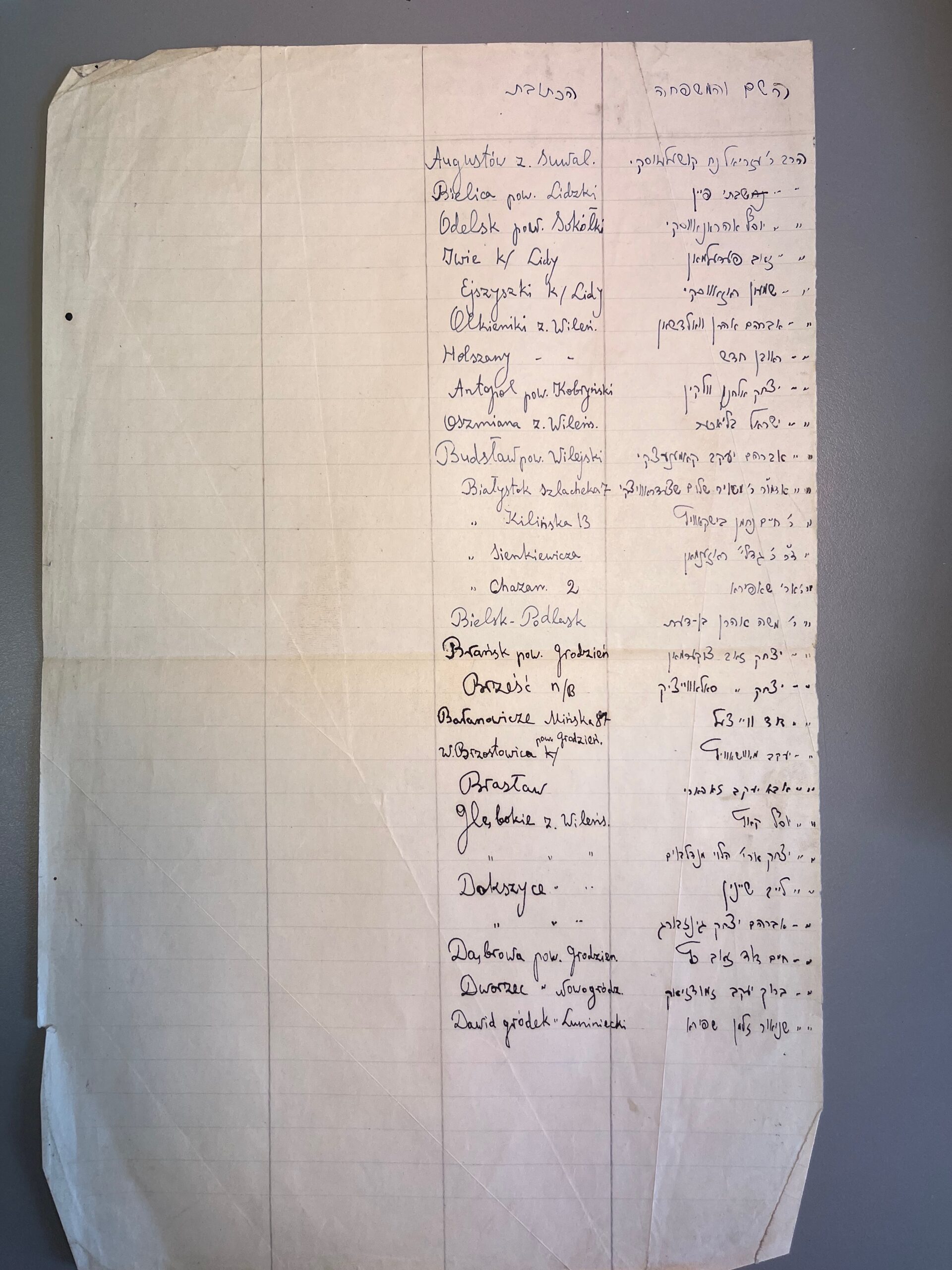
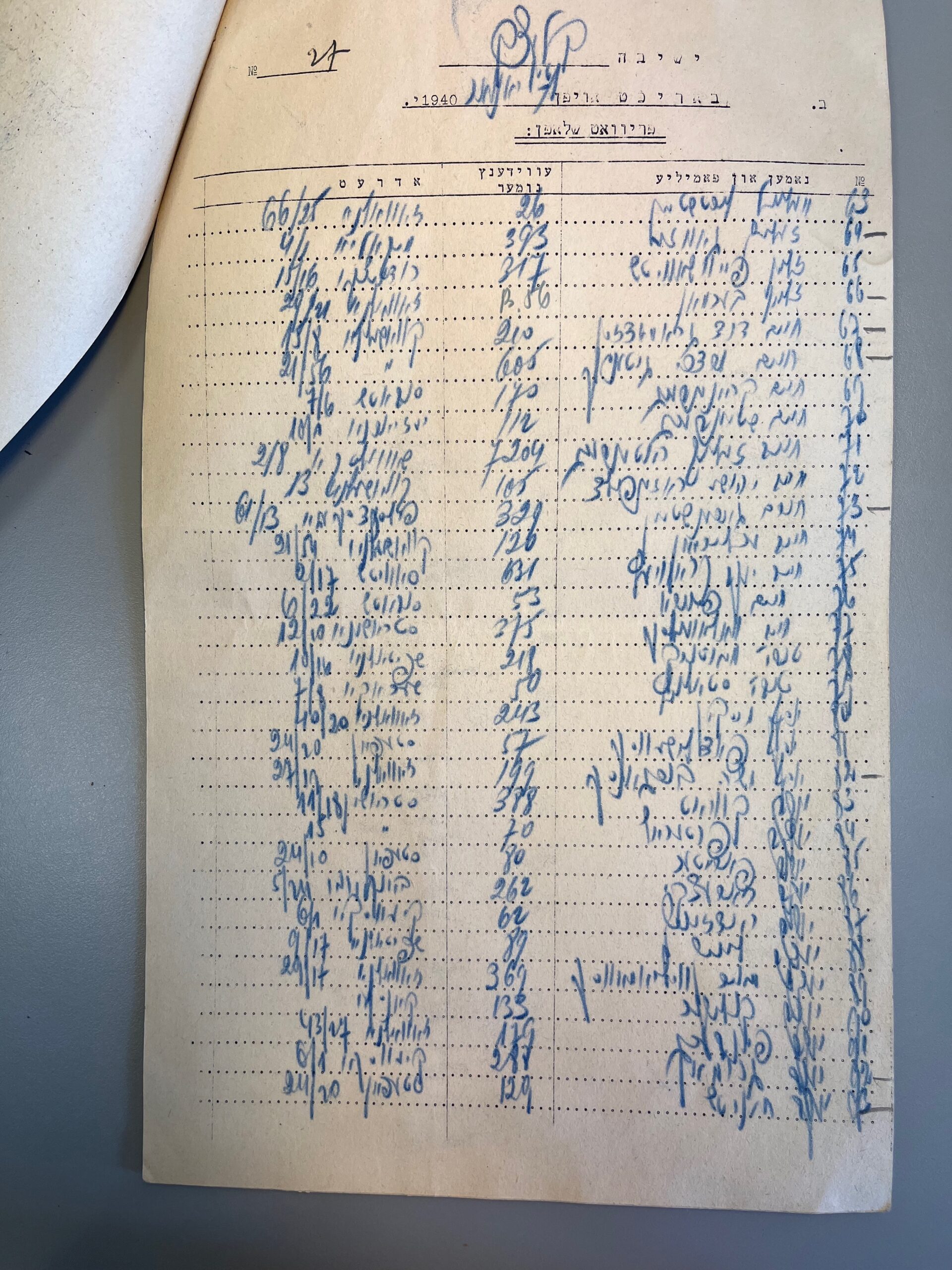
When refugees from Yeshivas arrived in Vilna in late 1939 and 1940, they were cared for by the Va’ad HaYeshivos. Many of the lists of those students and families are preserved in the same archive as the Strashun Ledgers at the Lithuanian National Library. Below are two documents from that archive. The first is a document that lists some of the most important rabbis, including the Brisker Rav, and their addresses in Vilna. The second document is a page from the list of students from Keltsk.


Marc B. Shapiro – Responses to Comments and Elaborations on Previous Posts II

Responses to Comments and Elaborations of Previous Posts II
by Marc B. Shapiro
In a previous post I wrote as follows:
In Kitvei Ramban, vol. 1, p. 413, Chavel prints the introduction to Milhamot ha-Shem. The Ramban writes:
וקנאתי לרבנו הגדול רבי יצחק אלפאסי זכרונו לברכה קנאה גדולה, מפני שראיתי לחולקים על דבריו שלא השאירו לו כפי רב מחלוקותיהם ענין נכון בכל מה שדבר, ולא דבר הגון בכל מה שפרש, ולא פסק ראוי בכל מה שפסק, לא נשאר עם דבריהם בהלכות זולתי הדברים הפשוטים למתחיל פרק אין עומדין
In his note Chavel explains the last words as follows:
רק בסוף הפרק הזה נמצאה השגה אחת מבעל המאור
Yet what Ramban means by למתחיל פרק אין עומדין are the children who begin their talmudic study with Tractate Berakhot. In other words, it is only the explanations and pesakim of the Rif that are obvious even to the beginner that have not been challenged.[1]
Ephraim responded as follows

WRT the reference of Ramban to פרק אין עומדין, both you and R. Chavel are wrong. Ramban is clearly referring to the gemara’s explanation of the Mishnah’s ruling at the beginning of that chapter of אין עומדין להתפלל אלא מתוך כובד ראש, which is that one should learn an undisputed halakha prior to davening. It is only on those simple and undisputed halakhos that the Maor did not disagree.

Fotheringay-Phipps wrote:

The basic problem with Dr. Shapiro’s (or R’ Mazuz’s, as the case may be) pshat is that Ain Omdin is the fifth chapter of B’rachos, not the first. If the Ramban meant the perek that a kid starting out learns, why would he choose the fifth perek? I think R’ Chavel’s pshat is somewhat of a better pshat, since Ain Omdin is somewhat unusual in that there is only one haga’a from the Ba’al Hamoar in the whole perek, and I incline to think that this is what the Ramban meant.

I presented these comments to R. Mazuz and he replied as follows:

לפי פירוש כת”ר היל”ל הדברים הפשוטים שבתחלת פרק אין עומדין. אולם ידוע שבעדות המזרח התחילו ללמוד מסכת ברכות (וכ”ה בשו”ת הרי”ף סימן רג”ג). בניגוד לנהוג היום בתלמודי תורה להתחיל פרק אלו מציאות. ואבא זצ”ל התחיל לתלמידים בפרק תפלת השחר (ומסתמא כך נהגו בג’רבא) שהוא הפרק הכי קל בין הפרקים א’ ב’ ג’ ד’ במסכת ברכות. לכן יתכן מאד שבימי הראשונים התחילו דוקא בפרק אין עומדין (שהוא קל אפילו יותר מפרק תפלת השחר, ורובו דברי אגדה). וזוהי כוונת הרמב”ן

With regard to his point about the Sephardim beginning their instruction from Berakhot, in R. Mazuz’s new book, Arim Nisi, p. 364, he notes that R. Shakh, Shimushah shel Torah p. 88, refers to the Maskilim’s attempt to institute this in Europe as a “reform.” Yet in reality, this practice has a long history. R. Mazuz writes:

ונעלם ממנו במחכ”ת שכן מנהג הספרדים עד היום הזה, והוא מנהג קדמון מימי הרי”ף והגאונים, ואולי מימי רבי מסדר המשנה שהתחיל בסדר זרעים במסכת ברכות. ולפני כששים שנה הדפיסו באי ג’רבא מסכת ברכות בהשמתטת הקטעים שאין רגילים ללמדם לתלמידים בהסכמת רבני העיר וט”ו מרביצי תורה שבעיר, ויצאו מהם פירות ופירי פירות

Since I mentioned R. Mazuz’s comment vis-à-vis what R. Shakh wrote, I should add that he criticized him on other occasions as well. These criticisms were always offered with proper respect. Yet there are those in the Lithuanian world who have no interest in hearing what another gadol has to say if it not in line with current Daas Torah.[2] R. Mazuz states that he once sent a letter to Yated Neeman pointing out an error R Shakh made, and they refused to publish it. After this paper refused to publish two more of his letters, he stopped sending them, as the hazakhah had been established.[3]
He also tells us that if the editors had a different attitude, he would have also sent in something dealing with the proper way to pronounce the word אחד in Shema, since there was a great deal of discussion in the newspaper by people who didn’t know what they were talking about. The truth is that a dalet without a dagesh is very similar to a zayin[4] and is still preserved among the elders of Yemen and Iraq. He cites one of Ibn Gabirol’s poems which reads:
לאטך דברי שיר דבורה
אשר קרית שמע מפיך יקרא
מיחדת ומארכת באחד
In Peter Cole’s translation:

Take, little bee,
your time with your song,
in your flight intoning the prayer called “Hear”
declaring and stretching “the Lord is one.”[5]

In other word, the bee’s buzzing (zzz) shows us how one can extend the dalet. It is pronounced in the way that the letter can be extended, which cannot be done with a hard dalet.

R. Shakh was a man of truth, and he certainly would have wanted to be corrected. All true scholars are happy when this happens, and this is what intellectual honesty is all about. But Yated Neeman has never been interested in truth or intellectual honesty, but in pushing a religio-political agenda, and therefore not only do they refuse to print such corrections of their gedolim, but they have even published material which they know is untrue. I refer in particular to their slander of R. Kook, stating that he applied the verse Ki Mitzion Tetze Torah to the Hebew University. Even though the truth was pointed out to them they continued to print the slander. One can read all about this in Moshe Maimon Alharar’s book Li-Khevodah shel Torah.

Returning to R. Mazuz and R. Shakh. R. Shakh had written

Whence did Hazal know that the earth was forty-two times larger than the moon, and that the sun was approximately one-hundred-and-seventy times larger than the earth (as explained in the Rambam, Hilkhot Yesodei Hatorah 3:8), if not from the power of the Torah?

Some might recognize this passage as it was subject to a very strong critique by R. Aharon Lichtenstein. I am sure that many in the haredi world were very upset by what R. Lichtenstein wrote, but it pales in comparison to what R. Shakh wrote about the Rav’s Hamesh Derashot.[6] Among his negative comments, he referred to Rav’s Zionist ideas as ממש דברי כפירה.

R. Lichtenstein actually has two replies to the quote from R. Shakh. They are both found in the same essay, but the essay has appeared in two different versions. In the original version he wrote as follows.

Upon reading the passage, one can only reflect, first, that the description cited is nowhere to be found in Hazal, but derives, rather, from medieval astronomers; second, that it is in conflict with the rudiments of contemporary scientific assumptions, and, third, that it hardly consorts with the fact that the selfsame Rambam had explicitly stated, with respect to these very issues, that they were beyond the pale of Hazal’s authority. . . . The high regard properly due the author of the Avi Ezri notwithstanding, one can only conclude that, evidently, when their reach exceeds their grasp, even acknowledged and esteemed talmdei hakhamim may falter.[7]

Yet when this essay was reprinted in Leaves of Faith, vol. 2, the criticism was softened:

In raising this question, he is wholly oblivious not only of the rudiments of astronomy but also of the fact that the selfsame Rambam explicitly states, with respect to these very issues, that they are beyond the pale of Hazal’s authority.

כן בדברי חז”ל. וכמבואר להדיא בהקדמתו לפירוש המשניות (בש”ס ברכות דפוס ווילנא דף נה סע”א וע”ב) שהמקור לזה מספר אלמגסט”י. והוא ספרו של בטלמיוס הידוע בחכמת האסטרונומיא. ועפ”ז כתב הרמב”ם בהלכות יסודי התורה (שם) שהשמש גדולה מן הירח פי 6800. ורלב”ג עה”ת (בפסוק ויאמר אלקים יהי מאורות) חולק על זה וכתב כי השמש גדולה מהירח פי חמשים אלף, כמו שביאר בח”א ממאמר חמישי מס’ מלחמות ה’ ע”ש. וכיום ידוע שהשמש גדולה מן הארץ פי מליון שלש מאות אלף

In response to this citation of R. Shakh in Yated Neeman, R. Mazuz wrote as follows (Or Torah, Adar 5753, pp. 461-462):

והנני להעיר שהרמב”ם כתב כן ע”פ חכמי המדע בימיו ולא נצמא כן בדברי חז”ל. וכמבואר להדיא בהקדמתו לפירוש המשניות (בש”ס ברכות דפוס ווילנא דף נה סע”א וע”ב) שהמקור לזה מספר אלמגסט”י. והוא ספרו של בטלמיוס הידוע בחכמת האסטרונומיא. ועפ”ז כתב הרמב”ם בהלכות יסודי התורה (שם) שהשמש גדולה מן הירח פי 6800. ורלב”ג עה”ת (בפסוק ויאמר אלקים יהי מאורות) חולק על זה וכתב כי השמש גדולה מהירח פי חמשים אלף, כמו שביאר בח”א ממאמר חמישי מס’ מלחמות ה’ ע”ש. וכיום ידוע שהשמש גדולה מן הארץ פי מליון שלש מאות אלף

R. Mazuz’s second letter deals with the nature of darkness. Yated Neeman had printed the Vilna Gaon’s opinion that darkness is not simply the absence of light but its own creation. R. Mazuz responded that this is in opposition to the opinions of the Rambam, Ramban, R. Joel Sirkes, R. Elijah Mizrahi and the Siftei Hakhamim. Subsequent to writing the letter he learnt that this view was also held by R. Saadiah Gaon, Ibn Ezra, Radak, and the Kol Bo (see ibid., p. 946) After pointing out that the Vilna Gaon’s view is held by R. Jacob Emden and the Hida. He concludes:
מכל מקום אין לקרוא לסברא. שהחשך הוא העדר “דברת המינים” ח”ו. ואלו ואלו דברי אלקים חיים
As already mentioned, Yated Neeman does not like to print letters from those who are able to show that the newspaper has erred. Only newspapers interested in the truth do that.

In his Kovetz Ma’amarim, pp. 102ff., R. Mazuz includes another letter he sent to Yated which also was not printed. The paper had published the view of the Steipler and R. Chaim Kanievsky that even Sephardim should pronounce the final vowel of אד-ני as Ashkenazim pronounce the kamatz, since otherwise it appears as it if there is more than one God.

R. Mazuz shows how mistaken this is, and illustrates though various texts that the way the Sephardim pronounce the kamatz today is precisely how it was pronounced in medieval times. For example, he cites one of Ibn Gabirol’s Azharot:

אנכי ה’ / קראתיך בסינַי/ ולא יהיה על פנַי / לך אלהים אחרים
One can easily see that the words are designed to rhyme, so obviously the last syllable of Ado-nai was pronounced the same way as Sinai and panai.
2. Since I just mentioned R. Aharon Lichtenstein, let me quote something else he wrote that relates to what I noted in a previous post.[8] I pointed to the common phenomenon of people rejecting the authenticity of texts that don’t agree with their preconceptions. R. Lichtenstein states:

The Rav had no patience for philosophies that glorified passivity and reliance on miracles. At the beginning of the 1960’s, a few years after the launch of Sputnik, I had occasion to talk with the Rav about those people who claimed that man should not reach out for the heavens, for “the heavens are the heavens of God,” and only “the earth is given to human beings.” The Rav heaped scorn upon them. One of those present jumped up to protest: “But Rabbi, the Ramban in Bechukotai (Vayikra 26:11) speaks about how a person should have faith in the Holy One, and not to delve into matters that are too wondrous for him.” The Rav replied, “I heard from my father, in the name of my grandfather, that the Ramban never uttered that statement!”

Although not identical to the Ramban’s position, there was also a medieval Jewish view that doctors should only be consulted for things like sprained arms, but that when it came to internal diseases one should only resort to prayer. Lest one think that this idiosyncratic position has totally disappeared, I have even found a twentieth-century author who adopts it,[9] leading R. Ovadiah Yosef to strongly reject this view in his haskamah.

3. In a previous post[10] I called attention to an error made by H. Norman Strickman and Arthur Silver. They claimed that according to Radak’s commentary to Gen. 14:14, after the conquest of the Land of Israel the reading of this verse was changed to read “and pursued as far as Dan.” Dr. Strickman has informed me that in the Afterword to his translation of Ibn Ezra to Leviticus, p. 291, he himself corrected the errror. The correct reference is to Radak’s commentary to I Sam. 4:1. Here Radak leaves no doubt that he indeed believes that the text of the verse was changed.
על האבן העזר: כמו הארון הברי’ והכותב אמר זה כי כשהיתה זאת המלחמה אבן נגף היתה ולא אבן עזר ועדיין לא נקראה אבן העזר כי על המלחמה האחרת שעשה שמואל עם פלשתים בין המצפה ובין השן שקרא אותה שמואל אבן העזר שעזרם האל יתברך באותה מלחמה אבל מה שנכתב הנה אבן העזר דברי הסופר הם וכן וירדף עד דן
With this text, we can now understand Radak’s commentary to Gen. 14:4 as also referring to a post-Mosaic change. Without this text, there would be no reason to assume that Radak in Gen 14:14 is not referring to Moses’ prophetically writing the word “Dan.”

As I pointed out in my previous post, in the introduction to his Commentary on the Torah Radak insists on complete Mosaic authorship. In order that there be no contradiction between the sources, we must assume that Radak means that no sections (or even verses) were written by someone other than Moses, but not that there are no minor post-Mosaic changes. In my book I pointed out that Radak understood tikkun soferim literally, that is, the Scribes actually made minor changes to the text of the Torah.[11]

(With regard to false ascription of critical views vis-à-vis the Torah’s authorship, I should also mention that Abarbanel, Commentary to Numbers 21:1, accuses both Ibn Ezra and Nahmanides of believing that the beginning verses of this chapter are post-Mosaic. Yet Abarbanel must have been citing from memory, since neither of them say this. In fact, Ibn Ezra specifically rejects the notion that the verses were written by Joshua.)

4. In a previous post I mentioned R. David Zvi Hillman’s strong attack on R. Kafih. It is only fair to point out that Hillman’s letter was the impetus for an even sharper attack on Hillman. See here, here, and here for the relevant documents.

R. Kafih was a follower of the Rambam who wrote that one should be “among those who are insulted, but not among those who are insulting” (Deot 5:28). While the articles make many good points, the crude language used is entirely unacceptable.

5. With regard to the Netziv and reading newspapers on Shabbat, Dr. Yehudah Mirsky has called my attention to the Netziv’s article in R. Kook’s journal, Ittur Soferim (1888), pp. 11-12, where the Netziv offers halakhic justification for this practice. Unfortunately, this short article was not included in Meshiv Davar, vol. 5, which appeared in 1993. (Presumably, the editors were unaware of it.) This most recent volume of Meshiv Davar is a bit strange, because the editors don’t tell us anything about where they found previoiusly unpublished responsa included here. From a historical standpoint, the most interesting responsum is no. 44. Here the Netziv blasts the new analytic approach of R. Isaac Jacob Reines, which is found in his Hotam ha-Tokhnit and Urim Gedolim.

Other than an anonymous article in Ha-Peles 5 (1903), pp. 673-674, in which Reines’ approach is regarded as falling into the category of “that which is new is forbidden by the Torah,” I don’t know of any other attacks on him. For some strange reason, Saul Lieberman thought that R. Yaakov David Wilovsky’s famous attack against the Brisker method, found in the introduction to his Beit Ridbaz, was directed against Reines. Shaul Stampfer quoted this in Lieberman’s name in the first edition of his masterpiece, Ha-Yeshivah ha-Lita’it be-Hithavutah (Jerusalem, 1995), p. 113 n. 29, but omits Lieberman’s comment in the second edition of this book (Jerusalem, 2005).

6. In a previous post I wrote about the issue of kosher sturgeon. Shortly after the post appeared I read David Malkiel’s article on R. Isaac Lampronte’s Pahad Yitzhak.[12] Malkiel, p. 129, points out that the most famous entry in the work deals with the authority of customs, and focuses on whether a certain type of sturgeon is kosher. Lampronte tell us that the custom in Ferrara was to eat it.

I wrote the post without doing an internet search, which is now the first place people go when beginning their research. Only after the post appeared did I do such a search and I came up with the following very interesting post by Rabbi Seth Mandel.[13] He writes as follows:

I have asked several rabbonim about how it came to pass that if the Noda’ biY’hudah paskened unequivocally that sturgeon is kosher, every book says black on white that it is not. Of the two rabbonim who even were aware of the issue, one said that of course sturgeon is kosher, and the fact that there is none with a hekhsher is either because the rav hamakhshir doesn’t know about the issue, or you can’t get a rav hamakhshir to the fishing plants. . . . The other rov said that of course, no recognized halakhic authority would contradict the Noda’ biY’hudah on this, but since Jews believe they are not kosher, and the only ones pushing their kashrut are the C or R, why should an O rov fight to show they are kosher, as if we accept the way they arrive at their decision? . . . 

I challenge anyone to find a posek who deals with the issue and refutes the Noda’ biY’hudah. I am _not_ saying that I “know” that there is no one; what I am saying is that I have been looking for years, and have found no one. Please do not hesitate to correct me if anyone knows of a source (but one that knows that the Noda’ biY’hudah had a t’shuva on this). The books on the kashrus of fish just take it as a given that since sturgeon, as R. Josh says, do not have scales but rather bony tubercules, they are not kosher. My bottom line is I don’t care if people hold that they are not kosher (I don’t like fish eggs, anyway), but it seems to me inexcusable for these books to distort the Torah by giving the impression that everyone agrees on this issue. The Noda’ biY’hudah is not just anyone. My goodness, he is not even MO, L, or Chareidi, so there go most of the opportunities for saying “WADR to the Noda’ biY’hudah, he is MO/L/ wears a grey hat, and so cannot be representative of true Torah.” The only thing you can say is that he was an opponent of chasidus, but even according to the Chasidim, that is not an issue, since a famous story of the Chasidim is that he repented on his deathbed from all the not nice things he said condemning chasidus (and the story _must_ be true, since it is retold in the CIS Shulman “authorized” biography of him).

Rabbi Mandel wrote this before he was appointed to his current important position in the OU kashrut organization. Somehow, I don’t think he would have expressed himself this way if he was then working in the kashrut industry.[14]

7. I was fortunate to spend back-to-back Shabbatot with Prof. Daniel Sperber. I learnt much from my conversations with him, and I think people will enjoy listening to his presentations. He is currently president of the Jesselson Institute for Advanced Torah Studies at Bar Ilan University, and was kind enough to give me a recent volume published by them, Mi-Sinai le-Lishkat ha-Gazit by Shlomo Kassierer and Shlomo Glicksberg. This book analyzes the relationship between the written and oral law, and the nature of rabbinical authority. What makes the book significant is the combination of traditional and academic study. Anyone who wants to understand the latest thinking on this topic would be wise to consult this book.

8. Many people contacted me following my last post on Rabbis and Communism, so let me add a few further comments. R. Baruch Oberlander called my attention to Likutei Sihot, vol. 33, pp. 248-249. Here the Lubavitcher Rebbe states that there is no contradiction between Judaism and socialism. He adds that in Russia, before the Revolution, he knew many socialists, even radical ones (which I assume means real communists), who were completely Torah observant. See also Iggerot Kodesh, vol. 22, p. 497.

Since my last post mentioned R. Jacob Emden and Abraham Bick’s communist ties, I should also mention Mortimer Cohen, the author of Jacob Emden: A Man of Controversy. This was the first academic defense of Emden, and was subjected to withering criticism by Scholem. Marvin Antelman, who has made attacking Eybschuetz one of his life’s goals, also sets his guns on Cohen, accusing him of having been the “’rabbi’ of a secret sect of Sabbatean communists, who carried on the Frankist conspiracy in Philadelphia” (Bekhor Satan, p. 44).

R. Nathan Kamenetsky wrote to me pointing out that when R. Dovid Leibowitz was let go from Yeshiva Torah va-Daas in the 1930s, one of the complaints against him was that he was promoting communism (whether the complaint was justified I cannot say. Kamenetsky continues: “My son, R’ Yoseph, pointed out that the Torah divides wealth evenly when it sets the law of Yovel. At the conquest of Canaan, the land was divided evenly, and every fifty years thereafter, by which time there would be wealthy lanlords and poor ones, the Torah redistributed the land in its original lots. (The difference between large estates and small ones would then result only from family sizes, by which families with many children would have smaller fields than and those with many children.)”

I had wondered about the meaning of the word ,סוללים and suggested that it refers to a white-collar profession. Kamenetsky writes:

You do not base your suggestion on philology – and nor will I. I also do not think that you are correct sociologically that white-collar workers were assumed to be less religiously observant than other Jews. I believe that Rabbi Graubart meant pharmacists, because, like doctors, they were not expected to be observant. I know this from my father’s attitude (which was grounded in the pre-World War I Jewish environment). For example, when my father would speak of my native Tzitevian, the town where he served as rabbi, and telling an involved story about how a Jewish woman who was suspected by my mother of not using the mikveh found that her husband was carrying on with their goyisheh maid, he added, (not in these exact words) “Naturally, besides the pharmacist’s wife, all the women in the shtetl used the mikveh.” Insofar as doctors, and likely pharmacists too, they weren’t trusted to be profesionally reliable if they were observant! See my Making of a Godol, page 557, (within my discussion about Dr. Einhorn, a mysterious figure), where I quote an article about that doctor which said, “The [townspeople] realized that [Dr. Einhorn’s] way of life, his devoutness, did not harmonize with his profession.”

9. Dr. Yehudah Mirsky called my attention to Mordechai Zalkin, “Bein ‘Bnei Elohim’ li-Vnei Adam’: Rabbanim, Bahurei Yeshivot ve-ha-Giyus le-Tzavah Ha-Russi ba-Meah ha-19,” in Avriel Bar-Levav, ed., Shalom u-Milhamah be-Tarbut Ha-Yehudit (Jerusalem/Haifa, 2006), pp. 165-222. I was unaware of this fabulous article which is a detailed survey of the issue of rabbis and the Cantonist problem. Let me just quote his concluding paragraph, which I was happy to see supports a suggestion I made. Coming from Zalkin, who is an expert in the history of Russian Jewry, it should be taken very seriously.

אין בידינו כלים לבחון את מידת השפעתו ארוכת הטווח של תהליך זה על מערך היחסים הבסיסי בחברה היהודית המזרח אירופית משלהי המא התשע-עשרה. אולם יש מקום להניח שלתחושת האכזבה והתסכול מאופן תפקודה של הרבנות המזרח אירופית בפרשת הגיוס היה חלק לא מבוטל במגמות החילון ובנהייה אחר תנועות אידאולוגיות שהציעו מודלים מנהיגותיים אחרים, שרווחו בקרב יהודי מזרח אירופה במחצית השנייה של המאה התשע-עשרה
Notes
[1] See R. Meir Mazuz’ note in R. Hayyim Amselem, Minhat Hayyim, vol. 2, p. 15.
[2] I stress the “current” Daas Torah, since Daas Torah has been known to change. For example, Yated Neeman will, for obvious reasons, no longer mention the Daas Torah set forth by the Brisker Rav, the Steipler, and R. Shakh, and which was the official haredi position for many decades, namely, that one is not permitted to serve in the Israeli government batei din. With regard to Daas Torah, the quote from R. Itzele that I mentioned in my last post is very interesting
החלק הפוליטי נחוץ, כי על ידו נמשוך את בני הנעורים והרחוב להסתדרותנו. גם הלא אנו רואים, כי כלל ישראל חפץ בו, בוודאי מאת ד’ הייתה זאת. וכלל ישראל הוא גבוה ונעלה מגדולי התורה. ישראל אם אינם נביאים, בני נביאים הם
In the haredi version of Daas Torah, the opinions of the masses are meaningless, indeed they are said to be – by definition – in opposition to Daas Torah (which always makes me wonder how laypeople such as Jonathan Rosenblum are able to understand and explain Daas Torah). Yet R. Itzele places the opinion of the religious masses on a higher level than that of the rabbis (à la kol hamon ke-kol shadai). One reader informed me that R. Avraham Shapira quoted this passage in defense of Zionism, i.e., the religious intuition of the people, who supported Zionism, trumped the view of the gedolim, most of whom opposed Zionism.
[3] Or Torah, Adar 5753, pp. 461ff., 946.
[4] See Shamma Friedman, “Le-Inyan ha-Devorah be-Shiro shel Ibn Gabirol, u-Minhag Ehad bi-Keriat Shema,” Lashon ve-Ivrit, Dec. 6, 1990, p. 31.
[5] Selected Poems of Solomon Ibn Gabirol (Princeton, 2000), p. 69.
[6] See Mikhtavim u-Ma’amarim, vol. 4, p. 107. See also his strong attack on the Rav’s ideology, ibid., pp. 35ff.
[7] “Legitimization of Modernity: Classical and Contemporary,” in Moshe Z. Sokol, ed., Engaging Modernity (Northvale, 1997), pp. 21-22
[8] See here.
[9] R. Reuven ben David, Meshiv Davar (Jerusalem, 1979), no. 2.
[10] http://seforim.blogspot.com/2008/01/clarifications-of-previous-posts-by.html
[11] Limits of Orthodox Theology, p. 99. I also note that Radak doesn’t usually mention the various tikkunei soferim, which probably means that he did not accept them.
[12] “The Burden of the Past in the 18th Century: Authority, Custom and Innovation in the Pahad Yitzhak,” Jewish Law Annual 16 (2006), pp. 94-132
[13] See here.
[14] In a future post I hope to deal with the history of the kashrut industry. For now, let me just note that among the many ways we are more fortunate than those of previous generations is that we can even buy toilet bowl cleaner with a hashgachah (it is parve.). See here. Here is the actual letter of certification.

[15] See http://torahinmotion.org/store/store.htm


Some Recollections of R. Jehiel Jacob Weinberg, Love Before Marriage, and More

Some Recollections of R. Jehiel Jacob Weinberg, Love Before Marriage, and More
Marc B. Shapiro
1. In my last post I mentioned R. Nosson Zvi Finkel, the Alter of Slobodka, so let me add the following. There is a transcript of a 1965 taped conversation between R. Jehiel Jacob Weinberg and R. Yaakov Herzog.[1] Herzog had come to Montreux to speak to R. Weinberg, and here is a picture from that meeting which appears in Michael Bar-Zohar, Yaacov Herzog: A Biography.

R. Weinberg, who knew R. Finkel very well, stated as follows.

הרב ויינברג: דער אלטער ז”ל (דער סלאבאדקער, זאגט מען דער אלטער), ר’ נטע הירש, ער איז דאך א צדיק.

הרצוג: אבער נישט קיין למדן.

הרב ויינברג: נישט קיין גרויסער למדן. ער האט געקענט לערנען, אבער ער איז נישט געווין קיין גרויסער למדן. אבער ער איז געווען א חכם, א גרויסער.

הרצוג: יא, דער חכם פון סלאבאדקע.

הרב ויינברג: און ער איז געווען א איידעלער מענטש זייער.

Some sections of this conversation appeared in the English Yated Ne’eman, Nov. 5, 1999. Yet as is to be expected, they appeared in a censored form as Yated Ne’eman would never record R. Weinberg’s statement that R. Nosson Zvi Finkel was not a great talmudic scholar. This judgment is not to be regarded as a put-down, as everyone in the Lithuanian yeshiva world knew that R. Nosson Zvi Finkel’s original insights were focused on Mussar, not analytical Talmud study.[2] Needless to say, the Alter always made sure that outstanding talmudic scholars were on the Slobodka faculty.
Speaking of censorship, here is another example. In the Yated Ne’eman article just mentioned, we find the following passage which is a quote from R. Weinberg.
I was intimately acquainted with R. Eizik Sher. . . . His son-in-law, R. Mordechai Shulman, visited me in Berlin and wanted to hear shiurim from me. I told him: This is not your place. Return to Slobodke.[!] Maybe you will some day become the son-in-law of R. Eizik.
This is what R. Weinberg actually said to Herzog:

ויינברג: ער איז ארויפגעקומען צו מיר אין סעמינאר. ער איז געווען אין בערלין, זיך ארומגעדרייט צוויי מאנאטן. געוואלט אריין אין סעמינאר. האב איך אים געזאגט: הערט זיך איין, ר’ מרדכי, ער איז א טיקטינר. דו וועסט נישט ווערן קיינמאל קיין דאקטאר. און אויב דו וועסט זיין א דאקטאר אפילו, וועסטו קיינמאל נישט קריגן קיין רבינער שטעלע אין דייטשלאנד. וואס טויג עס דיר? וועסט נישט מאכן קיין קאריערע. איז גיי אוועק צוריק אין סלאבאדקע. אמאל קען זיין, דו וועס זיך פארליבן אדער זי וועט זיך אין דיר פארליבן, די טאכטער פון ר’ אייזיק’ן, וועסטו ווערן ר’ אייזיק’ס א איידים.

.הרצוג: וכך הווה

 .ויינברג: און איך האב אים דערמאנט דאס. אז איך האב עס אים אמאל פאראויס געזאגט

R. Weinberg tells us that R. Mordechai Shulman, who was from Tiktin and later became Rosh Yeshiva of Slobodka in Bnei Brak, wanted to enroll in the Rabbinical Seminary of Berlin. Yated doesn’t want its readers to know this, so it “translates” the passage as saying that R. Shulman “visited” R. Weinberg and “wanted to hear shiurim” from him. R. Weinberg told him that he would never get a doctorate, and even if he did he would not get a rabbinic position in Germany, so he should return to Slobodka. R. Weinberg adds that when he returns it could be that he “will fall in love” with the daughter of R. Isaac Sher, or she will fall in love with him, and he can then become the son-in-law of R. Sher, the rosh yeshiva of Slobodka. In fact, this is exactly what happened.[3]
The Yated “translation” omits anything about R. Shulman and R. Sher’s daughter “falling in love.” This is because there is no such concept in the haredi world (and in traditional Jewish societies, in both the Ashkenazic and Sephardic worlds, such a notion was hardly found at all). Any love between husband and wife is said to come after marriage, and the biblical support for this concept, repeated in numerous texts (both haredi and pre-haredi[4]), is found in Genesis 24:67: “Isaac brought her into the tent of his mother Sarah, and he married Rebekkah. So she became his wife, and he loved her.” This verse states that Isaac loved Rebekkah, but only after he married her.[5] R. Gamaliel Rabinowitz goes so far as to state that any love that is found before marriage arises from sin, as there is no room for “feelings” before marriage.[6]
האהבה באה רק לאחר הנישואין, כל אהבה שלפני הנישואין מקורה בחטא רח”ל, ענין ה”רגשות” בכלל אין לו מקום לפני הנישואין, וזה דבר פשוט וברור שאין צריך לבארו.
R. Reuven Margaliyot mentions an interesting interpretation in support of this perspective.[7] There are two contradictory biblical verses. Proverbs 18:22 states מצא אשה מצא טוב, while Ecclesiastes 7:26 states ומוצא אני את האשה מר ממות. The contradiction can be explained as follows.
In earlier years parents would arrange marriages for their sons, and the overwhelming majority of the marriages succeeded. This is alluded to by the verse in Proverbs: מצא אשה מצא טוב. Now, however, things are different, and young men find their own brides, “and most of the time there isn’t peace between them after the marriage.” This is alluded to by the verse ומוצא אני את האשה מר ממות . In other words, if I find a wife for myself, most of the time it will turn out to be “more bitter than death.”
I think there might be another text that speaks to this concept, though I have not seen anyone who has made this point. The sixth of the sheva berakhot recited at a wedding states שמח תשמח רעים האהובים. The words רעים האהובים mean “beloved friends” or “beloved companions.” I don’t think one would use the word רעים to describe a man and woman who are “in love.” I believe that the words of the blessing mean a love that is found between two friends, rather than romantic love. 
R. Moses Gruenwald writes as follows:[8]
וענין חתונה א”א אלא בין רעים האהובים דמי שאינם אוהבים זה את זה א”א להם להתחתן.
What he says is that people who do not love each other cannot get married. I believe that he means the sort of “friendship love” I mentioned in the previous paragraph, rather than romantic love. I find his formulation particularly interesting, since R. Gruenwald was a Hungarian rav typically viewed as being on the extreme side of things. Yet here he is saying that there needs to be a sort of love between the bride and groom.
Could this really have been the norm in R. Gruenwald’s Hungarian (non-hasidic) community? Maybe some readers who come (or descend) from this type of community can offer some comments. I have also wondered what hasidim mean when they say רעים האהובים, since the people getting married hardly know each other. A friend from the hasidic world acknowledged that he doesn’t know if these words can be reconciled with the current reality. He also suggested that perhaps the words can be understood like יומת המת in Deuteronomy 17:6. In this verse the word המת does not mean one who is dead, but rather one who will soon be dead. So perhaps האהובים means “the ones who are in the process of becoming אהובים.”
I found another interesting passage that speaks about love of bride and groom. It is attributed to R. Isaac Luria by R. Hayyim Vital. As part of his explanation of a verse in Song of Songs, R. Luria writes:[9] מחמת רוב אהבת חתן לכלה. These words are explained allegorically, but their simple meaning also reflects a reality, one in which there is real love between bride and groom which could only have flowered prior to the wedding.
Returning to the traditionalist value that love only comes after marriage, this is all fine and good, but R. Weinberg specifically spoke of falling in love before marriage, and that this could lead R. Shulman to become R. Sher’s son-in-law. From the Yated “translation” the reader would assume that R. Weinberg was telling him to return to Slobodka and become a big learner, and that this might lead to him becoming R. Sher’s son-in-law.[10]
Regarding love letters, the following appears in R. Nathan Kamenetsky, Making of a Godol, p. 802, and was one of the passages that led to the book being banned:
A reliable source reported that R’ Aaron [Kotler] wrote a letter to his fiancée of which her father, R’ Isser-Zalman Meltzer, disapproved. When it was shown to the Alter, he rejoined, “I did not tell you he was a tzaddiq. I said he had other qualities, but he will yet become so frum that everyone will suffer from him.”
Many who read Making of a Godol assumed that the letter allegedly sent by R. Kotler was a love letter. In order to counter this understanding, in the second edition of Making of a Godol Kamenetsky added: “This author conjectures that the letter concerned an impressive hasbarah he had delivered.” This conjecture doesn’t seem to fit with the Alter’s reply about R. Kotler not being a “tzaddiq” and becoming “frum”. If R. Isser Zalman was upset because he thought that the young R. Kotler was a bit too impressed with himself, then the Alter would presumably have replied differently. The words that he allegedly used, “tzaddiq” and “frum”, have a certain meaning, and it thus is not surprising that the family of R. Kotler was so strongly opposed to the book and viewed this passage as insulting. (Another report has it that R. Kotler had suggested that his fiancée read a certain book and that was what upset R. Isser Zalman.)
In the second edition of Making of a Godol, the last sentence of the passage in question was altered to read, “But his frumkeit will yet become so great that everyone will suffer its brunt.” 
In my review of Making of a Godol, I wrote as follows:
Another problematic element of the book, admittedly found only on occasion, is its use of unnamed sources. This is acceptable in journalism, but not in scholarship. For example, the evidence for one of the most controversial passages in the book, concerning R. Aaron Kotler, his future wife, and his future father-in-law, R. Isser Zalman Meltzer, is “a reliable source” (p. 802). I understand why the source would not want his or her name to be given, but when repeating such a loaded story, which one knows will be controversial and its veracity challenged, the author is obligated to name the source, thus allowing the reader to judge its reliability. After all, if the source is R. Kotler’s daughter, its authenticity is more apparent than if it is another example of what X heard from Y. If the source does not wish to go on the record, it is best for the story to be omitted. (In my own biography of R. Weinberg, I was forced to leave out a number of “juicy” details, precisely for this reason.)[11]
I have previously discussed R. Samuel Archivolti’s book of melitzah letters, Ma’yan Ganim, and how it was misused by R. Baruch Epstein. See here.[12] This book is described in the Encyclopaedia Judaica as follows: “Archivolti’s most important works are . . . Ma’yan Ganim (Venice, 1553), divided into ‘passages’ containing 25 letters in metrical form designed to serve as models for students of this classic literary genre.”[13] It is worth mentioning Ma’yan Ganim now because on pp. 39ff. Archivolti includes two love letters. It appears clear to me that the focus of these letters is an unmarried couple, and first letter begins with the following heading: אגרת חושק לחשוקתה. 

Also of interest is this picture that appears at the beginning of each section of the book. As I learnt from Shimon Steinmetz, urinating putti were a common theme in the art of Archivolti’s day. You can read about it here

While Ma’yan Ganim is a book of melitzah letters, not responsa, R. Archivolti (1515-1611) was indeed a halakhic authority who served as rabbi of Padua. His pesak in the famous Rovigo mikveh controversy appears in Palgei Mayim (Venice, 1608), p. 15a.
 

R. Archivolti is referred to as מ”ד which stands for מרא דאתרא. In Renaissance Italy this title was only used for very important rabbis,[14] unlike today when all communal rabbis are given the title.
Interestingly, I found that a Hebrew manuscript from R. Archivolti’s era includes a love charm. The woman is told to write יריש ליאוש פילוש on her left hand, and this will cause the man she desires to fall in love with her.[15]
R. David Cohen, the Nazir, is an example of one who fell in love before marriage. In fact, his relationship with his future wife, Sarah, is a great love story. They were separated from each other for twelve years. He was in Europe and Eretz Yisrael and she was in Russia and later trapped behind the Iron Curtain. Throughout these long years they remained committed to each other, and the Nazir kept her picture on his desk. As reported by R. Avraham Remer, R. Zvi Yehudah Kook saw fit to mention this last point at the Nazir’s funeral.[16]
אמר עליו: “אור מופלא”, וציין אז שתי נקודות בחייו של רבי דוד: האחת, תחילת הנזירות בעת היותו באוניברסיטה, כדי לשמור על הפיאות והזקן. והשניה, שעל שולחנו הציב תמונת ארוסתו, כדי שחס-ושלום לא יתן עיניו באחרת.
R. Shear Yashuv Cohen tells us that the Nazir and Sarah also exchanged wonderful love letters during this time, letters which have not been made public:[17]
שמורים בארכיון המשפחה מכתבי-האהבה הנפלאים, ואף קטעי-יומן מלא רגש רוטט שנכתבו על ידי אבא מארי זצ”ל בימי הפירוד שנתמשכו הרבה מעבר למתוכנן ולמצופה . . . הכלה הצעירה מונה ימים ושנים, ונשארת בנאמנותה לבחיר לבה. אף הוא שומר לה אמונים ומתנזר מכל אפשרות של ברית או קשר אחר, בקפידה ובנאמנות יסודית.
When Sarah finally made it to Jerusalem, the Nazir was in the midst of a ta’anit dibur. R. Kook summoned R. Zvi Pesah Frank and R. Yeruham Fishel Bernstein so that they could sit as a beit din and void the ta’anit dibur, thus allowing him to speak to his soon-to-be bride.[18]

Regarding falling in love before marriage, R. Jehiel Jacob Weinberg, in his Oct. 12, 1960, letter to Samuel Atlas, states that R. Soloveitchik came to Berlin intending to marry R. Hayyim Heller’s daughter:
השידוך בטל. ס’ התאהב בזו שהיא עתה אשתו.
According to members of the Soloveitchik family, there is no truth to this, and R. Weinberg was simply repeating a rumor. But it is true that the Rav fell in love with his future wife in Berlin. R. Ronnie Ziegler writes as follows here:
The Rav’s most important and fateful encounter in Berlin was that with his wife, Dr. Tonya (Lewit) Soloveitchik (1904-1967). A student at the University of Jena, where she obtained a Ph.D. in education, she was introduced to Rav Soloveitchik by her brother, a fellow student at University of Berlin. Although a scion of the illustrious Soloveitchik family was expected to conclude a match with the daughter of a prominent rabbi or at least a successful businessman, Rav Soloveitchik fell in love with Tonya Lewit and married her in 1931 despite her family’s undistinguished lineage and lack of means.
R. Ziegler continues by describing the deep connection between the Rav and Tonya.
As mentioned in the previous lecture, the Rav’s relationship with his wife was one of the two most significant relationships in his life. He had unlimited esteem for her – his dedication of “The Lonely Man of Faith” reads: “To Tonya: A woman of great courage, sublime dignity, total commitment, and uncompromising truthfulness.” He respected her opinion and heeded her advice, both in practical and in intellectual matters. It was on her advice that he changed the topics of his annual Yahrzeit (memorial) lectures for his father, which attracted thousands of listeners, to matters which non-scholars could relate to (such as prayer, Torah reading, and holidays). [The halakhic portions of some of these lectures are collected in the two volumes of Shiurim Le-zekher Abba Mari z”l.] In a poignant passage in a teshuva lecture delivered after his wife’s death, he recounted how he used to consult her before speaking:
The longing for one who has died and is gone forever is worse than death. The soul is overcome and shattered with fierce longing. . . . Several days ago, I once again sat down to prepare my annual discourse on the subject of repentance. I always used to discuss it with my wife and she would help me to define and crystallize my thoughts. This year, too, I prepared the discourse while consulting her: “Could you please advise me? Should I expand this idea or cut down on that idea? Should I emphasize this point or that one?” I asked, but heard no reply. Perhaps there was a whispered response to my question, but it was swallowed up by the wind whistling through the trees and did not reach me.” (On Repentance [Jerusalem, 1980], p. 280)
Rav Soloveitchik’s wife was his best and perhaps only real friend. His natural proclivity towards loneliness, which we will encounter repeatedly in his writings, was heightened in his philosophy to an ideal, which expresses itself in an invigorating sense of one’s own uniqueness. One can be lonely even, or perhaps especially, when surrounded by friends, colleagues, and family. This is a constructive force which propels a person toward his individual destiny, while also propelling him to seek a depth-connection with God and with his fellow man. Aloneness, as opposed to loneliness, is a disjunctive emotion – it is a sense of lacking companionship, of being abandoned and forlorn. The passage above highlights the Rav’s almost unbearable sense of aloneness following his wife’s death in 1967 after a long struggle with cancer. He is reported to have said, “After my father’s death, I felt like a wall of my house had fallen down. After my wife’s death, I felt like the entire house had collapsed.”
Concerning the matter of falling in love before marriage, it is noteworthy that the great R. Hayyim Joseph David Azulai (the Hida) was in love with the woman who would later be his wife, and whom he knew for a number of years before they were married. Here is what Meir Benayahu has to say about this.[19]
את אשתו השניה, רחל בת משה הלוי מפיסה, הכיר כחמש שנים לפני שנשא אותה ונקשר עמה בקשרי אהבה. החלומות שחלם עליה לפני הנישואין מעידים על יחסו הנכבד לאשה. הוא שאף ל”נשואים רעננים” ובהנשאו לה ראה שהוא מתעטר בכבוד והדר. בנסיעותיו רכש לה מתנות ומסר לה אותם לפני הנישואין. כסף הרבה הוציא עליה למלבושיה ולהנאותיה, ומותה בשנת תקס”ד הקדיר עליו את עולמו.
Benayahu mentions the Hida’s dreams. Here is a passage that the Hida recorded from one of his dreams.[20]
תשרי תקל”ו . . . וראיתי בחלומי שהייתי בא על אשתי [שהיתה כבר נשואה עמי ולא זכרתי מי] ומוציא בתוליה ורואה דם. [קמ]תי והלכתי אצל אמ”ן [אבי מורי נ”ע] ושאלני ברמז והשבתיו ברמז . . . ונתעוררתי. ותכף הבנתי שהוא תשו’ שאלה מיום [ראש השנה?] לטובה. וב”ה שלא אירע לי שום מקרה ח”ו. הוא ית’ ירחם וייטיב אחריתי מראשיתי לאי”ט וש”ח.
Most people will probably feel uncomfortable reading this sort of passage. Yet the performance of the mitzvah the Hida discusses appears very natural to him and nothing to be ashamed of. Perhaps it is only uncomfortable to read because we have become overly puritanical regarding these matters which are also part of Torah. Nevertheless, it does remind me of other “uncomfortable” passages found in R. Jacob Emden’s autobiography.
I found another interesting passage that deals with love between a bride and groom in R. Aaron Fried’s Zekan Aharon (Munkacz, 1904), p. 52a. Here is the passage.
I am quite surprised by the example the author uses. In commenting on the rabbinic derashah connecting the words מורשה and מאורסה,[21] he uses an example that portrays a romantic relationship. He tells of a rich man, apparently newly married, who loved his wife and tried to woo her by telling her how greatly he loved her. “His love for her increased in quantity and quality beyond how other grooms love their brides.”
This type of description would be unusual enough in a rabbinic work. Yet it gets even more unusual when R. Fried continues by telling us that the rich man showered her with hugs and kisses and placed an expensive necklace around her neck as a sign of his love. R. Fried also elaborates on why, despite all these signs of affection, the woman did not reciprocate with any feelings of love. Later he explains that since the Torah is to us like one bound with erusin, that is why we show it love, decorate it with silver and gold, and even kiss it, just like a groom does with his bride! It happens to be a clever derashah, and ends with how if you want the Torah (i.e., God) to love you back, it is not enough to only support the Torah. One must also support the poor Torah scholars, the “relatives” of the Torah.
Is it just me, or is anyone else surprised by this derashah? I can’t imagine using the imagery found here as part of a derashah before a haredi audience in order to inspire them to be generous with their support of Torah scholars. With the mention of hugging and kissing the bride, I don’t even think this would go over well in front of a Modern Orthodox audience. [22]
I am doubly astounded by the fact that the derashah we have just seen was written by an outstanding student of the Hatam Sofer, one who also showed his halakhic expertise by authoring a volume of responsa titled שו”ת מהרא”ף.
I found the derashah so unusual that I was curious to see if anyone cited it. Using Otzar ha-Hokhmah I found two citations. The first is by a Hungarian rabbi, R. Efraim Balati, who authored Hamudei Efrayim (Galanta, 1935). In vol. 1, p. 35, he cites R. Fried’s comment.
Once again, I am surprised that a Hungarian rabbi would include such information in a derashah, even if, in R. Balati’s retelling, he leaves out the words ומחבב אותה בחיבוק ונישוק. Even though he doesn’t mention how the rich man showed his affection with hugs and kisses, he does include the rest of R. Fried’s words, including how we kiss the Torah just like a groom kisses his bride.
The other source I found that cites R. Fried’s passage is R. Barukh Moskovits, Tenuvot Barukh (Jerusalem, 1969), vol. 2, pp. 326-327.
If you examine the passage, you will see that he is quoting from R. Fried’s text, not R. Balati’s version. Yet R. Moskovits also alters R. Fried’s words ומחבב אותה בחיבוק ונישוק. In R. Moskovits’ text this appears as ומחבב אותה מאד. Since R. Moskovits copied R. Fried’s text basically word for word, I don’t understand why at the end of the passage he writes שמעתי. Why doesn’t he tell the reader the source of the passage? 
To be continued
2. The most recent book to appear in my series with Academic Studies Press is Maxine Jacobson, Modern Orthodoxy in American Judaism: The Era of Rabbi Leo Jung. Anyone with an interest in the history of Orthodoxy in America will want to read this book, and I am very happy that I was able to include it, together with other high quality works, in my series, “Studies in Orthodoxy.” Rather than offer my own description of the book, here is an “official” description, which appears on Amazon.
This work presents the issues of Modern Orthodox Judaism in America, from the decades of the twenties to the sixties, by looking at the activities of one of its leaders, Rabbi Dr. Leo Jung, pulpit rabbi, community leader and writer, whose career spanned over sixty years, beginning in the 1920s. Jung is a fulcrum around which many issues are explored. Rabbi Jung’s path crossed with some of the most interesting people of his time. He worked with Chaim Weizmann, the first president of Israel, with Albert Einstein to promote Yeshiva College, with Herman Wouk, American author and Pulitzer Prize winner, and with Pearl Buck, a Nobel Prize laureate and Pulitzer Prize winner.
Modern Orthodoxy went from being a threatened entity on the American scene to a well- recognized and respected force in Judaism. Orthodoxy, at first, was seen as alien to the American environment. Marshall Sklare, perhaps the most influential exponent of this notion, wrote in the 1950s that the history of Orthodoxy in America could be written in terms of a case study of institutional decay. He realized the errors of his ways in the 1970s. This is the story of the renaissance of American Modern Orthodoxy, from the disorganization of the older Orthodoxy to the new spirit of confidence that emerged after World War Two. The phenomenon of Modern Orthodoxy is examined in the context of Orthodox invigoration and change. This book has relevance for further studies in various areas. It is part of the study of religious acculturation, of the conflict between tradition and modernity and of religious reinvigoration in a secular society.
Another noteworthy recent book is Michael J. Harris, Faith Without Fear: Unresolved Issues in Modern Orthodoxy. In my blurb that appears on the back cover, I write: “A proud and sophisticated manifesto of Modern Orthodoxy, one which builds on past thinkers but does not hesitate to chart new ground as well.” Rabbi Harris deals with a number of issues such as the role and status of women, mysticism, academic biblical scholarship, and religious pluralism. He generally comes down on the more “liberal” side of what is known as Modern Orthodoxy. (An exception to this generalization is his chapter on academic biblical scholarship.) Anyone who is interested in the intellectual trends of Modern Orthodoxy will want to read Harris’s book, as it is engaged scholarship at its best.
I would also like to call attention to R. Shimon Szimonowitz’s just published Haggadah shel Pesah: Aleh Zayit.[23] I know that there are a lot of Haggadot out there, but for talmidei hakhamim this is one of the special ones. I say this because of the many learned comments, including full-length essays, that are found in the volume. Of particular interest to me is R. Szimonowitz’s lengthy article on le-shem yihud. It is crucial reading for anyone interested in the dispute over the le-shem yihud formulation, in particular the positions of R. Ezekiel Landau, R. Eleazar Fleckeles, and R. Moses Sofer. Among other noteworthy things found in this Haggadah are an article by R. Chaim Rapoport and the Yiddish version of a few beloved Passover songs.
3. On June 5, 2016, in honor of Yom Yerushalayim, I will be speaking at the Community Synagogue of Monsey, 89 West Maple Avenue. The title of my talk is “R. Shlomo Goren: The Revolutionary Chief Rabbi.” The talk will follow minhah which is at 8:15pm.

[1] Israel State Archives, Yaakov Herzog Collection, 2989-4/פ. R. Yaakov David Herzog was the son of R. Isaac Herzog. He was named after R. Yaakov David Wilovsky, the Ridbaz, from whom R. Isaac Herzog received semikhah. In addition to his public role in government and as a diplomat, Yaakov Herzog was also a rabbinic scholar. In 1945 he published a translation and commentary of Mishnah Berakhot, Peah, and Demai. This translation was actually ready for publication by the end of 1942, before Herzog was even 21 years old (he was born Dec. 11, 1921). See Michael Bar-Zohar, Yaacov Herzog: A Biography (London, 2005), p. 50.
In Iggerot Moshe, Hoshen Mishpat no. 1, R. Moshe Feinstein critiques an article of R. Isaac Herzog that appeared in Ha-Pardes. R. Moshe’s own article originally appeared in installments in Ha-Pardes, Tamuz and Av 5703. Yaakov Herzog defended what his father wrote in Ha-Pardes, Elul 5704, pp. 36-38, and Tishrei 5705, pp. 25-27. He was only 23 years old when he wrote these articles.
After the retirement of R. Israel Brodie, Herzog was offered, and accepted, the position of British Chief Rabbi. The common view is that Herzog’s health problems prevented him taking up the post, but the truth is more complicated. See Bar-Zohar, Yaacov Herzog, ch. 13.
Since I have spoken in prior posts about religious men not wearing kippot, Herzog should be added to the list. Not only did he go bareheaded when representing the State of Israel in the Diaspora (and also in his famous debate with Toynbee), but as you can see from pictures in Bar-Zohar’s book, he also did so in Israel, while at work in various important government positions. Bar Zohar writes, “Even as a very young man, when he was working at the Foreign Ministry and then in the Prime Minister’s office, Yaacov did not wear a skullcap, except when saying blessings or praying.” (Yaacov Herzog, p. 111) Because of the vast changes that have taken place in Israeli society, it is hard for us to appreciate why, in the early decades of the State of Israel, some religious men, even those who were not of German background, felt that government work required removing their kippah.
You can listen to the Herzog-Toynbee debate here.
In a previous post here I referred to Yitzhak Nebenzahl as not wearing a kippah, and I mentioned that this German practice continued into his old age. In 1974 Nebenzahl was a member of the Agranat Commission which investigated the Yom Kippur War. In pictures of him from this time you can see that he was still without a kippah. A couple of people emailed me to say that by the 1980s he had abandoned the galut custom and indeed wore a big black kippah. One of them even sent a picture of him and Nebenzahl together.
In the post referred to in the previous paragraph, I also discussed Aharon Barth, who like Nebenzahl came from Germany and did not wear a kippah while at work. Subsequent to the post I found that Zorach Warhaftig mentions that after the death of Chaim Weizman, Ha-Poel ha-Mizrachi recommended to Ben Gurion that Barth be a candidate for president of the State of Israel. Warhaftig reports that Ben Gurion rejected this since Barth was too religious and thus not an appropriate representative for the average citizen. See Warhaftig, Hamishim Shanah ve-Shanah (Jerusalem, 1998), p. 116.
[2] Shlomo Tikochinski, Lamdanut, Musar ve-Elitizm (Jerusalem, 2016) p. 111 n. 131, cites Israel Zissel Dvortz and Dov Katz who claim that R. Finkel was indeed a “gadol” in talmudic learning, but he hid this knowledge even from those who were close to him. Some will no doubt regard this judgment as motivated by “religious correctness,” especially as R. Weinberg had a particularly close relationship with R. Finkel and was privy to all sorts of private information. See, however, Nathan Kamenetsky, Making of a Godol, pp. 777ff., who cites additional sources testifying to R. Finkel’s talmudic knowledge.
[3] R. Shulman’s early shiurim were not very successful in drawing a following. Ben-Tsiyon Klibansky writes (Ke-Tzur Halamish: Tor ha-Zahav shel ha-Yeshivot ha-Lita’iyot be-Mizrah Eiropah [Jerusalem, 2104], p. 342):
בסלבודקה הורגשה אי-נחת כשמינה בה הרב יצחק אייזיק שר את חתנו מרדכי “טיקטינר” שולמן לר”מ בשנת 1935. בישיבה הוא היה תלמיד ותיק נודע, ולאחר נישואיו ב-1929 הועיד את כל זמנו להתעלות בלימודיו. אולם משהחל להרצות את שיעוריו בישיבה לא מצאו בחוריה הדעתנים לנכון להשתתף בהם, ובשיעורים הראשונים נכחו חניכים יחידים בלבד.
Here is a picture of R. Weinberg and R. Shulman in Montreux. It appears in Joseph Friedenson, Heroine of Rescue (Brooklyn, 1984), p. 230.

[4] R. Samson Raphael Hirsch, in his commentary to Gen. 24:67, writes as follows:
Like the marriage of the first Jewish son [Jacob], Jewish marriages, most Jewish marriages, are contracted, not by passion but by reason and judgment. Parents, relations and friends consider which young people are really suited to each other, bring them together, and then love grows more and more, the more they get to know each other. But most non-Jewish marriages are made by what they call “love”, and one has only to glance at the novels depicting life to notice what a gulf there usually yawns between the “love” before marriage and after, how rapid and insipid everything then seems, how different from all the glamour one had imagined etc. etc. Such “love” is blind, every step into the future brings disappointment. But of Jewish marriage it says: ויקח את רבקה ותהי לו לאשה ויאהבה. There the wedding is not the culmination but the seed, the root of love!
The Malbim is another pre-haredi figure who speaks of love coming after marriage and cites Gen. 24:67. See his commentary to Deut. 24:1 (p. 169b). Yet he differs from others who make the same general point in that he acknowledges that at the beginning (which appears to mean even before marriage) there is indeed a “spark of love,” זיק אהבה. In context, these words might only mean a healthy attraction. The Malbim continues that the essence of love between a man and woman comes only after marriage:
ונמצא שעקר האהבה היתה נגלית רק אחר הנשואין.
R. Hayyim Hirschensohn, whose outlook was as far from a haredi perspective as can be imagined, also points to Gen. 24:67 as providing the proper approach to love and marriage. He even throws in a negative comment about American mores which is not what most would expect to come from him. See Apiryon 3 (1926), p. 29:
ותהי לו לאשה ויאהביה, לא כמנהג אמריקא שהאהבה בא קודם הנשואין ומתה עם הנשואין, אבל יצחק אהב את רבקה אחרי הנשואין.
Reading all of these passages shows us how much has changed both culturally and sociologically. I don’t think there is a parent in the Modern Orthodox world who would support a child’s marriage if the son or daughter was not convinced that he/she loved the future spouse.
I asked a friend if in the haredi world people would ever say that the bride and groom loved each other (i.e., before marriage). He replied:
לא היו אומרים, אבל אצל הישיבתיים זה בסדר גמור – ואולי גם יותר טוב – שיהיה אהבה ביניהם, אבל לא היו מביעים את זה, קוראים לזה chemistry, רוצים שיהיה chemistry ביניהם לפני שסוגרים את השידוך. אצל חסידים זה לא מקובל.
Radak, in his commentary to Gen. 24:67, is not concerned with using the verse to show that love should only come after marriage, and indeed, in his day this was generally not even an option. Yet in discussing the verse he makes a very telling comment, as true today as in his times:
רוב בני אדם אוהבים נשותיהם.
Most men love their wives.” If you read Hirsch’s grand rhetoric you feel carried away with the purity and perfection of Jewish love after marriage. Radak, however, brings you down to the real world, where unfortunately the truth is that not all men really love their wives.

[5] See, however, Gen. 29:18, 20, where it says that Jacob loved Rachel, and this was before he married her. In Gen. 29:30 the verse states: ויאהב גם את רחל מלאה. Most understand this to mean that while Jacob loved Leah, he loved Rachel more. However, according to one interpretation of the Tosafists, Jacob did not love Leah at all. See Tosafot ha-Shalem al Torah, Nevi’im, u-Khetuvim, vol. 3, p. 145:
ויבא גם אל רחל ויאהב גם: ב’ פעמים גם, אין ריבוי אחר ריבוי אלא למעט, מיעט את לאה מן האהבה, שלא אהב אותה כלל, שנאמר “וירא ה’ כי שנואה לאה”.
See also Nahmanides, Commentary to Genesis 29:31: ולכן שנאה יעקב. He also offers an alternative explanation.
[6] Tiv ha-Emunah (5769 ed.), p. 142.                                         
[7] Devarim be-Itam (Tel Aviv, 1959), p. 57.
[8] Arugat ha-Bosem (Huszt, 1913), parashat Emor, p. 52a.
[9] Humash in Perush ha-Arizal (Jerusalem, 1993), Song of Songs 6:5 (p. 295).
[10] There is a story in yeshiva circles that before R. Isaac Hutner went to Berlin, he was supposed to marry R. Sher’s daughter, whose name was Chava Miriam.
R. Weinberg mentions both R. Sher and R. Shulman in his letter to Samuel Atlas, dated Jan. 17, 1950. (The letter is found in the Jewish Theological Seminary Library, Samuel Atlas collection.) The young rosh yeshiva R. Weinberg refers to is R. Chaim Kreiswirth, who was the son-in-law of the martyred R. Abraham Grodzinski. In this letter R. Weinberg frankly explains why he could not accept a position at Hebrew Theological College in Chicago.
וכן הדבר בשיקאגו. הרב המנוח שאול זילבר כתב לי קודם פרוץ המלחמה ואח”כ כמה וכמה מכתבים ובקשני שאבוא אליהם. גם ידידי הרב רגנסבורג כתב לי. ויש לי שם ידיד אוהב ומעריץ גדול, הרב ר’ אפרים עפשטיין, אחד מחבשי הקוראטוריום של בית המדרש לתורה וגם הוא הפציר בי לבוא לאמיריקה. ובכ”ז לא זכרו אותי בשעה שנפנתה משרת “ראש הישיבה” ונתנוה לאחר. אפשר שרצו באדם צעיר ואפשר שיד סלאבודקי באמצע. הראש ישיבה החדש הוא חתנו של ר’ אברהם ווארשאווער הי”ד, מי שהי’ מנהל ישיבת סלאבודקי. שמעתי שהוא דרש שיתנו לו משרה בישיבת סלאבודקי אשר בבני ברק. טען טענת ירושה. אבל ר’ אייזיק שער נ”י וחתנו ר”מ שולמן שהם כוננו את ישיבת סלאבודקי בבני ברק דחוהו ולפיכך הצטרכו למצוא לו מקום חדש . . .
עכ”פ אי אפשר לי עכשיו לחשוב ע”ד קבלת מינוי בביהמ”ד אשר בשיקאגו. הנ”ל הוא ראש הישיבה ולי אי אפשר לעמוד תחת מרותו של אדם צעיר, ואפילו יהי’ גדול שבגדולים. וצריך אתה לדעת, כי לביהמ”ד זה יש אופי של ישיבה ונוהגים בה כל מנהגי ישיבה, בכבודים ובתוארים וכו’ וכו’ וא”כ איך אפשר לי לעמוד במחיצתם והם ינהגו בי מנהג זלזול כנהוג בישיבה למי שאינו “הראש”.
ב”ה יש לי תלמידים שתופסים משרות רבנות בערים גדולות וגם בבמשלה העברית שבא”י יש לי תלמידים. ומשום כבודם בלבד אסור לי להעשות אסקופה בשביל פרנסה.
Regarding broken engagements, here is the front page of Doar ha-Yom, April 28, 1926 (called to my attention by Moshe Dembitzer).

As you can see, there is an ad wishing R. Kook mazal tov on the engagement of his daughter, Basya, to R. Hayyim Walkin, the son of R. Aaron Walkin. R. Hayyim Walkin would later break this engagement and marry the daughter of R. Yaakov Shapiro, who was the Rosh Yeshiva of Volozhin. After R. Shapiro’s death R. Walkin became Rosh Yeshiva (and was later martyred in the Holocaust). See here.           
[11] Edah Journal 3:2 (Elul 5763), p. 8, available here.
[12] Regarding R. Baruch Epstein’s supposed conversations with his aunt, Rayna Basya – conversations that I have argued here were invented by R. Epstein and thus cannot be regarded as having any historical value – see also Eliyana Adler’s fine article, “Reading Rayna Batya: The Rebellious Rebbetzin as Self Reflection,” Nashim 16 (Fall 2008), pp. 130-152. Another completely fictional account is provided by R. Hayyim Haikel Greenberg in Beit Yaakov 8 (Tevet 5720).

Greenberg has R. Hayyim Ozer Grodzinski pull out Ma’yan Ganim from his bookshelf and read from it during a discussion about the Beis Yaakov school system. Had R. Hayyim Ozer actually had this rare book in his library he would have known that it is a book of melitzah letters, not a book of responsa as stated by Greenberg. (R. Epstein was responsible for creating the false notion that Ma’yan Ganim is a book of responsa. As shown in my post referred to in the previous paragraph, R. Epstein never actually saw Ma’yan Ganim, and I can now add, neither did Greenberg.)
[13] Encyclopaedia Judaica, vol. 3, col. 397.
[14] See Robert Bonfil, Rabbis and Jewish Communities in Renaissance Italy, trans. Jonathan Chipman (London and Washington, 1993),  p. 139.
[15] See Max Grunwald, “Kleine Beiträge zur jűdischen Kulturgeschichte,” Mitteilungen zur jűdischen Volkskunde 19 (1906), p. 112. We know of love charms from ancient times as well. Sefer ha-Razim, which was written in either the tannaitic or amoraic period, records a spell that will cause a woman to fall in love with you. See Michael Satlow, Jewish Marriage in Antiquity (Princeton, 2001), p. 130. Mif’alot Elokim is a book of segulot that has been printed many times since first appearing in 1710. Here is the title page of the Lemberg 1858 edition.

In ma’arekhet aleph, s.v. אהבה, it contains a number of segulot to help women get rid of their “love sickness.” Shimon Steinmetz pointed out to me that R. Jacob Zahalon (17th century), Otzar ha-Hayyim (Venice, 1683), p. 58b, also explains איך יתרפא חולי אהבה. Yet unlike the segulot that appear in Mif’alot Elokim, Zahalon actually has some real psychological insight. His advice is to think about the flaws of the person you are infatuated with, to occupy yourself with other things (that way you won’t be focused on the object of your infatuation), and to move to a different city.
The phrase חולי האהבה is used by Maimonides in Mishneh Torah, Hilkhot Teshuvah 10:3 (חולת אהבה appears in Song of Songs 2:5). He states:
What is the love of God that is befitting? It is to love the Eternal with a great and exceeding love so strong that one’s soul shall be knit up with the love of God, and one should be continually enraptured by it, like a love-sick individual, whose mind is at no time free from his passion for a particular woman, the thought of her filling his heart at all times, when sitting down or rising up, when he is eating or drinking.
Although some have described Maimonides as akin to Spock when it comes to emotions, anyone who reads the passage just quoted will see that Maimonides understood very well what being in love is all about.
[16] Gadol Shimushah (Jerusalem, 1994), p. 47. 
[17] Mishnat ha-Nazir (Jerusalem, 2005), pp. 26-27.
[18] See Mishnat ha-Nazir, pp. 27-28.
[19] Rabbi Hayyim Yosef David Azulai (Jerusalem, 1959), vol. 1, p. 161.
[20] Ibid., p. 559. Benayahu informs us that the first passage in brackets is written above the text in the manuscript.
[21] Actually, מאורשה, see Berakhot 57a.

[22] A friend in the haredi world commented as follows: “Why is this different than the imagery used in שיר השירים? Or in the zemer written by the אריז”ל and sung at my Friday night seudah every week: יחבק לה בעלה?” To this I replied that if someone today would write an erotic poem and say that it really represented God’s love for Israel, it would nevertheless be put in herem.
[23] Regarding the words עלה זית (and עלה תאנה), Samuel David Luzzatto points out that in Biblical Hebrew the word עלה is used for singular and plural. This is similar to how the word פרי is singular and plural in biblical Hebrew. Later Hebrew created the words עלים and פירות. That is why people began to write עלי זית, something which upsets the purist Luzzatto. See his letter at the end of R. Abraham Bedersi, Hotem Tokhnit (Amsterdam, 1865).


Three New Books

Three New Books

By Eliezer Brodt

In this post I would like to briefly describe three new works, which are hot off the press. For a short time, copies of these three works can be purchased through me for a special price. Part of the proceeds will be going to support the efforts of the Seforim Blog. Contact me at Eliezerbrodt@gmail.com for more information.

The first title is printed by the World Congress of Jewish Studies:

פירוש רש”י לספר משלי, ההדירה והוסיפה מבוא והערות ליסה פרדמן

Lisa Fredman’s, Rashi’s Commentary on the Book of Proverbs is a critical edition of Rashi on Mishlei based on numerous manuscripts. It includes a very extensive introduction and many valuable notes throughout the volume. Critical editions of Rashi are always welcome and very important, sadly not enough of them exist. One section in the introduction which I found interesting relates to Rashi and his responding to Christians and Christianity specifically in his work on Mishlei.

Here is the table of contents for this work:

מגנזי אירופה כרך שני  ההדיר והוסיף מבואות, שמחה עמנואל, 408 עמודים

The Second volume which I am very happy to announce is the publication of an important work which I have been eagerly waiting for, Professor Simcha Emanuel of the Hebrew University’s Talmud department’s volume of texts from the “European Genizah”, volume two. This volume was just printed by Mekitzei Nirdamim and is being sold by Magnes Press. [Volume one was mentioned earlier on the blog here]. For a sample chapter e mail me at Eliezerbrodt@gmail.com.

Professor Emanuel is considered one of the today’s greatest experts in Rishonic literature. He has produced numerous special works [such as this recent work, this, this and my favorite] and articles of both texts and material about them for quite some time. [Many of which are available here] All of which are of very high quality, showing an incredible breadth and depth in the material at hand. One area of specialty of his is finding long-lost works; this new volume continues this trend. It includes numerous newly discovered texts of Rishonim, with introductions and background of their importance and proof of identification. Some of the discoveries are simply put remarkable detective work, how he pieces together the various pieces of the puzzle.

The author writes in the abstract of the book as follows:

            The purpose of this volume, like its predecessor, is to uncover fragments of important Hebrew works hidden in the “European Genizah”. Thousands of pages of Hebrew manuscripts have been discovered in this “Genizah”, which is scattered in hundreds of libraries and archives throughout Europe and even beyond. In the late medieval and early modern eras, these pages were used to bind books and as folders of archival documents. In the first volume of this series, I published eleven new works from the “European Genizah”, prefacing them with a wide-ranging introduction about the nature of this “Genizah”. Nine additional works are published in the present volume.

            The works published herein are from a variety of genres: Biblical exegesis, Talmud commentary, halakhic literature, and liturgical interpretation. They appear in this volume in chronological order, from earliest to latest. The most significant of the works is also the work whose discovery required more effort than all of the others; it appears in the first chapter of the book. This work was written — I wish to argue — in ninth or tenth-century Palestine. It reveals valuable information on the history of halakhah in Palestine of that era, and also teaches a great deal about how Palestinian Traditions made their way to the European continent. This work still requires a great deal of study, and I hope that others come along to add to my words.   The fragments published here were identified in the collections of fourteen archives and libraries. These institutions, located throughout Europe, aptly reflect the dispersal of the European Geniza.

Here are the Table of Contents of this special work:


The third work is also printed by the World Congress of Jewish Studies.

שולמית אליצור, סוד משלשי קודש: הקדושתא מראשיתה ועד ימי רבי אלעזר בירבי קליר

This work Sod Meshalleshei Qodesh is written by Professor Shulamit Elizur (see here), one of the worlds leading experts on piyut. Some have claimed this work will change the study of piyut completely. In an interview published in Ami Magazine and reprinted with updates on the Seforim Blog (here) Elizur was asked:

Which sefer do you consider your biggest accomplishment— your magnum opus?”

She replied:

“The one I’m in the middle of writing right now. It’s a sefer on the history of the kedushta, which are the piyutim composed to be recited right before Kedushah. There are many chiddushim in that sefer and also things about Rabbi Elazar Hakalir that I discovered.”

This book is now out and is over one thousand pages!.

The following is the abstract of the book translated into English for the readers of the Seforim Blog by Dr. Gabriel Wasserman (and is not found in the actual book). This will give one a good idea of what the purpose of this work is:

Sod Meshalleshei Qodesh: The Qedushta From its Origins until the Time of Rabbi El‛azar berabbi Qillir

 A qedushta is a series of piyyutim for the ‘Amida prayer, which is expanded in honor of the recitation of the Qedusha, and includes many complex components. Its origins are in the Land of Israel, in the fourth or fifth century. We first see it as a constructed composition with set, complex, rules in the work of the poet Yannai, who lived in the mid-sixth century, the teacher of Rabbi El‛azar berabbi Qillir (who is known popularly as “the Qallir”). The qedushta, as it appears in the hundreds of compositions by Yannai and his followers, conceals many secrets: mysterious strings of biblical verses accompany its first components; a fixed biblical verse concludes the third component, followed by the strange words “El Na”; then comes a fourth component, whose structure is free, and always concludes, for some reason, with the word “Qadosh”; the fifth component in Yannai’s compositions is the ‘asiriya, a poem constructed of a truncated alphabetical acrostic from only aleph to yud, followed by a prayer beginning “El Na Le‘olam Tu‘aratz” – and it is unclear why this prayer appears here; then there is a group of poems called rahitim, which are written, for some reason, in unique, stereotypical structures. These are only a fraction of the various strange features of the qedushta’ot of Yannai and the other poets. The discussions in the book are dedicated to suggesting solutions to all these questions, and to others, and involve uncovering fragments of qedushta’ot that preceded Yannai; by examining these texts, they excavate the literary remains to construct a model of the gradual development of the qedushta over time, from its origins until it reached its complex structure in the days of Yannai and Rabbi El‛azar berabbi Qillir.

The first section of the book, which is the largest, is devoted to this development of the qedushta, in all its elements, including those that follow the recitation of Qedusha. Naturally, this section deals with the piyyutim mostly from a structural point of view, for only such an analysis can enable a comprehensive look at the development of the genre. However, as a base for these structural analyses, this section contains the texts of many piyyutim, mostly pre-classical (from the period before Yannai, when the poets did not yet use rhyme). Alongside them are printed classical rhyming piyyutim, too, from the period of Yannai and his colleagues, and, in a few instances, even piyyutim from later periods.

The second section of the book focuses on one single poet: Rabbi El‛azar berabbi Qillir, the most prolific of the classical poets in the Land of Israel, whose poems reached Europe, and some of them are recited in Ashkenazic and Italian synagogues through today. The qedushta’ot of Rabbi El‛azar berabbi Qillir are varied in both their structures and their styles, much more than those of Yannai; this section is devoted to an analysis of these compositions, and an attempt to map out which ones are earlier and which later. On the basis of precise structural analysis, the section builds a higher level of analysis – stylistic; and thus we see the picture of the great poet’s literary journey. It becomes clear that when he was started out, he was heavily influenced by the work of Yannai, and slowly he created new ways for himself: at first he went in the direction of obscurity and difficulty, which he gradually made more and more obscure; but then, in a later, more mature phase, he turned to pure lyrical song, which today’s reader, too, will find sweet.

The third section leaves aside the structural analyses, and suggests directions for further research. This section is short, and contains only first steps towards new directions in piyyut analysis. It focuses primarily on content, and ways that the qedushta’ot are organized, but it moves on to questions of how the qedushta is constructed as a complete composition, and points out various difficulties that the poets needed to overcome, and analyzes at length their literary solutions to these problems. Yannai stands at the center of the discussion in this section, but there are also notes about other poets. Most of the suggested directions for further research are new, and we hope that they will lead to further productive scholarship, and make it possible to study the piyyutim from angles that have hitherto been less examined.

Throughout the book, phenomena are demonstrated by means of the texts of piyyutim. More than 250 piyyutim are printed in the book, of which about 130 are being printed for the first time. Most of these piyyutim are from the earlier periods of piyyut, and their publication in this volume reveals the full contribution of these layers of the genre to our understanding of the history of the qedushta. Even the piyyutim that have already been printed elsewhere often were published in out-of-the-way publications, some of them with no vowels or commentary. It goes without saying that for this volume, these texts were all printed anew straight from the manuscripts. When pieces from Yannai’s work are cited to exemplify some point, an attempt has been made, inasmuch as possible, to use pieces that have not been included in the existing publications of his work, and thus the volume contributes a great amount of new material to the corpus of Yannai’s piyyutim. The volume as a whole is based on examination of hundreds of manuscripts, mostly from the Cairo Geniza, and these provide a wide, firm textual basis to the analysis.

The book is intended first and foremost for scholars, but it will also enable people interested in piyyut and its history from outside the world of academia to gain exposure to a great corpus of early piyyutim, among which are several stunningly beautiful gems, which are being published here for the first time.

For the Hebrew abstract email me at eliezerbrodt@gmail.com

Here is the table of contents:


Stet in the Beit Yosef: Fish and Milk, from Typographical Error to Typological Exemplar

Stet in the Beit Yosef: Fish and Milk, from Typographical Error to Typological Exemplar
Aton M. Holzer

Rabbi Dr. Holzer is Director of the Mohs Surgery Clinic in the Department of Dermatology, Tel Aviv Sourasky Medical Center, and is an assistant editor of the recent RCA Siddur Avodat HaLev. ORCID ID: 0000-0001-9852-3958/ 28 Binyamin, Beit Shemesh, Israel 9952200/ Aton.holzer@gmail.com

A passage in the magnum opus of R. Joseph Karo (Maran, or the Mehaber, 1488-1575), the Beit Yosef (YD 87:5) tends to be reckoned among the more consequential scribal errors in Jewish legal texts.

[ה] ”דגים וחגבים מותר לאכלן בחלב“. ריש פרק כל הבשר (קג:) ”(כל הבשר) אסור לבשל בחלב, חוץ מבשר דגים וחגבים“. וכתב הר”ן דכיון דלבשלן שרי משמע דלאכלן בחלב נמי שרי, דאיסור בשר בחלב בלשון בישול אפקיה רחמנא, וכן כתב הרמב”ם והרשב”א דלאכלן בחלב נמי שרי. ומכל מקום אין לאכול דגים בחלב מפני הסכנה, כמו שנתבאר בספר אורח חיים סימן קע”ג.

“Fish and locusts, it is permitted to eat them in milk.” In the beginning of the chapter kol basar (bHullin 103b) [it is written]: “(all flesh) it is prohibited to cook in milk, except for the flesh of fish and locusts.” And R. Nissim wrote that since cooking them is permitted, it implies that to eat them in milk is also permitted, for the prohibition of meat in milk was set out by the Torah in the semantics of cooking, and likewise did Maimonides and R. Shlomo ibn Adret write, that to eat them in milk is also permitted. And in any event, one should not eat fish in milk because of the danger, similar to what was elucidated in Orah Hayyim 173.

In his 2014 “A Guide to the Complex,”[1] Shlomo Brody highlights this passage – which invokes a heretofore ostensibly unknown ‘danger’ regarding consumption of fish in milk, and which makes reference to a chapter that deals with measures that must be taken with regard to the ‘dangerous mixture’ of fish and meat[2] – as a banner example of the ‘impact of inaccurate texts on Jewish law.’ He adds that ‘Ancient manuscripts regularly suffered from poor penmanship, slipping of the eyes, and misunderstandings by unlearned or confused copyists.’ The first to make this sort of observation regarding this passage was none other than R. Karo’s younger contemporary and interlocutory commentator R. Moses Isserles (Rama, 1530-1572), who puts it humorously (Darkei Moshe, Tur YD 87:4):

.ולא ראיתי מימי נזהרין בזה וגם בא”ח סימן קע”ג אינו אלא שלא לאכלו בבשר משום סכנה אבל בחלב שרי ועי”ל סימן קי”ו ולכן נראה שנתערב להרב בשר בחלב

And in all my days I have never seen [anyone] take care with regard to this, and also in Orah Hayyim 173 there is not but not to eat [fish cooked] in meat because of danger, but in milk it is permitted, and see earlier in chapter 116, and therefore it appears that the Rabbi has confused (mixed) meat and milk.

As neat as this solution appears, there remain some problems. For one thing, in context, the Beit Yosef discusses the consumption of various forms of flesh – fish and locust – in milk, not meat; replacing the word ‘milk’ for ‘meat’ would render the ultimate sentence a nonsequitur with regard to the full passage.

For another, the idea of danger attendant to mixtures of fish and dairy is not entirely unprecedented. R. Bahye b. Asher (1255-1340), who hailed from R. Karo’s native Christian Spain two centuries earlier (but from Zaragoza, quite a ways from Toledo), seems to make reference to such a practice in his commentary to Exodus 23:19:

.וכן דעת הרופאים בתערובת דג וגבינה שנתבשלו כאחד שמוליד תכונה רעה וחולי הצרעת

And so is the view of the physicians regarding the mixture of fish and cheese that were cooked together, that they beget a bad character and the illness of tsara’at (biblical ‘leprosy’).

To be sure, this is a lone statement, found in a decidedly non-Halakhic work, at a distance of two centuries and one continent from R. Karo’s work, which was completed in Ottoman Safed.

A third is that it is difficult to ascribe scribal error to the Mehaber’s project, if only because Beit Yosef was not transmitted in manuscript, and does not exist in manuscript – at least not beyond the author’s autograph. The four volumes of Tur with Beit Yosef were printed in different Italian publishing houses over the course of the 1550’s, in the author’s own lifetime, and he lived to see several printings of the Beit Yosef and Shulhan Arukh, the precis of the conclusions of halakhic discussions in the Beit Yosef. In fact, printing, and particularly choosing to do so in Renaissance Italy – where there was a Christian censor but superior presses to what was available in Ottoman Turkey, but more importantly, where (Jewish exile) cultures met and wide dissemination was guaranteed[3] – was central to R. Karo’s stated mission, a messianic objective of a piece with his participation in reconstituting the Sanhedrin to administer corporal punishment.[4] Taking a page from the messianic project of Sultan Suleiman, Kanuni or “the lawgiver,”[5] his project would complete Maimonides’ project[6] to unify the Jewish people under a uniform system of law in anticipation of redemption. And indeed, in his own lifetime, Beit Yosef and Shulhan Arukh enjoyed wide dissemination and readership, if not universal acceptance.[7] 


Figure 1: 87:5 in its first printing (Venice, 1551)

Given this, if “milk” is an error, it is much more likely typographical than scribal, and not the best example of the phenomenon R. Brody describes. But more importantly: given that the printed versions were available to the author, and were widely read and used, in his presence, for more than twenty years, the possibility that a typographical error of such consequence would go unnoticed by the author or his immediate milieu is at least somewhat diminished. The author himself issued a work called Bedek ha-Bayit with corrigenda and addenda, and there is a gloss on siman 86, but not 87.

Muhammad ‘Abd al-Ra’ūf al-Munāwī (1545-1621), a renowned scholar in Ottoman Cairo whose hadith commentary is still popular in Sunni Islam, also composed a compendium of fundamental, practical scholarly-spiritual knowledge related to a number of everyday issues[8] – a sort of Islamic Orah Hayyim, as it were – known as Tadhkirat ūlī al-albāb bi-maʻrifat al-ādāb. This work is significant as a snapshot of the cultural climate in Early Ottoman Cairo, and has traces of persistent Mamluk attitudes, reconfigured in light of Ottoman sensibilities and cutting-edge intellectual trends in his time in Cairo, which, under the Mamluks, had long been a hub of science and the occult (which, at the time, were also deemed ‘sciences’) in the Islamicate world.[9]

In his compendium,[10] there is a fascinating discussion of food mixtures, launching off a discussion of Galenic medicine and the inadvisability of combining food that relate to different humors/elements (moisture/water, dryness/air, coldness/earth and hotness/fire). In pertinent part:

يعسر علينا اثبات كثير من ذلك بالقياس فمن ذالك انه لا يجمع بين سمك و لبن فإنه يولد أمراضا مزمنة كالجدام والبرص والفالج

It is difficult for us to prove much of this by (syllogistic) reason. For example, that combining fish and milk causes chronic diseases such as leprosy, vitiligo, and paralysis.


Figure 2: Tadhkirat ūlī al-albāb bi-maʻrifat al-ādāb,folio 14a (Yale, Landberg MSS 163)

Paulina Lewicka, a Polish scholar who studied foodways in Mamluk and Ottoman Cairo,[11] highlights this passage and notes that it represents a novelty on the Egyptian scene.

In fact, there seems to be no evidence that avoidance of mixing fish and milk products had been observed in Egypt of the Mamluk period, or in the medieval Middle East in general. This combination, which is considered unhealthy today, appeared in a number of old Arabic-Islamic recipes where fish and yoghurt were put together. Al-Munāwī’s remarks may have reflected, then, a new trend in medico-culinary thinking.[12]

Lewicka also notes in al-Munāwī’s treatment of Galenic medicine an interesting development: even though Galen’s theory of humors had formed the basis of Islamicate medicine for centuries, in the Muslim-Sufi environment of early Ottoman Cairo there was discomfort with use of pagan theories and concepts. Instead, al-Munāwī traces the theory of humors to Kitāb al-Tawrāt, the Torah,[13]  where, according to him, Adam was created with dry soil, wet water, heat (nefesh/nafs) and cold (ru’ah/rūḥ).

R. Yosef Karo, living in the same territorial-ideological expanse as al-Munāwī – with frequent interchange between Safed and Cairo by figures no less than R. David abi ibn Zimra, R. Bezalel Ashkenazi, and R. Isaac Luria – had ample access to the developments in Cairene medicine that inspired the Tadhkirat passage.

His relationship with classical philosophy – the ostensible basis for Galenic (as opposed to prophetic) Cairene medicine – is complicated. In his mystical diary Maggid Meisharim (80a-b), he cites his angelic guide who allows that, pace the view of other Kabbalists of his day, Maimonides was not condemned to reincarnate as a worm because of his philosophical views – but only because he was saved from this fate by his Torah and good deeds, and thus was allowed to reincarnate in a usual way before ascending to join the souls of the righteous. However, there is evidence that he himself was more accepting and even dabbled in philosophy – but assigned it a decidedly secondary or tertiary position to the study of Talmud and Halakhah, either behind or on par with Kabbalah, which also took a backseat to Halakhic sources in terms of study and Halakhic decision/pesak.[14]

The case of milk and fish may serve as something of an acid test for medical science. R. Karo includes it in his Beit Yosef, but as an ayn le-ekhol – it should not be eaten – rather than ‘it is forbidden.’ Clearly R. Karo prohibits it, as perhaps a contemporary posek (if not for the Igrot Moshe) might prohibit smoking, but does not share al-Munāwī’s view that humoral medicine is a de’orayta. And while cutting edge Galenic knowledge merits mention in Beit Yosef, the Mehaber omits it from the Shulhan Arukh (87:3), the repository of pesak, regarding which, just as for Kabbalah,[15] the Talmudic sources – which explicitly permit such a mixture (kutah, e.g. Pesahim 76b) – trump all.

Thanks to Prof. Tzvi Langermann and Prof. Daniel Lasker for their erudite comments and corrections. Thanks to Prof. Markham Geller, R. Judah Kerbel, and R. Noam Horowitz for insights and source materials, and R. Jonathan Duker and R. Dr. Ari Zivotofsky for being a sounding board for these ideas.

[1] Shlomo Brody, A guide to the complex: contemporary halakhic debates (Maggid, 2014), 297-299.
[2] The origin of the prohibition of consuming meat with fish is Pesahim 76b, where fish cooked with meat is said to pose a risk for ‘odor’ and “something else,” davar aher. Commentators uniformly understand the referent of the latter to be tzara’at, biblical leprosy, and thus the Talmudic statement is medical in nature. Fred Rosner notes that this danger is absent from Hippocratic or Galenic medicine – se his “Eating Fish and Meat Together: Is there a Danger?.” Tradition: A Journal of Orthodox Jewish Thought 35.2 (2001): 36-44. On the other hand, medical teachings in the Talmud often preserve ancient Babylonian medicine, a more empiricist approach than the Hellenistic humor theory that replaced it. Even so, Markham Geller, a specialist in Babylonian medicine, suggests that the Talmudic passage is not health-related at all but aesthetic, and the ‘davar aher’ is more properly understood as pig in its original context – to wit, perhaps, that fish-infused meat is forbidden because of its odor and its possible close resemblance to pork (personal communication). In any event, by R. Karo’s time, the medical understanding of fish-meat mixture prohibition was universal and in that regard it was a fitting analog to fish-milk mixtures.
[3] Mor Altshuler, The Life of Rabbi Yoseph Karo (Tel Aviv University Press, 2016), 323.
[4] Amnon Raz-Krakotzkin, “From Safed to Venice: the” Shulhan ‘Arukh” and the censor.” In Chanita Goodblatt and Howard Kreisel, eds., Tradition, Heterodoxy and Religious Culture: Judaism and Christianity in the Early Modern Period (Ben Gurion University, 2006), 91-115; Roni Weinstein, “Jewish Modern Law and Legalism in a Global Age: the Case of Rabbi Joseph Karo.” Modern Intellectual History 17:2 (2020), 561-578.‏
[5] See Weinstein, ibid.
[6] Israel Jacob Yuval, “Moses redivivus — Maimonides as a ‘Helper to the King’ Messiah” [Hebrew], Zion 72 (2007) 161-188.
[7] Yaron Ben-Naeh, Hagai Pely and Moshe Idel, Rabbi Joseph Karo: History, Halakhah, Kabbalah (The Zalman Shazar Center, 2021), 234.
[8] Paulina B. Lewicka, “Challenges of Daily Life in Early-Ottoman Cairo: a Learned Sufi’s Perspective. Preliminary Remarks on al-Munawı’s Memorandum on Decent Behavior,” in Stephan Conermann and Gül Şen, eds., The Mamluk-Ottoman Transition (V&R Academic, 2017): 59-85.
[9] Matthew Melvin-Koushki, “Taḥqīq vs. Taqlīd in the renaissances of western early modernity.” Philological Encounters 3.1-2 (2018): 193-249.‏
[10] Folio 14a in the Yale MS; it also exists in at least two other manuscripts in Cairo where the passage is identical (folios 22b and 16a, respectively).
[11] Paulina Lewicka, Food and foodways of medieval Cairenes: Aspects of life in an Islamic metropolis of the eastern Mediterranean. (Brill, 2011).
[12] Lewicka, “Challenges of Daily Life,” 71-72.
[13] Or, more usually, collections of unusual hadiths that Islamic scholars mistook for the Torah. I am indebted to Prof. Langermann for this insight.
[14] See Ben-Naeh et al., Rabbi Joseph Karo, 136-140.
[15] Jacob Katz, “Post-Zoharic Relations between Halakhah and Kabbalah,” in Bernard Dov Cooperman, ed., Jewish Thought in the Sixteenth Century (Harvard University Center for Jewish Studies, 1980), 283-307.‏


Marc B. Shapiro – Forgery and the Halakhic Process, part 3

Forgery and the Halakhic Process, part 3
By Marc B. Shapiro

I thought that I had exhausted all I had to say about Rabbi Zvi Benjamin Auerbach’s edition of the Eshkol — see my first two posts at the Seforim blog, here and here [and elaborations] — but thanks to some helpful comments from readers, there is some more material that should be brought to the public’s attention. Even before looking at this, let me express my gratitude to Dan Rabinowitz who sent me this picture of a youthful Auerbach.
In my first post I cited R. Yitzhak Ratsaby as a very rare example of a posek who is aware of the problems with Auerbach’s Eshkol. A scholar who wishes to remain anonymous, and who has helped me a great deal in the past,[1] called my attention to R. Yehiel Avraham Zilber (the son of R. Binyamin Yehoshua Zilber), who is also aware of the Eshkol problem. In his Berur Halakhah, Yoreh Deah (second series), p. 111, he notes that R. Ovadiah Yosef cites Auerbach’s Eshkol in matters of hilkhot niddah. Yet the authentic Eshkol does not have any section for niddah. In fact, as Yaakov Sussman has pointed out,[2] Auerbach’s Eshkol, vol. 1, p. 117, also refers to the Yerushalmi on Niddah. However, this is impossible as neither R. Abraham ben Isaac nor any of the other rishonim had this volume.

Zilber writes that his own approach is not to rely on anything in either Auerbach’s Eshkol or the Nahal Eshkol. In his Berur Halakhah, Orah Hayyim (third series), p. 16, he also states that a certain passage in Auerbach’s Eshkol, Hilkhot Tzitzit cannot be authentic. Before I was alerted to these two sources I had never examined any of Zilber’s volumes (although I have perused the works of his father). Now that I have looked at them I see that they contain a great deal of learning, but my sense is that they are of no significance in the halakhic world, and are rarely quoted.

This doesn’t mean that they are not valuable in and of themselves, but with so many halakhic books being published, only some can make it to the top. The rest, no matter how learned, remain little studied and even less quoted. One must feel bad for authors who put so much effort into producing their works which could be of great use to people, yet at the end of the day do not have any impact.

As Eliezer Brodt has already pointed out, in a previous post at the Seforim blog, with respect to books on hilkhot shemitah, although new volumes continue to appear, it is hard to believe that much of anything original is being added.[3] The same can be said for the laws of Shabbat, where I don’t see how another new book recording the halakhot can possibly have any value as we already have so many fine books in this area. If the author is going to come up with new rulings, then fine, but it is hard to see how the world will benefit from yet another collection of the various melakhot and what is permitted and forbidden.

This doesn’t mean that up-and-coming halakhic scholars have nothing to write about. For example, there is only one book on the halakhic issues involved in sex change operations, so here is an area that cries out for our best and brightest to direct their talents towards.
For those who are writing books that are not given the attention due them, one should not lose hope. Occasionally a book that is ignored in its time comes back in a future generation and assumes great popularity (e.g., the Minhat Hinnukh), while books which were very popular in previous years fall out of style. One example of the latter is the Kitzur Shulhan Arukh. When I was young everyone seemed to study it. It has been reprinted numerous times and also translated into many languages. According to the Encyclopedia Judaica, it went through fourteen editions in the author’s lifetime, which I think is a record for halakhic works. Yet today, I don’t know anyone who uses it as a work of practical halakhah. (Simply writing this ensures that people will e-mail me to point out that there are indeed some who still use it).

Returning to the anonymous scholar mentioned above, he also alerted me to a letter by R. Michael[4] Aryeh Stiegel which appeared in Tzefunot 1 (Tevet, 5749): 108. In this case I had actually seen the letter, as I own the journal and even have my pen mark on this page. But I had forgotten about it, so once again I am in the anonymous scholar’s debt. Before noting what he says, let me repeat what I mentioned in a previous post, namely, that the publication of the fourth volume of the Eshkol is very strange. We are given no information about the manuscript such as where it came from and why no one, including Auerbach’s family, had ever heard of it until it was published.

There is one other point which I neglected to make in my previous post, but it also is relevant. In 1974 Bernard Bergman published an essay on Auerbach in the Joshua Finkel Festschrift (later included as an appendix to vol. 4 of the Eshkol) in which he defended him against Albeck’s attack. At the time of this essay Bergman knew nothing about any unpublished manuscript of Auerbach’s Eshkol. It is very suspicious, to say the least, that Bergman is also the one to publish the newly discovered volume. Are we supposed to assume that it is just coincidence that Bergman, who earlier had published an essay on Auerbach, discovered this manuscript? (Those who are old enough will recall that during these years Bergman had lots of other things on his mind.) Of course, it is possible that some rare book dealer came into possession of the manuscript and knowing Bergman’s interest in Auerbach, sold it to him. In my previous post I stated that despite the problems that can be raised about the new volume, barring any further evidence we should give Bergman the benefit of the doubt.

Yet Stiegel notes something which should force us to reopen the issue. In volume 4, p. 26 n. 24, we find the following in the Nahal Eshkol.

לא ידעתי למה מביא זה, שהרי רבא הקשה אי הכי במקדש היכי תקעינן. אך מצאתי שגם הראב”ן ר”ה מביא דרש זה, ועי’ באבן שלמה על הראב”ן שם אות ד’ שהאריך ליישב קושיה זו.

The problem is that the edition of Ra’avan with R. Solomon Zalman Ehrenreich’s commentary Even Shlomo only appeared in 1926, many years after Auerbach’s death. This sort of anachronism is often what enables scholars to uncover a fraud.

When problems became apparent in Auerbach’s edition, Albeck called for the manuscript to be produced, and this was never done. Here too, I call for the manuscript of volume 4 to be produced, and for the publisher, Machon Harry Fischel, to join in this demand. Only when we can examine the manuscript will we be able to determine what is going on. If the answer given is that the manuscript cannot be located, which was the same answer given one hundred years ago, then the possibility that Eshkol volume 4 is a late twentieth century forgery will have to be seriously considered.

The anonymous scholar also alerted me to R. Hayyim Krauss’ Toharat ha-Shabbat ke-Hilkhatah. Krauss is known for a campaign he mounted in the 1970’s, culminating in the publication of his books Birkhot ha-Hayyim and Mekhalkel Hayim be-Hesed, which were in large part devoted to showing that the proper – and original — pronunciation in the Amidah is morid ha-geshem, not gashem. There is no doubt that Kraus was correct, but I don’t know if his campaign bore any fruit. Certainly in the United States when I was growing up, virtually everyone said gashem since that is what the siddurim had, including Brinbaum. Matters have changed greatly in the last twenty years because of the ArtScroll siddur. This siddur vocalizes – or, to use the word that ArtScroll prefers, “vowelizes” – גשם as geshem. I have previously noted one example where the Artscroll siddur has changed the davening practices of the American Orthodox community[5] and this is another. Had the ArtScroll siddur given gashem as the pronunciation, that’s what we all would be saying now.

Since this blog is devoted to seforim, with a great focus on bibliographical curiosities, let me mention the following: It has been awhile since I’ve seen the literature about geshem vs. gashem, but I remember that the side that supported gashem was able to show that it was not only grammarians who supported this reading, but R. David Lida (c. 1650-1696) Ashkenazi rav of Amsterdam, also attested to it. In fact, he might be the earliest authority to do so. But those who cited Lida didn’t know a couple of things about him. Neither do the people who keep publishing his works. To begin with, Lida was a plagiarizer, and not a very skilled one at that.[6]

People can live with plagiarism, especially as it is not uncommon in haredi “mehkar.”[7] But worse, much worse, is that Lida also appears to have been a Sabbatian. In my Limits of Orthodox Theology, p. 42 n. 21, I called attention to something similar. The Yemenite kabbalists who attacked R. Yihye Kafih made use of, and defended, a Sabbatian work written by Nehemiah Hayon. It was only after R. Kook pointed out the true nature of Hayon’s work that they excised this defense. As I commented in my book, this shows the elasticity of apologetics, in that if one beleves a work is “kosher,” he will devote great efforts to defending it, but after learning that the author is a Sabbatian the defense is immediately dropped. We must ask, however, why were the ideas in this work acceptable before the author’s biography was known?

Returning to Krauss’ Toharat ha-Shabbat ke-Hilkhatah, in volume 1 of this work he cites Auerbach’s Eshkol. In volume 2, p. 450, Krauss publishes a letter he received from R. David Zvi Hillman. Hillman, in addition to being an outstanding talmid hakham, also has a real historical sense and many years ago edited Iggerot ha-Tanya u-Venei Doro (Jerusalem, 1953). In more recent years he published an interesting, though wrong-headed, article arguing that Meiri’s views of anti-Gentile halakhot are not to be taken seriously but were written due to fear of the censor (which was a concern even in pre-printing days).[8] He has also been involved with the Frankel edition of the Rambam, most recently editing Sefer ha-Mitzvot. Despite its problems, the Frankel edition of the Mishneh Torah is now the standard edition for both yeshivot and the academic world.[9]

As everyone knows, the Frankel edition has been attacked for systematically ignoring the writings of some prominent non-haredi gedolim. For example, there are no references to R. Kook, even though he wrote a commentary on the Rambam’s shemitah laws, which will be mentioned in an upcoming post at the Seforim blog. (He is cited the ArtScroll Mishnah volume on Shevi’it.) It was because of this affront that R. Kook’s followers have put out a separate index of commentaries on the Mishneh Torah, which is now available online. See here.

A particularly harsh criticism of the Frankel edition, which appeared as an “open letter,” is found here:
Hillman chose to answer this critique. He briefly mentions the issue of R. Kook, but has a lot to say about R. Kafih, and his critique of the latter is incredibly sharp. Here is his letter:

Even if one doesn’t agree with him, it should be obvious to all that Hillman has a much broader knowledge than the typical talmid hakham. It therefore should not be surprising that he was critical of Krauss for including Auerbach’s Eshkol. In fact, Krauss does not even print Hillman’s entire letter, but cuts out a section that no doubt would have been seen as disrespectful to Auerbach. Thus, Hillman writes:

ומ”ש באשכול ליתי’ באשכול (הוצ’ אלבעק) אלא . . .
Krauss inserted the three dots since Hillman’s original letter must have continued by referring to Auerbach’s edition. Similarly, a few lines later Hillman writes

(. . . ובנד”ד יש לנו לזה ראיה נוספת ממה שלא הוזכרה שזה דעת האשכול בספר המאירי שהיה הצאצאיו ושמעתתי’ בפומיה תדיר בכינוי גדולי קדמונינו) ואף את”ל . . . ומבעל האשכול יצאו הדברים מ”מ הלכה כהרשב”א דבתראה הוי.

The second ellipsis was inserted by Krauss. In his letter Hillman must have written, “Even if you want to say that Auerbach didn’t forge this section, and it really was stated by the Eshkol.” Yet Krauss didn’t want anything negative about Auerbach to appear in print, so he cut it out. Hillman also calls attention to the comments of R. Hayyim Eleazar Shapira in the introduction to his Darkhei Teshuvah on hilkhot mikvaot. Here Shapira notes that the Maharsham cited Auerbach’s Eshkol, and this once again raises the problem I have earlier discussed, namely, what to do with pesakim that rely on forged texts? (This is not such a problem in hilkhot mikvaot, as Shapira notes that most of what is quoted from Auerbach’s Eshkol is le-humra).

Shapira states that he is not prepared to decide the matter of the authenticity of Auerbach’s Eshkol, yet according to Hillman נראה מכתלי דבריו שדעתו נוטה לצד המערערים על אמיתותו. It is obvious that the reason Shapira does not definitively decide the matter is because of his feeling of respect for Auerbach as a great talmid hakham. The notion that such an outstanding Torah scholar, one of the German rabbinic elite, could perpetrate such a fraud is difficult for people to accept. Yet Shapira is also surprised that the Maharsham cites Auerbach’s Eshkol entirely oblivious to the problems with this edition.

I don’t see this as unusual at all. Shapira was an incredibly learned man, with knowledge of all sorts of things, but the Maharsham was an ish halakah whose life was spent in Shas and Poskim. Similarly, although R. Moshe Feinstein quotes Auerbach’s Eshkol, I would assume that he too had never heard of the controversy, as it is not something that penetrated the walls of the traditional Lithuanian Beit Midrash (at least not until so many bachurim began reading the Seforim blog!). Shapira writes:

ולא באתי להכריע, יען כי כם כבוד הה”ג ז”ל בעל נחל אשכול המו”ל (ואשר האריך לבאר כשיטתו במבואו והקדמתו) לא נקל בעיני . . . (ולא ידעתי מה הי’ לו להג’ מהרש”ם ז”ל וכי לא ראה או לא ידע, מ”ש וערערו על ככה והביא כמעט כל דברי ס’ האשכול כאלו הי’ ברור ומקובל אצלו הללמ”ס שזהוא להראב”ד בלי ספק ופקפוק לעולם).

In his reply to Hillman, Krauss states that he was indeed aware of the problems with Auerbach’s Eshkol, and even referred to Shapira’s introduction, but he did not want to elaborate (and indeed, he never quotes what Shapira says, but only tells the reader to examine it). I think that many people in the traditional world who know about the issue have this problem as well. They are between a rock and a hard place. If they say nothing, then a forgery is allowed to remain part of the Torah world. Yet if they write against it, they must take on someone who in his lifetime was recognized as one of the gedolim of Germany. Like all gedolim, he was also regarded as a great tzaddik.

Krauss does allow himself to say the following:

ובזה צע”ג על שו”ת שבט הלוי ח”א סי’ כ”ד – ועוד כמה מאחרוני הזמן – אשר לא שת לבו לדברים אלו ודורש דברי האשכול כמין חומר.

Prof. Yaakov Spiegel has also called my attention to his article in the latest Sidra[10] focusing on the various terms used for describing the blessing of the new moon. It so happens that in medieval times the term kiddush levanah was not found in either the Sephardic world or among Provencal scholars. Yet as Spiegel notes, this expression is found in Auerbach’s Eshkol, in a section that is missing from Albeck’s edition. This is another proof (if any was needed) that Auerbach’s edition is a forgery.[11]

The Auerbach forgery relates to another issue, that of rabbis lying and making things up for what they view as good reasons (which ties into my current project on censorship). Let me offer one example of this, but first I must give some background. If there is one thing Orthodox Jews know it is that sturgeon is a non-kosher fish. Yet as with so much else that people know, this is not exactly correct. While our practice today is not to eat sturgeon, no less a figure than the great R. Yehezkel Landau, the Noda bi-Yehudah, permitted it.[12] This decision led to enormous controversy as many of the greatest rabbis of Europe lined up in opposition.

Rabbi Aaron Chorin, at this time rav of Arad, Hungary, was a student of R. Yehezkel and he took up the cause of kosher sturgeon, publishing the volume Imrei Noam (Prague 1798) in support of his teacher’s view. At this time he had not yet crossed over to the dark side where he would, in the Hatam Sofer’s words, become known as אחר, an abbreviation of the way Chorin signed his name: Aron Choriner Rabbiner (see Teshuvot Hatam Sofer, 6:96). R. Isaac Grishaber, the rav of Paks, took up the battle against Chorin and published the volume Makel Noam (Vienna 1799). Here is the title page of the book:
Chorin responded with another book on the subject, Shiryon Kaskasim (Prague, 1800).

Grishaber was a fairly well known rabbi, and in recent years Torah journals have begun to print his unpublished writings. The problem that Grishaber was up against was that even with the many rabbis who wrote haskamot for his book, the great R. Yehezkel Landau had ruled differently. How could he destroy Chorin’s argument, convince the people that he was right, and most importantly, spare Jews from eating non-kosher when the recently deceased gadol ha-dor stood in his way?

Even before Chorin published his book, Grishaber had been on a crusade to have sturgeon declared as non-kosher. As part of this battle Grishaber took a fateful step which I have no doubt was done le-shem shamayim, but which from our perspective must be regarded as reprehensible.

In his effort to stop the eating of sturgeon, which he firmly believed was a terrible sin, Grishaber declared that R. Yehezkel sent him a letter retracting his decision and asking him to forward this letter to the rabbi of Temesvar, to whom he originally gave his lenient opinion. Grishaber states that the original letter of R. Yehezkel, which he received and sent on to the other rabbi, was lost in the mail.[13] He also writes that he misplaced the copy he made of R. Yehezkel’s original letter to him. This is all very fishy. Not surprisingly, R. Yehezkel’s son, R. Samuel, and R. Yehezkel’s leading student, R. Eleazar Fleckeles, rejected Grishaber’s testimony. They declared that he never received such a letter. In other words, he was lying when he stated that the Noda bi-Yehudah had retracted his opinion.

These are strong words, but it is hard to read what R. Samuel and R. Fleckeles write and still have any doubts that Grishaber was engaging in a fraud – although as R. Samuel states, Grishaber no doubt believed that in the effort to stop people from eating non-kosher even this was permissible. Here are some of R. Samuel’s words (Noda bi-Yehudah, Yoreh Deah, tinyana, no. 29), which are very interesting in that he keeps the standard respectful phrases at the same time that he is telling Grishaber that he is a liar.

ימחול לי מעלתו שדבר זה הוא שקר מוחלט . . .ופשיטא שאין מעלתו נאמן בזה מאחר שאין בידו גוף האגרת ומרחיק עדותו לומר ששלחו להרב מטו”ו ונאבד . . . כל זה הוא למופת שכבוד מעלתו שקר ענה בשם אאמ”ו הגאון ז”ל. לכן טוב ויפה שכבוד מעלתו ישתוק מזה ומצוה שלא לאמר דבר שאינו נשמע ושאין להאמין, ודבר פשוט הוא שאין מעלתו נאמן לאסור . . . ואני דן את מעלתו לכף זכות שכוונתו בזה לש”ש אחר שלפי טעותו שבעיניו נראה הדג זה לאיסור ויודע בעצמו שלא יהיה דבריו נשמעין נגד פסק של אאמ”ו הגאון ז”ל לכך התחכם לומר שאאמ”ו הדר ביה.

Grishaber also had to deal with the fact that in Turkey the Jews ate sturgeon. To this he replied that one could not rely on the Turkish Jews since many of them were still followers of Shabbetai Zvi. R. Samuel had no patience for this nonsensical assertion.

לא אשיב על זה כי סתם ישראל בחזקת כשרות ולמה זה יוציא דילטורין על ישראל לומר כל מי שאוכל דבר הנראה למעלתו לאיסור הוא מודח מעדת ישראל. ולמה לא מיחו בהם הרבנים שם שהם גדולי ישראל. אין זה כי אם רוח יתירא.
In a second letter to Grishaber (ibid., no. 30), R. Samuel shows that his patience is at an end:

ואני מזהירו שלא ילמד לשונו שקר ומרה תהי’ באחרונה אם יתגלה קלונו ברבים.
Yet interestingly enough, in keeping with the rabbinic tradition of respectful writing he ends his second letter with כ”ד אוהבו.

Fleckeles also speaks harshly (Teshuvah me-Ahavah, vol. 2, Yoreh Deah no. 329), and this comes after beginning his letter with all the customary rabbinic introductory words of praise.

עמו הסליחה לישנא דחוצפות היא זו נגד רבן של ישראל ובדבר שכבר הורה זקן וחלה הוראתו קרוב לעשרי’ שנה . . . ומה שהעיר שרבינו הגדול נ”ע כתב אליו שחוזר מהוראה זו ובקש ממנו להודיע הדבר להרב דק”ק טעמישוואר והמכתב ההוא נאבד ממנו ומכל אדם שארי לי’ מארי מדבר שקר תרחק כתיב ומוציא לעז על אותו צדיק יסוד עולם איך יכתוב אליו שהוא בריחוק מקום ולא יכתוב באתרא דאוכלין אותו הדג על פיו ועוד אלמלא נגנז ספרי יחזקאל הי’ יכול לומר מה שלבו חפץ אבל ספריו כאן וקבע הדברים להלכה ולמעשה מיד ולדורות.

Although there were some who supported R. Yehezkel, this remained a minority opinion. By now no one is in dispute about this matter. Yet I wonder if any readers recall eating sturgeon in the United States. I ask because there was a time when sturgeon was regarded as kosher in this country. Here is a page from the list of kosher fish published by Agudas ha-Rabbonim in Ha-Pardes, April 1933. This advertisement for delicious sturgeon appeared in subsequent issues of Ha-Pardes.

Note that swordfish is also on the list, proof that Orthodox Jews ate this as well. I won’t say much more about this since I know that Dr. Ari Zivotofsky has a lengthy article on the topic about to appear in the Israeli-journal BDD (Bekhol Derakhekha Daehu). Let me just mention the following two points, if only to disabuse people of the notion that it was only the Conservatives who permitted swordfish.

1. The Chief Rabbinate of Israel declared swordfish to be kosher, and in a 1960 responsum R. Isser Yehudah Unterman defended this ruling. In response to R. Moshe Tendler’s objection, Unterman reaffirmed its kosher status.[14] It is likely that the widespread assumption that swordfish is not kosher can be traced to Tendler’s successful efforts in this regard. Today, who even remembers the that swordfish used to be kosher?

2. There was a great rav in Boston named Mordechai Savitsky. To a certain extent he was an adversary of the Rav and was one those tragic figures in American Orthodoxy. His Torah knowledge was the equal of any of the outstanding Roshei Yeshiva who became so popular, but he was never able to find his place. He publicly declared – and in his Shabbat ha-Gadol derashah no less – that swordfish is kosher.

These two points are enough to show that the issue of swordfish is anything but settled, and is certainly not an Orthodox-Conservative issue. Zivotofsky’s article will be quite illuminating in this regard.

Notes:
[1] See The Limits of Orthodox Theology, Preface.
[2] Mehkerei Talmud 2 (1993), 255 n. 196.
[3]”R. Yaakov Lipshitz and Heter Mechirah,” the Seforim blog (October 11, 2007), available here.
[4] In an effort to keep far away from non-Jewish names, many people who are named מיכאל spell it as Michoel. I have even seen Mecheol. Certainly, no one today in the haredi world who has the name משה would write his English name as Moses, as is found on R. Moshe Feinstein’s stationery.
[5] See here at note 8.
[6] See Bazalel Naor, Post-Sabbatian Sabbatianism: Study of an Underground Messianic Movement (Spring Valley, 1999), 38; Marvin Heller, “David ben Aryeh Leib of Lida and his Migdal David: Accusations of Plagiarism in Eighteenth Century Amsterdam,” Shofar 19 (Winter 2001): 117-128.
[7] Yet can they live with a well-known contemporary rabbi who not only falsified a book he worked on, but has ignored a series of summons to a beit din? See here (and here) for more. Since the censorship and forgery he engaged in are directed against Chabad, it is possible that in his mind he has done no wrong. He probably also assumes that a Chabad beit din is not valid, and therefore he can ignore it.
[8] “Leshonot ha-Meiri she-Nikhtevu li-Teshuvat ha-Minim,” Tzefunot 1 (5749): 65-72.
[9] In my forthcoming book, Studies in Maimonides and His Interpreters (University of Scranton, 2008), I give examples of some of the problems. The book should appear in another few months.
[10] “Le-Mashmaut ha-Bituyim: Kiddush Hodesh, Birkat Levanah, Kiddush Levanah,” Sidra 22 (2007): 185-200.
[11] For other forgeries in Auerbach’s Eshkol, see Louis Ginzberg, Perushim ve-Hiddushim Birushalmi, vol. 1, Introduction, p. 84, and vol. 4, p. 6. I owe these references to the anonymous scholar.
[12] Noda bi-Yehudah, Yoreh Deah, tinyana, no. 28.
[13] See Yisrael Natan Heschel, “Mismakhim Nosafim le-Folmos Dag ha-Stirel bi-Shenat 5558,” Beit Aharon ve-Yisrael (Sivan-Tamuz 5755): 109.
[14] See Shevet mi-Yehudah, vol. 2, Yoreh Deah no. 5.