Birkat Ha-Hammah in the Old Jewish Cemetary of Frankfurt

Birkat Ha-Hammah in the Old Jewish Cemetery of Frankfurt
by Shnayer Leiman
On Wednesday, April 5, 1617 (= 29 Adar Sheni, 5377), birkat ha-hammah was recited throughout the Jewish world. Two witnesses – both were present in Frankfurt on that day – left accounts of the ceremony as it was commemorated in Frankfurt.[1] The first witness is R. Yosef Yuzpa Hahn (1570-1637), in his Yosef Ometz[2] (Frankfurt, 1723):[3] לסוף כל מחזור גדול ביום ד’ הראשון בחודש ניסן שבו התקופה נופלת בשנת ראשונה במחזור גדול מקדשין החמה. ומנהג פה שכל הקהל הולכים תיכף אחר בית הכנסת לחצר בית עלמין ואומרים ברוך אתה ה’ אלקינו מלך העולם עושה מעשה בראשית, והשמש מכריז בשחרית בבית הכנסת שילכו כל הקהל לקדש החמה. The second witness is R. Asher b. R. Eliezer Ha-Levi (circa 1598-1660), an Ashkenazic merchant and rabbinic scholar who lived most of his life in Alsace. In his Sefer Zikhronot (Berlin, 1913), he writes:[4] כ”ט ואדר שע”ז בהיותי בק’ ורנקבורט נתחדש החמה כי כן נעשה כל כ”ח שנה מחזור החמה, ולא נעשה כזאת עוד עד ער”ח ניסן ארבע מאות וחמשה, אשרי המחכה ויגיע לימים אלו, והלכו כל הקהל בשעה ג’ על היום על בית הקברות, ויום מעונן היה, ועמדתי בתוכם ואמרנו פה אחד: ברוך עושה מעשה בראשית. The plain sense of the texts is that the blessing was recited just outside the old Jewish cemetery of Frankfurt. R. Yosef Yuzpa Hahn’s “חצר בית עלמין“ is certainly not to be confused with “בבית עלמין.” Similarly, R. Asher b. R. Eliezer Ha-Levi’s “על בית הקברות” means “adjacent to” or “by” and is not to be confused with “בבית הקברות.”[5] Readers of the testimony of these two witnesses were puzzled as to why in Frankfurt birkat ha-hammah was recited adjacent to the Jewish cemetery. No such practice is recorded elsewhere in Jewish literature. The puzzlement was compounded by some later authorities (see below) who understood the witnesses as testifying that in Frankfurt birkat ha-hammah was recited in the Jewish cemetery. This surely demanded explanation! Given the recent proliferation of halakhic anthologies on birkat ha-hammah,[6] we decide to investigate some of them in order to see how this problem was addressed.[7] R. Mordechai Genut, summarizing the previous birkat ha-hammah literature, writes:[8] מנהג פרנקפורט דמיין היה לברך ברכה זו בבית-הקברות. It is difficult, of course, to imagine the Kohanim of Frankfurt marching into the cemetery and reciting birkat ha-hammah![9] One wonders too why the concept of לועג לרש, which does not allow for the public performance of mitzvoth in a cemetery (e.g., wearing of tallit or tefillin or recital of the fixed prayers)[10], seems not to apply to birkat ha-hammah![11] Surprisingly, R. Genut did not address these specific issues, but he did wonder why in Frankfurt they insisted on reciting birkat ha-hammah in the cemetery. In a footnote, he cites several solutions. Here, we shall focus only on the first two (of the three solutions he proffers). The first solution is that Jewish cemeteries provide a conducive setting for repentance. (And one should not perform any mitzvah – and certainly not one that can be performed only once in 28 years – without first engaging in an act of repentance.) Even conceding all the “givens” of R. Genut’s first solution, the fact remains that this practice was unique to Frankfurt. Surely it is strange that no other Jewish community saw the need to recite birkat ha-hammah in the cemetery. The second solution is that the Jewish cemetery in Frankfurt was on elevated ground. Presumably, R. Genut means that the cemetery grounds were more elevated than the ground upon which the Jews actually resided in Frankfurt. But this, in fact, is not true. From the Jewish quarter, one walked downhill in order to reach the cemetery. These solutions are hardly persuasive. More importantly, as the witnesses cited at the start of this essay make abundantly clear, the Jews of Frankfurt recited birkat ha-hammah adjacent to the Jewish cemetery, not in it. R. Genut missed an important reference[12] that makes this very distinction – a comment published by R. Yissakhar Tamar in 1979. We present the full comment here, because – as we shall see –it left an indelible imprint on other recent halakhic anthologies on birkat ha-hammah.[13] ואגב הרני מעיר שמביא [הרב צבי מושקוביץ, ברכת החמה, ירושלים, תשי”ג] בשם ספר יוסף אומץ שמנהג פפד”מ הוא לברך ברכת החמה בבית עלמין, והנה דבר זה זר מאד, ברם יצאה שגיאה מלפניו מתוך חוסר ידיעה, וז”ל היוסף אומץ בסימן שע”ח: לסוף כל מחזור גדול מקדשין החמה, ומנהג פה שכל הקהל הולכים תיכף אחר (יציאת)[14] בית הכנסת לחצר בית העולמין ואומרים וכו’ עכ”ל. ומי שהיה בפפד”מ, ואני הייתי שם בשנת תרפ”א, יודע שביהכנ”ס הישן הוא מלוכד יחד עם בית העולמין, כי לא נתנו להם בזמן הקודם חלקת שדה לבית עלמין אלא דווקא בגיטו וע”י בהכנ”ס, ודרך חלונות ביהכנ”ס רואים את בית העולמין והמצבות. ומי שיודע זה קורא את דברי יוסף אומץ בלי כל הפתעה, רק באופן טבעי כן הוא שבזמן שהקהל מתאסף יחד כשיוצאין מביהכנ”ס יוצאין לחצר בית עלמין, ומברכין שם ברכת החמה. ולא התאספו ברחוב לפני ביהכנ”ס כדי שלא יעוררו ענין ותשומת לב אצל הגוים כשמתאסף קהל גדול, אבל לא שיהיה איזה מנהג שיברכו ברכת החמה דוקא בבית העלמין, שזה דבר מוזר מאד, ור”צ מושקוביץ מתוך חוסר ידיעה זו שגה בזה וגם העתיק “בית עלמין” במקום “חצר בית עלמין”. R. Tamar is to be congratulated for being the first to lay to rest (alas, without success) the claim that the Jews of Frankfurt recited birkat ha-hammah in the Jewish cemetery. Sadly, however, much of his comment is mistaken, and – in fact – would mislead those who came after him. We do not doubt for a moment that he was, as he claims, in Frankfurt in 1921. Nor do we doubt that he saw a synagogue adjacent to the Jewish cemetery, from whose windows one could see the tombstone inscriptions. But this was not the בית כנסת הישן of Frankfurt, as Tamar calls it, nor was it the synagogue that the Jews of Frankfurt prayed in during the 17th century, when R. Joseph Yuzpa Hahn and R. Asher b. R. Eliezer Ha-Levi wrote their accounts of birkat ha-hammah. (Fig. 1) Briefly, when R. Samson Raphael Hirsch succeeded in creating a thriving separatist Orthodox Jewish community in Frankfurt in the 19th century (after the majority of the official Jewish community had joined the Reform movement), it became apparent to the official Jewish community that the best way to counter Hirsch’s success was by finding a place for Orthodoxy within the official Jewish community. The communal authorities agreed in 1878 to appoint an Orthodox rabbi, Rabbi Markus Horovitz (author of שו”ת מטה לוי), aside from the Reform rabbis already in their employ. As a precondition to his appointment, Rabbi Horovitz demanded that a new Orthodox synagogue be built for his community in Frankfurt. It was constructed in 1882 – a magnificent structure – and was known as the Börneplatz Synagogue (figure 1) until its destruction by the Nazis on November 10, 1938.[15] Indeed, it was built adjacent to the Jewish cemetery, and its windows overlooked the tombstones in the cemetery. It displaced the old Jewish hospital, not a synagogue. No other synagogue in the history of Frankfurt was built overlooking the Jewish cemetery. This, then, was the synagogue that R. Tamar saw in 1921. But, of course, it didn’t exist in 1617 and therefore cannot be used to explain the accounts of R. Joseph Yuzpa Hahn and R. Asher b. Eliezer Ha-Levi.[16] Tamar’s confused account misled at least two of the recent halakhic anthologies on birkat ha-hammah, R. Gavriel Zinner, נטעי גבריאל: קידוש החמה וברכתה (Jerusalem, 2009)[17] and R. Yonah Buxbaum, קידוש החמה (Jerusalem, 2009).[18] Both cite Tamar’s account as authoritative, without further comment. In the case of R. Buxbaum (prior to his citation of Tamar), two reasons are suggested for the recitation of birkat ha-hammah adjacent to the Jewish cemetery: it provided greater space for the entire Jewish community to gather and recite the blessing together, and it provided a better view of the sun. At last, a breath of fresh air! We shall devote the remainder of this essay to an analysis of these two suggestions, to see whether or not they are likely explanations of what happened in Frankfurt. An organized Jewish community existed in Frankfurt from as early as 1150. Christian persecution of the Jews in Frankfurt was rampant throughout the medieval period and took a variety of forms. In 1462, it took the form of a decree issued by the Frankfurt Council which forced the Jews to live in a newly created ghetto. It was basically one long street, called the Judengasse, ultimately with four and five story wooden row-houses on both sides of the street (figures 2, 3, and 4).[19] Initially, walls 30 feet high were constructed around the ghetto to keep the Jews out of Christian Frankfurt. The gates that allowed entry in and exit from the ghetto were kept locked at night. Jews could not leave the ghetto on Sundays and Christian holidays (until 1798, when this restriction was rescinded). These were the basic conditions of Jewish life on Frankfurt until the 19th century, when in the aftermath of the French Revolution and Emancipation, the ghetto walls came crumpling down and Jews were permitted to live outside the ghetto.[20] (Fig. 2) (Fig. 3) (Fig. 4) A wonderful account of the Judengasse is preserved in the writings of R. Jacob Joshua Falk (author of פני יהושע), who described what he saw when he moved to Frankfurt in 1742 in order to serve as Chief Rabbi:[21] בבאי לכאן ק”ק פפד”מ עיר הגדולה לאלקים, רבתי עם, רבתי בדעות, ראיתי שערוריה גדולה בין כהני ה’, בהיות הדבר ידוע שאין ליהודים פה כי אם רחבה אחת קטנה, ארוכה כמות שהיא מצפון לדרום ונחלקה לשתי שכונות, אחת מצד מזרח ושכנגדה למולה מצד מערב, ואין הפסק בין הבתים, כל שכונה ושכונה, כי אם במקומות מעט מזעיר. והיה כי ימות מת באחד מבתי השכונה, הוצרכו הכהנים להיות נעים ונדים ולזוז ממקום ולילך משכונה לשכונה שכנגדה. ואם ח”ו גם באותה שכונה ימות המת, אזי לא ימצא מנוח לכף רגלם, ללון לינה אחת ברחוב היהודים כלל, כי אם במקומות מעט מזעיר. Lest anyone assume that the פני יהושע’s description of the Judengasse applies only to the 18th century, and not earlier, a map of Frankfurt – drawn in 1628 – indicates otherwise (see figure 5).[22] The map, contemporary with R. Joseph Juzpa Hahn and R. Asher b. R. Eliezer Ha-Levi, depicts the Judengasse exactly as described by the פני יהושע.
(Fig. 5) One other point needs to be addressed in order for this analysis to continue. What time in the morning did davening begin in Frankfurt, and when did they recite the birkat ha-hammah? Regarding the latter question, the two witnesses cited at the start of the essay seem to contradict each other. R. Joseph Yuzpa Hahn indicates that the blessing was recited immediately after davening, adjacent to the cemetery. R. Asher b. R. Eliezer Ha-Levi indicates that it was recited “in the third hour,” adjacent to the cemetery. In fact, we know that on April 5, 1617, sunrise (more specifically: נץ החמה) in Frankfurt was at 5:53 A.M. and sunset was at 7:03 P.M.[23] If one counted hours from 6:00 A.M., the third hour was between 8:00 and 9:00 A.M. If one counted שעות זמניות, the third hour from sunrise was approximately between 8:05 and 9:11 A.M. We also know exactly what time davening ordinarily began, thanks to Johann Jacob Schudt, who testifies that services began every weekday morning in Frankfurt at 6:00 A.M.[24] Assuming that davening took not more than an hour, according to R. Hahn the blessing was recited shortly after 7:00 A.M. According to R. Ha-Levi it was recited shortly after 8:00 A.M.[25] At that hour, on the Judengasse, due to the row-houses, the sun could not be seen at all! This was because the Judengasse was a crescent shaped street on a North-South axis, more or less perpendicular to the Main River. In order to see the sun – rising in the East and setting in the West – it was necessary to leave the ghetto and walk to the nearest open space, so that the blessing could be properly recited. The nearest open space, just beyond the southern gate of the ghetto, was the Jewish cemetery and its surrounding fields (see figure 6).[26] (Fig. 6) Returning to the two suggestions of R. Buxbaum, the first was that the land adjacent to the cemetery provided greater space for the entire Jewish community to gather and recite the blessing together. Doubtless this is true, but it does not seem likely that this was the key factor for the decision to walk out to the cemetery area. There was one place in the Jewish ghetto where large crowds could gather, if the only concern was ברוב עם הדרת מלך. Weddings in Jewish Frankfurt were performed just outside the doors of the main synagogue[27] precisely because there was sufficient room for all the invited guests to attend the ceremony (see figure 7).[28] In 1617, there were some 454 Jewish families living in Frankfurt.[29] These could easily gather in front of the main synagogue, if necessary in shifts. If they walked to the cemetery area nonetheless, it was because only there could the sun be sighted and the blessing recited. R. Buxbaum’s second suggestion was that the cemetery area provided “a better view” of the sun. We would suggest that it provided the only view of the sun – at an early hour – in Jewish Frankfurt from the 15th through the 19th centuries.
(Fig. 7) It is noteworthy that some 30,000 Jews lived in Frankfurt in 1925, a year in which birkat ha-hammah was recited. There are no reports that Jews went to the cemetery area in order to recite the blessing. It was no longer necessary.

[1] A third witness from Frankfurt, R. Joseph Koshmann, נהג כצאן יוסף (Hanau, 1718; cf. the Tel-Aviv, 1969 edition, p. 145), also discusses birkat ha-hammah. Since he makes no reference to the Jewish cemetery in Frankfurt, the focus of discussion of this essay, his account will not be addressed.[2] The correct name of the sefer is יוסיף אומץ. The printer misread the manuscript copy (still extant at the Bodleian Library in Oxford), and it is by the mistaken title that the book is read and cited. See R. Yissachar Tamar,עלי תמר: ירושלמי סדר זרעים (Tel-Aviv, 1979), vol. 1, p. 294. [3] . §378. Cf. יוסף אומץ (Frankfurt, 1928), p. 80, §378. R. Hahn’s testimony is not necessarily confined to the 1617 recital of the birkat ha-hammah, as he may also have witnessed the 1589 recital when he was 19 years old. [4]. P. 7 of the Hebrew section of M. Ginsburger, ed., Die Memoiren des Ascher Levy (Berlin, 1913). Cf. E. Kallmann, ed., Les Mémoirs d’Ascher Levy de Reichshoffen (Paris, 2003), p. 21, interlinear addition 2. [5] Cf. Psalm 137:1 על נהרות בבל, which can only mean “at the side of; by.” See also Rashi to Gen. 14:6. [6] See, e.g., E. Brodt and Ish Sefer, “A Preliminary Bibliography of the Recent Works on Birkat ha-Chamah,” Tradition Seforim Blog, March 27, 2009; and Akavya Shemesh, “על ספר קידוש החמה לר’ יונה בר”י בוקסבוים,” Tradition Seforim Blog, March 30, 2009. [7] We have examined the following 6 works only: R. J. David Bleich, Bircas HaChammah (Brooklyn, 2009); R. Yonah Buxbaum, קידוש החמה (Shikun Square, 2009); R. Mordechai Genut, ברכת החמה בתקופתה (Bnei Brak, 2009); R. Menachem Mendel Gerlitz, ברכת החמה כהלכתה (Jerusalem, 2009); R. Yehuda Herskowitz,The Sun Cycle (Monsey, 2009); and R. Gavriel Zinner, נטעי גבריאל: הלכות ברכות החמה (Brooklyn, 2009). [8] Genut, p. 290. [9] Had there been any validity to this presumption, it surely would have been adduced by the late R. Mordechai Spielman in his ציון לנפש צבי (Brooklyn, 1976), an anthology of all passages in rabbinic literature that allow a Kohen to enter a cemetery.[10] See שולחן ערוך: יורה דעה §367:2-4 and commentaries. [11] Gerlitz, p. 232 was the only work (of the 6 I consulted) to raise this issue (in a footnote). He resolves it by suggesting that the blessing was actually recited just outside the cemetery. Nonetheless, in the body of his work he writes unequivocally that: יש שנהגו לברך ברכה זו בבית הקברות.[12] So too Gerlitz, pp. 231-232.[13] See above, note 2. [14] For this emendation, see already R. Liepman Philip Prins (d. 1915), פרנס לדורות (Jerusalem, 1999), p. 292. [15] See Rachel Heuberger and Salomon Korn, The Synagogue at Frankfurt’s Börneplatz (Frankfurt, 1996). Figure 1, a photograph of the Börneplatz Synagogue taken in 1887, is drawn from p. 11 of this booklet. [16] Moreover, the Börneplatz Synagogue was outside the Jewish ghetto, whereas during the ghetto period (15th -19th centuries), all the synagogues in Frankfurt were inside the ghetto. [17] Pages 105-106.[18] Pages 160-161.[19] Figure 2 is a 19th century lithograph of the Judengasse (from the Leiman Library). Figure 3 is a photograph of the Judengasse from circa 1860 and is drawn from Georg Heuberger, Ludwig Börne – A Frankfurt Jew Who Fought For Freedom (Frankfurt, 1996), p. 9. Figure 4 is a photograph of the eastern side of the Judengasse, taken circa 1875 after much of the western side was demolished. The main Reform Synagogue, constructed in 1860 at the exact site where the main synagogue of the traditional community once stood, can be seen at the extreme left of the photograph (from the Leiman Library). [20] In general, see A. Freimann and F. Kracauer, Frankfort (Philadelphia, 1929). [21] See R. Mordechai Halberstadt, שו”ת מאמר מרדכי (Brünn, 1790), §56. [22] The map is drawn from Rachel Heuberger and Helga Krohn, Hinaus aus dem Ghetto: Juden in Frankfurt am Main 1800-1950 (Frankfurt, 1988), p. 13. [23] See R. Meir Posen, אור מאיר (London, 1973), p. 330 and table 86. [24] Johann Jacob Schudt, Jüdische Merkwürdigkeiten (Frankfurt, 1714), vol. 2, p. 218. [25] It is possible that in order to recite birkat ha-hammah together as a community specifically during the third hour, davening in Frankfurt on this day began at 7:00 A.M., rather than at 6:00 A.M. Thus, there would be no conflict between the reports of R. Hahn and R. Ha-Levi, both agreeing that the blessing was recited shortly after 8:00 A.M. Interestingly, a לוח published in Frankfurt in 1757 – a year in which birkat ha-hammah was recited – seems to state that the proper time for the recital of the blessing was between 8:00 and 10:00 A.M (if I am reading it correctly). I am indebted to Dan Rabinowitz for bringing the לוח to my attention. [26] Figure 6 is a portion of a map of Frankfurt from 1864. It is drawn from Heuberger and Krohn, op. cit., p. 93. At the upper left of the map is the Judengasse. One can see the newly constructed Reform Synagogue on the eastern side of the Judengasse.. The row-houses lead into the Judenmarkt, east of which is the old Jewish cemetery. Doubtless, it was in and around the Judenmarkt that the Jews gathered to recite birkat ha-hammah between the 15th and 19th centuries. [27] See סדר והנהגה של נשואין (Frankfurt, 1701), pp. 4-5, §4. Cf. יוסף אומץ (Frankfurt, 1928), p. 332.[28] Figure 7 (drawn from Heuberger and Krohn, op. cit., p. 49) depicts the Old Synagogue (on the Judengasse) of Frankfurt, after it was rebuilt in 1711 [and prior to its demolition in 1860] following a fire that destroyed almost all the dwellings in the Jewish ghetto. There appears to be ample space in the foreground for the communal recitation of birkat ha-hammah. [29] See Jewish Encyclopedia, vol. 5, p. 486.


Review: The Schechter Haggadah: Art, History, and Commentary

Book Review: The Schechter Haggadah: Art, History, and Commentary
by Elli Fischer
 Rabbi Elli Fischer is a freelance translator living in Modiin, Israel.  He maintains the “On the Contrary:Judasim with Comments Enabled ” blog.  This is his second contribution to the Seforim blog.
Given the thousands of haggadot that have been published over the years, and the dozens of new ones published each year, it is not easy for any single haggadah to separate itself from the others on the market. As a result, some new haggadot provide unique commentary, others contain innovative liturgy and practice, and still others resorts to gimmickry and humor to win adherents. Only rarely does a haggadah appear that is truly remarkable. The Schechter Haggadah: Art, History, and Commentary, by Dr, Joshua Kulp and Rabbi David Golinkin, is indeed a remarkable haggadah.
In truth, the title of this haggadah is a bit misleading, since the “history” is part of the “art” and the “commentary”, and not an independent section. The text is divided into three sections: the first contains the traditional Ashkenazic haggadah text, adorned with artwork from early, mostly manuscript, haggadot. The second section, authored by Rabbi Golinkin, is an expanded section on the artwork of the haggadah, containing 115 annotated illustrations (according to the authors; though I did not count, I did notice that there were a whole lot of pictures). The comments include basic metadata such as time and place of appearance and where the original illustration can now be found, as well as other historical curiosities pertaining to the particular illustration, the haggadah in which it appears, or artistic themes in the illustration of haggadot in general. The third section of this haggadah is Dr. Kulp’s commentary, in excess of 100 pages, which deconstructs the text of the haggadah and the seder practices, locating their original meanings in the earliest Jewish texts and tracing their development through Jewish history. The latter two sections are referenced by unobtrusive notes in the main text.
The first section is beautifully laid out and has good proportion. Since the commentary does not appear alongside the text, one is not distracted by it during the course of the seder. The artwork that appears in the first section contributes to the aesthetic experience without crowding out the main event. Dr. Kulp’s translation is very straightforward and readable.
The illustrations are beautiful and fascinating, and the commentary informative. It features thirty-seven different depictions of the “four sons”, demonstrating how they were perceived by different artists over close to a millennium of Jewish history. Other artistic elements contain a touch of humor, even if the contemporary reader does not share the same sense of humor. For example, in two portraits from 14th and 15th Century haggadot, a husband points at his wife during the recitation of “maror zeh” (“This bitter herb”). Unfortunately, Rabbi Golinkin fails to note the Biblical origin of this particular misogyny: Kohelet 7:26 (“and I find more bitter [mar] than death the woman”).
Dr. Kulp’s commentary is at its best when engaging in source criticism of the haggadah and its antecedents. In some cases (“the four sons”, “go and learn”) he juxtaposes several variations of the same element, taken from early rabbinic works such as the Sifri, the Talmud Yerushalmi, and early haggadot, demonstrates their significant differences, surveys scholarly work on the relationships between the texts, and offers his own summaries and conclusions regarding the evolution of that element of the haggadah. This type of study, which typifies academic Talmudic scholarship, does not generally appear in popular works. To his credit, Dr. Kulp does an admirable job explaining the process and conclusions of his analysis for the educated layman, though his writing style is occasionally awkward (e.g. “read for someone the Hallel” instead of “read the Hallel for someone”), and I noted a number of grammatical errors (especially a lack of commas) and typos (e.g. “Hillel” instead of “R. Yohanan” on p. 258).
In general, the commentary section is structured as a series of sections, varying in size, that trace the origins of the seder and the haggadah. Virtually every standard practice and text is addressed, some more thoroughly and convincingly than others. The primary sources that Dr. Kulp uses are the Talmudim, Mishna, Tosefta, Tannaitic Midrashim, and haggadot from the Geonic era, from both Babylonia and Eretz Yisrael. However, he occasionally refers to other early sources such as apocryphal works, Greco-Roman writings, early Christian writings, Josephus, and Philo; haggadot from the times of the Rishonim and early Acharonim; and standard halakhic codes.
These sections, for the reader and teacher, constitute the best of what this haggadah offers. Each is akin to an individual lesson on a particular aspect of the haggadah or seder, tracing it from its origins to standard practice. For example, with regard to the four cups of wine, he begins with the Tosefta (Pesachim 10:1) instructing charity bursars to provide poor people with four cups of wine for Pesach night. Working of Professor Shamma Friedman’s theory that the Tosefta predates the Mishna, at least in part, he discerns that the number four was originally a somewhat arbitrary number that was deemed appropriate for the Pesach-night symposium. Later, in the Mishna, the four cups were formally arranged as the framework for the seder meal. Finally, midrashim sprang up to account for the significance of the number four on the night of Pesach. This evolutionary process sees the wine transformed from a vehicle of celebration into a ritual and symbolic act, a process that Dr. Kulp notes over and over again as practices that originated in a Greco-Roman context (dipping, reclining, etc.) are transferred into new cultural settings.
Nevertheless, Dr. Kulp’s explanations for the various texts and performances are not always convincing. For example, he does not really offer an explanation for the composition of the “Ha Lachma Anya” paragraph or for the introduction of the Mishna about Rabbi Elazar ben Azarya (though in both cases he argues against reading them as anti-Christian polemics). With regard to Rabbi Yehuda’s mnemonic, he demonstrates that it is an early source, but does not address why such a mnemonic would need to be developed in the first place (indeed, the Gaon of Vilna [Likkutim at the end of Seder Zeraim] argues that the original context of the mnemonic is as an inscription on Moshe’s staff, and was only imported into the hagaddah at a later date; see also p. 24 of R. Hayim Hischenson’s Motza’ei Mayim, here).
His reading of the midrashim contained within the “go and learn” often miss obvious textual points. For example, he asks, “why is cattle-plague singled out as the plague through which God took the Israelites out of Egypt?” He fails to note that the midrash in question intertextually links the “strong hand” of Deuteronomy 26:8 with the “hand of the Lord” of Exodus 9:3. The same can be said of the “portents” of Joel 3:3 and the same verse in Deuteronomy, about which he asks a similar question. He interprets the midrash on “u-vemorah gadol” as being based on a tradition that “morah” means “vision” and not “terribleness”. If that would be the case, however, then the prooftext cited (Deut. 4:34) is superfluous, as the “revelation of the Divine Presence” can be adduced without the prooftext. Rather, the exegetical nub seems to derive from the final phrase of the prooftext: “just as you saw the Lord your God do for you in Egypt, before your eyes”. As a rule, he does not discuss these midrashim as exegesis and tends to neglect the intertextual elements of these midrashim. While not a fatal flaw, an opportunity to more fully explore the nature of rabbinic exegesis is missed.
Another example of where Dr. Kulp misses a fairly straightforward explanation for the flow of the haggadah pertains to the division of Hallel. He writes: “It seems to me that dividing the Hallel into two portions was meant to highlight the centrality of the pesah sacrifice, perhaps in a similar way that reciting a blessing before and after food sanctifies the food”. Later in the same section, when discussing differing practices regarding the recitation of a bracha before Hallel, he writes that “we recite the Hallel at seder [sic] because the Exodus was miraculous… In contrast, in Babylonia they thought that the Hallel was recited in connection with the pesah sacrifice and hence they considered its significance to be diminished when the sacrifice could not be offered.” While it is hard to deny the difference between Eretz Yisraeli and Babylonian customs surrounding the recitation of Hallel, Dr. Kulp misses the main transitional link that mandates the recitation of Hallel, or at least part of it, at the end of the recounting of the Exodus. The transitional paragraph (imported into the haggadah from the Mishnah) states: “Therefore it is our duty of thank, praise (le-hallel), laud, glorify…the One who made all these miracles for us…Let us say before Him, ‘Hallelujah!'”. In other words, the recounting generates the duty to give praise, and it would be inappropriate to conclude the retelling without some words of praise. This approach is borne out by linking the latter part of Mishna Pesachim 10:5 with 10:6.
These examples all seem to flow from a single, overarching issue. Dr. Kulp tends to atomize the different parts of the haggadah rather than viewing them as part of a single structure or relating to a single theme. He states as much explicitly (p. 230): “we should be extra cautious of detecting editorial intention in the sum of the Haggadah’s texts. In my opinion it is extraordinarily difficult to speak of the ‘intention of the Haggadah.'” While I understand his caution, and agree that it is impossible to speak of a single editorial intention, there is no doubt that at each stage, with the inclusion or alteration of each new text, someone, somewhere, felt that a particular text fit with the overall theme or structure of the haggadah; the chaos is more controlled than Dr. Kulp would have us believe.
I hope that these last few paragraphs to not convey the wrong message; the Schechter Haggadah is a beautiful as well as excellent work of scholarship. Had I included every one of my criticisms, kal va-chomer everything that I liked, this review would have been far longer than it already is. In particular, the commentary has deepened my understanding of the evolution of the haggadah, and for one who is not familiar with source critical methodology, this haggadah can be transformative. My recommendation for readers of this haggadah would be to go through it before the seder: there is simply too much to digest, and the issues are often simply too technical, to be appropriate fare for the seder itself. Additionally, this haggadah is a fantastic resource for educators to teach the haggadah. Dr. Kulp’s commentary evolved from a series of classes that he gave, and it consequently is structured in a manner that is easily adaptable to a classroom setting (as my wife can readily attest).
Chag Kasher ve-Sameach!


Some Observations Regarding Approbations for Hebrew Books

Haskamot (rabbinical approbations) to Hebrew books have an very interesting history.  There are a few different forms of haskamot, perhaps the most important form is that which granted the author and/or publisher a copyright. Typically, the haskamah would prohibit republishing the particular book for a period of ten or fifteen years, etc.  In some instances, it was not only the particular book but any book in the field. For example, the haskamah to R. Yom Tov Lipmann Heller's edition of the Mishna with his commentary, Tosefot Yom Tov (Prague 1617) provides that "it is prohibited from printing any Mishnayot with any commentary for four years."[1] The history of this particular form haskamah begins with the approbation that appears on the first Rabbinic bible (Venice 1517).  As Jordan Penkower has previously provided, the approbation which appears at the end of Chronicles states that it is  forbidden [for] any one under the penalty of excommunication and also the loss of the books in the territories of the Holy Roman Church, to print or cause to be printed these books with the Targum or without the Targum and the Hebrew Commentaries of the Bible for the space of ten years from 1515.[2]This approbation is somewhat unique for Hebrew books as it was not given by a Rabbi but instead by Pope Leo X. Indeed, the version of this bible which contains this approbation was also dedicated to the Pope. Felix Pratensis, the editor and former Jew (he became a Augustin monk), explains in the dedication that the very idea of including the Targumim is favorable to the Church.  He explains that  the text we have added the ancient Hebrew and Chaldee Shcola, to wit the common Targum and that of Jerusalem.  These contain many obscure and recondite mysteries, not only useful, but necessary to the devout Christian.  We have wished with good reason to publish the whole under the sanction of your name [Leo X], for whereas on this book the foundation and the entire superstructure of Christianity rests, you are revered by us as the chief head of the Christian Church on earth and no one can deny the appropriateness of the dedication to you of our work.  Another odd approbation appears in the book printed much later in Lemberg, 1878.  This book, Peni Abraham, authored by R. Abraham Abba Seelenfreund includes approbations dated years before the book was ever published. For example, R. Meir Perles' approbation is dated 1852.  But, that approbation is not unique in the history of approbations.  In fact, the first Ashkenazik approbations, appearing in R. Shlomo Luria's Hakmat Shlomo (Krakow 1581) contains the approbation of R. Kalman of Worms dated 1542.  Instead, the odd approbation is that of R. Yitzhak Meir Alter, the Gerrer Rebbi otherwise known as the Hiddushei ha-Rim.  The reason this approbation is odd does have to do with the date.  Specifically, it is dated, Rosh Hodesh Tamuz, 1870.  The problem is that R. Alter died some four years earlier on the 23 of Adar 1866!  Now it is possible that instead of 5630 (1870) it should read 5620 (1860) and the letter Chuf was inadvertently changed to a Lamed, but in all events, it is a rather interesting slip of the pen.[3]    Now, it is not only the approbation that is of interest, in fact, R. Seelenfreund himself was somewhat of a character. According to the brief biography by R. Yekutiel Yehuda Greenwald,[4] R. Seelenfreund ended up divorcing his first wife during sheva Berakhot.  Additionally, although R. Seelenfreund was the Rabbi in Zaloshick (Poland) for a period of time, in 1875 he took a position in Kosice, Hungary for a short period of time.  While R. Seelenfreund was considered Ultra-Orthodox, as the term was used by the Hungarians, Kosice, as were many cities in Hungry was split between three Jewish factions, Reform, Ultra-Orthodox and Status Quo.  R. Seelenfreund was appointed Rabbi of the Status Quo  synagogue and thought that his relationships with Ultra-Orthodox Rabbis would allow him to remain to be viewed as such.  Indeed, on his first sefer, Pras Avot (Lemberg 1865), he obtained the approbation of R. Yosef Shaul Nathanson.  It was R. Nathanson's suggestion for the title of the book to be Pras Avot. It appears that R. Seelenfreund, however, was very wrong in his calculation regarding Kosice. He eventually left Kosice and returned to Zaloshick but not before relationships between himself and the community broke down.  He even published a small book, Kol Shover Shekarim (Kosice 1878) to defend himself.  It is unclear why much of this history of R. Seelenfreund does not appear in Cohen's biography of R. Seelenfreund from Hakmei Hungaria.[5]  It appears that Cohen was unaware that R. Seelenfreund left Kosice or that he published Kol Shover Shekarim.  

[1] For this and other similar approbations see Nahum Rakover, Copyright in Jewish Sources (Israel 1991), 150-53 (Hebrew). Both Rakover's work as well as Benayahu's, see infra n3, break new ground on the issue of approbations.  The new edition of the Encyclopaedia Judaica, however, does not use any of these sources.  In fact, the new version merely reprints the earlier article on haskma which appeared in the 1971 edition and is seriously lacking.  This is but another example of how the new version has significant gaps.  See Shnayer Z. Leiman's review of the new edition here and Shlomo Zalman Havlin's additional note on the topic here[2] The translation of this and the next quote is taken from Christian D. Ginsburg, Introduction to the Massoretico Critical Edition of the Hebrew Bible (Ktav Press 1966), 935-36, 946.[3] In addition, Pratensis claims that this edition was unique as the prior editions "hav[e] almost as many errors as words in them" and that "no one has attempted [such an edition] before." Ginsburg in his discussion about this edition shows, however, that in fact previous editions were (close) to error free. Ginsburg bemoans the fact that "Felix Pratensis should have been betrayed to resort to such unfair expedients."  But, it is possible that Pratensis' claim regarding the novelty of the work was necessary in part due approbations.  Not Rabbinic approbations but the approbation of the Venetian Senate.  This is so, as in 1517 the Senate passed a law that would abolish all printing monopolies (copyrights) and hence forth would only grant monopolies for works which "are new or which have never been printed before."  Horatio Brown, The Venetian Printing Press (London 1891), 74. Indeed, Bomberg, the printer of this edition had appealed to the Senate for a monopoly when he began printing in 1515 and which the new law abolished. See Meir Benayahu, Copyright, Authorization & Imprimatour for Hebrew Books Printed in Venice (Israel 1971), 17 (Hebrew).  Thus, it is possible that Pratensis claim of novelty was to argue implicitly that this book qualified for a monopoly even under the new law as it was a "new" book.   [4] Y.Y. Greenwald, "The Descendants of the Rema and their Influence in Hungary," Sinai 28 (1951): 85-87 (Hebrew).  [5] Y.Y. Kohen, Hakmei Hungaria (Israel 1997), 342. 


Inverted Nuns

While Mississippi Fred recently discussed the missing nun (that is the Hebrew letter and not the people), last week we were treated to those Oh, Inverted World Nuns. Although, today this odd textual device is standard at least in its use, although there are some variations as to exactly how one does it (Sefardim do it more like a z and Ashkenazim have the upside down backwards nuns -more about this later). You can see some examples here, including one where the text was changed.

In fact, it is far from clear whether one should do this at all. Most notably, R. Shlomo Luria (Maharshal) argued that the Talmudic passage this custom is based upon only mandates the typical break for a parsha and not any upside down or otherwise letters. The passage only states that a sign should be made for this parsha and nothing more. He argues that such letters in the Torah render the Torah passul (unfit for use). R. Luria also notes the lack of uniformity in presenting such nuns, there are 19 different ways he came across to make the nuns. Some even flip the nuns of the text of the Torah and do not place the strange letters prior to and after the parsha in question. Thus, according to R. Luria, all of our Torahs which contain such nuns are passul.

R. Yechezkial Landau (Noda B’Yehuda), however, among others, defends the custom. He claims that the use of such a non-letter i.e. an upside down or z shaped non-letter is the key to allowing such a practice. As since this is not a letter at all therefore it is just a sploch of ink which doesn’t render the torah unfit for use.

Although the nuns in last weeks reading are almost universal, there is another inverted nun in the Torah that is attested to by R. Shlomo Yitzhaki (Rashi) which, it seems, is not accepted at all. Rashi at the end of Parshat Noach says that the name of Abraham’s father, Haran has an inverted nun. But this doesn’t appear at all. (Another missing nun as it was.)

For more on this topic see here and here. Read She’alot u’Teshuvot Maharshal, no. 73; She’alot u’Teshuvot Mahram m’Lublin, no 75; She’alot u’Teshuvot Noda B’Yehuda, vol. 1 yoreh Deah no. 73; R. Menachem Mendel Kasher, Torah Shelmah, vol. 29 p. 124-130 (where he provided pictures of the various methods of writing the nuns); C.D. Ginsburg, Introduction to the Massoretico Critical Edition of the Hebrew Bible p. 341; Shnayer Z. Leiman, “The Inverted Nuns at Numbers 10:35-36 and the Book of Eldad and Medad” in Journal of Biblical Literature 93:3 (Sept. 1974): 348-55; Saul Lieberman, Hellenism in Jewish Palestine, 38-43; Emanuel Tov, Textual Criticism of the Hebrew Bible p. 54-55.


“Why are the Books of Ruth and Esther so much alike?”

Reuven Kimelman/Brandeis University

וְנַהֲפוֹךְ הוּא

“Why are the Books of Ruth and Esther so much alike?”

No title is more intriguing than “Why are the Books of Ruth and Esther so much alike?” for a study of two biblical books ostensibly having nothing in common besides the featuring of a heroine. Otherwise, there are hardly two narrative biblical books seemingly more unalike.[1] The Book of Ruth takes place in rural Judea, in Bethlehem, in the period of the Judges, before the establishment of the Jewish monarchy. The Book of Esther takes place in Shushan HaBirah, the fortressed-capital city of the Persian empire in the period of the Persian kings, over a half millennium later after the dissolution of the Jewish monarchy. The Book of Ruth employs classical Hebrew on the model of the Books of Samuel and Kings along with some locutions mostly found in late biblical Hebrew. The Book of Esther is of late biblical Hebrew, replete with Persian words and practices. In Ruth, a Moabite woman marries a Jew leading to the fathering of a king; in Esther, a Jewish woman marries a Gentile king with no mention of heirs. Ruth revolves around family; Esther revolves around politics. Ruth is idyllic and agrarian; Esther is hellish and urban. Esther is a story of good versus evil with villains and heroes. Ruth is a story of passivity versus activity without villains or dramatic heroism. In Ruth, the worst eventuality is the destitution of two widows. In Esther, the worst eventuality is the destruction of a people.

Even in the Bible, the two books lack linkage. In the Protestant version of the Bible, following the Septuagint, their locations conform to their historical context. Ruth is placed near the beginning of the historical section between the Book of Judges and Samuel; Esther is placed near the end between Nehemiah and Job. In the current Jewish version of the Bible, following medieval Ashkenazi manuscripts, the Books of Ruth and Esther are placed with the other three Megillot or Scrolls but not juxtaposed. The five are ordered according to their lectionary use in the synagogue, starting with the Song of Songs for Pesach, Ruth for Shavuot, Lamentations for Tishah B’Av, Ecclesiastes for Sukkot, and finally Esther for Purim. Others resorted to a presumed chronological order. The Talmud (B. Baba Batra 14b) places Ruth at the beginning of the Writings right before Psalms, likely due to the David connection.

These differences are consequential in distinguishing Ruth and Esther in terms of narrative, not in terms of narratology. A story can be analyzed by its narrative, or by its narratology. The former focuses on the content; the latter on the construction. On the surface, the Books of Ruth and Esther share little; below the surface, however, the techniques for the structuring of the plot share much. As narrative, they diverge; as narratology, they converge. Narrative consists of what is told; narratology consists of how it is told. The issue is not the storyline, but its fashioning, namely, its emplotment. Emplotment deals with the fashioning of a narrative structure or plot by connecting the various elements in a coherent manner. This involves the arrangement of the individual elements into a larger framework to create a sense of purpose within the narrative. In sum, narrative deals with plot; narratology deals with emplotment.

From the perspective of narratology, the Books of Ruth and Esther share much. The most obvious is the status of Ruth and Esther as heroes in both senses, namely, most admired and most active in moving the story forward to its conclusion. On its own, this is not that telling, as there are many biblical heroines who determine the outcome of the story from Eve to Rebecca, from Rahab to Yael, from Deborah to Abigail and then later, in the Apocrypha, Judith. In Genesis alone, the subtlety and initiative of women resolve progeny issues from Sarah to Lot’s daughters, from Rebecca and Rachel to Tamar. Nonetheless, motherhood plays a minor role in Ruth while totally absent from Esther.

More significant is the sharing of the three narrative unities of time, place, and character. Unlike the stories of Abraham, Isaac, Jacob, Joseph, Moses, Samuel, and David which extend over a lifetime, or take place in different countries, or involve a change of characters, the Books of Ruth and Esther share a limited time, mostly a single place, and consistency of characters. Both stories take less than two years; both occur primarily in a single city, Bethlehem for Ruth, Shushan for Esther; and both begin and end with the same characters, Naomi and Ruth for one, Mordechai and Esther for the other. Each is self-contained, not part of some grand narrative as in Genesis-Exodus and Joshua-Kings.

God plays a backseat role in both; neither speaking, nor directly addressed, nor directly intervening. Still, The Book of Ruth attributes much to God positively (1:6, 4:13) and negatively (1:13, 21-22). God’s blessing is invoked (1:8-9, 2:4, 20, 3:10, 4:14) and God’s aid is evoked (1:9, 2:12). It is the coincidence of events that most points to a behind-the-scenes director, sensed starkly in the happenstance of Ruth (2:3, 2:4, 4:1) as well as throughout Esther. The absence of an explicit God is countered by the presence of an implicit God. The lack of explicit God-directedness correlates with the other historical biblical books of the Persian period such as Ezra and Nehemiah and, of course, Esther in contrast to the pronounced presence of God in Samuel and Kings of the classical biblical period.

Focusing on the pattern or structure of events produces surprising connections such as the pivotal role of marriage and family. In The Book of Ruth, a quondam non-Jewish woman (Ruth) marries a Jewish man (Boaz); in The Book of Esther, a Jewish woman (Esther) marries a non-Jewish man (Achashverosh). In Ruth, a widowed Moabite woman becomes the wife of a Jewish landowner initiating a line of future Jewish kings. In Esther, a Jewish orphan becomes the wife of a Persian king saving the Jewish people. In both cases, an outsider becomes an insider through marriage. Both marriages are of questionable propriety if not once downright prohibited.

Esther herself is the second wife of Achashverosh, having assumed the perquisites of the banished Vashti (2:17b). Boaz is the second husband of Ruth, having assumed the perquisites of the deceased Mahlon (4:9-10).

In Ruth, a distressed widow prevails upon her to-be-husband to extricate her and her mother-in-law from their plight. In Esther, a distraught queen prevails upon her husband to extricate her and her people from their plight.

Both end in unexpected succession. Ruth ends in an unexpected genealogical succession — from Ruth and Boaz to Obed and David. Esther ends in an unexpected political succession — from Haman to Esther and Mordechai.

Besides the move from outsider to insider, Ruth and Esther advance from alien to actual or potential royalty, and from dependency on others to dependency of others on them as illustrated by the reversal of roles of Naomi versus Ruth and Mordechai versus Esther discussed below.

Most significant for establishing commonality is the overlap of terminology starting off with וַיְהִי בִּימֵי, “And was in the days of.” This unique biblical opening establishes the link from the outset.[3] The linkage is tightened by the common terms employed for Esther and Ruth finding favor in the eyes of their patron, making them stand out from among the women courting the attention of their patron.

Regarding Ruth and Boaz, it says:

וַתֹּאמֶר אֵלָיו: מַדּוּעַ מָצָאתִי חֵן בְּעֵינֶיךָ לְהַכִּירֵנִי וְאָנֹכִי נׇכְרִיָּה.

“She said to him, ‘Why have I found favor in your eyes to acknowledge me, being that I am a foreigner?’ ” (2:10b).

Regarding Esther and Achashverosh, it says:

וַיֶּאֱהַב הַמֶּלֶךְ אֶת־אֶסְתֵּר מִכׇּל־הַנָּשִׁים וַתִּשָּׂא־חֵן וָחֶסֶד לְפָנָיו

“The king loved Esther more than all the other women, as she gained his favor and grace” (2:17).

Similarly,

וַיְהִי כִרְאוֹת הַמֶּלֶךְ אֶת־אֶסְתֵּר הַמַּלְכָּה עֹמֶדֶת בֶּחָצֵר נָשְׂאָה חֵן בְּעֵינָיו

“As soon as the king saw Queen Esther standing in the court, she gained his favor” (5:2).

The expression of Ruth’s for finding favor מָצָאתִי חֵן בְּעֵינֶיךָ in the eyes of Boaz is used repeatedly in Esther (5:8, 7:3, 8:5) for finding favor in the eyes of Achashverosh. The חֶסֶד also appears in both albeit of contrasting meanings. For Esther, it is her external beauty, her grace (2:9, 17); for Ruth, it is her internal beauty, her kindness (3:10) or that of God (1:8, 2:20).

Two rare Hebrew usages clinch the case for verbal linkage. The first is the term for guardian or caretaker. Naomi upon taking care of Ruth’s child is designated omenet, תְּהִי־לוֹ לְאֹמֶנֶת (4:16) while Mordechai is designated Esther’s omein, וַיְהִי אֹמֵן אֶת־הֲדַסָּה (2:7). The term usually refers to female caretakers of royalty.[3] By using a term which designates a protective woman[4] for Mordechai designates him, mutatis mutandis, Naomi’s double.

The second is the rare usage of the verb שבר for “looking forward.” Elsewhere, it appears in a religious context.[5] Here alone it applies to non-Jews in a general context. For Ruth 1:13, it is the false hope of Ruth and Orpah looking forward to grown-up children from Naomi: הֲלָהֵן תְּשַׂבֵּרְנָה עַד אֲשֶׁר יִגְדָּלוּ. For Esther 9:1, it is the false hope of the enemies of the Jews looking forward to dominating them: שִׂבְּרוּ אֹיְבֵי הַיְּהוּדִים לִשְׁלוֹט בָּהֶם וְנַהֲפוֹךְ הוּא.

The common use of קים6 also connects them, though it shows up elsewhere.[7] Its distinctive Hebrew use as “legally authorizing,” as in Ruth 4:7 and Esther 9:32, is matched only by the Aramaic use of Daniel 6:8.

The drinking of Boaz and Achashverosh on the verge of making a fateful decision appears in corresponding terms:

Ruth says regarding Boaz:

וַיֹּאכַל בֹּעַז וַיֵּשְׁתְּ וַיִּיטַב לִבּוֹ

“And Boaz ate and drank and got into a good mood” (3:7).

Esther says regarding Achashverosh:

כְּטוֹב לֵב־הַמֶּלֶךְ בַּיָּיִן

“When the king got into a wine-induced good mood” (1:7).

The number ten figures prominently explicitly and implicitly. Explicitly: Ruth specifies that Naomi spent ten years in Moab (1:4), and that ten men are assembled at the city’s entrance gate (4:2). Esther specifies that Esther is taken to the royal quarters on the tenth month (2:16), and that the ten sons of Haman were to be hanged, meriting four mentions (9:10-14). Implicitly: According to Ruth, the generations from Peretz to David add up to ten.[8] According Esther, the number of times the gate of the king is designated as Mordechai’s station comes to ten[9] as do the number of banquet-parties.[10]

Sensitivity to spousal parallels makes others noticeable. Both begin with the loss of a spouse: Ruth loses her husband; Achashverosh loses his wife. Coming at the beginning, both losses create an expectation of a turnaround to make up for the loss. In The Book of Ruth, Naomi resolves the issue by having Ruth marry Boaz. In The Book of Esther, Mordecai resolves the issue by having Esther marry Achashverosh. In both cases, the older relative (Naomi and Mordechai) mentors the younger relative (Ruth and Esther) by guiding the younger on turning around the situation. In both cases, the advice is accepted by the younger though adjusted by their feminine wiles to turn the tables and achieve their goal. The result is that both induce their ruling man (Boaz and Achashverosh) to intervene and save them and company.

The night is the common watershed. Ruth evokes the salvific mid-night of the Exodus by using the identical expression of the Exodus (12:29) וַיְהִי בַּחֲצִי הַלַּיְלָה saying:

וַיְהִי בַּחֲצִי הַלַּיְלָה וַיֶּחֱרַד הָאִישׁ וַיִּלָּפֵת וְהִנֵּה אִשָּׁה שֹׁכֶבֶת מַרְגְּלֹתָיו

At mid-night, the man gave a start and recoiled—behold a woman lying at his feet (3:8).

Esther says:

בַּלַּיְלָה הַהוּא נָדְדָה שְׁנַת הַמֶּלֶךְ.

That night, sleep eluded the king (6:1).

Neither Boaz nor Achashverosh get an uninterrupted night’s sleep. Indeed, the night constitutes the turnaround precipitating the denouement.

The dramatic tension grabs the reader’s attention awaiting the outcome of the heroine’s (Ruth or Esther) daring encroachment on the space of the man in control (Boaz or Achashverosh). Both Ruth (3:3) and Esther (5:1) get dressed up for the occasion. Both resolutions involve a type of exposure, admittedly somewhat distinct, at the respective deciding point: Ruth (3:6) exposes the leg of Boaz at his threshing floor; Esther exposes Haman’s plot to Achashverosh at her party. Both have a potential spoiler: “Tov” or peloni almoni in Ruth; Haman in Esther. The man in control (Boaz or Achashverosh) responds favorably to the heroine’s entreaty and resolves the issue by the disposal or circumvention of the spoiler, “Tov” (Ruth 4:4-10) or Haman (Esther 7:10).

The removal of legal obstacles smooths the way to the final resolution. For Ruth (4:4-10), a prior claim needs to be circumvented to allow Boaz to exercise his option. For Esther (8:8-11), a previous edict needs to be circumvented to allow for Jewish self-defense.

Even Orpah and Vashti have their parallels. Orpah serves as Ruth’s foil; Vashti serves as Esther’s foil. Orpah and Vashti do the sensible and vacate the stage. Ruth and Esther do the outrageous and occupy center stage.

How do Ruth and Esther implement their center-making roles? Both revise their mentors’ urgings to intervene. Ruth subtly amends Naomi’s advice. Naomi instructs Ruth to interrupt Boaz’s sleep on the threshing floor and do what he says, וְהוּא יַגִּיד לָךְ אֵת אֲשֶׁר תַּעַשִׂין (3:4b). Instead, Ruth turns the tables leading Boaz to say:

וְעַתָּה בִּתִּי אַל־תִּירְאִי
כֹּל אֲשֶׁר־תֹּאמְרִי אֶעֱשֶׂה־לָּךְ.

And now, my young lady, have no fear,
whatever you say I will do for you (3:11a).

Naomi assumed that Boaz, the wealthy landowner, would call the shots; Ruth, the destitute foreigner, proved otherwise.

Note also the parallel between Boaz and Achashverosh.

The former says to Ruth: “whatever you say I will do for you” (ibid.);

the latter says to Esther:

וּמַה־שְּׁאֵלָתֵךְ וְיִנָּתֵן לָךְ
וּמַה־בַּקָּשָׁתֵךְ עוֹד וְתֵעָשׂ

Whatever is your wish, it shall be granted.
And whatever is your request? It shall be done (9:12).

Ruth also pointedly revises Boaz’s own compliment to her about God into her directive to Boaz:

(אֲשֶׁר־בָּאת לַחֲסוֹת תַּחַת־כְּנָפָיו = “that you sought refuge under His wings” [2:12b]
וּפָרַשְׂתָּ כְנָפֶךָ עַל־אֲמָתְךָ כִּי גֹאֵל אָתָּה

Spread your wing (= corner of the garment[11]) over your handmaid, for you are the redeemer (3:9).

This expression for being taken under God’s wings indicating solicitude, as in Ruth 2:12b, is frequent in Psalms.[12] Its use at 3:9, however, in the light of Ezekiel 16:8,[13] conjures up conjugality intimating minimally eligibility if not a marriage proposal.[14] Ruth thereby instigates the process of redemption by turning the tables on the male in charge initiating the denouement.

Esther, for her part, deflects Mordechai’s rash advice to barge in on the king and plead the case of her people. Instead, she sets up Haman by inviting him to a party in her private quarters with her husband with whom she has not been for thirty days (4:11b). The impervious Haman, so full of himself (7:5b), as Achashverosh notes, falls for the trap oblivious of the repercussions of a ménage à trois.[15]

Both books record two interventions of women offering advice. In Ruth, the local women speak up twice. The first at 1:19-20 is negative regarding Naomi’s self-pitying bitterness upon her return to Judea and the irony of being called Naomi, which plays on the Hebrew for pleasantness. The second is positive regarding the birth of Obed, her new-born, as it were, grandchild:

וַתֹּאמַרְנָה הַנָּשִׁים אֶל־נׇעֳמִי
בָּרוּךְ יי אֲשֶׁר לֹא הִשְׁבִּית לָךְ גֹּאֵל הַיּוֹם
וְיִקָּרֵא שְׁמוֹ בְּיִשְׂרָאֵל

And the women said to Naomi:
“Blessed be the Lord who has not deprived you of a redeemer today.
May he achieve renown in Israel” (4:14).

In Esther, the first is positive reflecting Haman’s spectacular rise:

She (Zeresh) says along with others “Let a stake be put up fifty cubits high, and in the morning ask the king to have Mordecai impaled on it. Then you can go gaily with the king to the feast” (5:14).

The second is negative projecting his spectacular fall:

His advisers and his wife Zeresh said to him, “If Mordecai, before whom you have begun to fall, is of Jewish stock, you will not prevail; you will fall before him to your ruin” (6:13).

In fact, at 7:8, Haman falls before Esther.

They also share a common historical perspective albeit reversed.

The Book of Ruth projects three generations forward to David, Boaz’s great-grandson:

וּבֹעַז הוֹלִיד אֶת־עוֹבֵדוְעֹבֵד הוֹלִיד אֶת־יִשָׁי וְיִשַׁי הוֹלִיד אֶת־דָּוִד

Boaz begot Obed, Obed begot Jesse, and Jesse begot David (4:21b-22).

The Book of Esther retrojects three generations backward to Kish, Mordechai’s great-grandfather:

אִישׁ יְהוּדִי הָיָה בְּשׁוּשַׁן הַבִּירָה וּשְׁמוֹ
מׇרְדֳּכַי בֶּן יָאִיר בֶּן־שִׁמְעִי בֶּן־קִישׁ אִישׁ יְמִינִי

In the capital Shushan lived a Jew by the name of
Mordecai, son of Jair, son of Shimei, son of Kish, a Benjaminite (2:5).

In the end, the prominence of the younger heroines, Ruth and Esther, yields to that of the older mentors, Naomi and Mordechai. The plot of The Book Ruth begins (1:2) and ends (4:17) with Naomi. Beginning as the mother of Ruth’s husband, she ends up as the mother of Ruth’s child, nearly edging Ruth out. In the middle, at the turning point, Ruth dominates. The plot of The Book of Esther begins (2:5) with Mordechai as Esther’s uncle/cousin and the dominant one. In the middle, at the turning point, Esther dominates. By the end of chapter 9, they appear as coregents albeit with a subtle variance. At 9:29, Esther’s name precedes Mordechai’s, whereas at 9:31 Mordechai’s name precedes Esther’s. True, Esther appears alone at 9:32; but by the end, Mordechai has edged out Esther as evidenced by the closing encomium to Mordechai:

For Mordecai the Jew ranked next to King Ahasuerus and was highly regarded by the Jews and popular with the multitude of his brethren; he sought the good of his people and interceded for the welfare of all his kindred (10:3).

Following suit, II Maccabees 13:42, designates Purim as “the day of Mordechai.”

Ruth ends with the birth of David (4:22), the future regent of Israel. Esther ends with the rise of Mordechai as coregent of Persia (10:3). Mordechai is the great-grandson of an exile from Jerusalem along with the last reigning descendant of King David (2:6). David is the great-grandson of Ruth who left Moab to accompany Naomi on her return to the land of Judah (1:7b).

Two tales of dizzying reversals; so different in content, yet so alike in structure. Both feature individual and collective reversals. Ruth: Individually, a Moabite childless, destitute widow becomes the Jewish spouse of a wealthy landowner and progenitress of David, the future king of Israel. Collectively, in the period of the Judges are planted the seeds of the future monarchy. Esther: Individually, an orphan Jewish girl becomes the Queen of Persia. Collectively, a people threatened with extermination emerge politically dominant and religiously attractive.[16]

Most dramatic are the reversals of Esther regarding those of Haman and Mordecai.[17] Haman — instead of hanging is hanged. Mordechai — instead of being hanged on raised gallows is raised to viceroy of Persia. Haman, seeking the king’s authorization to shame Mordecai by hanging him in public (5:14), is authorized by the king to honor him in public (6:11). Wishing to be exalted by the king (6:6b), Haman is debased by the king. Instead of riding on the king’s horse exultingly, he draws Mordecai on it humiliatingly (6:11). Finally, Mordecai displaces Haman as the king’s second getting Haman’s ring (8:2) and adorned in the royal garments, לְבוּשׁ מַלְכוּת (13:15), of Haman’s aspiration (6:8).

Esther — instead of going down with her people (7:4), becomes the savior of her people (8:5-6). As Esther assumes Vashti’s role (2:17b), so Mordechai assumes Haman’s role (8:2a). Indeed, the leitmotif וְנַהֲפוֹךְ הוּא, “reversal” (9:1, 22), epitomizes the whole book, smacking of a Divine hand. In an upside-down moral world only a reversal can set things right.

Reversals, as noted, also characterizes Ruth, most notably in the land of Israel transitioning from famine (1:1) to abundance (1:6) as Ruth transitions from barrenness to fruitfulness. What, however, is a secondary narratological technique in Ruth emerges as the dominant engine in Esther.

There are even reversals common to both. Both highlight the reversal from non-Jewishness to Jewishness. For Ruth, it involves the individual switching of ethnic and religious loyalties:

עַמֵּךְ עַמִּי וֵא-לֹהַיִךְ אֱ-לֹהָי =

Your people are my people, and your God my God (1:6).

For Esther, it involves the mass switching to Jewishness throughout the Persian empire:

ְרַבִּים מֵעַמֵּי הָאָרֶץ מִתְיַהֲדִים =

Many of the native population profess to be/act like Jews (8:17).

Ruth, who aligns with God and people, is blessed to God by her people (2:20, 3:10). Esther, who aligns with her people (8:6), saves herself and her people (8:5).

There might even be some correlation in the fact that The Book of Ruth ends with the planting of the seeds of the Jewish monarchy while The Book of Esther ends with the Jewish integration into the Persian monarchy.

Both resonate with their own peals of redemption. For The Book of Ruth, redemption is that of Israel in its land; for The Book of Esther, redemption is that of Israel outside its land. Introducing Mordechai as a descendant of Kish who was exiled from Jerusalem along with the Judean king (2:6) could have prompted a finale of the return of Israel to its land as at the end of Chronicles or the beginnings of Ezra or Nehemiah were it not for the restraints of historical verisimilitude.

The result is that The Book of Esther only features an interim redemption, dependent on the whim of a mercurial king. Lacking explicit terminology for redemption, not even a nod to any return, it stands in sharp contrast with The Book of Ruth with its use of a form of the verb שב (= “return”) some twelve times in chapter one about half of which refer to returning to the land and its repetition of the lexeme גאל (= “redeem”) twenty-one times (nine as a noun and twelve as a verb) concentrated in the last two chapters of Ruth. The repeated mention of redemption albeit of individuals and land cannot help but allude to that of the people in its land constituting real redemption. The term is just too repercussive to be contained in or restrained by its denotation especially in the light of the echoes of Exodus 20:2,

, אָנֹכִי יְי אֱלֹהֶיךָ אֲשֶׁר הוֹצֵאתִיךָ מֵאֶרֶץ מִצְרַיִם מִבֵּית עֲבָדִ͏ים

in the formulation of Ruth 3:13: וּגְאַלְתִּיךְ אָנֹכִי חַי־יְי; the redemptive allusion of Ruth 3:8 to the forecited Exodus 12:29; and the revealing double mention of the genealogical line to David (4:17b, 22) making “David” the final word. The redemptive resonances of גאל are most audible in the forecited 3:9 כִּי גֹאֵל אָתָּה and in the reverberating 4:14 –

בָּרוּךְ יְי אֲשֶׁר לֹא הִשְׁבִּית לָךְ גֹּאֵל הַיּוֹם וְיִקָּרֵא שְׁמוֹ בְּיִשְׂרָאֵל

Blessed be the Lord who has not deprived you of a redeemer today. May he be renown in Israel (4:14) –

thereby intimating not so subtly the to-be Davidic role in the redemption of Israel. The combination of גֹּאֵל with וְיִקָּרֵא שְׁמוֹ בְּיִשְׂרָאֵל is the clincher, as the standard way of naming is merely יִקָּרֵא שְׁמוֹ, whereas וְיִקָּרֵא שְׁמוֹ בְּיִשְׂרָאֵל is unique to Ruth 4:14[18] intimating that the גֹּאֵל that emerges on the horizon today is to be renown in Israel. This conforms to the usage of the comparable terminology in the redemption-oriented verse of Isaiah 54:5:

כִּי בֹעֲלַיִךְ עֹשַׂיִךְ יי צְבָאוֹת שְׁמוֹ וְגֹאֲלֵךְ קְדוֹשׁ יִשְׂרָאֵל אֱלֹהֵי כָל־הָאָרֶץ יִקָּרֵא

The Ruth reference thus far exceeds the otherwise unknown Obed. Limiting גֹּאֵל to Obed who somehow redeems Naomi, his mother’s mother-in-law, with which he has no blood relationship, is an unattested usage unable to account for either denotation or connotation. This leads to the allusive possibility that the “redemption” encompasses also the return to the Land.[19]

Esther deftly molds the various plot elements and literary strategies of Ruth into its own version of redemption. As in Ruth, female intuition and initiative engineer the redemption determining the destiny of Israel. The insights and plans of the women prevail over those of the men. Whereas the men — Achashverosh, Haman, Mordechai, and Boaz — tend to misread the situation somewhat blinded by their own set of circumstances; the women — Esther, Vashti, Zeresh, Ruth and Naomi – perceptively size up the situation knowing what to do and when to do it.

Singularly engaging in lucid Hebrew, Ruth and Esther are eminently readable, plot-based narratives, unlike the other three Megillot. Every scene advances the narrative. All purported incidental elements are integrated, nothing remains extraneous. Like a well-structured drama, each character, however introduced, ends up contributing to the plot at the appropriate time. The result is the two most self-contained yet reverberating literary gems of the Bible.

In the final analysis, the surface differences fail to mask the subsurface commonalities. Esther so echoes Ruth that the divergences of narrative pale before the convergences of narratology.[20] The correlation of the roles of Naomi and Mordechai, Boaz and Achashverosh, and — above all — Ruth and Esther seal the case. It’s the latter two that renders the midrashic observation regarding the Exodus —

בזכות נשים צדקניות… נגאלו ממצרים

“By virtue of the righteous women… Israel was redeemed from Egypt”[21] — applicable to both heroines of Shavuot and Purim[22] as we look forward to the merit of righteous woman effectuating other redemptions.[23]

[1] For a fuller treatment of the two books without raising this issue, see the introductions to The JPS Bible Commentary on Esther and Ruth, the first by Adele Berlin, 2001, and the second by Tamara Cohn Eskenazi and Tikva Frymer-Kensky, 2011. The issue is somewhat touched upon by P. Meltsar, Ruth, Da’at HaMikra, amesh Megillot (Jerusalem: Mossad Harav Kook, 1990), pp. 21-22. The issue of the comparability of the two is taken up by Orit Avnery, Liminal Women: Belonging and Otherness in the Books of Ruth and Esther (Hebrew), Shalom Hartman Institute, Jerusalem 2015, from a speculative feminist perspective with little overlap with this study.
[2] According to ancient authorities this portends negatively for both (B. Megillah 10b).
[3] See 2 Samuel 4:4; 2 Kings 10:1, 5; Isaiah 49:12, 60:4.
[4] As confirmed by Moses’s metaphorical use in Numbers 11:12.
[5] See Psalms 104:27, 119:166, 145:15.
[6] Ruth 4:7; Esther 9:21, 29, 31, 32.
[7] See Ezekiel 13:6; Psalms 119:28, 106; Daniel 4:23; 6:8, 16, 27. The four occurrences in Daniel and Esther reflect its frequency in post-exilic Hebrew.
[8] As opposed to 1 Chronicles 2:4-15 which starts with Judah, as would be expected, and traces eleven generations to David. Ten reflects a turning point as in from Adam to Noah (Genesis 5:3-32) and from Shem to Abraham (Genesis 11:10-26), the correlation of which is made explicit in Mishnah Avot 5:2. In the latter, Shem’s father, Noah, is not mentioned just as Perez’s father, Judah, is not mentioned here making for ten in both cases. Genealogical lines climax at ten, with Noah, Abraham, and David, none of which is make explicit.
[9] See Esther 2:19, 2:21, 3;3, 4:2 (2x), 4:6, 5:9, 5:13, 6:10, 6:12.
[10] See Eskenazi, The JPS Bible Commentary Esther, xxiv-xxv.
[11] See 1 Samuel 15:27; 24:5-6, 12.
[12] Psalms 7:2, 17:8, 36:8, 91:4
[13] וָאֶעֱבֹר עָלַיִךְ וָאֶרְאֵךְ וְהִנֵּה עִתֵּךְ עֵת דֹּדִים וָאֶפְרֹשׂ כְּנָפִי עָלַיִךְ וָאֲכַסֶּה עֶרְוָתֵךְ

“When I passed over you and saw it was your time for lovemaking, I spread My garment over you and covered your nakedness.” See Deuteronomy 23:1, 27:20.
[14]For the range of possibilities, see Eskenazi, JPS Bible Commentary Ruth, p. 59.
[15] See Rashi, Esther 5:4, 6:1, along with Alshikh and Alkabetz, ad loc., in Sefaria.
[16] See Esther 8:11.
[17] See Berlin, The JPS Bible Commentary to Esther, p. xxiv.
[18] Albeit close to the related formulation of Deuteronomy 25:10.
[19] This is all the more likely were Ruth composed in the Persian period.
[20] This builds on Esther’s use of biblical motifs especially that of the Joseph story; see Berlin, The JPS Bible Commentary, pp. xxxvii, lvi-lvii. Note specifically Esther’s contraction and inversion of יֵּט אֵלָיו חָסֶד וַיִּתֵּן חִנּוֹ for Joseph (Genesis 39:21) into the unique biblical use of חֵן וָחֶסֶד for Esther (Esther 2:17).
[21] B. Sotah 11b.
[22] For the prior application to Esther, see Rashi, B. Pesahim 108b.
[23] אין הדורות נגאלים אלא בזכות נשים צדקניות שבדור (Midrash Ruth Zuta 4.11, ed. S. Buber, p. 48).


Engaged Couples, צעירים, and More

Engaged Couples, צעירים, and More
Marc B.Shapiro
Continued from here
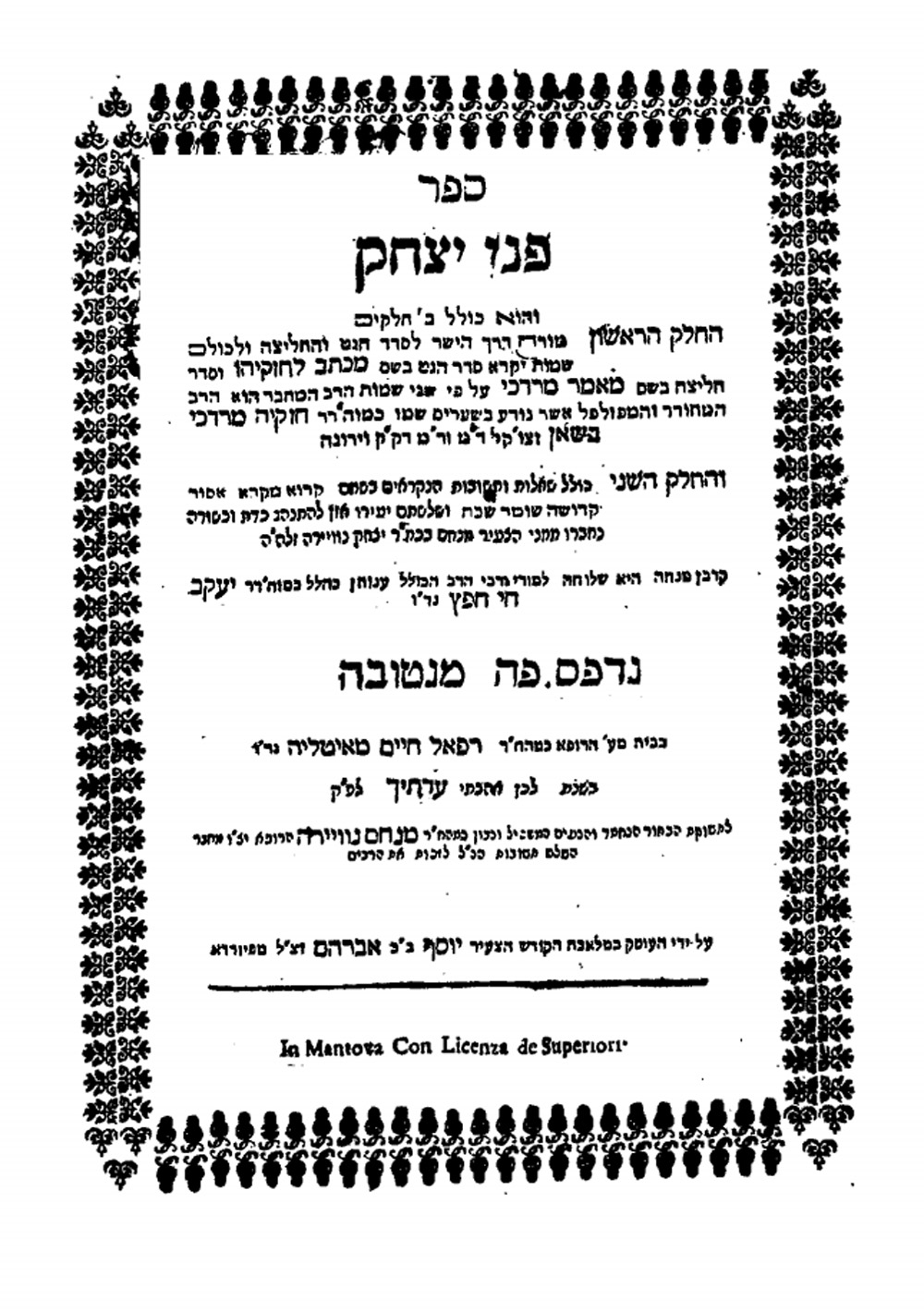
1. Regarding engaged couples having physical contact, this is actually the subject of a section of the book Penei Yitzhak by R. Hezekiah Mordechai Bassan. Here is the title page.
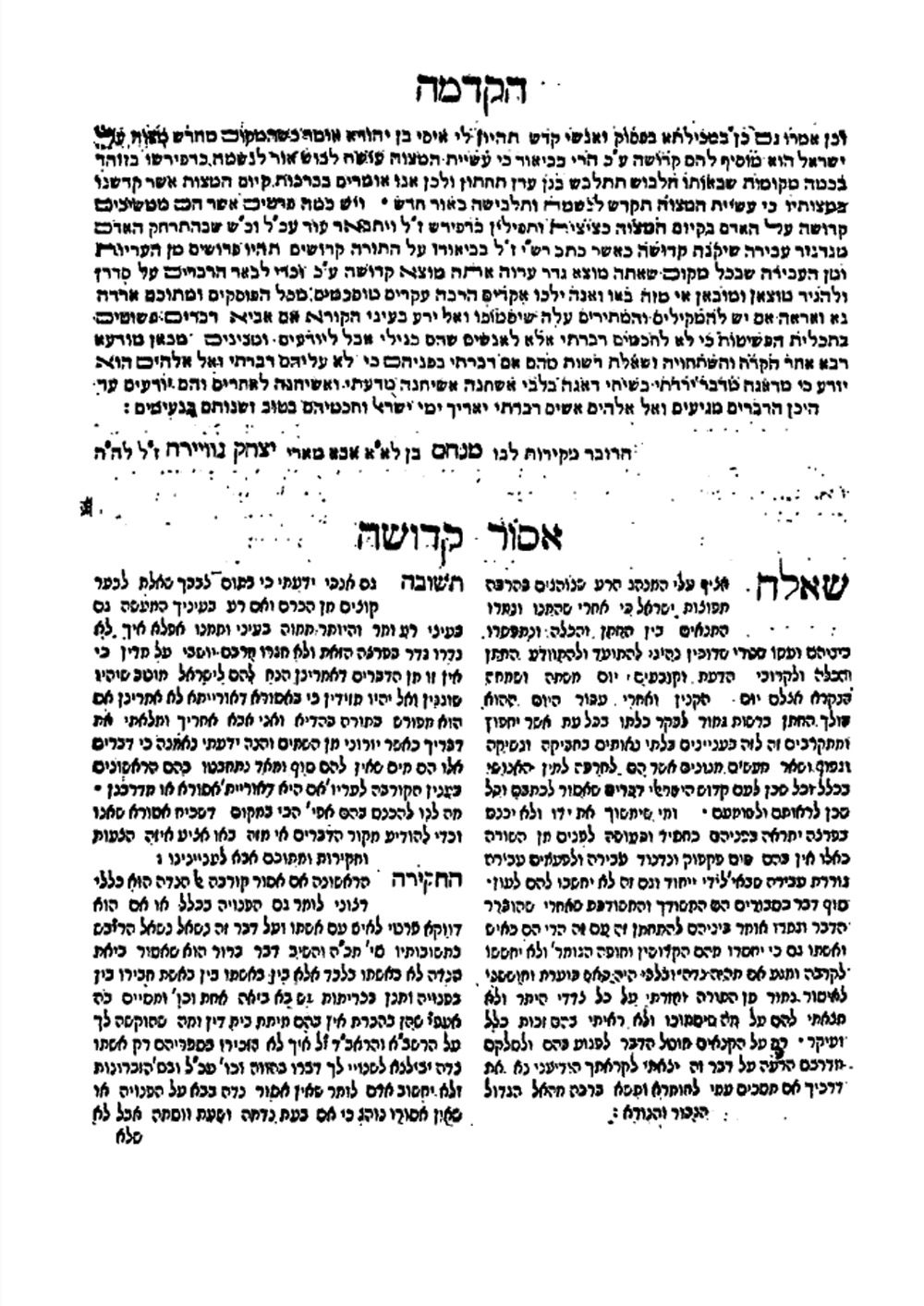
This book was published in Mantua in 1744 by Menahem Navarra who was a descendant of R. Bassan. Navarra, who was at this time a doctor, not a rabbi, was nevertheless very learned in Torah matters. (He would later be appointed rabbi of Verona.[1]) Navarra included three essays of his own in the volume, the second of which is called Issur Kedushah. In this work he criticizes members of the Jewish community for allowing engaged couples to have physical contact before marriage. Here are the first two pages of the work.
Navarra and the others I have referred to are only dealing with an engaged couple touching before marriage, but not with actual sexual relations. Yet this too is mentioned many centuries before Navarra. Ezra 2:43 and Nehemiah 7:46 refer to בני טבעות. A commentary attributed to R. Saadiah Gaon[2] explains this as follows:

בני טבעות: שקלקלו אבותם גם [צ”ל עם] ארוסותיהם קודם שיכניסו אותם לחופה והיו סומכין על קדושי טבעות ומקלקלין עם ארוסותיהן.
What this means is that after kiddushin, which was effected by aטבעת  (ring), but before actual marriage (the two used to be separated, sometimes for many months), the engaged couple would have sexual relations. The children who resulted from this were referred to negatively as בני טבעות. As S. H. Kook points out,[3] R. Saadiah’s explanation is also mentioned by R. Hai Gaon.[4]
R. Hayyim Benveniste, in seventeeth century Turkey, also speaks about how engaged couples would have physical contact. This shows again that there was a divergence between what the halakhah requires and what the people were actually doing (much like you find in a large section of Modern Orthodox society today). Here are R. Benveniste’s words:[5]
להתייחד שניהם כמו שנוהגים פה תירייא ואיזמיר, שאחר השדוכין אחר עבור קצת ימים מתייחדין החתן והכלה ומכניסים אותה לחדר וסוגרין אותן הסגר מוחלט כמו שמסגרין הנשואה אחר ז’ ברכות, מנהג כזה רע ומר הוא, ואיכא איסורא מכמה פנים . . . ועוד שנכשלים באיסור נדה, וברוב הפעמים תצא כלה לחופתה וכריסה בין שיניה, וכמה מהם הודו ולא בושו שבאים עליה שלא כדרכה. אלא א-להים הוא יודע שטרחתי הרבה לבטל מנהג זה פה תיריא ועלה בידי, ועשיתי הסכמה בחרמות ונדויים על זה, ולסבת בעלי זרוע בעלי אגרופין אשר אין פחד א-להים לנגד עיניהם חזר המנהג לסורו רע.
There are a few different points that are of interest in what R. Benveniste writes. The first is that he says that in the majority of cases the bride arrives at the huppah וכריסה בין שיניה. This means that she is pregnant. Even if there is some exaggeration here, R. Benveniste is telling us that many Jewish women were getting pregnant before marriage. Readers might recall my post here where I mentioned R. Ovadiah Bertinoro’s assertion that most Jewish brides in Palermo were pregnant at the time of their wedding.
R. Benveniste mentions how he was able to improve matters by using the power of the herem to keep people in line, but that his success was short-lived as powerful members of the community were able to undermine his authority. This shows us, just as we saw in the text I quoted from R. Eleazar Kalir, that parents were often happy when their children had physical contact before marriage, and they opposed what they regarded as the overly puritanical approach of the rabbis. When R. Benveniste refers to those who באים עליה שלא כדרכה, this means that some of the couples had a sexual relationship, but wanted the woman to be a virgin at the wedding.
R. Jonah Landsofer (Bohemia, died 1712) also testified to the problem we have been discussing:[6]
בבית ישראל ראיתי שערוריה איכה נהיית’ כזאת שאין איש שם לבו להוכיח בשער בת רבים על התקלה וקלקלת שוטי’ שקלקלו והרגלו הרגל דבר עד שנעשה טבע קיים לבלתי הרגיש ברעה אשר ימצאם באחרית הימים והוא אשר נעשה בכל יום ערוך השלחן וצפה הצפית מיום שגומרין שידוכין בין בחור ובתולה מושבים אותם יחד ומוסרי’ הבתולה לזנות בית אביה בחיבוקים ונשוקים ומעשה חידודי’ וכל הקרואים והמסובי’ מחזיקי’ בידו.
Because the masses had no interest in what the rabbis had to say about this matter, R. Landsofer concludes that one need not even rebuke them, as they won’t listen anyway. Not long ago I heard a rabbi going on about the holy communities of Europe of a few hundred years ago, about their support of Torah, the respect they gave to the rabbis, and their commitment to halakhah. All of this is true, but if you look a little closer you find that these communities were actually very much like contemporary Modern Orthodox communities, in that together with a commitment to halakhah, many people also felt that they could determine which halakhot could be ignored. Or perhaps they didn’t even think they were violating halakhah. Maybe they assumed that the rabbis were making their lives difficult with extreme humrot. Either way you look at it, it is very obvious that there were many in traditional Jewish societies who created their own standards of practice which did not always correspond to what the rabbis insisted on, and they had no interest in changing their ways because of what the rabbis were saying.[7]
While the standard rabbinic view has always been that bride and groom are not to have any physical contact until after the wedding ceremony, the rabbis in Germany were a little more lenient. Sefer Maharil records that the practice was for the bride and groom to touch before marriage, but only on the morning of the wedding, a time that also included celebration.[8]
בעלות השחר ביום הששי היה קורא השמש לבא לבה”כ . . . ומביאים הכלה וחברותיה. וכאשר תבא עד פתח חצר בה”כ הלך הרב והחשובים והיו מוליכין את החתן לקראת הכלה. והחתן תופש אותה בידו ובחיבורן יחד זורקין כל העם על גבי ראשן חטין ואומרים פרו ורבו ג”פ. והולכין יחד עד אצל פתח בה”כ ויושבין שם מעט ומוליכין הכלה לביתה.
This detail, that the groom held the bride’s hand prior to the wedding, is found in a number of other German sources.[9] I don’t know how this practice of holding the bride’s hand before the wedding ceremony can be reconciled with what appears in Tractate Kallah, ch. 1:
כלה בלא ברכה אסורה לבעלה כנדה.
The word כלה here means a woman who is betrothed but not yet married.
R. Hayyim Joseph David Azulai, Kisei Rahamim, Kallah, ch. 1, comments on this passage:
כלה בלא ברכה אסורה כלומר אפי’ לחבק או ליגע בה כנדה.
I also find it noteworthy, and strange from our perspective, that Sefer Maharil tells us that for the wedding ceremony the rabbi would bring the bride to the groom, holding her by her robe:[10]
והרב היה תופס אותה בבגדיה והוליכה והעמידה לימין החתן.
R. Israel David Margulies (19th century) cites this text from Sefer Maharil and correctly notes that in medieval times the brides were much younger than in his day. He assumes that the typical bride was under 12 and a half years old, and therefore there was no problem of impure thoughts with such brides.[11]
ואיזה הירהור יהי’ בכלה קטנה או נערה כזאת, ולכן לקח אותה הרב בעצמו אצל מפתן הבית מן יד הנשים, והביאה אל החתן ושארי הנשים נשארו ולא היה להם שום עסק בבהכ”נ ולא היה חשש הרהור במקום קדשו.
2. Recently I heard a shiur where the rabbi said that if there is a Torah or rabbinic commandment to do something, only the talmudic sages can, as an emergency measure, forbid the action. The classic example is the Sages telling us not to blow the shofar if Rosh ha-Shanah falls out on Shabbat. There is nothing controversial in what the rabbi said, and I think most would agree, even if there some exceptions to this general rule. The rabbi further noted that post-talmudic authorities cannot make gezerot as this power is also reserved for the talmudic sages. This viewpoint is shared by many, yet there are important authorities who disagree, and perhaps more significantly there is evidence of post-talmudic gezerot.
I mention this now, after Passover [this post was written a few weeks ago], since those who reviewed the laws of Pesach would have seen Shulhan Arukh 453:5 which states:
האידנא אסור ללתות בין חטים בין שעורים.
“Nowadays, it is forbidden to moisten either wheat or barley [for grinding].”
If you look at the Mishnah Berurah he explains that while the Sages forbid moistening barley because it will easily leaven, according to the Talmud it is permitted to moisten wheat. In fact, according to the Talmud, Pesahim 40a, Rava held that it is an obligation to wash the grains of wheat: מצוה ללתות.
The Mishnah Berurah explains that it is the geonim who forbid moistening wheat since we are not expert at doing it properly, and it might come to be leavened, or we might delay removing the wheat after the moistening (before grinding) and this might lead to leavening. If the geonim forbid something that the Talmud permitted (or even required), isn’t this to be regarded as a gezerah?
3. Let me now mention something relating to Sukkot, which I had hoped to post closer to the holiday, but as the rabbinic saying goes, מה שהלב חושק הזמן עושק.
Shulhan Arukh, Orah Hayyim 649:4 states:
גנות הצעירים של עובדי כוכבים וכיוצא בהם מבתי שמשיהם מותר ליטול משם לולב או שאר מינים למצוה.
[Regarding what has grown in] the gardens of the צעירים of idolators and similar [gardens] of the houses [or: buildings] of their attendants, one is permitted to take from there a lulav or the other minim for the mitzvah.
Who are the צעירים of the idolators? The Taz states that he does not know:
איני יודע פירושו, אבל הוא ענין ממשרתי עבודת אלילים.
It is not just the Taz who doesn’t know, as none of the traditional commentaries have a clue. The Feldheim English translation of the Shulhan Arukh with Mishnah Berurah (which I make use of when I provide translations) doesn’t translate the word הצעירים, and instead simply transliterates it.[12]
In fact, I  am sure that R. Joseph Karo, living in the Muslim world, did not know what the צעירים are either. You might find this a strange assertion. After all, if R. Karo recorded the halakhah, how could he not know what he was writing? However, in this case R. Karo was just recording what appears in R. Aaron Hakohen of Lunel’s Orhot Hayyim (Florence, 1750), Hilkhot Lulav, no. 8, in the name of the Ritva:
כתב הר’ יום טוב אשבילי ז”ל בשם רבו ז”ל הוי יודע שגנות הצעירים והדורסים וכיוצא בהם מבתי הכומרים אינם משמשי ע”ז ולא נויי ע”ז ופירותיהם וכל אשר בהן מותרין בהנאה ומותר ליטול משם לולב או שאר מינין למצוה עכ”ל.
From a halakhic standpoint the importance of the halakhah is that it tells us that one can take a lulav and other other minim from the garden of an idolator, and it is not important exactly what type of idolator the צעירים are.
As mentioned, the halakhah in the Shulhan Arukh is taken from the Orhot Hayyim. It is first quoted in the Beit Yosef, Orah Hayyim 649, where it cited more exactly from the Orhot Hayyim than what appears in the Shulhan Arukh:
כתוב בארחות חיים ]הל’ לולב סי’ ח[ נגות הצעירים והדורסים וכיוצא בהם מבתי הכומרים מותר ליטול משם לולב או שאר מינים למצוה.
In the Beit Yosef (and also in Orhot Hayyim) it says הצעירים והדורסים. Furthermore, instead of מבתי שמשיהם that appears in the Shulhan Arukh, we have מבתי הכומרים, which means the houses (or buildings) of the priests. I have no doubt that the the word שמשיהם is a censor’s replacement of the original הכומרים. In the first printing of the Beit Yosef, Venice 1550, the sentence quoted above appears in its entirety. Yet when the Beit Yosef was next printed, Venice 1564, the entire sentence was deleted, obviously a requirement of the censor. The Shulhan Arukh was first printed in Venice, also in 1564. It thus makes sense that the deletion of the word הכומרים is due to censorship, and it could be that it was this alteration that prevented the entire halakhah from being deleted.
Before we get to הצעירים, what is the meaning of הדורסים that appears in Orhot Hayyim and is copied in the Beit Yosef? If you look at the Ritva that the Orhot Hayyim is citing, he states:[13]
והוי יודע שגנות השעירים והדוכסים וכיוצא בהם מבתי הכומרים, אינם משמשי ע”ז ולא נויי ע”ז, ופירותיהם וכל אשר בהם מותרים בהנאה, ומותר ליטול משם לולב או שאר מינין למצוה וכן קבלנו מרבותינו ז”ל הלכה למעשה.
The first thing to notice is that instead of הצעירים we have the word השעירים. This is a clear mistake, and the editor notes that the word הצעירים appears when the passage is cited in Orhot Hayyim. Unfortunately, the editor doesn’t note that are also least two other places where in speaking about benefit from avodah zarah the Ritva refers to גנת הצעירים.[14]The text from Ritva quoted above also has, instead of הדורסים which appears in Orhot Hayyim, another strange word, הדוכסים. This means “dukes” (or noblemen, princes, rulers, etc.) and makes no sense here since the context is avodah zarah which has nothing to do with a duke’s garden.

So we now have to explain not just what צעירים means but also דורסים or דוכסים. R. Hayyim Joseph David Azulai[15] suggests that צעירים is derived from Zechariah 13:7: והשבתי ידי על הצוערים, “And I will turn my hand upon the little ones.” It is hard to see how telling us that צוערים is related to צעירים helps us to understand the point of the Shulhan Arukh. R. Azulai also refers the reader to Rashi’s commentary on Zech. 13:7:
על הצוערים: על השלטונים הצעירים מן המלכים.
Perhaps I am missing something, but I don’t see what this passage adds other than showing us thatצוערים  and צעירים mean the same thing. Why does R. Azulai have to tell us this? The wordצעיר  is found elsewhere in the Bible, so we already know what it means.
R. Azulai’s short note also refers the reader to Abarbanel’s comment to Zech. 13:7. It is Abarbanel who will help us to understand what is going on with the word צעירים. (As R. Azulai was commenting on the Shulhan Arukh, he did not attempt to explain דורסים/דוכסים which is only found in the Beit Yosef. We shall return to this word soon.)
Abarbanel writes:
והשיבותי ידי על הצוערים שראוי שיפורש כפי זה הדרך על כומרי אדום הדורשים להם אמונתם וכזביהם והם עצמם נקראים אצלם צעירים להורות על ענוותנותם ושפלותם כי בעבור שאלה חטאו והחטיאו את אחרים בלמודם ודרושותיהם [!] אמר השם שישיב ידו ומכותם עליהם.
While this passage has nothing to do with the Shulhan Arukh, R. Azulai saw the relevance of it as Abarbanel makes the connection between צוערים and צעירים as we saw already with Rashi. Abarbanel also specifically connects this to Catholic priests, telling us that these priests would call themselves צעירים as a sign of modesty.
From this we can understand that when the Shulhan Arukh refers to gardens of the צעירים he means gardens belonging to Catholic priests. But who in particular are the צעירים? To answer this question let’s return to the Beit Yosef which referred to both צעירים and דורסים/דוכסים. As already noted, this entire passage is taken from the Orhot Hayyim.
In 1902 R. Moses Schlesinger published the second volume of the Orhot Hayyim. In the introduction he included a helpful list of all the times that the Beit Yosef cites the Orhot Hayyim. When he comes to our example, p. xv, he has a note in which he cites the great Abraham Berliner[16] that the proper reading is גנות הצעירים והדורשים. In other words, instead of דורסים/דוכסים, which appears in the Ritva and the Orhot Hayyim, it should say דורשים. When he wrote the Beit Yosef, R. Joseph Karo probably just copied the word דורסים that was in his copy of the Orhot Hayyim without knowing exactly what it meant (as its exact meaning, while of interest to historians and Seforim Blog readers, is not relevant to the underlying halakhah).[17]
So what does הצעירים והדורשים mean? Berliner explains this as well (and it was actually earlier explained by Leopold Zunz[18]). The two most important medieval Catholic orders were the Franciscans and the Dominicans. The actual name of the Franciscans is the “Order of Friars Minor.” They were often called “Little Brothers” or “Minorites.” Thus, when the Ritva and Orhot Hayyim refer to the צעירים this is just the Hebrew translation of “Minorites”, i.e., the Franciscans. As Abarbanel correctly pointed out, this term was adopted as a sign of humility.[19]As for the דורשים, the meaning of this is obvious (after Berliner and Zunz have enlightened us). The actual name of the Dominicans is the “Order of Preachers,” so דורשים (preachers)=Dominicans. What the Ritva and Orhot Hayyim are telling us is that when it comes to the mitzvah of lulav, one can use that which grows in the gardens of the Franciscans and the Dominicans (and the same halakhah would apply to other Catholic orders. The monasteries would often have gardens and Jews would be able to purchase things from there.)

In Nahmanides’ Disputation[20] he too refers to theצעירים  and the דורשים.
והיו שם ההגמון וכל הגלחים וחכמי הצעירים והדורשים.
In his note, R. Hayyim Dov Chavel identifies the צעירים as the Franciscans. However, he doesn’t know that the דורשים are the Dominicans, and he therefore explains that the word means הנואמים. In his English translation, Chavel writes, “Among them were the bishop [of Barcelona] and all the priests, Franciscan scholars, and preachers.”[21]
It is noteworthy that the fifteenth-century R. Solomon ben Simeon Duran, who lived in North Africa, was apparently also unaware of the meaning of צעירים, and therefore applied it to all young Catholic religious figures, not merely Franciscans. )At least, that is what I think he means, as opposed to understanding his use ofצעיריהם  to refer to young men as a whole.) After contrasting the sexual purity of the Jews with what occurs in surrounding society, he writes, in very strong words:[22]
וצעיריהם הם כולם מטונפים בעריות מנאפים עם נשי רעיהם ובאים על הזכור והטוב שבהם מוציא שכבת זרע לבטלה בידו וזה מפורסם אצלם.
4. Since in a prior post I discussed Jacob’s love of Rachel and Leah, let me share a strange interpretation I recently found, involving love and Jacob’s brother, Esau. The general understanding is that Esau loved Isaac. Indeed, it is very difficult to read the Torah and conclude differently. Therefore, I was quite surprised to find that the medieval R. Abraham Bedersi is of the opinion that, after Isaac gave Jacob the blessing intended for Esau, not only did Esau not love Isaac, but he was ready to cause his death! This would be accomplished by killing Jacob, since Isaac’s great sorrow would bring on his end. To arrive at this interpretation, Bedersi offers a novel understanding of Gen. 27:41: יקרבו ימי אבל אבי ואהרגה את יעקב אחי. The standard understanding of these words is that when the days of mourning for his father arrive, then Esau will kill Jacob. As he didn’t want to cause his father pain, he decided to wait until he was dead to kill Jacob. However, Bedersi understands ואהרגה to mean, “when I will kill Jacob” this will cause my father to die.
Here are his words from his Hotem Tokhnit:[23]
ועשו הרשע ידוע שלא היה אוהב יצחק אביו כמו שתראה שאמר יקרבו ימי אבל אבי ואהרגה את יעקב אחי וביאור נכון בו אהרגה את יעקב אחי ובאמת יקרבו ימי אבל אבי שהוא יצטער על בנו וימות.
As mentioned, this is a strange interpretation so I Iooked around to see if I could find a similar approach. I didn’t see anything in Torah Shelemah. I looked in the ArtScroll extended commentary to Genesis (not the Stone Chumash) and it does not bring any interpretations that suggest that Esau intended to cause Isaac’s death. However, the commentary states as follows:
Ralbag interprets similarly:[24] Even if it accelerates my father’s death [lit. brings near the days of mourning for my father] I nevertheless will kill my brother Jacob (cited by Tur).
I don’t know where they got this from, as Ralbag does not say what is attributed to him. All Ralbag says is that Esau wished to kill Jacob after Isaac’s death. The Tur, who was a contemporary of Ralbag, does not cite him.
R. Abraham Bedersi’s Hotem Tokhnit focuses on Hebrew synonyms and in an era before concordances and computers would have required an enormous amount of work. It found on hebrewbooks.org, but it is not on Otzar ha-Hokhmah.

Among the many interesting things you will find in Hotem Tokhnit is that he says that unlike the word יהודי, the word עברי is only used in the Bible in the context of slavery, and he provides examples of this (p. 152). With this in mind, I can see why some people would prefer the term Mishpat Yehudi instead of Mishpat Ivri.

On p. 202  he quotes an otherwise unknown comment of Ibn Ezra that the meaning of the word סלה is “truth”.
כי ענין סלה אמת ונכונה ועל זה אמר אשרי יושבי ביתך עוד יהללוך סלה (תהלים פ”ד ה’) באמת וביושר.
Beginning on p. 1 in the second section, there is a long letter from Samuel David Luzzatto. He refers to an unnamed scholar who could not accept that Rabad, in his comment to Hilkhot Teshuvah 3:7, would say that people greater than Maimonides thought that God had a physical form. He therefore suggested changing גדולים וטובים ממנו to גדולים וטובים מעמֵנו (tzeirei under the mem).
Luzzatto completely rejects this point, arguing that גדולים וטובים מעמנו means people greater than our nation, i.e., non-Jews. Furthermore, he adds, where do we find Rabad, Rashi, etc. using the word עמנו to refer to the Jewish people.
On p. 2 Luzzatto records the following lines from one of Bedersi’s poems, in which one word summarizes each of Maimonides’ Thirteen Principles:
נמצא כיִחודו והֶבדלו                    קדמות עבודתו נבואתו
משה ותורתו אֲנצחַ                       ידע גמול גואל בהחיותו
Luzzatto also publishes a long poem from Bedersi together with Luzzatto’s commentary, without which it would be very difficult to understand much of what Bedersi was saying. One of my favorite lines is found on p. 13:
ולא תבין שפת כל-עם בשירים        לבד טרחם, כפז על גב בעירי
What this means is that poems are difficult for the masses, of every nation and language, to understand. They regard them as a burden, much like an animal, if you place gold on its back, won’t appreciate what it is carrying. It will only feel the burden of the weight.
5. Since I mentioned Mendelssohn in the last post, let me note the following. I recently saw that Eliezer Segal, in his wonderful book, Introducing Judaism (London and New York, 2009), p. 110, uses a picture of Mendelssohn. You can see it here. (Copyright prevents me from posting the picture.) We are told that the image is from the 18th century, yet there is no doubt that this is not a picture of Mendelssohn. You can look at authentic pictures of Mendelssohn here and they look nothing like this image. Incidentally, in a student’s description of Mendelssohn’s 1777 meeting with Kant, he is described as  having a goatee.[25]
6. In a comment to my last post, Maimon wrote: “On the subject of R. Bachrach’s responsum – it bears noting that the pre-reform homogeneous [should be: heterogeneous] Jewish society (especially in Germany) contained people of varying levels of observance from across the spectrum and as such many behavioral patterns that would be unthinkable in contemporary Orthodox society are detailed in the Halakhic writings from that era.” Maimon is correct, and it is not only in recent centuries or in Germany that one finds communities with people of different levels of religious observance. This is how Jewish societies have always been, in every era and place, at least until the second half of the twentieth century and the creation of haredi societies. I have already cited numerous examples that justify this statement, but let offer one more that shows how even in medieval times young men and women would socialize in a way that Maimon might say “would be unthinkable in contemporary Orthodox society.” I would only add that instead of “contemporary Orthodox society,” I prefer to say “contemporary haredi society,” since as mentioned already, Modern Orthodox society still has significant variations in level of observance. (When I speak of variations in level of observance, I have in mind bein adam la-Makom halakhot. I am not referring to halakhot having to do with monetary issues and dina de-malchuta dina, regarding which I believe the Modern Orthodox community is superior to what we find in the haredi world.)
R. Meir of Rothenburg was asked about young Jewish men and women who were drinking together. As a joke, one of the young women asked one of the men if he would betroth her. He took a ring and threw it to her, and recited the text of kiddushin. (At a future time I can discuss the halakhic arguments that R. Meir used to free the woman from having to receive a get.) One cannot overlook the fact that the way the young men and women were socializing together, much like you would find among kids at Modern Orthodox high schools, shows that there was no strict separation between the sexes. Here is the question, as it appears in Irving Agus, ed., Teshuvot Ba’alei ha-Tosafot, no. 85.

R. Meir of Rothenburg’s answer is found in She’elot u-Teshuvot Maharam mi-Rothenburg, Prague ed., no. 993.7. Two people have asked me to comment on Rabbis Yitzchok Adlerstein’s and Michael Broyde’s article here arguing that hasidic schools shouldn’t be forced to offer secular education. While the Seforim Blog is not the place for commenting on these sorts of matters, after reading the article I felt I had to make one point. Adlerstein and Broyde cite the famous Supreme Court case which allowed the Amish to opt out of secular education and they apply this logic to the hasidic communities. While it is true that if it went to court the hasidic communities would probably prevail, there is a big difference between the Amish and the hasidic communities. The Amish do not take welfare, food stamps, and other forms of government assistance. Thus, they make choices and live with the consequences. However, the hasidic communities refuse to provide their children with the basic skills needed to function in the modern economy, and as a result rely heavily on the welfare state. No one who believes in limited government and is opposed to the welfare state can support a situation where kids are allowed to grow up almost guaranteed to be in need of public assistance.[26]


[1] Regarding Navarra, see Cecil Roth, “Rabbi Menahem Navarra: His Life and Times. 1717-1777,” Jewish Quarterly Review 15 (1925), pp. 427-466.
[2] Perush al Ezra ve-Nehemiah (Oxford, 1882), p. 30.
[3] Iyunim u-Mehkarim (Jerusalem, 1959), vol. 1, p. 259.
[4] Ginzei Kedem 4 (1930), p. 52. While there is no historical evidence for this explanation, it does show that the practice of using a ring for kiddushin existed already in the geonic period. For other sources from this era, see Mordechai Margaliot, ed., Ha-Hilukim bein Anshei Mizrah u-Venei Eretz Yisrael (Jerusalem, 1938), no. 25. For a very detailed discussion of use of a ring for kiddushin, see Pardes Eliezer: Erusin ve-Nisuin (Brooklyn, 2010), vol. 4, ch. 30.
Only in Yemen did the practice of using a ring not become widely accepted (though even there it was used in some places). See R. Yitzhak Ratsaby, Shulhan Arukh ha-Mekutzar, vol. 7, pp. 27-28. There is no mention of using a ring for kiddushin in the Talmud. It does, however, appear in Tikunei Zohar, nos. 5, 10 (as pointed out by R. Moses Isserles, Shulhan Arukh Even ha-Ezer 27:1), but Tikunei Zohar does not date from the tannaitic or amoraic period. The Sefer ha-Hinukh, no. 539, says that the reason we use a ring for kiddushin is so that every time the woman looks at her hand she remembers the following things (which apply to all means of kiddushin, but wearing a ring allows her to remember them).
שהיא קנויה לאותו האיש ולא תזנה תחתיו ולא תמרוד בו ותתן לו יקר והוד לעולם כעבד לאדוניו.
Regarding what I have underlined, even if today some men like being treated like that, going into a contemporary marriage expecting to get this sort of treatment is a recipe for marital disaster.
The ring for kiddushin has nothing to do with the engagement ring. I always wondered why the practice of giving a diamond engagement ring was not condemned as hukkot ha-goyim, especially by those who have an expansive understanding of this halakhah. Even if it is not halakhically forbidden, it is clearly a practice that came from non-Jewish society. How is it that people who refuse to have anything to do with things like Mother’s Day or Thanksgiving have no problem giving a diamond ring as an engagement present? R. Chaim Rapoport pointed out to me that R. Zvi Hersh Ferber of London (d. 1966) condemned the giving of engagement rings as hukkot ha-goyim. See Kerem Tzvi: Bereishit, vol. 1, p. 132.
As for wedding rings for men, R. Meir Mazuz states that there is absolutely no problem with a man wearing a ring. See Asaf ha-Mazkir, p. 194, Bayit Ne’eman, pp. 441ff. He calls attention to Shabbat 62a, וחילופיהן באיש, from which we see that this was not regarded as a problem. He also quotes Kaf ha-Hayyim 161:31 who writes (summarizing an earlier source):
דת”ח שתורתם אומנתם וכן בעלי בתים שעוסקים במו”מ ואין להם מלאכה גרועה א”צ להסיר הטבעות בשעת נט”י אע”ג דמהדקי טובא.
R. Mazuz states that on his wedding day his father, the great R. Matzliach Mazuz, gave him a ring to wear, and that in Tunisia this was the general practice, that a groom received a ring and wore it for the rest of his life. However, upon coming to Israel R. Mazuz saw that it is not accepted for talmidei hakhamim and “fearers of heaven” to wear a ring so he stopped wearing it. (This is his language in Asaf ha-Mazkir. In Bayit Ne’eman he writes that the haredim do not wear rings.) R. Mazuz adds that he does wear the ring on the night of Passover to commemorate the words of Genesis 15:14: “Afterward shall they come out with great substance.” (“Great substance” includes jewelry.)
R. Mazuz notes that in a picture of the Moroccan sage, R. Isaac Bengualid (1777-1870), author of the responsa work Va-Yomer Yitzhak, he is wearing a ring. Here is the picture.

He also mentions a picture of R. Elijah Hazan (1848-1908) of Alexandria, author of the responsa work Ta’alumot Lev, where he is wearing a ring. I have not been able to find this picture. See also here where S. has a picture of R. Bernard Illowy wearing a ring as well as a picture of R. Samson Wertheimer’s wedding ring.
R. Hayyim Amselem, here (from May 5, 2105), writes very strongly against those who oppose wedding rings on religious grounds, using the opportunity to once again blast the Ashkenazic haredim.
איפה ההגיון הבריא?
הבוקר בעתון ישראל היום ובערוץ 7 מפרסמים בהבלטה ובהתפעלות פסק הלכה “חדש” המתיר ואפילו ממליץ בעידן המודרני לגברים נשואין לענוד טבעת נישואין, בעולם הדתי והחרדי, שוללים זאת כי זה “מנהג גוים”, לדעתם וכו’ וכו’ .
מה שהם אינם יודעים שאין כאן כל חדש ובעדות הספרדים היה זה מנהג פשוט שרבים מאוד מהגברים ענדו על ידם טבעת נשואין, או טבעת בכלל ולא היה פוצה פה ומצפצף, ידועות כמה תמונות של גדולי תורה והלכה שבאצבעם טבעת כגון תמונתו של הגאון רבי יצחק בן וואליד רב ודיין בעיר תיטואן במרוקו, וכן עוד רבנים, שכך עשו מעשה, עיין בספר אסף המזכיר עמוד קצ”ד.
מה הבעיה? הבעיה היא שהרבנים האשכנזים ובעיקר החרדים, מה שהם חושבים בדעתם שזה אסור, ובמיוחד אם זה דומה להנהגה לא “חרדית” אז זה כבר אסור וחילול השם וכו’ והם לא מסוגלים להכיל בסובלנות דעה אחרת, מה גם שהם בטוחים לגמרי שהתורה היא רק שלהם ואין לאחרים זולתם כלום, וכמובן ההמון הפשוט שומע ונוהה אחריהם בעינים עוורות.
גם אם תוכיח להם שאפילו בתלמוד כך משמע [עיין מסכת שבת (דף ס”ב ע”א)] לא יעזור כלום, ואם תעיז גם להביע את דעתך, אוי ואבוי אתה חולק על גדולי ישראל? אתה נגד “ההשקופע” החרדית, דמך בראשך.
איי איי איי איפה היהדות השפויה והמתונה נעלמה?
[5] Keneset ha-Gedolah, Even ha-Ezer 66, Tur no. 1.
[6] Meil Tzedakah, no. 19.
[7] In the prior post I gave examples of takanot forbidding an engaged man to enter the house of his fiancée. For another example from 1594 in Italy, see R. Solomon ha-Levi, Divrei Shlomo (Venice, 1594), p. 299a. R. Hayyim Palache mentions that in nineteenth-century Izmir they also proclaimed such a takanah. See Hayyim ve-Shalom, vol. 2, no. 89, Masa Hayyim, ma’arekhet shin, no. 124 (p. 27a). R. Elijah ha-Levi (16th century) of Constantinople, Zekan Aharon, no. 117, discusses the matter as well. He states that in his community there is no “evil practice” of having the engaged couple spend time together at her home, which leads to all the problems that have been mentioned.However, he notes that this was an old practice in some places in the Ottoman Empire, and therefore in order to prevent serious sins the rabbis instituted that at the engagement the wedding blessings were recited and the woman would also go to the mikveh at this time.
Regarding the engaged couple before the wedding, it is also worth noting that among some hasidic groups from the Chernobyl line, there is a festive meal, called a חתן מאהל, the evening before the wedding. At this time, the future bride and groom dance together using a long handkerchief or gartel. At the wedding itself, the practice in a number of hasidic groups (and not only among the Hasidim) is that the bride and groom dance together actually holding hands. See Pardes Eliezer: Erusin ve-Nisuin, vol. 5, p. 538; Ohel Moshe 7 (Kislev 5750), p. 67. Here are two examples of this from Youtube.

Regarding dancing while holding hands, I found something quite interesting in R. Joseph Hahn (d. 1637), Yosif Ometz (Frankfurt, 1928), p. 344:
המספר מעות לאשה כדי להסתכל בה אף על פי שמלא תורה ומעשים לא ינקה מדינה של גיהנם וכל שכן הנוגע בידה ממש, ובמחול של מצוה המדקדקים כורכים סביבות ידיהם בגד שקורין וטשינלן, ואם יודע בעצמו בודאות שלא יבא לידי הרהור שרי.
R. Hahn tells us that during a Mitzvah dance, when there are men and women dancing together, those who are careful about halakhah would wear a type of glove. This means that even if they held hands with a woman they would not touch her skin. R. Hahn says that one who knows that he will not be driven to sexual thoughts is permitted to do this.
R. Ezekiel Feivel, Toldot Adam (Jerusalem, 1987), ch. 15 (p. 215), says that R. Shlomo Zalman of Vilna (the brother of R. Hayyim of Volozhin) used to dance with brides holding their hand. A handkerchief or something other covering ensured that he didn’t touch their skin::
אחז ביד החתן ודבר עמו דברי תורה אשר זורו במזור האמת והאמונה . . . אחר כן רקד עם הכלה אחוזי יד על ידי מטפחת בנועם לב ופנים מאירות ובסדר מתוקן ונעים מאד.
R. Abraham Hayyim Schorr, Torat Hayyim: Avodah Zarah 17a, was very opposed to this practice of holding the bride’s hand, even if separated by something like a handkerchief, which he says was done by some talmidei hakhamim. (He means actually holding hands with the handkerchief ensuring that skin does not touch. He is not referring to when the man and woman each hold a different end of the handkerchief. See R. Yosef Rapoport’s letter in Or Yisrael 24 [Tamuz 5761], p. 245.)
ונר’ דאסו’ ללכת במחול עם הכלה בשבעת ימי המשתה אפי’ אינו אוחז בידה ממש אלא בהפסק מטפחת כדרך שנוהגין מקצת ת”ח שבדור הזה אפ”ה לאו שפיר עבדי.
I will deal with the larger issue of mixed dancing, and the rabbinic responses, in a future post.Regarding R. Shlomo Zalman covering his hands, we are told that he never touched the pages of a sefer with his bare hands. He always turned the pages while wearing gloves or with a handkerchief. One time he didn’t have either with him, and he turned the pages with his lips. See Toldot Adam, p. 214.

We are also told that when he slept he wore gloves in order that his bare hands not touch his body. This way when he woke up he could start studying Torah immediately without washing his hands, so careful was he not to waste even a moment away from Torah study. See Toldot Adam, p. 218. This approach of R. Shlomo Zalman ignores the main reason offered for washing in the morning, namely, that it is to remove the ruah ra’ah. Therefore, R. Hayyim Eleazar Shapira could not believe that the story of R. Shlomo Zalman wearing gloves was true. See Nimukei Orah Hayyim, 4:1


על כן אין להאמין על אותו צדיק טעות ומעשה כזה

.
See also R. Ovadiah Yosef, Yabia Omer, vol. 4, Orah Hayyim no. 2:8-9; and R. Moshe Yehudah Leib Rabinovich’s letter at the beginning of R. Zev Zicherman, Otzar Pelaot ha-Torah, vol. 1 (Brooklyn, 2014)..

[8] Ed. Spitzer (Jerusalem, 1989), p. 464.
[9] See Yaakov Yisrael Stall’s note in R. Judah he-Hasid, Sefer ha-Gematriot (Jerusalem, 2005), p. 309 n. 71. (R. Judah he-Hasid states that the groom would lift up his future bride.)
[10] Sefer Maharil, p. 465.
[11] Har Tavor (Pressburg, 1861), p. 33b. Regarding the age of Jewish brides in medieval times, See Avraham Grossman, Hasidot u-Mordot (Jerusalem, 2001), ch. 2. He makes the following interesting point (Pious and Rebellious, trans. Jonathan Chipman [Waltham, 2004], pp. 47-48):
The phenomenon of beating wives may also have been exacerbated by marriage of girls at an early age. The fact that at times the wife was extremely young led the husband to relate to her as he would to his own daughter. This was particularly true in those places where young girls were married to husbands significantly older than themselves, which was, as we have seen, a common phenomenon in Jewish society, and particularly in Muslim countries. Moreover, it may well be that the beating of the wife, which was a part of the life of the young couple, also continued thereafter.
[12] R. Yihye Moses Abudi, Magen Ba’adi (Jerusalem, 1904), vol. 2, p. 30b, also doesn’t know what the word means. What he thinks is the obvious meaning is, as we will soon see, mistaken.
ול”נ פשוט כיון שהם קורין לה גנות הגדולים אנו מכנים להם שם לגנאי לקרות להם גנות הצעירים.
[13] Hiddushei ha-Ritva: Sukkah 29b, Mossad ha-Rav Kook ed., cols. 278-279.
[14] Hiddushei ha-Ritva: Avodah Zarah 51b, Mossad ha-Rav Kook ed., col. 259; Hiddushei ha-Ritva: Rosh ha-Shanah 28a, Mossad ha-Rav Kook ed., col. 264.
[15] Birkei Yosef, Orah Hayyim 649:3. R. Moses Sofer also refers to Zech. 13:7. See the Makhon Yerushalayim ed. of Shulhan Arukh, ad loc.
[16] Abraham Berliner was an outstanding representative of German Orthodoxy. He was a member of R. Azriel Hildesheimer’s separatist Orthodox community, and he taught for many years at the Rabbinical Seminary of Berlin. Nevertheless, the annual Yerushatenu, which is devoted to the study of all aspects of German rabbinic history, prayers, customs, etc., saw fit to publish a letter which attacks Berliner and places him in what the letter-writer regards as the “anti-Torah” camp. See Yerushatenu 3 (2009), p. 396. This was an unfortunate lapse in judgment by the editors of what is otherwise a fabulous publication. The editors intended to show their open-mindedness by publishing even the nonsense of an extremist, but the job of the editors is to ensure the high quality of their publication, and this means that they have to reject that which is unsuitable.
[17] Unfortunately, the Makhon Yerushalayim edition of the Beit Yosef simply points out that instead of דורסים the text should perhaps read דוכסים. In other words, the editors were unaware that דורשים is the correct reading. Hopefully, in the next printing they will correct this matter. If they do so, based on this post, it will be my second “contribution” to this magnificent edition. Here is the Makhon Yerushalayim TurEven ha-Ezer 173, p. 539.

In note 3 at the bottom of the page it refers to a קושיא גדולה printed in the journal Or Torah in 1992 (Heshvan 5753, no. 23). This was a question I asked R. Meir Mazuz and he replied that instead of ונשא בתו the text should apparently read ונשא בת אשתו .
[18] Zur Geschichte und Literatur (Berlin, 1845), p. 181.
[19] In his defense of R. Moses Hayyim Luzzatto and his circle, R. Jacob Hazak uses the phrase גנות הצעירים to make a nice melitzah. See Iggerot Ramhal u-Venei Doro, ed., Shriki (Jerusalem, 2008), p. 357:
ואל יחשבו אותנו כמורדים וכפושעים ח”ו, וכל מי שתורת אלקיו בקרבו, ואהבתו ית’ גברה בו, ילבש בגדי קנאה ולא ישמע גנ”ות הצעירים.
[20] Kitvei Rabbenu Moshe ben Nahman, ed. Chavel, vol. 1, p. 308.
[21] Ramban: Writings and Discourses (New York, 1978), vol. 2, p. 668.
[22] Milhemet Mitzvah (Leipzig, 1855), p. 14.
[23] (Amsterdam, 1865), p. 16.
[24] The word “similarly” makes no sense here, as the commentary does not previously cite an interpretation similar to the one given by “Ralbag.”
[25] See Paul Mendes-Flohr and Jehuda Reinharz, eds., The Jew in the Modern World (Oxford, 1995), p. 61.
[26] According to the last census, Kiryas Joel has a higher percentage of residents receiving food stamps than any other city or town in the entire country. See here. The taxpayer should never be required to subsidize communities when the poverty is self-imposed.