Marc B. Shapiro: Obituary for R. Yosef Buxbaum zt”l

Obituary: R. Yosef Buxbaum zt”l
by Marc B. Shapiro

The Torah world lost a very important figure earlier this month, with the passing of R. Yosef Buxbaum at age 62. In fact, I can’t think of anyone, in the entire history of Torah publishing, who achieved as much as he.

There is a lot that can be said about Rabbi Buxbaum, but for the purposes of the Seforim blog his relevant achievement is the founding, and directing for many years, of Machon Yerushalayim. While at one time Mossad ha-Rav Kook was the center for critical editions of the rishonim, this is no longer the case. Make no mistake about it: Mossad ha-Rav Kook deserves enormous credit for its wonderful Kafih and Chavel editions as well its the critical editions of the Ritva, Ran, Rashba and others. But in recent decades Machon Yerushalayim has taken center stage in this area and truly revolutionized Torah study. This is an amazing achievement that began some forty years ago with Otzar Mefarshei ha-Talmud.

Who can learn today without the Machon Yerushalayim edition of the Tur? Only in this editions has the Tur been restored to its pristine glory. Much like the Frankel Rambam — finally completed earlier this month — is now the only acceptable edition for those who are serious about Mishneh Torah, so too the Machon Yerushalayim edition of the Tur has become a requirements for serious Torah scholars.

The Machon Yerushalayim edition of the Shulhan Arukh is also indispensable (although in this case, other publishers are also involved in producing what will be, when complete, the only reliable edition). It is possible to go on about the numerous other important works, from rishonim and acharonim, published by Machon Yerushalayim, as well as the groundbreaking journal Moriah.[1] However, I would like to call attention to what I think is Rabbi Buxbaum’s most lasting achivement, and it has to do with sociology.

It was Rabbi Buxbaum who brought a central tool of crtical scholarship, namely, the ability to edit manuscripts, to the haredi world. He also who taught the haredi world at large how to appreciate a critical edition. It is now no longer regarded as “maskilish” to produce, or use, a critical text. In fact, to repeat what I have already said, those serious about learning know that when they need to examine a responsum of the Rosh, Rashba, Rivash and so many others the Machon Yerushalayim edition is the only place to turn.

Another great achievement — and it remains to be seen if it will last — was that he was able to preside over a unity in Torah scholarship in a way not seen in the last fifty years. Much like his teacher, R. Shlomo Zalman Auerbach zt”l, was unique in that all segments of the Torah world related to with the greatest esteem, Machon Yerushalayim was also able to achieve this rare feat. Rabbi Buxbaum did this by inviting gedolim from all the different camps, and from both the Ashkenazic and Sephardic worlds, to be involved with Machon Yerushalayim. Many of them were given honorary positions in the various sections most suited for them and there was a section devoted to Sephardic Jewry, German Jewry, Hungarian Jewry, etc.

Who else but Rabbi Buxbaum would have been able to bring together in one undertaking, gedolim with such different hashkafot as R. Yitzhak Yaakov Weiss (author of SHU”T Minhat Yitzhak), R. Ovadiah Yosef (author of, among other works, SHU”T Yabia Omer and SHU”T Yehave Da’at), and R. Avraham Shapira, Rosh Yeshiva of Merkaz ha-Rav (who edited Machon Yerushalayim’s edition of Zekher Yitzchak by the gaon of Ponovezh, R. Isaac Jacob Rabinowitz).

Machon Yerushalayim, at one and the same time, has projects with the Edah Haredit, various haredi yeshivot, Yeshivat Shaalvim and Yeshiva Beit El, among others. Where else but under the auspices of Machon Yerushalayim can you find yeshiva bachurim with such divergent hashkafot engaged in the holy work of editing the writings of rishonim and acharonim?

Machon Yerushalayim’s wings extend to the Diaspora as well, and let me just note one example: The R. Yitzhak Elhanan Spektor project is being carried out together with Yeshiva University and when completed will include ten volumes.

To learn more about this incredible man whose loss must be mourned by the entire Torah world, see here (Hebrew).

Sources:
[1] Some might wish to compare Moriah with Yeshurun, and indeed they do have a lot in common. But note that while Yeshurun is more liberal than the typical haredi journal, and will thus publish writings by R. Kook, articles by contemporary gedolim of the religious-Zionist camp, not to mention leading figures of Yeshiva University, are still regarded as off limits by this publication.


The Fish Motif on Early Hebrew Title-Pages and as Pressmarks

The Fish Motif on Early Hebrew Title-Pages and as Pressmarks

by Marvin J. Heller
            Fish are a symbol replete with meaning, among them, in Judaism, representing fertility and good luck, albeit that fish are not an image that, for most, quickly comes to mind when considering Jewish iconography. Created on the fifth day of creation, fish symbolize fruitfulness, and, as Dr. Joseph Lowin informs, the month of Adar on the Hebrew calendar (February-March, Pisces) is considered “a lucky month for the Jews (mazal dagim).” He adds that in Eastern Europe people named sons Fishl as a symbol of luck, and that in the Bible, the father of Joshua is named fish, that is, Nun, which is fish in Aramaic.[1] Similarly, Ellen Frankel and Betsy Platkin Teutsch note the allusion to fertility and blessing, the former that when Jacob blesses Ephraim and Manasseh, Joseph’s sons, he says “May they multiply abundantly ve-yidgu, like fish) in the midst of the earth” (Genesis 48:16) and the latter to the Leviathan, the great sea monster the Jews will feast upon in the messianic age.[2]

Other biblical references to fish include Dagon, the fish-god of the Philistines, also worshipped elsewhere in the Middle East, mentioned several times in the Bible (Joshua15:41, 19:27; Judges 16:23; I Samuel 5:2–7; and I Chronicles 10:10).  A fish also appears in the biblical story of Jonah, a large fish (dag gadol), not the popular whale that swallowed the prophet.

            Not only Jewish sources and printers used devices that were fish related. The Medjed fish, a species of elephant fish, a medium-sized freshwater fish with a long downturned snout, abundant in the Nile, was worshipped at Oxyrhynchus in ancient Egypt and appears in Egyptian art. Fish are a not infrequent image on medieval coat of arms. Indeed, there are as many as 181 shields of salmon alone in heraldry.[3] The most well-known printer device with a fish is the anchor and dolphin of Aldus Manutius (1449-1515), albeit not strictly speaking a fish, as a dolphin is actually an aquatic marine mammal. Among the most novel of the marine pressmarks is that of the Liege printer J. M. Hovii, active during the latter half of the seventeenth century, whose mark consisted of a mermaid enwrapped about a tree with a skull at the foot of the tree.[4]

            This article is the most recent in a series describing printer’s devices and motifs appearing on the title-pages and with the colophons of early Hebrew printed books.[5] The use of the fish images described here are varied, comprised of pressmarks and full page frames which include representations of marine life. The discussion of the images and the presses are for the sixteenth into the eighteenth century. Although a number and variety of presses that that utilized marks with fish are addressed in this article they are examples only and not necessarily complete. Furthermore, the entries are expansive, that is, printers’ marks are not described in isolation but with discussions of the presses that employed them and examples of the books on which they appeared. Entries are in chronological.[6]

            As noted above, the month of Adar is, if not exactly, coterminous with the astrological sign of Pisces. That sign is represented by a pair of fish swimming in opposite directions, as fish swimming against the stream represents the powerful Pisces potential. They can be ‘sharks’ – charismatic, strong leaders with vision and clarity about leadership that can guide an entire nation, like Moses, who was also a Pisces. But those Pisces who prefer to go with the flow can be weak people who get carried away easily and are prone to addictive patterns of behavior.

Pisces is known for the holiday of Purim. According to the sages, it will be the only holiday to continue to be celebrated throughout the world after the Messiah comes. “When Adar begins, joy enters,” as the famous Hebraic phrase goes. It is a month of happiness, miracles and wonders. It affords us the ability to achieve mind over matter, to overcome our doubts, and connect to the Light.[7]

            Another compatible view of Adar and fish states that “The astral sign of Adar is the fish (Pisces). Fish are very fertile, and for that reason are seen as a sign of blessing and fruitfulness. The Hebrew word for blessing is bracha, from the root letters betreish, kaff. In Jewish numerology (gematria), the letter bet has a value of 2, reish is 200 and kaff is 20. Each of these is the first plural in their number unit. What this tells us is that the Jewish concept of ‘blessing’is intertwined with fertility, represented by the fish of Adar.”[8]

            Our first example of a pressmark with a fish is the most unusual in the article, the only device in which the fish is not only completely inconsistent with the above description but is the least prominent representation of a fish of all the pressmarks in the article. Among the earliest printers to make utilize of the fish in a pressmark is Joseph ben Jacob Shalit in Sabbioneta. Although the Sabbioneta press is commonly associated with Tobias ben Eliezer Foa, it was Shalit who appears to initially have been the motivating force behind the press and, with other partners, the provider of necessary financial support. Tobias Foa is credited with providing only the physical quarters, Duke Vespasian Gonzaga’s patronage, and limited financial assistance. Also associated with the press were Cornelius Adelkind, Vincenzo Conti, and R. Joshua Boaz Baruch, all prominent names in mid-sixteenth century Hebrew printing in Italy.

The first title printed at the press was Don Isaac ben Judah Abrabanel’s (1437-1508) Mirkevet ha‑Mishneh (1551), a commentary on Deuteronomy. Abrabanel began work on Mirkevet ha‑Mishneh when still in Lisbon, unlike the remainder of his commentary on the Torah which was written much later. Its completion was postponed, however, due to his responsibilities at the Portuguese court. The incomplete manuscript of Mirkevet ha-Mishneh was lost when Abrabanel was forced to flee Portugal in 1483. However, on his later peregrinations after the expulsion of the Jews from Spain Abrabanel came to the island of Corfu in 1493, where he serendipitously (miraculously) found a copy of the manuscript. Leaving aside other work he turned to completing this commentary, but after the departure of French troops from Naples, Abrabanel went to Monopoli (Apulia), where Mirkevet ha-Mishneh was finally completed in the first part of 1496.

The title page, dated 5311 Rosh Hodesh Sivan (Wednesday, May 16, 1551) is comprised of an architectural border with standing representations of the mythological Mars and Minerva. This border was first employed by Francesco Minizio Calvo in Rome in 1523 and as late as 1540 in Milan. This is its earliest appearance in a Hebrew book. It would be often reused and copied, appearing on the title pages of books printed as far apart as Salonika and Cracow.[9]

On the final unfoliated leaf are two devices, on the right that of Foa, a palm tree with a lion rampant on each side and affixed to the tree a Magen David, about it the verse, “The righteous flourish like the palm tree” (Psalms 92:13), all within a circle, and to the sides the letters ט and פ for Tobias Foa. On the left is Shalit’s device, a peacock standing on three rocks, facing left, with a fish in its beak within a cartouche, although Avraham Yaari, after describing the peacock with a fish, adds, in parenthesis, (or a worm?). The letters יביש about this device stand for Joseph ben Jacob Shalit. Also printed by the press that year was R. Isaac ben Moses Arama’s (c. 1420–1494) Ḥazut Kashah, on the relationship of philosophy and religion. It too has the Mars and Minerva title-page, but here the last leaf is foliated and has one pressmark only, the peacock with fish of Shalit.[10] Parenthetically, Arama too was a refugee from Spain.

Fig. 1 pressmarks of Joseph Shalit (left) and Tobias Foa (right)

The peacock with fish pressmark was reused by Shalit in Mantua at the press of Venturin Rufinelli with the colophon of several works, for example the late 10th century ethical work based on animal tales, translated from the encyclopedic Arabic Rasa`il ikhwan as-safa` wa khillan al-wafa` (Epistles of the Brethren of Purity and Loyal Friends) into Hebrew by Kalonymus ben Kalonymus (c. 1286-c. 1328) as Iggeret Ba’alei Hayyim (1557). The original is comprised of 52 eclectic volumes (pamphlets) on philosophy, religion, mathematics, logic, and music. The portion from which Iggeret Ba’alei Hayyim is taken appears at the end of the 25th book. The original was prepared by the Brethren of Purity, a secret Arab confraternity which flourished in Basra, Iraq in the second half of the tenth century. The tales themselves have an Indian origin. Four other varied works of note with the peacock with fish pressmark are R. Saadiah ben Joseph Gaon’s (882-942) Sefer ha-Tehiyyah ve-Sefer ha-Pedut (1556) on resurrection; R. Abraham ben Samuel ha-Levi ibn Hasdai’s (13th century) Ben ha-Melekh ve-ha-Nazir (1557), also based on an Indian romance and here derived from the Arabic; Berechiah ben Natronai ha-Nakdan’s (12th-13th century) Mishlei Shu’alim (1557-58) popular collection of fables, and a Haggadah with the Mars and Minerva title-page (1568).

The Shalit pressmark also appears on the title-page of several books printed in Venice at the press of Giovanni di Gara, without mention of Shalit, so that Yaari suggests he was not involved with the books but it was used simply as an ornament. Among the titles with this pressmark are R. David Kimhi’s (Radak, c. 1160-c.1235) commentary on Psalms (1566), R. Moses ben Baruch Almosnino’s (c.1515 – c.1580) Me’ammez Ko’ah (1587-88), R. Samuel ben Abraham Laniado’s (d. 1605) Keli Hemdah (1596), each with a biblical verse about the frame, and R. Aaron ibn Hayyim of Fez’s  (1545–1632) Lev Aharon (1608), this last without the biblical verses about the cartouche. The Shalit pressmark appears in various places in the books, after the introduction, by the colophon, least often on the title-page. Yaari notes that the Shalit device was also employed by Georgi di Cavilli in an Ashkenaz rite Mahzor (1568).[11]

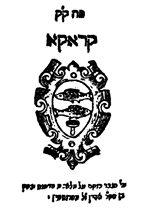
Leaving Italy, for now, and Shalit, we turn to Cracow where Isaac ben Aaron Prostitz, who together with his sons after him, printed Hebrew books for fifty years, beginning in 1569. In 1578, Prostitz printed at least three large format attractive tractates from the Talmud, Avodah ZarahKetubbot, and Rosh Ha-Shanah, the last extant in a ten folio unicum fragment in the library of the Jewish Theological Seminary. Moritz Steinschneider writes that Avodah Zarah was printed “si revera Supplementi tantum instar ad ed. Basil,” and “seu castrata . . .Cracoviae vero supplementi instar excusus,” that is, to compensate for its omission of the entire tractate from the much censored Basle Talmud.[12] Another feature of this tractate is that it is the first employ by Prostitz of the shield with two fish facing in opposite directions, the upper facing left, the lower facing right, above a printer’s inker, as his device.

Prostitz’s apparent next use of this device, this the first noted in bibliographic sources, is a Mahzor (1584) printed with the support of four partners, and reused frequently afterwards on such varied titles as Josippon (1589) at the end of the book, Avot with the commentary Derekh Hayyim by R. Judah Loew ben Bezalel (Maharal of Prague, c. 1525-16) after the introduction (1589), R. Moses ben Jacob Cordovero’s (Ramak, 1522-1570) Pardes Rimmonim (1591), between the books introductions, R. Bahya ben Joseph ibn Paquda’s (late 11th century) Hovot ha-Levavot, after the translator’s preface (1593) and R. Naphtali Hirsch ben Asher Altschuler’s (16th-17th cent.) Ayyalah Sheluha c. 1595. Pardes Rimmonim was actually printed in Cracow/Nowy Dwor, the change in location due to a serious outbreak of plague in Cracow, Prostitz and his family forced to flee to Nowy Dwor with the press’ typographical equipment. Pardes Rimmonim was completed in that location, the only Hebrew book printed in that Nowy Dwor.[13]
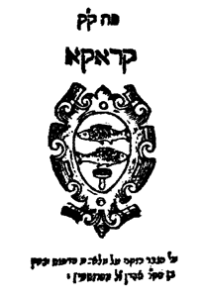
Fig. 2 Pressmark of Isaac Prostitz

Yaari questions Prostitz’s use of this pressmark. While the employ of the printer’s tool is clear, that is not the case for the fish. He suggests that it might be a propitious sign for the partners in the printing of the Mahzor in 1584, which Prostitz continued to use afterwards. This is unlikely, however, for, as we have noted, this device had been employed previously in 1578 on tractate Avodah Zarah. Another possibility is that the fish alludes to the month (Adar) in which Proztitz was born, but he then inquires why the pressmark was not used previously on all the books printed by the press. Yaari notes Steinschneider’s suggestion that the fish represented Prostitz’s entreaty for children, as his sons were borne at an old age. Here to, however, he observes that Prostitz’s four sons were born earlier, being mentioned in the colophon to Toledot Yitzhak in 1593. Another suggestion is that the fish allude to the name of R. Naphtali Hirsch ben Asher Altschuler who was known by all as Hirsch mokhir seforim (bookseller) in Lublin and for whom Prostitz printed books, for example Hovot ha-Levavot, the fish alluding to the name Naphtali, for the portion of the tribe Naphtali included the Kinneret Sea, in which fish were plentiful, but Yaari concludes this is only speculative.[14] I would question why, even if this is true for R. Altschuler, what does this have to do with Prostitiz and why he should have adopted this fish image for his pressmark?

A short lived press existed in Thannhausen, Bavaria, near Augsburg, a zoltot (supplementary festival prayers for the period between Passover and Shavu’ot) and a Mahzor (c. 1594) for the entire year according to the Ashkenaz rite were printed in the last decade of the sixteenth century. The press was a furtive effort to print Hebrew books by R. Isaac Mazia, whose name, it has been suggested, is an abbreviation for mi-zera Yehudim anusim, that is, he was of Marrano origin, or that he had served as rabbi in several communities in southern Germany, together with R. Simeon ben Judah ha-Levi of Guenzburg (Simon zur Gemze) of Frankfurt, who arranged with the Munich printer Adam Berg, to issue those works. When printing the mahzor the printers, concerned about the Christian response to sensitive passages and accusations of blasphemy, left blanks to be filled in by the purchasers.

After an examination of the still incomplete mahzorim by the censor at the University of Ingolstadt the press run of 1,500 copies was destroyed; only five copies are known to be extant today. In August, 1597, Mazia was fined 200 florin and released, while Berg, as late as 1604, was still attempting to have his impounded press returned. All of this occurred despite the fact that the authorities concurred that the mahzorim had been approved for publication by the imperial authorities in Prague. Nevertheless, the printers had neither received nor sought permission from the local authorities in Burgau to print. Moreover, as the books were for export they gave the impression that printing was done with the permission of those authorities.
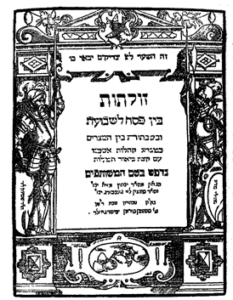
 Fig. 3b Zoltot


Fig. 3a Zoltot Extract

Both titles have a like frame comprised of an ornamental border with three entwined fish at the top (the signet of Mazia), at the sides are armed men in armor each with a shield, the right shield engraved with the name R. [Isaac] Mazia, the left with the name R. Simeon Levi. At the bottom is a laver pouring water on two hands, representative of the [Simeon] Levi. Isaac Yudlov informs that the fish here represent Isaac Mazia; this appearance of three fish as a printer’s mark is apparently unique. [15]

Not long afterwards we find the fish image employed in Lublin at the press of Zevi bar Abraham Kalonymous Jaffe. Lublin has a long and proud history as a Hebrew printing center, beginning with the press established by the family of Hayyim Shahor (Schwarz), that is, his son Isaac and his son-in-law Joseph ben Yakar. This press, through descendants and collateral members, would be active for almost a hundred and fifty years. The presses’ began publishing in 1551, with a folio Polish rite mahzor for the entire year, continuing until 1646 when a fire forced the press to close; printing resumed in 1648 when tah-ve-tat (gezerot Polania, the Chmielnicki massacres of 1648-49), broke out. That and the 1655-60 Swedish Muscovy wars, combined with others conflicts besetting the area made it impossible for Jaffe to continue and he had to close the press. Printing did resume when Solomon Zalman Jaffe ben Jacob Kalmankes of Turobin, encouraged and supported by his father, reestablished a Hebrew press. He printed 30 books until 1685 and the entire Jaffe family is credited with as many as 180 Hebrew titles.
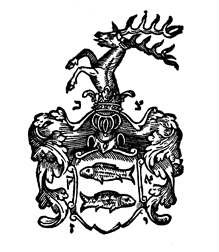
Fig. 4 Pressmark of Zevi Jaffe

A device employed by Zevi Jaffe, found on the title page of tractates in the large folio edition of the Babylonian Talmud published from 1617-1639, and after the introduction to R. Joel Sirkes’ (Bah, 1561–1640), Meishiv Nefesh, and possibly other works is a deer with raised forelegs, above a crown atop a shield with two fish, the upper facing left and the lower facing representative of the fact that he was a Levi, often accompanied by two fish, here too indicating that he was born in the month of Adar.

Among the many prominent printers of Hebrew books in Amsterdam is Uri Phoebus ben Aaron Witmund ha-Levi. He had previously worked for Immanuel Benveniste; in 1658, Uri Phoebus established his own print-shop. He would print about one hundred titles, from 1658 to 1689, the period he was active in Amsterdam, generally traditional works for the Jewish community, encompassing Bibles, prayer-books, halakhic works, haggadotaggadot, and historical treatises (Yosippon). Prostitz’s first pressmark, employed in 1569 on the title-page of R. Naphtali Hertz ben Menahem of Lemberg’s Perush le-Midrash Humash Megillot Rabbah and intermittently afterwards was a stag within a cartouche. Subsequently, Uri Phoebus employed as his device a hand pouring water from a laver, representative of the fact that he was a Levi, often accompanied by two fish, here too indicating that he was born in the month of Adar.

The first usage by Uri Phoebus of this device was in 1660 on the title-page of Ketoret ha-Mizbe’ah, R. Mordecai ben Naphtali Hirsch of Kremsier’s (d. 1670) work on the aggadic portions of tractate Berakhot dealing with the destruction of the Temple and the length of the exile. The title-page of this folio book has an arabesque frame and across the lower half of the page is Uri Phoebus’s fish mark. That device would be frequently used as a decorative ornament in many of the books that Uri Phoebus printed, placed in various locations, after introductions or the colophons.
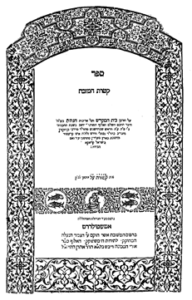
Fig. 5a Ketoret ha-Mizbe’ah

Fig. 5b Ketoret ha-Mizbe’ah Extract

Examples of the fish woodcut appears in other works, but not necessarily on the title-page, for example, in R. Hayyim ben Benjamin Ze’ev Bochner’s Or Hadash (c. 1671-75), on the laws of benedictions in a concise and abridged form, the title page of Or Hadash has an architectural frame headed by an eagle but no fish, that device being but one of several tail-pieces.

In 1662 Uri Phoebus printed an illustrated Haggadah accompanied by the commentary of R. Joseph Shalit ben Jacob Ashkenazi of Padua entitled Nimukei Yosef. The title-page of this quarto Haggadah has an architectural frame with two robed men at the sides, above winged cherubim and between them two fish with the winged head of a cherub. At the bottom are two vignettes; on the left the punishment of Shehem for the rape of Dinah and on the right the tribe of Levi killing the worshipers of the golden calf. In 1667-68, Uri Phoebus printed, also with this title-page, Nahalat Shivah (below and extract to right), R. Samuel ben David Moses ha-Levi’s (c.1625–1681) work on legal documents, particularly relating to divorce and civil matters. Nahalat Shivah has the same title-page as the Haggadah, here dated, “The Messiah ben David is coming משיח בן דוד בא (427 = 1667),” reflecting the referring to the false messiah Shabbetai Zevi. This title-page and fish crest (below) would be reused by Uri Phoebus for many years and elsewhere besides Amsterdam.

Fig. 6a Nahalat Shivah
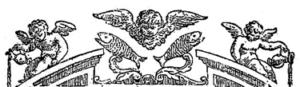
Fig.6 Nahalat Shivah Extract

Other title-pages employed by Uri Phoebus, with different architectural frames but with a like laver and fish image include such varied works as R. Jonah ben Isaac Teomim (d. 1669) of Prague’s Kikayon di-Yonah (1669-70), novellae on tractates of the Babylonian Talmud and, attributed to R. David ben Aryeh Leib of Lida (c. 1650-96) Migdal David (1680), both with the Benveniste frame; and R. Isaac Benjamin Wolf ben Eliezer Lipman (d. c. 1698), rabbi of Landsberg, Germany’s Nahalat Binyamin (1682), the first part of a commentary on the taryag [613] mitzvot and R. Shabbetai ben Meir Ha-Kohen’s (Shakh, 1621–1662) Siftei Kohen, a commentary and halakhic novellae on Shulhan Arukh Hoshen Mishpat these with a frame with rectangular shapes, all with the fish and lave at the apex.[16]  The title-page of Siftei Kohen, the first part of a commentary on the taryag [613] mitzvot dates the beginning of the work to 21 Tammuz, days of the Messiah ימי המשיח (423 = Thursday, July 26, 1663). The colophon dates completion of the work to Monday, 21 Heshvan, in the days of the Messiah בימי   המשיח (425 = November 9, 1664, actually a Sunday), both dates (Messiah) a possible allusion to Shabbbtai Zevi.[17]

Among the more elaborate title-pages is that of the first complete translation of the Bible (1676-78) into Yiddish by R. Jekuthiel ben Isaac Blitz, a rabbi from Witmund, Germany and corrector at the press of Uri Phoebus. This edition was the subject of a serious controversy with the Amsterdam printer Joseph Athias, who published an almost simultaneous and related Yiddish edition by Joseph Witzenhausen printed (Amsterdam, 1679-87).

Fig. 7a Bible – Engraved Front-piece
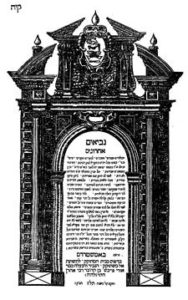
Fig. 7b Later Prophets

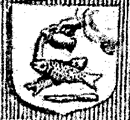
Figs. 7c, 7d Extracts

The Bible has an engraved front-piece title-page with depictions of Moses and Aaron, Mount Sinai at the top, and in the lower right hand corner a coronet and below it the raised hands of the Kohen giving a benediction. In the lower left hand corner is a fish and laver image, here the two fish are crisscrossed. The engraved title page is incorrectly dated תזל כטל (439 = 1679), whereas the like title-pages for each of the biblical divisions are correctly dated  תלז(437 = 1677), such as Later Prophets, below. The text has a separate but like title-page for Former Prophets, Later Prophets, and Writings. Note that in the otherwise like depictions of the fish and laver the position of the laver and water is reversed.

In 1689, Uri Phoebus ceased printing in Amsterdam, in order to relocate to Poland. Faced with competition from the large number of Hebrew printers in Amsterdam, Uri Phoebus felt that he would be more successful in Poland, located closer to its large Jewish population, a major market for the Hebrew printing-houses of Amsterdam. He established the first Hebrew press in Zolkiew in 1691, bringing his typographical material with him. Uri Phoebus’ descendants continued to operate Hebrew printing-presses in Poland into the twentieth century.

One of, if not the first book printed by Uri Phoebus in Zolkiew is R. Mordecai ben Moses Katz of Prostitz’s Derekh Yam ha-Talmud (1692) a super-commentary on the Hiddushei Halakhot of R. Samuel Eliezer ben Judah ha-Levi Edels (Maharsha). The title-page of this small work (40: 8ff.), much worn, appears to be the Benveniste frame, but at the apex is the same fish image as at the apex of Siftei Kohen. Among the decorative material, after the introduction and after the colophon is Uri Phoebus’ four fish mark, one on each side facing a laver from which water is being poured.

Among the other works published by Uri Phoebus in Zolkiew with the Nahalat Shivah title page reproduced above, is R. Jekuthiel ben Solomon Zalman ha-Levi Suesskind’s Dat Yekuthiel (1696,), a concise (80: 16 ff.) versified enumeration of the taryag mitzvoth (613 commandments). After the approbations to Dat Yekuthiel, there are thirteen, is the press mark comprised of four fish and laver. The title-page informs that the manuscript was found by Jekuthiel’s son Jonah of Kalish in his father’s bag, and arranged and brought to press by his grandson Menahem Feibush.

After the approbations is a letter from Jekuthiel to his son Eliezer. Jekuthiel, who was incarcerated at the time, in which he writes from his dark cell of his painful existence, where he had “wormwood, and gall to drink” (cf. Jeremiah 9:14) until “‘My soul is weary of my life’ (Job 10:1) ‘and my soul became impatient’ (Zechariah 11:8) to die in this way with this ‘light bread’ (Numbers 21:5) that I eat, absorbed in all my limbs, ‘the bread of adversity, and the water of affliction’” (Isaiah 30:20). Jekuthiel continues, describing his hardships, and then writes, “I will pay my vows to the Lord” (Psalms 116:14, 18) and that he took “of that which came to my hand a (new) offering” (cf. Genesis 32:14) on the taryag mitzvot. He thought to write on them in verse, “parallel, one with the other” (Exodus 26:17, 36:22), in single stanzas to the end, in the order of the Torah with references to the Hamishah Homshei Torah in the margins. Jekuthiel tells his son to take this as his blessing, which will be for a remembrance for both of them.

Uri Phoebus passed away in c. 1705.[18] He was succeeded in Zolkiew by his son Hayyim David, who had assisted his father at the press. Unfortunately, Hayyim David died shortly after his father, leaving the print-shop, in turn, to his sons, Aaron and Gershon. Uri Phoebus’ descendants continued to operate Hebrew printing-presses in Poland into the twentieth century. Aaron and Gershon did not use the ornamental material brought by Uri Phoebus to Zolkiew, instead preparing new frames that also reflected that they were Levi’im, and employed on such small format books as R. Raphael Lonzano’s Kinyan Avraham (1723) and R. Meir ben Levi’s Likkutei Shoshanim (1727). This ornate frame continued to be used by their descendants, among them Judah Solomon Yarsh Rappaport in Lvov on a Shir ha-Shirim with the commentary Magishi Minhah (1817) in Lvov.[19]
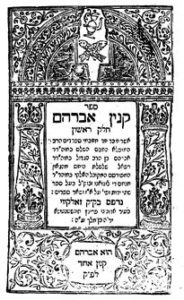
Fig. 8a Kinyan Avraham
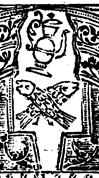
Fig. 8b Kinyan Avraham Extract

            Turning to, Germany, we find two fish, here facing in the same direction, on a title-page with an architectural pillared title-page, and at the bottom a palm tree, about it on the left a crab facing right and on the right two fish, both facing left, the former the sign of Tammuz (Cancer, scorpio), and, as already well noted, the latter the sign of Adar. The two zodiacal emblems may have had a personal significance, but, as Yosef Hayyim Yerushalmi observes describing a slightly later usage “the significance of this combination is difficult to ascertain.[20]

First employed in Fuerth by Joseph ben Solomon Zalman Schneur and his sons from 1691 through 1698, beginning with Torat Kohanim, and other folio volumes, primarily from the Shulhan Arukh, a like frame was subsequently used by Aaron ben Uri Lippman Frankel beginning with a Haggadah, in Sulzbach (below). Aaron was active in Sulzbach from the mid-1690’s until he passed away in 1720 at the age of seventy-five, first utilizing the fish image on a Mahzor printed in 1699 and afterwards in his folio imprints. Among those titles is a Haggadah (1711) with an attractive engraved copperplate front-piece (but without fish) followed by the second architectural pillared title-page described above. The architectural title-page was subsequently reused in Feurth by Hayyim ben Zevi Hirsch, who is credited with printing as many as 164 titles in that location, among the works with this frame and fish mark are several Haggadot (1746, 1752, and 1756).[21]
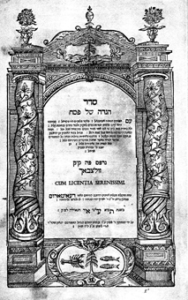
Fig. 9a Aaron ben Uri Lippman Frankel
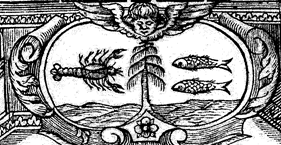
Fig. 9b Aaron ben Uri Lippman Frankel Extract

The site of yet another press that employed fish on the title-page, here apparently once only, was in Wandsbeck, a borough in north-west Hamburg in Schleswig-Holstein. The first printed books in Wandsbeck are dated to the late sixteenth and early seventeenth centuries, beginning with the Astronomiae instauratae Mechanica of Tycho Brahe (1546-1601), the famous Danish astronomer, published in 1598 by the printer Phillip van Ohr. Hebrew printing in Wandsbeck is a later occurrence, beginning approximately a century after its non-Jewish counterparts. It flourished for a brief period, primarily, albeit not solely, at the press of Israel ben Abraham.[22] The Thesaurus of the Hebrew Book enumerates forty-four titles from 1688 through 1744, several of which, including the titles previous to Israel’s sojourn in Wandsbeck, are listed as doubtful and includes duplicates as well.[23]

Israel ben Abraham was a proselyte who, reputedly, had previously been a Catholic priest. After his conversion Israel eschewed the sobriquets common among converts such as Avinu or the Ger (convert). Israel converted to Judaism in Amsterdam, where he wrote a Yiddish-Hebrew grammar Mafte’ach Leshon ha-Kodesh (Amsterdam, 1713). In 1716, after leaving Amsterdam, Israel ben Abraham acquired the typographical equipment belonging to Moses Benjamin Wulff, the court Jew in Dessau, and printed in Koethen, Jessnitz, and then in Wandsbeck from 1726-33, returning, after a brief retirement, to Jessnitz in 1739, printing a small number of titles to 1744.
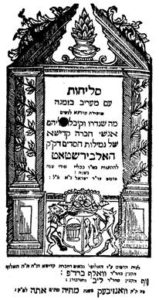
Fig. 10a Selihot with ma’ariv be-zemanah
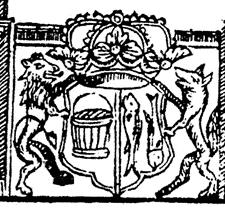
Fig. 10b Selihot with ma’ariv be-zemanah Extract

Selihot with ma’ariv be-zemanah (evening prayers in its time) is one of if not the first dated book attributed to Israel ben Abraham in Wandsbeck; it is a small octavo book (80: 7, 9, [4], 10-13, 13-23, [3] ff.). Its distinct title-page states that it is a Selihot with ma’ariv be-zemanah and that it contains matter pertaining to women; it informs that it was printed “as vowed and accepted upon themselves by the men of the hevra kaddisha (burial society) of the gemilut hasadim (charitable association) of HALBERSTADT,” and that it was “brought to press by the heads, the officers of the hevra kaddisha, R. Wulff and the noble R. Leib Warburg.” The title-page is dated in the year “You resuscitate the dead מחיה מתים אתה (469 = 1709),” a misdate, as noted by Moritz Steinschneider, who rejects the 1709 date (non admittunt; recusus ergo . . .) and dates it to 1730?[24]  At the bottom of the title-page are images of a lion at the left supporting a signet enclosing a pail, at the right a wolf supporting on the right side of the signet, two vertical fish, facing in different directions. The symbolism of these images is not clear, although it might be related to Wulff and Warburg, prominent contemporary family names.

The most dramatic, eye catching title-page with a fish motif was printed in Bad Homburg vor der Höhe at the press of Aaron ben Zevi Hirsch of Dessau. This Homburg is the district town of the Hochtaunuskreis, Hesse, Germany, on the southern slope of the Taunus, bordering, among others, Frankfurt am Main and Oberursel.[25] The title-page appears on successive editions of R. Meir ben Jacob ha-Kohen Schiff’s (Maharam Schiff, 1605-41, var. 1608-44) Hiddushei Halakhot, novellae on tractates of the Talmud, printed in Homburg in 1737, 1741, and 1747. Maharam Schiff, scion of a distinguished rabbinic family, a prodigy, was appointed rabbi of the important city of Fulda at the age of 17, where he was also served as a Rosh Yeshivah. There is a tradition that he was appointed rabbi of Prague in 1641, but if, as his grandson, who brought his works to press, reports, that he lived only 36 years, Maharam Schiff must have passed away immediately after his appointment. Maharam Schiff’s novellae are highly regarded and are reprinted in standard editions of the Talmud.[26]

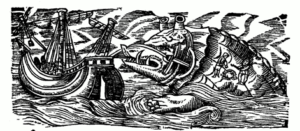
The title-page has a four part frame, the top image of a fish (sea creature) attacking a ship and within the fish two men, apparently roasting a small fish (?). Below the fish (sea creature) appears to be the face of a man. On the other editions the other portions of the frame are varied. A. M. Habermann, in his work on Hebrew title-pages describes the top portion of the frame as mythological.[27]
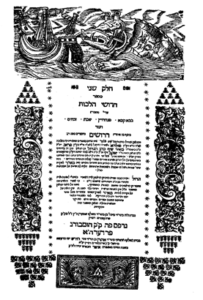
Fig. 11 1741, Hiddushei Halakhot

Returning to Amsterdam, an edition of Avot de-Rabbi Nathan with the commentary Ahavat Hesed (1777) by R. Abraham ben Samuel Witmond (1696-1773), also the author of novellae on the Pentateuch and Babylonian Talmud (1734). Avot de-Rabbi Nathan is one of the minor tractates, fourteen (fifteen, depending upon the enumeration) minor non-canonical tractates of the Talmud today appended to Seder Nezikin. It is an ethical work, considered a supplement to or a further development of Avot but with much aggadic material not related to the Mishnah, suggestive of an aggadic midrash. Ahavat Hesed was published posthumously by Witmond’s son-in-law and grandson at the press of Gerard Johann Janson. The header and place of publication on the title-page are printed in an oversized font in red letters. At the bottom of the page is a pressmark
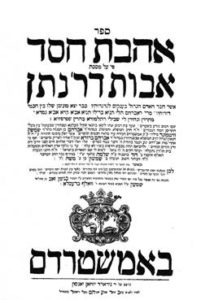
Fig. 12a Ahavat Hesed

Fig. 12b Ahavat Hesed Extract

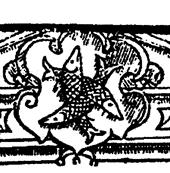
At the bottom of the title-page is a shield with topped by a coronet and within it on the right are two fish facing in opposite directions, above them the sun, moon, and a star, and above them the phrase “and (Samson) said, [O Lord God,] remember me, I pray you, and strengthen me” (Judges 16:28); on the left a hand holding a pail above water, again above the sun, moon, and a star, and above the phrase “And David blessed the Lord” (I Chronicles 29:10). Yaari informs that the two phrases, allude to Witmond’s son-in-law, R. David, son of the late Solomon Bloch, together with the author’s grandson, Samson ben Moses, who brought the book to press. Furthermore, the fish refer to Samson ben Moses, born in the month of Adar, the sign of which is a fish, and the pail refers to his son-in-law David, born in the month of Shevat, that month’s sign being a pail.[28]

            The fish image, replete with its symbolism of fertility and good fortune, continued to be used in Jewish imagery and pressmarks. Indeed, shortly after its appearance on Ahavat Hesed it was again employed, if only occasionally, on the title-page of works from another Amsterdam printer, this into the nineteenth century. The usage over centuries depicted here attest to the popularity and power of the fish image, persisting to the present.
[1] Joseph Lowin, “Hebrew Root Word [D-Y-G]” Jewish Heritage on Line Magazine, http://www.jhom.com/topics/fish/lowin.html.
[2] Ellen Frankel and Betsy Platkin Teutsch, The Encyclopedia of Jewish Symbols) Northvale, London, 1995), p. 55.
[3] https://commons.wikimedia.org/wiki/Category:Salmons_in_heraldry
[4] W. Roberts, Printers’ Marks. A Chapter in the History of Typography, (London, 1893), pp. 201-02.
[5] Previous articles in this series are “Mirror-image Monograms as Printers’ Devices on the Title Pages of Hebrew Books Printed in the Seventeenth and Eighteenth Centuries,” Printing History 40 (Rochester, N. Y., 2000), pp. 2-11, reprinted in Studies in the Making of the Early Hebrew Book (Brill, Leiden/Boston, 2008), pp. 33-43; “The Cover Design, ‘The Printer’s Mark of Marc Antonio Giustiniani and the Printing Houses that Utilized It,’” Library Quarterly, 71:3 (Chicago, July, 2001), pp. 383-89, reprinted in Studies, pp. 44-53; “Mars and Minerva on the Hebrew Title Page,” The Papers of the Bibliographical Society of America 98:3 (New York, N. Y., 2004), pp. 269-92, reprinted in Studies, pp. 1-17; “The Bear Motif on Eighteenth Century Hebrew Books” The Papers of the Bibliographical Society of America 102:3 (New York, N. Y., 2008), pp. 341-61, reprinted in Further Studies in the Making of the Early Hebrew Book (Brill, Leiden/Boston, 2013), pp. 57-76; “Akedat Yitzhak (the Binding of Isaac) on the Title-Pages of Early Hebrew Books,” in Further Studies, pp. 35-56; “The Eagle Motif on 16th and 17th Century Hebrew Books,” Printing History, NS 17 (Syracuse, 2015), pp. 16-40; “The Lion Motif on Early Hebrew Title-Pages and Pressmarks,” (Printing History, NS 22, (Syracuse, 2015), pp. 53-71.
[6] Among the primary sources for this article are my The Sixteenth Century Hebrew Book: An Abridged Thesaurus (Brill, Leiden, 2004) and my The Seventeenth Century Hebrew Book: An Abridged Thesaurus. Brill, Leiden/Boston, 2011, and Avraham Yaari, Hebrew Printers’ Marks From the Beginning of Hebrew Printing to the End of the 19th Century, (Jerusalem, 1943), Hebrew with English introduction.
[7] Kabbalah Centre, https://livingwisdom.kabbalah.com/pisces-adar.
[8] Aish.com, http://www.aish.com/h/pur/b/The_Choice_of_Adar.html.
[9] Concerning the widespread use of this frame see my “Mars and Minerva on the Hebrew Title Page,” noted above.
[10] Yaari, Hebrew Printers’ Marks, pp. 12, 132 no. 19.
[11] Yaari, p. 132.
[12] Moritz Steinschneider, Catalogus Liborium Hebraeorum in Bibliotheca Bodleiana (Berlin, 1852-60), col. 220 n. 1407, col. 228 n. 1427.
[13] Nowy Dwor, Polish for ‘new manor’, is the prefix of several locations with that title. Another Nowy Dwor, Nowy Dwor Mazowiecki, was home to a Hebrew press in the late eighteenth – early nineteenth centuries, printing a significant number of Hebrew titles from 1781 through 1818.
[14] Yaari, pp. 26, 139 no. 42.
[15] A. M. Haberman, Title Pages of Hebrew Books (Safed, 1969), pp.m 48,129 no. 34; Isaac Yudlov, Hebrew Printers’ Marks: Fifty-Four Emblems and Marks if Hebrew Printers and Authors (Jeruslaem, 2001), pp. 36-40 [Hebrew]. He also informs that three small fish are the mark of the Gronim family of Prague in the sixteenth century, appearing on their headstones.
[16] Concerning Lida and Migdal David see my“David ben Aryeh Leib of Lida and his Migdal David: Accusations of Plagiarism in Eighteenth Century Amsterdam,” Shofar 19:2 (West Lafayette, Ind., 2001), pp. 117-28, reprinted in Studies in the Making of the Early Hebrew Book, pp. 191-205.
[17] Another work refering to Shabbetai Zevi noted by Ch. B. Friedberg, History of Hebrew Typography of the following Cities in Europe: Amsterdam, Antwerp, Avignon, Basle, Carlsruhe, Cleve, Coethen, Constance, Dessau, Deyhernfurt, Halle, Isny, Jessnitz, Leyden, London, Metz, Strasbourg, Thiengen, Vienna, Zurich. From its beginning in the year 1516 (Antwerp, 1937), p. 29 [Hebrew] published by Uri Phoebus is Tikkun Keria with a depiction of Shabbetai Zevi “sitting upon a throne, high and lifted up” (Isaiah 6:1).
[18] Ch. B. Friedberg, History of Hebrew Typography in Poland from the beginning of the year 1534, and its development up to our days . . . Second Edition, Enlarged, improved and revised from the sources (Tel Aviv, 1950), p. 64 [Hebrew] and Yaari, p. 158, date Uri Phoebus death to 1705. L. Fuks and R. G. In contrast, Fuks-Mansfeld, Hebrew Typography in the Northern Netherlands 1585 – 1815, II (Leiden, 1984), p. 242, writes that although Uri Phoebus was very productive in Zolkiew, he returned to Amsterdam in 1705, where, in 1710, he wrote “a short history of the first settlement of the Sephardic Jews in Amsterdam,” and where he died on 23 Shevat 5475 (17 January, 1715).
[19] Yaari, p. 158.
[20] Yosef Hayyim Yerushalmi, Haggadah and History, A Panorama in Facsimiles of Five Centuries of the Printed Haggadah from the Collections of Harvard University  and the Jewish Theological Society of America, (Philadelphia, 1976), plates 64, 65.
[21] Yeshayahu Vinograd, Thesaurus of the Hebrew Book. Listing of Books Printed in Hebrew Letters Since the Beginning of Printing circa 1469 through 1863 I (Jerusalem, 1993-95), I, p. 450 [Hebrew]; Yaari, pp. 51, 152-52 no, 82; Yudlov, pp. 59-61
[22] Concerning Hebrew printing in Wandsbeck see Marvin J. Heller, “Israel ben Abraham, his Hebrew Printing-Press in Wandsbeck, and the Books he Published,” Further Studies in the Making of the Early Hebrew Book (Brill, Leiden/Boston, 2013), pp. 169-93.
[23] Vinograd, II, pp. 168-69.
[24] Steinschneider, cols. 2792-93 no. 7517, 446-47 no. 2939.
[25] Concerning Hebrew printing in Homburg see my “Early Hebrew Printing in Bad Homburg vor der Höhe,” in progress.
[26] Itzhak Alfassi, “Schiff, Meir ben Jacob Ha-Kohen,” Encyclopaedia Judaica, (Detroit, 2007) vol. 18, p. 131; Mordechai Margalioth, ed. Encyclopedia of Great Men in Israel IV (Tel Aviv, 1986), col. 1028-29 [Hebrew].
[27] A. M. Habermann, Title Pages of Hebrew Books (Tel Aviv, 1969), pp. 104, 134 no. 88 [Hebrew].
[28] Marvin J. Heller, Printing the Talmud: A History of the Printed Editions of the Talmud from the mid-17th Century to the end of the 18th Century and the Presses that published them (Brill: forthcoming); Yaari, Hebrew Printers’ Marks, pp. 89, 169-70 no. 145.


Gems from Rav Herzog’s Archive (Part 1 of 2): Giyus, Professor Lieberman and More

Gems from Rav Herzog’s Archive (Part 1 of 2):
Giyus, Professor Lieberman and More
By Yaacov Sasson
A tremendous resource that will be of great interest to Seforim Blog’s readers has been made available to the public. The entire archive of the great Rav Yitzchak Eizik Halevi Herzog, Ashkenazi Chief Rabbi of Israel, has been scanned and is now available online.[1] The archive contains hundreds of files on a wide range of topics, including Rav Herzog’s Piskei Halacha and Torah novellae, extensive correspondence on Israeli politics, Rav Herzog’s efforts to save Jews of Europe, and much more. Each file is dedicated to a specific topic, and many of these files contain upwards of a hundred pages of material. In short, the archive is a veritable treasure trove, and will be of great interest to those who are students of Torah, Halacha and Jewish history. Much of Rav Herzog’s Torah has been published in his numerous seforim; however, there is a significant amount of unpublished material in the archive. The purpose of this article is to make readers aware of some of the gems found in the archive, in particular the significant unpublished material. I have only begun to look through the vast amount of material that is available, and I am certain that there is much more to be found. The following are a select number of documents and files that I think will be of interest to the Seforim blog’s readers.
Giyus Bnai Yeshivot
The archive contains an entire file dedicated to the always controversial issue of giyus bnai yeshivot, whether yeshiva students ought to be drafted to the army or exempted from the draft.[2] Within this file, there is an approximately 50-page kuntres written by Rav Herzog in 1948, dedicated to a halachic analysis of the topic. To the best of my knowledge, this very significant kuntres was never published, and it does not appear in any of Rav Herzog’s seforim.[3]
Rav Herzog addresses the issue in an extremely thorough manner, and deals with a wide variety of relevant sources and issues, such as the definition of milchemet mitzvah, and the words of the Rambam at the end of Hilchot Shemita VeYovel, among other issues. For example, on page 27, he discusses the possibility of milchemet mitzvah in the absence of a king, and concludes that milchemet mitzvah is still possible if the community of Jews living in Eretz Yisrael approves of the war. On page 12, Rav Herzog suggests, based on a diyuk, that the Rambam’s words at the end of Hilchot Shemita VeYovel exempting talmidei chachamim from waging war do not apply to a war of ezrat yisrael miyad tzar. (A similar reading of the Rambam was suggested by Rav Aharon Lichtenstein, in “The Ideology of Hesder” (Tradition Fall 1981), and was reprinted in Leaves of Faith Volume 1.) Rav Herzog also makes a fascinating contention (on page 2), that the British were the current-day manifestation of Esav, putting forward their split hoof and hypocritically claiming to seek justice, while quietly attempting to undermine the Jewish cause by supporting their enemies. It is obviously not feasible to summarize a 50 page kuntres in a single blog post; I will simply present Rav Herzog’s main conclusion. Rav Herzog suggests (pages 12 and 34) that yeshiva students should not be subject to giyus malei, full conscription, even during wartime. Rather, they should be subject to giyus chelki, partial conscription of a few hours a week, doing what Rav Herzog terms “hishtatfut” in the war effort, such as local shemira and the like.
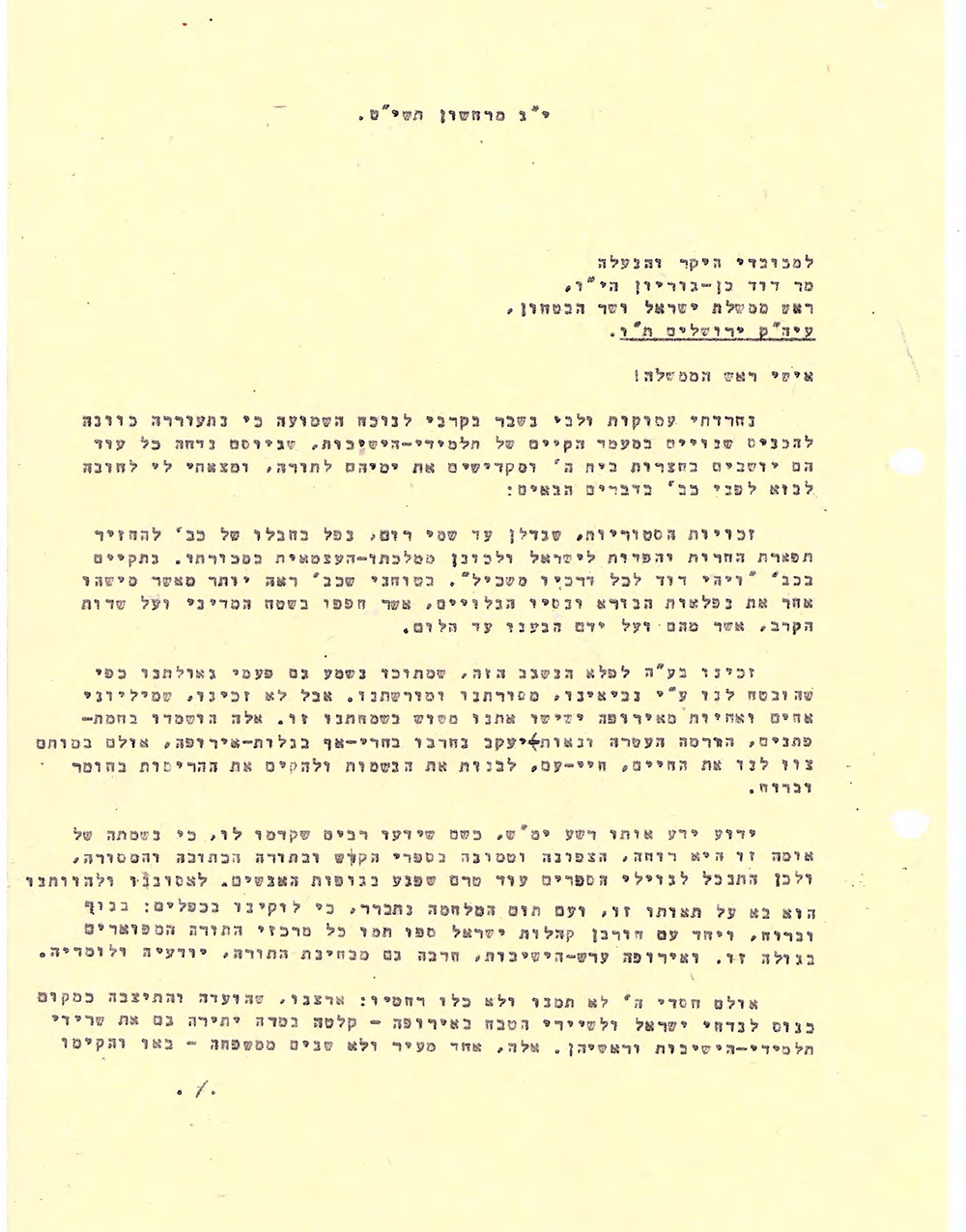
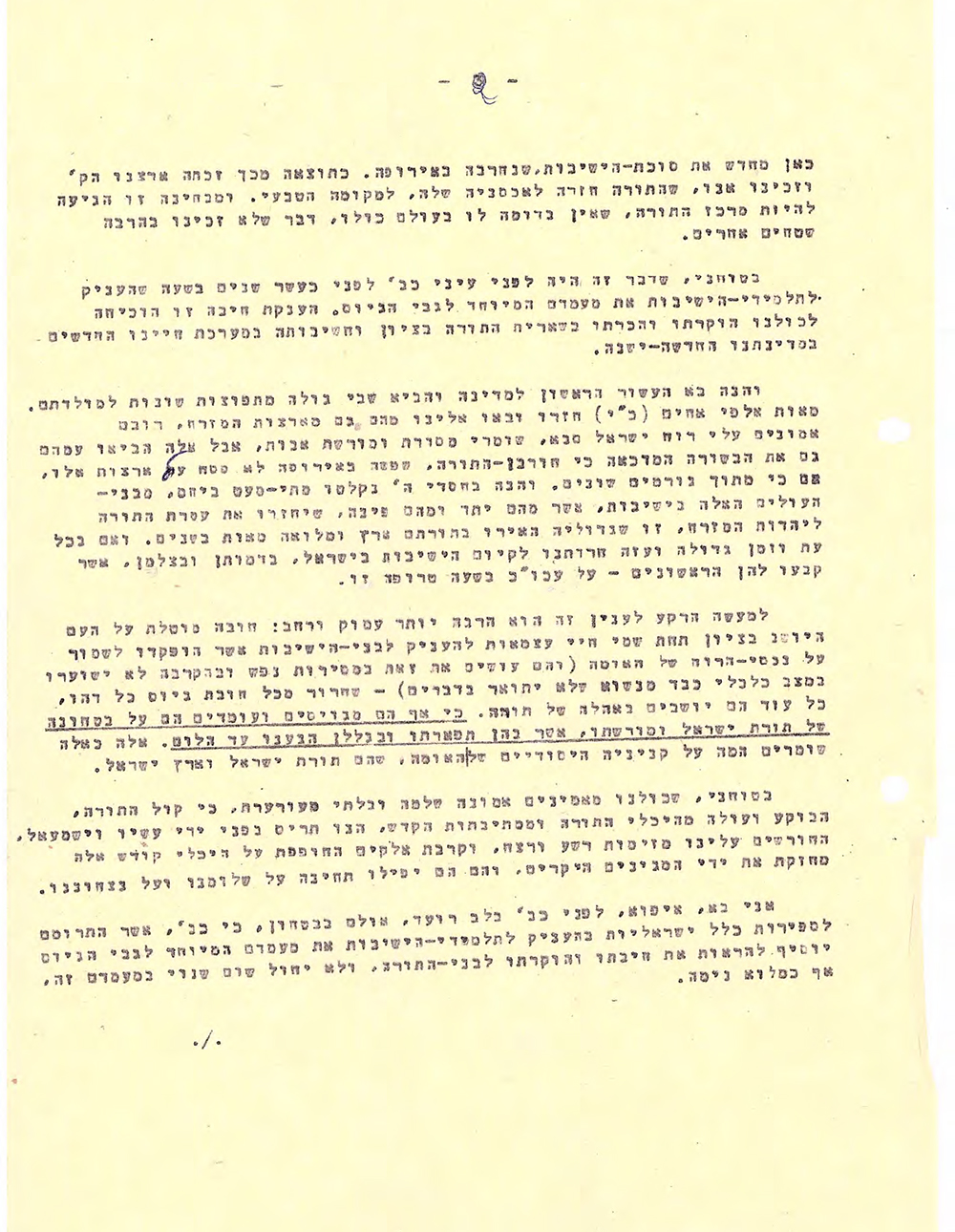
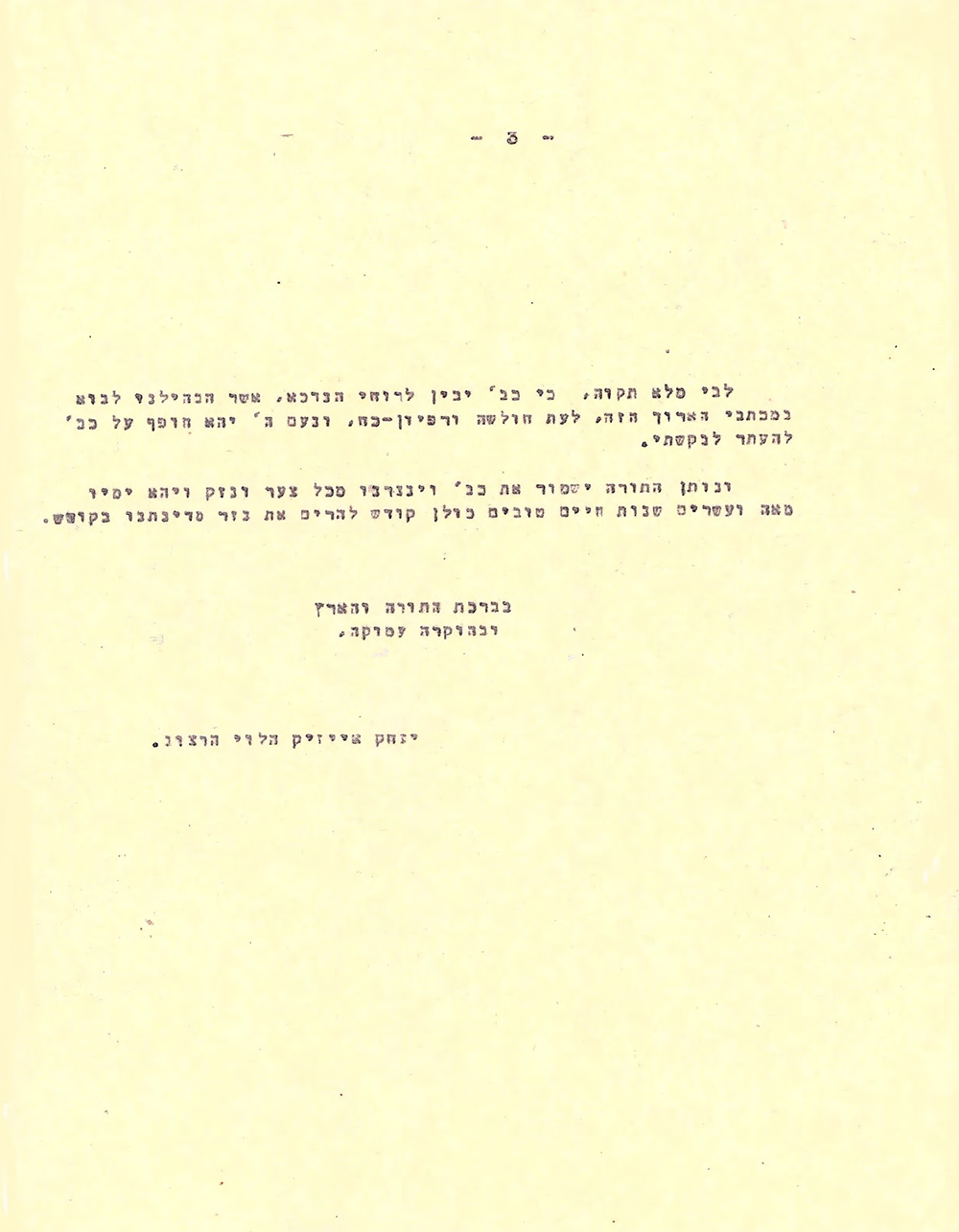
While this was Rav Herzog’s halachic conclusion in the kuntres, when the issue of forced conscription became a potential reality ten years later, Rav Herzog sent a heartfelt letter to Ben-Gurion, pleading for the exemption of bnai yeshivot, since they are already conscripted to the security of Torah and the heritage of Am Yisrael, and their Torah learning is a shield for Am Yisrael. This letter, which is found in the file of Rav Herzog’s correspondence with Ben-Gurion[4], appears below:

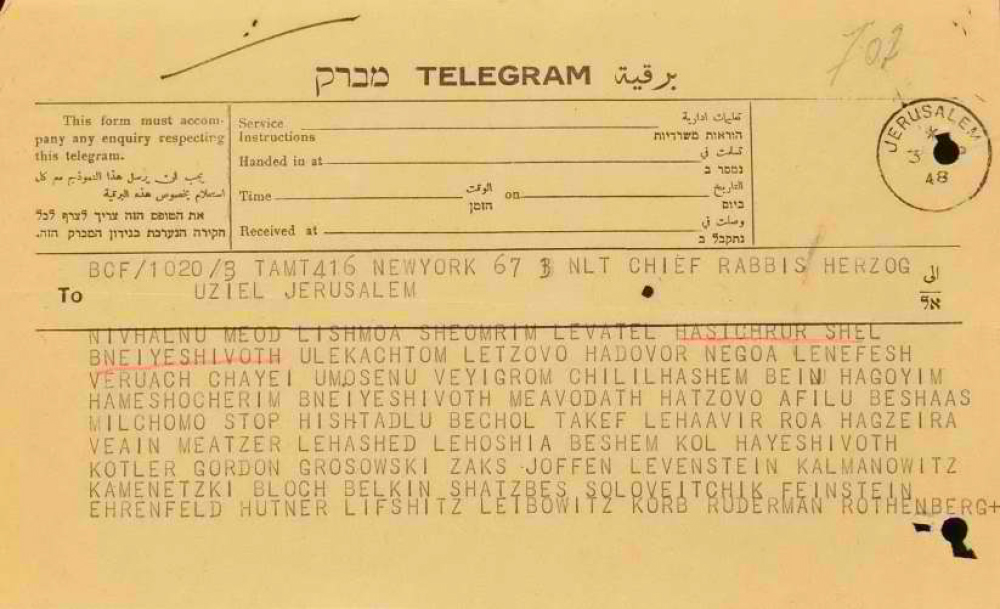
Another noteworthy document in the file on giyus bnai yeshivot is a 1948 telegram from the Roshei Yeshiva of the American yeshivot, expressing their shock at the possibility of giyus bnai yeshivot, and urging Rav Herzog and Rav Uziel to make sure that bnai yeshivot remain exempt from army service. The telegram appears below, as well as my transcription of the telegram into Hebrew:
נבהלנו מאד לשמוע שאומרים לבטל השחרור של בני ישיבות ולקחתם לצבאהדבר נוגע לנפש ורוח חיי אומתנו ויגרום חילול השם בין הגויים המשחררים בני ישיבות מעבודת הצבא אפילו בשעת מלחמההשתדלו בכל תוקף להעביר רוע הגזירהואין מעצר להש[םלהושיעבשם כל הישיבות,

Kotler Gordon Grosowski Zaks Joffen Levenstein Kalmanowitz Kamenetzki Bloch Belkin Shatz[k]es Soloveitchik Feinstein Ehrenfeld Hutner Lifshitz Leibowitz Korb Ruderman Rothenberg[5]
The telegram is especially noteworthy because of the appearance of the names of the Charedi Roshei Yeshiva, such as Rav Aharon Kotler, Rav Reuven Grozovsky, Rav Moshe Feinstein etc. together with the names of the more modern Roshei Yeshiva of RIETS: the Rav, Rav Yosef Dov Soloveichik, and Dr. Samuel Belkin. Such collaboration would seem to be almost impossible in later years.
II Professor Saul Lieberman on Rav Herzog’s Torat Ha-Ohel
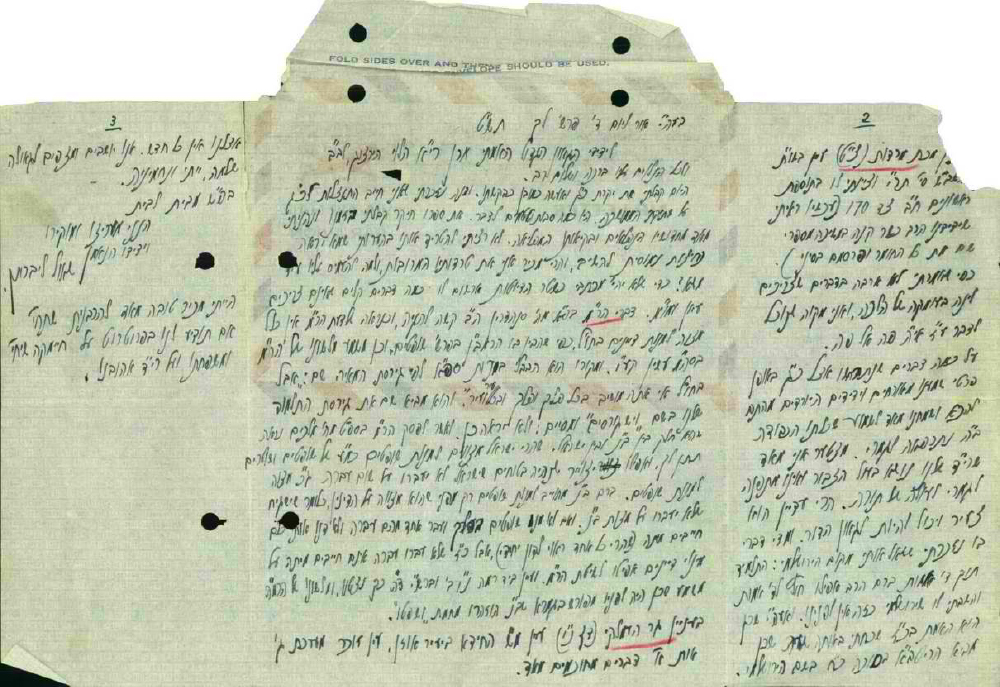
Rav Herzog maintained a close relationship with Professor Saul Lieberman, as Dr. Marc Shapiro has mentioned previously on the Seforim blog[6], and noted in his “Saul Lieberman and the Orthodox”, page 22.[7] It should therefore come as no surprise that Rav Herzog’s archive contains correspondence between him and Lieberman. The letter that appears below was sent by Lieberman to Rav Herzog, and contains Lieberman’s haarot on Rav Herzog’s Torat Ha-Ohel, his sefer on the Rambam’s Hilchot Sanhedrin.[8] In this letter, Lieberman first discusses the proper girsaot in the relevant Rambam and the gemara in Makot regarding minuy dayanim. He then addresses Rav Herzog’s question of how it could be possible that bnai noach have a more extensive obligation of dinim than do Yisrael,[9] and Lieberman offers an elegant yeshiva-style distinction between dinei yisrael and dinei bnai noach to answer the problem. (A similar distinction was offered by Rav Aharon Lichtenstein, in Beit Yitzchak 8, page 89, and reprinted in his Minchat Aviv.) He offhandedly mentions that Rav Menachem Kasher had recently “acquired” some of his material, and then bemoans the fact that RY”D is too involved in the ol ha-tzibur and is not dedicating himself sufficiently to his Torah study, although he has the potential to become the Gaon Ha-Dor.
Lieberman’s letter appears below, and a transcription appears in Appendix A.
It is most likely that the RY”D to whom Lieberman referred was Rav Yaakov David Herzog, Rav Herzog’s son, as the context within the letter is dealing with Rav Herzog’s family. Rav Yaakov David had already published a scientific/critical edition of Mishnayot Brachot/Peah/Demai in 1945, at the young age of 24, and Lieberman wrote a Foreword to the volume.[10] Rav Yaakov David Herzog was eventually selected as Chief Rabbi of Great Britain in the 1960s, but declined the post due to his ill health.[11]
I also entertained the possibility that the RY”D to whom Lieberman referred is the Rav, Rav Yosef Dov Soloveichik. While this seems unlikely, it would fit nicely with the comments made by Rabbi Jacob Radin, as quoted by Rav Aaron Rakeffet[12], contrasting the Rav and Lieberman:
You know that I have attended classes in both the Seminary and the Yeshiva. I have studied with Professor Lieberman and the Rav. The Professor lectures a few times a week. He hurriedly finishes and rushes back to his research. Outside of his formal lectures, he is barely available to the students. On the other hand, the Rav is never alone. He has never finished a lecture on time. He always goes overtime. He remains in the classroom afterwards to carry on the Talmudic give and take with the students who cannot part from him. Even when he rises to leave, his disciples surround him and the discussion continues…This is the basic manifest difference between these two prodigious scholars.[13]
On Lieberman’s mention of Rav Kasher, this is the page that Lieberman referenced from Tosefet Rishonim:
And the page from Rav Kasher’s article in Sinai, Volume 18:
A number of the rather obscure sources in Rav Kasher’s lengthy footnote 2 appear to be taken from Lieberman’s Tosefet Rishonim.
III The Lieberman Ketuba
As is well-known, Lieberman introduced a new clause into the ketuba in the early 1950s in order to alleviate the aguna problem. The clause stipulated that the couple recognizes the authority of the beit din of the Rabbinical Assembly, and that upon dissolution of the marriage, the beit din would be empowered to administer penalties as it sees fit. The aim of these penalties would be to pressure the husband to give a get. In a number of letters from the 1950s (in a file regarding Even HaEzer issues[14]), Rav Herzog mentions that he himself came up with such an idea many years earlier when he was still Chief Rabbi of Ireland. He envisioned a separate document which would empower the beit din of London to administer financial penalties on a husband withholding a get. He mentions that he is unsure of Professor Lieberman came up with this idea himself, or if Lieberman actually got the idea from Rav Herzog.

Rabbi Emanuel Rackman wrote that it was widely believed that the Lieberman clause was examined by Rav Herzog, and that he had no objections.[15] This belief is certainly false, as Rav Herzog penned a strong protest to the proposed addition to the ketuba.[16] Rav Herzog’s main protest was due to the authority granted to the Conservative beit din. It is possible that the root of this misconception (that Rav Herzog approved of the Lieberman clause) is the fact that Rav Herzog independently envisioned a similar document or agreement, and that he entertained the possibility that Lieberman actually got the idea from him.
IV The Epstein Proposal
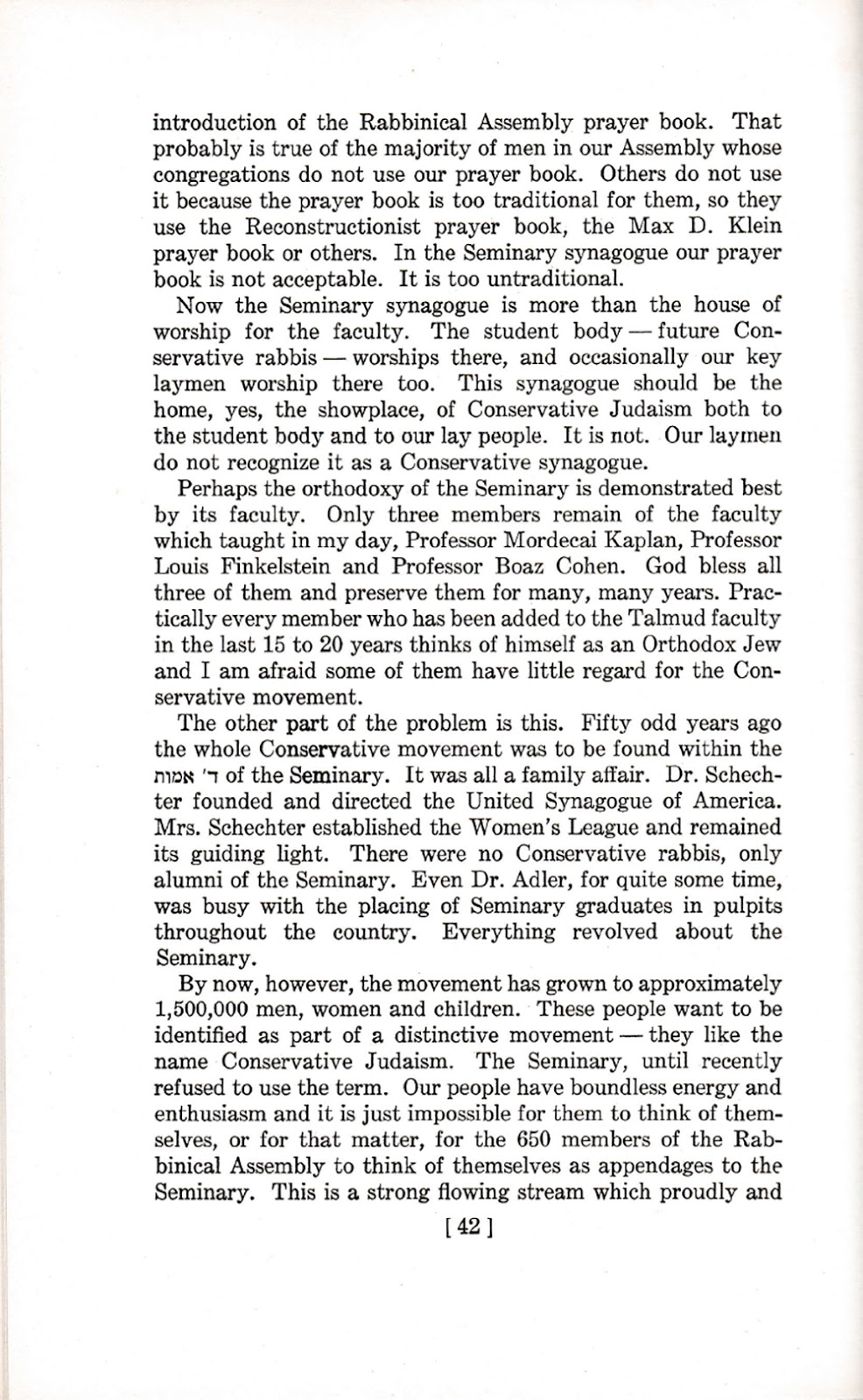
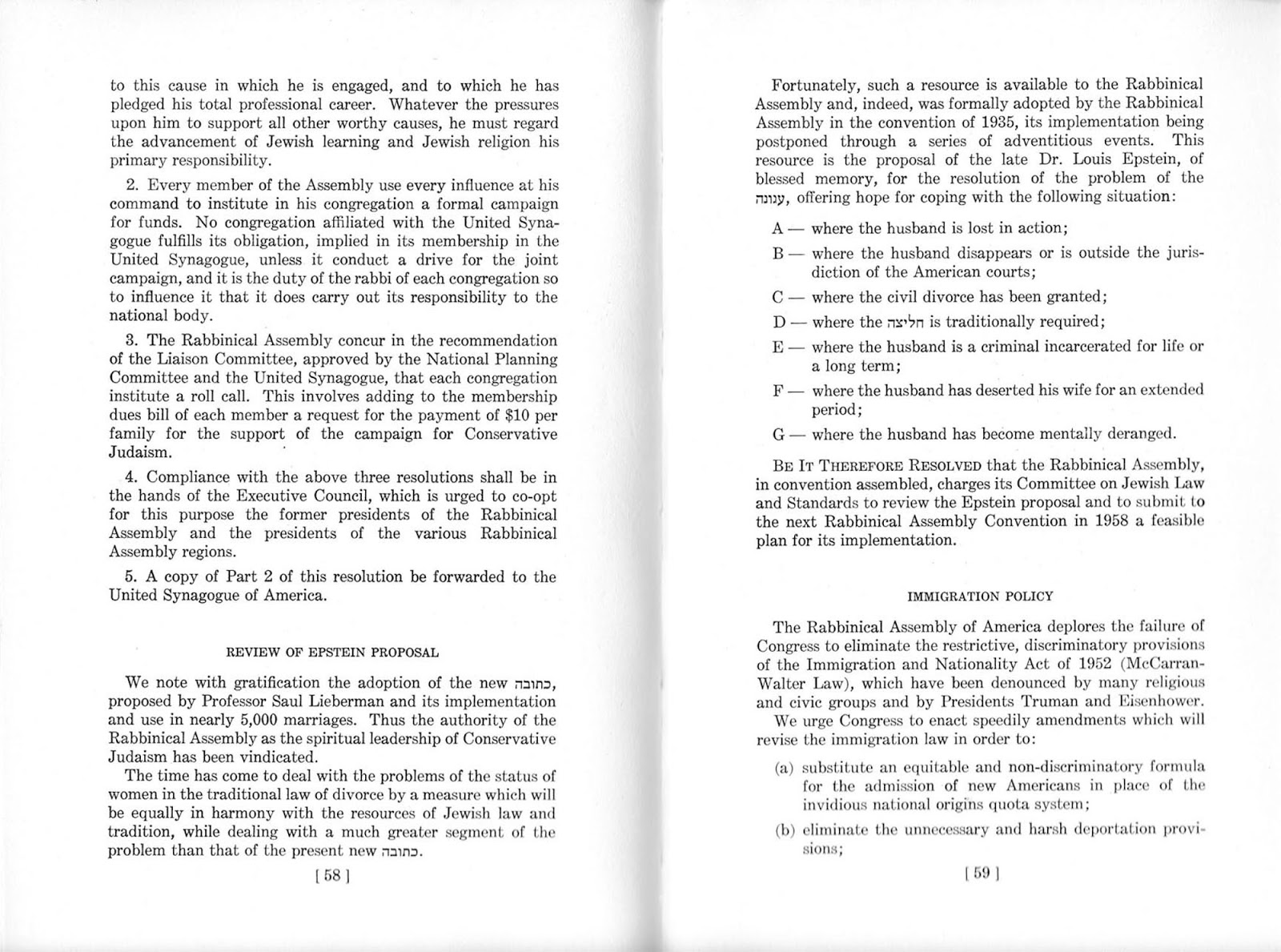
Another fascinating exchange between Rav Herzog and Lieberman is found in Rav Herzog’s file dedicated to Reform[[17] and Conservative Jewry[18], and relates to the Rabbinical Assembly’s 1957 attempt to resuscitate the Epstein proposal. Rabbi Louis Epstein had proposed, in his 1930 book Hatzaa Lemaan Takanat Agunot, that every husband, at the time of marriage, ought to designate his wife as a shliach to deliver her own get, in order to eliminate the aguna problem in the case of a missing husband or a get-refuser. The proposal was never implemented, in large part due to Orthodox opposition. In May of 1957, the Rabbinical Assembly attempted to resuscitate the Epstein Proposal at their Annual Convention at the Concord Hotel in Kiamesha Lake, New York. However, this attempt to revive the Epstein proposal must be viewed in light of the politics within the Conservative movement at that time. The following is an excerpt from the Presidential Report of Rabbi Aaron Blumenthal at the Rabbinical Assembly Convention[19]:

Note in particular Rabbi Blumenthal’s comments that the Seminary is an Orthodox institution, that its synagogue has separate seating and does not use the Rabbinical Assembly siddur, and that practically every faculty member added to the Talmud faculty in the last 15 to 20 years thinks of himself as an Orthodox Jew and has little regard for the Conservative movement. Given that Lieberman was the de-facto Rabbi of this synagogue, and that Lieberman ensured that the synagogue did not use the Rabbinical Assembly siddur, and that the synagogue maintained separate seating until Lieberman’s death[20], it would seem that Rabbi Blumenthal’s words were directed primarily at Lieberman, who arrived at the Seminary some 17 years prior.
It is against this backdrop that the Rabbinical Assembly passed a Resolution that the Rabbinical Assembly Committee on Jewish Law and Standards review the Epstein proposal and submit a plan for its implementation.
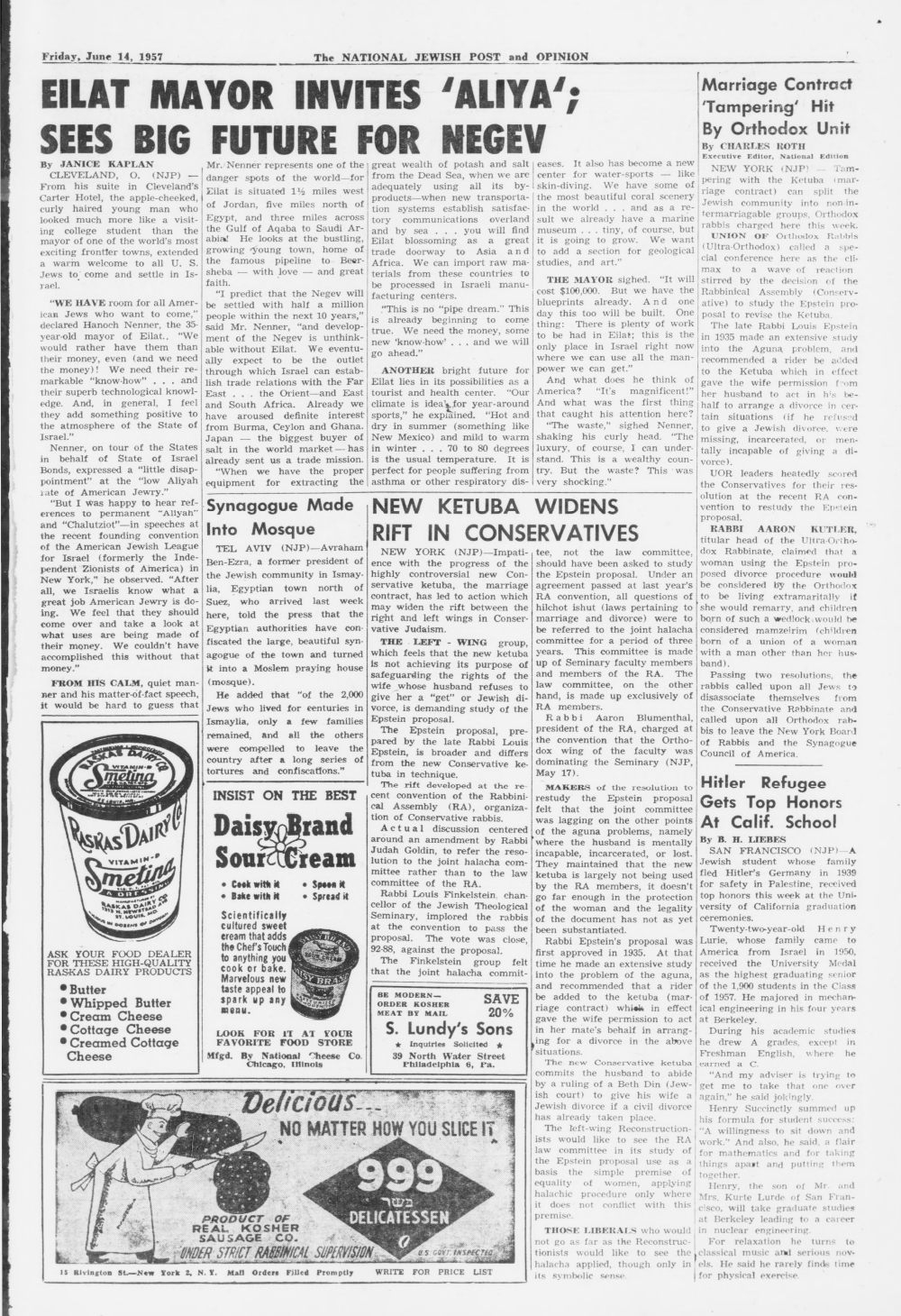
The report below from the National Jewish Post and Opinion makes clear that the left wing of Conservative Judaism felt that the Lieberman ketuba did not go far enough in addressing the aguna problem and therefore sought to institute the Epstein proposal. On the other hand, the more traditional wing of Conservative Judaism, led by Rabbi Louis Finkelstein, Chancellor of JTS, wanted the proposal referred to a joint committee made up of JTS faculty and RA members. Rabbi Blumenthal’s complaint about the Orthodox character of the Seminary faculty was not just an observation, but also a charge to the RA regarding the Epstein proposal, that they not allow the Seminary faculty to torpedo the proposal. Rabbi Finkelstein’s group lost the vote 92-88, in what was, in a sense, a repudiation of Lieberman’s Orthodox influence, and a rejection of his ketuba as too Orthodox and not impactful enough.[21] The majority of the RA membership was prepared to head in a more liberal direction.
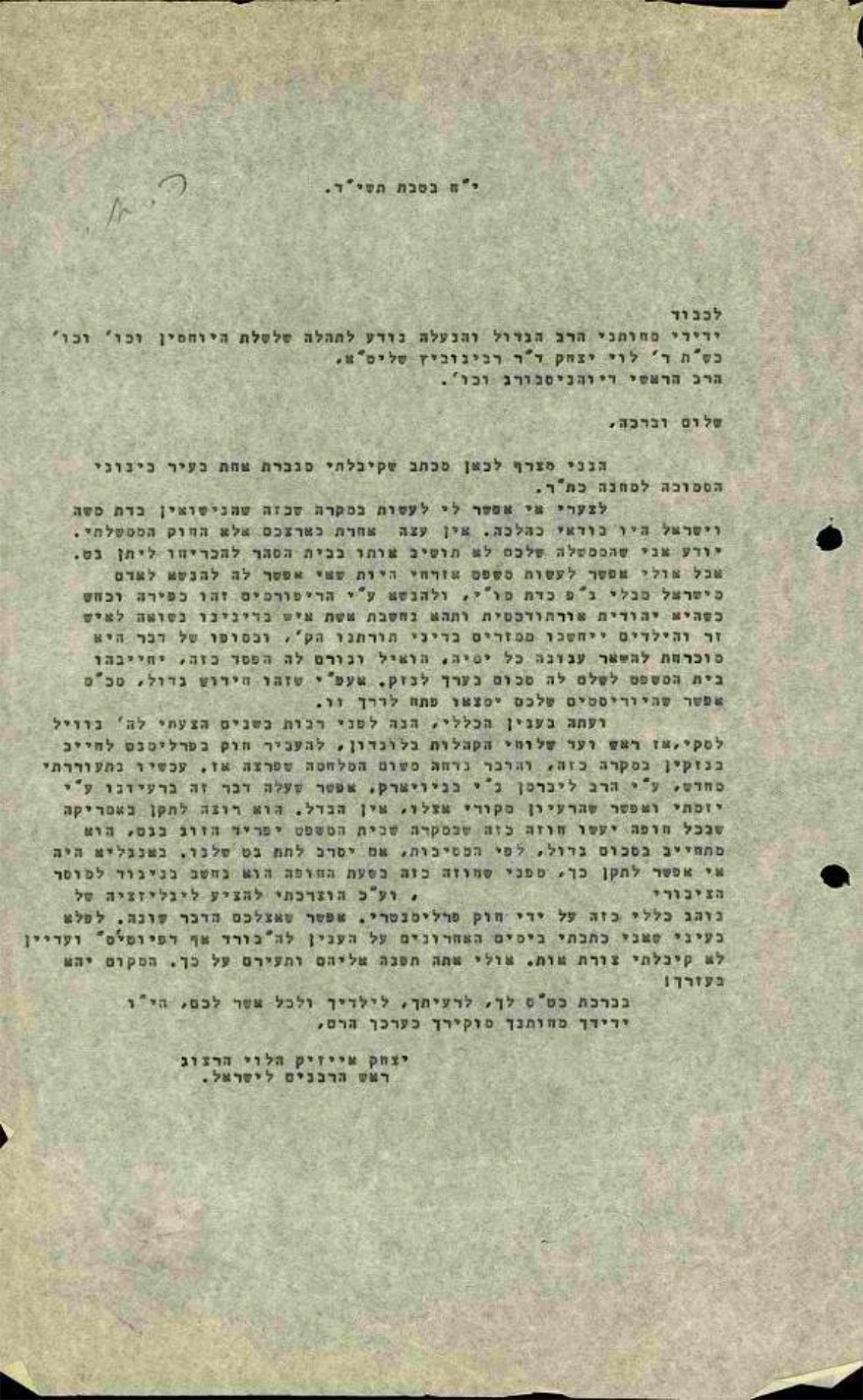
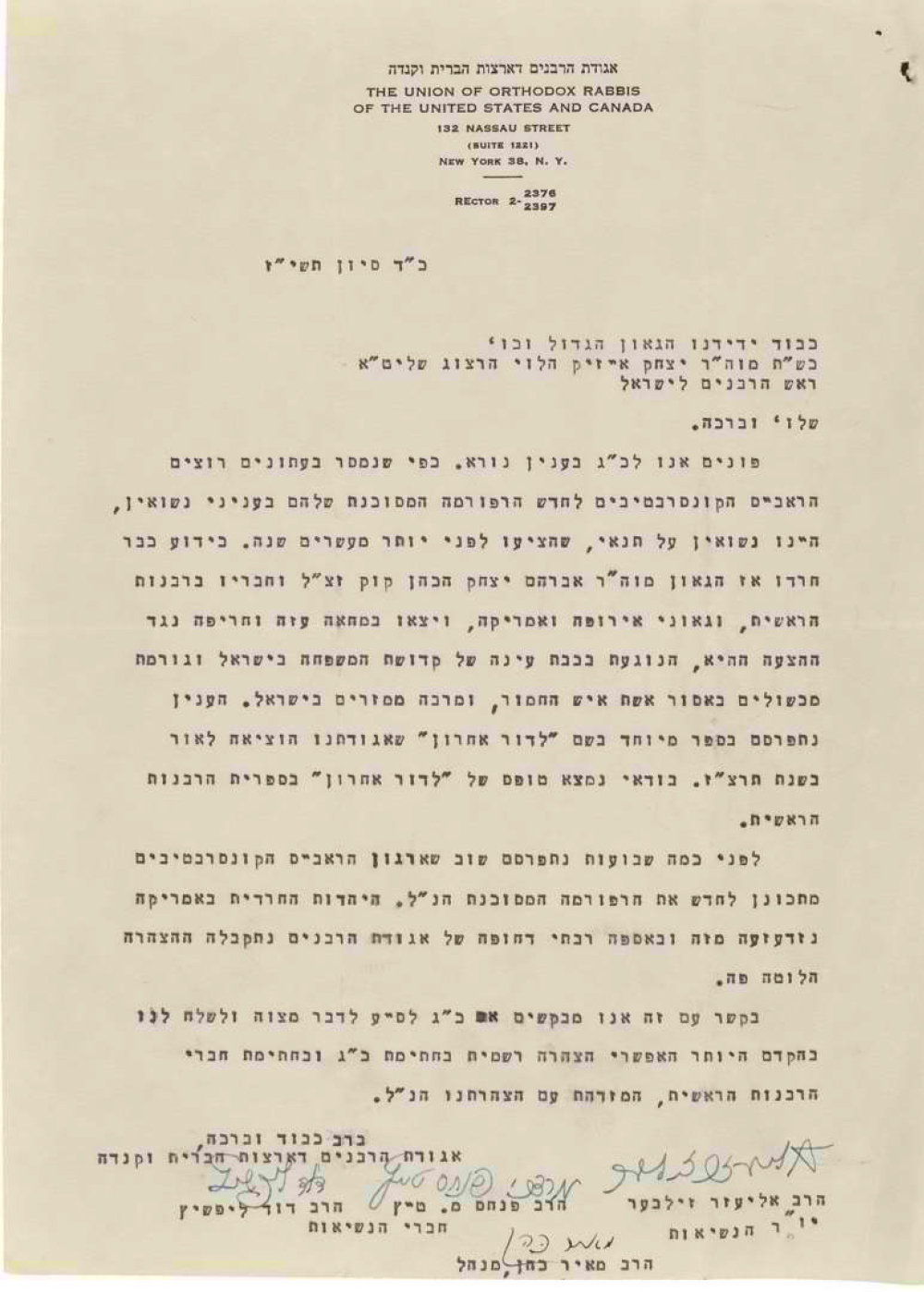
After the passage of the Rabbinical Assembly resolution, the Agudat HaRabbanim turned to Rav Herzog in the letter below, asking him to intervene and prevent this breach of kedushat hamishpacha beyisrael.[22] (It is not clear to me why they termed the Epstein proposal nisuin al tnay, or conditional marriage, which is a different attempted mechanism to prevent aguna situations.)
In response to the request of Agudat HaRabbanim, Rav Herzog turned to Lieberman in the letter below, asking him to intervene and prevent the implementation of the proposed nisuin al tnay.[23] (Rav Herzog apparently understood the proposal to be literally one of conditional marriage, and thus referred Lieberman to the book Ain Tnay Benisuin, rather than the book LeDor Acharon, mentioned in the Agudat HaRabbanim letter, which deals with the Epstein proposal.)
In response to Rav Herzog’s letter, Lieberman sent Rav Herzog the very fascinating letter below. (A transcription of this letter appears in Appendix B.) Lieberman tells Rav Herzog that the Orthodox Rabbis are simply looking for excuses to make machloket, that Rabbi Finkelstein strongly protested the re-introduction of the Epstein proposal (as we noted was reported in the National Jewish Post), and that the President of the Assembly (Rabbi Blumenthal) also denied the claim of the Agudat HaRabbanim. He then says that the entire purpose of his revised ketuba was to bury the possibility of the Epstein proposal! He also mentions that some Orthodox Rabbis have claimed that any wedding which uses the new ketuba is invalid, and the kiddushin are not tofsin. (I have been unable to find any documented source of a Rabbi who made such a claim. I would be indebted to any of the readers who could provide such a source.) Lieberman concludes by assuring Rav Herzog that he would be the first to protest the implementation of the Epstein proposal, and that such a nevala could never happen while he is at the Seminary.
Rabbi Blumenthal’s denial was in fact reported by the JTA.[24] He said that the Assembly only authorized a committee to re-study the problem.
Some points remain unclear to me, as Rabbi Finkelstein’s group did indeed lose the vote, and the RA did pass a resolution that the Rabbinical Assembly Committee on Jewish Law and Standards submit a plan for the implementation of the Epstein proposal. I find it hard to understand Rabbi Blumenthal’s denial, or how Lieberman could claim that the Orthodox Rabbis were simply seeking machloket, when the RA passed a resolution for implementation (even documented in the RA Proceedings), with the left-wing defeating the traditional wing.
(to be continued)
Appendix A
Letter from Lieberman to Rav Herzog about Torat Ha-Ohel
בע”ה אור ליום ד’ פרש’ לך תש”ט
לידידי הגאון הגדול האמתי מרן רי”א הלוי הירצוג, לב”ב ולכל הנלוים עליו שלום רב.
היום קבלתי את יקרת כ”ג ואעשה כמובן כבקשתו. והנה נזכרתי שאני חייב התנצלות לכ”ג על שתיקתי הממושכה. היו כמה סיבות וטעמים לדבר. את ספרו היקר קבלתי בזמנו ונהניתי מאד מחידושיו הנפלאים ובקיאותו המפליאה. לא רציתי להטריד אותו בהערותי שמא יראה נחיצות נמוסית להשיב, והרי מכיר אני את טרדותיו המרובות, ולמה להעמיס עליו עוד משא? כדי שלא יהי’ מכתבי כשטר הדיוטות ארשום לו כמה דברים קלים שאינם צריכים עיון ומו”מ. דברי הר”מ בפ”א מהל’ סנהדרין ה”ב קשה להגיה, וכנראה שלדעת הר”מ אין כלל מצוה למנות דיינים בחו”ל, כפי שהבין בו הרמב”ן בפרש’ שופטים, וכן משמע מלשונו של הר”מ בסה”מ עשין קע”ו ומקורו הוא הבבלי במכות ספ”א[25] לפי גירסת המאירי שם: “אבל בחו”ל אי אתה מושיב בכל פלך ופלך ובכל עיר ועיר.” והוא מביא שם את גירסת התלמוד שלנו בשם “ויש גורסים” ומסיים: ולא נראה כן. ואשר לפסק הר”מ בספ”ט מה’ מלכים נראה שהוא חלק בין ב”נ ובין ישראל. שהרי ישראל מצווים למנות שופטים כמ”ע של שופטים ושוטרים תתן לך, ואפילו יצוייר שנהיה בטוחים שישראל לא יעברו על שום עברה ג”כ מצוה למנות שופטים. ברם ב”נ מחוייב למנות שופטים רק מפני שהוא מצווה על הדינין, כלומר שישגיח שלא יעברו על מצות ב”נ. ואם לא מנה שופטים בפלך ועבר אחד מהם עברה ולא דנו אותו כלם חייבים מיתה (שהרי כל אחד ראוי לדון יחידי), אבל כ”ז שלא עברו עברה אינם חייבים מיתה על מינוי דיינים אפילו לשיטת הר”מ.[26] ועיין ביד רמה נו ע”ב וברש”י ד”ה כך נצטוו, ומלשונו של הרמ”ה משמע שכן היה לפניו מפורש בגמרא שבני נח הוזהרו מחמת “ושפטו.”
בענין גר העמלקי (דף נ”ו) עיין מ”ש החיד”א ביעיר אוזן, עין זוכר מערכת ג’ אות א’ דברים מחוכמים מאד.
[בעני]ן מכת מרדות (צ”ט) עיין בשו”ת [הר]שב”ש סי’ תר”י וציינתי לו בתוספת ראשונים ח”ב צד 170 (עכשיו ראיתי שידידנו הרב כשר קנה במשיכה מספרי שם את כל החומר ופרסמם בסיני.)
כפי שאמרתי לא ארבה בדברים שצריכים לינה בעומקה של הלכה, ואני מקוה שנוכל לדבר ע”ז אי”ה פה אל פה.
על כמה דברים שנתחדשו אצל כ”ג באופן פרטי שמענו מאורחים וידידים היורדים מהתם להכא ושמחנו מאד לשמוע שכלתו הכבודה ב”ה נתרפאה לגמרי. מצטער אני מאד שרי”ד[27] שלנו נושא בעול הצבור ואינו מתפנה לגמרי לעולה של תורה. הרי עדיין הוא צעיר ויכול להיות לגאון הדור. ומדי דברי בו נזכרתי ששאל אותי מקום הירושלמי: התלמיד תוך ד’ אמות ברם הרב אפילו חוץ לד’ אמות והשבתי לו שירושלמי כזה אין לפנינו. ואעפ”י שכן הוא האמת בכ”ז שכחתי באותה שעה שכן מביא הריטב”א בסוכה כ”ח בשם הירושלמי.
אצלנו אין כל חדש. אנו יושבים ומצפים לגאולה שלמה, ייתי ונחמיניה.
בפ”ש מבית לבית
הנני מעריצו ומוקירו וידידו הנאמן
שאול ליברמן
הייתי מכיר טובה מאד לרבנית שתחי’ אם תודיע לנו בפרוטרוט על חיימקה שיחי’ ומשפחתו ועל רי”ד אהובנו.[28]
Appendix B
Letter from Lieberman to Rav Herzog about the Epstein Proposal
בעה”י יום ה’ פרש’ מטות תשי”ז
לכבוד ידידינו הגאון הגדול האמיתי מרן הרי”א הלוי הירצוג הרב הראשי לא”י ברכה ושלום רב.
יקרת כ”ג מי’ תמוז הועברה אלי לכרם מרתה[29], ומאד מאד התפלאתי שכ”ג האמין לדיבת הרבנים כאן. אמנם בכנסיית הרבנים השמרנים דברו על עיון מחדש בשאלת תנאי בקידושין, אבל ד”ר פינקלשטיין יצא בכל תוקף נגד חידוש העיון. ונשיא הכנסיה הנ”ל הכחיש בעצמו את דיבת הרבנים. אבל הללו מחפשים רק אמתלאות למחלוקת. כל עניין הכתובה היה כדי לקבור לגמרי את שאלת התנאי. הסברתי להם שאם ליחיד אפשר פעם לחשוב ע”ז הרי לרבים אין הדבר בא כלל בחשבון שהתנאי יעשה ע”פ דין, וישתקע הדבר ולא יעלה שוב על הפרק. וכולם הסכימו ל[י]. עכשיו יש מהם שבאים בטענות ואומרים: הרי הרבנים הארתודוכסים טוענין שאף הכתובה נעשתה שלא כדין, ויש מהם (כלומר מהרבנים הארתודוקסים) שאמרו שהמתחתן בכתובה החדשה אין הקידושין תופסין, והאשה מותרת בלי גט (ממש לא יאומן כי יסופר! אבל לצערי נאמרו הדברים), א”כ הרי מוטב לעשות תנאי בקידושין, ולהפטר מכל שאלת העגונה בבת אחת. והנני מבטיח את כב”ג שאין לשמועה שום יסוד, אחרת הייתי אני בין הראשונים למחות, וכל זמן שאני בסמינר לא יתכן שיעשו נבלה כזו.
בפ”ש ובברכה לכל המשפ[חה]
בהערצה ובידידות
שאול [ליברמן]
[1] See here.
[2] See here.
[3] A short one-page summary of the kuntres appears in R’ Zorach Warhaftig’s Chuka Leyisrael, page 236. However, R’ Warhaftig neglects to mention that Rav Herzog advocated only giyus chelki.
[4] See here.
[5] Every name on the telegram is relatively well known, except for Rothenberg. I assume this is Rav Moshe Rothenberg, founder of Yeshivat Chachmei Lublin of Detroit. See Toldot Anshei Shem page 126, here.
[6] See here.
[7] For the following sections related to Lieberman, I made extensive use of Dr. Shapiro’s “Saul Lieberman and the Orthodox.”
[8] See here.
[9] Here in Yeriot Ha-Ohel 1.
[10] See here. Interestingly, Lieberman signed the Foreword as “Saul Lieberman, Dean, Harry Fischel Institute, Jerusalem”, even though Lieberman had been teaching in JTS for five years already. (In the Foreword, he notes that the publication of the volume coincided with Harry Fischel’s 80th birthday, in 1945.) In fact, Lieberman’s name appeared atop the Harry Fischel Institute’s stationery as late as 1949 (can be seen in Rav Herzog’s file on Machon Harry Fischel.) It would appear that Lieberman continued to serve in some capacity as Dean of the Harry Fischel Institute even after he left Israel to come to America. Incredibly, he held one foot in each world simultaneously, as Dean of the Harry Fischel Institute and Professor in JTS, a fact that has heretofore eluded his biographers. My good friend Rabbi Dovid Bashevkin reports in the name of Mr. Carmi Schwartz, Executive Vice President of the Council of Jewish Federations, that Lieberman willed most of his considerable life savings to the Harry Fischel Institute after his death, and not to JTS.
[11] See here.
[12] Mentor of Generations, page 119.
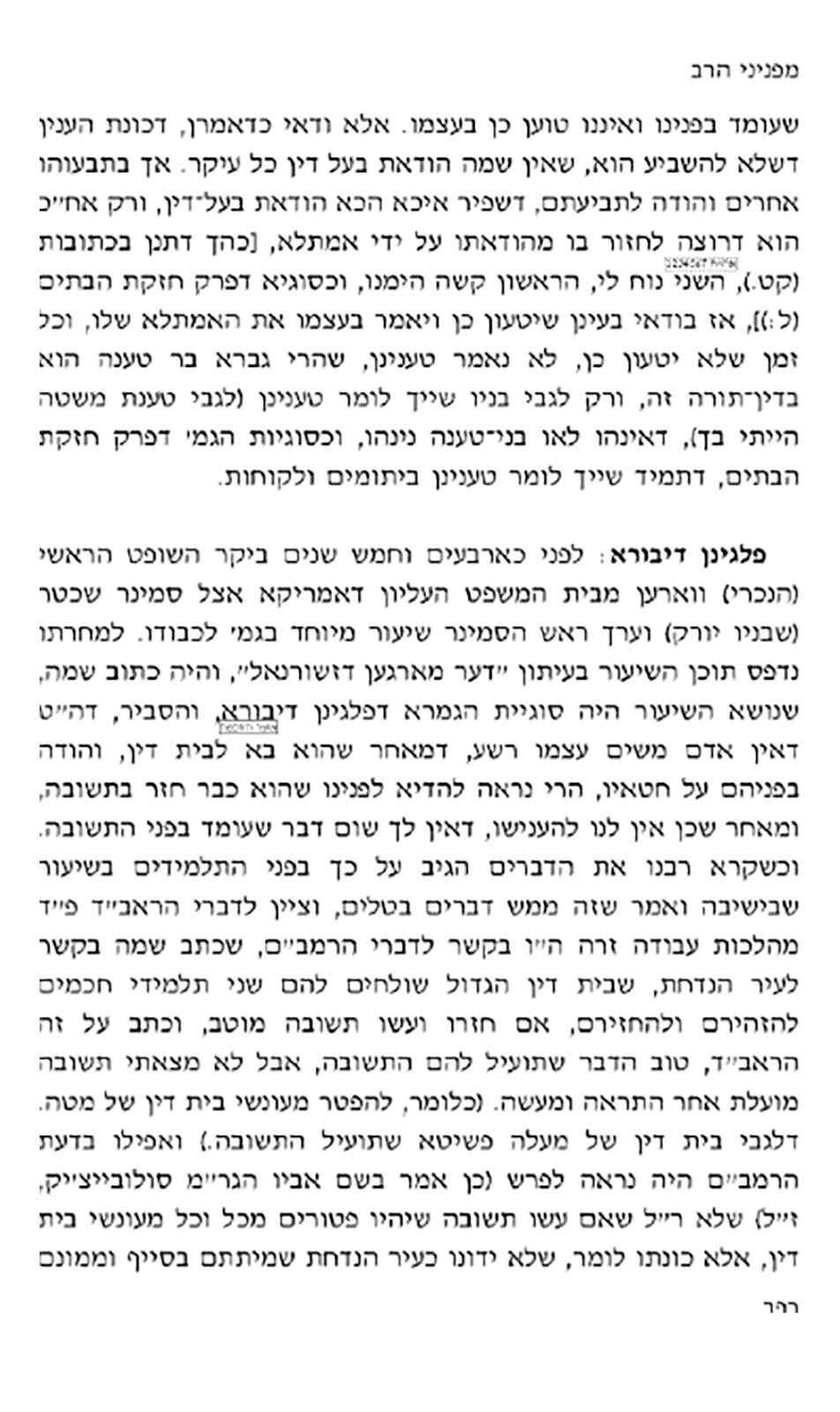
[13] For more on the Rav and Lieberman, see Rav Rakeffet’s “A Note on R. Saul Lieberman and the Rav”, in Tradition, Winter 2007. Also noteworthy is the following story that appears in Rav Hershel Schachter’s Mipninei Ha-rav:
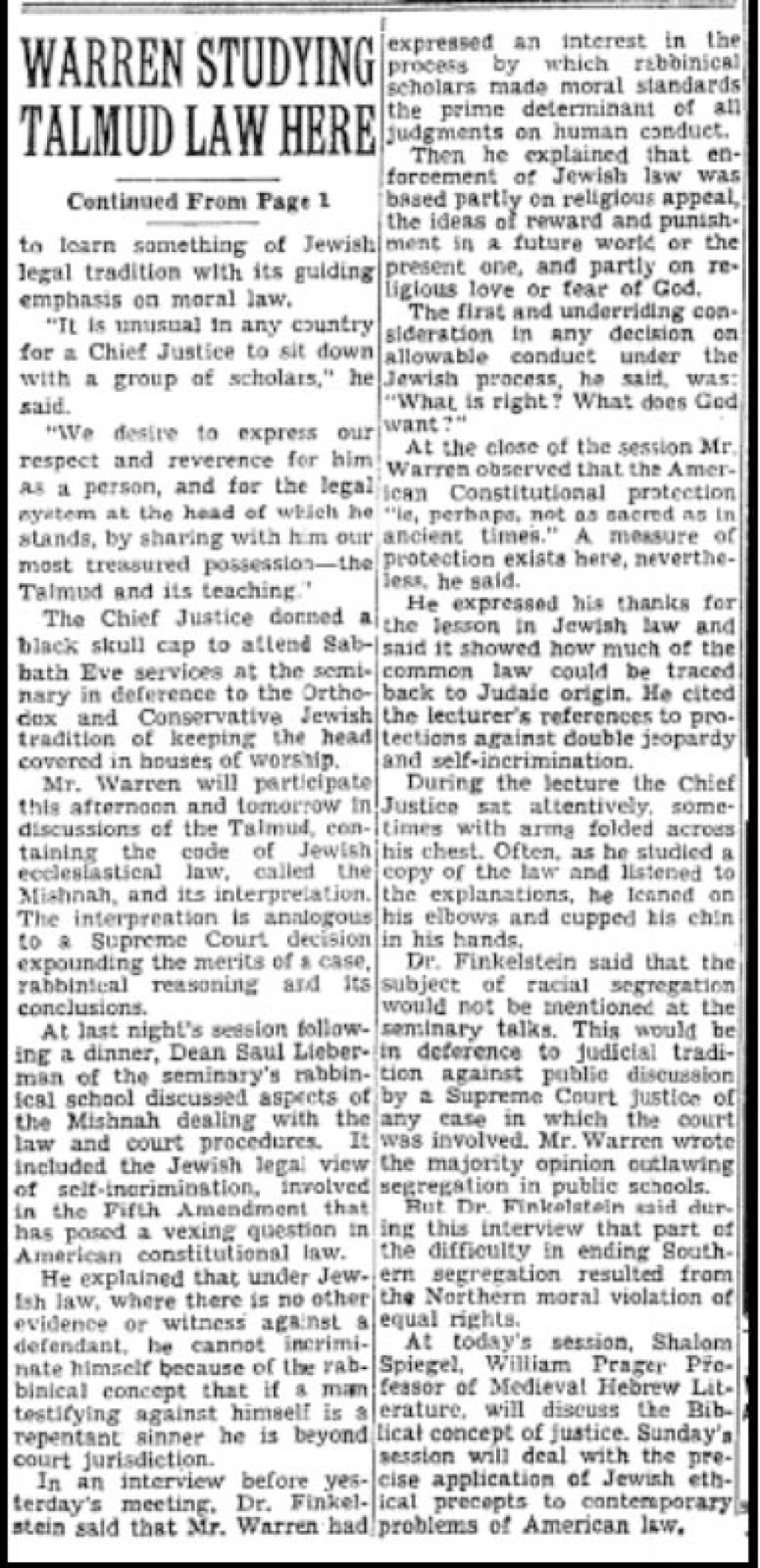
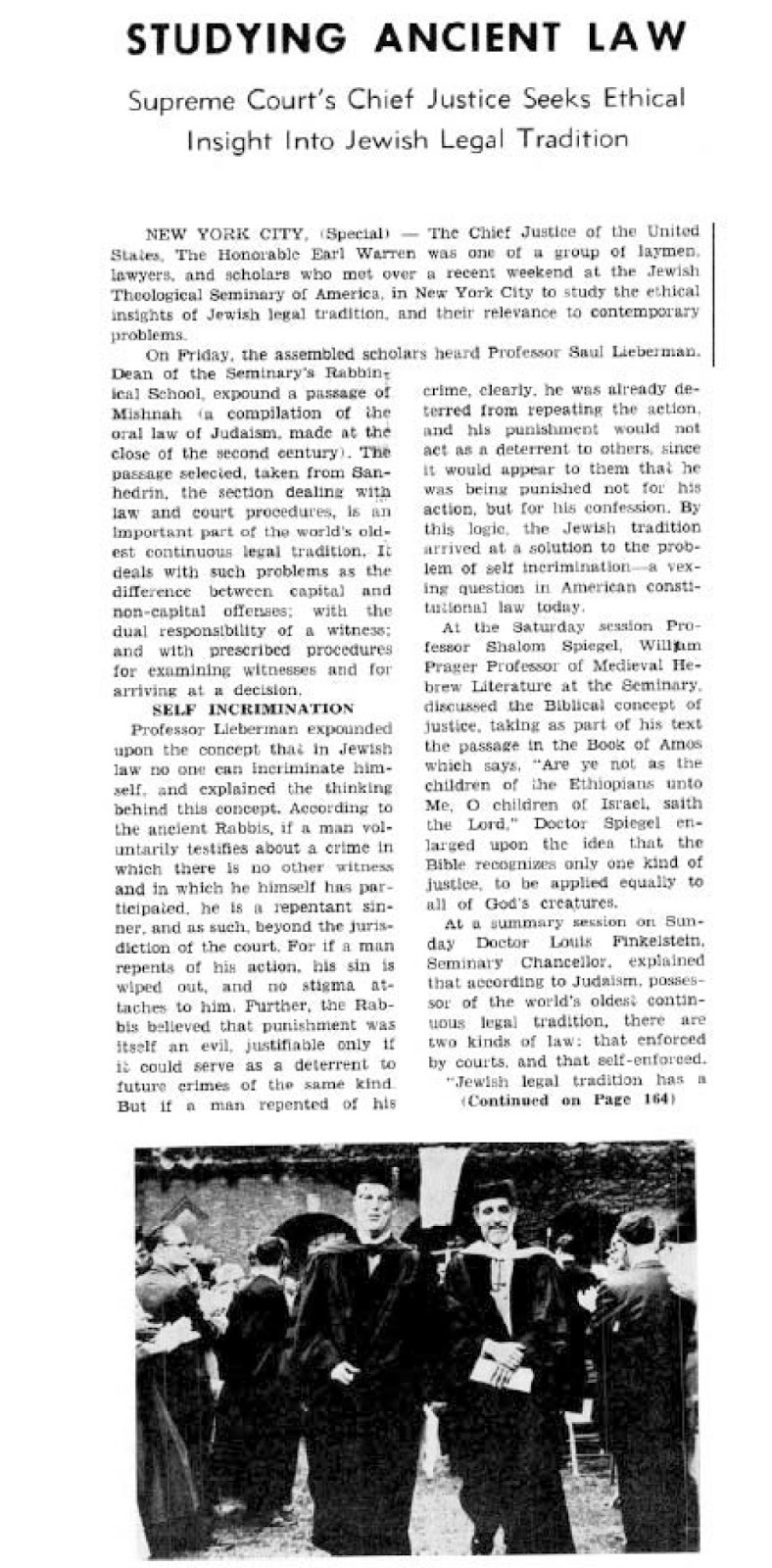
The head of the Seminary who gave the shiur with which the Rav disagreed so vehemently is none other than Lieberman. Warren’s visit to the Seminary was covered on the front page of the New York Times (September 14, 1957.) (For a humorous account of how Lieberman sipped tea through a sugar cube that weekend in the presence of former president Harry Truman, see “The Rabbi as Symbolic Exemplar” by Jack Bloom, page 37.) Here is the New York Times’ account of Lieberman’s shiur:
A similar account of the shiur appears in the Sentinel (September 26, 1957)
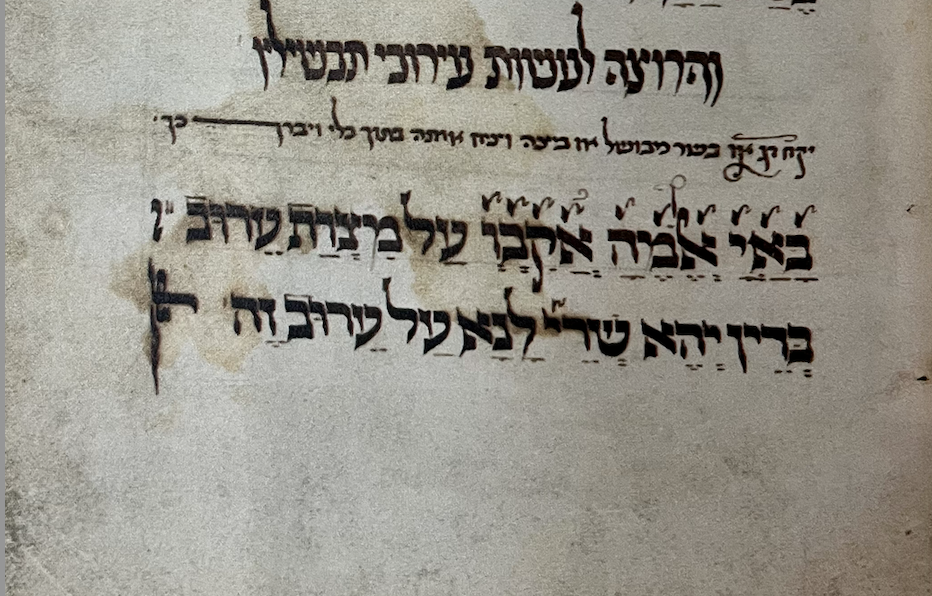
Regarding Lieberman’s suggestion that the principle of Ain Adam Meisim Atzmo Rasha is predicated on the presumption of teshuva, there appears to be another difficulty, in addition to that raised by the Rav. The gemara in Makot 13b states:
חייבי מיתות ב”ד אינו בכלל מלקות ארבעים שאם עשו תשובה אין ב”ד של מטה מוחלין להן
The gemara states explicitly that teshuva is not efficacious in absolving a sinner of capital punishment, which would seem to contradict Professor Lieberman’s thesis. My good friend Rabbi Dovid Bashevkin has offered the following original suggestion to resolve the problem. Professor Lieberman might have believed that the gemara in Makot which states that teshuva does not absolve capital punishment is referring to after gmar din, when the sinner has already been tried and sentenced. At that point, teshuva is no longer effectual. However, the principle of Ain Adam Meisim Atzmo Rasha applies before trial and sentencing, and teshuva would absolve a sinner before sentencing. This reading of the gemara in Makot is certainly plausible, although it does run contrary to the reading of the Noda B’Yehuda (Orach Chaim 34, s.v. ela), who assumes that the gemara is referring to before gmar din as well. Additionally, it would seem difficult to assume that a confession is indicative of teshuva if a sinner is aware that he can absolve himself of punishment by simply admitting his guilt in beit din. However, this approach would explain why the Rav raised a difficulty based on the words of the Raavad, and not the gemara in Makot, as the gemara in Makot is not a conclusive proof.
[14] See here.
[15] “Conflict and Consensus in Jewish Political Life”, page 120, also cited in “Saul Lieberman: the Man and his Work”, page 45. My thanks to my good friend Dr. Josh Lovinger for bringing this to my attention.
[16] Techuka leYisrael al pi Torah, volume 3 page 210.
[17] The correspondence in that file also shows the effort that Rav Herzog expended in an attempt to prevent the Reform movement from gaining any foothold whatsoever in Israel.
[18] See here.
[19] Proceedings of the Rabbinical Assembly of America 21, 57th Annual Convention (1957), pages 41-42.
[20] See here.
[21] National Jewish Post and Opinion, June 14, 1957.
[22] See also HapardesTamuz, 1957 for details of the protest arranged by Agudat HaRabbanim.
[23] This letter also appears in “Saul Lieberman and the Orthodox”, Hebrew section, page 6.
[24] See here.
[25] Makot 7a
[26] This would also answer the (similar) question of the Gvurot Ari in Makot 7a, s.v. UveChu”l.
[27] As mentioned, I believe that this refers to Rav Yaakov David Herzog.
[28] Future president of Israel, Chaim Herzog, and Rav Yaakov David Herzog.
[29] Martha’s Vineyard.


Purim in Tehran: The Symbolic Devaluation of the Ahrimanic Republic

Purim in Tehran: The Symbolic Devaluation of the Ahrimanic Republic

By Dan D.Y. Shapira

Dan (or, Dan D.Y.) Shapira is an Orientalist and grows more than fifty trees on the edge of the Judaean Desert. He’s a Full Professor at Bar-Ilan University.

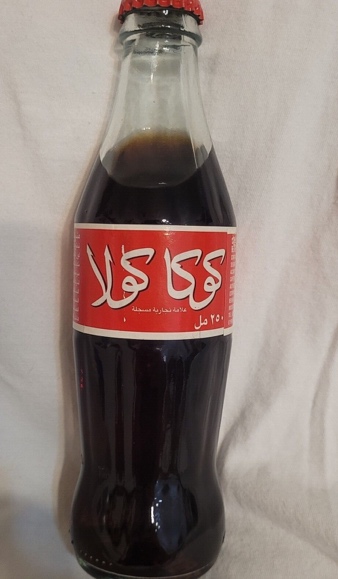
Some fifty years ago, my father brought home a small glass bottle of Iranian Coca Cola, no idea where from. I sat hypnotized looking at the bottle, with its Persian (well Arabic) letters, so beautiful.

It was easy to understand that two letters stand for k, one for l, one for o and one for a. The letters for o, l, and for k had some remote similarities to the corresponding Hebrew letters, if you rotate them a bit in your head. How I know that the letter for a, ا, is also like the Hebrew א, you should just squeeze the Aleph on both sides. And a couple of year later there was the Islamic revolution in Iran, at the end of the same year there was the Soviet invasion in Afghanistan, and new tasty, delicious words began to pour – baseej, inqhilab, Haqiqat-e Inquilab-e Saur, mujahedeen-e khalq, sipaas, Kermanshah, pasdaran, and somehow I began learning Persian.

The language struck me with its grammatical similarities to German and its lexical parallels to Yiddish. Just as Yiddish incorporates Hebrew and Aramaic, Persian is saturated with Arabic. In Yiddish, one can play with registers, tilting the language toward its Germanic core or thinning out its Hebraic elements. Persian offers the same flexibility, allowing a speaker to choose more, fewer, or even no Arabic words. Years later, many Jewish-American Iranists from the WWII generation confirmed this early impression. Learning the language went smoothly, as if I had already known it in a former gilgul.

When I was an Iranian studies student in the late 1980s at Hebrew University, one of my teachers told us that Persians are simply prone to short periods of mass hysteria before returning to “normal” and going back to counting money and carpets within a few years. Time has since proven that my former teacher understood Iranians quite poorly, as they have shown no symptoms of recovering to that supposed normalcy. I eventually realized that my chances of visiting Tehran or Shiraz are slim, perhaps reserved for a future gilgul. Being an Israeli Iranist without the possibility of visiting Iran is much like being Jewish without the possibility of joining a Gentile club.

I am writing this on Sunday, March 1. Today is my secular birthday, and tomorrow, Ta’anith Esther, is my Jewish one. Last night, Bibi and Trump sent me a wonderful gift. I shouted into the sky as drones sent from Iran turned into smoke: Khamenei kotlet shod (“Khamenei went kebab”) as millions of Iranians around the world shouted along with me.

My son just called. He is married to a girl whose parents were both born in Iran. “What do you say about your birthday present?” he asked. “I just realized that your entire life is connected to the fact that you were born on Ta’anith Esther.”

“Yes,” I replied, “and I am just now writing about that. I’ll send it to you.”

It was published today that the joint American-Israeli training for the very operation we witnessed yesterday began as early as January 2023. In January! This timing is critical; it means that even as the domestic anti-Bibi demonstrations began to surge and well before the horrors of October 7, the strategic “pedestal” for the current reversal was already being constructed.

In my view, the son of the last Shah has been designated by Bibi and President Trump to lead the transitional period in a post-Khomeinist Iran. Whether he will be able to restore the historical monarchy remains an open question.

As I discussed in my co-authored article with Reuven Kiperwasser, “Encounters between Iranian Myth and Rabbinic Mythmakers in the Babylonian Talmud,” published a dozen years ago in Encounters by the Rivers of Babylon Scholarly: Conversations Between Jews, Iranians and Babylonians in Antiquity (2014) and available here, the Babylonian sages often engaged in a process of symbolic devaluation. They created their own imagined worlds by taking elements of Iranian mythology and recasting them to define the borderlines of their own culture. After the certain dismiss of what many Iranians call “the Ahrimanic Republic” (instead of “the Islamic Republic,” with Ahriman being the wicked opposite, sitra oḥora, of the benevolent Ahurmazd, or Ahura Mazda), we are seeing this ancient devaluation play out as a modern geopolitical reality. In our analysis of Sanhedrin 39a, we examine a dialogue where a Magus claims the human body is divided, with the upper part belonging to Hwrmyz (Ohrmazd) and the lower, excretory part belonging to ‘hrmyn (Ahriman). The Talmudic sage Amemar sarcastically challenged this dualism by asking why Ahriman would permit Ohrmazd to send life-giving water through his “territory.” Today, this sarcasm has turned into a tangible reality as the “Ahrimanic” regime governed through the “lower” impulses of mass hysteria and regional chaos has been devalued by a population that has largely secularized and rejected the official ideology. With the collapse of this demonic mask, many Iranian exiles will return home (four to five millions Iranians live outside of the present borders of Iran). They return to a land ready to restore its “upper” civilizational identity, finally mirroring the way the rabbis once harmonized their world with the benevolent elements of the Iranian heritage.

In Iran, while 99% of the population is officially classified as Muslim (including a 5% to 15% Sunnite minority composed of Kurds, Arabs, Baluchis, and Turkmens living along the borders), the internal reality is starkly different. In truth, only about 30% to 40% of the population considers themselves Muslim at all. The actual majority has shifted toward being non-religious or atheist, with many becoming fiercely anti-Islamic or “spiritual” in various ways. Others identify as self-proclaimed “Zoroastrians” or have become secret converts to American-style Evangelical Christianity.

Under the Khomeinist regime, Iran has become largely secularized and has partially moved in an anti-Islamic direction. Today, nobody believes in the official ideology, a situation very much like the lack of belief in the official ideology during the late Brezhnev USSR. The “Ahrimanic republic” now sends Shi’ite clerics who oppose its ideology to prison or places them under home arrest, just as the late Brezhnev USSR did to the few who identified as “the real Marxists.”

The Iran of tomorrow will certainly be anti-Islamist, with the potential for the oppression of Islam itself. While the Iran of yesterday was a global leader in antisemitism, the Iran of tomorrow will be a global leader in the state-supported fight against the “Free Palestine” movement. The “Palestinian discourse” was central to the old Iran and will remain so in the New Iran, though with its emphasis entirely reversed.

The raison d’être of the Iran of tomorrow will be a staunch alliance with the USA and Israel. The principle of nahapokh hu from the Purim story reveals the sarcastic hypostasis of the Jewish God’s sense of humor. As the scripture asks, “See, this is new? It hath been already of old time, which was before us.” One need only consider the metamorphosis of pogromist Czarist Russia into what some, astonished by the transformation, termed “the Jewish Commune.”

Some predict that Iran will fall apart due to the separatism of ethnic minorities, but to me, this is absolute nonsense. Iran has only insignificant real minority groups; although some Iranians speak languages other than Persian, they are Iranians first and foremost. Fantasies about Azeri separatism in Iran are especially hilarious. It is as if Nazi Germany tried to lure Israel’s Hasidic Jews into a “Great Germany” separatism simply because those Jews speak Yiddish. Iranians of Azeri background are, more or less, the Iranian equivalent of Israel’s Ashkenazim.

But the borders of Iran might change. It is a significant topic, and once stabilization is achieved, one can envisage the enlargement, rather than the shrinking, of Iranian territory eastwards within a predictable span of time.

The position of the Iran of tomorrow as an ally of Israel will fundamentally change Israel’s strategy toward its Arab allies and partners. MBS understood this some time ago and, consequently, dragged his feet regarding a rapprochement with Israel.

Another significant point is Türkiye, which has emerged as a primary adversary of Israel since October 7, though I hope the motivations behind this shift were largely opportunistic and fundamentally misguided. However, if the IDF map is accurate, the fact that Israeli jets overflew Turkish territory on their way to Iran suggests a significant development. This possibility hints that Mr. Erdoğan is beginning to view the regional landscape through a more pragmatic lens, perhaps recognizing the inevitable devaluation of the “Ahrimanic” status quo in favor of a more stable, “upper” civilizational order.


Legacy Judaica Auction March 6th: A Sampling of Forgeries and other Eclectic Lots

Legacy Judaica‘s next auction will occur on March 6, 2018.  The 220 lots include very rare books such as the first edition of the Yerushalmi and a letter from R. Tzvi Ashkenazi (Hakham Tzvi) (the entire catalog can be accessed here), there are many other interesting books and letters.
Conditional marriage has been applied since at least the talmudic period if not early.  The exact circumstances and necessary predicates have evolved over time and especially in the modern period when marriage and divorce were slowly wrested from the exclusive control of the clergy and the state began to involve itself permitting some to circumvent the religious process entirely, the issue of annulments became acuter.  Annulments were among the only methods that would free a woman whose husband proceed to receive a secular divorce but not a religious one.  In France, in the early 20th century a scheme to make conditional marriage the norm and avoid later issues was proposed.  But this met with fierce opposition from many rabbis, and to counter that proposal in 1930 in Vilna a book, Ein Tenie be-Nissuin, that contained signatures of 400 rabbis was published in protest.  The book also contains an introduction by the leading Posek, R. Chaim Ozer.  (Lot 21).  
Another contemporary controversy related to something much older, the Talmud Yerushalmi. In the first decade of the 20th century, Shlomo Friedlander published a few volumes from the Kodshim order that hereto had never been published (lot 47).  Allegedly these were from a manuscript, but many doubted their authenticity. R. Meir Don Plotski, the author of the biblical commentary, Kli Hemdah, devoted an entire book, Sha’lu Shelom Yerushalim, (lot 43) to disproving that Friedlander’s edition was legitimate. (Dr. Shlomo Sprecher Zt”L reprinted the book in 1991 with a new introduction and a biography of R Poltski).  Friedlander also published less controversial books including his commentary on the Tosefta (lot 48). 
Although not controversial, another attempt to link the present with the past is a curious book, Sefer ha-Brit ha-Hadash, written by Uziel Haga of Boston (lot 130).  He petitioned and received permission from President McKinley to accompany the U.S. military on a tour of China.  Haga’s purpose was to see first hand and document the lifestyles and customs of Chinese Jews.  Among other items, he asserted that the Jews Kaifeng in the Hunan Province are descendants of the Ten Tribes. If his identification is correct, that may explain Jews’ affinity for Chinese cuisine.  Haga never made it back from China, he was imprisoned and killed by the Boxers.   Although Haga’s book was printed in Pietrekov, one book, Mishberi Yam, (lot 131) was published in China.  
Returning to forgeries, the compendium of R. Zechariah Yeshayahu Yolles, Ha-Torah veha-Hayyim, (lot 24), includes his Dover Mesharim that disproves the attribution of a certain work to R. Mordechai Yaffa (Levush).  Yolles’ position was vehemently disputed by R. Moshe Sofer (although Yolles defended him in a different controversy) and Sofer’s letter appears in this volume.  The book is also noteworthy because it includes a portrait of Yolles in the frontispiece.  
Among the books with distinguished owners include a copy of Mishnei Torah that belonged to R. Yosef Dov Soloveitchik, (Beis HaLevi) (lot 151) and R. Hayim Volozhiner’s copy of Mesorot Seyag le-Torah. Most of R. Hayim’s library was destroyed in a fire, but this book had been on loan to R. Yaakov of Ivenitz, and thus was spared the fate of the rest of books.  (Regarding the two bibliographical topics of fire and lending, see Abraham Ya’ari, Mehkerei Sefer, 47-54 (discussing books printed after the author was saved from fire) and 179-97 (discussing book lending)). As an aside, the Mesorot Seyag le-Torah also likely contains material that is misattributed to its author.  See Wolf Heidenheim, Me’or Eynayim, comments to Exodus 27:17.


Eruv Tavshilin: A Scribal Error or Deliberate Reformation?

Eruv Tavshilin:  A Scribal Error or Deliberate Reformation?

by: Dan Rabinowitz

The Washington Haggadah was written by the scribe Joel ben Simon, and is currently housed at the Library of Congress in Washington, D.C., and is available online in a beautiful digital copy. Joel produced the Haggadah in the late 15th century. As so much of the core Hebraica collection at the Library of Congress, the manuscript was sold by Efraim Deinard to the Library probably around 1916. (Deinard was one of the most interesting bookmen in the early 20th century, and we will return to him and his biography in the near future).

In 1965, this haggadah was first printed as part of the Diskin Orphan House Haggadah series. The Library of Congress didn’t publish its facsimile edition until 1991, and last year another facsimile edition of this haggadah was published. Although this haggadah was written close to 300 years before Diskin published it, a significant scribal error escaped notice until that time. Specifically, in the text for eruv tavshilin rather than just saying “with this eruv I am allowed to cook from Yom Yov for Shabbat,” it continues and says “and on Shabbat for Yom Tov.” Eruv tavshilin is designed to permit cooking on the holiday for Shabbat. Of course, cooking is always prohibited on Shabbat, whether or not it follows a holiday. The Washington Haggadah seems to permit what is otherwise prohibited.

This did not escape the eagle eyes of some. They feared that someone might use this haggadah (we note that contrary to the other reproductions mentioned, the Diskin version is a poor copy) and inadvertently think it is permissible to cook on Shabbat. The Agudath Harabbonim took out ads in the Yiddish daily, Der Tag, and the Forward to let its readers know of this error.

The publishers countered the Agudath’s claim and mailed out a letter, with the provocative title, “Heresy or Blunder,” after Passover indicating the error and included a letter from Cecil Roth, who had written about manuscript haggadot.

In his letter, he indicates that, indeed this was most likely unintentional and that Joel did not have a different tradition regarding eruv tavshilin. Indeed, we know from Joel’s other manuscripts, where he records the correct blessing, that the Washington 

Haggadah’s version was simply a scribal error.


NOTE: In 1991, the Library of Congress (where the manuscript resides) published an (expensive) facsimile edition of Washington Haggadah. Myron Weinstein, ed. The Washington Haggadah: A Facsimile Edition of an Illuminated Fifteenth-Century Hebrew Manuscript at the Library of Congress Signed by Joel ben Simeon (Washington, D.C., Library of Congress, 1991). In that volume, the text of the eruv tavshilin is discussed by Mordechai Glatzer, “The Ashkenazi and Italian Haggadah and the Haggadot of Joel ben Simon,” 157. The Washington Haggadah was recently republished in a much more affordable format and includes articles by David Stern and one, if not the foremost expert on illustrations in Haggadot, Katrin Kogman-Appel see here for her Academia page). The Washington Haggadah: Copied and Illustrated by Joel ben Simeon (Cambridge: Harvard University Press, 2011). See here for a video presentation by Kogman-Appel and Stern delivered at the Library of Congress.