The Lost Library, Missing Manuscripts, Saul Lieberman, and More

The Lost Library, Missing Manuscripts, Saul Lieberman, and More
Marc B. Shapiro

When I finished my new post, it ended up being so long that I had to split it into five parts. Here is part 1.

1. All of us are able to benefit from the Seforim Blog because of the efforts of Dan Rabinowitz, who founded the blog almost fifteen years ago. In the early days, there was only a relatively small amount of people who knew about it, and Dan wrote all the posts. I encourage everyone to check out these early posts which are full of fascinating information. Today, the blog has grown very large, and is a major resource for both traditional and academic scholars. Dan has generously allowed people from all walks life to use the Seforim Blog as a place to post their scholarship and ideas.

Dan’s recent wonderful book, The Lost Library: The Legacy of Vilna’s Strashun Library in the Aftermath of the Holocaust, actually began as a Seforim Blog post.

You can learn about the book in Dan’s talk available here. I mention all this now because in the latest Jewish Review of Books there is a great review of The Lost Library by Allan Nadler, who as former research director at YIVO is able to provide his own insights that add to the story Dan tells. You can see the review here.

Since I began by speaking about the nature of the Seforim Blog, it is also worth recalling that things could have developed very differently had Dan not stood strong in his principles that the blog remain a site for “the free and open exchange of ideas and of opinions in the belief that as Jews you have a right to hear and to be heard.”[1] Some readers might recall the following announcement that appeared on the blog on June 24, 2008 (here).

Dear Seforim Blog Readers,

It is with great pleasure that we announce today that Tradition Online (TraditionOnline.org) will be adopting the Seforim blog onto its website.

We believe that the Seforim blog is a premiere source of online Jewish learning, and we hope that our resources and expanding website will help the newly-named Tradition Seforim Blog (TSB) continue to grow. TSB remains easily accessible at its new URL – seforim.TraditionOnline.org, and can also be accessed through Tradition’s website.

Allow me to assure you that the current Seforim editors will continue to exclusively direct the content and direction of the blog, and that TSB will continue to welcome your comments on the site. We salute Dan Rabinowitz for his excellent work, and look forward to helping him bring TSB to greater audiences.

This would have been an excellent partnership as it would have given the Seforim Blog technical assistance, while at the same time brought readers to Tradition’s website which had recently launched. Some commenters on the post expressed doubt that the partnership could last, and it turned out that they were correct. Although the people involved with the Tradition website were gracious, forward thinking, and fully committed that there would be no interference with the content on the Seforim Blog, this sentiment was not shared by some others in the Rabbinical Council of America. Demands were made that the content of posts and readers’ comments be overseen by someone approved by the RCA. In particular, it was my posts that these unnamed people wanted to censor. (Ironically, around this time I was actually invited to give a lecture at an RCA convention.)

To his great credit, Dan immediately made it clear that under no circumstances would the Seforim Blog be put under such censorship control, and it was back to the old website (which itself brought some financial costs). The years since have shown this to be a very good decision as the readership and influence of the Seforim Blog only grew. In retrospect, it should have been obvious to all that a rabbinical organization as large as the RCA, which represents a constituency with sometimes widely divergent views, would not be able to give its imprimatur to a blog whose purpose is to post interesting and occasionally even controversial material, and which refuses to censor comments. This would have made the RCA responsible for every post that went up, which would have put them in an impossible situation. Needless to say, many members of the RCA are themselves avid readers of the blog and they recognize the value of it being independent.

I think the same difficulty was seen with the journal Tradition. It is no accident that shortly after appearing on the scene, Hakirah had become the most popular of the Orthodox journals, entirely overshadowing TraditionHakirah, precisely because it was independent, was not afraid to be cutting edge and take on controversial issues, and thus created excitement and became a must read, while Tradition continued to stagnate.

One major difficulty in keeping the Seforim Blog going is that it costs money. There are also plans to make significant improvements to the site, and improvements obviously cost money Those who enjoy the Seforim Blog, and are able to donate something to keep it going, are encouraged to go here for a Paypal link. Whatever you can give is appreciated and will help the Seforim Blog continue its important work. The site is incorporated as a 501(c) charity and all donations are tax deductible. You will receive documentation of any donation. If everyone reading this now gives a little, it will go a long way.


2. Since in his recent book Dan deals with YIVO and its issue of ownership of books, let me turn to a similar issue, the ownership of manuscripts. In its June 2019 catalog, Kestenbaum offered for sale two letters from R. Jehiel Jacob Weinberg and one letter from R. Hayyim Ozer Grodzinski. For reasons I will soon explain, I almost fell off my seat when I saw these being offered at auction. First, I must note that I know these letters very well. I even published the letter from R. Grodzinski inKitvei ha-Gaon Rabbi Yehiel Yaakov Weinberg, vol. 1, pp. 275-276. The letter was then republished, without acknowledging where it first appeared, inIggerot R. Hayyim Ozer (Bnei Brak, 2000), vol. 1, no. 481.

Here is the original letter from Kestenbaum’s website.

Here is part of the letter as printed in Kitvei R. Weinberg.
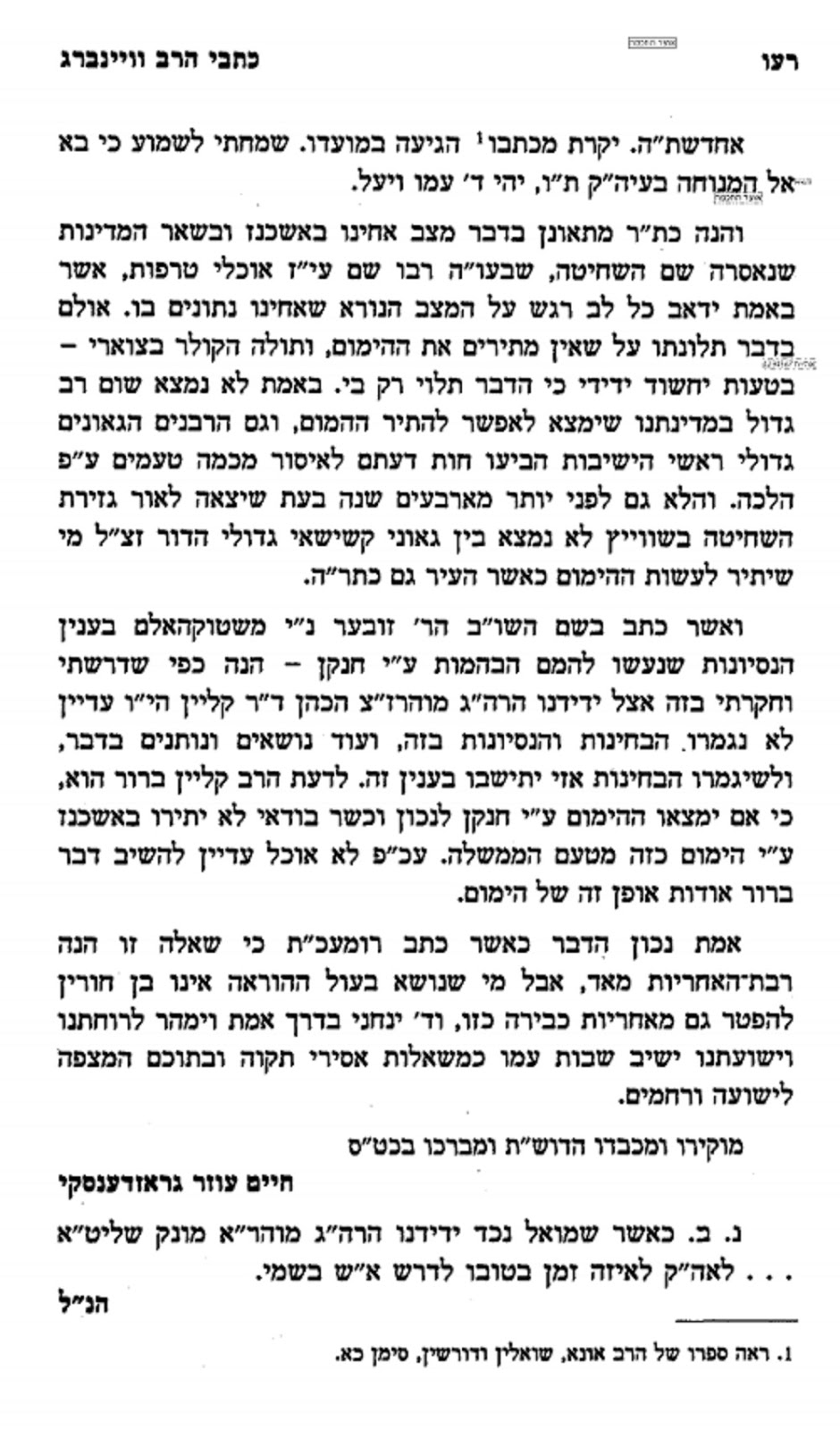
Take a look at the very end of the letter. I couldn’t make out a word, and neither could anyone else I asked, so I inserted three dots. (If anyone can make out the word, please let me know.)

Here is the second page of the letter in Iggerot R. Hayyim Ozer. Take a look at the end.

The first thing they did was good, in that they corrected a typo. מוהר”א should be מוהר”ע and refers to R. Ezra Munk (in Hebrew he went by Azriel). However, they also inserted the word נסע which anyone can see is not correct. They did this even though they did not have a copy of the manuscript. They just assumed it must be the missing word, but how can anyone make a guess like this without actually seeing the manuscript?

As for the letters from R. Weinberg to R. Unna, here is how they are shown on Kestenbaum’s website.
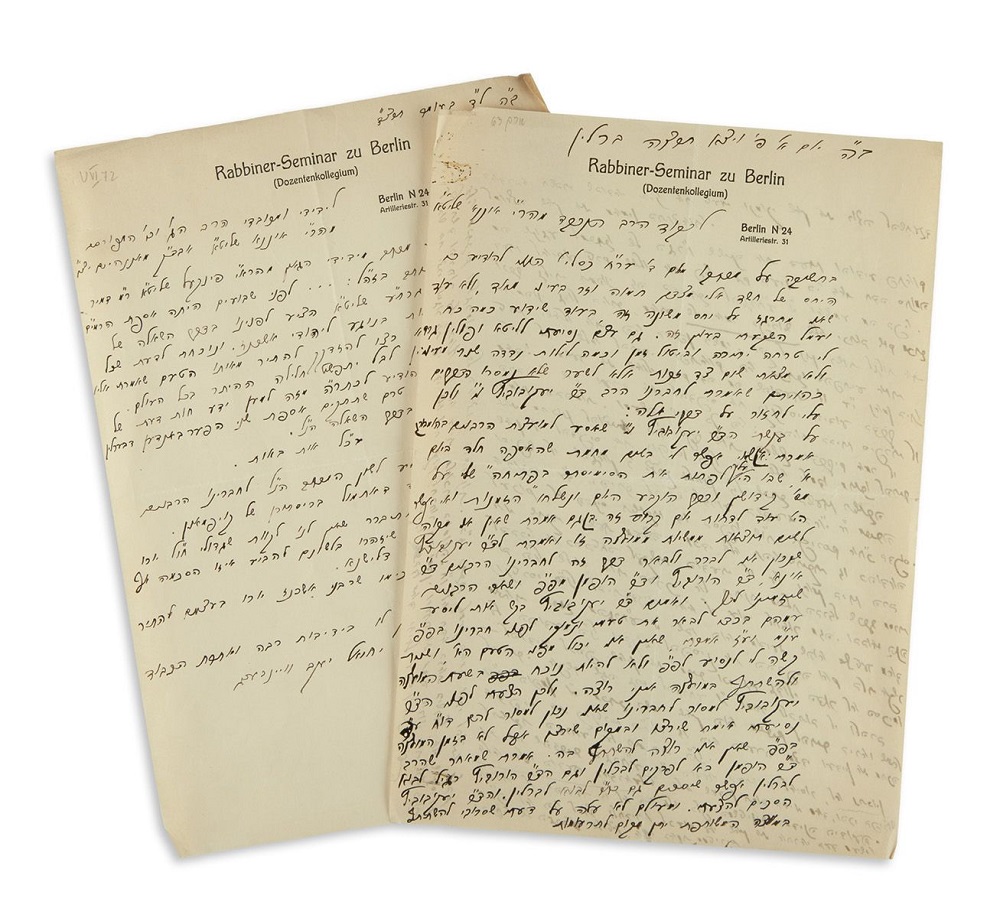
I published one of these letters in the appendix to my dissertation and refer to both of them in Between the Yeshiva World and Modern Orthodoxy, p. 125 n. 69.

So why did I almost fall off my chair when I saw the three letters (one from R. Grodzinski and two from R. Weinberg) in the Kestenbaum catalog? Because these letters were kept in an archive at Bar-Ilan University. Apparently, the archival material was regarded as belonging to both the Institute for Holocaust Research and the Institute for Diaspora Jewry, as both names were used to designate where it was held. That is why in different publications of mine, when I cite this material, I sometimes refer to it by one name and sometimes the other. It was in this archive that I found the letters, made copies, and then published two of the three (and I have copies of other documents from there as well). If you look at the images of the documents in the upper left-hand corner, you can see the Bar-Ilan manuscript number.

Here is the first page of Kitvei R. Weinberg, vol. 1.

For the appendix, no. 6, I identify the document as coming from the Institute for Diaspora Jewry 102:7/18. Now look at the upper left of R. Grodzinski’s letter. You can clearly see VII 18.

I was disturbed to see items that belonged to Bar-Ilan University being sold. I realized that there are two options. One is that Bar-Ilan itself had arranged for the sale, or had sold the letters to someone who was now reselling them. We have lots of examples of libraries that have sold material in them. However, in this case a sale would be very inappropriate. The Unna family gave the archive of R. Yitzhak Unna to Bar-Ilan with the purpose of preserving it for posterity and allowing researchers to have access to this material. If for some reason Bar-Ilan could not fulfill this task, the only appropriate thing would have been to give it to another archive. To have sold this material would be a complete abandonment of Bar-Ilan’s most basic responsibility as holder of an archive.

The other option is that the material was stolen, and unfortunately, we also have plenty of examples of stolen material ending up at auction.

The first thing I did was contact Bar-Ilan, as I thought that they would be interested in investigating this matter and perhaps stopping the auction until the issue could be sorted out. The response I got was somewhere between apathy and annoyance. They had absolutely no interest in what I was telling them, and even seemed annoyed that I was taking the time to tell them this. The fact that materials that they assumed responsibility for were being sold at auction, and thus not available for scholars to access anymore (as no copies had been made), was of absolutely no interest to them. I was shocked and speechless.

Eventually, I was able to figure out what I think happened. I was told by someone who was involved in one of the institutes that one of the people who worked with the archival materials had taken documents home to help with his research. When he died in 2000 the material was at his home, and it was thought that it was disposed of, no doubt by someone who did not realize what it was or that it belonged to Bar-Ilan. But now we know that it was not disposed of.

It is clear that Kestenbaum, which is known as a scrupulously honest auction house, had no way of knowing that the material it was given belonged to Bar-Ilan (assuming that what I wrote in the previous paragraph is what happened). Before it reached Kestenbaum, it could have gone through a few different hands without anyone realizing this either. Since even after I alerted Bar-Ilan no one there cared about this material, there really wasn’t anything that could be done. The problem, however, as in all such cases, is that material that was designed to be available for scholars to examine has now vanished. Although I haven’t been back to Bar-Ilan for many years, one of the things I was planning to do next time I was there was to return to these archival collections which have much important material and which I haven’t seen in over twenty years.[2] But now neither I nor anyone else will be able to do so.

What motivated me to write about this now is that in April 2020 another “old friend” of mine, a letter from R. Weinberg to R. Unna from the same Unna archive at Bar-Ilan, was offered for sale at a different auction house. You can view it here.

Here is the copy that I made (which also has some of my own handwriting). You can clearly see the Bar-Ilan manuscript number.

After this post was completed, I was alerted to another auction house in London which on May 18, 2020 (today!) is auctioning a letter from R. Weinberg to R. Ben Zion Uziel. You can see it here. After the auction concludes the page might be removed, but you can still see the catalog here, no. 176. This letter was stolen from the Israel State Archives, file number 000i7uz (old number: 887/12-פ). You can see the archive file here. A copy of this letter was made by Professor Amihai Radzyner in 2010, before the archive was digitized. In 2013 he sent a copy to me. Prior to this, I was sent a copy of the letter by someone who purchased it, yet neither of us then knew that it was stolen. Unlike Bar-Ilan University, I am sure that the Israel State Archives will want this letter returned to it after learning about its fate.

3. In my last post here I included a letter from Saul Lieberman to Max Rowe that many people found interesting.[3] I forgot to mention that it was Ariel Fuss who alerted me to the correspondence between Lieberman and Rowe. Although I carefully went through the Lieberman archive years ago in preparing Saul Lieberman and the Orthodox, I did not make copies of all the documents, and I thank Ariel for reminding me of this interesting material. Here are the letters in the archive from Rowe to Lieberman, from which we see not only who received the first Rothschild awards, but that R. Joseph B. Soloveitchik was also consulted in this matter.[4]

In the last post I also gave a couple of examples where it appears to me that the editors of books did not realize that the Jewish Theological Seminary is not an Orthodox institution. R. Moshe Maimon called my attention to the following example, from Mesorat Moshe, vol. 3, p. 213, no. 81, where we also see confusion about JTS.

The people who put the book together from R. Mordechai Tendler’s notes did not realize that when he asked R. Moshe if it is permitted to send a book to the “library of the Seminary,” that he and R. Moshe were referring to JTS. The editors mistakenly thought, as we can see from the heading, that this referred to “the” Christian seminary (as if there is one such place).

R. Yitzhak Nahman Eshkoli calls attention to what he sees as another mistake made by those who published R. Moshe Feinstein’s works.[5] Here is Iggerot Moshe, Orah Hayyim5, 22:21.

According to the text of R. Moshe’s responsum, animals are muktzeh, even those that children play with. This means that R. Moshe held that pets are also muktzeh. Yet in the small print the editor added that pets are permitted, even though this completely contradicts the first part of the sentence. See also Iggerot Moshe, Orah Hayyim 4, no. 16 (end), where R. Moshe forbids[6] moving a fish tank on Shabbat and Yom Tov: דבע”ח מוקצין.

Here is one more story about the Orthodox response to JTS. It was told by R. Joseph Buxbaum, the director of Machon Yerushalayim:[7] When R. Abraham Sofer came back to Jerusalem after teaching at the Seminary, the Brisker Rav, R. Isaac Zev Soloveitchik, stopped talking to him “in learning”. This upset Sofer and he complained to the Brisker Rav, what is the difference between him and Shraga Abramson. Abramson also taught at the Seminary and yet everyone knew that he was welcome to come speak in learning with the Brisker Rav.

The Brisker Rav replied with a story: The beit din in Vilna ruled that a woman should be divorced without receiving her ketubah because she did not cover her hair and thus had the status of עוברת על דת יהודית. The woman objected that just yesterday the beit din ruled that another woman who also did not cover her hair did not have the status of עוברת על דת יהודית, so what is going on? The dayanim explained to her that the woman from yesterday grew up in Vilna where it is common for married women not to cover their hair, so she is not regarded as עוברת על דת יהודית, but you come from Hungary where the practice is to shave the heads of married women. A Hungarian woman who goes without a head covering[8] is certainly an עוברת על דת יהודית. (The point is clear, but I wonder, in the twentieth century did any non-hasidic Hungarian women shave their heads?)

The Brisker Rav explained to Sofer that when a descendant of the Hatam Sofer teaches for the Conservatives, “he is a ‘sheigetz,’ but Shraga, where does he come from? From Lomza, nu . . . it is not so far away.”[9] His point was that Lithuanian Torah scholars, who are generally more open-minded than Hungarian scholars, have often not seen it as problematic to have relationships with non-Orthodox scholars.[10]

Along these lines, R. Eliezer Brodt called my attention to the fact that, together with numerous great rabbis, Louis Ginzberg was named one of the honorary presidents of the Telz alumni association, something that today appears unimaginable. The following appears in R. Aaron D. Burack, Pirhei Aharon (New York, 1954), vol. 2, p. 278.

In my post here I mentioned how R. Abraham Sofer’s edition of Meiri’s Hibbur ha-Teshuvah is dedicated to Ginzberg. Ovadya Hoffman called my attention to the fact that Sofer also dedicated another work to Ginzberg, this time in his memory. This work is Tractate Shekalim with two medieval commentaries (New York, 1954; the dedication is missing in the Copy Corner printing found on hebrewbooks.org).

Hoffman also informed me that there are three pages of Ginzberg’s notes at the end of the volume.[11] Hoffman also mentioned that there are notes from Lieberman at the end of the Meiri on Niddah.

Finally, regarding Lieberman and the Brisker Rav, it is of note that in Tosefta ki-Feshutah, Pesahim, p. 562, Lieberman writes:

וערבים עלי דברי מרן הגאון הרב ר’ זאב מבריסק

I don’t know of anyone else whom Lieberman refers to as “Maran”.

4. In my last post here I mentioned Samson Bloch’s witticism that מבקר stands for מתכבד בקלון חבירו. Let me now add the following, related to the word קלון, which for reasons of space I could not include in the previous post.

Bereshit Rabbah 18:24 states:

.ודבק באשתו: ר’ אבהו בשם ר’ יוחנן בני נח על הנשואות חייבין, על הארוסות פטורין, ר’ יונה בשם שמואל זונה שהיא עומדת בשוק ובאו עליה שנים הראשון פטור והשני חייב משום בעולת בעל

In this passage, the words I have underlined make perfect sense: “If a harlot was standing in the street.” The Jerusalem Talmud, Kiddushin 1:9, is a parallel passage, but there the text reads: זונה עומדת בחלון, “If a harlot was standing in the window.” What does it mean that the harlot was standing in the window? Korban Edah explains that she was standing in the window waiting for customers, as is the practice of harlots. While this makes sense in modern times, when we know that in some places (like Amsterdam) this is the practice of harlots, is there any evidence that in ancient times harlots would stand in the windows? Perhaps the contrary is true, as R. Shimon Amorai[12]  writes: שסתם זונות הולכות בחוץ. Yet while Korban Edah’s interpretation might seem anachronistic, what else could עומדת בחלון mean?

Jacob Reifman brilliantly suggests that instead of חלון the text should read: זונה עומדת בקלון, and he provides other examples of the use of the word קלון with reference to sexual immorality and prostitution.[13]

In general, Reifman’s writings, widely scattered throughout books and periodicals, should be gathered in one place. Readers will find in them many very insightful comments as well as many far-fetched interpretations.[14] Reifman often focuses on textual criticism but sometimes he offers other interpretations as well. For instance, he discusses Shabbat 55b-56b which gives a number of examples of “Whoever says that Reuben [David, Solomon, etc.] sinned is in error.” Reifman sees it as obvious that these are aggadic statements not meant to be taken literally.[15] He sees their purpose as twofold. The first is to train people to judge others favorably. Maimonides goes so far as to say that when dealing with a righteous person who it seems is doing something wrong, you should judge him favorably even if it is not easy to view matters in this fashion.[16]

The second purpose of the aggadic statements is so that the masses not be led astray by seeing how great people can also fall. The concern is that the masses will say that if these great people sinned, then we who are far below their level should not be too concerned about sinning. Reifman says that although the explanations given in the Talmud to explain the various sins are unconvincing, for the masses and the women it is possible that they would be effective. He refers to Rashi, Shabbat 30b, s.v. mutav, who speaks of aggadic expositions intended for these populations.

לאו מהכא יליף חלול שבת דפיקוח נפש נפקא לן מוחי בהם ולא שימות בהם אלא להטעימן הדבר באגדה המושכת את הלב לפי שהיו באים לשמוע הדרשה נשים ועמי הארץ והיו צריכין הדרשנין למשוך את לבבם

Reifman concludes similarly with regard to the passages he is focused on, which deny that certain great figures committed sins even though the biblical text states that they did:

והמאמרים הנ”ל, הם אפוא מן האגדות שהזמן גרמא והאגדות האלה אינם לא משפטים מקובלים ולא משפטים מושכלים כי אם תחבולות אשר קנו נבוני לב למשוך בהם את ההמון אחרי הטוב ולהרחיקו מן הרע.

It is noteworthy that R. Eliyahu Zini also concludes that the Talmud never intended to say that the biblical figures under discussion did not sin. That is why, R. Zini claims, the Talmud uses the language, “Whoever says [the biblical figure sinned]”, as the issue here is that we are not supposed to publicly mention these matters, and that that is what is problematic.[17]

שאכן יש בעיה, אלא שאסור להעלותה על דל שפתותינו ברבים או בפרהסיא. וכונתם ברורה: המפרסם את הדבר אינו אלא טועה, אף אם הדבר אמת

Before leaving Reifman, let me call attention to another comment of his that appears on the same page in Ha-Magid as the one I just dealt with. He deals with the following statement in Shabbat 119b which explains Psalms 105:15:

אל תגעו במשיחי אלו תנוקות של בית רבן ובנביאי אל תרעו אלו ת”ח

Touch not mine anointed refers to school children; and do my prophets no harm, to disciples of the Sages.”

We can understand why “my prophets” might refer to Torah scholars, but what does “mine anointed” have to with school children? There have been any number of homiletic explanations of this, yet Reifman suggests that the passage has been corrupted and it really should be reversed so that “my prophets” are identified with the school children and “mine anointed” with the Torah scholars. Here is what he says, and I think everyone must acknowledge that it makes great sense:

נ”ל ברור, כי צ”ל להפך: אל תגעו במשיחי אלו ת”ח ובנביאי אל תרעו אלו תנוקות של בית רבן, וכי כנוי משיחי לת”ח הוא ע”ש: דרדוגי דמשחא ארישא דרבנן (כתובות י”ז ב’) וכנוי נביאי לתנוקות של בית רבן הוא ע”ש: א”ר יוחנן מיום שחרב בית המקדש ניטלה נבואה מן הנביאים וניתנה לתינוקות (ב”ב י”ב ב’), וע”ש: ר’ יוחנן בדיק בינוקא (חולין צ”ה ב’) וראה והביטה, כי ר’ יוחנן אשר בדק בינוקא הלך לשיטתו שהנבואה נתנה לתנוקות אחרי חורבן ביה”מ. ועל בדק בינוקא פי’ רש”י: דשייל ליה פסוק לי פסוקיך עכ”ל, והוא מתאים היטב עם אשר אמר ר’ יוחנן: השכים ונפל לו פסוק לתוך פיו הרי זו נבואה קטנה (ברכות נ”ה ב’) , והבן.

I realize that we can’t change the text of the Talmud, but will you ever read the passage again without thinking about Reifman’s suggested emendation? As far as I know, the only commentator to take note of Reifman’s suggestion is R. Reuven Margaliyot, Nitzotzei Or, Shabbat 119b [18] He doesn’t even remember where he saw the suggested emendation, as he writes:

בזכרוני שצ”ל להיפך אל תגעו במשיחי אלו ת”ח כמש”א בכתובות י”ז ב דרדוגי דמשחא ארישא דרבנן, ובנביאי אל תרעו אלו תנוקות של בית רבן דמיום שנחרב ביהמ”ק ניתנה הנבואה לקטנים (בבא בתרא י”ב א)

Much more can be written about Reifman, both with regard to his own writings and also his relationship with the rabbinic world, but this will have to await a future post.[19] Here is his picture.

5. In my last post I wrote:

When it comes to the word דִבׇּה, which means “slander” in biblical Hebrew, it has a very different meaning in medieval texts. “As Jacob Klatzkin [in his Thesaurus] notes, dibbah in medieval Hebrew does not mean ‘slander,’ but rather a false claim, nonsense, or absurdity.” Y. Tzvi Langermann, “Rabbi Yosef Qafih’s Modern Medieval Translation of the Guide,” in Josef Stern, et al., eds., Maimonides’ Guide of the Perplexed in Translation (Chicago, 2019), p. 268.

Although this might seem like a tidbit of pedantry, it actually is much more than this, and many people have been misled because they did not realize what the word דִבׇּה means in medieval texts. For example, the following appears in Maimonides’ Introduction to Helek, in the medieval translation by Solomon ben Joseph found in the back of the Talmud:

ואף על פי שהנראה מקצת דבריהם יש מהם מן הדבה והריחוק מן השכל, עד שאילו סופר על פשוטו לעמי הארץ כל שכן לחכמים היו תמהים בהתבוננם בהם והם אומרים היאך יתכן שיהיה בעולם אדם שיחשוב כזה או שיאמין שהיא אמונה נכונה קל וחומר שייטב בעיניו.

In this passage, Maimonides is describing the first category of those who take aggadot literally. Here is how Fred Rosner translates these words (his translation is from the Hebrew, not from the original Arabic):[20]

And this, in spite of the fact that in their literal sense, some of the words of the Sages would seem to be so slanderous and absurd that if they were related to the uneducated masses in their literal sense—and all the more so to the wise—they would reflect upon them in amazement and exclaim “How is it possible that there exists in the world anyone who would think in this manner or believe that such statements are correct, much less approve of them.”

Clearly, the word “slanderous” makes no sense in this sentence, and that is because when the medieval translation uses the word דִבׇּה it means something else entirely. In his note to the passage, Rosner writes: “Kafah omits the word ‘slanderous.’” This is an incorrect formulation. R. Kafih was translating the commentary anew, so he was not tied to the medieval Hebrew translation. He translates:

ואף על פי שיש בפשטי מקצת דבריהם מן הזרות

Furthermore, R. Kafih actually refers to the medieval translation on p. 136 n. 35 of his edition. In his typical sharp fashion, R. Kafih writes:

בנדפס “מן הדבה” ודבה היא

In his play on words, R. Kafih is saying that the medieval translator engaged in slander by falsely translating the passage as “slanderous.” The only thing that is surprising here is that R. Kafih seems to have also been misled and did not realize that when the translator uses the word דִבׇּה it means “false claim,” “nonsense”, “absurdity,” or a similar word.[21]

In seeking to make sense of the word דִבׇּה and assuming it means slander, the Rambam le-Am, p. 118 n. 12, explains:

הוצאת דיבה על חז”ל, ביחסם להם דברים תפלים שאין להם שחר

These are nice words, but they have nothing to do with what Maimonides said, or for that matter, with what appears in the medieval translation.[22]

The same word דִבׇּה also appears in Maimonides’ Introduction to Helek in his discussion of the second group of people who distort the meaning of Aggadot. In the medieval translation:

והם באים לסכל אותם ולגנותם ומוציאים דבה על מה שאין בו דבה וילעיגו על דברי חכמים לרגעים

Rosner translates: “They eventually call these (rabbinical assertions) foolish, and deprecate them and slander that which should not be slandered. From time to time, they deride the words of the Sages.” Once again, “slander” has nothing to do with what Maimonides wrote. R. Kafih translates:[23]

וחשבו למוזר מה שאינו מוזר

In his note (p. 136 n. 43), he writes:

בנדפס “ומוציאים דבה על מה שאין בו דבה” ואינו נכון

However, the medieval translation makes perfect sense once we understand that when it uses דִבׇּה it does not mean “slander”. Thinking that this is what the word means, it makes sense that R. Kafih would say that it is incorrect.

Yitzhak Shilat translates:[24]

ולגנות מה שאין בו גנאי

In his translation of Guide 1:51, Samuel Ibn Tibbon uses דִבׇּה in the same way:

ולאמתם בצעקות ובהוצאת דבות והרחקות ובפנים רבים מורכבים ממחלוקת נצוח והטעאה

Strangely enough, and presumably because the printers did not know the meaning of דבות in the sentence, most printings (including the standard one with the commentaries)[25] replace ובהוצאת דבות with ובהוצאות רבות, which itself has no meaning.[26]

* * * * * * * * *

[1] For many people in the New York area in the 1980s and 1990s, these words—replacing Jews with “American citizens”— will bring back memories of driving home from work. For those who want to hear this opening line again, listen here. I actually know of one gadol who used to listen to the Bob Grant show at home.
[2] The letter from R. Hayyim Lauer that I published in Milin Havivin 2 (2006), pp. 25-33, also came from the archive we are discussing. You can see it here. R. Lauer discusses whether in contemporary times, in a she’at ha-dehak, a pilegesh can be permitted.

Regarding a pilegesh, R. Jacob Emden, in his recently published Em la-Binah, p. 82, explains in an original fashion that the root of the word is פלג אשה. (As noted in the text, he already mentioned this explanation in Lehem ShamayimParah 1:3; regarding the vocalization of Em la-Binah, see Berakhot 57a).

Em la-Binah, which is a commentary on the entire Torah, is a very significant publication and required reading for anyone with an interest in R. Emden. It is noteworthy that the editor, R. Elimelech Zwiebel, leaves out some harsh comments from R. Emden about earlier commentators (including Ibn Ezra, see p. 98). However, when he does so he indicates this in the text, so when the manuscript from the British Library is eventually put online, readers will be able to find out what was left out. We must all be grateful to Zwiebel that he took this important step, rather than just omitting the “problematic” comments.

On pp. 60-63, Zwiebel cites R. Emden’s famous passage about circumcision that is only found in a few surviving copies of the first printing of Migdal Oz (Altona, 1748). I discuss this passage in Changing the Immutable, p. 204, where, following Scholem and others who have dealt with the matter, I state that R. Emden himself removed this passage. Zwiebel, on the other hand, argues that R. Emden initially did not include the passage in the first printing, but before the printing was complete he added it to some copies. See Yeshurun 32 (2015), pp. 851-852.

In my opinion this is incorrect and makes no sense at all. In what I assume is the self-censored Altona 1748 “edition”, the missing passage is preceded by these words:

ובאמת דבריו הללו מתאימים כו’

The word ‘כו appears on the second line and there is a big space after it, and also a little space before it. Here is what the page looks like as found in Zwiebel’s article.
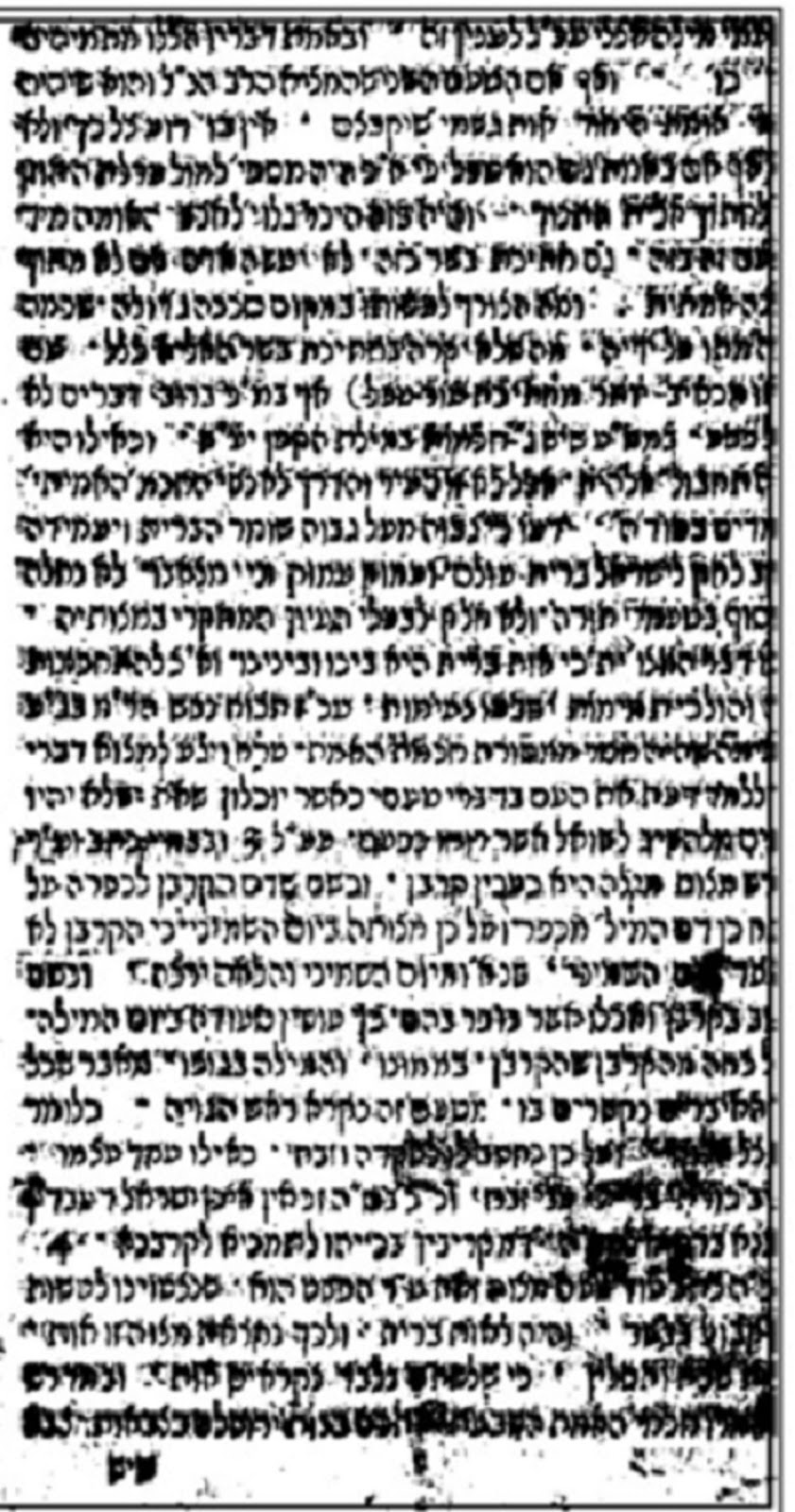
Zwiebel writes that:

מילת כו’ מוכיחה כי כוונתו היתה להרחיב עוד בענין זה

This makes no sense. First of all, no one prints a book intending at the outset to redo the pages (with all the work this entails), and adds ‘כו to let the reader know that a new section is coming. Second, even if this was the case, there would be no need for the spaces before and after ‘כו. Here is what p. 2b in the “uncensored” version looks like.

Look at lines 1 and 2 and compare to the “censored” version shown above. It is obvious that the “uncensored” version is the original text, and the material from line 2 and on was removed by R. Emden.

One final passage which caught my attention is on p. 110 where R. Emden says that despite Proverbs 31:30: “Grace is deceitful and beauty is vain,” women’s beauty is nevertheless important and is something Scripture mentions, and “Jacob our forefather went after his eyes.”

לא לחנם כתב תורה את זאת והדומה לזה שמשתבח הכתוב ביופי נשים, ושיעקב אבינו עליו השלום הלך אחר עינים

What this means is that Jacob saw that Rachel was beautiful, and this is why the Torah writes in Gen. 29:17: “Rachel was of beautiful form and fair to look upon.”

What then are we to make of the verse in Proverbs? R. Emden says that “beauty is vain” only when it comes without fear of Heaven, and that is why this appears in the second half of the verse from Proverbs. Yet when it is combined with fear of Heaven, then beauty is a positive thing. He continues by explaining how one’s outer appearance is connected to one’s inner spirituality. In other words, Rachel’s outer physical beauty was, in Jacob’s eyes, also a sign of her inner spiritual beauty.

אין היופי הבל אלא כשהוא בלי יראת שמים, אבל בודאי שיופי הגשמית הוא צורת אדם [הפנימי] . . . ולכן ודאי הכיר כי הגשמות ציור הרוחנית היא, ואם נמצא אשה בפגם וסרת טעם, דע שלא נזהרו בה כראוי ונתקלקלה בחברה רעה

[3] The website Matzav not only posted the letter together with two paragraphs from my post, but made it seem as if I wrote the piece for Matzav, as there is no mention that it originally appeared on the Seforim Blog. See here. Even after Matzav was told that this is inappropriate and that they should take down the post, nothing was done. I am sure that Matzav’s interest in the letter was because of how Lieberman praised R. Chaim Kanievsky.
[4] Documents provided courtesy of the Saul Lieberman Archives (ARC 76/8) of the Jewish Theological Seminary Library.

In Saul Lieberman and the Orthodox, I published Lieberman’s letter against ordaining women. The last sentence of this letter  reads:

אבל אשה שפסולה לדון, ולא תהא ראויה לכך, אין להסמיך אותה בתואר זה (ואפילו כמליצה בעלמא, עיין בתוספות ע”ז ה ע”א ד”ה אלא) ובל נעשה את עצמנו חוכא ואיטלולא.

While preparing the book, I did not know what the meaning of the reference to Tosafot is. R. Chaim Rapoport explained it to me.

The Tosafot in Avodah Zarah suggest that the figurative expression “ha-eynei ha-anashim ha-heim tenaker” (Numbers 16:14) – clearly a melitzah – would not have been written in relation to people who were physically blind. Lieberman’s claim is that since a woman is not able to be a rabbi in the true, talmudic, sense of the word, therefore the title should not even be applied to her “be-derech melitzah”, hence the reference to the Tosafot.

It is interesting that in R. Herschel Schachter’s article against women rabbis, Hakirah 11 (Spring 2011), pp. 19-23, one of his major sources is “Rabbi Shaul Lieberman”.
[5] Tza’ar Ba’alei Hayyim be-Halakhah ve-Aggadah, p. 514 n. 1171.
[6] R. Menasheh Klein discusses other issues related to an aquarium. See Mishneh Halakhot, vol. 6, no. 216 (called to my attention by R. Aviad Stollman).
[7] It is recorded in R. Eliyahu Soloveitchik’s unpublished memoir, p. 16 (unnumbered).
[8] The same approach, in which the lack of head covering among Lithuanian Jewish women—as opposed to Hungarian women— was not viewed as reflecting negatively on their general religiosity, is seen in the following story recorded by Moshe Potolosky of what the Hazon Ish told his father (Mevakshei Torah 49 [Tamuz 5769]), p. 71, called to my attention by Joel Wolowelsky).

.אמר רבנו לאבי: כשאתה תארח בבית שבו אין האשה נוהגת לכסות את ראשה, אם היא מליטא – יתכן שאף המהדרים והמחמירים ביותר יכולים לסעוד אצלה בלב שקט. אבל אם היא מהונגריה – אסור לטעום מתבשיליה

ומדוע? כי בליטא לא הקפידו רוב הנשים על כסוי ראש (א”ה, בתקופה ההיא בליטא היה פרוץ הדבר) ואף נשים צדקניות רבות מאד הקלו בזה. אבל בהוגנריה, היתה בקהלות האורתודוקסיות הקפדה רבה בענין זה, ובדרך כלל,רק אשה שזלזלה במצוות היתה נמנעת .מלכסות את ראשה, ועל אחת כזו אי אפשר לסמוך בעניני כשרות

Moshe Botchko writes simply (Mikhtavim u-Ma’amarim ha-Rav Botchko, p. 252):

.בליטא לא נהגו נשים דתיות לכסות ראשן אף מחוץ לביתן, חוץ מנשות הרבנים

The following appears in the anonymous Ha-Keter ve-ha-Kavod le-Hai Olamim (Jerusalem, 2017), p. 102:

.והנה האמת היא שאין שום מקום להרגיש, את ההרגשה המוטעת אשר ינסה היצר לטעת בלב חלק מההורים, כאילו הדור הצעיר שחפץ לתקן את הדבר, ולקיים את המצוה הזו כתיקונה, הרי זה – חס ושלום – מחמת מעלתו ויתרונו על הדור הקודם

מחשבה זו אינה נכונה כלל, מפני שהאמת היא שהדור הקודם אינו אשם בזה כלל וכלל, כי התחלת הדבר היה מחמת הקושי הגדול שהיה בחוץ לארץ, בין הגוים, ובהתגברות מחריבי הדת, שעקרו לגמרי את קיום מצות כיסוי הראש, עד שאפילו מבתים של יראים ושלמים בליטא, היו נשותיהם מהלכות בגילוי ראש ממש, וכמו שמפורש בערוך השלחן סימן ע”ה סעיף ז.

Binyamin Zev Jacobson,Divrei Ben Shlomo(Jerusalem, 1957), vol. 1, p. 306, tells the following story:

לפני יותר מחמש ועשרים שנה הייתי בעיר גדולי בלטויה ובקרתי שם את הרב ואשתו כבדה אותי בכוס יין, ואז הייתי מדקדק ולא רציתי לשתות מפני שערה המגולה, והרב גער בי מאוד ואמר לי שרבות מנשי רבני ליטא הולכות כן

(He also records R. Hayyim Ozer Grodzinski’s sharp response when told of what this rabbi said.)

Regarding Hungary, the Orthodox community in Budapest was very strict about the matter of women’s head covering. If a married woman did not cover her hair, her family would not be accepted as a member of this community. See Shmuel Weingarten, “Ha-Shelilah she-be-Shitat ha-Pirud be-Ungaryah,” Areshet (1944), p. 438.
[9] Abramson studied in Lomza but he was actually from Ciechanowiec (near Grodno), the birthplace of R. Jehiel Jacob Weinberg.
[10] See my Saul Lieberman and the Orthodox; Moshe Maimon, “Perek be-Hithavut ha-‘Olam ha-Torah’ be-Artzot ha-Berit le-Ahar ha-Milhamah,” Hakirah 26 (2019), pp. 31-52; and the discussion at the Otzar haHochma forum here. R. Yaakov Hayyim Sofer, Menuhat Shalom, vol. 6, p. 124, in mentioning R. Joseph Zechariah Stern’s citation of “problematic” works, refers to שיטת קצת חכמי ליטא בענין.

It continues to amaze me that, as noted in Saul Lieberman and the Orthodox, p. 31 n. 110, even in a 1935 private letter to R. Shlomo Heiman, R. Hayyim Ozer Grodzinski referred to Louis Ginzberg as ‘הרה”ג מו”ה לוי ד”ר גינזבורג שי. See Iggerot R. Hayyim Ozer, vol. 2, no. 1004. In Saul Lieberman and the Orthodox I included a letter from R. Grodzinski to Ginzberg where understandably he gives Ginzberg the typical fancy titles. This letter was later included in Iggerot R. Hayyim Ozer, vol. 3, no. 276, with no acknowledgment of where the letter first appeared. At the end of the letter there is a name that neither I nor anyone else could make out. I transcribed it as מאיר באראן and then added a question mark. In Iggerot R. Hayyim Ozer they removed the question mark. Uriel Bener called my attention to Shenot Dor va-Dor (Jerusalem, 1999), p. 271, from where we see that the name is מאיר באסין, who happened to be the father-in-law of R. Yisrael Gustman.
[11] Regarding Ginzberg, see also R. Zev Leiter, Mi-Toratan shel Rishonim (Jerusalem, 2000), p. 61, who refers to him as מהר”ל גינצבורג. R. Gedaliah Felder, Yesodei Yeshurun, vol. 3, p. 146 refers to ר”ל גינזבורג. Here is the title page of the 1946 edition of Ma’alot ha-Torah by R. Abraham ben Solomon Zalman, the brother of the Vilna Gaon. R. Nissan Waxman and R. Yehiel Michel Feinstein were willing to collaborate with Ginzberg and to even put his name on the title page.

[12] Ha-Posek, 9 (Tamuz-Av 5708), p. 1529. He offers his own far-fetched interpretation.
[13] Beit Talmud 4 (Vienna, 1883), p. 16, also printed in his Ruah Hadashah (Pressburg, 1885), pp. 2-3. Reifman’s interpretation is cited by R. Azriel Hildesheimer, Hiddushei Rabbi Azriel (Jerusalem, 1992), Kiddushin 9b (p. 316). Without mentioning Reifman, the same emendation is suggested by A. Rosenberg, Al Devar Tikunei Nushaot bi-Yerushalmi (Lodz, 1928), p. 71. In a future post I will discuss who this “A. Rosenberg” was.
[14] R. Meir Mazuz discusses one of Reifman’s comments in my Iggerot Malkhei Rabbanan, p. 314. Those who wish to purchase this volume can do so here. Those in Israel who are interested in the book should contact me directly.
[15] Ha-Magid, May 14, 1873, p. 175. See my Changing the Immutable, p. 5, for many examples of sages who understood David’s sin with Bathsheba literally.

[16] It is fascinating to note that the kabbalist R. Judah Fatiyah was not happy with the talmudic explanation, also found in the Zohar, that Uriah had given a get to Bathsheba. He regarded this as a forced explanation. In his Matok la-Nefesh, pp. 56a-b, he offers an explanation which came to him from someone in a dream, according to which King David voided the marriage of Uriah and Bathsheba. He did this by himself, as he was too embarrassed to involve the Sanhedrin. As the most distinguished member of the Sanhedrin, he had this authority to void a marriage. R. Fatiyah was told in his dream that this explanation had never before been told to anyone else, because the spirit telling him this he was too embarrassed to have shared this information before then.

לבי ולבך ידעי שכל התירוצים הם דוחק ומוכרחין אנן לעייל פילא בקופא דמחטא מפני כבודו של משיח ה’ שהיה יקר בעיני ה’ . . . יש תירוץ רביעי הנגלה אלי בחלום . . . כי ראיתי כאלו אדם שאינו נראה כלל אומר אלי הנה אנן קיימא לן בדיני הקדושין שכל המקדש אדעתא דרבנן איהו מקדש ויכולין רבנן הנמצאים בדור ההוא לעקור ולבטל הקידושין של איזה אדם ותהיה אשתו פנויה למפרע . . . וכשאירע מעשה דבת שבע ראה דוד את עצמו שאינו יכול לכוף את יצרו עמד בינו לבין עצמו בלא צירוף הסנהדרין עמו ובטל את קדושי אוריה ובחר הרע במיעוטו שלא לפגוע באיסור ערוה ח”ו כי היה בוש לבטל את קדושי אוריה בצרוף הסנהדרין עמו שלא לצורך, ויש כח בדוד שהוא לבדו יכול לבטל הקדושין כי הוא היה מופלא שבסנהדרין . . . כל זה נאמר אלי בחלום בקיצור נמרץ כי המדבר אלי היה בוש ונכלם להרחיב הדברים, גם אמר אלי כי מיום שאירע ביטול זה עד היום הזה לא נתגלה עוד ענין זה לשום אדם מעולם לא בהקיץ ולא בחלום כי היה בוש להגיד ענין זה הביטול, ובפי’ הד’ הזה יותרו כל השאלות מעל עבד ה’ ועל משיחו נעים זמירות ישראל.

After citing R. Fatiyah’s statement, R. Ovadiah Yosef writes (Meor YisraelShabbat 56a):

ובמחכ”ת דברי חלומות לא מעלין ולא מורידין ואין ממש בדבריו . . . ואין לנו אלא דברי רבותינו שהם דברי אלקים חיים

Ovadiah was clearly upset that R. Fatiyah, whose expertise was in Kabbalah, chose to weigh in on a halakhic matter and offer the incorrect view that a great Torah scholar can simply invalidate a Jewish marriage without aget. For another response to R. Fatiyah, see R. Nissim Kaduri,Ma’aseh Nissim, p. 12. These sources are cited by R. Meir Mazuz, Bayit Ne’eman 56 (5 Nisan 5777), p. 4 n. 23.

For more dreams of R. Fatiyah, this time with reference to the book Hemdat Yamim, see Avraham Yaari, Ta’alumat Sefer(Jerusalem, 1954), ch. 8.
[17] Etz Erez, vols. 1-2, pp. 287-288 (emphasis in original). Since I have discussed Saul Lieberman in this post, it is worth noting that R. Zini does not regard him positively. This is what he writes in Etz Erez, vol. 4, p. 224.

.וכרגיל בעל תוספתא כפשוטה נהג כאן כחוקרים רבים אחרים, שברמות רוחם מדברים כאלו הם מתנבאים מפי השכינה, וקובעים עמדות ללא כל הוכחה, אפילו לא נתן את דעתו לסתירה הפנימית שבדבריו

Etz Erez, vol. 3, p. 25 n. 10 (emphasis in original):

ובעל תוספתא כפשוטה בלהיטותו לפרש כל דבר עפ”י המידע המדעי, היסטורי או אחר, כמעט כילד קטן שלא החזיק צעצוע מעולם ונותנים לו אחד, לא הבין כלום, לכן כתב (ברכות פ”ד שם) “הלכה זו מתארת את מנהגי הסעודה בזמן העתיק אצל נכבדי העם ונכללו כאן כמה פרטים שאין להוציא מהם מסקנות להלכה, מפני שמקורם נעוץ בנימוסי המקום ולא בהלכה. ובדרך כלל הסדר מתאים למנהגי הרומאים בסעודה וגם של היונים בתקופה המאוחרת, ואין כאן הלכה בסעודה.” הרי הוכחני שיש כאן הלכות ממש, אבל ודאי לא מה שחשב.

Etz Erez, vol. 3, p. 35:

.אינני מסתמך אף פעם על חבור של מי שמיסד את היהדות הקונסרבטיבית בא”י, וכוונתי למחבר התוספתא כפושטא עצמו, אף אם הוא היה בן דוד של ה’חזון איש’

Etz Erez, vol. 1, p. 124 n. 191:

וזה דומה לחוקרי מדעי היהדות הכותבים ‘מהרי”ן אפשטיין’, ‘מהר”ש ליברמן’ וכדו’, תוך נסיון נואש להעביר את הסמכות התורנית לחוקרי האקדמיה, כאילו הם עמדו בראש ישיבות. מדובר במגמה פסולה לחלוטין בעיני איש ירא ה’. חוקר תלמוד, אף אם למדן גדול הוא, איננו איש תורה על תקנו זה, אלא סתם ידען, ולהעניק לו תואר המיועד למשמשים בקודש, היא חילול הקודש וגניבה במחתרת, ורק עם הארץ יעשה זאת.

Hesed Leumim Hatat, pp. 19-20 n. 29:

בתוספתא כפשוטה (עמ’ 756) כתב כל מיני דברי הבל (כמו שהתחיל לעשות מאז מכר נשמתו לקונסרבטיבים) . . . רק מי שאיבד כל תחושת של כבוד האומה הישראלית, עם ה’, מי שאיבד את דרכו האמונית, יכול לומר שלא ברור מהיכן איסור זה. ליברמן בעל הזכרון המופלג, בעל הבקיאות הרחבה מאד, שכל כך שקע במקורות של תושבע”פ אינו זוכר עוד תוכן של פסוקים אלמנטריים ביותר, שכל ילד ידע בע”פ בגלות, ואינו מסוגל להבחין שאין צורך במקור, כיון שתורה מפורשת היא!! . . . ועל חטא זה הוא מוסיף פשע פרשנות עפ”י שיטה ‘דרוויניסטית’ היסטורית מטופשת, פרי עבדות לדעות הנכרים.

Unfortunately, none of R. Zini’s books are on Otzar HaHochma.

[18] Regarding R. Margaliyot, whose writings are of great interest to many, I have recently discovered a few articles of his that are completely unknown and have not been reprinted in the various collections of his writings. I will discuss them in a future post.
[19] See the letters to him from R. Elijah David Rabinowitz-Teomim published in Mikabtze’el 36 (2009), pp. 47ff., ibid. 37 (2011), pp. 75ff. See ibid., p. 76, that when R. Joseph Zechariah Stern published his responsa which were sent to Reifman, he abbreviated his name.
[20] Maimonides’ Commentary on the Mishnah: Tractate Sanhedrin (New York, 1981), p. 141.
[21] If I am correct, this was only an early mistake and R. Kafih must have later realized this. I say this because Al-Harizi used the term in his translation of the Guide a number of times. See Langermann, “Rabbi Yosef Qafih’s Modern Medieval Translation of the Guide,” pp. 168ff.
[22] The same mistake is made by R. Shlomo Aviner in his edition of Hakdamat ha-Rambam le-Perek Helek (n.p., 2013), p. 82.
[23] Just to show you how times change, Rosner translates R. Kafih’s words: וחשבו למוזר מה שאינו מוזר, “and consider queer that which is not queer.” If Rosner were translating this today, instead of “queer” he would use “strange,” as queer has come to mean something entirely different.
[24] Hakdamot ha-Rambam la-Mishnah (Jerusalem, 1992), p. 134.
[25] See Yehudah Ibn Shmuel’s textual note in his edition of Moreh ha-Nevukhim, vol. 2, pp. 27-28 (third pagination).
[26] See also David Kaufmann, Geschichte der Attributenlehre in der Jüdischen Religionsphilosophie des Mittelalters (Gotha, 1877), p. 273 n. 64, for what seems to be an example of replacing דבה with רבה.


A Woman's Place Is In The Home

A Woman's Place Is In The Home

by: Yitzhak, of בין דין לדין

The Sons of Korah declare:כָּל-כְּבוּדָּה בַת-מֶלֶךְ פְּנִימָה; מִמִּשְׁבְּצוֹת זָהָב לְבוּשָׁהּ.[1][And see here for various nineteenth and twentieth century references to our titular aphorism, and see this essay.] But is the verse indeed a normative injunction toward modesty, for women in general, or at least Jewish women in particular, as it is commonly understood? And if so, exactly what standard of behavior is being enjoined?

Cultural Norms – Twelfth Century Egypt, Twentieth Century Jerusalem and Twenty First Century Kabul

Rambam's rather extreme (by contemporary Western standards) formulation, directing a husband to "prevent his wife" from being a gadabout, and instructing him to "only allow her out around once or twice a month, as necessary", is well known: מקום שדרכן שלא תצא אשה לשוק בכפה שעל ראשה בלבד עד שיהיה עליה רדיד החופה את כל גופה כמו טלית נותן לה בכלל הכסות רדיד הפחות מכל הרדידין. ואם היה עשיר נותן לה לפי עשרו כדי שתצא בו לבית אביה או לבית האבל או לבית המשתה. לפי שכל אשה יש לה לצאת ולילך לבית אביה לבקרו ולבית האבל ולבית המשתה לגמול חסד לרעותיה או לקרובותיה כדי שיבואו הם לה. שאינה בבית הסוהר עד שלא תצא ולא תבוא. אבל גנאי הוא לאשה שתהיה יוצאה תמיד פעם בחוץ פעם ברחובות. ויש לבעל למנוע אשתו מזה ולא יניחנה לצאת אלא כמו פעם אחת בחודש או כמו פעמים בחודש לפי הצורך. שאין יופי לאשה אלא לישב בזוית ביתה שכך כתוב כל כבודה בת מלך פנימה:[2]Of course, this passage must be placed within the context of its author's milieu, a rigidly traditional Islamic society. Indeed, this attitude is still present in some modern day Muslim societies: KABUL — On a recent day when the sun was finally strong enough to dry the Afghan capital's muddy streets, Habiba Sarwe sought her husband's permission to visit a spot that her daughter and all the neighborhood wives were talking about: a park, with swings, benches, flowers and a gazebo. A park for women only. "Please, let me go," begged Sarwe, who is 44 but whose tired eyes make her look far older. "It's a good place." Her husband decided it would be okay. So that afternoon, Sarwe put on her favorite fitted gray wool suit under her shapeless, head-to-toe burqa and set out with three of her children for the dusty park on the edge of Kabul. "This is the one place that's ours," said an out-of-breath Fardia Azizmay, 19, Sarwe's older daughter, as she jumped off a swing and looked over a pile of a dozen blue burqas, tossed off by women as they entered. "For us, home is so boring. Our streets and shops are not for women. But this place is our own." The small park, protected by a half-dozen gun-toting guards, has become a favorite destination for Kabul women wanting a safe, quiet place to meet with friends, complain about their husbands, discuss their kids, line one another's eyes with black kohl or just shed their burqas and play, female activists here say. … Although women make up more than half of Afghanistan's population, fear of fundamentalist militant groups has caused them to nearly disappear from public life, especially in the rural south, where U.S.-led forces are trying to root out Taliban fighters. Some of those insurgents still pressure women to cover up and to avoid schools and workplaces, defying the Afghan constitution's guarantee of equal rights for both sexes. "I get threatening calls almost every day asking why I think I am important enough to work in an office," said Fouzia Ahmed, 25, a government secretary in Kabul. "The truth is, no women feel safe here. We are always threatened. That's why we need the eyes of the world." And the great Rav Ya'akov Yeshayah Blau gives us the not entirely dissimilar Yerushalmi perspective on women working outside the home. He takes a rather dim view of this modern trend, and maintains that the husband may not compel his wife to do so: [רוב] נשים העושות מלאכה הוא בפקידות או בהוראה, … דלא מסתבר שיוכל הבעל לכוף לאשתו לצאת לשוק בזמן שכל ההיתר לנשים לצאת לשוק אינו לפי רוח חכמים (עיין פרק ט הערה קכז מדברי הרמב"ם), ובפרט כשהרבה מלאכות כגון לעמוד בחנות או לעבוד בפקידות רחוק ממדת הצניעות, וידוע שבעוה"ר הרבה מכשולים יוצאים מזה, ובודאי שמצוה גדולה לאדם שלא יתן לאשתו להמצא בשוק כל כך, ודי לנו במה שהן מוכרחות (וזכורני שלפני עשרות שנים הרבה מנקיי הדעת בירושלים היו יוצאים בעצמם למכולת ולשאר דברים שהם צרכי הבית, וויתרו על כבודם וטרחתם משום צניעות), ועיין שו"ת רדב"ז ח"ג סימן תפ"א, ועל כן נלענ"ד שאין שום דין כפיה לאשה לצאת ולהרויח, ואדרבא, חייב למונעה מכך, ובעוה"ר נחשב הדבר כמעלה בשידוך שיש לאשה מקצוע, וכל שכן משרה שתוכל לצאת ולהרויח,[3]There are at least three Talmudic invocations of our verse as a basis for modesty, but their exact import, and even their very normativeness, are not entirely clear, as we shall see.

Talmudic Sources

Gittin

שאם ירצה שלא לזון כו': שמעת מינה יכול הרב לומר לעבד עשה עמי ואיני זנך הכא במאי עסקינן דא"ל צא מעשה ידיך למזונותיך דכוותה גבי אשה דאמר לה צאי מעשה ידיך במזונותיך אשה אמאי לא אשה בדלא ספקה עבד נמי בדלא ספיק עבדא דנהום כרסיה לא שויא למריה ולמרתיה למאי מיתבעיתא שמע עבד שגלה לערי מקלט אין רבו חייב לזונו ולא עוד אלא שמעשה ידיו לרבו ש"מ יכול הרב לומר לעבד עשה עמי ואיני זנך הכא במאי עסקינן דאמר לו צא מעשה ידיך למזונותיך אי הכי מעשה ידיו אמאי לרבו להעדפה העדפה פשיטא מהו דתימא כיון דכי לית ליה לא יהיב ליה כי אית ליה נמי לא לישקול מיניה קמ"ל ומ"ש לערי מקלט סד"א (דברים ד) וחי עביד ליה חיותא טפי קמ"ל והא מדקתני סיפא אבל אשה שגלתה לערי מקלט בעלה חייב במזונותיה מכלל דלא אמר לה דאי אמר לה בעלה אמאי חייב ומדסיפא דלא אמר לה רישא נמי דלא אמר ליה לעולם דאמר ליה ואשה בדלא ספקה והא מדקתני סיפא ואם אמר לה צאי מעשה ידיך במזונותיך רשאי מכלל דרישא דלא אמר לה ה"ק ואם מספקת ואמר לה צאי מעשה ידיך במזונותיך רשאי מספקת מאי למימרא מהו דתימא (תהילים מה) כל כבודה בת מלך פנימה קמ"ל[4]The Gemara states that we might have thought that the principle of כל כבודה prevents a husband from declaring צאי מעשי ידיך במזונותיך and thereby requiring his wife to work, but then concludes "קא משמע לן" that this is not the case. Why, indeed, is this not the case? There are various theories offered, as we shall see.

Yevamos

א"ל דואג האדומי עד שאתה משאיל עליו אם הגון הוא למלכות אם לאו שאל עליו אם ראוי לבא בקהל אם לאו מ"ט דקאתי מרות המואביה א"ל אבנר תנינא עמוני ולא עמונית מואבי ולא מואבית אלא מעתה ממזר ולא ממזרת ממזר כתיב מום זר מצרי ולא מצרית שאני הכא דמפרש טעמא דקרא (דברים כג) על אשר לא קדמו אתכם בלחם ובמים דרכו של איש לקדם ולא דרכה של אשה לקדם היה להם לקדם אנשים לקראת אנשים ונשים לקראת נשים אישתיק מיד ויאמר המלך שאל אתה בן מי זה העלם התם קרי ליה נער הכא קרי ליה עלם הכי קא אמר ליה הלכה נתעלמה ממך צא ושאל בבית המדרש שאל אמרו ליה עמוני ולא עמונית מואבי ולא מואבית אקשי להו דואג כל הני קושייתא אישתיקו בעי לאכרוזי עליה מיד (שמואל ב יז) ועמשא בן איש ושמו יתרא הישראלי אשר בא אל אביגיל בת נחש וכתיב (דברי הימים א ב) יתר הישמעאלי אמר רבא מלמד שחגר חרבו כישמעאל ואמר כל מי שאינו שומע הלכה זו ידקר בחרב כך מקובלני מבית דינו של שמואל הרמתי עמוני ולא עמונית מואבי ולא מואבית ומי מהימן והאמר רבי אבא אמר רב כל תלמיד חכם שמורה הלכה ובא אם קודם מעשה אמרה שומעין לו ואם לאו אין שומעין לו שאני הכא דהא שמואל ובית דינו קיים מכל מקום קשיא הכא תרגמו (תהילים מה) כל כבודה בת מלך פנימה במערבא אמרי ואיתימא ר' יצחק אמר קרא (בראשית יח) ויאמרו אליו איה שרה אשתך וגו'[5]

Shevuos

תניא אידך ועמדו שני האנשים בעדים הכתוב מדבר אתה אומר בעדים או אינו אלא בבעלי דינין אמרת וכי אנשים באין לדין נשים אין באות לדין ואם נפשך לומר נאמר כאן שני ונאמר להלן שני מה להלן בעדים אף כאן בעדים מאי אם נפשך לומר וכי תימא אשה לאו אורחה משום (תהילים מה) כל כבודה בת מלך פנימה נאמר כאן שני ונאמר להלן שני מה להלן בעדים אף כאן בעדים[6]

Blaming the Victim

Hasam Sofer has a remarkable responsum in which he classifies a wife who hypothetically lets herself get kidnapped as an עוברת על דת or a מורדת, since the abduction would not have occurred had she behaved properly and not wandered off alone into dangerous regions: שאלתו אודות איש א' אחר ב' שנים לנישואי אשתו ברחה מעמו ונעלמה מעין כל חי ולא מחמת קטטה כלל … רק בפתע פתאום נעלמה וזה חמש שנים לא נודע מה היה לה אחר כמה חקירות ודרישות בכל אופן האפשרי … על כן רוצה שנעיין בדינו למצוא היתר לישא אשה …תשובה. הנה אשה זו הנעלמה מעינינו יש להסתפק כמה ספיקות מה היה לה. א' אולי מתה כבר מדלא באה לביתה מקום חיותה ואם מתה הבעל מותר לישא אחרת בלי ספק:ב' אולי המירה דתה …ג' אולי נשטית מחמת שטות ברחה ולא חזרה …ד' אולי מחמת מרד ומעל ברחה ולא חזרה …ומעתה נבוא אל העיון הנה יש כאן כמה ספיקות וספק ספיקא להתיר ורק ספק א' לאסור דלמא אשתבאית … אלא שיש לומר נוקמא אחזקת חי ובחזקת צדקת שלא המירה ושלא תמרוד על בעלה בלי שום קטטה ובחזקת הגוף שלא נולד בה מום ובטלו כל הספיקות ונאמר אשתבאית בודאי ואף על גב דלכאורה שבויה על ידי אונס הוה מיעוטא דידיע הוא במדינתנו לא שכיחא שביה כלל ואפילו בשיש מלחמה בעולם ויש אלהים שופטים בארץ ואפילו באו קדרים מרחוק ונטלוה מכל מקום בעברה דרך עיירות ומקומות מדינתינו אם תזעק בחבליה יעשו לה דין ואם לא צוחה ושתקה היינו מומרת ברצון וכדאמרינן בגיטין כח: אין אנפרות בבבל ולא משכחת ליה אלא בדרך רחוקה ונפלאה וליכא אלא מיעוטא ומכל מקום נימא סמוך מיעוטא לחזקה ואיתרע ליה רובא והוה ליה פלגא ופלגא ומספיקא לא נתיר חרם רבינו גרשום:לזה נאמר שהאי ספיקא דשביה אפילו מיעוטא דמיעוטא לא הוה דודאי אם יצאה מדעת למקום יערות ושכיחא שיירות ושוללים שלא מדעת הבעל ויצאה מחזקת בנות ישראל הכשרים אשר כר' בני כל כבודה בת מלך פנימה דאף על גב דאמרינן בגיטין (יב:) [צ"ל יב.] מהו דתימא כל כבודה בת מלך פנימה קמ"ל משמע דלא אמרינן הכי ויש לומר לזה כתב רש"י כל ישראל בני מלכים הם ור"ל דהא תליא בשיטה דכל ישראל בני מלכים בשבת קכח. ולא קיימא לן כשיטה אבל כד מעיינת שפיר הא ליתא דסתמא דתלמודא דיבמות עז. קיימא לן הלכתא הך חזקה אפילו בנשי א"י הדיוטות שאינם בני מלכים כל שכן בנות ישראל הצנועות ודאמרינן בגיטין קמ"ל ר"ל דאפילו הכי מצי למימר צאי מעשי ידיך אבל האמת דכל כבודה בת מלך פנימה ודברי רש"י דתליא בשיטה צ"עולפי זה אם יצאה מדעת ונשתבאית אף על פי שעתה חזרה בה ורוצית לשוב לבעלה אלא שעומדת במאסרתה מכל מקום הוה ליה תחלתה בפשיעה ועדיין בתמרורתה עומדת ודינה כמורדת או כעוברת על דתולומר שבאו שבאים לביתה ושבוה היינו אונסא דלא שכיחא כלל שלא ידע אדם מזה דבר ולא צעקה בעיר ולא נודע מעולם שבאו שוללים לעיר ולוקחי נפשות במדינתנו ליכא ולומר שנשתטית ויצאה מדעתה והוציאה רוח רעה אל מקום לסטים ושבוה ועתה נתרפאית ועומדת בשביה אם כן היינו מיעוטא דמיעוטא דלא שכיחא כלל …[7]So Hasam Sofer, although initially suggesting that the Maskana in Gittin is that כל כבודה is not normative, ultimately concludes that it is, based on Yevamos, and explains the the former passage to mean merely that the כל כבודה imperative is not strong enough to deny the husband his right to say צאי מעשי ידיך במזונותיך. Rav Avraham Ya'akov Ha'Levi Horowitz rejects this position of Hasam Sofer, that a woman who leaves the safety of her house has necessarily acted improperly, and he argues that this is exactly the point of the Maskana in Gittin, that a woman who has a reason to leave her home, such as the need to support herself, is not violating כל כבודה:האמנם בשו"ת חת"ם סופר .. כתב דיצאה מחזקת כשרות במה שהרחיקה נדוד שאינה כבנות ישראל הכשרות דכל כבודה בת מלך פנימה לא כתב זה רק לסניף והערה בעלמא דאיך נוכל להוציאה מחזקת כשרות אולי יצאה לאיזה סבה ואפילו ביצאה לסבה לא טובה אולי אחר כך נולד לה אונס ודעתה לחזור.ובש"ס גיטין … הרי דמשום דצריכה לצאת למזונותיה לא שייך כל כבודה רק דסלקא דעתא דמשום דכל ישראל בני מלכים אפילו בכה"ג שייך כל כבודה כמו שכתב רש"י שם ולמסקנה קמ"ל דלא קיימא לן דכל ישראל בני מלכים דקיימא בשיטה בש"ס שבת (קכ"ח) ובש"ס יבמות (ע"ז) דאמרינן אפילו בעכו"ם כל כבודה כו' משום דשלא לצרכה אין דרכה לצאת ובחנם נתקשה בשו"ת חת"ם סופר שם בזה ולע"ד פשוט כמו שכתבתי: [ועיין שם עוד במה שהוכיח מעוד פוסקים שאין לדונה כמורדת בכה"ג.][8]

The Tosaphists as Pashtanim

Another application of כל כבודה appears in a number of commentaries of the Tosaphists, as well as that of the Tur, to Parshas Mishpatim, which explain the verse לא תצא כצאת העבדים, in the context of the אמה עבריה, to mean that it is inappropriate for her to work outside of her master's home, and that he may not demand that she do so: לא תצא. פירש רבי אברהם אבן עזרא ז"ל שאין האדון יכול לכופה לעשות מלאכה הצריכה לצאת חוץ, אלא בתוך הבית:[9]לא תצא כצאת העבדים. לפי פשוטו למדה תורה דרך ארץ שלא תהא יצאנית כמו העבד שרבו משגרו בשליחותו ביום ובלילה בעיר ובחוץ לעיר, וכל זה גנאי לאשה, רק שעבוד בית משום כל כבודה בת מלך פנימה, ועוד שהיא קטנה.[10]לא תצא [כצאת] העבדים. הפשט שאינו יכול להכריחה לעשות מלאכתו בחוץ כמו שהעבדים יוצאים בחוץ לשאוב מים או לטחון. או שאר מלאכות בחוץ כי אם בבית כי כל כבודה בת מלך פנימה.[11]לא תצא כצאת העבדים. … אי נמי כפשטיה, לא תצא כצאת העבדים שלא ישלחנה בחוץ לעשות לו מלאכתו אלא תשמשנו בביתו:[12]A correspondent of Rav David Menahem Manis Babad of Tarnipol was apparently bemused by this Tosaphist exegesis, presumably because the Talmud understands the verse differently, and does not mention such a restriction on the master of the אמה העבריה.  Rav Babad points out that this sort of thing is common enough for "the early commentators", and adds that this rule does actually have some basis in the standard Halachah:ומה שפלא בעיניו דברי הרבי אברהם שהביא בדעת זקנים … והוא פלא בעיניו. פליאות כאלה ימצא הרבה במפרשי התורה הקדמונים. אך באמת זה אינו פלא כל כך. כיון דהוזהרנו שלא לעבוד בעבד עברי עבודת פרך ועבודת עבד. וכיון דאשה כל כבודה בת מלך פנימה. אינו יכול לעבוד בה מלאכת חוץ שלא לרצונה:[13][On the issue of medieval atalmudic exegesis, I have elsewhere noted Rav Menahem Kasher's claim that it is actually Ibn Ezra, "the chief of the Pashtanim", who frequently insists that we explain Halachic Scriptural passages only in a manner consistent with the Talmud, while "the pillars of the Halachah", i.e., the Tosaphists, are often quite flexible in their exegesis – as we see here.]Rav Yisrael of Bruna considers this Tosaphist idea to be normative Halachah, but he distinguishes between married and single women (similarly to Hizkuni above, who suggests that we may be particularly concerned about the אמה עבריה, since she is a minor):נשאלתי השוכר משרתת אשה או נערה בתולה וראובן שולח אותה על השוק ובבתי הגויים יחידית והמשרתת אומרת השכרתני לשרת כדרך המשרתות בבית ולא כדרך האנשים היוצאים בחוץ:והשבתי כן הנשים דוברות. אין ראובן יכול לכופן ליכנס יחידית בבתי הגויים ואף יש איסור בדבר משום יחוד, ואף במקום שרבים רגילים ליכנס שם נהי דאיסור ליכא מכל מקום אינו יכול לכופן, דיש נשים צנועות נוהגות בצניעות או יראות מרוב שנאה שלא יטילו עליה שם רע או כהאי גוונא.אמנם על השוק בגילוי, רגילות הנשים לילך אבל הבתולות אין דרכן לצאת לשוק ואינו יכול לכוף, ונראה לי דאף איסור יש בדבר שנאמר לא תצא כצאת העבדים. וכתב בפירוש התורה לר' יעקב בן אשר ז"ל שנקרא נזיר[14] … והתורה בבתולה קאי ובבתולה מיירי אבל נשים לא כדפרישית,אף על גב דכתיב כל כבודה בת מלך פנימה מכל מקום אשכחן בפרק קמא דגיטין דשכיח כדאמרינן מהו דתימא כל כבודה בת מלך פנימה קמ"ל, ובפרק המוצא תפלין (ערובין ק:) אמר גבי יו"ד קללות שנתקללה חוה וחבושה בבית האסורים ואידך הנך שבח הוא לה דכתיב כל כבודה בת מלך פנימה, והטעם כל ישראל בני מלכים הם. ולית הלכתא הכי. דאמרינן בפרק המקבל (בבא מציעא קיג.) אמר אביי כולהו סבירא להו כל ישראל בני מלכים הם, וכל היכא דאמר אביי הכי כולהו בחד שיטה לית הלכתא כחד מינייהו, כדפסק האשירי בכמה דוכתין, ואף על גב דבפרק ח' שרצים (שבת קכו:) פסק רב הלכתא כרשב"ג דאמר הכי מפרש התם הלכתא כוותיה ולא מטעמיה ע"ש, וכן פסק האשירי בהדיא בפרק מפנין, נאם ישראל מברונא:[15]So while the Ashkenazic Rishonim that we have seen might be construed as supporting Rav Blau's position that a husband may not compel his wife to work outside the home, Rav Yisrael of Bruna limits their rule to unmarried women.Note that many of these sources are taken from a discussion of our topic by the erudite Rav Ze'ev Wolf Leiter in his מתורתן של ראשונים.‎[16]Although apparently unknown to all the aforementioned Rishonim and Aharonim, there is actually Medrashic support this interpretation of the verse לא תצא כצאת העבדים – the מכילתא דרבי שמעון בן יוחאי attributes such an explanation to R. Elazar (or Eliezer):לא תצא כצאת העבדים שלא תהא נוטלת אחריו דלאים ובלוריות למרחץ דברי רבי אל<י>עזראמר לו רבי עקיבא מה אני צריך והלא כבר כבר נאסר לא תעבוד בו עבודת עבד מה תלמוד לומר לא תצא כצאת העבדים שלא שלא תהא יוצאת על השן ועל העין כעבדים …[17]Below we shall see another possible Medrashic basis for this interpretation.

Ibn Ezra

A perplexing point is the attribution of this idea to Ibn Ezra (in the first of the Tosaphist paragraphs above).  As has already been noted by R. Ya'akov Gellis,[18] no such exegesis is found in our editions of Ibn Ezra.  We do, however, have this not atypically cryptic passage:וכי ימכור איש. זה האיש הישראלי. ואין משפט יציאתה לחופש כזכרים. ואין צורך לפירוש הגאון לא תצא לא תשב.[19]The reference to the “explanation of the Gaon” is apparently to the first one in this passage of the commentary of רב סעדיה גאון:ואחר זה נאמר שדיבורו לא תצא כצאת העבדים סובל שני פירושים: האחד לא תדור בהיותה אצל אדוניה במצב של עבדים. כי המלה יציאה פעמים משמשת בהוראת מגורים, כמו שאמר דויד למלך מואב יצא נא אבי ואמי אתכם (שמואל-א כב:ג), וכמו שיש לפרש ויצא בן אשה ישראלית (ויקרא כד:י).הפירוש השני – שלא תצא כצאת העבדים העברים, שנאמר עליהם ובשביעית יצא (כא:ב). אבל היא דרה אצל אדוניה עד שתגדל, בין בזמן קרוב ובין בזמן רחוק.[20]This is still not very clear.  R. Yehudah Leib Krinsky understands the Gaon thus:פירוש אם רעה היא בעיניו ואינו רוצה ליעדה אין ראוי שתשב בביתו להשתמשות לבד, כי אסור לו להניחה עוד ביד האדון מעת שיאמר לא חפצתי לקחתה:[21]R. Yehudah Leib Fleischer finds this explanation baseless, and offers an alternative:כתב בעל "מחוקקי יהודה" … ואין אני יודע מאין לקח את הפירוש הזה.והנה בתרגומו הערבי של רבנו סעדיה גאון ז"ל (הוצאת דירינבורג, פאריס תרנ"ג) מצאתי: “פלא תכרג כאלעביד". ותרגומו: “לא תצא כעבדים". אבל הח' המו"ל מביא שם גרסא אחרת, מדפוס קונסטיטינא (שנת ה' אלפים ש"ו ליצירה) ושם הנוסחא: “לא תקים מקאם אלעביד". ותרגומו: “לא תשב במקום העבדים". ולזה שבים דברי ראב"ע ז"ל. ומזה ראיה כי הנוסחא של דפוס קונסטיטינא הנכונה.[22]Still not very clear, but Rav Kasher understands this to mean that רב סעדיה is explaining the verse in the manner of the Tosaphists.[23]  He also suggests another Medrash in support of this exegesis:[24]לא תצא כצאת העבדים, בת אחת היתה לי ומכרתיה להם [לאמה] שאין אתם מוציאין אותה אלא חבושה בארון [שנאמר] לא תצא כצאת העבדים, נהגו בה כבוד, ששביתם אותה מאצלי שנאמר עלית למרום שבית שבי וכו' (שמות רבה פ"ל ד.)מובא בילהמ"כ ישעיה דף סג. ותהלים דף קסח. ובשינויים בכד הקמח אות האמונה: וכן אמרו במדרש וכי ימכור איש את בתו לאמה לא תצא כצאת העבדים, וכי ימכור איש זה הקב"ה שנאמר ד' איש מלחמה, את בתו לאמה זו התורה שמכרה לישראל, מוציאין אותה חבושה בארון, לא תצא כצאת העבדים הזהרו בה שלא תנהגו בה מנהג בזיון והפקר, …ויש להעיר שבדברי חז"ל כאן: נהגו בה כבוד. וגירסת כד הקמח: שלא תנהגו בה מנהג בזיון והפקר, יש מקור למה שכתבו הרס"ג ושאר הראשונים בפשטא דקרא: לא תצא כצאת העבדים, כלומר שלא יכריחה לעשות מלאכתו בחוץ כמו עבדים ולא תשב במקום העבדים. ע"כ.[25]Rav Kasher also notes that Rav Avraham Menahem b. Ya'akov Rapa of Porto (who later changed his name to 'Rapaport') also offers a similar interpretation of our verse, apparently independently:לא תצא כצאת העבדים. לא תהא יצאנית לרוץ בשוק הנה והנה כדרך צאת העבדים והא צחות. וכל מקום שנאמר עבדים סתם בכנענים הכתוב מדבר שאין עבד עברי נקרא עבד סתם:[26]

Feminist and Feminine Perspectives

Rav Yehudah Herzl Henkin, always interesting on femininity and feminism, has a careful analysis of the contours of כל כבודה, of which we shall merely cite one brief excerpt, in which he argues that the loss of honor consequent to a woman's leaving her home is due to the fact that she may err and sin, and this is therefore only true in the general case, but a particular woman who can remain an אשת חיל and God-fearing is permitted to leave her home:מכאן למה שהספדתי בענין מקומה של אשה שסיימתי בו הגם שהכתוב תאר וחכמים הזהירו על סתם נשים שתשארנה בבתיהן, כל זה אמור לגבי רוב נשים, אבל יחידה שיכולה להיות גם אשת חיל ואשה יראת ד' יכולה לצאת.וכתבתי שהדבר נובע מן המציאות ומן הרגילות ומוסב על אזהרת חכמים שהאשה היוצאת מתקלקלת, וגם דברי הכתוב יש לפרש כן, שכיון שהמציאות כן ממילא כבודה של אשה היא פנימה כדי שלא תתבזה ביציאתה שהלא אם תכשל אין לה גנאי יותר מזה. …[27]We began this essay with Psalms; we give the last word to she who has been called "a psalmist for the 21st century", the incomparable אתי אנקרי, who used to insist, in the powerful, haunting, beautiful titular song of her breakout album, רואה לך בעינים, that confinement within walls and self-abnegation are just too high a price to pay, even for love: אני רואה לך בעיניים
אני רואה את הכל
היית עוטף אותי בבית וחוםרואה לך בעיניים,
רואה את הכל
היית סוגר אותי, אם היית יכול רואה לך בעיניים
שכלום לא חשוב
רק אתה, אני ואתה שוב ושוב רואה לך בעיניים
שיותר מהכל –
היית סוגר אותי, אם היית יכולהיית בונה לי קירות
היית מתקין לי מנורות
שיהיה לי אוררואה לך בעיניים,
זה כתוב בגדול
היית מרשה לי, מוחל על הכלאני רואה לך בעיניים,
רואה את הכל
היית אוהב אותי כמו שאיש לא יכולהייתי משוטטת בין הקירות
הייתי עושה בם צורות –
שיהיו לי שמייםאני רואה לך בעיניים
אני רואה את הכל
היית עוטף אותי בבית וחוםאני רואה לך בעיניים
אני רואה את הכל –
רק אותי לא רואה בתוך הכחולהלכתי לפני שעות
וטוב לי מחוץ לקירות
להתגעגע לבית[Explanation and (feminist) analysis.]I say “used to”, of course, since this is early Ankri, in her edgy, התרסה periodCurrent, tichel-wearing Ankri, who understands the great, paradoxical religious truth that real freedom requires discipline and subservience to a Higher law, has, indeed, explained that “it is sometimes difficult for me to to connect” to her great, early classics רואה לך בעינים and לך תתרגל איתה (although she insists that this is due to her personal maturation, rather than her religion).  And musical genius that she is, she apparently occasionally manages to nevertheless perform רואה לך בעינים, while investing it with an entirely new atmosphere:"רואה לך בעיניים" כמו שלא נשמע מעולםואז אנקרי מפתיעה. היא אומרת: "לא תאמינו, אבל תאמינו", ומתחילה לנגן בגיטרה את "רואה לך בעיניים", שיר שטבוע עמוק עמוק בדי.אן.איי המוזיקלי הישראלי. גם הפעם הוא מרגש, אבל דרך הביצוע העכשווי שלו ניתן להבין את עוצמת השינוי שחל באנקרי. משיר שתמיד היה נשמע כעוס וכואב יוצאת פתאום אתי אנקרי אחרת – מפויסת, שלמה, שלווה, במשמעות הפוכה לביצוע המקורי.[Note: this essay has its roots in a discussion that occurred on the Areivim and Avodah mailing lists; see this אישים ושיטות post, and my comment thereto.][1]              תהילים מה:יד – קשר[2]              משנה תורה – יד החזקה אישות יג:יא – קשר[3]              פתחי חושן ירושה ואישות פרק י' הערה ט' ד"ה ומהו שיעור המלאכות, ועיין לעיל שם הערה ג'[4]              גיטין יב. – קשר[5]              יבמות עו: – עז. – קשר[6]              שבועות ל. – קשר[7]              שו"ת חת"ם סופר אה"ע חלק ב' סימן צ"ט – קשר[8]              שו"ת צור יעקב סימן ע"ה – קשר[9]              דעת זקנים מבעלי התוספות שמות כא:ז, ועיין תוספות השלם (גליס) אותיות ט וי"ט[10]              פירוש החזקוני שם[11]              פירוש התוספות, נדפס בספר הדר זקנים (ליוורנו ת"ר), והובא בחומש אוצר הראשונים, שם – קשר[12]              פירוש על התורה מרבינו יעקב בן כבוד מרנא ורבנא רבינו הרא"ש זלה"ה (הנובר תקצ"ט), שם – קשר [עמוד  19]‏[13]              שו"ת חבצלת השרון, תנינא סימן י' – קשר[14]              איני יודע פירוש מילים אלו[15]              שו"ת מהר"י ברונא, סימן רמ"ב – קשר[16]              גיטין שם – קשר[17]              מכילתא דרבי שמעון בן יוחאי (מהדורת אפשטיין), שם, עמוד 165 – קשר, הובא בתורה שלמה אות קס"ג[18]              תוספות השלם, שם, עמוד קע"ג. I am indebted to Andy for bringing this to my attention.[19]              אבן עזרא (מהדורת וייזר), פירוש הקצר שם, עמוד רצא[20]              פירושי רב סעדיה גאון לספר שמות (מהדורת רצהבי), שם, עמוד ק"י[21]              מחוקקי יהודה, שם, יהל אור אות רי"ח – קשר[22]              משנה לעזרא, שם, עמוד 161 – קשר[23]              תורה שלמה, שם, אות קס"ג[24]              I do not understand why Rav Kasher adduces this Medrash, since he himself has earlier cited the מכילתא דרשב"י which would seem to be much more directly supportive of the Tosaphist position.[25]              שם, אות קס"ו[26]              מנחה בלולה (ווירונה תשנ"ד), שם – קשר[27]              שו"ת בני בנים, חלק א' סימן מ' ד"ה מכאן למה שהספדתי – קשר


New Book Announcement: Mesoras Torah Sheba’al Peh by Harav Professor Shlomo Zalman Havlin

New Book Announcement: Mesoras Torah Sheba’al Peh by Harav Professor Shlomo Zalman Havlin

By Eliezer Brodt

רשלמה זלמן הבלין, מסורת התורה שבעל פה, יסודותיה, עקרונותיה והגדרותיה בג [בחלקים], 1048 עמודים

I am very happy to announce the recent publication of an important two-volume work, which will be of great interest to readers of the Seforim Blog. Mesoras Torah Sheba’al Peh by Harav Professor Shlomo Zalman Havlin, of Bar-Ilan University’s Talmud department.

There are various “agendas” in the following post:

The first: to further the Seforim Blog’s mission to inform its readership of new works and furnish them with a descriptive review; case in point these two incredible new volumes recently published.

Second: making some of the seforim mentioned and reviewed here available for sale; the proceeds help support the Seforim Blog.

Professor Havlin is one of the more prolific writers in the Jewish academic scene, having authored hundreds of articles and edited and published numerous seforim.

His articles cover an incredibly wide range of subjects in many areas of Jewish Studies; Geonim, Rishonim and Achronim as well as Bibliography, to name but a few. It is hard to define his area of expertise, as in every area he writes about he appears to be an expert!

He also served as chief editor of Bar Ilan University’s bibliographical journal, Alei Sefer for many years; in this capacity he also wrote numerous short but immensely insightful book reviews.

Over his career, RSZ Havlin devoted a lot of time and energy studying and analyzing various important Rishonim. Of note is the Rashba, he expended immense energy in publishing numerous manuscripts alongside his own in-depth essays regarding them. These were collected a few years back and published in two volumes by Mechon Even Yisroel.

He has edited and printed from manuscript works of Rishonim and Achronim, being firmly of the opinion, contrary to that of some other academics, that there is nothing non-academic about publishing critical editions of important manuscript texts.

His uniqueness lies not only in the topics he has taken up, but also in that his work has appeared in all types of publications running the gamut from academic journals such as Kiryat Sefer, Sidra, Alei Sefer as well as many prominent Charedi rabbinic journals such a Yeshurun, Moriah and others.

Another point unique to Havlin’s writings, besides his familiarity with all the academic sources, is that he shows prodigious familiarity with all the classic sources from Chazal, Geonim, Rishonim and Achronim, to even the most recent discussions in Charedi literature – this bekius was apparent well before the advent of search engines such as Bar-Ilan’s Responsa Project, Hebrew Books and Otzar Ha-hochmah. Alongside all this is his penetrating analysis and ability to raise interesting points.

A few years ago, my dear friend Menachem Butler made available dozens of RSZ Havlin’s publications online at his academia page available here.

About ten years ago, he published volume one of his writings, which contained fifteen chapters spanning from Chazal all the way until the Chazon Ish.

At the time, Professor Havlin mentioned to me that he hopes that he will find the strength and funding to publish the rest of his material. Over the years I reached out to him about it and he said he had no luck finding funding. To my great surprise, a few months ago he reached out to me and sent me the Table of Contents, saying the work has been finally published.

As one can see from the Table below, lots of material is devoted to the Rambam – to whom Havlin has devoted years researching all aspects of his writings from the manuscript to early printings. At one point, he published under Mechon Ofek the “Sefer Mugah (Authorized Copy) of the Rambam’s Yad and included an incredible introduction. This classic essay is included in this new collection alongside numerous essays of his on the Rambam many of which have also become classics.

These volumes have other important essays on Rishonim; included are his lengthy introductions to the Meiri’s Seder Kabbalah and his work on Avos, both of which he published critical, annotated editions through Mechon Ofek a few years back.

Some other essays in these volumes worth pointing out are his excellent introduction to the set Torasan Shel Geonim (published by Vagshal), and his essay on the authorship of the Kol Bo and Orchos Chaim.

There are also very important essays starting with the earliest Achronim to various essays on the Chazon Ish; sandwiched between are important essays on the Gra and others. One essay I enjoyed learning through a few times is his material on R’ Yechiel Ashkenazi from the time of the Rama. Another important essay of his which I enjoyed and use often is on Pilpul which was based on a talk in Harvard he gave many years ago.

There are also various book reviews of editions of seforim (some are rather sharp) all worth learning through carefully.

There is much more to say about the materials and essays in these two volumes but time is short.

Some of the essays were updated with new material or corrections from when they were published the first time.

Two minor complaints I would like to voice, one is there is no index to these works which makes it impossible to maximize all the nuggets all over in his various tangents. I imagine the reason for this is because indices costs lots of money to produce and the raising of funds for the publication was long, tedious and painful as it is so no index was included.

Another complaint which I have not come up with a good defense for is not every article has the original publication information included in the beginning of the chapter or at the end of the volumes. I imagine this too had to do with the budget.

Be that as it may, these two small complaints are negligible; these incredible volumes are worth owning and learning through carefully to gain from the research and discoveries of Havlin of over fifty years of learning.

I am the distributor of this work and I am selling copies of this work (currently it is not for sale anywhere else), so for more information about ordering\purchasing this work, contact me at Eliezerbrodt@gmail.com

Here are the Table of Contents of the book:

Vol. I:

Vol. II:


Sotheby’s upcoming Important Judaica auction

December is nearly here and that means that it is the height of Judaica Auction season. Following strong showings by Kestenbaum (Nov 13th), Greenstein (Nov. 24th), Kedem (Nov. 25th), the season reaches its culmination with an exceptionally rich offering of over 170 lots of Important Judaica by Sotheby’s New York. The auction will be held on December 4th, with public viewing, for four days only, from Sunday Nov. 30 through Wednesday, Dec 3.
Sotheby’s annual auction features an outstanding array of Hebrew books and manuscripts, important paintings, and ritual silver and metalwork. The sale is headlined by over 120 rare books and manuscripts, with over 80 lots drawn from a Distinguished Private Collection., carefully curated over the past four decades, and chronicling more than five centuries of Jewish culture. The auction offers a wide range of works with price points accessible to both new collectors as well as to those with more established collections. Including an important selection of Judaica Americana. The lots to be auctioned will be on public view in Sotheby’s York Avenue galleries (1334 York Ave.) from 30 November through 3 December, from 10:00am-5:00pm each day.
Among the highlights:
The Bologna Tehillim, (est. $70/90,000) the first part of the Hebrew Bible ever printed (accompanied with the perush of Radak.)
The Mahzor Le-Kol Ha-Shanah Ke-Minhag Ashkenaz; Sefer Tehilim (Ashkenazi Prayer Book For The Entire Year; Book Of Psalms—est. $550/750,000). This is the second work ever created by Aryeh Judah Leib Sofer ben Elhanan Katz, the scribe and artist of this outstanding mahzor, was influential in launching an artistic renaissance in the early decades of the 18th century, when Court Jews in Germany and Central Europe began to commission elaborately decorated Hebrew books as luxury items.
Seder Pirkei Shirah…Ve-Sefer Tehillim…Ve-Seder Tefilat Yom Kippur Katan (est. $750,000/1 million), by the scribe and artist Meshulam Zimmel ben Moses of Polna. Renowned for the accomplished delicacy of his line, Zimmel is especially skilled in his depiction of animals. The inspirational texts of this composition when joined with the unique talents of this accomplished scribe have combined to make this book one of the finest eighteenth-century decorated Hebrew manuscripts in existence.
A highlight of the Judaica Americana section is The Occident and American Jewish Advocate by Isaac Leeser (est. $150/250,000). The present lot is a complete run of Leeser’s periodical, The Occident, which ran from 1843-1869 and ultimately defined American Jewry and American Judaism for the 19th Century. It is arguably the single most important historical record of mid-19th century Jewish life in the Western Hemisphere. An entire run of The Occident has never before appeared at auction.
Perhaps the most unique piece of American Judaica offered in the current sale is a 1791 letter from Hyam Nathan of New York to Isaiah Isaacs of Richmond (est. $5/7,000) providing the only known record of the first visit of a Jewish emissary from the Holy Land to the United States. The visit of Rabbi Eleazar bar Joseph is unknown from any other source and this letter, including a derasha of Rabbi ben Joseph, illuminates an otherwise unknown episode in American Jewish history.
All lots may be viewed online in either e-catalog format or as a PDF of the printed catalog:

E-cat: http://www.sothebys.com/en/auctions/2014/important-judaica-n09239.html
PDF:  http://www.sothebys.com/pdf/2014/N09239/index.html


Queries may be directed to : david.wachtel@sothebys.com


The Golem of Prague in Recent Rabbinic Literature

The Golem of Prague in Recent Rabbinic Literature
by: Shnayer Leiman
In a recent issue of המאור – a rabbinic journal of repute – an anonymous notice appeared on the Golem of Prague.1 Apparently, a rabbi in Brooklyn had publicly denied the authenticity of the Maharal’s Golem, claiming that R. Yudel Rosenberg (d. 1935) – in his נפלאות מהר”ל (Piotrkow, 1909) – was the first to suggest  that the Maharal had created a Golem. According to the account in המאור, the rabbi based his claim, in part, on the fact that no early Jewish book records that the Maharal had created a Golem. In response to the denial, the anonymous notice lists 6 “proofs” that the Maharal of Prague, in fact, created a Golem. Here, we list the 6 “proofs” in translation (in bold font) and briefly discuss  the weight they should be accorded in the ongoing discussion of whether or not the Maharal created a Golem.
   1. How could anyone imagine that a [Jewish] book written then [i.e., in the 16th century] could include a description of how Jews brought about the deaths of numerous Christians? At that time, the notorious censors censored even more fundamental Jewish teachings. Fear of the Christian authorities characterized every move the Jews made, from the youngest to the oldest.
The argument is presented as a justification for the lack of an early account of the Maharal and the Golem. Only in the 20th century could the full story appear in print, as it appears in נפלאות מהר”ל.  Apparently, the author of the anonymous notice has never read נפלאות מהר”ל. The volume does not depict how “Jews brought about the deaths of numerous Christians.” If the reference here is to the punishment meted out by the Golem to the Christian perpetrators of the blood libel,  נפלאות מהר”ל never depicts the Golem as bringing about the death of anyone, whether Christian or Jew. If the reference here is to the blood libel itself, נפלאות מהר”ל describes only how Christian criminals plotted against Jews (by means of the blood libel) and subsequently needed to be brought to justice by the Christians themselves. Nowhere are Jews described as bringing about the deaths of numerous Christians.
This argument, of course, does not prove that the Maharal created a Golem in the 16th century.
    2. The Maharal’s creation of the Golem is alluded to on his epitaph, in the line that reads: “It is not possible to relate.” More proof than this in not necessary.
The full line on the epitaph reads as follows: “For him, praise best remains silent, for in any event it is not possible to relate the full impact of his many good deeds.”2 See Psalm 65:2 and cf. Rashi to b. Megillah 18a, ד”ה סמא דכולא משתוקא. Nothing is said – or hinted – here about a Golem. Alas, more proof than this is necessary indeed.
    3. If this was an invention of the author of נפלאות מהר”ל, how come a storm was not raised up against him when he published his book a century ago? Although one solitary voice was raised up against him, the majority of Gedolei Yisrael greeted his book with esteem, especially since its author was the noted and respected Gaon, author of numerous works, Rabbi Yehudah Yudel Rosenberg.
First, it should be noted that R. Yudel Rosenberg did not invent the notion that the Maharal of Prague had created a Golem. Evidence for the Maharal’s Golem dates back to 1836 (before R. Yudel Rosenberg was born).3 If the rabbi in Brooklyn claimed otherwise, he was mistaken. Thus, the claim in 1909 that the Maharal of Prague had created a Golem occasioned little or no surprise.
Second, R. Yudel Rosenberg ascribed the book to R. Yitzchok b. R. Shimshon Katz, the son-in-law and contemporary of the Maharal. R. Yudel described in great detail how he had managed to come into possession of this rare manuscript.4 There was no immediate reason to suspect that this was a literary hoax, especially coming from the hand of R. Yudel Rosenberg.
Third, had the book contained pejorative material about the Maharal, a storm would surely have been raised against it. Instead, the book presented the Maharal as a master kabbalist, who created the Golem in order to stave off the notorious blood libel accusations against the Jews. Why should anyone have protested against this heroic image of the Maharal?
In any event, even if one concedes that “the majority of Gedolei Yisrael greeted his book with esteem” (a dubious claim that cannot be proven), it surely does not “prove” that the Maharal created a Golem. A book published in 1909 is hardly proof that the Maharal created a Golem in the 16th century.
    4. Chabad Hasidim relate in detail how R. Yosef Yitzchok Schneersohn visited the attic of the Altneu shul in Prague and saw what he saw. He wasn’t the first to do so – as reported by various elders – in the last 400 years.
Indeed, a long list of the names of the famous and not-so-famous who visited the attic of the Altneu shul can easily be drawn up. That the sainted Rebbe, R. Yosef Yitzchok Schneersohn, visited the attic of the Altneu shul is established fact. It is recorded in contemporary documents, i.e, in the Sichos and Letters of his successor, the Rebbe, R. Menachem Mendel Schneerson.5 Exactly what the Rebbe saw in the attic is less certain. According to one account, when asked, R. Yosef Yitzchok chose not to respond.6 According to another account, he reported that he saw ”what remained of him,” i.e., of the Golem.7 For Lubavitchers, this may be unassailable proof that the Maharal created a Golem, and perhaps that is as it should be. But for historians, dust – or even a bodily form – seen in an attic early in the 20th century hardly constitutes proof that the Maharal created a Golem in the 16th century. As a matter of fact, it should be noted that extensive renovation took place in the attic of the Altneu shul in 1883. No evidence of the Golem was discovered then.8 A film crew visited and filmed the attic in 1984. No evidence of the Golem was discovered then.9
    5. No one disputes the fact that the Maharal put an end to the blood libel accusations that the Jews had suffered for generations. And even this was not fully spelled out in the book [i.e., נפלאות מהר”ל]. Can someone explain how the Maharal accomplished this?
The rhetorical question at the end of the fifth “proof” presupposes the existence of the Golem. Only by means of the Golem was the Maharal able to counter the blood libel accusations. No one disputes that the Maharal put an end to the blood libel accusations? Quite the contrary, no one has ever discovered a shred of evidence that links the Maharal to staving off a blood libel accusation! Nowhere in his writings, nowhere in the writings of his contemporaries (Jewish and non-Jewish) and disciples, is there a word about the Maharal’s involvement in staving off a blood libel accusation. That he put an end to the blood libel accusation is historically untrue. While the blood libel charge became less frequent in the Hapsburg lands after the 16th century, it hardly disappeared.10 From the 16th through the 18th centuries, the blood libel accusation largely shifted to Eastern Europe. In Poland alone, between 1547 and 1787, there were 81 recorded cases of blood libel accusation against the Jews.11 The Beilis case is a sad reminder that the blood libel accusation continued into the 20th century as well.12
Needless to say, this argument hardly proves that the Maharal created a Golem in the 16th century.
    6. I saw in מליצי אש  to 18 Elul,13 a citation from a manuscript copy of a letter by the Maharal from the year 5343 [=1583] addressed to R. Yaakov Ginzburg, describing how he [the Maharal] was directed by Heaven to create a Golem in order to save the Jewish people. See there for details.
The manuscript referred to here is a notorious 20th century forgery of a letter ascribed to the Maharal, itself based upon R. Yudel Rosenberg’s נפלאות מהר”ל. The Munkatcher Rebbe, R. Hayyim  Eleazar Shapira (d. 1937), apparently was the first of many to expose this forgery.14
II
 In a subsequent issue of המאור, R. Hayyim Levi added 4 new “proofs” that the Maharal created a Golem.15  A brief summary of each of the new “proofs” is followed by an even briefer discussion of the weight they should be accorded in the ongoing discussion of whether or not the Maharal created a Golem.
    1. The חיד”א in his שם הגדולים16 cites a responsum from the חכם צבי,17 who in turn cites a letter by R. Naftoli Ha-Kohen of Frankfurt,18 who mentions his ancestor the Maharal “who made use of the Holy Spirit.” The חיד”א adds that he heard an awesome story about the Maharal and a revelation he had which led to a private conversation between the Maharal and the King of Bohemia.
Not a word about the Golem of Prague appears in any of these sources. Indeed, where we can examine the available evidence (in the case of the awesome story heard by the חיד”א), it apparently had nothing to do with a Golem.19
    2. R. Shimon of Zelikhov, משגיח of Yeshivat Hakhmei Lublin, said: “Everyone knows that the Maharal made use of the Sefer Yetzirah and created a Golem. I don’t claim that one needs to believe the tales in the storybooks about the Maharal. But it is clear that the Maharal used the book of Yetzirah and created a Golem.”20
R. Shimon of Zelikhov, a great gaon and zaddik, died as a martyr in 1943.21 His claim in the 20th century, however weighty, does not prove that the Maharal created a Golem in the 16th century.
    3. In the book אלף כתב,22 the author writes that he heard from the Spinka Rebbe23 in 1922 that he saw an original letter of the Maharal that described how and why he created the Golem.
This is the same notorious 20th century forgery listed as a “proof” above, section I, §6. For the refutation of this proof, see the reference cited in note 14.
    4. See סיפורים נחמדים,24 which records a story in the name of R. Yitzchok of Skvere25 about the Maharal, the Golem, and the double recitation of מזמור שיר ליום השבת at the קבלת שבת service.
This story, first published in 1837,26 is one of the oldest of the Maharal and the Golem stories. It was retold by R. Yitzchok of Skvere, and published in Yiddish (in 1890) and Hebrew (in 1903). Wonderful as the story may be, it cannot be adduced as “proof” for an alleged event that occurred some 300 years earlier.
—————————
Even aside from the dictates of rationalism, what militates against the notion that the Maharal created a Golem is the fact that nowhere in his voluminous writings is there any indication that he created one. More importantly, no contemporary of the Maharal – neither Jew nor Gentile in Prague – seems to have been aware that the Maharal created a Golem. Even when eulogized, whether in David Gans’ צמח דוד 27 or on his epitaph (see above), not a word is said about the creation of a Golem. No Hebrew work published in the 16th, 17th, and 18th centuries (even in Prague) is aware that the Maharal created a Golem.28
In this context, it is worth noting that R. Yedidiah Tiah Weil (1721-1805),29 a distinguished Talmudist who was born in Prague and resided there for many years – and who was a disciple of his father R. Nathaniel Weil (author of the קרבן נתנאל) and of R. Jonathan Eibeschuetz, both of them long time residents of Prague – makes no mention of the Maharal’s Golem.
R. Yedidiah Tiah Weil
R. Nathaniel Weil
This, despite the fact that he discusses golems in general, and offers proof that even “close to his time” golems existed. The proof is a listing of famous golems, such as the golems created by R. Avigdor Kara (d. 1439) of Prague30 and R. Eliyahu Ba’al Shem (d. 1583) of Chelm.31 Noticeably absent is any mention of the Golem of the Maharal of Prague.32
Note too that the first sustained biographical account of the Maharal – by a distinguished rabbinic scholar from Prague – was published in 1745.33 It knows nothing about a Golem of Prague. The deafening silence of the evidence from the 16th, 17th, and 18th centuries needs to be addressed by those who are persuaded that the Maharal created a Golem.
The cumulative yield of the “proofs” put forward in המאור in support of the claim that the Maharal created a Golem is perhaps best described as an embarrassment of poverty. In the light of what passes for historical “proof” in המאור, it would seem that המאור – a reputable rabbinic journal – would probably do well to focus more on halakhah and less on Jewish history.
III
Whereas המאור commemorated the 400th anniversary of the Maharal’s death by focusing on the imaginary accounts of the Maharal and the Golem, scholars in the Czech Republic are to be congratulated for commemorating the 400th anniversary by designing a magnificent exhibition of the Maharal’s life and works and displaying it at the Prague Castle. The exhibition was accompanied by an even more magnificent printed volume edited by Alexandr Putik and entitled Path of life (and referred to several times in the notes to this posting). Despite the many excellent studies in the book devoted to the Maharal’s life and thought, much space – some will argue too much space – is devoted to the history of the Golem in art, sculpture, film, and theater. In contrast to המאור, the essays in Path of Life assume that the Golem of Prague was legendary, not a fact. Here, we reproduce one of the many imaginary paintings of the Maharal and the Golem displayed at the exhibition and included in the volume. It was done by Karel Dvorak in 1951.33


Not to be outdone, the Czech post office issued a commemorative  stamp to mark the 400th anniversary of the death of the Maharal. It features an imaginary portrait of the Maharal wearing a European casquette, reminiscent of the one the חפץ חיים used to wear in Radun. The first day cover includes an imaginary portrait of the Golem as well.
One wonders if the Maharal, prescient as he was, ever imagined that this is how he would be remembered on the 400th anniversary of his death!
Notes
1.  Anonymous, “הילולא קדישא הארבע מאה של המהר”ל מפראג זי”ע: יצירת הגולם” Ha-Ma’or  62:4 (2009), p. 95.
2.  The Hebrew original reads:
לו דומיה תהלה כי אין מספרים לרוב כח מעשי[ו] הישרים . See O. Muneles, כתובות מבית-העלמין היהודי העתיק בפראג, Jerusalem, 1988, p. 273. Cf. K. Lieben, גל עד, Prague, 1856, Hebrew section, p. 3.
3.   See S. [the author asked that I not reveal his name], “An Earlier Written Source for the Golem of the Maharal from 1836,” at On the Main Line, November 4, 2009. Cf. S. Leiman, “The Adventure of the Maharal of Prague in London,” Judaic Studies 3(2004), p. 20, n. 34; and see below, n. 32, for evidence from 1835 that may link the Maharal and the Golem.
4.  נפלאות מהר”ל , Piotrkow, 1909, pp. 3-4.
5.  See, e.g., R. Menachem Mendel Schneerson, תורת מנחם: התוועדויות, Brooklyn, 1992, vol. 1, p. 6.
6.  See previous note.
7.  Copy of a hand-written note by R. Menachem Mendel Schneerson published in the periodical כפר חב”ד, issue 798, 1998. The Hebrew reads in part:
בנוגע לעיקר הענין (שהמהר”ל עשה את הגולם), בעצמי שמעתי מכ”ק מו”ח אדמו”ר שראה הנשאר ממנו בעליית בית הכנסת דמהר”ל פראג.
 The full text of the letter is also available online at http://theantitzemach.blogspot.com, entry “למה נקרא שמו ברוך דוב“, Tuesday, April 27, 2010, in a comment by Anonymous posted on Wednesday, April 28, 2010 at 12:28 A.M. I am indebted to Zalman Alpert, reference librarian at the Mendel Gottesman Library of Yeshiva University, for calling my attention to the online version (and to many other important references over the many years we have known each other).
Yet a third account, drawn from a conversation with Rebbetzin Chana Gurary, a daughter of R. Yosef Yitzchok Schneersohn, provides even more detail. Rebbetzin Gurary reported:

I then asked him [her father, the Rebbe] to tell me what he had seen there. My father paused for a moment and said: “When I came up there, the room was filled with dust and shemus. In the center of the room I could see the form of a man wrapped up and covered. The body was lying on its side. I was very frightened by this sight. I looked around at some of the shemus that were there and left frightened by what I had seen.

Special thanks to Rabbi Shimon Deutsch for providing me with a copy of Rebbetzin Gurary’s testimony, as reported to Rabbi Berel Junik.

8.  See N. Gruen, Der hohe Rabbi Loew, Prague, 1885, p. 39.
9.  See I. Mackerle, Tajemstvi prazskeho Golema, Prague, 1992. Cf. his “The Mystery of Prague’s Golem,” December 12, 2009, at http://en.mackerle.cz.
10.  See, e.g., R. Po-chia Hsia, The Myth of Ritual Murder, New Haven, 1988, pp. 203-209.
11.  See Z. Guldon and J. Wijaczka, “The Accusation of Ritual Murder in Poland 1500-1800,” Polin 10(1997), pp. 99-140.
12.  For basic bibliography on the Beilis case, See S. Leiman, “Benzion Katz: Mrs. Baba Bathra,” Tradition 42:4 (2009), pp. 51-52, n. 1.
13.  Rabbi A. Stern, מליצי אש, Vranov, 1932. In the three volume Jerusalem, 1975 photomechanical reproduction of מליצי אש, the passage appears in vol. 2, p. 87.
14.  For discussion and references, see S. Leiman, “The Letter of the Maharal on the Creation of the Golem: A Modern Forgery,” Seforim Blog,  January 3, 2010.
15.  R. Hayyim Levi, “המהר”ל זי”ע” Ha-Ma’or 63:1 (2009), p. 84.
16.  R. Hayyim Yosef David Azulai (d. 1806), שם הגדולים השלם , Jerusalem, 1979, vol. 1, p. 124.
17.  R. Zvi Ashkenazi (d. 1718), שו”ת חכם צבי, סימן ע”ו, ed. Jerusalem, 1998, pp. 183-4.
18.  Loc. cit. R. Naftoli Ha-Kohen Katz of Frankfurt died in 1719. Cf. below, n. 32.
19.  See Rabbi A.S. Michelson, שמן הטוב, Piotrkow, 1905, pp. 118-120.
20.  R. Avraham Shimon of Zelikhov, נהרי א”ש, Jerusalem, 1993, p. 173.
21.  See M. Wunder, מאורי גליציה, Jerusalem, 1978, vol. 1, cols. 238-243; Jerusalem, 2005, vol. 6, cols. 105-106.
22.  Rabbi Y. Weiss (d. 1942), אלף כתב, Bnei Brak, 1997, vol. 2, pp. 47-48.
23.  R. Yitzchok Eizik Weiss (d. 1944). On him, see T.Z. Rabinowicz, The Encyclopedia of Hasidism, London, 1996, pp. 534-5.
24.  Y. W. Tzikernik, ספורים נחמדים, Zhitomir, 1903, pp. 13-14. Tzikernik’s hasidic tales were reissued by G. Nigal in סיפורי חסידות צירנוביל, Jerusalem, 1994.  In Nigal’s edition, the story about the Maharal and the Golem appears on pp. 128-130.  Tzikernik, who died circa 1908, was a follower of R. Yitzchok Twersky of Skvere (see next note) and recorded his stories for posterity.
25.  On R. Yitzchok Twersky of Skvere (d. 1885), see Y. Alfasi, אנציקלופדיה לחסידות: אישים, Jerusalem, 2000, vol. 2, cols. 339-40.
26.  The 1837 version appears in B. Auerbach, Spinoza, Stuttgart, 1837, vol. 2, pp. 2-3. See above, note 3, for a similar version of the story published in 1836. But the 1836 version makes no mention of the double recitation of מזמור שיר ליום השבת at the קבלת שבת  service.
27.  See David Gans, צמח דוד, Prague, 1592, entry for the year 5352 (= 1592). In M. Breuer’s edition (Jerusalem, 1983), the passage appears on pp. 145-6.
28.  It is noteworthy that in 1615, Zalman Zvi Aufhausen, a Jew residing in Germany, published a defense of Judaism against a vicious attack by the apostate Samuel Brenz. In the introduction to his defense, Aufhausen writes that he was encouraged by the great Jewish scholars in Prague and Germany to undertake his defense of Judaism. In the list of accusations, Brenz accused the Jews of engaging in magical rites and creating golems out of clay. Aufhausen admitted that Jews created golems out of clay in the talmudic period (see b. Sanhedrin 65b), but only by means of Sefer Yetzirah and the Divine Name, and not by engaging in magical rites. After the talmudic period, according to Aufhausen, Jews no longer had the ability to create golems out of clay, especially in the German lands. Aufhausen concludes:
 אביר אונזרי גולמיים אין דיזן לאנדן מכין מיר ניט אויש ליימן זונדר
אויש מוטר לייב ווערין זיא גיבורן.
    In these lands, however, our Golems are not made from clay, but
rather they are born from the bodies of their mothers.
See Zalman Zvi Aufhausen, יודישר טירייאק [second edition], Altdorf, 1680, pp. 7a-b. Given the apologetic nature of Aufhausen’s defense, it is difficult to assess how much stock should be put in his claim. But, surely, if the Maharal’s Golem had been strolling the streets of Prague a decade or two earlier than the appearance of the first edition of Aufhausen’s work, he could hardly claim openly that Jews no longer had the ability the create Golems out of clay after the Talmudic period.
29.  See L. Loewenstein, Nathaniel Weil Oberlandrabbiner in Karlsruhe und seine Familie, Frankfurt, 1898, pp. 23-85.
30.  See the entry on him in Encyclopaedia Judaica, Jerusalem, 1971, vol. 10, cols. 758-759. In the 17th and 18th centuries, it was widely believed that he was the author of ספר הפליאה, a kabbalistic work that describes the creation of a Golem. Prof. Moshe Idel (in a private communication) suggests that this may have led to the belief that R. Avigdor Kara of Prague created a Golem. In any event, the fact that a distinguished Talmudist in 18th century Prague was persuaded that R. Avigdor Kara had created a Golem, suggests the possibility of a transfer in Prague of the Golem legend from R. Avigdor Kara (who by the end of the 18th century was relatively unknown) to the Maharal (who by the end of the 18th century resurfaced as a major Jewish figure whose works were being reprinted for the first time in almost 250 years).  For other suggestions regarding the linkage between the Maharal and the Golem, see V. Sadek, “Stories of the Golem and their Relation to the Work of Rabbi Loew of Prague,” Judaica Bohemiae 23(1987), pp. 85-91; H. J. Kieval, “Pursuing the Golem of Prague: Jewish Culture and the Invention of a Tradition,” Modern Judaism 17(1997), pp. 1-23; Kieval’s updated version in his Languages of Community: The Jewish Experience in the Czech Lands, Berkeley, 2000, pp. 95-113;  B. L. Sherwin, “The Golem of Prague and his Ancestors,” in A. Putik, ed., Path of Life: Rabbi Judah Loew ben Bezalel, Prague, 2009, pp. 273-291; and J. Davis, “The Legend of  Maharal before the Golem,” Judaica Bohemiae 45(2009), pp. 41-59.
31.  On R. Eliyahu Ba’al Shem of Chelm, see J. Guenzig, Die Wundermaenner in juedischen Volke, Antwerpen, 1921, pp. 24-26; G. Scholem, “The Idea of the Golem,” in his On the Kabbalah and its Symbolism, New York, 1969, pp. 199-204; M. Idel, “R. Eliyahu, the Master of the Name, in Helm,” in his Golem, Albany, 1990, pp. 207-212; and idem, גולם, Tel Aviv, 1996, pp. 181-184.
32.  R. Yedidiah Tiah Weil, לבושי בדים, Jerusalem, 1988, p. 37. The passage comes from a sermon delivered in 1780.
Yet another 18th century witness, R. Saul Berlin (d. 1794), was apparently ignorant of the Maharal’s Golem. In his כתב יושר (written in 1784 but published posthumously in Berlin, 1794), p. 3b, Berlin writes:
ואולי דבר סרה על הנסים הידועים לכל בני הגולה, כאותם שעשה מוהר”ר לוי [קרי: ליוא] בהזמינו את הקיסר רודאלפוס למשתה, וע”י שם הוריד בירה מן השמים, או בגולם שעשה מוהר”ר נפתלי זצ”ל אשר עפרו עודנו טמון וגנוז.
              Did [Wessely] speak disparagingly about the miracles known throughout the Jewish Diaspora? [Did he speak disparagingly] about those miracles performed by Rabbi Liva when he invited Emperor Rudolph to his party, and when by means of a Divine name he caused the Prague Castle to descend from heaven? Or regarding the Golem created by Rabbi Naftoli of blessed memory, whose dust still remains stored away?
Clearly, R. Saul Berlin knew legends about the Maharal. But when he needed to adduce a sample of the Golem legend, he had to turn elsewhere! Interestingly, the legend about the Prague Castle descending from heaven onto the Jewish quarter of Prague was first told about R. Adam Baal Shem, and not about the Maharal.  It first appeared in print in Prague in the 17th century. By the 19th century, the very same story was told in Prague circles with the Maharal as its hero. Once again (see above, note 30) it would appear that we have a sample of the transfer in Prague of a legend from one hero to another, with the Maharal as the recipient. In general, see C. Shmeruk, ספרות יידש בפולין, Jerusalem, 1981, pp. 119-139.
Even more interesting is the reference to the Golem of R. Naftoli, otherwise unrecorded in Jewish literature. The reference is almost certainly to R. Naftoli Ha-Kohen Katz (1645-1719), distinguished halakhist and master of the practical kabbalah, whose amulets – apparently — didn’t always work. From 1690 to 1704 he served as Chief Rabbi of Posen. (Note too that the Maharal served as a Chief Rabbi of Posen!) Recorded in Jewish literature (though I have never seen it cited in any discussion of the Golem of Prague) is an oral tradition from 1835 that the Maharal’s Golem was created in Posen and that the remains of the Golem could still be seen in the 19th century in the old synagogue of Posen “under the eaves, lifeless, and inactive like a piece of clay.” See S. M. Gollancz, Biographical Sketches and Selected Verses, London, 1930, pp. v and 50-55, and especially p. 54. It is at least possible that R. Saul Berlin heard about the legend of the Golem of Posen and assumed (wrongly) that the Golem was created by the famed practical kabbalist and rabbi of Posen, R. Naftoli.
I am indebted to S. of the On the Main Line Blogspot (see above, note 3) for calling my attention to the כתב יושר passage.
Apparently, reports about the remains of Golems in attics were a rather widespread phenomenon in the early modern period. Aside from the reports about Prague and Posen, see the report about the Great Synagogue in Vilna  (where the Vilna Gaon’s Golem rested in peace) in H.L. Gordon, The Maggid of Caro, New York, 1949, p. 176. A similar report about a Golem in Beshtian circles is recorded in R. Yosef of Tcherin, דרכי החיים, Piotrkow, 1884, Introduction, pp. 14-15.
33.  R. Meir Perels (d. 1739), מגילת יוחסין , appended to R. Moshe Katz, מטה משה, Zolkiev, 1745. It was reissued separately in Warsaw, 1864, and is available in L. Honig, ed., חדושי אגדות מהר”ל מפראג, London, 1962, vol. 1, pp. 17-32. Perels’ מגילת יוחסין is riddled with inaccuracies and needs to be used with caution. See A. Putik and D. Polakovic, “Judah Loew ben Bezalel, called Maharal: A Study of His Genealogy and Biography,” in A. Putik, ed., Path of Life: Rabbi Judah ben Bezalel, Prague, 2009, pp. 29-83. Putik and Polakovic cite significant earlier studies by Y. Yudlov, D.N. Rotner, S. Sprecher, and others. See also N.A. Vekstein ‘s important analysis of Perels’ מגילת יוחסין, entitled “המהר”ל מפראג,” in המודיע, September 4, 2009.

In the light of the discussion in notes 30-33 — and until new evidence is forthcoming — it seems evident that the linkage between the Maharal and the Golem originated after 1780 and before 1835, almost certainly in Prague but perhaps in Posen.

34.  See A. Putik, ed., Path of Life, pp. 398-399.


Marc B. Shapiro: Obituary for Prof. Mordechai Breuer zt”l

Obituary: Professor Mordechai Breuer zt”l
By Marc B. Shapiro
Professsor Mordechai Breuer passed away on the twelfth of Sivan, 5767. It is a great loss for the world of Jewish scholarship as well as that of Orthodox Jewry. Breuer, born in Frankfurt in 1918, was the great-grandson of R. Samson Raphael Hirsch, the grandson of R. Shlomo Zalman Breuer, who succeeded Hirsch as Rav of the Frankfurt separatist community, and the son of Dr. Isaac Breuer, the leading theoretician of the Agudah (although the latter’s philosophy would later diverge from what came to be known as the Agudah Daas Torah).

Breuer came to the world of academic Jewish studies rather late, earning his PhD in 1967 for a study of the Ashkenazic yeshiva in the late Middle Ages. (He had previously earned an MA at the Hebrew University, writing on David Gans.) At that time, he was principal of the Horeb school in Jerusalem. He later became professor of Jewish history at Bar Ilan. It is more than a little ironic that a great-grandson of Hirsch would devote himself academic Jewish studies.[1]

Returning to Prof. Breuer, it is hard to do justice to such a productive scholar in a short post. One can be sure that the next issue of Ha-Maayan, with which Breuer was associated since its founding, will have an important obituary.

As one who has worked a great deal in the field of German Orthodoxy, I can state that my work would be much the poorer if not for Breuer’s many writings. His classic Modernity Within Tradition is a marvelous study of the German Orthodox community and a model for how to write the history of American Orthodoxy. For those who read German, I recommend the original version, published by the Leo Baeck Institute. While containing the same text as the English, the German version has additional information in the footnotes.

For those interested in the full range of his scholarship (up until eight years ago) the volume Asif (Jerusalem, 1999) contains a number of his best articles, including his classic study of Hirsch’s Torah im Derekh Eretz principle. (This article was translated into English and published as a booklet, but has been out of print for many years.) The volume also contains a bibliography of his many writings.[2]

Of particular interest to readers of this blog is his final work, Oholei Torah, on the history of the yeshivot.[3] The only criticism I can give of this work is that it tries to do too much, and throws too much information at the reader. Yet it is an enormously helpful volume. I leave aside for now his contributions in a number of other areas of Jewish studies, as well as in general German Jewish history.

As I was in touch with him for many years, allow me to offer some personal comments, and excerpts from letters and e-mails I received, as I think they will be of interest to the readers.

My first contact with Breuer was actually not the most pleasant for me. I was a graduate student and had just published an article in Ha-Maayan (Tishrei, 5754), in which I included a strong attack on R. Esriel Hildesheimer’s Eisenstadt yeshiva by an anonymous nineteenth-century critic.[4] Breuer wrote to me expressing his unhappiness that I had chosen to publicize what, in his mind, were the ignorant ravings of a benighted yeshiva bachur. I thought then, and still think, that — to paraphrase someone else — while ignorant ravings remain ignorant ravings, the history they illuminate is scholarship. The editor, the late, lamented Yonah Emanuel, took my side in this dispute, and I was happy to have his support when confronted by the man who had become one of my idols in scholarship. (Emanuel actually censored my article, taking out a reference to an attack on the Ketav Sofer, an attack that was already in print and which I found helpful in illuminating the dispute taking place in Hungary. The Ketav Sofer was actually a great friend of Hildesheimer, and even invited him to come to Pressburg to serve with him in the rabbinate.)

Following this, our relationship improved, and I often turned to him with my questions. This became much easier when he too acquired e-mail access. Two months ago, in what was one of my last e-mails to him, I wrote:

I take this opportunity to encourage you to think about writing your autobiography. Your great father did so, and all of kelal Yisrael benefited from it. The same would apply to you.

Unfortunately, this was not to be. Already I feel a great loss at not having someone to turn to with all my questions. He was a veritable Urim ve-Tumim when it came to anything dealing with the lost, wonderful world of German Orthodoxy.

A couple of months ago, someone contacted me and wanted information about Hirsch’s visits to the opera. I looked around the internet a bit, and apparently it is “common knowledge” that Hirsch attended the opera. There have even been online discussions about what the halakhic justification of this was. Despite my extensive reading in German Orthodox literature, I had never heard that Hirsch went to the opera. Therefore, I was very skeptical of this piece of “common knowledge.” I was also aware that very often “common knowledge” turns out to be incorrect. But rather than offer my opinion, I did what I always did at times like this. I turned to Professor Breuer, the man who had read everything written by and about Hirsch, and who had painstakingly gone through every page of the German Orthodox newspapers and magazines of the nineteenth century. I also asked him about the general German Orthodox practice of going to the opera.

He replied:

Here and there you can find hints in German printed sermons disapproving going to the opera. When I went to the opera as a boy of 13-14 years my father did not express his dissatisfaction. I don’t know if Hirsch was an opera lover, but I know that he went to concerts when he was at a holiday resort.

All I can say is that if Breuer had never heard that Hirsch went to the opera, how is it that others seem to know this as a fact, and if asked for a source, will reply that it is “common knowledge”?

In another e-mail he wrote similarly:

I know of no Orthodox rabbi in Germany who regularly visited the opera. This applies also to Rav S.R. Hirsch. Very musical as he was, he sometimes visited a concert, especially while on holidays, but never, to the best of my knowledge, the opera.

I also asked Breuer, who attended the Hirschian school in Frankfurt, what the situation was with regard to boys covering their heads (we all know the teshuvah of R. David Zvi Hoffmann testifying as to how they did not do so in the nineteenth century). He replied:

None of the pupils covered their heads all day. I know there were nominally orthodox homes where heads were covered only for prayers and the like. One such case is documented not in Frankfurt, but in Munich. See Adolph Fraenkel’s biography of his father Sigmund Fraenkel, one of the leading members of Bavarian Orthodoxy.

He also pointed out to me that when Hirsch was Chief Rabbi of Moravia, he protested against a rule that Jewish children were forbidden to cover their heads during class. In other words, only in Germany, where that was the common practice, did children sit with uncovered heads. It was not a “shitah” of Hirsch that they do so.

I told Breuer that some people understand Hoffmann’s teshuvah as referring to him taking off his hat when he went into Hirsch’s office, but still having a kippah underneath. He replied that Hoffmann

is obviously dealing with cases which, when the hat was removed, left the head without any cover. Carrying a kippah underneath the hat was very unusual in Germany. If that had been the case, Hoffmann would certainly have mentioned it. By the way, I remember that the principal of the school had his head always covered with a kippah, as did other teachers who carried the title of rabbi.

In another e-mail he wrote:

I left the Hirsch school in Frankfurt in 1934. The rule of uncovered heads while studying “secular” subjects (a concept which should not have actually been used at a school adhering to the principle of Torah im Derech Eretz) was enforced without exception (it was not enforced upon teachers who served as rabbis in one of the local synagogues). However, during the last years of the school’s functioning, when the impact of the Nazi regime became increasingly palpable, pupils and teachers reacted by covering their heads in “secular” subjects as well.

I wrote to Breuer:

In Binyamin Shlomo Hamburger’s new biography of Rabbi Merzbach, pp. 17-18,[5] he says that German rabbis were obligated by law to receive a university degree. As a blanket statement this is false. Yet I believe that there were some times and places when the government did require this. Do you know any particulars about this, i.e., where and when this was required? Also, was Hirsch’s school co-educational (i.e., boys and girls). If so, were the classes mixed or only the school?

He replied:

There was certainly no German law requiring rabbis to have a university degree. In mattters of religion the many German states (“Laender”) were autonomous. At the beginning of emancipation there were states which passed administrative rules concerning the qualifications of rabbis. There were no such regulations anywhere in the Weimar period.There were no mixed classes in S.R. Hirsch’s school except in the very first years when enrol which is present [!] and also in the very last years when students and teachers were continually disappearing. However, throughout its existence the girls’ school (“Lyceum”) and the boys’ school were in separate wings under one roof and one principal and adminstration. Co-education was very rare in Germany before WWI.

I asked him about congregational singing in Germany. He replied:

There was some congregational singing in Orthodox synagogues, but usually the choir sang those portions, with the congregation singing or humming with the choir.

I asked him if his great father was a rabbi (since he is usually referred to as Dr.). He replied:

My father z.l. had two semichot morenu. In Germany no one was titled “Rabbi” unless he was an officiating rabbi, which my father was not. Here in Israel the title of rabbi, gaon, etc. has undergone a process of inflation and my father is regularly referred to as rabbi, which in his case is more justified than in many others.

On another occasion he wrote a bit more about the Hirschian school in Frankfurt and the relationship between his grandfather and Rabbi Marcus Horovitz:

I cannot vouch that my grandfather never accidentally found himself in the presence of Rabbi Horovitz. He certainly tried hard to avoid this. The social rift in Frankfurt between the two orthodox congregations was proverbial. It existed even between different branches of the same family. There were quite a few members of the IRG, even such that were not also members of the other community, who transgressed the tabu [against entering the Gemeinde synagogue] and their number probably increased after World War I. There was no Austritt indoctrination in the IRG school, probably out of consideration for the students whose parents were non-members. There were also members of the faculty who were less than enthusiastic Austritt fanatics.

After reading my dissertation he wrote to me:

Leaving aside your study a certain affinity occurred to me between Rav Weinberg and R. Jacob Emden.

To what you write about R. Weinberg’s responsum about co-education in the Yeshurun organization, I might add that in the late fifties I wrote to R. Weinberg asking him whether his p’sak was applicable to the Esra movement in Israel in which I was active. He never replied, but sent word by a messenger encouraging me to continue my educational activity without swerving to the right After his death I discovered that he had asked two of his students in Montreux to draft a response to my letter. The drafts are in my possession. They contradict each other. One of the two authors now teaches at a yeshiva in Bene Berak.

In his German volume on the history of German Orthodoxy, Breuer mentions that in R. Seligman Baer Bamberger’s synagogue there was no Frauengitter. I assumed that this meant that there was no mehitzah in the famed Wuerzberger Rav’s shul, and I wrote to him to inquire. He replied:

The “Frauengitter” mentioned in my note on p. 375 is the common German translation of mechitzah. It signifies some sort of lattice which was put on top of the parapet which surrounded the women’s gallery (or balcony). The parapet was low enough to allow the women to watch what was going on in the men’s hall downstairs. The lattice (“Gitter”) did not quite conceal the women from the men’s eyes; its significance was mainly symbolical. The lack of this lattice was one of the compromises made here and there with the Reform synagogues where women sat on the balcony, yet in full view of the men since there was no lattice.

This was very helpful to me since in the next issue of Milin Havivin I am publishing something relating to the great controversy in Frankfurt over who would succeed Rabbi Shlomo Zalman Breuer as rabbi of the Hirschian kehillah. Prof. Breuer’s uncle, Rabbi Raphael Breuer, was the rabbi of Aschaffenburg, and the family obviously wanted him to step into his father’s position. However, the members of the community refused to give him their support. One of the issues brought up against Rabbi Raphael was that his synagogue did not a proper mehitzah. I was unable to find any description of exactly what the problem was. Prof. Breuer could not recall either, although as a child he had been to the synagogue on a couple of occasions. He did, however, remind me that his uncle’s predecessor was R. Simcha Bamberger, a son of the Wuerzburger Rav. I therefore assume that the “problem” with the Aschaffenburg mehitzah was the lack of latticework on top of the partition.

After gaining so much from Professor Breuer, I was happy that I was able to give him a present — a copy of a manuscript letter from Hirsch. I didn’t even know what it said, as I found it impossible to read the old handwriting. He wrote to me as follows:

The letter is quite important. R. Hirsch was asked about the relative significance of the Sabbath in Jewish law. I guess the question arose through some discussion with German authorities. They compared the Sabbath to the Christian Sunday. R. Hirsch showed by citing biblical and rabbinical sources that in Jewish law and practice the Sabbath ranked much higher than any other day of rest or festival.

I had hoped that Breuer would be able to publish the letter himself, complete with an introduction. But alas, it was not meant to be. Beli neder, I shall do so.
Despite his age, Prof. Breuer was always prompt in answering all of my questions, and I will be forever grateful. I am also in his debt for another reason. No doubt realizing that he would not be able to write about everything in his files, he offered to give me unpublished material relating to the controversy over the talmudic commentaries of R. Joseph Zvi Duenner, chief rabbi of Amsterdam. Needless to say, I was thrilled, and I thank my friend, Aharon Wexler, who went to his house, picked up the material, and mailed it to me. I hope to be able to publish it before too long.

For those who don’t know, Duenner’s approach anticipated that of Halivni in some respects, primarily in the assumption that the answers given by the amoraim, while binding for halakhic purposes, are not necessarily the best explanation of the Mishnah. Duenner also pointed to a couple of passages in the Talmud — both of which are in the current daf yomi tractate — which he believed are interpolations from the heretics, intended to mock the rabbis. He claimed that the rabbis would never have discussed the case of one who falls off a roof and while landing on a woman has sex with her (a highly improbable scenario, to put it mildly), or that a holy sage would come into a new town and announce that he was looking for a wife for the night (Yevamot 37b, 54a). According to Duenner, these texts are the product of those intending to mock the rabbis, and were unfortunately taken by later scholars as authentic.

Breuer’s grandfather, Rabbi S. Z. Breuer, was one of the leading opponents of Duenner, going so far as to threaten to place him into herem if he didn’t stop publishing his hiddushim, and put the ones already in print into genizah. Duenner refused, and the threat of a herem was never carried out. His hiddushim were later reprinted by Mossad ha-Rav Kook, and some unpublished material was also included in this new edition.

Dr. Marc B. Shapiro holds the Weinberg Chair in Judaic Studies, Department of Theology and Religious Studies, University of Scranton. He is the author of Between the Yeshiva World and Modern Orthodoxy: The Life and Works of Rabbi Jehiel Jacob Weinberg, 1884-1966 (London: Littman Library, 1999) previous posts at the Seforim blog include “Uncensored Books” and an obituary for Rabbi Yosef Buxbaum zt”l, founder and publisher of Machon Yerushalayim.

Notes:
[1] It is even more ironic that the bête noire of Hirsch and S. Z. Breuer, R. Mordechai Horovitz (the Matteh Levi), has a descendant, R. Baruch Horovitz, who runs the fairly haredi Dvar Yerushalayim Yeshiva. In fact, when Rabbi Horovitz reprinted the Matteh Levi in 1979, he received a haskamah from R. Yitzhak Yaakov Weiss, Av Beit Din of the Edah Haredit and a man far removed from the cultured and tolerant Orthodoxy of the Matteh Levi. (Of course, what some would call “tolerant Orthodoxy,” Hirsch and S.Z. Breuer regarded as fraudelent Orthodoxy.)

[2] See Mordechai Breuer, The “Torah-im-derekh-eretz” of Samson Raphael Hirsch (Jerusalem, New York, Feldheim, 1970)
[3] See Mordechai Breuer, Oholei Torah: The Yeshiva, Its Structure and History (Merkaz Zalman Shazar 2003)
[4] See my “A Letter of Criticism Directed Against the Yeshivah of Eisenstadt,” Ha-Maayan 34 (Tishrei, 5754 [1993]), 15-25 (in Hebrew).
[5] Ha-Rav Yonah Merzbach: Pirkei Hayyim, Darko U-Fe’alav (Bnei Brak, 2004)