The Significance of Avraham Avinu’s Performance of the Mitzvot

The Significance of Avraham Avinu’s Performance of the Mitzvot

By Michael Landy

Perfection for a Jew can only be realized through the performance of the mitzvot [commandments] of the Torah, which were given from G-d to Moshe on Sinai [Matan Torah]. Since man is finite, his thinking and understanding is limited and constrained to factors of time and space. Man is not capable, and it is beyond his intellectual reach, to calculate a finite system that can relate to the infinite ruchaniyut world—existence beyond time and space. Man needed a revelation from G-d that would give him such a system whereby in the physical world man could affect and achieve perfection in the ruchaniyut existence. Torah is this system given by G-d to the Klal Yisroel, and its function is realized through the performance of the mitzvot.[1] The mitzvot are an “interface” from finite physical existence to the ruchaniyut existence. It is our emunah [belief], and a rational deduction, that only through the performance of the mitzvot, given from G-d to Moshe on Sinai, that a Jew can reach completeness and perfection in this world and in his ruchaniyut existence.

The Talmud in Yoma 28b[2] states: אמר רב קיים אברהם אבינו כל התורה כולה שנאמר עקב אשר שמע אברהם בקולי וגו’ – Avraham Avinu (performed and) fulfilled all the commandments of the Torah.[3] In a responsum, the Rema (Rabbi Moshe Isserles) writes that this statement of the Talmud refers only to Avraham, to the exclusion of Yitzchak and Yaakov.[4] What is the overall intent of the Talmud stating and proving that Avraham kept the mitzvot? Since Avraham lived before Matan Torah, what would be the implication if Avraham did not observe all the mitzvot? Additionally, why is the emphasis on Avraham to the exclusion of Yitzchak and Yaakov

Early church theology dealt with a dilemma as to the status of Divine Law—Torah: the function of the mitzvot [commandments] as written in the Torah.[5] Historically, in order to counter judaization of the Galatian Church, then comprised of pagan converts to Christianity, and, as a general attack on Jewish converts who still kept to traditional Jewish observance of the mitzvot, Paul declared that belief in[6] ישוע הנוצרי [Jesus of Nazareth, the historical central figure in Christianity] alone was sufficient for man’s perfection.[7] As a consequence of this supposition, the observance and performance of Divine Law—the mitzvot of the Torah—would no longer be necessary for a person’s completeness or perfection.

The fundamental proof for this assertion was the Torah’s description of Avraham who lived prior to Matan Torah.[8] Avraham referred to as righteous (Bereshit 15:6) and his attainment to the level of navi [prophet] (Bereshit 20:7), all occurring before Matan Torah, were used as proofs that performance of the mitzvot was not essential and not necessary for man’s perfection. In their view, Matan Torah with the requirement of the performance of mitzvot, was a temporary necessity only for the generation exiting Egypt into a wilderness and for a number of subsequent generations, culminating with the destruction of the Second Temple in Jerusalem and with the introduction of Jesus of Nazareth [יש”ו]. They postulated: with the appearance of Jesus of Nazareth, Torah Law and mitzvot became obsolete and were no longer necessary for a Jew’s performance. The basic requirement for a man’s completeness and perfection was only a type of identification with Jesus of Nazareth.

The Torah is completely opposed to this outlook. As stated above, perfection for a Jew can only be realized through the performance of the mitzvot [commandments], which were given from G-d to Moshe on Sinai [Matan Torah], and defined in the Torah she-ba’al peh. This is one of the main ramifications of Matan Torah for the world, that only through the performance (or non-performance) of mitzvot can a Jew’s ruchaniyut existence be affected. Any pronouncement of such a system existing outside the realm of the Torah and the function of its mitzvot is avodah zarah (עבודה זרה). (Therefore, the Chassidic legend that by whistling during Yom Kippur prayers the “gates of heaven” opened, and the prayers were elevated and accepted,[9] is in concept avodah zarah. The Torah gave man a mitzvah of Tefilla, and Chazal defined its structure and system.) Before Matan Torah one’s perfection was realized through observance of the seven Noahide commandments. According to the Talmud, the seven Noahide commandments were G-d given,[10] and before Matan Torah were communicated to mankind through a type of prophecy to specific individuals. What the Greeks and others refer to as Natural Law (or sometimes referred to in our literature as nemusi’im [נימוסים]) is in reality the seven Noahide commandments. Non-Torah philosophers throughout history have erred by denying the necessity that the seven Noahide laws also had to be G-d given.[11]

This supposition that man can achieve perfection through belief in Jesus of Nazareth, as well as the belief that Jesus of Nazareth became a prophet[12] lacking the necessary Halachic requirements, is an intentional distortion and outright rejection of the fundamentals of the Torah, as explained above. Their main proof from the Torah: the statement that Avraham was righteous, and the statement “All the families of the earth shall bless themselves by you” Bereshit 12:3), were used as examples of one who lived before Matan Torah, and yet had the ability to achieve spiritual completeness without the performance of the mitzvot. In a direct refutation of these distortions, the Talmud states emphatically: Avraham performed and fulfilled all the mitzvot in the Torah, which include the Written Torah and the Oral Torah. The Talmud brings a proof for this assertion from the verse: עקב אשר שמע אברהם בקלי וישמור משמרתי מצותי חקותי ו [Because Avraham obeyed My voice and observed My mishmarti, My commandments, My decrees, and My Torah] (Bereshit 26:5). The achievement of completeness and perfection of Avraham Avinu would not have been possible without the performance of the same mitzvot given at Matan Torah. Since before Matan Torah the only obligation for man was the fulfillment of the seven Noahide commandments, Avraham’s knowledge of the complete Torah and the mitzvot could only have been realized through prophecy, as explained and defined by the Rishonim.[13] The Talmud specifically references Avraham because the proof offered for this antinomic argument only mentions Avraham, and does not mention Yitzchak or Yaakov. It is probable that this issue was a prevalent theological debate of that era.14 Therefore, besides being a testimony of Avraham’s religious devotion and adherence to the mitzvot, the Talmud’s statement as to Avraham’s fulfillment of the entire Torah was a theological declaration as to the necessity of Matan Torah and the function of the mitzvot. And, consequently to categorically dismiss and deny what contemporary and current detractors of the Torah were and are teaching.

[1] [HaRav] Dr. Chaim Zimmerman, Torah and Reason: Insiders and Outsiders of Torah (Jerusalem: Tvuno, 1979), 20.

[2] This statement of the Talmud is also found at the end of a Mishnah in Kiddushin 82a, with a text variant. Yoma: Avraham קיים the whole Torah. Kiddushin: Avraham עשה the whole Torah. Rabbi Shmuel Eliezer Eidlisz [מהרש”א] in Yoma unites the two texts: קיים refers to fulfillment of the negative commandments, and, עשה refers to performance of the positive commandments. Therefore, Avraham performed and fulfilled all 613 commandments of the Torah—positive and negative commandments—including the Torah she ba’al peh (תורה שבעל פה).

[3] The author of the Yoma 28b statement is Rav, or רב אבא בר איבו. There is no mention in Yoma of this statement having a Mishnaic source, even though it is referenced and included in the Mishnah in Kiddushin 82a. Rabbi Akiva Eiger (גליון הש”ס קדושין שם) references Perush Kuntarus at the end of Tractate Kinim stating that sometimes a baraita [ברייתא] will be inserted at the end of a Mishnah. Rav is referred to in some places in the Talmud with the status of a Tanna: רב תנא הוא ופליג. Rabbi Aaron Hyman in Toldoth Tannaim Ve’Amoraim [תולדות תנאיים ואמוראיים] (I:17) quotes Rabbenu Hai Gaon that there are three baraitot [ברייתות] that should be attributed to Rav.

[4] שאלות ותשבות הרמ”א סימן י’

[5] Antinomianism (Epistles: Gal 3; Rom 4).

[6] This Hebrew spelling is in accordance with the Rambam (משנה תורה הלכות עבודה זרה פרק י’ והלכות מלכים פרק י”א). There are examples in rabbinic literature where the spelling has been changed to יש”ו. These authors probably follow the Talmud dictum לעולם ישנה אדם לתלמידו דרך קצרה [one should teach in the most concise language] (Pesachim 3b) and Megillah 25b.

[7] Samuel Sandmel, A Jewish Understanding of the New Testament (Cincinnati: Hebrew Union College Press, 1956), 69, 91.

[8] Sandmel, A Jewish Understanding of the New Testament, 89.

[9] See Shmuel Agnon, Ya’mim Nora’im (Jerusalem; Tel Aviv: Schocken Publishing, 1968), 369.

[10] Sanhedrin 56b

[11] See Rambam, Mishneh Torah: Hilchot M’lachim 8:11. According to what is written here, the text does not necessarily have to be amended. The correct text can be: “and NOT from their scholars” (ולא מחכמיהם).

[12] See also Alexander Altmann, “Maimonides and Thomas Aquinas: Natural or Divine Prophecy?” AJS Review 3 (1978): 1-19, https://www.jstor.org/stable/1486419.

[13] Concerning the specific level of prophecy of Avraham, the Ramban in his commentary on Bereishit 26:5 uses the term ruach ha-kodesh (רוח הקדש). The Rambam in Moreh Nevuchim 2:39 uses the term chazon (חזון). The Abarbanel in his commentary to Shmot 20 uses the term nevuah (נבואה).

[14] As seen by its explicit inclusion in Gal 3; Rom 4.


The Future of Israeli Haredi Society: Can The Written Word Offer Some Insight? (And Assorted Other Comments)

The Future of Israeli Haredi Society: Can The Written Word Offer Some Insight? (And Assorted Other Comments)
by Marc B. Shapiro

 1. Months ago I was asked to write about the situation in Beit Shemesh that everyone was then focused on (and which will probably heat up again in the future). At the present, I don’t have anything to add to the discussion, and if I did it would be with reference to Jewish books, as this is, after all, a site devoted to seforim. While I have in the past given my views on various issues, it was in the context of Jewish books, and this case would be no different. This point was actually sorely missing in discussions of the Beit Shemesh situation and the haredi world in general. While what happens in real life does not always correspond to what appears in the books, knowledge of the latter is a great help in understanding what is going on in the community, at least with regard to the rabbinic elite. For example, if I were going to write something about the Neturei Karta faction that cozies up to Iran and Hamas, I would deal with how these people have tried to justify their actions from talmudic sources. They have even attempted to justify the sending of congratulations to Hamas after the latter succeeded in blowing up Jews in a terrorist attack.

I have also been asked a number of times to write about the more basic issue of haredi ideology and democracy, which is on many people’s minds. They are wondering if the Israeli haredi community really believes in democracy and allowing everyone the freedom to live as they see fit. More than one has asked me straight out if a haredi majority would mean the end of a democratic Israel.[1] I can’t speak about the haredi man on the street, but examination of the writings of the haredi leadership – and in the haredi world that is what really matters – shows that time and again they have expressed opposition to democratic values as well as democracy as a governmental system.

From the haredi leadership’s perspective, while at the present time the haredi world is forced to take part in the democratic process, they assume that if haredim ever became a majority they would dismantle Israel’s democracy and institute a Torah state (i.e., a theocracy led by the haredi gedolim).[2] Since that is their goal, stated explicitly, we have to wonder what such a society would look like. To begin with, if haredim were ever the majority, funding for non-Orthodox (and perhaps even Religious Zionist/Modern Orthodox) schools would be halted. There would be massive decreases of funding for universities, with the humanities taking the biggest cuts, and money for the arts, culture, and institutions connected to Zionism would dry up. Freedom of the press would be abolished, artistic freedoms would be curbed, and organ transplants would almost entirely vanish. Public Shabbat observance and separate-sex public transportation would likely be required. There would also be restrictions on what forms of public entertainment and media are permissible and on public roles for women. Of course, women’s sporting events would no longer be televised and men would not be permitted to attend them. From the haredi perspective, these steps are all halakhic requirements, and no one who reads haredi literature can have any doubt that these sorts of things are intended when haredi writers refer to the time when it will be possible להעמיד הדת על תלה. How many non-haredim will be affected by this is questionable, because as soon as the haredi numbers come close to a majority, the non-religious and non-haredi Orthodox emigration will begin (followed no doubt by the yeridah of some haredim as well). No one who has lived in a Western style democracy will want to live in a society where cherished freedoms are taken away.

Everything I am saying now could change. It is indeed possible that the haredi leadership could do a complete turn-around and decide that it is not helpful to take the country in a direction which while more “pious” would end up destroying it at the same time. But this would take some incredible acts of courage by the haredi leadership. They would have to break with a message that has been advocated for the last thirty years or so.

Here is what R. Shakh wrote about democracy (Mikhtavim u-Ma’amarim, vol. 5, p. 124):

בל נחשוב, שהשיטה הנקראת “דמוקרטיה” היא דבר חיובי . . . האמת היא שהיא אסון לעולם. היא נותנת הרגשה מדומה של “חופש” בו בזמן שלאמיתו של דבר היא רק הפקר, ותו לא . . . הדמוקרטיה היא דבר טרף, וכל כוונתם לעקור דרכה של עם ישראל ולהרסו

On p. 127 he writes:

ואנו תפילה להרבונו של עולם, אנא פטור אותנו מקללת הדמוקרטיה החדשה שנשלחה לעולם, שהיא ממש כמו מחלת הסרטן שנשלחה לעולם. כי רק התורה הקדושה היא הדמוקרטיה האמיתית.

If the “curse” and “cancer” of democracy is so bad, what would take its place in a haredi dominated society? The answer is obvious, namely, a theocratic state with a religously sanctioned parliament along the models of Iran. Reading the history of Iran in the years prior to and immediately following the revolution provides great insight into how religious figures learned to make use of the mechanisms of power which they had never before had access to. Just like in Iran the theocracy is for the people’s “own good”, so too will be the case in a haredi theocracy. Here is R. Shakh again, offering the paternalistic explanation as to why people should be denied democratic freedoms, freedoms that are the only guarantee that different types of Orthodoxy can flourish (forgetting for a moment about the non-Orthodox[3]; p. 126):

 האדם חייב לחיות בתוך מגבלות, לצורך אושרו וטובתו. ודוקא הדמוקרטיה ההורסת את המגבלות היא המחריבה את האנושות

Do any American haredi leaders agree with these sentiments, that it is democracy that is destroying humanity? I highly doubt it. But by the same token, I don’t think there can be any doubt that the Israeli haredi political parties, if they ever achieved electoral success, would put R. Shakh’s vision into practice by dismantling Israeli society’s democratic protections. So yes, the non-haredi segment of Israel has plenty of reason to be worried about the growth of the haredi electorate, especially when they hear the haredi triumphalist assertions that the future will be theirs. If the comments one sees on Voz is Neias and elsewhere are any indication, there are also many in the haredi world who recognize that the haredi ideology is really only suited for a minority community, and that troubles begin when people attempt to impose this ideology on others, or insist that no matter how large the haredi community is, its young men should never have to go to the army or receive any vocational training.[4] It didn’t have to be this way, as there are plenty of precedents even in haredi writers for a different perspective. But those alternative views are entirely forgotten today.

If anyone still has doubts that the future growth of the haredi parties will present a serious threat to Israeli democracy, here is a passage, from R. Yissachar Meir, that appeared in an official Degel ha-Torah publication, Ve-Zarah ha-Shemesh (Bnei Brak, 1990), p. 630 (emphasis added; many other similar passages could be cited). What will take the place of democracy in the haredi state is spelled out right here:

טעות אחת טעו מנהיגיה הראשונים של המדינה, הם חוקקו חוק הנקרא “דמוקרטיה”. כל אחד יודע דמוקרטיה זו מהי, על פי השיכורים הנמצאים במדינה – שלוש מאות אלף מסוממים חיים במדינה – ועל פי זקנים מסוידים וכו’ נקבע השלטון. כמו כן בכל מיני שוחד, ודרכי כפיה, נקבע ע”י מה שנקרא “בחירות”, איך תנהג המדינה בכל הנושאים העולים על הפרק. על פי דרך התורה, גדולי התורה הם הקובעים את המנהיגות.

Meir could have used a little lesson in history, because just like the Islamic world never had a theocracy until the Iranian revolution, Jewish history also does not know of theocracies (and the closest example we had, with High Priests involved in rulership, did not bring good results).[5]

The truth of the matter is that we get no honesty from haredi spokesmen in these matters. They go on about how the non-religious have such a negative view of them. Well, what about the reverse, namely, what the haredim think of the non-religious? One of the leaders of the extremist haredim is R. Moshe Sternbuch. Here is the first page of a responsum he wrote (Teshuvot ve-Hanhagot, vol. 1, no. 816) in which he states that if a non-religious store owner makes a monetary mistake (e.g., gives you too much money) there is no obligation to point out the error.

He even quotes a 19th-20th century authority (and one who has a fairly moderate reputation) that there is no obligation to save his life! If this is what a well known haredi posek is teaching his followers, by what right can one criticize the non-religious for what they think of the extremist haredim? Let me pose this question to Avi Shafran and the rest of the apologists: How exactly should the non-religious feel about the extremist haredim when the latter are being taught that they don’t have to deal with the non-religious in an honest fashion, and that their lives are not important?

(Quite apart from his religious views, Sternbuch’s political views are perhaps even more distasteful. At the recent protest against haredim serving in the army, he said that “the Zionists expelled the Arabs from the Land of Israel.” See here).

Here is another responsum, by R. Israel David Harfenes, Nishmat Shabbat, vol. 5 no. 500:4.

I know that people wouldn’t believe me without seeing with their own eyes. The author is asked if you can violate Shabbat to save the lives of irreligious Jews who came from the former Communist countries, that is, Jews who never had the benefit of a Jewish education. His answer is absolutely not, and he questions whether it is even permitted to save their lives during the week! Incredibly, he puts the Reform and Conservative in a better position than the secular Russian Jews, seeing the former as brainwashed by a false ideology. There is thus a possible limud zekhut regarding them.

None of this makes any sense, as people can be under the influence of a secular or anti-religious ideology much like they are under the influence of a Reform or Conservative ideology. If you can apply the logic of tinok she-nishbah to one, there is no coherent reason not to apply it to the other. For good measure, Harfenes also throws in that one who doesn’t believe in the Rambam’s Thirteen Principles is among those who should be killed. Taking a line from the Inquisition, he adds that killing these people is actually good for their souls, not to mention a benefit to the community at large.

In a previous responsum, 400:1, he discusses the same question with regard to the typical secular Jew and concludes likewise that one cannot save them on Shabbat. The only heter he can find is that if the haredi doctors don’t save them, then the secular doctors will refuse to save haredi patients. But unbelievably, rather than seeing this as a natural reaction of the secular Jews upon learning how people like Harfenes don’t value their lives, and are even are prepared to let them die, Harfenes sees this as an example of anti-Orthodox hatred! You can’t make this stuff up.

שאם יתפרסם שרופאים חרדיים אינן מטפלין בשבת עם החולים החילוניים אז הרופאים החילוניים ינקמו נקם ולא ירצו גם הם לטפל להציל חולים מסוכנים מן יהודים חרדיים  (כידוע תוקף שנאת הדת הארצינו הקדושה ירחם ה’).

Some might assume that this extremist Satmar outlook [6] is not to be found in the non-hasidic yeshiva world. However, this is not the case. I can cite parallels to what we have just seen in non-hasidic authors as well. I will mention just one such text, as it happens to be among the most depressing, and extreme, of the books to appear in recent years.[7] I refer to R. Menahem Adler’s Binah ve-Daat. Here is the title page.

This book engages in the most crude incitement of hatred for the non-religious that I have ever seen in a sefer, all packaged as a typical halakhic text. Are the views expressed in this book taught in any heders or yeshivot or held by any but the most extreme in Israel? Perhaps the fact that the standard haskamot from figures such as R. Elyashiv, R. Wosner, R. Scheinberg and others are missing is a sign that they didn’t agree with the author. It would take a complete post to cover this book properly (some aspects of the book were already discussed on Hyde Park here).

I will call attention to only some of the points Adler puts forth as halakhah. When I read things like this I wonder, how big can the Orthodox tent really be? When are the various communities in Orthodoxy so much at odds with each other that we must speak of two entirely different communities, much like the Protestants are divided into various sects?

One of the main points of the book is to argue that contemporary non-Orthodox Jews are not to be regarded as tinok she-nishbah, and thus they are subject to all the disabilities of brazen Sabbath violators. This means that they do not need to be treated with any respect or dignity. Those who know the relevant halakhot know what I am referring to, but let me cite some examples that you might not have thought of and which are results of his position. These come from chapter 31 and are stated with reference to most contemporary non-religious Jews (since only very few of them qualify as a tinok she-nishbah). How should the non-religious respond when they hear that this is what a rabbi is saying about them:

אין להקדים שלום לאדם רשע . . . אסור לראות פני הרשע . . . ונראה דהוא הדין תנוק שנשבה
In other words, although he denies that contemporary non-religious are tinok she-nishbah, even if you want to argue that they are, you still can’t look at them.

אין נוהג בו איסור אונאת דברים . . . נראה דאין כלפיו איסור “לא תחמוד”
And talking about humrot, how about this one?
יש מחמירים ליטול ידים אחר שנגעו בהם

When I saw this I thought of the following wonderful story recorded in R. Asher Anshel Yehudah Miller, Olamo Shel Abba, p. 415:

פעם ביקר אצל הרבי יהודי חילוני מגולח ובכ”ז הושיט לו הצדיק [ר’ ישראל האגער] את ידו וקבל אותו בסבר פנים יפות, כדרכו בקודש. ישב שם אחד מחסידי צאנז, שהיה מוכר כמתנגד לבית-וויז’ניץ. לחש החסיד באזני הרבי ושאל “מדוע פושט הרבי ידו לפושעי-ישראל זה?” אמר לו הצדיק: “עד שאתה מתפלא עלי, תתפלא על הקב”ה, שגם הוא דרכו בכך, כמו שנאמר ‘אתה נותן יד לפושעים וימינך פשוטה לקבל שבים


On p. 408 Adler writes:
המחלל שבת בפרהסיא (גם אם מחלל לתיאבון) יוצא לענין דינים שונים מכלל “אחיך” עמיתך” “רעך” ומכיון שיצא מכלל עמיתך, אין כלפיו את המצוות הנוהגות “בין אדם לחבירו” וכן אין נוהגים כלפיו את האיסורים, כגון הכלמה ולשון הרע.

Is there anyone in the kiruv world who believes this? Would anyone ever become religious if he even had an inkling that there are rabbis who advocate this position about the future baal teshuvah’s parents?[8] Aren’t the many haredi hesed organizations that don’t distinguish between Jews’ levels of religiosity a good sign that the mainstream haredi world rejects the viewpoints of Adler and Sternbuch?

On p. 470 he says that it is forbidden to belong to an organization that has non-Orthodox members, and this even includes charitable organization. The reason given for this position is as follows:

כיון שהישיבה עמהם גורמת קירור בעבודת השי”ת, ומלבד זאת, אופן החשיבה וקבלת ההחלטות אינם לפי דעת תורה.

So we see that it is problematic for an Orthodox Jew to have any dealings with the non-Orthodox. Although the author cites R. Samson Raphael Hirsch to justify this extreme position, this is a complete distortion. Hirsch opposed membership in organizations that were led by the non-Orthodox or even had organizational ties with non-Orthodox groups. He never said that individual non-Orthodox Jews would not be welcome to join with the Orthodox for the betterment of the Jewish community.

On p. 406 Adler tells us that one cannot sell or rent an apartment in a religious neighborhood to a non-religious person. Will the author then complain when the non-religious don’t want to sell or rent to haredim (especially if they think that these haredim might hold the same views as Adler)? If it is OK for haredim not to want to live together with secular Jews because of  the “atmosphere” the latter bring, why have the haredi Knesset members cried racism when secular residents don’t want an influx of haredim for exactly the same reason? In a democracy one can’t have it both ways.[9]

Adler is part of a growing trend in haredi writings not to see the secularists as tinok she-nishbah, with all the halakhic implications this entails. While Adler acknowledges the existence of tinok she-nishbah as a category, note what he puts in brackets which pretty much empties the category of any meaning (p. 31):

ולענין הלכה, מכיון שאין בנו כח להכריע, במחלוקות אלו, וגם אין כל הענינים שוים, מתי נקרא בשם “תנוק שנשבה” ומתי לא, ובפרט קשה ההכרעה המציאותית של “שיעור ידיעת כל אחד ואחד” בזמנינו, לכן, בכל הנוגע לדיני תורה, יש להחמיר ולנהוג כלפי מחלל שבת בפרהסיא [שלא ידוע ככופר] ככל דיני “אחיך”, כגון לענין דיני גמילות חסד, לבקרו בחוליו, לתת לו צדקה, להלוות לו, להשיא לו עצה טובה. וכן יש להצילו ולהחיותו.

But when it comes to Shabbat, Adler states that it is absolutely forbidden to violate the Sabbath to save a non-religious person, even if he is a tinok she-nishbah! (p. 556).

I realize that, with only some exceptions, Adler hasn’t made up any of the material in his book, and even the most extreme rulings can be found in earlier traditional sources. So what does it say about so much of contemporary Orthodoxy, be it haredi, Habad, or Modern Orthodox, that its adherents would never dream of relating to the non-Orthodox the way Adler prescribes?[10] The reason they wouldn’t dream of relating to the non-Orthodox this way is not because they can point to other halakhic sources that disagree with the ones Adler cites (although the scholars among them can indeed point to these sources). There is something much more basic at work, namely, the moral intuition of people which even when it comes into conflict with what appears in halakhic texts does not agree to simply be pushed aside. Most Orthodox Jews of all stripes refuse to believe that what Adler is advocating is what God wants. It is impossible for them to accept that the Judaism they know and cherish, which has been taught to them by great figures, would have such a negative outlook, and all the halakhic texts in the world won’t be able to change their minds.

Since we are dealing with Adler, let me also note that he gives us advice on how to create anti-Semitism in the world and reinforce the stereotype of the “cheap Jew” (p. 415):

אין לתת לגוי מתנת חינם [כגון “טיפ” (-תוספת) הנהוג לשלם למלצר או נהג מונית]

On p. 417 he writes (emphasis added):

אין איסור לייעץ לגוי עצה שאינה הוגנת ולא זו בלבד אלא שאסור להשיא לו עצה הוגנת

As the source for the underlined halakhah he cites Sefer ha-Hinukh no. 232. To begin with, there is the methodological problem of recording something as halakhah because it is found in the Sefer ha-Hinukh when it is not found in the Shulhan Arukh or any of the classic responsa volumes. This is what I call cherry picking halakhot, and is quite common today. People write books on the most arcane topics and in order to fill the pages they cite opinions from any book ever written, and record all the opinions they find as if they are halakhah. In this case, however, the halakhah cited here does not explicitly appear in the Sefer ha-Hinukh. All the Sefer ha-Hinukh states is that there is a biblical prohibition to give bad advice to a fellow Jew. But who says that this means that it is permitted when dealing with a non-Jew? It could still be forbidden for a variety of other reasons (perhaps even rabbinic), just not from this particular verse. Even if the Sefer ha-Hinukh does mean what Adler says (and the Minhat Hinukh also assumes that this is the meaning), only in the note does Adler reveal that the Minhat Hinukh explicitly holds an opposing position. This is the general trend in the book. He puts extreme positions in the text itself, which are on some occasions based on his own understanding, while only in the notes does he reveal the authorities who disagree.

(R. Chaim Pinchas Scheinberg defends the Minhat Hinnukh‘s position in his Mishmeret Hayyim, vol. 1, pp. 125-126. But it still makes for uncomfortable reading as he writes:

כיון דבעלות דגוי אינו חשוב כל-כך אין לאו דגזל שייך גבי גוי, וכן באיסור רציחה דהאיסור הוא דנוטל נשמתו וגבי גוי דלא חשוב נשמתו כל-כך לא שייך לאו זה

It would be pretty hard to be an Or la-Goyim while at the same time following Adler’s prescriptions. In a previous post I already mentioned that there is no Modern Orthodox synagogue in the country that would hire someone who had his perspective, and this shows a real cultural divide between at least some haredim and the Modern Orthodox. (I say “some haredim” because I believe that in this matter many, and perhaps most, haredim share the Modern Orthodox perspective.)[11]

At the end of the section in which Adler records what I quoted from him about tipping waiters or cab drivers, he adds:

מפני דרכי שלום מותר

I would like someone to explain to me how it could ever not be darkhei shalom?[12] Adler is speaking to people who wear black suits and hats, the sort that everyone recognizes as Jewish. So by definition if you stiff the cab driver or the waiter it is an immediate hillul ha-shem? Therefore, what sense does it make to even quote the halakhah mentioned above? Isn’t it irresponsible to allow yeshiva students on their own to determine when their actions will cause a hillul ha-shem and when not?

Since this post has dealt with how to relate to the non-religious and non-Jews, let me now turn once again to something relevant in Artscroll. Originally I thought that the example I will now point to was an intentional falsehood, because the Hebrew Artscroll gets it right. However, based upon the note to the passage that we will see, I am now no longer sure. It is one thing to translate a censored passage in the name of good relations, but it is hard to imagine that people who know the truth would go so far as to insert a false note. As thousands of people doing daf yomi have been misled as to the meaning of the talmudic passage we will see, if the distortion is intentional this would seem to be a classic case of ziyuf ha-Torah. When authors added a note at the beginning of their books stating that all references to non-Jews referred to those pagans in China and India, everyone knew it wasn’t to be taken seriously, so there was no ziyuf ha-Torah. Yet people who reads the Artscroll translation and note assume that they are getting the Torah truth. As such, I am more inclined to think that what we will now see is a simple error, rather than a “tactical” mistake.

Avodah Zarah 26a-b reads:

העובדי כוכבים ורועי בהמה דקה לא מעלין ולא מורידין אבל המינין והמסורות והמומרים היו מורידין ולא מעלין

Artscroll translates: “Idol worshipers and shepherds of small animals, the law is that we neither raise them up from a pit nor lower them into a pit. But as for the minin, the informers and the renegades, they would lower them into pits and not raise them up.”

This is, indeed, a proper translation of what appears in the Talmud. Yet in every edition of the Talmud before the Vilna Shas of 1883 the text states אבל המינין והמסורות והמומרים מורידין ולא מעלין  . That is, the word היו, which makes the passage past tense (and thus no longer relevant), is not authentic but was added to avoid problems with the censor. The Oz ve-Hadar edition of the Talmud points out that the word היו was only recently added. Soncino and Steinsaltz also recognize this. What is particularly noteworthy is that the Hebrew Artscroll also knows this, and tells the reader that the word היו is not authentic.

In its note on the passage in both the Hebrew and English editions, Artscroll quotes the Hazon Ish, Yoreh Deah 2:16, that the type of actions referred to in the Talmud are no longer applicable. Why then didn’t Artscroll mention in the English edition that the word היו is not authentic? Furthermore, Artscroll’s citation of the Hazon Ish is mistaken, although as mentioned, I am not sure whether it is an intentional falsification. Contrary to what Artscroll states, the Hazon Ish’s comment was only made with reference to heretics. His “liberal” judgment was never stated with regard to informers.

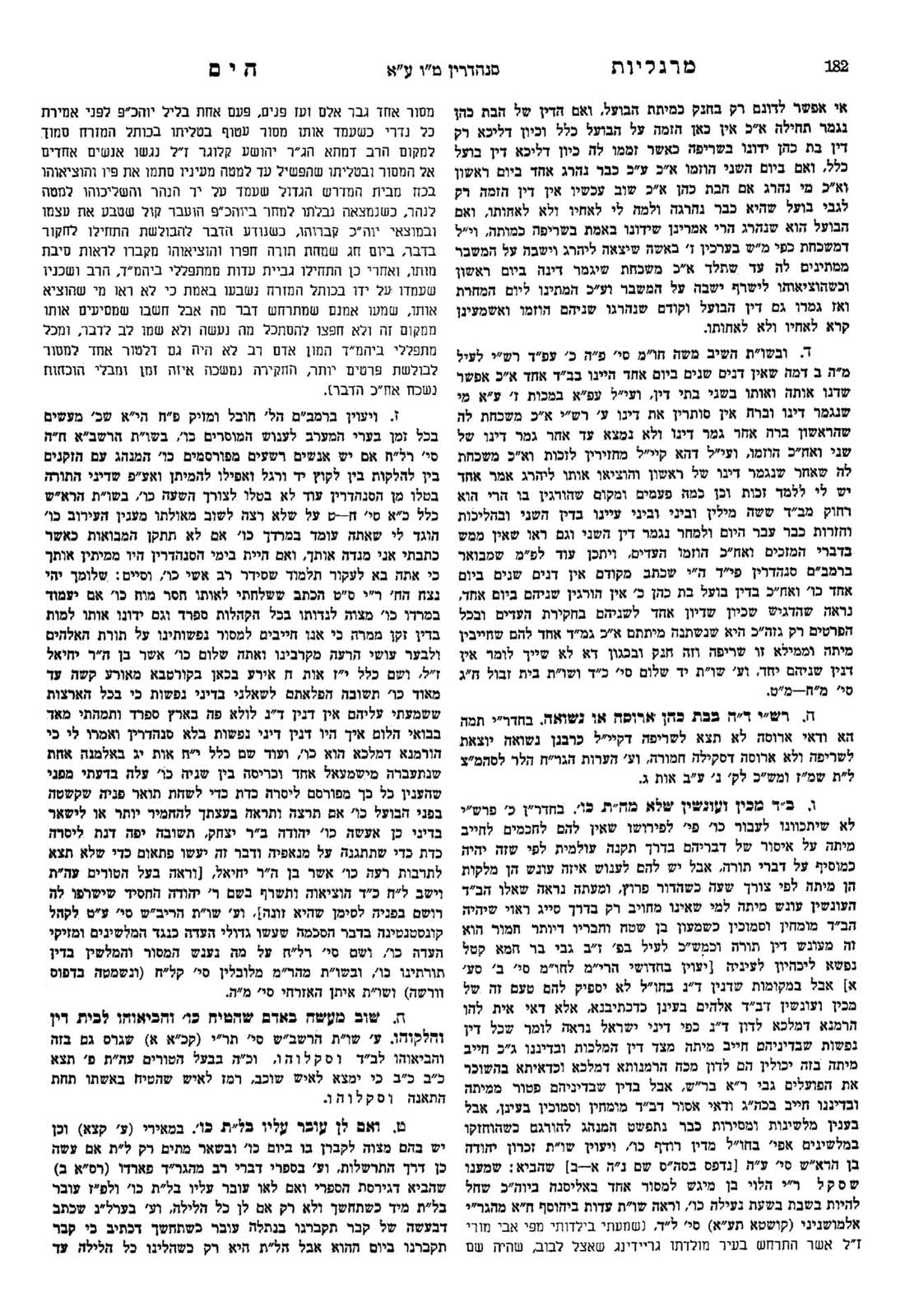
In its note, Artscroll states: “It goes without saying that the law never applied in places where government regulations would prohibit such an act.” Once again, I am not sure whether Artscroll really believes that this is true. As a historical statement it is false. Here is a page from R. Reuven Margaliyot’s Margaliyot ha-Yam, vol 1, p. 91b (to Sanhedrin 46a), that shows how even in the not-so-distant past an informer could be killed.

2. In this post I mentioned the outrageous accusation, based on nothing at all, that the telegram from Kobe was actually sent by the Chief Rabbinate in order to be able to pressure other rabbis to accept the Chief Rabbinate’s position on the dateline issue. Dr. Dov Zakheim sent me the following valuable email:

I noted in your recent blog you point out that some chareidim are asserting there was never a telegram from Kobe. There was. My father zt”l sent it. He had been the legal counsel of the Jewish community of Vilna (as well as a musmach of Ramailes) and also Reb Chaim Ozer ztl’s personal assistant and legal advisor (see his introduction to his sefer Zvi ha-Sanhedrin). He escaped from Vilna in 1941 and managed the Mirer Yeshiva’s legal affairs (where my uncle zt”l was a talmid) when they left Vilna, on the trans-Siberian, in Kobe and then in Shanghai.

Also in the post I referred to the letter published by R. Kasher in which lots of great rabbis refer to the State of Israel as the beginning of the redemption. I noted how Zvi Weinman has shown that this is a religious Zionist forgery, as at least some of the rabbis never signed such a letter. I mentioned that we don’t know if Kasher was responsible for the forgery (as Weinman appears to think) or someone else. Sholom Licht was kind enough to call my attention to this source from where we see that the letter Kasher published already appeared in Ha-Tzofeh many years prior, so Kasher clearly had nothing to do with the forgery.

3. In the last few posts I have dealt with Artscroll a good deal, as is only proper since Artscroll is the most significant Jewish publishing phenomenon of our time. I still have a lot more to say, but let me now turn to R. Jonathan Sacks’ siddur, and give an example where Sacks gets it wrong while Artscroll gets it right.

The blessing to be recited upon lightning and Birkat ha-Hamah is עושה מעשה בראשית This goes back to Mishnah Berakhot 9:2. Although the standard version of the Mishnah omits the word מעשה, it is recorded in various medieval texts and this is how the blessing has come down to us.

What does עושה מעשה בראשית mean? The first thing we must do is figure out if there is a segol or a tzeirei under the shin in עושה. Looking at the siddurim in my house that have English translations, I found that Sacks, Birnbaum, Sim Shalom, and Artscroll, have a segol.[13] This is also what appears in the Kaufmann Mishnah. See here. However, the Metsudah siddur and the Blackman Mishnayot have a tzeirei.

What is the difference between the vocalizations? If there is a segol than the words עושה מעשה בראשית should be translated in the English present, as עושה is a verb. If there is a tzeirei then עושה  is a noun, as in the words of Hallel (from Ps.115:15): עושה שמים וארץ, which means “Maker of heaven and earth.” Let us see if the translations follow this rule. Artscroll, which has a segol, translates: “Who makes the work of Creation.” This translation is correct, although I don’t know why the C in creation is capitalized. This translation implies the continuing work of creation, as reflected in the words of the prayer: המחדש בטובו בכל יום תמיד מעשה בראשית

Birnbaum translates עושה מעשה בראשית as: “Who didst create the universe.” This is incorrect, as the passage is not in the past tense. Sacks, who also has a segol, translates: “Author of creation.” This too is incorrect, as עושה with a segol is a verb, not a noun. Sim Shalom, also with a segol, translates: “Source of Creation.” This too is incorrect.

Now for the texts that have a tzeirei: Blackman translates: “the author of the work of the creation”, which is a correct rendering. Metsudah, on the other hand, translates: “Who makes the work of Creation.” Leaving aside the capital “C”, this is a mistaken translation. While Metsudah has עושה with a tzeirei under the shin, it translates as if there was a segol.[14]

Artscroll, while being correct when it comes to this blessing, does not get a pass when it comes to the word עושה. In the Artscroll siddur, pesukei de-zimra, p. 70, we find the words עושה שמים וארץ. This comes from Psalm 146:6. There is a segol under the shin which means that it is a participle and should be translated here with the English present tense, as are all the other verbs in this Psalm. Yet Artscroll translates עושה שמים וארץ as “Maker of heaven and earth”, which is incorrect. Sacks follows many other translations by rendering the words: “who made heaven and earth”. Yet this too is not correct and doesn’t follow the model of the Psalm, which has a series of participles that are to be translated as the present tense:
עושה שמים וארץ
השומר אמת לעולם
עושה משפט לעשוקים
נותן לחם לרעבים
מתיר אסורים
פוקח עורים
זוקף כפופים
אוהב צדיקים
שומר את הגרים

What about the word בונה in the blessing בונה ירושלים? There is a tzeirei under the nun in בונה which means that it is not a verb. Artscroll correctly translates the phrase as “Builder of Jerusalem”. Birnbaum and Metsudah also get it right. However Sacks (and also De Sola Pool and Sim Shalom) are mistaken in their translation. Sacks renders בונה ירושלים as if the nun had a segol: “Who builds Jerusalem.”

Since בונה ישראל must be translated as “Builder of Jerusalem”, and all translations are in agreement that גואל ישראל means “Redeemer of Israel”, does this mean that the conclusion of all the blessings of the Amidah should follow this model? What about חונן הדעת? Artscroll translates : “Giver of wisdom”, seeing חונן as a noun. Birnbaum and Metsudah do likewise. However, Sacks assumes חונן is a verb and translates: “who graciously grants knowledge.” This rendering (which I thinnk is in error) is also found in De Sola Pool and Sim Shalom.

How about מחיה המתים? Is the word מחיה a verb? Artscroll assumes yes and translates: “Who resuscitates the dead.” Sacks agrees with this, but Metsudah, striving for consistency, translates: “Resurrector of the dead.” Metsudah is, in fact, the only siddur that as a rule translates the concluding blessings of the Amidah along this model, while the other translations alternate between verb and noun. Here are some of Metsudah’s translations:

רופא חולי עמו ישראל – Healer of the sick of His people Israel
מברך השנים – Blesser of the years
מקבץ נדחי עמו ישראל – Gatherer of the dispersed of His people Israel
שובר אויבים ומכניע זדים – Crusher of enemies and subduer of the insolent

Although Metsudah follows this rule, for every rule there are exceptions, and even Metsudah translates שומע תפלה as “Who hears prayers”. Yet perhaps this is not an exception, and even here Metsudah intended “The hearer of prayers”, but since this doesn’t sound so good in English they came up with a more felicitous wording. It is true that the underlined words of the blessings המחזיר שכינתו לציון and המברך את עמו ישראל בשלום  have to be seen as verbs, and Metsudah translates them as such. But I think that these are a different type of blessings than the ones in the middle of the Amidah.

The question to be asked is must we assume that there is a consistency of form in a prayer like the Amidah? If the answer is yes, then Metsudah is the only translation to get it right, and they must be recognized as having picked up on something that eluded all their predecessors and successors.

Finally, let me return to the blessing מחיה המתים. I asked if the word מחיה is a verb, and noted that Artscroll and Sacks indeed translated it this way. However, they are both incorrect for the simple reason that in their siddurim there is a tzeirei under the yud of מחיה. There are siddurim, such as Tehilat ha-Shem, that have a segol under the yud. In such a case,  the word should be translated as a verb. However, when there is a tzeirei it must be translated as a noun. Metsudah once again gets it right, translating “Resurrector of the dead.” [15] Right before this, we find the words מלך ממית ומחיה. Here there is a segol under the yud, meaning that it is a verb and is to be translated as “Who causes death and restores life”.

Artscroll and Sacks also err in their translation of מחיה מתים במאמרו in Magen Avot in the Friday night service. There is a tzeirei under the yud meaning that it must be translated as “Resurrector of the dead with His utterance.” Artscroll mistakenly renders: “Who resuscitates the dead with His utterance,” using the same translation from the Amidah for the words  מחיה המתים.

I can’t figure out Sacks’ method here. In the Amidah he translates מחיה מתים as: “who revives the dead”, but in Magen Avot he translates: “By his promise, He will revive the dead.” This is incorrect, as it turns the sentence into the future tense, which it is not. Furthermore, if it was to be translated as such, why not do so in the Amidah as well, as the words are identical? Indeed, Magen Avot is nothing but an abridged version of the Amidah, so by definition the translation must be the same.[16] Translating במאמרו as “By His promise”, which I assume means “in accordance with His promise,”[17] is also incorrect, as the passage refers to God’s word, or better yet, the power of God’s word, not any promise.[18]
3. I want to briefly call attention to three books that have recently appeared and which I hope to discuss in future posts. The first is Gil Perl’s The Pillar of Volozhin: Rabbi Naftali Zvi Judah Berlin and the World of 19th Century Lithuanian Torah Scholarship. The second is Eugene Korn and Alon Goshen-Gottstein, ed., Jewish Theology and World Religions. The third is Ben Zion Katz, A Journey Through Torah: A Critique of the Documentary Hypothesis. I know that there are many Seforim Blog readers who will find these books worth reading.

4. Those who want to post (or read) comments, please access the Seforim Blog site by going to http://seforim.blogspot.com/ncr  Only by doing this will you be taken to the main site (and not have a country code in the URL). We have recently learnt that readers outside the United States do not have access to the comments posted and in the U.S. We don’t know why this is, or how to fix it, but the above instruction fixes the matter.

[1] As a result of these discussions, which led to investigations of haredi literature and discussions with haredi friends, another point became ever more obvious to me. It appears – and I welcome being corrected – that once someone has been crowned a gadol in the haredi world, it is almost impossible for him to lose this status, no matter what he says (and we have seen examples of this time after time). If, for instance, a recognized gadol expresses racist or misanthropic sentiments, or declares that a known and continuing sexual abuser or wife abuser must not be turned over to the authorities, even that would not be sufficient to “defrock” him. In other words, the “immunity” given to haredi (and hardal) gedolim is much more far-reaching than anything that could be imagined in the Modern Orthodox world.
[2] A January 2012 Avi Chai poll found that 7 percent of the Israeli population defines itself as haredi, 15 percent as dati, and 32 percent as traditional. Only 3 percent defines themselves as secular anti-religious. However, approximately 20 percent of primary school students are haredi, which shows the direction the future is going.
[3] It was actually the Religious Zionists who were responsible for creating the undemocratic situation in which Israel is perhaps the only country in the world in which Jews are not free to be married by the rabbi of their choice. I would like someone to show me where, in the entire history of halakhic literature, it is stated that people who are not observant must be forced, or even encouraged, to have a halakhic marriage. The current situation means that when secular Israelis leave Israel and then get divorced, being that they are secular most will simply get a secular divorce. Thus, any future marriage will be halakhically adulterous and the children will be mamzerim. Outside of Israel this is almost never an issue since non-Orthodox people generally don’t get married by Orthodox rabbis, which means that in the event of a divorce we can assume that the first marriage was not halakhically binding. But in Israel, where everyone gets married halakhically, it opens the doors to mamzerut on a massive scale. This was actually recognized by R. Eliyahu Bakshi Doron when he was chief rabbi. He created a big controversy when he revealed that it is a practice among some rabbis that when they perform weddings for the non-religious, they make sure that the marriage is not halakhically binding, precisely in order to prevent future mamzerut. Just this week R. Yaakov Yosef publicly advocated this position. See here.

[4] R. Eliyahu Pinchasi writes as follows in his Dibrot Eliyahu, vol. 1, p. 19:
החכמה נמצאת בגוי אבל היא רחוקה מאוד מלהיות דוגמת התורה. שהרי הוגי דעות נודעים בנו לעצמם פילוסופיה מתוחכמת הממלאים ספרים עבי כרס להצדיק את ההפקרות שנקראת בלשונם דמוקרטיה חופש הבטוי, רעיונות זדוניות מחרבי העולם.
The sheer ignorance of what democracy means is beyond comprehension. Do people like Pinchasi have so little knowledge of basic history that they do not know that it is only democracy that ensures protections for Jews around the world? Does he want the world to go back to the era of dictators when Jews suffered so terribly? Presumably yes, as he feels democracy is destroying the world.. I can easily provide parallels to the language used by Pinchasi in the writings of communists and fascists, especially from Weimar Germany. I was also shocked to read what R. Elhanan Wasserman writes in his Ikveta di-Meshiha, par. 2, published on the eve of the Holocaust.
“ראו כי אני אני הוא”. הגיע כבר העת שתבינו, כי בלעדי אין מושיע. אבל העם מסרבים להבין. עוד נאחזים בשולי הדמוקרטיה הגוססת. אף היא לא תועיל, בדומה לעבודות הזרות הקודמות.
I can’t for the life of me understand how he could regard democracy as avodah zarah, and why he sees democracy as being in opposition to proper faith in God, as if we are dealing with a zero-sum game. Instead of democracy, what political system did R. Elhanan want the Jews to support?
[5] I have many other sources regarding democracy, including traditional sources very much in favor of it (especially in pre-messianic times). I hope to provide them on a future occasion. Reading the haredi attacks on democracy, I can’t help but be reminded of Pius IX’s 1864 Syllabus of Errors and the later silencing of John Courtney Murray. The Church identified certain doctrines as false, yet now recognizes that its position in these matters was mistaken. I mention these examples because I am convinced that the American haredi world also rejects the anti-democratic sentiments that I have quoted, seeing them as out of step with where their world is. 
It is worth contrasting the anti-democratic sentiments of haredi leaders with the response of the Church, which fortunately was able to examine its own long history of anti-democratic abuses and come to the conclusion (much later than it should have) that in modern times democracy is the only viable system. As Pope Benedict put it (see here), democracy “alone can guarantee equality and rights to everyone.” He continues with the following valuable words:

Indeed, there is a sort of reciprocal dependence between democracy and justice that impels everyone to work responsibly to safeguard each person’s rights, especially those of the weak and marginalized. This being said, it should not be forgotten that the search for truth is at the same time the condition for the possibility of a real and not only apparent democracy:  “As history demonstrates, a democracy without values easily turns into open or thinly disguised totalitarianism”  (Centesimus Annusn. 46).

[6] R. Asher Anshel Yehudah Miller, Olamo shel Abba (Jerusalem, 1984), p. 308, reports that the Satmar Rav, R Yoel Teitelbaum, once declared that there were 50,000 Jews in the world. When asked how he could give such a figure when there were many millions of Jews, he replied:
בעיני, יהודים הם רק יהודים שששומרים תורה ומצוות כמוני . . . [שאר היהודים] או שיחזרו בתשובה, או שצריך להוציא אותם מכלל ישראל

[7] I will deal with Torat ha-Melekh in a future post.
[8] Alan Brill, Judaism and Other Religions: Models of Understanding (New York, 2010), p. 255 n. 43, has recently noted that since many laws stated with reference to non-Jews apply equally to heretical Jews: “the main problem is the fundamental use of a double ethic as described by Max Weber in his description of an ethnic economy.”
[9] Interestingly, R. Avraham Yosef has recently spoken of the spiritual advantages of living together with the non-religious. See here.

For Israeli haredim, there is now a mindset that they can only live among other haredim, and this is why they create exclusively haredi neighborhoods and towns. Such a concept is entirely new, and not only did it not exist in Europe but didn’t even exist in Israel in the first decades of the State. Many readers probably recall the time when hasidic rebbes lived in Tel Aviv.

[10] I have to admit, however, that one sometimes does find even moderate haredim who seem to have sympathy with Adler’s approach. R. Moshe Eisemann, who used to have a great deal of influence in the moderate haredi camp, wrote as follows with reference to the Jerusalem fanatics who throw stones at passing cars (not knowing, of course, if the drivers are Jewish or Arab): “If it is true that he who hurls a stone were well-advised to be pretty sure that he is doing the right thing, I believe that the one who feels no urge to do so, must engage in even deeper soul-searching.” Tradition 26 (Winter 1992), p. 34. Maybe I was absent that day in yeshiva, but I was never taught that it is normal to have an urge to throw a stone at a fellow Jew (which of course could kill him, as we have seen with the Palestinian stone-throwers). On the contrary, I was taught that I should have an urge to show the non-religious Jew about the beauty of Shabbat, which an invitation to a Shabbat table will accomplish much better than a rock in his windshield. 
[11] What is one to make of R. Shmuel Baruch Genot, Va-Yomer Shmuel (Elad, 2008), no. 84, that it is forbidden for Jews to oppose the death penalty in places where Jews are not affected (unless done for reasons of darkhei shalom): דאסור להציל גוף נכרי. This is the sort of pesak (and I can cite many similar examples) that in the Modern Orthodox world is regarded not simply as wrong, but as deeply immoral (especially since during the Holocaust so many non-Jews adopted Genot’s position vis-à-vis the Jews!).
While at least since Jacob Katz’s Exclusiveness and Tolerance scholars are now no longer deterred from studying the medieval Jewish view of “the other”, there is still great reluctance to examine contemporary views, for fear of how this might play into the hands of anti-Semites. I am curious to hear what readers think about this. How long can we keep all of this “under the carpet,” and should we even be attempting to do that?
Ruth Langer has discussed the medieval tradition in her new book Cursing the Christians? A History of the Birkat HaMinim (Oxford, 2012), p. 12:
For Jews engaged in dialogue, it has been much easier to identify the problems within Christianity than to turn that scrutiny back on our own heritage. Jews, after all, were very much the victims, not just of the Holocaust, but also of centuries of Christian anti-Jewish venom and oppression. Consequently, traditions developed among those studying Judaism in the wissenschaftflich mode to obscure embarrassing elements of the tradition rather than to confront them. . .  Christian anti-Judaism in its many expressions led to Jewish responses and attitudes that were equally vicious; the power relationships between the two communities prevented Jews from expressing this with physical violence, but Jews still lacked respect for their neighbors. . . . In our time, Jewish publishers are restoring uncensored versions of many texts, reclaiming a difficult heritage. While from an academic perspective, this has merit, there has been all too little discussion about its impact on the Jewish community.
I would, however, dispute the use of the expression “equally vicious.” Once Langer assumes that it was Christian anti-Judaism (and I would add “anti-Semitism”) that led to the Jewish responses and attitudes, then I don’t think it is correct to portray them as “equally vicious.” The one who is responding to widespread murder of his coreligionists, and responding only through the pen, cannot be regarded as “equally vicious.” Furthermore, considering the oppression that Jews suffered in medieval times, all the anti-Gentile sentiments found in texts from this period are completely understandable.
[12] I have often heard people pronounce דרכי as darkei. This is incorrect. There is no dagesh in the kaf.
[13] The Artscroll Talmud also has a segol but the Artscroll Mishnah has a tzeirei.
[14] There are times in the Bible where the word עושה with a tzeirei is to be translated as if it has a segol, but these are exceptions. When it comes to vocalizing a text, one should certainly not insert a tzeirei if one is going to translate the word as a verb. The exceptions, where we find a tzeirei under the shin, are Ex. 15:11: עושה פלא, which appears to mean “doing wonders”, although,  as R. Mazuz pointed out to me, it could also be translated as “doer of wonders”= עושה-הפלאים. Amos 5:8: עושה כימה וכסיל, and Ps. 14:1, 3, 53:2, 4: עושה טוב, could perhaps also be read in this way. However, in Jer. 51:15: עושה ארץ בכחו, the word appears to be a verb.
[15] See R. Mazuz’s comment in R. Yosef Hayyim Mizrahi, Yosef Hayyim (Jerusalem, 1993), p. 123, Or Torah, Adar 5772, p. 568.
[16] See Abudarham ha-Shalem (Jerusalem, 1963), p. 148:
וכיצד היא ברכה זו מעין שבע, מגן אבות בדברו כנגד מגן אברהם. מחיה מתים במאמרו כנגד מחיה מתים. הא-ל הקדוש שאין כמוהו כנגד הא-ל הקדוש . . .
[17] See Daniel 12:2.
[18] See Abudarham ha-Shalem, p. 148: מחיה מתים במאמרו על שם (יחזקאל לז) כה אמר ה’ הנני פותח את קברותיכם


Rav Avraham Chai Reggio Brings A Sefer To Life

Rav Avraham Chai Reggio Brings A Sefer To Life
By Eli Genauer
Note: I would like to thank Rabbi Gad
Bouskila of Congregation Netivot Israel in Brooklyn for helping me decipher
Rav Avraham Reggio’s handwriting
Rav Avraham Chai (Vita) ben Azriel Reggio  (1755-1842) was the Rav of Gorizia, in
northern Italy for over forty years. During that time period, he answered
Sha’aylot both locally and from abroad, wrote a Sefer Torah, performed 300 circumcisions,
and gave many Drashot that changed people’s lives.[1] We are told that the
Derashot he gave before Neilah were so inspiring that
  ! החוטאים נתעוררו לשוב לה׳ בתשובה שלימה, והשונאים חבקו זה לזה ונשארו באהבה ואחוה ושלום
We are also informed that the
townspeople ascribed their being saved from a Cholera epidemic by Rav Avraham’s
righteousness.

Rav Avraham wrote a Sefer on the prohibition of
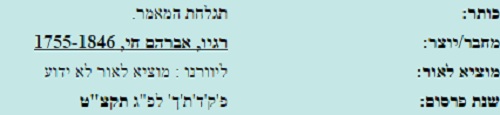
shaving on Chol Hamoed called “Tiglachat Hama’amar” printed anonymously in Livorno
(either 1839 or 1844) which was a refutation of his son Isaac Samuel Reggio’s  book “Ma’amar HaTiglachat” (Vienna 1835 ) which
argued for permitting it.[2]

One of the arguments put forward in his son’s book
was that “times have changed”, therefore the Halacha could be different.  Rav Avraham responds to this argument and
writes as follows about changing the Halacha:

I have a Mishnayot Zeraim which was printed in Amsterdam
in 1646 as part of the printing of the entire Babylonian Talmud by Immanuel
Beneveniste.
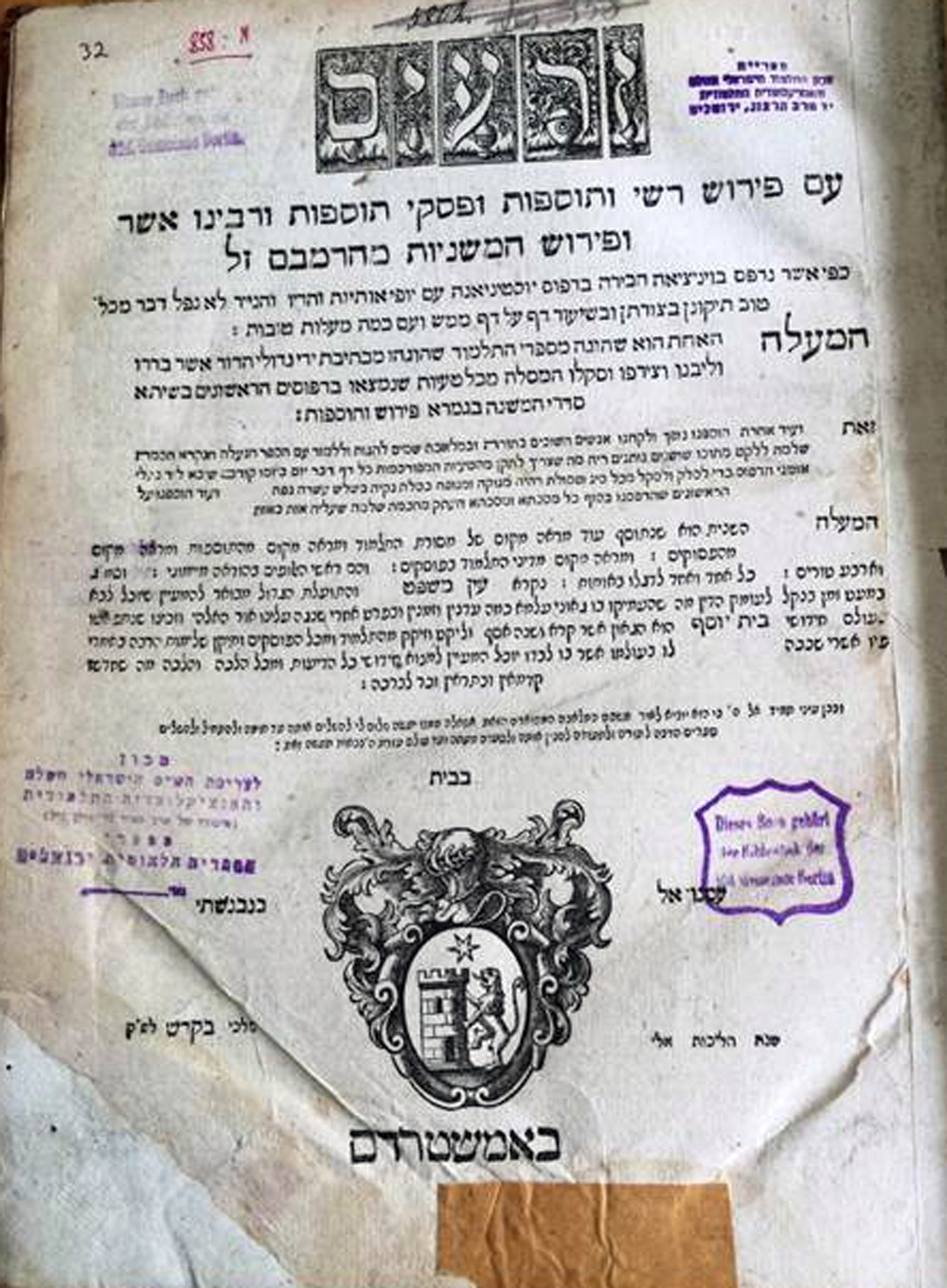
As you can see, there are numerous stamps on the
title page, but aside from those marks of ownership, we know that the book at
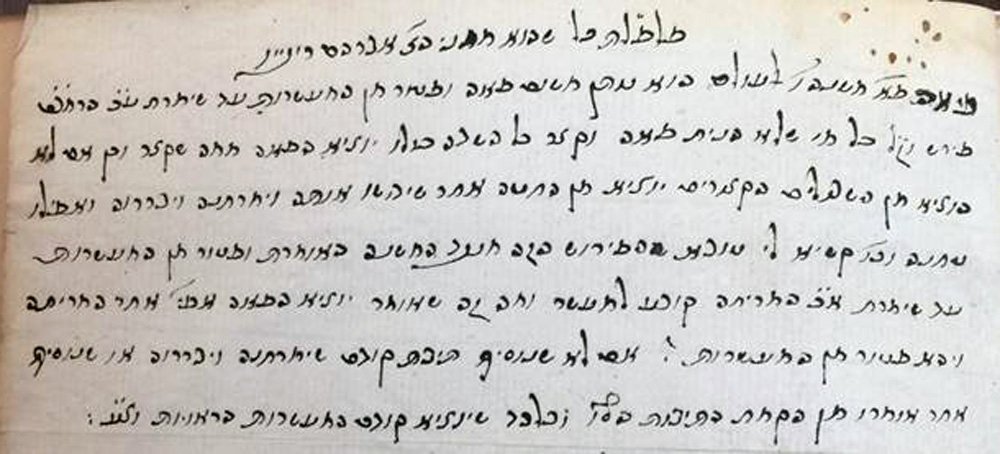
one time belonged to Avraham Reggio by this handwriting on the back page.
פלפולה כל שהוא
ממני הז׳ אברהם ריגייו
פיאהפרק א׳ משנה ו׳
לעולם הוא נותן
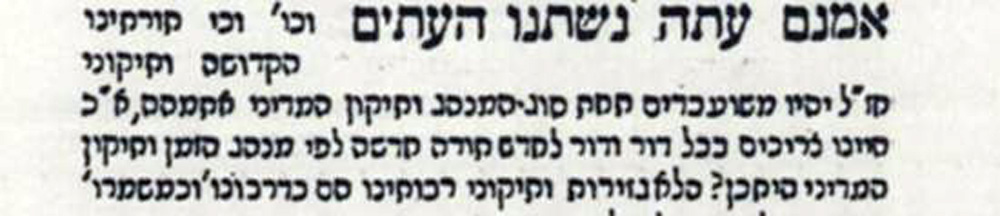
משום פיאה ופטור מן המעשרות עד שימרח ע״כ
הרמ׳ב׳ם פירש
ז׳ק׳ל שכל מי שלא הניח פיאה
 וקצר כל השדה
כלו יוציא הפיאה ממה שקצר וכן אם לא הוציא מן השבלים הקצורים יוציא מן החטה אחר
שידושו אותה וימרחוה ויבררוה ואפילו טחנה וכו׳
 
קשיא לי טובא
שהפירוש הזה מנגד המשנה האומרת   ופטור מן המעשרות עד שימרח
. א״כ המריחה קובע למעשר. ומה זה שאומר יוציא הפיאה אפי׳ אחר המריחה ויהא
פטור מן המעשרות
! 
אם
לא שנוסיף תיבת
 קודם שימרחנה ויבררוה או שנוסיף אחר
אומרו מן הקמח

התיבות כלו׳ ובלבד שיוציא  קודם המעשרות
הראויות וצ״ע
 
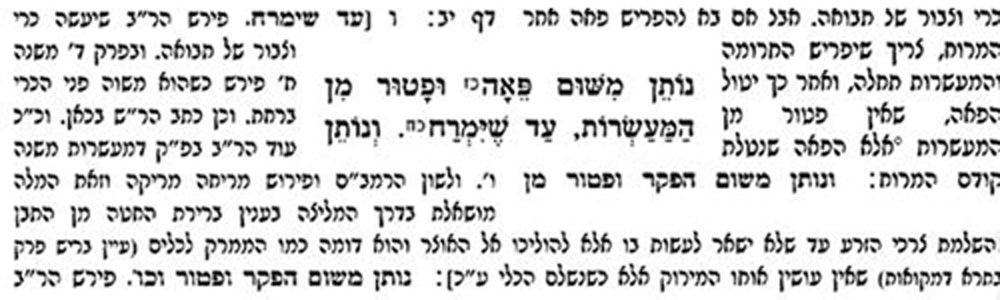
The matter under discussion is Mishnayot Peah 1:6
and deals with whether Maaser has to be taken from that which is designated as
Peah. Rav Avraham understands from his reading of the Peirush Hamishnayos on
this Mishneh, that the position of  the
Rambam is that Maaser does not have to be separated from that which is
designated as Peah even after Merichah has been done.[3]
The Rambam writes as follows:

 In asking his
question, it is clear That Rav Avraham understands the Rambam to be saying that
you are obligated to separate a portion for Peah even after the flour made from
harvested wheat is ground and that you are never obligated at any stage to
separate Ma’asrot. This is not clear to me from the Lashon of the Rambam who might
be saying normally one does not have to separate Maaser from Peah and adding
that Peah always has to be separated even at the latest stage of crop
production. The Rambam actually makes his comment דע שהפאה לא תחחייב להוציא ממנה מעשרות
on our Mishneh which says לעולם הוא נותן משום פיאה ופטור מן המעשרות
עד שימרח
.
One would have to agree though, that
the Lashon of the Rambam is confusing.
There are
many diagrams that are drawn by hand in the book which fill in the blank spaces
left by the printer. Here is an example of a fairly complex one which I believe
was drawn by Rav Avraham Reggio.[4]


This
particular volume of Mishnayot needed some special Siyata D’Shemaya to survive
the Nazi annihilation of both Jews and their property. After being owned by Rav
Avraham Reggio, the book was the property of the library of the Jewish
community of Berlin.

We are
informed by the present day website of the Berlin Jewish Library that most of
the holdings belonging to this library did not survive the war. This makes this
book akin to an ״אוד מוצל מאש״ (זכריה ג:ב).

“The library of the Jewish Community of Berlin was founded in 1898. It opened its doors in 1902 in the community’s administration building on Oranienburger Strasse and quickly became a highly popular scientific resource, open to Jewish community members and the general public. By the time the National Socialist regime dissolved the Jewish community and forced its library to close, the institution had nine branches with more than 100,000 volumes, nearly all of which were lost in the war.” 

The book became part of the restitution efforts of the Jewish Cultural Reconstruction after the war and was eventually sent to Israel to be part of the library of the “Encyclopedia Hatalmudit”

Is it
possible that just as Rav Avraham Reggio saved his town from a cholera
epidemic, that his writings saved this book from being destroyed in the war?

[1] The
main source for his biography is from a series of two articles written in the
journal “Yerushalayim HaBenuyah” printed in 1844( Choveret Rishon, Zolkiew) and
1845 ( Choveret Sheniyah, Lemberg) The articles appeared under the title of
“Toldot Avraham” whose author was Mordechai Shmuel Ghirondi (1800-1852) Ghirondi
laments at length the loss of his teacher and goes into great detail of his
life. The two specific example cited above are on page 80 of the “Choveret
Rishon”
[2]  
For a discussion on shaving on Chol
HaMoed including quotations from both Avraham and Isaac Reggio’s books see
here

Bibliographic Information on
Tiglachat Hama’Amar comes from the Israel National Library website.

Note the date of death of 1846
which is incorrect as the eulogies on him by Mordechai Shmuel Ghirondi appeared
starting in 1844. Ghirondi gives the date of death as Asarah b’Tevet in 5602 (
1841). I am confused as to the date of publication of Tiglachat Maamar as the
NLI site gives it as תקצט  but פ’ק’ד’ת’ך’ would indicate (5)604 or 1844. This date
is what is listed in Beit Eiked Sefarim.

The forward of the “Motzei L’Or”
indicates that it was written in 1836.

[3]    Tosfot Yom Tov gives us a summary of how Merichah
is understood by the various Meforshim. (From Mishnayot Zecher Chanoch) As you
can see, Rambam’s definition differs from other Meforshim.

[4]   We
know he was a Sofer and the ink looks very similar to writing in the back of
the book. (Additionally, his son Isaac Samuel was a skilled artist, and perhaps his artistic talent ran in the family. – Ed.)


Marc B. Shapiro – Rabbis and Communism

Rabbis and Communism
By
Marc B. Shapiro
I had intended my newest post to be on the Rav’s famous essay “Confrontation,” but I recently received the latest issue of Tradition with Rabbi Yitzchak Blau’s article “Rabbinic Responses to Communism,” so let me make a few comments about it. First, I must say that it is a good read, like all of Blau’s writing, and I was impressed with the range of topics he attempts to tackle. My only suggestion for improvement would have been to examine the larger context of Jewish communist anti-clerical sentiment, which made it very hard for the rabbis to be sympathetic to communism.
Yet this anti-clerical feeling did not arise in a vacuum. Quite apart from the traditional Marxist aversion to religion, the rabbis, like their non-Jewish religious counterparts, were generally aligned with the aristocracy, who paid their salary and took their sons as marriage partners for their daughters. The rabbis were thus seen as standing in the way of economic justice. In fact, there has been a long plutocratic tradition in the Jewish world, which meant complete disenfranchisement of the poor from all communal decisions. I don’t know of any Jewish community in history where people who could not afford to pay taxes were given communal voting rights. (This would be the modern equivalent of not giving welfare recipients the right to vote – wouldn’t the Republicans love to make this the law of the land!)
R. Samuel de Medina goes so far as to argue that the wealthy are qualitatively superior to the poor, citing in support of this horrible notion Eccl. 7:12: “For wisdom is a defense, even as money is a defense.” For him, money and wisdom are two sides of the same coin. [1] He also gives another proof to support his pro-wealth point of view. Gen. 41:56 states: “And the famine was over all the face of the earth (פני הארץ).” Upon this the Midrash comments that the face of the earth refers to the rich people (Tanhuma, ad loc.). From this we see, says de Medina, that the rich are at the head of the community and everyone else in the rear, not a position from which one leads.[2] As he puts it (and note how the poor and the ignorant are treated as one group):
Accepting the will of the majority, when that majority is composed of ignorant men, could lead to a perversion of justice. For if there were one hundred men in a city, ten of whom were wealthy, respected men, and ninety of whom were poor, and the ninety wanted to appoint a leader approved by them, would the ten prominent men have to submit to him regardless of who he was? Heaven forbid, this is not the accepted way (“the way of pleasantness”).[3]
None of this means that de Medina was insensitive to the needs of the poor. This was not the case at all, and he has a responsum in which he requires people to contribute to the building of houses that will be used, among other things, for poor visitors to spend the night.[4] Yet we see in him a sense of paternalism that was common in traditional societies all over the world, and was one of the factors which convinced the lower class that it was time to take matters into their own hands.[5]
When dealing with anti-clericalism in Russia, we must also not forget the masses’ long memory of how some (many?, most?) rabbis were silent during the era of the chappers. This was when children were grabbed for 25 years of military service in the Cantonists, often never again to see their parents and usually succumbing to incessant pressure (including torture) to be baptized. Yet it wasn’t the children of the rich or the rabbis who were taken, but the poor children. Jacob Lifshitz’ defense of the way the Jewish community dealt with the Cantonist tragedy – which he regards as worse than even the destruction of the Temple![6] – and his insistence that no one can judge the community leaders unless they themselves had been in such a difficult circumstance, is something we must bear in mind.[7] Yet all such ex post facto justifications would have no impact on the outlook of those that actually suffered during the Cantonist era, and it is no wonder that many of the common people would not regard the rabbis in a sympathetic light. The rabbis were certainly able to come up with a justification why their sons, the future Torah scholars, should not be taken to the army, just as they continue to make this argument. Yet this would only serve to show the masses that some children’s blood was indeed redder than others.[8]
In his memoir of this era, Yehudah Leib Levin wrote:
“I was relatively calm and personally did not fear the chappers, because my father was an important landlord, distinguished in Torah and highly regarded by everyone. My mother was the daughter of the most famous tzaddik (righteous person) of his generation, Rabbi Moshe Kabrina’at. And I, I was one of the “good children,” a prodigy the likes of whom were not touched by the hand of the masses. Free both of fear and of schoolwork, because the teachers and pupils had all gone into hiding and the chedarim [schools] were closed, I wandered daily around the city streets seeing the little “Russians,” and my heart burst when I realized they were in the hands of non-Jews, who forced them to eat pork – oh dear me!”[9]

Elyakum Zunser was seized when he was away from his hometown. Many years later he wrote:

“Many private individuals engaged in this traffic, seizing young children and selling them to the Kahal “bosses.” Reminiscent of the sale of Joseph by his own brothers, these betrayals occurred daily. Lesser rabbis of small towns assented to such transactions, rationalizing that it was more “pious” to save the children of their own towns than to concern themselves with the fate of strangers.

“Though many important rabbis wept at these outrages, most dared not protest. They were afraid of the consequences if the Jewish community would defy the Tsar’s quota. The rabbis held their positions at the discretion of the Kahal leaders and feared the consequences of displeasing them. They were afraid to be denounced to government officials and exiled to Siberia.[10]”
Michael Stanislawski notes that in one community the communal leaders wanted to grab a poor tailor since he wasn’t observant, but the local rabbi forbid it. Stanislawski also tells us that in Vilna the communal leaders had their sights on a larger prize.
[T]he traditionalist kahal authorities later attempted to forestall the opening of the government-sponsored rabbinical seminaries by drafting the sons of several of its proposed teachers, but this was discovered by the local administration and forbidden.[11]
He also quotes the Hebrew writer Y. L. Katsenson, who describes his grandmother’s shock when she discovered that the chappers in her town were not Gentiles:
No, my child, to our great horror, all khappers were in fact Jews, Jews with beards and sidelocks. We Jews are accustomed to attacks, libels, and evil decrees from the non-Jews – such have happened from time to time immemorial, and such is our lot in Exile. In the past, there were Gentiles who held a cross in one hand and a knife in the other, and said: “Jew, kiss the cross or die,” and the Jews preferred death to apostasy. But now there come Jews, religious Jews, who capture children and send them off to apostasy. Such a punishment was not even listed in the Bible’s list of the most horrible curses. Jews spill the blood of their brothers, and God is silent, the rabbis are silent. . . .[12]
What is incredible is that after all the pressure to convert, some Cantonists remained Jewish. In fact – and here I mention something that I only learnt after my book on R. Jehiel Jacob Weinberg was published – Weinberg’s grandfather was a Cantonist. His father was also a soldier in the post-Cantonist Czarist army.[13] In the book I mentioned that Weinberg’s family was undistinguished, yet if I was writing it now I would speak about how the two generations of army service signifies that this was in fact a very low-class family, and shows how significant Weinberg’s rise to fame was. As I pointed out, while in theory the yeshivot were equal-opportunity institutions, in reality the aristocratic element in them was generally well established and self-perpetuating.[14]
In a strong defense of the rabbis against the charge that they collaborated with the rich people in order to ensure that the poor were taken, R. Moses Solomon Kazarnov calls attention to all that the rabbis did to defend the children of the lower class.[15] But he acknowledges that the rabbis would hand over the non-religious kids, including their own![16] (While I have no doubt that the rabbis joined with the parnasim to hand over the non-religious youth, it strains imagination to believe that there were more than a few who did this with their own irreligious sons.) As Kazarnov puts it (51-52, in words that must cause loathing in any contemporary parent, and I would assume in virtually all parents even one hundred years ago):
והרבנים איפא כבנים נאמנים לתלמודם הורו למעשה את אשר מצאו כתוב להלכה, ותמיד הורו לא אך לאחרים, אך גם לעצמם, אם בניהם לא נהגו כשורה, לנדותם להבזותם ולתת גם את חלקם לטובים מהם; כמה אבות רבנים או חרדים גרידא הנך זוכר קורא יקר, אשר בניהם יצאו לתרבות רעה ואשר התפללו לה’ תמיד כי יחמול ה’ עליהם ויקח את בניהם אלה מהם, כמה מהם השתדלו בעצמם להשיג את בניהם שנתפקרו למען מסרם לצבא תחת יתר בניהם הרודים עם א-ל?
Talk about conditional love! I don’t even want to imagine what it did to the mental state of a child who knew that his father would hand him over to the Czar’s army if he decided that he no longer wanted to be Orthodox. Kazarnov continues:
ואם כן אפוא מי זה יאשימם על הוראתם למסור למלכות לעבודת הצבא את החטאים תחת הכשרים? . . . הלא לא עשו לבני העניים יותר מאשר עשו לבניהם המם. את הכשרים שמרו כבבת עינם, אם שלהם ואם של אחרים, ואת החוטאים מסרו לצבא אם מירכם יצאו או מירך זולתם! . . . במאכלות אסורות ובנבלות, זמה ורשע, בזדונות כאלה שמו החרדים את פניהם להמעיטם מקרב עמם, מקרב משפחתם ומקרב בני ביתם, ומה היא כל החרדה הזאת?
Concerning the general issue of the rabbis being allied with the wealthy, Dan Rabinowitz called my attention to what R. Judah Margaliot wrote in his Beit Middot:
Some of the leaders of Israel do not think of the glory of their Creator but only of their own. They employ all their power merely to terrorize the community. [He then elaborates on how they do this] . . . Do not think that one can turn for help to the great figures of the generation, to our rabbis, whose duty it is to be the protectors and defenders of the people. For they are in league with the oppressors, walk together with the powerful men and rulers of the city, become collaborators of every mischief-maker, give protection to every swindler. They exploit the rabbi’s title and authority for all kinds of evil deeds. Everything obtains the approval of the community rabbi. He who ought to be the guardian of righteousness and justice becomes the protector of robbers and bandits. The righteous judge joins the league of the swindlers. . . . . And these are our judges and lawgivers! Calmly they look on at the robberies and injustices that take place in the community and flatter the rich and powerful from whom every quarrel and plague come.[17]
Returning to the issue of poverty, which de Medina sees as a disqualifier for communal leadership, we can also find more positive evaluations of it. Nedarim 81a tells us not to neglect the children of the poor, for the Torah goes out from them. If you examine the commentaries on this passage you will certainly find those who point out that it is easier for a poor person to study Torah, as he does not have the same attachment to the material world as does the wealthy man, and it is this attachment that prevents one from focusing on Torah. I read these sources as designed to be encouraging. In other words, they are ex post facto judgments of the positive that can be found in poverty, so that people in this unfortunate state don’t think that all is lost.
Yet in the entire history of the Jewish people I don’t know of any source that says that it is good to be poor, and that this is something that one should strive for. In fact, the Talmud states that one who is poor is like one who is dead (Nedarim 64b), and puts poverty in the same category as childlessness, leprosy, and blindness, all things that we hope we never have to deal with. Similarly, R. Phineas b. Hama stated: ”Poverty in one’s home is worse than fifty plagues” (Bava Batra 116a). In Eruvin 41b extreme poverty is listed as one of the three things that “deprive a man of his senses and of a knowledge of his Creator.”
The notion that it is harder for a rich person to get into heaven than to put a camel through the eye of a needle has never been a Jewish teaching, and Jews have regarded wealth as a blessing. It is a challenging blessing, but a blessing nonetheless.
Yet when questioned by those who pointed out how difficult poverty is for the kollel students in Israel, R. Aryeh Leib Steinman responded with what, to my knowledge, is a completely new approach, one which idealizes poverty in a manner not very different than the Christian notion of “Blessed be ye poor, for yours is the kingdom of God.” (Luke 6:20):
While everyone must distance themselves from unnecessary expenditures and luxuries just as they would be careful of fire, Bnei Torah have an especial obligation as the simple life is recommended for acquiring Torah, and they have it better if they live a life of simplicity and tsnius, and even poverty and want. It says: This is the way of Torah – eat bread with salt. But it is important to stress that what is necessary is strengthening emunoh and dedication to Torah. One should definitely not look for solutions that might cause avreichim to leave learning, G-d forbid.
I was asked if it would be a good idea to open offices for chareidi men in the large chareidi cities so that they could work in an appropriate atmosphere. It is obvious that the idea is a bad one though the intentions are good. The fact that the workplaces would be especially suited to the needs of chareidi men, and set up by chareidi people, might encourage people in difficult financial situations to leave learning. It is a spiritual stumbling block for the community at large. It would be terrible even if it would cause just one man to leave full-time learning. . . .
What are the effects of poverty? The answer is that it is better to be poor than to be rich, as Torah comes forth from the poor; they are the ones that become talmidei chachomim. The Jewish People has always undergone difficult trials. Historically, it’s been the poor people who have maintained their commitment to Judaism, despite the difficulties. It was among the rich people that some failed to withstand the temptations and trials. They are the ones that lost their children and grandchildren to Torah. It was the poor who remained especially steadfast in their dedication.
I have personally witnessed, and history testifies, that in all of the places where people learned Torah in poverty, they were able to maintain the Mesorah. In the places where the people had a comfortable standard of living, their learning was not immune to the Haskalah’s influences and many abandoned the Jewish and Torah way of life.[18]
Returning to Blau’s article, I was happy to see that he cited R. Jacob Emden who expressed admiration for shared property. I would just note that as with so many other issues in his writings, Emden had an alternate opinion as well, and here he comes out looking like his contemporary, Adam Smith. Emden explains how poverty is essential to a successful economic order. He notes that without the motivating factor of those who are in need – what Gordon Gekko would call “greed”[19] and what others will call “self-interest” – no economic progress will ever be made. If people are not able to improve their economic state, they will not take the risks that stand behind all new ideas and discoveries, which are precisely what keeps the economic engine of a society going. Communism, which took away the hope of personal gain, stifled all of this creativity.
Showing keen insight, Emden writes that if everyone had sufficient economic security, no one would travel on ships to far-away places and bring back the goods that are so important to people, no one would agree to do the back-breaking work required to build society’s great structures, and no one would take the time to come up with new inventions such as clocks and מחזות, which Azriel Schochet[20] suggests means glasses but I think telescopes is just as likely.
The passage appears in Birat Migdal Oz, 138b, but since the edition I have access to (on Otzar ha-Hokhmah) does not have page nos., I will cite it as it appears in Schochet, Im Hillufei Tekufot, 224-225:
והפלא מהשגחת הבורא הפרטית לתועלת עולמו ולהשלים תקנת בני אדם דרי תבל למלא חסרונם בהמצא בהם עניים ודלים. כי זולתם לא היתה הארץ נעבדת לתת יבולה ופריה, ולא היו מתגלים מחצבי הכסף והזהב ואבנים יקרות וסממני הרפואה ומיני הצבעים הנחפרים מן הארץ להודיע טובה ושבחה ושפעה הרב, לא תחסר כל בה. ואם היו כולם שבעים ומושפעים בשוה לא היה אחד מהם טורח להשיג דבר מן הדברים הנזכרים, ואצ”ל שלא היה שום אדם מסכים לרכוב אניות ולדרוך אניות להביא לחמו ממרחק ולמלא חסרון המדינות נעדרי התבואות והדברים היקרים וראשי בשמים והסמים הפשוטים, ולא היה מי מהם שירצה להעמיס על עצמו המלאכות הכבדות כבנית הבנינים הגדולים והיכלות תמלכים ומגדלים, ערים בצורות וחפירות הבורות והבארות, והיה העולם שמם. וכל שכן שלא היה אחד טורח בשכלו ובכח ידו להמציא תחבולות ואומניות נפלאות, כמו כלי השעות והמחזות והדומה להם מהאריגה והציורים ופתוחי חותם, והרבה מה שיארך זכרו, ולא היה ניכר שוע לפני דל, ובסיבת העוני ישיגו בני אדם כל הטובות הגדולות הרבות ההנה, והעני והחסר ישיג בהם די מחיתו והשלמת חסרונו ברצונו. מלבד מה שישיגו ע”י כך אורחות חיים כי יחלץ עני בעניו ע”י שנצרף בכור העוני, והעושר זוכה בו ומהנהו מנכסיו, מאיר עיני שניהם ה’.
I was also happy to see that Blau mentioned R. Jehiel Jacob Weinberg’s views, although he overlooked Li-Frakim (2002 ed.), 578-582 and Kitvei ha-Rav Weinberg, vol. 2, 404-408,[21] the latter of which is devoted to Marx.
As can be expected, the rabbinic figures Blau surveys in his recent article in Tradition were no great fans of communism.[22] He writes: “My research failed to turn up a single Rabbi [!] of recognized stature who endorsed the communist program.”
.יגעתי ומצאתי After the February 1917 Russian Revolution which brought Kerensky to power, the Orthodox formed a group called Masoret ve-Herut. It contained both Zionists and non-Zionists and was supposed to send a delegation to the All Russian Jewish Congress, which because of the Bolshevik revolution never took place. The group also envisioned itself becoming a real political power with the establishment of the new government. On the seventeenth of Tamuz, 1917, over fifty rabbis came to Moscow for discussions about this, including R. Avraham Dov Shapiro of Kovno, R. Abraham Aaron Burstein of Tavrig,[23] R. Isaac Rabinowitz of Ponovezh (R. Itzele), and R. Aaron Walkin of Pinsk. The Hafetz Hayyim sent greetings but was too ill to attend.
Since the masses did not have any property, one of the issues the new group would have to take a stand on was agrarian redistribution. With the Czar overthrown, it was possible to take not just his land but also the land that belonged to the wealthy princes, noblemen, and magnates and redistribute it, and this was certainly what the average person wanted. However, is this in accord with Jewish law? Can one confiscate another’s property? This was a subject of great controversy among the rabbis, and as can be imagined, many opposed this step. R. Itzele got up and, as recorded by R. Judah Leib Graubart,[24] said the following
החלק הפוליטי נחוץ, כי על ידו נמשוך את בני הנעורים והרחוב להסתדרותנו. גם הלא אנו רואים, כי כלל ישראל חפץ בו, בוודאי מאת ד’ הייתה זאת. וכלל ישראל הוא גבוה ונעלה מגדולי התורה. ישראל אם אינם נביאים, בני נביאים הם.
In other words, if the Jewish people think that the concentration of land in the hands of a minority is unjust and should be redistributed, even if the rabbis claim that redistribution of the land is robbery, the opinion of the Jewish people overrides that of the rabbis.[25] Certainly, all would agree that R. Itzele is a rabbi of recognized stature.
Zalman Alpert called my attention to Jacob Mark’s discussion of R. Itzele in his Bi-Mehitzatam shel Gedolei ha-Dor, 116. Mark mentions that R. Itzele was greatly respected by the radicals (which included at least one of his own sons who was arrested in 1905 for revolutionary activities).[26] He was also very interested in socialism and carefully went through Marx’s Das Kapital. He was greatly impressed by Marx’s ideas, yet Mark notes that he commented: “I cannot agree with his positions, because they oppose the Torah law that protects private property.” I don’t deny that he said as much to Mark, but as we see from Graubart’s book, at the time of the Revolution he had a different perspective.[27] As to how, from a halakhic standpoint, he could have supported redistribution of wealth if the Torah protects private property, this is not a difficult problem. After all, as far as the Rabbis are concerned, governments have the right to engage in all sorts of taxation and redistribution of wealth.[28]
Eliezer Brodt called my attention to R. Moshe Shmuel Shapiro, Rabbi Moshe Shmuel ve-Doro (New York, 1964), 134-135, who tells an interesting story about R. Menashe of Ilya, one of the great students of the Vilna Gaon. (I can’t say whether the story is apocryphal.) R. Menashe was greatly bothered by the terrible poverty in the Jewish community and came up with a revolutionary idea long before Marx. He proposed organizing a meeting of all the great rabbinic and lay leaders in the Jewish community, and their job would be to divide the Jewish wealth evenly. By doing so, the poverty problem would be solved and all would be equal. It is said that he turned to R. Hayyim of Volozhin and asked him to put his stature behind such a gathering. R. Hayyim replied that he is willing to be involved in one half of the program, i.e., the part where the poor receive the money, but the second part, in which the rich have to give up their money, he leaves to R. Menashe. Supposedly, R. Menashe understood from this answer that his plan had no hope.
R. Judah Leib Ashlag was another great rabbi who supported communism (see here ). It is very ironic that today Ashlag’s torch is carried by a few capitalist entrepreneurs, who have become very rich through the Kabbalah Centre.[29]
Isaac Steinberg, while not a rabbi, is a figure that should be mentioned. He was a leader of the Social Revolutionary Party and served as commissar for law in the first Soviet government. There is a lengthy article and picture of Steinberg in the Encyclopedia Judaica. Here is another picture of him.
Steinberg was also an Orthodox Jew. His ability to combine revolutionary views and Torah might be due to the influence of his teacher, the brilliant Rabbi Shlomo Barukh Rabinkow, who was himself “a convinced socialist and revolutionary.”[30]
Abraham Bick (Shauli) is also worth mentioning. He was the brother of R. Moshe Bick, who was a leading posek in the Bronx and later in Boro Park. (This is incorrect. A family member has pointed out that they were distant cousins, not brothers). An early musmach of RIETS (in the days of R. Moshe Soloveichik), he was well accepted in the haredi world.[31] (I recall how happy I was to once stumble upon his shul in Boro Park, having finally found a place that davened nusach ashkenaz.) The Bick brothers were direct descendants of R. Jacob Emden, and Abraham Bick is known for publishing a new edition of Emden’s autobiography, Megilat Sefer. He also published a biography of Emden, Rabbi Yaakov Emden (Jerusalem, 1974).
As has already been pointed out on at the Seforim blog,[32] Jacob J. Schacter commented about Bick’s biography that “is uncritical, incomplete and simply sloppy. It is barely more useful than an earlier historical novel in Yiddish about Emden by the same author with the same title published in New York, 1946. In general, all of Bick’s work is shoddy and irresponsible and cannot be taken seriously.” In R. Meir Mazuz’s recently published Arim Nisi (Bnei Brak, 2008), 42-43, he strongly criticizes Bick’s edition of Emden’s Zoharei Ya’avetz (Emden’s notes to the Zohar). He was unaware that R. M. M. Segal-Goldstein has an article in Or Yisrael 43 (5756): 208ff., in which he deals with Bick’s fraudulence in this work, and much more. Following this article, Yehoshua Mondshine added his condemnation as well.[33] Schacter’s judgment is that Bick’s work is “shoddy and irresponsible.” While there is certainly a good deal of this, the more serious problem with Bick is that he was a forger, pure and simple. (Unlike Chaim Bloch, he didn’t forge complete works, only small sections of otherwise authentic works)
Bick also has an article on religious life in the Soviet Union[34] and he co-edited a volume of Torah writings of rabbis in the Soviet Union.[35] Yet what is most fascinating is that he himself was a communist, and even published a Hebrew volume on Marx.[36] In his early years he also published two volumes on religious socialism, both of which had contributions from Steinberg.[37] According to one source, his attraction to communism began when he was a young man in Eretz Yisrael, during which time he was also close to R. Kook.[38] In 1947 Bick was even identified in Congressional testimony, before the Committee on Un-American Activities, as being on the board of the communist School of Jewish Studies (Institut far Yidisher Bildung) located in New York.[39] In 1950 this institution was placed on the Attorney General’s list of Totalitarian, Fascist, Communist and Subversive Organizations.[40] During World War II Bick was also involved with the Jewish Committee for Assistance to Soviet Russia.[41]
R. Chaim Ozer Grodzinski in a 1923 letter refers to someone whom the communists called “the Bolshevik Rrabbi.”[42] R. Chaim Ozer speaks of him with contempt, and regards him as a phony. Yet this rabbi obviously had an audience, as R. Chaim Ozer writes as follows:
וגם בהיותם פה דרוש דרש כמה פעמים והי’ מטיף להתאחדות הסוחרים הקטנים ללמוד מלאכה, ובתוך הדברים הרבה להטיף בשבח הקומוניסטים ולהביא ראי’ מן התורה ומדברי חכז”ל לשיטתם.
Wouldn’t it be interesting to know whom R. Chaim Ozer was talking about? The reason we don’t know is because the editors of the volume have removed the name. Unlike the Chazon Ish’s letters, names are not generally removed in the letters of R. Chaim Ozer. Does the fact that in this case the name was removed mean that we are dealing with someone who is not an unknown figure, maybe someone who later regretted his actions and became a more conventional rabbi? I have no doubt that examination of the Yiddish press of the period would enable one to identify the figure pretty easily.
In fact, thanks to Zalman Alpert’s assistance, I suspect that R. Chaim Ozer was referring to R. Chaim Faskowitz. Faskowitz studied in Eishishok, Lida, Slobodka and Brisk. He then was a preacher in Vilna and later served as a rabbi in Star-Daragi and Minsk before going on Aliya. He was known as the “Red Rabbi” for his sermons supporting the Soviet Union.[43]
Yet for the best of all quotes in this regard, one which really needs to be unpacked, no one can do better than R. Kook (Shemonah Kevatzim 1:89-90):
הנשמה הפנימית, המחיה את השטה הסוציאלית כפי צורתה בימינו, היא המאור של התורה המעשית, במלא טהרתה וצביונה. אמנם שהשטה בעצמה עומדת היא באמצע גדולה, ואיננה יודעת עדיין את יסוד עצמיותה. אמנם ימים יבאו ותהי למוסר נאמן לאמץ התורה והמצוה, במלא שיגובם וטהרתם.
האנרכיה היא נובעת מיסוד יותר נעלה מהסוציאלי[ו]ת. איננה יסוד לתורה המעשית וקיומה, כי אם להדבקות האלהית, העליונה מכל מעשה וסידור חיובי. על כן היא עוד יותר רחוקה ממקורה, שהוא עומד רחוק מאד משפלות החיים של ההוה, מהסוציאליות, ובמצבה של עכשיו, ומצב החיים של ההוה, היא פרועה כולה, למרות הניצוץ האלהי הנשגב המסתתר בתוכיותה.
Regarding opposition to communism, the following interesting passage is found in Eliezer Zweifel, Sanegor (Warsaw, 1885), 164:
הרב הגדול ר’ יוסף חיים קרא אבד”ק וולאצלאוועק יאריך ה’ ימיו, אמר לי שלדעתו כנו חז”ל את כת הקומוניסטים בשם ע”ה, והם אותה האומרים כיס אחד יהיה לכולנו והכל יהיו עמלים לאמצע, וכמו שהממלכות שבימינו מוצאות אנשי הכת הזו להורסים שלום המדינה, ולמנתקים קשרי החבורה האנושית, כן הרחיקו חז”ל את החבורה המזקת הזו, ולפי דעתו השערתו זו מבוארת היא בדחז”ל עצמה, שהם ז”ל הגדירו תאר ע”ה בזה, באמרם בפרקי אבות, שלי שלך ושלך שלי עם הארץ ע”כ. הנה כללו את כל השטה הזו במלות קצרות, ע”כ.
Returning to Graubart’s Sefer Zikaron, it is actually quite a fascinating text and an important source for Orthodox history during the final days of Czarist Russia and the post-Revolution era. In addition, he includes letters from various rabbis and descriptions of numerous figures in East European Jewish life. He also records the following joke in the name of R. Solomon Zalman Lipshitz (1765-1839), the first chief rabbi of Warsaw (217):
מחבר “חמדת שלמה”, הרב מוורשה, כתב מכתב לרב אחד ויתיארהו בשם “גאון”. וכאשר נשאל: “מה ראה על ככה, הן האיש ההוא אין העטרה הולמתו”? השיב בבדיחות: “הלא הגאונים )אחרי רבנן סבוראי) לא ידעו מה שנאמר ברש”י ותוספות וכמוהם כמוהו איננו יודע. ואם כן, הוא משרידי “הגאונים” הקדמונים.
On the previous page, Graubart asks where the practice arose of addressing people with all sorts of elaborate titles that are a standard feature of the rabbinic literary world, especially in the introductory sections of letters. His answer is very interesting and also relates to the issue of sensual medieval Hebrew poetry, which I have mentioned in a few previous posts at the Seforim blog:
וקרוב לאמת, כי זאת השפעה מן הערביים, שהיו מספיקים בגוזמאות והפרזות, וכמו שחקו אותם משוררינו הספרדים לפנים בשירי יין ואהבה, אף שהמשוררים ההם שתו יין ארבע כוסות אחת בשנה ומעודם לא טעמו טעם חטא, ורק מודה ספרותית היתה בזה.
With regard to elaborate titles and the extreme respect generally shown to halakhic authorities with whom one disagrees, it is worth noting what appears in the recently published Or Bahir of R. Moses Samuel Glasner, concerning whom has recently been two posts on the Seforim blog (here and here). He writes (25):
הסיבה לזה הוא שבדורנו השפל האמת נעדרת, ואין מי שיתחמם בעבורה כבדורות שלפנינו, ולעומת זה גדלה החנופה, ובשלה פרי רעל לדבר אחד בפה ואחד בלב, ומלא הארץ חנף וצביעות בתוארים שונים מגוזמים ומופרזים המחרידים אוזן השומע ועין הקורא.[44]
As I mentioned, Graubart’s book is fascinating reading, but I think many will be upset by the reason he gives for the exclusion of women’s testimony in court (208):
להרוג נפש או להוציא ממון מבעליו, צריך עדות ברורה ואין לסמוך על דברי נשים, שטבען נוטה לדמיונות, הזיות וגוזמאות והן רפות רוח ורכות לבב; ויוכל היות כי מה שאומרות ומעידות שראו עיניהן, הן מרבין לשער אומדות.
To support this understanding he also quotes a few non-Torah sources. One is Josephus who wrote: “Let not the testimony of women be admitted, on account of the levity and boldness of their sex” (Jewish War 4:8). He also quotes Socrates who is said to have made three blessings every day, one of which was that he was not made a woman. The other two blessings were that he was not made a barbarian or a slave – sound familiar?[45]
(To those women who are bothered by the blessing shelo asani ishah, R. Zvi Yehudah Kook has the answer, but you will have to wait until Messianic days! [Ittturei Kohanim, no. 167 (5759), 4-5]):
[ ]הברכות נקבעו על פי ההרגשה האנושית היחסית . . . לעומת זאת, ההשקפה האלהית, האמת המוחלטת, אינה ענין של הרגשה חולפת, אלא האמת הנצחית מראשיתה ועד סופה. לעתיד לבוא, כאשר גם האדם יכיר את האמת, ויהיה כולו מבחינת “הטוב והמטיב”, לא יוכל לברך “שלא עשני אשה”, שהרי אז יכיר שבניינה של האשה יותר רם, יותר אלהי ופחות אנושי, ממצבו הוא.
Following this logic, what about all those men who even in pre-Messianic days don’t regard women as second class in any way? Shouldn’t they be able to dispense with the blessing as early as tomorrow morning?)
Graubart, 65, also notes that many great scholars make simple grammatical errors וכמעט שלשון .עלגים היא סימן ללמדנות
He then tells the following joke, in the name of the Hakham Zvi, which everyone can repeat at their Passover seder.
רבים שואלים, בהגדה של פסח, למה מגנים ומחרפים את הרשע, על אמרו לכם ולא לו, הלא גם החכם אומר “אתכם” ולא “אותנו” – אך באמת, כונת החכם (הלמדן) הוא “אותנו” ורק מפני טרדתו בלמוד הגמרא והפוסקים הוא טועה בכנויים ומבטא “אתכם” תחת “אותנו” שלא בדקדוק, ואין לחשוד אותו כי בכונה אומר “אתכם”. לא כן הרשע שאיננו עוסק בגמרא, והוא מבעלי הדקדוק ויודע את ההבדל בין לכם ולו וב”דעת” שפתיו ברור מללו, אם הוא אומר “לכם” בכונה הוציא את עצמו מן הכלל.
Graubart also explains why Poland wasn’t blessed with the sort of great figures who were found in Lithuania, men who were able to be true rabbinic leaders and respond to problems as the times demanded. He places the blame with the Hasidim. In a passage that could well be written today (although it would then also have to include the contemporary Lithuanian “courts”) Graubart writes (173):
אבל “רבי החסידים”‘, אשר שפכו את ממשלתם על ההמון, קצצו את כנפי הרבנים ולא נתנו להם להרים ראש ולהראות פעלם והדרם. מפני הרביים רפו ידי הרבנים ולא יכלו לעשות תושיה; ואמת נתנה להגיד, כי לא את הרבי היו יראים לעשות דבר, אך מפני בני הרבי וחתניו, והגבורים שומרי משמרת החצר, השוקלים ומודדים את המעשים והפעולות, אם הם מתאימים עם שיטתם ומטרתם הם, והם אשר נתנו חתיתם על הרבנים ומוראם עליהם, כי כל דבר לא יבצר מהם לכבוד שמים, היינו לכבודם ולכבוד בית אביהם. ומי יקשה אליהם וישלם? והרבנים שפטו, כי אם יפרוץ סכסוך בינם לבין חצר הרבי, אז אף אם לא יהי הנצחון על צד השני, ולא ידיחום משאתם, אבל – הלא תהי מריבה בישראל, וגדול השלום.
Among the ideas of new Masoret ve-Herut organization Graubart helped organize was to open new schools (gymnasiums) where all the Jewish studies would be taught in Hebrew, and also to teach secular studies. Graubart tells us that the Lubavitcher Rebbe, R. Shalom Dov Ber Schneersohn, was opposed. This aroused the anger of R. Itzele who declared that anyone who opposes the approach of Masoret ve-Herut is destroying the nation. Graubart then tells us about his own dealings with the Lubavitcher Rebbe, and reveals a little known historical fact that certainly will never appear in any Lubavitch historical literature (120-121):
הגדתי לו, כי אחשוב שאינו יודע כי רוב אנשי חסידיו, היושבים בערים הגדולות, שולחים את בניהם ובנותיהם לבתי ספר העמים ומחללים שבת. וכאשר שאלני: “מנין אתה יודע, שאין אני יודע זאת?” עניתיו: “אם כן יגדל התמהון יותר; מדוע אתה מתנגד לגימנזיות עבריות, אשר תהיינה תחת השגחת חרדים?” ויחשה ולא ענה דבר.
The approach of the Rebbe is not surprising, and a similar thing occurred in Lithuania where, as R. Dessler explained, the rabbinic elite was prepared to see many “go off the derekh” rather than institute any changes in the “Torah-only” approach that dominated in yeshivot.[46]
Yet Graubart’s own approach is seen in the following, which shows his more enlightened Orthodox perspective (98):
התורה קוראת תגר: למה כל הרופאים והסוללים [47] היהודים אינם שומרי דת? בשום אופן אין אנו מודים, כי מי שהוא מתפלל ומניח תפילין, אי אפשר לו להיות רופא אמן, וכי המדקדק בשמירת שבת ובאכילת בשר כשר, לא יהיה למהנדס ותוכן; כל העבר שלנו מעיד נגד זה: רב סעדיה גאון, רמב”ם, רמב”ן, ר’ אברהם זכות, אברבנאל, ר’ יש”ר, ר’ מנשה בן ישראל, יתנו עדיהם כי לא בחלול שבת – פילוסופיה ותכונה – ולא באכילת טרפה – חכמה הרפואה.
His description (55) of his interaction with R. Joseph Rozin is also worth quoting, as it is line with so many other portrayals of the Rogochover, especially that of Rav Tzair in his Pirkei Hayyim.
הוא איש מופת יחיד בדור (וגם בדור ודור) יודע את כל תלמוד בבלי וירושלמי רש”י תוספות ורמב”ם בעל-פה. מן הראשונים הוא מחזיק לאוטוריטטים רק את רש”י ורמב”ם. הוא מכיר היטב את ערך עצמו ומבטל את גדולי הדור, מזכירם בשמם בלי תואר “רבי” ואיננו חושש להוציא עליהם משפט, שאינם יודעים את התורה כלל . . . הוא איש טוב ותמים כילד: שוקד על למודו תמיד; בהוויות עולם איננו בקי. חסידי לובוויץ מפרנסים אותו, ולא בהרחבה כראוי לשר התורה כמוהו, כי ראיתי כלי ביתו מעטים וקלי-ערך.
Notes
[1]Teshuvot Maharashdam, Orah Hayyim no. 37:
שחמשה או י’ אנשים חשובים עולים לאלף בין מצד החכמה ובין מצד העושר כי העושר קרוב למעלת החכמה . . . שמה שאמרו רוב הוא רוב טובי העיר בעלי כיסים הם מה שנקראים רוב אפי’ הם מיעוט בערך דלת העם מ”מ הם הנקראים רוב . . . והעיק’ לילך אחר רוב מנין כשיהיו רוב בנין דאז ודאי לא יבחרו אלא האמת והיושר משא”כ ברוב ההמון
[2] Note how de Medina is arguing from Aggadah to prove a halakhic point, a fact already discussed by Menachem Elon, “Modes of Halakhic Creativity in the Solution of Legal and Social Problems in the Jewish Community” (Hebrew), Yitzhak F. Baer Memorial Volume [= Zion 44] (1979): 259ff. Since Aggadic sources and darshanut can be easily manipulated to say what one wants, do we not really have here an early version of Daas Torah? The only real difference between the modern exponents of Daas Torah and the earlier ones seems to be that the earlier authorities felt the need to support their opinions, which they came to based on logic and intuition, with Scriptural and Aggadic proofs. The modern exponents often feel no need to offer any justification of their views.
[3] Translation in Menachem Elon, “On Power and Authority: The Halakhic Stance of the Traditional Community and Its Contemporary Implications,” in Daniel J. Elazar, ed., Kinship and Consent: The Jewish Political Tradition and Its Contemporary Uses (Washington, D.C., 1983), 309.
[4] Orah Hayyim, no. 20.
[5] R. Shabbetai Hayyim strongly supported de Medina’s approach. See Torat Hayyim, vol. 2, no. 40.
ופוק חזי בעירנו זאת שאלוניקי עיר ואם בישראל מימי קדם בימי איתני גאוני עולם, הממונים המפקחים על ענייני צבור הם העשירים מביני מדע בעצת החכמים השלמים, ואינם משגיחים על דברי רוב רובי דלת העם, והדעת נותן כן שהרי רוב ענייני הצבור הם בהוצאות ופרעונות ולראות ולדקדק להוציא בעת הצורך ובמקום הצורך שלא יצא הממון לאיבוד, ומי יחוש על זה לכוין ולדקדק חוץ מהם שמוציאים הממון.
Yet this opinion was not unanimous, and the poor found at least one defender in R. Isaac Adarbi, de Medina’s Salonikan colleague. According to Adarbi, only in matters concerning outlay of money do the wealthy have authority. In other matters there is no such discrimination. In line with this understanding, he comes to the defense of a community that ousted its parnasim who were ruling in a dictatorial fashion and not responding to the needs of the poor. See Divrei Rivot, Yoreh Deah, no. 224.
[6] See Zikhron Yaakov, vol. 2, p. 196:
אני קורא מגילת איכה, חורבן בית המקדש, אינקוויזיציות ופוגרומים, משא נמירוב, כל הצרות והפגעים שעמדנו בהם כאין נחשבו נגד גזרת הקנטאָניסטין
[7] See Zikhron Yaakov, vol. 1, 122f
[8] R. Barukh Epstein describes how his grandfather stood up to the chappers. See Mekor Barukh, vol. 2, 964ff. I see no reason to doubt the general thrust of his story, although, as is often the case with regard to Esptein, fictional details have no doubt been added to create a better story. Hayyim Karlinsky, Ha-Rishon le-Shoshelet Brisk (Jerusalem, 2004), 214ff., has a long description of how R. Joseph Baer Soloveitchik (the Beit ha-Levi) also stood up to the communal leaders and demanded to know why only the poor kids should be taken. Regarding the future Torah scholars, see ibid., 217: תועבה נעשתה בעיר סלוצק למסור לעבודת הצבא בן-תורה שעתיד להיות גדול בישראל. As with Mekor Barukh, I see no reason to doubt the basic story Karlinsky presents, but this book – which the author tells us in the preface took him over forty years to write – also has all sorts of fictional details added for literary purposes. One might even say that Epstein, Karlinsky and Judah Leib Maimon, the author of Sarei ha-Meah, are midrashic writers, in that they take a story and elaborate on it, thus creating a nice tale that keeps the reader’s interest. While the original story would leave many things unexplained, the midrashic “historian” provides the answers. For Yehoshua Mondshine’s attack on Karlinsky’s reliability, see here.
In “Polmos ‘ha-Rabbanim ve-ha-Shohetim’ be-Harkov,” Zekhor le-Avraham (1999), 383 n. 10, Mondshine writes the following about Karlinsky’s book:
מבחינת ערכו לתיאור ההיסטוריה, משתווה ספר זה לספרים “מקור ברוך” ו”שרי המאה”, שכל דמיון בין המתואר בהם לבין המציאות הוא מקרי בהחלט.
[9] Larry Domnitch, The Cantonists: The Jewish Childrens’ Army of the Tsar (Jerusalem, 2003), 70.
[10] Ibid., p. 127.
[11] Tsar Nicholas I and the Jews. The Transformation of Jewish Society in Russia 1825-1855 (Philadelphia, 1983), 29.
[12] Ibid., p. 33.
[13] See Malkah Peles (Maisler) Va-Yehi ([Haifa], 1988). I thank Dr. Amihai Mazar for sending me the relevant pages from this privately printed volume. Weinberg was a cousin of the Mazar (Maisler) family (famous for its archaeologists).
[14] See my Between the Yeshiva World and Modern Orthodoxy: The Life and Works of Rabbi Jehiel Jacob Weinberg, 1884-1966 (London, 1999), 4.
[15] Ha-Peles 2 (1902): 49ff.
[16] R. Samuel Landau and the Hatam Sofer opposed this approach and believed that that all should be included in the lottery when the community was required to meet a draft quota. (The one exception to this statement is that the Hatam Sofer states that Torah students must be exempted.) See Judith Bleich, “Military Service: Ambivalence and Contradictions,” in Lawrence Schiffman and Joel Wolowelsky, eds., War and Peace in the Jewish Tradition (New York, 2007), 423 (called to my attention by Menachem Butler).
[17] Israel Zinberg, A History of Jewish Literature, vol. 6, pp. 218-219.
[18] See here
[19] See here.
[20] Im Hillufei Tekufot (Jerusalem, 1960), 225.
[21] Volumes 1 and 2 of this set have recently been reprinted. See here.
[22] R. Isaac Bunin, Hegyonot Yitzhak (New York, 1953), no. 2, has a fascinating responsum from 1908, when he was a rabbi in Russia. This was the era of anarchist communists terrorizing the population for “contributions” to the cause. It was this circle that gave us the slogan “From each according to his means, to each according to his needs.” One man decided to shoot the anarchists the next time they came to his town, and the question for Bunin was if he is also permitted to shoot them on Shabbat. The rabbi decided in the affirmative.
[23] Although he is entirely forgotten today, during his lifetime Burstein was regarded as one of the Torah world’s top scholars. Nathan Kamenetsky, Making of a Godol: A Study of Episodes in the Lives of Great Torah Personalities (Jerusalem: Hamesorah Publishers, 2002), 400, quotes a source that “he was considered the third-greatest rosh yeshiva of his time – after R. Hayyim Soloveitchik and R. Itzel Ponivezher.” When R. Jehiel Jacob Weinberg was asked in 1925 about the problem of Austritt, he recommended that his questioner turn to a few different East European gedolim, one of whom was Burstein. See Kitvei ha-Gaon Rabbi Jehiel Jacob Weinberg, vol. 2, 235 (In this letter, Weinberg states that R. Meir Simhah of Dvinsk is a גדול-הדור באמת.) Towards the end of his life, Burstein went on aliyah and taught at Merkaz ha-Rav. His Ner Aharon is currently sold by the yeshiva. See here. Burstein’s son was Reuven Barkat, an important Labor party figure in Israel who also served as speaker of the Knesset. See here
[24] Sefer Zikaron (Lodz, 1926), 107.
[25] See R. Avraham Shapira, Morashah (Jerusalem, 2005), 15.
[26] Mark writes . לר’ איצל היה צער גידול בנים ולא שבע נחת מבניו This is a polite way of saying that his sons did not remain Orthodox, which was a very common phenomenon in those days.
[27] Mark, Bi-Mehitzatam, 118, claims that R. Itzele concluded his speech at the Moscow gathering by stating that the government should only be able to remove property from landowners if payment was made, but this is not what appears in Graubart’s record of his speech and I don’t believe it is correct.
[28] R. Joseph Elijah Henkin used this logic in his defense of rent control laws, which are a terrible intrusion into the rights that a landlord has over his private property. R. Henkin wrote as follows, unfortunately falling into some Democratic class warfare rhetoric (Kitvei ha-Gaon R. Yosef Eliyahu Henkin, vol. 2 [New York, 1980], 175):
חוק הדירות של הממשלה הוא ישר, מתוקן ומקובל בפרט בערים הגדולות, כי הוא מכוון נגד מפקיעי שערים ופושטי עורות עניים. ואף שלפעמים נראה כעול נגד בעלי בתים שאינם עשירים, הנה כן דרך החוק שלפעמים נפגע ביושר ואזלינן בתר רובא. ומה שהחק מפלה בין דירות עניים לבתי לוקסוס אינו מגרע כח החק אלא מעדיפו ומטהו אל צד היושר, וכן מה שהחק משתנה מזמן לזמן.
For a recent attempt by rabbis to enforce a rent control scheme, see here, here, and here. There is an inverse proportion between these rabbis’ talmudic knowledge and their knowledge of economics and what drives markets.
[29] Jody Myers has recently published an entire book about the Kabbalah Centre. See Kabbalah and the Spritual Quest: The Kabbalah Centrein America (Westport, 2007).
[30] See Jacob J. Schacter, “Reminiscences of Shlomo Barukh Rabinkow,” in Leo Jung, ed., Sages and Saints (Hoboken, 1987), 102, 106.
[31] There was one time, however, when he broke ranks with them and this created some controversy. When the divorce rates in the Orthodox world began to move up, R. Bick publicly declared that a few dates were not enough to determine that one had found one’s life partner and people should therefore should stop hurrying to get engaged but take more time to get to know each other better.
[32] Dan Rabinowitz, “Mayim Hayyim, the Baal Shem Tov, and R. Meir the son of R. Jacob Emden,” the Seforim blog (January 29, 2008), available here.
[33] See here
[34] “Glowing Embers: Maintaining Religious Life in the U.S.S.R.,” Tradition 24:1 (Fall 1988): 91-103.
[35] Bick and Zvi Harkavy, eds., Shomrei ha-Gahelet: Divrei Torah me-et Rabbanei Berit ha-Moatzot ve-Artzot ha-Demokratyah ha-Amamit (Jerusalem, 1966).
[36] Netser mi-Shorashav: Motsa’o ve-Olamo ha-Yehudi shel Karl Marx (Tel Aviv, 1984). See also his Me-Rosh Tzurim: Metaknei Hevrah al Toharat ha-Kodesh: Shalshelet ha-Yuhasin shel Avot ha-Socialism (Jerusalem, 1972), and “Between the Holy Ari and Karl Marx” (Hebrew), Hedim 110 (1980): 174–181. I don’t have access to the volume at present, but in Shvut 7 (1980), Bick also has an article on the Jewish roots of various communist figures.
[37] Grunt-Printsipn fun Religyezn Sotsyalizm (New York, 1938), Kemper un Hiter: Di Sotsyaletische Idee in der Yidisher religyezer Literatur un Lebn (New York, 1940).
[38] See here
[39] See here
[40] See here and here

[41] See here

[42] Iggerot R. Chaim Ozer, vol. 2, 69.
[43] See David Tidhar,Entziklopeyah la-Halutzei ha-Yishuv u-Vonav, 1875.
[44] Just glancing through the book, I also found a fascinating passage on p. 31. Here Glasner daringly suggests that the reason for keeping kabbalistic considerations out of halakhic decision-making – and he is referring specifically to a pesak of R. Hayyim Halberstam – is that it permits non-halakhic subjectivity to enter the halakhic process.
ומי שמכוון פסקיו לחכמת הקבלה, מי יודע איזה רעיון קדמה בזמן. ואם הוא מופשט מן החומר וקרוב לשמים ואדוק בעולמות העליונים קרוב לודאי שרואה תחילה בסוד אלקי, וממילא משוחד הוא לכוון ולהתאים הנגלה להאי סוד שראה. לכן לאו דסמיכנא הוא מהאי טעמא גופא.
For a discussion of R. Halberstam’s perspective on the role of Kabbalah on halakha, see Iris (Hoyzman) Brown, “Rabbi Hayyim Halberstam of Sanz: His Halakhic Ruling in View of His Intellectual World and the Challenges of His Time,” (PhD dissertation, Bar-Ilan University, 2004), 162-164 (chap. seven).
[45] See Martin Hengel, “The Interpenetration of Judaism and Hellenism in the pre-Maccabean Period,” in W. D. Davies and Louis Finkelstein, eds., Cambridge History of Judaism (Cambridge, 1989), 184. R. Aharon Lichtenstein commented that some people, upon learning of Socrates’ blessings and the corresponding Jewish blessings, will find that their attitudes towards the latter are “undermined.” He continues: “A different mentality could of course, as did Newman analogously, revel in the scope of its tradition’s prevalence – even if, as with respect to gender here, for radically different reasons – and not feel threatened at all.” See “Torah and General Culture: Confluence and Conflict,” in Jacob J. Schacter, ed., Judaism’s Encounter with Other Cultures: Rejection or Integration (Northvale, 1997), 278. I am certain that R. Lichtenstein knows that there are indeed voices in the “tradition” that approximate the common Greek view of women. R. Lichtenstein is in general opposed to positing outside influences on Hazal’s outlook. See, for example, the following (“Of Marriage, Relationship and Relations,” in Rikvah Blau, ed., Gender Relationships In Marriage and Out [New York, 2007], 23):
To be sure, post-Hazal gedolim, rishonim, or aharonim may be affected by the impact of contact with a general culture to which their predecessors had not been exposed and to whose contact and direction they respond. Upon critical evaluation of what they have encountered, they may incorporate what they find consonant with tradition and reject what is not. In the process, they may legitimately enlarge the bounds of their hashkafa and introduce hitherto unperceived insights and interpretations.
Note how outside influence upon Jewish thought is limited to the post-Hazal era. While this may be good theology, and in some circles is even viewed as obligatory, it is certainly bad history. To mention only one example, Yaakov Elman’s groundbreaking work is revealing all sorts of influences that provide us with a completely new picture of talmudic law and thought. See Yaakov Elman, “The Babylonian Talmud in Its Historical Context,” in Sharon The Talmud in Translation” in Sharon L. Mintz & Gabriel M. Goldstein, eds., Printing the Talmud: From Bomberg to Schottenstein (New York: Yeshiva University Museum, 2005), 19-27; now available online here.
[46] Mikhtav me-Eliyahu, vol. 3 (Jerusalem, 1963), 355ff.
[47] I have no idea what this word means, but it clearly refers to some white-collar profession.
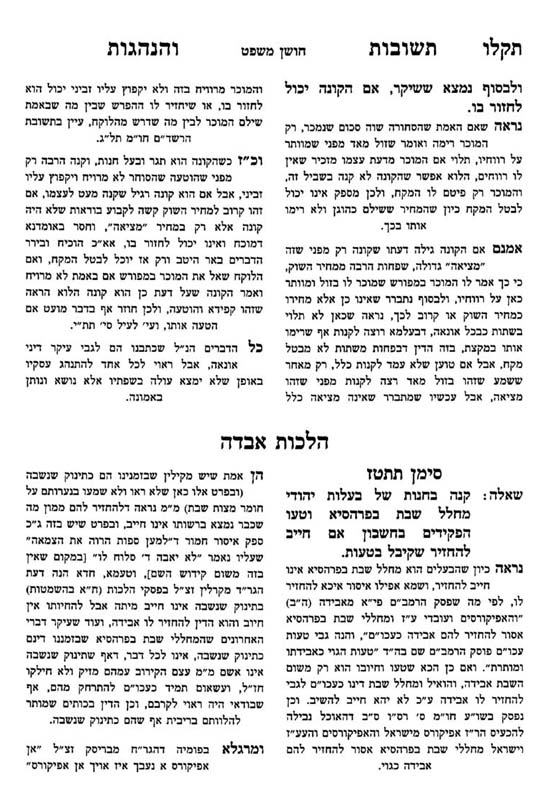
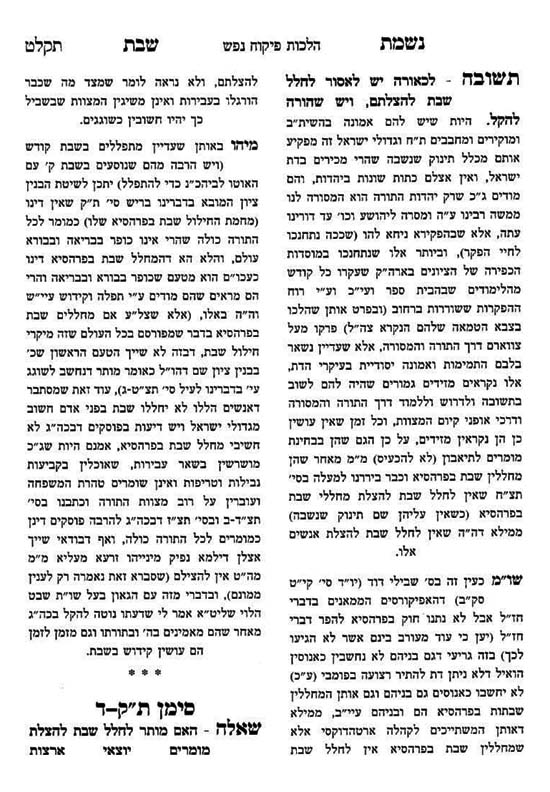
Haredi Robbers

Although we have alluded to the fact that Haredim “borrow” from others without attribution, I have come across a particularly egregious example. Here, is an article discussing the Romm Press and what became known as the Vilna Shas. Although the byline states that it was written “by Yated Ne’eman Staff” this is a wholesale reproduction of R. Shmuel Feigenshon’s article on this topic. Shmuel Feigenshon (Shafan HaSofer) was the editor of the Rom press for many years. He wrote a history of the press which first appeared in part in the journal HaSofer (vol. 1 27-33 and vol. 2-3 46-57, 1954-55). It was then published in its entirety in Yahadut Lita vol. 1. 1959.

The Yated via Dei’ah veDibur, has in turn copied this word for word, including the title headings. Of course, as some of the discussion may be deemed unpalpable to it Haredi readership they skipped a couple of things and in turn this ended up conflating some of the history. And, importantly, although Safan HaSofer wrote some of the article from a first person perspective as he was intimately involved in some of the facts, the Yated has removed that. In fact, there is absolutely no mention of Shafan HaSofer at all. I assume this is because he was a bit of a Maskil and although it is fine to plagerize from a maskil his name should never escape one’s lips.


Purim, Mixed Dancing and Kill Joys

Although the Megilah only lists mishloch monot, matnot l’evyonim, and reading the Megilah as the customs on Purim, many others have become accepted. Most are of the ilk of boofunery or merrymaking. From making noise to drinking in excess, all have become part of the Purim landscape. With these, however, there are some lesser known customs. What is perhaps of interest is that it seems that there are those authorities that permit much if not all of these types of customs, there are others who seem set on shutting down much of the Purim fun.

For instance, the Rabbi Judah of Minz permits cross-dressing on Purim. This is so, even though this runs counter to a law in the Torah prohibiting these actions. What is lesser know, is that R. Minz also permits mixed dancing on Purim as well. In the Taknot of Padua it says “we decree that no one is permitted to dance with a married woman, no man with any married woman, with the exception of Purim.” (emphasis added).

Rabbi Yehuda Herzl Henkin in his Beni Banim vol. 1 no. 37 (5), links the two statements of R. Minz. R. Henkin says, just as R. Minz permitted cross-dressing as it was done for the joy of Purim, he permitted the mixed dancing under the same rational. That is, the dancing was just an outgrowth of the joy and not for licetnioius purposes.

Or, in the Customs of Worms, they not only celebrated Purim on the day, on the Shabbat after Purim they celebrated with similar merrymaking. Including, after the Friday night prayers all the people would first go to the Rabbi for a blessing, and then proceed to the women’s section where the Rabbi’s wife “would place her hands on their heads and bless them.” Additionally, R. Hayim Yosef Azulai in his travelogue, Ma’agel Tov, records that the Jews in Amsterdam would party all night long on the Friday night after Purim.

Although R. Minz was a proponent of happiness and its outgrowth on Purim, there were others that did not view Purim in the same vein. Rather, they seem bent on outlawing as much as possible even on Purim.

For instance, R. Samuel Aboab takes issue with at least two such Purim customs. First, he says in his Sefer Zikhronot, an ethical work and published anonymously, that he was befuddled his entire life how R. Minz and in turn R. Moshe Isserles in his Rama could allow for cross dressing on Purim. He spends at least four pages to demonstrating why this is incorrect. He states even if R. Minz is correct he should have kept that to himself. This is not his only negative opinion regarding Purim. In his responsa, Devar Shmuel, he says it is absolutely prohibited to read or even own the parody Mesachat Purim. He says any such copies should be destroyed.

Another person who looked with askance on the merry making was R. David ben Shmuel haLevi (Taz). He first follows the ruling of his father-in-law, R. Joel Sirkas (Bach), that cross-dressing is prohibited. R. Levi then also states in the law of Tisha B’av, that the prohibition of filling ones mouth with joy, is applicable even at at wedding and even on Purim.

So it seems that just as in society at large there are those who dislike the merrymaking on Purim, this is reflected in the Halakhic authorities as well. And conversely, there are those that viewed the merrymaking as a positive thing and therefore permitted many other things in connection with that merrymaking.