The Mysteries of Hoshana Rabbah

THE MYSTERIES OF HOSHANA RABBAH

By Eliezer Brodt


This article originally appeared last year in Ami Magazine (2016) This version has a many updates and corrections. I hope to revisit this subject shortly.


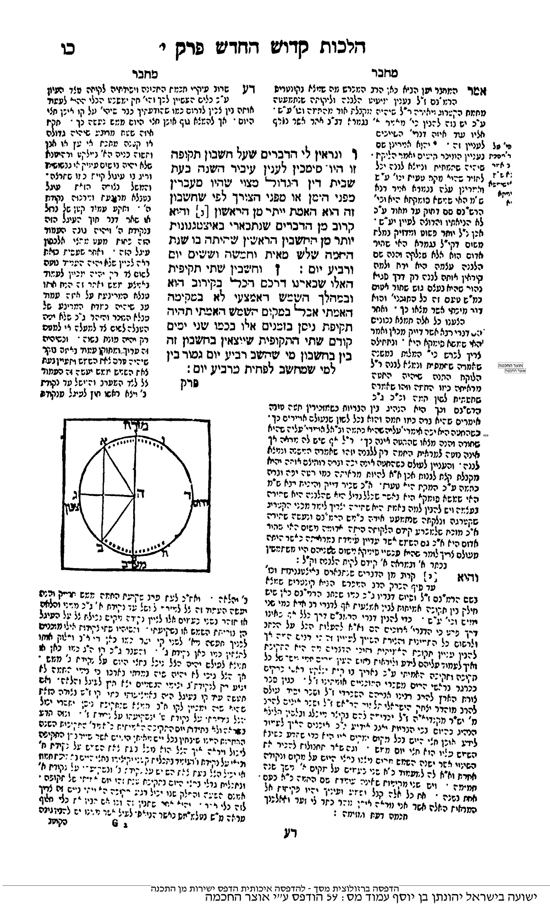
The sources of our Yomim Tovim are relatively easy to find, as one simply locates the relevant pesukim or Gemara and starts from there. However, one Yom Tov does not have such a starting point: Hoshana Rabbah. Its roots and numerous customs are shrouded in mystery. This article is an attempt to shed a bit of light on some of the early sources and customs behind this special day.[1]


A very early mention is in an anonymous attack against Yiddishkeit apparently written around the year 1500, where we already find Hoshana Rabbah under attack.[1a] At a later date we find in a work which records a debate about Kabbalah, written in 1825 that the origins of Hoshana Rabbah were also dealt with harshly.[1b]


The Name


Today we know this special day as Hoshana Rabbah, but it wasn’t always called by this name. In earlier sources, such as the Mishnah and Gemara, the Yom Tov is never called Hoshana Rabbah but “Yom Aravah” or “Yom Hoshana.” In a recent article, Rabbi Yaakov Stahl traces mentions of these names through numerous Geonim, Paytanim and Rishonim and concludes that the earliest known mention of the name “Hoshana Rabbah” is in the piyyutim of Rav Yosef Avitur, who passed away in 1024. However, it took a long time for the name to become popular.[2]


The Chayei Adam writes that the name Hoshana Rabbah references the many tefillos recited on this day that begin with the word “hoshana.”[3] This idea can be found as early as 1599 in the Seder Hayom. Rav Eliyahu Bachur writes in his Sefer HaTishbi that the aravos we take on Sukkos are called hoshanos because we call out hoshana, a contraction of the words hoshia na (please save), while holding them.[4]


YOM ARAVAH


In the fourth perek of Maseches Sukkah (42b-45a), the mishnayos and Gemara discuss the extra aravah that was used in the Beis Hamikdash in addition to the one included in the daled minim. Each day the kohanim would circle the mizbei’ach one time, and on the seventh day they would do so seven times. Rishonim differ as to whether they went around with both the aravah and the daled minim, or with the daled minim alone, as well as if the Yisraelim went around as well.[5]


On the seventh day, they would do chavatah on the ground with the aravos. Rashi (ibid. 44b) understands this to mean shaking the aravos, whereas the Rambam writes that it means to bang them two or three times on the floor or on a utensil[6] without making a brachah, in keeping with a minhag hanevi’im.[7] Since the destruction of the Beis Hamikdash, we go around with daled minim only, and not with the aravah, since it is not mentioned in the Torah.[8] The Rambam writes that nowadays we go around the bimah as a zecher l’Mikdash, where they circled the mizbei’ach.[9]


These mishnayos are the earliest sources for the hakafos we do once each day on Sukkos and seven times on Hoshana Rabbah. There are numerous sources from the Geonim onward about this.


It’s worth mentioning the powerful words of Rav Yosef Hahn Norlingen (1570-1637) in Yosef Ometz, first printed in 1723. He writes that one should make a great effort to go around each day with the lulav, to the extent that it’s worthwhile to spend a lot of money on the daled minim for this aspect of the mitzvah alone. He writes sharply against those who leave early and avoid hakafos and describes how he completed the circuit every day, even when there was a lot of pushing, especially on Hoshana Rabbah when the children pushed a lot.[10] A similar point is made by the anonymous work Chemdas Yomim.[11]


We see from this the great significance of completing a circuit around the bimah each day, which ties into zecher l’Mikdash, a concept that stands behind numerous halachos.[12]


But what else—besides for circling the bimah seven times and banging the aravos—is done differently on Hoshana Rabbah than the other days of Chol Hamoed Sukkos?


MISHNEH TORAH[13]


Many have the custom to hear Mishneh Torah, or Sefer Devarim, on Hoshana Rabbah night.[14]


Where did this custom originate?


Avudraham writes that in his time, a few people had the custom to read the whole Torah on the night of Hoshana Rabbah in case they didn’t complete shnayim mikra that year. He personally does not endorse this minhag and feels one should make up any missed shnayim mikra over Sukkos, or better yet, during the Aseres Yemei Teshuvah.[15] Tashbetz, a talmid of the Maharam MiRotenburg, is also wary of this custom, giving the strong opinion that it doesn’t help for anything.[16] However, the Shibolei Haleket writes that it is a worthy practice, and the Magen Avraham mentions it as well. The Shibolei Haleket links this custom to the fact that it is the yom hadin for water, and though the Gemara says one should really finish shnayim mikra before Yom Kippur, if one does not, now is a good time.[17]


The anonymous early Italian work Minhag Tov also describes this custom and says he has seen people practice it. His reasoning for it is interesting: on Rosh Hashanah, we are judged for life and death. In case death was decreed upon him, he will have reviewed his learning.[18] Agudas Eizov adds that through learning, one will be reminded to do teshuvah.[19]


Rav Yaakov Emden suggests that the reason for this custom is to remember the king’s Torah reading at Hakhel, but says that this may be a bit farfetched. He also points out that chumash is not generally to be learned at night.[20] However, he concludes “I bend my head to a custom that is already accepted.” However, he is discussing the Mishneh Torah, not the reading of the entire Torah mentioned by the Rishonim.[21] Rabbi Yosef Ginsburg also writes that the custom is to read only the Mishneh Torah.[22] What’s the source for this?


Shulchan Aruch HaArizal, first printed around 1660, writes that on the night of Hoshana Rabbah one should read Mishneh Torah.[23] Basically, the earliest source for the custom is the Arizal.[24]


The minhagim of the Arizal became widespread through various “bestseller” sefarim. [25] To point to just three “bestsellers,” that helped spread this minhag, one was the Tikunei Shabbos, first printed in 1613,[26] and another the Shaarei Tzion by Rav Nassan Hanover, first printed in 1662.[27] These two works saw dozens of editions and were extremely popular and widespread. Both contain a full Hoshana Rabbah learning seder, famously known as the Tikun Leil Hoshana Rabbah. These works inspired other versions based on Kabbalah.[28] A third work that also helped spread this seder was the very popular (and anonymous) Chemdas Yamim, first printed in 1731.


What was farfetched to Rav Yaakov Emden was fact for the Aderes, who writes in his anonymous[29] work on Hakhel that the reason behind the minhag of Mishneh Torah is for a remembrance of Hakhel.[30] Elsewhere, he writes that he himself would lein Mishneh Torah each year in his sukkah from his own sefer Torah.[31]


Rav Charlop did the same.[32] Many gedolim would also say this tikkun. For example, the Chida records this in his autobiography many times.[33] The Chasam Sofer would say tikkun and then go to sleep.[34]


Interestingly, Rabbi Chaim Benveniste (1603-1673) in Shiurei Knesses Hagedolah[35] and others[36] bring down that many have a minhag to say selichos on Hoshana Rabbah night.[37] Others say selichos during the hakafos in the morning and even blow shofar after each circuit of the bimah.[38]


By contrast, in Vilna it appears there were those who said selichos on Hoshana Rabbah night and the Gra wanted to abolish it because of Simchas Yom Tov. It’s even recorded that on Hoshana Rabbah night the Gra was noheg Simchas Beis Hashoeivah like the rest of the nights of Chol Hamoed but he stopped it after one  Hoshana Rabbah night someone died.[39a]


TEHILLIM


Other early sources, such as Rav Avraham Galante write that one should say the whole Sefer Tehillim on Hoshana Rabbah.[39] Rav Moshe Machir, in his classic Seder Hayom, cites such a custom, as does Rav Yuzpeh Shamash (1604-1678) of Worms[40] and Rav Yosef Hahn Norlingen. The Chasam Sofer would say the whole Sefer Tehillim and go to sleep,[41] as did R’ Shlomo Zalman Auerbach.[41a] Rabbi Hertz Scheir would pay people to say Tehillim the whole night.[42]


Rav Chaim Stein, Rosh Yeshivah of Telz, in his incredible World War II diary chronicling his great mesiras nefesh for whatever mitzvos he was able to do during that time, also writes that he and his friends stayed up saying all of Tehillim.[43]


The Butchasher Rav (1771-1841) gives an additional interesting reason for doing so: because Hoshana Rabbah is the ushpizin night of Dovid Hamelech. Dovid was known not to sleep for longer than sixty horse breadths,[44] and we try to emulate that.[45]


CHECKING SHADOWS[46]


Avudraham also records an elaborate Hoshana Rabbah custom: at night, some wrap themselves in sheets and go out to the shade of the moon. If they find their shadow complete, they are happy; if the head is missing, they assume they will die during the coming year. Depending on the appearance of the shadow, one can tell if other family members will survive the year. (A possible similarity can be found in Maseches Horayos.)


However, the Avudraham concludes not to do it.[47] This custom is found in numerous Rishonim—Ramban, Rav Yehudah Hachasid, Rokei’ach, Rikanati,[48] Tzioni, and Rav Aharon Hakohen Miluneil, to list a few. At the end of a manuscript written by Rav Eliyahu Bachur in 1515, he notes, “I completed this sefer on Hoshana Rabbah, when I saw my head in the shadows of the moon, so I know that I will not die this year.”[49] Rav Chaim Benveniste writes that the purpose of this custom is to do teshuvah, for if one sees that the shadows are not in his favor, he will daven for the decree to be abolished.[50]


Interestingly, Rav Yosef Karo makes no mention of this minhag, but the Rama in Darchei Moshe cites the Avudraham without giving his own opinion about it. However, in his glosses on Shulchan Aruch, he stresses not to do it,[51] writing that we do not understand exactly how to do it and in general it is not advisable to look into the future. Rav Yosef Hahn Norlingen and the Mateh Moshe[52] write the same. (It’s worth pointing out, though, that the Arizal was an adherent of this custom.)[53]


Returning to the previously mentioned minhag, that of reading the whole Torah throughout the night of Hoshana Rabbah, the Agudas Eizov adds that another reason to learn is to amass zechusim so that one’s shadow will be complete on Hoshana Rabbah. What lies behind this unique custom?


There are many more minhagim of Hoshana Rabbah, almost all for the same reason.


ECHOES OF YOM KIPPUR[54]


The Tur and numerous other Rishonim mention the lighting of candles. Leket Yosher writes that his rebbe, the Terumas Hadeshen, would use in part leftover candles from Yom Kippur.[55] Rav Zalman of St. Goar, in his work Sefer Maharil, writes that he observed his rebbe, the Maharil, doing the same.[56] Rav Isaac Tirna describes the same in his Sefer Minhagim.[57]


Another minhag echoing Rosh Hashanah and Yom Kippur is mentioned by Rav Zalman of St. Goar, who writes that he observed the Maharil wearing a kittel on Hoshana Rabbah.[58] The Rama cites a similar practice in Darchei Moshe and the Mapah. The Magen Avraham does the same, but says that the minhag in Poland is to wear Shabbos clothes, but not a kittel.[59] Rabbi Henkin writes that the minhag is only for the chazan to wear a kittel.[60]


Rav Isaac Tirna in his Sefer Minhaghim,[61] the Rama, Rav Yosef Hahn Norlingen and others bring that some go to the mikvah on the morning of Hoshana Rabbah.[62] Rav Chaim Benveniste writes in Shiurei Knesses Hagedolah that it’s better to do so in the evening. The Mateh Moshe,[63] Rabbi Yuzpeh Shamash (1604-1678) of Worms and others[64] write that it’s one of the five days of the year on which one should wake up early.[65]


The Tur and other Rishonim write that the minhag is to daven as on the morning of a Yom Tov, with a longer Pesukei Dezimrah.[66] However, it is unclear if they mean to include Nishmas. Numerous sources describe that the custom was to say it, such as in the French Work on Minhaghim written between 1360-1390 [66a], In the Zecher Yosef from 1467,[67] the Kabbalistic work Agudas Eizov,[68] Rav Chaim Benveniste’s description of Izmir, Turkey, in Shiurei Knesses Hagedolah, the Kaf Naki’s,[69] description of Morocco, and other descriptions of Italy.[70] However, the Rama says not to say Nishmas.


The Kitzur Shibolei Haleket writes that he heard some say Zachreinu L’chayim. Rav Chaim Benveniste cites others who had such a minhag.The Maharam would say Hamelech Hakadosh and Hamelech Hamishpat,[71] and in some early manuscripts, the tefillah of Unesaneh Tokef includes the words “Ub’Hoshana Rabbah yeichaseimun.”[72]


What is the common denominator of all these minhagim? The answer is simple. Hoshana Rabbah is a day of judgement. The question is, for what?


According to the Gemara (Rosh Hashanah 16a), it is a day of judgment for water. As the Taz[73] and Gra[74] point out, water is one of the most important human needs. The aravah grows by the water, says the Rokeach, so we take it up on this day. Of course it is well-known in Kabbalistic literature that this day marks the chasimah of the din handed down on Rosh Hashanah, but it is clear that sources who were not familiar with the Zohar also knew this. For example, the Manhig writes that the reason for lighting candles as on Yom Kippur, among other minhagim, is because on this day the judgment is sealed.[75] Some manuscripts of the Machzor Vitri write that we say Hashem hu haElokim seven times on Hoshana Rabbah, like we do on Yom Kippur, to symbolize the completion of judgment.[76] Others point to a cryptic line in the Yerushalmi in Rosh Hashanah to claim it as a final day of judgment.[77]


Based on these sources, it makes sense that all the many different minhagim are due to Hoshana Rabbah being a final day of judgment.[78] The question, though, is in the secrecy of it. Why are Rosh Hashanah and Yom Kippur openly discussed by Chazal as a day of judgment, while Hoshana Rabbah goes unmentioned? If it were such an important day, one would expect Chazal to let us in on the secret.[79]


Rav Yaakov Kamenetsky answers[80] this with an interesting idea, similar to one proposed by Rav Shlomo Zalman Auerbach.[81] They explain that Chazal felt that if the concept ever “got out,” it would disrupt simchas Yom Tov. At that time, the secret was only told to special people, but due to yeridas hadoros, it soon became clear that Hoshana Rabbah’s judgment would not affect simchah all that much. So the secret of the day’s tremendous significance was let out to the masses.
It is worth noting a similarly interesting statement from Rav Yehoshua Ibn Shuaib, talmid of the Rashba, that one of the reasons we do not find an open discussion of Rosh Hashanah’s judgment in the Torah is because such concepts are very hard to comprehend and discuss openly.[82]


STRANGE CUSTOM


In a letter in 1488, Rav Ovadiah miBartenura writes that in Italy, on Yom Kippur and Hoshana Rabbah nights, the aron was opened after davening and women would line up to kiss the Torah the whole night.[83] Rav Yehoshua Falk describes a similar practice in Pressburg. He links these customs, once again, to the fact of the final din.[84]


CHALLAH IN THE SHAPE OF A BIRD


Related to all of this, we find in a 19th-century Lithuanian memoir that white bread for Hoshana Rabbah was baked in the shape of a bird, because on this day, a final decision is made as to who will live or die that year. In folk tradition, this bird would fly to heaven and bring the determination on a scrap of paper.[85]  In Mattersdorf, the challahs of the Yomim Nora’im were baked in a round pan and stamped with a picture of a bird, probably for a similar reason.[86]


BANGING OF ARAVOS


After saying the hoshanos, we bang the bundle of aravos on the floor five times. The Chayei Adam[87] writes that children bang it until there are no leaves left, because of their exuberance for the mitzvah.[88] Rav Yair Chaim Bachrach of Worms (1638-1702) writes in the Mekor Chaim that fools bang it until no leaves are left. We bang it a few times, but why?


Rabbi Alexander Moshe Lapidos answers this question,[89] but to illustrate it clearly, some background is helpful. On Rosh Hashanah, we have a custom to eat various fruits and say accompanying tefillos. Numerous Acharonim [90] explain this minhag by pointing to a Ramban[91] that states that when an action is done in this world, it has an effect in shamayim, which in turn causes something to happen down here.[92] For instance, there is a custom among some to keep their hands open when reciting the words “Posei’ach es yadecha,” as though waiting to receive the parnasah.[93] This reasoning is in part what is behind the banging of the aravos.


THE FATE OF ARAVOS AFTER WE FINISH BANGING THEM


After we finish banging the aravos, what do we do with them? Many are noheg to place them on top of the aron kodesh, but it is not clear how far back this minhag can be traced, or if it is even permissible to do so.


Interestingly The Chayei Adam writes (153:3) one should burn the Aravos afterwards as does the Aruch Hashulchan (664:6).


The Munkatcher did not hold of throwing it onto the aron kodesh. However the Marsham points to a Malbushei Yom Tov which mentions that they did do so in his time. This work was written by the Tosfos Yom Tov (1579-1654) on the Levush, but was only first printed from manuscript in 1895.[94] However, this piece is already brought down by the Eliyhau Raba who had this work in manuscript and quotes from it often. [94a]


The sefer Tanya Rabbasi by Rav Yechiel HaRofei (1240-1289) records that “The custom we received from our fathers is that after we finish the mitzvah of aravah on Hoshana Rabbah, we take it home with us and put it next to our beds to show the love for mitzvos, and this is a kosher minhag.”[95] It is clear that in his time, the aravos were brought back home. The Mekor Chaim quotes the Tanya Rabbasi as saying that he heard that this practice serves as a protection when traveling.
We find segulos in numerous sefarim relating to saving a piece of the aravos, beginning with Derech Hayashar, written in Krakow in 1646. From there, it is also found in Uber Orach, Sefer Zechirah,[96] and Tzeidah Lederech, first printed in 1760.[97] It became famous in its Sefer Zechirah printing, as Rav Zechariah Simnar’s work was extremely popular in its time.[98] The custom is also found in the Chemdas Yomim.[99] All these sefarim write that one should use some of the candles of Yom Kippur for this practice to work, and that it saves one from robbery. Sefer Zechirah adds that you don’t need to carry the aravah on you for it to work, as long as you know where it is in your house.[100]


Numerous Rishonim and Acharonim advise that the aravos be saved and burned with the chametz,[101] because it is good to do mitzvos with objects already used for a mitzvah. None of these many sources mention throwing the aravos on top of the aron kodesh, even in passing.


SEGULAH WITH THE ESROG


One last famous Hoshana Rabbah segulah is the custom of women who are expecting to bite off the pitum of an esrog, daven that the birth not be painful, and then give tzedakah. The earliest source for this can be found in Rav Yaakov MiYanev’s classic Tz’ena Ur’ena.[102] This sefer, first printed around 1622, was reprinted over 200 times,[103] which explains why the minhag is so famous and popular. This practice is also cited by Rav Zechariah Simnar in Sefer Zechirah [104].


The reason for this minhag, as given by the Tz’ena Ur’ena, is because the fruit of the Eitz Hadaas that Chavah gave to Adam was an esrog. This caused the curse of painful childbirth. Since they did not pasel the esrog or eat from it all Sukkos, and do not do so even now that Sukkos is over, the tefillah of women is that they should not suffer because of Chavah’s sin, and instead have an easy labor.


May we all be zocheh to be inscribed in the sefer hachayim.


[1] For useful collections on this topic see; A. Berliner, Kesavim Nivcharim, 2, pp. 100-103; L. Zunz, Minhagei Tefah Upiut BiKhilot Yisrael, pp. 95-96,284- 288; R. Shlomo Y. Zevin, Moadim Bahalachah, pp. 142-149; Encyclopedia Talmudit, 8, pp. 527-535; Daniel Goldshmidt–Yonah Frankel, Machzor Sukkos, pp. 20-22; Daniel Goldshmidt, Mechkarei Tefillah Upiyut, pp. 392- 394; R’ Mordechai Spielman, Tiferes Tzvi, 3 pp.335-349; R’ Betzalel Landau, Machanayim 74 (1963), pp. 30-39; R’ Yechiel Goldhaver, Minhagei Hakehilot 2, pp. 136- 146; R’ Ovadiah Yosef, Chazon Ovadiah (Sukkos), pp. 438-450; R’ Ben Ish Chai, HaModiah (1999), pp. 14-15 [Thanks to R’ Menachem Silber for this source]; R’ Deblitsky, Kitzur Hilchos HaMoadim (Sukkos), pp. 224-237; R’ Tchezner, Sharei Chag HaSukkos, pp. 249-256, 450-458; Rabbi Tuviah Freund, Moadim L’Simchah,1, pp. 422- 451; Pardes Eliezer, Sukkos, pp. 227 and onwards; Luach HaHalachos Uminhaghim, pp. 102-111.I hope to return to all this more extensively in the near future in a hebrew work.
[1a] Bechinas haKabbalah, p. 50. See T. Fishman, Shaking the Pillars of Exile, 1997, p. 140; R’ Eliyahu Benamozegh, Tam LiShad, p.12, 29.
[1b] Shadal, Vikuach Al Chochmas Hakabbalah, introduction. On this work see Jordan Penkower, The Dates of Composition of the Zohar, pp.75-116.
[2] Yerushaseinu 9 (2016), pp. 155-201.
[3] 153:2.
[4] Sefer HaTishbi, Erech Hoshana.
[5] See Biur Hagra, 660;1, 664;12; R’ Shimon Horowitz, Biur Marsha (on Sefer Tanya Rabbasi), p. 198; R’ Elyukim Horowitz, Zichron Yerushalayim p. 50.
[6] See R’ Eliyahu Posek, Ki Ha’adam Eitz Hasadeh, p. 136.
[7] Hilchos Lulav 7:22. See also R’ Eliyahu Posek, Ki Ha’adam Eitz Hasadeh, p.136.
[8] See Beis Yosef, 664. See also Rama, 664:7. However the Taz (5) concludes one should hold both as does the Eliyhau Raba (11). See also R’ Henkin in Shut Gevurat Eliyahu, p.299.
[9] Hilchos Lulav 7:23. See R’ Yosef Dubovick, ‘MiTorat Rav Shmuel Ben Chafni Gaon: Inyanei Aravah Beyom Shvi’i Shel Sukkos,’Asifat Chachamim Boyan 12 (2013) pp. 13-22 R. Shlomo Y. Zevin, Moadim Bahalacha, pp. 142-146; Yosef Tabori, Moadei Yisrael Bitkufat HaMishnah V’haTalmud, 2000, pp. 190-194; R’ Shlomo Pick, Ilana D’Chaye Sarah (1986), pp. 51-61; Otzar Mefarshei Hoshanos (Machon Yerushalayim) 2003, pp. 19-34.
[10] Yosef Ometz, Siman 1048.
[11] Chemdas Yomim, 83b.
[12] See the work from the Aderet called Zecher L’mikdash, and Zichron Yerushalayim from R’ Elyakim Horowitz both devoted to this topic. See especially pp. 50-52 in Zichron Yerushalayim.
[13] R’ Yechiel Goldhaver, Minhagei Hakehilot, 2, pp. 136-137. See also R’ Weiss Binah L’itim, Tishrei, pp. 525-527 (staying up); see ibid, 527-530 (on finishing Chumash); Herman Pollack, Jewish Folkways in Germanic Lands (1648-1806), p.173; J. Lauterbach, Rabbinical Essays, pp. 328-329. For a very interesting article connecting this minhag to Coffee, see Elliott Horowitz, “Coffee, Coffeehouses, and the Nocturnal Rituals of Early Modern Jewry,” AJS Review 14:1 (Spring 1989), pp. 17-46; Assaf Nabarro, Tikkun from Lurianic Kabbalah to popular culture, Phd Ben Gurion University 2006, p. 87. See also R’ Aron Felder, Sh’eilot Aron, Siman 16 [Thanks to Menachem Butler for this source].
[14] It’s interesting that R’ Moshe Machir in Seder Hayom brings this minhag and the problems mentioned here for Simchas Torah at night. R’ Dovid Sasso writes in Masot Bavel (p. 197) that in Baghdad they would lein the whole Torah on Shmini Atzeres.
[15] Avudraham, Hoshana Rabbah.
[16] Tashbetz (Schneerson edition), siman 410.
[18] Shibolei Haleket, Siman 371.
[19] Minhag Tov, #76. On the dating of this work see Y. Ta Shema, Collected Writings 3, p. 248.
[20] p. 263
[21] R’ Henkin also raises this issue in Shut Gevurat Eliyahu, p.298
[22] Siddur R’ Yaakov Emden 2, p. 407
[23] Itim LeBinah, p. 220.
[24] The importance of this work was that it was one of the main sources for the Magen Avraham when quoting the Arizal. See Eliezer Brodt, Halachic Commentaries to the Shulchan Aruch on Orach Chayim from Ashkenaz and Poland in the Seventeenth Century, PhD, Bar Ian University) July 2015. pp. 191-198.
[25] See for example Sefer Kavanos HaYashan, Jerusalem 2014, p. 285.
[26] See also R’ Yechiel Goldhaver, Minhagei Hakehilot, 2, pp. 137-142.
[27] On the Significance and editions of this work see Eliezer Brodt, Halachic Commentaries to the Shulchan Aruch on Orach Chayim from Ashkenaz and Poland in the Seventeenth Century, PhD, Bar Ian University) July 2015, pp. 265-266. 29. [See the Appendix here]. See Assaf Nabarro, Tikkun from Lurianic Kabbalah to popular culture, PhD, Ben Gurion University, 2006, pp. 88-121. I hope to deal with this work in an article in the near future, iyH.
[28] See for example E. Landshuth, Amudei Ha’avodah pp. 218-220. See also Yosef Yahalom, Alei Ayin, pp. 130-143.
[29] He even gave a haskamah to his own work. See Yaakov Spiegel, Amudim Betoldot Hasefer Haivri, BiSharei Defus, pp. 35-36.
[30] Zecher L’mikdash, p. 19. See also Seder Eliyahu, Nefesh Dovid, p. 139.
[31] Seder Eliyahu, Nefesh Dovid, p. 139. R’ Moshe Feinstein was against leining from a Sefer Torah for Mishna Torah (Mesorat Moshe 2, p. 151).
[32] R’ Deblitsky, Binu Shnos Dor Vador, p. 63, 70
[33] Meir Benayahu, Ha-Chida, p. 533.
[34] See Zichronos Umesoros al HaChasam Sofer, pp. 205-206; Minhagei Raboseinu V’hilchosam, p. 170.
[35] He brings this from the Arizal, which is one of the only times he quotes him in his sefarim on Orach Chaim.
[36] R’ Yechiel Goldhaver, Minhagei Hakehilot, 2, pp. 138-139.
[37] See Avraham Yari, Toldos Chag Simchas Hatorah, pp. 292-295, about those who thought there was a custom to say Selichos on the night of Simchas Torah, when in reality they got confused and it was really on the night of Hoshana Rabbah. See Kaf Naki, Lud 2014, p. 108 who writes he could not find early sources for this minhag.
[38] See for example R’ Moshe Machir in Seder Hayom; R’ Meir Soloveitchick, Ha-Meir La’aretz, p. 104.
[38a] Aliyot Eliyahu, Maylot HaSulum 13, pp. 32-33.
[39] S. Schechter, Studies in Judaism, Philadelphia 1908, 2, p. 296. About this see Moshe Chalamish, HaKabbalah Betefillah Uminhag, pp. 332-355. See also Meir Benayahu, Dor Echad Ba’aretz, p. 268.
[40] Minhaghim D’Kehal Vermeiza, (1988), pp. 214
[41] See his own testimony in Sefer Zikaron, p.3 about a dream he had.
[41a] Halichos Shlomo (Tishrei), p. 241. See About R’ Moshe Feinstein, in Mesorat Moshe 1, p. 119 that he would “say” Mishnah Torah at night and finish Tehilim during the day. See also Mesorat Moshe 2, p. 151; R’ Henkin in Shut Gevurat Eliyahu, p.298.
[42] Turei Zahav, p. 16 (introduction).
[43] Mi-Telz Ad Telz, p. 276.
[44] See my Bein Kesseh LeAssur, pp. 173-215.
[45] Peninim Yekarim # 8 (printed in back of Da’as Kedoshim on Yoreh Deah, Tel Aviv 1959). Thanks to R’ Yehuda Spitz for this source.
[46] A. Berliner, Kesavim Nivcharim, 2, p. 101; R’ Eliyahu Benamozegh, Tam LiShad, p. 59, 217; Y. Weinstock, B’Maagalei Haniglah V’hanistar, pp. 245-269; Dov Sadan, Gilgul Moadim, pp. 163-178; R’ Lipshitz, Iyunim B’-Rabbeinu Bechaye, pp.327-331; Daniel Sperber, Minhagei Yisrael, 6, pp. 173-182; Daniel Speber, The Jewish Life Cycle, pp. 373-383; Ibid, Sefer Zikaron Heichal Hanefesh, pp. 369-376; Y. Ta-Shema, Ha-Niglah She-Benistar, pp. 30-31,120; R’ Yaakov Stahl, Sefer Gimatriyos, 2, Appendix pp. 866-874; Yisroel Ta-Shema, Kneset Mechkarim 4, p. 234. See this recent post.
[47] Avudraham, Hoshana Rabbah.
[48] He even mentions some trying to do it on a bird. The Mateh Moshe brings this down, but Mekor Chaim comments on this that it’s strange.
[49] About this passage see Y. Weinstock, B’Maagalei Haniglah V’hanistar, p.259; Dov Sadan, Gilgul Moadim, p.165. About R’ Eliyahu Bachur and Kabbalah see my Likutei Eliezer, pp. 71-72.
[50] Shiurei Knesses Hagedolah, 664. See also Sha’arei Tzion from R’ Nassan Hanover, p. 142. [51] See the Gilyon of the Magen Avraham here.
[52] Mateh Moshe, 957 (at the end). See the comments of R’ Chaim Ulma on Yosef Ometz (Mechon Yerushalayim ed.), p. 294.
[53] Sefer Kavanos HaYashan, Jerusalem 2014 pp. 286-287.
[54] See Herman Pollack, Jewish Folkways in Germanic Lands (1648-1806), p. 173; R’ Yechiel Goldhaver, Minhagei Hakehilot, 2, p.96,135.
[55] Leket Yosher,(2010), p. 334.
[56] Maharil, p.381.
[57] p. 125.
[58] Maharil, p. 381. See Yerushaseinu 3 (2009), pp. 90-93 about wearing a Kittel and saying Nishmas.
[59] Magen Avraham, 664;3. See Halichos Shlomo (Tishrei), p. 241 about what R’ Shlomo Zalman Auerach did.
[60] Shut Gevurat Eliyahu, p.298. See also R’ Deblitsky, Kitzur Hilchos HaMoadim (Sukkos), p. 229 Ftnt, 23 from Shar Mayim Rabim, p. 611. See also R’ Nosson Kamentsky, Making of a Godol, p. 131.
[61] p. 125.
[62] See what the Leket Yosher writes about his Rebbe the Terumas Hadeshen, p. 333.
[63] Matteh Moshe, 958.
[64] See for example the early collection of Minhagim in Genuzot 2 (1985), p. 14.
[65] Minhagim D’Kehal Vermeiza, (1988), pp. 214
[66] See Likutei Chaim (talmid of Minchas Chinuch), pp. 329-330. See also R’ Yitzchak Weiss, Shut Siach Yitzchak, Siman 318; Eishel Avraham (Butchatch) 664:1; Orchos Chaim (Spinka), about saying Mizmor Shir L’Yom HaShabbos.
[66 a] See the recent article from R’ Stahl, Yeshrun 37 (2017), p.185 where he printed parts of this manuscript for the first time. See also the additional early source from manuscript in footnote 47.
[67] Manuscript printed by Yaakov Spiegel, Moriah 30 (2011) 10-12 (358-360) p. 18. See also L. Zunz, Minhagei Tefah Upiut B’kehilot Yisrael, p. 285; Nevei Shalom, p. 27a.
[68] p. 264.
[69] Lud 2014, p. 108.
[70] Megilas Sedarim, (2002), p.85
[71] See Tiferes Shmuel end of Brachos (quoted by Da’as Torah, 664:1)
[72] A. Berliner, Kesavim Nivcharim, 2, p. 102. See the manuscript from 1560-1590 in  the recent article from R’ Stahl, Yeshrun 37 (2017), p.187 and Footnote 56.
[73] 664;1.
[74] 664:5. See R’ Dovid Cohen, Zeman Simchaseinu, pp. 87-97
[75] Sefer Hamanhig, 2, pp. 402-403.
[76] Machzor Vitri 3 (Goldsmidt ed,) , p. 876
[77] See Yerushalmi Rosh Hashanah 4:4. See also Yefeh Mareh; Mareh Panim. See R’ Meir Soloveitchik, Ha-Meir La’aretz, p. 104; R’ Zevin (above note 1), p. 147; R’ Reuven Margolis, Nefesh Chayah, 664; R’ Yissachar Tamar, Alei Tamar, Moed 2, pp. 226-227,128-129, 310; Y. Brand in B’Rosh Hashanah Yikaseivun (2003), p. 37-39 [Thanks to R’ Yakov Stahl for this source]. For more sources on it being the Gemar Din see: R’ Yaakov Emden, Shut Sh’eilat Yaavetz, 1, 33 (end); R’ Meir Don Polotzky (letter in back of Toldos HaRama Mifano, p. 87; R’ Eliyahu Posek, Shut Mor Oheles, p. 35a; R’ Dovid Hanazir, Kol HaNevuah, pp. 251-252. See also the recent article of R’ Urile Biner, HaOtzar 8, pp. 155-167; R’ Stahl, Yeshrun 37 (2017), p.184-185 footnote 44; See also his forthcoming work Minhag Avos where he deals with this at length tracing sources for this concept in early Paytanyim.
[78] See R’ Yitzchak Weiss, Shut Siach Yitzchak, Siman 315 who deals with why we say hallel if it’s a Yom Hadin.
[79] See R’ Eliyahu Nissim, Aderet Eliyahu, p. 29-30; R’ Eliyahu Benamozegh, Tam LiShad, pp. 19-21, 5; R’ Schick, Shut Rashban, Siman 252.
[80] Emes LeYaakov, pp.398-399. R’ Yaakov Kamenetsky writes an interesting language about the person who asked this question to him
הרגשתי בקושיא זו קושיא של קנטור כנגד דברי הזוהר
I once speculated that perhaps the reason for this comment was that R’ Yaakov had read the work of Shadal, VeKuach Al Chochomas Kabalah which begins with a debate between two people on Hoshana Rabba debating the origins of the Day and via this lead to a full fledged discussion of the origins of Kabbalah. However I have no evidence for the speculation that R’ Yaakov read or was familiar with this work.
[81] Halichos Shlomo (Tishrei), pp. 241, 428-435 See also Shalmei Moed, pp.169-170.
[82] Drasha L’Rosh Hashanah.
[83] Igrot Eretz Yisrael, p. 106. See also A. Grossman, Chasidus Umorodot, p. 302.
[84] Choshvei Machshavos, p. 71.
[85] Pauline Wengeroff, Memoirs of a Grandmother, 2010, p. 166. See also Herman Pollack, Jewish Folkways in Germanic Lands (1648-1806), p. 276 note 47.
[86] R’ Yechiel Goldhaver, Minhagei Hakehilot, 2, p. 28. See also R’ Yaakov Stahl, Yerushaseinu 9 (2016), p. 177.
[87] 153:3.
[88] See the Sefer Hakundos from 1824 in the 1997 edition, p. 66.
[89] See R’ Hirshevitz, Minhagei Yeshurun, p. 112; Toras Hagaon R’ Alexander Moshe Lapidos, p.430.
[90] See for example R’ Margolis in his Shut Machlos Hamachanayim, pp. 27b-28a
[91] Breishis, 12:6; 48:22
[92] See Daniel Sperber, Minhagei Yisrael, 3, pp. 113-172
[93] R’ Yosef ben Naim, Noheg BiChachmah, pp. 167-168. See Daniel Sperber, Minhagei Yisrael, 3, pp. 113-172.
[94] See Eliyhau Rabbah, 664:11: Darchei Chaim VeSholom, p. 292; Orchos Chaim (Spinka) 664:6; Luach HaHalachos Uminhaghim p. 109 – quoting Shut Marsham, 4:57 who mentions that they did this. See also  R’ Moshe Harari, Mikraei Kodesh, (Daled Minim), 2017 pp. 828-829.
[94a] This was one of many manuscripts used by the Eliyhau Rabba see R’ Tzi Leher, Yeshurn 35 (2106), pp.729-730.
[95] Siman 86, Brought in the Eliyhau Rabbah (13). See this recent article of R’ Yaakov Stal about this Minhag.
[96] p. 270-271.
[97] In 2001 edition p. 7.
[98] Sefer Zechira, p. 271. On this work see my Likutei Eliezer, pp. 13-25.
[99] Chemdas Yomim, p. 90b.
[100] See also R; Chaim Palagi, Ruach Chaim; Yifah LiLev; Segulot Yisroel, Erech Eyen, 61-62; Orchas Chaim (Spinka) 664:8; R’ Eliyahu Posek, Kie Hadem Etz haSudeh, p.139a.
[101] See for example sources brought in the Beis Yosef and Darchei Moshe here. See also my article in Yerushaseinu 2 (2008), p. 219.
[102] Bershis Jerusalem 1975, p. 34.
[103] See Introduction to Old Yiddish Literature, Jean Baumgarten, Oxford 2005, pp. 113-121; C. Shmeruk, Safrut Yiddish BePolin, pp. 147-164.

[104] Sefer Zechirah, p. 241; See also R’ Eliyahu Posek, Ki Ha’adam Eitz Hasadeh, p. 127b, 138b ; Chaim Uberachah, 228. See the extensive article from R’ Daniel Racah, Or Yisrael 41 (2006), pp. 167-188. On eating esrogim see A. Shemesh, Plants, Nourishments and ways of eating in Blessing Literature 1492-2000 (heb.) (2014), pp. 240-243.

Another Case of Historical Censorship at Volozhin or Simply Poor Research?

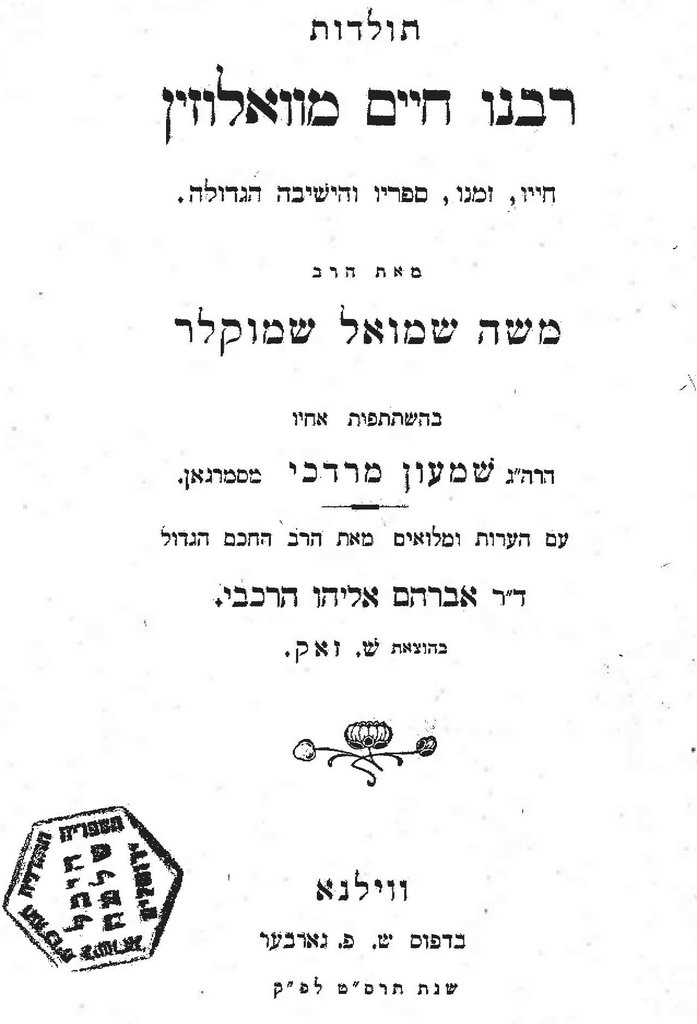
One of the more important sources for the history relating to the famed Volozhin Yeshiva is Moshe Shmuel v’Doro, by R. Moshe Shmuel Shapiro (Shmukler), which is is full of important material on this yeshiva and the related personalities. R. Schapiro also published a monograph on the founder of the Yeshiva, R. Chaim of Volozhin. This work, Toldot Rabbenu Chaim Volozhin, was first published in 1909 in Vilna, republished a year later in Vilna and then published twice in Israel, once in Bnei Brak in 1957 and once in Jerusalem in 1968. Recently, in 2000, Toldot Rabbenu Chaim Volozhin, was republished by R. Schapiro’s descendants.

In the 2000 edition of Toldot Rabbenu Chaim Volozhin, R. Schapiro’s descendants include a brief introduction about the history of the book, yet they were unaware of some key facts. First, they claim the book was only published twice, when in fact it was published four times. Additionally, then erroneously note that their edition is the third when in fact it is the fifth. Finally, they claim the first edition was the 1910 edition, when in fact the first edition appeared in 1909.

In addition to these three inaccuracies and omissions, there is a much more glaring one; not bibliographical in the abstract, but related to the content of the book – they have left out something which appeared in the earlier editions. In the first (1909) edition, a letter from R. Dr. Abraham Eliyahu Harkavy (1839-1919), a former student at the yeshiva in Volozhin, appears which contains both his warm approval of the book as well as a few comments on the book. Further, the fact Harkavy’s letter was included was no small thing as this was noted on the title page of the book. Specifically, the title page states the book includes:

עם הערות ומלואים מאת הרב החכם הגדול
ד”ר אברהם אליהו הרכבי

In the 1909 edition of Toldot Rabbenu Chaim Volozhin, Harkavy’s letter and notes were included by R. Moshe Schapiro. In the current reprint, the time that the fifth edition of Toldot Rabbenu Chaim Volozhin, published in 2000, by Schapiro’s grandchildren, Harkavy’s letter and notes are mysteriously missing. Perhaps this letter was removed intentionally as Harkavy was a maskil (intellectual) and later the head librarian at the Imperial Library in St. Petersburg.

It is possible these are missing due to a corrupted reprint the current publishers are relying upon. But, even if that would be the case, it does not absolve them of getting the first (or their “first” edition – the 1910 edition). Moreover, the title page they include does not give the current editions date, instead, the date and thus the reference is to the Vilna 1910 edition. Thus, giving the appearance they are merely reproducing the 1910 edition which is incorrect.

As an interesting aside, in 1999 the Artscroll publishing house released the first of two volumes of Shenot Dor v’Dor (the second was published in 2004) by Reuven Dessler, of a collection of priceless letters from important rabbinical personalities culled from the invaluable manuscript collection of the Dessler family, wherein an entire section (in vol. 1) is devoted to correspondence between Harkavy and some of the greatest rabbis of his time, many of them his colleagues and teachers at the yeshiva in Volozhin, including R. Naftali Zvi Yehudah Berlin (Netziv) and R. Chaim Soloveitchik.

Appendix:
Title page of Toldot Rabbenu Chaim Volozhin (1909)


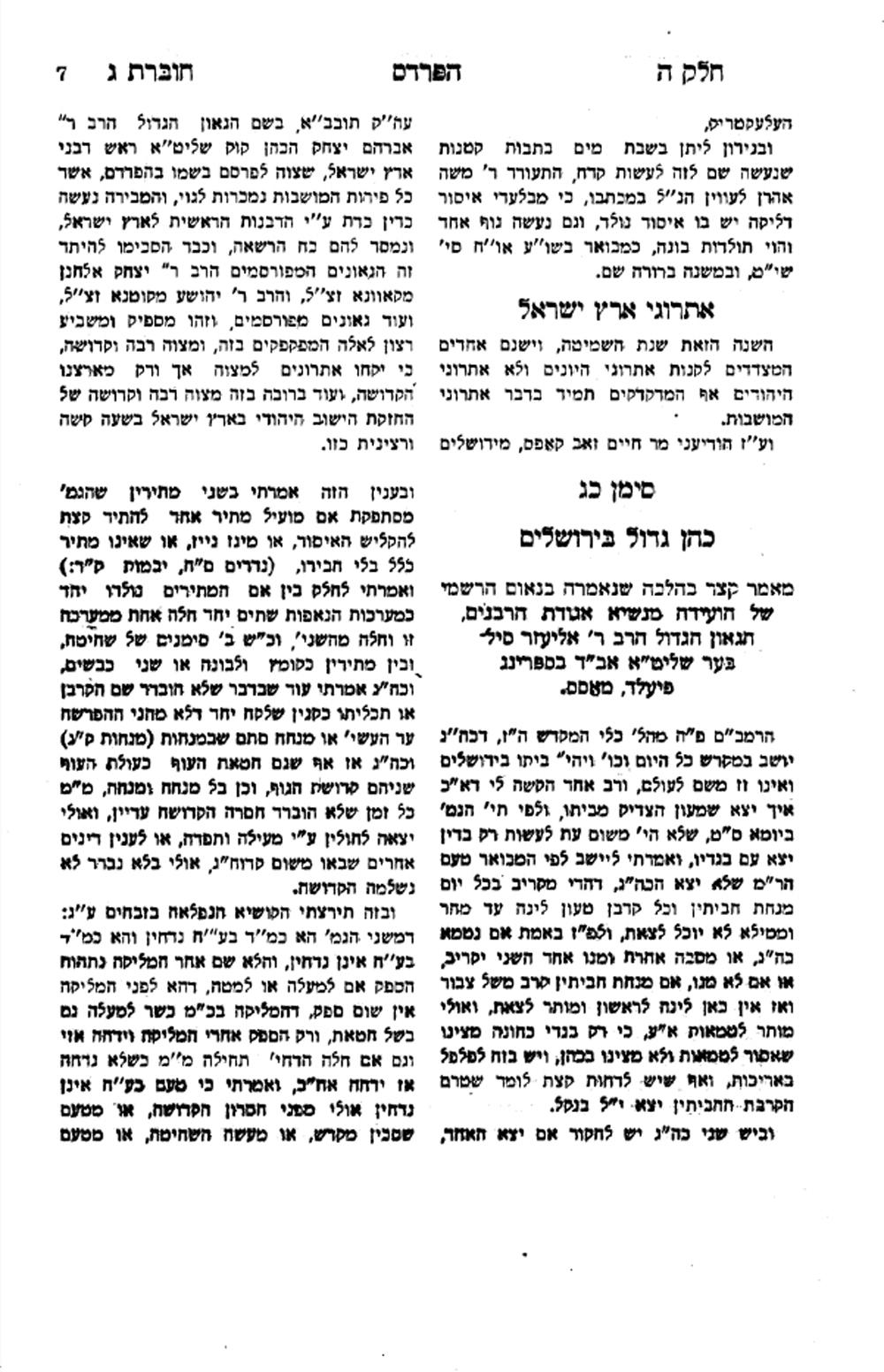
A Final Note Regarding Rav Simcha Zelig Reguer’s Position on Opening a Refrigerator on Shabbat

A Final Note
Regarding Rav Simcha Zelig Reguer’s Position on Opening a Refrigerator on
Shabbat
 By Yaacov Sasson
The purpose of this note is to
establish conclusively that Rav Simcha Zelig Reguer, the Dayan of Brisk,
never permitted opening a refrigerator on Shabbat when the light inside will go
on. I was deeply disappointed to read Rabbi Michael Broyde’s response[1] to
my “Note Regarding Rav Simcha Zelig Reguer’s Position on Opening a Refrigerator
on Shabbat.”[2] In
short, R. Broyde has incorrectly asserted that Rav Simcha Zelig permitted
opening a refrigerator on Shabbat when the light inside will go on. In truth,
Rav Simcha Zelig permitted opening a refrigerator when the motor will go on; he never addressed the refrigerator light at all. Rather than admit to this
simple mistake, R. Broyde has chosen to reiterate his basic error and compound
it with further errors. Furthermore, R. Broyde has entirely ignored the crux of
my own argument, specifically that the articles to which Rav Simcha Zelig was
responding were about triggering the refrigerator motor by allowing warm
air to enter. Those articles do not mention refrigerator lights at all. It is
therefore untenable to claim that Rav Simcha Zelig permitted opening a
refrigerator on Shabbat when the light inside will go on.
Let us proceed to examine how
each argument advanced by R. Broyde is incorrect. Below are direct quotations
from R. Broyde’s response (in bold), followed by my own comments.
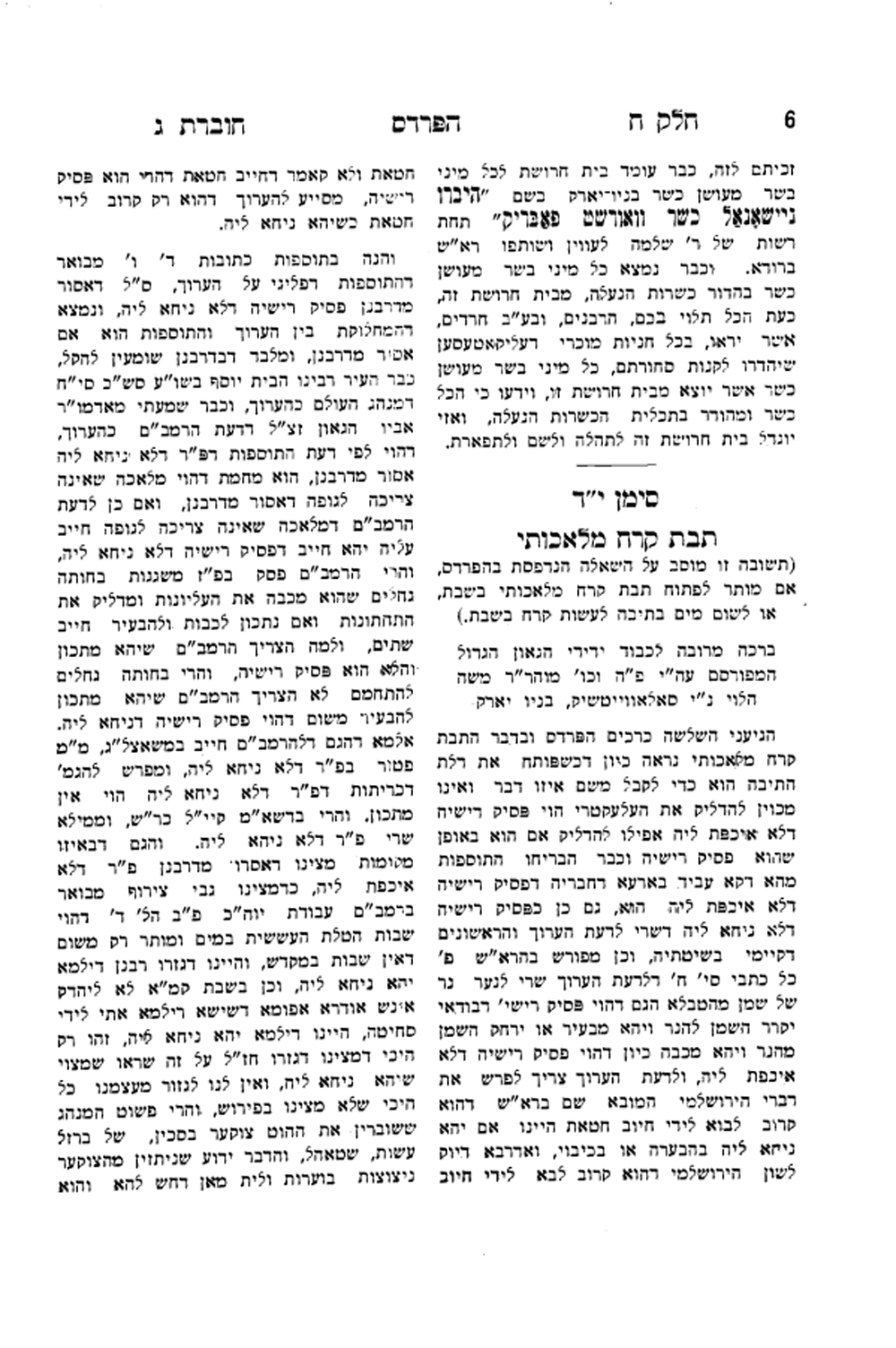
“The relevant paragraph of the
teshuva by Dayan Rieger reads simply:
ובדבר התבת
קרח מלאכותי נראה כיון דכשפותח את דלת התיבה הוא כדי לקבל משם איזו דבר ואינו
מכוין להדליק את העלעקטרי הוי פסיק רישיה דלא איכפת ליה אפילו להדליק אם הוא באופן
שהוא פסיק רישיה.
And in the matter of the artificial [electric]
icebox it appears that since when one opens the door of the box to get
something from there and does not intend to ignite (light) the electricity it
is a psik resha that he does not care about, even to light in way that
is a psik resha.”
R. Broyde’s citation has omitted the first several words of the paragraph,
which read as follows[3]:
הגיעני השלשה
כרכים הפרדס ובדבר התבת קרח מלאכותי…
“I received the three issues of Hapardes and in the
matter of the artificial [electric] icebox…”

This omission is significant, because these words make clear that Rav
Simcha Zelig was addressing the refrigerator question raised in earlier issues
of Hapardes. (See Hapardes 1931 num. 2 page 3, and Hapardes
1931 num. 3 page 7.) The question under discussion in those previous volumes was
the triggering of the refrigerator motor, and not the light, as noted.
Also of note, is that at the end of his teshuva[4],
Rav Simcha Zelig addressed Rav Moshe Levin’s question regarding the
permissibility of making ice on Shabbat. Rav Simcha Zelig cited this question
specifically in the name of Rav Levin. This is significant because the ice question
appeared in the name of Rav Levin in Hapardes 1931 num. 3 page 7, in
an article about triggering the refrigerator motors.[5] See
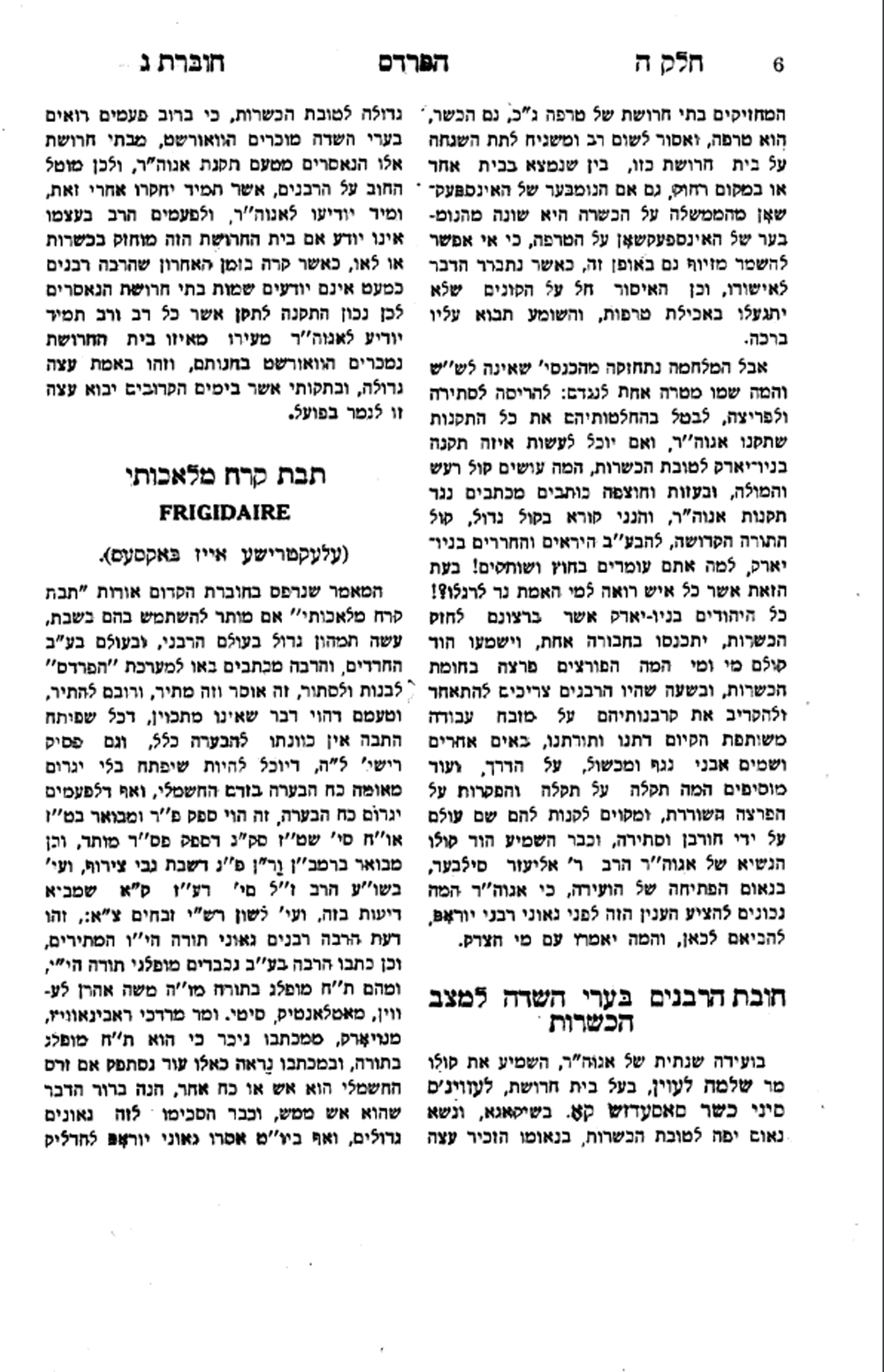
the final paragraph of the article titled “Frigidaire” in the image below:

So it is clear that Rav Simcha Zelig introduced his teshuva with a reference to the prior issues of Hapardes. And
it is also clear that he closed his teshuva by addressing Rav Moshe
Levin’s ice question from Hapardes (which appeared in the article
entitled “Frigidaire”, shown above, about the refrigerator motors.) R. Broyde
apparently contends that in between, Rav Simcha Zelig veered off to address an
unrelated question which never appeared in Hapardes (that of the
refrigerator light), without ever addressing the question of the
refrigerator motor itself. And he did this while directly addressing the
ice question from the article entitled “Frigidaire”, but never addressed the
main substance of that article, the refrigerator motor. The absurdity of this
position is self-evident.    
Also of note is the introductory paragraph to Rav Simcha Zelig’s teshuva,
presumably written by the editor, Rav Shmuel Pardes, which reads as follows[6]:
תשובה זו מוסב על
השאלה הנדפסת בהפרדס, אם מותר לפתוח תבת קרח מלאכותי בשבת, או לשום מים בתיבה
לעשות קרח בשבת.
This teshuva addresses the question that
was printed in Hapardes, whether it is permitted to open a refrigerator
on Shabbat, or to put water inside the refrigerator (freezer) to make ice on
Shabbat.
Rav Pardes clearly understood and presented Rav Simcha Zelig’s teshuva
to be addressing the question of triggering the motor, which had been raised in
earlier issues of Hapardes.
Furthermore, R. Broyde’s translation of Rav Simcha Zelig’s words is inaccurate,
and the effect of this mistranslation permeates his entire response. The
closing words of Rav Simcha Zelig in the paragraph cited by R. Broyde are:
הוי
פסיק רישיה דלא איכפת ליה אפילו להדליק אם הוא באופן שהוא פסיק רישיה.
R. Broyde has translated these words as:
“…it is a psik resha that he does not care
about, even to light in way that is a psik resha.”
The astute reader will notice that the bolded words in the Hebrew citation
are left untranslated by R. Broyde, essentially ignored, as if they do not
exist. The closing words of this sentence are correctly translated as follows: even
to light IF IT IS in a way that is a psik reisha. Most of R. Broyde’s
response revolves around the incorrect assertion that since Rav Simcha Zelig
referenced a psik reisha, he must have been referring to igniting the
light, which is a psik reisha, and not the motor, which is not a psik
reisha
. However, correctly translated, Rav Simcha Zelig says that opening
the refrigerator is permitted EVEN IF there is a psik reisha involved.
Such conditional language is entirely out of place when referring to a light,
which is certainly a psik reisha. This conditional language is only applicable
to the refrigerator motor, because there are times when, unbeknownst to the
person, the opening of the refrigerator door will immediately trigger the motor
to go on because of the already heightened initial air temperature inside the
refrigerator. (Such a situation is known in the language of the Poskim
as a “Safek psik resha”, as noted in Hapardes 1931 num. 3 page 6
regarding the refrigerator motor. It is the subject of dispute whether such an
action is permissible, similar to a Davar Sheaino Mitkavein, or
prohibited like a psik reisha.) Rav Simcha Zelig’s qualification that it
is permitted to open the refrigerator door even IF the situation is one of psik
reisha
makes clear that he is referring to the refrigerator motor, contrary
to R. Broyde’s misreading.[7]
“A careful reader of the first sentence, and indeed of the entire teshuva,
can sense that there is some ambiguity here about the electrical object
referred to, since Dayan Rieger does not specify the source or consequence of
igniting the electricity.”
There is no ambiguity to anyone who has seen the previous issues of Hapardes
which deal with the question of the refrigerator motor. There can only be
ambiguity if one reads Rav Simcha Zelig’s teshuva
entirely out of context, without looking at the articles to which he was
responding.
“Particularly in the Yiddish spoken culture of that time, the term
“electric” seems to have meant “lights” and not electricity or motor.”
R. Broyde’s assertion that “electri[c]” did not mean electricity or motor is
incorrect. See for example, the language in Rav Shlomo Heiman’s letter (dated
Erev Sukkot 5697/1936), printed in Chosen Yosef[8], and
reprinted in later editions of Chiddushei Rav Shlomo:
פקפק כת”ר
שליט”א בענין פתיחת הפרידזידעיר על העלעקטרי דע”י פתיחתו הוא
מבעיר העלעקטרי ורוצים להתיר על פי שטת הערוך דהוי פס”ר דלנ”ל
דיותר נוח לו שלא יכנס שם אויר קר, ולא יעלו לו הוצאות העלעקטרי
In this short excerpt, Rav Shlomo Heiman uses “elektri” to refer to
both the refrigerator motor and to electricity. Rav Heiman was clearly discussing
the permissibility of opening the door and triggering the refrigerator motor,
and refers to triggering the motor as kindling the “elektri”, the same
exact term used by Rav Simcha Zelig. Rav Heiman further notes that this is
considered “lo nicha lei” because the person would prefer to save the
additional expense of “elektri”, i.e. electricity.
See also the words of Rav Chaim Fishel Epstein, in Teshuva Shleima
vol. 2 – Orach Chaim, beginning of Siman
6[9]:
נשאלתי בדבר
המכונה המקררת בכח חשמל שקורין ריפרידזשיאטר, שבעת שפותחים הדלת נכנס אויר חם ואז
נתעורר כח החשמל (עלעקטריק בלע”ז) והמכונה מתחלת להניע ולעבוד כדי להוסיף
קרירות…
Here, Rav Epstein synonymizes koach chashmal, or electricity, with “עלעקטריק”.
See also Hapardes 1931, num. 2 page 3, where zerem hachashmali, or
electric current, is synonymized with
“עלעקטריק”. R. Broyde’s contention that “electri[c]”
did not mean electricity or motor is simply false.
“Elektri, according to
my colleague at Emory, Professor Nick Block, more likely means the light than
anything else in 1930s Yiddish.”
One need not be a Professor of German Studies to
recognize that within a discussion of
refrigerator motors, it is more than likely that “Elektri” means a
refrigerator motor, the subject under discussion, or its associated electricity.
This was true even in 1930s Yiddish spoken culture; see Rav Shlomo Heiman’s
1936 letter cited above.
Additionally, as mentioned above, Rav Pardes (editor of Hapardes)
clearly understood Rav Simcha Zelig’s teshuva to be addressing the
question of triggering the motor, which had been raised in earlier issues of Hapardes.
Rav Pardes’ knowledge of 1930s Yiddish was certainly robust.
“Second, and much more importantly, the halachic analysis presented by
Dayan Rieger addresses a direct action, while everyone else who discusses the
motor speaks about an indirect action…opening the door usually leads to an
increase of air temperature inside the refrigerator, which eventually directs
the motor to go on…many times when the refrigerator is opened, the motor does
not go on at all…But Dayan Rieger makes no mention of this…he assumes that when
the refrigerator door is opened the electrical object under discussion is always
ignited, and it does so immediately and directly, thus causing a melacha.
This is the formulation of psik resha, which inexorably causes melacha
each and every time…”
This section is entirely wrong, and is predicated on R. Broyde’s
misreading/mistranslation of Rav Simcha Zelig’s words, as noted above. That Rav
Simcha Zelig added the qualification of “IF IT IS” a psik reisha renders R. Broyde’s words here to be entirely
irrelevant and incorrect. Rav Simcha Zelig’s language of “IF IT IS” a psik
reisha makes clear that he is assuming that the motor is not always
ignited by opening the door, but at times it might be ignited in a manner of psik
reisha,
due to the heightened initial air temperature inside the
refrigerator. (Again, such a situation is known as “safek psik reisha”
in Rabbinic parlance, as the air temperature inside the refrigerator is not
known to the opener.) Contrary to R. Broyde’s assertions, Rav Simcha Zelig’s
language here is a clear proof that Rav Simcha Zelig’s teshuva was in reference to the refrigerator motor and not the
light.
“Professor Sara Reguer noted by email to me that “my grandfather conferred
with scientists and specialists in electricity before giving his response,” and
given this fact it is extremely unlikely that he missed such a basic point that
anyone who repeatedly opened and closed a refrigerator would have noticed.”
This argument is also incorrect, and is again predicated on R. Broyde’s
mistranslation of Rav Simcha Zelig’s words. Also significant is R. Broyde’s
citation of Dr. Reguer (in his footnote 8) that “she is certain that this teshuva
is referring to the thermostat or motor and not the light.”
“First, the other substantive halachic logic employed by Dayan Rieger which
analogizes elektri to sparks seems to me to be a closer analogy to a light than
to a motor which is hardly fire at all; sparks like incandescent lights, are
fire according to halacha.”
R. Broyde is wrong again. In fact, several poskim have noted that
ignition of the refrigerator motor also generates sparks.[10] See
the words of Rav Chaim Bick[11],
describing the problem of the refrigerator motor in Hamesila (2:1)[12]:
וע”י הגלגל
נושב רוח ומוליד הקר לחלק השני של התבה, אשר שמה נמצאים כל צרכי אכל ומשקה. הגלגל
בשעה שמתחיל מרוצתו יוצא ממנו נצוץ-אשי
And by way of the wheel,
the wind (i.e. air) blows and creates the cold in the other section of the box
(refrigerator), where all the food and drink are located. The wheel, when it
begins to run, emits fire-sparks
See also the words of Rav Chaim Dovid Regensburg,
describing the problem of the refrigerator motor, in Mishmeret Chaim, siman
3[13]:
ומה שלפעמים ניצוצות ניתזים, ברגע של מגע החוטים
החשמליים אחד בשני, אין זו הבערה, כי מלאכת מבעיר ביחס לשבת לא חשובה אלא אם האש
נאחזת באיזה דבר, וכן כתב הפרי מגדים סי תקב… 
And that sometimes sparks
fly off
,
at the moment that the electrical wires touch each other, this is not havara,
because melechet havara with respect to Shabbat is only considered when
the fire takes hold to something, and so wrote the Pri Megadim…
See also the words of Rav Shlomo Zalman Auerbach, within a discussion of
the ignition of the refrigerator motor in Minchat Shlomo (Kama), Siman
10, Anaf 2 Ot 4[14]:
אולם יש טוענים
דיש לחשוש לזה, שבכל פעם שמתחדש מעגל חשמלי יוצא במקום החבור ניצוץ קטן של אש
ונמצא שבפתיחתו הוא גורם למלאכת מבעיר…
However, some claim that one should be careful
about this, that every time that an electric circuit is completes, a small
spark of fire
comes out of the place of connection, and thus through his
opening [of the refrigerator door] he is causing the melacha of mav’ir…
Thus, contrary to R. Broyde’s assertion, Rav Simcha Zelig’s mention of
sparks is in fact directly analogous to the ignition of the refrigerator motor,
which actually involved creation of sparks.[15]
“Secondly, there has been a regular subset of poskim (as shown by Rabbi
Abadi’s most recent teshuva, Ohr Yitzchak 2:166) who adopt the exact analysis
and view of Dayan Rieger and view the light as lo ichpat since one does
not want it and a light is on already.”
To refer to a single teshuva, published in the 21st
century by a lone posek, as “a regular subset of poskim” would seem to
be somewhat of an exaggeration.
“On the other hand, there is a good and natural impulse to read halachic
literature conservatively and to press for interpretations that align gedolim
with one another and not leave outliers with halachic novelty.”
My original note and my comments here in no way reflect any impulse to read
halachic literature conservatively. They reflect my impulse to read halachic
literature correctly.
“Furthermore, I do recognize that many halachic authorities who have cited
Dayan Rieger’s teshuva have quoted it in the context of the motor and not the
light…”
More accurately, all halachic authorities who have cited Rav Simcha
Zelig’s teshuva have quoted it in the
context of the motor and not the light.
“But, I think these citations are less than dispositive for the following
important reason: Those who quote Dayan Rieger’s view as something to consider
about the motor note that his analysis is halachically wrong…Poskim generally
spend less time and ink explicating the views of authorities whom they believe
to have reached inapt or incorrect conclusions of fact or law compared with
those whom they cite in whole or in part to bolster their own analysis.”
It is unclear to me whether R. Broyde means that all of these Poskim
have misunderstood Rav Simcha Zelig’s position, or that they have
misrepresented it. Either way, the assertion is bizarre. I will leave it to the
readers to judge whether such an assertion is tenable.
The following is a partial list of Poskim and scholars who have
cited Rav Simcha Zelig as having permitted opening a refrigerator on Shabbat
when the motor will go on, and not
in the context of the refrigerator light[16]:
1)     
Rav Ovadya
Yosef (Yabia Omer, Orach Chaim Chelek 1, Siman 21, Ot 7)
2)    Rav Yehoshua
Neuwirth (Shemirat Shabbat Kehilchata, Perek 10 Footnote 33 in
the 1979 edition. This appears in Footnote 37 in the 2010 edition.)
3)     
Rav J. David
Bleich (Tradition, Spring 2017, pages
57-58)[17]
4)     
Rav Chaim
Bick (Hamesila 2:1)[18]
5)     
Rav Gedalia
Felder (Yesodei Yesurun, vol. 3 page 293)[19]
6)     
Rav Shlomo
Tanavizki (Birkat Shlomo, end of siman 2)[20]
7)     
Rav Moshe
Shternbuch (Teshuvot Vehanhagot vol. 1 Siman 220)[21]
8)     
Rav Chaim
Fishel Epstein (Teshuva Shleima vol. 2, end of Siman 6)[22]
9)     
Rav Chaim
Dovid Regensburg (Mishmeret Chaim, Siman 3, page 27) [23]
10) 
Rav Chaim
Druck (Noam Vol. 1 page 281)[24]
11) 
Rav Shmuel
Aharon Yudelevitz (Hachashmal Leor Hahalacha, page 130)[25]
12) 
Rav Yosef
Schwartzman (Shaashuei Torah, Chelek 3 – Shabbat,  pages 391-392)
13) 
Rav Shlomo
Pick (Who is Halakhic Man?, in Review of Rabbinic Judaism 12:2, page
260)[26]
In conclusion, it is clear that Rav Simcha Zelig’s teshuva about
opening refrigerators on Shabbat addressed the problem of the motor turning on
when the door is opened. Every argument put forth by R. Broyde is wrong. Rav
Simcha Zelig’s position was that it is permitted to open a refrigerator when
the motor will go on, as triggering the motor is classified as a psik
reisha d’lo ichpat lei
, which is equivalent to lo nicha lei. Rav
Simcha Zelig never addressed opening a refrigerator when the light will
go on.
Postscript:
Regarding R. Broyde’s admonition of my tone, that “we certainly could use
more light and less heat”, I could not disagree more. I will simply quote the
words of Rav Yosef Dov Soloveichik in his remarkable speech at the 1956 Chinuch
Atzmai Dinner, in appreciation of Rav Aharon Kotler[27]:
קאלטע תורה, ווי
קאלטע ליכט, איז גארנישט. עס דארף זיין הייס ליכט, א’מיר’זך
אפ’בריען ווען מ’קומט’מן צו אים…
Cold Torah, like cold light, is worthless. It must
be heated light so that one burns himself in its proximity…


[7] See Rav J. David Bleich’s typically thorough
treatment of the topic of refrigerators in Tradition
(Spring 2017, pages 57-59 and 64-65) for a discussion of why triggering the
refrigerator motor would be considered lo
nicha lei
.
[10] Rav J. David Bleich in Tradition (Spring 2017, page 72) has noted that while a number of
earlier poskim dealt with the issue
of sparking in refrigerators, sparking has now been eliminated in most
modern-day appliances.
[11] For biographical information on Rav Chaim Bick, see
here.
[15] While Rav Regensburg assumed that the creation of
sparks would happen only sometimes, it appears that Rav Bick and Rav Shlomo
Zalman assumed that the creation of sparks happened every time the motor was
triggered, and thus would be included in the category of safek psik reisha.
[16] My thanks to Dr. Marc Shapiro for bringing to my
attention the references to Rav Felder, Rav Shternbuch, Rav Druck and Rav
Schwartzman.
[17] My thanks to Rabbi Yitzchok Segal for bringing this
reference to my attention.
[27] Watch here at approximately 28:00. See also Making of a
Gadol, Second Edition, page 1019, for specific examples of Rav Aharon Kotler’s
heated remarks in defense of his Torah positions. 


Review of My Father’s Journey by Sara Reguer

Review of My Father’s Journey by Sara Reguer (Academic Studies Press, 2015)
 
By Moshe Maimon
About a year ago, Seforim Blog readers were informed by Prof. Marc Shapiro of the publication of Sara Reguer’s book My Father’s Journey, and they were further advised that this book would be of great value to anyone interested in the history of the yeshiva movement and Eastern European orthodoxy (see here). The following review illustrates the contribution the book indeed makes to these fields of study.
This basis of this memoir is essentially a diary which affords readers a very intimate view into the mind of a Lithuanian yeshiva student in the period between the two World Wars. Interspersed between the pages of this fascinating document is a fair amount of interesting yeshiva lore, including little-known facts about prominent Torah personalities contemporaneous with the author’s father. In highlighting some of these passages, I hope to give the reader a sense of the value of this work, while also calling attention to certain historical facts that might enhance the reader’s understanding.
The book, based on a Hebrew memoir by Dr. Moshe Aharon Reguer, son of the famed Brisker dayan, R. Simcha Zelig Rieger,[1] is translated and supplemented with additional material culled from interviews conducted with Dr. Regeur by his daughter, Prof. Sara Reguer, and from family lore she preserved. Additionally, it is bolstered by her insightful comments filling in detail and providing background. To avoid confusion, different fonts have been employed to represent the different sources. The translated text of the memoir appears in italics, the interviews in plain script, and Prof. Reguer’s comments in bold typeface.
This arrangement is helpful in distinguishing between the actual memoir, written by Moshe Aharon Reguer as a young adult in 1926, and the remaining material that relates to a later period in his life. Dr. Reguer wrote his memoir from the perspective of a young man poised at an important crossroads in life. As the narrative moves into his later years, the story takes on a nostalgic, backward-looking tinge.  Prof. Reguer deftly weaves the diverse sources that capture these epochs into a beautifully coherent story.
Here I might suggest that care should have been taken to more clearly distinguish the places where the written memoir “pauses” to include later reminiscences by the author obviously not part of the original document. One example is the references to dates and events after 1926,[2] the year of the composition of the original memoir. There is no documentation for these comments which are printed together with the text of the original memoir. In some instances these secondary sources recount events already recorded in the memoir with occasional variations; to arrive at a clear understanding of what actually happened, the reader would benefit by being able to differentiate between the various sources. Take for example Moshe Aharon’s account of his farher (matriculation exam) in the Slutzker yeshiva.
First, from p. 65:
So I went to Slutzk and the Slutzker Rav Isser Zalman with Rav Aharon Kotler, his son in law, hired
a teacher for me: Rav Shach (who is now famous in Ponovezh), who was then known
as the Vabulniker”. We stayed together in an inn and he learned with me, and
after a short time he went to Rav Aharon and Rav Isser Zalman and told them “I
don’t wan’t to take any money – he doesn’t need a teacher!” So Rav Aharon said:
“so, he doesn’t need any help and can learn alone?” and he took out a gemara,
Bava Kamma 76, where there are two lines of gemara and a huge tosfot, and he
told me to prepare it alone. I did it in a few hours, and I knew it, and he
said: “you do not need a teacher!” at eleven years old!
The editor has already pointed out that the author came to Slutzk only after his bar mitzvah; consequently he was actually thirteen years old at the time, not eleven.[3] As we will soon see, the above-mentioned scenario is fraught with additional chronological inconsistencies. Compare it with the following incident on p. 84 which seems to be referring to an event that took place the following winter, more than a year later that the author’s given date:
Until mid-winter, I studied with the student Babulnikai, but one day the son in law
of Rav Isser Zalman, Rav Aharon Pines, the ilui of Sabislovitz, called
me and on his own assigned me a “kri’a” – a group of gemara with all the
commentaries, which I was to read and then be tested on. I remember that the
“sugya” was in Baba Kama, p. 10. He set a deadline at which point I came to be
tested. I knew the entire sugya backwards and forwards, and on the test I
performed so well in both breadth and depth that Rav Aharon Pines ordered that
I should study alone. This announcement made a strong impression on the
yeshiva, especially on the younger students, because it was a tradition that
even the best students were never told at such a young age – fifteen – to study
alone without help or supervision.
The core of the story is the same: young Moshe Aharon learned under the tutelage of an older, more advanced student (R. Shach)[4] until such time as a thorough test, administered by R. Aharon Kotler (Pines),[5] revealed that he was adept at independent study, and was encouraged thereafter to learn on his own. Yet other important details are different, including the identities of the parties. In the first version R. Shach initiates the test, while in the second version R. Aharon takes the initiative “on his own”. In the first version, the subject matter is an extremely difficult passage comprising one of the longest Tosfos in Shas, while in the second; it entails the knowledge of a complex but more conventional sugya. The most glaring discrepancy is the timing of this event: while the first version portrays this as having occurred within a short while after his arrival in yeshiva, the second version has it more than a year later – when the author was already fifteen years old. Which version is the true version?
The clue to unraveling the many discrepancies lies in the author’s parenthetical remark on p. 65 identifying R. Shach as the rosh yeshiva “who is now famous in Ponovezh.” This comment belies the fact that the passage was not included in the original document written in 1926 (when the young R. Shach was entirely unknown), but rather dates to a later time period, at least 30 years later, and likely some 40 some odd years after the events they describe.
Taking this into account it is not difficult to surmise that the later version is actually the original version and likely the more authoritative one inasmuch as it was written closer to the events they describe. The events were quite possibly conflated in the author’s mind when he recounted tales of his youth later in life, and that would likely account for the discrepancies in the details. People do not necessarily intend to set down the historical record in their reminiscences, and the mind has a way of selectively remembering events without explicit attention to historical accuracy – particularly when aided by the haze of nostalgia. Certainly there can be no blame in that; it is the job of the editor to point out what material was penned for the record and that which was recounted later in other contexts.
Here is another interesting tidbit recounted by the author that has likely been blurred by nostalgic reminiscence, and should not be taken as historically accurate. Regarding the closing of the Volozhin yeshiva in 1892, in the course of an interview (pp. 29-30) the author recounts an original version of the events leading up to it:
In those days the yeshiva was closed because one of the students massered (informed) and
wrote a letter signing the name of the Netziv, and in a second letter he wrote
that the Netziv is a spy and all the students are spies in Volozhin, and the
reason why he sent this is because – father told me – when he came in on Yom Kippur,
the Netziv recognized that he had eaten, which was true, and he came over and
gave him a slap in the face in the presence of everybody. And this he couldn’t
stand and he massered on the yeshiva, and they sent soldiers from Vilna
and they surrounded the yeshiva and they asked, “where is the Netziv?” and they
showed the Netziv the letter, and asked if it was his signature, and he said,
“yes it is my signature”. But at the trial in Vilna he recognized that this was
a forgery because in all of his letters, after he wrote “Netziv”, he never made
a dot and this was with a dot. And they believed him and he was free, but they officially
closed the yeshiva.
The editor concedes that there are other versions to the story, and refers the reader to the attendant literature, but grants that this is another variant. However, it is readily apparent that here too, two different episodes – the story of the informant and the story of the closing of the yeshiva – have been inadvertently blended. In reality, they had nothing to do with each other.
The story of the informant has been supplied by the son of the Netziv, R. Meir Bar-Ilan, in his classic memoir מוואלאזין עד ירושלים,[6] as well as in the biography he wrote on his father, רבן של ישראל.[7] There we are told that the episode occurred a few years before the Great Fire; a catastrophe which struck Volozhin in the summer of 1886. The closing of the Yeshiva, on the other hand, didn’t occur until 1892. It is also apparent that some of the details of the episode are more reliably preserved in R. Bar-Ilan’s recounting, who also preserves the identity of the addressee in the forged letter, one R. Yaakov Reinowitz of London. In his account the charge brought against the Netziv was not that of espionage, but rather that of dealing in counterfeit currency, and unlike in Dr. Reguer’s version, the clever detection of the forgery was brought to light with the evidence that the Netziv signed his name נפתלי צביהודה by using the last letter of צבי as the first letter of יהודה,[8] a detail which the forger was not scrupulous in copying.[9]
Additional information has come to light in the discovery of other letters written by the Netziv to this very R.
Yaakov Reinowitz.[10] R. Reinowitz, who served as a dayyan on London’s beit din, was close to the Netziv and would assist him with the raising of finances for the yeshiva.[11]  Apparently the forger was aware of this individual’s connection with the Netziv, as well as his financial involvement with the yeshiva, and therefore chose to address the letter to R. Reinowitz to make it seem more authentic. Among R. Reinowitz’ papers are some 40 letters from the Netziv, including two which have been described thus:
In 1879 Rabbi Berlin informed Reinowitz that officials of the Russian government
had searched the documents and correspondence of the yeshiva and taken away
‘all my correspondence with you’ – the reason being that ‘a vile person forged
a letter of a secret nature which I am supposed to have sent to you’. In his
next letter Rabbi Berlin said that the correspondence was returned after a few
hours and that nothing untoward happened except that they had a big fright.[12]
When seen together it is clear the Netziv is referring here to the aforementioned episode. These letters indicate that the event happened in 1879, a fact now conclusively proven with the availability of the Russian government’s file on the episode,[13] and in fact had no direct effect on the subsequent closure of the Volozhin yeshiva some thirteen years later (although the involvement of the government in the yeshivas internal affairs almost certainly did contribute in the long run).”
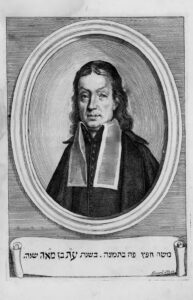
Here is a photo of Rabbi Reinowitz:
As to the identity of the culprit, R. Meir Bar-Ilan indicates that it was never proven conclusively. He cites several theories; including a report not unlike the one cited by our author in the name of R. Simcha Zelig, namely that it was the student who had been chastised for his Yom-Kippur indiscretions. This seems to have been the predominant theory; in R. Bar-Ilan’s recounting of the episode in his aforementioned biography, this is the only version presented. This is also the version recorded by R. Moshe Shmuel Shmukler-Shapiro in his ר’ משה שמואל ודורו,[14] where he even identifies the student who was chastised, and the year when the event occurred (1878). (Interestingly, according to R. Shmukler-Shapiro’s version, this student didn’t perpetrate the forgery himself, although his humiliation at the hands (or better, hand) of the Netziv was the catalyst for the subsequent act of revenge).
Further, in the above account, R. Simcha Zelig’s report has the student eating on Yom Kippur. According to R. Bar-Ilan, however, the nature of the student’s sin was appearing late to the prayers after having evidently bathed and combed his hair on the day of Yom-Kippur. Also noteworthy is the fact that R. Bar-Ilan mentions only that his father had angrily chastised the errant student but does not reveal, as does R. Simcha Zelig, that he had done so with a public and humiliating slap to the face. In this regard, R. Simcha Zelig’s version is also confirmed by R. Moshe Shmuel Shmukler-Shapiro in his ר’ משה שמואל ודורו,[15] although the student’s sin is described therein in accordance with R. Bar-Ilan’s version. It seems reasonable to me to assume that R. Bar-Ilan, out of concern for his father’s honor, knowingly softened the story and omitted mention of the slap in order to cushion the Netziv’s reputation in the eyes of the modern and westernized reader.
Another bit of family lore, recounted by Prof. Reguer on pp. 30-31, includes the legendary tale of R. Simch Zelig’s sagacious advice to the townspeople of Brisk, saying that in order to spare themselves from the damaging exploits of a wild first-born goat, it would be providential if the animal were to come to injury and thereafter be permitted for slaughter. The townspeople then organized a chase which resulted in the goat injuring its shoulder while attempting to escape, rendering it unfit for ritual sacrifice and henceforth permitted for slaughter.
This episode sounds too similar to an episode recounted by Dr. Reguer himself in 1973 in a letter to the editor of
the journal הדרום[16] to dismiss as a coincidence. The incident referred to there was a cause célèbre in Volzhin and was the source of a halakhic dispute between the two Rosh Yeshivas at the time, the Beis Halevi and the Netziv. Dr. Reguer writes:
את הדברים כפשוטם שמעתי
בילדותי מפי
אבי מורי זצ”ל הרב הגאון ר’ שמחה זעליג, הראב”ד בבריסק דליטא,
וכך היו הדברים: ליהודי אחד בוולוז’ין היה בכור תיש,
ומכיון לאחר שגדל דרכו היה להזיק, מסר יהודי זה את התיש לרשות הכהן, כדי שיוכל
להנות מן התיש. הכהן העניק לילדים מעדנים והם רדפו אחרי התיש וערכו לו ציד בבית הקברות
הנמצא במורד העיר. כאשר קפץ התיש מעל גדר התיל של בית הקברות
נפצע
ונמצא
מסורס.
ואז פרצה
המחלוקת
מכיון
שהכהן
היה
הגורם למעשה
סירוס
זה.
This version is also not without its ambiguities,[17] but unless we are to assume that these are two separate incidents, it is clear that the episode in question happened in Volozhin, and not in Brisk, and it is equally clear that R. Simcha Zelig was just the source for the story, but was not actually an active participant in this episode.
As mentioned, there are a number of valuable first-hand accounts of important pre-war Torah figures, most prominent among them: father of the memoirist and famed dayan of Brisk, R. Simcha Zelig Rieger, who was renowned as one of Lithuania’s foremost halakhic authorities until his tragic martyrdom in the Holocaust. In a manner characteristic of biographies written by close family members who make no attempt to portray their subjects as larger-than-life,[18] Moshe Aharon’s memoir, particularly the correspondence and photographs he includes, provides us with a close-up glimpse into this scholar’s saintly life.[19]
The book opens a window on the terrible hardships he had to endure throughout his life, and we can surmise the tremendous spiritual fortitude and determination he must have possessed in order to cope with his hard lot. Poverty and illness, compounded by having a married daughter living with her family in his home were part of R. Simcha Zelig’s daily tribulations, yet this saintly man utters no word of complaint. Even after suffering the humiliating experience of having his beard forcibly removed by the Soviets at the beginning of the Second World War, in a most harrowing encounter from which he only narrowly escaped with his life, R. Simcha Zelig had just this to say to his son: “we are all well” (p. 227).
Nothing deterred R. Simcha Zelig from his unfailing dedication to his life’s ideal of learning and teaching – not even the tragedy of losing children to illness, nor the intense pain of watching the defection of most of his adult children from their religious upbringing to a life of communism and socialism. In the face of it all, this humble genius continued unfailingly on his path, giving of himself unselfishly to anyone who needed him. While many biographies of gedolim tend to omit any references to wayward children, the correspondence included in this memoir, and especially the attendant analysis thereof, introduces the reader to the whole Reguer family. One can readily appreciate the extent to which R. Simcha Zelig went to maintain fatherly relations with all of his children – to the point of addressing his letters to every child and spouse, and even their infant children, by name.
Prof. Reguer highlights this tendency in her comments (p. 191), and further makes the astute observation that in these instances R. Simcha Zelig is careful to append the customary salutation שיחיה or שתחיה only to the names of the religious relatives; however, no explanation is given for this interesting behavior. Since this appendage is merely a blessing for long life, and is not indicative of one’s social or religious standing, it therefore strikes me as somewhat odd that R. Simcha Zelig, who went out of his way to show fatherly care and affection to these children, would omit this blessing in connection with them. Perhaps R. Simcha Zelig was only being sensitive to the irreligious outlook of those of his children who having broken with tradition would not appreciate this customary, religiously inspired, prayer on their behalf.
The family background is also instrumental in helping us understand how R. Simcha Zelig was able to countenance Moshe Aharon’s transition from the traditional Lithuanian yeshivas to the modern and Zionistic Tachkemoni yeshivas of Bialystock and Warsaw. Although the Talmudic departments in these yeshivas were headed by Brisker protégés of R. Simcha Zelig, namely the Iluy of Meicheit, R. Shlomo Polatchek, and R. Moshe Soloveitchik, they were by and large considered to be beyond the pale in the traditional Lithuanian yeshiva world.[20] In fact, according to Dr. Reguer (p. 147), R. Chaim of Brisk had actually sought R. Simcha Zelig’s help in dissuading R. Moshe Soloveitchik from accepting a position at Tachkemoni.
This transition eventually saw Moshe Aharon pursue an academic career first in Palestine[21] and later in America (a move which was to eventually spare him from the ravages of the Holocaust). While a letter from Moshe Aharon’s brother in law (p. 232) indicates that R. Simcha Zelig was unaware as to the secular nature of these studies, there can be no doubt that the author is correct in surmising (p. 145) that R. Simcha Zelig’s acquiescence to Moshe Aharon’s desire to pursue secular studies was a direct result of the outcome his earlier chinuch approach had had on Moshe Aharon’s older brothers.
Besides for his grandfather, the author was also privileged to study under various other great Torah personalities including the Alter of Slabodka (R. Nosson Tzvi Finkel), R. Shlomo Heiman, R. Aharon Kotler, R. Isser Zalman Meltzer and the dynamic young Rosh Mesivta of Karilov, R. Yechezkel of Trestina.
The latter was later to become famous in his capacity as Rosh Yeshiva in the preparatory mesivta in Slabodka and his well known by the title of his work Divrei Yechezkel, a classic work of lomdus in the yeshiva world. Yet, precious little is known about the Karilov chapter in his life,[22] and this memoir, with its focus on the Karilov yeshiva, provides a valuable contribution to his biography.
Special attention may be drawn to the lauditory description of his personality, as well as the unique relationship he shared with his students. Of particular interest is the depiction of the inspirational late-night hashkafa sessions he often held with his students (pp. 111-114).[23] Inasmuch as most people today know him only as R. Yechezkel Berstein,[24] or, as mentioned, by the title of his work Divrei Yechezkel, it would be beneficial to have that had the connection drawn out in the book.
The book contains various other tidbits concerning many of these personalities which readers will certainly find interesting. However, it is worth pointing out the difficulty involved in identifying them as sometimes various colloquialism are used in referring to these people. The difficulty is often exacerbated by the different spellings employed for some of these names. We have already seen that R. Shach has alternately been referred to as ‘the Vabulniker’ and ‘the student Babulnikai’. Apparently, in the Hebrew original, the author had spelled וואבולניקי – which he pronounced orally as ‘Vabulniki’ – as באבולניקאי which was transliterated as ‘Babulnikai’. Similarly R. Aharon Kotler has been called R. Aharon Pines, ‘R. Aharon of Svislovitzch’ and ‘the Iluy of Sabislovitch’. R. Shlomo Heiman too, is alternately referred to as ‘Rav
Shlomo Heiman Ha-pritizi’ or ‘Rav Shlomo of Poritz’.
Compounding the problem is the fact that each name is listed separately in the index, and instances where only the colloquialism is used without a last name are often not included. Perhaps this is because the index was produced with electronic search engines according to spelling and therefore did not combine various entries for one person when the spelling was different. Yet, what this gains in expedience and convenience is offset by the frustration one encounters when trying to search for references using a last name which doesn’t appear in all the occurrences. (I might add that it also makes for the inclusion of some unorthodox entries, such as ‘Sha’agat, Arye’).
If this book is republished it may be prudent for the sake of uniformity to streamline the names and titles used throughout the book. Similarly, care should be taken in the phonetic spelling of other Hebraic phrases such as רב דמתא (meaning the rabbi of the city) which has been spelled as ‘Rav Damta’ on p. 105, and thus appears to be someone’s name.
The author’s acquaintance with the Alter of Slabodka began when Moshe Aharon first joined the Slabodka yeshiva, which was then in Kremenchug during its exile during the First Word War. At the time, young Moshe Aharon was duly impressed by the Alter’s sagacious personality, but later this perception is tarnished somewhat, and at the end of the memoir he blames the Alter’s high-handed (und unfair) method in dealing with those whom he suspected of having secular leanings for his ultimate decision to leave the mussar world cultivated by the Slabodka yeshiva. One can’t help but wonder if this perception of the Alter wasn’t colored by the author’s own negative experience, fresh at the time of the writing. Perhaps with the the passage of time and the benefit of hindsight, as well as nostalgia, Moshe Aharon may have come to see things differently.
One thing that stands out about his description of the Alter is that he calls him ‘a great scholar’ (p. 95).
In Slabodka’s heyday at the turn of the century, owing largely to the Alter’s secretive ways and mysterious habits, this facet of his personality was not common knowledge and different students had different reads on it. R. Yaakov Kamenetzky was convinced that the Alter was indeed a great lamdan and scholar, while in a recent blog post Professor Marc Shapiro has quoted R. Yehiel Ya’akov Weinberg’s opinion to the contrary.[25] It seems that about 15 years later, with the passage of time, the Alter’s reputation as a superior talmid chacham had firmly taken root.
One personality that is conspicuously under-represented in the book is the Brisker Rav, R. Yitzchak Zev Soloveitchik (as well as, to a lesser extent, his brother R. Moshe). The Rieger and Soloveitchik family lived under the same roof in a multi-family dwelling owned by the Kehilla, and R. Simcha Zelig was exceptionally close with his own rebbe, R. Chaim of Brisk, as well as R. Chaim’s sons, R. Moshe and R. Yitzchak Zev. In fact, from a reference in a letter from R. Simcha Zelig to the author, printed at the end of the book (p. 197), it seems R. Simcha Zelig would exchange annual Rosh Hashana greetings with R. Moshe, as well as his son R. Joseph Ber – that is, the famed Rabbi J.B. Soloveitchik of Yeshiva University – long after the two had emigrated from Europe to America. The relevant portion of the letter reads:
I wrote a Rosh Hashana greeting to R. Moshe Azaliion [?] as I write every year and I wrote to
R. Moshe’s son a Rosh Hashana greeting and nothing came back to me as usually
did each year. Perhaps I don’t have their correct updated address. Perhaps they
moved.
Careful examination of the facsimile of the original letter, reproduced on p. 198, reveals that Azaliion is a mistaken transcription of the Yiddish ‘אזויא’ (meaning ‘just like’) and is not part of R. Moshe’s name. This leads me to believe that R. Simcha Zelig is referring to R. Moshe Soloveitchik, as well as his son R. Joseph Ber who also enjoyed a relationship with R. Simcha Zelig, having received from him a personal smicha, as well as various halakhic traditions. In a passage interpolated into the memoir on p. 45, Moshe Aharon acknowledges this fact and mentions that he asked the Rav’s son (I assume this means R. Joseph Ber’s son, Prof. Haym Soloveitchik) for a transcript of these traditions.[26]
Perhaps Moshe Aharon did not enjoy the same relationship with the Brisker Rav as did his father, possibly on account of the Brisker Rav’s rebbetzin, whom Moshe Aharon considered a difficult woman (p. 67). Later in the book, R. Simcha Zelig’s correspondence with his son reveals that Moshe Aharon also had some sort of altercation with R. Chaim’s older son, R. Moshe (p. 223). The editor surmises that this was on account of R. Moshe having left the Tachkemoni yeshiva, where Moshe Aharon was studying, before the latter could receive smicha from R. Moshe. This seems like somewhat of a stretch, and although we may never know the real reason behind it, to me the ambiguous phrase that R. Simcha Zelig writes in an effort to persuade his son to drop the fight: “you do not know a family without opportunities” (p. 220), lends itself to the interpretation that at stake was some sort of position for which Moshe Aharon may have been jockeying for at the time when both found themselves employed by Yeshiva College.
On a final note: as mentioned before, the original memoir was written in Hebrew and the published edition is an English translation of the original. While the translation on a whole is an excellent one, and results in a fluid compelling read, there are also readers who might enjoy reading the original and would appreciate the biblical and talmudical prose the author sometimes employs. One example of this is when the author refers to the land of Israel as “the land of the deer” (p. 138), which was certainly ארץ הצבי in the original. The biblical expression for Israel as ארץ הצבי appears in Daniel 11:16, and according to most commentaries is based on the verse in Ezekiel 20:6, where the context shows that צבי is not a reference to ‘deer’ (the animal) but rather ‘dear’ (as in ‘desired’).
From the facsimiles of the pages of the manuscript included in the book, one can get a sense of the rich expressive language the memoir was written in, and it is hoped that perhaps it will be printed in the original one day. For the time being we must be content with the artful and masterful work produced by Prof. Reguer, and even as it is we certainly owe her much gratitude for preserving for us this rich and valuable memoir.


[1]
Rieger or Riger are the common spellings, although a facsimile of a letter
containing the mailing address of Moshe Aharon Reguer (seemingly in R. Simcha
Zelig’s own hand) indicates that Reguer is indeed the correct spelling.
[2]
Such as this remark on p. 55: ‘many years ago I found out that he had moved to
Boro Park, I met him there but he did not understand what I was saying’.
[3] I
can’t help but wonder as to the nature of this mistake. Could it be that the
author was induced to believe his own fictitious birth date, postdating him by
two years, as described in the book on p. 23?
[4]The
reference to “the student Babulnikai” in the preceding paragraph should read
Vabolnika’i, meaning ‘hailing from Vabolnik’, a reference to R. Shach’s
hometown. See also p. 75 where he mentions his studies “with a student from
Bubolnik who lived with me”.  I will
address this example when discussing the pitfalls of phonetic transliterations
later.
[5] The
editor, who is seemingly unaware that this is the same episode as the above, also
does not indicate that she is aware that R. Aharon Kotler and R. Aharon Pines are
one and the same (Pinnes was the family name; R. Aharon later took on the name
Kotler to help him evade the draft, see Making of a Godol, second ed.,
p. 295). Adding to the confusion, the index too has separate entries for each
name, but more on that later.
[6] תל אביב, תשל”ט, עמ’ 85-87
[7] ניו יורק, תש”ג, עמ’ 115-116
[8]
This can even be seen today in the facsimiles of the Netziv’s surviving letters,
such as the one addressed to our very same R. Reinowitz, in Reuven Dessler’s שנות דור ודור,
vol. 4 (Jerusalem 2013), p. 497. Whether the Netziv’s used this unusual format
merely to give his signature an individualized flourish, or whether his intent
was to avoid spelling out יהודה – in keeping with the pious custom of
avoiding the written combination ofיו”ד  and ה”א which
form a divine name, it is significant to note that his signature was altered in
the posthumous publication of his writings by his family. There, at the
conclusion of each responsum, the Netziv’s name appears in its conventional
spelling. (In his
Making of a Godol, second ed., p. 887, R. Nathan Kamenetzky points to
another example of a famous rabbinic personality who signed his name with an
ellipsis; R. (Yisroel Eliyahu) Yehoshua Trenk of Kutna who signed his name as ישראליהושע).
[9] See
also the report of this episode by a student in Volozhin from that era, R.
Eliyahu Mileikowsky, in his שו”ת אהלי אהרן, תל אביב
תרצ”ו, עמ’ ריח-רכ.
Eliezer Brodt has further called my attention to the translation of this memoir,
with additional references, in an article by Genrich Agranovsky and Sid Z.
Leiman: Three Lists of Students, in Turim: Studies in Jewish History
and Literature
, Vol. 1 (N.Y. 2008, pp. 3-6 fn. 7).
[10] See
Eugene Newman, The Responsa of Dayan Jacob Reinowitz, 1818—1893, in Transactions
& Miscellanies (Jewish Historical Society of England),
Vol. 23
(1969-1970), pp. 22-33.
[11] I
have already referred in a previous note to another letter to him from the
Netziv in Reuven Dessler’s שנות דור ודור. See also a responsum addressed to him in
the Netziv’s משיב דבר, vol 2, #17. According to Eugene Newman, ibid, pp. 26-27,
responsa #23 and #25 in vol. 4 were also addressed to R. Reinowitz. His
signature on a ruling from the London beit din is also confirmed by the
Netziv in responsa #56 in the same volume.
[12] See
Eugene Newman, ibid, p. 31. Note that according to this account the Netziv’s
documents were returned to him after a few hours, whereas in R. Mileikowsky’s
account they were only returned to him many months later after the case against
him was officially dropped. A further discrepancy, though by no means a
contradiction, concerns the lingering danger and prolonged fear and anxiety in
R. Mileikowsky’s account, missing in the Netziv’s own telling.
[13] See
Agranovsky and Leiman, ibid, p. 2-3.
[14] ניו יורק, תשכ”ג, עמ’ 59-60
[15] See
also R. Nathan Kamenetsky’s study of similar episodes in his Making of a
Godol
, second ed., pp. 889-890.
[16] גליון לז, עמ’ 264
[17] See
R. Chaim Karlinsky’s response to this letter in the subsequent volume of הדרום, גליון לח, עמ’ 187.
[18] I
think it is this sort of attitude at play in an interview on p. 27 in which he
said that he was unable to even approximate his father’s age. Here the editor
notes that research shows that it was likely around 1863. I don’t know what
research she had in mind, but just by using material supplied in the book it is
easy to demonstrate the accuracy of the year 1864 that is often given as the
year of his birth (for example see his grandson Chaim Ber Gulevsky’s שבת שבתון p.
365 where his birthday is listed as 20 Adar 1864). On p. 236, the author’s
sister, Esther, writes in a letter to him that their mother was 77 at the time
of her passing in 1938. Earlier on p. 27 the author himself states that his
mother was 3 years older than his father. Now, had R. Simcha Zelig been born in
1863 he would have been 75 in the summer of 1938 and his wife would then have
to be at least 78.
[19]
Perhaps the editor takes this too far in constantly referring to R. Simcha
Zelig without the honorary ‘R.’ before his name. Noteworthy in this context; some
critics look askance at biographies of this sort, as the approach they take may
strike a somewhat presumptuous, all-knowing note, and their tone is often less
deferential to their subject. See R. Yisroel Miller In Search of Torah Wisdom
(Mosaica Press, 2012), pp. 59-60, who makes this point in the name of R.
Avigdor Miller concerning the biography of the Chafetz Chaim that was penned by
his son R. Leib (Consistent with this approach is R. Miller’s own account of
his repelling of his great urge to read up on R. Yisrael Salanter’s life out of
concern lest his reverence for R. Yisroel be diminished, see R. Y. Hamburger’s
biography Rav Avigdor Miller (Judaica Press 2016), p. 22). However,
often times the authentic human portrait painted by a son is unmatched in its
accuracy and detail, and by extension that much more evocative in its
portrayal. See also מגד גבעות עולם vol. 1 p. 48-49 where it is reported in the name of R. Mendel Zaks that
he preferred the Chafetz Chaim biography written by his student R. M.M. Yoshor
over that of his son R. Leib, because the former doesn’t attempt to explain the
Chafetz Chaim’s actions as does his son R. Leib. Presumably this is just
another way of expressing the sentiment quoted before in the name of R. Avigdor
Miller. Conversely, in the Artscroll biography of the late Rosh Yeshiva of
Torah V’daath, R. Avrohom Yaakov Pam (Rav Pam, Brooklyn, 2003, p. 13),
it is reported that he was fluent in R. Leib’s biography of the Chafetz Chaim
and would often quote from it. (Also worth noting is the fact that R. Yoshor
himself, in his introduction, relates with pride the fact that his work had
found favor even with the usually critical R. Leib). Ultimately, this harks
back to the age-old question of whether a hagiography is preferable to a
biography. See the excellent discussion on the topic that forms the
introduction to R. Nathan Kamenetsky’s Making of a Godol.
[20] It
is worth noting in this context a story I heard from the Rosh Yeshiva of the
Kaminetz yeshiva in Jerusalem, R. Yitzchak Sheiner, concerning a student who
aspired to join the Yeshiva in Radin. This student was disappointed to find out
that he failed his entrance examination with the Chafetz Chaim, and was told to
seek other arrangements. On his way out he chanced upon the Rosh Yeshiva of
Radin, R. Moshe Landinsky, who noticed his dejected look and asked what had
transpired. After hearing the story, R. Moshe advised him to return to the
Chafetz Chaim and ask to borrow money for the train fare from Radin to Lida.
Knowing of the Chafetz Chaim’s aversion to the modern yeshiva founded in Lida
by R. Yitzhak Yaakov Reines, this move was guaranteed to make the Chafetz Chaim
reconsider his rejection of this bachur. Sure enough, that is exactly
what happened, and the bachur was thereupon accepted to the Radin
yeshiva.
[21] As
an interesting aside, Prof. Reguer recounts on p. 157 how Moshe Aharon was
involved in the physical construction of Hebrew University’s Mount Scopus
campus, and even provides (among the unpaginated illustrations [corresponding
to p. 153]) a photograph of him posing with fellow students at the site. It
seems that many students in those days involved themselves in such activities,
and this is likely what Prof. Avigdor Aptovitzer had in mind when he wrote to
Shalom Spiegel after arriving in Palestine in 1939: “וגם נוכחתי שכמעט אי אפשר למצוא
תלמידים מסייעים שכל התלמידים במלאכה, מלאכה ולא חכמה, ונתקיים בהם אל תקרא בניך
אלא בוניך, בוניך ממש מלאכת הבנין והסעת אבנים” (Tarbitz, vol. 81, p. 463).
[22] See
R. Betzalel Devlitzky’s biography of him in ישורון, vol. 28, pp. 871-899. The Karilov
chapter is mentioned there on p. 876. This article was later expanded and
included in a recent edition of דברי יחזקאל (הוצאת מישור, בני ברק, תשע”ג).
[23]
This section has been summarized in Hebrew here.
[24] In
some sources the last name appears as Berenstein. It is likely that at some
point he altered his name in an attempt at avoiding the dreaded draft to the
Polish army.
[25] See
here.
See also R. Nathan Kamenetzky’s discussion on the topic in his Making of a
Godol,
second ed., pp. 775-778, where conflicting opinions are cited in the
name of various students.
[26] He
also received (through R. Simcha Zelig) various traditions from R. Chaim, and
he would sometimes relay these very traditions, as can be evidenced by
following the references indexed under his name in Aharon Rakeffet’s The Rav.


On Libraries, Bibliophiles & Images: Taj Auction 13

On Libraries, Bibliophiles & Images: Taj Art Auctions 13

by Eliezer Brodt and Dan Rabinowitz

Taj Art Auctions will hold its 13th auction this Sunday, April 7th (the catalog is available here). The auction contains many items worth highlighting, especially those related to historic Jewish libraries, as well as other unique books and ephemera.

Recently, arguably, the most significant Jewish library reopened its doors. The National Library of Israel, housed at Hebrew University for decades, moved into its own building, designed by the starchitects Herzog & de Meuron, who count the Tate Modern among other outstanding projects. Books are integral to the Jewish experience, and the library’s location, next to some of the most important institutions of the Jewish state, the Knesset, the Israel Museum, and the Supreme Court, echoes that sentiment. The library’s ground floor houses the Jewish Studies reading room, which contains over 200,000 volumes. The library itself holds over four million books (and counting). These are now accessed by a quartet of robots that fetch requested books. There is even a window to watch them in action. The Scholem room has been transformed from its small, cramped quarters into a spacious room that houses the collections of several kabbalah scholars. Scholem’s desk is still present. There is a permanent exhibit of some of the library’s treasures, but that is only accessible on an official tour.

Nonetheless, it is undoubtedly worth seeking out. An exhibition of manuscripts of one the greatest privately held collections of Judaica, the Braginsky Collection, opens this month. While the National Library’s new building and collection are exceptional, many precursor Jewish libraries existed throughout the Jewish diaspora.

The oldest functioning Jewish library in the world is the Ets Haim Library in Amsterdam, dating from 1616. (An exhibition of its books was held at the National Library of Israel, then known as the Jewish National and University Library, in 1980). Its antiquity is tied to the date the school opened with the same name. This school became well-known for its unique curriculum and success in imparting that curriculum. Unlike the Central and Eastern European schools that almost immediately started studying Mishna and Talmud, the Talmud Torah applied a more systematic approach to Jewish literature. R. Shabbetai Seftil, the son of R. Yeshaya ha-Levi Horowitz (Shelah or Shelah ha-Kodesh), traveled from Frankfurt to Pozen via ship. That journey took him through Amsterdam, where he saw that the students’ studies operated in sequence. First, they studied the entire corpus of Tanakh and then completed the Mishha, and when they matured, they only began studying Talmud, and this approach contributed to their unique success. Seeing the benefits, he broke down crying, “Why don’t we follow the same approach in our countries [of Central and Eastern Europe]? Suppose only we could institute this throughout the Jewish communities. What would the harm be in first completing the Torah and Mishna until the student reaches thirteen and then begins Talmud? With that background, it will take only a year to become proficient in the intricacies of Talmud study, unlike our current approach that requires years to reach that level of fluency.”

In an example of the intertwining nature of the library and the school, the bibliographer R. Shabbetai Bass (1641-1718), who wrote the first Hebrew bibliography, Sifte Yeshenim (today, most well-known for this commentary on Rashi, Sifte Hakhim). Bass was born and lived in what is today the Czech Republic (Czechia). Around 1680, he went to Amsterdam to print Sifte Yeshenim. During that time, he visited the library and school and described the students as “students of giants: young children dancing like locusts and like so many lambs. To my eyes, they were giants, so well-versed in their knowledge of Torah and grammar. They could write Hebrew verse and poetry in meter and converse in clear Hebrew.” He also describes the unique aspect of the library. “Within the midrash, they have a special school, and there they have many books, and all the time they are in the yeshivah, this room is also open, and whoever wishes to study, anything he desires is lent to him. But not outside the beit midrash, even if he provides a large sum of money.”

From Ets Haim Bibliotheek Website

Among the Ets Hayim Library treasures is an Amsterdam print, the first Haggadah with copperplate illustrations. While illustrations in printed Haggados began with the Prague Haggadah of 1526, these were woodcuts. Copperplates, however, produce much finer illustrations. In 1695, the convert, Abraham ben Yaakov, designed and executed these copperplates, and the Haggadah was printed by the famed Amsterdam publisher, Proops. (Copperplates were already used in printing decades before the Haggadah. Perhaps one of the most significant recent examples is a 1635 copper etching by Rembrandt that the Jewish art scholar Simon Schama donated to the Rijksmuseum in Amsterdam last year.)  The illustrations are based on the Christian biblical illustrations of Mathis Marin. While most are innocuous, the temple image at the end of the Haggadah is topped with a cross. In addition to the fine illustrations, the Haggadah also contains a large foldout map of the Jews’s journeys from Egypt to Israel; it is among the first Jewish maps of the Holy Land.

The Ets Hayim Library holds a unique edition of this Haggadah, considered one of its most treasured books. First, it contains an extra title page. But, more importantly, it is hand colored. While the copperplates are a significant improvement, the coloring makes this an especially striking Haggadah. It is listed among 18 Highlights from the Es Haim: The Oldest Jewish Library in the World, published by the library in 2016. The book includes three full-page reproductions of various details of the Haggadah and smaller reproductions of other pages. There are only two other copies of this version. One is at the Hebrew Union College in Cincinnati, and the other is being auctioned at Taj Art Auctions (lot 89). The copy at the auction was a gift from the printer Solomon Proops.

Similar images from the Haggadah’s title page were reused in Menoras ha-Me’or, Amsterdam, 1722, (lot 84), and the Amsterdam Haggadah final illustration of the Beis ha-Mikdash, that if one looks closely, the Christian cross was left intact from the original Mathis Marin illustration, also appears in the beautiful and unique title page adorning Birkas Shmuel, Frankfurt, 1782 (lot 152).

Birkas Shmuel, Frankfurt, 1782 Note the Cross on the Top of the Temple

Amsterdam was home to another significant library, the Rosenthaliana. It was collected in Hanover but eventually landed in Amsterdam. The catalog related to this library attests to the rarity of another book in this auction. This library was amassed by Eliezer (Leeser) Rosenthal (1794-1868). Born in Warsaw, he eventually traveled to Hanover, where he served as a Rabbi. His wife came from a wealthy family that allowed Rosenthal to indulge in his passion, book collecting. At their death, his library comprised more than 5,200 volumes, including twelve incunabula and numerous rare and unique books. After his death, his son, George, commissioned the bibliographer Meyer (Marcus) Roest to complete a bibliography of the library. It was published in two volumes in 1875 and reproduced in 1966. Roest’s work incorporated Rosenthal’s catalog of his library, Yodeah Sefer. Despite the many rare books in the collections, there was at least one book he could not procure, at least a complete copy. In his entry, 1524, for the Ibbur Shanim, Venice, 1679, he says that “it is a terrible loss, that my copy is incomplete, it is missing the last pages, my copy ends at page 95 … and is missing the calendric charts for 150 years, beginning from 1675, my copy is missing from 95 of these charts, from 1731 onward… This is a scarce (yekar mitzius) book and is not listed in R. Hayim Michael’s [Or Meir] or the Shem ha-Gedolim, or Di Rossi’s bibliography.” The National Library of Israel received a complete copy from the Valmaddona Trust, which was digitized and available online. (One can bid on four of the Valmadonna books, Talmud Bavli, Seder Zeriam, Lublin, 1618, lot 70 , as well as lots 12, 54, and 68). A complete copy of the book appears in the auction at lot 2. (For more on calendar books, see Elisheva Carlebach, Palaces of Time: Jewish Calendar and Culture in Early Modern Europe, and pp. 51-55 regarding Ibbur Shanim. His work is also a source for the Tu be-Shevat seder, see our post, “Is there a Rotten Apple in the Tu be-Shevat Basket“). The book has its own intersting history that is briefly described in the timely post, “Kitniyot and Mechirat Chametz: Paradoxical Approaches to the Chametz Prohibition.”

Yet another seminal Jewish library was that of R. Dovid Oppenheim (1664-1736), considered “the greatest Jewish bibliophile that ever lived.” (See Alexander Marx, Studies in Jewish History and Booklore, 213). Oppenheim started his rabbinic career in Moravia, moved to Prague, and was eventually elevated to Bohemia’s Chief Rabbi. At age 24, his library consisted of 480 books, and by 1711, his library stood at over 2,100 books, missing only 140 books from those listed in Shabbetai Bass’s bibliography of all Hebrew books. After his death (with some additions from his son, Yosef), the library rose to 4,500 printed books and 780 manuscripts. Although Oppenheim lived in Prague, the library was in Hanover. This was due to the heavy book censorship, which included the potential for confiscation by the authorities. Oppenheim visited his library, but perhaps because his time was limited, his works do not indicate that he was acquainted with the book’s contents. Instead, he should be considered a consummate bibliophile, and his collection consisted of rarities and special beautiful and unique copies, with a considerable number on blue paper. For example, there were 51 books printed on vellum, 40 of which he commissioned himself, out of about 200 known books printed on that medium until 1905.

After his death and multiple attempts to sell the library, it eventually went to the Bodleian Library at Oxford University. A complete history of the library was most recently accounted for by Joshua Teplitsky in his Prince of the Press: How One Collector Built History’s Most Enduring and Remarkable Jewish Library. But before its final resting place, there were a handful of catalogs of the library or various aspects of it. The first complete printed catalog of the library was issued in 1782 and was intended to elicit interest from potential Jewish and non-Jewish buyers. Thus, it contains two title pages, one in Hebrew and the other in Latin. This rare bibliophilic item is lot 156.

Finally, the auction also includes books from the library of R. Nachum Dov Ber Friedman, the Sadigur Rebbe. His library was recently described in Amudei Olam by R. Zusya Dinklos, pp. 419-39. Aside from traditional works, the library also held Haskalah works, as the one in lot 71.

Illustrated Books

We discussed Ibur Shanim, and in addition to its rarity, it is also among the small number of Hebrew books that contain illustrations. Because the book’s purpose was to elucidate and explain Hebrew calendrical calculations, including the determination of the tekufos (which he vehemently criticizes some Rishonim and others for dismissing them as old wives tales), there are a handful of tutorial images.

Ibur Shanim
Gross Family Collection

Likewise, Sefer ha-Ivronot, Offenbach, 1722 (lot 73) includes celestial images, in this instance, a movable wheel of the heavenly apparatuses. While there was some speculation that the title page image depicting a heliocentric universe was deliberately to align with the book’s contents, that is unlikely as the image was reused in at least three other books printed in Offenbach that are unrelated to astronomy.

Moshe Hefetz, perhaps more well-known for the 19th-century modification of his portrait attached to the first edition of his Melechet Machshevet, which depicts him bare-headed, authored a book on the Bet ha-Mikdash, Haknukas ha-Bayis, 1696, (lot 20), within which several Temple elements are illustrated.

Two books contain eclectic images of the Jewish star. Igeret Ayelet Ahavim, Amsterdam, 1665 (lot 140) and the first edition, 170 Amsterdam, Raziel HaMalach, (lot 120) include unusual adaptations of the star. (For another kabbalistic rarity, lot 116, is the kabbalist, Rabbi Yosef Erges’ personal copy of the Rosh ha-Shana and Yom Kippur machzorim with his kabbalistic additions.)

Iggeres Ayyeles Ahahuvim
From the Gross Family Collection

Razeil ha-Malakh
From the Gross Family Collection

There are a handful of artistic title pages, with at least two Greek gods, Hercules and Venus (see lots 10 and 48), and some potentially objectionable ones that Marc Shapiro discussed in his book Changing the Immutable (lots 64 & 78).

One of the most unusual title pages is a special one that its owner inserted into the book. The title page, taken from a non-Jewish architectural image by the 18th-century engraver Franz Carl Heissig, was filled in by hand with the book’s publication information (lot 5).

Finally, while censorship in Jewish books is somewhat common, undoing censorship is less common. Lot 62 is a unique copy of the Shu’T Maharshal that includes the otherwise expunged name of an informer. Other copies only refer to the person obliquely; this copy, although crossed out, the name is still visible. For more on this see Elchanan Reiner, “Lineage (Yihus) and Libel:  Mahral, the Bezalel Family, and the Nadler Affair,” in Elchanan Reiner, ed., Maharal: Biography, Doctrine, Influence, 101-26 (Hebrew).


Which Direction is North?, Geographical Mistakes, and our Woke Universities

Which Direction is North?, Geographical Mistakes, and our Woke Universities

Marc B. Shapiro

1. Numbers 34:15 states: “Two and a half tribes have taken their inheritance on the side of the Jordan by Jericho, to the front, eastward.”

Rashi comments:

קדמה מזרחהאל פני העולם שהם במזרחשרוח מזרחית קרויה פנים ומערביות קרויה אחור לפיכך דרום לימין וצפון לשמאל

This passage is translated as follows in ArtScroll’s Sapirstein edition:

To the Front, Eastward: This means to the front of the world, which is in the east, for the eastern direction is called “face” and the western direction is called “back.” This is why the south is to the right and the north is to the left.

What does the “front of the world” mean? Furthermore, how could Rashi say that south is to the right? Anyone who looks at a map can see that south is not to the right and north is not to the left. Rather east is to the right and west is to the left.

ArtScroll begins its explanation by referring to Psalms 89:13: צָפוֹן וְיָמִין אַתָּה בְרָאתָם

The north and the south [right], Thou hast created them.” What we see from this verse is that “right” is used synonymously with “south”, which means that “north” also signifies “left”. But what does this mean, that “south” is “right” and “north” is “left”?

See also Genesis 13:9: אִםהַשְּׂמֹאל וְאֵימִנָה וְאִםהַיָּמִין וְאַשְׂמְאִילָה

Onkelos and Ps.-Jonathan translate: אם את לצפונא אנא לדרומא ואם את לדרומא אנא לצפונה

As you can see, the Targumim also understand “right” to mean south and “left” to mean north.

Genesis 14:15 states: וַיִּרְדְּפֵם עַדחוֹבָה אֲשֶׁר מִשְּׂמֹאל לְדַמָּשֶׂק

Old JPS translates: “[He] pursued them unto Hobah, which is on the left hand of Damascus.” But this is incorrect. The word משמאל here means “to the north”, and this is how it appears in the new JPS (and also in ArtScroll). See also Ezekiel 16:46 where again the words “right” and “left” refer to south and north.[1]

In its commentary to Rashi, Numbers 34:15, ArtScroll provides examples of other places where Rashi explains “south” to mean “right”. For example, Ezekiel 10:3 states: וְהַכְּרֻבִים עֹמְדִים מִימִין לַבַּיִת בְּבֹאוֹ הָאִישׁ. “Now the cherubim stood on the right side of the house, when the man went in.” Rashi comments:

מימין לביתבדרום

On the right side of the house: In the south [of the Temple].

ArtScroll does not mention Rashi, Genesis 35:18, where he explains the name בנימין as meaning “of the south”, that is, the only son who was born in the south.

Returning to Rashi’s comment in Numbers 34:15, where he says that south is to the right and north is to the left, ArtScroll explains as follows: “When one faces east, his right is to the south, his left is to the north, and his back is to the west.” This explanation is earlier found in the Silbermann translation of Rashi, Exodus, p. 261: “In reality these terms describe the points of the compass relative to one who is facing the place of sun-rise (מזרח) so that ימין, the right, is the South and שמאל, the left, is the North.” Neither ArtScroll nor Silbermann mention that this explanation is already found in Nahmanides, Exodus 26:18.

Now let us look at two passages in Maimonides. In Mishneh Torah, Hilkhot Terumot 1:9, Maimonides states:

איזו היא סוריהמארץ ישראל ולמטה כנגד ארם נהריים וארם צובה כל יד פרת עד בבל כגון דמשק ואחלב וחרן ומגבת וכיוצא בהן עד שנער וצהר הרי היא כסוריה

What constitutes Syria? From Eretz Yisrael and below parallel to Aram Naharaim and Aram Tzovah, the entire region of the Euphrates until Babylonia, e.g., Damascus, Achalev, Charan, Minbag, and the like until Shinar and Tzahar. These are considered like Syria.

I have underlined the problematic word. How can Maimonides say that Aram Naharaim etc. are below the Land of Israel? As R. Mordechai Emanuel notes, the Rambam is placing Damascus south of the Land of Israel which is clearly mistaken.[2] Here is the map, and if we inserted all the places places Maimonides mentions we would find them north of Israel.

R. Isaac Klein writes as follows in his translation in the Yale Judaica Series (p. 436):

Outward” – literally “below.” The term is due to the belief that the Land of Israel was situated higher than all other lands, hence all other countries were considered below it. In modern Hebrew he who immigrates into Israel is termed oleh, “he who has ascended,” while he who leaves Israel is called yored, “he who has descended.

The Touger edition of the Mishneh Torah comments:

The term “below” in this context is problematic. It does not mean “south,” because significant portions of Syria are more northerly than Eretz Yisrael. Some commentaries understand it as meaning in height, because as Kiddushin 69b states, Eretz Yisrael is higher than other lands.

Rambam le-Am states that the word “below” should be understood as meaning “outside of”, which is how Klein also translated the passage:

כלומרמחוצה להוכתב למטה” לפי שארץ ישראל גבוהה מכל הארצות – קידושין סט:

Yet this doesn’t make much sense. Maimonides is giving the borders of Syria so saying מארץ ישראל ולמטה cannot possibly mean “outside Eretz Yisrael”. The fact that Eretz Yisrael is higher than the surrounding lands is also not relevant. In other words, the three editions of the Mishneh Torah we have just mentioned don’t have a clue as to why Maimonides writes למטה, when anyone looking at a map would conclude that he should have written למעלה.

The same problem can be seen in Hilkhot Kiddush ha-Hodesh 11:17 where Maimonides states that Jerusalem is found below the equator.

מתחת הקו השוה המסבב באמצע העולם

Both Solomon Gandz in the Yale Judaica Series and the Touger edition translate this as “north of the equator” without explaining how מתחת can mean north. Again, anyone can look at a map and see that Jerusalem is above the equator, so what is going on here?

The answer to the questions I have asked is that maps in the Islamic world were generally oriented with south at the top. I can do no better than cite Jerry Brotton’s wonderful bookת A History of the World in Twelve Maps (London, 2012), pp. 58-59:

Most of the communities who converted to Islam in its early phase of rapid international expansion in the seventh and eighth centuries lived directly north of Mecca, leading them to regard the qibla as due south. As a result, most Muslim world maps, including al-Idrisi’s, were oriented with south at the top. This also neatly established continuity with the tradition of the recently conquered Zoroastrian communities in Persia, which regarded south as sacred.

This orientation would have appeared on the maps that Maimonides was familiar with, and thus it makes sense for him to describe Aram Naharaim, etc. as below Israel, or Jerusalem as below the equator, as that is what he saw when he looked at a map.[3] Here is an example of such a map by the famed twelfth-century cartographer Muhammad al-Idrisi. This map is known as Tabula Rogeriana as it was made for King Roger II of Sicily.[4]

As you can see, Saudi Arabia is on top. Here is a twentieth-century map which also puts south on the top.[5]

We have other examples of maps in Jewish sources that show the directions differently than what we are used to. For example, here is Gittin 7b and the maps in Rashi show west on top.

We also have maps in medieval manuscripts of Rashi’s commentaries that show east on top, as well as north on top.[6]

Here is Maharsha, Gittin 7b, which shows west on top. Below this you can see the map in R. Meir of Lublin’s commentary that has east on top.

Here is Maharsha, Berakhot 61b, and east is on top.

Here is a page from R. Jonathan ben Joseph’s Yeshuah be-Yisrael, a 1720 commentary on Maimonides’ Hilkhot Kiddush ha-Hodesh (ch. 10), and you can see again that east is on top.

Many people probably assume that what we have seen are printers’ mistakes, but that is not the case. European cartographers regularly put east on top, as Jerusalem was in the east relative to Europe, and the top was often regarded as the most important place on a map.[7] We also have examples from Europe with the west on top, although this is much rarer.[8] The important point is that our current maps that have north on top are not any more correct than these other maps. It is simply a matter of convention which direction should be on top, and interested readers are referred to Brotton’s book mentioned already.

As we have been discussing maps, here are some examples of what appear to be geographical mistakes in rabbinic literature, in no particular order. (In a future post I will deal with rabbinic views about whether the earth is round or flat, and why they thought there was no human habitation in the southern hemisphere.)

Rashi, Shabbat 65b, s.v סהדא, and Kiddushin 71b s.v. עד נהר, states that the Euphrates flows from the Land of Israel to Babylonia.[9] The Talmud, Shabbat 65b, quotes Rav that when the water rises in the Euphrates this is a sign that there has been rain in the Holy Land.[10] I believe the simple explanation of this passage, contrary to Rashi, is that there was an assumption that if there was significant rain in Babylonia then there was also rain in Eretz Yisrael. Presumably, this is also the meaning of pseudo-Rashi to Nedarim 40a s.v. סהדא (this commentary is not by Rashi):

כשנהר פרת גדול הוי עדות לגשמים שיורדין לאי דאי גבוה מכל הארצות ובאין גשמים ונופלין בפרת ומתגדל מהן

Rashi, however, had a different approach, and believed that the Euphrates flows all the way from the Land of Israel to Babylonia, so when the level of the Euphrates is raised this is proof that in the Land Israel it rained. Yet this is incorrect as the Euphrates does not flow from the Land of Israel to Babylonia. See also Tosafot, Shabbat 65b s.v. סהדא, who also think that the Euphrates is found in the Land of Israel, but reject Rashi’s understanding since Tosafot claims that rivers only flow from east to west (so the Euphrates must flow from Babylonia to the Land of Israel).[11]

However, R. Samuel Strashun, note to Shabbat 65b, tells us that he looked at a map and saw that the Euphrates indeed flows from west to east. He further notes that the Danube River also flows from west to east, meaning that Tosafot’s reason for rejecting Rashi is incorrect. We know that the Tosafot on different tractates do not necessarily come from the same school, and Tosafot, Bekhorot 44a, s. v. לא, and 55b, s.v. מיטרא, mention Rashi’s idea that the Euphrates flows from the Land of Israel to Babylonia.

Returning to Rashi, many have wondered how Rashi could describe the Euphrates as flowing from the Land of Israel, although I don’t see what is so difficult, since without accurate maps how could one expect Rashi to have perfect knowledge of the geography of the Middle East?[12] Nahmanides famously records in his commentary to Genesis 35:16 that only when he came to the Land of Israel and could see the geography did he realize that an explanation he had offered was incorrect. Interestingly, Nahmanides never updated his commentary to Genesis 35:18 where he criticizes Rashi for his supposed geographic error regarding Aram Naharaim. Yet most would say that it is Ramban who is mistaken when he writes that “Aram is southeast of the Land of Israel, and the Land of Israel is to its north.”[13]

R. Strashun calls attention to what he thinks is another geographical mistake in Rashi. In his note to Sukkah 36a he mentions that Rashi is mistaken (היפך המציאות) about where Kush is located, as R. Strashun tells us that Kush is Ethiopia. However, as R. Yaakov Hayyim Sofer has noted, Rashi routinely explains Kush as being identical with הינדואה, not Ethiopia. Presumably, Rashi understands הינדואה as India, which means that Hodu, mentioned in Esther 1:1, is a different place. While most people have understood Esther 1:1 to mean “from India[14] unto Ethiopia,” Rashi on Esther 1:1 tells us that Kush and Hodu are next to each other (which is one talmudic opinion in Megillah 11a).

Leaving aside Rashi’s identification of Kush as הינדואה, the real problem is Rashi’s understanding of הינדואה as a different place than Hodu. Interested readers can examine my earlier post here where I discuss this issue and explain why הדו has a dagesh in the dalet.[15] As for Kush, there is no uniformity of opinion as to what it refers to, and it is possible that the different biblical references do not all refer to the same place.[16] In agreement with Rashi, Tosafot, Bava Batra 84a s.v. בצפרא, mention that the Midrash places Kush in the east. R. Jacob Emden, who knew his geography, states that in addition to Ethiopia there was another land near India that was called Kush.[17] No less a figure than R. Abraham Maimonides confesses that he does not know where the Kush mentioned in Genesis 2:13 is to be found.[18]

There is actually a long mountain range called Hindu Kush that passes through Pakistan, which until the second half of the twentieth century was included in the territory called India.[19] Since the term “Hindu Kush” has been in existence for over a thousand years, it was obviously not incorrect for medieval writers to speak of a Kush near India. In my earlier post I also cited P. S. Alexander who writes: “It was a common view in ancient geography, shared by Ptolemy and probably also the author of the book of Jubilees . . . that Ethiopia was joined to India in the east. It is this idea that lies behind the [talmudic] statement that Cush and Hodu are adjacent.”[20] He also notes that the Indians’ dark skin was a reason for the identification. Furthermore, Alexander tell us, there was an ancient belief that there was a land connection between Ethiopia and India south of the Indian Ocean.

Speaking of geographical inaccuracies, Rabbi Natan Slifkin writes as follows in his new book Rationalism vs. Mysticism, p. 517:

The Zohar makes many statements about places in the Land of Israel which are incorrect, but which would be perfectly understandable if they were authored by someone living in Spain. For example, in multiple places the Kinneret is described as being in the territory of Zevulun, and as being the source of the chilazon that produces techelet, even though it was actually derived from the Mediterranean. Lod is described as being situated in the Galilee, and Cappadocia is described as a village near Sepphoris rather than as a province in Asia Minor.[21]

Avraham Korman called attention to a passage in Yalkut Shimoni, Joshua, remez 15.[22] The Midrash is commenting on the verse in Joshua 3:16:

וַיַּעַמְדוּ הַמַּיִם הַיֹּרְדִים מִלְמַעְלָה קָמוּ נֵדאֶחָדהַרְחֵק מְאֹד באדם (מֵאָדָםהָעִיר אֲשֶׁר מִצַּד צָרְתָן

The waters which came down from above stood, and rose up in one heap, a great way off from Adam, the city that is beside Zarethan

The Midrash states:

שמעת מימיך עיר נקראת אדםאלא על אברהם נאמר והאדם הגדול בעקים” (יהושע ידטו)

Korman believes this Midrash was authored by someone who did not know the Land of Israel, and thus could not believe that there was actually a city named Adam. Therefore, the sage offered a midrashic understanding of “Adam”. Yet there was indeed such a city, and it is mentioned in Yerushalmi, Sotah 7:5. It was later called Damiyeh by the Arabs.[23] However, Korman’s notion that the author of the Midrash did not know any of this, and the passage should be read as a denial of the literal existence of the city of Adam, strikes me as complete nonsense.

R. Ovadiah Bartenura in his commentary to Genesis 12:6 strangely does not realize that Hebron is in the south of biblical Eretz Yisrael.[24] R. Ovadiah would eventually journey to the Land of Israel, so this comment must have been made before his arrival there.

R. Moses Sofer, She’elot u-Teshuvot Hatam Sofer, Even ha-Ezer II no. 49, cites Deuteronomy 11:24, which refers to the boundaries of “Greater Israel.”

כָּלהַמָּקוֹם אֲשֶׁר תִּדְרֹךְ כַּףרַגְלְכֶם בּוֹ לָכֶם יִהְיֶה מִןהַמִּדְבָּר וְהַלְּבָנוֹן מִןהַנָּהָר נְהַרפְּרָתוְעַד הַיָּם הָאַחֲרוֹן יִהְיֶהגְּבֻלְכֶם

Every place whereon the sole of your foot shall tread shall be yours: from the wilderness, and Lebanon, from the river, the river Euphrates, even unto the Western Sea shall be your border.”

R. Sofer wonders about the words מן המדבר והלבנון, as these are both in the south, so how could this establish borders when what the verse should have is a site in the north together with a site in the south?

ויש לי מקום עיון בלשון הקרא . . . שלכאורה אין לו שחר כי המדבר והלבנון הוא גבול דרומית לאי שבין צפון ים סוף לדרום אי

This passage is surprising, to say the least, as how could R. Sofer say that Lebanon is in the south of Israel? Ever since this passage appeared in print it has mystified readers and many have simply thrown up their hands without any explanation, as it is impossible to imagine that R. Sofer did not know that Lebanon is located to the north of Israel. R. Sofer was attacked on this point by Leopold Loew in his Hungarian periodical Ben Chananja.[25] R. Joseph Natonek in a German booklet offered an explanation of R. Sofer, but I confess to not understanding his point. Here is how R. Natonek’s position is summarized by Shmuel Weingarten.[26]

הרב נטונק מוכיח איפוא שהאתנחתא” בדברי החתס צריכה להיות אחרי המלים שבין צפון” והוו של והלבנון אינה ו‘ החבור (konjunktiv) אלא ו‘ הפרוד (disjunktiv) . . . דברי החתס ברורים איפוא: “כי המדבר והלבנון הוא גבול דרומית לאי שבין צפון” מן המדבר שבדרום עד הלבנון שבצפון וכו

R. Sofer made his comment regarding Deuteronomy 11:24, and he sees the words מן המדבר והלבנון as indicating that the wilderness and Lebanon are in the same place. The same words are found in Joshua 1:4:

מהמדבר והלבנון הזה ועד הנהר הגדול נהר פרת

From the wilderness, and this Lebanon, even unto the great river, the river Euphrates.”

Here, too, if we didn’t already know where Lebanon is we would assume that the wilderness and Lebanon are together, as that is the simplest way to read the text. It is so obvious, in fact, that Metzudat Tziyon is forced to explain “Lebanon” as referring to the name of a forest. The Vilna Gaon, in his commentary printed in the Mikraot Gedolot, also does not regard this “Lebanon” as referring to the Lebanon we know but a different Lebanon in the southeast of Israel.[27] So we see that R. Sofer was not alone in his understanding.

Avraham Moshe Luntz, who wrote much about the geography of the Land of Israel, also argues that the “Lebanon” referred to here is not the Lebanon we know.[28] He thinks the verse is referring to the borders of a future Greater Israel and the Lebanon mentioned is actually Wadi al-Abyad in the south, in the Land of Edom. (Abyad=white, which is also the root of the word Lebanon.) However, I don’t know which place he is referring to, as while there is a Wadi al-Abyad in Jordan it is not in the south but on the east of Jerusalem.

Here is how Luntz connects what he says with the Vilna Gaon’s comment (p. 83):

והנה כל הדברים האלה אף כי חדשים הם לא שערום הראשונים בכל זאת הרגיש בהם הגרא זל מטעם סוד ה‘ ליראיו אם כי לא שמע מעולם מן ועדאלאביאט ורק מרוח הקודש אשר הופיע בבית מדרשו כתב בבאורו על הגבולין דיהושע והלבנון זה מזרחו של ארץ ישראל הקרוב לצד דרום ולכן אמר הזה” ששם היו עומדים והרב בעל תבואות הארץ כתב עליו נפלאים בעיני דבריו“. אמנםלא נפלאים ולא רחוקים המהרק נפלאת היא בעניניו רוח קדשו של הגרא זל אשר מאת ה‘ נתנה לו.

In Mesorat Moshe, vol. 2, pp. 158-159, R. Moshe Feinstein discusses Venice and Shushan Purim.[29] In the note the following appears:

ואחר כך הזכיר רבינו שונציה שנזכר בפיוטים הוא חלק מרוסיהפעם היה שם רב אליהו פרושנעראבל אפשר שונציה שמוזכר בשער דף של ספריםלמקום הדפוסמכוין ל-Venice [ונציה], שמוצאים זה על ספרים עתיקותבשנים שברוסיה וכו‘ לא היו בתי דפוסואפשר שבאיטליה כן היה.

R. Moshe says that the Venice that is mentioned in piyutim is not Venice, Italy, but a place in Russia. He must have had in mind the town of Vinnitsa – וויניצא – which you can read about here. He also says that R. Elijah Feinstein (of Pruzhan) was there, which appears to mean that he served as a rabbi in Vinnitsa (although this appears to be inaccurate). As for the first point about Venice being mentioned in piyutim, I have never heard of this and if it is the case, it could only refer to Venice, Italy. Perhaps R. Moshe was referring to something like this book of Yotzrot which on the title page says it was published in Venice, and refers to Venice, Italy.

The note in Mesorat Moshe continues that R. Moshe was aware of the name Venice on the title page of seforim, and thought it is “possible” that this refers to Venice, Italy. This is all very strange, and despite what the note says I find it impossible to believe that R. Moshe did not know that Venice was a center for Jewish printing, even if he did not know the extent of this printing. (Venice was where the first Mikraot Gedolot[30] Bible, as well as the first complete Babylonian and Jerusalem Talmuds were printed.) I am inclined to assume that this note does not accurately inform us of what R. Moshe’s point was.

Regarding Venice, Rashi has an interesting passage in his commentary to Isaiah 42:10:

ומלואוהקבועים בים ולא באיים אלא בתוך המים שופכים עפר כל אחד ואחד כדי בית והולכים מבית לבית בספינה כגון עיר ווניצייא

[Those who go down to the sea and] those therein: Those whose permanent residence is in the sea and not in the islands, but in the midst of the water they spill earth, each one of them, enough for a house, and go from house to house by boat, like the city of Venice.


Rashi mistakenly thought that the islands of Venice–of which there are 118—were man-made. He also seems to have thought that there was only one house on each island and you travel from house to house by boat. Incidentally, as Yitzhak Baer has noted, other than Venice the only other contemporary (European) city Rashi mentions by name is Rome.[31] For the reference to Rome, Baer refers to Rashi’s commentary to Isaiah 33:23, but he neglects to note that Rashi also mentions Rome in his commentary to Micah 7:8. Furthermore, in Bomberg’s 1525 Venice Mikraot Gedolot, Rashi to Zechariah 13:7 reads: את מלך רומי הרשעה. Yet in the standard Mikraot Gedolot the following appears: את מלך בבל.

Manfred Lehmann[32] thought that there was something else related to Venice in Rashi’s commentary to Nehemiah 7:3 where in manuscripts, but not in the Mikraot Gedolot printed version, Rashi explains the word משמרות (watches) as: גיטא בלעז. Lehmann states that this is the first time the word “Ghetto” appears in Jewish literature, and that the word originates in Venice. Lehmann then states that he doubts that there was already a ghetto in Venice in the days of Rashi. I don’t understand this at all, because if Lehmann (correctly) doubts that there was a ghetto in medieval Venice, then how could he not realize that the word גיטא cannot refer to “ghetto”. (The Venice ghetto was established in 1516.) This is quite apart from the fact that the word “ghetto” would not make sense in the verse. If you want to know what גיטא means, the place to look is Moshe Katan, Otzar Loazei Rashi (Jerusalem, 1990), p. 88, where he provides the Hebrew translation of the old French word: תצפיותמארבים. I must also note that the commentary to Nehemiah attributed to Rashi was not actually written by him.[33]

In the first draft of this post I wrote that I didn’t understand how R. Hayyim Joseph David Azulai, Shem ha-Gedolimma’arekhet gedolim, s.v. ע no. 2, could write that R. Ovadiah of Bertinoro came from a town in “Romania.” R. Azulai refers to Romania in Shem ha-Gedolimma’arekhet gedolim, s.v. א no. 169, and ma’arekhet seforim, s.v. ח no. 15, and it means  Byzantium. I didn’t think it was possible that R. Azulai was unaware that Bertinoro is a town in Italy, some 200 miles from his home in Livorno. Furthermore, I have no doubt that every Torah scholar who lived in Italy in R. Azulai’s day would have known and been proud of the fact that R. Ovadiah came from Italy. So I didn’t know what to make of R. Azulai’s comment. Shimon Steinmetz enlightened me that when R. Azulai refers to Bertinoro as being in Romania, he actually has in mind the Italian historical region called Romagna. In an era before there was a country named Italy, it makes sense that R. Azulai would refer to the region that R. Ovadiah of Bertinoro came from.

Let me offer one final example where the mistake is not made by the medieval authority, in this case Maimonides, but by his critic, R. Jacob Emden. In the Mishneh Torah, Hilkhot Tzitzit 2:2, Maimonides writes about how tekhelet is produced: “A chilazon is a fish whose color is like the color of the sea and whose blood is black like ink. It is found in the ים המלח.” We all know that ים המלח means the Dead Sea, and the Dead Sea is referred to as such numerous times in the Bible. R. Jacob Emden is shocked that Maimonides makes the error of thinking that fish could live in the Dead Sea.[3] He ends his comment with the strong words: לכן שיבוש גמור הוא זה לרמ זל. A number of later commentators also call attention to Maimonides’ “problematic” words, and some refer to R. Emden’s comment.

Yet the mistake here is not by Maimonides but by R. Emden, who didn’t realize that when Maimonides referred to the “salt sea” he meant the Mediterranean.[35] Maimonides was just translating into Hebrew the Arabic term used to designate the Mediterranean[36]אלבחר אלמאלח. At the end of his Commentary on the Mishnah, Maimonides mentions that he wrote this work while on אלבחר אלמאלח, and in his commentary to Kelim 15:1 he speaks of ships that that go from the Land of Israel to Alexandria by way of אלבחר אלמאלח. In the Mishneh Torah, Hilkhot Arakhim ve-Haramim 8:8, the best texts have: ישליכן לים הגדול ים המלח כדי לאבדן, thus explicitly identifying what he means by “salt sea”. When Maimonides refers to the Dead Sea in Mishneh Torah, Hilkhot Shabbat 21:29, he calls it ים סדום [37]. This is not his own term as Bava Batra 74b refers to ימה של סדום. Yerushalmi, Shabbat 14:3 refers to the Dead Sea as מי סדום. Interestingly, Yerushalmi, Kil’ayim 9:3 refers to it as ימא דמילחא [38]

2. In a number of posts I have documented how material from an archive at Bar-Ilan University ended up in various auctions. I was quite surprised that no one in any position of authority at Bar-Ilan seemed to care at all about what I had discovered. R. Elli Fischer recently discovered something similar, but with a much more expensive manuscript from the Jewish Theological Seminary. The story in this case is that the manuscript was sold by JTS. See the report hereMaybe the story with the archive from Bar-Ilan is similar to what happened with JTS, and it was actually Bar-Ilan which sold the archive. This would explain why they expressed no interest in finding out how the archive ended up at auction.

* * * * * * * *

Some years ago Rabbi Jonathan Sacks told me that in addition to writing scholarship I should also write for the larger world. He specifically mentioned that I should write for the Wall Street Journal. I finally took up his suggestion a few months ago and submitted an opinion piece to the Journal. They get hundreds of submissions a day, so I was not very surprised when they turned it down. Maybe the message in this is that I should stick to what I do best instead of involving myself in the culture wars. Rather than having the piece go to waste, I present it to you here.

Is it all Bad News at Our Universities?

For many people, the campus seems like a scary place these days. One can read about social justice warriors running roughshod over anyone who crosses the latest woke standards. Professors have been raked over the coals, and worse, for even mildly crossing the new woke thought police. We have also been treated to the spectacle of professors confessing their sins and promising to do better in the future, in scenes that look like they came out of Chinese Cultural Revolution re-education camps.

While I don’t wish to downplay any of this, and there have indeed been shocking violations of free speech at some of the top universities, I think that many Americans are getting a warped sense of what takes place at the typical university. I am sometimes asked by people if my university is anything like what they have been reading about, to which I can happily reply that no, I have never had the misfortune to experience that. To begin with, the various excesses are almost always centered in a few departments in the humanities. As one who teaches in a Theology/Religious Studies Department at a Catholic university—which, it bears noting, had in-person classes this academic year unlike so many other institutions—it is hard to see how the woke mentality and cancel culture would play out. Are we to remove the Bible, Augustine, and Aquinas because passages in these works are not in line with twenty-first century woke values?

This clearly is a non-starter, but just as important is that there has never been a push for this from students, who often are the ones behind the most damaging of campus controversies. I daresay that my experience is no different than my colleagues at hundreds of other colleges and universities in the country, institutions that are not what is commonly called “elite” institutions of learning, but which do a wonderful job in educating a student body that reflects middle-class America. Yes, we have liberal and even progressive students, but what we don’t have in any numbers—or at least I have not come across them—are students who speak woke and know all the Marxist lingo, who can go on and on about intersectionality, white supremacist capitalism, and America as the center of evil in the world, and who get outraged (or pretend to be outraged) at things that even a couple of years ago no one would have batted an eye at.

It is certainly possible that things will change in the future, and the wokeness and cancel culture currently infecting the “elite” universities, as well as so many other aspects of elite society, will filter down to the rest of the country including my university. If this happens, it might be a good time to think of retirement, as I wonder—to give an example from one of my courses—how I could teach about ethics under a woke regime. Could we actually have a unit on Affirmative Action where together with Ronald Dworkin’s spirited defense of racial preferences we also read those who see any discrimination on the basis of race, even if it is called “equity,” as deeply immoral? Could we do the unit on capital punishment where we examine whether our criminal justice system is “systemically racist,” instead of assuming that as a given? Could we focus on abortion, where we examine if women really do have a “right” to choose to terminate a pregnancy? Then there are the student presentations where all subjects are open for discussion, including such hot-button matters as immigration, war, sexual ethics, and transgender issues. Never once has a student tried to shut down the freewheeling class debate or complained that another’s point of view makes them feel “unsafe.” That is the way it should be, and I am confident that is how matters will remain in the vast majority of our colleges and universities. For those who are worried that higher education is leading us into the abyss, I can only say that from where I am standing, it is actually higher education that is succeeding where the “elite” universities have often failed.

* * * * * * * *

[1] Rashi, quoting Midrash Tanhuma, identifies Hobah with Dan. Yet as R. Meir Mazuz notes, it is hard to know what to make of this, as Hobah is described as north of Damascus which is not where the territory of Dan was. See Bayit Ne’eman: Bereshit 14:15.

[2] “Gevulot Eretz Yisrael (2),” Ha-Ma’yan 33 (Tevet 5753), p. 15.

[3] This is noted by R. Yisrael Ariel, Otzar Eretz Yisrael (Jerusalem, 2012), vol. 4, p. 13. I have checked numerous editions of the Mishneh Torah and the only one to explain this point is the Makbili edition, Terumot 1:9. Here is the relevant page which also includes a map found in manuscripts which also has south on top.


[4] See here from where I took the map.

[5] This map is found here.

[6] See Portraying the Land: Hebrew Maps of the Land of Israel from Rashi to the Early 20th Century (Berlin, 2018), ch. 1, available here.

[7] They also placed Jerusalem in the center of the known world. There is a commentary attributed to Maimonides on Tractate Rosh ha-Shanah. According to this commentary, the Land of Israel is to be regarded as on the western part of the world. Where then is Europe to be placed? 

 
Here is “Maimonides” comment, Hiddushei ha-Rambam le-Talmud, ed. Zaks (Jerusalem, 1963), p. 79:

צריך אתה לידע שארץ ישראל סמוכה למערבו של עולם הרבה מכל הארצות

[8] See here. See also here. How pre-modern people imagined the world, which was based on the maps they saw, has relevance to the question of where to place the halakhic dateline. See e.g., the important articles, complete with historical maps in color, by R. Dovid Yitzchoki and R. Efraim Buckwold in Tevunot 2 (2018), pp. 969-1095.

[9] See also Rashi, Shabbat 145b s.v. הני. In the Soncino translation to Shabbat 65b the following note appears: “Obermeyer, p. 45 and n. 2 rejects this [Rashi’s opinion] on hydrographical grounds, and explains that in most cases the rains in northern Mesopotamia in the Taurus range, where the Euphrates has its source, are the precursors of rain in Palestine.” The book by Jacob Obermeyer referred to is Die Landschaft Babylonien im Zeitalter des Talmuds und des Gaonats: Geographie und Geschichte nach talmudischen, arabischen und andern Quellen (Frankfurt, 1929).

[10] The term “Holy Land” with reference to the Land of Israel is actually not mentioned in the Bible, the Talmud, or the geonic writings. According to Hayyim Asher Berman, who has investigated the matter, the term in its Hebrew version first appears in the medieval period. Berman also notes that the Zohar uses the term ארעא קדישא hundreds of times. Berman claims that it is actually due to the Zohar’s use of this term that the Hebrew version became so popular. See Ha-Ma’yan 61 (Tevet 5781), pp. 102-103. (Understandably, others will see this as another sign that the Zohar was written in the medieval period.) Berman’s investigation was spurred by R. Shaul Yisraeli’s rejection of the term “Holy Land,” which he saw as a Christian invention in opposition to the term “Land of Israel.” R. Yisraeli noted that unlike ארץ הקודש, the term אדמת קודש is a Jewish expression and relates to the many mitzvot relevant to the Land of Israel. See R. Meir Schlesinger, “Hirhurim al Hibat ha-Aretz,” Ha-Ma’yan 60 (Tamuz 5780), p. 50. R. Yisraeli was obviously aware that the term“Holy Land” was often used by Jews for the last thousand years. However, I believe his intention was about the present, not the past. Today you can find Christians who speak of visiting the Holy Land and are careful to never actually mention the name “Israel.” This has to be seen for what it is, an anti-Zionist delegitimization of the existence of the State of Israel.

[11] See also Tosafot, Kiddushin 71b. s.v. עד.

[12] See R. Jacob Emden’s note to Arakhin 15a where he criticizes Tosafot for a geographical mistake that was also due to not having a reliable map:

ואמנם כל מש תוס‘ כאן אינו נכון גם ציור הארצות והים הוא מתנגד למציאות

To this I would add R. Meir Mazuz’s melitzahאין אחר המציאות כלום (The expression is based on Bava Batra 152b [end]: אין אחר קנין כלום)

[13] See e.g., R. Elijah Mizrahi, Commentary to Genesis 32:2. In his super-commentary to Nahmanides, Gen. 38:18, R. Menahem Zvi Eisenstadt writes:

הדברים קשים להולמם, שהרי צדקו דברי רש”י שא”י בדרום ארם היא, והדבר ידוע

[14] The Soncino translation says as follows: “The Hebrew Hoddu is really ‘Indus,” and refers to the north-western portion of the Indian peninsula which was drained by the Indus. This territory was added to the Persian Empire by Darius.”

[15] To the sources listed there, see also Tosafot Yom Tov, Yoma 3:7, who does not make the connection between the נ in הינדואה and the dagesh in the ד of הדו.

[16] See Avodah Berurah, Sukkah, vol. 2, p. 128.

[17] See his note to Megillah 11a.

[18] Perush ha-Torah le-Rabbenu Avraham ben ha-Rambam, ed. Moshe Maimon, vol. 1, p. 150.

[19] See here.

[20] “Toponomy of the Targumim,” (unpublished doctoral dissertation, Oxford University, 1974), p. 134.

[21] The issue of the Zohar’s knowledge of the Land of Israel has been discussed for a long time. Gershom Scholem, in his article on the Zohar in the Encyclopaedia Judaica, writes as follows:

The Palestinian setting of the book is also fictional, and, in the main, has no basis in fact. The Zohar relies on geographical and topographical ideas about Palestine taken from older literature. Sometimes the author did not understand his sources, and created places which never existed, e.g., Kapotkeya, as the name of a village near Sepphoris, on the basis of a statement in the Jerusalem Talmud (Shev. 9:5), which he combined with another statement in the Tosefta, Yevamot 4. He produces a village in Galilee by the name of Kefar Tarshi, which he identifies with Mata Meḥasya, and tells in this connection of the rite of circumcision which is based on material quoted in geonic literature with regard to Mata Meḥasya in Babylonia. Occasionally a place-name is based on a corrupt text in a medieval manuscript of the Talmud, e.g., Migdal Ẓor at the beginning of Sava de-Mishpatim. In the matter of scene and characters there are very close links between the main body of the Zohar and the stratum of the Midrash ha-Ne’lam, which follows the same path of mentioning places which do not actually exist. In this section Simeon b. Yoḥai and his companions already constitute a most important community of mystics, but other groups are mentioned as well, and particularly later amoraim or scholars with fictitious names who do not reappear in the Zohar. In recent times, several attempts have been made to explain the geographical difficulties, and to give a non-literal interpretation of statements in the Talmud and the Midrashim in order to make them fit the Zohar, but they have not been convincing.

Scholem’s point about Kapotkeya is rejected by R. Reuven Margaliyot, Peninim u-Margaliyot (Jerusalem, 2006), pp. 212ff.

[22] Ha-Adam ve-Tiv’o be-Mada u-ve-Yahadut (Tel Aviv, no date), p. 28.

[23] See Encylopaedia Judaica , s.v. Adam.

[24] See his commentary printed in Ba’alei ha-Tosafot al Hamishah Humshei Torah (Warsaw, 1876), p. 10b. This example is noted by R. Avraham ha-Kohen, Kiryat Arba, p. 237.

[25] See Shmuel Weingarten, Ha-Rav Yosef Natonek (Jerusalem, 1943), pp. 18ff. For another Haskalah attack on R. Sofer, see the anonymous author in Kerem Hemed 9 (1856), Letter 14. In a mocking fashion, the author deals with a number of matters, one of which is that in She’elot u-Teshuvot Hatam Sofer, Orah Hayyim, no. 16, R. Sofer states that R. Amram Gaon is buried in Mainz and he saw the grave. R. Sofer also mentions this in She’elot u-Teshuvot Hatam Sofer ha-Hadashot (Jerusalem, 1989), no. 11. This cannot be correct, and one can only assume that R. Sofer was shown the grave of someone else named R. Amram and given the false information that this R. Amram was R. Amram Gaon. For a possible identification of the R. Amram whose grave R. Sofer saw, see R. Naftali Yaakov ha-Kohen, Otzar ha-Gedolim, vol. 7, p. 332, and the sources cited in R. Nosson David Rabinowich, Safra ve-Saifa (Jerusalem, 2013), pp. 280ff.

[26] Ibid., p. 22 n. 17.

[27] See here for the suggestion that the Vilna Gaon’s comment is a printer’s error and it really should say “north” instead of “south.”

[28] Yerushalayim 7 (1907), pp. 81ff. It has recently been suggested that there are actually two separate biblical places named “Eilat”. See R. Yehudah Berakhah, Birkat Yehudah (Jerusalem, 2021), vol. 8, p. 417.

[29] We refer to the day as Shushan Purim due to the influence of Yiddish. In Hebrew—and this is how Sephardic writers refer to the day—it is called Purim Shushan. R. Elijah Feinstein, who R. Moshe refers to, was actually the shadkhan of R. David Feinstein, R. Moshe’s father. See Iggerot Moshe, vol. 8, Introduction, p. 6. Contrary to what many people think, even though they shared a last name, R. Moshe Feinstein’s family was not related to R. Elijah Feinstein (R. Moshe was a yisrael and R. Elijah was a levi). R. Moshe’s mother was the one who was related to R. Elijah, as she was his sister-in-law. See ibid.

[30] The word מקרא is masculine so it should be Mikraot GedolimMikraot Gedolot” is a mistake invented by printers which soon became an accepted form. See R. Yehudah Ben Lavi, Shevet mi-Yehudah, vol. 2, p. 226.

[31] See Baer, “Rashi ve-ha-Metziut ha-Historit shel Zemano,” in Yehudah Leib Maimon, ed., Sefer Rashi (Jerusalem, 1956), p. 501.

[32] “Iyunim be-Ferush Rashi al ha-Tanakh,” Sinai 107 (5751), p. 84.

[33] See Mayer Gruber, Rashi’s Commentary on Psalms (Philadelphia, 2007), pp. 69ff.

[34] Mitphahat Sefarim, ch. 4, p. 29 in the Jerusalem, 1995 edition.

[35] See e.g., R. Baruch Epstein, Torah Temimah, Numbers ch. 15, n. 118, which, as noted by R. Yaakov Hayyim Sofer, is taken from an earlier writer’s comment. See Sofer in Beit Aharon ve-Yisrael 97 (2002), p. 131.

[36] See R. Kafih’s commentary to Hilkhot Tzitzit 2:2.

[37] See R. Yaakov Hayyim Sofer in Beit Aharon ve-Yisrael 97 (2002), p. 131.

[38] See R. Solomon Judah Rapoport, Ha-Magid, Nov. 26, 1873, p. 421. The word is pronounced kil’ayim and not kilayim, as there is a sheva under the ל. People sometimes mispronounce it as kilaim, as if there is a hirik under the א of כלאים. This reminds me of another common mistake. If you google you will find that many refer to the concept of “shomer pesaim (petaim).” Yet this is a mistake. The verse in Psalms 116:6 reads: שֹׁמֵר פְּתָאיִם. The second word is pronounced pesayim (petayim), as the א is silent. Another example where the א is silent and many people make a mistake is with the name דניאל. Even people who have this name often pronounce it in Hebrew as Doniel (or Doniellah for women). Yet the name is properly pronounced Doniyel: דָּנִיֵּאל. This is unlike the name אריאל where the tzere is under the א and the word is pronounced Ariel.