Yaakov Mark and Two Episodes from Vilna’s Great Synagogue Related to Yom Kippur

Yaakov Mark and Two Episodes from Vilna’s Great Synagogue Related to Yom Kippur

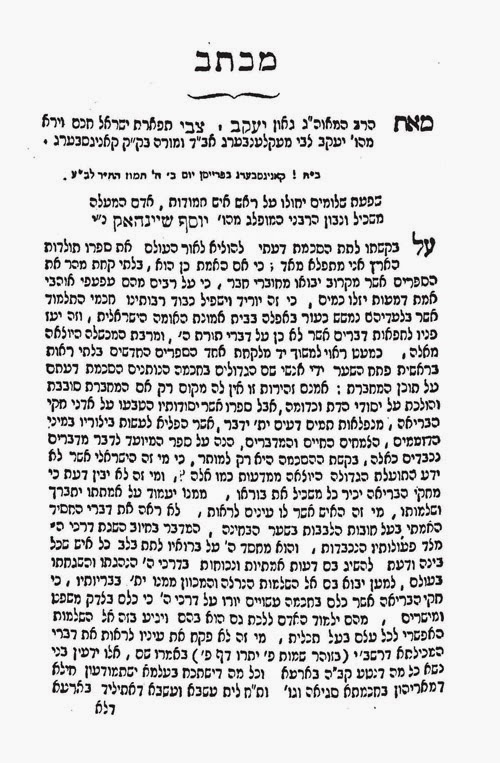
David Livni was born in Vilna in 1870. He was educated in traditional Orthodox schools and joined the proto-Zionist Hovevi Tzion movement. In 1906, he and his wife and five children moved to Israel. The children were among the first students of Herzliya Gymnasium, and David was one of the founders of Tel Aviv and its Great Synagogue. He served on its board until he fell out with its leadership regarding financial matters. Construction of the synagogue began in 1920. Delays, design challenges, and a lack of funding caused the construction to proceed at a snail’s pace, well behind schedule. According to Livni, a significant issue was the board’s leadership. In a pamphlet he self-published in early 1927, Binyan bet-ha-keneset ha-gadol be-Tel-Aviv: ṿe-taʻalule ha-gabaʼim, he accused the chairman and his son-in-law (who was also on the board), of gross mismanagement and even misappropriation of construction funds. Additionally, Livni alleges that the chairman filled the board with “yes men” and could rule unchecked. Construction was finally completed in 1930, although with all the changes, the resulting building is a hodgepodge of architectural styles.

Courtesy of the Hebraica Section of the Library of Congress’ African and Middle Eastern Division

In 1928, he began publishing a series in Ha’aretz newspaper describing the Vilna that he remembered. These were eventually collected and published in book format, Yerushalayim de-Lita, in 1930, in two volumes (available here and here). On September 23, 1928, the day before Yom Kippur, his article, “Yom ha-Kippur in Vilna Over Forty Years Ago,” appeared in Ha’aretz. He describes a unique custom of the Great Synagogue of Vilna. The Magid Mesharim would give a sermon the night before Erev Yom Kippur. Livni relates one of those occasions when “R. Yankel Charif (the Gaon R. Yaakov Yosef),” delivered the sermon. R. Yaakov Yosef is best known for his later sojourn to the United States to take up the position of the “Chief Rabbi of New York,” he initially served as rabbi in three Lithuanian towns and, in 1883, was selected as Vilna’s official Maggid, preacher. The moniker “charif” referred to his quick mind and was bestowed upon him during his time in Volozhin Yeshiva.

Title Page of Yerushalim de-Lita from the copy Livni gifted to Dr. Moshe Glickson, the founder and editor of Haaretz, where the articles originally appeared.

Jacob Mark, in his collection of biographies from 1927, originally in Yiddish, Gedoylim fun unzer tsayt: monografyes, karakter-shtrikhen un zikhroynes, and partially translated into Hebrew in 1957, Bi-meḥitsatam shel gedole ha-dor : biografiyot, sipurim, imrot ve-sihot holin shel gedole Yisraʼel ba-dor ha-kodem, devotes a chapter to R. Yosef. According to Mark, by the time R. Yosef arrived in the United States, he was well into his decline, and when he arrived, he had “lost his harifus, the power of his sermons, and his power of Torah.” Mark, therefore, limits his discussion to R. Yosef’s European years.

Mark knew R. Yosef personally. They met when R. Yosef moved to Zhagory and assumed the position of the town’s rabbi where Mark lived. R. Yosef was a student of R. Yisrael Salanter and “among the first young rabbis to spread R. Yisrael’s approach – that a rabbi’s purpose is not to decided legal issues and engage in intellectual debates with scholars – rather to relate to the people and improve their character and bring them closer to Judaism; in fact, this might be [the rabbi’s] fundamental purpose.” Consequently, R. Yosef devoted considerable time honing his sermonic skills and deliberately sought out the commoner. Mark suggests that R. Yosef was particularly suited for this role because he did not come from a rabbinic lineage. Instead, his family was poor and seeing his father struggle to make a living and yet spend freely on R. Yosef’s education impressed upon him that simple Jews have a special love of the Torah and sacrifice even more than middle-class Jews. R. Yosef incorporated these themes in his sermons.

R. Yosef published some of his sermons in 1888 in Vilna. But they are of the more traditional rabbinic type and do not necessarily display the unique nature of his speaking style. However, the Erev Yom Kippur sermon Livni recounts preserves an example of R. Yosef’s oratory emphasis on the people and expresses his love and appreciation of them.

Rabbi Yaakov Yosef’s Sermon on the Eve of Yom Kippur

Livni begins by describing R. Yosef’s humility and that he conveys that despite his lofty position, he is uncertain of his worth,

and is not sure of his life, like our brothers. The Israelites in Romania and Morocco (he means Russia) are not sure of their lives; they make a living like a dog picking up bones under the table of strangers, rolling in the garbage, being deported, and being beaten like dogs.

At that moment, it was as if the spirit of God was hovering in the space above the synagogue, over the crowd of three thousand heads, all turned and lifted their eyes toward the speaker. They were crowded and glued side by side, standing on their feet and swallowing every word from Rabbi Yankili’s mouth. And Rabbi Yankili is standing next to the Aron Ha-Kodesh, his palms outstretched towards the people, his eyes closed, his mouth producing pearls, … his sharpness dripping from his mouth like pure gold, worshiping the heart, going down the stomach chambers, coming out of the heart and entering the heart sometimes like hot coals, sometimes like life-giving dew. At that time, he appears like Ish Elokhim – his face is holy. Rabbi Yankili does not provoke the people to revenge, and he does not sow hatred toward the nations of the world, who shed the blood of Israel like water. He neither absolves them from sin for money nor pecuniary reward….

Yom Kippur itself is the most reliable bill of forgiveness and atonement for transgressions between a person and a guarantor – Erev Yom Kippur is the surest deed for transgressions between a person and his friend. All the fasts, ha-chagim, ha-mo’adim, whether of Shabbat or Shabbat Shabbaton – Yom Ha-Kippurim – [pale in comparison to Erev Yom Kippur]. No nation or language can imitate one day a year – the eve of Yom Kippur.

Morai ve-Rabbosai! The world’s nations reconcile with each other and ask for forgiveness through fire and blood, through the war between themselves. And us? – Through asking for forgiveness between a man and his friend on the eve of Yom Kippur. The world’s nations accepted the statement: “By your sword, you will live!” And we: “ve-chai bahem,” “and live by them,” and you shall not die by them. Morai ve-Rabbosai! It is written: ‘ve-amcha kulum tzadikim ‘and among you all are righteous,’ and who is called righteous? The one who annuls the decrees of the Almighty! The Almighty decrees on the human beings: that they will starve for bread, that they will get sick, that they will die of hunger [], that their children will roll in the streets without the Torah, that their babies and their sucklings will wallow in the open air, that their sons and daughters will be subject to another people, to an immoral culture. The Almighty decrees, and the righteous person comes and cancels: he distributes his bread for hunger, builds a hospital, a nursing home, Talmud Torah, yeshivot, children’s homes, and evening classes for craftsmen. The man who sits within the four cubits of the Halacha, wrapped in a Talis crowned with tefillin, is not called a righteous person but a hasid. Tzadki HaShem be-kol derakhav ve-hasid. He starts as a tzaddik and eventually a Hasid. Every Jew is considered a Tzadik. Who is the Jew who has not given and will not give charity to people experiencing poverty tomorrow? Who is the nation, and what is it, that distributes charity in one day, in a quarter of a day, like the Jewish nation on Erev Yom Kippur, with a generous hand and pure heart?

Rabbi Yankili stands and pleads and calls the people to repent of regret for the past and to accept the future; he does not demand asceticism, does not impose fines, does not decree haramos, does not step on the head of the people with arrogance or ego. He stands and beseeches for the good of the people of Israel before our Father in Heaven, like the Kohen Gadol in his time, in the holiest of holies. He asks for mercy on behalf of the people of Israel – a life in which there is no shame and a dignified livelihood, neither by smuggling the border customs nor by despicable and dangerous businesses, which blacken the face of the Israeli nation like the rim of a cauldron, a year of salvation and comfort without the pain of raising children.

Morai ve-Rabbosai! Hear our voice, God and God… the voice of the drowning son in a sea of ​​troubles, troubles from the outside: persecutions, evil decrees, riots in Romania and Morocco (that is, Russia), and internal troubles: the pains of raising children, hatred for nothing, seeking honor, whistleblowers.”

Morai ve-Rabbosai! Rather than asking our holy Torah to advocate on our behalf, we will ask for forgiveness from her for hurting her honor. Morai ve-Rabbosai! We will bow our heads before our Torah, our Mother, the Mother of all religions and teachings. We will appease our Mother with our Torah, have mercy on the only son, on the people of Israel, and grant that we may fulfill all the Torah’s commandments, including those that depend on the land. And we will be able to return to our country and renew our days as before, as before, as before”!!!

Lately, I must ask for forgiveness from you, teachers, and gentlemen: I woke up and woke you up from your deep slumber like the sun with its hammer that makes the summer sleepy and awakens the sleepers. How bitter, how many vain words I poured over your heads, like vomit. As Kohelet repeats: “This too is vanity, and this too is striving after nothing,” saying and repeating and saying: “vanity vanity vanity vanity.” Why does he have to repeat several times vanity, vanity, all vanity? Wasn’t it enough for him at the end of the book: “Vanity, vanity said Ecclesiastes everything is vain!” Because the sum of zeros, whether one or many, is still zero. But there is a big difference between one zero and many if you add one number before them – all of the meaningless things, the zero, can be elevated and become significant when you add “the One” before them. Ultimately, everything is heard (all of the zeros) – fear God!

Livni finishes by saying, “When Rabbi Yankili Harif opened the Ark of the Covenant, a loud howl erupted in the audience, and the entire building was filled with courage and trembling.”

Cholera and Yom Kippur: 1848

Some forty years earlier, another dramatic event occurred in Vilna’s Great Synagogue, this one on Yom Kippur itself. Like the one above, we are indebted to Yaakov Mark and his book. In this instance, it provides the only eyewitness account of an episode that, in its various retellings, underwent unverifiable and imprecise metamorphoses.

There were at least four major cholera outbreaks during the nineteenth century in the Russian Empire. One of the most severe began in 1847, and by the time it subsided in 1851, it killed over one million in the Empire. By 1848, it had reached Vilna, and the question arose of whether one should fast on Yom Kippur. The structure of the first two major surveys of Vilna Jewish history are biographies of significant personalities interlaced with historical research and expositions. The first, Shmuel Yosef Fuenn’s Kiryat Ne’amanah, published in 1860, with an introduction and extensive endnotes by R. Mattityahu Strashun, and the second, Hillel Noach Steinschneider’s Ir Vilna, published in 1900. Steinschneider’s begins where Fuenn’s ends. Fuenn’s second wife was among those who perished of cholera in 1848.

Imaging of the podium at the Great Synagogue of Vilnius, İmage: UAB Inlusion Netforms.

An archeological team recently uncovered the floor of the Bimah.  See here for a description of their find as well as earlier findings. Loïc Salfati produced a full-length documentary on the history of the Great Synagogue and the excavations.

The 1848 episode first appears in Steinschneider, and he provides that before Yom Kippur, broadsides were posted throughout Vilna proclaiming that one can eat on Yom Kippur, the piyyutim should be shortened and that people should spend time outdoors to get fresh air. According to Steinschneider, on Yom Kippur, after Shachris, in the Great Synagogue, where there were some three thousand congregants, R. Yisrael Salanter ascended the Bimah with a piece of cake and made the boreh mineh mezonos blessing and ate it. In a footnote, he records that one of the congregation’s leaders objected to R. Yisrael’s unilateral decision to publicly violate Yom Kippur without the consent of the leading Rabbis. Despite Steinschneider’s general reliability, this is one instance where the details are apparently incorrect. Steinschneider does not cite anyone or any source for his retelling of this episode. Indeed, the description is internally inconsistent. If the widely distributed broadsides before the holiday explicitly declared that “one should not fast on Yom Kippur,” what was the objection to R. Yisrael’s behavior and the rationale that the Rabbis did not otherwise agree? Moreover, even one permitted to eat on Yom Kippur generally can only less than a shiur, pachos pachos, and Reb Yisrael allegedly ate “a cake” without regard to size.

Mark, unlike Steinschneider, presents the episode differently, which is more consistent with the legal details and, most critically, from an eyewitness. Mark acknowledges other versions — including Steinschneider’s — and argues that these “are not factually accurate,.” They are only “legends.” Mark’s source was R. Shimon Strashun, a prominent member of Vilna’s Jewish community (and a distant relative of R. Shmuel Strashun), “who was an eyewitness in the shul.” Strashun told Mark that “prior to Yom Kippur, Reb Yisrael, with the agreement of the Moreh Tzedek, placed broadsides in all the shuls, that because of the cholera epidemic, they would not say the additional piyutim and, instead sit outside in the fresh air. In the foyers of the shuls, they should put out small amounts of cake, less than a shiur, to use when necessary. On Yom Kippur, after Shachris, R. Yisrael ascended the Bimah of the Great Synagogue and announced to the congregation that anyone who feels weak does not need to ask a doctor and may go to the foyers to eat, but to only eat with breaks [i.e. pachos pachos] and avoid violating the Biblical prohibition. Immediately after R. Yisrael descended from the Bimah, the chief Moreh Horaah, Reb Betzalel, went up to the Bimah and protested, in the name of the Moreh Horaah, [Reb Yisrael’s position] that one is not required to first consult a Rabbi before eating. But the truth is that Reb Yisrael never ate anything.”

Mark’s retelling is consistent with the general legal principles governing a person who is ill, albeit with a controversy regarding consulting a rabbi before breaking someone’s fast during a communal plague. There is no explicit contradiction between the broadsides and Reb Yisrael’s or Reb Betzalel HaKohen’s positions. Instead, it appears that the broadsides, whether due to oversight or that it was unnecessary, did not specifically address whether one must consult a rabbi.

Notes: I am grateful for Sharon Horowitz of the Hebraica section at the Library of Congress for providing the scans of Livni’s pamphlet.

The Hebrew translation of Mark’s work is a substantially abridged version that omits the second portion devoted to “masklim,” with the exception of R. Mattityahu Strashun. Additionally, even the translated portion is shortened, and, in some instances sections and words are omitted that censor potentially controversial materials. But there are no significant changes in the Hebrew version for both episodes discussed here.

The various versions of the Reb Yisrael Salanter episode are collected by Nathan Kamenetsky, in Making of a Godol, vol. I, (2002), 1104-1121. Nonetheless, his attempts to reconcile the discrepancies and harmonize the various versions is unconvincing. Dr. Leiman discusses this at length in his speech that is available here.

For a general discussion regarding plagues and the Jewish responses see Jermey Brown, The Eleventh Plague: Jews and Pandemics from the Bible to COVID-19 (Oxford University Press, New York: 2023) (see pp. 151-53, for his discussion of the Reb Yisrael Salanter episode); see also Eliezer Brodt, “Towards a Bibliography of Coronavirus Related Articles & Seforim Written in the Past Month (Updated): Black Wedding and Other Segulot,” Seforim Blog, May 4, 2020.


More on Chaim Bloch

More on Chaim Bloch
By Marc B. Shapiro
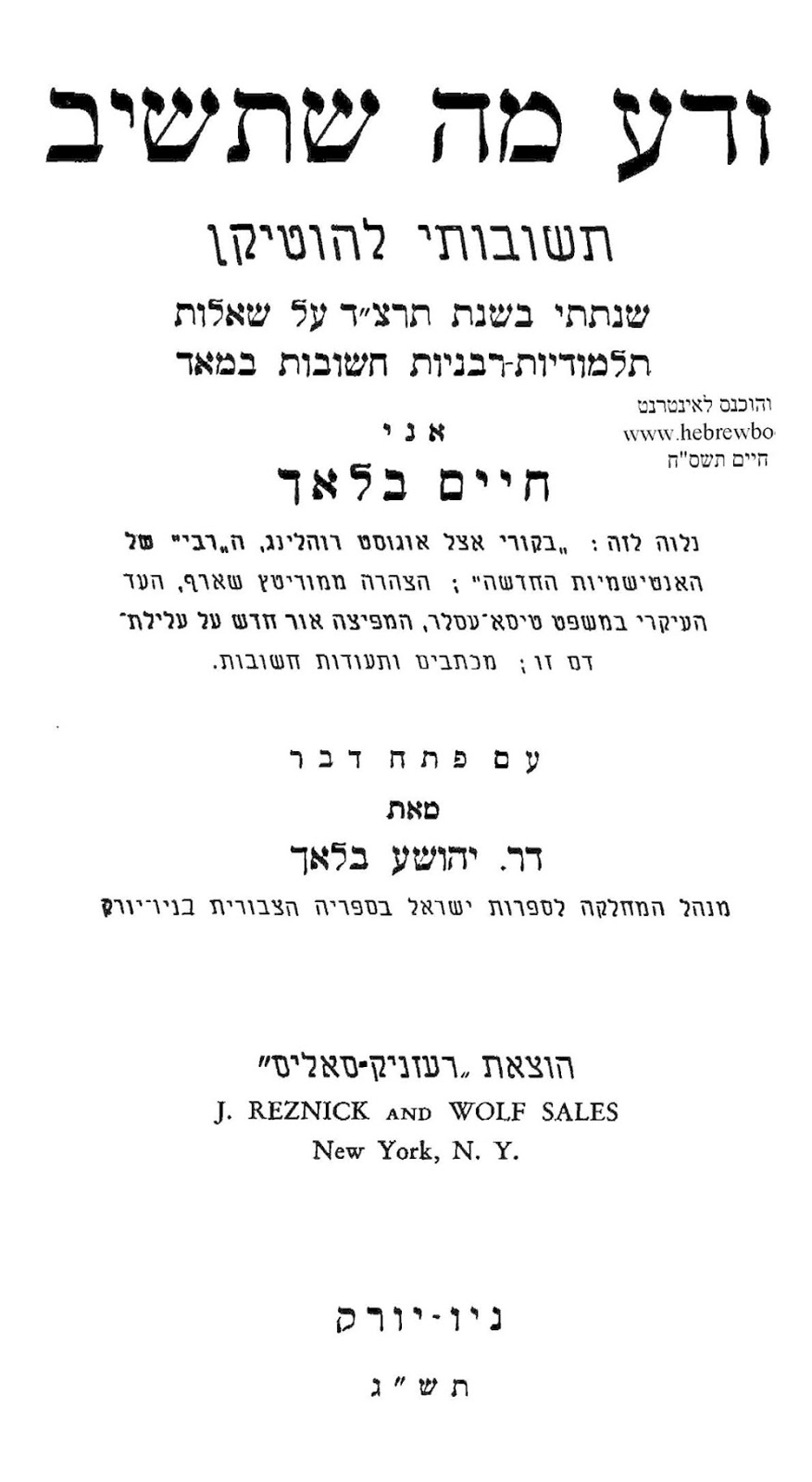
In a previous post I mentioned how the non-Jewish Austrian minister Leon Bilinski was descended from the rav of Posen, R. Samuel ben Moses Falkenfeld, the Beit Shmuel Aharon. More information about Bilinski’s Jewish roots is found in Chaim Bloch’s Ve-Da Mah she-Tashiv (New York, 1943), p. 74 n. 1. In general, I have found that when Bloch is reporting about other people’s biographies and history in general, he is very reliable. It is only when he is somehow involved in the story that he is full of lies.1 His Ve-Da Mah she-Tashiv is a good example. Here is the title page.
In this book he makes up an entire story that he was asked by an important Catholic figure to answer questions from the Vatican dealing with Judaism. The whole story is a fiction, as is so much else he writes about himself. As for Bilinski, Bloch tells us that he is in possession of Bilinski’s 1146 page (!) unpublished diary. As Bloch himself notes, he provided various scholars (e.g.., N. M. Gelber) with selections of this diary which they then used in their own works, thus misleading the world. In these selections, Bilinski comes off as a strong anti-Zionist, who even warns Herzl about how the Arabs will never accept a Jewish state in Palestine.2 In an article in the Herzl Year Book, Bloch published what he claimed was an 1893 letter from Herzl and uses this to prove that Herzl was interested in the Jewish problem already in 1893, a year before the 1894 Dreyfus trial which is usually cited as having turned Herzl to Jewish matters.3 Various scholars have cited this letter, as they understandably regard it as significant in understanding Herzl, but of course it is a forgery. Another way Bloch misled scholars, in particular Gelber, is with regard to an anonymous booklet that speaks of a return of the Jews to the Land of Israel and the establishment of a state.4 According to Billinski’s diary, so Bloch tells us, the author of this booklet was Benjamin Disraeli. Bilinski would certainly have been in a position to know this information, and therefore a number of people have been misled by this, thinking the diary authentic
Look how Bloch’s forgeries were able to have such an impact. I think, in the end, this is what gives the forger satisfaction, watching everyone taken in by his creation. In 1948 no one would have believed that Bloch was capable of this. In fact, if not for his blatant forgeries in Dovev Siftei Yeshenim, some people today would still assume that he is reliable. As the Talmud tells us, tafasta merubah lo tafasta! Bloch should have stuck with his smaller forgeries, because when he decided to publish complete volumes of forged material, that’s when people really began to take notice. It is therefore very surprising that no less a scholar than Robert S. Wistrich, who is aware of the accusations of forgery against Bloch, nevertheless cites material from Bloch’s Mi Natan li-Meshisah and states that in his opinion at least some of the material must be considered authentic. Why he thinks this he doesn’t tell us. The truth is that this book, like Dovev Siftei Yeshenim, is full of Bloch’s forgeries, and not only of rabbis but also of political leaders (including summaries of supposed letters from Bismark about Zionism!)5

Just to illustrate that you can’t judge people by appearances, here is a picture of Bloch, which previously appeared in Dr. Shnayer Leiman’s post on the Seforim Blog.6

Throughout Bloch’s various books, he quotes numerous letters from gedolim who were no longer alive, and none of these letters are found in his archives, currently kept at YIVO and the Leo Baeck Institute. In other words, he simply made up these letters, as he did with the entire volumes of anti-Zionist letters of gedolim that he published. The rule is that whenever Bloch cites a previously unpublished letter from someone, either addressed to himself or to another, and the author of the letter is no longer alive, you can assume that the letter is forged. We know this now, after Shmuel Weingarten’s exposé of Dovev Siftei Yeshenim.7 Yet the evidence was there all along, had people paid attention. But people had no reason to assumed that Bloch was not reliable. R. Joseph Elijah Henkin, however, who was involved in a terrible dispute with Bloch, did accuse Bloch of dishonesty, and pointed out that he would attribute quotes to rabbis who were no longer alive so that he couldn’t be contradicted. In the late 1930’s Bloch published a letter from R. Kook. R. Zvi Yehudah Kook was very skeptical of its authenticity and requested that Bloch send him a copy of it. Bloch replied that he was unable to do so since he had lost the original.8 This was Bloch’s pattern, and I assume that all of the many letters he published from leading rabbis and hasidic leaders, beginning in the early part of the twentieth century, are forgeries.9

Here is another example of Bloch’s tendency to fabricate things. It comes from his Heikhal le-Divrei Chazal u-Fitgameihem (New York, 1948), p. 9. Everything he reports here is a fantasy. As with some of his other forgeries, Bloch is obviously motivated here by good intentions, but it is all complete nonsense.

Ve-Da Ma she-Tashiv also contains forged letters. I am certain that the letter of R. Chaim Ozer Grodzinski on pp. 52-53 is an example of this. Anyone can look at the style of R. Chaim Ozer’s many letters and see how he consistently used certain formulas in concluding his letters. Nowhere does R. Chaim Ozer conclude a letter with
ונזכה כולנו לראות בישועת עמנו במהרה
He does use the expression
ועיניהם תחזינה בישועת עמנו במהרה

and this is found in a letter that Bloch would have had access to, the letter of R. Chaim Ozer to Agudat ha-Rabbanim about the Louis Epstein proposal.10 I assume he used the concluding portion of this letter to help him create his forgery. But in other areas he wasn’t so careful. For example, in the supposed letter of R. Chaim Ozer to Bloch, he refers to the latter as a צנא מלא ספרא , yet this expression does not appear in R. Chaim Ozer’s other letters (based on Otzar ha-Hokhmah’s database, which only has the first edition of R. Chaim Ozer’s letters, not the expanded Iggerot R. Chaim Ozer.)
We should assume the same for all of the other letters in this book from people who were not alive when the book was written. It is fascinating that on p. 44 n. 1 Bloch refers to the anti-Zionist letters he would later publish in Dovev Siftei Yeshenim. Ve-Da Mah she-Tashiv was published in 1943 and the first volume of Dovev Siftei Yeshenim didn’t appear until 1959, meaning that this forgery was very long in the making, and Bloch was setting the stage for it many years prior.
There is more to say about this book, in particular his argument that there are passages in the Talmud that were inserted by heretics – a viewpoint earlier mentioned by R. Joseph Zvi Duenner, as I have pointed out elsewhere, see here.

I will leave that for another time, but to give you an example of what I am referring to, here is a passage from p. 39 (emphasis in the original):
אופינית היא “המעשיה” בר’ שמעון בן גמליאל “שהיה על גב מעלה בהר הבית וראה נכרית אחת נאה ביותר. אמר: מה רבו מעשיך ד'” (ע”ז כ ע”א) המאמר הזה זיוף  . . . לא יעלה בדעתנו, שר’ שמעון בן גמליאל הביט על אשה, היינו הך, נכרית או ישראלי – לשם יפיה. ומצאתי עוד מאמר בשם רב, שזיופו עומד מחוץ לכל ספק: “בשעה שבקש נבוכדנצר לעשות לאותו צדיק (צדקיהו) כך, נמשכה ערלתו ש’ אמה והיתה מחזרת על כל המסבה כולה שנאמר: שבעת קלון מכבוד, שתה גם אתה והערל” (שבת קמט ע”ב). מלבד הנבול שבמאמר זה, הוא חסר טעם, ולא יתכן, שמפי רב יצאו הדברים.
I don’t know which position is “frummer”? To defend the honor of the sages and therefore deny that these “obscene” passages are authentic, or to defend the Talmud as we have it and thus have to deal with these passages.
Yet whatever the answer to this is, if Bloch were alive today, the haredi world would put him in herem for another reason. Here is what he writes on p. 38, with regard to how to view Aggadah in contrast to the halakhic sections of the Talmud. (What he says is nothing other than the Geonic and Spanish tradition, which is largely unknown in today’s yeshiva world.):
היא אינה נחשבת ליסוד קיומה של היהדות ויש לה אופי של ספר עם . . . לחלק האגדה נכנסו דברי מוסר ודרך ארץ, מליצות ובדיחות, סגולות ורפואות, אזהרות ועצות, פתרון חלומות ואגדות, שלהרבה מהם יש ערך גם מחוץ להיהדות. יתכן שהרבה הושפעו בעלי התלמוד בזה מהעמים שכניהם.
Also interesting is that in Ve-Da Mah she-Tashiv, p. 44 n. 1,  he refers very positively to R. Henkin, something that would later change when their great battle began.
Bloch claimed that he had a close relationship with the great R. Judah Leib Zirelson of Kishinev (Speaking for myself, Zirelson’s greatest achievement had to have been standing up to the extreme anti-Zionist elements in Agudat Israel, led by R. Elhanan Wasserman and R. Aaron Kotler. They wanted the Agudah to officially oppose the creation of a Jewish state. Zirelson, as president of the 1937 Kenesiah Ha-Gedolah in Marienbad, was able to convince the Moetzet Gedolei ha-Torah to agree with his own position, which was not to oppose a state but to attempt to bring Torah values into it. See Ha-Pardes, Oct. 1937, p. 8). In this book, Bloch cites a number of things from Zirelson of which, again, I have no doubt that he has made them up. For example, can anyone imagine that Zirelson would offer the following Haskalah-Reformist interpretation that Bloch puts in his mouth (p. 34)?
יתכן שהיתה כוונתו של ר’ שמעון בן יוחאי, בחפשו יסוד במקרא שהנכרים אינם מטמאים באוהל, כדי שלא ימצאו הרומיים תואנות ואמתלאות חדשות על ישראל, ומאימת המלכות הורה כן.
Although I can’t go into it in any detail now, the truth is that we do on occasion find Haskalah-Reformist types of interpretation even in traditional sources,11 but since these are very rare and we have no evidence that Zirelson ever said what is attributed to him, I assume it is another of Bloch’s forgeries. In other words, as he did so often, Bloch attributed his own understanding to one of the great Torah sages.
In chapter fourteen of Ve-Da Mah She-Tashiv, where he stresses the need for honesty in one’s dealings with non-Jews, he claims that Zirelson told him about a Zoharic passage in parashat Lekh Lekha that states:
כל מאן דמשקר בהאי עלמא בערל כמאן דמשקר בשמיה דקוב”ה
This is a beautiful thought. The only problem is that it doesn’t exist anywhere in the Zohar. I am certain that Zirelson would never have misquoted the Zohar and that the mistake is Bloch’s. I assume that the mistake is unintentional, perhaps quoting from memory, since a great forger like Bloch would never have dared falsely attribute anything to the Zohar, the accuracy of which could easily be checked.
Here is the actual Zohar text (vol. 1, p. 93a):
דכל מאן דמשקר בהאי כמאן דמשקר בשמיה דקב”ה
If you examine the entire passage you will find that it has nothing to do with being honest, and the word משקר here does not mean “to lie”, but “to betray”. The text is actually speaking about berit milah and how one is obligated to treat it properly, especially דלא עייל ליה ברשותא אחרא, which certainly refers to refraining from having sex with non-Jewish women. What the text is saying is that if you have illicit sex you betray the mark of the circumcision, and this is like betraying God’s name.
Since I mentioned Haskalah-Reformist interpretations in traditional texts, let me note one of the most famous of these. In Shabbat 140b, R. Papa’s states that if one can drink beer but instead drinks wine, he violates the prohibition on baal tashchit. Maharsha explains that R. Papa said this because he was a beer salesman! What this apparently means is that R. Papa lied about the halakhah in order to drum up more business for himself. How else to interpret Maharsha’s explanation?
ורב פפא לטובת עצמו אמרה שהוא הי’ עושה שכר.
This explanation is, to be sure, quite shocking. If you want to stretch things a bit you can say that according to Maharsha, R. Papa didn’t consciously alter the halakhah to benefit himself, but since he was a beer maker he was unconsciously led to this position, as it would benefit him. This explanation – which could easily have been offered by Jacob Katz – is suggested by the noted Yemenite posek, R. Yitzhak Ratsaby12:
והנה כל העובר ישום וישרוק, היתכן כדבר הזה שרב פפא יפסוק הלכה משום ריוח ממונו?! . . . ובודאי גם לדעת מהרש”א לא יתכן שרב פפא יאמר פסקי הלכה רק מתוך נגיעה, חלילה לו. אלא היה זה כעין “שוחד סמוי”, שלא הרגיש בו הוא עצמו, שמתוך כך בא לידי טעות בהלכה זו. כמו שהכתוב צווח ואומר (שמות כג, ח): “כי השוחד יעוור פקחים ויסלף דברי צדיקים”, ועל דרך שמצינו בכתובות (קט, ב) בגדולי עולם שאמרו על עצמם שהשוחד היטה את ליבם.
I think most people will tell you that this sort of explanation, which points to unconscious factors influencing halakhic decisions, was not how people thought in the days of the Maharsha. I myself do not see this as an anachronistic explanation, as the Talmud, Ketubot 105b, already discusses precisely this sort of unconscious influence.13  I believe that this is also how we are to understand all the discussions about נוגע בדבר, and how it applies even to the greatest tzadikim. It is not that these people will consciously twist the truth, but that unconsciously this is what can happen. Presumably, this is also the meaning of Hullin 49a:  ישמעאל כהנא מסייע כהני

I think this is also how we are to understand R. Moses Isserles, Yoreh Deah 242:36:
תלמיד חכם שאמר דבר הלכה בדבר השייך לדידיה . . . אין שומעין לדידיה דלמא מדמי דברים להדדי שאינן דומים
See also Ritva, Yevamot 77a:
דחיישינן שמא מתוך שנושא ונותן בהלכה כדי לקיים את דבריו אמר בדדמי כסבור שקיבל מרבו
I am not going to analyze the Maharsha in any depth, because either way you explain him, this is the exact sort of explanation that according to the Rav is heretical as it falls under the Rambam’s category of מכחיש מגידה.14 And it is not just the Rav who would be shocked by what Maharsha wrote. R. Yehoshua Heschel of Monistritch15 states:
ועל מאמר המהרש”א הזה צווחי קמאי 
R. Abraham Vengrober16 says concerning the standard explanation of Maharsha (before offering a different understanding of his words):
ופריצי עמנו מצאנו בקעה לדבר סרה על רז”ל . . . גם רבינו המהרש”א ז”ל לא כיוון בזה ח”ו להכוונה אשר העולם סוברים שבשביל זה שהי’ מסחרו שבח את הדבר לטובת עצמו.
R. Samuel Strashun in his commentary to the passage takes strong issue with Maharsha, and R. Hayyim Hezekiah Medini17 is astounded by what Maharsha wrote:
הדבר תמוה לפרש דנחשד רב פפא לדבר שקר חלילה לטובת עצמו.
I assume it is only a matter of time before this explanation of Maharsha is deleted from a future printing.
Here is another example (Taanit 14a-14b):
In the time of R. Judah the Prince there was distress. He ordained thirteen fast days and their prayer was not answered. He thought of ordaining additional fasts but R. Ammi said to him, “Did not [the Sages] declare we should not trouble the community unduly.” Said R. Abba the son of R. Hiyya b. Abba, “R. Ammi [in saying this] was studying his own interests.”
  
Rashi explains R. Abba’s declaration:
לעצמו דרש: דלא אמר אלא לפי שהוא לא היה רוצה להתענות
If anyone other than Rashi wrote this, wouldn’t it be regarded as an example of מכחיש מגידה?
Here is another example, from the Jerusalem Talmud, Shabbat 6:1:
R. Abbahu in the name of R. Yohanan, “It is permitted for a man to teach Greek to his daughter, because such learning is an ornament for her” Simeon bar Ba heard and said, “It is because R. Abbahu wants to teach his daughter such that he has assigned the teaching to R. Yohanan.”
R. Abbahu responded quite sharply to Simeon bar Ba, proclaiming: “May a curse come upon me, if I did not hear it from R Yohanan.” But I am more interested in Simeon bar Ba’s accusation. He assumed that the great R. Abbahu would falsely attribute a halakhic ruling to an earlier sage in order that his daughter would benefit. When Geiger and Graetz said things like this, no one was surprised, and the Orthodox condemned them for these type of interpretations. Yet here you have a Haskalah-Reformist type of interpretation offered by one of the Sages.
Returning to Bloch, another example where he deceived the world is found in his Heikhal le-Divrei Hazal u-Fitgemeihem, pp. 591-592. In line with his apologetic approach to Jewish sources, he claims that he saw an old version of the Passover prayer Shefokh Hamotkha, that went as follows:

שפוך אהבתך על הגוים אשר ידעוך

Even a great scholar such as Naftali Ben-Menachem was taken in by Bloch (and if you search online you will find a number of others who assume that Shefokh Ahavatkha is a real text, rather than another Bloch forgery18). Ben Menachem’s article appears in Mahanayim 80 (1963), and here is the page where he refers to Bloch’s version.

Incidentally, in Heikhal le-Divrei Hazal Bloch claims that he wrote about this version at length in his 1935 book Der Judenhass im Spiegel der Jahrtausende, and also printed a copy of the manuscript there. (In 1935 Bloch was living in Vienna.) Although he mentions this book in a couple of his other writings, there is no evidence that any such book ever appeared. Now we have the internet which allows us to check all the greatest libraries in a minute, yet in a prior era, simply mentioning that he had published such a book and that it contained a copy of the manuscript would have been enough to convince everyone. After all, it was not like people in the United States, England, or Palestine/Israel could easily check the holdings of libraries in Austria and Germany.
Meir Hershkovitz, in his fine book on R. Zvi Hirsch Chajes, also quotes Bloch a number of times. Bloch claimed to have seen unpublished material from Chajes and he included some of it in his Heikhal, but everything he mentions is fraudulent, and some of the comments are really outrageous. For example, on p. 565 he quotes Chajes as saying as follows about Rabbi Akiva19:

ר”ע מבני בניו של סיסרא היה ולמרות קדושת התורה ששלטה בו נשאר בו משהו מאופיו של סיסרא
(Some are probably wondering why I didn’t underline the first part as well, which states that R. Akiva was descended from Sisera. After all, in a few weeks Daf Yomi will reach Sanhedrin 96b and there you find the following, with no mention of R. Akiva: “Descendants of Sisera studied20 Torah in Jerusalem; descendants of Sennacherib taught Torah to the multitude. Who were these? Shemaya and Avtalion. Descendants of Haman studied Torah in Bnei Brak.” Yet numerous texts21 record a version of this passage that identifies R. Akiva as among the descendants of Sisera.)

What motivated Bloch to invent this negative comment about R. Akiva? I think that this too can be attributed to anti-Zionist motivations (an anonymous commenter on Soferim u-Seforim offered a similar explanation; see the link in n. 1). R. Akiva was associated with Bar Kokhba’s rebellion, and in the popular mind at least, this was a matter of pride for twentieth-century Jews. The thrust of the comment attributed to Chajes is to see this “warlike” aspect of R. Akiva as a throwback to Sisera. In other words, this is not something good. We see another example of Bloch’s anti-Zionism in his attempts to argue that a passage in Maimonides’ Letter on Astrology is not authentic. In this passage, Maimonides states that the Temple was destroyed and the Jews exiled because instead of focusing on “the art of military training and conquering lands,” they involved themselves with astrology, thinking it would help them. (Iggerot ha-Rambam, ed. Sheilat, vol. 2, p. 480) This passage was too “Zionistic” for Bloch, and not surprisingly he argues that it is a forged interpolation. See his article in Ha-Pardes 34 (April 1960), pp. 39-42, where once again it is Bloch who is the forger, citing a supposed letter from a Christian scholar to Dr. [Daviid?] Kaufmann and also telling us about the support he supposedly received from the Tchortkover Rebbe. (This Rebbe, incidentally, happened to be a one of the leading Agudah supporters of settlement in the Land of Israel.) One of Bloch’s major proofs that Maimonides could not have written this passage is his assumption that Maimonides was not impressed with R. Akiva’s support of Bar Kokhba. He bases this argument on Mishneh Torah, Hilkhot Melakhim 11:3. Yet Maimonides’ viewpoint in this matter is not enough for Bloch, and to achieve his purpose he has to actually find fault with R. Akiva’s character, something Maimonides would never do. Bloch even attacks some modern writers (such as Aaron Zeitlin and Hillel Seidman) who had stressed the contemporary significance of Maimonides’ words. In Bloch’s mind, by doing so they were showing the non-Jews that the Protocols of Elders of Zion were correct, namely, that Jews really did want to conquer the world! Bloch’s Neturei Karta side comes out very well in this article.

As a way of covering himself, so that people will believe the manuscripts of Chajes are authentic, Bloch states that he assumes that the material he is quoting from has survived in Israel, either with the family or at the National Library (Heikhal, pp. 520, 560). Yet in Hershkovitz, this supposition is stated as fact (Rabbi Zvi Hirsch Chajes, p. 438). It is quite surprising that Hershkowitz, who wrote such a comprehensive biography of Chajes, didn’t attempt to track down these manuscripts. Had he done so, he would have realized that they don’t exist.
*    *    *
This is a blog about seforim, but with Dan’s permission, in a future post I am going to write about the various blogs and news sites, both haredi and Modern Orthodox, that focus on Jewish matters (halakhah, hashkafah, etc.). In the last six months I have visited them a good deal, left a number of comments (some quite provocative and opposed to my own outlook [e.g., dealing with sexual abuse, Zionism, Daas Torah, Torah mi-Sinai, etc.], and always under a pseudonym) and gathered the reactions. I also corresponded with people I met on the sites and with various anonymous baalei ha-blogs. I tried to be a bit of a reporter, gathering information, and just like a reporter sometimes has to hide his identify, I felt that in this circumstance it was permissible, especially as almost everyone I was dealing with was also anonymous. We all know that the ability to be anonymous is basic to the internet (and there has been a good deal of discussion recently about whether this is a good idea). I also felt that if I got involved in a debate on a haredi or Modern Orthodox site, my name would be recognizable to some of the people and they might respond differently than if I was some anonymous person.

Most of the information is publicly available (as are my comments), but I won’t cite any names, as I am not interested in individuals but in some of the thought processes that I observed. As always, I will tie this in with seforim, especially the phenomenon of anonymous and pseudonymous (as opposed to pseudepigraphal) seforim and articles, and also discuss the modern anonymous halakhic questions that R. Yuval Sherlow has written about. (He has also published a couple of volumes of his answers to these questions.) How is Judaism perceived and portrayed when people can live in two worlds, the public one and the private anonymous world of the internet? What does it mean when most people who comment about controversial topics choose to do so under a pseudonym? I think that what I found also has implications to an issue I have been concerned with for a long time, namely, the value of private letters and conversations vs. published word in seeking to evaluate the personality of an individual. This directly relates to David Holzer’s book on the Rav and was also a topic that became a dispute between the late Prof. Twersky and myself when writing my dissertation on R. Weinberg–more on that to come.

I mention all this because I have a request: If anyone is aware of a similar study with regard to Christian or political blogs and websites, please let me know. As a friend commented to me when I told him about my project, “we all know that there are registered Democrats on the Upper West Side who secretly vote Republican, but in order not to scandalize their friends, will only post their true opinions anonymously.” Yet has anyone written about this? There are serious methodological issues that must be dealt with in any such inquiry.
*    *    *

My new Torah in Motion class begins this Monday. I invite all who are free on Monday nights at 9PM Eastern to join us. This semester we are covering R. Eliezer Berkovits, R. Chaim Ozer Grodzinski, R. Elijah Benamozegh and R. Joseph Messas. You can sign up for it here
If you want to watch or listen to previous classes, to get a sense of how they work, you can download them here.
Notes
1 For a recent discussion of Bloch, see here which contains a number of informative comments.
2 See Bloch, Mi Natan li-Meshisah Yaakov ve-Yisrael le-Vozezim (Bronx, n.d.), pp. 54ff.
3 “Herzl’s First Years of Struggle: Unknown Episodes and Personal Recollections” Herzl Year Book 3 (1960), pp. 77-90.
4 The booklet is found in N. M. Gelber, Tokhnit ha-Medinah ha-Yehudit le-Lord Beaconsfield (Tel Aviv, 1947),  pp. 35ff. Gelber’s book is devoted to this booklet.
5 “Zionism and its Religious Critics in Fin-de-Siècle Vienna,” in S. Almog, et al., eds., Zionism and Religion (Hanover, 1998), pp. 150, 157 n. 45.
6 See here.
7 Mikhtavim Mezuyafim Neged ha-Tziyonut (Jerusalem, 1981).
8 See Weingarten, Mikhtavim, pp. 164-165. In Ha-Posek 11 (1950), p. 802, Bloch published another letter from R. Kook. It is also found in Heikhal le-Divrei Hazal u-Fitgamehem, p. 614. Again he tells us that he only has a copy of the letter, as the original was lost, and here too the letter in unquestionably a forgery. Bloch had R. Kook sign the letter עבד לעם קדוש , which he knew is found in numerous authentic letters. But the letter also contains the phrase כל יקר ראתה עיני , and this does not appear in any of the almost 2000 letters and responsa of R. Kook, as can be determined from the new database of R. Kook’s writings
9 I don’t know whether this also applies to halakhic writings, e.g., the supposed manuscript from R. Shalom Schwadron that came from Bloch and is published in R. Isaac Liebes, Beit Avi, vol. 3 no. 157. Incidentally, a few responsa after this, in no. 161, Liebes discusses whether a rabbinic organization could publicly advocate the institution of the death penalty, since it might happen that a Jew would also be sentenced to death (sound familiar?). Liebes begins his reply:
לא רק שמותר להתריע בכיוון זה רק מצוה לעורר את דעת העם את חומר הסכנה המרחפת על תושבי הארץ.
During the discussions about the Grossman execution, I looked at some of the haredi websites (until the comments made me sick). What I found interesting was the incredible level of ignorance of most of the writers, all of whom had been in yeshiva and many of whom had studied there for years. They were able to declare that a murderer can’t be executed unless he was observed by two kosher witnesses and was given warning, which they thought settled matters. Had these people known a bit of responsa literature, there would have understood how things worked in the real world, and especially what was done in the days of the rishonim. Do these people think that if a guy stood up in shul and opened fire with a machine gun, killing 20 people, that a Jewish court couldn’t execute him because he was never given a warning? Let’s continue with R. Liebes:
יש כח להבי”ד בזמן שרואין צורך השעה לענוש עונש מות אפילו בכל יום אפילו אם מן התורה פטורין הם כדי שעל ידי זה כל העם ישמעו וייראו ולא יזידון עוד.
As for the possibility that a Jewish man will be executed:
מצוה וחיוב לעורר את דעת הקהל להתריע את בתי המשפט שיראו להעביר בכל המדינה משפט מות ולענוש בכל החומר הרוצחים והפושעים ואת מדינתינו ארצות הברית אשר מאמינה בתנ”ך יכולים לשכנע אותה ולהראות לה עד היכן תוה”ק מקפידה לבער את רשעי הארץ בתור חיוב ומצוה. ומש”כ כת”ר לחשוש דלפעמים ימצא רוצח יהודי א”כ אנחנו נהיה אשמים במיתתו זה אינו כלום . . . מוכח מזה דהמחוייב מיתה עפי דין המלכות מותר למסרו להם מטעם דינא דמלכותא. מובן ממילא שכל דברינו מוסבים רק על המדינות שיש להם שוויון הזכויות לכל אזרחיה בלי שום אנטישמיות ושנאת ישראל ולכן אם ח”ו יהודי נתפס באיזה עון ופשע הרי הוא נידון כמו כל אזרחי המדינה.
Many who commented on the various sites were people who never opposed the death penalty before and do not oppose it now, yet they were anti-death penalty in this case because, quite simply, they think the death penalty is just fine except when it is a Jew being executed. They vote for all the right wing candidates and then have the chutzpah to complain when their man actually follows through on his support of capital punishment and doesn’t share their view that a supposed baal teshuvah (whose last meal on earth was a non-kosher chicken sandwich bought from the prison canteen) should not be executed. Some of them cited Sanhedrin 17a, סנהדרי שראו כולן לחובה פוטרין אותו , as if this had any relevance. First of all, this passage only means that he is not executed in the normal fashion, but he can certainly be executed as an emergency measure. In addition, some understand this passage to mean that if on the first day of deliberations all conclude that he is guilty, he is not condemned to death immediately but the case is revisited on the next day. If then, all find him guilty, he is executed. None of the commenters who mentioned this law quoted the view of R. Meir ha-Levi Abulafia (cited in many sources) and the Tosafot Hakhmei Anglia that the meaning of פוטרין אותו is ממהרין אותו להורגו .  This understanding is praised by the Reisher Rav, R. Aharon Lewin, Ha-Derash ve-ha-Iyun, Deut. no. 119:5, and R. Baruch Epstein, Torah Temimah, Ex. 23:2. Epstein is convinced that this understanding is correct because otherwise היש לך חוטא גדול ונשכר מזה .  For more on the subject, see Zorach Warhaftig, “Rov u-Miut be-Veit ha-Din,” in Itamar Warhaftig, ed., Minhah le-Ish (Jerusalem, 2001), pp. 100ff. See also R. Reuven Margaliot, Margaliyot ha-Yam, Sanhedrin 17a, no. 19, who cites the Tashbetz:
שהם ז”ל לא אמרו ב”ד שהסכימו כולם לחובה פטור, חלילה להם שיאמרו ככה, ואם על פי הרוב הורגים כל שכן ע”פ כולם ויותר טוב ויותר משובח הוא שיהיה הפסק דין מוסכם מהכל ולא שיהיה שום חולק.
There is a good deal more to say on this topic, but in the interests of space I will leave it for another time. Suffice it to say that as in all such matters one can find a variety of viewpoints. See e.g., R. Yair Hayyim Bacharach, Havot Yair, no. 146. Some poskim have even ruled that when a murderer has been sentenced to death it is forbidden to try and save him. See R. Nathan Leiter, Tziyun le-Nefesh Hayah, no. 121. (Others disagree, see e.g., Teshuvot Hatam Sofer, vol. 6, no. 14.) Obviously, such a ruling has no relevance to people who oppose the death penalty on principle, but it does speak directly to those who normally support it—as I daresay includes most, if not virtually all of the people who were commenting so outrageously on the haredi sites. Let me close by citing a responsum of R. Meir Zak in Teshuvot Eitan ha-Ezrahi, no. 45. What he said in the seventeenth century, in a case involving a Jewish murderer, is just as relevant today, and it is incredible how this responsum speaks to the Grossman case (he even uses the term “hillul ha-shem”!). Notice how he also includes the manhigei ha-dor in his criticism.
מאחר שניתן ביד גוים ערכאות הם יעשו בו משפט וידינו לא תהיה בו . . . ואפשר שעל נדון דידן נאמר מורידין מאחר שכתב הרב מהר”ד ה”ל האב”ד דק”ק ה”ל שדעתו לעשות כפרה והיה כל ימיו חוטא גדול ופושע, נאמר לישרי’ ביה גודא רבא ואף אם יאמר שרוצה לעשות תשובה ולפי דעתי על אלו אמרו חז”ל אין נחת רוח בתשובתן של רשעים להקב”ה כי ראה עצמו ביד גוים רוצה לרמות אותנו, אבל להפריז ממון לפדות אותו בשביל שאומר שרוצה לעשות תשובה זה הוא חילול השם שיאמרו אין עונש שפיכות דמים אצל יהודים נחשב חטא והיה אם גוי יהרוג ח”ו ליהודי ג”כ לא ידונו לעשות נקמה. ותמיד אני צועק ככרוכיא על מנהיגי הדור שכל גנב או חוטא שבא למאסר עושין השתדלות לפדות אותו ע”י שחדים דבר זה בעו”ה מרבה פשעים וגניבות כל א’ עושה מה שלבו חפץ ורבו פריצי הדור כאלו אנחנו רואים בעו”ה רוב גנבי ישראל ע”כ שלא לתת פרוטה לפוטרו ממות.
Isn’t it amazing that hundreds of years ago he was condemning the leaders who think that every thief or sinner who goes to jail should be the focus of pidyon shevuyim? From this responsum we learn that the warped values we have seen these last few years go back a long time. And what is one to make about his statement that the majority of thieves are Jewish? (using the language of Avodah Zarah 70a). I pray we never reach this point, although we probably have to do keriah over the fact that the Agudah spokesmen have been insistent in letters to the editor and in interviews that Orthodox Jews are not more dishonest than anyone else. In other words, no one, neither Jew nor non-Jew, even assumes anymore that being an Orthodox Jew means that you hold yourself to a high ethical standard. Their goal now is to convince the public that when it comes to obeying the law, Orthodox Jews (and their institutions) are simply no worse than everyone else. If that is not an indictment of our entire educational system, I don’t know what is.
For those interested in pursuing further the topic of Jewish murderers, here is a nineteenth-century responsum by the Moroccan R. Joseph Berdugo (Divrei Yosef no. 381).

10 Le-Dor Aharon (Brooklyn, 1937), p. 36. In this letter R. Chaim Ozer uses the expression והנני חותם בברכה , and this also appears in his supposed letter to Bloch.
11 In my Studies in Maimonides, I tried to show that “academic” interpretations of Maimonides can also be found in the most traditional sources. The same thing can be done with regard to the Talmud, and Prof. Halivni has cited many examples of traditionalists who offered explanations of the sort he focuses on (Higher Criticism). When “academic” explanations are found in rishonim, even the most conservative will be hesitant to attack them. But that was not always the case a few hundred years ago. For example, R. Nissim writes as follows in his commentary on the Rif, Megillah 26a, s.v. zo divrei R. Menahem:
ודאמרינן במעמדות לאו דוקא ומשום אשגרת לישן נקטיה
(This same view is actually advocated by Ramban, as noted in Gilyon ha-Shas, Megillah 26a.) This was too much for R. David Pardo, Mikhtam le-David, Orah Hayyim no. 14:
מלבד הלחץ זה הדחק שסובל הדבר בעצמו לומר דהש”ס וכל הפוס’ מעתיקי הש”ס נקטו באשגרת לישן מלתא דשקרא ממש דבר זר ורחוק.
12 Paamei Yaakov, Adar II 5768, p. 108.
13 The Talmud deals there with how even the desire of one of the parties in a dispute to give a gift to a rabbi who will rule on the case impairs his objectivity. This talmudic passage provides all the explanation one needs to understand how so many learned rabbis remained silent as the Tropper scandal played out. If amoraim admitted that they couldn’t properly judge a matter if they had only been offered a gift, certainly one in our day who actually received such a gift is not capable of judging the case of his benefactor. The Steipler refused to take as much as a cigarette from one of his admirers whose case he was to judge, and continued to refuse gifts from this person even after the case was concluded. See Avraham Yeshayahu Kanievsky, Toldot Yaakov (Bnei Brak, 1995), p. 208.
With regard to the more troubling (and I believe rare) circumstance of rabbis who will actually lie to benefit themselves, I have a number of sources on this. For now, let me just cite the words of the Shulhan Arukh, Yoreh Deah 314:1:
הכהנים חשודים להטיל מום בבכור אפילו אם הוא חכם ויושב בישיבה
As for the sordid details of the Tropper scandal itself, and those who refused at first to believe what they heard with their own ears (not to mention the Elon scandal as well as others), here is what the hasidic master, R. Meshulam Feivish Heller (died 1794), had to say in an earlier era, a presumably holier era as yet uncontaminated by television and the internet (Yosher Divrei Emet [Jerusalem, 1974]), p. 113:
והלא ידוע ומפורסם שיש בעוה”ר כמה לומדים שהם בעלי ניאוף רח”ל, ובעלי עבירות ידועים.
R. Hayyim Eleazar Shapira, Divrei Torah 5:82, writes about
הרבנים ובפרט האדמורי”ם הגונבים דעת ולבות הבריות, וכל כונתם אך לטובתם, בעצמם בגופם ובשרם וממונם ותאותם.
This is what the Ropshitzer is reported to have said:
דעו כי קודם ביאת המשיח יתרבה כ”כ השקר בעולם עד שרב העיר יסע יחדו עם אשה נכריה בעגלה אחת, ורבים מבני העיר יאמרו אחריו אין קדוש כמוהו.
R. Isaiah Asher Zelig Margulies, Ashrei ha-Ish (Jerusalem, 1927), p. 49, who records the saying, assumes that the Gentile woman spoken of really means “heresy”, but I don’t know why it should not be understood literally. It is not like the Ropshitzer was confronted with many secularly educated rabbis that he would need to make such a statement. (I assume that Margulies was led to his assumption by Maimonides’ famous letter to R. Jonathan of Lunel, where he speaks of non-Torah studies—which for Margulies equals heresy—as being נשים נכריות . See Iggerot ha-Rambam, ed. Sheilat, vol. 2, p. 502.)
Since a concern with kavod is also so often present in the various scandals, the following comment by R. Elimelech of Lizhensk is noteworthy (quoted in Or Elimelekh [Jerusalem, 2003], no. 75):
מצוה עם כבוד גרוע יותר מעבירות ניאוף רח”ל.
14 See the text of the Rav’s lecture here.
15 See R. Aharon Perlow, Margaliyot ha-Shas al Masekhet Shabbat (Jerusalem, 2005), p. 471.
16 Likutei Avraham (Jerusalem, 1976), p. 319.
17 Sedei Hemed, maarekhet lamed, kelal 108.
18 See also Alan Brill’s recent post here.
19 For an example of genealogy in the reverse direction – i.e., from righteous to wicked, see Rashi to I Kings 10:1, where it very strangely states that Nebuchanezar was the son of Solomon and the Queen of Sheba. This only appears in the later printed editions of Rashi, and is cited in the name of R. Isaac Luria. It is difficult to know what to make of this. I find it hard to believe that the passage ever could have been meant literally, since Solomon lived some three hundred years before Nebuchadnezar. Even legends, if understood literally, have to make chronological sense. Perhaps it means that the origin of the later disaster involving Nebuchadnezar can be traced to Solomon involving himself with foreign women such as the Queen of Sheba. In other words, not that Solomon is the literal father of Nebuchadnezar, but rather he is his “ultimate cause”.
As for the ultimate origin of the notion that Solomon was Nebuchadnezar’s father, I have been unable to find any other source that records that this was stated by R. Isaac Luria. R. Menahem Azariah de Fano (1548-1620), Asarah Maamarot (Jerusalem, 2005), pp. 412-413 (Maamar Eim Kol Hai 2:23), states that Nebuchadnezar descended from Solomon. Two points are significant here. First, he does not say that Solomon is his father, and second, he does not attribute this to any source, which presumably means that it was a well-known kabbalistic idea. R. Jehiel ben Solomon Heilprin, Seder ha-Dorot, year 2935, states that according to a Midrash, Solomon fathered a daughter with the Queen, and Nebuchadnezar was her son. R. Hayyim Joseph David Azulai, Midbar Kedemot, maarekhet yod, no. 47, claims that Nebuchadnezar was descended from this daughter. See also R. Joseph Palache, Yosef et Ehav (n.p., 2005), maarekhet bet, no. 17.
20 למדו תורה . This should probably be read as לימדו תורה , “taught Torah”, since in the parallel text in Gittin 57b it has למדו תינוקות, which means “taught children”. See also Dikdukei Soferim, Sanhedrin 96b.
21 To give just one, here is a page from R. Nissim Gaon’s Sefer ha-Mafteah to Berakhot 27b.


Note how Jacob Goldenthal, the editor, assumes that it is actually Haman from whom R. Akiva is descended! Jacob Reifman agreed with this. See Iggeret Bikoret, ed. Ben Menahem (Jerusalem, 1969), p. 17. Louis Finkelstein, Akiba, p. 321 speaks of the R. Akiva-Sisera connection as a “legend widely repeated in medieval works.” He doesn’t seem to realize that the medieval works were citing from their texts of the Talmud. See also Dikdukei Soferim, Sanhedrin 96b, which cites one such manuscript.


Visiting Zoos in Halacha

Visiting Zoos in Halacha
By Eliezer Brodt
This article originally appeared in Ami Magazine (2012) Issue #88. This version has a few updates. I hope to return to this subject shortly. For a more expanded version of this article see my article in Yeshurun 26 (2012), pp. 853–874 (PDF available upon request).
Zoos are hotspots on Chol Hamoed. Standing together with the rest of Brooklyn or Yerushalayim, trying to give your children a glimpse of a penguin or seal or elephant, is always a pleasant way to spend a day. But what do the poskim have to say about visiting the zoo? [1]
 The Gemara in Berachos (58b) notes that if one sees a monkey or an elephant he should make the brachah M’shaneh habriyos.”This halachah is brought in the Tur and Shulchan Aruch. [2] There are a few questions to ask about this brachah. How often should the brachah be made? That is actually a machlokes Rishonim. The Ravi, known as the second Raavad, says that one makes this brachah of “M’shaneh habriyos” only once in 30 days on any specific animal, i.e., a particular elephant. However, if you see another animal, that is, a second elephant, you can make another M’shaneh Habriyos even within 30 days of the first brachah. [3] The Radvaz quotes this Ravi. [4] However, the Tur quotes a Raavad that one only makes such a brachah once in a lifetime, as the effect that seeing this animal has on a person is a onetime thing. The Tur himself argues and says that, as the Ravi said, after 30 days one can make a brachah on the same animal again. The Mechaber paskens like the Raavad, and the Rema paskens like the Tur. The Shulchan Aruch Harav says when we say that this brachah is made only once in a lifetime, that refers to each kind of animal. [5] This is the opinion in Rabbi Aaron Eichorn’s Mishnah Berurah [6] as well
as that of Rav Elyashiv,[7] among others. However, the Shulchan Shlomo [8] and Aruch Hashulchan argue and are of the opinion that one can make the brachah again on this same animal after 30 days. [9] This is also the opinion of the Chazon Ish. [10]
Is this brachah limited to the elephant and monkey, which are mentioned in the Gemara?
From many Rishonim, it would seem that there is something special about an elephant and a monkey, since that is all they list. [11] The Meiri writes that it’s because these animals are similar to humans. From the Preisha it appears that it is specifically a brachah on the monkey and elephant because they are very different from other animals. [12] Rabbi Aaron Eichorn also says this brachah is only on elephants and monkeys. [13] Rabbi Yaakov Emden writes that this brachah is specifically for the elephant and monkey, because the monkey has some features similar to man, and the elephant is very strong and smart as well as large.[14] Maharash Serlio writes that he heard from Reb Meshulam that the reason why we only make a brachah of “M’shaneh habriyos” on monkeys and elephants is that after the mabul G-d punished mankind and turned many into elephants and monkeys. He says that is the reason monkeys look similar to humans and elephants understand humans. [15] The Chazon Tov, a work devoted to explaining all the dreams listed at the end of Maseches Berachos, notes that based on this Reb Meshulam, we can understand the Gemara in Berachos which says that if someone sees a monkey or elephant in a dream it’s not a good sign. That is because they were originally humans who were turned into animals. [16]
However, Rabbi Yair Chaim Bacharach says that someone brought to his town a strange-looking cow with two heads and he allowed people to make “M’shaneh habriyos” on this creature. [17] It would appear from him that this brachah is not limited to these specific animals, but he is unclear which others one can make a brachah on.[18] Rav Shlomo Zalman Auerbach also says that one can make a “M’shaneh Habriyos” on any peculiar animal, not only on an elephant or monkey, but he doesn’t specify which.[19]
From what the Chida records in his travels (more on this shortly), it appears he held that this brachah is made only on an elephant, since he records that he saw many different animals at different times and yet he only made a “M’shaneh habriyos” on an elephant. He writes, for example, that he saw lions at least two different times but did not make a brachah on them. In the Leket Yosher, written by a student of the Rabbi Yisrael Isserlein, author of the Terumas Hadeshen, it is explained that Rav Isserlein once went on Shabbos to see two lions, because he had never seen a lion. [20] He did not make a brachah M’shaneh Habriyos,” and it would appear that he too held that one only makes such a brachah on elephants and monkeys.
Are there any problems with going to a zoo? Is it important to go to the zoo to make a brachah M’shaneh habriyos,” or even just to see animals?
Rabbi Moshe Greenwald, in Shut Arugos Habosem, writes very clearly that it is not permitted to go to the circus to view animals to make a brachah M’shaneh habriyos.” [21] Rabbi Eliezer Deutsch writes the same in his Shut Prei Hasadeh. [22] According to these Acharonim, one can ask whether it would be permitted to go to a zoo.
Rabbi Avraham Lipshitz says that one may go to a zoo to make a brachah of “M’shaneh Habriyos.” He writes that if it was not permissible, how would one ever make such a brachah? However, he says one is not obligated to go to the zoo in order to do it. [23] According to this, would it be permissible to go to the zoo to see animals that one does not make a brachah M’shaneh Habriyos” on?
One of the most fascinating figures of Jewish history in the past few hundred years was the Chida. He was born in 1724 in Jerusalem and died in 1807 in Livorno. One of the most prolific writers, he wrote on an extremely wide range of subjects, covering all areas of Jewish studies. He wrote on Chumash, Nach, Shas, halachah, derush, kabbalah, mussar, klalim, and bibliography. He authored over 60 works, but not all were printed in his lifetime and some still only exist unpublished in manuscript form. What is even more fascinating is that he did much of his writing while traveling. For a good part of his life, he traveled as a messenger, raising money for the community of Chevron. One work of the Chida that is less known is his travel diary, Maagel Tov. This work, which records his travels in Europe and elsewhere, was only published in full for the first time in 1934 by Aaron Freiman. Part of this work was printed in 1879, and another part was printed in 1910. In addition, some sections were published in journals, including a partial French translation. More recently it was translated into English. [24]
As you might expect, it is fascinating on many fronts. It provides numerous observations of many different Jewish communities of the time. In addition to being enlightening in the area of history, these documents are also very rich for those interested in the world of Jewish sefarim. To me it is clear that he never intended for this work to be printed, as it includes personal information about himself and the people he visited. In general, such works are very important because they give us a rare glimpse into the mind of the author, and this work certainly
does that. [25]
The Chida records a few times that he visited a zoo (or other place with animals) during his travels. [26] In one place (mentioned earlier) the Chida, after describing at length the exact details of an elephant, writes that he made the brachah M’shaneh habriyos.” [27] Various works on halachah quote this to point out that the Chida visited the zoo. But there are other important things to learn from his diaries. One is that it is completely permissible to go to a zoo, since he writes that he did so numerous times. [28] Two, I would say that from the fact that the Chida went to see animals numerous times during his travels, one must be obligated at least at some point in one’s lifetime to see animals to make a “M’shaneh habriyos”—not like Rabbi Avraham Lipshitz. Three, if one looks at the list of the animals that the Chida says he saw, there are many on which one does not make a brachah—and yet he went to see them. There must therefore be something significant about going to see animals besides the brachah. Rabbi Ovadia Yosef concludes, based on the Chida and Rabbi Isserlin, that it is certainly permissible to go to a zoo to see the animals. [29] Other gedolim who went to the zoo and made “M’shaneh habriyos” on these animals were the Divrei Chaim, [30] the Munkatcher Rebbe,[31] Rabbi Yaakov Shalom Sofer [32] and the Steipler.[33]
But the question remains: Why did the Chida go to see animals more than once? It was not to make a “M’shaneh habriyos,” since he records that he did so only on an elephant. Why did the Terumas Hadeshen go see a lion, on Shabbos, if he was not making a brachah?
Meir Benayhu merely says that the Chida was a curious person who wanted to investigate all sorts of phenomena. We find that he examined plants and other items during his travels. [34]
 Rabbi Kinreti writes that the Terumas Hadeshen specifically went on Shabbos because on Shabbos a talmid chacham can be mevatel Torah for oneg Shabbos. [35]
However, I will demonstrate that there is much more involved in going to the zoo. A first point: In 1841, Yosef Schoenhack began printing his work Toldot Haaretz, which deals with natural sciences. One volume is all about zoology, dealing with the different animals mentioned in Chazal. He received a haskamah [approbation] from Rabbi Yaakov Zvi Mecklenburg, author of Hakesav V’hakaballah. In this lengthy but beautiful haskamah, Rabbi Mecklenburg writes about the importance of such a work, explaining that listing all the animals helps one realize the greatness of G-d and the greatness of the creation of the World. He cites the statement in Chovos Halevavos, that when a person sees the
wisdom of the world and its workings, a person will want to emulate the Creator. Further, by studying all the animals that exist, many areas of Chazal can be properly understood, especially in Aggadah. I would suggest that if this is what Rabbi Mecklenburg says about reading about animals, how much more does it apply to actually seeing them. We know the famous rule Eino domeh shemiah leriah: Seeing is much better than just hearing.


I would like to elaborate a bit more on both aspects mentioned by Rabbi Mecklenburg about the benefits of learning about animals. Similar to the Chovos Halevavos quoted by Rabbi Mecklenburg, the Rambam writes that the way to attain love for G-d is to analyze His actions and creations to see the great wisdom in how they work.[36]
The Sefer Habris also mentions that this is the importance of studying animals. [37] Rabbi Hillel Posek actually permits one to go to a zoo for this reason. [38]
Another similar aspect of studying animals can be understood via a manuscript of Rabbeinu Yehudah Hachasid, printed for the first time a few years ago, which was based on the theme of zecher asah linifle’osov—He made a remembrance for His wonders. [39]  This work uses various mysteries of creation and aspects of animal nature to show that G-d intentionally created the world in an amazing way that is beyond human comprehension and logic to clearly show that it was He who created it. Thus, going to a zoo to observe and study animals can help a person reach a better appreciation of G-d and His creations, by seeing that there are things beyond our comprehension. [40]
As an aside, it could be that this theme of Rabbeinu Yehudah Hachassid, of zecher asah linifle’osov, could explain why the brachah of “M’shaneh Habriyos” is said specifically on the elephant. In Perek Shirah, the elephant says, “How great are Your actions, G-d! Your thoughts are deep.” Rabbi Shmuel Kimchi writes in his commentary to explain this passage that an elephant is an incredible creation, and only G-d knows why it is made in that way; His exact intentions are beyond us. [41] This idea is very similar to the idea of Rabbeinu Yehudah Hachasid in his work.
Another similar concept is alluded to in the famous quote attributed to Rav Samson Raphael Hirsch upon returning from a visit to the Swiss Alps. “Now I can answer properly when Hashem asks me in the world of truth, ‘Did you see my Alps?’”[42]
 Rav Hirsch also writes:
“I almost believe that all you homebodies will one day have to atone for having stayed indoors, and when you seek entrance to see the marvels of Heaven they will ask you, ‘Did you see the marvels of G-d on earth?’ Then, ashamed, you will mumble, ‘We missed that opportunity.’ “How different were our rabbis in this respect. How they breathed, felt, thought and lived in G-d’s marvelous nature. How they wanted to awaken our senses for all that is sublime and beautiful in Creation. How they wanted to teach us to fashion a wreath of adoration for G-d out of the morning’s rays and the evening blush, out of the daylight and the night shadows, out of the star’s glimmer and the flower’s scent, out of the roar of the sea and the rumble of the thunder, the flash of the lightning. How they wanted to demonstrate to us that every creature was a preacher of His power [emphasis added], a monitor of our duties; what a Divine revelation they made of the book of nature.”[43]
Another great person who made similar observations was Rabbi Menachem Friedman. In 1929 Rabbi Friedman who was the Chassdic Rebbe of Itzkan, printed his work Al Yoffee which was incredible work all about the Torah’s attitude to beauty. The work concludes with an autobiographical chapter all about his visits to Switzerland and Italy and how he from time to time looking and observing everything around him the he would think how amazing and wonderful Gods creations are. [44]
 The truth is that all this can possibly be tied to a Yerushalmi brought down by numerous Rishonim [45] and even brought down l’halachah
by the Magen Avraham. [46] Reb Moshe Hakohen, a nephew of the Rosh, in his work Sefer Hamaskil, writes that every year a person should make sure to buy each kind of fruit so he can make a brachah on each of them, since the Yerushalmi says that everyone will have to give an account of what he saw and did not eat. One is supposed to enjoy the creations of G-d, and if he does not, he will have to give an account of why not. [47]
I think this explains why the Chida made the effort numerous times to see animals. This could also be the reason why the Terumos Hadeshen went to see the lions. It could also explain why the Chida visited many gardens during his travels. [48]
Rabbi Mecklenburg, in the abovementioned haskamah, points out that observing animals helps us understand many things. The truth is that
this knowledge is also necessary in order to understand the many chapters in Chumash that list which animals are kosher and which are not. Rabbi Yosef Fried authored a work on hilchos shechitah and treifos that had illustrations of every part of the animal’s body. In his haskamah to this work, the Aderes wrote that such a volume is extremely beneficial for both student and teacher, in that it increases one’s understanding of the halachos. [49] The commentary of Rabbi Dovid Zvi Hoffman on Vayikra demonstrates how a proper understanding of animals helps us comprehend the Chumash. [50] It is also needed to help one understand Perek Shirah. Rabbi Hillel Posek writes a similar reason permitting one to visit a zoo, [51] as does Rabbi Nosson Gestetner. [52]
 Interestingly, Rabbi Gedaliah Nadel traveled outside Eretz Yisrael in order to visit a large collection of birds and animals, which he studied in great detail to understand which are kosher and which are not. [53]
One can perhaps go even further and say that Chazal derived a real understanding of animals from actually seeing them, as is obvious from the lists compiled by Rabbi Yehoshua Heller [54] and Rabbi Yekusiel Kemelhar [55] and others.[56] This, too, could perhaps explain the Chida’s visits, which were to enrich his understanding of the Torah.
There is another point that we can learn from the Chida: Rabbi Tzvi Hirsch Koidenover writes in his work Kav Hayashar that although one is supposed to make a “M’shaneh habriyos” when seeing certain animals, one should not stare at them but rather just look at them quickly and make the brachah. He writes that looking at “impure” (i.e., not kosher) animals can cause spiritual problems.[57] One could claim that both the Chida [58] and Rabbi Yisrael Isserlin did indeed see non-kosher animals—lions and elephants— but that they looked at them quickly just to make the brachah. But the Chida’s description of the elephant shows that he definitely did not just look at it for a second, make a brachah, and leave, but rather that he observed it for some time.
There is much to gain from going to the zoo.
Notes
 
1. For more on all this see my recent article in Yeshurun 26 (2012), pp. 853–874. See also: Rav Ovadiah Yosef, Chazon Ovadiah (Tu Beshevat), Jerusalem 2007, pp. 453–456; Rabbi Betzalel Stern, Ohalecha B’amitecha, Jerusalem 2005, pp. 173–174; Rabbi Shlomo Schneider, Shut Divrei Shlomo 4, Brooklyn 2009, Siman 532; Rabbi Yitzchak Eshkoli, Tzaar Balei Chaim, Ofakyim 2002, pp. 211-216; Rabbi Dovid Yosef, Halacha Berurah, 11, Jerusalem 2010, Siman 225; Rabbi Ari Zivotofsky, “Praising God at the Zoo”, Journal of Halacha and Contemporary Society, LXII, Fall 2011, pp. 43–53; Ten Da’at: A Journal of Jewish Education, Vol. XVI, Rabbi Moshe Bleich, “The Halakhah Corner: Visiting the Zoo,” pp. 10–22 [thanks to Rabbi Ari Zivotofsky for this source]; Rabbi Eliyahu Ariel, Sefer Shaar ha-Ayin (Modiin Illit, 2008; Hebrew), pp. 118–125, 350–356; Rabbi Shmuel Shtitzburg, Sharei Halacha, Beit Shemesh 2003, p. 471. Another other important source on this topic worth mentioning is the beautifully written chapter ‘Jews, Zoos and Teddy Bears’, in Rabbi Natan Slifkin, Man And Beast, Brooklyn 2006, pp. 13-38.
2. Aruch Chaim, siman 225. In general, any reference in this article to which I do not give a citation can be found in this siman.
3. Shut Ravi, siman 33. He only says Kushi, not elephant, but it would appear the same applies, because one makes the same brachah on both ”M’shaneh habriyos.
4. Shut Radvaz, 1:296.
5. Seder Bircat Hanenin, 13:13.
6. Bircat Habayis, Munkacz 1893, Shaar 29:12.
7. Ibid., 29.
8. Shulchan Shlomo, ad loc.
9. Aruch Hashulchan, ad loc.
10.  Rabbi Eliyahu Ariel, Sefer Shaar ha-Ayin, p. 417.
11.  See my Yeshurun article (above note 1), pp. 861–864.
12.  Ibid.
13.  Bircat Habayis, Munkacz 1893, op. cit., Shaar 29:13.
14.  Meor U’ketziah, ad loc.
15. Meleches Shlomo, Kelayim
8:6.This issue is not simple, because Chazal in Sanhedrin say that
after the Dor Haflagah, not the Dor Hamabul, was when they became
monkeys. There is also no mention of anyone becoming elephants. See Rav Yaakov
Kaminetsky in his Emes Le-Yaakov on Shulchan Aruch, ad loc., p.
107. See also the important sources collected by Rabbi Dovid Weiss, Megadim
Chadashim
, Berchos, Jerusalem 2008, p. 502–504; idem, Megadim Chadashim,
Bereishis, Jerusalem 2010, pp. 212–214. See also the Shevet Mussar,
ch. 47; Rabbi Eliyahu Ariel, Sefer Shaar ha-Ayin (Modiin Illit, 2008;
Hebrew), pp. 410–411. For more on all this see my recent article in Yeshurun
26 (2012), p. 863. Worth mentioning related to all this is the story I heard
from Rabbi Nosson Kaminetsky about his father, Rav Yaakov Kaminetsky, who was
flying business class from Israel to the States and was seated near Yerucham
Meshel, chairman of the Histadrut at the time. The two were shmoozing.
Meshel saw that Rav Yaakov’s son and granddaughter kept coming in from the
economy section to check if they could be helpful to him. He marveled that
there was such kibbud av, and compared it to his own situation where his
children and granchildren hardly visited him. Rav Yaakov answered that since
he, Meshel, believes in Darwin, that man evolved from the monkey, there is no
reason for them to respect him. They are another generation farther from the
monkey; he should be respecting them. He, Rav Yaakov, believed that Adam was
G-d’s handiwork and our children are another generation removed from that
glory. They therefore respect someone closer to Creation.
16. Chazon Tov, Jerusalem 1998, pp. 173–175.
17. Mekor Chaim, ad loc.
18. Yalkut Avraham, ad loc., writes that his father made such a brachah on a twoheaded human being that he saw in Vienna.
19.  Halichos Shlomo, Tefilah, p. 290.
20.  Leket Yosher, Jerusalem 1964, p. 66.
21.  O. C. siman 39.
22.  Volume 3, siman 173.
23. Yalkut Avraham, New York
2002, pp. 64–67.
24.  Benjamin Cymerman, The Diaries of Rabbi Ha’im Yosef David Azulai,
Jerusalem 1997. 25 This work has been explored very carefully in a few recent
works, most notably in Meir Benayahu’s masterpiece on the Chida entitled Ha-Chida,
first printed in 1959. This work was also used in the articles of various
scholars in the important work Sefer Ha-Chida, which Meir Benayahu
edited that same year. In 2006 a collection of Letters and history about the
Chida was printed by Shlomo Vankin called Igrot V’haskomot Rabbenu HaChida.
This work contains lots of useful information about the Chida and makes use of
these travels in his work. More recent work on these travels was done in an
article by Matthias B. Lehmann, “Levantinos and Other Jews: Reading H. Y. D.
Azulai’s Travel Diary,” Jewish Social Studies [n.s.] 13:3
(Spring/Summer 2007): 1-34. In 2010, a very good M.A. was written about these
travels by Oded Cohen: Ma’agel Tov of R. Hayyim Yosef David Azulai
(HIDA)—Meeting Between Tradition and Modernity
, MA, Tel-Aviv University,
2010, Hebrew. More recently, my articles in Yeshurun 26 (2012), pp.
853-874; Yeshurun 26 (2012), pp. 907–939; Hapamon 4 (2012), pp.
81–86. See also Yaacob Dweck, ‘A Jew from the east meets books from the west’, Jewish
Culture in Early Modern Europe
, Essays in honor of David B. Ruderman,
Edited by Richard Cohen and others,
Pittsburg 2014, pp. 239-249.
26. Ma’agel Tov, [will be
quoted as M.T.], Jerusalem 1934, p. 5, 68, 32, 68, 69. For fish,
see p. 82. For a peacock, see p. 92, 93. He also visited many different
gardens; see p. 5, 81-82, 91-92, 98, 105, 150–151, 154, 155–156. See also his Midbor
Kademos, beis: 22.
27. M.T. pp. 69-70.
28. M.T., p. 5, 32, 68, 69.
29. Yabiah Omer, 4, O.C. 20. See also his Chazon Ovadiah (Tu B’Shvat), pp. 453–455.
30. Tehillat Chaim, 2, Bnei Brak 1995, pp. 183–184.
31. Nimikei Aruch Chaim, 225; Rabbi Shabtzvi Liphshitz, Sefer Ha-Eshel, erech Baalei Chaim, 24.
32. Toras Chaim, 225:16.
33. Orchos Rabbeinu, 1. p. 94
34. Ha-Chida, Jerusalem 1959, p. 88, 161.
35. Leket Yosher, Jerusalem 2010, p. 142. I will hopefully return to this topic in a future article.
36. Yesodei Hatorah, 2:2.
37. Sefer Habris, 1, end of Maamar 14, Ch. 8. I heard from Rav Don Segal at a hesped for Rav Shach that Rav Shach used to study the Sefer Habris specifically for this reason, to gain a deeper appreciation for G-d and his world.
38. Shut Hillel Omer, O.C.
144.
39. This work was first printed by
Israel Ta-Shma, See his Studies in Medieval Rabbinic Literature, vol. 1,
Jerusalem 2004, pp. 181–207. A more recent critical edition was printed
by Yaakov Yisroel Stal, Amoros Tehoros Chizonis Upinemis, Jerusalem
2006.
40. This is based on the
introduction of Y. Stal to the previously mentioned edition. For more on this
work see Joseph Dan, History of Jewish Mysticism and Esotericism: The Middle
Ages
, vol. V, Jerusalem 2011 [Hebrew], pp. 393–423.
41. Perek Shirah, Jerusalem
2005, p. 39. Chazon Tov, (Jerusalem 1998, p. 65), adds that the reason
why the word pelah is used in relation to the elephant (besides being
related to its name) is because it is a true wonder. It is huge, and all its
features are large, but at the same time it can move very fast.
42. Rabbi Eliyahu Klugeman, Rabbi
Samson Raphael Hirsch
, New York 1996, p. 320.
43.
Collected Writings of Rabbi Samson Raphael Hirsch 8, 1995, p.
259.
44. Al Yoffee, p. 45. On this
fascinating person see David Assaf, Caught in the Thicket (heb.),
Jerusalem 2006, pp. 283-316; on this work see ibid, pp. 299-300.
45. For an impressive listing of Rishonim
who quote this Yerushalmi, see M.M. Honig, “On the New Edition of Sefer
Hamaskil of R. Moshe Ben R. Eliezer Hacohen,” Yerushaseinu (2006), pp.
218–220.
46. Magen Avraham, ad loc.,
14.
47. Sefer Hamaskil, Jerusalem
2004, pp. 48–49.
48. M.T., p. 5, 81–82, 91–92, 98,
105, 150–151, 154, 155–156.
49. The sefer was
unfortunately never printed but the haskamah was, in the introduction to
Rav Fried’s Shut Ohel Yosef, New York 1903.
50. See also Rabbi Avraham Mi-shayer
Aryeh, Shiltei Giborim, Jerusalem 2010, pp. 228-251.
51. Shut Lehoros Nosson, 4, Bnei
Brak 1985, Siman 68.
52. Shut Hillel Omer, O.C.
144.
53. Mili De-Hespeidah, Bnei
Brak 2005, p. 80.
54. Moaz Hadas, Jerusalem
1903, pp. 35a–36a.
55. Ha-Talmud U-maddah Ha-tevel,
Jerusalem 1984, pp. 78–79.
56. See Rabbi Dr. Isaac Herzog, Judaism
Law and Ethics
, London 1974, pp. 161– 165.
57. Kav Hayashar, Jerusalem
1993, p. 8. See also Rabbi Yitzchak Eshkoli, Tzaar
Balei Chaim, Ofakyim 2002,
pp. 217-218.


58.
The Chida saw other non-kosher animals see M.T. p. 5, 32, 68, 69.


Review of a new edition of the Sefer Chasidim

Review of a new edition of the Sefer Chasidimby R. Eliezer Brodt
As recently mentioned on this blog this generation is privileged to have many seforim especially rishonim being reprinted in critical editions based on manuscripts etc. One of the publishing houses which has been involved in publishing such works is Mechon Otzar haPoskim. A few years ago they released a few volumes of a critical edition of the Mahzhor Vitri which to date its still not complete. And now, a few weeks ago they published two volumes (of eventually four volumes) of the Sefer Hassidim. In this post I would like give some background on Mechon Otzar haPoskim, the Sefer Chassidim in general and this recent version in particular. Mechon Otzar haPoskim was founded in the 1950’s by two great gedolim R. Isser Zalman Meltzer and R. Yitzchak Isaac Herzog. R. Herzog explained (introduction to Otzar haPoskim compendium on Even haEzer) the reason for founding of the organization was due to the almost limitless nature of Halacha and thus at times poskim find themselves having to deal with very difficult topics and do not have access to most of the seforim of the many great Gedolim of the past that would help them deal with these difficult topics. Attempts to deal with the vast amount of halacha literature had been previously attempted by the Peschei Teshuva and Darkei Teshuvah. But, today, both of these works are limited as the body of literature has expanded significantly since these earlier works came out. R. Herzog thus had the idea to create a modern compendium using what he had available. He then heard that R. Isser Zalman had the same thoughts so they decided to work together and gather a group of Gedolim to systematically go thru the teshuvot literature, abridge it, and place it in the parallel place in the order of the Shulchan Orach. R. Isser Zalman had an additional reason why he wanted to start this organization. He felt that many talmdei chachamim needed parnasah so this was a great way to help them by employing them to go thru all the seforim (Derech Etz Chaim vol. 2 p. 327).
With the help of Dr. L. Magnes, R. Herzog was able to raise funds to start this organization. Card catalogs were made and the seforim were cataloged according to topics forming the now-famous Otzar haPoskim catalogs. These catalogs are the notes culled from thousands of seforim. A look in the index of earlier volumes of the Otzar haPoskim will show that they in the fifties were going thru more volumes of seforim than the Frankel edition of the Rambam did in their recent, final volume! Interestingly, R. Isser Zalman inherited an excellent library from R. Chaim Berlin which contained thousands of rare seforim which were unknown to most people. R. Isser Zalman made sure these seforim were used and quoted in the Otzar haPoskim (Derech Etz Chaim vol. 2 p. 328). R. Isser Zalman also the one who made the decision which works would make it into Otzar haPoskim and which would not. To date this catalog has helped many seforim such as the many volumes of Mo’adim l’Simcha. Otzar haPoskim’s main work has been the Otzar haPoskim on Even haEzer. Anyone needing sources on topics relating to Even haEzer; this has a tremendous amount of sources. One interesting point about this work is that one finds all kinds of Rabbonim getting along – quoted side by side. A few years ago they mentioned that the volumes of Otzar haPoskim on Orach Chaim are in preparation one only hopes that they will come thru to create such an important necessary work on Orach chaim [This is actually available on the Morgenstern, Otzrot haTorah, hard drive as well as on the Otzar haPoskim on Hoshen Mishpat.] Recently they have expanded their repertoire to include the publication of Rishonim such as the Machzor Vitri and, now, the Sefer Chasidim. The Sefer Chasidim has been reprinted many times ever since it was first printed in Bologna in 1538. R. Saadia Helvona in his introduction to his commentary on the Sefer Chasidim, Mishnat Chasidim, notes that the Sefer Chasidim is encyclopedic in nature as it includes both halacha and aggadah. The Sefer Chasidim is extremely popular and it is quoted by many rishonim and achronim for all kinds of things. Aside from quotations, there seems to be a certain awe about it which is hard to explain especially when it comes to the tzavah (the ethical will) which was printed in many of the editions (first printed in Yesod haTeshuva, Cracow, 1585).
The tzavah itself is the subject of many teshuvot and even some entire seforim. Without going into the whole history of this topic (which R Gutman promises us will be one of the forthcoming volumes) its worth mentioning aside from the well-known teshuva in the Nodah beYehudah (Even haEzer Tinyanah no. 79), where he writes that there are many things in the tzavah which conflict with Chazal and those statements do not need to be followed. There is an additional, lesser known statement from the Noda BeYehudah about the tzavah. R Eleazer Fleckels (most well know for his Teshuvah m’Ahahva), in his Olat haChodesh (vol. 1 p.15) records that the Nodah beYehudah would respond when asked if there is a problem marrying someone if that will cause the future father-in- law and future son-in-law will share the same name (which the tzavah states is a problem) “before you ask me about following the tzavah of R. Yehudah haChasid ask me about the tzavah (or statement) of Chazal which decries marrying the daughter of a am ha’aretz! [This sentiment, however, is disputed in the Teshuvos Matzav haYashar (volume 2 pg 44) where he writes “in his old age that whenever he saw people going against various statements in the tzavah nothing good ever came from it!] The true authorship of the Sefer Chasidim is unclear. Some attribute it to R. Yehudah haChasid (Chida and others) but R Avrohm ben haGra records that his father, the Gra, held R. Eleazer Rokeach wrote it (Yeshurun, vol. 4 p. 250). R Frumkin also records this statement from the Gra– R. Frumkin’s source is a manuscript of R. Yisrael of Shklov’s Pas haShulchan (Toldos Chachmei Yerushalim, vol. 2 p. 102 the end of note 1; see also Chaim Michal, Or haChaim p. 456). Abraham Epstein writes that the Sefer Chasidim doesn’t have a single author but instead it is from three different people – R Shmuel haChassid, his son R Yehudah haChasid, and R. Eleazer Rokeach (Kitvei R. Avrohom Epstein, vol. 1 pp. 258-261). R. Gutman in the introduction to his new edition of the Sefer Chasidim brings many other different sources in regard to the authorship of this sefer. Recently Professor Haym Soloveitchik shows in a beautiful article based on Yakov Reifman that not only are is the work of different authors but there are completely different styles and what one writes completely contradicts what the other does. (JQR XCII no. 3-4 pp. 455-493). Many manuscripts exist of the Sefer Chasidim , however, from the 1538 until 1891 there was basically one version printed based on only one of the manuscripts. In 1891, Yehudah Wistinetzki printed a new edited from another manuscript – the Parma manuscript – published by Chevra Mekitsei Nerdamim.
This Parma manuscript contains a almost double the material of the original edition. Aside from just adding material, the Parma edition is also important for the different versions of the previously published pieces. This edition was recently reprinted by Moznaim publishing house but without the important introduction of Y. Frieman. However, the Kest Leibowitz publishers also recently reprinted this edition and they reprinted the whole sefer including the introduction. Interestingly although the footnotes which appear in this edition are not that extensive as some of the prior editions, there are important notes on this edition albeit they don’t appear in the actual work. Instead, Wistinetzki, prior to printing this edition sent about fifty questions to R. Yosef Zechariah Stern in an attempt to locate sources for different statements of the Sefer Chasidim and the answers are included in R. Stern’s Zecher Yehosef (vol. 1 no. 78).
In 1955, Rabbi Avrahom Price from Toronto with the permission of Mekitsei Nerdamim reprinted the Parma edition in three massive volumes with extensive footnotes. But, one thing which R. Price stays clear from – which he admits in his introduction – is the kabalah aspects of the Sefer Chasidim as he was not familiar with this part of torah. These three volumes are available for free download at seforim online at Hebrewbooks.org.. In 1924, R. Reuven Margolis first published in Lemberg, what would become the most popular version of the Sefer Chasidim, in a critical edition . Subsequently, this was corrected and updated and eventually published by Mossad HaRav Kook. This edition to date is the best job done on the Sefer Chasidim. He has excellent notes, as many are familiar with from his many seforim – he writes straight to the point referencing all kinds of sources from everywhere – showing the sources which form the basis of the Sefer Chasidim. He also shows, with his unbelievable bikyus, whether the various authorities – rishonim and achronim – agree with the statements of the Sefer Chasidim. Besides for all this he has many excellent and original comments on the Sefer Chasidim which he is famous for in all of his works. He also includes notes from nine different people on the Sefer Chasidim. Until now, there was one other worthwhile addition to the Sefer Chasidim. In 1984, R. Moshe Herschler printed in his Kovetz Genuzot (vol. one) some thirty more pieces of the Sefer Chasidim which he found in a different manuscript. We now come to this most recent version published by Otzar HaPoskim and edited by R. Gutman. As mentioned above, thus far, two volumes have been issued of what is supposed to be four volumes of the Sefer Chasidim. The first impression one has when one picks it up is this is a beautiful job as the print is very clear and the layout it very organized. This is keeping with the famous statement of R Akiva Eiger where he writes to his sons in the introduction of his teshuvot that “one should print his sefer on nice paper and ink because one learns much better from such a sefer”. Although this statement is attributed to R. Eiger, in fact, this idea is found much earlier in the famous introduction to the Maeseh Efod (p. 13) of where he writes this concept at great length it’s quoted by R Yakov Emden in his work Migdal Oz (p.50 ) in short. Prior editions of the Sefer Chasidim included the perush of the Chida, Bris Olam, but it seems that many pieces were missing. R Gutman corrects these omissions. In addition to those corrections to that commentary, another common commentary Pirish Kadmon by R. Dovid Greinheit also suffered from lack of completeness and R. Gutman has correct that as well. Besides for all this R. Gutman includes a collection of comments of R Eliezer Papua from his Yalkut Chasidim that relate to the Sefer Chasidim and the Perush Mishnat Chasidim from R Sadiah Chalonah (it is only on the first seven simanim in the sefer).
Rabbi Guttman includes many notes (totaling twenty-nine) from different gedolim on the Sefer Chasidim many of them which he obtained from unpublished manuscripts amongst them from the Adres and R. Y. Palagai. In the back of volume two he includes a sixty page kuntres of notes from R. Chaim Sofer who is famous for his incredible bikyus. In addition to all this he has many lengthy comments on the whole sefer from a wide rang of sources to explain the Sefer Chasidim. He also has a section on each page where he brings down various readings from the different manuscripts on the particular pieces. All the above are the positive things about this reprint, unfortunately, there are notable points of criticism. It is true its is always easier to criticize than to the actual work oneself but here are some points I feel worthy of mentioning. To begin with the entire history and literature of the Chasidei Ashkenaz in general have been the subject of many articles and books. However, even today after all that has been published there is much left unclear. Just to list a few of the people who were and are involved in the study of the Chasidei Ashkenaz, Moritz Gudemann (haTorah v’Hahayim, vol. 1, pp. 119-156), A. Epstein (vol. 1 pp. 245-269), Y Y Frieman (introduction to Sefer Chasidim Meketzei Nerdamim ed.), Gershom Scholem, Y Baer, Ivan Marcus (all in Da’as v’Chevrah b’Mishnat Chasidei Ashkenaz), E. E. Aurbach (Balei haTosfos, vol. 1, pp. 345- 447 and volume four of his edition of Arugot haBosem), Yisroel Ta Shema (Keneses Mechkarim, vol. 1 pp. 181-317), E. Kanarfogel (Peering thru the Lattices), Yosef Dan (in his recent book on R. Yehudah haChasid published by Zalman Shazar), Eric Zimmer, Simcha Emanuel (in his introduction to the recently published Drasha of Rokeach) and Haym Soloveitchik (AJS Review vol. 1 (1976) pp. 311- 357).
Some of what has been found in these manuscripts has been the subject of great controversy causing great people to claim these manuscripts must be forgeries (see Kovetz Minchas haKayitz vol. 6 pp. 251-252). But besides for this there has been a great many manuscripts found in the past twenty-five years and printed such as the Rokeach al haTorah and Megilos or the Rokeach’s work on siddur and many other of his works, R. Efraim al haTorah. Other works by the Chasidei Ashkenaz have been put out in critical editions such as the Sefer Gematriyos of R. Yehudah haChasid and the Amaoros Tehoros (which I hope to return to in later posts) all containing many important explanations about all sorts of topics from the Chasidei Ashkenaz.
To date there is no way to many unknowns (for me at least) to even paint a brief picture of this group of rishonim but one hopes with the help of the recent seforim printed and what will be printed in the future we will be able to get a clearer understanding of these great rishonim. Being aware of the explosion in this genre of literature, any version of the Sefer Chasidim should keep this companion literature in mind and should take it in account as much of the printed torah of the Chasidei Ashkenaz as it relates to this most famous work, Sefer Chasidim, of this school.
Now R. Gutman seemed to be aware of this and he does use some of these new seforim. For example, he quotes the Sefer Gematriyos many times however the rest of this no mention to the many other recent seforim of Chasidei Ashkenaz. [For a comparison see the recent edition of the Sefer Gematriyos where the footnotes are full of such cross-references (although he might of done to much).] The purpose of referencing the other literature of the Chasidei Ashkenaz is many times they can help understand certain comments if one can see all the ways similar ideas are brought down by the different talmdim. In learning Gemara with rishonim this is very important to help one understand the particular shitos and so to here.
For example, the Sefer Chasidim (siman 548) writes if one wants to see if he will live the year light a candle during assert yemih teshuvah if it remains lit you will live the year if not, not. On this R. Gutman references nothing. Where as without going much into this topic I will just give a reference to the Sefer Hashem of the Rokeach (recently printed from manuscript for the first time) where he talks about this (p.140) which complements the statement found in the Sefer Chasidim.
I feel this is a very important part to anyone writing on the Sefer Chasidim and R. Gutman should have put in more work in regard to this part. If he could not do it himself because he is not trained in this sort of work he should of gotten people who are familiar with such this field. R. Reuven Margolis who did know how to do this in general unfortunately could not do this as most of these seforim of Chasidei Ashkenaz were not available in his lifetime. Another point that I would like to highlight is the many times R. Gutman cites to the Sefer Gematriyos he almost never references the exact page (see, e.g, pp. 23, 35, 39) in the Sefer Gematriyos making it very hard to find the piece he is quoting as it’s a massive two volume work. The same failing is apparent when R. Gutman quotes from the Sefer Amoros Tehoros (p. 23) or when R. Gutman cites the Sefer Hashem of the Rokeach (p. 429).
A more glaring omission is when Sefer Chasidim (p. 424) discusses the weird creature called שטריאה R. Gutman references the Sefer Gematriyos again not quoting the page and then R. Gutman writes ובסוף המאמר נשים הליליות ברושאם הנ”ל כתב which is an unintelligible citation. What R. Gutman means to say is that R. Stal in the back of his edition to the Sefer Gematriyos has a whole chapter devoted to this topic, however, this is totally unclear to the reader. Aside from the cryptic citation R. Gutman should have mentioned this is a comprehensive article on the topic. Another point I would like to criticize is the use or lack thereof of R. Reuven Margolis edition. As I have mentioned earlier the Margolis edition is the best work to date on the Sefer Chasidim. It’s quite interesting that there is not a single mention of R. Margolis’s name in the introduction mentioning that R. Gutman used this work. However, it is obvious from hundreds of places throughout this Gutman’s edition that in fact he did use this edition.
What is perhaps even stranger is the many times that R. Gutman says nothing on a very important point and R. Margolis has already discussed it in depth. Some examples are on page 180 -181 where the Sefer Chasidim (siman 158) writes against tefilah בקול רם and the Margolis edition references the famous collection on this topic called Yanenu B’kol there is no reason why R. Gutman could not mention this. Another example is on page 172 where the Sefer Chasidim (siman 155) has a long discussion about stealing torah from someone so R Gutman has a lengthy note of sources about this but once he is on the topic one should quote the Sefer Shem Olem of R. Margolis where he discusses this topic at great length. This omission is even more bizarre as later on R. Gutman does cite this work (p. 744).
One more example is on page 274 the Sefer Chasidim (siman 258) ויום כיפור קרוי כמו כן ראשית דכתיב ביחזקאל בעשרים וחמש שנה לגלותינו בראש השנה בעשור לחדש אלמא בעשור קרוי ראש השנה on this R Margolis references a comment of his from other places (see his Toldos haMahrsha p. 51 and the notes therein and his Nitzozei Or p. 158) proving that sometimes it says Rosh Hashanah and it refers to Yom Kippur affirming the statement in the Sefer Chasidim –again no mention at all on this by R. Gutman. Another such example is where the Sefer Chasidim (siman 822) talks about wiping ones feet off before entering a shul in the R. Margolis edition there are many sources on this topic. But, again R. Gutman mentions nothing about this custom.
Another example is where the Sefer Chasidim (Siman 858) talks about saving seforim from a fire on Shabbos again R. Gutman does not quote the excellent reference of R. Margolis citing in turn the Adres who says that if one has manuscripts of his own that he worked hard on he may save them from the fire first because it’s like pikuach nefesh! Throughout R. Gutman’s edition there are many such examples. Perhaps R. Gutman assumed what whomever purchases his edition already has R. Reuven Margolis edition and R. Gutman was merely adding to that. Even so, he should mention it in the introduction. Another deficiency in this edition is R. Gutman, in the section he includes comments collecting sources etc., his style is difficult as much of what he has could have been done shorter and more to the point. Unfortunately, this is a common weakness that many authors have today as I have previously mentioned on this blog. Besides for that I feel there are many more sources that he could have added to this part making it a true encyclopedic work that it should be.
Just to list a few examples of sources that he missed and on this there for sure is an element of lo alechu hamlacha ligmor. One where R. Gutman talks about the cherem to live in Spain (p. 394) he misses much on the topic amongst the omissions is the famous discussion of the Teruos Melech in Rosh Hashanah (siman 13 sec. 2) (for more on this see the great article of Marc B. Shapiro in Sefarad 49:2(1989) pp. 381-394).
Another such example is both times where the Sefer Chasidim talks about stealing torah from someone (pp. 172 and 774) he could have added the piece of R. Efraim Zalman Margolis in his introduction to the edition of the Maseh Rokeach which he printed. Another such example is where the Sefer Chasidim (siman 822) talks about wiping ones feet off before entering a shul so besides for not mentioning R. Margolis’s comments at all he could of referenced to the excellent discussion in the Minhaghei haKehelos of R. Golhaber (vol 1 pp. 3-8).
Another example is where the Sefer Chasidim (siman 158) writes against tefilah בקול רם he missed the very original discussion of the Matzevh Hayashar (volume 2 pg 28 and onwards). One last example is where the Sefer Chasidim (siman 461) discusses the topic of if something bad happens three times it is a bad sign he could of added the teshuvah of the Avnei Chefetz from R. A. Levine (siman 64). Many more examples could be given but this is not the place. Some minor bibliography points one on page R. Gutman records a statement from the Shach al haTorah which he attributes the Shach (p. 173). But, it is obvious he did not check into this source because the Shach did not write this sefer rather a talmid of talmid of the Ari”zal did which R. Gutman himself quotes correctly later on page 774. Another point is in the introduction R. Gutman speculates that based on the pieces he has included it seems that the Adres wrote an entire work on the Sefer Chasidim called Mishnat Chasidim. There is no need for speculation – this is correct – as the Adres in his autobiography (pg 33) writes “I bought a Sefer Chasidim with wide columns and I learnt it twice and I wrote a biur on it with sources … and I called it the Mishnat Chasidim.” Unfortunately, later in his autobiography the Adres writes (pg 56) that it was burned in a fire that destroyed most of his writings!
Another minor point on page 181-182 where he talks about a story brought down from various sources including the Kav haYashar he should of included the comments of R. Shmuel Askenazi appended to the Kav haYashar (end of volume 2 pg 8). Another example is where the Sefer Chasidim speaks (Siman 768) against singing tunes of non-Jewish origin, R. Gutman (pg 645) includes a number of nice sources on this topic at the end he mentions R. Yisroel Najara that he was a nizutz of Dovid haMelech. He should have at least referenced the Sefer Chizyonos of R. Chaim Vital against R. Najara (and this was actually the person the Shtei Yodos was writing against who R. Gutman quoted earlier in that same piece!) – which was discussed at greater length in an earlier post. In conclusion I feel that although there are some areas which this edition is weak in but there are a great many pluses to owning it the including the many sources that R. Gutman does add and especially the notes of 29 different gedolim. However there is definitely a need for an expert on the Chasidei Ashkenaz to put out a critical edition quoting all the relevant sources from Chasidei Ashkenaz.


Bein hashemashot: A Reevaluation of the Texts Part II

Bein hashemashot:  A Reevaluation of the Texts Part II
by: Dr. William Gewirtz
 

This is the second of a sequence of posts (the first post can be found here), from a draft of a forthcoming monograph by Dr. William Gewirtz that addresses the period of bein hashemashot.  Each post briefly summarizes about 20 pages of the monograph and contains 4 – 6 critical pages from that section as well.   The monograph addresses the period of bein hashemashot, the most fundamental area of dispute in the area of zemanim.  What is proposed is an astronomically accurate hybrid position between the diametrically opposed conceptual views of the geonim and Rabbeinu Tam.  That position justifies, to varying degrees, the practice of countless generations of European Jewry that started Shabbat well after sunset on Friday evening.  Though often ignored in modern times, practical equivalents of this hybrid position have had major adherents throughout the generations.  Furthermore, our goal is to demonstrate that such a position is not just plausible, but in fact the preferred reading of the primary text of the gemara in Shabbat concerning bein hashemashot. This second section

  • Introduces the major sugyot on bein hashemashot,
  • Lists the topics to be covered in the remainder of the monograph,
  • Explicitly specifies some halakhic assumptions, and
  • Provides basic background on some relevant astronomy.

The part of this section posted below contains a discussion of the major sugyot concentrating on how Rabbeinu Tam and the geonim differentiate between the sugyot and a fuller discussion of the sugya in Shabbat.   A complete pdf both for this section as well as a pdf for the entire monograph until this point is attached. The primary sugyot Shabbat 34b and Pesachim 94a and their interrelationship; the basic opinions of the geonim and Rabbeinu Tam and the some of the fundamental challenges each position must address. The gemara in Pesachim discusses whether the period between alot hashachar and sunrise (and the equivalent period from sunset to tzait hakochavim) is the time to walk 4 or 5 mil.[1]  The gemara in Shabbat describes the period of bein hashemashot in a variety of ways to be analyzed below, but when measured in time, sets the interval at either the time to walk ⅔ or ¾ of a mil.  Although it is the tanna Rabi[2] Yehudah’s opinion quoted in both sugyot,[3] the contradiction could be resolved, as some have suggested, by assuming that perhaps Rabi Yehudah changed positions.  However, given the significant discrepancy, almost all commentators attempt to resolve the inconsistency by postulating that the two sugyot are addressing differing intervals. To ground this introduction, assume that the interval between alot hashachar and sunrise is the time to walk four mil and that the time to walk each mil is 18 minutes.[4]  On a canonical day, around the spring and fall equinox, sunrise and sunset are at 6AM and 6PM respectively.  Under these assumptions, according to the gemara in Pesachim, alot hashachar is 4*18 or 72 minutes before sunrise at 4:48AM and tzait hakochavim is 72 minutes after sunset, at 7:12PM.[5]   The conceptual approach of Rabbeinu Tam posits that the endpoints of the sugyot in Shabbat34b and Pesachim 94a are identical.  The end of Shabbat, at the end of the bein hashemashot period in masekhet Shabbat, is at 7:12PM, 72 minutes after sunset.  However, the beginnings of the periods differ between the sugyot.  The gemara in Shabbat refers not to sunset, as we commonly refer to it, but a secondary sunset that occurs later, not just when the sun is no longer visible but rather when almost all of its light is longer visible as well.  That occurs at 6:58 and 30 seconds, almost an hour after what we colloquially call sunset and at that time bein hashemashot begins.  Until that time, the day continues, and on Friday night, work is permitted. The geonim take exactly the opposite position.  In their formulation, the beginning points of the two sugyot are (almost and according to many commentators exactly) identical.  Thus, the period of bein hashemashot begins at sunset.  Shortly thereafter, at 6:13 and 30 seconds, Shabbat ends on Saturday night and work is again permitted.  At 7:12PM, after the full 4 mil period of the sugya in Pesachim, all the stars appear,[6] not just the three medium stars that signify the end of Shabbat. Practice has at various times and for a variety of reasons somewhat softened both positions.  Nevertheless, it is critical to recognize that the disagreement is significant.  In many European communities, Jews who followed Rabbeinu Tam worked well after what we refer to as sunset on Friday evening; many Jews living in Israel and points closer to the equator followed the geonim and ended Shabbat within 30 minutes after sunset.  At least in terms of halakhic theory, a period of approximately an hour, defining both the beginning and end of Shabbat, is in dispute. The approach of the geonim separates the tzait hakochavim discussed in masekhet Shabbat, approximately the time at which three stars appear, from the tzait hakochavim of masekhet Pesachim, the time that all the stars appear.  It is therefore intuitively obvious why the period from alot hashachar to sunrise is identical in length to the period from sunset and the appearance of all the starsAll the stars appear when no remaining light from the sun impair their visibility; equivalently alot hashachar is coincident with the first rays of light in the morning.  In the morning, as more light from the sun becomes visible, the number of stars that remain visible decreases; in the evening, the reverse occurs and as illumination from the sun disappears completely, all the stars (that can possibly be seen) become visible.  An equal length of time between sunset and when light (however defined) disappears and again between the time light reappears and sunrise is the consequence of this symmetric definition.  However, the approach of Rabbeinu Tam, that equates the tzait hakochavim of masekhet Shabbat and the tzait hakochavim of masekhet Pesachim, must deal with this issue of asymmetry.  How can one equate v        the length of time between alot hashachar, when (almost) all of the stars are still visible and sunrise, withv        the length of time from sunset to the appearance of only three stars?[7] While the approaches of the geonim and Rabbeinu Tam are cited almost exclusively, it is critical to realize that other points of view are possible.  The gemara in Pesachim defines a longer interval of 72 minutes.  As normally assumed, the very short interval of approximately a quarter of an hour that is defined by the gemara in Shabbat is mapped by the geonim to the beginning of the 72 minute interval, while according to Rabbeinu Tam, it maps to the end of the 72 minute interval.  However, at least conceptually, the interval in masekhet Shabbat may begin somewhere between the points suggested by the geonim and Rabbeinu Tam, beginning after sunset at 6:00PM but before 6:58PM and 30 seconds.[8] We raise this, not just as a theoretical possibility.  Rather, as will  become evident, the strongest arguments that have been adduced in favor of the position of Rabbeinu Tam within the classical literature as well as those to be developed in this monograph, imply that the day continues after sunset delaying the start to the bein hashemashot period until sometime after sunset.  Conversely, the greatest challenges to the opinion of Rabbeinu Tam result from his position that the end to the bein hashemashot period extends as late as the time to walk 4 mil after sunset.  First, this requires that the astronomic conditions described in masekhet Shabbat defining the end of bein hashemashot are observable at the time it takes to walk four mil after sunset.  Second, those conditions must be parallel to conditions that exist around alot hashachar.  Neither is apparently true. Therefore, for purpose of analysis, we will separate the argument between the geonim and Rabbeinu Tam into two parts: v        When does the period of bein hashemashot begin?v        When does the period of bein hashemashot end? The length of the period (in the Middle East) is, according to all opinions, (perhaps as most currently assume only around the spring equinox) the time to walk ⅔ or ¾ of a mil. The text of the gemara in Shabbat contains three sections that must be analyzed carefully. Unlike Rabi Yosi, who considers bein hashemashot as occurring instantaneously, during the blink of an eye, Rabi Yehudah, in a statement that the gemara rules as normative for the beginning of Shabbat, defines an interval of bein hashemashot in terms of the appearance of the horizon.  Rabi Yehudah’s precise wording is challenged by the gemara as being inconsistent.  It contains three initial phrases: v        one referring to the setting sun,v        one referring to the sun’s illumination andv        one referring to the darkening horizon and then a fourth phrase that defines the end of the bein hashemashot period.  Rabbah, who approximates the interval of bein hashemashot as the time required to walk ¾ of a mil, assumes all three initial phrases apply to the bein hashemashot interval.  The difficulty with this approach is the repetitive nature of the description, requiring Rabbah to explain that the phrases refer to the beginning and two intermediate points within the bein hashemashot interval.  The need for describing two intermediate points is somewhat forced.[9]  On the other hand, R. Yosef adds a word – “daytime” – and he explains the initial phrases describe an interval after sunset that is still daytime, the second phrase describes the appearance of the (western) horizon just prior to the beginning of bein hashemashot and the third phrase describes a point during bein hashemashot.  The difficulty with this approach is that the word “daytime” has to be added and must be assumed to be understood implicitly in the original formulation of Rabi Yehudah.  This slightly shorter interval for bein hashemashot aligns with R. Yosef’s position that maintains the length of the interval is the time to walk only ⅔ of a mil interval, 1/12 of a mil shorter than Rabbah’s ¾ of a mil interval. The gemara then records a discussion between Abaye and Ravah debating whether one should be looking at the western or eastern horizon; this passage is critical and must be explained according to the interpretations of both the geonim and Rabbeinu Tam.[10] Both Rabbah and R. Yosef attribute their opinion of the position of the tanna Rabi Yehudah to the opinion of the amora R. Yehudah in the name of Shmuel.  Later, the gemara, without any suggestion of disagreement, quotes another statement of R. Yehudah in the name of Shmuel concerning 1, 2 and 3 stars.  We address alternative interpretations of this statement and its relationship to the remainder of the sugya in a subsequent section.[11]   With respect to the argument of Rabbeinu Tam and the geonim, a number of other sugyot are referenced in support of the geonim.  One that is representative is the gemara in Zevachim that asserts that (sacrificial) blood is disqualified at sunset, seemingly in opposition to the opinion of Rabbeinu Tam.[12]  In such instances, one of two arguments can be invoked: v        The halakha that specifies precisely sunset only applies to a unique situation, as in this case of korbanot.v        The language is less clear than one might assume, and sunset refers not its precise astronomical definition but to some later point later when the sun’s impact is diminished. As these sugyot have been extensively quoted and debated,[13] it is unnecessary, except on rare occasion, to review them in this monograph.  Instead, we concentrate on analysis of the basic sugyot mentioned.  One additional source that bears on these two sugyot is the lengthy discussion in the yerushalmi in Berachot 2b[14] that considers the verse in Nehemiah 4:15: v     Veanachnu osim bemelacha…..mei alot hashachar ad tzait hakochavim as defining the daytime period from alot hashachar until the appearance of three stars.  Rabbeinu Tam is entirely consistent with this approach; in fact, it provides an explicit sugya that links the appearance of three stars in the evening as the endpoint corresponding to alot hashachar in the morning.  How the asymmetry is to be dealt with is very different, however, from the overall problem of asymmetry that Rabbeinu Tam must address.  Unlike the gemara in Pesachim, nothing in the yerushalmi, and the other texts that quote the verse in Nehemiah, (even remotely) implies symmetry.  Those sugyot that quote the verse in Nehemiah appear to support a definition of the daytime period that is asymmetric relative to both chatzot and the time from sunrise/sunset.  While this asymmetry may be surprising, it is not, in and of itself, an issue.   On the other hand, the gemara in Pesachim explicitly introduces symmetry by asserting equal intervals bracketing sunrise and sunset, each of the same duration, the time to walk either 4 or 5 mil.   The opinion of Rabbeinu Tam further extends the symmetry of the gemara in Pesachim by equating the endpoints of the sugyot in Shabbat and Pesachim.   By implication, Rabbeinu Tam equates the endpoint in the yerushalmi as well.  For the geonim, however, this gemara in Shabbat (and the yerushalmi in Berachot) is addressing a different endpoint than the (later endpoint referenced in the) gemara in Pesachim. Two approaches to this later point, tzait kol hakochavim, when all the stars appear are possible.  According to the Gaon,[15] the gemara in Pesachim is theoretical; the evening equivalent of alot hashachar, 4 mil after sunset, when all the stars appear, is ascribed no examples of halakhic significance.  Alternatively, one can assume that the while the appearance of three stars approximates or defines the end of each day of the week, the daytime period extends beyond that point, until all illumination from the sun has disappeared.  That later point may apply to specific areas of halakha, where only the daytime period as opposed to the specific day of the week is relevant, a theoretical possibility addressed in section 9. The geonim must deal with a number of questions.  First, since it is universally acknowledged that the day starts with alot hashachar, should it not correspondingly end at an equivalent point after sunset i.e. tzait (kol) hakochavim?  This question is easily addressed.  Symmetry is required only according to the approach of Rabbeinu Tam; for the geonim, given the two distinct definitions of day, the day of the week versus the daytime period, symmetry need not be expected.[16]  Second,[17] and this question is fundamental, after an interval of the time required to walk ¾ of a mil after sunset, in the Middle East, three  medium stars are barely visible, if at all. Rabbeinu Tam must address a number of fundamental questions.  First, In the Middle East three medium stars appear well before the time required to walk 4 mil after sunset.  Second, the description of the horizon around the end of Shabbat as well as the debate between Abaye and Ravah all appear to support the opinion of the geonim.[18]   Third, and most fundamentally, how could the time of appearance of three stars and the time of alot hashachar be identically separated (as specified by the gemara in Pesachim) from sunset and sunrise respectively?  The analog to three stars becoming visible is not alot hashachar when (almost) all stars are still visible. This question and the debate between Ravah and Abaye in Shabbat, present major challenges to the opinion of Rabbeinu Tam.[19] We return to these two sugyot as we analyze the primary halakhic categories below, attempting to formulate responses to the above questions throughout the monograph.[1] We often will use the phrase the time to walk X mil.  Undoubtedly, a person walking for an entire day will cover fewer mil per hour than one who walks for a shorter period.  That adjustment is not how this system of specifying time periods is defined.  Instead, if one walked 32 mil in a daytime period of 12 hours, the time to walk a single mil is 22.5 minutes, 12*60/32, despite the fact that walking only one mil takes significantly less than 22.5 minutes.  Similarly, the number of mil covered in 90 minutes is 90/720, (1/8) * 32 mil = 4 mil.[2] We use “Rabi” to denote a tanna and “R.” for an amora.[3] It is Rabi Yehudah quoted explicitly in Pesachim specifying that bein hashemashot is 1/10 of a day; in Shabbat there is a dispute between Rabbah and R. Yosef concerning the length of Rabi Yehudah’s bein hashemashot period.[4] Both the length of time to walk a mil and the number of mil in the twilight interval are areas we cover in detail in Sections 2 and 3.  Choosing either 22.5 minutes or the more typical 18 minutes as the time to walk a mil, is not consequential to this introduction.  To demonstrate that, the post chose the more typical 18 minutes, while the pdf chose 22.5.  As a result we also use the more typical 72 (4*18) minutes in the post versus the 90 (4*22.5) minutes that is used for illustration in the attached pdf.[5] A careful reading of Rabbeinu Tam (and other poskim) might align 6PM with the sun beginning to go below the horizon, a few minutes prior to the sun having gone completely below the horizon, which is our usual definition of sunset.  Note that this makes the day at the equinox exactly 12 hour, while chatzot is a few minutes early.  We disregard this and other minute differences.  [6] The potential halakhic consequences, if any, of the appearance all the stars is discussed in section 9.[7] This issue is most fundamental.  As we plan to demonstrate, it is impossible to address the issue fully without radically changing some fundamental element of Rabbeinu Tam’s conceptual opinion and/or how it is practiced.   R. Soloveitchik did exactly that both in (personal) practice and in the theory developed in his yarzeit shiur.  Absent so major a change in Rabbeinu Tam’s approach, attempts to deal with this issue will introduce other complications.  One representative issue is that chatzot, when defined as the midpoint between alot hashachar and the appearance of only three stars, will occur too early – not at the precise point when the sun is directly overhead.   Many, as illustrated by Benish, simply disregard the issue or assume that chatzot need not be precise.  Benish cites many examples of calendars from major Jewish communities, ostensibly endorsed by their rabbinic leaders would often calculate chatzot assuming the appearance of three stars and dawn are symmetric endpoints.  There are reasonable options to address this issue; most often, however, the issue was not addressed adequately.  In a somewhat similar fashion, R. Feinstein’s tshuva allowing early morning prayers 90 minutes before sunrise (Igrot Moshe OC  4: 6) and his tshuva on nighttime zemanim (Igrot Moshe OC  4:62,) are not cross-referenced.  This basic issue is addressed in multiple contexts in this monograph.[8] Alternatively, at 7:13PM and 7.5 seconds, if the interval is 90 minutes ending at 7: 30PM.  We do not deal with the isolated opinion of the R. Eliezer miMitz, the author of the Yeraim that posits that the interval in masekhet Shabbat begins approximately 15 minutes before sunset.[9] Perhaps, as is subsequently debated by Ravah and Abaye, the two intermediate points are separately describing conditions in the eastern and western sky.[10] This debate between Abaye and Ravah is covered in section 7.[11] This statement is analyzed carefully in Section 5.[12] Tosfot’s answers in Zevachim 56a s.v. menayin ledam and the discussion in Minkhat Kohen, ma’amar rishon chapters 4, 10, 11, 12 and 14 are prototypical.[13] Minkhat Kohen organizes and comprehensively covers the major sugyot on this issue.[14] Discussion of the verse occurs in more abridged form in the bavli as well – Megillah 20a and Berachot 2b.[15] OC 261.[16] R. Soloveitchik in his yartzeit shiur previously referenced, developed and advanced an argument that clearly affirmed this type of symmetry as he reformulated the opinion of Rabbeinu Tam.  However, as will be discussed, the way Rabbeinu Tam was practiced, did not always comply with this principle of symmetry.[17] It is somewhat surprising that this question was not broadly discussed until the 20th century.   Perhaps, consistent with our central thesis, the Sabbath did not begin precisely at sunset as most now assume, even according to the geonim.[18] This is covered in more detail in section 7.  [19] As will be discussed further in detail, only approaches like those of R. Soloveitchik fully tackle the fundamental questions raised by symmetry with respect to Rabbeinu Tam’s position.


The Anatomy of a Mystery: Kohanim, Dissection, and Medical Training Throughout History

The Anatomy of a Mystery: Kohanim, Dissection, and Medical Training Throughout History

Rabbi Edward Reichman, MD

In September of 2024, I accidentally opened the portal to a priestly mystery. While searching for references to the first Jewish students to attend the University of Gottingen Medical School, I came across an antisemitic work published in 1753 about the general dishonesty of Jews and Jewish oaths.[1] Therein were a few disparaging references to Jewish physicians,[2] one of whom was named Lehmann Isaac Kohen. A parenthetical footnote,3 likely precipitated by the student’s last name, caught my attention. The author references an entry in a German newspaper from 1750 regarding Jewish members of the tribes of Aaron and Levi, ritual defilement upon exposure to the dead, anatomical dissection, and the training and practice of medicine.

Further research revealed that the antecedent to this 1750 reference was a brief entry in an earlier issue of the same German newspaper, Braunschweigische Anzeigen, from 1748,[4] posing a query for the readership:

Can one prove from the Old Testament, as well as from the Talmud, or other Jewish scribes, that a Jew from the tribe of Levi or Aaron cannot or may not become a doctor? And whether God has expressly forbidden this in the Old Testament?

It would be eighteen months until a response to this query was published:[5]

In chapter 21, verses 1-11 of the second book of Moses, it is written: The LORD spoke to Moses saying: Tell the priests, Aaron’s sons, and say to them: A priest shall not defile himself by contact with the dead among his people. If, therefore, the Levites are not permitted to approach any dead person and defile themselves thereby, it follows that they are not allowed to observe dissections of corpses or participate in such procedures. And since they are thus prevented from studying anatomy, which is the very foundation of medicine, it also follows that they cannot properly learn medicine and become true medical practitioners.

Brückmann. D.

As to the precipitant for this query, I can only conjecture. Was it perhaps an encounter of the editor with a Kohen who informed him of this idiosyncratic Jewish law as he contemplated attending medical school? I suspect not, and there is no evidence of such. While the city of Braunschweig (AKA Brunswick) did not have a medical school, there were numerous medical schools in Germany where, by this period in history, hundreds of Jews were attending.[6] More likely, it was a hypothetical academic theological question, albeit with some confusion and conflation of the tribes of Kohen and Levi, untethered to any specific reality.

Introduction to a Priestly Mystery

You may wonder why I draw your attention to this passage, which hardly seems novel. Anyone remotely familiar with medical halakha, or Jewish law in general, is certainly aware of the basic laws of purity as they relate to a Kohen. Yet, what is most extraordinary about these few lines, buried in an obscure German eighteenth century local newspaper, is that as far as I was aware at the time, this was the only reference to the issue of Kohanim, anatomy, and medical training in the pre-Modern era. Prior to the discovery of this passage, I had not encountered a single discussion specifically addressing Kohanim training in medicine in either Jewish or non-Jewish sources prior to the late nineteenth or early twentieth centuries.

The issue of anatomical dissection in medical training is a staple of contemporary medical halakhic discourse.[7] The first halakhic references to general anatomical dissection are in the late eighteenth century, with the famous responsa of the Nodah biYehuda and Rabbi Yaakov Emden, yet they contain no discussion about Kohanim.[8] I have recently uncovered clear evidence that the Jewish community of Padua was dealing with the halakhic issue of cadaveric dissection already since the very time of Andreas Vesalius (16th century), long before the days of the Noda biYehuda, but also no specific reference here to Kohanim.

The question of Kohanim, dissection and the practice of medicine has been amply discussed in modern rabbinic literature.[9] Male members of the priestly tribe (Kohen-singular, Kohanim- plural) are proscribed from exposure to ritual impurity, the human corpse being the archetypal example. The prohibited exposure entails not just direct contact, but even being under the same enclosure as a corpse (tumat ohel). As hands-on human anatomical dissection, involving direct and prolonged exposure to a corpse, is a sine qua non of current medical training, the anatomy lab serves as a potential impediment for a Kohen interested in becoming a physician.[10]

Due to these halakhic concerns, numerous rabbinic authorities prohibit outright a Kohen from entering the medical profession, though others offer halakhically acceptable options. Indeed, when the Albert Einstein College of Medicine was established by Yeshiva University, the issue of offering admission to Kohanim was raised.[11] In an article written on the occasion of the first graduating class of Einstein, Myron Kolatch addressed the complex interplay of religion and medicine at the institution:

Frequently cited as an example of how the medical school violates the Torah is its willingness to accept students of priestly descent, kohanim. Leviticus, 21: 1-4 states: “And the Lord said unto Moses: Speak unto the priests the sons of Aaron and say unto them: There shall none defile himself for the dead among his people…

Clearly, the issue has never been settled beyond dispute, and Yeshiva’s policy that each kohen who wants to take up medicine must determine his own course, certainly does not indicate a blatant disregard for the Torah.

Some sixty years hence the halakhic landscape regarding Kohanim and medical school remains largely unchanged. There have been and continue to be Kohanim who attend medical school under halakhic guidance, with varied unique modifications.

Here I do not revisit the detailed halakhic analyses but address the historical contours of the discussions. According to Rabbi Bleich, one of the first halakhic authorities to raise the issue of Kohanim physicians and the prohibition of tumah was Rabbi Isaac Shmuel Reggio in 1854.[12] The context of the case was a Kohen physician who was tasked with confirming the death of a patient who was previously pronounced dead by another physician.13] This particular query was made in the historical context of a Western society that collectively questioned the ability of physicians to accurately diagnose death. As such, it was legislated in many European countries that after the initial preliminary diagnosis of death, a physician was legally required to confirm the diagnosis with serial exams over the next few days prior to burial. [14] In the aforementioned case, the physician chosen for this job happened to be a Kohen.[15]

In addition to this unique case, halakhic discussions regarding Kohanim and medicine have largely addressed two issues: 1) The propriety of a Kohen physician attending to a critically ill patient (gosses)[16] given the high probability of the patient’s demise and subsequent conveyance of impurity. 2) The permissibility of a Kohen physician, who in the course of his practice violates the prohibitions of tumah exposure, to participate in Kohen-specific religious ceremonies, such as bestowing the priestly blessing (nesiat kapayim). Even these discussions only begin in the halakhic literature of the 19th and 20th centuries, with nary a trace prior, and are limited to Kohanim who were practicing physicians. Contemporary halakhic discussions on the Kohen in medical training proceed with an analysis of primary sources and do not cite any responsa or any other references from the premodern era about a Kohen medical student.

If Jews have been training as physicians for millennia, with presumably many Dr. Cohens among them, how could it be that this halakhic topic seems to have escaped serious rabbinic or any historical treatment until so recently? How do we explain the conspicuous silence in the historical record?

As this source from the Braunschweigische Anzeigen seemed purely academic, is found in a non-Jewish secular periodical, and provided no additional references, it contributed little to our mystery. The portal to the priestly mystery had opened a crack, but no wider.

While this source was discovered serendipitously (i.e., hashgachah), surely a fresh dissection of the halakhic and historical literature today, given the expansive and easy access, would reveal many previously unknown sources addressing Kohanim, dissection, and medical training in the premodern era. Or perhaps not. After an extensive search, to date, I have identified exactly one single additional relevant source before the nineteenth century, albeit of significance.

This passage also derives from a non-Jewish source, the work of Carl Wilhelm Friedrich Grattenauer (1770-1838), a German lawyer and anti-Semitic publicist, though it records a Jewish exchange.

In 1817 Grattenauer published a work devoted entirely to the tribe of Aaron,[17] where in the context of ridiculing the archaic Jewish laws related to Kohanim, and lamenting the “obscurantism” of the Rabbis, we find the following passage:

The previous Chief Regional Rabbi Joseph Jonas Frånkel in Breslau, a generally recognized learned and scientifically educated man, had heard that the medical student HI, who also came from the tribe of Aaron, was preparing anatomy here[18] and was thereby contaminating himself according to the ritual law. He therefore summoned him and asked him whether he wanted to give up this anatomical activity, which was contrary to ritual law, or renounce his privilege as a Kohen to give the blessing. The student replied: I renounce this privilege. I would rather acquire a thorough knowledge of medicine and become a sufficient member of civil society. The Rabbi dismissed him… For 20 years, Mr HI has been one of the most skilled local doctors and he is still a Jew [despite the pronouncements of a fanatical Rabbanite].

Rabbi Joseph Jonas Frankel (1721-1793) served as the Silesian district rabbi. Assuming the veracity of the story, this remarkable exchange raises a number of questions: Was this a rare encounter, or did other rabbis engage in the same practice? Does this reflect Rabbi Frankel’s unique opinion, or the halakhic consensus of the time? Was there any room for leniency with respect to Kohanim training in medicine? HI was approached by Rabbi Frankel to address his halakhically concerning practice. Were there other Kohanim who proactively sought rabbinic consultation before applying to, or attending medical school? Was the response of HI typical of other Kohanim who encountered potential halakhic obstacles to medical training, or perhaps a reflection of the cultural milieu of his time.

All told, we have a grand total of two sources before the nineteenth century referring to Kohanim, dissection and medical training, both found in non-Jewish sources, and one of which is essentially irrelevant. I have yet to find any Jewish historical or halakhic sources. The priestly mystery thus still remains- How do we explain this historical “anatomical” anomaly? In this “priestly offering,” I suggest historical and halakhic reasons for this lacuna. I hope my offering will be accepted.

A Suggested Historical Solution

An understanding of the history of medical training, and in particular, of the training in human anatomy throughout the centuries, might assist us in providing an explanation for this glaring omission.

Apprenticeship versus University Training

Universities developed as educational institutions in Europe in the Middle Ages. With respect to medical training in general, in the Middle Ages and Renaissance, Jews were generally barred, with few exceptions, from admission to European universities, which were under Catholic auspices. Jewish physicians were therefore trained almost exclusively through apprenticeship. Postmortem dissection was not a part of apprenticeship training. As such, there would have been no specific halakhic problem for the Kohen medical trainee, and we would not expect to find any such reference in the literature.

Rav Moshe Feinstein, zt”l, in his discussion of medical training for the Kohen, posits a similar, though variant, explanation of the training of the Kohen physician in the past.[19] Rav Moshe prohibited the medical training of Kohanim today, unexceptionably, is it involved required exposure to tumat met. One parenthetical line in his responsum sheds light on our discussion.

ולא יקילו ממה שמצינו מרבותינו הראשונים שהיו כהנים והיו רופאים שהם בכוחותיהם הגדולים למדו כל חכמת הרפואה במסירת כל דבר בעל פה אף בלא שום ראיה והסתכלות במתים ולא נגעו במת מעולם ולא היו באהל אחד עם מתים, אבל בזמננו שא”א זה לכן ודאי אסור

And do not think to be lenient based on the fact that we find among our rabbis of earlier generations those who were both Kohanim and physicians; their exceptional powers enabled them to learn the entirety of medical knowledge orally without the necessity of even gazing upon a human corpse (i.e., practical anatomy lab). They never touched a corpse nor were they ever under the same enclosure as one. Today, however, when it is impossible to train in medicine [without the direct exposure to a human cadaver] it is prohibited.

Rav Moshe preemptively addresses a possible refutation of his position. If it is prohibited for a Kohen to train in medicine, how is it possible that we have a record of Kohen physicians in the past? Rav Moshe suggests that these Kohanim possessed exceptional abilities which allowed them to study medicine without resorting to the dissection or observation of human cadavers (and its resultant tumah exposure). Medical history supports this general idea. Indeed, all Jewish physicians through the Middle Ages, whether Kohanim or not, studied medicine through apprenticeship, without the need to dissect or even be under the same enclosure as a human cadaver.[20]

Priestly Physicians Throughout the Centuries- The Many Dr. Cohens

Who were these Kohanim physicians that Rav Moshe references? Zimmels[21] and Jakobovits[22] identify numerous Kohanim physicians throughout history, starting from Talmudic[23] times. Some of these priestly physicians provided medical care for kings, doges and popes. In fact, we have ample historical evidence of numerous Kohanim who practiced medicine over the centuries. Nathan Koren in his expansive registry of Jewish physicians has over fifty entries with the names Cohen, Coen, Cohn, Katz, Kohen, Kohn, Kahn, or Sacerdote (priest) ranging from the 15th to early 19th centuries.[24]

How did these Kohanim navigate their medical training? A simple explanation is that the majority of Kohanim, along with other Jews who were barred from the universities, trained through apprenticeship, effectively bypassing any halakhic concerns for anatomical dissection. Though there are no available statistics, despite the increasing acceptance and attendance of Jewish students at universities beginning in the sixteenth century, apprenticeship likely remained the predominant mode of medical training for Jewish physicians until the mid-seventeenth to early eighteenth centuries. As apprenticeship training involved no dissection, this would account for the absence of halakhic queries in the literature for this group.

Some Jews however elected to pursue a university education. Jews occasionally attended universities from the Middle Ages onwards, usually requiring special Papal or governmental permission.[25] While anatomy was clearly always part of medical education to varying degrees, and anatomical dissection was performed sporadically across the centuries, the introduction of systematic dissection of the human body as a required part of medical training fully developed only in the sixteenth century. Until this time, even if a Kohen wished to attend medical school, there would have been little halakhic concern.

The status quo would change in the sixteenth century under the guidance of Andreas Vesalius, a young Professor of Human Anatomy at the University of Padua. As divine providence would have it, the very university at which Vesalius established the field of anatomy was the first institution to officially allow, beginning even before the times of Vesalius, Jewish students to train in medicine. By the sixteenth century hundreds of Jews flocked there for this historically unprecedented opportunity.

Given the introduction of systematic anatomical dissection into the medical school curriculum in the 16th century, how could a Kohen now navigate a university medical education? From this point in history, we would expect to see halakhic discussions about Kohanim attending medical school.

One might suggest that Kohanim, being knowledgeable in the potential halakhic pitfalls, simply refrained from becoming physicians once dissection became an unavoidable aspect of medical training. Indeed, Rabbi Jakobovits maintains that less Kohanim entered the field of medicine in the eighteenth century, a statement he buttresses with reference to articles about the matriculation records of some German universities (Frankfurt and Duisburg), and the low number of those with a priestly name as compared to the percentage of Kohanim in the general population: “Even today, the usual proportion of Jews bearing the name “Cohen” alone (others, too, may be of priestly descent) is at least 2-3%.” He adds that this lower percentage of Kohanim in medical school “can only be explained as reflecting the growing misgivings with which the choice of medical career by students of priestly descent was generally viewed.”[26]

While this may have been true in Germany in later centuries, the archives of the University of Padua reveal a different statistical reality. The archival record of Jewish graduates of the University of Padua from the early 16th to the early 19th centuries includes nineteen graduates with the last name of Coen or Sacerdote.[27]

Even if we concede that not all those named Coen, or derivatives thereof, were necessarily Kohanim, many certainly were. Below is the family crest of Samuele Coen as it appears in his Padua medical diploma from 1702.[28] Notice the image of the hand configuration used by the Kohen during the Priestly blessing.

In addition, there are eleven members of the Cantarini family, a family of Kohanim, who graduated as physicians from the University of Padua during this period. Below is the front page of the medical diploma of Grassin Cantarini (1703),[29] here again we find the Kohen’s symbol.

The percentage of Kohanim who attended Padua’s medical school, roughly thirty out of a total of some 350 for this period, is significantly higher than the average percentage of Kohanim in the general Jewish population.[30] How then do we explain the absence of discussion in the literature? It is certainly possible that these relatively few Kohanim, despite their high percentage of the total, simply did not inquire of rabbinic authorities. Alternatively, the few inquiries that did occur where not committed to writing, or did not survive the ravages of time.

More problematic is that some of the Kohen Padua graduates were outstanding Torah scholars and prolific authors, such as Isaac Hayyim Cantarini,[31] Tuviya HaRofe (AKA Tuviya haKohen),[32] and Abraham Sacerdote (AKA Avraham HaKohen).[33] Oe mnight have expected at least one of these scholars to address this issue somewhere in their writings. Yet, there is no mention in any of their extensive writings of any concern with their participation in the anatomy course. Indeed, while Tuviya fondly recalls his medical training in Padua in the introduction to his Ma’aseh Tuviya, there is no mention of any challenge with performing dissection as a Kohen. Cantarini, in his Pahad Yitzhak, devotes a section to a tragic case where a Jewish body was kidnapped by non-Jewish students for the dissection table. Again, no mention of any concern about Kohanim and dissection. In addition, we have an account of Cantarini bringing Abraham Levi, a visiting scholar to Padua, to see the anatomy theater to showcase the highlights of Padua.[34]


While we may not find the names of these three Kohen student scholars etched into the wooden planks of the structure, they all likely took their seats,[35] along with their other non-Kohen Jewish classmates, in the famous anatomical theater at the University of Padua, which was inaugurated in 1595 as the first permanent structure devoted to anatomical dissection, and is still standing to this day.

I suspect that the answer to the conspicuous omission lies elsewhere, based on the history of anatomical training in general, and at the University of Padua in particular.

The Nature of Anatomical Teaching in the Pre-Modern Era

A mention of anatomy lab today evokes an image of a small group of students huddled over a body with dissecting instruments in hand. We also often find reference to the anatomy students designating a name for their cadaver, as they dissect one body for the entire course. Unlike the anatomy labs of today, in pre-Modern times body preservation technologies were not available, and a corpse was only usable for a few days to weeks. The dissections or yesteryear were held in an “anatomical theater.”[36] The format of anatomy teaching involved the professor alone performing the dissection and teaching over the body while others merely observed. Students did not perform any hands-on dissection, partially because there was little time until the decomposition of the body, and thus had no direct contact with the corpse. This can be seen in the frontispiece of Vesalius’ classic work:

This is also reflected in the design of the anatomical theater in Padua, which was built shortly after the tenure of Vesalius, and can be visited today.

There is a central oval table surrounded by coliseum-like concentric rows of progressively elevated platforms. This basic architectural design was copied for other anatomical theaters across the world, such as those below:

University of Bologna: Anatomical Theater (est. 1636)

University of Leiden: Anatomical Theater (est. 1594)

This illustration is from 1610. Parenthetically, the Keeper of the Anatomical Theater of Leiden from 1617-1650 was Professor Otto Heurnius.[37] Heurnius was the promoter for the medical graduation of David de Haro,[38] the first Jewish medical graduate of the University of Leiden.

By the mid 1600’s Jews started attending the University of Leiden in higher numbers. We have numerous matriculation records of Jews with the name Cohen.[39]For example:

Samuel Cohen from Hamburg matriculated to the medical faculty (M) in September 1646.

A Pure Solution

As a medical student in the anatomical theater served only as an observer, and performed no actual dissection, there would have been no concern for impurity conveyed through direct contact with a corpse. The only potential concern for a Kohen in the anatomical theater would have been tumat ohel, whereby impurity is conveyed by being under the same enclosure as a cadaver. While there is general halakhic consensus that impurity conveyed by direct contact applies to the bodies of both Jews and non-Jews, there is a halakhic debate regarding whether a non-Jewish corpse conveys tumat ohel.[40] It is certainly possible that the Kohanim who attended the lectures in the anatomical theater of Padua (and in anatomical theaters at other universities at this time) relied on the permissive position that a non-Jewish corpse does not convey tumat ohel. This would have allowed them to attend dissections without violating any halakhic precepts.

However, there still remained at least a theoretical possibility that the cadaver would be Jewish, in which case the permissive option would no longer apply. For a unique historical reason, this concern was non-existent for the anatomical dissection course at the University of Padua. In fact, the university struggled to provide cadavers for the course and turned to each community represented on campus, including the Jewish community, to provide bodies for the dissection table. However, the Jewish community adamantly refused, citing religious concerns with postmortem dissection. While there was continuous tension about this issue, the Jewish community arranged an agreement to provide large sums of money annually to the university for the privilege of releasing the Jewish community of this obligation. This general agreement, with periodic reassessments and renegotiations, essentially remained in force for some two hundred years.[41] Thus, all the Coens and Cantarinis who attended the University of Padua did not have to worry about the possibility that the cadaver under the scalpel of Vesalius or Fallopius was Jewish.

The Architectural Design of the Padua Anatomical Theater

Moreover, a unique structural feature of the Padua anatomical theater may have further mitigated any potential halakhic concern for a Kohen wishing to study medicine at Padua. The original anatomical theater had a retractable roof[42]  which was opened during dissections to release or eliminate the foul odors of a progressively decaying cadaver. Thus, even tumat ohel may have been a non-issue as in the absence of a roof there would have been no halakhic enclosure to convey impurity. This would have virtually eliminated the halakhic obstacle for a Kohen medical student.

An Alternate Solution for Kohanim

What of a Kohen desirous of a university medical education who would not rely on a permissive ruling regarding tumat ohel and the non-Jewish cadaver? By the 17th century, medical schools struggled to acquire enough cadavers to meet the growing demand of anatomy students. The need to provide a nonperishable substitute led to the production of highly accurate anatomical wax models that were sculpted through direct observation of dissected cadavers. Such models had distinct advantages, as they neither decomposed nor emitted foul odors and were continuously available. They proved essential to the education of generations of medical students who would otherwise, due to the short supply of cadavers, not have access to the anatomical education gleaned from human dissection.[43]

Spectacular wax models were produced throughout Europe, especially in Italy and England, from the seventeenth to nineteenth centuries, some of which can be seen to this day in Museums in Florence (La Specola), Bologna and London.[44]

This seems to me to be an ideal solution for a Kohen who wished to train in medicine in the Early Modern period. The use of wax models, with no human cadavers involved at all, would pose no halakhic problem whatsoever. While I am unaware of any Kohen medical student who ever took advantage of this option, the modern iteration of this concept, as we discuss below, may entirely replace cadaver dissection.

Kohanim in Medical School from the Eighteenth Century Onwards

From the eighteenth and into the nineteenth century, apprenticeship became less accepted and university training was often required for licensure. As a result, Jewish admission to medical schools increased exponentially throughout Europe and the United States. In addition, the anatomy labs began to transition to hands-on dissection for all students. This was simultaneously accompanied by a major cultural movement in Germany, the main location of Jewish medical training at this time, known as the Haskala. This movement was associated with the decreasing religiosity of at least a percentage of the Jewish university students, not to mention the conversion of some to Christianity. A family name of Cohen on a matriculation record in this period, even if identified, is certainly no guarantee of a student knowledgeable or concerned with the issues of tumah.

How would a Kohen navigate medical training in this milieu? The student encountered by Rabbi Frankel in Breslau was training precisely in this context, at the end of eighteenth century. Was the student known by his initials “HI” training in a medical school where he was required to perform hands-on dissection, and this is perhaps why Rabbi Frankel ruled as he did; or perhaps the medical school still had an anatomical theater, as many still did, and Rabbi Frankel did not accept the permissive ruling that tumat ohel does not apply to a non-Jewish cadaver. Was “HI” influenced by the newly forming Haskala movement in Germany at that time, which led him to be less deferential to rabbinic authority?

Two additional examples of Kohanim and medical training from the nineteenth century are illustrative. We have at least one record of a “Cohen” in the early nineteenth century refusing to go to medical school because of the required anatomical dissection. A young Albert Cohen, originally from Paris, describes his initial encounter with anatomical dissection in Vienna in the early nineteenth century:[45]

I went to Vienna, where I pursued my studies at the grammar school and university from 1826-1834. Being now nineteen years old, it became necessary to decide what profession I would adopt. Hitherto all young people of my native place who devoted themselves to literature studied medicine; this was then the only profession open to me. To please my parents, I would have followed the same career, had I ever been able to prevail upon myself to dissect a corpse. Several times I entered the anatomical theatre, but each time I was seized with unconquerable disgust. I therefore requested my parents to allow me to follow my own taste. Henceforth I devoted myself to the study of Oriental languages.

I suspect the parental conversation about his career change may have been a bit more dramatic than reflected in this passage. Nonetheless, we learn that it was anatomy that turned this young Jewish Kohen student away from a career in medicine, though it does not appear to have been halakhically motivated.

Around the same time, Sigismund Cohen, a native of Lower Silesia, the area of modern-day Poland and the rabbinic domain of Rabbi Joseph Jonas Frankel a few decades earlier, attended the University of Viadrina (Frankfurt), graduating in 1846. The topic of his dissertation- Talmudic Medicine:

For a Jewish medical student to write a medical dissertation on a Jewish topic was quite uncommon, to say the least.[46] It is somewhat ironic that a thorough analysis of Biblical and Talmudic law might have led Cohen to the realization that there was a potential halakhic issue with his training and may have preempted the necessity for Cohen to write this dissertation in the first place. Nevertheless, as this dissertation is remarkable on many levels, I offer a few comments.

From a medical and medical historical perspective, Cohen acknowledges his professors by name, one of whom was Jan Evangelista Purkinje, who taught him human physiology. Purkinje, a Czech anatomist and physiologist, was one of the most famous scientists in Europe and his discoveries included the so-called Purkinje Cell in the cerebellum and the so-called Purkinje fibres in the electrical system of the heart, structures familiar to any medical student today.

This dissertation also has great significance in the field of Jewish medical history. While we do not know with certainty the nature of Cohen’s Jewish knowledge and religious observance, the dissertation includes a brief biography as an appendix. An excerpt about his early education is below:

While we find reference to the study of “Pentateuchi origine” and “grammatice Hebraica,” Talmudic study is not specifically mentioned, and there is clearly a strong educational focus on secular studies. The 28-page dissertation itself however contains a wealth of Talmudic references.

I also draw attention to three specific sources cited by Cohen, one from a century earlier, the others contemporary.

1) Benjamin Wolff Gintzburger, Medicina ex Talmudicis, inaugural Dissertation 1743

Benjamin Wolff Gintzburger was one of the first Jewish graduates of the University of Gottingen. It was my search for references to Gintzburger that precipitated this contribution.[47] His medical dissertation, referenced by Cohen, is one of the first works written on Biblical and Talmudic medicine.[48]

Apropos our discussion about dissection, Gintzburger is better known in the halakhic world as the questioner of a (now famous) teshuva to Rabbi Yaakov Emden about performing anatomical dissection on Shabbos.[49]

2) Abraham Hartog Israels, Tentamen hist.-med. Exhibens Collectanea Gynaecologica ex Talmude Babylonica (Grongen, 1845)

Israels graduated from the University of Groningen in 1845, just a year before Cohen, and the topic of his dissertation was obstetrics and gynecology in the Babylonian Talmud.

This dissertation gained notoriety for its fourth chapter, on Cesarean section, which suggests that the rabbis of the Mishnah were able to perform cesarean section with maternal survival, something not recorded in secular medical history until around 1500. This was based on an interpretation of a Mishna in Bechorot.[50]  Cohen discusses this chapter in his dissertation.

3) Eliakim Carmoly, Histoire des Médecins Juifs, Anciens et Modernes (1844)

Carmoly served as the major work of reference in Jewish medical history for this period. Selections were translated into English just one year after publication.[51] While the reliability of Carmoly’s work was called into question by critics,[52] it nonetheless contains a wealth of valuable information.

Returning to our student, regarding Cohen’s presumptive status as a Kohen training in medicine, he devotes a chapter of his treatise to anatomy and cites a passage in the Talmud where dissection was performed.[53] More relevant, in his bio, he includes mention and thanks to those who assisted him during his studies in the anatomical theater:

Anatomical dissection did not appear to be an impediment for this Cohen. However, there is one observation, admittedly a possible over-read or mistranslation, which may indicate specific accommodations for Sigismund in his dissection course.[54] In his lengthy list of professors, Cohen simply mentions the subject and the professor. In his mention of the anatomical theater, he adds, “in the anatomical theater there were guides for me….” Could this possibly be an allusion to specific accommodation provided to Sigismund? Perhaps his professors performed the dissection while he observed but did not touch the corpse directly.

Conclusion: The Opening and Reclosing of the Priestly Portal

Halakhic references to a Kohen attending medical school are noticeably absent from rabbinic literature before the nineteenth century. We have suggested plausible explanations for this anomaly. For much of history, Jewish physicians trained through apprenticeship where formal anatomical instruction was not required. As such, there would have been no halakhic issues for a Kohen, as noted by Rabbi Moshe Feinstein. When Vesalius introduced the comprehensive anatomy course into the medical school curriculum, dissections were performed in anatomical theaters, where students never touched the cadavers. At least some Kohanim may have relied on the permissive ruling that non-Jewish cadavers do not convey tumat ohel. When hands-on dissection became the norm, as Rabbi Lord Jakobovits suggested, it is certainly possible that many religiously observant Kohanim elected to bypass medicine as a career choice, or were perhaps discouraged to do so by local rabbis like Rabbi Frankel. Of the Kohanim who opted for a medical career, some may have sought rabbinic approval, though no records exist. Others, whose priestly-sounding names appear in university matriculation records of the period, may have been less Jewishly educated or less religiously observant. Hence no halakhic questions would have been generated from this latter group.

The portal to rabbinic discussion on this topic only fully opened in the twentieth century. In the modern era we have a diverse halakhic landscape regarding the training of Kohanim in medicine, including discussion about the permissive ruling of tumat ohel, as well as creative solutions to potentially allow direct dissection. I leave these discussions to each Kohen student and his posek but leave you with a final thought.

Given current advances and changing perspectives in anatomical training, we may again soon see the portal close to the corpus of responsa related to the Kohen medical student. Some five hundred years after Vesalius introduced anatomical dissection into medical training, which was accompanied by the exhumation of bodies from their graves, we are now on the cusp of the (re)burial of human anatomy lab and its associated cadavers. With advances in imaging technology and simulation, coupled with the ethical re-evaluation of body procurement methods and preservation, the expansive year-long anatomy course with full body dissection is rapidly becoming a relic of medical history.[55] The classic dissection table is gradually being replaced with the likes of the digital Anatomage table:

If this is not sufficient, it is now possible to produce life-like anatomical models with the use of 3D printing.[56] Even dissection of the model may be possible.

These conceptual descendants and updated versions of the Florentine wax models may soon replace cadaveric dissection altogether.[57] The list of medical schools eliminating or significantly curtailing human anatomy lab courses is continually expanding.

While the impact of the diminution of human dissection on medical education remains to be determined, if phased out, it will certainly have a significant halakhic impact and it may return us to the days of the earlier generations mentioned by Rav Moshe Feinstein when students “learn the entirety of medical knowledge without the necessity of gazing upon a human corpse.” This would potentially open the door for Kohanim to attend medical school (at least for the pre-clinical years) with halakhic impunity.[58] We may notice a commensurate rise in the number of Dr. Cohens in hospital registries. The medical halakhic textbooks may no longer include a chapter on “The Kohen in Medical School,” and the halakhic discussions on this topic may again fall silent. If future scholars at some later stage of history ponder the priestly mystery of the intermittent silence of the historical record on Kohanim, dissection and medical training, I suspect their search engines will direct them to this article.

Appendix:

The Importance of the Study of Broadsides in Jewish (Medical) History – The Kohen Physician Today and the Diagnosis of Death

In June of 2024, I participated as a speaker in a conference entitled, “The Role of Broadsides in Jewish Ritualistic and Cultural Space,” organized by Professor Avriel Bar-Levav of the open University of Israel and held at the new National Library of Israel. It was the first conference of its kind, dedicated solely to the integration of Broadsides into the study of Jewish history. Taking a single printed page (the definition of a Broadside) out of Avriel’s playbook, I briefly share an example of the value of Broadsides for the study of Jewish medical history, as it relates to our topic.

As mentioned in the article above, one of the earliest halakhic sources relating to a Kohen and the practice of medicine addresses the case of a Kohen physician who was asked to confirm the death of a patient in order to facilitate burial. The question was asked in the nineteenth century, in the medical historical context of a generation concerned about the misdiagnosis of death and the resultant institution of a three-day delay in burial to medically confirm a patient’s demise.

While the prolonged delay in burial may be a relic of the past, the necessity to confirm death remains a part of modern medical practice. As such, similar halakhic cases of a Kohen physician involved in the confirmation of death occur to this very day. I share one example here which reflects yet another fascinating and complex chapter in Jewish medical history, evidenced by a broadside found in a miscellaneous collection of broadsides in the Library of Congress.

In 1976 Rabbi Moshe Lemberger was asked about the case of an observant Kohen physician who witnessed a cardiac arrest of a man on the street.[59] The person did not survive. While it is generally prohibited for a Kohen to come in contact with a corpse, if this physician were to officially declare death of the person on the scene, and attest to the absence of foul play, the deceased would be transferred directly to the funeral home for immediate burial.

As per the questioner, if the Kohen physician refused to intervene, the patient would be transferred to the hospital. Burial would certainly be delayed, and in addition, there would be a high likelihood of autopsy, with organs often removed from the deceased without consent. Rabbi Lemberger concluded that this would constitute a case of met mitzvah (a deceased person with no one to attend to their burial), and due to these extenuating circumstances, the Kohen could expose himself to impurity to prevent the delay of burial and likely desecration of the body.

This comment “and often organs are removed from the deceased without consent” reflects a reality in Israel at this time.[60] When Israel established its own hospitals and medical system in the early twentieth century, it struggled to navigate a halakhically acceptable path for the allowance of autopsies, an integral part of standard medical practice. While detailed guidelines for the performance of autopsies were established with rabbinic guidance, many members of the medical community rejected any restrictions on their practice. Despite the legislation, the medical establishment flagrantly disregarded the laws and were known in many cases to perform autopsies, including organ removal, without patient or family consent. This evolved into a notorious autopsy scandal in the young State of Israel, which shattered faith in the medical establishment, with reverberations felt to this day. This ultimately resulted in the reformation and greater enforcement of the law.

I recently discovered a lone broadside buried in a miscellaneous collection housed in the Library of Congress,[61] which though undated, was likely printed around the time of the above responsum.

This Broadside was clearly intended to be posted in a cemetery and is divided into two sections.

On the left side is an accusation that the deceased more likely than not underwent an autopsy upon their death, and that the remaining relative, the likely reader of the broadside, did nothing to prevent it.

Dear Brother,
You are now standing beside the grave of your relative who was dear to your heart and whose flame of life was suddenly extinguished.
We wish to ask you if you have considered the possibility that your loved one has undergone extensive dissection [autopsy] and while the body is here, who knows the location of the internal organs of the body. Perhaps they never merited to a proper burial (more than 50% of bodies are dissected in Jerusalem).
What did you do to prevent this from happening?
As you stand beside the grave, the deceased beseeches you to repent for this. How will you answer?
The answer:
Accept upon yourself to protect your loved ones in the future. With all your power and capability seek to prevent the forced dissection by pathologists done merely for personal advancement.
Do this for the honor of both the living and the dead.
Committee for the protection of the honor of man

On the right side of the broadside is a text to be recited by the remaining relative asking forgiveness from their deceased loved one for allowing them to undergo an autopsy.

This unique broadside contributes to the study of the history of autopsies in Israel, provides valuable information possibly not attainable elsewhere, and adds to the relatively few items of material culture in Jewish medical history.

[1] Johann Georg Estor, Des Marburgischen Vicecanzlers Herrn Johann Georg Estors academische Abhandlung von der Misslichkeit derer Judeneide: aus dem Lateinischen übersetzt (Verlegts Johann George Trausold, 1753).
[2] Pgs. 13-14.
[3] p. 14, n. 12.
[4] Braunschweigische Anzeigen (October 5, 1748), section 80, p. 1608.
[5] Braunschweigische Anzeigen (April 8, 1750), Section 28, column 564.
[6] See Monika Richarz, Der Eintritt der Juden in die akademischen Berufe: Jüdische Studenten und Akademiker in Deutschland 1678-1848 (Schriftenreihe Wissenschaftlicher Abhandlungen des Leo Baeck: Tübingen, 1974; now available in English translation, German Jews and the University, 1678- 1848, by Camden House, 2022.
[7] Avraham Steinberg, HaRefuah KiHalakhah (Jerusalem, 5777), section 10, chapter 3.
[8] Edward Reichman, “The Anatomy of an Auction: A Previously Undissected Body of Literature on the History of the Jews and Postmortem Dissection,” Seforim Blog (https://seforimblog.com), June 13, 2023.
[9] For English language references, see, J. David Bleich, “Kohanim as Medical and Dental Students,” in his Judaism and Healing (Ktav Publishers, 2002), 37-42; Fred Rosner, “Priests’ (Kohanim) Studying and Practicing Medicine,” Journal of Halacha and Contemporary Society 8 (Fall 1984), 48-61; Alfred S. Cohen, “Tumeah of a Kohen: Theory and Practice,” Journal of Halacha and Contemporary Society 15 (Spring 1988), 25-49; Avraham Steinberg, Encyclopedia of Jewish Medical Ethics, trans. F. Rosner (Feldheim Publishers, 2003), s. v., “Kohen.”
[10] To be sure, the potential halakhic concerns do not end there, and a Kohen physician would continually need to navigate potential exposure to a deceased body. Today, this might lead a Kohen to limit his choice of specialty to one with minimal exposure to the critically ill patient. But even this is not sufficient, as the prospect exists of encountering a deceased patient in a hospital setting. Specialties with predominantly outpatient focus might be preferred, and consultation with a competent rabbinic authority should be encouraged.
[11] Myron Kolatch, “The Yeshiva and the Medical School,” Commentary (May, 1960).
[12] J. David Bleich, “Kohanim Studying in Medical School,” (Hebrew) Moshe Hershler, ed., Halakha U’Refuah 3 (Machon Regensburg: Jerusalem, 5743), 199-210, citing Kerem Chemed 8 (5614). This case is not widely known, I suspect because it appeared in a journal article as opposed to a traditional work of responsa.
[13] The Hatam Sofer famously addressed a virtually identical case around the same time. Y. D., 338.
[14] Much has been written about this halakhic chapter regarding delayed burial. For example, see R. Moshe Samet, “Delaying Burial: The History of the Polemic on the Determination of the Time of Death,” (Hebrew) Asufot 3 (1989/1990), 613–665, for an expansive study of this halakhic chapter; Michael Panitz, Modernity and Mortality: The Transformation of Central European Jewish Responses to Death, 1750-1850 (PhD Dissertation, Jewish Theological Seminary, 1989). Rabbi Yehiel Goldhaber has recently added expansive research to this topic.
[15] While the governmental authorities refused to declare such patients dead until the presence of visible external signs (such as gangrene or rigor mortis), they would have already met the halakhic criteria for death according to poskim such as the Hatam Sofer. It thus became a question of a kohen exposing himself to a halakhically dead body, and whether this encounter would be justified under the principle of met mitzvah (a deceased person with no one to attend to their burial).
[16] Shulhan Arukh, Y. D., 370.
[17] Vom Stamme Aaron und dessen angeblichen Vorrechten: ein Beytrag zum Judenwesen. David and Son: Jerusalem,1817), 27-29.
[18] There was no medical school in Breslau at this time though there may have been anatomical training. HI could also have lived in Breslau but trained elsewhere such as at the University of Prague.
[19] Igrot Moshe, Y. D., 3:155.
[20]  Zimmels erroneously assumed that it was not an obligatory part of training. Zimmels, op. cit., 19. He also cites sources that dissection became part of university training only in the eighteenth century, when in fact it began centuries earlier. Not as much was known about the history of the University of Padua in the time of both Zimmels and Jakobovits.
[21] H. J. Zimmels, Magicians, Theologians and Doctors: Studies in Folk Medicine and Folklore as Reflected in Rabbinical Responsa (Goldston and Sons: London, 1952), 178, n. 64.
[22] Immanuel Jakobovits, Jewish Medical Ethics (Bloch Publishing: New York, 1959), 355-356, notes 26 and 27.
[23]  One of the Kohen physicians of the Talmudic period was Rabbi Yishmael. It is his students who performed one of the earliest anatomical dissections in history, and the only one mentioned in the Talmud (Bekhorot 45a). In fact, Preuss suggests that it was specifically Rabbi Yishmael’s students who performed the dissection, as their teacher, being a Kohen, absented himself from the cadaveric examination. See. F. Rosner, trans. and ed., Julius Preuss’ Biblical and Talmudic Medicine (Hebrew Publishing Company: New York, 1978), 43.
[24] Nathan Koren, Jewish Physicians: A Biographical Index (Israel Universities Press: Jerusalem, 1973). His separate list of Jewish doctors in Modern times, not our concern here, has many more priestly names.
[25] See H. Friedenwald, “The Jewish Medical Student of Former Days,” Menorah Journal 7:1(February, 1921), 52-62; Cecil Roth, “The Medieval University and the Jew,” Menora Journal 9:2 (1930), 128-41; idem, “The Qualification of Jewish Physicians in the Middle Ages,” Speculum 28 (1953), 834-43.
[26] Jakobovits, op. cit., 241. Jakobovits relied on scholars such as Lewin, who explicitly mentioned Kohanim in his essay: “Nur vereinzelt findet sich 1738 ein Artz aus priesterlichem Stamme” (Only a few doctors from priestly lineage can be found in 1738.) See Louis Lewin, “Judische Aerzte in Grosspolin,” Jahrbuch der Jüdisch-Literarischen Gesellschaft 9 (1911), 395.
[27] Most of them are not listed by Nathan Koren. Abdelkader Modena and Edgardo Morpurgo (with editing and additions done posthumously by Aldo Luzzatto, Ladislao Munster and Vittore Colorni), Medici E Chirurghi Ebrei Dottorati E Licenziati Nell Universita Di Padova dal 1617 al 1816 (Bologna, 1967).
[28] University of Padua Archives, Raccolta Diplomi, 33 (n. 3841).
[29] Penn Libraries Judaic Collection, Call number Mapcase CAJS Rar Ms 531, identifier 9978072224103681. I thank Arthur Kiron for bringing this diploma to my attention. While the cartouche in this diploma is blank, it was often filled with either text or the student’s portrait.
[30] While the Kohanim represent a high percentage, their objective numbers are still low. While one must also concede that any lists of Jewish physicians we possess are far from complete, the numbers of Kohanim are not likely to vary significantly.
[31] On Cantarini, see, Harry A. Savitz, Profiles of Erudite Jewish Physicians and Scholars (Spertus College of Judaica Press, 1973), 25-28; C. Facchini, “Icone in sinagoga: emblemi e imprese nella predicazione barocca di I.H. Cantarini”, in Materia Giudaica, 7 (2002), 124–144. I thank Professor David Ruderman for this last reference. Cantarini’s Jewish legal responsa were published in both Yitzḥak Lampronti’s Paad Yitzak and Samson Morpurgo’s Shemesh Tzedakah. For his correspondence with the Christian intellectual Theophilo Ungar, see Y. Blumenfeld, Otzar Nehmad 3 (Vienna, 1860), 128-50. For the definitive work on the Cantarini family, see Marco Osimo, Narrazione della Strage Compiuta nel 1547 Contro gli Ebrei d’Asolo e Cenni Biografici della Famiglia Koen-Cantarini (Casale-Monferrato, 1875). For a comprehensive bibliography on Cantarini, see Asher Salah, La Republique des Lettres: Rabbins, Ecrivains et Medecins, Juifs en Italie au XVIIIe Siecle (Brill: Leiden, 2007), 120-124.
[32] Much has been written on Tuviyah. For the most recent contribution, see Kenneth Collins and Samuel Kottek, eds., Ma’ase Tuviya (Venice, 1708): Tuviya Cohen on Medicine and Science (Jerusalem: Muriel and Philip Berman Medical Library of the Hebrew University of Jerusalem, 2021). See also A. Levinson, “A Medical Cyclopedist of the Seventeenth Century,” Bulletin of the Society of Medical History (January, 1917), 27-44; D. A. Friedman, “Tuvia HaRofeh,” (Hebrew) (Palestine Jewish Medical Association, 1940); M. J. Mahler, A Precursor of the Jewish Enlightenment: Dr. Tobias Cohen and his Ma’aseh Tuvia (unpublished thesis for ordination, Hebrew Union College, NY, 1978); N. Allan, “Illustrations From the Wellcome Institute Library: A Jewish Physician in the Seventeenth Century,” Medical History 28(1984), 324-328; D. Ruderman, “On the Diffusion of Scientific Knowledge Within the Jewish Community: The Medical Textbook of Tobias Cohen,” in his Jewish Though and Scientific Discovery in Early Modern Europe (Yale University Press: New Haven, 1995), 229-255; S. G. Massry, et. al., Jewish Medicine and the University of Padua: Contribution of the Padua Graduate Toviah Cohen to Nephrology,” American Journal of Nephrology 19:2(1999), 213-21; E. Lepicard, “An Alternative to the Cosmic and Mechanic Metaphors for the Human Body? The House Illustration in Ma’aseh Tuviyah (1708),” Medical History 52(2008), 93-105; Koroth 20(2009-2010) where five articles are devoted to Tobias Cohen and his work Ma’aseh Tuvia. On the relationship of Cohen with the Jerusalem physician Rabbi Dr. David De Silva, as well as for information about the death of Cohen, see Z. Amar, Pri Megaddim by Rabbi David de Silva Physician of Jerusalem (Yad Ben Tzvi Press: Jerusalem, 2003), 41-45.
[33] See Meir Benayahu, “Rabbi Avraham Ha-Kohen Mi-Zanti U-Lehakat Ha-Rof ’im Ha-Meshorerim Be-Padova,” Ha-Sifrut 26 (1978): 108-40.
[34] See Shmuel Feiner, The Jewish Eighteenth Century: A Jewish Biography, 1700-1750 (Indiana University Press, 2020), 242.
[35] Technically not seats, as they stood in the amphitheater.
[36] See G. H. Schumacher, “Theatrum Anatomicum in History and Today,” International Journal of Morphology 25:1 (2007), 15-32.
[37] Heurnius also spent large sums of money on mummies, idols, stuffed crocodiles, Nile-reed and so on, “with the explicit aim of re-telling the story of the life of Israel’s children under the wise Pharoah.” This would have been exhibited in the anatomical theater. See Klaas van Berkel, et. al., eds., The Book of Nature in Early Modern and Modern History (Peeters Publishers, 2006), 51.
[38] See Edward Reichman, “A ‘Haro’ing Tale of a Jewish Medical Student: Notes on David de Haro (1611-1636): The First Jewish Medical Graduate of the University of Leiden,” Bibliotheca Rosenthaliana 48:1 (2022), 30-52.
[39] These entries are found in the matriculation records of the University of Leiden, Album Studiosorum Academiae Lugduno Batavae 1575-1875.
[40] For recent treatment of this topic, see the works of Tzvi Ryzman, Ratz KaTzvi: Inyanei Kehuna (3 volumes) (2 Adar, 5782); idem, “Kohanim studying medicine,” (Hebrew) in Ratz KaTzvi: Refuah- Pikuah Nefesh (Shevat, 5784), 218-233.
[41] For further discussion of this historical chapter, see Edward Reichman, “The Anatomy of an Auction: A Previously Undissected Body of Literature on the History of the Jews and Postmortem Dissection,” Seforim Blog (https://seforimblog.com), June 13, 2023. Regarding the possibility of their being a Jewish cadaver at other medical schools, I am aware of at least one case, albeit rare, of a Jewish criminal sentenced to death in Amsterdam whose body was transferred to the medical school in Leiden for dissection. See Tzvi Malahi, biNoam Siah (Makhon Haberman: Israel, 5743), 275-276.
[42] https://alcmaeon.pixel-online.org/DM_page3.php?sid=118.
[43] Francesco Galassi, et. al., “Marvels of the Bologna Anatomical Wax Museum,” HAPS Educator 19:2 (Spring 2015), 4-9; R. Ballestriero, “Anatomical Models and Wax Venuses: Art Masterpieces or Scientific Craft Works?” Journal of Anatomy 216:2 (2010), 223-234; A. W. Bates, “’Indecent and Demoralizing Representations’: Public Anatomy Museums in mid-Victorian England,” Medical History 52 (2008), 1-22.
[44] Galassi, op. cit.
[45] Jewish Chronicle (December 23, 1861), 7.
[46] See Edward Reichman, “The History of the Jewish Medical Student Dissertation: An Evolving Jewish Tradition,” in in J. Karp and M. Schaikewitz, eds., Sacred Training: A Halakhic Guidebook for Medical Students and Residents (Ammud Press: New York, 2018), xvii- xxxvii.
[47] An expansive essay on Gintzburger is forthcoming.
[48] For a review of the literature on this topic see Edward Reichman, “Biblical and Talmudic Medicine: A Bibliographical Essay,” The Anatomy of Jewish Law: A Fresh Dissection of the Relationship of Medicine, Medical History and Rabbinic Literature (OU/Maggid/Yeshiva University Press, 2022), 511-521.
[49] She’ilat Ya’avetz 1:41.
[50] For further discussion, see Edward Reichman, “A Matter of Life ‘in’ Death: Postmortem Cesarean Section in Jewish Law,” in The Anatomy of Jewish Law: A Fresh Dissection of the Relationship of Medicine, Medical History and Rabbinic Literature (OU/Maggid/Yeshiva University Press, 2022), 477-508.
[51] History of the Jewish Physicians, from the French of E. Carmoly, by John R. W. Dunbar (J. Murphy: Baltimore, 1845).
[52]  See, for example, “Carmoly, Eliakim” in Singer, Isidore; et al. (eds.), The Jewish Encyclopedia (Funk & Wagnalls: New York, 1901-1906).
[53] Bekhorot 45a.
[54] I thank my dear wife Sara for this observation.
[55] See, for example, Bahar Gholipour, “Med School without Cadavers?  Some medical schools are turning to virtual reality instead of dissection,” Scientific American (October 1, 2019).
[56] Companies like Anatomy Warehouse and GT Stimulators produce such models.
[57] Surgical subspecialties will likely continue to require cadaveric dissection for training.
[58] There would remain potential halakhic issues with clinical rotations, residency, and the continued practice of medicine, which typically necessitate training in hospitals, where the encounter with dying patients would be a certainty. Rabbi Chaim Dovid Halevi provided a nuanced response to a Kohen in medical training even with the elimination of cadaver dissection (Asei Lekha Rav 3:22):

It is clear beyond doubt that even though we all have a status of tamei met (corpse impurity), Kohanim are nonetheless proscribed from any additional exposure to tumah. Therefore today, when the study of medicine is coupled with cadaveric dissection, I do not see a path to permit a Kohen to study medicine. Even if one is able to find a way to study medicine without cadaver dissection (as I understand is done in universities in France and Italy, where they use plastic models to teach anatomy) I still do not see how one could serve as a physician in modern times. Today, in large hospitals, not a day passes without the death of a patient, who would convey impurity. How then could a Kohen work in such a hospital? Theoretically, one could learn anatomy without cadaver dissection and then practice in outpatient clinics as opposed to hospitals. However, there still remains a challenging problem- residency or specialty training. This part of one’s education would surely require training in large hospitals.

Rabbi Halevi’s analysis assumes a Kohen training in an Israeli medical school, where the majority of patients in the hospitals would be Jewis,h and who upon death would unequivocally convey tumat ohel. For a Kohen training in the United States, or anywhere outside Israel, where the majority of patients are not Jewish, the different approaches to the application of tumat ohel to a non-Jewish corpse would apply.
[59] Ateret Moshe Y. D., 244.
[60] Fred Rosner, “Autopsy in Jewish Law and the Israeli Autopsy Controversy,” in Fred Rosner and J. David Bleich, eds., Jewish Bioethics (New York: Hebrew Publishing Company, 1979), 331-348; Zev Farber and Irving Greenberg, “Autopsies I: A Survey of the Debate,” in Zev Farber, ed., Halakhic Realities (Maggid Books: Jerusalem, 2017), 323-417.
[61] Karp Collection of Broadsides, 1307_001. I thank Sharon Horowitz, Reference Librarian of the Hebraic Collection, for furnishing me a copy of the broaside.