More About Rashbam on Genesis Chapter 1 and Further Comments about ArtScroll

More About Rashbam on Genesis Chapter 1 and Further Comments about ArtScroll
By Marc B. Shapiro
I had thought that I was done with ArtScroll’s censorship of Rashbam to Genesis chapter 1, but a number of people wanted some explanation about the manuscript of Rashbam’s commentary. This will also give me the opportunity to add some more comments about this distressing episode.[1]
In my prior post on the topic, available here, I referred to Rabbenu Tam’s strong words against those who “corrected” the talmudic text based on their understanding. ArtScroll is guilty of violating Rabbenu Tam’s “command”, as he would certainly also apply his words to later generations tampering with the writings of rishonim. I think everyone can understand that if people were simply allowed to emend or delete texts based on their own understanding, not a single talmudic tractate or medieval work would emerge unscathed. As such, the only honest thing for an editor to do is to point out in a note how he feels the text should read, or if he thinks that a passage should be deleted. Unfortunately, ArtScroll did not choose this to follow this honest, and common sense, approach.
It is not just Rabbenu Tam who dealt with this matter. Nahmanides, in commentary to Bava Batra 134a, blasts those “sinners” those who emend texts based on their own understanding.
וזו עבירה גמורה ולייטי עלה רבנן כל מאן דמגיה ספרים מדעתא דנפשיה
R. Abraham ben David (Rabad) also leaves no doubt as to his position, stating that one who deletes a text based on his understanding, “his hand should be cut off, since one who deletes [sections of] books is like those who burn the Torah.”[2]
ויד המוחקת תיקצץ שמוחק הספרים כשורפי התורה
Following my posts R. Yitzchak Zilber published two pieces in Hebrew.
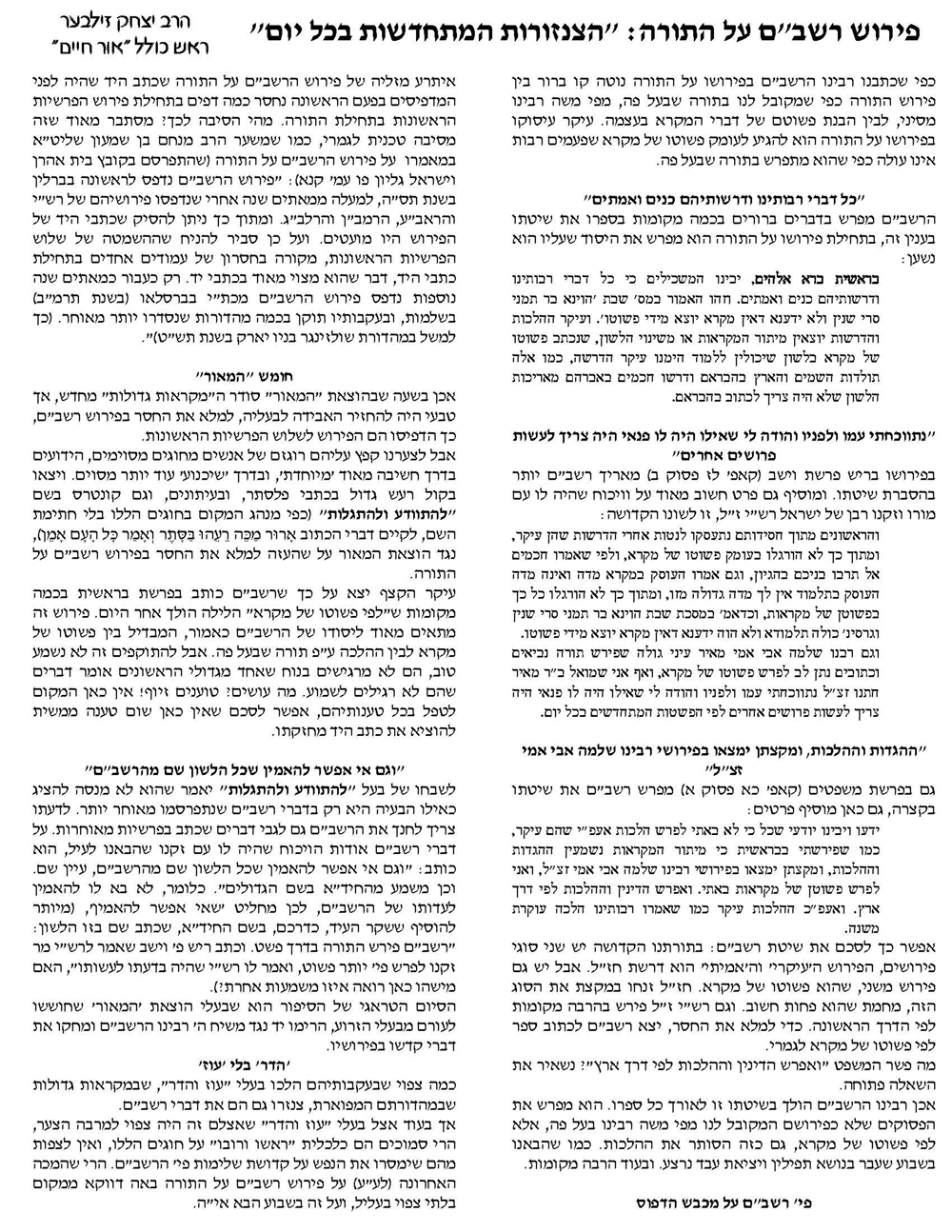
With regard to ArtScroll, the two pieces don’t really contain anything not mentioned already on this blog, but for those who don’t read English they are valuable. It is also good to see a noted talmid hakham express his feelings about what he terms ArtScroll’s “stupid act”. (I understand why documents like the ones published by Zilber, which are directed towards a certain population, cannot cite the Seforim Blog. Yet it is noteworthy that Uriel Simon’s book אזן מלין תבחן is cited, even if the author’s name is not mentioned). One significant point made by Zilber is his claim that ArtScroll knows the truth, namely, that the passages it chose to censor are not heretical insertions, but it chose to censor them anyway.
I have received emails that make the same point, that the censorship is all about “business”. In other words, the haredi world today does not want to see Rashbam’s peshat understanding of when the day begins, so the censorship is necessary in order for ArtScroll’s mikraot gedolot Chumash to sell. Based on what I have been told by people supposedly in the know, I am inclined to believe this. This is also an appealing explanation as it is much easier to accept than that anyone at ArtScroll really believes in the justification for its censorship that was sent out and which I discussed in the earlier post.
In my post I referred to additional authorities, other than Rashbam, who understood that according to the peshat the first chapter of Genesis teaches that the day begins in the morning.[3] I also mentioned those who believe that this was how things were before the giving of the Torah. R. Moshe Maimon called my attention to the fact that R. Saadiah Gaon also apparently held this view.[4] Here is R. Kafih’s edition of R. Saadiah, Perushei Rabbenu Sa’adiah Gaon al ha-Torah, p. 71. Look at chapter 10, note 4.

R. Ovadiah Yosef cites a number of additional sources that mention the notion that before the giving of the Torah night came after day.[5] One of these is R. Moses Sofer,[6] who not surprisingly quotes his teacher, R. Pinhas Horowitz, whose view on this matter I referred to in the prior post.[7] R. Meir Mazuz[8] notes that R. Reuven Margaliyot says the same thing.[9]
A number of people commented on how ironic it is that Ibn Ezra is being used as a source to determine what is heretical, being that his views on Mosaic authorship are themselves regarded by heretical by ArtScroll.[10] Furthermore, Ibn Ezra has no reticence in citing Karaite interpreters, yet as we know, ArtScroll only cites “accepted” authorities, and won’t even mention the Soncino commentary by name. Incidentally, there are some times when ArtScroll errs in this matter. For example, in its commentary to Jonah, p. 111, it cites “Yefes ben Ali” (who is quoted by Ibn Ezra). Presumably, the ArtScroll editor assumed that he was a rishon.[11] In truth, he was a Karaite, and his inclusion in the Jonah commentary is diametrically opposed to the standard set up by ArtScroll with regard to which commentators they will cite, a standard that opposes the Ibn Ezra-Maimonides approach (adopted by Soncino) of “accept the truth from whomever said it”.[12]
When it comes to Karaite influence on Ibn Ezra, R. Joseph Delmedigo goes so far as to say that most[!] of Ibn Ezra’s explanations come from the Karaites. Reflecting the fact that Ibn Ezra does sometimes strongly reject the Karaite interpretations, Delmedigo states that Ibn Ezra is like a baby who nurses from his mother [i.e., the Karaites] but sometimes also bites her breast.[13]
ודע כי בספרי הקראים תמצא באור לדברי הר”א”ב”ע[!] כי רוב באוריו מקדמוניהם כגון הר”ר ישועה והר”ר יפת והר”ר יהודה הפרסי דולה מושך גם כי לפעמים כיונק שדי אמו נושך
Philip Birnbaum writes:
Ibn Ezra cites Yefet more frequently than any other exegete. In his commentary on the Minor Prophets, Ibn Ezra quotes Yefet forty-four times whereas he mentions Sa’adyah Gaon only five times. . . . Ibn Ezra borrows from Yefet much more than he acknowledges.[14]
This connection of Ibn Ezra to Yefet even led to the creation of a false legend that Ibn Ezra was a student of Yefet.[15]
While Ibn Ezra often adopts the interpretations of Karaite commentators, he also blasts them when necessary. One such example is in his commentary to Deuteronomy 12:17 where he writes: “The heretics [Karaites] say that there are two sorts of first-born. One is the first to break out of its mother’s womb. The second is the first-born of the flock. There is no need to respond to their nonsense.”[16] It is noteworthy that the “nonsense” interpretation that Ibn Ezra refers to is indeed found in a few rishonim including Hizkuni and R. Jacob of Vienna.[17]
Let us now turn to the manuscript of Rashbam. The first thing to mention is that there is only one surviving manuscript page for Rashbam’s commentary to the beginning of Genesis. There used to be another manuscript that contained his commentary to the rest of the Torah but was missing the commentary to Genesis chapters 1-17. Unfortunately, this manuscript was lost during World War II. For such a great figure as Rashbam, it is definitely noteworthy that so few physical specimens of his Torah commentary survived until modern times.[18] What this tells us is that not many scribes were interested in copying the commentary, and I do not know why this was the case. In fact, it is not merely his commentary on the Torah that suffered this fate. While we have Rashbam’s commentaries to most of Bava Batra and the tenth chapter of Pesahim, we know that he also wrote commentaries to most of the other tractates, yet these are lost.[19] Is there any way to explain this?
Here is the manuscript of Rashbam to the beginning of Genesis.


It is found in the Bavarian Staatsbibliothek (Munich) and is referred to as Hebrew Manuscript no. 5 (2). Here is the link.
You can examine the entire manuscript here.
This manuscript of Rashbam is bound together with another manuscript from 1233 that contains the earliest example we have of Rashi’s commentary on the Torah. It is also the first illuminated Ashkenazic manuscript (with the illumination by a non-Jewish artist).[20] The copyist of the Rashi manuscript was not some anonymous person, but R. Solomon ben Samuel of Würzberg. R. Solomon was an outstanding student of R. Samuel he-Hasid and a colleague of R. Judah he-Hasid. He was also a student of R. Yehiel of Paris, and R. Solomon’s son was one of the participants in the 1240 Paris Disputation together with R. Yehiel. R. Solomon wrote Torah works of his own and he may be identical with R. Solomon ben Samuel, the author of the piyyut ישמיענו סלחתי that is recited in Yom Kippur Neilah.[21] ArtScroll, in its Yom Kippur Machzor, p. 746, tells us that ישמיענו סלחתי was written by “R’ Shlomo ben Shmuel of the thirteenth-century.”[22]
It is significant that in this early copy of Rashi’s commentary, whose copyist was himself a Torah great, Rashi’s comment to Genesis 18:22 appears in its entirety.[23] In this comment, Rashi refers to one of the tikun soferim and states that the Sages “reversed” the passage. What this means is that Rashi understood tikun soferim literally. Some have claimed that Rashi could never have said this, and it must be a heretical insertion. (There is always someone who says this about texts that depart from the conventional view.) In line with this approach, ArtScroll deleted this comment of Rashi.[24] As we have seen with the passages of Rashbam that were censored, in this case as well ArtScroll would also no doubt claim that it accepts the view of those who do not regard the deleted comment as authentic. Yet how can such a claim be taken seriously when the earliest manuscript of Rashi’s commentary, dating from the early thirteenth century and copied by R. Solomon ben Samuel, contains the passage?
Returning to Rashbam, I have the following question. Just like there is only one manuscript for his commentary to Genesis chapter 1, for the rest of the commentary on the Torah there was also only one manuscript and we don’t know anything about the copyist. Why don’t ArtScroll and the other censors start deleting the many other “problematic” passages in Rashbam, with the excuse that they are heretical insertions? Why only focus on the commentary to Genesis chapter 1?
I must also note that Rashbam himself, in his introductory words to parashat Mishpatim, refers to his commentary at the beginning of Genesis. Rashbam explains that the point of his commentary is not to explain the halakhah but rather the peshat, “as I have explained in Bereishit.” Where does he explain this in his commentary to Genesis? As Rosin points out in his note, Rashbam discusses this matter at the beginning of his commentary to parashat Va-Yeshev, and also at the beginning of his commentary to parashat Bereshit (which is from the supposedly questionable manuscript).
In my opinion, there is no doubt that in parashat Mishpatim Rashbam had the commentary to parashat Bereishit in mind. You can see this by comparing his words. In his commentary to parashat Mishpatim he writes:
ידעו ויבינו יודעי שכל כי לא באתי לפרש הלכות אע”פ שהם עיקר כמו שפירשתי בבראשית כי מיתור המקראות נשמעין ההגדות וההלכות.
At the beginning of parashat Bereishit he writes:
ועיקר ההלכות והדרשות יוצאין מיתור המקראות
Please look at what I have underlined and compare it to the passage I cited from the commentary to parashat Bereshit.
There are a number of other parallels between what Rashbam states in his commentary to Genesis chapter 1 and what appears elsewhere in his Torah commentary, meaning that it is impossible for one to argue that the commentary on the first chapter of Genesis is of uncertain authorship.[25]
I must also mention that Hizkuni, in his commentary to Genesis chapter 1, incorporates a number of Rashbam’s comments (without mentioning him by name). A list of these was compiled by  אריסמנדי on the Otzar ha-Hokhmah forum. [26] He concludes:
יש לנו להצטער ולמחות על כי שלטו ידי זרים בחיבורי הראשונים, ולתבוע מההוצאות השונות שידפיסו את פירוש רשב”ם בשלמות האפשרית, ואל יהינו לשלוח יד בו. וכשם שלא יעלה על דעת מאן דהוא לצנזר מפירוש ראב”ע את הקטעים שיצאו עליהם מתנגדים, וכיו”ב במשנה תורה להרמב”ם ושאר חיבורי רבותינו ז”ל. הכי לצנזורים הערלים והמשומדים יאמרו להידמות?
In all the correspondence I have had about this matter, which includes people in various haredi communities, no one has disagreed with this last paragraph. In other words, no one has expressed any support for ArtScroll’s censorship of Rashbam, and the reason is obvious. This is not a matter of ideological or scholarly disagreement. It has nothing to do with haredi vs. Religious Zionist. It is about basic scholarly integrity as well as respect for Rashbam and his readers. This is something scholars of all persuasions can agree on.
One final point regarding Rashbam: In my post here I referred to Rashbam’s famous words in his commentary to Gen. 37:2 that he heard from his grandfather that if he had time he would write new commentaries focused on the peshat. Later in his commentary to this verse, he cites an explanation which appears in Rashi (without mentioning him by name) and refers to this explanation as הבל הוא. In a recent article,[27] R. Meir Mazuz refers to this comment and notes that it is not merely Rashbam who, when it came to Torah matters, was not afraid to strongly reject his grandfather’s position. Rashbam’s brother, Rabbenu Tam, also had this approach.
הלא זה האיש שפסל כל התפלין של חכמי דורו (ובכללם של מר זקנו זצ”ל רבן של ישראל) ועשה אותם כקרקפתא דלא מנח תפלין ח”ו . . . וכן פסק ר”ת שכל המאכיל אונה סרוכה באומא מאכיל טריפות לישראל (תוס’ חולין דף מ”ז ע”א) בניגוד לדעת רש”י שמתיר (שם דף מ”ו סע”ב). וכן חידש לברך על תש”ר על מצות תפלין, בניגוד לרש”י והרי”ף והרמב”ם.
This will be my last post dealing with ArtScroll and Rashbam unless new information comes to light. I have made my position very clear and there is no need to go over this matter again and again. The important thing is that people not forget that ArtScroll’s new mikraot gedolot Chumash is a censored work.
By now no one is surprised that ArtScroll engages in censorship. This has been their modus operandi from the beginning. But is there more, that is, does ArtScroll also publish things that it knows are incorrect? This is a more difficult question to answer. In Changing the Immutable, p. 41, I cite an example where I am pretty sure that this is the case, since the alternative would be to assume ignorance of a pretty basic fact of which I am certain the learned folks at ArtScroll are well aware. Yet aside from a few such cases, which relate to Jewish-Gentile relations, I don’t know of any evidence that ArtScroll intentionally misinterprets sources. Contrary to what some others think, I assume that if there is a misinterpretation it is simply an error, which all people are liable to make. I admit, however, that I am not sure what to make of the following example (called to my attention by R. Yonason Rosman).
The following is ArtScroll’s commentary to Deut. 29:9, in which it quotes Or ha-Hayyim:
Moses divided the people into categories to suggest that everyone is responsible according to how many others he or she can influence. Leaders may be able to affect masses of people; women, their immediate families and neighbors; children, only a few friends and classmates; common laborers, hardly anyone. God does not demand more than is possible, but He is not satisfied with less (Or HaChaim).
This is a very nice thought, but does Or ha-Hayyim actually say this? Here is Or ha-Hayyim on the verse.
As you can see, Or ha-Hayyim does not say that everyone is responsible according to how many he or she can influence. He specifically states that children are not responsible for others since אינם בני דעה. He then adds that women are like children in this respect (i.e., not responsible for others; he is not including them as אינם בני דעה).[28] Thus, ArtScroll’s presentation of Or ha-Hayyim’s view with regard to children and women is actually the exact opposite of what he really says. Was this an intentional distortion in the name of political correctness or a simple misunderstanding? Does ArtScroll view itself, in darshanut-like fashion, as able to elaborate on and alter the message of the commentaries it quotes, so that when it indicates that an interpretation comes from Or ha-Hayyim (or any other source) it could also mean “based on Or ha-Hayyim”? If the latter is true, one must wonder why there is no indication of this in the preface to the Stone Chumash.
To be continued
* * * *
By now many people have read my new book and I have received lots of comments and additional sources. I will discuss some of them in future posts.Although I read the book over a number of times before publication and sat shiv’ah neki’im over every sentence, I knew that there would be some errors that got through. I have learnt that absolute perfection is simply unattainable. However, we are fortunate today that errors can be quickly corrected and the corrections publicized very widely through this blog. Those who have the book can simply insert the corrections. When the book is reprinted the corrections will be added as well.

P. 17. I refer to R. Eliezer David Gruenwald. This should be R. Judah Gruenwald (1845-1920). Thanks to Yisroel Rottenberg for catching this mistake.
P. 21. I discuss the concept of halakhah ve-ein morin ken. Shortly before the book went to press, I added a comment to note 74 in which I stated that Mishnah Berakhot 1:1 contains an example where the Sages did not reveal the true halakhah in order to keep people from transgression. This is a mistake and I thank R. Yonason Rosman for the correction. The Sages made a decree to keep people from transgression. Once this was done we are dealing with a actual rabbinic law so it has no connection to halakhah ve-ein morin ken. Furthermore, since it was a rabbinic decree binding on all there is no reason to think that the Sages were concerned that the masses not know that the biblical law allowed for more flexibility. (We do find such a concern in more recent rabbinic literature, as I discuss in the book.)
P. 55. I refer to an article by Jacob J. Schacter on the 93 Beth Jacob girls. I know this article well and I can’t explain how it is that I recorded the co-author of the article as Norma Baumel Joseph. The co-author is actually Judith Tydor Baumel.P. 205 n. 71. I refer to Teherani, Amudei Mishpat, vol. 1, pp. 147ff. This is the second pagination in the volume.

P. 225. I wrote that R. Naftali Zvi Judah Berlin stated that R. Shneur Zalman of Lyady’s arguments were only intended to intimidate the scholarly reader. R. Yonason Rosman pointed out that my language here is not precise. What the Netziv says is not that R. Shneur Zalman’s arguments were intended to intimidate the scholarly reader, but rather his statement that he has many arguments was for intimidation.
P. 259 n. 100 refers to volume 14 of R. Wosner’s Shevet ha-Levi. This should be volume 11.And while we are talking about typos, this is a good opportunity to correct an unfortunate error that appeared in the first printing of Studies in Maimonides and His Interpreters, p. 152, right at the end. The first word from the verse from Hosea that I quote is מחמד, not מחמר. If this mistake is found in your copy of the book, please correct it.

_______________

[1] In my post here I mentioned that the Lubavitcher Rebbe referred to Rashbam’s peshat interpretation that the day begins in the morning, the interpretation that was censored by ArtScroll. My reference was to a talk the Rebbe gave, and R. Avrohom Bergstein and others called my attention to the fact that in a letter the Rebbe also referred to this peshat interpretation of Rashbam. See Iggerot Kodesh, vol. 24, no. 934, also found in Likutei Sihot, vol. 15, p. 493.
[2] This passage is quoted from the manuscript by R. Menahem Lonzano. See Jordan S. Penkower, Masorah and Text Criticism in the Early Modern Mediterranean (Jerusalem, 2014), p. 118. Lonzano also refers to Nahmanides’ comment that I quoted.
[3] In this listing I included R. Ezekiel Landau. A Lakewood scholar properly corrected me as R. Landau is only referring to the fact that when it comes to kodashim night goes after day.
[4] R. Moshe Maimon also called my attention to the following: In my post here I discussed R. Dovid Cohen’s book, Ha-Emunah ha-Ne’emanah (Brooklyn, 2012). Among other things, I wrote:
One more point about R. Cohen’s book is that it is obvious that at times he is responding to what I wrote in The Limits of Orthodox Theology (and he also makes use of many of the sources I cite). While I am not mentioned by name (no surprise there) I am apparently included among the משמאילים referred to on p. 5 (see Limits, pp. 7-8).
R. Cohen has recently published the seventh volume of his book of questions, Ve-Im Tomar. Look at page 14, no. 216.
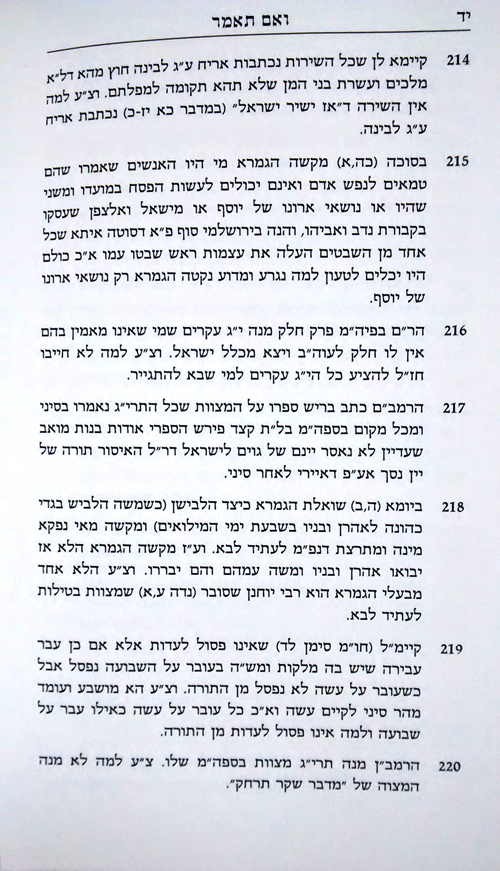
 

Now look at the source for this question provided by R. Cohen.
The question R. Cohen refers to comes from Limits, p. 7 (although I ask why Maimonides does not mention anything about teaching a prospective convert the Thirteen Principles. I don’t ask this question about talmudic sages.). Although I was not mentioned by name in Ha-Emunah ha-Ne’emanah, I am certainly honored to be cited in Ve-Im Tomar.

Since I mention R. Cohen, here is a page from his Ohel David, vol. 3, p. 36.

In his commentary to 1 Kings 7:23 he quotes the verse as follows:

ויעש את הים מוצק עשר באמה משפתו על שפתו
The words I have underlined caught my eye because the verse actually states משפתו עד שפתו. I assume that what appears in R. Cohen’s book is a typo as I haven’t seen any editions of Tanach that contain this error. However, this verse is also part of the Sephardic Haftarah for parashat Va-Yakhel, and believe it or not there are chumashim that do make this mistake. Here, for example, is a page from a popular tikkun kor’im. Look at the last words on the page and you will see the mistaken text.

[5] See She’elot u-Teshuvot Hazon Ovadiah, vol. 1, p. 5.
[6] See Torat Moshe, vol. 3, p. 18b and Derashot Hatam Sofer, vol. 2, p. 231b.
[7] It has already been pointed out that while the yeshiva pronuncation of R. Horowitz’s book המקנה is Ha-Makneh, from Jeremiah ch. 32 we see that it should really be pronounced Ha-Miknah. R. Horowitz’s most famous work is הפלאה. This is an abbreviation of הקטן פינחס הלוי איש הורויץ. The spelling I have given of R. Horowitz’s last name is how he himself spelled it. Here is the title page of his Sefer Ketubah, the first part of his Hafla’ah, published in 1787.

[8] Or Torah, Sivan 5775, p. 945.
[9] Nitzotzei Or, Berakhot 4a.
[10] It is also ironic that in R. Moshe Feinstein’s condemnation of the publication of the commentary of R. Judah he-Hasid, he cites Ibn Ezra’s attack on Yitzhaki for the latter’s own “biblical criticism.” See Iggerot Moshe, Yoreh Deah, vol. 3, no. 114.
[11] This example was earlier noted by B. Barry Levy, “Our Torah, Your Torah and Their Torah: An Evaluation of the Artscroll Phenomenon,” in Howard Joseph, et al., eds., Truth and Compassion: Essays in Judaism and religion in Memory of Rabbi Dr. Solomon Frank (Waterloo, Canada, 1983),  p. 147.
[12] I was quite surprised to find that R. Moses Teitelbaum, Yismah Moshe: Shemot, p. 177b, comes off sounding just like Soncino rather than ArtScroll, in defending citation of Karaite interpreters.
הנה אנכי שולח מלאך ע’ באברבנאל שכתב בשם חכמי הקראים כי זה נאמר על יהושע, והנה האומר דבר חכמה אף באוה”ע חכם נקרא, ובאמת שהם גרועים כי הם מינים ואפיקרוסים, מ”מ את הטוב נקבל כי כמה מפרשים הלכו בדרך הזה שהנביא נקרא מלאך
Regarding the Karaites, even though they are to be viewed as heretics, and a Sefer Torah written by a min is to be burnt, R. David Ibn Zimra stated that if one of the Karaites writes a Sefer Torah it is not to be burnt.  Rather, it is to be placed in genizah. The reason for this is that the Karaites believe in the written Torah. See She’elot u-Teshuvot ha-Radbaz, vol. 2, no. 774.
R. Ishtori ha-Parchi, Kaftor va-Ferah, ch. 5 (pp. 76-77 in the Beit ha-Midrash le-Halakhah be-Hityashvut edition) thinks that such a Sefer Torah does not need to be put away, even though one cannot publicly read from it since the letters of God’s name were not written with the proper intention and other rabbinic requirements were not fulfilled. But the Sefer Torah is not pasul simply because of who wrote it. He also mentions the beautiful Bibles produced by Karaites in the Land of Israel. (When he says “Sadducee” he means Karaite.)
מזה נראה שהצדוקי אם כתב ספר תורה שלא יהיה פסול ואע”פ שיקרא מין אינו ממין זה המין שעובד ע”ז . . . והנה תמצא עמנו היום בארץ הצבי הרבה צדוקים סופרים והרבה ספרים נאים מכתיבתם בתורה נביאים וכתובים. ועל ספר תורה מסתברא שבמה שאינו ניכר שאין ראוי לסמוך עליהם כבעבוד לשמה וכתיבת אזכרות לשמן ותפירת היריעות בגידי טהורה.
See R. Yitzhak Ratsaby, ed., Shemot Kodesh ve-Hol (Bnei Brak, 1987), pp. 5-6. See also the important comments of R. David Zvi Rotstein, “Sefer Torah Menukad,” in Ohel Sarah-Leah (Jerusalem, 1999), pp. 673ff. (Rotstein thinks that when Masekhet Soferim refers to “Sadducees” it too means Karaites.)
R. Naftali Zvi Judah Berlin, Meshiv Davar, vol. 2, no. 77, states that it is permissible to write a Sefer Torah for Karaites if they will treat it with respect. For more discussion regarding this matter, see R. Hayyim Hezekiah Medini, Sedei Hemed, vol. 9, Divrei Hakhamim no. 135.
[13] See his letter published in Abraham Geiger, Melo Chofnajim (Berlin, 1840), p. 20 (Hebrew section). See also שפ”ר in Ha-Magid, Sep. 7, 1864, p. 279, arguing that this letter was not written by Delmedigo.
[14]  The Arabic Commentary of Yefet Ben ‘Ali the Karaite on the Book of Hosea (Philadelphia, 1942), pp. xliii-xliv. See Michael Wechsler, The Arabic Translation and Commentary of Yefet ben Eli the Karaite on the Book of Esther (Leiden, 2008), p. 72, who characterizes Ibn Ezra as “the greatest single mediator of Yefet’s exegesis (and hence of Karaite exegesis generally) among the Rabbanites.”
[15] See Avraham Lipshitz, Pirkei Iyun be-Mishnat ha-Rav Avraham Ibn Ezra (Jerusalem, 1982), p. 192.
[16] I have used the translation of H. Norman Strickman and Arthur M. Silver.
[17] See R. Kasher, Torah Shelemah, vol. 12, pp. 192-193. R. Kasher writes:
ויש להתפלא איך שיטה זו נכנסה גם לפירושי הראשונים ולא ידעו שיסודה ממקור זר
At first I wondered why R. Kasher thought that the origin of this interpretation is with the Karaites. Why not posit that a Rabbanite peshat interpeter could independently arrive at the same conclusion as that offered by the Karaites? I later found that R. Kasher himself, Torah Shelemah vol. 17, p. 311, offers this exact same approach:
 וצ”ל שכתבו כן בדרך פירוש בפשטא דקרא
Daniel Sperber, Minhagei Yisrael, vol. 1, p. 151 n. 8, assumes that the interpretation indeed originates with the Karaites. Regarding the Karaite understanding, see Torah Shelemah, vol. 27, p. 210. See also my post here where I refer to R. Moshe Feinstein’s attack on a “heretical” interpretation that is also found in a number of rishonim.
[18] Additional pieces from Rashbam were published by Moshe Sokolow, “Ha-Peshatot ha-Mithadshim”: Ketaim Hadashim mi-Perush ha-Torah le-Rashbam – Ketav Yad,” Alei Sefer 11 (1984), pp. 73-80  Jonathan Jacobs argues that these are not part of Rashbam’s Torah commentary but from a polemical letter Rashbam sent to a student. See “Rashbam’s Major Principles of Interpretation as Deduced from a Manuscript Fragment Discovered in 1984” REJ 170 (2011), pp. 443-463. For more comments of Rashbam found in another manuscript, see Elazar Touitou, “Ha-Peshatot ha-Mithadshim be-Khol Yom: Iyunim be-Ferusho shel ha-Rashbam la-Torah (Ramat Gan, 2003), pp. 189ff.
[19] See Israel Moshe Ta-Shma, Ha-Sifrut ha-Parshanit la-Talmud be-Eiropah u-vi-Tzefon Afrikah (Jerusalem, 1999), vol. 1, p. 58.
[20] See Eva Frojimovic, “Jewish Scribes and Christian Illuminators: Interstitial Encounters and Cultural Negotiation,” in Katrin Kogman-Appel and Mati Meyer, eds. Between Judaism and Christianity: Art Historical Essays in Honor of Elisheva (Elisabeth) Revel Neher (Leiden, 2009),  pp. 281-305; Hanna Liss, Creating Fictional Worlds: Peshat Exegesis and Narrativity in Rashbam’s Commentary on the Torah (Leiden, 2011), p. 45 n. 32; Colette Sirat, Hebrew Manuscripts of the Middle Ages, ed. and trans. Nicholas De Lange (Cambridge, 2002), p. 170. Sirat gives the date of the manuscript as 1232. In truth, we can’t be sure if it is 1232 or 1233 as the colophon only gives the Hebrew date 4993, but convention in such cases to give the later date. See the transcription in Frojimovic ,“Jewish Scribes,” p. 301.
[21] See R. Moshe David Chechik, “Inyanei Aseret ha-Dibrot ve-Ta’amei Rut le-Rabbenu Shlomo mi-Würzberg,” Mi-Shulhan ha-Melakhim 4 (2006), p. 5. R. Yaakov Yisrael Stal hopes to soon publish one of R. Solomon’s works. See Sodei Humash u-She’ar mi-Talmidei Rabbenu Yehudah he-Hasid, ed. Stal (Jerusalem, 1999), p. 17 n. 115.
[22] Leopold Zunz, Literaturgeschichte des synagogalen Poesie (Berlin, 1865). p. 287, does not think that the two R. Solomon ben Samuels are identical. He assumes that the author of the piyyut pre-dates the 13th century R. Solomon ben Samuel we are discussing.
[23] See here.
[24] See Changing the Immutable, p. 44.
[25] See the post of מה שנכון נכון here.
[26] See here.
[27] Or Torah, Elul 5774, pp. 1199-1200.
[28] See R. Yaakov Hayyim Sofer, Edut be-Yaakov (Jerusalem, 2011), vol. 2, p. 164.


“Be-Esek Atevata”: A Contextual Interpretation of an Elusive Phrase in Akdamut Millin

“Be-Esek Atevata”: A Contextual Interpretation of an Elusive Phrase in Akdamut Millin
by David S. Zinberg
A centerpiece of the Ashkenazic liturgy for Shavuot, Akdamut Millin is an artistically sophisticated, epically dramatic, and emotionally charged piyyut.  After nearly a millennium, the liturgical-narrative masterpiece of R. Meir ben Yitzhak Sheliah Tzibbur continues to intrigue and to inspire.[1] 
Towards the middle of the poem, the poet abruptly changes scenes.  Speaking in his own voice, he announces that he will now praise God “before empires”:

שְׁבַח ריבון עַלְמָא, אֲמִירָא דַכְוָתָא:
שְׁפַר עֲלֵיהּ לְחַווּיֵהּ, בְּאַפֵּי מַלְכְּוָתָא:
What follows, without warning, is a confrontation – almost a poetic disputation – between the gentile nations and Israel. 

Intended, perhaps, to evoke the insecurity of the Jewish experience, the narrative turn is unexpected and jarring.  Following a meditation on the heavenly realms and the superiority of Israel over the angels, the poet imagines a coalition of nations gathering, “like waves,” to confront the Jewish community. 
Their tone first seems benign, even sympathetic.  They are impressed by the Jews and their steadfast religious devotion.  But their assimilationist agenda, backed by a hint of violence – “Join us, it’s for your own good, you know” — comes to the surface before long.
In these six lines, the nations appear and present their argument:

1          תָּאִין וּמִתְכַּנְשִׁין, כְּחֵיזוּ אַדְוָתָא:
2          תְּמֵהִין וְשַׁיְילִין לֵיהּ, בְּעֵסֶק אַתְוָתָא:
3          מְנָן וּמָאן הוּא רְחִימָךְ, שַׁפִּירָא בְּרֵיוָתָא:
4          אֲרוּם בְּגִינֵהּ סָפִית, מְדוֹר אַרְיְוָתָא:
5          יְקָרָא וְיָאָה אַתְּ אִין תַּעַרְבִי לְמַרְוָתָא:
6          רְעוּתֵךְ נַעֲבֵיד לִיךְ, בְּכָל אַתְרְוָתָא:

My translation:

1          They approach, gathering like waves
2          Amazed, question one another about her signs
3          “From where and who is your Beloved, most beautiful,
4          For whose sake you perish in the lions’ den?
5          You are so dear and so lovely!  If you join the hegemony,
6          We will grant you whatever you desire, everywhere”

This finely crafted passage is woven from a set of midrashim revolving around a dialogue in the Song of Songs (5:8-6:2) between the רַעְיָה, the beloved woman, and בְּנוֹת יְרוּשָׁלָיִם, the daughters of Jerusalem.
Below is the text separated by speaker:

הָרַעְיָה:
הִשְׁבַּעְתִּי אֶתְכֶם בְּנוֹת יְרוּשָׁלִָם אִם תִּמְצְאוּ אֶת דּוֹדִי מַה תַּגִּידוּ לוֹ שֶׁחוֹלַת אַהֲבָה אָנִי:

בְּנוֹת יְרוּשָׁלָיִם:
מַה דּוֹדֵךְ מִדּוֹד הַיָּפָה בַּנָּשִׁים מַה דּוֹדֵךְ מִדּוֹד שֶׁכָּכָה הִשְׁבַּעְתָּנוּ:

הָרַעְיָה:
דּוֹדִי צַח וְאָדוֹם דָּגוּל מֵרְבָבָה:
רֹאשׁוֹ כֶּתֶם פָּז קְוֻצּוֹתָיו תַּלְתַּלִּים שְׁחֹרוֹת כָּעוֹרֵב:
עֵינָיו כְּיוֹנִים עַל אֲפִיקֵי מָיִם רֹחֲצוֹת בֶּחָלָב יֹשְׁבוֹת עַל מִלֵּאת:
לְחָיָו כַּעֲרוּגַת הַבֹּשֶׂם מִגְדְּלוֹת מֶרְקָחִים שִׂפְתוֹתָיו שׁוֹשַׁנִּים נֹטְפוֹת מוֹר עֹבֵר:
יָדָיו גְּלִילֵי זָהָב מְמֻלָּאִים בַּתַּרְשִׁישׁ מֵעָיו עֶשֶׁת שֵׁן מְעֻלֶּפֶת סַפִּירִים:
שׁוֹקָיו עַמּוּדֵי שֵׁשׁ מְיֻסָּדִים עַל אַדְנֵי פָז מַרְאֵהוּ כַּלְּבָנוֹן בָּחוּר כָּאֲרָזִים:
חִכּוֹ מַמְתַקִּים וְכֻלּוֹ מַחֲמַדִּים זֶה דוֹדִי וְזֶה רֵעִי בְּנוֹת יְרוּשָׁלִָם:

בְּנוֹת יְרוּשָׁלָיִם:
אָנָה הָלַךְ דּוֹדֵךְ הַיָּפָה בַּנָּשִׁים אָנָה פָּנָה דוֹדֵךְ וּנְבַקְשֶׁנּוּ עִמָּךְ:

הָרַעְיָה:
דּוֹדִי יָרַד לְגַנּוֹ לַעֲרוּגוֹת הַבֹּשֶׂם לִרְעוֹת בַּגַּנִּים וְלִלְקֹט שׁוֹשַׁנִּים:
אֲנִי לְדוֹדִי וְדוֹדִי לִי הָרֹעֶה בַּשּׁוֹשַׁנִּים:

The רַעְיָה begs the Jerusalemite girls to find her love and to tell him of her longing.  They first ask, מַה דּוֹדֵךְ מִדּוֹד – how will we identify him?  In response, she provides detailed signs, in seven lines of verse, of his beauty and charm.  Their next question follows naturally:
אָנָה הָלַךְ דּוֹדֵךְ הַיָּפָה בַּנָּשִׁים אָנָה פָּנָה דוֹדֵךְ וּנְבַקְשֶׁנּוּ עִמָּךְ — now that we know something about your beloved, where did he go?  Tell us, and we will help you search for him. 
In the allegorical reading of the Song – and in the poet’s imagination – the רַעְיָה is Israel, the דּוֹד is God, and the daughters of Jerusalem represent the nations. 
Below are excerpts from the midrashic sources relevant to our passage (language which inspired the poet is highlighted in bold):

מכילתא דרבי ישמעאל בשלח – מסכתא דשירה ג
זה אלי . . . ר’ עקיבא אומר אדבר בנאותיו ובשבחיו של מי שאמר והיה העולם בפני כל אומות העולם. שהרי אומות העולם שואלין את ישראל לומר מה דודך מדוד שככה השבעתנו (שיר השירים ה) שכך אתם מתים עליו וכך אתם נהרגין עליו שנ’ על כן עלמות אהבוך (שם א) אהבוך עד מות, וכתיב כי עליך הורגנו כל היום (תהלים מד). הרי אתם נאים, הרי אתם גבורים, בואו והתערבו עמנו. וישראל אומרים להם לאומות העולם, מכירין אתם אותו [2]נאמר לכם מקצת שבחו: דודי צח ואדום דגול מרבבה (שיר השירים ה). כיון ששומעין שכך שבחו אומרים לישראל נלכה עמכם שנ’ אנה הולך דודך היפה בנשים אנה פנה דודך ונבקשנו עמך (שם ו) וישראל אומרים להם אין לכם חלק בו אלא דודי לי ואני לו וגו’ (שם ב) אני לדודי ודודי לי הרועה בשושנים (שם ו).
במדבר רבה ב:ד

אִישׁ עַל-דִּגְלוֹ בְאֹתֹת (במדבר ב): הה”ד (שיר השירים ו) מי זאת הנשקפה כמו שחר יפה כלבנה ברה כחמה אימה כנדגלות.  קדושים וגדולים היו ישראל בדגליהם וכל האומות מסתכלין בהם ותמהין ואומרים מי זאת הנשקפה וגו’ אומרים להם האומות שובי שובי השולמית (שיר השירים ז) הדבקו לנו בואו אצלנו ואנו עושין אתכם שלטונים הגמונים דוכסין אפרכין אסטרטליטין, שובי שובי ונחזה בך ואין נחזה אלא שררה שכן אמר יתרו למשה (שמות יט) ואתה תחזה וגו’ שובי שובי ונחזה בך
במדבר רבה ב:טז

ד”א והיה במקום וגו’ הה”ד (שיר השירים ח) מים רבים לא יוכלו לכבות את האהבה וגו’ ואומר אם יתן איש את וגו’ אמר רבי שמואל בר נחמן בשתי אהבות הכתוב הזה מדבר. ראשו מדבר באהבתו של ישראל. שאם יתכנסו כל אומות העולם ליטול את האהבה שבינו לבין ישראל אינן יכולין, שנאמר מים רבים לא יוכלו לכבות את האהבה ואין מים רבים אלא אומות העולם שנאמר (ישעיה יז) הוי המון עמים רבים וגו’.
שמות רבה כג:ה
מראש שניר (שיר השירים ד), בזכות יצחק, וחרמון, בזכות יעקב, ממעונות אריות, גלות בבל ומדי, מהררי נמרים, זו אדום
Below, we match each line or half-line from our Akdamut passage to its associated biblical or midrashic expression.  Note how each phrase either quotes directly from or alludes to imagery in the Song and its related midrashim.  For now, we will leave line 2 aside.  This line will be addressed separately.
1          תָּאִין וּמִתְכַּנְשִׁין כְּחֵיזוּ אַדְוָתָא
מים רבים לא יוכלו לכבות את האהבה וגו’ . . .  שאם יתכנסו כל אומות העולם ליטול את האהבה שבינו לבין ישראל אינן יכולין . . .ואין מים רבים אלא אומות העולם . ) . . במדבר רבה ב:טז(
 
3          מְנָן וּמָאן הוּא רְחִימָךְ, שַׁפִּירָא בְּרֵיוָתָא
שהרי אומות העולם שואלין את ישראל לומר מַה דּוֹדֵךְ מִדּוֹד שֶׁכָּכָה הִשְׁבַּעְתָּנוּ )מכילתא דרבי ישמעאל בשלח – מסכתא דשירה ג(
1.      מְנָן (“from where”) — אָנָה הָלַךְ דּוֹדֵךְ הַיָּפָה בַּנָּשִׁים אָנָה פָּנָה דוֹדֵךְ
2.      וּמָאן  — (“and who”)מַה דּוֹדֵךְ מִדּוֹד הַיָּפָה בַּנָּשִׁים

4a        אֲרוּם בְּגִינֵהּ סָפִית
שכך אתם מתים עליו וכך אתם נהרגין עליו[3])  מכילתא דר”י שם(
4b        מְדוֹר אַרְיְוָתָא
ממעונות אריות, גלות בבל ומדי, מהררי נמרים, זו אדום (שמות רבה כג:ה)  
         יְקָרָא וְיָאָה אַתְּ, אִין תַּעַרְבִי לְמַרְוָתָא
הרי אתם נאים, הרי אתם גבורים, בואו והתערבו עמנו) מכילתא דר”י שם(
         רְעוּתֵךְ נַעֲבֵיד לִיךְ, בְּכָל אַתְרְוָתָא
הדבקו לנו בואו אצלנו ואנו עושין אתכם שלטונים הגמונים דוכסין אפרכין אסטרטליטין) מכילתא דר”י שם(
Line 2 of this Akdamut passage – תְּמֵהִין וְשַׁיְילִין לֵיהּ, בְּעֵסֶק אַתְוָתָא – is particularly challenging.  What does the poet mean by בְּעֵסֶק אַתְוָתָא?  To which “signs” (אַתְוָתָא = אותות) does he refer?
Several translators and commentators on Akdamut interpret אַתְוָתָא as “miracles.”[4]  But that rendering is completely unsatisfactory, as this section of the poem does not address miracles.  Furthermore, in all the source-midrashim from which the nations’ argument is derived, there is no reference to miracles.  Indeed, had it referred to “miracles,” this line would be an aberration, as every other phrase in these six lines echoes specific language in the sources cited.

Taking a completely different approach, the ArtScroll Machzor renders אַתְוָתָא as “proofs”; i.e., in light of Israel’s endless suffering in exile, the nations demand proof that God still watches over Israel and plans to send the Messiah to redeem her.[5]

This interpretation has some merit, since it links line 2 to the nations’ adjacent observation regarding Israel’s persecution, i.e., אֲרוּם בְּגִינֵהּ סָפִית, מְדוֹר אַרְיְוָתָא (line 4).  Still, “proofs” is forced and unsupported by the biblical and midrashic sources.

I believe, instead, that the correct translation of בְּעֵסֶק אַתְוָתָא is “about her signs,” i.e., Israel’s signs.  This phrase was clearly borrowed from the Bemidbar Rabba passage (2:4) cited above, a discourse on the banners or “signs” (אֹתוֹת) of the tribes, as described in Numbers 2:2.  Note the association in Bemidbar Rabba 2:4 between עַל-דִּגְלוֹ בְאֹתֹת of Numbers and אימה כנדגלות of Song 6:10.  The Sages read the latter as a reference by the nations to Israel’s impressive banners (נדגלות = דגלים). 

Also note how the poet’s תְּמֵהִין וְשַׁיְילִין לֵיהּ is taken nearly verbatim from the expression וכל האומות מסתכלין בהם ותמהין ואומרים of Bemidbar Rabba, which is used in the context of the flags.   

Of course, the biblical אֹתוֹת often connotes an extraordinary, miraculous phenomenon.  For example:
וְהָיָה אִם-לֹא יַאֲמִינוּ גַּם לִשְׁנֵי הָאֹתוֹת הָאֵלֶּה וְלֹא יִשְׁמְעוּן לְקֹלֶךָ וְלָקַחְתָּ מִמֵּימֵי הַיְאֹר וְשָׁפַכְתָּ הַיַּבָּשָׁה וְהָיוּ הַמַּיִם אֲשֶׁר תִּקַּח מִן-הַיְאֹר וְהָיוּ לְדָם בַּיַּבָּשֶׁת  (שמות ד:ט)
וַיּוֹצִאֵנוּ ה’ מִמִּצְרַיִם בְּיָד חֲזָקָה וּבִזְרֹעַ נְטוּיָה וּבְמֹרָא גָּדֹל וּבְאֹתוֹת וּבְמֹפְתִים  (דברים כו:ח)
However, it appears certain – based on Bemidbar Rabba 2:4 – that the “signs” to which line 2 refers are Israel’s flags, rather than God’s miracles. Here, then, is the final midrashic source for our Akdamut passage:  
2          תְּמֵהִין וְשַׁיְילִין לֵיהּ, בְּעֵסֶק אַתְוָתָא
איש על דגלו באותות – הה”ד מי זאת הנשקפה וגו’ קדושים וגדולים היו ישראל בדגליהם וכל האומות מסתכלין בהם ותמהין ואומרים מי זאת הנשקפה וגו’)  במדבר רבה ב:ד(
What may have motivated the interpretation of אַתְוָתָא as “miracles” was a presumed link between two distinct reactions of the nations: תְּמֵהִין וְשַׁיְילִין לֵיה of line 2 andמְנָן וּמָאן הוּא רְחִימָך of line 3.
The nations’ focus in line 3 is, of course, on God (רְחִימָךְ – your Beloved).  The phrase מְנָן וּמָאן הוּא רְחִימָך is a conflation of אָנָה הָלַךְ דּוֹדֵךְ and מַה דּוֹדֵךְ מִדּוֹד, whose referent is God.  But in line 1 — תָּאִין וּמִתְכַּנְשִׁין — they accost Israel and, in line 2 — תְּמֵהִין וְשַׁיְילִין לֵיה — express wonder among themselves about Israel.  Their response in line 2 is to Israel, rather than to God.  They shift their inquiries to God only in line 3.

[1] On R. Meir ben Yitzhak, see Eliezer Landshut, Amudei Ha-Avoda (Berlin, 1862), pp. 162ff; Avraham Grossman, Hakhmei Ashkenaz Ha-Rishonim (Jerusalem, 1981), pp. 292ff.
[2] The variant text in Mekhilta De-Rabbi Shimon Bar Yohai – אי אתם מכירין אותו – is more readable.
[3] See also Shir Ha-Shirim Rabba 7:1:
אומות העולם אומרות לישראל עד מתי אתם מתים על אלהיכם ומשלמין לו . . .  ועד מתי אתם נהרגין עליו . . .  ועד מתי אתם גומלין טובות עליו ולו לעצמו, והוא גומל לכם רעות
[4] E.g., Mahzor Le-Hag Ha-Shavuot, ed. Wolf Heidenheim (Rodelheim, 1805 and reprints); Mahzor Shavuot, ed. Yonah Fraenkel (Jerusalem, 2000), p. 390, n. 22; and, most recently, Jeffrey Hoffman, “Akdamut: History, Folklore, and Meaning,” The Jewish Quarterly Review, 99:2 (Spring 2009), p. 178.
[5] The Complete ArtScroll Machzor – Shavuos (Brooklyn, 1995), p. 269.  The note on p. 269 attributes this idea to Mevo Ha-Shir by Shmuel Hayyim Yellin (Pietrokow, 1926).  However, “proofs” was already proposed by Aharon ben Yehiel Mikhel Ha-Levi in his Mahzor commentary Mateh Levi.  Yellin renders בְּעֵסֶק אַתְוָתָא as “on the matter of the arrival (of the Messiah),” based on an erroneous association of אַתְוָתָא with ואתא, Aramaic for  ויבא (“he arrived”).  The comments of Mateh Levi and Mevo Ha-Shir can both be viewed here.


Review of Ha-Sefer ha-Kollel (Kitāb al-Ḥāwī) by Rabbi David ben Saʿadya al-Ger

Review of Ha-Sefer ha-Kollel (Kitāb al-Ḥāwī) by Rabbi David ben Saʿadya al-Ger

Marc Herman

Marc Herman is an assistant professor in the Department of Humanities and a core member of the Centre for Jewish Studies at York University. His research focuses on Jewish and Islamic intellectual history in the medieval Mediterranean. He is the coeditor of Accounting for the Commandments in Medieval Judaism: Studies in Law, Philosophy, Pietism, and Kabbalah (Brill, 2021) and his monograph, titled After Revelation: The Rabbinic Past in the Islamic World, is under contract with the University of Pennsylvania Press.

The study of medieval halakhah was recently enriched by the long-awaited publication of The Comprehensive Book (Kitāb al-Ḥāwī) by David ben Saʿadya al-Ger,[1] one of the earliest legal compendia that survives from Sefarad. Pieced together from Genizah fragments, other manuscripts, and citations in later medieval works, and comprising much of the original text, this new edition of Kitāb al-Ḥāwī recovers a once-prominent halakhist who fell into obscurity in the centuries after his death. Its publication is a landmark in the study of Jewish al-Andalus and Judeo-Arabic law. Not only does this volume recover a mostly lost, early rishon, it also bears witness to the reception of the last geonim in the Islamic West and it provides a new window into the beginnings of Iberian halakhic culture.

Next to nothing is known with certainty about the life of David ben Saʿadya, author of the Kitāb al-Ḥāwī and other halakhic works. David’s period of activity can be fixed sometime after the death of Hayya Gaon (d. 1038), who David cited with some frequency, and before the death of Isaac Ibn al-Bālīya (d. 1094), who mentioned David as deceased.[2] This might place David in the circle of Samuel ha-Nagid. In fact, the twentieth-century scholar, Mordecai Margaliot (1909-1968), suggested that David was the subject of a laudatory poem in the Dīwān of the Nagid, where a certain “Rabbi David” is praised for his persuasive knowledge and keen abilities.[3] But what about the uncommon appellation אלגר? Some historians have understood that David descended from converts, but others have connected this word to the Arabic muhājir, i.e., migrant. (The latter would imply that David’s father, or an earlier family member, was not native to al-Andalus.) David Sklare noticed that one Genizah fragment vocalizes this word as אלגֵר (al-ger, i.e., the convert), supporting the view that David ben Saʿadya was the descendant of proselytes.[4]

ENA 2859.7v, Courtesy of the Library of the Jewish Theological Seminary, The National Library of Israel. “Ktiv” Project, The National Library of Israel.

This reading coincides with the sole appearance of David’s name in the writings of Abraham Ibn Ezra, who called David “Rabbi David the judge, son of the convert (ha-dayyan ben ha-ger), Sefardi, from the city of Granada.”[5] The editor of this new edition, Y. Zvi Stampfer, who is a lecturer and researcher in the Department of Talmud and Halakha at Hebrew University of Jerusalem, accepts this interpretation of אלגֵר, noting that Jews in the medieval Islamic world had few qualms about such ancestry. Stampfer even proposes that David proudly announced his forebearer’s conversion (as did other converts).[6]

David ben Saʿadya composed several works. In addition to the Kitāb al-Ḥāwī, written in a mixture of Judeo-Arabic and Aramaic, they include Judeo-Arabic volumes on the laws of oaths and on the laws of bequests, as well as commentaries on the Talmud and, according to Ibn Ezra, a work on Hebrew grammar. Of these additional writings, only the one on the laws of oaths survives. This work was translated into Hebrew by Isaac ben Reuven of Barcelona and printed, since 1521, in standard editions of tractate Shavuot bearing the title שערי שבועות. Unfortunately for David’s legacy, it has long been incorrectly ascribed to Isaac al-Fāsī.[7]

The ascription of this last work to al-Fāsī is something of an irony, as al-Fāsī was wont to criticize David ben Saʿadya.[8] In a responsum about the distinctions between biblically and rabbinically mandated oaths, al-Fāsī declared that David was wrong and would have been better off following the view of Hayya Gaon.[9] This may have been more than a straightforward halakhic disagreement. If David did travel in the circle of Samuel ha-Nagid, the charge that Hayya was correct would have had particular potency, as the Nagid and his faction sought to downplay—and thereby surpass—geonic expertise and hegemony, and they were especially wary of Hayya. Solomon Ibn Gabirol, whom the Nagid supported, praised his patron with the phrase וְַרב הָאיָי כְּלֺא הָיָה לְפָנָיו—it was as if Hayya was nothing compared to him![10] Al-Fāsī might have been hinting, then, that a whole generation of Andalusi scholars were betraying their shortcomings when they veered too far from the geonim. Stampfer himself suggests that al-Fāsī’s attacks on David may have been part of a larger program to disparage earlier Sefardic tamludists.[11] Indeed, Abraham Ibn Dāʾūd reported that al-Fāsī entered into debates with both Isaac al-Bālīya and Isaac Ibn Ghiyāth, two of the leading figures in eleventh-century Sefarad.[12]

Did al-Fāsī’s criticisms play a role in consigning David and his works to obscurity? It is hard to know. But before the advent of critical scholarship, David’s writings were mostly known only through brief citations by later rishonim, mostly of Sefardic extraction. These include al-Fāsī, Maimonides, and Abraham Maimonides. The last figures to have been familiar with texts by David ben Saʿadya were David ben ʿAmram ha-ʿAdani (fourteenth century), in his Midrash ha-Gadol, and Bezalel Ashkenazi (sixteenth century), who probably knew of David’s writings indirectly, in his Shittah mequbeset.[13] Most of the manuscripts of the Kitāb al-Ḥāwī are no later than the thirteenth century, apparently when this work fell out of circulation. A single manuscript is later, from seventeenth-century Yemen.[14]

David’s Kitāb al-Ḥāwī and other writings were first noticed by Samuel Poznański, B.M. Lewin, and Simḥa Assaf, scholars who pioneered the recovery of geonim and rishonim, especially from Arabic-speaking lands. As a student at the Jewish Theological Seminary of America in the early 1950s, Shraga Abramson submitted a doctoral thesis, written for Saul Lieberman,[15] on David ben Saʿadya,[16] though this project did not see the light of day until now.[17] Stampfer has helpfully included the first five chapters of Abramson’s thesis as an appendix in this volume (pp. 363-399); the remaining six will hopefully be published alongside a new edition of David’s work on the laws of oaths. Sklare was the next scholar to identify major pieces of David’s work, dedicating an important article to David’s identity, corpus, and thought, and Stampfer added many previously unidentified manuscripts to reconstruct a large portion of the Kitāb al-Ḥāwī.

The Kitāb al-Ḥāwī follows a unique arrangement, perhaps unparalleled in the writings of the rishonim.[18] Its structure is worth reviewing. David ben Saʿadya began this book with a sizeable consideration of jurisprudential topics. He followed this with three sections dedicated to practical law: section two treats holidays and the calendar; section three treats the laws of marriage (this is the only section that survives only in a medieval Hebrew translation, not in the Judeo-Arabic original); and section four treats monetary law. The fifth section provides perhaps the longest early medieval analysis of the thirteen hermeneutical middot. And the sixth section presents a series of challenges to Halakhot Gedolot. (Was this part of eleventh-century Sefardic attempts to move away from geonic-era works? Al-Fāsī, in another responsum, defended Halakhot Gedolot from one of David’s attacks.[19]) Stampfer shows that at least some of these sections were originally independent works.[20]

The sections on applied law suggest that, in part, David intended the Kitāb al-Ḥāwī to be a practical manual. Sklare proposed that this work was meant to be a handbook for judges or for second-tier rabbinic leadership who offered rulings in smaller Jewish communities.[21] This might even explain why some of this book was written in Aramaic, a curious feature that is shared by Samuel ha-Nagid’s mostly lost Hilkheta Gavratta.[22] Sklare suggested that some Sefardic readership may have been more comfortable with Aramaic than Judeo-Arabic—a fascinating possibility in light of the usual emphasis on the Arabization of Jewish elites in al-Andalus.[23]

The other parts of Kitāb al-Ḥāwī, however, clearly had other goals in mind. David’s decision to open with a discussion of the sources of the law was undoubtedly stimulated by the attention that this topic received among both Jewish and Muslim writers of his day. David was an innovative theorist regarding the sources of halakhic authority. The geonim, especially Saʿadya, generally portrayed revelation as all-encompassing, and they tended to downplay or even deny that the talmudic-era rabbis created new law. (This is usually, though not always, understood as a defense of the Oral Torah from Qaraite criticisms.[24]) David, on the other hand, expressed no qualms with the rabbinic innovation of norms. He even took many of the Arabic terms that Saadia had associated with the accursed jurisprudence of the Qaraites and applied them to the late antique rabbis.

David’s consideration of the thirteen hermeneutical middot might be thought of in this vein as well. In the tenth century, Saʿadya Gaon rejected the idea that the rabbis had created new law using the middot. He instead insisted that they just matched up received oral traditions with the text of the Torah.[25] David, by contrast, saw the middot as tools for generative and novel interpretations. Thus, when the Torah does not explicate the law, David asserted that the rabbis created it through legal reasoning (using the Arabic term qiyās).

David ben Saʿadya, of course, was only the first of many figures to break with the geonim on the question of how Jewish law developed. Among Andalusi Jews, Maimonides proposed the most powerful alternative to the ideas of Saʿadya Gaon. Even if Maimonides did not know much of the Kitāb al-Ḥāwī directly, there are distinct parallels between the Maimonidean picture of the Oral Torah and David’s. Maimonides, like David, fiercely rejected the Saadianic approach to the rabbis. Both Andalusis instead celebrated rabbinic legal creativity, and both did so by way of similar Arabic concepts.[26]

Stampfer’s edition of the Kitāb al-Ḥāwī is handsomely produced. It begins with a detailed introduction to David ben Saʿadya and presents the text in the Judeo-Arabic original with facing Hebrew translation. Stampfer provides learned notes with detailed references to relevant passages in the writings of the geonim and rishonim. He cites many unpublished geonic texts, suggesting that this is the first of many such books in the works. Anybody interested in medieval Jewish law should await further contributions with much anticipation.

Notes:

[1] Ha-Sefer ha-Kollel (Kitāb al-Ḥāwī) by Rabbi David ben Saʿadya al-Ger, ed. and trans. Y. Zvi Stampfer, incorporating work by David E. Sklare, Nissim Sabato, and Eliezer Reif (Jerusalem: The Ben-Zvi Institute for the Study of Jewish Communities in the East and The Rabbi Moses and Amalia Rosen Foundation, 2024; Hebrew), available here.
[2] For the latter, see Yaakov Miller, “Responsa of Our Rabbi Isaac son of Rabbi Baruch on the Matter of Collecting Debts from Orphaned Estates,” Kovetz Hitzei Giborim, vol. 7 (2014): 18-34, esp. 30 (Hebrew), available here.
[3] Mordecai Margaliot, ed., Hilkhot ha-Nagid (Jerusalem: American Academy for Jewish Research, 1962), 63 (Hebrew); see David Sklare, “R. David Ben Seʿadya al-Ger and His Work al-Ḥāwī,” in Joshua Blau, Haggai Ben-Shammai, Mordecai A. Friedman, and Joel L. Kraemer, eds., Encounters in Medieval Judaeo-Arabic Culture [=Teʿuda, no. 14] (Tel-Aviv: Tel-Aviv University, 1998), 103-123, esp. 115n40 (Hebrew), available here; for the poem, see Dov Yarden, ed., Dīwān Shmuel ha-Nagid: Ben Tehillim (Jerusalem, 1985), 151-53 (Hebrew), available here.
[4] David Sklare, “R. David Ben Seʿadya,” 111-12.
[5] Abraham Ibn ‘Ezra’, Sefer Moznayim, ed. Ángel Sáenz-Badillos (Madrid: Ediciones El Almendro, 2000), 6* (the editio princeps is available here. As Stampfer notes (32n85), some manuscripts of this passage read “Rabbi Judah,” however.
[6] David ben Saʿadya, Ha-Sefer ha-Kollel (Kitāb al-Ḥāwī), 21-24.
[7] David ben Saʿadya, Ha-Sefer ha-Kollel (Kitāb al-Ḥāwī), 27-32.
[8] David ben Saʿadya, Ha-Sefer ha-Kollel (Kitāb al-Ḥāwī), 79-82.
[9] Isaac Rothstein, ed., Shut ha-Rif (New York, 1977), 156-57 (#51); noted in Shraga Abramson, “Two Chapters from a Study on the Book ‘Sha‘are Shevuot’,” Sinai, vol. 104, no. 3-4 (1989): 122 (Hebrew).
[10] Ḥayim Brody and Ḥayim Schirmann, eds., Shelomoh Ibn Gabirol: Shire Ḥol (Jerusalem: Schocken, 1975), 47 (#85) line 53.
[11] David ben Saʿadya, Ha-Sefer ha-Kollel (Kitāb al-Ḥāwī), 82.
[12] Gerson D. Cohen, A Critical Edition with a translation and Notes of ‘The Book of Tradition (Sefer ha-qabbalah) by Abraham Ibn Daud (Philadelphia: Jewish Publication Society of America, 1967), 86 (English), 64 (Hebrew).
[13] David ben Saʿadya, Ha-Sefer ha-Kollel (Kitāb al-Ḥāwī), 68-90.
[14] The one seventeenth-century manuscript is described in David ben Saʿadya, Ha-Sefer ha-Kollel (Kitāb al-Ḥāwī), 107.
[15] For Abramson on Lieberman, see his “R. Saul Lieberman’s Method of Investigating Talmudic Literature,” in Researches in Memory of Saul Lieberman (Jerusalem: The Israel Academy of Sciences and Humanities, 1983), 23-33 (Hebrew).
[16] Y. Zvi Stampfer, “Introduction,” in David ben Saʿadya, Ha-Sefer ha-Kollel (Kitāb al-Ḥāwī), 100-101 (Hebrew):

“In the years 1950 or 1951, the student (later Professor) Shraga Abramson, at the Jewish Theological Seminary of America in New York, submitted a doctoral dissertation to Professor Saul Lieberman titled “Rabbi David ben Saadia ben ha-Ger: His Works and Times.” In his research, Abramson examined references to Rabbi David’s works in Talmudic and halakhic literature, along with various Genizah fragments, and discussed the question of Rabbi David’s era, location, and writings.”

[17] Y. Zvi Stampfer, “Introduction,” in David ben Saʿadya, Ha-Sefer ha-Kollel (Kitāb al-Ḥāwī), 9-10 (Hebrew):

“Professor Shraga Abramson z”l laid a broad foundation for research into Rabbi David ben Saadia and his works in his doctoral dissertation on the book Sha‘are Shevuot, its author, its era, and its location. He submitted this research to Rabbi Professor Saul Lieberman in the early 1950s as a doctoral thesis. However, this work was never published, except for two brief articles derived from it. Mrs. Araleh Abramson z”l transferred a typed copy of the dissertation to Professor Haggai Ben-Shammai when he headed the Ben-Zvi Institute and co-directed of the Center for the Study of Judaeo-Arabic Culture and Literature, who then forwarded it to me.

The first part of the dissertation, which deals with the figure of Rabbi David and his writings, is included as an appendix at the end of this edition. The second part, which involves the study of Sha‘are Shevuot, I hope to publish along with an annotated edition of that work. Abramson’s research was not prepared for publication, and the primary challenge in preparing it for publication was identifying the references he alluded to. Since his writing was essentially directed at Lieberman, a scholar of unparalleled expertise, Abramson often sufficed with general references or vague hints to sources in rabbinic literature or scholarly works, mostly published in Hebrew and German. I have endeavored to locate the sources mentioned in his research as far as I could. To remain faithful to Abramson’s original manuscript and his research style, when he referred to editions published up to his time, I indicated, as much as possible, the editions that were in his library. However, in cases where he referred to rabbinic literature sources that have more accessible editions published after his death, I noted the newer editions. I also expanded the abbreviations and corrected typographical errors and incorrect references.”
[18] Another somewhat later, but still pre-Maimonidean, Andalusi work is even more diverse in its contents; see Y. Tzvi Langermann, “The Topic of Rosh Chodesh—Chapter 18 from the Composition ‘Issur ve-Heter’,” Kobez al yad 24 (34) (2016): 161-180, esp. 165-166 (Hebrew).
[19] See Abraham Harkavy, Teshuvot ha-Geonim (Berlin, 1887), 301 (Hebrew), available here.
[20] Y. Zvi Stampfer, “Introduction,” in David ben Saʿadya, Ha-Sefer ha-Kollel (Kitāb al-Ḥāwī), 32-37 (Hebrew).
[21] David Sklare, “R. David Ben Seʿadya,” 119, 123.
[22] See Shraga Abramson, “From the Teaching of R. Samuel ha-Nagid of Spain,” in Yitzhak Rafael, ed., Sinai Centenary Volume [=Sinai, vol. 100] (Jerusalem: Mosad ha-Rav Kook, 1987), 7-73, esp. 13 (Hebrew), available here, and Shraga Abramson, Perush Rabbenu Ḥananel la-Talmud (Jerusalem: Wagshal, 1995), 55-56.
[23] David Sklare, “R. David Ben Seʿadya,” 116-122.
[24] See Marc Herman, “Prophetic Authority in the Legal Thought of Saadia Gaon,” Jewish Quarterly Review, vol. 108, no. 3 (Summer 2018): 271-294, available here.
[25] See most recently Y. Zvi Stampfer, “Saʿadia Gaon’s Interpretation of the Thirteen Hermeneutical Principles according to the Arabic Source Commentary, Tendencies, and Unknown Sources,” Tarbiz, vol. 87, no. 4 (July – September 2020): 655-660 (Hebrew), available here.
[26] See Marc Herman, “Situating Maimonides’s Approach to the Oral Torah in Its Andalusian Context,” Jewish History, vol. 31, no. 1-2 [=Special Issue: New Perspectives on Jewish Legal History] (December 2017): 31-46.


Neturei Karta; ArtScroll, Arius, and Orangutans; Suicide and the Law of Rodef

 Neturei Karta; ArtScroll, Arius, and Orangutans; Suicide and the Law of Rodef

Marc B. Shapiro

1. We have recently seen behavior by so-called religious Jews that is vile. I refer to the actions of Neturei Karta. Of course, we have all seen their antics in the past, but I think most of us looked at them as clowns and sick people that maybe we should feel sorry for. This is no longer the case. Now they are marching in support of the murderers of Jews, aligning themselves with the enemy, and attempting to destroy the State of Israel. They are doing this at the very time that Jews are being killed at war. It is true that in the past as well they openly aligned themselves with the PLO,[1] and R. Moshe Feinstein already in the late 1970s referred to Neturei Karta as reshaim.[2] But to be allied during wartime with Iran and Hamas is I think beyond what we have seen before.

Here you can see a video of a Neturei Karta delegation that went to Iran to pay respects after the death of President Raisi. Here a different delegation visits the Iranian ambassador to the U.N. to pay respects. Here they are in Qatar at the funeral of Ismail Haniyeh whose death they mourned in a public statement here. It is hard to imagine anything more obscene than this. What we have seen from Neturei Karta since October 7 goes way beyond making a hillul ha-shem.[3]

Until his death, the spiritual leader of this group was Rabbi Moshe Beck (1934-2021). Here you can see him showing his affection for the Iranian leader Ahmadenijad. In the ultimate obscenity, in his book Derekh ha-Hatzalah (Monsey, 2002), pp. 40ff., Beck actually explains why it is halakhically appropriate to congratulate terrorists on a “successful” operation, namely, when they murder Jews. Thus, it is entirely in line with Neturei Karta ideology for them to praise the October 7 “resistance.” Here is his outrageous conclusion (p. 44):

מותר לומר להפאלעסטינים יפה עשיתם שהרגתםכיון שעי דיבורים אלו יצמח הצלה להרבה מישראל המתנגדים לציונות

And what about the fact that even pious Jews will be hurt if Neturei Karta’s propaganda is successful and U.S. government aid to Israel is cut? Beck explains that this is not a problem, as the Zionists cannot be helped, even if the pious also would benefit (p. 41):

ועל אחת כמה וכמה לענין מורדים בה‘ וכופרים ומחטיאים כמו הציונים וכל כתותיהםשבודאי נאסר הסיוע להם בכל אופןאפילו שלא בענין העבירהואפילו יוצא תועלת מסיוע זה לצדיקים ועובדי ה

Over thirty years ago I was naive and thought that I might be able to have a productive correspondence with Beck. Here are three letters I received from him.


Regarding the third letter, I am not sure why he wrote that I “disguised” myself in my first two letters. I simply wrote to him with questions and never said or implied that I agreed with him in any way. In my second letter I actually strongly protested how he referred to Rav Kook. In his response to this letter he also answers my question how he could cite from R. Reuven Margaliyot’s commentary on Sefer Hasidim when R. Margaliyot was a religious Zionist whose book was published by Mossad ha-Rav Kook. (I never said that he was a maskil). In my third letter I attacked him for degrading great Torah scholars and I mentioned that R. Aharon Kotler supported the State of Israel. I never said he was a Zionist. My point was that once the State of Israel was declared, with the lives of millions of Jews depending on it, anti-Zionism in the sense of opposing the creation of a Jewish state was now no longer relevant. Once the State of Israel was created, anti-Zionism came to mean working to destroy the Jewish state, and thus putting millions of Jewish lives at risk. Satmar anti-Zionism is religiously based but remains entirely theoretical, even eschatological, and Satmar has always been absolutely opposed to allying with anti-Semites and terrorists and their supporters.)

See also here where a number of years ago I wrote the next few paragraphs (now updated slightly).

Readers should examine the following document, which is found in the Central Zionist Archives S25/4752

It is a copy of a letter sent to the Supreme Muslim Council in Jerusalem from Aryeh Leib Weissfish. Weissfish was later to become famous as one of the leaders of the Neturei Karta, and strangely enough he was also a great fan of Nietzsche. You can read about his colorful career here, where it mentions how he illegally entered Jordan in 1951 to bring a message from the Neturei Karta that Jordan should invade Jerusalem and the Neturei Karta would be its ally in this. When he was deported to Israel he was put on trial and sentenced to six months in prison.

In view of the fact that during World War II there was a fear that Germany would invade the Land of Israel and that this would also lead to the Arabs persecuting Jews, Weissfish wrote to the local Muslim leaders to let them know that the Old Yishuv type of Jews that he is speaking about are not involved in politics and that they oppose the Zionists. They have always treated the Arabs with respect and he therefore requests that these Jews be protected. He also offers to provide the names of the families who should be given this special treatment. As you can see from Yitzhak Ben-Zvi’s handwritten note at the bottom of the letter, Ben-Zvi copied it from the original letter which he found in the Supreme Muslim Council’s archives.

R. Shlomo Brody has recently published a fabulous book, with a great title, which is unfortunately very timely: Ethics of Our Fighters: A Jewish View on War and Morality. While I am sure I will have more to say about this book at a future time, I would for now just wish to add that when it comes to Neturei Karta and those of a similar mindset, I was wondering about some halakhic and ethical issues that Brody does not discuss. (In general, he does not discuss the home front.) For example, can such people be counted to a minyan? Are you allowed to give charity to them, and if not, how about the children who will suffer through no fault of their own? Can the children of such a family be kicked out of a yeshiva? If these people have businesses, should we boycott them, again, causing the children to suffer for the sins of their fathers? Or should we just ignore these people entirely? These questions are not only relevant when it comes to Neturei Karta, for as we have seen since October 7 there are many other enemies of Israel and the Jewish people. Some of them who support Hamas are themselves Jewish. As far as I know, there has not yet appeared an analysis of how such traitors are to be regarded in Jewish law.

2. A couple of people sent me something that was going around the internet asking what I thought, so I figured I would elaborate on the blog. Rashi, Deut. 1:12, quotes the Sifrei, Devarim, no. 13, that אריוס asked Rabbi Yose a question. In the ArtScroll translation of Rashi by R. Yisrael Isser Zvi Herczeg there is the following note on this passage: “Nothing other than what is mentioned here is known about this person. His name appears nowhere else in Torah literature.”

This is not exactly correct. As Louis Finkelstein points out in his edition of the Sifrei (p. 22), Tosefta Bava Metzia 3:11, records a question Arius asked the Sages. This is what appears in the important Erfurt manuscript of the Tosefta used by Zuckermandel in his edition, but Arius’ name does not appear in the Tosefta published in the back of the Talmud.[4]

In the updated version of the ArtScroll Rashi translation, they explain who Arius was (R. Herczeg had nothing to do with this update): “A 4th century C.E. Christian theologian whose views on religion clashed with standard church teachings; his followers are called Arians. (An analysis of his question to R’ Yose appears in Likkutei Sichos, Vol. 34, p. 15.)


I do not know why someone working at ArtScroll decided it was important to add this information. I also do not know why the person who added the information did not see the immediate problem. Arius, who at most was only in the Land of Israel for a short time, was a fourth-century theologian in the period of the amoraim. How then could he be asking questions of the tanna R. Yose or any of the other tannaitic sages? This alone should have been enough to show that the Arius mentioned by the Sifrei is not the Christian theologian Arius. When the ArtScroll Rashi is next reprinted, the updated note should be deleted as it is clearly in error, and the original note should be reinserted. I have to say that I find it of interest that the updated note has a reference to the Likutei Sihot of the Lubavitcher Rebbe, a figure who does not appear often in ArtScroll publications. This reference should definitely remain.

Where did ArtScroll get the information in the new note? Perhaps from the entry on Arius in the Otzar Yisrael encyclopedia (vol. 2, pp. 192-193). The Otzar Yisrael entry states, without any evidence, that the R. Yose mentioned in the Sifrei is one of the amoraim named R. Yose, not the tanna. But there is no reason to assume this to be the case, and lots of reasons to assume it is not so. We are fortunate that the Otzar Yisrael entry has a bibliography and we are thus able to see where they got their information from: R. Elijah Benamozegh’s Em la-Mikra to Deut. 1:13, which goes on for many pages.

I have great respect for R. Benamozegh and have given a number of classes on him.[5] Yet as mentioned already, there is no reason to think that the R. Yose mentioned in the Sifrei is an amora as R. Benamozegh claims. We should assume that he is the second-century R. Yose ben Halafta for this is how the tanna R. Yose is mentioned in rabinic literature, namely, without his father’s name. I would also note that the Talmud records a number of R. Yose ben Halafta’s conversations with non-Jews. Therefore, his interaction with Arius makes perfect sense

As for Arius, Moshe David Herr believes that he must have been a convert to Judaism. Referring to his mention in Tosefta, Bava Metzia 3:11, Herr writes “This question, which manifests expert knowledge of the halakhah on the part of the inquirer, proves that he was a Jew.”[6]

Returning to R. Benamozegh, it needs to be mentioned that his commentary on the Torah suffers from the same problem as many others, in that as one who was up to date in modern historical scholarship and science, he tries to explain the Torah in the light of this knowledge. Yet mid-19th century understandings in these areas has usually been rejected and thus cannot speak to 21st century readers. On occasion, what he says will be found offensive by modern readers, such as his discussion of the curse of Canaan in his Em la-Mikra to Genesis 9:25. Here it is from R. Eliyahu Zini’s wonderful new edition.

Although it could be that R. Benamozegh himself held the liberal view of Tiedemann, the even-handed way he discusses the matter does not make for comfortable reading today.

R. Israel Lifshitz, the author of Tiferet Yisrael on the Mishnah, also liked to connect modern scientific discoveries with Torah and rabbinic texts. Unfortunately, not all of his information  was correct. Since R. Benamozegh mentions orangutans, let me tell you what R. Lifshitz has to say about them, which he must have read in some book or newspaper. In his commentary to Kil’ayim[7] 8:5, he states that in Africa orangutans are taught to chop trees and draw water, to wear human clothes and to sit at a table and eat with silverward. (In truth, orangatuns are not found in Africa but are native to parts of Asia.) And in case people were wondering, he also adds that despite the orangutan’s near-human characteristics, when it dies it is regarded like every other animal and does not create ritual impurity as do dead humans.[8]

Although, as mentioned, R. Lifshitz must have acquired his incorrect information about orangutans from some book or newspaper, I should note that the Talmud discusses how monkeys are capable of performing various tasks for humans and this might have influenced R. Lifshitz in assuming the same to be true of orangutans. The expression מעשה קוף is well known, and this page gives a number of talmudic references to actions of monkeys. However, the list is not complete and it omits Bava Kamma 101a which mentions a monkey dying wool with a particular dye. It also omits Yadayim 1:8 which refers to a monkey pouring water over a person’s hands. For those interested in the topic, R. Baruch Plotchek wrote an article on monkeys in the Bible and Talmud.[9] One of the interesting things he points out is that Kohelet Rabbah comments on Eccl. 6:11: כִּי יֵשׁדְּבָרִים הַרְבֵּהמַרְבִּים הָבֶל, that included in the “vanity” is the raising of monkeys. This shows that when this Midrash was written, people, presumably including Jews, kept monkeys as pets. Also of interest is that Plotchek identifies what we can term proto-Darwinian ideas in some rabbinic statements. As far as I know, he was the first to make this point, which was later picked up by others trying to reconcile Torah and evolution.

3. In the last post I pointed to an interesting explanation of R. Chaim Heller that solved a textual problem. Here is another one he offered: Piskei Tosafot (at the back of the Vilna Shas), Shabbat, no. 130, states that in a city that has pigs, the buildings in it are exempt from the law of mezuzah: עיר שיש בה חזירים פטורה מן המזוזה

There is no talmudic source for this passage and on its face it is astounding, as why should the presence of pigs mean that Jews don’t need a mezuzah? If followed in practice, this text would mean that no city in the Christian world needs mezuzot. (In fact, from statements of Ashkenazic rishonim we know that in medieval Ashkenaz many people did not affix mezuzot, and perhaps this laxity arose from the view recorded in Piskei Tosafot.[10])


R. Heller suggested that there was a scribal error and that instead of עיר שיש בה חזירים the text should read דיר שיש בה חזירים, that is, a pigsty does not need a mezuzah.[11] I don’t think this emendation is found in any of R. Heller’s writings, but it is mentioned in his name by Dr. Tibor Juda, the late son-in-law of R. Pinchas Hirschprung,[12] in this video about R. Abraham Price, beginning at 36:38. R. Price was a student of R. Heller in Berlin before he came to Toronto. Not surprising, Abraham Rosenberg, whom I discussed in previous posts here and here, also mentions this emendation which he must have heard from R. Heller.[13]

This emendation is actually mentioned previously by R. Meir Soloveitchik in his Ha-Meir la-Aretz, p. 64a.[14] Here is the title page of the book.

R. Soloveitchik, after mentioning the emendation, offers his own alternative emendation:

ועוד נל יותר טוב להגיהעיר שאין בה חזירים כו‘, דטנופת הרבה מצוי בה והול כמקום שהתינוקות מצוין בה

Before people start trying to figure out how this R. Soloveitchik is related to R. Chaim, let me note that there was at least one other Soloveitchik family in Europe, and this family was not levi’im like the more famous Soloveitchik family. R. Meir Soloveitchik came from the less distinguished Soloveitchiks.[15]

4. In my last post I dealt with euthanasia and suicide, and in response to that Ariel Fuss sent me something that I found truly astounding. If you had described it to me without me seeing it “inside”, I would have thought it was Purim Torah, or perhaps a halakhic paradox of the sort I have written about.[16] But no, we are talking about a real piece of rabbinic learning. Here is R. Mordechai Shlomo Carlebach, Havatzelet ha-Sharon, Vayikra (2), pp. 476-477.

R. Carlebach assumes that suicide falls under the prohibition of murder. While there are those who disagree (see Encyclopedia Talmudit, s. v. me’abed atzmo le-da’at), the majority opinion is that suicide is a form of murder, and this seems to be Maimonides’ opinion as well. R. Carlebach raises the issue of what to do if you see someone about to commit suicide. When someone is about to murder another, there is an obligation to kill the rodef. If suicide is a form of murder, R. Carlebach reasons that one who is going to kill himself is to be regarded as a rodef (of himself) and according to the halakhah you would be obligated to kill the man before he killed himself.

At first glance this seems crazy, since what sense does it make to kill a man because he is going to kill himself? But as R. Carlebach points out, by killing the man before he kills himself, you prevent him from violating the prohibition against murder, which will be a great benefit to him in the World to Come. R. Carlebach notes that when he presented this idea to R. Shlomo Zalman Auerbach, R. Auerbach liked what he said. Of course, it is impossible for us to know whether R. Auerbach really took the argument seriously or just smiled because it is such an interesting and counterintuitive approach.

When I shared this text with R. Moshe Maimon, and wondered whether R. Carlebach meant what he wrote seriously, he replied:

I think he means it seriously, though in a Talmudic sense, not in a practical sense. RSZA similarly approved it from a pilpulistic standpoint, knowing that R. Carlebach was in no way insinuating that this should dictate practical Halachah. To the halachic mind it is a form of mercy killing, since you are saving him from the sin of murder. Of course, practically, it could never be implemented since the modern sensibilities (at least from the Besamim Rosh and on!) dictate that one committing suicide be viewed as a victim rather than a perpetrator.

Speaking of the laws of rodef, there is another astounding passage in R. Shimon Sofer, Hitorerut Teshuvah, vol. 2, no. 157:2. R. Sofer states that if you see a cat chasing after a chicken to kill it, if the only way you can save the chicken is by killing the cat, then there is a mitzvah to kill the cat. He actually compares this to the law of rodef with a human. (At the end of the responsum he also mentions hashavat avedah and tza’ar baalei hayyim.)

See, however, R. Netanel Meoded of Hong Kong, Mizrah Shemesh, vol. 2, p. 287 n. 195, that R. Shlomo Zalman Auerbach rejected the notion that there is a concept of rodef with regard to animals.

Regarding R. Sofer’s Hitorerut Teshuvah, the volumes are unusual as right at the top of each page it tell the reader not to rely on the halakhic conclusions in practice. I don’t know of any other responsa volume that does such a thing. In a future post I will cite sources that say that one does not need to pay attention when an author tells us not to rely on his rulings in practice.

5. Continuing with the new pictures of R. Jehiel Jacob Weinberg, here is one of him and Chief Rabbi Isaac Herzog.[17] It is from R. Herzog’s visit to Montreux in the summer of 1950.

Here is R. Weinberg in conversation with R. Bezalel Rakow, at the time a rebbe in the Montreux yeshiva and later the rav of Gateshead.

Here is R. Weinberg with Robert and Francisca Goldschmidt at the wedding of their daughter Reine to Schmuel Höchster. The Goldschmidts owned a kosher pension in Montreux and their grandson is the famous R. Pinchas Goldschmidt.

Here is R. Weinberg with Mr. Yechezkel Rand and his wife. Rand was a leader of the Montreux Jewish community.

Here is R. Weinberg with his student R. Yaakov Fink. R. Fink was able to leave Germany and make his way to Argentina in 1939. He would later serve as chief rabbi of Brazil and later of Argentina before becoming av beit din in Haifa.

The story of his aliyah is of interest. Already in 1950 he discussed moving to Israel with the Hazon Ish. He was concerned about whether this was proper since he felt a responsibility to his community in Argentina. The Hazon Ish told him without hesitation that he should come to Israel. He thought that the education of R. Fink’s children, which was problematic in the Diaspora, came before all other concerns, and therefore he – and anyone else – who could come on aliyah should do so.

Interestingly, on returning home he first traveled to the United States where he also discussed the matter of his aliyah with R. Aharon Kotler. R. Kotler had the opposite approach, telling him that he must not abandon his community. Perhaps to let him know that he should not give up all hope of aliyah, R. Kotler added that when he himself goes to Israel, then R. Fink can also come.

Years later R. Fink decided to move to Israel, after being chosen as av beit din of Haifa. He had obviously decided not to follow R. Kotler’s opinion in this matter. Yet an amazing thing was to happen. R. Fink flew to Europe with his family and spent a few weeks in Montreux with R. Weinberg, whom he had not seen since before World War II. The pictures above and below are from that visit. He then went to Paris from where he was to fly to Israel. When he boarded the plane, and saw more religious travelers than usual, he inquired what the occasion was. It was then that he learned of the passing of R. Aharon Kotler and that his coffin was being brought to Israel on that very plane. So in the end it happened just as R. Kotler told him years before, that when he would go to Israel then R. Fink could also go![18]

Here is a picture of R. Weinberg with R. Fink on the left. On the right is R. Joseph Blumenfeld who held the position of av beit din in Tel Aviv. He also lived in the United States during the 1950s and while there he printed his edition and commentary of the medieval work Kaftor va-Ferah by R. Ishtori ha-Parhi.

Here is the title page as it appears on Otzar ha-Chochmah.

Notice how the original place and date is missing and ניו יורק תשיח has been added to the title page. That should raise everyone’s suspicions. If you look at the version on hebrewbooks.org you can see why the original place and date were removed.

On the title page R. Blumenfeld wrote שנה עשירית למדינת ישראל. This can still be read on the copy found on hebrewbooks.org, although someone crossed this out, not liking R. Blumenfeld’s Zionist sentiments. 

Here is another example of the title page that I copied many years ago in the library of the Jewish Theological Seminary.

While in the United States, R. Blumenfeld obviously got to know Louis Finkelstein. When his work appeared he sent him a copy with a nice inscription and Finkelstein donated it to the library. The inscription might imply that Finkelstein assisted him financially in publishing the work.

Regarding R. Fink, although R. Weinberg thought very highly of him,[19] there was one time when R. Fink disappointed him. In 1952 when he was appointed chief rabbi in Brazil there was an article on this in Ha-Pardes.[20] Although the article is signed by someone else, R. Weinberg believed that the biographical information in it was provided by R. Fink. In describing R. Fink’s background it states:

תלמיד מובהק של הרב הגאון ה‘ אברהם שטיינברג מברודישאצלו למד בשעה שישב בעיר הבירה וינהבשנות המלחמה הראשונה ואז שמש גם את הגאון העצום ר‘ יוסף אנגל וגדולי ישראל אחריםמשומעי שעוריו של הרב יחיאל וינברגהעילוי מסלובודקה בסמינר הרבנים בברלין

R. Weinberg wrote to R. Joseph Apfel, R. Fink’s classmate at the Berlin Rabbinical Seminary, with his annoyance at the above formulation. He assumed that R. Fink, having moved into more haredi circles, was embarrassed to acknowledge that he had been an actual registered student at the Berlin Rabbinical Seminary, and therefore wrote that he just attended R. Weinberg’s shiurim at the Seminary.[21] In an earlier post on the Seforim Blog here, Menachem Butler notes that when R. Yosef Zvi Dunner passed away, the obituary in Ha-Modia wrote:

At 19 he wanted to study in the yeshivos of Lithuania, but his father felt that due to the shortage of Rabbanim in Germany, it would be better for him to remain in the country and study in the beis medrash of Harav Yechiel Yaakov Weinberg, zt”l, author of Seridei Eish. For four years, the young Rav Yosef Tzvi studied in this beis medrash, where he was awarded semichah at a young age after astounding those testing him with his penetrating understanding of all four sections of the Shulchan Aruch. He was granted the title yoreh, yadin.

Instead of writing that R. Dunner studied at the Berlin Rabbinical Seminary, Ha-Modia invented a new institution, the beis medrash of R. Weinberg.

This is a phenomenon we have sometimes seen with people who studied at Yeshiva University and/or RIETS but in later years did not want to acknowledge this. At most they would say that they heard shiurim from the Rav, without noting that they were actually registered students in YU or RIETS.

Returning to the pictures, here is a one of R. Weinberg’s father.

Here is his mother.

Here is R. Weinberg’s mother and other members of his family at his father’s grave in Ciechanowiec, Poland.

6. In the latest Hakirah (vol. 35, Summer 2024), R. Shmuel Lesher mentions Chaim Bloch’s Passover Haggadah forgery. Bloch claimed to have had a 1521 manuscript where instead of “Pour out your wrath on the nations that do not know you”, the mansucript had, “Pour out your love on the nations that know you”. This is such an obvious forgery, from a person whose forgeries have become legendary (see my post here, R. Jonathan Sacks included this forged text in his own Haggadah.

On p. 286 n. 12 Lesher states that assuming Bloch’s Haggadah passage is a forgery, the motivation for the forgery remains unclear. Let me first state that there is no reason for “assuming” it is a forgery, as there is no doubt whatsoever. As for the motivation, this too is clear. Bloch was very interested in apologetics and softening anti-Gentile passages that appear in the Talmud and later rabbinic literature. He even devoted an entire (very dishonest) book to this topic, Ve-Da Mah She-Tashiv (New York, 1962). In my post here I include a page from Bloch’s Heikhal le-Divrei Hazal u-Fitgameihem (New York, 1948), p. 9. Here Bloch invents an entire story about how before the war there was a collection of letters in Vienna dealing with the sections of the Talmud that were removed by non-Jewish censors. He tells us that R. Elazar Horowitz wrote a letter to R. Judah Aszod stating that R. Moses Sofer did not wish to print a Talmud with the censored sections. The reason R. Sofer supposedly gave was that it was divine providence that these passages were removed, and once they have been removed they should not be put back. Based on additional imaginary letters, Bloch tells us more fairy tales about other nineteenth-century rabbinic leaders who agreed that the censored passages should remain out, because of the antisemitism that could be generated by them.

Bloch’s forgery of the Gentile-friendly “Pour out your love” passage is no different than his other forgeries dealing with rabbinic texts that present a negative view of non-Jews and that were often cited in non-Jewish attacks on the Talmud and rabbinic literature.

* * * * * *

[1] See Menachem Keren-Kratz, “Satmar and Neturei Karta: Jews Against Zionism,” Modern Judaism 43 (Feb., 2023), pp. 66ff.
[2] Mesorat Moshe, vol. 2, p. 432.
[3] It could be that my language, implying that their current behavior is worse than a hillul ha-shem, is inappropriate, as in some respects hillul ha-shem is the worst imaginable sin. See Yoma 86a that unlike other sins, only death can atone for hillul ha-shem. The Hazon Ish pointed out that the three great sins for which one must martyr oneself rather than violate could indeed be pushed aside (i.e., violated) in order to prevent a hillul ha-shem. (Obviously, this type of decision is only something that the greatest rabbinic leaders could rule on.) See Shlomo Cohen, Pe’er ha-Dor, vol. 3, p. 185.

R. Samuel Mohilever writes:

חלול ה‘ היותר גדול המאריך גלותנו והמעכב גאולתנו ופדות נפשנו הוא אשר על ידי רוע מעשינו יחולל כבוד אומתנו בגוים לאמרראו מעשה העם הזהאשר לפי דעתו הוא הנבחר מכל גויי הארצות להיות לעם סגולה עליון על כלומעשיו גרועים ואבדה חכמת חכמיו ודעתו שפלה וגם באמונתו ערב אמונות שוא וטפל ועוד הגדיל כי עשה את הטפל לעיקר

Mohilever, Berit ha-Ahavah ve-ha-Shalom, ed. Munitz (Jerusalem, 2023), p. 210.

Here is one way hillul ha-shem was dealt with in years past: R. Hayyim Joseph David Azulai, Ma’agal Tov ha-Shalem, ed. Freimann (Jerusalem, 1934) p. 88, mentions how the leaders of the Jewish community in Modena, Italy cut off the beard of a rabbi who created a hillul ha-shem. See the explanation of the passage in R. Meir Mazuz, Mi-Gedolei Yisrael, vol 1, p. 218. As R. Mazuz notes, punishing someone by cutting off his hair is mentioned in Beit Yosef, Even ha-Ezer 16, s.v. כתוב and Shulhan Arukh, Even ha-Ezer 16:4. I do not know if this only means hair of the head or if it also includes the beard. Aaron Chorin, who would later become a leading advocate of religious reform, was also threatened with having his beard cut off. See R. Nosson Dovid Rabinowich, Safra ve-Sayfa (Jerusalem, 2013), pp. 139 n. 37, 171.

Hillul ha-shem is sometimes written as hillul ha-Shem or hillul Hashem. Yet this is a mistake. It is not Hashem (with a capital “H”, implying “God, or ha-Shem), but hashem, (or ha-shem). That is, it is not a desecration of God but of His name. Thus, one should not write ‘חילול ה but rather חילול השם. See Lev. 22:32: ולא תחללו את שם קדשי. Nissim Dana titled his 1989 translation of one of R. Abraham Maimonides’ works ספר המספיק לעובדי השם. Yet the last two words should be לעובדי ה.

Regarding the use of “Hashem”, I found something very confusing in the ArtScroll Stone Chumash. In place of the Tetragrammaton, ArtScroll does not use the word “Lord” but “HASHEM”, as this is how people pronounce the Tetragrammaton. While ArtScroll is the first translation to adopt this approach, it does have a certain logic. However, this logic breaks down a few times on p. 319 when the ArtScroll commentary attempts to explain what occurs at the beginning of parashat Va-Era. For example, “Or Ha-Chaim comments that God’s essence is represented by the name HASHEM.” This makes no sense, as there is no name HASHEM. The commentary should have written that “God’s essence is represented by the four letter name of God.”

Here is what Maimonides says about one who separates himself from the community, and it certainly applies to Neturei Karta (Mishneh Torah, Hilkhot Teshuvah 3:11):

A person who separates himself from the community even though he has not transgressed any sins, but has separated himself from the congregation of Israel and does not fulfill mitzvot together with them, does not take part in their hardships or join in their [communal] fasts, but rather goes on his own individual path as if he is from another nation and not one of them [the Jewish people], does not have a portion in the world to come

[4] The version that appears in Midrash Tannaim, Devarim, ed. Hoffmann, p. 7, has the name as ארווס. However, as R. David Zvi Hoffmann points out, this is an error for אריוס. See ibid., pp. 250, 253. The version that appears in the medieval Bereshit Rabbati of R. Moses ha-Darshan, ed. Albeck, p. 201, has the name אריסטו. I think it is obvious that not recognizing the name Arius, someone changed it to Aristotle, without realizing that Aristotle (fourth century BCE) lived hundreds of years before R. Yose (second century CE). See also here.

Regarding Aristotle, while some traditional Jewish sources speak highly of his learning, others refer to him in all sorts of negative ways. R. Joseph Solomon Delmedigo, in his praise of R. Elijah Mizrahi, actually compares his intellect to that of Aristotle. I do not know of any other such passage in rabbinic literature in which a rabbi is praised by comparing him to Aristotle. See Delmedigo, Novelot ha-Hokhmah, p. 32b:

ששכל הראם רם ונשא . . . כשכל ארסטוט בדקות ועומק ויושר

See also R. Meir Mazuz’s comment on this passage, Mi-Gedolei Yisrael, vol. 1, p. 359 n. 27.

[5]  See here and here (the first of three parts).
[6] “The Historical Significance of the Dialogues between Jewish Sages and Roman Dignitaries,” Scripta Hierosolymitana 22 (1971), p. 149.
[7] The word is pronounced kil’ayim and not kilayim, as there is a sheva under the ל. People sometimes mispronounce it as kilaim, as if there is a patah under the ל and a hirik under the א of כלאים. This reminds me of another common mistake. If you google you will find that many refer to the concept of “shomer pesaim (petaim).” Yet this is a mistake. The verse in Psalms 116:6 reads: שֹׁמֵר פְּתָאיִם. The second word is pronounced pesayim (petayim), as the א is silent. Another example where the א is silent and many people make a mistake is with the name דניאל. Even people who have this name often pronounce it in Hebrew as Doniel (or Doniellah for women). Yet the name is properly pronounced Doniyel: דָּנִיֵּאל. This is unlike the name אֲרִיאֵל where the tzere is under the א and the word is pronounced Ariel. Another common mistake is that people often refer to sidelocks at peyot, but it should be pe’ot, as there is no yud in the word.
[8] In 1876 R. Abraham Bick published Yesod Ohel Moed. I cannot tell you where the book appeared, as there are two title pages, one for Pressburg and one for Lemberg.

The language on the title page is very unusual in its detail of what the book contains. On p. 53b he rejects R. Lifshitz’s identification of the orangutan with a creature mentioned in the Jerusalem Talmud, stating that he has seen an orangutan at the Hamburg zoo and it does not match the talmudic description. He then makes the following statement, affirming the truth of the Sages’ scientific statements even if modern man has trouble accepting them:

וקבלת חזל נאמנה מאוד ולא ראינו אינה ראי‘ ונודע שחוקרי הארץ לא יכלו לתור תיכונית אפריקא וגם במציאות בני אדם באמעריקא נוכח כפות רגלינו הכחישו כולם עד שנודע שידיעתם הבל וגם פה חזל ידעו הכל בסוד ה‘ ליראיו

[9] Ha-Mitzpeh, Oct. 25, 1912, pp. 4-5, Nov. 1, 1912, pp. 4-5, Nov. 15, 1912, p. 5, Nov. 22, 1912, p. 5.
[10]
See R. Mordechai Menahem Honig’s learned note in Yerushatenu 1 (2007), p. 213 n. 43, which provides all the relevant information about the Piskei Tosafot passage and how this idea is also cited from the ירושלמי. See also Saul Lieberman, Ha-Yerushalmi ki-Feshuto, Introduction, pp. 26-27; Daniel Sperber, Minhagei Yisrael, vol. 8, pp. 97-98, n. 6.

Regarding laxity with mezuzot and the notion that a city with pigs is exempt, see R. Aaron ha-Kohen of Lunel, Orhot Hayyim, ed. Schlesinger (Berlin, 1902), vol. 2, p. 195:

השתא שאין העולם נזהרין משום האי טעמא דסמכינן אהא דאמרינן עיר שיש בה חזירים פטורה מן המזוזהוכתב הרי מקורבל שאין זה נמצא בשום מקום לא בתלמוד ולא בירושלמי

[11] R. Eliezer Waldenberg, Tzitz Eliezer, vol. 5, no. 18, suggests another emendation: שער instead of עיר. See also R. Ovadiah Yosef, Yabia Omer, vol. 3, Yoreh Deah, no. 16.
[12] 
I treasure the conversations I had with Dr. Juda when I visited Toronto and he honored me by attending various talks I delivered. In one conversation he told me of the high esteem R. Hirschprung had for Rav Kook, and how R. Hirschprung noted that while R. Joseph Hayyim Sonnenfeld was certainly a great talmid chacham, in no way is he to be regarded as on the same level as R. Kook. Regarding R. Hirschprung, let me also record what I heard from R. Shlomo Goren in 1985, when he spoke at Beit Midrash le-Torah (BMT) in Jerusalem, that R. Hirschprung was the only one alive who knew the entire Talmud by heart.
[13] Tikunei Nushaot bi-Yerushalmi, last page of the book (unnumbered; called to my attention by Moshe Dembitzer).
[14] Moshe Dembitzer informed me that R. Moses Shimon Sivitz, Ha-Mashbiah, vol. 3, p. 53b, also suggests this emendation. R. Baruch Epstein, Barukh She-Amar, p. 75, likewise suggests this.
[15] See here. There was another famous Soloveitchik, Max Soloveitchik from Kovno, who wrote perhaps the earliest Hebrew book on biblical criticism and was a government minister in Lithuania. See here. I don’t know which Soloveitchik family he was from.
[16] See here.
[17] The pictures in this post are found in Ganzach Kiddush ha-Shem in Bnei Brak. I thank R. Abraham Abba Weingort for his help with identifying some of the people in the pictures from Montreux.
[18] Fink, Tiferet Yaakov, pp. 49, 56 (first pagination).
[19] See for instance R. Weinberg’s letter in Fink, Tiferet Yaakov, p. 348.
[20] November 1952, pp. 28-29.
[21] See R. Weinberg’s letter in Ha-Ma’yan 32 (Tamuz 5752), pp. 16-17. For a picture of R. Fink’s Berlin Rabbinical Seminary semikhah, see Fink, Tiferet Yaakov, p. 339. The semikhah is signed by R. Weinberg, R. Samuel Gruenberg, and R. Alexander (Shimon Zvi) Altmann.


אדם דואג על אבוד דמיו / ואינו דואג על אִבוד ימיו

In the prior post, Yitzhak discussed a phrase and its origins. We now present, a chapter from R. S. Askenazi unpublished works, related to the same topic. As mentioned before we are working on printing his writings. At this point three volumes are completely ready to print (with a few more on the way). While they still require financial assistance to see the light of day we are very close, only 5K is necessary. With the help of many people, including some generous readers of the Seforim blog, we have gotten pretty far in this long journey. If anyone could help in any way possible it would be greatly appreciated. Thanks in advance. For any information or questions about this project contact me at EliezerBrodt@gmail.com
אדם דואג על אבוד דמיו / ואינו דואג על אִבוד ימיו
הפרקים
א. מקורות ראשונים
ב. בדורות הבאים
ג. באור הפתגם
ד. ‘מדרש פליאה’
ה. השמוש בפתגם בחיי הקהלה
ו. יחוס מוטעה
ז. מקור הרעיון בראשונים
ח. רעיונות דומים
ט. פתגמים-אחים ופתגמים-יריבים
י. ‘…מתאוננים, שאין להם במה לחיות…’
א. מקורות ראשונים
כתב ר’ שלמה בלוך, בספר החיים, ח”ד, פרק ב: אמרי אינשי. אדם דואג על איבוד דמיו / ואינו דואג על איבוד ימיו. דמיו אינם עוזרים / וימיו אינם חוזרים[1].
ר’ שלמה בלוך לא חִבר את ספר החיים, אלא הוציאו בתרגום אשכנזי בשנת תרח בהנובר (ואח”כ במהדורות רבות) [על-פי מהדורת יחזקיהו רפוס (פפד”מ תקצה), בתוספת תפלות חדשות ותרגום ליהודית-אשכנזית, באותיות צו”ר]. מחברו של הספר הוא ר’ “שמעון בר’ ישראל יהודה, הנקרא בפי כל: שמעון פראנקפורטער“. ונדפס לראשונה ע”י בן המחבר (ר’ משה) בשנת תסג באמשטרדם. המשל נמצא שם, בדף י ע”א.
בהמשך מוסיף ר’ שלמה בלוך שיר החתום בשמו (שלמה): ואמר המשורר: שוכני תבל רודפי הבל / לשוא עמלו כל חייהם / מיום היותם סבלותם / הגם צדה לא עשו במותם.
אולם באמת, המשורר הוא ר’ משה ן’ חביב, והשיר נדפס בספרו דרכי נועם. אלא שמישהו שיבש את שתי השורות האחרונות, כדי שיצא האקרוסטיכון שלמה (עי’ אוצר השירה והפיוט, ש 636). הנוסח המקורי הוא: ובסכלותם עד יום מותם / גם צדה לא עשו להם.
פתגם מחורז זה מופיע, בשנוים, גם בספר מראה המוסר, מאת זעליגמאן אולמא, הנקרא גם צוכט שפיגל (אוביבאך תעו, דף ח ע”א; אוריינט, 1846, עמ’ 606): אנוש קובל על איבוד דמיו / ואינו קובל על איבוד ימיו. והוא יכול להחזיר דמים / ולא יוכל להשיב הימים.
בהמשך בא התרגום ליהודית-אשכנזית: איי דוא פר גענקליכי נערישי וועלט / דאז מענכר קלאגט איבר זיין פאר לארן געלט / אונ’ ניט איבר זייני טעג דיא אים אנטרינן / דז ער דאך פר לארן געלט קאן ווידר גיווינן / אבר נאך דען פר לארן טעג ברעך דיר ניט דיין זין / זיא ווידר צו בקומן דען הין אישׂט הין (מראה המוסר, שם).
בריל (יארביכר, IX, עמ’ 52) מביא את הפתגם מתוך כתב-יד מהמאה הטז, ושם נוסח החרוז השני: והלא אפשר להחזיר דמיו / ולא אפשר להחזיר ימיו.
נוסח דומה הביא ברוך גלזמן: אדם דואג על איבוד דמיו / ואינו דואג על איבוד ימיו. דמיו הולכים וחוזרים / ימיו הולכים ואינם חוזרים (טויטנטאנץ, באָדן [רבעון, בעריכת נ”ב מינקאוו], כרך ג, חוברת 4-3 [ניו-יורק 1937-1936], עמ’ 33).
וקדם לכולם ר’ שאול בר’ דוד, ר”י ור”מ ממדינת רוסיא, בספרו חנוכת הבית (פראג שעו, דף ט סע”ד): … מאהבת הכסף יכסוף שיגיע לתקופת הימים, ושתכלה השנה, כדי שיקרבו הימים שימצא בהם חפץ. נמצא רוצה שיתקצרו ימיו ושניו. ועליו נאמר ושנות רשעים תקצרנה [משלי י כז]. וכמו שאמר החכם: אדם קובל על איבוד דמיו / ואינו קובל על אבוד ימיו …
אמנם כותבי המודיע לא ידעו, כנראה, על מקורות אלו, ולפיכך יחסו את פתגמנו לר’ ישראל מסלנט! (ראה להלן, פרק ט).
ב. בדורות הבאים
הפתגם נשתגר בפי הבריות ונזכר בכמה וכמה חבורים. נצין אחדים מהם:
כתב ר’ אלעזר קליר, בספרו חות יאיר חדש, פראג תקנב, דף כא ע”ד: ובילדותי אמרתי, שזה פי’ החידה: אדם דואג על איבוד דמיו / ואינו דואג על איבוד ימיו; דמיו אינם עוזרים / וימיו אינם חוזרים – – –
וכתב ר’ יחזקאל לנדא [תעד-תקנג], בספרו דרושי הצל”ח (דרוש א, ליום א דסליחות, סי’ כג, ווארשא תרמד [! צ”ל: תרמו], דף ה ע”א): אבל הרשעים, חייהם אינם חיים, ואין לימים שלהם שום מציאות. ועליהם נאמר: ימי קלו מני ארג [איוב ז ו]. כי אין להם שום משקל משום זכות, ואדם דואג על איבוד דמיו ואינו דואג על איבוד ימיו – – –
ור’ נתן מברסלב כותב בספרו לקוטי הלכות (הלכות מגילה, הלכה ו, סעיף יח): עיקר אבידת הימים … ע”י תאות ממון … וכמורגל לשון זה בספרי מוסר: אדם דואג על איבוד דמיו / ואינו דואג על איבוד ימיו.
ובפירוש קול יהודא[2] על ספר מבחר הפנינים, שער היאוש, ווילנא תרלה: ואדם דואג על איבוד דמיו / ואינו דואג על איבוד ימיו. כי דמיו אינם עוזרים / וימיו אינם חוזרים. כמבואר בספרי מוסר.
לבסוף כדאי לרשום כאן את השיר הנפוץ בין אחינו מבני עדות המזרח: בן-אדם! למה תדאג על הדמים / ולא תדאג על הימים. הדמים אינם עוזרים / והימים אינם חוזרים. רדוף אחר התורה והמצוות, אשר הם לעד קימים[3].
זכות גדולה עמדה לפתגמנו, שהולחנו לו כמה מנגינות, בהן היו שרים אותו בעלי המוסר.
כך מספר אברהם יצחק קריב (ליטא מכורתי, חיפה תשכ, עמ’ 28) על ‘בעלי המוסר’ שנפוצו בליטא: הליטאי… אין הוא להוט ‘לבלות’ את הזמן. אלא אדרבא, צר לו על הזמן שמתבלה. אדם דואג על איבוד דמיו ואינו דואג על איבוד ימיו – היו שרים בעלי המוסר ומושכים במלות החרוז ובנגינתן העצובה בשביל למצות את חשבון הנפש שבהן.
והרי כמה מובאות אצל בני הדורות האחרונים:
טוביה פסח שפירא [תרה-תרפד], משל הקדמוני, “מאסף משלי עם המסורים ושגורים בפי העם”, פילדלפיה תרפה, לב, 5, מביא את הפתגם כולו: אדם דואג על איבוד דמיו / ואינו דואג על איבוד ימיו. ימיו אינם חוזרים / ודמיו אינם עוזרים.
ואִלו שלמה יצחק שיינפלד [תרכא-תשג], מסתפק בחציו הראשון בלבד: כמה נאמנים הם דברי המשורר: אדם דואג על איבוד דמיו / ואינו דואג על איבוד ימיו (ציונים בדרך החיים, ח”א, שיקאגא תרפב, סוף עמ’ 228).
וכך גם בספרם של ביאליק-רבניצקי, ובספרו של עקיבא גולנפול[4].
חציו הראשון של הפתגם (בלבד), בנסוח שונה, אנו מוצאים באוספו הלועזי של פלנטויט, תלמידו של ר’ יהודה אריה ממודינה, שנדפס בשנת 1645 [תה], מס’ 1786, ומשם הוכנס לאוצר המשלים והפתגמים של ישראל דודזון, ירושלים תשכז, מס’ 1453: שוטה מתאבל על איבוד דמיו / ולא ישית לבו על אבידת ימיו.
נִסוח זה נמצא במשלי שבעים חכמים, סי’ סה[5]. ואין ספק, שמכאן לקחו פלאנטאוויט!
השוה גם נִסוחו של אפרים דוֹמוֹרצקי: מתאונן אויל על אזלת כספו, ועל חלוף ימיו לא ידאג (משלי אגור, ורשה תרמא, יט י).
וראה גם: מלון אידי-עברי מלא. נקבצו ובאו בו כל המלים, הניבים, הפתגמים והיינו דאמרי אינשי, שיש להם מהלכים בשפתנו המדוברת. כולם מתורגמים בשפת עברית צחה ורעננה, מאת אבק [=אליעזר ברזניאק]. פריס, תרצט-תשא, דף 203 ע”א: א מענש זארגט זיך ווען ער ווערט אָן געלט, און ניט ווען ער ווערט אָן יאהרען. אדם דואג על אבדן דמיו / ואינו דואג על אבדן ימיו.
ונִסוח קצר: פארלארענע יארן איז ערגער ווי פארלארענע געלט (יידישע שפראך, II [1942], עמ’ 29, מס’ 68).
ג. באור הפתגם
כמה באורים ופירושים נאמרו לפתגם זה.
כתב ר’ אלעזר קליר, בספרו חות יאיר חדש, פראג תקנב, דף כא ע”ד – כב ע”א: ובילדותי אמרתי, שזה פי’ החידה: אדם דואג על איבוד דמיו / ואינו דואג על איבוד ימיו; דמיו אינם עוזרים / וימיו אינם חוזרים … כשאדם דואג על איבוד דמיו, ואינו רואה הסיבה לדאוג על מה שאיבד ימיו … אשר זו הסיבה שממונו אבד, אז, דמיו מה שאיבד אינם עוזרים לו, כי ימיו אינם חוזרים למקומם, מאחר שלא שב בתשובה. משא”כ אם לא היה דואג על איבוד הדמים, רק על הסיבה, היו לו דמים הללו לעזר, שהיו ימיו חוזרים. הני ימים, דדחפי לבר, היו חוזרים ע”י תשובתו. כמאמר הזוהר [בפרשת ויחי, דף רכא ע”ב – רכד ע”א, שהובא לעיל, דף כא ע”ג-ע”ד][5א].
והביא דבריו ר’ מרדכי ראטהשטיין, בפירושו שערי פרנסה טובה, על ספר תהלים, מ’-סיגעט תרמט[6].
באור נוסף לפתגם הציע עקיבא גולנפול, בספרו לקסיקון הפולקלור העברי, והובאו דבריו להלן (פרק ו).
וראה עוד בפרק הבא.
ד. ‘מדרש פליאה’
הפתגם התגלגל והפך למדרש פליאה!
כך מספר ר’ חיים בנימין ליפקין, בספרו חבל בנימין (יוהניסבורג תרצד, עמ’ 154-153), בשם זקנו ר’ יצחק ליפקין.
כאשר בא אדמו”ר הצדיק מהר”ש שניאורסאן הרבי מליבאוויץ זצק”ל לוויטעבסק לחתונת בנו ר’ מנדל עם בתו של הגביר ר’ יוסף פאפיערין, נכדתו של הגאון מלבי”ם זצ”ל, וגם הוא בא לחתונת נכדתו. וכאשר ישבו אצל החתן בעת ‘קבלת פנים’ כמנהג, אמר ר’ יוסף הנ”ל: עתה יושבים פה שני גדולי ישראל, ואשר זכיתי להיות בחברתם, אבקש אתכם לבאר לי מדרש פליאה אחד אשר לא אוכל להבין (הרב ר’ יוסף היה ג”כ למדן מופלג). על פסוק וילכו שניהם יחדיו [בראשית כב ח] אומר מדרש פליאה ישן: הה”ד הלוך ילך ובכה [תהלים קכו ו]. אדם דואג על איבוד דמיו / ואינו דואג על איבוד ימיו.
ויען המהר”ש ויאמר. כי הסבא של הכלה הוא זקן ממנו, וראוי לו הכבוד שנשמע ממנו קודם את חות דעתו בזה. ויקם הגאון [מלבי”ם] ויפרש את המדרש בפלפול נאה, כדרכו. ועתה נשמע, אמר ר’ יוסף, מאבי החתן את ביאורו.
ויען המהר”ש ויאמר: המדרש יבואר ע”פ הגמ’ זבחים, שאם נפסל הדם של הקרבן, נשפך לאמה[7]. ולכן כאשר שמע יצחק מאביו לעולה בני, חרד ואמר בלבו: שמא אבא לא יוכל לכבוש את רחמיו מעל בן יחידו, ודעתו לא תהיה צלולה ומיושבת עליו, ועלול לטעות ויפסול את הדם, וילך הדם לאיבוד. וזהו פי’ המדרש פליאה, ההד”כ הלוך ילך ובכה, כלומר, יצחק הולך ובכה. וזהו אדם דואג על איבוד דמיו, דואג שהדם שלו יאבד, ואינו דואג מה שיאבד ימיו, כלומר חייו.
וכאשר סיים את דבריו קם הגאון המלבי”ם ז”ל מעל כסאו ואמר: אין זה כי אם ברוח הקודש, שבו פירש המחותן את המדרש פליאה. והוא ביאור נפלא מאד, וגם פשוט כל כך.
בעל הטורים האלה שמע בעצמו מאחד ששמע זה מפי הגאונים הנ”ל, כאשר היה לומד בוויטעבסק בישיבת זקינו הגאון ר’ יצחק ליפקין זצ”ל.
ע”כ ספורו של ר’ חיים בנימין ליפקין.
באור זה למדרש הפליאה, בשם המלבי”ם, נזכר גם במטעמי יצחק, שכתב ר’ יצחק מרדכי פאדוואה לספר אילנא דחיי, המקבץ מתורתו של ר’ מנחם מענדיל מרימנאוו, ונדפס בשנת תרסח בפיעטרקוב. וזה לשונו (פרשת וירא, דף ט ע”ב, הערה ד): שמעתי. שהק’ מהרא”י מסאדיגורי זצ”ל שאל להרה”ג המלבים זצ”ל, שיפרש לו דברי הילקוט [!] דכתיב ביה בזה הלשון: בשעה שעקד אברהם אבינו ע”ה את יצחק בנו, בכה בכייה גדולה, ואמר: הנני דואג על איבוד דמיו ואיני דואג על איבוד ימיו. והשיב לו הגאון ז”ל: דהנה יש פלוגתא אם נתערבו שני מיני דמים, על איזה מהן יזה. ודעת החכמים, שישפוך. והנה, גם יצחק אבינו ע”ה היה בכור ועולה, וא”כ הוי כנתערב שני מיני דמים, דלדעת החכמים ישפוך, וא”כ לא יעלה העולה לרצון לפניו ית’. וזהו שאמר אברהם אבינו ע”ה: הנני דואג על איבוד דמיו, היינו שצריך לשפוך הדמים שלו וילך לאבדון, ואיני דואג על איבוד ימיו, היינו שעל הימים שלו לא היה חס, כיון דהוא ציווי השי”ת, אך ע”ז היה מצטער, כיון דלא יעלה לרצון לפניו ית’.
עכ”ל רי”מ פאדוואה בשם המלבי”ם. אך הוא עצמו מסים בנימת בקורת: ואינני מקבל אחריותו עלי, כי מי יודע אולי הוא מאמר בדוי. אך יען שהוא דבר נכון, כ'[תבתיו].
ה. השמוש בפתגם בחיי הקהלה
פתגם זה התפרסם בצבור גם בזכות המנהג שרווח בקהלות מזרח אירופה לכתבו על ‘עמוד’ התפלה של שליח הצבור[8]. גם ה’מעוררים’ את הצבור משנתו, לתפלת הבוקר או לאמירת ה’סליחות’ בימי הרחמים, היו משלבים את האמרה לנוסח קריאתם.
כך מספר אפרתי (ח”ד, עמ’ 40): … דאס הייזעריקע באסאווע קול פון בערל דעם שמש, א ייד א ניינציקער […] דאס וועקט ער צו סליחות […] איי, שטייט אויף, איי, שטייט אויף, איי, שטייט אויף, צו עבודת הבורא! אדם דואג על איבוד דמיו / ואינו דואג על איבוד ימיו. דמיו אינם עוזרים / וימיו אינם חוזרים. שטייט גיך אויף צו סליחות! (א מענטש זארגט זיך ווען ער פטרט זיין געלט, און קימערט זיך גארנישט וואס ער פטרט זיינע יארן. זיין געלט קען במילא גארנישט העלפן, אבער די יארן קערן זיך שוין מער קיין מאל נישט אום אויף צוריק).
וכעין זה מספר גם יהושע בר-יוסף (בסמטאות ירושלים, ירושלים תשא, עמ’ 39): קול המעורר (בלילות): עצל, עצל, עד מתי תשכב? הוי רץ כצבי וגבור כארי לעשות רצון אביך שבשמים! אדם דואג לאבוד דמיו / ואינו דואג לאבוד ימיו; דמיו – אינם עוזרין / ימיו – אינם חוזרין.
ו. יחוס מוטעה
לאחר שנתפרסם הפתגם, יצאו חוקרי פתגמים לברר את מקורו. וכשלא מצאוהו, החליטו ליחס לפתגם מקורות מפורסמים, שמעולם לא הופיע בהם הפתגם.
ישראל חיים טביוב כותב: חרוזים מוסריים שגורים, ונתפרסמו ע”י הספר הפופולארי מענה לשון[9]. עכ”ל. אך כבר העיד ר’ יהודה ליב זלוטניק [אבידע], שבדק ולא מצא![10]. ואִלו ביאליק-רבניצקי מביאים בספרם רק את החרוז הראשון (אדם דואג על אבוד דמיו / ואינו דואג על אבוד ימיו) ומצינים מקורו: בחינת עולם[11]. ומהם שאבו אחרים. כך מאיר וכסמן (משלי ישראל, ירושלים תרצג, סי’ 108) מביא את שני החרוזים בשם “בחינת עולם לר’ ידעיה הפניני“. ואחריו הובא באנציקלופדיה למימרות ישראל ואומות העולם (מאת אדיר כהן, כרך ב, תל-אביב תשיח, דף 354 ע”ב, סי’ 7369), בשם בחינת עולם: אדם דואג על איבוד דמיו / ואינו דואג על איבוד ימיו; דמיו חוזרים / וימיו אינם חוזרים.
גם עקיבא גולנפול, בספרו לקסיקון הפולקלור העברי (קאונס-נויורק תרצז, עמ’ 34, סימן 169), מביא את חלקו הראשון של הפתגם ומיחסו לאבן-עזרא!: אדם דואג לאבידת ימיו, ואינו דואג לאיבוד ימיו.
ובהערה: אבידת ימים במשמע כשהימים אובדים וחולפים מאליהם, איבוד ימים – כשהאדם מאבד אותם בידיו, במעשיו המקולקלים […][12]. וזוהי נוסחא אחת בין שאר הפתגמים בענין הדאגה, המתיחסים לאבן עזרא, כעין אדם דואג לאיבוד דמיו / ואינו דואג לאיבוד ימיו. עכ”ל.
ואני לא ידעתי מי הם המיחסים פתגם זה לאבן-עזרא.
בהמשך מביא גולנפול את הפתגם בתרגום לאידיש: דער מענטש דאגהט וועגן זיינע טעג וואס ווערן פארלארן (פון זיך אליין), און ער דאגהט ניט וועגן די טעג וואס ער ברענגט אום (מיט די אייגענע הענד).
ז. מקור הרעיון בראשונים
המקור לרעיון השואת הממון לחיים לענין הדאגה עליהם ואי-שובם, כבר נפתח בדברי הראשונים.
ר’ אברהם אבן חסדאי [סוף האלף החמישי], כותב ב’הקדמת המעתיק’ לספר בן המלך והנזיר שתרגם מערבית: אבדה האמונה ונכרתה מפיהם / ולא נשאר מעשה אבותיהם בידיהם / יבלו בהבל ימיהם / ועינם תחוס על כליהם. / ובזה הוכיחו החכמים הראשונים תלמידיהם, / ואמרו להם: מי יתן וישוו חייכם / כשוה כסף אחד בעיניכם. כי תחמלו מאד על הוצאתן לשם ולתהלה, / ולא תחמלו על מספר ימי חייכם לבטלה[13].
וכתב ר’ מנחם המאירי [ה’ט-עה]: כמאמר חכמי המוסר, שאמר אחד מהם לתלמידיו: מי יתן והיו חייכם יקרים בעיניכם שוה כסף אחד. וכאשר היה בעיניהם כמתעתע, ביאר להם חידתו ואמר: כי תחמלו על כסף אחד שלא להוציאו לבטלה, ולא תחושו על הוציאכם רוב ימיכם לבטלה ובישיבת קרנות וברחובות (פירוש המאירי למשלי, ב ד).
וכבר כתב כזאת בספרו חבור התשובה שכתב ב”ילדותו”: ומה נכבד מאמר חכמי המוסר … אמר אחד מהם לתלמידיו: מי יתן והיו חייכם בעיניכם כשוה כסף אחד אשר תחמלו על הוצאתו לבטלה ותתנדבו בפיזור ימיכם לבטלה, עם דעתכם היות הזמן נשמט מבין ידיכם (חבור התשובה, מאמר ב [משיב נפש], פרק ט, ירושלים תשלו, עמ’ 421)[14].
ח. רעיונות דומים
האזהרה להקפיד על הזמן לא פחות משמקפידים על הממון, מצויה בדורות הבאים בנסוחים שונים.
כן כותב ר’ יהודה ליב מרגליות [תקז-תקעא]: אמר אחד מהחכמים: לא נברא הכילי, אלא שילמד התלמיד-חכם ממנו, להזהר, שלא יוציא רגע אחד מן היום בבטלה – כמו שהכילי מדקדק שלא להוציא בחינם אפילו פרוטה אחת (טל אורות, שער ט, ענף ה, פרעסבורג תרג, דף סג ע”א).
והוא אשר אמר החכם הרומאי לוציוס אנאוס סנקא: אין איש דואג להיטיב ערך החיים, כי אם להאריך אותם; בעוד אשר יכול אדם להגיע לתקון ארחות חייו, אבל לא להאריך את המדה שנקצבה להם (מכתבי מוסר, כב, עמ’ 52).
עִבוד ‘מודרני’ לדברי האחרון מציע רשבא”ש: פליאה! אדם דואג לחיים ארוכים, ואינו דואג לחיים יפים. בעת שבידו לחיות יפה, ואין בידו להאריך ימיו (שמואל הורביץ [רשבאש], פתגמים, אפיגרמים ומחשבות, ניו-יורק 1953 [תשיג], ראש עמ’ 15).
אותו חכם רומאי, סנקה, כותב במכתב קודם: הכל, חביבי, הוא קנין אחרים, רק הזמן – שלנו הוא. את הקנין היחיד הזה הבורח ומשתמט מידינו נתן לנו הטבע במתנה, וכל מי שרוצה בא ותוקף אותו מאתנו. וכה רבה סכלות בני אדם, עד שאם לקחו הדבר היותר קטן ונבזה, ואשר אפשר להחזירו על נקלה, הם מודים בזה שצריך הדבר להזקף על חשבונם, אבל אם זמן לקח אדם מאת חבירו, איננו רואה את עצמו כבעל-חוב – אף על פי שלקח את הדבר היחיד שלא יוכל להחזירו, גם אם יכיר טובה על מה שקבל (מכתבי מוסר, א, עמ’ 1).
ט. פתגמים-אחים ופתגמים-יריבים
והרי צורות חדשות של פתגמים שנוצרו מהפתגם שלפנינו.
בני אדם על הכסף יחמולו / למען לא לריק ייגעו יעמולו; ועל הזמן לא תחוס עין / יכלה בהבל ותוהו ילך ואין! (מרדכי ויסמן-חיות [מו”ח], דברי חכמים וחידותם, וינה 1892 [תרנב], ח”ג, עמ’ 23)[15].
על כל פרוטה מפרוטותיו / מרבה אדם לחוס; אך אלפים משעותיו / יוציא ברוב בזבוז (חנניה רַיכמן, פתגמים ומכתמים, תל-אביב תשכא, עמ’ 210).
אל תמכור עתך בלי הון, כי לא תקנהו בכל מחיר (יצחק הלוי סַטַנוֹב, משלי אסף, ח”א, ברלין תקמט, יד, כב). ובבאור: הוכח יוכיח, שכל שלם באדם לא יוציא את עתו לבטלה בלי מקנה מה מני השלמיות, כי לא תקנה הזמן בכל הון יקר.
אולם, מנוגד לפתגמנו, הוא הפתגם העממי הגורס: זמן שווה כסף! ואכן בתוספת לגליון המודיע (ד בתשרי תשנה, עמוד ל) בחרו להקבילו-ניגודית לפתגם אדם דואג לאיבוד דמיו / ואינו דואג לאיבוד ימיו. וכה הם כותבים:
מה שוה יותר? העולם אומר: זמן שוה כסף – הכסף הוא דבר היקר ביותר, ולכן כדאי להשקיע זמן כדי להרויח כסף.
אנו אומרים: כסף שוה זמן – הדבר היקר ביותר הוא זמן. בתנאי שמנצלים אותו לתורה ולמעשים טובים. לעתים כדאי להשקיע כסף בשביל לחסוך בזמן ולנצלו כראוי!
ואמר ר’ ישראל מסלנט: אדם דואג לאיבוד דמיו / ואינו דואג לאיבוד ימיו; דמיו אינם עוזרים / ימיו אינם חוזרים!
י. ‘…מתאוננים, שאין להם במה לחיות…’
אמנם מהאִמרה שלפנינו נוצרה אִמרה נוספת המיוחסת לר’ משה סופר, בעל חתם סופר.
כן כותב מרדכי ליפסאן, בספרו די וועלט דערציילט, ניו-יורק תרפט, סימן 834: דער חתם סופר פלעגט זאגן: מענטשן טוען זיך כמה מאל בקלאגן, זיי האבן נישט מיט וואס צו לעבן. כ’האב נאך אבער קיינמאל נישט געהערט, א מענטש זאל זיך באקלאגן, אז ער האט נישט מיט וואס צו שטארבן.
ובעברית: רבי משה סופר, בעל חתם סופר, היה אומר: שמעתי כמה בני-אדם מתאוננים, שאין להם במה לחיות. מעולם לא שמעתי אדם מתאונן, שאין לו במה למות… (מרדכי ליפסון, מדור דור, כרך א, תל-אביב 1929 [תרפט], סוף עמ’ 243, סימן 667)[16].
[עתה יצא ספר גן יוסף, לר’ יוסף פאצאנאווסקי, בני ברק תשנח, ובסימן תקפד (לאבות ד טז): עולם הזה דומה לפרוזדור. חתם סופר, זי”ע, אמר, שאנשים קלאגין זיך, שאין להם עם מה לחיות, אבל עוד לא שמעתי, שאיש יתלונן על עצמו, שאין לו עם מה למות.]
היו מי שיחסו את הדברים לאישים אחרים.
אלתר דרויאנוב מיחסם לר’ לוי יצחק מברדיטשוב: רבי לוי יצחק היה אומר: הבריות קובלים שאין להם במה לחיות, ואני תמה אם יש להם במה למות (ספר הבדיחה והחדוד, סי’ 2415).
ויש שיחסום לר’ הילל ליכטנשטיין מקולומיי, אך הוא עצמו מיחסם לר’ שמואל מבראד!
זה לשון ספר בית הילל, טירנויא תשא, עמ’ נג: והיה רגיל [ר’ הילל ליכטנשטיין מקולומיי] לומר לאנשים שבאו בקובלנא ואמרו: רבי! איך האב ניכט מיט וואס צו לעבען. השיב להם: האט איהר מיט וואס צו שטערבען?.
וקדם לו ד’ מלר, בספרו בשורות טובות, כולל “שיחות וסיפורים, הוא קובץ כמה סיפורים ותורות יקרים וטובים… מפיהם ומכתיבת יד קדשם”, חלק שיחות וסיפורים, בילגורייא תרפז, עמ’ [19]: הה”צ [ר’ שמואל מבראד] ז”ל, אמר: ישנם אנשים צועקים ובוכים שאין להם במה לחיות, ואני צועק ובוכה, שאין לי במה למות.
אולם ר’ הילל עצמו מביא, ששמע “בשם קדוש עליון ר’ שמואל מבראד ז”ל”, שהיה אומר: דיע וועלט שרייט אונד וויינט: זייא האבען ניכט מיט וואס צו לעבען; איך אבער שריי אונד וויין: איך האב ניכט מיט וואס צו שטארבען [העולם צועק ובוכה: אין להם במה לחיות; ואלו אני צועק ובוכה: אין לי במה למות!] (ספר משכיל אל דל, חלק רביעי… חברתי… אני הק’ הילל ל”ש… לעמבערג תרלא, הקדמה, עמ’ [3], בהערה).
והובאו הדברים בספר ילקוט דוד … בדרושי אגדה … חברתי … דוד המכונה טעבל יפה, מגיד בבית המדרש אהבת תורה, פ”ק קראקא, קראקא תרנו, דף י ע”ב: ובספר משכיל אל דל, חלק רביעי, מביא בההקדמה דברי קדוש ד’, הצדיק ר’ שמואל מבראד זצ”ל, בעל המחבר ספר קטן הכמות ורב האכות[!], תורת האדם שמו, אשר היה מרגלא בפומיה לומר בזה הלשון: הרבה בני אדם צועקים ובוכים שאין להם במה לחיות, ואני צועק ובוכה שאין לי במה למות.
אחרים מיחסים את האִמרה לר’ איצעלע פטרבורגר[17] או לר’ ישראל סלנטר ששמעה מידידו[18], ויש אומרים אותה בשמו של ר’ ישראל מאיר הכהן, החפץ חיים[19].
שמואל הורביץ [רשבאש] מספר את הדברים על ‘רבי’ סתם: חסיד התאונן לפני רבו, שאין לו במה לחיות, ורבו התאונן בתשובתו, שאין לו במה למות (פתגמים, אפיגרמים ומחשבות, ניו-יורק 1953 [תשיג], עמ’ 19)[20].
השוה גם: ישראל שטנדל, מעבר לחלוני, תל-אביב תשכ, עמ’ 97: הצרה היא, לא רק זה שלא למדנו לחיות, גרוע מזה: לא למדנו למות.
1 מלשון השער: “ספר החיים, … בו מפורש היטב כל דיני שמחות … בכל עסקי המתי[ם] בתכריכהון ובקבורת’ ובטהרתם במים. ומה שיתפלל החולה והגוסס … ומה שיתפללו וילמדו בעבורו … וכל התפלות ותחנות… בבית החיים על קברי אבות”, חובר בידי ר’ שמעון פרנקפורטר ב”ר ישראל יהודה, והדפיסו באמשטרדם תסג.
2 זה לשון השער במהדורה הראשונה: ספר מבחר הפנינים … עם פירוש מספיק שמו קול יהודא אשר חברתי … יהודא ליב [שפירא] בא”א מו”ה יעקב זללה”ה חופ”ק אופינא במדינת זאמוט …, ווילנא תרלה. ואולם שתים-עשרה שנה לאחר מכן (בשנת תרמז) נדפס אותו הפירוש באמשטרדם, בשם קול אריה! (זה לשון השער: ספר מבחר הפנינים … עם פירוש מספיק, שמו קול ארי’, אשר חברתי הצעיר ארי’ ליב שפירא בא”א מוה’ יעקב זללה”ה המתגורר כעת באמשטרדם, ולפנים רב בק”ב [בקניגסברג] לבני רו”פ [רוסיה ופולין] …).
3 ישמח ישראל, ירושלים [תרלה], פתיחות, סי’ ו; הוצאה שניה, ירושלים תרסא, סי’ א [דף יא ע”ב]; נותן זמירות, הוצאת אברהם שאלתיאל, חמ”ד תרלט, עמ’ 80; חמ”ד תרפג, עמ’ 98; יגל יעקב, ירושלים תרמה, פתיחות, סי’ ו; קול זמרה, הוצאת יהודה קסטל, ירושלים תרסא, סי’ ו [דף ג ע”ב]; שיר ושבחה, ירושלים תרסה; ניו-יורק 1919, דף 27 ע”ב; הוצאת רפאל חיים הכהן, מהדורה שניה, ירושלים תרפא, דף לא ע”א, סי’ כו.
4 עי’ להלן, פרק ו.
5 בדפוס מנטובה: סי’ סו.
בשנת תרמב נדפס בורשה ספר ארץ חמדה על חמשה חומשי תורה. כולל שלשה ספרים: א) … דרשות על סדר פרשיות התורה בדרך פרד”ס … מאת … הרב … מאיר ליבוש מלבי”ם זצ”ל … נעתקו מכי”ק … ב) ספר חות יאיר, מהגאון מו’ אלעזר קאליר … ג) דרשות … מספר כתונת פסים, שחבר הרב … יוסף בהרבמשה – – –
שלושת הספרים נדפסו ב’תערובת’ בסדר הפרשיות, ובראשי כל הדפים באה הכותרת ארץ חמדה. הספר חזר ונדפס כמה פעמים [בד”ס].
דברי חות יאיר הנ”ל נדפסו בהפטרת פרשת מטות, דף כא ע”ג-ע”ד, אך מכיון שבראש הדף נדפסה הכותרת ארץ חמדה, הרי הקורא הממוצא מיחסם למלבי”ם! ולא יעלה על דעתו לחפש ולבדוק למעלה (בדף יט ראש ע”ג) ולמצוא שם את האותיות הזעירות: מספר חות יאיר!
וכדי להסיר מכשול מדרכו של המעין בספר, מצאתי לנכון להעיר על כך.
6 ספר תהלים… עם… פי’ ע”ד דרוש ומוסר השכל… ויקרא שמו בישראל שערי פרנסה טובה … ממני … מרדכי ראטהשטיין בן … מו”ה יעקב זאב, מ’-סיגעט … בשנת בונה ירושלם [תרמט], צ יב:
למנות ימינו כן הודע ונביא לבב חכמה. אפשר לרמז… עפ”י הזוה”ק, ויחי [רכד ע”א. עי’ שם!], וז”ל: ויקרבו ימי ישראל למות … דתניא. אינון יומין דבר נש כד אתבריאו, בהאי יומא דנפיק לעלמא, כולהו קיימי בקיומייהו, ואזלין וטאסין בעלמא … זכה, תב האי יומא לאתרא … הה”ד ויקרבו ימי ישראל למות, כלהו בשלימותא …
והנה בדברי הזוה”ק הנ”ל פירש בספר הקדוש חות יאיר [חדש] את החידה: אדם דואג על איבוד דמיו / ואינו דואג על איבוד ימיו; דמיו אינם עוזרים / וימיו אינם חוזרים.
ההוא אמר, משום דהקב”ה מעניש האדם מקודם בהפסד ממון, דאין בעל הרחמים פוגע בנפשות תחלה, כדי שיקח אדם מוסר לנפשו על מה עשה ד’ ככה, ומענישו באיזה פסידא, והוא חוזר בתשובה. משא”כ רוב המון עם, שרואים שיש להם איזה הפסד, המה דואגים, המה רק דואגים על ההפסד, ואינם רואים כלל על הסיבה. ובהיות כן, הקב”ה מענישו יותר ויותר. ואם היה חכם […] והיה מרגיש תיכף בהפסד ממונו, שבסיבת חטאיו בא לו זה […] היה חוזר בתשובה, והיתה אבידה זו לטובתו, והיו חוזרים ימיו החסרים למקומם, כמאמר הזוה”ק הנ”ל.
וזה פירוש החידה: כשאדם דואג על איבוד דמיו, ואינו רואה הסיבה שממונו אבד, אז דמיו, מה שאיבד, אינם עוזרים לו, כי ימיו אינם חוזרים למקומם, מאחר שלא שב בתשובה. משא”כ אם לא היה דואג על איבוד הדמים, רק על הסיבה, היו לו דמים שאבד לעזר, שעשה תשובה בעבורם, והיו ימיו חוזרין ע”י תשובתו, כמאמר הזוה”ק הנ”ל. ע”כ תוכן דבריו הקדושים.
7 משנה, זבחים ח ז: נתערב בדם פסולין – ישפך לאמה.
8 עי’ מה שכתב זלוטניק (הובא להלן, הערה 10).
9 אוצר המשלים והפתגמים, מהדורה שניה: ברלין תרפב, סי’ 23.
10 כן הוא כותב בספרו מדרש המליצה העברית, אמרי חכמה ואמרי אנשי, ירושלים תרצח, עמ’ 16: אדם דואג באיבוד [או: על איבוד] דמיו – ואינו דואג באיבוד ימיו; דמיו אינם עוזרים / ימיו אינם חוזרים. חרוזים אלו היו רגילים לכתוב על ה’עמוד’ [התיבה] שבבתי כנסיות ובתי מדרשות. באורח מישור מביא את זה בין המאמרים שלא נמצא להם מקור. אמנם טביוב כותב, שחרוזים אלו נתפרסמו ע”י הספר הפופולארי מענה לשון. אבל במענה לשון שתחת ידי (שנת תפג) לא ראיתים ולא מצאתים. עכ”ל זלוטניק.
11 ספר המשלים והפתגמים, מלוקטים מתוך המקרא, התלמוד והמדרשים והספרות שלאחריהם, סדורים, מנוקדים ומבוארים על-ידי י”ח רבניצקי וח”נ ביאליק, ברלין תרפד, חלק ג: מזמן שלאחר התלמוד, סימן א (עמ’ 161).
12 אמנם כבר הובא לעיל נוסחו של פלאנטאוויט (שמקורו במשלי שבעים חכמים): שוטה מתאבל על איבוד דמיו / ולא ישית לבו על אבידת ימיו, הסותר “פירושו” של גולנפול!
13 כבר הראה ישעיה ברגר (הדואר, תרצו, גליון יג) על דברים אלו כמקור רעיוני למכתם שבספר מראה המוסר (הובא לעיל, בראש המאמר). והביא את דבריו יהודה ליב זלוטניק [אבידע], שם, עמ’ 16.
14 הערת המהדיר (ר’ אברהם סופר): לא מצאתי.
15 על-פי כתובות נג ע”ב: לא שדי אינש זוזי בכדי; בבא בתרא סד ע”ב: אין אדם רוצה שיטול מעות ויפרח באויר.
16 מכאן נטל יחזקאל שרגא ברנדסדורפר והכניס לספרו אוצר פתגמים ושיחות (“לקט מעשיות של רבנים ואדמו”רים”), ירושלים תשלג, עמ’ 43.
17 מ’ גערץ, מוסרניקעס, ריגע 1936 [תרצו], עמ’ 23: מיט וואס לעבט מען? (האט געפרעגט דער קרעמער ר’ יוזיל יוסף הורוויץ). און איך פרעג – האט ר’ איצעלע פטרבורגר רחמנותדיק אנגעקוקט זיין נייעם באקאנטן – מיט וואס שטארבט מען? איר פארשטייט, מיט וואס שטארבט מען?!
18 כך מספר דוד זריצקי, גשר צר, בני-ברק תשכט, עמ’ 29: (ר’ יוסף שואל את ר’ ישראל סלנט🙂 ובמה אחיה אני? אם אתמסר כליל לעולם?. (ור’ ישראל עונהו:) … שמעתי מפי ידיד: אדם דואג במה יחיה, ובמה ימות, כבר יש לו? וכי כמה חייו של אדם – כהרף עין, ואִלו המיתה היא עולמית… מה שוה יותר?
19 בספר חפץ חיים על התורה… שנאמרו מפי … מרן ר’ ישראל מאיר הכהן … נערך ונסדר ע”י הרב שמואל גרינימן, בני ברק תשיד, פרשת בלק, עמ’ ריג, במעשי למלך: ופעם אמר [החפץ חיים] בצחות לשונו, על מה שהעולם דואג ומיצר על מצב הפרנסה: עס איז שווער צו לעבען, ניטא מיט וואס צו לעבען. ואני שואל אותם – און צו שטארבען איז דא מיט וואס?
והוסיף ר”ש גרינימן: לכל זמן אמר החכם מכל אדם – עת ללדת ועת למות. לא אמר עת לחיות, כי החיים כה קצרים, השנים חולפות ועוברות כ”כ מהר, עד שלא נשאר זמן-לחיות…
ובספר חיי המוסר, מאמרים ופתגמים מרבותינו חכמי המוסר, נערך וי”ל ע”י חבר תלמידי ישיבת בית יוסף באוסטרובצה, אוסטרובצה תרצו, עמ’ קיז, סי’ צז, בשם ה’חפץ חיים’: העולם דואגים שאין להם במה לחיות, ומדוע אינם דואגים שאין להם במה למות.
וכך מסופר על ר’ קלונימוס קלמן פרבר (נפ’ תשנז), תלמידו של החפץ חיים: מרגלא בפומיה בשם ה’חפץ חיים’: העולם דואג במה לחיות, ואני שואל: ובמה למות יש? (אברהם אליעזר סופר, מליצי יושר, ירושלים תשסג, עמ’ 523, בשם מאיר עיני ישראל, עמ’ 167).
20 וכן כתב ר’ חיים מאיר ברוין (תולדות חיים, ליום ז’ באדר, קונטרס אבל אם, סי’ כב, ירושלים תשכג, דף רכב ע”ב): אבל הצדיקים להיפך, המה דואגים תמיד עבור מיתתם ושיצטרכו ליתן דין וחשבון, וצדיק אחד בהתנצלותו אמר: העולם כולו מודאגים שאין להם במה לחיות, ואני דואג שאין לי במה למות – – –


Review of Mavericks, Mystics, & False Messiahs: Episodes from the Margins of Jewish History by Rabbi Pini Dunner (Toby Press, 2018)

Mavericks, Mystics, & False Messiahs: Episodes from the Margins of Jewish History by Rabbi Pini Dunner (Toby Press, 2018)

Reviewed by Rabbi Reuven Chaim Klein

The first chapter of this book sets the tone by introducing the reader to the oft-retold story of the famous 17th century false Messiah, Shabbetai Tzvi (1626–1676), and how he and his handler Nathan of Gaza bamboozled much of world Jewry. As the story unfolds, more and more people began to believe that Shabbetai Tzvi was indeed the scion of David sent to redeem the Jewish people, but the story climaxes with Shabbetai Tzvi’s conversion to Islam from which point more and more became suspicious of the dubious character. Although he died in near anonymity and was buried in an unmarked grave, the repercussions of his rise and fall still reverberate throughout Jewish history.

Secret followers of Shabbetai Tzvi, known as Sabbateans continued to exist for centuries after Shabbetai Tzvi’s death. They were known for their antinomian behavior and non-standard Kabbalistic teachings. The witch-hunt against Sabbateans led to one of the most explosive controversies in Jewish History, in which Rabbi Yaakov Emden (1697–1776) accused Rabbi Yonatan Eybeschutz (1690–1764) of being a closet follower of Shabbetai Tzvi. Rabbi Dunner dramatizes this story in Chapter 3 of his book, peppering the narrative with details little-known to those who have already heard about the controversy.

In Chapter 4, Rabbi Dunner tells the sordid tale of a seemingly paranoid man named Isaac Neiberg from Mannheim who divorced his young bride of one week in the town of Cleves and fled Germany. The sordidness focuses not on the young groom, but on the rabbinic controversy that erupted over the validity of this man’s gett (“bill of divorce”). The question centered on what sort of insanity passes the Halakhic threshold to legally disqualify a person from effectuating a divorce.

In his concluding remarks, Rabbi Dunner implies that the ruling that this gett was not disqualified later influenced Rabbi Moshe Feinstein (1895–1986), who ruled that a person who is seemingly mentally unstable in some aspects, but is not totally insane, is not rendered a shotah in Halacha. This reviewer had the privilege to sit on a bus next to Rabbi Meir Simcha Auerbach, a son of Rabbi Shlomo Zalman Auerbach (1910–1995), who affirmed that his father whole-heartedly agreed with Rabbi Feinstein’s ruling on this matter.

In his work Mateh Levi (§19), Rabbi Mordechai Horovitz (1844–1910) published a responsum that he ascribed to Rabbi Nosson Maaz (1720–1793), a judge on the Frankfurt court, that laid out the reasons for disqualifying the gett. Nonetheless, some have questioned the authenticity of this responsum by claiming that it was not really written by Rabbi Maaz. Despite Rabbi Dunner’s seemingly neutral position on this question, Rabbi Mordechai Emanuel of Beitar Illit, a renowned scholar who edited and published Rabbi Nosson Maaz’s writings wrote to this reviewer that a comparison of the linguistic expressions used in the responsum published by Rabbi Horovitz and those used in Rabbi Maaz’s recently published-for-the-first-time works reveals that the responsum is most likely authentic.

The common denominator among all the misfits and charlatans that Rabbi Dunner discusses in this interesting book is that each chapter has some connection to the City of London (save for the chapter about Shabbetai Tzvi): In his chapter about the Emden-Eybeschutz controversy, Rabbi Dunner mentions that Rabbi Emden’s father, the esteemed author of responsa Chacham Tzvi, was offered the post of the Chief Rabbi of London, but declined. In the chapter about the Cleves Gett, London appears again as the runaway groom’s destination. (By the way, that story concluded with a happy ending, as the young couple later reconciled and remarried.)

Another chapter focuses on the legacy of the folk-doctor Shmuel Falk (1708–1782), popularly known as the Baal Shem of London. He was reputed to have been a master Kabbalist and healer, and much lore has sprung up about him. Rabbi Emden accused him of being a follower of Shabbetai Tzvi, but that remains to be conclusively proven. Interestingly, for many years a portrait of Shmuel Falk was misidentified as that of the more famous Rabbi Yisrael Baal Shem Tov (1698–1760).

Rabbi Dunner also presents the reader with a biographical chapter about the forger Rabbi Yehudah Yudel Rosenberg (1860–1935), who is most known for making the legends about the Maharal of Prague (1512–1526) and the Golem become mainstream, and for publishing a counterfeit commentary to the Haggadah Shel Pesach ascribed to the Maharal. Rabbi Rosenberg also published other forgeries, including a work entitled Choshen Mishpat, which claims that the twelve jewels of the High Priest’s breastplate have made their way to the Belmore Street Museum in London.

Other chapters in this book that pay homage to London by mentioning the Old Smoke include the one devoted to the peculiar story of Lord George Gordon (1751–1793)—a British aristocrat who led a failed revolt against the English crown (look up: The Gordon Riots) and eventually converted to Judaism—and the one dedicated to the fantastic tale of the escapades of an infamous Hungarian Jew named Ignatius Timotheus Trebitsch-Lincoln (1879–1943), whose various occupations include thief, member of the UK Parliament, international spy, and Buddhist monk. I am fairly confident that all these mentions of London are not unrelated to Rabbi Dunner’s hometown.

Although Rabbi Dunner presents this book to a popular audience and therefore did not provide the reader with well-sourced footnotes for every detail that he discusses (as befits a scholar of his caliber), he did offer a conclusion that sheds light on many of the different sources from which he culled information in preparing this captivating book.

Rabbi Dunner is a scion of a great rabbinic family and an alumnus of the most prestigious Yeshivas of contemporary times. He currently serves as a popular rabbi in Beverly Hills, but is also celebrated as a well-known lecturer, scholar, and social critic. His lectures and essays are thoroughly educational (and sometimes even humorous in his own way) and have special appeal to Jews of all stripes—including Hareidim, Religious Zionists, and even Secular Jews. Rabbi Dunner also boasts a magnificent and impressive collection of Judaica, including rare books, documents, leaflets, and pictures related to the history of the Jewish people. These resources no doubt aid Rabbi Dunner in his scholarly and rabbinic expertise.