Some New Seforim, Books, R’ Eleazar Fleckeles, R’ Naftali Herz Weisel, Frankism and (of course) Censorship, Pt. I

Some New Seforim, Books, R’ Eleazar Fleckeles, R’ Naftali Herz Weisel, Frankism and (of course) Censorship*
By Eliezer Brodt
It’s been awhile since I posted a list of new seforim. I hope to post an updated list of a few hundred titles within the next few weeks. In this post I want to focus on a few new titles that, aside for being new, all have a connection to one topic. This is also an update to some earlier posts relating to this topic.
As a bochur about twenty years ago, I came across a small sefer called Olas Chodesh by R’ Eleazar Fleckeles during one of my daily shopping trips in seforim stores in Meah Shearim. Until then I had only been familiar with his Shu”t Teshuva m’Ahava. Besides the excellent price ($3), I also enjoy derush so I was happy with my purchase. Going through the sefer I was not let down, as it was especially interesting and even included some nice pieces from his rebbe, the Noda Bi-Yehudah. A few years later, while in Monsey, I made a short, enjoyable visit to Tuvia’s Bookstore. There I came across another small sefer by R’ Eleazar Fleckeles, Meleches haKodesh. After going through this sefer, I was once again blown away with how never ending Torah is (this is a daily occurrence!) . A bit later I was in a special library in Lakewood where I came across yet another obscure sefer by R’ Eleazar Fleckeles called Ahavat David, devoted to attacking Frankism. I immediately photocopied the sefer and went through it, marking off some interesting pieces. (Here is a link to a complete version of the work from the Reich collection, and here is a link to it on Google Books.)
In 2007 I wrote a review of the Meleches haKodesh [here] called ‘god or God: A Review of Two Works on the Names of God’. In that post I mentioned a letter found in the beginning of the Ahavat Dovid quoting a letter from R. Naftali Hertz Wesseley which says;
כי שמעתי מפי הגאון המקובל הגדול שהי’ ידוע הזוהר וכל ספרי האר”י ז”ל בעל פה הוא הרב ר’ יהונתן אייבשיטץ זצ”ל שהיה אומר לשומעי דבריו בעיני הקבלה כשראה שהם מפקפקים בהם ואמר אם לא תאמינו אין בכך כלום כי אין אלו מעיקרי אמונתנו, וכן היה אומר לאלו המביאים הקדמות מדברי קבלה לישב איזה גמרא או מדרש לא חפצתי בזאת ומה חדוש על פי קבלה תוכל ליישב מה שתרצה אמור לי הפשט הברור על ידי נגלה ואז אודך וכל זה אמת עי”ש עוד.
A bit after writing that post, I received an e-mail from Marc Shapiro asking me where I saw that letter, as the edition of Ahavat Dovid that he checked did not have it. I told him I had photocopied the whole sefer from an original. Some time after that, in February 2010, On The Main Line wrote about this censorship:
The book included a 1796 letter from Wessely, which Fleckeles offered… I will just note that I examined the pdf of Ahavas David twice, and I was unable to find the letter. I couldn’t understand why I couldn’t find it, so I asked several friends (literary men) if they knew what page it was on. Dr. Marc Shapiro replied that this edition — a Copy Corner reprint — is censored; it doesn’t include the letter! I suppose it’s theoretically possible that the censorship, ie, removal of the letter occurred long before the scanning of the book. That is to say, there’s no way at the moment to tell who removed it and when, but we can probably guess why. In any case, at the same time I asked Shapiro for clarification, Rabbi Brodt told me that his copy of Ahavas David includes the letter, and he sent it to me.
This censorship was later included and discussed by Marc Shapiro in an article[1] and then again in his work Changing the Immutable, (p.220). 
In 2007 I already noted some of the significance of this letter; i.e. it is notable that R’ Fleckeles quotes R’ Wesseley at all[2], as Wesseley was one of the early leaders of the haskalah movement, was close to Mendelssohn and was the author of the Biur on Vayikrah. R’ Fleckeles, like R’ Landau was firmly against the Biur.[3]
The significance of this letter in relationship to all this was already pointed out by Meir Hildesheimer, in a footnote in his excellent article “Moses Mendelssohn in Nineteenth Century Rabbinical Literature,” (Proceedings of the American Academy for Jewish Research (PAAJR) 55 (1988), p. 87 n. 23).
As an aside, all this is yet another example why scanned copies of seforim are not enough, as at times the scanner deletes pages on purpose (or even by accident). Examining originals are therefore important.
Both Meir Hildesheimer and On the Main Line[4] already noted that a copy of this letter was printed again in HaMelitz (#48, p. 750) in 1886.

In 1930, Dovid Zinz, in his extensive biography on R’ Yonasan Eibeschuetz, Gadlut Yonasan, lists R’ Wesseley as a talmid of R’ Yonasan (p.280), and also reprints this letter without claiming it’s a forgery (pp.245-246).
In November 2011 I wrote a two part post on the incredible work Parshegen by Rabbi Dr. Rafael Posen. In the second post, titled Using the works of Shadal and R. N. H. Wessely, I wrote:
A few years ago in the pages of the excellent journal Ha-maayan, a controversy took place (here) in relationship to how to cite various works of questionable people, in the course of the controversy it turned to quoting Mendelson and Wessely and their stories. Rabbi Posen mentioned that there was nothing wrong with Wessely which others argued. This controversy in regard to Wessely was not a new one[5], a few years back in the Kovetz Beis Aron VeYisroel there was a series of articles based on various manuscripts showing how the Gedolim at the time were very against Wessely. Towards the end of the Series of articles the author did a strange thing, he collected many citations of big name gedolim who did use Wessely’s work even after the controversy (herehere and here). Almost all of these gedolim were well aware of the controversy of Haskalah and came after the early gedolim obviously disagreeing with them. To me this was strange as he undermined his research – he showed that there was a big controversy with many big people on both sides so how in the world did he reach his conclusion that Wessely was bad according to everyone.
The controversy about Wessely did not end there as a few years later two works of Wessely were reprinted, his Sefer Hamidos (2002), and his Yeyn Halevonon (2003). In the introduction of both works there are lists of great people who used Wessely’s works. To be sure the kanoyim did not remain quiet about this, that same year (2003) in the introduction to the Tomer Devorah reprinted by the Mishor publishing house an introduction was printed about the evil works of Wessely that were reprinted. A few months ago the Kovetz Eitz Chaim (15, 2011, pp. 13-30) printed another manuscript on this controversy against Wessely including some letters of various gedolim of today against the evil Wessely.  In the recent work on R. Elyashiv Shlita, Hashakdon (2, pp. 136-137) they also mention how he was against the reprinting of the works of Wessely. The problem to me is how do they explain all the great Gedolim who did use his works? [In that post I included a list of Gedolim who used the works of Wessely, or quoted him in a positive light.[6] I then concluded with the following:]
“I would like to conclude with the following dream just as R. Shlomo Dubno was vindicated in the past few years by R’ Dovid Kamenetsky. It is my hope that Wessely will too be vindicated from all false charges against him and people will realize there is nothing wrong with his writings.”
Fast Forward to 2014

A few years ago I mentioned a sefer called Rabbenu written by R’ Eliyhua Starrit about R’ Ovadiah Yosef. This work is very valuable, as the author printed numerous conversations he had with R’ Ovadiah Yosef while learning with him and we get a rare, authentic glimpse into his study habits and private learning sessions. Among the numerous interesting pieces in this work we “hear” R’ Ovadiah’s opinion on different seforim and their authors. However, at times a juicy tidbit or name is censored out and we are left in the dark with just a tease of a conversation.

Here are two such pieces. The first refers to the reprinting of the Chemdas Yamim (hopefully I will return to that in the future). The second refers to the reprint of R. N. H. Wessely’s work by Yerid Haseforim a few years ago. As you can see, part is edited out.

We see that R’ Ovadiah Yosef was also against the reprinting of R’ Wessely’s works.

And 2016

In April this year, a complete edition of Ahavat Dovid was put up for auction by Legacy Judaica as was mentioned here, with a signature of it having been owned by R’ Binyomin Lowe, author of Sha’arei Torah.
A few months ago a few more volumes of R’ Wessely were printed, some for the first time from manuscript, by R’ Moshe Tzuriel. One volume includes three new seforim. 1) Sefer HaMidos which includes an additional one hundred and twenty five new pages from manuscript, printed for the first time. 2) Sefer Migdol HaLevonon, about one hundred and fifty new pages from manuscript, printed for the first time. This work focuses on Shemos Nirdafim (synonyms). 3) Chikur Hadin, a thirty page article on Sechar VeOnesh. The second volume is a reprint of Gan Na’ul (934 pp.) with notes and indexes. There is a whole section of this work printed here from manuscript for the first time, numbering about 250 pages!

Here are two samples of pieces from this beautiful work.


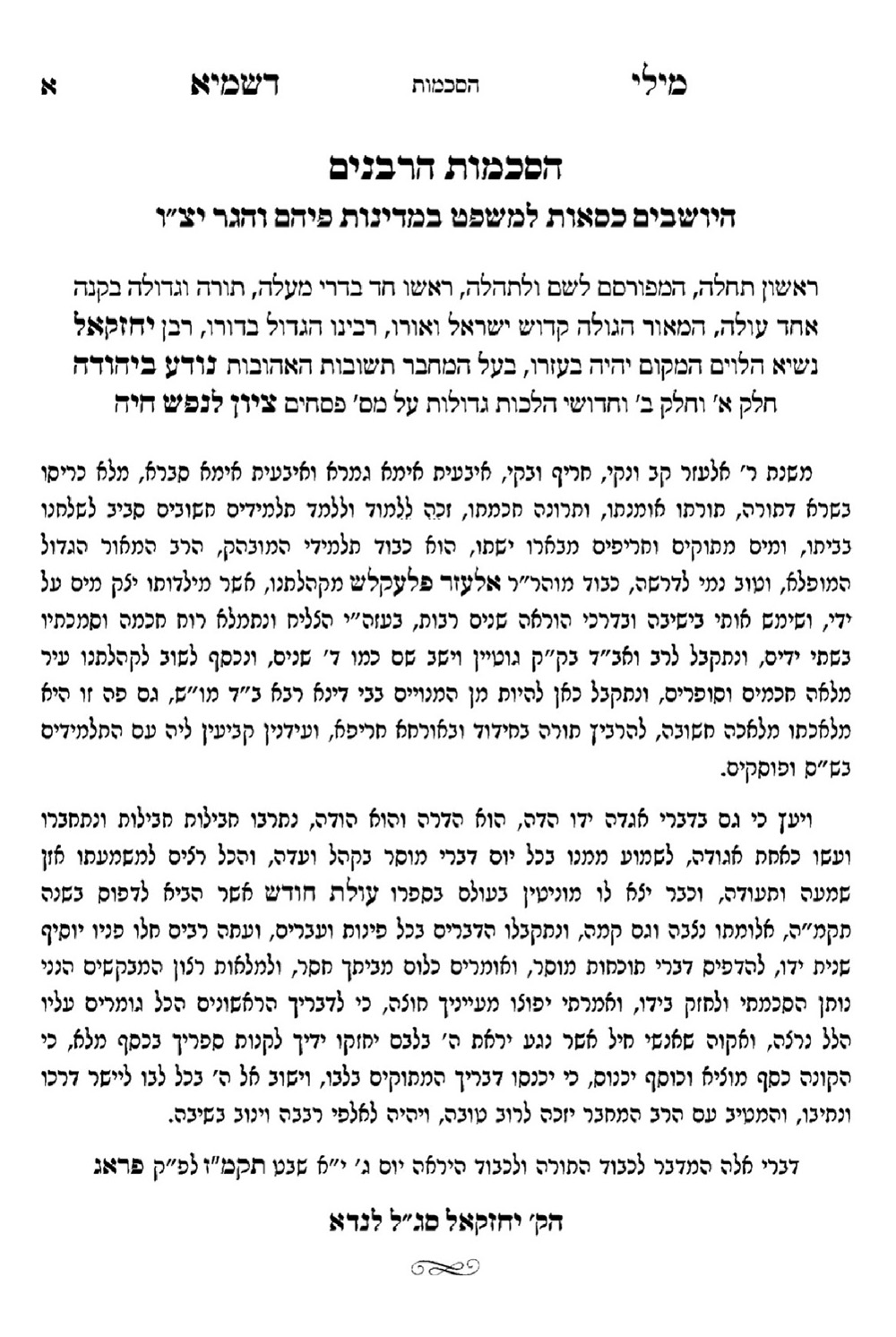
It is worth seeing this haskamah of the Noda Bi Yehuda to Gan Na’ul:

In the introduction to this new work, the editor notes (p. 6) that R’ Fleckeles quotes a letter from R’ Naftali Hertz Wesseley in his Ahavat David and mentions that it has been censored out of some versions, referring to his introduction of the Yeyin Levonon that he printed in 2003 (p. 26).

A few months ago R’ Eleazar Fleckeles’ Ahavat Dovid was reprinted by Mechon Netzach Yakov together with his Olas Chodesh Hasheni (more on this further on). 
However when reprinting the Ahavat Dovid, they censored R’ Naftali Hertz Wesseley’s letter and removed it. They write (p.251) their reasoning for doing so as follows:

בראות רבינו זצ”ל גדול המכשלה שנגרם ע”י לימוד תורת הנסתר ואיך שנמשכו כמה אנשים פשוטים עם ללימוד זה, ומתוך כך נאחזו בסבך כת הפראנקיסטן וירדו להתום, ביקש רבינו לעשות כל פעולה ותחבולה לעוררם ולמונעם מלימוד זה לשם כך יצא מן הקו, ובבחינת עת לעשות ל’ וגו’ העתיק בתחילת הספר מכתב מהמשכיל הנודע לשמצה נ”ה ויצל, מה שכתב בשנת תקנב לאחד מתובי העיר פראג, הגדת עדות מה ששמע בנעוריו מפי אחד מגדולי ישראל המפורסמים מדור הקודש, ליזהר מלימוד בספרי קבלה, ולעסוק אך ורק בנגלות התורה. במשך השנים נשמט מכתב זה מדפוסי ספר ‘אהבת דוד’ וכן ראינו לנכון שלא להעתיקו, כי לפי הנראה לא היתה אלא בתורת הוראת שעה, לעורר ההמון והמתחדשים בעם לבל יומשכו אחר כת הארורה הזאת. וראה עוד בענין זה בקובץ בית אהרן וישראל…”.

Aside from deleting the letter and claiming that R’ Eleazar Fleckeles did not really agree with its contents, they also complete misquote it.

Emes LeYakov

A few weeks ago a work called Emes LeYakov (696 pp.) from R’ Yakov Emden[7] was released by R’ Goldstein of Monroe.[8] It includes all of R’ Emden’s notes and novella on the Zohar[9] from a manuscript in Oxford (R’ Goldstein has shown a while ago that Bick’s edition (printed by Mossad HaRav Kook) of R’ Emden’s notes on the Zohar is worthless).[10] The volume begins with a 140 page introduction of the significance of these notes on the Zohar and the general history of the Zohar and various works and editions.[11]

In passing, R’ Goldstein (p. 20) writes regarding of R’ Naftali Hertz Wesseley’s letter printed by R’ Eleazar Fleckeles.

 בספר אהבת דוד… הביא מכתב מאחד ממשוררי הזמן (שלימים נודע שהוא מראשוני וראשי המשכילים, ואף רבו של רבי אלעזר ה”ה בעל נודע ביהודה זצ”ל, לחם נגדו ונגד דעותיו, והדברים ידועים ואכמ”ל), שכתב שם חי נפשי, כי שמעתי בנעורי מפי הגאון המקובל… הרב מוהר”ר יונתן… כי אין אלו מעיקירי אמונתנו ע”ש ובלי ספק מי שאינו מאמין לו, כי יצאו הדברים האלו מפי הגאון רבי יונתן בוודאי אין בכך כלום, אמנם ראינו חובה להעיר על אלו הדברים מדברי רבנו כאן כי המכחיש קבלת חכמת האמת הוא מין ואפיקורוס גמור’ ודי בזה”.

Basically he claims it’s false and what follows is that R’ Eleazar Fleckeles was mistaken to print this letter.
Shu”t Zecher Yehosef

Another recent work that has a connection to this post is the new two volumes of Shu”t Zecher Yehosef on Yoreh Deah by R’ Yosef Zechariah Stern. Many years ago Mechon Yerushalayim announced that they would be printing R’ Yosef Zechariah Stern’s works still in manuscript. In 1994, they printed the shut on Even Haezer. In 2014 they reprinted his shu”t on Orach Chaim, which had been impossible to find, while also adding in some new material. This summer they released two completely new volumes on Yoreh Deah from manuscript (380+413 pp.) (of course it’s amazing). R’ Yosef Zechariah is the subject of a future post; for now it’s worth mentioning Siman 173, his teshuvah connected to this topic.[12] It’s a slightly different version that the one that appears in the Sdei Chemed:


The editor writes in a footnote: 

ראה קובץ בית אהרן וישראל… ועי’ במבוא לספר יין לבנון מהדורת תשס”ג שהביאו הרבה גדולי עולם שדעתם כדעת רבינו, ויש לפקפק על הערעורים כנגד. אבל אינו ברור מה ידעו עליו בדור שאחר הפולמוס, ועי’ קובץ עץ חיים גליון טו…

I am not sure what that is supposed to mean? That later on we found out he is evil?

Olos Chodesh Sheini

We now return to the new edition of R’ Eleazar Fleckeles’ work. This is the third volume of R’ Eleazar Fleckeles works printed by a Boro Park-based Machon called Netzach Yaakov. When writing about the last volume they printed, I remarked: “I really hope they continue to print the rest of R’ Fleckeles’ works”. B”H, they are doing good job continuing with reissuing his works. This beautifully produced edition includes an introduction about R’ Fleckeles, sources to his words, at times quoting R’ Fleckeles references from his other works, and a detailed index of topics and seforim quoted by R’ Fleckeles at the end of the volume. 

The first part of the sefer is R’ Eleazar Fleckeles Olos Chodesh Sheini.

I would just like to quote a few passages from this beautiful work.

The first point to note about this sefer is the beautiful Haskamah that the Noda Bi-Yehudah wrote:


Elsewhere in the sefer he writes about himself: 

כך אני אומר, אני אחד מסוחרי הקטנים אין לי כל בבית כי את אשר ראיתי במראה יחזקא”ל, מראה נאוה קודש, פנים מאירות להלכה ופנים שוחקות לאגדה, מעט הון תמורת העבודה אשר יגעתי מנעורי ושמשתי מילדותי עד היום הזה, את רבינו גדול הדור רבן של ישראל [מילי דשמיא, עמ’ קעב]. 

The sefer is full of references to material from the Noda Bi-Yehudah, both oral and written.

What apparently was relevant in our day was in his day too:

כאשר בעונינו עד היום, אם המוכיח הוא בעל מעשה, אזן וחקר ותקן משלים, הכל רצין אחריו והכסילים יצאו מבוהלים, אך שהוא למשל ולשנינה, ודבריו לא היה ולא נבראו אלא למשל, ואין מחשבתו כלל לשם שמים, כי מחשבתו ניכרת מתוך המעשה, שמאריך מאד מאד, וחוד חידה, וממשל משל, במעשה הבל, ומעה תעועים, ואינו חפץ כלל להדריכם  בדרך ישרה שיבור לו האדם, להמשל משל אל בית מרי, כי אם תחלת המחשבה על סוף המעשה, לסרס הלכה למעשה, להיות חביב בעיני הבריות, שממשל משלים הוא, משלי שועלים ושעלים הלכו בו, ואמרים קדוש וברוך ומבורך בפי כל משבחים ומפארים מהמעשים אשר לא יעשו ושמו אותו לאדון על כל המעשים. ואיש האלקים אשר מעיו מוכיחין, תוכחות מוסר הכל, גדולים מעי ה’, צדק משפט ומישרים דברים אינם נמעים, וחכמתו בזויה, אפילו אם יושב ודורש כמשה מפי הגבורה [מילי דשמיא, עמ’ לו].

In another derasha he writes:

ולא כן השורים המשוררים. אין כוונתם לשיר ה’ כי אם לשיר חדש. ואינם מדקדקים אם יושר שיר הזה בארץ יהודים. או אם יהיה לצור מכשול כשירת הזונה…. כי אין יראת אלקים במקום הזה ולא אימת רבן… הנה בכל השנה החזנות חזיונות ושעיפי לילה חזון שוא ותפל. מכל שכן בראש השנה ויום הכיפור השתא הלל לא אמרינן. משום שמלך יושב על כסא הדין וספרי חיים וספרי מתים פתוחים כדאמרו ז”ל… וז”ל הרמב”ם בפירוש המשניות שלא היו קורין הלל לא בראש השנה ולא ביום כיפור. לפי שהם ימי עבודה והכנעה ופחד ומורא… ואיך נשיר את שיר הכסילים. כשמסתכל אדם יום המיתה… ואיך להעלות על הדעת שתפלות הללו יעשה רושם למעלה ויעלו חן ויהיו לרצון על מזבח ה’ [עמ’ קיג].

Of course there are numerous parallels[13] to this in other sources; to cite just one, R’ Shabesai Sofer writes in his Siddur:
ויותר מזה צריכים להזהר החזנים בתפלותיהם, הממונים להוציא רבים ידי חובותיהם  … כי על הרוב אינם מקפידים רק על קול נעים… ולא זו בלבד אלא שהם מנגים נגוני נכרים… [הקדמה פרטית סי’ כז].

In another derasha he writes:

לא בשליחי ציבור בלבד רעה זה חולה ראיתי, אלא אף בהתמניות הרבנים יושבי על מדין, מתוועדים בעלי בתים יחד יושבי קרנות, אשר לא יצאו מבית הספר מעולם, ואין להם ידיעות בית רב, ומעידין באיש פלוני שהוא איש האלקים גבר בגוברין, וכדי הוא לסתכל במראה קשת גבורים ללמד בני יהודה קשת, ולאחוז פני כסא הוראה כבוד חכמים מחוכמים, ומקבלים אותו לרב ומורה גדול בזזרוע נטויה וביד חזקה, בלי ידיעות תופשי התורה אשר להם משפט הבחירה, ולא כאשר נהגו אבותינו הקדושים ז”ל שבחורי ישראל הכריעו [עמ’ קטז].

Another derasha, dated during Aseret Yemi Teshuvah 1784, is devoted in part to attacking Mendelsohn’s Biur.[14] In addition, he quotes a piece from the Noda Bi-Yehudah related to this.
Interestingly enough the great bibliographer Ben Yaakov when writing about this work notes:

דרושים שונים נחלק למאמרים ובו דברי ריבות על העתקת התורה להרמבמ”ן [אוצר הספרים, עמ’ 432].


While an examination of all the statements of the Noda Bi-Yehudah about this need to be properly analyzed, it’s worth pointing out to a censorship on this subject. 

In the beginning of his new book, Maoz Kahana[15] writes as follows:

ראשון הביוגרפים של ר’ יחזקאל לנדא היה בנו יעקב. הקונטרס “דברי ידידות”, ששלח לאחיו שמואל לקראת הדפסת ספר נודע ביהודה תנינא בשנת 1810, שבע עשרה שנים אחר פטירת האב, מהווה עד היום אוסף ידיעות ומסורות ראשון ורב ערך. חלק מסוים של דברי ידידות נערך ונדפס בראש הספר הנזכר, וחלקים אחרים שלו נדחו וצונזרו, אותם אפשר להעלות מכתב היד הארוך המקורי של יעקב, מלווה בהערות העריכה של שמואל שנשמר בספריית קרלין סטולין בירושלים. [מהנודע ביהודה לחתם סופר, עמ’ 23].

Further on in his book he writes:

בשנת 1813 הדפיס ייטליס בהערה צדדית בספרו ‘מבוא הלשון ארמית’ דיון אוהד מאוד של הנודע ביהודה בתרגום המנדלנסוני ובהכרעותיו הפרשניות. את הדיון הזה לקח ייטליס ממכתב יעקבקא לנדא שהיה בידי אחיו שמואל בפראג. המכתב המדובר הוא ‘דברי ידידות’…  שכתב ר’ יעקבקא בברודי בשנת 1810, ובו תיעד ביקורו אצל אביו בפראג בשנת תקמ (1780). תארוך העדות האוהדת לשנה זו, סמוך להדפסת ‘עלים לתרופה’ של ה’ביאור’ (1778), אך לפני פרשת וויזל (1782) מאיר יפה את יחסו החיובי של הנוב”י למנדלסון ב’תקופת הביניים’ הקצרה הזו, בין 1778 לבין 1782. כתב היד המדובר נדד לבסוף אל גנזי חסידות קרלין סטולין, ומשם צולם לבית הספרים הלאומי בירושלים בשנות התשעים. אך אותה הסיבה שגרמה למשכיל יהודה ייטליס בשנת 1813 לצטט דווקא את הפסקה הזו מתוך כתב היד הארוך, גרמה למי מהעוסקים במלאכת הצילום כעבור כמאה ושמונים שנים לצנזר בעזרת דף נייר חלק את… אותה הפסקה ממש. ראה י’ ייטליס, מבוא הלשון ארמית, פראג תקע”ג, הקדמה והשווה לכתב יד קרלין-סטולין ירושלים (F49262) מספר 435… הפיסקה לא נכללה גם בדברי ידידות הנדפס… [מהנודע ביהודה לחתם סופר, עמ’ 190-191 הערה 80].

It’s worth mentioning this passage from R’ Ber Oppenheimer describing his reaction to reading the דברי ידידות about the Noda Bi-yehuda, whom he knew:


When examining the manuscript in Hebrew University the first page states:

קונטרס בן ל”ב עמודים שכתב הגאון ר’ יעקבקא סגל לנדא לאחיו הגאון ר’ שמואל סגל לנדא לפני הדפסתו ספר נודע ביהודה מהדורא תנינא והגאון מהר”ש הוציא מכאן את דברי ידידות… יש כאן כמה וכמה דברים שנשמטו בדפוס וכמובן שבכוונה מכוונת השמיטם הגר”ש ביניהם הוא ענין הביאור של רמ”ד.

This following passage is already quoted by Sandler in 1941,[16] and Moshe Samet in 1970.[17] In 1911 this letter was mentioned in the Encyclopedia Otzar Yisroel (p. 62), where the author writes:

 כי כל דברי האגרת הזאת הם מזויפים, כי סגנון הלשון ושבחו של מנדלסון יעידון כי יצא מפי משכיל ולא מפי רב בימים האלה.


It’s silly to say that it was a forgery, as the work has a haskamah from both R’ Shmuel Landau and R’ Eleazar Fleckeles and was printed in their lifetime in their city and there is not a single trace of any protest or opposition on their part.

Now this is even more interesting; R’ Fleckeles, in his work Meleches haKodesh (first printed in 1812), uses Mendelssohn’s Biur for halachic purposes.[18] He also quotes R. Shlomo Dubno in his Tikun Sofrim many times.[19] Most printings of this work are in various editions of Mendelssohn’s Biur. It’s unlikely that he was quoting it from the rare standalone version when it was printed itself without the Biur, if we already know that he used the Biur.[20]
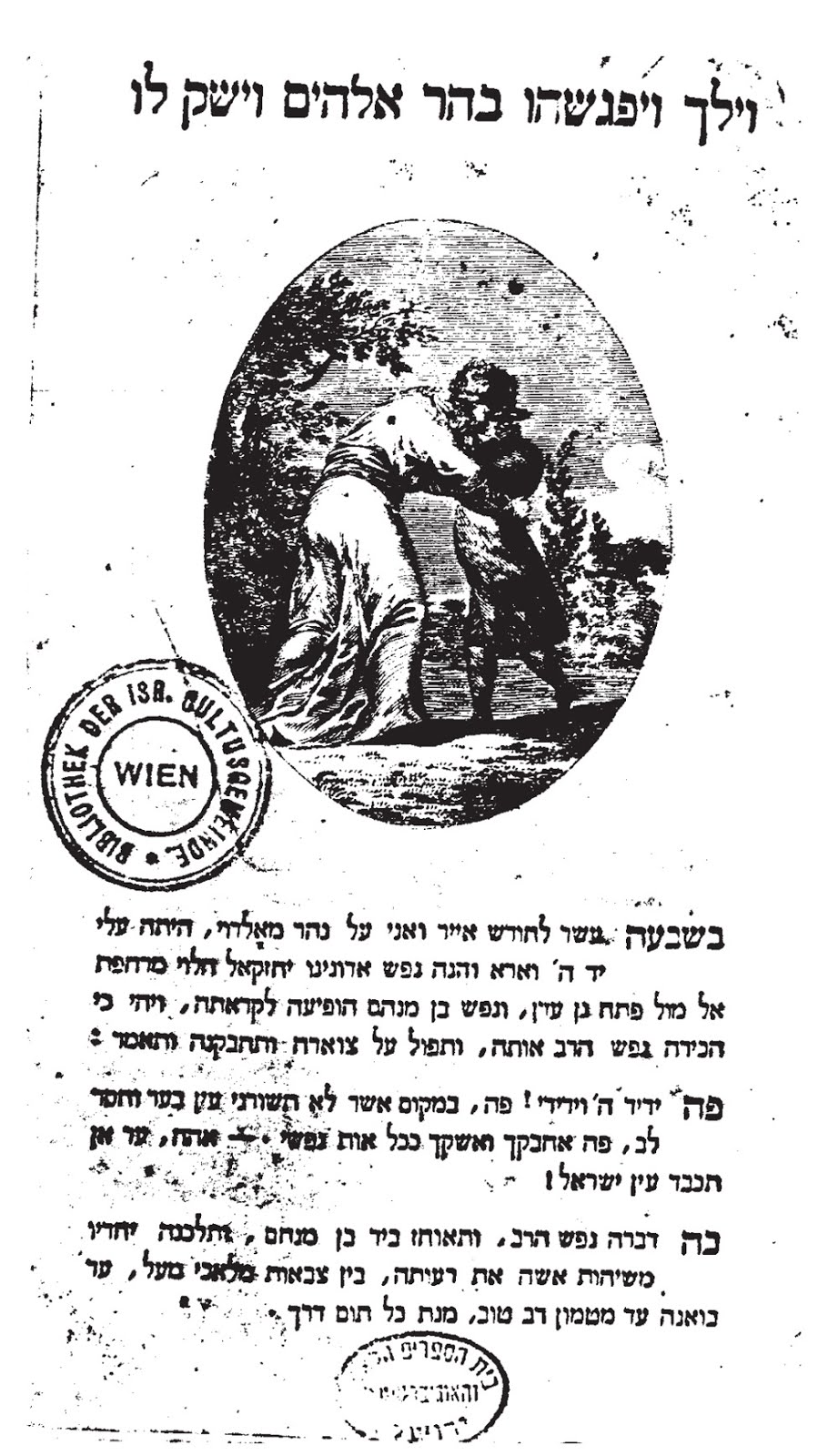
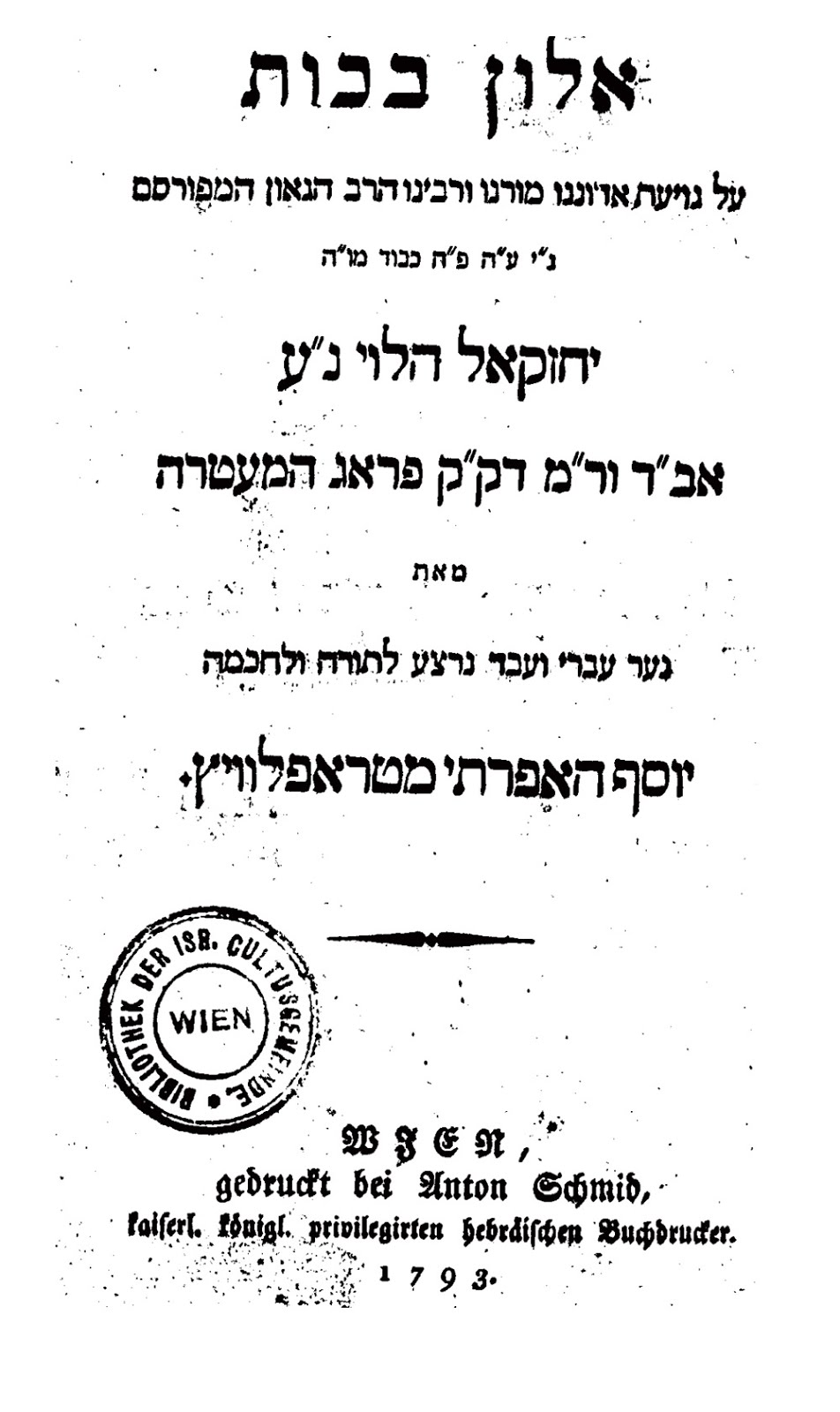
In a work that was printed in 1793, a Hesped on the Noda Bi-Yehudah, we find on the cover it has a picture of Mendelssohn and the Noda Bi-Yehudah embracing. It’s already mentioned here by On the Main Line and more recently by Maoz Kahana (ibid, pp. 192-193).


The truth is, a proper analysis of the primary sources (such as the derasha quoted above) shows that the Noda Bi-Yehudah‘s and R’ Fleckeles’ main issue with Mendelssohn’s Biur was not on the Biur portion[21]; it was on the German translation written by Mendelssohn.
Here are two rare sources[22] which are very important for understanding this subject. The first is an Haskamah signed by both Noda Bi-Yehudah and R’ Fleckeles to a Chumash printed in 1785; as one can see on the Sha’ar there is a direct influence of Mendelssohn on this work. However in the Haskamah they explain why they are giving one – it could compete with Mendelssohn’s edition, as it also translates for the convenience of the reader, but without Mendelssohn’s literary German to which they are opposed.


The second source is a haskamah written by R’ Fleckeles to a Chumash printed Prague in 1824 with a German Translation! Here too, R’ Fleckeles outlines why he is giving it a Haskamah. 

This Haskamah is printed at the end of Silber and Kahana’s above quoted article. They print the Haskamah as it appears in Bereshis, this is the one for the Shemos volume. In the National Library and Mifal Bibliography they only record the volume on Vayikra. But more importantly, they do not note R’ Fleckeles’ Haskamah. This is an uncatalogued haskamah of R’ Fleckeles which helps understand his take on Mendelsohn.[23]

Coffee

Returning to the Olas Chodesh, like other volumes of Derush, this one is rich in giving one a sense of the people and their sins. R’ Y. Greenwald already writes:

פה ושם הזכירו גם בדרשותיהם שדרשו והוכיחו את בני עדתם ולא עצרו מלהגיד את פשעם אשר ראו בהם… הרבה יש ללמוד מהדרשות שדרשו גדולי הדור ממעמד המוסרי של ישראל בימיהם בהדרשות של הגאון רבנו יונתן אייבשיטץ ב’יערות דבש’… וכן תמצא כדברים הללו בספר דורש לציון להג”ר יחזקאל לאנדא… [לפני שתי מאות שנה, עמ’ 26].

Just to list two samples both of which are related to coffee:[24]

בעינינו ראינו ובאזנינו שמענו כמה פעמים שאומרים לגוי להסיק את התנור וכיריים בשבת אפילו אם אין קור כל, כי אם כדי להחם הקאפע [מילי דשמיא, עמ’ קסד]. 

יש כמה אנשים בני בלי שם שאינם עוסקים לא באומנות בורסקי… כי אם יושבים אגודות אגודות מאור הבוקר עד צאת הכוכבים בפונדקאות של גויים, בקאפע הייזר וביר הייזר… ודוברים עתק בגאוה ובוז על מנהיגי עיר ולומדיה, על רבנן ותלמידיהון… [מילי דשמיא, עמ’ קט].

 In another passage he describes Yom Kippur at night:

הרי אפילו בשעה הראוי לכל משכיל לעמוד באימה וביראה בזיע ורחת מפני פחד ה’ ומהדר גאונו, כל אחד מתנשא לומר אני אמלוך ואני אלך בראש אני תהלה, וגברה הקנאה והשנאה הנקימה והטירה וגסות הרוח יתירה, עד שכבתה אש הראשונה שניה ממהרת לבא, כל אחד רודף אחר הכבוד, לכבדו בשיר הכבוד שיר היחוד,[25] להיות מבעלי השיר היוצאים בשיר, ואם אין הגבאי מכבד לאומר שיר היחוד, מחרחר ריב ומדון בשאט נפש וזדון, ומלקין על היחוד, כל אחד נכבד בעיניו ומעשיו גדולים משל חבירו, זה בתורה הנקראית קנין, וזה בחלום ברוב ענין, זה ברוב בנין, וזה ברוב מנין, וכמה קטטת ומריבות רבות מסתעפות עד שנהפוך השיר היחוד לשיר של פגעים, כשיר כסילים פגיעתן רעים, וכה מחלוקות שלא לשם שמים שמענו בליל כל נדרי [מילי דשמיא, עמ’ קמט].

Ahavat David

Turning to the Ahavat David; as mentioned, this work was also just reprinted. In 1799, R’ Eleazar Fleckeles gave a series of three derashos devoted to blasting Sabbateanism and Frankism. In 1800, he printed one of them. He learned much from his Rebbe, the Noda Bi-Yehudah, regarding battling them;[26] in his introduction he writes:

גאון הגאונים בעל שו”ת נודע ביהודה… גם הוא ספר לי מעשים רבים משפטים התועבים מכת ש”צ הרשעה פגיעתן רעה… [אהבת דוד, עמ’ רנז]. 

רבנו גדול העולם. נודע ביהודה, איך היה מוסר נפשו על קדושת השם יתברך לבער הרשעים אשר בחייהם מטמאין טומאת רקב… זכרו נא לימים מה עשה… רבינו… בליל הושענא רבה תקי”ט… כאשר החל השרץ הטמא… והחרים בארור חרם נוי שמתא בתקיעת שופר ובכבוי נרות את יעקב רמאה… וברוב הדרשות אשר דרש במקהלות הזכיר מכת הרשעה הארורה הזאת [אהבת דוד, עמ’ שיז].

The Noda Bi-Yehudah writes:

וצריך אני להראות כי שכלם כוזב.. ותשמע הארץ אם כת הכופרים שבתי צבי שכל דבריהם כפירות ומינות מלא דברי שטות, להפוך דברי אלקים חיים, ולהפוך עבירות למצות עפרא לפומייה… נגד אלו השוטים בעלי ש”ץ ימח שמם נגד טענותיהם המזויפות… [דאיסטים שבתאים ומקובלים בקהלת פראג דרשה מצונזרת של הרב יחזקאל לנדא, תק”ל[27], עמ’ 357].וכת הארורה והגרועה מאוד שבתי צבי [שם, עמ’ 362].

Frankism, in the Derashos Beis Peretz

One more passage related to Frankism, from the Derashot Beis Peretz, a contemporary of the Noda Bi-Yehudah, just printed[28] from manuscript states as follows:

זה רמז גדול אשר קרה לנו באחרית הימים בשנת תקי”ט לפ”ק על ידי המינים האפקורסים ש”ץ ימח זכרם, שהיו עומדין עלינו לכלותינו בפני האומות, שהי’ להם וויכוח גדול בק”ק לבוב עם כל הרבנים של מדינות פולין, יותר מן מאתים של אפקורסים ש”ץ ונעו כולם משומדים עם נשיהם ובניהם, והי’ להם וויכוח בשאלות ותשובות לפני שרים רבים ונכבדים מאומות העולם, ולפני כומרים ובישופים הרבה, והי’ להם ראש אחד ביניהם והי’ ספרדי מכשף גדול בשמות הטומאה… שרצו לבטל תורה שבעל פה, וכבר נשרף על ידם מן האומות הכומרים כל הש”ס ורמב”ם וטורים באמצע בעיר בפני כל עם ועדה, וגזרו שמד בכל הקהלות ישרפו תורה… ומפורסם בכל מידנות פולין שהי’ אז נס גדול ומפורסם, שהכומר השר הגדול שצוה לשרוף הספרים הנ”ל הי’ לו מפלה גדולה תיכף מיד אחר מעשה זאת, ומת מיתה משונה, והי’ מכין אותו ביסורין קשים מן השמים, והי’ צועק קודם מותו שהספרים הנ”ל הם שורפין אותו. ואח”כ כל רשעים הנ”ל נשתמדו, ויצאו מכלל ישראל וכתבתי זאת שיהי’ זכרון בספר כמו מחיית עמלק, למען תספר באזני בנך ובן בנך את הנס שנעשה השי”ת בעתים הללו [בית פרץ, עמ’ תו-תז].

Broadside

R’ Fleckeles writes;

גם פה עיר הגדולה לאלקים, נדפס התפ”ו קול כרוז מגדולי הדור ופרנסי העדה, ונדפס פעם שנית שנה זו ממני ומאחי הרבנים המובהקים המאורות הגדולים בית דין מורה שוה [אהבת דוד, עמ’ רפט].

Here is a facsimile of this actual broadside[29]:

In the beginning of the Drasha, R’ Fleckeles quotes from Frankist literature:

כל השומע ורואה יכול לקרות, את דברי האגרות, יצחק וישחק… בלעגי שפה… כלו מגומגום לא עברי ולא תרגום, לא ספרד ולא צרפת לא אשכנז וריפת ולא מפני יפת לשונם אשר הגו בגרונם, כאחד המונם, במלות מזויפות וטרופות כדבר אחר המבשלות והאופות… ואראה דוגמא ראשית האגרת,… וכן יתר דברי האגרת מהומה ומגערת, מאיימים ומפחידים… [אהבת דוד, עמ’ רנח].

What letter he is referring to? Paweł Maciejko writes that he is referring to the Red Letters.[30] This document was written around 1800. It was printed in Hebrew and English from manuscript by Ben Zion Wacholder, ‘Jacob Frank and the Frankists Hebrew Zoharic Letters’, Hebrew Union College Annual, Vol. 53 (1982), pp. 265-293.[31] Examining this document we see that this is the letter that R’ Fleckeles was quoting as the exact passages appear there. The reason they were called Red documents, writes Maciejko, is “because of the color of the ink that they were written and the symbolic association between the biblical kingdom of Edom and the Hebrew word adom, red”.[32] In one place in the Derasha R’ Fleckeles even writes:

 וכל מה שכותבים הוא בצבע אדום [אהבת דוד, עמ’ שה].[33]

What was the result of this Derasha? Paweł Maciejko writes: 
Shortly after the sermons were delivered, riots erupted in the city, and although Fleckeles did not mention any names, the mob apparently knew very well whom to assault. During the Funeral of a known Sabbatian, a crowd attacked the procession and the body was profaned. It seems that woman were especially targeted: there was turbulence in the female section of one of the Prague synagogues and many of the wives and daughters of known Sabbatians were insulted or attacked on the city’s streets.[34]
When discussing this group he writes:

גם אלה אשר הנשים יושבות ועוסקות אף עמהם, כי שב”י כלהו איתנהו בהו הכל ממירין אחד אנשים ואחד נשים הכל סר יחדו נאלחו בדברי שוא [אהבת דוד, עמ’ רפג]. 

יעקב איש רע מעללים… טף ונשים באים לשמוע קבלת יעקב רמאה, ועוסקים יחדיו במעשה מרכבה טמאה למען ספות הרוחה את הצמאה [שם, עמ’ שכ].[35]

Oral Derasha Versus a Printed One

In this Derasha we find several times that R’ Fleckeles was very graphic while describing the Frankists’s depravities (pp. 257,290, 323-324). I would like to suggest the following: In general, there is a known issue when learning derush seforim; are printed Derashos exact translated versions of the oral original, or were they edited for print? For the most part, I would say this was an actual version of what he said in the oral Derasha he gave. However, orally he was not as explicit, thus the reason why he rushed to print this Drasha almost immediately after he gave it was that it’s easier to write certain things and he wanted to immediately expose how awful they were.[36]
In a similar context (in relation to the word graphic), in 1936 R’ Avrohom DovBer Kahana Shapiro, author of the classic work Dvar Avrohom, gave an incredible Derasha[37] in Yiddish to thousands of woman on the subject of Taharas Hamishpacha. It was then printed in Yiddish with some notes in Hebrew and in 1940 was printed in Hebrew with more notes. A few years ago it was reprinted. In the introduction the editor writes:

כאמור החוברת הזאת היא הרשמה סטינוגרפית, המוסרת בעינם את הדברים הנפלאים כפי שיצאו מפי הנואם הגדול, רק מפני שבמקומות אחדים שבשעת הרצאתו קיצר הרב שליט”א כבר יותר מדי מפני טעמי צניעות מובנים בנוכחותן של אלפי נשים, בקשנוהו למלאות כפי האפשר בהמסר החוברת לדפוס… 

מטעמי צניעות מובנים ומחמת נוכחותו של קהל הנשים הגדול קיצר הרב שליט”א בדבריו שהיו מרומזים מדי. אמנם באשר לכתיבה, המתאפשרת להימסר בהרחבה, נענה לבקשתנו לפרט ולהרחיב…

In the beginning of the Drasha he said:

נושא הרצאתי מעלה בזכרוני את המשנה על הדברים שנקראים ולא מתרגמים נקראים במקורם ולא מתרגמים בשפה המדוברת. בעקב זה נאלץ אני באי אלו מקומות להיות מוגבל בלשוני, לקצר בדברי, לחפש ולברור מלים נאותות ביותר ולהמנע מכמה ביטוים השייכים ישר לענין בכדי לא לפגוע ברגשות ידועים… אמנם כמאור אאלץ באי אלו מקומות לקצר בתכלית ולהסתפק ברמיזה [7-8].

Related to this he writes in the introduction:

החוברת הזאת שלדה ועיקרה הוא הנאום שנשאתי לפני בית יעקב בשפה המדוברת אולם בצאתה פעמיים בדפוס נוספו כמה דברים ובעיקר הערות בפ”ע מתחת לקו עד כי נסבה ורחבה ותשלח בדים וענפים מעל לגבולות נאום עד כי מדת ספר קטן. לזאת יש ממכרי שיעצוני לשנות קצת את סדרה ופניה, פני נאום, לעבדה ולהקציעה ולתת לה פני ספר לאוהבי ומוקירי אלא אענית הבדל עיקרי יש בין ספר לנואם הספר מושגו לשימות איכותית בענין שהוא דן עליו היקף ועיבוד, והנואם הוא בחינת קטע או קטעים מענין הנידון בחינת מקופיא. ובהיות שלא עיבדתי את הדברים עיבוד גמור ובהיות שרובם אינם ממקצועי, לא הייתי חושב להרימם למעלת ספר במובן האמור, לחשבו לדבר שלם ומקיף…


Sefer HaBris

One bibliographical point related to the Drasha can be found where R’ Fleckeles writes:

מצות בטלות לעתיד לבוא[38]… ובעל הברית אשר נאמן בבריתו[39] וקים מאמרי רז”ל נעלם ממנו דברי הרשב”א [אהבת דוד, עמ’ שב]

The new edition does not reference to what he is referring to, but it’s to a passage in R’ Pinchas Hurwitz’s Sefer HaBris, a work which he quotes two more times further on[40] (also not noted in the sources). Here is the passage:


What is more interesting is that he quotes R’ Pinchas Hurowitz’s Sefer Habris three times in a drasha which was delivered in 1799, less than two years after the Sefer Habris was first printed (1797); this shows us that he went through parts of the work right away.[41] This is yet an additional source demonstrating the great popularity Sefer Habris enjoyed even right after it was printed. 

Learning Kabbalah

The cause for this evil movement, writes R’ Fleckeles, was because:

ושורש כל הקלקול הוא בעבור שאינם עוסקים בגמרא ושלחן ערוך רק במדרשי האגדות ובמאמרי זוהר, לחזק בנינים של שוא ותהו [אהבת דוד, עמ’ שו].

In this Derasha he writes out very clearly that one should not learn Kabbalah if one did not yet master other areas of Torah first.

וזה העיקר שיעשה האדם וחי לעולם אם הוא שונה הלכות כדתנא דבי אליהו והובא מגילה… כל השונה הלכות בכל יום מובטח לו שהוא בן עולם הבא, ופירש”י, משנה ברייתא… לא מצינו לא בבבלי, לא בירושלמי, ולא בתנא דבי אליהו, ולא בספרי וספרא ומכילתא, ומדרש רבות, שאליהו בא לבשר כל העוסק בסודי תורה בכל יום הוא בן עולם הבא [אהבת דוד, עמ’ רצב] 

אחי ורעי הנאמנים בבריתי, שמעו ותחי נפשכם, די לנו ולבנינו בתוך הגולה, אם אנו עוסקים לילות כימים, בתלמוד בבלי עם הרי”ף והרמב”ם ותוספות והרא”ש והטור והשלחן ערוך, עם האחרונים הוא תלמוד הקדוש, והעוסקים בו קדושים. וקבלה בידינו מאת גאונים הקדמונים הקדושים אשר בארץ המה, אם משיח ה’ אשר יתגלה כבודו ימינו בקרב, לא יהיה בקי בכל הש”ס עם כל הראשונים והאחרונים, אף שיהיה שלם בכל החכמות הרמות ונשגבות, ברור כשמש שאין זה משיח ה’, אלא מלבד כל המעלות ומדות שמנו חכמים ונביאים, צריך להיות גם כן גדול שבגדולים בגמרא ובפוסקים, וכלל גדול הזה הוא בכל דברי הנביאים והחכמים, והמשכיל יבין [אהבת דוד, עמ’ שח].

This is why the content of the letter from R’ Wesseley quoting R’ Yonasan Eibeschuetz was very important for him to quote at the outset; this is one of the main themes of the work.

Elsewhere in the drasha he writes:

ידעתי שיביאו ראיות, מספרים אשר לא נשנו בי רבי חייא ורבי אועיה, ואף הרי”ף והרמב”ם ורש”י ותוס’ ור”ן והרא”ש לא ידעו מהם, ולאו בעיזקתא דשלמה מלכא, ואף לאו מר בריה רבנא חתים עלייהו, ובפרט כאשר שמענו כן ראינו, הקלקול יותר על השבח המגיע לכתבים, הרבה עסקו בספרים האלה ומצאו מקומות לטעות, ואמרו דיין האמת על שמועות רעות, וקצצו בנטיעות, והמירו טוב ברע, ושמו חשך לאור. אבל מלימוד גמרא ופוסקים, לא יצאה מעולם שום תקלה, ולא מקום לטעות, רק דרכיה דרכי נועם… [אהבת דוד עמ’ רצד].

 A parallel to this might be what the Noda Bi-Yehudah wrote:

אם במה שמקובל בידינו אמרו כלל גדול, כל ברייתא דלא מתניי’ בי’ ר’ חייא ור’ אושעיא לא מתבינן מינה, הרי שחששו שלא נמלטו מן הטעות והשיבוש… וכן בכתבי האר”י לאו האר”י חתים וגם לא תלמידו מהרח”ו רק בחליו של הרח”ו גנבו הכתובים ממנו ונעתקו בלילה א’ כמה מאות ניירות ע”י כמה סופרים הלא קרוב הדבר שנפלו בהם שגיאות רבות ועצומות [דאיסטים שבתאים ומקובלים בקהלת פראג דרשה מצונזרת של הרב יחזקאל לנדא, תק”ל, עמ’ 355].

This topic was very important to him. In the introduction to his shu”t he writes:


About Kabbalistic Kavanos

Related to all this he writes:

ואחרי אשר דיבר בתקיעה של מצוה, אמר תסתירני מסו”ד מרעים, מאנשים המתנשאים בסוד שיח שרפי קודש, ועושין כוונות שוא בתקיעות, וקוצצים בנטיעות, כאשר הארכתי ובארתי קדש זה עשרים שנה, והוא בחיבור עולת ציבור ונכון להביא הדברים פה שניות, והוא כתפוחי זהב במשכיות, אמנם אמרי אחר שהוצאת הדפוס רבה היא, תמכתי עליך אתה ידידי ורעי הקורא, שתשא עיניך שמה, ומצאת את אהבה נפשך [אהבת דוד, עמ’ רעא].[42]

In the Derasha, he referred to what he wrote some twenty years earlier in Olas Chodesh Hashenei, at great length:

אני הגבר ראה ראיתי רבים מתיהדים בסודי סודות הנטועות בתקיעות, בכונות שונות ולשער הפנימית פונות, ונבעו מצפונות. אמנם עקרת הכוונה הנכונה התיכונה, לעשות המצוה כתיקונה על מכונה, שצריך לכוון עליה התוקע והשומע, זו היא לקיים מצות המלך הקדוש, אשר קדשנו במצותיו הקדושות, וצונו זה היום קדוש, תקעו לפני בשופר כי קדוש היום לאדונינו, ושארי כוונות הידועות בסוד התקיעות כולם כלולות בכונה זו, ומינה לא תזוע [מילי דשמיא, עמ’ פב].

Then he continues:

He repeats this again elsewhere in his writings:

אין רצונו לומר כוונות הספירות אלא הכונה נאמנה שלא כתב לשם קדושת השם, אלא כשאר דברים בעלמא והוא פשט פשוט בדעת כל הפוסקים ועם נעמים לא אבוא, ומעולם לא עלה על דעת קדושים הראשונים חכמים וסופרים, לחשוב מחשבות ספירות, כי בימיהם לא ידעו מאומה, מספירות בלי מה, ולדעתי העניה בלב ים הקבלה, קרוב אליך הדבר מאד בפיך ובלבך להטעות, ומה לי ולך אצל דברים הן כבשונו של עולם, ובהדי כבשי רחמנא למה לך מה דמפקדת על פי הגמרא והרי”ף והרמב”ם והרא”ש איבעי לך למיעבד… [מלאכת הקודש, עמ’ קלג].

He concludes this Drasha by bringing the famous Teshuvah of the Maharshal about Kabbalah and some other famous sources and finally two Teshuvos of his Rebbe, the Noda Bi-Yehudah, one of them the famous Teshuvah related to saying Leshem Yichud.  

In my previous post I wrote a bit about Leshem Yichud and I quoted a passage from Sharon Flatto who writes in her ‘The Kabbalistic Culture of Eighteenth Century Prague’: 

Notably a Haggadah was recently discovered that was owned during the late 1780s by Fleckeles…. The margins of this Haggadah contain leshem yihud formulas to be recited before the blessing on the four cups of wine penned in Fleckeles’ hand. 
In the footnote she writes they seem to have been written between 1784-1790. (pp. 225-226). While I wish I had more clearer sources about this discovery. She does not note that the Haggadah that R’ Fleckeles himself printed in Prague in 1818 nor in the manuscript updates of R’ Fleckeles to his own Haggadah does he write to say Leshem Yichud or any such Tefilah in the Haggadah.

I recently received a copy of those margins from the owner of this rare Haggadah.


From the Ari Bergmann Collection (Lawrence, NY) 

I am not sure what R’ Fleckeles held in his younger years but it appears from his later writings that he “held” strongly of this Responsa of the Noda Bi-Yehudah, as he quotes it often – in this Drasha and in his Meleches haKodesh (p. 132). 

Baruch Linda

 At the end of the work R’ Fleckeles writes: 

יעקב הסרחן ועיין ראשית למודים שער ששי מבע”ח הנושכים כו’ סדר הששי סימן כה [אהבת דוד, עמ’ שכט].

 The editors of the new edition do not elaborate which work and passage, are being quoted.

 Here is the sha’ar of the work and the relevant section being referenced.


One source about the author, Baruch Linda, is R’ Matisyahu Strashun, who writes:

וכתב על החכם ברוך לינדא תואר ירא ה’ אשר אמנם כפי הנודע בברלין עיר מגורתו עד יום מותו, חלף חוק ודת ישראל (אף כי לא המיר), שכח מועד ושבת, ובימי זקנותו לא יכול אף קרוא עברית כמעט [מבחר כתבים, עמ’ רמ].[43]

This is yet another source showing how popular this work was at the time. As an aside, this quote shows that R’ Fleckeles was into “interesting seforim,” and I will deal with this in a future post. Another such sefer which he gave a haskamah to and his name is in the Prenumeranten in the 1793 issue of the Igrot Orchos Olam.

Calculating when Moshiach is coming[44]

Worth mention is one final issue that R’ Fleckeles writes a lot against, namely attempting to calculate when Moshiach will come. In the beginning of the derasha he writes that this is one of the purposes of why he wrote it: 

לכן כתבתי דרשות האל לחק ולזכרון בקהל עדת ישורון, למען ידעו עד דור אחרון, ואל ישעו אתכם דברי הרמזים, אף שהם מחורזים בדברי הנביאים והחוזים, ואל תאמינו באומר רזי לי רזי לי ואני חכם הרזים, כי סתומים וחתומים הדברים עד עת קץ הפלאות, אז המשכילים יבינו כל היעודים וכל הנביאות, ועיין רבינו סעדיה גאון ור”י ורבינו אברהם ן’ עזרא סוף דניאל ואחרי ששוטים האלו מביאים ראיות מן הזוהר, ומחשבים קץ הפלאות בנוטריקון וגימטריאות, אף אני אביא ראיות מן הזוהר, כי תועים ומתעתעים ומוגעים, בכל חשבונות ודמיונות וחזיונות, חלומות המדומות [אהבת דוד, עמ’ רנט-רס].

Later on he writes about it at length here is the fascinating section.

R’ Elazar Fleckeles and R’ Yonasan Eibeschuetz

One final point, returning to the letter that R’ Eleazar Fleckeles printed from R’ Wessely quoting R’ Yonasan Eibeschuetz which was discussed in the beginning of this post.
I think that one point that is of some significance is not only that he is quoting a letter from R’ Wessely but that it quotes R’ Yonasan Eibeschuetz. As is well known, the relationship between R’ Yonasan Eibeschuetz and R’ Eleazar Fleckeles’ Rebbe the Noda Bi-Yehudah was “interesting”, as fully documented in Sid Leiman’s special essay When a Rabbi is Accused of Heresy; R. Ezekiel Landau’s Attitude Toward R. Jonathan Eibeschuetz in the Emden Eibeschuetz Controversy. He also refers to his various works in this volume (the Olas Chodesh Hashenei and Ahavat Dovid) with great respect.
ותמה הגאון האמיתי בספרו יערות דבש [מילי שמיא עמ’ קכט]. עיין באורים ותומים סי’ צז [שם, עמ’ קמא]; ומביאו הגאון אהבת יהונתן [שם, עמ’ נב]; וקרוב לזה מצאתי באהבת יהונתן [אהבת דוד, עמ’ רעח].
One last source on this topic is from the work Sicha bein Shnat 5560 UVein 5561 printed in Prague in 1800 written by R’ Baruch Jeiteless[45] another talmid of the Noda Bi-Yehudah which is also a work devoted to fighting Frankisim. 


*Many thanks to Shimon Steinmetz for his help with tracking down some of the Rare sources.
[1] In Milin Havivin volume 5 (available here), p.6.
[2] In Teshuva m’Ahava 1:10 he writes וביאור החכם ר”ה וויזל
[3] On R’ Wesseley see overview from Professor Chaim Shapiro (son of the Dvar Avraham), Safrut Haskalah BeMerkaz Germany (1784-1829), pp.194-246.
[4] There is a typo about the exact source in On the Main line’s post. 
[5] Much has been written on this controversy see M. Samet, Chodosh Assur Min Hatorah, pp. 67-92. But a full scale dissertation on the topic is still lacking.
[6] One other point of interest related to all this: the great Galicianer posek, R. Meshulam Roth, at the request of R. Meir Shapiro towards a new school system, penned a list of works for students to learn. Among the many interesting things he wanted talmidim to read was the Shirei Tiferes! [Printed in back of his R’ M. Roth, Mevaser Ezra on Ibn Ezra p. 176 [=Mevaser VeOmer, p. 120]. This is referring to a poetic work by Wesseley.
[7] All this is part of the recent welcomed flood (by book lovers) of his material, including his Shu”t Sheilos Yaavetz (3 volumes) including a volume of new material, (with some mysterious din torah around it), Meturgeman by R’ Eliyahu Bachur with R’ Emden’s extensive glosses (printed by Mechon Zichron Aharon) and Emunas Chachamim with his notes taken from Mitpachas Sofrim (also printed by Mechon Zichron Aharon). This is aside from various marginalia of his printed in some of the recent volumes of Yeshurun. 
[8] It also includes a new edition of ציצים ופרחים, based upon manuscript (the third edition to come out within the past year). In addition it has the R’ Emden’s marginalia to a few seforim, including: the Meor Eynayim which was printed earlier by him in a journal from Tosh (based on the copy in JTS); Rabbenu Bachaya; Paneach Raza; Marshah Al HaTorah. Worth pointing to is the lengthy discussion about R’ Moshe Kunitz (pp.126-140). To this, see what I wrote in Yeshurun 24, p. 466 and here I hope to return to this in the future.
[9] For an understanding of this work see Moaz Kahana’s forthcoming study. 
[10] Related to this it’s worth pointing to the newest sefer of R’ Meir Mazuz called, MeGedolei Yisrael (534 pp.). This work is a collection of his articles about different Rishonim and Achronim written over the years. There is supposed to be 2 more volumes to this set coming out. In his chapter devoted to R’ Yaakov Emden, he concludes (pp. 149-150) with some comments on the notes of R’ Emden printed by Mossad HaRav Kook and shows that Bick could not read the manuscript, as he already noticed many mistakes while comparing Bick’s transcription to the page of the manuscript Bick included in the beginning of his edition. 
[11] Although this introduction is very useful and brings new material etc. it is very weak on naming the sources that helped him, citing academic sources very infrequently and only by title of book not by name (a common occurrence in such works). 
[12] For recent discussion on this see Yaakov Spiegel, Amudim BeToldos HaSefer HaIvri: BiSharei Hadefus, pp. 164-199.
[13] See Leo Landman, The Cantor: An Historic Perspective.
[14] Parts of this dersaha are quoted in the excellent series of R’ Dovid Kamentsky on R’ Shlomo Dubno in Yeshurun 8 (2001) pp. 740-741; however it appears that a small typo crept in, he writes the drasha is in Olas Chodesh volume one when it’s in volume two.
[15] I hope to return, more in depth, to this special work in the near future. But for now a few words on this work, (full disclosure: the author is a good friend). There are two Gedolim in particular who are considered giants in the world of Halacha and their words carry great weight until today in all circles, the Noda Bi-Yehudah and the Chasam Sofer. This book analyzes many aspects of their rich lives (tying many controversies together and showing how both of them wrote and dealt with them). It’s well written and researched; it includes a fresh look and in-depth analysis of many famous topics and plenty of discussion about new subjects. The author shows a tremendous command of the primary Torah sources, relevant manuscripts and puts down his thoughts clearly and very chronologically. Some fascinating and unknown people are discussed throughout the book. The author did not attempt to deal with everything both of these Gedolim wrote about as that would require a few volumes. He has already completed a few more articles related to these giants. The first edition already sold out, a second edition is due out shortly.

[16] HaBiur LeTorah, p. 204.
[17] HaChadash Asur Min Hatorah,p. 75.
[18] See pp. 4, 52, 88, 91.
[19] See pp. 3,23,25,26,49,56,61,62,66,92,104,111,115,116. These sources are not noted by R’ Dovid Kamenetsky when he writes about the Tikun Sofrim of R’ Dubno in Yeshurun 10, pp. 758-761.
[20] In the actual drasha against the Biur (p. 46) he quotes a discussion about a shem Hashem in HaAzeinu. In his Meleches haKodesh (p. 111) when he talks about this pasuk, he quotes Dubno. See also what R’ Fleckless writes in תשובה מאהבה, א, סי’ א: 

“עיין בהערה לשירת הים מן השלם המפורסים מוה’ שלמה מד”ו רבתי בבאורו לבאר המתורגמן החכם השלם מוהר”ם דאסע”
 The “מתורגמן החכם השלם מוהר”ם דאסע,” is of course Mendelssohn. 

[21] As an aside in a forthcoming auction by Jerusalem of Gold, Auction 11 they are auctioning off numerous editions of the Biur.
[22] Many thanks to Shimon Steinmetz for tracking down copies of these works.
[23] This is not the only item related to R’ Fleckeles that I could not find mention of it in the National Library and Mifal Bibliography. Ben Yaakov records :
יקר החיים, ה”ר אלעזר פלעקיל דרוש הספד על מות שר וגדול ר’ חיים עדלער פאן פאפר פראג תקנ”ה 80 [אוצר הספרים, עמ’ 229].
 However, on Google books (here) one can find this small work.


[24] It’s worth reading the excellent article by Maoz Kahana who puts this in context with a much bigger picture called שבת בבית הקפה של קהילת קודש פראג, ציון, עח:א (תשע”ג) עמ’ 5-50. See also Robert Liberles’ recent book, HaCoffee VeHayihudim.
[25] For recent work on Shir HaYichud, see Chitzei Giborim 9 (2016), pp. 258-277.
[26] For more on this see Maoz Kahana, MeHaNodeh Beyehudah Le Chasam Sofer , pp. 37-60 and his article “The Allure of Forbidden knowledge: The Temptation of Sabbatean Literature for Mainstream Rabbis in the Frankist Moment, 1756-1761”, Jewish Quartely Review 102:4 (2012), pp. 589-616 [available here].
[27] Printed in Kabbalah 21 (2011), available here. See ibid, p. 365.
[28] This work was first printed in 1759 with the author receiving many haskamos, including one from the Noda Bi-Yehudah (although one has to be careful how much to read into it, see Sharon Flatto ‘The Kabbalistic Culture of Eighteenth Century Prague‘, pp. 105-106, 110, 144). In 2014 this work was reprinted with some drashos added from manuscript, one of which contains the passage quoted above. They also added extensive useful notes just focusing on tracking down his sources and included a very through index. They did not mention (or they were not aware) that Avraham Yaari printed this passage I quoted about the Frankist from the manuscript in 1958 in his Mechkarei Sefer (pp. 455-457). This work is disused in the important work of M. Piekarz, BiYemei Zemicha Hachasidus, pp. 86-88.
[29] Jahrbuch der Gesellschaft für Geschichte der Juden in der Čechoslovakischen Republik 9, 1938, after p. 374.
[30] The most recent, updated, academic work on Frankism was written in English by Paweł Maciejko called The Mixed Multitude: Jacob Frank and the Frankist Movement, 1755-1816, Pennsylvania 2011, based on his Ph.D dissertation, The Development of the Frankist Movement in Poland, the Czech Lands and Germany (1755-1816) (Ph.D.), Oxford University, 2003. The work is excellent, well-researched and written, based upon a rereading of all the previously known documents in their original languages and upon many new discoveries. This book has a few pages devoted to of R’ Eleazar Fleckeles’ Ahavat David (pp. 249-251). The book was just translated into Hebrew called Eruv Rav and published by Zalman Shazar. I am not sure why, but some of the material found in his Ph.D about Prague and Frankism (pp. 241-242) does not appear in his book.
[31] See also The Mixed Multitude: Jacob Frank and the Frankist Movement, 1755-1816, pp. 239-241.
[32] Ibid, p. 184.
[33] Moshe Viener notes this passage in Koheles Moshe (p.31) but does not write what it’s referring to. However Eliezer Rosenthal in his Bibliographishes verzeichniss eines grossen theiles, Yodeh Sefer, (p. 293), when writing about this work, does point to a journal where the letter was printed in German. 
[34] Ibid, pp. 250-251.
[35] For discussion of these passages see:  Boaz Huss, KeZohar Harakiah, pp. 275-276; Ada Rapoport-Albert, Chasidim, Shabtos Anoshyim Vnashim, pp. 356-357,359-360.
[36] See Marc Saperstein, Jewish Preaching, pp.  Zev Gries, Hasefer HaIvri Perakyim Letoldosov, pp. 122-165.
[37] I first heard about it when I was 15, when I heard a tape of a derasha by R’ Mordechai Gifter who praised it highly. At the time, I tried tracking it down but had no luck. Later, as a Bochur learning in Eretz Yisroel, I located it in the (then-named) Hebrew University and National Library. It was extremely rare and I had to get special permission to look at it. I was always able to see from reading parts then that it was indeed special and that R’ Gifter was certainly not exaggerating. A few years later I found an original copy of the rare Yiddish version (available here) for next to nothing in a used bookstore. I always dreamed of finding the Hebrew one and reprinting it. However a few years ago someone beat me to it. (See here for a fascinating post related to this). Instead I hope to return to discuss this special work in a future article. 
[38] On this passage of Mitzvos LeAsid see Saul Lieberman, Shekiyin, pp. 80-81.
[39] This is not the only pun on the Sefer HaBris’s title. R’ Moshe Koerner writes:

בעסקי… ברלין… הצדיק התמים הרב המחבר סי’ הברית לפני נגלה כי הוא חברו היו אז מימינים ומשמאלים, והגאון מהרצ”ה זצ”ל אמר בשחוק הוא המכניס והמוציא הברית (בל”א קוואטר כמ”ש בא”ח סי’ תקנא במג”א ס”ק ג ובי”ד ברמ”א סי’ רסה סעי’ יא) [אגרת רשפי קשת, עמ’ 8].

Eliezer Rosenthal in his Bibliographishes verzeichniss eines grossen theiles, Yodeh Sefer, (p.284) quotes this story but does not site his source.
[40] p. 288, 320.
[41] See also David Ruderman, A Best-Selling Hebrew Book of the Modern era: The Book of the Covenant of Pinhas Hurwitz and its Remarkable Legacy, Washington 2104, p. 153.
[42] This new edition is kind enough to bring this piece of the derasha in the footnote. One nitpick; although in the rest of the volume, when he references his other writings or the like this is very useful, here however it is silly to copy five pages that are found earlier in this volume (pp.82-86) – just refer the reader to there. There is a limit to how lazy one would have to be not to turn back and this is a waste of space.
[43] For more about this author and his work see Tal Kogman, HaMaskilim HaMadayim (2013) Magnes Press.
[44] One source on this topic can be found in the Work of R’ Ephrayim Yaboroer, BaKoshrot, printed in Cracow 1607. This fascinating work was extremely rare until a few weeks ago when Mechon Zichron Aharon reprinted it in their massive two volume set called אוצר ממעונות אריות. The passage I am referring to is in volume one, pp. 58-59. These two volumes collect much of the Zemiros, Piutyim and historical works written about Tach Vetat by early Polish and Ashkenazi Rabbonim. It’s full of many rare works and they deserve special thanks for printing these volumes. One correction; in volume one (pp.539-546) they reprinted the rare work Shirei Yehudah, (not presently found on Hebrew Books or Otzar Ha-hochmah] first printed in Amsterdam 1696. However either they used an incomplete edition or something else went wrong as its missing most of this small rare sefer. On this work, see Elisheva Carlebach, ‘Two Amens That Delayed the Redemption: Jewish Messianism and Popular Spirituality in the Post-Sabbatian Century’, Jewish Quarterly Review, New Series, Vol. 82:3/4 (1992), pp.241-261.  
[45] For the updated discussion regarding the authorship of this book, see Paweł Maciejko, The Development of the Frankist Movement in Poland, the Czech Lands and Germany (1755-1816) (Ph.D.), Oxford University, 2003, pp. 241-242. Gershom Scholem wrote on the front page of his copy that the author was R’ Yehudah Jeiteless.  


Altering of Rabbinic Texts?, Shlomo Rechnitz and the Eighth Principle of Faith, R. Yair Hayyim Bacharach, the Ridbaz and “Chemistry,” and R. Yitzhak Barda

Altering of Rabbinic Texts?, Shlomo Rechnitz and the Eighth Principle of Faith, R. Yair Hayyim Bacharach, the Ridbaz and “Chemistry,” and R. Yitzhak Barda
Marc B. Shapiro
1. People continue to send me examples of censorship and altering of texts. If I would discuss all of them, I would have no time for other matters, but I do intend to get to some of these examples. Let me also share an “updating” of a classic rabbinic text that I discovered on my own in the old fashioned way. This is one of those examples that I wish I knew about when I wrote my book. It is not a case of someone in the Orthodox world altering a text, as this example goes back many centuries. Bereshit Rabbah 36:1 states:
ויהיו בני נח היוצאים וגו’: והוא ישקיט ומי ירשיע וגו’ (איוב לד, כט)  דרש ר’ מאיר “והוא ישקיט” מעולמו “יסתר פנים” לעולמו כדיין שמותחין כילה על פניו ואין יודע מה נעשה מבחוץ ]כך אמרו דור המבול (שם כב) “עבים סתר לו ולא יראה [“.א”ל דייך מאיר. אמר להון ומה הוא דכתיב “והוא ישקיט ומי ירשיע” וגו’. אמרו נתן שלוה לדור המבול ומי בא וחייבן.
And the Sons of Noah, that went forth: It is written, When he giveth quietness, who then can condemn, etc. (Job 34:29)? R. Meir interpreted it: He quieteneth Himself from His world, And He hideth His face (ibid.) from His world, like a judge before whom a curtain is spread, so that he does not know what is happening without. [So said the generation of the flood, Thick clouds are a covering to Him, that he seeth not (Job 22:14)] Let that suffice thee, Meir, said they to him. [Soncino: You have said more than enough – heaven forfend that this teaching should be true!] Then what is meant by, When He giveth quietness, who can condemn? he demanded. They replied: Was not ease given to the generation of the flood; who then can condemn them?
The words that I have included in the first brackets are not found in most manuscripts of Bereshit Rabbah consulted by J. Theodor for his critical edition. However, they do appear in Va-Yikra Rabbah 5:1. The words “So said the generation of the flood” are problematic, since if they said the prior sentence, why is Rabbi Meir being rebuked? If you remove those words then the text makes perfect sense, as we see that R. Meir is saying (or is attributing to Job[1]) the notion that God chooses to remove himself from knowledge of and guidance of the world.[2] This is a very radical statement and it is understandable why a later copyist would prefer to attribute such a statement to the generation of the flood, rather than R. Meir. In other words, it appears that the original text of the midrash was altered for theological reasons. 
In its note on the Bereshit Rabbah text, the Soncino translation explains: 
He [God] is unconcerned by what is done in the world and is not incensed by the deeds of the wicked – a remarkable teaching of God’s trancendence. Cur. edd. alter the meaning by adding: so said that generation of the Flood (according to this R. Meir merely puts these words into the mouth of the wicked), Thick clouds are a covering to Him, that He seeth not (Job xxii, 14). But in that case it is difficult to see why his colleagues so sharply rejected this interpretation.
Louis Finkelstein takes note of this midrashic passage and writes:
Even in the school of R. Akiba, we find R. Meir, the sage who so frequently expresses patrician ideas, denying Providence in individual human life. “God,” he says, “is like a judge who spreads a curtain before him and knows not what proceeds without.” The earnest protest of R. Meir’s colleagues against this heresy shows that it was meant seriously, and that R. Meir, in the second century of the Common Era, actually held views akin to those defended by the patricians for six centuries before him.[3]
It is also worth noting that the medieval R. Asher ben Gershom, as part of his defense of the medieval followers of Maimonides, refers to the Bereshit Rabbah passage and his text did not have any reference to the Generation of the Flood. He therefore understands the passage to mean that R. Meir indeed denied God’s providence. He also adds that it appears that R. Meir later rejected this view, although he doesn’t provide any evidence for this assertion. R. Asher contrasts the vehemence of the attacks on the followers of Maimonides with the calmer way the talmudic sages reacted when their colleagues put forth radical views.[4]
ראו מה בין רבותינו וביניכם. הנה להלל באמרו אין משיח לישראל. לא אמרו עליו אלא מריה שרא ליה [!]. ולר’ מאיר בדרשו בבראשית רבה הוא ישקיט בעולמו ויסתר פנים מעולמו כדיין וכו’. והוא דבר גדול בענין השגחת הבורא ית’ עד שנראה שחזר בו. לא אמרו חבריו אלא דייך מאיר.
2. In a previous post I referred to R. Menahem Navarra’s book Issur Kedushah. This book was published together with another book by R. Navarra called Kero Mikra which deals with grammatical points in the liturgy. On pp. 24a-24b he quotes Maimonides’ Eighth Principle of Faith and a passage by Abarbanel in order to reject the notion that the text of the Torah was ever in a confused state and that Ezra corrected the Torah in any way. He understands Maimonides’ principle to be teaching that the Torah text we have today is the exact same that was given to Moses.
שיחוייב כל בעל דת להאמין והוא שהתורה שבידינו היום היא הנתונ’ למשה בהר סיני מבלי חלוף ושנוי כלל . . . ומלתא אגב אורחין קמ”לן כמה יש להחמיר בענין הספרי’ וקריאתם.
The assumption of R. Navarra is also found in, of all places, Shlomo Rechnitz’s famous (or infamous, depending your perspective) speech on the Lakewood school situation.
In this incredibly courageous speech, delivered, as it were, in the lion’s den itself, Rechnitz strongly attacked the phenomenon whereby, he claims, many children in Lakewood are not allowed into the schools that their parents would like them to attend, as their families are not of the right sort. Since he is a major philanthropist, in general Rechnitz is given some leeway in what he says, but in this speech he went over the line and the powers that be responded very strongly, forcing Rechnitz to issue an apology and declare that he will no longer speak about this matter. It was interesting to see all the comments on the different haredi news sites that reported on the Rechnitz speech. The people were overwhelmingly in favor of what Rechnitz said. However, this creates an enormous problem for haredi society, since laypeople, even important wealthy philanthropists, are not the ones to be making communal policy, and certainly not to be criticizing this policy in public. By the leadership’s strong response, and seeing how quickly Rechnitz folded, it sent a clear signal who the bosses really are.
The entire video is of great interest in terms of the sociology of the American haredi community, but I want to call attention to a tangential point made by Rechnitz. At minute 21 he says that he has a difficulty with a formulation of Maimonides in his eighth principle of faith. He also states that he never saw anyone who discusses this difficulty (which I assume means he never read The Limits of Orthodox Theology). 
He begins by saying that Maimonides’ principles of faith are eternal, applying for all time. Thus, the principle that God created the world or that the Messiah will come are things that one must believe in all times. He then says that the eighth principle of faith is difficult since it requires belief that our Torah scrolls are the exact same as the one given to Moses. Rechnitz asks, how can this be a principle of faith? How can there be a guarantee that the text never changed? This is not a question of theology but of historical reality, and how could Maimonides know what would happen in the future? Maybe after recording his principle there would be confusion in the Jewish people, and it would lead to a mistake in the text. Rechnitz quotes the Ani Ma’amin version of the eighth principle and wonders, “How could Chazal [!] possibly make such a statement?” He then says that in the “last few thousand [!] years since that Ani Ma’amin was written” much has happened with the Jewish people, wars, pogroms, ghettoes, etc. So how can we know that there haven’t been any changes in the text? “How can we say with a straight face that the Torah we have in our hands today is letter by letter the exact Torah we received at Har Sinai. And more importantly, how did Chazal know that the Torah would never even slightly deviate ad sof kol ha-doros?” He then says that this is based on a promise from God that the Torah would never be forgotten.[5]
All this is of course incorrect, and I don’t mean to criticize Rechnitz on this account. He is not a scholar and isn’t expected to know these things. Yet what he says is illustrative of the common view of many who have no idea about masoretic matters, and it was precisely this sort of perception that Maimonides created with his formulation of the eighth principle. (In The Limits of Orthodox Theology I offer a suggestion as to why Maimonides put forth a formulation that he knew was inaccurate.)
In response to Rechnitz, and I hope someone shows him this post, let me go over what I wrote here where I cited R. Yosef Reinman who has the same basic misconception as Rechnitz (although unlike Rechnitz, he knows that Yemenite Torah scrolls are not identical to Ashkenazic and Sephardic Torah scrolls). 
Reinman writes as follows in One People, Two Worlds, p. 119:
[A]n examination of Torah scrolls from all over the world, from Ireland to Siberia to isolated Yemen, all handwritten by scribes, yielded just nine instances of one-letter spelling discrepancies. Nine! And none of them affect the meaning of the text. Why is this so? Because every week we take out the scrolls and read them in public. The people follow the reading closely and if something is wrong, they are quick to point it out.
Unfortunately, Reinman  [and Rechnitz] doesn’t realize that it was the invention of printing that unified Torah texts by creating a standard version that soferim could have access to and be guided from (and those who review the parashah each week with Rashi will know that Rashi’s Torah text was not identical to the one we currently have[6]). Printed humashim also enabled people listening to the reading to point out errors. Yet let us not forget that most of the differences in Torah scrolls have concerned male and haser. Contrary to Reinman’s implication in his last sentence, there is no way for the people following the reading to catch such an error.
I must also point out that Reinman’s first sentence is an egregious error, and one doesn’t need to go to Ireland or Siberia to prove this (and contrary to what he states no one has ever performed such an examination). If one simply takes fifty Torah scrolls from Lakewood one will find all sorts of discrepancies. I know this because the people who check sifrei Torah by computer claim that the overwhelming majority of scrolls they check, including those that have been in use for decades, have contained at least one error.[7] In other words, contrary to what Reinman has stated, the truth of Torah does not rise or fall because of scribal errors. If it did, then we would be in big trouble because as I just mentioned, almost every Torah scroll in the world has discrepancies. What Reinman doesn’t seem to get is that while contemporary halakhic authorities are in dispute about only nine letters, this has nothing to do with the quality of actual Torah scrolls, which are obviously subject to human errors by scribes.
3. In my post here I discussed a possibly fictional responsum by the fascinating figure R. Yair Hayyim Bacharach.[8] There is so much of interest in his responsa, but I want to offer one further example. In Havot Yair, no. 136, he mentions that some wicked Jews have become accustomed to bribing non-Jewish judges when they have a case before them, and even brag about this. He also mentions that his brother-in-law, R. Isaac, the rav of Mannheim, had a discussion about this issue with Karl Ludwig I, the Elector Palatine. R. Bacharach actually puts ז”ל after Karl Ludwig’s name. ז”ל is almost never added to the name of a non-Jew and thus shows the positive feelings R. Bacharach had for Karl Ludwig.[9]
והיה הדוכס קאריל לודוויג ז”ל המופלג בחכמה משתעשע לפרקים בגיסי הנזכר בדברי שכליים.
R. Bacharach records that Karl Ludwig once told R. Isaac that has a complaint about the Jews whose cases often come to the government courts. He says that they bribe the judges, an action “which is against all religion, and certainly against what is written in your Torah.” He also told R. Isaac that it was his responsibility to fix this problem.
R. Isaac agreed with Karl Ludwig that bribery of judges is a terrible thing, and he doesn’t deny that Jews have been guilty of this. He adds that even if there is no Torah prohibition to bribe a (non-Jewish) judge, it still needs to be forbidden in order for there to be a properly functioning society.
דאפילו לא נאמר איסורו בתורה ראוי לאסרו מצד השכל וישוב העולם ותיקון המדינה כמו רציחה וגזילה וגניבה ואונאה וזנות ועול מידות, וכלם דברים שהשכל מחייב, ודין ודת חק ומשפט עולה על כלנה שאם יקולקל המשפט איש הישר בעיניו יעזה.
R. Bacharach was not in the room when R. Isaac spoke to Karl Ludwig. It is possible that he is recording the gist of what R. Isaac told him he said, but is it also possible that what are seeing is R. Bacharch’s invention of a conversation, and that R. Bacharach is using the opportunity to put forth his own ideas about the matter?
R. Bacharach then records that R. Isaac told Karl Ludwig that if a Jew is owed money by a non-Jew and the non-Jew denies this, while there can be no permission for the Jew to offer the judge a bribe, from God’s perspective if a bribe was given it is not wrong since the Jew is entitled to the money and the only way he can get it was by bribing the judge. He also said that perhaps the bribe can be seen as evening the scales, since the Jew is afraid that his adversary has also bribed the judge. This argument is intended to show that the Jews of R. Bacharach’s time who bribed non-Jewish judges were really not doing something so bad.
R. Bacharach then says the following (again, supposedly in the name of his brother-in-law), which is just as true today as when he said it: והנה ידוע שאין שנאה כשנאת הדת. He explains that when the Jew and non-Jew come before the judge, the judge naturally inclines to favor his co-religionist. The Jew therefore assumes that the only way he can get a fair trial is by bribing the judge. In other words, he is not bribing him to have the case thrown his way, but only to get a fair trial. R. Bacharach concludes that what he has said should not be seen as a justification of bribery, but as a limud zekhut which explains the circumstances that lead Torah observant people to behave this way.
R. Bacharach tells us that Karl Ludwig liked what R. Isaac said but asked him what about when two Jews are having a court case and they still bribe the judge. In that circumstance there is no reason to think that the judge will favor one side, as neither side shares his religion. R. Bacharach reports how R. Isaac was able to respond properly to this question, but again, is it possible that this is an invention of R. Bacharach in order to enable him to get his ideas across?
After recording the supposed conversation between R. Isaac and Karl Ludwig, R. Bacharach elaborates on the matter of bribery and why there is no explicit Torah prohibition on giving a bribe, only on taking a bribe (Deut. 16:19). In this discussion he notes that he does not think that there is a prohibition to bribe a non-Jewish judge if do not know that you are in the wrong, and thus you are not asking the judge to award you something that doesn’t belong to you by right. He also says that one who offers such a bribe does not make it a quid pro quo that he gives the money and the judge rules in his favor. All he intends by the money is that the judge look carefully at his case and listen to his claims, and then render a just decision. In his description of R. Isaac’s conversation with Karl Ludwig, Bacharach reports that R. Isaac said that he was only offering a limud zekhut for those who bribe judges, but “halilah” to say that this is proper behavior. Here, however, R. Bacharach is saying that there is no prohibition. In other words, in the very same responsum R. Bacharach is showing the difference between an answer motivated by apologetics and one that needn’t be concerned with this.
ולכן בשוחד לשופטיהם אין בו חשש דלפני עיור אם הוא מדיני ממונות, שלא נתברר לבעלי דבר עצמן שחבירו עושה עול רק כל אחד סובר שהדין עמו, וגם השופט דעתו לשפוט צדק, וגם נותן השוחד אינו מתנה שיזכהו רק שיחפש זכותו וישים דברי טענתו אל לבו.
Examining what halakhic authorities say about the matter of bribing non-Jewish judges shows very clearly how at least some Jews regarded themselves as living in a parallel universe from non-Jewish society, and did not feel bound by the rules of the latter society, only by internal Jewish rules. Even though most halakhic authorities assume that it is forbidden to bribe non-Jewish judges,[10] the fact that some think it is permitted is also of great significance in showing that this was not regarded as an obvious matter. Thus, R. Jonathan Eybeschuetz[11] raises the question if one can bribe a non-Jewish judge. He refers to R. Bacharach’s responsum and tells us that R. Bacharach did not come to a conclusion in this matter. He then adds that the “world” has long been accustomed to be lenient in this matter, and R. Eybeschuetz provides a halakhic justification for the bribery, which would only be in a case when the Jew was in the right. 
והעולם נוהגין היתר משנים קדמוניות . . . וצ”ל דס”ל דכל הטעם של שוחד דהוא חד דמקרביה דעתיה גביה וזהו בישראל דקרובים אסורים לדון אבל בבן נח שכל הקרובים מותרים לדון אין לך קירוב יותר מזה והכל יודעין שדעת האב קרוב לבן יותר מאדם אחר שנותנים לו אלף דינרים ומכל מקום האב כשר לדון בנו הבן נח, אף ליתן שוחד להצדיק הצדיק וכו’ מותר דמ”ש מקרובים.
I think it is very likely that despite the halakhic justification provided, the real motivation for any Jewish bribery of non-Jewish judges was the assumption that the judge would not be fair when dealing with Jews as well as a fear that the non-Jewish litigant was also bribing the judge.
R. Abraham Zvi Eisenstadt, Pithei Teshuvah, Yoreh Deah 151:1, states that any bribery is only permissible באופן שאין בו חשש גזל, and even for this permissible bribery, it is only OK if the money is not given directly to the judge but to one of his assistants who will then give it to the judge. See also Pithei Teshuvah, Hoshen Mishpat 9:2, who after citing authorities who disagree with R. Eybeschuetz nevertheless justifies offering bribes when it is obvious that the non-Jewish judge is not going to render a just verdict.
R. Simeon Anolik, in a book published in 1907, states that there is no prohibition of lifnei iver if one bribes a non-Jewish judge, as the non-Jewish legal system is not in accord with Torah law. However, this is only permitted if the intent of the bribe is to arrive at the correct, Torah mandated result .[12]
לא שייך בזה לפני עור מה שנותן שוחד לזכות את הזכאי ולחייב את החייב אם דנו עפ”י חק שלהם. ומש”כ רמב”ן בפ’ וישלח בשם הירושלמי דב”נ מוזהר בלא תקח שוחד היינו בדין שהוא כדיננו. או דמרא דירושלמי הוא ר’ יוחנן ולדידיה מבואר ברמ”א שם [שו”ת הרמ”א סי’ י] דב”נ מחוייב בדינים שחקקו להם כרצונם. אבל לדידן דקי”ל דמצווים על הדינים היינו דינים שלנו שפיר פשט ההיתר מטעם זה.
The words that I have underlined would appear to show that Anolik’s position was widely accepted. 
Regarding bribery, in Between the Yeshiva World and Modern Orthodoxy, p. 35 n. 93, I mention a forthcoming article which will deal with paying off community leaders in order for someone to be given a town rabbinate. After completing the just-mentioned book, my interests moved in different directions, but I do still hope to write that article which will have a lot of material that has never been discussed in scholarly literature. Here is one interesting source from R. Elhanan Wasserman that I only recently found. In Kovetz Shiurim: Bava Batra no. 71, R. Elhanan suggests that if you are the most qualified to serve as a dayan in the community, then there is no prohibition to pay the community leaders to appoint you to the position, and no prohibition for the community leaders to accept this money. I don’t know of anyone else who holds this position which, needless to say, would open up a can of worms, since lots of people think that they are the most qualified. We obviously can’t have a situation where all such people feel that they can pay off the community leaders in order to be appointed to a position. Furthermore, the Rambam makes no distinction of the sort R. Elhanan does, but states flatly that it forbidden for a dayan to give money in order to be appointed. See Mishneh Torah, Hilkhot Sanhedrin 3:9
כל דיין שנתן ממון כדי שיתמנה אסור לעמוד מפניו וציוו חכמים להקל אותו ולזלזל בו. ואמרו חכמים שהטלית שמתעטף בה תהי בעיניך כמרדעת של חמור.
4. In my post here I wrote:
The Ridbaz’s attack on the Brisker method is well known. In the introduction to his responsa, Beit Ridbaz (Jerusalem, 1908), Ridbaz writes as follows:
A certain rabbi invented the “chemical” method of study. Those in the know now refer to it as “chemistry,” but many speak of it as “logic.” This proved to be of great harm to us for it is a foreign spirit from without that they have brought in to the Oral Torah. This is not the Torah delivered to us by Moses from the mouth of the Omnipresent. This method of study has spread among the yeshivah students who still hold a gemara in their hands. In no way does this type of Torah study bring men to purity. From the day this method spread abroad this kind of Torah has had no power to protect its students. . . . It is better to have no rosh yeshivah than to have one who studies with the “chemical” method.
In his ethical will, printed at the end of his responsa, Ridbaz returns to this criticism and directs his sons: “Be careful, and keep far away from the new method of study that has in recent years spread through Lithuania and Zamut. Those knowledgeable in Torah refer to it as ‘chemistry.'” (Just before this post appeared, R. Eliezer Katzman sent word that in his opinion, Ridbaz is not referring to R. Hayyim and the Brisker approach, but rather to Telz and its method of talmudic analysis. I don’t believe this is correct, and hope to return to this subject in a future post.)
In the first edition of Shaul Stampfer’s Ha-Yeshivah ha-Lita’it be-Hithavutah, p. 113 n. 29, he quotes Saul Lieberman’s opinion that Ridbaz’ words were directed against R. Isaac Jacob Reines. This is clearly incorrect. Reines’ method had no influence whatsoever, and Ridbaz is speaking about a method of study that was widespread in the yeshivot. It is obvious that he can only be referring to the method of R. Hayyim. Lieberman’s incorrect speculation was removed in the second edition of Stampfer’s book. . . .[13]
Needless to say, because of his attacks on R. Hayyim, Ridbaz did not endear himself to the Soloveitchik family. Once when a student referred to Ridbaz, R. Joseph B. Soloveitchik became very angry and told the student never to mention his name again. He also said that some gedolim are always right, some are sometimes right, and some are never right, and the Ridbaz falls into the latter category![14]
Thus far what I wrote in my prior post. It is worth noting that Benjamin Brown defends Lieberman’s suggestion that the Ridbaz’s words were directed against Reines.[15] However, as I have written, I see no justification for this. Daniel Price called my attention to Shai Akiva Wosner’s recently published a book on R. Shimon Shkop, Hashivah Mishpatit bi-Yeshivot Lita: Iyunim be-Mishnato shel ha-Rav Shimon Shkop. On p. 32 he refers to my post and rejects my assumption that the Ridbaz was referring to R. Hayyim Soloveitchik. He claims that his negative comments were directed against Telz and its method, a view that as mentioned is also shared by Katzman.
I don’t deny that the Ridbaz could also have had Telz in mind, but this doesn’t change my assumption that the main target of his words was R. Hayyim Soloveitchik. Is there a source that can settle this argument conclusively? I believe there is, but I was not aware of it when I wrote my previous post. In 1935 Moshe Aharon Perlman published his Mi-Pi Dodi. Here is the title page.
This volume records things he heard from his uncle, R. Moses Kliers, the rav of Tiberias. R. Kliers knew the Ridbaz personally, and the information that appears on p. 35 is obviously of great importance to what we have been discussing: 
מסדר למוד הבריסקאי לא היתה דעתו נוחה וקרא לו חימיא
In other words, R. Kliers told Pearlman that the Ridbaz opposed the Brisker approach and referred to it as “chemistry”. This source is more significant than any speculation by contemporary scholars.
There is a good deal in Mi-Pi Dodi that I think readers will find of interest, but for now I will just mention one example.
P. 25. R. Kliers said that all manner of dress worn by the Slobodka students can be justified, but what can’t be justified is the forelock of hair that the students had. 
(In Changing the Immutable, p. 268 n. 156, I cited a fascinating passage from Mi-Pi Dodi, pp. 9-10, showing that R. Kliers thought that it was better for people to carry on a particular Shabbat and violate a rabbinic commandment rather than learning that a rabbi had made a mistake in setting up the eruv, and thus come to lose respect for him which would violate a Torah commandment. The eruv could be fixed after Shabbat, but the negative effect on the rabbi’s reputation would remain.[16])
5. In my last post I referred to R. Yitzhak Barda and his book Kinyan Torah which argues that Maimonides’ view is binding, even if this means rejecting the Shulhan Arukh. Here is the title page of Kinyan Torah, vol. 3. 

At least one reader was wondering if R. Barda is Yemenite. He is not, and his view granting final authority to the Mishneh Torah is unique among Sephardic authorities. R. Barda is in charge of a group of Torah institutions in Ashkelon called Yitzhak Yeranen. He is also the brother-in-law of R. Meir Mazuz and often appears together with him at events. Here is a picture of them during the last Israeli elections.

Halakhic authorities have had different perspectives on how to relate to newly discovered manuscripts that contain halakhic rulings. The Hazon Ish did not pay these texts much mind, not regarding them as having been part of the halakhic tradition. Most halakhic authorities, on the other hand, had a more positive opinion of such newly published texts. However, even those who welcomed the newly published texts and integrated them into the halakhic system generally agreed that halakhot that that were recorded in the Shulhan Arukh and were thus generally accepted could not be rejected based on a newly published text.[17] That is one reason why the 2014 appearance of R. Yitzhak Barda’s tenth volume of responsa Yitzhak Yeranen is of interest, as in this volume one finds that the author indeed rejects a universally accepted halakhah.[18]

The question R. Barda deals with is whether one can bake or cook on the first day of Yom Tov for the second day (and his conclusion would apply to other relevant matters, such as setting the table on one day for the next). This would appear to be an easy question to answer, as the Talmud, Betzah 17a, states: “Our Rabbis taught: One may not bake on the first day of a festival for the second.” This halakhah is recorded in Shulhan Arukh, Orah Hayyim 503:1. One might think that this would be the end of the matter, and for centuries it was. However, R. Barda has reopened the discussion. According to him, it is permitted to bake or cook on the first day of Yom Tov for the next day. How does he arrive at such a decision, one at odds with the Shulhan Arukh?
R. Barda begins by pointing out that R. Hananel records a different version of the talmudic text. In his version, the Talmud states that it is forbidden to bake on Yom Tov for Shabbat or for after the holiday, but it says nothing about baking from the first day of Yom Tov for the next next day. R. Isaac Alfasi, R. Asher ben Jehiel, and other geonic and medieval sources also have the version recorded by R. Hananel.[19] Not noted by R. Barda, but certainly a support for his position, is that the Tosefta and Jerusalem Talmud also have nothing about baking on the first day of Yom Tov for the next day.[20]
R. Barda further points out that Maimonides must also not have had our version of the talmudic text, since in the Mishneh Torah all he says is that on Yom Tov one may not bake or cook anything that will be eaten after the holiday.[21] He says nothing about not baking or cooking on the first day of Yom Tov for the next day. Also important for R. Barda’s case is that Maimonides, Mishneh TorahHilkhot Shevitat Yom Tov 6:14, states that the observance of the second day of Yom Tov is not on account of doubt, but is a minhag. What this means is that it is not a question of maybe the second day not really being a Yom Tov, in which case one could understand the prohibition of baking or cooking on the first day for the second. I would only add that R. Barda’s point also works if you adopt Maimonides’ other formulation that Yom Tov Sheni is an actual decree of the Sages.[22] In either case, the second day is treated like Yom Tov no different than the first day, and thus R. Barda states that there is no reason why one cannot bake or cook on the first day for the second. As for Rosh ha-Shanah, he tells us that the two days of this holiday are regarded by the Talmud as one long day,[23] and therefore there is even more reason for it to be permitted to bake on the first day for the second.
R. Joseph Karo, in the introduction to the Beit Yosef of which the Shulhan Arukh is an abridgment, tells us that he is going to decide the halakhah based on the three central authorities, R. Isaac Alfasi, Maimonides, and R. Asher ben Jehiel. As R. Barda points out, in the case we have been discussing, none of these three authorities state that it is forbidden to bake or cook from one day of Yom Tov to the next, and yet the Shulhan Arukh does forbid this. 
R. Barda notes that there are medieval authorities who record the prohibition, most prominently R. Jacob ben Asher, Tur, Orah Hayyim 503. Prior to this, Halakhot Pesukot[24] and Halakhot Gedolot[25] also record this prohibition, even though according to R. Barda their version of the Talmud did not state that it is forbidden to bake on the first day of Yom Tov for the next day, only that it is forbidden to bake on Yom Tov for after the holiday. In other words, even though baking or cooking on the first day of Yom Tov for the next day is forbidden by Halakhot Pesukot and Halakhot Gedolot, this is an original deduction made by these authorities, not a recording of earlier talmudic halakhah. (Actually, it would have made more sense for R. Barda to say that the rulings in Halakhot Pesukot and Halakhot Gedolot originated in an earlier source.) Yet the stringent position codified by these two sources and later by R. Jacob ben Asher and other rishonim is not determinative for R. Barda, since as mentioned this halakhah does not appear in the more important sources, namely, R. Isaac Alfasi, Maimonides, and R. Asher ben Jehiel (R. Jacob ben Asher’s father).
Readers might be convinced by R. Barda’s argument that R. Isaac Alfasi, Maimonides, and R. Asher ben Jehiel did not view it as forbidden to bake or cook on the first day of Yom Tov for the next day. But this still does not mean that it should be permitted today, for as we have seen the Shulhan Arukh forbids this action. R. Barda’s assumption is that R. Joseph Karo’s text of the Talmud was not pristine, but as with our version had incorporated the addition of the Halakhot Pesukot and Halakhot Gedolot, forbidding baking on the first day of Yom Tov for the next day. Since the Shulhan Arukh’s ruling is based on an error, namely, R. Karo’s false assumption that the Talmud forbids baking or cooking on the first day of Tom Tov for the next day, R. Barda declares that one need not accept the Shulhan Arukh’s ruling. (This statement is directed towards the Sephardic community as a whole, which follows the Shulhan Arukh. R. Barda personally follows Rambam, and since the Rambam does not record the prohibition, that alone is enough for him to permit baking and cooking on the first day of Yom Tov for the second day.)
R. Barda further states that had R. Joseph Karo known what has been mentioned so far, he, too, would have decided differently. He adds that to refrain from baking or cooking on the first day of Yom Tov for the next day takes away from some of the joy of Yom Tov, as it makes it more difficult to prepare food for the second day of the holiday.[26] He also calls attention to a responsum of R. Isaac Bar Sheshet from which we see that there were people who indeed baked and cooked on the first day of Yom Tov for the second day. (R. Isaac Bar Sheshet himself states that this is forbidden.[27])
After many pages of justification of his ruling, R. Barda publishes two letters he received from R. Serayah Deblitzky in which the latter takes issue with what R. Barda wrote. R. Deblitzky begins by stating that it is an absolute principle that a halakhah that has been accepted among all of Jewry cannot be overturned due to the discovery of new manuscripts or based on the fact that important earlier authorities did not record this particular halakhah. He further notes that R. Jacob ben Asher did forbid baking and cooking on the first day of Yom Tov for the next day, even though his father, R. Asher ben Jehiel, did not mention this prohibition. R. Deblitzsky does not think it is reasonable that R. Judah would disagree with his father in this matter, and assumes that R. Asher ben Jehiel’s omission of the halakhah does not imply that he had a more liberal perspective.

[1] See Mordechai Margaliyot’s note in his edition of Va-Yikra Rabbah, ad loc.
[2] Malbim, Deut. 13:7 (p. 87a) cites the Midrash without the words כך אמרו דור המבול. Yet as far as I can determine, every printed edition of the Midrash has these words. Does this mean that the Malbim independently concluded that the words should be deleted?
[3] The Pharisees (Philadelphia, 1938), p. 260.
[4] The text is published in Joseph Shatzmiller, “Les tossafistes et la premiere controverse maïmonidienne: le témoignage du rabbin Asher ben Gershom,” in Gilbert Dahan, et al., eds., Rashi et la culture juive en France du Nord au moyen âge (Paris, 1997), p. 67.
[5] Rechnitz also says that the Torah cannot be changed, “no Reform, no Modern Orthodoxy.” Does Rechnitz really feel that Modern Orthodoxy is akin to Reform? Or was this comment strategic? In other words, since he is attacking a widespread practice in Lakewood, he has to show them that despite the attack he is still on the “right” side, and the way to do this is by slandering Modern Orthodoxy.
[6] See Rashi to Ex. 25:22. Even the ArtScroll-Sapirstein Rashi translation is forced to admit: “Rashi’s Sefer Torah evidently had a ו where ours does not.” Siftei Hakhamim writes:
 אע”פ שאין כתיב ואת בוא”ו בס”ת של רש”י היה כתוב בוא”ו.
See also Rashi to Gen. 25:6. Artscroll writes: “Rashi’s text of the Torah had the spelling פילגשים, without the letter י of the ים suffix which indicates the plural.”
[7] For the information on errors in Torah scrolls, including eye-opening pictures, see Kolmos, Elul 5748. Here is part of R. Shmuel Wosner’s letter quoted on p. 7:

עכשיו שנכנס עבודת הקאמפיוטער בזה למסלולו, ונתברר על ידו לתמהון לבב כולנו, שמבערך ששים ספרים, ס”ת שהיו בחזקת בדוקים יצאו רק תשע ספרים נקיים מכל שגיאה וברובא דמינכר מאד נמצאו שגיאות פוסלות לרוב. וכן בדידן הוי עובדא בס”ת שנכתב ע”ש תלמידים גדולים וצדיקים שנספו בעו”ה, נמצאו ה’ טעיות ממש בחסר ויתר.

[8] I am inclined to see the responsum’s description of a storybook romance as fictional, and I think there might be other fictional responsa in Havot Yair. None of this can be proven, and it is just a sense I have that some of the questions were created by R. Bacharach in order to establish halakhic principles. I think this might be the case with no. 183 where he discusses a man confronted with a choice to drink non-kosher wine or have his ear cut off. See also no. 79 regarding a convert to Judaism, if he needs to return money he stole from Jews and non-Jews before he converted.
[9] In no. 139 R. Bacharach mentions the hillul ha-shem that results when a Jew is a thief, as the non-Jews blame the entire Jewish community for his actions. Yet R. Bacharach adds that it is only the masses who have this feeling, while the wise people and the government leaders don’t engage in such stereotyping.
ואף כי יש חילול השם באשר הגוים מרשיעים על כלל יהדות בשביל כך, אין אלו רק דברי המון עם ולא חכמים שבהם ושלטונים.

[10] See R. Asher Weiss, Minhat Asher, vol. 1, no. 92.
[11] Urim ve-Tumim, Hilkhot Dayanim 9:1.
[12] Orah Mishpat (Petrokov, 1907), p. 17a.
[13] [See p. 124, n. 30, where Stampfer quotes Prof. Chimen Abramsky, a descendant of the Ridbaz, that in the family it is accepted that the Ridbaz was referring to R. Hayyim.]
[14] I heard this from an eyewitness. The event took place in the 1950s.
[15] Ha-Hazon Ish  (Jerusalem, 2011), p. 321 n. 44.
[16] See also Shabbetai Dov Rosenthal, Geon ha-Hora’ah (Jerusalem, 2011), vol. 2, pp. 186-187, for two similar cases with R. Samuel Salant and R. Zvi Pesah Frank.
[17] However, what should a posek do if it is clear that a halakhah in the Shulhan Arukh is based on a mistaken text? R. Jehiel Jacob Weinberg was unsure. See Kitvei ha-Gaon Rabbi Yehiel Yaakov Weinberg, vol. 2, p. 433:
הוכחתי שהב”י השתמש בכת”י מקולקלים וע”י נדחק לפרש ולהסיק הלכה מנוסחאות של ספרי ראשונים שהי’ בהם השמטות בשגיאת סופרים – השאלה היא אם להניח הכל כמו שהוא ורק להסביר ולנסח בלשון ובהגיון מתקבלים על הלב, או לשוב למקורות הראשונים ולחקור ולבדוק הכל מחדש.
[18] We will be focusing on nos. 20-24, where R. Barda explains his position and defends it against criticism. Here is the title page of Yitzhak Yeranen, vol. 11, R. Barda’s most recent volume of responsa.

[19] R. Barda mistakenly states that the Munich manuscript of the Talmud is also missing the words מיו”ט לחברו. This error does not affect his argument, as the Munich manuscript is from the 14th century and R. Barda acknowledges, p. 262, that there were medieval texts of the Talmud that had מיו”ט לחברו. Yet he believes that these words are not original but were inserted based on what appears in the Halakhot Gedolot (which I will soon discuss).
[20] See Saul Lieberman, Tosefta ki-Feshutah, Beitzah, p. 947.
[21] See Mishneh Torah, Hilkhot Shevitat Yom Tov, ch. 6.
[22] See my Studies in Maimonides and His Interpreters (Scranton, 2008), p. 59.
[23] See Beitzah 4b-5a.
[24] Halakhot Pesukot (Versailles, 1886), p. 8. Since I am sure some will be skeptical that a sefer was ever printed in Versailles, here is the title page.

[25] Halakhot Gedolot, Makhon Yerushalayim ed. (Jerusalem, 1992), Hilkhot Yom Tov, p. 215.
[26] See Yitzhak Yeranen, p. 263.
[27] She’elot u-Teshuvot ha-Rivash, no. 254. See also ibid., no. 16.


Az Yashir, Another Kabalah Custom Gone Wrong?

One of the most common and troublesome customs based upon kabalah is the addition of verses and targum to אז ישיר.

Everyday, at the end of pesuki de’zimra we recite az yashir. However, we for one, don’t start at the beginning of the shira. The beginning is at the verse that starts ויהי באשמורות הבוקר we begin at the אז ישיר. Secondly, we don’t end at the end of the shira either. Instead, we add either 4 or 6 verses at the end.

The threshold question is why was this change effected? Rashi, R. Shlomo Yitzhaki (1040-1105) in his Sefer haPardes (p. 321) explains, “Whenever we finish anything we end by reciting the verse twice [the end of tehillim, for example] for this reason we double the verse of ה’ ימלוך the reason being that really the entire parsha of the shira that is, from ויהי באשמורות הבקר has 18 mentions of gods name. Every name has 4 letters thus forming the 72 letter name of god. The רשאונים, the early ones, enacted that we recite the shira everyday to remember this great miracle . However, we only recite the important or ikar portion thus we start from az yashir. We are therefore lacking 4 mentions of gods name. Therefore we repeat the verse twice and add the four verses afterwards. The last verse’s mention of God’s name does not count as it is future tense.” Thus, according to this passage, we now understand why it is we add the four verses at the end and repeat the verse and why we left out the first four verses. There are many other rishonim that offer similar explanations for this.[1]

Importantly, according to Rashi, the end of the Shira is at ה’ ימלוך thus he repeats that verse. It is also clear that he did not say the verse that follows, כי בא סוס as a) he would not have repeated ה’ ימלוך as it would not have been the end and b) because there is a mention of God’s name in that verse and thus we would have too many mentions and therefore we lose the numerology as we do not get the 72 letter name.

The many רשונים follow this understand and thus end the שירה and the daily recitation of אז ישיר at ה’ ימלוך. In fact, early Ashkenazi Siddurim all end at ה’ ימלוך. For example, the earliest printed siddur in Prague, 1513 does that. As does the סידור of R. Shabbti Sofer, first published in the mid-16th century, who was considered the סידור for his time, has the same reading.[2] The Rama, R. Moshe Isserles (1525-1572) in his מפה also cites the custom of repeating ה’ ימלוך. Thus, up until the late 16th century we were only repeating ה’ ימלוך and not saying כי בא. However, two people changed that. The first was the ארי”זל and the second was R. Yakkov Emden. The R. Avrahom Gombiner (1635-1682), in his commentary the מגן אברהם, (who cites numerous customs from the ארי), on the comments of the רמ”א previously mentioned, states that the ארי said the verse of כי בא after he repeated ה’ ימלוך. R. Gombiner does not offer any explanation as to why theארי did so. However, R. Shmuel Kelin (1720-1806), in his מחצית השקל a super-commentary on the מגן אברהם, does offer an explanation. Before we look at his explanation we need to look at one other source for proper background.

The רמב”ן in his commentary on the Torah on the verse of כי בא, notes that although some hold that כי בא is part of the שירה he holds it is not.[3] Some may be questioning why this all matters. However, it is actually quite important. The rule is that in order for a ספר תורה to be כשר the שירה portion must be written in a specific manner. That is called ריח על גבי לבינה or as brickwork. One writes words then leaves a space and then directly underneath that space one writes the next line and so forth. Thus, according to Rashi, and those other cited by רמב”ן one cannot write the verse of כי בא in the שירה format. And according to רמב”ן one MUST write it in the שירה format.

It would appear that in deciding whether to say or not to say כי בא would depend on how our ספר תורה is written.

Getting back to the מחיצת השקל, he argues this very point. He states that the reason that the מגן אברהם and the ארי said to recite כי בא is for the sake of consistency as in our ספרי תורה we include it in the שירה4 However, there is a difficulty with this position or understanding of both the מגן אברהם and the ארי. As both are still advocating repeating ה’ ימלוך but also saying כי בא which as we discussed disrupts the numerology and also, if you include כי בא, it makes little sense in repeating ה’ ימלוך as it is no longer the end. Because of these questions some commentators note that R. Hayyim Yosef David Azulai (HIDA), the well-known bibliographer, stated that many statements attributed to the ארי are not actually from the ארי. These commentators claim that this is one of those statements that can not be relied upon.[5]

R. Yakov Emden (1698-1776) published his own edition of the siddur. This siddur included both a commentary and notes on the נוסח. 6 He had many alteration in the נוסח. However, his commentary became very popular and was reprinted numerous times. But in these reprints instead of using his נוסח they would put his commentary and notes on the bottom of a regular סידור 7 Thus, one could read in the bottom “don’t say such and such” and on the top you would have that very thing. In regards to the אז ישיר issue, R. Emden notes that his father, the חכם צבי, only said ה’ ימלוך once and he included כי בא as because that is how it appears in our תורה. This, of course, works with the numerology, the מסורה, and the correct ending of the שירה. [In the new edition of R. Emden’s siddur which was supposed to utilize his נוסח and correct all the years of neglect, does not correct his error, nor many others. Instead it includes the double recitation and the תרגום and כי בא.]

In truth, it was not clear how we should write our תורה. For instance, the noted Mesora scholar and משומד– Jewish convert to Christianity, Christian David Ginsburg in his edition of the Tanach which is based upon over 70 manuscripts and 19 of the earliest printed editions does not include כי בא. In fact, numerous manuscripts, mainly of Italian or Sefardic origin, which as a side note are generally not considered מידויק , have only up to ה’ ימלוך. For us, however, the Rambam includes כי בא in the שירה. Furthermore, the oldest complete and מדויק manuscript, the Leningrad Codex which is very similar to the Allepo Codex which the Rambam based his תורה on has כי בא as part of the שירה.8

For us, as is apparent by looking at any תורה today, we all include כי בא as part of the שירה thus, if we wanted to be consistent we would only say ה’ ימלוך once and include כי בא.

In conclusion, the purpose of this was not for anyone to change what their current custom may be, as has been demonstrated there is authority for all practices. Instead, I think that this discussion is demonstrative of how complex and nuanced the תפילות are. If this one verse has so much behind it, there are treasure troves of complexity throughout the סידור.

Sources:

1] See e.g. from the school of Rashi, Machzor Vitri, 2004, p. 10; see also אבודרהם , אורחת חיים.

[2 See also סדור תפילות כמנחג אשכנז, Hanover, 1616; סדר תפילות לכל השנה כמנהג אשכנז ופולין, Frankfort 1691 available at http://www.jnul.huji.ac.il/dl/books/html/bk_all.htm

3] The Ibn Ezra and Rasbam hold that is part and the Ramban and Rashi hold it is not.

4] R. Kelin argues that if one wants to repeat any verse, according to the Ari, one should repeat the verse of כי בא as that is the end.

5] For more on the Ari’s writings and the transmission of those writings, see R. Hillel, כתבוני לדורות.

[6 This was published in 1745-1747.

7] This edition was known as סידור בית יעקב, the original was called עמודי שמים.

[8 Although, there is some discrepancy on this point in the manuscripts of the Rambam. That is, the manuscripts mainly from אשכנז do not include כי בא which would be in agreement with Rashi and the Ramban. However, many of the Rambam’s manuscripts do include כי בא, especially of note is the signed copy of the יד which includes it. See Jordan Penkower, עדות חדש בנוסח כתר ארם צובא chapter 3.


Rabbi Joseph Hertz, Women and Mitzvot, Antoninus, the New RCA Siddur, and Rabbis who Apostatized, Part 1

Rabbi Joseph Hertz, Women and Mitzvot, Antoninus, the New RCA Siddur, and Rabbis who Apostatized, Part 1

Marc B. Shapiro

1. In my last post here, in discussing R. Joseph Hertz’s suggested alternative text for Maoz Tzur, I wrote that this suggestion “was simply made up by Hertz or perhaps suggested by an unnamed collaborator on his siddur commentary.” At least one person wondered if I had anything in mind when I wrote about “an unnamed collaborator.” Indeed, these words were chosen deliberately. I do not know anything specifically about collaborators on the siddur commentary. However, we do know about the collaborators on his famous Torah commentary. This Chumash used to be found in every Modern Orthodox synagogue, and now, just like the Birnbaum siddur, it is missing from most of these synagogues.[1]

When it comes to what I will describe about the Hertz Chumash, it is possible that we are dealing with a great injustice. At the very least, it was a great misunderstanding between Hertz and his collaborators. Here are the Hebrew and English title pages of the Hertz Chumash.
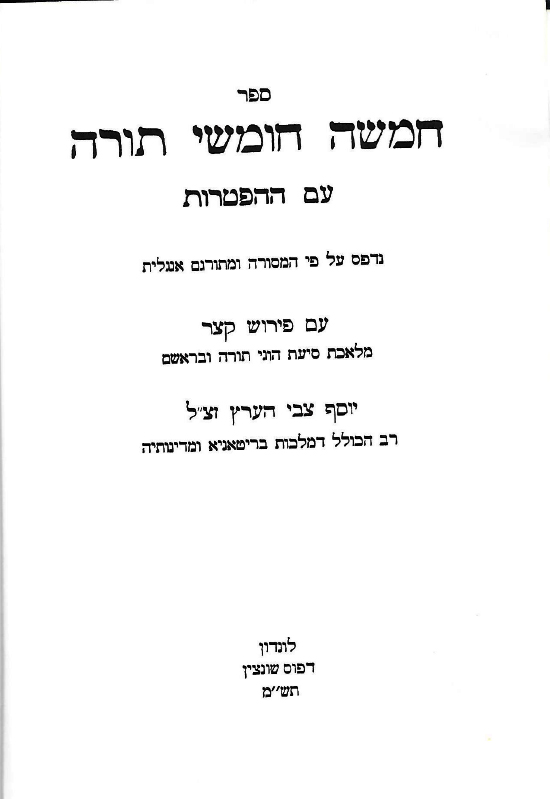
 

The English title page refers to the Chumash as edited by Hertz. The Hebrew title page, which most people don’t even bother looking at, even if they understand Hebrew, refers to a commentary that is the work of a group of Torah scholars headed by Hertz. These are quite different formulations.

Most people who have used the Hertz Chumash, even those who have used it for many years, will not know anything about this group of Torah scholars. Indeed, when people quote from this Chumash, Hertz is given exclusive credit for everything in it. Thus, when citing this Chumash’s commentary, people will say, “Hertz writes.” Yet is this correct?

If we turn to the Chumash’s preface, we learn that Hertz was assisted by J. Abelson, A. Cohen, G. Friedlander and S. Frampton. The first three individuals prepared the commentary to sections of the Torah (the exact sections are listed), and Frampton prepared the commentary to the Haftorahs. Hertz writes: “In placing their respective manuscripts at my disposal, they allowed me the widest editorial discretion. I have condensed or enlarged, re-cast or re-written at will, myself supplying the Additional Notes as well as nearly all the introductory and concluding comments to the various sections.” We see from this that Hertz had an important role, not just as editor, but in contributing content to the Chumash. Yet the commentary itself was not the product of Hertz. He was simply the editor of the material provided by the men mentioned above. In this role, he performed the regular task of an editor who takes texts and condenses and enlarges, re-casts or re-writes, but this editorial involvement does not make the editor the author.

We therefore have to wonder why it is that the men who labored so hard in creating the commentary are given no recognition, apart from the mention of their names in the preface which virtually no one bothers to read. As I already noted, the commentary to the Chumash is universally understood to have been written by Hertz when in fact most of it – other than the “introductory and concluding comments to the various sections” – is not his at all.

Now that the facts have been laid out, I don’t think anyone will be surprised to learn that Abelson, Cohen, and Frampton were not at all happy when the Chumash appeared and they were given no recognition for their labors on the title page. (Friedlander was no longer alive.) They thought that on the title page, following the mention of Hertz as the editor, it should have said something like, “With the collaboration of the Revs. Dr. A. Cohen, Dr. J. Abelson, the Rev. S. Frampton and the late Rev. G. Friedlander.” Hertz responded to their complaint that it had already been established at the initial stages of the planning of the Chumash that the contributors’ names would not appear on the title page.[2] In fact, this a major reason for R. Salis Daiches[3] withdrawing from collaboration on the project. (Obviously, Abelson, Cohen, and Frampton had a different understanding of how Hertz was supposed to acknowledge their work.) Daiches was also unhappy with Hertz’s “editorial policy of extensively rewriting and revising the installments submitted to him by the various annotators.”[4] Hertz later implausibly claimed that his revisions were “an incredible amount of labor, easily ten times the amount of my collaborators.”[5]

Another matter that must be noted is that in the preface found in the first volume of the first edition of the Chumash—it originally appeared in five volumes—Hertz writes that he supplied “nearly all the Additional Notes.” Yet in the one volume edition this sentence has been changed and the word “nearly” has been deleted, making Hertz the only author. Harvey Meirovich has called attention to this, and shows that the Notes dealing with evolution and sacrifices came from R. Isidore Epstein.[6]

I do not know why the following paragraph, which explains the method of the commentary and appeared in the preface to volume 1 of the first edition, was deleted from the preface of the one volume Chumash. This is exactly the sort of explanation of the commentary that the reader would find helpful.

Method of Interpretation: A word must be added as to the method chosen for leading the reader into what the Jewish Mystics called the Garden of Scriptural Truth. The exposition of the plain, natural sense of the Sacred Text must remain the first and foremost aim in a Jewish commentary. But this is not its only purpose and function. The greatest care must be taken not to lose sight of the allegorical teaching and larger meaning of the Scriptural narrative; of its application to the everyday problems of human existence; as well as of its eternal power in the life of Israel and Humanity. In this way alone can the commentator hope not merely to increase the knowledge of the reader, but to deepen his Faith in God, the Torah and Israel.

Also of interest is that the first edition of the Hertz Chumash includes maps which are not found in the one volume edition.

2. In my post here I mentioned that R. Shmuel Wosner defends the practice of women saying שלא עשני גוי and שלא עשני עבד instead of substituting the words גויה and שפחה. R. Yehudah Tesner agrees with R. Wosner and adds the following: If a woman would say שלא עשני גויה this would only mean that she does not want to be a non-Jewish woman. However, she might still prefer to be a non-Jewish man instead of a Jewish woman. Also, if she said שפחה it might only mean that she does not want to be a female maidservant, as this has two negative things, namely, that she is both a woman and enslaved.

שאין רצונה להיות שפחה, שיש בזה תרתי לריעותא, גם אשה וגם משעובדת

However, it might imply that if she could get rid of one of these negative things, i.e., the female, and be a male slave, that this might be acceptable to her. In order to prevent these misunderstandings, R. Tesner says that she must keep the standard text which includes women as part of גוי and עבד. This way she is thanking God that she is not a non-Jew, male or female, and that she is not a slave, male or female.[7]

There is no question in my mind that R. Tesner’s approach is somewhat convoluted and would never represent the thinking of any woman who recited the prayer. I only mention it because R. Tesner takes it for granted that it is better to be born as a Jewish man than a Jewish woman. Yet he also sees as obvious that it is still better to be a free Jewish woman than a male slave.

With regard to this latter point, it is of interest that R. Joseph Teomim states that there are a few things in which a male slave has an advantage over a woman:

עבד חשוב לענין קצת דברים . . . במקצת דברים עדיף מאשה

One of the things he mentions is that a male slave is circumcised, and circumcision is a great mitzvah given to men that women do not have the opportunity to fulfill.[8] This perspective is obviously very different than the outlook advocated by various kiruv speakers that while women are created perfect, men are created defective and thus need a berit milah to get them up to the level of women.[9] I have no doubt that if this argument was first made by someone who identified with Open Orthodoxy, that it would have been regarded as blasphemous for denigrating the commandment of circumcision.

Regarding women not having the opportunity to fulfill the great mitzvah of circumcision (and other mitzvot), I was surprised to find that R. Leon Modena, who was quite “modern” for his time, explains that this is because they do not rank very high in God’s eyes, which is another way of saying that women are simply unworthy of these mitzvot. Here are his misogynistic words:[10]

ומצינו שלא החשיב השי”ת בתורתו הנשים בשום אופן, ולא נתן להן אפי’ אות ברית במילה, ולא רוב מצוות עשה.

Apart from circumcision, it is a popular kiruv perspective that in general women are created with more spiritual perfection, and thus do not need all the mitzvot of men. R. Meir Mazuz attacks this position which he sees as absurd.[11]

דוגמא אחת  מהסילופים: המקשים מצביעים על ברכת “שלא עשני אשה”, והמתרצים מתפלפלים להוכיח שהאשה איננה צריכה כל כך סייגים וגדרים, כי מטבעה דיה במספר מועט של מצוות, ולכן היא מברכת בשמחה רבה “שעשני כרצונו” – שהקב”ה ברא אותה תמימה ושלימה שאיננה צריכה כל כך מצוות, והאיש מברך “שלא עשני אשה” – הוא על דרך שמברכין על הרעה כשם שמברכין על הטובה . . . [ellipses in original] ואילו היה כדבריהם, למה מברכין הנשים ברכת “שעשני כרצונו” בלי שם ומלכות . . . והאנשים מברכים “שלא עשני אשה” בשם ומלכות, ואדרבא איפכא מסתברא?! ובטור א”ח (סימן מ”ו) כתב שנהגו הנשים לברך שעשני כרצונו, ואפשר שנהגו כן כמי שמצדיק עליו את הדין על הרעה . . . ולדעת המתרצים הנ”ל אפשר לומר ג”כ שהגוים עדיפי מישראל, שאינם צריכים לתרי”ג מצוות רק לשבע דוקא, אתמהה.

To R. Mazuz’s words I would only add that if people find it problematic to say that men are created more perfect than women, why do they not find it also problematic to say that women are created more perfect than men? Should I have been offended when a woman once said to me that she is exempt from a number of mitzvot because women are on a higher spiritual level than men, as they are naturally more connected to God, while men can only achieve this connection through mitzvot? I am sure she would have been offended if someone said to her that women are on a lower spiritual level than men, as they are naturally less connected to God, and the evidence of this is that do not have as many mitzvot as men.[12] And what about Torah study? Can we say that men are only commanded to study Torah because they are not at the same spiritual level as women? This would be a complete inversion of the value traditionally assigned to Torah study.[13]

Yisrael Ben Reuven’s book, Male and Female He Created Them (Southfield, 1995), devotes a good deal of discussion to the kiruv perspective. On pp. 132, 133, he writes:

A number of recent books in English propose this idea of women’s spiritual superiority over men, and reportedly, the idea is taught as well in numerous schools for women. The reader should note that none of the books in question offer a classical source for the idea, and none of several teachers of the idea have been able to supply a source when interviewed by this author and numerous individuals known by the author. . . . [T]he teaching contradicts a principle from the Gemara that commandments are placed on a person as a result of his having spirituality (as opposed to his lacking it).

I believe that Ben Reuven is correct in noting that attributing this notion to the Maharal is a mistake. Yet I disagree with his discussion of the view of R. Samson Raphael Hirsch, as Hirsch indeed suggests that women are not commanded in the positive time-bound commandments because they do not need them, for they, by nature, have “greater fervour and more faithful enthusiasm for their God-serving calling.” Contrary to Ben Reuven, doesn’t this mean that they are created with a superior innate spirituality? Men, on the other hand, according to Hirsch, can only reach their spiritual potential through the mitzvot. Hirsch includes circumcision as one of the commandments that men need because they are by nature on a lower spiritual plane then women.[14]

R. Zvi Yehudah Kook also thinks that women are inherently spiritually superior to men. The problem is that men don’t realize this. However, R. Zvi Yehudah claims that in Messianic days when men will understand the truth, they will no longer be able to able to make the blessing שלא עשני אשה, as they will see that women are superior to them.[15]

במצב העכשווי האיש יותר חזק בגופו, ומתוך כך בפרקטיקה האנושית. הוא אקטיבי יותר בכל החיים המעשיים. יש הרגשה שהוא תופס יותר מקום. הרגשה זו היא לפי המדריגה האנושית, והברכות נקבעו על פי ההרגשה האנושית היחסית. זאת התפיסה האנושית הרגילה, והברכה מתייחסת למציאות זו. משום כך אומר האיש כהרגשתו “שלא עשני אשה”, שהרי זו האמת היחסית, והאשה מברכת “שעשני כרצונו”. אך, כאמור, זו תפיסה אנושית חלקית, וההרגשה היא רק עניין יחסי של מצב עכשווי נתון, אמת נוכחית.

לעומת זאת, ההשקפה האלהית, האמת המוחלטת, אינה ענין של הרגשה חולפת, אלא האמת הנצחית מראשיתה ועד סופה. לעתיד לבוא, כאשר גם האדם יכיר את האמת, ויהיה כולו מבחינת “הטוב והמטיב”, לא יוכל לברך “שלא עשני אשה”, שהרי אז יכיר שבניינה של האשה יותר רם, יותר אלהי ופחות אנושי, ממצבו הוא.

For virtually all, the approaches suggested by Hirsch and R. Zvi Yehudah Kook in which women are created more perfect than men would have been inconceivable in pre-modern times. One possible exception, and the only exception I know of, was the sixteenth-century R. Gedaliah Ibn Yahya, author of Shalshelet ha-Kabbalah. He actually enumerates numerous ways in which women are superior to men. He also claims that women are not intellectually inferior to men, and they can thus understand all the wisdoms of the world. In the sixteenth century, this was a very radical position.[16]

Regarding women, R. Yonason Rosman called my attention to the following. The ArtScroll Chumash, p. 1086 (beginning of parashat Nitzavim) states:

On the last day of his life, Moses gathered together every member of the Jewish people, from the most exalted to the lowliest, old and young, men and women, and initiated them for the last time into the covenant of God. What was new about this covenant was the concept of ערבות responsibility for one another, under which every Jew is obligated to help others observe the Torah and to restrain them from violating it. This is why Moses began by enumerating all the different strata of people who stood before him, and why he said (v. 28) that God would not hold them responsible for sins that had been done secretly, but that they would be liable for transgressions committed openly (Or HaChaim).

According to the ArtScroll summary, R. Hayyim Ben Attar, the author of Or ha-Hayyim, states that women are obligated in ערבות. But is this really what he says? Here is his commentary to Deuteronomy 29:9:

R. Hayyim ben Attar actually says the exact opposite of what appears in the ArtScroll summary, in that he states that women are not obligated in ערבות, and they are grouped together with children and proselytes. R. Ben Attar tells us that children are not obligated because they do not have the requisite understanding for such an obligation. Proselytes are not obligated because it is not their place to be rebuking, and thus exercising authority over, those who were born Jewish.[17] Why are women not obligated? R. Ben Attar writes:

ואין הם נתפסים על אחרים שהטף אינם בני דעה והנשים כמו כן הגרים גם כן אין להם להשתרר על ישראל

The sentence is ambiguous, and it all depends on where you put the comma. Here is one way to read the sentence:

ואין הם נתפסים על אחרים שהטף אינם בני דעה והנשים כמו כן, הגרים גם כן אין להם להשתרר על ישראל

If you place the comma after the words והנשים כמו כן, the sentence seemingly means that women are just like children in not having the requisite understanding of the various sins to be obligated in ערבות. R. Yaakov Hayyim Sofer finds it incomprehensible that R. Ben Attar would say that women’s level of understanding is comparable to that of children.[18] He therefore explains that when R. Ben Attar says והנשים כמו כן, he only means to say that the law for women is like the law for children, but not that the reason is the same.

You can also place the comma after the words אינם בני דעה so that one reads the sentence this way:

ואין הם נתפסים על אחרים שהטף אינם בני דעה, והנשים כמו כן הגרים גם כן אין להם להשתרר על ישראל

Now the sentence means that children do not have the requisite understanding to be obligated in ערבות, and women are like proselytes in that it is not their place to be rebuking, and thus exercising authority over, Jewish men. Although this is how R. Avraham Sorotzkin understands the Or ha-Hayyim,[19] I find it difficult as the second half of the sentence does not read well this way.

3. In my post here I referred to Nero and Antoninus and their supposed conversions to Judaism. The Talmud, Gittin 56a, indeed states that Nero converted, and it adds that R. Meir was descended from him. Soncino’s note to the passage reads: “This story may be an echo of the legend that Nero who had committed suicide was still alive and that he would return to reign (v. JE IX, 225).” The Koren Talmud’s note, which is a translation of what appears in Steinsaltz, states that the talmudic story cannot be referring to the famous Nero: “The Roman emperor Nero was killed under strange circumstances and after his death rumors circulated that he was not actually killed but had taken refuge elsewhere.” The note continues that even though Nero is referred to in the passage in Gittin 56a as ,נירון קיסר the story actually refers to another person who was an officer in the Roman army in the campaign against Judea. This person’s name was also Nero, and since he was from the larger Caesar family, he too was called Nero Caesar. This explanation apparently first appears in Seder ha-Dorot.[20]

Graetz thought that the story of Nero converting was part of a rabbinic polemic against Christianity, while Bacher “attributed the origin of the legend to the view which considers the power of Judaism to be so great, that even its greatest enemies become converts either themselves, or, at any rate, their descendants.”[21]

Let me offer another way of explaining the story of Nero’s conversion, which I have not seen anyone else suggest. Josephus tells us that the Jews put up a wall in the Temple to prevent King Agrippa from viewing the sacrificial service. This upset both Agrippa and the Procurator, Festus, and Festus ordered that the wall be torn down. The Jews decided to go over Festus’ head and turned to Nero. Nero’s wife, Poppaea Sabina, pleaded their case, and as a favor to his wife, Nero ordered that the wall should stay.

Why would Poppaea plead the case of the Jews? Josephus tells us that she was a “God-fearer.”[22] Whatever the exact connotations of this term, which has been greatly discussed, she was clearly a sympathizer of the Jews. Josephus tells us that on another occasion she helped secure the release of some Jews who had been placed in prison in Rome. He also tells us that that Poppaea gave him many presents.[23] Could it be that originally the story about the conversion of Nero was said about his wife, and that in the hundreds of years before it was recorded in the Talmud, it was transferred to Nero himself?

As for the Emperor Antoninus, who was friends with R. Judah ha-Nasi, we do not know who this refers to as the title Antoninus was used for various emperors.[24] However, I want to call attention to a different point. In Sefer Yuhasin ha-Shalem, ed. Filipowski, p. 115, in listing the talmudic sages, R. Abraham Zacut includes a “Rabbi Antoninus”. Where does he get such a name? As he indicates, it comes from Mekhilta de-Rabbi Yishmael, and there are actually two separate references there to R. Antoninus.[25] The first reads:[26]

[א”ר אנטונינוס למלך שהוא דן על הכימה [הבימה

The second reads:[27]

…ר’ אנטונינוס אומר ג’ היו והוסיף עליהם עוד אחד והיו ד’

R. Antoninus is being cited as the source for halakhic teachings. Yet the text is corrupt, as was already pointed out by the Vilna Gaon. He emended both passages so that while Antoninus is mentioned, he is not identified as a rabbi.[28]Thus, in the first passage the Vilna Gaon emended it to read:

 [אמר רבי אנטונינוס המלך שהוא דן על הכימה [הבימה

The second passage he emended to read:

רבי אומר ג’ היו הוסיף עליהם עוד אחד והיו ד’ הוסיף אנטונינוס עוד אחד והיו ה’

While the Vilna Gaon may have only sensed intuitively that the text was corrupt, manuscript evidence exists that offers versions similar to or identical with that suggested by the Vilna Gaon.[29]

As for the conversion of Antoninus, R. Solomon Judah Rapoport argues that this is a late, and non-historical, aggadah.[30] He points to a passage in the Jerusalem Talmud, Megillah 1:11, which shows that it was not clear whether Antoninus converted.

אית מילין דאמרין דאתגייר אנטונינוס ואית מילין אמרין דלא אתגייר אנטונינוס

Nevertheless, despite these words, the continuation of this talmudic passage records that he did in fact convert. This is also the conclusion in the Jerusalem Talmud, Sanhedrin 10:5. However, the matter is still not clear, since regarding the Megillah text the Leiden manuscript has a different version which leaves the matter of Antoninus’ conversion undecided.[31] Furthermore, as Shaye J. D. Cohen writes, “the Bavli clearly implies that Antoninus was not a convert, unlike the Roman dignitary Qetia who was.”[32] Cohen also calls attention to Yalkut Shimoni: Isaiah, no. 429, which states that Antoninus was one of the tzadikei umot ha-olam, that is, not a convert.

R. David Zvi Hoffmann examined the various aggadot regarding R. Judah ha-Nasi and Antoninus. With regard to most of them he concludes that they arose in Babylonia long after the events described, and that “it is difficult to find a historical core to them.”[33]He does not tell us whether he regards these stories as simply legends that arose from the people or if they should be seen as didactic tales no different than the numerous other aggadot that describe actions and dialogues of various biblical figures, matters that were also never intended to be taken as historical. R. Hoffmann also discusses how the notion of Antoninus actually converting to Judaism developed from earlier sources that only regard him as a “God fearer.”[34]

Regarding referring to people as rabbis when they do not deserve the title, such as Rabbi Antoninus, here is another interesting example that I believe was pointed out to me many years ago by Prof. Shnayer Leiman. When R. Jonathan Eybeschuetz’s Luhot Edut was reprinted in 1966, the publisher helpfully added an index of names at the back. What seems to have happened is that he went through the index putting “Ha-Rav” before all the names, and mistakenly added this title before Shabbetai Zvi’s name.

When the book was reprinted again by Copy Corner in the 1990s, they fixed this mistake and added שר”י.

It is interesting that in Solomon Zeitlin’s review of Gershom Scholem’s biography of Shabbetai Zvi, he criticizes Scholem for referring to Nathan of Gaza as “Rabbi Nathan.”[35] Had Scholem wished to defend himself from an Orthodox perspective, he could have pointed to the fact that decades after Nathan’s death (and also after Shabbetai Zvi’s death), one of the leading rabbis in Salonika, R. Solomon ben Joseph Amarillo (died 1722), refers to Nathan as הרב הקדוש מהר”ר נתן [36].אשכנזי ז”ל R. Joseph Molho (1692-1768), another leading rabbi in Salonika, refers to Nathan as הרב נתן ז”ל.[37] This positive reference to Nathan is found in R. Molho’s response to R. Solomon ben Isaac Amarillo, who also referred to Nathan this way.[38] In his famous work, Shulhan Gavoah, R. Molho refers to Nathan as follows: וכן קבלו מהרב נתן אשכנזי ז”ל המקובל האלהי.[39] I was surprised to see that in the new edition of Shulhan Gavoah (Jerusalem, 1993), this appears without any censorship, which presumably means that the editor did not know who R. Nathan Ashkenazi is. One final example: The famed R. Moses Zacuto (c. 1620-1697) refers to Nathan as הרב המופלא כמהר”ר נתן הידוע זלה”ה.[40]

Those who are interested in rabbinic history are familiar with R. Naphtali Yaakov Kohn’s nine volume Otzar ha-Gedolim. In vol. 4, p. 125, we find an entry for none other than the notorious Spanish apostate, Joshua Lorki, and his name is followed by שר”י ימ”ש.

Why is such a person included in a book of “gedolim”? The author explains that before he apostatized, he was a rabbi. (I do not believe this is correct. I have never before seen him described as a rabbi and know of no evidence to support such an assumption.) One can easily understand that even if someone was a rabbi, if he later converted, or became a Reform rabbi for that matter, including him in a book of “gedolim” is not going to sit well with many. This is so even though most of the rabbis included in the book are far from what one can consider “gedolim” in the way the term is used today.

Kohn did not print any letters or haskamot in the first four volumes of his work. These first appear in volume 5, and are from such varied figures as R. Joel Teitelbaum and the Chief Rabbis of Haifa. Kohn also includes a four-page letter from R. Yekutiel Yehudah Halberstam, the Klausenberger Rebbe. R. Halberstam saw the entry for Lorki and was very upset. He writes that just as no one would dream of including Dathan and Abiram among the great Jewish leaders, all the more so one should not include Lorki among the rabbis of Jewish history. He further asks, rhetorically, if אותו האיש ימ”ש שר”י   should also be included because he was a student of R. Joshua ben Perahiah?

R. Halberstam is even upset that the book includes an entry for Lorki’s father, and unfairly wonders what type of man he must have been if his son turned out this way. (I say “unfairly” since there are many examples of pious people whose children ended up very differently.) Finally, R. Halberstam makes the following strong point to Kohn: If you are going to sayyemah shemoafter someone’s name, then it has to actually mean something. By including an entry for Lorki in the book, not only are you not blotting out his name, but you are doing the exact opposite by preserving his name for all to see.

ובאמת שאצל המומר לורקי כתב כת”ה בתר שמו ימ”ש שר”י. אבל זה לא רק להלכה אלא גם למעשה ואם אומרים ימח שמו א”כ איך חוקקים שמו להזכירו בזכרון קדוש אחרי שבע מאות שנים?

Kohn thought that it was OK to include an entry for Lorki because he was a rabbi before he apostatized. With this logic it would be OK to also study the Torah works of rabbis who later apostatized, since these works were written before their apostasy. (In part 2 of this post I will deal with rabbis who published seforim and then apostatized.)

5. In my last post here, I wrote that the new RCA siddur will come to be the standard siddur at hundreds of synagogues for decades to come. This was a reasonable conclusion to reach, since ArtScroll is no longer allowed to sell the RCA ArtScroll siddur which has become the standard at Modern Orthodox synagogues. Thus, when these synagogues need to purchase new siddurim – and these siddurim must have the prayers for the State of Israel and the IDF – they would naturally buy the new RCA siddur. Yet it seems that I was mistaken, as I did not anticipate ArtScroll’s response to its anticipated enormous loss of revenue. Here is the ad that many of you have already seen.

ArtScroll is continuing to sell the RCA siddur, minus the name “RCA” on the cover and Rabbi Saul Berman’s introductory essay. Instead of being the RCA edition, this siddur is now called the “Synagogue Edition.” This is designed to ensure that Modern Orthodox synagogues, when they need to buy new siddurim, continue purchasing the ones congregants are used to.

This move by ArtScroll is obviously a serious threat to the success of the new RCA siddur, as the typical Modern Orthodox synagogue will probably find it easier just to buy the new “Synagogue Edition.” It is going to take a lot of effort from the RCA to ensure that the new siddur becomes accepted across America, and only time will tell who will win the battle for the loyalty of the Modern Orthodox synagogues. I don’t know the details of ArtScroll’s contract with the RCA, so I can’t say if what ArtScroll has done is illegal. It certainly appears unethical.

When the original ArtScroll siddur appeared some thirty-five years ago, it immediately caught on, so much so that today it is hard to find an English-speaking Orthodox home that does not have an ArtScroll siddur. This is an enormous historical achievement. However, there was an obvious lack in that the classic ArtScroll siddur did not include the prayers for the State of Israel and the IDF. This meant that it could never be adopted as the siddur for Modern Orthodox synagogues. There were many people who were upset with ArtScroll for not including these prayers. Would it have been so difficult for ArtScroll to have included them with the note that “Some congregations recite these prayers”? In a siddur that found room to include Gott fun Avrohom at Havdalah, for the tiny population of ArtScroll siddur-users that says it, why could it not include prayers recited by many thousands every Shabbat? They could also have put these prayers in the back of the siddur, with the Yotzerot that today hardly anyone says. These steps would have made for an inclusive siddur, and there never would have been a need for the RCA ArtScroll Siddur.

We were led to believe that as a matter of principle, as dictated by ArtScroll’s gedolim, the prayers for the State of Israel and the IDF could not be included. It was thus a surprise that ArtScroll agreed to include these prayers in the RCA edition of the ArtScroll Siddur. The RCA recognized that everyone was moving over from Birnbaum to ArtScroll, and therefore it made sense to produce a Religious Zionist version of ArtScroll. How was ArtScroll able to include the religiously objectionable prayers? Obviously, the reason was money, but there was also deniability, as people could say that it wasn’t actually an ArtScroll siddur. Rather, it was an RCA siddur using the text of ArtScroll, so in this way ArtScroll wasn’t implicated as a partner in religious Zionism and its objectionable prayers.

With the publication of the new “Synagogue Edition” siddur, we now have a situation where ArtScroll itself is publishing a siddur with the prayers for the State of Israel and the IDF. In other words, ArtScroll is publishing a Religious Zionist text. This is definitely news. You can be as cynical as you wish in explaining why when it comes to making lots of money from Modern Orthodox synagogues, Daas Torah can be pushed aside, but it is significant that a so-called haredi publishing house has broken with haredi standards in such a significant way. Nevertheless, I hope that Modern Orthodox synagogues will realize that there is a great difference between the old RCA ArtScroll siddur, which is just the standard ArtScroll siddur with a few extra pages, and the new RCA Siddur which, in its ideological outlook and historical sophistication, is a siddur perfectly suited for today’s Modern Orthodox community.

6. Rabbi Pini Dunner recently publishedMavericks, Mystics and False Messiahs, and I know readers of the Seforim Blog will find it a wonderful read. If you have ever watched any of Dunner’s videos, you know that no one can tell a story like him. The figures and events he discusses (Samuel Falk, Emden-Eybeschuetz dispute, ClevesGet, Lord George Gordon, R. Yudel Rosenberg, Ignatz Timothy Trebitsch-Lincoln) are ones that are perfectly suited for his skill in this area. Readers should not go to this book looking for new discoveries of the sort that he has spoken about in some of his online lectures. Some people will have even read the published works upon which the chapters are based (e.g., Scholem, Leiman, Wasserstein). These sources are discussed in the concluding chapter which is itself fascinating, especially for those who love books. I heartily recommend the book even for those who know the original sources, because no one can bring a story to life quite like Dunner.

There is one thing, however, that I wish had been explained by Dunner. In the longest chapter of the book, dealing with the Emden-Eybeschuetz dispute, there are lengthy dialogues recorded between different people. We also read about when individuals smiled, when they gasped, when they turned pale, when their voice was shaky, when tears flowed down their cheeks, when they sat upright in bed, etc. Occasionally, we find this also in other chapters. Since all this is made up by Dunner (and with regard to the Emden-Eybeschuetz dispute could even be the beginnings of a movie storyline), it would have been helpful for some discussion as to why he decided to spice up the book this way. The most we get is that in the concluding chapter (p. 172), Dunner tells us that portions of the book “have been written in a style that has much more in common with dramatic fiction than with non-fiction history, including details of private conversations, and descriptive elements that may cause readers to wonder about their accuracy.” Yet the reader is never told why Dunner sometimes adopts this approach and at other times he sticks to the facts.

The chapter on the Emden-Eybeschuetz dispute includes as part of the story the legendary account of how R. Emden, on his deathbead, said, “Barukh haba, my revered father, barukh haba, Rabbi Yonatan.”[41] This was understood to mean that he was finally reconciled with his longtime adversary, and explains why they were buried in the same row. Unless one reads the concluding chapter of the book, which deals with the sources, the reader will have no way of knowing that there is no historical basis for this tale. It is attributed in the original source to R. Abraham Shalom Halberstam of Stropkov (1857-1940), though he presumably was repeating a tradition he had heard. The story was obviously invented to create a posthumous peace between the two great rabbis.

I realize that what I have described is part of the liberties taken by any good storyteller. However, anyone who reads the book will wonder why the Emden-Eybeschuetz chapter in particular, which freely mixes fact with fiction, is written in such a different style than the other chapters, which stick much more closely to what the evidence tells us. Dunner has shown that he can be both expert storyteller and historian, but speaking as a fellow historian, my preference would have been not to mix these genres in one book.

[1] Regarding the Hertz Chumash, see the articles by Mitchell First here, and Yosef Lindell here.

[2] See Harvey Meirovich, A Vindication of Judaism: The Polemics of the Hertz Pentateuch (New York and Jerusalem, 1998), pp. 187-189.

[3] Unlike the other contributors, Daiches was actually a rabbi (something not so common in Britain at the time). He received semikhah from the Rabbinical Seminary of Berlin as well as from his father, the great R. Israel Hayyim Daiches, R.  Solomon Cohen of Vilna, and R. Ezekiel Lifshitz of Kalisz. See Hannah Holtschneider, “Salis Daiches –  Towards a Portrait of a Scottish Rabbi,” Jewish Culture and History 16 (2015), p. 4. Holtschneider’s biography of Daiches will be out later this year. See here. The famous author David Daiches was his son, and his book Two Worlds (Edinburgh, 1997) has a lot about Salis Daiches. Here are some passages that I think readers will find of interest, as it speaks to the differences between what it meant to be an Orthodox rabbi in Britain a century ago vs. today.

Pp. 29-30: The electric radiator – which did, I suppose, make some difference, though memory links it only with extreme cold – could be switched on and off on the sabbath, as the electric light also could, in accordance with a decision of my father’s which differentiated his position sharply from that of my grandfather, patriarchal rabbi of an orthodox Jewish congregation in Leeds, who would have been shocked if he had known how cavalierly we treated electricity. Gas light or heat, which required the striking of a match, was another matter that was clearly prohibited. But electricity was a phenomenon unrecognized by the Talmud, and my father felt free to make his own interpretation of the nature of the act of switching on the electric light or heat. He decided that it was not technically ‘kindling a fire’, which a biblical injunction prohibits in the home on the sabbath.”

Pp. 81-82: “For years we travelled with our own meat dishes (for we could not eat off the meat dishes of a non-Jewish house) and Mother had supplies of meat sent out by post from the Edinburgh Jewish butcher. Packing a trunk full of dishes was an arduous business, and eventually Mother gave it up and we went vegetarian throughout August – which was no hardship for Mother could do marvelous things with fish (the term vegetarian in our family meant simply eating no meat but did not exclude fish). Slowly and gradually, and I am sure never consciously on my parents’ part, we relaxed a bit in the matter of diet. When she was first married Mother baked all her own bread, but ceased to do this after her illness in 1919. And on holiday one found oneself going a little further than one would have done in the city. In Edinburgh, we usually ate bread from the Jewish bakery, but occasionally we would get a loaf from a non-Jewish shop. Cakes and biscuits we regularly got from non-Jewish sources. But though Mother would buy ordinary cakes from a non-Jewish baker, she would always make her own pastry, for pastry from a gentile shop was liable to have been made with lard. On holiday, however, pastries started to creep in among the cakes bought for tea, and nobody raised the question of what they were made with.”

I am certain that Daiches is mistaken in his last sentence, and that his father confirmed with the bakery that there were no non-kosher ingredients in these pastries.

Pp. 92: “At home we always covered our heads to pray, and to say grace before and after meals, but we were never expected to keep our heads covered continually. My father wore a black skull cap when receiving members of his congregation in his study, but as the years went by he developed the habit of keeping it in his pocket throughout much of the day and diving hastily for it when the bell rang. In his father’s presence he wore it continually.”

Pp. 174, 176: The rabbi did not believe in a literal personal Messiah; he believed in historical movements, in progress, in amelioration, and in the acceleration of movement in the right direction by the actions of individuals. . . . The Messiah was not a person, but a historical ideal. God, the rabbi was in the habit of telling his congregation, works in history.”

Pp. 175-176: “The priestly benediction recited on High Festivals, when all the Cohens assembled to bless the congregation in the old biblical words of benediction, had been abolished by the rabbi in his Sunderland synagogue and he would not allow it in Edinburgh either.”

[4] Meirovich, A Vindication of Judaism, p. 31.

[5] Meirovich, A Vindication of Judaism, p. 33.

[6] Meirovich, A Vindication of Judaism, pp. 41ff.

[7] Siah Tefilah (Ofakim, 2003), p. 361.

[8] Mishbetzot Zahav, Orah Hayyim 46:4.

[9] See Excursus which will be in part 2 of this post.

[10] Magen ve-Herev, ed Simonsohn (Jerusalem, 1960), p. 47.

[11] See his derashah in R. Rephael Kadir Tsaban, Nefesh Hayah (Bnei Brak, 2007), vol. 2, pp. 269-270.

[12] See e.g, Derashot Rabbi Yehoshua Ibn Shuaib (Cracow, 1573), p. 48a:

כי נשמתן של ישראל הן קדושות יותר מן האומות ומן העבדים הכנעניים הפחותים ואפילו מן הנשים ואם הם שייכי במצות והן מזרע ישראל אין נשמתן כנשמת הזכר השייך בתור’ ובכל המצות עשה ולא תעשה.

[13] R. Shlomo Aviner, in discussing this matter, does not go so far as to say that men are obligated in Torah study because they are not at the same spiritual level of women. However, he comes close, and he is led to this approach because of his understanding of Torah study as leading to devekut, a position which is at odds with the Lithuanian perspective on Torah study. See Aviner, Bat Melekh (Jerusalem, 2013), p. 104:

שאלה: מדוע האשה, שניחנה בבינה יתרה, אינה מחוייבת בלימוד תורה?

תשובה: האיש, שאין בו בינה יתרה, דווקא הוא צריך להרבות בלימוד, אך האשה, שיש לה בינה יתרה, מבינה גם ללא הלימוד הרצוף והממושך. המהר”ל מסביר, שמי שיש לו נטיה טבעית לדבר, הוא משיגו בנקל. ללא נטיב טבעית יש צורך בעמל רב. לאשה באופן טבעי יש נטיה, שהאיש צריך לעמול עליה קשה (מהר”ל, דרוש על התורה עמ’ כז-כח). אלא, עמל לימוד התורה אינו איסוף ידיעות, בעומק הנפש, ודבקות בתורה. האיש הוא קשה עורף, מתקשה לשמוע לכן יש להכותו בגידים (שמות רבה כח ב. רש”י, שמות יט ג), בשוט השכלי של הלימוד. מי שניחן בנטיה טבעית לתורה אינו זקוק ל”גידים” כדי שתחול בו אותה תמורה פנימית, והיא מגיע אליו ביתר קלות . . . זו נטיה עמוקה באישיות האשה, לכן היא מגיעה לדבקות וקישור והתמלאות בתורה בנתיבים שונים מן האיש. האיש מגיע לדבקות זו בנתיב הלימודי, והאשה בנתיב ספיגת הדברים מן החיים.

See here from a Chabad site where we are told that “the female child inherently carries a higher degree of holiness, due to her own biological, life creating capability.” Would anyone today write the same sort of comment, but instead state that the male child has a higher degree of holiness? Faced with a situation where many people believe that women are regarded as inferior in traditional Judaism, defenders of Judaism are often led to offer apologetic answers that argue the reverse, namely, that it is actually women who are more special, spiritual, holy, etc. than men.

In my experience, men never seem to be offended when they hear this. One haredi friend explained to me that this is because the men do not believe it to be true, and thus no reason to be offended if it makes the women feel better. This is a cynical answer, but can anyone come up with a better reason? Imagine the scenario: A Shabbat meal with many guests and the father offers a devar Torah whose upshot is that men are more holy and spiritual than women. This will not go over well and the women (and some men also) will be offended. Yet if the message of the devar Torah is that women are more holy and spiritual, no one will take offense. Why not? And my more basic question is, why we can’t just say that men and women are equally holy and spiritual (albeit with different roles)? Why do people feel a need to say that one is more special than the other?

All this is in the realm of Jewish thought. However, when it comes to explaining halakhic matters in which women might be portrayed in a way that they would take offense at, here too new approaches must be offered. For example, can anyone imagine explaining to modern women why they cannot perform shechitah by telling them what R. Joseph Messas quotes from manuscript from the nineteenth-century R. Jacob Almadyoni (spelling?) of Tlemcen, Mayim Hayyim, vol. 2, Yoreh Deah no. 1?

אין להניח הנשים לשחוט ואפי’ בדיעבד ראוי להחמיר שאף המכשירין יודו האידנא שאין דעת נשי דידן מכוונות כדעת נשי דידהו. ואם על נשיהם אמרו אין חכמה לאשה אלא בפלך [יומא דף ס”ו ע”ב], קו”ח לנשי דידן

[14] See Hirsch’s commentary to Lev. 23:43, and regarding women and circumcision, see also Hirsch to Gen. 17:15. The most comprehensive discussion of Hirsch’s view of women and Judaism is found in Ephraim Chamiel, The Middle Way (Brighton, MA, 2014), vol. 2, pp. 152ff. On p. 153 he titles the section of a chapter: “Revolution: Women are Superior to Men.” Hirsch obviously opposed the notion found in R. David Abudarham that the reason women are not obligated in positive time-bound commandments is because they are “enslaved” to their husband to do his will, and if they were busy performing these commandments they could not serve him properly and this would create marital discord. See Abudarham ha-Shalem (Jerusalem, 1963), p. 25:

והטעם שנפטרו הנשים מהמצות עשה שהזמן גרמא לפי שהאשה משועבדת לבעלה לעשות צרכיו. ואם היתה מחוייבת במצות עשה שהזמן גרמא אפשר שבשעת עשיית המצוה יצוה אותה הבעל לעשות מצותו ואם תעשה מצות הבורא ותניח מצותו אוי לה מבעלה ואם תעשה מצותו ותניח מצות הבורא אוי לה מיוצרה לפיכך פטרה הבורא ממצותיו כדי להיות לה שלום עם בעלה.

The same reason is offered by R. Jacob Anatoli, Malmad ha-Talmidim (Lyck, 1866), pp. 15b-16a:

לפי שהנקיבה היא לעזר הזכר ואל אישה תשוקתה והוא ימשל בה להנהיגה ולהדריכה בדרכיו ולעשות מעשה על פיו והיותה על הדרך הזה הוא גם כן סבה שהיא פטורה מכל מצות עשה שהזמן גרמא כי אלו היתה טרודה לעשות המצות בזמן היה הבעל בלא עזר בזמנים ההם והיתה קטטה נופלת ביניהם ותסור הממשלה המכוונת שהיא לתועלתו ולתועלתה.

R. Ahron Soloveichik adopted an approach similar to that of Hirsch. He claimed that Judaism “recognizes the feminine gender as possessing an innate, unique spiritual blessing as compared with the male gender. . .  [T]he woman has innate spiritual advantage as compared with men.”Logic of the Heart, Logic of the Mind(Jerusalem, 1991), p. 93.

[15] Itturei Kohanim, no. 167 (5759), 4-5; R. Aviner, Panim el Panim (Jerusalem, 2008), p. 194. Significantly, R. Zvi Yehudah’s explanation acknowledges that the blessing שלא עשני אשה implies male superiority. While this was a common understanding in pre-modern times, in recent generations this interpretation was usually rejected. Yet R. Zvi Yehudah claims that the blessing’s formulation was a concession to human feelings. Does this then mean that if a contemporary man recognizes the superiority of women, or even just that they are equal to men, that according to R. Zvi Yehudah he can stop saying this blessing?

[16] See Avraham Grossman “Ma’alot ha-Nashim ve-Adifutan be-Hibur shel R. Gedaliah Ibn Yahya,” Zion 72 (2007), pp. 37-61.

[17] R. Simhah Bunim Lieberman raises a strong objection to Or ha-Hayyim‘s position. See Bi-Shvilei Orayta al Kol Yisrael Arevim Zeh la-Zeh, p. 124:

אבל האמת דעצם דברי האור החיים צ”ע, דאטו מוכיח יש בו שררה, וכי מצאנו איסור לגר להוכיח ישראל שחטא

[18] Edut be-Yaakov, vol. 2, p. 164.

[19] See R. Avraham Sorotzkin, Rinat Yitzhak, Deut. 29:10.

[20] R. Yehiel Heilprin, Seder ha-Dorot (Bnei Brak, 2003), vol. 1, p. 251.

[21] Naomi G. Cohen, “Rabbi Meir, A Descendant of Anatolian Proselytes,” Journal of Jewish Studies 23 (1972), pp. 54-55. Cohen also provides the Graetz reference.

[22] Antiquities 20.8.11.

[23] Life of Flavius Josephus, ch. 3. See A. Andrew Das, Solving the Romans Debate (Minneapolis, 2007), pp. 77ff.; Louis H. Feldman, Jew and Gentile in the Ancient World (Princeton, 1993), p. 351.

[24] R. Maimon ben Joseph (the father of Maimonides), Iggeret ha-Nehamah, trans. Binyamin Klar (Jerusalem, 2007), p. 38, states:

וכבר אמר פעם אחת אחד ממלכי רומי – קללה תבוא על כולם, חוץ מאחד רם המעלה המובדל מהם, הוא אנטונינוס שהיה בדורו של רבנו הקדוש ע”ה.

[25] R. Yehiel Heilprin, Seder ha-Dorot, vol. 2, p. 138, has a version of the Mekhilta that reads Antigonos, and he therefore identifies a “Rabbi Antigonos”.

[26] Beshalah, hakdamah. In the edition with the Netziv’s commentary it is on p. 79.

[27] Beshalah, parashah 1. In the edition with the Netziv’s commentary it is on p. 111.

[28] Surprisingly, Abraham Joshua Heschel did not take note of the Vilna Gaon’s emendation, and cited one of the Mekhilta texts as is. See Torah min ha-Shamayim be-Aspaklaryah shel ha-Dorot (London and New York, 1962), p. 183 n. 3.

[29] See the Horovitz-Rabin edition of the Mekhilta, pp. 82, 89.

[30] See Rapoport, Erekh Milin (Prague, 1852), p. 270.

[31] See the comprehensive discussion in Shaye J. D. Cohen, “The Conversion of Antoninus,” in Peter Schäfer, ed., The Talmud Yerushalmi and Graeco-Roman Culture (Tübingen, 1978), pp. 141-171.

[32] “The Conversion of Antoninus,” pp. 164-165.

[33] “Die Aggadot von Antoninus in Midrash und Talmud,” Magazin für die Wissenschaft des Judenthums 19 (1892), p. 46.

[34] “Die Aggadot von Antoninus in Midrash und Talmud,” pp. 51-52.

[35] See Jewish Quarterly Review 49 (1958), p. 153.

[36] Penei Shlomo (Salonika, 1717), p. 43d.

[37] Ohel Yosef (Salonika, 1756), no. 14 (p. 13a).

[38] Devar Moshe (Salonika, 1750), vol. 3, no. 11 (p. 8a). The three sources just cited are mentioned by Meir Benayahu, Ha-Tenuah ha-Shabta’it be-Yavan (Jerusalem, 1978), pp. 191, 274-275.

[39] Shulhan Gavoah (Salonika, 1756), Orah Hayyim, vol. 2, Hilkhot Yom ha-Kippurim 620 (p. 68a). He also refers to Nathan this way ibid., Hilkhot Rosh ha-Shanah 584 (p. 35a).

[40] See Benayahu, Ha-Tenuah ha-Shabta’it be Yavan, p. 119. For sources regarding Zacuto, see Gershom Scholem, Mehkerei Shabtaut, ed. Yehuda Liebes (Tel Aviv, 1991), p. 528; Bezalel Naor, Post Sabbatian Sabbatianism (Spring Valley, 1999), p. 176 n. 8.

[41] The source of the story for Dunner is David Ginz, Gedulat Yehonatan, vol. 2, p. 286. Abraham Hayyim Simhah Bunim Michaelson, Ohel Avraham (Petrokov, 1911), p. 28b, also heard the story from R. Halberstam, but in his version R. Emden states simply, ברוך הבא אבא.


Tarnopol: A short-lived early 19th century Hebrew press

Tarnopol: A short-lived early 19th century Hebrew press
by Marvin J. Heller[1]

The blossoms have appeared in the land, The time of your song has arrived,
and the voice of the turtledove Is heard in our land.
The green figs form on the fig tree. The vines in blossom give off fragrance.
Arise, my darling; My fair one, come away!
“O my dove, in the cranny of the rocks. Hidden by the cliff.
Let me see your face, Let me hear your voice; For your voice is sweet And your face is comely.”
Catch us the foxes, The little foxes
That ruin the vineyards— For our vineyard is in blossom. (Song of Songs 2:12-15).

Tarnopol (Ternopol), a city with an established Jewish community, dates its founding to the mid-sixteenth century. The community had many positive aspects (blossoms have appeared in the land, The time of your song has arrived), and was home to a Hebrew printing press (The green figs form on the fig tree. The vines in blossom give off fragrance) for a brief time only in the early nineteenth century. Due, however, to the contentious relationship between conflicting segments of the community, that press, after publishing a variety of valuable works, was short lived and closed prematurely (The little foxes that ruin the vineyards).

Tarnopol is in Galicia, in the western Ukraine, approximately 227 miles (365 km.) from Kiev (Kyiv) and 73 miles (117 km,) from Lvov. Although there had been earlier residences in the area, credit for founding the city as a private town in 1540 is given to the Polish hetman, Jan Amor Tarnowski. Tarnowski permitted Jewish settlement almost immediately afterwards in what was his personal domain. The city charter permitted Jews to reside throughout the city, excluding the market place. Initially, the Jewish population was small, comprised of only a few dozen Jews, this based on the head tax paid, the revenues from it being, in 1564, 20 zlotys, rising to 23 the following year. Jews quickly became a majority of the population, with as many as 300 families resident there in the sixteenth and seventeenth centuries.[2] By 1765, the Jewish population of Tarnopol had increased to 1,246 Jews.[3]

In 1548, Tarnopol was granted the privilege of the Magdeburgian Laws, regulations concerning internal autonomy within cities and villages granted by the local ruler, developed by Otto I, Holy Roman Emperor (936–973). In 1566, Tarnopol received the Emporium Right, the duty of storing the merchandise of the merchants passing through the town, and the privilege of the residents of the town to be the first to purchase the merchandise. Tarnopol was fortified and strengthened during the Tartar invasions in 1575 and 1589. In 1621, it became the property of Chancellor Tomash Zamoiski.[4]

A fire in 1623 caused significant damage to the homes in the city, but Zamoiski allowed the Jews to rebuild their homes as well as a new synagogue, this constructed in citadel style, to replace the one destroyed in the fire. Jews could buy and sell goods, excepting some leather merchandise, this to protect the monopoly of Christian shoemakers. Jews could be butchers, but had to provide the owners of the city annually with ten milk stones.

Tarnopol suffered, as did Jewish communities throughout Eastern Europe, from the Chmielnicki massacres of 1648-49 (tah ve-tat) and again in 1653 from the Tartar invasions. Until the ravages of the former occurred, the Jewish community was prosperous. At that time, however, most Jews fled, those remaining being massacred. Jews participated in the defense of the city in the Cossack and Swedish wars. The city, now the property of Alexander Konyetspolski, was reconstructed, but suffered yet again in 1672 when the town’s castles and citadels were bombarded by the Turks. Towards the end of the century the community began to revive, Jewish merchants being dominant in the grain and cattle trades.[5] In 1690, Tarnopol became the private property of the Polish royal family, Subiesky, and subsequently was transferred to the noble Polish family, Pototski, remaining in their possession until 1841 when private ownership of cities was abolished.

An early rabbi in Tarnopol was R. Gershom Nahum R. Meir ben Isaac Tarnopoler, who stated that “Our community is the capital (i.e it was important).” The rabbis active in Tarnopol in the eighteenth century included R. Joshua Heschel Babad, followed by R. Jacob Isaac ben Isaac Landau. Joshua Heschel Babad’s (Babad is an acronym of Benei Av Bet Din, “children of the av bet din,” 1754-1838) itapprobations appear in several of the titles described in this article and served as rabbi of Budzanow and, from 1801, of Tarnopol. He opposed the growing circle of maskilim in Tarnopol and polemicized against their patron, Joseph Perl (below), and, in 1813, of the teaching system in the school founded by Perl where secular studies were taught.[6]

Tarnopol suffered from an outbreak of the Black Plague in 1770, suffering many deaths. Finally, in 1772, Tarnopol was annexed to Austria and from 1809 to1815 was in the possession of the Russians, returning to Austrian rule until it became part of the Western Ukrainian Republic. Its status changed yet again at the end of 1918 when it became part of independent Poland.

In the early eighteenth century Tarnopol was largely Hassidic. Nevertheless, among the significant figures in Tarnopol was Joseph Perl, a prominent Maskil, active in that movement and an opponent of Hassidus.

A Hebrew press was established in Tarnopol in 1812. At that time Nahman Pineles and Jacob Auerbach, accomplished printers, obtained permission from the Russian authorities to establish a Hebrew press, this with the condition that the books to be printed would be approved by the censor. They acquired typographical equipment from the printer Benjamin ben Avigdor and employed two workers, Mordecai ben Zevi Hirsch and Aryeh Leib ben David. Ch. Friedberg informs that this was not an auspicious time to establish a press due to the Napoleonic wars. Nevertheless, it was established with the support of Joseph Perl, who not only provided financial assistance, but also space in his school for the press. He did so in the belief that the books published by the press would be in support of the Haskalah.[7]

The Thesaurus of the Hebrew Book records twenty-two entries, from 1812-13 through 1817.[8] These works are varied. We will describe a portion of them, several in some detail, others in passing, giving a sense of the press’ output.

I

Yeshu’ot Meshiho – Printing is reported to have begun with Don Isaac ben Judah Abrabanel’s (1437-1508) Yeshu’ot Meshiho (the Salvation of His Anointed) in 1812-13.[9] Abrabanel, a noted statesman, biblical exegete, and philosopher, traced his lineage to King David. He was the grandson of Samuel and the son of Judah Abrabanel, the former an advisor to three Kings of Castile, the latter to the King of Portugal. Don Isaac Abrabanel received a thorough Jewish education, studying Talmud under R. Joseph Hayyun (d. 1497), as well as instruction in philosophy, classics, and even Christian theology, this last useful in his defense of Judaism. Abrabanel succeeded his father as treasurer to King Alfonso V of Portugal, during which time he was instrumental in redeeming Jewish captives brought to Portugal. Upon the death of Alfonso in 1481, João II (1481-95) became king of Portugal. In 1483, João accused Abrabanel of participating in a conspiracy. Forewarned, Abrabanel fled to Spain, where he served as an official in the court of Ferdinand and Isabella. In 1492, they offered him the opportunity to remain in Spain as a Jew, but he chose to go into exile and left with other Jews.[10]

A prolific author Abrabanel wrote extensive and highly regarded commentaries on books of the Bible, philosophical works, and a three-part trilogy of consolation on resurrection and redemption. Yeshu’ot Meshiho is the third part of the trilogy. The first parts are Ma’yenei ha-Yeshu’ah (Wells of Salvation), first printed in Ferrara (1551) on the book of Daniel, followed by Mashmi’a ha-Yeshu’ah (Announcing Salvation), first edition published in Salonika (1526); the trilogy is completed with Yeshu’ot Meshiho. The text addresses redemption, the Messiah, and the end of days.[11] This is recorded as the first edition of Yeshu’ot Meshiho in bibliographies, but is extremely rare and was not seen by this writer. It is recorded as an octavo.

Rosh Amanah – Our second work by the Abrabanel, also printed in 1813, is Rosh Amanah, on the principles of faith. First published in Constantinople (1505) this edition was printed in the year “[From Lebanon, my bride, with me!] Trip [look] down from Amana’s peak תשורי מראש אמנה (573 = 1813)” (Song of Songs 4:8), a reference to the principles of faith (Emunah). It was printed in quarto format (40: 30 ff.). Abrabanel completed Rosh Amanah “in Naples at the end of Marheshvan, in the year, ‘The voice of rejoicing רנה (255=November, 1494) and salvation’” (Psalms 118:15), that is, two years after the expulsion of the Jews from Spain. The verso of the title-page has an approbation from R. Joshua Heschel Babad, av bet din of Tarnopol, immediately below it is verses from Judah Abrabanel, the author’s son, and below that a statement that wherever the phrases akum or goi appears it refers to ancient idol worshippers, not to contemporary non-Jews who are upright people.

1813, Rosh Amanah

Next is Abrabanel’s introduction, in which he explains that his purpose in writing the book is twofold, to clarify the confusion resulting from the many lists on the principles of faith and to defend Maimonides from his critics, most importantly R. Hasdai Crescas (c. 1340–c. 1410–11, Or HaShem), and Joseph Albo (15th century, Ikkarim). Stylistically, Rosh Amanah follows the same format as Abrabanel’s other works, that is, he poses a series of questions which he then resolves.

There are twenty-four chapters. In the first twenty-two Abrabanel enumerates twenty-eight objections to Maimonides thirteen principles of faith, twenty taken from Crescas and Albo. Abrabanel subsequently resolves these objections, defending Maimonides from his critics, although he too, in chapter twenty-three, rejects Maimonides’ formulation of a dogma for Judaism. Rosh Amanah begins with a discussion of the thirteen principles, followed (ch. 2-5) with Crescas and Albo’s objections; then nine necessary propositions for the ensuing discussion (6-11); the refutation of the objections (12-21); criticism of Crescas’ and Albo’s formulation (22); Abrabanel’s contention that Judaism has no dogmas (23); and lastly, a discussion of the Mishnah in Sanhedrin (90a), “All Israel has a share in the world to come,” which might seem to posit a dogma for Judaism.[12]

Despite Abrabanel’s contention that Judaism has no dogmas he writes (ch 22) that if he were to, “choose principles to posit for the divine Torah I would lay down one only, the creation of the world. It is the root and foundation . . . and includes the creation at the beginning, the narratives about the Patriarchs, and the miracles and wonders which cannot be believed without belief in creation.”

Rosh Amanah has been published at least nine times to the present, excluding a questionable 1547 Sabbioneta edition, and translated into Latin by Guilielmum Vorstium (Liber de capite fidei, Amsterdam, 1638 and 1684), French by B. Mossé (Le princips de la foi, Avignon, 1884), and English twice, that is, the first five chapters by Isaac Mayer Wise (The Book on the Cardinal Points of Religion), serialized in The Israelite (Cincinnati, 1862), and more recently in its entirety as by M. Kellner (Principles of Faith, Rutherford, 1982).

Hamishah Homshei Torah – Among the other works published at this time were a Hamishah Homshei Torah, that is, a small rabbinic Bible (Mikra’ot Gedolot) with commentaries. Four volumes were published in 1813 and one volume, Bamidbar (Numbers) was published in 1814. The text of Hamishah Homshei Torah, on facing pages, is comprised of the biblical text in square vocalized letters on the right page, and below it in rabbinic letters, R. Aaron of Pesaro’s (d. 1563) Toledot Aharon, a concordance, brief citations to the places where each word or phrase in the Biblical text appear; the commentaries of Rashi; and Siftei Ḥakhamim (R. Shabbetai ben Joseph Bass, 1641-1718), a super-commentary on Rashi. On the facing page is Onkelos in square vocalized letters, the Ba’al ha-Turim (R. Jacob ben Asher, c. 1270-1340) and the continuation of Rashi and Siftei Ḥakhamim, all in rabbinic letters.

Likkuttei Shoshanah – Another very different work, published in 1813/14 is R. Samson Ostropoler of Polonnoye’s (Volhynia, (d. 1648) Likkuttei Shoshanah. Ostropoler, a kabbalist of repute, died on July 22, 1648, at the head of his community in the Chmielnicki massacres. At that time, Ostropoler assembled 300 members of his community into the synagogue and, dressed in shrouds and prayer-shawls, said selihot and prayers until they were slaughtered. R. Nathan Hannover, in Yeven Metsulah on the Chmielnicki massacres, informs that a magid (heavenly teacher) who frequently instructed Ostropoler in the secrets of the Kabbalah, warned him of the impending catastrophe, advising Ostropoler to call the community to repent, which he did but to no avail.[13] Likkuttei Shoshanah, a kabbalistic work, was published in a small format, 20 cm. (8 ff.).

II

Pa’ne’ah RazaR. Isaac ben Judah ha-Levi’s commentary on the Torah, Pa’ne’ah Raza, built upon literal interpretations (peshaṭ) intermingled with gematriot and notarikon (numerical and abbreviated letters of words) is also an 1813 publication. Isaac ben Judah ha-Levi (13th cent.) was one of the Tosafot of Sens, and a student of R. Hayyim (Paltiel) of Falaise. Printed previously in Prague (1607), this edition was published as an octavo (80: 142, [2] ff.).

1813, Pa’ne’ah Raza

The title-page informs that the contents include, in addition to Isaac ben Judah ha-Levi’s commentary the insights of many other rishonim (early sages) who are then noted, and that Pa’ne’ah Raza, is novellae on Hamishah Homshei Torah and Megillah in veiled ways. Among the many virtues that the title-page lists are insightful forms of elucidation, all desirable, sharp, sweet peshat (literal interpretations), queries and responses, and much more. Also included are words of the sages through gematriot, as given at Sinai with sound and flame.

The title-page is followed by R. Joshua Heschel Babad’s approbation and then Isaac ben Judah’s introduction. He begins that “I am the youth of my mother’s house and of my people, ‘a worm and a maggot’ (Avot 3”1), I know my place . . . ‘I am but dust and ashes’ (Genesis 18:27).” The title alludes to his name Pa’ne’ah פענח and Raza רזא, both have a numerical value of 208, the numerical value of his name, Isaac יצחק (208). He has included what he has heard from his teachers, among them Ran, R. [Joseph] of Orleans, R. Joseph Bekhor-Shor, and some sayings of R. Judah he-Hasid, in gematriot and peshat. He also names R. Eliezer of Worms and others, stating that he has noted the name of every contributor where possible; for he does not, heaven forbid, wish to take someone else’s adornment. Where he does not know the name, it is left unspecified.

R. Hayyim Joseph David Azulai (Hida, 1724-1806), notes the wonder (miracle) and foreknowledge in the heart of the author, that Pa’ne’ah Raza, the name given so many years before, standing for Isaac twice, represents both the author and, after many centuries, the editor.[14]

Although Pa’ne’ah Raza is noted for its gematriot and notarikon much of the text is literal explanations. An example is the following, from Exodus 40:35:

“And Moses was not able to enter [into the Tent of Meeting, because the cloud abode on it]. Rashi explains, “the cloud was removed and he entered and He spoke with him.” A difficulty, how if so did He speak with him. For all the days of their encampment the cloud was over it? Furthermore, if so, Aaron and his sons could not enter, in which case, how did they burn the incense, light the menorah, and arrange the lehem ha-Panim? It is possible to say that this was one (another) cloud and during the days of their encampment they were able to enter . . . and R. Eliezer of Worms explains that for one hour the cloud was on it and afterwards removed so that they could enter.

As noted above, Pa’ne’ah Raza was first published in Amsterdam in 1607. This is the third edition, followed, according to the Bet Eked Sefarim, by two additional editions, the last being Warsaw (1928). The National Library of Israel records more recent printings, the latest being Ann Arbor, Michigan (1974) and Jerusalem (2019) editions.[15]

Torat ha-Adam – A work, undated and lacking the place of printing attributed to Tarnopol, although that is uncertain, is R. Samuel ben Shalom’s Torat ha-Adam, an ethical work with kabbalistic content. It was published in c. 1813; measures 23 cm. and comprised of 28 ff.[16] At the top of the title-page is the statement, “Happy is the man who has not forgotten you, and the son of man who finds his strength in You.” The text of the title-page states that it was written by the holy man of God. All who will look into it with open eyes will see how a person has to serve the Lord with a complete and perfect service in order to acquire true completion, for this is why man was created in this world. It further informs that the author, R. Samuel ben Shalom, is a grandson of R. Moses of Ostrog, author of Arugat ha-Bosum on the Song of Songs. The title page is followed by R. Samuel’s introduction, where he writes that he entitled the book Torat ha-Adam because it is how a person should conduct himself all the days of his life in this world. Much of the text is taken from or influenced by the Mishnat Hasidim of R. Emanuel Hai Ricci.[17]

Imrei Binyamin R. Benjamin ben Meir ha-Levi of Brody’s Imrei Binyamin, discourses on the weekly Torah readings, was printed in the year “Of Benjamin he said: Beloved of the LORD, He rests securely beside Him ולבנימין[אמר] ידיד ה ישכן לבטח(574 = 1814)” (Deuteronomy 33:12). Imrei Binyamin was published as an octavo (80: [3], 92 ff.). Although the title-page describes Imrei Binyamin as being on all the weekly Torah readings the text is actually only from the beginning of Bereshit (Genesis) through be-Hukkotai (Leviticus). The title-page informs that these discourses were delivered on Shabbat by Benjamin when he was the maggid mesharim in Berdichev for seventeen years and afterwards in Brody. Imrei Binyamin was brought to press by R. Meir Eliezer ben Pinhas, the author’s grandson. He sadly begins the introduction, “I am the builder of the house of Benjamin, the father of my father.” Benjamin ben Meir had one son only, who predeceased him. In several instances, inserted between the columns of R. Benjamin’s commentary are annotations of Meir Eliezer. He hoped to publish other parts of this work but that, unfortunately, did not happen.[18]

III

Mishlei Shelomo – In 1814, the press published Menahem Mendel Lefin’s (Levin, 1749-1826) Mishlei Shelomo, a bi-lingual octavo format (80: [2], 91 ff.) Hebrew-Yiddish commentary on Proverbs. Lefin, born in Satonov, Podolia, was therefore known as Satonover, and was also referred to as Mikolayev, as he also resided in Mikolayev for an extensive amount of time; spending his last years in Brody and Tarnopol. Lefin received a traditional Jewish education, studying Talmud and rabbinic codes, but early in his life, reportedly by accident, came across and was influenced by Joseph Solomon Delmedigo’s (1591–1655) Elim, dealing with mathematics and physics, motivating him to study those subjects. Lefin subsequently went to Berlin for medical treatment where he was also influence by Moses Mendelssohn (1729–1786), becoming a strong advocate of the Haskalah.

Lefin was a prolific author, his titles including a Hebrew translation of Dr. Samuel-Auguste Tissot’s popular book on medicine; and encouraged by a friendship with Prince Czartoryski, Essai d’un plan de reforme, avant pour objet déclairerhis la Nation Juive en Pologne et de la rdresser par s4es moeurs (An essay upon a Plan of Reform with the Object to Enlighten the Jewish Nation in Poland and to Improve it in Accordance with its Customs); . Lefin’s Hebrew works include Iggrot ha-Hokkmah, Refuot ha-Am, Heshbon ha-Nefesh, which, among other ethical topics, also elaborates on Benjamin Franklin’s Poor Richard’s Almanac, which R. Israel Salanter (1810-83), founder of the Mussar movement, considered an excellent handbook for moral development and had reprinted; a new translation of Maimonides’ More Nevuchim, this in Mishnaic Hebrew, and Alon More, Lefin’s only original work, this an introduction to the philosophy of Maimonides, and Mishlei Shelomo, all in “a delightful prose”.[19]

The brief text of the title-page of Mishlei Shelomo states that it includes a concise new commentary in Ashkenaz (Yiddish) for the benefit of our brothers Beit Yisrael in the lands of Poland. Below that is that it was printed with the permission of the censors. There are two approbations, the first from R. Joshua Heschel Babad, the second from R. Mordecai ben Eliezer Sender Margolious, av bet din, Satonov. Below the approbations is Lefin’s introduction, in which he notes that so Torah should not be forgotten from Israel, he has included commentators and transcribed books of the Bible into different languages. He notes that in later generations with the movements of Jews and forgetfulness, older commentaries are not always understood, particularly in the lands of Ashenaz. Therefore, he has undertaken to bring out a concise commentary for our brothers in those lands, beginning with Proverbs (Mishlei).

1814, Mishlei Shelomo

The text follows, comprised, on facing pages, of the text of Proverbs in vocalized square letters, below it Lefin’s commentary in rabbinic letters, on the recto page. On the verso is Lewin’s translation in square vocalized letters and below it the continuation of the commentary. Zinberg writes that Lefin disregarded the distinction between the spoken and written language, and that Ecclesiastes and Proverbs should not be translated “in the language that the market-Jewess speaks to her customer in the street.” Zinberg describes Lefin’s purpose in the translation, putting an end to the standard style of the translations of the Bible that had been dominant for hundreds of years and according to which the children in the schools had the Biblical text taught and translated to them. He wishes to give ordinary Jews , worn out with toil, the “holy books” without embroidered covers, but in the simple, weekday garment of the colloquial language, with its homely concepts and images, including its Slavisms, as it is spoken at home and in the market place. . . .Mendel Levin-Satanow did not print his translation of Proverbs in the special “women’s type” customary for Judeo-German books, but in square Hebrew letters and with vowels. Levin’s spelling is also characteristic of his translation: he writes the words mainly according to their phonetic sound. Thus we find in his work rufikh, not ruf ikh: nemtzakh, instead of nemt es aykh . . .[20]

Mishlei Shelomo was part of Lefin’s translation of the Bible into Yiddish, of which only the volumes on Proverbs and Ecclesiastes were published. He was able to publish Mishlei Shelomo with the financial aid of Joseph Perl. As noted above, Mishlei Shelomo has approbation from two av bet din. It is rare, indeed unusual, for rabbis to give approbations to books by Maskilim, especially in this case where a sponsor was Joseph Perl, who was opposed to the orthodox establishment.

Waxman observes that Lefin’s translation into the Yiddish vernacular raised the objection, “a hue and cry” among Maskilim who regarded Yiddish as a jargon and wished to reduce its use as much as possible. Tobias Gutman, another maskil, even wrote a pamphlet against Lefin, branding him a traitor to the cause of Hebrew. Leaders of the Galician Maskilim intervened and the pamphlet was not published during Lefin or Gutman’s lifetime. All of this notwithstanding, Lefin’s books were generally popular.

IV

Luach (Calendar) – Three calendars are recorded for the Tarnopol press, that is, 1813,1814, and 1815, all credited to Joseph Perl. Each calendar is octavo in format, the 1814 calendar, our subject calendar, is (80: [9], [4], 1, 11, [1] ff).

Joseph Perl (1773–1839), already noted several times in passing, was a person of import in the Haskalah. He was born in Tarnopol to Todros. a wealthy wine merchant and for a time holder of the communal concession for the tax on meat. As a young man, Perl was attracted to Hassidism, but while a partner in his father’s business he travelled to various locations where he met Maskilim, among them, in Brody, Menahem Mendel Lefin, who inspired Perl. He was deeply involved throughout his life in education, founding a moderate Haskalah school in Tarnopol, one that continued to exist until World War II. Perl served as principal of the school, which initially gave lessons in Perl’s mansion taught in German, boys learning for eight years, girls for five. An opponent of the educational system established by Perl was Joshua Heschel Babad, av bet din of Tarnopol.

1814, Luach (Calendar)

Among his activities in Tarnopol, from 1813 to 1815, was the publication of these calendars, which cited rabbinic sources and popular science. Perl became an opponent of Hassidis, which he felt had left the path of tradition, authoring several anti-Hasidic satires, beginning with Über das Wesen der sekte Chassidim (On the Essence of the Hasidic Sect), written between 1814 and 1816. Next was a Hebrew-Yiddish parody of R. Naḥman of Bratslav, entitled “The Story of the Loss of the Prince,” which mocked Hasidism. His most important work was Megaleh temirin (The Revealer of Secrets; 1819), published under the pseudonym Ovadyah ben Petaḥyah, “harshly critical of Hasidic society, its leaders, and its customs its leaders, and its customs.” Perl wrote yet additional works in the same vein.[21] The activities of Perl and his fellow Maskilim resulted in a ban on the Maskilim by the admorim R. Jacob Orenshtein of Lvov in 1816 and by R. Zevi Hirsch Eichenstein in 1822, and R. T. Israel from Rejin, nicknaming “Joseph Perl ‘the second son of Miriam’” referring to the founder of Christianity.[22]

The cover of the calendar succinctly states that it is a calendar for the year 1814 and on the verso lists the contents, that is, the calendars and other material included within the publication. This is followed by a more detailed title-page that states that it is from the year five thousand תקע”ד ([5] 574 = 1814) from the creation of the world according to the accounting of the people of Israel, followed by its contents, which include the Roman (secular) calendar, other calendars as well as other virtues such as the eastern calendar, sunset, the days (history) of the Roman state, locations where places of justice are closed, concluding that added is a luah ha-lev (heart rest) in which all who read it will find calm for his soul, and, de rigeur, with the permission of the censor.

The verso of the title-page has a list of pertinent contractions for the year 1814 and below the order of Hoshanas (prayers said on Hoshana Rabbah, the seventh day of Sukkot). This is followed by several charts for the molad (appearance of the new moon), chronology of historical events, additional calendars, customs, and customs pertaining to the year 1814, and then luah ha-lev which encompasses such subjects as hospitality, loving thy neighbor, loving Torah and wisdom, charity, honoring one’s parents, and much more. Next is a section entitled examining nature, with subheadings, encompassing such subjects as five things are said about a mad dog (Yoma 88), and concerning products such as grapes and olives. At the end are ethical parables and eleven riddles, for example. who is it that is born a few days after his mother; what is the easiest of all things to do, concluding that the answers will be given in the next calendar.

Shevah Tefillot – Another prayer book, attributed by some to Joseph Perl. It is a small work (15 cm., [40\] pp.), designed for the use of students. The title-page informs that it is “Shevah Tefillot: for the seven days of the week, as the young boys pray daily immediately when they come to learn in the Beit ha-Sefer (yeshivah) which exists to educate the Benei Yisrael (Jewish children) of Tarnopol). Immediately below it is like text in Yiddish. The following page has the verse “He who turns a deaf ear to instruction. His prayer is an abomination” (Proverbs 28:29). The text is comprised of facing pages of prayers for each of the seven days of the week in square vocalized Hebrew letters and in Yiddish in square unvocalized Hebrew. The National Library of Israel (NLI) attributes Shevah Tefillot to the Beit Sefer ha-Hinukh Na’arei Benei Yisrael (Tarnopol), that is the school faculty. The Thesaurus attributes Shevah Tefillot to both the Beit Sefer and Joseph Perl, in contrast to the NLI description which states that the author compiler is unknow. However, given Perl’s involvement with education in Tarnopol the attribution to Perl appears reasonable.

V

Sha’arei Ziyyon – A very different type of work, in contrast to the works of Maskilim, is R. Nathan Nata ben Moses Hannover’s (d. 1683) Sha’arei Ziyyon, a collection of Lurianic kabbalistic prayers, particularly for Tikkun Hazot (midnight prayers in remembrance of the destruction of the Temple and for the restoration to the Land of Israel). Hannover’s birthplace and early background are uncertain. His residence in Zaslav, Volhynia, was apparently peaceful and untroubled, but came to an end with the Chmielnicki massacres of 1648-49 (tah ve-tat), witnessed and recorded by him in Yeven Mezulah. He is reported to have learned Kabbalah with R. Samson Ostropoler of Polonnoye (Volhynia) who died in those massacres (above). In 1683, Hannover, then dayyan in Ungarisch Brod, was murdered while at prayers by a stray bullet fired by raiding Turkish troops.[23]

Hannover was the author of several other important works, among them Yeven Mezulah, which chronicles the experiences of Polish Jewry during the Chmielnicki massacres, based on first person accounts, first edition published in Venice (1653) and Safah Berurah, a popular four language, Hebrew-German-Latin-Italian,, glossary for conversation and as a guidebook for travelers consisting of 2,000 words (Prague, 1660). Another work, Ta’amei Sukkah (Amsterdam, 1652) is a discourse on the festival of Sukkot. Based on a sermon delivered in Cracow in 1646; the work is incomplete. Lack of funds prevented Hannover from publishing the entire work; therefore, he writes, he is publishing one discourse only. No other parts were ever published.[24]

Turning to Sha’arei Ziyyon, it was published in 1815 in a small format, as a 14 cm. sextodecimo (160: 132 ff.). The title is from “The Lord loves the gates of Zion (sha’arei Ziyyon) more than all the dwellings of Jacob” (Psalms 87:2). The title-page informs that Hannover relied on the works of R. Hayyim Vital (1542–1620), the foremost student or R. Isaac Luria (ha-Ari ha-Kodesh, 1534–1572), whose teachings were based on R. Shimon bar Yohai (mid-second century C.E.). The title-page is followed by a description of the seven sha’arim (seven gates) comprising Sha’arei Ziyyon. They are Tikkun Hazot based on Etz ha-Hayyim; Tikkun ha-Nefesh, to be said after Tikkun Hazot with Yedid Nefesh; Tikkun ha-Tefillah according to Kabbalah; Tikkun Kriat ha-Torah; Tikkun Kriat Shema with the appropriate kavvanot; Tikkun shel Erev Rosh Hodesh; and Tikkun Malkhut on Rosh Ha-Shanah and Yom ha-Kippurim. Omitted are the approbations and Hannover’s introduction that appeared in the first edition (Prague, 1682).

Text is generally in a single column in square vocalized letters, occasionally accompanied by commentary in rabbinic letters. This too is in contrast to the first edition which was in a single column in rabbinic type with occasional headers, and some limited text in square letters. Sha’arei Ziyyon is primarily a compilation of existing prayers assembled into one work. Prayers currently recited on special festival days, such as Ribbono shel Olam, said prior to the removal of the Torah from the Ark and the Yehi Ratzon after the priestly blessing are taken from Sha’arei Ziyyon

1815, Sha’arei Ziyyon

Gershom Scholem, in describing the influence of Kabbalah on Jewish life, writes that one of the areas in which it had the greatest influence was prayer. Sha’arei Ziyyon is among the most influential books in this sphere, expressing Lurianic doctrines “of man’s mission on earth, his connections with the power of the upper worlds, the transmigrations of his soul, and his striving to achieve tikkun were woven into prayers that could be appreciated and understood by everyone, or that at least could arouse everyone’s imagination and emotion.”[25] Sylvie-Anne Goldberg describes as Sha’arei Ziyyon “one of the most widely read books in the Jewish world.”[26] The Bet Eked Sefarim enumerates fifty-four editions through 1917.[27] The National Library of Israel records an additional twelve editions through 2019.

Likkutei Zevi – Another liturgical work is R . Zevi Hirsch ben Hayyim Wilhermsdorfer’s Likkutei Zevi, a varied prayer book. Published in 1815 it too is a 14 cm. sextodecimo (160: 102 ff.). Zevi Hirsch was a scholar and printer in Wilhemsdorf, active there for almost three decades, beginning to print in 1712 at the age of twenty-nine. He was the was the author of annotations to a Selihot (1714), Darkei No’am (1724) and Likkutei Zevi (1738) published by him in Wilhemsdorf, as well as Likkutei Naftali (Fuerth, 1769).[28]

The title-page notes that Likkutei Zevi has been printed numerous times and has added prayers for the shelosh regalim, on teshuvah. Likkutei Zevi begins with prayers in large square vocalized letters, followed by prayers in smaller square unvocalized Hebrew and includes material in rabbinic letters. The text is comprised of selections form Psalms, to be said on different occasions and times of the year, such as Hodesh Elul (hafares Nedarim), Rosh HaShanah, and Yom Kippur, Mishnayot for tractates Yoma and Sukkah with the commentary of R. Obadiah Bertinoro, brief halakhot for Sukkah, material on Pesah, Iggerot Teshuvah and Rabbenah Yonah’s Yesod ha-Teshuuvah. Likkutei Zevi has proved to be a popular work, Friedberg records this as the twenty-sixth edition of fifty-eight entries for that work in the Bet Eked Sepharim through 1875, and notes further editions with supplementary material.[29]

VI

We began by noting that the Tarnopol press of Naḥman Pineles and Jacob Auerbach published a variety of valuable works “blossoms have appeared in the land, The time of your song has arrived, and the voice of the turtledove, is heard in our land. The green figs form on the fig tree. The vines in blossom give off fragrance,” this despite being “short lived and closed prematurely.” The examples of the titles issued by the press encompass philosophic, Hassidic (Kabbalistic), and Maskilic works, many clearly designed to be of communal value, such as prayer books, calendars, Hamishah Homshei Torah, and Mishlei Shelomo, others reflecting the diverse composition of the community. The varied works include books by Don Isaac ben Judah Abrabanel, Samson Ostropoler of Polonnoye, Nathan Hannover, and Menahem Mendel Lefin, and Joseph Perl.

Pineles and Auerbach were partners in the press until 1814. After that Friedberg informs that Pineles was the sole printer. He suggests that as Tarnopol was part of the Russian domain the press omitted the place of printing from some title-pages in order to mislead the Austrian censor, citing Yeshu’ot Meshiho, Hamishah Homshei Torah, Imrei Binyamin, Torat ha-Adam, Pa’ne’ah Raza, and others as examples. With the exception of Torat ha-Adam and Likkuttei Shoshanah (below) all of the titles seen and reproduced here give Tarnopol as the place of printing, which supports Friedberg that Pineles printed copies with variant title-pages for different markets. The only problem with Friedberg’s examples is that Friedberg stated that he did not see the title-page of Yeshu’ot Meshiho but included it as an example of work with variant title-pages.[30]


The press ceased printing in Tarnopol in 1817 due to a boycott of the press publications by the Orthodox community for supporting the Haskalah.[31] Prior to that, according to Friedberg, on July 6, (1 Sivan) 1816, after Tarnopol had returned to Austrian rule the press published Mekor Haim (1816) as well as educational works in German. The National Library of Israel lists a small a small number of later works, such as Ibacharta Bachaim (komentarz do Szulchana Arucha) by Hayyim ben Pinchas Schachter (1838) and Ma’aseh Ninveh (Prophezeiung Obadia’s, 1848), the latter also listed by the Thesaurus. The short-lived life of the Tarnopol press and the controversy over the nature of several of its works notwithstanding, in retrospect it can be said that the Tarnopol did press publish a variety of valuable works. Given the brief life of the press and its unfortunate end we might conclude “The little foxes. that ruin the vineyards— For our vineyard is in blossom.”

1813/14 Likkuttei Shoshanah

[1] Once again, I would like to express my appreciation and gratitude to Eli Genauer for reading this article and for his general editorial suggestions. All images in this article are courtesy of the National Library of Israel excepting Likkuttei Shoshanah, which is courtesy of the Library of Agudas Chassidei Chabad Ohel Yosef Yitzhak.

[2] Nathan Michael Gelber and Aharon Weiss. “Tarnopol,” Encyclopaedia Judaica, vol. 19, pp. 516-518; Joseph Jacobs, Schulim Ochser, Jewish Encyclopaedia, vol. 12 pp. 63-64

[3] Jonathon Meir, “”Ternopil,” YIVO Encyclopedia of Jews in Eastern Europe 2 (New Haven & London, 2008), 855-56.

[4] Francine Shapiro,  Project Coordinator, “Tarnopol,” Encyclopedia of Jewish Communities in Poland, Volume II (Ternopil, Ukraine), Translation of “Tarnopol” chapter from Pinkas Hakehillot Polin by translated by Shlomo Sneh with the assistance of Francine Shapiro, pp. 234-51, published by Yad Vashem, Jerusalem. https://www.jewishgen.org/yizkor/pinkas_poland/pol2_00234.html. The following description of Tarnopol is based on this Pinkas.

[5] “Tarnopol,” The Encyclopedia of Jewish life Before and During the Holocaust, editor in chief, Shmuel Spector; consulting editor, Geoffrey Wigoder; foreword by Elie Wiesel II (New York, 2001), III pp. 1291-93.

[6] Joshua Heschel Babad subsequently served briefly in Lublin (1828), but was compelled to leave the city because of his dispute with the Mitnaggedim there. He returned to Tarnopol serving there for almost forty years, until 1837. In 1830, Babad became ill and, in 1838, was replaced as rabbi, by the Maskil Shelomoh Yehudah Rapoport (Shir). Babad’s responsa, Sefer Yehoshu’a (Zolkiew, 1829), on Shulḥan Arukh, was considered a basic halakhic work. (Josef Horovitz, “Babad,” Encyclopedia Judaica, vol. III: vol. 3: pp. 14-15; Haim Gertner, “Babad Family,”; Yivo Encyclopedia, vol. I: pp. 102-03

[7] Ch. Friedberg: History of Hebrew Typography in Poland from its beginning in the year1534 and its development to the present. . . . Second Edition Enlarged, improved and revised from the sources (Tel Aviv, 1950), 148-49 [Hebrew].

[8] Yeshayahu Vinograd, Thesaurus of the Hebrew Book. Listing of Books Printed in Hebrew Letters Since the Beginning of Printing circa 1469 through 1863 II.(Jerusalem, 1993–95), 340-41 {Hebrew].

[9] Friedberg, History of Hebrew Typography, reports that the copy he saw lacked a title-page. He attributes this to the conditions described above.

[10] Benzion, Netanyahu, Don Isaac Abravanel: Statesman & Philosopher, (Philadelphia, 1972), var. cit.

[11] Ch. B. Friedberg, Bet Eked Sepharim, (Israel, n.d.), yod 1061 [Hebrew].

[12] M. Gaster, “Abravanel’s Literary Work,” in Isaac Abravanel. Six Lectures, ed. J. B. Trend and H. Loewe (Cambridge, 1937), pp. 48-49; and Menachem Marc Kellner, ed. and tr. Principles of Faith (Rosh Amanah) (Rutherford, 1982), pp. 11-50.

[13] Ada Rapoport-Albert, “Shimshon ben Pesaḥ of Ostropolye,” YIVO Encyclopedia 2: 1710.

[14] Hayyim Joseph David Azulai, Shem ha-Gedolim haShalem with additions by Menachem Mendel Krengel II (Jerusalem, 1979), p. 134 pe no. 123 [Hebrew].

[15] Ch. Friedberg, Bet Eked Sefarim, (Israel n.d.), pe 575 [Hebrew].

[16] National Library of Israel; Vinograd, Thesaurus of the Hebrew Book, II, 340: 7. In contrast to the two previous citations Friedberg, Bet Eked Sefarim tav records Torat ha-Adam as Tarnopol, 1812

[17] Courtesy of Virtual Judaica.

[18] Bidspirit, Winners lot 102 (January 18, 2021). Imrei Binyamin had an estimated auction price of $300-500, price realized $130. Another copy, Moreshet lot 032 (August 26, 2020), was placed on auction, estimate $350. Not sold. Virtual Judaica (September 19, 2017), estimate $200-500, price realized $100.

[19] Meyer Waxman, A History of Jewish Literature (Cranbury, 1960), vol. III pp. 142-44; Israel Zinberg, A History of Jewish Literature translated by Bernard Martin, VI (Cleveland, 1972-78), pp. 275-280

[20] Zinberg, vol. IX, p.216.

[21] Jonatan Meir, “Perl, Yosef,” YIVO Encyclopedia, vol. 1342-44.

[22] Francine Shapiro, Project Coordinator, “Tarnopol,” Encyclopedia of Jewish Communities in Poland, p.5.

[23] Concerning Hannover see Marvin J. Heller, “R. Nathan Nata ben Moses Hannover: The Life and Works of an Illustrious and Tragic Figure,” Seforim.blogspot.com, December 28, 2018, reprinted in Essays on the Making of the Early Hebrew Book, (Brill, Leiden/Boston, 2021) pp. 256-72.

[24] Concerning other such small books published as a prospective for larger unpublished see Marvin J. Heller, “Books not Printed, Dreams not Realized,” in Further Studies in the Making of the Early Hebrew Book (Brill, Leiden/Boston, 2013), pp. 285-303.

[25] Gershom Scholem, Kabbalah (NewYork, 1973), p. 193.

[26] Sylvie-Anne Goldberg, Crossing the Jabbok: Illness and death in Ashkenazi Judaism in Sixteenth through Ninteenth-Century Prague (Berkeley, 1996), p. 88.

[27] Friedberg, Bet Eked Sefarim, shin 2148. Given all of those editions it should be noted that the Bet Eked Sefarim does not include the Tarnopol edition, which, if it did, would be the thirty-ninth printing or Sha’arei Ziyyon.

[28] Concerning Zevi Hirsch ben Hayyim and his press in Wilhermsdorf see Marvin J. Heller, Printing the Talmud: A History of the Individual Treatises Printed from 1700 to 1750 (Brill, Leiden, 1999), pp. 118-52; Moshe N. Rosenfeld, Jewish Printing in Wilhermsdorf. A Concise Bibliography of Hebrew and Yiddish Publications, Printed in Wilhermsdorf between 1670 and 1739, Showing Aspects of Jewish Life Also seen Mittelfranken Three Centuries Ago Based on Public and Private Collections and Genizah Discoveries. With an Appendix ‘Archival Notes’ by Ralf Rossmeissl (London, 1995), var. cit.

[29] Friedberg, Bet Eked Sefarim, lamed 645.

[30] Friedberg, History of Hebrew Typography, op. cit.

[31] Gelber and Weiss, EJ, op. cit.


Rashi BaMidbar 22:9- “Taut Sofrim” or “Agadot Chalukot?”

Rashi BaMidbar 22:9- “Taut Sofrim” or “Agadot Chalukot?”

By Eli Genauer

Summary: Here we find polar opposite approaches to a Stirah in Rashi’s commentary to the Torah. One approach maintains that Rashi used two different Midrashic sources for his contradictory comments, and the other solves the Stirah by saying that one of the comments attributed to Rashi is actually a Taut Sofrim.

There is a very perplexing verse towards the beginning of Parshat Balak:

ט:וַיָּבֹא אֱלֹקים אֶל-בִּלְעָם וַיֹּאמֶר מִי הָאֲנָשִׁים הָאֵלֶּה עִמָּךְ:

Balak sent messengers to Bilaam asking him to curse the Jewish people. Bilaam retired for the night and Hashem approached him at that time. “Who are these men with you?”, Hashem asked. Certainly, the Omniscient One knew the answer to that question. We look to Rashi to explain the motivation for G-d’s question and surprisingly we find it all the way back in Parshat Breishit (Breishit 3:9). Adam and Chava had just disobeyed Hashem by eating the forbidden food and they heard Hashem walking in the Garden. Hashem asked Adam “where are you?”( איכה), the answer to which Hashem already knew. Rashi comments as follows:

“איכה“. יוֹדֵעַ הָיָה הֵיכָן הוּא אֶלָּא לִכָּנֵס עִמּוֹ בִּדְבָרִים, שֶׁלֹּא יְהֵא נִבְהָל לְהָשִׁיב אִם יַעֲנִישֵׁהוּ פִּתְאוֹם (בראשית רבה),[1] וְכֵן בְּקַיִן אָמַר לוֹ אֵי הֶבֶל אָחִיךָ (בראשית ד), וְכֵן בְּבִלְעָם מִי הָאֲנָשִׁים הָאֵלֶּה עִמָּךְ (במדבר כ“ב), לִכָּנֵס עִמָּהֶם בִּדְבָרִים, וְכֵן בְּחִזְקִיָּה בִּשְׁלוּחֵי מְרֹאדַךְ בַּלְאֲדָן:

Hashem knew where Adam was, but He asked this in order to open up a conversation with him that he should not become confused in his reply, if He were to pronounce punishment against him all of a sudden……..Similarly with Bilaam, “who are these men with you?” — to open up a conversation with them.

Rashi in Breishis emphasizes that the reason Hashem asked Bilaam “who are these men with you” was to draw him into a conversation, thereby making him more comfortable in speaking to Him.

However in Parshas Balak (BaMidbar 22:9) Rashi seems to have a different take[2] on why Hashem asked “Who are these men with you?”

מי האנשים האלה עמך. לְהַטְעוֹתוֹ בָא, אָמַר פְּעָמִים שֶׁאֵין הַכֹּל גָּלוּי לְפָנָיו, אֵין דַּעְתּוֹ שָׁוָה עָלָיו, אַף אֲנִי אֶרְאֶה עֵת שֶׁאוּכַל לְקַלֵּל וְלֹא יָבִין (תנחומא):

“Who are these men with you?” G-d’s question led Bilaam to conclude “Sometimes, not everything is revealed before Him, for He is not always omniscient. I will find a time when I am able to curse, and He will not realize it.” The words “ לְהַטְעוֹתוֹ בָא” with which Rashi begins, seem to indicate that Hashem was trying to mislead Bilaam into thinking that He was not all knowing, and not to draw him into a conversation . Here are a few attempts to translate לְהַטְעוֹתוֹ בָא.

  1. To cause him to err did He come” – Linear Translation of Rashi – S.S. and R Publishing Company Brooklyn, NY 1949
  2. It came to delude him“ – Chabad website for Parshat HaShavua based on translation of Rabbi A.J Rosenberg for Judaica Press
  3. He intended to delude him (1) – Chumash with Rashi of A.M. Silbermann and M. Rosenbaum, Jerusalem 1934

The Silbermann Chumash directs you to a footnote which reflects the approach of many of the Meforshai Rashi on the contradiction between the two comments of Rashi. “Rashi on Genesis 3:9 has already pointed out that sometimes G-d puts a seemingly superfluous question to a person to open a conversation. One of the instances he cites there is Bilaam. The heathen soothsayer did not understand the purpose of this question, and it suggested to him that G-d was not omniscient at all times”

The Artscroll Sapirstein Rashi does a much better job in encapsulating this approach by replacing “cause him to err” with “gave him room to err”.[3] Artscroll adds a footnote summarizing the approach of Gur Aryeh by saying that Hashem intended to gently open the conversation with Bilaam, but worded the question in an ambiguous way. Bilaam could have understood the question as Hashem’s way of entering into a conversation with him, but he instead chose to interpret it to indicate that Hashem was not always aware of all the details of a situation.

Professor Yeshayahu Maori Z”L in his book “Sugyot B’Nusach HaMikrah U’B’Parshnato”[4] advances the idea that the Stirah stems from the fact that Rashi accessed two different Midrashic sources, one for his comment in Breishit and one for his comment in BaMidbar.[5] This is based on the idea which was advanced by Rav Eliyahu Mizrachi that sometimes Rashi used “Agadot Chalukot”.[6] The author of “Tzaidah L’Derech” (Prague 1623) sees this case as one where Rashi used “Agadot Chalukot” and that is why Rashi’s comment on “מי האנשים האלה עמךis different in Breishit and BaMidbar.[7] Here are the words of Rav Yissachar Ber Eilenburg (1570-1623) author of “Tzaideh L’Derech”

אלא מאי אית לך למימר שאגדות חלוקות הן ורש״י רגיל לפרש פעמים אחר אגדה אחת ופּעמים אחר אגדה אחרת כמו שכתב הרא״ם ז״ל בהרבה מקומות אין מספר

“But what can you say but that Rashi used different Aggadot here. Rashi is accustomed to explaining matters by using one Aggadah here and another Aggadah there as Rav Eliyah Mizrachi has stated in many places”[8]

Rav Yosef Ben Yissachar Miklish (1580-1654) is one who is very bothered by the fact that this comment in Rashi seemingly contradicts what he wrote in his commentary on Hashem’s question of “where are you?” to Adam ( Breishit 3:9).[9] He addresses this Stirah in a completely different manner. He maintains that he had a manuscript which was 315 years old in which the words “לְהַטְעוֹתוֹ בָאdid not exist, nor did it contain the words that followed. Rather, it had a completely different Girsa in this Rashi. The website Alhatorah.org attributes a very similar Girsa to a manuscript called Berlin 1221[10] along with material from other manuscripts.[11] It also notes that Wolf Heidenheim attributed the comment to Rav Yosef Kara.

היידנהיים ייחס את התוספת לר׳ יוסף בר׳ שמעון ז״ל,[12] ואפשר שכך היה כתוב בכ״י שלפניו, אך בכל עדי הנוסח שבידינו, אין ייחוס מפורש לר״י קרא. והשווה רש״י בראשית ג׳:ט׳.[13]

The comment attributed to Rashi in this manuscript in general matches the words quoted by Yosef Daat for “his” version of Rashi. The main thrust is that Hashem addressed Bilaam in a way to engage him in the way one addresses someone to make them feel comfortable כשיבוא לתפוס את האדם מתוך דבריו, and not to delude him (ְלהַטְעוֹתוֹ)

Berlin 1221

https://digital.staatsbibliothek-berlin.de/werkansicht?PPN=PPN666097542&PHYSID=PHYS_0160&DMDID=DMDLOG_0001

Yosef Daat

The author of Yosef Daat even speculates that the words “לְהַטְעוֹתוֹ בָאare a Taut Sofrim inserted by printers “to cause people to err” as Rashi himself would never have written such a comment.

כי גירסת “לְהַטְעוֹתוֹ בָא” היא גירסא בא בדפוס להטות את הבריות

However, the overwhelming majority of manuscripts contain the wording of Rashi as we have it today, something which the author of Yosef Daat would not have known.[14] Here is the important manuscript known as Leipzig 1.[15]

The three Defusim Rishonim (Rome, Alkabetz and Reggio di Callabrio) do not contain the Girsa cited by Yosef Daat. There is no indication in any early printed edition from the 1400’s and 1500’s that any other Girsa existed.

Avraham Berliner (Berlin 1867) normally notes the Girsaot of Yosef Daat but here completely ignores it.[16]

There was another approach taken a bit over 400 years ago in trying to explain what Rashi meant when he wrote לְהַטְעוֹתוֹ בָא and that is to insert an explanatory remark in parentheses embedded into the text of Rashi. The first time I could find it in a printed edition was in one printed in Hanau 1611-1614. This is how it looks:

“ל ישרים דרכי ה‘ צדיקים ילכו בם ופושעים יכשלו בם כוונת הש“י שאמר מי האנשים היתה לטובה ליכנס עמו בדברים כמ“ש רש“י בפ‘ בראשית בתיבה איכה אך בא לבלעם לטעות כי הוא טעה)

This portion in the parentheses is clearly not part of Rashi and it makes no attempt to hide it as it states clearly כמ“ש רש“י בפ‘ בראשית בתיבה איכה. It tries to explain what Rashi means by first quoting a Pasuk, (ישרים דרכי ה׳… ) something Rashi could have done himself if he so desired.

The Hanau edition contained many other comments like this. The Bibliography of the Hebrew Book notes that this was an edition which featured additions to Rashi from some of the Meforshai Rashi.

ככל אשר נדפס בויניציאה [ש”ן-שנ”א] -מעבר לשער הקדמה קצרה (“אל עין הקורא”) ובה רשימת “כמה מעלות” שבהוצאה הנוכחית. בין השאר נאמר שהחומש והתרגום ובפרט פירוש רש”י הוגהו “מתוך חומש של … רּ ישעיה הלוי” (הורוויץ, בעל השל”ה).

After the Hanau edition, the embedded comment in parentheses had a very strong run. I consulted my personal collection of Chumashim from the 1700’s and 1800’s and, beginning with a Chumash printed in Amsterdam in 1729 to one printed in Pressburg in 1868, 13 have the comment and 6 do not. The comment also appears in practically all the Chumashim from the 1900’s that I looked at. This might be because many of them are photo offset of what is known as the Netter Mikraot Gedolot of Vienna of 1859 which served as the model for many editions that followed.[17]

Vilna Netter 1859

It is included on the Chabad website for the portion of the week, but only on the English side!

However, many new editions such as Oz Vehadar, Mosad HaRav Kook and HaMaor (2005) do not include this parenthetical comment, a practice which returns this Rashi to its original form.[18]


[1] בראשית רבה י״ט: י״א

וַיֹּאמֶר הָאָדָם וגוּ (בראשית ג, יב), אַרְבָּעָה הֵן שֶׁהֵקִישׁ הַקָּדוֹשׁ בָּרוּךְ הוּא עַל קַנְקַנָּן וּמְצָאָן קַנְקַנִּין שֶׁל מֵימֵי רַגְלַיִם, וְאֵלּוּ הֵן, אָדָם, וְקַיִן, וּבִלְעָם, וְחִזְקִיָּהוּ. אָדָם שֶׁנֶּאֱמַר: וַיֹּאמֶר הָאָדָם הָאִשָּׁה. קַיִן(בראשית ד, ט): וַיֹּאמֶר ה׳ אֶל קַיִן אֵי הֶבֶל וגוּ וַיֹּאמֶר לֹא יָדַעְתִּי. בִּלְעָם הָרָשָׁע, שֶׁנֶּאֱמַר (במדבר כב, ט י): מִי הָאֲנָשִׁים הָאֵלֶּה עִמָּךְ, וַיֹּאמֶר בִּלְעָם אֶל הָאֱלֹהִים וגוּ. חִזְקִיָּהוּ (מלכים ב ך, יד) (ישעיה לט, ג): מָה אָמְרוּ הָאֲנָשִׁים הָאֵלֶּה וגוּ.


[2] Medrash Tanchuma Parshat Balak Siman 5 (also BaMidbar Rabah 20:9)

The text of Medrash Tanchuma is as follows

כֵּיוָן שֶׁאָמַר לוֹ: מִי הָאֲנָשִׁים הָאֵלֶּה. אָמַר הָרָשָׁע, אֵינוֹ יוֹדֵעַ בָּהֶם. כִּמְדֻמֶּה אֲנִי, יֵשׁ עִתִּים שֶׁאֵינוֹ יוֹדֵעַ, וְאַף אֲנִי אֶעֱשֶׂה בְּבָנָיו כָּל מַה שֶּׁאֲנִי רוֹצֶה לַעֲשׂוֹת. לְכָךְ אָמַר לוֹ: מִי הָאֲנָשִׁים הָאֵלֶּה עִמָּךְ, לְהַטְעוֹתוֹ.


[3]Artscroll Sapirstein Rashi, Brooklyn, NY, 2018, p.275.

[4] Yeshayahu Maori, Shaanan, Kiryat Shmuel-Haifa, 2020

[5] Ibid pages 137-139.

[6] Rav Eliyahu Mizrachi did not use the approach here rather he tried to address the Stirah in the following manner

מזרחי במדבר כ״ב: ט

מי האנשים האלה עמך? להטעותו בא שיאמר פעמים שאין הכל גלוי לפניו אין דעתו שוה עליו אף אני אראה עת שאוכל לקלל ולא יבין. אבל בפסוק איכה פירש יודע היה היכן הוא אלא ליכנס עמו בדברים שלא יהא נבהל להשיב אם יענישהו פתאום וכן בקין אמר לו אי הבל אחיך וכן בבלעם מי האנשים האלה עמך ליכנס עמהם בדברים ושמא י”ל דה”נ כדי להכנס עמו בדברים הוא כדפירש התם אלא ששם לא פירש הטעם למה נכנס עמו בדבור ופה פירש הטעם ואמר כדי להטעותו וכוּ וכן פירש שם גבי איכה ואי הבל אחיך שנכנס עמהם בדברים כדי שלא יהיו נבהלים מלהשיב חטאתי כדי שימחול להם שאם היה מתחיל להענישם פתאום מבלתי שאלת איכה ושאלת אי הבל אחיך היו נבהלים מלהשיב חטאתי והשם ברחמיו רוצה בתשובת הרשעים ואינו חפץ במיתתן:


[7] As mentioned before, the basis of the comment in BaMidbar is Medrash Tanchuma. The basis for the comment in Breishit 3:9 according to Mizrachi is Breishit Rabah.

בב”ר פי’ שאם היה מענישו פתאום בלתי שאלת איכה היה נבהל מלהשיב לו חטאתו


[8] This approach is noted in Rashi HaShalem – Mechon Ariel- Jerusalem 1986.

[9] Yosef Daat was printed in Prague in 1609- The author יוסף בן יששכר ‬מיקליש writes that he wrote this book….

“לתקן המעוות והטעת[!] שנפלו מהמדפיסים … בפירוש … רש”י ז”ל על חמשה חומשי התורה”….”מאסף לכל הגירסות והנוסחאות שבכל החומשיּ חדשים גם ישנים בכלל, ובפרט רש”י קלף ישן נושן”

The Bibliography of the Hebrew Book writes as follows:

.המחבר כותב בהקדמה שמצא בלובלין “רש”י קלף נושן לערך שלש מאות שנה ויותר” וכן השתמש “בחומשים הישנים דפוס לובלין ודפוס פראג” להיגה בהם את פירש רש”י. המקורות להגהות מצויינים בגליון, בשולי העמודים


[10] State Library of Berlin, Berlin, Germany Ms. Or. fol. 1221 – 13th century – Ashkenazic script.

[11]  Al Hatorah notes as follows:


.עם השלמות ותיקונים ע״פ כ״י וינה 24 וכ״י המובא בהבנת המקרא (היידנהיים), ועיין גם כ״י פיזרו 16. נוסח מקוצר בכ״י ברסלאו 11 (סרוול 5) ובגיליון בכ״י ברסלאו 102 (סרוול 12)


[12] Rav Yosef bar Shimon was ר׳ יוסף קרא . This is from the website Daat which speaks about the possible intermingling of his comments with those of Rashi.

[13] This is the beginning of the way it appears in הבנת המקרא by Wolf Heidenheim, Roedelheim 1860 – במדבר עם תרגום אונקלוס מדויק ע”פ כ”י לוונשטין, ליפמן הירש-  היידנהיים, בנימין וולף בן שמשון.

[14] The comment of לְהַטְעוֹתוֹ בָא is found in the following 13 th century manuscripts:
Oxford UCC 165,
Munich 5,
Hamburg 13,
Oxford-Bodley Opp.34(Neubauer186),
London 26917 (Neubauer 168),
Casanatense 2848,
Paris 154,
Vatican Urbanati 1,
Parma 2708

The Nusach of Berlin 1221 is found in Hamburg 32:

But on top of the page is found the standard text:

[15] The website Alhatorah.org notes this about the importance of the Leipzig 1 manuscript: “the importance of the Leipzig 1 (Universitätsbibliothek Leipzig, B.H.1) manuscript of Rashi can hardly be overstated. This manuscript was written in the 13th century by R. Makhir b. Karshavyah, who states that he produced it from a copy of the commentary transcribed and annotated by Rashi’s own secretary, R. Shemayah. MS Leipzig 1 is, thus, an extremely valuable textual witness which comes tantalizingly close to the original source.”

[16] The Bibliography of the Hebrew Book includes this information from the book.

[17]  בשנת תרי”ט (1859) החלו להדפיס בוינה מהדורה חדשה של חמשה חומשי תורה עם תרגום אונקלוס, תרגום ירושלמי ותרגום יונתן, פירוש רש”י, אבן עזרא, רשב”ם, רמב”ן ועוד. מהדורה זו שנתפרסמה בהידורה וביופייה, הובאה לדפוס על יד שלמה (זלמן) נעטטער מירושלים

[18] Chumash Rashi HaMevuar 2015 (Oz Vehadar) cites Yosef Daat but without his comment that perhaps the normal Girsa is a Taut. In that same Chumash at the back of the Chumash they have a section called Nuschaot Shonot and they cite the Girsa of Yosef Daat but add that the Defusim Rishonim have it the way we do. Yosef Hallel (Brooklyn, 1987) records the words of Yosef Daat and adds that he found a similar Lashon in a manuscript.