New Book Announcement: A critical edition of R’ El‘azar HaKalir’s Piyyutim of Rosh Hashanah, by Shulamit Elizur and Michael Rand

New Book Announcement: A critical edition of R’ El‘azar HaKalir’s Piyyutim of Rosh Hashanah, by Shulamit Elizur and Michael Rand
By Eliezer Brodt
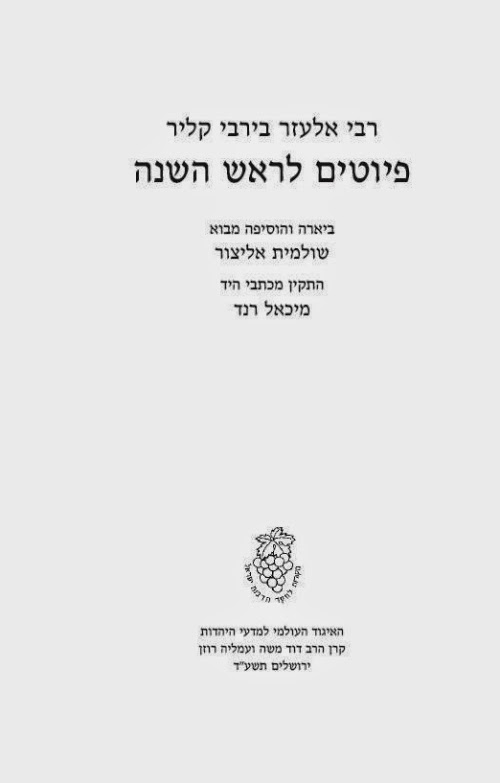
רבי אלעזר בירבי קליר, פיוטים לראש השנה, ביארה והוסיפה מבוא, שולמית אליצור, התקין מכתבי היד מיכאל רנד, האיגוד העולמי למדעי היהדות, ירושלים תשע”ד, [מקורות לחקר תרבות ישראל, כרך יח], 718 עמודים.
I am very happy to announce the publication of an important work out just in time for Rosh Hashanah, a critical edition of all of R’ El‘azar HaKalir’s Piyyutim for Rosh Hashonah, by Shulamit Elizur and Michael Rand.
The importance of studying the Piutim before Yom Tov has been noted by many for example:
R’ Moshe Hakohen, nephew of the Rosh, writes in his work, Sefer Hamaskil:
מה טוב ומה נעים לעיין תמיד דבר בעתו בכל שבוע ושבוע בפירוש חומש ומחזור וסליחות ויוצרות ופיוטים וקינות ופרקי אבות ודברות והושענות וזכרנו ואגדת פסח ומערבים וגדול וקטן… [ספר חסידים, עמ’ עא].
[For an exact explanation of this passage and for general information about this work see the special article of Rabbi M. Honig in Yerushaseinu 1 (2007) pp. 196-240 especially p. 229].
A similar idea is found in the Mahril:
וכל אדם יחזור וילמוד התפלה והקרובץ מקודם להיות שגורים בפיו בר”ה בשעת התפלה [מהרי”ל עמ’ רעב].
The Taz writes:
ראה דבתפלה שצריך להבין בפי’ הדברים בפרט בפיוטים שחמור פירוש’ אם לא בנתינת דעה רבה עליהם ודאי צריך להסדיר תחלה ולא מהני לו ספר בזה וזה פשוט [ט”ז, סי’ ק ס”ק א].
In regard to the Piyutim by the Kalir, it’s worth quoting the Arizal, as mentioned by the Magen Avrohom:
האר”י ז”ל לא היה אומר פיוטים ופזמונים אלא מה שסדרו הראשונים כגון הקלירי שנתקנו ע”ד האמת, (הכוונות( [סי’ סח הקדמה].
Different aspects related to the Kalir have been dealt with here on the Seforim Blog; see Dan Rabinowitz’s article here which includes a bibliography about him. In addition to this, see Marc Shapiro’s article here and my article here, note 73.
The Kalir as described by Rabbi Joseph B. Soloveitchik
 
I would just like to quote one special passage of Rabbi Joseph B. Soloveitchik about the greatness of the Kalir. This passage is from the Koren Mesorat Harav Kinot (pp. 386-388) which is based on Rabb Jacob Schacter’s transcripts of the Rav’s Tisha B’Av sessions:
At this point, it would be useful to make some general observations about Rabbi Elazar Hakalir and the style of his piyutim, his religious poetry. The piyutim of Rabbi Elazar HaKalir, including his kinot, serve two purposes. The first is limmud, learning. Every sentence of the piyut quotes m’aamarei Hazal, teachings of the sages. The second purpose is tokhaha, rubuking the people for their misdeeds and instructing them in the proper way to act. These piyutim deal with reproach, repentance, petition and acknowledgment of God’s justice. The shali’ah Tzibbur was not merely a hazan, a cantor, but was one of the great scholars of the generation who was the principal mokhiah, moral critic of the people…
Rabbi Elazar HaKalir was a master of the Hebrew language and very creative in his use of Hebrew. If not for him, modern Hebrew could not have come into existence. Before HaKalir, the Hebrew language was very rigid. For example, the noun and verbs were fixed in their form. It was difficult to transform a verb into a noun or a noun into a verb, a simple matter in other languages…
But HaKalir made a critical contribution to the development of the Hebrew language by endowing the language with flexibility, thereby paving the way for the development of modern Hebrew. There were other early paytanim, composers of piyut, such as Yose ben Yose, but they were not as radical in their literary style as HaKalir.  HaKalir was the father of the paytanim, and he dared to do more than any other paytan.
As noted above, Rabbi Elazar haKalir’s piyutim served two purposes: limmud, study and tokhaha, rebuke. As for the element of study, one of the dimensions of HaKalir’s piyutim is that they are compilations of the statements of the sages. Most of us, who are expert in neither Hebrew nor aggadot Hazal, find HaKalir’s corpus of piyutim boring. But it is not boring at all; it is like a gold mine. His piyutim for Yom Tov explain the essence of the Yom Tov. The midrashim concerning Sukkot are replete with information about the sukka, etrog and lulav, and all the explanations in the Midrash, all the ta’amei sukka, the reasons for the sukka, all of the ma’amarei Hazal, are brought together in the HaKalir’s piyutim for the first day of Sukkot. Similarly, his piyutim for Rosh HaShana and Yom Kippur include all the homiletical literature concerning the statement in the Midrash, “On Rosh HaShana, Sarah, Rachel and Hanna, were remembered” (Bereshit Raba 73:1). If one were to study carefully and thoroughly the piyutim of Rabbi Elazar HaKalir for Rosh HaSahana, Yom Kippur, Sukkot, and Pesah, one would find many applicable halakot and the entire pertinent Midrash, including many  midrashim that are unknown to us from any other source.
It is quite possible that during the time of Roman and Byzantine rule in the land of Israel, the ruling authorities prohibited shiurim and afternoon lectures by Torah scholars and sent officers to the synagogues on Yom Tov afternoon to prevent the people from studying. Consequently, the rabbis introduced the study of Torah into the prayer service via piyutim, a subterfuge that eluded the authorities. The piyutim were deliberately written in a fashion that would make them difficult to understand, lest the officers recognize their true function and forbid their recitation. As previously noted, we do not know with certainty when Rabbi Elazar HaKalir lived. According to Tosafot (Hagiga 13a, s.v. veraglei hahayot), he was the tanna, Rabbi Elazar HaGadol, who lived in the second century, but according to other Rishonim, he was either an amora, or one of the early liturgical poets, from the sixth or seventh century. But his piyutim could certainly have served the purpose of integrating Torah study into the prayers in a way that would not have been obvious to the non-Jewish authorities.
Description of the work:
What follows is a description of this new work [sent around from the publishers of the book]
Rosh Hashana, the Day of Judgment, has been embellished with numerous fascinating liturgical poems (piyyutim). This book is devoted to the compositions that were written for Rosh Hashana by the illustrious poet R. El‘azar berabbi Qillir, who was active in the Land of Israel at the beginning of the seventh century. The piyyutim for Rosh Hashana are many and varied, and they adorn all of the special prayers for the festival. A number of these piyyutim are known and recited to this day in Ashkenazi congregations, while others are published here for the first time. Even those piyyutim that are known from the festival prayer books (mahzorim) are presented here in a new light. The present edition is primarily based not on European mahzorim, but on earlier fragments from the Cairo Genizah; on the basis of such early sources the editors have succeeded in adding new, original material to the known compositions—there is not one famous composition to which heretofore unpublished material has not been added, in some cases throwing new light on the entire work. Even in such cases, therefore, we are not merely offering old wine in new wineskins, but presenting a new blend that confers on the poetic compositions novel aspects, not previously brought to light.
This edition has been prepared on the basis of close to 400 manuscripts, and all of the variant readings have been given in the margins. An extensive commentary aids the reader in understanding the difficult idiom of the payyetan, identifying the many scriptural and midrashic sources that are woven into the piyyutim, and following the development of their themes. A general introduction treats various questions connected to the poems, from their attribution to the author and the reconstruction of the component parts of each composition, to the literary shaping of the material. In his piyyutim, R. El‘azar berabbi Qillir treats Rosh Hashana in all of its aspects: the Day of Judgment, the blowing of the shofar; the malkhiyot, zikhronot, and shofarot verses; the merit of the Fathers; and more. A number of compositions are specially intended for when Rosh Hashana falls on the Sabbath. Qillir’s unique method in the shaping of each of these themes is also clarified in the introduction. The complex web of interrelations between the piyyutim and their literary sources is elucidated as well; thus it has become clear, for example, that one of the piyyutim edited here for the first time throws new light on the famous poem, U-netane toqef qedushat ha-yom.
“O King, Remember [the ram] caught [by its] horn!” These few words from one of the piyyutim published in the book reveal the genius of the great payyetan. Here, R. El‘azar berabbi Qillir has succeeded in encapsulating in four words the three great themes that lie at the heart of the benedictions that are unique to Rosh Hashana—kingship, remembrance and the ram’s horn (shofar)—all in the
form of a prayer that beseeches God to remember for our sakes, on the Day of Judgment, the Binding of Isaac, symbolized by the ram whose horns are caught in the thicket. And if in four words the payyetan has managed to encapsulate such far-flung meanings, one can only imagine the riches contained in this enormous collection of R. El‘azarʼs writings for the Day of Judgment, which we now have before us.
About the authors:
Prof. Shulamit Elizur has been teaching since 1980 in the section for Medieval poetry and piyyut in the Department of Hebrew Literature at the Hebrew University of Jerusalem. She has published more than ten books and scores of articles, predominantly in the field of Genizah piyyut, but also devoted to Spanish Hebrew poetry and the development of various liturgical rites. A series of her books is devoted to the Late Eastern period of piyyut, and comprises an attempt to characterize the linguistic and literary developments attested during this phase on the basis of the production of critical editions of a number of its outstanding representatives. The present work is part of another series of her books devoted to the great Classical poets, among them R. El‘azar berabbi Qillir and R. Pinhas ha-Kohen.
Dr. Michael Rand specializes in Hebrew philology and piyyut. Since 2013, he has been Lecturer in Hebrew and Aramaic at the University of Cambridge. Dr. Rand acquired expertise with Genizah manuscripts over the course of a number of years of work in the section for piyyut and Medieval poetry of the Historical Hebrew Dictionary Project of the Academy of the Hebrew Language. He has devoted an extensive study to the grammar of the piyyutim of R. El‘azar berabbi Qillir; together with Jonathan Vardi, he has recently completed a soon-to-appear reconstruction of a copy of the Diwan of R. Shmuel ha-Nagid, the leaves of which are now scattered across various Genizah collections. He has also written many articles, among which are a number in which he has edited parts of the Qillirian corpus. In the present work, Dr. Rand is responsible for the paleographical aspects of the research: reading the manuscript sources, grouping them together (where relevant) and reconstructing thereby the larger units (quires, books) to which they belong, producing the apparatus of variant readings, and describing the manuscripts.
Purchasing information:
 
For a Table of Contents or more information about purchasing this work, feel free to contact me at Eliezerbrodt@gmail.com. Copies of this work will be arriving at Biegeleisen shortly.


R. Isaac Arama, R. Kook, Mordecai Kaplan, and more

R. Isaac Arama, R. Kook, Mordecai Kaplan, and more
by Marc B. Shapiro
1. In the last post I discussed R. Isaac Arama. In his Conversos, Inquisition and the Expulsion of the Jews from Spain, p. 53, Norman Roth states that Arama was not a “great scholar.” If he means to say that Arama wasn’t a great talmudist (as has been stated about Ibn Ezra and Abarbanel), then perhaps he has a point (although I am sure this would be debated). But I don’t see how the title “great scholar” can be denied to Arama whose Akedat Yitzhak is a classic of Jewish literature and shows his vast knowledge.
Because the style of Akedat Yitzhak does not make it an easy read, many people avoid the work which is a shame as it is full of fascinating insights. One of his views that has often been quoted is that while it is true that individuals have free will, this is not the case for the Jewish people as a whole. It is built into the nature of the Jewish people that there can never be a time when the entire Jewish population rejects God.[1]
I think readers will also find it interesting that in discussing the role of women, he says that their second purpose (which he terms the lesser purpose – התכלית הקטן) is to have children.[2] However, the primary purpose of women is seen in the following quote, which I think is incredible when one considers how most medievals viewed women.
האחד מה שיורה עליו שם אשה כי מאיש לוקחה זאת וכמוהו תוכל להבין ולהשכיל בדברי שכל וחסידות כמו שעשו האמהות וכמה צדקניות ונביאות . . . ודאי עקר תולדותיהם של צדיקים מעשים טובים
How many contemporary Orthodox writers advocate the viewpoint that the primary purpose of women is to bear children, and that is where they find their fulfillment? Yet Arama rejects this completely. Arama’s understanding allows him to explain why Jacob was angered with Rachel when she said to him, “Give me children, or else I die.” (Gen. 30:1). Rachel didn’t realize that the main purpose of the righteous, and this also includes women, is good deeds. She mistakenly thought that her primary goal in life was to have children, and without that her life had no value. Jacob became angry since Rachel didn’t understand the basic point that the value of women is not simply dependent on how many children they can produce.[3]
It is well known that R. Meir Arama accused Abarbanel of plagiarizing from his father, R. Isaac. Abarbanel made heavy use of R. Abraham Bibago, and this also might be considered plagiarism (although much what we would regard as plagiarism today was not regarded as such in medieval times).[4] Abarbanel also used other writings without acknowledgment, such as R. Eleazar Ashkenazi ben Nathan ha-Bavli’s Tzafnat Paneah,[5] R. Nissim of Gerona’s Derashot,[6] and the medieval work Zekhut Adam.[7] R. Azariah de Rossi even accused Abarbanel of plagiarizing from Jerome.[8]
 מן הנראה כי גנוב הוא את החכם דון יצחק מדעת המעתיק לנוצרים בפרוש דניאל
In the introduction to his edition of Akedat Yitzhak, R. Hayyim Joseph Pollak mentions Abarbanel’s unacknowledged use of Arama’s work, and he is not sure what to make of it. In one case he refers to it as שגגה שיצא מלפני השליט. In general, he assumes that Abarbanel copied material from Arama for his own use, without intending to publish it. Yet by the time he published his own biblical commentaries he had forgotten that some sections of this work had come from Arama. Pollak also suggests, without any evidence whatsoever, that originally Abarbanel did mention Arama, yet these references were removed by others who had access to the manuscript. They did so in order to give greater glory to Abarbanel, so that he be given the credit for everything in the commentary.
השמיטו הם (או המעתיקים הבאים אחריהם) את שם בעל עקיד’ ז”ל מהמאמרים הלקוחים מאתו, בחשבם להרבות בזה כבוד הר”א ז”ל, אם יראו כל דברי ספרו כאילו הם ממנו לבד
Pollak’s defenses do not make much sense, and the best explanation is as mentioned, namely, that current standards of plagiarism are not like those found in medieval times.
Speaking of R. Isaac Arama, there are a number of references to him in the new edition of R. Raphael Berdugo’s commentary on the Torah, Mei Menuhot (I have mentioned R. Berdugo in a few prior posts). Here is the title page.

Here is page 918 of the commentary, where you can see that he quotes the Akedat Yitzhak who is criticizing Narboni.

On the top of the second column he refers to המדברים. The problem is that the editor doesn’t know what this term means (or for that matter, the word ההעברה),[9] and provides some fanciful explanation. However, just a little investigation would have revealed that the “Medabrim” are the Mutakallimun, that is, the followers of the Kalam. (Kalam means “word,” “conversation,” or “discourse”.) All one needs to do is open Ibn Tibbon’s translation of the Guide, and you will find lots of references to them. There is also a reference to them in Ibn Tibbon’s translation of Shemonah Perakim, ch. 6. 
The following appears in Guide 1:73 (Ibn Tibbon translation):
ההקדמה העשירית הוא זאת ההעברה אשר יזכרהו וזהו עמוד חכמת המדברים

The problem I am focusing on is not just that the editor did not recognize the term המדברים. It is that he should have been able to see that this was something he didn’t know, which in turn would lead him to investigate. This is a common problem, namely, it is not just that people don’t know, but that they don’t know that they don’t know.[10] What we should be able to expect, however, is that when an editor sees a term or expression that he doesn’t recognize, rather than engage in fanciful speculation he should actually consult with someone who might be able to understand the text.

Let me give another example of what I am referring to from the haredi world. This should not be taken as a general criticism of haredi editors. On the contrary, most of the best editions of rabbinic texts are edited by haredi scholars. They are experts in what they do and we all benefit. They, more than anyone else, are embarrassed when amateurs try to edit texts with all the errors they bring. (In a future post I will bring examples of mistakes by academic scholars in texts they edited, errors that could have been avoided had they consulted with real talmidei hakhamim.)

A few years ago a new edition of Maimonides’ ethical will, with an extensive commentary, was published. Here is a page from the work.

The only problem is that this supposed ethical will is a forgery, a fact recognized by R. Jacob Emden.[11] Actually, let me more exact; only the second part is a forgery, the part where Maimonides addresses his son R. Abraham and among other things tells him that the French scholars “don’t appear to recognize the Creator, blessed be He, except when they are ingesting boiled ox meat, seasoned in vinegar and garlic. . . . Generally, they have two wives, so that their minds are invariably fixed on sex, eating and drinking, and other sensual pleasures.”

The first part of the ethical will, before you come to דע בני אברהם, is not a forgery, but a case of mistaken identification. As noted by Israel Abrahams,[12] and more recently by R. Yitzhak Sheilat,[13] this first part is actually an ethical will of an Italian Jew directed towards his sons. He directs his words to them in the plural. Somehow, this ethical will got attached to the forged document of Maimonides, which of course is directed towards his son in the singular.[14]

In the introduction, the editor, R. Hillel Copperman, deals with the matter of the document’s authenticity.[15] He reports that he went to an unnamed great talmid hakham who told him in no uncertain terms that the ethical will was not written by Maimonides. When challenged that both R. Solomon Luria and the Hatam Sofer assumed that it was indeed written by Maimonides, this talmid hakham was not moved, and stated that they were both in error. It is not clear why the editor does not reveal the name of this talmid hakham. It could be that he is R. Shlomo Fisher, as later in the introduction the editor cites him by name, showing that R. Fisher was consulted in this matter.

After quoting from the anonymous talmid hakham, Copperman refers to numerous earlier sources that assume that the document was written by Maimonides, including various Mussar figures and also R. Aaron Kotler. He then cites R. Moses Samuel Shapiro that even though there might be difficulties with the work, one does not reject a tradition (that the document was authored by Maimonides) based on difficulties. Copperman then tells us that he asked R. Shmuel Auerbach who was uncertain about the matter. That is, the fact that earlier scholars assumed that the ethical will was written by Maimonides did not convince him of its authenticity.

Following this, Copperman went to R. Chaim Kanievsky. He was surprised to hear from R. Kanievsky that the latter had never seen or even heard of the ethical will! To say that this is difficult to believe is to put it mildly. It is indeed impossible to believe. One doesn’t need to be a great scholar to know of this work, which appears in various books and is referred to by numerous authors. Anyone who has been exposed to R. Kanievsky’s unparalleled wide-ranging knowledge knows that he is well aware of the ethical will and must also have reached an opinion about its authenticity, which for some reason he did not want to share with Copperman. Copperman himself raises this possibility but rejects it, seeing it as unlikely that R. Kanievsky would not tell him the truth.

חשבנו שמא לא רוצה הוא להיכנס לסוגיא זו, ומשנה מפני השלום. אך זה רחוק מאד בעינינו

All I would say is that while Copperman might regard this as unlikely, it is much more unlikely (actually, impossible) that a walking encyclopedia like R. Kanievsky has never even heard of the famous ethical will attributed to Maimonides.

Copperman then went to R. Steinman, and he tells us that it was clear to him that R. Steinman does not believe that the problems with the ethical will are enough to refute its authenticity. Yet he also tells us that R. Steinman referred to the matter of the Yerushalmi Kodashim, in order to show that something that even great rabbis originally regarded as authentic could later be shown to be a forgery. This latter point would appear to show that R. Steinman is not certain about the matter.

In seeking to determine if a document attributed to Maimonides is authentic, Copperman turns to the gedolim, the ones who determine Da’as Torah. Yet there are a number of people, some in the haredi world, who are experts in Maimonides’ writings, in particular, his letters and manuscripts. Shouldn’t they be the people to turn to? Shouldn’t Copperman have consulted with R. Yitzhak Sheilat or R. Shlomo Zalman Havlin, to give just two names? This is just one example of how some editors in the haredi world are simply not doing their job properly. It would be one thing to just reprint the ethical will without comment, but once Copperman writes an introduction to discuss its authenticity, how can he possibly assume that the matter will be settled simply by citing R. Steinman’s opinion, especially since R. Steinman would agree that he has no expert knowledge of this issue?

Let me return to Norman Roth, mentioned above and from whom the Seforim Blog recently had the privilege of publishing a post. He is a well-known expert in Spanish Jewish history. His footnotes in particular are always worth reading, as he uses them to correct all sorts of misconceptions. There are many supposed facts, continuously repeated, that actually have nothing to stand on, and throughout Roth’s works errors such as these are corrected. I mention this because I too might be a future subject of one of these footnotes. My book on censorship is currently with the publisher and I can’t make any further changes. In this book I deal with Ibn Ezra’s Iggeret Shabbat and discuss the controversy over whether it was directed against Rashbam. In a recent article which I just read, and thus could not refer to in my book, Roth sums up his position (which I think is unique) as follows: “In my opinion, it is highly unlikely that he [Ibn Ezra] ever went to England, and the “Sabbath letter” is surely a forgery.”[16] I am curious to hear what Ibn Ezra scholars have to say about Roth’s argument.

2. In my post here I quoted R. Nathan Lopes Cardozo’s rejection of dogma. He continues this theme in his recent article in Conversations 19 (Spring 2014). The article is titled “God is Relocating: A Critique of Contemporary Orthodoxy – Four Observations,” and I offer here a selection from it. Are there any other Orthodox (a term Cardozo rejects) rabbis who agree with the sentiments that follow?

The truth is that Jewish Orthodoxy (from the Greek orthos [“true” or “right”) and doxa (“opinion” or “belief”) never existed. Originally Judaism was highly unorthodox. Although it always believed in God and Torah, it never offered any specifics of what God meant or what Torah consisted of. That was left to speculation, never to be determined. The early Sages, as testified by the Talmud and philosophers, disagreed on some of the most fundamental issues of faith.

But over the years we wanted more certainty. We wanted it handed to us on a silver platter, so that we could avoid debates and live a life of religious comfort, apathy, and mediocrity. Influenced by other religions, we adopted the need for cast-iron certainty and psychological security. So we began to rewrite Judaism in a way that would fit into the notions of established religions – well-structured, with a good dose of dogma. What we did not realize is that by doing so, we misrepresented Judaism by losing sight of the plot, thus doing it a great disservice.

We need to realize that our epoch of uncertainty is in fact much more conducive to authentic Judaism than all the conviction we’ve had in previous generations. It forces us to rediscover what Judaism is really about and gives us the opportunity to rebuild where rebuilding is required and leave untouched what should remain untouched.

Tamar Ross is another liberal Orthodox thinker. Here are three separate passages from a recent article.[17]

It is precisely because of the importance of everyday “realist” assumptions in cementing religious commitment that so much effort is expended by religious conservatives in cordoning off some religious beliefs as off-bounds to demythologizing or re-interpretation. Because the notion of “truth” and religious commitment are so intimately connected in the human psyche, critical scrutiny of beliefs that appear indispensable to the system is sometimes held back by upholding the remote possibility that future investigation will overturn current impressions. When scientific discoveries or deeply felt moral intuitions render even such eventualities incredible, religious adherents may resort to deliberate bifurcation, conducting themselves in accordance with reason in the laboratory and in their everyday lives while preserving professions of faith in the synagogue and in formal allegiance to what are regarded by current halakhic consensus as unavoidable halakhic constraints. Irrespective of the difficulty some may have in granting legitimacy or persuasive value to such policies, it would be fair to say that a religious world-view lacking any claims of attunement to a reality beyond its self-contained universe of discourse will never match traditional belief in its ability to preserve the intensity of feeling generated by its models and paradigms and to transmit the passion of its message to future generations.

Given these precedents, we would do will to rid ourselves once and for all of the misnomer of Orthopraxy, often invoked in a pejorative sense in order to dismiss halakhically conformist behavior that is not grounded on acceptance of dogma in its literal sense. Any behavior externally conforming to that which is historically and sociologically identified with traditional halakhic practice indicates some form of belief or justification though it may not tally with the naive objectivism of strict correspondence theory.

Postmodern language theory can redeem modern Orthodoxy from its counter-productive attachment to naive objectivism. The epistemological modesty of non-foundationalism can help religious adherents move away from overly rigid definitions of doctrine and allow them to return to the pre-modern function of religion as providing a valuable universe of discourse and a compelling way of life. It can extricate them from a mindless and stultifying triumphalism and encourage the willingness to refine religious convictions by listening carefully to other points of view.

After reading Cardozo, Ross, and numerous others I have quoted in the past, the only conclusion that can be reached is that, despite what Centrist rabbis like to claim, it is certainly not dogma, Maimonidean or otherwise, that holds wider Orthodoxy together. 

In thinking about the place of dogma, people should pay close attention to the following passage from R. Kook (Shemonah Kevatzim 1:765). R. Kook tells us that even “heretics” can have a more profound belief than so-called Orthodox Jews, and are thus described by the verse from Habakkuk 2:4  צדיק באמונתו יחיה.

לפעמים ימצא כופר שיש לו אמונה חזקה, פנימית, מאירה, נובעת ממקור הקדושה העליונה, יותר מאלפי מאמינים קטני אמנה. דבר זה נוהג באישים פרטיים וכן בדורות, ועל כולם נאמר צדיק באמונתו יחיה
R. Kook’s new published volumes contain many important texts dealing with belief, and I have quoted a number of them in prior posts. Here are some more significant passages.

Kevatzim mi-Ketav Yad Kodsho, vol. 1, p. 182: R. Kook explains that there are two types of faith, one which is based on absolute truth, and one which he refers to as אמונה הסברית. This latter type of faith is not absolute but changes with the times. For example, in one generation one can base a belief on a certain notion (scientific, moral, etc.) while in another generation, such an approach cannot be used, because the underlying notion is no longer accepted, and to use it will be dangerous to faith. We can all think of examples where this is so, i.e., where an explanation used to strengthen faith, and which was successful in its time, today will turn people off from Judaism (for example, explanations for kashrut and circumcision, or various descriptions of women’s nature and their necessary subservience to men, used to explain women’s position in Judaism). Similarly, there are examples where years ago an explanation could not have been used because of its negative impact, while today it can have a positive impact (for example, using evolution in explaining Torah). R. Kook sees the notion he is expounding upon as alluded to in Maimonides’ famous conception of “necessary truths” (Guide 3:28). 

R. Kook’s point is very important as it tells us that while the core of belief remains absolute and unchanging, the way it is understood and expressed must change with the times. This explains why earlier rabbinic conceptions of Judaism are not always satisfying to moderns. Some people assume that the reason for this is because we are at a much lower level than earlier rabbinic greats. R. Kook’s point, however, is that everyone, in every era, is subject to the times, and even the earlier examples of אמונה הסברית  are only to be regarded as provisional. As mentioned, this is a very important point and it could be expanded at great length.

שתי דרכים לאמונה, האחת האמיתית המוחלטת, והשנית ההסברית. האחרונה משתנה היא לפי הזמנים. ישנם זמנים שאם יהיה איזה עיון מתפרסם ומוחזק, היה מזיק ליסוד דברי אמונה ברורים מצד האמת המוחלטת. ואחרי אשר העולם המדעי קבל צורה אחרת בהמשך הזמן, אבדה האמונה ההסברית ההיא את ערכה, וכבר לא מזיק כלל לשום רעיון אמוני מוחלט הפרסום של אותה ההנחה בעצמה, שהיתה בזמן העבר מזקת בפרסומה. והדברים הולכים עוד יותר, שמזדמן הדבר שצורה הסברית אחת היתה מחוייבת באיזה פרק מפרקי הזמן, עד שקבעה לה אז האמונה ההסברית את צורתה באופן מיוחד, ואחר כך יזיק דוקא אופן זה להאמונה המוחלטה, ושיש חיוב אז לפרסם את ההפך מהאמונה המוסברת אז. יסוד החילוק בין שני חלקי האמונה כבר רמז הרמב”ם, אמנם צריך אומץ לב מיוחד לעמוד בניסיון בעת חשיכה כזאת.

Tied in with this is R. Kook’s comment (Kevatzim, vol. 2, p. 167) that certain great truths can only be revealed together with falsehood, which protects the truth as it were.

ישנן אמתיות גדולות, שאינן יכולות להתגלות בעולם כי אם דוקא במעטה של שקר, ומעטה של שקר השומר את האמת נעטר גם הוא באור האמת. ופקוחי עינים יודעים להבדיל בין המעטה לעוטהו, ופחותי הנפש מביטים באור האמת בשביל מעטה השקר שלה, ונמוכי הדעת אינם מכבדים את האמת יותר מהכבוד הראוי למעטהו הנאהב אצלם לפי תכונתם הנמוכה.
One can easily come up with a number of examples of this. Just think of all the foolish talk about God and His nature. It seems that every preacher feels it is OK to talk about what God “wants”, about how God gets “angry”, or is “upset”, or is “pleased”, etc. A little thought will reveal that none of these descriptions of God can be true in an absolute sense, but since these descriptions are thought necessary in order for people to believe in the ultimate truths, i.e., the existence and providence of God, they are tolerated. (See Guide 3:28 for Maimonides’ discussion of “necessary truths”.)

Since I mentioned R. Isaac Arama earlier in this post, let me give an example of this from his writings.[18] Arama asks what is the point of the commandment to build a mishkan. It is not as if God is a physical being who needs a place to live. Yet in order that the masses have a God with whom they could feel connected, that is, a God who exercises providence, the Lord was prepared to compromise and allow them to believe that he actually was found in the mishkan. Here are some of Arama’s words:

כי באומרו ולא יכול משה לבוא אל אהל מועד ויתר להם הרחקת הגשמות למה שיורה שהיה שם דבר ממשיי המעכבו לבא לשם. וזה לפי שלא יראה להמון דבר של מציאות זולת זה. ובאומרו כי שכן עליו הענן ויתר אצלם ענין ההעתק ממקום למקום לקבל מהם שירות ועבודה כי בזה יסמוך לבם על השגחתו עליהם. ובאומרו וכבוד ה’ מלא את המשכן לא נשמר מהתקוממות במקום והיותו כמלך הקובע ישיבתו באמצע המלכות

Kevatzim mi-Ketav Yad Kodsho, vol. 2, p. 129: R. Kook tells us that true belief cannot exist without the possibility of unbelief
.
האמונה בטהרתה תצא דוקא על ידי אפשרות של כפירה בלא שום הגבלה

This is very similar to the sentiments expressed by R. Jehiel Jacob Weinberg.[19] What it means is that true faith is stormy, on the edge, as it were. There are easier paths, where one is perhaps guaranteed “peace of mind.” However, this cannot be regarded as authentic religious faith. Paradoxically, true faith, the faith that keeps you up at night, can easily turn into unbelief. R. Kook also explains, ibid., p. 149, that this true faith can only be developed through freedom of thought. That is, while obedience can be assured by closing off thought, one can never reach what R. Kook terms אור א-להים if one’s thought is controlled.

Even when unbelief does arise, R. Kook does not see this as all bad. As a kabbalist, he believes that there are sparks of holiness in everything, even in unbelief. According to R. Kook, when the unbelief is directed in an ethical direction, then this too can be seen as part of the search for God (ibid., p. 151). In other words, even the atheists are engaged in derishat ha-Shem when they work for the betterment of humanity, and it unfortunate that they do not realize this.

המהומה הכפרנית כל זמן שהיא עסוקה במגמות מוסריות הרי היא ממש דרישת ד’. המוסר והרחבתו, הגדלת ערכם של החיים, ענוגם ושאיפותיהם, הוא בעצמו דרישת ד’, יותר משארי דרישות הבאות ברחשי לב המתעוררים על פי איזה דמיונות פנימיות שאין בהם הטבה מעשית לסדרי החיים. מכל מקום אומללים הם בני אדם כל זמן שאינם יודעים שכל מה שהם עסוקים לרדוף אחריו במובן המוסרי ובקשת הטוב זהו דרישת ד’, ונהרה רבה תופיע עליהם כשיגלה להם רז זה.

R. Kook also sees other positive elements in unbelief (pp. 166, 167). There are people who assume that there is no afterlife, or any reward and punishment. The positive aspect of these mistaken beliefs is that the unbelievers’ good works are not performed in order to receive reward, but for their own sake. This is a very high level of service, something Jews realized long before Kant.

יצר הרע בא לאדם לפעמים להוכיח לו שאין לו תקוה לעולם הבא. – ידע נאמנה, שהוא עומד להתעלות במעלה גדולה מאד, עד שיהי’ עובד ד’ שלא על מנת לקבל פרס, כי אם מאהבה שכלית טהורה.

הכפירה בשכר ועונש מחנכת את הבריות לעשות טוב מצד עצם הטוב. וכל מה שיתרבו עושי טוב באמת, כן יתמעט ההכרח של מציאות רעיון הכפירה, שאיננו כי אם אמצעי תרבותי לזה המצב.

Even the very thought of God when engaged in the good is not the highest level, so again, paradoxically, unbelief prepares the ground for service on the highest level (ibid., p. 166).

הצורך לחשוב על דבר א-להים היא ירידה גדולה, שהיא דרושה לאדם בתור רפואה. הכפירה היא הכנה שלילית לצורך העילוי העליון שלא יהיה שום צורך לחשוב על דבר א-להות, כי אם עצם החיים יהיה אור א-להים

Finally, let me call attention to one more interesting point about faith. R. Jacob Wreschner, Seder Yaakov (Jerusalem, 2010), vol. 2, p. 425, records that he heard from his father that R. Yerucham Levovitz had religious doubts in his youth, and R. Isaac Blazer helped him overcome these. R. Wreschner states that it is no insult to a great figure to reveal this information, though he notes that R. Judah Zev Segal, when he tells this story, does not reveal who the subject is.[20]

Anyone who thinks about the place of belief in traditional Judaism is aware of the phenomenon called, for a lack of a better term, “orthopraxy.” Many people assume that this is a fairly recent phenomenon. Yet already in the nineteenth century R. Solomon Kluger wrote about people who were completely observant but did not have proper beliefs.[21] He sees these people as worse than typical sinners who actually violate prohibitions (he specifically mentions sexual prohibitions).

בימים הראשונים היה הרשעות במעשה. אם ראו באיש אחד שאינו פרוץ בעריות וכדומה ידעו שהוא כשר. לא כן עתה הרשעות תלוי בלב ויתכן שיהי’ מקיים כל התורה ובלבו ישים ארבו ויש בלבו שמץ אפיקרסת [!] והוא גרוע מן הרשעים הראשונים שהי’ בהם כמה חטאים

Someone who is attuned to R. Kook’s way of thinking will approach matters from a completely different perspective, and see the phenomenon of orthopraxy in a much more positive light. Consider the following: The so-called orthoprax individual does not have a traditional view about the Torah. Yet he does not use this as an excuse to live a secular life, what in yeshivah we referred to as a life of “hefkerut”. On the contrary, this individual chooses to bind himself to the Torah, to observe mitzvot, to “inconvenience” himself when it would be much easier to abandon it all. How is one to judge a person who, whatever his theology, makes enormous financial sacrifices to send his children to Jewish schools and happily gives to a variety of Orthodox causes? How is one to judge such a person who when stuck in a strange place for Shabbat asks the hotel clerk to open his door (as it is electronic) and refuses to carry a map on the unfamiliar street, a person who chooses to live on fruit because there is no kosher restaurant in the city he is visiting (to give just a few typical challenges that Orthodox and orthoprax Jews confront)?

R. Kook’s insights about the religious significance of the non-observant who were building the land of Israel must be multiplied many times over when dealing with completely observant Jews who sacrifice in so many ways for Torah and halakhah, even though their beliefs are not “Orthodox”. Yet this is a phenomenon which, as far as I know, R. Kook does not mention. Rather, he refers to those who because of their belief in biblical criticism rejected all observance. They assumed that if you don’t accept the divine origin of the mitzvot that there is no need to observe them. R. Kook rejected this assumption and argued that there is a good reason to observe mitzvot even if one does not have a traditional view of the Torah’s authorship.[22] I will flesh out R. Kook’s argument in the next post.

3. In an earlier post I referred to Mel Scult’s new book, The Radical American Judaism of Mordecai M. Kaplan. Scult discusses the burning of Kaplan’s siddur at an Agudas ha-Rabbonim gathering on June 12, 1945, at which Kaplan was himself also put in herem. The significance of this event can be seen in that there were over two hundred rabbis in attendance.[23]

Here is the text of the herem from Ha-Pardes, July 1945.

The sentence immediately before the text of the herem clearly implies that the burning of the book was part of the ceremony (and see also Ha-Pardes, Nov. 1945 p. 23). Thus, Jeffrey S. Gurock and Jacob J. Schacter had good reason to write as follows:

Scult, Judaism Faces the Twentieth Century, p. 420, n. 38, suggests that the act of book burning was unintentioned and not directed by the rabbinic leaders themselves, but all evidence cited above points to the contrary. This was clearly an official act, sanctioned by those assembled as a fitting and appropriate conclusion to a most serious and solemn deliberation.[24]

Zachary Silver, who has recently written a very nice article on the episode, available here, writes as follows:

Mel Scult’s biography of Kaplan mentions that the event occurred, but he does not believe that Agudat HaRabbanim burned the book as part of the formal ceremony. Rather, he says that the burning occurred incidentally at the back of the room. However, Agudat HaRabbanim’s documents illustrate that it was a previously scripted formula.[25]

This burning of a Jewish book, coming so soon after the end of the Holocaust and so much at odds with the American tradition of freedom of expression, horrified both Jews and non-Jews. The fact that the excommunication and burning were covered in The New York Times only made matters worse, and everyone assumed that this was an officially sanctioned action of Agudat ha-Rabbanim.

In writing about the event in his diary, Kaplan referred to “rabbinical gangsters who resort to nazi [!] methods in order to regain their authority.”[26] He later publicly stated as follows:

It is just too bad that men who call themselves rabbis should in this day and age resort to the barbarous procedure of outlawing a man without giving him a hearing, and to the Nazi practice of burning books that displease them. God save us from such leadership and from the disgrace it is likely to bring upon Jews.[27]

Responding to the horror aroused by the book-burning, Agudat ha-Rabbanim publicly declared that it had nothing to do with this action. It claimed that the burning was done independently by one of its members. Silver writes:

The Union of Orthodox Rabbis later disavowed responsibility for the book burning, claiming that the event was not a scheduled part of the ceremony but rather the act of one rabbi from the audience who acted on his own, after the service was completed. This version seems unlikely, however, since the article about the excommunication in HaPardes, the unofficial magazine of Agudat HaRabbanim, gives specific justification for the book burning as part of the ceremony and does so in halakhic terms. The more likely scenario is that, after witnessing the heated public reaction, Agudat Harabbanim chose to disavow responsibility for burning the siddur as a face-saving public relations move. Thus, by saying that the burning was not part of the planned activities, the Union of Orthodox Rabbis could attempt to refocus public attention on the greater issues of the heresy of Kaplan and the Conservative movement, rather than on a particularly unsettling segment of the ceremony, which itself evoked memories of Nazi ritual book burnings. Of course, the uproar implies that Agudat Ha-Rabbanim did not realize that most Americans would be troubled by a book burning in 1945 – a lapse of judgment that would manifest the extent by which the Union of Orthodox Rabbis had lost touch with contemporary currents in American culture.[28]

Years after the event, R. Norman Lamm reflected on the book burning.

If we want to win people over to Orthodoxy, we need to present ourselves as measured, mature, and moderate people with deep faith and the right practice, but we do not insult others and we do not damage or condemn them. Coming out with issurim [decrees that forbid particular actions] against everyone else is like another Fatwa. When I was younger there was a heretic by the name of Mordecai Kaplan, and the Agudas Harabbonim had this whole big book burning party. I thought it was ridiculous to have a book burning in the twentieth century. It didn’t make anybody decide to become more religious observant. Nobody who was reading his books said[,] “If important Orthodox rabbis burned them, we’re not going to read them.” If anything, it aroused interest in people who otherwise would not have wanted to read these books. But in addition, what it accomplished was that it got people to look at the Orthodox as fanatics. That’s no way to make friends and win people over to Orthodoxy.[29]

What we see from what I have quoted is that there is agreement that it was Agudat ha-Rabbanim that sanctioned the burning of the siddur.[30] Silver adds, “It is unclear who actually burned the siddur, as the report in HaPardes uses the passive voice.”

In fact, we do know who burnt the siddur, Based on this information, we can also determine that the other point that “everyone” knows, that it was Agudat ha-Rabbanim that sanctioned the burning, is incorrect.

In 1945 The Jewish Reconstructionist Foundation published a booklet, A Challenge to Freedom of Worship. I don’t know why, but this is a very rare publication. I have therefore uploaded it here. From this booklet, you get a sense of the great ill-will produced by the excommunication of Kaplan and the burning of his siddur. This is what appears on the very first page of the booklet.

I first saw this booklet shortly before R. Joseph Ralbag passed away. At that time he was not well and I could not schedule a time to speak with him. However, at my request R. Aryeh Ralbag asked his father some questions about the episode, and I can report the following from the late R. Joseph Ralbag. R. Ralbag did not decide on the spur of the moment to burn the siddur. Rather, he knew he was going to do this ahead of time and even discussed it with his future wife. Yet the other members of Agudat ha-Rabbanim were unaware of his plans until he lit the siddur on fire. In other words, this was an individual act by R. Ralbag and, as Agudat ha-Rabbanim would later state, it was not sanctioned by them. This testimony, from the main protagonist of the event, should finally settle the matter. (Although R. Ralbag denied burning the siddur in the telephone call referred to on the page printed above, this was obviously only said to protect himself after the controversy broke out. As indicated, hundreds of people saw him burn the siddur.[31])
One more interesting point about this episode is that Rav Tzair (Chaim Tchernowitz) claimed, in the course of an attack against Kaplan’s siddur, that according to halakhah it was forbidden to burn the work.[32] I would be curious to hear what some of the readers make of this.

שמה שהחכמים גזרו על ס”ת שכתבו מין שישרף, אינו אלא מפני שהשמות לא נכתבו בקדושה, ואפשר שנכתבו לשם ע”ז, אבל בנידון דידן הרי לא את כה”י של קפלן שרפו, אלא את הסידור, שסידר אותו יהודי תמים, שבידוע שלא כוון לשום דבר אחר כשסידר את אותיות השם, ובכן אסור היה לשרוף את האזכרות שבו. ובזה עשו הרבנים שלא כדין ששרפו את הסידור (אולם הם הודיעו שלא גזרו שריפה על הסידור אלא שצורבא מרבנן אחד שרפו על דעת עצמו)
4. Before his passing, R. David Hollander asked if I could review the memoir he had written. At the time he asked me, I was too busy to do so, but hoped that I would later have the opportunity. After Hollander’s death I was unable to find out what became of the memoir. (Hollander did not have any children who would have inherited it.) Perhaps a reader will be able to help in this matter.

5. Last year Yisrael Kashkin produced a nice poster of religious Zionist rabbis. You can see it here. He has recently produced the following poster of German rabbis.

You can order framed 8.5 x 14″ and laminated 8.5 x 14″ copies. The former are meant for a wall and the latter for a sukkah. Anyone interested should write to thetidesociety@gmail.com 

[1] Akedat Yitzhak, parashat Nitzavimsha’ar 99 (pp. 105ff). Speaking of free will, see also R Meir Simhah of Dvinsk, Meshekh Hokhmah, Introduction to Exodus, who states that Moses’ free will was also taken away from him.
שהשי”ת שלל ממנו הבחירה לגמרי ונשאר מוכרח כמלאכים.
See also his Or Sameah, Hilkhot Teshuvah, ch. 4, at the end of his lengthy essay on divine knowledge and free will. In his Introduction to Exodus, R. Meir Simhah also claims that Joshua’s free will was taken away.
גם ממנו שלל השי”ת הבחירה לגמרי כמו ממשה, שלא ישלול חלילה דבר מתורת משה
[2] Akedat Yitzhak, parashat Bereshit, sha’ar 9 (p. 92b).
[3] For another fascinating idea from Arama, see here that he did not believe that the book of Esther was written with ruah ha-kodesh. Rather, the work is a completely secular (i.e., pagan) text, translated into Hebrew, and this explains the omission of God’s name. The ruah ha-kodesh is only seen in the fact that Anshei Keneset ha-Gedolah removed all falsehood from the work. This passage from Arama comes from his introduction to the book of Esther which appears in the standard edition of Akedat Yitzhak, first published in the nineteenth century with a commentary by R. Hayyim Joseph Pollak. If you look at this edition you will find that while the introduction is by Arama, the actual commentary is by his son, R. Meir. This is also what is found in the 1573 Venice edition of Akedat Yitzhak. R. Isaac’s commentary to Esther appeared in the Constantinople, 1518 edition, and was not reprinted again until 1990. In 2005 Mossad ha-Rav Kook also published an edition of this commentary.
[4] Regarding both of these matters, see Menachem Kellner, trans. Principles of Faith (Rosh Amanah) (East Brunswick, N.J., 1982), p. 219 n. 65.
[5] See Abraham Epstein, Mi-Kadmoniyot ha-Yehudim, pp. 117 n. 2, 120.
[6] See R. Yehiel Goldhaber’s Purim 5773 article, “Bitul ha-Ra ha-Nif’al bi-Yemei ha-Purim,” p. 2
[7] See Senior Sachs’ introduction to Yehiel Brill, Yein Levanon (Paris, 1866).
[8] Meor Einayim (Vilna, 1866), vol. 2, ch. 38 (p. 25). Regarding Abarbanel, see also my post here where R. Soloveitchik is quoted as saying that he wouldn’t want Abarbanel as president of Yeshiva University. I have been informed that R. Ruderman did not like Abarbanel and that is why his biblical commentaries are not found in the Ner Israel beit midrash. I was told that the reason for this dislike was that Abarbanel rejects certain aggadic statements (sometimes in a harsh manner). Some have argued that Abarbanel was not a talmudist by pointing out that he apparently didn’t realize that Bnei Brak was a place, instead thinking that מסובין בבני ברק refers to the furniture the Sages were sitting on. See his commentary to the Passover Haggadah, s.v. מעשה בר’ אליעזר. Yet it is hard to imagine that Abarbanel did not know what Bnei Brak is, for it is mentioned a number of times in the Talmud, including the famous statement in Gittin 57b and Sanhedrin 96b that descendants of Haman studied Torah in Bnei Brak. It is also mentioned in the book of Joshua 19:45. Interestingly, R. Shem Tov Ibn Shem Tov, in his commentary on the Haggadah, seems to say that the name of the city is Brak, and Bnei refers to its inhabitants. See Otzar ha-Rishonim al Haggadah shel Pesah, ed. Holzer (Miami Beach, 2006), p. 20. As with Abarbanel, it is hard to imagine that R. Shem Tov did not know the earlier biblical and rabbinic passages from which it is clear that the city’s name is Bnei Brak. For more regarding Abarbanel, see the interesting discussion in R. Yisrael Veltz, Divrei Yisrael, vol. 2, Even ha-Ezer, no. 14, and see also Pardes Eliezer: Erusin ve-Nisuin (Brooklyn, 2010), pp. 176-177.
[9] In Pines’ translation from the Arabic (Guide 1:73) this is rendered “affirmation of admissibility,” and Maimonides explains (Guide 1:73): “They [the Mutakallimun] are of the opinion that everything that may be imagined is an admissible notion for the intellect.” In his note to the passage, R. Kafih states that Ibn Tibbon’s translation as ההעברה is inaccurate, and his version has ההתכנות.
[10] Plotinus refers to this as “two-fold ignorance”, which is also the “disease of the multitude.” See Yehudah Avida, Midrash ha-Melitzah ha-Ivrit (Jerusalem, 1938), p. 49. Of course, the one who has knowledge but because of this thinks that he knows it all is a fool. Here is the formulation of R. Yedai’ah ha-Penini, Mivhar ha-Peninim (Warsaw, 1864), p. 2 (no. 21):
ואמר האדם חכם בעודנו מבקש החכמה. וכאשר יחשוב שהגיע אל תכליתה הוא סכל
For the Arabic source of this formulation, see Yehudah Ratsaby, “Mekorotav ha-Araviyim shel ‘Mivhar ha-Peninim,’” Sinai 102 (1988), p. 113. In the years after Maimonides, the term כת המדברים was used by many, with a few different meanings. For example, in a letter to R. Solomon Luria, R. Moses Isserles writes as follows (She’elot u-Teshuvot ha-Rama, no. 7):

אינני מכת המדברים בעלי הלשון כי כבד פה ולשון אנכי

R. Pinhas Horowitz also refers to the Medabrim and provides this fanciful explanation of its meaning (Sefer ha-Berit, vol. 1, sec. 19, ch. 3):

מדברים ולא מבינים מה שמדברים
[11] See Mitpahat Sefarim (Lvov, 1870), pp. 71-72.
[12] Hebrew Ethical Wills (Philadelphia, 1926), pp. 101-102.
[13] See Iggerot ha-Rambam, vol. 2 pp. 697ff.
[14] In at least one letter Maimonides addresses a man in third person singular feminine, which was a respectful way of speaking in Arabic. See Iggerot ha-Rambam, ed. Sheilat, vol. 1, p. 420. Sheilat “corrected” the original so that the feminine references are now masculine. See also R. Joseph Zechariah Stern, Beur Hadash me-ha-Rav Yosef Zechariah Stern al Shir ha-Shirim (Vilna, 1875), pp. 7b-8a.
[15] Copperman tells us that it was only towards the completion of the project that some people mentioned to him that the work might not be authentic, and this is what led him to consult with various “gedolim”. This, too, is a sign of a problem, for if he had done his homework he would have learnt of this at the beginning of the project, not at the end.
[16] “Abraham Ibn Ezra – Highlights of His Life,” Iberia Judaica 4 (2010), p. 35.
[17] “Religious Belief in a Postmodern Age,” in Avi Sagi and Dov Schwartz, eds., Faith: Jewish Perspectives (Boston, 2013), pp. 217-218, 218 n. 32, 239.
[18] Akedat Yitzhak, Terumahsha’ar 48, pp. 148ff. The Hebrew quotation I cite comes from p. 152b. See the discussion of this text in Louis Jacobs, Judaism and Theology (London, 2005), pp. 60-61.
[19] See here.
[20] See Segal, Yir’ah ve-Da’at (Lakewood, 1989), vol. 2, p. 146 n. 14.
[21] Tuv Ta’am ve-Da’at, series 3, vol. 2, no. 87.
[22] See Kevatzim, pp. 124ff., 132ff.
[23] See Zachary Silver, “The Excommunication of Mordecai Kaplan,” American Jewish Archives 62 (2010), p. 23.
[24] A Modern Heretic and a Traditional Community (New York, 1997), p. 206 n. 14
[25] Silver, “The Excommunication of Mordecai Kaplan,” p. 40 n. 2.
[26] Quoted in Silver, “The Excommunication of Mordecai Kaplan,” p. 23.
[27] Quoted in Silver, “The Excommunication of Mordecai Kaplan,” p. 32.
[28] Silver, “The Excommunication of Mordecai Kaplan,” p. 24.
[29] Quoted in Silver, “The Excommunication of Mordecai Kaplan,” p. 39.
[30] Other sources could also be quoted in support of this assertion. The only source I have found that states otherwise is Simon Noveck, Milton Steinberg: Portrait of a Rabbi (New York, 1978), p. 183.
On June 12, 1945, a few days after the appearance of the Bublick review, the Union of Orthodox Rabbis of the United States and Canada held a special meeting at the McAlpin Hotel in New York to protest the new prayer book. Attended by more than two hundred rabbis, the gathering unanimously voted to issue a writ of excommunication against Mordecai Kaplan as the principal editor of the prayer book. With solemn ceremony, the entire audience rose and repeated, word by word, the text of the first psalm, after which the traditional ban was promulgated. Immediately thereafter, one member of the group suddenly took a copy of the “new heretical prayer book,” placed it on the speaker’s stand, and set fire to it. The Union later disavowed responsibility for the burning, maintaining that the action had been taken by a single rabbi after the formal meeting was over. All admitted, however, that no effort had been made by those present to prevent the prayer book from being burned.
The first Psalm begins “Happy is the man that hath not walked in the counsel of the wicked.”
[31] The page printed above quotes a text from the June 21, 1945 New York Times disavowing R. Ralbag’s action. However, there is no such passage in the New York Times. Perhaps it appeared in the Yiddish Jewish Morning Journal which also covered the event.
[32] Siddur Tefilah shel To’im u-Mat’im (New York, 1946), p. 4. This work used to be on hebrewbooks.org but was removed. You can now find it here.


Eliezer Brodt – A Lively History of Reprinting Rabbeinu Yeruchem

A Lively History of Reprinting Rabbeinu Yeruchem
Rabbi Eliezer Brodt

In recent years, a host of critical editions of works on various rishonim have been published on all topics – some seeing the light of day for the very first time – on topics related to halakha, kabbalah, and chiddushim on the Talmud. These works have been made available via the major printing presses such as Mossad HaRav Kook, Machon Yerushalyim, Machon Talmud Yisraeli, Machon Harry Fischel and others.[1] However, one very important work has noticeably been omitted from being reprinted, except for a photomechanical off-set of the second printing. This work is Sefer Toledot Adam ve-Chava and Sefer Meisharim, the halakhic works of Rabbeinu Yeruchem Meshullam (c. first half of the 14th century) who was a student of R. Asher ben Yechiel (Rosh), R. Shlomo ben Aderet (Rashb”a), and R. Abraham ibn Ismaeil – author of Chiddushei Talmid HaRashb”a on Baba Kamma. In this post I would like to discuss the story behind why it was never retype-set, until a few weeks ago.

Rabbeinu Yeruchem authored his works many years ago, in years of the range of צד (1334). He was a student of the Rosh and his works are quoted extensively by the Beit Yosef throughout Tur and Shulhan Arukh. The Maggid (an angel who learned torah with the Beit Yosef) of the Beit Yosef told him ואוף ירוחם טמירי רחים לך אע”ג דאת סתיר מלוי בגין דמלאכת שמים היא (מגיד משרים פרשת צו).

Rabbeinu Yeruchem’s work contains three parts one called Meisharim and the remaining two parts entitled Toledot Adam ve-Chava. The part Adam contains everything relating to the man from birth until marriage; whereas Chavah contains everything from after marriage until death. This work was first printed in Constantinople in רעו (1517) and is extremely rare; only two complete copies are known to be extant. It was reprinted a second time in שיג (1553) in Venice; this is the version available today in photomechanical off-set editions. But, the Chida already notes that “this edition is full of mistakes.”[2] He also writes that he saw a manuscript of this sefer and was amazed as to the large amount of missing text as well as gross errors in the printed edition. The question remains as to why this work was never retype-set as opposed to the works of other Rishonim?

The answer might be found in the words of the Chid”a[3] where he brings as follows:

שמעתי מרבנן קשישאי בעיר הקודש ירושלים שקבלו מהזקנים דספר העיטור וספר רבינו ירחום הם מבחינת סוד עלמא דאתכסיא וכל מי שעושה באור עליהם או נאבדו הביאור או ח”ו יפטר במבחר ימיו”

I have heard from old Rabbi in the holy city of Jerusalem that they have a tradition that the books, Sefer haIttur and Sefer Rabbeinu Yeruchum, they are a high secret and anyone who writes a commentary on these books either the work will be lost or they will die in the prime of their life.

He than goes on to list a few people who started working on expounding the sefer, and either died in middle or the work was lost. In a different place the Shem Hagedolim brings the words of the Maggid to the Beit Yosef in the Maggid Meisharim (end of parashat Vayakhel) where he writes as follows:

וכן במאי דדחית מילוי דירוחם טמירי שפיר עבדת וכן בכל דוכתא דאת משיג עליה יאות את משיג עליה וקרינא ליה ירוחם טמירי דאיהו טמיר בגינתא דעדן דאית צדיקייא דלא משיג זכותא דילהון למהוי בגינתא דעדן בפרסום אלא בטמירו אבל במדריגה רבא ויקירא איהו

This, says Professor Meir Benayahu, is the reason why there is a curse on retype setting the work. What is not understood is that this is a completely halakhic work, not kabbalistic in any way, so why was there such a curse?[4]

One such work, which the Chida already mentions, is R. Hayyim Algazi’s Netivot Hamishpat.[5] The title page already records with regard to R. Algazi, “תנוח נפשו בעדן” (may his soul rest in heaven) intimating he died in the process of writing this commentary.

Another work in this category is that of R. Reuven Chaim Klein’s Shenot Chaim.[6] Unfortunately, he also died amidst writing the sefer, at the age of 47. The title page also records that the author did not want his name to appear, one can suggest that perhaps he thought if his name did not appear, he would not be subject to the curse. What’s interesting to note is in the haskamah of R. Joseph Shaul Nathenson, author of Shu”t Shoel u-Meshiv, to R. Klein’s work, as he makes no mention of any cherem to this work, but does quote the Maggid Mesharim cited earlier. Additionally, R. Chaim Sanzer, in his haskamah to this sefer, makes no mention of any cherem.

The other work which the Chidah brings was under this curse was the Sefer HaItur. This sefer was privileged to be reprinted with a critical edition by the great R. Meir Yonah, who called the glosses ‘Shar Hachadash and Pessach Hadiveir.’ Dr. Binyamin Levine, author of the Otzar Hagaonim series, writes in his short biography on him – as he used this work in many his own seforim – that he also suffered many tragedies; i.e. he lost many children.[7]

Interestingly enough, I found a nice size work on Rabbeinu Yeruchem and the author did not die young. His name was R. Yehudah Ashkenazi (1780-1849) the work is called Yisa Bracha (available at HebrewBooks.org), printed in Livorno 1822. He authored many famous seforim such as the Geza Yeshai (klallim) (Livorno, 1842), Siddur Beit Oved (Livorno, 1843), Siddur Beit Menucha (Livorno, 1924), Siddur Beit HaBechirah (Livorno, 1875), and Siddur Shomer Shabbat (Livorno, 1892).

In spite of all the above, a portion of the Rabbeinu Yeruchum has now been printed based of the first printing as well as manuscript, by on R. Yair Chazan.

Based on the above, we find ourselves asking the question ‘why did this R. Yair Chazan decide to reprint this work?’

The answer is found in the haskamah to the sefer from R. Ovadiah Yosef, who wrote that the whole curse is only if one is writing a pairush/commentary – expository text – on the work. But if one’s whole intent is to just fix the printing mistakes, which is R. Chazan whole intention here, it’s not a problem. Besides for the haskamah of R. Ovadiah Yosef, there are a few other haskamot; amongst them R. Shmuel Auerbach and R. Chaim Pinchus Scheinberg.

Just to give a brief overview of this work, as mentioned before the earlier editions of the Rabbeinu Yeruchem are full of printing mistakes and is missing many pieces. What R. Chazzan did was to track down the existing manuscripts of the sefer and try to fix the mistakes and put in the missing pieces. He also puts in the sources of Rabbeinu Yeruchem and he brings down where it is quoted in various poskim. He retype-set it beautifully making it a pleasure to read and use in compared to the old print.

So far only the third volume (the חוה section) has been printed I hope to see the rest of R. Yerucham printed soon.

Notes:
[1] See here for Marc B. Shapiro’s appreciation for R. Yosef Buxbaum, founder and director of Machon Yerushalayim, posted at the Seforim blog.
[2] Shem Hagedolim, Mareches Gedolim, letter yud, number 382, quoting the Ralbach, (siman 109); see also R. Chaim Shabtai HaKohen, Shu”t Mahrch”sh, Even HaEzer p. 153,b (“it is already known that the book of Rabbenu Yeruchum has many errors and unnecessary wordage”); R. Y. Sirkes, Bach Y.D. no. 241 s.v. U’mah Sechatav Avor Aviv (“I have already studied this work [Rabbenu Yeruchum] and it is full of error – too many to count”); Y.S. Speigel, Amudim B’Tolodot Sefer HaIvri : Hagahot U’Magimim p. 247 n.121 for additional sources.
[3] idem.
[4] Pirush Sifri, Rabbenu Eliezer Nachum, Meir Benayahu, ed., (Jerusalem, 1993), Introduction.
[5] (Istanbul, 1669; reprinted by Pe’er HaTorah in Yerushalyim, circa 1975)
[6] (Lemberg, 1871; reprinted by Machon Yerushalayim, Jerusalem, 1985)
[7] Binyamin Levin, Mesivos: Talmud Katan leSeder Mo’ed, Nashim, u-Nezikin (Jerusalem, 1973), end of this book.


Two Books by R. Bezalel Naor, R. Meir Simhah of Dvinsk, Michael Lerner, and More

Two Books by R. Bezalel Naor, R. Meir Simhah of Dvinsk, Michael Lerner, and More

by Marc B. Shapiro

1. R. Bezalel Naor is well known for his enormous contributions to what we can call “Rav Kook Studies”. His outstanding translations and analysis have cemented his reputation as one of the leading interpreters of Rav Kook, as well as the most prolific writer on Rav Kook in English. I personally owe a great debt to Naor, as can seen in my forthcoming book on Rav Kook (though I suspect he will reject some of my readings).

Yet many are unaware of Naor’s numerous writings that are not focused on Rav Kook and that go back decades. (Unfortunately, they are not all available on Otzar Hachochma.) In fact, my first exposure to Naor was as a graduate student when I came across his 1984 edition and commentary on Rabad’s hasagot to Mishneh TorahSefer Ha-Madda and Sefer Ahavah. As with all of Naor’s writings, he discusses a variety of matters that arise from the text he is commenting on. (In Naor’s Ma’amar al Yishmael, he published the letter sent to him by Prof. Isadore Twersky upon receiving Naor’s edition of Rabad’s hasagot.)

In this post, I would like to focus on two books from Naor that deal with Maimonides’ Mishneh Torah. The first is Shod Melakhim,[1] published in 2018, and the second is Ya’akov mi-le-Var Moshe mi-le-Gav,[2] published in 2024. These and other books written by Naor can be purchased here.

Shod Melakhim contains studies of Naor on aspects of the Mishneh Torah, such as the mitzvah of knowing God, Maimonides and Sefer Yetzirah (including Naor’s suggestion that a halakhah in the Mishneh Torah was influenced by Sefer Yetzirah[3]), and analysis of R. Hayyim Soloveitchik’s commentary on various halakhot of the Mishneh Torah. He also brings into his discussions works by R. Abraham Abulafia, R. Isaac Arama, R. Moses Hayyim Luzzatto, Solomon Maimon (including a work still in manuscript), Rav Kook, R. Joseph B. Soloveitchik, and so many others. The book also contains a piece by the late R. Joshua Hoffman, reworked by Naor, together with a short memorial to this scholar who unfortunately was taken too soon from us.

Shod Melakhim is so rich, and its learning so profound, that it would require a very lengthy review, if not an actual book, to satisfactorily treat all the important issues Naor raises. In the interests of space, let me offer a few points that came to mind as I went through the book.

Pp. 50ff. Naor cites examples where earlier authorities mention that Maimonides derives halakhot from the Torah,[4] and he notes the dispute about whether medieval Ashkenazic sages independently came up with derashot to derive halakhot. In a recent issue of Ha-Ma’yan, R. Yisrael Reisher published an interesting article in which he discusses when and why post-talmudic sages stopped using independent derashot to derive halakhot.[5] Let me give an example of what I originally thought was a derashah by R. David Abudarham. He lived in the fourteenth century, so it would be significant if someone this late was still independently coming up with derashot. Last summer I brought a group to Spain on my Torah in Motion tour, and one of the places we visited was Seville.[6] That gave me the opportunity to speak about Abudarham as he too was from Seville.

Abudarham, Seder Tefilot ha-Ta’aniyot, says that if the fast of the Tenth of Tevet falls out on Shabbat, that we fast. Now it is true that according to our calendar this can never happen, but if we were proclaiming the new moon with witnesses it could fall out on Shabbat, and Abudarham says that we would fast, something we do not do even with Tisha be-Av. In fact, there are times, like this year, when the Tenth of Tevet falls out on Friday. (With our calendar, Tisha be-Av cannot fall out on Friday.[7]) When we fast on Friday-Tenth of Tevet, the fast is only over at darkness on Friday night. In other words, the fast continues into Shabbat.

R. Meir Mazuz explains Abudarham’s position that we fast when the Tenth of Tevet falls out on Shabbat by saying that he derived it from a derashah.[8] Here is the passage from Abudarham:

ואפילו[9] היה חל בשבת לא היו יכולים לדחותו ליום אחר, מפני שנאמר בו (יחזקאל כד, ב) בעצם היום הזה, כמו ביום הכפורים

Regarding the Tenth of Tevet, Ezekiel 24:1-2 states: “And the word of the Lord came unto me in the ninth year, in the tenth month, in the tenth day of the month, saying: ‘Son of man, write thee the name of the day, even of this selfsame day; this selfsame (בעצם) day the king of Babylon hath invested Jerusalem.” When the Torah speaks of Yom Kippur in Lev. 23:28 it also uses the expression בעצם היום הזה. R. Mazuz thinks that Abudarham made his own derashah, that just as these words are used regarding Yom Kippur and we fast on Shabbat Yom Kippur, so too the same applies to the Tenth of Tevet. However, if you look at the new, heavily annotated, 2015 Kerem Re’em edition of Abudarham, vol. 2, p. 357, you find that there were others before Abudarham who had the same position. Thus, I think it is obvious that rather than coming up with his own derashah, from which the halakhah was derived, Abudarham is simply trying to offer an ex-post facto explanation for the practice of fasting on the Tenth of Tevet that falls on Shabbat. He presumably saw this as a long-standing tradition and was offering a possible explanation for why earlier generations, including perhaps the talmudic sages, adopted this viewpoint.

P. 73 n. 95. Naor points to two views of Nahmanides in his commentary on the Torah that Naor identifies as having their origin in Ibn Ezra. In the second example, dealing with how Jacob married two sisters and Amram married his aunt, Nahmanides does not mention Ibn Ezra, and in the first example, although he cites Ibn Ezra, one could equally well argue that the citation does not mean that this is his source, but rather an opinion he cites that agrees with him. In general, I would like Naor to elaborate on how one is to know in cases like this that we are dealing with real influence from one thinker on another. (See also pp. 97ff. where he identifies clearer evidence of geonic influence on Maimonides.)

P. 125 note, p. 129 note, Naor refers to R. Meir Simhah of Dvinsk’s Torah commentary asמש”ך חכמה. Yet this is a mistake. The first word does not have a double apostrophe and is simply written asמשך, as seen on the title page of the first edition of the work. The title is derived from Job 28:18: “the price of wisdom”, and the letters of the word משך obviously allude to the name Meir Simhah. Incidentally, R. Meir Simhah is known both as the “Meshekh Hokhmah” and the “Or Sameah”. Other than R. Israel Meir ha-Kohen, who is known as the “Mishnah Berurah” and the “Hafetz Hayyim”, are there any others who are also known by two separate book titles?

Pp. 129ff. Naor probes how the king has the power to kill people even if there is no halakhic testimony or they have not been warned. He refers to Maimonides, Mishneh Torah, Hilkhot Rotzeah u-Shmirat ha-Nefesh 2:4:

When a Jewish king desires to slay any of these murderers and the like – who are not liable for execution by the court – by virtue of his regal authority, in order to perfect society, he has the license. Similarly, if the court desires to execute them as a hora’at sha’ah, because this was required at the time, they have the license to do as they see fit.

We see from this that in order to improve society the king is not bound by normal halakhic restrictions when it comes to punishing evildoers. Naor also refers to Mishneh Torah, Hilkhot Melakhim 3:10, which has the same message:

A murderer against whom the evidence is not totally conclusive, or who was not warned before he slew his victim, or even one who was observed by only one witness, and similarly, an enemy who inadvertently killed one of his foes – the king is granted license to execute them and to improve society according to the needs of the time. He may execute many on one day, hang them, and leave them hanging for many days in order to cast fear into the hearts and destroy the power of the wicked of the earth.

Finally, Naor refers to Guide of the Perplexed 3:40, where Maimonides writes: “Even if a court does not execute him [the murderer], the ruler can, since he can execute on circumstantial evidence.”[10]

Following this, Naor cites R. Meir Simhah of Dvinsk who compares the Law of the King with Noahide laws, as both of them have the same goal, namely, establishing a functioning society. As such, when it comes to judicial matters, the Law of the King is equal to that of the power given to non-Jewish courts. Since non-Jewish courts can kill a criminal based on a single witness, so too the king can do so.

Naor then expands on this and makes a fascinating suggestion, that the law of ben sorer u-moreh is an example of an emergency measure where the beit din functions by using the Noahide laws. As with Noahide law, the ben sorer u-moreh does not need to be warned about his action. Naor connects this to Yerushalmi Peah 1:1 that with non-Jews: מחשבה רעה הקב”ה מצרפה למעשה. This would explain why a ben sorer u-moreh is punished for something that will happen in the future, as punishment in the Noahide code can be decreed even for just having an intention.

Pp. 157ff. Naor deals with this passage of Maimonides in the Guide 3:45:

He [Abraham] specified due west as the direction to face in prayer, the Holy of Holies lying to the west. That is what the Sages mean by saying, “God’s Shekhinah is to the west” [Bava Batra 25a]. They explain in tractate Yoma that in prayer, we face the Holy of Holies, the direction that Father Abraham[11] set.

The problem is where in Yoma do we find that Abraham set the direction of prayer? This is an old problem and Naor offers a new solution which strikes me as far-fetched, and he himself refers to it as a חידוש נורא. He suggests that Maimonides is referring to Yoma 28b which in our text states: קיים אברהם אבינו אפילו עירובי תבשילין. Naor suggests that Maimonides’ text had עירוב תפילה (or maybe the abbreviation ע”ת) instead of עירובי תבשלין, and elaborates on how that could be understood to mean “west”. Even with all of Naor’s great learning, his solution is still not satisfying to me.

Let me now turn to Ya’akov mi-le-Var. The first part of it contains newly published comments on Maimonides’ Mishneh Torah by the 17th-18th century Jerusalem sage, R. Jacob Molho. Naor adds his own explanations and elaborations to these comments. The second part of the book is Naor’s Torah insights on a range of matters with his typical originality and breadth.

Pp. 69ff., Naor discusses R. Nissim of Gerona’s famous idea of Torah law and Law of the King. R. Nissim acknowledges that other systems of law work more efficiently in society than certain aspects of Torah law (e.g., how difficult it is to convict criminals according to Torah law). R. Nissim does not see this as a problem as the king will legislate in these areas. For R. Nissim, this is not an ad hoc approach to make the system run smoothly, but this is part of the Torah system given at Sinai, that there is both Torah law and also the Law of the King that work in tandem. Naor suggests that R. Nissim might have been influenced by Nahmanides’ famous notion of a scoundrel with the permission of the Torah, which is how he interprets the verse Kedoshim Tihyu (Lev. 19:1). Just like there is an individual who can be a scoundrel and the general laws of the Torah do not protect against him, thus we need a special law of Kedoshim Tihyu, so too when the written laws of the Torah do not suffice, according to R. Nissim we need the Law of the King.

Naor goes even further and connects R. Nissim’s idea with R. Mordechai Joseph Leiner of Izhbitz[12] and other Polish hasidic figures who have a conception not of Torah law and Law of the King, but of the law of God and the will of God, which are not always in tandem. In this section, Naor shows his great learning in hasidic literature.

P. 141. Naor cites R. Jacob Emden in his note toNiddah22b that not everyone assumes that one needs to receive a gezerah shavah by tradition, meaning that one can create his own gezerah shavah. Naor notes that this is a שיטה יחידאה. Does the notion that one need to receive a gezerah shavah by tradition mean that it must go back to the beit din ha-gadol, as Naor quotes one source as saying? I think not, and to give one example, R. Gedaliah Nadel writes that it is enough for a gezerah shavah to have come to us by tradition, and if previous generations of great scholars, who understood the nuances of Hebrew, accepted a gezerah shavah, we can rely on them.[13] In terms of scholarly studies on the gezerah shavah, to the sources cited by Naor I would also add Michael Chernick, Midat “Gezerah Shaṿah”: Tzuroteha ba-Midrashim u-va-Talmudim (Lod, 1994) and Yitzhak Gilat, Perakim be-Hishtalshelut ha-Halakhah (Ramat Gan, 1992), pp. 365ff.

2. As I mentioned R. Meir Simhah of Dvinsk earlier in this post, let me add a few more points relevant to him.

I find it of interest that in 1925 R. Jehiel Jacob Weinberg stated that R. Meir Simhah was “truly the gadol ha-dor”.[14]

As to why the kiruv yeshiva was named Or Somayach,[15] Yonoson Rosenbloom writes:

The immediate impetus for the change in name was a powerful shmuess given in the beis midrash by Rabbi Shlomo Freifeld. Rabbi Freifeld quoted the hesped given for Rabbi Meir Simcha by the Rogachover Gaon, his contemporary Torah giant in Dvinsk. The Rogatchover said of Rav Meir Simcha that he learned with the intensity of one who felt flames raging all around and that only his learning could extinguish them.[16]

In 1919 there was a false report that R. Meir Simhah had been murdered in a pogrom. This event was covered by newspapers around the world.[17] Here is a poster that was hung up after the false information arrived in Eretz Yisrael. (The information that appears at the bottom indicating that this poster is from 1926 is incorrect. 1926 was the year of his actual death.)[18]

In response to the false report, there were a number of eulogies given. R. Yisrael Abba Citron, rav of Petah Tikvah, delivered a hesped which was later published.[19]

Are there any other examples of giving a hesped for a great rabbi who was not actually dead?

Speaking of the death of R. Meir Simhah, we are fortunate that he was not killed on another occasion. Yoel Hirsch called my attention to something that is not mentioned in all the discussions of R. Meir Simhah. As is well known, R. Meir Simhah only had one daughter, and she was mentally ill. According to R. Israel Dusowitz in Ha-Mesilah 1:5-6 (Sivan-Tamuz 5696), p. 6, R. Meir Simhah’s daughter tried to kill her father, stabbing him in the neck. Miraculously, he survived.

3. Earlier in this post I mentioned how Naor cites R. Meir Simhah’s notion that a king can execute certain people even though this would not be permitted under Torah law, since his power functions in accord with Noahide law which has a much wider range of possibility to punish than Torah law. R. Meir Simhah was referring to executing people based on lesser standards of evidence, not killing innocent people. Yet I would like to make a few comments about the latter point, as it is precisely with regard to the power of a king to kill innocent people that we see a change in how the generations have regarded certain moral issues.

Contemporary moral judgments are sometimes far removed from those of previous generations, even when dealing with great sages. For instance, R. Levi Ben Gershom recommends that if you are holding a prisoner who has been a constant enemy of the Jewish people, he should be executed.[20] R. Zvi Hirsch Chajes claims that a king has the right to kill the innocent children of someone who rebels, because of tikun olam,[21] and the Hatam Sofer, in a letter to Chajes, find this a reasonable position.[22] The purpose of this killing would be to put fear into others, who while they may be willing to risk their own lives in rebellion, would be deterred if their children were to be wiped out. This is certainly not what pretty much anyone today would regard as “Jewish values.” But I find it fascinating that in previous years, among some great Torah scholars, this was regarded as acceptable, even if only in a theoretical discussion. Naor, p. 136, provides additional sources for this matter, and I would add that R. Kook was also inclined to think that in extreme circumstances it would be permissible to execute innocent people such as children of an evil doer.[23] Let me stress again that all the discussions mentioned in this paragraph were theoretical, no different than so many other theoretical discussions found in rabbinic literature, and I wonder if they could have ever decided this way in a real-life case.

Regarding the power of the king, R. Jacob Kamenetsky has an unusual passage in his Emet le-Yaakov, 1 Kings 3:28. He says that in the story of Solomon and the two harlots, where Solomon said to cut the baby in half, if the real mother had not spoken up, they would have actually cut the baby in half, as the king has the authority to order this.[24]

ונראה לומר, דהנה מה היה קורה אם האמא האמיתית היתה מסכימה שיחתכו את הולד לשנים, בבחינת “תמות נפשי עם פלשתים”. הרי בפשטות מבינים ששלמה המלך היה חוזר בו מיד ואומר, “לא התכוונתי ברצינות שיהרגו את הילד”. אבל זה אינו, כי ביד המלך סמכות מסויימת על חיי נתיניו, כמו שיכול לשלוח אותם למלחמה אף על פי שנהרגים שם, אף כאן מאחר שציוה לחתוך, כאילו שיש כאן דין של ממון המוטל בספק חולקים, היו חותכים משום כבוד המלכות, שהרי אצל מלך אין חרטה

I don’t know why R. Kamenetsky finds the common understanding, that Solomon never really intended his words to be implemented in practice, to be mistaken. Certainly, killing an innocent child does not bring any honor to the king. Even if R. Kamenetsky is correct with regard to Solomon, speaking from our 21st-century perspective, the Jewish people, with their current moral sense, would never accept something like this, and I feel confident that a future Sanhedrin would never countenance it.

It must also be noted that Sforno, Netziv, and Meshekh Hokhmah, in their commentaries to Deut. 24:16 (“Children shall not be put to death for the fathers”), specifically reject the possibility that the king could kill the children of one who rebels, with Sforno noting how this was a typical Gentile practice that the Torah is legislating against.[25] In areas of controversy such as this, I think we should follow the guidance of R. Jehiel Jacob Weinberg who believed that if there is a dispute among halakhic authorities, the poskim must reject the view that will bring the Torah into disrepute in people’s eyes:[26]

ואגלה להדר”ג [הגרא”י אונטרמן] מה שבלבי: שמקום שיש מחלוקת הראשונים צריכים הרבנים להכריע נגד אותה הדעה, שהיא רחוקה מדעת הבריות וגורמת לזלזול וללעג נגד תוה”ק

R. Shlomo Aviner has the same approach. He notes that conceptions of morality change over time and not every decision of a posek is an eternal decision. Today, when we have different standards of morality than in previous years, if there is a dispute among the authorities, we should adopt the position that we regard as more moral.[27]

וברור שבהלכה פנים לכאן ולכאן. לכן כיוון שנתיבים אלה הם נתיבים מוסריים יותר, עלינו להכריע על פיהם. לפעמים ההלכה מוכרעת, בגלל שעת הדחק, ולפעמים ההלכה מוכרעת כי כך המנהג. אם כן, בימינו ‘המנהג’ הוא להיות מוסרי . . . יש גם מושגים מוסריים המשתנים על פי המציאות. אב הסוטר לבנו הקטן, אינו דומה לאב הסוטר לבנו בן השמונה עשרה. האם סטירת לחי לבנו היא מעשה מוסרי או לא מוסרי? תלוי בנסיבות. לא כל הכרעות הפוסקים הן הכרעות נצחיות . . . במצבנו כיום ישנם שיקולים מוסריים שמצטרפים להכרעותינו ההלכתיות

R. Yuval Sherlo acknowledges moral advancement and concludes: “Despite all the hypocrisy and cynicism there is moral progress in the area of human rights. True religious people believe that this is the will of God.”[28]

3. Michael Lerner recently passed away. I mention this because I recently found a letter from Lerner’s mother, Bea Lerner, who served as chairwoman of the New Jersey Democratic Party.[29] The letter is undated, but was obviously written in 1970 at the time that Lerner was on trial as part of the “Seattle Seven”, charged with having incited a riot. I found the letter in the Heschel archives[30] which I assume means that Mrs. Lerner had sent it to Heschel—who knew Michael Lerner from the Jewish Theological Seminary—and others as part of a request that they submit letters to the court testifying to Lerner’s non-violent nature. I had intended to send the letter to Lerner, but alas, this was not to be. I think the letter, which will be valuable to Lerner’s future biographer, is a wonderful example of parents’ unconditional love for their son, even if he chooses a path that they do not understand or agree with.

Since I just mentioned Heschel, and in honor of Rabbi Dr. Yechiel Leiter, Scranton native and new ambassador from Israel to the United States, let me also include this letter from Leiter’s grandfather, R. Moshe Leiter, to Heschel.[31]

R. Moshe Leiter authored a number of seforim, and in the letter above he is offering condolences about the passing of Heschel’s brother in London, R. Jacob Heshel. Interestingly enough, he is not entirely sure if people had informed Heschel of his brother’s passing, and we know that in the past people did withhold such news. R. Jacob Heshel was the rabbi of the Edgeware Adath Yisroel Congregation, and this is a picture of him with his family that I found here.

4. In my post here I presented some liberal views of euthanasia, views that for some reason are not part of the discourse in Orthodox circles. I forgot to include the following letter from R. Joseph Elijah Henkin which is found in the memorial volume Ner Shaul, p. 502.

See nos. 2, 3, 5, 8. While R. Henkin does not offer any firm rulings, you can see that he does not reject the liberal perspective and might even be inclined to it. No. 4 is also fascinating, for if we accept his suggestion it would mean that even if we assume that brain death is not halakhic death, it would still be permitted to remove a heart from a brain-dead person to save another’s life (as it appears reasonable to assume that a brain-dead person is a goses).

5. In my last post here I raised the question of whether Neturei Karta allies of Hamas can be counted in a minyan, whether their businesses should be boycotted, etc. Someone commented to me that however evil their actions, the Neturei Karta are still Jewish and Torah observant and thus they need to be treated as part of kelal Yisrael. This is a specious argument. Even a cursory familiarity with Jewish history shows that by means of the herem religiously observant people were removed from the community for all sorts of reasons. Because the herem was so successful, these removals only needed to be temporary as the excommunicated people inevitably felt compelled to ask the community leaders for forgiveness.

Yet I want to focus on the point that the Neturei Karta are still Jewish with the implication that since this is their birthright, it cannot be removed from them. (Despite what some people have claimed, from everything I have seen they are indeed halakhically observant and have not violated Shabbat by speaking on microphones, carrying signs where there is no eruv, etc.)

R. Moses Sofer, in his comment to Shulhan Arukh, Orah Hayyim no. 39, has a fascinating idea that has been discussed by many.

ועיין בתוספות יום טוב משנה ד’ פרק ז’ דנדה דתמה על כותים אי גירי אמת הן איך עשאום כנכרים לטהר נדות ואהלות שלהם. ונראה לפענ”ד שיש כח בכלל ישראל להוציא המורדים מכלל האומה ויחזרו לגוים גמורים אף להקל . . . והם נמנו וגמרו להוציאם מברית ישראל לגמרי

According to the Hatam Sofer, “Kelal Yisrael”, which I assume is represented by the rabbinic leaders, has the ability to remove someone from the Jewish people and turn him into a complete non-Jew. This would mean that you can lend money to him on interest, if he marries a woman it does not take effect, and even if he is already married the woman would not need a get. So we can leave it to the gedolim if they wish to go this route with the Neturei Karta.

As mentioned, the Hatam Sofer’s novel position—R. Asher Weiss[32] terms it a חידוש עצום—is discussed by many. However, while everyone tries to understand the basis of the Hatam Sofer’s view and its implications, there is one exception, namely, R. Moshe Feinstein.[33] R. Feinstein comes at the matter from a completely different perspective. Finding the Hatam Sofer’s words incomprehensible, he writes:

וברור ופשוט שא”א דבר כזה בעולם . . . וברור שאין זה מדברי החת”ס

R. Feinstein denies that the Hatam Sofer could have written what is found in his commentary. In a number of previous posts I have discussed this tendency of R. Feinstein to reject the authenticity of texts that he sees as completely mistaken. At certain times I think R. Feinstein really means what he says, that the text is not authentic. Yet on other occasions, and the example of the Hatam Sofer’s commentary would be such a case, I agree with R. Betzalel Deblitsky[34] that when R. Feinstein said that the text is not authentic, he did not mean it literally. Rather, this was his way of respectfully registering his strong disagreement. R. Deblitsky compares this to the rabbinic expressionכי ניים ושכיב אמרה, “When he was sleepy and lying down [to rest] he said this halakhah.” Everyone knows that this is just a figure of speech, and it would make no sense for one to reply that on the contrary, when the rabbi issued the ruling he had just finished his coffee and was completely sharp. In fact, R. Samuel Ibn Tibbon even uses this expression about the man he idolized most, Maimonides.[35]

6. My forthcoming book on Rav Kook is now available for purchase on Amazon (although it won’t appear for another couple of months). Once the book reaches America, I will be doing an event at Mizrahi Book Store so stay tuned for that.

* * * * * * * * *

[1] The title is taken from Isaiah 60:16.
[2] For the meaning of this kabbalistic expression, see Yosef Kalner, Milon ha-Re’iyah, vol. 2, p. 199.
[3] See also p. 21 n. 22 where Naor mentions his discussion in this regard with Prof. Abraham Joshua Heschel.
[4] In Kol Torah, Av-Elul 5728, p. 20, R. Nahum Drazin mentions what he heard from R. Moshe Soloveitchik, how R. Hayyim explained a position of Maimonides as arising directly from the verses in the Torah. As this appears to be completely unknown, here is the page.

[5] “Al Perek ‘Ein Dorshin’”, Ha-Ma’yan, Nisan 5784, pp. 93-104. Regarding derashot to establish, or at least support, minhagim, see e.g., Tur, Orah Hayyim 493, regarding women not working after sunset during the period of the Omer:

ונהגו הנשים שלא לעשות מלאכה משתשקע החמה . . . וכתיב שבע שבתות תמימות תהיינה, מלשון שבות ולשון שמיטה שבע שבתות . . . מה שנת השמיטה אסור במלאכה אף זמן ספירת העומר דהיינו לאחר שקיעת החמה אסור במלאכה

R. Eliyahu Zini, Etz Erez, vol. 2, p. 224,  is troubled by this derashah:

ויש לשאול: ממתי רבותינו הראשונים דורשים פסוקי תורה להוציא מהן הלכות, יהיו אלה אפילו מנהגים בלבד

[6] For my 2025 summer Torah in Motion tours, see here.
[7] Mishnah, Ta’anit 4:7 deals with a case where Tisha be-Av falls out on Friday.
[8] Bayit Ne’eman, 16 Tevet 5777, p. 1.
[9] The word אפילו is supposed to be recited with the accent on the final syllable. But does anyone, even Sephardim, pronounce it this way?
[10] The English is taken from the brand-new translation of the Guide by Lenn E. Goodman and Phillip I. Lieberman. This work is a wonderful achievement. It should give Goodman and Lieberman great pride to know that, from this point on, anyone who studies Maimonides will have to turn to their translation, which by the way also contains valuable notes. As a companion volume to the translation of the Guide, Goodman has also just published A Guide to the Guide to the Perplexed.
[11] The translation is from the Goodman and Lieberman edition. Pines has “Abraham our Father” which I think people will be more comfortable with, as “Father Abraham” sounds Catholic.
[12] Again, I do not know why Naor records the name of R. Leiner’s book as מ”י השילוח. The title is מי השלוח without any apostrophes.
[13] Mi-Torato shel R. Gedalyah, p. 25. Regarding gezerah shavah, see the brand new book by Moshe Sokolow, Pursuing Peshat: Takakh, Parshanut, and Talmud Torah, pp. 85-86, where he calls attention to R. Meir Simhah of Dvinsk, Meshekh Hokhmah, Num. 30:10, where he creates his own gezerah shavah. In justification of this step, R. Meir Simhah cites the Jerusalem Talmud, Pesahim 6:1: “A man may initiate his own gezerah shavah in order to sustain his study.” R. Yehudah Copperman, in his edition of the Meshekh Hokhmah, notes the originality of R. Meir Simhah in this example:

הפירוש המקובל לאמרה זו (וכך אמנם משתמע מסוגית הירושלמי) היא לפי בעל קרבן העדה: לקיים תלמודו שקיבל מרבו, דאין הפסד בדבר, שהרי בלאו הכי הדין כן, ואין גזירה שוה זו אלא לסמוך בעלמא (עכ”ל). לעומת זאת מושך רבינו את הכלל אף להלכה שלא קיבל מרבו אלא שחידש הוא בבית מדרשו! ועיין בהרחבה בפרקי מבוא פרק יד, כי זה חידוש גדול בבית מדרשו

[14] Kitvei ha-Gaon Rabbi Jehiel Jacob Weinberg, vol. 2, p. 235.
[15] Regarding the word שמח, I transliterated Sameah, but the official name of the yeshiva is Ohr Somayach. So which pronunciation is correct? It turns out that both are correct, as some grammarians claim that before the furtive patah in שמח there is an aleph sound, and others think that there is a yod sound. The same thing would be with the word ריח, which can be pronounced either as רֵיאַח or רֵייַח, or the word פענח which can be pronounced פענֵאַח or פענֵיַח. See R. Benzion Cohen, Sefat Emet, pp. 59-60; R. Adir Amrutzi, Dikdukei Abiah, p. 19.
[16] Rosenbloom, Rav Noach Weinberg: Torah Revolutionary (Jerusalem, 2020), p. 72 n. 1.
[17] See details here.
[18] The poster is taken from here.
[19] See Zev Aryeh Rabiner, Maran Rabbenu Meir Simhah Kohen (Tel Aviv, 1967), pp. 232-233. For another published eulogy, by R. Ben Zion Cuenca, see Mekabtze’el 39 (2013), pp. 739ff.
[20] Commentary to 1 Kings, ch. 22, Toelet 34.
[21] Torat ha-Nevi’im, ch. 7.
[22] She’elot u-Teshuvot Hatam Sofer, Orah Hayyim no. 108 (end).
[23] See Da’at Kohen, no. 193.
[24] Regarding the Solomon story, a real-life version of this is reported to have occurred in the early twentieth century. A woman who was nursing the baby boy of the rabbi mistakenly slept on the boy, killing him. Fearful of what would happen, she gave her own son to the rabbi’s wife, and this boy was then raised as the child of the rabbi. The matter was only discovered years later. When the woman’s husband died, the dead husband appeared a number of times in the rabbi’s son’s dreams asking why he was not saying kaddish for him. Here is R. Eliezer Deutsch’s description of the case in Va-Yelaket Yosef, vol. 10:20 (1908), no. 194.

The story is also told in R. Zvi Hirsch Friedling, Hayyim ha-Nitzhiyim, p. 54, as an illustration of the importance of kaddish.
[25] See Encyclopedia Talmudit, vol. 33, s.v. לא יומתו אבות על בנים, col. 947; R. Shimon Krasner, “Ishiyuto u-Feulotav shel Shaul ha-Melekh,” Yeshurun 11 (2002), pp. 779-780.
[26] Kitvei ha-Gaon Rabbi Jehiel Jacob Weinberg, vol. 1, p. 60.
[27] Am ve-Artzo, vol. 2, pp. 436-437.
[28] Reshut ha-Rabim, p. 102.
[29] See David Horowitz, Radical Son (New York, 1997), p. 175.
[30] Heschel Archives, Duke University, Box 8, Folder 1.
[31] Heschel Archives, Duke University, Box 17, Correspondence 1970-1971.
[32] See R. Asher Weiss’ weekly shiur, Toldot 5785, p. 11, called to my attention by Baruch from Monsey.
[33] Iggerot Moshe, vol. 9, p. 162 (Yoreh Deah 5:41)
[34] Beit Aharon ve-Yisrael 122 (Kislev-Tevet 5766), p. 170.
[35] See Carlos Frankel, Min ha-Rambam li-Shmuel Ibn Tibbon (Jerusalem, 2008), p. 300:

כי ניים ושכיב רבינו ז”ל אמר זה הדבר


Legacy Auction, agunot, censorship, and other notable items

Legacy Judaica will be holding its latest auction on April 4th. The auction includes a few lots regarding agunot and comprehensive attempts to annul marriages.  In the early 20th century, especially in the aftermath of WWI, some tried to find global solutions to the massive agunah problem.  To those books offering solutions were those which disputed the validity of those solutions.  There is a lot of ten historic books on the controversies and a lot of letters from American rabbis.  One of the most substantial responses is, Ein Tenai be-nesunin , whose title leaves no doubt as to its position.  The book includes an important letter from R. Chaim Ozer and other rabbis.  According to some, the book was a response to one of the more eclectic figures invovled in the controversy, R. Yosef Shapotsnik.  His book, Lekor le-Asirim Dror, also leaves no doubt as to his position.  Although that book does not appear at this auction, Shapotshnik was involved in many other controversies and one of his books on the issue with an eruv in London.  (lot 48).   One of R. Nathan Shapira’s polemics, one against drinking yayin neskeh, and the other on Lurianic observances of certain mitzvos constitutes (lot 76).

A  lesser-known example of censorship are the two “first” editions of R. Yehuda Greenwald’s Shut Zikhron Yehuda, both published in 1923.  The first contains a lengthy letter questioning how R. Yosef Hayyim Sonenfeld could associate himself with the Agudah.  In the second edition that is replaced with a letter regarding eating on the eve of Yom Kippur.  Unfortunately in the second version although they changed the letter they weren’t as thorough as they should have been left the original title in the index. (lot 50).

The version of the Shulkhan Arukh with the commentary Gur Areyeh that contains the portraits of rabbis is lot 47.  Regarding the use of the portraits and whether they were offensive see our recent post.

Lot 49 is a large double-sided broadside polemic against the Reform rabbinical conferences signed by R. Samson Raphael Hirsch when he was still the rav and av beis din of Emden. Here is an excerpt:


Lot 13 is Sefer Zichronos of R’ Abohav although quoted by many it was very rare and almost no one saw it inside but rather came to it through secondary sources including the Magan Avhrhom who quotes it often,and was printed by Ahahvat Sholom twice.

Another point of interest related to this work is this work was printed anonymously The Chida deals with this at length in his Shem hagedolim if this is a proper practice. See also most recently Yakav Speigel in Amudim Betoldost Sefer haivri ( BEsharei Hadefus) Chapter Two and see our post here. We also dealt with R Abuhav here.

Lot 12 is the first edition of of ha-Kesav Ve-ha-Kaballah by R. Jacob Zvi Mecklenburg (Leipzig, 1839).

Earlier on the blog (here) we have pointed to pieces only found in the first edition of this work and this particular volume is from the main synagogue in Koningsberg where R. Mecklensberg was the rabbi.

Lot 24 is the Nesivot Mishpat. an interesting tidbit about of this work has been noted in this post

Lot 28 is the Shut Meshiv Davar of the Netziv.  The entry notes that there are two editions of the first edition. The one for sale is more complete.  Some of the differences have been noted in The series on the seforim blog “The Netziv, Reading Newspapers on Shabbos in General & Censorship” (here, here and here). Part four in the series will hopefully be published shortly dealing with some more differences between the various editions.

Lot 94 is R’ Moshe Koerner and his Toras Moshe. There are two editions of this work, each with a different introduction. This was pointed out by Dr. Sprecher in his introduction to R’ Koerner’s Birchas Moshe which he reprinted. He also printed copies of both introductions. This is not noted in the Mifal bibliography entry on this work. Also, worth pointing to about R’ Koerner is recent excellent article from, Uriel Gellman, “Between Worlds: The Miserable Life of an Itinerant Preacher on the Eve of Modernity”, Jewish Quarterly Review, vol. 109 no. 1, 2019, pp. 54-83.

Lot 82 Sefer Safra Detzniusah DeYakov  about this rare book R’ Ephrayim Zalman Margolis who had a excellent collection writes picturesquely about this work:

.והספר היה אצלי ונשרף בעוה”ר בשריפה שהיה פ”ק שנת תק”ן לפ”ק ומאז לא בא לידי

See ( מעלות היוחסין עמ’ סד) for this reference.

Lots 111-112 manuscripts of the Maaseh Rav sound very interesting one hopes that who ever prints them makes them available to the public to study. For now see R Dovid Kamenetsky article here

Lot 102 Zemirot mateh Yehudah. See what the Pre Megadim writes about this work:

בספר נטריקן, יורשלים תשכד, דף טז ע”ב: “ועיין בספר מטה יהודה על זמירות ואדם גדול היה“. וראה שם הקדמה דף ו ע”א.

Lot 103

The Dibuk highlighted in auction entry is dealt with at great length in   Sara Zfatman’s  excellent book Jewish Exorcism in Early Modern Ashkenaz (heb.).

Lot 162 provides evidence of which edition of the haggadah the Netziv might have used at the seder, R’ Eliezer Ashkenazi ‘s Maasei Hashem.  The Netziv quotes this work in his commentary on the Sifri (1:243) and in his work on Chumash Bershis (44:34). This was his personal copy:

Lot 204 is a copy of Teudas Chaver (Prague 1813) signed by the Prague beis din, including R. Elazar Fleckeles, and R. Shmuel Landau, the Noda be-Yehuda’s son.

Lot 205 R Chaim Ozer and R Kook, relating to their relationship. See R. Dovid Kamenetsky’s article here


Ancient Jewish Poetry & the Amazing World of Piyut: Interview with Professor Shulamit Elizur

ANCIENT JEWISH POETRY & THE AMAZING WORLD OF PIYUT: Professor Shulamit Elizur explores the Cairo Genizah and other obscure places for hidden gems


BY BATSHEVA SASSOON


Just as the mountains surround Jerusalem, so G-d surrounds his people, from now to all eternity —Tehillim 125:2

This piece originally appeared in14 TISHREI 5778 // OCTOBER 4, 2017 // AMI MAGAZINE #337
Thanks to Ami for permission to publish this here.This version is updated with a few corrections and additions


Inside the Old City of Jerusalem one cannot see the mountains that surround it, only its many confining walls. Yet even for someone who has a phobia of confined places, as I do, this part of the Holy City is liberating. Many years ago, the great Jewish poet Rabbi Yehudah Halevi wrote longingly about Jerusalem, “I wish I could fly to you on the wings of an eagle, and mingle my tears with your dust.” Today, one can readily fly to Jerusalem, but to have a chance to explore its poetic and emotional underpinnings is a rare treat.


Professor Shulamit Elizur, whom I am visiting this morning in her book lined apartment, is not only one of the foremost experts in the world on piyut but she is also a talmidah chachamah and scholar, whose fear of sin precedes her wisdom.


“I was around 16 years old when I realized that if you want to learn something, it isn’t wise to try to absorb too much at one time,” she shares with me without a hint of pretension. “I decided to study the Mishneh Torah of the Rambam, so I learned one perek a day until I got to the end. I did the same thing with Nach, learning two perakim a day, and I’ve gone through the entire Shishah Sidrei Mishnah numerous times. The same applies to piyutim: If you divide them up and study them over time, you will eventually succeed in understanding all of them.”


She then asks me not to mention some of her other scholarly undertakings so that she doesn’t come across as if she were bragging. And she’s not; she is simply a brilliant scholar who loves to learn every spare minute, and the world has been tremendously enriched by that. As the head of the Fleischer Institute for the Study of Hebrew Poetry, a member of the Academy of the Hebrew Language and a member of the editorial board of the Mekitze Nirdamim publishing house, she has her hands full. But she still finds time to write books and study, as well as to talk to me this morning about her ongoing research. Indeed, her energy is laudable as she keeps on getting up to fetch one book after the other to prove a point.


GENIZAH


Anyone who is familiar with contemporary Israeli culture knows that there has been a revival of the singing of piyut. Jewish liturgical poems that were composed to be recited during tefillah are now being performed by Israel’s top singers in clubs and at concerts. But Shulamit Elizur insists that what she does has nothing to do with this trend.


“The modern performers are mainly interested in the piyutim that have tunes, and those that are printed in our siddurim. But I’m involved in doing research into the piyutim that were lost and haven’t been said in many years. My field is kitvei yad, primarily those that were found in the Cairo Genizah.”


I ask her if after all these years it’s still possible to find new things.


“We have an organization that takes all the fragments and deciphers them. For example, I found a fragment of a page and then much later I found another piece of the same page. It turns out that the page is part of a sefer written by Rabbeinu Saadyah Gaon against the Kara’im. We don’t have the entire book, but the two pieces I was able to put together are from a previously unknown part of that sefer, which was very exciting for me.”


“So it’s all about putting pieces together,” I state.


“Yes, although we do sometimes find complete pages as well. For example, I discovered a piyut for Tefillat Geshem on Shemini Atzeret that isn’t found in our siddurim and predates the great paytan Rabbi Elazar Hakalir, who lived in Eretz Yisrael close to the Muslim conquest. It is very unique and I published it in one of my articles.


“When we go through the Genizah, we examine each piece individually to try to understand what it is. We have a catalogue with over 160,000 entries. That doesn’t mean that there are that many piyutim, because if we find the same piyut five times it gets five separate entries. But there are tens of thousands of them, most of which are unknown, and we are constantly finding more. The next step is to upload them onto a website to make them accessible to the public, but right now we don’t have the funds to complete the project.


“We still have a few years of research left, because even though we’ve gone through every fragment found in the Genizah that was known to be a piyut, there are still many more that weren’t known to be parts of piyutim. In Cambridge, the Genizah was organized according to category: There are contracts, letters, parts of Tanach, Talmud and piyutim. My teacher, Ezra Fleischer, began the work of examining all the other categories for fragments that were previously unrecognized as piyutim, and the work is not yet finished. For example, when a contract was no longer needed, the other side of it could then be used to write piyutim, but it was still categorized as a contract. So we still need to find all of those fragments of lost piyutim and piece them together.”


“How many fragments are in the Genizah?”


“Tens of thousands, and sometimes there can be as many as 50 piyutim on a single one. This is a very large undertaking. Ezra Fleischer worked on it for 40 years, and before he passed away he asked me to continue his work.”


“So you’re his successor.”


“For this project, but I don’t claim to come close to his stature. He was unbelievably knowledgeable in piyut, nusach hatefillah, secular poetry and languages; he spoke more than ten.”


“Was he born in Eretz Yisrael?”


“No. That’s another story, which is really deserving of its own article. He was born and raised in Romania. His father was Yehuda Leib Fleischer, who did research on Rav Avraham ibn Ezra, which is why he named his son Avraham Ezra.


“As a bachur, Ezra was an activist for immigration to Eretz Yisrael, so he was arrested and put in jail under extremely dangerous conditions. He was kept in solitary confinement for a number of years, so during that time he composed a number of Hebrew songs and poems in his head. When he was finally freed, he wrote three books of songs and poems from memory.


“He also wrote a book against the Communists, which he was able to put into the hands of the Israeli ambassador, who sent it to Israel and had it printed under a pen name. It received such wide acclaim that he received the Israel Prize for it anonymously while he was still in Romania. But he couldn’t reveal to anyone that he was the author, because he knew that the Romanians would kill him if word got out.


“A year later he was allowed to go to Israel, where he became friends with my parents. I was five years old when I first met him. He told me that he had studied law in Romania because that was the only exam that wasn’t held on Shabbat. He actually hated law, but he had to study something in university so he chose that. Still, even after he graduated he couldn’t get a job in a prestigious law office, which would have necessitated working on Saturdays, so he became the official secretary of the kehillah under Rav Rosen. He really had unbelievable mesirat nefesh to keep Shabbat.”
ACADEMIA


“How did you become interested in the study of piyut?”


“When I went to university I wanted to study the Hebrew language. But because I was required to add another subject I decided to add Hebrew literature, which my mother taught. Then Professor Fleischer invited me to join his project and I loved it. I took several courses with him and became more and more interested. I finished my bachelor’s degree after only two years and had to decide what to do next.


“In the meantime I had gotten married, and I wanted to make sure that whichever professor I learned under would help me advance in my studies. I also had a choice between studying for a master’s and a more difficult program that would allow you to start working towards your doctorate after a year of study. By then I was expecting, and I realized that the harder program would actually be easier for me because it allowed for much more study to be done at home. The problem was that the language department didn’t want to work with me within the parameters of this program. Since I loved the piyutim, I decided to try to do my doctorate with Ezra Fleischer and he agreed. After the initial year of post-graduate study it took me another three and a half years to receive my doctorate. So the whole thing from undergraduate to PhD took six and a half years, which was also when I gave birth to my third child.”


“Did you find that you had a harder time as a woman in a man’s field?”


“There were never any problems because of that.”


“Are you the highest-ranking professor of piyut in Hebrew University?”


“Yes. There are professors emeritus, but I’m the only one left who is still teaching. Aaron Mirsky, who was related to me, and Ezra Fleischer have both passed away. Then there’s Yosef Yahalom, but he is now retired.”


“Aaron Mirsky internalized the language of the paytanim, but people don’t write like that anymore.”


“That’s true, and sometimes it wasn’t easy to understand him. I remember that my mother once won a prize and Aaron Mirsky was one of the judges who gave a speech. He used the word ‘shigush,’ and throughout the entire evening my aunt kept asking what it meant. I told her that it was an Aramaic word from the piyutim. Incidentally, having a knowledge of targum is also very helpful when trying to understand the piyutim. I make sure to learn shnayim mikra v’echad targum every week. My father taught me Targum Onkelos when I was a young girl, and I taught it to my children as well.”


“Are most of your doctoral students at the university secular?”


“No. Most of them are religious.”


“Do your secular students look at all of this as simply another subject, or does it bring them closer to Yiddishkeit?”


“I really don’t know. Sometimes it does bring them closer. I’ve had students who told me that they weren’t familiar with any Tanach, so I told them to study two perakim a day to catch up. But only one person actually took my advice. I remember that it really bothered me at the time that she was the only one, because she wasn’t Jewish, but in the end she became a giyoret kahalachah and is a shomeret mitzvot.”


“Do you face any difficulties as a woman in this field in the world at large?”


“It’s a bit more complicated. I never go anywhere I’m not wanted.


TORAH KNOWLEDGE


“You must really have a lot of Torah knowledge for all of this,” I tell her.


“I need to learn all the time, so I do.”


“There certainly aren’t many women in the world who know as much Torah as you do,” I insist.


“Baruch Hashem, there are many women who are very knowledgeable today, although they might not be familiar with piyutim. At the last Siyum HaShas, the organizers realized that a lot of people were bringing their wives along, so they decided to have a separate women’s program and asked me to speak. I talked about a mesorah that emerges from the piyutim that Hillel and Shammai were actually brothers, and I explained what it really means. The paytan says that just as the Torah was originally given to two brothers, Moshe and Aharon, so too was it later given to Hillel and Shammai, who were also brothers. Then I showed them how Hillel is a continuation of Aharon and Shammai is a continuation of Moshe, and I brought many mekorot showing how each one had his own direction and how the two of them coming together b’achvah is the epitome of the entire Torah.”


“Where did you find all of those sources? In midrashim?”


“Some of them are from the Midrash, but there are a lot in chasidut as well.”


“In order to understand piyutim a person would have to study them for many hours, but we usually say them too quickly to really understand them.”


“That’s true. That’s why they should be learned properly before Yom Tov. But you don’t have to learn everything in a single year. You can do it gradually. I apply the same principle to the kinot of Tishah B’Av; each year, two should be studied properly. While we’re on the subject, I’d like to share something very interesting. The first kinah we say in the morning is alphabetical in order, but it only starts from the letter samech. What happened to the previous letters? Well, if you look in the machzorim of Nusach Italia you’ll find that they recite a krovetz for each brachah of Shmoneh Esrei. The paragraphs are arranged alphabetically from alef through nun, but they end at Bonei Yerushalayim. That’s because the original place to say kinot was in the middle of the brachah of Bonei Yerushalayim during Shmoneh Esrei! They didn’t say as many kinot as we do, though; they’d recite a few piyutim of kinot and then a few piyutim of nechamot. Similarly, the original minhag in Ashkenaz for Selichot on a taanit was to say it during the brachah of Slach Lanu.


“Studying piyutim reveals minhagim that have been forgotten. For example, on Rosh Hashanah they would blow the shofar in the Beit HaVaad (where the Sanhedrin of Eretz Yisrael sat) even when it occurred on Shabbat. But how was it actually done? There’s a piyut, published by Ezra Fleischer in Tarbiz 54 (reprinted in a volume of his collected writings, Statutory Jewish Prayers) that describes how they would bring the shofar before Shabbat and tie it securely to an amud so that it couldn’t move at all. When it came time to blow the shofar, the baal tekiah would blow the shofar with his mouth without touching it so there would be no issue of carrying.”


“There are many other minhagim as well. In the foreword to every sefer I write, after I describe the literary points, I go into the tochen and the many lost midrashim and so on. I also write about lost minhagim, but what minhagim could I write about for Rosh Hashanah? However, as everyone knows, the way we often find things we’re looking for is through hesech hadaat. You just have to be aware that there’s a problem, because otherwise you might see it without understanding what you’re seeing.


“There’s a question that has bothered researchers for many years. In Masechet Megillah (30b) there is a machloket as to whether to read the parshat hashavua on the arba parshiyot and take out two sifrei Torah—as we do—or to take out only one sefer Torah and read just the special kriah for that week. The question is, according to the second opinion, how could they call up seven people to the Torah on Parshat Shekalim, for example? This question has been examined and much has been written about it.


“The researchers found kitvei yad that say that they simply read longer parshiyot for the arba parshiyot. For example, it says that according to that opinion they would read from Zachor until ba’eir heiteiv in the next parshah [Devarim 27:8]. It says that for Hachodesh they would also read more and Parah is long enough. However, it doesn’t say what they would do for Shekalim.


“A couple of years ago I found a piyut for Parshat Shekalim that I wanted to work on for something else. As I was working on the peirush, I began to wonder why it talks so much about the ketoret if it’s supposed to be about shekalim. Then I realized that it goes from the kiyor to the shemen hamishchah and the ketoret and concludes with ‘V’shamru Bnei Yisrael et haShabbat.’ So I suddenly realized that it must have been the kriah for Parshat Shekalim according to the second opinion—until V’shamru. This piyut was able to help me find a minhag without even searching for it.


“Similarly, the piyutim can give us a picture of what the nusach hatefillah was like. I wrote a paper saying that the nusach of Shmoneh Esrei used to have pesukim before the end of every brachah, just as there are pesukim before the end of birchot kriyat Shema. I proved this from the piyutim, although I was strongly criticized. Then I showed it to one of my former students who told me he’d heard something similar from a researcher who had found a Christian prayer in Greek from the fourth century that was based entirely on Shmoneh Esrei and also had pesukim at the end of each brachah. Another researcher subsequently found a papyrus from that era that also showed one of the brachot with pesukim. There are researchers who still disagree, but I feel that there are now three proofs for this idea.


“I also wrote a sefer called Piyutei Pinchas Hakohen. Pinchas Hakohen was a rosh yeshivah and paytan in Eretz Yisrael during the eighth century. There are many minhagim that can be found in his piyutim as well. He has many beautiful piyutim for Rosh Chodesh, one nicer than the next. However, he also has piyutei kiddush yerachim that are very difficult. In that group, there is a kiddush for each month. But when would kiddush be said on Rosh Chodesh?


“In Masechet Sofrim [19:7] it says that the zekeinim and the talmidim would make a seudah on the night of lamed and after Birkat Hamazon they would pour a cup of wine, say the brachah of Hagafen, and then they would say a brachah that concluded with Baruch atah Hashem, mekadeish Yisrael v’roshei chodashim. So he composed a special nusach of kiddush to be said each month with that brachah. In Masechet Sofrim it says that this wasn’t a regular kiddush but a special praise of Hashem, which had to include something about the tuvei ha’ir, the shevatim, the months of the year and the mazalot.


“You can see in his piyutim that each month contained something about its mazal, the corresponding sheivet, its stone in the Choshen and so on. He goes through it in alphabetical order, and in each month when he reaches the letter tzaddik he discusses the tzom, the fast that occurred in that month. They had a list of fasts that were observed in commemoration of whatever took place in that month. I did some research and eventually found the list in a kinah for Tishah B’Av written by Rabbi Elazar Hakalir. Then I started looking through kitvei yad and found a lot of them describing these fasts. I ultimately wrote a whole book on these fasts, because there are a number of different versions, including one that’s quoted in Shulchan Aruch [Orach Chayim 580:2]. I even gave a full seminar on this topic. One of my students told me she expected it to be boring, but in the end it was the most interesting one she’d ever taken!


“Not everyone observed those fasts; only the talmidei chachamim fasted. Eventually it turned into a list of yahrtzeits of tzaddikim that grew longer and longer, because once they weren’t fasting anyway it didn’t really matter how long the list was. But the original list was quite short. This was something I only found out about thanks to the piyutim of Pinchas Hakohen. I’ve also learned a lot of other interesting things, including some gezeirot the Jews suffered from in those days. The first part of the sefer on the fasts is just texts with philological explanations. The second part is a discussion of all the fasts.


“Are they all yahrtzeits?”


“Most of them are, but some of them commemorate other events that took place. For example, the fast of 8 Teves is observed to commemorate the writing of the Torah in Greek, which is mentioned in Shulchan Aruch.


“Incidentally, I wrote a sefer for the bar mitzvah of each of my sons—although not for my grandsons, because that would be too much for me, ka”h! One son’s bar mitzvah was on Parshat Hachodesh so I wrote about the piyutim of the arba parshiyot. Another one was in Parshiyot Acharei Mot-Kedoshim, so I wrote about a paytan who wrote a lot for Acharei Mot and Yom Kippur.”


ANCIENT HISTORY


“How far do the piyutim go back?” I inquire.


“We have some that go back to the fifth century and maybe a bit earlier, but probably not much earlier than that. The sixth century has quite a lot of piyutim, and by the tenth century we find an explosion, to the extent that every small community had its own piyutim. They were very important to each kehillah. Think about what happens now during chazarat hashatz. People don’t listen with the proper kavanah, and it’s only natural because the chazan is simply repeating what everyone just finished saying. But if the tzibbur expected to hear a new piyut, it would cause everyone to concentrate much better. In those days they didn’t simply repeat the piyutim of the previous year; every year they came up with something new. Just for Shachris of Shavuot we have six piyutim that were written by Rabbi Elazar Hakalir to be said before Kedushah. One of those reached Ashkenaz, but the Genizah has more.”


“Many cultures have been built on the oral transmission of tradition through song. Is that something that existed in our history as well?”


“The paytanim originally knew their songs b’al peh, because as the Gemara says [Shabbos 115b], ‘Kotvei brachot k’sorfei Torah,’ those who write the brachot of Shmoneh Esrei are considered to have burned the Torah [because they are not allowed to be saved if there is a fire on Shabbos]. And the piyutim were actually said within chazarat hashatz instead of the nusach of the middle of the brachot and then they concluded with the matbei’a of the brachah.


“We know this because some piyutim are meshorsharim, linked together by beginning each one with the last word of the previous piyut, which means that nothing was said between the ending of the brachah and the beginning of the next piyut. Additionally, we see that the piyutim mentioned tal and geshem, depending on the time of the year, because that was the only way to mention them. They also said all of the piyutim by heart, which is why they are usually arranged alphabetically to make them easier to remember.


“As we know, it was forbidden to have written siddurim in those days. They only started writing them down much later. If they were written down, it was usually done in secret. But of course, if they hadn’t been written down at all we would never know about them, so they were at least sometimes written down, but the typical person didn’t have one. We have a letter from a chazan to a friend asking him to send him piyutim before the chagim, and to do so quickly, so he would have enough time to learn them by heart.”


“Why did they have to be recited from memory?”


“It’s a matter of kavod not to read words that are meant to be coming from the heart from a piece of a paper. To use a modern example, until the last 20 years or so it was accepted that the President of the United States doesn’t give a speech by reading from a paper. The same applies to a chazan.


“I have a student who is blind. He just sits and listens to my courses, and he’s one of my top students. He knows a lot of midrashim b’al peh. I’ll read a piyut, and he’ll interrupt every couple of words and point out which midrash it’s referring to. He’s used to knowing everything b’al peh, and the same was true for everyone when these piyutim were written. This only changed in the middle of the Geonic period.


“In those days everyone was trained to remember everything. Today, with computers, it’s only getting worse. Everyone relies on the computer and on Bar Ilan’s Responsa Project. The worst part is that without remembering, we don’t even know what to search for. That’s why it’s still so important to commit things to memory. Children used to know the entire Tanach b’al peh before they even began to learn mishnayos, and then they learned that by heart as well.”


CHAZANIM


“What do you think was the point of the piyutim?”


“To sing beautiful praises of Hashem, although they were also educational.”


“Did they have special melodies?”


“Not exactly songs with actual notes, but they had tunes in the same way that when we daven or learn Gemara there are certain tunes to the words; we don’t just say them. For example, my grandfather would work in the orchards all day long, come home, open a Gemara and chant the words in his special tune. He would also pay his workers to take a break to learn Torah, so anyone who loved to learn wanted to work for him! We don’t really know the melody to which piyutim were chanted, but there was definitely a tune.”


“Did any women write piyutim?”


“No, because the paytan had to be the shliach tzibbur, which obviously precludes women.”


“Rabbi Elazar Hakalir was a shliach tzibbur?”


“Yes, he and the great early paytan Yanai even sometimes signed their works with the word ‘chazan.’ They wrote their piyutim for themselves. When they stood at the amud, the tzibor had no idea what they would say before they heard it.”


“The piyutim of Rabbi Elazar Hakalir are very similar to those of the German Rishonim.”


“That’s because the Germans copied his style. A number of his piyutim made their way from Eretz Yisrael to Italy and from there to Germany, where they imitated him.”


“It takes a real talmid chacham to be able to understand the depth hinted at in his piyutim.”


“That’s true. I am working right now on his piyutim, so I can show you some. There’s a book I published together with Dr. Michael Rand. I wrote the peirush and he examined the kitvei yad. The book consists only of piyutim written by Rabbi Elazar Hakalir for Rosh Hashanah. It was very difficult, because it requires careful examination of all of the midrashim to be able to understand what he’s saying. Interestingly, there are very few piyutim said today that don’t have additional parts that are no longer recited.”


“In other words, they were abbreviated?”


“Yes, in later generations. For example, Ta’ir V’taria, which is said during Shachris of Rosh Hashanah, is just the refrain of a lengthy piyut that is no longer said. Another example is Melech zechor achuz keren. You can see what a great poet the author was, as in those four words he was able to mention malchiyut, zichronot and shofarot, as well as the remembrance of Akeidat Yitzchak. After that we say Melech Elyon, which we can see was censored because each line originally had a corresponding line about the melech evyon—the poor king of flesh and blood—of which we now only say two lines at the end. However, if we look at the kitvei yad we find that there was an additional piyut before Melech Elyon, which apparently was never brought to Germany and isn’t said by any community in the world to our knowledge.”


“I would imagine that if we were to say all of Rabbi Elazar Hakalir’s piyutim for Rosh Hashanah it would probably take us an entire week.”


“Or it could take us an entire year to choose which piyutim we wanted to say in a particular year! He didn’t say everything he’d ever written each year; he apparently alternated.”


LOST MIDRASHIM


“There’s another amazing thing I find when doing research. I am constantly coming across midrashim that were lost to the ages. Sometimes I’ll only find the source years later. For example, there’s a piyut that says that the moon disappears on Rosh Hashanah so that we should not be reproved in judgment. What does that mean? I looked and looked but could not find any such midrash. Eventually I found that Machzor Vitry and others write that Hashem established Rosh Hashanah on Rosh Chodesh so that when the Satan will try to prosecute the Jews by saying they sinned, Hashem will tell him to bring witnesses. The Satan then says, ‘Who should I bring? I can’t bring the sun and the moon, because the moon is in hiding and the sun can’t testify on its own.’ When the Satan comes back on Yom Kippur, Hashem tells him that it’s too late because Bnei Yisrael already did teshuvah. Here we see a source for it in 11th-century Germany, but Rabbi Elazar Hakalir lived in the seventh century. Another paytan, Yannai, who lived in the sixth century, also mentions this idea in a piyut. So without these piyutim we would have thought it was a chiddush of rabbanei Tzarfas, but now we know that it probably originated in a lost midrash.


“Another interesting example: Everyone knows that Haman was referred to as ‘the Agagi’ because Shaul allowed Agag to live one extra night, which allowed Haman’s ancestor to be born. However, the earliest makor we find in writing in the 16th century; this fact was discovered by Rav Shmuel Ashkenazi of Yerushalayim. But I found a ktav yad of a piyut about Purim that describes this very story and explains how Haman’s ancestor was born, which gives us a source from 1,000 years earlier! And there are many similar examples of lost midrashim being kept alive through unknown piyutim.”


“Is it possible that the later chachamim wrote things based on these lost piyutim?”


“That’s very unlikely, because these kitvei yad were never disseminated. But what these piyutim prove is that there was a mesorah that people knew about and may have even been set down in midrashim that were subsequently lost, and the later chachamim who did write about them were familiar with the original mesorah.”


“Do you give shiurim on the meanings of the piyutim?”


“Only in the university, although tonight there will be an event in preparation for Rosh Hashanah where I will be speaking about Unetaneh Tokef.”


“Let’s talk about Unetaneh Tokef for a moment.”


“Everyone knows the story of Rabbeinu Amnon and his mesirat nefesh that led to his writing this piyut. Everyone also knows that he lived in the city of Mainz, Germany, which means that he had to have lived towards the end of the tenth century, because we don’t find any piyutim from that region before that time.”


“He is also a personality about whom we know almost nothing.”


“Exactly. We don’t know anything about him except this story. However, we found Unetaneh Tokef in the Genizah near a collection of piyutim by Yannai. We even began to think that maybe Unetaneh Tokef was written by Yannai, which I still think is true, but at the very least it seems to have come from the era of Yannai. Other researchers argued and said that because of its length and the lack of rhymes and verses it was really from Ashkenaz. Then we found incontrovertible proof that it did not originate in Ashkenaz: a very long piyut from Rabbi Elazar Hakalir to be said right before Kedushah of Musaf that takes the words of Unetaneh Tokef and enlarges upon each line. This clearly shows that while he was not the composer of Unetaneh Tokef, he was familiar with it and it was significant enough in his lifetime that he felt it worthy of being adapted and enlarged upon.”


ELIZUR’S WRITINGS


“I see that you enjoy the piyutim of Rabbi Elazar Hakalir very much, but it would seem that most people appreciate Rabbi Yehudah Halevi more because his style is easier to understand.”


“We’ve found new things from Rabbi Yehudah Halevi as well. Incidentally, not everything he wrote is so easy to understand. Everyone knows Tziyon Halo Tishali, which is easy to understand, particularly in contrast with Rabbi Elazar Hakalir. But many of his piyutim also require study.


“I wrote an article a number of years ago about the piyutim that were written to be said before Kedushah. With all those references to hidden midrashim, they could not have been intended for just anyone sitting in a beit knesset. As I tell my students, ‘You’re all sitting in front of me right now, but when it comes to the test, some of you will get 100% while others might only get 70%.’ The paytanim understood this as well, so in the beginning of those piyutim you’ll find the references hinted at very obliquely. Then, as the piyut continues, those remazim will be fleshed out a bit more, and by the time you get to the end there are concepts that can be understood by anyone. In this way, more and more people can feel a connection.”


“Are all of your books on piyut?”


“Yes.”


“But your sefer on the parshah, Shirah Shel Parashah, is something that is accessible to everyone, not just scholars.”


“Absolutely. I wrote another book like that on secular poetry from Spain.”


“How long did it take you to write the sefer on the arba parshiyot for your son’s bar mitzvah?”


“A couple of months. I work very quickly.”


“Which sefer do you consider your biggest accomplishment— your magnum opus?”


“The one I’m in the middle of writing right now. It’s a sefer on the history of the kedushta, which are the piyutim composed to be recited right before Kedushah. There are many chiddushim in that sefer and also things about Rabbi Elazar Hakalir that I discovered.”


“From examining his kisvei yad?”


“We don’t have any kitvei yad from him personally. He passed away in the middle of the seventh century, and the earliest kitvei yad we have are from the ninth century. However, I was able to figure these things out from the style and verses of his piyutim. It’s very complicated; I’ve been working on this for decades.


“Which ones are nicer? The ones he wrote when he was younger, or the ones he wrote when he was older?”


“Although the two styles are very different, they are both very nice, and I wouldn’t say that one is nicer than the other. In between there was a time when his style was very complicated, and I don’t really appreciate it, but I like to say that he was engaged in developing his later style. His later style is much easier to understand and is very lyrical. He wrote piyutim for chatanim and for the seven weeks of nechamah after Tishah B’Av. I wrote a sefer on those. I’m currently working on Rabbi Elazar Hakalir’s piyutim for Yom Kippur, and I daven that Hashem should give me the koach to finish it.”


BACKGROUND


“Was your father a learned person?”


“Yes. He was a talmid chacham who had studied in Yeshivas Chevron as a bachur, but after that he learned entirely on his own.”


“What was his name?”


“Meir Chovav. My grandfather, father and uncle were all very interested in piyut and zemirot. They had special tunes for all of the zemirot of Motza’ei Shabbat. I don’t know many people who sing all of the zemirot in the siddur, but my grandfather did. When I got married I asked my mother to teach me all of her father’s tunes so I’d be able to pass them onto the next generation, and now all of my children know them as well.”


“I’ve heard of your father. He wrote many sefarim.”


“Right, and he was also an editor. He taught me piyutim as soon as I started to read. He davened in Yeshivat Eitz Chaim and I used to sit next to him as a young girl. They would say the piyutim for the Arba Parshiyot after davening rather than during chazarat hashatz. As they said them, my father would show me the words and explain them to me. My mother was also a teacher of literature and she wrote her master’s thesis on the Selichot of Rabbi Shimon ben Rabbi Yitzchak. So I grew up in a home where piyutim were of the utmost importance. My father had a theory in chinuch that the world needs to hear: When you tell children that if they learn you’ll give them candies, you’re teaching them that the goal is the candies, and that Torah is something that needs to be paid for and isn’t good on its own. My father’s approach was the exact opposite. If you do something correctly, I will stay and learn Torah with you. If you are dressed and ready to go to school early, you can come to my room and I will learn with you. This taught us that Torah itself was the reward. I did the same thing with my children and I’ve seen amazing results.


“Last week we went on vacation up north. When we arrived at the hotel, there was a beit knesset there. Whoever hadn’t davened Minchah yet went and davened, and then they needed a minyan for Maariv, so they waited for a minyan. Our family has seven men over bar mitzvah between our children and grandchildren, so they only had to wait for three more people. In the meantime, I walked in to see what was happening and found my son-in-law learning with a group of children and teaching them the story of tanur shel Achna’i [Bava Metzia 59a]. One of my sons was sitting and learning Gemara with his ten-year-old son. Two grandchildren—cousins—were learning Gemara; everyone was learning. They all know that whenever there’s free time it’s for the purpose of learning. I felt so fortunate. This was exactly my father’s shitah in chinuch. Whenever I see things like this it makes me really happy. Seeing the grandchildren laughing and playing during the vacation was very nice, but seeing them learning like that was so much better.”


“I’m sure the fact that they have a mother like you also helps.”


“And it’s not just my sons; my daughter is also very learned. She is now finishing her doctorate on how to teach family purity in today’s day and age.”


“How many children do you have?”


“I have four, baruch Hashem; one daughter and three sons. My daughter and her 17-year-old daughter daven in the beit knesset three times a day, sitting bitzniut in the ezrat nashim.”


“How long have you been living here in the Old City?”


“Forty-one years.”


“This is a very nice house. Are all the homes here similar?” “Each one is different. No two are the same.”


“Are there any problems with the Arabs in the neighborhood?”


“Almost none.”


“Do people who live here go to the Kotel every day?”


“Some do. There were years when I went every day, but I want to be able to daven properly with a minyan and that’s very difficult to do from the ezrat nashim of the Kotel, so I go to the Churva. I’ve been davening there every day since they renovated it. There are many women in the neighborhood who daven with a minyan every day and even three times a day. Between the Kotel and the Churva, it’s very easy. My husband goes to the Kotel because on the men’s side it’s much easier to daven.”


“What does your husband do?”


“He works at the Academy for the Hebrew Language. They are working on a historical dictionary of the Hebrew language. They have a collection of every word used by Chazal, all of the midrashim, all of the piyutim, megillot genuzot and more. They want to upload as many texts as possible into the computer and then analyze where and how many times every single word can be found. What’s unique is that they don’t just put up every word on the website; they dissect them. So, for example, as I’m working and come across a certain word, I can search for it and see every context in which it is used. They check each text according to the most accurate kitvei yad and give an explanation for every word. This is my husband’s biggest project. They also publish sefarim of the kitvei yad from time to time. For example, they printed the Talmud Yerushalmi from the only full ktav yad in existence. If there are mistakes in the ktav yad they point them out. Right now my husband is working on an index that explains each mistake; he’s constantly working on the Yerushalmi.”


“Was your husband also born in Yerushalayim?”


“Yes. His mother was a Holocaust survivor and his father was a survivor of the Chevron massacre; he was learning in Yeshivat Chevron at the time. My husband was their only son.”


“And now, to sum things up…”

“What can I really say in summary? I thank Hashem for ‘placing my portion among those who sit in the beit midrash,’ and for giving me the ability to teach and explain piyutim. I daven that Hashem should give me the koach to continue with my work.”