On the Plagiarism of a Tach-ve-Tat Chronicle


This is the third of four posts, from a draft of a forthcoming monograph by Dr. William Gewirtz that addresses the period of bein hashemashot, the most fundamental area of dispute in the area of zemanim. What is proposed is an astronomically accurate hybrid position between the diametrically opposed conceptual views of the geonim and Rabbeinu Tam. That position justifies, to varying degrees, the practice of countless generations of European Jewry that started Shabbat well after sunset on Friday evening. Though often ignored in modern times, practical equivalents of this hybrid position have had major adherents throughout the generations. Our goal is to demonstrate that such a position is not just plausible, but in fact the preferred reading of the gemara in Shabbat, the primary text concerning bein hashemashot.
The attached PDF (click here to download) contains the 9 main sections of the monograph. Sections 5, 7 and 8, focused on reading the text of the gemara in Shabbat consistent with observation, detail the core thesis. This post is a commentary on each of the nine sections; unlike the PDF, it takes much wider latitude for conjecture. The next and last post summarizes some major areas of suggested innovation, contrasting the approach taken with an illustrative example of contemporary psak (the various rulings on zemanim of R. Feinstein), before making some closing observations.
Commentary on the 9 sections:
Except for Rambam and R. Ovadiah Bartenura, few maintain 24 minutes. Both of the other major opinions have significant support. Some geonim and rishonim likely maintained an 18 minute interval. However, many if not almost all later rishonim, particular those following Ramban, adhere to 22.5 minutes. Interestingly, by the time of the Shulchan Aruch most authorities are united around 18 minutes, with a small number of achronim strongly supporting 22.5 minutes.
When I started studying this topic, I was convinced by the overwhelming arguments presented by Prof. Levi based on both the text of the gemara and the opinion of many rishonim, that 22.5 minutes should be strongly preferred. However, 18 minutes also appears well supported. Geography (the distance from Modiin to Jerusalem, for example) seems to support more mil walked per day (even 40 being difficult.) As well, the assumed similarity of the fractions 1/10th and 1/6th used by the gemara in Pesachim would place the twilight period of either the time to walk 4 or 5 mil outside of the daytime period of the time to walk 40 or 30 mil; 5 mil external from 30 mil (1/6th) should imply that 4 mil is external from 40 mil (1/10th.) Arguments in favor of 18 minutes from anyone maintaining 72 minutes, almost all of R. Yosef’s examples, while not conclusive are highly likely. An assumed added vav in the text of the gemara in Pesachim (Our text of the gemara reads “teidah…“u”mealot hashachar” in the second such phrase addressing the interval between dawn and sunrise. The vav does not appear in certain older texts.) when referring to the twilight periods might have been intended to clarify or to lend further support to 18 minutes.
Since it is clear that many if not almost all rishonim supported 22.5 minutes, the change to 18 minutes is puzzling. As we demonstrated, a basic mathematical/logical error allowed many to misread the opinion of all chachmai sforad as not necessarily supporting 22.5 minutes. That error and the limited availability of many of their writings are certainly major contributors for the dominance of 18 minutes as the time to walk a mil. However, I suspect that this might also be an example of the impact on halakhic reasoning from the increasing availability of clocks beginning in the 15th century. Clocks made 90 minutes as the time that three stars appear untenable in central and southern Europe; as a result, perhaps, opinion shifted to a somewhat more reasonable 72 minutes and the associated time to walk a mil of 18 minutes. Prior to the widespread use of clocks, it is likely that observation of the skies, as opposed to either 72 or 90 minutes, was used to determine the end of Shabbat.
96 minutes, four intervals of 24 minutes, referenced in a number of tshuvot, is unsupportable since whoever would maintain a time to walk a mil of 24 minutes must also consider the period from alot hashachar to sunrise as the time to walk 5 and not 4 mil. 120 minutes, while theoretically possible, is rarely encountered in halakha and is inconsistent with the point at which total darkness occurs in the Middle East, approximately 80 minutes after sunset. While both 72 and 90 minutes intervals are good approximations to 80 minutes, I maintain a slight preference for 72 minutes for four reasons: (How adherents of Rabbeinu Tam’s approach reconciled the difference in the length of the interval between dawn and sunrise versus sunset and three stars is unclear. The former would suggest 90 minutes in Europe, the opinion of many later rishonim who lived there. On the other hand, the latter would support 72 minutes. I suspect that given the subjective nature of determining what constitutes the first light and the additional stringencies of three small, adjacent stars, the difference may have become less evident. With the advent of clocks, 72 minutes was perhaps easier to assume if one number had to be chosen for both. This in turn may have made observation yet less authoritative.)
3. How is the period from alot hashachar to sunrise or its equivalent from sunset to tzait (kol) hakochavim to be adjusted at different locations and during different seasons (if at all)?
Prior to the widespread use of clocks, latitude and season (and perhaps even altitude) based adjustments were made naturally. The invention of clocks and the subsequent growth of time based expressions of halakha reduced the dependence on observation as have been documented by Prof. Stern.( Time and Process in Ancient Judaism. )
Many calendars exhibit inconsistent behavior, defining misheyakir, for example, based on physical observation, while maintaining an unadjusted period for alot hashachar, a position that creates anomalies at most European latitudes.
In practical terms, the end of a day of the week, when defined either by a measure of darkness or the more common appearance of three stars naturally embed both latitude and seasonal adjustments. However, except for a few isolated exceptions, those who wait 72 minutes after sunset for the end of Shabbat never made upward adjustments. (To my knowledge, no major figure except R. Soloveitchik (and perhaps some family members) applied and practiced precise latitude and seasonal adjustments to lengthen the end of Shabbat when following the opinion of Rabbeinu Tam.) By waiting 72 minutes, they would naturally wait longer than those watching for darkness or the appearance of stars at least until the point that one is approximately 50 degrees latitude or greater from the equator, regardless of the time of year. At latitudes below 50 degrees, even a depression angle of 8.5 degrees, that exceeds the observance of (almost) all communities, would equate to less than 72 minutes. As a result, 72 minutes after sunset remained invariant. Given the location of the vast majority of Jewish communities between 55 degrees north latitude and the equator, those who observed 72 minutes had limited physical motivation to make either latitude or seasonal adjustments; three stars, most often even small ones, are visible by that time. (To the contrary, not just were intervals not adjusted upwards, those who maintained the position of Rabbeinu Tam, either waited exactly 72 minutes or less, not more. As noted previously and first mentioned explicitly by R. Avraham Pimential in the 17th century sefer Minkhat Kohen and practiced in many communities, those following the opinion of Rabbeinu Tam actually reduced 72 minutes (often to around 50 minutes) based on the observation of three stars. I have never read an explanation of how this was reconciled with the calculation for the time of alot hashachar for those following the Rabbeinu Tam. A more traditional view of the Rabbeinu Tam’s position was to wait until 72 minutes after sunset.) (Even for St. Petersburg and certain communities in Scandinavia, given significant variance in how to interpret three small stars, smaller depression angles (but still greater than that which would equate to three medium stars) would allow 72 minutes to remain viable. See Benish chapter 46 on European observance in a number of (very) northern European communities that used the equivalent of a depression angle of approximately 7.5 degrees for the end of Shabbat. In Vilna for example, using a depression angle of 8.5 degrees, the end of Shabbat occurs approximately 95 minutes after sunset in the summer, 40 minutes later than in the spring.)
On the other hand, unlike the end of Shabbat (or any day of the week,) the beginning of the daytime period, alot hashachar, should not have been left invariant, as was often the case. In Prague in June, for example, using a depression angle of 8.5 degrees, the end of Shabbat occurs about 70 minutes after sunset, while alot hashachar, specified by a depression angle of 16 degrees, occurs over three hours before sunrise. However, as it was often axiomatically assumed based on Rabbeinu Tam’s interpretation of the sugya in Pesachim, that the interval between alot hashachar and sunrise must exactly equal the interval between sunset and tzait hakochavim, either both or neither could be adjusted. Particularly in the age of clocks, adjusting one and not the other would visibly violate that assumption. Thus, I suspect that the opinion of Rabbeinu Tam may have contributed to a tradition of not adjusting the time of alot hashachar, in order to maintain similarity with the invariance of the evening zman of a fixed 72 minutes after sunset for tzait hakochavim. The amount of illumination that defines the point of alot hashachar was simply assumed to be greater. (The times for misheyakir may be reflective. The rulings of Middle Eastern poskim tend to equate to depression angles of 11.5 degrees and higher, while European poskim tend to a range between 10 and 11 degrees, as is clear from Benish vol. 1, pages 211 – 215. It is highly likely that a relatively short duration (6 minutes) between alot hashachar and misheyakir that is mentioned by some commentators in OC 58:1 is not the result of an early point of misheyakir but a later point of alot hashachar. As a result, combining such a psak with an accurate (adjusted) time for alot hashachar cannot be justified.)
In summary, three potential impacts of increased reliance on clocks have been suggested in this and preceding sections of the epilogue:
The identification of the opinion of the Magen Avraham only as far back as R. Israel Isserlein as opposed to Ramban (See R. Schechter’s explanation that R. Soloveitchik was completely unconcerned about the opinion of the Magen Avraham because of an implication from Rambam that was a supporting source for the Gaon. It is puzzling that R. Soloveitchik would dismiss an opinion of all chachmai seforad. ) and his school who clearly counted the hours of the day from alot hashachar to darkness remains puzzling. (I assume that this was primarily the result of limited availability of the seforim of chachmai sforad.) Given that the position of the Magen Avraham was held by all chachmai sforad and was the accepted custom of Jerusalem, in spite of the influence of the students of the Gaon, coupled with a lack of any unambiguous reference to the position of the Levushim amongst rishonim, provides additional support to that alternative. The argument of R. Yaffe and the Gaon that time is defined by the angles of the sun, is compelling, but not entirely convincing.
As noted in the past section, current practice, that sets times for the Magen Avraham’s zman based on a fixed 72/90 minutes for both alot hashachar and tzait (kol) hakochavim, is a divergence from zemanim based on observation that was practiced prior to the advent of clocks. For those who wish to maintain the times of the Magen Avraham, their precise approximation / calculation would seem warranted. As hypothesized, the opinion of Rabbeinu Tam and the observance of a fixed 72 (90) minutes at the end of Shabbat might have contributed to a tradition of not adjusting 72 minutes (or 90) minutes in this context as well.
I maintain a clear bias towards levels of darkness and light defining both the end and the beginning of bein hashemashot, as well as almost all other zemanim. What is not yet fully recognized is that relying on depression angles for defining the level of darkness is akin to relying on clocks to tell time.( I have seen calendars that while using depression angles choose to write three small or medium stars, presumably to make people more comfortable, avoiding marketing challenges and the need to explain.) More importantly, depression angles naturally incorporate adjustments based on season and latitude, something that clocks more than likely obscured. Clocks and even time is just an artifact; depression angles are a mechanism for accurately specifying the halakhic notion of darkness.
While both the appearances of stars and multiple levels of darkness vary naturally with seasons and latitude, clocks likely had impact with their introduction. As time became an easier and preferred method for specifying observance, it is likely that the meaning of darkness levels and the appearance of stars became less observed, relevant or understood.
Motivated by the desire to understand the observations and findings of R. Tukitzinsky more directly, I have carefully observed the appearance of stars and the darkening of the horizon at various latitudes and seasons of the year. As best as I can observe, the point at which the apex of the sky appears as dark as the eastern horizon slightly precedes the appearance of three or more stars. However, it is not yet as dark as the eastern half of the sky will become as one waits longer; the (eastern half of the) sky darkens further until sometime after a point in the evening comparable to the point in the morning of misheyakir. Even at that point, there is still some remaining illumination from the sun visible on the western horizon. Though this level of darkness is in all likelihood what is described in the gemara and has been the psak of generations of poskim for the end of Shabbat, it may well leave one feeling uncertain about the time at which Shabbat ends. Unlike alot hashachar where there is minimal (or no light) light, the end of Shabbat occurs when there is significantly more illumination. Without depression angles that point of chashecha is difficult to specify with precision even relative to three (small, adjacent) stars, perhaps influencing many to view stars as defining.
Assuming that the appearance of three stars and alot hashachar are equidistant from sunrise and sunset also makes it nearly impossible to regard darkness as defining; one would expect it to be equally dark at those two points. Instead, we end Shabbat when there is more illumination than at alot hashachar. This adds yet another reason why some doubted their observation of the degree of darkness, and preferred instead to think both of:
In this and the following two sections, the approach of the geonim is assumed and options for the length, end, and beginning of bein hashemashot are discussed within their framework. It is easiest to begin with the length of bein hashemashot. This turns out to be a critical method to estimate the beginning of bein hashemashot given the assumption that the end of the bein hashemashot period is not in question. The interval of bein hashemashot can be specified using either of the following constructs:
Despite the potential dependence of these two constructs on the theoretical alternatives for defining bein hashemashot, I have argued that the issues are independent. The discussion that follows concentrates only on these two alternative constructs; others are either just variations or combinations.
One issue briefly outlined is the difference between safek chashecha and bein hashemashot. I assume that the period of safek chashecha is shorter than bein hashemashot and represents a period of real doubt about whether chashecha and the beginning of Shabbat at a biblical level has occurred. (The remainder of this section could be rewritten independent of this assumed relationship between bein hashemashot and safek chashecha if one were to feel that this assumption is not justified .) Bein hashemashot represents a longer interval, where Shabbat is mandated, but only at a rabbinical level.
The following discussion is not meant to identify a normative position, rather one that presents a preferred, or at least plausible, reading of the gemara and also (partially) justifies the practice of Jewish communities in Europe that started Shabbat well after sunset. Seeking to justify practice even at a rabbinical level requires a relatively short period of bein hashemashot. Using either sunset or even a minimal depression angle would mean that most communities who followed Rabbeinu Tam started Shabbat during bein hashemashot or worse.
Assume, as an illustrative example, that a community ends Shabbat 50 minutes after sunset with the appearance of three small stars. Assume further that while three small stars equate to a depression angle of approximately 8 degrees, three medium stars, the gemara’s end to both bein hashemashot and Shabbat, equates to a depression angle of approximately 6 degrees, and occurs 35 minutes after sunset. Bein hashemashot begins approximately 15 minutes before that, at 20 minutes after sunset. To justify practice, two elements must be considered:
As detailed at the beginning of section 8, three alternative opinions, each to be adjusted by latitude and season advance the beginning of bein hashemashot by 4 to 15 minutes from sunset. At a minimum one would naturally maintain that a level of darkness computed for each of those alternatives must be achieved (to create an element of doubt that is required) to begin bein hashemashot. Additionally, one can maintain that the time to walk 3/4 mil is an absolute upper bound, invariant with respect to latitude and season. Thus, bein hashemashot cannot begin prior to the time to walk ¾ mil before the point of nightfall. If one would want to be as lenient as possible, one would take the later of these two potential times – counting back from chashecha the time to walk ¾ of a mil, while maintaining as well the requirement to reach a particular level of darkness. Thus, bein hashemashot begins at the earliest when a particular level of darkness is reached, (for example, a depression angle of three degrees) but at no time can the interval of bein hashemashot be longer than the time to walk ¾ mil. Using the minimum level of darkness is required slightly north of the latitude of the Middle East and further south approaching the equator. In those locations during certain periods of the year, subtracting the time to walk ¾ of a mil from chashecha might yield time X. However, the time at which a specific level of darkness, which must also occur prior to the start of bein hashemashot, is Y minutes later at time X+Y. For example, assuming that the time to walk ¾ mil is a maximum reached only in the summer, then the bein hashemashot period may begin only within ten minutes of chashekha in the spring and fall when the requisite level of darkness is achieved.
Moving from the Middle East to European latitudes, the focus of this discussion, reaching a particular level of darkness level always occurs at an earlier point than subtracting the time to walk ¾ mil from the point of chashecha. Thus, one obtains the latest (and most lenient) starting point for bein hashemashot by subtracting the time to walk ¾ mil from the point of chashecha, assuming that interval represents an invariant maximum for the period of bein hashemashot. Support for an invariant interval of bein hashemashot came from both R. Lorberbaum and R. Sofer, and in the case of R. Lorberbaum that was coupled with an 18 minute time to walk a mil yielding a period of bein hashemashot of 13.5 minutes. Problematically, in both of those cases the beginning of bein hashemashot was derived subtracting from an end of Shabbat that was determined by the appearance of three small stars. Although their practice was not as stringent as our current practice that equates to a level of darkness associated with a depression angle of 8.5 degrees, it was still one or more degrees greater than the level of darkness associated with a depression angle equating to three medium stars. It appears impossible to justify an overly lenient approach that subtracts from the time that three small stars appear of as opposed to an approach that subtracts from the earlier appearance of three medium stars.
To determine what was the practiced beginning of bein hashemashot requires a detailed historical analysis beyond that begun by Benish. It should be obvious that an early practiced chashecha and a long period of bein hashemashot is likely to avoid both biblical and rabbinic violation on erev Shabbat, while a later practiced chashecha and a short interval of bein hashemashot would create the highest likelihood of even a biblical violation on erev Shabbat. To the extent that the theoretical opinion of the Rabbeinu Tam was used, chillul Shabbat definitely occurred. However, more commonly the opinion of Rabbeinu Tam was equated to three stars with various stringencies, and bein hashemashot began some interval before that. That would make it much more likely that violations that occurred were only at a rabbinic level. Given a large body of evidence including:
I doubt any communities (as opposed to individuals) ever started Shabbat as late as the theory of Rabbeinu Tam would have permitted.
While I have scant evidence, one can only assume that any three stars appearing would likely be taken as indicating that the Shabbat had begun. This, together with the halakhic literature only partially referenced above, would all seem to point to a beginning to bein hashemashot, absent tosefet Shabbat, at worse between 30 and 40 minutes after sunset, a point that likely avoided chillul Shabbat at least at the biblical level, particularly in northern European communities. Unfortunately, it is also probable that some individuals started Shabbat even later; the letter of R. Shneur Zalman of Liadi on the beginning of Shabbat, included in all of the Lubavitch movement’s Siddurim, is particularly telling. (R. Shneur Zalman of Liadi suggested that maximal protest be restricted to those who go past approximately a seasonally adjusted 30 minutes, if they refuse to listen initially.)
Of course we assume latitude and season adjustments. We need to specify two points in time – the degree of darkness associated with the approximate appearance of three medium stars (the time given in the gemara) and the degree of darkness associated with three small, adjacent stars (what is now practiced). The former occurs at a depression angle of approximately 6 degrees, and the latter at about 8 degrees. Clearly, practice has many variants around those two points. Currently, a depression angle of 8.5 degrees suggested by R. Tukitzinsky and supported by R. Belsky’s interpretation of R. Feinstein is widely used.
I suspect some will find excessive the intensity with which the opinion of Rabbeinu Tam was found inconsistent with the combination of observation and the gemara’s description of the end of Shabbat. Many might perhaps prefer giving greater credence to difficult and forced efforts at reconciliation. However, current practice, including that of R. Y. Karelitz, which largely disregards Rabbeinu Tam’s opinion on the end of Shabbat, even for absolute biblical restrictions, encourage the conclusions reached. I do not know of another comparable instance where the uncontested opinion of the Shulchan Aruch was so completely overturned.
This most controversial topic, moving the beginning of bein hashemashot forward from sunset even according to Rabbah, a variant of the generally assumed opinion of the geonim, successively solves the following issues:
As stated in the preamble to this monograph, sunset is the established time to start the Shabbat. Where there is a need for greater precision in various circumstances, a posek might consider a construct similar to that provided by R. Nosson Adler. Perhaps a posek can choose to adjust by season and latitude what equates to some point between 4 – 6 and 9 – 12 minutes after sunset in the Middle East around the spring and fall equinox, applying whatever resulting time is the greater chumrah in a d’oraysa and the greater kula in a d’rabbanan. (For a host of reasons, if forced to a single number, I would guess (11 or) 12 minutes. The numbers chosen are purely illustrative.) In cases of (extreme) need, one might also consider limiting the length of the bein hashemashot period to at most 13.5 minutes prior to the appearance of three medium stars, a depression angle of approximately 6 degrees. This area has significant halakhic ramification. (Even if one were to insist on bein hashemashot beginning precisely at sunset, the above zemanim might at least be considered as alternatives for defining the start of safek chashecha.)
Rabbeinu Tam’s late start to Shabbat is yet more troublesome if prior to its formulation, the start of Shabbat was precisely at or even before sunset. I find it highly implausible to imagine Rabbeinu Tam proposing, even as a purely conceptual position, a notion so fundamentally at variance with practice! Even if the practice was to start Shabbat at or before sunset, it would make more sense that the period was only considered a non-mandated interval of tosefet Shabbat. Emergencies that occurred would have clarified the nature of practice. This would lend support to my conclusion: sunset was viewed at most as a non-obligatory start to (tosefet) Shabbat. As Jews migrated to Northern Europe, Shabbat started to separate further from sunset; most likely the start of Shabbat remained at least 15 minutes prior to the appearance of three medium stars. It is for that practice that Rabbeinu Tam provided a conceptual framework. Increased reliance on clocks centuries later, may well have resulted in a (slightly) later start to Shabbat for two reasons. First, the opinion of Rabbeinu Tam could be formulated more precisely. Second, a clock reduced the period of uncertainty that observation of nature naturally introduced.
It would be surprising if the different meanings of the term day in both Hebrew and English had no halakhic consequence. On the other hand, one might view this whole category as a modern innovation due to Brisker conceptualization and in opposition to the Gaon finding no halakhic significance to tzait kol hakochavim.
Hirschian Humanism After the Holocaust:
An Analysis of the Approach of Rabbi Shimon Schwab
By Rabbi Shmuel Lesher
Rabbi Shmuel Lesher is a Machon Beren Kollel fellow at RIETS / Yeshiva University. Prior to completing his rabbinic ordination at RIETS, Rabbi Lesher studied at the Mirrer Yeshiva in Jerusalem and Yeshiva of Greater Washington in Silver Spring, Maryland. Rabbi Lesher lives in Washington Heights, with his wife Leora and their three children.
This is his first contribution to the Seforim Blog.
In 1959, Rabbi Shimon Schwab[1] made a unique contribution to the way his community and others commemorate the Holocaust. Shortly after he joined the rabbinate of K’hal Adath Jeshurun in Washington Heights, Manhattan, R. Schwab was asked by R. Joseph Breuer[2] to compose a special Tisha B’av kinnah for their kehillah. Although it was originally written for the KAJ community, many other congregations have adopted the custom of reciting it on Tisha B’av.[3] To be sure, there have been others who authored kinnot to commemorate the Holocaust.[4] However, it appears that, especially in America, R. Schwab’s kinnah is perhaps one of the first written by a rabbinic figure to gain widespread popularity.
In addition to his innovative Holocaust kinnah, the events of the Holocaust played a significant role in how R. Schwab interpreted and perpetuated the Torah Im Derekh Eretz philosophy to which he was heir. According to R. Schwab, Torah Im Derekh Eretz was seen by R. Samson Raphael Hirsch as the ideal model. However, openness to secular culture has historically been the minority opinion among gedolei yisrael.[5]
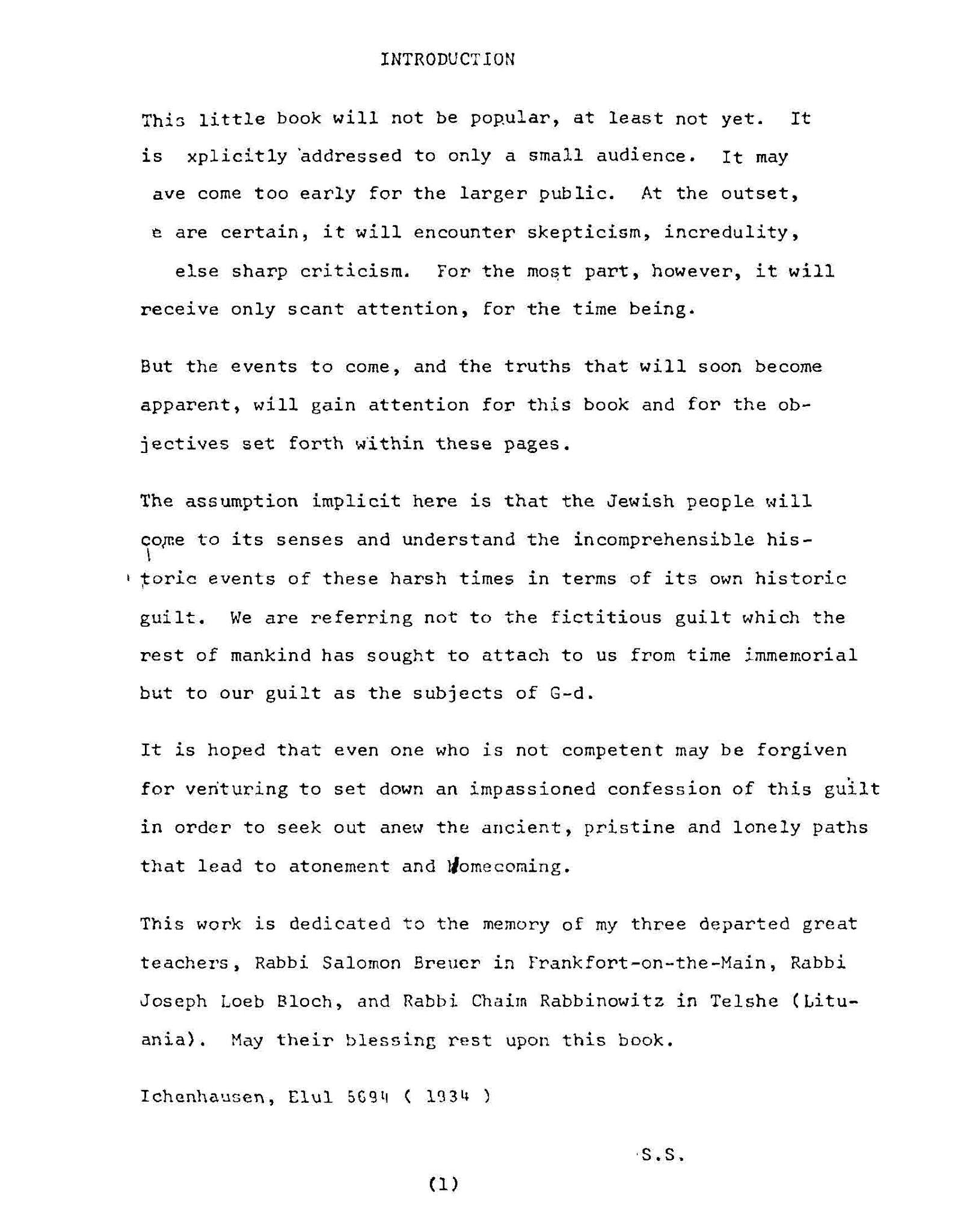
R. Schwab reached this conclusion after re-evaluating his position multiple times throughout his life. In a speech he delivered in 1990,[6] he recalled how the events of Kristallnacht (Nov 9, 1938 – Nov 10, 1938), and later the Holocaust, shook his belief in Torah Im Derekh Eretz to the core. How could R. Hirsch have believed the humanism of Germany would lead to an uplifted and righteous society when the same humanistic society ended up committed genocide without much protest from the “enlightened students of Schiller and Goethe?”[7] R. Hirsch must not have seen German humanistic Bildung[8] as anything more than a time-bound compromise in order to save his community from assimilation.[9] R. Schwab was referring to an essay he wrote in 1934 entitled Heimkehr ins Judentum (Homecoming To Judaism).[10] Here R. Schwab claimed R. Hirsch only intended Torah Im Derekh Eretz as a temporary allowance. This book was the first substantial rejection of Torah Im Derekh Eretz written by someone who grew up in the Hirschian community.[11]
An English version of this essay, prepared by K’hal Adath Jeshurun translator Gertrude Hirschler, appeared in 1978.[12]
Around the same time he published Heimkehr ins Judentum, R. Schwab wrote to a number of Eastern European Torah leaders asking them about the permissibility of incorporating secular studies into a yeshiva curriculum.[13] Dr. Marc B. Shapiro notes that this was yet another sign of the waning popularity of Torah Im Derekh Eretz at the time, even in Germany itself.[14] Apparently, R. Schwab, who had studied in Lithuanian yeshivot, was not convinced of the permissibility of what had been established as normative practice in his own country. Dr. Shapiro’s analysis is correct. However, consider R. Schwab’s query in light of his unequivocal rejection of Torah Im Derekh Eretz in his Heimkehr ins Judentum. Based on the dates of his letters and the responses of his interlocutors, it appears that even as he published Heimkehr ins Judentum, R. Schwab felt the viability of Torah Im Derekh Eretz was still an open question — or at least one still worthy of inquiry.[15]
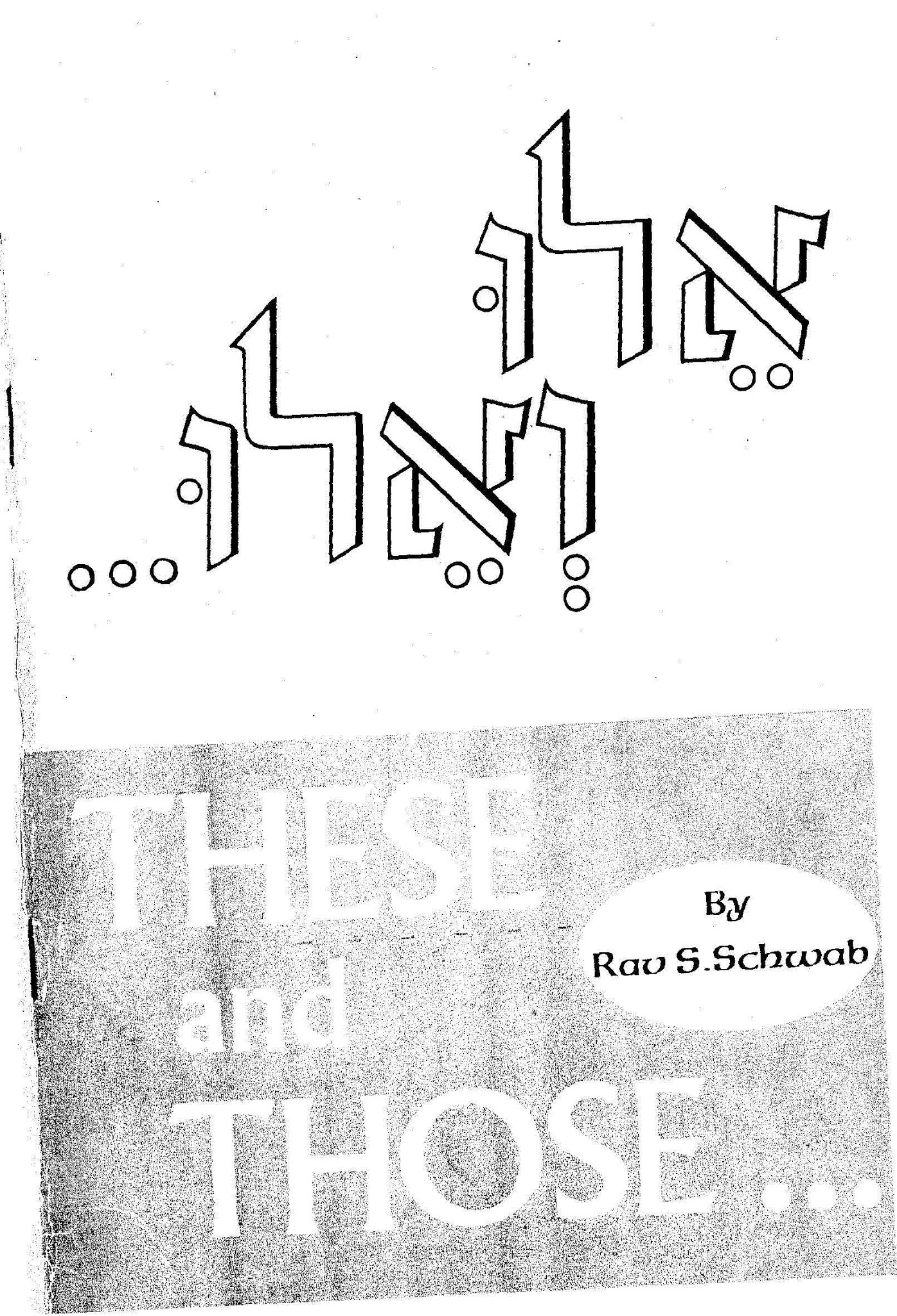
Later in his life, after re-assessing R. Hirsch writings, R. Schwab came to believe that his earlier view was incorrect. In this later re-evaluation, R. Schwab felt that Hirsch did, in fact, wholeheartedly believe in the significance of humanism for society. After this realization, in 1966, R. Schwab wrote an essay entitled, “Elu ViElu: These and Those,” which showed the validity and necessity of both the “Torah Only” approach of many gedolei yisrael and the Hirschian “Torah Im Derekh Eretz” approach. R. Schwab wrote this 47-page pamphlet in the form of a series of dialogues intended as the “echoes of endless discussions amongst our searching youth.”[16]
On the 48th anniversary of Kristallnacht, in 1986, R. Schwab echoed his previous concern, expressing that in a post-Holocaust world, although he accepted R. Hirsch’s Torah Im Derekh Erech application to science, medicine, and history, he could no longer believe in the power of culture and secular humanism.[17] Although R. Hirsch celebrated Schiller, and all the values of ethics and humanism he represented, this vision was “broken by the shattering of windows and the screaming of frightened children in the night.”[18] “We do not extend Torah Im Derekh Eretz to include philosophy, ethics, morality or humanism…No longer are we going to seek out Schiller to teach us about humanity. It no longer interests us.”[19] He therefore discouraged the study of these disciplines, stating unequivocally:
“The age of Humanism was a passing episode in the annals of history…The lessons of Kristallnacht – don’t believe there is Torah among the goyim (gentiles). Let us not make the same mistake as our ancestors, to believe there is any other ethical culture for us beside the Torah.”[20]
However, as forceful as this statement was, it is unclear if this was in fact R. Schwab’s final position. In his last comments on the matter in 1990, he argued for Torah Im Derekh Eretz as an ideal model.[21] Although he did caution about the dangers of the arts and literature influencing our moral compass, he did not vouch for a complete break with those disciplines.[22] As indicated by the title of his essay, R. Schwab believed, “Elu ViElu divrei Elokim hayim” – These and those are the words of the Living God.[23] Both the “Torah Only” approach of the majority of gedolei yisrael, and the “Torah Im Derekh Eretz” approach are of equal validity and importance for the Jewish community.[24] However, as the Holocaust demonstrated, we should be cautious when approaching secular humanism. Ultimately, there is no other true ethical code that produces an uplifted and righteous society other than the Torah. Although commitment to both disciplines – Torah and humanism – was seen by R. Hirsch as the ultimate goal, it appears that the same cannot be said for R. Schwab.[25]
Although R. Schwab apparently regained some of his conviction in Hirschian humanism, the Holocaust challenge has been posed to the Hirschian position and to religious humanism in general. How can one believe the study of the humanities can guarantee humaneness? R. Aharon Lichtenstein marshals the words of the literary critic George Steiner:
“We now know that a man can read Goethe or Rilke in the evening, that he can play Bach and Schubert, and go to his day’s work in Auschwitz. To say he has read them without understanding or that his ear is gross, is cant. In what way does this knowledge bear on literature and society, on the hope, grown almost axiomatic from the time of Plato to that of Mathew Arnold, that culture is a humanizing force, that the energies of the spirit are transverse to those of conduct?”[26]
R. Lichtenstein notes this is a “terrifying question for believers in the self-sufficiency of secular humanism, [and] a formidable one for advocates of religious humanism.”[27] In response to this challenge, R. Lichtenstein argues as long as the ultimate source of morality is the Torah and our humanism is fettered in religious conviction, religious life can gain much from the study of the humanities.[28]
We cannot know how R. Hirsch himself would respond to this challenge, however, one can certainly hear echoes of Hirschian thought in R. Lichtenstein’s defense of religious humanism.[29] According to the Hirschian authority Dayan Isidor Grunfeld, R. Hirsch argued for a religious humanism anchored by divine revelation. In fact, Grunfeld loosely translated Torah Im Derekh Eretz, the slogan most commonly associated with R. Hirsch, as “God-rooted religious humanism.”[30]
In this view, an irreligious or secular humanism is bound not to elevate man, but rather to debase him. Religious humanism, on the other hand, embraces the intrinsic dignity of man because he was created in the image of God.[31] For R. Hirsch, this principle is fundamental to his view of all of mankind joined in one universal “brotherhood.”[32] By ceasing to regard man as being of a higher and divine origin, secular humanism, paradoxically results in the diminishing of man’s value.[33]
In fact, R. Hirsch in his commentary on the Torah, argues for the intrinsic value of Torah Im Derekh Eretz, or culture, even in the face of the potential negative impact of secular culture:
“Culture starts the work of educating the generations of mankind and the Torah completes it; for the Torah is the most finished education of Man…culture in the service of morality is the first stage of Man’s return to God. For us Jews, Derekh Eretz and Torah are one. The most perfect gentleman and the most perfect Jew, to the Jewish teaching, are identical. But in the general development of mankind culture comes earlier…
But of course, where culture and civilisation are used in the service of sensuality and degeneration only gets all the greater. But still such misuse of culture does not do away with the intrinsic value and blessing of Derekh Eretz.”[34]
Although what can be called “low culture” or “degenerative humanism” corrupts Torah ideals, this does not negate the intrinsic value of “good and true culture.” Indeed, according to R. Hirsch, “Jews rejoice whenever or wherever culture elevates people to a perception of true values and to nurture goodness.”[35]
Perhaps the Hirschian response to the Holocaust challenge is that if we do not believe we are the ultimate arbiters of truth and morality, fundamentally, our value system remains sacrosanct even when it is not recognized by society, namely, even in Nazi Germany. The utter failing of a secular humanistic society does not undermine the value of a God-fettered humanism. Even after the horrors of the Holocaust, Hirschian humanism remains intact. In the words of Jacob Breuer, Torah Im Derekh Eretz is indeed a “Timeless Torah.”[36]
Notes:
Thank you to Dan Rabinowitz and the editors at the Seforim Blog for their assistance. Thank you to my father-in law R. Hanan Balk and Yehuda Geberer who shared some important sources with me. I am indebted to my rebbe and mentor R. Netanel Wiederblank in general, and in particular for his advice and insight into this topic.
[1] R. Schwab served as a rabbinic leader K’hal Adath Jeshurun from his arrival in 1958 until his passing in 1995. For biographical details on R. Schwab, see R. Moses L. Schwab, “Rav Simon Schwab: A Biography,” in Moreshet Tzvi – The Living Hirschian Legacy: Essays on ‘Torah im Derech Eretz’ and the Contemporary Hirschian Kehilla (New York: K’hal Adath Jeshurun, 1988), 45-51. For other essays in this volume, see the Table of Contents:
See also R. Moshe L. Schwab, “Biography of Rav Shimon Schwab,” in Rav Schwab on Prayer (Brooklyn: ArtScroll Mesorah, 2001), ix-xx available here; R. Eliyahu Meir Klugman, “The Ish Ha’Emes: The Man of Impeccable Integrity, Rabbi Shimon Schwab,” The Jewish Observer, vol. 28, no. 5 (Summer 1995): 11-22, available here.
[2] Rabbi Dr. Joseph Breuer, the grandson of R. Samson Raphael Hirsch, was the founding Rav of K’hal Adath Jeshurun in Washington Heights, Manhattan. For biographical details on R. Breuer, see David Kranzler and R. Dovid Landesman, Rav Breuer: His Life and His Legacy (New York: Feldheim, 1998) and Dr. Ernst J. Bodenheimer and R. Nosson Scherman, “Rav Dr. Joseph Breuer zt”l, One Year After His Passing,” The Jewish Observer, vol. 15, no. 6 (May 1981): 3-10, available here.
[3] See R. Avrohom Chaim Feuer and R. Avie Gold, eds., Tefillah L’Moshe: The Complete Tisha B’av Service (Brooklyn: Artscroll Mesorah, 1992), 392-394, who cite the background story to the kinnah from R. Schwab himself. Also see Moshe Schwab, “A Biography of Rav Shimon Schwab,” Rav Schwab on Prayer, xix, who also references the story. For the text of R. Schwab’s Holocaust Kinnah, see here, courtesy of ArtScroll/Mesorah.
[4] For other kinnot composed for the Holocaust, see Mordechai Meir, “Zakhor Na Ha-Bikhiot Bi-Tahom HaGoyot: Kinnot L’zekher HaShoah,” Akadamot, vol. 9 (2000): 77-99 (Hebrew), available here; and Jacob J. Schacter, “Holocaust Commemoration and Tish’a be-Av: The Debate Over ‘Yom ha-Sho’a’,” Tradition: A Journal of Orthodox Jewish Thought, vol. 41, no. 2 (Summer 2008): 164-197, available here, especially 194-195n36-41 for sources on R. Joseph B. Soloveitchik’s position. See also Jacob J. Schacter, “The Rav and the Tisha B’Av Kinot,” in Zev Eleff, ed., Mentor of Generations: Reflections on Rabbi Joseph B. Soloveitchik (Jersey City: Ktav, 2008), 303-314, available here, and earlier in Jacob J. Schacter, “Rabbi Joseph B. Soloveitchik zt”l on the Tisha B’Av Kinos,” Jewish Action, vol. 54, no. 4 (Summer 1994): 11-12, available here.
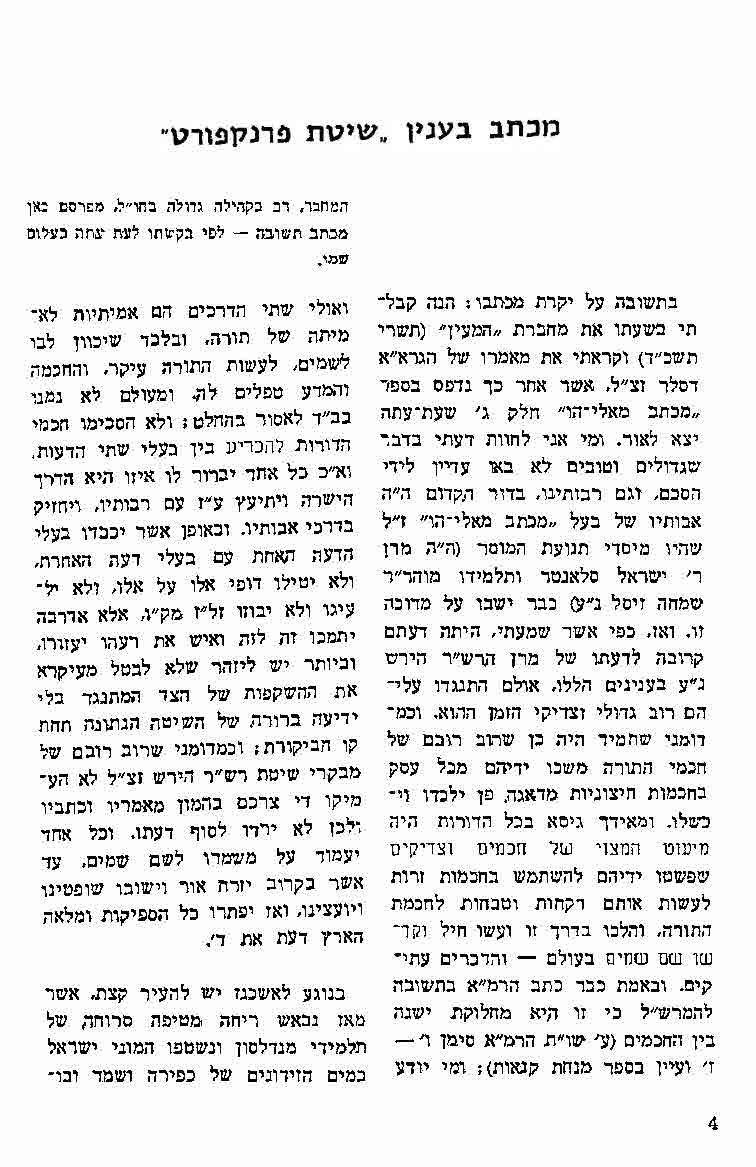
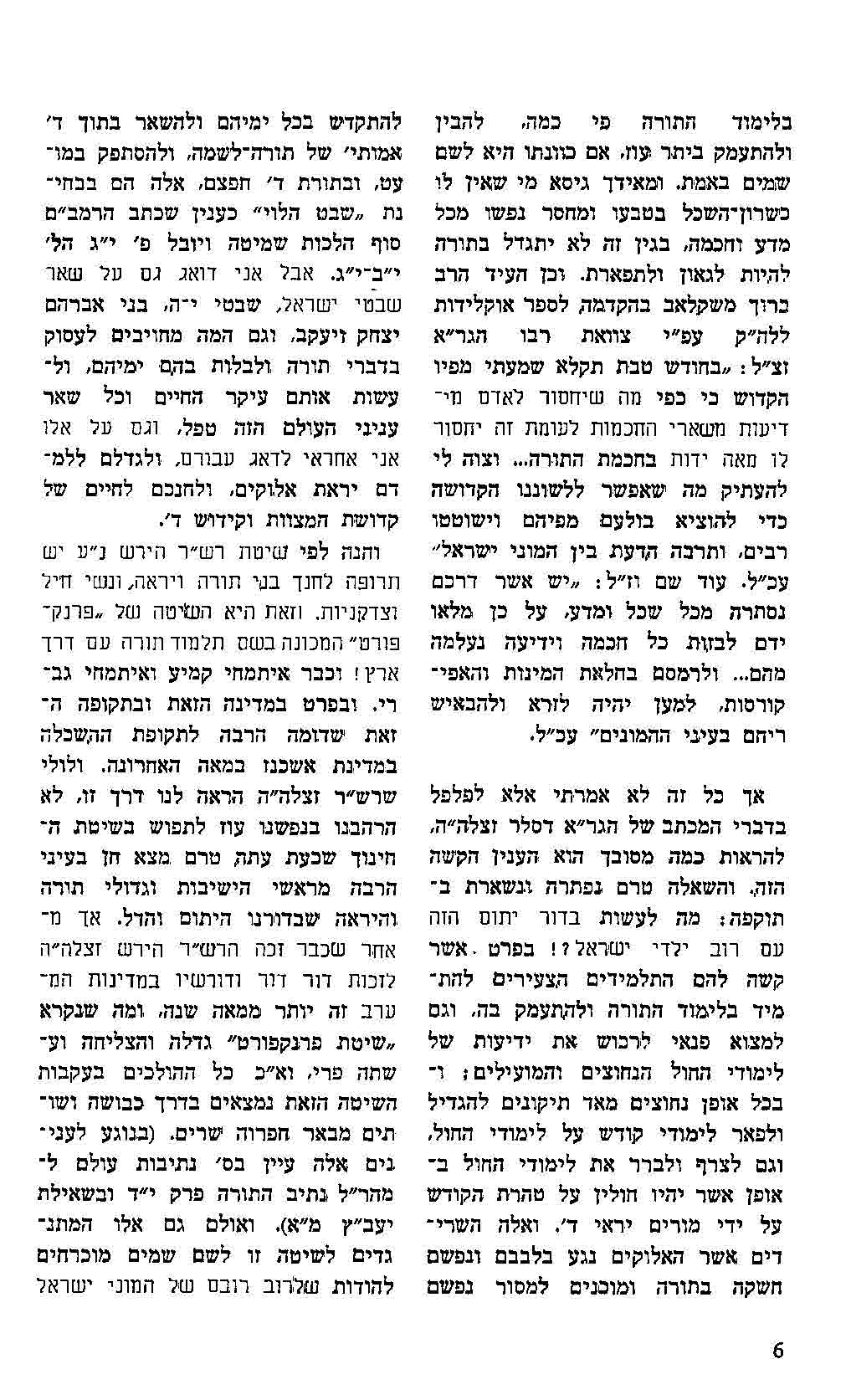
[5] Anonymous, “A Letter Regarding ‘the Frankfurt Approach’,” ha-Ma’ayan, vol. 6, no. 4 (1966): 4-7 (Hebrew)
A translation of this anonymous essay appears in Shnayer Z. Leiman, “From the Pages of Tradition – R. Shimon Schwab: A Letter Regarding the “Frankfurt’ Approach,” Tradition: A Journal of Orthodox Jewish Thought, vol. 31, no. 3 (Spring 1997): 71-77, available here. Dr. Leiman writes in 77n4 that members of ha-Ma’ayan’s editorial board confirmed his suspicion that the Anonymous author was R. Shimon Schwab.
[6] R. Shimon Schwab, “Torah Im Derech Eretz – A Second View,” in Selected Speeches: A Collection of Addresses and Essays on Hashkafah, Contemporary Issues and Jewish History (New York: C.I.S. Publishers, 1991), 236-252, the transcript of an address delivered at K’hal Adath Jeshurun on February 19, 1990.
[7] Ibid.
[8] Referring to the German tradition of self-formation through acculturation and education attributed to Wilhelm Von Humboldt (1791-1810).
[9] R. Shimon Schwab, “Torah Im Derech Eretz – A Second View,” in Selected Speeches: A Collection of Addresses and Essays on Hashkafah, Contemporary Issues and Jewish History (New York: C.I.S. Publishers, 1991), 239.
[10] R. Shimon Schwab, Heimkehr ins Judentum (Homecoming To Judaism) (Frankfurt: Hermon-Verlag, 1934; German).
[11] Marc B. Shapiro, Between The Yeshiva World and Modern Orthodoxy: The Life and Works of Jehiel Jacob Weinberg 1884-1966 (Portland: Littman Library, 1999), 152. Dr. Shapiro notes that one of the first articles written by the great Jewish historian Jacob Katz was a review of Heimkehr ins Judentum. See Jacob Katz, “Umkher oder Rückkehr – Review of ‘Heimkehr ins Judentum’, by Simon Schwab,” Nahalat Tsevi, vol. 5 (1935): 89-96, available here; and Jacob Katz, With My Own Eyes: The Autobiography of an Historian, trans. Ziporah Brody (Hanover, NH: New England Universities Press, 1995), 96.
[12] R. Shimon Schwab, Heimkehr ins Judentum (Homecoming to Judaism), trans. Gertrude Hirschler (New York, 1978).
[13] See Marc B. Shapiro, Between The Yeshiva World and Modern Orthodoxy: The Life and Works of Jehiel Jacob Weinberg 1884-1966 (Portland: Littman Library, 1999), 152, who notes that a copy of the original letter exists in the Joseph Rozin Archive, Yeshiva University. The four Eastern European rabbis who are known to have responded in writing are R. Elhanan Wasserman, R. Barukh Ber Leibowitz, R. Avraham Yitzhak Bloch, and R. Yosef Rozen. Their replies are printed in Yehuda (Leo) Levi, Shaarei Talmud Torah (Jerusalem: Feldheim, 1981), 296-312 (Hebrew) and R. Bloch’s response was first published in Proceedings of the Association of Orthodox Jewish Scientists, vol. 1 (New York: AOJS, 1966), 107-112, available here. For more on the background of R. Schwab’s letter and the responses he received, see Jacob J. Schacter, “Torah u-Madda Revisited: The Editor’s Introduction,” The Torah u-Madda Journal, vol. 1 (1989): 1-22, available here, especially 15n1-2; Yehuda (Leo) Levi, “Rabbi Samson Raphael Hirsch-Myth and Fact,” Tradition: A Journal of Orthodox Jewish Thought, vol. 31, no. 3 (Spring 1997): 5-22, esp. 11, available here, and Marc B. Shapiro, “Torah im Derekh Erez in the Shadow of Hitler,” The Torah u-Madda Journal, vol. 14 (2006-2007): 84-96, esp. 85-86,95 available here.
[14] See Marc B. Shapiro, Between The Yeshiva World and Modern Orthodoxy: The Life and Works of Jehiel Jacob Weinberg 1884-1966 (Portland: Littman Library, 1999), 152.
[15] There seems to be some discrepancies among those who record the story. Marc B. Shapiro dates the letter to 1933, whereas Jacob J. Schacter says it was 1934. Most surprising, is R. Dr. Norman Lamm’s assertion that the question was posed from America. See R. Norman Lamm, Torah Umadda: The Encounter of Religious Learning and Worldly Knowledge in the Jewish Tradition (Northvale, NJ: Jason Aronson, 1990), 39. Either way, contrary to what Dr. Levi writes that R. Schwab was still a student in a Lithuanian yeshiva when he posed the question, R. Schwab had already left the Mir Yeshiva by 1931. By September of 1933 he had already accepted a rabbinic position in Ichenhausen, Bavaria. See Moshe L. Schwab, “Biography of Rav Shimon Schwab,” Rav Schwab on Prayer, x-xi. It appears more likely that R. Schwab sent his letters as he started making arrangements to open a yeshiva in Bavaria. This is, in fact, how I heard the story from R. Dovid Landesman, R. Breuer’s biographer. See his R. Dovid Landesman, There Are No Basketball Courts In Heaven (McKeesport, PA: Jewish Educational Workshop, 2010), 142-143. Nevertheless, there is reason to believe that Dr. Levi’s record of the story should be the most accurate. In addition to publishing the four responses to R. Schwab, Dr. Levi writes in his Torah Study: A Survey of Classic Sources on Timely Issues (New York: Feldheim, 2002), 363n13, available here, that R. Schwab himself shared R. Yosef Rozen’s response with him personally. It is unlikely that Dr. Levi would not have gotten the context of the letters accurately from R. Schwab. Perhaps one can suggest in Dr. Levi’s defense, that R. Schwab may have posed the question at least twice. Once when he was a yeshiva student in Lithuania and then again in writing later when opening a yeshiva in Bavaria.
[16] It was published by Philipp Feldheim, Inc., and included a brief preface by R. Dr. Joseph Breuer. See also the related essay by R. Joseph Breuer, “Torah im Derech Eretz: A Hora’at Sha’ah?” Mitteilungen, vol. 26 (August – September 1965): 1-2 (German), and then translated into Hebrew as R. Joseph Breuer, “Torah ‘im Derekh Erez. —Hora’at Sha’ah?” ha-Ma’ayan, vol. 6, no. 4 (1966): 1-3 (Hebrew). See also Shnayer Z. Leiman, “Rabbinic Responses to Modernity,” Judaic Studies, no. 5 (Fall 2007): 1-122, available here, especially pp. 57-96 on R. Samson Raphael Hirsch, and esp. 84-85n122 on this article by R. Breuer. It is beyond the scope of this essay to explore this article by R. Schwab.
[17] R. Shimon Schwab, “Kristallnacht: A Historical Perspective,” in Selected Writings: A Collection of Addresses and Essays on Hashkafah, Jewish History and Contemporary Issues (New York: C.I.S, 1988), 81-87. See also R. Shimon Schwab, “Fifty Year After Kristallnacht,” in Selected Speeches: A Collection of Addresses and Essays on Hashkafah, Contemporary Issues and Jewish History (New York: C.I.S. Publishers, 1991), 30-36, the transcript of an address delivered at K’hal Adath Jeshurun on October 30, 1988.
[18] R. Shimon Schwab, “Kristallnacht: A Historical Perspective,” in Selected Writings: A Collection of Addresses and Essays on Hashkafah, Jewish History and Contemporary Issues (New York: C.I.S, 1988), 84-86.
For further on R. Samson Raphael Hirsch and Friedrich von Schiller, see the annotated translation of R. Samson Raphael Hirsch’s address delivered at “the Celebration of the Israelitischen Religionsgesellschaft’s School in Frankfurt am Main on November 9, 1859 on the Eve of the Schiller Festival,” which was first translated to English in Marc B. Shapiro, “Rabbi Samson Raphael Hirsch and Friedrich von Schiller,” Torah u-Madda Journal, vol. 15 (2008-2009): 172-187, available here. Several years later, in 2012, the official publication committee of R. Samson Raphael Hirsch’s writings for the Hirschian community published an English translation of R. Samson Raphael Hirsch, “Address Delivered on the Eve of the Schiller Centenary,” in The Collected Writings of Rabbi Samson Raphael Hirsch, vol. 9: Timeless Hashkafah (New York: Rabbi Dr. Joseph Breuer Foundation, 2012), 137-152, with the translation having been decades earlier by Gertrude Hirschler.
[19] R. Shimon Schwab, “Kristallnacht: A Historical Perspective,” in Selected Writings: A Collection of Addresses and Essays on Hashkafah, Jewish History and Contemporary Issues (New York: C.I.S, 1988), 86.
[20] Ibid. Also see Rav Schwab on Prayer, 54 where R. Schwab noted on November 10th, 1990, on the anniversary of Kristallnacht, that “this nation [Germany] of poets and thinkers’ was, at its core, really nothing but a horde of highly organized wild animals. All their developments in medicine, science, art, music, and philosophy did not make them one iota more human.”
[21] R. Shimon Schwab, “Torah Im Derech Eretz – A Second View,” in Selected Speeches: A Collection of Addresses and Essays on Hashkafah, Contemporary Issues and Jewish History (New York: C.I.S. Publishers, 1991), 236-252. In fact, in his Ma’ayan Beit Ha-Shoevah (Brooklyn: ArtScroll Mesorah, 1994), Parshat Yitro, 194 (Hebrew) he takes a more humanistic approach to explain the very same Midrash he mentioned as the lesson of Kristallnacht – “If a person tells you there is Torah among the nations of the world, do not believe him. However, if a person tells you there is wisdom among the gentiles, believe him (Eicha Rabba 2:13).
[22] R. Shimon Schwab, “Torah Im Derech Eretz – A Second View,” in Selected Speeches: A Collection of Addresses and Essays on Hashkafah, Contemporary Issues and Jewish History (New York: C.I.S. Publishers, 1991), 246.
[23] A reference to Eruvin 13b.
[24] R. Shimon Schwab, These and Those (New York: Feldheim, 1966), 40-42.
[25] For more on the development of R. Schwab’s position vis a vis Torah Im Derekh Eretz as well as his criticisms of Modern Orthodoxy and Torah u-Madda, see Zev Eleff, “American Orthodoxy’s Lukewarm Embrace of the Hirschian Legacy, 1850-1939,” Tradition: A Journal of Orthodox Jewish Thought, vol. 45, no. 3 (Fall 2012): 35-53, available here; and Zev Eleff, “Between Bennett and Amsterdam Avenues: The Complex American Legacy of Samson Raphael Hirsch, 1939-2013,” Tradition: A Journal of Orthodox Jewish Thought, vol. 46, no. 4 (Winter 2013): 8-27, esp. 20-26, available here.
[26] George Steiner, Language and Silence: Essays, 1958-1966 (London: Faber and Faber, 1967), 15-16.
[27] R. Aharon Lichtenstein, “Torah and General Culture: Confluence and Conflict,” in Jacob J. Schacter, ed., Judaism’s Encounter with Other Cultures – Rejection or Integration? (Northvale, NJ: Jason Aronson, Inc, 1997), 217-292, quote at 316.
[28] Ibid., 317.
[29] Ionically, R. Lichtenstein was critical of R. Hirsch’s humanism. He wrote that, “it is precisely the sense of accommodation and concession – at times, even apologetics – that is persistent, if not pervasive. The humanism is genuine and genuinely Jewish; and yet at many points, the sense that we are dealing with an element that has been engrafted is inescapable.” See R. Aharon Lichtenstein, “Legitimization of Modernity: Classical and Contemporary,” in Moshe Z. Sokol, ed., Engaging Modernity: Rabbinic Leaders and the Challenge of the Twentieth Century (Northvale, NJ: Jason Aronson, Inc., 1997), 3-33, quote at 30. See also R. Aharon Lichtenstein, “‘Mah Enosh’: Reflections on the Relation between Judaism and Humanism,” Torah u-Madda Journal, vol. 14 (2005-2006): 1-61, available here, where although he does not quote R. Samson Raphael Hirsch, he does quote from his son in Dr. Mendel Hirsch, Humanism and Judaism, trans. J. Gilbert (London: Beddo Press, 1928), at 51n2. See also Mendel Hirsch, “Humanism and Judaism,” in Jacob Breuer, ed., Fundamentals of Judaism: Selections from the works of Rabbi Samson Raphael Hirsch and outstanding Torah-true thinkers (New York: The Rabbi Samson Raphael Hirsch Society, 1949), 167-179, available here. This critique predates R. Lichtenstein. See Gershom Scholem, “Politik der Mystik, Zu Isaac Breuer’s ‘Neuen Kusari’,” Jüdische Rundschau, vol. 39, no. 57 (17 July 1934): 1-2 (German), available here and cited in Mordechai Breuer, The Torah Im Derekh Eretz of R. S.R. Hirsch (New York: Feldheim, 1970), 61n117, available here.
[30] Dayan Isidor Grunfeld, Introduction to Horeb (London: Soncino, 1962), xciii.
[31] See R. Akiva’s statement in Avot (3:14), “Beloved is man for he was created in the image [of God].”
[32] R. Samson Raphael Hirsch, The Pentateuch, trans. Isaac Levy (London: L. Honig & Sons, 1959), Genesis 5:1.
[33] Dayan Isidor Grunfeld, Judaism Eternal, vol. 1: S.R. Hirsch – The Man and His Mission (London: Soncino, 1956), xx.
[34] R. Samson Raphael Hirsch, The Pentateuch, Genesis 3:11.
[35] Ibid.
[36] See the title of Jacob Breuer, ed., Timeless Torah: An Anthology of the Writings of Rabbi Samson Raphael Hirsch (New York: The Rabbi Samson Raphael Hirsch Society, 1957).
Review of Rav Zvi Hirsch Grodzinsky’s Taharas Yisroel
By Shmuel Lubin
Shmuel Lubin is a doctoral candidate in biology and creator of “The Rishonim” podcast.
ר‘ צבי הירש גראדזענסקי טהרת ישראל, הלכות נדה, לראשונה מכתב יד, ע“י מכון תפארת צבי, [נדפס ע“י מכון עלה זית], תקסח עמודים
The publication of a new sefer on Hilchos Niddah is not necessarily cause for celebration in the often-saturated world of halachic literature.[1] But when such a publication is based on an early 20th century manuscript from the American heartland, it at least merits a glance; if the author happens to also have a rather famous rabbinic last name, talmidei chachamim may take interest even without knowing anything about the sefer’s content. All this can be said about Sefer Taharas Yisrael on the laws of Niddah, written by Rav Zvi Hirsch Grodzinsky zt”l. Born c. 1857 in Lithuania, where he learned be-chavrusa with his more famous second-cousin, Rav Chaim Ozer Grodzinsky zt”l, he then spent most of his adult life serving as the chief rabbi of Omaha, Nebraska for almost 60 years (1891-1947). [2] As intriguing as his biography is, once one begins studying Rav Grodzinsky’s Sefer Taharas Yisrael, such details quickly fade into insignificance, washed away by a torrent of Torah brilliance. This review will therefore focus first on judging the newly published work for what it is: a book on the laws of Hilchos Niddah (Family Purity).
Photo of Rabbi Zvi Hirsch Grodzinsky from approximately the time he arrived in America. (From Rosenbaum and Wakschlag, 1994)
Probably the most succinct way to describe the style of the Sefer Taharas Yisrael is to say that it does for Hilchos Niddah what R. Avraham Bornstein’s (the “Sochatchover”) Eglei Tal does for Hilchos Shabbos: it is a book of halacha that also provides the background for the laws through detailed conceptual analysis of its sources. In the center of the page is the halacha, which is usually a direct quotation from Shulchan Aruch, Rama, or similarly standard halachic works. This main text is flanked by two sets of notes: “Mekoros,” or citations, and “Biurim,” elaborations.
Because the main body of the text is often an exact citation from a standard halachic authority such as the Shulchan Aruch or Rama, sometimes these formulations do not precisely reflect the halachic consensus as Rav Grodzinsky understands it. Despite its name, therefore, the “Mekoros” section not only provides citations for the main text, but also serves more generally as ‘footnotes’, including brief but important clarifications or qualifications of the cited halacha. Together, this allows for the Sefer Taharas Yisrael to be useful as a work of practical guidance, like so many other summary works on Hilchos Niddah available today, but at the same maintain the voice of the classic authorities such as the Shulchan Aruch.
The vast majority of the sefer’s text, however, is comprised of the Biurim, wherein Rav Grodzinsky engages in classical rabbinic interpretation of halachic texts, analyzing their language and logic, raising questions, proposing interpretations, and refining his (and his readers’) understanding of the earlier textual sources. These sources used in the Biurim focus primarily on the Gemara and Rishonim, as well as the major poskim throughout the generations both “on the page” of the Shulchan Aruch and in other classic (and sometimes not-so-classic) works of She’eilos u-Teshuvos and halacha. Despite his remote location, especially relative to the Torah centers of Europe and America, Rav Grodzinsky amassed an extraordinary library of seforim, as attested to by the roughly 200 books of She’eilos u-Teshuvos that he lists in the introductory pages of the reference work that he published during his lifetime, “Likutei Zvi.”

Part of Rav Grodzinsky’s library which was housed by Otzar ha-Poskim in Jerusalem. (From Rosenbaum and Wakschlag, 1994)
Nevertheless, in Sefer Taharas Yisrael, Rav Grodzinsky focuses more narrowly on the classical commentaries printed in now-standard editions of the Gemara, Rambam, Tur and Shulchan Aruch.[3] Of course, not all of these were always so “standard”; for example, Rav Grodzinsky makes use of the Tosafos ha-Rosh that had been “newly printed on the side of the Gemara” (p. 42), referring to the now ubiquitous Vilna Shas published by Mrs. Deborah Romm and her sons during Rav Grodzinsky’s lifetime (while he was still living in Eastern Europe).
A few other observations are worth noting about Rav Grodzinsky’s use of sources. Although he does reference the responsa literature, aside from references to the Noda BiYehudah and Chasam Sofer, the total number of those citations is probably only a few dozen (which is certainly impressive, but does not reflect the more extraordinary breadth of his reference work, Likutei Zvi). Rav Grodzinsky also quotes heavily from both the Chochmas Adam of R. Avraham Danzig, and from the Shulchan Aruch “HaRav” of R. Shneur Zalman of Liadi, whom Rav Grodzinsky invariably – and uniquely – cites as the “the Rav, the Gaon, the Chassid.” These seforim have become standard works of halacha that are frequently cited in the literature of the past century, but in several places, Rav Grodzinsky also quotes from another book of halacha that is rarely if ever cited today, the “Ikkarei ha-Dat” of R. Daniel Tirani (18th century Italy), which is noteworthy for also including what would be considered “medical” information along with the halacha (see p. 38).
Among Rav Grodzinsky’s many sources are also non-halachic texts, such as the Midrash Vayikra Rabbah or R. Eliyahu Mizrachi’s supercommentary to Rashi on the Torah. Another noteworthy reference is Rav Grodzinsky’s discussion of a comment by the “Besamim Rosh,” (p. 215) attributed to R. Asher b. Yechiel (“the Rosh”) but now widely accepted to have been forged by Saul Berlin.[4] This is especially interesting because among Rav Grodzinsky’s unpublished manuscripts is an expansive 11-volume work on the (authentic) responsa of R. Asher b. Yechiel. Given his expertise in the works of this particular medieval authority, it would be very valuable to know whether (or to what extent) he believed that positions expressed in the Besamim Rosh fit with other known statements of the Rosh. In an important responsum on the topic of annulling a marriage, published by Rav Grodzinsky at the end of his commentary to Maseches Berachos (published in 1923), he briefly mentions a “sevara meshubeshes” [distorted reasoning] quoted in the name of the Besamim Rosh, and says that the book was not available to him at the time. In Sefer Taharas Yisrael though, Rav Grodzinsky raises no objections to the book per se.[5]
Sometimes the “Biurim” are merely quotes from earlier compendiums, such as the Beis Yosef, or summaries of some of the major discussions of later commentaries such as the Chavos Daas and Sidrei Taharah (and those who have read through extensive comments of the Sidrei Taharah will acknowledge that extracting the main points from his lengthy pilpulim is itself a great service). In what may be the most difficult topic of Hilchos Niddah, Rav Grodzinsky excuses himself for deviating from his usual brevity to enumerate the various rabbinic positions and their halachic consequences for the benefit of someone struggling through the dense halachic details in question (p. 114-117).
Usually, though, Rav Grodzinsky goes far beyond mere quotations or summaries of earlier commentaries. Whether he is discussing the Gemara, the Rishonim, the Shulchan Aruch, or later commentators, Rav Grodzinsky’s novel elaborations upon these sources of the halacha are extraordinary in their clarity, profundity, and creativity. Most of these biurim are brief, consisting of a single question-and-answer, an additional proof to the position cited in the main text, or the like, but written in a lucid style that stands in stark contrast to other ‘short’ halachic commentaries such as the Shach and Taz.
The vast majority of Rav Grodzinsky’s novel contributions are in explicating a single, very precise detail of a halachic discussion. He does not engage in the type of high-level conceptual categorization (inventing ‘lomdishe chakiras’) that is common in contemporary yeshiva study.[6] Instead, his approach involves a close examination of the original sources, on occasion proposing alternative readings or explanations to resolve questions or demonstrate proofs to the halacha in the Gemara, Rishonim and early Acharonim.
Rav Grodzinsky’s creativity is especially evident in defending positions of Rishonim (and sometimes Acharonim) from the challenges of later commentators. As he writes (p. 257 and 343), “it is a mitzvah to resolve the words of the Beis Yosef from whose waters we drink constantly.” This tendency is not at all limited to R. Yosef Caro who, as the author of the Beis Yosef and Shulchan Aruch, is one of the main pillars of halachic decision-making. Rav Grodzinsky writes similarly regarding the authors of Knesses Yechezkel (R. Yechezkel Katzenellenbogen, p. 68-69), the Perisha (R. Yehoshua Falk Katz, p. 260), the Panim Meiros (R. Meir Poznan/Eisenstadt, p. 318), and many others. In fact, Rav Grodzinsky appears to be especially motivated to defend opinions that are rejected as erroneous by the majority of other commentators, saving them from potential dishonor.
As Eliezer Brodt discussed in his review of Sefer Beis ha-Yayin, Rav Grodzinsky is at times willing to attribute difficult passages to printers’ errors, but is wary of making such suggestions too frequently.[7] However, he sometimes solves difficult positions of Rishonim or explains why groups of Rishonim will disagree with each other by noting that they likely had different versions of the Gemara’s text.[8] In a similar vein, Rav Grodzinsky is adept at demonstrating how a dispute among Rishonim or Acharonim is dependent upon a dispute found in the Gemara (or at least earlier sources; e.g. on p. 185). He is particularly sensitive to rabbinic authors of differing opinions and has a keen eye towards finding a “le-shitaso,” explaining how deciding one particular halacha is dependent upon understanding a different halacha. He applies this method to many Amoraim, Rishonim, and Acharonim. These types of explanations demonstrate how Rav Grodzinsky was deeply attuned not just to nuances of the Talmudic sources, but also to the specific personalities behind each opinion voiced by the various commentators and authorities. Relatedly, Rav Grodzinsky will sometimes remark upon the general tendency or style of a Rishon, noting, for instance, “it is surprising to me that the Rosh did not mention that the position of the Tosafists diverges [from his own view] and dispute their words, as is his custom in every place” (p. 211).
Within the context of halachic discussion, Rav Grodzinsky is not averse to suggesting fresh and often creative interpretations of the Gemara that appear to be at odds with the major commentaries. Usually, his reinterpretations of primary sources are in response to some problem raised by the commentators, but this is not always the case. To take one relatively simple example, the Gemara (Niddah 9b) states:
וכמה עונה אמר ריש לקיש משום רבי יהודה נשיאה עונה בינונית שלשים יום ורבא אמר רב חסדא עשרים יום ולא פליגי מר קחשיב ימי טומאה וימי טהרה ומר לא חשיב ימי טומאה.
And how long is a typical cycle? Reish Lakish says in the name of Rabbi Yehuda Nesia: the average cycle is thirty days. And Rava says that Rav Ḥisda says: It is twenty days. [The Gemara clarifies:] And they do not disagree. One counts [i.e., includes] days of impurity and days of purity. And the other does not count the days of impurity [i.e., the seven days of niddah plus the three days of possible ziva sightings]
The Gemara is fairly explicit in saying that the two rabbis cited as opining upon the average woman’s cycle do not disagree with each other. Yet, Rav Grodzinsky (p. 130) believes that the Gemara would not have expressed their opinions in different ways if their positions were truly identical, and so he suggests that they do, in fact, disagree, but the Gemara simply means that they both hold that the average cycle is approximately 30 days, not that their opinions vary so widely as to differ by ten whole days.
Notwithstanding his frequently bold and creative suggestions, Rav Grodzinsky is very hesitant to utilize those innovations in practice. Instead, he writes, “I will permit the audacity of boldly writing what has come into my net [arhiv be-nafshi oz lichtov mah she-alah be-metzudasi], but I am writing only for the purposes of study and not le-halacha, considering only as a student considers before his master” (p. 20), or “for even if this [novel explanation] answers many questions, it is against many Rishonim and Acharonim who are so much greater than I” (p. 389). When it comes to the practical implementation of halacha, Rav Grodzinsky’s humility prevents him from issuing a pesak that is against what he views as the mainstream position of the earlier poskim.[9] His determination of this “mainstream” is complex; Rav Grodzinsky does not appear to be working within a rule-based system such that, for example, if there is a dispute between the Shach and Taz he would always decide in favor of the Shach.[10] Instead, Rav Grodzinsky takes all the commentaries into consideration and appears to decide according to his considered majority, but many times both opinions will appear in the main body of the halacha in the center of the page, as yesh omrim [some say] one way or the other.
Even without consciously pushing the boundaries of pesak halacha, however, sometimes Rav Grodzinsky’s assessment of the halachic consensus is nevertheless important where later or contemporary rabbinic authorities continue to dispute certain halachos. Hilchos Niddah may be a “well-trodden path” (much more so than, for example, the laws of yayin nesech, the subject of Rav Grodzinsky’s book published in 2011), but there are numerous issues where contemporary poskim differ, and Rav Grodzinsky can thus serve as an important source for deciding halacha. To take just one example out of many, Rav Grodzinsky believes that there is no reason to follow the stricter opinion of the Or Zaru’a in considering a veses [expected period] to last for 24 (instead of 12) hours.[11]
Most of Rav Grodzinsky’s responsa remain unpublished, but from the few that are available it is clear that he did not shy away from tackling even the most complex of modern issues. In an undated manuscript that was probably written around 1941, for example, Rav Grodzinsky wrote what may be the first full-length discussion of the halachic implications of artificial insemination.[12] Some of Rav Grodzinsky’s previously published works also include fascinating asides or observations pertaining to his role and experiences as a rabbi in early twentieth century America.[13] However, there is almost no topic in Sefer Taharas Yisrael that was not discussed in the older, classical works of halacha. As far as I could tell, there is no hint to the fact that the sefer was written in 20th century Nebraska instead of 18th century Prague, even though there are many instances where one would think that the different American context might have an impact upon halacha. Perhaps this is because Sefer Taharas Yisrael was written earlier in Rav Grodzinsky’s lifetime, or maybe he simply wanted to maintain its classical style without discussing new questions in this context.
If Sefer Taharas Yisrael were published in pre-war Eastern Europe, it would have undoubtedly been popular among rabbinic students who recognized Rav Grodzinsky as a fantastic talmid chacham.[14] In (nearly) all of his writings, Rav Grodzinsky’s intended audience was certainly his rabbinic colleagues in Europe and Israel (then British Palestine), not his own congregants in the city of Omaha, Nebraska. In terms of his vast Torah knowledge, Rav Grodzinsky must have been worlds away from his neighbors and community. It is hard to imagine what he knew or thought about the city of Omaha when he was 33 years old, living in Vilna, when he accepted the invitation to become its rabbi in 1891. By the time Rav Grodzinsky arrived, there were (at least) two main Orthodox synagogues – a “Litvishe Shul” (Congregation B’nai Israel, founded 1883) and a “Russishe Shul” (Chevra B’nai Israel Adas Russia, founded 1884), with a third Hungarian Shul dedicated a few years after. As Omaha’s Orthodox rabbi, Rav Grodzinsky gave weekly sermons, led daily Mishnah studies, counseled congregants, answered halachic questions, and supervised kosher slaughter, but it seems inevitable that a great chasm would have existed between him and his community. He refused to speak English, even to his children, and seems to have avoided participating in the committees and social obligations that were becoming typical of American rabbis (although he did participate in the founding of Agudas ha-Rabbanim in 1902).
The majority of even Rav Grodzinsky’s most devoted congregants who may have purchased their rabbi’s books as a mark of respect could probably hardly read them, and his neighbors surely had little appreciation of the talmudic genius living among them. The salary provided by the shuls of Omaha, initially a modest honorarium of $25 per month from each synagogue, was hardly enough to make ends meet. When the two larger Omaha shuls hired Rabbi Yechiel Michel Charlop in 1923 (who stayed for two years before moving to the Bronx), he was offered an annual salary of $3,500. Meanwhile, Rav Grodzinsky at the time earned about $200-400 and was forced to supplement his income by providing various other functions such as selling Matzah for Passover and traveling annually to Sacramento, California to certify kosher wines. A few decades after his death, nobody in the community even remembered where he was buried.[15]
Instead, Rav Grodzinsky poured unimaginably superhuman efforts into producing scholarly Torah writings. His first book, “Mikveh Yisrael,” a commentary on the laws of ritual baths, appeared in 1898 with the approbation of his rebbe R. Yitzchak Elchonon Spektor zt”l. Starting in 1896, he contributed numerous articles to respected Torah journals, engaging in scholarly debates on a wide range of halachic issues with the rabbis of Europe, Israel, and elsewhere in America. The vast majority of Rav Grodzinsky’s prolific output, however, remained in manuscript form at the time of his death (at about 90) in 1947. Shortly afterwards, his personal library and unpublished writings were shipped off to the Otzar ha-Poskim institute in Jerusalem, as per his instructions prior to his passing.
A newspaper article from 1945 reported that Rav Grodzinsky (then at the age of about 87) was “planning the publication of additional works in the field of Rabbinics,”[16] but the word “planning” is a woefully inadequate description of the amount of effort and care that Rav Grodzinsky put into preparing his writings for publication. Many seforim aficionados will be aware of R. Akiva Eiger’s directions to his sons that they should publish his responsa using large clear lettering on the finest paper available. Rabbi Zvi Hirsch Grodzinsky went quite a bit further, taking an unusual, perhaps even unique step towards ensuring that his halachic works would be published as beautifully as he imagined them to be: with his clear handwriting, he would copy over his ready-to-publish manuscript into bound notebooks in the precise page layout that he intended for it to be printed, with the main halacha in the center flanked by citations on one side and elaborations on the other.
Despite the incredible lengths Rav Grodzinsky went to in preparing his manuscripts, they languished in their boxes (and were even tied up in their original ropes) for many decades before any of these previously unpublished works were actually printed. The saga of their publication is the subject of a 2015 Mishpacha magazine article[17] with additional updates included in the Introduction sections of more recent publications. In 2011, R. Shalom Jacob zt”l published Rav Grodzinsky’s work on Yayin Nesech, and a few years later published a collection of his writings on the holidays under the title Mo’adei Zvi vol. 1 (2016). This newly published work, Sefer Taharas Yisrael on Hilchos Niddah, the third in the series of Rav Grodzinsky’s works published from manuscripts, marks a bittersweet occasion, coinciding with the first yahrzeit of R. Shalom Jacob, whose dedicated efforts in publishing Rav Grodzinsky’s seforim have been continued by Rabbi Myron Wakschlag through Machon Tiferes Zvi, a nonprofit organization dedicated to publishing Rav Grodzinsky’s works. This new volume includes tributes to R. Shalom Jacob by Rabbi Yisroel Dovid Schlesinger of Monsey, by R. Shalom’s father, and by R. Shalom’s friend and partner-in-publication, Rabbi Wakschlag.
The publishers have lived up to Rav Grodzinsky’s high expectations admirably; Sefer Taharas Yisrael is handsomely bound, typeset in large lettering, and with the sections clearly laid out and formatted according to the author’s handwritten notebooks (even if maintaining the exact pagination would have been impractical, if not impossible). As expected for a work of this size and complexity, it is not entirely without typographical errors, although these rarely impede understanding.[18]
Particularly helpful is the Source Index, which contributes to making Sefer Taharas Yisrael more user-friendly for someone studying either Maseches Niddah or Shulchan Aruch (although Rav Grodzinsky’s own sefer does mostly follow the organization of the Tur). Without this index, the sefer would be much more difficult to be studied by someone following a classic yeshiva or kollel curriculum. However, it should be noted that the index, while useful, is not entirely comprehensive, especially for sources beyond the Gemara and Shulchan Aruch commentaries. For instance, there is no reference to “Ra’ah” (R. Ahron ha-Levi of Lunel) or his work, Bedek ha-Bayis despite being quoted several times.[19] However, as it currently stands the index is already 49 pages long(!), and these minor deficiencies do not substantially detract from its overall utility (and certainly do not impinge upon the quality of the sefer as a whole).
There is no question in my mind that this work will be an invaluable resource for anyone engaged in serious study of Hilchos Niddah, as Rav Grodzinsky’s scholarship deserves a place on the shelf of every kollel beis medrash. Hopefully, this publication will serve as a catalyst for the financing of more publications from Rav Grodzinsky’s writings; a list of manuscripts being considered for future publication and other information about this project can be found on the publisher’s website. Aside from the benefit that this serves “le-hagdil Torah u-le-ha’adirah,” publication of his responsa and sermons in particular will likely provide fascinating insights into the rabbinic engagement with new technologies and social realities of early 20th century America.
Moreover, the quality and depth of Sefer Taharas Yisrael should further solidify Rav Grodzinsky’s place among the gedolim of his generation, and the sefer is a fitting tribute to this giant who was largely under-appreciated by his own congregants of Omaha, Nebraska. In the commentary to Maseches Berachos that Rav Grodzinsky published in his lifetime, he explained the rabbinic ‘blessing’ that “you should see your world in your life, your end in the World to Come, and your hope will be for generations” (Berachos 17a):
“That you should be recognized and desired in people’s eyes in this world… that is “your end in the World to Come,” and “your hope,” meaning, your hope that your lips will speak from the grave through others speaking your sayings in this world, as the Gemara says in Yevamos (97a), “will be for generations,” meaning, for many generations after you, people will continue to cite your teachings in this world. (Milei de-Berachos p. 187)
May this blessing be applied posthumously to Rav Grodzinsky as fulfilled through the further study and publication of his works.
For sample pages of this work Email Eliezerbrodt@gmail.com
Note: The author of this review is closely related to a director of the sefer’s publisher, Machon Tiferes Zvi.
[1] This phenomenon was already discussed by Rav Grodzinsky in his introduction to Likutei Zvi on Even HaEzer, where he complains about the fact that too many seforim have already been published, saying that he therefore eschewed publishing his own writings except for his most unique contributions.
[2] All biographical details provided in this review, unless otherwise noted, are from Jonathan Rosenbaum and Myron Wakschlag. “Maintaining Tradition: A Survey of the Life and Writings of Rabbi Zvi Hirsch Grodzinsky.” American Jewish History 82, 1994, pp. 263-288.
[3] In Sefer Taharas Yisrael, Rav Grodzinsky rarely cites Rishonim that are not either printed in the Vilna Shas or quoted by the Beis Yosef besides for Rambam (and commentaries) and Rashba. On p. 184, Rav Grodzinsky mentions that “after the time when I had written all this, the Hilchos Niddah of the Ramban came into my possession, and it says there…” On p. 190, Rav Grodzinsky corrects what he perceives to be a mistake in the Beis Yosef based on his edition of the Rashba.
[4] This topic has been discussed extensively on the Seforim Blog (and elsewhere). See references cited here: ‘Yikar Sahaduta Dipum Bidatta’ R. Tzvi Hirsch Levin, the Besamim Rosh and the Chida.
[5] His reference to the Besamim Rosh in Sefer Taharas Yisrael p. 215 is itself a reference from Sha’arei Teshuvah and does not necessarily indicate that Rav Grodzinsky had later obtained a copy of the original book.
[6] One of the most well-known Lithuanian critiques of the new methods of Talmud study can be found in the introduction to Sefer Marcheshes (published in 1931) by R. Henoch Eiges HY”D (1864-1941), who is referred to by Rav Grodzinsky as “my beloved friend from my youth,” in Rav Grodzinsky’s Mikraei Kodesh (New York, 1941) vol. 3, p. 168.
[7] In this newly published Sefer Taharas Yisrael, see p. 200 where he remarks that there is a mistake in his edition of Rambam’s Mishneh Torah and similarly on p. 357, but on p. 209 he rejects the suggestion of the Sidrei Taharah that there is a printer’s error in the Rashba.
[8] One interesting example can be found on p. 262-263, where Rav Grodzinsky demonstrates the consequences of two variant texts of the Gemara even though earlier commentators believed these variations to be of no halachic significance. Sefer Taharas Yisrael is replete with such examples.
[9] For just one out of dozens of examples, see p. 40, “but who can go against the Shach and Taz.”
[10] Specifically, in this example, Rav Grodzinsky sometimes decides like the Shach (e.g., p. 27, 81, 117, 140-141, 226) and sometimes against him (e.g. p. 97, 174).
[11] Unlike R. Moshe Feinstein (Igros Moshe 3:48) and Badei Hashulchan 189:7 quoting others who recommend following this stringency. Rav Grodzinsky, after discussing this position for several pages, concludes (on p. 48) by quoting from the Sidrei Taharah, אין לנו אלא דברי השו”ע
[12] “Be-‘Inyan Hazra’ah Melachutit.” Halacha u-Refuah vol. 5, edited by R. Moshe Hershler, Jerusalem, 1988, pp. 139-184. Additional responsa of Rav Grodzinsky are quoted in Otzar Ha-Poskim, Even ha-Ezer vol. 8, 17:58, p. 164, and vol. 9, 22:8, p. 66.
[13] For some examples, see the biographical introductions (“Toldos Rabbeinu HaMechaber”) to Sefer Beis ha-Yayin (2011), which was later expanded and enhanced in the version included in the front of Mo’adei Zvi (2016) and this new Sefer Taharas Yisrael (2024)
[14] Numerous references from Rav Grodzinsky’s rabbinic colleagues can be found in the article by Rosenbaum and Wakschlag as well as in the aforementioned biographical introductions to the newly published books.
[15] As discussed in the Mishpacha magazine article (see footnote 17). Today, Omaha does have an active Orthodox shul with a page dedicated to Rav Grodzinsky on its website.
[16] Jewish Press of Omaha (19 October 1945), cited in Rosenbaum and Wakschlag, p. 285 n. 61
[17] Kobre, Eytan. “Omaha’s Forgotten Sage.” Mishpacha Aug. 12, 2015. pp. 54-61. This was later republished by the author in Greatness: Portraits of Torah Personalities Past and Present (Mosaica Press, 2022), pp. 70-80.
[18] In a few instances, there are confusing errors regarding the name of an author; for example, on p. 24 (Biurim no. 2), “Ran” should be “Ram” (twice), and on p. 37 (Mekoros no. 5), “Rama” should say “Rambam”.
[19] Cited by Rav Grodzinsky, either directly or second-hand from the Beis Yosef, on pages 30, 54, 132, 167, 223, 227, and 253 (this last reference is especially important as Rav Grodzinsky clarifies a mix-up between Rashba and Ra’ah).
Will the Real Shas Kattan Please Stand Up[1]
Shmuel Lubin
Shmuel Lubin is a doctoral candidate in biology and creator of “The Rishonim” podcast.
There is an old tradition commonly referenced in the yeshiva community that Masekhet Ketubot is the “Shas Kattan” of Talmud Bavli, that is, it contains ideas that connect to just about every other area of Shas (short for “Shisha Sidrei,” all six orders of the Mishnah). The source and importance of this idea is the subject of a nice article by R. Tovia Preschel, found here.[2]
Personally, I have long thought that this doesn’t really seem to be the case. While it is true that Ketubot includes lots of discussions of civil law (which connects it to many topics covered in tractates Bava Metzia, Bava Batra, and Shevu’ot), and one does encounter the laws of Shabbat and Yom Tov in the first 10 pages, it doesn’t contain much from Zera’im, Kodshim or Taharot (or Mo’ed really, after the beginning). It seems to me that if one truly considers “Shas,” that is, all six orders of the Mishnah, there are much better candidates for the title of “Shas Kattan,” such as Pesachim, which contains a good deal of material from Kodshim and Taharot.
Some time ago I realized that this question can be answered empirically, depending on how it is defined. Can one computationally determine which tractate is the real “Shas Kattan”; that is, which tractate of the Talmud Bavli is the best representative for the rest of Shas (all six orders)?
A map demonstrating the connections between each tractate of Shas. “Kol ha-Torah kulah ‘inyan ehad” (Tosefta Sanhedrin 7:6)
Approach 1: Unique Tractate Scoring
One simple approach is to count unique citations. For every tractate in Talmud Bavli, we can simply tally up how many unique tractates (whether it is a citation to the Mishnah, Bavli/Yerushalmi, or Tosefta) are cited within that tractate of Talmud, with the highest possible score of 62. Before you scroll down, here’s a challenge: there is only a single tractate of Talmud Bavli that contains at least one reference to every single tractate in Shas. Can you guess which one it is?
The obvious limitation to this approach is that as long as any tractate is cited at all, there is no difference between a single citation and one hundred citations to that same tractate, which is perhaps unfair (After all, should the “Shas Kattan” determination really hinge upon whether the tractate includes a single citation each to Parah, Yadayim, and Uktzin, instead of a hundred citations to Bava Metzia?). On the other hand, we could count up the total number of citations to other tractates, but this approach also suffers from the opposite problem (namely, that the presence of many citations to a single tractate does not demonstrate a representation for all of Shas).
A slightly more complicated way of scoring citations beyond simple counting methods would be to use a points system, whereby additional citations to the same tractate improves the score incrementally but by decreasing amounts. For example, if the first page of a tractate quotes from Shabbat, Eruvin, and Pesachim, that’s three points, and then the second page quotes Shabbat and Gittin, then it will get one more point for Gittin but only another fraction of a point for the additional Shabbat reference, since Shabbat was already cited on the previous page. My thinking is that scoring in such a matter should decrease geometrically: for the second time that tractate is referenced, add 0.5 points, then for the third time, allot 0.25, etc. (So, for example, if a tractate quotes Berakhot once and Shabbat thrice, it will have a score of 1 + (1 + 0.5 + 0.25) = 2.75). In the end, however, none of these alternative counting methods turned out to change the ranking very much.
Below, I used Sefaria’s list of its library connections to collect the number of times any tractate of Shas was quoted by each tractate of Talmud Bavli. Below is a table of how many unique other tractates are cited by each tractate of the Talmud Bavli. In this case, a ‘citation’ counts whether it is a reference to the Mishnah, Tosefta, Talmud Yerushalmi, or Talmud Bavli to any one of the 63 tractates in Shas. With both the highest “geometric decrease score,” the most citations overall, and the only tractate to cite all 62 tractates of Shas, the clear winner is…. Chullin! In all likelihood, this is simply due to the fact that Chullin is one of the largest tractates of Talmud Bavli.[3]
| Tractate | Unique Tractates Referenced | Geometric-Decrease-Score | Total References to Elsewhere in Shas |
| Chullin | 62 | 116.90 | 1373 |
| Menachot | 58 | 104.11 | 1335 |
| Eruvin | 58 | 104.12 | 1104 |
| Berakhot | 56 | 101.77 | 881 |
| Gittin | 55 | 99.06 | 1124 |
| Avodah Zarah | 55 | 93.15 | 720 |
| Bekhorot | 55 | 95.36 | 711 |
| Bava Metzia | 54 | 96.76 | 1184 |
| Pesachim | 53 | 98.13 | 1192 |
| Niddah | 52 | 91.60 | 494 |
| Chagigah | 51 | 87.71 | 322 |
| Shabbat | 51 | 93.73 | 1351 |
| Bava Kamma | 51 | 91.51 | 1133 |
| Bava Batra | 51 | 93.48 | 1225 |
| Kiddushin | 50 | 90.78 | 1174 |
| Ketubot | 48 | 86.27 | 1086 |
| Beitzah | 47 | 79.65 | 537 |
| Sukkah | 47 | 84.70 | 956 |
| Sotah | 45 | 76.47 | 468 |
| Megillah | 45 | 77.96 | 382 |
| Arakhin | 45 | 76.91 | 408 |
| Sanhedrin | 44 | 83.25 | 1088 |
| Makkot | 44 | 75.13 | 400 |
| Nazir | 44 | 78.29 | 350 |
| Keritot | 44 | 71.54 | 356 |
| Nedarim | 43 | 75.32 | 372 |
| Temurah | 41 | 70.45 | 407 |
| Shevuot | 41 | 72.19 | 591 |
| Rosh Hashanah | 40 | 68.45 | 312 |
| Moed Katan | 37 | 63.70 | 204 |
| Horayot | 37 | 56.53 | 171 |
| Yoma | 36 | 71.15 | 712 |
| Yevamot | 36 | 69.95 | 999 |
| Zevachim | 36 | 70.46 | 991 |
| Meilah | 35 | 54.75 | 207 |
| Taanit | 33 | 57.52 | 235 |
| Tamid | 20 | 26.12 | 61 |
As an aside, we can use this database to ask of Masekhet Ketubot (or any tractate): does it have the most references to Nashim and Nezikin, compared to any other tractate? If not Shas Kattan, is it at least “Bas Kattan” (for ב סדרים)? The answer to that question is also no; all three “Bava”s beat Ketubot if you sum up citations to both Nashim and Nezikin. Here are some of the heavy-hitters in terms of “Bas Kattan”:
| Tractate | Citations to Nashim | Citations to Nezikin |
| Ketubot | 689 | 385 |
| Gittin | 627 | 311 |
| Kiddushin | 502 | 284 |
| Bava Kamma | 279 | 854 |
| Bava Metzia | 334 | 775 |
| Bava Batra | 401 | 706 |
Approach 2: Balance Between “Six Orders” References
There is another possible way of interpreting “shas kattan”-ness, which would refer to how well ‘balanced’ all of the citations are relative to each other in terms of being a fairer representation of the six orders of the Mishnah. A perfectly ‘balanced’ tractate will have 1/6 of its references to tractates in Seder Zera’im, 1/6 of its citations would be to Mo’ed, and so on.[4] If we categorize each citation according to the six orders of the Mishnah, which tractate is closest to this idealized representation of Shas?
Here too I used the cross-references (“link”) count from Sefaria’s github, and categorized the results based on Seder, which are color-coded differently in the bar graph below (click here for a colorblind friendly version). Although there are ways to put numbers on this dataset to calculate a “balance score,” from the figure below it seems like, once again, Chullin is in the running for the tractate of Talmud Bavli with the most evenly balanced set of references![5] In this case, we cannot simply blame it on the fact that Chullin is one of the longest tractates, since this is normalized to how many citations appear in total. (Numbers in parentheses reflect the fraction of citations to that Seder, if the number fits in the bar).
This dataset might indicate something interesting about Ketubot, which is that once you discount the self-references (that is, citations to other places in Masekhet Ketubot, or to its own Tosefta and Talmud Yerushalmi), Ketubot has more citations to Seder Nezikin than to Nashim. However, Ketubot is not at all unique in having more citations to tractates that are “out of order [seder]” than to its own. Berakhot, Avodah Zarah, Horayot, Arakhin, Keritot and Niddah all have more citations to Mo’ed than to their own order, Pesachim and Yoma both have more citations to Kodshim, and so on. On the other hand, it is worth noting that both Nedarim and Nazir, which might not seem like natural fits for Seder Nashim,[6] do both have more citations to Nashim than any other Seder.
Approach 3: Diversity of Topics
Another legitimate approach would be to understand the term “shas kattan” as a non-literal reference to “all the topics in the Torah,” and ask the question: which tractate of Talmud Bavli covers the most unique topics? In the past, this question would have been much more difficult to answer simply because there were no tools which identified “topics” as they appear in the Talmud in the same way that people have been identifying talmudic cross-references since R. Nissim Gaon in the 11th century.
But today, we have Sefaria! Included in the Sefaria database and API docs is a way to identify which topics come up in any source which the Sefaria team (and users) culled from few sources to make something rather impressive. Of course, the reality is that the topic ontology is still kind of messy. For one thing, some topics are much broader than others, to the point where smaller topics might even be included in larger ones. (For example “Moses/Moshe” is a topic, but so is “Moshe’s Anger,” and most of the sources belonging to the latter also belong to the former). Additionally, because of how the topics list was built, there is an over-representation of topics belonging to Aggadah and the halakhot that appear in the Shulhan Arukh, as opposed to halakhot dealing with sacrifices and ritual impurity. With all its faults, the topics count still seems like it could be interesting, so I also used Sefaria’s API to count up all the unique topics that show up throughout each tractate of Talmud Bavli.
And the winner of the most unique Sefaria-topics referenced is… Shabbat! This is not so surprising, considering that Shabbat is the largest tractate by word count (Chullin, which won the last two rounds, is third-longest), and its central topic is one that takes up nearly 10% of the Shulhan Arukh, which is responsible for many of these “topic” identifications in Sefaria’s database. Likewise, the second-to-longest tractate by word count (Sanhedrin) takes second place in Sefaria’s topics count.
| Tractate | Topics Count | Unique Tractates Referenced |
| Shabbat | 1133 | 51 |
| Sanhedrin | 1038 | 44 |
| Berakhot | 954 | 56 |
| Pesachim | 864 | 53 |
| Bava Batra | 781 | 51 |
| Sotah | 708 | 45 |
| Bava Metzia | 680 | 54 |
| Ketubot | 678 | 48 |
| Eruvin | 662 | 59 |
| Yevamot | 634 | 36 |
| Kiddushin | 630 | 50 |
| Chullin | 623 | 63 |
| Gittin | 616 | 55 |
| Bava Kamma | 611 | 51 |
| Yoma | 592 | 36 |
| Avodah Zarah | 577 | 55 |
| Nedarim | 541 | 43 |
| Megillah | 537 | 45 |
| Taanit | 488 | 33 |
| Menachot | 462 | 59 |
| Chagigah | 394 | 51 |
| Rosh Hashanah | 393 | 40 |
| Niddah | 384 | 52 |
| Sukkah | 351 | 47 |
| Zevachim | 313 | 36 |
| Bekhorot | 310 | 56 |
| Moed Katan | 293 | 37 |
| Arakhin | 289 | 45 |
| Makkot | 272 | 44 |
| Nazir | 251 | 44 |
| Shevuot | 242 | 41 |
| Beitzah | 217 | 47 |
| Keritot | 193 | 44 |
| Horayot | 183 | 37 |
| Temurah | 177 | 41 |
| Meilah | 104 | 35 |
| Tamid | 101 | 20 |
As mentioned, this Sefaria-based topic count comes with many caveats as to how much it truly represents the number of topics discussed. Therefore, one more attempt in this vein is worth trying, in order to salvage the idea that Ketubot is “Shas Kattan.” After all, what people truly intend when using this term is probably not that Ketubot has quantitatively the most citations to elsewhere in Shas, or even that it has the most topics as would be defined by aggadic encyclopedias such as Aspaklaria or topics found in Tanakh. What they mean, surely, is that Ketubot is the most central location for the most topics frequently encountered in “real” Gemara learning, the study of halakha and its conceptual foundations.[7] Instead of using Sefaria’s topics, then, I tried to use the citations in the popular book Kovets Yesodot ve-Hakirot by R. Ahikam Keshet, which the author has conveniently made available online through a few websites. The version I used, from the “Wikishiva” website hosted on yeshiva.org.il, had 419 unique entries.[8]
Unfortunately, no edition of Kovets Yesodot ve-Hakirot has a clear way to identify the citation to a particular tractate, and so as a shorthand I simply counted up the number of entries containing the name of a tractate (e.g., ‘ברכות’, ‘שבת’, etc.). This is certainly not perfect,[9] but I believe it serves our purposes well enough. Using this tally, we come to the rather surprising conclusion that the tractate cited by the most entries in Kovets Yesodot ve-Hakirot is, once again, Shabbat! In this case, Ketubot at least does well for itself, ranking in fourth place after Shabbat, Kiddushin, and Bava Batra.
| Tractate | Kovetz Topics | Sefaria Topics |
| Shabbat | 201 | 1133 |
| Kiddushin | 177 | 630 |
| Bava Batra | 167 | 781 |
| Ketubot | 163 | 678 |
| Bava Metzia | 152 | 680 |
| Bava Kamma | 119 | 611 |
| Gittin | 117 | 616 |
| Pesachim | 114 | 864 |
| Yevamot | 102 | 634 |
| Nedarim | 92 | 541 |
| Sanhedrin | 91 | 1038 |
| Chullin | 85 | 623 |
| Berakhot | 84 | 954 |
| Sukkah | 67 | 351 |
| Eruvin | 58 | 662 |
| Avodah Zarah | 58 | 577 |
| Shevuot | 49 | 242 |
| Makkot | 48 | 272 |
| Yoma | 48 | 592 |
| Beitzah | 47 | 217 |
| Nazir | 43 | 251 |
| Bekhorot | 40 | 310 |
| Temurah | 39 | 177 |
| Megillah | 34 | 537 |
| Chagigah | 33 | 394 |
| Sotah | 33 | 708 |
| Niddah | 32 | 384 |
| Zevachim | 29 | 313 |
| Rosh Hashanah | 29 | 393 |
| Meilah | 28 | 104 |
| Taanit | 25 | 488 |
| Menachot | 23 | 462 |
| Keritot | 19 | 193 |
| Arakhin | 17 | 289 |
| Moed Katan | 16 | 293 |
| Horayot | 9 | 183 |
As a final note, I’d like to mention an article I saw a few years ago by Daniel Boyarin about Rabbi Haim Zalman Dimitrovsky. Boyarin records how Rabbi Dimitrovsky helped prepare him for his doctoral exam in talmud:
…he also wanted me to learn several whole mesechtas or sections of the Talmud. Kesubos was one of the mesechtas that he insisted I learn, because as the proverb goes: “Kesubos holds the shlisslokh,” the keys to the entire Talmud. It is sometimes called “Shas Katan” (“the little Talmud”) because it includes virtually all of the halakhic themes that the Talmud explores. He used to say, “In order to be a Talmid hakham, you have to know three massekhtas really well”—Kesubos was one of them, along with Baba Metzia, but now, after nearly 60 years, I can’t remember the third. He said, “If you know those three massekhtas”—and when he said know, he meant know, which included Rashi, the tosafot, all the rishonim, and selected aharonim—“then you will be a talmid hakham.” I never learned the third massekhet.[10]
When I originally read this, I was intrigued by the thought that there was a mysterious ‘third tractate’ that held the keys to becoming a talmid hakham, alongside Ketubot and Bava Metzia. After thinking about it for a little while, I speculated that the third tractate Boyarin couldn’t recall was Shabbat. Considering Rabbi Dimitrovsky’s own publications of Rashba’s commentary to tractates of Mo’ed, he was certainly not one to underestimate the importance of learning a large tractate from that seder, even if many yeshiva curricula today emphasize Nashim and Nezikin over the rest. Whether or not my guess is correct, it seems as though Shabbat and Hullin, in addition to being among the largest tractates, also have good claims to holding the keys to the rest of Shas.
[1] This article was expanded from a post on the website MiYodea, the Judaism StackExchange: https://judaism.stackexchange.com/q/141647/5083
[2] According to the website, the original article was printed in Ha-Tzofeh 21, Tishrei 5729 (1970).
[3] In theory, this can be corrected for by normalization, but because tractates of Talmud Bavli vary so widely in word count, simply using a tractate’s length as a denominator will provide a skewed picture; I believe that the approach taken in the next section is a better method of normalizing to ‘total citation count’.
[4] In reality, each Seder is a different size, and so an “ideal balance” would cite each Seder proportional to its size. I believe that this is not worth correcting for, because we would also need to correct for the fact that some tractates have two Talmuds, while some tractates only have a Talmud Bavli and others only a Talmud Yerushalmi or neither, and so a true correction would have to account for all the possible citation material of each tractate.
[5] Actually, to be precise, Chullin may come in second place to Bekhorot in terms of most balanced tractate. To calculate a “balance score”, I used a chi-square test to determine the extent to which the citation counts to each Seder deviates from an ideal ⅙ of the total citations. According to this calculation, Chullin is narrowly beaten by Bekhorot. However, because the six orders of the Mishnah are not equally large in ways that are not so easily accounted for (see previous footnote), this balance test (of expecting ⅙ of citations to refer to each Seder) is imprecise.
[6] See the discussion in Talmud Bavli Sotah 2a and Rambam’s observation in his Introduction to the Mishnah that the Torah’s presentation of vows is in the context of marriage.
[7] This statement is reflective of an attitude that is not necessarily shared by this author, but this is not the place to discuss the question of what constitutes the “true” or “primary” learning of Shas.
[8] Although there are many more unique titles, nearly a third of these are merely redirect pages to other entries.
[9] Importantly, it is possible that an entry might reference the concept of “Shabbat” without citing Tractate Shabbat. I mostly assume that citations to either the concept or the tractate of the same name will overlap, with one major exception: my guess is that the word תמיד likely appears in more contexts as a concept and not as a citation to a particular tractate. Since the tractate of Tamid is obviously not in the running for “Shas Kattan,” however, I believe it is safe to ignore.
[10] Walking and Learning on Shabbos with Prof. Haim Zalman Dimitrovsky – Tablet Magazine
The Porto family: Eminent Sages, Scholars, and Prolific Seventeenth Century Authors
by Marvin J. Heller[1]
Among the illustrious families that have contributed to and enriched Jewish culture and history is the Porto (Rapa) family, comprised of sages and authors over the centuries. Known for their scholarship and valuable works, they also served in rabbinic positions in various locations. Originally from Lublin, the family came to Italy via Germany, settling in Porto in the vicinity of Verona. The family name Rapa stems from the German (Rappe in Middle High German), for raven. Rappoport is a combination of the Rapa, with Porto, done to distinguish this branch of the family from other Rapa branches. The Italian branch, our subject, providing eminent rabbis who authored distinguished works and served in the rabbinate in several cities in Italy.[2]
This article addresses the lives and works of several eminent members of the Porto family in the seventeenth century, describing a number of their diverse works. Entries are arranged chronologically.[3] A small number of Porto (Rapa) titles precede the works addressed in this article, also printed elsewhere. Among them are Kol Simhah (Prostitz, 1602) by R. Simhah ben Gershon Kohen, of Porto Rapa, on Shabbat zemirot; several editions of the Yalkut Shimonei with marginal annotations attributed to R. Menahem ha-Kohen Porto (Venice, 1566, Cracow, 1595-96, and Frankfort on the Main, 1687).[4] R. Abraham Menahem ben Jacob ha-Kohen Rapa mi-Porto (Rapaport)’s works, that is, the Minhah Belulah and Zafenat Pane’ah, are, as noted elsewhere, not addressed in this article, as having been described independently.
1608 Moses ben Jehiel ha-Kohen Porto-Rafa (Rapaport) – Our first Porto family publication is a compilation of responsa by R. Moses ben Jehiel ha-Kohen Porto-Rafa (Rapaport, d. 1624) concerning the prohibition by rabbis of the use of the mikveh in Rovigo. Moses ben Jehiel served from 1602 as rabbi of Badia Polesine in Piedmont, and afterwards as rabbi of Rovigo.
The dispute, a cause célèbre, concerned a mikveh built in 1594 by R. Jekuthiel Consiglio, then rabbi in Rovigo, in his home. Unable to obtain spring water, Consiglio dug a well and drew water with a pail, a halakhicly invalid procedure, as a mikveh requires free-flowing not drawn water. To resolve the problem, Consiglio used a pail with holes large enough to negate its status as a vessel. The mikveh’s validity depended upon whether the water passing through the bucket with holes was considered either drawn or pumped, thereby invalidating the mikveh.
After ten years possession of the house passed to R. Avtaylon Consiglio, Jekuthiel Consiglio’s older brother.[5] Among the first to invalidate the mikveh Avtaylon Consiglio, who upon studying the matter, found his brother’s position too lenient, the holes in the pail being too small to justify the leniency. Jekuthiel, however, found support for the halakhic appropriateness of his mikveh from several prominent rabbis from Venice. The dispute was widespread, in Italy prominent rabbis, such as R. Ezra of Fano, R. Moses Menachem Rapo, and R. Moses Cohen Porto, as well as R. Moses Mordecai Margalioth of Cracow responded. The dispute even extended to Prague and Safed, Eretz Israel, the respondent in the latter location there including R. Israel Galante in Safed.[6]
1608, Palgei Mayyim
Courtesy of the National Library of Israel
Three books are devoted to the subject of the Rovigo mikveh, namely Miḳveh Yisrael (Venice, 1607) by R. Judah ben Moses Saltero of Fano, Palgei Mayim (1608) by R. Moses ben Jehiel, both opposed to the mikveh, and Mashbit Milḥamot (Venice, 1606) by R. Isaac Gershon, this last in support of Jekuthiel Consiglio and his mikveh.
The title of interest to us is Moses ben Jehiel ha-Kohen Porto-Rafa (Rapaport)’s Palgei Mayim. It was, in manuscript, initially entitled Milhamot ha-Shem but was renamed. Palgei Mayim was published by Zoan (Giovanni) di Gara in quarto format (40: 78,[38\, [2] ff.) in the month of Shevat שסח (368 = January-February 1608). The title-page, which has a pillared frame, informs that it is responsa from rabbis from both Italy and elsewhere. The title-page is followed by Moses ben Jehiel’s introduction in which he informs that he has entitled this work Palgei Mayim (“rivers of water,” var. cit.) for a river of knowledge of Torah goes out of Eden. Moses ben Jehiel’s purpose in writing Palgei Mayim was to”
To defend the sage who prohibits [the mikveh] and all of us who agree with him, for this is our sole intention: to divert slanderous remarks from him, and if we do not succeed in getting people to stay away from the mikveh as we wished to do, what matter? At least we will have saved our souls.
Next is a lengthy forward preceded by a head-piece with several figurines which reappears towards the end of the book as a tail-piece (below). The text begins with a responsum from Avtalyon Consiglio, followed by a responsum from R. Ben Zion Zarfati, continuing with additional responsa.
Palgei Mayim is a compilation of the responsa of the rabbis who prohibited the use of the mikveh, quoting twenty-eight opinions in support of Porto’s position, followed by Mish’an Mayim, which is a refutation of the rejoinder of the opposition. As noted above, Porto originally intended to entitle Palgei Mayim Milhamot Ha-Shem (Wars of the Lord, Numbers 21:14) but, as he writes, reconsidered doing so to avoid creating a more combative environment. A collateral effect of this and other disputes at this time, which involved numerous rabbis, according to Robert Bonfil, was to weaken the authority of the rabbis involved.[7]
This is the only edition of Palgei Mayim, R. Moses ben Jehiel ha-Kohen Porto-Rafa‘s (Rapaport) only published work. (Seforim Blog editor’s note: Palgei Mayim and the other works mentioned about the Rovigo mikveh controversy was recently reprinted by Mechon Zichron Aron in their two-volume set Geonei Padua (2014).
1627 R. Menahem Zion (Emanuel) Porto Kohen Rappa – Our next member of the Porto (Rapaport) family, R. Menahem Zion (Emanuel) Porto Kohen Rappa was born in Trieste towards the end of the sixteenth century, serving there as chief rabbi, subsequently holding a similar position in Padua, where he died in about 1660. A multifaceted individual, Menahem Zion (Emanuel) Porto, a mathematician and astronomer, authored a variety of books encompassing several fields. His works on those subjects were highly regarded. Indeed, he was praised for his works by Italian scholars such as the mathematician and astrologer Andrea Argoli; and by Tomaso Ercaloni and Benedetto Luzzatto for his sonnets. Menahem Zion was recommended, in 1641, by Gaspard Scüppius, editor of the Mercurius Quadralinguis, to the renowned Protestant Christian-Hebraist Johannes Buxtorf (the younger), with whom Porto later carried on an active correspondence.[8]

1627, Over la-Soher,
Courtesy of Virtual Judaica
Over la-Soher, a treatise on mathematics, is Menahem Zion’s primary, best known Hebrew title. It was published in 1627 as a quarto (40: 22 ff.) at the press of Pietro, Aluise, and Lorenzo Bragadin. The title is from Abraham’s purchase of Machpelah from Ephron the Hittite, concluding, “money current among the merchants (over la-soher)” (Genesis 23:16). The title-page has a pillared frame and simply states that it is a sefer ha-mispar (book of numbers).
The verso of the title page has verse encouraging purchase of the book, beginning, “hasten to acquire Sefer ha-Mispar, look into it . . .,” followed by Porto’s introduction (2a-3a) in square letters, extolling the great benefit and practical value of the subject matter and mentioning predecessors, particularly R. Elijah Mizrahi’s (c. 1450–1526) Sefer ha-Mispar, a deep and difficult work. However, Porto, while being concise, has added to and made his book more accessible to the reader. Having dealt extensively with merchants, Menahem Zion has entitled this book Over la-Soher. Finally, Porto greatly praises his patron R. Abraham ben Mordecai Ottiniger. There is a second introduction (3a-b) from R. Gershom ben Kalonymous Hefez, a student of Porto, who was responsible for publishing Over la-Soher.
The text follows in a single column in rabbinic type. Over la-Soher is divided into twelve chapters, dealing with practical arithmetic, multiplication, divisions and fractions. Numerous examples are given in Hebrew rather than Arabic numerals. This is the only edition of Over la-Soher.
Porto’s Italian works include Porto Astronomico (Padua, 1636); Breve Istituzione della Geographia (Padua, 1636); and Diplomologia, Qua Duo Scripturæ Miracula de Regressu Solis Tempore Hiskiæ et Ejus Immobilitate Tempore Josuæ Declarantur (Padua, 1643) reportedly translated into Hebrew by Porto and into Latin by Lorenzo Dalnaki.[9] Diplomologia, Qua Duo Scripturæ is dedicated to the emperor Ferdinand III. Originally written in Italian, it was translated by the author himself into Hebrew, who then sent it to Lorenzo Dalnaki of Transylvania who translated it into Latin.
Porto Astronomico di Emanuel Porto Rabbi Hebreo di Trieste (Padua, 1636), [10] is dedicated to Count Benvenuto Petazzo. In contrast to the favorable comments noted above, Cecil Roth is dismissive of this work, writing “The Porto Astronomico . . . is unimportant save as a curiosity.” Concerning Menahem Zion’s other books, Roth includes them in the category of “popularizing works” which “were published and seem to have achieved a measure of success.”[11]
1636, Porto Astronomico
Courtesy of Google Books
1628 Abraham ben Jehiel ha-Kohen Porto – A scholar of distinction, R. Abraham ben Jehiel ha-Kohen Porto, was active at the beginning of the seventeenth century. He resided in Cremona and Mantua, and afterwards in Verona. He studied under relatives and appears to have served as rabbi in Verona. Abraham Porto was the author of several works, most notably Havvot Ya’ir, rabbinic epigrams as well as several other works, still extant in manuscript.
Havvot Ya’ir, an alphabetical collection of Hebrew words with their cabalistic explanations, was published in 1628 in Venice at the Bragadin press by Pietro, Aluise, and Lorenzo Bragadin in quarto format (40: 40 ff.). The title-page is dated in a straightforward manner, as שפח (388 = 1688), but the chronogram in verse at the end of the book provides a completion date of Rosh Hodesh Sivan [5]388 (Friday, June 2, 1628). The text is enclosed by a pillared architectural frame and states that it is an appetizer based on the sayings of our sages “‘His speech shall flow as the dew’ (cf. Deuteronomy 32:2) for from one word shall come forth, flourish, and shine many words for the honor of ‘the desirable of the young men” (cf. Ezekiel 23:6, 12, 23) such as R. Samuel Hayyim Bassan of Verona, a student of R. Samuel Meldola.”
There is a dedication to “the desirable of the young men,” R. Samuel Hayyim ben Mordecai Bassan of Verona (2a) which concludes with lines of verse. Abraham Menahem’s introduction follows, in which he gives two further reasons for entitling the book Havvot Ya’ir. Firstly, as the villages provide provision for the large cities (Megillah 2b) so this small work will much illuminate and enthuse great rabbis to remember and briefly speak the words of our sages. Also, as one that does not have children, so is his “soul abased and languishes, this is my generations before the Lord.”[12] Abraham Menahem writes that the book is called,
Havvot Ya’ir to enlighten להאיר and to inflame the hearts of choice students such as yourself (Bassan) in the way of our sages, as to why the Torah is called “Etz Hayyim (tree of life)”, (Proverbs 3:18, 11:30, 15:4), for as the small trees ignite the larger ones so too my friend, the young ignite and inflame the hearts of those who are older, “He will magnify the Torah, and make it glorious” (Isaiah 42:21).
1628, Havvot Ya’ir, Venice
Courtesy of Virtual Judaica
There is an approbation from R. Judah Aryeh (Leone) Modena, R. Simhah Luzatto, and R. Nehemiah ben Leib Sarival. The text, assembled from the beginnings of his speeches, follows in a single column in rabbinic type.
Example of entries, which are arranged alphabetically, are כ kaf: beginning karpas, yahaz כרפס יחץ, the initial letters are כי for “For כי, behold, the darkness shall cover the earth, and thick darkness the people, but the Lord shall arise upon you” (Isaiah 60:2). The Patriarchs are an omen for their offspring. Jacob “divided ויחץ the children” Genesis 33:1). צ Tzadi:צחק “God has made me laugh “ (Genesis 21:6), and according to R. Pollack, Sarah said that she trusts that her offspring will be Talmudic scholars who will be experts in צ zizit and the ties of tefillin. This is the only edition of Abraham ben Jehiel Porto’s Havvot Ya’ir.
Among Abraham ben Jehiel ha-Kohen Porto’s other works are Gat Rimmon, a book of verse; Shimmush Avraham, a commentary on the Torah (below); and Hasdei David on the Psalms, all unpublished. He also wrote responsa, several published in the responsa of his contemporaries. Abraham’s brother was R. Moses ben Jehiel Porto-Rafa (Rapoport, d. 1624), and our Abraham also edited and printed the Minḥah Belulah (Verona, 1594) of R. Abraham Menahem ben Jacob ha-Kohen Rapa mi-Porto (Rapaport), a kinsman.
Shimush Avraham
Courtesy of the Russian State Library
1675 Zechariah ben Ephraim Porto: – This Porto, a seventeenth century Italian scholar, was noted for his learning and still more for his other virtues. A native, resident of Urbino, R. Zechariah ben Ephraim Porto (d. 1672) also resided in Florence and Rome, where, in the latter location, he officiated as rabbi, although he modestly refused to assume that title. Zechariah ben Ephraim was also a philanthropist; in his will, Zechariah Porto, who was childless, left all of his wealth for communal bequests for Talmud Torahs, dowries, and support of communities in Eretz Israel. His extensive library was dedicated to the Talmud Torah in Rome.
Zechariah Porto was the author of Asaf ha-Mazkir, a work containing a list of all the explanations and comments found in the Ein Ya’aḳov, R. Jacob ben Solomon ibn Habib’s popular and much reprinted collection of the aggadic passages of the Talmud. Zechariah Porto would not publish his book; it was printed after his death by the Roman community (Venice, 1688; according to Zedner, 1675).[13]
The title-page of Asaf ha-Mazkir has images of Moses and Aaron on the sides, cherubim above holding the tablets with the ten commandments, and at the bottom additional imagery. It is dated with the chronogram “It is ‘Asaph the recorder (Asaf ha-Mazkir) אסף המזכיר’ הוא (435 = 1675)” (II Kings 18:18, 37; Isaiah 36: 3, 22). Asaf ha-Mazkir was printed at the Bragadin press by Domenico Vedelago in quarto format (40: [4], 400 ff.).
The title page of Asaf ha-Mazkir has the Bragadin frame with Moses and Aaron, and a brief text that simply states Porto’s name and that it is being published for the public good.[14] It is dated, “He is ‘Asaph the recorder’ אסף המזכיר הוא (435 = 1675)” (II Kings 18:18, 37, Isaiah 36:3, 22). The colophon dates conclusion of the work to Tuesday, 13 Adar, “relief and deliverance arise to the Jews from another place ממקום אחר (435 = March 11, 1675)” (Esther 4:14), which in fact was a Monday that year.

1675, Asaf ha-Mazkir
Courtesy of the National Library of Israel
The title page is followed by the introduction of the Talmud Torah, which praises Porto’s piety, charity, and many other fine qualities; verse, also praising Porto and his work, beginning, “The wage of the righteous” (Proverbs 10:16, 18:11); and the introduction of R. Moses ben Jacob Levi from Vienna, the editor. He writes in the same vein, but adds that he should not be held responsible for errors for work was done on Shabbat by gentiles which could not be corrected.[15] He too concludes with verse. Next is the Italian Noi Reformatori dello Studio di Padoa, dated 11. Marzo 1675 and signed Gio: Battista Nicolosi Segret.

1675, Asaf ha-Mazkir
Courtesy of the Library of Agudas Chassidei Chabad Ohel Yosef Yitzhak
The text of Asaf ha-Mazkir is set in two columns, headers and text from the Ein Ya’akov in square letters, sources in rabbinic type. Tractate names are in a decorative frame, chapters in bold letters. Entries consist of the statement in the Ein Ya’akov, followed by sources addressing those statements. An example of an entry is the last chapter of Kiddushin 82a,
One should always teach his son a clean and easy trade, etc.
Lehem Shelomo no. 366 109 f. amud a.
Tosfot Yom Tov ch. 4 195 f. amud b
This is the only independent edition of Asaf ha-Mazkir, Zechariah ben Ephraim Porto’s only published work. It was included in later editions of the Ein Ya’akov, beginning with the Amsterdam (1725-26) edition. As Eli Genauer noted, “It was included in later editions of the Ein Ya’akov, beginning with the Amsterdam (1725-26) edition.) An example of something like this is Chochmas Shlomo which was printed a few times and then never again because it made it to the back of the Vilna Shas underneath the Maharsha. So even though it was only published independently three times, it was published dozens of times onward by being in the back of the Vilna Shas.”
1619 Allegro Porto – The most unusual entry in our collection of seventeenth century Porto imprints is Allegro Porto’s Nuevo Musiche, a collection of secular madrigals. This, our last Porto entry, is not in our chronological order, nor is it part of our description of the Hebrew works by members of the Porto family. It is included, however, assuming that Allegro Porto was a member of the extended Porto family, in order to show the great diversity and productivity, even outside of our subject area of Hebrew imprints, of the family’s accomplishments.
A madrigal is an elaborate multi-part song for several voices, without instrumental accompaniment. It is a genre popular in the late sixteenth and early seventeenth centuries. Allegro Porto published Nuevo Musiche in 1619, followed by two collections of madrigals in 1622 and 1625, one lacking a title-page.[16] Shlomo Simonsohn credits Allegro (Simha) Porto with four collections of songs, but enumerates three only, all printed in Venice, Nuove Musiche, (1619), Madrigali a cinque voci (1625), and Madrigali a tre voci, libro primo (1619).[17]
Cecil Roth informs that although singers and instrumentalists were active elsewhere in Italy, it was in Mantua only that there was a “sequence of Jewish composers who published their works.” Among them was Allegro Porto whom Roth describes as prolific. His writings, according to Roth, also include four works, two collections of madrigals for five verses being published in 1625, one being dedicated to the Holy Roman Emperor Ferdinand II, the daughter of the Duke of Mantua being his empress, Simonsohnn describes her, Eleanora Gonzaga, as the sister of the Dukes Francesco II, Ferdinando and Vincenzo II. Among Porto’s madrigals was a collection in the new style (Nuevo Musiche, 1619), this dedicated to Count Alfonso de Porzia, chamberlain to the Duke of Bavaria. Another collection of Porto’s madrigals, this for three voices “‘with some arias and a romanesque dialogue’ (the first part alone is recorded, but perhaps there were others), published first in 1619, was reissued in the nineteenth century.[18]
No image accompanies this entry, in comparison to the other book descriptions; it was not possible to find an image of Porto’s Nuevo Musiche. The reason is its great rarity, for as Roth explains “Musical publications of this age are prodigiously rare, many surviving in only a single copy – others perhaps were less fortunate, so that to state dogmatically that certain compositions were unpublished is hazardous.” He notes that in the famed musical collection of King João of Portugal, assembled in the late eighteenth century, destroyed in the Lisbon earthquake of 1755, were four works by Allegro Porto.
Finale: the Porto family in the seventeenth centuries: – The various branches and members of the Porto family in the seventeenth century provided the Jewish communities of Italy, and by extension, world Jewry, with several distinguished rabbis and authors, their diverse works encompassing Torah commentary, responsa, mathematics, astronomy, kabbalistic linguistics, Aggadah, and even musical compositions. Their books, despite their value, were, with exception, published once only, in single editions. Given that these works are viewed positively, it is unfortunate that they were not republished or are not better known. Perchance, the very diversity of these Porto publications, represent the eclectic views of Renaissance Italy. They are a rich contribution to Jewish literature, representing the contributions of the seventeenth Porto family to the Jewish society of that period and to our times as well.
[1] I would like to express my appreciation to Eli Genauer for reading the article and his several comments, in particular for his observation on the editions of Asaf ha-Mazkir.
[2] This is a companion article to a previous article on a single distinguished Porto, R. Abraham Menahem ben Jacob ha-Kohen Rapa mi-Porto (Rapaport) and his works, the Minhah Belulah and Zafenat Pane’ah. Concerning that article see Marvin J. Heller, “Abraham Menahem ben Jacob ha-Kohen Rapa mi-Porto (Rapaport) Ashkenazi: A Renaissance Rabbi of interest” Seforim.blogspot.com (March 17, 2021).
[3] Several of the background descriptions of Porto family are from Richard Gottheil, Isaac Broydé, and Ismar Elbogen, “Porto,” Jewish Encyclopedia X (1901-06), pp. 133-34 and Shimon Vanunu, Encyclopedia le-Hachmah Italia (Jerusalem, 2018), var. cit.
[4] The Yalkut Shimoni entries are from the book descriptions in the Library of Agudas Chassidei Chabad Ohel Yosef Yitzhak library catalogue.
[5] Shmuel Glick, Kuntress ha-Teshuvot he-Hadash: A Bibliographic Thesaurus of Responsa Literature published from ca. 1470-2000 (Jerusalem & Ramat Gan, 2006-07) II, pp. 839-40 no. 2982 [Hebrew].
[6] A. M. Habermann, Giovanni Di Gara: Printer, Venice 1564-1610. ed. Y. Yudlov (Jerusalem, 1982), pp. 123-25 no. 257 [Hebrew]; Carmilly-Weinberger, Censorship and Freedom of Expression in Jewish History, pp. 160-61; Avraham Yaari, Unknown Documents concerning the dispute in Rovigo,” Studies in Hebrew Booklore (Jerusalem, 1959), pp. 420-29 [Hebrew].
[7] Robert Bonfil, Rabbis and Jewish Communities in Renaissance Italy, translated by Jonathan Chipman (London, Washington, 1993), pp. 107-08.
[8] Gottheil, Broydé, Elbogen, op. cit.
[9] Giovanni Bernardo De Rossi,. Dictionary of Hebrew Authors (Dizionario Storico degli Autori Ebrei e delle Loro Opere), ed. Marvin J. Heller, (Lewiston, 1999), p. 157
[10] Cecil Roth, The Jews in the Renaissance (New York, 1959), pp. 235-36; Meyer Waxman, A History of Jewish Literature: From the Twelfth Century to the Middle of the Eighteenth Century II (New York, 1933, reprint 1960), p. 487.
[11] Cecil Roth, op cit, p. 236.
[12] Meir Benayahu, “The Caleon Press” Asufot XIII (Jerusalem, 2001), pp. 194-95 [Hebrew].
[13] Ḥananel Nepi, Mordecai Samuel Ghirondi, Toledot Gedolei Yisrael (Trieste, 1853), p. 99 [Hebrew]; Joseph Zedner, Catalogue of the Hebrew books in the library of the British Museum (London, 1867), p. 788.
[14] Concerning the appearance of Moses and Aaron on the title-pages of Hebrew books see Dan Rabinowitz, “Aaron the Jewish Bishop,” ” Seforim.blogspot.com April 12, 2016).
[15] Concerning work done on Shabbat see Marvin J. Heller, “And the Work, the Work of Heaven, was Performed on Shabbat,” The Torah u-Maddah Journal 11 (New York, 2002-03), pp. 174-85, reprinted in Studies in the Making of the Early Hebrew Book (Brill, Leiden/Boston, 2008), pp. 266-77.
[16] Willi Apel, Harvard Dictionary of Music (Cambridge, 1969), p. 446.
[17] Shlomo Simonsohn, History of the Jews in the Duchy of Mantua (Jerusalem, 1977), p. 676.
[18] Cecil Roth, The Jews in the Renaissance (1959, reprint New York, 1965), pp. 286-87.