On the Times Commonly Presented for Birkat HaL’vana: Part 1

On
the Times Commonly Presented for Birkat HaL’vana: Part 1
Avi
Grossman
 
Abstract
 
Typical
Jewish calendars list two particular z’manim for “the
first time that one may begin to recite kiddush l’vana (or
birkat hal’vana).” The first is referred to as minhag
yerushalayim
or minhag haperushim, or simply “the
three-day minhag,” and the second time, to wait for seven
days to pass from the start of the lunar month to recite the
blessing, is attributed to the Shulhan Aruch. These two times are
calculated as exactly either 72 hours or 168 hours after the average
molad of each Hebrew month. These positions do not truly
reflect those of our sages, nor of the Rishonim, and nor of the
Shulhan Aruch. The usual shul calendars,
like the Ittim L’vina calendar and the Tukachinsky calendar,
mislead the public with regards to when the earliest time for saying
the blessing really is. The issue is based on a number of fallacious
calculations, including misapplying a chumra of the Pri
M’gadim regarding an opinion of the Rema to an opinion of the
Shulhan Aruch, and assuming that the
Shulhan Aruch completely dismissed the
halacha as described by the Talmud in favor of a later, kabbalistic
opinion. The purpose of this article is to argue for a reevaluation
as to how the typical calendars present these issues to the laymen
and to call for a more accurate presentation of the z’manim
as understood by Rishonim like Maimonides.
Introduction
If
you take a look at the usual Jewish calendars, you will find that
every month two particular z’manim are presented for “the
first time that one may begin to recite kiddush l’vana (or
birkat hal’vana).” The first is based on the writings of
the Vilna Gaon, and referred to as minhag yerushalayim or
minhag haperushim, or simply “the three-day minhag,”
and the second is attributed to Rabbi Yosef Karo, the author of the
Beth Yosef and the Shulhan Aruch, who was
usually referred to by the name of his former work. The Shulhan
Aruch makes mention of waiting for seven days to pass (ostensibly
from the start of the lunar month) to recite the blessing. These two
times are calculated as follows: exactly 72 hours (3 times 24 hours)
or 168 hours (7 times 24 hours) after the average molad of
each Hebrew month, the molad that is announced in the
synagogue before each Rosh Hodesh and used to calculate when each
Tishrei is to start, thereby making it the basis for our set
calendar.
It
is my goal to show that these positions do not truly reflect those of
our sages, nor of the Rishonim, and that Beth Yosef himself actually
held like the majority of Rishonim, while his seven-day minhag
is also misrepresented in the printed calendars. The usual shul
calendars, like the Ittim L’vina calendar and the Tukachinsky
calendar, mislead the public with regards to when the earliest time
for saying the blessing really is. I have tried to speak to the
publishers about this issue, but to no avail.
Talmud
And Rishonim: Birkat Hal’vana Ideally On Rosh
Hodesh
Rabbi
David Bar Hayim maintains that the monthly recitation of birkat
hal’
vana
should, in accordance with the plain meaning of the Talmud and the
opinion of the rishonim, ideally be on Rosh Hodesh, and in the event
that that cannot be done, as soon as possible thereafter. See here.
His first proofs are the most elegant.
 
“Whoever
recites the b’rakha over the new moon at the proper time
(bizmano) welcomes, as it were, the presence of the Sh’khina
(Sanhedrin 42a). What does bizmano mean if not that one
should strive to recite this b’rakha at the earliest
opportunity? In a number of manuscripts we find a variant reading –
“Whoever recites the b’rakha for Rosh Hodhesh…” – which
leaves no room for doubt as to R. Yohanan’s
intention.
 
It
should also be noted that throughout the rest of the Talmud, “z’mano
of the new moon is the night it is supposed to be sighted, i.e., the
first night of the month. He also points out that
The
Talmud Y’rushalmi (B’rakhoth 9:2) speaks plainly of reciting the
b’rakha at the time of the moon’s reappearance (HaRo’e
eth HaL’vana b’hidh
usha).
This is also the very deliberate wording of both Halakhoth G’dholoth
and Riph (Chap 9 43b). This expression can only be understood as
explained above.
 
This
is also the language utilized by Maimonides and the Shulhan
Aruch, and will become crucial when we seek to understand the opinion
of the Beth Yosef. Rabbi Nahum Rabinovitch,
the math professor turned Rosh Yeshiva, also told me that such is the
halacha, and it is proper to make others aware of this. There is a
group called the Israeli New Moon Society that keeps track of the
sightings of the new moon and publishes online guides for amateurs
who wish to spot the new moon. The society enjoys Rabbi Rabinovitch’s
support, and he used the society’s founder’s diagrams in his own
commentary on Maimonides’s Hilchot Kiddush
HaHodesh.
This
position should come as a surprise to many. In America, the
prevailing practice is to wait specifically for after the Sabbath,
while here in Israel most are used to hearing about the three-day or
seven-day customs.
We
should begin our discussion with the relevant Talmudic sources, YT
Berachot 9:2 and BT Sanhedrin 42-43, which state that one has until
the sixteenth of the month to recite birkat hal’vana. The
running assumption of the rishonim and logic is that the assumed
first time to recite the blessing is right at the beginning of the
month, similar to the obvious point that if one were told to perform
a commandment in the morning and that he had until 9am, then it would
be understood that he can start doing it when the morning starts.
After all, is he supposed to do it before the morning, while it is
still the preceding night? This position is explicit in Rashi’s
comments to the gemara, the Meiri’s explanation thereof, and in
Maimonides’s codification of the law (Berachot, 10:16-17), but is
also the only way to understand the halacha unless other
considerations are introduced. A simple reading of the both Talmudim
indicate without a doubt that the blessing is to be recited on Rosh
Hodesh. Rabbi Kappah, in his commentary to the Mishneh Torah (ibid.),
writes that this is and always was the Yemenite practice. Note also
that this halacha makes no mention of the molad or of any
calculation concerning the first time for reciting this blessing,
because as one of the birkot har’iya, it only depends on
seeing something.
I
believe that Hazal instituted this blessing specifically for the
first sighting of the moon because, once upon a time, the Jewish
people joyously anticipated the first sighting of the moon. The
Mishna in Rosh Hashana (chapter 2) describes how the Sanhedrin
actually wanted to encourage competition among potential witnesses!
Jewish life once revolved around the calendar, which itself was not
predetermined. Thus, every month, Jews throughout ancient Israel and
the Diaspora were involved in keeping track of the sighting of the
new moon, as it affected when the holidays would be. Imagine not
knowing during the first of week of Elul if the first of Tishrei was
going to be on Thursday or perhaps on Friday some weeks later. It can
have a major effect on everyone’s holiday plans.
However,
most of the calendars do not take into account when the actual first
sighting of the moon will be every month. Instead, they follow a
different interpretation of a view cited in the Beth Yosef, thus
presenting a first time for birkat hal’vana
that is sometimes as many as three days after the actual first
opportunity.
Massechet
Sof’rim And Rabbeinu Yona: Other Considerations
 
Rabbeinu
Yona (attached to the Rif’s rulings at the very end of the fourth
chapter of BT Berachot, page 21a in the Vilna printing, and cited by
the Beth Yosef to Tur Orah Hayim 426, garsinan
b’
masechet sof’rim;)
describe
s three ways to understand what Massechet Sof’rim
meant by not reciting the blessing ad
shetitbassem
.” Evidently, his version of Sof’rim was
different from ours, in which the first line of chapter 20 begins
with “ad motza’ei shabbat, k’shehu m’vusam.
This verb, titbassem, is from the root b-s-m, and like most
future tense forms with the prefix tau but no suffix, it can
either have a second-person masculine singular
subject (in this case, the one reciting the blessing), or a feminine
third
-person singular subject (the moon). Rabbeinu Yona
rejects the interpretation that it means to wait until Motzaei
Shabbat, when we recite the blessing over the besamim, because
Saturday night and Sunday have nothing to do with Rosh Hodesh more
than other days of the week. Our Rosh Hodesh is actually distributed
perfectly evenly among the days of the week. That is, one out of
every seven days that we observe as Rosh Hodesh is a Sunday, and
waiting for Saturday night every month can often considerably delay
the blessing. What if Rosh Hodesh was Monday? Why wait practically a
whole week to recite birkat hal’vana? The idea does not fit
with the typical halachic principle of trying to perform a religious
function as soon as possible.
Rabbeinu
Yona does not then entertain the reading of Sof’rim we possess,
which offers a different connection between the root b-s-m and
Motza’ei Shabbat, but instead offers his own interpretation: that
the moon should look like a canopy.”
If only about a 90 degree arc is visible, it is a stretch to say that
it looks canopy-like, but if it is closer to 180 degrees, then it
looks like what he is describing. This opinion was apparently not
accepted by any subsequent scholars, because it finds no mention in
subsequent literature. Lastly, Rabbeinu Yona offers his own mentor’s
understanding, and this is the basis for all later misunderstandings:
titbassem refers to the light of the
moon being significantly sweet,” a
state that it only achieves two to (or
‘or’) three days” into the new lunar cycle. He uses
intentionally vague language, because no
two months are the same. By the time the moon becomes visible for the
first time, it could be that the molad
itself was anywhere from approximately twelve hours to 48 hours
before that, and each month has its own set of astronomical
conditions that affect this.
[1] The possibilities are endless, and there is no objective rule for
determining how much time the moon takes each month to get to the
stage Rabbeinu Yona’s mentor describes, and that is why he used the
vague terminology
two to three days.”
More importantly, the
two to three days”
statement is just an example of how long it takes, but the underlying
rule is when the light becomes
sweet.”
I
will give an analogy.
Rubin
wished to buy a silver goblet from Simon. Simon asked Rubin for $200
in exchange for the goblet. Rubin, searching through his wallet,
realized he had not the cash, but he needed the goblet very soon.
Turning to Simon, he said, Right now, it
is about 9:30 Wednesday morning. I need this goblet at lunch today,
and if you give me two to three days to come up with the cash, I
would be grateful.” Simon agreed, because he knew that Rubin was
going to go back to his own business selling tomatoes and shoes, and
that sometimes he did not work Fridays, and the odds were good that
Rubin would have enough left after sales and buying his children
snacks to pay Simon. Now, we would all consider it perfectly
reasonable for Rubin to come back to Simon Thursday night at 8pm, or
Friday morning at 10am, or right before Shabbat, or even right after
Shabbat, because in languages like 13th-century Rabbinic Hebrew and
Modern Hebrew and English, two to three
days” or two or three days” allow
for all of those possibilities. The halacha also allows for that.
Thursday evening is at the end of two business days, right before
Shabbat is at the end of three, and right after Shabbat is the end of
the third day from when Rubin asked for more time. But all can be
described as having as taken place two
to three days” from when Rubin made his request.
Back
to the moon: it seems that in every subsequent work you can find
(with the very important and critical exception of the Beth Yosef),
the opinion of Rabbeinu Yona’s mentor is referred to as Rabbeinu
Yona’s opinion,” even though he offered
one that actually differed from that of his mentor, and it is
inaccurately reported as “waiting for three days after the molad,”
taking out the critical two or/to.”
Even later, it is further transformed into waiting until after three
full days have passed, i.e., at least 72 hours. This
evolution is clear from reading the sources as they appear in the
halachic record in chronological order. This is unfortunate and also
illogical, because we saw above that the whole idea of two
to three days” is only offered as a way to describe how long it may
take the light of the moon to become sweet.”
It could actually vary, because the sweetness is the point.
A
typical example was Rosh Hodesh Adar 5777,
when both the mean molad and the
actual molad happened
early Sunday morning, e.g. between 4 am and 9 am, the moon
was
not visible Sunday night, nor visible all Monday during the day, but
Monday night, after sunset, which is halachically Tuesday, the new
moon became visible to most people, assuming cooperative weather
conditions. Thus, it takes two to three
days,” i.e., a vague window of 26 to 72 hours, for the new moon to
show up after the molad. In our
case, it took most of Sunday, all of Monday, and just the beginning
of Tuesday, about 40 hours later, for the moon to reappear. Rabbi
Rabinovitch’s son, Rabbi Mordechai Rabinovitch, pointed this out to
me some years ago. The idea that miktzat hayom k’chullo,
that a part of the day is considered a full halachic day, is well
grounded in halacha. To sum up, Rabbeinu Yona did not mean three
days, in every single situation, no matter what,” and even if he
had said that the underlying rule is to wait three days from the
beginning of the cycle, why did later authorities add that at
least” modifier?
The
Beth Yosef and others who came after Rabbeinu Yona mentioned that the
new lunar cycle officially starts with the molad. Now, the
molad as discussed by the
authorities is just an average; the actual conjunction is usually a
few hours before or after it. It takes some time after the actual
conjunction for the new moon to become visible. Enough time has to
elapse from the conjunction for the moon to be both objectively large
enough to actually be seen and far enough from the sun’s location
in the sky for it not to be out shone. The first time any moon is
visible is usually after sunset the day after the actual molad,
and sometimes only after the sunset two days after the molad.
In practice, it is usually impossible to see the new moon on the
halachic day of the molad or on the
halachic day after the molad. Only
on the third day, which starts at sundown concluding the second day,
is the new moon visible.
[2]
This
is the first premise of the misunderstanding: the actual first
sighting of the new moon will, in the overwhelming majority of cases,
satisfy Rabbeinu Yona’s rule as actually stated, but if one were to
decide to wait to recite the blessing the maximum interpretation of
three days” from the molad,
and only decide to use the mean molad,
which has no actually bearing on the reality of the moon’s
visibility, then he would wait 72 hours from that molad,
and in the vast majority of months the end of that 72 hour period
will either greatly precede the next possible citing of the moon or
just miss that sighting. Because the new moon is visible for a few
minutes to an hour and a half or so after the sunset, if those 72
hours do not terminate around then, one will have to wait for the
next night to recite the blessing. In our example above, such a
person would wait until Wednesday morning between 4am and 9am to
recite the blessing, when the moon by definition is not visible due
to its proximity to the sun, and then be forced to wait even longer,
until Wednesday night, which is halachically Thursday, in order to
recite the blessing at the first
opportunity”! Thus, he has delayed the recitation two full days! It
gets more extreme, when for some reason, the calendar invokes the
(not so talmudic) rule that the blessing not be recited on Friday
night even when it is the first
opportunity,” pushing off the blessing to Saturday night, three
days after the true first opportunity.
[3]
Why
would anyone do such a thing? Who would read Rabbeinu Yona such a way
and then rule that normative practice should follow it? The Beth
Yosef himself does not subscribe to Rabbeinu Yona’s rule to begin
with.
The
answer is the Pri M’gadim, but first some more background.
The
Last Time For
Birkat Hal’vana
According
to BT Sanhedrin (ibid.), the last opportunity for the birkat
hal’vana
is the 16th of the month. Now, the Gemara is speaking
quite generally. It assumes that a month is 30 days long, thus making
the 16th night the beginning of the second half of the month, and
usually marking the point that the moon is beginning to wane. Indeed,
in deficient, 29-day months, it makes sense that the last opportunity
should be the night of the 15th. The Beth Yosef (ibid., uma
shekathav rabbeinu w’
hanei shisha asar”)
makes note of this and other similar issues, and then notes that
there are more exact ways of determining the midpoint of the lunar
month.
That
is, the Talmud gave a very imprecise sign for determining when the
moon is no longer waxing, but leaves room for more precise
calculations. The Tur, (ibid.) for example, mentions that the true
last time for the blessing is exactly half the time between the
average moladoth, what the pos’kim
call me’et l’et
(literally, from time to time”), and
often meant to mean exactly 24 hours after a certain event. In this
case, it means exactly half the time between the moladoth,
[4] which, as pointed out by many commentators, can actually fallout
before or after the 16th (or 15th) night of the month. This is the
opinion adopted by the Rema (Orah Hayim 426:3) for determining the
final time for the blessing. The Beth Yosef (ibid.) mentions an even
more exact determination of the middle of the lunar month: the lunar
eclipse, which by definition occurs at the exact midpoint of the
month.
Presumably,
in a month absent a lunar eclipse, the midpoint of the month could be
calculated by studying the actual moladoth
before and after that month, and there are now many free computer
programs that can easily do this. The Shulhan
Aruch thus rules that one can stick with the most inexact calculation
(Orah Hayim 426:3), but the Pri M’gadim (Eshel Avraham 13 to
Orah Hayim 426) declares that just like we, the Ashkenazim, follow
the Rema, who said that the yard stick for measuring the last time of
the blessing is
me’et
l
’et, exactly half the time between
the average
moladot,
so too, with regards to the first time of the blessing, the practice
is to wait three days
me’et
l
’et, exactly 72 hours, from the
molad, before reciting
the blessing!
The
Pri M’gadim makes no explanation as to why that should be so, and
it is especially hard to justify his claim, as the first time for
saying the blessing should strictly depend on the first sighting of
the moon, whereas the final time for the blessing should depend on
when the moon is full. Further, the Rema himself made no actual
mention of when he believes to be the first time for the recitation
of Birkat Hal’vana, and without this interjection of the Pri
M’gadim, one would figure that the Rema holds like the implication
of the Talmud above, that the ideal time for the blessing is on Rosh
Hodesh, or at least perhaps when Rabbeinu
Yona says it should be.
Despite
this, the Pri M’gadim’s opinion is mentioned by the Mishna Berura
(426:20), and that has ended the discussion for the calendar
printers, despite the fact that it was clear for millennia before the
Pri M’gadim, who was born in 1727, that the first opportunity for
the recitation of this blessing should not be delayed. After all, how
many of us ever delay the blessing over seeing the ocean or
lightning? Further, one cannot derive that there is a both a rule as
to how luminous the moon needs to be and about how Saturday night is
ideal because they are mutually exclusive, alternate readings of the
same line in Sof’rim. The whole idea that the authorities ever
accepted that the moon needs to be a minimum size was never fully
accepted, and even if there were those who subscribed to Rabbeinu
Yona’s vague position, none of them
before the Pri M’gadim assigned a
strictly quantifiable time period to that standard.
We
now need to address the following questions: 1. If it is clear from
the Gemara and Rishonim that the blessing should be recited as soon
as possible during the lunar month, why did Rabbeinu Yona’s novel
opinion gain so much support? 2. Why has this opinion of the Pri
M’gadim become so popular? Does it not misunderstand an opinion
that itself should be discounted?
In
Maaseh Rav 159, it is recorded in the name of the Vilna Gaon (who was
a contemporary of the Pri M’gadim) that birkat hal’vana
should not be postponed until seven days after (the start of the
month), nor until Saturday night, but rather “we sanctify
immediately after 3 days from the molad.” This seems to be
an endorsement of Rabbeinu Yona’s position and the source for
minhag yerushalyim, but as we have just argued, it would be a
stretch to say that it could only be understood as the Pri M’gadim
did. It would seem to make more sense to interpret this as Rabbeinu
Yona himself wrote, “2 or 3 days” which allows for periods of
time much shorter than the maximum 72 hours.
We
have thus shown that with regards to general Ashkenazic practice, the
calendars present a time for birkat hal’vana that has little
basis in the oldest sources. I have not found a single work that
takes up the problem of the Pri M’gadim declaring what the Rema’s
position is with regard to the first time of birkat hal’vana,
and the contemporary scholars familiar with the matter all hold like
the simple understanding of the gemara according to Maimonides,
namely that birkat hal’vana should be recited as soon
as the new moon can be seen, with no consideration of how much time
that actually takes after the molad. It would seem that the
calendars, if they were to be honest, would notify their readers of
when the moon is first technically visible each month, as per the
Israeli New Moon Society’s charts, which usually satisfy Rabbeinu
Yona’s and anyone who subscribes to his position’s conditions,
and then to present the Pri M’gadim’s position, and refer to it
as such.
To
be continued in part 2.
[1] See this chart.
Notice that no two months share a percent illumination, nor location
in the sky, and each has its own level of difficulty being spotted.
When two days are shown consecutively, it is because the first day’s
conditions were not sufficient for most to have actually enjoyed or
even seen the light of the moon.

[2] As pointed out on the last page of the linked file in note 1, Maimonides did feel that there was a mathematical formula for determining minimal visibility.
[3] The Mishna Berurah (426:12 and Sha’ar Hatziyun ad loc) mentions that based on Kabbala, birkat hal’vana should not be said on Friday night, probably lest reciters come to dance, However, the way the halacha stood for millennia never included this novel rule, and the prohibition against dancing on the Sabbath and Festivals is itself a Rabbinic “fence” around a Biblical prohibition, and there is a Talmudic rule that we do not make “decrees to protect decrees.” More so, even though there are still some lone holdouts who maintain that this prohibition against dancing is still in force, most communities follow the opinion of the Tosafists (Beitza 30a) that nowadays there is no such prohibition. Thus, the almost universal custom of hakafot on Simchat Torah, which, if not for the Tosafists’ leniency, would be rabbinically forbidden.
[4] 29 days, 12 hours, and 793 chalakim. Each chelek is 3 and 1/3 seconds, so 793 chalakim equals 2643 and 1/3 seconds, or about 44 minutes. The half way point between the moladot would therefore be 14 days, 18 hours and 22 minutes or so after the first molad.


Another Obvious Mistake, More Grammatical Points, Bubbe Mayseh, Apostates and the Zohar

Another Obvious Mistake, More Grammatical Points, Bubbe Mayse, Apostates and the Zohar
 
Marc B. Shapiro
1. In my last post here I gave an example of an obvious error in a recent book focusing on the letters of R. Kook. I found another example of an obvious error in R. Dov Eliach’s new book, Be-Sod Siah.

This is quite an interesting volume as it contains interviews with a number of leading haredi rabbis. I could have an entire post on the material in this book, but let me just call attention to a couple of things related to R. Jehiel Jacob Weinberg before dealing with the error. One of the rabbis interviewed is the late R. Moshe Shapiro. In discussing R. Weinberg, he states (pp. 126-127):
דוגמא לתלמיד שהסבא הרבה להשקיע בו לפי טיבו וכישרונותיו – הגר יחיאל יעקב ויינברג בעל השרידי אש“. עלוי וכוח גדולשהיה מה שנקרא אאוטסיידר” – חריג ויוצא דופן באופיושבקלות היה יכול להחליק ולמצוא עצמו בין המשכילים“. ובזכות חכמתו ויגיעתו של הסבא הוא נשאר בבחינת שלומי אמוני ישראל“.
R. Shapiro tells us that R. Weinberg was an “outsider” and that he could have easily gone the way of Haskalah. It is fascinating that a haredi figure says this, because this is precisely the sort of comment that I think might have angered R. Weinberg’s now deceased right-wing students. Yet I have to say that R. Shapiro is exactly correct in his description. I don’t know if his knowledge of R. Weinberg’s life comes from my book or from R. Nathan Kamenetsky’s Making of a Godol – I only spoke to R. Shapiro once, and it was not about R. Weinberg – but he obviously knew something about the ups and downs of R. Weinberg’s life.
Here is p. 273 in the book, which includes a picture of R. Weinberg.
  
Not noted by Eliach is that this picture comes from my post herewhere I published it for the first time (and thanked the person who gave it to me). I realize that once the picture is on the internet it is there for anyone to use it, but it would still be nice if people would acknowledge where it came from.
Eliach also includes a lengthy interview with R. Bezalel Rakow of Gateshead which understandably has a good deal about R. Weinberg. (I have previously discussed R. Rakow here and here.) What I find fascinating is how people like Eliach simply can’t get a handle on R. Weinberg. On the one hand, they know that he was a great scholar and posek. On the other hand, they know that his views were not in line with the haredi world. Eliach asks R. Rakow the following (p. 274):
בשורה התחתונה – שאלתי את הרב ראקוב – האם הרב ויינברג מוגדר על ידכם כמנהיג תורני חרדי?
Eliach wants to know if R. Rakow regards R. Weinberg as a haredi Torah leader. R. Rakow responds very diplomatically:
בודאיהגאון הרב ויינברג היה ירא וחרד לדבר ה‘. איש ההלכה הצרופה שחרד על כל סעיף בשלחן ערוך!
R. Rakow knew perfectly well that he was dodging the question, and if the definition of haredi is one who is completely halakhically observant, then R. Soloveitchik and R. Lichtenstein (and endless others) should also be regarded as haredi leaders. Only in the continuation of the interview does R. Rakow acknowledge that R. Weinberg’s views were not all in line with the haredi approach (p. 276):
ועדיין ניתן לומרשאי אלה ממחשבותיו לא עלו בקנה אחד עם הדרך המקובלת לנו מרבותינו.
Now for the obvious mistake in Eliach’s book. Here is pp. 66-67.


He begins by mentioning that in his book on the Vilna Gaon he told a story that before World War II, R. Aaron Kotler was not sure where he should go, Eretz Yisrael or the United States. He therefore performed the goral ha-Gra and Exodus 4:27 came up: “And the Lord said to Aaron: ‘Go into the wilderness to meet Moses.’” He understood this to refer to R. Moses Feinstein, who at the time was living in the spiritual wilderness of New York.
Eliach states that it has been established that this story is not correct, and he cites the grandsons of R. Kotler who told him that their grandfather was never in doubt about where he was to go. They also pointed out that there is no way that the name “Moses” could have been seen as a reference to R. Moses Feinstein who was not well-known at that time.
So far so good (and these points are so obvious that one wonders how Eliach fell for a typical yeshiva bubbe mayse[1]). However, Eliach continues, and it must be that he is citing something that he was told by one of the current Kotlers, but he has completely mangled it. He writes:
אם היה מקום לסיפורהרי שהפוסק היותר ידוע בימים ההם באמריקההיה הגר יוסף רוזיןנשיא אגודת הרבנים דארצות הברית וקנדה“, ומחבר ספרי “נזר הקודש“.
Eliach tells us that if the story is true, it would have been with reference to R. Joseph Rosen, who was the most well-known posek in America at the time, the honorary president of Agudat ha-Rabbonim, and the author of the books entitled Nezer ha-Kodesh.
The first thing to ask is how could the goral ha-Gra performed by R. Kotler have anything to do with R. Joseph Rosen when the verse that came up mentioned “Moses”? How Eliach did not see this is beyond me. Furthermore, R. Joseph Rosen not only was not a well-known posek, he was not even a little-known posek. He was also not the president of Agudat ha-Rabbonim, and he never wrote a book called Nezer ha-Kodesh. The only thing of interest, and accurate, in Eliach’s discussion is that he somehow got a copy of the document appointing Rosen rabbi of Passaic, New Jersey, and he includes a picture of this in the book.
Here is what happened: Eliach was told that if the story of R. Aaron Kotler performing goral ha-Gra had any truth to it, the “Moses” referred to would have been R. Moses Rosen, who indeed was a great rav, author of Nezer ha-Kodesh, and served for a time as president of Agudat ha-Rabbonim.[2] R. Rosen is most famous for being the rabbi of Chweidan, Lithuania, where the Hazon Ish’s wife was from and where the Hazon Ish lived after getting married. R. Rosen and the Hazon Ish became close, and supposedly it was R. Rosen who first told R. Hayyim Ozer Grodzinski about the unknown genius, R. Abraham Isaiah Karelitz.[3] The Hazon Ish also proofread the volume of Nezer ha-Kodesh on Zevahim. This was published in Vilna in 1929 when R. Rosen was already living in the United States.[4] While R. Rosen is famous for his connection to the Hazon Ish, not so well known is that he was also a Zionist.[5]
3. My last post here gave examples of grammatical mistakes in the ArtScroll and Koren siddurim, which are the most popular in the English-speaking world. I received a lot of feedback about this, and I did not realize that so many people are interested in the often arcane points of grammar. (While I myself am quite interested in this, I am hardly an expert.) Here are a couple of more examples (and interested readers should consult the comments to the last post for additional instances).
In Ashrei we read עיני כל אליך, which comes from Psalms 145:15. The correct way to read עיני is with the accent on the ע, not on the נ. This word is commonly mispronounced, and neither ArtScroll nor Koren place the accent where it should be.[5a]
I found another mistake in the ArtScroll Machzor for Rosh ha-Shanah and Yom Kippur. In the prayer of the chazzan before Musaf, he says הפך [נאלנו ולכל ישראל. Some versions have the first word as הפוך. In both cases, since this is an imperative there needs to be a hataf patah under the ה. Yet in the ArtScroll Machzor there is a patah under the ה and the accent in הפך is mistakenly put on the first syllable, the ה. [After writing this I checked the second edition of the Machzor and was happy to see that it has been corrected. This shows that any errors we point out are valuable, as ArtScroll is prepared to correct them in future editions.]

Btzalel Shandelman wrote to me about ArtScroll’s comment on Genesis 39:8, which explains why there is a pesik following the word וימאן

The adverb adamantly is suggested by the staccato and emphatic Masoretic cantillation of this word: the shalsheles, followed by a psik [disjunction], both of which set off the word and enhance the absoluteness of its implication. It indicates that Joseph’s refusal was constant, categorical, and definite. He repulsed her with absolute firmness. Haamek Davar notes that the Torah gives no reason for his rejection; his sense of right and wrong was so clear that he did not even consider her pleadings. To her, however, he gave an explanation, trying to convince her to stop pestering him.

Shandelman correctly points out that this explanation is based on a mistake, as the vertical line found in the Torah after word וימאן is not a real pesik, as a pesik can never follow a shalshelet in the Torah (or the other sixteen biblical books that use the Torah’s system of cantillation). The reason for this is that a pesik is only found after conjunctive te’amim, and in the Torah shalshelet is always disjunctive. So why is there a vertical line after shalshelet if it is not a pesik? Joshua R. Jacobson explains:

In the te’amim of the three books (ספרי אמת), the shalshelet sign can serve as both a conjunctive and a disjunctive accent. To distinguish one from the other, a vertical line was added after the disjunctive shalshelet. Even though in the twenty-one books the shalshelet sign has only one use – as a disjunctive accent – nevertheless, the Masoretes retained the vertical line. . . . The vertical line after the shalshelet word is not a pasek: it does not indicate an extra pause.[6]

Another way to put this is that in the Torah the vertical line that always follows the shalshelet is not a separate symbol, but rather part of the shalshelet.
Nevertheless, pre-modern Hebrew texts that deal with masoretic matters seem to have no other way to refer to the vertical line, so it is called a pesik even by those who recognize that it does not function as a pesik. Thus, in the Masorah Gedolah to Lev. 8:23 it states:
ז‘ מלין בטעמא מרעימין ומפסיקין
מרעים is another word for shalshelet.
Returning to the example noted by Shandelman, I replied to him that the mistake is not that of ArtScroll. Although it is not clear in the excerpt printed above, the comment about a pesik following the shalshelet has its origin in R. Naphtali Zvi Judah Berlin’s Ha’amek Davar.[7] This is actually a common mistake, as the rules of trop are not well known. Unless someone has studied these rules, he will have no reason to assume that a vertical line is not a real pesik. The next step is to offer explanations of verses based on this assumption that the vertical line represents a real pesik after the shalshelet.
I don’t think that any of the following explanations are based on the mere appearance of the vertical line. Rather, the authors assume that it is a real pesik and one can therefore base interpretations on it.
R. Tuviah ben Eliezer (12th century) writes:[8]
וימאן מיאון אחר מיאון הרבה פעמים דכתיב בפסיק ובשלשלת
Solomon Buber, the editor of the text, explains R. Tuviah’s words:
דורש הטעמיםכי על וימאן הוא שלשלת ואחכ הוא בפסיק
R. Yeruham Levovitz stated as follows:[9]
ועל כן תיכף לוימאן” יש פסיקכי הופסק אצלו כל הענין אף טרם ניתח העולה על הרוחאף טרם נתן כל טעם וביאור על המיאוןכי טרם כל וכל הוא ממאן על הדבר וחסלוהטעמים והביאורים יתן אחרי כןוזהו אמרו אחרי הפסיקואומר אל אשת אדוניו וגו‘.
R. Samuel Borenstein writes:[10]
וימאן מוטעם בשלשלת ופסיקכדי להפרידו בפעוהיינו שהמיאון לא הי‘ מחמת הטעם אלא מצד עצם הנפש למעלה מהטעם.
R. Shlomo Zvi Schueck leaves no question that in his mind the vertical line is a real pesik.[11]
ואמרתי שחכזל דרשו זאת מן הטעם שלשלת העומדת על תיבת וימאן אם רצו להודיע בטעם שלשלת להפסיק שם בדיבור למה בחרו בניגון זה דוקאהא כמה טעמים מפסיקין הםועוד הא אחר תיבת וימאן הוא עומד הקו פסיקולמה לן תרי מפסיקין כאן?
R. Shlomo Amar writes:[12]
תיבת וימאן” הכתובה בפסוק מוטעמת בטעם שלשלתומיד לאחריה מופיע טעם פסקונראה דזה בא ללמדשיוסף הצדיק מיאן במיאון אדיר וחזקוגם מיאונו היה פסוק וחתוך.
I would only add that it is very difficult to say about so many great sages, ועפר אני תחת רגליהם, that they are wrong about the function of the pesik following a shalshelet. What I have written is based on the standard works on the topic. However, if anyone knows of an authentic tradition in which there is a pesik after shalshelet, please let me know. 

Finally, as I am writing this post not long after Hanukkah, here is an example of a translation where ArtScroll gets it right and pretty much everyone else I have checked gets it wrong (though we can understand why they intentionally get it wrong). In Maoz Tzur we read:
לעת תכין מטבח מצר המנבח
אז אגמור בשיר מזמור חנכת המזבח
ArtScroll translates:
When you will have prepared the slaughter for the blaspheming[13] foe,
Then I shall complete with a song of hymn the dedication of the Altar.[14]
Here is Koren’s translation of the first line:

When you silence the loud-mouthed foe.

This a much more comfortable rendering, and if you examine other siddurim you will find similar “softer” translations. Given the choice between “slaughter” and “silence,” most people will pick the latter. Yet unfortunately for them, the text does not say “silence.” It says “slaughter,” and the words תכין מטבח are based on Isaiah 14:21: הכינו לבניו מטבח, “Prepare ye slaughter for his children.” Koren’s translation is thus a politically correct distortion of the text’s meaning.
This is not a matter that started with Koren. For a long time now, translators have been afraid that if people knew what the text actually said that they would not want to sing the song. Yet how can you have Hanukkah without Maoz Tzur? It is even recited publicly at the White House Hanukkah party. (It is amazing to me that no one has yet made an issue of publicly singing these politically incorrect words.) So, a little bit of creative “translating” was thought necessary. Isn’t it interesting that ArtScroll – which has shown us many times that it has no difficulty censoring and distorting texts it finds problematic – has the courage to give us the correct, uncensored translation?
Interestingly, R. Joseph Hertz in his siddur, p. 950 in the note, tells us what the words mean. Yet was uncomfortable with this, and therefore instead of תכין מטבח he changed it to תשבית מטבח. This is not a version attested to in any old text. It was simply made up by Hertz or perhaps suggested by an unnamed collaborator on his siddur commentary. Hertz writes: “By a slight change, this is now ‘when Thou shalt cause all slaughter to cease, and the blaspheming foe, I will complete, etc.’”[15]
4. Since I have been discussing the ArtScroll and Koren siddurim, it is only right for me to mention that there is a new siddur on the market. The new RCA siddur, called Siddur Avodat Halev, has just appeared. For decades, Modern Orthodox synagogues had to make do with the RCA ArtScroll siddur. However, other than including the prayer for the State of Israel, there was nothing in that siddur that made it a good fit with Modern Orthodox synagogues.
The new RCA siddur, which will come to be the standard at hundreds of synagogues for decades to come (especially as the RCA ArtScroll siddur is no longer being sold), is a siddur that the Modern Orthodox community can embrace. The commentary and essays – including essays by R. Jehiel Jacob Weinberg, R. Joseph B. Soloveitchik, R. Aharon Lichtenstein, and R. Yehudah Amital – include both traditional learning and historical scholarship, something that is not found in any siddur on the market. There is also an attention to the role of women that is welcome.[16] Relevant to my last post, this siddur tells women to say מודה אני with a kamatz under the ד. The siddur also offers the option of women forming a mezuman and reciting חברותי נברך. Of particular importance is the inclusion of prayers for Yom Ha-Atzmaut and Yom Yerushalayim. In the instructions before Tahanun, we are informed that Tahanun is omitted on these two days. For Hallel, readers are given the option of reciting with a berakhah or without. I will return to discuss this siddur in a future post, as there is something in it that will be of particular interest to Seforim Blog readers.
Excursus
Earlier in this post I used the expression bubbe mayse. The origin of these words is not “grandmother’s tale,” although that is what is commonly thought. Bubbe mayse is a later corruption of what was originally Bove mayse. I can do no better than quote from the Wikepedia entry here.
The Bovo-Bukh (“Bovo book”; also known as Baba Buch, etc.; Yiddish: בָּבָאבּוּךבּוֹבוֹבּוּך ‬), written in 1507–1508 by Elia Levita, was the most popular chivalric romance in Yiddish. It was first printed in 1541, being the first non-religious book to be printed in Yiddish. For five centuries, it endured at least 40 editions. It is written in ottava rima and, according to Sol Liptzin, is “generally regarded as the most outstanding poetic work in Old Yiddish”. [Liptzin, 1972, 5, 7]
The theme derives from the Anglo-Norman romance of Bevis of Hampton, by way of an Italian poem that had modified the name Bevis of Hampton to Buovo d’Antona and had, itself, been through at least thirty editions at the time of translation and adaptation into Yiddish. The central theme is the love of Bovo and Druziane. [Liptzin, 1972, 6], [Gottheil] The story “had no basis in Jewish reality”, but compared to other chivalric romances it “tone[s] down the Christian symbols of his original” and “substitute[s] Jewish customs, Jewish values and Jewish traits of character here and there…” [Liptzin, 1972, 8]
The character was also popular in Russian folk culture as “Prince Bova”.
The Bovo-Bukh later became known in the late 18th century as Bove-mayse “Bove’s tale”. This name was corrupted into bube mayse “grandmother’s tale”, meaning “old wives’ tale”. [Liptzin, 1972, 7]
Here is the title page of the Bovo Bukh.

R. Elijah Levita (1469-1549), who thought it worth his time to produce Yiddish romances – in addition to the Bovo Bukh he published Paris and Vienna – is also the well-known author of, among other works, the Tishbi, the Hebrew dictionary that is still used today.[17] It was recently reprinted by Yeshivat Kise Rahamim together with comments by later authors including R. Meir Mazuz. Here is the title page.

At the end of the volume, there is a collection of critical comments on the Tishbi by R. Solomon Zvi Schueck, and responses to R. Schueck by R. Aryeh Mazuz. Interestingly, there were two printings of the Kise Rahamim edition of the Tishbi. The one intended for sale in certain haredi neighborhoods did not include the comments of R. Schueck, as he is persona non grata among extremist haredim. Regarding the two editions, see Dan Rabinowitz’s earlier Seforim Blog post here.
For more on Levita, who even has a street named after him in Tel Aviv, see the Seforim Blog post by Dan Yardeni here. It is also worth noting that former British Prime Minister David Cameron is descended from Levita. See here.
I would be remiss in not mentioning that two grandsons of Levita also played a role in Jewish history. One was named Vittorio Eliano (which means “from the house of Elijah”), and the other was his brother Giovanni Battista. They were both apostates. Eliano became a priest as did Battista, who was actually a Jesuit.[18] Battista testified before the Inquisition in Venice and stated that “the Talmud teaches them [Jews] that it is legitimate to orally swear false oaths, even if they do not come from the heart, along with hundreds of thousands of other things which are injurious to Christianity.”[19]
During the great sixteenth-century dispute in Venice between two Christian printers of Hebrew books – a dispute that also involved R. Meir Katzenellenbogen and R. Moses Isserles – both Christian sides denounced the other to Rome “for producing works which contained matter offensive to the Holy Catholic Faith.”[20] Eliano and Battista ended up giving testimony about supposedly blasphemous material in the Talmud, which in turn led to the Talmud being burned in Rome, in the Campo de Fiori, on September 9, 1553. Soon after that the Talmud was burned in Venice and in other places in Italy, and the work itself became an illegal text.[21]
In 2011 the following plaque was placed on the ground in the Campo de Fiori in commemoration of the burning of the Talmud.

Although the Talmud was illegal, the Zohar was not. It was none other than the apostate Eliano who had a central role in the second printing of the Zohar in Cremona in 1559-1560, as he was a proof reader.[22] (The first printing was in Mantua in 1558-1560.) This edition “was the preferred of the two editions by eastern European kabbalists.”[23] Contrary to what appears in many books, the Cremona Zohar was published by Jews (although the actual printing was done by a non-Jew, which was standard practice in Italy).[24]
Here is the title page of the Cremona Zohar. You can see at the bottom the statement that the publication was approved by the Inquisition.

Here is the last page of the Cremona Zohar. You can see that Eliano is mentioned as one of the two people who prepared the text for publication.


הבחור כמר ויטוריי אליאנו נכדו של ראש המדקדקים החר אליהו המדקדק סגל זצל
You can also see the actual Latin approval from the Inquisition.
Seeing how Eliano made sure that he was referred to as הבחור כמר, one who did not know better would assume that he was Jewish. Meir Benayahu chalks this up to one of the paradoxes of Jewish Italy:[25]
משומד שמשתבח במלאכת קודש זו ומזכיר שמו בנוסח רבני ועולה על כך שייקרא בתואר כמר” (בקולופון הזוהר), הוא מן הנפלאות שרק הפאראדוכסים המצויים אצל יהודי איטליה יכולים להסבירם.
Graetz,[26] followed by others, states that Eliano wrote the following Hebrew introduction to the Cremona Zohar.

Graetz does not tell us how he knows that Eliano wrote the introduction, and I find it difficult to believe that this is the case. As we can see from the last page of the Cremona edition (printed above), a Jew was also involved with preparing the text for publication. So why not assume, with Isaiah Tishby,[27] that the Jew wrote the introduction, which is a typical pious introduction that one would expect for the Zohar?
In fact, there is evidence that Eliano did not write it. Avraham Yaari called attention to the fact that in the introduction it subtly tells us that there are printing errors because the book was also prepared for publication on Shabbat, a time when Jewish proofreaders would not be able to examine it.[28]
וחסרון חלוף או השמטת אות יוכל להמנות על היות דבר הדפוס נחוץ לכל שומרי שבת כהלכתה ודל.
The word נחוץ here means something along the lines of “harried”. (See I. Sam. 21:9, for the use of the word in the Bible, which has a different meaning than in modern Hebrew.) He is saying that the reason there are mistakes in the text is due to the problems confronted by shomer Shabbat proofreaders (who do not work on Shabbat). In other words, the mistakes in the text are due to the one who did work on Shabbat. Such a line, criticizing the proofreader who worked on Shabbat, could not have been written by the apostate Eliano. On the contrary, it must be seen as directed against Eliano. This is an important point which I have not seen anyone make. There is another point which no one has made, and that is that on the second line of the introduction the author left an allusion to Eliano:
ואותיות ידועות לפי צורך המקום אלינו
Another book Eliano was involved with was Hizkuni,[29] printed in Cremona in 1559.[30] Here is the last page of the book which states:
הוגה ברוב העיון עי הבחור ויטוריו אליאנו נכד ראש המדקדקים החר אליהו בחור אשכנזי סגל זצל

While on the topic of apostates and the Zohar, here is another interesting point. The Soncino Press of London published a translation of the Zohar. For some of this translation they had the assistance of Paul Levertoff. Here is the title page of one of the volumes.

What makes this so significant is that Levertoff, who began life as a Habad Hasid and later studied in Volozhin, was an apostate.[31] If you search on the internet you will find that Levertoff continues to have a real influence among Messianic Jews.
I find it astounding that the Soncino Press, which was identified with British Orthodoxy, chose to collaborate on the Zohar translation with an apostate, especially an apostate who was a “true believer,” not simply an opportunist like Daniel Chwolson. Supposedly, late in life Chwolson was asked what he came to believe that led him to adopt Christianity. He replied: “I believed that it was better to be a professor in St. Petersburg than a melamed in Anatevka [insert whatever shtetl name you wish].” He also famously said about himself, punning on the words from the Yom Kippur liturgy,[32] “Ve-Akhshav she-Notzarti [= converted to Christianity] ke-Ilu lo Notzarti.”[33]

________________
[1] See Excursus.
[2] See Ha-Pardes (January 1953), p. 52.
[3] Shlomo Kohen, Pe’er ha-Dor, vol. 1, p. 191. As far I as I know, the report in Asher Rand, Toldot Anshei Shem (New York, 1950), p. 62, that R. Rosen and the Hazon Ish established a yeshiva together, is without foundation.
[4] Orhot Rabbenu (2014 edition), vol. 5, p. 138. This source does not mention which volume of Nezer ha-Kodesh it was, but the volume on Zevahim was the only one printed in Vilna. Since R. Rosen was living in the United States, this explains why it would have been much more convenient for for the Hazon Ish to do the proofreading. According to Cohen, Pe’er ha-Dor, vol. 1, p. 270, some of the material in the book in brackets is from the Hazon Ish. Cohen also states regarding these comments:

רובן פותחות במיהו” ולפעמים צויין בראשיתיבות שור (שוב ראיתי). כששאלו אותואיך זה תואם את האמתהשיב החזוןאיש באירוניהלא שוב ראיתי“, כי אם שוב וראה“.
For מיהו see pp. 69, 82, 88. For שו”ר see pp. 84, 86.
[5] See Entzyklopedia shel ha-Tziyonut ha-Datit, vol. 5, cols. 597-598.
[5a] It could be that עיני is not to be read with full stress on the ע, but only a partial stress, with the real accent on the connected word כל (in the Aleppo Codex עיני is joined to כל with a makef). Yet there certainly is no accent on the נ of עיני. See R. Yedidyah Solomon Norzi, Ma’amar ha-Ma’arikh in Norzi, Ha-Nosafot le-Minhat Shai, ed. Zvi Betser (Jerusalem, 1997), pp. 97ff.
[6] Chanting the Hebrew Bible: The Art of Cantillation (Philadelphia, 2002), p. 105 n. 14, 107. See also ibid., p. 233 n. 2, and Mordechai Breuer, Ṭaʻamei ha-Miḳra be-Khaf-Alef Sefarim u-ve-Sifrei Alef-Mem-Taṿ (Jerusalem, 1982), p. 19.
[7] See the Jerusalem, 2005 edition, p. 534. 

ומשום הכי איתא פסיקכדי שלא נפרש דמשום הכי מיאן בשביל ויאמר וגו‘”, אבל הפסיק מלמד שהמיאון היה בפני עצמו.

This comment was not part of the original commentary but was added later by the Netziv. In this edition, the editors have inserted the comment in the text of Ha’amek Davar, but inside brackets that look like this {} to show that it is a later addition.

[8] Lekah Tov, ed. Buber, p. 198.

[9] Da’at Torah: Bereshit (Jerusalem, n.d.), p. 230.
[10] Shem mi-Shemuel (Jerusalem, 1992), parashat Va-Yeshev, p. 69.
[11] Torah Shelemah (Satmar, 1909), vol. 1, p. 179a.
[12] Birkat Eliyahu (Jerusalem, 2007), vol. 1, p. 260.
[13] The word נבח, which literally means “bark” (see Isaiah 56:10, Eruvin 86a), had an anti-Christian connotation in medieval Hebrew. See Eli Yassif, ed. Sefer ha-Zikhronot (Tel Aviv, 2001), p. 404 n. 87; Daniel Goldschmidt and Avraham Frankel, eds., Leket Piyutei Selihot me-et Paytanei Ashkenaz ve-Tzarfat (Jerusalem, 1993), vol. 1, p. 398. Thus, in Maoz Tzur the “blaspheming foe” refers to the Christians.
R. Shlomo Fisher, Derashot Beit Yishai (Jerusalem, 2004), p. 234 writes:
ויבואר עפ כל זהדברי הפייטן בזמר לחנוכהתכון בית לתפלתי ושם תודה נזבחלעת תכין מטבח מצר המנבחדהיינו טביחת היצהר
This would make a very nice derashah on Hanukkah, and had Hertz known of it, he could have offered this perspective in his commentary and kept the original version of the song. Yet in its historical context, this is hardly what the author is referring to. Similarly, R. Raymond Apple is not correct when he writes that the words refer to “the defeat of Gog and Magog who will attempt to overcome Israel before the coming of the Messiah.” See here. When Maoz Tzur speaks of the destruction of the “barking [i.e., blaspheming] foe,” it is referring to a real flesh and blood enemy of the Jewish people, which in the medieval Ashkenazic context means the Christian world. The word “barking” is used in this song as throughout pre-modern Jewish literature dogs were portrayed in a negative way. See also here.
[14] I do not know why ArtScroll capitalizes “Altar”.
R. Meir Mazuz recently commented that while Maoz Tzur is a wonderful song, “it contains small [grammatical] errors, as is the practice with the Ashkenazim who do not know Hebrew well.” Bayit Ne’eman, no. 139 (30 Kislev 5779), p. 1 n. 1. One example he gives is לעת תכין מטבח מצר המנבח. It should say לצר המנבח. He adds:
מאיפה אני לומד את זהמפסוק בישעיה הכינו לבניו מטבח בעוון אבותם” (יד כא), לא מבניו אלא לבניו.
Regarding Hanukkah, I recently found that R. Naphtali Zvi Judah Berlin suggests the possibility that when the Maccabees entered the Temple they did not light the menorah, as we are accustomed to think, but rather only lit one candle. See Ha’amek She’alah, Va-Yishlah, no. 24, p. 173:
ולכאורה הי‘ אפשר לומר שלא היו מדליקים אז במנורה כלל . . . ואכ הי‘ מקום לומר שלא השתמשו באותם שמונה ימים במנורה כלל משום שלא הי‘ להםוהדליקו באותו פך הטהוראו בכלי גללים וכלי אבנים וכלי אדמהואכ לא הי‘ אלא נר א‘ כדי לקיים להעלות נר תמיד

Also of interest is R. Joseph Messas, Otzar ha-Mikhtavim, vol. 2, no. 1305, who cites midrashic sources that there will not be a menorah in the future Temple.

 
I have vocalized the title of the Netziv’s book as Ha’amek She’alah, which is how scholars have been accustomed to write it, based on Isaiah 7:11 where these words appear.
However, Gil S. Perl argues that the correct pronunciation is Ha’amek She’elah. As he puts it, if the pronunciation in Isaiah was intended, “the title would mean ‘sink to the depths,’ the ‘depths’ (from the word she’ol) being a reference to the netherworld or Hell—a rather strange title for a work of halakhic commentary.” Perl therefore suggest that the Netziv “intended his title as a play on those words from Isaiah pronounced Ha’amek She’alah, meaning ‘delve into the question’ or perhaps ‘delve into the She’ilta.’” See Perl, The Pillar of Volozhin (Boston, 2012), pp. 17-18, n. 37.
[15] Regarding how Maoz Tzur appears in British siddurim, see John D. Rayner, “Liturgical Emendation: The Case of the Ma’oz Tzur,” available here.
[16] For more on the new RCA siddur and women, see the anonymous post here.
[17] The Tishbi was first printed in Isny, Germany in 1541. It is one of the first Jewish books to cite biblical passages by chapter. As most people know, the chapters are a Christian innovation. According to Abraham Berliner, the first Jewish scholar to publish a book using the chapter divisions was R. Isaac Nathan, who published a biblical concordance between 1437 and 1448. See Berliner, Ketavim Nivharim (Jerusalem, 1969), vol. 2, p. 134. On this page Berliner also writes:

החלוקה לפרקים של כל ספרי המקרא נתקבלה ונתפשטה רק עם הדפסת המהדורה השניה של המקראות הגדולות (ויניציא רפד).
Yet the first edition of the Mikraot Gedolot, published in Venice, 1518, is on Otzar ha-Hokhmah, and you can see that it too has the chapter divisions.
[18] See Heinrich Graetz, Geschichte der Juden (Leipzig, 1907), vol. 9, p. 320; Encyclopaedia Judaica, vol. 6, col. 615; Meir Benayahu, Ha-Defus ha-Ivri bi-Kremona (Jerusalem, 1971), pp. 95ff.. For sections of an autobiography written by Battista, in which he describes his apostasy, see Isaiah Sonne, Mi-Paʾulo ha-Reviʻi ad Piyus ha-Hamishi (Jerusalem, 1954), pp. 150-155.
[19] See Amnon Roz-Krakotzkin, The Censor, the Editor, and the Text: The Catholic Church and the Shaping of the Jewish Canon in the Sixteenth Century, trans. Jackie Feldman (Philadelphia, 1007), pp. 42-43.
[20] Cecil Roth, The History of the Jews of Italy (Philadelphia, 1946), p. 291.
[21] See Roth, The History of the Jews of Italy, p. 292. For detailed discussion of this matter, which shows all the other factors that were present, see Kenneth Stow, “The Burning of the Talmud in 1553, in the Light of Sixteenth Century Catholic Attitudes Toward the Talmud,” Bibliothèque d’Humanisme et Renaissance 34 (1972), pp. 435-459.
[22] Regarding Allessandro Franceschi, another sixteenth-century Italian apostate who supported the printing of the Zohar, see Yaakob Dweck, The Scandal of Kabbalah (Princeton, 2011), pp. 166-167.
[23]  Marvin J. Heller, The Sixteenth Century Hebrew Book (Leiden and Boston, 2004), vol. 1, p. 503.
[24] See Yitzhak Yudelov, “Al Sefarim, Madpisim, u-Mo”lim,” in Yosef Eliyahu Movshovitz, ed., Ha-Sefer (Jerusalem, 2008), vol. 2, p. 557 n. 22.
[25] Ha-Defus bi-Kremona, p. 97.
[26] Geschichte, vol. 9, p. 345.
[27] “Ha-Pulmus al Sefer ha-Zohar,” Perakim 1 (1967-1968), p. 147 n. 54.
[28] Mehkerei Sefer (Jerusalem, 1958), pp. 170-171. Yaari also mentions other Hebrew books that were printed on Shabbat.
[29] Regarding how חזקוני is to be pronounced, see my post here.
[30] For other examples of Hebrew books whose printing Eliano was involved with, see the index of both Roz-Krakotzkin, The Censor, the Editor, and the Text and Benayahu, Ha-Defus ha-Ivri bi-Kremona.
[31] See Elliot R. Wolfson, “Paul Philip Levertoff and the Popularization of Kabbalah as a Missionizing Tactic,” Kabbalah 27 (2012), pp. 269-320. On p. 272, Wolfson states that Levertoff received semikhah from R. Naphtali Zvi Judah Berlin. He provides no evidence for this assertion so I cannot judge its accuracy. As far as I have been able to determine, Levertoff never received semikhah.
[32] The passage originates in the Talmud, Berakhot 17a, where it is attributed to Rava, and Yoma 87b, where it is attributed to R. Hamnuna.
[33] See Zvi Hirsch Masliansky, Memoirs, trans. Isaac Schwartz and Zviah Nardi (Jerusalem, 2009), p. 138.


April Fools! Tracing the History of Dreidel Among Neo-Traditionalists and Neo-Hebraists

April Fools! Tracing the History of Dreidel Among Neo-Traditionalists and Neo-Hebraists

These explanations [for playing with the sevivon] are far from reality. Why do no sources dating from the Maccabean period, and only in the last few hundred years, mention playing sevivon? If “Hakhamim” decreed it, or it was the custom in ancient times, of if “Beis Din shel Hashmonaim” established it, why is it not mentioned for all these generations?

Yitzhak Tesler, “Ha-Dreidel (Sevivon) be-Chanukah: Mekoroseha, Ta’amyah, u-Minhagyah,” Or Yisrael, 14 (1999), 50.

I have seen a toy in London called a Teetotum. It is exactly like a Hanucah Trendel with English letters instead of Hebrew on it. But why it is called by its peculiar name, no one can tell me. Of course, the name comes from the letter T, which is inscribed on one of the four sides of the toy; thus T Totum or T takes all. This reminds me of the noted Latin epigram addressed by the boy to the twirling Teetotum Te, totum, amo, amo, te, Teetotum.

Leopold Dukes to Leopold Löw, September 1864.

Only two mitzvot of Chanukah are mentioned in Rabbinic sources: lighting candles and reciting the full Hallel. Over the centuries, many other practices came to be associated with Chanukah. Some are unique to specific geographic regions, while others saw universal adoption. One that is lesser-known today is the custom of Venetian Jews to travel on gondolas, rowing through the city, and greeting each house with a blessing and “a merry Hebrew” carol. Or the custom in Avignon, France, recorded in 1779, that women were permitted in the men’s section of the synagogue during the eight days of Chanukah.[1] Many Jews accept these as the evolution of Jewish practice without requiring any sacred reasons; others are unwilling to do so. These neo-traditionalists locate the practices within the rubric of Jewish ritual and even claim historical legitimacy when there is none. The dreidel is an example of this phenomenon.

The dreidel toy is not Jewish in origin. Instead, dreidel is the ancient game of teetotum that remained popular until at least the twentieth century. Teetotum, at its most basic, is a four-sided dice with a stick in the middle. While some versions use dots or numbers to denote players’ actions, letters are the most commonplace. The letters vary based upon the vernacular, with the name teetotum from the Latin version of T (totum-all), and the remaining letter instructions, A (aufer-take), N (nihil-nothing), D (depone-put down). Even the Hebrew letters are merely a transliteration of the German version: G (ganz-all), H (halb-half), N (nischt-nothing), and S (schict-put).

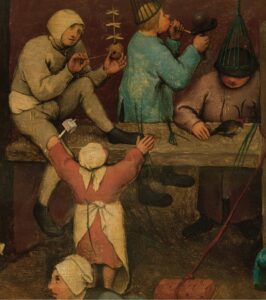
Figure 1 Detail: Pieter Bruegel, Children’s Games, Kunsthistorisches Museum, Vienna

Teetotum is documented in Vienna’s Kunsthistorisches Museum displays Pieter Bruegel the Elder’s (1525/30-1569) masterpiece, “Children’s Games” (1560). Another of his works in the museum is the “Tower of Babel,” which is the subject of a forthcoming post. Children’s Games depicts over two hundred children playing eighty different games. Bruegel’s encyclopedic pictorial catalog of games is unique in the annals of art. A small child is at the bottom left corner, her arms raised, holding a teetotum. (See here for a detailed view and here for Amy Orrock’s excellent article, “Homo ludens: Pieter Bruegel’s Children’s Games and the Humanist Educators,” discussing the purpose and interpretation of the painting within Erasmus’s views on the benefits of play.) Teetotum also appears in the list of games of Bruegel’s near contemporary French author François Rabelais’s (d. 1553) satirical work, Gargantua. The Oxford English Dictionary identifies it as “a favorite Victorian toy.” It appears in well-known English literature such as Lewis Carol’s Through the Looking Glass, where the White Queen (then a white sheep) asks Alice, “Are you a child, or a teetotum.” Other examples are Charles Dickens’ Our Mutual Friend, Edgar Allen Poe’s The System of Doctor Tarr and Professor Fether, and James Joyce’s Finnegans Wake as “finfoefom” (based on Joyce’s unique lettering system).[2]

Despite the widespread awareness of teetotum in Europe from at least the 1500s, the earliest Jewish sources connecting it with Chanukah date to the nineteenth century. Other Chanukah games boast much earlier recognition. For example, R Yosef Yuspa Nördlinger Hahn (1570-1637) mentions chess, tic-tac-toe, cards, and possibly backgammon.[3] Likewise, a 1638 herem banned cards and dice on Chanukah, although chess was excepted.[4] In subsequent Jewish literature, card playing has the most mentions, but that is due to their moral and ethical concerns rather than approval. None of these mention dreidel or any similar game.

The lack of historicity and mesorah was no barrier for 19th-century rabbis, nearly all Hassdic, from asserting Jewish relevance and stating that it is among the customs that qualify as minhag Yisrael Torah. R. Tzvi Elimelech Spira of Dinov is perhaps the most well-known example. In his Bnei Yissaschar, he contrasts the operation of the dreidel with the other Jewish play toy, the Purim gragger. The dreidel is activated from the top, symbolic of the heavenly source of the Chanukah miracle. The gragger is turned from the bottom because the catalysts of the miracle were Mordechai and Ester.

Others explain the symbolism of the dreidel’s letters, נ, ג, ה, ש. According to one explanation, these allude to the two rabbinically sanctioned mitzvot that we have on Chanukah, נרות שמונה (candles all eight nights) and הלל גמר (the complete Hallel). Others note the gematria (numerical value) of the letters, which correspond to the same gematria as משיח (the Messiah). Others still link the letters with גשנה the city Yosef secured for his family in Egypt that appears in the weekly Torah reading that coincides with Chanukah.[5]

None of these, however, locate the dreidel within the Chanukah story, and for that, we need to wait until the early twentieth century. According to this modern origin story, after the Greeks prohibited Torah study, Jewish teachers and students continued to do so surreptitiously in caves. When the authorities discovered these groups, they quickly switched from studying to playing dreidel.

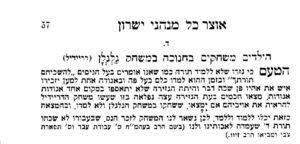
The first appearance of this account appears in a collection of customs published in 1917 in Saint Louis. R. Avraham Eliezer Hirshovitz (1859-1924), originally from Kovno (today Kaunas), Lithuania, and in 1908 emigrated to the United States and was the preacher of Shaary Torah and taught children in Pittsburg, PA.[6] In 1892, he published the first edition of his book on Jewish customs, Minhagei Yeshurun, in Vilna. It includes three haskamos (approbations). The only discussion regarding Chanukah is the source of the name. Seven years later, he published an expanded second edition in Vilna, with 280 customs and now eight additional approbations (he omitted one from the first edition), most notably one from R Yitzchak Elchanan Spektor. R Spektor caveats that he only had time to read a few lines but that “it is a nice work.” Another approbation is from the maskil, Kalman Schulman.[7] We are unaware of any other religious book that bears his approbation. Hirshovitz provides that he obtained “many other approbations and letters of support” that he did not include. Neither of these editions discusses dreidel.

In 1899, Hirshovitz published a further expanded version in Yiddish in Vilna. By then, he had emigrated to the United States. He discusses game playing on Chanukah for the first time, although only cards. He explains that some play cards as it is like war, evoking the military victory over the Greeks. Nonetheless, he disapproves of playing cards, noting that cards are non-Jewish (he does not mention any halakhic reasons or the numerous Jewish sources that explicitly prohibit cards and other forms of gambling on Chanukah).

Finally, in the first American edition, published in Saint Louis in 1918, now with approximately 500 customs, Hirshovitz addresses the custom of playing dreidel. He does not mention any of the Hassidic explanations. Instead, he tells the story of the dreidel and how it was used to hoodwink the Greeks.[8] Despite the complete lack of evidence and the absurdity of the Greeks falling for such a simplistic and completely unrealistic ruse, Hirshovitz’s narrative quickly entered the Jewish collective consciousness. For example, in the collection of customs, Pardes Eliezer devotes an entire chapter to dreidel and explains “that despite the fact dreidel doesn’t appear in the sifrei ha-achronim it does not prove it is a recent custom.” Rather, “kama hokerim” (many scholars) describe it as “an ancient custom, dating to the Hasmonic period,” and then uses Hirshovitz’s story. Or, in the book Minhag Yisrael Torah, Hirshovitz’s narrative is “the simple” explanation.[9] Today, if one does a cursory search on the internet, there are articles from the Aish.com website regarding dreidel entitled “A Serious Game,” or on Chabad.org that describes Hirshovitz’s rationale as “the Classic” and “common” reason, and many others.

Not all were so taken with Hirshovitz’s work. R Shmuel Kraus published a highly critical article in Kiryat Sefer in 1933 that highlights numerous methodological issues with Hirshovitz’s work.[10] While Kraus notes the book was sloppily published with omissions and other defects, he reserves the bulk of his article is devoted to Hirshovitz’s hallucinatory customs and corresponding sources. While the article does not discuss the dreidel, it criticizes Hirshovitz for identifying sources for the “custom” to trick people on April 1, the word “daven” that is identified as either Aramaic or from the English word Dawn and provides a reason why in Europe a Bar Mitzvah boys give a “derasha,” but in the United States a “speech.” Hirshovitz sometimes tries to adopt a more substantive and historically defensible explanation, even citing an article from JQR regarding the Magen David.[11]

While Hirshovitz’s explanation is unsupportable, one hypothesis is worth mentioning. Israel Abrams, in an article that initially appeared in The American Hebrew and republished in his collection Festival Studies, posits that Teetotum:

It is a very ancient game, known to the Greeks and Romans. But why was it specially favoured on Hanucah? No answer has ever been given to this natural question. It may be that the Teetotum was regarded as a very innocent form of gambling, if that be not altogether too harsh a word to use. Many pious people never played cards or any other game of chance, but they may have felt that so simple a game as this was lawful enough. But I can now supplement this with a new suggestion. Teetotum is still in parts of Ireland the indoor recreation of the peasantry at Christmas tide. Now it is well known that such games seldom change their seasons. I should wonder if the Teetotum was a favourite toy elsewhere at Christmas. If so, the Jews may have transferred it to Hanucah. For they never invented their own games, except those of intellectual species such as Hanucah Ketowes [riddles]. The Ketowes even gave rise to a folk proverb: “Zechus Owes, Kein Ketowes,” i.e., I suppose merit of the fathers is not the solution of life’s riddle. Indeed, the moral of Hanucah, is after all, that Judaism must rely on present effort of the children as well as on the past merits of their sires, if it is to remain in any true sense a “Feast of Light.”[12]


The Case of the Origin Story of the Creation of the Word Sevivon

Another mythical story associated with dreidel occurs with the origin of the modern Hebrew word for the toy, sevivon. The most well-known history is found in the autobiography of Eliezer Ben Yehuda’s son, Itamar ben Avi (1882-1943), Im Shahar Atzmotenu, published in 1961. Rochel Berlov, in her article “Me Hidush ha-milah ‘Sevivon’?”, however, demonstrated that the term long predated Itamar. (See also Ester Goldenberg’s article).  David Yeshayahu Silberbusch coined it and first appeared in Hayyim Zelig Slonimski’s journal Ha-Tzefirah on December 24, 1897 (See Zerachyah Lict’s comprehensive article regarding Slonimski’s challenge to the miracle of the oil and Marc Shapiro’s subsequent discussion). A week and a half later, Silberbusch used the word as the title of a satirical article, and it subsequently regularly appeared in the newspaper. In 1923, Levin Kipnis published his now famous song, sevivon, sov, sov, sov. Itamar wrote his autobiography when he was fifty, and it was published posthumously. He tells the story of how

one day, when he and his family were preparing to go on a trip outside the city, outside the wall, I suddenly jumped towards my parents: Mother! Mother! I found a sevivon for Chanukah. My mother hugged and kissed me with admiration. “How beautiful is the word you created, my son!” This is how the word sevivon was created and became standard for decades among all Jewish children. I, the writer of these memories and the one who created it when I was a child, among countless other words that are now incorporated into our language, but [not everyone] recognizes who created them.

Despite this story, the word does not appear in any newspapers his father, Eliezer Ben Yehudah, edited. Moreover, Ben Yehudah did not include it in his monumental dictionary of modern Hebrew. Nonetheless, Itamar’s story was retold countless times in children’s books and treatments of Itamar (and some still think the issue remains unsettled). Zohar Shavit’s assessment of Itamar’s book, which can be equally applied to Hirshovitz’s dreidel origin story, aptly sums up the willingness to accept such tall tales:

Above all, he understood the importance of creating an interesting and fascinating story, apparently even at the expense of historical credibility… It is quite clear that in some of his personal stories, Ben-Avi prefers the interesting story over fidelity to the facts.

Notes:

[1] Recorded in Israel Abrahams, “Hanucah in Olden Times,” in Festival Studies Being Thoughts on the Jewish Year (Philadelphia, 1906), 146, 152.

[2] Joseph Shipley, The Origins of English Words: A Discursive Dictionary of Indo-European Roots (Johns Hopkins University Press, 2001), 411; John P. Anderson, Joyce’s Finnegans Wake: The Curse of Kabbalah (Universal Publishers, 2008), 211-12.

[3] Yosef Kosman, Noheg ka-Tzon Yosef, (Tel Aviv, 1979), 188 n.12; Herman Pollack, Jewish Folkways in Germanic Lands (1648-1806): Studies in Aspects of Daily Life (MIT Press, 1971) 181, 330n184.

[4] Minhagei DK”K Vermisia, Yitzhak Zimmer, ed., vol. 1 (Mefal Toras Hakhmei Ashkenaz, 1988), 238-39.

[5] See R. Yitzhak Tesler, “Ha-Dreidel (Sevivon) be-Chanukah: Mekoroseha, Ta’amyah, u-Minhagyah,” Or Yisrael, 14 (1999), 50-60 (collecting these and other sources).

[6] For biographical and complete bibliographical information, including a discussion of variant versions, see Yosef Goldman, Hebrew Printing in America 1735-1926: A History and Annotated Bibliography (Brooklyn, 2006) n583&622 (see here and here for our review of this work).

[7] For biographical information, see Hillel Noah Steinschneider, Ir Vilna, vol. 2, Mordechai Zalkin, ed. (Hebrew University Magnes Press, Jerusalem, 2002), 182-83.

[8] Avraham Hirshovitz, Otzar Kol Minhagei Yeshurun (St. Louis, 1918), 57. Hirshovitz cites “HaRav Ziv” as his source. But otherwise, it provides no information regarding this person. Two authors from that period use “Ziv,” Yehoshua ben Aba Ziv, who wrote a book of songs and a fictional work in Yiddish on the life of a Yeshiva student. The book of songs, Asifas Shirim: Al Mo’adei ha-Shana (Vilna, 1875), 13-15, includes a song for Chanukah but does not mention dreidel. The other possibility is Nehemiah Shmuel Libowitz, who used the pseudonym “Ziv.” Libowitz was a contemporary of Hirshovitz in America, and although we have not discovered any evidence, it’s possible they met in the United States. That may account for Hirshovitz’s inclusion of the dreidel story in his U.S. edition. Nonetheless, none of Libovitz’s published works include Hirshovitz’s Dreidel story, which includes the book Herod and Agrippa, which touches upon the Hashmonim.

[9] Kollel Damesek Eliezer, Pardes Eliezer, Hanukah, vol. 2 (Machon Damesek Eliezer, Brooklyn, 2004), 650-51; Yosef Lewy, Minhag Yisrael Torah, vol. 3 (Brooklyn, 1997), 216. Gavriel Zinner  however, in his extensive discussion of Chanukah customs and dreidel in his Neta Gavriel, does not mention Hirshovitz’s reason.

[10] Shmuel Kraus, “A.Y. Hirshovitz, Otzar kol Minhagei Yeshurun,” in Kiryat Sefer 11,3 (1934), 311-12.

[11] See Hirshovitz, Otzar Kol Minhagei Yeshurun, 4 (April fools), 28 (speech versus derasha), 88 (JQR).

[12] Abrahams, “Hanucah,” 154-55.


Review of Rabbi Eliezer Berkovits, Jewish Women in Time and Torah

Review of Rabbi Eliezer Berkovits, Jewish Women in Time and Torah

Ross Singer

Ross Singer received rabbinic ordination from Professor Rabbi David Weiss Halivni, Rabbi Shear Yashuv Cohen, and Rabbi David Bigman. He has an MA in Talmud and Rabbinics from the Jewish Theological Seminary and is a graduate of the Mandel Jerusalem Fellows. He has published articles in The Edah Journal, The JOFA Journal, Amudim, Lehrhaus, The Jerusalem Post, and The Times of Israel. He is the translator of Gideon Katz’s In Silence and Out Loud: Yeshayahu Leibowitz in Israeli Context.

Ross served as a rabbi in Vancouver, Canada and Baltimore, MD, and currently resides in Israel where he works as an educator and tour guide.

Rabbi Eliezer Berkovits has long been an outlier in the Orthodox world.[1] Over the past two decades, there has been a concerted effort by admirers of R. Berkovits to revive his thought and put it on the agenda. New commentaries to the Haggadah[2] and Megillat Esther[3] have been culled from the large corpus of R. Berkovits’ writings, a sampling of his important essays has been collected and published,[4] major works have been translated into Hebrew and published by Shalem Press, and new editions of his out of print books have been reissued including the subject of this review, his Jewish Women in Time and Torah.

On the backdrop of this trend to cultivate a reconsideration of R. Berkovits’ thought in the Orthodox community, it is important to note that a feature of R. Berkovits’ work may play a role in its marginalization. In the introduction to his English magnum opus, Not in Heaven, R. Eliezer Berkovits writes:

Finally may I be permitted a personal confession. While all my life I have endeavored to take my stand on the foundations of Halakhic Judaism, as it was handed down to me in my father’s house and as I have acquired it from my studies in Y’shibot and later from my great teacher, Rabbi Yehiel J. Weinberg, ז”ל, at the Hildesheimer Rabbinical Seminary in Berlin, in this my work I was determined to be guided exclusively by the traditional halakhic material as I found it and as I have learned to understand it over the years.[5]

While Rabbi Berkovits describes his return to the classic sources as a departure from the approach that he received from his teachers and based upon his own unique understanding, scholars of R. Berkovits’ work have found other halakhists who lay out kindred theories of halakhah. Some theorize that R. Berkovits may have been influenced by R. Moshe Shmuel Glasner, the father of one of his early teachers, R. Akiva Glasner,[6] and Rabbi Chaim Hirshensohn.[7] Despite his “confession,” R. Berkovits’ approach has powerful antecedents that a reader of Not in Heaven will not encounter there. It is not clear why they go unmentioned and unexplored by R. Berkovits. It is clear that a full appreciation of the place of his approach in the broader canvas of halakhic thought requires some filling in of gaps that his work leaves out.

This is particularly true of R. Berkovits’ final work, Jewish Women in Time and Torah. The recent republication of this volume affords us an opportunity to explore analogs of the book’s central thesis that R. Berkovits leaves unmentioned or underdeveloped, and to note some more recent work that picks up on its themes.

Before engaging in the endeavor to uncover the congruity of R. Berkovits’ thought in this work with the larger tradition, let us appreciate two features of this new edition. Firstly, it includes a moving introduction by R. Berkovits’ granddaughter, R. Rahel Berkovits. Her essay gives some important personal and ideological context. Secondly, this new edition uses footnotes as opposed to endnotes used in the earlier edition making it easier to turn to the various sources quoted by R. Berkovits without losing one’s place in the book.

The most significant contribution of the content of Jewish Women in Time and Torah is R. Berkovits’ distinction between “Torah-taught” and “Torah-tolerated.” This distinction lies at the center of the book’s agenda. R. Berkovits explains that the Torah was given into a particular cultural context and as such, it must take that context into consideration in legislating its norms. The Torah must, in certain cases, compromise its highest ideals for the sake of speaking to a particular generation who in their context are unable to understand and accept the fullest aspirations of the Torah. Using a pragmatic strategy, the Torah guides the community towards ever greater fulfillment of its ideals. In R. Berkovits’ own words:

The goals and the values are these forever. But they are taught and applied with the wisdom of understanding that time-conditioned reality cannot be changed overnight. The method of the Torah is to acknowledge reality, to take human nature into account and apply the eternal word to it so far as is possible, thus to teach values and guide behavior, indicating the goal towards which the guided change has to move.[8]

The Torah tolerates time-conditioned realities and they may seep into its norms, however one must distinguish between the Torah-tolerated and the Torah-taught. R. Berkovits asserts that the disparaging statements about women and halakhic inequalities that one finds in Jewish tradition stem from the ancient context into which Torah was given and in which it developed. Such evaluations of women were Torah-tolerated, however none of them were Torah-taught. While R. Berkovits had advocated for decades for adjustments in halakhah for women’s status, he had justified this approach in the past based on his understanding of halakhah’s prioritization of the ethical. In Jewish Women in Time and Torah, he introduces this historiosophy to his English language readers for the first time.[9] According to his read of the history of halakhah, the time is ripe to rid halakhah of what it had compromised on in the past:

It is our task to eliminate whatever remains from the Torah-tolerated, impersonal phase and to establish woman’s status completely on the Torah-taught and prescribed personal level.[10]

To appreciate the significance of this, it may be helpful to look at a question posed to R. Berkovits by R. Shalom Carmy. In a nuanced review of R. Berkovits’ approach, R. Carmy finds much to appreciate. Nevertheless, he echoes the common critique that R. Berkovits’ approach overreaches. R. Carmy notes R. Berkovits’ exasperation over a statement of the Ramban regarding the case of a woman who claims that her husband is repulsive to her without offering independent evidence. While reinforcing the strength of the position that allows the court to force the husband to divorce his wife, Ramban adds that whoever follows the stricter opinion that the court cannot force the husband “has lost nothing, and may be blessed.” R. Berkovits states that, “one remains astounded at such words. To be ‘strict’ in matters of divorce and overlook the happiness of the woman may often be extreme leniency in the implementation of the not insignificant commandment ‘And you shall love your neighbor as yourself.’” Rabbi Carmy takes issue with Rabbi Berkovits critique of Ramban:

We are obligated, as a simple matter of intellectual integrity and a measure of kevod ha-Torah, to understand why Ramban’s theoretical and practical judgements diverge markedly from ours. Such an exercise will yield a better understanding of Torah and a better self-understanding… Rolling one’s eyes in exasperation with the Ramban is not a philosophy.[11]

Rabbi Carmy’s point is an excellent one. How can R. Berkovits so easily discount the Ramban’s statement? Isn’t it too part of the Torah that must be understood and appreciated? If the priority of the ethical is so fundamental to halakhah, why doesn’t the Ramban recognize that? In Jewish Women in Time and Torah, R. Berkovits provides an answer to these questions. Ramban’s acquiescence to an approach in halakhah that diminishes women’s status before the court is a holdover of a Torah-tolerated approach. In our period such an approach should be left behind as we reassert the Torah-taught.[12]

The implications of R. Berkovits’ historiosophy of halakhah are tremendous and raise many questions. It introduces new dimensions to the subjective element of R. Berkovits’ thought. How is one to distinguish in the corpus of Torah between what is merely Torah-tolerated and what is actually Torah-taught? Where does R. Berkovits get such an idea about halakhic evolution and progression? Is this aspect of his thought also a deviation from the teaching he received from his family and teachers? What precedents exist for approaching Torah and halakhah in this way?

Indeed, it seems that R. Berkovits’ historiosophy of halakhah conflicts with the predominant way that Torah is presented in many orthodox circles. One of the opening statements of Bereishit Rabbah presents a conception of Torah that seems antithetical to R. Berkovits’ approach:

A king of flesh and blood who builds a castle does not do so from his own knowledge, but rather with the knowledge of a craftsman, and a craftsman does not build it from his own knowledge; he has scrolls and books in order to know how to make rooms and doorways. So too God looked into the Torah and created the world…[13]

In this depiction, the Torah precedes the world. The Torah then can be seen as pristine and untouched by human history and culture. In such a depiction, the Torah’s commandments cannot bear the taint of any human foibles. The Torah does not tolerate or compromise with or react to history because the Torah precedes history. In my experience, this is the dominant conception of Torah’s relationship to the world in Orthodox circles.[14]

Is there an alternative competing conception to this one upon which R. Berkovits can find precedent? To ground his position in the classical sources, R. Berkovits first quotes from Rashi’s interpretation of Psalms 29:4. Rashi comments, “At the time of the giving of the Torah, God limited His voice in accordance with the strength of the Israelites to receive.”[15] R. Berkovits elaborates explaining that each person received the Torah “in conformity with his own spiritual and moral capacity.” Building on this, R. Berkovits turns to the Rambam’s famous passage in his Guide for the Perplexed about the origin of the sacrifices:

… the prevailing custom in the world was to sacrifice animals… God’s wisdom counseled Him that to command the Jews to give up all that kind of service and annul it completely would have been something that their hearts could not have accepted… For this reason, God allowed the [generally practiced] sacrificial services to remain but directed them away from those created or imagined powers in which there is no truth, to His own name blessed be He.[16]

While R. Berkovits suffices with this one excerpt, the notion that God’s revelation to Israel took into account particular historical circumstances recurs throughout the Rambam’s writings. In a number of places in the Guide, Rambam explains that the Torah’s commandments and teachings are responses to and polemics against the practices and beliefs that had become prevalent among ancient idolators. For example, this is how he explains the reason for the Korban Pesach:

Scripture tells us, according to the version of Onkelos, that the Egyptians worshiped Aries, and therefore abstained from killing sheep, and held shepherds in contempt… For this reason those sects abstained from eating goats’ flesh. …This is [also] the reason why we were commanded to kill a lamb on Passover, and to sprinkle the blood thereof outside on the gates. We had to free ourselves of evil doctrines and to proclaim the opposite, viz., that the very act which was then considered as being the cause of death would be the cause of deliverance from death.[17]

This approach is not limited to the Guide. In his earlier popular works Rambam makes similar suggestions. In the Sefer HaMitzvot (Negative Commandments #43) Rambam already explained that the Torah’s prohibition of shaving off the corners of one’s head is in response to the practice of ancient idolatrous priests shaving that part of their hair. He repeats this explanation in the Mishneh Torah (Hilkhot Avodah Zarah 12:1). The reason for the prohibition of mixing wool and linen together in garments is explained in the Sefer HaMitzvot (Negative Commandments #42) in the same way. In his Letter on Astrology, Rambam again articulates the broad use he makes of the approach:

I also have read in all matters concerning all of idolatry…I have read it and have understood its subject matter and have plumbed the depth of its thought. From those books it became clear to me what the reason is for all the commandments that everyone comes to think of as having no reason at all, other than the decree of Scripture.[18]

Given the claim that the Guide was written as an apologetic work to draw in those who had been lured away from traditional Judaism and therefore might include rhetorical passages that do not represent the most authentic positions of Rambam, these examples[19] are significant.

Another iteration of Rambam’s assertion that the Torah takes into account the exigencies of history found outside of the Guide is found in his Epistle on the Resurrection of the Dead.[20] After reaffirming his earlier pronouncements that the resurrection of the dead is a fundamental Jewish principle, Rambam addresses the absence of any explicit indication of the resurrection of the dead in the Pentateuch. He explains that the notion of the resurrection of the dead was so foreign and difficult to accept in the culture of Moses’ time, that were it to be mentioned, it would have made the acceptance of all the Torah’s other truths and instructions unthinkable. Therefore, God withheld the truth of the resurrection at that time in order to inculcate other more fundamental notions of prophecy and creation. Only after prophecy and creation were well established beliefs did God see fit to reveal the notion of resurrection and therefore we only find resurrection mentioned explicitly in later books of the Bible. Rambam explains that just as the Israelites were led out of Egypt in a circuitous route to avoid the land of the Philistines, “lest the people change their minds when they see war and return to Egypt (Exodus 13:17),” so too the revelation of the resurrection took a circuitous route lest the people reject the Torah. The metaphor of the circuitous path of the exodus is also employed by the Rambam in the Guide to explain his approach to the sacrifices in the passage mentioned above. The impact of the exigencies of human history not only shape the path of the Exodus and the establishment of the sacrificial rites, they also determine that certain information must be omitted from the content of the Torah.

In perhaps the most subtle but also the most profound example of this phenomenon, Rambam seems to hint that the very revelation of the whole of the Torah was a reaction to a particular historical moment. In chapter one of the Mishneh Torah’s Laws of Idolatry, Rambam recounts how all of the progress in creating a monotheistic community was nearly undone during the many years that the Israelites lived in Egypt.

When the Jews extended their stay in Egypt, however, they learned from the [Egyptians’] deeds and began worshiping the stars as they did, with the exception of the tribe of Levi, who clung to the mitzvot of the patriarchs – the tribe of Levi never served false gods. Within a short time, the fundamental principle that Abraham had planted would have been uprooted, and the descendants of Jacob would have returned to the errors of the world and their crookedness.

Seemingly in response to this deterioration, God

brought forth Moses, our teacher, the master of all prophets, and sent him. Once Moses, our teacher began to prophesize, and God chose Israel as His inheritance, He crowned them with mitzvot and informed them of the path to serve Him, and the law prescribed for idol worship and all those who stray after it.

In the Rambam’s retelling it sounds as if the superior level of prophesy bestowed upon Moses and the giving of the mitzvot of the Torah are prompted by a crisis in history – the potential loss of the monotheistic tradition that Abraham founded. As Rabbi Nahum Eliezer Rabinovitch puts it in his commentary to this passage:

We find that Moses’ mission and the transmission of Torah and mitzvot guaranteed that the root that Abraham planted was not uprooted and would never be uprooted.[21]

Rav Shagar suggests that this first chapter of the laws of idolatry should be seen as just one example of a larger phenomenon in the Mishneh Torah:

In my opinion, one should explain the Rambam’s effort in the Mishneh Torah in his historical introductions to various halakhot, like his introduction to the laws of marriage for example, in this way (a historical understanding). The Rambam, in opposition to most of the Torah’s interpreters today, did not hide his conception of the Torah as constructed by history (among other factors) and as adapted to changing human consciousness.[22]

Deeply embedded in Rambam’s thought, and throughout his writings we find that the Torah was shaped by the exigencies of history.

Perhaps the greatest rabbinic figure since Rambam to articulate a similar approach to the impact of history on the formulation of the Torah was Rabbi Abraham Isaac HaCohen Kook. In a letter to the orthodox academic biblical scholar, Moses Seidel, R. Kook writes:

If we find in the Torah certain things which seem to be based on widely accepted ideas of the distant past, but are incompatible with the scientific knowledge of today, we cannot be sure if our current research has produced absolute truth. Even if current understandings are true, there certainly could have been an important and sacred reason for which these matters needed to be explained according to the popular notions of ancient times and not scientifically precise ones. This approach is taken for granted by certain spiritual notions and fundamentals of understanding scriptural narrative like, “the Torah addressed humanity’s evil inclination,” or “[The Torah is formulated] in order to explain in a way that it is intelligible to the [human] ear”, and these instances testify to beloved enduring Divine wisdom.[23]

In another letter to Seidel, Rav Kook writes:

Life must be understood through two parameters, how it is and how it should be… The Divine exalted Torah is that very beloved instrument that cultivates and directs life towards the state that it should be. However, you must be careful not to think that these two parameters have no relationship or connection to each other, for they are related matters just like the changing horizons that one who travels a long journey encounters.[24]

These two letters together produce an approach that is basically the same as R. Berkovits’ – the Torah takes into account “the popular notions of ancient time” even if they are not “precise”, and seeks to move life from “how it is” towards “how it should be” incrementally like “changing horizons.” These ideas find a later iteration in the posthumously published L’nevuchei Hador.

A similar notion can be found in R. Kook’s essay “Fragments of Light.” There he writes:

The long road of development, after man’s fall, also needs physical exertion, which will at times require a meat diet, which is a tax for passage to a more enlightened epoch, from which animals are not exempt…

This is the advantage of the moral sense when it is linked to its divine source. It knows the proper timing for each objective, and it will sometimes suppress its flow in order to gather up its strength for future epochs, something that the impatient kind of morality that is detached from its source would be unable to tolerate. When the animal lust for meat became overpowering, if the flesh of all living beings had been forbidden, then the moral destructiveness, which will always appear at such times, would not have differentiated between man and animal, beast and fowl and every creeping thing on the earth. The knife, the axe, the guillotine, the electric current would have felled them all alike in order to satisfy the vulgar craving of so-called cultured humanity.[25]

These and similar ideas on the consumption of meat in another essay were culled together by R. Kook’s student R. David Cohen into an essay entitled “A Vision of Vegetarianism and Peace.” In R. Berkovits’ terminology, R. Kook is suggesting that the eating of meat is Torah-tolerated but not Torah-taught. Though he never quotes from R. Kook, their approaches clearly share a similar understanding of the necessity for Torah to compromise its highest aspirations in the face of the exigencies of history.

And yet, even as we have seen that R. Kook and the Rambam both teach that the Torah includes elements that are the product of historical circumstances, one could still challenge the notion that this should have any practical ramifications. The same Rambam who in the Guide presents the sacrificial system as a compromise with historical exigencies, in the Mishneh Torah brings all of the details of the halakhah of animal sacrifice. As Rabbi Ira Bedzow articulates it:

Nevertheless, the obligation of sacrifices was never abrogated completely in favor of prayer. In his Book of the Commandments, Maimonides enumerates prayer as the fulfillment of the specific commandment of worshiping God. Yet he also enumerates each commandment of the sacrificial rite even though they could have been included in the general category since they are considered only a way-station on the path to proper worship. Their enumeration shows that as specific commandments, the performance of sacrifices is eternally valid, as is the rest of the Torah.[26]

We could also note that R. Kook was insistent that for his time it was inappropriate to implement the Torah taught vegetarianism. He explicitly discouraged his son from refraining from eating meat.[27] R. Kook was concerned that the time was not yet ripe and the consequences of implementing the Torah’s ideals could backfire. Moreover, even though R. Kook was very unconventional as a thinker, his practical halakhic decisions were often very conservative.

R. Kook’s and Rambam’s reticence to diverge from the Torah-tolerated halakhah towards what they believed was a more ideal Torah teaching is an important point to consider. However, most of what Rabbi Berkovits advocates for in this book is not analogous to the abolition of sacrifice or the wholesale prohibition on consuming meat. In most cases, Rabbi Berkovits is suggesting the adoption of one strain of the halakhah embedded in the Talmudic and post-Talmudic authorities over other strains. For instance, his proposals of women reading Megillat Esther for the community, making Kiddush in their homes, counting for the three that make up the Zimmun and leading the zimmun, all are based on classical sources.

And still, even regarding relatively minor adjustments, how can one be sufficiently confident that one strain is merely tolerated while the other is Torah-taught? Could both be Torah-taught and part of Rabbinic pluralism – a pluralism that R. Berkovits embraces in other contexts?[28] R. Berkovits insists that in these cases one position is a holdover with less legitimacy and the other is an ideal whose time has come. R. Berkovits traces a line from negative statements about women in ancient Greek culture and presumes that parallel statements in the Rabbinic literature must derive from this foreign source. R. Berkovits seems to presume that this is self-evident and does not feel a need to demonstrate causation. One wonders if there is a possibility of a more objective way of separating the “Torah-taught” from the “Torah-tolerated.”

At just about the same time that R. Berkovits was writing up these ideas,[29] R. Nahum Eliezer Rabinovitch was sharing very similar thoughts:

The system of Torah and commandments is two-fold. On the one hand, it conveys concepts, instills eternal values, and directs people to the service of God at the highest levels and to the formation of a society worthy to be the bearer of God’s presence. On the other hand, it encompasses legislation and commands to combat the forces of evil and destruction that erupt within the individual’s soul and the nations’s spirit and to ensure that the necessary conditions for spiritual development are satisfied to the greatest possible extent, given each generation’s situation and the social, economic, and cultural circumstances prevalent at any given time and place. For the first objective, the Torah places before us lofty goals that challenge and motivate the generations, for even the noblest of people cannot attain them in full. At the same time it establishes, for the second objective, criteria for conduct that people can, as a practical matter, accept minimum standards that must be met to avoid endangering the survival of the individual and the society in which he is placed and giving up all hope of spiritual uplift.

R. Rabinovitch and R. Berkovits are laying out very similar ideas to each other at the same time without mentioning each other.

Like R. Berkovits, R. Rabinovitch asserts that halakhah indeed should respond and has responded to progress in history that allows for the raising of “minimum standards” towards “service of God at the highest levels.” He writes:

In the time of the rishonim, R. Gershom, Beacon of the Diaspora, saw that his generation was ready for a ban on divorce without the wife’s consent and for eliminating polygamy, at least within the communities of Western Europe. By now, his enactments have spread through all Israel. Certainly the Sages instituted such enactments – yet they did not draw them out of thin air, but advanced the values already determined by Scripture. In the biblical era, however, the time was not yet ripe, and people were not yet ready for the full realization of that vision. Only over time, as a result of training in the life of Torah, were people’s hearts made ready and did it become possible to draw closer to the goal established by the Torah.[30]

R. Rabinovitch sees in takanat Rabbeinu Gershom an example of the Torah-taught replacing the Torah-tolerated. He powerfully grounds his claim that monogamy is an ideal of the Torah and that polygamy is a compromise with reality, He allows the Torah to present its ideal in its own terms: “Therefore a man shall leave his father and his mother and cleave to his wife and they will become as one flesh” (Genesis 2:24). “I am my beloved’s and my beloved is mine” (Song of Songs 6:2).

It is worthwhile noting some differences between R. Rabinovitch’s presentation and R. Berkovits. R. Rabinovitch’s seems to have a higher threshold for determining the Torah-taught.[31] He is less willing to intuit the Torah’s higher ideals and so all of his examples rely on broad constitutive statements. He also is much less programmatic and ambitious than R. Berkovits. R. Rabinovitch makes the case that this is how Torah works but he does little to lay out what our next steps should be. For those who are convinced of the basic theory of Torah-taught vs. Torah-tolerated, the continuum between the more programmatic and intuitive R. Berkovits and the more conservative modest R. Rabinovitch might provide margins to the discussion of how far one can or should go with this approach.

Before closing, we should note some very recent movement towards these ideas in another realm. While, for R. Rabinovitch, R. Berkovits, and R. Kook, these ideas primarily address ethical qualms that we might have over the discrepancy between our senses of morality and the tradition’s prescriptions, they have also been used recently to address issues arising from the discipline of Biblical Criticism.

In two recently published books, the ideas explored above are brought to shed light on Biblical criticism. R. Joshua Berman’s Ani Maamin and Yeshivat Maale Gilboa’s Gishat HaTemurot seek to address the discrepancies and contradictions in the Torah that scholars of the Documentary Hypothesis make so much of. Both of these books suggest that understanding the Torah’s relationship to historical developments and culture explains these discrepancies in ways that can be harmonized with reverence for the divinity of the text.

R. Berman titles the opening chapter of his book, “The Rabbinic Mandate to Understand the Torah in Ancient Near Eastern Context.” He justifies his approach by quoting the passages from The Guide mentioned above, the Letter on Astrology, Ralbag, and Rav Kook. R. Yehuda Gilad in his article in Gishat HaTemurot brings together Rambam’s passage about sacrifice in The Guide, Rav Kook’s Letter #89, and the Vision of Vegetarianism and Peace and offers an overarching analysis of the ramifications of this approach.

From all this we can see that R. Berkovits’ thesis in Jewish Women in Time and Torah is deeply grounded in the broad oeuvre of Rambam’s writings, and it reverberates with seminal passages in the writings of R. Abraham Isaac HaCohen Kook. It was paralleled by the work of his younger contemporary R. Rabinovitch, and its methodology has been used in two important books to address the challenges of Bible criticism. Perhaps what might seem at first glance to run afoul of common attitudes towards the sanctity of the Torah’s text, should be considered a legitimate and well-trodden path of engaging with the Torah by some of our greatest lights. If so, this can open an exciting and vital debate about the potential ramifications for the proper adjudication of halakhah in our moment in history. The republication of Jewish Women in Time and Torah is an excellent springboard for this debate.

* * * * * * *

Notes

[1] His approach has been disparagingly associated with Conservative Judaism. See R. Chaim Twerski, Academic Journal of Hebrew Theological College 1:2 (April 2003), in the letters section page 101. His yirat shamayim has been called into question. See Allan Nadler, “Eliezer Berkovits’ Not in Heaven,” Tradition 21:3, (Fall 1984), p. 97. While his own teacher, Rabbi Yechiel Ya’akov Weinberg, wrote a glowing approbation of R Berkovits’ work Tnai Bernesuin UVaGet (For an analysis of the controversy around this letter, see Marc B. Shapiro, Between the Yeshiva World and Modern Orthodoxy, (1999), pp. 191-192, footnote 83), in private correspondence, Rabbi Weinberg wrote that an article of R. Berkovits’ “contains harmful ideas that cannot be accepted” (Shapiro, “Rabbi Jehiel Jacob Weinberg on the Limits of Halakhic Development” The Edah Journal 2:2 Tammuz 5762, p. 2). To be sure, in that same letter, R. Weinberg ultimately comes to the general defense of his devoted student, but the statement that R. Berkovits had gone too far in this particular article is telling. When publishing an article by R. Berkovits in 1965, Tradition felt the need to include the following disclaimer: “Although most of our Editorial Board disagree with the views expressed in this essay, Tradition is happy to provide a forum for the provocative ideas presented by Dr. Eliezer Berkovits (‘Orthodox Judaism in a World of Revolutionary Transformations’ (Berkovits 1965).” Gil Graff cites a letter where R. Berkovits himself felt he hadn’t found a place where he felt comfortable in American Jewish life (Gil Graff “Halakhah as Torat Hayyim, Journal of Modern Jewish Studies, April 16, 2019, p. 7).

[2] Reuven Mohl (ed.), Faith and Freedom Passover Haggadah with Commentary from the Writings of Rabbi Eliezer Berkovits, (2019).

[3] Reuven Mohl (ed.), Faith Fulfilled: Megillat Esther and the Ma’ariv Evening Service for Purim with Commentary from the Writings of Rabbi Eliezer Berkovits, (2022).

[4] David Hazony (ed.), Essential Essays on Judaism, (2002).

[5] Eliezer Berkovits, Not in Heaven, (1983) p. 2.

[6] Dr. David Hazony, Prof. Marc Shapiro and Rabbi Nathan Lopes Cordozo have all made this speculation. R. Cardozo writes, “Rabbi Berkovits received his rabbinical training (and semicha – rabbinic ordination) from Rabbi Akiva Glasner (1885-1956), who took over as Chief Rabbi of Klausenburg when his father, Rabbi Moshe Shmuel Glasner (1856-1924) left for Israel. The latter – a staggering, daring figure in the world of Halacha – authored Dor Revi’i, one of the most remarkable works ever written, suggesting an entirely different approach to Jewish Law. The elder Rabbi Glasner had a major influence on Rabbi Berkovits’s halachic thinking and approach” (R. Cardozo, “Faith and Freedom – a book review,” Times of Israel, March 27, 2019 https://blogs.timesofisrael.com/faith-and-freedom-a-book-review/). David Hazony writes, “Yet he had other teachers, as well, whose influence was no less evident than Weinberg’s, even if he does not tell us as much explicitly. Of these, probably the most decisive was Rabbi Akiva Glasner, under whom he studied and received rabbinic ordination during his years in Pressburg, and who officiated at Berkovits’ wedding—a traditional symbol of reverence and, presumably, influence. And though Glasner himself left little record of his views regarding the subjects Berkovits wrote about, we do know that he shared a close affinity with his father, Rabbi Moshe Shmuel Glasner, even succeeding him as chief rabbi of Klausenberg. The elder Glasner was renowned for two controversial beliefs in his time—beliefs that find powerful expression in Berkovits’ writings, and which do not have seemed to be emphasized in those of Weinberg, and which, knowing what we know about how rabbinic dynasties tend to function, are likely to have infused Akiva Glasner’s teachings as well and reached Berkovits through him” (Hazony, Human Responsibility in the Thought of Eliezer Berkovits – Thesis submitted to the Senate of the Hebrew University, July, 2011, p. 31). Professor Shapiro is much more reserved writing that, “Presumably, some of the elder Glasner’s ideas were carried forward by his son, although it is impossible to say if this influenced Berkovits, since he never mentions Glasner in his writings” (Shapiro, “Rabbi Eliezer Berkovits’s Halakic Vision for the Modern Age,” Shofar 31:4, p. 16). R. Glasner may have had explicit influence or subconscious influence on R. Berkovits or perhaps he had no influence at all. Whatever the case may be, R. Berkovits’ approach does have a powerful important antecedent.

[7] See Hazony, Human Responsibility in the Thought of Eliezer Berkovits – Thesis submitted to the Senate of the Hebrew University, July, 2011, pp. 35-36. See also R. Jonathan Sacks, Arguments for the Sake of Heaven, (1995), pp. 196, where R. Sacks puts R. Hirschensohn and R. Berkovits in the same ideological camp.

[8] P. 47.

[9] This idea appears in Hebrew in a less developed form in Berkovits’ article מעמד האישה ביהדות – הבט הלכתי-חברתי that appears in דב רפל (עורך) הפנינה: ספר זכרון לפנינה רפל which was published in 5749 (1988-89) – a year or so before the publication of Jewish Women in Time and Torah.
This article introduces a new element into Rabbi Berkovits’ historiosophy of halakhah. In Not in Heaven, he writes that, “halakha is the application of the Torah to life. But since there is no such thing as life in general, since it is always a certain form of life at a specific time in history, in a specific situation, Torah application means application to a specific time in a specific situation” (pp. 1-2). In his article “The Role of Halakhah,” he writes that “the concrete historical situation is forever changing. Halakhah therefore, as the application of Torah in a given situation, will forever uncover new levels of Torah-depth and Torah-meaning and thus make new facets of Judaism visible… authentic Jewry represents a single application of Torah to a specific constellation of conditions in which Jews find themselves at one time in their history (Berkovits, “Authentic Judaism and Halakhah,” Judaism 19 (1): 66–76). However, In Jewish Women in Time and Torah he goes a step further. It is not just that the adjudication of halakhah’s ideals must be applied and adapted to particular circumstances. Here he is saying that halakhah at times compromises on its ideals during historical periods in which its ideals are unachievable.

[10] Berkovits, Jewish Women in Time and Torah p. 71.

[11] R. Shalom Carmy, “Eliezer Berkovits’s Challenge to Contemporary Orthodoxy, The Torah u-Madda Journal (12/2004), p. 198.

[12] Reading R. Berkovits’ complaints about the agunah issue in his early work highlights the new dimension that the Torah-taught vs. Torah-tolerated conception brings to R. Berkovits thought. In “The Role of Halakhah,” p. 74, he writes, “It has, however, become more serious in our times than it has been even before, First of all, the problem has been psychologically aggravated. Conditions have changed, movies have changed, the position of women in society has changed. People are no longer willing to put up with the problem as they might have done in earlier times. The unresolved status of the problem drives numerous people away from Halakhic Judaism. Often the woman is penalized because of the attitude of the husband. He may refuse to give a get out of spite or because, exploiting the situation, he makes monetary demands on his wife or on her family in return for a religious divorce… The problem of the agunah is a critical problem of Jewish ethics. It challenges the entire concept of derakheha darkhei noam, that the ways of the Torah are ways of pleasantness. It is unquestionably a grave injustice to the woman. Its consequences often lead to self-defeating futility, for in the majority of such problematic cases the parties accept the civil divorces as final and remarry without the benefit of a get.” Modern women’s feelings, injustice, social mores, the fact that there will be remarriages anyway etc. are the issues that R. Berkovits raises here. However, the crisis is not described as the result of an anachronistic compromise. After reading Jewish Women in Time and Torah, the absence of the Torah-taught/Torah-tolerated distinction in this exhaustive diatribe is glaring.

[13] Genesis Rabbah 1:1.

[14] To be sure, R. Berkovits might interpret this passage as referring only to the Torah-taught elements of Torah. However, the passage does not hint at any such distinction and it is my sense that it is not commonly taken that way.

[15] Jewish Women p. 45.

[16] Guide for the Perplexed 3:32 quoted on p. 46 of Jewish Women.

[17] Guide for the Perplexed 3:45. Other examples can be found in this chapter and in 3:30; 3:37; 3:39; 3:46; 3:49 as well.

[18] Twersky, ed. A Maimonides Reader, pp. 465-66.

[19] For some others, see Sefer HaMitzvot Negative commandment #45 and Hilkhot Avodah Zarah 12:7.

[20] See Abraham Halkin (translator), Epistles of Maimonides: Crisis and Leadership (1985), pp. 229-230.

[21] Rabbi Nahum Eliezer Rabinovitch, Yad Peshuta, Hilkhot Avodah Zarah ch. 1 Hebrew:

נמצא שעל ידי שליחותו של משה רבינו ומתן תורה ומצוות הובטח שאותו עיקר ששתלו אברהם לא נעקר ולא ייעקר לעולם

[22] Rabbi Shimon Gershon Rosenberg, Kelim Shvurim (Heb.) 5764, p. 34, n. 18.

[23] Iggrot HaRaya #473, p. 119.

[24] Iggrot HaRa’yah, #89, pp. 94-95.

[25] Translation taken from Ben Zion Bokser, Abraham Isaac Kook, (1978) pp. 318-319.

[26] Ira Bedzow, Halakhic Man Authentic Jew (2009), p. 177.

[27] Iggrot HaRa’yah #802.

[28] Not in Heaven, pp. 50-53.

[29] R. Nahum Eliezer Rabinovitch first lays out the ideas mentioned below in an essay in Maaliyot (a publication of Yeshivat Birkat Moshe) in 1988. R. Berkovits presents these ideas in the same year. See footnote 9 above. Rabbi Rabinovitch’s essay was expanded and republished in a collection of his essays entitled Darkah shel Torah that was published in 1998. The portions quoted here are taken from Joel Linsider’s translation of the expanded essay that appeared in The Edah Journal 3:1 Tevet 5763.

[30] R. Nahum Eliezer Rabinovitch, “The Way of Torah,” The Edah Journal 3:1 Tevet 5763, p. 8.

[31] R. Berkovits’ claim of a Torah ideal of an equality of the sexes might find an anchor in R. Yehuda Herzl Henkin’s essay “Equality Lost.” See R. Y.H. Henkin, Equality Lost.


The Rogochover and More: Excursus on Fasting

The Rogochover and More: Excursus on Fasting
Marc B. Shapiro
Relevant to what appeared in the last post (see note 13), I wish to mention some leniencies regarding fast days that contradict mainstream halakhah. I have also included other interesting material regarding the fast days.
1. R. Israel Jacob Fischer, dayan on the beit din of the Edah Haredit, stated that in our day all pregnant women up until the ninth month must eat on Yom Kippur פחות מכשיעור. See his haskamah to R. Baruch Pinchas Goldberg, Penei Barukh (Jerusalem, 1985), where he writes:
כיום הזה שנחלשו הדורות, ועשרות רבות של נשים מפילות ע”י התענית, צריכין כל הנשים המעוברות עד החודש התשיעי לאכול ביוהכ”פ פחות מכשיעור.
For a criticism of this great leniency, which contradicts Shulhan Arukh, Orah Hayyim 617:1, see R. Eliezer Waldenberg, Tzitz Eliezer, vol. 17, no. 20. Elsewhere, R. Fischer states that pregnant women are forbidden to fast on Tisha be-Av.
מעוברת אסורה להתענות בת”ב, ואין כאן דין שיעורים, כי במקום סכנה לא גזרו חז”ל
See Even Yisrael, vol. 9, no. 62. This too is at odds with Shulhan Arukh, Orah Hayyim 554:5, which rules that pregnant women are obligated to fast on Tisha be-Av.
In an article on the OU website[1] R. Y. Dov Krakowski writes:
There are those who are Noheg that pregnant women do not even begin to fast on Tisha B’Av (there is very little if any Halachik backing to this hanhaga, but many of the chosheve senior Poskim have such a Mesorah. I have personally heard this from many family members who heard this from my great uncle the Veiner [!] Rov Zetzal and from my wife’s grandfather Harav Lipa Rabinowitz who says it in the name of his grandfather the Sundlander Rov Zatzal).
R. Yosef David Weissberg also reports that many halakhic authorities rule that in contemporary times pregnant women are not obligated to fast on Tisha be-Av.[2]
2. R. Akiva Joseph Schlesinger writes that he has a tradition from the Hatam Sofer that pregnant and nursing women should only fast on Yom Kippur, and even women who are not pregnant should only fast on Tisha be-Av and the other fast days if they are very healthy.[3] He also quotes an oral tradition from the Hatam Sofer which seems to be saying that if he had the authority, he would have abolished the fast days other than Yom Kippur and Tisha be-Av. (See note 4 for another source where the Hatam Sofer says this explicitly.)
ובפרט אחרי כי בא חולשא לעולם, שמענו מהחת”ס זיע”א שאמר אי לאו דמיסתפינא כלפי ד’ תעניות חוץ מיוהכ”פ ות”ב מטעם חשש סכנה לכמה בני אדם, ובפרט לנשים ה’ ירחם, ולא להניח לבנותיו להתענות חוץ מהנ”ל.
His last words are not entirely clear. I think they mean that he would have preferred not to allow his daughters to fast except on Yom Kippur and Tisha be-Av, but not that he did so in practice. He does not say ולא הניח לבנותיו but ולא להניח לבנותיו.
The editor adds a note explaining the passage just quoted, but he misunderstands what R. Schlesinger means when he writes .מטעם חשש סכנה לכמה בני אדם He also mistakenly understands the passage to mean that the Hatam Sofer forbade all women to fast, other than on Yom Kippur and Tisha be-Av.
כאן כתב רבינו פסק החת”ס לענין שאר תעניות, דהיה אוסר להתענות לכל הנשים ואפילו למי שאינם מעוברות ומניקות, ולאנשים היה מתיר לכמה בני אדם אי לא דמסתפינא, אבל לנשים החליט להיתר.
R. Schlesinger also states that the rabbis did not allow women to fast except for Yom Kippur and Tisha be-Av.
בענין התעניות, בחולשתינו, רבותינו לא הניחו לנשים להתענות חוץ מט”ב ויוהכ”פ.
R. Schlesinger himself suggests that the women not fasting should give some money to charity and fast a few hours or even abstain from food the evening before the fast actually begins.
Returning to the Hatam Sofer’s comment that if he had the authority, he would abolish the fast days other than Yom Kippur and Tisha be-Av, the exact same thing was said by R. Abraham Joshua Heschel of Apta. He added that on Yom Kippur, who needs to eat (since we should be so involved in our prayers), and on Tisha be-Av, who is able to eat (as we should be so focused on mourning what we have lost)?[5]
אם הייתי בכוחי הייתי מבטל כל התעניתים חוץ מיום המר והמנהר (הוא ט’ באב), שאז מי יוכל לאכול. וחוץ מיום הקדוש והנורא (הוא יום כפור), דאז מי צריך לאכול.
R. Abraham also reported that he was told by his teacher, R. Elimelech of Lizhensk, that if he could find two others to join with him, he would abolish “the fasts” (presumably, everything except for Yom Kippur and Tisha be-Av).[6]
3. R. Ovadiah Yosef, Yabia Omer, vol. 10, Orah Hayyim no. 39, discusses the laws of a nursing woman and the various fasts. On p. 503, in the hosafot u-miluim, he adds:
מש”כ להקל במינקת שאפילו הפסיקה להניק אם היא בתוך כ”ד חודש ללידה פטורה מלהתענות ג’ צומות ותענית אסתר. יש להסתייע ממ”ש הגאון בעל דרכי תשובה בשו”ת צבי תפארת סוף סי’ מח: וז”ל: ודע כי שמעתי מפה קדוש של מורי הגאון הקדוש אדמו”ר רבי יחזקאל משינאווא זצללה”ה, שאמר, כי הוא מקובל מגאוני וצדיקי הדור הקודמים זצ”ל, שכל אשה שעומדת עדיין בימים שיכולה ללדת, ובימי הצומות היא חלושת המזג, אפילו היא בריאה ושלימה, נכון יותר שלא תתענה, ורק לאחר שיפסוק זמנה מללדת עוד, אם תהיה בבריאות תשלים אותם התעניות, לחיים ברכה ושלום. ע”כ
This is a fascinating passage as R. Ovadiah is quoting R. Zvi Hirsch Shapira in the name of R. Ezekiel Halberstam of Shinova, who himself is passing on a tradition from earlier geonim and tzadikim, that women of childbearing age, even if they are not pregnant, do not have to fast if they feel weak. This ruling is in contradiction to Shulhan Arukh, Orah Hayyim 550:1, which states that women are also obligated to fast on the 10th of Tevet, 17th of Tamuz and Tzom Gedaliah, and does not give any exemption if they feel weak (as pretty much everyone feels a little weak when fasting). As we have already seen, R. Akiva Joseph Schlesinger states that “our rabbis” did not allow any women, not just those of childbearing age, to fast on these days.
R. Meir Mazuz, Sansan le-Yair (2012 ed), p. 354, notes this passage of R. Zvi Hirsch Shapira and reacts very strongly:
והוא נגד חז”ל חכמי התלמוד וכל הפוסקים שלא התירו רק למעוברת ומניקה. ומזה למדו רוב המורות והתלמידות בבית יעקב בימינו שלא לצום כל ד’ תעניות, ואוכלות בריש גלי בשעת ההפסקה כאילו לא היו ד’ תעניות בעולם ולא תיקנו אותם הנביאים.
Is R. Mazuz correct that most teachers and students at Bais Yaakov schools do not fast on the 10th of Tevet, 17th of Tamuz, Tzom Gedaliah, and Ta’anit Esther? I know that in the yeshiva world many do not fast, but my question is, is this really the majority, and are there any differences between Bais Yaakov schools in the U.S. and Israel? (Even though R. Mazuz refers to ד’ תעניות established by the prophets, I am assuming he means the 10th of Tevet, 17th of Tamuz, Tzom Gedaliah, and Ta’anit Esther, as religious women of all stripes fast on Tisha be-Av.)
See also here where R. Yitzhak Yosef states that he heard that in some seminaries they tell the young women that they do not have to fast except for Yom Kippur and Tisha be-Av.
When I told a friend about what this post is focused on, he mentioned that he knows that many women do not fast other than on Yom Kippur and Tisha be-Av, but that he never heard of a “mainstream” posek who had this position. From R. Mazuz’s harsh comment it seems that he too assumes that there is no real halakhic basis for the practice of not fasting. My response to my friend, which I now share with readers, is that you can’t get any more mainstream than the great R. Shlomo Zalman Auerbach, and this was indeed his position. In Halikhot Shlomo: Moadei ha-Shanah, Nisan-Av, p. 401 n. 16, the following appears:
ולענין נשים הי’ דרכו של רבנו להשיב לשואלים שהמנהג במקומותינו היה שהנשים אינן מתענות כלל, ואף הנערות, מלבד תשעה באב ויוהכ”פ. אבל לאנשים אין להקל כלל בד’ תעניות ותענית אסתר יותר מהבמואר בפוסקים.
It is hard to criticize women for not fasting on the 10th of Tevet, 17th of Tamuz, Tzom Gedaliah, and Ta’anit Esther when R. Shlomo Zalman Auerbach saw no problem with this practice.
As with R. Mazuz, R. Eliezer Shlomo Schik, here, uses the expression “4 fast days” and it refers to the 10th of Tevet, 17th of Tamuz, Tzom Gedaliah and Ta’anit Esther. He notes that the practice in Breslov is that no women fast on these days. I have been told that among other hasidic groups there is variation. Some women fast on these days, others never fast, and some do not fast if they are married and of childbearing age. (In discussing unusual leniencies, there is no need to mention standard kulot that deal with pregnant and nursing women.)
R. Yohanan Wosner, a dayan in the Skverer community, writes that while some permit married women of childbearing age to forego the fasts (other than Tisha be-Av and Yom Kippur), there are those who permit even unmarried women to do so.[7]
In R. Simhah Rabinowitz’s Piskei Teshuvot, Orah Hayyim 550:1, he states that a few great figures (gedolei ha-dorot) were lenient and permitted all women of childbearing age to forego the fasts (other than Tisha be-Av and Yom Kippur). I must note, however, that none of the figures he refers to were halakhic authorities. The first source he cites was mentioned by me in the last post, note 13.[8] In it we see that the hasidic master R. Nathan David of Szydłowiec said that no women of childbearing age should fast, except for on Yom Kippur. The fact that he said that even on Tisha be-Av such women should not fast is, I think, quite radical. The passage also records a subversive comment from R. Ezekiel of Kozmir about how the Anshei Keneset ha-Gedolah, who instituted the fast days, are embarrassed now because they did not anticipate the much weaker recent generations. R. Ezekiel  The point of such a comment was presumably to “give cover” for those who find it difficult to fast and thus choose not to.
ושמעתי מחסיד ישיש א’ שנסע להרה”ק ר’ יחזקאל מקאזמיר ז”ל שהוא היה מקיל גדול בתעניות, ואמר שאנשי כנסה”ג שתקנו התעניות מתביישין על שלא הסתכלו בדורות אלו, וסיפר כמה ענינים מקולותיו שהיה קשה לי לכתוב, ובשם רבינו הקדוש ז”ל מפאריסאב שמעתי שאמר בזה”ל מוזהר ועומד אני מהה”ק ר’ נתן דוד ז”ל משידלאווצע לדרוש ברבים ששום אשה שראויה עדיין לילד לא תתענה כ”א ביום הקדוש, ולכן עכ”פ אדרוש זאת לידידיי.
The second source R. Rabinowitz cites is a report that R. Menahem Mendel of Kotzk said that with women one must be lenient when it comes to the fast days, as they need strength to give birth.[9]
שמעתי מהה”ג מהו”ר מאיר בארנשטיין ז”ל ששמע מפ”ק כ”ק מרן הקדוש זצוקלל”ה מקאצק דבאשה יש להקל בתעניות משום שצריכה כח להוליד בנים.
This is a very sensible statement which incidentally all poskim would agree with. But contrary to what R. Rabinowitz states, it says nothing about exempting women of childbearing age from any fast days. It only says that when dealing with such women the posek should be lenient.
The final source R. Rabinowitz quotes is from R. Ezekiel Halberstam of Shinova which was mentioned already.
4. R. Sadqa Hussein (1699-1772) was the leading rabbi in Baghdad in his day. He ruled that no pregnant women should fast on Tisha be-Av, as it was so hot in Baghdad that fasting created a situation of sakanat nefashot.[10]
5. Here is a fascinating section of a 1953 letter from Joseph Weiss to Gershom Scholem.[11] It provides evidence that there was a time that members of the Ruzhiner “royal family” did not complete the fast of Tisha be-Av.[12] Do any readers know anything about this?
 
It could be that this practice relates to the tradition that R. Israel of Ruzhin died at the premature age of 54 as a result of fasting on Yom Kippur. Ahron Marcus writes:[13]
הוא נפטר מצמאון הלב שנגרם לו, כעדות הרופא המפורסם מלבוב, ד”ר יעקב רפפורט, ביום הכפורים האחרון תרי”א, כאשר התגבר על הבולמוס של צמא והשלים את תעניתו, מבלי לגמוע טיפת מים במשך היממה. הרבנים הנוכחים, אשר מורי הרבי שלמה רבינוביץ זצ”ל גינה את מבוכתם, לא העיזו להתיר לו את השתיה, על אף הדין המפורש בשולחן ערוך במקרה כזה. הוא הסתפק בכך, שטבל את קצות אצבעותיו בקערת מים ונשם את ריח המים, ובזה הגביר את ענוייו. המסכנים לא הבינו, כי גופו של אותו צדיק, על אף כפיפותו המוחלטת לכוחות הנפש, היה נתון לחוקי טבע רגילים. הוא לא שב לאיתנו, ונסתלק בג’ מרחשון.
In discussing this story, R. Shlomo Yosef Zevin writes:[14]
ומכל הרבנים הגדולים שהיו שם לא עלתה אף על דעת אחד מהם, שאם הצדיק אמר כן, בודאי הוא מרגיש כי בנפשו הוא, ויש פקוח נפש בדבר. שתקו הרבנים ומכיון שלא התירו לו, סבל הצדיק, וקפצה עליו מחלת הלב, שקורין “הערץ-וועסער זוכט”, ומאנה להרפא. מחלתו נמשכה עד יום ג’ מרחשון, ונשמתו הטהורה עלתה אז לגנזי מרומים.
This is obviously an extreme example of being “frum” at someone else’s expense, in this case at the expense of literally his life.
Regarding R. Israel of Ruzhin, it is also recorded that he said that if someone feels a little bit weak he should not fast.[15]
וכשם שמצוה לשמור ישראל מעבירה כן מצוה ליזהר לכל איש אם יש לו מעט רפיון כח שלא יתענה.
It is not clear if this advice refers to all fasts, including Yom Kippur and Tisha be-Av.
Since the above-mentioned permission to eat on Tisha be-Av – and no doubt this also applied to the other fast days aside from Yom Kippur – was reserved for members of the Ruzhin “royal family,” it reminded me of a passage in R. Moses Sofer, Hatam Sofer al ha-Torah, vol. 2, p. 165a (haftarah for parashat Pekudei). The Hatam Sofer states that in theory, if one is able to focus all of his intentions on the glory of God, without getting any physical benefit, then it would permissible to eat on Yom Kippur. But he adds that this is something that only gedolei Yisrael can accomplish.
דודאי לאכול ביה”כ לשם מצוה אם אדם יכול לכוון כל מחשבתו לכבוד ה’ בלי שום כונה אחרת להנאת הגוף אזי היא צורך גבוה כמו קרבנות נשיאים ועוד טוב ממנו ויפה דנו ק”ו אך מי יכול לעמוד בזה כ”א גדולי ישראל שהרי משום כך ס”ל לאבא שאול [יבמות לט ע”ב] מצות חליצה קודם למצות יבום לרוב העולם שאינם יכולי’ לעמוד על מחשבתם שלא לכוון להנאת הגוף.
6. R. Joseph Mordechai Yedid Halevi, Yemei Yosef (Jerusalem, 1913), vol. 1, Orah Hayyim, no. 9, states that scholars and melamedim, if their fasting will affect their learning or teaching, are not obligated in any of the fasts other than Yom Kippur and Tisha be-Av. He says that his ruling is halakhah ve-lo le-ma’aseh.
7. The practice in Stockholm used to be that the community ended the fast of the 17th of Tamuz nine and a half hours after hatzot, which is before it is dark. This practice was defended by R. Benjamin Zvi Auerbach in his Nahal Eshkol, Hilkhot Tisha be-Av, p. 16 n. 1. I have heard from R. Chaim Greisman, the Chabad rabbi in Stockholm, that today they end the fast of 17th of Tamuz when it is dark. According to the times provided on www.chabad.org, in 2018 this will be at 11:38pm, with the fast beginning that morning at 12:51am (alot ha-shachar).[16] R. Michael Melchior, the chief rabbi of Norway, informs me that they also end the fast at darkness. This means that in 2018 in Oslo the fast of the 17th of Tamuz will end at 12:19am, with the fast beginning at 1:20am.[17]
R. Aaron Worms, Meorei Or, vol. 4 (Be’er Sheva), p. 14b, writes as follows about the northern European countries:
וכבר שמענו שהקילו רבנים קדמונים במדינו’ ההם לסיים תעניתם בצום הרביעי וצום החמישי בעוד היום גדול בשעת חשיכה לרוב גלות ישראל ואף שתענית שלא שקעה עליו חמה לאו תענית שאני התם שמעקרא לא קבלו יותר מרוב ישראל.
Notice how he also refers to ending Tisha be-Av (tzom ha-hamishi) when it is still daylight. The justification he offers is the same as was later given by R. Auerbach, but R. Auerbach’s justification was only stated with regard to the 17th of Tamuz, not Tisha be-Av.
8. R. Ernst Gugenheim, Letters from Mir (New York, 2014), p. 106, wrote as follows in 1938:
Tomorrow [the day before Purim] will be a day of fasting. Here [in the Mir Yeshiva], they are rather meikil with respect to this viewpoint, and many bachurim, too weak, do not fast completely. It is true that every day for them is a day of half-fasting, such that they are quite weakened.[18]
9. R. Mordechai Eliyahu ruled that a pregnant or nursing woman can break her fast on Tisha be-Av if she is having difficulty fasting, and she does not need to ask a halakhic question. Rather, she is to determine herself if it is too difficult for her.[19] In 2007, because it was very hot on Tisha be-Av, R. Eliyahu ruled that no pregnant women needed to fast.[20]
10. R. Shmuel Salant was very liberal when it came to the fasts other than Yom Kippur and Tisha be-Av. If someone merely said that he was thirsty and wished to drink, R. Salant would immediately tell him to do so. If someone told R. Salant that fasting was difficult for him, R. Salant would permit him not to fast, and he did not ask for any particulars from the questioner. This was based on a teaching he had from R. Isaac of Volozhin, “that one safek sefeka related to pikuah nefesh pushes aside many fasts.”[21] Once, on a fast day between minhah and maariv, he heard someone say that he was thirsty and was waiting for maariv so that he could drink. R. Salant immediately got the man a cup of water and told him to drink it.[22]
A similar approach is recorded with regard to R. Meir Shapiro[23].
והיה אומר כי בדורות החלשים כבימינו כל מה שאוכלים הוי ככדי חייו, וצום הוי כסכנה לאנשים רבים, ולכן התיר להרבה לאכול בימי צום.
11. R. Haim Ovadia, a contemporary liberal Orthodox rabbi, argues that the minor fasts (which include all fasts other than Yom Kippur and Tisha be-Av) are optional in today’s day and age. See his discussion here. He concludes his analysis as follows:
In the current state of the Jewish people in Israel and abroad, the Talmudic rule demands that fasting on the minor fast days should be optional, and according to Ha’Meiri, fasting would even be forbidden, maybe because it shows lack of gratitude to God. For that reason, one who chooses not to fast on these days cannot be considered one who breaches the law, and can definitely rely on the ruling of Rashba. Hopefully, in the coming years, more and more individuals will choose to acknowledge the fact that we leave [!] in better times and develop a more positive worldview, and as a result maybe persuade the rabbinic leadership to reassess the situation and leave us with only two fast days, Tisha Be’Av and Yom Kippur, thus making those two much more meaningful.
12. R. Herschel Schachter, Nefesh ha-Rav, pp. 261-262, writes:
כשהורי רבנו התחתנו, שלח הגר”ח להודיע להכלה מרת פעשא שא”צ להתענות ביום חתונתה, כי כך היה דן כל אדם בזה”ז כחולה שאב”ס, שא”צ להתענות בשאר תעניות [ואפי בט’ באב, כדעת המחבר (תקנ”ד ס”ו) והאבני נזר (חאו”ח סי’ תכ”ט), ודלא כדעת הט”ז (שמה סק”ד), (כן שמעתי)] חוץ מביוה”כ. . . . נהג רבנו להתענות בכל התעניות, ואפילו ביאה”צ.
R. Schachter cites R. Chaim Soloveitchik as saying that today everyone is regarded as suffering from a non-life-threatening illness and thus there is no obligation to fast other than on Yom Kippur. He adds that R. Joseph B. Soloveitchik did not follow this view but fasted on all the fast days, including when he had yahrzeit.
This is a radical view, as I do not know anyone else who stated that other than Yom Kippur, there is no longer an obligation to fast, even on Tisha be-Av. I must note, however, that there is no real source for this report in the name of R. Chaim. I spoke to R. Schachter about this and he told me that there is also a story that R. Chaim left a will stating that people should not fast on Tisha be-Av. Again, there is no source for this report, and like many such stories it is hard to know if there is any truth to it. Had R. Chaim felt strongly about this matter he could have announced his supposed view to his community, but he never did so.
There is something else that should be mentioned in this regard. The late Professor Aaron Schreiber told me that he heard from R. Simcha Sheps, who studied in Brisk, that one day on the 17th Tamuz he visited the Brisker Rav, R. Isaac Zev Soloveitchik, in Jerusalem. He entered the Brisker Rav’s home and found him at the table eating! It is hard to know how much faith we can put in such a report as with the passage of time people’s memories can change. Someone I know was told by R. Ahron Soloveichik that the Brisker Rav ate on Tishah be-Av, but this was for a medical reason, not because of any halakhic rationale regarding the current binding nature of the fasts.
13. The Ben Ish Hai, parashat Shoftim (first year), no. 17, rules that a groom – the same would apply to a bride – within the week of his wedding does not fast on Tzom Gedaliah, 10th of Tevet, Ta’anit Esther, and 17th of Tamuz. [24] He adds this was the practice in Baghdad.[25] (The exemption from fasting on Ta’anit Esther is mentioned by many others.[26])
R. Ovadiah Yosef is more stringent in this matter. He states that only if the 17th of Tamuz is pushed off to Sunday (and this would apply to the other fasts as well), then the bride and groom do not need to fast.[27]
R. Elijah Mani, another Baghdadi, records an additional liberal opinion (which he himself does not accept) in line with what the Ben Ish Hai wrote.[28]
נשאלתי אם החתן חייב להתענות [בעשרה בטבת]. ואני שמעתי ממורי הי”ו [הרב עבדאללה סומך] ששמע מהרב הגדול משה חיים זלה”ה, שאומר לחתן כרצונו אם תרצה להתענות ואם תרצה שלא להתענות.
14. R. Shmuel Wosner, Shevet ha-Levi, vol. 8, no. 261, states that someone who flies from Israel to the United States on a fast day such as the 17th of Tamuz does not need to wait until it is dark in the United States in order to break his fast. Rather, he can break the fast at the time that it is over in Israel. Since R. Wosner writes ביום תענית וכמו בי”ז בתמוז  I assume that he excludes Tisha be-Av from this lenient ruling.[29]
15. In my post here I discussed the original halakhic approach of R. Yitzhak Barda. When it comes to the fast days he also has an original perspective in that he holds that on Tzom Gedaliah, 10th of Tevet, Ta’anit Esther, and 17th of Tamuz, one can break the fast at sunset rather than waiting until darkness, which is the standard practice. See here. This is a more lenient position than his earlier approach found in his Yitzhak Yeranen, vol. 3, no. 20 and vol. 5, no. 41, where he only permits one to break the fast of the 10th of Tevet at sunset when the fast is on Friday.
16. In Teshuvot ha-Geonim: Shaarei Teshuvah, no. 325, the following appears:
זקן חלש שהיה מתענה ובתוך התענית שעבר עליו רובו של יום בתענית וכבר בא לידי חלישות בענין שחושש לסכנה מאכילין אותו אפילו ביום כיפור ולא שבקי ליה דימות וגמרינן מההיא עוברה דהריחה כו’ כ”ש אם הוא זה זקן נכבד שאם ימות ויסתכן על תענית זה יהיה הפסד לרבים.
This geonic responsum has been cited numerous times and no one saw anything problematic with it. However, in 1995 R. Yehiel Avraham Silber published his Birur Halakhah: Telita’ah, and he has a different perspective.[30] He states that “there is no doubt” that this responsum is a forgery. His reason is that nowhere in halakhic discussions of pikuah nefesh is consideration ever given to whether a person is “honorable”. Yet in the geonic responsum it speaks of a זקן נכבד as a factor to be considered in permitting someone to break his Yom Kippur fast, as his life is not just an individual matter but is of importance to the community as a whole.
R. Silber writes:
תשובות הגאונים שערי תשובה נדפס לראשונה בשאלוניקי בשנת תקס”ב – תקופת הנסיון של עקירת התורה על ידי זיופים; סמוך לזה בשנת תקנ”ג יצא לאור לראשונה הספר שכולו זיוף בשמים ראש.
I think all readers can see that his argument has no basis whatsoever. Furthermore, the appearance of Besamim Rosh, a rabbinic forgery published by a maskil in Berlin in 1793, has absolutely nothing to do with a volume of responsa published in 1802 Salonika, a place far removed from any Haskalah influence. R. Silber’s claim is so unreasonable that I would never even refer to it in an academic article, and only mention it here as another curiosity from the world of seforim.
17. Here is a fascinating text that was called to my attention by R. Chaim Rapoport. It appears in R. Samuel Elijah Taub’s Imrei Esh (Jerusalem, 1996), p. 186, and has been subsequently included in other works.
 
R. Taub, the Modzitzer Rebbe (1905-1984), states that his forefather, R. Ezekiel of Kozmir (1772-1856), was lenient with all the fast days other than Yom Kippur and Tisha be-Av.[31] He then says that R. Ezekiel was very opposed to Tzom Gedaliah, and used to say that in Heaven Gedaliah is embarrassed that they established a fast day in his memory. Earlier in this post I cited a passage from R. Abraham Yelin that mentions how R. Ezekiel said that Anshei Keneset ha-Gedolah are now embarrassed for having instituted the fast days (see the source in n. 8). R. Yelin also writes that “it is difficult for him to record” some of R. Ezekiel’s leniencies regarding the fast days.[32]
R. Ezekiel’s opposition to Tzom Gedaliah was such that in his beit midrash it was declared that whoever wishes to fast on this day should leave Kozmir. We can thus assume that none of R. Ezekiel’s followers fasted on Tzom Gedaliah. Does anyone know if this antinomian view about Tzom Gedaliah continued among his descendants, which include the rebbes of Modzitz?
18. There is a joke in the “frum” world which goes as follows: There are three reasons not to fast on Tzom Gedaliah.
            1. It is a nidcheh (as he was killed on Rosh ha-Shanah).[33]
            2. Even if he was not killed he would not have been alive today.
            3. He would not have fasted for me if I was killed.
While this is only a joke, R. Ephraim Bilitzer records that it was widely reported that certain hasidic rebbes said that Gedaliah was troubled in heaven by the fact that thousands of Jews fasted on his account.[34] Therefore, followers of these hasidic rebbes did not fast on Tzom Gedaliah. R. Bilitzer finds it hard to believe such stories, but after what we have seen with R. Ezekiel of Kozmir, it is obvious that, at least with regard to R. Ezekiel, this was indeed the case.
Would R. Ezekiel, or any other hasidic rebbe who told his followers not to fast on Tzom Gedaliah, be impressed by R. Bilitzer’s very non-hasidic objection?
הלא דין הוא בש”ע להתענות ומה זה שנהגו שלא להתענות נגד הש”ע
After all, the Shulhan Arukh also gives the times for prayer, and a number of hasidic rebbes ignored these as well.[35]
In general, it should not surprise us to find hasidic rebbes with lenient approaches to fast days. R. Bilitzer himself informs us that R. Yissachar Dov Rokeah, the Belzer Rebbe, told his followers who were with him for the High Holy Days that anyone who felt the least bit weak on Tzom Gedaliah should immediately eat. This is a very lenient approach, and if followed by the Jewish world at large it would mean, I think, that not many teenagers would fast on this day. While fasting gets easier as one gets older, my experience has been that most teenagers find it at least a little bit difficult to fast.
The following story, about R. Solomon of Radomsk, even shows great leniency with regard to Tisha be-Av. I am sure readers will wonder why R. Solomon thought it was necessary for people to drink when the fast was just about over. If he wanted people to break the fast, why not have them drink earlier in the day?[36]
היה נוהג להקל בתעניות. פעם אחת, בערב תשעה באב ארעה שרפה בבית בנו, והיו הכל טרודים בכבוי השרפה. לפני גמר התענית, בשעת בין השמשות, הלך אל הבאר, הסמוכה לבית המדרש, וצוה לכל אחד לשתות מים.

Here is another interesting passage, from R. Abraham Yelin, Derekh Tzadikim, p. 13b, no. 44:

It states that R. Mordechai of Nes’chiz used to pray minhah when it was already dark. However, on the 17th of Tamuz he finished maariv when it was still light. It is true that this text does not mention actually eating when it was still light, but isn’t that the implication of the passage? What else could it be coming to tell us, without having to be too explicit? I can’t imagine that it means that they finished maariv early so that people could go home and be ready to eat as soon as the fast was over.
It was not only hasidic rabbis who had such a liberal perspective (and I have already referred to R. Chaim Soloveitchik). Here is a story that was told by a hasidic rabbi to the grandson of R. Baruch Bendit Gliksman.[37] (R. Baruch Bendit was a misnaged.[38]):
פעם ישבתי ביום תענית בליטומירסק ולמדתי יחד עם בן גיסי, האדמו”ר רבי חנוך העניך מאלקסנדר וחתן גיסי, רבה של לודז הג”ר יחזקאל נומברג. נכנס אלינו זקנך הג”ר בנדיט מלאסק ומיני מזונות בידו, דורש מאתנו כי נטעום מעט ונפסיק את התענית, אמר: “מובטחני כי תהיו פעם מורי הלכה בישראל, לכן עז רצוני כי תלמדו להקל בתעניתים”.
Returning to Tzom Gedaliah, I found an interesting passage in R. Yitzhak Meir Morgenstern’s She’erit Yaakov on Tractate Megillah.[39] He writes:
וראיתי דיש אנשים שנהגו להקל בצום גדליה כשנוסעים בדרך, ותמהתי עליהם איה מקורם.
R. Morgenstern is not referring to Modern Orthodox people. He is referring to those in his own hasidic circle, and he tells us that among them there are some who do not fast on Tzom Gedaliah when they are traveling. He wonders what the source for this practice is and is not able to find a good justification. For the purposes of this post, however, the very fact that he acknowledges the existence of a laxity when it comes to Tzom Gedaliah is significant.
R. Raphael Aaron Ben Shimon (1848-1928), the chief rabbi of Cairo, also speak of laxity regarding the fast days other than Tisha be-Av and Yom Kippur.[40] However, unlike R. Morgenstern, he was referring to a traditional Sephardic community rather than a haredi population.
בעון פשתה המספחת להקל בתעניות הצבור חוץ מט’ באב ויוה”כ
I think R. Ben Shimon’s description is also applicable to many in the Modern Orthodox world, at least in the United States. That is, while they are careful to fast on Yom Kippur and Tisha be-Av, this is not the case regarding the other fast days. But unlike what we have seen with R. Morgenstern, no one would think to ask if there is any halakhic support for this. Even those who eat on the fast days know that their behavior is not in line with halakhah.[41]


[1] I mention the source since I was surprised that the OU would post an article written in “yeshivish” rather than converting it to standard English.
[2] Otzar ha-Berit (Jerusalem, 2002), vol. 1, 5:2.
[3] She’elot u-Teshuvot Rabbi Akiva Yosef, vol. 1, no. 174.
[4] See Minhagei Rabotenu ve-Halikhoteihem (Jerusalem, 2009), p. 317, citing the book Elef Ketav, no. 671:
החת”ס זלה”ה אמר, אם היה בכוחו היה מבטל כל התעניתים זולת ת”ב ויוה”כ.
Megillah 5b states that R. Judah ha-Nasi wished to abolish the fast of Tisha be-Av but the Sages disagreed. Another version recorded ibid., is that he only wanted to abolish Tisha be-Av if it was postponed to Sunday, but the Sages disagreed.
[5] Yalkut Ohev Yisrael (Jerusalem, 1998), p. 124.
[6] R. Israel of Ruzhin, Irin Kadishin, parashat Va-Yikra (p. 19a). When the text mentions abolishing “the fasts”, I don’t think it is merely referring to individual fasts that pious people undertake, as the term “abolish” would not seem to fit in that context.
[7] Hayyei ha-Levi, vol. 6, Orah Hayyim no. 95. It is interesting that some treat unmarried women with more leniency than men, because when it comes to the fast of the 20th of Sivan, commemorating the Chmielnicki massacres, Shaarei Teshuvah, Orah Hayyim 580:1, writes:
שמעתי בימי חרפי שנכתב בפנקס הארצות שהגזרה היא לבן י”ח בזכר ולבת ט”ו בנקבה.
For some reason, when it came to the fast of the 20th of Sivan the rabbis wanted 15-year-old girls to fast, but boys were only supposed to do so from the age of 18.
[8] R. Abraham Yelin, Derekh Tzadikim (Petrokov, 1912), pp. 13b-14b.
[9] R. Abraham Pitrokovski, Piskei Teshuvah (Jerusalem, 2001), no. 88 (Hilkhot Ta’aniyot, p. 88).
[10] See R. Hussein, Tzedakah u-Mishpat (Jerusalem, 1978), p. 10.
[11] Gershom Scholem ve-Yosef Weiss: Halifat Mikhtavim 1948-1964 (Jerusalem, 2012), p. 102.
[12] Rabbi and Mrs. Samuel Sperber, mentioned in the letter, are the parents of Professor Daniel Sperber.
[13] Ha-Hasidut, trans. M. Shenfeld (Tel Aviv, 1954), p. 223. See also R. Yissachar Tamar, Alei Tamar, Yoma, p. 396, who records in the name of the Rebbe of Husiatyn a different version of what R. Israel did with the water placed before him.
לרה”ק מריזין היתה לו דלקת גדולה בפיו וביחוד על השפתיים מתוך הצימאון הגדול, והעמידו לפניו קערה עם מים קרים כדי ששפתיו יתקררו מעט ע”י האדים היוצאים ממים קרים.
[14] Sipurei Hasidim (Tel Aviv, 1957), vol. 2, p. 85.
[15] Irin Kadishin, parashat Va-Yikra (pp. 19a-b).
[16] This time for alot ha-shahar is accompanied by the following note: “On this date at this location the sun does not set far enough below the horizon to use the standard calculation. The Chabad custom is to use Chatzot for this time.”
[17] These times were given to me by R. Melchior. Chabad’s site has the fast in Oslo ending at 12:18am (one minute earlier than R. Melchior) and beginning at 1:20am (the same time as R. Melchior). There are significant differences between these times and the times that appear on the popular myzmanim.com. On the latter site it says that this year in Oslo the fast begins at 2:48 am, which is significantly later than the official community practice and the Chabad practice. Myzmanim.com states that the fast ends according to R. Tukatzinsky at 12:34am, which, we are told, is the emergence of ג’ כוכבים בינונים. This is a later time than that of R. Melchior and Chabad. For Oslo, myzmanim.com does not give a time for the end of the fast according to R. Moshe Feinstein.
There are also divergences when it comes to Stockholm. As noted, the Chabad site has the fast of the 17th of Tamuz this year beginning at 12:51am and ending at 11:38pm. Myzmanim.com has the fast beginning at 2:25am and ending at 11:45pm according to R. Tukatzinsky and at 12:09am according to R. Moshe Feinstein.
Readers can correct me if I am wrong, but I do not think that people who will be in Oslo or Stockholm on the 17th of Tamuz (or any other day for that matter) are halakhically permitted to rely on what appears on myzmanim.com in opposition to the local community’s practice.
[18] Among other passages that readers will find interesting is p. 160:
I have already gedavent [prayed] and listened to the weekly Inyan of Reb Chatzkel – Yechezkel [Levenstein]. He has already spoken very often against the datsche = vacations, wanting only the weak or sick bachurim really to go rest, but I observe he has not had much success in this respect and that there will be exactly the same number leaving. On the other hand, the yeshiva had gotten into the habit of rowing on the lake – but a single Inyan sufficed to bring an end to this custom from one day to the next – which constituted in a way a chillul Hashem, because in doing it the bachurim put themselves in the same category as the town people. Yet, is it not correct that, since the Torah is different from everything that exists, a ben Torah is distinguished by his behavior from his entire entourage? In Yiddish, it’s much better. I am sure that on my arrival in Mir, I would not have been able to understand that it was base to ride a bicycle or to go rowing. It is obvious that these restrictions are only valid here in this place, but you can also see how much the städtische [city dwellers] feel respect or anger to the yeshiva-leit.
On p. 96 he writes: “Our milk is purely Jewish milk, but the butter comes from goyim and is subject to no shemira of any sort.”
[19] R. Moshe Harari, Mikraei Kodesh: Hilkhot Ta’aniyot, p. 220 n. 6.
[20] R. Harari, Mikraei Kodesh: Hilkhot Ta’aniyot, p. 221 n. 7.
[21] Aderet Shmuel (Jerusalem, 2014), p. 145.
[22] Ibid., p. 146.
[23] R. Natan Lubert, She’erit Natan (Ashdod, 2013), p. 147.
[24] R. Solomon Laniado of Baghdad found the Ben Ish Hai’s position so astounding that he claimed that there is a printing error, and the text should be corrected to say that the groom needs to fast on all days except for Ta’anit Esther. See his letter in R. Yitzhak Nissim, Yein ha-Tov, vol. 2, Even ha-Ezer no. 2. (The title of R. Nissim’s book is often pronounced Yayin ha-Tov, but that is incorrect. See Song of Songs 7:10.)
[25] The Ben Ish Hai’s testimony about the practice in Baghdad is problematic, as his contemporary, R. Elisha Dangor, writes that the practice in Baghdad is that the groom does fast in the week of his wedding, with the exception of Ta’anit Esther. See Gedulot Elisha (Jerusalem, 1976), Orah Hayyim 549:5. R. Ovadiah Yosef, Halikhot Olam, vol. 2, p. 211, cites the Ben Ish Hai’s student, R. Joshua Sharbani, who says that the because the Ben Ish Hai was so busy and involved in Torah study, he is not such a reliable source for the practices of Baghdad.
שהרב בן איש חי לא היה בקי כל כך במנהגי בגדאד לרוב טרדתו ושקידתו בתורה
This is quite a surprising this to say, as the Ben Ish Hai lived in Baghdad so how could he not be aware of things? Yet R. Ovadiah Yosef finds support for R. Sharbani’s comment in a responsum of R. Hayyim Joseph David Azulai, Hayim Sha’al, vol. 2, no. 35:2. R. Azulai cites a few examples where R. Joseph Karo testifies as to what the accepted practice was, and yet we have evidence that contradicts what R. Karo states. R. Azulai explains the reason for R. Karo’s mistake:
ויתכן שלרוב קדושתו וטרדת לימודו לא דקדק וסבר שהמנהג כך ואינו כן
[26] See R. Ovadiah Yosef, Yehaveh Da’at, vol.2, no. 78.
[27] Yehaveh Da’at, vol. 3, no. 37. In Yalkut Yosef: Kitzur Shulhan Arukh 265:13 (מילה במועדי השנה), it states that a groom can only eat on the pushed-off fast day after hatzot.
[28] Ma’aseh Eliyahu (Jerusalem, 2017), no. 119.
[29] In an earlier responsum, Shevet ha-Levi, vol. 7, no. 76, he does not say to break the fast when it is over in Israel. Rather, he says that one can break the fast when one feels weak.
[30] See Birur Halakhah: Telita’ahOrah Hayyim 618.
[31] It is interesting that he quotes R. Ezekiel as saying something very similar to what I cited earlier in this post from R. Abraham Joshua Heschel of Apta:
בשחור מי יכול לאכול – והכוונה היתה לתשעה באב שהוא יום חורבן ואבילות, ומי יכול אז לאכול. ובלבן מי צריך לאכול – היינו ביוהכ”פ ומי צריך לאכול, הרי בני אדם כמלאכים.
[32] Yelin, Derekh ha-Tzadikim, pp. 13b-14a.
[33] This is how the joke was told to me. While many indeed assume that Gedaliah was killed on Rosh ha-Shanah, Maimonides believes that he was killed on the third of Tishrei. See Mishneh Torah, Hilkhot Ta’aniyot 5:2.
On the assumption that he was killed on Rosh ha-Shanah (which is the dominant opinion), and the fast day was pushed off from its actual date, does this mean that every year Tzom Gedaliah has the status of a pushed-off fast day, with the various leniencies that go with it? Most say no, but there are some who say yes. R. Yair Rosenfeld has recently discussed the matter in Ha-Ma’yan 56 (Tishrei 5777), and he concludes (p. 18):
לאור זאת, יולדת במקום שמנהג הנשים לצום בד’ צומות יכולה להמנע מהצום, וכן אבי הבן, ובצורך גדול אף הסנדק והמוהל, מתענים ולא משלימים. כן יש להוסיף שאף חתתן בשבעת ימי המשתה יכול להקל בצום זה כדינו בצום נדחה.
[34] Yad Efraim (Tel Aviv, 1970), no. 29 (p. 206, third numbering). This book is found on Otzar ha-Hokhmah together with many other books from R. Bilitzer. It is worth noting that most of his books on Otzar ha-Hokhmah, including six volumes of responsa, are still in manuscript. It appears that there is no money to prepare these works for publication, and they were therefore put on Otzar ha-Hokhmah in manuscript form. Fortunately, his handwriting is easy to read.
[35] The other objection of R. Bilitzer is that Tzom Gedaliah is not on account of the death of Gedaliah per se, but due to what befell the Jewish people in the Land of Israel as a consequence of his death. Even if this is correct, R. Bilitzer’s anger with the reported hasidic flaunting of Tzom Gedaliah apparently caused him to exaggerate somewhat. In his defense of fasting on Tzom Gedaliah, R. Bilitzer states that what happened to the Jews after Gedaliah’s death “was like the destruction of the Temple.”
Furthermore, it seems that the fast has more to do with Gedaliah the individual than R. Bilitzer is willing to acknowledge. I say this because some authorities have pointed to leniencies with regard to Tzom Gedaliah precisely because it is a pushed-off fast (i.e., it does not take place on the day of the event it commemorates). This shows the centrality of Gedaliah the individual and the importance of the day of his assassination to the fast. If the entire focus was on what befell the Jewish people after his death, the actual date of his death, and the resulting issue of a pushed-off fast, would not have any real significance.
I cannot locate the source at present, but Gerson Cohen, chancellor of the Jewish Theological Seminary, had no liking for Tzom Gedaliah. He wondered why a fast was declared in memory of a man he called “a Quisling.” Yet if Gedaliah is to be regarded as a Quisling, does that make Jeremiah, who told the Jewish people to accept Babylonian rule, a “Tokyo Rose”?
[36] Moshe Tzvi, “Ha-Tiferet Shlomo” me-Radomsk (Bnei Brak, 1989), p. 182.
[37] Yehuda Leib Levin, Beit Kotzk (Jerusalem, 1959), vol. 2, p. 159.
[38] See Pinhas Gliksman, Ir Lask ve-Hakhameha (Lodz, 1926), p. 43.
[39] There are actually two such volumes. I am referring to the first one that appeared (it has no date), p. 32.
[40] Nehar Mitzrayim (Jerusalem, 2007), Hilkhot Tefillin, no. 4 (p. 14).
[41] The one exception to this generalization would be the congregants and followers of R. Haim Ovadia. As we have seen in this post, R. Ovadia claims that the fast days other than Yom Kippur and Tisha be-Av are not obligatory. Thus, his congregants and followers would not regard eating on these fast days as deviant. As far as I can tell, no other liberal Orthodox rabbis have adopted R. Ovadia’s position.


Interesting Legacy Judaica Auction lots

Legacy Judaica
is holding an auction on June 13, 2017, and we wanted to highlight a few items
of interest (for our previous post regarding the auction house and previous
auctions see here.  There are, of course, some old and rare books
from the 16th and early 17th centuries (lots 1-7), and over
forty manuscripts and a number of letters from rabbinical luminaries, R. Yosef
Dov Solovetchik (Beis ha’Levi) (lot 198), R. Yitzhak Ze’ev Solovetchik (Brisker
Rav) (lot 199), R. Hayim Ozer (lot 172), R. Kook (lot 183), R. Henkin, R.
Yechiel Michel Epstein (Arukh ha-Shulkhan) (lot 168), and the Netziv (lots
161-62), (there is also an amulet (lot 163) from his son, R. Chaim Berlin, that
apparently was written at the Netziv’s direction).
Two
particularly important manuscripts relate to the late 18th century
controversy regarding the nascent Chassidic movement.  One, lot 84, is a copy of the 1796 letter
condemning Chassidim that is signed by the Gaon, among others (this is a transcript
of the letter and does not contain the Gaon’s actual signature).  The second, lot 85, is contains two virulent
letters against Chassidim, both of which have been shown to be forgeries.  The first is written in the name of R. Akiva
Eiger, and the second is attributed to R. Yoel of Amtzislav.  Wilensky analyzed both and concluded that
they are forged.  The document also
includes the (real) transcript of the proclamations of the Bet Din of Shklov
against the Chassidim. Unrelated to the forgery, the various condemnations against
the early Chassidim were the subject of a recent controversy when many of them were
reprinted in a three volume history of the Vilna Gaon, Ha’Gaon.  The book was burnt (with hametz) and subject
to bans, one by the Bedatz Bet Din (see our earlier posts herehere, and  here).
Other items
include, R. Aaron Shmuel Koidonover, Birkat ha’Zev’ah, Amsterdam, 1669
(lot 12).  That book contains a number of
bibliographical items of note. The title page indicates that the book was
printed by two different publishers, the first abandoned because of poor
workmanship. But the identity of the sloppy printer is not provided.  This led to complaints by one of the (then) two
Amsterdam publishers, Uri Phoebus.  He
alleged that many were wrongly assuming him to be the offending publisher.  To address Phoebus, in some number of copies
a page was added that identified the culprit as Joseph Athias, the other
Amsterdam publisher.  There was little
love lost between Athias and Phoebus, and ten years later they famously clashed
over competing luxury editions of Yiddish translations of the Bible.
The title page
of the book itself is elaborately illustrated, and depicts at the top, King
David surrounded by two cherubs, and on the sides of the page, four biblical
scenes with corresponding verses relating to various events in David’s
life.  A similar title page, although
significantly more controversial appears in the Amsterdam 1706, book, Hemdat
Tzvi
.  In that instance, however, the
illustrations were used to broadcast the author, Tzvi Hirsch Chotsh’s affinity
for Shabbatai Tzvi (see Bezalel Naor, Post-Sabbatian Sabbatianism,
80-82).
A book related
to Shabbatai Tzvi appears in lot 16, R. Shmuel Aboab’s D’var Sh’mu’el,
Venice 1702.  This copy contains the
section, Zikharon L’veni Yisra’el, that provides two documents regarding
the Shabbatai Tzvi episode.  Many copies
of this edition lack this section. 
The book, Zeh
Sefer Shevach v’Zimra
, (lot 124) relates to the Napoleonic wars. This book,
printed in 1796, relates that when Fasano, Italy (it is located in the heel of
the boot), was under siege by Napoleon, the Jews were charged as spies on his
behalf.  The Jews holed up in the
synagogue and a mob formed outside.  When
all seemed lost, a French cannon went off and the mob was scared off, saving the
Jews.  This book contains the story and a
poem written in commemoration of the event that was to be said yearly.  Napoleon was a mixed bag for the Jews.  Many welcomed him and saw him as an opportunity
to improve the lives of the Jews (some even considered him a messianic
figure).  R. Shneur-Zalmen of Lyadi, the
founder of the Habad movement, was famously against Napoleon, and explained
that “if Bonaparte wins, the wealth of the Jews will be increased and their
status raised, but they will be distanced in their hearts from their father in
heaven.”  On the other hand – and R.
Shneur-Zalman was writing in the Russian Empire – “if Tsar Alexander wins,
poverty will increase among the Jews, their status will be lower, but they will
be bound and tied in their hearts to their father in heaven.”  
For further
information and for online bidding see http://legacyjudaica.bidspirit.com