‘Yikar Sahaduta Dipum Bidatta’ R. Tzvi Hirsch Levin, the Besamim Rosh and the Chida

Yikar Sahaduta Dipum Bidatta’

R. Tzvi Hirsch Levin, the Besamim Rosh and the Chida

Rabbi Moshe Maimon, Jackson NJ

Some of the worst epidemics we have known in our history have indirectly been the catalyst for important contributions by scholars who produced their valuable works under quarantine. Eliezer Brodt has published in these pages considerable lists of such scholarship, from bygone plagues down to the current terrible epidemic, which highlight the vast scope of this literary bounty.

I recently came across a very interesting sefer-epidemic connection which I have not seen mentioned yet. This material highlights the contribution of a scholar who was quite probably in quarantine when he produced his indices to a well-known and much debated sefer—R. Saul Berlin’s storied publication, Besamim Rosh. Perhaps most famous (or infamous) for its reputation as the ultimate rabbinic forgery, an exhaustive history of this volume has already been written (and interested readers would do well to refresh their memory with the excellent survey in this blog post by Dan Rabinowitz & Eliezer Brodt; see also Eliezer Brodt’s exhaustive bibliography on the subject in a footnote in Yeshurun, vol. 24, pp. 425-427). My own study of the saga of this sefer during the present COVID-19 quarantine era can hopefully shed light on some striking details pertaining to this account.

R. Tzvi Hirsch Levin in defense of Besamim Rosh

Those who have followed the rocky history associated with Besamim Rosh will recall the strenuous defense of this sefer penned by R. Saul’s father, R. Tzvi Hirsh Levin, rabbi of Berlin, and reproduced in the introduction to Rabbi Amar’s recent edition of Besamim Rosh, and most recently, together with a facsimile of the original, in R. Yisroel Chaim Tessler’s comprehensive overview of the history of R. Saul Berlin and the Besamim Rosh in Pe’alim LaTorah (vol. 34 pp. 226-229).

Modern books of Hebrew Bibliography, such as Friedberg’s Bet Eked Sefarim and Winograd’s Otzar HaSefer Ha’Ivri, contain an entry for a separate pamphlet published by R. Zvi Hirsch Levin written in defense of the Besamim Rosh entitled Yikar Sahaduta. This has led some to conclude that in addition to his letter of defense, R. Levin also wrote an additional pamphlet to clear his son of any suspicion. As far as I could tell, a separate pamphlet by this name is not to be found in any library or other public holding (cf. the aforementioned Pe’alim LaTorah article fn. 61), however, the Heimann Michael collection catalogue אוצרות חיים contains an entry on p. 250 for a copy of Besamim Rosh which has an additional pamphlet by R. Tzvi Hirsch Levin by this name appended to it, and this is likely the source for the entry in the aforementioned bibliographies.

As the printed books from Heimann Michael collection were later purchased by the British Library, it stands to reason that we may yet be able to ascertain if this Yikar Sahaduta is indeed a separate publication, though I have a hunch it is none other than R. Levin’s famous (untitled) letter that must have been bound at a later date with the sefer (as it is in R. Levin’s manuscript copy of the Besamim Rosh held at The Russian State Military Archives, see here).

The existence of a volume of R. Saul’s earlier controversial work, Mitzpeh Yakte’el (Berlin 1789), bound with R. Levin’s letter in defense of the Besamim Rosh, would lend some weight to this supposition. This copy is attested to by Moshe Carmilly-Weinberger, in his Sefer VeSayaf (New York 1967, pp. 213-215), who was somehow misled by it into thinking that the defense of Besamim Rosh was written and published with Mitzpeh Yakte’el four years prior to the actual publication of the Besamim Rosh! In any event, the British Library is at present closed to staff and public alike due to Covid-19 restrictions, and I have had to arrest my investigation of the matter for now.

While In Seclusion…

This untitled letter starts with some rhymed prose, beginning with the words איש עניו, and continues on with a passionate defense of the integrity of the sefer, and includes a barely restrained attack on those who dare to impugn it. R. Levin writes that anyone who disparages this sefer is besmirching the good name of R. Levin himself, for it was he who had given the sefer his imprimatur after reading it in manuscript form (prepared for him by his other son, R. Shlomo, later famous as R. Solomon Hirschell, Chief Rabbi of Great Britain). The manuscript had been in his possession for close to ten years prior to its 1793 printing, and it was R. Levin himself who had helped prepare the indices for this volume during his stay in Pyrmont:

והנה מעידני עלי שמים וארץ כי הספר הלז הועתק לי מבני הרבני המופלג ומושלם כמוהר”ר שלמה נר”ו זה כעשר שנים, ואני בעצמי עשיתי לו המפתחות כסדר הטורים בפרמונד… ואם כדברי המתקדשים הללו בי אני העון אשר הסכמתי להוציאם לאורה ולא על בני הגאון נר”ו לבד תלונתם כי אם גם עלי.

[I call heaven and earth as my witnesses that this sefer was copied for me about ten years ago by my son, the distinguished and perfect rabbi, R. Solomon, may G-d protect and keep him, and I personally prepared the indices according to the order of the Tur in Pyrmont… and if these sanctimonious hypocrites are correct, then the fault lies with me for sanctioning the publication; their grievance is not just with my son [R. Saul], the exemplary scholar, may G-d keep and protect him, but rather with me as well]

R. Menachem Silber pointed out to me that this Pyrmont is most probably the resort and spa town Bad Pyrmont. Here is a contemporary depiction of the promenade between the baths and the town of Pyrmont from 1780, about the time of R. Levin’s stay there, courtesy of Wikipedia.

R. Levin does not explain in this letter the significance of his stay in Pyrmont. However, in an entry in his journal, published by his descendant, R. Tzvi Michaelsohn, in his responsa Tirosh VeYitzhar in the section at the end of the sefer devoted to his antecedents’ novellae (new pagination, p. 35), we read the following:

כל זה כתבתי לי זה רבות בשנים ועתה בשנת תקו”ם לפ”ק בהיותי בפירמונד ונשב בד בבד ואין ספרים הצריכים בידי כי אם מעט אשר לקחתי מביתי ומהם ס’ בשמים ראש כ”י )ברור שכך צ”ל, ובמקור “כו'” וכנראה נשתבש המעתיק בהעתקת כתה”י – MM).

[I had written the above some years ago, but now in the year 1786, while dwelling in solitude in Pyrmont, I have few sefarim with me save for the few that I was able to take with me from home, including the sefer Besamim Rosh in manuscript].

This manuscript’s placement in Pyrmont is further evidenced by an inscription on the manuscript by one Yechiel Michel b. R. Isserl who, writing in Pyrmont (the date 1757 given in the JNUL catalogue is obviously an error in transcription), attests that the volume was in the possession of “the exemplary scholar and great rabbi of Berlin and its environs” (a reference to R. Levin himself). Later (p. 41), R. Levin writes further of his stay in Pyrmont:

ב”ה פירמונד. לאשר אין אתי כי אם ספרי משניות ושאר ספרי דבי רב אינם נמצאים כאן אמרתי לרשום כל העולה בלבי עד ירחם ה לנו ונעיין בה.

[By the Grace of G-d, Pyrmont: Having no sefarim with me here, save for a set of Mishnayot and a few other rabbinic volumes, I have determined to note whatever thoughts occur to me until God has mercy on us and I have the opportunity to do further research on them].

I have not found confirmation of an epidemic in the environs of Berlin in the year 1786, but the fact that R. Levin bemoaned his having to remain in solitude in Pyrmont, bereft of his holy works, until God shows mercy on his people, does strongly indicate that he was not there on vacation, but was forced to shelter in place there to avoid the plague. Perhaps one of the readers can supply more information and shed light on this episode.

Be that as it may, it is clear that R. Levin took advantage of his time in Pyrmont to thoroughly review the manuscript volume of Besamim Rosh (see also further references to Besamim Rosh in his novella, ibid. p. 38 section 41:3, 42:6 and p. 44 section 56:1), and it was then that he created the indices for the sefer. This must have been no small feat, as he was likely forced to rely in great part on his prodigious memory due to the dearth of basic source material available at Pyrmont.

Noteworthy in itself is that the manuscript of Besamim Rosh was among the few volumes R. Levin took with him to Pyrmont, indicative of his interest – unique among his contemporaries – in manuscript works of Rishonim. Further testament to this interest is R. Levin’s copy of a manuscript of Sefer Ra’avyah (today known as The Beth Din & Beth Hamidrash Library, London, England Ms. 11) which later formed the basis of the new edition published by R. David Deblitzky (Bnei Braq 2005), and which contains many glosses in R. Levin’s hand. One such gloss actually concerns the Besamim Rosh, and it is published here for the first time in its entirety (it is cited in R. Deblitzky’s edition, vol. 1 p. 40 fn. 14, though R. Deblitzky had trouble deciphering a couple of words):

נראה שיש כאן חסרון לשון ומ”מ אנו למדין ממנו שמחלוקת ישנה היא אי בעל קרי מותר בתפילין וכאשר כתבתי במקום אחר לסתום פי דוברי נבלה אשר שננו לשונם דבר מר על ספר בשמים ראש

[There appears to be a lacunae here, however, we may adduce from this statement that the debate with regards to the permissibility of a Ba’al Keri to wear tefillin is an old one, and I already wrote on this elsewhere to silence the speakers of mendacity (cf. Yeshayahu 9:16 – MM) who sharpened their tongues to speak ill of the sefer Besamim Rosh].

Besamim Rosh in the Chida’s Shem HaGedolim

Once on the topic of the Besamim Rosh and R. Levin’s letter of defense of it, I would like to revisit the issue of the Chida’s opinion of the sefer, and his response to R. Levin’s missive supporting it. (I had touched on this previously in a note to an article for Yeshurun vol. 28 p. 935 fn. 3).

Our primary concern will be with the entry on Besamim Rosh in the Chida’s popular bibliographical work, Shem HaGedolim, though our study of his views will give us occasion to examine statements in various other works of his as well (followed by loose translations of these statements that aim to preserve the intent of the Chida’s rich rhetorical melitza, if not necessarily its literal translation). In the course of our study, it will serve us well to bear in mind that the Chida was ever the prolific writer who particularly favored the Sephardic style of journalistic study, and in the course of his study he would constantly note in his journals anything he wished to be able to refer to later.

[In Sephardic parlance these journals would be called Zichronot – perhaps best rendered in English as ‘reminders’ – as distinct from the same term used in Ashkenazic circles to denote memoir literature. For the Chida’s own use of the term in describing his journals see the list in the bibliographical work Maranan VeRabanan appended to the Machon HaMao’r edition of Shem HaGedolim vol. 2 p. 52 #17. This list adds to the scant entry in the previous edition of Maranan VeRabanan, Jerusalem 1991, though it is far from comprehensive. The Chida also alluded to this term in the naming of his sefer Eyn Zocher as evidenced in his prelude there].

The Chida’s prolific sefarim output was based on this method of study, as he would use the material in these diaries for publication in his many sefarim (compare in general Meir Benayahu’s description of the Chida’s method of arranging his notes for publication in his biography, Rabbi Chaim Yosef David Azulay, Jerusalem, 1959, p. 93). Perhaps unique among his peers in this regard, the Chida, with his keen bibliographical instinct, was also accustomed to jot down historical and bibliographical items of interest to him, and these notations would later form the basis of his various works which together form his celebrated Shem HaGedolim (cf. Oded Cohen’s doctoral dissertation on the Chida’s cultural world: Chadashim Gam Yeshanim, Tel Aviv University, 2016, from p. 169, and recently, in the introduction to the new edition of Shem Hagedolim published by Machon HaMa’or (Jerusalem, 2019).

Contemporary editions of this work are all based on the 1852 edition, edited and published in Vilna by Yitzchak Isaac Ben-Jacob. This volume is an amalgamation of two separate, though similar, works published in various editions by the Chida, Shem HaGedolim and Va’ad Lechachamim, along with various supplemental additions appended by him to some of his subsequent works, ordered in separate arrangements – by names of scholars and by names of publications. On this edition in general, and on the editorial discretion (and liberties) employed by its publisher in particular, see the excellent article by Oded Cohen, ‘The Freedom of Editing: Isaac Benjacob’s Re-editing of Hida’s Shem Ha-gedolim’, in Zutot 10 (2013), pp. 71-87 (based on his aforementioned dissertation, from p. 182; in both sources the date for Ben Jacob’s edition is given as 1853, seemingly based on a simple computation of the Hebrew date, תרי”ג, however the date 1852 is clearly listed on the title page, so the sefer must have been published in the few months remaining to that year after Rosh Hashana).

This streamlined format is very beneficial as it made it easy to access all of the Chida’s previously disassembled comments on a particular sefer or author, and this popular format has been reproduced in all subsequent editions. Yet, while Ben-Jacob was careful to delineate the various sources from the Chida’s publications used in each particular entry, and noted them in his footnotes, the later editions omitted his notations altogether. This has proven to be a major drawback since when attempting to unpack the chronological progression of the Chida’s views concerning a specific sefer, tracking down the earlier works that now comprise the Shem HaGedolim is often indispensable in determining what he had written when.

The new Machon HaMa’or edition does make some headway in this regard, and many times the varying publications that make up a specific entry in this edition are sourced in the notes. However, as explained in their introduction, they chose not to replicate Ben-Jacob’s system, but rather to incorporate these sources in their own notes when deemed important, without systematically annotating the text. This is a regrettable decision, as without a systematic formula by which the reader can identify the different sources, the reader is often at a loss in determining that what appears at times to be one unified entry, has in fact been culled from a variety of sources.

The entry on Besamim Rosh is one such example, since this entry contains three separate statements regarding the sefer – from two different publications and espousing different views. The written record in the Chida’s other works contains varied positions towards the sefer; an initial enthusiastic reception shifting to reserved suspicion, and finally, unqualified acceptance. Only by classifying the differing statements chronologically, is it possible to ascertain the progression of his opinions.

The Chida’s Evolving Assessment

The first statement in Shem HaGedolim concerning this sefer comes from the entry for Besamim Rosh in the first volume of his sefer Va’ad LeChachamim, a bibliographical sequel to the two previously published volumes of Shem HaGedolim. Va’ad LeChachamim was first published in 1796, though this entry was apparently written very shortly after the 1793 publication of Besamim Rosh, as indicated by the opening words “עתה מקרוב” =“just now”:

בשמים ראש – עתה מקרוב נדפס ספר זה בברלין ושיש בו סימנים שצ”ב מתשובות הרא”ש ושאר גדולים וזה שמו בשמים גימטריא שצ”ב. רא”ש תשובות הרא”ש. וזה הספר הכינו וקבצו וחקרו הרב הגדול מהר”ר יצחק די מולינא ז”ל אשר מצא ספר גדול משו”ת הרא”ש וגדולים אחרים אצל גביר אחד והוא סילת וזיקק ולקט קובץ זה ועשה עליו הגהות כמפורש שם. ועוד יש הגהות כסא דהרסנא.

[Besamim Rosh – This sefer has just now published in Berlin, and it has 392 responsa from the Rosh and other great rabbis, and it is thus called Besamim, the numerical value of which is 392. This volume was collected and prepared for publication by the great rabbi, our esteemed teacher R. Yitzchak De Molina of blessed memory, who found a large volume of responsa from the Rosh and other great rabbis at the home of a wealthy patron, and he sifted through them and collected the select ones to which he appended his comments as described within. There are also included a section of comments entitled Kasa DeHarsena].

The decidedly reserved tone of this entry is readily apparent, and the reason for this is immediately explained by the Chida’s observation below:

ואשמע אחרי קול רעש כי יש בספר זה קצת דברים זרים ואמרו שהמעתיק הראשון בארץ תוגרמה מכ”י הרב יצחק די מולינא ז”ל יש לחוש שהוסיף וגרע. ולכן הקורא בס’ זה לא יסמוך עליו דאפשר דתלי בוקי סריקי בגדולים עד אשר יחקור ויברר הדברים ודברי אמת ניכרים. ודי בזה.

[I subsequently heard a clamor to the effect that there are some strange things in this sefer, and that the person in Turkey who first transcribed this sefer from the original manuscript of R. Yitzchak De Molina of blessed memory, may have perhaps added and detracted. Therefore, one who reads this sefer should not rely on it as there exists the possibility that nonsensical things have been attributed to great rabbis, unless he first investigates and clarifies the matter; and indeed, authentic material is recognizable as such. Let this suffice].

The Chida, one of the most outstanding rabbinic scholars and bibliophiles of his time, was typically very enthusiastic about newly published rabbinic manuscripts. His writings are replete with references to new ones he had seen, and from which he gleaned various insights for inclusion in his own sefarim.

The publication of the Besamim Rosh understandably excited him and he perused it for insight into topics he had himself dealt with in his writings. In his collection of halachic essays, Tov Ayin, published in the same volume as the aforementioned Va’ad LeChachamim, some of the insights gleaned from this perusal are recorded in various sections (#8, 9, 18:12,29,86).

In fact, one particular section (#9), is devoted solely to halachic observations pertaining to the Besamim Rosh. This section consists of various entries, culled by the Chida from his many diaries, to which were added notations pertaining to thoughts he had seen in the copy of Besamim Rosh that he had borrowed for a few days.

[The Chida was careful to note when he quoted from a borrowed sefer so that contemporaries could not criticize him for not citing a specific source from a volume he had himself quoted elsewhere; see for example Shu”t Chayyim Sha’al, vol. 2, section 10 paragraph 1, to wit: “והיטב חרה לו דהיה לי להביא דברי ספר הכוונת… אך גר אנכי בארץ וכמה ספרים עיקריים אין בידי ואם חיי”ם שא”ל ספרא וספרי מקיים מצות השבה” =“He was greatly upset that I did not cite Sefer HaKavanot… however I am but sojourner in this land and I lack many basic sefarim. Even when I did borrow a specific sefer, I was quick to return it”].

One entry in this section (#9:2) records the Chida’s enthusiastic reception of the new sefer (“היום נראה בעליל ספר בשמים ראש”), and all the entries show how various notations in the Chida’s writings were enhanced by his brief study of the sefer. The section concludes with the Chida’s measured remarks concerning the suspicion that had been raised in connection with this sefer:

הן בעודני קורא דרך ארעי בספר בשמים ראש הנזכר אחרי כתבי קצת פרטים שכתבתי לעיל שמעתי שיש מפקפקים בספר הזה כמו שכתבתי בקונטריס ועד לחכמים ריש מערכת בי”ת והנה צור”ף כי הספר הנזכר שאול הוא אתי לכן עמד קנה במקומו לעת הלום וה’ יצילנו משגיאות ויראנו מתורתו נפלאות כי”ר.

[During my perfunctory study of the aforementioned sefer Besamim Rosh, after I had written the few things previously mentioned, I heard that there are those who view this sefer with suspicion as I have written in my work Va’ad LeChachamim at the beginning of section Bet, which is appended to this work. As it was a borrowed sefer, I desisted from further study of it for now. May God protect us from blunders and may it be His will to reveal wondrous Torah insights to us].

This passage is revealing in that it demonstrates how the Chida’s writings were constructed. As mentioned earlier, the Chida only had the Besamim Rosh in his possession for a few days before desisting from studying it upon hearing the negative rumors surrounding the sefer. Nevertheless, in this short amount of time he had managed to write down several pages of novellae, as well as add various notations to existing entries in his diaries. Only after hearing the rumblings did he go back to add a cautionary note vis-à-vis the Besamim Rosh.

It is alluring to visualize the Chida sitting diligently at his desk with his notebooks open and pen in hand, variously writing and studying, studying and writing. The Chida describes his decision to desist from further study of the Besamim Rosh with the phrase, “לכן עמד קנה במקומו” =“and so the pen stopped here”—likely a quite literal statement.

The language in the aforementioned entry in Va’ad Lechachamim, “ואשמע אחרי” =“I subsequently heard,” also suggests that the two paragraphs were written at separate intervals. It seems that the first paragraph was written almost as soon as the Chida held the sefer in hand, and he quickly noted the bibliographical information in the manuscript of Va’ad LeChachamim that he was working on. Only later, upon hearing of the suspicions leveled against the sefer, did he go back and added the cautionary note. (I might add that I think it likely that the original entries pertaining to the Besamim Rosh contained some of the Chida’s customarily laudatory language, such as we find in Tov Ayin, but were later mildly edited for publication in light of the new findings).

Further evidence for the two stages in the Chida’s early reception of the Besamim Rosh can be adduced from an earlier entry for Mar Avraham Gaon in Va’ad LeChachamim, where the Chida first notes a responsum of Besamim Rosh pertinent to the discussion of using the biblical name of Yishma’el, and only in a later paragraph adds the disclaimer:

ואחרי כותבי יצאו עוררין על ספר זה כמו שכתבתי להלן במערכת בית ע”ש.

[After this writing, rumors were spread impugning this sefer as noted further in section Bet, see there].

The notebooks that were to become the Va’ad LeChachamim and the Tov Ayin were not the only volumes on the Chida’s desk at the time he conducted his survey of Besamim Rosh. He was simultaneously in the process of publishing his Nachal Kedumim, a running commentary on the Chumash culled from manuscript works of Rishonim along with his own observations, which appeared alongside the classic Chumash commentaries in the five volume set of Torah Ohr, in the years 1795-1797. In this work too, the Chida had occasion to reference the Besamim Rosh, though only in the addendum, Arvei Nachal. This was pursuant to his comments on Shemot (25:4) regarding the identity of the Chilazon from which the t’chelet dye was extracted for use in the construction of the Mishkan:

אחר זמן נדפסו שו”ת בשמים ראש ומשם הוכחתי בקונטריס טוב עין סי’ ט’ אות י”ב דחלזון הוא טהור ולפי”ז נחה שקטה האר”ש כל זמן שלא מצינו בדברי רז”ל להיפך.

[After some time, the responsa Besamim Rosh were published and from there I was able to prove in my compendium Tov Ayin, section 9 paragraph 12, that the Chilazon was a kosher species, and accordingly, the matter is settled as long as we don’t find any contradictory passage in the words of our sages of blessed memory].

Interestingly, here the Chida refers to what he had written in his Tov Ayin based on the Besamim Rosh, though this is already after the Chida became aware of the calumnies leveled against the Besamim Rosh, and he therefore adds the postscript that he is only relying on the Besamim Rosh as a proof text inasmuch as the conclusion drawn from this particular responsum is not contradicted by any Talmudic findings. It is instructive to contrast this position with his initial position regarding Besamim Rosh, displayed earlier in Tov Ayin (section 8) whereby the Chida exhorts his correspondent to follow the ruling of Besamim Rosh, as they are the words of the Rishonim.

One reference to Besamim Rosh in Tov Ayin (18:29), where the Chida highlights the finer points of his earlier discussion regarding the propriety of using the name Yishma’el, was similarly penned after the Chida had begun to view the sefer with suspicion, and he reiterates the disclaimer that he had made in Va’ad LeChachamim:

ועוד האריך בשו”ת בשמים ראש סימן י”ט ובתשובה לא חתים שמה דמארה עלה ואין לסמוך עליה, ומה גם שנשמע שערערו שהמעתיק תשובות אלו בתוגרמה הוסיף איזה דברים כמ”ש בקונטריס ועד לחכמים.

[This is elaborated on in the responsa Besamim Rosh section 19; however that particular responsum is unsigned and it cannot be relied upon – especially after hearing the rumors claiming that the copyist of these responsa in Turkey added some interpolations, as I have written in Va’ad LeChachamim].

Suspicion Raised by Anonymous Responsa

Throughout, it is apparent that the Chida’s main suspicion lay with those responsa that appear in Besamim Rosh anonymously. This concurs with the gist of the rumors that had reached the Chida, spelled out in the aforementioned entry in Va’ad LeChachamim and also mentioned briefly in Tov Ayin, namely, that an unnamed scribe in Turkey was responsible for inserting non-authentic responsa into his transcription of the original collection.

This brings us to the letter of defense of Besamim Rosh penned by R. Levin, and the Chida’s reaction to it. Though this letter was penned in 1794, it only reached the Chida’s attention after the 1796 publication of the first volume of Va’ad LeChachamim – though sometime before the 1798 publication of the second volume (a digital copy of which can be found here), for only in this second volume, does the Chida record his reception of this letter:

בשמים ראש – עמ”ש בח”א, ואחר זמן ראיתי בדפוס דברי הגאון הגדול המפורסם ר”מ ואב”ד דק”ק ברלין יע”א מהר”ר צבי הירש נר”ו, אמר מר כי שמע מוציאי דבה על הס’ הנז’, והפיץ והדיח כל הדברים יגעים ואסהדתיה דרב כי הספר תמים כתיב ביה והיה עשר שנים בביתו טרם שנדפס ואהניא לן יק”ר סהדותא דפום בדת”א.

[Besamim Rosh – See what I wrote in volume one. After some time I saw a printed letter from the great and famous exemplary scholar, Chief Rabbi and Academy head of the holy community of Berlin, may G-d rebuild His city Amen, our esteemed teacher and rabbi R. Tzvi Hirsch, may G-d protect and keep him. Our master said that he heard of people spreading calumnies against the aforementioned sefer, and he shattered and discredited all the inane words. The rabbi testified regarding the integrity of the sefer which had been in his possession for ten years prior to its publication, and we were pleased with his testimony against the deceitful speech].

Mystery Phrase

At the end of this volume, in a section devoted to corrigenda entitled Shulchan BaMidbar, the Chida noted that two words should be added to the concluding sentence of this entry: ותנן בבחירת”א.

However, the meaning of this rhetorical flourish is not entirely clear. In my aforementioned Yeshurun article, I suggested that these words be taken in context of the Chida’s generally strong aversion to controversy, and translated accordingly as “and it was therefore chosen for inclusion.”

Later, R. Betzalel Deblitzky wrote to me proposing that these words be understood as the Chida’s emphasis of his endorsement of R. Levin’s testimony, which he did by applying to it the same Talmudic phrase used to indicate that the Halacha is in accordance with those choice halachic testimonies recorded in Masechet Eduyot (cf. Rashi Kiddushin, end of 54b).

This reading, however, is not without difficulty. At the outset, if nothing essential has been added, it is hard to see why the Chida would trouble himself to add these two words in the corrigenda. Furthermore, in an addendum to what was to be the Chida’s final publication, his Mar’it Ha’Ayin, in a parallel passage to this one in Va’ad LeChachamim 2, the Chida writes:

ועתה אמת אגיד כי בקונטריס ועד לחכמים, ושם בטוב עין כתבתי דיצאו עוררין על ספר בשמים ראש, ע”ש, ואחר זמן ראיתי פתקא אחת שהדפיס הגאון מוהר”ר הירש אב”ד דק”ק ברלין להפיץ ולהדיח מה שערערו על הס’ הנזכר, והעיד שהס’ הנזכר הוא אמיתי ולא חלו בו ידים כלל, והוא היודע ועד, ועוד האריך בזה. ובודאי דסמכינן אהימנותיה ואהניא לן אסהדתיה.

[And now, I must tell you the truth; previously I had written in the compendium Va’ad LeChachamim, and in that same volume, in Tov Ayin, that rumors were spread impugning the sefer Besamim Rosh – see what I wrote there. Yet, after a while I saw a single flyer printed by the exemplary scholar, our esteemed teacher and rabbi R. Hirsch, Chief Rabbi of the holy community of Berlin, in order to shatter and discredit the rumors impugning the aforementioned sefer, and in it he testified that the aforementioned sefer is authentic and has not been tampered with at all, saying that he knows this to be true firsthand; and he elaborated in this vein. We should certainly rely on his trustworthiness, and I was pleased with his testimony].

It is instructive to note the similarity in language in these two parallel passages. It would appear that one of these passages actually served as the basis for the other. The fact that the Chida in this Mar’it Ha’Ayin passage only refers to the first volume of Va’ad LeChachamim and not to the updated entry in Volume Two, is a strong indication that this particular passage had been penned before the 1798 publication of Volume Two, in which case it is more than likely that the Chida copied the gist of this paragraph into his final draft of Volume Two as he readied it for publication. This possibility is further bolstered by the observation that the Chida’s language in this passage indicates that this is his first telling of his about-face on the Besamim Rosh on account of R. Levin’s bulletin.

The upshot of this is that in view of the source for the entry in Va’ad LeChachamim, the addition of the two words ותנן בבחירת”א in the corrigenda, which do not appear in the original source, does not appear to serve the purpose of emphasis alone. More likely, those two words serve a purpose germane to the context in which they appear, namely as an apologetic for the inclusion of the Besamim Rosh entry in the Chida’s sefer.

My final objection to this reading is based on my understanding of the Chida’s rhetorical melitzah style. This reading would have it that the term ותנן בבחירת”א here is borrowed from its Talmudic context, with the intent to draw a parallel from its usage there. I feel this reading is more typical of the Ashkenazic melitzah of Chida’s contemporaries – such as the celebrated R. Ya’akov Emden – who would throw around Talmudic and biblical phrases in loose context just to emphasize a point connected to the meaning of the phrase in its original context. In this sort of melitzah, one cannot fully comprehend the import of the words without knowledge of their meaning in the original, though oftentimes the message of the passage is abundantly clear on its own.

The Chida’s Sephardic melitza, however was of a rather different sort. In his melitzah, the words from the fragmented biblical or talmudical quotation – applied with little regard to proper syntax and grammar – are intended to take the place of words with similar meaning, and must be read with the sentence in order to make sense. As such, it would be expected that these two words are to be understood as saying something distinct and are not just intended to add fuel to the fire.

In this case, the Chida hyphenated בבחירת”א, which he invariably does in order to highlight that the word is being used in a different manner, or with a different spelling, than in its original context. This leads me to believe that בבחירת”א here is not a reference to the Talmudic use of the phrase in which בחירתא is the name given to the collection of choice testimonies in Masechet Eduyot, but is rather used here as to indicate the Chida’s choice (בחירה) in including the entry in his bibliographical compendium.

Unequivocal Acceptance

It may also refer to the Chida’s general acceptance of the sefer, as from this point forward, the Chida freely references the sefer without adding any note of reservation, such as in his Kisse Rachamim (Livorno 1803, Soferim, Tosefot, 1:9). Especially noteworthy is the citation in his 1798 publication Shu”T Yosef Ometz (section 11) where for the third time the discussion is raised about the permissibility of using names such as Yishma’el. While in the first two discussions cited earlier, the mention of the responsum in Besamim Rosh prompted the Chida’s subsequent disclaimer, here the mention of this responsum is stated with equanimity.

Despite the ambiguity of this particular addendum, it is clear that the Chida relied completely on R. Levin’s letter and that, in his mind, the sefer was now clear of all suspicion. Yet, one question remains. If, as the Chida stated in the Besamim Rosh entry in Va’ad LeChachamim, the suspicions concerned additions to the manuscript by an unknown scribe while still in Turkey—that is before reaching the hands of the publisher in Berlin, R. Saul Berlin, and his father, R. Hirsch Levin—how would R. Levin’s testimony to the integrity of the manuscript allay these suspicions? After all, R. Levin’s manuscript was based on the one which contained these alleged interpolations! (An editorial footnote to my article points out that this question already bothered the author of Dikdukei Soferim in his glosses to Shem Hagedolim).

In my Yeshurun article, I posited that the Chida deliberately concealed the real suspicions surrounding the sefer, namely that R. Saul himself was responsible for the fraudulent interpolations in Besamim Rosh, and out of respect for R. Saul’s father, the Chida instead blamed these insertions on some anonymous copyist in Turkey. Later, I saw that R. Matisyahu Shtrashun had already reached a similar conclusion in his notes to Sh. Y. Fuenn’s Kiryah Ne’emanah (Vilna 1915, p. 47-48).

An observation noted in the new edition of Shem HaGedolim by Machon HaMa’or may lend weight to this interpretation; nowhere in all the entries pertaining to this sefer does the Chida so much as mention the name of the publisher R. Saul Berlin. This is all the more conspicuous after the Chida mentions that the notes, Kasa DeHarsena, were appended to the sefer, without mentioning the author of these notes, R. Saul Berlin himself.

On the surface, this may indeed be indicative of the Chida’s holding of R. Saul in contempt for his role in the forgery. Yet, as noted in the same Yeshurun article, the Chida rarely cites his contemporaries in his Shem HaGedolim, and little can be deduced from the omission of R. Saul’s name. This is particularly true in light of the fact that previously, in his 1785 Machazik Beracha, and his 1790 Petach Eynayim, the Chida responded to critical glosses penned by the same R. Saul Berlin on the Chida’s Birkei Yoseph on Yoreh De’ah, and when referring to these glosses, the Chida does not name the author, whom he describes as ‘a formidable scholar’ (גברא רבא), and refers to him only as ‘the German Rabbi’ (see R. Reuven Margalios article in Areshet, Jerusalem 1944, pp. 414-417, and R. Ya’akov Chaim Sofer, Menuchat Shalom, vol. 8 p. 229). Similarly, when the Chida refers in his Shu”T Yosef Ometz (section 7), to something R. Saul wrote in Kasa DeHarsena, he refers only to the sefer but does not mention the author by name.

Furthermore, we have already seen how the Chida reiterates the claim about the errant Turkish copyist in his Tov Ayin, itself an indication that this is an accurate description of the claim countered by the Chida. As previously indicated, this passage underscores that the Chida was not worried about forgery as much as unworthy interpolation; he was therefore only concerned about an unattributed and unsigned responsum.

In the Final Analysis…

I now think that the Chida’s report of interpolations by an unnamed Turkish copyist should be taken at face value. Though the Chida’s language indicates that the complaints leveled against the Besamim Rosh were mere hearsay (as opposed to R. Levin’s defense which the Chida stresses he saw in print), and we cannot specifically identify the source of the rumors that reached his ears, we do know that similar rumors did indeed abound. Take for instance this quote from one of the leading antagonists, R. Mordechai Benet, in his Parashat Mordechai (section 5, page 8): ‘He amassed a heap of untoward sources,’ and compare also this selection from R. Levin’s letter in response to the accusations:

כי מצאו בתוך הבשמים חלבנה, והדברים לא יצאו מפי המחברים אשר נקרא שמם עליהם כי דבר בליעל יצוק בו להדיח עם ה’ מעל אלהיהם.

[They claimed to have found foul-smelling Galbanum among the Besamim incense, and that the essays are misattributed to the authors whose names they bear, for malicious content has been added in to cause Hashem’s nation to stray from their God].

Though R. Levin’s description of the charges does include the charge of forgery, it still does not name R. Saul as the culprit, and it may indicate the presence of rumors that accused him of negligence in publishing a work that contained forged and misattributed material, while stopping short of accusing him of actually perpetrating the forgery. It should be pointed out that from a historical perspective, the notion that a rabbinic work could be a complete forgery was such an outlandish proposition at that time that even the detractors wouldn’t openly make such a claim. It would be almost a hundred years before someone like R. Matisyahu Shtrashun would seriously consider the possibility that the entire work was the brainchild of R. Saul alone, and even after that we still find the likes of the great R. Meir Simcha of Dvinsk insisting that the Besamim Rosh does contain legitimate Rishonaic responsa (see Chiddushei R. Meir Simcha, vol. 2, p. 372).

As such, we should understand that the Chida accepted R. Levin’s defense of the Besamim Rosh more as vouching for the content of the sefer, and less as attesting to his son’s innocence. Contrast this with the comments of the author of Dikdukei Soferim and R. Matisyahu Shtrashun (cf. the earlier citations to their respective comments), who both wondered how the Chida could rely on R. Levin’s testimony and ignore a father’s obvious partiality towards his son. Obviously, whereas they took R. Levin’s missive as an argument in support of his son, the Chida took it as a vindication of the sefer itself.

The Chida’s reading is in fact borne out by the bulk of R. Levin’s circular (which R. Matisyahu Shtrashun admits he had not actually seen) in which R. Levin asserts that that the presence of some strange content in a sefer should by no means disqualify it, as the same can be said of many sefarim, and it is wrong to characterize a sefer on the basis of a few anomalous statements (“for this is typical of [Jewish] apostates, they collect what appears to them as strange Aggadot and unjust laws, and they then slant them in a way that will incite hatred and animosity towards us”). In any case, he adds, when taken in context these passages can often be explained in a satisfactory manner. The Chida thus appeals to R. Levin’s authority and esteem, and after reading R. Levin’s strenuous claim for the veracity and integrity of the content of Besamim Rosh, the Chida readily accepted his testimony, and discounted the false rumors without equivocation.

Ironically, though R. Matisyahu Shtrashun has all but discounted the Chida’s reliance on the testimony of R. Levin, my reading of the Chida actually anticipates R. Shtrashun’s own opinion of the sefer. R. Shtrashun concludes his brief survey of the reception of Besamim Rosh with the following remarks:

ואחרי כל אלה יש להעיר כי אף אם נחליט שכל הספר מראשיתו ועד אחריתו מעשי ידי ר’ שאול הנהו, לא נוכל לדחותו כלאחר יד חלילה, ואחרי אשר נסיר ממנו איזה דברים שנפש היפה סולדת בהם (אשר אמנם גם שם נשאר מקום רחב ידים להפוך בזכותו) הנהו מלא תורה כרמון וריח בשמיו נודף כאפרסמון בלול בחריפות ובקיאות, מחברו חותר ומעמיק בפלפול ישר בדברי הש”ס ובדברי הראשונים והאחרונים כאחד ממיוחדי גאוני זמנו.

[Having said all this, it is worth noting that even if we were to conclude that the entire sefer from beginning to end is but the handiwork of R. Saul, we still cannot discount it out of hand. For once we remove some of the more objectionable content (although there is actually ample ground to find justification even for this content), we will find it be full of excellent Torah insight, replete with ingenuity and proficiency. The author utilizes sound sophistry in developing his penetrating arguments from the Talmud and the works of Rishonim and Acharonim, like one of the special exemplary scholars of his time].

R. Shtrashun, like most of the others who dealt with the subject, was primarily concerned with the question of the sefer’s authorship, and indeed in this regard the jury has come out strongly on the side of those who claim R. Saul produced this volume on his own. Yet, as demonstrated above, the Chida’s main interest in the provenance of the sefer was to ascertain the reliability of its content. As such, the Chida was delighted with R. Levin’s yikar sahaduta – esteemed testimony, who concluded, much as R. Shtrashun was later to write, that despite some of its questionable content – for which a justifiable argument could be made in any case – the sefer on the whole was full of valuable content, and all reports to the contrary were but pum bidatta – salacious rumors.

Taken this way, R. Levin’s appraisal, enthusiastically received by the Chida, and echoed in the assessment of R. Shtrashun, may yet stand the test of time.


Augsburg and its Printers

Augsburg and its Printers: Printer of the Tur in Ashkenaz: Fragments Censored at the Beinecke’s Augsburg Mahzor
By Chaim Meiselman

Chaim Meiselman catalogs rare books for the Joseph Meyerhoff Collection, originally at Baltimore Hebrew Institute, now at Towson University. He is a bibliophile and intermittently a book dealer. This is his first contribution to the Seforim Blog.

Last summer, I was at Yale University for a conference. Those who have spent time at Yale University will know that their libraries are separated by major subject, and therefore are situated in different buildings. While I was spending a good amount of the time at the Beinecke Rare Book & Manuscript Library for material covering manuscripts, I was able to use downtime for perusing their Rare Book Collection.
This library is a breathtaking edifice erected for books. For those who haven’t had the opportunity to visit it, I highly recommend going, even for a non-research purpose. The reason why I recommend it is because one can see a modern-day example of something which used to be more common during the previous centuries – a temple dedicated to literary craft. As is with many commercial buildings built during the last century, libraries have evolved into storage containers of some kind; this building is built exhibiting manuscripts and books in rich light. Six of the seven stories of volumes are visible from the balcony, where they exhibit items and one can tour the inside.
Here is a picture of the vantage from the inside.
Among their collection of hebrew books is a copy of the very rare imprint of the Machzor ke-seder ha-Ashkenazim, the volume of Machzor printed in Augsburg in 1536 by Haim “ha-mehokek” b. David Shahor (see here). This is a rare and revolutionary title for a number of reasons, some of which I’ll write here.
While I own a facsimile of the Shahor volume, I’ve never before held it in hand. It is about the size of a large size Mechon Yerushalayim Tur, thinner though. The pages were darkened by light exposure but the type was still fresh. More below on his imprint of Tefillos.
The first question (which is relevent to what discovery i will share here) is – who is Haim Shahor. Hayyim b. David Shahor was among the earliest printers of Hebrew books north of the Alps; born in the late 15th century, likely in Ashkenaz, he was involved earlier in Hebrew print than Bomberg and Giustiani, and earlier than Bak, Prosstitz, and Jaffe in ‘Ashkenaz’. He is documented as having printed in tiny hamlets earlier than 1535 – Heddernheim, Oels (Schliesen), yet more famously Augsburg.
Augsburg was where Shahor printed his Siddur, his Machzor, and his Turim. Comparably few copies were created; for every Augsburg volume, Moritz Steinschneider (CLHB) writes “fol. Rara” or “ed. Rara”. Libraries which contain volumes of Hebrew Incunabula often don’t contain a print of Shahor, certainly not an Augsburg volume – they are extremely scarce.
There have been claims that Shahor may have been a Christian printer disguising himself as a Jew. These are very unlikely, and probably aren’t true; in one of the Augsburg printings, a long Tefillah and colophon puts this claim in doubt.
I am pasting copies of the one scanned on Hebrewbooks.org. However, this scan is extremely low resolution, even for HB. If there is a high resolution scan done of the volume, one will be able to see the precise and sharp magnificence of this font, almost like that of Ketav Ashurit. This is an adaptation of the Ashkenazic script from manuscripts centuries older, and it carries that appearance somewhat.

As I see it, it is highly unlikely that this was a Christian family printing – Yosef b. Yakar writes to his brother in law, Ya’akov b. Baruch that he has emended the printing format of the Luach ha-Simanim (in which the Mare’h ha-Mekomot are brief and added are a longer Luach preceding each of the Seder ha-Turim). Many of the examples of the “Luach Gadol” in this Tur no longer exist, making full examples of these even more rare – but they were written in heavy “Rashi script” – and if they aren’t the first tables of contents in printed Hebrew Books, they are almost certainly are the most lengthy and encompassing.
Briefly referenced is a disagreement (regarding this format) with Avraham of Prague, who is a noted editor on the other Augsburg volumes (and selected other Shahor printings).
I will quote a passage from this here: אמנם ראה ידידי … כי לא שמעתי לקולך להדפיס בספר הזה כל אותם ההגהות הארוכים אשר חידש בהם הרב הנ”ל … וכמעט אומר שרוב ההוגותיו “מכלכלים” (מקלקלים) על התלמידים בו … וכן הסכימו עמי. Below, he details exactly what the differences were, and he immediately offers words of thanks for being able to put out this edition, the first Tur to be printed in Ashkenaz, but one which is “without defects”: על כל שבח תהלה והוראה. שהחיינו וקיימנו לזאת השעה. להשלים הטורים ארבעה. אשר אין בו מאומה רעה. It is clear that the novelty of the printed Turim is paramount in the thought of the printers, however what is mentioned and repeated is לחדד התלמידים, כדי שלא יקלקלו התלמידים, and such scripts on the idea of studying the Tur and teaching it to students. This theme isn’t one of Christian influence, especially being that there already was a debate on the proper methods of studying Halacha raging at the time – this language feeds to this writing. Although it was at this time of a smaller scale (because of the not-yet published Bet Yosef and Shulchan Arukh and the later writings on the subject of Rama, Maharal, Maharshal, and R. Yoel Sirkis), the statement completing the enormous printing process was like the one above is directly showing a Rabbinic influence, not a Christian one.
After the letter of Yosef b. Yakar, Shahor writes a “Shevach Tehilla” for finishing the volume. He repeats this theme: בחור תראה | הן תשתאה | ספר נאה | בהדורים |רבה הון מה | לך תתהמה | פן יהיו מה | הד נמכרים … ישמח יסגא | כל בם הוגה | כי ממשגה | הם נשמרים | קונים מהם | יהגו בהם | הם ובניהם | עד דוד דודים | As before, I see it that this is related to the theme of the debate of the proper methods to learn Halacha, and not to neglect the study of Gemara (as it had been in Ashkenaz at the time, according to some accounts.)
Another reason it is highly doubtful that Shahor was a crypto-christian was that his granddaughter married the printer Kalonymus Jaffe, famously as printer (including the printing of the Shas and the Turim) in Lublin. He was the first cousin to R. Mordechai Yaffe, known as the Ba’al ha-Levush; his father Mordechai printed the first copies of the Levushim. This is another hint that Shahor was from a learned Jewish background, not that of a Christian printer. As is documented, from Shahor’s family descended generations of printers in Prague, Krakow, and other centers of printing in Central Europe. See Marvin J. Heller, Studies in the Making of the Early Hebrew Book, pg. 149-151.
In the entry for the Encyclopedia of Hebrew Language and Linguistics (Brill, 2013) title “Hebrew Printing” by Brad Sabin-Hill, it is recorded that Shahor was working among presses owned by Christian humanists; this is likely, in the light of what I will record below.
Leaf 7, the opening leaf of the text of the Tur, is supposedly illustrated by Hans Holbein the Younger (1497-1543), an important late-Renaissance artist originally from Augsburg. I’m not certain where this information is from. Here is the catalog entry from the Selected Catalog of the Valmadonna Trust Selections, which sold at Kestenbaum’s on November 9th.
Back to the Mahzor. Among the differences this Mahzor has with the other editions, one that should be noticeable (as relating to the editor and printer) is the self-censorship of a Piyyut. For the Yom Kippur Piyyutim recited during Shacharit, a Piyyut is supplicated in after אדיר אדירנו. Even though in the Mahzor it is recorded after ובכן יתקדש … ועל מכונך והיכלך, it follows the heading האדיר, and opens another acrostic lines into the Piyyut מי אדיר אפסיך – perhaps this is because of the re-use of the text block for the repeating paragraphs of Rosh Hashanah and Yom Kippur davening.
This is how it appears:
For the Piyyut headed by האדיר, an acrostic begins using Jer. 10:7, מי לא ייראך מלך הגויים, כי לך יאתה: כי בכל-חכמי הגויים ובכל-מלכותם, מאין כמוך. In that Piyyut, there is a portion which was censored in virtually every text. However, the Augsburg Mahzor self-censors three blocks, which would’ve likely been offensive in the eyes of the Church. Although it is possible that he did it out of consideration not to offend the Humanists who had granted him the rights to print (if it is true that this was the case for this printing), it is entirely plausible that he wanted the text to be supplemented by a scribe and didn’t want the internal work of a censor to be involved (both at the time of print and the future viewers).
This is how they look:

Back to the copy at Yale. In the copy I was holding, I saw that it was inscribed with the missing pieces.
There was a scribe who wrote in the margins, crossed through printing mistakes, and marked pieces which would be relevant to a Shaliach Tsibbur. Examples of פזמון, קהל, בניגון, and a type of cantillation abound in the volume by his hand. At the end, he signs his name as ‘Shelomoh b. Ya’akov halevi’ .
The script appears to me to be from the time the volume was printed. It utilizes flourishes and specific criteria of script that I recognize from the hands of (and from the time of) R. Yoel Sirkis, R. David Halevi (Ta”z), and other handwriting of the era.
The themes of the Piyyutim with the inscription additions are now complete, as you can see with my writing below. The paragraphs, especially the second one, are very harsh in their ‘attack’.
First, I will paste photos of the pages:

The writing has faded, and is difficult to make out in some areas. However, I transcribed what was there.

Edited to add: Marc Shapiro pointed out that variants of these paragraphs are in the Goldschmidt Mahzor. I will paste here the my transcription of the written paragraphs in text and Goldschmidt (where he differs strongly) in bold type.

Paragraph one:
הגוים

אפס ותהו נגדך חשובים: בחוניך בדודים לעם לא נחשבים: הגוים גדילים מעשיהו תעתוע והבלים

דבקיך בדולים מסגרי מסגודי לעץ בולים: הגוים הכין פסל מבקשים חרשים: ותיקיך בשהכים והערב [ייחודיך
פורשים: הגוים זהבם לאפדת מסכה מכינים: חרדי דבריך לעבדיך ליראה מוכנים: הגוים]
[שועגים טוענים בכתף יתר כליתם: ידועיך כורעים לך בפיקוק חליותם: הגוים כסף מצפים עץ  מסגריהם]– פסלם
לקחיך בחביון עזך ישימו כסלם: בגוים מכנים קדשתך לעול הזימה: נשואיך משקצים ייחוס ע[רוה]-
וזמה אשת הזמה : הגוים סמל תמונת נאלח מאליהים: עמך מעידים אדנותך אלהי האלהים: הגוים
פגר מובס בחנות פחזות תכליתם צבאך קדוש אתה יושב תהלותם: הגוים קוראים ללא מושיע ומוע—יל
רעך נשענים בך מלמד להועיל : הגוים שקר נכסם לא אמון תמימיך אומן אמונתיך בועד(ם)
ינעמון

ובכן מי לא ייראך מלך הגוים וכו

Paragraph two:

יאתה כי בכל חכמי הגוים הגוים-אמים (זמזומים)
קדר לאדומים. ואדומים
בלעם קלעים גמומים דמומים. הגוים גומר ומגוג אשכנז ורומים. דכאם הכאם זעומים
למוחרמים הגוים הגרים כעורים טורים קטורים לודים ואראמיים. ייכחם וכחם שכחם מתחת רמים. הגוים
זרם נחת מקיצים מזים ושמים. חמסם כרסמם שימם שוממים. הגוים טבח ליתר ראומים. ייסרם
סדם הסירם מהיות אומים. הגוים כפתורים כסלוחים כפלתחים לטושים לאומים . לפתם כפתם
צערם סעורים רעועים. הגוים מבשם ואדבאל משמעים ודומים. נפצם הפילם הפיצם שיתם
הדווחים הדמים. הגוים סבא וחבילה סבתכא ורעמים. ישרם עקרם קרקרם דומים דוויים נמומים. הגוים
פלשת אמון אשור בין אשור לעילמים
צמתם המיתם תנם ייתם למהלומים
—– (לירדם)
קיר ומואב לודים וענמים רטשם נטשם דקים צנומים
שישך ומדי כמים ולב-קמים תעבם העיבם לאין תקומים
זקשם —- לדמים. חכים ששך למדי כיתים ולב רשעים. תבעם תעיבם לאין

מן המים: ובכן מי לא ייראך מלך הגוים…. וכוליה

Paragraph three:
ובכן מי לא יראך מלך הגוים כי לך יאתה
כי ככל חכמי הגוים ובכל מלכותם
מלכותם באבדך עבדי ניטנים פסילי נסכים: תוכן מלכותם תיכון מלכותך מלך מלכי המלכים
מלכותם [בבלעך] בוטחי הבל תעתועים: שמים לארך שבחך יהוי אביעים
מלכותם בצרעך בגדעך מקימי אשירים לחמנים: רומותיך יקראו בגרון המונים המונים
מלכותם בדכאך דורשי קטב תהו ובעלים: קדושה ועוז תיסד כמפי עוללים?
מלכותם בהרסך המתהללים באללילים : צדקתך באיים יגידו באיים אל אלים
מלכותם בווכיך המטהרים והמקדישים: פאר מלוכה ינחלו ככוכבי נטעי כנת קדושים
מלכותם בזעמך שטי כזב פוני אל רהבים: גלו עלוי כבוד שמך יתנו כל באהבים
מלכותם כחסדך בחשפך סוגרי מעשה חדשים: סיפור מעשיך ברינה יפצחו מארישים
מלכותם בטחטאח שועגי טועני עצבים עשוים ברקים ברקים פרקים : וינעם דינו דע יראתך יתממון יתמאלון זורקים
מלכותם בידך כורעי נסבל אשא לעייפה: משתחוים כל בשר לפניך עושה שחר עיפה
מלכותם בכעותך בכלותיך  לנער רשעים מארץ: לכן יכוממו במלכו רשמי —-
ישמחו השמים ותגל הארץ
ובכן מי לא יראך וגומר
I wrote down the notes in my facsimile copy of the Mahzor with a fountain pen using these transcriptions. This part of the Piyyut will survive.

I saw that the Artscroll Mahzor published a heavily censored element of the first paragraph in the back of the book, with the remaining Piyyutim (which avoids translating it into English, although it had been censored far too much to have posed a problem for them.) It appears truncated, because the other paragraphs of the Piyyut are consistently as long as the above quoted. For example, they write for stanza Daled : דבקיך דבוקים באלהים חיים, which poses grammatical and stylistic problems (eg. no other stanza is four words, it should’ve written דבוקיך, etc.) The stanza above reads: הגוים גדילים מעשיהו תעתוע דבקיך בדולים מסגרי לעץ בולים, which follows the ebb-and-flow, הגוים, and מי לא ייראך.
I also saw in the recently printed Mahzor h-Gra the same few stanzas as Artscroll are published, but also with confusions and clearly censored items.
Finally, this Mahzor contains an interesting addition to another Piyyut, that of היום תאמצינו. In this Mahzor, another stanza is added: היום תדרש דם עבדיך השפוך.
I conclude that among the treasures that have been found, that we find (or are waiting to be discovered) the history awaits in the elements that were in the full view of the public (Jewish and Christian alike) and the censored items, which wait to be discovered and to live new life.


Between Authority and Inquiry: Beyond the Masthead of the Beys Yaakov Journal, 1923-1980 – Part 1

Between Authority and Inquiry:

Beyond the Masthead of the Beys Yaakov Journal, 1923-1980 – Part 1

by Dan Rabinowitz

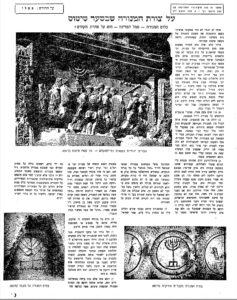
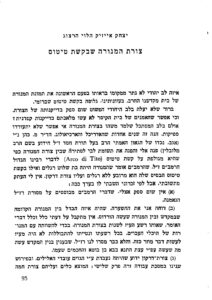
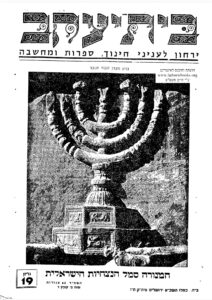
In December 1961, the Israeli edition of Beys Yaakov, the educational journal of the Agudath Israel–affiliated school system, published an article that sits uneasily with standard accounts of Agudath Israel’s twentieth-century intellectual posture.[1] Issue 6 of its second year reprinted in full a study on the archaeological and halakhic problems surrounding the base of the Temple menorah.[2] The identity of the author is therefore institutionally consequential. Rabbi Dr. Yitzhak Isaac Halevi Herzog served as the Ashkenazi Chief Rabbi of Israel at the head of a state-established rabbinate whose claim to centralized religious authority Agudath Israel did not recognize, locating binding rabbinic authority instead in its own Moetset Gedolei HaTorah.[3] The unabridged publication of his work in an Agudah-affiliated journal thus draws attention to the editorial criteria and intellectual assumptions operative within Beys Yaakov. This decision was not anomalous. From its founding in interwar Poland through its postwar continuation in Israel, Beys Yaakov repeatedly engaged materials, methods, and voices that lay beyond the formal boundaries of Agudath Israel’s institutional authority.[4] The journal maintained clear Orthodox commitments, but it did not construe those commitments as requiring insulation from external scholarship or the suppression of internal disagreement.

Examining Beys Yaakov between 1923 and 1980 permits a reconstruction of an Orthodox public discourse that does not conform to models centered on withdrawal or uniform ideological consolidation.[5] Across decades and editorial regimes, the journal published women’s reflective writing, printed criticism of decisions taken by Agudath Israel’s own rabbinic leadership, and, in later years, employed scholarly analysis to interrogate elements of the modern State of Israel’s symbolic repertoire.[6] These practices were not episodic but structural, pointing to a sustained editorial orientation in which intellectual engagement operated as a constitutive element of Orthodox self-definition rather than as a deviation from it. While recent scholarship has rightly emphasized Agudath Israel’s institutional boundary maintenance and political separatism, as well as the culturally mediating role of the Beys Yaakov movement, attention to the Beys Yaakov Journal redirects analysis from ideology and leadership to editorial practice as a central site of Orthodox intellectual life.[7]

Polish Origins: Sara Schenirer and the Educational Crisis

Before World War I, Orthodox Jewish girls in much of Eastern Europe received little formal Jewish schooling.[8] Although rabbinic attitudes toward women’s Torah study had varied across periods and locales, prevailing practice in Polish Orthodox communities restricted instruction largely to domestic settings and to the transmission of basic laws, customs, and religious dispositions.[9]At the same time, access to secular schooling expanded steadily and was widely taken up. Girls often acquired fluency in Polish language and culture while lacking the textual and conceptual resources necessary to interpret or articulate their own religious tradition. By the interwar period, this asymmetry contributed to significant patterns of religious disengagement among Orthodox young women. Sara Schenirer understood this constellation of pressures from personal experience.

Born in 1883 into a Hasidic family in Kraków, Schenirer was exposed to modern culture while remaining committed to religious life. She concluded that Orthodox women required systematic Jewish education not as enrichment but as a condition of religious continuity. In her view, inherited modes of informal instruction no longer sufficed in a social environment shaped by compulsory schooling, expanding public culture, and women’s economic participation. Early efforts to address the problem through youth circles and informal study groups proved inadequate. In 1917, Schenirer therefore turned to formal education, beginning with a small class for girls in her apartment. The initiative expanded rapidly. By 1923, the Agudath Israel movement formally adopted the schools, recognizing both the scale of the educational crisis and the effectiveness of Schenirer’s response. What began as a local experiment thus became an institutional project with transnational reach.[10]

Orthodox anxieties surrounding girls’ education crystallized around the erosion of communal control over women’s intellectual trajectories, particularly with respect to access to higher education. The emergence of Beys Yaakov must therefore be understood not only as an educational response to religious disengagement, but also as part of a broader effort to redirect female intellectual aspiration into institutionally supervised and religiously authorized forms.[11]

From the outset, the Beys Yaakov system was conceived not merely as a network of schools but as a cultural intervention. It aimed to reshape how Orthodox girls understood their position within Jewish life, public society, and the transmission of religious knowledge. This ambition required not only curricula and classrooms but also a medium capable of addressing students beyond the school setting and articulating a shared intellectual and moral framework. That medium soon took the form of a journal.

Friedenson and the Power of Print

Eliezer Gershon Friedenson understood that the success of the Beys Yaakov project depended not only on the establishment of schools but on the creation of a discursive environment capable of sustaining religious commitment amid rapid social change. From his first encounter with Sara Schenirer in 1923, Friedenson recognized that girls’ education required a medium that could operate beyond the classroom, address readers as reflective subjects, and articulate a shared intellectual vocabulary for Orthodox womanhood. The Beys Yaakov Journal, first published in June 1923, was conceived to meet precisely this need.[12] Recent scholarship has emphasized that the institutionalization of Beys Yaakov under Agudath Israel after 1923 marked a decisive transformation of the movement.[13] This period coincided with the professionalization and rapid expansion of the school network under the direction of Dr. Leo (Samuel) Deutschländer, whose training and pedagogical outlook drew on German Neo-Orthodox models that emphasized professional instruction, curricular coherence, and engagement with general culture. It also marked the movement’s absorption into Agudath Israel’s organizational framework, without full capitulation to its separatist educational norms.[14] Friedenson’s journal should be understood as part of this same process. It functioned as a centralizing instrument that helped standardize pedagogical assumptions, circulate ideological norms, and integrate disparate local initiatives into a coherent movement culture.[15]

Beys Yaakov, Issue 1, 1923

The Beys Yaakov journal’s masthead articulated its mission succinctly: an Orthodox periodical devoted to religious thought among Jewish women and girls and to the question of girls’ education in the spirit of Torah and tradition. Its choice of Yiddish situated the journal within established Orthodox linguistic practice while also enabling broad accessibility across regional and social boundaries.[16] At the same time, its format, regular publication schedule, and thematic range reflected contemporary print culture rather than traditional rabbinic genres. Schenirer herself repeatedly underscored the journal’s importance, urging that it circulate “in every corner in which a heart beats,” a formulation that framed readership not as passive consumption but as emotional and moral participation in a shared undertaking. Naomi Seidman has characterized Beys Yaakov as a “revolution in the name of tradition,” in which innovation was articulated as preservation rather than rupture.[17] The journal exemplified this logic. While anchored in Orthodox commitments, it systematically adopted literary and discursive forms – essays, poetry, autobiographical reflection, and historical narrative – that had little precedent in traditional frameworks of women’s religious instruction. These genres did not function merely as stylistic embellishments or pedagogical supplements; they reconfigured the educational encounter itself. By foregrounding narrative voice, affective experience, and historical self-placement, the journal addressed its readers as reflective subjects whose relationship to Jewish tradition was neither automatic nor self-evident, but required deliberate cultivation. In this way, Beys Yaakov treated Orthodox girls not simply as future wives and mothers charged with transmission, but as moral and intellectual agents whose commitment depended on sustained engagement, interpretation, and identification with the tradition they were being asked to inhabit.

From its earliest issues, the journal’s contents extended well beyond internal school news or institutional announcements, indicating that it was not conceived merely as an administrative organ of the school system. It published essays on Jewish women in history, profiles of literary and cultural figures, poetry, and original creative writing, genres that invited readers to situate themselves within broader historical and cultural narratives. Sara Schenirer’s own Torah commentaries appeared regularly and were incorporated into classroom instruction, further collapsing the distinction between pedagogical text and public religious discourse. In this way, the journal functioned simultaneously as a curricular supplement and an autonomous intellectual forum, shaping religious sensibility less through formal instruction or prescriptive norms than through sustained exposure, interpretive engagement, and processes of identification.

The journal’s use of literary, historical, and reflective genres was not an idiosyncratic editorial choice but emerged from the ideological landscape in which Beys Yaakov took shape. Interwar Orthodoxy in Poland was marked by unresolved tensions between Neo-Orthodox educational models, particularly Torah im derekh erets, and increasingly separatist ultra-Orthodox positions that emphasized cultural insulation. The Beys Yaakov movement developed at the intersection of these currents, selectively appropriating Neo-Orthodox pedagogical forms while operating under the institutional aegis of Agudath Israel.[18] Although the school system ultimately aligned with Agudath Israel’s organizational framework, the journal retained elements of this hybrid inheritance. Its openness to cultural reference, historical inquiry, and literary expression parallels developments in other Orthodox women’s initiatives, most notably the Lithuanian Bet Jakob, which likewise employed periodicals to cultivate modern Orthodox female subjectivity within a religious framework rather than to enforce ideological retrenchment.

Friedenson’s achievement lay not simply in founding a journal, but in identifying print culture as a form of religious infrastructure capable of sustaining Orthodox life under modern conditions. The Beys Yaakov Journal did not merely disseminate information about the movement; it produced a shared intellectual space in which Orthodox women encountered tradition as an object of study, interpretation, and appropriation rather than as an unexamined inheritance. By habituating readers to engagement through narrative, reflection, and cultural reference, the journal established patterns of reading and response that later enabled it, under different editors and in changing historical contexts, to address contested questions, incorporate external scholarship, and even publish internal critique without relinquishing institutional loyalty or doctrinal commitment.

Surveying the Inner Lives of Orthodox Girls

One of the most consequential features of the Beys Yaakov journal was its adoption of empirical and introspective methods to inform educational practice. In 1926, for example, the editors published an “urgent appeal” arguing that effective religious education required systematic knowledge of students’ personalities, aspirations, and emotional lives.[19] Rather than relying on teacher reports or ideological presuppositions, the journal solicited responses directly from its readership and published them verbatim, deferring editorial interpretation to subsequent issues.

First Survey, Beys Yaakov, 1926

The 1926 survey posed five questions:

  1. What does the child want to be when they grow up?
  2. Whom does the child love more, their father or their mother?
  3. Which subjects does the child most enjoy studying (for example, languages or history)?
  4. What does the child most enjoy reading?
  5. In which language does the child prefer to read?

These questions reflect a distinct set of pedagogical assumptions. They treated future orientation, emotional preference, and cultural consumption as legitimate objects of educational inquiry rather than as private or extraneous matters. The first question acknowledged that girls might imagine futures extending beyond domestic roles. The second redirected attention from normative family hierarchy to affective relationships. The remaining questions presupposed familiarity with secular subjects, varied reading practices, and multilingual environments, thereby situating Orthodox girls within the broader cultural landscape of interwar Poland rather than insulating them from it.

A second survey, published in 1931, expanded both the scope and the stakes of this inquiry.[20] It asked whether girls were satisfied with their education; what professions they hoped to pursue; whether they anticipated wage labor or exclusive domestic responsibility; how they related to nonreligious Jews, including within ideologically divided families; and whom they regarded as confidants, parents or peers. Additional questions addressed leisure practices and aesthetic interests, including music, art, and dance. Taken together, these questions treated social integration, emotional authority, and cultural participation as variables relevant to religious education.

Second Survey, Beys Yaakov, 1932

Respondents were permitted to answer under their own names or under pseudonyms. The journal printed their responses in full,[21] without prior selection or accompanying commentary. The range of answers was wide. Some affirmed conventional expectations, while others articulated positions that departed from them. One respondent endorsed women’s economic independence, arguing that “a woman must be concerned with her own destiny exactly as a man is.”[22] Others reported greater trust in peers than in parents, explaining that “parents today don’t understand their children.”[23] Several described attending concerts or cultivating artistic interests. The editor praised the responses as evidence of the respondents’ intelligence and noted that some articulated “brilliant ideas.” The editor explicitly rejected claims made in “a long letter” asserting that polls were meaningless and that social questions should not be discussed publicly. By contrast, the editor’s only regret was the limited number of responses received.[24]

First Responses, Beys Yaakov, Issue 81

Second Responses & Editor’s Note, Beys Yaakov, Issue 83

This procedure marked a significant departure from prevailing Orthodox educational discourse. Female students were addressed not as objects of instruction but as sources of knowledge about their own religious and social experience. Their voices were presented without mediation by teachers, administrators, or male authorities. The journal thus treated subjective experience as data relevant to institutional decision-making. Even in secular Yiddish educational and research circles, which acknowledged the importance of understanding Jewish youth, gender was rarely treated as an analytic category, and women’s experiences were largely subsumed under male norms.[25] While comparable survey-based approaches to women’s lives would later become common in mid-twentieth-century social research, Beys Yaakov employed them within an Orthodox framework decades earlier, integrating empirical attention to women’s inner lives into a religious educational project rather than positioning such inquiry in opposition to it.

Challenging Authority: The Palestine Certificate Controversy

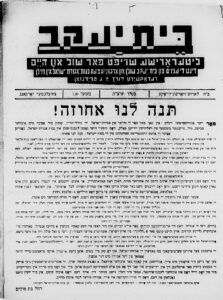
The journal’s willingness to engage contested questions extended beyond pedagogy to matters of institutional authority. This is evident in its response to the distribution of immigration certificates to Palestine in 1934. When Agudath Israel secured a limited allotment of certificates and allocated them exclusively to men, the Beys Yaakov journal devoted its front page to a critical response under the headline drawn from the biblical verse “Tenu La’anu Achuzah!” (“Grant Us Our Rightful Portion!”; Num. 27:4).[26]

“Give Us our Portion,” Beys Yaakov, 1934

The significance of this intervention lies not only in its substance but in its institutional setting. The Beys Yaakov schools operated under Agudath Israel’s auspices, and the movement’s leadership exercised formal control over the journal’s publisher. Publishing a front-page critique of a policy associated with the Gerrer Rebbe, one of the central rabbinic authorities within Agudath Israel, placed the journal in direct tension with the leadership structures on which it depended. This episode contrasts sharply with the centralized and crisis-driven leadership culture described by Yossef Fund in his study of Agudath Israel during the Holocaust years.[27]

The article, signed by Rochel Bas Tovim, likely a pseudonym,[28] did not frame its claims in the language of contemporary feminist movements, which it explicitly rejected as incompatible with Judaism. Instead, it grounded its argument in canonical sources, invoking the biblical daughters of Tzelofchad, who appealed for inheritance rights within the framework of Torah law. The author contended that women’s exclusion from the allocation of certificates represented not a preservation of tradition but a departure from it, insofar as it denied women claims recognized within the scriptural tradition itself. The critique thus operated on two levels. Substantively, it challenged a concrete policy decision with immediate consequences for women’s lives. Formally, it modeled a mode of argument in which institutional authority could be questioned through textual reasoning rather than ideological opposition. The article neither denied rabbinic authority nor asserted autonomous rights external to halakhic discourse. Its challenge was internal, drawing on shared sources and categories to dispute the manner in which authority had been exercised.

This episode illustrates the journal’s broader editorial posture. It did not treat institutional loyalty as incompatible with critique, nor did it equate obedience with silence. By providing space for a reasoned challenge to Agudath Israel’s own leadership, framed entirely within traditional discourse, the Beys Yaakov Journal demonstrated that boundary crossing could occur not only in relation to secular culture or academic knowledge but also within Orthodoxy’s own structures of authority.

Israeli Resurrection: Moshe Prager and Postwar Transformation

The destruction of the Polish Beys Yaakov system during the Holocaust brought the journal’s original trajectory to an end. Eliezer Gershon Friedenson was murdered, and the institutional network that had sustained the movement in Eastern Europe ceased to exist. When the Beys Yaakov journal reappeared in Israel after the war, it did so under markedly different conditions and new editorial leadership. The journal was revived by Moshe Prager, a journalist and historian whose work focused on Orthodox life during the Shoah and its aftermath.[29] Under Prager’s editorship, Beys Yaakov retained its formal affiliation with the movement while undergoing a redefinition of scope and audience. It no longer addressed girls and women exclusively. Men increasingly appeared among both contributors and intended readers, and the range of subjects expanded to include Holocaust memory, Orthodox historiography, and contemporary Israeli society. These shifts reflected both the altered demographic realities of postwar Orthodoxy and Prager’s own intellectual preoccupations.

At the same time, the journal’s engagement with sources and methods beyond Agudath Israel’s institutional boundaries became more explicit and systematic. Issues from this period regularly included discussions of secular scholarship, historical research, archaeology, and European culture. Such materials were not presented as authoritative in themselves but were framed through editorial commentary that situated them in relation to Orthodox commitments. The result was neither rejection nor uncritical adoption, but sustained engagement shaped by religious criteria. A review of surviving issues from Prager’s tenure indicates that this orientation was not confined to isolated contributions; rather, it structured the journal’s content across genres, including essays, book reviews, historical reflections, and responses to contemporary events. The editorial stance was consistent: readers were introduced to ideas and figures beyond the Agudah orbit, while the journal retained control over framing and evaluation.

Under Prager’s leadership, Beys Yaakov was thus transformed from a movement-centered educational periodical into a broader Orthodox intellectual forum, without severing its institutional ties or abandoning its religious orientation. Although the postwar journal differed markedly from its Polish predecessor in subject matter and audience, it continued to operate according to an editorial logic already present in the interwar period: engagement with the surrounding intellectual world as a component of Orthodox self-understanding rather than as a concession to external authority.

Art, Archaeology, and Cultural Engagement

The journal’s engagement with material beyond conventional religious genres extended to the domain of visual art, where aesthetic production was treated as a legitimate object of religious interpretation rather than as a neutral cultural sphere. In 1969, Beys Yaakov devoted an entire issue to Rembrandt on the three-hundredth anniversary of his death, placing one of his paintings on the cover and asserting the Jewish identity of the figure depicted.[30] The editor described Rembrandt as among the hasidei ummot ha-olam and argued that his work captured the tzurah ha-Yehudit (Jewish character).[31] This framing did not present Rembrandt as a canonical figure of European high culture to be admired at a distance, nor as an external influence to be resisted. Rather, the journal appropriated his work into a Jewish interpretive framework, reading it as part of a historical and religious conversation to which Orthodox readers could lay claim. In doing so, Beys Yaakov treated visual art not as a threat to religious integrity but as a site in which meaning could be evaluated, contested, and re-situated within Jewish historical consciousness.

Rembrandt Issue, Beys Yaakov, 117

Archaeology received similar treatment. In a public exchange with Yigael Yadin, Prager engaged archaeological scholarship directly, acknowledging findings that reinforced halakhic continuity while contesting Yadin’s symbolic and practical interpretation of Masada, particularly where it entailed the desacralization of the site and the normalization of Sabbath violation.[32] These responses neither rejected archaeological inquiry nor deferred to it as an independent authority. Instead, archaeological evidence was incorporated selectively and evaluated in relation to textual tradition and halakhic categories.

Such treatments assumed an audience capable of engaging visual and historical material critically rather than passively. Cultural artifacts and scholarly claims were presented as objects of analysis and judgment, not as threats requiring avoidance. In this respect, the journal extended to art and archaeology the same editorial logic evident elsewhere: engagement framed by religious criteria, with interpretive authority retained by the journal rather than ceded to external disciplines.

The Herzog Article in Context

Read against the journal’s established editorial practice, the 1961 publication of Chief Rabbi Dr. Yitzhak Isaac Halevi Herzog’s article on the Temple menorah appears not as an exception but as a coherent extension of its editorial logic.[33] Herzog’s training combined advanced rabbinic learning with formal academic methods, a mode of scholarship that Beys Yaakov had repeatedly presented to its readership as an object of analysis rather than emulation. The article was neither commissioned for the journal nor modified to conform to its institutional priorities. It was reproduced in full from an academic festschrift honoring Sally Mayer, an Italian Jewish communal leader, philanthropist, and Zionist activist rather than a rabbinic authority. The volume focused on Italian Jewish history and culture and brought together contributors from across denominational lines in recognition of civic and intellectual contribution rather than religious office.

R. Herzog, Menorah, Beys Yaakov, 19, 1960

The subject of Herzog’s study further clarifies its original placement. The menorah depicted on the Arch of Titus in Rome occupies a central position in the historical memory of Roman and Italian Jewry, standing at the intersection of archaeological evidence, rabbinic tradition, and the symbolic legacy of exile. Herzog addressed this object through close comparison of textual and material sources, treating their divergence as a problem for interpretation rather than as grounds for dismissal. Such an approach aligns with the commemorative orientation of the Mayer volume, which foregrounded Jewish cultural and historical life beyond rabbinic authority structures. By reprinting the article without alteration and preserving its original scholarly context, the Beys Yaakov Journal framed academic Jewish scholarship as a legitimate object of Orthodox engagement while retaining control over its evaluation.

R. Herzog Original Article

Title Page, Scritti in Memoria Di Sally Mayer

Prager’s editorial handling of the article maintained its scholarly form without incorporating it into the journal’s institutional voice. The text was reproduced in full, without excerpting or interpretive gloss, and its original scholarly setting was left intact rather than explicitly affirmed or disavowed. In this way, academic Jewish scholarship was presented as material available for Orthodox consideration, while the institutional and ideological frameworks in which it had been produced were neither adopted nor contested.

Herzog’s study addressed a problem long recognized in both rabbinic and scholarly literature: the divergence between classical rabbinic descriptions of the Temple menorah and its representation on the Arch of Titus. The Roman relief depicts the menorah resting on a solid, multi-sided base adorned with ornamental motifs, whereas rabbinic sources describe a three-legged stand and explicitly exclude foreign imagery. Herzog did not resolve this discrepancy by dismissing the archaeological evidence as polemical, nor by subordinating it automatically to textual tradition. Instead, he treated the divergence itself as the object of analysis, placing halakhic sources and material evidence into direct comparison in order to account for their coexistence while preserving the distinct authority of each. This approach neither insulated tradition from external evidence nor deferred to archaeological reconstruction as determinative.

The article’s presentation was shaped as much by editorial framing as by its scholarly argument. The cover reproduced the menorah from the Arch of Titus beneath the caption “The Menorah, a Symbol of Jewish Eternity,” and the editors appended a subtitle that posed a pointed question: “Is the menorah, the symbol of the state, sacred?” These visual and textual elements placed Herzog’s study within a contemporary Israeli symbolic register, directing readers to consider its implications for modern political and religious meaning rather than treating it solely as a technical or antiquarian inquiry.

Cover, Beys Yaakov, 19, 1960

By 1961, the State of Israel had adopted the Arch of Titus menorah as its official emblem, reappropriating a Roman triumphal image associated with destruction and exile as a marker of national sovereignty. As Steven Fine has shown, this choice reflected a form of civic symbolism that drew on ancient material culture to construct a shared national iconography while bracketing explicit theological commitments.[34] By foregrounding Herzog’s study under the subtitle “Is the menorah, the symbol of the state, sacred?”, the Beys Yaakov Journal explicitly juxtaposed this civic appropriation with rabbinic conceptions of the Temple menorah. What might otherwise have remained a discussion of archaeological form and halakhic sources was thereby reframed as an inquiry into the religious status of a state symbol. In doing so, the journal subjected Israel’s central emblem to halakhic and historical evaluation, engaging civil iconography as an object of scrutiny rather than affirmation and declining to concede interpretive authority over Jewish symbols to the secular state.[35]

The journal further marked institutional boundaries through its use of honorifics. Chief Rabbi Herzog, who died in 1959, was designated ז״ל (zikhrono livrakha), the conventional formula for the deceased, rather than זצ״ל (zekher tzaddik livrakha), which in Orthodox usage signals recognized rabbinic authority. This choice acknowledged Herzog’s scholarly standing while withholding the modes of recognition through which the journal conferred religious authority, thereby separating the act of reprinting his article from any affirmation of the Chief Rabbinate he represented.[36]

Considered together, the visual reproduction of the Arch of Titus menorah, the explicit questioning of state symbolism, and the calibrated use of honorific language make visible the journal’s editorial procedure. Beys Yaakov crossed cultural and institutional boundaries while retaining control over framing and evaluation. Attention to such devices is therefore necessary for understanding how the journal accommodated intellectual engagement without erasing its own institutional distinctions.


Conclusion

The history of the Beys Yaakov journal complicates historiographical models that describe twentieth-century Orthodoxy primarily in terms of withdrawal, boundary consolidation, or epistemic closure. Without minimizing Orthodox resistance to secularization or the expansion of separatist institutions, this study has identified a parallel mode of Orthodox self-articulation in which engagement with external knowledge, cultural forms, and even rival institutions functioned as a means of maintaining religious authority rather than undermining it. The journal did not treat engagement as a value in itself or as a concession to modernity, but as a regulated practice embedded within Orthodox commitments. Attention to editorial procedure, rather than ideological declaration alone, makes visible how Orthodoxy could preserve institutional coherence while remaining responsive to changing social and cultural conditions.

Across its Polish and Israeli phases, Beys Yaakov operated according to a consistent editorial logic that cut across differences of context, audience, and leadership. In interwar Poland, the journal treated the subjective experiences of Orthodox girls as legitimate sources of knowledge, employing surveys and verbatim publication to inform educational practice and to recalibrate assumptions about women’s religious lives. It provided space for critique of Agudath Israel’s own leadership while grounding dissent in canonical texts and shared interpretive categories. In postwar Israel, the journal incorporated academic scholarship, archaeology, European art, and historiography into its pages, neither excluding these domains nor conceding interpretive authority to them. The unabridged publication of Herzog’s study of the Temple menorah – framed through visual cues, honorific distinctions, and explicit questioning of state symbolism – represents the most explicit articulation of this approach: engagement that expanded the scope of inquiry while retaining Orthodox criteria of judgment.

These practices do not support an interpretation of Beys Yaakov as a covertly liberal or proto-modernizing institution. The journal consistently reaffirmed halakhic authority, institutional loyalty, and skepticism toward secular ideologies and state claims to religious legitimacy. Its significance lies instead in the forms of engagement it authorized: empirical attention to women’s lives, critique conducted within Orthodox institutional structures, and sustained interaction with scholarly and cultural materials under religious supervision. In this respect, the journal’s trajectory parallels patterns identified by Ada Gebel in her study of Agudath-affiliated workers’ institutions, even as it complicates the political narrative of Orthodox separatism emphasized by Daniel Mahla. More broadly, the case of Beys Yaakov underscores the importance of women’s education as a site of Orthodox intellectual experimentation. Positioned outside the structures of male rabbinic authority yet committed to religious continuity, the movement developed pedagogical and editorial practices unavailable within yeshiva contexts. Taken together, these findings call for a more differentiated account of Orthodox intellectual history – one attentive to genre, audience, and institutional location, and resistant to reducing diverse Orthodox responses to modernity to a single trajectory. Rather than asking whether Orthodoxy engaged modernity, the evidence points to a more precise question: under what institutional conditions, and through which mediating forms, was engagement understood as a means of sustaining tradition?

* I would like to thank Menachem Butler for his editorial assistance and plethora of sources.

  1. See, inter alia, Daniel Mahla, Orthodox Judaism and the Politics of Religion: From Prewar Europe to the State of Israel (Cambridge: Cambridge University Press, 2020), esp. chapters 1-3; and Yossef Fund, A Movement in Ruins: Agudat Israel’s Leadership Confronting the Holocaust (Jerusalem: Magnes Press, 2008; Hebrew). For a contrasting emphasis on cultural mediation within the Beys Yaakov movement, see Naomi Seidman, Sarah Schenirer and the Bais Yaakov Movement: A Revolution in the Name of Tradition (London: Littman Library, 2019).
    For prior analyses of the Journal, see Joanna Lisek, “Orthodox Yiddishism in Beys Yakov Magazine in the Context of Religious Jewish Feminism in Poland,” in Andrzej Katny, Izabela Olszewska, Aleksandra Twardowska, eds., Ashkenazim and Sephardim: A European Perspective (Frankfurt am Main: Peter Lang, 2013), 127-154; Abraham Atkin, “The Beth Jacob Movement in Poland (1917-1939),” (PhD Dissertation, Yeshiva University, 1959), esp. 99-111; Seidman, Sarah Schenirer, passim.
    Nearly all extant issues of the Beys Yaakov Journal are accessible in digital reproduction. Issues published in interwar Poland are available through The Beys Yaakov Project at the University of Toronto, while postwar Israeli issues are available via Hebrewbooks.org. The availability of these materials in searchable digital format has enabled systematic analysis across decades of publication, including comparison of editorial practices, thematic emphases, and modes of engagement under differing institutional and historical conditions. On behalf of the readers of the Seforim blog, the author gratefully acknowledges the individuals and institutions whose efforts made these digital resources possible.
  2. Yitzhak Isaac Halevi Herzog, “On the Form of the Menorah on the Arch of Titus: Is the Menorah, the Symbol of the State, Sacred?” Beys Yaakov, vol. 2, no. 6 (December 1961): 3 (Hebrew), reprinted from Yitzhak Isaac Halevi Herzog, “The Menorah of the Arch of Titus,” in Umberto Nahon, ed., Scritti in memoria di Sally Mayer (Jerusalem: Sally Mayer Foundation, 1956), 95-98 (Hebrew).
  3. On Herzog’s conception of the Chief Rabbinate as a centralized locus of religious and legal authority, and on the principled rejection of this claim by non-Zionist Orthodoxy, see Alexander Kaye, “Modernizing the Chief Rabbinate,” in The Invention of Jewish Theocracy: The Struggle for Legal Authority in Modern Israel (Oxford: Oxford University Press, 2020), 99-121, 205-211, who shows that Agudath Israel consistently refused to recognize the Chief Rabbinate – both in Mandatory Palestine and after 1948 – as a legitimate arbiter of binding rabbinic authority, maintaining instead that such authority resided in independent rabbinic councils, above all its own Moetset Gedolei HaTorah. For the broader political and institutional consequences of this stance within early Israeli Orthodoxy, see also Daniel Mahla, “Emerging Israeli Milieus,” in Orthodox Judaism and the Politics of Religion: From Prewar Europe to the State of Israel (Cambridge: Cambridge University Press, 2020), 159-185, 252-259.
  4. For the interwar journal’s scope and editorial practices, see Seidman, Sarah Schenirer, esp. chap. 5.
  5. For historiographical models emphasizing Orthodox withdrawal, ideological consolidation, and boundary hardening in the modern period, see Jacob Katz, Tradition and Crisis: Jewish Society at the End of the Middle Ages, trans. Bernard Dov Cooperman (New York: NYU Press, 1993); Aviezer Ravitzky, Messianism, Zionism, and Jewish Religious Radicalism, trans. Michael Swirsky and Jonathan Chipman (Chicago: University of Chicago Press, 1996), esp. chaps. 1-2; and Daniel Mahla, Orthodox Judaism and the Politics of Religion: From Prewar Europe to the State of Israel (Cambridge: Cambridge University Press, 2020).
  6. On women’s reflective writing and surveys, see below, “Surveying the Inner Lives of Orthodox Girls”; on critique of Agudath Israel’s leadership, see below, “Challenging Authority: The Palestine Certificate Controversy”; on engagement with state symbolism and scholarship, see below, “The Herzog Article in Context.”
  7. On Agudath Israel’s political separatism and institutional boundary maintenance, see Mahla, Orthodox Judaism and the Politics of Religion. On the Beys Yaakov movement as a site of cultural mediation within Orthodoxy, see Seidman, Sarah Schenirer. For contrasting evidence of flexibility within Agudath-affiliated institutions, see Ada Gebel, The Agudat Yisrael Workers Movement in Eretz Israel, 1933-1939 (Jerusalem: Yad Izhak Ben-Zvi, 2017; Hebrew).
  8. Shaul Stampfer emphasizes the distinction between formal schooling and overall levels of education, cautioning against equating the relative absence of institutional frameworks for girls with intellectual illiteracy or lack of religious knowledge. See Shaul Stampfer, “Gender Differentiation and the Education of Jewish Women,” in Families, Rabbis and Education: Traditional Jewish Society in Nineteenth-Century Eastern Europe (Oxford: Littman Library, 2014), 167-190. On the persistence of the stereotype of female educational deprivation and its historiographical consequences, see also Iris Parush, Reading Jewish Women: Marginality and Modernization in Nineteenth-Century Eastern European Jewish Society (Waltham, MA: Brandeis University Press, 2004).
  9. On the history of the controversy over girls’ education, see Rachel Manekin, “Something Totally New: The Development of the Idea of Religious Education for Girls in the Modern Period,” Massekhet, vol. 2 (2004): 63-85 (Hebrew), available here; Rachel Manekin, “Torah Education for Girls in the Interwar Bais Yaakov School System: A Re-Examination,” Zion, vol. 88, no. 2 (2023): 219-262 (Hebrew), available here; and see also Rachel Manekin and Charles (Bezalel) Manekin, “The Hafetz Hayyim’s Statement on Teaching Torah to Girls in Likutei Halakhot: Literary and Historical Context,” The Seforim Blog (27 May 2020), available here.
  10. For a recent biography, see Naomi Seidman, Sarah Schenirer and the Bais Yaakov Movement: A Revolution in the Name of Tradition (London: Littman Library, 2019).
  11. Rachel Manekin, “From Anna Kluger to Sarah Schenirer: Women’s Education in Kraków and Its Discontents,” Jewish History, vol. 33, no. 1-2 (March 2020): 29-59, available here; and see also Rachel Manekin, “The Cracow Bais Yaakov Teachers’ Seminary and Sarah Schenirer: A View from a Seminarian’s Diary,” Jewish Quarterly Review, vol. 112, no. 3 (Summer 2022): 546-588, available here.
  12. Friedenson self-published a single preliminary issue in June 1923, which included contributions by Sara Schenirer and Yehudah Leib Orlean; see Abraham Atkin, “The Beth Jacob Movement in Poland (1917-1939),” (PhD Dissertation, Yeshiva University, 1959), 100; Joanna Lisek, “Orthodox Yiddishism in Beys Yakov Magazine in the Context of Religious Jewish Feminism in Poland,” 133. The journal’s official publication, however, began with the issue of Tishrei 5684 (September 1923); see Seidman, Sarah Schenirer, 111.
  13. See Seidman, Sarah Schenirer, 111-112; Mahla, Orthodox Judaism and the Politics of Religion.
  14. On the post-1923 institutional consolidation of Beys Yaakov under Agudath Israel, the central role of professional educators such as Leo (Samuel) Deutschländer, and the movement’s mediation between German Neo-Orthodox pedagogical models and the separatist educational norms of East European ultra-Orthodoxy, see Iris Brown (Hoizman), “At the Centre of Two Revolutions: Beit Ya’akov in Poland between Neo-Orthodoxy and Ultra-Orthodoxy,” in François Guesnet, et al., eds., Jewish Religious Life in Poland since 1750 [=Polin, vol. 33] (London: Littman Library, 2021), 339-369, available here.
  15. See Seidman, Sarah Schenirer, 112-204.
  16. See Joanna Lisek, “Orthodox Yiddishism in Beys Yakov Magazine in the Context of Religious Jewish Feminism in Poland,” 147-152; and Naomi Seidman, Sarah Schenirer, 181-185. From issue 3 through 1929, the journal included a Polish-language supplement titled Wschód, which was later discontinued. On the factors contributing to the supplement’s demise, see Lisek, “Orthodox Yiddishism,” 133-134. A single additional Polish-language supplement appeared in 1936, devoted to combating rising antisemitism and addressing prevailing anti-Jewish stereotypes; see ibid., 134.
  17. For an extended analysis of the use of modern print culture, literary genres, and affective address in the formation of Orthodox female subjectivity within the Beys Yaakov movement, see Naomi Seidman, Sarah Schenirer and the Bais Yaakov Movement: A Revolution in the Name of Tradition (London: Littman Library, 2019). Seidman analyzes journals, letters, autobiographical writing, and didactic essays as media that positioned girls and women as interpretive and ethical agents, capable of reflection, identification, and disciplined self-understanding. A central element of her argument is that Beys Yaakov articulated pedagogical and institutional change through idioms of continuity, presenting new educational forms and media practices as legitimate extensions of inherited religious norms rather than as departures from them. This analytic framework is essential for understanding how the movement integrated print, emotional discourse, and modes of self-articulation into an Orthodox educational setting.
  18. On the educational and ideological legacies of Torah im derekh erets within Polish Orthodox women’s education, and the selective adaptation of Neo-Orthodox pedagogical forms within Agudath Israel-affiliated institutions, see Iris Brown (Hoizman), “At the Centre of Two Revolutions: Beit Ya’akov in Poland between Neo-Orthodoxy and Ultra-Orthodoxy,” in François Guesnet, et al., eds., Jewish Religious Life in Poland since 1750 [=Polin, vol. 33] (London: Littman Library, 2021), 339-369, available here. On the role of journals and print culture in shaping Orthodox female identity, aspirations, and religious agency within Lithuanian Bet Jakob, see Tzipora Weinberg, “Toward a Modern Conception of Orthodox Womanhood: The Case of Lithuanian Bet Jakob,” in Marcin Wodziński, Shaul Stampfer, and Lara Lempertienė, eds., Jewish Religious Life in Lithuania in the 18th-20th Centuries (Leiden: Brill, 2025), 146-174.
  19. Beys Yaakov, no. 3 (June 1926): 84-85 (Yiddish), available here. Seideman incorrectly references this issue as appearing in 1924. Seidman, Sarah Schenirer, 122 and “Bibliography,” 409.
  20. Beys Yaakov, no. 77 (October 1931): 1 (Yiddish), available here. Despite the 1926 survey, Journal refers to the 1931 as the first. Seidman, Sarah Schenirer, 122.
  21. Beys Yaakov, no. 81 (January 1932): 16-17 (Yiddish), available here; and Beys Yaakov, no. 83 (March 1932): 13 (Yiddish), available here.
  22. Beys Yaakov, no. 83 (March 1932): 13 (Yiddish), available here.
  23. Beys Yaakov, no. 81 (January 1932): 17 (Yiddish), available here.
  24. Beys Yaakov, no. 83 (March 1932): 13 (Yiddish), available here.
  25. See Gershon Bacon, “Woman? Youth? Jew? – The Search for Identity of Jewish Young Women in Interwar Poland,” in Judith Tydor Baumel and Tova Cohen, eds., Gender, Place and Memory in the Modern Jewish Experience (London: Vallentine Mitchell, 2003), 3-28, esp. 4, available here; Gershon Bacon, “The Missing 52 Percent: Research on Jewish Women in Interwar Poland and Its Implications for Holocaust Studies,” in Dalia Ofer and Lenore J. Weitzman, eds., Women in the Holocaust (New Haven: Yale University Press, 1999), 55-67, available here. As Bacon demonstrates, even pioneering secular Yiddish research initiatives, including the YIVO youth autobiography collections and Max Weinreich’s sociological studies, recognized the importance of understanding Jewish youth while largely treating male experience as normative and leaving women’s voices analytically unthematized. Women appear in these corpora primarily as raw material rather than as a category of inquiry in their own right. Against this backdrop, the Beys Yaakov journal’s solicitation and verbatim publication of girls’ self-reports represents an unusual case in which women’s subjective experience was not merely documented but operationalized within an institutional educational framework.
  26. Beys Yaakov, no. 120 (November 1934): 1 (Yiddish), available here. See Seidman, Sarah Schenirer, 177-179.
  27. Yossef Fund, A Movement in Ruins: Agudat Israel’s Leadership Confronting the Holocaust (Jerusalem: Magnes Press, 2008; Hebrew).
  28. See Seidman, Sarah Schenirer, 178n90.
  29. Moshe Prager was a leading Orthodox journalist and historian whose work focused on the destruction of European Orthodoxy during the Shoah and the religious meaning of catastrophe in its aftermath. His writing combined documentary impulse with commemorative and theological reflection. For a collection of essays and memorial writings on the destruction of Polish Jewry and the spiritual legacy of Hasidic and yeshiva worlds, see Moshe Prager, Min ha-Meitzar Karati (Jerusalem: Mosad ha-Rav Kook, 1959; Hebrew), especially the introductory essays on Orthodox Holocaust memory; and for a selection in English translation in Moshe Prager, Sparks of Glory (Jerusalem, 1974), 210-213; and for his role on the Orthodox press in interwar Poland, see Moshe Prager, “When Hasidism of Ger Became Newsmen,” in Lucy S. Dawidowicz, ed., The Golden Tradition: Jewish Life and Thought in Eastern Europe (New York: Holt, Rinehart and Winston, 1967), 210-213, and for an account of Prager’s journalistic career and editorial leadership, see Tovia Preschel, “Profile of Moshe Prager,” The Jewish Press (21 April 1972): 41, translated and reprinted in Tovia Preschel, Ma’amarei Tovia, vol. 8 (Jerusalem: Mosad ha-Rav Kook, 2025), 528-530.
  30. Beys Yaakov, no. 117 (January 1969; Hebrew), available here.
  31. “Editor’s Note,” Beys Yaakov, no. 117 (January 1969): 2 (Hebrew). One article in the same issue concludes with a poem explicitly praising Rembrandt for capturing the depth and inwardness of the Jewish gaze (ibid., 17). This mode of Jewish cultural appropriation of Rembrandt belongs to a longer interpretive genealogy, ranging from nineteenth-century apologetic readings to late-twentieth- and twenty-first-century art-historical and museological reassessments. For recent synthetic treatments, see Mirjam Knotter and Gary Schwartz, eds., Rembrandt Seen Through Jewish Eyes: The Artist’s Meaning to Jews from His Time to Ours (Amsterdam: Amsterdam University Press, 2024); and the earlier demythologizing intervention in Mirjam Alexander-Knotter, Jasper Hillegers, and Edward van Voolen, The Jewish Rembrandt: The Myth Unravelled (Amsterdam: Jewish Historical Museum, 2006).An illuminating intermediate case appears in the work of the sculptor and novelist Avram Melnikoff (1892-1960), a former Jewish Legion officer and later a London-based portrait sculptor, whose writings offer a rare glimpse into an early Zionist-spiritual reception of Rembrandt. In a 1935 essay published in The London Jewish Chronicle following the death of Rabbi Abraham Isaac Kook, Melnikoff recounts a conversation that took place during Rav Kook’s wartime exile in London during World War I. The exchange was prompted by Melnikoff’s professional unease with the biblical prohibition against “graven images,” which he understood as having profoundly shaped the historical limits and possibilities of Jewish art. Melnikoff thus approached Rav Kook with a halakhic query as to whether rabbinic tradition permitted, under any conditions, the practice of sculpture by Jews. Rav Kook replied by citing a rabbinic principle according to which image-making is permitted when the work is deliberately imperfect or maimed. Melnikoff responded with irony, remarking that his own sculpture must therefore be kosher precisely because it fell so far short of perfection, a comment that, he recalls, elicited Rav Kook’s warm laughter. It is at this point that Melnikoff introduces Rembrandt. Rav Kook told him:

    “When I lived in London I used to visit the National Gallery, and my favourite pictures were those of Rembrandt. I really think that Rembrandt was a tzaddik. Do you know that when I first saw Rembrandt’s works, they reminded me of the legend about the creation of light? We are told that when God created light, it was so strong and pellucid that one could see from one end of the world to the other, but God was afraid that the wicked might abuse it. What did He do? He reserved that light for the righteous when the Messiah should come. But now and then there are great men who are blessed and privileged to see it. I think that Rembrandt was one of them, and the light in his pictures is the very light that was originally created by God Almighty.”

    This intuitive and homiletic reading of Rav Kook’s attitude toward art was subsequently taken up and given systematic halakhic and philosophical form by Rabbi David Avraham Spektor (1955-2013), a Dutch-born rabbi educated at Yeshivat Merkaz Harav and among the first religious-Zionist thinkers to treat art as a sustained field of halakhic inquiry. In Art in the Teachings of Rav Kook (Jerusalem: Ministry of Education, Culture and Sport, Religious Education Administration, 2001; Hebrew), Spektor reconstructs Rav Kook’s scattered remarks on art, aesthetics, creativity, and imagination across responsa, letters, notebooks, and published essays, arguing that Rav Kook understood artistic creation as a legitimate and even necessary expression of the divine image in humanity, so long as it remained oriented toward spiritual elevation rather than aesthetic autonomy for its own sake. He further shows that Rav Kook did not regard art merely as a tolerated concession to modernity, but as a domain through which latent spiritual forces within the nation could be revealed and disciplined. This interpretive framework was later translated into practical halakhic categories in Rabbi David Avraham Spektor, Shuʾt Omanut: Responsa and Abridged Halakhic Rulings in the Fields of Art, Graphic Design, and Computers (Jerusalem: Erez, 2003; Hebrew), which addresses concrete questions concerning sculpture, figurative representation, theater, visual media, and digital technologies. Taken together, Rabbi Spektor’s works mark a decisive shift from Rav Kook’s lyrical and metaphysical idiom to a jurisprudential effort to normalize artistic production within halakhic discourse. For further discussion, see Dan Rabinowitz and Menachem Butler, “The Halakhic Status of Illustrated Sifrei Kodesh: History, Practice, and Methodology,” forthcoming at The Seforim Blog.

  32. See Moshe Prager, “What Is Masada: An Archaeological Site or a Symbol for the Jewish Tradition?” Beys Yaakov, no. 135-136 (February 1971): 7-10 (Hebrew), available here, a published open letter addressed to Prof. Yigael Yadin responding to his archaeological and public policies regarding Masada, including the operation of the cable car on Shabbat. Prager accepts the evidentiary value of Yadin’s archaeological discoveries – especially where they corroborate halakhic continuity – while rejecting the transformation of Masada into a desacralized national monument detached from religious norms. See also Haim Zalman Dimitrovsky, “Masada,” Conservative Judaism, vol. 22, no. 2 (Winter 1968): 36-47, available here; and Nachman Ben Yehuda, The Masada Myth: Collective Memory and Mythmaking in Israel (Madison: University of Wisconsin Press, 1995).
  33. Yitzhak Isaac Halevi Herzog, “On the Form of the Menorah on the Arch of Titus: Is the Menorah, the Symbol of the State, Sacred?” Beys Yaakov, vol. 2, no. 6 (December 1961): 3 (Hebrew), reprinted from Yitzhak Isaac Halevi Herzog, “The Menorah of the Arch of Titus,” in Umberto Nahon, ed., Scritti in memoria di Sally Mayer (Jerusalem: Sally Mayer Foundation, 1956), 95-98 (Hebrew).
  34. On the emergence of the menorah as a central Zionist visual symbol, see Alec Mishory, Lo and Behold: Zionist Icons and Visual Symbols in Israeli Culture (Tel Aviv: Am Oved, 2000), 138-164 (Hebrew); and on the deliberations surrounding the adoption of the Arch of Titus menorah for the state emblem, see Alec Mishory, “The Menorah and the Olive Branches: The Design Process of the National Emblem of the State of Israel,” in Yael Israeli, ed., In the Light of the Menorah: Story of a Symbol (Jerusalem: The Israel Museum, 1999), 16-23; and, more recently, for a longue-durée analysis of the menorah’s transformation from Temple object to Roman trophy to modern Israeli national symbol, see Steven Fine, The Menorah: From the Bible to Modern Israel (Cambridge, MA: Harvard University Press, 2016).
  35. On the adoption of the Arch of Titus menorah as the emblem of the State of Israel and its role in the construction of Israeli civil iconography, see Steven Fine, “Creating a National Symbol,” in The Menorah: From the Bible to Modern Israel (Cambridge, MA: Harvard University Press, 2016), 134-162, 242, who situates the choice of the Arch menorah within a broader process of state formation, in which ancient material culture was redeployed to produce a shared civic symbol that could command wide consensus while bracketing explicit theological claims. He also documents contemporary aesthetic, cultural, and rabbinic objections to the emblem, including Herzog’s sustained critique of the menorah’s base and iconography, and analyzes the menorah’s function as a state symbol that invokes Jewish tradition while re-signifying it in secular-national terms.
  36. On the Chief Rabbinate as a contested locus of religious authority, and on Agudath Israel’s principled refusal to recognize its claims to centralized rabbinic legitimacy, see Alexander Kaye, “Modernizing the Chief Rabbinate,” in The Invention of Jewish Theocracy: The Struggle for Legal Authority in Modern Israel (Oxford: Oxford University Press, 2020), 99-121, 205-211. As Kaye shows, Agudath Israel consistently treated the Chief Rabbinate not merely as a rival institution but as an illegitimate reconfiguration of rabbinic authority grounded in state power rather than communal consent or halakhic hierarchy. The journal’s calibrated use of honorifics should be read against this background, as a micro-level editorial practice that registers non-recognition of the Rabbinate’s authority without polemical confrontation


A Conversation with Professor Benjamin Brown on the Publication of ‘Hasidic Leadership in Israel: Past and Present, Spirit and Matter’

A Conversation with Professor Benjamin Brown on the Publication of ‘Hasidic Leadership in Israel: Past and Present, Spirit and Matter’

This article presents an English translation of an insightful interview with Professor Benjamin Brown, conducted by Moshe Shochat for his blog, Sefarim ve-Kitvei Yad. Published online on July 26, 2025, and available here), the interview marks the occasion of Professor Brown’s newly published book, Hasidic Leadership in Israel: Past and Present, Spirit and Matter (Jerusalem: The Israel Democracy Institute and Magnes Press, 2025; Hebrew). This translation appears at the Seforim Blog with the kind permission of both Moshe Shochat and Professor Benjamin Brown.

Professor Benjamin Brown is a full professor in the Department of Jewish Thought at the Hebrew University of Jerusalem. His scholarly output is astonishing, and he stands out particularly for his extensive research on Haredi society and the Hasidic movement. I would not exaggerate to say that he is currently the foremost scholar of Haredi society, just as Professor Menachem Friedman (1936-2020) was in his time. His new book – Hasidic Leadership in Israel: Past and Present, Spirit and Matter – is an exceptionally impressive study of the social and leadership structure of the Hasidic movement. In his book, he examines the Doctrine of the Tzaddik as it was formulated at the inception of the Hasidic movement in the generation of the Baal Shem Tov’s disciples, the transformations this doctrine underwent in subsequent generations, and especially during the movement’s rehabilitation in the Land of Israel from the time of World War II to the present day. I read the book carefully and enjoyed it immensely, but I was left with some open questions. Given my friendship with the author, I chose this time to deviate from the usual review format and sit down for an open conversation with the book’s creator. To my delight, Professor Brown accepted my proposal and dedicated his valuable time to my questions about the book.

Moshe Shochat: Professor Brown, hello. First, I’d like to extend my heartfelt congratulations on the publication of your remarkable new book. Would you like to introduce the book in a few words?

Professor Brown: Hello Moshe. Thank you for the congratulations! The book is called Hasidic Leadership in Israel, and it is precisely that. It deals with the status and perception of the Admorim (Rebbes) in late Hasidism, meaning Hasidism as it exists up to our present day. The book concludes with the COVID-19 crisis. This point does not symbolize an “end of an era,” but rather the time when the book was finalized and went to print. In the book, I seek to examine a changing and evolving perception of the “Tzaddik” and the Admorut (Rebbisteve, Rebbeship) in its very process of formation, or at least within its very recent history of formation. We are accustomed to tracing the doctrine of the Tzaddik from the inception of Hasidism or in the nineteenth and early twentieth centuries. Indeed, there were interesting developments during these periods, and the book surveys at least some of them. But it becomes clear that even here in Israel, the perception of the Tzaddik continues to develop before our eyes in various forms and directions. To examine these developments, one must first and foremost follow the texts of the movement, as to a large extent we are dealing with a doctrine that Hasidism has always championed and given textual expression to throughout the generations. But in addition, one must follow the realization of the idea on the ground, following events that come and complement additional and more vivid angles of the conceptual perception. Therefore, at least the last part of the book contains a lot of politics and many events in Israeli public life and within the Hasidic communities themselves, which, although not conceptual, enrich the insights regarding the Admorim’s and Hasidim’s understanding of the essence of the Tzaddik’s role and the nature of the activity and content included in that role. In this direction, the book contributes its part to the long discussion on the development of the Tzaddik’s doctrine within the Hasidic movement throughout its generations.

Moshe Shochat: So, are all the dramas, conflicts, intrigues, and politics described in the book directly related to the question of the Tzaddik’s status? It seems that every issue in Hasidic society could be connected to the Tzaddik at its apex. What were the boundaries that guided you in choosing your topics?

Professor Brown: The first part of the book deals directly with the doctrine of the Tzaddik. Regarding the later parts of the book, which discuss the State of Israel in recent generations, I felt that all the topics were interconnected, and it was impossible to cut the story short. Therefore, I narrated the story in its full progression, hoping I ultimately succeeded in tying all the threads together. To this end, I included both summary paragraphs in each chapter and a general concluding chapter at the end of the book, aiming to demonstrate the internal connection among all these sections.

Ultimately, all the internal politics within Hasidic communities, the external politics between different Hasidic groups, and even the politics between Hasidic groups and state institutions, are all connected to the very essence of Hasidism. Therefore, when a Hasid ultimately looks at his Rebbe with reverence, today they view him differently than they did fifty years ago, and certainly before the Holocaust. Today, a Hasid reveres their Rebbe not just as a spiritual personality, a dispenser of abundance, a miracle worker, an educator, or one possessing divine inspiration, but also as a competent manager and a strong leader. Part of this strength is his ability to operate at a level that, in any other context, we would term political. The intention isn’t that all Admorim have become politicians or that their traditional roles have been marginalized. These roles are certainly present, but in a certain sense, politics has also become part of their spiritual function. In the Hasid’s consciousness, the figure of the “Tzaddik” has become imbued with a significantly higher proportion of political activity.

From these three levels – the internal, the external Hasidic or Haredi, and the external towards general society and national politics – everything ultimately converges to what I summarized in the final pages: what is perceived in the Hasid’s consciousness, and even in the consciousness of the Admorim themselves, when they contemplate Tzaddikism (or, in Hasidic parlance: Rebbisteve).

This aligns with the method of “indeliberate theology” that I’ve believed in for many years. This refers to a theological understanding that isn’t necessarily explicitly formulated as theology. I wouldn’t be overly presumptuous to extract theology from things that are not textual at all, such as the behavior of Admorim, concrete instructions, or things that don’t reflect profound conceptual depth. However, when I take the texts and construct new concepts from them, and concurrently substantiate this with descriptions of concrete actions, it helps us understand how, even without formulating the Tzaddik’s doctrine in new theological terms, a kind of new theology emerges before us. This is true even when its adherents don’t perceive it as new, and instead emphasize continuity over change.

I will later address “indeliberate theology” and the political connection, but first, I wish to conclude the discussion on the book’s boundaries. I chatted with a friend about your book and jokingly told him that in certain parts of the book, I felt like I was scrolling through the Twitter feed of Moshe Weisberg (a tweeter who extensively covers the courts of Rabbis and Admorim, often in a manner that appears grotesque and embarrassing). It seems to me that this feeling arose because, unlike your other books, the focus here is not on doctrines or the sociology of some obscure European history, but on the near present and the most beleaguered politics of Admorim’s courts that almost no one has heard of. What was the experience like to write “history” about last week’s gossip, and were there any fresh anecdotes you omitted because you felt they were “too much”?

I’ll start from the end. Well, the book certainly delves into small, even petty details, in a comprehensive and highly detailed manner. Since I present these matters as an illustration of the Tzaddik’s doctrine, I also require events that enrich the texts. The use of the word “gossip” is interesting. Perhaps I’ll share something in this context: The first conference where I participated as a lecturer was the Orthodoxy Research Conference at Givat Ram. By its nature, Orthodoxy research convenes scholars from various disciplines, and both historians and scholars of Jewish thought were present. In one of the open discussions, an interesting debate arose, where historians primarily stood against Jewish thought scholars. In summarizing the event, Professor Avi Ravitzky, one of the conference organizers, concluded that historians accuse Jewish thought scholars of dealing with “things in the air,” while Jewish thought scholars accuse historians of dealing with “gossip.” Indeed, we may sometimes feel that historical engagement is gossipy, but the engagement with that gossip has a purpose. Hasidism is not a philosophical system that one formulates at a writing desk or through abstract theoretical thought. In fact, no profound thought is like that, but certainly not thought that does not claim to be systematic, such as that of Hasidism. To forgo the “earthly” material is essentially to turn the discussion into a detached context, “things in the air.” On the other hand, I did not settle for gossip, and I endeavored to complete the picture with the help of texts that seek to formulate the concepts more consciously. It is possible that the balance was sometimes disturbed, but for my part, I aspired to achieve such a balance. The seemingly “low” engagement with “amnion and placenta” is akin to “cooks and confiture-makers for Torah,” meaning for the doctrine that I ultimately wish to reach and understand.

Fortunately, in dealing with the recent history of Haredi Judaism, there is an immense abundance of journalistic material that delves into minute details. This contrasts with the distant past, from which there is little journalism, especially non-Hasidic, and even when there is Hasidic journalism, it deals with specific and narrow aspects of the Admorim’s functions. In contrast, we have quite a bit of internal Hasidic literature, which deals with both stories and teachings. As a researcher, you utilize what is available to you, not what is not. Hasidic scholars of previous centuries would have been delighted to receive such an abundance of journalistic materials and field testimonies, but from those periods, such materials are scarce. Today the situation is different, and in my opinion, it should be leveraged effectively. Therefore, the first part of the book differs from the second, which deals with contemporary Hasidism.

Moshe Shochat: You mentioned at the beginning of the book a debate between Martin Buber and Gershom Scholem. Buber argued that the fundamental sources for understanding the Hasidic movement are the stories, whereas Scholem contended that the most fundamental source is the Admorim’s (Rebbes’) teachings. In the case of the Tzaddik doctrine, do you state that everyone would agree the stories are primary?

Professor Brown: Certainly, there’s no basis to suggest that the Tzaddik’s doctrine hasn’t been discussed in Hasidic literature. It’s been a continuous topic. His spiritual role includes elevating and bringing down from the supernal worlds, bestowing abundance and blessing, education, study, ruach hakodesh, miracles, and more. All these aspects are exhaustively discussed in Hasidic philosophical literature as well. What wasn’t discussed, and this needs qualification by saying it wasn’t extensively discussed until roughly the mid-19th-century, is the “political theology” of the Tzaddik doctrine. That is, the political dimensions of the Tzaddik as a communal leader, an individual with authority, one entrusted with communal public affairs, beyond the spiritual roles I outlined. We glean these aspects more from story literature and from additional complementary sources.

Moshe Shochat: The absence of explicit sources led you to employ a term you coined previously – “indeliberate theology.” Recently, a philosophical book on the Haredi movement, written “from within,” briefly argued that your formulation is presumptuous, as it performs a theological psychologization of individuals who haven’t experienced the language of theology. Would you like to address this critique and perhaps, at this juncture, clarify something regarding the judgmental dimension present in or absent from this term?

Professor Brown: Yes. I believe the method of “indeliberate theology” isn’t my innovation; at most, I formulated it and gave it its name. This method has been applied by scholars of Jewish studies for many years, across generations, concerning numerous non-systematic thought systems, and particularly in the study of Hasidism. No one believes that the Baal Shem Tov created theology in the conventional, institutional sense of the word, not in the Christian sense, nor even in the medieval Jewish sense. When we discuss the Baal Shem Tov’s thought, we collect his sayings and attempt to construct from them ideas that cohere into a slightly more systematic theology. This is “indeliberate theology” in its solid and moderate approach. One could extend “indeliberate theology” to more extreme degrees, creating theology not just from isolated, scattered, and eclectic texts, but even from behaviors, actions, or practical directives. However, here we are treading on far less stable ground, much more perilous, and significantly further from the word “theology,” which principally refers to a conceptual framework. Therefore, I personally refrain from engaging with “indeliberate theology” using these latter tools, treating them at most as a complement to texts. Where texts are absent, we risk descending into psychologization or similar approaches that do not qualify as theology and generally open up significant avenues for speculation.

The book you are referring to is Menachem Nabet’s work, Haredim El Devaro (2025). His comment in the context of the book puzzles me, and I’ve already discussed it with him. In his book, he seeks to counter the excessive focus on the sociology of Haredi society and to engage more with theology, whose fundamental principle, in his view, is total devotion for Torah and the observance of mitzvot. He derives this conceptual framework from behaviors, life patterns, and emotions. In fact, it turns out that he himself applies the method of “indeliberate theology” in the extreme manner I mentioned. I emphasize that he does so correctly and convincingly, in my opinion; his arguments have significant value in scholarly thought. However, precisely in light of his own use of this method, his critique of the softer version of the method I employ strikes me as puzzling.

Moshe Shochat: Let me be a bit more direct. On the surface, you strive to remain “clean” of judgmentalism and personal opinions. Yet, in several places, you chose to include humorous anecdotes from Hasidim or their opponents that cast the institution of Hasidic leadership in a somewhat ludicrous light. For example, the jest that Esau was a rebbe, given that four hundred men followed him, he wore a “peltz” (a thick fur coat), and even wished to kill his brother… Similarly, you have often highlighted behavioral paradoxes, such as the contradiction between the principled and surprising statement of the Divrei Chaim that Admorut is not inherited like rabbinate but rather derives from the Tzaddik’s inherent stature, and his personal practice of bequeathing his position to all his sons, thereby fostering a dynasty where every male child became an Admor. As an author, you can choose what to present and how to guide the reader to the desired conclusions. Is a researcher capable of presenting research without personal opinion, or will their personal opinion inevitably influence the ordering of things and the selection of sources? Or, to rephrase, does your avoidance of direct judgmentalism stem from research considerations, or is it a personal choice, perhaps out of deference?

Professor Brown: That’s a good question. First, one must distinguish between research work in its essence and an ideological or polemical work. As far as research is concerned, I adhere to the conservative, solid view, which I believe most of my colleagues in the field of Jewish studies share. This view holds that a researcher inherently possesses a personal stance, and it is impossible for this stance not to influence their research, whether consciously or unconsciously. However, as a researcher, one must strive for their personal views to influence the work as minimally as possible. Even if complete separation between research and personal stance proves challenging, at least at the foundation of the conclusions, the researcher must be transparent and explicitly state that he is presenting his personal perspective. To the extent that this personal stance is expressed in a manner that does not distort the research or mislead the reader, it is legitimate, and even then, it is advisable for it to appear only in the margins. This is how I have endeavored to conduct myself in my research over the years, and the current study is no different in this regard.

Introducing humorous and even biting anecdotes about the institution of Admorut or the functioning of specific Admorim is not pertinent to this issue. Here, I return to the earlier questions. We are blessed that the Haredi public, in my view, possesses the best sense of humor among the various sectors in Israel, a sense of humor with deep historical roots. The ability to approach the institution of Admorut itself with humor, but even more so the way it is perceived by people – both by Hasidim and Admorim themselves, and by opponents – is an integral part of enriching the content and the feeling accompanying it. That is to say, truly understanding something involves not only grasping its literal text but also comprehending the emotional and experiential depth embedded within that text. Just as we quote fervent expressions of admiration that convey positive emotion, so too irony, sarcasm, and satire are part of understanding the phenomenon. We could not fully grasp the phenomenon of Admorut if we did not read the exaggerated expressions of admiration by Hasidim, but similarly, we would not understand it correctly if we refrained from reading the critiques and irony of the opponents, or even the satires of the Maskilim. If we were to draw only from one side, or disproportionately from one at the expense of the other, then we could indeed argue that there is a bias, and a bias is usually judgmental, leading the reader in the direction the author desires. To the extent that sources from all sides are utilized, including the irony expressed by each side, it becomes an integral part of a richer understanding of the subject text.

Moshe Shochat: A fascinating answer. I also want to note that in at least one place, you explicitly voiced an opinion against absolute judgmentalism and eloquently explained how one’s personal stance influences interpretation. In the book’s summary, you discussed the decentralized nature of the Hasidic movement, for better or worse, concluding: “If you ask a person their opinion on a particular society with many groups and streams, it is likely that their answer will be determined by their normative and emotional attitude towards it: if they love it, they will say there is pluralism, and if they hate it, they will say there is factionalism” (p. 357). I felt it was important to quote these words due to their significance in my eyes.

Professor Brown: Thank you! And there are many more examples of such nuanced phrasing. It’s always worthwhile to be sensitive to them…

Moshe Shochat: Well, we’ve discussed the framework and the question of personal stance in research so far. Now, I’d like to delve a bit into a more substantive point. In several places in your book, you wrote about unique turning points related to Hasidic leadership that occurred in twentieth-century Israel. However, I often felt that these changes weren’t fundamental but rather underwent rephrasing or sharpening in light of external developments – whether “from without,” confronting secular Jewish rule, or “from within,” confronting other Haredi groups that necessitated distinguishing clarification. I’ll start with an example where you did specifically clarify what you meant by “turning point.” You mentioned three Hasidic groups where the value of holiness (in the sense of sexual abstinence in married life) became a “trademark” only in twentieth-century Israel: Gur, Slonim, and Toldos Aharon. You noted that in all three, the foundations of holiness were already rooted in previous generations in Eastern Europe, yet a unique turning point occurred here in the Land. You cited three reasons for this transformation: the need for spiritual revival and the creation of renewed values as a substitute for the mysticism of the first generations; the modern and permissive challenge that elicited a reaction; and the need for these groups to rebuild themselves after the Holocaust and adopt distinctive group features by sharpening existing values. Can one even speak of an ideological turning point based on manifestations and expressions that suddenly appear in Israel against a backdrop of new circumstances?

Professor Brown: The answer is: Yes. Absolutely yes. Traditional societies, characterized by stability and deep commitment to tradition, do not tend to innovate ex nihilo. Every innovation within them is, in fact, “ex materia” (“yesh mi-yesh”) – a return to existing values from their broad cultural and religious reservoir. Even when they present the innovation as novel, it’s typically a revival of past ideas, adapted to current needs. Historically, we know that restoration is almost never an authentic return to the past, but rather a re-processing of it. When Ben-Gurion called for a return to the Bible, he wasn’t asking to live the Bible, but to use it as a foundation for building a modern identity. The same applies to Hasidism: the call to return to the Baal Shem Tov, heard at times, is not a demand for precise replication – no one believes that’s possible – but for the adoption of suitable elements from his legacy, within the context and adaptation to society in the modern era and its needs. In a traditionalist society, where a rich repository of texts, ideas, and norms exists, there’s no need to invent anything new. Innovation occurs through selection, emphasis, or the elevation of a particular value over another, or even just alongside another value that dominates that society. Such a change, even if minor, may be considered revolutionary in the society’s internal consciousness or from the perspective of the examining researcher.

The book does not argue for a comprehensive revolution in the Tzaddik doctrine, but rather points to movements of expansion to new extremes not seen in recent generations. We are witnessing the development of a more individualistic Admorut, both on the part of the spiritual leader (for instance, in the phenomenon of the mashpi’im) and on the part of the Hasid, who gains broader scope and freedom, alongside more authoritarian, centralized, and forceful tendencies. Some Admorim display independence in relation to tradition; some revert the doctrine to spiritual-heavenly patterns, as exemplified by the Amshinover Rebbe, or conversely, to political-earthly patterns, as seen in Gur and similar movements. These changes, even if not dramatic, are significant. They delineate the boundaries of possible renewal within a conservative society and indicate how the institution of the Tzaddik is stretched and reshaped in accordance with the spirit of the times.

Moshe Shochat: I generally accept your points, and yet I’ll clarify my intention with another example. In the summary of the chapter on “The Growth and Development Phase (1966–1994),” you wrote about a change that occurred in the Tzaddik’s doctrine during this period. Although the doctrine itself didn’t show change – meaning, Hasidic texts still discussed Tzaddikim and faith in Tzaddikim in formulations similar to those in Europe – in practice, the Admor’s role underwent a transformation. This included, among other things, the integration of Admorim into politics, both national/municipal and internal Haredi/Hasidic politics. As you rightly noted, this change is hardly reflected in the rebbes’ verter (Torah homilies). Let me put it this way: While an external observer might perceive the entry into politics as a fundamental change, as you know, you place great emphasis on self-consciousness. Is there not a case to give greater weight to the self-consciousness that views this change as circumstantial and “external,” merely an adapted lobbying channel, and therefore doesn’t address it on the ideological level? After all, there’s no doubt that in Haredi eyes, “politics for heavenly purpose” (politika tzorekh gavoha) is a fundamental concept, meaning that all worldly avenues are solely for the purpose of aiding a life of Torah and fear of Heaven.

Professor Brown: Your question essentially presupposes the well-known and familiar distinction between the core and the periphery, between goals and means, between content and framework, or any similar distinction one might choose. According to your argument, at the core level, Hasidism remained in the form it had before the Holocaust or before the establishment of the State of Israel, and only the periphery changed because the means needed to adapt to changing circumstances.

I am quite suspicious of this distinction. We’re dealing with human beings. People are living creatures. The need to change the means almost necessarily, both psychologically and socially, mandates a different perspective on the core, on the content. The lack of expression of this in the philosophical discourse stems, in part, from the fact that this discourse truly reflects consciousness less. It largely continues a current of thought that is, I would almost say, inert – a continuity that is pushed to remain the same, and doesn’t adequately reflect, at least in the discourse of the Admorim themselves, the changes that others, even those in their immediate surroundings, observe. It’s very difficult to dispute that, ultimately, more and more changes in the framework eventually permeate the content as well. Therefore, even if its verbal expression, the official theological expression, remains continuous, it doesn’t mean that no changes have occurred.

Moreover, ultimately, we do see the expression of changes in certain Torah teachings, for example, in those of the Klausenberger Rebbe, or in the writings of certain Hasidim who certainly give expression to things in a way that their forefathers did not. Not to mention what is discussed in the media or other means of expression. Ultimately, there is a change in the doctrine here, even if the formulations often, at least during the transition periods themselves, don’t reflect it.

Moshe Shochat: In the same vein, I want to press you from another angle, and here I connect to another important point you mentioned in your book. In the chapter on “The Doctrine of the Tzaddik” you outlined several circles of identity for the Hasidic Jew: the circle of Halakhah, to which you also connected the encompassing circle of Ashkenazi custom; the circle of Hasidic custom in the narrow sense (various practices related to the performance of mitzvot); the circle of Hasidic custom in the broad sense (practices not related to halakhic life but to the Hasidim’s relationship with the Rebbe and the community); and others. My understanding is that in the reality of our lives in Israeli politics, it would have been appropriate to add another circle – the circle of Haredism, within which Hasidim share common ground with the Litvish and Sephardic publics. The question of involvement in politics while maintaining a conscious distinction from the national idea is, in my view, the prominent expression of this circle (with varying degrees of distinction between Ashkenazim and Sephardim). Involvement in politics is a derivative of the Haredi circle, and according to this, it has no bearing on the Hasidic circle, and it certainly does not influence or is influenced by the doctrine of the Hasidic Tzaddik.

Professor Brown: You raise a very strong point here, and the truth is, I’m somewhat conflicted about it. First, I concede that I should have considered your argument and given it due thought. According to you, and I believe you’re correct, Haredism as a social circle, which encompasses Hasidim, Litvish Jews, and Sephardic Haredim, is undoubtedly a circle with existential identity significance for every Hasid. There are norms that can be defined as general Haredi norms, and it would have been appropriate to address this in the book.

The doubt that still arises for me regarding this matter is whether it truly constitutes a normative religious circle. When I speak of normative circles of a Hasid’s life, I’m referring to religious normative circles. In the context of this circle, we must ask: what would we define as fulfilling a religious ethos in the life of Haredi Judaism that isn’t specific to being a Hasid, Litvish, or Sephardic Jew? Perhaps certain stringencies in choosing kosher certifications, perhaps certain modesty norms, but even these vary from sector to sector. I find it difficult at this moment to pinpoint particular norms that would uniformly unite the entire Haredi public as such. While such norms do exist, generally, even these norms will be carried out in different ways across sectors. I would summarize: it’s challenging to find a universal Haredi ethos that is observed identically across all of Haredi society, without shades of difference between the particular ethoi of individual sectors within the broader Haredi society. Therefore, it is certainly a less sharply defined circle than the circles I delineated in the book.

Moshe Shochat: In the book’s conclusion, you presented the phenomenon of the “Mashpi’im” as a counterpoint to Hasidic involvement in politics, and as a more primordial, purer representation of the Baal Shem Tov’s Hasidism, devoid of politics and worldliness. In my view, every Hasidism begins as a “pure” movement; its expansion in the next stage inevitably leads to institutionalization, and institutionalization brings about economic and political necessities. An example you mentioned in the book but didn’t fully elaborate on is the Mashpia Rabbi Tzvi Meir Zilberberg. For approximately two decades, he operated as a completely “pure” Mashpia, even functioning within a Beis Midrash that wasn’t his own. However, in recent years, he began establishing institutions, building a community, and more. Naturally, he also became involved in fundraising and the institutionalization of a group with solidified rules. To the best of my knowledge, his political outlook tends towards zealotry (kanaut) and an avoidance of entering the political arena (if I recall correctly, he doesn’t have Israeli citizenship and is therefore “exempt” from concerning himself with setting an example regarding electoral participation). But this is merely a coincidental value choice, and I have no doubt that if he weren’t a zealot, he would also operate on the political level to secure state funding. If so, the phenomenon of the Mashpi’im isn’t a phenomenon fundamentally opposed to institutionalized Hasidism, but rather represents Hasidic groups in developmental stages that will also eventually undergo institutionalization.

Professor Brown: The institutionalization of Mashpi’im figures in Hasidism is a fascinating question. There’s a well-known dynamic: any young, fresh, and uninstitutionalized force that seeks to establish itself in reality and ensure its continuity eventually tends to become institutionalized. Even if formal institutions aren’t established in the current generation, the desire for inheritance and continuity in future generations will lead, almost inevitably, to some process of institutionalization.

Rabbi Tzvi Meir Zilberberg is an example of a figure who established institutions, yet there are other Mashpi’im who have not done so. Nevertheless, the very emergence of individuals who operate on the non-institutionalized spiritual plane, while being very careful to avoid involvement in internal-Hasidic and external-Hasidic politics, is a unique phenomenon. Their drawing power largely stems from this very distance. Even if they themselves ultimately become institutionalized, the mere existence of a mechanism that bypasses the traditional Admorut, allowing for the growth of new Mashpi’im, is a significant innovation. This mechanism provides the Hasid or spiritual seeker with a spiritual experience that is personal and non-institutionalized, suited to the needs of their generation. The very possibility of experiencing the spiritual in an unmediated way is of great value. There are also Mashpi’im who choose to avoid institutionalization almost entirely. They don’t aim to accumulate institutional baggage or to create formal continuity, maintaining a modest, non-institutional, and even non-regal character. This, too, represents an important innovation. Once the mechanism for producing leaders of this type exists, their eventual institutionalization doesn’t really matter, because if one becomes institutionalized, two or three who haven’t yet done so will emerge in their place, able to fulfill the spiritual yearning of the less institutionally inclined Hasid.

In my opinion, the phenomenon of the Mashpi’im warrants more in-depth research. Such research should examine the personalities of the prominent Mashpi’im in our generation, but also descend to the field level – to the Mashpi’im who are emerging, or those who operate with a lower profile. There is also scope to examine the dynamics among them, perhaps even internal connections between Mashpi’im. This is a phenomenon that could justify an entire book, perhaps not too extensive, but certainly an interesting one. It’s important for me to emphasize that I didn’t see myself as the one to complete this work. This is a broad phenomenon, which is still on the fringes of the Hasidic camp – important and interesting fringes, but still fringes. Therefore, I chose to grant it a relatively modest place, understanding that it would be incorrect to give it proportions that exceed its current status and thus present a misleading picture of its power. Nevertheless, I definitely commend anyone who chooses to delve into this topic and research it thoroughly and in detail.

Moshe Shochat: In the seventh chapter, you impressively analyzed five Hasidic texts from recent years. Alongside surprising texts that seek to take a step back and express reservations about the extremist Tzaddik doctrine, such as those by Rabbi Shaul Alter or “Kehal Hasidei Yerushalayim,” you also discussed some challenging texts. One of these is the text by the Rebbe of Vizhnitz–Merkaz, which speaks of the “holy method” – “shvantzunes” – that pushes the Tzaddik doctrine to an extreme and even dangerous peak. The second text is by one of the Mashgichim in Gur, offering a principled justification for the use of violence against deviants within the group as part of enforcing the Admor’s authority. These matters seem to speak for themselves. The current public discourse on these two dangerous manifestations views them as a kind of “sect,” even though it’s debatable whether these Hasidic groups meet the clear criteria for defining sects. Sociological research offers several possible definitions for a sect, and as is well known, The Israeli Center for Victims of Sects deals extensively with these questions. First, at the level of the book itself, was there a reason you refrained from mentioning this topic, even implicitly? And moving forward, should we expect to wake up one morning and find that more Hasidic groups have reached an extreme expression that resembles a sect? We know that concerning the examples I mentioned, outsiders, not just from Haredi society, are afraid to intervene, probably mainly for political reasons. In contrast, we are familiar with extreme cases of clear sects that law enforcement agencies have dealt with (for example, Berland Hasidim or the “Lev Tahor” sect, which you didn’t mention, likely because it doesn’t operate in Israel). Do you foresee any external intervention that will put an end to these phenomena?

Professor Brown: This is a difficult question. The question of the boundaries of a “sect” is a complex and volatile issue, not only politically but also at the purely analytical research level. There’s the well-known saying, “religion is a sect that succeeded” – a militant secularist statement, yet it contains a kernel of truth. Even non-religious groups, when they succeed, can evolve into a movement, and sometimes even a full-fledged society. Prior to that, they’re often perceived as marginal, semi-underground, bizarre groups, almost “sects” in a secular sense of the word. In the 18th-century, the Illuminati and the Freemasons were largely perceived as secular “sects.”

The term “sect” carries judgmental connotations, especially in Hebrew, and sometimes it also reflects criteria of success or failure. This complicates the discourse, as it intermingles value judgment with analytical description. In English, for instance, the common phrase used in the media, and sometimes in academia, to describe Hasidic groups is “Hasidic sect.” When I was a member of an international research group that authored the book Hasidism: A New History (2018), we discussed this issue and decided to avoid the use of “sect” as much as possible, preferring terms like “Hasidic groups” due to the negative connotations of the former. Ostensibly, any Hasidic group could be considered a sect, but we don’t wish to define it that way – both because of the judgmental aspect and due to questions of size and influence. Therefore, classifying groups as “sect or not sect” strikes me as an unproductive discussion, and at times, it even diverts the focus from the essential to the trivial. For this reason, I refrained from such a definition in my research.

Nevertheless, there is room for an internal discussion within the Hasidic discourse itself: What are the limits of legitimacy for the Tzaddik doctrine? When does it begin to undermine the internal logic of the Hasidic idiom itself? Berland, for example, was condemned even within the Hasidic camp, albeit with muted language. In contrast, Rabbi Mendele of Vizhnitz-Center is perceived as a legitimate phenomenon within that camp, and some seek to adopt certain aspects of his approach. It’s truly difficult to say when Hasidic society itself begins to worry that certain perceptions of Admorut cross the line. Beyond this, as part of Israeli society, one must also examine the impact of these phenomena on fundamental norms that society is willing to tolerate, and the point at which it chooses to confront them. When the phenomenon infringes upon social norms, as in the cases of Rabbi Berland or Lev Tahor, the state knew how to act, perhaps also because these were groups with limited political power. It took steps, sometimes risking confrontation. In other cases, it refrained from doing so. Therefore, the central question is twofold: what is the degree of dangerousness of the phenomenon, and what is the society’s willingness and capacity to confront it? These questions extend beyond the book’s objectives. They are more suited for position papers by social and political research institutes. While the book provides information that can enrich a discussion on the subject, the practical aspects and public policy are not part of the current research and do not align with its character.

Moshe Shochat: We cannot avoid mentioning current events, and I’ll do so briefly, focusing narrowly on the Tzaddik doctrine. These days, the Haredi parties have stirred a political uproar with their withdrawal from the government. Do you read the news differently in light of your research on Hasidic leadership? Does every political step taken by the Haredi parties, including, of course, the Hasidim, influence or is influenced by the Tzaddik doctrine?

Professor Brown: The short answer is: no. I do not read the news differently, because the political dynamics are familiar and well-known, and the book itself points them out. Politics is politics – a system of internal and external pressures. Admorim, being leaders, are also subject to such pressures. The Tzaddik doctrine is the foundation from which these processes emanate, and it develops through its application, but not every event directly affects it. Current events are mostly an expression of the power structures and dynamics that the Tzaddik doctrine itself has created. When observing them, there is no sense of dramatic novelty, but rather an identification of familiar processes that have already been analyzed in research. My writing aims to describe these dynamics, to view them as everyday political occurrences, a sequence of actions, but not every action is the direct realization of a specific doctrine. At certain points, sometimes even arbitrary ones, there is room to pause and examine the broader picture. It’s important to experience reality “in the small,” but also to know when to observe “in the large,” as the “large” does not change frequently. It accumulates gradually from the small events. Only after a period, a decade or two, does it become clear that a substantive change has occurred, one that warrants analysis, conceptualization, and the naming of a new phenomenon. It is then necessary to rise above the current daily reality and view it with a broader perspective.

The book aims to do this at a contemporary juncture, understanding that the process will continue into the future. In a few decades, perhaps even less, there will be a need for new analyses and further conceptualizations. These too will require a descent into the field, a deep observation of details, but without getting bogged down in them. There is a need to combine particular observation with a comprehensive outlook – to ascend to the “hilltop” and survey the broad picture, while creating general conceptualizations that will allow for a profound understanding of the processes.

Moshe Shochat: Having discussed your new book, it only remains to ask, with your permission, where you are headed after this book? Does your workbench hold another surprising book for us?

Professor Brown: Thank you for the question. My workbench is laden with future plans and research, and I hope, with God’s help, that I will succeed in realizing as many of them as possible. As of now, two central projects occupy me, both very different from each other and also different from the current book. I’ll just mention that the book you read is, in all likelihood, my last research for the foreseeable future in the field of Israeli Haredi Judaism. I have dealt with this topic over the years, mainly within the framework of the Israel Democracy Institute, and I am now setting it aside.

The first project I am engaged in belongs to the field of general philosophy; a field less known to the broader public as an area of my work, yet one that has accompanied me throughout my years. Alongside my work in Jewish studies, I have also extensively engaged with philosophy: I have read, taught, written, and even published two books in English. The first, Thoughts and Ways of Thinking: Source Theory and Its Applications, was published in London in 2017, and the second, The Foundations of Rational Metaphysics, was recently published in Munich. Both deal with complex and professional philosophical topics that are not related to Jewish studies. Many, even those who know me well, are unaware of their existence, as I am generally identified with Jewish studies research. But these fields are very central in my life, and no less important to me than Jewish studies research, even if I built my professional career in this area. The last book particularly excited me, as I worked on it for 16 years. It includes, in my opinion, important innovations in the field, even if they are technical and not popular topics. I am very happy with it, and I intend to continue to engage in general philosophy. However, the book I am currently working on is in a completely different direction.

The next book in philosophy will address more accessible topics, ones that may interest a broader readership than the previous two. It focuses on the historical and intellectual roots of critical theories in the social sciences and humanities in the Western world. Critical theories represent a broad family – ranging from the Frankfurt School, through post-structuralism, feminism, critical race theories, intersectionality, and more. These theories are the intellectual, academic, and theoretical engine of progressive movements and “woke” movements today. The book does not deal with them per se, but with their roots, from the 18th century until their maturation in the 20th century: how they emerged, what were their historical, social, and political circumstances, and what granted them the immense cultural and social power they possess today. I apply a critical method to them – not their own, but a different method – with the aim of understanding their ascent and the power they have accumulated. This is a topic that fascinates me greatly, and I am in the midst of working on it, hoping to complete it in the foreseeable future.

The second project is indeed related to the field of Jewish studies, and it focuses on the circle of the Baal Shem Tov. This deals with 18th-century Hasidism, not that of the 19th and 20th centuries, which I have addressed until now. I have already written two articles on the subject that were published in the journal Zion, and their expanded versions will form part of the book, alongside additional expansions. My goal is not only to research the figure of the Baal Shem Tov, who has already been the subject of rich scholarly inquiry, but also the members of his circle who have often remained underexamined in existing scholarship. I seek to illuminate their figures and examine the politics of early Hasidism. This politics includes spiritual disagreements over paths of divine service, but also personal tensions, diverse temperaments, and group power dynamics. It’s difficult to determine which precedes what – personal relationships or ideological differences – but it doesn’t really matter, as there are almost always correlations between them. I examine this phenomenon also through new sources that have not been recognized or have been somewhat neglected in existing research.

These are the two books on my desk. I move between them according to time and capacity, alongside the routine demands of academic work. Both occupy me, excite me, and with God’s help, I hope to make progress on them in the near future.

Moshe Shochat: Professor Brown, I thank you very much for the considerable time you dedicated to me. I wish you – and us, your readership – that you continue to produce more important and fascinating works as we have been privileged to receive so far.

Professor Brown: With pleasure. Thank you too for your profound reading and insightful discussion.


R. Nathan Nata ben Reuben David Tebele Spira and his Works: Among them Ma’amar Yayin ha-Meshummar, on the Prohibition against Drinking Stam Yeinam (gentile wine), and Contemporary Books on that Subject

R. Nathan Nata ben Reuben David Tebele Spira and his Works:
Among them Ma’amar Yayin ha-Meshummar, on the Prohibition against Drinking Stam Yeinam (gentile wine), and Contemporary Books on that Subject[1]

By Marvin J. Heller

Wine gladdens the hearts of men,
to make the face shine from oil,
and bread that sustains man’s life (Psalms 104:15).

The life and works of the seventeenth century rabbinic figure, R. Nathan Nata ben Reuben David Tebele Spira (Shapira), his books, among them Ma’amar Yayin ha-Meshummar, on the prohibition of stam (setam) yeinam (gentile wine), and other contemporary works by rabbis on that controversy are the subject of this multi-part article. Concerning the dispute over stam yeinam it should be noted, emphasized, that this article is not a halakhic study nor does it, in any way, intend to provide decisions in Jewish law. It is an overview, from the perspective of Hebrew bibliography, Jewish literature, and history, of an issue that does involve those subjects, but, again, from a literary and historical perspective, and that only.

I

R. Nathan Nata ben Reuben David Tebele Spira (d. 1666) was born in Cracow, where his father served as a dayyan. His grandfather, R. Nathan Nata ben Solomon Spira (Shapira, c. 1585-1633) after whom he is named, was the renowned kabbalist and author of Megalleh Amukkot (Cracow, 1637), two hundred fifty-two explanations of Moses’ prayer, at the beginning of parashat Va-Ethannan, to cross the Jordan and see Eretz Israel (Deuteronomy 3:23 ff.). Our Nathan Nata Spira served as rabbi in several cities in Poland, subsequently going up to Eretz Israel when already elderly. He became, in Jerusalem, the rabbi of the Ashkenaz community.

The Chmielnicki massacres of 1648-49 (tah-ve-tat) in Europe and the ensuing devastation resulted in a severe reduction in the financial aid provided by the Jews of Eastern Europe to the Jewish community of Jerusalem.[2] This necessitated Spira traveling to Europe as a communal representative to seek increased support for the needy Jews of Jerusalem.[3] His journey, begun in 1655, took him to Italy, Holland, and Germany. Among the communities Spira visited was Amsterdam, where his influence caused Menasseh Ben Israel to bring the plight of Polish Jewry to the attention of Oliver Cromwell. Although Spira returned to Jerusalem, the needs of his community necessitated his returning to Europe, where he passed away in Reggio, Italy in 1666. Parenthetically, two of his son-in-laws subsequently served in that city’s rabbinate.[4]

It was in Italy that Spira published his books, all at the Vendramin press.[5] That press, established by Giovanni Vendramin in 1630, broke the monopoly enjoyed until then by Alvise Bragadin. For the first ten years the press operated under the name of its founder, but after his death it became known by the names Commissaria Vendramina and Stamparia Vendramina. The press eventually joined with that of Bragadin, and the combined presses continued to operate well into the eighteenth century.[6] Spira had formed a close relationship with R. Moses Zacuto (c. 1620–1697), among the foremost contemporary exponents of Lurianic kabbalah in Italy, who encouraged and was instrumental in assisting Spira in both his agency and in printing his books. Spira also edited the writings of such kabbalists as R. Chaim Vital (1542-1620), the foremost disciple of R. Isaac Luria (ha-Ari ha-Kadosh, 1534-72), R. Moses Cordevero (Ramak, 1522-70), and R. Abraham Azulai, 1570-1643).

II

The first of Spira’s titles is Tuv ha-Aretz (Venice, 1655), a relatively small kabbalistic work (80: [4] 76 ff.), on the holiness of the land of Israel. The title page of Tuv ha-Aretz has an architectural frame and is dated “the holy הקדושה (415 = 1655) land” It describes the contents which include praise of Eretz Israel, segulot (formulaic remedies), Tikkun Hazot (midnight prayers recited in memory of the destruction of the Temple), tikkun for the night of Shavu’ot, and tikkun for Hoshana Rabbah. These tikkunim are according to the rite of the kabbalists in Eretz Israel. There is also a kinah (dirge) on the exile of the Shekhinah (Devine presence).

Zacuto, who encouraged Spira to print this work, wrote a versified preface, the initial letters of lines forming an acrostic of his name. This is followed by introductions from the author and from Zacuto, who was the editor, and who also added prefatory remarks to some of the tikkunim. Spira, in his introduction, writes that Tuv ha-Aretz is based on the writings of R. Isaac Luria (ha-Ari), R. Hayyim Vital (including the tikkun from his Etz Hayyim, with glosses from the author), R. Moses Cordovero (Remak), and R. Abraham Azulai, concerning the holiness of the land, the need to sustain its inhabitants, and rebuking those whose criticism results in reduced support. He concludes that those who hearken, “shall eat the good of the land (tuv ha-Aretz)” (Isaiah 1:19).


1655, Tuv ha-Aretz
Courtesy of the Library of Agudas Chassidei Chabad Ohel Yosef Yitzhak

Tuv ha-Aretz is recorded in Shabbetai Bass’ (1641-1718) Siftei Yeshenim (Amsterdam, 1680), the first bibliography of Hebrew books by a Jewish author. His description of Tuv ha-Aretz states that it is “in praise of Eretz Israel and explains its ten levels of holiness. It also includes tikkun hatzot and tikkun for the night of Shavu’ot according to Kabbalah.”[7]

Tuv ha-Aretz has been republished several times. The first reported reprint is Constantinople (1706).[8]

In 1660, two additional works by Spira, Mazzat Shemurim and Ma’amar Yayin ha-Meshummar. were published. Mazzat Shemurim was published by Antonio Rezzin, Vendramin in quarto format (40: 8, [4], 9-12, 21-84 ff.). Its name notwithstanding, Mazzat Shemurim מצת שמורים, despite the allusion to Pesah (Passover) and mazzah in its’ title, the word mazzat מצת does not, as its name implies, have anything to do with the festival, but rather is a kabbalistic work on the laws of mezuzah מ, zizit צ, and tefillin ת, the initial letters spelling Mazzat מצת.


1660, Mazzat Shemurim
Courtesy of the National Library of Israel

The text of the title page, which has an outer frame of florets and an inner border; comprised of verses on all four sides, primarily related to the subject matter, the bottom verse including the publication date, “You shall be blessed above all other peoples ברוך תהיה מכל העמים” ([5]420 = 1660)” (Deuteronomy 7:14). The text of the title-page states that it is:

Mazzah, “a commandment of men learned by rote” (Isaiah 29:13), kept with all honor, according to the arcanum of mezuzah, zizit, and tefillin. Also, the morning benedictions according to the order of service, most precious to all “men of stature” (Isaiah 45:14) and to “all delightful craftsmanship” (Isaiah 2:16). . . .

Be-mizvat ha-Sar ha-Gadol Morisini

in the year, “And this is the Torah of the sacrifice of peace offerings השלמים ([5]420 = 1660)” (Leviticus 7:11) from the creation.

There is a brief introduction, and below it prefatory remarks, of which each line begins with an acrostic from Vintorin ben David. The text follows, in two columns in rabbinic type, excepting headers and initial words, which are in square letters. It begins with Sha’ar ha-Berakhot, set in a decorative frame, the initial words being minhagei ha-Ari. Hilkhot Tefillin has illustrations as to the proper order of placing tefillin according to Spira. Mazzat Shemurim is also recorded by Bass, who writes “on the deep meanings of of mezuzah, zizit, and tefillin and the order of their writing, letter by letter, and all their rules, according to Kabbalah.[9]

Mazzat Shemurim was reprinted in Amsterdam (1776) and Zolkiew (1865).[10]

III

Our next Spira title is Ma’amar Yayin ha-Meshummar, on the prohibition against drinking Stam Yeinam (gentile wine). Before discussing Ma’amar Yayin ha-Meshummar an introduction to the issue of prohibitedwine and the dispute that occurred concerning that wine is necessary. Stam Yanim is defined by OU Kosher as:

Stam yainum refers to wine which might have been poured for an idolatrous service, but we did not see it happen. In the days of the Mishnah, there was a pagan ritual to pour off some wine from every bottle in honor of an idol. Because of the uncertainty, the rabbis decreed that wine that was produced by a nachri [non-Jew], or even kosher wine which was left unattended with a nachri, is forbidden for drinking and benefit because it may have been poured for idolatry. After the rabbinic decree was enacted we treat stam yainum as if we saw it being poured (Tur Y.D. 123).

Even if the nachri who touched the wine was a monotheist, and he would therefore certainly not serve an idol, the rabbis still forbade the wine, for another reason—because sharing wine can lead to intermarriage. However, in this case, it is only forbidden to drink the wine, but one may benefit from this wine in other ways (e.g., it may be bought and sold). (See Shulchan Aruch Y.D. 123:26 and Shach 123:51.)[11]

The Talmud and Shulhan Arukh address stam yeinam as follows:

R. Asi says in the name of R. Yoḥanan who says in the name of R. Yehuda ben Beseira: There are three kinds of prohibited wines: yein nesekh (libation wine) from which it is prohibited to derive any benefit from the wine and which imparts severe ritual impurity when it has the volume of an olive-bulk.

stam yeinam, the ordinary wine of a gentile which is prohibited for benefit which imparts the ritual impurity of liquids when it has the volume of one-quarter of a log.

With regard to the wine of one who deposits his wine with a gentile, one is prohibited from drinking it, but one is permitted to derive benefit from it.

And thirdly, if one deposits his wine with an idolater, for safekeeping it is prohibited from drinking, but permitted for benefit. (Avodah Zarah 30b-31a)

stam yeinam of gentiles, idol worshippers, is prohibited from benefit and similarly, our wine which is touched by them is prohibited. Hagah (Notations of Rema) Because of the decree of wine poured out as a libation for idols. In contemporary times we do not find that wine is poured out for a libation. There are those who say that wine touched by a gentile is not prohibited from benefit and therefore it is permissible to take gentile wine to fulfil an obligation (repayment of a debt) as it is saving (from a loss). That is also the case for other instances in which there would be a loss, for example, if one transgresses and purchases or sells. However, initially it is prohibited to acquire or to sell in order to profit (Shulhan Orah Y. D. 123:1)

Given the above, an unlikely dispute arose roiling Jewish communities in the late sixteenth and early seventeenth centuries. It involved rabbinic participants from Eretz Israel through Italy to Poland, and concerned stam yeinam, wine prohibited for consumption from Talmudic times. Among those who were lenient on the prohibition of stam yeinam was R. Samuel Judah Katzenellenbogen (1521-97). The son of R. Meïr of Padua (Maharam of Padua, 1482-1565), Samuel Katzenellenbogen served as rabbi in Venice and was highly regarded. His responsa are included in the responsa of several rabbis. According to Avraham Yaari, it was well known that Katzenellenbogen was lenient on the prohibition, as it concerned drinking with non-Jews which could lead to intermarriage. However, to acquire wine and drink it where weddings are not a concern, what does it matter?[12]

Also, as noted above, no less an authority than R. Moses Isserles (Rema, c. 1530-1572) the halakhic decisor for Ashkenazim, was apparently lenient on the prohibition of stam yeinam. He expressed a somewhat lenient view in his responsa, (no. 124) (Cracow, 1640), permitting Jews to do business with non-Jewish wine, vital to them to make a living. Rema noted that there was not a concern that it had been used for idolatrous purposes. Nevertheless, “what he has proposed is not in accord with settled halakhah and should not be relied upon.”

In that responsa, Rema permitted non-Jewish wine to be consumed by someone who was ill, not dangerously so, “and even those who while in perfect health drink such wine—as many did in the sixteenth century in France and as is now commonly done in nearly all countries—are not to be considered as neglecting any ritual requirement, and consequently are not to be suspected in regard to other commandments or are not to be considered as neglecting any ritual requirement, and consequently are not to be suspected in regard to other commandments or invalidated as witnesses.”[13]

Marc B. Shapiro informs that this was “quite shocking to later halakhists” who feared that this would weaken to consumption of such wine. Shapiro writes that as a result “it was too dangerous for publication. It was then censored out of the Amsterdam 1711 edition of Isserles’ responsa . . .” Shapiro relates that in contrast, R. Judah Loew of Prague (Maharal, 1525-1609) writes that in Moravia the masses and even rabbis did drink such wine. Maharal adopted a different and more severe approach, instituting “a special prayer (mi sheberakh) for those who abstained from such wine.” Lastly, Shapiro reports that more recently, R Sheftel Weiss of Nagysimonyi, Hungary (1866-1944) held that given a choice of eating pork or drinking non-Jewish wine, the former would be preferable.[14]

IV

We turn now to Ma’amar Yayin ha-Meshummar, Spiras’s work on the prohibition against drinking gentile wine (stam yeinam) as well as addressing the issue of shaving one’s beard. It too was published by the Vendramin press, this in quarto format (40: [8], 38 ff.). Spira’s approach is kabbalistic, as is that of many of the other contributors to Ma’amar Yayin ha-Meshummar.


1660, Ma’amar Yayin ha-Meshummar, Venice
Courtesy of the Library of Agudas Chassidei Chabad Ohel Yosef Yitzhak

The title page has an attractive frame comprised of an outer border of florets belonging to the Vendramin press, although that printer’s name does not appear in the book. The inner frame is comprised of four lines of biblical verses between them on all four sides – all associated with wine, all from song of Songs:

“He brought me to the banquet room (lit. house of wine) and his banner of love was over me (Song of Songs 1:4)
“Oh, give me of the kisses of your mouth, for your love is more delightful than wine” (1:2)
“How much more delightful your love than wine, Your ointments more fragrant than any spice!” (Song of Songs 4:10).
“The king has brought me to his chambers . . . Savoring it more than wine” (Song of Songs 1:4).

The text of the title-pages states that it is a comprehensive work on the grave prohibition of drinking stam yeinam (gentile wine) or destroying “the corner of their beard” (Leviticus 21:5), and that it was printed be-seder ve-zot Hukat ha-Torah in the year “the holy הקדושה (420 = 1660) land.”

R. Spira’s lengthy introduction follows, in which he recounts how “Fear of God” (Genesis 20:11, Nehemiah 5:15) has caused him to leave his place and go out as an emissary, traveling through many places, where they have changed their ways and drink in a manner not in accordance with halakhah, a situation he bemoans in strong language. He includes the “reproofs of instruction” (Proverbs 6:23) of other rabbis, some deceased נוחי עדן, who over a period of time have inveighed against these serious iniquities, some previously printed, others not, and included here.

The text is set in two columns in rabbinic type, excepting headers, introductory text, and initial words. Eminent rabbis whose works on these subjects are printed here for the first time from Salonika are R. Samuel de Medina (Maharashdam, 1506–1589), R. Jacob Taitazak, R. Solomon le-Bet ha-Levi (1532-1600), R. Solomon ha-Kohen, R. David ben Nahmias, R. Moses Garshon, R. David ibn Sasson, R. Hiyya de Boton; from Constantinople are R. Meir ben Shango, R. Hananiah ben Yakar, R. Shem Tov Atiah, R. Hayyim Bassan, R. Eliezer Nahmias, R. Samuel Jaffe, and R. Isaac Ashkenazi. A comparable number of rabbis whose writings were published previously are also included in Ma’amar Yayin ha-Meshummar.

Two brief examples of Spira’s approach, exemplified by his multi-faceted concern with wine, is the attribution (f. 5a) of the sin of Adam ha-Rishon and Eve (Genesis 3:6), where Spira writes that “the sin was that Eve squeezed grapes and gave it to him [Adam].” He continues attributing Leah taking the crown of Rachel with wine, relating that the numerical value of grapes ענבים (172) is equal to effect עקב (172), concluding that “The effect of humility is fear of the LORD” (Psalms 22:4), and that wine in grapes is the judgement resulting from this.

Further on (6b), he continues with the attribution of the prohibition on wine touched by a non-Jew to Adam and Eve, writing that Eve ate from the tree of knowledge for she added to the original command “thou shalt not touch it’ (Genesis 3:3) causing [the demonic angel) Samael to come and touch the tree and make it yayin nesekh (libation wine). Therefore, the sages enacted that the touch of a gentile makes it nesekh and prohibit benefit from it.

Contemporary Italian Jewry was considered lax in their observance of these mitzvot, stam yeinam, a rabbinic decree based on the Talmud, noted in detail above, the latter, a biblical decree, also codified in the Shulhan Arukh. Ma’amar Yayin ha-Meshummar has been reprinted several times.[15]

In addition to the above works, Spira also wrote Torat Natan, published posthumously (Lemberg, 1884). Torat Natan is an elucidation of passages in the Zohar, and Me’orot Natan, a large work in three parts on kavvanot in prayer and the order of festivals with glosses by Zacuto, R. Samuel David Ottelenghi, and others, still in manuscript.[16]

V

The prohibition of stam yeinam has been addressed in numerous rabbinic works in addition to Spira’s Ma’amar Yayin ha-Meshummar. It was not only Spira and those rabbis included in Ma’amar Yayin ha-Meshummar who expressed concern and disapproval over the slackness in observance of these mitzvot. Most of the sixteenth and seventeenth century volumes concerned with the subject of gentile wine did so as part of a considerably larger subject matter, including it as one of numerous topics in responsa. Ten works from that period addressing the proscription have been identified.[17] The majority are not primarily concerned with stam yeinam.

Several examples of those works, one primarily concerned with our subject, others noting stam yeinam as just one of numerous issues, are described below in a relatively concise manner. The subject of gentile wine, as noted above, is included in works comprised of a very wide and varied subject matter, as evident from the following works. The sole book described here that directly address the issue of stam yeinam is our first work, that is, Dimyon Aryeh.

Dimyon AryehR. Judah Leib ben David Pisk (Pisek) of Nikolsburg’s (d. c. 1644) Dimyon Aryeh (1616, Prague) is a collection of responsa on the issue of leniency on setam yeinam (gentile wine). A small work, it was printed at the press of Moses ben Joseph Bezalel Katz in quarto format (40: [18] ff.).

Pisk’s censure of stam yeinam, the drinking of gentile wine, is such that he compares it to a Torah prohibition on yein nesekh (libation), even criticizing early prominent sages for not being sufficiently emphatic on the prohibition.


1616,
Dimyon Aryeh, Judah Leib ben David Pisk, Prague
Courtesy of the Valmadonna Trust Library

At the end of the book is an approbation from R. Moses ben David Levi and then the editor’s introduction, who writes that this book, small in size but of great value, came to hand. When he saw Pisk’s great erudition and sharpness in Talmud and poskim, he entitled it

Dimyon Aryeh, from the verse, “He is like a lion (dimyon aryeh) that is greedy [for its prey]” (Psalms 17:12), for as his name so he too is like a lion in the Torah, for his heart is as the heart of a lion. His intent is not to instruct in practical halakhah but rather his intent, which is pure, is to compare one case to another מילתא למילתא, one side to another, until at the end “selecting the food from the waste” (cf. Shabbat 74a) bringing to light the correct way, as the one who sees can see. . . .

Below the introduction is verse in praise of the author, in two columns, the initial letters in both columns forming an acrostic of Joseph Prague. The verso of that page lists the contents, consisting of eleven responsa, all erudite, none immediately evident that they are on the book’s subject matter. The responsa are from leading contemporary rabbis, among them R. Ephraim Luntshits, R. Isaiah Horowitz, and R. Yom Tov Lipmann Heller. Dimyon Aryeh concludes with three brief responsa on the subject from R. Mordecai Lipshitz, R. Phineas Horowitz, and R. Lippman Segal.

For example: 5) on the obligation to spend money in order to not transgress a negative or positive precept from the Torah and what that entails: 7) explaining for which transgressions one should die rather than violate [a commandment] and on which transgressions one should violate and not transgress. This last responsum deals with the sotah (errant wife), and, with great erudition, quoting several Talmudic tractates, it is connected to the prohibition on stam yeinam. Below the approbation of R. Moses ben David Levi ([17b]) is a crowned, two-tailed lion, passant, the symbol of Bohemia.[18]

Dimyon Aryeh has been reprinted once only (Monsey, NY, 2006).

Gevurot ha-Shem
– An example of the former is the Maharal’s Gevurot ha-Shem (1581-82, Cracow); Maharal was among the preeminent rabbinic sages of the late sixteenth and early seventeenth centuries; his position on stam yeinam was noted above. Gevurot ha-Shem is on the Exodus, the Haggadah, Divine providence, exile and redemption, and consists of seventy-two chapters, fifty-one to sixty-five a commentary on the Haggadah. The volume concludes, with kizzur hilkhot Pesah and hilkhot yein nesekh ve-issuro, that is, the prohibition on gentile wine. At the beginning of that section Maharal refers to the prohibition due to socializing, noting that by drinking four cups of wine from yayin nesekh at the Passover seder sin one is adding to sin and is performing a mitzvah through a transgression. They are “The people who provoke My anger, continually, to My very face” (Isaiah 65:3).

Sefer ha-Zikhronot – Another example is R. Samuel ben Abraham Aboab’s (1610–94) Sefer ha-Zikhronot (1631-51, Prague). Born in Hamburg, Aboab was sent by his father at the age of thirteen to study with R. David Franco, whose daughter he married after the latter’s death. He initially served as rabbi in Verona, but in 1650 became rabbi in Venice, where he headed a yeshivah and rabbinic court. Aboab, who was known for his erudition, piety, and humility, fasted frequently.


c. 1631-51, Sefer ha-Zikhronot
Courtesy of Virtual Judaica

Despite his reputation for halakhic stringencies, Aboab was widely turned to, receiving numerous inquiries on matters of Jewish law. Published as an anonymous work, the title page not giving the author’s name, date or place of publication, it is attributed to Aboab and placed by bibliographic sources between 1631-51 in Prague.

Sefer ha-Zikhronot is a halakhic work explicating enactments, customs, and laws on contemporary issues. Sefer ha-Zikhronot is divided into ten zikhronot which are further sub-divided into chapters. The zikhronot are ethical principles arranged according to positive and negative precepts, dealing with those commandments, the observance of which individuals are lax in or fail to observe properly. The third of the zikhronot, comprised of three chapters, is on the prohibition of stam yeinam.

She’elot u’Teshuvot – Again, stam yeinam is addressed but is not the subject of R. Moses ben Joseph di Trani’s (Mabit, 1500-1580) She’elot u’Teshuvot (1629, (Venice). This collection of responsa consists of eight hundred and six entries. There is an index; Examples of the headings include laws of festivals (10 entries), laws pertaining to women (7) with such subheadings as betrothal (19), divorce (21), yibbum (levirate marriage) and halizah (4) ketubbot (21), dowries (7), stipulations in the ketubbot (3), support (3), and rebellious wives (3). The heading issur ve-heter has ten subheadings, among them food that is not kosher and prohibited wine, usury, Sefer Torah and parapet (ma’akeh), excommunication, vows and nazirite oaths, dedicated things, sabbatical year, prozbul, and mourning.

Masat Binyamin – The subject of stam yeinam is also addressed in R. Benjamin Aaron ben Abraham Slonik’s Masat Binyamin (1632-33, Cracow). The author was rabbi in Silesia and Podhajce. Masat Binyamin, authoritative responsa and brief halakhic novellae was published by Slonik’s grandson, R. Israel Isaac ben Hayyim Menahem Man. The title is from “Benjamin’s portion” (masat Binyamin, Genesis 43:34).

The title page is followed by Israel Isaac’s introduction, comprised of six paragraphs, each beginning Benjamin. He remarks that he has so carefully edited the work that errata are unnecessary. Next is a summary index by subject of the 112 responsa, on such subjects as gittin and halizah (12 responsa); ketubbah and dowry (7); kiddushin (5); agunah (10); business issues (8); mourning (11); other (2); zizit, prayer, and synagogue (6); Sefer Torah and its reading (6); Shabbat and eruvin (3); hamez (5); shofar, lulav, Purim, and fast days (6); forbidden foods (19); yein nesekh and usury (4); hallah, firstling of animals, and charity (3); and niddah and ritual immersion (2).


1632-33, Masat Binyamin, Benjamin Aaron ben Abraham Slonik, Cracow
Courtesy of Virtual Judaica

One responsa suggests a close relationship between Jews and their Christian neighbors. May a Jew loan clothing and jewelry to a non-Jew to wear to church on their holidays (86)? Slonik permits it as the clothes are worn for pleasure and prestige, not for religious purposes. On the sanctity of a printed Bible as opposed to a codex Bible, he rules that they have equal sanctity (99). May the margin of a Bible, trimmed when the printer binds the volume, be discarded (100)? Slonik writes that since all books are so bound it is as if the original intent was to do so and no sanctity adheres to the trimmings.

In an extensive responsa (29) Slonik deals with yein nesekh (gentile wine) where a Jew, Moses, entrusted sealed barrels of new wine to be delivered by non-Jewish waggoners under the supervision of Jews traveling on the wagon. The latter left the wagon, leaving the wine unsupervised. Moses found the wagon with the seals unbroken. Slonik writes that normally two seals are required as the seller will not see his wine again, not the case here. He permits the wine where great loss will occur with the caveat that if the wine bubbles through the tar sealing the barrel, as often happens with new wine, it is forbidden.

Davar she-bi-Kedushah – A popular kabbalistic work to arouse repentance is R. Abraham Reuben ben Hoeshke Katz (d. 1673) Davar she-bi-Kedushah. Katz is best known as the author of Yalkut Re’uveni and Oneg Shabbat. Davar she-bi-Kedushah was printed in Sulzbach (1684), at the press of Moses ben Uri Shraga Bloch. A small work, Davar she-bi-Kedushah was printed in octavo format (40: 12 ff.).


1684, Davar she-bi-Kedushah
Courtesy of the Library of Agudas Chassidei Chabad Ohel Yosef Yitzhak

There is an introduction by Abraham Reuben, in which he informs that the work is entitled Davar she-bi-Kedushah because there are ten ma’amorot for each het (sin), which is a davar shel kedushah; the initial and final letters of the title spell derasha; and for “those who seek (dorshei) the Lord shall not lack any good thing” (Psalms 34:11). It concludes with a list of twenty-two categories of sins in alphabetic order expressed as the viddui (confession of sins) on Yom Kippur, that is, the al het (for the sins that we have sinned before you). These are sins people customarily transgress and should be confessed daily.

Each sin begins with a heading of the sin, repeated as the viddui, for example, א eating and drinking, “for the sin that we have sinned before you through eating and drinking,” and then ten paragraphs from a wide selection of kabbalistic, Midrashic, and aggadic sources on that entry, the subject matter including: ב birkat ha-mazon; ג pride; ד vows and oaths: ה thoughts; י wine and yein nesekh; כ honor of sages; לevil talk and slander; מ tithes and charity; נ netilat yadayim (hand washing); צ zizit, tefillin, and mezuzot; and ת Torat Moshe. Examples from wine (3, 7) are:

3. Also these erred with wine for in that they drank wine they “fashioned a calf” (Exodus 32:4) and said “These are your gods” (Exodus 32:4, 8) and these also erred with wine. (Tanhuma)

7. The wine that Isaac gave to Jacob to drink Michael brought from Gan Eden and one does not find such wine as this for blessing except by Abraham and Melchizedek. (Midrash)

VI

R. Nathan Nata ben Reuben David Tebele Spira was, in his time, a rabbi of repute, but like many other prominent individuals is not well remembered today. His works, albeit highly regarded, are not well recalled today. While that is the case for many early rabbis of import, in Spira’s case that might be attributed to the specialized and esoteric nature of his works, as well as their kabbalistic content. Moreover, what might be considered his most important work, Ma’amar Yayin ha-Meshummar, on the prohibition against drinking Stam Yeinam (gentile wine), is on a subject that is not as prominent, or sensitive today.

The subject of stam yeinam (gentile wine) was, as noted above, a topic of some discussion in Spira’s time. There were rabbis who permitted the consumption of gentile wine that was not designated for ritual use (libations), while others were adamant that there were no leniencies where stam yeinam was concerned. Spira was clearly on the stricter side of that dispute, as expressed in Yayin ha-Meshummar. That the dispute over the admissibility of such wine was widespread and of concern is clearly demonstrated by the number of works that address the issue.

Today, stam yeinam is no longer an issue, being clearly forbidden in strictly religious circles, and no longer a matter of concern among more liberal Jews. R. Nathan Nata Spira clearly expressed the strict negative opinion on the subject.

Again, his other works, which are not controversial, are most certainly of value. R. Nathan Nata ben Reuben David Tebele Spira was, in his time, a prominent rabbi who wrote significant kabbalistic works. In addition to Ma’amar Yayin ha-Meshummar, Tuv ha-Aretz on the holiness of the land of Israel and Mazzat Shemurim on the laws of mezuzah and tefillin are valuable works that deserve to be better remembered today.

[1] I would like to express my appreciation to Eli Genauer for his several comments and emendations.
[2] The most well-known chronicle of the tribulations of tah-ve-tat is R. Nathan Nata ben Moses Hannover’s Yeven Metsulah. Concerning that work and Hannover’s other titles see Marvin J. Heller, “R. Nathan Nata ben Moses Hannover: The Life and Works of an Illustrious and Tragic Figure,” Seforim.blogspot.com, December 28, 2018, reprinted in Essays on the Making of the Early Hebrew Book (Brill, Leiden/Boston, 2021), pp. 256-72.
[3] Aryeh Leib Frumkin (Toldot Hakhme Yerushalayim II (Jerusalem, 1927-30, reprint Jerusalem, 2002), p. 40 [Hebrew]) quotes Divrei Yimei Shemu’el informing that of seven hundred widows and indigent who dwelled in Jerusalem four hundred died of famine.
[4] Hersh Goldwurm, ed. The Early Acharonim (Brooklyn, 1989), pp. 173-74; Frumkin, pp. 38-40; Mordechai Margalioth, ed., Encyclopedia of Great Men in Israel IV (Tel Aviv, 1986), cols. 1184-85 [Hebrew]; Avraham Yaari, Sheluhei Eretz Yisrael (Jerusalem, 1951, reprint Jerusalem, 1997), I p. 153 [Hebrew].
[5] The narrative of the following books is from Marvin J. Heller, The Seventeenth Century Hebrew Book: An Abridged Thesaurus, ( Leiden/Boston, 2011), var. cit.
[6] David Amram, The Makers of Hebrew Books in Italy (Philadelphia, 1909, reprint London, 1963), p. 372; Joshua Bloch, “Venetian Printers of Hebrew Books,” in Hebrew Printing and Bibliography (New York, 1976), p. 86).
[7] Shabbetai Bass, Siftei Yeshenim, (Amsterdam, 1680), p.26, tet 2. Concerning Shabbetai Bass see Marvin J. ller, “Bass, Shabbetai ben Joseph Meshorer,” The YIVO Encyclopedia of Jews in Eastern Europe, Gershon David Hundert, ed. I (New Haven & London, 2008), pp. 129-30.
[8] Yeshayahu Vinograd, Thesaurus of the Hebrew Book. Part II Places of print sorted by Hebrew names of places where printed including author, subject, place, and year printed, name of printer, number of pages and format, with annotations and bibliographical references (Jerusalem, 1993), pp. 611 no.366.
[9] Bass, p, 48, mem 293.
[10] Menahem Mendel Slatkine, Shemot ha-Sefarim ha-Ivri’im: Lefi Sugeihem ha-Shonim, Tikhunatam u-Te’udatam (Neuchâtel-Tel Aviv, 1950-54), p. 143 [Hebrew].
[11] https://oukosher.org/halacha-yomis/yayin-nesech-stam-yainum-difference/
[12] Avraham Yaari, “An unknown document pertaining to the dispute in Rovigo,” in Studies in Hebrew Booklore (Jerusalem, 1958), p. 424 [Hebrew].
[13]
 Wilhelm Bacher  Jacob Zallel Lauterbach, “Nesek,” Jewish Encyclopedia, IX (1901-06), pp. 227.
[14] Marc B. Shapiro, Changing the Immutable: How Orthodox Judaism Rewrites Its History (Oxford: Portland, Oregon, 2015), pp.81-2, 95-98. For a more detailed discussion of the controversy over setam yeinam see Gershon Kohen, “On the History of the Controversy over Stam Yayin in Italy and its Sources,” Sinai 77 (Jerusalem, 1975), pp. 64-88.
[15] Ch. B. Friedberg, Bet Eked Sepharim, (Israel, n.d), yod 542 records three additional editions after the above printing, Levon 1867, and Munkatch 1887 and 1902 records [Hebrew].
[16] Mordecai Samuel Ghirondi and Hananel Neppi, Toledot Gedolei Yisrael u-Ge’onei Italyah ve-Hagahot al Sefer Zekher Tzadikim li-Berakhah (Trieste, 1853, reprint Brooklyn, 1993), p. 276 [Hebrew].
[17] Among the works noted for this period and the list is not necessarily comprehensive, are, in chronolofical order, R. Judah ben Bezalel Loew (Maharal), Gevurot ha-Shem (1581-82, Cracow); R. Mordecai ben Gershom ha-Kohen, She’ilot u-Teshuvot ha-Geonim (1590, Prague); R. Solomon ben Abraham ibn Adret (Rashba), Avodat ha-Kodesh (1601-02, Venice); R. Judah ben Moses Saltero of Fano: Mikveh Yisrael // Palgei Mayim Moses ben Jehiel ha-Kohen Porto-Rafa (Rapaport) Judah ben Moses Saltero of Fano: (1607-08, Venice); R. Judah Leib ben David Pisk, Dimyon Aryeh (1616, Prague); R. Moses ben Joseph di Trani (Mabit), She’elot u’Teshuvot (1629, Venice); R. Samuel ben Abraham Aboab, Sefer ha-Zikhronot (1631-51, Prague); R. Benjamin Aaron ben Abraham Slonik, Masat Binyamin (1632-33, Cracow); R. Abraham Reuben ben Hoeshke Katz Davar she-bi-Kedushah (1684, Sulzbach); and R. Yom Tov ben Moses Zahalon, She’elot u’Teshuvot Yom Tov Zahalon (1694, Venice). Concerning these titles see Marvin J. Heller Marvin J. Heller, The Sixteenth Century Hebrew Book: An Abridged Thesaurus (Leiden, 2004; and ibid. The Sixteenth Century Hebrew Book: An Abridged Thesaurus. Brill, Leiden, 2004, The Seventeenth Century Hebrew Book. op. cit. var. cit.
[18] Concerning the widespread use of the lion image as a pressmark with Hebrew books see Marvin J. Heller “The Lion Motif on Early Hebrew Title-Pages and Pressmarks” Printing History, NS 22 (Syracuse, 2017), pp. 53-71, reprinted in Essays on the Making of the Early Hebrew Book. Brill, Leiden/Boston, 2021, pp. 30-61.


Candles on Yom Kippur: Reinstating a Lost Minhag

The Physical and Spiritual Light of Yom Kippur:
Reinstating a Lost Minhag to Enhance the Spirituality of Today’s Synagogue
by: Rabbis Aaron Goldscheider & Barry Kornblau*
Introduction

“Or Zarua la’tzadik – Light is sown for the righteous.” Each year, we begin our Yom Kippur prayers with these repeated, resounding words which Aruch Hashulchan tells us refer to “great matters that are beyond explanation.” If there is one evening of the entire Jewish year when we most seek the great, inexplicable light of God’s shechina, it is Yom Kippur eve. We enter the synagogue with great expectations, to feel close to the Divine, and to feel the warmth of His light and presence. As we say throughout the penitential season, Hashem ori ve’yishi – God is my light and salvation.

Below, we shall see that rabbinic literature prescribes the lighting of candles in the synagogue on Yom Kippur eve. We believe that, for many, reinstating this practice could enhance the spirituality of Yom Kippur eve.

An ancient practice

The practice we seek to reinstate is neither the kindling of Yahrzeit candles, nor the lighting of candles lit by women at home on each Shabbat and Yom Tov evening, including Yom Kippur eve. Rather, it is a third practice – usually not seen here in the United States – that dates back nearly two millennia, to the Mishna. Let us consider the Misnha (Pesachim 4:4 in its entirety, which begins with the custom of candle lighting in the home:

מקום שנהגו להדליק את הנר בלילי יום הכפורים – מדליקין; מקום שנהגו שלא להדליק – אין מדליקין

A place where they have practiced to kindle the light on Yom Kippur eves – they kindle.
A place where they have practiced not to kindle – they do not kindle.

The Tosefta and both the Babylonian and Jerusalem Talmuds all explain that these differing practices regarding whether to kindle lights in private homes are both intended to prevent marital relations on the night of Yom Kippur, when that activity is forbidden. The custom to kindle was intended to remind a couple to refrain from marital relations on Yom Kippur eve by creating a lit setting in which such relations are forbidden by Talmudic law, and in which people would be naturally sexually reticent.[1] The custom not to light on Yom Kippur eve, on the other hand, was intended to diminish the husband’s desire for relations with his wife by eliminating the light which allows him to see her and thereby desire her.

Having considered differing practices regarding lighting in private homes, the Mishna goes on to discuss the uniform practice of lighting in public venues – the main focus of this post at the Seforim blog:

ומדליקין בבתי כנסיות ובבתי מדרשות. ובמבואות האפלים, ועל גבי החולים

They kindle in synagogues, study halls, and dark alleyways, and near the ill.

The Tosefta (Pesachim 3:11) expands this list to include other public places such as inns, bathhouses, and restrooms (or, according to one interpretation, mikvaot.) The need to illuminate these various public locations is strictly practical: so people can see where they are going, what they are doing, do not trip, can relieve themselves, immerse themselves in a mikvah,[2] and the like. Since the above sources generally confine themselves to rules on halachic, not practical matters, the Jerusalem Talmud (Pesachim 4:4) explains that this last phrase of the Mishna teaches a halachic point, as well: namely, that even where kindling in private homes is forbidden, kindling in public venues is permitted since there is no concern for marital relations occurring in such settings.

The Mishna, Tosefta, and Talmuds, then, note the uniform practice of kindling lights in synagogues and study halls on Yom Kippur eve. It is a practical matter, whose halachic background relates to the specific issue of the prohibition of marital relations on Yom Kippur. This was true beyond the Talmudic period, as well. R. Eliezer b. R. Yoel HaLevi in Sefer Ravyah (section 528) states explicitly that his community did follow the Talmudic custom to kindle lights in synagogues and study halls, relating this kindling to the Talmudic concerns.[3]

Rosh and the Establishment of a Halachically Mandated Lighting

The halachic works of French Jewry, however, invest the kindling of lights on Yom Kippur with symbolic, ritual, and mandatory meanings. In 11th Century France, for example, Machzor Vitri (Seder shel Yom Hakippurim) describes the formal minhag in his community to kindle lights on Yom Kippur, and provides a Midrashic basis for this custom [the Machzor Vitri also records that the Geonim followed this custom as well]. The Midrash (Tanchuma YaShan 24, P. Emor) asserts that God does not require the mitzvoth of Man, and that the light of the menorah in the Temple is therefore for Man’s benefit – to protect him – and not for God’s benefit. Similarly, since Proverbs 20:27 likens a person’s soul to a candle, Machzor Vitri concludes that kindling lights on Yom Kippur protects. Machzor Vitri, however, does not detail that protection or how it connects to Yom Kippur.

In 13th Century France, Rosh (Yoma 8:9) also recognizes this minhag, indicating that an abundance of candles were typically lit in synagogues. Unlike Machzor Vitri, however, Rosh places this custom into a broader and more familiar halachic framework, namely, kavod Yom Tov. To do so, he begins by citing the Talmud’s requirement (b. Shabbat 119a) to wear clean clothes on Yom Kippur to honor the day in the absence of food and drink through which one honors other holidays.Then, he cites Targum Yonaton to Isaiah 24:15 to show that kindling lights is a form of honoring God. Therefore, he concludes, “yesh le’chavdo (one should honor it)” through all means considered to be honor. For Rosh, kindling lights on Yom Kippur eve fulfills this halachic requirement to honor the day. Rosh’s son, the author of the Arba’ah Turim, follows the approach of his father in this area.

Kol Bo (early 14th Century France and Spain)(sec. 68) introduces two further practical considerations favoring this kindling. First, the recitation of the less familiar Yom Kippur prayers “all day and night” necessitates lighting candles in synagogues. Second, such a candle can be used to fulfill the special halachic requirement of ner she’shavat for the havdalah candle used at the close of Yom Kippur.

Mordechai equates the lighting with the judgment of one’s soul

Rosh’s immediate contemporary,R. Mordechai b. Hillel Ashkenazi in his Mordechai, (comment #723 to b. Yoma) provides an entirely different basis for this kindling.17 As we shall see, his rationale will take us far away from the issues of honoring Yom Tov and the practical considerations we have seen so far. It is noteworthy that Mordechai prefaces his novel explanation by stating his conscious intent to strengthen this minhag. As we shall see, Mordechai succeeded in this regard, perhaps beyond his own expectations.

Mordechai begins by quoting a statement from the Talmud (b. Horiot 12a, b. Kritut 5b) indicating that if one wants to see if he will live out the year, he should light a candle and place it in a windless room from Rosh Hashana until Yom Kippur. If the flame lasts, then he will live out the year. (Below we will discuss this practice in light of the Torah prohibition of nichush (divination).) Mordechai rules that “in our time, the practice is to kindle a candle on Yom Kippur for every person since it is the gmar din (the final day of judgment).” Apparently, Mordechai means that, since Jews in his time no longer lit candles during the entire period of judgment from Rosh Hashana to Yom Kippur, we symbolically include that entire time period by lighting a candle at its close, on Yom Kippur.

In late 14th Century Germany, R. Yaakov Moelin in Maharil (Hilchot erev Yom Kippur) cites Mordechai, suggesting that the lighting is a personal obligation that symbolizes the soul of man standing before God on the day of judgment, Yom Kippur. He also notes that the practice was for only men and boys to light but not women or girls, providing a number of homiletic and halachic suggestions for why this might be so. The simplest of them is that a married woman fulfills her obligation through her husband’s lighting. Maharil’s student Mahariv (Responsa Mahiri Weil 192) also elaborates on these matters, and prohibits the then common practice of instructing a gentile to rekindle one’s candle that went out on Yom Kippur.

Codification in Shulchan Aruch, Rema and beyond

How are the differing traditions of Rosh and Mordechai reflected in the voices found in the standard code of Jewish Law, Shulchan Aruch? R. Yosef Karo cites Mordechai’s approach in his Beit Yosef, but his final codification in Shulchan Aruch reflects the tradition of Rosh; i.e., there should be lights in the synagogue and elsewhere, not that there is an individual obligation to kindle such lights.

In his glosses to the Beit Yosef and the Shulchan Aruch, however, Rema (R. Moshe Isserles) codifies the approach of Mordechai, mandating an individual lighting. As he does so, he adds further stringencies to this kindling. For example, Rema rules that if one’s light is extinguished on Yom Kippur, one must relight it at the conclusion of Yom Kippur and allow it to burn down completely. Similarly, although one whose light burned throughout Yom Kippur could extinguish it out at the end of Yom Kippur, one whose candle went out during Yom Kippur must accept upon himself that neither he nor others will ever extinguish his candle at the end of Yom Kippur. Apparently, these build upon an implication of Mordechai’s Talmudic source; namely, that it is a bad sign if one’s candle goes out on Yom Kippur.

A century later, R. Mordecahi b. Abraham Jaffe in his Levush accepts these rulings of Rema, and adds a further stringency based upon the reasoning of Machzor Vitry. First, he sharpens Machzor Vitry’s reason of “protection” by indicating that the Yom Kippur eve light kindled in the synagogue atones for the soul of the one who lights it. Therefore, he (and subsequent authorities, as well) prohibits lighting a candle for a meshumad (an apostate) so that his soul cannot gain an atonement which it does not deserve.

These varied codifications of the practice to light candles in the synagogue by Tur, Beit Yosef, Shulchan Aruch, Rema, and Levush both reflected and contributed to its spread to all of world Jewry. Indeed, in his comments to the Shulchan Aruch, Magen Avraham notes that concerns about fire safety had prompted a widespread practice to hire a Gentile to guard the synagogue throughout the night of Yom Kippur. That, in turn, prompted him to decry infractions of the regulations pertaining to what such a Gentile may be instructed to do in the context of the laws of Yom Kippur.

So far, then, we have seen at least six separate reasons to kindle candles on Yom Kippur eve in the synagogue (in addition to Yahrzeit and Yom Tov candles lit at home): to protect (Machzor Vitri) or gain atonement (Levush); to fulfill the halachic obligation to honor Yom Kippur day (Rosh); to dramatize the final judgment for the forthcoming year that is given for each person on Yom Kippur (Mordechai); and to address practical issues of having a ner sh’shavat and to provide adequate illumination for the extended, unfamiliar nighttime prayers of Yom Kippur (Kol Bo).

A theoretical problem becomes a practical one

Before continuing to follow this practice’s further development, let us return to a problem in Mordechai’s Talmudic source. It indicated that if one lights a candle at Rosh Hashana time which remains lit until Yom Kippur, then this is a sign that one will live out the year. In his comments to Horiot 12b, Maharasha (16th C) states the problem succinctly: “This practice is apparently forbidden by the prohibition of ‘You must not practice divination’ (Vayikra 19:26). For what reason is this [and other similar practices mentioned in the Talmud] permitted…?”

Maharsha’s answer is that this practice of lighting is permitted because it is an act symbolizing one’s hope for a future good (a siman tov) which does not imply the inverse belief that the absence of that sign will negatively affect the future with certainty. Correspondingly, the Talmud only states the positive sign of the candle remaining lit but does not mention the significance of its going out.

However, the widespread popularity of Mordechai’s approach as well as its intensification over time through the successive stringent rulings of Rema, Levush, and others, created a corresponding intensity about this matter in the minds of Jews. Apparently, the Jewish masses did not maintain Maharsha’s caution about the non-significance of their light going out. Put simply, it appears that ordinary people considered this flame to bear a heavenly sent message regarding their very lives in the forthcoming year. If their flame was extinguished before the end of Yom Kippur, then this implied they would not live out the year. Aruch Hashulchan (OC 610:6) and Mishna Berura (OC 610:14), for example, both write that the Jewish masses were distraught if their candle went out on Yom Kippur. As a result, what was a theoretical problem for Maharsha became a practical problem for these later halachic authorities.

They address this problem in three distinct ways. First, they provide practical ways to avoid seeing whether one’s light goes out. Aruch Hashulchan suggests lighting one’s candle amidst those of others so that one’s own candle is no longer specifically identifiable. (OC 610:6) Similarly, Mishna Berura suggests having a shul representative light all the candles so that people cannot identify their own candle. Second, while still encouraging individuals to light their candles, Aruch Hashulchan exhorts the people to be “whole with your God,” and that “it is not becoming for the Holy People [of Israel] to walk in the ways of divination.”

Finally, Aruch Hashulchan also extends the reasoning of Rosh, writing that the lights are not only to honor the day of Yom Kippur, but that “the practice is to honor the King with great lights and this, indeed, is the practice of all Israel, to multiply lights to honor this holy day…in all of the rooms of one’s home, in synagogues, in study halls, in dark alleyways, near the ill, in order that the light should be great and found in all places…”

Where did this centuries old minhag go in the US?

It is clear, then, the preponderance of standard halachic works from the Mishna to the Mishna Berura consider the kindling of candles on Yom Kippur in the synagogue to be the standard, widely practiced, custom. Mateh Ephraim even records its Yiddish moniker, dos gezunteh licht – the light of health and well-being (603:8). And yet in America, this practice has fallen by the wayside.[4] Where did it go? We don’t know for sure. We can conjecture that electric lighting and fire safety concerns in American synagogues displaced it.

Reintroducing a lost minhag, and practical implementation

We believe that the rabbis and synagogue lay leaders should consider reintroducing this beautiful practice to their sanctuaries. This is opportunity for even the most traditional synagogue to do something new and unexpected that is, at the same time, an ancient tradition of our people, practiced for millennia across all the lands of our dispersion. A synagogue already adorned with a white parochet, white kittels and white talitot can now be aglow with the flames of candles lit by each and every member of the synagogue. This will create a unique setting of purity and awe that is conducive to prayer, introspection, and distinct holiness of Yom Kippur itself. [5]

Notes
[1] Interestingly, this reasoning assumes that the prohibition to have marital relations by candlelight was more widely known and observed by the people then the prohibition of marital relations of Yom Kippur itself.

[2] According to some opinions, a ba’al keri was permitted to immerse himself on Yom Kippur, despite the general prohibition to wash or immerse oneself on Yom Kippur.

[3] It is worth noting Rambam, (Hilchot Shvitat Asur, 3:10) for example, codifies these Talmudic sources and mentions the two varying practices regarding kindling in one’s house, but entirely omits discussion of kindling in all public venues. Magid Mishneh (explains Rambam’s omission in a manner similar to the Jerusalem Talmud’s comment (above), noting that the practice not to kindle in private venues never extended to public ones since couples are not secluded there.

Similarly, writing in Vienna at the turn of 13th Century, Or Zarua elaborates at great length upon many familiar minhagim of Yom Kippur eve, yet entirely omits mention of kindling lights in synagogues.

[4] We have seen a practice in some American synagogues that seems related to the tradition we have delineated; i.e., women light their Yom Tov candles for Yom Kippur in synagogue, instead of at home. There are many reasons, however, why this is not the lighting we are advocating. First, since the days of Maharil, only men have done the lighting we describe, but not women. Second, these women are reciting the blessing for Yom Tov kindling over these candles. Unlike most other Shabbat and Yom Tov evenings, women on Yom Kippur are not at home but rather in synagogue. It would seem, then, that they light where they will be while their candles are lit. Indeed, they may feel it unsafe to leave unattended candles lit at home.

[5] Here are some recommendations for those interested in introducing this practice to their synagogues:

*Dim the electric lighting for Yom Kippur eve if technically possible.
*Each synagogue will need to think creatively about how to arrange the candles to be light, given the layout of its sanctuary. Note that a wide variety of candle holding devices are available for sale today through the Internet and other venues.
*In keeping with the ruling of R. Yosef Karo, candles can be arranged without any correspondence to the number of individuals or families in the synagogue.
*Alternately, in keeping with Ashkenazic tradition, lighting can be done by each individual man on behalf of himself and his family. Women, too, can light their own candle if they wish29. It will be necessary in advance of the holiday to encourage those who will be lighting of the need to participate in this practice. Presumably, this could be done by a letter, a class, at the time of ticket distribution, or in other ways. To accommodate the concern first articulated by Maharil, time would also need to be scheduled for people to do this in an orderly and safe manner prior to the onset of Yom Tov. Coming to synagogue earlier might also encourage congregants to enter Yom Kippur in a more reflective manner, recite tefillah zaka, etc.
*Of course, as Magen Avraham pointed out, each synagogue will need to attend to fire safety concerns within the confines of halacha, as well.

[Ed. note – For Additional Reading: for more on the custom of lighting candles on Yom Kippur, see R. Y. Goldhvaer’s Minhagei HaKehilot, Jerusalem, 2005, 88-96, available here (PDF)]

* Aaron Goldscheider serves as the Rabbi of the historic Mount Kisco Hebrew Congregation in N. Westchester, NY.
Barry Kornblau serves as rabbi of the Young Israel of Hollis Hills-Windsor Park, and the Director of Committees and Operations at the Rabbinical Council of America.