The Head Movements of Shema’

THE HEAD MOVEMENTS OF SHEMA’

by Bezalel Naor

Rabbi Bezalel Naor is a multifaceted scholar, recognized as the leading interpreter of R. Kook in the English language. His newest book is The Limit of Intellectual Freedom: The Letters of Rav Kook. It can be purchased from his website, www.orot.com.

The most important utterance in Judaism is the Shema’: Shema’ yisrael adonai eloheinu adonai ehad. (Hear O Israel, the Lord our God, the Lord is one.) This declaration of the absolute unity of God is the cornerstone of our faith. By Biblical mandate, a Jew recites the Shema’ twice daily, be-shokhbekha u-ve-kumekha (“when you lie down and when you rise up”). See Deuteronomy 6:7.

All of the above is quite famous. What remains today a little known fact is that once upon a time this recitation was accompanied by head movements to the four directions, and up and down. This practice is recorded both in the Ge’onim (post-Talmudic Babylonian sages) and the Rishonim (medieval European sages).[1] The basis for this observance is the following statement in the Talmud:

Symmachus says: “Whoever prolongs the word ehad (“one”), his days and years are prolonged.

Said Rav Aha bar Ya’akov: “And [specifically] the letter dalet [of ehad].”

Said Rav Ashi: “Provided he does not speed up the letter het [of ehad].”

R. Yirmiyah was sitting before R. [Hiyya bar Abba]. He saw that he was prolonging overly much. He said to him: “Once you have proclaimed Him King above and below, and to the four winds of heaven, you need not any further.”[2]

Rashi, the eleventh-century exegete of Troyes, France, comments: “Proclaimed Him King above, etc. – You have prolonged the amount [of time] necessary to think in your heart that the Lord is one in heaven and on earth and its four directions.”

This is a disembodied approach; no mention in Rashi of actual body movements. The visualization of heaven and earth and the four cardinal points is purely mental.

However, if one consults the commentary of Rabbi Menahem Ha-Me’iri of Perpignan, Provence (1249-1306) one finds an added dimension: “The amount of lengthening the letter dalet is that required to picture in the heart that He, blessed be He, rules over heaven and earth and the four winds of the world. And for this reason, it is customary to tilt the head and move it to these sides. Nevertheless, if one prefers not to tilt the head, one need not, because the thing depends not on the tilting of the head and its movements, but rather upon the feeling of the heart.”[3]

Me’iri revisits this theme in his commentary to Tractate Sukkah when discussing the na’anu’im or waving of the lulav (palm frond) during the Sukkot festival. There, he opines that both in regard to the movement of the lulav during the recitation of Hallel and the movement of the head during Shema’, only a to-and-fro and up-and-down movement is called for (as opposed to the four directions, and up and down). “Even that which they said. . .to prolong the word ehad (“one”) sufficiently to proclaim Him King above and below and in the four winds of the world, even this necessitates only a movement to the two directions, and below and above. Furthermore, some say that in ehad no movement is necessary, only picturing in the heart.”[4]

Neither is Me’iri the only Provencal commentator to bear witness to the practice of head movements. His contemporary Rabbi David ben Levi of Narbonne writes: “How long? Long enough to proclaim Him King, etc. – Some interpret that one proclaims Him King by moving one’s head. And so interpreted Rabbenu Hai, of blessed memory.”[5]

In Provence, where we find most evidence of the head movements, there were some who found the practice ludicrous (huka ve-itlula).[6] Perhaps, these authorities took exception not so much to the movements themselves, as to the fact that as often happens in the case of rituals, the simple folk focus on the externals rather than on the inner awareness which is the essence.[7]

The German codifier Rabbi Jacob ben Asher (d. Toledo, Spain before 1340) defended the practice of the head movements accompanying Shema’:

One must prolong the dalet of ehad the amount [of time] necessary to think in one’s heart that the Holy One, blessed be He, is unique in His world, above and below, and in the four winds of the world. There are some accustomed to tilt the head according to the thought, above and below, and to the four directions. Some object to the practice because of the statement of the Rabbis, “He who recites Shema’ should not gesticulate with his eyes or lips.”[8] My father, of blessed memory, used to say that one need not heed [their words], for there, the gesticulations are for an extraneous purpose, and interrupt the concentration, but here, the gesture is a requisite of the concentration and brings it about (tsorekh ha-kavvanah ve-goremet otah).”[9]

Rabbi Joshua Boaz Baruch (Italy, d. 1557) offers a very graphic description of the head movements of Shema’:

This is the amount [of time] to prolong the word ehad: one third in the letter het and two thirds in the letter dalet. How does one proclaim the Kingship? Up and down during the het, and in the four directions during the dalet.[10] And one concentrates while moving the head up and down, to the east and to the west, to the north and to the south . . .[11]

One can only speculate what happened to these head movements. Whereas the movements of the lulav or palm frond continue in full force to this day, wherever Jews are found, we are not aware of any community that has retained the custom of moving the head during Shema’, though as we have seen, it was once widespread in communities as diverse as Babel (today Iraq), Provence, Spain and Italy.

One of the most provocative statements found in Rav Kook’s Orot is this:

We dealt much in soulfulness; we forgot the holiness of the body.[12]

Perhaps these head movements of Shema’ are a “mitsvah yetomah” (orphan mitsvah) due for revival.[13]

Notes

[1] These head movements of the Shema’ are not to be confused with those employed in the so-called school of “Prophetic Kabbalah” founded by Abraham Abulafia (b. 1240), although it is possible that Abulafia was inspired in this respect by the earlier tradition surrounding the Shema’. Prof. Gershom Scholem was struck by the similarity between the Abulafian technique (especially the technique of breathing) and Indian Yogic practices. Perhaps Scholem was unaware of the Judaic practice surrounding Shema’. It is possible though, that Scholem would have regarded even this practice, stretching back at least as far as Rav Hai Gaon, as influenced by Yogic or Sufic tradition. See Gershom G. Scholem, Major Trends in Jewish Mysticism (New York, 1971), pp. 139, 144; Aryeh Kaplan, Meditation and Kabbalah (York Beach, ME, 1985), pp. 55-114.

[2] Talmud Bavli, Berakhot 13b. The words “Hiyya bar Abba” are bracketed in the standard Vilna edition. In the parallel discussion in Talmud Yerushalmi, Berakhot 2:1, rather than R. Hiyya bar Abba, it is Ze’ira who apprises R. Yirmiyah that he needn’t overly prolong the recitation. R. Aryeh Leib Yellin (Yefeh ‘Einayim) suggests that the text of the Bavli be emended to “R. Zeira” to conform to the Yerushalmi.

[3] R. Menahem ben Shelomo ha-Me’iri, Beit ha-Behirah, Berakhot, Dikman ed. (Jerusalem, 1965), p. 42.

[4] R. Menahem ben Shelomo ha-Me’ri, Beit ha-Behirah, Sukkah, Liss ed. (Jerusalem, 1966), p. 133.

[5] R. David ben Levi of Narbonne, Sefer ha-Mikhtam in: Hershler ed., Ginzei Rishonim / Berakhot (Jerusalem, 1967), p. 28. This comment of Rabbenu Hai ben Sherira Gaon (939-1038) to Berakhot 13b first crops up in the Sefer ha-Eshkol of Rabbi Abraham ben Isaac, Av-Beit-Din of Narbonne (d. 1158). See Albeck ed., Sefer ha-Eshkol, p. 14; included in B.M. Lewin ed., Otsar ha-Ge’onim, Vol. I – Berakhot (Haifa, 1928), Perushim, p. 13. Cf. Rabbi Nathan ben Yehiel of Rome, Arukh, s.v. bar pahatei.

[6] Sefer ha-Mikhtam ibid.; R. Asher of Lunel, Orhot Hayyim, chap. 18.

[7] For example, Rabbi Hayyim El’azar Shapira of Munkatch (Munkacevo) explained the custom of reciting the verse Atah har’eita la-da’at [“Unto you it was shown, that you might know, that the Lord is the God; there is none else besides Him”] (Deuteronomy 4:35) on Simhat Torah at the opening of the Ark before commencing the hakafot or circumambulations with the Torah scroll in hand, as an antidote to any perverse notions that might creep into the common mind. By declaring the absolute unity of God, we stave off any misguided tendency to deify the Torah. See Rabbi Hayyim El’azar Shapira, Sha’ar Yissachar, Simhat Torah. Cf. Rabbi Meir Simha Cohen of Dvinsk, Meshekh Hokhmah (Riga, 1927), Exodus 32:19 who explains that Moses smashed the Tablets of the Law to prevent their deification by the worshipers of the Golden Calf.

[8] Yoma 19b. There, included in the prohibition is gesticulating with the finger(s).

[9] Rabbi Jacob ben Asher, Tur, Orah Hayyim.

[10] The Hebrew letters also signify numbers. Thus, het has the numerical value of 8; dalet, the numerical value of 4. The head movements up and down allude to the seven heavens and earth, a total of eight. It is appropriate that they occur during recitation of the letter het. The movements in the four directions of the compass occur during the recitation of the letter dalet.

On the practical level, one may question how it is possible to prolong the sound of the letter dalet (twice as long as the letter het!) when the consonant dalet is a stop or plosive. The question is based on ignorance of the correct pronunciation of the Hebrew letters. In the Ashkenazic community, the differentiation between dalet degushah (hard dalet, indicated by the dot or dagesh mark) and dalet rafah (soft dalet, lacking the dagesh or dot) was lost. In the Oriental communities, this tradition was maintained. In truth, only the hard dalet has the “d” sound; the soft dalet is pronounced “th” as in the English word “the.” In phonetics, such a sound is referred to as a “continuant,” as opposed to a “stop” or “plosive.” As the dalet of ehad is soft, the word is properly pronounced “ehath.” Adhering to these basic rules of the Hebrew language, the dalet of ehad may certainly be drawn out. See Rabbi Nahum L. Rabinovitch, Yad Peshutah (Jerusalem, 1984), Hil. Keri’at Shema 2:9 (p. 64). For the record, there were several Ashkenazic gedolim who were sensitive to the refinements of Hebrew pronunciation, as practiced by the Oriental communities. In the previous generation, Rabbis Joseph Elijah Henkin and Jacob Kamenecki expressed such concerns, to name but two.

[11] R. Joshua Boaz Baruch, Shiltei ha-Gibborim to Mordekhai, Berakhot (Vilna ed., 46a).

[12] See Rabbi Abraham Isaac Hakohen Kook, Orot (Jerusalem, 1950), Orot ha-Tehiyah, chap. 33 (p. 80); Naor trans., Orot: The Original 1920 Version (Spring Valley, NY, 2004), p. 189.

[13] Rabbi Jacob Moses Harlap, the eminent disciple of Rav Kook, wrote that the revival of mitsvot that have fallen into desuetude is a cure for the malady of our generation of neshamot she-be-‘olam ha-tohu (souls of the World of Chaos), whose vessel is too narrow to contain the great light due to penetrate it. This thought is expressed in a letter Rabbi Harlap wrote in 1946 upon the occasion of the renewed “Hakhel” ceremony. Published as an appendix to Rabbi J.M. Harlap, Mei Marom, Vol. V (Nimmukei ha-Mikra’ot) (Jerusalem, 1981). Cf. the essay entitled “Ha-Neshamot shel ‘Olam ha-Tohu” (The Souls of the World of Chaos) in: Rabbi Abraham Isaac Hakohen Kook, Orot (Jerusalem, 1950), pp. 121-123.

Postscript: In an email to Marc Shapiro, Rabbi Naor adds that R. Kalonymos Kalmish Shapira of Piaseczna advocated these head movements. Unfortunately, he can’t locate the precise source. Perhaps one of the readers can help out.

Postscript 2: Eliezer Brodt adds: See Eric Zimmer, Assufot 8 (1994), Tenuchos Vetenuot Haguf Beshaat Keriat Shema, pp. 343-368. For some reason it is not included in the collection of his articles called Olam Keminhago Noheg.


Waiting Six Hours for Dairy- A Rabbanite Response to Qaraism

Waiting Six Hours for Dairy- A Rabbanite
Response to Qaraism
By Tzvi H. Adams
tzviha@gmail.com

Qaraites are a Jewish group that began around 760 CE. They rejected the Talmud
and rabbinic Judaism and insisted that Jews only observe halacha as expressed
in the literal text of the Torah. “Qaraite” means “Scriptualist”. The movement
started in Iraq and Persia by Jews who objected to the authority of the leaders
of the Babylonian Talmud Academies, the Gaonim. The Gaonim and their
successors, the rishonim, are called Rabbanites because of their stance in
defending the Talmud and rabbinic laws. 
Scholars have noted that many minhagim began as a response to the Qaraite
movement. For example, the recital of במה מדליקין
on Friday evening  after davening [1] was
started in the times of the Gaonim to reinforce the rabbinic stance on having
fire prepared before Shabbos, in opposition to the Qaraite view that no fire
may be present in one’s home on Shabbos [2]. There is evidence that the reading
of Pirkei Avos [3] on Shabbos afternoon, which began in Gaonic times, was to
emphasize to the Jewish masses that the Oral Law was passed down since Moshe
Rabbeinu as stated in the first mishna of Pirkei Avos.

Professor Haym Soloveitchik [4] has argued
convincingly that the unique arrangement of Hilchos Shabbos in Rambam’s Mishna
Torah was organized specifically with anti-Qaraite intent. Briefly, Rambam’s
formulation of the Shabbos laws does not follow a chronological order or any
other expected logical order. In his opening chapters, Rambam lays down the
following rules: preserving lifesaving overrides the restrictions of Shabbos;
only work done on Shabbos itself is forbidden (e.g. shehiyah and hatmanah are
allowed); work done by a Gentile upon a Jew’s request is only forbidden by
rabbinic law. These three rulings were denied by Qaraites. Rambam is then
careful to segregate the Torah laws (di’Oraisas) into one group of
chapters (7-12) and all the rabbinic rulings (di’rabbanans) into another
set (21-24), with eight chapters separating the two. Soleveitchik argues that
this was done to “highlight the very existence and legal force of rabbinic
enactments, both of which were denied by the Qaraites”. Finally, Maimonides
concludes the laws of Shabbos with an uplifting positive note: the laws of kibbud
ve’oneg
Shabbos. This further emphasizes the difference between the Qaraite
and Rabbanite Shabbos, because Qaraites treated Shabbos “as a day of ascetic
retreat and allowed only the barest minimum of eating and sleeping.” Rambam
emphasizesאיזה
הוא
עינוג:  זה
שאמרו
חכמים
שצריך
לתקן
תבשיל
שמן
ביותר,
ומשקה
מבושם,
הכול
לשבת  and
 [5] אכילת
בשר
ושתיית
יין
בשבת,
עינוג
הוא
לה. 
With this argument Soloveichik is suggesting that Rambam organized material in
Mishna Torah so that the differences between Qaraite and Rabbanite Shabbos are emphasized
to the reader. However, Soloveitchik takes matters one step further: He notes
that Rambam is the first to define intimacy on Shabbos as oneg Shabbos: תשמיש
המיטה,
מעונג
שבת
הוא.
 The Talmud only states that intimacy on
Shabbos is allowed, but does not elevate this act to the categorization of mitzvas
oneg Shabbos. Here, Soloveitchik argues that Rambam actually redefined
the Talmudic law for polemical reasons [6]. This is a revolutionary proposition
as we are generally under the assumption that the Mishna Torah is a practical
summary of the Talmud – as Rambam tells us in his introduction to Mishna Torah [7]. Professor Soloveitchik has opened the door for the
understanding that within Mishna Torah there may be Talmudic laws which have
been redefined or reformulated for anti-Qaraite reasons.

Waiting After Chicken: Rambam’s Innovation

I would like to suggest that Rambam’s interpretation of meat-milk
separation laws was also based on anti-Qaraite socio-political motivation. While
some earlier rishonim required waiting between eating beheima meat and eating
dairy, Rambam was the first to state that one must wait after eating poultry,
as well. (Beheima meat refers to meat from cows, sheep or goats.):

מִי שֶׁאָכַל בָּשָׂר בַּתְּחִלָּה,
בֵּין בְּשַׂר בְּהֵמָה בֵּין בְּשַׂר עוֹף–לֹא יֹאכַל אַחֲרָיו חָלָב עַד
שֶׁיִּשְׁהֶה בֵּינֵיהֶן כְּדֵי שֵׁעוּר סְעוֹדָה אַחֶרֶת, וְהוּא כְּמוֹ שֵׁשׁ
שָׁעוֹת:  מִפְּנֵי הַבָּשָׂר שֶׁלְּבֵין
הַשִּׁנַּיִם, שְׁאֵינוּ סָר בְּקִנּוּחַ
רמבם
משנה תורה מאכלות אסורות פרק ט’ הלכה כז

This contradicts the simple reading of the Gemara Chullin
104b:
 תנא
אגרא
חמוה
דרבי אבא
עוף
וגבינה
נאכלין
באפיקורן
הוא
תני
לה
והוא
אמר
לה
בלא
נטילת
ידים
ובלא
קינוח
הפה
which states plainly that poultry and cheese (even
in that order) may been eaten באפיקורן (in one kerchief)) or
without concern (לשון הפקר)  even without washing one’s hands or mouth in
between their consumption. See, for example, Ritva (Chullin 104b) [8]:
פירש”י שאם אכל זה ובה לאכול זה
א”צ לקנח פיו ולא ליטול. ונראה מלשונו אפי’ בשאכל בשר עוף בתחילה…
Earlier rishonim who required a long wait between beheima
meat and dairy did not require this waiting between poultry and dairy. R. Chananel
and R. Yitchak Alfasi required a waiting period only between beheima
meat and dairy, but not between poultry and dairy. Rishonim in the years close
after Rambam’s lifetime challenged his innovation.
Here are the core lines of the sugya (Chullin 105a) which are most relevant to
this discussion:

גופא אמר רב חסדא אכל בשר אסור לאכול
גבינה
אמר מר עוקבא אנא להא מלתא חלא בר
חמרא לגבי אבא דאילו אבא כי הוה אכיל בשרא האידנא לא הוה אכל גבינה עד למחר עד
השתא ואילו אנא בהא סעודתא הוא דלא אכילנא לסעודתא אחריתא אכילנא
R. Chananel comments:

וזה
לשון
רבינו
חננאל
ז”ל, ולא
מצינו
מי
שהתיר
לאכול
גבינה
אחר
בשר
בפחות
מעת
לעת
אלא
מר
עוקבא
דאכל
בשר
בסעוד’
אח’
בסעוד’
אחרת
גבינ’
ואמ’
על
עצמו
דבהא
מלתא
חלא
בר
חמרא
אנא
ואי
אפשר
להתיר
בפחו’
מזה…ע”כ הובא
בתוס’
הרא”ש וחי’
הרשב”א חולין
קה
ע”א))
R. Chananel is not cited in regards to poultry and
it can be assumed he is speaking only of red meat. This is more apparent in the
words of his disciple R. Yitchak Alfasi (1013 – 1103) who shares his master’s
view:
הרי”ף פרק
כל
הבשר- תנא
אגרא
חמוה
דרבי אבא
עוף
וגבינה
נאכלין
באפיקורן
וי”א באפיקוליס הוא תני
לה
והוא
אמר
לה
בלא
קינוח
הפה
ובלא נטילת
ידים…
ושמעינן
מהא
דהאי
דא”ר חסדא
אכל
בשר
אסור
לאכול
גבינה
דלא
שרי
למיכל
גבינה
בתר
בשרא
אלא
עד
דשהי
ליה
שיעור
מה
דצריך
לסעודתא
אחריתי
דלא
אשכחינן
מאן
דשרי
למיכל
גבינה
בתר
בישרא
בפחות
מהאי
שיעורא
It is clear from the Rif’s discussion of the
statement of אגרא that his use of the
words בשר
and עוף
denote two separate entities. Rif’s requirement to wait דשהי
ליה
שיעור
מה
דצריך
לסעודתא”
אחריתי”
is only for red meat, not poultry.  Rif
moved from North Africa to Spain in 1088 and was recognized there as the
leading halachic authority. The psak of R. Chananel and Rif became standard
over time in Spain and people waited after red meat before eating dairy; and
evidence suggests that they did not wait after poultry. One source is in the Sefer
Ittur
of R. Yitchak ben Abba Mari (c. 1122 – c. 1193). In his discussion of
the view of R. Chananel, Ittur makes clear that for fowl there is no six
hour waiting requirement:
 ספר
העיטור
שער
ראשון
הל’
הכשר
בשר
דף
יג
ע”ב והלכתא
… אלא
קינוח
הפה
לגבינה
לבשר.
ושהייה
לבשר
וגבינה…
ועוף
וגבינה
אצ
שהייה
לבשר
וגבינה
ולא
קנוח
הפה
ונט”י לגבינה
ובשר.   

Another source is from Meiri (1249-1306) in his Sefer
Magen Avos
written about 100 years after Rambam’s Mishna Torah.
Meiri wrote Magen Avos to defend the customs of Provence against the
ridicule and challenge of Spanish rishonim:
 מגן
אבות
דף
יא’
הקדמה-
ומה
שהביאנו
לסדר
אופני
אלה
הדברים
שכתבנו…הוא,
שאנחנו
בעיר
הזאת
עיר
פרפיאגיאק
והחזקנו
בהרבה
מנהגים
היו
בידינו
בירושה
מאבותינו…
ביד
חכמי
העיר
ברדש
… ורב
גבול
ארץ
פרובינצה.
ועתה
מקרוב
באו
הנה
קצת
חכמים
מארץ
ספרד…
לערער
בקצת
מנהגינו…
וראיתי
לכתוב
על
ספר
מה
שנשאתי
ונתתי
עמהם
באלו
המנהגות…
He records the Spanish custom not to wait at all
between fowl and milk. He describes how in his time a new generation of Spanish
rabbis began to adopt the stringent view of Rambam and begin a new trend:
דף
מו’-מט’
הענין
התשיעי.
עוד
נשאו
ונתנו
אתנו
במה
שהם
נוהגים
לאכול
גבינה
אחר
עוף,
ואנו
מחמירים
עד
שישהא
שש
שעות
או
חמש
כשיעור
שבין
סעודה
לסעודה
כדין
האמור
בבשר
בהמה….ונמצא
כלל
הדברים,
שכל
מאכל
בשר
בין
של
בהמה
בין
של
עוף
אינו
אוכל
גבינה
אח”כ עד
שיעברו
שש
שעות
או
חמש…ויראה
לי
להקל
עוד
שאף
באכל
עוף
תחילה
אע”פ שצריך
שהיה,
אינו
צריך
שש
שעות,
אלא
כל
שסעודה
לסעודה
אפילו
בקירוב
זמן
הואיל
וסילק
, ועקר….אלא
שהדברים
ברורים
כשטתינו
ואף
הם
הודו
שחכמים
האחרונים
שבגלילותיהם
מחמירים
בה
ונוהגים
כמנהגינו
והנאני
הדבר
It is clear that the former norm in Spain was to eat
cheeses/dairy immediately after poultry with no 
kinuach ve’hadacha, like the Ittur indicates was the
accepted halacha in that country.
(Is interesting to note Meiri’s own leniency for poultry: …ויראה
לי
להקל
עוד
שאף
באכל
עוף
תחילה
אע”פ שצריך
שהיה,
אינו
צריך
שש
שעות,
אלא
כל
שסעודה
לסעודה
אפילו
בקירוב
זמן
הואיל
וסילק
, ועקר.)

In the two generations following Rambam, the
greatest rishonim attacked the Rambam’s reform as it reversed the ruling of the
Bavli. Ramban (1194-1270) was the first to challenge Rambam’s alteration:

… אבל הרמב”ן ז”ל כתב דאגרא
אפילו עוף ואחר כך גבינה שרא דלישנא הכי משמע דקאמר עוף וגבינה…(ר”ן על
הרי”ף חולין דף לז’)
R. Aaron Halevi (1230-1300) was next:
…ואפילו הכי שרינן בעוף בלא נטילת ידים
משום דקיל דלא מיתסר אלא מדרבנן, ודאי לא שני לן בין עוף ואחר כך גבינה בין גבינה
ואחר כך עוף… הוא הדין לקנוח הפה דלא בעינן אפי’ בין עוף לגבינה…. ולהוציא קצת
מדברי רבי’ ז”ל (=הרמב”ם) שפרשו דההיא דאגרא דאמר עוף וגבנה נאכלין
באפיקורן דוקא גבינה תחילה ואחר כך עוף… (חידושי רא”ה לחולין דף קד’)
However, as Meiri noted, the trend in Spain began to
change [9]. Creative ways of reinterpreting the words of אגרא
were created to fit this new reform into the Talmud. Tur (1275-1340) YD 89
cites Rambam’s ruling on poultry as if none other exists.
Why did Rambam change the Halacha?  Perhaps it was an anti-Qaraite measure. By extending
the waiting requirement to include poultry, the divide between Rabbanites and Qaraites
became more apparent. Rabbanite Jews who followed Rambam’s ruling could
participate in only a limited way at a multicourse Qaraite meal which included
poultry and dairy.

Waiting 6 Hours- R. Chananel’s Innovation

Until R. Chananel’s time, waiting between meat and milk was not considered
mandatory by halachic authorities. One could choose instead to perform kinuach
ve’hadacha
– clean out one’s mouth and rinse one’s hands, if they were soiled
from meat. The halachic modification of removing the kinuach ve’hadacha option
was likely planned as an anti-Qaraite legislation.

Two primary authorities report on the halacha as it was in pre- R. Chananel
times. One is the Baal Halochos Gedolos (BaHaG) of either R. Yehudai Gaon, head
of the yeshiva in Sura from 757 to 761, and/or Shimon Kayyara (8th
century). (The correct authorship of BaHaG is a matter of scholarly debate, but
its author was a recognized source of halachic tradition from the 8th century.)

הלכות גדולות הלכות ברכות פרק ששי ט’
א’ (הובא גם בטור או”ח קעג’)- אמצעיים רשות אמר רב נחמן לא שנו אלא שבין
תבשיל לתבשיל אבל בין בשר לגבינה חובה והאי דשרו רבנן גבינה בתר בשר
משמעתיה דרב נחמן … אמר רב חסדא אכל בשר אסור לאכול גבינה ודוקא בלא קינוח אבל
מקנח פומיה שרי למיכל
A careful reading of BaHaG shows that the “רבנן” cited in BaHaG refers
to contemporaneous sages, not only earlier “Chazal”.
The second testimony is from R. Hai Gaon (939-1038), as cited by Rashba:

חידושי
הרשב”א חולין
קה
ע”א אבל
הרב
בעל
הלכות
גדולות
ז”ל כתב
בהלכו’
ברכות…
וכן
דעת
רבינו
יעקב
ז”ל וגאון זכרונו לברכה גם כן כתב אכל
בשר מותר
לסעודה אחרת למיכל גבינה וה”מ בחסידי אבל אנן מקנחינ’ ומחוורינן ידן
ופומן ואכלי’
. אכל גבינ’ שרי למיכל בשר בלא קנוח בלא נטילת ידים וה”מ
דחזייה לידיה דלא מטנפא. (הובא גם בספר העיטור שער ראשון הל’ הכשר בשר דף יג
ע”ב)
The Rashba is clearly citing two separate sources, the
BaHaG and the “Gaon” (R’ Hai [10]). R. Hai Gaon speaks in the plural and says “we
rinse hands and wash out our mouths and eat”. Evidently, this was the common
practice amongst the gaonim.
What triggered the halachic transformation which we observe in the leading
North African and Spanish rishonim of the following generation? (R. Chananel
was about 48 years old when R. Hai passed away.) 
Let’s analyze early Qaraite halachic progressions and how they correlate with
inverse developments in Rabbanite halacha. To fully appreciate the reasons for
R. Chananel’s modernization of milk and meat laws, it is necessary to trace Qaraite
geographic, demographic, and halachic developments.

Historical Development of Qaraite
Halacha

Nathan Shur’s Toldoth haKaraim[11]
provides an overview of Qaraite history. Qaraism began gradually in the late
eighth and early ninth centuries CE. Anan Ben David (c. 715 – c. 795), who was later claimed to be the founder of the
Qaraite movement (though not historically accurate), maintained that it is
forbidden to eat meat until the Temple is rebuilt [12]. Benjamin Nahawendi (early 9th century), Sahl ben Matzliah Abu al-Sari (910–990), and Daniel al-Kumisi  (d. 946), all early
prominent Qaraite scholars and philosophers, forbade their followers from eating meat until the restoration of the
sacrifices [13]. The Tustaries
[14], a family of wealthy influential Qaraites with independent philosophic and
halachic views, also forbade eating meat. Qaraite views were not uniform on all matters; Yacob
Qirqisani, a
leading Qaraite scholar of the first half of the tenth century, limited this meat restriction to Jerusalem but
allowed consumption of meat and wine outside Jerusalem. Slowly over the course of the tenth
century the abstinent trend amongst Qaraites loosened and it became acceptable
to allow meat consumption [15].

From the
inception of Qaraism, its scholars read the passuk, “לא
תבשל גדי בחלב אמו” literally (al-Qirqisani, Kitab al-AnWar,
XII, 25:4 “‘in its mother’s milk’ refers only to the milk of its mother”). They
therefore had no hesitations against eating meat and dairy together and did so once
they had relaxed the mourning restriction. Shlomo ben Yehuda Gaon, (Jerusalem, 1025-1051), records that the
Qaraites ate dairy with meat [16].
These Qaraite
developments coincided with corresponding developments in Rabbanite circles. R.
Chananel
was born in the year 990 and passed away in 1053. We don’t know exactly when he
wrote his commentary to Tractate Chullin requiring a six hour wait, but it
probably was early in the eleventh century. Soon after the Qaraites
began breaching the rabbinic meat and milk halachos in the
mid-tenth century, the Rabbanites responded by building a fence to
guard those same halachos.

Qaraite Geography

In beginning of ninth and tenth century Qaraites were concentrated in Iraq and
Persia, but in the middle of the tenth century they began moving westward to
Jerusalem, North Africa, and Spain. During this time period, Qaraites lived throughout
the Jewish-inhabited world. In every important city besides those in France and
Germany, a Qaraite community could be found alongside each Rabbanite community
[17]. Many of the Qaraites were great philosophers, writers, and wealthy
merchants; some were invested with high political power. In Cairo, Qaraites
were so powerful and influential that many Rabbanites left the fold for Qaraism,
until Rambam came to Cairo in 1166 and stopped this drift by improving the
political power of the Rabbanites [18]. It is thus understandable why Rambam
would seek to modify Jewish practices to widen the separation between Rabbanites
and Qaraites. 
R. Chananel (990 – 1053) and R. Yitchak Alfasi (1013 – 1103), the first rishonim to make the six hour wait an
absolute requirement, lived in Fez, Kairouan, and Spain, side by side with Qaraite
communities. As the Qaraites allowed themselves to eat milk and meat together
over the course of the tenth century, they became nicknamed ‘the eaters of milk
and meat’. They surely influenced some from the Rabbanite community. In order
to protect the Halacha, highlight their symbolic differences, and erect a
social barrier between the two camps, these leaders extended the original kinuach
ve’hadacha
obligation to a six hour wait.
Some historians believe that the Qaraites of the early Middle Ages
counted for close to half of the total Jewish population [19]. Furthermore, recent
analysis of Cairo Geniza documents shows that Qaraite and Rabbanite communities
of North Africa and Eretz Yisrael of the tenth through thirteenth centuries
collaborated in legal affairs, political endeavors, and commerce. There were
even frequent mutually respectful Qaraite-Rabbanite marriages [20]. The
two communities were dependent on each other in many ways. An excellent
description of this historical setting is found in Heresy and the Politics
of Community
by Marina Rustow (2008). The need to defend the rabbinic
Halacha is understood better against such an historical backdrop. As the
divide between the communities was sometimes blurred, reinforcement was
necessary. It is understandable why we find a Rabbanite response to Qaraite
leniencies from North African Rabbanite authorities and not from the heirs
of the Gaonate in Iraq. This is because the center of Qaraite activity had
already migrated from Iraq to the Mediterranean Basin over the course
of the tenth century.

During the tenth and
eleventh centuries Rabbanites from all over the Mediterranean
would make yearly pilgrimages to Jerusalem for Sukkos. On Haosha’na Rabba the
custom was for all
to gather on Har ha’Zaisim and amongst other things declare blessings and bans.
In 1029 and 1038, the Rabbanites proclaimed a ban against the Qaraites. It is
the wording of these charamim which is very revealing. The ban was worded
“against the eaters of meat and milk”.
Rustow explains the deeper context and meaning behind the ban:

…the Rabbanites and the
Qaraites in the Fatamid realm conducted regular professional and personal
relations. The ban’s aim was not to correct Qaraite religious behavior, but to
achieve symbolic or ritual separation between the two groups. …. the principle
violation with which the Qaraites stood charged- challenging the rabbinic claim
to exclusive authority in interpreting biblical law …. The ban was couched, by
a synecdoche that stood for an entire theological aberration, in terms of a
specific infringement: eating meat with milk. [21]
The
milk and meat mixing of the Qaraites symbolized the divide between the Qaraite
and Rabbanite camps. It is clear why the leading rabbinic sages of this era
would fortify and tighten this particular area of law.
Precedent in Rabbeinu Tam

This argument for the political origins of the six hour wait may seem novel and
shocking, but in fact, the truth of its background was known from the
beginning. Rabbeinu Tam (1100-1171) of France who lived shortly after the
innovation of R. Channenel and Rif writes exactly this:

ספר
הישר
לרבינו
תם סימן
תעב.
כל
הבשר.
אמ’
רב
נחמן
לא
שנו
…פירש
רב
יהודאי
בשאלתות
שנשאלו
לפניו…
אבל
בין
בשר
בהמה
לגבינה
בעי
קינוח
והדחה.
והא
דאמר
מר
עוקבא
להא
מילתא
(חלא)
בר
חמרא
אנא
כו’
היינו
גבי
שיהוי
בלא
קינוח.
דהא
בעי
ר’
יוחנן
כמה
ישהא
כו’
היינו
היכא
דלא
קינח
אבל
אי
קינח
לא
בעי
שיהוי.
(ובין)
גבינה
לבשר
לא
בעי
קינוח
כלל….ובין
בשר
לגבינה
בעי
קינוח
או
שיהוי…
וכן
מוכיח
בהלכות
גדולות
של
ברכות….
וכן
עיקר.
ואעג
דר
חנינא
פליג
אהאי
פיסקא
לאו
דסמכא.
דהא
דאורי
שאינן
בני
דאורייתא.
ובקעה
מצא
וגדר
בה
גדר.
וכמו
שפסקתי
נר’
מתוך
ההלכה.
ורב
יהודאי
גאון
פירשה.
והיא
דסמכא….ספר
הישר
לרבינו
תם
חלק
החידושים
י”ל ע”י שמעון
ש.
שלזינגר
תשמ”ה 282-283  

(There appears to be printing error in this text: ר’ חנינא should be חננאל ר’.)
R. Avraham HaYarchi (c. 1155-1215) of Provence in his Manhig Olam paraphrases
Rabbeinu Tam’s words (without the printing error) [22]:

ספר המנהיג
הלכות סעודה אות ט’- ובהלכות ה”ר שמעון קיירא … ודאמר רב חסדא אכל בשר אסור
לאכול גבינה היינו בלא קינוח הפה אבל מי שיקנח פומיה וידיה שרי ליה למיכל…, ואפילו
באותו סעודה קאמר וכן כתב ר”י מנוחתו כבוד בספר הישר… פירש רב יהודאי גאון
בשאלתות שנשאלו לפניו… אבל בין בשר לגבינה בעי קינוח הפה והדחה ,,והא
דאמר
מר
עוקבא
אנא
להא
מילת
חלא
בר
חמרא
אנא
וכו’
היינו
גבי
שיהוי
ובלא
קינוח
הפה
דהא
דבעו
מיניה
דר’
יוחנן
כמה
ישהא
וכו’
היינו
בלא
קינוח
הפה
אבל
בקינוח
לא
בעי
שיהוי,
ובשר
שאכל
אחר
גבינה
לא
בעי
קינוח
ושיהוי
כלל…
וכן
מוכח
בהלכות
גדולות
של
ברכות….
ואעפ
שרבינו
חננאל
פליג
אהאי
פיסקא
וכן
הרב
אלפאסי
לאו
דסמכא
נינהו
ולמקום
שאינן
בני
תורה
חששו
ובקעא
מצאו
וגדרו
בה
גדר
וכן
עיקר
… כפר”ת.
What is meant by בקעא
מצאו
וגדרו
בה
גדר? It refers either to the Qaraites or to
the weakening of Rabbanite community values due to Qaraite influence.

Minhag Ashkenaz

What was the accepted Halacha in the Franco-German Jewish communities of the
early Middle Ages? Their custom was to allow eating dairy after meat as long as
a disuniting action was performed in between. Some Ashkenazi
rishonim required only kinuach ve’hadach; others required birkas
hamazon.
Rashi [23] (as cited by Siddur Rashi and Manhig) and Rashbam [24]
required birkas hamazon– the dairy foods must be consumed in a separate meal.
Rabbeinu Tam allowed their consumption in the same meal with an intermediary kinuach
vehadacha
. Consistency exists between the two Franco-German views- a time waiting
intermission as an absolute requirement was foreign to them [25].
R. Zerachiah
HaLevi Baal Ha-Maor of Provence (c. 1125- c. 1186)
concurred independently [26] with the view of R. Tam and reports that this was
the general custom in France:

 המאור הגדול לרבינו זרחיה הלוי
פרק כל הבשר – נקיטינן מהאי עובדא … היכא דאכל בשר מקמי גבינה אי ההוא בשר דאכל
בשר חיה ובהמה הוא צריך נט”י והוא דאכל בלילה וצריך נמי קינוח הפה … ועוף
וגבינה נאכלין באפיקורין
ולא צריכי ולא מידי … אע”פ שהקדים עוף לגבינה ..
והיכא דשהה ליה ו’ שעות שיעור שהייה שבין סעודה לסעודה אע”פ
שאכל בשר בהמה וחיה מותר לאכול גבינה… בלא ובלא קנוח הפה ולא אמר רב חסדא אכל בשר אסור לאכול גבינה אלא באפיקורן
כלומר בלא נט”י”נט”י
ובלא קנוח הפה אבל בנט”י ובקנוח הפה הכל מותר… ועל
זה הדרך מתיישבת כל השמועות כולן וכן פסק בעל ההלכות הראשונות ז”ל ומזה יתבאר
לך מה שפסק הרי”ף בהלכותיו על לא נכון…וטעו בפירושיהם להעמיד מנהגיהם ומה
שכתבנו היא המחוור וכן נהגו כל חכמי צרפת

The custom of the sages of France and Germany reflects the original
Halacha and simplest reading of the Talmud. There were no Qaraite communities
in France and Germany during that time period and hence the Franco-German sages
saw no need to respond with a symbolic and social barrier. The existence of the
original gaonic custom in European communities is in line with Haym Soloveitchik’s recent “Third Yeshiva of Bavel” hypothesis
[27]. Soloveitchik argues that the Ashkenazi scholarly community was
transplanted from Iraq sometime between the years 930 and 960. This emigration occurred
before R. Chananel’s new legislation [28]. They therefore knew only the ancient
Halacha and stuck with it because they had no reason to change [29].
Rabbi David Bar-Hayim of
Machon Shilo delivered a series of
comprehensive shiurim
(2010) explaining all the fine detail of this sugya in Chullin-
how it was originally understood and how it was later re-explained.
Here are two additional
considerations regarding the words of מר
עוקבא:
 אמר
מר עוקבא אנא להא מלתא חלא בר חמרא לגבי אבא דאילו אבא כי הוה אכיל בשרא האידנא לא
הוה אכל גבינה עד למחר עד השתא ואילו אנא בהא סעודתא הוא דלא אכילנא לסעודתא
אחריתא אכילנא
1) Mar Ukva is well-known in the Talmud for
his extreme piety and righteousness. See Kesubos 67b and Rashi Sanhedrin 31b ד”ה לדזיו. Why shouldn’t this statement be
understood as another example of his extreme personal religiosity [30]? 
2) How could R. Chananel  say-לא
מצינו
מי
שהתיר
לאכול
גבינה
אחר
בשר
בפחות
מעת
לעת
אלא
מר
עוקבא? This statement is shocking. If Jews commonly
waited 24 hours before dairy after eating meat wouldn’t there be some hint of
it somewhere in the vast Tannaic, Amoraic or Midrashic literature? The truth is
to the contrary- מר
עוקבאand his father are the only sages we ever hear
of who waited so long. In fact, his words are expressed in a way which
indicates that he speaks of a personal private custom:  .”אנא
להא מלתא…
ואילו אנא…” R. Chananel
himself was surely aware of the shortcomings of his argument.. He may have only
said these words in order to allow for the creation of a new Rabbanite custom
which would aid in segregating the Qaraites from the Rabbanites.  For the sake of launching the new order of
dietary and hence societal and communal limitations, R. Chananel devised a
clever way of manipulating the brief quasi-aggadic words of Mar Ukva.

Conclusion

The Qaraites from the start understood the biblical verses of lo sevashal
literally, in contrast to the Talmudic/rabbinic interpretation. Qaraite law
allowed for cooking and eating meat with milk. However, this Qaraite departure
from the Oral Law did not cause strife between the two factions during the
first two centuries of the movement’s existence because Qaraites adopted an
ascetic mournful lifestyle, abstaining from any meat at all. Practically,
therefore, during these early years, Qaraites were not cooking and/or eating
any meat and milk together. In the middle of the tenth century, Qaraite
lawmakers gradually adopted a more lenient worldly approach, allowing meat
consumption. With authorization to eat meat, Qaraites did so with no
compunctions about preparing the meat with dairy. This Qaraite breach of the
Oral Law earned them the nickname “the eaters of meat with milk”. This transgression
of the Qaraites became symbolic of the entire conflict between the Rabbanite
and Qaraite camps.  Throughout this
period, the two camps were very connected socially, politically, and economically.
There were Rabbanite-Qaraite marriages, joint business ventures, and joint
communities. The lines between the two camps were not as distinct as we may
imagine. At some point in the early eleventh century, the Rabbanite rishonim devised
a way to create greater division and social split between the two camps.
Choosing the very topic which represented the heart of the schism, they
reinterpreted Talmudic passages in a manner which requires waiting six hours
between eating red meat and dairy products, further separating the Rabbanites
from the Qaraites both halachically and socially. However, Rabbanites and Qaraites
could still enjoy a poultry-dairy meal together during community gatherings or
business meetings. It was more difficult to redefine an explicit statement in
the Talmud allowing poultry and dairy together without any separation in
between (אגרא’s statement). Maimonides was the first to
attempt to further widen the gap by including poultry in the six-hour wait
category. He was quickly attacked by other Talmudists such as Nachmanides and
R. Aaron HaLevi for contradicting the Talmud’s legal allowance. However, in
time even Maimonides’ expansion found justification by means of rereading and
re-explaining the simple meaning of the passage תנא
אגרא
חמוה
דרבי
אבא
עוף
וגבינה
נאכלין
באפיקורן
הוא
תני
לה
והוא
אמר
לה
בלא
נטילת
ידים
ובלא
קינוח
הפה [31]. 

I am very grateful to Rabbi Bar-Hayim of Machon
Shilo. Only after hearing his shiur
was I able to fit in the missing puzzle pieces [32]. This paper
repeats his message but also adds by filling in the historical setting which
caused the new strict waiting practice.  Readers will probably enjoy Rabbi
Bar-Hayim’s restorative conclusions
on this sugya.
[1] See Naftali Vieder,  התגבשות נוסח התפילה במזרח
ובמעריב
Volume I (1998), pgs. 323-351

[2]
Friday after davening was the best time for this recital as people returning
from shul would see the Qaraites in their dark homes- the rabbinic
interpretation of the passuk “לא תבערו אש”
needed to be reinforced by discussion in shul. Even the bracha said before
lighting the Shabbos candles was likely initiated to strengthen this practice
in response to the Qaraite custom. See Vieder ibid. pg. 343-346
[3] Vieder ibid. pg. 350
[4] Haym Soloveitchik, Collected Essays, Volume II
(2014), pgs. 378-395

[5]
Many of us are careful to drink some wine during every Shabbos seuda
shlishis
. The source for this custom originally (before kabbalists created
other reasons) is from Rambam (Shabbos 30:9):
 חייב
אדם לאכול שלוש סעודות בשבת–אחת ערבית,
 ואחת
שחרית, ואחת במנחה…
 וצריך לקבוע כל
סעודה משלושתן על היין

I
don’t think there is any source for this in the Talmud. Like Prof. Haym Soloveitchik
has argued about intimacy, Rambam may have created this ‘halacha’ to oppose the
Qaraite custom of abstaining from wine on Shabbos.
[6]
A similar phenomenon is found in ספר העתים
pg. 25:
ובשבת תקנו חכמים לטמנו מבערב כדי שישתמר
המאכל בחמימתו ויהי’ חם בשבת ואיכא בהא מילתא עונג שבת. ורוב מן החיצונים תלמידי
ביתוס יהי’ אהליהם לנתוץ וירקבו עצמותם אשר הטעו… שהחמין אסור בשבת ותיפח
עצמותיהם… והלכך כל שאינו אוכל חמין בשבת בר נידוי הוא ודרך מינות יש בו וצריך
להפרישו מקהל ישראל…
When
studying the third and fourth perakim of Shabbos one sees a long list of
restrictions and limitations. R. Yehuda Barcelona depicts these halachos in a
positive light: Chazal required shehiya and hatmanna for the purpose of oneg
Shabbos.  The beloved Shabbos lunch cholent
may be an anti-Qaraite creation.
[7] Here is the relevant section from Rambam’s Introduction:
…ואין צריך לומר, התלמוד עצמו: 
הבבלי, והירושלמי, וספרא, וספרי, והתוספתות–שהן צריכין דעת רחבה ונפש חכמה וזמן
ארוך…ומפני זה נערתי חוצני, אני משה בירבי מיימון הספרדי, ונשענתי על הצור ברוך
הוא, ובינותי בכל אלו הספרים; וראיתי לחבר דברים המתבררים מכל אלו החיבורין,
בעניין האסור והמותר והטמא והטהור עם שאר דיני תורה:  כולן בלשון ברורה ודרך
קצרה, עד שתהא תורה שבעל פה כולה סדורה בפי הכול–בלא קושיה ולא פירוק, ולא זה
אומר בכה וזה אומר בכה, אלא.. על פי המשפט אשר יתבאר מכל אלו החיבורין והפירושין
הנמצאים מימות רבנו הקדוש ועד עכשיו
[8] Also other early baalei Tosfos in Or Zarua 1:480.
[9] See Ritva and Rashba on Chullin 104-105. A similar trend is seen amongst
Italian rishonim. R. Yeshaya Trani II writes:

אלא שמורי זקני הרב (=ר’ ישעיה דטראני
הזקן) מתיר גבינה אחר בשר עוף. ורבינו משה (=רמב”ם) אוסר. וכך נראה בעיני
שאסור לאכול גבינה אפילו אחר בשר עוף
[10] I am taking the liberty to assume Rashba refers to R. Hai
Gaon. See for example Rashba on Brachos פרק תפלת השחר
where he cites “הגאון ז”ל” several times and is
certainly referring to R. Hai.
[11]
(2003) Bialik Institute Jerusalem
[12] Ibid. pg. 28
[13] Ibid. pg. 65
[14] Ibid. pg. 55
[15] Ibid. pg. 39

[16]
Ibid.
pg. 66
[17] Marina Rustow, Heresy and the Politics of
Community
(2008), pg. 3
[18] Nathan Shur, Toldoth haKaraim
(2003)
pg. 60-61

[19]
Salo Wittmayer Baron
[20] See Elinoar Bareket , “Karaite Communities in the Middle East”, Karaite
Judaism: A Guide to its History and Literary Sources
(2003) pg. 240: “The
Gaon Shelomoh ben Yehuda (gaon between the years 1025-1051) tells in one of
this letters that before his appointment as gaon he served as prayer leader of
the Karaites in Ramle, and would pray one day with the Rabbanites and the next
with the Karaites…. he pointed out that the two communities “complete each
other  as adultery to a bed…”, that is
sinners are to be found in both communities and there is no difference in this
matter.”

[21] pgs. 206-207
[22]
Also Or Zarua 1:480  :
…ופר”ח שלא פסק כך בקעא מצא וגדר בה
גדר.
[23] סידור רש”י סימן תקפז.
See Aviad Stollman, “מהדורה מדעית וביאור מקיף לסוגיות
ההרחקה בין בשר לחלב” Ramat Gan (2001) note 27.
[24] Compare Tosfos ד”ה לא שנו ,חולין דף קה:
with  .ד”ה לסעודתא אחריתא
[25] The idea of a waiting period only became popular in France and Germany
many generations later- probably because of influence of the seferim from the
Sefardic rishonim.

[26]
R. Aaron HaLevi also agrees with R. Tam in peirush to Chullin as well as סימן מח ויטרי מחזור.
[27] Haym Soloveitchik, Collected Essays, Volume II
(2014), pgs. 150-215

[28] As R. Hai (939-1038) still preserved the original kinuach
ve’hadacha
tradition it is reasonable to assume that R. Chananel
(990-1053) was the very first rishon to require six hours. In fact, R. Tam
places the blame on R. Chananel and was not aware of any earlier source.
[29]
Aviad Stollman in his  “מהדורה מדעית וביאור מקיף לסוגיות ההרחקה בין בשר לחלב”  and
התרחבות בהלכה כהיתוך אופקים פרשני: המתנה
בין בשר לחלב כמקרה מבחן”” AJS Review 28/2 (2005), has made a thorough analysis of
this sugya. Some of the more obscure sources on this topic I found in his
articles. He argues that the minhag Ashkenaz here originates from minhag Eretz
Yisroel and that the custom of the Sefardim to wait six hours originates from a
minhag Bavel. To establish that such a minhag Bavel existed he found it
necessary to downplay the words of BahaG (which indicate lack of a
waiting custom in Bavel) by pointing to ambiguities in BahaG’s wording. I believe R. Hai’s
testimony וה”מ בחסידי אבל אנן מקנחינ’
 ומחוורינן ידן ופומן ואכלי’” is
sufficient evidence that even the rabbinic elite in Bavel did not wait between
meat and dairy.

It
seems that Rabbi Stollman’s approach is based on the century old academic view
that minhag Ashkenaz had its origins in minhag Eretz Yisroel. The remainder of
Stollman’s arguments are built upon that model. More recently though, Haym Soloveitchik
in his Collected Essays, has made a very strong case for the
Babylonian origins of minhag  and
chachmei Ashkenaz (besides for the obvious Palestinian liturgical components of
minhag Ashkenaz). Stollman’s assumption that the non-waiting practice of
Ashkenaz originated from Eretz Yisroel should be reevaluated. Rather, the
minhag Ashkenaz here should be seen as pre-Qaraism Halacha.
It is evident from R. Hai that a small
group of pious men in Bavel did indeed have a waiting practice. Though this
cannot be considered “the minhag Bavel”, it may have been a kernel of precedent
which R. Chananel expanded for political reasons.
[30]
See Aviad Stollman, “מהדורה מדעית וביאור מקיף לסוגיות
ההרחקה בין בשר לחלב” (2001) note 40.
[31] Many later rishonim explained that though the order in Agra’s statement
is- poultry then cheese- it means –cheese then poultry!
[32] Rabbi Dr. Israel Drazin’s post on Qaraism here
also inspired this article. His insightful essays on all areas of Jewish
thought are always filled with depth and wisdom. 


Bibliography of English Translations of Medieval and Modern Rabbinic Bible Commentaries

Parshanut: English Translations of Medieval and Modern Rabbinic Bible Commentary (Exegetical, Philosophic, Kabbalistic and Hasidic)

Yisrael Dubitsky*

Commentaries are arranged in chronological order, and then by book. For space and simplicity sake, works are identified only by their author’s and translator’s names or publishers; for further bibliographical information, copy and paste the call numbers into the JTS online catalog under “Search: Call Number begins with…” Items not (yet?) found in the JTS Library do not have call numbers associated with them and contain instead only basic bibliographic information. Only significantly lengthy (more than a chapter or two) and systematic translations are included. Unless delimited otherwise, items cover the entire book, number of volumes notwithstanding (e.g. 4 vols on the five books of Torah). Items marked “currently…” imply a work in progress. Paraphrases, anthologies or digests of translations, such as are found in the Hertz, Soncino Press, Judaica Press, ArtScroll, Living Torah and Living Nach or Etz Hayim bible commentaries, are not included. Condensed versions, as are sometimes found in Munk translations, are included. The JPS Commentators Bible (so far on Exodus alone), in addition to its systematic translation of four major commentators, also occasionally includes selections from Bekhor Shor, Radak, Hizkuni, Gersonides, Abarbanel and Sforno. These latter have not been included in the list. Further, academic or modern critical commentaries, even those written by rabbis, are excluded. Finally, no implication regarding quality of the translation should be drawn from inclusion in this list.

Medieval

I. Sa`adiah ben Joseph Gaon [882-942]

A. Torah

1. Linetsky [Gen 1-28] BS1235.X2 S213 2002

B. Job

1. Goodman BS1415.2. S143 1988

C. Daniel 1. Alobaidi (Bern; NY: Peter Lang, 2006)

II. Rabenu Hananel ben Hushiel [d. 1055/6]

A. Torah

1. Munk BS1225.X2 M8 2003 6 vols.

III. Rashi [Solomon ben Isaac, 1041-1105]

A. Bible

1. Rosenberg

B. Torah

1. Lowe [only on Gen] BS1235.X2 S62 L6

2. Doron [Gen 1-6] BS1235.3. D6 1982

3. Rosenbaum/Silbermann BS1222 1934 5 vols.

4. Ben-Isaiah/Sharfman BS1222 1949 5 vols.

5. Metsudah BS1222 1991 5 vols.

5a. Online
6. Milstein BM724. V5 1993 10 vols.
7. Artscroll (Herczeg) BS1225.X2 S6 1994 5 vols.
8. Feldman et al (“Ariel Chumash”) [currently on Gen] (Jerusalem: United Israel Institute, 1997) 2 vols.

9. Moore [currently on Gen] BS1225.X2 S6 M66 2002

10. JPS (Carasik) [currently on Ex] BS1223. C3713 2005

C. Joshua

1. Davis (Metsudah) BS1292. D28 1997

D. Judges

1. Rabinowitz/Davis (Metsudah) BS1302. D28 2001

E. Samuel

1. Pupko/Davis (Metsudah) BS1322. D28 1999 2 vols.

F. Kings

1. Pupko/Davis (Metsudah) BS1335.3. D38 2001 2 vols.

G. Psalms

1. Gruber BS1429.X2 S26 1998

H. Five Scrolls

1. Schwartz [Esther, Canticles, Ruth] BS1309. A2S3
2. Davis/Pupko (Metsudah) BS1309. A2M4 2001

I. Ruth

1. Beattie BS1315.2. B4

IV. Rashbam [Samuel ben Meir, ca. 1080-1174]

A. Torah

1. Lockshin BS1225.X2 S2313 1989 4 vols.

2. Munk BS1225.X2 M8 2003 6 vols.

3. JPS (Carasik) [currently on Ex] BS1223. C3713 2005

B. Ecclesiastes

1. Japhet/Salters BS1475.X2 S2713 1985

C. Canticles

1. Thompson BS1485.X2 S26 T5 1988

V. Abraham ben Meir Ibn Ezra [1092-1167]

A. Torah

1. Oles [Gen] (PhD, HUC, 1960)

2. Linetsky [Gen 1-6] BS1235. I36513 1998

3. Shachter [Lev, Deut] BS1225.X2 I3513 1986

4. Strickman BS1225.X2 I3513 1988 5 vols.

5. JPS (Carasik) [currently on Ex] BS1223. C3713 2005

6. Benyowitz (Jerusalem: A.R. Benyowitz, 2006) 3 vols.

B. Isaiah

1. Friedlander BS1515. I2 1964 (1873)

C. Hosea

1. Lipshitz BS1565.X2 I213 1988

D. Psalms

1. Strickman [currently on Pss 1-41] (NY: Yashar, 2007)

E. Ruth

1. Beattie BS1315.2. B4

VI. Moses ben Shesheth [fl. ca. 1190-1200?]

A. Jeremiah/Ezekiel

1. Driver BS1525. M65 18711a.

VII. Radak [David ben Joseph Kimhi, ca. 1160-ca. 1235]

A. Torah

1. Munk BS1225.X2 M8 2003 6 vols.

B. Isaiah

1. Cohen [Isa 40-66] BS1520.X2 K5 1954

C. Zechariah

1. M’Caul BS1665.X2 K513 18371a. online

D. Psalms

1. Greenup [Pss 1-8] (London Palestine House, Hackney, 1918)

2. Finch [Pss 1-10, 15-17, 19, 22, 24] BS1429.X2 K55

3. Baker/Nicholson [Pss 120-150] BS1429.X2 K54 1973

(E. Ruth?)

1. Beattie BS1315.2. B4

F. Chronicles

1. Berger (PhD, YU, 2003)

VIII. Ezra ben Solomon of Gerona [d. ca. 1238]

A. Canticles

1. Brody BS1485.X2 M632 1999

IX. Ramban [Moses ben Nahman = Nachmanides, ca. 1195-ca. 1270]

A. Torah

1. Chavel BS1225.X2 M6613 5 vols.

2. Artscroll [currently Gen-Ex] BS1225.X2 M68 B7 2004 4 vols.

3. JPS (Carasik) [currently on Ex] BS1223. C3713 2005

B. Ecclesiastes

1. Chavel BM45. M6313 1978 v. 1

X. Shem Tov ben Joseph Falaquera [ca. 1225–1295]

A. (Torah)

1. Jospe B759.F334 J68 1988

XI. Zohar [ca. 1280]

A.Torah

1. Sperling/Simon (Soncino) BM525 .A52 1931 5 vols.
2. Matt (“Pritzker edition”) [currently on Gen] BM525.A52 M37 2004 3 vols.

XII. Midrash ha-Ne`elam (Zohar) [ca. 1280]

A. Ruth

1. Englander/Basser BM525.A6 M513 1993

XIII. Unknown (Anonymous, probably compilatory) [13th cen]

A. Job

1. Hirsch BS1415.C5813 1905

XIV. Ba`al ha-Turim [= Jacob ben Asher, ca. 1269-ca. 1340]

A. Torah

1. Artscroll BS1225.X2 J232 1999 5 vols.

2. Munk BS1225.X2 J2313 2005 4 vols.

XV. Gevi`a Kesef [= Joseph ben Abba Mari Ibn Kaspi, 1279–1340]

A. Genesis

1. Herring B759. C37K4 Z31

XVI. Ralbag [Levi ben Gershom = Gersonides, 1288-1344]

A. Job

1. Lassen BS1415.X2 L4 L3

B. Canticles

1. Kellner BS1485. L39 1998

XVII. Rabenu Bahya ben Asher ben Hlava [d. 1340]

A. Torah

1. Munk BS1225.X31 B2313 1998/2003 7 vols.

XVIII. Abraham ben Isaac ha-Levi TaMaKH [d. 1393]

A. Canticles

1. Feldman BS1485.X2 A24 1970

XIX. Avvat Nefesh [Unknown, end of 14th cen]

A. Genesis

1. Gartig BS1225.X2 I35 G37 1995

XX. Akedat Yitshak [= Isaac ben Moses Arama, ca. 1420-1494]

A. Torah

1. Munk BS1225.X3 A7 2001 2 vols.

XXI. Obadiah ben Jacob Sforno [ca. 1470-ca. 1550]

A. Torah

1. Stahl [Deut] (PhD, HUC, 1975)

2. Artscroll BS1225.X2 S4413 1987/1997 2/1 vols.

3. Munk BS1225.X2 M8 2003 6 vols.

(Pre-)Modern

XXII. Moses Alshekh [1507-1593]

A. Torah

1. Munk BS1225.X2 A4313 2000 3 vols.

B. Jonah

1. Shahar BS1605.3. A413 1992

C. Psalms

1. Munk BS1429.X31 A4213 1990 2 vols.

D. Proverbs

1. Munk BS1465.X31 A413 1991

2. Hirshfeld/Braude (Nanuet, NY: Feldheim, 2006) 2 vols.

E. Job

1. Shahar (Nanuet, NY: Feldheim, 1996) 2 vols.

F. Ruth

1. Shahar/Oschry BS1315.X31 A4213 1991

G. Esther

1. Honig BS1375.X31 A413 1993 2 vols.

H. Lamentations

1. Hirshfeld BS1535.X31 A5513 1993

I. Canticles

1. Shahar BS1485.X31 A4813 1993

J. Ecclesiastes

1. Shahar BS1475.3. A413 1992

K. Daniel

1. Shahar/Oratz/Hirshfeld (Jerusalem: Feldheim, 1994)

XXIII. Eliezer ben Elijah Ashkenazi [1512-1585]

A. Esther

1. Brown (PhD, BHU, 2006)

XXIV. Keli Yakar [= Ephraim Solomon ben Aaron, of Luntshits (Lenczycza), 1550-1619]

A. Torah

1. Levine [currently on Ex] BS1225.X31 E6913 2002 2 vols.

2. Kanter [Deut] BS1225.X31 E6913 2003 v. 5

XXV. Tze’enah u-Re’enah [= Jacob ben Isaac Ashkenazi of Janow, 1550-1628]

A. Torah

1. Hershon [Gen] BS1235. J3 1885

2. Artscroll [Torah & Scrolls] BS1225. J259 1983 3 vols.

XXVI. Shlah [Shene Luhot Ha-berit = Isaiah Horowitz, ca. 1565-1630]

A. Torah

1. Munk BS1225.X33 H613 1999 3 vols.

XXVII. Me`am Loez [= Jacob Culi, d. 1732]

A. Bible [excluding Ezek; Job; Ezra-Neh; Dan; Chronicles]

1. Kaplan et al. BS1158. H4C8 1978 43 vols.

XXVIII. Or ha-Hayim [= Hayyim ben Moses Attar, 1696-1743]

A. Torah

1. Munk BS1225.X2 I28613 1995 5 vols.

XXIX. Hatam Sofer [= Moses Sofer, 1762-1839]

A. Torah

1. Stern [currently Gen-Lev] BS1225.X31 S3513 1996 3 vols.

XXX. Ha-Ketav veha-Kabalah [= Jacob Zevi Hirsch Meklenberg, 1785-1865]

A. Torah

1. Munk BS1225.X31 M3813 2001 7 vols.

XXXI. Shadal [Samuel David Luzzatto, 1800-1865]

A. Torah

1. Klein [currently on Gen] BS1235.3. L89 1998

XXXII. Samson Raphael Hirsch [1808-1888]

A. Torah

1. Levy BS1222 1958 6 vols.

2. Haberman [currently Gen-Lev] (Jerusalem: Feldheim, 2000-2005) 4 vols.

B. Psalms

1. Hirschler BS1430. H5 1978

C. Proverbs

1. Paritzky BS1465.3. H5

XXXIII. Malbim [Meir Loeb ben Jehiel Michael Weiser, 1809-1879]

A. Torah

1. Faier [through Ex 12] BS1225. M313 5 vols.

B. Proverbs

1. Wengrov/Zornberg BS1555. M34

C. Job

1. Pfeffer BS1415. M35 P44 2003

D. Esther

1. Taub BS1375.5. T28 1998

2. Weinbach BS1375.5. W4E. Ruth 1. Kurtz (New York: Feldheim, 1999)
XXXIV. Netziv [Naphtali Zvi Yehudah Berlin, 1817-1893]

A. Canticles

1. Landesman BS1485.X2 B4413 1993

[1a. (second part) Joseph BM560. B42513 1996 ]

XXXV. Bet Ha-Levi [= Joseph Baer Soloveichik, 1820-1892]

A. Torah

1. Herczeg [currently Gen – Ex] BS1225.X3 S63513 1990 2 vols.

XXXVI. Joseph Breuer [1882-1980]

A. Jeremiah

1. Hirschler BS1522 1988

B. Ezekiel

1. Hirschler BS1543. H57 1993

XXXVII. Nechama Lebowitz [1905-1997]

A. Torah

1. Newman BS1193. L521 5 vols.

XXXVIII. Da`at Sofrim [= Chaim Dov Rabinowitz, 1909-2001]

A. Bible

1. Starrett [currently on Jos-Jud; Sam; Kgs; Isa; Jer; Ezk; 12; Job; Chr; Dan-Neh] BS1151.2. R33 2001 10 vols.

Hasidic:

XXXIX. Menachem Mendel of Rimanov [1745-1815]

A. Torah

1. Levine BS1225. R9513 1996

XL. Mei ha-Shiloah [= Mordecai Joseph Leiner, 1802-1854]

A. Torah

1. Edwards BS1158.H4 X31 L413 2001

XLI. Sefat Emet [= Judah Aryeh Leib Alter, 1847-1905]

A. Torah

1. Green BS1225.X34 A39713 1998

* Yisrael Dubitsky served as Public Services and Research Librarian at The Library of the Jewish Theological Seminary until March 2007. He recently made aliyah and currently works part-time for the Saul Lieberman Institute as well as the Igud le-Farshanut ha-Talmud. He can be reached at yidubitsky-at-gmail -dot-com.


On the Times Commonly Presented for Birkat HaL’vana, Part 3

On the Times Commonly Presented for Birkat HaL’vana, Part 3

By Avi Grossman

Some time ago, my first article appeared on the Seforim Blog (link). It felt good to join the club.

In the comments section, readers took much more issue with the opinion of Rabbi Bar Hayim that I mentioned at the outset than they did with any of the arguments I myself was advancing, and it it even got a little personal, but along the way, I was able to refine some points I had always wanted to make, and I discovered some potential answers to other lingering questions.

The Talmud relates (Sanhedrin 42a):

“R. Aha b. Hanina also said in the name of R. Assi in Rabbi Yohanan’s name: Whoever pronounces the blessing over the new moon (hahodesh) in its due time (bizmano) welcomes, as it were, the presence of the Shechinah: for one passage states, “This month will be your first month,” while elsewhere it is said, “This is my God, and I will glorify Him.””

Rabbi Bar Hayim had argued that “in its due time” was a reference to Rosh Hodesh. I called this an elegant proof, and others challenged the assertion of elegance, saying it was no proof at all. I countered that if one were to look elsewhere in the Talmud, specifically in the second chapter of Rosh Hashana and Maimonides’s laws of Sanctifying the New Moon, the expression the “new moon in its due time” always meant the night when the court was expecting witnesses to spot the new moon, i.e. the first night of the month. For some inexplicable reason, this was still not accepted, with the other side arguing that somehow, this passage in Sanhedrin was referring to something else, possibly the allowed, as opposed to prescribed, time for reciting the blessing,[1] which was the first half of the month. I showed that that was untenable based on the language, and also redundant, because if it were not the first half of the month, the blessing could not be recited at all, and therefore Rabbi Yohanan should just have said “he who recites the blessing on the moon.”

I also pointed out that Rabbi Yohanan’s proofs from the verses are also unequivocal. What is the connection between the verses he cites? Both have the word zeh, “this,” denoting that in the former verse, the one used as the source for all of our sages’ teachings concerning finding and sanctifying the new moon, God, so to speak, pointed out the appearance of the new moon to Moses and Aaron, while in the latter verse the people perceived God so clearly, it was as if they were pointing at Him. It is clear that Rabbi Yohanan can only be referring to spotting the new moon, and nothing else.

Some then pointed out that the offending word, bizmano, was not in some manuscripts of the Talmud, making any proof based thereon moot, but once again, the opposite would be true: If Rabbi Yohanan was specifically referring to the blessing on the hodesh, then it by force must be the first night of the month because thereafter the moon is not referred to as hodesh, “NEW moon,” but rather as just yareiah or l’vana!

Parenthetically, this, and the follow-up comments to my second post, made me realize that when trying to analyze the Talmud and codes, it is important to practice a form of  talmudic constitutional-originalism, in this case approaching the source texts with an intention to understand them as their writers meant them. In this case, I was advocating for an originalist approach to understanding what bizmano meant, and really, one should try to compare the sources with contemporaneous sources in order to be sure what the terms mean. My disputants were certainly not taking an originalist approach, and you can read their various arguments.[2]

However, and this is something that carries a significance I have only begun to realize, although intellectual honesty requires of us to be originalists when dealing with those facets of the Oral Law that have been committed to writing, when the sages themselves looked to the scriptures, they practiced originalism when trying to give over the p’shat, the plain meaning, but they also practiced a form of “living-and-breathing constitutionalism” (or whatever is the opposite of talmudic originalism) when they derived teachings using the methods of exposition, or as we would say in Yeshivish, “when they made drashos based on the middos shehatorah nidreshses bahem.” The sages engaged in active reinterpretation of verses, and in a functioning Sanhedrin, such new teachings were halachically binding for all of Israel. If you think about it, the Written Torah with its critical oral counterpart was meant to be interpreted as a living and breathing document, and this harks back to a point I made a few years ago.

I then pointed out something which has even more halachic consequences. The aforementioned passage from Sanhedrin continues:

“In the school of Rabbi Ishmael it was taught: Had Israel earned no other privilege than to greet the presence of their Heavenly Father once a month, it would be sufficient. Abaye said: Therefore, we must recite it standing.”

That is, according to this exact reading of the Talmud, one only succeeds in greeting the Divine Presence if he recites birkat hal’vana the night of Rosh Hodesh, and therefore one needs to stand for the blessing only if he recites the blessing the night of Rosh Hodesh! If you take another look at Maimonides’s formulation, you can see that is implied, because he first mentions the issue of standing, citing our version of the Talmud, and then mentions that after the fact, one can still recite the blessing after Rosh Hodesh.

Most importantly, the points I was making, namely that Rabbi Yohanan in Sanhedrin is discussing birkat hal’vana specifically on Rosh Hodesh, and that the implication is that one should stand for reciting the blessing only on Rosh Hodesh, can be found by reading Rabbeinu Manoah’s commentary on Maimonides, and that he goes even farther. Many of the blog’s commentators were arguing that what I was writing was entirely my own, but they should have looked at the sources!

The Hebrew version of the Schottenstein edition mentions that the classic commentators do not explain why the word bizmano is there, and that the expression has a seeming redundancy that of course one has to recite the blessing when it is the blessing’s time, but they do not try to find out what the term means elsewhere, and they mention that an alternative manuscript does not have that word, but they fail to make anything of it. Dealing with Rabbeinu Yona on B’rachot, there were always some lingering difficulties I had with his essay, as I wrote here:

Rabbeinu Yona’s comments at the end of the fourth chapter of B’rachoth describe three ways to understand what Massecheth Sof’rim meant by not reciting the blessing “ad shetithbasseim…” Rabbeinu Yona offers his own understanding, and this is the basis for all later misunderstandings: tithbasseim refers to the light of the moon being significantly “sweet,” a state that it only achieves “two to (or ‘or’) three days” into the new lunar cycle. Why the vague language? Because no two months are the same. By the time the moon becomes visible for the first time, it could be that the molad itself was anywhere from twelve hours to 48 hours to even more or even less before that, and each month has its own set of astronomical conditions that affect this. See this chart. Notice that no two months share a percent illumination, or location in the sky, and each has its own level of difficulty being spotted. When two days are shown consecutively, it is because the first day’s conditions were not sufficient for most to have actually enjoyed or even seen the light of the moon. The possibilities are endless, and there is no objective rule for determining how much time the moon takes each month to get to the stage Rabbeinu Yona describes, and that is why he used the vague terminology “two to three days.” (As pointed out on the last page of the linked file, Maimonides did feel that there was a mathematical formula for determining minimal visibility.) More importantly, the “two to three days” statement is just an example of how long it takes, but the underlying rule is when the light becomes “sweet…” In languages like 13th-century Rabbinic Hebrew and Modern Hebrew and English, “two to three days” or “two or three days” allow for all of those possibilities. The halacha also allows for that… it seems that in every subsequent work you can find (with the the very important and critical exception of the Beth Yosef), the opinion of Rabbeinu Yona’s mentor is referred to as “Rabbeinu Yona’s opinion,” even though he offered one that actually differed from that of his mentor, and it is inaccurately reported as waiting for three days after the molad, taking out the the critical “two or/to.” Even later, it is further transformed into waiting until after three days have passed, i.e., at least 72 hours. This evolution is clear from reading the sources as they appear in the halachic record in chronological order. This is unfortunate and also illogical, because we saw above that the whole idea of “two to three days” is only offered as a way to describe how long it may take the light of the moon to become “sweet.” It could actually vary, because the sweetness is the point. Rabbeinu Yona did not mean “three days, in every single situation, no matter what,” and even if he had said that the underlying rule is to wait three days from the beginning of the cycle, why did they add that “at least” modifier?

The readers of the Seforim Blog rightfully asked: how could it be that Rabbeinu Yona did not read what was obvious to others, that the starting point for the recitation of the blessing was Rosh Hodesh? Perhaps it was not obvious!? To this I offered that perhaps he had incomplete access to the sources. After all, he himself admits that he was unfamiliar with our text of Massechet Soferim, which explicitly mentions birkat hal’vana on Saturday night. It is not such a stretch to say that his text of Sanhedrin was deficient, or that he did not have the complete version of TY B’rachot.

They also failed to notice that Rabbeinu Yona’s explicit hava amina, assumption, was that birkat hal’vana should be recited on Rosh Hodesh, but  Massechet Soferim could be used to derive when the blessing should first be recited because his text of Sanhedrin apparently could not. That is, just like he did not recognize our text of Soferim, he apparently did not have our text of Sanhedrin.

In their commentaries to Maimonides’s ruling that birkat hal’vana should be recited on Rosh Hodesh, two other 13th century sages, Rabbeinu Manoah and the Hagahot Maimoniyot, aka Rabbi Meir Hakohen, a student of the Maharam of Rothenburg, are explicit that the Talmudic sources indicate what Maimonides says, and they go further. Rabbeinu Manoah explains why the decisors did not take Massechet Soferim into halachic account on this issue:

“Because it does not make sense for one to delay performing a commandment that he has an opportunity to perform. Who knows how the world runs and what may occur, and there is much that can come upon someone that can prevent him from eventually performing [the commandment]. Therefore, any one who fears God should bless [the moon] right when he sees it in its renewal, and not wait for Saturday night.”

Note that Rabbeinu Manoah also refers to the recitation of the blessing as “a commandment.”

The Hagahot Maimoniyot also described how the Maharam dealt with the apparent contradiction posed by following Massechet Soferim:

“And thus my master, Rabbeinu, may he live long, practices: when he takes the initiative to recite the blessing during the week so that he not miss the time for reciting the blessing – which is until the sixteenth of the month – he wears his fine suit.”

That is, the Maharam realized, as I wrote earlier, that our received text of Massechet Soferim describes how to recite the blessing, and not when. Thus, he satisfied the opinion of Massechet Soferim not by reciting the blessing on Saturday night, but by reciting it some other time while dressed nicely.

I also wondered why Rabbeinu Yona postulated that the blessing on seeing the new moon involved deriving pleasure (or benefit, depending on how you translate the word hana’a) from the light of the moon. Since when did that have to do with the other birkot har’iyah, the blessings recited upon seeing certain phenomena? Is one required to somehow benefit from seeing the sun, or the sea, or lightning in order to recite the relevant blessings? Now, the blessing on the blossoming of the fruit trees makes mention of how people receive pleasure from seeing them, but then why can’t that be the case with the moon, that one enjoys seeing it, but does not have to have enough light to have some utility.

I believe the answer is that Rabbeinu Yona took his cue from a similar blessing that is also connected to Saturday night, the only one that the sages said demands that one derive some sort of pleasure/benefit from that which he sees: the blessing on the fire, in the eighth chapter of the Brachot.

Most importantly, I also found an amazing explanation as to why Rabbeinu Yona’s interpretation of Massechet Soferim became the basis for a halachic practice and opinion that persisted in Northeast Europe, even though it was rejected by scholars who lived in more temperate lands.

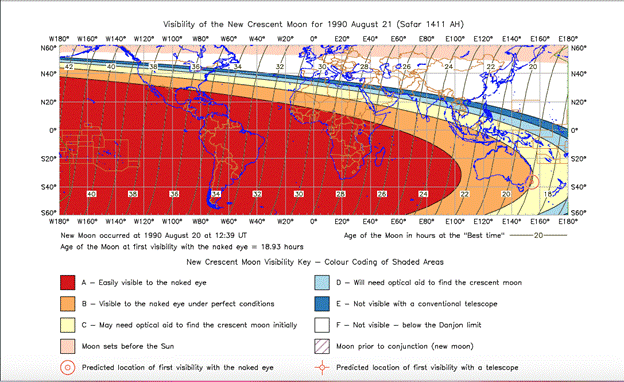
Check out a link to this site, which has some pretty good diagrams indicating where and when the new moon was or will be visible. I have been looking at the site regularly for some years, but this afternoon I found something very interesting. During the summer of 1990, there were months in which the moon was positioned very far to the south of the sky. On August 21, 1990, which was Rosh Hodesh, 30 Av 5750, the new moon was visible in most of Africa and South America as the night began, but in Israel and Europe and most of North America, the moon was not visible until late the following afternoon (Fig. 1).

(Fig. 1)

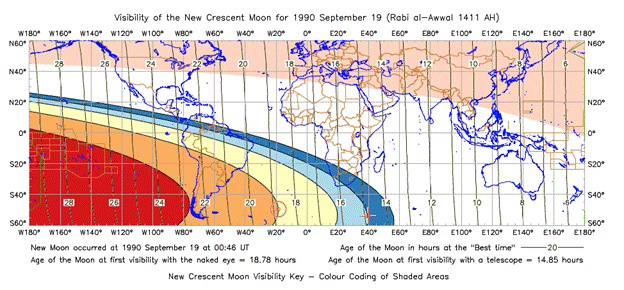
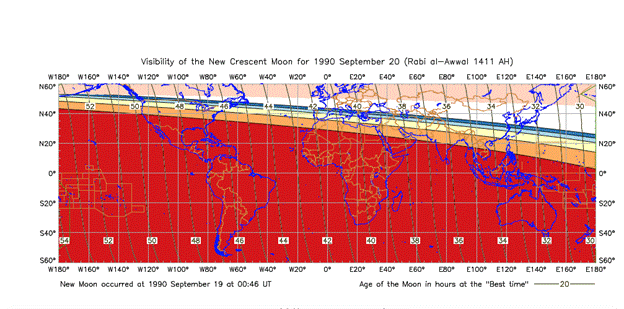
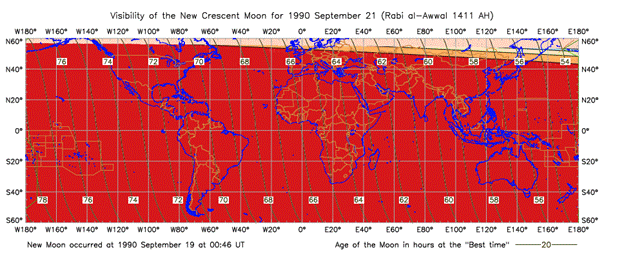
Almost a month later, on September 19, 1990, Erev Rosh Hashana, the new moon was visible in the South Pacific (Fig. 2) and the next day, September 20, 1990, Rosh Hashana 5751, it was visible across Australia, Africa, and South America (Fig. 3), but once again, those In Israel, Europe, and most of North America did not see it until September 21 (Fig. 4), and this is remarkable because Australia is well to Israel’s east, and it seems reasonable that if the Australians could see the new moon, then the Israelis should have had an even easier time spotting it, being that for them the moon is almost half a day older, and therefore larger.

(Fig. 2)

(Fig. 3)

(Fig. 4)

On December 5, 2002, 30 Kislev 5763, the new moon was at least visible in Israel, but once again, it was not visible in Northeast Europe, in places where the Ashkenazic aharonim had lived (Fig. 5). The true molad, the lunar conjunction, had been the previous day, December 4, at 9:34 am Jerusalem time while the average molad was  at 9:06 pm and 13 parts, although as can be seen from here, it is actually not easy to translate the average molad times to our current UTC system. See more below about that.) The following February, the moon was much harder to see in classical Lita than it was in the Mediterranean basin (Fig. 6).

(Fig. 5)

(Fig. 6)

I found all of these examples by a very superficial perusal of their archives, and it turns out there are dozens of examples that can be easily found in the last 30 years. A general rule can be derived: the farther a place is from the equator, the harder it will be there to spot the new moon compared to places of similar longitude but closer to the equator. For those in the Northern Hemisphere, there are many months when the added difficulty is quite significant.

Looking back, I could have extrapolated this from other information I already had, including the fact that the Israeli New Moon Society always publicizes that it is easier to spot the new moon from the Negev simply because it is in the south of the country.

All of this helps explain why we find that various forms of the practice of delaying birkat hal’vana for a day or two after what would appear to be the ideal time according to the classical opinions in the Talmudim is mostly a later Ashkenazic phenomenon, and one that Litvishe Rabbis, like Rabbi Tukachinsky, brought to Israel, whereas the generally Sephardic streams advocated for birkat hal’vana on Rosh Hodesh, or a week later, as per the kabbalistic practice. The fact that in Northeast Europe, the moon was often not visible until a day or two later than when it became visible in the more temperate regions seems to be a good explanation for this feature of the literature. Often, the Jews in Northeast Europe really had to wait for the moon to become barely visible even after the molad calculations indicated it was already well-visible in the places where the sages of the Talmud and the Rishonim used to live. I am grateful to have found this very real justification for a practice that at first seemed to go against the plain meaning of the Talmud.

Ultimately, I should have known that Maimonides was aware of all this, and took this into account. Chapters 11-17 of Kiddush Hahodesh are dedicated to explaining how to find the new moon in the sky, and that is the ultimate reason for knowing when the molad is of each individual month, and not so that one can add 72 or 168 hours to it in order to know when to recite the blessing, while the the eighteenth and last chapter discusses the practical case of the moon not being spotted for a number of months due to extenuating circumstances such as weather, and in our days, pollution. Towards the end of that chapter, he mentions that the more one stands to the east, the less likely he is to spot the new moon, while the farther to the west, the more likely, and then concludes with:

“All the above statements apply to the countries west and east [of Israel ] at the same latitude, i.e., they are between 30 and 35 degrees north [of the equator]. If they are located farther to the northerly, or less to the norther, different principles apply, for they are not parallel to Eretz Yisrael.”

There is no reason, therefore, to consider that places in northern Europe should be able to spot the new moon according to the molad in Israel, and as we have seen, they often have to wait significantly longer to see the moon.

Getting back to the issue of calculations and Professor Bromberg’s thesis, I recently saw that this year, the Ittim L’vina calendar has a new appendix explaining how there is a major disagreement regarding how to present the classic, average molad times in our modern terms. Considering that there are 1080 parts per hour instead of 3600 seconds, it should be easy to translate any molad time to any time on our clocks, but the problem is that no one knows, for example, if the tradition says that the molad for a given month is exactly at 15 hours of the day (9am), when that is according to the UTC time (adjusted for the Jerusalem time zone)! As Maimonides writes, the clock we use to determine the average moladot is, unlock the ritual clock used everyday, a constant, 24-hour clock, that assumes the day starts at hour 0, always 24 objective hours after the start of the previous day (like the secular system defines the start of the day as exactly 24 hours after the start of the previous) and therefore, during the summer, the “molad day” starts hours before the sundown, while during the winter, the “molad day” starts sometime well after the sundown that started that halachic, calendar day. The Ittim L’vina calendar brings four attempts to figure out how to determine when the average molad for any given month actually happens, and as Prof. Bromberg has shown, the truth is that no one knows. This can not be over-emphasized. When the calendar writers say, therefore, that on a given Saturday night, laymen should refrain from reciting birkat hal’vana at 7pm, as they depart the synagogue, because the average molad was say, at 8pm three or seven days earlier, and therefore they still have another hour before “the first opportunity” (sic) to recite the blessing, it is disingenuous, because they do not really know when the average molad was! It must be stated that, when Maimonides described the times of the average moladot, the only practical application was not birkat hal’vana, because up until the 13th century, no one even imagined that the time for birkat hal’vana should depend on the molad, but rather calculating the day of the week on which to establish the first day of Tishrei, which did not necessitate knowing when exactly the molad occurred according to which ever time piece they may have used. For example, if the calculation showed that on Monday the average molad was shortly before the end of the 18th hour (noon), making Monday fit for Rosh Hashana, it only meant that in the theoretical, 24-hour clock that started with the first molad, the molad of Tishrei was before the end of the 18th hour, but no one could know if that translated to before halachic noon on that particular Monday. And no one cared, either.

This revelation thus renders most of the foregoing discussions on the matter practically moot, and gives another very good reason why, if one were wondering when to recite the blessing on seeing the new moon, he should just follow the basic understanding of the talmudim and rishonim: when he sees the new moon, he should recite the blessing.

I would like to thank Rabbi David Avihail, Rosh Yeshivat Ramot, for his constant encouragement and support in producing these articles.

[1] For more on this critical distinction between the prescribed time and the allowed time, see, for example, Maimonides’s descriptions of the times for the daily prayers in his Laws of Prayer, 3:1-7.

[2] My blog, avrahambenyehuda.wordpress.com, has many more articles about understanding the original biblical and talmudic terms in context.


Charles H. Manekin — Moritz Steinschneider’s Indecent Burial

Moritz Steinschneider’s Indecent Burial
Charles H. Manekin
University of Maryland, College Park / Bar Ilan University

Over a century has passed since the death of Moritz Steinschneider, the great orientalist, bibliographer, and historian of Jewish literature and culture. When Steinschneider died in 1907 at the age of 91, he was recognized by many as the greatest Jewish scholar of the previous century. His scholarly output numbered over fourteen hundred publications, ranging from short notices to books of over a thousand pages, a number that does not take into account many of his brief book reviews, not to mention his correspondence, which still awaits to be studied.[1] The breadth of Steinschneider’s knowledge was extraordinary. Unlike other nineteenth-century Jewish scholars of Wissenschaft des Judentums, the movement initiated by Immanuel Wolf and made great by men like Leopold Zunz and Abraham Geiger, Steinschneider’s work was not limited to subjects with a direct Jewish connection. He wrote classic works on the European translations from the Arabic and the Arabic translations from the Greek,[2] and was familiar with almost everything that had been written about premodern science, philosophy, and medicine. Yet a glance at his voluminous bibliography shows that he was first and foremost a scholar of medieval Judaica.
What sort of recognition has posterity accorded to one of the great scholars of Judaism, arguably the greatest of the nineteenth century? Sadly, Steinschneider’s contribution to the history of Jewish literature in all its aspects has gone virtually unnoticed outside a small circle of scholars. If he is remembered at all, it as a cold, antiquarian scholar who reportedly said that “the task of Jewish studies is to provide the remnants of Judaism with a decent burial.” This is the portrait, or better, caricature, of Steinschneider drawn by Gershom Scholem in his well-known diatribe against Wissenschaft published in 1945.[3] Scholem, an ardent zionist, viewed Steinschneider and his mentor Zunz as “gravediggers” and “liquidators” of the Jewish national values that they considered no longer relevant after the advent of emancipation and liberalism. Scholem’s negative evaluation of Steinschneider’s scholarly motivation and outlook in no way implied a disparagement of the nineteenth-century scholar’s achievements. On the contrary, Scholem writes in the Hebrew edition of his memoir From Berlin to Jerusalem “Despite the enormous distance I felt from the men of the [Wissenchaft] group, I revered Steinschneider and pursued his works, major and minor, as well as off-prints of his articles, all of my life.”[4] He also relates that as a university student, his familiarity with Steinschneider endeared him to his teacher, and later doktorvater, the great scholar of scholastic philosophy, Clemens Bäumker. I come here not to praise Steinschneider, but rather to bury him more decently than did Scholem. To do so I will sketch a preliminary picture of his contribution to the ideology of Wissenschaft des Judentums that is less biased than the polemical one offered by Scholem. I say “preliminary” because Steinschneider made few theoretical statements on the subject of Wissenschaft. His views on that subject, like on so many others, must be gleaned from his voluminous writings and correspondence. For over a century articles on Steinschneider have begun with a call for a full-fledged intellectual biography of the man. That call has not yet been answered. Steinschneider’s principal reflections on Wissenschaft are found in his short essay, Die Zukunft der jüdischen Wissenschaft, published in1869, a half-century after Zunz had issued his programmatic-statement on Etwas über die rabbinische Literatur.[5] The science of Judaism during the last fifty years, writes Steinschneider, was motivated externally by the struggle for emancipation and internally by the desire for religious reform. Scholars thought that examining the Jewish achievements of the past would pave the way for greater acceptance of the Jews in the present, and would provide models and precedents for modernizing the religion. In recent years, a third motivation for Wissenschaft has been proposed, namely, the training of modern rabbis, and a modern rabbinical seminary in Breslau had been opened. But as important as these practical motivations were, they do not address other fundamental questions: “What about Jewish history and literature as a link and source of history and cultural history in general? Is it a part of theology? What will become of it if the universities, according to the Dutch example, leave theology as a practical science to the care of the various religious communities?” “Where and how should this academic study be conducted — in Jewish communal institutions or in German universities? “Where will it find its support — in the community or the government?” Although Steinschneider’s expressed intent was merely to raise these questions, his personal opinions are not hard to infer from his article. The task of scholars of Judaism is to investigate their subject as objectively as possible, without ideological tendencies, and in its intellectual and historical context, i.e., as connected with other cultures. This sort of study can be conducted best only in universities, not in the faculty of theology, whose focus is narrowly religious, but in the faculty of philosophy, i.e., the humanities. Jewish religious seminaries, even modern ones, are primarily interested in the training of rabbis; they focus almost exclusively on areas of importance to Jewish theology, and their students and faculty are exclusively Jewish. Jewish studies within the framework of even the most enlightened seminary cannot be free and independent. Who should support Wissenschaft? Steinschneider implies that this is an obligation for the state and not for the Jewish community, not only because of the general importance of exploring civilization’s past — after all, the state supports scientific research into the pyramids and the ruins of Pompeii — but because “the spirit that created the great works of Jewish literature is still alive in the citizens of their state.” This is an interesting argument which refutes, by the way, the view of Steinschneider as a curator of a dead or dying religion. For he seems to be implying that the state has a special obligation to support the research and teaching of subjects that inform the identity, even the group identity, of minorities within the state. In fact, there should be no difference in principle between minority and majority cultures. According to Steinschneider — again, by implication — as long as the state supports the education of Christian teachers of religion, it has the obligation to support Jewish teachers of religions, through supporting Jewish seminaries. Certainly Steinschneider was aware that the likelihood of the German state supporting the teaching of Jewish history and literature in universities, much less Jewish religion in seminaries, was remote. In fact, not a single chair devoted to Jewish history or literature was established in German universities until well after World War II. He was also aware that private money — Jewish, of course — would have to be found to support academic Jewish studies. In a letter written to his friend, the historian Meyer Kayserling in 1876, in which he refused Kayserling’s offer of a position at the Budapest Rabbinical Seminary, he writes, It seems to me that the task of our times is to prefer the endowment of untenured instructorships in Jewish history and literature in the philosophy faculties, thereby compelling the authorities to establish professorships and schools in which regular high school students can be prepared for the study of Jewish literature. We certainly do not want boarding schools in which bachurische clumsiness, impoliteness, and beggarliness is preserved and glossed-over.[6] The last statement reveals Steinschneider’s prejudices against the Eastern European yeshiva students who made up a good proportion of the students at the rabbinical seminaries. The aims of Wissenschaft required the proper preparation of students in high schools. For this Jewish donors had to be found. In the same letter Steinschneider claims that his principled opposition to Jewish Studies outside the university did not conflict with his own association with the Veitel Heine Ephraimschen Leharanstalt (Beth ha-midrasch), the old school of the Berlin Jewish community. Steinschenider was a part-time lecturer for nearly fifty years for that institution, which counted Jews and Christians, including Paul Lagarde, Georg Hoffman, and Hermann Strack, among its students. The school was open to all, its faculty all had university doctorates, and it did not confer doctoral degrees. Steinschneider had declared publicly that he would resign were it to offer a single doctorate.[7] Steinschneider did not address a question that has remained with us to this very day, namely, why wealthy Jewish individuals would wish to endow instructorships in Jewish history and literature at German universities, where the return to the Jewish community was neither immediate nor guaranteed. Perhaps he thought that he could get others to share his own passion for the study of what he called the “international literature of the Jews,” e.g., works of philosophy, science, medicine, and belles-lettres. After all, his teaching had been supported, in part, by the Berlin Jewish community for half a century. And, to my knowledge, at this stage of his life he expressed neither pessimism nor apprehension about the future of the academic study of Judaism. Nor is there any support, at least to my knowledge, for the strange idea that Steinschneider became progressively detached from Judaism culture or religion, or that he saw its inevitable assimilation into secular culture. Steinschneider remained throughout his adult life a liberal Jew whose ideals were those of the enlightenment and the revolution of 1848, in which he took part as a student. In the remarkable credo that makes up the Foreword to one of his last works, Die Arabische Literatur der Juden, he lashes out against those who use the insufficiency of reason, “this weapon of all kinds of unreason,” to justify “the forcing of myths in new clothes or of monstrosities of fantasy, let alone the clinging to institutions of fake authority or to obsolete customs.”[8] Given that this line follows a reference to the zoologist Ernst Haeckel, it is clear that Steinschneider is taking aim against the myths of racial supremacies, which he felt had replaced the myth of religious supremacies. His reference to the “obsolete customs of religion” reaffirmed his decades-long abandonment of orthodoxy, nothing more. But nothing in the Forward suggests a weakened commitment to Judaism per se, not even the claim that “it is the task of whoever feels entitled to lead the sum [of society] to stress what is common to the different circles of mankind, to point towards the ‘one Father of us all’ – towards what brings human beings nearer to each other.”[9] Steinschneider expresses these sentiments in a book chronicling the Jewish literature that was dearest to his heart, that of the Jews living in Muslim lands. After characterizing Ashkenazic Jewish life as one of “segregation in government, trade and society; expulsion, inquisition, agitation, and persecution” and Ashkenazic Jews as possessing “a surplus of mental acumen, squandered in casuistic and hermeneutical quibbles, faith and superstition linked to each other like Siamese twins,” he writes in an intensely personal passage, The historian likes to direct his attention to places where a human existence was granted to the tolerated subject, an existence in which his spirit was allowed to soar above and beyond the national barriers towards the highest existential questions. Such a person believed to have attained already on earth the ideal of human thought, the conjunction with the active intellect.[10] Steinschneider strongly identified with a literature that was not confined by the narrow parochialism of a national culture. He was under no illusion that such a literature was representative of Judaism, much less than it constituted its “essence.” With his unparalleled knowledge of Jewish books, he knew precisely what its place had been. But it was a literature with which he felt a strong personal affinity, and which reinforced the Jewishness of his commitment to liberalism and universalism, at a time when the growth of nationalism and antisemitism had made him pessimistic. As for Steinschneider’s alleged comment that it is the task of scholars to provide the remnants of Judaism with a decent burial, it has not been found in his writings, but was attributed to him in a necrology published shortly after his death in the German zionist periodical Jüdische Rundschau by the young orientalist Gotthold Weil, who had recently been one of Steinschneider’s students.[11] Weil had participated in the short-lived zionist “National-jüdische Verein der Hörer an der Lehranstalt für die Wissenschaft des Judentums in Berlin,” which numbered among its members Arthur Biram, Judah Magnes, and Max Schloesinger.[12] An active zionist leader in Germany, he later came to the Hebrew University of Jerusalem after the Nazis dismissed him from his post as professor of oriental literature at the university of Frankfurt. The context of Steinschneider’s reported comment is a discussion that Weil conducted with Steinschneider about the latter’s alleged proto-zionistic activity in his youth, when he supported Jewish colonization in Palestine as a possible solution for anti-Jewish discrimination in Germany. One imagines that this was a topic of considerable interest among Steinschneider’s zionist students, considering the elderly scholar’s open antagonism towards zionism. According to Weil, Steinschneider admitted to participating in a scheme in the1830’s to further the colonization of persecuted German Jews in Palestine. But he felt that the events of 1848 obviated the need for a separatist political solution to the Jewish problem. According to Steinschneider, Weil informs us, the history of the Jews had ceased in 1848 and that as a result, “the only task we have left is of giving the remains of Judaism a decent burial.”[13] It is easy to see how political zionists like Weil and Scholem would see an offhand comment as an epitaph for Jewish people as a nation; according to Scholem, “a breath of the funereal did in fact cling to the atmosphere of this discipline for a century; occasionally there is something ghostlike about this literature.”[14] They interpreted Steinschneider as holding that Jewish national existence was rendered obsolete by political emancipation, and that assimilation was inevitable and desirable. But there is no indication from Steinschneider’s writings that the scholar felt that the end of Jewish history, or for that matter, the extinction of the Jews as a “nation” had occurred in 1848, or that it was inevitable or even desirable. True, political emancipation had at least in principle removed the necessity for the Jews to segregate themselves in their own land in order to escape persecution. But almost fifty years later Steinschneider would write that the Jews indeed constituted a nation, in the original meaning of that word…united, at least thus far, by an ideal fatherland and Scripture reaching back into their remotest antiquity…We affirm, in fact, that the concept “Jewish” cannot be understood merely in terms of dogmas and rituals, but that the entire Jewish cultural evolution must be viewed as a mirror of the underlying religious and moral ideas and national convictions.[15] It was not the history of the Jews that ceased in 1848, according to Steinschneider, but the history of the Jews as an entity that required a political solution in its own state. He considered anti-Jewish discrimination not to be a Jewish problem but rather a human problem that should be solved within the confines of the modern liberal state. What Steinschneider increasingly detested was the romanticism, sentimentality, and separatism that he found in nationalism in general and zionism in particular. Not a great admirer of nationalism to begin with — according to Weil, he would occasionally say that “Nationalism is brutality; humanity is freedom and truth” — he never missed an opportunity to show his despisal of romantic Jewish nationalism, even in the oddest of places. Thus in his great work on the Hebrew translations of the Middle Ages, while mentioning that Judah ha-Levy had been driven to emigrate to Palestine by a somewhat mystical — another disparaging term for Steinschneider — national sentiment, he adds in a footnote that the Hungarian scholar David Kauffman, “der Apologet von Daniel Deronda,” called such an attraction “realistic.”[16] This was a disparaging reference to Kaufmann’s enthusiastic review of George Eliot’s proto-zionistic novel that Steinschneider had sharply criticized.[17] The reference, completely out of place in a footnote on translations of Halevy, showed how passionate this supposedly cold, rationalist scholar could be on the subject of Jewish national revival. Steinschneider’s ironic remark to his student Weil on the task of scholars of Wissenschaft is best seen within the context of his deeply rooted antipathy towards zionism, as well as his opposition towards tendentious scholarship of all sorts. The task of Jewish scholarship, he wished to say, is not to serve the interests of Jewish political interests, national or otherwise. “My intention,” he wrote in 1902 “is the most objective and historical portrayal possible, neither apologetically nor polemically painted, nor nationally or theologically prepared.”[18] Steinschneider intended to produce an objective scholarship possible that avoids apologetics, polemics with Christians, nationalism, and theology. Given this antipathy, his comment to Weil was perhaps intended to preach the gospel of independent scholarship. Although his students may have thought that the task of Wissenschaft was to help revive the spirit of the nation, Steinschneider did not. Given his negative views of Graetz,[19] it is not difficult to see how he would have viewed the excesses of the Jewish nationalist historians of the twentieth century. But this explanation of Steinschneider’s comment seems inadequate. For there are many ways to emphasize the virtues of objective scholarship without using the image of death and burial. Why did he employ this particular phrase? Perhaps his remark should be read as an ironic appropriation of Samuel Raphael Hirsch’s attack on Wissenschaft des Judentums. Hirsch wrote that the scholars of Wissenshaft keep alive the memory of the old Judaism as it is carried to its grave; in another metaphor of death, he called Wissenschaft “the fine dust wafting from the stone coffins of moldering corpses.”[20] Steinschneider was a master of the ironic retort. Perhaps he was saying to his student Weil, “Just as Hirsch and the orthodox have said, we are burial societies — let’s at least make sure that the burial is an honorable one.” On the other hand, Steinschneider may have been genuinely pessimistic about the future of the Jews in Germany, not because of assimilation, but because of the steep rise of antisemitism in the last two decades of the nineteenth-century. In 1893 he writes “The history of the daughter religions is a constant series of attempts to murder their own mother; if one of them ever succeeds, the crime will bring down the criminal.”[21] Nine years later he commented dryly on a historical pamphlet written by a Prussian gymnasium teacher that calls on Germany to emulate the example of Spain and Portugal and expel its Jews. “The self-appointed historian wisely omits that the brutality of the mob was aroused not only by bull fights but by the live burnings of hundreds of Jews and apostates.”[22] Steinschneider feared German nationalism, according to Weil. Perhaps he felt that the remains of Judaism deserved a decent burial because the Jews themselves were in for difficult times from antisemitism. But these are mere speculations. It is futile to read too much into the sarcastic quip of an aged scholar, which, if reported accurately, was never intended for publication. Can there be anything more indecent than having this comment serve as the summation of Steinschneider’s attitude towards the academic study of Judaism, or the task of its scholars? It is not surprising that both neo-Orthodox Jews like Hirsch and secular Zionists like Scholem assigned to the practitioners of Wissenschaft the role of gravediggers of Jewish nationalism.[23] If their visions of the Jewish nationalism were not only mutually exclusive but exhaustive, then it is a role that Steinschneider would have accepted willingly. But his vision of the Jewish nation was different from theirs. It is ironic that in articulating the differences between the visions of Wissenschaft “now” and “then,” Scholem reaffirmed much of the vision of Steinschneider – not of Steinschneider the “gravedigger,” but of Steinschneider the advocate of an open, unapologetic, and untendentious scholarship that only a university-setting could enable. Steinschneider would indeed have been pleased with the establishment of centers of the academic study of Judaism, such as the Institute of Jewish Studies at Hebrew University, where, in Scholem’s words, “everyone is free to say and to each whatever corresponds to his scholarly opinion without being bound to any religious (or anti-religious) tendency.”[24] After all, Steinschneider was the most consistent advocate of the idea that Jewish studies can only flourish in such an atmosphere. Scholem also reaffirmed Steinschneider’s distaste for nationalist history when he noted with regret that “the heritage of an apologetics in reverse, an apologetics which now, so to speak, has revised everything in terms of zionism, has produced notable examples in our scholarly work.”[25] Steinschneider consistently opposed apologetic scholarship of all kind. In sum, what connects the scholarship of Steinschneider and Scholem seems vastly to outweigh the differences, once we have adjusted the scale to allow for changing tastes and fashions in scholarship. The view of the Jewish people as a living and organic phenomenon was no doubt foundational in Scholem’s scholarly approach, but the growth in Jewish studies in the second half of the twentieth century had more to do with the sociology, economic abilities, and changing identities of the Jewish communities than with the growth of Jewish national consciousness. More to the point — if the “antiquarian” scholarship of the nineteenth century had given way to the “scientific and empirical” scholarship of the twentieth – both of Scholem’s phrases seem a bit quaint today – the reason was not because of Jews had undergone a national revival, but because scholarly tastes and methods had changed. Steinschneider’s scholarly approach was no more “antiquarian” than that of contemporary orientalists like LeClerc, Wenrich, or Wüstenfeld; just as Scholem’s scholarly approach was shaped by his intellectual training and cultural context. One shouldn’t make judgments about the scholarship of a bygone age by using contemporary fashions as a yardstick. The presence of university-trained scholars in the history of medieval Jewish culture and history would have pleased Steinschneider greatly, even more so when he learned that some of the leading scholars are not Jewish. One suspects that here too Scholem would agree. Notes: This post for the Seforim blog — dedicated to Dan Rabinowitz’s weekly shiur following hashkamah minyan at his local synagogue — is based on my article, “Steinschneider’s ‘Decent Burial’: A Reassessment,” Study and Knowledge in Jewish Thought Vol. I., ed., Howard Kreisel (Jerusalem: Mossad Bialik, 2006), 239-251. [1]Some of the correspondence has recently been published. See Briefwechsel mit seiner Verlobten Auguste Auerbach, 1845-1849: ein Beitrag zur jüdischen Wissenschaft und Emanzipation, eds., Marie Louise Steinschneider and Renate Heuer (Frankfurt/New York, 1995). The longest biographical treatment is still Alexander Marx, “Moritz Steinschneider,” in his Essays in Jewish Biography (Philadelphia, 1947), 112-184. Marx has a very useful bibliography on pp. 294-95. For a list of Steinschneider’s writings, see George Alexander Kohut, “Bibliography of the Writings of Professor Dr. Moritz Steinschneider,” in Festschrift zum Achtzigsten Geburtstage Moritz Steinschneider’s (Leipzig, 1896), v-xxxix. Steinschneider’s secretary, Adeline Goldberg, published additions to the bibliography in Zeitschrift fur hebräische Bibliographie 5 (1901): 189-91; 9 (1905): 90-92; 13 (1909): 94-95. [2] Die Arabischen Überzetungen aus dem Griechischen (Leipzig, 1897) and Die Europäischen Übersetzungen aus dem Arabischen (Graz, 1956). See D. Gutas, Greek Thought, Arabic Culture: The Graeco-Arabic Translation Movement in Baghdad and Early ‘Abbâsid Society (2nd-4th/8th-10th centuries) (London/New York, 1998), p. 195: “There is as of yet no modern bibliographical survey of the Arabic translations of all the Greek philosophers; Steinschneider’s Die Arabischen Überzetungen aus dem Griechischen remains the only single treatment.” [3] “Mi-tokh hirhurim al hokhmat yisrael” in Devarim be-go (Tel Aviv, 1975), pp. 385-405. This celebrated essay was published first in Luah ha-Arez and republished several times during Scholem’s lifetime. It has recently been translated into English by Jonathan Chipman as “Reflection on Modern Jewish Studies,” in On the Possibility of Jewish Mysticism in our Time and Other Essays, ed. A. Shapira (Philadelphia and Jerusalem, 1997), pp. 51-71. Scholem, who planned to publish a similar critique in Walter Benjamin’s journal in the early 20’s, returned to the same issue several times during his career, notably in “Wissenchaft vom Judentum einst und jetzt” (see n. 14 below) and “Hokhmat yisrael ve-yahadut” (“The Science of Judaism and Judaism,” which was printed in German, English, and Hebrew, in Perspectives of German-Jewish History in the 19th and 20th Centuries (Zur Geschichte der Juden in Deutsch-land im 19. und 20. Jahrhundert), the proceedings of a symposium on Jewish studies organized by Ephraim Urbach (Jerusalem, 1971) and reprinted in ‘Od Davar (Tel Aviv: Am Oved, 1989), pp. 143-5. For an assessment of the impact of Scholem’s zionism on his scholarship, see Daniel Abrams, “Presenting and Representing Gershom Scholem: A Review Essay,” Modern Judaism 20:2 (2000): 226-243. [4] Mi Berlin li-Yerushalayim (Tel Aviv, 1982), p. 141. This and most other comments about Steinschneider are not in the original German edition of the memoir, from which the English translation was made, but appear in the expanded German edition of the book based upon the Hebrew translation. See Von Berlin nach Jerusalem, trans. Michael Brocke and Andrea Schatz. Erweiterte Fassung (Frankfurt am Main, 1994), p. 148. Scholem’s enthusiasm for Steinschneider also earned him the favor of Prof. Aaron Freimann, who had served as librarian of the Judaica collection of the Frankfurt municipal library, and who had been Steinschneider’s student (Hebrew: 184, German: 193). One cannot but wonder why Scholem decided to add to the Hebrew version of his book several anecdotes testifying to his admiration for Steinschneider. [5] Hebraeische Bibliographie 9 (1869), pp. 76-78. A partial translation is offered by J. Hessing and P. Mendes-Flohr in Paul Mendes-Flohr and Jehuda Reinharz, The Jew in the Modern World: A Documentary History, Second Edition (New York and Oxford, 1995), pp. 230-2. I cite from that translation here, with slight emendation. [6] “Die Aufgabe unserer Zeit scheint mir vorzugsweise die zeitweileige Dotirung von Privatdocenten für jüd. Geschichte und Literatur an den Philosophischen Fakultäten, damit die Regierungen zur Errichtung von Professuren getrieben werden und Lehranstalten in welchen regelmässige Gymnasiasten sich für das Studium der hebr. Literatur vorbreiten können. Nur keine Internate, in welchem bachurische Unmanier, Unbeholfenheit und Bettelhaftigkeit in ihrem Dünkel erhalten und beschönigt werden. See Alexander Marx, “Steinschneideriana II,” in Jewish Studies in Memory of George A. Kohut, eds. Salo W. Baron and Alexander Marx (New York, 1935), pp. 492-527, esp. p. 521. [7] Ibid, p. 521. [8] Die Arabische Literatur der Juden (Frankfurt a. M., 1902), p. ix. [9] Ibid., p. x. [10] Ibid., p. viii. [11] No. 6, February 8, 1907, pp. 53-5. [12] See Yehuda Eloni, Ziyyonut be-Germaniyah mi-Reishitah ‘ad 1914 (Tel Aviv, 1991), p. 372 n. 55. [13] “Wir haben nur noch die Aufgabe die Ueberreste des Judentums ehrenvoll zu bestatten,“ p. 54. [14] See Scholem’s German Essay in the Bulletin of the Leo Baeck Institute 3 (1960):10-20; Hebrew version in De’ot 4:19 (1961), pp. 8-9, rept. in ‘Od Davar (Tel Aviv: Am Oved, 1989), pp. 136-142; English trans. by Michael Meyer in The Messianic Idea in Judaism and Other Essays on Jewish Spirituality (New York: 304-313.) The quotation is from Meyer’s translation on p. 307. [15] See Hebraeische Bibliographie 2 (1859): 82-83 (Steinschneider’s review of M. Kayserling’s Sephardim: Romanische Poesien der Juden in Spanien), as translated by S. Baron in, “Steinschneider’s Contributions to Historiography,” in Alexander Max, Jubilee Volume (New York, 1950), 83-148, esp. 90-1. [16] Die Hebraeischen Übersetzungen des Mittelaters und die Juden als Dolmetscher (Berlin, 1893), p. 402 n. 227. [17] Baron, “Steinschneider’s Contributions,” p. 135. [18] Die Arabische Literatur der Juden, p. viii. [19] Baron, “Steinschneider’s Contributions,” pp. 119-120. [20] See, for example, “Die Trauer des 9. Av,” Gesammelte Schriften (Frankfurt am Main, 1902), vol. 1, pp. 130-1. A partial translation is offered by J. Hessing in Paul Mendes-Flohr and Jehuda Reinharz, The Jew in the Modern World, pp. 234-5. [21] Die Hebraeischen Übersetzungen des Mittelalters, p. xxiv. [22] Die Arabische Literatur der Juden, p. x, n. 1. [23] The similarity between the neo-Orthodox and Zionist critique is noticed by Mordecai Breuer in “Three Orthodox Approaches to Wissenschaft” (Hebrew), in the Jubilee Volume for R. Joseph Dov Soloveitchik (Jerusalem/New York, 1984), vol. 2, pp. 856-60, esp. p. 857. [24] “The Science of Judaism – Then and Now, ” trans. Meyer, p. 310. [25] Ibid., p. 312.

Dr. Charles H. Manekin is Associate Professor of Philosophy at the University of Maryland. His publications include: The Logic of Gersonides (Kluwer), On Maimonides (Wadsworth), and the forthcoming Medieval Jewish Philosophy (Cambridge). Dr. Manekin is currently co-editing an English translation, revision, and updating of the first half of Steinschneider’s, The Hebrew Translations of the Middle Ages, for which he received a three-year NEH collaboration grant.


New Book: The Living Tree: Studies in Modern Orthodoxy by Rabbi Shlomo Riskin

Rabbi
Shlomo Riskin’s new book,
The Living Tree: Studies in Modern Orthodoxy, has just
appeared. The Seforim Blog is happy to present this selection from it.

Halakhic Pluralism in the Eyes of Rishonim and
Aharonim

In many of the off-hand remarks of the early
commentators, their advocacy of the principle of halakhic pluralism is plain to
see, regardless of whether these great authorities stemmed from Ashkenaz,
Sepharad, or Provence. They repeatedly express the pluralistic principle of
“these and those are the words of the Living God.”
Rashi, in his commentary
to Ketubot 57a, writes:
W hen two [sages] argue
over the statement of one [who was their master], and one sage says that this
is what the master said and the other says that this is what the master said,
one of them is lying. But when two Amora’im argue regarding a civil or ritual
halakhic issue, and each one maintains the logic of his position, there is no
falsehood. Each one is expressing his logic, the one master giving a reason for
permitting and the other master giving a reason for prohibiting, one master
compares issue to issue in such a fashion, and the other master compares it in
another fashion. It is necessary to say, “these and those are the words of the
Living God”; sometimes this logic pertains and sometimes that logic pertains,
because the logic changes even on the basis of a small change in the issues at
hand.
The Ritba (Rabbi Yom Tov ben Avraham Asevilli,
1250–1330) on Eruvin 13b comments as follows:
“These and those are the
words of the Living God.” The rabbis of France asked, How is it possible for
both views to be those of the Living God when one prohibits and the other
permits? And they answered: W hen Moses went on high to receive the Torah he was
shown forty-nineways to permit and forty-nine ways to prohibit every object. He
asked the Almighty concerning this, and He said, “Let these [matters about
which there are so many possibilities] be handed over to the sages of Israel in
every generation, and let the resolution be in accordance with their will.”
 Rabbi
Menaĥem Meiri (1248–1316), in his work Beit HaBehira, commented on Yevamot
14a:
That which the Torah
commanded lo titgodedu (“Do not slice yourselves up” – Deut.14:1), even
though its principal meaning is not to wound oneself as an expression of
mourning for one who has died, there is a nuance [within the word titgodedu
which may be interpreted to mean] not to turn the commandments into separate
divisions [agudot], and this is to prohibit several individuals from
performing ritual in one way while others per- form the ritual in a different
way, until it appears as though we are being led by two Torahs. But this
prohibition applies only when a city has only one court, and when even this
court is itself divided, with one component group deciding in accordance with
one view and another component group in accordance with another view. But
whenever there are two judicial courts, albeit in one city, and one court is
accustomed to deciding in accordance with this view and the other court is
accustomed to deciding in accordance with that view, this does not represent
separate divisions because it is impossible for everyone to always agree on one
opinion. This is certainly true regarding actions based upon custom, where
there is no objection if these act in such a way and those in another way.[1]
Even during the period of the later
commentators, the idea of halakhic pluralism finds expression. Admittedly,
works such as the Kitzur Shulhan Arukh of Rabbi Shlomo Ganzfried, which
records only one authoritative opinion – unlike the original Shulhan Arukh,
which includes the opposing views of Rabbi Karo and the Rema – seem to imply a
more monistic halakhic approach. A ringing defense of pluralism is to be found
in the words of Rabbi Chaim ben Rabbi Bezalel, brother of the Maharal, who
studied together with Rabbi Moshe Isserles (the Rema) in the mid- sixteenth
century in the yeshiva of Rabbi Shalom Shachna. He wrote Viku’ah Mayim Hayim
(usually included at the end of the Rema’s Torat Hatat), in which he
vigorously argues against any written halakhic codification reflecting only one
halakhic opinion:
Only after [the decisor]
has studied all of the legal disputes which have arisen regarding a specific
law can his word run quickly into the sea of wisdom…Moreover, the mind of an
individual is not always consistent and perhaps his mind is not disposed to
give the same halakhic ruling which he gave yesterday; there is not in this any
change or deficiency [which would lead us] to say that through him the Torah is
becoming like two Torahs, God forbid. The opposite is the case; this [manner of
halakhic investigation, exploring multiple opinions] is the path of Torah, and
“these and those are the words of the Living God.” (Elon, Mishpat HaIvri,
37)
A fascinating contrast is to be found in the
writings of two cotemporary religious leaders, Rabbi Moshe Feinstein and Rabbi
Yitzhak Hutner. The former, world-renowned halakhic decisor of our generation,
utilizes the expression “these and those are the words of the Living God,” but
nevertheless posits that one argument may ultimately be more correct than the
others:
And this is the matter
concerning all of the disputes of our earlier and later sages, when one forbade
and the other permitted: whenever the [law] was not resolved in accordance with
one [of them], any [rabbi] could rule in his locality in accordance with his
logic, even though the true law is only in accordance with one of them…Both are
the words of the Living God, but the real truth, revealed before heaven, is
only like one of them.
Nevertheless, Rabbi Moshe Feinstein insists that
with regard to reciting the blessings on learning Torah and fulfilling the
commandment to study Torah, no differentiation should be made between texts
containing majority opinions and texts containing minority opinions. All Torah
texts are worthy since “these and those are the words of the Living God” (Iggrot
Moshe, Orah Haim
4:9, 24).
Rabbi Yitzhak Hutner, on the other hand, accepts
the talmudic view that disputes arose as a result of insufficient study or
forgetfulness, a view which we initially equated with the monistic approach to
halakha. Nevertheless, he resoundingly affirms the positive role of disputes in
enlarging the scope of Torah and initiating novel ideas therein. He even reads
into this view of the origin of halakha a bold concept of halakhic pluralism:
Sometimes, the
nullification of Torah is its very confirmation, as it is written, “the tablets
which you have broken.” [God said to Moses], “May your strength increase
because you have bro- ken them; the act of breaking the tablets is an act of
confirming the Torah through its nullification.” Our sages have said, “Were the
tablets not broken, Torah would not have been forgotten in Israel” (Eruvin
54a); we find therefore that the breaking of the tablets contains an aspect of
forgetting of the Torah. We learn from this an awesome and novel idea: it is
possible for Torah to be increased through its having been forgotten, and it is
possible to be blessed with increased strength because of the Torah having been
forgotten!
Go out and see what our
sages have taught: three hundred laws were forgotten during the mourning period
for Moses, and Otniel ben Kenaz restored them with his logic and casuistry (Temura
16a). And even more than that: every dispute in halakha stems from the fact
that Torah was forgotten, and nevertheless our sages declared, “Even though
these purify and those defile, these invalidate and those permit, these exempt
and those obligate, these and those are the words of the Living God.” Hence,
all different opinions and differing views contribute to the growth of Torah
and its majesty, which…is emphasized to a greater extent by the Oral Law which
is revealed in disputes rather than by agreement, because “these and those are
the words of the Living God” includes the principle that even the rejected view
in halakha remains Torah knowledge as long as it was expressed as part of the
give-and-take of the Oral Law…and if there will be a vote afterwards and the
decision is in accordance with the rejected view, from then on halakha will be
different in truth.
The “battles” within
Torah are not simply one of many possible ways of (acquiring) Torah, but rather
the positive creation of new Torah values which cannot be found in the words of
Torah… And the two sides which clash in halakha become partners in the creation
of a new Torah value whose name is “the battle of Torah.” (Pahad Yitzhak,
Hanukka
pp. 36–37)
Despite all this, pluralism is obviously not
open-ended. Starting with the biblical story of the Tree of the Knowledge of
Good and Evil which opens the Book of Genesis and serves as an introduction to
the entire Torah, it is clear that God demands that the definition of what is
good and what is evil must emanate from an objective source beyond the
subjective individual. Indeed, even though the fruit was “good to eat, a
temptation to the eyes, and a desirable way to gain wisdom,” the Almighty
nevertheless decided that it was evil to partake of it. And from the talmudic
period until the Emancipation, the partners to the “these and those are the
words of the Living God” disputes each accepted upon themselves an external and
objective halakha. Submission to a higher autonomous system was the axiom of
halakhic dispute. Hence, a non- Orthodox system cannot claim halakhic
legitimacy under the rubric of “these and those are the words of the Living
God.” While we may certainly learn from serious Jews of any or no religious
persuasion, both tradition and logic dictate that halakhic legitimacy can only
be accorded to those who accept upon themselves the axioms upon which the
halakhic system is based.
Although a non-halakhic theological system
cannot claim for itself a voting voice in a forum of halakhic discourse, I
believe it is crucial that the tent of Orthodoxy be as broad, open, and
inviting as possible. Even a halakhic position which the Orthodox majority
rejects, but which, nevertheless, has a legitimate halakhic basis to rely upon,
should be given due consideration.
Within the world of halakhic Judaism, the most
striking affirma-tion of the benefits of a pluralistic approach is to be found
in the words of Rabbi Avraham Yitzhak HaKohen Kook, in Olat Re’iya,
volume 1, p. 336:
The multiplicity of
views which arise as a result of the differences of personalities and
educational backgrounds is specifically the fact which most enriches and
broadens wisdom. Ultimately, all issues will be properly understood, and it
will be recognized that it would have been impossible for the Building of Peace
[the Third Temple] to have been erected had it not been for all those
influences which appeared to have been in conflict.
According to Rabbi Kook, it is the sum total of
many different ideas and ideologies which will ultimately lead to a shared
vision that expresses true peace; the authentic symphony is the product of many
different musical instruments melding together in majestic harmony.

[1] It is interesting to
note that according to Rabbi Ben-Zion Uziel, the first Sephardic chief rabbi of
the State of Israel, in his Piskey Uziel (page 26, siman 10), Rashi
would permit two different courts – for example, Sephardic and Ashkenazic – in
one city, since he explains the prohibition of making divisions “lest it appear
that we are acting in accordance with two Torahs” (Rashi on Yevamot 13b)
and different communal customs do not suggest two Torahs. Maimonides, on the
other hand, would prohibit this since he maintains that the prohibition of
making divisions, “that there not be two courts in one city, this one in accord
with this custom and that one in accord with that custom, for this matter
causes great dissension” (Mishneh Torah, Hilkhot Avoda Zara, chapter 12,
law 14). Rabbi Avraham Yitzĥak HaKohen Kook, in Ezrat Kohen, siman 103,
par. 17, rules that the Sephardic and Ashkenazic communities in one city are
separate, and the prohibition of making halakhic divisions does not apply to
them. Rabbi Kook cites the Shakh to Yoreh De’ah 242, who limits the
prohibition, “Do not slice yourselves up” to dissension within the same court
in one city.