The Valmadonna Broadside Collection: a Review Essay

The Valmadonna Broadside Collection: Review essay
By Eliezer Brodt and Dan Rabinowitz

The Writing on the Wall: A catalogue of Judaica Broadsides from the Valmadonna Trust Library, edited by Sharon Liberman Mintz, Shaul Seidler-Feller and David Wachtel, London-New York: 2015, 320 pp.

Jews have been collecting books or manuscripts for centuries. A related category that is collected by fewer is ephemera, including broadsides, documents and letters of historical significance. Of late, a few annual auctions have included some of these documents among the other objects to be auctioned. Sadly, after their appearance in the auctions’ catalogs, most of the rare items disappear in to private collections and are invariably almost impossible to track down post-auction. The result is that a valuable amount of historical information is lost to the public. Moreover, to date, there is no database that tracks or records these items.[1]
First, a definition of the type of material – broadsides; they “are all around us whether we recognize them as such or not. Walking down the street… entering the lobby of a public building… we daily even hourly see flyers for event, advertising posters, public announcements and more.” Using “the most expansive conception we can say that the broadside has been with us since antiquity… The public display of information… has been ubiquitous for a very long time.” (p. 6).
In an important and excellent essay on Jewish bibliography written in 1976,[2] Professor Israel Ta-Shema remarks that because broadsides were intended and read by “thousands and potentially hundreds of thousands” they are among the “important sources for both Jewish history and the history of Hebrew printing.”

ענין לעצמו שלא זכה למיטב ידיעתי לשום טיפול עד עצם היום הזה, הוא רישומם הביבליוגרפי של ‘הדפים הבודדים’. לפי הערכות שקולות מגיע מספרם של אלה לאלפים רבים, ואולי עד כדי רבבה, וחשיבותן הן לידיעת תולדות ישראל והן לידיעת קורות הדפוס העברי גדולה ביותר. בדרך כלל קשורים דפים אלה במריבות בין חשובי הקהל ורבניהם, סכסוכי משפחות, בנים נודדים, פולמסים דתיים וכו’. דפים אלה שנתלו או הודבקו על קירות בתי הגיטו או בבתי הכנסת וכד’ אבדו ברובם המכריע, וכל מה שנשתמר מהם הוא בגדר יוצא מן הכלל. ערך ביוחד יש לסוג ספרותי זה ביחס לפולמוסים הפנים-חסידיים והמתגנגדיים. לסוג זה יש לצרף את המודעות והכרזות עד לתקופתנו אנו, כולל כרוזי המחתרות האנטי היטלריסיות בחו”ל והאנטי מנדטריות בארץ ישראל, כרוזי נטורי קרתא וכד’, שהם רבים מאוד. מלבדם נדפסו על דפים בודדים, קמיעות וסגולות, לוחות קיר, דברי פרסומת, הסכמות נפרדות ועוד, ויש ביניהם גם מעשיות עממיות קצרות על דף אחד. [מצוי ורצוי בביבליוגרפיה העברית, יד לקורא טו (תשל”ו), עמ’ 79-7 ].        

History is not the only subject to benefit from broadsides.  The prolific author, R. Eliyahu David Teomim (Aderet), published and annotated a broadside recording the customs of the Great Synagogue of the Austria, whose Rabbis had included R. Shmuel Edels (Maharsha).[3]  
Recently some of collectors of broadsides have begun printing and reproducing these priceless treasures.[4] The Valmadonna Trust Library (see here), still one of the most significant private Hebraica libraries (for an appreciation of the Valmadonna Library, penned by its librarian and published at the Seforim blog in 2009, see here), published a catalog of the broadsides in its collection, The Writing on the Wall: A catalogue of Judaica Broadsides from the Valmadonna Trust Library, edited by Sharon Liberman Mintz, Shaul Seidler-Feller and David Wachtel (see here). In conjunction with the publication of the catalog, the Trust also made available online (here) all of the documents in its collection for further study. The collection is comprised of broadsides from the sixteenth to twentieth centuries and incorporates items from Italy (the library generally focused on Italy and Italian items and broadsides are no exception, with Italian broadsides being the largest of the collection), and elsewhere in Europe, Israel, Yemen, Iraq, Constantinople, India, and even one from America.
The book consists of a few parts. It begins with five scholarly essays on specific subjects by various experts. Following are excellent full-page reproductions of thirty-six highlights from the collection, including a description explaining the significance of the specific document. A full catalog of the collection is included and is divided into six main categories; each category is chronologically ordered. The six categories are: Poems, Prayers, Documents from Within the Jewish Community, Documents from Outside the Jewish Community, Calendars and Education. Each entry includes a description of the item, the title, author place and date of printing, printer, size and language. Some entries include additional bibliographical sources; others provide a small image of the item. Additionally, the non-English broadsides included in the highlight section are translated. The volume concludes with various other useful indexes.
The first introductory essay is an excellent overview of Jewish broadsides by Adam Shear. Shear asks and answers the basic questions that come to mind, such as: “What was the purpose?”, “Who was the audience?”, “Where were they displayed?” and the like, none of which can be answered singularly.  
The second essay is by Elisheva Carlebach and focuses on the Jewish wall calendars in the collection.[5] She explores what can be learned from tracing the cultural history of one of the printers of these calendars through various calendars he printed. Some of these calendars were very sophisticated and it’s unclear who the targeted audience was. Emphasizing calendar broadsides’ unique value, she concludes that “the most ephemeral of forms, broadside calendars preserve a glimpse of the printshop as workspace, the spirit of entrepreneurship and the enduring values of the creators of these humble yet precious objects” (p. 30).
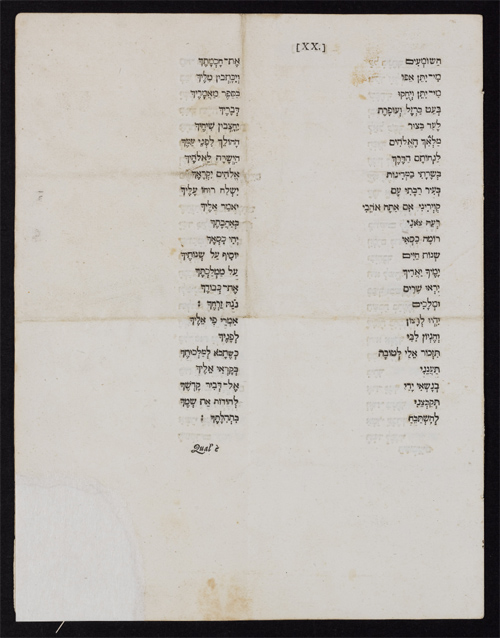
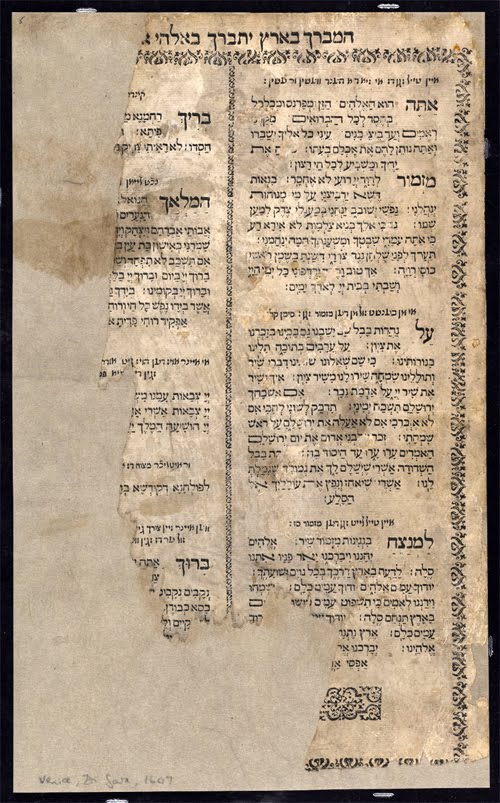
The third essay is written by Ruth Langer and focuses on the Liturgical Broadsides of the collection.  Some are prayers for current events, one of interest (printed on p.33) is for a memorial service for a building that collapsed in Mantua in 1776 where three weddings were taking place simultaneously.[6] Also discussed are the prayers for various civic events (p. 35) and for the various governing powers, a subject which still needs to be explored in depth. Some of these broadsides were clearly displayed in shuls; one includes the language of the prayers, defusing the power of bad dreams and request for substance, that are recited along with Birchat Cohanim (p.15), others include prayer that are recited during Selichot (p.14). One broadside, printed in Izmir in 1890, contains the Vidduy of Yom Kippur, printed with each entry of the Aleph Beis featuring other sins under that letter, very similar to the sheets given out in various shuls today (p.44). Not all were intended for the public display, the following broadside from Venice 1607 (Item # 153) appears to have been hanging in the house, for the owners’ personal use.
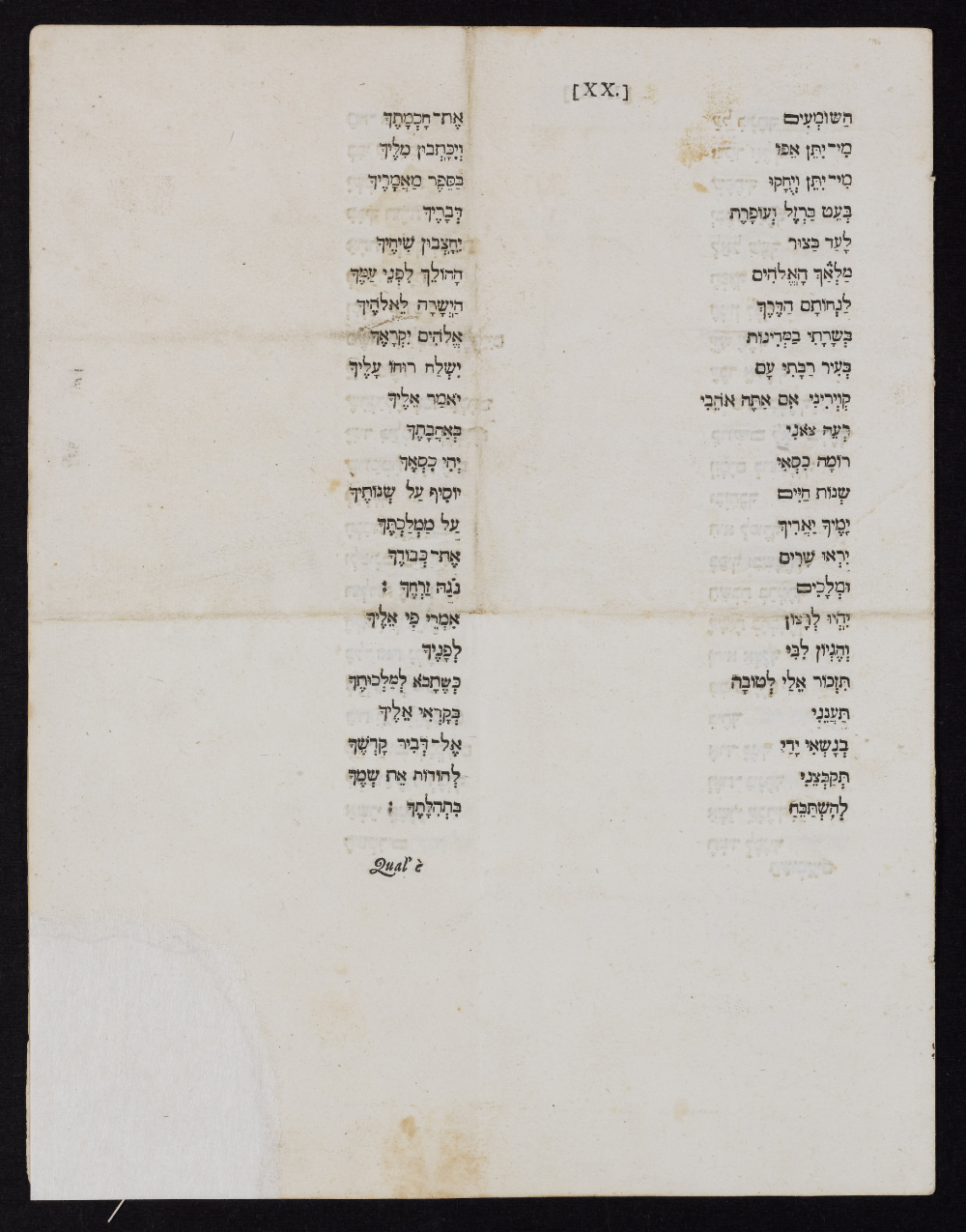
The next essay, by Dvora Bregman, focuses on the Hebrew poems in the collection (mostly from Italy). This section also highlights various pieces of historical interest. Reading through it, one is amazed how poems were written for literally every occasion – completion of Mishna, Venice, 1630 (p.55), receiving a medical degree (p.51, there are sixteen examples in the collection), in honor of R. Israel Chazan’s[7] visit to the old Greek synagogue in Corfu in 1853 (item # 134) (see below). Some of the poems were written after the deaths of prominent people such as an Italian elegy for R’ Moshe Zacuto which is reproduced in full and translated from Italian to English. Other elegies include one for R’ Yehudah Aryeh Modena (see below) and for R’ Mordechai Gerondi, the latter written by his friend Shadal (see below). There are also many “wedding riddles” in the collection – providing evidence of another rich and diverse aspect of Jewish life in Italy. 

The next section, originally written in Hebrew by Nachum Rakover and translated into English for this volume by Shaul Seidler-Feller, focuses on the Takanot broadsides found in this collection. Sumptuary edicts, limiting the size of a celebratory affair and the amount of people invited, the amount of food to be served, or the amount of money to be spent on various sorts of occasions were commonplace from the medieval until the modern period.  For example, we note that the Nodeh Beyhehudah and his beis din in Prague issued a list of such Takonot.[8] Rakover is in middle of preparing for publication a thorough study on the subject. In the volume under review, his article deals with the seventeen Italian broadsides related to sumptuary laws in the Valmadonna Collection from 1598-1794. The article is impressive in its sweeping review of the topic and the placement of these items within the larger narrative. What is apparent from the examples in the collection is that sumptuary laws have been persistent. Indeed, recently the cudgel has been taken up anew and a new round of such edicts by numerous rabbis and Hasidic leaders to limit spending has been promulgated. 
                                                  
Exploring the Collection
The introductory essays are only the beginning in what can be uncovered in a collection as rich as this one.  By providing online access, the Trust has insured that can occur.  To begin that exploration, we discuss a few choice examples.
As was recently the case with American Pharaoh, Jewish have been involved in sport, and specifically horse racing.  The collection includes two Italian broadsides discussing the horses and the Jewish sponsorship of a horse race. (Nos. 311 & 328).
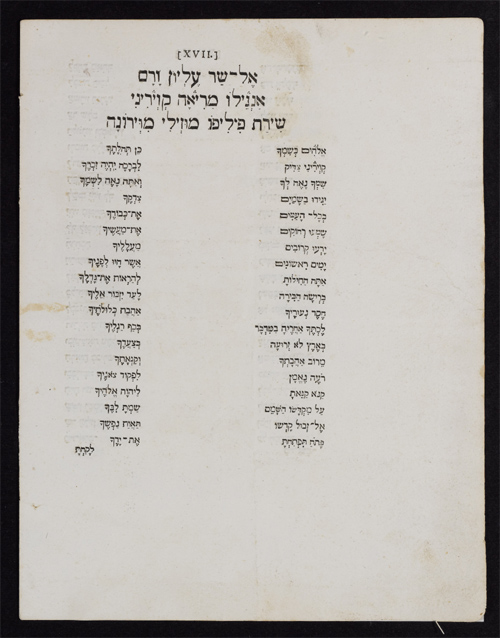
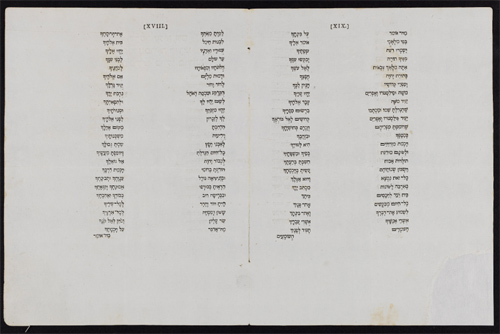
One surprising and lengthy – some ninety lines – ode was composed in Hebrew (ca. 1740) and is a “poem of praise and supplication addressed to Angelo Maria Quirini (1680-1755), an Italian Cardinal.”  This item is “a single bi[-]folio excised from a larger work, most likely a pamphlet,” and is “not a true broadside.” (No. 130). No additional information is provided on this intriguing item.[9]
Friday Night Candle Lighting Prayers

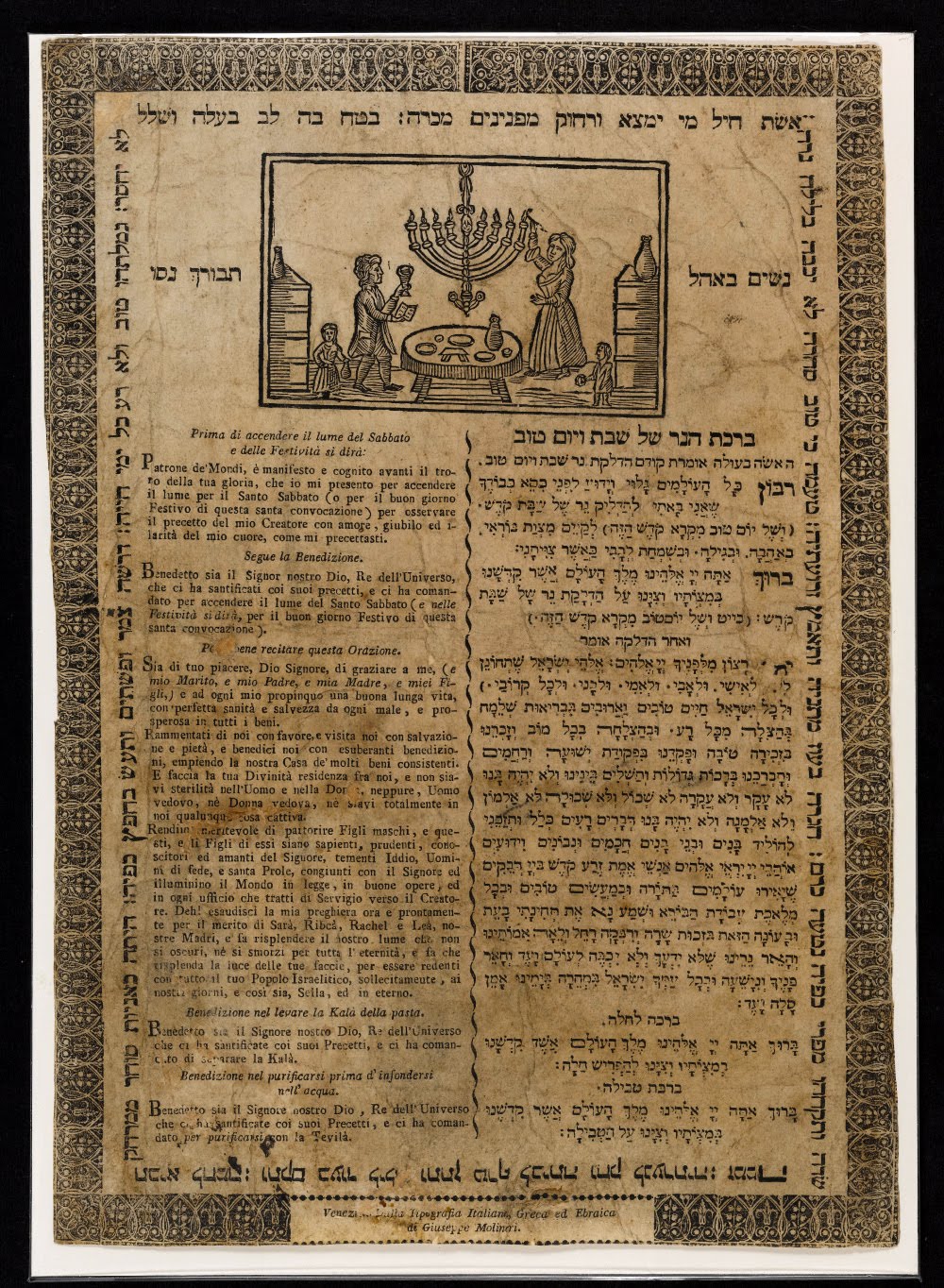
The following broadside from Venice 1835, (reproduced on p. 17), contains the text of the prayers that were customarily recited by women on Friday evening during the candle lighting ceremony.
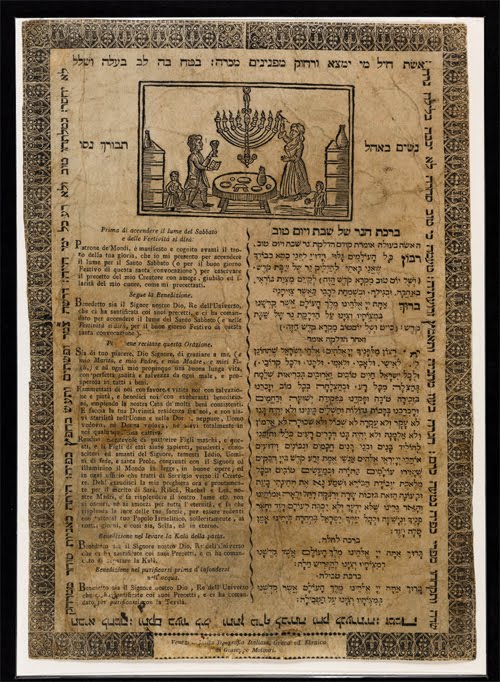
The illustration depicts a woman lighting eight candles. The Rishonim, including Italian sources, Shibolei Haleket (Siman 59) and Sefer Hatadir (p.196), only require and discuss two candles for Shabbos.[10] The question is when exactly did people start lighting more? The exact time when this began is unknown. However, in the “Shulchan Aruch” from R’ Yehudah Aryeh Modenah (1571-1648) he describes the Italian custom of lighting multiple candles:
והנשים חייבות להדליק בבית נר של שמן ובתוכו לכל הפחות ארבע או שש פתילית להאיר בערב עד עבור חלק גדול מהלילה [עמ’ 54].
Some continued to advance the numbers and in the 19th century, one author records the custom of lighting 31, 45, and 52 candles weekly.
מה מאוד היה מכבד שבת ויום טוב והיה מנהגו להדליק בכל שבת ל”א נרות כמנין אל כי בו שבת אל מכל מלאכתו, ובסוף ימיו מ”ה נרות, ולפני מותו היה מצווה להדליק בשנה ראשונה בחדר שהיה לומד בו נ”ב נרות כל שבת [מה שהעידו על ר’ הירץ אברהם נפתלי שייאר בהקדמת נכד המחבר לפירושו תורי זהב, (על שיר השירים), ירושלים תשס”ג, עמ’ טז].
Corporal Punishment
The following broadside poster for the instruction of children is from Italy 1846 (125):[11]
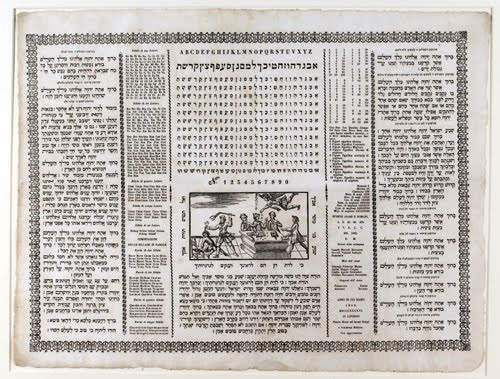

One striking part of the image is of the teacher hitting children in school. This sort of practice is recorded in a number of Jewish texts.[12]  For example:

A 17th century autobiography recounts that “the new teacher was of an irritable temper… he hit me and put me to shame…”. [Alexander Marx, Studies in Jewish History and Booklore, New York 1944, p. 193].

R’ Yaakov Emden writes in his autobiography:
בשנות הילדות… אזכיר איזה גרגרים, שלשה דברים נוראים שקרו לי בימי ילדותי הרכות. … ומלבד המכות אשר הוכיתי בית מאהבי המלמדים אשר נמסרתי בידיהם ללימוד, היו על פי רוב אכזרים, היכוני בלי חמלה… [מגלת ספר, עמ’ 84].
Saul Berlin writes in his satirical work:
ומתועלת ההכאה עוד, כי הוא צד היתר למלמדים לקבל שכר, כי על הלמוד לבד אסור לקבל שכר, משום קרדום לחתו בו, ואם כן כל מלמד המרבה להכות הרי זה משובח… ועוד רבה התועלת ע”י ההכאה אשר הילדים מכים ולוקים בבית הספר, כי ליראתם את המכות קרבת מוריהם יחפצו וירבו עליהם מוהר ומתן למען חנות אותם, ובהגיע חודש ומועד יפצירו הילדים באבותם לתת להם משאת רב, להביא אל רבם לתתם לו כופר נפשם…”. [כתב יושר, [בתוך: יהודה פרידלנדר, פרקים בסאטירה העברית בשלהי מאה הי”ח בגרמניה, תל אביב תש”ם], עמ’  98].
R’ Yosef Kara writes:
שבהיותי בצוותא חדא אם כבוד ידידי הגאון הצדיק מו”ה שמעון סופר אב”ד דק”ק קראקא… והוא אמר ז”ל כי זה רע חולי שאין חפץ לגדולי לומדי תורה להיות מקרי דרדקי, כי הוא חרפה להם ע”כ מוכרחים אבות הבנים ליתן בניהם הקטנים אל איש אשר לא ידע ספר קרוא מקרא ודקדוק אך ידע להכות הבנים ולזעוק בקול גדול… [קול אמר קרא, פ’ פנחס, עמ’ 20].
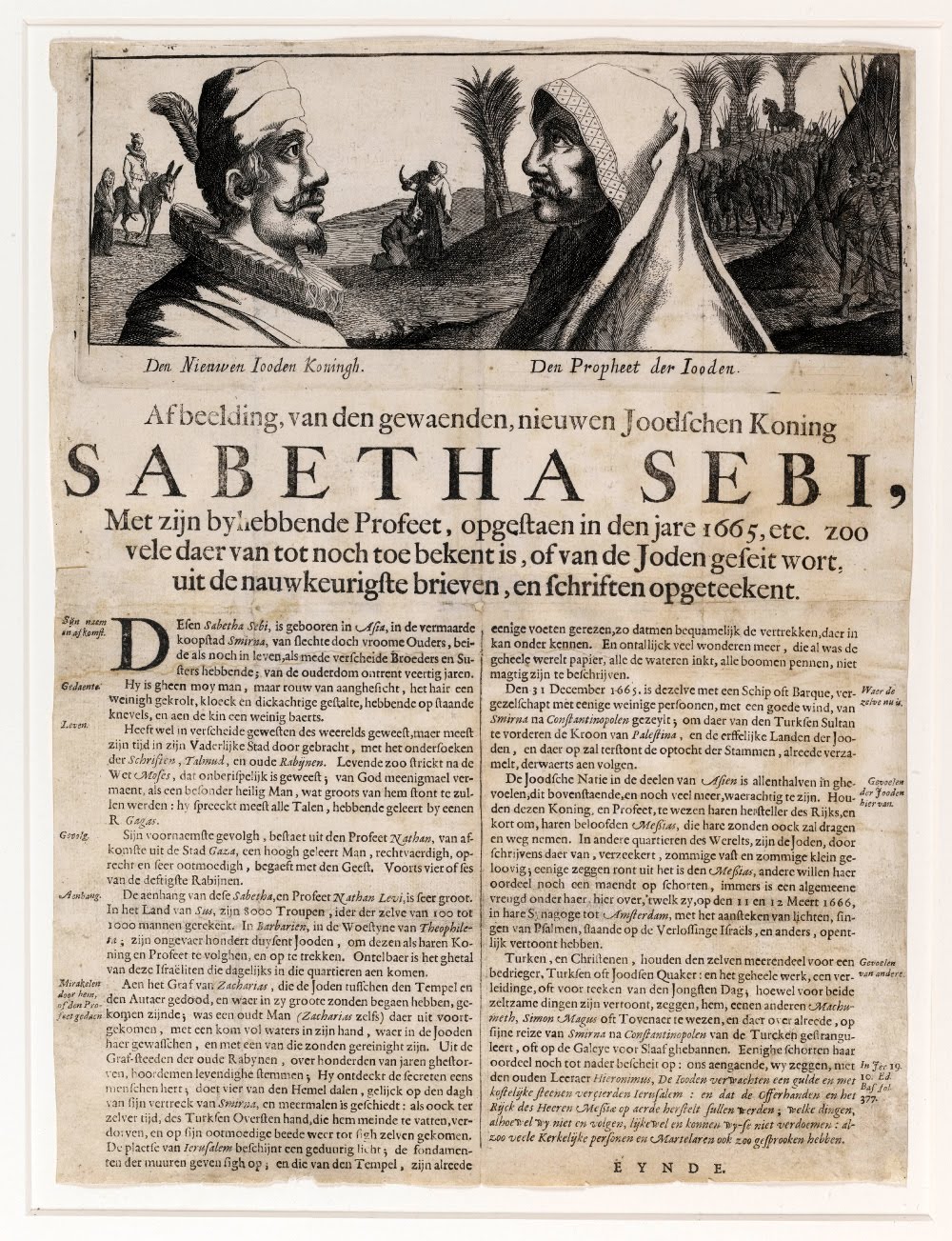
This broadside from Amsterdam 1666 is a little more famous, as it’s a supposed depiction of Shabbetai Tzvi. A complete translation for the Dutch is provided in at the appendix (pp.264-65).
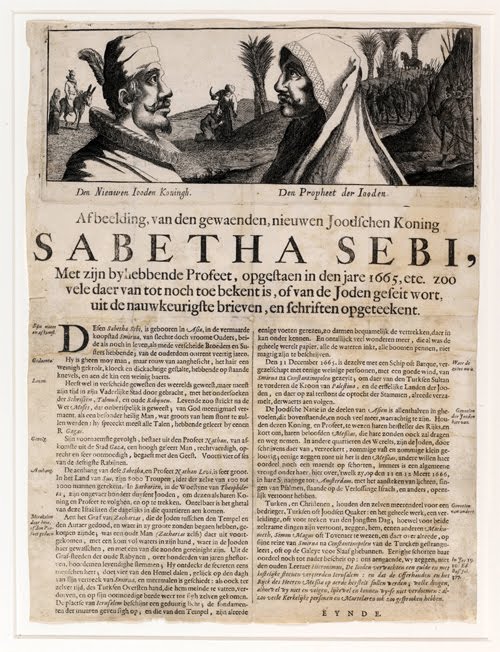
Gershom Scholem writes that this portrait of Tzvi is fictitious – one of a number of imaginary portraits. (Sabbatai Sevi, pp. 190-191, 158). The only picture of Shabbetai Tzvi believed to be authentic (that is, drawn by a witness) is the one found in the beginning of Thomas Coenen’s book Ydele Verwachtinge der Joden, Amsterdam 1669.[13] There might be others as well, but King Jan Casimir ordered all pictures of him to be destroyed (id., p. 597). This one, fortunately, was published.
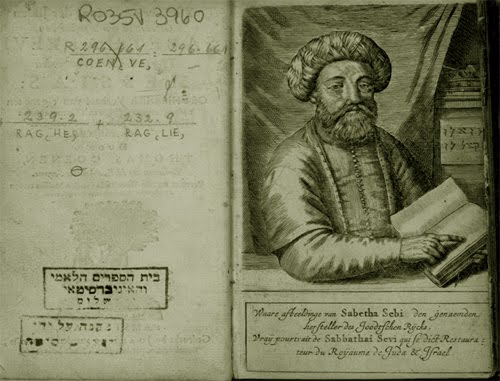
(This is from Scholem’s personal copy.)

Kabbalistic Tefilos for Rosh Hashanah
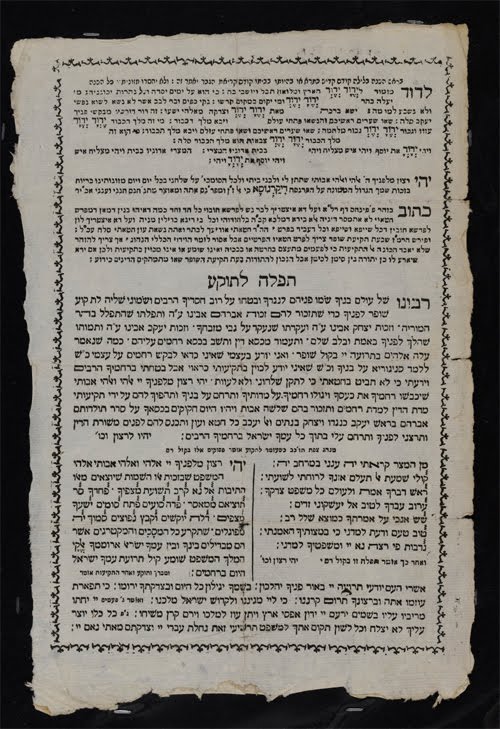

This broadside from Mantua 1790, reproduced in the book (p.43), is of interest for several reasons. First, the top part of the broadside has the twenty fourth chapter of Tehilim, said by many Kehilot on Rosh Hashanah as a segulah for Parnasa.[14] In a work written around 1700, recently printed from manuscript, we find the author writes:

אחר ערבית, יש לי תוכחת מגולה ומסותרת אם קצת משכילים, שהנהיגו לקרות בבית הכנסת בציבור אחר עלינו לשבח בלילי ר”ה, מזמור לה’ הארץ ומלואה, ולכוין הנקוד של השם, ככתוב בספר שערי ציון, שהוא מסוגל לפרנסה, שלא יפה הם עושים, כי לא כן צוה הרב המגיד לנו סוד זה, והצנועים נהגו לאמרו בשני הלילות שתי פעמים בכל לילה תכופים זה לזה… והקריאה על שולחנו קודם ברכת מזון… דבר הלמד מענינו, בהצנע לכת עם אלקיך. על כן אמרתי ימים ידברו, להויע ידידי הקורא שדבר בדוק ומנוסה שכל סגולה הנעשית על ידי תפלה בשום כוונה או שם, שאין לך לפרסמו ברבים. ולא לגלותו כי אם לתלמיד הגון ירא חטא ובלחישה, לבל היה מוליך רכיל מגלה סוד, שאז תהיה הפעולה חלושה… [ר’ כליפא בן מלכה, כף נקי, [לוד תשע”ד] עמ’ 167].

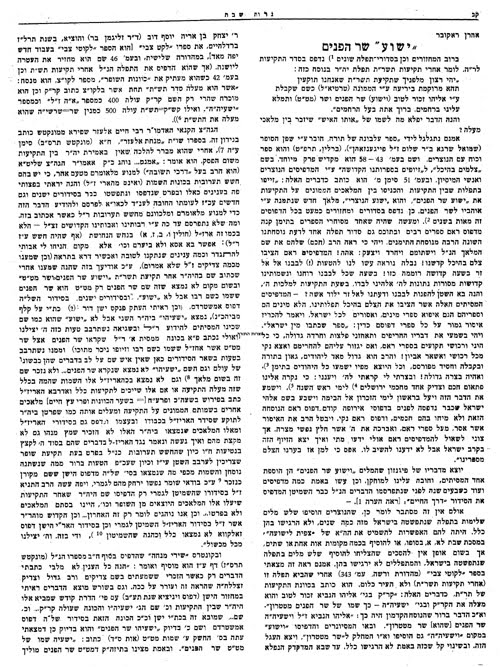
The second part of this broadside is also of interest, as it has the tefilos said before, during and after the shofar blowing, including some of the Kabblastic tefilos with names of angels. Of note is what is omitted here, those parts said between the various sets of Shofar blowing, which has been the subject of lots of literature[15], as it includes a very strange phrase, that seemingly evokes Jesus: ישוע שר הפנים””.
Here is an article written on this topic by R’ Shmuel Ashkenazi written in 1944 (!) under one of his pen names:
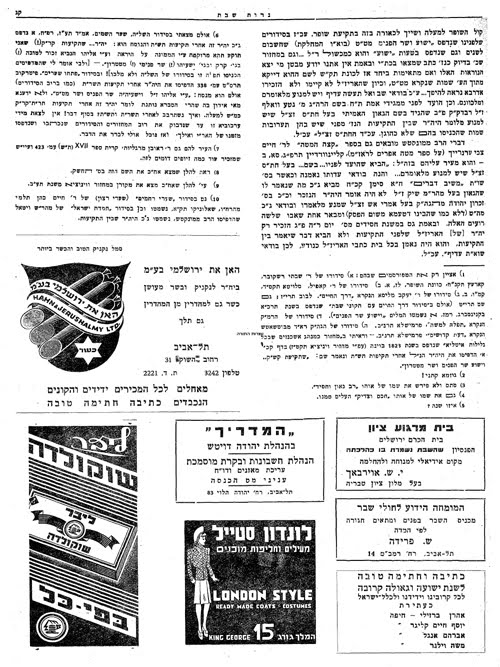
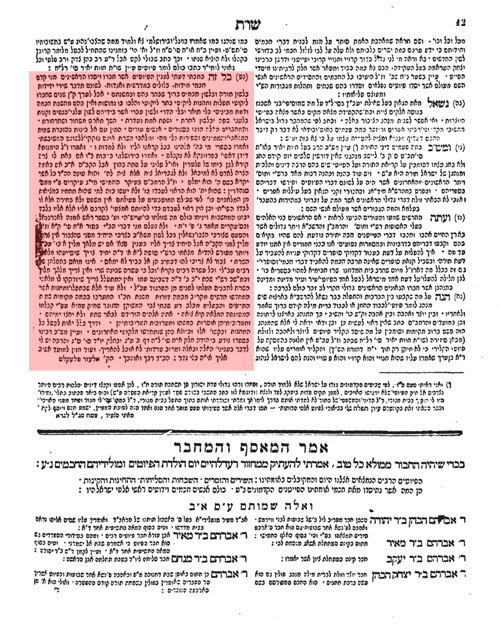
One more point related to this topic is a case of censorship. R’ Chaim Kraus writes:
 הנה בזכר יהוסף… מתיחס לזה שבדפוסים האחרונים בשו”ת תשובה מאהבה הושמט הענין הנ”ל שכתב בחריפות נגד אמירת היהי רצון שמות המלאכים… [מכלכל חיים בחסד, עמ’ סד].
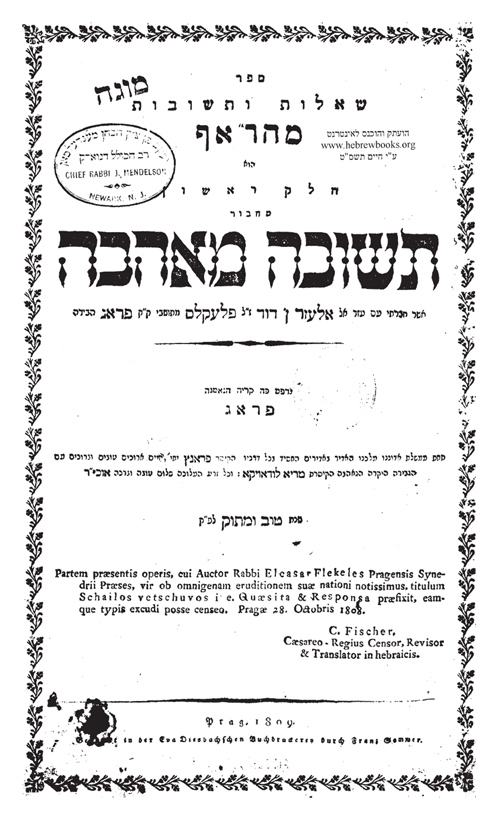
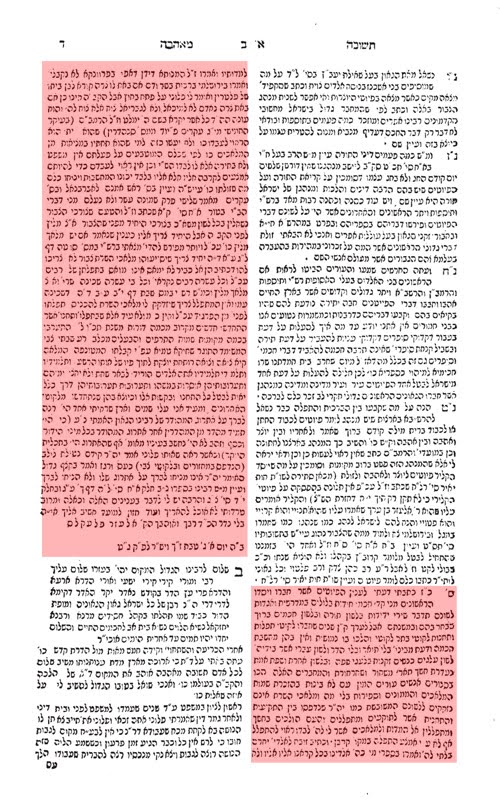
However, upon checking the sources to see when in the printing of the sefer Teshuvah M’Ahavah this censorship took place, one is hard pressed to find it, as it’s simply not there. The actual issue is a bit different; Kraus misunderstood R’ Yosef Zechariah Stern’s teshuvah.
In an extraordinary teshuvah dealing with these prayers (Zecher Yehosef, Siman 210), R’ Yosef Zechariah Stern mentions a certain case of censorship:
ובתשובה מאהבה ח”א סי’ א שהועתקה תשובתו בדבר הפיוטים ברוב המחזורים.. והמדפיסים להפיס דעת ההמון שהורגלו באמירת היהי רצון שבתקיעות השמיטו מה שהזכיר בסוף התשובה אות ס’ שמרעם בהזכרת שמות המלאכים… וכן השמיטו המדפיסים בהעתקתם מהתשובה מאהבה מה שהעיד מהנודע ביהודה שאחד היה רוצה לברך על אתרוג המהודר שלו וכשראה שאומר היהיה רצון… אמר איני מניחו לברך על אתרוג שלי…
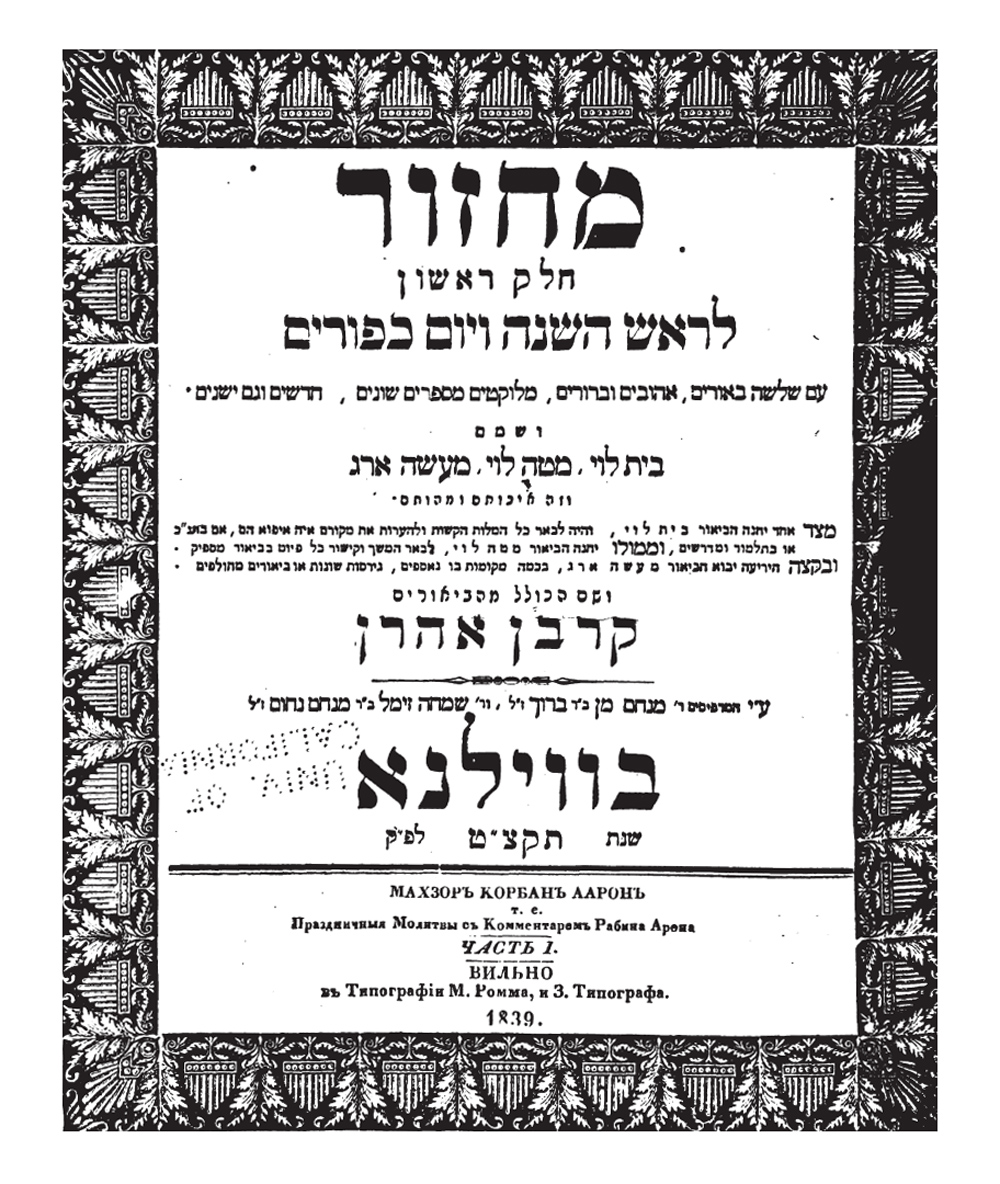
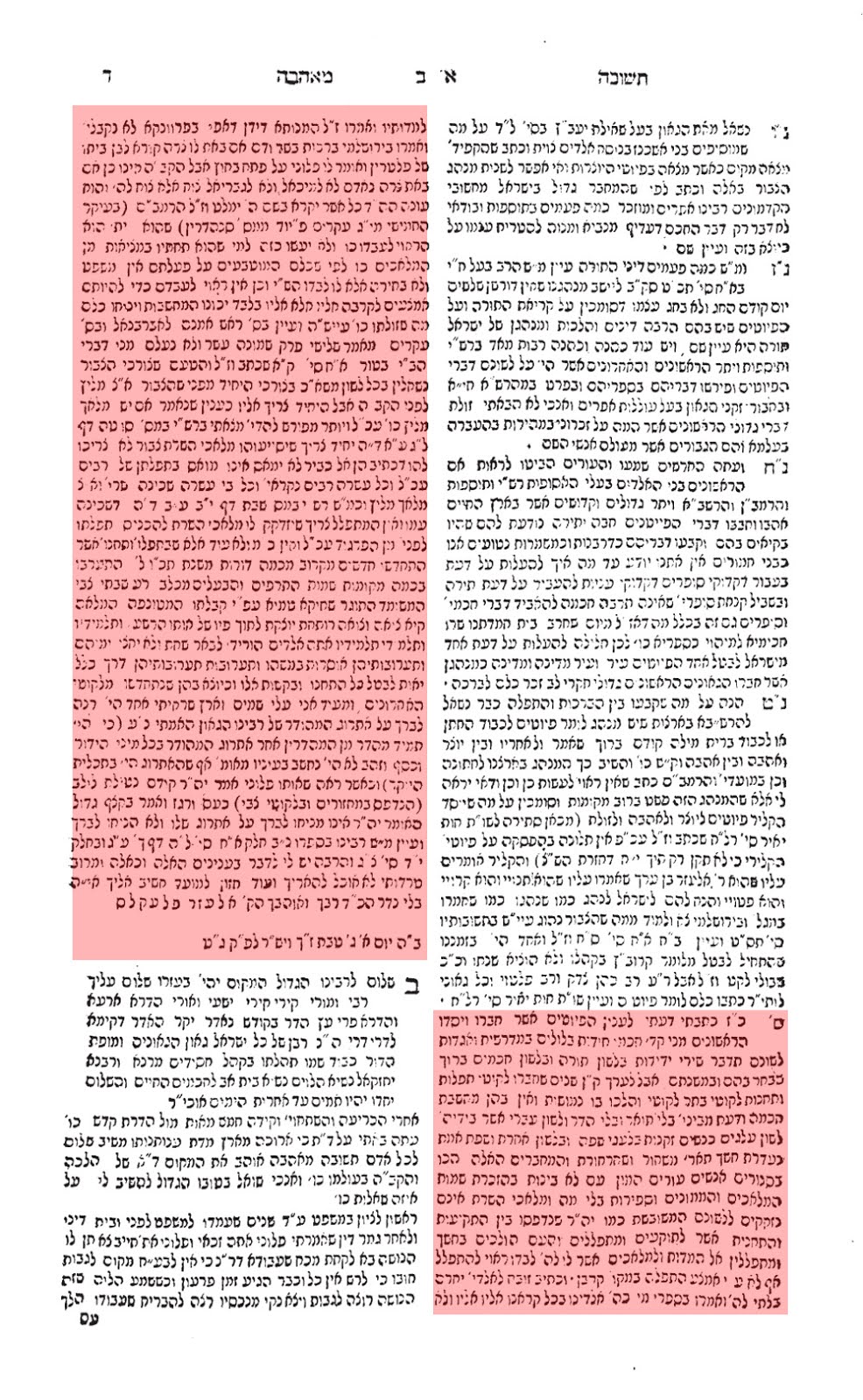
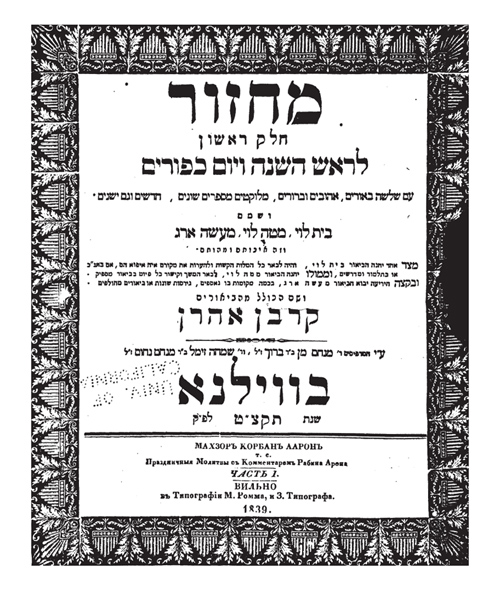
This Teshuvah was printed in various Machzorim at the time and that is where these parts of the teshuva were indeed bowdlerized. See the following images for the pages as they appear in the Korbon Aharon Machazor printed in Vilna in 1839 and compare with the first print of the teshuvah (Prague, 1809).
Amulet Broadsides
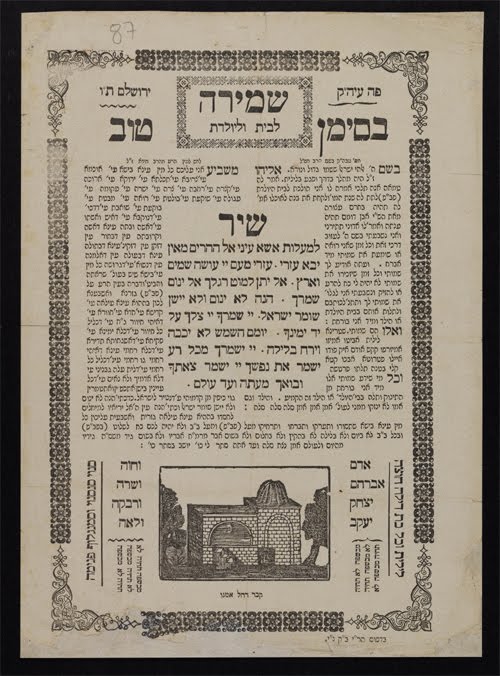

This image from Jerusalem 1870 (pp. 130-131) highlights another notable part of this collection – the Amulet section. It contains numerous broadsides against the “evil eye”, aimed at protecting the newborn mother from Lilith and the like (pp. 132-135, 141-143, 194-197). This is yet an additional set of documents which demonstrate how widespread it was for people to use amulets and the fear of the “evil eye” and the like.
There are numerous sources on regarding amulets, some mentioned here.[16] One source, that was only recently published in English, is from a fascinating memoir by Pauline Wengeroff, who writes: “for the same purpose of protecting the newborn, Jews used to affix kabbalistic prayers called shemaus over the head of the new mother, a second page on the door and a third between the cushion of the child.”[17]
Controversy against R’ Shlomo Ganzfried – Author of Kitzur Shulhan Aruch

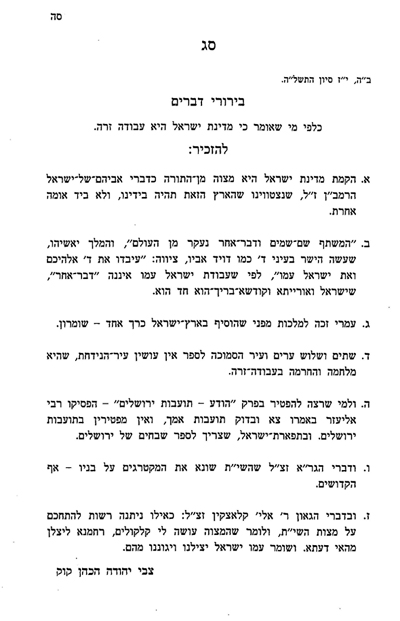
This document relates to a controversy between R’ Shlomo Ganzfried and the R’ Chaim Halberstamm, the Divrei Chaim. In his work Ohali Shem on Gittin, R’ Ganzfried took issue with some legal rulings of the Divrei Chaim. This erupted into a series of small works from R’ Weber, starting in 1882, defending the honor of the Divrei Chaim. R’ Ganzfried responded to one of them in the back of the 1884 edition of his Kitzur Shulchan Aruch.
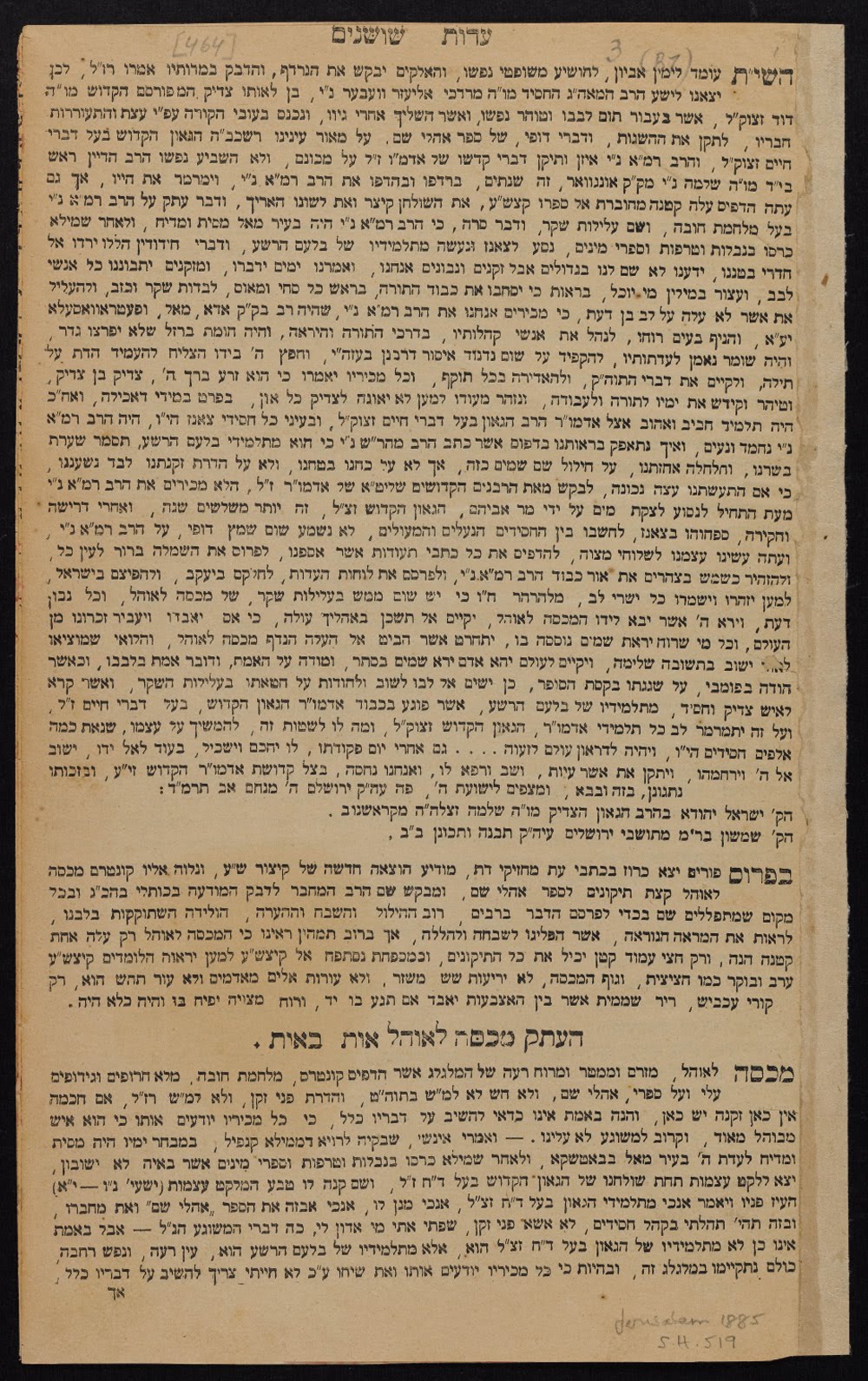
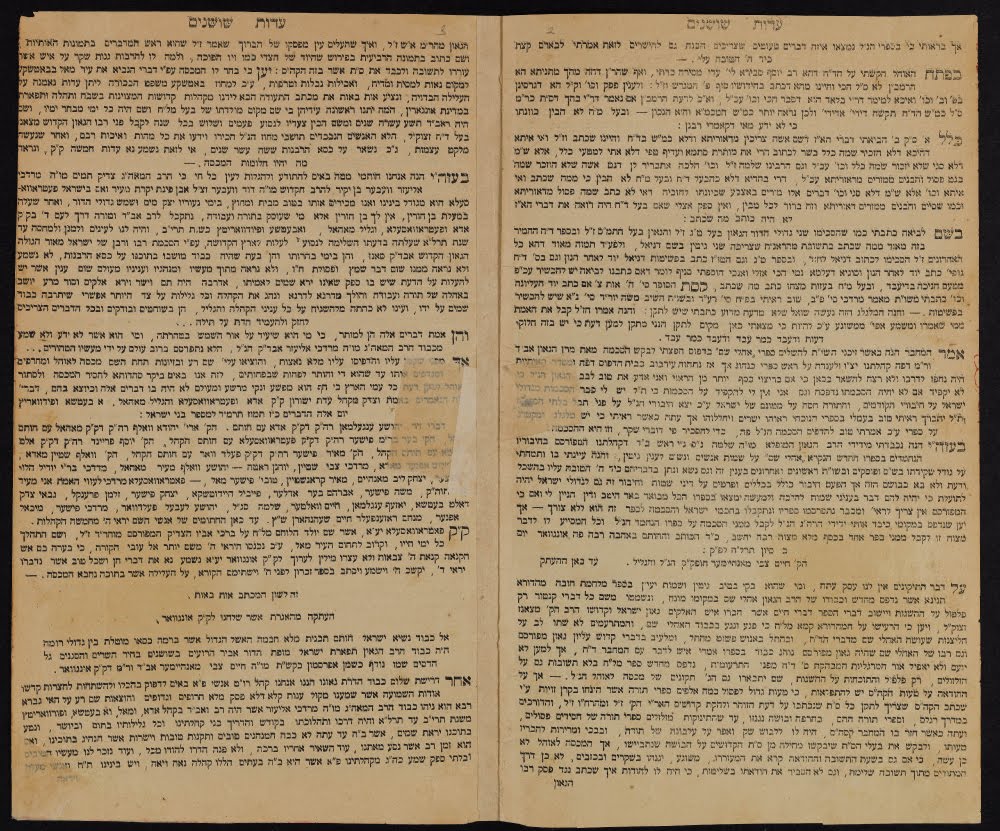
This broadside (above) from R’ Weber against R’ Ganzfried, found in the Valmadonna Collection, is very rare (p. 217 #360).[18] 
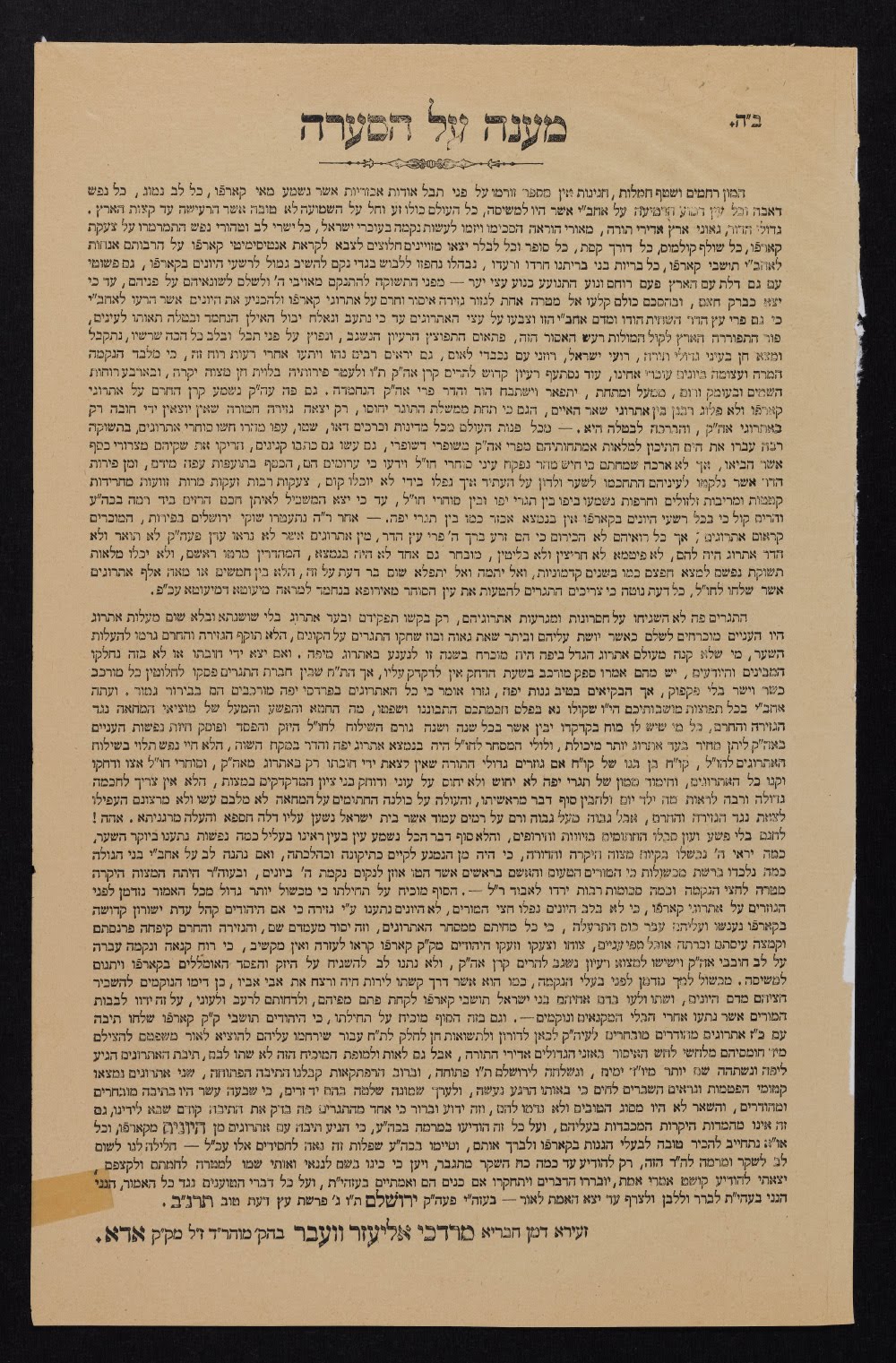
The Valmadonna Collection has another rare broadside from R’ Weber (below), related to the famous controversy of the Corfu Esrogim (p. 219 # 369).[19] This is not included in Naftali Ben Menachem’s otherwise comprehensive article regarding R’ Weber.

Regarding this broadside, it’s worth quoting the great historian[20] and native of the Old Yishuv, Eliezer Malachi:
ור’ מרדכי אליעזר וובר, הרב דאדא, זה האחרון היה אש לוהטת, ובקנאותו לא ידע גבול, עד שבשנת תרנ”א אסרו את אתרוגי קורפו לטובת אתרוגי ארץ ישראל, נלחם הוא להתיר אתרוגי קורפו ולאסור את אתרוגי ארץ ישראל שגדלים בפרדסי המושבות של חובבי ציון [מנגד תראה, עמ’ 225].
The volume is beautifully produced, the reproductions are excellent, and is available in a larger format “coffee table” size. This is a great volume, for collectors of books and history. It is available for purchase here and at the YU Seforim sale here.

[1] The Otzar Ha-Hochma database should be commended for including some auction catalogs in its archive, and even some broadsides, which will provide at least fragmentary information regarding the existence of these invaluable documents.
[2] This essay does not appear in Ta-Shema’s four volume collected writing, it is unclear why it was excluded. 
[3]  For more on this see: Eliezer Brodt, Likutei Eliezer, pp. 11-12.
[4] We discuss two broadsides related to the election of the Vilna chief rabbi between R. Hayyim Ozer and R. Y. Rubenstein (here).The Israel Musuem mounted an exhibit of broadside regarding Haredim.  See Pashkevilim, Wall Announcements and Polemic Posters in the Ultra-Orthodox Street, Israel Museum-Yad Ben Tzvi, Jerusalem: 2005 (Hebrew). This volume contains a number of introductory essays, and germane here, Menachem Friedman’s essay “The Pashqevil (Pasquinade) and Public Wall Poster/Bulletin Board Announcements in  Haredi (Ultra-Orthodox) Society” is especially important, although it is not cited in the Valmadonna volume.
[5] See the lengthier treatment of the topic in her book, Elisheva Carlebach, Jewish Calendar and Culture in Early Modern Europe (Cambridge, Mass.: Belknap Press of Harvard University Press, 2011.
[6]  See also p. 210 # 332.
[7]  On this great person, it is well worth quoting Professor Yaakov Sussman’s assessment in a footnote, in a book-length (175 pp) essay – one of the most important ones written in the past decade on the writing of Torah She-Bal Peh – where writes:

מסה מרשימה ביותר בבקיאותו, בחריפותו, בפלפולו בתקיפותו של המחבר לאורך כמאה עמודים גדושים, שבה סיכם כמעט כל מה שנאמר לפניו בנושא… בתשובה זו מתגלה המחבר כחכם בקי, תמים ובעל חושב ביקורתי כאחת, שכל רז לא אניס ליה, לא בספרות הרבני ולא במחקרי זמנו, והוא מצליח לגייס את ידיעתיו להגצת עמדתו… ואין פלא כלל שתשובה מרשימה זו כבשה במהרה את הלבבות והייתה למילה אחרונה בנושא ודעתו נתקבלה כמעט על כל החוקרים [מחקרי תלמוד, ג, עמ’ 235].
[8]  See Mofas Hador, pp. 37-40. See also Yerushaseinu 5 (2011), pp. 265-299; R’ Betzael Landau (here).
[9] We doubt that the composer was Jewish or the text was intended for a Jewish audience. Instead, similar odes – in Hebrew and the subject is Christian – appear in a number of Latin translations of Hebrew texts. See, for example, Coccejus’ Latin translation and abridgement of tractates Sanhedrin and Makkot, includes Hebrew poems in his own honor and that of his teacher. Duo Tituli Thalmudici Sanhedrin et Maccoth, ed. Joanne [Coccejus], Amsterdam, 1629, unpaginated introduction.
Another notable example of clerical citation is Cardinal Egidius de Viterbo who appears in Elijah Levita’s works.  See Solomon Buber, Tolodot Eliyahu ha-Tishby, Leipzig, 1856, nn. 15-18.
[10]  For more sources on this, see: Rabbi Oberlander, Minhag Avosenu Beyadneu, (Shonot), pp. 11-19; R’ Yechiel Goldhaber, Minhaghei Hakehilot, 1, pp. 174-175; Eliezer Brodt, Yerushaseinu 2 (2008), pp. 203-204; Rabbi Y.M. Dubovick, Minucha Sheleimah (2014), pp.26-27.
[11] The full document is translated in the appendix of the book (pp. 288-290).
[12] For additional sources on this subject, see S. Assaf, Mekorot le-Tolodot ha-Chinuch be-Yisrael, s.v. makot.
[13] Coenen’s book is a very important contemporaneous account of the messianic fervor surrounding Tzvi.  The book was translated from Dutch into Hebrew, Tzepiot Shav shel ha-Yehudim Kefi she-Hetgalu be-Demuto shel Shabbati Tzvi, Merkaz Dinur, Jerusalem, 1998. 
[14]  On this see: R’ Yechiel Goldhaber, Minhaghei Hakehilot, 2, pp. 31-33; Eliezer Brodt, Yerushaseinu 2 (2008), p. 211.
[15]  See R’ Yechiel Goldhaber, Minhaghei Hakehilot, 2, pp.61-65, where he traces how far back the custom of saying these Tefilos can be dated. See also Eliezer Brodt, Yerushaseinu 2 (2008), p. 214. The main work on this subject, collecting vast material, is R’ Chaim Kraus, MiChalkel Chaim Bechesed 2, (1982). See also R’ Zev Rabinowitz, Sharei Toras Bavel, p.12; R’ Chaim Lieberman, Ohel Rochel, 1, pp. 511-515; Y. Leibes, Mechkari Yerushalayim Bimachshevet Yisrael 6 (1986), pp. 171-195.
[16]  See also Eliezer Brodt, Likutei Eliezer, pp. 13-22, 69-72; Jewish Magic through the ages: Angels and Demons, edited by Filip Vukosvoviv, Bible land Museum, Jerusalem 2010.
[17]  Pauline Wengeroff, Memoirs of a Grandmother, 2, 2014, p. 89.
[18] On R’ Ganzfried, see R’ Y. Rubinstein, HaMayan 11:3 (1971), pp. 1-13; ibid. 11:4. pp. 61-78. See also Naftoli Ben Menachem, HaMayan 12 :1 (1972) pp. 39-42.  On this controversy, see R’ Rubenstein, ibid. pp. 10-11. On R’ Weber, see Naftoli Ben Menachem, in: Studies in Jewish bibliography, history, and literature in honor of I. Edward Kiev, Charles Berlin (editor), New York 1971, pp. 13-20. On this broadside, see Shoshanna Halevy, Sifrei Yerushlayim Ha-Rishonim, p. 188. On the other works by R’ Weber related to this issue, see ibid, pp. 156-157, 186-187, 219-220. See also Moshe Carmilly, Sefer VeSayif, pp. 264-265.
For an additional controversy between the Divrei Chaim and R’ Ganzfried see David Assaf, HeTzitz Unifgah, (2012) pp. 362-367.
About R’ Ganzfried and Chasidim, see Heichal HaBesht 3 (2003), pp. 105-117. For more on the Divrei Chaim’s methods of Pesak, see Iris Brown, Rabbi Hayyim Halberstam of Sanz: His Halakhic Ruling in view of his Intellectual world and the challenges of his time, (PHD Bar Ilan University) 2004 (heb.).
[19]  This is the subject of a future article. For now, see R’ Yosef Zechariah Stern, Zecher Yehosef, siman 232.
[20]  About Malachi, see Jacob Kabakoff, “Some Notable Bibliographers I have Known”, Judaica Librarianship, Vol.11 :1-2, (2003), p. 67-75.


New Writings from R. Kook and Assorted Comments, part 4

New Writings from R. Kook and Assorted Comments, part 4
Marc B. Shapiro
Continued from here.
Returning to the issue of creation, I found an interesting comment in R. Hayyim Hirschensohn’s commentary on Rashi, Nimukei Rashi. For those who are unaware of this commentary, I recommend that you examine it. You can order a bound copy (even soft-cover) very cheaply at hebrewbooks.org. I think that this is one of Hirschenson’s greatest works.[1]
In his comment to Gen. 1:13 Hirschensohn writes that belief in eternity (which here apparently means eternal matter in the Platonic sense, not an eternal universe in the Aristotelian sense) is not heretical, just foolish. He explains that something foolish by definition cannot be heretical, and gives an example: If you say that 2+2=5 this is false, but it is not heretical. It would be interesting to develop this theme further, and to see to what conclusions it takes you.
Also regarding creation, see his comment to Gen. 2:6 where he explains how evolution fits in with Torah, and where he differs with Darwin.[2] He sees support for his view in Rashi, although he acknowledges that Rashi himself didn’t have evolution in mind. Rather, one can explain Rashi in accord with modern views even though Rashi himself had no knowledge of modern science. Here is an example where a book, in this case Rashi’s commentary, is explained with no concern given to original intent, the notion being that a book has a life of its own and is not bound to the interpretations of its author. I cited material on this theme in Studies in Maimonides, and there is a good deal more I can add from traditional Jewish writings. (In my Hakirah response to Buchman, I promised to explore this issue in a future Hakirah article).
Here is Hirschensohn’s passage:
אל יחשוב הקורא שדעתי שרש”י ז”ל ידע מענין ההתפתחות והי’ לו שיטה מצוינה מיוחד בזה, שאהי’ בזה לצחוק לכל שומע, אמנם דעתי שרוח הקודש הופיע בבית מדרשו ופירושו בהפסוקים מתאימים לפרש על ידיהם שיטות פילוסופיות וטבעיות לפי אמתתם
Quite apart from his main point, I find Hirschensohn’s opening words here fascinating. We get a sense of whom he felt he was writing for when he says that if he were to claim that Rashi knew of the most advanced scientific thought, that it would be regarded as laughable. I think that even today if someone were to attribute prophetic-like scientific knowledge to Rashi, there are some circles where this would not occasion laughter, but great respect, on the assumption that as with Hazal, Rashi’s knowledge in these matters is all-encompassing.
I could have an entire post on the provocative material in Nimukei Rashi, but let me just give a couple of more examples. In his commentary to Gen. 4:16, Hirschensohn says that prophets can make mistakes, just like the rest of the people of their time. He says that they can even make such errors when it comes to principles of faith:
כי לא כל הנביאים ידעו הפילוסופיא האלקות האמתית . . . יכולים לטעות בטעותים אשר בני אדם בדורם טועים
He applies this insight to prophets who lived before the giving of the Torah. However, those prophets who lived after the Revelation at Sinai and were able to study Torah in a proper philosophical fashion were spared these types of errors.
ורק נביאי ישראל אשר למדו תורת ה’ עמדו מן התורה ומן החכמה ודעת על אמתת הפילוסופיא האלקות . . . כי הנבואה לא בא להודיע רק את הדבר אשר הודיעה מפורש ובשאר דברים יכול האדם להשאר בטעותיו הקדומים ורק התורה עם החכמה והדעת המה מודיעים את האמתית [!] ועקרי האמונה והפילוסופיא . . . כי הקב”ה חפץ שהאדם יהי’ דורש למצא את האמת לא ליתן לו את האמת בנבואה בלתי דרישה וחקירה.
In a previous installment of this series I dealt with Maimonides’ view that prophets can make errors, with the proof being how Ezekiel’s prophecy was based on incorrect science. I also noted Ralbag’s claim that one of Abraham’s prophecies contained an error. In other words, Hirschensohn’s basic point has an honored precedent.
However, as far as I know, no one prior to Hirschensohn claimed that prophets could make errors in basic theological points. Yet Hirschensohn’s argument is very strong, for his proof is from Cain. Cain must be regarded as a prophet, as God spoke to him. Yet Cain also erred in a basic theological point, as he didn’t think that God’s knowledge was all-encompassing. This incidentally illustrates why according to Maimonides the entire Cain and Abel story cannot be understood as historical. While Hirschensohn is able to say that “not all prophets knew the true divine philosophy,” for Maimonides this is the basis of prophecy and the only way it comes about. The notion that Cain, or Adam for that matter, could have developed his mind philosophically in order to achieve prophecy is obviously not a serious proposition. Therefore, according to Maimonides, it is clear that God never spoke to Cain. In other words, from Maimonides’ perspective the story never actually happened, and must be understood as a philosophical or moral tale.
This interpretation of Maimonides is nothing new. Lawrence Kaplan has already noted that the standard commentaries on Maimonides’ Guide—Efodi, Shem Tov, Falaquera, Ibn Caspi, and Narboni—leave little doubt that in their mind Maimonides’ position is that the births of Cain, Abel, and Seth are to be understood allegorically.[3] When it comes to the Cain story I think the matter is fairly clear-cut, for if a brute like Cain can be regarded as a prophet this would contradict Maimonides’ entire philosophical understanding of what prophecy is.
R. Hananel Sari makes an interesting point that is relevant to what we are discussing.[4] He calls attention to the fact that matters which Maimonides does not regard as having been real historical events are treated as such, for educational or spiritual purposes, in the Mishneh Torah. Maimonides himself writes about how this was the practice of ancient courts in dealing with the Wayward Woman (Hilkhot Sotah 3:2):
ומגידין לה מעשה יהודה ותמר כלתו, ומעשה ראובן בפילגש אביו על פשטו
Sari offers two examples of this phenomenon in Maimonides’ writing. One is the story of the angels coming to visit Abraham, which Maimonides famously understands to have taken place in a dream. Yet from Hilkhot Evel 14:2 the reader would assume that Maimonides understood this event to have actually occurred. The second example Sari offers relates to Cain and Abel. According to the standard medieval commentators to Guide 2:30, Maimonides understands the Cain and Abel episode allegorically. Yet as Sari points out, in Beit ha-Behirah 2:2 Maimonides treats the Cain and Abel story as historical: והוא המזבח שהקריב עליו קין והבל
In fact, it is not only in the Mishneh Torah that we find the phenomenon Sari discusses, but in the Guide as well. Thus, while in Guide 2:42 Maimonides tells us that the entire story of Balaam and the donkey happened in a vision, in Guide 2:6 he speaks of the movements of the donkey as if this was an actual event.[5]
With regard to the story of Cain and Abel, Shalom Rosenberg has explained how Maimonides understood it allegorically:
Cain and Abel embody two types of life which epitomize the fullest development of human potential in man before he has reached his rational level. Maimonides refers here to the legend which says that before Adam begat his third son, Seth, his children for 130 years were demons.[6] For Maimonides, there is no doubt that the demons mentioned in this legend are none but Cain and Abel. Both Cain and Abel stand, for Maimonides, as symbols of types of life which have not reached their full perfection. This is the meaning of demons. For what, after all, is a demon? A demon is created when reason and thought, which are devised for protecting man’s perfection, are exploited by all sorts of devices which produce evil consequences. Thus, Maimonides sees the existence of demons as the most widespread sort of existence, the existence of human beings who are endowed with reason, but use their reason for evil purposes. Thus, a demonic existence is that of Abel, who—as one of Maimonides’ commentators remarks—stands for the fool, or for foolishness. But Cain, too, stands for man who had arrived at many technological achievements, but the purpose of these achievements is evil. When this evil predominates, it becomes the source of murder and war. These are the devices of human reason when used for evil purposes.[7]
Herbert A. Davidson writes:
Maimonides had hinted that the scriptural story of the creation of adam has in view the bringing forth of the entire human species, in other words, mankind in general; that in the rabbinic account of the formation of Eve out of Adam’s side, the male aspect of the original Adam symbolizes the human intellect, and the female aspect, man’s nonintellectual nature; that the serpent’s temptation of Eve and Eve’s temptation of Adam are an allegory for the deflection of the human intellect by the lower faculties of the human soul; that the names of Adam’s first sons, Cain and Abel, have allegorical significance, and that there is significance in Seth’s being the son of Adam from whom the entire species is descended.[8]
In 2000 R. Nissim of Marseilles’ commentary on the Torah, Ma’aseh Nissim, ed. Kreisel, was published, and it too deals with Cain and Abel. R. Nissim states explicitly (p. 271):
וכן שלשה בני אדם: קין והבל ושת – משל. או אם נמצאו ונולדו לאדם, יש בקריאת שמותם רמז והערה לשלש שלמויות האדם.
I think everyone who reads R. Nissim’s commentary will conclude that his preference is for the first possibility, namely, the non-historicity of Adam’s three children.
* * *
1. In this post I referred to what I termed an anti-intellectual comment from R. Kook’s Shemonah Kevatzim. I noted the radical nature of this comment, as it places the Jewish masses, and their natural morality, on a higher plane than the talmudic scholars.[9] I also noted that it is not surprising that R. Zvi Yehudah, recognizing the subversive nature of the comment, did not publish it.
R. Ari Chwat called my attention to the fact that, unlike R. Zvi Yehudah, the Nazir actually published the same sort of comment in Orot ha-Kodesh, vol. 2, pp. 364-365 (=Shemonah Kevatzim 1:140). While here too R. Kook speaks of how the masses need the Torah scholars, again we see that it is actually the Torah scholars who have more to learn from the masses then the reverse. Note how R. Kook privileges the masses, not only when it comes to natural morality, but in a whole host of areas. We see here how R. Kook felt that excessive book learning, with all of its details, had a negative effect on the pure Jewish soul.
הצד הבריא של היושר מצוי הוא באנשים גסים יותר ויותר ממה שהוא מצוי במלומדים ומוסריים, בעלי מחשבה. יותר מובהקים הם המלומדים בדברים הפרטיים של המוסר, בחוקיו ודקדוקיו, אבל עצם הרגשתו זאת היא מצויה באנשים בריאים טבעיים, שהם הם המון, עם הארץ. ולאו דוקא בהרגשת המוסר השרשית עולה הוא ההמון על אנשי הסגולה. גם בהרגשת האמונה, הגדלות האלהית, היופי, החושיות, הכל אשר לחיים בדרך ישרה, בלתי מסוננת על ידי הציורות המלאים שכר אגמי נפש של הדעה והחכמה הוא יותר בריא וטהור בההמון
Again I ask, is this not incredibly subversive? Since the writings of the early hasidic masters, have any of our great sages written anything that so undermines the status of the rabbinic elite? I will have more to say about this, with additional citations in R. Kook’s writings, in future installments to this series.
While not going to the extreme of R. Kook, let me mention a couple of other non-hasidic examples where book learning is “put in its place”, as it were. The late R. Mordechai Elefant told the following story: R. Chaim Ozer Grodzinski once asked R. Elijah Hayyim Meisels, the rav of Lodz, why a man of his stature didn’t publish a book. R. Elijah got up, went into the other room, and came back with ledgers full of lists of widows and orphans whom he had helped. He told R. Chaim Ozer, “This is my sefer. All my life I was like you. I thought the important thing was to write a sefer on the Rambam. But as I got older, I realized this sefer is more important.”[10]
R. Hayyim Haikel Greenberg[11] recorded the same lesson in the name of another sage:
שבעת שהיה צעיר חשב שכל העולם זהו ספרים – ועכשיו לעת זקנותו העלפען א ארימע אלמנה אוף שבת און אאידען, וויכטיקער ווי אלע ספרים.
Greenberg mentions that after publishing this he was criticized by many important rabbis, but R. Jehiel Jacob Weinberg supported him:
מי כמוני שאוהב ספרים ומחברים וכל העולם שלי זהו רק ספרים – ואני אומר בפה מלא ובלב שלם יישר כח שהדפיס והעתיק זאת.
In speaking of opposition to book learning, here is a text that is simply unbelievable, and which I have never seen mentioned in the scholarly literature.
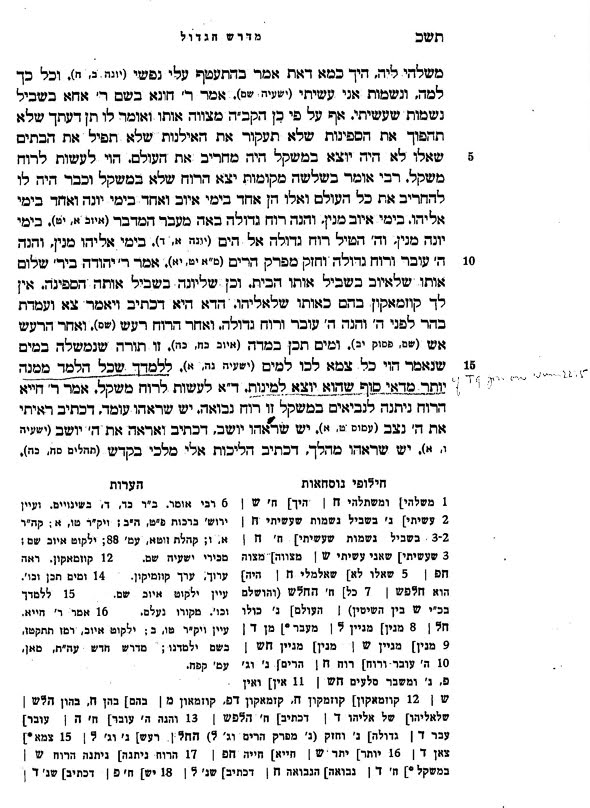
It is from Midrash ha-Gadol on Genesis (Mossad ha-Rav Kook edition). I don’t understand how the lesson is derived from the verse, but the lesson itself is clear enough: too much Torah study will lead to heresy. This is the sort of thing that one might expect to see in a medieval Catholic source, in justification of keeping the laity ignorant. Yet here we find the same attitude in a Jewish source. There are examples in rabbinic literature where we see that Torah study can have a negative result,[12] but I don’t know of any other text that is so blatant in its opposition to “excessive” Torah study. In the highly unlikely event that there are any high school students reading this who have been slacking off in Torah study, and have been challenged by their rebbe or parents to explain their inaction, see what happens if you pull out this text to explain matters.
I had seen this text a few years ago, and wanting to include it in the post I ordered the volume from interlibrary loan. The copy sent to me was from the University of Pennsylvania, and was originally found in the personal library of the late Dr. Judah Goldin. On the page we are looking at, Goldin underlined the strange passage (and also noted it on the first page of the book). On the side he added a reference to Targum Ps. Jonathan, Num. 22:5. Here it says that Balaam (who is identified with Laban) acted foolishly “from the greatness of his wisdom.” In other words, it was Balaam’s great wisdom that led to his thinking that he could curse the Israelites. Yet this passage only refers to Balaam’s general wisdom. It says nothing of Torah knowledge leading him astray.
With regard to R. Kook’s comments about the natural morality of the simple Jew, Joel Rich sent me chapter 4 of R. Soloveitchik’s Reflections of the Rav, ed. Besdin. The chapter is entitled “The Profundity of Jewish Folk Wisdom,” and is well worth reading. Yet you don’t find in R. Soloveitchik the notion expressed by R. Kook, that the natural morality of the simple Jew is superior to that of the scholar. For R. Kook, the simple Jew has something that the scholar does not have, and the scholar has that which the simple Jew lacks (halakhic knowledge). In this way, each can learn, and indeed is dependant, on the other. In dialectical fashion, the result of this will be a new type of Jew who combines in himself the best of both the scholar and the simple Jew. This is parallel to R. Kook’s discussion of the role of the non-religious. In the creation of the new Eretz Yisrael Jew the non-religious have that which is lacking among the religious, namely, the attachment to the physical world and the strength which Jews used to have when they lived on the Land, but which was forgotten during the long Exile. So the non-religious will bring that to the table, and the religious Jew will obviously bring Torah and spirituality. The result with be a synthesis of the two and the creation of an Eretz Yisrael Jew who, while being both Torah observant and spiritually enlightened will also be strong physically, able to build roads and fight wars. This is how Jews lived in days of old and how they are supposed to live when they return to the Land of Israel.
While R. Soloveitchik might have been attracted to dialectical-type thinking, there was no way that he would see the masses as having anything to give the halakhic scholar. The most the Rav speaks of in this essay is that the common man, even in his speech, reflects Torah values, but not that he is superior in any way to the learned ones.[13]
In this essay the Rav offers a beautiful interpretation of the aggadah in Niddah 30b that before birth a fetus learns all of the Torah and then forgets it when he is born:
Rabbi Simlai is apparently saying that every Jew comes into the world with a natural responsiveness to Torah teaching. Every Jew begins with a share in Torah was vested him before his birth, and, though he is made to forget it, it is preserved in the deep recesses of his soul, waiting to be awakened by study and a favorable environment. Scholars, of course, convert this latent knowledge into actual living knowledge; but the simple Jew also has a share. Some members of the Massorah[!][14] community are scholars whose knowledge is well formulated and codified, while others, though unlearned, may be endowed with inspired and intuitive Torah wisdom . . . [W]hen a Jew studies Torah, he finds it native to his spiritual personality and he responds to it readily.
R. Shalom Messas[15] also offers an interpretation of this Aggadah. According to him, it means that before birth God planted in the fetus the ability to study all of the Torah. The angel, who causes him to forget, represents the yetzer hara which distracts people from studying Torah[16]:
אלא האמת דאין כאן לא מלאך ולא שו”ד, והכל רמז ומשל בעלמא, והכוונה היא כמו שאמרנו, שבשעה שיצר השי”ת את העובר, נתן בו כחות עצומים באופן שיכול לעתיד ללמוד כל התורה אם ירצה . . . ויש בכחו ללמוד את כולה, וכשיוצא לאור העולם בא מלאך הוא הטבע, שכאשר מתחיל לצמוח מתערב עמו היצה”ר ומראה לו יופי הטבע והבריאה ונמשך אחריהם, ומעכבים עליו מללמוד תורה
This, too, is a beautiful perspective. I think people will therefore be surprised to learn that R. Messas was actually criticized by two separate authors, each of whom thought that his allegorical understanding of the Talmud was incorrect. In their opinions the Talmud should be taken literally, that the child really does know all of the Torah. Both of these authors refer to a “yeshivishe story” (with minor discrepancies between them) about how a certain baby was born knowing all the Torah, and from the moment of his birth began “talking Torah.”
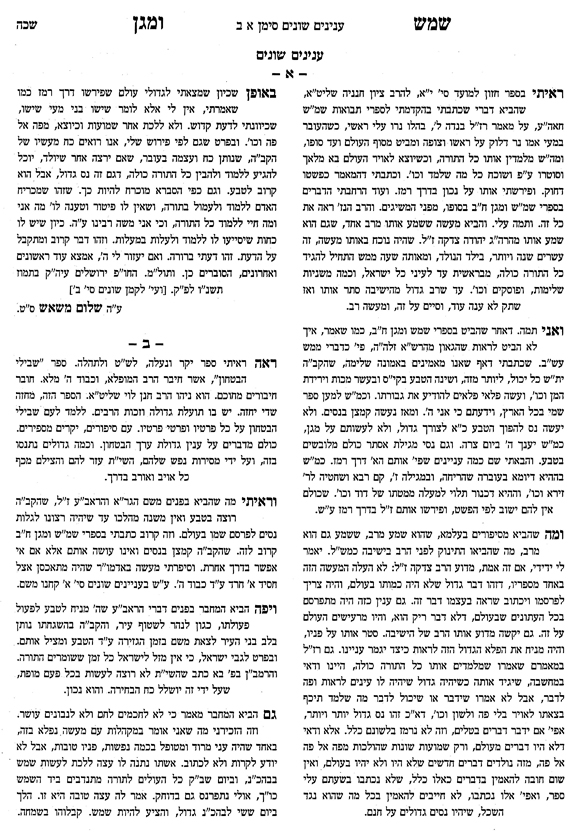
I always wonder when I hear Torah knowledgeable Jews repeat such nonsense as this yeshivishe story. What does this say about the Torah they learnt that they can be so gullible? I think the best we can say is that there is a difference between having book knowledge and being wise, and it is the latter that appears to be in such short supply. R. Messas replied to one of the authors in Shemesh u-Magen, vol. 2 pp. 322ff, and here is his reply to the second one, from Shemesh u-Magen vol. 3, p. 325.
I think R. Messas deserves a lot of credit for responding in such a polite fashion. Yet I have no doubt that if you spoke to him privately about this, his words would be much harsher in reflecting on how Torah students can be so foolish in believing such nonsensical stories.[17]
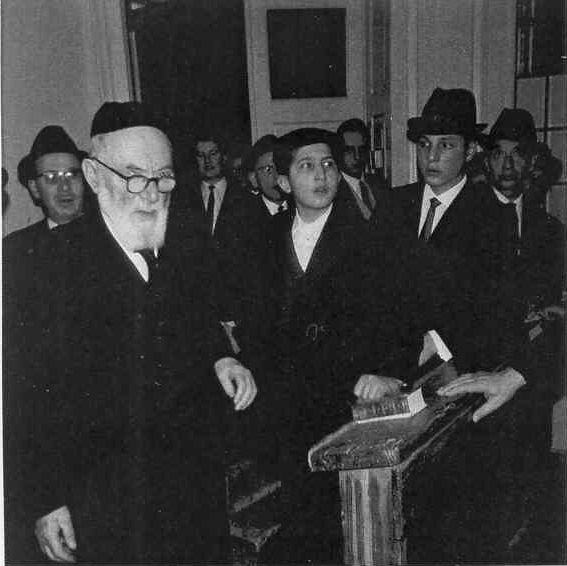
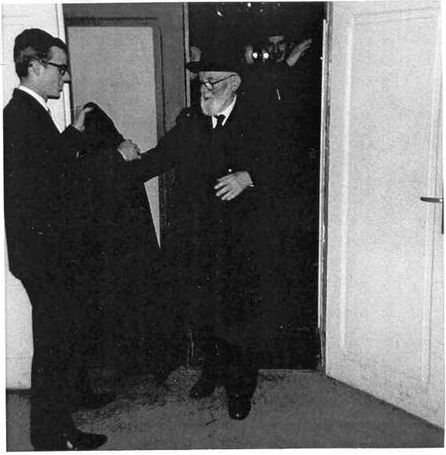
2. I have often been asked if I have pictures of R. Jehiel Jacob Weinberg. As a matter of fact I do, and here are two that I was given by Moshe Weisz of Zurich, who in the 1960’s was a student in the Montreux yeshiva. In the second picture, Weisz is the one handing Weinberg his coat.
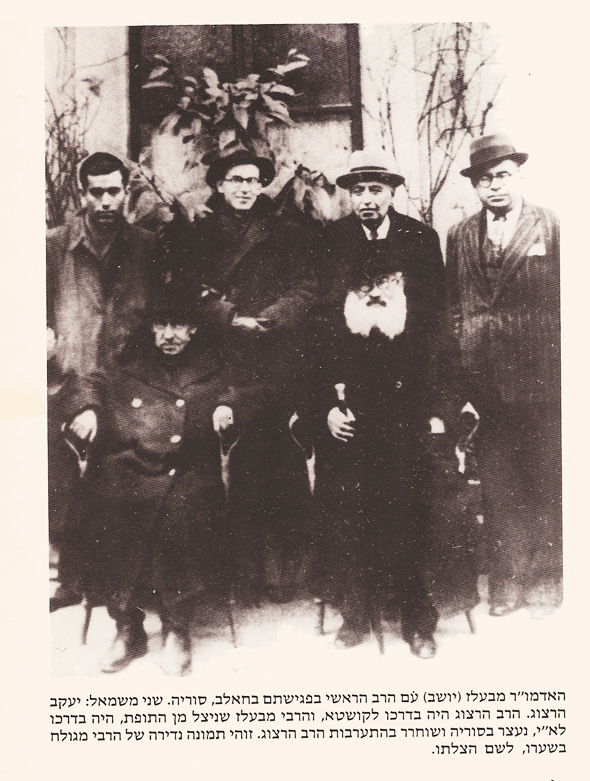
There is actually an amazing picture of Weinberg from his time in the prisoner of war camp. I would have loved to include this in my book, but the person who showed it to me refused to allow me to do so. He didn’t think it was respectful to a great Torah sage for people see him in this state. Yet why is this disrespectful? How was Weinberg supposed to look in such circumstances? Was he supposed to have a black suit and hat? Obviously, Jews did not look their normal selves during the years of the Holocaust. Here, for instance, is a picture of the Belzer Rebbe, R. Aharon Rokeach, with R. Herzog. It appears in Shaul Maizlish, Rabanut be-Sa’arat ha-Yamim, p. 61.
The Belzer Rebbe was one of those rebbes who, for religious reasons, did not like to have pictures taken of himself. Yet because R. Herzog exerted so much effort in order to secure permission for the Rebbe to enter the Land of Israel, he agreed to have his picture taken when R. Herzog requested this. (Or Yisrael 21 [5761]. p. 257). This last source also records the following great story, told by R. Aharon about his father, the previous Rebbe R. Yissachar Dov.
פ”א דיבר מרן מוהר”א מענין זה בשם אביו זצ”ל שאמר שבספר יערות דבש כתוב דברים חריפים אודות עשיית תמונה, אבל היות שכל היהודים אינם מקפידים ע”ז אין ברצוני להיות פרוש מהם, שכלם יהיו בגיהנום ואני יחידי יהיה בגן עדן, טוב לי להיות עם כלל ישראל ביחד
(Yes, I know that someone will point out the irony of R. Yissachar Dov saying that he would rather be in gehinnom with the Jewish people when his son chose precisely the opposite course, and left the gehinnom of Europe. Here is not the place to go into this story. Suffice it to say that I find Monday morning quarterbacking very distasteful. In this case it is even worse, as R. Aharon’s children and grandchildren were all murdered.)
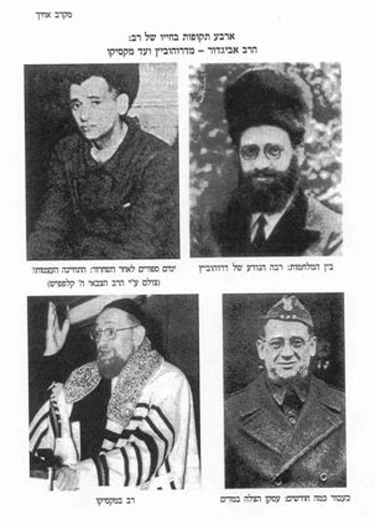
Here is a picture of R. Jacob Avigdor, whom I believe was a Belzer, from those difficult days (together with happier pictures).[18] Does anyone think this reduces him by showing how he looked during the Nazi years?
Incidentally, Moshe Weisz also told me about how in November 1965 Weinberg gave a hesped for four recently deceased rabbis, among them R. Yerucham Warhaftig and R. Eliezer Yehudah Finkel. These latter two were good friends of Weinberg, and Weinberg’s friendship with Finkel went back to their youth. After the eulogy Weinberg asked everyone in the room to stand up. They stood silently for around ten seconds and then he asked them to sit down. I presume this was intended as a show of respect rather than as a moment of silence, since the latter could be done sitting down.
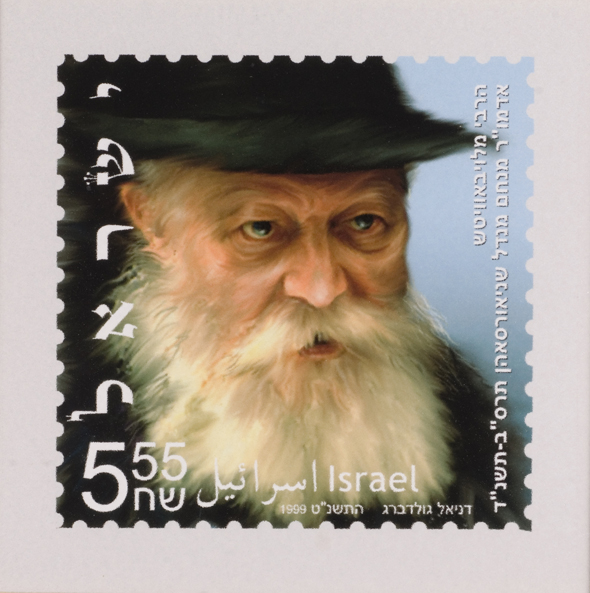
Since I have spoken about pictures in this post, let me also include this picture of the Lubavitcher Rebbe. It appears courtesy of the Library of the Jewish Theological Seminary, and I thank Rabbi Jerry Schwarzbard who first showed it to me a few years ago.
As you can see, it is an Israeli stamp from 1999, and it can now be added to Shnayer Leiman’s collection of stamps of rabbis.[19] Yet for some reason the stamp was never put into circulation. I have been unable to find the reason for this, and there is no mention of the stamp in Maya Balakirsky Katz’s recently published The Visual Culture of Chabad (Cambridge, 2010). There are many Lubavitchers who read the Seforim Blog. Perhaps one of you knows the story of this stamp and why it was never released.
As for Balakirsky Katz’s book, I urge Lubavitchers to read it, without preconceptions, and offer their opinions. It appears, to me at least, to be a quite interesting book. I stress the need for no preconceptions since Balakirsky Katz has now been placed by Lubavitchers in the “enemy camp”, along with other contemporary authors such as R. David Zvi Hillman z”l, David Kamenetsky, David Berger, Bryan Mark Rigg, David Assaf, Menachem Friedman, and Samuel Heilman. Balakirsky Katz angered Chabad with her recent article in the AJS Review 34 (2010; “An Occupational Neurosis: A Psychoanalytic Case History of a Rabbi”), and this article is summarized in the new book (but is only a very small part of the book). She argued that the Rebbe R. Shalom Dov Baer Schneersohn (Rashab) was the rabbi who visited the psychoanalyst Wilhelm Stekel in 1903. In those meetings the rabbi spoke about being sexually molested from his youth until his marriage. He also told about his sexual dreams and how he masturbated,[20] and described how his own brother carried on an improper relationship with his (i.e., the rabbi’s) wife (although it does not appear to have led to actual adultery).
I understand that Lubavitchers will regard Balakirsky Katz’s argument as beneath contempt. They will also regard as scandalous the fact that her essay was published in such a prestigious journal as AJS Review. I would not even ask them to dignify the argument with a response, any more than a non-Lubavitcher should be asked to respond to such claims about a close family member; for a hasid, the feelings for a Rebbe are just like those of a close relative. Yet there is a lot more to the book than the few pages dealing with the rabbi and Stekel, and I wonder how Habad insiders will appraise the rest of what she says.
Appendix
It is common to hear among YU figures the expression “hakhmei ha-mesorah,” referring to authoritative rabbinic spokesmen. Readers can correct me if I am mistaken, but I don’t think that this expression, with the meaning currently applied to it, is part of the traditional rabbinic vocabulary. I also don’t recall ever seeing it in haredi writing. (When the words appear in rabbinic literature they refer to Masoretes.) The first mention of it that I know of appears in R. Soloveitchik’s famous attack on R. Emanuel Rackman regarding nullification of marriage. Needless to say, the expression makes an appearance in R. Schachter’s new book, Divrei ha-Rav. See e.g., p. 233.
This latter reference is part of an article that R. Schachter earlier published in Beit Yitzhak 38 (2006). The reprint in Divrei ha-Rav has two changes from the original. On p. 237 a sentence is added, according to which the Rav stated that in Europe he never heard the expression “Daas Torah.” The second change is that one entire paragraph, on pages 5-6, has been removed. Here is the paragraph.
From this paragraph we see that the Rav’s strong personal opposition to prayer in a synagogue without a mechitzah was not shared by all other rabbis, and that the Rav was willing to show some flexibility in this matter. The case discussed here was not like the other times that the Rav gave permission for a rabbi to take a position at a synagogue without a mechitzah. In those cases the heter was for a rabbinic appointment designed to be for a few years, and during that time the rabbi was supposed to try to convince the synagogue to install a mechitzah. The issue discussed in the Beit Yitzhak article was simply a High Holiday position at a non-mechitzah synagogue in order to make some money.
This paragraph provides important testimony that can balance some of the Rav’s more strident statements in this matter. If anyone can get a straight answer from R. Schachter as to why the paragraph has been removed, please share it with us. I would hate to think that we have here an example of revisionism—in other words, R. Schachter decided to delete the paragraph because he concluded that it is best that people not know this information, or he was responding to others who criticized him for including the paragraph.
With regard to the larger issue of how R. Schachter presents the Rav, Lawrence Kaplan has already noted that there are revisionist aspects of R. Schachter’s presentation of the Rav’s legacy. See his “Revisionism and the Rav,” Judaism, summer 1999, available here.
One aspect of this revisionism that Kaplan does not mention is that while Nefesh ha-Rav has an entire chapter on the State of Israel, there is no mention of the Rav’s view—which was expressed on a number of occasions, as well as publicly before hundreds of people—that there is no halakhic prohibition for Israel to return land to the Arabs.
It certainly says something about the transformation of American Orthodoxy in the last generation that R. Schachter became the one to carry on the Rav’s legacy. Unlike the Rav, R. Schachter is a talmudist and posek, and has no involvement with the broader philosophical and cultural issues of Western Civilization. Yet despite this, he is, by far, the most important and influential rabbi in Modern and Centrist Orthodoxy. When it comes to matters of halakhah, I wonder if there is anyone in the American haredi world who can compare to his wide-ranging knowledge. I have heard him in person and on tape many times, and I continue to be amazed at how he can speak for long periods, without notes, on literally any topic of halakhah. I have never seen anything like it. It is all at his fingertips, and he presents it in a fashion that keeps the audience’s attention. As for the liberal Orthodox, who oppose R. Schachter because of his strong stand against feminist innovations, even they must applaud his leading role in dealing with husbands who refuse to give their wives gittin. This has earned him the opprobrium of the Orthodox lunatic fringe, and one member of this group, Abraham Samuel Judah Gestetner, who styles himself a dayan, has even placed R. Schachter in herem (together with two well-known California rabbis). See here.
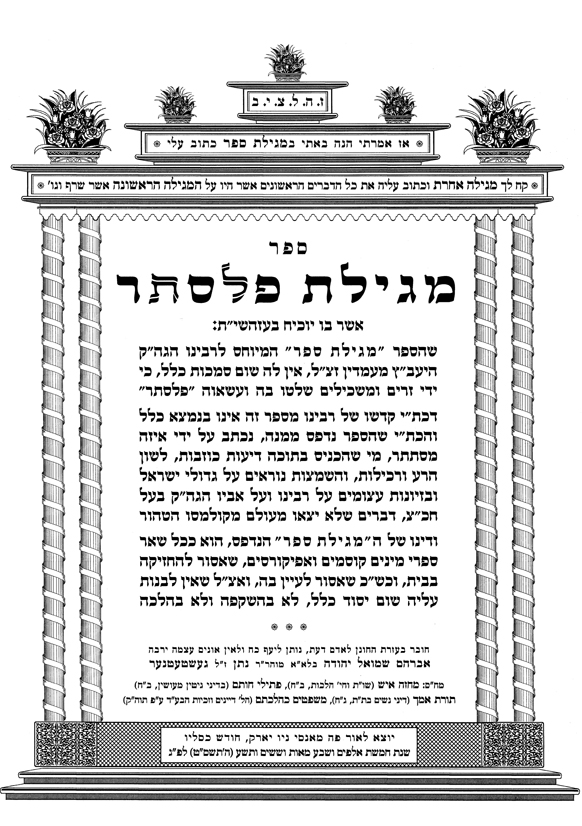
Gestetner is also the author of the ridiculous book Megilat Plaster, which attempts to show that R. Jacob Emden’s Megilat Sefer is a forgery perpetrated by the evil maskilim. Here is the title page.
His argument is completely demolished by R. Menachem Mendel Goldstein in Etz Hayyim (Bobov), no. 8(Shevat 5769), pp. 239-266. (Goldstein resides in that bastion of Haskalah known as Kiryas Yoel.). On the very first page of his article, Goldstein complains that the various publishers of Emden’s Megilat Sefer did not consult with gedolei Yisrael in order to determine what should have been censored. In other words, he takes it as a given that the masses need to be protected from what Emden has to say.
הספר מגילת ספר נדפס על ידי אינשי דלא מעלי שאין רוח חכמים נוחה מהם, ולא נתיעצו בגדולי חכמי ורבני דור דור האיך ומה להדפיס ומה להשמיט
To be continued.
[1] There is still a good deal more I plan to say about the whole Garden of Eden story. For now, let me respond to one question. We have seen the medieval philosophical approach that the episode with the snake is to be understood allegorically, and the snake represents the evil inclination. A few people want to know if we can find such an approach in Hazal. I actually think we can. In Pirkei de-Rabbi Eliezer, ch. 13 (referred to by Maimonides in Guide 2:30), it mentions that the serpent had a rider, Samael (Satan). Since at least some of the Sages identify Satan with the evil inclination, this opens the possibility that the snake in our story is also to be understood this way. Yet I think that most of the Sages probably understood the passage literally. For one example, see Bereishit Rabbah 19:1, where R. Hoshaya states that the snake stood up like a reed, and that he had feet. Whereas the medieval philosophers were reluctant to take literally a text that spoke of a talking snake (and donkey), this did not seem to bother the talmudic Sages.
[2] A fuller discussion of Hirschensohn’s view of evolution will appear in a future post. In the meantime, see his Seder la-Mikra, vol. 1, pp. 76-77:
אין השיטה הדארוונית מתנגדת כלל להתורה בדבר הבריאה בששה ימים, כי הימים בעצמם כל אחד הוא יום שכלו אורך תקופה שלמה . . . כי עדיין לא הי’ עוד השמש לאור יומם לראשון השני והשלישי ובכל זאת נקראים ימים וגם אחרי בריאת המאורות לא ידענו כמה לקח זמן התפתחותם לאותות למועדים לימים ושנים שלנו, ואריכת ימי בראשית לא נדע לנו שכל יום הוא תקופה שלמה
In another twenty years, I wonder if the younger generation will believe us when we tell them that Hirschensohn’s position was accepted throughout the haredi world, and was standard fare in the kiruv movement and in “science vs. Torah” discussions. There was a time when I, and so many others, would never have believed that “young earth” fundamentalism could ever become a binding principle of faith in the wider haredi world, precisely because it would mean rejecting a position that had been so central to the haredi Torah-science reconciliation.
[3] Link”Rationalism and Rabbinic Culture,” pp. 240ff.
[4] Mesorah le-Yosef 4 (2005), p. 183.
[5] This point was noted by Kaplan, Link”Rationalism,” p. 300 n. 225.
[6] See Studies in Maimonides and His Interpreters, p. 111.
[7] Good and Evil in Jewish Thought (Tel Aviv, 1989), p. 63.
[8] Moses Maimonides (Oxford, 2005), p. 407.
[9] See also my post here where I noted R. Itzele of Ponevezh’s statement that how the Jewish masses feel is more important than what the rabbis think: וכלל ישראל הוא גבוה ונעלה מגדולי התורה . This is obviously diametrically opposed to the haredi conception of Da’as Torah. In my Torah in Motion lectures I discussed how R. Itzele’s conception parallels the Catholic notion of “sense of the faithful.”
In addition to the passages of R. Kook referred to in my earlier post, there are many other sources that one could quote. One that comes immediately to mind is Haym Soloveitchik’s understanding of medieval Jews committing suicide. He sees this as an example of the “sense of the faithful” which was not in line with established halakhah, but which ex post facto had to be justified. Even the murder of one’s children to prevent them from being forcibly apostatized could not be judged according to halakhic texts, or else people regarded as kedoshim would lose this status, an untenable possibility under the circumstances of medieval Jewish life. See ‘Religious Law and Change: The Medieval Ashkenazic Example,’ AJS Review 12 (1987), pp. 205-221. Soloveitchik writes (p. 209):
The magnitude of this halakhic breach is enormous. Whether one is permitted to suffer voluntary martyrdom is highly questionable; suicide is forbidden beyond question, and the permissibility of murder needs no discussion. Thus, if the law were to be followed, the scholars of these communities would have had to rule that all the martyrs—qedoshim, or “holy ones,” as they were called—were not only not “holy,” but they were “self-killers,” and murderers; that not only should they not be buried with honor, but perhaps they should even be denied burial, or at best be buried in the far end of the cemetery where the most vile criminals are interred. Such a conclusion, needless to say, was an emotional impossibility.
After speaking of the “sense of the faithful,”—or what Jacob Katz and Soloveitchik describe as “ritual instinct,” “religious intuition,” and “religious sense”—this article concludes with a couple of paragraphs that I think readers will find very interesting:
I remember my own shock when, after studying Yoreh Deah, I realized that there is no need for separate milk and meat dishtowels, separate dishracks or cabinets, and that if food is served cold, there is no need for separate dishware altogether. Again, there is all the difference in the world between not having hamets in the house (בל יראה ובל ימצא) and the house being what we call pesahdiq.
The simple truth is that the traditional Jewish kitchen and pre-Passover preparations have little to do with halakhic dictates. They have been immeasurably and unrecognizably amplified by popular religious intuition. We all know this, but our religious sense, our religious experience belies this knowledge, and our instincts reject this fact out of hand. To serve cold cuts on a “dairy” dish is treif—everything in Yoreh Deah to the contrary notwithstanding.
The prevalent has not here expanded the normative, it is the normative, and anything less is inconceivable.
Upon hearing one of my TIM lectures, R. Yonasan Rosman sent me a nice example of how the “sense of the faithful” operates independently of, and sometimes even in opposition to, halakhic particulars. It comes from Making of a Godol, p. 1188:
My father also was fond of quoting an interpretation of the Mozhirer Maggid, R. Shmuel Rabinowitz, of the gemara in Massekheth Brakhoth that
כנור היה תלוי למעלה ממטתו של דוד וכו’ ומנגן מאליו
(a fiddle hung above the bed of King David, etc., and it played on its own) to mean that Jewry senses what policy is vital for its existence and does not probe whether the course of action (or inaction) is halakhically sound or not. One of the several examples he gave was by asking rhetorically, “Who gave the Slabodka Yeshiva bahurim the halakhic permission [היתר] to marry at so late an age?” and in answer, he paraphrased the gemara (which he translated into Yiddish), “און דער פידעלע שפילט פון זיך אליין (and the little fiddle plays on its own.”) He was out to prove that when some position is of crucial importance to Jewry—such as increasing the number of intelligent Jews getting in more years of Torah study before going off into their occupations—halakhic minutiae are set aside.
It is precisely sources like this, and the others I have quoted, that are crucial for anyone wishing to challenge the pan-halakhic understanding of Judaism that has taken root in Centrism.
(Regarding yeshiva students marrying later, see R. Shlomo Sofer, Hut ha-Meshulash [Munkacs, 1894], p. 7b, that in late eighteenth-century Frankfurt, yeshiva students would sometimes wait until age thirty to marry.)
[10] For R. Jehiel Jacob Weinberg’s essay on Meisels, see Seridei Esh, vol. 4, pp. 345-352.
[11] See Ahiezer: Kovetz Rabani-Torani, vol. 4 (1969), p. 17.
[12] Sotah 21b states: “R. Eliezer says: Whoever teaches his daughter Torah teaches her obscenity. . . . Read, rather: as though he had taught her obscenity” Rashi explains: שמתוכה היא מבינה ערמומית ועושה דבריה בהצנע
Meiri, Sotah 20a explains (and as with the Ralbag quoted in a prior post, apologies to the women reading): שמתוך הבנתה ביתר מגדרה היא קונה ערמימות מעט, ואין שכלה מספיק להבנה הראויה והיא סבורה שהשיגה ומקשקשת בפעמון להראות את חכמתה לכל
[13] There are, of course, many other differences between R. Soloveitchik and R. Kook. From the excerpt printed in The Rav Thinking Aloud, pp. 155-156, we see that the Rav regarded R. Kook as a saintly figure, but not as an intellectual great. Yet this impression was derived from one short conversation. All the gedolim who knew R. Kook had the exact opposite impression. They correctly saw that R. Kook was a master of the entire Torah, in all of its facets. I think you have to go back to Maharal, or perhaps even Nahmanides, to find such a wide-ranging Torah scholar as R. Kook.
Experts on the Rav’s writings can correct me, but the only place I recall where he mentions R. Kook is in On Repentance, p. 161 (and this was not actually published by the Rav himself, but by Pinchas Peli). See incidentally, ibid., p. 224, where the Rav states, referring to the State of Israel: “Bondage to the State can also become idolatry.” When this appeared in 1975, in the original Hebrew edition Al ha-Teshuvah, R. Zvi Yehudah Kook responded with a very sharp statement (later reprinted in Le-Hilkhot Tzibbur):
The Rav in turn said about R. Zvi Yehudah: “If you follow the philosophy of Tzvi Hirsch [!] Kook a Jew outside of Eretz Yisrael is a non-Jew. And this is exactly against the passuk of כי לי כל הארץ. A Jew outside of Eretz Yisrael can be a perfect Jew. Where you accomplish more is up to the individual. . . . Kook comes out with the Ramban [who says that mitzvah observance in the Diaspora is not at the same level as in the Land of Israel] as if he is the only one to whom the Ramban has entrusted the text.” The Rav Thinking Aloud, pp. 225, 229. See also, ibid., p. 154, where he says that R. Zvi Yehudah “has an aura of kedushah about him.”
[14] See Appendix.
[15] Introduction to his Tevuot Shemesh, Even ha-Ezer, and Shemesh u-Magen, vol. 2, p. 321.
[16] See also Maharsha, Niddah 30b.
[17] With regard to what else fetuses are said to be doing in the womb (aside from learning Torah), there is a very strange passage in Otzar ha-Geonim, Berakhot 28b (p. 71). I hesitate to elaborate on it lest this post be blocked by internet filters:
כשאדם כורע במודים צריך לו לכרוע עד ברכיו לפי שהילד בעודו במעי אמו ראשו מונח בין שתי יריכיו והמילה שלו בתוך פיו ובעבור זה צריך לשוח עד ברכיו.
[18] The picture comes from Esther Farbstein’s Be-Seter Ra’am (Jerusalem, 2002).
[19] See here.
[20] With regard to masturbation, R. Simcha Ross called my attention to the responsum printed here by an unnamed talmid hakham. He argues that masturbation is permissible. When Rabbi Ross first alerted me to this (and also expressed his disagreement with the arguments of the author), I thought this was some sort of Purim Torah. But then I examined the responsum, and other responsa on the site, and I could see pretty quickly that this was a serious man, whose arguments were carefully thought out. There are so many books published today that simply repeat what others have said, without offering anything new, that it is a pleasure to see original thinking, Based on his permission to masturbate, he also concludes that homosexual activity is permissible, as long as there is no mishkav zakhur. See here.
(This anonymous author has also placed on his website his commentary on R. Baruch Ber Leibowitz’s Birkat Shmuel, and also many posts discussing talmudic sugyot.)
I showed this responsum to someone. Yet instead of examining the arguments, all he was interested in was the identity of the author, who, as can be seen from various responsa on the site, is clearly from the haredi world. Maybe some readers know who he is, but I think that someone like this has to be in “deep cover.” We all know how the powers that be would destroy anyone who argued that masturbation is permissible. Since this involves a halakhic matter, I am certain the response would be even more severe than how they dealt with Slifkin and Kamenetsky. This talmid hakham would be branded not merely a heretic and a Reformer, but also a sexually dissolute degenerate. So yes, I understand why the author chooses to remain anonymous. My request to readers is as follows: The argument permitting masturbation is so far removed from anything I have ever seen that I would like those with more halakhic learning than myself to examine his teshuvah and let us know if you think there is anything to his argument.
Also, please look at other material on his site. Is it possible that instead of a “progressive” talmid hakham we are dealing here with a Trojan Horse? That is, someone who aims to undermine traditional Judaism from within, much like Saul Berlin attempted to do.


Chanukah Controversies, Customs and Scholarship: A Roundup & Update

Chanukah Controversies, Customs and Scholarship: A Roundup & Update

We are working on creating a better system to navigate past posts [please contact us at Seforimblog-at-gmail if you are interested in volunteering]. In the interim, here is a collection of Chanukah-related posts along with some new material:

(As an aside, the Seforimblog’s internal style guide uses the Ashkenazic transliteration of the holiday name. Nonetheless, each author has the freedom to use whichever they prefer.)

Controversies and Contested History

Nearly every aspect of Chanukah has sparked debate. The holiday’s most famous miracle, the oil burning for eight days, became the center of a 19th-century controversy involving the polyglot Chaim Zelig Slonimsky. Both Zerachya Licht (“חז״ל ופולמס חנוכה“) and Marc Shapiro (“The Hanukkah Miracle“) examine this dispute and whether the eight-day miracle was authentic or constructed. Licht explores Slonimsky’s fascinating life in greater detail in his two-part series on “Chaim Zelig Slonimsky and the Diskin Family” (part 1 and part 2). Slonimsky’s other Chanukah legacy, coining the Hebrew term sivivovon for dreidel, is discussed in this post (it pre-dated Ben Yehuda). Other linguistic terms are discussed with characteristic thoroughness by Mitchell First, tracing both “The Identity and Meaning of the Chashmonai” and “The Meaning of the Name Maccabee.” For an earlier treatment of the latter term, see Dan Rabinowitz’s post here. Meanwhile, the divergence between Ashkenazic and Sephardic practices extends even to the menorah lighting ritual itself. Zachary Rothblatt traces “The History behind the Askenazi/Sephardi Divide Concerning Lighting Chanukah Candles.” Reuven Kimmelman’s “The Books of Maccabees and the Al HaNissim Prayer for Hanukah” reveals how the liturgy itself represents a melding of different historical traditions.  While Marc covers another liturgical item,  a potential Maccabean Psalm (here), which opens another window into the holiday’s ancient textual layers.

Games, Mathematics, and Mythmaking

The dreidel’s supposedly ancient Jewish pedigree is thoroughly debunked in “April Fools! Tracing the History of Dreidel Among Neo-Traditionalists and Neo-Hebraists.” Despite persistent legends that brave Jews used dreidels to disguise Torah study during Greek persecution, the game has no such heroic origins. That hasn’t stopped it from generating interesting mathematical questions: which player has the best advantage? How long does a typical game last? Thomas Robinson and Sujith Vijay tackle the latter in “Dreidel Lasts O() Spins.”

Dreidel wasn’t the only Chanukah game. Card-playing customs are explored in “The Custom of Playing Cards on Chanukah,” which highlights an often-overlooked source for Jewish practice: Pauline Wengeroff’s Rememberings: The World of a Russian-Jewish Women in the Nineteenth Century.

Customs, Food, and Forgotten Practices

Many Chanukah customs center on food and celebration. Eliezer Brodt surveys these in “The Customs Associated with Joy and their More Obscure Sources,” and discusses the distribution of real and chocolate coins at the end of this post. But not all customs have survived or been remembered. Eliezer’s very first post for Seforimblog back in 2006, “A Forgotten Work on Chanukah, חנוכת הבית,” examined an obscure Chanukah text, Chanukas ha-Bayis, cited by Magen Avraham. (That initial post launched a prolific collaboration—Eliezer has since contributed dozens of articles, completed his Ph.D. dissertation on the Magen Avraham, and published many books.) His “The Chanukah Omission” identifies a missing tractate, with an update available in his recent talk here, along with a discussion of another lesser-known tractate that touches on Chanukah and involves censorship.

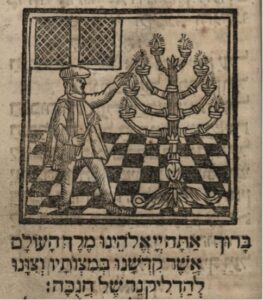
The Menorah in Text and Image

The menorah has been reproduced in countless forms, from the famous depiction on the Arch of Titus to manuscripts, printed books, and ephemera. Steven Fine’s The Menorah: From the Bible to Modern Israel (Harvard, 2016) offers the most comprehensive treatment of how this symbol shaped Jewish identity, and Fine continues to publish on the topic, recent articles are available on his Academia page. The exhibition catalog In the Light of the Menorah: Story of a Symbol (Israel Museum, 1998) contains excellent essays in both Hebrew and English, though oddly, the English version omits nearly all the notes. Another strange omission mars L. Yardeni’s earlier The Tree of Light: A Study of the Menorah (1971): Daniel Sperber notes in his Minhagei Yisrael (vol. 5, 171*) that Yardeni drew extensively on his Journal of Jewish Studies article but credited him only sporadically.

None of these works, however, addresses the menorah in early Hebrew printed books. For that, see our article “The Image of the Menorah in the Early Printed Hebrew,” along with the comments adding further examples.

New and Notable

Daniel Sperber has just published Mei Chanukah, a new work on the berita associated with Chanukah. Due to timing, it will likely only be available in Israel this year. If anyone knows of US distributors, please note them in the comments.

Not all recent scholarship meets the same standard. Akiva Shamesh’s review highlights serious deficiencies in Mitzva Ner Ish u-Beyoto. In another review, “Yemi Shemonah,” Shamesh addresses the “famous” Bet Yosef question: why eight nights of Chanukah rather than seven?

Sefer Minhagim, 1724, Gross Family Collection

Chanukah Samach!


A Compromise in Halacha – On Menachot 33a

A Compromise in Halacha – On Menachot 33a
By Eli Genauer
A common D’var Torah delivered at a wedding goes something like this: “Dear Chatan and Kallah. You are standing beneath a Chupah which is representative of the home you will build within the Jewish people. When you walk into your home, you will notice that that Mezuzah is placed in a diagonal position on the doorpost. There is a disagreement between Rashi and his grandson Rabbeinu Tam as to whether the Mezuzah should be affixed in a vertical or horizontal position. Later decisors ruled that a compromise between those two opinions was in order and therefore prescribed that the Mezuzah be affixed diagonally. This lesson of compromise is an important one as you embark upon you marriage and the Mezuzah on your door is an important reminder of this principle. Mazal Tov!”
This wedding Dvar Torah is based on a Gemara in Menachot 33a
אמר רב יהודה אמר רב, עשאה כמין נגר פסולה.
איני? והא כי אתא רב יצחק בר יוסף אמר כולהו מזוזתא דבי רבי כמין נגר הוו עביד……. ?
לא קשיא, הא דעבידא כסיכתא, הא דעבידא כאיסתוירא. 
Rav Yehuda says that Rav says: If one affixes a Mezuzah like a bolt, it is invalid. Is this so? But when Rav Yitzchak bar Yosef came ( from Eretz Yisroel ) he said that all Mezuzot in the house of Rebbe ( Yehuda HaNasi) were affixed like a bolt……? This is not difficult. This ruling (where it is ruled as being unfit) is where it was prepared like a peg; that ruling (in the house of Rebbe where it is ruled as being fit) is where it is prepared like an ankle. [1] 
Rashi explains that a “נגר” is something that is embedded in a wall “שתוחבין הנגרין בכותל”[2] 2. He then writes the word “כזה” and illustrates this with a drawing showing a horizontally placed Mezuzah. This is one of many times here that Rashi tells us something and then uses the word “כזה” which is then followed by a diagram. In this case, the illustration shows a horizontally affixed Mezuzah and it is a mezuzah affixed in this direction that is improper.
Rabbeinu Tam (תוס’ ד״ה “הא דעבידא כסיכתא) is bothered by the explanation of Rashi because he feels that it is more honorable to have the Mezuzah affixed in a horizontal position just as it is more honorable to have a Sefer Torah lying horizontally than standing vertically. He therefore translates the word “נגר” as a “peg” and says that the disqualification of a Mezuzah affixed כמין נגר is that it is affixed vertically, like a peg. He also translates the word כסיכתא as a peg and therefore disqualified because it is vertical, and the word איסתוירא, which is considered to be proper, as the part of the foot below the ankle which is horizontal.
The idea that affixing the Mezuzah diagonally is a compromise between the positions of Rashi and Rabbeinu Tam is based on the Shulchan Aruch, Yoreh Deah 289:6

צְרִיכָה לִהְיוֹת זְקוּפָה, אָרְכָּהּ לְאֹרֶךְ מְזוּזַת הַפֶּתַח….. הַגָּה: וְכֵן נָהֲגוּ. (בֵּית יוֹסֵף) אֲבָל יֵשׁ אוֹמְרִים שֶׁפְּסוּלָה בִּזְקוּפָה, אֶלָּא צְרִיכָה לִהְיוֹת שְׁכוּבָה, אָרְכָּהּ לְרֹחַב מְזוּזַת הַפֶּתַח (טוּר וְהַפּוֹסְקִים בְּשֵׁם רַבֵּנוּ תָּם). וְהַמְּדַקְדְּקִין, יוֹצְאִין יְדֵי שְׁנֵיהֶם, וּמַנִּיחִים אוֹתָהּ בְּשִׁפּוּעַ וּבַאֲלַכְסוֹן (טוּר וְהַגָּהוֹת מַיְמוֹנִי ומהרי”ל ות”ה סי’ נ”ב), וְכֵן רָאוּי לִנְהֹג, וְכֵן נוֹהֲגִין בִּמְדִינוֹת אֵלּוּ.

In truth, it is not really a compromise but rather an effort to affix the Mezuzah in a way in which both Rashi and Rabbeinu Tam would approve. Rashi says that vertical is the proper way, horizontal is Pasul, but bent ( or diagonal) is also Kosher. Rabbeinu Tam says that horizontal is the proper way, vertical is Pasul, but bent is also Kosher. Some Meforshim take this idea even further by saying that since in the house of Rebbe the Mezuzot were affixed כאיסתוירא, this was some sort of Hidur and therefore something to be emulated.
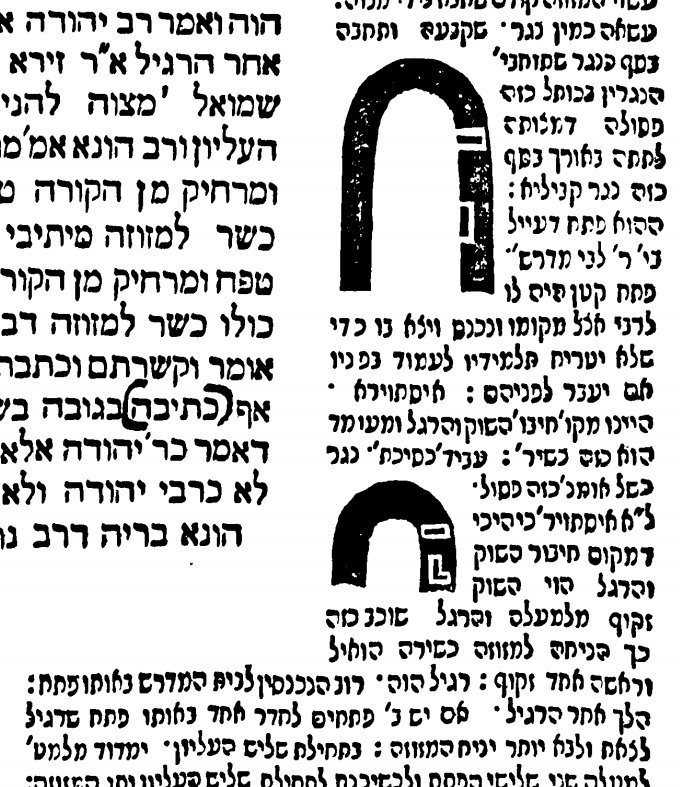
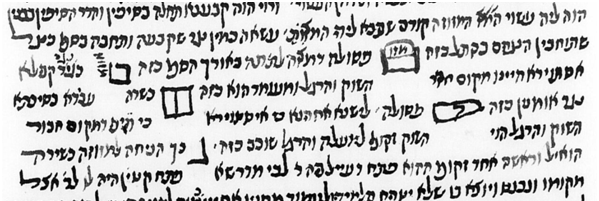
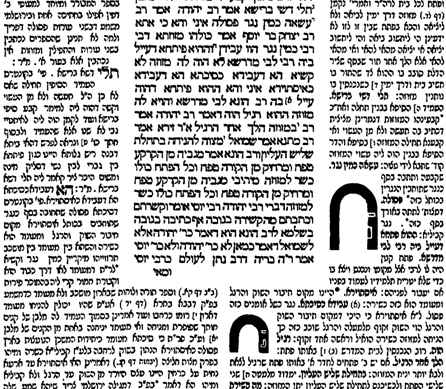
The classic edition of the Vilna Shas (Vilna 1885) renders this Sugya and the accompanying diagrams as such
Here are the words of Rashi which correspond to these two diagrams which show the positioning of four Mezuzot
  1. עשאה כמין נגר – שקבעה ותחבה בסף כנגר, שתוחבין הנגרין בכותל כזה.
  2. פסולה – דמצותה לתתה באורך בסף כזה …. נגר, קביליא
  3. עבידא כסיכתא – נגר כשל אומנים כזה פסולה
  4. איסתוירא – היינו מקום חיבור השוק והרגל ומעומד הוא כזה, כשירה:
  5. ל”א איסתוירא, כי היכי דמקום חיבור השוק והרגל הוי השוק זקוף מלמעלה והרגל שוכב כזה כך הניחה למזוזה כשירה הואיל וראשה אחד זקוף:
The doorframe in the top illustration shows the position of two Mezuzot.
The one on top is horizontal which is improper, and the one on the bottom is vertical which is Kosher.
  1. עשאה כמין נגר – שקבעה ותחבה בסף כנגר, שתוחבין הנגרין בכותל כזה.
He affixed and inserted it in the doorpost like a bolt, for workmen who work with bolts insert it in the walls like this[3] 
  1. פסולה – דמצותה לתתה באורך בסף כזה ….
It is improper- Because the Mitzvah is to affix it vertically in the doorpost like this….
The doorframe in the lower illustration also shows two Mezuzot.
The one on top is horizontal and therefore improper and the one on the bottom is bent (it looks like the Hebrew letter Nun), and therefore Kosher. Here are the words of Rashi which correspond to these two Mezuzot.
עבידא כסיכתא – נגר כשל אומנים כזה פסולה
A bolt as fashioned by workmen like this is disqualified
ל”א איסתוירא. כי היכי דמקום חיבור השוק והרגל הוי השוק זקוף מלמעלה והרגל שוכב כזה כך הניחה למזוזה כשירה הואיל וראשה אחד זקוף
Another explanation of איסתוירא – like the point at which the “Shok” joins the ”Regel”, where the “Shok” is upright and the “Regel” rests, like this, so too if he affixes the Mezuzah like this it is Kosher because the top part is upright.
There is no diagram associated directly with this comment of Rashi
איסתוירא – היינו מקום חיבור השוק והרגל ומעומד הוא כזה, כשירה:
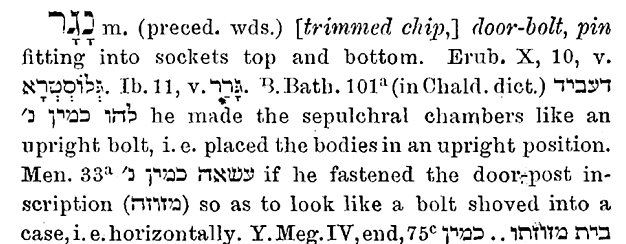
Whether a נגר is normally inserted horizontally or vertically is also “illustrated” in Jastrow’s explanation of the word
In Bava Batra 101a he describes it “like an upright bolt” and in our Gemara he describes it as “like a bolt shoved into a case, i.e. horizontally
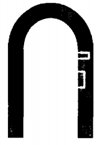
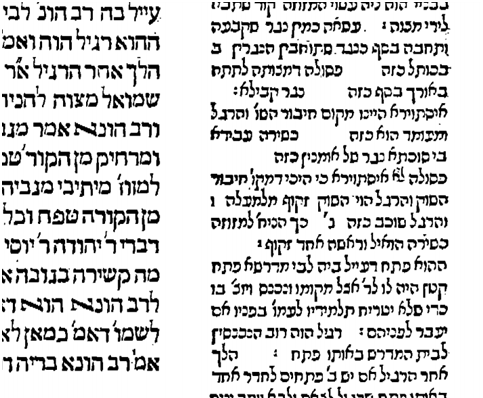
There are two issues with the standard depiction of the two diagrams in the Vilna Shas. Rashi uses the word כזה five times and there are only four “illustrations” (2 in each diagram) Also, we would expect that there would be a diagram after each time it says כזה.
This problem is solved when we look at the only handwritten manuscript we have of Rashi on this part of Menachot.
The National Library of Russia, St. Petersburg, Russia Ms. EVR IV 25:

http://aleph.nli.org.il:80/F/?func=direct&doc_number=000159163&local_base=NNLMSS
It contains five depictions of the placement of the Mezuzot and each כזה is followed by a depiction.
The problem is also solved when we look at the first printed edition of Menachot ( Bomberg 1522) whose source had to be a manuscript. [4] 
This printed edition leaves space after every כזה. It even includes a rudimentary depiction of the last כזה looking like a “Nun” which is supposed to depict where the ankle meets the leg.
It looks very much like the Nun in the National Library of Russia manuscript and may have emanated from the same source.
It was very exciting for me personally to discover this “diagram” which clearly was added to illustrate the כזה. In his Maamar ‘al hadpasat ha-Talmud with Additions, (ed. A.M. Habermann, Mossad ha-Rav Kook, Jerusalem: 2006, p.41)  Rav Natan Nata Rabbinowicz, writing about the first Bomberg edition, states as follows:

״ובכל התלמוד (וכן בכל הדפוסים הישנים עד דפוס בערמן) נשמטו הציורים בגמרא, רש״י ותוספות,ונשאר מקומם חלקמלבד בסוטה מגשישנו הציור ברש״י
“In all of the Talmud (and in all other older printed editions of the Talmud until the Berman edition ( Frankfurt an Der Oder 1697-99) the diagrams were not included in the Talmud, Rashi and Tosfot, and their space remained empty, except for Sotah 43A, where we find a diagram in Rashi.”

It turns out there was a diagram included in the second Bomberg edition of Zevachim( 1528) on 53b, which Rabbinowicz probably never saw. See my article here.
He may have also missed this one because it does not look much like a diagram, but just a letter, or perhaps he felt it was of no significance.
This depiction of the last כזה looking like a “Nun” was maintained by subsequent editions of the Talmud printed in Basel 1580, Cracow 1605, Amsterdam 1644, and Frankfurt an der Oder in 1699.
It was only dropped and replaced with the two larger diagrams we have today in the Frankfurt am Main edition of 1720.
Since many people follow the advice of the Rema and affix the Mezuzah diagonally, it is important to understand the source. This is the word in the Gemara which state that in the house of Rebbe, the Mezuzot were affixed כאיסתוירא. This word is etymologically related to the Latin word astragalus which is described as “the bone in the ankle that articulates with the leg bones to form the ankle joint”. It is more commonly known today as the Talus and looks like this:[5] 
As used in the Gemara, it probably meant the entire area where the bottom of the foot ( which is horizontal) met the bottom of the leg ( which is vertical) at the ankle, thereby looking like something that was bent.
Finally, there is a fascinating story about the Talus bone related by Rav Yisroel Shachor in the Sefer “Dovair Yesharim”.[6] In discussing the איסתוירא, he writes that he was in a terrible automobile accident and בחסדי ה׳ escaped death by climbing out of the rear of the car only seconds before it burst into flames. The only injury he sustained was a broken bone in his foot, which he identified as the Talus. He had many opportunities to view x-rays of his broken foot and concludes “I see this as a source of amazement that the only bone of all 248 bones in my body which was broken, allowed me to understand the words of Torah, and to understand that this was the איסתוירא which is mentioned in Gemarot.”[7]

[1] Translation courtesy of Sefaria.org and follows the interpretation of Rashi.
[2] There is discussion on whether what is shown as Rashi in our editions of Menachot was actually written by Rashi. Rav Natan Nata Rabbinowicz ( author of Dikdukei Sofrim) writes that our “Rashi” was written by a student of Rabbeinu Gershom. ( Dikdukei Sofrim on Menachot 86a note 6 where he writes …מפני שהפרוש הזה המיוחס לרש״י הוא כנראה מתלמיד הרבינו גרשום מאור הגולה והעתיק ברובו לשון הרבינו גרשום מאור הגולה) Rav Betzalel Ashkenazi (the author of the Shita Mekubetzet) writes that for chapters 7-10, the “Rashi” in the standard editions was not written by Rashi and he substitutes his own version which is indicated by the words “Rashi Ktiv Yad” in the Vilna Shas. The editors of the Vilna Shas record this opinion at the beginning of the 7th chapter ( Menachot 72a) as follows: וזה לשונו “זה הפּרוש אשר הוא בדפוס מפרק אלו המנחות עד שתי הלחם אינו מפי׳ רש״י ז״ל והוא של פרשן אחר, וזה לשון רש״י כּ״י”.But Rav Ashkenazi seems to indicate that the Rashi of other chapters was in fact written by Rashi. ( see his note to the beginning of Menachot chapter 11 where he writes מכאן ואליך הוא פירוש רש״י ז״ל).
[3] We only know that it is affixed in a horizontal direction from the picture, not from Rashi’s words.
[4] The Soncino family printed many tractates of the Talmud from 1483-1519 before Bomberg printed the complete Talmud in 1520-1522, and those Soncino editions often formed the basis for the text of the Bomberg edition. But the Soncino family did not print tractate Menachot meaning the Bomberg edition was based solely on manuscripts.
[5] My source for this information is Dr. Carol Teitz who is a member of my Shul. Dr. Teitz is an orthopedic surgeon and most recently, the dean of admissions at the University of Washington Medical School
[6] Doveir Yesharim, Sefer Shemot, Jerusalem. 2014, page 128

[7] This source was brought to my attention by a Torah scholar named Aharon who has helped me immensely in my research on diagrams.


The Ze’enah –Re’enah and its Author

The
Ze’enah –Re’enah
and its Author
Morris
M. Faierstein, Ph.D.
It has traditionally assumed that Rabbi Jacob ben Isaac of Yanova was the author of the Ze’enah U-Re’enah. Every edition of the Ze’enah U-Re’enah lists him as the author on the title page. Recently, this assumption has been questioned and the suggestion made that there may have been another author of this seminal work in addition to Rabbi Jacob ben Isaac. This article will consider two aspects of the Ze’enah U-Re’enah and its author. First, the two-author theory and its evidence. Second, who was the author of a section of the Ze’enah U-Re’enah entitled “Hurban ha Bayit [Destruction of the Temple]”, which is found immediately following the commentary on Lamentations?
1. The two-author theory.
The second volume of the earliest extant edition of the Ze’enah U-Re’enah (Basel/Hanau, 1622) begins with the following statement:
“The five Megillot and the Haftarot. In addition, Hurban ha-Bayit [Destruction of the Temple] in Yiddish which was weighed and researched by the noble and pious Rabbi Jacob, the son of Rabbi Isaac, of blessed memory, from the family of Rabbino, who erected his tent and dwells in the holy community of Janova. He is the man who has already authored the five books of the Torah in Yiddish with nice midrashim and innovative interpretations.”
The same or similar statement can be found in all subsequent editions of the Ze’enah U-Re’enah. Rabbi Jacob ben Isaac was also the author of several other books, published both during his lifetime and posthumously by family members. A statement of his authorship of the Ze’enah U-Re’enah is also found in these books.[1] The first one to question the authorship of the whole Ze’enah U-Re’enah by Rabbi Jacob ben Isaac, was Simon Neuberg in his book, Pragmatische Aspekte der jiddischen Sprachgeschichte am Beispiel der Zenerene.[2] More recently, Jacob Elbaum and Chava Turniansky have reiterated
Neuberg’s argument and supported it.[3] The Elbaum/Turniansky article provides a clear summary of Neuberg’s argument. It would be helpful to begin with this summary:
In a meticulously systematic analysis of the language of the Tsene-rene Simon Neuberg has demonstrated that the vocabulary of each of the three sections (Torah, Megillot, haftarot)  differs clearly from that of the of the two, a phenomenon that becomes particularly prominent in the section khurbn in loshn ashkenaz, which, together with Ruth, differs in its linguistic features most conspicuously from that of the other four Megillot in the Tsene-rene.[4] The conclusions of the linguistic analysis seem to indicate clearly that Rabbi Jacob, the author of the first volume of the Tsene-rene (on the Torah), was not the author of the various components of the second volume of this book (Megillot and Haftarot).
The discussion of the questions about the integration of the two volumes into one opus is beyond the framework  of this article.[5] It is, however, relevant that an earlier printed Yiddish booklet on the destruction of the Temple has been inserted directly after the Yiddish translation and explanation of Lamentations. The difference between the Tsene-rene’s treatment of Lamentations and that of the other four Megillot leads to the
conclusion that whoever included the booklet in the second volume of the Tsene-rene wished to differentiate Lamentations from the other Megillot. Since the khurbn booklet consisted of midrashim, the preceding rendition of Lamentations required no more than a Yiddish translation and explanation of the text, as has been done in
the section of the Haftarot. Indeed, there is a great similarity between the manner of rendition of the haftarot and the methods used in the rendition of Lamentations.[6]
Neuberg bases his conclusions on the basis of his study of the vocabulary of the various sections of the Ze’enah U-Re’enah and the variations that he has found. This mode of philological analysis is ancient, going back to Alexandrian studies of Homer and revived in the study of the Biblical text in the Early Modern and Modern periods. The starting point of this mode of analysis is the concept that a certain text is considered to be a unitary product of one author, whether Homer or Moses, and the scholar endeavors to show that in fact there is more than one hand discernable in the production of the final product. The most famous example of this type of analysis is the “Documentary Hypothesis” relating to the Five Books of Moses. The fatal flaw in Neuberg’s analysis is that he assumes this unitary authorship, that Rabbi Jacob ben Isaac was the author in the way one thinks of someone being the author of a novel or a monograph, the intellectual product of one mind and one style. In fact, the Ze’enah U-Re’enah is a very different sort of work, one composed of passages from a wide variety of texts of different periods and styles that were collected, reworked, paraphrased and abbreviated by Rabbi Jacob to form a bricolage, an anthological commentary based on a diversity of sources.
As an integral part of my English translation of the Ze’enah U-Re’enah[7] I have endeavored to document the sources that Rabbi Jacob utilized and show how he built his commentary.[8] My conclusion is that Rabbi Jacob built his text from the whole panoply of Talmudic, Midrashic, and medieval and early modern Biblical commentaries. He even cites the Torah commentary Keli Yakar (Lublin, 1602) of Rabbi Ephraim Lunshits of Prague, which was most likely published while he was at
work on the Ze’enah U-Re’enah.
Rabbi Jacob had no specific model that he followed, but rather was guided by the commentaries that were available for a particular text. To
take the most obvious example, the number and type of commentaries
available for the Humash
is dramatically greater than what is available for the Megillot,
which is greater than what is available for the Haftarot.
As a result, the Humash
commentary is richer, has greater depth and is more extensive than
the other sections. Even within the Humash
commentaries, it is a well-known phenomenon that the quantity of
comments on Genesis and Exodus is much greater than those on
Leviticus, Numbers and Exodus. This pattern follows through from
Midrash and through all post Talmudic commentaries, from the earliest
medieval commentaries to those being written in the present. This is
also reflected in the allocation of space in the Ze’enah
U-Re’enah
. For example, the number of
pages devoted to Genesis is double the number of pages devoted to
Deuteronomy. It is a reflection of the available resources and not a
deliberate decision by Rabbi Jacob to privilege one part of the Torah
over another.
The
differing level of resources is much greater when one goes from the
Torah to the Prophets and Writings. In the Jewish tradition in
contrast to the Christian tradition, the Torah (Humash)
has been the center of study and interest, while the rest of the
Bible plays a secondary role. This is particularly true in the
Ashkenazi tradition and is evidenced by the paucity of commentaries
on the Prophets and Writings. The great exception is Rashi, whose
commentary encompasses the whole Bible and much of the Talmud. Thus,
we find that Rabbi Jacob has more than a dozen commentaries that he
regularly quotes and cites, not to mention the whole of Midrashic
literature that is largely focused on the Humash
and in the case of Midrash Rabbah,
also includes the Megillot.
The Talmud is also a rich source of comments and stories that are
interspersed in the Torah commentary. In contrast, when one comes to
the Haftarot,
the only commentaries that he relies on regularly are Rashi and Rabbi
David Kimchi.[9] Rabbi Jacob tries to leaven the commentary on the Haftarot
by adding to the end of most of the Haftarot,
a group of three stories taken from the medieval anthology, Yalkut
Shimoni
. It is noteworthy that this
group of stories is quoted in the same sequence that they are found
in the Yalkut Shimoni.
Rabbi
Jacob does not have a fixed form or pattern in his commentary. Each
verse or part of a verse is approached on its own merits. He appears
to have examined the universe of comments on that passage and then he
chooses those things that appeal to him. The range can be anything
from one sentence to several paragraphs, from one commentator to a
medley of several comments that expand on each other or they might
offer conflicting perspectives. Sometimes he ends a commentary with
the phrase, “from here we can learn”, which is a sign that he is
adding his own insights. In addition to the commentaries, or
occasionally in place of a commentary, he might cite a Talmudic or
midrashic passage. Not only do his sources vary widely, but his mode
of citation also varies. Sometimes he translates the Hebrew original,
more or less precisely. Other times, he might paraphrase a text or
summarize an argument from a source. It is also worth noting that he
does not comment on every verse. This too follows the pattern of the
commentaries that he relies upon, in that they also do not feel the
need to comment on every verse. The same applies to the Megillot
and Haftarot,
with the proviso that the universe of sources is smaller and
therefore the variations in form and style will not be as dramatic.
In
summary, any literary analysis of the Ze’enah
U-Re’enah
must take into account the
nature of the sources that underlie the text, how the author utilizes
the sources and the methods of composition. Without a thorough
knowledge of rabbinic literature in the broadest sense and the
ability to deal with these texts, both in the Hebrew/Aramaic original
languages and a solid ability to understand the Yiddish text of the
Ze’enah U-Re’enah, it
would be impossible to make any judgments about this work that have
merit and should be taken seriously.
Another
argument raised by Neuberg is the fact that the Basel/Hanau, 1622
edition of the Ze’enah U-Re’enah was
published in two volumes, with the Torah in one volume and Megillot
and Haftarot
in the second volume. He ascribes great significance to this fact but
does not provide any evidence to support his argument that there is
significance to this fact beyond the things that have already been
discussed. Since this was the first extant edition, we cannot learn
anything from the three preceding editions that have not survived. We
can only look at subsequent editions and see if this pattern is
repeated. The next edition of the Ze’enah
U-Re’enah
was published in Amsterdam,
1648. Rabbi Jacob’s son wrote in the Introduction of his edition of
his father’s small book Sefer Shoresh
Yaakov
that he was publishing this book
to raise funds to enable the publication of a new edition of his
father’s Ze’enah U-Re’enah.[10] The Amsterdam edition retained the same
format as the 1622 edition. That is, the Torah came first, followed
by the Megillot,
and ending with the Haftarot.
The one important change was that the work was published in one
volume and in a folio format. The first edition to break this pattern
was the Amsterdam, 1711 edition, which placed the Haftarot
for the Torah portions immediately behind the respective Torah
portion, in the same way that one would find it in a printed Hebrew
Humash.
This was probably the reason for the change and nothing more
significant. All subsequent editions followed the model of the 1711
edition. In addition, all editions of the Ze’enah
U-Re’enah
beginning with the
Amsterdam, 1648 were published in one volume.[11] The Basel/Hanau, 1622 edition is the only one that was published in
two volumes. It is most likely that the two volumes had simple
internal reasons related to practical aspects of the printing
process. Without additional evidence it would be inappropriate to
make assumptions about this fact.
2.
The authorship of Hurban ha-Bayit.
 
Immediately after the commentary on
Lamentations in the Ze’enah U-Re’enah
there is a separate section entitled, “Hurban
ha-Bayit
[Destruction of the Temple].” An examination of this section shows
that it is a Yiddish translation/paraphrase of a famous passage from
the Talmud about the causes of the destruction of the Second Temple,
found in tractate B. Gittin
55b-58a. After the passage from Gittin
until the end of this text there is a combination of passages taken
from Yalkut Shimoni,
Lamentations, Remez
995 and 996, and selections from Lamentations
Rabbah,
Petihtah
24.
In
1979, Sara Zfatman published an article about a pamphlet by an
anonymous author that was published in Cracow, before 1595.[12] The text of this pamphlet is identical to the “Hurban
ha-Bayit
[Destruction of the Temple]” material in the Ze’enah
U-Re’enah.
[13] Two pamphlets containing this material were reprinted in the
nineteenth and twentieth century[14] and it was even translated into German.[15] It is likely that they were extracts from the Ze’enah
U-Re’enah
, and not from the Cracow
pamphlet.

The
question that concerns us is the authorship of this pamphlet and the
section in the Ze’enah U-Re’enah.
The similarity of both versions of the text is strong evidence that
one person is the author of both. The title page of the second volume
of the Basel/Hanau, 1622 begins with the following statement. “The
five Megillot
and the Haftarot.
In addition, the destruction of Jerusalem in Yiddish which was
weighed and researched by the noble and pious Rabbi Jacob, the son of
Rabbi Isaac, of blessed memory.” Having argued that there is one
author of the whole Ze’enah U-Re’enah,
Rabbi Jacob ben Isaac, it naturally follows Rabbi Jacob ben Isaac is
also the author of this pamphlet and the text in the Ze’enah
U-Re’enah.
 
It
is not hard to understand why Rabbi Jacob might have felt the need to
create a supplement for Lamentations, where there is no similar need
or the other Megillot.
Tisha B’Av
when Lamentations is read in the synagogue became the date to
commemorate and mourn a variety of destruction and catastrophes in
Jewish history. The text of Lamentations is so specific to the
situation of the First Temple that over the centuries a whole
literature developed to supplement the Book of Lamentations and
better express the emotions engendered by later events being
commemorated and mourned. I would suggest that Rabbi Jacob first
wrote this pamphlet as an additional text for Tisha
B’Av
observances and later
incorporated it into the Ze’enah
U-Re’enah.
The sparse nature of his
commentary on Lamentations points to this. There is virtually no
effort to add commentary. Aside from a few references to Rashi, the
commentary on Lamentations is no more than translations or
paraphrases of the Biblical text.
[1]
Melitz Yosher
(Lublin, 1622; Amsterdam, 1688); Sefer
ha-Magid
(Lublin,
1623-1627); Sefer
Shoresh Ya’akov
(Cracow, 1640). The relationship of Rabbi Jacob ben Isaac to Sefer
ha-Magid
is
complicated. See, R. Hayyim Lieberman, “Concerning the Sefer
ha-Magid
and its
Author [Yiddish].” In idem. Ohel
RH”L.
3 vols.
(n.p.: Brooklyn, 1984), 2: 231-248. A Hebrew version of the article
is found in idem. 3: 365-382. The article was originally published
in Yidishe Shprakh,
vol. 26 (1966): 33-38.
[2]
Neuberg,
Simon. Pragmatische
Aspekte der jiddischen Sprachgeschichte am Beispiel der Zenerene.

Buske: Hamburg, 1999, 109-115.
[3]
Elbaum,
Jacob. and Turniansky, Chava. “The Destruction of the Temple: A
Yiddish Booklet for the Ninth of Av.” In Midrash
Unbound, Transformations and Innovations
.
Ed. Michael
Fishbane and Joanna Weinberg. Oxford: Littman Library, 2013,
424-427.
[4]
See Neuberg,
Pragmatische
Aspekte
,
109-115.
[5]
At this point there is a lengthy footnote about the significance of
the title pages of the two volumes and the fact that there are two
volumes. I will address the issues raised here in my response.
[6] Elbaum
and Turniansky, “The Destruction of the Temple,” 425.
[7] Faierstein, Morris M. Ed. Ze’enah
U-Re’enah: A Critical Translation into English
.
2 Vols. Berlin: De Gruyter, 2017 (Studia Judaica, 96).
[8] The Index of Sources in my translation is a vivid example of the
wide variety of sources found in the Ze’enah
U-Re’enah
.
[9] Rabbi David Kimchi was a member of the medieval Spanish school of
Biblical commentary that emphasized grammar and logic rather than
the more midrashic and mystical approach of many of the Ashkenazi
commentaries. It is noteworthy that neither Kimchi nor the other
great Spanish commentator Rabbi Abraham Ibn Ezra are mentioned in
the Torah commentary. It is only in the Prophets where Kimchi is
consulted, because the number of commentaries is limited.
[10] Sefer Shoresh
Yaakov
, Cracow,
1640, Introduction.
[11] A complete bibliography of Ze’enah
U-Re’enah

editions can be found in Morris
M. Faierstein, “The
Ze’enah U-Re’enah
:
A Preliminary Bibliography”, Revue
des etudes juives
,
172, 3-4 (2013), 397-427.
[12] On this pamphlet and its history see, Sara Zfatman, “The
Destruction of the Temple, Cracow, before 1595 – An Additional
Yiddish Text from the Sixteenth Century [Hebrew],” Kiryat
Sefer
54 (1979):
201-202.
[13] Zfatman, “The Destruction of the Temple,” 201 n. 5.
[14] The nineteenth century edition was published in Johnnisburg
(Prussia), 1862. See,
Faierstein, “The
Ze’enah U-Re’enah
:
A Preliminary Bibliography,” 411 no. 121. The twentieth century
edition was Brooklyn, 2007. See, idem. 422, no. 240.
[15] The German translation is, Die
Zerstörung Jerusalems: aus dem Buche Zeena u’reena. Deutsch von
Alexander Eliasberg

(Berlin: F. Gurlitt, 1921). See, Faierstein, “The
Ze’enah U-Re’enah
:
A Preliminary Bibliography,” 424 no. 264.


“Research Refutes Thesis of Unified Diaspora in Ancient Jewry”

Hagahot notes the appearance of a new study by two Tel Aviv University scholars, Arye Edrei and Doron Mendels, “A Split Jewish Diaspora: Its Dramatic Consequences,” Journal for the Study of the Pseudepigrapha 16:2 (2007): 91-137, wherein the authors demonstrate

that the Jewish diaspora in Europe basically disappeared after the destruction of the Second Temple. Probably, they felt cut off from the spiritual center in Jerusalem, and eventually melded into their host culture.

This is very significant for medieval Jewish history, especially those interested in the roots of Ashkenazic halakhah. The Jewish settlement along the Rhine identified itself as being rooted in Northern Italy, and when it first surfaces in literary form, the Ashkenazic halakhah is already a hoary tradition. On the other hand, while we have extensive epigraphical remains from the Jews of Roman Italy, they don’t reflect what we know about rabbinic Judaism. So this theory suggests that there was a break between Roman Italy and early medieval Italy, with the later Jewish population coming from a totally different, more rabbinic culture.

For those interested, the abstract of this article reads:

This article proposes that a language divide and two systems of communication have brought to a serious gap between the western Jewish Diaspora and the eastern one. Thus the western Greek-speaking Jews lost touch with the Halakhah and the Rabbis, a condition that had far-reaching consequences on Jewish history thereafter. The Rabbis paid a high price for keeping their Halakhah in oral form, losing in consequence half of their constituency. An oral law did not develop in the western diaspora, whereas the existing eastern one was not translated into Greek. Hence it is not surprising that western Jews contributed nothing to the development of the oral law in the east. The Jewish communities that were isolated from the Rabbinic network served as a receptive basis for the development of an alternative Christian network by Paul and the apostles, which enabled it to spread throughout the Mediterranean basin. The Jews that remained ‘biblical’ surfaced in Europe in the Middle Ages.