WHEN HISTORY IS HIS STORY A Review of R. Dovid Kamenetsky’s “Rabeinu Chaim Ozer: Raban Shel Kol B’nei Ha’golah”

WHEN HISTORY IS HIS STORY
A Review of R. Dovid Kamenetsky’s “Rabeinu Chaim Ozer: Raban Shel Kol B’nei Ha’golah” *
(Vol. 1, Hebrew, 671 pages)

Rabbi Jonah Steinmetz is a fellow in the Wexner Kollel Elyon and director of Asicha Seminars, an online learning program for women. This is Jonah’s first contribution to the Seforim Blog.

  1. OF HISTORY AND STORY

When asked to describe the difference between recording history and telling stories, the prolific historical fiction novelist, E.L. Doctorow responded, “The historian will tell you what happened. The novelist will tell you what it felt like.” Doctorow’s assessment is unsurprisingly insightful, highlighting the benefits and drawbacks of both historiography and storytelling; however, there are rare instances where history also tells a story.

R. Dovid Kamenetsky’s new book, Rabeinu Chaim Ozer: Raban Shel Kol B’nei Ha’goleh (Vol. 1), is one such instance. In culling almost entirely from primary sources such as letters from R. Chaim Ozer Grodzinsky and his contemporaries, newspapers, and journals, Kamenetsky unwraps the history and the story of not only the protagonist, but his entire generation.

In his introduction, the author notes that “multiple writers have published short biographies – and more are yet to come – which are filled with inaccuracies and incorrect stories, and therefore [these works] should not be relied upon.”[1] He also observes that while many of R. Chaim Ozer’s correspondences have been published, the order and fashion in which they were compiled make it “nearly impossible to discern the true greatness” of the man. In stating his objective, Kamenetsky writes,

This book… is not just a biography or a book of stories. I will leave that to others… In our book, the various events are arranged according to the [chronological] order of their occurrence, contextualized by a description of Rabeinu’s navigation – as the captain of the ship of [the] Jewish [people] – which led to the achievement of desired results.

In fact, this is not a biography. It is not a book of stories. It is a book of history through which the story unfolds. In stark contrast to rigid academic works often perceived as dry and removed, Kamenetsky’s book is refreshingly dynamic. Whereas one often relies on popular tales to discover the politics, drama, and personalities in the rabbinic world, Kamenetsky allows the reader to experience history by reading the firsthand accounts of the parties and witnesses to the events.

  1. THE KIBUTZ IN VILNA

In the third chapter, Kamenetsky discusses R. Chaim Ozer’s famous kibutz in Vilna. The kibutz consisted of a small group of young prodigies who came from across Europe to study with one of the leading gedolim of the generation. In his eulogy for R. Chaim Ozer, R. Moshe Avigdor Amiel describes how there were no set shiurim. “He simply had no time.” However,

on Shabbos during bein hashmashos (the twilight hours), was our time, only our time. We felt the presence of the Shabbos queen as [R. Chaim Ozer] sat down to discuss torah with us.[2]

The students were handpicked by R. Chaim Ozer, and Kamenetsky exposes us to R. Chaim Ozer’s charisma, wisdom, and foresight without ever resorting to hearsay by sharing reports written by alumni of the kibutz. These documents reveal R. Chaim Ozer as an extraordinarily perceptive person with a keen insight into the human psyche. In perhaps the most exciting episode, R. Chaim Ozer turned down a young man applying to the kibutz with a letter of recommendation from none other than R. Chaim Soloveitchik![3] Although R. Chaim describes the potential student as an “outstandingly wonderful” prodigy from an exceptional family, he was “rejected at the doorstep.” In what is perhaps a retroactive exhibition of R. Chaim Ozer’s intuition, this young man eventually left the torah world to become an academic.[4]

In the course of this discussion, the reader learns about famous scholars such as R. Shlomo Polachek (the Meitcheter Iluy), R. Amiel, R. Reuven Katz, R. Eliezer Silver, and others who benefited from learning in the presence of R. Chaim Ozer in Vilna. Perhaps more critically, Kamenetsky disproves commonly held mistruths about others having learned in the kibutz. R. Yechezkel Abramsky fled Telz for Vilna in 1906 to avoid conscription into the Russian army. His biographers claim that he then joined the kibutz.[5] Kamenetsky notes, however, that this claim is unfounded. He similarly dispels the rumor that R. Avraham Yeshaya Karelitz (the Chazon Ish) learned in the kibutz.[6]

Supporting and managing this group was no small task. However, relative to the drama which characterized his many public roles, one imagines that the kibutz held a special place in R. Chaim Ozer’s heart as a calm, safe space for growth in talmud torah.

  1. TORAH KNOWS NO BOUNDARIES

But life was rarely calm for our protagonist. In 1932, R. Chaim Ozer wrote a letter to his nephew, Shlomo Kosovsky, in which he describes the many stressful responsibilities which burdened him in Vilna.

Thank G-d we and our family are well. However, there is no shortage of burdens and aggravation. [T]here is a decline in the physical and spiritual condition, [causing] many [people] to come to discuss and pour their bitter hearts out, and it is upon me to listen to their sighs all day. The institutions are on the verge of closure (lit. hang on nothingness), the Rameilles Yeshiva which is my load has no foundation or basis, and the future is covered in fog.[7]

Given this description of the local hardships and pressures, one would expect that R. Chaim Ozer focused exclusively on his role in Vilna, with no time to assist elsewhere. But this is not the case. When French rabbis instituted faulty halachic procedures regarding marriage and divorce, R. Chaim Ozer was at the helm of a collaborated effort on the part of the leading Eastern European rabbis to expose the colossal distortion and demand a retraction.[8] In this context, R. Chaim Ozer wrote,

Do not be surprised that foreign rabbis are intervening in halachic decisions in France, for our torah is not restricted by space.[9] Additionally… it is our opinion… that a woman who marries [under these circumstances]… [thus] her children are illegitimate and it is forbidden for others to marry them. As such, doesn’t this matter affect the entire nation?![10]

Still more political friction is uncovered through accounts of R. Chaim Ozer’s fiery disputes with R. Yosef Shaposhnik of London.[11] In 1928, Shaposhnik, self-declared “chief rabbi of the world,” published a pamphlet announcing his plans and methods for freeing agunos worldwide. The methods were halachically unfounded. Called upon by London’s R. Shmuel Yitzchak Hillman, R. Chaim Ozer led a fierce attack against Shaposhnik’s decisions, authority, and even his mental capacity.[12]

Later chapters are replete with further examples of R. Chaim Ozer’s political tact as he deftly steers the global Jewish community through the obstacle course of the 20th century. The detailed account of R. Chaim Ozer’s intimate and devoted involvement in supporting the settlement of Israel and its rabbinate will be of particular interest to the reader.[13]

  1. THE RABBINICAL CONFERENCES OF 1909-1910

With no embellishment and limited elaboration, six of the final seven chapters invite the reader into the world of the pre-Agudas Yisroel rabbinate struggling to unify in guiding the public on critical issues. Kamenetsky’s work is chronological, so this first volume does not discuss the founding of Agudas Yisroel in Kattowitz in 1912. However, these chapters discuss the seeds of the organization.

R. Chaim Ozer emerges as the founder and leader of these endeavors, and in studying his correspondences, one is welcomed into the mind and heart of the protagonist in a surprisingly intimate fashion.[14] Descriptive newspaper reports and detailed rabbinic correspondences unveil shockingly comprehensive accounts of the formation of K’nesses Yisroel – the forerunner of Agudas Yisroel – starting in 1908, as well as the rabbinical conferences in Vilna and Bad Homburg in 1909 and St. Petersburg in 1910. Kamenetsky allows the reader to feel as though he is sitting in on the events, meeting the characters, experiencing the drama, and navigating the politics.

One example of the heated nature of the conference in St. Petersburg is the reaction to the position of R. Shalom Dovber Schneerson of Lubavitch (herein Rasha”b) regarding who is eligible to be registered as a Jew in the communal records.[15] He was of the opinion that children who were uncircumcised due to the parents’ recalcitrance should not be registered as Jews. The Yiddish newspaper, Haynt (21 Adar Beis, 5670) reported this and more of Rasha”b’s inflammatory remarks.

Due to the sharp objection… to the rebbe of Lubavitch’s statements that one who does not wear tefillin is not considered a Jew, and along with this, the decision on the part of the conference to exclude uncircumcised children from the records, I felt it necessary to turn to some of the greatest rabbinic participants to hear their halachic opinion on this burning question…[16]

The pushback to these assertions was fierce and the arguments were impassioned. In further viewing reports of the intense discussions as to which Jews are eligible for higher statuses and positions within the community, the reader is drawn into fundamental, heartfelt dialogue about the core definition of a Jew.[17]

  1. R. CHAIM SOLOVEITCHIK: LEGENDS CONFIRMED

Throughout the book, we are brought into R. Chaim Ozer’s personal world as he balances his roles as decisor, teacher, and leader. But Kamenetsky exposes us to the protagonist’s social and professional circles, as well. In providing capsule biographies for many of the characters mentioned throughout the book, the author introduces us to significant, albeit lesser known, rabbinic personalities, providing background for the letters and articles from which he draws.[18]

One unforeseen benefit of Kamenetsky’s approach is the unveiling of the persona of R. Chaim Soloveitchik as perceived by his colleagues. Stories – factual, apocryphal, and everything in between – about R. Chaim’s legendary genius, benevolence, and sagacity abound. Many have been published, still more have been orally transmitted. It is fascinating to see the aforementioned stories and still other traits be corroborated and come to life through firsthand accounts recorded in this book.

R. Chaim’s position as one of the most respected rabbinic figures in Europe is revealed time and again. In introducing the concept of what eventually became Agudas Yisroel, R. Chaim Ozer heavily stresses R. Chaim’s involvement, noting that his greatness and dominance will surely draw other colleagues to join the movement.[19] In a letter encouraging Rasha”b to join, R. Yitzchak Isaac Rabinowitz points to R. Chaim as one of the three most important, influential contemporary rabbinic figures.[20] When chief rabbi of Jerusalem, R. Shmuel Salant’s assistant, R. Eliyahu David Rabinowitz-Teomim predeceased him, the former desperately pushed R. Chaim to assume the position immediately.[21] In a letter from R. Yehuda Leib Frank to his son, R. Tzvi Pesach Frank, the writer makes the astonishing claim that the Hasidim of Jerusalem will agree to no Lithuanian rabbinic leader except for R. Chaim![22]

In one pointed display of his uniqueness, R. Rabinowitz writes that R. Chaim is unlike all other Russian rabbis in that there is “nothing in his world other than torah.” “Even the greatness of millionaires like Rothschild can not affect him even slightly.”[23] About R. Chaim, Rasha”b writes, “he literally became sick from aggravation, being that he is truly G-d-fearing.”[24] These lines aptly portray R. Chaim’s confidence and immovability and capture his intense, unyielding yiras shamayim.

It is well known that, all his greatness notwithstanding, R. Chaim was exceedingly humble. R. Yaakov Ha-levi Lifschitz corroborates this in a letter to R. Rabinowitz in which he describes R. Chaim’s aversion to hubris in the following terms: “The Gaon R. Chaim is as far from pride and self-praise as we are far from eating treifos (i.e. non-Kosher meat).”[25]

It is no wonder that the newspapers would eventually describe R. Chaim, along with one other rabbi, as the “living spirit” of the rabbinical gatherings.[26] Generally, he would listen quietly as the animated discussions carried on, waiting until the arguments subsided to succinctly summarize the points and offer a brilliant assessment and decision.[27] Often, his opinion was accepted.[28]

These commonly held truths about R. Chaim’s unique genius and character are compellingly corroborated at various junctures. The author provides important insight and perspective by bearing these facts out through presenting firsthand accounts of contemporaries.

  1. OF HISTORY, NOT STORY

Kamenetsky is allergic to mythology. To be clear, he displays no disdain for tradition and no proclivity for sniffing out and destroying hagiographical accounts.[29] Balanced by genuine reverence, Kamenetsky’s commitment to intellectual honesty and academic rigor leads him to disprove baseless stories through revealing their inconsistencies with the primary sources.[30] He has a particular penchant for noting calendric contradictions which dispel the accuracy of popular tales.[31]

In the penultimate chapter, Kamenetsky recounts the classic tale of the meeting between R. Yisrael Meir Kagan (the Chafetz Chaim) and R. Meir Simcha Ha-kohen of Dvinsk at the 1910 rabbinical conference in St. Petersburg.[32] At the behest of R. Chaim Soloveitchik, the Chafetz Chaim visited the convention to reinforce the minority’s opposition to a requirement for rabbis to learn the Russian language. R. Meir Simcha – along with R. David Friedman of Karlin, R. Chaim Ozer, R. Yitzchak Yaakov Rabinowitz of Ponovizh, and the majority of those present – asserted, however, that knowledge of the national language would ultimately strengthen the orthodox hold on the rabbinate. Kamenetsky quotes R. M.M. Yoshor’s account of the following exchange.

[The Chafetz Chaim] traveled to visit the Gaon [R. Meir Simcha] of Dvinsk in his hotel. As the Chafetz Chaim began to explain his reasoning for coming, R. Meir Simcha lightheartedly remarked: “Don’t fret. The torah will remain torah and the rabbis will remain rabbis.” And, in relying upon the letter [of support] from R. David of Karlin, he said, “You should not contend with the opinion of the eldest of the Geonim. Being that you do not serve in the rabbinate and you live in a small town, you are not expert in the ways of the world and its demands.”

Unmoved, the Chafetz Chaim calmly asked [R. Meir Simcha] if he too leads a Yeshiva, noting that only someone who is in close contact with a Yeshiva is capable of presciently sensing the impending danger [in this decision].

So as to avoid a quarrel, R. Meir Simcha bolted out of the room (this was his way) … On the way [home], the Chafetz Chaim remarked: “I am impressed by R. Meir Simcha’s refined character…”

Yoshor also recounts that R. Meir Simcha quipped,

This small Jew from a small town makes more noise across the world with his simple words than the biggest rabbis from the biggest towns with their depth and sharpness.”[33]

This meeting and its narrative is preserved in many scholarly and other works, with slight but critical tweaks to the words, tones, and cadences of the parties involved.[34] Tradition has it that the Chafetz Chaim – who rarely cites contemporaries by name – relays the opinion of R. Meir Simcha in Beur Halacha (585, s.v. v’tov l’tkoah b’yad yemin) in an attempt to show the world that he bears no grudge against his colleague, their squabble notwithstanding.[35]

While this story has all the desired trappings of conflict and resolution, Kamenetsky declares that “anyone with eyes” will notice that the ending is patently false. The alleged meeting between these two rabbis occurred in 1910. The volume of Mishnah Berurah in which this paragraph appears was published sometime between 1896 and 1899, more than ten years prior to their contentious encounter![36] Of course, this does not call the veracity of the crux of the tale into question. The intellectually honest student of history must sift through the layers of a story until what remains is only the truth.[37]

In one instance, Kamenetsky disproves Ahron Sorosky’s claim that R. Avraham Bornstein of Socatchov (the Avnei Nezer) attended the 1909 conference in Vilna.[38] Although Sorosky describes the rebbe’s journey and his meetings with R. David of Karlin, the Chafetz Chaim, and R. Chaim Soloveitchik, Kamenetsky claims they are all fantasy which never occurred. R. Bornstein was invited to the conference, but he did not end up joining. Kamenetsky explains that Sorosky confused this conference with another one in Warsaw in which a rebbe from Socatchov – either R. Avraham or his son R. Shmuel (the Shem M’shmuel) did participate. He takes this opportunity to remind the reader to “never rely on any information without cross-checking other sources.”

In yet a third example, the author uses creative resources to disprove a rumored event. R. Yosef Yitzchak Schneerson (Rayat”z), son and successor of Rasha”b, reports yet another rabbinic gathering which occurred in Vilna in 1905.[39] He claims that R. David Tevele Katzenellenbogen presided over this conference which was attended by R. David of Karlin, R. Chaim Soloveitchik, and Rasha”b. Rayat”z relays his father’s call for only ordaining young rabbis who display impeccable yiras shamayim. Allegedly, R. Chaim then penned a letter to R. Chaim Ozer, informing him of this decision to only ordain such rabbinic candidates.

Kamenetsky disputes this, declaring that such an event was simply an imagined imitation of the 1909 conference in which the aforementioned rabbis participated.[40] Aside from the nonexistence of corroborating sources, the author highlights the glaring peculiarity that a rabbinical conference occurred in Vilna in 1905 and yet R. Chaim Ozer had to be informed through a letter. Furthermore, Kamenetsky notes that Rasha”b’s passport is still extant, displaying all his travels, and there is no such trip to Vilna in 1905 signified!

  1. MEGALEH TEFACH, MECHASEH T’FACHAYIM

In some cases, Kamenetsky leaves us on the edge of our seat, wishing he would disclose additional sources or offer his insightful commentary. One such case is his passing reference to the well-known tale of R. Chaim Ozer’s alleged broken engagement. Legend has it that a young R. Chaim Ozer became engaged to the daughter of R. Eliyahu Feinstein of Pruzhin. For reasons unknown, the wedding was called off.[41] The most ambitious versions of this story append a sensational postscript. Years later, R. Chaim Ozer’s only daughter, Malka, fell fatally ill with polio. With no hope of medical salvation, the desperate father sent a message to the Chafetz Chaim, requesting that he pray for the girl’s recovery. Purportedly, the Chafetz Chaim refused to offer any hope, attributing his reluctance to the fact that R. Chaim Ozer had broken an engagement in his youth.

Twice, Kamenetsky references this story. Twice, he rejects it as unfounded.[42] Of course, the intellectually honest student of history approaches such a staggering, phenomenal story with cautious skepticism. However, being that the legend is entrenched in the Krakowsky and Soloveitchik family traditions and widely accepted, one hopes that the author will provide his reasons for disbelief. Sensing our excitement, Kamenetsky asserts his claim that this story exists “only in the imagination of the maskilic authors” who invented it, “but there is no space here to elaborate.”

The author teases us in other instances as well. In his description of the Rameilles Yeshiva, Kamenetsky discusses R. Shlomo Heiman’s role as maggid shiur.[43] In 1927, R. Chaim Ozer brought R. Heiman to teach in the yeshiva in Vilna, raising the institution to new heights.[44] In the summer of 1934, however, Mesivta Torah V’Daas recruited R. Heiman to join their staff. Much to the dismay of R. Chaim Ozer, R. Heiman accepted the offer and left for America.[45] While Kamenetsky cites R. Chaim Ozer’s letters expressing his feelings during this period, he adds,

Indeed, in a different letter, dated 8 Adar 1937, Rabeinu [Chaim Ozer] partially reveals (lit. – reveals one tefach while concealing two tefachim) the reason for [R. Shlomo Heiman’s] departure.[46]

Kamenetsky proffers that this mysterious reason is “connected to R. Heiman’s role in the Yeshiva” and announces that he has the letter in his possession, but stops short of sharing the information with us. As frustrating as it may be, the reader senses and respects that the author protects the information out of great reverence for the parties involved.[47]

  1. HISTORY AS OUR STORY

In his approbation to R. Yehuda Ha-levi Lifschitz’s Dor Yesharim, R. Chaim Ozer writes the following about the study of Jewish history.

Historically, gedolei torah never devoted their minds to delving into Jewish history or even to write books about Jewish sages of past generations. The words of our ancient and later rabbis are alive and maintained in the mouths of those who learn torah. Every study hall is brimming with rabbis and their students studying a living torah as if the words were taught that day. There is no need to memorialize tzadikim, as their words are their legacy.

However, since the decline of Judaism in Europe during the time of the Reform… there is no torah and there is no fear of G-d. As such, the remaining authors devoted themselves to memorialize the great figures and occurrences of past generations. Some of them intended to endear the wisdom of Israel and its gedolim to this generation. If they won’t receive this through knowledge, recognition, and vision (i.e. through learning torah), [at least] they should receive it through hearing stories – that they had outstanding ancestors through which they claim honor.[48]

In this first volume, R. Kamenetsky fulfills R. Chaim Ozer’s charge.[49] In drawing exclusively from firsthand accounts, he presents a compelling and exciting perspective on the life and leadership of R. Chaim Ozer as well as his rabbinic milieu. He simultaneously wears the hats of both historian and novelist, telling us what happened and showing us how it felt. Most importantly, he reminds us of our great ancestors and rich history to which we strive endlessly to connect.

*Thank you to my good friends, R. Jacob Sasson and R. Dovid Bashevkin for their encouragement and involvement. Special thanks to R. Eliezer Brodt for his willingness and efforts to publish this review.

[1] P. 4
[2] P. 147
[3] Pp. 161-2
[4] Kamenetsky (ibid., n161) assures the reader that the subject remained torah-observant throughout his life. Kamenetsky (p.139, n1) also cites Ben-Zion Dinur’s account of R. Chaim Ozer’s less than warm reception when he arrive to apply for the kibutz. “From his questions,” writes Dinur, “it was clear that he knew much more about me than expected.” Dinur was rejected. He abandoned religion for the academy. Even with his prescience, however, R. Chaim Ozer was not a prophet. Kamenetsky (pp. 163-6) brings one example of a student who was accepted into the kibutz and ultimately abandoned religion, as well.
[5] See Sorosky, Ahron, Melech B’yofyo (Jerusalem, 5764), pp. 29-31.
[6] P. 160, n41
[7] Igros R. Chaim Ozer, Vol. 1, #20
[8] See Kamenetsky, pp. 261-271.
[9] Though he rightly asserted that torah knows no boundaries, R. Chaim Ozer recognized that there were situations in which he was too far-removed to offer advice or render a decision. See, for example, Igros R. Chaim Ozer (Vol. 1, #203) regarding his hesitancy to advise Mesivta Torah v’Daas regarding whether secular studies should take place on the yeshiva grounds or at an external location. After weighing the benefits and disadvantages, R. Chaim Ozer writes,

In truth, it is difficult for me to answer from afar without understanding the local conditions… I cannot know which way is better. It is preferable to take counsel with great torah scholars and decisors who are found in your country, and they will know which path to take.

See also ibid., #14 where R. Chaim Ozer differentiates between issues on which he will and will not advise from afar.
[10] Kamenetsky, p. 269
[11] Pp. 271-300
[12] R. Chaim Ozer consistently referred to Shaposhnik as “ha-meturaf” (the madman). Kamenetsky notes that this is especially striking given the former’s generally calm disposition and aversion to strife.
[13] See chapter 16.
[14] It is important to note that R. Chaim Ozer already envisioned the concept of Agudas Yisroel – with many of the details which eventually materialized – as long as ten years before the first conference in St. Petersburg. See Kamenetsky, pp. 119-126.
[15] P. 579
[16] Ibid. The reporter interviews R. Chaim Soloveitchik, among others. See pp. 579-80 for R. Chaim’s pointed, strong objection to these statements. In this context, it is important to see R. J.B. Soloveitchik’s essay, Ish Ha-halacha (p. 79 in the 1979 publication, Ish Ha-Halacha – Galuy V’nistar). The reader should note that R. Soloveitchik does not identify any particular rabbi who held that uncircumcised babies should not be included in the records. He quotes it as a majority opinion at the St. Petersburg conference. See also R. Yosef Shaul Nathanson, She’eilot U’teshuvot Sho’el U’meishiv, Vol. 3, #64.
[17] Pp. 582-3
[18] See, for example, pp. 48-103; pp. 142-156; pp. 521-7.
[19] P. 349
[20] P. 442. The other two are R. Chaim Ozer and R. Avraham Mordechai Alter of Gur.
[21] Pp. 632-3. See also p. 636.
[22] P. 647
[23] P. 439
[24] Pp. 546-7, n75. Rasha”b claims that R. Chaim initially agreed with the majority regarding the requirement to learn Russian and that it was only after the former convinced him that R. Chaim changed course. The abovementioned “aggravation” was due to R. Chaim’s regret for his alleged near misstep.
[25] P. 440, n16
[26] P. 392. The other rabbi mentioned is Rasha”b.
[27] See p. 589. It is interesting to read of the rare instances in which R. Chaim became passionate, even heated, in his participation at the conference (ibid.). It is critical to note that, on more than one occasion, R. Chaim stressed the need for decentralization of rabbinic authority. Namely, he impressed upon his colleagues the reality of nuanced situations in each community. Accordingly, he held, it was important to allow each community to take measures to form their own leadership which would guide them on local issues. See pp. 410-11.
[28] See pp. 410, 411, and 416 for three such examples. Of course, R. Chaim did not always get the final word. See pp. 541-2, for example, regarding the requirement for rabbis to learn the Russian language and the role of the “rav m’taam ha-memshalah.”
[29] In fact, in an email correspondence regarding a myth debunked, R. Kamenetsky remarked, “I don’t know of an early source to this story… To me, historically, it does not make sense. But if I find conclusive proof, I am ready to accept.”
[30] For example, see p. 314, n16; p. 386, n16; p. 431, n86; p. 457, n8; p. 666, n98.
[31] For example, see p. 10, n14; p. 37, n9; p. 65, n35; p. 66, n38; p. 79, n64; p. 158, n37; p. 173, n1; p. 347, n63
[32] Pp. 559-61
[33] Kamenetsky (ibid., n98).
[34] See Bergman, Asher, Ha-ohr Same’ach, p. 123; see also Yoshor, Ha-Chafetz Chaim: Chayav U’fo’alo, Vol. 1, Ch. 42; see also Soffer, R. Yaakov Chaim, Lecha Na’eh Le’hodot, pp. 113-14 (here); see also Brown, Benjamin, From Principles to Rules and From Musar to Halakha, n234; see also Rapoport, Yaakov M. The Light From Dvinsk: Rav Meir Simcha, The Ohr Somayach. Southfield: Targum Press Inc. (1990), p. 98; see also Schachter, R. Hershel. Divrei ha-Rav. NY: OU Press (2010), p. 215, n33); see also Kamenetsky, Noson (Nathan). Making of a Godol: A Study of Episodes in the Lives of Great Torah Personalities. Jerusalem: Hamesorah Publishers (2002), pp. 535-7. For a comprehensive review of many of the versions, merits, and demerits of this story, see R. Yisrael Dendrowitz’s piece in Ha-pa’amon, Issue 6 (Nissan, 5777), pp. 7-23. Many thanks to Dovid Bashevkin for calling my attention to the last article.
[35] The original claim was that he never quotes from contemporaries or their books, but this has been disproven time and again. For one comprehensive example, see R. Yaakov Tribetz’s essay in Yeshurun Vol. 36 (Nissan 5776), p. 501 and p. 583.
[36] It should be noted that R. Dovid Kamenetsky is not the first to call attention to this blatant discrepancy. His uncle, R. Nosson Kamenetsky raised this issue years ago (Making of a Godol, ibid). See also Mordechai Solomon’s article in Yated Ne’eman (5766, issue 1, Hebrew), cited in Ha-pa’amon (ibid., p. 11). R. Nosson Kamenetsky and Solomon note that the Mishnah Berurah was published in 1907, based on the author’s own words at the conclusion of the work. (See also Soffer, Lecha Naeh, p. 114.) R. Dendrowitz (Ha-pa’amon, ibid. pp. 19-20) claims that he saw the first edition of the Mishnah Berurah published in 1907 with this quote from R. Meir Simcha printed there.
[37] To (over)quote Doctorow, “what most people think of as history is its end product, myth.” To say as much does not deny that there may exist certain truths in myth. It is simply a call for vigorous discernment in recognizing the point at which the history becomes a story.
[38] Pp. 386-7, n16
[39] Torat Shalom – Sefer Ha-sichos, p. 365
[40] Kamenetsky, p. 431, n86
[41] R. Hershel Schachter (here, at the three minute mark) has mentioned that R. Chaim Ozer was nervous about the Feinstein family’s openness to secular studies, which led him to break the shidduch. (Thank you to Jacob Sasson for reminding me of this detail.) The young lady went on to marry R. Menachem Krakowsky, author of Avodas Ha-melech and maggid meisharim in Vilna. For more on R. Krakowsky’s relationship with R. Chaim Ozer in Vilna, see Kamentsky, Dovid, Tevunot Vol. 2 (2018), R. Menachem Krakowsky of Vilna and His Relationship to Rabbi Hayyim Ozer Grodzinski”, pp. 805-46 (Hebrew; also accessible at Academia.edu). (Compare also to Kamenetsky, Rabeinu Chaim Ozer, pp. 375-6.) If the story is true, it is also critical to consider the generous assistance which R. Chaim Ozer provided to R. Elya Pruzhiner regarding his candidacy for the rabbinical position in Jerusalem (see Kamenetsky, R. Chaim Ozer, pp. 619-21 and p. 651). R. Moshe Soloveitchik married another Feinstein daughter, adding yet another layer to his complicated relationship with R. Chaim Ozer (see Fuss and Sasson articles referenced below).
[42] P. 27, n51 and p. 37, n69
[43] Pp. 194-7
[44] P. 194
[45] Pp. 198-200
[46] P. 200, n51
[47] Yet another case of teasing the reader appears on page 434 (n5). There, Kamenetsky references an article which contains R. Chaim Ozer’s response to the Mizrachi movement’s claim that R. Chaim Soloveitchik never supported Agudas Yisroel. He writes, “elsewhere, I will expand on this.” Although here too, we are left waiting with baited breath, the author assured me that he will deal with this in the next volume. In preparation, the reader is advised to see Moshe Ariel Fuss’s piece on the topic in volume 25 of Hakirah (here) and R. Jacob Sasson’s response in volume 26 (here).
[48] Igros R. Chaim Ozer, Vol. 1, #293. See also ibid., #306 for similar comments regarding the appropriateness of celebrating the 800th anniversary of Maimonides’ birth in America.
[49] The author has promised us a second and third volume. The work is chronological. Subsequent volumes will include rigorous research and analysis of the formation, founding, and activities of Agudas Yisrael from 1912 and on, R. Chaim Ozer’s exile from Vilna during World War I. His efforts to save yeshivos and the talmidei ha’yeshivos during World War II is another topic which will benefit serious treatment. The famed dispute over the Vilna rabbinate, R. Chaim Ozer’s efforts to fight against the shechita ban, and the preventive measures he took to keep the Berlin seminary from entering Israel are also topics about which Kamenetsky will enlighten us in the future. We excitedly anticipate the forthcoming publication of all this material and more.


Rabbi Eliezer Brodt on Haggadah shel Pesach: Reflections on the Past and Present

Haggadah shel Pesach:
Reflections on the Past and Present
by Eliezer Brodt

Perhaps the topic which has engendered the most commentary in Jewish literature is the Haggadah shel Pesach. There are all kinds, in all languages, and with all types of commentary, pictures, etc. Whatever style one can think of, not one, but many Haggadahs have been written. So, whether it’s derush, kabbalah, halakha, mussar or chassidus there are plenty of Haggadahs out there. Then, there are people who specialize in collecting haggadahs although they do not regularly collect seforim. In almost every Jewish house today one can find many kinds of Haggadahs. In 1901 Shmuel Wiener, in A Bibliography of the Passover Haggadah, started to list all the different printings of the Haggadah. Later in 1960, Abraham Yaari, in his work titled A Bibliography of the Passover Haggadah, restarted the listing and reached the number 2700. After that, many bibliographers added ones which Yaari omitted. In 1997, Yitzchak Yudlov printed his bibliography on the Haggadah, entitled The Haggadah Thesaurus. This thesaurus contains a beautiful bibliography of the Pesach Haggadahs from the beginning of printing until 1960. The final number in his bibliography listing is 4715. Of course ever since 1960 there has been many more printed. Every year people print new ones; even people who had never written on the Haggadah have had a Haggadah published under their name, based on culling their other writings and collecting material on the Haggadah. When one goes to the seforim store before Pesach it has become the custom to buy at least one new Haggadah; of course one finds themselves overwhelmed not knowing which to pick!

Every year, besides for the new Haggadahs being printed, old ones are reprinted, some in photo off-set editions, others with completely retype set. One such Haggdah that has been reprinted and retype-set is the Haggadah Marbeh Lesaper. The author is R. Yididiah Tiyah Weil the son of R. Nesanel Weil, the author of the well-known commentary on the Ro”SH – the Korbon Nessanel. This Haggadah was first printed in 1791 and until 2002 it was never reprinted. See Yudolov, The Haggadah Thesaurus pg. 32 #355). Others point out an interesting bibliographical note, specifically that there is no mention of the author on the title page. There is, however, a haskamah (letter of approbation) from Reb Yididiah Weil to the sefer. However, we know that aside from giving a haskamah, he is also the author. R. Eliezer Fleckeles in his sefer Teshuva MeAhavah (vol. 2 siman 239) writes that Reb Yididiah Weil is the author. R. Fleckeles points out that in the Haggadah, the author cites from his father the Korbon Nessanel. Additionally, today we can be certain that R. Yididiah is the author as we have the original manuscript of this work in R. Yedidyah’s handwriting is sitting at the Jewish National and University Library on the Givat Ram campus of the Hebrew University of Jerusalem (Ms. Heb. 8°2744).

A bit of biographical information about R. Yedidiah. He was born in 1722 and died in 1806 at the age of 84. He was a student of both his father the Korban Nesanel, and R. Yonason Eibyshutz, and served as the Rav of Karlsruh, and as the Rosh Yeshiva. He wrote much, however, aside for this Haggadah nothing else of his was printed until 1977.[1] And, although some has been published, much of his work remains in manuscript as is apparent here.

The style of this Haggadah is not limited to peshat, rather he includes much in the style of derush and remez. It has many original and interesting explanations on the Haggadah. He also quotes a few things from his father the Korbon Nessanel. Additionally he cites to “old manuscripts” which he found as well.

I would like to give a few samples of the many interesting points I found throughout this Haggadah not specifically related to Pesach. He brings that he heard Jews have one more tooth then non-Jews, 16 on top and 16 on bottom (pg. 33). While discussing if there was the plague of lice afflicted even the Jews, as it appears from the well known Midrash that Yaakov did not want to be buried in Egypt as he didn’t want his body affected by the lice plague. R. Weil wants to suggest that in fact the lice did enter even Goshen, however, this was limited to the animals and did not affect the people themselves. (pg 58). He has an interesting explanation regarding the Midrash that says Yishai, the father of Dovid haMelech, had planned a relationship with his handmaid which supposedly should have resulted in Dovid haMelech’s birth; Dovid’s mother having switched places with the handmaid resulted in Dovid haMelech being a suspect mamzer in his father’s eyes. [2] (pg 100) He brings from an “old manuscript” that the author of Nishmas was ר’ שמעון בן כיפא . (pg 114).[3] Another point which he cites to an “old manuscript” is that Shlomo Hamelech wrote ישתבח.(pg 121).[4] He writes that on Yom tov there is a נשמה יתירה although we do not make a מיני בשמים after Yom Tov (pg 115). He also says there are two types of נשמה יתירה on shabbos, although not everyone gets them (pg 115). He brings an interesting discussion from his uncle R. Avraham Brodie about the possibility that Sarah’s pregnancy with Yitzchak lasted 12 months (pg 124- 125).[5] He says that he heard the פיוטים חד גדיא ואחד מי יודע were found on a manuscript from the Beis Medrash of the R. Elazar Rokeach (pg 140 and pg 151).[6] He writes that many do not like to say הרחמן הוא יקים לנו סוכת דוד הנופלת on Shabbos and Yom tov because the Beit Hamikdash can not be built on shabbat and Yom Tov. However he writes they are mistaken because Rashi and Tosafot both write (see Rosh Hashanah 30a) that the third Beit Hamikdash will be built by Hashem Himself, which could be even on shabbat and Yom Tov (pg 138). He poses an interesting question in regard to the minhag brought down in the Shulhan Arukh. On Pesach the custom is to use fancy flatware as well as other fancy utensils. The rest of the year, however, we refrain from doing so due to zecher le-churban. Why then, on Pesach can we ignore the concept of zecher l’churbon. He answers from his father that this is the hidden meaning behind חד גדיא, that we remember the churban of both batei mikdash. He then goes on to explain exactly how it is hidden (pg 148).

Feldheim Publishers is to be commended for their choice in investing to reprint this valuable Haggadah, and making it accessible to the Torah community. I heard the sefer has recently gone out of print; my hopes are that Feldheim will see to make the sefer available once again.

Sources:
[1] See the Introduction to R. Weil’s Hiddushe Rabbi Yedidiah Weil: Masekhet Niddah (Machon Ahvat Shalom, 2003).
[2] Yalkut Mechiri 118:28. See also Birkei Yosef O”Ch 240:4, Siddur HaYaavetz; Siddur HaShL”H to Hallel, and Pesach Einayim to Sotah 10b and Shivli hamaneuh pg 61; Sefer Kushiyot pg 115 and the notes there and Alpha Bet Kadmitah D’Shumuel Zeira from R. Shmuel Ashkenazi pg 239 and onwards.
[3] See also Elbogen, Ha-Tefillah b’Yisrael, pg 86- 87; M. Bar Ilan, Sisrei Tefilah pg 84 and onwards; Mo’adim l’Simcha volume 5 pg 206 – 209 and the Mispacha, Kulmos, issue 34.
[4] See also the Siddur Rokeach pg 233; Siddur R. Shlomo M’Germazia pg 75 and Abudraham (with pairush Tehilah l’Dovid) pg 153 who say the same thing. See the Sha’ar HaKollel (chap. 6, no. 13) and Siddur Tzlusa d’Avraham (vol 1 pg 238) who bring others that argue. However I found that R. Yitzchak Sagi Nohar (the blind) who was the son of the Raavad writes in his pamphlet titled Sod HaDlakas Neros Chanukah at the end (printed in Sefer Zicharon to Rav Yitzchak Hunter and reprinted in back of the Shvut Yitzchak on Chanukah) that Avraham Avinu was the author. See also Ha-Tefillah b’Yisrael pg. 67 and Mo’adim l’Simcha volume 5 pg 210.
[5] see also the lengthy discussion in the recently printed Sefer Amaros Tohros Chitzonis U’Pnimis from R. Yehuda Ha’Chasid in the miluim at the end of the sefer from R. Stal, #6, pg 328-332.
[6] see also R. Yosef Zechariah Stern in his Haggadah Zecher Yosef (pg 30) who writes that he did not find this piut printed before the Sefer maseo Hashem. See also the Haggadah Shelaimah ad. loc.; Assufot, vol 2 pg 201-226; Mo’adim l’Simcha volume 5 chapter 11; Y. Tabory, Pesach Doros, pg. 341-342 and the note on pg 379.


Some Assorted Comments and a Selection from my Memoir. part 1

Some Assorted Comments and a Selection from my Memoir, part 1
By  Marc B. Shapiro
1. Fifty years ago R. Jehiel Jacob Weinberg spoke about the fraudulence that was found in the Orthodox world. Unfortunately, matters have gotten much worse since his time. I am not referring to the phony pesakim in the names of great rabbis that appear plastered all over Jerusalem, and from there to the internet. Often the damage has been done before the news comes out that the supposed pesak was not actually approved by the rav, but was instead put up by an “askan” or by a member of the rabbi’s “court”. I am also not referring to the fraudulent stories that routinely appear in the hagiographies published by Artscroll and the like, and were also a feature in the late Jewish Observer. These are pretty harmless, and it is hard to imagine anyone with sophistication being taken in. Finally, I am also not referring to the falsehoods that constantly appear in the Yated Neeman. I think everyone knows that this newspaper is full of lies and in its despicable fashion thinks nothing of attempting to destroy people’s reputations, all because their outlooks are not in accord with whatever Daas Torah Yated is pushing that week.[1]
I am referring to something much more pernicious, because the falsehoods are directed towards the intellectuals of the community, and are intended to mislead them. There was a time when in the haredi world a distinction was made between the masses, whom it was permitted to mislead with falsehoods, and the intellectuals who knew the truth and who were part of the “club” that didn’t have to bother with the censorship that is ubiquitous in haredi world.
Yet I have recently seen many examples that show that even in the world of the intellectuals, fraudulence has begun to surface. Let me note an example that was recently called to my attention by Rabbi Yitzchak Oratz, and it is most distressing precisely because it is a son who is responsible for the lie. In an issue of the popular journal Or Yisrael, R. Yehudah Heller from London mentioned that the late R. Yerucham Gorelik, a well-known student of R. Velvel of Brisk, had taught Talmud at Yeshiva University.[2] Heller used this example to show that one can teach Torah in an institution even if the students’ devotion to Torah study leaves something to be desired.
 In the latest issue of Or Yisrael (Tishrei, 5770), p. 255, Heller publishes a letter in which he corrects what he had earlier written. He was contacted by Gorelik’s son, R. Mordechai Leib Gorelik. The only thing I know about the younger Gorelik is that he appears to be quite extreme. He published an essay in Or Yisrael attacking the Artscroll Talmud and his reason was simply incredible. He claimed that anything that tries to make the study of Talmud easier is to be condemned. He also argued that Talmud study is not for the masses, but only for the elite. Obviously, the latter don’t need translations. According to Gorelik, if the masses want to study Torah, they can study halakhah or Aggadah and Mussar. If they want to study Talmud, then they must do it the way it used to be studied, with sweat, but they have no place in the beit midrash with their Artscroll crutches.[3]
Apparently it bothers Gorelik that his colleagues might think that his father actually taught Talmud at YU. So he told Heller the following, and this is what appears in Or Yisrael: R. Yerucham Gorelik never taught Talmud at YU, and on the contrary, he thought that there was a severe prohibition (issur hamur) in both studying and teaching Talmud at this institution, even on a temporary basis, and even in order “to save” the young people in attendance there. The only subject he ever taught at YU was “hashkafah”.
The Sages tell us that “people are not presumed to tell a lie which is likely to be found out” (Bekhorot 36b). I don’t think that they would have made this statement if they knew the era we currently live in.[4] Here you have a case where literally thousands of people can testify as to how R. Gorelik served as a Rosh Yeshiva at YU for forty years, where you can go back to the old issues of the YU newspapers, the yearbooks, Torah journals etc. and see the truth. Yet because of how this will look in certain extremist circles, especially with regard to people who are far removed from New York and are thus gullible in this matter, R. Gorelik’s son decides to create a fiction.
I understand that in his circle the younger Gorelik is embarrassed that his father taught Talmud at YU. I also assume that he found a good heter to lie in this case. After all, it is kavod ha-Torah and the honor of his father’s memory, because God forbid that it be known that R. Gorelik was a Rosh Yeshiva at YU. However, I would only ask, what happened to hakarat ha-tov? YU gave R. Gorelik the opportunity to teach Torah at a high level. It also offered him a parnasah. Without this he, like so many of his colleagues, would have been forced into the hashgachah business, and when this wasn’t enough, to schnorr for money, all in order to put food on the table.
This denial of any connection to YU is part of a larger pattern. In my last post I mentioned how R. Poleyeff’s association with the school was erased. Another example is how R. Soloveitchik appears on the title page of one sefer as “Av Beit Din of Boston.” And now R. Gorelik’s biography is outrageously distorted.[5] Yet in the end, it is distressing to realize that the rewriting of history might actually work. In fifty years, when there are no more eyewitnesses alive to testify to R. Gorelik’s shiurim, how many people will deny that he ever taught at YU? Any written record will be rejected as a YU-Haskalah forgery, or something that God miraculously created to test our faith, all in order to avoid the conclusion that an authentic Torah scholar taught at YU.[6] I have no doubt that the editor of Or Yisrael, coming from a world far removed from YU, is unaware of the facts and that is why he permitted this letter to appear. I am certain that he would not knowingly permit a blatant falsehood like this to sully his fine journal.
2. Since I spoke so much about R. Hayyim Soloveitchik in the last two posts, let me add the following: The anonymous Halikhot ha-Grah (Jerusalem, [1996]), p. 4, mentions the famous story recorded by R. Zevin, that in a difficult case of Agunah R. Hayyim asked R. Yitzhak Elhanan’s opinion, but all he wanted was a yes or no answer. As R. Zevin explained, quoting those who were close to R. Hayyim, if R. Yitzhak Elhanan gave his reasoning then R. Hayyim would certainly have found things with which he disagreed, but he knew that in terms of practical halakhah he could rely on R. Yitzhak Elhanan.[7] Halikhot ha-Grah rejects R. Zevin’s explanation. Yet the same story, and explanation, were repeated by R. Joseph B. Soloveitchik.[8] In addition, a similar story, this time involving R. Hayyim and R. Simcha Zelig, is found in Uvdot ve-Hangagot le-Veit Brisk, vol. 4, pp. 35-36. Thus, there is no reason to doubt what R. Zevin reports.[9] Mention of Halikhot ha-Grah would not be complete without noting that it takes a good deal of material, without acknowledgment and sometimes word for word, from R. Schachter’s Nefesh ha-Raf. Of course, this too is done in the name of kavod ha-Torah.
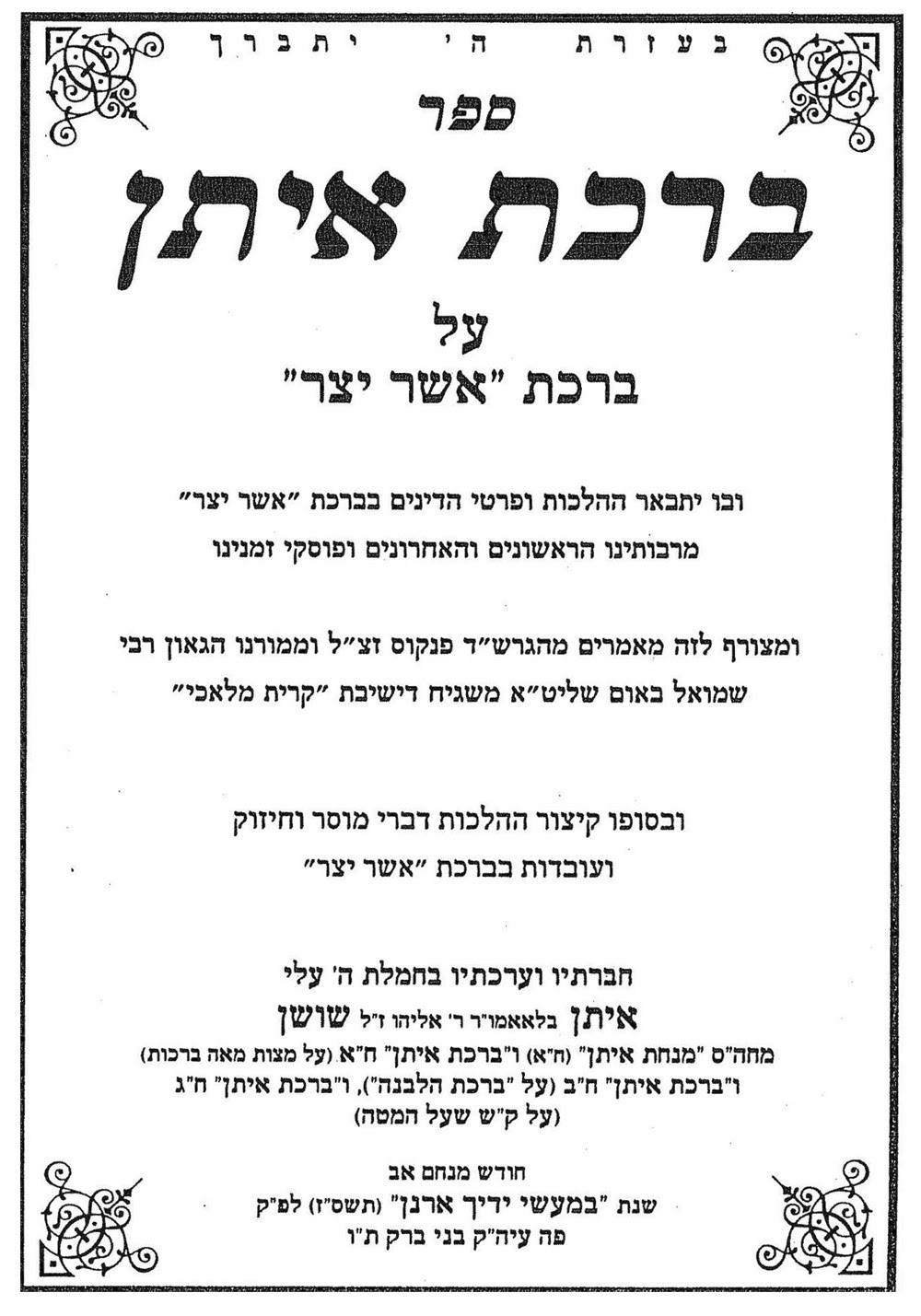
3. Many posts on this blog have discussed how we now have entire books on topics concerning which until recent years a few lines sufficed. Haym Soloveitchik also made this point in “Rupture and Reconstruction.” Here is another example, the book Birkat Eitan by R. Eitan Shoshan.


This is a 648 page (!) book devoted to the blessing Asher Yatzar, recited after going to the bathroom. Shoshan has an even larger book devoted to the Shema recited before going to sleep.
4. In a previous post[10] I mentioned that R. Moshe Bick’s brother was the Judaic scholar and communist Abraham Bick (Shauli). Before writing this I confirmed the information, but as we all know, oftentimes such “confirmations” are themselves incorrect. I thank R. Ezra Bick for providing me with the correct information, and the original post has been corrected.
R. Moshe and Abraham were actually somewhat distant cousins.[11] Abraham was the son of R. Shaul Bick (and hence the hebraicized last name, Shauli), who was the son of R. Yitzchak Bick, who was the chief rabbi of Providence, RI, in the early 1930’s. R. Yitzchak was the son of R. Simcha Bick, who was rav in Mohiliv, Podolia. R. Simcha Bick had a brother, R. Zvi Aryeh Bick, who was rav in Medzhibush. His son was R. Hayyim Yechiel Mikhel Bick, was also rav in Medzhibush (d. 1889). His son was also named Hayyim Yechiel Mikhel Bick (born a few months after his father’s premature death), and he was rav in Medzhibush from 1910 until 1925, when he came to America. His son was R. Moshe Bick.
R. Ezra Bick also reports that after the Second World War, when Abraham Bick was in the U.S. working as an organizer for communist front organizations, he was more or less cut off by his Orthodox cousins in Brooklyn.
R. Moshe Bick’s brother, Yeshayah (R. Ezra’s father), was a well-known Mizrachi figure. In his obituary for R. Hayyim Yechiel Mikhel Bick, R. Meir Amsel, the editor of Ha-Maor, mentioned how Yeshayah caused his father much heartache with his Zionist activities.[12] This article greatly hurt R. Moshe Bick and he insisted that Amsel never again mention him or his family in Ha-Maor. In fact, as R. Ezra Bick has pointed out to me, rather than causing his father heartache, R. Hayyim Yechiel actually encouraged Yeshayah in his Zionist activities.


R. Bick’s letter is actually quite fascinating and I give the Amsel family a lot of credit for including it in a recent volume dedicated to R. Meir Amsel. I have never seen this sort of letter included in a memorial volume, as all the material in such works is supposed to honor the subject of the volume. Yet here is a letter that blasts Amsel, and they still included it.[13] They also included a letter from R. Jehiel Jacob Weinberg in which he too criticizes Amsel for allowing personal attacks to be published in his journal. It takes a lot of strength for children to publish such letters and they have earned my admiration for doing so.
When I first mentioned R. Moshe Bick, I also noted that he was opposed to young people getting married too quickly. He therefore urged that boys and girls go out on a number of dates before deciding to get engaged. Needless to say, the haredi world was furious at this advice. R. Dovid Solomon reported to me the following anecdote: When the Klausenberger Rebbe told R. Bick how opposed he was to the latter’s advice, R. Bick responded: “That’s because you are mesader kidushin at all the marriages. But I am the one who is mesader all the gittin!”
5. In previous postings I gave three examples of errors in R. Charles B. Chavel’s notes to his edition of Nahmanides’ writings. For each of these examples my points were challenged and Chavel was defended. Here is one more example that I don’t think anyone will dispute. In Kitvei ha-Ramban, vol. 1, p. 148, Nahmanides writes:


 ובזה אין אנו מודים לספר המדע שאמר שהבורא מנבא בני אדם.
In his note Chavel explains ספר המדע to mean:
לדבר הידוע, יעללינעק מגיה פה שצ”ל: לרב הידוע.
Yet the meaning is obvious that Nahmanides is referring to Maimonides’ Sefer ha-Mada, where he explains the nature of prophecy.[14]
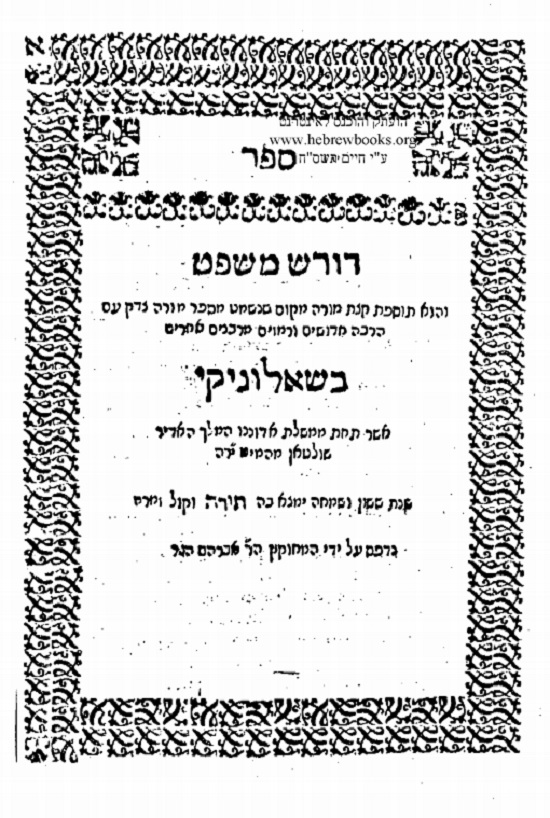
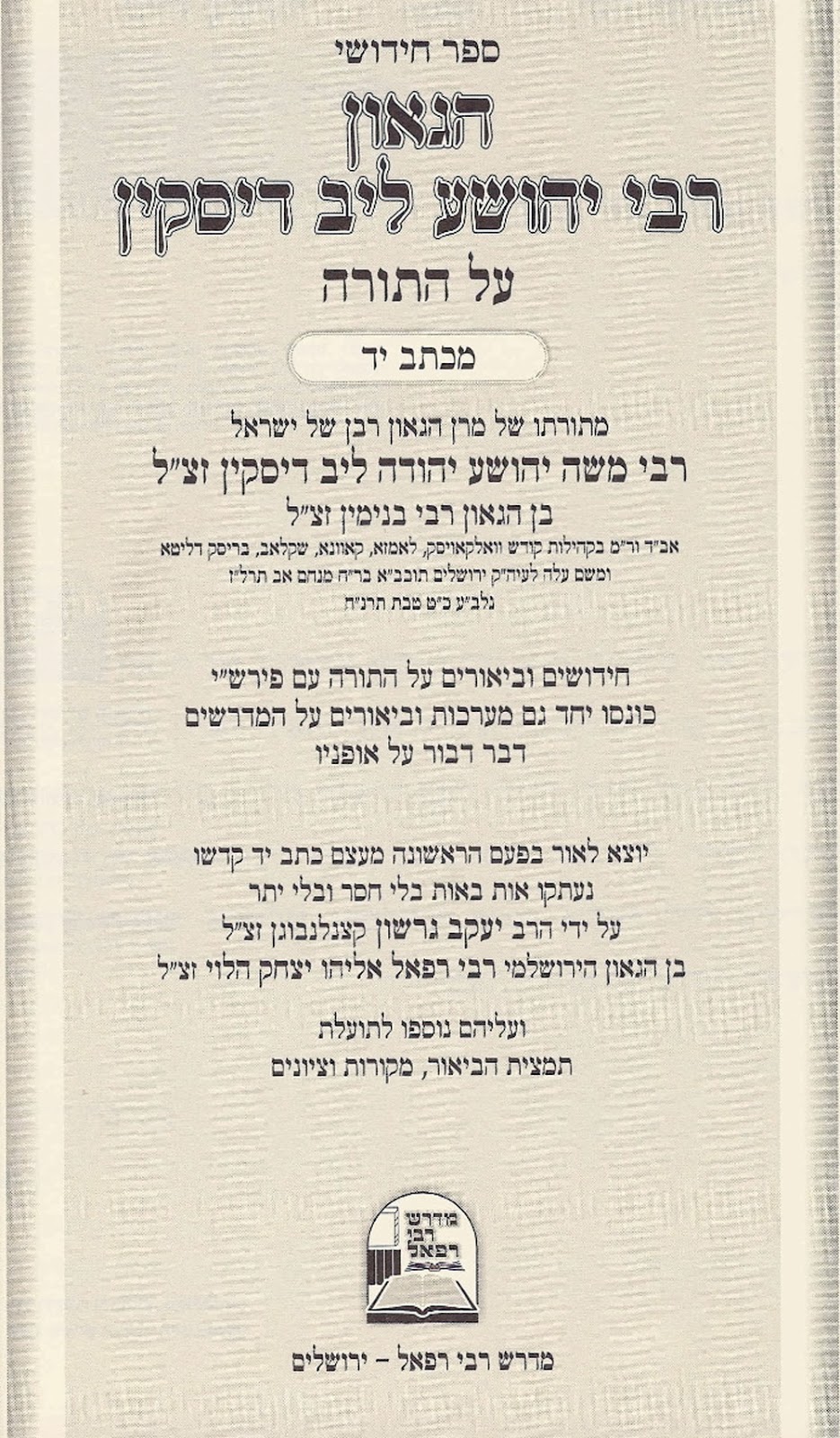
5. In 2008 a Torah commentary from R. Joshua Leib Diskin was published. Here is the title page.

The book even comes with a super-commentary of sorts. This is completely unnecessary but shows how greatly the editor/publisher values the work. Diskin is a legendary figure and was identified with the more extreme elements of the Jerusalem Ashkenazic community. For this reason he often did not see eye to eye with R. Samuel Salant.
Here is a page from this new commentary.

In his comment to Num. 23:22-23, Diskin quotes a book called Ha-Korem. This is a commentary on the Torah and some other books of the Bible by Naphtali Herz Homberg, a leading Maskil who worked for the Austrian government as superintendent of Jewish schools and censor of Jewish books. This is what the Encyclopedia Judaica says about him:

Homberg threatened the rabbis that if they did not adapt themselves to his principles the government would force them to do so. . . . Homberg was ruthless in denouncing to the authorities religious Jews who refused to comply with his requirements, and in applying pressure against them. In his official memoranda he blamed both the rabbis and the Talmud for preventing Jews from fulfilling their civic duties toward the Christian state. . . . Homberg recommended to the authorities that they disband most traditional educational institutions, prohibit use of the Hebrew language, and force the communal bodies to employ only modern teachers. . . In his book Homberg denied the belief in Israel as the chosen people, the Messiah, and the return to Zion, and tried to show the existence of an essential identity between Judaism and Christianity. . . . Homberg incurred the nearly universal hatred of his Jewish contemporaries.
Incredibly, it is from his commentary that Diskin quoted. The editor didn’t know what Ha-Korem was, but almost immediately after publication someone let him in on the secret. All copies in Israeli seforim stores were then recalled in order that the offending page be “corrected”. I am told that the first printing is now impossible to find in Israel. When I was informed of this story by R. Moshe Tsuriel, I contacted Biegeleisen who fortunately had just received a shipment from Israel, sent out before the books were embargoed. Presumably, my copy will one day be a collector’s item.
The one positive thing to be said about Homberg is that he wrote a very good Haskalah Hebrew. I was therefore surprised when I saw the following in David Nimmer’s otherwise fantastic article in Hakirah 8 (2009): “We begin with Herz Homberg, a minor functionary who wrote in German since his Hebrew skills were poor” (p. 73). Since German was the last language Homberg learnt, I was curious as to how Nimmer was misled. He references Wilma Abeles Iggers, The Jews of Bohemia and Moravia (Detroit, 1992), p. 14. Yet Nimmer misunderstood this source. Iggers writes as follows, in speaking of the mid-eighteenth century: “Use of Hebrew steadily decreased, even in learned discussions. Naftali Herz Homberg, for example, asked his friend Moses Mendelssohn to correspond with him in German rather than in Hebrew.” All that this means is that Homberg wanted to practice his German, and become a “cultured” member of Mendelssohn’s circle, and that is why he wanted to correspond in this language. In this he is little different than so many others like him who arrived in Berlin knowing only Hebrew and Yiddish. Each one of them had a different story as to how they learnt German. According to the Encyclopedia Judaica, in 1767, when he was nineteen years old, Homberg “began to learn German secretly.”
6. In a previous post I noted the yeshiva joke that R. Menasheh Klein’s books should be called Meshaneh Halakhot, instead of Mishneh Halakhot. Strangely enough, if you google “meshaneh halakhot” you will find that the books are actually referred to this way by a few different people, including, in what are apparently Freudian slips, B. Barry Levy and Daniel Sperber. In fact, Klein’s books are not the first to be referred to in this sort of way. In his polemic against Maimonides, R. Meir Abulafia writes (Kitab al Rasail [Paris, 1871), p. 13):
הוא הספר הנקרא משנה תורה, ואיני יודע אם יש אם למסורת ואם יש אם למקרא.

Abulafia is mocking Maimonides’ greatest work, and wondering if perhaps it should be called Meshaneh Torah! As for Klein, there is a good deal that can be said about his prolific writings, and they await a comprehensive analysis. When thinking about Meshaneh Halakhot, I often recall following responsum, which appears in Mishneh Halakhot, vol. 5, no. 141, and which I am too embarrassed to translate.

A well-known talmid hakham pointed out to me something very interesting. Normally we understand hillul ha-shem to mean that a non-Jew will see how Jews behave and draw the wrong conclusions of what Torah teachings are all about. However, in this responsum we see the exact opposite. The hillul ha-shem is that the non-Jew will draw the right conclusion! Yet the truth is that this understanding of hillul ha-shem is also very popular and is used by R. Moses Isserles, as we will soon see..
Here is another responsum that will blow you off your seats, from Mishneh Halakhot, New Series, vol. 12, Hoshen Mishpat no. 445.


If you want to understand why three hasidic kids are sitting in a Japanese jail, this responsum provides all you need to know. Can anyone deny that it is this mentality that explains so much of the illegal activity we have seen in recent year? Will Agudat Israel, which has publicly called for adherence to high ethical standards in such matters, condemn Klein? Will they declare a ban on R Yaakov Yeshayah Blau’s popular Pithei Hoshen, which explains all the halakhically permissible ways one can cheat non-Jews? You can’t have it both ways. You can’t declare that members of your community strive for the ethical high ground while at the same time regard Mishneh Halakhot, Pithei Hoshen, and similar books as valid texts, since these works offer justifications for all sorts of unethical monetary behavior. The average Orthodox Jew has no idea what is found in these works and how dangerous they are. Do I need to start quoting chapter and verse of contemporary halakhic texts that state explicitly that there is no prohibition to cheat on one’s taxes?[15] Pray tell, Agudah, are we supposed to regard these authors as legitimate halakhic authorities?
I have no doubt that there was a time that the approach found here was acceptable. In an era when Jews were being terribly persecuted and their money was being taken, the non-Jewish world was regarded as the enemy, and rightfully so. Yet the fact that pesakim reflecting this mindset are published today is simply incredible. Also incredible is that R. David Zvi Hoffmann’s Der Schulchan-Aruch und die Rabbinen über das Verhältniss der Juden zu Andersgläubigen, a classic text designed to show that Jewish law does not discriminate monetarily against contemporary Gentiles, has not yet been translated. Hoffmann’s approach was shared by all other poskim in Germany, who believed that any discriminatory laws were simply no longer applicable.[16] R. Jehiel Jacob Weinberg stated that we must formally declare that this is what we believe. Can Agudah in good conscience make such a declaration, and mean it?
The truth is that there is an interesting sociological divide on these matters between the Modern Orthodox and the haredi world. Here is an example that will illustrate this. If a Modern Orthodox rabbi would advocate the following halakhah, quoted by R. Moses Isserles, Hoshen Mishpat 348:2,[17] he would be fired.[18]
טעות עכו”ם כגון להטעותו בחשבון או להפקיע הלואתו מותר ובלבד שלא יודע לו דליכא חילול השם.
If I am wrong about this, please let me know, but I don’t believe that any Modern Orthodox synagogue in the country would keep a rabbi who publicly advocated this position.[19] Indeed, R. Moses Rivkes in his Be’er ha-Golah on this halakhah wants people to know that they shouldn’t follow this ruling.[20] See also Rivkes, Be’er ha-Golah, Hoshen Mishpat 266:1, 383:1, and his strong words in Hoshen Mishpat 388:12 where he states that the communal leaders would let the non-Jews know if any Jews were intent on cheating them. Today, people would call Rivkes a moser.
I believe that if people in the Modern Orthodox world were convinced that Rama’s ruling is what Jewish ethics is about, very few of them would remain in Orthodoxy. In line with what Rivkes states, this halakhah has been rejected by Modern Orthodoxy and its sages, as have similar halakhot. As mentioned, Hoffmann’s Der Schulchan-Aruch is the most important work in this area. Yet today, most people will simply cite the Meiri who takes care of all of these issues, by distinguishing between the wicked Gentiles of old and the good Gentiles among whom we live. Thus, whoever feels that he is living in a tolerant environment can adopt the Meiri’s position and confidently assert that Rama is not referring to the contemporary world.
Yet what is the position of the American haredi world? If they accept Rama’s ruling, and don’t temper it with Meiri, then in what sense can the Agudah claim that they are educating their people to behave ethically in money matters? Would they claim that Rama’s halakhah satisfies what we mean by “ethical” in the year 2009? Will they say, as they do in so many other cases, that halakhah cannot be compared to the man-made laws of society and cannot be judged by humans? If that is their position, I can understand it, but then let Aish Hatorah and Ohr Sameach try explaining this to the potential baalei teshuvah and see how many people join the fold. If this is their position, then all the gatherings and talks about how one needs to follow dina de-malchuta are meaningless, for reasons I need not elaborate on. Furthermore, isn’t all the stress on following dina de-malchuta revealing? Why can’t people simply be told to do the right thing because it is the right thing? Why does it have to be anchored in halakhah, and especially in dina de-malchuta? Once this sort of thing becomes a requirement because of halakhah, instead of arising from basic ethics, then there are 101 loopholes that people can find, and all sorts of heterim as we saw in Klein’s responsum. I would even argue that the fact that one needs to point to a halakhic text to show that it is wrong to steal is itself a sign of our society’s moral bankruptcy.[21]
7. In Studies in Maimonides and His Interpreters I stated that Maimonides nowhere explicitly denies the existence of demons, yet this denial is clearly implied throughout his writings. It was because Maimonides never explicitly denied them that so many great sages refused to accept this, and assumed that Maimonides really did believe in demons. (In my book I cited many who held this position.) I first asserted that Maimonides never explicitly denied demons in my 2000 article on Maimonides and superstition, of which the second chapter in my new book is an expanded treatment. While working on the original article I was convinced that Maimonides indeed denied demons in his Commentary to Avodah Zarah 4:7. However, I had a problem in that so many who knew this text did not see it as an explicit rejection. In fact, I was unaware of anyone actually citing this text to prove that Maimonides denied the existence of demons. (Only a couple of months ago did R. Chaim Rapoport call my attention to R. Eliezer Simhah Rabinowitz, She’elot u-Teshuvot ve-Hiddushei Rabbi Eliezer Simhah [Jerusalem, 1998], no. 11, who does cite this text as an explicit rejection of the existence of demons. I also recently found that R. Avraham Noah Klein, et. el., Daf al ha-Daf [Jerusalem, 2006), Pesahim 110a, quotes the work Nofet Tzufim as saying the same thing. Unfortunately, as far as I can tell, Klein doesn’t have a list of sources, so I don’t know who the author of this work is.)
Seeing that R. Zvi Yehudah Kook was quite adamant that Maimonides believed in demons,[22] I turned to R. Shlomo Aviner, who published R. Zvi Yehudah’s work, and asked him about Maimonides’ words in his Commentary to Avodah Zarah. Aviner convinced me that Maimonides should be understood as only denying that occult communication with demons is impossible, not the existence of demons per se. He wrote to me as follows:
הרמב”ם לא כתב שם בפירוש שאין שדים, אלא ששאלה בשדים היא הבל, וכך אנו רואים מן ההקשר שהוא מגנה שיטת שונות להשיג דברים או ידיעות, כגון “כשוף וההשבעות והמזלות הרוחניות, ודבר הכובכים והשדים והגדת עתידות ומעונן ומנחש על רוב מיניהם ושאלת המתים.”


I was still not 100 percent sure, but the fact that so many great scholars who knew the Commentary to Avodah Zarah assumed that Maimonides indeed believed in demons gave me confidence that Aviner was correct.[23] Even R. Kafih, in speaking of Maimonides denial of demons, does not cite the Commentary,[24] and this sealed the matter for me. I therefore assumed that all Maimonides was denying in his Commentary to Avodah Zarah 4:7 was the possibility of conversation with demons, and not demons per se. (R. Aviner doesn’t speak of simple conversation, but this was my assumption.)
Following publication of the article in 2000 no one contacted me to tell me that I was incorrect in my view of Maimonides and demons. So once again I was strengthened in my assumption, and repeated my assertion in Studies in Maimonides. Not too long ago I received an e-mail from Dr. Dror Fixler. Fixler is one of the people from Yeshivat Birkat Moshe in Maaleh Adumim who is working on new editions of Maimonides’ Commentary on the Mishnah. I will return to his work in a future post when I deal with the newly published translation of the Commentary. For now, suffice it to say that he knows Arabic very well, and he asserts that there is no doubt whatsoever that in the Commentary to Avodah Zarah 4:7 Maimonides is denying the existence of demons. So this brings me back to my original assumption many years ago, that Maimonides indeed is explicit in his denial. If there are any Arabists who choose to disagree, I would love to hear it.
8. I recently sent a copy of the reprint of Kitvei R. Yehiel Yaakov Weinberg (2 vols.) to a famous and outstanding Rosh Yeshiva. In my letter to him I mentioned that the books were a donation to the yeshiva library. He wrote back to me as follows:
מאשר בתודה קבלת כתבי הגאון רבי יחיאל יעקב וויינברג זצ”ל בשני כרכים. מלאים חכמה ודעת בקיאות וחריפות ישרה, ולפעמים “הליכה בין הטיפות” מתוך חכמת חיים רבה. אולם בכרך השני יש דברים שקשה לעכל אותם, כגון לימוד זכות על מתבוללים ממש (הרצל ואחה”ע [אחד העם] בגרון ועוד) למצוא בהם “ניצוצות קדושה”. ומי שיראה יחשוב כי מותר לומר לרשע צדיק אתה. לכן כרך ב’ נשאר אצלי וכרך א’ לעיון התלמידים הי”ו.


I don’t think that any Rosh Yeshiva in a Hesder yeshiva would say that we should shield the students from the words of a great Torah scholar, but maybe I am wrong. I would be curious to hear reactions. In response to his letter, I sent this Rosh Yeshiva R. Abraham Elijah Kaplan’s essay on Herzl, to show him that Weinberg’s views in this regard were not unique.
Interestingly, in his letter to me the Rosh Yeshiva also wrote:


מה מאד נפלא מ”ש בסוף עמוד ריט על שיטת הגר”ח מבריסק לעומת שיטת הגר”א. מבחינה זו אנו לומדים בישיבה בשיטת הגר”א.


He was referring to this amazing letter from Weinberg:
קראתי את מאמרו של הגרי”ד סולובייציק על דודו הגרי”ז זצ”ל. השפה היא נהדרה ונאדרה והסגנון הוא מקסים. אבל התוכן הוא מוגזם ומופרז מאד. כך כותבים אנשים בעלי כת, כמו אנשי חב”ד ובעלי המוסר. מתוך מאמרו מתקבל הרושם כאלו התורה לא נתנה ע”י מרע”ה חלילה כי אם ע”י ר’ חיים מבריסק זצ”ל. אמת הדברים כי ר’ חיים הזרים זרם חדש של פלפול ע”ד ההגיון לישיבות. בהגיון יש לכל אדם חלק, ולפיכך יכולים כל בני הישיבה לחדש חידושים בסגנון זה, משא”כ בדרך הש”ך ורעק”א צריך להיות בקי גדול בשביל להיות קצת חריף ולכן משכל אנשי הישיבות מתאוים להיות “מחדשים” הם מעדיפים את ר’ חיים על כל הגאונים שקדמו לו. שאלתי פעם אחת את הגרי”ד בהיותו בברלין: מי גדול ממי: הגר”א מווילנא או ר’ חיים מבריסק? והוא ענני: כי בנוגע להבנה ר’ חיים גדול אף מהגר”א. אבל לא כן הדבר. הגר”א מבקש את האמת הפשוטה לאמתתה, ולא כן ר’ חיים. הגיונו וסברותי’ אינם משתלבים לא בלשון הגמ’ ולא בלשון הרמב”ם. ר’ חיים הי’ לכשלעצמו רמב”ם חדש אבל לא מפרש הרמב”ם. כך אמרתי להגאון ר’ משה ז”ל אבי’ של הגר”יד שליט”א.


9. My last two posts focused on R. Hayyim Dov Ber Gulevsky. With that in mind, I want to call everyone’s attention to a lecture by R. Aharon Rakefet in which he tells a great story that he himself witnessed, of how students in the Lakewood yeshiva were so angry at Gulevsky that they actually planned to cut his beard off. It is found here  [25] beginning at 65 minutes. The clip has an added treat as we get to hear the Indefatigable One, who mentions travelling to Brooklyn together with a certain “Maylech” in order to visit Gulevsky.
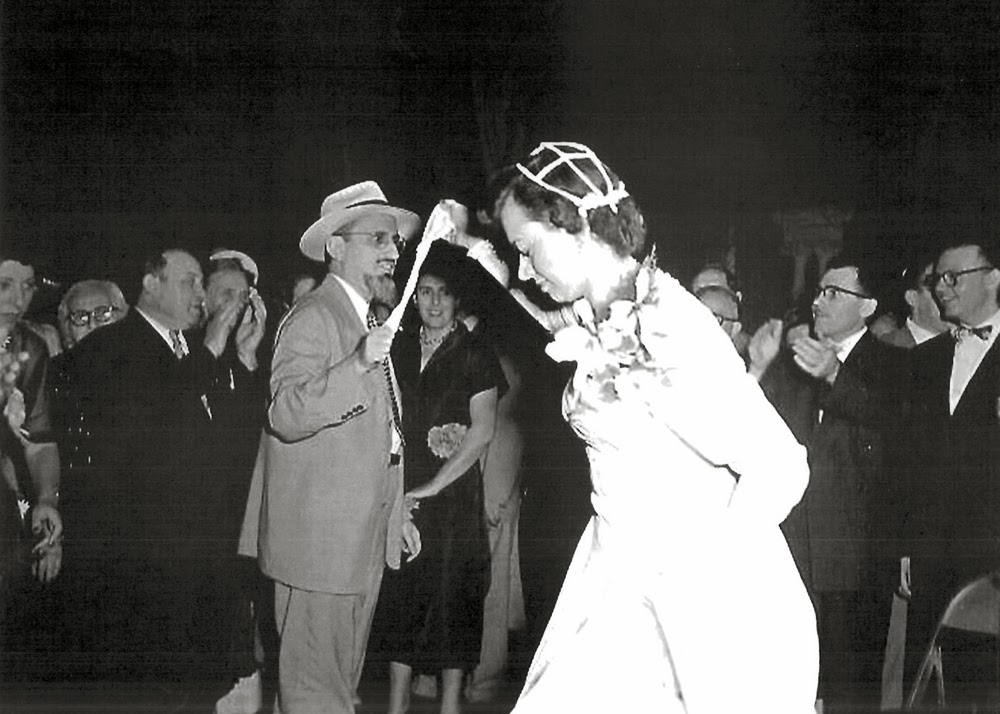
10. And finally, apropos of nothing, here is a picture that I think everyone will get a kick out of. The bride is Gladys Reiss. It shows the Rav in his hasidic side. (Thanks to David Eisen and R. Aharon Rakefet for providing the picture.)

[1] Some of the lies of this paper have been dealt with by R. Moshe Alharar, Li-Khvodah shel Torah (Jerusalem, 1988). Here are two condemnations of Yated printed in Alharar’s book.


For examples of the paper’s most recent outrages, take a look at two articles from the issue that appeared during the Ten Days of Penitence (!). The articles are available here and here.


The first is a vicious attack on the Shas MK R. Hayyim Amsellem for his authorship of a halakhic study arguing that those non-Jews who serve in the Israeli army should be converted using a less strict approach than is currently in practice. Amsellem, who is a student of R. Meir Mazuz and an outstanding talmid hakham, wrote this piece and sent it to some leading poskim to get their opinions. Amselem also discussed his approach in an interview.


What did Yated do? It attacked the “nonsensical, heretical remarks” of Amsellem, knowing full well that his article was not a practical halakhic ruling, but a work of Torah scholarship sent out for comment. And why is what he wrote “nonsensical” and “heretical”? Because it contradicts the viewpoint of “Maranan ve-Rabbanan Gedolei Yisrael,” the papacy that Yated has created.  As with every papacy, no one is permitted to have a different viewpoint. We see that clearly in the next article I linked to. Here the paper deals with the great sages who have permitted brain death. Obviously, Yated has started to believe its own papal rhetoric, since rather than offer any substantive comments, all it can do is refer to R. Elyashiv and unnamed former and current gedolei Yisrael. From Yated’s papal perspective, this is supposed to silence all debate, as if Judaism is a religious dictatorship. Yet it is not, and although Yated will never admit it, there are also former and current gedolei Yisrael who do accept brain death.
[2] “Be-Inyan ha-Gemarot ha-Mevuarot ha-Hadashim,” Or Yisrael 50 (Tevet, 5768), p. 42.
[3] “Be-Inyan Hadpasat ha-Gemara im Targumim u-Ferushim Hadashim,” Or Yisrael 50 (Tevet, 5768), pp. 39-40. Gorelik even claims that the only reason the Hafetz Hayyim agreed to support the Daf Yomi program was as a defense against the Haskalah and Reform. R. Chaim Rapoport responded to Gorelik, ibid., pp. 57ff.
[4] For the Lubavitcher Rebbe’s take on this, see here beginning at 8 minutes (called to my attention by a friend who wishes to remain anonymous). The Rebbe’s words are very strong: Since we know that “people” do not tell a lie that is likely to be found out, it must be that the liars are not in the category of “people” i.e., human beings!
[5] The phenomenon of children distorting their father’s legacy is also something that deserves a post of its own. One thinks of the efforts of the children and grandchildren of R. Gedaliah Nadel and R. Eliezer Waldenberg in opposition to the publication of Be-Torato shel R. Gedaliah and the reprinting of Hilkhot ha-Medinah. R. Nadel’s children were even successful in having Be-Torato removed from Hebrewbooks.org. There are many other such examples, some of which relate to the Rabbinical Seminary of Berlin, which like Yeshiva University was sometimes a place to be forgotten after one left the world of German Orthodoxy. For example, see R. Shmuel Munk’s biographical introduction to the work of his father, R. Shaul Munk, Bigdei Shesh (Jerusalem, 1973). There is no mention that R. Shaul studied at the Rabbinical Seminary. If that wasn’t enough, R. Shmuel, in the introduction, p 19, even attacks the German Orthodox practice of reading German poetry, going so far as to say that no one [!] has permitted this. As with the Yated, “no one” means “no one we regard as significant.” For an earlier post that deals with a posthumous removal of the Rabbinical Seminary from one graduate’s biography, see here.


None of the obituaries of R. Shlomo Wolbe mentioned that he studied at the Rabbinical Seminary of Berlin for a short while, but in this case I assume that the writers were unaware of this. The entry on Wolbe in Wikipedia does mention it, and I was the source for this information. My source is Weinberg’s letter to Samuel Atlas, dated June 10, 1965:


כך סיפר בן אחיו של וולפסון, מר אביעזר וולפסון, תלמיד מונטרה לפנים, ואח”כ תלמיד ישיבת באר יעקב, שבה משמש המנהל רוחני מר וולבה, יליד ברלין, בנו של סופר חילוני וכופר גמור. למד בכתות הנמוכות של בית מדרשנו, ואח”כ הלך לישיבת מיר ונעשה לחניכו של ר’ ירוחם ז”ל, המשפיע המוסרי הגדול.


The point mentioned by Weinberg, that Wolbe was raised in a non-Orthodox home, was never a secret. Some additional details of his turn to Orthodoxy were related by Anne Ruth Cohn, Dayan Grunfeld’s daughter. See here


Yet, as we have come to expect, the Yated cannot be honest with its readers. Thus, in its obituary here. It writes: “Shlomo Wolbe was born in Berlin to R’ Moshe in Tammuz 5674,” making it seem that he was from an Orthodox home. The obituary continues with more falsehoods: “As a child he studied in his home city and at a young age was sent to Yeshivas Frankfurt.” Needless to say, there is also no mention of Wolbe’s university studies.


Another example worth mentioning is the following: Those who read Making of a Godol will recall the description of R. Aaron Kotler’s irreligious sister who tried to convince him to leave the world of the yeshiva. Yet in Yitzchok Dershowitz’ hagiography of R. Aaron, The Legacy of Maran Rav Aharon Kotler (Lakewood, 2005), p. 63, this communist sister is described as “religious, but ‘secular education’ oriented.” See Zev Lev, “Al ‘Gidulo shel Gadol,’” Ha-Ma’ayan 50 (Tishrei, 5770), p. 104.


The absolute best example of this phenomenon relates to the Lubavitcher Rebbe’s brother, Yisrael Aryeh Leib. He was completely irreligious. There are people alive today who can testify to his public Sabbath violation. He even kept his store open on Shabbat. See Shaul Shimon Deutsch, Larger than Life (New York, 1997), vol. 2, ch. 7. Deutsch was even able to speak to his widow. Yisrael Aryeh Leib also has a daughter who presumably would be willing to describe what her father’s attitude towards religion was, if anyone is really interested in knowing the truth. I think it is very nice that Chabad in England commemorates his yahrzeit, see here, and this is very much in line with Chabad’s ideology that every Jew is precious. Yet what is one to make of this “institute”?


Here Yisrael Aryeh Leib, “the youngest brother of the Rebbe, Melech HaMoshiach, who lives forever,” is turned into a rabbi and devoted chasid. I actually contacted the person who runs the “institute” and asked him how he can so blatantly distort the historical record. Communicating with him was one of the most depressing experiences I have had in a long time. It is one thing for a person to believe foolish things, but here was a guy who had drunk an extra dose of the Kool Aid, and with whom normal modes of conversation were impossible. This is actually a good limud zekhut for him: unlike many other cases where the people distorting the historical record are intentionally creating falsehoods, in this case the distorter really believes what he is saying.
[6] R. Mark Urkowitz, who was a student of R. Gorelik, told me that at the end of his life Gorelik commented to him that he was very happy he taught at YU, since this was the only yeshiva whose graduates were bringing Torah to all corners of the United States. When Urkowitz later told this story to another of Gorelik’s son, he denied that his father could ever have said this. Urkowitz and one other person recalled to me how at Gorelik’s funeral YU was never mentioned in any of the eulogies. It was as if the major part of Gorelik’s life for forty years had never existed.
[7] Ishim ve-Shitot (Tel Aviv, 1952), pp. 58-59.
[8] Aaron Rakeffet-Rothkoff, The Rav, vol. 1, p. 227.
[9] This is Zevin’s preface to the story (translation in Louis Jacobs, A Tree of Life [London, 2000], pp. 54-55, n. 49):


Why did R. Hayyim refuse to write responsa? Some think that his remoteness from the area of practical decisions stemmed from the fact that he belonged to the ranks of “those who fear to render decision,” being afraid of the responsibility that it entails. But this is not so. The real reason was a different one. R. Hayyim was aware that he was incapable of simply following convention and that he would be obliged, consequently, to render decisions contrary to the norm and the traditionally accepted whenever his clear intellect and fine mind would show him that the law was really otherwise than as formulated by the great codifiers. The pure conscience of a truthful man would not allow him to ignore his own opinions and submit, but he would have felt himself bound to override their decisions and this he could not bring himself to do.
[10] See here.
[11] For more on Abraham Bick the communist, and his relationship with R. Moshe Bick, see here for the following report:


אברהם ביק הכרתי בפעם הראשונה כהרה”ר של רוסי’ בא לבקר לארה”ב בשנת תשכ”ח ביזמת הרב טייץ מאליזאבעט נוא דזשערזי. וכבוד גדול עשו לו וכל גדולי ארצינו באו לבקר אותו ולחלוק לו כבוד — הוא למד בסלאבאדקא והי’ ממלא מקומו של הרב שלייפער, וניהל בחכמה ובתבונה את רבנתו ועמד על משמרתו הוא בא ביחד עם החזושל לענינגראד -השומר- בבארא-פארק עשו פאראד גדול וכל הישיבות והבית-יעקב יצאו לרחובה של עיר לחוק כבוד להעומד על משמרת היהדות ברוסי’ משם נסעו לישיבת תורה-ודעת שכל הגדולים דברו וחיזקו את הרב לעווין .משם נסעו לאליזאבעט מקום הרב טייץ — שחלקו רב בענייני יהדות רוסי’ —  וגם שם הי’ פאראד גדול. והרב לעווין הי’ מאוד מרוגש .ודמעות נזלו מעיניו. נחזור לביק-הוא הי’ קאמאניסט. והי’ מכונה הרב של הקאמאניסטים. הוא כתב מאמרים בשבועון שלהם ותמיד המליץ טוב על הקאמאניסטים שהם לא רודפים את הדת. וכשהרב לעווין הי’ כאן הוא הי’ מראשי המחותנים שם. ואז דברתי איתו בפעם הראשונה. אח”כ הוא עלה לארה”ק ועבד במוסד הרב קוק ומצאתיו שם אך לא רציתי להכאיבו ולא דברנו על העבר. אז נתן לי שני ספרים א] זהרי-חמה הגהות על הזוה”ק מהיעב”ץ. ועוד ספר למוסרו לש”ב הרה”ג רמצ”א זצ”ל ביק — הוא פשוט רצה להתפייס איתו כי הם לא היו שוה בשוה-וכשהבאתי את הספרים להרב ביק דברתי איתו על אברהם ביק ואביו הרה”ג שהי’ חתן המשמרת שלום מקאדינאוו, והי’ בעל הוראה מובהק. בקיצור לאחר זמן חזר לארה”ב בגין אישתו וביתו שלא היו בקו הבריאות — הוא הי’ דמות טראגית — אביו שלחו מארה”ב ללמוד לארה”ק. אך הי’ תמיד שומר תורה ומצוות הי’ אידאליסט ולא הי’ בן יחיד במחשבתו שהקאמאניזום יציל את האנושות והיהדות .הוא לא עשה זאת מטעם כסף .הוא לא הי’ מאטראליסט. והשם הטוב יכפר בעדו.


[12] Ha-Maor, Tamuz 5726, p. 18.
[13] Ha-Gaon ha-Rav Meir Amsel (Monsey, 2008), p. 262.
[14] See R. Yaakov Hayyim Sofer in Moriah, Nisan 5769, p. 150.
[15] R. Chaim Rapoport provides some of these sources in his article in Or Yisrael, Tishrei 5770.
[16] For R. Abraham Elijah Kaplan’s view, see his Mivhar Ketavim (Jerusalem, 2006), pp. 287-288.
[17] After quoting this halakhah, Rama cites an opposing view, but this is cited as יש אומרים, meaning that the first ruling is the one Rama accepts. Even this view is not something that would go over well in the Modern Orthodox world: וי”א דאסור להטעותו אלא אם טעה מעצמו שרי
[18] Although he might not be fired, any Modern Orthodox rabbi who stated as follows would also be in hot water, as the congregation would be outraged: “One is not allowed to admire gentiles or praise them.” The writer of these words goes on to say that collecting baseball cards is also forbidden. “While it may be that some people trade them only for financial gain, the reason for collecting the cards is more likely because of an appreciation and admiration for the personalities depicted on them. This is forbidden.” Quite apart from the terrible lack of judgment in putting the first sentence (“One is not allowed to admire gentiles or praise them”) into an English language book (for obvious reasons), should we be surprised that a halakhist who thinks baseball cards are forbidden is one of the poskim of the formerly Modern Orthodox OU? See R. Yisrael Belsky, Shulchan Halevi (Kiryat Sefer, 2008), pp. 132, 133. (For another ruling against baseball cards, see R. Yitzhak Abadi, Or Yitzhak, Yoreh Deah no. 26.) In discussing the issue of praising Gentiles and the prohibition of le tehanem, Meiri writes as follows, in words that have become basic to the Modern Orthodox ethos (Beit ha-Behirah: Avodah Zarah 20a):


כל שהוא מן האומות הגדורות בדרכי הדתות ושמודות בא-להות אין ספק שאף בשאין מכירו מותר וראוי.


[19] Samuel Cohon discusses Rama’s ruling in Faithfully Yours (Jersey City, 2008), pp. 87-88.
[20] See similarly R. Shneur Zalman of Lyady, Shulhan Arukh, Hilkhot Ona’ah, no. 11.
[21] Along these lines, see here for a recent article by R Binyamin Lau dealing with a husband who wanted to know if he was halakhically permitted to hit his wife.
[22] Sihot ha-Rav Tzvi Yehudah: Bereishit, ed. Aviner (Jerusalem, 1993), pp. 295-297, 310-312.
[23] In Studies in Maimonides I cite numerous examples. Here is one more to add to the list. R. Tzefanyah Arusi, “’Lo ba-Shamayim Hi’ be-Mishnat ha-Rambam,” Mesorah le-Yosef 6 (2009), p. 396:


מה שהשיג הגר”א בעניין השדים והכשפים, יש להשיב על כל דבריו: וכי מניין לו שלדברי רבנו אין מציאות לשדים ולמכשפים וכיו”ב.


[24] See his Ketavim (Jerusalem, 1989),  vol. 2, pp. 600-601.
[25] “The Bracha for Kidush Ha-Shem,” Sep. 21, 2008.


There is No Bracha on an Eclipse

There is No Bracha on an Eclipse
By Rabbi Michael J. Broyde
Rabbi Michael Broyde is a law
professor at Emory University School of Law and the Projects Director in its
Center for the Study of Law and Religion.  His most recent Torah sefer is
entitled “A Concise Code of Jewish Law For Converts”.  This letter was written to someone after a
shiur on why there is no bracha on seeing a solar eclipse.
1.      You are correct that I said that I thought there was no bracha on an eclipse.  I had not seen Rabbi Linzer’s teshuva at the time that told that to you this, as it was not circulating on the internet at the time that I prepared for my shiur and I did not see it until Sunday, the day after the shiur.  I try to cite as much as relevant in these classes and his thoughts are clearly relevant.  He is a stellar writer on interesting topics of halacha and I read his material consistently.  I had seen that Rabbi Eliezer Melamed in Peneni Halacha Laws of Brachot 15:6 and note 5 which does permit a bracha on an eclipse.
2.      Having said that, I would not change my mind at all in light of Rabbi Linzer’s teshuva and remain opposed to reciting a bracha over an eclipse for many reasons explained below.
3.      First, as many have noted, the giants of halacha are quite divided over the question of whether the listing in the Shulchan Aruch is paradigmatic or particular.  Some make no blessings other that for matters listed in the codes and other treat them as examples.  That dispute alone inspires me to be cautious, although I could be persuaded that the paradigmatic approach is correct and one could then make a bracha on a waterfall.  I have yet to see a clear proof that such a view is correct, but it does seem more intuitive.[1]  Yet, safek brachot lehakel is present.
4.      Second, and more importantly, if you look closely in the classical achronim, you see not a single achron who actually endorses saying a bracha on an eclipse.  Not a single one.  It is true that there is a dispute about whether the list in the Mishna is all inclusive or not (as many note, see Shar HaAyin 7:6), but even those who are of the view that the Mishnah’s list is merely examples, not a single achron actually endorses making a bracha on an eclipse as opposed to a volcano or some other natural wonder, which some clearly do permit a bracha on.  The group that favors expansive brachot on natural wonders endorse stalagmite caves, waterfalls, water geysers, volcanoes and many more: but not eclipses.  If you look, for example in Shar HaAyin 7:6 (the classical work on this topic) one sees this most clearly: even those who endorse making brachot on waterfalls, or other amazing facets of creation are uncertain נסתפק)) if one make a bracha on an eclipse, and we all know that when a posek is נסתפק, that posek does not make a bracha.[2]
a.       This contrast is made clear in the context of Rabbi Shmuel Halevi Wosner — who is the most clear and direct articulator of the view that list of wondrous sightings in the Shulchan Aruch are just examples, and one makes the bracha of oseh maaseh bereshit even on other wonders.  In Shar HaAyin page 431 he states directly that one makes a blessing on many wondrous things unlisted in the codes and he explains that “Volcanos are not present in our lands and thus are unmentioned in the Shulchan Aruch” and that it is “obvious” that one makes a blessing on them.  However, on eclipses he states “solar eclipses are mentioned a few times in the Gemera, and thus on the question of whether one needs to make a bracha when one sees them, needs more thought.[3]”  He does NOT endorse making a bracha on an eclipse. In fact, I am unaware of anyone other than Rabbis Melamed and Linzer who actually endorse the view in favor of making a bracha on an eclipse, (rather than merely ponders the possibility of such a bracha).  Rabbi Wozner’s point is important: this is not a modern issue – eclipses were well known for a few millennium, and silence in the Jewish Law codes is telling.  To the best of my knowledge the dispute about the eclipses is between two views: (1) Absolutely Not and (2) Maybe.  There is no (3) Yes view in the classical rabbinic literature for eclipses.  (That is why the listing of reasons why an eclipse might be different from other wonders below is important.)

5.      Why is an eclipse different from a stalagmite cave or a volcano?  I could think of a few reasons from a halachic perspective, even to those who believe that the Mishna’s list is not inclusive.

a.       Many perceive them to be a siman raah – a bad sign, either because of superstitious reasons or because darkness in the middle of the day is practically bad – and there is no blessing on bad omens (as Rabbi Moshe Feinstein is quoted in Mesorat Moshe 2:51).
b.      Because one sees nothing in an eclipse (as it is an absence of light, rather than a presence) and we do not make brachot on absences.
c.       Because the bracha of oseh maaseh breseshit does not apply to things whose existence can be mathematically predicted, but are merely rare: eclipses are not anomalies, but a product of the universes’ cycle of life, and more under the berkat hachama rule.
d.      Because full eclipses are exceedingly rare and partial eclipses are almost impossible to “see” without modern eclipse glasses (a 75% eclipse hardly is noticed on a functional level) and are naturally invisible.
e.       For other reasons that are less obvious related to the fact that these have to be wonders from “creation” and these are not from creation.
f.       Because some thought that eclipses were punishments and thus no blessing was ordained.[4]
6.      Based on all this, one can say that eclipses could be different from all other created natural anomalies as a matter of Jewish law and are not covered by the general idea of a wonder such that a blessing should be made. To my surprise, even as the primary source of the view that one can make a bracha on wonders beyond the Mishna’s list is Rabbi Wozner and he explicitly notes that eclipses are different from volcanoes, waterfalls, geysers and many other rare natural phenomena, the secondary codifiers of the last generation have completely missed this distinction.  Instead both Shar HaAyin 7:6 and Penenia Halacha Laws of Bracha 15:5 link the dispute about volcanoes and waterfalls with eclipses and state that one who permits a bracha for volcanoes and waterfalls would do so for eclipses as well, when in fact that is incorrect.  Eclipses were known in Talmudic times and yet no bracha was noted: that bothers Rabbi Shmuel Wozner, who permit a bracha on an erupting volcano, not to permit a bracha to be recited on an eclipse, by noting that he is uncertain if a bracha is proper.[5]
7.      Additionally, let me add a thought of my own about modern times and bracha’s over wonders.  The Shulchan Aruch OC 228:3 limits even the mountains that one can make a bracha on to such mountains in which the hand of our Creator is clear and apparent. (ולא על כל הרים וגבעות מברך, אלא דווקא על הרים וגבעות המשונים וניכרת גבורת הבורא בהם.)  I think in our modern times, with modern science explaining all of these events, no mountains or valleys ever meet the criterial of make it clear (to normal people) that God is in charge of the universe.  Based on this, I would not make any extensions of this halacha beyond its minimums recorded in the Shuchan Aruch because I think that the test for determining whether we can add to this list is and make a bracha is וניכרת גבורת הבורא בהם.  Given the secular environment we live in, I think no natural astrological events meets that bill in modern times so I only – at most — make such brachot on the things that the halachic tradition directly directs me to do, like lighting or thunder or great mountains and certain rivers. I would not make such a bracha on an erupting volcano or a solar eclipse, as seeing such does not cause normal people in my society to experience God.  (There are two formulations of my claim, each slightly different.  The first is experiential, in that I think that most people in my society do not sense any awe of God at an eclipse.  Second, even if any particular person does (and I do not doubt that some do), they cannot make the bracha since most people in America do not so sense God through these events and that is the halachic test found in the Shulchan Aruch.  The sense of wonder has to be obvious to normal people and that is lacking in the world we live in.
8.      Finally, all attempts to actually endorse making a bracha on an eclipse run directly against the combined force of both (1) the minhag, which is not to make a bracha and (2) the rule of ספק ברכות להקל. These two together make it difficult for any moreh horah to argue convincingly that there is clear proof that bracha should be made.
9.      I have consciously not engaged with Rabbi Linzer’s very worthwhile point (which I more or less agree with) that “we strive to bring our religious lives and our halakhic lives in sync” exactly because (as he himself notes) this calculus is limited to cases where there is a dispute between poskim about what to do.  Here, to the best of my knowledge, there is no dispute and since there is no classical halachic authority who actually says “yes make a bracha on an eclipse” there is no grounds to examining very important meta issues used to resolve disputes (since there is no dispute).
10.  Based on all of this, I would not make a bracha on an eclipse.
11.  Having said that, I am happy to endorse other forms of religions veneration for one who feels such wonder.
a.       One can certainly say this bracha without שם ומלכות.
b.      I am also somewhat comfortable with someone making this blessing in Aramaic (see Shulchan Aruch OC 167:10, 187:1 and 219:4) although I am aware of the view of Iggrot Moshe OC 4:20:27, but find the view of the Aruch Hashulchan OC 202:3 more analytically compelling.
c.       Both the suggestions of Rabbi Chaim David Ha-Levi (Responsa Aseh Lecha Rav, 150) that one recited va-yevarech david (Chronicles. 1:29:10) and adding “who performs acts of creation” at the end and of Rabbi David Lau, current Ashkenazic Chief Rabbi of Israel, to recite Tehillim 19 and 104 are completely reasonable as well.
d.      Other innovative non-bracha based solutions are also reasonable.
12.  On the other hand, those who attended an eclipse – I myself traveled to Rabun Georgia, an epicenter for the total eclipse and sat in total darkness at for three minutes in the middle of the day and did not feel any closer to the Almighty as Creator of the World during the eclipse than I did after or before — can feel free to engage in no innovative religious observance at all without feelings that they are deficient in any way.
13.  I welcome readers to direct me to a source written by an achron which directly discusses eclipses and permits a bracha.  (Please feel free to email me.) So far, I have only seen that the group that permits a bracha for an eclipse does so based on a putative ruling of Rabbi Wozner and others to permit such a bracha, which upon closer examination is not present.  I am willing to ponder the possibility that there is an achron who permits such a bracha even as others do not – that posek argues that all wonders deserve a bracha and the listing in paragraph 5 above about why eclipses are different from other wonders is incorrect – To the best of my knowledge, that is a theoretical position that is not actually adopted.

[1] I am inclined to the more expansive view because the formulation in the Beit Yosef in Tur OC 228.
[2] This is an important point.  Rabbi Wozner has the right as a morah horah to assert that he rules that the mishna’s list is not inclusive and that volcanoes get a bracha (which is exactly what he says, as does Rabbi Nissan Karletz in the same work on page 466).  When one asks him “how can he rule that a bracha needs to be recited, others disagree, and then the matter is in doubt”, Rabbi Wozner responds by stating that he sees no doubt and thus he feels a bracha should be recited.  When Rabbi Wozner states that he has doubt about this matter, he is being clear that this is exactly a case of doubt and no blessing should be recited.
[3] Let me add that eclipses are discussed in the rishonim and codifiers as well, with no mention of a bracha.  See Darchai Moshe on Tur OC 426 and the works cited by Rabbi Linzer in footnote 2 of his teshuva (see here).
[4] It is clear from the recounting of the Chafetz Chaim that he did not say a bracha on an eclipse.  See here.
[5] This is found both Shar HaAyin and Penine Halacha as well as Rabbi Linzer’ teshuva.  Shaar Haayin 7:6 is strict on the whole matter and does not permit a bracha practically on even volcanoes an water falls, so the mistake in that work – linking volcanoes and eclipses — is merely one of conceptual classification, but Peninia Halacha rules that המברך לא הפסיד (“one who makes the blessing is doing nothing wrong” for “volcanic eruptions, geyser, waterfalls and both lunar and solar eclipses” when it is clear to this writer that the source he is sighting – he cites Rabbi Wozner! – does not adopt that view.  (On page 466 of Shar HaAyin, Rabbi Nissan Karlitz is asked “Is the blessing oseh maaseh bereshit similar in that things that are wonders and not found in the Shulchan Aruch like an erupting volcano or a spouting geyser or other similar phenomena, also requiring a bracha” and Rabbi Karlitz answer “Logic indicates that such is the case also,” but no explicit discussion of eclipses, which could be different.


Review of Quntres

Review of Quntresby B. Jackson First, a quick note regarding Prof. Haym Soloveitchik's apparent position that anonymous critiques are inappropriate.  It appears that his position overlooks at least one example of just that.  As Dan Rabinowitz has pointed out in a prior post, R. Shmuel Aboab authored an ethical work which critiqued some of the perceived laxity of the day but did so anonymously.    Turning to the new online journal Quntres: An Online Journal for the History, Culture, and Art of the Jewish Book. This online only journal, which focuses on the history of the Jewish book has just published its inaugural issue. The editors explain that they view this journal as a "to continue the tradition of scholarship dedicated to the history of the Jewish book once represented in Europe in Hebräische Bibliographie and the Zeitschrift für hebräische Bibliographie, then transplanted to Israel in Kiryat Sefer, and now taking on a virtual form at the libraries of the Jewish Theological Seminary."  Although not noted, arguably there have been such journals in America already such as the Jewish Book Annual.  Additionally, in Israel, Ali Sefer, although on extended hiatus, has recently been restarted (soon to be reviewed). Be that as it may, any addition to the study of the Hebrew book is most welcome.    This issue contains four articles, three in English and one in Hebrew.  The first two articles are articles truly devoted to Hebrew bibliography.   Marvin J. Heller, a prolific writer in this field, already having authored his excellent studies on the printing of the Talmud as well as his Abridged Thesauruses of the Hebrew book, turns his keen eye to unraveling the bibliographical history of the Sefer ha-Kavanot.  Indeed, this issue is also dealt with by Yosef Avivi, in his recent bibliography of writings of the Arizal.  The second article, by Jordan S. Penkower is also of interest to Hebrew bibliographies as well as students of the Bible.  In particular, Penkower traces the history of Norzi's Introduction to his Minhat Shai.  As most are aware, Minhat Shai, is a fundamental work on textual variants of the Bible, and the introduction, not included in the first edition of Norzi's work – nor many other editions – is important as well.  Penkower has published other similar bibliographical and Bible related studies such as his articles on the verse divisions of the Bible, the chapter divisions of the Bible and his seminal article which is steeped in bibliographical finds on the pronunciation of the word "zekher."[1] The final English article, while not directly devoted to Hebrew bibliography is still of interest to the history of Hebrew bibliography as it is an appreciation of Moritz Steinschneider, one of the most important Hebrew bibliographers of all time. The final article, in Hebrew, is by Shmuel Glick and discusses some examples of censorship in the responsa literature.  Glick, of course, is the editor of the Kuntress ha-Teshuvot he-Hadash project (two volumes have already been completed [see reviews here and here], with the third and final volume set to appear this summer) and thus is perfectly placed to write such an article.  Indeed, Glick mentions the project in many footnotes for additional details. The start of the article is not all that promising as Glick trots out the well worn example of the responsa of the Rema regarding yayin nesach.  This is one of the most well known examples of censorship in responsa literature.  Many have discussed this example, but curiously Glick doesn't reference most of the scholarly literature on the topic.  For example, Asher Siev, in his edition of the She'elot u-Teshuvot ha-Rema discusses this as does Daniel Sperber in Minhagei Yisrael. [2]  Neither source is mentioned. Another omission is Glick's discussion of the responsa of R. David Tzvi Hoffmann.  Glick notes that in the Kest-Leibowitz edition a responsum regarding headcovering is removed.  It appears that Glick was unaware of Dan Rabinowitz's article (see here) where he notes this as well as other examples of censorship specific to headcovering.  One other example that Glick discusses should also be augmented. Glick mentions the responsum of R. Ezekiel Landau regarding a suspected case of adultery.  The responsum contains graphic details discussing the alleged act.  David Katz, "A Case Study in the Formation of a Super-Rabbi: The Early Years of Rabbi Ezekiel Landau, 1713-1754," (PhD dissertation, University of Maryland, 2004), 228-248, provides much in the way of background with regard to this case.  While it is possible that Glick didn't see this dissertation, the sources Katz provides should be added to the single source Glick provides.  One other addition regards the Hatam Sofer's responsum discussing metiziah be-peh. Glick correctly notes that this responsum was subject to much controversy whether it was authored by Hatam Sofer.  While Glick provides a few sources, he fails to mention that Jacob Katz has written an excellent article on the topic  –  see  Jacob Katz, "The Controversy Over the Mezizah," Halakhah in Straits: Obstacles to Orthodoxy at its Inception (Jerusalem: Magnes Press, 1992), 150–183 (Hebrew), translated in idem, "The Controversy Over the Mezizah: The Unrestricted Execution of the Rite of Circumcision," in Divine Law in Human Hands: Case Studies in Halakhic Flexibility (Jerusalem: Hebrew University Magnes Press, 1998), 357-402 as well as the more recent article by Shlomo Sprecher, "Mezizah be-Peh: Therapeutic Touch or Hippocratic Vestige," Hakirah 3 (September 2006): 15-66.  Another example of responsa censorship that Glick provides bears mentioning because Glick's discussion supplements the discussion in Kuntress ha-Teshuvot.  Glick, in this article, mentions the removal of the responsum from R. Y. Greenwald to R. Sonnefeld regarding joining the Agudah from Greenwald's Zikrhon Yehuda.  In Kuntress ha-Teshuvot, Glick questions Miamon's story regarding how and why this responsum was removed.  Maimon claimed that as Greenwald argued against joining the Agudah, the Agudah purchased all the copies of Greenwald's responsa and removed and substituted a different responsum.  Unfortunately, the censors failed to change the index to reflect the alteration and in all copies, the index records a responsum discussing joining the Agudah and in some editions the responsum in question (no. 210) deals with that while in others it deals with the issue of eating on the eve of Yom Kippur.  Glick, however, questions this in Kuntress noting various problems with Maimon's story.  (See Kuntress ha-Teshuvot, vol. 1, no. 1310).  Now, Glick provides additional material that appears to indicate that Maimon was wrong.  In particular, Glick cites Schisa's article where Schisa provides a very different version of what happened. Namely, that the printers, in order to be able to sell this work at a convention that was an Agudah convention, on their own switched the responsum in question.  According to this version, the alteration was for profit not ideology.  Curiously, Glick makes no mention that the article considerably augments what appears in Kuntress ha-Teshuvot.        Of course, the balance of Glick's article is very interesting and provides some lesser known examples of censorship in responsa literature.  Two technical notes.  First, in Glick's article he refers to non-existent page numbers.  That is, he references pages in his article (see, e.g.,  pp. 43, 65 n.56, 69 n.66) that are internally incorrect.  Second, although this journal is published digitally, the format is somewhat poor.  In particular, the lines are justified but, rather than get all the words on a single line, a considerable amount of words are broken up and hyphenated.  This makes for difficult to reading both digitally and in hard copy.      

[1] See Jordan S. Penkower, "The Chapter Divisions of the 1525 Rabbinic Bible," Vetus Testamentum 48:3 (July 1998): 350-74; idem, "Verse Divisions in the Hebrew Bible," Vetus Testamentum 50:3 (July 2000): 379-93; idem, "Minhag and Mesorah: On the Recent Ashkenazi Custom of Double Vocalization of זכר עמלק (Deut. 25:19)," in R. Kasher, M. Sipor, Y. Sarfati, eds., Iyenei Mikrah u-Parshanut 4 (Ramat Gan: Bar-Ilan University Press, 1997), 71-128. [2] Teshuvot ha-Rama, Ziv. ed. no. 124, and pp. 66-67; D. Sperber, Minhagei Yisrael, (Jerusalem: Mossad ha-Rav Kook, 1991), vol. 2, p. 56 n.26; D. Sperber, Netivot Pesikah (Jerusalem: Reuven Mass, 2008), pp. 104-14; Y.S. Spiegel, Amudim be-Tolodot ha-Sefer ha-Ivri Ketivah ve-Hataka (Ramat Gan: Bar Ilan University Press, 2007), p. 273 and the notes therein.


Apostates and More, Part 1

Apostates and More, Part 1

Marc B. Shapiro

Continued from here

  1. I am aware of two seforim found on both Otzar haHochma and Hebrewbooks.org which were written by men who later apostatized (there are probably more). There are also two seforim on Hebrewbooks.org which were written by someone afterhe apostatized. I realize that after this post appears it is possible that the books mentioned will be removed from Otzar haHochma and Hebrewbooks.org (as has happened in the past with problematic books that I called attention to). I am therefore providing links so that readers can access the books even if they are removed.

The first book by someone who later apostatized is Solomon Florentin’s Doresh Mishpat, published in Salonika in 1655. As mentioned, appears on both hebrewbooks.org and Otzar haHochma.

Here is the title page.


You can view the entire book here here.

Florentin was a follower of Shabbetai Zvi and was one of the group of Salonikan Jews who converted to Islam following Shabbetai Zvi’s own conversion.[1]

The second future apostate whose book appears on Hebrewbooks.org and Otzar haHochma is Aaron Israel Briman. He wrote Avnei Zikaron, which was published in Amsterdam around 1880.[2] Here is the title page.


You can view the entire book here here.

Briman, who appears to have been an ordained rabbi, was a real scoundrel. After his apostasy, which seems to have been done completely for monetary reasons, he wrote the infamous anti-Semitic work Der Judenspiegel and assisted the anti-Semite August Rohling in his attacks against the Talmud and Judaism in general.[3]  He also abandoned his wife and two small children, leaving his wife an agunah. After becoming a Christian, he engaged in various monetary frauds which landed him in prison. According to the article here in the Jewish Encyclopedia, he studied in the Rabbinical Seminary of Berlin, a point confirmed by Gotthard Deutsch.[4]

As for seforim written by someone after he converted, this brings us to Jehiel Zvi Lichtenstein (1827-1912; in his earlier years the last name he used was Hirschensohn, and I don’t know why he changed it). Detailed biographical information about Lichtenstein can be found in a good article by Samuel Leib Zitron included in volume 2 of his Me-Ahorei ha-Pargod: Mumarim, Bogdim, Mitkaḥashim that fortunately is also found online here. There is, however, no scholarly article on the writings of Lichtenstein, and although he was infamous in his day, today he is almost entirely forgotten.[5]

Lichtenstein was born in Bessarabia and was already an accomplished scholar as a young man. He was married at 18 to the daughter of a wealthy man, and he could have entered the rabbinate like so many others in his position. Yet as described by Zitron (and it appears that his description has been livened up, so it is not always clear if the facts are correct), various circumstances led him to divorce his wife, abandon his home, and convert to Christianity and become an enthusiastic missionary. Incredibly, even after converting to Christianity he continued to live as a Jew, moving to the town of Lubavitch where by all outward appearances he was a hasid of the Lubavitcher Rebbe.

Following this he went to Berlin where he was an open missionary. He then returned to Russia where he married the sister of the well-known Jewish-Christian missionary, Joseph Rabinowitz. In 1995 Kai Kjaer-Hansen published the English version of his book on Rabinowitz,[6] referring to him on the book’s cover and title page as the “Herzl of Jewish Christianity.”[7]

In 1872, after his apostasy, Lichtenstein published his book Derekh ha-Kodesh. The book was published in Berlin. I don’t know why the title page says it was printed in Russia, though this probably has something to do with taxes or customs for books sent to foreign countries.

As you can see, this is the second printing and Lichtenstein gave himself a fancy rabbinic title. I have never seen a copy of the first printing, but Ephraim Deinard states that Lichtenstein’s name did not appear on the title page of this edition.[8]

Zitron tells us that Lichtenstein returned to his hometown where he distributed Derekh ha-Kodesh among the local Hasidim. The book reads like a real rabbinic text, and on the very first page he cites both the Baal Shem Tov and R. Shneur Zalman of Liady, and he continues to cite R. Shneur Zalman constantly in the book. It is obvious from what he writes elsewhere that he pretended to be a Chabad hasid. Thus, in his self-defense published in Ha-Magid [9], when he was still pretending to be a faithful Jew, he mentions that he had lived in the town of Lubavitch. In seeking to defend Derekh ha-Kodesh from the accusation that it had Christian elements, he calls for it to be examined by leading Chabad rabbis to see if there is anything problematic in the book.

.ואקרא לשופטי צדק את רבני חב”ד הגדולים אשר ירדו לעמקי הלכה של הקבלה והחסידות הדבקים באלהים חיים המה יאמרו אם עולתה בו

His call was taken up by Jacob Solomon Alschwang who claimed to have a lot of knowledge in Kabbalah and hasidic thought, “like one of the great Chabad rabbis.”[10]  I am sure that this self-judgment contains a good deal of exaggeration, yet Alschwang did come from a Chabad background and received a traditional Chabad education before leaving that world for the world of Haskalah.[11]

Alschwang identifies a number of passages in the book which he thinks are evidence of the author’s Christian sentiments.[12] Experts in Kabbalah and Hasidism can weigh in on whether Alschwang is correct or if the passages he points to can also be supported by classic kabbalistic or hasidic texts.

One of the passages Alschwang points to is on p. 68, which according to Alschwang means that Lichtenstein is speaking of God taking physical form on earth.

וע”ז נא’ עיני ה’ המה משוטטים בכל הארץ (זכריה ד, י) שענין משוטטים היינו שמתפשטים ומתלבשים בכל הארץ, והש”י משגיח בארץ ע”י שמתלבש בהם כי המה הם כלים רוחניים שהאציל וברא להשתמש בהם, והם מתפשטים ומתלבשים בתחתונים, והמה כמו העינים אל [של] האדם שהאדם יביט בהם והשכל מתלבש בהם לראות, וכן הוא הענין באזני ה

So, what do readers think? Does this passage speak of God literally assuming some bodily form? Furthermore, can we find similar passages in standard kabbalistic texts?

Alschwang also calls attention to Derekh ha-Kodesh, p. 42, where Lichtenstein states that God will appear to prophets in a physical form. Although Lichtenstein adds that God does not really take physical form, but only appears this way, Alschwang sees this as an example of Lichtenstein is trying to push a Christian notion. I guess the idea would be to first get Jews used to the notion that God can be imagined looking like a human, and the next step is to identify a real flesh and blood human as God. Here are Lichtenstein’s words:

כי העולם הזה בכללו הוא אלהות גמור מצד שאינו נראה לנו, אך לעינינו עשה האלהים על עצמו גילוי וצורה ויתחפש בדמות גשמי (זיך זעלבסט ענטשטעלט) אשר הנבראים ישיגו בחושיהם הגשמיים (אשר גם הם רק לעיניהם) דמות וצורה גשמית ארבע יסודות ומורכביהם, דומם צומח חי מדבר וכו’, אולם לעומת הש”י הכל אלהות גמור ואין פה גילוי ודמות גשמי ומהות כלל

Alschwang also notes that on page 7 Lichtenstein makes use of the famous expression from Matthew 19:24, “It is easier for a camel to go through the eye of a needle,” which is not what one would expect to find in a rabbinic text.

At one time in his strange life, Lichtenstein actually began serving as a hasidic rebbe of sorts, praying for people and handing out amulets. Ephraim Deinard, who knew Lichtenstein from the latter’s missionary days in Berlin in the 1870s,[13] claims that it was he who exposed Lichtenstein as a fraud. He happened to be in Lichtenstein’s town on a business trip in 1879, and that is how the townspeople learned that the supposedly pious rebbe was actually a Christian missionary.[14] Even after being exposed Lichtenstein did not give up, and a few years later he was in Podolia serving as a rabbi![15]

Derekh ha-Kodesh is only found on hebrewbooks.org, not on Otzar haHochma. You can view it here. The copy on hebrewbooks.org is missing the second half of the book. It appears that not all printings of the book contained the second part which includes a commentary on various biblical passages. (Alschwang mentions that his copy only had 84 pages, which means that it also was missing the second half.). Here is the copy which is found at Harvard, which is almost twice as long as the copy on hebrewbooks.org.[16] Interestingly, in the copy found on hebrewbooks.org (and also in the complete Harvard copy), on the second page, there are corrections applicable to the missing second half of the book. Also of note is at the bottom of this page of corrections it states that the haskamot for the book were published in the first printing. As far as I can determine, no copies of this first printing have survived.

Zitron tells us that in 1882 Lichtenstein came to Odessa with the manuscript of his book, Sheva Hokhmot. He received haskamot for the book from rabbis and maskilim. Here is the title page of the London 1912 edition of Sheva Hokhmot and you can view the book here.[17]

This is a very helpful work which in alphabetical fashion discusses all the geographical sites mentioned in the Talmud and Midrash.[18] The book previously appeared in Lemberg in 1883 and can be viewed here. The title page of the Lemberg edition mentions that Lichtenstein wrote the responsa volume Keren ha-Tzvi and the book Megaleh Sod. While Keren ha-Tzvi never appeared, Megaleh Sod, which is a commentary on the Bible, was published in Budapest in 1906 and can be viewed here. It is incredible that an apostate would write such a commentary which on its face looks like any other traditional commentary. (I haven’t read it carefully to see if he also inserts Christian interpretations.)

The actual text of both editions of Sheva Hokhmot is the same, but there are some differences between the prefaces of the two volumes. In the first edition the preface is longer, contains some notes, and also includes a list of the rabbis and scholars who prepaid for the book. In the London edition, Lichtenstein included a passage from R. Aaron Hyman’s Toledot Tannaim ve-Amoraim (London, 1910), vol. 1, p. 15, which greatly praises the book and the author, with Hyman saying that Lichtenstein is “wise in the wisdom of the Torah.” Hyman obviously must have been unaware of who Lichtenstein was.

That people did not realize who Lichtenstein was explains how a copy of Derekh ha-Kodesh was bound with regular traditional seforim (including R. Moses Cordovero’s Tomer Devorah), as seen in a recent auction here.[19]

As you can see from the title pages of Derekh ha-Kodesh and Sheva Hokhmot, both of these books, now found on hebrewbooks.org, came from the Library of Agudas Chassidei Chabad.[20] You can also see from the title page of Sheva Hokhmot that, before it was acquired by the Library of Agudas Chassidei Chabad, it belonged to the great scholar Jacob Zallel Lauterbach.

With reference to Lichtenstein, Steven J. Zipperstein writes as follows:

His Sheva Hokhmot [The Seven Wisdoms] was introduced by letters of praise from important scholars such as Mattityahu Strashun, Samuel Joseph Fuenn, and others, though the book appeared three years after Lichtenstein was first denounced as a missionary (by the rather mercurial and widely disliked Ephraim Deinard) in the newspaper Ha-Maggid.[21]

Zipperstein’s information about the letters in Sheva Hokhmot comes from Zitron, who also claims that these haskamot were forged by Lichtenstein. Yet there are no such haskamot from these figures, forged or otherwise. In the 1883 edition of the book, p. 6, we are given a list of people who wrote haskamot and letters of praise (including R. Joseph Dov Soloveitchik, the Beit ha-Levi), but these were never published, not even in the 1912 edition. I have no reason to doubt that these haskamot and letters of praise were authentic, otherwise how could he have publicly announced in the various authors’ lifetimes that he received letters from them? However, these letters were also written before news of his apostasy was known.

What makes Derekh ha-Kodesh and Sheva Hokhmot so interesting is that they were both written after Lichtenstein had become a Christian, something you would never know from the title pages. I don’t know of any other such books, namely, seforim written in a rabbinic style by someone who had already converted to Christianity.

This is a picture of Lichtenstein that I found on a Messianic Jewish website here.


Here is the title page of Lichtenstein’s Hizuk Emunat Emet bi-Yeshua Mashiah ben ha-Elohim.[22]


You can find the entire book here. The author is listed as אבן צהר, which is simply the Hebrew translation of the name Lichtenstein. Also, צהר is the abbreviation of צבי הירשנזון, the birth name of the author.[23]

Lichtenstein also wrote a multi-volume Hebrew commentary on the New Testament, which you can see here. The commentary is preceded by a helpful article on Lichtenstein by Jorge Quiñónez. Lichtenstein’s revised commentary on Matthew can be seen here.[24]

There is an entry on Lichtenstein in Zalmen Reyzen’s Yiddish Lexicon.[25] Yet one of the sources in the bibliography is about Isaac Lichtenstein. This Lichtenstein is often confused with Jehiel Zvi Lichtenstein whom we have been discussing. However, they were two separate people, and Isaac Lichtenstein (1824-1908), who was actually a rabbi, was also a believer in Jesus (although it is reported that he never actually converted to Christianity).

This is his picture taken from here.

The following picture comes from here

There was another Chabad hasid, Israel Landau, who converted to Christianity and became the chief Russian censor. In Ruth Bachi-Kolodny’s article about him, entitled “The Chabadnik Who Became Czarist Russia’s Chief Censor for Jewish Writings,” available here, he is even referred to as a rabbi, but this is certainly not correct, and the description of him as a rabbi does not appear in the original Hebrew version of the article here. The article states:

Although he became an apostate Jew, he remained, deep in his heart, a devoutly religious Hasid and continued to look the part with his short trimmed beard, earlocks, skullcap and long, broad kapota ‏(the long black jacket of members of Chabad‏); he would eat only in kosher restaurants. In fact, Landau sent his wife and only daughter, Menuha, to Switzerland so they could live as Jews without any external hindrances.[26]

Ben Zion Dinur, who was from a Chabad family, mentions that it was jokingly said about Landau that even after apostatizing he still kept the holiday of 19 Kislev.[27] As for Landau’s wife and daughter, Ephraim Deinard, who knew Landau, states that they left Russia because they did not want to convert, not because Landau sent them out.[28]

My experience has been that as soon as I publish something, I find more relevant material and wish I could go back in time to include it in the publication. Fortunately, with the Seforim Blog I am able to update my writings. Not long ago I published Iggerot Malkhei Rabbanan. On pp. 300-301, R. Meir Mazuz writes that he read in Yated Ne’eman that the apostate Russian censor removed two lines from Bialik’s poem about the Kishinev pogrom of 1903, “In the City of Slaughter,” because he found them heretical and did not want to lose his share in the World to Come! I was not aware of this story but I looked at the poem and immediately identified what these two lines must be. In fact, as I only learned after the book was published, it was actually the following four lines that were deleted, and the censor who was responsible for this was none other than Landau.[29]

,סִלְחוּ לִי, עֲלוּבֵי עוֹלָם, אֱלֹהֵיכֶם עָנִי כְמוֹתְכֶם
עָנִי הוּא בְחַיֵּיכֶם וְקַל וָחֹמֶר בְּמוֹתְכֶם
–כִּי תָבֹאוּ מָחָר עַל-שְׂכַרְכֶם וּדְפַקְתֶּם עַל-דְּלָתָי
!אֶפְתְּחָה לָכֶם, בֹּאוּ וּרְאוּ: יָרַדְתִּי מִנְּכָסָי

Forgive me, beggars of the world, your God is as poor as you,
Poor he is in your living and so much more so in your deaths.
And if you come tomorrow for your due and knock on my doors—
I’ll open for you, come and look: I’ve gone down in the world.[30]

The story of the censorship is told by Benzion Katz in his memoir, in a chapter that deserves to be translated into English.[31] Katz was the founder and editor of the newspaper Ha-Zeman, where Bialik’s poem appeared. If you look in Ha-Zeman you will find that the title of the poem was changed to “Masa Nemirov”, and a note informs the reader of the infamous 1648 massacre in Nemirov. As Katz explains, this new title was suggested by Landau, who was willing to look the other way if Bialik and Katz would pretend that the words were not about the 1903 Kishinev pogrom but about another event 250 years prior.

As for the censorship of the lines mentioned above, Katz writes as follows (p. 135):

כשהיה הכל מוכן נתתי לו לקרוא את השירה. הכל נראה לו כשר, חוץ מנקודות אחדות, שלדעתו התריס שם ביאליק נגד א-לוהים. אין הוא יכול להרשות זאת – אמר הצנזור המומר. – בשביל הממשלה ימצא תמיד תירוץ אבל לא בשביל רבונו של עולם. “אינני צעיר ואצטרך לתת דין וחשבון בעולם הבא. אינני רוצה להפסיד את חלקי בעולם הבא”

Landau would not permit some lines to appear in the poem as he did not want to lose his share in the World to Come. Bialik wrote to the censor to defend himself and the censor replied as follows (as summarized by Katz, p. 135), pointing out among other things that Bialik had misunderstood the Zohar :

הוא הצעיר, אף על פי שהוא משורר גדול, מביא לי ראיות מן הזוהר הקדוש, שבו יש ביטויים שהם כביכול גם כן עלבון לקדוש ברוך הוא, אבל אלה אינם עלבונות אלא ביטויי צער וזעם. אני בקי בזוהר. אני לומד אותו יותר ממנו. אני הרשיתי להדפיס את הזוהר מה שלא הרשו הצנזורים הקודמים. היו מביאים את הספר בגניבה מחוץ לארץ. נגד א-לוהים אי אפשר לעשות כלום

All this goes to show that while you can take the Jew out of the shtetl, often (even with apostates) you can’t take the shtetl out of the Jew.

To be continued

  1. I want to call attention to four recent valuable books. The first is Mitchell First, Roots and Rituals: Insights into Hebrew, Holidays, andHistory. This book is full of interesting chapters on liturgy, history, holidays, and the Hebrew language. If, like me, you have enjoyed First’s posts on the Seforim Blog, then his latest book will be a treat.

The second book is Bezalel Naor’s translation of R. Kook’s Commentary to the Legends of Rabbah bar Hannah. This book only further solidifies Naor’s standing as the leading interpreter of R. Kook in the English language. In addition to extensive notes, Naor also includes 11 appendices which include such topics such as R. Kook’s critique of the Mussar Movement and R. Kook and the Dybbuk in Jaffa.

The third book is a joint effort by the eminent scholars Menachem Kellner and James Diamond. Its title is Reinventing Maimonides in Contemporary Jewish Thought, published by my favorite press, Littman Library. This is a collection of articles by Kellner and Diamond which focus on various important Torah scholars and their understanding of Maimonides.

Here is the table of contents.

Anyone interested in nineteenth- and twentieth-century rabbinic thinkers will find this work of value.

The fourth book is Yitz Greenberg and Modern Orthodoxy: The Road Not Taken, edited by Adam Ferziger, Miri Freud-Kandel, Steven Bayme. This book, which is full of great essays, is available in paperback here, and this is the table of contents.


  1. R. Yissachar Dov Hoffman was kind enough to send me this picture of R. Joseph B. Soloveitchik and R. Ovadiah Yosef from April 25, 1974.[32]

My question to readers is, can anyone identify the three young men standing behind the rabbis?

  1. Anyone interested in my summer 2020 trips with Torah in Motion can find details here.
  2. For those in the New York area, I will be speaking at Young Israel-Beth El of Boro Park (4802 15thAvenue, Brooklyn) on Saturday night, December 21 at 8pm. The title of my talk is “Judaism and Islam: Some Halakhic and Historical Perspectives”.

[1] See Meir Benayahu, Ha-Tenuah ha-Shabta’it be-Yavan (Jerusalem, 1971-1978), pp. 35-36.
[2] Regarding Briman and his book, which is actually a complete plagiarism – the entire book lifted word for word from R. Abraham Wallerstein, Mahazeh Avraham, found in Wallerstein’s Ma’amar Avraham (Fuerth, 1757) – see Shmuel Ashkenazi, Asufah (Jerusalem, 2014), pp 53-55.
[3] See Joseph Samuel Bloch, Zikhronot Mimei Hayai, trans. S. Shalom, (Tel Aviv, n. d), vol. 1, pp. 84ff.
[4] See his letter in the Jewish Chronicle, June 26, 1914, conveniently posted in On the Main Line here. See also On the Main Line here for a fascinating post dealing with another apostate who appears to have been a rabbi.

For detailed discussions of Briman, see Samuel Leib Zitron’s article from volume 2 of his Me-Ahorei ha-Pargod: Mumarim, Bogdim, Mitkaḥashim, available here; Joseph Samuel Bloch, Zikhronot mimei Hayai (Tel Aviv, n.d.), vol. 1, pp 81ff.; Ha-Melitz, April 24, 1885, cols. 440-441. For numerous contemporary references to Briman, see Jonatan Meir, Literary Hasidism: The Life and Works of Michael Levi Rodkinson, trans. Jeffrey G. Amshalem (Syracuse, 2016), p. 167 n. 201. Unfortunately, Meir, p. 169 n. 214, cites Chaim Bloch – about whom I have a written a good deal on this blog – without realizing that none of the unpublished material Bloch claimed to possess can be assumed to be authentic. Regarding Bloch, see also Tesla Lee’s 2016 honors thesis at the University of North Carolina at Chapel Hill, “Sigmund Freud and Chajim Bloch: Exploring the Role of the Jewish Joke in European Jewish Identity,” available here. On pp. 5-6, Lee mentions another fabrication by Bloch. Bloch describes how he offered Freud his criticisms of Moses and Monotheism, yet we know that Freud did not begin working on this book until years after Bloch’s supposed conversation with him. For a recent discussion of Bloch and his role in popularizing the Golem story, see Samuel Jacob Spinner, “Jews behind Glass: The Ethnographic Impulse in German-Jewish and Yiddish Literature, 1900-1948” (unpublished doctoral dissertation, Columbia University, 2012) pp. 89ff.
[5] The biographical information I provide about Lichtenstein comes from Zitron. Here is what the Encyclopaedia Judaica, s.v. Hirschensohn-Lichtenstein, Jehiel Zevi Hermann, writes:

Born in Russia, he converted to Christianity in 1855 in Jassy, Rumania, but keeping this secret he spent some time among the Hasidim of Lubavitch and worked on his Derekh ha-Kodesh (“The Way of Holiness,” 1872), which deals with the fundamentals of the Jewish faith, but betrays the authors Christianizing tendencies. From 1868-1878 he worked, under the name of Hermann Lichtenstein, for the Protestant mission in Berlin. He then returned to Russia where, disguised as a hasidic rabbi, he distributed his book. He married in Kishinev, Moldavia, a sister of Joseph Rabinovich, who later, probably under Hirschensohn’s influence, founded the sect called Community of Evangelian Jews. His true character discovered, he had to leave Russia and became lecturer at Franz Delitzsch’s Institutum Judaicaum at Leipzig.

[6] Joseph Rabinowitz and the Messianic Movement (Edinburgh, 1995).
[7] This title was earlier given to Rabinowitz by Hugh J. Schonfield, The History of Jewish Christianity p. 5, available here.
[8] Zikhronot Bat Ami (St. Louis, 1920), vol. 2, p. 134.
[9] Ha-Magid, May 7, 1885, p. 144.
[10] Ha-Magid, June 25, 1885, pp. 208-209.
[11] See his autobiography in Sefer Zikaron le-Sofrei Yisrael ha-Hayyim Itanu ka-Yom (Warsaw, 1889), pp. 203ff, available here. He wrote under the pseudonym ישביאל. See Saul Chajes, Otzar Beduyei ha-Shem (Vienna, 1933), p. 173. The title of the book mentioned at the beginning of this note is of interest, as it is a “memorial volume” for living writers. Today I think we would only use the words “Sefer Zikaron” for people who are deceased. It is also of interest that in the past there were writers who used ז”ל either as זכרונו לברכה or זכור לטוב for living people. See Tovia Preschel, Ma’amrei Tuvyah, vol. 1, pp. 35, 324-325, vol. 4, p. 418.

In 1878, R. Isaac Moses Abulafia published his Lev Nishbar. Here is the title page.

This book is a defense of his halakhic rulings in his responsa Penei Yitzhak against the blistering criticisms of R. Solomon Moses Gaguine in his Yismah Levav. Of interest at present is Lev Nishbar, no. 3 (p. 12b). R. Abulafia notes that R. Gaguine refers to him with ז”ל after his name, and he is certain that this was not done in accord with the view mentioned above that ז”ל can be used even with living people. Rather, he sees this as an intentional insult, and as he puts it, כונתו לרעה. This might mean that he believes that R. Gaguine, by using ז”ל after his name, is hoping for his death.

והן עתה הביאני חדריו וכתב עלי תיבת ז”ל כנז”ל וה’ יודע ועד עליו אם כונתו לרעה עלי והלב יודע אם לעקל וכו’ ועכ”פ מדקפיד בכל דוכתא ודוכתא אך בחלקות ישית להבדיל בין המתים ובין החיים בתיבת ז”ל ונר”ו כנז”ל ומדשינה עתה הפעם לכתוב עלי ז”ל במקום נר”ו הא ודאי דקפידה הוי וכונתו לרעה ב”מ

See also what R. Abulafia writes in his introduction and the first page of the opening responsum, where you can see that he is not inclined to be generous in his interpretation of R. Gaguine’s intent.

Regarding the dispute between Rabbis Abulafia and Gaguin, see Yaron Haarel, “Hashpa’atam shel ha-Sefarim Penei Yitzhak, Yismah Lev ve-Lev Nishbar al ha-Ma’avak Saviv ha-Rabanut be-Damesek,” Asuput 11 (1998), pp. 211-243.
[12] That the book contains hints to Lichtenstein’s belief in Jesus is also stated by Samuel Shraga Feigensohn, Elbonah Shel Torah (Berlin, 1929), p. 28b.
[13] Deinard, Zikhronot Bat Ami (New Orleans, 1920), vol. 2, p. 133.
[14] Ha-Magid, April 9, 1885, p. 112. See here that in his later years, Lichtenstein’s Christian missionary students would call him “Rebbe”. This source describes Lichtenstein as serving as a hasidic rebbe before adopting Christianity, but that is not correct.
[15] Deinard in Ha-Magid, April 9, 1885, p. 112. Deinard, Zikhronot Bat Ami, vol. 2, p. 137, reports that Lichtenstein served as a rabbi in Hungary. In Tzelem ba-Heikhal (New Orleans, n.d.), p. 143, Deinard writes that he was a rabbi for a short time in a town in the Austrian empire. Feigensohn, Elbonah Shel Torah, p. 28b, states that he served as the rabbi in a town in Volhynia for eight years, but there is no evidence to support this statement
[16] See Jacob Solomon Alschwang, Ha-Magid, June 25, 1885, p. 209, that David Kahana had additional pages from the book which are missing from the Harvard copy. These pages, from a section entitled Even Bohan, are explicitly Christian, as they cite Jesus and Paul, and this is no doubt why they were removed. In what looks like a defense of Even Bohan, Lichtenstein, Derekh ha-Kodesh, p. 83 in the note, states that this section was written for Christians and Muslims and deals with the Noahide laws. This is, of course, not believable, as Christians and Muslims would not be reading his Hebrew work.
[17] Deinard, Zikhronot Bat Ami, vol. 2, p. 137, claims that it was actually printed in Eastern Europe, but R. Mazin in London bought the entire printing and put a new title page on the book.
[18] The title “Seven Wisdoms” is strange as it is really not relevant to the subject of the book. Regarding the “Seven Wisdoms,” see Harry Austryn Wolfson, Studies in the History of Philosophy and Religion (Cambridge, MA, 1973), vol. 1, pp. 507ff. Abarbanel, Commentary to Exodus, ch. 25, p. 253, writes:

שבעת הנרות שבמנורה רומזים אל שבע החכמות שכלם ימצאו בתורת הא-להים

[19] In my post here, I briefly discussed the apostate Paul Levertoff. I neglected to mention that before he converted, Levertoff, whose Jewish first name was Feivel, was one of the future historian Ben Zion Dinur’s teachers in heder. See Dinur, Be-Olam she-Shaka (Jerusalem, 1958), p. 26.
[20] This library has a number of heretical books, and R. Joseph Isaac Schneersohn’s earlier collection also contained books of this sort. R. Menachem Mendel Schneerson stated:

When I came to Leningrad, I was surprised to find various [anti-religious] books in my father-in-law’s library. . . . The reason, obviously, was . . . the library attracted non-religious Jews, and even Gentiles. In the meantime, they saw what Lubavitch was and that it shares knowledge, and were drawn to it as a result. This created the opportunity to speak with non-Jews about justice, honesty, and humanity, the Seven Noahide Laws, etc. The benefit was quite evident.

On another occasion, the Rebbe explained that his father-in-law needed such books, for “such things are also necessary for good purposes, as the Mishnah [Avot 2:14] states, ‘Know what to answer a heretic.’” Both of these passages appear in R. Baruch Oberlander’s and R. Elchanan Shmotkin’s beautifully produced work on the Rebbe, Early Years (Brooklyn, 2016), pp. 167, 168.

Ephraim Deinard, Zikhronot Bat Ami, vol. 2, p. 7, reports, as an eye-witness, that R. Shmuel Schneersohn read Haskalah works before he became rebbe of Lubavitch. It is hard to know whether Deinard is to be regarded as reliable in this matter as his antipathy to Chabad is apparent throughout his writings. See especially ibid., p. 16, where among other things he states:

.החסידים היותר רעים ומסוכנים לתורת ישראל, המה חסידי חב”ד

Deinard even falsely claims, ibid., p. 8, that the responsa of R. Menahem Mendel Schneersohn, the Tzemah Tzedek, were really written by R. Hayyim Jacob Widerwitz. In Chabad texts, R. Widerwitz is referred to as the editor of the Tzemah Tzedek’s responsa. See R. Shalom Duber Levin, Toldot Habad be-Artzot ha-Berit (Brooklyn, 1988), p. 3.
[21] “Heresy, Apostasy, and the Transformation of Joseph Rabinovich,” in Todd M. Endelman, ed., Jewish Apostasy in the Modern World (New York, 1987), p. 213. Contrary to what Zipperstein states, Sheva Hokhmot was published in 1883, and only in 1885 did Deinard denounce Lichtenstein. This information appears correctly in Zitron.
[22] The book can be seen here, along with two other Christian works by Lichtenstein and an obituary of him.
[23] See Zitron here.
[24] For more on Lichtenstein, see Ephraim Deinard, Ha-Magid, April 9, 1885, p. 112; Isaac Jacob Weissberg, Ha-Melitz, May 11, 1885, pp. 515-516; Deinard, Ha-Melitz, May 29, 1885, cols. 580-581; S. Mandelkern, Ha-Magid, June 11, 1885, pp. 190-192. See also David Assaf, Hetzitz ve-Lo Nifga (Haifa, 2012), pp. 75-76.
[25] Leḳsiḳon fun der Yidisher liṭeraṭur, prese un filologye (Vilna, 1927), vol. 2, cols. 151-154, available here. An abridged entry is found in the later edition of Reyzen’s lexicon, and you can see an English translation here.
[26] I should note that not everything Bachi-Kolodny cites from Benzion Katz’s memoir, Zikhronot (Tel Aviv, 1963), actually appears there. She also writes: “Interior Minister Vyacheslav Konstantinovich von Plehve issued orders that a pogrom be carried out in Kishinev ‏(now Chisinau, Moldova‏) in April 1903, on Passover, to expedite the Jews’ exit.” This is incorrect, as no such orders were ever issued by the unquestionably anti-Semitic Plehve. See Steven J. Zipperstein, Pogrom: Kishinev and the Tilt of History (New York, 2018), 94ff.
[27] Be-Olam she-Shaka, p. 13. Incidentally, Dinur tells us, pp. 17-18, that in his Chabad home in Russia they drank milk that came from non-Jews, rather than halav yisrael. This is what he writes about his father, who was a real Torah scholar.

זכורני, פעם אחת בא הביתה ואמר לאמא: היתה לי היום עגמת נפש מזה שאת משתמשת בחלב של לא-יהודים. תמהה אמא ושאלה: מאין יודעים? אמר אבא: אני סיפרתי את הדבר. התפלאה אמא: מה ראית להודיע ברבים? אמר: פשוט, התקיפו בבית-המדרש את דוד המלמד, שהוא משתמש בחלב נכרים, והלבינו את פניו. קמתי ואמרתי: מה אתם רוצים ממנו, גם אצלי נוהגים כך! ך

This is significant testimony, as it is well known how seriously Chabad hasidim regard this matter. There is even a story about how a big scholar who came to R. Shneur Zalman of Lyady was suffering from religious doubts. R. Shneur Zalman recognized that these doubts came about because the man had inadvertently drunk non-halav Yisrael milk. See R. Joseph Isaac Schneersohn, Sefer ha-Ma’amarim 5701-5705 (Brooklyn, 2012), Hebrew version, pp. 76-77.
[28] Deinard, Tzelem ba-Heikhal, p. 169. See also Deinard, Shibolim Bodedot (Jerusalem, 1915), pp. 58ff, for Deinard’s letter to Landau which among other things urges him to return to Judaism. See ibid., pp. 176-177, for Landau’s revealing letter to Deinard. As far as I know, neither of these letters have been mentioned by scholars who have discussed Landau. They are, however, mentioned here.

Shimon Steinmetz called my attention to a memoir by another former Chabad hasid who became a missionary. See Elieser Bassin, The Modern Hebrew and the Hebrew Christian (London, 1882), available here.
[29] A reproduction of the original publication from Ha-Zeman (July-Sep. 1904), is found in Michael Gluzan, Hannan Hever, and Dan Miron, Be-Ir ha-Haregah – Bikur Meuhar (Tel Aviv, 2005), pp. 158-168.
[30] Songs from Bialik, translated by Atar Hadari (Syracuse, 2000), p. 5.
[31] Zikhronot, ch. 37.
[32] R. Aharon Rakeffet provides another picture from this particular visit of R. Ovadiah. See The Rav: The World of Rabbi Joseph B. Soloveitchik, vol. 2, in the pictures that begin after p. 135, available here. I thank R. Yissachar Dov Hoffman for providing this information as well. He also called my attention to the following additional picture of the Rav and R. Ovadiah from this visit, taken from here.