Conservative Conversions, Some Grammatical Points, and a Newly Published Section of a Letter from R. Joseph B. Soloveitchik

Conservative Conversions, Some Grammatical Points, and a Newly Published Section of a Letter from R. Joseph B. Soloveitchik

Marc B. Shapiro

 
1. Since I mentioned R. Ovadiah Hoffman in the last post, I would be remiss in not noting that he and his brother, R. Yissachar Dov, recently published volume 4 of Ha-Mashbir, devoted to R. Ovadiah Yosef. It can be purchased here.
The volume contains a previously unpublished letter by R. Ovadiah Yosef that I provided, dealing with a rabbi who improperly converted people. It also contains a number of other noteworthy sections, such as R. Ovadiah’s notes to R. Ben Zion Uziel’s Mishpetei Uziel, talmudic notes from R. Uziel published from manuscript, R. Meir Mazuz’s notes to R. Ovadiah’s Yehaveh Da’at, and many valuable articles by contemporary Torah scholars, including the editors. Of particular interest to me was R. Yissachar Dov Hoffman’s article on the practice of a number of great Torah sages of prior generations not to kiss their children. Such a practice is so much against the contemporary mindset of what is regarded as healthy that, as R. Hoffman notes, even a Satmar rabbi, R. Israel David Harfenes, has stated that “in our time it is forbidden to follow this path” (p. 293).
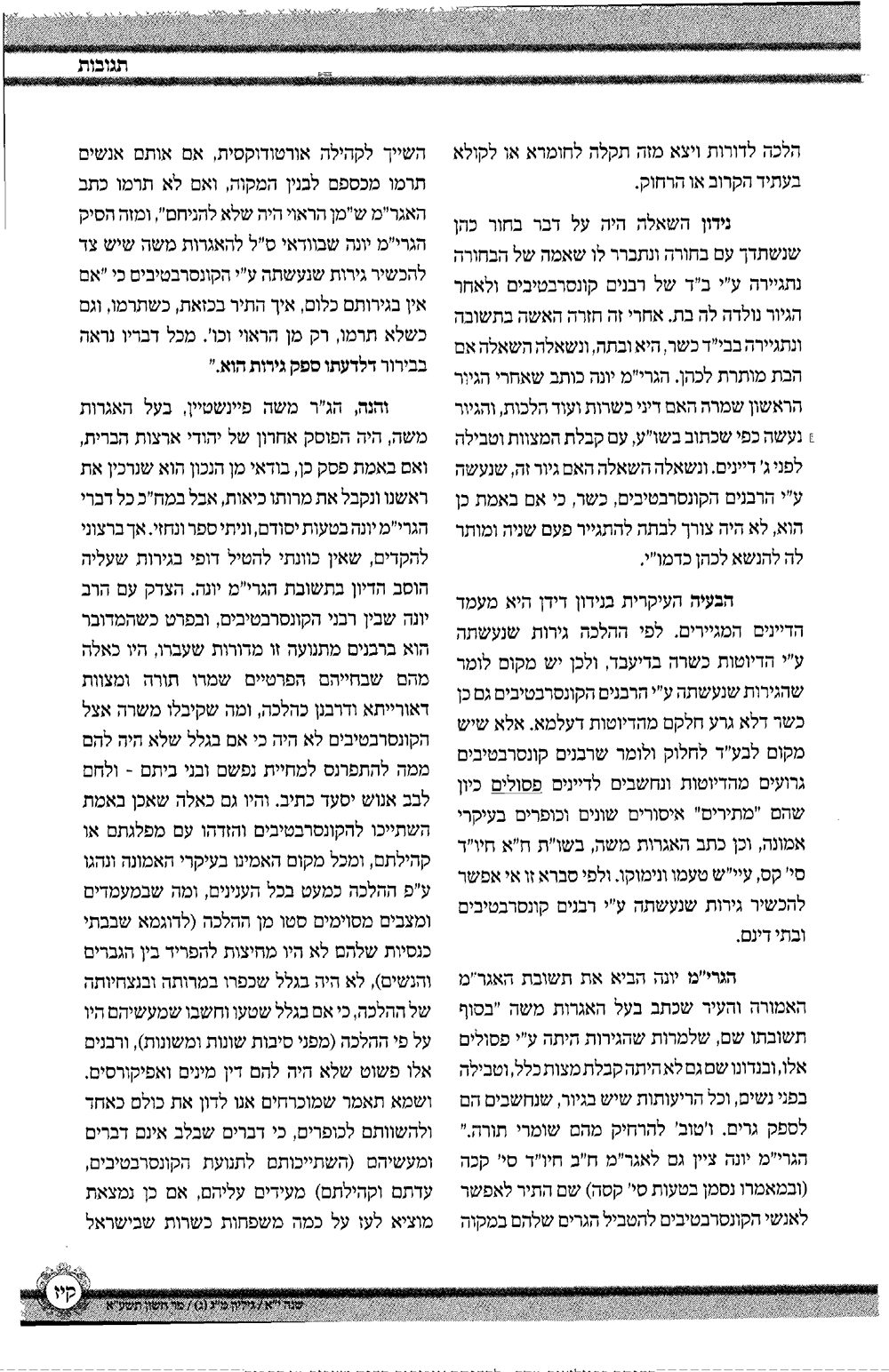
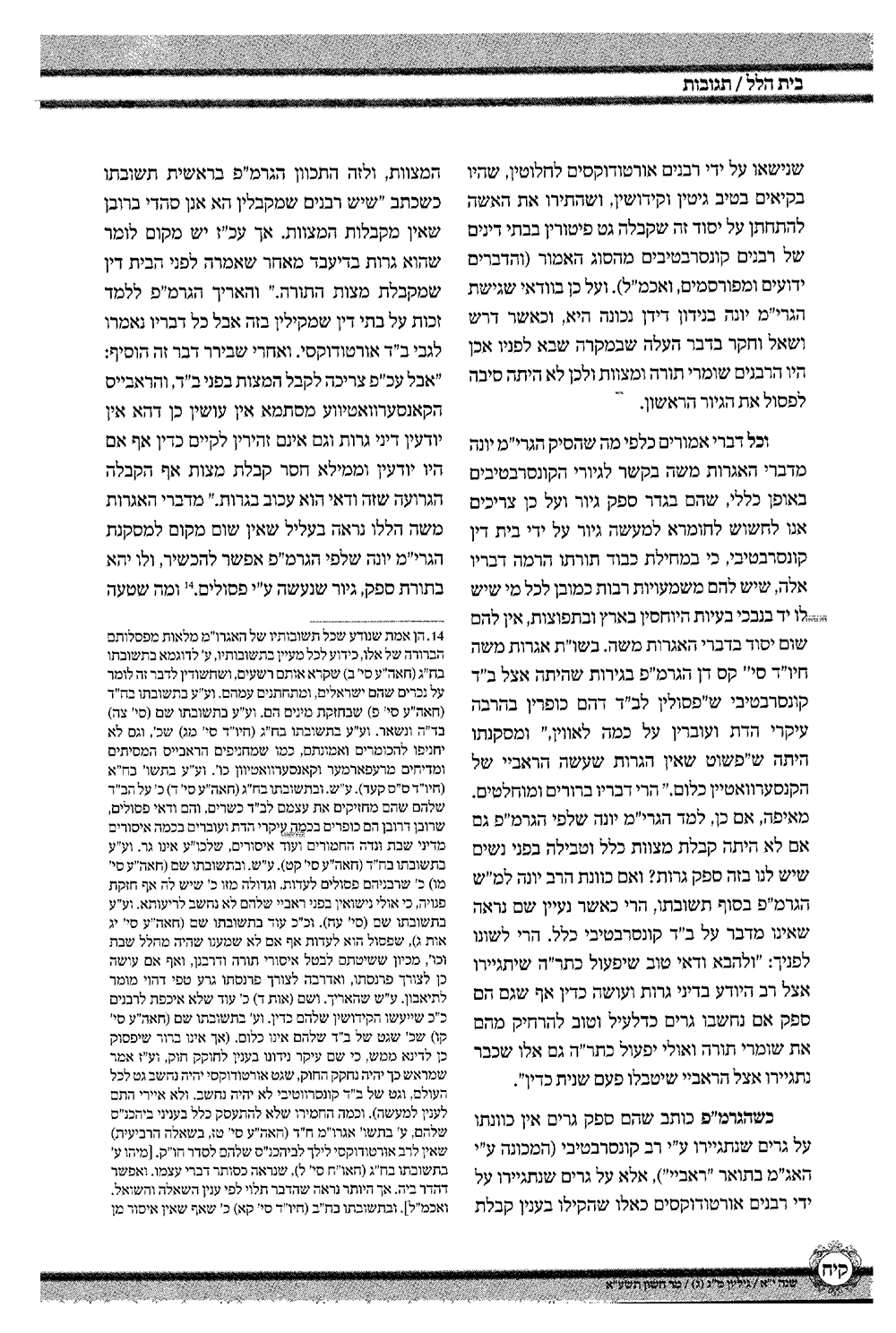
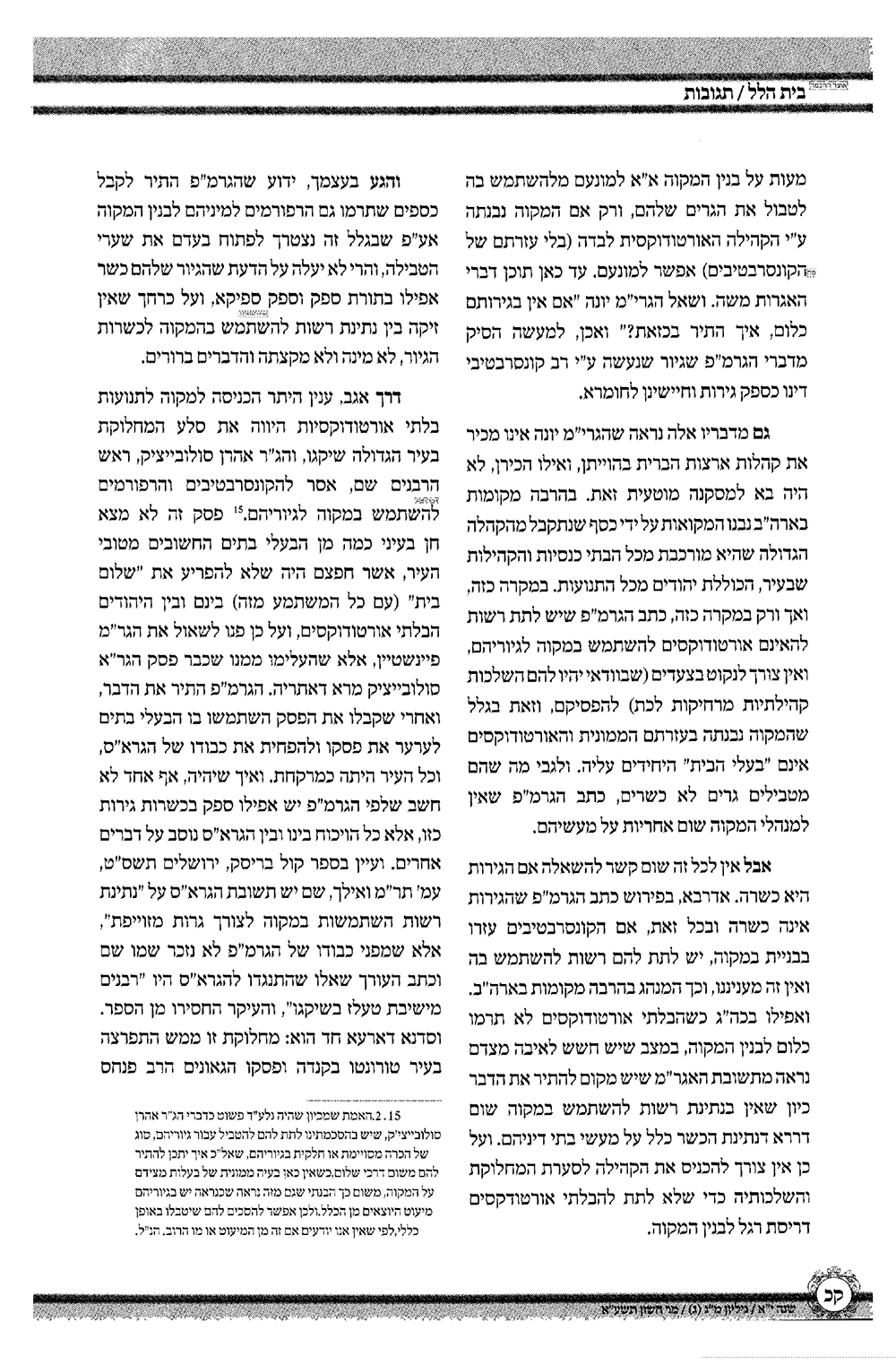
Apropos of the above-mentioned responsum on conversion by R. Ovadiah Yosef, in Beit Hillel, Adar 5770, R. Yisrael Meir Yonah deals with a conversion done by a Conservative beit din. He rules that in this particular case the conversion is valid. This ruling was affirmed by R. Ovadiah.In his responsum, R. Yonah states that R. Moses Feinstein regarded Conservative conversions as doubtful conversions rather than completely invalid, and brought two supposed proofs for this. I responded to R. Yonah in Beit Hillel 43 (Heshvan 5770), and you can see my letter here.[1]

To his credit, R. Yonah acknowledged that he was mistaken in his reading of R. Feinstein’s responsum.[2] It is also the case, as I mention in my letter, that it is possible that a conversion done by a Conservative rabbi, especially from years ago, could be halakhically valid. R. Feinstein himself, who wrote very strongly against Conservative conversions, also writes about such a conversion: כמעט ברור שאין עושין הגרות כדין. The word כמעט shows us that even R. Moshe recognized that there are times when a Conservative conversion can be halakhically valid. In Mesorat Moshe, vol. 1, p. 327, we see as well that R. Moshe acknowledged the possibility that a Conservative conversion could be valid:
אולי יש להסתפק דאפשר לא היו ב”ד של פסולים, דיש אנשים, בעצם דתיים ומאמינים, שמחמת דוחק פרנסה מקבלים משרה כרבנים אצלם, ואפילו אם למדו בסמינר שלהם, אולי בעצמו כן מאמין. ולפיכך למעשה, אם זה אפשר לברר, תבררו. ואם קשה לברר, אז אולי שייך להגיד השערה, שאם זה בכפר או עיר רחוק מעיקר ישוב היהדות הדתי מסתמא אין להסתפק, בוודאי אינו כלום. ואם זה בעיר שיש בו ישוב דתי, נו, אזי כן יש ספק.
I also know someone who offers eyewitness testimony that R. Moshe did not think that every Conservative conversion could be voided without investigation, especially as this would mean that women married to these converts would then be able to remarry without a get. R. Moshe was not willing to go this far.
Similarly, R. Ovadiah Yosef, when asked about a Conservative conversion, replied that before giving a ruling it was necessary to find out which Conservative rabbi did the conversion, “since the Conservatives are not all alike.”[3]
R. Ovadiah was also asked about a woman who had become religious and was interested in going out with a kohen for the purpose of marriage. The problem was that she had slept with a man whose mother was converted by a Conservative rabbi. This man’s family was somewhat traditional as they kept kosher, made kiddush, and lit Shabbat candles. Could the woman in question marry a kohen, which is forbidden if she had slept with a non-Jew? The answer to this question depends on the status of the man whose mother was converted by a Conservative rabbi. If the conversion was invalid then the man was also to be regarded as a non-Jew, and the woman we are discussing, who slept with this man, would be forbidden to a kohen.
R. Ovadiah replied that the woman could marry a kohen, which means that be-diavad he accepted the Conservative conversion. He gave this ruling without even seeking further knowledge about the particular rabbi who did the conversion under question, which appears to me to be an incredible leniency. In seeking to explain this ruling, R. Yehudah Naki writes, “We see that they observed some mitzvot, so be-diavad there is more room to be lenient, at least not to forbid others” (that is, to forbid the woman from marrying the kohen).[4]
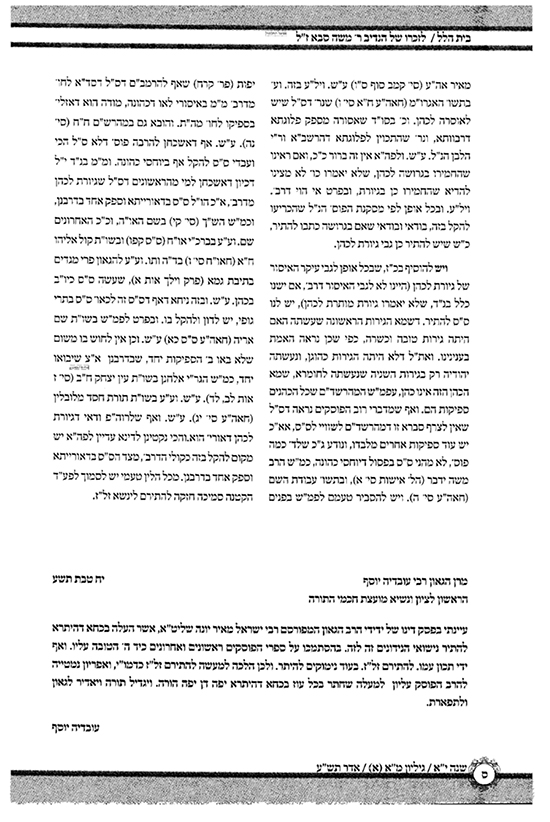
As mentioned, R. Ovadiah accepted R. Yonah’s pesak that a particular conversion carried out by a Conservative beit din was valid. In this case, the daughter of a woman who had been converted wished to marry a kohen. This would only be allowed if the daughter was born Jewish, meaning that everything depended on the status of her mother’s conversion. Here is how R. Yonah described this particular Conservative beit din.[5]
ובירורים שעשינו בנ”ד התברר לנו שב”ד הזה שגיירוה, הם אנשים שנקראים וידועים כשומרי תורה ומצוות, ובעצם הם אורטודוכסים, וגם הגיור שעשו, ע”פ כל החקירות ודרישות שעשיתי, הקפידו בכל הדברים כולם, הן בטבילה, חציצה וכו’ וכו’, הן בקבלת מצות, ולימודי יהדות קודם הגיור, לא פחות ואולי יותר, מהרבה בתי דינים אחרים שנחשבים לחרדיים. וא”כ אין כל סיבה לפע”ד לפסול גיור זה.
Here is R. Ovadiah’s affirmation of R. Yonah’s pesak, from Beit Hillel, Adar 5770, p. 60.
That a Conservative conversion might be valid also appears to be assumed by R. Mordechai Eliyahu. This is what he writes in his Ma’amar Mordechai, vol. 2, Even ha-Ezer, no. 16:
ובענין הגר שנתגייר אצל הקונסרבטיבים והוא אינו שומר תורה ומצוות, והיה לכם ספק אם אפשר לכתוב שם יהודי שניתן לו, שם שלא השתמש בו מעולם, או לכתוב בן אאע”ה. נראה לי, מאחר וכל עצם נתינת הגט של אדם זה הוא לחומרא ולא מדינא, כי מי אמר שגרותו – גרות, וגיוריהם של הרבנים הקונסרבטיבים – גיור . . .
R. Eliyahu does not say that there is absolutely no reason for a get when dealing with a Conservative conversion. Rather, he refers to it as a humra. Also, note how he states, “who says that his conversion was a [valid] conversion?” This is the language of safek. He does not say, “certainly his conversion was invalid.”[6]
2. In a previous post here I mentioned a few common pronunciation mistakes in Kiddush. There is one more that I would like to mention, but it is a little more complicated than the ones I previous noted. In the Friday night kiddush we say כי הוא יום תחלה למקראי קודש. Where is one supposed to put the accent in the word למקראי? If you look at ArtScroll you find that it puts the accent on the penultimate syllable, the ר. However, Koren and most of the other siddurim I checked put the accent on the final syllable, the א.
I don’t know why this should be a matter of dispute, because the Torah itself uses the expression מקראי קודש three times (Lev. 23:2, 4, 37), and in every case the accent in מקראי is on the final syllable.[7] The Yom Tov morning kiddush also begins: אלה מועדי ה’ מקראי קודש. For some reason ArtScroll is not consistent, and in this case it puts the accent in מקראי on the א.
After my last post someone emailed me pointing out that another “common mistake” is that in Birkat ha-Mazon, in the second paragraph, people say נודה לך putting the accent on the first syllable instead of the second. In fact, the tune for Birkat ha-Mazon that American children are taught at schools around the country has the word נודה recited with the accent on the first syllable. Should we now start teaching all the children differently, so that they pronounce נודה with the accent on the second syllable which is how ArtScroll, Koren, and almost all the other siddurim have it?
Actually, this matter is not clear at all. I say this because if you open up a Tanakh to Psalms 79:13 and look at the words נודה לך you will find different versions. Some have the word נודה with the accent on the final syllable and others have the accent on the first syllable. The Aleppo Codex has the accent on the first syllable and puts a dagesh in the ל of לך. Although the practice of American children (and adults) pronouncing the word נודה with the accent on the first syllable has nothing to do with the Aleppo Codex, the fact that this pronunciation appears in such an important source means that there is no reason to change how the children are taught. However, this creates a problem because in the Amidah, in Modim, we say נודה לך ונספר תהלתך. If we are going to recite נודה of Birkat ha-Mazon with the accent on the first syllable, then we should be consistent and do the same thing in the Amidah, in ברוך ה’ לעולם in ma’ariv: נודה לך לעולם, and also in the so-called “Three-Faceted Blessing” (ברכה מעין שלש – Al ha-Mihyah): ונודה לך על הארץ.
Speaking of consistency, in Birkat ha-Mazon, the Amidah, ברוך ה’ לעולם, and the Three-Faceted Blessing, both the regular ArtScroll siddur and Koren have the accent in נודה on the final syllable. However, in the Amidah, ברוך ה’ לעולם, and the Three-Faceted-Blessing they both place a dagesh in the ל of ונודה לך and נודה לך, but do not place a dagesh in the ל of נודה לך in Birkat ha-Mazon. This makes no sense. If there is a dagesh in one there must be a dagesh in all of them. (In the Hebrew-only ArtScroll siddur they also put a dagesh in the in the ל of נודה לך in Birkat ha-Mazon.)
I think it is a mistake for ArtScroll and Koren to place a dagesh in לך in any of these instances. Since no exception with נודה לך is found in Tanakh, the only reason there would be a dagesh in לך is if the word נודה has the accent on the first syllable, as in the Aleppo Codex (and unlike what appears in ArtScroll and Koren), or if there is a makef between the two words.[8]
Regarding the word נודה, it is worth noting that in Ein Ke-loheinu there is no question that נודה is to be read with the accent on the final syllable (as the matter of where to put the accent in נודה only concerns the phrase נודה לך). Here is an example where the common tune, which puts the accent on the first syllable, cannot be defended grammatically.
I noticed two mistakes in the regular ArtScroll siddur which appear correctly in Koren. In the morning blessings we say אשר נתן לשכוי בינה. Where is the accent in the word לשכוי? ArtScroll puts the accent on the final syllable, and Koren puts the accent on the penultimate syllable, on the ש. Koren is correct as there is an explicit verse in Job 38:36: מי נתן לשכוי בינה. If you look at the trop on this verse you will find that the accent in לשכוי is on the penultimate syllable. Interestingly, in the Hebrew-only ArtScroll siddur they get this right.
The other mistake is that in Birkat ha-Mazon on Sukkot we say:
הרחמן הוא יקים לנו את סכת דויד הנופלת
ArtScroll puts a kamatz under the פ in הנופלת. Koren puts a segol and that is correct. We see this from the appearance of the word in Amos 9:11, and there is no change of vowel even on the etnahta.[9]
I also found an example where ArtScroll gets it right and Koren is mistaken. In ma’ariv, in the paragraph ואמונה כל זאת, we say העושה לנו נסים. Koren has העושה with the accent on the final syllable and the ל of לנו with a dagesh. Yet this doesn’t work. For there to be a dagesh in the ל, the prior word, העושה, has to have the accent on the penultimate syllable, which is how it appears in ArtScroll.
Another example where ArtScroll gets it right and Koren gets it wrong is in the morning blessings where we say שעשה לי כל צרכי. Koren puts the accent in שעשה on the final syllable. Yet this is a mistake, and as is correctly found in ArtScroll the accent is on the penultimate syllable, the ע.
Since I have been speaking about the ArtScroll siddur, let me add a couple of comments about the Yom Kippur Machzor. Here is how Shema Kolenu appears in my copy of the Yom Kippur Machzor (p. 596).
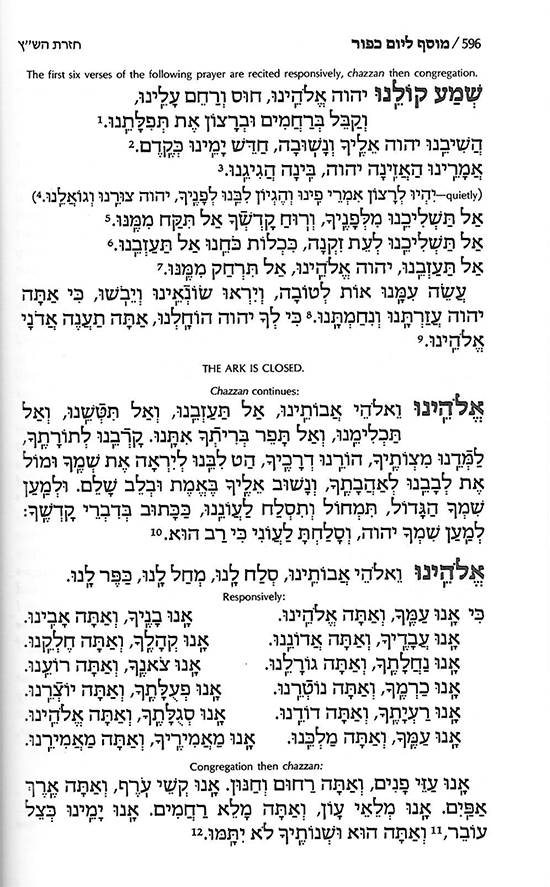
The instructions tell us that “the first six verses of the following prayer are recited responsively, chazzan then congregation.” The problem is that I have never seen a synagogue that says the verses beginning אמרינו and אל תעזבנו responsively. What all these synagogues do is say the following four verses responsively:
שמע קולנו
השיבנו
אל תשליכנו מלפניך
אל תשליכנו לעת זקנה
In my experience, not only does no one say the verses beginning אמרינו and אל תעזבנו responsively, but they don’t say יהיו לרצון quietly either.
The text recorded by ArtScroll is the one found in many old Ashkenazic machzorim. So when and how were אמרינו and אל תעזבנו dropped from the responsive reading, or is it that from the beginning they were not included? As for יהיו לרצון, the old machzorim do not indicate that this is said quietly, so was there ever a tradition to recite it quietly or is ArtScroll simply trying to make sense of a verse that is found in the Machzor but no longer appears to be recited? If יהיו לרצון was originally part of the public reading, we again have to ask, why was it dropped?
Recognizing the problem, in the new edition of the ArtScroll machzor they made a change.
As you can see, אל תעזבנו has now been pushed to the next paragraph. We are also instructed that both אמרינו and יהיו לרצון are to be said quietly. Yet this doesn’t seem to make any sense, as those who are reciting Shema Kolenu responsively will not be saying these verses quietly. And again, I ask, is there any real tradition that these verses are to be said quietly, or is this something made up by people in an attempt to keep the traditional text of the Machzor while dealing with the fact that these verses are not part of the responsive reading? Unfortunately, when updating the Machzor, ArtScroll did not correct the instructions which still refer to the “first six verses” as being recited responsively, when instead it should say the “following four verses”.
Here is how Koren has the prayer.
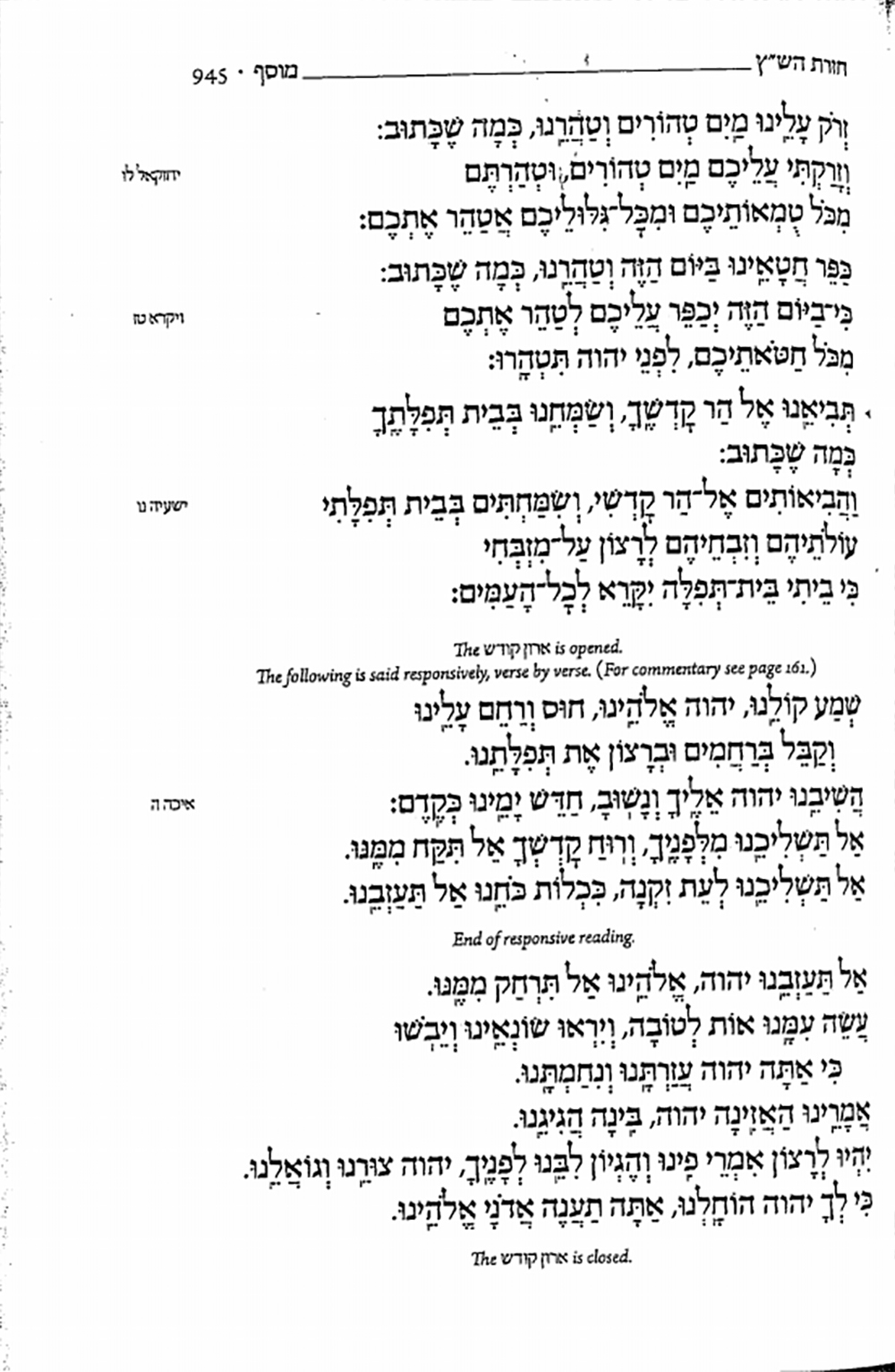
This version, which puts אמרינו and יהיו לרצון before the final verse, is also attested to in prior machzorim, though the order found in ArtScroll appears to be the older version.To sum up, I am not sure what the best path for ArtScroll would have been. On the one hand, they could have adopted the version found in Koren, which solves all the problems. Keeping what appears to be the more authentic version, which they did, also makes sense, but then they were forced to add the instructions that certain verses are to be said silently. I have checked numerous old machzorim and there is no indication that these verses are to be said silently. Was there perhaps an oral tradition in this matter? Perhaps readers can comment on this. In any event, ArtScroll’s instructions are problematic, since, as mentioned, if people are reciting the prayer responsively, they are not going to be inserting two consecutive sentences quietly.

I noticed another interesting change in the ArtScroll Yom Kippur machzor between the old edition and the new one. Here is והכהנים והעם in the old edition.
It reads היו כורעים ומשתחוים ומודים ונופלים על פניהם.
Here is the new edition, where the word ומודים has been deleted. ArtScroll neglected to change the English translation, so it still appears, now incorrectly, as: “they would kneel and prostrate themselves, give thanks, fall upon their faces.”
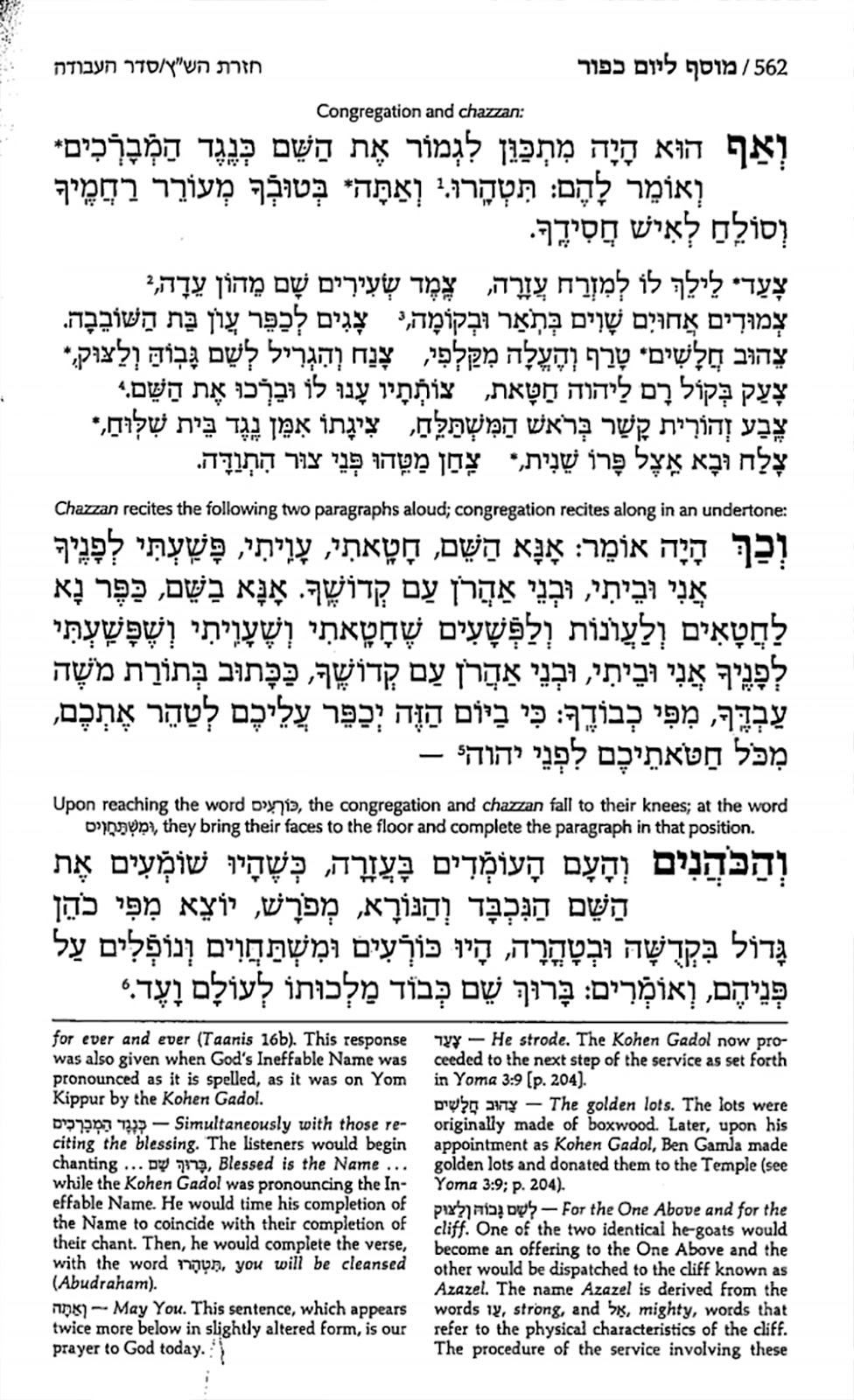
Why was the word ומודים deleted? Based on what I have been able to determine, the version without the word ומודים is more common, so presumably that is the reason. Although most people might just chalk this up to a different girsa, R. Soloveitchik saw great significance in the alternative versions, and explained their different implications.[10]
Here are a couple of random mistakes I found in ArtScroll. (I use the ArtScroll siddur every day of the week, which is how I have come across these. I am sure that if I used Koren, I would find mistakes there too.) In the ArtScroll siddur, p. 86 it reads:
ואל מאורי אור שעשית, יפארוך, סלה
There is a dagesh in the ס of סלה. This means that the comma after יפארוך is a mistake, as you cannot place a dagesh in this ס if preceded by a comma.
Another mistake is found on p. 702, in the prayer for dew, which states בעם זו בזו. Its translation is correct: “Among this people, through this prayer.” However, I would have preferred if it appeared as follows: “Among this people, through this [prayer],” which would be a more accurate rendition of the few words. (This is indeed how it is translated in the ArtScroll Passover Machzor.)ArtScroll vocalizes these words be-am zu be-zu. Yet this is incorrect. בזו should be pronounced be-zo, referring to תפלה, the feminine Hebrew word for prayer. Koren gets this correct. This confusion of ArtScroll with zu and zo is also found on p. 202, where in the marriage service we find בטבעת זו and ArtScroll pronounces it zu, instead of zo. Again, Koren gets it right. (The word זו often appears in the Talmud, and the ArtScroll Talmud always pronounces it correctly.)

Let me close with one final mistake in ArtScroll, or perhaps it is not a mistake; readers can decide on their own. The ArtScroll Ohel Sarah Women’s Siddur is a special siddur designed for women. On the very first page of the prayers, this siddur has מודה אני with a segol under the ד. In a women’s siddur doesn’t there need to be a kamatz under the ד so that it reads modah?
This might reflect a broader issue. My experience is that in co-ed kindergartens the girls are also taught to say modeh. This might not be surprising, but I was also told by a number of people that even in girls-only kindergartens, both Ashkenazic and even some Sephardic ones, the girls are taught to say modeh. No doubt recognizing this problem, R. Yitzhak Yosef makes a point of placing a kamatz under the ד so that people will know how women are to pronounce the word.[11] R. Shlomo Zalman Auerbach likewise told the women in his family to say modah.[12]It is noteworthy that in one of the editions of Wolf Heidenheim’s Siddur Sefat Emet, found on Otzar ha-Hokhmah, girls are instructed to say modah.

However, this edition appeared after Heidenheim’s death, and unfortunately there is no way to determine exactly when. (The Basel 1956 date on the title page is just the date of the photo-offset edition, not the original.) As far as I can tell, none of the siddurim that appeared in Heidenheim’s lifetime distinguish between men and women with regard to modeh-modah.In response to questioners, R. Hayyim Kanievsky also stated that women are to pronounce the word as modah.[13] Despite this, when R. Meir Arbah asked Rebbetzin Batsheva Kanievsky, R. Hayyim’s wife, what she did, she replied that she pronounced it modeh![14]

The ArtScroll Women’s siddur also has שלא עשני גוי and not גויה and שלא עשני עבד instead of שפחה. This too would seem to be incorrect in a women’s siddur, but the standard version is defended by R. Shmuel Wosner, as he claims that the words גוי and עבד include both men and women.[15] More about this in the next post.
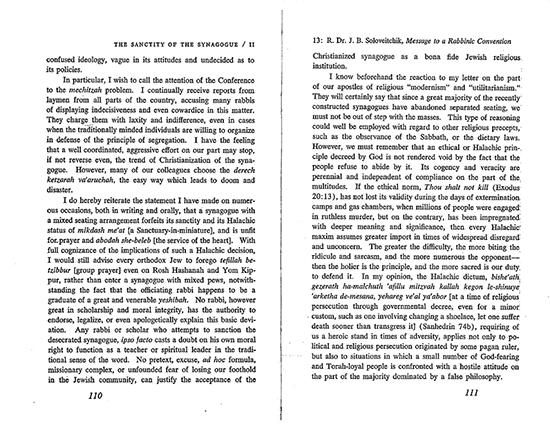
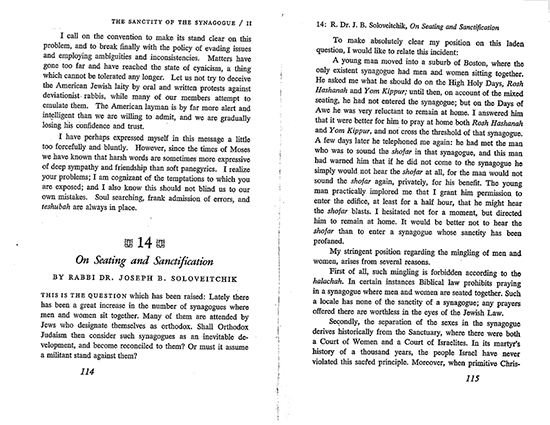
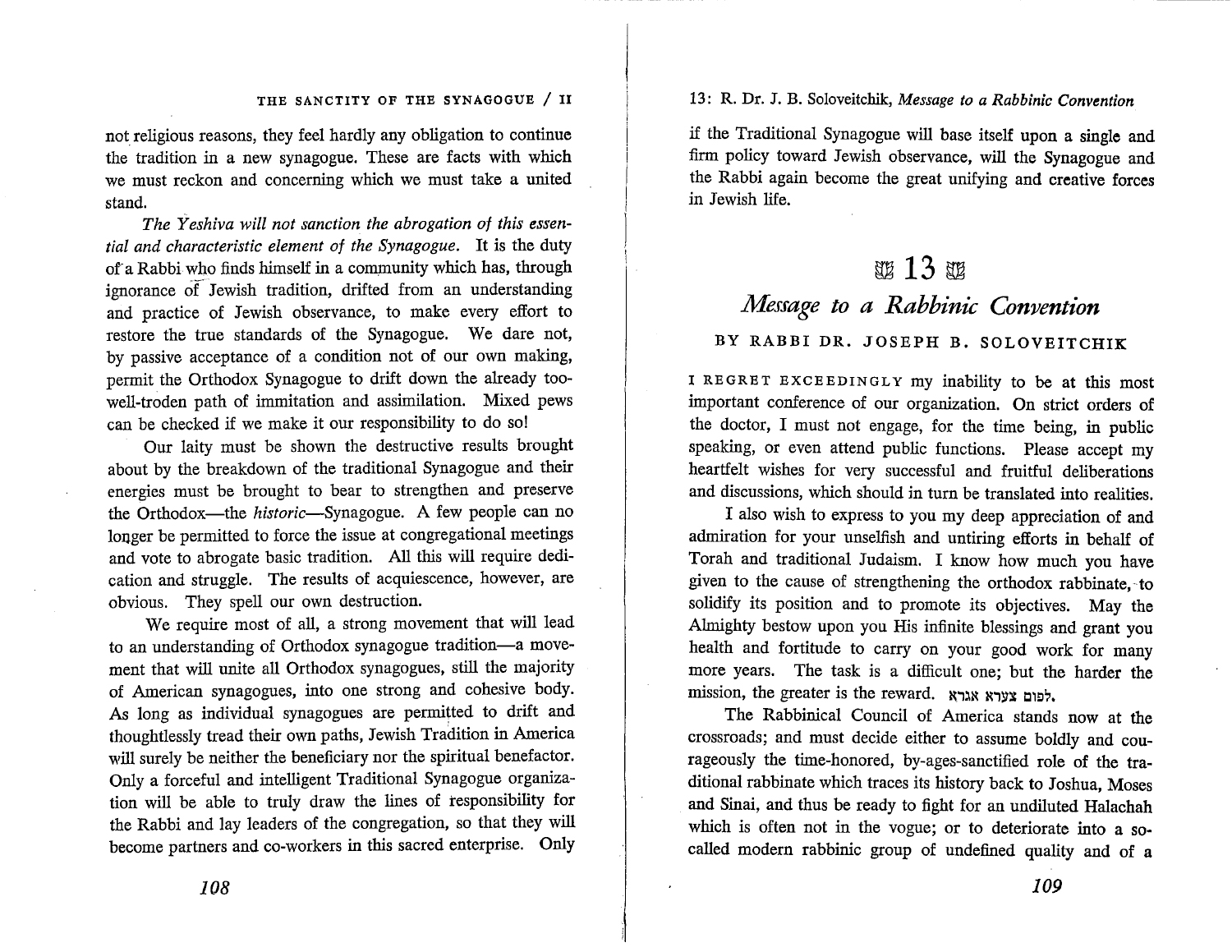
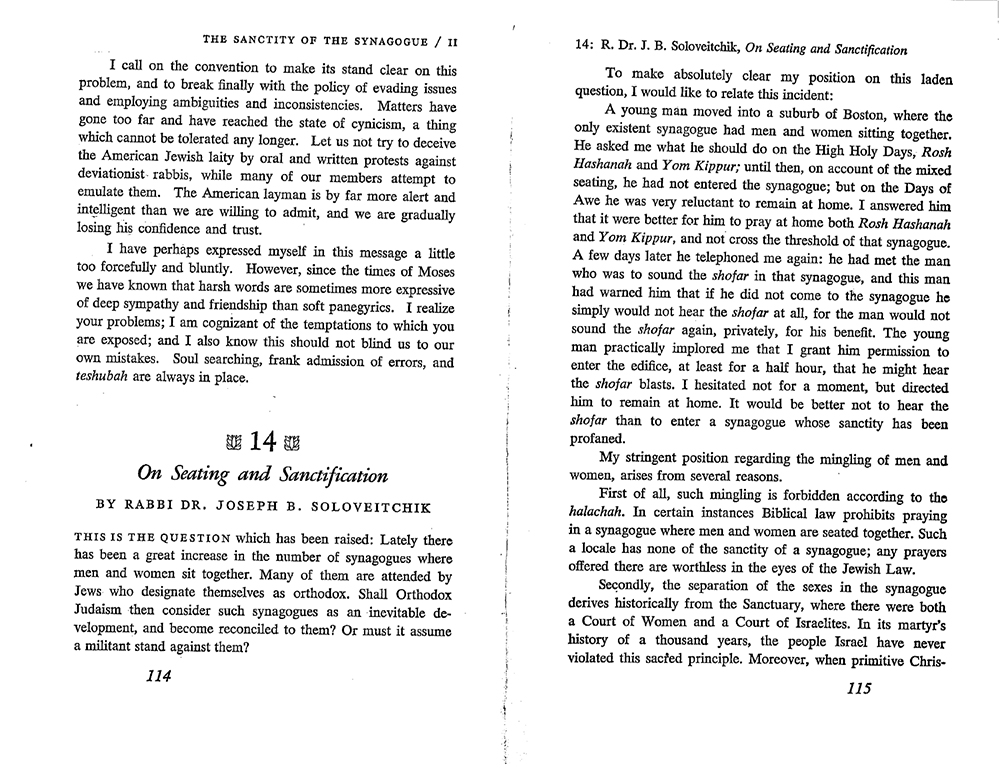
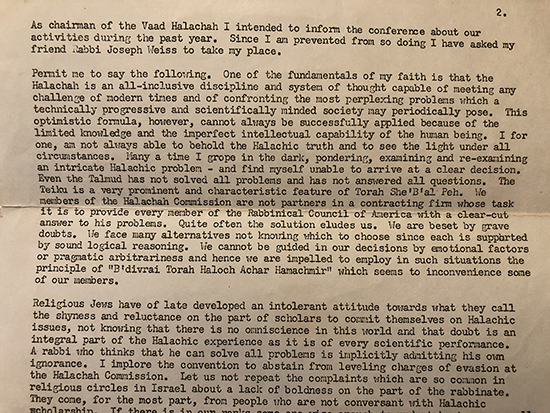
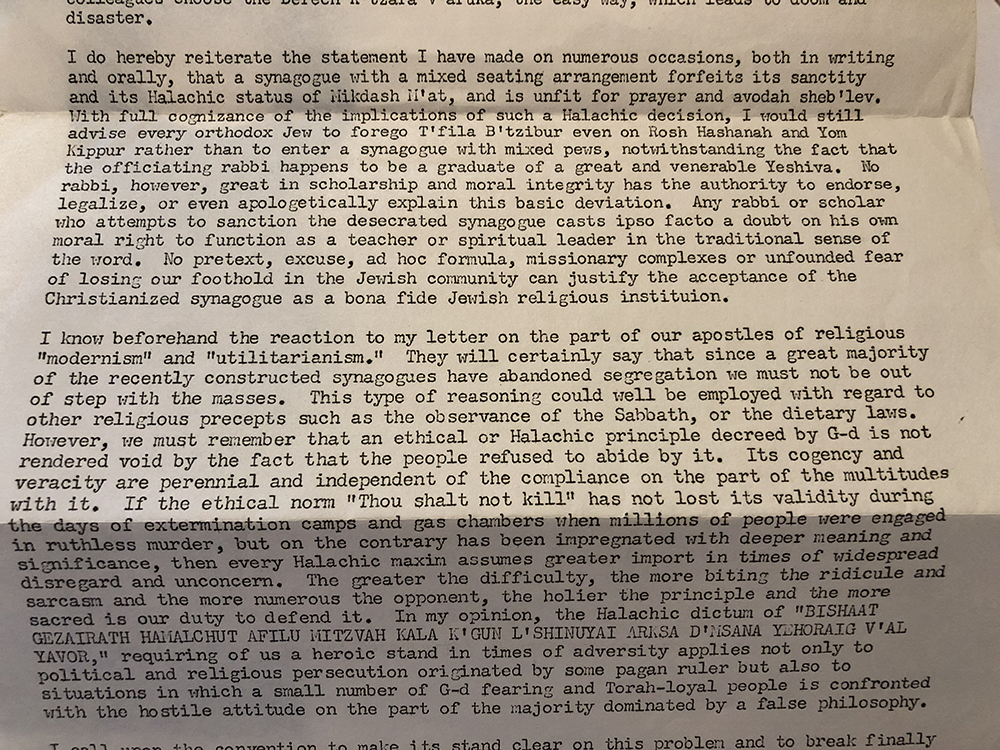
3. We all know that everything written by R. Joseph B. Soloveitchik is precious.[16] One area in which the Rav was very eloquent and forceful was with regard to the necessity of having a mehitzah in shul. In Baruch Litvin’s 1959 book, The Sanctity of the Synagogue, pp. 109-114, it prints a letter from the Rav to an RCA convention. 
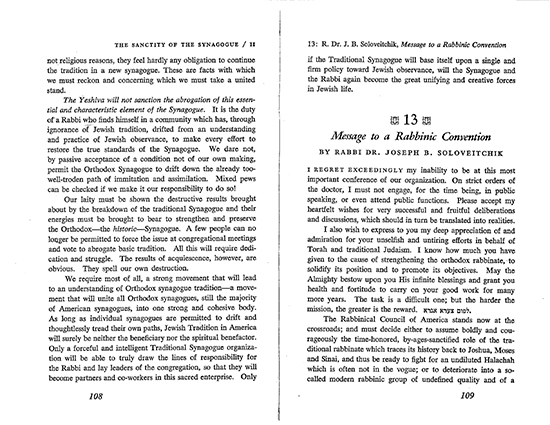
 

This letter has been reprinted in Nathaniel Helfgot, Community, Covenant and Commitment, pp. 139-142.
Moshe Schwartz found a copy of the original letter in the papers of his grandfather, R. Gedaliah Dov Schwartz. I thank him for sending it to me.
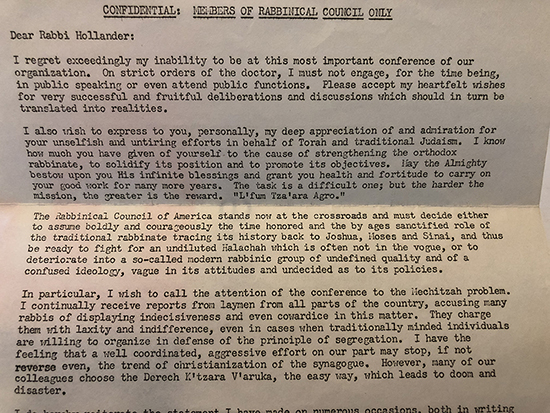
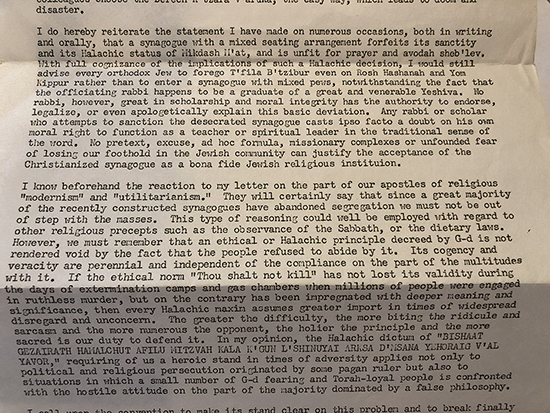
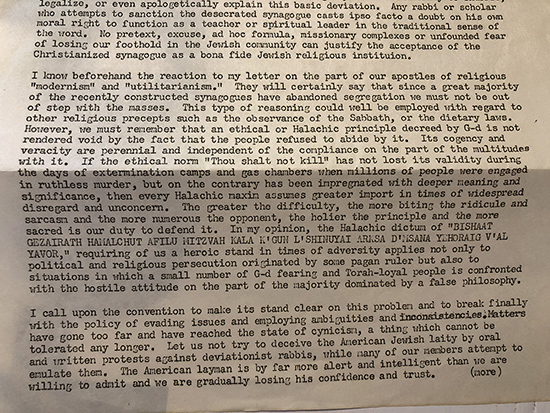
One interesting point which is not found in the Litvin book is that the Rav’s letter, while intended for RCA members, was addressed to R. David Hollander, the president of the RCA at the time. This is important to note because in the second paragraph he is speaking personally to R. Hollander and praising him for his good works. However, the reader of the letter in Litvin’s book will mistakenly think that the Rav is speaking to the RCA as a whole.
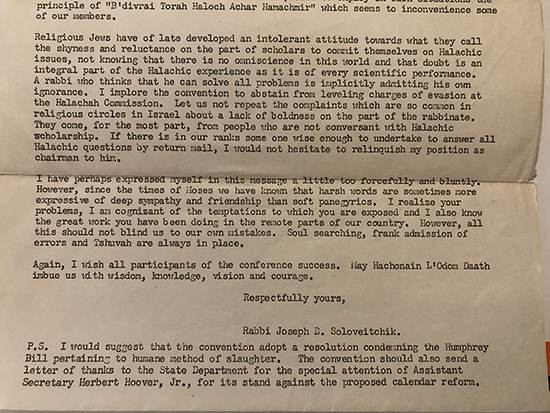
Furthermore, some of what R. Soloveitchik included was deleted from the letter as it appeared in the Litvin book. This was apparently because his points were not specifically relevant to the mehitzah issue. I am happy to be able to present here the omitted words of the Rav which until now have never been published, and which present an important personal statement about the halakhic process. Readers should note the end of the second paragraph that is transcribed below, as it is criticism of certain members of the RCA. Similar sentiments are found earlier in the letter (Litvin, p. 110, first paragraph), where the Rav concludes his paragraph with the strong words: “However, many of our colleagues choose the derech ketzarah va’aruchah, the easy way which leads to doom and destruction.”
As chairman of the Vaad Halachah I intended to inform the conference about our activities during the past year. Since I am prevented from doing so I have asked my friend Rabbi Joseph Weiss to take my place.
Permit me to say the following. One of the fundamentals of my faith is that the Halachah is an all-inclusive discipline and system of thought capable of meeting any challenge of modern times and of confronting the most perplexing problems which a technically progressive and scientifically minded society may periodically pose. This optimistic formula, however, cannot always be successfully applied because of the limited knowledge and the imperfect intellectual capability of the human being. I for one, am not always able to behold the Halachic truth and to see the light under all circumstances. Many a time I grope in the dark, pondering, examining and re-examining an intricate Halachic problem – and find myself unable to arrive at a clear decision. Even the Talmud has not solved all problems and has not answered all questions. The Teiku is a very prominent and characteristic feature of Torah She-B’al Peh. We members of the Halachah Commission are not partners in a contracting firm whose task it is to provide every member of the Rabbinical Council of America with a clear-cut answer to his problems. Quite often the solution eludes us. We are beset by grave doubts. We face many alternatives not knowing which to choose since each is supported by sound logical reasoning. We cannot be guided in our decisions by emotional factors or pragmatic arbitrariness and hence we are impelled to employ in such situations the principle of “B’divrai Torah Haloch Achar Hamachmir” which seems to inconvenience some of our members.
Religious Jews have of late developed an intolerant attitude towards what they call the shyness and reluctance on the part of scholars to commit themselves on Halachic issues, not knowing that there is no omniscience in this world and that doubt is an integral part of the Halachic experience as it is of every scientific performance. A rabbi who thinks that he can solve all problems is implicitly admitting his own ignorance. I implore the convention to abstain from leveling charges of evasion at the Halachah Commission. Let us not repeat the complaints which are so common in religious circles in Israel about a lack of boldness on the part of the rabbinate. They come, for the most part, from people who are not conversant with Halachic scholarship. If there is in our ranks some one wise enough to undertake to answer all Halachic questions by return mail, I would not hesitate to relinquish my position as chairman to him.
In the last paragraph of the letter, as it appears in Litvin, p. 114, the following words that I have underlined are omitted (and this appears to be a simple mistake rather than an intentional deletion): “I realize your problems, I am cognizant of the temptations to which you are exposed and I also know the great work you have been doing in the remote parts of our country.”
In this case I think that the Rav is speaking to the RCA members as a whole, not to R. Hollander personally.
The P.S. found in the Rav’s letter is also of interest.
P.S., I would suggest that the convention adopt a resolution condemning the Humphrey Bill pertaining to humane method of slaughter. The convention should also send a letter of thanks to the State Department for the special attention of Assistant Secretary Herbert Hoover, Jr., for its stand against the proposed calendar reform.
4. In my previous post about young rabbis I neglected to mention another such rabbi. R. Yekutiel Yehudah Teitelbaum (born 1912) succeeded his father as rabbi of the town of Sighet, and also as leader of the local hasidic group, at the age of 14.[17]
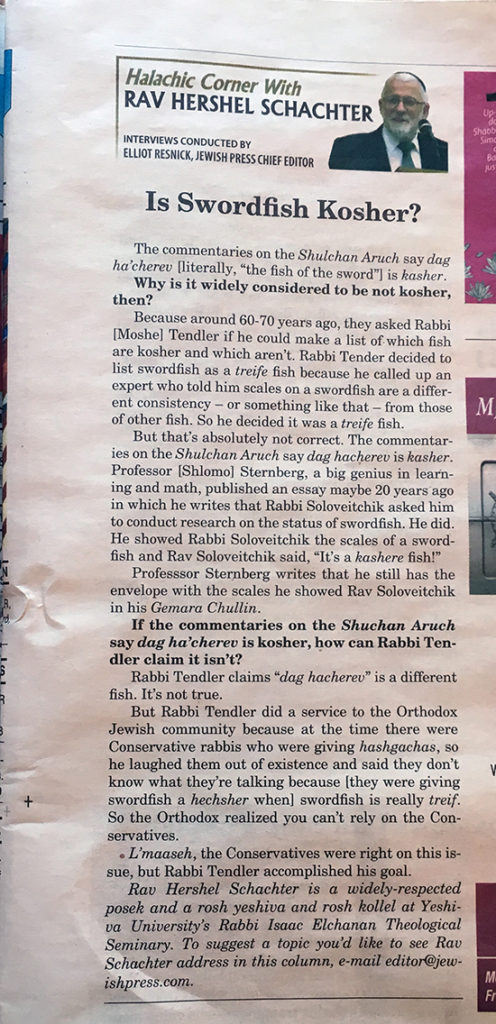
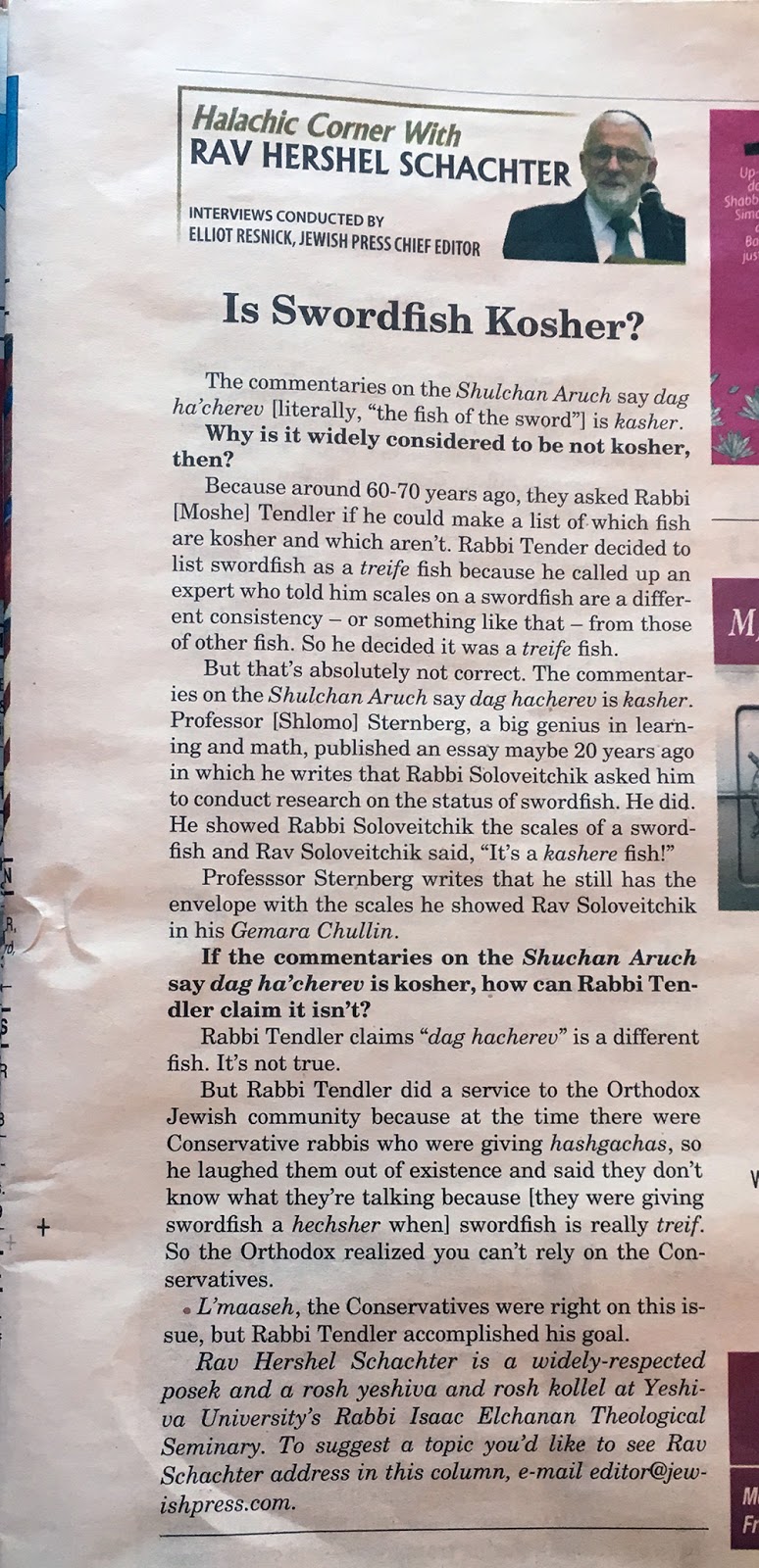
5. In addition to being the posek of the OU, R. Hershel Schachter is also the one Kashrut Vaads all over America turn to for halakhic decisions. That being the case, now that R. Schachter has publicly declared that swordfish is kosher[18] (his private opinion has been known for a long time), how come no Vaads in the United States will certify it as kosher? (In the first half of the twentieth century Orthodox Jews in the U.S. ate swordfish. See my post here.) Does this mean that in the U.S. the practice of not eating swordfish is for all intents and purposes now regarded as binding, and cannot be overturned even by a great posek?
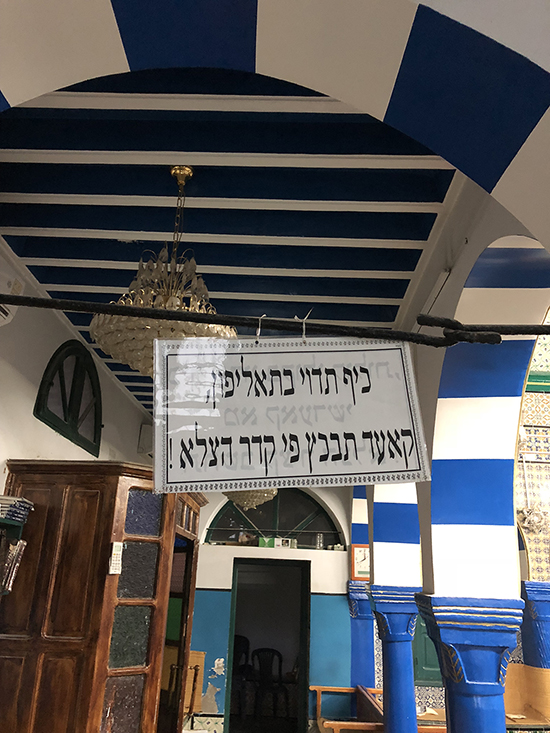
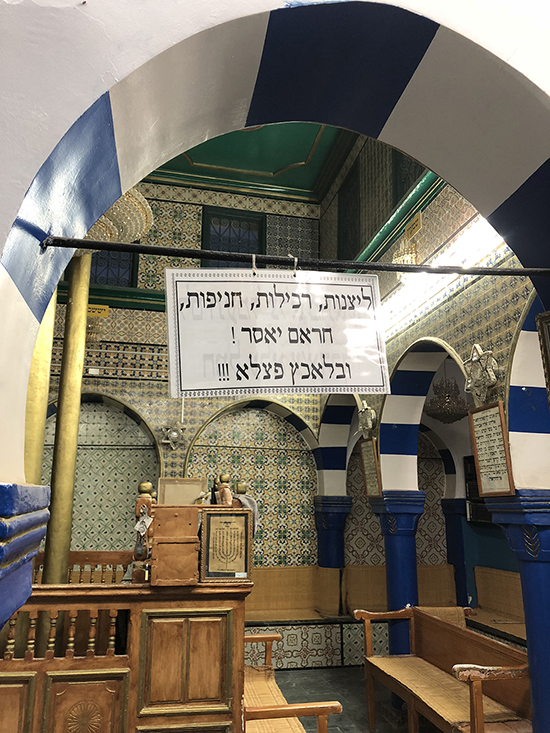
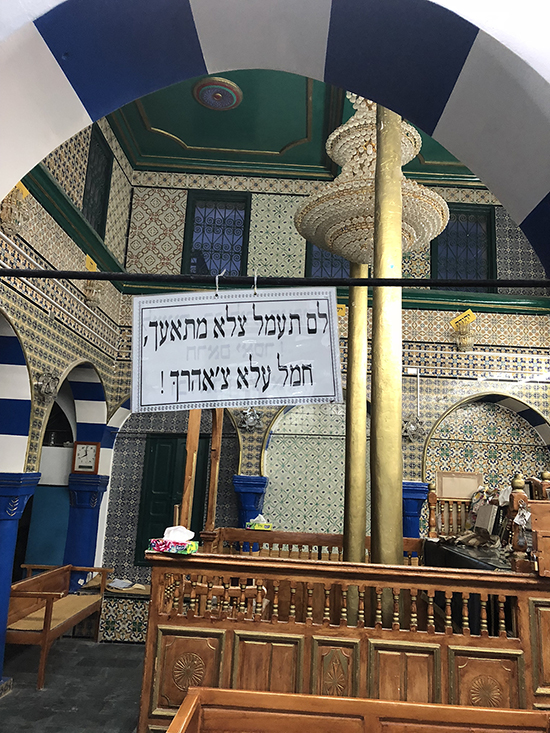
6. Last summer I spent time in Djerba, Tunisia. I hope to write up my impressions of this amazing community of over one thousand Jews, all of whom are shomer Shabbat. Djerba, and the nearby town of Zarzis which has around a hundred Jews, are the last Arabic speaking Jewish communities in the world. (In Tunis and Morocco the Jews speak French.) Here are some pictures from inside the R. Pinhas Yanah synagogue in Djerba, where you can see the signs in Arabic. 
 

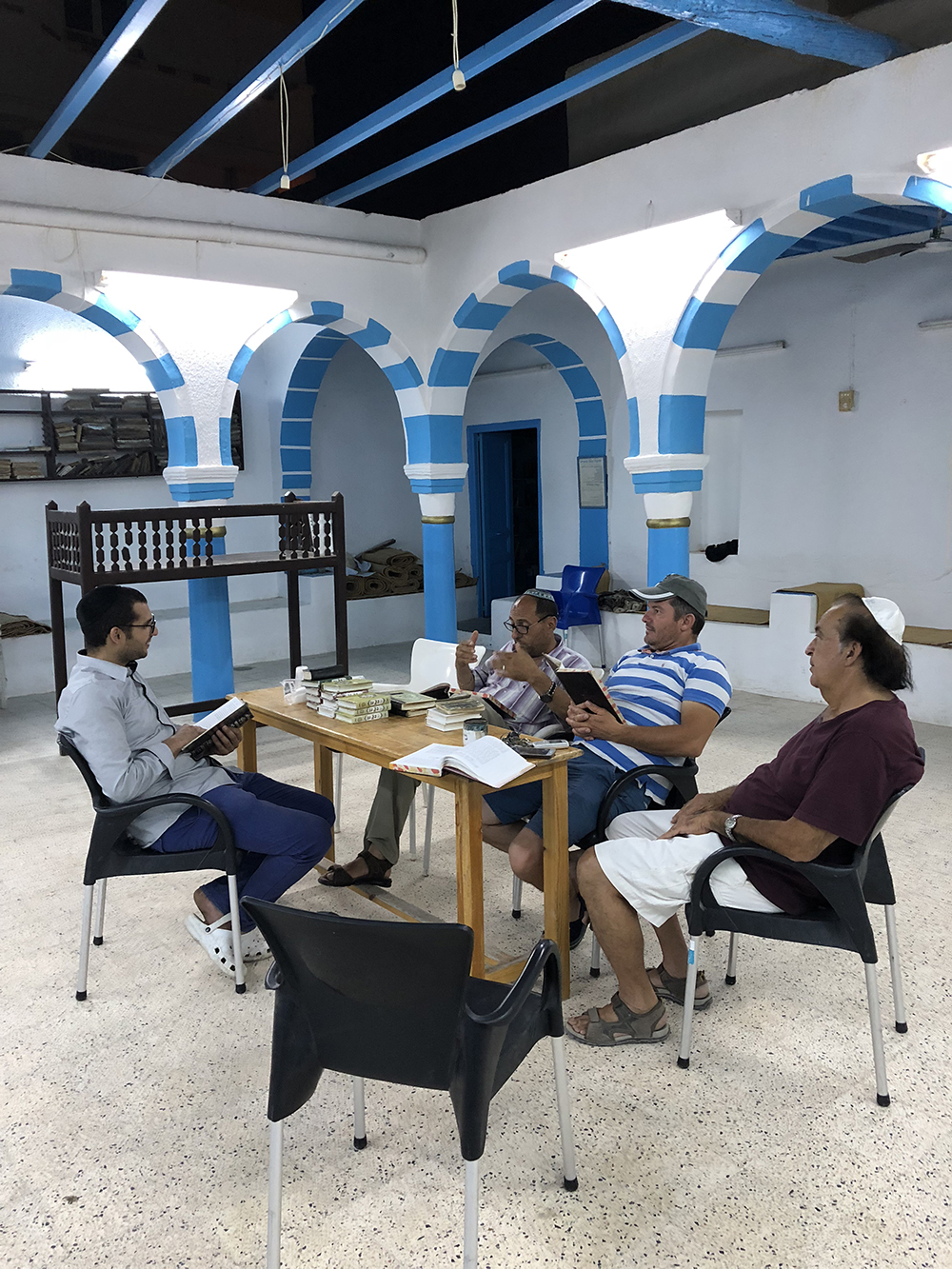
Here is a small learning group in one of the synagogues after ma’ariv. They invited me to participate but not knowing Arabic I couldn’t follow.
When I came back one of my friends told me that I must share one particular story on the Seforim Blog, so here goes. There are fourteen different synagogues in Djerba. After visiting a number of them I noticed that they had no women’s sections. I asked one of the rabbis about the lack of ezrat nashim. He replied, in words that must sound blasphemous to Modern Orthodox ears, “What do women have to do with a synagogue?” While in the U.S. we build “women friendly” mehitzot, so that as much as possible the women can feel part of the synagogue service, in Djerba women’s spirituality has nothing to do with the synagogue. While I later learned that three of the synagogues do have an ezrat nashim, women never attend on Shabbat, only on Rosh ha-Shanah, Yom Kippur, and Purim. The popular Modern Orthodox notion that it is important for women, especially unmarried ones, to attend synagogue on Shabbat is something the women of Djerba know nothing about.
___________
[1] If I were writing the letter today, I would not refer to R. Ahron Soloveichik as rosh ha-rabanim and mara de-atra. I did so to give him respect, but it is not really accurate. While many people certainly did regard him as the leading rabbi of Chicago, and accepted his halakhic rulings as authoritative, this was by no means everyone’s opinion. Regarding R. Moshe Feinstein’s view permitting the non-Orthodox to use the community mikveh for their conversions, which is mentioned in my letter, it is important to note that this was only when the non-Orthodox institutions contributed to building the mikveh.
[2] The same mistake made by R. Yonah is also made by R. Yehudah Naki in his notes to R. Ovadiah Yosef, Ma’yan Omer, vol. 7, pp. 362-363, 390, 400-401.
[3] Ma’yan Omer, vol. 7, no. 38.
[4] Ma’yan Omer, vol. 7, no. 42.
[5] Beit Hillel, Adar 5770, p.
[6] R. Eliyahu’s responsum was sent to R. Gavriel Cohen, who has a beit din in Los Angeles. See here. This Beit Din also does conversions, and they have a very detailed curriculum for prospective converts. You can see a practice test of the 45 topics prospective converts are supposed to learn about here.
I have to say that until the last generation, converts were never required to have such detailed knowledge. Leaving aside all of the detailed issues of Jewish law the convert is instructed to learn about (including “Trumot and Maasarot, Challah, Bikurim, Maaser Ani and other types of charity”), does a convert really need to know about Elijah at Mt. Carmel or about “Tzedukim, Prushim, Charedim, Zealots (anti Romans and Greeks)”? Does a convert need to be able to “develop in detail” the following: Joshua, Judges (“mention at least 10 Judges and their stories”), Samuel, Saul, Jonathan, Isaiah, Jeremiah, the Twelve Prophets, Daniel, Ezra-Nehemiah, to list just some of the topics required? And  what about Rif, Rosh, Rashba, Tur, Zohar, Kabbalah, Shabbetai Zvi, Orhot TzadikimMesilat Yesharim, etc.? Since when do converts need to know about these things?
In the section dealing with the history of converts, R. Cohen’s website mentions Nero and Antoninus as things to know. Does this mean that if the future convert does not believe that these Roman emperors actually converted to Judaism, that he will not be accepted? (My next post will discuss Nero and Antoninus.) On the positive side, if even yeshiva educated people knew all the things the converts are being asked about, we would be in very good shape.
Contrast all this with how Maimonides says that we deal with future converts, in words that today would be regarded as “non-Orthodox,” or presenting a very low standard. Issurei Biah 14:2 states: “He [the prospective convert] should then be made acquainted with the principles of the faith, which are the oneness of God and the prohibition of idolatry. These matters should be discussed in great detail; he should then be told, though not at great length, about some of the less weighty and some of the more weighty commandments.”
[7] See also here.
[8] See Israel Yeivin, Introduction to the Tiberian Masorah, trans. E. J. Revell (n.p., 1980), no. 404. See also R. Adir Amrutzi, Dikdukei Aviah (Tel Aviv, 2010), p. 146. Regarding the Aleppo Codex and use of the dagesh, the following point is also of interest. Many people wonder why in Hallel the words הושיעה נא and הצליחה נא, taken from Ps. 118:25, only have a dagesh in the נ in הושיעה נא. In fact, in the Aleppo Codex both occurrences of the word נא have a dagesh. Also of interest, since it goes against what one would expect from the grammatical rules, the Aleppo Codex puts the accent on the final syllable of both הושיעה and הצליחה, and there is no makef after either of these words. See Yeivin, Introduction to the Tiberian Masorah, p. 291.
Regarding the makef, ArtScroll has omitted it from its siddur. Yet once they do so, it appears to me that there are a number of corrections that need to be made. For example, in shaharit of Shabbat we read
מי ידמה לך ומי ישוה לך
ArtScroll tells us that ידמה and ישוה have the accent on the final syllable and ArtScroll also puts a dagesh in the ל of לך. Yet the Masoretes who told us that in such a case you put a dagesh in the ל, also told us that you would only do so if there is a makef connecting the word לך and the prior word. Since ArtScroll has deleted the makef, why should the dagesh be included, as there is no reason for one without the other? (Koren also includes the dagesh without a makef.)
For those who want to be technical, once the makef is removed we even have a problem with the word כל. כל, meaning “all”, is only spelled with a kamatz (katan) when it is connected with a makef. However, when the makef is removed it is to be spelled with a holem. (The two exceptions are Ps. 35:10 and Prov. 19:7.) See Bayit Ne’eman 130 (15 Tishrei 5779), p. 5.
In biblical Hebrew there is even a word כל with a kamatz (gadol) and no makef. It is found in Isaiah 40:12:
וכל בשלש עפר הארץ
The passage means, “and comprehended the dust of the earth in a shalish-measure.” The word כל with a kamatz and no makef is from the root כול. The word כל with a kamatz and makef, which is the word we are all familiar with, is from the root כלל.
[9] This point was also noted by the Dikdukian here. For those who don’t know this website, it is a great resource for anyone interested in grammatical matters.
[10] Shiurei Ha-Grid: Kuntres Avodat Yom ha-Kippurim (Jerusalem, 2005), pp. 66-67.
[11] Otzar Dinim la-Ishah ve-la-Bat, ch. 1, no. 2 (p. 22), Yalkut YosefDinei Hashkamat ha-Boker, 1:9. It is noteworthy that R. Yom Tov Lippman Heller was also interested in ensuring proper pronunciation. Mishnah, Toharot 8:5 reads: שוטה אחת בעיר. Tosafot Yom Tov comments:
בקמץ הטי”ת כמו כי רועה היא (בראשית כט)
[12] Halikhot Shlomo, Tefilah, ch. 2 n. 17.
[13] Halikhot Hayyim, ch. 1 no. 1, Da’at Notah, vol. 1, p. 16. The very title of the last book mentioned is an example of what we are talking about, as it is more common for people to write “da’at noteh”, but this is not grammatical.
[14] Meir Oz, vol. 1, p. 27.
[15] Shevet ha-Levi, vol. 10, no. 8.

[16] I have been fortunate to discover a number of unknown letters by the Rav which I hope to publish.
[17] See Isaac Lewin, ed., Eleh Ezkerah (New York, 1961), vol. 4, p. 147. R. Jacob Elimelech Paneth was chosen to succeed his father as rabbi of Marosújvár at age fourteen, but he did not assume the office in practice until four or five years later. See Yosef Kohen, Hakhmei Transylvania (Jerusalem, 1989), p. 37. I thank R. Baruch Oberlander for informing me of the Hungarian name of the city R. Paneth served in.
[18] The interview with R. Schachter reprinted in this post is from the Jewish Press, April 20, 2018.


Eliezer Brodt – The Origins of Hamentashen in Jewish Literature

The Origins of Hamentashen in Jewish Literature:
A Historical-Culinary Survey
By Eliezer Brodt

I. Introduction

As Jews, most of our holidays have special foods specific to them; and behind each culinary custom, lays enveiled the reasoning behind them. Shavuot brings with it a vast array of customary dairy delicacies – in some parts of the world, cheesecake is practically obligatory – not to mention different customs in regard to how and when to eat them. Rosh Hashanah in renowned for the different fruits and vegetables eaten as physical embodiments symbolizing our tefillot; Chanukah has fried foods (no trans-fats please); whether latkes sizzling in the frying pan, or the elusive Israeli sufganiyot (jelly doughnuts) seen for a month before but not to be found a minute after Chanukah’s departure, and on the fifteenth of Shevat a veritable plethora of fruits are sampled in an almost ‘Pesach Seder’-like ceremony. Of course, on Purim we eat hamentashen.

Hamentashen. Those calorie-inflated, Atkins-defying, doughy tri-cornered confections filled with almost anything bake-able. The Mishpacha reports that this year in Israel alone, an astounding 24.5 million hamentashen will be sold, weighing 1225 tons, and yielding an approximate 33 million NIS in sales.[1] The question that many will be asking themselves is “where did this minhag to eat hamentashen come from?”

Recently I started researching this topic; thus far (and I hope to find more) my results are as follows.

II. Origins

The earliest source I have located so far is in a liturgical parody from the seventeenth century, where it includes a reference to eating hamentashen.[2] In an 1846 cook book called The Jewish Manual by Lady Judith Cohen Montefiore we find a recipe for “Haman fritters.”[3]

R. Barukh ha-Levi Epstein, in his Mekor Barukh, relates the following interesting anecdote which highlights the importance his grandfather placed on eating hamentashen:

One year in the beginning of the month of Adar he [my grandfather] noticed that the bakeries were not selling hamentashen. When he inquired as to why this was so, he discovered that there was a shortage of flour. He promptly went ahead and gave the biggest bakers in the city a large sum of money to enable them to buy flour to bake hamantsashen.[4]

In a Nineteenth Century Lithuanian memoir again the import of hamentashen is apparent. The author recalls that “my sister spent the day preparing the baked delicacies of Purim. Most important were the hamentashen.”[5] A. S. Sachs in his memories on shtetl life notes that his “grandma would add a Haman-tash for the kiddies” in the meshloach manot.[6] Professor Simha Assaf, in an article describing Purim, also writes that people made special foods called hamentashen.[7] Shmarya Levin recollects in his autobiography with great detail the hamentashen:

The much-loved little cakes, stuffed with nuts and poppy seed, which are called ‘Haman’s ears’ – sometimes ‘Haman’s pockets’ – had been prepared for us in vast numbers. Their shape alone was a joy. They were neither round, like rolls, nor long, like the loaf; with their triangular shape they were like nothing else that we ate during the year. The stuffing was made of poppy-seeds fried in honey, but there was not enough of it, so we used to eat the cake cagily, in such wise that with every mouthful we got at least a nibble of honeyed poppy seed.[8]

We also find hamentashen being eaten in Amsterdam[9] and Jews from Bucharia, as well, make אזני המן, similar to hamentashen. [10] לאה אזני המן מנין is a comedy listed in Avraham Yari’s bibliographical listing of comedies.[11]

As we can see, the custom of eating hamentashen is widespread and common from at least the 17th century. In fact, R. Shmuel Ashkenazi pointed to some sources which may demonstrate that hamentashen were eaten even earlier. Ben Yehuda in his dictionary claims that as early as the time of the Abarbanel (1437-1508), hamentashen were consumed. The Abarbanel, discussing the food which fell from heaven, the Mon, describes these cakes as:[12]

וצפיחית הוא מאכל הקמח מבושל בשמן כצורת צפחת המים הנאכל בדבש והוא כמו הרקיקים העושים מן הבצק כדמות אזנים מבושלות בשמן ויטבלו אותם בדבש ויקראוהו אזנים

This sounds like our hamentashen although there is no reference to eating them on Purim. But R Ashkenazi pointed out to me that if this is the source, you might then be able to suggest that hamentashen was already eaten much earlier, as this piece of the Abarbanel is word for word taken from R Yosef ibn Kaspi who lived several hundred years earlier (Kaspi was born in 1298 and died in 1340)! Ben-Yehudah, in his dictionary also cites to a manuscript excerpt of a Purim comedy penned by R Yehudah Aryeh de Modena, where he writes יום שבו שלחן ערוך ומזומן בני ישראל הכו את המן יום שבו עשרת בניו תלו ואת תנוך אזניו אכלו and in the comments to this manuscript, it connects these foods to hamentashen.[13]

III. Ta’am ha-Hamentashen

Irrespective when the custom of eating hamentashen began, the question we need to now explore is why hamentashen, what connection do hamentashen have with Purim? Hayyim Schauss explains that in actuality the origins of the hamentashen are not Jewish, rather, we originally appropriated them from another culture. He explains that:

“the hamentashen are also of German origin. Originally they were called mohn-tashen, mohn meaning poppy seed and tashen meaning pockets and also signified dough that is filled with other food stuffs. The people therefore related the cake to the book of Esther and changed the mahn to Haman [due to its similarity]. In time the interpretation arose that the three cornered cakes are eaten because Haman wore a three cornered hat when he became prime minister to Ahasuerus. The three corners were also interpreted as a symbolic sign of the three patriarchs whose merit aided the Jews against Haman.”[14]

Another reason offered for eating hamentashen also deals with the meaning (more correctly a pun) of the word – hamentashen, because Haman wanted to kill us out and Hashem weakened him, preventing him from doing evil to us. Thus, the treat is called המן תש (Hamen became weakened). Eating these pastries is representative of our faith that the same result will befall all our antagonists.[15]

The next reason offered by Menucha u-Kedusha has to do with the pastry itself, more specifically, how the filling is hidden. Until the events which occurred on Purim, the Jews were accustomed to open miracles like those in their battle with Sisra, whereas the Purim miracle appeared to be through natural events – only Mordechai knew that this was a miracle. To remember this, we eat pastries that the main part – the filling – is hidden in the dough, similar to the miracle which was hidden in nature. The filling chosen was specifically zeronim (seeds – poppy seed – mahn) to remind us of Daniel having eaten only seeds (and not non-kosher food) while in captivity at Nevuchadnezar’s court. Furthermore, according to this source the triangular shape also has meaning. The Talmud (Megillah 19b) records a three way argument from where to start reading the megillah. As the halakhah is to follow all three opinions and start from the beginning, we cut the pastries in triangular shape to symbolize our accordance to all three opinions. Another reason mentioned in Menucha u-Kedusha for the filling is based on the writings of R. Moshe Alsheikh, who states the Jews did not really think they were going to get completely wiped out until Mordechai finally convinced them so. The possibility arises that Mordechai was afraid to keep on sending out letters, so pastries were baked and the letters hidden therein. These pastry-letters saved the Jews; in turn we eat filled pastries. This reason is a bit interesting for itself, but what is even more interesting is that he never calls the pastries hamentashen.[16] A possibility might be kreplach, meat filled pockets boiled in soup, but the theory is unlikely as kreplach are not something special eaten exclusively for Purim – we eat it other times such as Erev Yom Kippur and Hoshana Rabah.

R. Yaakov Kamenetsky offers yet another reason for eating hamentashen on Purim. As we eat the hamentashen and eating is a form of destroying the item being eaten. Therefore, in eating hamentashen, we are fulfilling the commandment (figuratively) of destroying Amalek we are eating Hamen.[17]

Yom Tov Lewinsky and Professor Dov New both suggest that the reason for eating the hamentashen is because the custom in the Middle Ages was to cut off the ears of someone who was supposed to be hung,[18] to remember that we eat pastries from which a part had been cut off. Another point mentioned both by these authors is an opinion that the filling in the pastries [this is specific to poppy seeds] is in remembrance to the 10,000 silver coins that Haman offered to contribute to Achashverosh’s coffers.[19]

Aside from the general merrymaking on Purim, there is also a long tradition of written fun. Specifically, since the famous Massekhet Purim of R. Kalonymus ben Kalonymus (1286-1328), there have been many versions of these type of comedies written throughout the ages. One such was R. Avraham Mor, Kol Bo LePurim (Lemberg, 1855), which is a complete sefer all about Purim written to be humorous. Included therein is a question regarding changing the way hamentashen should be made from a triangle to make them square shape! He answered that it would be terrible to make hamentashen square. If the hamentashen are square they would have four corners which in turn would obligate the attachment of tzitzet like any clothes of four corners.[20]

One last interesting point in regard to hamentashen can be found within Prof. Elliott Horowitz’s recent book-length discussion related to Purim[21] where he notes that as recent as 2002, a Saudi ‘scholar’ Umayna Ahamad al Jalahma claimed that Muslim blood can be used for the three cornered hamentashen.[22] Horowitz also notes that in middle of the Damascus affair in 1840, a work from 1803 was discovered which claimed that Christian blood was used in the ingredients for Purim pastries.[23] Again in 1846, Horowitz writes that “on the holiday of Purim it was claimed the Jews would annually perform a homicide in hateful memory of Haman, and if they managed to kill a Christian the Rabbi would bake the latter’s blood in triangular pastries which he would send as mishloach manot to his Christian friend.”[24] In 1938 the Jews were once again accused of murdering an adult Christian and drying his blood to be mixed into the triangular cakes eaten on Purim.[25]

Thanks to Rabbis Y. Tessler, A. Loketch and Yosaif M. Dubovick, and the two anonymous readers, for their help in locating some of the sources.

Sources:
[1] Mishpacha (27 Shevat 5767), 30.
[2] שתו אכלו אזני המן – Israel Davidson, Parody in Jewish Literature (New York, 1907), pg. 193; Davidson also suggests eating twenty-seven dishes on Purim (see p. 22).
[3] Lady Judith Cohen Montefiore, The Jewish Manual (London, 1846)
[4] R. Barukh ha-Levi Epstein, Mekor Barukh (vol 1, pg. 974)
[5] Pauline Wengeroff, Rememberings: The World of a Russian-Jewish Woman in the Nineteenth Century, ed. Bernard Dov Cooperman, trans. Henny Wenkart (University Press of Maryland, 2000), pg. 29.
[6] A. S. Sachs, Worlds That Passed (Jewish Publication Society of America, 1928), pg 229.
[7] Simha Assaf, Sefer Hamoadim, p. 29.
[8] Forward from Exile: The Autobiography of Shmarya Levin, ed. and trans. Maurice Samuel (Jewish Publication Society of America, 1967)
[9] Minhagei Amsterdam pg 149 # 12
[10] Yalkut ha-Minhagim, pg. 210
[11] Hamachazeh Ha-Ivri, p. 76 n.654.
[12] This source is also quoted in the Otzar ha-Lashon ha-Ivrit, however the editors simply describe it as a phrase from the Middle Ages (vol 1 pg 59).
[13] Parashat Beshalach, end of chap. 16; Though I was unable to pin-point the comedy, it might be the one called La Reina Esther; see Mark R. Cohen, The Autobiography of a Seventeenth-Century Venetian Rabbi: Leon Modena’s Life of Judah (Princeton University Press, 1988), p. 235.
[14] Hayyim Schauss, The Jewish Festivals (Random House, 1938; Hebrew, 1933), pg. 270. The source for the first reason can be found in Judah David Eisenstein, Otzar Dinim u-Minhagim (New York, 1917), p. 336, and for the last reason in Yitzhak Lifshitz, Sefer Ma’atamim (Warsaw, 1889), p. 86.
[15] Avraham Eliezer Hershkowitz, Otzar Kol Minhaghei Yeshrun (St. Louis, 1918), p. 131.
[16] R. Yisrael Isserl of Ponevezh writes in his Sefer Menucha u-Kedusha (Vilna, 1864), pg 271-272.
[17] Yaakov Michoel Jacobs, Bemechitzas Rabbeinu: Hagaon Rav Yaakov Kamenetzky, zt”l (Feldheim, 2005), p. 142.
[18] Yom Tov Lewinsky, Sefer Hamoadim (153-154); Dov New, Machanaim # 43; See also the forthcoming post at the Seforim blog about Hanging Haman.
[19] Ibid.
[20] R. Avraham Mor, Kol Bo LePurim (Lemberg, 1855), pg. 6.
[21] Elliott Horowitz, Reckless Rites: Purim and the Legacy of Jewish Violence (Princeton University Press, 2006)
[22] Ibid, pg. 9.
[23] Ibid, pg. 218.
[24] Ibid, pg. 219.
[25] Ibid, pg. 228.


The Rogochover and More

The Rogochover and More

Marc B. Shapiro
In a recent Jewish Review of Books (Summer 2017), I published a translation of an interview R. Joseph Rozin, the Rogochover, gave to the New York Yiddish paper, Der morgen zhurnal. You can see the original interview here. The fact that the Rogochover agreed to the interview is itself significant. As is to be expected, the content of the interview is also of great interest.
In the preface to the interview, I mentioned that the Rogochover famously studied Torah on Tisha be-Av and when he was an avel, both of which are in violation of accepted halakhah. When he was once asked why, while sitting shiva, he learnt Torah, he is reported to have replied:[1]
ודאי, עבירה היא זו, וכשאקבל עונש על שאר עונותי יענישוני אף על עון זה, אבל אני אקבל באהבה וברצון את העונש על חטא זה, וכדאית היא התורה להלקות עליה
R. Yissachar Tamar cites an eye-witness who reported that the Rogochover said basically the same thing in explaining why he learnt on Tisha be-Av, and noted how wonderful it will be to be punished for studying Torah.[2]
ומה נעים לקבל צליפות על עסק התורה
The Hazon Ish was told that the Rogochover learnt Torah when he was in mourning and that he made another antinomian-like comment in justification of his behavior, namely, that he wants to be in the gehinom of those who learn Torah. The Hazon Ish replied that “this gehinom is the same gehinom for the other sins.”[3]
The various comments quoted in the name of the Rogochover show his great need for studying Torah, a need that simply did not allow him to put aside his Torah study, even when halakhah required it. Yet the antinomian implication of the Rogochover’s comments was too much to be ignored. R. Gavriel Zinner’s reaction after quoting the Rogochover is how many felt.[4]
ולא זכיתי להבין, הלא מי לנו גדול מחכמי הגמ’ שנפשם ג”כ חשקה בתורה ואפ”ה גזרו שבת”ב ובזמן אבל אסורים בלימוד התורה, ועוד שאחז”ל הלומד ע”מ שלא לעשות נוח לו שלא נברא.
It is thus to be expected that some authors deny that the Rogochover could have really said any of what I have quoted. And if he did say it, they feel that it must have been merely a joke or a comment not meant to be taken seriously, or that he did not want people to know the real reason he studied Torah while in avelut (namely, the Yerushalmi which will soon be mentioned).[5] R. Abraham Weinfeld goes so far as to say, with reference to one of the comments I have quoted that “It is forbidden to hear these words, and Heaven forbid to suspect that Rabban shel Yisrael [the Rogochover] would say this.”[6] 

Those who refuse to accept that the Rogochover meant what he said are forced to find a halakhic justification for his behavior, and indeed, when it comes to an avel studying Torah (and this would also apply to Tisha be-Av, the halakhot of which are not as stringent as those of personal mourning), there is a passage in the Yerushalmi, Moed Katan 3:5, that permits Torah study for one who has a great need.[7]  (This heter is not recorded in the Shulhan Arukh, but this would not have concerned the Rogochover.[8]) Yet it is important to remember that as far as we know the Rogochover never cited this passage in the Yerushalmi as justification for his studying Torah when he was sitting shiva.[9]

Now for something disappointing and even a bit shocking: Here are the two pages from R. Shlomo Yosef Zevin, Ishim ve-Shitot (Jerusalem, 2007), pp. 75-76, where you can see one of the“controversial” quotations (which as R. Zevin notes is taken from an article in Ha-Hed).

R. Menahem Kasher quoted the entire two pages from Ishim ve-Shitot in his Mefaneah Tzefunot (Jerusalem, 1976), pp. 1-2 in the note.
Look at the end of the first paragraph of the note on p. 2. The “problematic” quotation of the Rogochover, saying that he will happily be punished for his sin in studying Torah, as the Torah is worth it, has been deleted. Instead, the Rogochover is portrayed as explaining his behavior as due to the passage in the Yerushalmi. While all the other authors who discuss this matter and want to “defend” the Rogochover claim that his real reason for studying Torah was based on the Yerushalmi, in R. Kasher’s work this defense is not needed as now we have the Rogochover himself giving this explanation!

Yet the Rogochover never said this. R. Zevin’s text has been altered and a spurious comment put in the mouth of the Rogochover, By looking carefully at the text you can see that originally R. Zevin was quoted correctly. Notice how there is a space between the first and second paragraphs and how the false addition is a different size than the rest of the words. What appears to have happened is that the original continuation of the paragraph was whited out and the fraudulent words were substituted in its place. Yet this was done after everything was typeset so the evidence of the altering remains.
Look also at the third paragraph where it says
ההד, שם
However, this makes no sense as R. Zevin’s reference to Ha-Hed has been deleted. I do not see how anyone other than R. Kasher could have been responsible for this particular “editing.” 
As mentioned, many were troubled by the Rogochover’s antinomian-like comment.[10] Yet he is not the only one to speak like this. R. Joseph Hayyim (the Ben Ish Hai) in his Benayahu refers to an unnamed gaon who also learnt Torah when he was in avelut. When asked about this he did not refer to the Yerushalmi but answered in an antinomian fashion just like the Rogochover: “I know that I am violating the words of the Sages, and I know that on the day of judgment I will certainly be punished for this, but he [!] is prepared and willing to suffer and receive this punishment whatever it will be, because he is not able to withstand the pain of avoiding the study of Torah which is as difficult for him as death.”[11] Benayahu appeared in 1905. I do not think it is possible that at such an early date R. Joseph Hayyim could have heard a story about the Rogochover, so he must have had another great rabbi in mind.
The Lubavitcher Rebbe told a similar story.[12] When he was a youth, he had a teacher from Lithuania who lived in his home. He once found this teacher learning on Tisha be-Av. Young Menachem Mendel asked the teacher how is it that he was learning Torah on that day. The teacher replied: “When I come to the World to Come, I will be punished for one reason or another. I will be happy if I know that the reason I am being punished is because I learnt on Tisha be-Av.”[13]
The following subversive story with R. Israel of Ruzhin is also of interest, as it too shows a violation of accepted halakhah regarding Torah study on Tisha be-Av. It appears in R. Mordechai Hayyim of Slonim, Ma’amar Mordechai, vol. 2, p. 206.
הרה”ק מרוזין שהה פעם בימי בין המצרים במעינות המרפא, וביום צום תשעה באב אחר חצות היום, אמר לאחד מבני לוויתו שילמוד מסכתא משניות, ויעשה סיום בליל מוצאי התענית, ויסמכו על זה הקהל אשר שם ויאכלו בשר ואמר בלשו”ק: רבי שמואל קאמינקער אמר, שסיום מסכתא משניות חשוב כמו סיום מסכת גמרא, ועל רבי שמואל קאמינקער יכולין לסמוך כמו על אחד מגדולי הפוסקים. ועל האיסור ללמוד בתשעה באב אחר חצות, דאס נעם איך אויף מיר, און לאזן אידן עסן פלייש . . .

Returning to the interview with the Rogochover, he cites Maimonides who says that the word “Germany” is derived from the Hebrew word gerem, meaning “bone.”
Mishnah Negaim 2:1, in a passage that tells us how things used to be, says that Jews are neither black nor white, but in the middle (meaning, a Middle Eastern look). At the beginning of the Mishnah it speaks of a white spot that appears on a white man and on a black man. The word the Mishnah uses for “white man” is גרמני (German), and for “black man” it uses כושי. Germania was the Roman term for the area we call Germany, so it makes sense that the Mishnah, in describing a white man, would use that term.[14]
Apparently, Maimonides did not know the word גרמני. Thus, in his commentary to Negaim 2:1 he offers the explanation mentioned by the Rogochover, that גרמני is related to the word for bone. (In the interview, the Rogochover says that Maimonides refers to the Hebrew word גרם, but I wonder if this was a mistake on the interviewer’s part, as the word used by Maimonides is the Aramaic גרמא). Here is R. Kafih’s translation:
גרמני שם הלבן ביותר מיוחס אל העצם אשר שמו גרמא
Leaving aside the matter of the correct historical etymology, I wonder if Maimonides saw a problem with his explanation, namely, that for “black man” the Mishnah uses an ethnic identification, so one would expect it to also use such an identification in describing a white man. Furthermore, why would the Mishnah use an Aramaic word instead of the Hebrew עצם?
R. Elijah Benamozegh wonders how Maimonides did not realize what גרמני is referring to:[15]
והפלא על חכמת הרמב”ם שכתב כן ועשה עין של מעלה כאלו אינה רואה שדברי חז”ל מעידים ומגידים שגרמני שם אומה, לא זולת, ומה ענין לגרמא עצם בל’ ארמי?
R. Meir Mazuz asks, “How could Maimonides not have thought of this?” namely, that גרמני means German.[16] He explains that Maimonides was an Arabic speaker, and the way he knew Germany was by the term “Alemannia.” As such, when he saw the word גרמני in the Mishnah, since he did not know the term “Germany” he was forced to come up with a different explanation tying גרמני to “white.”[17]
What R. Mazuz did not know is that this explanation is not original to Maimonides and must reflect an earlier tradition.[18] I say this because R. Hillel ben Elyakim of Greece, who lived in the twelfth century (that is, contemporaneously with Maimonides) independently mentions this explanation. In his commentary to Torat Kohanim, ed. S. Kolodetzky, vol. 1, p. 190, he writes:
ומנלן גרמני הוי לבן כדגרסי’ בכל מקום גרמני מוכר כושי וכאן כושי מוכר גרמני דהיינו לבן דעצם מתרגמינן גרמא ועצם הוי לבן.
R. Hillel cites Bereshit Rabbah 86:3 which states: “Everywhere a white man (גרמני) sells a black man (כושי), while here a black man is selling a white man.” He also says דעצם מתרגמינן גרמא. If you look at Onkelos and Targum Ps. Jonathan to Genesis 2:23 this is exactly what you find.
When I found what R. Hillel wrote, I was quite excited, as I thought I had discovered something that no one else had taken notice of. Yet I later found that Jacob Nahum Epstein had already called attention to this in his notes to the commentary attributed to R. Hai Gaon to Seder Toharot (Berlin, 1921), p. 94 n. 32. He assumes that R. Hillel predates Maimonides:
ר”ה מארץ יון בפי’ ספרא דף קי”ג ב’ ור”מ אחריו הוציאוהו מן “גרמא”, עצם!
Returning to the Rogochover, everyone knows that the he put Maimonides above all other authorities. However, R. Zevin, Ishim ve-Shitot (Jerusalem, 2007), p. 125, calls attention to an example where in a practical halakhic matter the Rogochover rejected Maimonides’ view. See She’elot u-Teshuvot Tzafnat Paneah, vol. 1, no. 34:[19]
ואף דרבותינו הראשונים ז”ל וגם רבנו הגדול הרמב”ם לא ס”ל כן עפר אני תחת רגליו אך העיקר כמ”ש לדינא
The Rogochover’s sharp tongue is well known. For an example of how the Rogochover could even speak disrespectfully about the Tosafists, see Rav Tzair, Pirkei Hayyim (New York, 1954), p. 163.[20] Rav Tzair recalls how as a yeshiva student he went to meet the Rogochover where, we can only say, he was “blown away.” He writes:
אחר כך פנה אלי ואמר לי: ואתה בחור למה באת? יש לך קושיא, אמור! מלמלתי בבהלה את הקושיא שהיתה, כפי שאני זוכר, בתוספות של מסכת בבא מציעא, בדיני הפקר ומציאה. על זה השיב לי בבהלה כדרכו. הא, בתוספות? התוספות לא ידעו מה הם סחים; (“תוספות האט געפלוידערט”). נבהלתי, כמובן, לשמוע את הדיבורים הללו, ומלים נעתקו מפי. אמר לי, מה אתה נבהל? אני אראה לך כמה וכמה תוספות שלא הבינו את הגמרא, והתחיל להביא תלי תלים של דברי תוספות מכל הש”ס, והכל בעל פה, על פי הדף ודיבור המתחיל, ועירבב דבר אחד בשני ובבלי בירושלמי, עד שראה שראשי היה עלי כגלגל וחדלתי להבין את המשך הענינים.
Rav Tzair, ibid., p. 164, also mentions the Rogochover’s negative comment about R. Isaac Elhanan Spektor:
הנה הזקן יושב לו בקובנה וכותב ומדפיס וכותב ומדפיס עד אין סוף! מי מבקש זאת ממנו? כלום ספרים חסרים בעולם? הנה זקנך, ששמעתי עליו שהוא בעל-הוראה, יושב ופוסק שאלות. זה הכל מה שצריך. כל הרבנים הכותבים ספרים אינם יודעים בין ימינם לשמאלם.
Zvi Hirsch Masliansky, Maslianky’s Zikhroynes (New York, 1924), p. 107, who has a very negative view of the Rogochover, also records how he denigrated R. Isaac Elhanan as well as R. Samuel Mohilever and the Hibbat Zion movement. He further mentions that the Rogochover disparaged his own rebbe, R. Joseph Baer Soloveitchik:
צוזאמען מיט זיין גוואלדיגען זכרון, האט זיך ענטוויקעלט אין איהם זיין ווילדער עזות און חוצפה צו מבטל זיין אלע גאונים צוזאמען מיט זיין גרויסען רבי’ רבי יוסף בער.
See also R. Nathan Kamenetsky, Making of a Godol, pp. 743, 747, for other times that the Rogochover insulted R. Joseph Baer Soloveitchik. (On p. 744 Kamenetsky writes that the Rogochover received semikhah from R. Soloveitchik.)

Masliansky’s Hebrew autobiography is not an exact translation of the original Yiddish. (The English version is a translation from the Hebrew.) The Hebrew edition does not contain the passage just quoted. It also does not contain Masliansky’s concluding negative comment, p. 108:

ער האָט זיך צושריען און צוהיצט, און האָט צומישט און צופלאָנטערט פערשיעדענע ענינים, און ער האָט מיר אויסגעוויזען ווי א פאציענט פון א משוגעים הויז. איך האב אים נאָר ניט גענעטפערט; איך בין ארויס א פערטרויערטער און געדעקט: “אָט דאָס זיינען דיינע גאונים, מיין פאָלק ישראל!”
Kamenetsky, Making of a Godol, p. 747 n. b, mentions the Hebrew edition’s deletion of these “revolting lines of the original text.” We have a number of descriptions of the Rogochover from people who met him, and while all portray him as unusual, none have the negative spin of Masliansky. Perhaps it was the Rogochover’s anti-Zionism that turned Masliansky against him.  
R. Moshe Maimon called my attention to She’elot u-Teshuvot Tzafnat Paneah ha-Hadashot (Modi’in Ilit, 2012), vol. 2, p. 391 (unpaginated), where we see that in newly published material the Rogochover referred to the Vilna Gaon as “Rabbenu ha-Gra.” This is significant because in the interview I published the Rogochover was hardly complimentary to the Vilna Gaon.[21]
She’elot u-Teshuvot Tzafnat Paneah ha-Hadashot is quite an interesting publication and includes the Rogochover’s notes to some poems of R. Judah Halevi. It is not that the Rogochover had any great interest in Halevi’s poetry. However, the Rogochover was one of those people whose mind was such that he had something to say about everything he read.
I encourage anyone interested in the Rogochover to watch this wonderful video by Louis Jacobs. The Rogochover was one of Jacobs’ heroes, and somewhere he mentions that the Rogochover was one of the people he would have loved to have met.
Regarding Bialik’s visit with the Rogochover that I mentioned in the Jewish Review of Books article, Maimon called my attention to this article by Noah Zevuluni [22]. For more on the meeting of Bialik and the Rogochover, see Doar ha-Yom, Jan. 10, 1932, p. 2, and Davar, April 17, 1935, p. 16 (where it mistakenly states that Bialik said that you could make ten Einsteins out of one Rogochover. He actually said that you could make two Einsteins out of one Rogochover.). The last two sources were brought to my attention by R. Shimon Szimonowitz.
Yossi Newfeld called my attention to the following two works focused on the Rogochover: Regarding the Rogochover and the Lubavitcher Rebbe, there is an MA dissertation by Yisrael Ori Meitlis, “‘Ha-Lamdanut ha-Filosofit’ shel Rabbi Yosef Rozin bi-Derashotav shel Rabbi Menahem Mendel Schneersohn (ha-Rebbe mi-Lubavitch),” (Bar-Ilan University, 2013). There is also the volume Ha-Tzafnat Paneah be-Mishnat ha-Rebbe (Brooklyn, 2003). In a previous post I called attention to R. Dovber Schwartz’s wonderful book The Rogatchover Gaon.
It is often said that the Rebbe received semichah from the Rogochover, yet there is no documentary evidence of this. The origin of this notion might be the Rebbe’s mother, who stated as such. See the comprehensive and beautifully produced new book on the Rebbe by R. Boruch Oberlander and R. Elkanah Shmotkin, Early Years.
In my article I mentioned the Rogochover’s unique perspective on the halakhic status of civil marriage. Those interested in this topic should consult R. Menahem Mendel Tenenbaum, Nisuim Ezrahiyim be-Mishnato shel Ha-Rogochovi z”l (n.p., 1988). This book contains an analysis of six responsa of the Rogochover on the topic.
One final point I would like to make about the Rogochover relates to his view of secular studies. He was one of those who responded to R. Shimon Schwab’s query about the halakhic validity of the German Torah im Derekh Eretz approach.[23] You can find his letter in Ha-Ma’yan[24] 16 (Nisan 5736), pp. 1ff. Among the significant points he makes is that, following Maimonides, a father must teach his son “wisdom.” He derives this from Maimonides’ ruling in Mishneh Torah, Hilkhot Rotzeah 5:5:
הבן שהרג את אביו בשגגה גולה וכן האב שהרג את בנו בשגגה גולה על ידו. במה דברים אמורים בשהרגו שלא בשעת לימוד או שהיה מלמדו אומנות אחרת שאינו צריך לה. אבל אם ייסר את בנו כדי ללמדו תורה או חכמה או אומנות ומת פטור.
He adds, however, that instruction in “secular” subjects is not something that the community should be involved in, with the exception of medicine, astronomy, and the skills which allow one to take proper measurements, since all these matters have halakhic relevance. In other words, according to the Rogochover, while Jewish schools should teach these subjects, no other secular subjects (“wisdom”) should be taught by the schools, but the father should arrange private instruction for his son.
רואים דהרמב”ם ס”ל דגם חכמה מותר וצריך אב ללמוד לבנו אבל ציבור ודאי אסורים בשאר חכמות חוץ מן רפואה ותקפות [!] דשיך [!] לעבובר [צ”ל לעבור] וגמטרא [!] השייך למדידה דזה ג”כ בגדר דין.
He then refers to the Mekhilta, parashat Bo (ch. 18), which cites R. Judah ha-Nasi as saying that a father must teach his son ישוב המדינה. The Rogochover does not explain what yishuv ha-medinah means, just as he earlier does not explain what is meant by “wisdom,” but these terms obviously include the secular studies that are necessary to function properly in society.
The publication of this letter of the Rogochover was regarded as quite significant. Yet as far as I know, no one has pointed out that the main point of the letter had already appeared in print. In 1937 R. Judah Ari Wohlgemuth published Yesodot Hinukh ha-Dat le-Dor. On p. 250 he included the following comment of the Rogochover, found in the margin of Rogochover’s copy of the Mishneh Torah, Hilkhot Rotzeah 5:5.
נראה לי דר”ל שאר חכמות גם כן חייב האב ללמדו
Excursus 1
For another example of Maimonides offering a speculative etymology for a word he did not know, see his commentary to Yadayim 4:6 regarding the word המירם. In his commentary to Sanhedrin 10:1, Maimonides explains the term אפיקורוס as coming from an Aramaic word. This is surprising as Maimonides knew of the Greek philosopher Epicurus and refers to him in Guide I:73, II:13, 32, III:17. (Even if Maimonides had not heard of Epicurus when he wrote his commentary on the Mishnah, we know that he revised this work throughout his life and yet he never altered his explanation of אפיקורוס.) See Arukh Shalem, ed. Kohut (Vienna, 1878), s. v. אפיקורוס. See also R. Yitzhak Sheilat, Hakdamot ha-Rambam (Jerusalem, 1992) p. 185, who believes that Maimonides knew the real origin of the word but was only following the Talmud’s “midrashic” derivation of the term from the Aramaic word אפקירותא  (see Sanhedrin 100a). See also R. Hayyim Yehoshua Kasowski, Otzar Leshon ha-Mishnah, s.v. אפיקורוס:
וע”פ דמיון השם הזה אל הפעל פקר בארמית השתמשו בו לכנוי נרדף למין וצדוקי ובייתוסי
R. Simeon ben Zemah Duran, Magen Avot (Livorno, 1785), 1:2 (p. 4b), and the section of this work on Avot 2:14also called Magen Avot (Leipzig, 1855), and R. Joseph Albo, Sefer ha-Ikarim I:10, point to Epicurus as the origin of the term אפיקורוס.
In his commentary to Kelim 30:2 and Parah 1:3, Maimonides explains two Greek words with Hebrew etymologies. I see no reason to accept R. Kafih’s opinion, expressed in his notes ad loc., that in these cases Maimonides knew that the words were Greek and was simply offering a “remez.” In fact, in his commentary to Kelim 30:2 he writes explicitly:


והוא לדעתי מלה מורכבת  

If he was simply offering a “remez” he would not have written, “In my opinion,” followed by the etymology. At other times, however, it is possible that Maimonides knew that the words were Greek and he did not intend to offer a scientific etymology. This is the approach of Dror Fixler, who applies it even to the case from Kelim 30:2 just mentioned.[25]

R. Kafih is, of course, correct that the talmudic sages would at times offer a Hebrew etymology for a word that they knew was not Hebrew. The example he offers is Megillah 6a: “Why is it called Tiberias? Because it is situated in the very center of the land of Israel.” The Sages obviously knew that the city was named after a Roman emperor, and the Hebrew etymology can only be regarded as a form of midrash. Apart from modern scholarly sources that discuss the phenomenon of “judaizing” non-Hebrew words, see R. Jacob Emden, Lehem Nikudim, Avot 2:14:
וכן הוא מנהג החכמים ז”ל לגזור ממלות יוניות שמות ופעלים עברייים וארמיים.
R. Emden’s comment was precipitated by the word אפיקורוס which appears in Avot 2:14. R. Emden also mentions the word סנהדרין. See also R. Samuel Moses Rubenstein, Torat ha-Kabbalah (Warsaw, 1912), pp. 29ff. Some of R. Rubenstein’s examples are themselves speculative. For instance, he claims that the words בן דינאי in Kelim 5:10 are a “judaization” of the word “Bedouin.” 

R. Rubenstein notes a number of examples of post-talmudic authorities not realizing the real origin of a word and offering a Hebrew etymology. One of these appears in R. Ovadiah Bertinoro’s commentary to Sotah 9:11, where R. Bertinoro writes as follows regarding the Greek word “Sanhedrin.”

ונקראים סנהדרין ששונאים הדרת פנים בדין
(ש and ס are interchangeable.) Yet I wonder, is R. Rubenstein correct that R. Bertinoro is offering an actual Hebrew etymology for the word “Sanhedrin”? The passage just quoted might be no more than a “midrashic” etymology, which R. Bertinoro would acknowledge is not the real origin of the word. Jacob Reifman refers to R. Bertinoro’s etymology as a דרש רחוק מאד. See Reifman, Sanhedrin (Berditchev, 1888), p. 3. He then adds:
ולא אדע עתה מאין לקח, ואולי הוא אך יליד הר”ע עצמו
Reifman was unaware that this etymology is also recorded by R. Jacob Moelin, so it could not have been original to R. Bertinoro. See Sefer Maharil, ed. Spitzer (Jerusalem, 1989), p. 611.
Even if we conclude that the etymology mentioned by R. Moelin and R. Bertinoro was simply “midrashic,” there is no reason to assume that they knew that the word סנהדרין was Greek, knowledge of which was not common among Jews of their time and place. See R. Avigdor Tzarfati, Perushim u-Fesakim le-Rabbenu Avigdor ha-Tzarfati (Jerusalem, 1996), p. 233, who does not know the word’s Greek origin and writes:
ואני שמעתי סנהדרין לשון סני דרין פי’ שהיו שונאין דורונות
In this case, it does seem that R. Avigdor is offering what he thinks is the actual etymology of the word. R. Yom Tov Lippman Heller, Tosafot Yom Tov, beginning of Sanhedrin, writes that סנהדרין is an Aramaic word, so he too did not know its Greek origin.
Returning to R. Bertinoro, in his commentary to Avot 2:14 he offers an unscientific etymology of the word אפיקורוס, but he must have known who Epicurus was, so I assume that this is a “midrashic” etymology. 
לאפיקורוס: לשון הפקר שמבזה את התורה ומחשיבה כאילו היא הפקר. אי נמי משים עצמו כהפקר ואינו חס על נפשו לחוש שמא תבוא עליו רעה על שמבזה את התורה או לומדיה.
To turn to a different question, are there any examples in the Talmud where an etymology is not simply “midrashic” but intended to be taken seriously, and yet we know that it is mistaken? The Mishnah in Ketubot 15b mentions a “hinuma.” On 17b the Talmud asks what a hinuma is, and quotes R. Johanan who says: “A veil under which the bride [sometimes] slumbers (דמנמנה).” As Rashi explains, R. Johanan is making a connection between the word הינומא and מנמנה which itself is related to the word תנומה (slumber).[26]
ופעמים שמנמנמת בתוכו מתוך שאין עיניה מגולין ולכך נקרא הינומא על שם תנומה
The Arukh, s.v. הנמא, cites R. Hananel who states that hinuma is a Greek word. It is possible to understand R. Hananel as meaning that R. Johanan’s explanation was no more than a “midrashic” etymology. (This is on the assumption that he understood the passage as Rashi did.) However, this passage in R. Hananel also assumed a life of its own, as some saw it as providing support for the assumption that the Sages were not always correct in their etymologies. This matter has recently been discussed by Hanan Gafni in his fine book, “Peshutah shel Mishnah,” pp. 184ff., so there is no need for me to repeat what he has written.
Excursus 2
R. Raphael Mordechai Barishansky was shocked to read what the Rogochover said about the Vilna Gaon, as I think we all are. He responded strongly in an article in Der morgen zhurnal which was later reprinted in his Osef Mikhtavim Mehutavim (New York, 1952), pp. 167-169. Even though his words are strong, R. Barishansky shows great respect for the Rogochover. 

This is not the case with R. Abraham Aaron Yudelevitz whose attack on the Rogochover is quite sharp. It needs to be said, however, that this came after the Rogochover referred to R. Yudelevitz – who was himself an outstanding scholar – in a very negative way. In printing the Rogochover’s letter, R. Yudelevitz tells us that he cut out some of Rogochover’s harshest words, but we still get the picture. The Rogochover was responding to R. Yudelevitz’s novel view that halitzah can be done with an agent, and the Rogochover referred to R. Yudelevitz as a בן סורר ומורה. See R. Yudelevitz, Av be-Hokhmah (New York, 1927), p. 82. [27]

Here is some of what R. Yudelevitz said in response, ibid., pp. 83,85-86. The language is very sharp (and also refers to how the Rogochover rejected something the Vilna Gaon wrote):
פער פיו בזלזולים כהאשה בת בוזי היושבת בשוק ומוכרת עיגולים בשער האשפתות ואולתו כפרתו כי אין קץ לשטותו ולגאותו.
אבל הוא אינו חושש לזה, לא להרמב”ם ולא להשו”ע, כי הוא חושב כי עד שבא הוא לעולם לא היתה לישראל תורה כלל כי לא הבינו תורה מאומה וממנו התחילה התורה ובו תסיים וראוי היה לו לומר דכל מי שאינו אומר כמותו יתכן כי הוא עוד גאון אבל אינו עוד גאון עצום ויחיד בדור כמוהו, אבל גאות אדם תשפילנו כתיב לכן הוא בגאותו שחקים משפיל את עצמו כי אמר רק דברים פשוטים הגונים לבור ולא גאונות והאיש שאינו אומר כמוהו הוא פחות מתלמיד בור ולא שייך בו גדר זקן ממרא ורק הוא שאומר דברי בורות יכול להיות זקן ממרא ח”ו ובאמת כי כל התורה שלנו מונחת במוחו בכח זכרונו הנפלא אבל כח הבנתו קטנה מהכיל זה (כי כח הזכרון וכח הבנה באדם הם שני כחות נגדיים זה לזה כידוע), ולכן הוא מבולבל ומשוגע ומקיים מ”ע והיית משוגע בכל פרטיה ודקדוקיה כראוי לצדיק ובגודל חסידותיה הוא מבטל גם דברי הגר”א מווילנא זצ”ל והוא יושב בעינים על הדרך כי תורתו מלאה עינים, עיין עיין, אבל אינה ברה מאירת עינים רק סמיות עינים.
Regarding the Vilna Gaon, I know of only one other figure in the twentieth century who expressed a somewhat critical view of him and that is R. Nahum Ben-Horim. Here is his picture.
  
I found the picture on this website, which is an ongoing translation of the important eight volume Leksikon fun der nayer yidisher literatur, which contains over 7000 names. The translator is Professor Joshua Fogel who, you might be surprised to learn, is not a Yiddishist. He is a professor of Chinese and Japanese history at York University in Toronto. In addition to his numerous publications in Chinese and Japanese Studies (almost fifty books written, translated, or edited), he has also published four volumes on the Talmud. See here. I think readers will find the introduction to his book on Tractate Avodah Zarah particularly interesting. See here. Fogel is just one of the many people whose lives have been enriched by the ArtScroll translation of the Talmud.
Ben-Horim, the author of Hakhmei ha-Talmud (Jerusalem, 1922) on R. Yohanan ben Zakai (among other books), was a very minor figure, but it is interesting nonetheless to see what he had to say. The following is a letter that I found here in the Chaim Bloch papers at the Leo Baeck Institute, AR7155-7156, p. 950.
 

As you can see, he writes as follows about the Vilna Gaon.

והוא בעצמו היה רחוק מאורחא דמהימנותא והראיה כי רדף צדיקים תמימים באף והחרים אותם. הגר”א היה בעל שכל חריף וגאון בידיעות אולם הוא לא היה מעיילי בלא בר לפני ולפנים וטעה והטעה רבים.
When he writes that the Gaon was not מעיילי בלא בר לפני ולפנים, this is a disparaging remark which comes from Sanhedrin 97b and means that the Gaon was not among those “who enter [the heavenly court] without restriction.”
It is also shocking to see Ben-Horim write:
מי שיודע ללמוד מעט או הרבה אסור לו להיות טפש ובעל גאוה וכאלה היו רבים בין הראשונים.
Returning to R. Yudelevitz, here is a picture of him that I previously posted.
He is on the right and R. Gavriel Zev Margulies is on the left. The picture is from 1925 and was taken outside the White House. R. Yudelevitz and R. Margulies were part of a delegation that met with President Calvin Coolidge. For a detailed discussion of R. Yudelevitz and the halitzah controversy, see R. Yoel Hirsch’s Yiddish article here. For another informative article by Hirsch on R. Yudelevitz, see here.
Everyone assumes that the idea of halitzah with an agent originated with R. Yudelevitz. However, R. Isaac Raphael Ashkenazi, the rav of Ancona, refers to this notion in a responsum from 1884.[28] He mentions that the rabbi of Modena (whose name is not mentioned) suggested doing halitzah with an agent. R. Ashkenazi strongly rejects this suggestion:
כי דבר זה מתנגד לפשט הכתובים ולשורש המצוה כאשר יבין בנקל כל מבין
Regarding halitzah, you can see an actual ceremony here and here, with R. Aryeh Ralbag presiding.
* * * * * *
1. It has been a while since I had a quiz, so here goes. In the current post I mentioned the prohibition of Torah study on Tisha be-Av. This is an example where the halakhah of Tisha be-Av is stricter than that of Yom Kippur. Many authorities rule that there is also something else that is forbidden on Tisha be-Av but permitted on Yom Kippur. Answers should be sent to me.
2. In my last post I raised the question as to why Middot and Kinnim are the only Mishnaic tractates included in Daf Yomi. Menachem Kagan, himself a Daf Yomi magid shiur, wrote to me that only these tractates of the Mishnah are included in the Vilna Shas as if they are talmudic tractates, by which I mean that they continue the page numbers of other talmudic tractates. We do not know why these mishnaic tractates were included in the Vilna Shas in this fashion, but this is certainly the reason why they were included in Daf Yomi. As to why only Shekalim from the Jerusalem Talmud is included in Daf Yomi, Kagan correctly notes that by including Shekalim the entire order of Moed is complete.
3. Betzalel Shandelman sent me the title page of a vocalized edition of the Mishnah Berurah. As you can see, R. Moses Rivkes’ name is vocalized as Ravkash. Shandelman also sent me the title page of the Oz ve-Hadar edition of the Mishnah Berurah and it does the same thing. I have never seen this vocalization before and it is incorrect. His name was Rivkes, which is from the word Rivkah, supposedly the name of his mother. Similarly, R. Joel Sirkes was called this, as his mother’s name was Sarah. R. Moses Isserles was called this as his father’s name was Israel. The pattern is clear: Rivkes, Sirkes, Isserles.[29] In each case the final letter is a sin, not a shin.

4. Readers have sometimes asked for a list of places where I will be speaking. It happens that there are a number of places in the next couple of months.
December 1-2, 2017, Shaarey Zedek, Valley Village, CA.
December 15-16, 2017, Ohel Leah, Hong Kong

December 29-30, 2017, Shaare Shalom and Kingsway Jewish Center, Brooklyn. On Saturday night, Dec. 30, 7:30pm at Kingsway Jewish Center I will be speaking on “Are We Really One? Orthodox Separatism from Germany until Today.”

January 5-6, 2018, Young Israel of Holliswood, Queens
January 19-20, 2018, Skylake Synagogue, North Miami Beach.
I will also be at Majestic Retreats’ wonderful Passover program in Fort Lauderdale.

[1] R. Shlomo Yosef Zevin, Ishim ve-Shitot (Jerusalem, 2007), pp. 75-76. R. Zevin, p. 75, also mentions that the Rogochover learnt Torah on Tisha be-Av.
[2] Alei Tamar, Berakhot, vol. 1, p. 96b.
[3] Orhot Rabbenu: Ba’al ha-“Kehilot Ya’akov” (Bnei Brak, 2001), vol. 4, p. 184.
[4] Nit’ei Gavriel, Avelut, p. 551 (ch. 106). In his discussion, R. Zinner calls attention to the fascinating information in R. Hayyim Karlinsky, Ha-Rishon le-Shoshelet Brisk (Jerusalem, 1984), p. 321, that when R. Joseph Baer Soloveitchik (the Beit ha-Levi) was sitting shiva for his father, he wanted people to tell him Torah insights from his father. When asked if this is not forbidden as Torah study during avelut, R. Soloveitchik replied:
חידושי תורה של הנפטר לא זו בלבד שמותר לבנו האבל לשמוע, אלא אדרבה! מצוה לו לשמעו. שכן מלבד שיש בהם משום זכות לנשמתו של הנפטר . . . הרי הם מגדילים ומרבים את צערו ויגונו של האבל בהעריכו יותר את אבידתו הגדולה בפטירת אביו.
[5] See e.g., R. Avraham Yekutiel Ohev Tziyon, Ya’alat Hen, vol. 1, p. 290; R. Hayyim Kanievsky. Derekh Sihah (Bnei Brak, 2004), 487.
[6] R. Abraham Weinfeld, Lev Avraham, no. 98.
[7] See R. Chaim Rapoport, “Sipurim Temuhim . . .,” Hearot u-Veurim 33:2 (2013), pp. 55-67, for an excellent discussion of the matter.
[8] R. Joseph Karo cites the passage from the Yerushalmi in Beit YosefYoreh Deah 384, but adds that this view was not accepted. Shibolei ha-Leket, ed. Buber (Vilna, 1887), Hilkhot Semahot no. 26 (p. 177), appears to be the only rishon to accept the Yerushalmi’s position. See R. Ovadiah Yosef, Yabia Omer, vol. 2, Yoreh Deah no. 26:3.
[9] R. Hayyim Kanievsky. Derekh Sihah, p. 487, thinks that the Yerushalmi’s position is why the Rogochover studied Torah while sitting shiva, but he did not want to tell people that this was his reason, presumably, because this would seem haughty. There are examples of other great scholars who studied Torah while sitting shiva, and they indeed explained their behavior by citing the Yerushalmi. See e.g., R. David Falk, Be-Torato Yehegeh (Jerusalem, 2012), p. 76. Yet this still remains problematic for some. See e.g., R. Moshe Shulzinger, Peninei Rabenu Yehezkel (Zikhron Meir, 1992), vol. 1, p. 48, who cites an unnamed “gaon” who did not approve of using the heter of the Yerushalmi and commented:
איך אפשר שהדין הנפסק שאבל אסור בת”ת נאמר רק ליושבי קרנות, ולא לת”ח המבינים ומרגישים בתורה כי היא חייהם ולהוטים אחרי’, אתמהה.
It is reported that while sitting shiva, R. Hayyim Soloveitchik studied in depth those Torah subjects that are only permitted to be studied in a perfunctory way. See Kamenetsky, Making of a Godol, p. 932. Kamenetsky also quotes R. Joseph B. Soloveitchik that according to R. Hayyim study that is not in depth is not even regarded as Torah study
[10] Speaking of antinomianism, see Yehudah le-Kodsho (Tel Aviv, 2001), vol. 3, pp. 117-118, where the hasidic rebbe R. Shlomo Eger of Lublin writes to the Rogochover arguing that as long as some prayer is said in the morning in the זמן תפילה, one can recite the morning Amidah after this time: יכולין להתפלל אימת שירצה. Unfortunately, we do not have the Rogochover’s response to R. Eger, in which he certainly would have blasted this unprecedented suggestion.
[11] BenayahuBerakhot 24b (p. 8a(.
[12] See Rapoport, “Sipurim Temuhim,” (above, n. 16), pp. 63-64. See ibid., note 50, for the numerous places in the Rebbe’s works where the story is found.
[13] For an interesting hasidic passage that includes Tisha be-Av but focuses on fasting rather than learning Torah, and includes a shocking comment about the Anshei Keneset ha-Gedolah, see R. Abraham Yelin, Derekh Tzadikim (Petrokov, 1912), pp. 13b-14b (emphasis added):
ושמעתי מחסיד ישיש א’ שנסע להרה”ק ר’ יחזקאל מקאזמיר ז”ל שהוא היה מקיל גדול בתעניות, ואמר שאנשי כנסה”ג שתקנו התעניות מתביישין על שלא הסתכלו בדורות אלו, וסיפר כמה ענינים מקולותיו שהיה קשה לי לכתוב, ובשם רבינו הקדוש ז”ל מפאריסאב שמעתי שאמר בזה”ל מוזהר ועומד אני מהה”ק ר’ נתן דוד ז”ל משידלאווצע לדרוש ברבים ששום אשה שראויה עדיין לילד לא תתענה כ”א ביום הקדוש, ולכן עכ”פ אדרוש זאת לידידיי.
I will deal with fasting in my next post.
[14] See the Vilna Gaon’s commentary and Tiferet Yisrael, ad loc. See also the Vilna Gaon’s commentary to I Chron. 1:4.
[15] Em la-Mikra, Gen. 10:2.
[16] Bayit Ne’eman 41 (17 Kislev 5777), p. 2. R. Mazuz cites R. Benamozegh. See also R. Mazuz, Mi-Gedolei Yisrael, vol. 3, p. 55.
[17] See Excursus 1.
[18] Kohut, Arukh ha-Shalem, s.v. גרמן, also did not know this, as he writes:
הרמב”ם גוזרו מלשון גרם עצם, וקשה להלמו!
[19] There are two “volume 1” of the Tzafnat Paneah. The one I refer to is the volume published by Mrs. Rachel Citron, the Rogochover’s daughter.
[20] See Yair Borochov, Ha-Rogochovi (n.p., n.d.), p. 179, for a report that the Rogochover suggested that the head pains he suffered from were punishment for perhaps having treated rishonim and aharonim without the proper respect. There is something very strange in this book on p. 176, which is cited מפי השמועה (see sources on p. 419). Borochov states that the Rogochover’s opinion was that Muslims are worshipers of avodah zarah, as they worship the moon! This is so absurd that it is difficult to believe that the Rogochover could have said it. Borochov then states:
והגאון המשיך: הרמב”ם לא פסק שהם עובדי עבודה זרה, כיוון שהוא התגורר בארצות האיסלם ופסק כזה היה בגדר סכנה ופיקוח נפש.
It is simply impossible to believe that the Rogochover could have said something so outlandish.
[21] See Excursus 2.
[22] Regarding the Rogochover’s harsh comments about other great Torah scholars, and how he referred to these scholars,  Zevuluni writes:

  התבטאויותיו החריפות כלפי רבים מגדולי התורה בדורו ואף בדורות הקודמים, לא גרמו בדרך כלל למרירות ולנטירת  איבה . . . הוא היה נוהג לקרוא לגדולי הדור ואף בדורות הקודמים בשמותיהם הפרטיים

Zevuluni records the following story that he heard from the Rogochover. The Rogochover was once a dayan in a large monetary dispute. After a compromise was reached, the litigants put a significant amount of money on the table as payment to the dayanim. The other two dayanim refused to take the money and the Rogochover therefore took it all. He explained that the Talmud, Hagigah 4a, states: “Who is [deemed] an imbecile (shoteh)? One that destroys all that is given to him.” The Rogochover said that one would have expected the Talmud to say, “One that destroys all that he has” rather than “all that is given to him.” From here, the Rogochover stated, there is a proof that if someone gives you something and you refuse to accept it, that you are an imbecile. The Rogochover added, “I do not want to to included in this category.”

Kamenetsky, Making of a Godol, also records comments of the Rogochover about other Torah scholars. See e.g., p. 743 n. i, that in 1934 the Rogochover said that there is no one in Eretz Yisrael who knows how to learn.

Interestingly, on p. 739, Kamenetsky quotes his father that R. Hayyim Soloveitchik and R. David Friedman of Karlin were greater scholars than the Rogochover.

[23] I discuss this matter in Between the Yeshiva World and Modern Orthodoxy, pp. 152-153, and in “Torah im Derekh Eretz in the Shadow of Hitler,” Torah u-Madda Journal 14 (2006-2007), pp. 85-86.
[24] In Modern Hebrew the word מעין is pronounced ma’ayan, as if there is a patah under the ayin. In reality, there is a sheva under the ayin. See Yehoshua Blau, “Al ha-Mivneh ha-Murkav shel ha-Ivrit ha-Hadashah le-Umat ha-Ivrit she-ba-Mikra,”Leshonenu 54 (2000), pp. 105-106.
[25] See Fixler, “Perush ha-Rambam le-Milim ha-Yevaniyot she-ba-Mishnah,” Asif 2: Tanakh u-Mahashavah (2015), pp. 384-393.
[26] Rashi’s explanation is not without problems. See R. Weinberg, Seridei Esh, vol. 3, p. 87.
[27] R. Elijah David Rabinowitz-Teomim also was very critical of the Rogochover, yet any such comments have been censored in his published writings. However, one passage was published from manuscript in Shmuel Koll, Ehad be-Doro (Tel Aviv, 1970), vol. 1, p. 202:

 והרב ר’ יוסף ראזין נ”י הנקרא הראגאצובער מדינאבורג, אמר שדברי הח”ס הם דברי שטות – ונבהלתי לשמוע קלות הדעת ממי שהוא רב יושב כסאות למשפט הוראה לדבר דברים כאלה על אור עולם הח”ס ז”ל, אשר בצדקתו ורוחב לבבו כפתחו של אולם הוא כאחד הראשונים ומי כמוהו מורה בכל חדרי תורה, ובעוה”ר רבו הקופצים בראש שלא למדו כל צרכן, ולא שימשו כל עיקר שמוש ת”ח, אשר לחד מ”ד עדיין הוא ע”ה כבברכות מ”ז ב’, חבל על דאית לי’ דרתא ותרעה לדרתי’ ל”ע, ואף למאן דל”ל גם דרתא
[28] VaYa’an Yitzhak, Even ha-Ezer, no. 15.
[29] When I say “the pattern” I mean the pronunciation of the first syllable, as Isserles was actually probably pronounced “Israls.” The final “s” is a possessive so Moses Israls (Isserles) = “Moses of Israel”, Joel Sirkes = “Joel of Sirka (Sarah), and Moses Rivkes = “Moses of Rivkah.” See R. Hayyim Yitzhak Cohen’s letter in Or Yisrael 45 (Tishrei 5767), p. 252. Other surnames that come from a female progenitor are, as Shimon Steinmetz reminded me, Chajes, Edels, and Pesseles. I assume that Perles is also to be included in this list. I do not know about the name Fleckeles, but there is a place in Germany called Fleckl, so that might be the origin.


R. Hershel Schachter, Gedolim, Rachel Morpurgo, and More

R. Hershel Schachter, Gedolim, Rachel Morpurgo, and More
By Marc B. Shapiro
1. In listening to a recent shiur[1] on Daas Torah by R. Hershel Schachter, I found a number of noteworthy comments. In this shiur, which has been heard thousands of times, R. Schachter states, “If you have an outlook, if you have what I would consider a crooked, a krum outlook on Yom ha-Atzmaut, then your outlook on eruvin is also crooked. I can’t rely on anything that you say.” I find this difficult to accept, since can’t someone be regarded as a great posek, one that can be relied on, even if one disagrees with important ideological positions he holds? In Eastern Europe, the people all relied on their local rav to decide halakhic questions for them. It didn’t matter to them whether the rav supported Agudah or Mizrachi. He was the halakhic authority of the town.I agree, however, that there are limits. What sense does it make to rely on a Satmar posek for a ruling if one wouldn’t accept anything he said in non-halakhic matters? (It is known that when men want a ruling that they don’t have to give their wives a get, they go to a posek in Monsey whom they wouldn’t ask any other questions of.) I think it is important for R. Schachter to explain what his definition of a “crooked” outlook on Yom ha-Atzmaut is? Does he mean someone who says tahanun on that day, or only someone who thinks it is a day akin to avodah zarah?[2]

Among other interesting comments in R. Schachter’s shiur is that he states that a posek can give you a binding pesak concerning whom you must marry.[3] This too I find difficult, since where does a posek get the authority to tell someone whom he must marry? An individual can certainly consult with a posek for his advice in this matter, but since this consultation is done voluntarily by the potential groom, how do we go from there to a situation of pesak which binds the person asking the question?
[Subsequent to writing these words I saw R. Schachter and asked him about this matter. He reaffirmed his position, stating that whom one marries is a halakhic matter and therefore a posek can indeed tell you whom you must marry. He added that this is almost always theoretical since in order to make such a ruling the posek would need to know both the bride and groom for many years so as to be sure that what he is saying is correct. But he also insisted that if the posek does have the requisite knowledge he can indeed give a binding pesak about whom one must marry.]
In discussing the matter of Israel giving back land for peace, as far as I understand (and this is also the understanding of everyone I have seen who has written on the topic), R. Joseph B. Soloveitchik held that this is not a halakhic matter and therefore there is no place for rabbinic involvement. The political and military leaders should make a decision based on their knowledge of what is in the best interest of the country. However, R. Schachter has a different perspective. He states that according to R. Soloveitchik, first the politicians and military leaders should be consulted, and following this the rabbis need to make a halakhic judgment about what is permissible.[4] Yet the following are R. Soloveitchik’s words from 1967, as transcribed by Arnold Lustiger here:
I give praise and thanks to the RBSO for liberating the Kotel Hamaarovi and for liberating and for removing all Eretz Yisrael from the Arabs, so that it now belongs to us. But I don’t need to rule whether we should give the West Bank back to the Arabs or not to give the West Bank to the Arabs: we rabbis should not be involved in decisions regarding the safety and security of the population. . . . We have to negotiate with common sense as the security of the yishuv requires. What specifically these security requirements are, I don’€t know, I don’t understand these things. These decisions require a military perspective which one must research assiduously. The borders that must be established should be based upon which will provide more security. It is not a topic appropriate for which rabbis should release statements or for rabbinical conferences.
Also of interest in this shiur is that R. Schachter rejects the legitimacy of Daas Torah proclamations by roshei yeshiva who do not deal with practical halakhic questions.[5] In his halakhic-centric approach, there is no room for such proclamations by figures who are talmudically learned but are not poskim. This means that R. Aharon Leib Steinman, for instance, who is not a posek, is not to be regarded as one who transmits Daas Torah. As R. Schachter says, one who does not decide practical halakhic questions dealing with Shabbat, kashrut, and taharat ha-mishpahah is not able to rule on matters that are not explicit in earlier texts, and are often categorized as being in the realm of Daas Torah. He specifically states that the Steipler and R. Shakh, who were not known as poskim, were not the ones people should have been turning to for Daas Torah.[6]
It is hard to imagine a stronger repudiation of the haredi notion of Daas Torah, for while R. Elyashiv was of course a great posek, there has never been an expectation among haredim that the transmitters of Daas Torah must be involved in pesak. Daas Torah depends on the Torah scholar being immersed in Torah and righteousness, but this does not mean that he has to be involved with halakhah le-ma’aseh questions. R. Schachter’s point is obviously in contradiction to the hasidic approach in which the rebbe is the leader, and the job qualifications of a rebbe have nothing to do with deciding halakhic questions.[7]
It is true, however, that R. Schachter’s description of who should be the religious leaders of the Torah community is what historically was the case before the rise of hasidut in the 18th century, the creation of the great yeshivot in the 19th century, and the rise of haredism in the 20th century. But even in previous centuries matters were not absolute. For example, what about R. Moses Hayyim Luzzatto? He was not a posek, yet would anyone today deny that he could speak with Torah authority on matters that fall into the category of Daas Torah? What about R. Nosson Zvi Finkel and many of the other mussar greats, or R. Zvi Yehudah Kook? Using R. Schachter’s halakhic-centric yardstick, they too would have to be excluded from what is today referred to as Daas Torah.
All this of course relates to the subject of gedolim, a topic that has recently seen a lot of discussion at the new website Lehrhaus. Professor Chaim Saiman’s essay, “The Market for Gedolim: A Tale of Supply and Demand,” was followed up by a number of insightful responses from people who represent the Centrist and Liberal Orthodox community, and by Rabbi Ethan Tucker who can be termed a leader of the halakhically committed egalitarian community.[8]
I have made the point a number of times that the twentieth century saw the creation of a new model in the haredi world. It is not just gedolim who are important, but the gadol ha-dor (technically: gedol ha-dor), that is, the gadol who stands above other gedolim. Although you had such figures in earlier times, such as the Hatam Sofer and R. Yitzhak Elhanan Spektor, in the twentieth century the notion of “the gadol ha-dor” has become institutionalized and is a basic feature of haredi society. Gedolim are not enough, but there also needs to be a supreme gadol. Thus, on the passing of the gadol ha-dor, the new gadol ha-dor emerges, (or he can actually be proclaimed, such as what happened when, after R. Elyashiv’s passing, R. Chaim Kanievsky declared that R. Steinman was the new leader). This is now an expectation of laypeople in the haredi world,[9] and obviously satisfies a psychological need, so inexorably one gadol ha-dor will be followed by another.[10]
This can lead to disputes as we see now in the haredi world between the majority who follow R. Steinman and the more extreme elements who have lined up behind R. Shmuel Auerbach. A noteworthy point, which is hardly mentioned in the “mainstream” haredi press, is that the opponents of R. Steinman have been very harsh in their evaluation of him, and a steady stream of publications has appeared designed to show that his views are not in line with the haredi Daas Torah going back to the Chazon Ish and continuing through R. Elyashiv’s leadership. These publications have also attempted to show that he does not have the level of Torah scholarship required to lead the haredi world. Yet R. Chaim Kanievsky, who throughout the controversy has been the most vocal in attacking R. Auerbach and his followers, has, as far as I know, never been subject to written criticism. All of the many attacks on R. Steinman simply omit mention of R. Kanievsky even though R. Kanievsky stands together with R. Steinman. One who claims that R. Steinman’s views are not in line with “correct” haredi thinking must assume that R. Kanievsky has also departed from the “proper” haredi path, which is a difficult position for most haredim to adopt. At the end of the day, R. Kanievsky is the most highly regarded Torah scholar in the haredi world, and if he has subordinated himself to R. Steinman, that will be enough for almost all haredim even if they do have questions about some of R. Steinman’s liberal positions.[11]
There is a lot more to say about this, but I would like to make just one more point about the term gadol ha-dor which is now so important and means the most prominent Torah leader of the generation. I think it is the equivalent of the term manhig ha-dor and is parallel to the other term that has popped up in recent decades, posek ha-dor. Regarding posek ha-dor, since the passing of R. Elyashiv, and then R. Wosner, I haven’t seen the term used for anyone in the Ashkenazic haredi world, and there is no one towering halakhic figure (although one is bound to emerge). In the Sephardic world, after the passing of R. Ovadiah Yosef, both R. Yitzhak Yosef and R. Meir Mazuz have emerged as posek ha-dor as well as gadol ha-dor. When it comes to gadol ha-dor in the Ashkenazic haredi world, both R. Steinman and R. Auerbach are regarded as such, and my sense is that many also regard R. Kanievsky as the gadol ha-dor even though he himself claims that R. Steinman holds this position.
Contrary to what some think, the term gadol ha-dor is not a recent term. Tosafot,[12] and many other rishonim, use it in the sense of a great Torah scholar, but as far as I know, there is no implication in the rishonim that the term means the preeminent Torah leader, as it is used today when people say that X is the gadol ha-dor. (I perhaps should write “scholar-leader”, since one cannot be the gadol ha-dor without being both a scholar and a leader.) When the rishonim use the term it means that X is a gadol ha-dor, i.e., a great sage. Even today, when “the gadol ha-dor” means the preeminent Torah leader, it need not mean that this individual is also the greatest Torah scholar, although sometimes times it does (e.g., when R. Elyashiv or R. Ovadiah Yosef were described as such, I think people assumed that they were the greatest Torah scholars.)
At another time I can discuss different uses of the term gadol ha-dor among rishonim. For now, I want to call attention to a passage in Pesahim 49b: “Let a man always sell all he has and marry the daughter of a scholar. If he does not find the daughter of a scholar, let him marry the daughter of [one of] the gedolei ha-dor.” It is obvious that in this passage the term gedolei ha-dor does not mean great Torah scholars. Rashi explains it to mean: אנשי מעשה וצדיקים. Even in the 16th century R. Moses Isserles uses the term gadol ha-dor to mean communal leader, and puts gadol ha-dor together with am ha’aretz.[13]
ואין איסור לקרות ע”ה נכבד עשיר וגדול הדור לפני ת”ח כי אין זה בזיון לת”ח רק כבוד לתורה שמתכבדת באנשים גדולים.
Yet elsewhere, Shulhan Arukh, Yoreh Deah 244:10 (based on Terumat ha-Deshen: Teshuvot, no. 138), R. Isserles does use gadol ha-dor to mean an outstanding Torah sage.Returning to the articles at Lehrhaus, I would like to call attention to a couple of passages that relate to gedolim in rabbinic literature (there are obviously many more). R. Hayyim Palache states that there is a tradition that every gadol be-Torah has opponents who persecute him.[14] Historically, I think this is the case, as I cannot recall a gadol who did not have enemies who tried to tear him down.

Most people assume that dayanim will know halakhah well, and that the elite and small group of dayanim on Israel’s Beit Din ha-Gadol will certainly be experts in all areas of halakhah. I recently picked up R. Yitzhak Yosef’s new volume of responsa, She’elot u-Teshuvot ha-Rishon le-Tziyon, and he wants to disabuse readers of the understandable notion that dayanim are experts in the breadth of halakhah.[15] He goes so far as to say that there are dayanim on the Beit Din ha-Gadol, men he knows personally, who while knowledgeable in Even ha-Ezer and Hoshen Mishpat, when it comes to Orah Hayyim and Yoreh Deah:
אינם בקיאים כלל וכלל, יודעים קצת מספרי קיצורים, כמו בן איש חי וכף החיים וכדומה. אך אינם בקיאים בב”י ומפרשי השלחן ערוך והשותי”ם.
Being that the Beit Din ha-Gadol is a very small group of dayanim, I am sure people have been trying to figure out who R. Yosef is including in this negative judgment.
Finally, in terms of a definition of a gadol, R. Hayyim Eleazar Shapira actually offers us one:[16]
מפורסם בהרבה מדינות ובחיבוריו יורו המורים ולקולו יחתו וכיוצא.
By saying that a gadol is known in many lands, and his works are widely used, it is clear that we are dealing with a definition for the modern era where there is easy international communication. In pre-modern times there was no expectation that a gadol in say Morocco would be known outside this land. But I think that for the modern era R. Shapira’s definition is an excellent one as it captures the fact that the term “gadol” represents a sociological category. I would also add that the status of “gadol” is significant in that it is a lifetime appointment, as it were. It is almost impossible for one to be removed from “gadol” status once he has been elevated to this level. I think we can be very proud that in the long history of gedolim there are no examples – at least I am not aware of any – where gedolim lost their status because of immoral behavior. (We can be less proud of the language some gedolim have used in denigrating their opponents.[17])
2. In recent posts I discussed the idea of love before marriage in traditional Jewish communities. It is worth noting in this regard Rachel Morpurgo’s book of poetry, Ugav Rahel (Cracow, 1890). Here is the title page.

Rachel Morpurgo was a cousin of Samuel David Luzzatto, and a fascinating and learned figure in her own right. In the introduction to the book, p. 6, R. Isaac Castiglione tells us that Rachel’s parents wanted her to marry a certain man, but she refused as she was in love with Jacob Morpurgo. If she could not marry him, she preferred to remain single. (In the end, they did marry.)
Her cousin Luzzatto sent her a poem, trying to change her mind, and she replied also in a poem, expertly using many of the same words that Luzzatto had used. In her poem she says that if she can’t marry the man she wants, she will never marry, not even if given the possibility to marry the Messiah. Here are both of their poems, from Ugav Rahel, pp. 50-51, and Rachel’s poem in honor of her marriage, p. 52.
 
Here is another interesting poem from p. 71. We see that Morpurgo wanted to join Moses Montefiore on his journey to the Land of Israel.

On p. 73 she has a poem of joy after an evil Catholic priest died and was buried on Purim.

She was also able to write riddle poems, which was a popular genre among the Hebraists. Here is one from pp. 76-77

3. In the archive of R. Isaac Herzog there are a number of letters from R. Herzog relevant to the issue of science and Torah.[18] He was writing to scientists and historians asking them how certain it is that the world is billions of years old and that humanity has been in existence for more than 6000 years. One of the people he wrote to was Professor George F. Carter. Carter was a believing Catholic, and in his letters to R. Herzog you see that he could not understand why there should be any conflict between Torah and science. It astounded him that R. Herzog seemed to feel that the scientific and historical information in the Torah must be accepted as factual, when from his Catholic perspective the point of the Bible is not to provide facts of this nature. In his letter of November 23, 1953, R. Herzog wrote to Carter.
[L]et me recapitulate my problem. Not that we have as a dogma a certain chronology but the chronology automatically results from the plain text of the Book of Genesis, as you undoubtedly know yourself, that troubled the minds of some great rabbis nearly a century ago with the rise of the science of Geology. Most ignore the data of science altogether. Some, however, replied that the world was created enormous [missing word] of time ago, but that at certain points mankind was recurrently blotted out and the present world is a certain phase in that recurrent process of creation and destruction. Hence they explained the fossils which bear evidence of such high antiquity etc. They based their explanation upon an old saying in a pre-mediaeval Rabbinic collection: “The Holy One Best be His Name kept on building up worlds and destroying them.” Note that the meaning of “destroying” in that connection is not total annihilation as you will easily understand. Now the problem as it presents itself to me is whether the short period of less than six thousand years or (counting from the deluge when according to Genesis only a few persons survived) some 5000 years is sufficient to account for the numbers of mankind, for its distribution all over the globe, for the advance and progress of mankind, which in the natural course require considerable time, say the art of recording or writing etc., etc. If you assume divine interposition, the progress could be achieved in much less time. Think of the time according to science it took wood to be turned into coal, and of the time it takes for that process at the kitchen fire-side! Yet the question remains: Is it possible to speak of such constant divine interposition within say the first 2000 years of the past 6 or 5 thousand years since the beginning of the Biblical chronology to promote civilisation, the distribution of mankind and to multiply mankind to such an extent? I may add that our great teacher Maimonides from whom your Catholic great thinker Thomas Aquinas drew so much, was in his time confronted with Aristotle’s eternity of the universe which contradicted Jewish belief. He started out with the premise that if Aristotle’s point was absolutely proved, he would explain bara in Genesis not in the sense of created but in another sense, and would thus reconcile the divine Towah [!] with scientific truth, but he found that Aristotle had not proved his point and he therefore left bara in its plain sense.[19] I say something similar. If men of science prompted by absolute truth definitely and unanimously decide that the above chronology is not only unlikely but is actually impossible and therefore absurd, I would reinterpret the Biblical text in a different sense, but before doing that, I must be perfectly certain. Remember that the divine truth of every word in the Pentateuch is a dogma of orthodox Judaism, is believed to be the word of G-d through Moses. Yet orthodox Judaism is not a slave to the literal sense. It teaches that G-d is beyond all human thought and imagination and therefore it regards the anthropomorphisms as mere figures of speech: it also lays down that the Torah speaks in the language of humans. But there is of course a difference between understanding the Eyes of G-d as meaning divine Providence and interpreting the chronology of six thousand years as standing for aeons!
In this letter, and in other letters in his archive, the issue R. Herzog is most troubled with is not the creation of the world and the evidence that this took place billions of years ago. Rather, his concern is with the length of time of humanity on earth, for if there is indisputable evidence of humanity for tens of thousands or hundreds of thousands of years, then what is one to do with the chronology that “results from the plain text of the book of Genesis,” by which he means the record of generations beginning with Adam? As far as R. Herzog is concerned, this matter is not so much a religious question but a historical question, and that explains why he inquired from experts in this matter.[20] For if we are dealing with a fact, undisputed and recognized by all experts, that humanity has existed for longer than the biblical account would have it, then following Maimonides R. Herzog believes that is no choice but to read the Torah’s account in a non-literal fashion.
Readers can correct me if I am wrong, but I think that in the Modern Orthodox world the matter that R. Herzog was so exercised about has been settled. In other words, I don’t see any evidence that people in these communities are concerned that in Modern Orthodox schools, in classes on ancient history, students are taught things such as that around 10,000 BCE farming communities existed in the Middle East and North Africa. I know from personal experience that textbooks used in Modern Orthodox schools offer precisely this sort of information that assumes that human civilization predates the traditional Jewish reckoning. From what I have seen, this is presented to the students without, however, taking the step that R. Herzog mentioned, namely, explaining what then becomes of the biblical chronology when it is no longer viewed as historical.[21]
4. Following up on this post, here is a picture of a group of Slobodka students.[22]

R. Hutner is sitting in the middle.

Here is another picture of R. Hutner.

Standing next to him is R. Harold Leiman who was principal of general studies at Yeshivat Chaim Berlin’s high school from 1936-1948. Prof. Shnayer Leiman informs me that this picture of his father has to be from 1940 or earlier..
5. In my post here, in discussing the newly published Ha-Mashbir, volume 2, I wrote that one of the articles is by R. Pinhas Zebihi who discusses the practice in Gibraltar that men in mourning do not wear a tallit on Shabbat. I added that this is only the case for the first month of mourning. Mr. Mesod Belilo of Gibraltar has informed me to me that the Gibraltar minhag is that those in mourning do not wear a tallit at all during sheloshim, whether it be Shabbat or during the week. (They do put one on if given an aliyah.) It is Shabbat that makes this minhag halakhically problematic as not wearing a tallit would appear to be an example of “public mourning,” and that is what R. Zebihi deals with. In fact, his conclusion is that the practice should be abolished, but I can’t imagine that the Jews of Gibraltar, even if they knew of R. Zebihi’s position, would give up a minhag that is hundreds of years old and was not abolished by any of the community rabbis. (R. Zebihi’s article is actually a responsum addressed to the rabbi of the small Gibraltar minyan in London.)
One of the editors of Ha-Mashbir is R. Yissachar Dov Hoffman who recently published another book, Avodat Ovadiah, volume 1. It focuses on practices of R. Ovadiah Yosef and deals with the first part of Shulhan Arukh, Orah Hayyim (tzitzit, prayer, blessings, etc.). R. Hoffman’s learned notes include citations from a wide range of contemporary rabbinic works.
6. Here is a quote from the late Robert Liberles that I find quite interesting, and I think readers will as well.
Historians, imbued with curiosity and a fascination with the dark side, can easily be drawn toward the negative, the hostile, the antinomian side of human behavior. In addition, deviant behavior has much to teach about a society under study. There is also the endless fallacy of being drawn by sources deep into the abyss of misrepresentation. Records in the public archives relate strife and despair more often than happiness and love. Rabbinic responsa pertaining to family life also tend to deal with discord. Abuses in Jewish family life can be abundantly documented, and they should be. These sources have been ignored too often, partly because they were not known, partly because they were at times consciously overlooked. Research based on prescriptive sources has depicted a portrait that is quite distant from the harsher reality that emerges from primary descriptive sources.[23]
7. In my post here I mention that in medieval rabbinic literature the words צעירים and דורשים mean Franciscans and Dominicans. David S. Zinberg called my attention to R. Joseph Ibn Caspi, Mishneh Kesef, vol. 2, p. 257. In commenting on how Moses was not celibate and even took a second wife, he writes:
כי אינו צעיר ודורש, או אגוסטי וכרמלי
“For he was not a Franciscan or a Dominican or an Augustinian or a Carmelite.”
Zinberg also called my attention to Mishneh Kesef, vol. 1, p. 106, where he writes about כת הצעירים מארצנו זאת
I also found that R. Israel Moses Hazan, Nahalah le-Yisrael, p. 84, refers to the Dominicans as כת הדרשנים
8. I know readers will be happy to learn of a significant event in the world of Torah and academic Jewish scholarship: A previously unknown responsum by Maimonides has just been published in Divre Hefetz 7 (Tishrei 5777). You can see it here.
9. The newest book in my series, Studies in Orthodox Judaism, has appeared. It is Darren Kleinberg, Hybrid Judaism: Irving Greenberg, Encounter, and the Changing Nature of American Jewish Identity. Anyone interested in a discount copy of the book should be in touch with me.A few other books recently appeared that I would like to bring to readers’ attention. R. Moshe Zuriel published the following works by Naftali Hertz Wessely: Gan NaulSefer ha-MidotMigdal ha-Levanon, and Hikur Din. The first two books have been published before, but Zuriel has included unpublished material. Migdal ha-Levanon appears in print for the first time. All scholars who deal with Wessely will have to examine these works.

Another recent publication is R. David ben Judah he-Hasid, Sefer ha-Gevul, edited by Bentsion Cohen. This is a kabbalistic work published from manuscript. The author, R. David, is none other than the grandson of Nahmanides. Here is how the book is described on the cover: “This book is one of the first attempts by a contemporary of the Zohar discovery to give a lucid and graphical interpretation to the mysterious complex issues of divinity as discussed in the Idra Rabbah of the Zohar. His approach is one of the earliest to present an interpretation of the Sephirot in the image of a person.” The book also includes the numerous illustrations that appear in the manuscript.

10. Readers sometimes ask me about upcoming lectures, so I would like to inform people that on the Shabbat of Dec. 16-17, 2016 (including Saturday night) I will be speaking at Ner Yisrael in London. On Sunday night, Dec. 18, I will be speaking at the Hampstead Synagogue at 8:15pm. The topic is “Some Strange Jewish Christmas Eve Practices.” On Wednesday, Dec. 21, I will be speaking at the London School of Jewish Studies at 8pm on the topic of “Touching God: What Are the Limits of Orthodox Theology?” On Thursday, Dec. 22, I will be speaking at Shomrei Hadath at 8pm on the topic of “Sense and Censorship: Is Historical Truth an Orthodox Value?” On the Shabbat of Dec. 24-25 (including Saturday night) I will be speaking at Kehillat Ohev Shalom.

On the Shabbat of Jan. 6-7, 2017, I will be in Flatbush. During services on Friday night at Bnei Yitzhak, I will give a short talk on R. Elijah Benamozegh. After an early tefillah at the Sephardic Institute, I will be speaking at 8:45am on “The Philosophy of Rav Kook: Is It Still Relevant?” On Shabbat afternoon at 3pm I will be speaking at Beth Torah on “Judaism and Islam: Some Historical and Halakhic Perspectives.” On Saturday night at 8pm I will be speaking at the Sephardic Institute on “Did the Sages Always Tell the Truth (and Should We)?”


[1] “Da’as Torah – What are Its Parameters in non-Halachic Issues”, available here at 26:40.
[2] Usually it is Hungarian extremist rabbis who use terms like avodah zarah with reference to Yom ha-Atzmaut, but I found that R. Yehezkel Levenstein also uses this language. See Or Yehezkel, vol. 3, p. 118:
וברצוני לעורר כי הנה היום היה [!] יום העצמאות, ומה הוא מהותו של יום העצמאות. יום של עבודה זרה, יום שבו מראים הכל כוחי עוצם ידי.
I agree with a friend who wrote to me regarding this passage:
​יש הבדל בין השימוש בשם ‘עבודה זרה’ בהקשר של “כוחי ועוצם ידי”, זה שווה למי שאומר שהרדיפה אחר הכסף הוא עבודה זרה “אלהי כסף ואלהי זהב לא תעשה לכם”, ובין השימוש שסטמר משתמש בו שעובדים “העגל הציוני”.​
[3] At 1:14:30. The Lubavitcher Rebbe had a different perspective. See Joseph Telushkin, Rebbe: The Life and Teachings of Menachem M. Schneerson, the Most Influential Rabbi in Modern History (New York, 2014), p. 189, who quotes what the Rebbe told R. Leibel Groner: “When it comes to a marriage, not I can help you, not your father can help you, not your mother can help you, not your seichel [your intellectual faculties] can help you. The only thing that can help you is your heart. If you feel for her, go ahead. If you don’t do not.”
[4] At 1:11:00. Because R. Schachter is citing from memory, his misremembered one point. At minute 59 he describes a case dealt with by R. Chaim Berlin that took place under communist rule. Yet R. Berlin died in 1912, before the Soviet Revolution. The responsum referred to by R. Schachter can be found in Nishmat HayyimEven ha-Ezer, no. 3, and is from 1911. As R. Schachter notes, it contains the following fascinating words, addressed to someone who was considering whether a certain woman was an appropriate marriage partner:
ויוכל לקיים בה מצות פו”ר להוליד לו בן ובת ויצא ידי חובתו. ובזה”ז דלא אכשור דרי אין להדר להיות לו בנים מרובים, שמי יודע אם ילכו בדרך התורה והמצוה, אך לקיים מצות פו”ר חובה עלינו למלאות חובתינו.
I don’t know of any other rabbinic figure who urged people not to have many children because of a fear that they would not remain religious. The standard rabbinic approach in such matters was to declare בהדי כבשי דרחמנא למה לך. This expression comes from Berakhot 10a where it deals with the exact matter discussed by R. Berlin.
In those days was Hezekiah sick unto death. And Isaiah the prophet, son of Amoz, came to him and said unto him, Thus saith the Lord, Set thy house in order, for thou shalt die and not live etc. (Is. 38:1) What is the meaning of ‘thou shalt die and not live’? Thou shalt die in this world and not live in the world to come. He said to him: Why so bad? He replied: Because you did not try to have children. He said: The reason was because I saw by the holy spirit that the children issuing from me would not be virtuous. He said to him: What have you to do with the secrets of the All-Merciful? You should have done what you were commanded, and let the Holy One, blessed be He, do that which pleases Him
According to R. Berlin, Hezekiah was mistaken in that he chose not have any children. R. Berlin states that one must indeed fulfill the minimal obligation of peru u-revu, but there is no need to have more children than this when there is a strong possibility that the children will not remain on the religious path.
[5] Ibid at 1:01:00.
[6] Hearing this reminded me of R. Avraham Shapiro’s point that certain “Daas Torah” personalities have published Torah works, and in these works they state that what they write is not halakhah le-ma’aseh. “It is as if they are saying that they don’t have the ‘Din Torah,” but they do have the Daas Torah.” See Aharon Eizental, “Ha-Kohen ha-Gadol me-Ehav,” Tzohar 32 (2008), p. 16. A number of times R. Shapiro commented that there is no precedent for the current phenomenon in which Torah scholars who won’t give halakhic rulings on commonplace Shabbat questions feel that they can issue rulings on life and death matters affecting the entire nation. As with R. Schachter, he saw this as a distortion of true Daas Torah.
[7] See R. Israel Berger, Eser Orot (Petrokov, 1907), pp. 13-14, who explains the hasidic perspective that one can be the gadol ha-dor without being an expert in Talmud and halakhah.
[8] None of the responses referred to the following important passage in Aviad Hakohen, “Zot Torat ha-Adam,” in Reuven Ziegler and Reuven Gafni, eds. Le-Ovdekha be-Emet (Jerusalem, 2011), p. 367. It shows that R. Yehuda Amital thought that there is a more important thing to hope for than that one’s sons or students become gedolim, namely, that they should be good Jews.
כמה פעמים סיפר לנו על בר המצווה של בנו היחיד, ר’ יואל, שאליה הגיעו הרבה אורחים שנמנו עם משפחת האצולה הלמדנית של הרבנית מרים, משפחתו של הסבא ר’ איסר זלמן מלצר. בזה אחר זה קמו האורחים, וכמנהג גוברין יהודאין בירכו את חתן בר המצווה שיהיה גדול בתורה, חריף ובקי, סיני ועוקר הרים, רב לאלפים, יודע ש”ס ופוסקים, עמוד החזק ופטיש הימיני. לאחר שסיימו, ניעור רבנו ממקומו ואמר בצורה אופיינית: “אני מודה לכם על דבריכם הטובים, אבל איני מסכים עמם. אבא שלי לא היה גדול בתורה. גם סבא שלי לא היה גדול בתורה. לא אכפת לי שבני יהיה חייט או סנדלר. העיקר שיהיה יהודי טוב.”
[9] Brisk is an exception. A friend writes:
בבית בריסק אומרים מפורש, מאן לימא שיש גדול הדור?
[10] I am referring to the non-hasidic segment of the haredi world. In the hasidic world the followers of a rebbe generally viewed him as the gadol ha-dor, and he was thought to be chosen for this role from Heaven. See Mendel Piekarz, Ha-Hanhagah ha-Hasidit (Jerusalem, 1999), pp. 22ff.; David Assaf, Ne’ehaz ba-Sevakh (Jerusalem, 2006), p. 240. The Steipler actually said that R. Shakh was chosen by Heaven to be the manhig ha-dor. See Avraham Yeshayahu Kanievsky, Toldot Yaakov (Bnei Brak, 1995), p. 263. The Hatam Sofer said that in every generation God establishes one person as the premier posek. Because of his central halakhic position, the Hatam Sofer understandably understood that he was this person. See Maoz Kahana, “Ha-Hatam Sofer: Ha-Posek be-Einei Atzmo,” Zion 76 (2007), pp. 545-546.
[11] In a future post I will discuss R. Steinman in more detail. After examining his writings and public statements, I have to say that I understand well why there is opposition to R. Steinman, and I think that without the support of R. Kanievsky he never would have been regarded as the gadol ha-dor. It appears to me that R. Steinman has indeed attempted  to move haredi society in a different direction, and as such has diverged from some of the previous haredi Daas Torah. Furthermore, there is evidence of his “out of the box” thinking for many decades. As far as I know, there is not even one scholarly article about R. Steinman, which is surprising, to say the least, since he is the single most important haredi rabbinic leader.
[12] Berakhot 31b s.v. מורה. Cf. Rashbam, Pesahim 100a, s.v. ברבי which I also don’t think means the preeminent Torah leader or scholar. See also Or Zarua, Hilkhot Rosh ha-Shanah, no. 276, for the story of R. Amnon of Mainz who is referred to as gadol ha-dor. But again, I don’t think the meaning is that he was the greatest scholar of the generation. He certainly was not the greatest leader of his generation (and indeed, he was not even a real person).
[13] Shulhan Arukh, Orah Hayyim 282:3.
[14] Nefesh Kol Haima’arekhet ת, no. 80. R. Palache also cites R. Nahman of Bratzlav, Sefer ha-Midot, s.v. צדיק no. 136:
אין לך צדיק שאין עליו מחלוקת ומחקרים.
[15] Vol. 2, p. 159. See also ibid., p. 249.
[16] Minhat Eleazar, vol. 3, no. 64 (p. 54a).
[17] There is a long list of negative things rabbis have said about their opponents, and I have cited some in prior posts. Perhaps the worst I have found was stated by R. Sason Elijah Halevi Samoha, the former hakham bashi of Baghdad. He accused R. Elisha Dangoor, his successor as hakham bashi, of murdering his own brother. See Yaron Harel, Intrigue and Revolution: Chief Rabbis in Aleppo, Baghdad, and Damascus 1744-1914, trans. Y. Chipman (Oxford, 2015), p. 98.
[18] The letters I refer to come from the Israel State Archives, R. Isaac Herzog file 4243/6-פ.
[19] For my understanding of Maimonides, which diverges from that of R. Herzog, see here.
[20] In the file that contains the letter to Carter is also found a November 2, 1954 letter to Arnold Toynbee in which R. Herzog writes:
I have been struck by the point that you narrate the history of 5000 years of civilisation. Does that mean that in your view recorded history is not older?
I have been trying recently to explain the Hebrew Bible chronology according to which the creation of man took place only about 5700 years ago. This of course is rejected by anthropologists but may it not mean that man, truly civilised man, man properly called, is only of that age? Or do you begin the history of civilisation with the rise of agriculture?
Another letter in the file is from R. Herzog to Abraham Cressy Morrison, author of the book Man Does Not Stand Alone. R. Herzog’s letter is from December 19, 1951, and here is the section relevant to our discussion:
While not necessarily subscribing to all of its statements, I wish to compliment you on your very interesting and inspiring little book, “Man Does Not Stand Alone.” It is calculated to help many spiritually.
However, permit me the following observations. Whilst you accept the belief in G-D and in providence in as far as the generalities of nature are concerned, you recognise the dates fixed by science as axiomatic. Let me call your attention to the consideration that the ages of the rocks and the like, are computed in the absence of the premise of the Rock of the Ages. Once you grant the agency of a super nature power and intelligence, it does not follow at all that because with the laws and forces working now in nature after the creational work has ended, this or that kind of operation must take so much time, it has been so during the creational process and hence it is not at all certain that G-D tool [!] milliards of years to perform his work as Creator.
The difficulty is great, I admit, when it comes to historic Biblical chronology. Literally taken, the Biblical chronology allows only 5712 years for the period since the creation of Man and the present day. Yet I have the impression that even Wells allotted only a space of about 12,000 years for civilisation. This of course is a different matter. If we take agriculture as marking the emergence from the savage state, some 6000 years would, I feel, be sufficient. We may have to reinterpret the narrative portions of the Pentateuch, but not necessarily to allegorise them.
The same file also contains most of the Herzog-Immanuel Velikovsky correspondence published and analyzed by Raphael Shuchat in The Torah u-Madda Journal 15 (2008-2009), pp. 143-171.
[21] In the Israel State Archives, R. Isaac Herzog file 4253/6-פ there are other letters from R. Herzog focusing on the matter we have been discussing, namely, the short time given to humanity on earth if one reads the Torah literally. On 10 Av 5712, he wrote as follows to Dr. Yitzhak Etzion: 

אפשר לפרש את תוה”ק בצורה אליגורית ושהשמות שבפרשיות הראשונות שבספר בראשית, הן של גזעים ואומות רבים, לא של יחידים, ושהשנים הן לא שנים רגילות אלא תקופות, אבל זהו כבר ענין אחר, ודורש קביעת כללים עד היכן ומהיכן
On 22 Adar 5712 he wrote to Dr. Samuel Belkin.
זה מזמן שאני הוגה רעיון גדול בלבי והוא להוציא ספר גדול בכמות ובאיכות, מעין מורה נבוכים חדש שיכיל תשובותיה של היהדות הנאמנה לכל מתקיפיה, מצד המדע המודרני, האנטרופולוגיה, הגיאולוגיה, הזואולוגיה וכו’, הפילוסופיה, בקורת המקרא, והדתות האחרות, וכן מצד בעלי הכתות שבקרבנו של העבר ושל היום, הצדוקים הקראים והריפורמים
אני קבעתי לי ליסוד את דברי רבינו הגדול הרמב”ם ז”ל, שאם אריסטו היה מוכיח בהחלט את קדמות החומר היה הוא מפרש את פרשיות בראשית בהתאם לה, וד”ל, אך צריך שהחולקים על קבלתנו יוכיחו תחלה את השערותיהם, וכן צריך לקבוע כללים פרשנייים, עד היכן ואימתי מותר להוציא הדברים מפשוטם. זהו מקצוע בתורה שעובד אך מעט מאד
On 11 Shevat 5713, R. Herzog wrote to Professor Ben Zion Dinur, who was then serving as Minster of Education.
ימצא נא בזה סיכום של פעולות שבתכניתי לשם יצירת תנועה רוחנית להגנה על מורשת סיני
בדעתי להתחיל מיד בעריכת ספר גדול על יסוד היסודות של היהדות הנאמנה המאמינה, “תורה מן השמים”. בספר ההוא תופענה הגנות כתובות מאנשי מדע ואנשי אמונה כאחד, מיד כל אחד מנקודת השקפת מקצועו: אנתרופוליגיה, גיאולוגיה, תכונה, זואולוגיה וכו’ וכו’ . . .  כללים הם בידינו מאז מעולם: “דברה תורה בלשון בני אדם”, “שבעים פנים לתורה”, “התורה נדרשת בפרדס” וכו’ וכו’, ומאידך גיסא יש לנו כלל גדול “אין מקרא יוצא מידי פשוטו”. הספר הזה יקבע גבולות על הפרשיות שבתורה שאינן ענין של הלכה למעשה, עד כמה ובאילו תנאים יש להוציא הדברים מפשטותם. לפנינו יהיו למורה דרך דברי המורה הידועים, שאם אריסטו היה מוכיח בהחלט את קדמות החומרeternity of matter  היה הוא ז”ל מוצא דרך לפרש את פרשיות בראשית בהתאם לה.


בהכרח שהיהדות הנאמנה המאמינה תמצא לה פרקליט בתקופה המודרנית הזאת, אך מפני התקדמות המדע בצעדי ענק אי אפשר לעבודה כזאת להעשות באיש אחד. אפילו הרמב”ם, אילו היה חי בדורנו, לא היה יכול להאבק יחידי בכל הזרמים המרובים ההם
In his 29 Shevat 5714 letter to Dr. Aharon Barth, R. Herzog speculates about a possible solution to the problem we have been discussing, and also a solution for other matters in which the Torah’s description does not correspond to what is accepted by modern scientists and historians. He suggests that the Torah’s description need not be factually correct, as it was in line with the conceptions of the generation of the giving of the Torah. 

תאמר, שהיא דברה לא רק בלשון בני אדם, כי גם בלשון המסורת של העברים שבאותו הדור שקיבל את התורה, אעפ”י שבעצם הדברים לא מדויקים. נוסיף ללכת ונאמר כדברי רבינו הקדוש הרמב”ן ז”ל שהתורה כולה שמותיו של הקדוש ברוך הוא, ויש בה בכל אות ובכל תג סודות וסודי סודות, למעלה למעלה מהשכל הרגיל, רזי רזין שרק יחידי סגולה זוכים בהם, ואין חיצוניותה בפנימיותה כלל, והצורה החיצונה נתחברה בהתאמה לדרגת המסורת העברית של הימים ההים – הרבה צריך עוד לדון עד שנקבל תיאוריה כזאת

As can be seen from the last sentence, he was not ready to adopt this approach.

See also the letter from R. Herzog that I published in my “Ha-Im Yesh Hiyuv le-Ha’amin she-ha-Zohar Nikhtav al Yedei Rabbi Shimon Ben Yohai,” Milin Havivin 5 (2010-2011), p. 19.

In his reply to R. Herzog, Dr. Etzion makes the following interesting point which stands in opposition to the approach of some in the Kiruv world (and, truth be told, it is also in opposition to Maimonides’ approach)..


 כבודם של כל חכמי ישראל שהשתדלו להוכיח את האמונה ע”י השכל במקומם מונח, אבל האמונה בה’ ובתורה היא אחת ממצוות התורה ולו היה אפשרות להוכיח את האמונה הזאת, היינו לו אפשר היה להכריח את שכל האדם להאמין, הרי אין מקום למצוה, כמו שאין מקום למצוה ולשכר ועונש אם אין בחירה חפשית בחופש הרצון

[22] The picture can be found here where four of the five young men are identified. It was brought to my attention by Elchanan Burton.
[23] Robert Liberles, “On the Threshold of Modernity: 1618-1780,” in Marion Kaplan, ed., Jewish Daily Life in Germany, 1618-1945 (Oxford, 2005), p. 24.


Maimonides and Prophecy, R. Pinhas Lintop, R. José Faur, and More Examples of Censorship

Maimonides and Prophecy, R. Pinhas LintopR. José Faur,  and More Examples of Censorship

by Marc B. Shapiro

1. In my last post here I discussed whether Maimonides believed that the entire people of Israel experienced prophecy at Mt. Sinai. I neglected to refer to Hilkhot Yesodei ha-Torah 8:3, which states:
לפי שנבואת משה רבנו אינה על פי האותות כדי שנערוך אותות זה לאותות זה, אלא בעינינו ראינוה ובאזנינו שמענוה כמו ששמע הוא
This is one of those passages that presents problems for the interpreter, since what Maimonides says in the Mishneh Torah, that all Israel experienced prophecy as Moses did, is contradicted by what he says in the Guide. As is to be expected, R. Kafih takes note of this problem in his commentary to Yesodei ha-Torah 8:3 (p. 165 n. 13), and what he says is fascinating. Commenting on the passage I quoted above, R. Kafih writes:
הדברים אמורים כאן על דרך ההטפה, אבל ברור בדעת רבנו שכל אחד שמע כפי רמתו, וכמשפט כל חזון, ועיין מו”נ ח”ב סוף פ’ לב, ופ’ לג, שם הביא לשון חז”ל במכילתא שמות יט כט משה מחיצה בפני עצמה ואהרן מחיצה בפני עצמה.
What R. Kafih is saying is that Maimonides’ words in the Mishneh Torah, that all Israel “saw and heard[1] with [its] own eyes and ears as he did,” should be understood as rhetoric, designed to have an effect on the reader, but they do not reflect Maimonides’ actual view which is that all of Israel did not see and hear as Moses did.

Regarding this issue, see also R. Kafih’s commentary to Guide 2:33, n. 5, where he writes:

לאו לדיוקא נקטה לא למין ההשראה באופן כללי, ולא לסוגיה

Further discussion of this matter, where R. Kafih elaborates on what he only hinted at elsewhere, can be found in his She’elot u-Teshuvot ha-Rivad (Jerusalem, 2009), nos. 24-26, where he explains to R. Mazuz what Maimonides had in mind.

In previous writings (books, articles, and posts), I have called attention to many examples where Maimonides writes things that he does not actually believe, so what we have just seen is nothing new. The significance of the example I have mentioned is that R. Kafih accepts this approach as a valid method of explaining a formulation of Maimonides in the Mishneh Torah. For another example from R. Kafih, see his note to Guide 2:45 (p. 268), where he writes:

וברור כי רבנו אמר את הדברים כאן על דרך הדרש וההטפה שדרך המטיף לגדיל ולהפריז בענין.
In Ketavim, vol. 2, p. 619, R. Kafih writes:
אמנם כתב הרמב”ם מה שכתב באיגרת תימן כדי להרתיע את מאמיני משיח השוא, וכדי להשקיט לבות החוככים אם להימין ואם להשמאיל. אבל באמת לא כן עמו.
2. R. Bezalel Naor’s translation of Orot is back in print. This time it is published with the Hebrew text as well. For those who don’t know this work, it is a masterpiece of translation. The introduction and notes are also fantastic. When people ask me what to read to get a sense of R. Kook’s thought and the conflicts it created, one of the things I always recommend is Naor’s introduction to Orot.
On the subject of Naor, I would like to call attention to another work of his which did not get the exposure it deserves. In 2013 he published Kana’uteh de-Pinhas, which focuses on the interesting figure R. Pinhas Lintop, rav of the hasidic (Habad) community of Birzh, Lithuania. R. Lintop was unusual among Lithuanian rabbis in that he intensively studied Kabbalah. He was also a supporter of the Mizrachi movement.[2]
Here is his picture.

                                                                                                             
Those who want to see a picture of his recently discovered tombstone can go here.
Anyone interested in Lithuanian rabbinic thought should examine Kana’uteh de-Pinhas. Among other things, it includes previously unknown letters from R. Lintop to the Chafetz Chaim and R. Kook. It also includes chapters by Naor on aspects of the philosophy of Habad, R. Tzadok, and R. Solomon Elyashiv. 

Naor calls attention to R. Lintop’s view of Maimonides’ Thirteen Principles. Unfortunately, I did not know of this when I wrote my book on the subject. R. Lintop is no fan of Maimonides’ concept of dogma or of Maimonides’ intellectualism in general. He rejects the notion that otherwise pious Jews can be condemned as heretics merely because they don’t accept Maimonides’ principles. He even makes the incredible statement that of the great rabbis, virtually all of them have, at the very least, been in doubt about one fundamental principle.

הנה לא הניח בן לאברהם . . . כמעט אין אחד מראשי חכמינו, החכמים הצדיקים כו’ כו’, אשר לא יטעה או יסתפק באחד משרשי הדת

Are we to regard them all as heretics? Obviously not, which in R. Lintop’s mind shows the futility of Maimonides’ theological exercise, which not only turned Judaism into a religion of catechism, but also indoctrinated people to believe that one who does not affirm certain dogmas is to be persecuted. According to R. Lintop, this is a complete divergence from the talmudic perspective.[3]

R. Lintop further states that there is no point in dealing with supposed principles of faith that are not explicit in the Talmud.[4]

הגידה נא, אחי, בלא משוא פנים, היש לנו עוד פנים לדון על דבר עקרים ויסודות את אשר לא נזכרו לנו בהדיא במשנה וגמרא?

As for Maimonides’ view that one who is mistaken when it comes to principles of faith is worse than one who actually commits even the worst sins, R. Lintop declares that “this view is very foreign to the spirit of the sages of the Talmud, who did not know philosophy.” As is to be expected, he also cites Rabad’s comment that people greater than Maimonides were mistaken when it came to the matter of God’s incorporeality.[5]

As part of his criticism of Maimonides and the Jewish philosophers in general, R. Lintop writes, in words similar to those earlier used by Samuel David Luzzatto:[6]

קרבו לנו דעות רבות נכריות וגיירו אותם עד כי היו לאמהות בישראל וגרשו את אמנו האמיתית

In his Pithei Shearim[7] R. Lintop criticizes Maimonides’ view, Hilkhot Melakhim 8:10, that given the power Jews must force non-Jews to adopt the Noahide laws. According to R. Lintop, this command only applied to the seven nations that inhabited ancient Canaan, but does not apply to any other non-Jew, even those living in the Land of Israel. Throughout his discussion, R. Lintop shows a strong moral sense and it is this which leads him to disagree with Maimonides. As he states:

  אין הקב”ה מקפח שכר כל בריה

As for those non-Jews who don’t observe the Noahide laws (referring in particular to the commandment against avodah zarah), R. Lintop sees them as blameless as they don’t know any better, having been born into their cultures.[8]

Among other things, I was surprised to see R. Lintop write:[9]

 הגאון המשכיל הנפלא בספרו בשמים ראש רנ”ב בשם אחד מהראשונים

He assumes that Besamim Rosh preserves authentic medieval responsa and yet he also recognizes that the publisher Saul Berlin was a maskil. This is significant since as far as I know, everyone else who believes Besamim Rosh to be authentic has no idea who Saul Berlin was.

Many who have heard of R. Lintop know of his correspondence with R. Kook and assume that they shared the same outlook. This is actually not the case, and in a letter to R. Yaakov Moshe Harlap R. Lintop said as much himself.[10]

כבודו הולך בזה ממש בדרך התחי’ שהולך ידי”נ הגאון מוהרא”י קוק במאמריו וספריו, והנה אמנם יש לי הרבה לדבר בזה כי אינני מהמסכימים לדרכיו, ורבות פלפלתי עמו בזה. הוא חושב כי אהבתינו הגדולה היא מפני השתוות דעותינו, ואני השבתיו כי להיפך מפני אי השתוות דעותינו אנו שואפים אחד להתמלאות מחבירו.

In 2013 the fourth volume of Reuven Dessler’s Shenot Dor va-Dor appeared. This volume contains two lengthy letters from R. Lintop to R. Kook (pp. 414-437). R. Lintop does not hesitate to criticize R. Kook’s understanding of hasidut. One of his criticisms is particularly noteworthy (pp. 435-436). R. Kook had written about how Hasidism is based on the idea of ahavat Yisrael for both the collective and the individual. R. Lintop replies that this is incorrect, as hasidut is not based on ahavat Yisrael but on ahavat avodat Yisrael and ahavat avodat ha-hasidut.

Then comes the following incredible passage, incredible since R. Lintop was at the time serving as rav of a Habad community and was generally quite connected to Habad philosophy, although he himself was not a Habad hasid. Some readers might see this as a purely academic type of statement, but anyone who knows the thought of R. Lintop will realize that this is, if not actually criticism, certainly disappointment with some of R. Shneur Zalman of Lyady’s statements.

הכי נוכל לחשוב את חסידות מורנו ורבנו אדמו”ר הזקן לחסידות אהבת ישראל אחרי הניח ליסוד מוסד באגרת הקודש (בתניא ח”ב) וז”ל לא זו הדרך ישכן אור להיות חפץ בחיי בשרים ובני ומזוני כו’ וראשית הכל שישמח האדם ויגל בכל עת ובכל שעה ויחיה ממש באמונתו כו’ ומי שעצב ומתאונן מראה בעצמו שיש לו רע ויסורין וחסר לו איזה טובה והרי זה ככופר ח”ו כו’ ומי שאין שוין לו מראה בעצמו שהוא מערב רב דלגרמייהו עבדין כו’ וע”כ הוא חפץ בחיי בשרים ובני ומזוני . . . בפ’ כ”ד מספר התניא משריש כי האדם העובר על רצון ה’ אפי’ עבירה קלה מד”ס הוא בהתכלית הפירוד מיחודו ואחדותו ית’ יותר מס”א וקליפה הנקראה אלהים אחרים ויותר מבהמה טמאה שקצים ורמשים (ובאגרת הקודש מג פוסק שכל העובר על ד”ס אפי’ באיסור קל של דבריהם חייב מיתה כעובר על חמורות שבתורה והדברים נוראים. גם בא ופוסק להלכה בספרי [!] אורח חיים [צ”ל חושן משפט] חלק ו’ הלכות נזקי גוף ונפש ט’ ישראל שעומד ברשעו תמיד כגון רועה בהמה דקה כו’ וכן כל כיוצא בהם אין כישראל דתם הוציאם מכלל ישראל ורחוק הדבר מאהבת ישראל הכללי.

There are many Habad adherents who read this blog and maybe some of them will want to weigh in on this.

Since, in the passage just quoted, R. Lintop cites the Tanya, let me share something interesting that appears in R. Mazuz’s recently published Asaf ha-Mazkir, p. 558. He mentions having heard that mitnagdim made fun of the Tanya since it begins as follows:

תניא משביעים אותו תהי צדיק ואל תהי רשע ואפילו כל העולם כולו אומרים לך צדיק אתה היה בעיניך כרשע

This comes from Niddah 30b and is stated by R. Simlai. The reason for the mitnagdim’s mocking is that R. Simlai was an amora so therefore the term תניא, which begins R. Shneur Zalman’s work, is inappropriate, as this term is used to introduce a baraita. (R. Mazuz argues that contrary to popular belief R. Simlai was a tanna, yet this is impossible.)

Finally, R. Isaac Nissenbaum tells us that R. Lintop was not a fan of R. Samson Raphael Hirsch.[11] (I wish I knew of this source earlier so I could have included it in my forthcoming article – already with the publisher – on Orthodox responses to Hirsch):

[הוא] הניא אותי מלהמשך אחרי “החורב” של רבי שמשון רפאל הירש, באמרו: “היהדות האמתית היא יהדות התורה ולא יהדות הרגש. היהדות תתקיים בתלמידי חכמים ולא ברגשנים דתיים. . .”

Just as I was finishing this post, a new book by Naor appeared entitled Mahol la-Tzaddikim. It focuses on the controversy between R. Moses Hayyim Luzzatto and R. Eizik of Homel regarding the purpose of creation.
3. In my new book I give examples of passages that were not translated properly, or not translated at all. After reading the book, Joel Wolowelsky sent me an edition of Birkat ha-Mazon, first published in 1946 (i.e., right after the Holocaust). The translation is by Rabbi Chaim Brecher, who is mentioned in my book in another context. Brecher’s edition of Birkat ha-Mazon actually became quite popular and was reprinted many times. In fact, the bentchers handed out at my own bar mitzvah were reprints of this edition.
At the beginning of Birkat ha-Mazon for weekdays, Psalm 137 (Al Naharot Bavel) appears (although almost no one says this). The final verse of this psalm reads:
 אשרי שיאחז ונפץ את עלליך אל הסלע
A proper translation of this verse is: “Happy shall he be, that taketh and dasheth thy [the Babylonians’] little ones against the rocks.”
I think it is fair to say that in modern times most people would be uncomfortable with the feeling expressed here. That explains the false translation of the verse provided by Brecher: “He will be as joyous as were you when you dashed our little ones against the stones.”

Was it a general humanistic feeling that impelled this false translation or was it the impact of the Holocaust that was responsible? In other words, with the then recent murder of so many Jewish children, perhaps it was not thought proper to give publicity to a verse that spoke of killing children of another people. Whatever the reason, it is obvious that this is an intentionally false rendering of the verse.
Regarding my book, let me also note the following:
Pp. 38-39. I wrote that there are no Ashkenazic siddurim, even those published in the State of Israel, that have an uncensored version of Birkat ha-Minim in the Amidah. As people know, I was working on this book for many years, and when I originally wrote this sentence it was correct (or so I believe). However, by the time the book appeared it was no longer correct. Rabbi Barry Gelman called my attention to the fact that in 2012 a nusach Ashkenaz siddur appeared without the censored text. Here it is.

Over the summer I was in Vienna and learnt that a couple of years ago Rabbi Schlomo Hofmeister, one of the community rabbis of Vienna, published Siddur Tefilat Yeshurun, and this siddur also includes an uncensored text of Birkat ha-Minim. I had never before seen this siddur, and what led me look at its version of Birkat ha-Minim were the following words that appear on the title page:
כמנהג בני אשכנז ללא שיבושי הצנזורה ושינויי המשכילים והמדקדקים המאוחרים
P. 55 n. 34: I somehow missed the fact that Esther Farbstein, Be-Seter Ra’am, pp. 614-616 n. 92, indeed discusses the story of the 93 Bais Yaakov girls committing suicide in Cracow. She also shows the fictional character of the story. (Thanks to R. Yaakov Taubes for calling this to my attention.)
P. 83: I refer to a responsum by R. Samuel Aboab who states that the words minhag shel shetut regarding kapparot were added by the printer. My language was not precise as this comment is not found in a responsum of Aboab but is quoted in Aboab’s name in a responsum of his student, R. Samson Morpurgo, referred to on p. 83 n. 11.
p. 131 n. 45: I report Derek Taylor’s claim that Chief Rabbi Joseph Hertz once attended a non-Jewish event without a head covering. I also note that Taylor does not provide documentation of this claim. Rabbi Dr. Benjamin Elton, who has recently been appointed rabbi of the prestigious Great Synagogue of Sydney, called my attention to this photograph in which Hertz is not wearing a kippah (source).
This was not even a non-Jewish event, but a lunch sponsored by the Polish-Jewish Refugee Fund. Hertz is also wearing a clerical collar.
Here is another picture of Hertz without a kippah (source).
Here he is wearing a kippah (source).

The men sitting behind him with the clerical collars are not Anglican priests. As you can see they too are wearing kippot. This is how Jewish “men of the cloth” used to dress in England. In this picture Hertz also has a clerical collar.
On p. 138 n. 64 I write that this photo from the Lubavitcher Rebbe’s student file at the University of Berlin[12] recently had a kippah placed on it.

The picture I referred to is the following, from R. Abraham Weingort, ed., Haggadah Shel Pesah al Pi Ba’al ha-Seridei Esh (Jerusalem, 2014), p. 53.

Regarding my discussion of the German Orthodox practice of not wearing a kippah, only after my book was in press did I read the memoir of the rabbinic scholar R. Shmuel Weingarten.[13] Weingarten describes coming to the Berlin home of R. Meier Hildesheimer and finding him and two other men drinking coffee with uncovered heads. Only when the Hungarian Weingarten entered the room did they pull their kippot out of their pockets and place them on their heads.
There is one more interesting text I would like to call people’s attention to. In R. Judah ben R. Asher, Zikhron Yehudah, no. 20, we see that R. Judah was asked if it is permitted to learn Torah with an uncovered head. R. Judah replied that it is not proper to do so, but his language makes it clear that there is no prohibition in this. He also adds that sometimes the heat will be such that one may feel unable to keep his head covered.
וטוב הוא שלא לישב בגילוי הראש בשעת הלימוד למי שיוכל לסבול לפי שילמוד יותר באימה ולפעמים מפני כובד החום אינו יכול לסבול
In R. Judah’s day they did not have small kippot like we have. It is obvious that the head covering was a significant item and when removed the man would be bareheaded.

In R. Azriel Hildesheimer’s responsa[14] the publisher included a note from Hildesheimer that informs us that in a copy of R. Judah ben R. Asher’s responsa (from the edition published in Berlin, 1846), there is a handwritten comment to the responsum just discussed. The author of the comment is described as הגאב”ד but it is not known whom this refers to. Alongside the words quoted above, that one who can bear the heat should cover his head, the unknown גאב”ד wrote:

לשון זה הוסיפו המגלים ראש ובכ”י כתוב בזה”ל: וטוב שלא לישב בגלוי הראש בשעת הלימוד כדי שישב באימה יותר ולפעמים מפני כובד החום נראה להקל. כבר נהגתי בעצמי לישב בכובע של פשתן דק כקופוצא בעתות החום לצאת ידי כולם

The Hebrew passage just quoted begins by stating that the comment in Zikhron Yehudah that one can take off one’s head covering if it is hot was added by “those who are bareheaded”.[15] This is followed by a quotation from the manuscript in which R. Judah says that on hot days he would sit with a lighter head-covering than normal. However, even this version has the language וטוב שלא לישב בגלוי ראש which also implies that there is no prohibition to be bareheaded during Torah study. This manuscript also has ולפעמים מפני כובד החום נראה להקל, which implies that one can be completely bareheaded if it is hot, to which it then adds that R. Judah himself did not sit bareheaded but wore a lighter head-covering. I therefore don’t see any substantial difference between the two versions of the responsum, yet the unnamed גאב”ד did see a problem with the first version and assumed that the text had been tampered with by a heretic.

In many prior posts I have discussed the assumption that heretics altered manuscripts (most recently in my posts regarding ArtScroll’s censorship of Rashbam). The example I have just given is one of the first where a rabbinic figure makes this argument about a halakhic text.[16] I have to say that in all of the numerous cases where modern rabbis claim that medieval texts written by great rabbinic figures have been altered by heretics, there is not even one instance where they make a compelling argument. Their approach is always along the line of, “This position goes against what we know to be true, so Rabbi X couldn’t have said it.” In this case there are actually two manuscripts in existence, and the words of one are exactly what we find it in the printed version of Zikhron Yehudah, while the other has the text mentioned by the גאב”ד.[17]

P. 218: I wrote that even a circumcised non-Jew is referred to as an arel. I was asked what my source for this is. I did not need to provide a source for my statement in the book, as it is a basic fact, and can be confirmed by looking in dictionaries. However, for those who want a rabbinic source see Mishnah Nedarim 3:11:

קונם שאיני נהנה לערלים מותר בערלי ישראל ואסור במולי עובדי כוכבים. קונם שאיני נהנה למולים אסור בערלי ישראל ומותר במולי עובדי כוכבים שלא היתה הערלה קרויה אלא לשמם שנאמר כי כל הגוים ערלים וכל בית ישראל ערלי לב

This Mishnah is explicit that even circumcised non-Jews are referred to as arelim.[18]

I would like to thank all those who have sent comments about my book. Only a small amount can be posted but I do try respond to all emails. I believe that I have mentioned all of the corrections. I hope that R. Menahem Lonzano would regard me as one of the ישרים בלבותם, for he wrote:[19]

הישרים בלבותם יאהבו החולק עליהם בדעת וישנאו העוזרם בלי דעת

4. In Saul Lieberman and the Orthodox I discussed the dispute over R. José Faur. I also published a letter in support of Faur by R. Jacob Kassin (who would later retract this support). It is well known that R. Faur’s greatest backer was R. Matloub Abadi, an important figure in the Syrian community and author of the halakhic work Magen Ba’adi. R. Abadi is mentioned in this regard by R. Kassin, in the letter of R. Kassin that I published in Saul Lieberman and the Orthodox. Here are two additional documents relevant to this matter. The first one is a 1966 letter from R. Abadi in praise of R. Faur.[20] I transcribed the document but was unable to make out some of the words.

The second document is a 1969 letter from R. Abadi to Chief Rabbi Yitzhak Nissim defending R. Faur. I found this document in the R. Nissim archive at Yad ha-Rav Nissim in Jerusalem. Together with the letter is a note that provides the following identifications.

ר”פ נ”י = R. José Faur
אויבו ורודפו = Rabbi Abraham Hecht
יוסף בן א’ = R. Yosef Harari-Raful (יוסף בן אהרן)

One more point about R. Faur that is worth noting is that he was such a close student of R. Aaron Kotler that he was one of the people chosen to carry R. Kotler’s coffin at his funeral.[21]
I have many more interesting documents that have never before appeared in print. I hope to publish some of them in future posts.
5. Let me share another example of censorship. It comes from a recently published book (too recent to be included in Changing the Immutable).
R. Joseph Messas has a passage, now famous among the Orthodox feminists, in which he refers to an unnamed book that mentions that in Spain there were places with women’s prayer groups at which each woman wore a tallit and some wore tefillin. It appears in his Nahalat Avot (Haifa, 1980), vol. 5:2, p. 268.

In 2015 the multi-volume set of Nahalat Avot was reprinted in Jerusalem. Take a look at the following page and you will see that the passage dealing with the women’s prayer groups has been deleted in its entirety.

Unlike Ashkenazic internal censorship of this sort, Sephardic censorship is a relatively new phenomenon (only a few decades old). Here is another example. R. Isaac Abraham Solomon’s book Akim et Yitzhak was published in Baghdad in 1910. On pages 112b-113a he rejects a position of the recently deceased R. Joseph Hayyim, the Ben Ish Hai.

R. Solomon appears to even cast doubt on R. Joseph Hayyim’s integrity when he writes:

וקי”ל ת”ח שאמר מילתא לאחר מעשה אין שומעים לו להחזיק דבריו

This book was reprinted in 1971, and here is how the pages look.

R. Eliyahu Sheetrit reports that R. Ovadiah Yosef was upset with this censorship and annoyed that the publisher thought that he could do as he wished with someone else’s book.[22]

6. There has been a lot written about the murder of Eitam and Na’ama Henkin הי”ד. There has even been a song dedicated to them. See here. Quite apart from the incredible family and personal tragedy, the murder of Eitam is a tragedy for the world of Torah and scholarship. I was planning on writing about this, but people who knew Eitam much better than I have already spoken and I don’t have much I could add to their moving words. I would only note that the amount of significant material published by Eitam is astounding, and I learnt so much from him, both from his printed work and from the many emails we exchanged. It is hard to think of anyone who accomplished so much in so short a period of time. I encourage all who can read Hebrew to examine his website here where many of his writings are found.

In my post here I posted this picture of the grave of R. Joseph Elijah Henkin’s son, Hayyim Shimi, which Eitam kindly sent me.

Someone asked me about the name שימי. We all know this as a nickname for שמעון but this is not something that you would put on a tombstone. I inquired about this from Eitam and here is his reply

אכן השם שלו היה חיים שימי, ואין זה קיצור חיבה של ‘שמעון’ (כמובן לא היו עושים כן על מצבה). הוא נקרא כך, למיטב ידיעתי, על שם סבתו (אם-אמו, חותנתו של הרב הענקין) שימא קריינדל, שנפטרה כשנה וחצי לפני הולדתו.

פעם שאל אותי חסיד אחד, מילא לקרוא לבן ע”ש בת אינו חידוש ומצאנו כן במעלה הדורות, אבל להמציא בשביל זה שם חדש, היכן מצאנו דבר כזה אצל שלומי אמוני ישראל?! והשבתי לו, אולי הגמרא לא מלאה ברב שימי בר אבין [צ”ל אשי] וכיו”ב?

In the post I wrote: “It is noteworthy that R. Henkin saw fit to mention on the tombstone that Hayyim was a student at Yeshiva College (= Yeshivat R. Yitzhak Elhanan).” R. Elazar Meir Teitz correctly pointed out that when Hayyim Shimi (or did they pronounce it “Simi”?) died in 1927, there wasn’t yet a Yeshiva College. This was only established in 1928.[23] However, R. Henkin’s other two sons did attend Yeshiva College.

Eitam also called the following to my attention. In R. Yitzhak Dadon’s Athalta Hi, vol. 2 (Jerusalem, 2008), p. 339,[24] this picture appears.

The rabbi on the right is identified as R. Shlomo Goren and the one on the left as R. Dovid Lifshitz. While the one on the right does look like R. Goren, it is actually R. Lifshitz (a fact confirmed to me by Dr. Chaim Waxman, R. Lifshitz’s son-in-law). Eitam informed me that the one on the left is R. Moshe Margolin, the secretary of Ezras Torah. Why did Dadon assume that the rabbi on the left was R. Dovid Lifshitz? He must have seen this photo somewhere with R. Lifshitz identified as appearing in it, and since he assumed that the man on the right was R. Goren, he concluded that the one on the left must be R. Lifshitz.

7. In recent weeks there has been a good deal of outrage after the appearance of an article in Mishpachah that appealed to the Palestinians not to kill haredim since they don’t go on the Temple Mount.[25] There is also an effort underway, supposedly authorized by the Edah Haredit, to publicize the same message in Arabic newspapers. See here. With this in mind, readers should examine the following document, which is found in the Central Zionist Archives S25/4752.[26]

It is a copy of a letter sent to the Supreme Muslim Council in Jerusalem from Aryeh Leib Weissfish. Weissfish was later to become famous as one of the leaders of the Neturei Karta, and strangely enough he was also a great fan of Nietzsche. You can read about his colorful career here, where it mentions how he illegally entered Jordan in 1951 to bring a message from the Neturei Karta that Jordan should invade Jerusalem and the Neturei Karta would be its ally in this. When he was deported to Israel he was put on trial and sentenced to six months in prison.

In view of the fact that there was a fear that Germany would invade the Land of Israel and that this would also lead to the Arabs persecuting Jews, Weissfish wrote to let the Muslim leaders know that the Old Yishuv type of Jews that he is speaking about are not involved in politics and oppose the Zionists. They have always treated the Arabs with respect and he therefore requests that these Jews be protected. He also offers to provide the names of the families who should be given this special treatment. As you can see from Yitzhak Ben-Zvi’s handwritten note at the bottom of the letter, Ben-Zvi copied this from the original letter which he found in the Supreme Muslim Council’s archives.

8. Information about my summer 2016 tours to Central Europe, Italy, Spain, and Germany will soon be available on the Torah in Motion website here.

9. For those who do not own Between the Yeshiva World and Modern Orthodoxy, you might be interested in knowing that Amazon is now offering it at a 36% discount ($15.92). See here

[1] This refers to the revelation at Sinai. The Touger translation of the Mishneh Torah mistakenly explains that these words refer to Moses’ “appointment as a prophet.”
[2] See Y. L. Fishman, Sefer ha-Mizrachi (Jerusalem, 1946), p. 120.
[3] Kana’uteh de-Pinhas, p. 75. When an earlier work of Lintop is quoted in Naor, Kana’uteh de-Pinhas, I have referred to the latter.
[4] Kana’uteh de-Pinhas, p. 75.
[5] Yalkut Avnei Emunat Yisrael, pp. 66-67.
[6] Yalkut Avnei Emunat Yisrael, p. 99
[7] (Vilna, 1881), pp. 14a-b.
[8] Pithei Shearim, p. 14b.
[9] Kana’uteh de-Pinhas, p. 78.
[10] Hed Harim (Jerusalem, 1953), pp. 30-31.
[11] Iggerot ha-Rav Nissenbaum (Jerusalem, 1956), p. 260 n. 7.
[12] The picture first appeared in Shaul Shimon Deutsch, Larger than Life (New York, 1997), vol. 2, p. 204.
[13] Perurim mi-Shulhanam shel Gedolei Yisrael (Jerusalem, 2004). The passage referred to is on p. 95.
[14] She’elot u-Teshuvot Rabbi Azriel: Even ha-Ezer, Hoshen Mishpat (Tel Aviv, 1976), no. 253.
[15] Eric Zimmer refers to this comment in his “Men’s Headcovering: The Metamorphosis of This Practice,” in J. J. Schacter, ed., Reverence, Righteousness, and Rahamanut (Northvale, N.J., 1992), p. 331 n. 28: “Hildesheimer claims that Reform Jews who advocated bareheadedness tampered with the original text in order to justify their own.” There are a couple of problems with Zimmer’s formulation. First, Hildesheimer does not make any claim. He simply reports what the גאב”ד wrote. Second, there is no mention of Reform Jews. The reference might be to them but it could also refer to maskilim. I assume that the quotation from Zimmer is missing a final word and what it means to say is that they “tampered with the original text in order to justify their own behavior”? 
[16] Regarding aggadic texts, we find a number of earlier examples. One well-known instance is R. Samuel Jaffe’s comment about the “Midrash” that in the future pig will become permitted:
למה נקרא שמו חזיר מפני שעתיד להחזירו לישראל
R. Jaffe writes (Yefeh Toar: Va-Yikra Rabbah 13:3, p. 78b):
לפי דעתי לא היה ולא נברא . . . היה מי שהיה רוצה להתחכם ממציא איזה מאמ’ [מאמר] שיפור’ [שיפורש] בו פי’ הלציי והיה תולה אותו מאיזה מהמדרשי’ הרחוקים להמצא ביד כל אדם
[17]  See R. Avraham Yosef Havatzelet, “Limud be-Rosh Meguleh – Ha-Omnam Ziyuf bi-Ketav Yad?” Yeshurun 7 (2000), pp. 735-738, and the note in the Makhon Yerushalayim edition of Zikhron Yehudah, no. 20.
[18] See also Da’at Mikra: Yirmiyahu, to Jeremiah 9:25, and R. Ratzon Arusi, Ha-Torah ve-Halikhot Ameinu (Kiryat Ono, 1998), vol. 1, p. 27 (second pagination).
[19] Shetei Yadot (Venice, 1618 ), p. 81.
[20] I thank R. Moshe Shamah for providing me with this document.
[21] After having heard this report, I confirmed its accuracy with R. Faur.
[22] Sheetrit, Rabbenu (Jerusalem, 2014), p. 203.
[23] See Jeffrey S. Gurock, The Men and Women of Yeshiva (New York, 1988), p. 94.
[24] In volume 1 there is a chapter on R. Jehiel Jacob Weinberg in which the author makes great use of Kitvei ha-Gaon Rabbi Yehiel Yaakob Weinberg. I jokingly tell people that I like Athalta Hi because the author refers to me as המו”ל שליט”א. See ibid., vol. 1, p. 259.
[25] See here for R. Eliyahu Zini’s statement that the editors of Mishpachah have lost their share in the World to Come. Regarding the Temple Mount, there is a shocking statement in the geonic era Pitron Torah, ed. Urbach (Jerusalem, 1978), p. 339. 

שגם היום הזה אותם האנשים שהבית בידם עשו אותו בית עבודה ומובחר ומעולה ומכובד, ואותה העבודה כך אמר שנעבד לא-ל אחד, שברא שמים וארץ ולו בריות, לכך אמ’ כל היום, עד ביאת מורה צדק ויום העתיד ואותו היום תתחדש בו עבודת הצדקה ותהיה מקובלת לפני ש-די
Rather than being upset at seeing the Muslims in charge of the Temple Mount, Pitron Torah seems to see this as a good thing that will last until the messianic era..This passage was noted by Daniel J. Lasker, “Tradition and Innovation in Maimonides’ Attitude toward Other Religions,” in Jay Harris, ed., Maimonides After 800 Years (Cambridge, MA., 2007), p. 182. As I noted in Studies in Maimonides and His Interpreters, p. 151, Pitron Torah, p. 241, contains the earliest recorded Jewish use of the term משוגע with regard to Muhammad. 

Ron C. Kiener claims that the following passage in Zohar Hadash 27d is referring to Muslim control of the Temple Mount. Its view is exactly the opposite of what we saw in Pitron Torah:

אבנא אבנא אבנא קדישא עילאה על כל עלמא בקדושתא דמארך זמיני בני עממיא לאתזלזלא בך ולאותבא גולמי מסאבין עלך לסאבא אתרך קדישא וכל מסאבין יקרבון בך ווי לעלמא בההוא זמנא

Oh stone, oh stone! Oh holy stone, greater in the world in the holiness of your Master. In future times the nations will humiliate you and place upon you defiled objects, defiling your holy place. And all the defiled ones will come unto you. Woe to the world at that time!

Translation by Kiener, “The Image of Islam in the Zohar,” Mehkerei Yerushalayim be-Mahashevet Yisrael 8 (1989), p. 51.

[26] Many years ago I saw a reference to this letter in a book, but I can no longer remember where.


R. Nathan Nata ben Moses Hannover: The Life and Works of an Illustrious and Tragic Figure

R. Nathan Nata ben Moses Hannover:
The Life and Works of an Illustrious and Tragic Figure
by
Marvin J. Heller[1]
Save me, O God; for the waters have come up to my soul. I sink in deep mire (yeven mezulah), where there is no standing; I have come into deep waters, and the flood sweeps over me. I am weary of my crying; my throat is parched; my eyes fail while I wait for my God. Those who hate me without cause are more than the hairs of my head; those who would destroy me, who are my enemies wrongfully, are mighty. (Psalms 69:2-4).
In 1683, R. Nathan Nata ben Moses Hannover, dayyan in Ungarisch Brod, was murdered while at prayers by a stray bullet fired by raiding Turkish troops. Thus was the untimely death of a multifaceted individual, author of highly valued and varied books, congregational rabbi and dayyan, who recorded the tribulations of late seventeenth century Jewry
Hannover’s birthplace and early background is uncertain. Varied locations and accounts are given for Hannover’s origin and early background. Nepi- Ghirondi suggests that Hannover was from Cracow and, based on references in Yeven Mezulah, that he was a student of the kabbalist R. Hayyim ben Abraham ha-Kohen (Tur Bareket c. 1585-1655). Moritz Steinschneider demurs, writing “Nostrum cum Natan Cracoviensi confundit Ghirondi,” that is, Ghirondi is in error and Hannover is not to be confused with R. Nathan of Cracow. William B. Helmreich writes that “Hannover was born in Ostrog, Volhynia in the early twenties of the seventeenth century.
According to Helmreich, Hannover’s parents left Germany at the end of the previous century when the Jews were expelled from Germany. He suggests that they likely lived in Hanover as it was common practice for Jews to take the name of the community in which they resided. He adds that Ostrog was a center of Torah studies and that after studying with his father, apparently a learned man, who perished in the Chmielnicki massacres, Hannover studied in the Ostrog yeshiva headed by R. Samuel Edels (Maharsha, 1555 – 1631). He is also reported to have learned Kabbalah with R. Samson Ostropoler of Polonnoye (Volhynia) who died on July 22, 1648 at the head of his community in the Chmielnicki massacres.[2]
Hannover married the daughter of R. Abraham of Zaslav, had two daughters, it is not known whether he had other children, and delivered sermons and discourses, often based on kabbalistic works. Hannover’s residence in Zaslav, Volhynia, apparently peaceful and untroubled, came to an end with the Chmielnicki massacres of 1648-49 (tah ve-tat), witnessed and recorded by him in Yeven Mezulah. He subsequently wandered throughout Europe, travelling from southeastern Poland to Germany, Amsterdam, Venice, Livorno (Leghorn), and Moldavia. In Venice, Hannover studied Lurianic Kabbalah with Italian and Safed kabbalists then in Italy. For a time, Hannover served as rabbi in Livorno, before accepting several positions in Eastern Europe, the last as dayyan in Ungarisch Brod, Moravia, where, he was murdered by a stray bullet while at prayers, as noted above.[3]
In explaining these peregrinations, David B. Ruderman writes that the many migrations of Jewish intellectuals at this time “especially the large and conspicuous movements of persecuted or economically deprived Jews, constituted a vital dimension of early modern Jewish culture,” citing Hannover as one of many examples.[4] This article, both historical and bibliographic in nature, will describe the books authored by Hannover and the presses that published them. We begin, however, with a brief background as to the events that preceded and caused Hannover’s itinerant life, and are described in detail in Yeven Mezulah.
I
Jewish life in the sixteenth and first half of the seventeenth century Poland was noticeably better than elsewhere in contemporary Christian Europe, resulting in considerable Jewish immigration to Poland, for example, Hannover’s family relocation from Germany to Poland. This is reflected in the correspondence and responsa of the time. Bernard D. Weinryb quotes from R. Moses Isserles (Rema, 1530-90) and R. Hayyim ben Bezalel (c. 1520–1588) to bring contemporary sources in support of this position. Two examples, the Rema and Hayyim ben Bezalel, respectively write,
In this country [Poland] there is no fierce hatred of us as in Germany. May it so continue until the advent of the Messiah.’ He also says: `You will be better off in this country . . . you have here peace of mind. . . .
It is known that, thank God, His people is in this land not despised and despoiled. Therefore a non-Jew coming to the Jewish street has respect for the public and is afraid to behave like a villain against Jews, while in Germany every Jew is wronged and oppressed the day long. . . .[5]
This is not to say that disabilities were not recognized and anti-Semitism was not present. Salo Wittmayer Baron writes, for example, that Jesuit colleges frequently became the centers of agitation and disturbances directed against the Jews. Jewish pedestrians passing the Jesuit college in Cracow were required to pay 4 groszy, if on horseback 6 groszy, and if passing with horse and buggy 12 groszy.[6] Nevertheless, Jewish life in Poland at the time was still understood to be better than elsewhere. All of this changed in 1648 with the Chmielnicki massacres of 1648–49 (gezerot taḥ ve-tat תחתט), led by Bogdan Chmielnicki (1595–1657) head of a Cossack and peasant uprising against Polish rule in the Ukraine in which the Cossacks and Tartars “acted with savage and unremitting cruelty against the Jews.” Chmielnicki is regarded as “one of the most sinister oppressors of the Jews of all generations.”[7]
The sources vary in their accounts of the number of victims. Among the sources quoted by Israel Zinberg those who perished are estimated by R. Mordecai of Kremsier (Le-Korot ha-Gezerot) at 120,000 and R. Samuel Feivish Feitel (Tit ha-Yaven) at 670,000.[8] In contrast, a contemporary writer, Shaul Stampfer, writes that “The number of Jewish lives lost and communities destroyed was immense. However, the impression of destruction was greater than the destruction itself” suggesting that the true number “appears to be no more than 18,000-20,000 out of a population of about 40,000.”[9]
Jonathon Israel, while noting that the Chmielnicki massacres of 1648 was “a horrific episode which dwarfed every other Jewish tragedy between 1492 and the Nazi Holocaust.” He concludes, in contrast to most other historians of the period, that it “was less a turning-point in the history of Polish Jewry than a brutal but relatively short interruption in its steady growth and expansion.” The traditional position that it was a “decisive turn for the worse” for Polish Jewry is, based on more recent research, to place “events in a misleading light.”[10]
In counterpoint, Simha Assaf quotes R. Shabbetai Sheftel Horowitz, son of R. Isaiah Horowitz (Ha-Shelah ha-Kadosh, c.1565–1630), who writes concerning gezerot taḥ ve-tat that the “third Churban (destruction of the Temple) done in our days in the years taḥ ve-tat . . . truly was comparable to the first and second Churban.” Assaf notes that from that time and on the Jews of Poland left to fill positions in the west, especially in Germany. In Poland communities remained depleted, impoverished, and even intellectually in decline until the nineteenth century.[11]
II
All of this is reflected in Hannover’s itinerant life and, as the chronicler of these events, in his Yeven Mezulah. Nevertheless Hannover’s first published work, Ta’amei Sukkah, is quite different. Based on a sermon delivered in Cracow in 1646 it was published in Amsterdam in 1652 at the press of Samuel bar Moses and Reuben bar Eliakim. In format it is a medium quarto (40: 12 ff.).[12] Samuel bar Moses ha-Levi was, together with Judah [Leib] ben Mordecai ben Mordecai [Gimpel] of Posen, the first Ashkenazi printers in Amsterdam. After their partnership ended in 1651, Samuel ben Moses continued to publish for a brief period in partnership with Reuben ben Eliakim of Mainz. Among their publications is Ta’amei Sukkah.
 
As the title-page makes clear, Ta’amei Sukkah is a discourse on the festival of Sukkot, explaining Talmudic statements by way of esoteric allusions. The title-page states that in the discourse,
are explained all of the hard-to-understand sayings and Talmudic adages, and the accounts in the Zohar related to Sukkot. In it are revealed deep esoterica, explained and made intelligible according to and based on the Talmud, Rashi, and Tosafot and; “set upon sockets of fine gold” (Song of Songs 5:15). . . . to satisfy the soul’s yearning. In it the seeker will find “good judgment and knowledge” (cf. Psalms 119:66), “the honeycomb” and “pleasant words” (Psalms 19:11, Proverbs 15:26, 16:24), for this is a treasured and desirable discourse. . . .
The title page is dated “to life and to peace ולשלום” (412 = 1652″; the colophon dates completion of the work to the month Menahem (Av) Zion and Israel “And this is the Torah וזאת התורה אשר (412 = July/August 1652) which Moses set before the people of Israel” (Deuteronomy 4:44). Hannover’s introduction (1b) follows. He emphasizes his youth and informs that he has written discourses on the entire Torah and festivals, entitled Neta Sha’ashu’im because it contains his name.
Lack of funds have prevented Hannover from publishing the entire work; therefore, at this time he is printing this discourse only, delivered in Cracow in 1646. Hannover’s plaint that due to a lack of funds he has been unable to publish the entire book and at this time is printing one discourse only, really just a pamphlet, that is, Ta’amei Sukkah, is not unique. Indeed, what makes Hannover different from other authors with like difficulties is that in contrast to the other authors, who are printing medium excerpts of their works in hopes of finding a patron to support publication of the larger tome, those authors are today unknown except for their medium works. Hannover, in contrast is relatively well known, if only because of his other published titles.[13]
Hannover entitles this discourse Ta’amei Sukkah because it is on Sukkah and the arba’ah minim; it explains wondrous midrashim and sayings in the Zohar and Talmud relating to Sukkot; and furthermore, the numerical value of Ta’amei טעמי (129) equals his name Nata נטע (129). The text follows, set in two columns in rabbinic type with leaders in square letters. Ta’amei Sukkah is a multi-faceted work with kabbalistic and midrashic content. Within the text are several headings in which Hannover notes that, based on the prior section, he will now explain a Midrash RabbahZohar, or other work, such as the Alshekh. At the end of Ta’amei Sukkah, after the colophon is a tail-piece, the bear pressmark.[14] Ta’amei Sukkah has been reprinted once, in Podgorze (1902).
III
The following year, continuing his peripatetic movements, Hannover was in Venice where he published Yeven Mezulah, his detailed chronicle of the horrific experiences of Polish Jewry during the Chmielnicki massacres of 1648-49 (tah ve-tat) in which, according to contemporary sources, as many as several hundred thousand Jews were murdered and hundreds of communities destroyed.[15] This, the first edition of Yeven Mezulah, is based on first person accounts taken from oral testimony and other contemporary works. It was printed at the Vendramin press in 1653, also in quarto format (40: 24 ff.). Founded in 1630 by Giovanni Vendramin this press, broke the monopoly enjoyed until then by Bragadin. For the first ten years the press operated under the name of its founder, but after his death it became known by the names Commissaria Vendramina and Stamparia Vendramina. The press eventually joined with that of Bragadin and the combined presses continued to operate well into the eighteenth century.[16]
The title is from, “[I sink in] deep mire (yeven mezulah), [where there is no standing; I have come into deep waters, and the flood sweeps over me]” (Psalms 69:3). The title page, which has an architectural frame and is dated “coming ביאת (413 = 1653) of the Messiah,” states that it comes to relate the decrees and wars in the lands of Russia, Lithuania, and Poland. There is an introduction from Hannover, which begins,
I am the man who has seen affliction by the rod of his wrath” (Lamentations 3:1), when the Lord smote His people Israel, His first born. He cast down from Heaven to Earth His glory, the land of Poland, His delight. “Beautiful for situation, the joy of the whole earth” (Psalms 48:3) “The Lord has swallowed all the habitations of Jacob without pity” (Lamentations 2:2) “the lot of his inheritance” (Deuteronomy 3 2:9) “and remembered not his footstool in the day of his anger!” (Lamentations 2:1). All of this was foreseen by King David )may he rest in peace( when he prophesied the joining of the Kadarim (Tartars) and the Greeks to destroy Israel His chosen people in the year זאת (408 = 1648).
Hannover has entitled the work Yeven Mezulah because the events that transpired it are alluded to in Psalms. Also, yeven (yavanim – Greeks) refers to the Ukrainians, who belonged to the Greek Orthodox Church. Hannover writes that he has recorded both major and minor occurrences, all the decrees and persecutions, and their dates, so that families can calculate when their relatives perished. He also describes the customs of Polish Jewry, their religious devotion, based upon the pillars that support the world (ref. Avot 1:2, 18), and notes the high level of Torah scholarship, unmatched elsewhere. Yeven Mezulah has been described as “a complex work that recounts not only the cruel fate of Ukrainian Jewry, but also the socioeconomic and political factors that led up to the rebellion. . . . it is noteworthy that he is able to give details of various political and military developments within the Polish camp.”[17]
The introduction concludes with a request that the book be purchased to enable him to publish Neta Sha’ashu’im, a work that, as noted above, was never published. It then records in detail the tribulations that befell Eastern European Jewry, concluding with a description of the inner life of the Jews, how they lived in accordance with the pillars of Torah, Divine Service, charity, truth, justice, and peace, set forth in AvotYeven Mezulah is organized by community, describing what befell them, excepting an intermediate section on Chmielnicki. Two examples, the first a description of what occurred in 1Nemirow, relating how Chmielnicki and his followers gained entry by the ruse of flying Polish flags and thus passing themselves off as a relief force.
The people of the city were fully aware of this trickery, and nevertheless called to the Jews in the fortress: “Open the gate. This is a Polish army which has come to save you from the hands of your enemies . . . No sooner had the gates been opened than the Cossacks entered with drawn swords, and the townspeople too, armed with spears and scythes, and some only with clubs, and they killed the Jews in large numbers. Women and young girls were ravished, but some of the women and maidens jumped into the moat surrounding the fortress in order that the uncircumcised should not defile them. . . . but the Ukrainians swam after them with their swords and their scythes, and killed them in the water. Some of the enemy shot with their guns into the water, and killed them till the water became red with the blood of the slain. . . . The number of the slain and drowned in the holy community of Nemirow was about six thousand. They perished by all sorts of terrible deaths. . . . May God avenge their blood.
The second example, concerns R. Samson Ostropoler of Polonnoye (Volhynia), and his community,
Among them was a wise and understanding divinely inspired Kabbalist whose name was, Our Teacher and Master Rabbi Samson of the holy community of Ostropole. An angel would appear to him every day to teach him the mysteries of the Torah. . . . He preached frequently in the synagogue and exhorted the people to repent so that the evil would not come to pass. Accordingly all the communities repented sincerely but it did not avail, for the evil decree had already been sealed.
When the enemies and oppressors invaded the city, the above mentioned mystic and three hundred of the most prominent citizens, all dressed in shrouds, with prayer shawls over their heads, entered the synagogue and engaged in fervent prayer. When the enemies arrived they killed all of them upon the sacred ground of the synagogue, may God avenge their blood. Many hundreds who managed to survive were forced to change their faith and many hundreds were taken captive by the Tartars.[18]
A critical view of Yeven Mezulah is expressed by Edward Fram who writes that Hannover, in describing the massacre of Jews in Tulczyn, copied from other works, particularly Zok ha-Ittim, at times paraphrased those works, and “in some instances he took events said to have happened elsewhere and wove them into his own tale of Tulczyn,” without acknowledging his debt, melding them into his own tale of the massacre in Tulczyn. Fram suggests that Hannover did so because Zok ha-Ittim was not compelling enough to emphasize Jewish martyrdom and “place 1648 in the tradition of past tragedies, [therefore] a more resolute image of martyrdom would be necessary.”[19]
Nevertheless, Yeven Mezulah is regarded as the classic and most important work on tah ve-tat and has been frequently reprinted as well as having been translated into Yiddish, French, German, Russian, Polish, and English.
IV
We next, in terms of Hannover’s publications, find him in Prague, where he published Safah Berurah, a popular four language, Hebrew-German-Latin-Italian, glossary for conversation and as a guidebook for travelers. Printed at the renowned press of the Benei Jacob Bak, opened as early as 1605. Safah Berurah is a medium format book (80: [44] ff.). The title is from, “For then I will convert the peoples to a clear language (safah berurah)” (Zephaniah 3:9). The title page states,
Behold, and see” (Lamentations 1:12) this new thing that was not before. The holy tongue (Hebrew), Ashkenaz, Italian, and Latin spread out flawlessly. It is good for women and men, the aged and elderly, adolescents and young, teacher and businessmen and also before the uneducated, who travel through all lands, “And you shall teach them to your children, speaking of them, so that your days may be multiplied” (cf. Deuteronomy 11:19,-21), and in this merit may He send to our Messiah speedily in our day. Amen Selah.
The Lord grant us the merit to come soon to the holy land הקדושה (420 = 1660).
 
The introduction follows, in which Hannover repeats the description of the book from the title-page and adds that it is based on the words in the Torah, the twenty-four books of the Bible, and some words from the six Sedorim (Mishnayot). He follows “after the reapers” (Ruth 2:7), gleaning every strange word in the sheaf: from concordances, Mirkevet ha-Mishneh, and commentaries.[20] Safah Berurah is so entitled because from this straightforward work all four languages will be pure and clear. In the second paragraph, in a mediumer font, Hannover explains the structure of the work, and that the Ashkenaz is not, with rare exception, that of the gentiles but of the Jews (Yiddish), but that the Latin is of the highest order, in order to be able to speak before kings and nobles.
This is followed by a list of the twenty she’arim that make up Safah Berurah, that is, the divisions of the book, which is not alphabetic but by subject. This arrangement was apparently followed because Hannover believed that it would be more convenient for conversation to be able to locate words related by subject. The first two she’arim include terms dealing with the Divine and Torah; the next three with earthly objects; six through nine, fish, birds, animals and humans; continuing with material objects; such as clothing, jewelry, metal, arms, tools, nations, including proper forms of address, business, arithmetic, calendar, and grammar.
The approximately 2,000 words comprising the text follow, in four columns, from right to left, of Hebrew, Ashkenaz, Italian, and Latin, all in square vocalized Hebrew letters. At the end of the book are errata by language and a colophon in which Hannover thanks Gabriel Blanis and Jacob Szebrsziner for their assistance with the Italian and Latin, and notes that it was necessary to reduce the size of the glossary due to conditions in Poland, where there are no buyers.[21]
Safah Berurah has also been republished several times, beginning with an edition prepared by Jacob Koppel ben Wolf that included French at the press of Moses ben Abraham Mendes Coitinho (Amsterdam, 1701), and even an edition with Greek and Turkish (lacking place and date.[22]
Sha’arei Ziyyon, Hannover’s, last published title, is a collection of Lurianic kabbalistic prayers, particularly for Tikkun Hazot (midnight prayers). First printed in Prague in the year “The trees of the Lord have their fill; the cedars of Lebanon, which he has planted ישבעו עצי י’י ארזי לבנון אשר נטע (422= 1662)” (Psalms 104:16), also at the press of Benei Jacob Bak. Sha’arei Ziyyon is a medium work set in octavo format (80: [38] ff.). The title is from “The Lord loves the gates of Zion (sha’arei Ziyyon) more than all the dwellings of Jacob” (Psalms 87:2).
The following text and images are from the Amsterdam 1671 edition, published by Uri Phoebus ben Aaron ha-Levi in quarto in format (40: 54 ff.). Similar but not identical to the earlier Prague printing this edition is dated Rosh Hodesh Sivan 431 (Sunday, May 10, 1671). The title-page has an architectural frame with an eagle at the apex surrounds the text.[23] The text states,
These are the words of Kabbalah according to the scribes and according to the texts, Sefer Etz Hayyim, those who taste it merit life, written by the foremost student of the Godly rav, R. Isaac Luria, that is, R. Hayyim Vital. After him rose up students of his students and wrote this work (Sha’arei Ziyyon) . . .
The author sent his brother R. Mordecai Gumpricht ben Moses with many additional prayers and supplications, as can be seen . . .
The title-page is followed by the approbations reprinted from the first Prague edition, from R. Nahman ben Meir Kohen of Keremenec, R. Samuel ben Meir of Ostrow, and R. Israel ben Aaron Benzion of Satanow. They are followed by Hannover’s introduction, which concludes with a description of the seven sha’arim comprising Sha’arei ZiyyonTikkun Hazot based on R. Hayyim Vital’s Etz ha-HayyimTikkun ha-Nefesh, to be said after Tikkun Hazot with Yedid NefeshTikkun ha-Tefillah according to Kabbalah; Tikkun Kriat ha-TorahTikkun Kriat Shema with the appropriate kavvanotTikkun shel Erev Rosh Hodesh; and Tikkun Malkhut on Rosh Ha-Shanah and Yom ha-Kippurim.
Text is in a single column in rabbinic type, with headers, initial phrases, and some limited text in square letters. The volume concludes with an epilogue dating the conclusion of the work to “half of (15) Kislev, ‘And he shall judge the world תבל (Tuesday, November 17, 1671) in righteousness’ (Psalms 9:9) and compassion.” Printing was supervised by Mordecai Gumpricht ben Moses, Hannover’s brother.[24]
Sha’arei Ziyyon is primarily a compilation of existing prayers assembled into one work. Prayers such as Ribbono shel Olam, recited today prior to the removal of the Torah from the Ark by R. Jeremiah of Wertheim and the Yehi Ratzon after the priestly blessing are taken from Sha’arei Ziyyon. This edition, as stated on the title-page, is much expanded from the first edition (80 38 ff.). It contains additional prayers, piyyutim, and supplications, some of considerable length, among them prayers for someone incarcerated, for those who are ill, and has verse for the dedication of a new Torah scroll in the synagogue.[25]
Gershom Scholem, in describing the influence of Kabbalah on Jewish life writes that one of the areas in which it had the greatest influence was prayer. Among the most influential books in this sphere was Sha’arei Ziyyon in which Lurianic doctrines “of man’s mission on earth, his connections with the power of the upper worlds, the transmigrations of his soul, and his striving to achieve tikkun were woven into prayers that could be appreciated and understood by everyone, or that at least could arouse everyone’s imagination and emotion.”[26]
The popularity of Sha’arei Ziyyon is such that it has been described by Sylvie-Anne Goldberg as “one of the most widely read books in the Jewish world.”[27] Indeed, Sha’arei Ziyyon was reprinted in Prague three times in the seventeenth century (1682, 1688, 1692), and three additional times within a decade, in Dyhernfurth ([1689]), Wilhermsdorf (1690) and Dessau (1698). The Bet Eked Sefarim enumerates fifty-four editions through 1917.[28]
Hannover’s life reflects the times in which he lived, both in the adversity and travail he faced but also in how he overcame them. Just as the Jews of mid-seventeenth century Europe had their lives uprooted but survived to rebuild thriving communities so too Hannover’s accomplishments stand out. Not only did he both live and survive to chronicle the struggles and turmoil of gezerot tah ve-tat in Yeven Metzulah but he also wrote such varied books as Safah Berurah, a lexicography, and Sha’arei Ziyyon, a liturgical work, all three important and much reprinted titles. In addition, Hannover was the author of Neta Sha’ashu’im, noted above; Neṭa Ne’eman, a Kabbalistic work; a discourse on Purim, extant in manuscript, and a commentary on Otiyyot de-Rabbi Akiva, no longer extant. In addition to the printed editions of his books Hannover’s works were sufficiently popular that they were often copied by hand and numerous manuscripts of his works are extant. KTIV, the International Collection of Digitized Hebrew Manuscripts records twenty-six entries under Nathan Hannover, the most popular being by far being Sha’arei Ziyyon.[29]
Despite experiencing suffering and tragedy, Nathan Nata Hannover survived to live a life of meaning and leave us a legacy of value. Yeven Metzulah concludes that the Jews who escaped from the swords of their enemies were treated with kindness in Moravia, Austria, Bohemia, Italy, and especially Germany, given food, drink, lodging, garments, and gifts “each according to his importance,”
May their justice appear before God to shield them and all Israel wherever they are congregated, so that Israel may dwell in peace and tranquility in their habitations. May their merit be counted for us and for our children, that the Lord should hearken to our cries and gather our dispersed from the four corners of the earth, and send us our righteous Messiah, speedily in our day. Amen, Selah..
 
Seforim Blog Editors’ note:
 
For more sources on the significance of the work Sha’arei Ziyyon see Eliezer Brodt’s post on the Seforim Blog here specifically the section headed שערי ציון. Footnote 33 has some more current Hebrew literature on the sefer, and also of interest is the appendix where Brodt has a whole new look at  the relationship between this work and the Magen Avraham.
 
In addition, it’s worth noting that a beautiful new edition of the Sha’arei Ziyyon was printed in 2012 based on the first edition, and the volume includes his Ta’amei Sukkah. The Yeven Mezulah also has also been reprinted a few times in recent years.
[1] I would like to express my appreciation to Eli Genauer for reading the article and his comments. Images are courtesy of the Library of Congress, the Jewish National and University Library, the Valmadonna Trust Library, Ozar ha-Hochmah, and of Virtual Judaica.
[2] Ḥananel Nepi, Mordecai Samuel Ghirondi, Toledot Gedolei Yisrael (Trieste, 1853), p. 270 [Hebrew]; Moritz Steinschneider, Catalogus Liborium Hebraeorum in Bibliotheca Bodleiana (CB, Berlin, 1852-60), col. 2044; and William B. Helmreich, forward to Nathan Nata Hannover, Abyss of Despair (Yeven Metzulah), translator Abraham J. Mesch, (New York, 1950; reprint, New Brunswick, London, 1983), pp. 13-15; Israel Zinberg, A History of Jewish Literature IV (New York, 1975), translated by Bernard Martin, pp. 122-23.
[3] Hersh Goldwurm, ed. The Early Acharonim (Brooklyn, 1989), p. 194; Mordechai Margalioth, ed., Encyclopedia of Great Men in Israel IV (Tel Aviv, 1986), cols. 1181-82 [Hebrew].
[4] David B. Ruderman, Early Modern Jewry: A New Cultural History (Princeton, N. J., 2011), pp. 41, 51.
[5] Bernard D. Weinryb, The Jews of Poland; a Social and Economic History of the Jewish Community in Poland from 1100 to 1800 (Philadelphia, 1972), p. 166.
[6] Salo Wittmayer Baron, A social and religious history of the Jews XVI (Philadelphia, 1976), p. 98.
[7] Shmuel Ettinger, “Chmielnicki (Khmelnitski), Bogdan,” Encyclopaedia Judaica, edited by Michael Berenbaum and Fred Skolnik, vol. 4 (2007), pp. 654-656.
[8] Zinberg, p. 122.
[9] Shaul Stampfer, “What Actually Happened to the Jews of Ukraine in 1648?” Jewish History, 17:2 (2003), pp. 221-222.
[10] Jonathon Israel, European Jewry in the Age of Mercantilism 1550-1750 (London ; Portland, Or, 1998) p. 99.
[11] Simha Assaf, “The Inner Life of Polish Jewry (Prior to the Period of the Haskalah” Be-Ohole Yaʻaḳov: Peraḳim me-hHaye ha-Tarbut shel ha-Yehudim bi-Yeme ha-Benayim (Jerusalem, 1943), p. 80 [Hebrew].
[12] L. Fuks and R. G. Fuks Mansfeld, Hebrew Typography in the Northern Netherlands 1585 – 1815 (Leiden, 1984-87), I p. 197 no. 275.
[13]  Concerning such medium books published as a prospectus see my “Books not Printed, Dreams not Realized,” in Further Studies in the Making of the Early Hebrew Book (Brill, Leiden/Boston, 2013), pp. 285-303.
[14] Concerning the varied usage of the bear pressmark see my “The Bear Motif on Eighteenth Century Hebrew Books” The Papers of the Bibliographical Society of America 102:3 (New York, N. Y., 2008), pp. 341-61, reprinted in Further Studies, pp. 57-76.
[15] Other contemporary works describing the horrors of tah ve-tat are R. Samuel Feivush ben Nathan Feitel’s Tit ha-Yaven (Venice, c. 1650), R. Meir ben Samuel of Shcherbreshin’s Zok ha-Ittim (Cracow, 1650), and R. Jacob ben ha-kodesh (the holy, suggesting that he was among the murdered) Simeon of Tomashov’s Ohel Ya’akov (Venice, 1662). The latter writing ““Light became darkness” (Job 18:6) for me, for they killed my wife and three sons, “and I lived in the land of Nod” (cf. Genesis 4:16) until 1656. In that year arose grievous troubles, old and also new, and I came uponmidat ha-din (strict justice) and “Disaster upon disaster” (Ezekiel 7:26), plunder after plunder, until finally I encountered pestilence, sword, famine, and captivity and every day was worse than before. Also to be noted are selihot commemorating tah ve-tat (1648-19) such as R. Gabriel ben Joshua Heschel Schlussburg’s Petah Teshuvah ([1651], Amsterdam) selihot and lamentation on the Jews massacred in tah ve-tat (written as a commentary on the book of Lamentations and R. Shabbetai ben Meir ha-Kohen (Shah)’s Selihot ve-Kinnot (Megillat Eifah, 1651, Amsterdam).
[16] David Amram, The Makers of Hebrew Books in Italy (Philadelphia, 1909, reprint London, 1963), p. 372; Joshua Bloch, “Venetian Printers of Hebrew Books,” in Hebrew Printing and Bibliography (New York, 1976), p. 86.

[17] Adam Teller, “Hannover, Natan Note,” YIVO Encyclopedia of Jews in Eastern Europe 1 (New Haven & London, 2008), p. 656.

[18] Both translations are from Mesch, pp. 51, 63-64 respectively.
[19] Edward Fram, “Creating a Tale of Martyrdom in Tulczyn, 1648,” Jewish History and Jewish MemoryEssays in Honor of Yosef Hayim Yerushalmi, ed. Elisheva Carlebach, John M. Efron, David N. Myers (Hanover, 1998), pp. 90-91.
[20] Mirkevet ha-Mishneh (Cracow, 1534), by Asher Anshel of Cracow, is a concordance and glossary of the Bible. Published by Samuel, Asher, and Elyakim, sons of Hayyim Halicz, it was the first Yiddish book printed in Poland. Concerning Mirkevet ha-Mishneh see Marvin J. Heller, The Sixteenth Century Hebrew Book: An Abridged Thesaurus I (Brill, Leiden, 2004), pp. 216-17.
[21] Shimeon Brisman, History and Guide to Judaic Dictionaries and Concordances (Hoboken, 2000), pp. 44-46.
[22] Ch. B. Friedberg, Bet Eked Sepharim, (Israel, n.d.), shin 2223 [Hebrew].
[23] “The Eagle Motif on 16th and 17th Century Hebrew Books,” Printing History, NS 17 (Syracuse, 2015), pp. 16-40.
[24] Fuks and R. G. Fuks Mansfeld, II pp. 263-64 no. 32.
[25] A. Z. Idelsohn, Jewish Liturgy and Its Development (1932, reprint New York, 1995), pp. 55, 80, 259.
[26] Gershom Scholem, Kabbalah (NewYork, 1973), p. 193.
[27] Sylvie-Anne Goldberg, Crossing the JabbokIllness and death in Ashkenazi Judaism in Sixteenth through Ninteenth-Century Prague (Berkeley, 1996), p. 88.
[28] Friedberg, Bet Eked Sepharimshin 2148.
[29] I would like to thank Eli Genauer for bringing this to my attention. The address for KTIV is http://web.nli.org.il/sites/nlis/en/manuscript.