Torah mi-Sinai and More
אבל אם יאמר פסוקים אלה נביא אחר כתב אותם מפי הגבורה ומודה שקטע זה הוא מן השמים ומפי הגבורה, אדם שאומר כך אינו נקרא אפיקורוס, מה שהגדיר אותו כאפיקורוס אינו זה שאמר שלא משה כתב את הקטע אלא בזה שהוא אומר שדבר שזה מדעתו ומפי עצמו אמרו ושאין זה מן השמים
This too can provide a religious justification for Biblical Criticism.
Here is how R. Elefant told the story, in his own words:
Rav Shlomo Fisher is a member of my faculty and one of the most brilliant talmudists of this generation. He was born and raised in the heart of Meah Shearim, but he has connections with religious Zionist institutions. I once came into Rav Shach, and he started calling Rav Shlomo a kalyekker [someone not firmly devoted to the purest Torah ideals]. I was annoyed, but I didn’t say anything. This happened a second time. I said to myself then, “If this happens again, I have to do something about it.” It happened again. So I went into Rav Shlomo’s room here in the yeshiva, and I took out a letter written by the Steipler in which he calls Rav Shlomo “pe’er ha-dor” (glory of the generation). Next time I went to Rav Shach, he said again that Rav Shlomo is a kalyekker. I said, “Rav Shach, listen to me. The Steipler is also a kalyekker.” He looked at me like I was crazy, but then I showed him the letter. I never heard any more complaints about Rav Shlomo. I told this to Rav Shlomo and it didn’t mean a thing to him. The only thing he cares about is understanding the Torah.
Then there was a time when a member of my own staff came to me with similar objections. He wanted me to get rid of Rav Shlomo. He quotes Bialik, Nietzsche, and all sorts of other things that are generally unacceptable in yeshivot.[17] I told him, “You’re right, but I’ve got one problem. You and me, we can teach these boys here how to understand Talmud. But there’s a lot more to education than that. Who’s going to teach these kids about purity, humility, and integrity? You? Me? That’s what we need Rav Shlomo for.” The guy chuckled and agreed with me.
I went into Rav Shach’s room. He greeted me and asked what my lecture was about. I said, “Rav Shach, let’s be frank with each other. You don’t want to know what I lectured about, and I don’t want to know what you lectured about. I came here because you want to shoot the breeze.” His laugh was worth a million bucks to me.
The other story relates to a conflict between R. Shach and R. Yehudah Zev Segal of Manchester. R. Shach was upset with R. Segal because the latter didn’t accept R. Shach’s views which were creating great conflict between the yeshiva world and the hasidim.
Rav Shach heard that I was a friend of Rabbi Segal’s, so he told me he wanted to talk with me about him next time I was in Bnei Brak. It wasn’t too long before I was there, and Rav Shach asked me what I knew about Rabbi Segal. I told him, “I’ll tell you the truth. Rav Shach, you are the most powerful man in this world. You build governments, you break governments. What you say goes. People say about you “kocho ug’vuraso molei olam.” But Rabbi Segal is different. His opinion counts over there in the other world.Rav Shach’s attendants were dumbstruck. They couldn’t believe I had the nerve to say that to his face. But I didn’t meant to insult Rav Shach and he wasn’t fazed. He asked, “Do you really mean that?” I said I did, and after that he left Rabbi Segal alone.
When Lieberman came to Israel, the Brisker Rav acted like he was his best friend. They asked him why, and he had a one-word explanation, “mishpochoh.” They were cousins.
One of the Rav’s sons, I think it was Meir, got engaged to a girl from a family called Benedikt. I was invited to the engagement party. The Brisker Rav was sitting next to Saul Lieberman. I saw it. On Lieberman’s other side was the Mir Rosh Yeshiva, Reb Leizer Yehudah Finkel. That time Lieberman was persona non grata.
Lieberman was good friends with Rav Hutner. They were both students of Rav Kook, and they palled around in New York back in the fifties. They both used to go to the 42nd Street Library because there were lots of seforim there. Rav Hutner had a beard as black as coal back then. He wore a short jacket. Lieberman was once standing there in the library and who should come in but his friend, Rav Hutner. Lieberman says in Yiddish, “Here comes God’s dog.” Rav Hutner retorted, “Better to be a dog of God than to be a god to dogs.” Rav Hutner told me that one himself.
Finally, I am curious to hear what some of the lawyers reading this post have to say about the following: Some time ago, I was contacted by a man who wanted to talk to me about being an expert witness for the defense in the appeal of a sexual abuse conviction. The case is actually one of the worst we have seen. I was told that my role would only be to answer questions about sexual mores in the hasidic world, in particular, how they understand tzeniut. While I am far from an expert on this, not being from that world, the defense team wanted an academic on the stand. (Needless to say, there are academics who would also be much better choices than me.) .
Nothing came of this discussion, and I myself decided that I would have nothing to do with the case after learning the particulars, which are indeed sickening. My question is as follows: We know that defense lawyers are not personally tainted even if they represent horrible people. We recognize that this is their job. My sense is that people would not give the same leeway to an expert witness, and he would be viewed very negatively, as one who was helping to free a sexual abuser. Yet I would like to get some feedback from the lawyers. If I would have agreed to be called to the stand to answer general questions about halakhah and tzeniut, does the fact that I was part of the defense team’s strategy mean that I would be “helping” the defense? It was made clear to me that my role would be to simply to answer general questions and I would have nothing to do with the defendant per se. Another way of framing the question is, would it have been immoral for me to agree to this role if, after having examined the evidence, I was convinced that the defendant committed terrible crimes and should remain in jail?
5. For the runoff quiz I asked the following:
People convincing themselves that their leaders could not really mean what they say is obviously not merely a haredi issue. Here is what Paul Veyne writes: “Under France’s Old Regime, people believed and wanted to believe in the king’s kindness and that the entire problem was the fault of his ministers. If this were not the case, all was lost, since one could not hope to expel the king the way one could remove a mere minister.” See Did the Greeks Believe in Their Myths (Chicago, 1988), p. 91.
Everyone in the class thought this was very nice. One day I came to school and the poster was gone. Someone told me that R. Pinchas Teitz had taken it down. I couldn’t for the life of me understand why he would do that. I didn’t know then what I know now, about how many people strongly opposed R. Elchanan’s viewpoints (e.g., R. Zvi Yehudah Kook wouldn’t allow R. Elchanan’s Kovetz Ma’amarim in Merkaz ha-Rav’s library. See Hilah Wolberstein, Mashmia Yeshuah [Or Etzion, 2010], pp. 192-193, 404). But even if I knew that, this would not have been a reason for R. Teitz to take down the poster. I went to see him, first to get my poster back, and also to understand why he took it down. He explained that since we had a minyan in the classroom, it was improper to have a picture of a man on the wall, even if this man was R. Elchanan.
The Book of Disputes between East and West
and West
additional items are added, some of them never before published. Also included
is a translated summary of major sections of Margaliot’s introduction, along
with comments and updates.
Hebrew manuscripts as indicated by Margulies in his
Hebrew edition.
translator.
People of the East sit while reading the Sh’ma. The
residents of the Land of Israel stand.
People of the East do not mourn for a baby [who has died]
unless he has reached 30 days [of life]. The residents of the Land of Israel
[mourn] even if he is only a day old. (He is like a fully-grown groom
[=man])
People of the East will allow a nursing mother to marry within
twenty-four months of the death of her baby. Residents of the Land of Israel
require her to wait twenty-four months, lest she come to kill her son.
People of the East redeem the
firstborn with twenty-eight (and a half) royal pieces of silver. Residents of
the Land of Israel use five shekels, which are equivalent to seven (and a
third) royal pieces of silver.
People of the East exempt a mourner [from observing laws and
customs of mourning, if the relation expired just] before a festival, even a
moment [before]. Residents of the Land of Israel only exempt a mourner from the
decree of seven days [of mourning] if at least three days have elapsed before
the festival.
People of the East forbid a bride
from [having relations with] her husband for the full seven [days] for she is
considered to be a menstruating as a result of the relations. The residents of
the Land of Israel (say) that since his removing of her hymen is painful [it is
an external wound and] she is permitted immediately.
The marriage contract of the
People of the East consists of twenty-five pieces of silver (and their dowry).
The residents of the Land of Israel (say) that anyone who [obligates himself]
to less than two hundred for a maiden or one hundred for a widow, is effecting
a promiscuous relationship.
People of the East permit [the
use of] an oven (during Passover), based on the source: “[We may] roll the
Passover [lamb] in the oven at sundown.” (Mishnah Shabbat 1:11) Residents of
the Land of Israel (say): “Disregard the Passover [lamb] since it is a
sacrifice, and we [even] desecrate the Sabbath on account of it.”
People of the East do not wash [=
ritual immersion] after experiencing a seminal emission or after relations
(since they reason that “we are in an impure land”). Residents of the Land of
Israel (do wash after a seminal emission or relations, and) even on the Day of
Atonement (for they maintain that those who have seen emissions should wash in
secret on the Sabbath and on the Day of Atonement) as a matter of course,
[which they learn] from the example of Rabbi Yosi bar Halafta, who was seen
immersing himself on the Day of Atonement.
People of the East permit gentile
butter [alternatively: cheese], (saying) that it cannot become impure.
Residents of the Land of Israel forbid it on account of (three things: because
of) milk which was expressed by a gentile (without a Jew observing him, because
of gentile cooking) and because of impure fat (which it might be mixed
with).
People of the East say that a
menstruating woman may perform all types of household duties except for three
things: mixing drinks, making the bed, and washing his face, hands, and legs.
According to the residents of the land of Israel, she may not touch anything
moist or household utensils. Only reluctantly was she permitted to even nurse
her child.
People of the East do not say
recite eulogies [alternatively: the prayer “tsidduk ha-din”] in
the presence of the dead (during the in-between days of the festival).
Residents of the Land of Israel do recite these before him.
People of the East do not rip up
a divorce contract. Residents of the Land of Israel rip it up. [Acc. to Lewin,
this may have originally referred to whether a mourner rips his garment during
the intermediate days of a festival.]
People of the East have mourners
come to the synagogue each day. Residents of the Land of Israel do not allow
him to enter, with the sole exception of the Sabbath.
People of the East do not clean
their posteriors with water. Residents of the Land of Israel do cleanse
themselves [with water], (based on the source:) A generation which considers
itself pure … [but has not cleaned itself from its excrement.] (Proverbs
30:12)
People of the East [permit one
to] weigh meat on intermediate days of the festival. Residents of the Land of
Israel forbid hanging it on a scale, even just to keep it away from rodents,
(based on the source: “One may not operate a scale at all.” – Mishna Beitza 6,
3)
People of the East circumcise
[babies] over water and then dab [the water] onto their faces, (from here: “and
I will wash you with water, [rinse your blood off of you, and anoint you with
oil]” – Ezekiel 16:9) Residents of the
Land of Israel circumcise over dust, from here: “Also, due to the blood of your
covenant have I sent your prisoners free from a pit with no water in it.”
(Zechariah 9:11)
People of the East (only) check
the lungs. Residents of the Land of Israel (check) eighteen types of disqualifications.
People of the East only recite a
blessing [= grace
after meals] over [a cup of] diluted wine.
Residents of the Land of Israel (will recite a blessing) when it is fully
potent.
When thurmusin [beans] and
tree-fruit are served to People of the East simultaneously, they recite the
blessing for fruit of the tree and set aside the beans. Residents of the Land
of Israel recite a blessing on the thurmusin, since everything is
included in “[the fruits of] the earth.”
On the Sabbath, people of the
East break bread on two loaves, for they expound: “a double portion of bread”
(Exodous 16:21) [which fell on the Eve of the Sabbath]. Residents of the Land
of Israel break bread exclusively on a single loaf, so that the [lesser] honor
of the Eve of the Sabbath will not intrude upon [the honor of] the Sabbath.
People of the East spread their
hands [= recite the priestly blessing] during fasts and on the on the ninth of
Av as part of the evening benedictions. Residents of the Land of Israel only
spread their hands during the morning services, with the sole exception of the
Day of Atonement.
People of the East will not
slaughter a newly-born animal until the eighth day. Residents of the Land of
Israel will slaughter even a newborn, for [they maintain that] the prohibition
of the eighth day applies only to sacrifices.
People of the East do mention the
word mazon [=nourishment] in the blessings of grace after dining.
Residents of the Land of Israel consider mazon to be [the] central
[component of the blessings] (for everything else is peripheral to mazon].
A ring does not sanctify marriage
according to people of the East. Residents of the Land of Israel consider it
[sufficient to] fully sanctify a marriage.
People of the East individually
redeem the second tithe and the planting of the fourth year. Residents of the
Land of Israel only redeem them in [the presence of] three [men].
The divorce contracts of people
of the East contain two ten-letter words [‘dytyhwyyyn’ and ‘ditiṣbyyyn’]. Those of the residents of the Land of Israel contain
three ten-letter words [the third is not known].
People of the East bless the
[bride and] groom with seven blessing. Residents of the Land of Israel recite
three [blessings, which have been forgotten].
According to people of the East,
the prayer leader recites the priestly blessing (before the congregation) [in
the absence of Kohanim]. Residents of the Land of Israel do not (allow the
prayer leader to recite the priestly blessing, for they expound [from the
verse]: “So they shall put my name” (Numbers 6:27) that it is strictly
forbidden for anyone to “put” the holy name), unless they are Kohanim.
People of the East forbid bread
baked by a gentile, but will consume gentile bread if a Jew threw a piece of
wood into the fire. Residents of the Land of Israel forbid it (even with the
wood, for the wood neither forbids nor permits. When are they lenient? In cases
when there is nothing [else] to eat, and already a day or two have passed
without consuming anything. It was thus permitted to revive his soul so that
his soul should be maintained, but only from a [gentile] baker who has never
brought meat into his bakery, even though it considered a [separate] cooked
dish.)
People of the East carry coins
from place to place on the Sabbath. Residents of the Land of Israel (say) that
it is forbidden to even touch them. Why? Because all types of work are done
with them.
People of the East recite: “meqadesh
ha-shabbat,” [who sanctifies the Sabbath]. Residents of the Land of Israel
recite: “meqadesh Yisrael v’yom ha-shabbat” [who sanctifies Israel and
the Sabbath day].
Among people of the East, a
disciple does not greet his master with: “shalom”. Among residents of
the Land of Israel a disciple greets his master [by saying]: “shalom
unto you, rabbi.”
According to People of the East,
if a yevama [=a woman automatically betrothed to the brother of her
deceased husband] should marry [another man] without halitza [=a legal
procedure which frees her from this betrothal] and her yavam [=the
brother] should return from overseas, he performs the halitza (to her)
and she remains with her (second) husband. Residents of the Land of Israel
remove [=forbid] her from both of them.
People of the East exempt a yevama
from halitza [only] once the baby is thirty days old. According to
residents of the Land of Israel, even if only the head and most of the body
emerged alive, and even for only a moment (before the father died), she is
fully exempt from halitza and from yivum [and may remarry
freely], (for they expound: “If he has left seed, she is exempt.”)
People of the East turn their
faces (towards the congregation) and their backs towards the aron
[=closet containing the Torah scroll]. Residents of the Land of Israel [are
positioned with] their faces towards the aron.
According to people of the East,
one [scribe] writes the divorce contract and another signs along with the
writer. Among residents of the Land of Israel, one writes and two [others]
sign.
People of the East marry the
[bride and] groom on Thursday. Residents of the Land of Israel [marry] on
Wednesday, (according to the law: “a maiden marries on Wednesday.” – Mishnah
Ketubot 1:1)
People of the East perform labors
on the intermediate days of the festivals. Residents of the Land of Israel do
not do them at all. Rather, they eat and drink and exert their [energies in
learning] Torah, (for the sages have taught that: “it is forbidden to perform
labors on the intermediate days of the festivals.”)
People of the East begin [the
initial act of] intercourse with genital insertion in the natural manner.
Residents of the Land of Israel use a finger [to break the hymen and enable
conception through the first act of intercourse. Alternatively, to verify
virginity.]
People of the East observe two
festival days. Residents of the Land of Israel observe one, (as per the
commandment of the Torah.)
People of the East forbid the
Kohanim from blessing the congregation if they have long, unkempt hair.
[Alternatively: with their heads uncovered]. Among residents of the Land of
Israel Kohanim do () [in fact bless the congregation with long, unkempt hair.]
People of the East whisper the
eighteen benedictions while praying. Residents of the Land of Israel [pray] out
loud, in order that people should become familiar with them.
People of the East count the Omer
only at night. Residents of the Land of Israel count during the day and at
night.
People of the East circumcise
with a razor. Residents of the Land of Israel use a knife.
(People of the East mix a remedy
for circumcision from donkey dung and cumin. The residents of the Land of
Israel do not do this.)
According to people of the East,
the prayer leader and the congregation read the weekly [Torah] portion [of the
annual cycle] together. Among residents of the Land of Israel, the congregation
reads the weekly portion and the prayer leader [reads] the weekly [triennial]
orders.
People of the East celebrate Simhat
Torah [the festival of the completion of the Pentateuch] every year.
Residents of the Land of Israel celebrate it once every three-and-a-half years.
People of the East bless the
Torah while it is being [re-]inserted [into the Aron]. Residents of the
Land of Israel bless both while it is being inserted and while being removed,
(according to scripture and law, as per the verse: “and upon its opening the
entire nation stood.” – Nehemia 8:5)
(According to people of the East,
a Kohen may not bless the congregation until he has married. Residents of the
Land of Israel [allow him to] bless even before he has married a woman.)
People of the East do not carry a
palm branch [when the first day of the festival of Tabernacles falls] on the
Sabbath. Rather they take a myrtle branch. Residents of the Land of Israel
(carry both the palm and the myrtle on the first day of the festival which
falls on the Sabbath, according to the verse:) “And you should take for
yourselves” (Leviticus 23:40) [which is expounded to include:] “on the
Sabbath.” (Bavli Sukkah 43a)
(Residents of the Land of Israel
permit the consumption of daytra fats. Residents of Babylon forbid it.)
People of the East permit [the
consumption of] broad beans which a gentile has boiled, and also locusts.
Residents of the Land of Israel forbid it, (since they mix their boiled meat
with their boiled fruits [= produce].)
People of the East do not blow
sirens before the onset of the Sabbath. Residents of the Land of Israel sound
three sirens.
According to people of the East,
Kohanim lift their hands [to bless the people] three times on the Day of
Atonement. Residents of the Land of Israel [bless] four times on that day: shaharit,
musaf, minha, and neila.
(*). Residents of Babylon permit
[the consumption of] milk [from a cow] which a gentile has milked, [even]
without a Jew having watched him, provided that there are no unclean animals in
his flock. Residents of the Land of Israel forbid its’ consumption. (This item
is found in only one manuscript. Thus, Margulies doubts whether it is included
in the original collection; however, he maintains that it is historically authentic
and thus included it in the commentary section.)
important to distinguish between them.
list collections, the main body of the present work.
manuscript versions of the list after its “publication,” during the Geonic
period or shortly thereafter. This includes items 46, 50, and 56, and possibly
others. Since they may actually be remnants of the original list and do appear
in the manuscripts, Margulies and Lewin did include them in attempting to
produce a critical version of this text itself. [Elkin’s 1998 Tarbiz article
hints that the original work may have been smaller than Margulies supposed and
hence more of the text translated above would fall into this category.]
and provide direct testimonial evidence for the historical validity of these
distinctions. They could conceivably have been included in the original list,
but for one reason or another were not. This describes Lewin’s additions, and
the first section of Miller’s additions.
literature. Kaftor w’Ferah seems to have pioneered this field, picked up
and extended by Miller and others. It should be noted that these items should
all be evaluated separately, as they do not necessarily constitute testimonial
evidence and rather, in some cases, may be merely theoretical.]
(1878)
Masekhet Sofrim:
People of the East recite kaddish and borkhu
with ten men. People of the Land of Israel [recite] with seven (10:7)
People of the East
respond “Steadfast are you” after the reading of the prophets while sitting.
Residents of the Land of Israel [respond] while standing. (13:10)
People of the East
fast before Purim. People of the Land of Israel [fast] after Purim, based on
Nikanor. (17:4, from Tosefta)
People of the East recite Kedusha each day. People of
the Land of Israel only recite it on the Sabbath and Festival days. (Tosafot
Sanhedrin 37b ad. Loc. Mknp, citing Geonim
by Miller from Kaftor w’Ferah of Rabbi Ashtori HaParḥi (Isaac HaKohen ben
Moses, 1280-1366), deduced from talmudic sources:
People of the East do not ordain judges. People of the Land of
Israel do ordain. (Sanhedrin Chapter 1)
People of the East conclude [the threefold benediction]: “for
the land and the fruit.” People of the Land of Israel [conclude]: “for the land
and its fruit” (Berakhot, 6th chapter)
People of the East first plow and then sow seeds. People of
the Land of Israel first sow and then plow. (Sabbath, 7th chapter)
People of the East do not chase after idol worship [in order
to destroy it]. People of the Land of Israel do chase after it. (Sifre Devarim
Re’eh 61)
People of the East do not collect fines. People of the Land of
Israel do collect in court. (end of Ketuvot ch. 3…)
People of the East permit a brown citron [for use among the
four species]. People of the Land of Israel forbid it. (Sukkah, ch. 3)
People of the East grind with a small mortar on a
festival day. People of the Land of Israel forbid it (Beitza, ch. 1)
People of the East [formally] begin the meal [and apply its laws]
once the belt has been released. People of the Land of Israel [begin] once the
hands have been washed. (Shabbat, ch. 1)
People of the East maintain that one who purchases a slave from a
gentile, who does not wish to become circumcised [immediately], may postpone
and continue deliberations up to twelve months. People of the Land of Israel do
not allow any delay lest sanctified food become defiled through contact with
him. (Yevamot 48b)
People of the East do not transfer bones of the dead from little
caves to small holes in caves [where presumably whole cadavers could not fit,]
in order to bury other dead. People of the Land of Israel do transfer [bones].
(Rav Hai Gaon, as cited by Ramban, in Torat
ha-adam)
People of the East first marry and then learn Torah. People of the
Land of Israel learn Torah first and then marry. (Kiddushin 29b)
People of the East recite nineteen blessings. People of the Land
of Israel recite eighteen blessings. (Rabbenu Yeshaya ha-Zaqen,
RID, in
his commentary to Ta’anit, cited here)
People of the East do not mention “dew” during the summer. People
of the Land of Israel do mention it. (PT Ta’anit ch. 1, Berakhot ch. 5)
People of the East are not concerned with “pairs.” People of the
Land of Israel are concerned. (Pesahim 110) [in all manuscript and printed
versions of the Talmud known to me it appears in reverse and was apparently
copied by mistake here.]
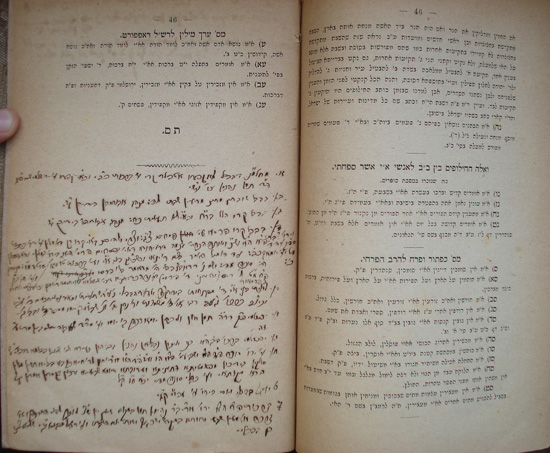
like to present some very special additions of Rabbi Benjamin Wolf Singer
(1855-1930). R. Daniel Sperber published a
volume of his hiddushim/novella. See his biography of the author
here and here. Much more about him later. I hope to devote a future
post to Rabbi Singer and his brother.
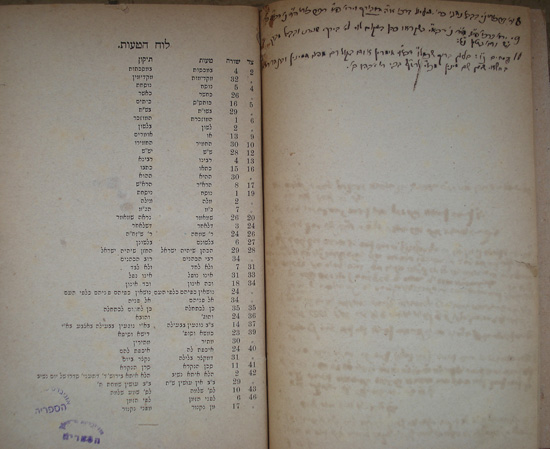
have never before been published, and were found in the form of his handwritten
notes in the back of his personal copy of Miller’s edition of the work, now
housed in the Bar Ilan University central library. The notes follow the extra
hiluqim of Kaftor v’Ferah, ShIR, and Miller which we have just translated
above. Apparently, they inspired Rabbi Singer to continue their work on the
very same page! His notes look like this:
What follows is the best I
could do for a transcription. All of the main points are clear, but not all of
the references. Even this I couldn’t have done without a lot of assistance from
my friend R. Yehezkel Druk, who is responsible in no small part for the many
corrections and additions in Moreshet L’Hanhil’s volumes of the new Friedman
Shulhan Arukh.
readers viewing at home can decipher some more of this. If you can, please
comment! A translation and more follows.
של ר’ בנימין זאב זינגער
מנהגים?] דבבבל לא קפדו אטבילת קרי עיין ברכות כ”ב. ובא”י קפדו. ע’ ירושלמי
שם פ”ג ה”ב, תמן נהגין כו’ ע”ש.
מריעין, שבת לד: מנהג אבותיהן בידיהן. ע”ש.
ובא”י לא. תענית כח: מנהג אבותיהן בידיהן. ע”ש.
(חולין) פסחים צג: וצ. ולהיפך בא”י קרו רק ד’ מילין. עי’ ירושלמי ברכות פ”א
ה”א ושם נסמן [וירושלמי שבת סוף פרק קמא עד ד’ מיל ועיין יומא כ:] ואותה ?הכחיי?
עצמה דרבי יהודה דאיתא בפסחים פרסא היא בירושלמי במילין. והא דבחולין קכב: עד ד’ מיל
דאמר בשם רבי ינאי ורשל”ק [ריש לקיש] בני ארץ ישראל. ועי’ ברכות טו ע”א [אבל
לאחוריה אפילו מיל אינו חוזר [ומינה] מיל הוא דאינו חוזר הא פחות ממיל חוזר] סוטה
מו: [וכמה א”ר ששת עד פרסה ולא אמרן אלא רבו שאינו מובהק אבל רבו מובהק שלשה
פרסאות] סנה’ ה: [ותניא תלמיד אל יורה הלכה במקום רבו אלא אם כן היה רחוק ממנו שלש
פרסאות כנגד מחנה ישראל] סוכה מד: [אמר אייבו משום רבי אלעזר בר צדוק אל יהלך אדם
בערבי שבתות יותר משלש פרסאות] ושם נראה דראב”ץ [=רבי אלעזר בר צדוק] בבלי
היה מדאמר בלשון פרסי ועי’ תו'[ספתא] ב”ק פ”ח מ”ט [אין פורסין
נשבין ליונין אלא אם כן היה רחוק מן היישוב שלשים ריס] ל’ ריס (והיינו ד’ פרסי) ועי’ נדה כד: תניא אבא שאול אומר ואי תימא
רבי יוחנן כו’ ורצתי אחריו ג’ פרסאות
ד’ מפתחות ביד הקב”ו ולדעת הבבלי ג’ עיין ריש תענית ומאיר עיני חכמים דף מב: וכיוצא
בזה ברכו’ ג’ ע”ב רבי אומר ד’ משמרות רבי נתן ג’ ונראה שבא”י קיימו מספר
ד’ ובבל ג’
דראש השנה תמן חשן [תמן חשין לצומא רבה תרין יומין] ? יומא רבה ב’ יומי’ ועי’ סה”ד [סוף הלכה ד’] שאבוה… בשמת ע”י
זה [פני משה מסכת ראש השנה פרק א: “תמן חשין לצומא רבא תרין יומין. בבבל היו
אנשים שחששו לעשות מספק ב’ ימים יה”כ ולהתענות ואמר להן רב חסדא למה לכם
להכניס עצמיכם למספק הזה שתוכלו להסתכן מחמת כך הלא חזקה היא שאין הב”ד
מתעצלין בו מלשלוח שלוחים להודיע לכל הגולה אם עיברו אלול ואם אין שלוחין באין
תסמכו על הרוב שאין אלול מעובר. ומייתי להאי עובדא דאבוה דר’ שמואל בר רב יצחק
והוא רב יצחק גופיה שחשש ע”ע וצם תרין יומין ואפסק כרוכה ודמיך. כשהפסיק מן
התענית ורצה לכרוך ולאכול נתחלש ונפטר. ועל שהכניס עצמו לסכנה מספק לא הזכירו שמו
להדיא ואמרו אבוה דר’ שמואל בר רב יצחק”.]
ה”א כך אינון (בבלאי) נהגין גביהון זעירא לא שאל בשלמיה דרבה
פ”ד ה”א ושביעית פ”א ה”ז ועיין שם פ”ד ה”א או’ רבי
יוחנן לרבי חייה בר בא בבלייא תרין מילין סלקון בידיכון מפשיטותא דתעניתא וערובתא
דיומא שביעייא. ורבנן דקיסרין אמרין אף הדא מקזתה ועי’ בבלי סוכה מד. ??
בירושלמי עי’ ?יבמות? קג ע”א
ירו’ אמר אר”י ב”ר נהיגין תמן במקום שאין יין ש”צ עובר לפני התיבה
ואומר ברכה אחת מעין שבע וחותם במקדש ישראל ואת יום השבת. ועי’ ?רא”ש? ?? י”ב
שלא מצאנו כן בבבלי
נהגי כרבי ישמעאל ברכו א”ה המבורך – וירושלמי פ”ז דברכות ה”ד [נדצ”ל:
ה”ג] נראה דבא”י כר”ע
ה”ד [נדצ”ל: ה”ג] נראה דבא”י כשקראו כהן במקום לוי לא בירך
שנית ובבבל מברך. עיין שם. תוס’ גיטין נט: [ד”ה כי קאמרינן באותו כהן, והשווה
תוספת לוין סו’ י”ג וי”ד]
נו: בענין ברוך שכמל”ו [שם כבוד מלכותו לעולם ועד] דבא”י אומרין אותו
בקול רם מפני המינין ובנהרדעא בחשאי שאין שם מינין מב.. לר.. גבי ר’ אבהו ב’. [אולי
הכוונה לצטט ויכוח של מין עם ר’ אבהו.]
- In Babylon they were lax regarding the requirement
for one who experienced seminal emissions [Ba’al Qeri] to immerse
himself in a mikva. In the Land of Israel they were stringent. - In Babylonia they commence the Sabbath in the midst
of the blowing of the shofar teru’ah — They retain their fathers’
practice. (Sabbath 35b) - In Babylon, they read the hallel on the day of
the New Moon. In the land of Israel they did not (Ta’anit 28b, “They
retain their fathers’ practice”). - In Babylon [a large unit of length] is referred to as
a “parsa.” On the other hand, in the land of Israel, it is referred
to as “four mil.” [miles] - According to the understanding of the sages of the
Land of Israel there are four keys in the hands of the holy one, blessed
be he. According to the understanding of the sages of Babylon, there are
three. - In Babylon there were sages who fasted two Days of
Atonement due to uncertainty as to on which day the new month begins. - The Babylonians do not greet [rabbinic authorities],
so Z’eira [respected their custom and] did not greet Rabbah when he
visited. - Rabbi Yohanan said to Rav Hiyya bar Bo: “The
Babylonians have brought two [customs] up with them: full prostration on
the fast days and the taking of the willow on the seventh day [of Sukkot].
The Rabbis of Caesarea added bloodletting [to the list] as well. - In the Babylonian Talmud we find: “Yosef.” In
the Jerusalem Talmud: “Yosi.” - (7) “There, in Babylon, when there is no wine, the
prayer leader descends to the bima and recites the one blessing in
place of seven and concludes with meqadesh Israel v’et yom hashabbat.”
However, in the Babylonian Talmud we do not find this. - (8) In Babylon the custom followed Rabbi Ishmael in
reciting “borkhu et hashem hamevorakh.” It appears that in the Land
of Israel they followed Rabbi Akiva [instead]. - (9) Is seems that in the Land of Israel, when a Kohen
was called to the Torah reading in the absence of a Levite, he would not
recite a second blessing. In Babylon he recites the benediction. - (10) In the Land of Israel they recite “Barukh
shem kavod malkhuto l’olam va’ed” out loud because of the heretics. In
Nehardea they whisper it since there are no heretics there.
Latin after tet. This is probably because the tet resembles a
six, so he followed it up with seven. Remember, these were just personal notes,
not intended for publication, obviously. Rabbi Singer’s mind was on more
important things, as the erudition of his notes speaks for itself. Anyway, who was Rabbi Singer? We’ll return to that at the end of
this post. Here in the middle of the work there is a citation apparently to a
Yalkut in Parshat VaYeshev, but I can’t make heads or tails of it.
Appendix to
Lewin’s edition. The articles originally appeared in Sinai 10 and 11.
Zinger, Lewin also noted the additional Hiluqim in Miller’s volume and
decided to add more. Instead of adding exclusively from Talmudic sources, Lewin
leaned more on Geonic sources, of which he was the great master. Some of these additions are quotations, and
some Lewin formulated himself.
After completion [of the section from the public reading], the
reader blesses: “Blessed are you … ruler of the world, rock of ages, righteous
of all generations, the steadfast deity …” Then the congregation promptly
rise and say: “Steadfast are you, he, the Lord, our G-d, and steadfast is your
word. Steadfast, living, and lasting is your name and it’s utterance. Always
will you rule over us forever and ever.” This is one of the disputes between
the sons of the East and the sons of the West, for the sons of the East respond
while sitting whereas the sons of the West [respond] while standing.
In Zoan, Egypt, which is called Fustat [today part of old
Cairo], there are two synagogues: one for the people of the Land of Israel, the
al-Shamiyin congregation [=the “Yerushalmi”, this name is
still used today to refer to a Jewish Yemenite branch] (It is named after
Elijah, of blessed memory [?, see below]). The other is the congregation of the
people of Babylon, the al-Iraqiyn congregation. They do not observe the
same customs. (Selections from Yosef Sambari, Seder HaHakhamim, Neubauer
I, p. 118. On page 137 it states that the congregational synagogue then still
in use was built before the destruction of the second temple in Jerusalem.)
One, (the people of the Land of Israel) stands during kedusha, while the
other, (that of the residents of Babylon) sit during kedusha. (Rabbi Avraham
ben HaGra, Maspiq l’ovdei hashem. In
the 1989 edition published by Nissim Dana, page 180, the opinions appear in
reverse order)
It is written in the responsa of the Geonim that the residents
of the Land of Israel recite kedusha only on the Sabbath, since it is written
[in Isaiah 6:2] that the Hayot have six wings. Each wing sings praises
corresponding to the days of the week. When the Sabbath arrives, the Hayot say
to the holy one, blessed be he: “We do not have another wing!” He replies to
them: “I have another wing which sings praises to me, as in (Isaiah 24:16):
“From the end [literally: wing] of the world we have heard song.” (Tosafot
Sanhedrin 37b, ad. loc. Mikanap, Miller 59)
We do not recite kadish or borkhu with
any less than ten [men]. Our sages in the west recite it [in the presence] of
[even] seven [men]. They explain themselves according to the verse: “bifroa
p’raot …” (Judges 5:2) according to the number of words [in the verse = seven.
See also verse 5:9.] Some recite it with even six [men] since [the word] borkhu
is the sixth [word in the verse]. (Some base this opinion on Psalms 68:27,
which contains six words – Avudraham)
R.
Joseph said: How fine was the statement which was brought by R. Samuel b. Judah
when he reported that in the West [Israel] they say [in the evening], “Speak
unto the children of Israel and thou shalt say unto them, I am the Lord your
God, True.” (Berakhot 14b, Soncino translation). Still now, several cities [alternatively:
regions] in the Land of Israel observe this custon in the evening. They reason
that shema and v’haya im shamoa, [the first two paragraphs], are
observed both day and night, whereas va’yomer is only observed during
the day [as per Mishna Berakhot 2:2]. (Hilkhot Gedolot 1, Hilkhot Berakhot 2,
p. 37, second Hildesheimer edition)
The
sages of the Land of Israel behave as follows: they recite the evening prayers
and later they read the Shema in its proper time. They are not concerned
about connecting [the blessing ending with] geula to the evening
prayers. (Sha’arei Teshuva 76, See Otzar HaGeonim for a list of numerous
rishonim and collections who cite this responsum.)
Conserving
a festival which begins after the Sabbath, it is still maintained in the Land
of Israel that a fourth blessing is recited separately… but as for us, Rab
and Samuel instituted for us a precious pearl in Babylon: “Just judgements and
true Torah.” (attributed to Rav Hai Gaon, Otzar HaGeonim Berakhot, Perushim p.
46)
On
the final day of the festival miṣwot
u’ḥuqim and bekhor are read (Megilah 31a, acc. to mss.
Munich and rishonim). Rav Hai Gaon explains this passage as a mnemonic sign: 1.
There are those who read “for this miṣwa” (Deut. 30:11) and this is
still read in the Land of Israel. 2. There are those who read from “im be’ḥuqotai
until “qomemiut.” (Lev. 26:3-13) 3. There are those who read: “kol
ha’bekhor” (Deut 15:19). We read “kol ha’bekhor.” (various
sources, Otzar HaGeonim Megillah, p. 62, no. 230)
Upon
the conclusion of the Day of Atonement, residents of the Land of Israel blow qashraq
[=tashrat, a serious of various tones]. Residents of Babylon only
sound one plain blow in remembrance of the jubilee. [From here until the end,
Lewin composed most of the statements himself based on the sources he
provides.]
The
three fast days – Ta’anit Esther – are not observed consecutively, but
rather, separately: Monday, Thursday, and Monday. Our sages in the Land of
Israel were accustomed to fast after the days of Purim, on account of Nicanor
and his company. Also, we delay [unpleasant] payment and do not predicate it.
(Masekhet Sofrim 17)
Residents
of the Land of Israel would not actually fully prostrate themselves on fast
days. Residents of Babylon would actually fully prostrate themselves.
Residents
of the Land of Israel did not read Hallel at all on the day of the New
Moon. Residents of Babylon read it while skipping sections [an abbreviated
version].
Among
residents of the Land of Israel, the first reader from the Torah recites the
beginning blessing, and the last reader recites the final blessing. According
to the residents of Babylonian, each and every reader blesses before and after
the reading, since [members of the congregation may be] coming and going
[during the readings and thus miss one or the other].
In
the absence of a Levite, residents of the Land of Israel would call a second
Kohen to read from the Torah in his place. Residents of Babylon would call up
the very same Kohen again who just read the first portion.
Residents
of the Land of Israel permitted writing [Torah] scrolls on the skins of pure
animals even if they were not slaughtered according to specifications of
dietary laws. Residents of Babylon forbade this since they were not
slaughtered.
introduction
translated. However, only a summary of chapter 2 and the text of the original
work itself have been translated here.]
close of the Talmudic period until the close of the Geonic period
The end of the Talmudic Period
The Geonic period
Attitudes towards divergent
customs until the Geonic period
Attitudes of Babylonian Geonim to
the customs of the Land of Israel
the work and its use by Rabbinic and Karaite Jews.
The name of the work
The author, his period, and
locale
Purpose of the work
Characteristics and scope of the
book
Language and sources
Legal sources and historical
development of the disputes
Use of the book by Geonim
Use of the book by Rabbinic legal
authorities
Use of the book by Karaites
Scholars who have studied the
work
the Book of Disputes, Printed Editions and Manuscripts
Text versions, families and
formation
The first group
The second group
The third group
This edition’s presentation and
stemmatic diagram of source relationships
The varying order of the disputes
in all of the versions
The text
[Systematic Commentary]
work and is not translated at this time
The name of the work
cited by various Rishonim. Virtually every single one has a different title for
the work – all variations on the same descriptive theme. [Both the variation in
titles and the descriptive nature suggest that the work may have been not only
anonymous, but also untitled. It was simply a list drawn up by a sage, copied
and possibly added to.]
in the title, including the
first printed edition (1616, starts at middle of page)
included at the end of Bava Kamma in Yam shel Shelomo, by the
great Ashkenazi sage Rabbi
Solomon Luria, better known as Maharshal (1510-1573).
Maharshal’s edition, it led some to believe that the Maharshal himself
collected it, a point justly disputed by Rav Avraham ben HaGra [see below].
based on the root ḥlp, which only appears in a few secondary sources like
Ravya, Rosh, and Tur.
the selection of this root was designed to minimize the controversial nature of
the work. As Lewin stresses in his introduction, this is a work of divergent
customs, not disputes regarding actual Torah law. The reader can evaluate both
titles, which have themselves both been translated here as “alternates”. In
this writer’s opinion, both of the roots may be “alternate” variations of one
original word (probably from the root ḥlq) as the letters peh
and qof are graphically similar. A supporting example of variation
between these very same words is found in The Epistle of Rav Sherira Gaon in
the “French” manuscript branch. See Lewin’s
edition, page 22, left column, note 19. There you will find a manuscript with
precisely such an alternate reading.
records divergent legal opinions is referred to as kḥilaf. See
here, beginning of intro. On the other hand, an 11th
century Karaite work is entitled Ḥilluq ha-qara’im we-ha-rabbanim]
identity.
Rabbi
Abraham ben Elijah of Vilna, the son of the famous GRA, in
his work Rav
P’alim, p. 126. He was uncertain as to whether
the work was authored by amoraim or in a later period. [His chief concern here
is disproving the erroneous theory that the Maharshal himself collected
the work from various rabbinic sources.] Miller was able to hone in closer,
from the savoraim at the close of the Talmudic period to the beginning
of the Geonic period. Margulies provides considerable evidence that the work
was composed around the year 700. That is, after the Arab conquest and before Rav Yehudai Gaon.
with Babylonian customs through travel to Babylon. Western Aramaic and Western Hebrew forms abound. In fact, the very
composition in Hebrew suggests composition in the land of Israel, the language
of the “Minor”
Talmudic tractates produced there during the Geonic
period, as well as Hebrew translations of Eastern Aramaic Babylonian Geonic works themselves. Margulies points out
that since Miller’s publication, new evidence has emerged from the Cairo geniza
which shows that after the Arab conquest, Babylonian Jews migrated to the Land
of Israel and formed their own separate congregations in Tiberias, Ramla, and Mivtzar Dan (Panias-Banias), with the most likely speculative location for our
author being Tiberias, which was a native Torah center that may have already
boasted a Babylonian community during the Talmudic period.
Babylonian side in the dispute between the two great Torah centers. He points
out that many more explanations are offered in support of the
“Yerushalmi” side than the Babylonian. Later, Miller appears to
backtrack and seems to conclude that the work is simply meant to impartially
catalog the various discrepancies.
orientation, but understands the purpose more subtly. Rather than taking a
confrontational stance, the work merely seeks to explain and rationalize the
local customs and decisions to the new Babylonian immigrants who were not aware
or respectful of the locals. No attempt is made per se to reject the validity
of the Babylonian customs themselves and at times the author troubles himself
to explain them only.
the book
in cataloging all of the items of dispute. According to Miller, the complete
version of the work has not yet been transmitted to us. [This understanding may
underly many efforts to expand on this list, discussed in the Appendix.]
Margulies disagrees, on the basis of the numerous manuscript examples at his
disposal. According to him, the author never meant to compile an exhaustive
list.
composed in “Yerushalmi” Hebrew. A list of words and phrases is
provided by Margulies along with parallel examples from Talmudic and Geonic
“Yerushalmi” literature. He supposes that many more parallels would
be found in halakhic works from the period and region which are no longer
extant.
considerable philological interest especially regarding Geonic material in
Hebrew which may be of uncertain provenance.]
development of the disputes
documented partially in other Talmudic and Geonic literature. As would be
expected, there is a high level of correspondence between the
“Yerushalmi” side and the Jerusalem Talmud; also, between the
Babylonian side and the Babylonian Talmud.
transmitted unresolved to both regions and eventually decided differently in
each locale in a purely internal manner. Conversely, sometimes entirely
external factors may drive the discrepancies in later periods as well.
Geonic period until the end of the period of the Rishomin signified by the publication of the Shulhan Arukh. In
general, the Babylonian side prevailed as their hegemony increased, but in a
number of cases, the position native to the Land of Israel in fact dominated,
especially when it did not contradict any explicit statements in the Babylonian
Talmud. This tradition was especially strong in Tsarfat and Ashkenaz (France
and Germany) as opposed to Sepharad (Spain), which historically remained tied
to the Babylonian Geonim. The influence of the Land of Israel side is
especially noticed in the house of study of the great Rashi and his students (items 2, 3, 6, 7, 10, 13, 14, 18, 19, 25, and more).
since to a large extent geographic boundaries were erased by the free transfer
of books from one region to another and a great amount of cross-fertilization
occurred. Nevertheless, it is noted that a number of disputes remain with us to
this very day between Ashkenazi and Sepharadi communities.
disputes are addressed, but apparently not through direct exposure to the work.
It is more likely that the inquirers from the Land of Israel or North Africa
might have been motivated in their queries by exposure to concepts from the
work.
gather material from this work into their nets. The collection known as Sha’are Tsedeq includes no fewer than eleven items culled from the
disputes.
to Babylonain Geonim themselves, but it is difficult to rely on any of these
attributions and most were clearly added by the later compiler.
by Rabbinic legal authorities
never cite it or it’s contents. Others who do cite it generally cite only
sections known to them through second or third-hand rabbinic sources.
much more pronounced than in Spain. The work seems to have reached different
locations at different times. By the 14th century the work seems to
have been lost for the most part, as only citations from by previous
authorities are ever quoted.
it’s brevity. [For example, the usual explanation for the grouping of the
twelve prophets in one scroll, and today in one volume, is so that the small
books would not become lost.] However, a more compelling reason appears to be
the negative impression that the work made on certain authorities, most
notably, Nahmanides, Ramban (Avodah Zara 35b). It was (correctly) perceived
that the work contains material which contradicts the Babylonian Talmud,
already considered supremely authoritative. Methods of study which stressed a
proper historical understanding of all legal points of view would become common
in rabbinic circles well before the modern period, but at the time they were
not yet developed. If an opinion could not be utilized for determining the
halakha, it was not deemed worthy of further inquiry. Nahmanides is the only
early Spanish sage who even mentions the work, so it is not at all surprising
that he considers it outside the pale of legal precedent.
Karaites received from it and quoted from it. They may have suspected the work
of being a Karaite forgery.
include: Rabbi Abraham ben Isaac of Narbonne (Eshkol), Rabbi Isaac ben
Abba Mari of Marseilles (Ittur), and Rabbi Abraham ben Nathan of Lunel (Manhig).
The textual versions cited by the Provencal sages are similar to those
found in the Geonic Responsa collections which appear to be most original.
citations indicate that they were generally quoting secondary and tertiary
rabbinic sources rather than the work directly. The sages include: Rabbi
Eliezer bar Nathan of Mainz (Ra’avan, Even Ha-Ezer), Ravya, Tosafot, Rabbi
Eliezer of Metz (Yereim), Sha’arei Dura, Machzor Vitry.
virtually disappear. A most notable exception is Rabbi Ashtori HaParḥi (Isaac
HaKohen ben Moses, 1280-1366) in his Kaftor w-Ferah, who traveled from
France to the Land of Israel, on which his work focuses. He cites the work
according to versions not attested to otherwise among French sages.
[Furthermore, he took an interest in expanding upon the principle of the work
as seen in the additions which Miller culled from it. See below after the main
body of the translation.]
and Rabbenu Asher ben Yehiel (Rosh) mention the work haphazardly.
Other sages who cite the work include Rikanati, Tashbatz, Agur, Or Zarua, and
Shiltei Giborim. None of the early or later sages undertook an
elucidation of the entire work – they left this important work for us to do!
Rabbanites. This is not at all surprising. The
Rabbanites claimed to possess an
authoritative Talmudic tradition handed down from the earlier sages. Every
known dispute amongst the Talmudic sages themselves was utilized in order to
argue against these claims. From Beit Hillel and Beit Shammai to disputes
amongst the Babylonian Geonim themselves, the Karaites seized upon the disputes
between East and West eagerly.
an overtly apologetic manner (read: missionary), he was wont to exaggerate and
even forge sections of the work. Thus, it goes without saying that his work
cannot be utilized uncritically. Nevertheless, despite this cautionary note,
his early explanations can at times be very useful in understanding the nature
of the disputes themselves.
According to him, the disputes between East and West were more extensive than
the disputes between the
Rabbanites and the Karaites, but nevertheless, claims
of heresy were never leveled and a spirit of tolerance reigned between the
communities. So too, the Karaites should be accepted by the
Rabbanites . This
stance led him to exaggerate at times the extent of the disputes which were
considered normative. Thus, even though the majority of the disputes concern
extra-legal customs, he would attempt to thrust them into the body of the legal
arena as exemplars of radical opinions. If at times he may have honestly
misunderstood the disputes, in some of them it appears that he was making a
cynical attempt misrepresent them and create confusion to advance his
rhetorical purposes.
invented out of whole cloth, an out and our forgery not attested to in any
other versions of the work:
with [the fruit of] the seventh year. People of the Land of Israel permit this.
Therefore, the betrothals of that year in the Land of Israel are not considered
by the Babylonians to effect marriage, and their children are not valid.”
to shevi’it resulting from graphic similarity between the letters tet
and shin led item 25 to be misconstrued by Qirqisani in this manner. If
Lewin did not mention this possibility, at the very least, he noticed the
similarities and listed them together in his collection.]
utilize the work in their own disputations with Rabbanites. As we saw earlier,
this may have led to the work’s falling out of favor among Rabbanites in
regions where Karaites were active.
the work
1871 (Heft 8), p. 352-363 (available through compactmemory)
Rabbi Gershon Hanoch
Leiner, the Admor of Radzin,
in his commentary to Orchot Hayyim, mentions that he has composed commentaries
on 50 disputes from the work. This has not been published and according to
Margulies may no longer be extant.
R.
Ezra Altshuler, Tosefta, 1899. According to Lewin and
Margulies, he plagiarized Miller (3 above) without mentioning him at all, even
copying his printing errors. Someone should do a study on this work and figure
out if the accusations are justified. Both Eliezer Brodt and I suspect that R.
Ezra did, in fact, add plenty of his own material and didn’t see anything wrong
with copying transcriptions from a previous edition. This version of the Hiluqim
has
been republished
with additional notes from the Aderes.
R.
Ya’akov Shor, Ner
Ma’aravi in HaMe’asef, 1910 [for a complete listing of
all issues containing this serial column, see Simha Emanuel’s index, entry 98]. These were
reprinted in כתבי וחדושי הגאון רבי יעקב שור זצ”ל.
R.
Dr. Benjamin Menashe Lewin, Otzar HaGeonim, [Otzar Hiluf Minhagim, 1942. Lewin’s edition was prepared
more or less simultaneously as Margulies’ edition. Forthcoming from R. Yosaif
Mordechai Dubovick
is a study on the various versions of Lewin’s publication.]
[After
over a Jubilee of reliance on the two critical editions of Marulies and Lewin,
without further critical study, Ze’ev Elkin re-opened the field with his
1997 Tarbiz article focusing on the earliest
manuscripts of the work, which are all of Karaite origin. He questioned several
of Margulies conjectures. Elkin later became a member of the Knesset.
R.
Dr. Uzi Fuchs, Netuim
2003. An
examination of the Rothschild manuscript and its role in the development of the
various textual variants.]
this related work in passing. This is a new revised version of his 1987
master’s thesis
(Hebrew University).
sources of the Book of Disputes, Printed Editions and Manuscripts
for the last section, the text itself, found at the beginning of this article.
According to Elkin’s 1997 article the textual analysis may be in need of an
update and revision.]
return to the question about who Rabbi Benjamin Zev Singer was. Rabbi Singer
published Hamadrich, a Talmudic anthology, in collaboration with his brother, Rabbi Abraham Singer
of Varpalota in 1882 and Das Buch der Jubiläen (Die Leptogenesis) in 1898
as “Wilhelm Singer.” Also, Neue Lehrmethode
für den hebräischen Lese- und Sprachunerricht in der ersten Klas in 1867, with an additional Hebrew subtitle, אור חדש. This is a slim German Sefer Mesores
for learning the Hebrew alphabet, davvening, handwriting, and selected phrases
in Judeo-German.Singer is identified as a hauptschullehrer, a
schoolteacher.
novella/hiddushim on Tractate Shabbat in 1986 and included a biography of him:
of his many unpublished Hebrew works still in
manuscript which are housed in boxes at Bar Ilan. Apparently University of
Toronto houses manuscripts of his writing in German (maybe Hungarian, too, but
he wrote both of his books in German. I noticed that at least one of the items
Singer listed above (four mil) is apparently given fuller treatment in these
manuscripts. Given the sheer quantity of his output, I suspect that many more
items in the list are as well.
learned review articles in German of the Miller volume. See it here:
One review appears in Graetz’s Monatsschrift,
1879, pp. 87-91 (Heinrich Graetz took over as editor after Zecharias Frankel);
the other is in Brüll’s Jahrbuecher,
vol. 4, pp. 169-173. (Both are available at www.compactmemory.de.) A couple of
other articles are listed here as well, after the fact. At the top, the
aforementioned 1871 Monatsschrift article of Dr. P. P. Frankl (listed by
Marguleis), p. 357. At the bottom, an additional Brüll Jahrbuecher article
from the first volume of the series, p. 44, where Talmudic customs of the Galil
and Judah are discussed.
interesting to see that the Rabbi Singer brothers, the authors of HaMadrich,
featuring haskamot of R. Yitzchak Elchanan Spector, the Netziv, and (over a
hundred!) gedolim, had an openness to modern scholarship which accommodated
Graetz and even Brüll, a reform rabbi who for a time headed the congregation in
Frankfurt opposite R. Shimshon Raphael Hirsch. This openness is also manifest
in the very existence of R. Singer’s volume on the book of Jubilees, Seforim
Hitzoni’im.
mentioning is that HaMadrich is essentially a collection of chapters to
be learned by beginning and intermediate students all in one volume with an
eclectic running commentary. That work was briefly touched on in
this forum previously, but it would be more
interesting to explore in greater detail exactly how eclectic it was once we
have a clearer picture of the depth of lomdus and of academic scholarship
displayed by the authors of this first “Artscroll.”
everyone. R.
Yehoshua Monsdhein’s article on HaMadrich details the controversy surrounding the work. It is difficult
to piece together exactly to what extent the opposition was to any change
whatsoever in the education process, and to what extent it was towards
entrusting the enlightened Singer brothers to this task.
were these haskamot procured (many of them probably after the controversy
already developed!) any more successful than the ones in Rabinowitz’s Dikdukei
Sofrim? How many lomdim actually learned with HaMadrich? It was only
reprinted once and then again twenty years ago.
that except for the first Monatsschrift
review, the additional three references were added in pencil by
another hand, perhaps R. Singer’s brother R. Abraham, who worked closely with
him on HaMadrich. But probably
not the other way around. I consulted with R.
Yechiel Goldhaber – he thinks that these notes are
in the same style as the published hiddushim on Shabbat, and that seems quite
reasonable.
Raspe for deciphering these journal references, and to Sara
Zfatman for the assist.
note: Thanks to Avi Kessner for suggesting and sponsoring this project, also
for proofreading and valuable comments. I am indebted to Sander Kolatch and the
Kolatch Foundation for general assistance during the year. Eliezer Brodt
provided several useful references, without which this post would have been
much poorer. The Guetta, Jacobi, and Peled families who continue with their
unfailing support, especially my wife Dana, who makes it all possible. This translation
is dedicated to my father, Nathan ben Tzipporah, in the hope that he should
enjoy a complete and speedy recovery.
On the Times Commonly Presented for Birkat HaL’vana: Part 2
By Avi Grossman
Continued from here
The Truth About The Beth Yosef’s Position
A while ago I received this from a disputant (I have not edited any of his writing):
In the Shulkhan Arukh (chapter 426 paragraph 3) it was ruled that one has to wait till seven days have passed, and the Rema did not override the halachik ruling of the Mechaber (the Shulkhan Arukh). Therefore this is the basic core law for Sepharadim and Ashkenasim alike. However, there is an Ashkenasi minhag to make the Kiddush Levana blessing after only three days. This minhag being based on the Gr”A (the Gaon miVilna) as brought down by the Mishna Brura in se’if katan (clause) 20. This minhag has on what to be based, however less than three days, is not the minhag at all. Nevertheless, if bedi’avad (if someone has not done according to the aforementioned minhag, and already has done otherwise i.e. less than three days), if the person made the blessing of Kiddush Levana, Rav Nevensal writes (in his commentary on the Mishna Brura in the name of Rav Shlomo Zalman Auerbach) that he accomplished the mitzva of Kiddush Levana and his blessing was not a brakha levatala, ( a blessing in vain.) This is also understood from the Shar haTziyun.
I have omitted his subsequent attack on my credentials and character. I also believe, that he has made a number of errors:
1. The Beth Yosef’s actual opinion is not as he represented it. 2. His method of discerning the Rema’s opinion is faulty. 3. He does not allow for the numerous times wherein the halacha and the common practice simply do not follow either the Rema or the Beth Yosef.[1] 4. Especially in Israel, there are many groups, usually those associated with Religious Zionism and inspired by the teachings of the Vilna Gaon, that seek to reintroduce the ancients’ practices as described by Hazal, and do not automatically accept later positions that contradict the classic understanding of Hazal. There are too many aspects of Jewish law that are also not even covered by the rulings of the Beth Yosef and the Rema.
I would now like to attempt to show what the Beth Yosef believed. Rabbi Yosef Karo was aware that the halacha, as stated by the Talmud and understood by the rishonim, was that birkat hal’vana should ideally be recited on the first of the month. In his commentary to Maimonides’s explicit ruling that birkat hal’vana be recited on Rosh Hodesh, he even cites the source for this rule. Moreover, Maimonides formulation is taken verbatim from the Yerushalmi in Berachoth 9:2, which also clearly means that the time for the blessing is Rosh Hodesh. The Beth Yosef then has much to say (a few paragraphs’ worth) about the Tur’s formulation of the relevant halachot, and finishes with one line about a much later, kabbalistic, non-talmudic opinion that the blessing should be delayed until seven days after the molad. It is impossible to properly understand his intent in the Shulhan Aruch before reading his longer dissertations in the Beth Yosef, and when we analyze the style he used to present many other halachot in the Shulhan Aruch, we see that when Rabbi Karo actually subscribes to a (usually kabbalistic) position that was explicated later in history as opposed to an earlier explicated halacha, he simply records that later opinion without mentioning the earlier differing opinions, or he may make mention of them and then dismiss them.
In order to see this most clearly one should read the actual text of the Shulhan Aruch as Rabbi Karo himself wrote it, without the interjections of the Rema. A good example is the laws of t’filln. In Orah Hayim 31:2 he writes straight out that it is forbidden to wear t’fillin on Hol Hamoed. This is the kabbalistic opinion, and he does not mention at all the opinion prevalent among the rishonim that t’fililn are meant to be worn on Hol Hamoed, because he dismissed it, and one cannot claim that he was honestly unaware of such an opinion, because in both his commentary to the Tur and the Mishneh Torah, he wrote about that opinion and its sources in the Talmud, and even explained why he rejected it despite the fact that it had been the near universal practice for centuries before him. (See here for more examples.)
However, with regards to the blessing on the new moon, Orah Hayim 426:1, he first states the straight halacha as recorded by the Talmud and the early commentators that “one who sees the moon in its renewal blesses…” and as he wrote in his earlier works, this was always understood to be ideally at the very beginning of the month. It is only in 426:2 that he brings the custom to wait until Saturday night, and in 426:4 he mentions to wait until after seven days. These three rules are all in conflict with each other. Which is it? The first of the month? Saturday night a few days in to the month, or a week after the beginning of the month?
The answer is that he presents the straight law as understood and received by generations, and then alternate practices that each have their own merit, but which do not and cannot trump the original rule. This is made clear when you also read what he wrote in 426:3, before mentioning the seven-day rule: the last time for saying the blessing is the fifteenth of the month. This shows that in 426:1 and 3 he defines the blessing’s set time as ordained by the sages and as to be followed, and only at the end does he mention an optional practice that does not readily fit the enactment. More importantly, if you look even more closely at the exact wording of the Shulhan Aruch you see that 426:2 and 426:4 are not discussing the precise ordained time for the blessing, but rather different issues entirely.
For our reference, here is the full text of Orah Hayim 426 without the Rema and further commentaries:
. א. הרואה לבנה בחדושה מברך אשר במאמרו ברא שחקים וכו‘.
ב. אין מברכין על הירח אלא במוצאי שבת כשהוא מבושם ובגדיו נאים ומיישר רגליו ותולה עיניו ומברך ואומר שלש פעמים סימן טוב תהיה לכל ישראל ברוך יוצרך וכו’.
ג. עד אימתי מברכין עליה עד ט“ז מיום המולד ולא ט“ז בכלל.
ד. אין מברכין עליה עד שיעברו שבעת ימים עליה.
A. One who sees the moon in its renewal blesses, “…Who hast through His speech created the heavens…”
B. We do not recite the blessing upon the moon unless it is the night after the Sabbath, when the reciter is perfumed and his clothes nice. He should raise his eyes high and stand straight, and bless. He should recite three times, “a good omen, blessed be, etc.”
C. Until when may he recite the blessing? Up until but not including the 16th day from the molad.
D. We do not recite the blessing upon [the moon] until seven days have passed on it.
And now for a brief point about an expression used here twice, which I emboldened in both the Hebrew and English. Our heroes have said the following, each in its own context:
אין שמחה אלא בבשר ויין
אין שמחה אלא תורה
אין שמחה כהתרת ספקות
אין שמחה גדולה ומפוארת לפני הקב״ה אלא לשמח לב עניים
Literally translated, each of these begins with “happiness is nothing but”, and each end differently. Respectively: meat and wine, Torah, resolution of doubts, and gladdening the hearts of the poor. How can these all be true? How can there be four ultimate forms of happiness? The answer is that this is the sages’ way of saying that with regard to a particular situation, there is something that can give someone the best feeling. When it comes to celebrating on a festival, the best way is to have a meal with meat and wine. With regards to achieving a sublime intellectual high, there is nothing like Torah study. With regards to feeling the joy of relief, there is nothing like resolving lingering doubts. With regards to doing something good for others, there is nothing greater than picking up those who are down. There is no contradiction.
Now, we can fully understand how to read the four rules of the Shulhan Aruch: The first rule tells us to say the blessing on the moon, and as we saw before, the running assumption of the rishonim and logic is that the first time is right at the beginning of the month. So too, the fact that the Shulhan Aruch places this chapter within the laws of Rosh Hodesh and then says in the third rule that there is a deadline, the assumption, and the only way the first rule can be understood, is that one may start to do recite birkat hal’vana when the month starts. Also, the Shulhan Aruch uses the same exact language as the Yerushalmi and Maimonides did to describe saying the blessing at the first sighting of the new moon, and the Shulhan Aruch has already shown us elsewhere that he knows the implication of using that language. The first and third rules thus form a pair, defining when to say this blessing. The second rule, which mentions Saturday night, is not contradictory, nor does it modify the objective time for saying the blessing. Rather, from the facts that a. it begins with that rabbinical term of speech “ein… ella…” and b. it then explains that it is so that he will be in a proper state of dress, it is telling us the proper mode of reciting this blessing. Dress nicely, smell good, stand straight, and take a good look at the moon. Consider this: Saturday night is not objectively the best time for saying this blessing which should be timed with the new moon regardless of the day of the week, as Rabbeinu Yona pointed out above, but rather it happens to be the time when one is still clean and wearing his Sabbath clothes, implying that if it were Saturday night and he were filthy, he gains nothing by reciting the blessing then, but if it were, say, Thursday night and he has just dressed up in a tuxedo in order to go meet an important personage, he should say the blessing on the moon if the opportunity presents itself. The subsequent gloss of the Rema also shows that this statement of the Beth Yosef is not a hard and fast rule about the timing of blessing. The way the third rule is introduced, it is Rabbi Karo’s way of saying “the best way to perform this commandment, the most gevaldikke way, is to do it like this…” More so, we can now understand why for many authorities (including Maimonides and the Vilna Gaon) the entire discussion of birkat hal’vana in Massechet Sof’rim did not enter their halachic calculus. In the context of the chapters preceding it, Massechet Sof’rim is not making a straightforward halachic statement about the halachic timing of the blessing, but rather about the manner in which it was ritually performed. Finally, the fourth rule also begins with that terminology, “ein… ad…” (the ad replaces ella because ella is used to describe things not defined by time, like gladdening and eating, whereas ad describes a period of time) because, once again, it is Rabbi Karo’s way of saying, “al pi qabbala, the most awesome way to perform this commandment for those who are mystically inclined and on a high enough level is to…”
Therefore, Rabbi Yosef Karo did not rule against saying the blessing on the new moon on Rosh Hodesh, nor did he rule that it may only be recited after seven days from the molad. It is clear that our master’s writings mean that the blessing was meant to be said on Rosh Hodesh, and that there are two conflicting middat-hasidut practices to delay it, and most of the time it is impossible to satisfy both if understood literally, and, as I have shown, the first of those practices is less about when to say the blessing and more about how to say the blessing, and the second is not halacha for the masses. I have written this to defend what he really said, and how his words have been twisted by those who came later, because there is a common claim made that his opinion was to delay the blessing until seven days have passed from the molad under all circumstances, and does not allow for other opinions. The writer above also claimed that this is also the implicit opinion of the Rema (!) and therefore should also be the default practice of all Jews, Ashkenazim and Sephardim alike, to wait until at least a week from the molad in order to recite birkat hal’vana. If our master, the Beth Yosef, had meant as that writer says, he should have written 426:1 thusly:
הרואה הלבנה אחר שעברו עליה שבעה ימים מברך וכו׳
“One who sees the moon after seven days have passed over it blesses…”
thereby combining both 426:1 and 4:26:4 in order to accurately reflect such a purported view, and then we would still be left with the superficial problem of 426:2 adding the practice to wait until Saturday night. But the Beth Yosef did not write the halacha like that because he actually understood the rules as I have presented them here, namely, that he ruled like Maimonides and the sages of old, that the true time for saying birkat hal’vanna is on Rosh Hodesh or as early in the month as possible, and that the seven-day rule is, like he implied in the Beth Yosef, a practice of those who live according to esoteric and uncommon kabbalistic ideas.
Four years after I first wrote this response, I discovered that Rabbi Moshe Elharar of Shlomi in the Northern Galilee has made this point, and has a video online where he declares as much. See here. He maintains that the practice of Moroccan Jewry is and always to recite birkat hal’vana on Rosh Hodesh, if possible.
I also discovered in recent months that there is a school of kabbalistic thought, the Arizal among them, that maintains that al pi qabbala, birkat hal’vana should of course be said on Rosh Hodesh. Indeed, there is a host of modern-day kabbalists and Hasidic rebbes who advocate and maintain this practice. Rabbi Raphael Aharon, a prominent scholar and mekubal from the nearby settlement of Adam has an entire siddur dedicated to birkat hal’vana, Siddur Sim Shalom, and many of these points can be found in his accompanying essays.
Waiting For Exactly Seven 24-Hour Days?
If one were to adopt the mystical practice mentioned by Rabbi Karo, namely to wait seven days to recite birkat hal’vana, Rabbi Karo has already stated that those seven days are a colloquial seven days. This is also the case with regard to many other realms of halacha which deal with groups of days. He dismissed the notion that the final time for the blessing should be calculated me’et l’et, to the second, minute, chelek, or hour. However, just like the Pri M’gadim unilaterally declared that the Rema calculates the first time for the blessing exactly 72 hours after the average molad even though the Rema never even hinted at such a thing (see above), the calendar makers have taken a further step and decided that those seven days mentioned by Rabbi Karo should also be calculated by adding exactly 168 hours from the time of the molad. We can see what may have influenced the Pri M’gadim to make such a claim within the Rema’s opinion, but there is no reason whatsoever for any of us to then extend a possible stringency within the Rema’s opinion to the opinion of the Beth Yosef.
A relevant recent example was Iyar 5775. The announced average molad was early Sunday morning on the 30th of Nisan (April 19, 2015), 1hour, 27 minutes, and 4 chalakim after midnight (6),[2] while the actual molad was a few hours earlier, at 8:57pm Motza’ei Shabbat (April 18, 2015) (7).[3] According to the traditional understanding of the Beth Yosef’s kabbalistic opinions, birkat hal’vana should have been recited the next Motza’ei Shabbat (the night of April 25), the beginning of the 7th of Iyar. Both moladot had occurred on a halachic Sunday, and this Motza’ei Shabbat was already a full week later than both, and it was also a night when many baalei batim would be in attendance at the synagogues, and the moon was clearly at least half full, yet the calendars declared that the it was too early for birkat hal’vana! By their calculations, despite the fact that the moon was already well into its eighth day, the earliest time for birkat hal’vana would only be sometime after midnight, a full 168 hours after the average molad, and at a time shortly after the moon would set that night. Instead, everyone was to have to wait for Sunday night, when attendance in the synagogue would be much less and the chances of cooperative weather would be diminished, thus depriving many unwitting people of the chance to recite the blessing that month.
The calendar makers grossly misrepresent the Beth Yosef’s opinion, and thereby cause many unwitting Jews to miss the proper times for reciting this blessing.
Additional Considerations
In a lecture recently uploaded to yutorah.org, R’ Schachter mentioned the opinion of the P’ri M’gadim (Yoreh Deah 15:2) regarding the eight-day waiting period between an animal’s birth and it becoming fit for sacrifice: the period is calculated as exactly 7 times 24 hours (me’et l’et) after the moment of its birth. R’ Schachter further mentioned that Rabbi Akiva Eiger (ad loc.) takes the P’ri Mgadim to task for this claim, as it contradicts the plain meaning of the relevant Talmudic sources which assume that the eight days are calculated according to the general rule of miqztath hayom k’chullo, that a part of the day is considered the entire day, just like with all the other similar calculations demanded by halacha. This is entirely analogous to he P’ri M’gadim’s opinion regarding birkat hal’vana, which would similarly be rejected by Rabbi Akiva Eiger.
In another lecture, available here, R’ Schachter discussed the issue of two-day Rosh Hodesh in Temple times: On which day of Rosh Hodesh were the additional sacrifices offered? While there is a Talmudic source that assumes that the sacrifices were only brought on one day of Rosh Hodesh, there is also Biblical evidence that even before the Temple was built, Rosh Hodesh was sometimes observed as two days, and even today, it is observed that way about half the time. At about six minutes in, R’ Schachter mentions an answer offered by Rabbi Soloveichik: In Numbers 28, we are bidden to offer the offering of the Sabbath, “olath shabbath b’shabbatto,” which literally means, “the Sabbath burnt offering on its Sabbath,” but which is rendered by Onqelos, “alath shabba tith’aveid b’shabba,” the Sabbath burnt offering should be made on the Sabbath.
Onqelos’s addition clarifies the meaning. However, in the subsequent paragraph describing the Rosh Hodesh offering, we read, “zoth olath hodesh b’hodsho,” literally “this is the [Rosh] Hodesh burnt offering on its Hodesh,” and we would expect Onqelos to render this along the same lines as shabbath b’shabbatto, but he does not. Instead, he abandons a literal translation with a one-word addition, and gives an explanation (which, by the way, is common. Whenever an anthropomorphism is used with regards to God, or whenever the halacha does not fit the literal translation, Onqelos does not translate literally): “da ‘alath reish yarha b’ithkhadathutheh,” which in Hebrew would be “zoth olath rosh yarei’ah b’hiddusho,” or “this is the New Moon burnt offering at the time of [the moon’s] renewal.” Rabbi Soloveichik offered that even if Rosh Hodesh were a two-day event, the special sacrifice of the beginning of the month should only be offered on the day of the renewal, that is, on the day of the two-day Rosh Hodesh that is observed as the renewal of the moon.
Thus, when the Shulhan Aruch (Orah Hayim 426:1) says hal’vana b’hiddusha, “the moon (this time described in the feminine form, l’vana, as opposed to the masculine hodesh, yarei’ah, yarha, or molad) in its renewal,” he means it as Rambam and Rashi meant it, on the first day of the month. The hiddush of the moon is by definition Rosh Hodesh.
It should not come as a surprise then that the Hafetz Hayim himself also was aware of this important halacha, and endorsed it. He held that me’iqqar hadin, according to the letter of the law, birkat hal’vana is to be said on Rosh Hodesh, and that although there are other practices to delay the recitation, none of them override the letter of the law. In Mishna B’rura, 426:20, he responds to the Shulhan Aruch’s proposition that we should wait for seven days to pass over the new moon before reciting the blessing, and mentions that “most Aharonim held that it is sufficient for the moon to be three days old for the blessing to be recited,” and for good measure he adds the P’ri M’gadim’s condition that those three days are calculated as exactly three time 24 hours, and then suggests that there is a way to maybe delay the recitation just a little bit more in order to also recite it on Saturday night. But then, he says something that only someone aware of the letter of the law will fully understand: “And some Aharonim, including the Vilna Gaon, are lenient even in this regard, [i.e., waiting about three days for birkat hal’vana], and they hold that it is not worthwhile to delay the commandment in any event, and therefore, one who practices like that certainly has on whom to rely, especially during the winter and the rainy season; certainly someone punctilious and quick to sanctify [the new moon] is praiseworthy.” Here, in no uncertain terms, the Hafetz Hayim champions those who would say birkat hal’vana at the very first opportunity. When, based on all of the available halachic sources, would that be, if not on Rosh Hodesh itself? Indeed, the primary source for this Gloss is the Magen Avraham ad loc., and there the Magen Avraham, explicitly mentions that the primary law is that the blessing is to be recited on Rosh Hodesh.
As an aside, I would like to dispute what R’ Schachter says in the first five minutes, namely why a particular day is Rosh Hodesh. As far as I understood, there are two reasons: when the Sanhedrin is functioning properly, a day is considered Rosh Hodesh when the court declares it to be Rosh Hodesh based on the testimony of valid witnesses who spotted the new moon, and when the Sanhedrin is not functioning, our set calendar considers only the moladoth of each Tishrei to determine days of weeks for Rosh Hashana, and once a particular year’s length is known, the first days of each month are then determined based upon alternating 30-day and 29-day months, with certain exceptions. Most importantly, the moladoth of the months that are not Tishrei have absolutely no bearing on when the individual rashei hodashim are celebrated, and I believe that the misconception was fostered by the new practice of announcing the molad each month, which leads people to believe that it somehow has weight in determining Rosh Hodesh. On the contrary, announcing the molad seems to be a very recent practice,[4] and one that I would argue the Beth Yosef and others would oppose, because it could lead the masses to think that the molad actually matters month to month. For example, many believe (mistakenly) that we announce the molad precisely because it is forbidden to recite birkat hal’vana either 72 or 168 hours have elapsed from that time. Some of the classical decisors may have tolerated this new practice, but they would certainly believe that if, for example, no one had a calendar to reference during the service, the announcing of the molad could be skipped.
* * * * *
Recently, I discovered the life and work of the prolific and tragic Rabbi Moshe Levi, a prize student of Rabbi Meir Mazuz. Lo and behold, in his treatise on the blessings, Birkat Hashem, he lists the prominent authorities, down to the Magen Avraham, who ruled that according to the straight letter of the law, birkat hal’vana should be said on Rosh Hodesh, and he himself rules that way.
This highlights an argument that is applicable elsewhere. It is well-known that the ideal time for the morning prayer is right at sunrise, which is when the morning sacrificial service is supposed to start in the Temple, and this was the practice of the wathiqin of Jerusalem. However, in Orah Hayim 281, the Rema mentions that the practice on Sabbath morning is to arrive at the synagogue later than on weekdays. It cannot mean that people show up later than they would on weekdays just to make sure that the amida prayer still starts at sunrise, because that would entail somehow abridging the recitation of all of the liturgy that precedes the amida, but that is not possible, because the practice is also to recite more psalms before the reading of the sh’ma and to recite a longer version of the blessings that accompany the sh’ma. The Rema is plainly stating that on the Sabbath, the morning service is delayed, and he even cites the explanation that it is based on what sounds like a d’rasha, that the verse that describes the Sabbath offering says that it is offered by day and not by morning. It must be said that the teaching in question is not a true d’rasha. It is not brought by Hazal, it is not followed by the halacha, as even on the Sabbath the morning lamb was offered at sunrise, and even in context, it is referring to the additional lambs brought after the morning lamb. Now, can one reasonably claim that because “the Minhag” is to pray later Sabbath morning, it is therefore wrong for some of us to pray at sunrise? After all, the Rema is fairly clear that that is the minhag. Of course it cannot be, but I dread the day someone will say that. This point was made implicitly by the Mishna B’rura, who pointed out that the assumption of Rashi was that in Talmudic times, the Sabbath morning service was also at sunrise. By giving this veiled reference, he is respectfully disagreeing with the practice endorsed by the Rema. Just because there is a practice to delay the performance of the commandment, it does not mean that the letter of the law may not be followed.
Similarly, there is a practice to delay the evening service the night of Pentecost. Now, it must be said the very idea postdates the Shulhan Aruch and the Rema, but the letter of the law is and always was that any Sabbath or festival can be accepted before the holy day officially starts, and that is considered a very meritorious deed. Can one reasonably claim that because “the Minhag” is to pray later Pentecost evening, it is therefore wrong for some of us to pray before nightfall? After all, the Mishna B’rura is fairly clear that that is “the Minhag.” Of course it cannot be, but I dread the day someone will say that. Just because there is a practice to delay the performance of the commandment, it does not mean that the letter of the law may not be followed. A few years ago I wrote about my surprise that Rav Aviner ruled that it is forbidden for Ashkenazim to begin the prayers before nightfall on Pentecost, thus ruling that that which the Rema did and the rest of the Ashkenazim did for centuries was against halacha.
Lastly, we come to the issue of birkat hal’vana, which, according to the letter of the law, should be on Rosh Hodesh. Can one reasonably claim that because “the Minhag” is to recite it some days later, it is therefore wrong for some us to say it earlier? After all, the printed calendar is fairly clear that that is “the minhag.” Of course it cannot be, but as punishment for my “sins,” I heard many times from those who should have known better that it may not be said earlier, despite the fact that it only takes a few hours of research to find that the letter of the law’s practice is actually endorsed by the sages, and Rashi, and Maimonides, and the Shulhan Aruch, and the Vilna Gaon, and the Mishna B’rura. Just because there is a practice to delay the performance of the commandment, it does not mean that the letter of the law may not be followed. On the contrary, the punctilious seek to perform commandments as soon as possible.
*****
I welcome any further insights on this matter. I hope and pray that reinstitution of the Sanhedrin and the adjustable calendar will lead to many more Jews seeking to find the appearance of the new moon as soon as possible, which in turn will lead to them understanding why the sages ordained a blessing on the phenomenon in the first place.
I would like to thank Rabbi Mordechai Rabinovitch and Rabbi David Bar Hayim for instigating the research that led to this work, Rabbi Herschel Schachter for his feedback on the first draft and Rabbi Moshe Zuriel for his warm encouragement and approbation.
[1] How many of us start to perform forbidden labors after Shabbat but before 72 minutes after sunset? Both the Rema and the Shulhan Aruch summarily prohibit such activity.
[2] Jerusalem Solar Time. According to Jerusalem Daylight Saving Time, it was 2:06am.
[3] 9:57pm according to Daylight Saving Time.
New Writings from R Kook Part 1 by Marc B. Shapiro
Yir’at Shamayim—fear of heaven—may not supplant the natural sense of morality of a person, for in that case it is not a pure Yir’at Shamayim. The signpost for a pure Yir’at Shamayim is when the natural sense of morality (המוסר הטבעי) that is extant in the straightforward nature of man is improved and elevated by it more than it would have been without it. But if one were to imagine a kind of Yir’at Shamayim that without its input, life would tend to do well and bring to fruition things that benefit the community and the individual, and furthermore, under its influence less of those things would come to fruition, such a Yir’at Shamayim is wrong.
The upshot of this passage is that some (much?) of what passes for piety today is really nothing more than a corrupted religiosity.
מותר היה לנסות רפואה בעבד כנעני אם תועיל
It seems obvious that Rabbi Kook doesn’t advocate wholesale rejection of biblical statements. To do so would render Tanakh useless as a source of history. Under what circumstances would he countenance “deconstruction” of the text? Only where biblical texts contradict each other or rabbinic statements? Whenever the text appears to contradict well-attested Near Eastern documents? When the exact historicity is immaterial in the judgment of the exegete, to the import of the text? When the exegete detects rhetorical elements in the biblical text itself that point toward such interpretation?
Marc B. Shapiro – Forgery and the Halakhic Process
by Marc B. Shapiro
What is the role of academic learning in the determination of halakhah? In particular, I am referring to knowledge which is not available to the posek and which would affect his halakhic decision. This is, of course, a wide-ranging issue of which I will only discuss one aspect here, that relating to forgery. However, since the issue of the Mosaic text and R. Moshe Feinstein is relevant here, and I mentioned both of them in my last posting, let me make a few brief preliminary comments on this.
In The Limits of Orthodox Theology I quoted the following comment of R. Bezalel Naor, who was quoting his teacher, the Gaon R. Shlomo Fisher of Jerusalem: “The truth, known to Torah scholars, is that Maimonides’ formulation of the tenets of Jewish belief is far from universally accepted.” For those who don’t know, R. Fisher is one of the gedolim of our time, and you can see many of his shiurim on yeshiva.org.il. Many of these shiurim focus on Talmud (and he has published the great rabbinic work, Beit Yishai), but R. Fisher is also the only one of our gedolim who is an expert in Jewish philosophy. This explains why his Derashot Beit Yishai are very different than other collections of derashot. Professor Zev Harvey told me that from R. Fisher’s edition of Crescas’ Or ha-Shem, it is clear that he used Wolfson’s Hebrew text found in Crescas’ Critique of Aristotle.[1]
Someone I know currently attends R. Fisher’s weekly shiur on Avnei Miluim, the last half-hour of which is devoted to issues of hashkafah. Interestingly enough, he reported to me that a few weeks ago R. Fisher declared that he believes the Rambam abandoned his system of 13 Principles, the proof being that they are never mentioned as a unit in the Mishneh Torah.[2] In my book, I noted that R. Shlomo Goren held the same view. R. Goren also makes another interesting point, that while in the Commentary on the Mishnah Maimonides requires one to actually believe in certain principles, in the Mishneh Torah he only requires you not to deny any principles. One who has never heard of a principle obviously does not believe in it, which makes him a heretic according to the Commentary on the Mishnah. But according to the Mishneh Torah, since this person does not actually deny the principle, he is not regarded as a heretic.
Getting back to R. Moshe, as is well known, he ruled that the Commentary of R. Yehudah he-Hasid was a forgery, as he could not imagine that a rishon would acknowledge that there were some post-Mosaic passages in the Torah.[3] Only after my book appeared did Rabbi Naor tell me that the comment I quoted above in the name of R. Fisher was stated precisely with reference to R. Moshe’s positon on this issue. After R. Moshe banned R. Yehudah he-Hasid’s Commentary, R. Fisher commented that R. Moshe assumes that R. Yehudah he-Hasid has to accept the Rambam’s Principles, but in truth there were many disagreements with the Rambam, and R. Yehudah he-Hasid’s position on Mosaic authorship is one of them.
Along these lines, I read a recent shiur by R. Moshe Zuriel, a well-known baal machashavah in which he affirmed that all must accept the Thirteen Principles. I wrote to him asking what he would say about those who accepted the views of sages who disagreed with the Rambam, and I specifically referred to Ibn Ezra’s (exoteric) position that the last twelve verses were written by Joshua, which is a rejection of Maimonides’ insistence in the Eighth Principle that the entire Torah is Mosaic. He replied (emphasis added):
נחשב לכופר, והוא נחשב ישראל . . . וכן כל דבר שיש מחלוקת ראשונים
ויכרת יהושע ברית לעם: על זה להיותם עובדים את ה’ ולהשאיר זכר לזה המעשה למען יבושו ישראל אם יסורו מאחרי ה’ כתב יהושע את הדברים האלה בספר תורת הא-להים
הדגש הוא על מה שאומר כי משה אמר זה מפי עצמו, אבל אם יאמר פסוקים אלה נביא אחר כתב אותם מפי הגבורה ומודה שקטע זה הוא מן השמים ומפי הגבורה, אדם שאומר כך אינו נקרא אפיקורוס, מה שהגדיר אותו כאפיקורוס אינו זה שאמר שלא משה כתב את הקטע אלא בזה שהוא אומר שדבר שזה מדעתו ומפי עצמו אמרו ושאין זה מן השמים
Let me now speak of another issue, not of falsely ascribing forgery where there is none, but accepting as authentic that which is actually a forgery. The classic example is, of course, Besamim Rosh. There is no doubt that the volume is a forgery. There are those who have believed that at least some of the responsa are authentic, but it is more likely that the non-controversial material is a smokescreen for the controversial responsa. I plan to write an article about Besamim Rosh so I will not now reveal an internal proof, arrived at by use of a computer, that the book is a forgery. In an earlier article, I called attention to the fact that the Besamim Rosh assumes that a suicide has no share in the world to come, which is a popular 18th century conception, but not found among Ashkenazic or Sephardic rishonim.[4]
There is a talmid hakham, Rabbi Reuven Amar, who republished the Besamim Rosh and argues in his introduction that Saul Berlin was one of the gedolim. For all of his talmudic learning, Amar is very ignorant in this matter. He knows nothing about the history of Berlin and his haskalah ties. If he did, he would not have wanted to defend him. Yet Amar did know that many halakhic authorities quoted the Besamim Rosh, and he therefore wanted to turn it into a kosher book.
The problem Amar was faced with is what concerns me. What is one supposed to do with pesakim that rely on the Besamim Rosh? Fortunately, there can’t be many. In fact, offhand, I don’t know of any responsum in which a decision is based entirely, or even heavily, on Besamim Rosh, so that if you took this work away the decision would fall.
However, this is not the case with another forgery, as here the forgery is cited by all halakhic authorities of the last 140 years. I am referring to the Sefer ha-Eshkol, attributed to Rabbi Abraham ben Isaac. It was published by Rabbi Zvi Benjamin Auerbach (1808-1878), one of the leading German rabbis of his time. He was also the most prominent member of the famous Auerbach rabbinic family, which together with the Bamberger and Carlebach families (the ABCs, as they were known) were the most prominent rabbinic families in Germany.
According to Auerbach, his Sefer ha-Eshkol came from a Spanish manuscript. The work quickly became popular among scholars and was adorned with Auerbach’s commentary Nahal Eshkol, which is a mine of rabbinic knowledge. It came as quite a shock when in 1909, many years after Auerbach had died, the great scholar R. Shalom Albeck accused him of having invented the story of the Spanish manuscript in order to enable him to forge the work. This accusation aroused a great storm and four of the leading Orthodox scholars – David Zvi Hoffmann, Abraham Berliner, Jacob Schor, and Hanokh Ehrentreau – rushed to defend Auerbach, publishing the booklet Tzidkat ha-Tzadik (Berlin, 1910).
It is obvious that Auerbach’s defenders never gave Albeck’s charge any serious consideration. In their eyes, the fact that Auerbach was universally regarded as a tzadik, as well as one of the gedolim of Germany, rendered the accusation invalid from the start. There was no way they could impartially consider the evidence. In their mind they knew that for a pious Jew, some things are just impossible. Albeck responded to Tzidkat ha-Tzadik with the booklet Kofer ha-Eshkol (Warsaw, 1911), which explains how Albeck knew that the work is a forgery. In discussing the dispute between the four scholars on one side, and Albeck on the other, R. Shlomo Yosef Zevin[5] showed which side he was on.
אחד מול ארבעה – וההרגשה היא, שהנצחון לצדו של האחד
Needless to say, the supposed Spanish manuscript has never been found. In the words of Prof. Haym Soloveitchik, “Auerbach’s Eshkol appears as a clear forgery, incorporating arguments found in sixteenth, seventeenth, and even eightennth-century writings. . . . [The work] should not be used for historical purposes.[8] For this reason, I criticized Avi Sagi and Zvi Zohar for citing Auerbach’s Eshkol in their Giyur u-Zehut Yehudit.[9] R. Bezalel Naor writes:
I was told the following anecdote by Rabbi Aharon Lichtenstein. Licthenstein’s father-in-law, Rabbi Joseph Baer Soloveitchik (of Boston) expressed to Rabbi [Hayyim] Heller his amazement that the same obscure opinion of Mordecai in Niddah was to be found in the Eshkol, to which his mentor Hayyim Heller responded: “That is all?! You can find in Auerbach’s Eshkol a peckel Peri Megadims.” (Yiddish, a pack of Peri Megadim). . . . Prof. S.Z. Leiman informs me he found other irregularities in Auerbach’s historical works.”[10]
De Leon is commonly said to have died in 1305, so unless the forgery was done at the very end of his life, we would be dealing with a 13th century forgery. In his Ha-Nigleh she-ba-Nistar, p. 144 n. 203, Ta Shma indeed writes
In Mordechai Breuer’s Modernity Within Tradition, p. 202, in discussing Orthodox scholarship and how it was often not rated highly by others because of its binding preconceptions, he writes:
One such example was the attempt of some scholars, especially R. Kirchheim in Frankfurt and Schalom Albeck in Poland, to expose the chief scholarly work of the late Rabbi B.H. Auerbach of Halberstadt (Ha-Eshkol, with commentary and notes, Nahal Eshkol, Halberstadt, 1861), as a plagiarism and a forgery. In spite of certain discrepancies in Auerbach’s work, this attempt failed after his defenders could prove that the attacks had not been free of prejudice.
Breuer seems to be mistaken in pointing to the dispute over the authenticity of B. H. Auerbach’s edition of the Eshkol as an example of this phenomenon [i.e., Orthodox scholarship being looked down on]. To begin with, the main assault on Auerbach was led by Shalom Albeck (1858-1920), himself an Orthodox Jew. Secondly, this dispute had nothing to do with dogma interfering with scholarship, but was simply a question of whether Auerbach had forged the text. Finally, it is not so clear that Albeck’s attempt failed, as Breuer would have it. On the contrary, the authenticity of Auerbach’s edition is still highly questionable.
Yet the point Breuer makes actually has relevance to another aspect of this dispute, and here I refer to the defense of Auerbach by the four scholars. Here we do find dogma of a sort, since they make it clear in their defense that the whole accusation is ipso facto invalid, and they even cite the Rambam, Commentary to Avot 1:6, that if you see a tzaddik do something that looks like a sin, you must assume that there is a reasonable explanation, even if it is very far-fetched.
Albeck’s response to this is that the Rambam is referring to a tzaddik who commits a sin between him and God, but not someone who
מתעה את לבות גדולי ישראל מורי ההלכה ודורשי החכמה, ודאי מצוה וחובה על כל איש המכיר בו, להוציא את בלעו מפיו, למען יהיה לאות לבני מרי, ולא יוסיפו לחלל ש”ש ולזייף את התורה
Rabbi Jehiel Jacob Weinberg raised a similar concern with regard to the Shulhan Arukh. There are certain halakhot which are based on false readings. He wondered if in a case like this we have to establish a new halakhah, or since we have accepted the Shulhan Arukh’s ruling we don’t change the halakhah but rather find a different justification for it.
Some might also see some connection with another position of R. Weinberg. As I noted in my book. R. Tam’s states that sex with a Gentile does not cause a woman to become forbidden to her husband. R. Weinberg had ethical problems with the reason R. Tam gives, and I don’t think it goes too far to say that he thought that, from our modern perspective, R. Tam’s justification is to be regarded as immoral.[13] Yet I also note that in seeking to find a heter for a woman who committed adultery with a non-Jew to return to her husband he is prepared to make use of R. Tam’s position.[14] I don’t think this raises any problems, since at the end of the day, R. Tam’s position is part of the halakhic tradition. If it can be used to to reach a lenient decision, then it serves a purpose, even if the contemporary posek doesn’t agree with the underlying assumptions of R. Tam’s pesak (Parallel to this is the widely accepted view that there is nothing wrong with using information derived from Nazi experiments on humans if it can help people. Obviously, everyone agrees that the experiments should never have been carried out, but once they were, the information can be used) As I said, I don’t see this as problematic, but I mention it since some might see it as an inconsistency in R. Weinberg.
An example which is more directly relevant is the following. In June of this year Prof. David Berger gave a presentation at Yeshivat Chovevei Torah on Jewish views of Christianity (as well as how to relate to Chabad). In his discussion of Christianity he explained the concept of shittuf, first mentioned by the Tosafists, and how in its original meaning it did not mean that non-Jews are permitted to believe in one God divided into different parts. Those who want the details on this can see Katz’ discussion in Exclusiveness and Tolerance. Katz was the first academic scholar to point to what he regarded as the common misinterpretation of the Tosafot. In addition, a number of poskim have concluded similarly, most notably the son of the Noda bi-Yehudah, whose responsum was published in his father’s work.
In my response to Berger I asked the following question (addressing myself to him):
You are certain that the common understanding of Tosafot is mistaken. Yet this understanding became the standard for poskim in Western Europe. It is also shared by the Rama. Do you feel that there is anything wrong with someone who agrees with you as to the historical truth nevertheless relying on those poskim who misinterpreted the Tosafot? In other words, do the decisions of the poskim based on Tosafot have independent validity even if their interpretation of Tosafot is incorrect?[15a]
While I understand Berger’s point, I think some reading this might be very uncomfortable with such a notion, namely, that one can have a historical truth and a halakhic truth, with the two being at odds with each other; or to put it another way, that a halakhic truth can be based on a historical error and yet still have validity. This brings us dangerously close to the old Latin Averroist notion of “double truth.” [15b]
Returning to Auerbach’s Eshkol, I am aware of only one posek who has refused to grant it any validity, and I daresay that the overwhelming majority of poskim are not even aware that it has been subject to controversy. The posek I am referring to is Rabbi Yitzhak Ratsaby. For those who don’t know, R. Ratsaby is one of the leading – if not the leadiing – Yemenite posek in Israel. He is an incredible scholar whose many works are particularly valuable as he records a variety of Yemenite practices and quotes from relatively unknown Yemenite writings, including from manuscript. He comes from the Kabbalah-friendly Yemenites, as uses the appellation of אחר in referring to R. Joseph Kafih. [16] Reflecting the typical haredi outlook, when he needs to refer to R. Kook, he writes “הרא”ק.” Doing so denies R. Kook the rabbinic titles given other great rabbis, and also spares haredi eyes from even seeing the name “Kook” in print.[17] Most haredi readers won’t even recognize who he is referring to. This is particularly unfortunate as it was R. Kook who stood together with many of the great Yemenite rabbis in opposing R. Yihye Kafih’s anti-Kabbalah stand. In Emunat ha-Shem, the volume published against R. Yihye Kafih, R. Kook’s two letters appear at the beginning. R. Kook is referred to as
רבנו הכהן הגדול נר ישראל וקדושו גדול הדור ונזרו מרן
Despite this flaw, there are many very interesting things in his works. Because my last post dealt with issues of dogma, let me refer to what R. Ratsaby states in Olat Yitzhak vol. 2 no. 259. He refers to the list of 24 heretics with no share in the world to come, enumerated by Rambam in Hilkhot Teshuvah, ch. 3. Among those are people who say there is no God, or there is more than one god – in other words, classic heretics. But according to R. Ratsaby, even though these people are heretics with no share in the world to come, that doesn’t mean that they can’t fulfill someone else’s religious obligation. As R. Ratsaby puts it
אפילו אותן עשרים וארבעה והנוספים עליהם שברור ומוסכם שאין להן חלק לעוה”ב, לא שמענו שאינן מוציאין אחרים ידי חובתן בברכות וכיוצא בזה, דסוף סוף הוא מחוייב בדבר וכל המחוייב מוציא יד”ח
R. Ratsaby is not referring to allowing such a person to daven for the amud, for which someone must be a proper Jew. Rather, he is speaking of the halakhah per se, i.e., if a heretic can be motzi someone else. I think the instinctive response of people would be that, of course, someone who is a heretic cannot be motzi someone else, and R. Moshe Feinstein states so explicitly. R. Ratsaby removes the issue from one of belief, and instead focuses on the obligation.which all Jews share.
In this same teshuvah, R. Ratsaby also points out something else quite interesting. Following the list of the twenty four who have no share in the world to come, Rambam gives a list of another group who, if they persist in certain evil actions (e.g., embarrassing someone in public, shaming scholars, etc.) also have no share in the world to come. He quotes R. Avraham ben ha-Rambam (hiddushim at the beginning of Ma’aseh Rakah) who cites his father as explaining that the way this works is that someone who is accustomed to do such bad things things will, almost of necessity, not be inclined to do what needs to be done to achieve immortality. In fact, it is much more likely that he will be led to those sins that really do deprive you of the world to come. But one should not take what Rambam writes literally, namely, that these sins by themselves cause one to lose his share in the world to come.
Returning to the Eshkol, many years ago I was studying R. Ratsaby’s Olat Yitzhak, vol. 1, and on page 410 I came across the following:
לענ”ד אין לחוש לדברים מחודשים שבספר זה שהוא בחשש גדול של זיוף, ואין להכחיש מה שהלב מרגיש
חשד הזיוף אצלי הוא מתוך העיון בדברים החדשים שם בקרב הראשונים ולקוחים מדברי אחרים (מה שראיתי דר”כ [=דרך כלל] היה לקוח מהבית יוסף) וגם הסגנון, שחנני השי”ת להכיר כזאת בטביעות-עין והלואי שאני טועה, אבל רחוק בעיניי מלצרפו עכ”פ לענין הלכה. ספר כופר האשכול לא בא לידי
I wrote back to him asking why, if he regards Auerbach as a forger, does he cite the Nahal Eshkol. He replied
R. Ovadiah Yosef offers the same justification in his haskamah to Amar’s 1983 edition of Besamim Rosh
The summer is fast coming to an end, and with it, my free time to write things like this. But I have a number of other examples of forgery which I might post here, if people are interested (I am saving my examples of censorship for the book which I am hard at work on). Many people have told me that they like my “derekh agavs,” so I threw a lot of them in here, and I apologize to those who don’t like the many tangents.
Appendix
Since I don’t know when I will have a chance to write a new introduction to my book, and it is once again in the news with Rabbi Leff’s review, let me quote the following passages from R. Kook’s Shemonah Kevatzim 1:30-31 (I hope that R. Kook is still an acceptable authority for Jewish Action). Two important things stand out. First, while not condoning orthopraxy, R. Kook states that one who is observant, despite the fact that he denies ikkarim, is to be regarded as an erring Jew, not as a heretic. R. Kook’s position is a complete rejection of the idea that people who are shomrei Torah u-mitzvot can be read out of the fold and be regarded as heretics because of their incorrect beliefs. The second important point is that he rejects the Rambam’s entire theological conception of Principles of Faith and alligns himself with the Ra’avad, showing once again that the Rambam’s position has not attained unanimity.
ובזה הננו קרובים לסברת הראב”ד, שהשיג על הרמב”ם במה שקרא למי שמאמין ההגשמה באלהות מין. ונוכל להסכים, שכל זמן שאותו המגשם לא יעשה לו פסל ותמונה, הרי לא גמר את מחשבתו, ונשארה היא עדיין בחוג הרוח שלא תוכל להיות נכללת בשם עקירה ויציאה מן הדת
In a wide-ranging article which deals among other things with R. Kook’s view of heresy, the important scholar R Yoel Bin Nun[19] explains why R. Kook rejected the Rambam’s approach to heresy. R. Bin Nun also states that if you take what the Rambam says seriously, the Rambam himself, if he were alive today and saw how Aristotelian science has been overthrown, would not regard people who disagreed with his principles as heretics. In R. Bin Nun’s words (emphasis added):[19]
In other words, according to R. Bin Nun there is no justification today for calling people heretics because they reject one (or more) of the Thirteen Principles.[20] (when he refers to hakhamim disputing matters, he is not referring to Torah scholars, but the general scientific-intellectual world). Whether R. Bin Nun is correct in his analysis of Rambam is not my purpose at present; I only wish to show that this outstanding rabbinic figure has a very tolerant view, one which rejects the Thriteen Principles as determining who is a heretic.
Notes:
A future post will deal with other issues of this controversy, and at that time S. Z. Havlin’s article on the issue in Yeshurun vol. 13 will be discussed.
[1] Professor Isadore Twersky once mentioned in class that although this book’s title should have mentioned Maimonides, in 1929 Harvard University Press would not publish a book with such a title. In this regard, he also called attention to the title of Sarah Heller Wilensky’s doctoral dissertation, “The Teaching of Issac Arama in the Framework of Philonic Philosophy.” This, too, is a false title, and the subject of the dissertation is seen more clearly by the title of the Hebrew book: R. Yitzhak Arama u-Mishnato. As Twersky explained, Harvard’s Department of Near Eastern Languages and Civilizations did not want a dissertation on a Spanish Jewish thinker unless it was given a more universal theme, hence the “Philonic Philosophy,” an allusion to Wolfson’s theory of philosophy, but this was put in just for show. Incidentally, Fisher’s edition of Or ha-Shem is responsible for my taking credit as being the only student ever to have made Prof. Twersky laugh in class. It was the 1990-1991 year and we were studying Crescas in his seminar. Twersky would often ask me to read, during the course of which he would often correct my pronounciation. When Fisher’s edition of Crescas appeared I immediately bought it and brought it to class. When Twersky called upon me to read, I replied that this time he wa not going to be able to correct my pronounciation. He asked, “why not?” to which I replied, holding up my new book, that I just purchased a new edition of Or ha-Shem, and it is “menikid.” This was too much for even the eternally staid Twersky, and he too was brought to a chuckle. (From inyana de-yoma, someone asked me if Noah Feldman studied with Prof. Twersky. He was not in any of Twersky’s seminars that year. He was, however, in Prof. Septimus’ seminar as well as that of Prof. Leiman, who was at Harvard in fall 1989 as a visiting scholar. In those years, long before he became famous [now, notorious] I would often tell people that one of my fellow students, an undergraduate taking graduate classes, was perhaps the most brilliant person I knew – a much better head than mine – and I have known many intellectual heavyweights. Yet I have read some people, who certainly don’t know him, describing Feldman as an expert in Shas and poskim. This is laughable. He has a great mind, and can grasp a Tosafot quicker than almost anyone, but he never spent any serious time in limudei kodesh after high school. I think my father best summed matters up after reading his article. He said: “Feldman may be very smart, but he isn’t very wise.”).
[2] R. Fisher has also expressed his support for the position of those rishonim – in opposition to the Rambam and R. Chaim Soloveitchik – who believe that one who, through no fault of his own, holds a heretical view is not to be regarded as a heretic.
[3] R. Moshe also detected a forgery in that R. Yehudah he-Hasid asks why homosexuality is forbidden, and then explains that the prohibition is to ensure that men procreate. According to R. Moshe, even asking such a question, and offering such a weak explanation, is a sign that the passage was not written by R. Yehudah he-Hasid but by a gay-friendly subversive. Yet as R. Chaim Rapoport points out, R. Yehudah he-Hasid is also quoted saying the same thing in the medieval Moshav Zekeinim al ha-Torah. Furthermore, the explanation he offers is also found in Ramban, Sefer ha-Hinnukh and Radbaz. See Rapoport, Judaism and Homosexuality: An Authentic Orthodox View (London, 2004), pp. 155-156.
[4] See my “Suicide and the World to Come,” AJS Review 18.2 (1993): 257 n. 54. Perhaps Prof. Shlomo Zalman Havlin will also use a computer to prove the forgery, much like he used a computer to show that R. Joseph Hayyim also wrote the book Torah li-Shma (link).
[5] Soferim u-Sefarim (Tel Aviv, 1959), p. 107.
[6] See also D. Simonsen, “Ueber die Vorlage des Sefer ha-Eshkol,” in Studies in Jewish Bibliography and Related Subjects in Memory of Abraham Solomon Freidus (New York, 1929), pp. 290-291.
[7] Israel M. Ta-Shma writes, concerning this defense (falsely attributing it to the editors of Sefer ha-Eshkol, vol. 4, rather than Bergman):
See Rabbi Zerahyah ha-Levi Ba’al ha-Meor u-Venei Hugo (Jerusalem, 1992), p. 40 n. 27.
[8] Haym Soloveitchik, “Review of Olam ke-Minhago Noheg, by Yishaq (Eric) Zimmer,” AJS Review 23.2 (1998): 227-228.
[9] See my “Review of Circles of Jewish Identity: A Study in Halakhic Literature by Avi Sagi and Zvi Zohar,” AJS Review 27.1 (2003): 120-122.
[10] Post-Sabbatian Sabbatianism (Spring Valley, 1999), p. 209.
[11] Rabbi Zerahyah ha-Levi Ba’al ha-Meor u-Venei Hugo, pp. 40-41.
[12] He-Hadash Asur min ha-Torah (Jersualem, 2005), pp. 69-70, 152 n. 255.
[13] Regarding judging positions of rishonim as immoral, R. Shlomo Aviner writes (Am ve-Arzto (Jerusalem, 2002), vol. 2 pp. 436-437):
[14] Kitvei R. Weinberg, vol. 1, p. 58.
[15a] One should not assume that this is a verbatim transcription of my remarks, as they were not written out at the time.
[15b] Prof. Berger recently noted to Menachem Butler the following point: “At the same time, those realms [i.e., history and halakhah] are not so distinct that someone weighing the question of which position to adopt must, or even should, ignore his judgment about historical truth. Thus, I personally do not regard the pesak that Christianity is not avodah zarah for Gentiles as one I should adopt, even though it has desirable consequences. I do, however, grant legitimacy to an opinion affirmed by major authorities and do not quarrel with those who rely on it.”
[16] Olat Yitzhak, vol. 2, p. 51.
[17] See ibid., p. 440.
[18] See his biography at http://www.ykd.co.il/hebrew/hebrew.htm.
[19] “’Kahal Shogeg’ Hiloniyim ve-Hiloniyut be-Halakhah,” Akdamut 10 (2000), p. 263.
[20] For those who don’t have access to the article, I should note that when he refers to hakhamim disputing matters, he is not referring to Torah scholars, but the general scientific-intellectual world.