Asufah of Rabbi Shmuel Ashkenazi

New sefer announcement: Asufah of Rabbi Shmuel Ashkenazi
By Eliezer Brodt  
אסופה, ארבעה מאמרים מאוצרות הר”ש אשכנזי שליט”א [‘העלם דבר וטעות סופר’, ‘הגונב מן הספר’, ‘הרמב”ם כמתרגם מלשון התלמוד ללשון המשנה’, ‘מילונות עברית כיצד’?], ערך והשלים והביא לבית הדפוס, יעקב ישראל סטל, בהשתתפות אליעזר יהודה בראדט, כריכה רכה, 166 עמודים.
It is with great pleasure that I announce the release of another volume of Rabbi Shmuel Ashkenazi’s work- Asufah. As I have written in the past, we are trying to print the collected material Rabbi Ashkenazi has written over a seventy year period. Many additional volumes are ready to go to print, but we lack funds to
do so [any help would be greatly appreciated].
This new volume is composed of four articles. Two of these articles (no. 3 and 4) were printed in Leshonenu and Leshonenu L’Am, almost fifty years ago. A third article (no. 2) was partially printed in a recent volume of Yeshurun, and the fourth article (no. 1) was supposed to have been printed in the journal
Or Yisrael but was excluded from the volume right before printing.
The first article deals with mistakes that great people have made in their writings. The point of the collection is to show that anyone can make a mistake, however this does in no way detract from their greatness. This sampling is only a small part [18 samples] of a much larger collection of similar kinds of mistakes that we hope to print in the future.
The second article is a list of 85[!] cases of plagiarisms. It’s seventy two pages long and includes a very broad introduction on the subject. Hopefully this list will encourage others to collect similar instances and work to complete such a list.
The third article deals with the Rambam as a translator. As is well known, the Rambam wrote his classic work Yad Hachzakah in the Hebrew of the Mishna, as opposed to Talmudic Hebrew which is comprised of many Aramaic loanwords as well.  Thus, the Rambam had to translate many Aramaic terms into Hebrew. This article deals with this topic and shows many interesting points related to this.
The fourth article is a review of the popular Hebrew dictionary HaMilon HaChadash, by Avraham Even-Shoshan. This article was first published in 1967 in the language journal Leshonanu in three parts. Some of the material from these articles was added into later editions of the dictionary. There is a wealth of information in this article about words and expressions. Rabbi Ashkenazi had made a 12 page index for his own personal copy of the article; this index is published here for the first time in this volume. Additionally,
Rabbi Ashkenazi added many notes which he recorded over the years on the side of his copy of the article. All of the above addenda have been included in this printing.
 In sum, this volume is of importance to any person interested in the Jewish book or the Hebrew Language.
The book was printed in a limited run of 300 copies and is not being sold in retail stores. If one is interested in purchasing a copy he can do so either through me, or at Beigeleisen in the U.S. or Girsa in Jerusalem. The price of the book, including air mail shipping to the U.S., Canada or England is $24.
For a sample of this work or for any other information regarding this project, feel free to email me at: eliezerbrodt@gmail.com


Hitzei Giborim, Tzitzit, and R. Meir Mazuz

Hitzei Giborim, Tzitzit, and R. Meir Mazuz
Marc B. Shapiro
1. In 1969 the journal Moriah appeared, published by Makhon Yerushalayim. From its beginning, this journal published manuscript material from geonim, rishonim, and aharonim, together with Torah articles by contemporary scholars. This created a model that was later followed by a number of other journals. It also became a model for how to publish memorial volumes, as these generally also contain a section of material published from manuscript. Together with the interest in manuscripts, there has developed what can only be described as an Orthodox academic approach, and one can often find articles of this sort that meet a very high scholarly standard. A well-known representative of this genre is Yeshurun, a volume that appears twice a year and includes material from manuscript as well as halakhic and scholarly articles. What is most impressive about Yeshurun is not only its massive size, but the fact that the editors can fill it with so much quality material.
A competitor to Yeshurun has recently appeared on the scene and its title is Hitzei Giborim. Its model is exactly what I have described, with a section devoted to publishing material from manuscript, followed by Torah essays and Orthodox academic articles, many of which are really fantastic. The editor of Hitzei Giborim is R. Yaakov Yitzhak Miller, whose own articles show impressive erudition. Volume 9 recently appeared, but since I haven’t yet had a chance to examine it, let me speak about volume 8 which appeared last year. Volume 8 contains 1030 pages which I think makes it the largest volume of its kind. I wonder if the point of having so many pages was precisely in order to exceed even the largest Yeshurun.
Among the articles that I think will be of particular interest to Seforim Blog readers are R. Eliyahu Nahum Waldman’s ninety page study of Maimonides’ responsa to the sages of Lunel, designed to show that R. Kafih was mistaken in thinking that these are forgeries. I only wonder if such an effort was required on R. Waldman’s part, since it is hard to believe that anyone who examines the matter without preconceptions can agree with R. Kafih.[1]
R. Yehoshua Assaf deals with Rashbam’s commentary to the beginning of Genesis, the portion that ArtScroll censored and which I dealt with in prior posts here and here.[2] In this article Assaf cites R. Hillel Novetsky’s important comments here. Novetsky discovered another manuscript that not only contains the words of Rashbam in his commentary to Gen. 1:31, words that ArtScroll censored, but also the continuation of the passage that was missing until now. In fact, ArtScroll should be happy with this discovery as we now see that Rashbam affirmed that even if “day” started in the morning for the first six days of creation, the Shabbat of creation indeed began at sunset on Friday.[3] Unfortunately, I think that even if ten other Torah scholars would write articles along the lines of R. Novetsky’s and R. Assaf’s it won’t have any effect on ArtScroll.
R. Avraham Yissachar Konig’s article on the international dateline and the dispute between the Hazon Ish and other rabbis is full of interesting points and discoveries (including new material from manuscript) that significantly advances our understanding of this episode. Unfortunately, the language Konig uses about certain rabbis, in particular R. Yehiel Michel Tukatzinsky, is completely improper. Just because Konig’s point is to defend the Hazon Ish does not give him the right to belittle people who were greater than he. Interestingly, this article by Konig was removed from the volume when it was placed on Otzar ha-Hokhmah.Here is the table of contents that is also missing the article.

Here is the uncensored table of contents.
Otzar ha-Hokhmah has become the library for so many of us, and it is thus completely unacceptable for books to be altered no matter what the reason. The editor of Hitzei Giborim insisted that the book be shown in its entirety or taken down, and it no longer appears on Otzar ha-Hokhmah.
In Changing the Immutable, pp. 191 n. 16, 224 n. 46, I noted other examples of censorship on Otzar ha-Hokhmah. I found an additional instance in the Otzar ha-Hokhmah version of The Rabbi Leo Jung Jubilee Volume (New York, 1962). Two articles are deleted, and here is how the table of contents appears on Otzar ha-Hokhmah.

Here is the uncensored table of contents.

I understand why Otzar ha-Hokhmah would want to delete an article by Heschel, but what possible reason could there be to delete R. Isidore Epstein’s article? I can only assume that the person responsible for this mistakenly thought that Epstein was not Orthodox.
Here is a page from Otzar ha-Hokhmah’s version of Peninei Rabbenu ha-Avi Ezri, p. 266.

Here is how the uncensored page looks.


Returning to Konig’s article, on p. 770 he prints from manuscript a letter from a Sephardic rabbi to R. Ben Zion Uziel, but the name of the rabbi has been deleted. Konig tells us that he removed the rabbi’s name in order to protect his honor, because his letter shows that had no understanding of the dateline issue. It is indeed true that the rabbi did not understand the matter but that is no reason to delete his name. If we are going to start deleting names of rabbis every time we are convinced that they made a basic error, there would be no end to it. In this case the editor should have insisted that the letter appear in full. After all, everyone makes mistakes and there is no problem is seeing that even a learned rabbi did not understand this complicated issue.
Among the articles in Hitzei Giborim focusing on contemporary issues, R. Eliyahu Levine deals with dina de-malchuta dina. On p. 1012 he notes that the government requires homeowners to keep their property looking nice, and this includes cutting the lawn. R. Levine asks if this is also included in dina de-malchuta dina. He concludes that it is not, and writes the following.
וגם נראה שיסוד חוקים אלו הם מעוגנים בתרבות הגויים, שהעיקר אצלם הוא היופי החיצוני, וכל עמלם ויגיעם הוא ליפות את המראה החיצוני של רכושם, ולכן הם מעונינים שחצירו הפרטית של כל אחד מהם תשלים את מראה המקום כנאה ומטופח, וא”כ דבר זה כלול בדברי הרשב”א והש”ך שחוקים שביסודם הם כשל תוה”ק, אין נוהג בהם דדמ”ד, משום שבשעה שיגיעתו של הגוי היא לצחצח את רכושו, יגיעתו של הישראלי היא להקפיד על דברים אחרים, והמאמץ לעצמו את חוקי וגינוני המלכות, ודאי שמקפיד להיות מתאים להופעת הגוי, ממילא ההרגל בכך מזניח את ההקפדה והטיפוח של הישרליות שבישראל.
גם הרבה מחוקי הבניה והדיור כנראה מקורם בתרבות אמריקאית זו, ומשפחות יהודיות גדולות שעיקר תשוקתם אינה בדוקא בריבוי נכסים, החוקים הנ”ל אינם תואמים להשקפת עולמם, וזוהי עוד סיבה שבמסגרת חוקי הגויים לא נוהג דדמ”ד.
For those who don’t read Hebrew, he claims that zoning laws, and the whole idea of having a beautiful environment, originate in non-Jewish cultural norms, and therefore Jews are not obligated to follow these laws. I guess this means that in a “Jewish” environment, people won’t need to cut their lawns, their property can fall apart etc., since Jews look at what is on the inside and are not concerned with outer appearances. It is no secret that in some segments of the haredi world people assume that zoning laws (and sometimes even fire codes) are not Jewish concepts and thus don’t need to be followed, but to see this sort of approach in print will probably be a surprise for many.[4]
On p. 1121 we find something quite uncommon, an apology that in the previous volume an article appeared that is plagiarized from two other writers. I can’t think of another Torah publication that has ever had such a notice, and it shows both the honesty and the courage of the editor.
Beginning on p. 362, R. Yaakov Yitzhak Miller publishes from manuscript Torah letters concerning shaving one’s beard when the Czarist authority required this. The question that obviously needed to be considered was if this decree was to be regarded as a she’at ha-shemad in which case Jews would be required to martyr themselves rather than obey. Not surprisingly, the rabbis whose letters are published by R. Miller did not go this far. These rabbis are R. Judah Bacharach, R. Jacob Zvi Mecklenburg, and R. Hayyim Wassertzug (also known as R. Hayyim Filipover, from one of the Lithuanian towns he was rabbi in). These letters come from an unpublished volume by R. Wassertzug which hopefully will soon appear in print as it has the potential to be a very significant publication.
Although R. Wassertzug is today unknown, this was not the case in the 19th century, and R. Miller provides a nice introduction which shows some of R. Wassertzug’s originality. In addition to a reputation for being very pious as well as a great scholar, he was also known as a lenient posek who did not feel bound by certain practices which while generally accepted, did not, in his opinion, have a firm halakhic basis. Not surprisingly, this led to conflict with some other rabbis.
Here are two responsa from R. Wassertzug that appeared in Ha-Melitz, 14 Sivan 5629, pp. 225-226. The first permits one to drink non-Jewish milk (especially travelers), and the second permits a married woman to show some of her hair.

Not mentioned by R. Miller is that one of the opponents of R. Wassertzug was R. Isaac Haver. It is reported that he and some other rabbis went to R. Leibel Shapiro, the rav of Kovno, to complain about R. Wassertzug and to gain his support in order to have R. Wassertzug removed from his rabbinic position. Yet they were rebuffed as R. Leibel told them how great R. Wassertzug was and sent them away.[5]
In 2015 R. Mordechai Gifter’s Milei de-Iggerot appeared. This is quite a significant work and anyone interested in the history of American Orthodoxy will want to consult it. On p. 213 he deals with R. Eliezer Berkovits’ liberal halakhic approach. R. Gifter comments that unfortunately R. Berkovits did not follow the path of his teacher, R Jehiel Jacob Weinberg, who was much more conservative in how he approached halakhah.

The person R. Gifter was writing to had asked why R. Gifter was so critical of R. Berkovits’ approach when R. Wassertzug also had a liberal approach. In R. Gifter’s reply he reveals a hitherto unknown piece of information that he received from an elderly Lithuanian rabbi, namely, that one of the responsa of R. Akiva Eger in which there is no addressee given was actually sent to R. Wassertzug. R. Gifter also states that when R. Berkovits reaches R. Wassertzug’s level of piety, then he will be able to forgive him for much of what he has written.
ומה שיביא לי ראי’ מהגאון ר’ חיים פיליפובר זצ”ל, ידע נא ידידי שכשיגיע דר. ברקוביץ לדרגת חסידותו ופרישותו של אותו גאון וצדיק אוכל למחול לו על הרבה מדבריו, אבל באיש של דורנו לא אוכל לתלות דבריו בחסידותו של גאון מדור קדום.
והאמת שמיחס גאוני הדור להגר”ח פיליפובר ז”ל יש לנו ללמוד איך להתיחס לכל דרישה לחלוק על הלכות קבועות אפי’ כשיצאו מפי גאון וצדיק. ועיין תשובת מרן הגרעק”א ז”ל סי’ נ”ה – שקבלתי מפי רב גדול וישיש בליטא שהתשובה מכוונת להגר”ח פיליפובר ז”ל.
Here is the responsum of R. Akiva Eger, vol. 1, no. 55, referred to by R. Gifter.
As you can see, while the addressee is referred to as המופלא, his name and town are not given. R. Eger criticizes R. Wassertzug for his liberal approach in which he disagreed with rishonim and in the case discussed diverged from the Shulhan Arukh. In his conclusion, R. Eger refers to himself as one who is rebuking from hidden love.
While on the topic of criticism of R. Berkovits, here are some other relevant documents that I found in the archive of Chief Rabbi Isaac Nissim at Yad ha-Rav Nissim in Jerusalem. The first is a New York Times article from June 23, 1969. (I have no doubt that the second quote attributed to R. Berkovits in the article – where he mentions reconsidering the “traditional laws” – was taken out of context.)

In response to this story the following two documents were sent out to various Orthodox figures. Since the Hebrew document is not always easy to read, I have provided a transcript and also added paragraph breaks.

בהתרגשות ורגש חרפה קראנו בזמן האחרון בעתון “הניורק טיימס” על דר. אליעזר ברקוביץ, פרופסור בבית מדרש לתורה בשיקגו, שהוא השתתף עם איזה וועידת מתבוללים בקאנאדה: שמתיימרים הם להתחבר שלשת הזרמים של יהדות (אורטודוקס) (קונסורביטיב) (ריפורם). בנאום לפני העתונעיים [!] הגיבו המשתתפים שאין האיסור לאכול חזיר עוד מותאם לנסיבות הזמן: ובשלובי זרע עמהם הגיב דר. ברקוביץ שמצות שמיטה הנוהגת באה”ק היא שערוריה סקנדלית, ולא יתכן שמירת השביעית ב”דת מודרנית”: והיא בכלל יהדות מזוייפת: ולמותר הבהיר דר. ברקוביץ שהוא: “דובר של יהדות אורטודוקסית”, למרות שאין לו שום בסיס להיקרא אורטודוקסי, אחרי שהוא מפורסם כמלעיג עד”ת, שכל דעותיו הן שהאורטודוקסיה “משרשת ומפיגה את היהדות מן ההמונים לרגלי העצמת האיסורים.” והנה אין בעצתו מן החדוש וההפתעה, שכבר שמענוה אצל הקונסוב[ר]טיבים והריפורם כמותו – אמנם איך שהוא מצהיר ומצייר את עצמו בתור חובב ואדוק ביהדות האורטודוקסית הוא תמהון – מאין שאף דר. ברקוביץ שהרומס ברגל גאוה וגסה את עיקרי התורה והמתחבר עם הלצים והמתבוללים יכונה “דובר אורטודוקס”?
ומאידך – הרב אהרן סולביצ’יק, הראש ישיבה של ב”מ לתורה, המראה עצמו כצדיק וחסיד, המחמיר על פרטי התורה – איך הוא לא נרתע ונזדעזע מדברי הפרופסור, ולא שת לבו להסכנה החבויה בתוך הישיבה, דר. אליעזקר ברקוביץ? התירוץ: נחזה לר”א סולביצ’יק בעצמו, שלמשתה השנתי של היוניון אף אורטודוקס קאנג., שהמתחברים ברובם הם קונסורביטיב ומחללי שבת, וכל הגדולי תורה הצהירו בפומבי איסור מוחלט ללכת שמה – ראינו איך שר”א סולביצ’יק הואיל לנסוע להשתתף בועידתם, והם [ושם?] הוא נשא נאום להוכיח בעזרת “פסוקים” שאפשר להתחבר לצורך שעה עם הסטרא דשמאלא! – ומי זה שהיה יכול להעלות על הדעת שהר”מ ר”א סולביצ’יק יואיל להיות מהאורחים נואמים בארגון שכולו טריפה! אמנם היות וקראנו תגובותיו של דר. ברקוביץ הסכמות לנאומי ר”א סולביצ’יק, שמצוה גדולה להתחבר עם הרשעים, מוכרח שבאישורו הבהיר דר. בורקוביץ להעתונעיים, היות ואחרת לא היה מרשה הר”ם להפרופסור להישאר בישיבה, ובפרט בתפקיד מורה דרך על חניכיו בני הישיבה.
כעת לדאבוננו הוסרה [!] הצעיף החופף הדו-פרצוף שלר”א סולביצ’יק, מראה לזולת שהוא צדיק וחסיד, אך אינו מן הנמנע אישורו כ”דובר אורטודוקס” פרופסור המבהיר מינות וכפירה בתורה שבכתב, ובעצמו להתחבר עם המתבוללים, לעומת פסק איסור של כל גדולי התורה.
אדישות של הרמי”ם והרבנים בשיקגו להמצב קטסטרופילי הלזה היא כאובה, והחלה לשכנענו ששתיקתם כהודאתם, וכבר הגיע העת שתיפקחנה העינים והוקיע [!] בפרהסיא בעמוד הקלון את מפירי התורה בב”מ לתורה ולמחות בנזיפה לזבובי מות ושפעת דברים של הראש ישיבה המתבטא לתלמידיו דעות [כפרניות?] תחת החפשת צדקות: המחנף רשעים ומכבד פעלי עוול.
In addition to what it is said about R. Berkovits, R. Ahron Soloveichik is also attacked in these documents for not firing R. Berkovits (he actually didn’t have the authority to do so), and for attending an OU convention, an organization that in the 1960s had many mixed seating congregations which are referred to as “Conservative” synagogues. There is nothing about the latter episode in the book about R. Soloveichik, Ha-Rav Aharon Yeled Sha’ashuim (Jerusalem, 2011), published by his son, R. Yosef Soloveichik. In fact, R. Berkovits is only mentioned on two pages in the book. On p. 244, it is pointed out that R. Soloveichik opposed R. Berkovits’ approach, which is described as advocating “that halacha should be allowed to develop freely to accommodate people’s needs.” On p. 243 we see that R. Berkovits joined with other faculty members in opposition to R. Soloveichik being given any administrative power at Hebrew Theological College.[6]
Let me make one final point about all the journals and memorial volumes, Yeshurun, Hitzei Giborim, and the rest. Numerous selections from commentaries on talmudic tractates have appeared in these publications. The problem is that when it comes to talmudic commentaries, all these publications are basically useless. For example, let’s say Moriah published a portion of an anonymous medieval commentary on a few pages of Tractate Nedarim twenty years ago. Only someone who was “in the sugya” would have been able to appreciate what the commentary was saying when it first appeared. Therefore, 99 percent of the readers twenty years ago skipped over it, and they continue to skip over all of the continuously published selections of commentaries that scholars spend so long deciphering and adding learned notes to. Since almost no one reads these published commentaries, I sometimes wonder if it is a waste of the scholars’ time to work on them. If I finally decide to learn Nedarim this year, is there any chance that I will remember that a few pages of a medieval commentary appeared in Moriah over two decades ago.
Fortunately, there is a solution, and that is to follow the approach of Otzar ha-Geonim. The project I have in mind would take a good deal of effort, but it would be very valuable. What we need is for an individual, or group of people, to go through all the various journals, memorial volumes, etc., and pull out all of the commentaries on the different tractates in order create a compendium. It can be called Otzar Mefarshim or something like that, and it would be divided into tractates, just like Otzar ha-Geonim. With such a work, when someone, for example, is studying Nedarim, he will easily find the 3 page section of the anonymous medieval commentary published years ago in Moriah. This is the only way to rescue so many scattered texts from oblivion.
3. In Changing the Immutable and in earlier posts I have discussed how in previous years in some communities wearing a kippah was not standard as it is today. (I think the only exception is the Syrian community.) R. Ovadiah Yosef even says that unlike in previous years, wearing a kippah today is more than just “midat hasidut,” as it has become a sign of a religious Jew, while going bareheaded is a sign of an irreligious Jews.[7]
I was asked if the same point can be made about tzitzit and it indeed can. It is now pretty standard in the Orthodox world for men to wear tzitzit. We even start little boys wearing them in school at age 3. Yet the practice of wearing tzitzit, i.e., a tallit katan,[8] was unknown in talmudic days and is not mentioned by the geonim or Maimonides.[9] It appears to have begun with the Hasidei Ashkenaz,[10] and eventually became a regular practice in the Ashkenazic world.[11] Yet even in the twentieth century throughout the Sephardic world tzitzit were not generally worn. In these places they regarded tzitzit as a holy item, not something to be given to a child who can easily soil his garment. Even among adults, tzitzit were reserved for the especially pious. (I hope to expand on this in the future, where I will provide sources documenting what I have just mentioned.) In the past half century much has changed, and just as the kippah is now a sign of a religious Jew, so too is tzitzit. As R. Meir Mazuz puts it in a recent issue of Bayit Ne’eman, his new weekly “parashah sheet”[12]:
היום זה סימן היכר בין אדם שומר תורה ומצוות לבין מי שלא כזה, ואפילו שמן הדין אפשר להיפטר מטלית קטן . . . מ”מ מצוה מן המובחר שאדם ילבש טלית עם ארבע כנפות כדי לקיים את המצוה.
Interestingly, R. Joel Sirkes writes that while a father is obligated to provide his minor son with tefillin so that he can learn how to use them, he is not obligated to provide his son with tzitzit, “since even he [the father] is not obligated to buy a four cornered garment.”[13] This view is in opposition to the Tur who writes that a father does have to provide his minor son with tzitzit if the latter is of the age to wear it.[14]
Since I just mentioned R. Sirkes, let me share another interesting view of his. Avodah Zarah 70a quotes Rava as saying: רובא גנבי ישראל נינהו. In context, what this almost certainly means is that the majority of the thieves in Pumbeditha were Jewish.[15] Yet R. Sirkes shockingly understands it to mean that most Jews are thieves! It would be shocking enough if he understood it to mean that most thieves are Jewish (and not just most thieves in Pumbeditha), but explaining the passage to mean that most Jews are thieves sounds like something one would find in the writings of an anti-Semite, not in a work authored by one of the outstanding halakhists. It is true that one can find other negative judgments of the Jewish people in rabbinic literature. For example, the Maharal speaks of Israel’s inclination to sin as something unique to them and not found among non-Jews. He writes:[16]
כי ישראל מסוגלים היו לחטא מה שלא תמצא בכל האומות.
Yet this is part of a theoretical discussion, and although Israel has this negative characteristic, the flip side is that Israel is at a much higher spiritual level than the non-Jews. R. Sirkes’ opinion, on the other hand, is about the real world, here and now, and is said in a halakhic context. See Bayit Hadash, Yoreh Deah 2:6 (kuntres aharon):
ולפי עניות דעתי נראה דבכל שאר עבירות יש להחמיר . . . מה שאין כן בגונב דבר מאכל . . . דאפילו במוחזק בכך הרבה פעמים אין לו דין משומד ותדע שהרי אמרו רוב גנבים ישראל ואם כן לא יהיה סתם ישראל כשר לשחיטה אלא בידוע שאינו גנב וזה לא שמענו לעולם.
When we come across strange passages like this, it is often the case that someone will say that the author never wrote it. Rather, it was inserted by an erring student or someone seeking to undermine traditional Judaism. In this case, we get the next best thing, as R. Shabbetai Cohen, ShakhYoreh Deah 2:18, writes that R. Sirkes retracted what he wrote and asked for it to be deleted.
ומה שכתב הב”ח בזה בקונטרס אחרון [ד”ה מומר] כבר צוה הוא ז”ל בעצמו למחקו.
Nevertheless, I wonder if this is actually the case. Is it possible that R. Shabbetai wrote this not because R. Sirkes actually said what he attributes to him, but because R. Shabbetai wanted the embarrassing passage of R Sirkes removed from the public eye? The best way to do this would be to say that R. Sirkes regretted writing it, and this hopefully would lead to it being deleted by future printers.Those who have read Changing the Immutable, especially the last chapter, know that there is plenty of precedent for what I am suggesting. The reason that I think this might be the case is that nowhere else do we have evidence of R. Sirkes saying that what he wrote here should be deleted. Furthermore, in a later work, Sefer Ha-Arokh, Yoreh Deah 2, R. Shabbetai does not mention anything about R. Sirkes giving instructions to delete what he wrote. Rather, R. Shabbetai simply criticizes R. Sirkes for what he regards as his error. If R. Sirkes really said what R. Shabbetai attributes to him in his commentary to the Shulhan Arukh, why doesn’t he mention it in Sefer Ha-Arokh? What sense is there in criticizing R. Sirkes if R. Sirkes himself regretted what he wrote? In Sefer Ha-Arokh R. Shabbetai writes very sharply, accusing R. Sirkes of an error that even an amateur wouldn’t be caught making:

אבל בב”ח (סעיף ו בקונטרס אחרון) כתב דברים בלא טעם ומחלק בין עבירה לעבירה עיין שם ומה שכתב ותדע שאמרו רוב גנבים ישראל וכו’ כאן טעות נזדקר לפניו אפילו בר דבי רב לא יטעו בזה דמה שכתב רוב גנבים ישראל הוא דלא אמרינן דמותר אלא כשיש גנבים בעיר ורוב מהגנבים הם ישראל אבל שיהיה רוב ישראל גנבים חלילה לא תהא כזאת בישראל ועתה ישראל אשר בך אתפאר תקיצנה בבית זה שלא כדעת דברו.
R. Shneur Zalman Hirschowitz also calls attention to what he regards as R. Sirkes’ error. R. Hirschowitz is best known as a student of R. Israel Salanter, and it was he who published R. Salanter’s Even Yisrael, which became a basic text of the Mussar movement.[17] Here is the title page.

R. Hirschowitz’s talmudic notes were included in the Romm Talmud and are now included in the new Talmud editions. His comment about R. Sirkes is found in his note to Hullin 12a:
מצוה לפרסם להסיר חרפה מעל ישראל דהנה אויבי עמינו אומרים כי חז”ל בעצמם העידו עלינו כי רוב גנבי ישראל ומה לה לעיסה שהנחתום מעיד עליה, ובאמת העולם טעה כי חז”ל אמרו זה על כל ישראל אשר בכל כדור הארץ ובכל זמן כי רוב הגנבים ישראל הם, וחלילה לומר זאת וטעות גדולה היא. וכבר טעה בזה אדם גדול הוא ניהו אדונינו רוח אפינו בעל הב”ח זצוק”ל בקונטרס אחרון ליו”ד סי’ א. ולא עוד אלא שנתחלף להב”ח ז”ל במחכ”ת גאון קדשו ועצמותיו הקדושים בין רוב גנבי ישראל ורוב ישראל גנבי . . . וכל הרואה יחרד וישתומם על זה שמשים לכל ישראל בחזקת גנבים . . . אבל לא יאונה לצדיק כל און, כי הב”ח בעצמו צוה בחייו למוחקו כמ”ש הש”ך ביו”ד סי’ ב.
4. Earlier in this post I mentioned R. Meir Mazuz’s parashah sheet, Bayit Ne’eman. You can see recent issues here and you can sign up to receive it here. Each issue is a transcript of his Saturday night shiur, broadcast live all over Israel. Fortunately, the transcript is complete, by which I mean that the people putting it out have not censored it in any way, thus preserving R. Mazuz’s spoken style and his numerous off-hand comments. It is pretty unique which is why I recommend that readers check it out. The people who publish the shiur even claim that it is the most popular shiur in the world, a claim that is supported by a recent media report here that R. Mazuz’s Saturday night shiur has almost twice as many listeners (around 30,000) as R. Yitzhak Yosef’s competing Saturday night shiur.
Readers should be prepared for a good dose of what can only be termed “Sephardic supremacy.” It is with regard to this that I have to correct a point that R. Mazuz has often made, but which is really misleading. R. Mazuz has compared the kelal yisrael sense found in the Sephardic world with the extremism in the Ashkenazic haredi world, an extremism that leads to never-ending disputes and delegitimization of others. It is true that a basic feature of Ashkenazic haredi society is the tendency to delegitimize those who don’t carry the “party line.” This of course does not mean that all haredi individuals have this tendency; however, it is found in haredi society as a whole. In the last decade or so we have seen how, when there are not many opponents outside the haredi world to focus on, the society turns on itself and creates internal battles.
As mentioned, R. Mazuz has contrasted this with the Sephardic approach which has always welcomed people of different outlooks and levels of religiosity, always looking to bring close and not separate one Jew from the other. In contrast to the Ashkenazic world which has used the herem again and again, R. Mazuz states that other than the battle against Spinoza, the Sephardim have never gone for this approach. For R. Mazuz, the upshot of all this is that Sephardic society is a much better reflection of what Judaism and Jewish life are supposed to be.
Before the great split between R. Mazuz and the Shas party, R. Mazuz commented that ש”ס is supposed to stand for שחורה and סרוגה, meaning that the party should include both black kippot and knitted kippot, since the wearers of both were faithful Jews. As many readers know, the head of the Shas Council of Torah Sages, R. Shalom Cohen, instead saw fit to refer to the religious Zionists as Amalek (among other choice comments). This in turn led R. Mazuz to increase his attacks against the leadership of the Shas party which he saw as abandoning the Sephardic tradition and adopting the worst aspects of Ashkenazic haredi culture. Those who follow the Israeli religious scene know that at present there is a battle taking place for leadership of the Sephardic religious world between the two most important Sephardic rabbis. One is R. Yitzhak Yosef, who sees himself as the rightful inheritor of his father’s position and protector of his legacy.[18] The other is R. Mazuz. Among R. Mazuz’s supporters is former chief rabbi R. Shlomo Amar. R. Amar is himself quite popular, but since the passing of R. Ovadiah has subordinated himself to R. Mazuz. Seeing R. Mazuz’s great popularity today, I am proud to recall that the very first English article to deal with him appeared in 2007 on the Seforim Blog here. This post was the first introduction of most readers to R. Mazuz, and since that time I have quoted from his voluminous writings in almost every one of my subsequent posts.
There is a good deal more to discuss regarding the dispute over leadership of the Sephardic world, the strategy of the Yachad party and why it didn’t succeed, and the growing attacks on R. Mazuz from small-minded people who object to his independent mind. (He has even been attacked for quoting poems by Yehudah Alharizi and Hayyim Nachman Bialik in a shiur.) But for now, let me just make a couple of points:
A. Contrary to what R. Mazuz has said, it is not true that the only time Sephardic sages have used the herem is against Spinoza. The scholars of Aleppo, who could be quite extreme, banned the Torah commentary of R. Elijah Benamozegh, a figure whose works are quoted by R. Mazuz.
B. R. Mazuz’s description, while correct in its major points, is offered without any context and therefore leads to a distortion of the historical record. Nothing R. Mazuz describes makes sense without remembering that unlike in the Sephardic world, the Ashkenazic sages were confronted with the Reform movement and later with the East European Haskalah. It is in the context of these battles that the Ashkenazic rabbinic leadership felt forced to resort to bans and other types of exclusionary behavior and language, and this led to the creation of an extremism that is with us until today. Lacking Reform and Haskalah, the Sephardic world could develop in an entirely different fashion, but had the Sephardic world confronted such anti-traditional movements, it is likely that its rabbinic leadership would have reacted exactly as the Ashkenazic rabbis did. In other words, we are dealing with apples and oranges, and it doesn’t make sense to point to characteristics of the Ashkenazic world and contrast them negatively with the Sephardic world without explaining why it is that the Ashkenazic world developed its extremist tendencies.I must, however, point out that R. Mazuz assumes that there is something in the Sephardic spiritual makeup that itself prevents the development of anti-traditional forces. You see this from various comments that he throws out. For example, in a recent shiur, published in Bayit Ne’eman, no. 32 (6 Tishrei 5777), p. 1, in speaking about R. Abraham Ibn Ezra’s piyut Lekha Eli Teshukati, he states: “If only the Ashkenazim had this piyut; I would guarantee them that if they would have recited this piyut, they would not have had maskilim, Reformers, or assimilationists.”

This particular shiur has a number of other interesting points. For example, on p. 2 he discusses the verbal attacks upon haredi soldiers. (So far there have only been verbal attacks, but no one will be surprised when an actual physical attack occurs.) As far as I know, almost none of the Ashkenazic haredi leaders have spoken publicly about this unfortunate development (and if they have, it has not been covered in the Ashkenazic haredi press). The Ashkenazic haredi leadership in both Israel and America has a policy of not criticizing bad behavior on “its side” (unless they are dealing with really bad behavior such as allying with Iran). This is a pattern that has been going on for almost a hundred years. I say this since the leaders of Agudat Israel in Palestine never criticized or took any real action against the extremists who were defaming R. Kook. In fact, when the authentic history of Agudat Israel is written, the question of the culpability of the World Agudat Israel in this entire affair will have to be dealt with, for despite all of its private outrage with what was taking place under the auspices of its branch in Eretz Yisrael, the extremists and their enablers were never distanced from the organization. It seems that it is always much easier to criticize those to your left than to your right.

Thus, had a typical anti-Israel group staged an event in which kids were taught to throw eggs at a car said to be carrying the prime minister of Israel, you can be sure that Agudat Israel would have been at the forefront of attacking this event. So how come when this exact thing happens in the Satmar community there is only silence from the Agudah?

Agudat Israel readily attacks the BDS groups and others who try to delegitimize the State of Israel. Yet how come Satmar can have a rally attacking the State of Israel in a way that gives cover to BDS and all the rest who want to destroy Israel, and we don’t hear a word from the Agudah? If you listen to the propaganda of Satmar, it also gives cover to the anti-Semites, as it uses anti-Semitic imagery in speaking about the all-powerful Zionists who control the media and who through their devious means are able to pull the wool over the world’s eyes.[19] If such imagery is rightfully condemned as anti-Semitic when “outsiders” use it, how is it that Satmar gets a pass when it uses anti-Semitic imagery?

Returning to R. Mazuz’s comments about the haredi soldiers, he says simply: “These soldiers who come to pray are not sinners but are tzadikim! How can we call them sinners? They defend Israel with their bodies!”

3. I am happy to see that a number of new books and articles refer to posts that have appeared on the Seforim Blog. The most recent example of this is that I have know of is Chaim Dalfin’s just-published book, Rav and Rebbe, which deals with the relationship between R. Joseph B. Soloveitchik and the Lubavitcher Rebbe.4. God willing, I will once again be leading Torah in Motion trips to Europe in Summer 2017. You can see the details here.


[1] I say this even though R. Yitzhak Barda, Kinyan Torah (Ashkelon, 2014), vol. 3, p. 87, states that R. Kafih is correct. R. Barda’s volume is itself of interest, as he argues that when it comes to Jewish law, Maimonides’ opinion is absolutely binding, even if the Shulhan Arukh disagrees.
[2] Based on conversations and emails, I think that my posts on ArtScroll’s censorship of Rashbam have had a wider impact than any other posts. In fact, not long ago someone in my town who knew that I wrote a book on censorship shared with me that she had heard that ArtScroll censored Rashbam. This person does not read the Seforim Blog, and indeed had never heard of it. She thus had no idea that her knowledge of ArtScroll censoring Rashbam had its ultimate origin in my posts, which I think shows the great reach of this blog.
[3] This idea was earlier suggested by Aharon Marcus. See the note in his edition of She’elot u-Teshuvot min ha-Shamayim (Tel Aviv, 1979), p. 34. R. Yoel Bin Nun was unaware of R. Novetsky’s discovery and because of this offers a mistaken interpretation of Rashbam. See his recently published Zakhor ve-Shamor (Alon Shvut, 2015), pp. 229ff. (called to my attention by Zachary Grodzinski).
In my post here on Artscroll’s censorship of Rashbam, I cite a number of authorities who claim that before the giving of the Torah night came after day. Subsequently, I found that the Malbim says the same thing and cites an interesting proof for this position. See his commentary to Exodus, chapter 12 note 50:
גם הלילה שאחריו שייך ליום ארבעה עשר, כי קודם מ”ת היה הלילה הולך אחר היום, כמ”ש בארבעה עשר יום לחדש בערב תאכלו מצות.
See also R. Meir Mazuz, Bayit Ne’eman, no. 17 (19 Sivan 5776), p. 3 n. 17; R. Moshe Zuriel, Otzrot Rabbi Shmuel ben Meir (Bnei Brak, 2016), pp. 35ff.
[4] In Israel, the mainstream haredi rabbinic opinion is that one can build illegally and ignore the various zoning laws which are not thought to reflect haredi values. (The mainstream hardali rabbinic opinion is that one can build illegally in Judea and Samaria.) One exception to this generalization is R. Asher Weiss who insists that “the world is not lawless” and even haredim must follow zoning laws. See the discussion of his view, and the opposing views of R. Israel Grossman and R. Shmuel Wosner, in Ron S. Kleinman, “The Halakhic Validity of Israel’s Judicial System among Israeli Ultra-Orthodox Halakhic Decisors,” Review of Rabbinic Judaism 18 (2015), p. 227-259. On pp. 250-251, Kleinman reports on a meeting that R. Weiss had with a group of Israeli lawyers. R. Weiss’s important remarks were later published and Kleinman summarizes as follows:
Rabbi Weiss maintains in the meeting that “it is a great challenge, a great and holy undertaking” for Orthodox Jews to engage in all professions, including the practice of law, despite the fact that practicing as a lawyer raises halakhic questions. In his words, “we need lawyers who are punctilious in their observance of the commandments . . . [as well as] judges who are punctilious in their observance of the commandments and who attempt as far as possible to render judgments according to . . . Jewish law.” These judges are important for ensuring that Israel’s judicial system “is not totally alienated from the spirit of the Torah.” He states that “a[n] [Orthodox] judge [in a civil court of law] provides a vital service to the nation” because there are many matter in which the rabbinical courts are not equipped to rule. Furthermore in his opinion, the prohibition against resorting to Gentile courts applies only to litigants and not to judges or lawyers.
As Kleinman notes, one of the points R. Weiss relied on for this last statement (which I have underlined) is  the fact that the Hazon Ish was friends with Yitzhak Kister who was a judge. (Kister would later be appointed to the Israeli Supreme Court, and is the only such justice who identified with the haredi community.) Yet as far as I know, the sentence that I have underlined is unprecedented among rabbinic decisors, even among the Religious Zionist poskim.
A Hebrew version of Kleinman’s article appears in Tehumin 36 (2016), pp. 346-358. The articles are not identical so anyone interested in the topic is advised to consult both the English and Hebrew versions.
[5] David Matityahu Lippmann, Le-Toledot ha-Yehudim be-Kovna u-Slobodka (Keidan, 1930), pp. 226-227. A different version of the story, with the same conclusion, is told by Hayyim Karlinsky, “Ha-Gaon Rabbi Aryeh Leib Shapiro,” Moriah 76 (Sivan 5744), pp. 95-96. The earliest version of the story, and perhaps the original source, is found in Asher Margulies, “Sheloshah Matmonot Hitmin Yosef,” Ha-Melitz, 25 Tevet 5687, col. 76 (called to my attention by R. Yaakov Yitzhak Miller).
[6] While it could not have been easy for R. Yosef Soloveichik to revisit the painful history he discusses, the documents he reproduces are important for the history of American Orthodoxy. The book I have referred to is not the same thing as the 2016 book on R. Ahron Soloveichk, Yeled Sha’ashuim
[7] Yehaveh Da’at, vol. 4, no. 1 (pp. 7-8). Regarding removing the kippah (but still leaving one’s head covered) before entering the bathroom, the following appears in R. Simhah Rabinowitz, Piskei Teshuvot, Orah Hayyim 21 n. 58.
וכן מובא בשם מוהר”א מבעלזא זי”ע שהיה פושט מעליו המלבוש עליון והכובע והגארטל לפני הכנסו לביהכ”ס, ואא”ז זצ”ל היה מקפיד גם על הכיפה והיה מניח במקומו איזה מטלית על ראשו.
Has anyone else heard of such a practice?
[8] Why isn’t this called טלית קטנה? R. Meir Mazuz explains that in the period of the rishonim, when the expression טלית קטן first began, they were not concerned with the grammatical point that a word ending with ת is feminine. See Bayit Ne’eman 29 (14 Elul 5776), p. 4.
[9] See R. Yitzhak Ratsaby, Olat Yitzhak, vol. 2, no. 11 (p. 28).
[10] See R. Yehiel Goldhaber, Minhagei ha-Kehilot, vol. 1, pp. 93ff.
[11] Here is one source that shows that in 12th century Ashkenaz tzitzit were not generally worn: R. Eliezer ben Nathan of Mainz, Sefer Ra’avan, ed. Deblitzky, vol. 1, no. 40:
שאלני חתני רבי אורי. מצוה חמורה כמו ציצית שהיא שקולה כנגד כל המצות, מאי שנא דמקילין בה רוב ישראל שאין מתעטפין בכל יום. והשבתי לו לפי שאין ציצית חובת גברא. מי כת’ לבוש ציצית, ציצית חובת טלית הוא דכת’ ועשו להם ציצית על כנפי בגדיהם, אם יש לך טלית של ד’ כנפים עשה לו ציצית ואם אין לך טלית אינו חייב בציצית. דומיא דמזוזה ומעקה דאם יש לו בית חייב במזוזה ומעקה ואם אין לו בית אינו חייב.
[12] Bayit Ne’eman 18 (26 Sivan 5776), p. 1.
[13] Bah, Orah Hayyim 17.
[14] Orah Hayyim 17:    קטן היודע להתעטף אביו צריך ליקח לו ציצית לחנכו
[15] See Tosafot, Bava Batra 55b s.v. Rabbi Eliezer, and the discussion in R. Zev Wolf Zicherman, Otzar Pelaot ha-Torah, vol. 3, pp. 759ff. (R. Zicherman refers to the Shakh and R. Hirschowitz that I mention.) See also Beitzah 15a: רוב ליסטים ישראל נינהו. The note in the Soncino Talmud to this passage reads: “The Rabbis were broad-minded enough to realize that in a town containing an overwhelming Jewish population the majority of thieves would be Jewish.”
[16] Netzah Yisrael, ed. Hartman (Jerusalem, 1997), vol. 1, ch. 2, p. 20. For R. Jehiel Jacob Weinberg’s negative comments about the Jewish people, see my Between the Yeshiva World and Modern Orthodoxy, p. 183.
[17] Regarding Hirschowitz, see Hayyim Dov Genachovski, Shneur Zalman Hirschowitz (Jerusalem, 1951).
[18] In this video R. Yosef explains why he has spoken out against R. Mazuz and his followers. I have no doubt that there are also political factors involved. The various “religious” attacks on R. Mazuz, especially during the last Israeli election, remind me of the following memorable passage in Solomon Schechter, Studies in Judaism (Philadelphia, 1896), p. 3: “[U]nfortunately religious struggles are usually conducted on the most irreligious principles.”

[19] This anti-Semitic imagery is already present in R. Joel Teitelbaum, Al ha-Geulah ve-al ha-Temurah, chapters 46, 79.


R. Shlomo Yosef Zevin, Kitniyot, R. Judah Mintz, and More

R. Shlomo Yosef Zevin, Kitniyot, R. Judah Mintz, and More
Marc B. Shapiro
1. The last post dealt with R. Shlomo Yosef Zevin and I pick up with him here. Before moving forward, I have to thank R. Moshe Maimon who sent me a PDF of the essay attributed to R. Zevin which I discussed in the last post. It comes from the hebrewbooks.org hard drive that was released some time ago.[1] You can see it here. I also thank R. Eliezer Brodt who pointed out that both R. Zvi Pesah Frank and R. Eliezer Waldenberg deal with the essay.[2]
One of the most famous examples of haredi censorship relates to R. Zevin. In his classic Ha-Moadim ba-Halakhah, in the section “Ha-Tzomot”, end of ch. 5 (p. 442 in the most recent edition), in discussing if one still needs to do keriah upon seeing the destroyed cities of Judea, R. Zevin writes:
מסתבר, שעם שיחרורן של ערי יהודה משלטון נכרים והקמת מדינת ישראל (אשרינו שזכינו לכך!) בטל דין הקריעה על אותן הערים.
This is not an extreme Zionist statement. It is simply an expression of happiness that the State of Israel came into being. I have no doubt that the typical haredi agrees that this was a good thing (and see in particular the comments of R. Moshe Feinstein quoted later in this post). However, even this very “pareve” statement was too much for Artscroll. Here is how Artscroll translated this passage (The Festivals in Halachah, vol. 2, p. 294):

It could be argued that since the liberation of the cities of the Judean hills from gentile rule, the law of rending the garment for these cities may no longer be in force.

The first thing to notice is that while R. Zevin wrote מסתבר, which must be translated as “it is reasonable”, “it makes sense”, or something similar, Artscroll has turned this into a tentative argument (“it could be argued”). Yet this is not what R. Zevin is saying. “It could be argued” implies that R. Zevin is on the fence on this matter, while מסתבר shows clearly what his view is.[3]
However, the really egregious action of Artscroll comes later in this sentence where Artscroll deletes mention of the establishment of the State of Israel and, most significantly, R. Zevin’s feeling of joy at this event: אשרנו שזכינו לכך!
I have learnt that the men who run Artscroll did not originally know about the censorship just mentioned. They never authorized any distortion of the translation and were surprised to find out what had been done. Yet once learning what had happened, they never took any steps to correct the translation and even defended the alterations. To this day, the matter has not been rectified. It is one thing if in its own works Artscroll tolerates or even encourages distortions, but to take the work of someone else, especially a great Torah scholar, and “correct” it so as to bring it into line with haredi “Daas Torah” is unforgivable. Furthermore, it is a violation of a sacred trust which every translator should be cognizant of. I also wonder if there isn’t a real issue of geneivah involved. If you sell a book supposed to be a translation, and you alter the translation, it is not merely a matter of geneivat da’at but real thievery, since you are selling a product that is not authentic.[4]
When this matter was raised in Tradition by Jack Feinholtz, Rabbis Nosson Scherman and Meir Zlotowitz replied by quoting one of the translators, Meir Holder:[5]
Mr. Holder has, for many years, maintained the closest contact with Rav Zevin’s family and has been a prime force in the dissemination of this great Tzaddik’s writings, in both Hebrew and English. It is unthinkable that he would tolerate or engage in any attempt to misrepresent Rav Zevin’s thoughts. . . . According to Mr. Holder, the lines which Mr. Feinholtz quotes were added to the edition published just a few months after the State of Israel was founded, a time when Rabbi Zevin and others still held high hopes for the spiritual impact of the State upon the lives of those Jews living there. As time went on, Rabbi Zevin became disappointed and, in the opinion of the members of his own family, his final Halachic opinion with regard to the law of rending garments on seeing the Judean hills is more accurately reflected in the Artscroll translation than in the version of the passage cited by Mr. Feinholtz.
There is a good deal of falsehood here. To begin with, other than Shemirat Shabbat ke-Hilkhatah, I think Ha-Moadim ba-Halakhah has been reprinted more times than any other modern halakhic text. Neither R. Zevin nor his family ever made any changes to the work. So who are these mysterious family members that Mr. Holder consulted with? R. Nahum Zevin, the one grandson of R. Zevin who is a haredi rabbi, is completely honest in his descriptions of his grandfather’s strong Zionist feelings.[6] R. Nahum tells anyone who asks that the change in the English translation was done without his (or anyone else in the family’s) knowledge or approval. He completely rejects the attempts to distort his grandfather’s legacy, as his grandfather never moved from his Zionist outlook. Thus, in addition to what has already been noted, the distortion of R. Zevin’s words must be seen as a betrayal of the family’s trust. (See also the second to last paragraph of the Hebrew article included in this post.)
More offensive than Artscroll’s distortion of R. Zevin’s halakhic opinion is the omission of his words of thanks for the creation of the State, an omission that goes unmentioned in the letter of Scherman and Zlotowitz. In a typical debating tactic, they offer a response that allows them to pretend that the only issue being discussed is R. Zevin’s halakhic view of rending garments rather than the deletion of his comments about the State of Israel. (Regarding the first matter, does this really have anything to do with Zionism? Is there anyone today, even among the non-Zionist haredim, who rends his garment upon seeing the cities of Judea?[7] Even when it comes to mekom ha-mikdash it seems that for many the practice of keriah has fallen by the wayside, and a number of people have written to justify this. And while I am on the topic, is there any halakhic justification for people not to do keriah when they see places like Bethlehem that have been returned to Arab rule?[8])
Before going further, let me present a short article in Hebrew written by a friend of mine that also details Artscroll’s fraudulence in this matter.

בשו”ת אגרות משה או”ח ח”ה סימן לז כתב, וז”ל: בענין חיובים דקריעה על ראיית ירושלים וראיית מקום המקדש, ודאי הוא חיוב, כמפורש בברייתא דמו”ק דף כ”ו ע”א. וגם על ערי יהודה איתא שם דקורע, ואיפסק כן ברמב”ם פ”ט מאבל ה”ב, ויותר מפורט בסוף פ”ה דתעניות. ובטור וש”ע סימן מיוחד באו”ח סימן תקס”א, וגם ביו”ד סוף סימן ש”מ . . . . [אבל] עתה שבחסדי השם יתברך אין מושלים האומות על ערי יהודה ועל ירושלים, והם גם מיושבים, הוא טעם גדול שלא לקרוע, אף שעדיין לא באה הגאולה ע”י מלך המשיח ואנו מתפחדים מהאומות, אין לקרוע, דהא הקרא שלמדים משם שצריך לקרוע על ערי יהודה . . . ויבואו אנשים משכם משלו ומשמרון שמנים איש מגלחי זקן וקרעי בגדים וגו’, הרי באו אחר שנחרבו ממש, שאין ללמוד מזה אפילו ליום אחד קודם החורבן, אף שהיה ידוע על ידי ירמיהו הנביא ועוד כי יהיה החורבן. וכל שכן עתה שמקווים אנחנו שמלך המשיח יבוא בקרוב כשיהיו כל ערי ישראל על מכונם, שאין צורך לקרוע. אבל כשרואה מקום המקדש שעדיין הוא בחורבנו, ולא שייך שיבנה אלא על ידי מלך המשיח, צריך לקרוע בפשיטות. וכשיבוא מלך המשיח במהרה בימינו, אף אם נימא שיהיה קצת זמן עד שיבנה, יורנו מלך המשיח וסנהדרין איך לעשות עכ”ל.
וכ”כ הגאון ר’ שלמה יוסף זווין זצ”ל בספרו “המועדים בהלכה” בפרק חמישי של חלק “הצומות” (במהדורת תשמ”ג – עמוד תמב), שגם טרם מלחמת ששת הימים “מסתבר שעם שיחרורן של ערי יהודה משלטון נכרים והקמת מדינת ישראל (אשרינו שזכינו לכך!) בטל דין הקריעה על אותן הערים”. עכ”ל. 

אמנם בתירגום “המועדים בהלכה” לאנגלית שנעשה בחסות הוצאת “ארטסקרול-מסורה” חלק שני (הוצאת “מסורה” תשמ”ב), עמוד 294, עשו המו”ל שני שינויים לקטע זה: (א) במקום “מסתבר” כתבו “יש מקום לטעון”; (ב) השמיטו מ”ש הרב זוין: “והקמת מדינת ישראל (אשרינו שזכינו לכך!)”. וכבר עוררו על שינויים אלו במכ”ע “טראדישען” ה’תשמ”ז-ח (במדור ‘מכתבי הקוראים’) – ראה מ”ש מר ג’ק פיינהאלץ (טראדישען 22:4, עמוד 120).


העורכים הכלליים של ספרי “ארטסקרול” (הרבנים מאיר זלאטאוויץ ונתן שרמן שיחיו) התייחסו לטענת מר פיינהאלץ במכתב למערכת “טראדישען” [שנדפס ב”טראדישען” שם]. במכתב זה הצדיקו את השינויים האמורים, אשר לפי דבריהם נעשו בשיתוף פעולה עם מר מאיר הולדר ז”ל, (בעל בית הדפוס “הלל” בירושלים עיה”ק, שעמד בראש מלאכת התירגום, ואשר הי’ שותף לארטסקרול בההו”ל של ספרי הרב זוין באנגלית), על יסוד מסורה בע”פ שקיבל הלה ממשפחת הרב זוין. לפי מסורה זו, סיגנון השורות המופיעות ב”המועדים בהלכה” בלה”ק (עד עצם היום הזה) ע”ד ביטול דין קריעה על ערי יהודה אינן מתאימות לסוף דעתו של הרב זוין. שורות אלו ניתוספו ע”י הרב זוין במהדורת הספר שי”ל כמה חדשים לאחרי התייסדות מדינת ישראל, נכתבו בתקופה שהיו, להרב זוין (ולאחרים כמותו), תקוות גדולות לעתידה של המדינה ולהשפעתה על החיים הרוחניים של הגרים בארץ ישראל. ברבות הזמן בטלו סיכויים אלו, אז התאכזב הרב זוין וחזר בו ממ”ש ב”המועדים בהלכה” הנ”ל. עכת”ד מסורת מר הולדר.


הרבנים שרמן וזלאטאוויץ טוענים שאין להעלות על הדעת שמר הולדר, שהי’ [לפי דבריהם] מידידי בית הרב זוין ואיש רב פעלים בהפצת “כתבי הצדיק הזה” [=הגרש”י זוין] זצ”ל, הי’ חשוד על נתינת יד למזייפים. עאכו”כ שלא הי’ עושה בעצמו שום שינוי ב”המועדים בהלכה” שאינו בהתאם גמור ל”מחשבת הרב זוין”. ע”פ שנים עדים אלו (הרבנים שרמן וזלאטאוויץ) הסיגנון המופיע ב”המועדים בהלכה” מהדורת ארטסקרול משקף ביתר דייקנות את משנתו האחרונה של הרב זוין בקשר לחיוב קריעה על ערי יהודה.


[יש לציין שגם במהדורא חדשה של “המועדים בהלכה” שנדפסה ע”י “ארטסקרול” בשנת תשנ”ט – בה תיקנו כמה שגיאות וכיו”ב – עמדו הרבנים זלאטאוויץ ושרמן על משמרתם והניחו את הגירסא החדשה (שע”פ מסורת מר הולדר) במקומה. לאידך גיסא, בכל המהדורות של “המועדים בהלכה” שי”ל בלה”ק לאחרי פטירתו של הרב זוין (שראיתי) נמצאות השורות הנ”ל כצלמן וכתבניתן במהדורות שראו אור בחייו].


מר הולדר כבר שחל”ח וע”כ אין אפשרות לברר אצלו אם אכן הי’ ממעתיקי השמועה ומה באמת היתה מדת מעורבתו בהשינויים הנ”ל, שע”פ העדים הנ”ל נעשו ע”פ מסורת שקיבל ממשפחתו של הגרש”י זוין. [אם אמת נכון הדבר שמר הולדר הי’ מחולל השינוי, צע”ק שלא מצא מר הולדר לנכון לעשות השינויים במהדורת “המועדים בהלכה” שהו”ל באותה תקופה בלה”ק, ועכ”פ לציין בשוה”ג שהנדפס אינו אלא משנה ראשונה של המחבר]. ובכל אופן, נ”ל שטענות הרבנים זלאטאוויץ ושרמן [ומר הולדר?] ע”ד עמדתו של הגרש”י אינן עומדות בפני הביקורת, ומפני כמה טעמים. [מקצת מטענות א-ב דלהלן כבר הביע בשעתו מר טרי נאוועטסקי במכתב תגובה לטענות הרבנים הנ”ל ונדפס במכ”ע טראדישען שם 23:1 עמוד 98 ואילך].


(א) מאז היווסד מדינת ישראל נדפס ספר “המועדים בהלכה” בכו”כ מהדורות בחייו של הרב זוין [
מהדורא שניה – ירושלים תש”ט; מהדורא שלישית – ירושלים תשי”ד; מהדורא חמישית – תל אביב תשט”ז; מהדורא שישית – ירושלים תש”כ. ועוד]. הרב זוין עשה כמה כמה תיקונים והכניס כמה וכמה הוספות קטנות וגם גדולות במהדורות השונות של הספר. על כן, למרות שבספרו זה “לא נתכוון המחבר להקנות לקוראיו דינים ופסקים” (הקדמת הרב זוין ל”המועדים בהלכה”), מ”מ בהתחשב עם זה ש”הספר נועד בעיקר לקהל הרחב . . . מורים ומחנכים” (הקדמה הנ”ל שם) מסתבר שאם באמת חזר בו הרב זוין לא הי’ מניח משנה ראשונה במקומה, וע”ד האמור (איוב יא, יד. כתובות יט, ע”ב) “אל תשכן באהליך עוולה”. ומדחזינן שבענינים אחרים אכן שינה, הוסיף וגרע [אפילו בכה”ג שלא הי’ מקום לחשוש לביטול מצוה או לאפרושי מאיסורא], ובנדו”ד השאיר את הדברים על מכונם, מסתבר לומר שבאמת לא חזר בו, וחזקה על חבר שאינו מוציא מתח”י דבר שאינו מתוקן.
(ב) אין התשובה ממין הטענה כלל, דאם אמנם על השינוי מ”מסתבר” ל”יש מקום לטעון” [אין ולאו ורפיא בידי’] אנו דנים, אכן יש מקום להסברא שהתאכזבותו ממצבה הרוחני של מדינת ישראל גרם להרב זוין לנטות מצידוד חזק [“מסתבר”] לביטול חיוב קריעה [כשיטת האג”מ הנ”ל] ל”הלכה רופפת” [“יש מקום לחלוק ולומר”] בענין זה, וע”פ המבואר לקמן בפנים שיש אומרים דשלטון מדינת אינו בגדר שלטון ישראל. אבל אין אכזבה זו דורשת (1) העלמת שם “מדינת ישראל”, שם שהרבה הרב זוין להשתמש בו בכ”מ. (2) השמטת ביטוי של שמחה והודי’ להשי”ת – “אשרינו שזכינו לכך” – על הקמת המדינה. הגע בעצמך: אין ספק שהגרמ”פ (שהי’ מחברי מועצת גדולי אגודת ישראל) גם הוא התאכזב ממצב היהדות בארץ ישראל תחת שלטון מדינת ישראל [ראה מ”ש באג”מ יו”ד ח”ב סמ”ה בא”ד ש”במדינת ישראל, אין אנו אחראין להנהגת המלכות דשם שהיא בעוה”ר אצל כופרים ומומרים ואין מתחשבים עם . . . כל איסורי התורה החמורים ביותר והמפורשים בגמרא ובקראי”. וראה גם אג”מ חו”מ ח”ב סו”ס סט, ועוד], ואעפ”כ כתב באג”מ בשנת תשמ”א, וכנ”ל, “עתה שבחסדי השם יתברך אין מושלים האומות על ערי יהודה ועל ירושלים [הוא טעם גדול שלא לקרוע]”, הרי שהעברת השלטון מידי האומות לידי ממשלת ישראל הוא מ”חסדי השי”ת”! ואם הגרמ”פ הי’ מודה להקב”ה על חסד זה, מה הכריח את הרבנים זלאטאוויץ ושרמן לעשות את הרב זווין (שגם בסוף חייו פירסם בקהל רב שהוא נוהג להצביע עבור רשימת המפד”ל) לכפוי טובה שאינו מכיר בניסו?
והוא העיקר: יחסו החיובי של הרב זוין למדינת ישראל בא לידי ביטוי בעוד מקומות מפיו ומפי כתביו. הנה שתי דוגמאות לכך: (1) בספרו “לאור ההלכה” (מהדורא שניה, תל אביב תשי”ז, כמה שנים לאחרי הקמת המדינה) תיקן את מאמרו “המלחמה” והוסיף בה דברים שלא היו יכולים להכתב במהדורא הראשונה של המאמר שהדפיס לפני הקמת המדינה (ב”לאור הלכה” ירושלים ה’תש”ו), ובתו”ד (עמוד סה) כתב לאמר: “בימינו אנו שזכינו לתקומת מדינת ישראל העצמאית, משוחררת מעול מלכויות . . . הרי מלחמת השחרור ברור שהיו לה כל דיני מלחמת מצוה וחובה”. [גם ספר “לאור ההלכה” חזרה ונדפסה כמ”פ (במשך ימי חיי הרב זוין) עם תיקונים והוספות, ומשנה זו לא זזה ממקומה]. (2) (2) בראיון שהעניק למכ”ע “הצופה” שי”ל לראש השנה ה’תשל”ו קרוב לשלשים שנה לאחרי הקמת מדינת ישראל וכשנתיים לפני פטירת הרב (בשנת תשל”ח). באותו ראיון אמר הרב זוין: “הרי מדינת ישראל עם כל ליקוייה הרבים בשטח החינוך הלא-דתי וכו’ הרי עם כל זה עלינו לראות את צדדיה החיוביים: הלא רק בחמש השנים האחרונות בלבד היא הצילה יותר ממאה אלף יהודים מטמיעה מוחלטת ושמד רוחני ברוסיה הסובייטית, אשר רבים מהם לומדים עתה כאן בבתי ספר דתיים ואף בישיבות; ועוד היד שלנו נטוי’ לקלוט מהם בעז”ה כהנה וכהנה”.
לית דין צריך בושש שהרב זוין, שהכיר מקרוב את תהליך התפתחות אופיה הרוחני של מדינת ישראל, כבר ידע היטב בשלהי שנת תשל”ה את כל מה שיש לדעת ע”ד צביונה החילוני של מדינת ישראל, ובכל זאת הרי שלך לפניך, שהביע את הערכתו הרבה להקמת מדינת ישראל וחזר והדגיש באר היטב שלמרות כל חסרונותי’ וליקויי’ (‘רבים הם ואי אפשר לפורטם’) הרי הקמת המדינה בארץ ישראל והרווחה בגו”ר שהביאה לעם ישראל הינה זכי’ גדולה וה”ה מהטובות הגדולות שעשה הקב”ה לעמו ישראל וחייבים אנו להודות להקב”ה על קיומה. וא”כ אי אפשר לומר שהשמטת תיבות ההודאה על קיומה של המדינה [“אשרינו שזכינו לכך”] הולמת את שיטת הרב זוין לאחרי אכזבתו.
אמנם למרות כל הנ”ל לא מלאני לבי לבטל מסורתם של מר הולדר ויבלחט”א הרבנים שרמן וזלאטאוויץ עד שהתקשרתי עם משפחת הרב זוין ע”מ לברר וללבן את הדבר. ה’משפחה’ שאיתה עמד מר הולדר בקשר מתמיד, ה”ה הרה”ג ר’ נחום זווין שליט”א, רב בעיה”ק חיפה ת”ו. [בנו יחידו של הגרש”י זווין נלב”ע בחייו, ובנו הרב נחום ירש את הכתבים וכו’ של הגרש”י והוא הוא שמכר את רשות ההדפסה באנגלית למר הולדר]. בשיחה טלפונית שקיימתי עם הרב נחום ביום חמישי י”ד טבת ה’תשס”ד אמר לי בלשון צחה וברורה שלא היו דברים אלו מעולם. הרב נחום זוין נתן לי רשות לפרסם בשמו את אשר מסר לי בענין זה: (א) עד יומו האחרון לא זז הגרש”י מעמדתו ויחסו החיובי למדינת ישראל, עמדה שהתבטאה בכמה משיטותיו והנהגותיו [ולדוגמא: עד שנתו האחרון עלי אדמות ועד בכלל נהג הגרש”י לומר הלל (בלי ברכה) ביום העצמאות וביום ירושלים]. (ב) מעולם לא שמע ממנו שחזר בו משיטתו ע”ד חיוב הקריעה על ערי יהודה, ועד היום הזה (שהודעתיו ע”ד השינויים הנ”ל ב”המועדים בהלכה” מהדורת ארטסקרול) לא ידע אפילו שהי’ אי פעם איזו סברא והו”א (בתוך המשפחה או מחוצה לה) לומר שהגרש”י שינה את דעתו בנידון, ולמותר להגיד שמעולם לא דיבר, לא דבר ולא חצי דבר, לא עם מר הולדר ולא עם שום נציג הוצאת ארטסקרול, על דבר ענין זה. והשתא הדברים מחוורים כשמלה, שמעולם לא היתה ולא היתה יכולה להיות ‘מסורת חשאית’ ממשפחת הרב זוין בנדו”ד, כי מעולם לא חזר בו הרב זוין מדעתו הראשונה, ואין שום סתירה כלל במשנת הגרש”י שהיתה קב ונקי. אין כאן המקום להאריך בהשערות, על מה ולמה החליטו המו”ל של כתבי הגרש”י באנגלית לעשות בדבריו כבתוך שלהם ולייחס אליו דברים שהם זרים לרוחו. מה שחשוב למבקשי האמת הוא, בירור דעתו של הרב זוין בנידון, ולזה הגענו בעז”ה – ואין שמחה כהתרת הספיקות.
[דא”ג: ראה זה פלא! לאחרונה יצא לאור “תלמוד בבלי מסכת מועד קטן” מהדורת שוטנסטיין (דפוס “מסורה” ה’תשנ”ט) תחת השגחת הרבנים זלאטאוויץ ושרמן, ושם דף כו ע”א הערה 43 ציינו (בקשר לחיוב קריעה על ערי יהודה וירושלים בזמן הזה) לדברי הגרמ”פ באג”מ ח”ה הנ”ל, שם כתב שבזמן הזה בטל חיוב קריעה גם על ירושלים עיר הקודש, ולא ציינו כלל להפוסקים הרבים המובאים לקמן בפנים דס”ל שחיוב קריעה על ירושלים במקומו עומד, גם לא ציינו לעמדתו הרופפת של הרב זווין (ע”פ ‘מסורת מר הולדר’) שקנתה שביתה במהדורתם של “המועדים בהלכה” לפיה אין להחליט שחיוב קריעה (אפילו על ערי יהודה – ובמכ”ש על ירושלים) בטל בימינו. וצע”ג].


In Saul Lieberman and the Orthodox, I called attention to two other examples of censorship (omitting Lieberman’s rabbinic title) in Artscroll’s translation of R. Zevin, so it is obvious that the translators felt it was OK for them to take liberties with the text. I know from speaking to people in the haredi world that this sort of thing is very distressing to them. It is no longer surprising when we see censorship and intentional distortions in haredi works. We even expect this and are surprised when a haredi work is actually honest in how it presents historical matters and issues that are subject to ideological disputes. Yet it doesn’t have to be this way. There is no fundamental reason why haredi works can’t express their position without the all-too-common falsehoods. I think the ones most offended by this are those who are part of the haredi world and believe in its ideology, and don’t understand the need to resort to distortions in order to further the truth.


In a recent post I gave an example of fraudulence when it came to a haredi newspaper’s obituary of Louis Henkin, the son of R. Joseph Elijah Henkin. In this post, I mentioned that R. Henkin sent his sons to Yeshiva College. R. Eitam Henkin kindly sent me this picture of the tombstone of R. Henkin’s son, Hayyim, who predeceased his father.


It is noteworthy that R. Henkin saw fit to mention on the tombstone that Hayyim was a student at Yeshiva College (= Yeshivat R. Yitzhak Elhanan).
I would now like to point to an unintentional error in Artscroll’s translation of Ha-Moadim ba-Halakhah. Before last Pesah I took out my copy of The Festivals in Halachah. In reading the chapter on kitniyot, p. 118, I came across the following.
By way of reply, Rav Shmuel Freund, “judge and posek in the city of Prague”
((דין ומו”צ בק”ק פראג published the pamphlet Keren Shmuel, in which he demonstrates at length that no one has the authority to make these prohibited items (kitnios) permissible.
I immediately suspected something wasn’t right, and when I looked at the original I saw that R. Freund was described as דיין מו”ש דק”ק פראג. In translating these words into English, דיין מו”ש  became דין ומו”צ  (since the English version puts vowels on the Hebrew words  דיין became דין), and דק”ק became בק”ק (this latter point is only a minor error).
R. Zevin’s description of R. Freund is put in quotation marks since it is taken from the cover of his Keren Shmuel, as you can observe here.
The translators (who must never have seen the title page of Keren Shmuel) didn’t know what to make of מו”ש  and assumed that it was a mistake for מו”צ. They therefore “corrected” R. Zevin’s text. This is one of those cases where a few well-placed inquiries would have solved the translators’ problem. Some of the blame for this error should be laid at the feet of R. Zevin, for he never bothered explaining what מו”ש  is and he should have realized that that the typical reader (and translator) wouldn’t have a clue as to its meaning.[9]
מו”ש refers to the highest beit din in Prague, as used in the phrases דיין מו”ש and בית דין מו”ש. But what do the letters מו”ש stand for?[10] This is the subject of an essay by Shaul Kook,[11] and he points out that there has been uncertainty as to the meaning of מו”ש.[12] In fact, R. Solomon Judah Rapoport, who was chief rabbi of Prague and a member of the בית דין מו”ש, was unaware of the meaning.[13] After examining the evidence, Kook concludes that מו”ש stands for מורה שוה. This appears to mean that all the dayanim on the beit din were regarded as having equal standing. The בית דין מו”ש of Prague actually served as an appeals court, something that was found in other cities as well, even going back to Spain.[14] R. Yair Hayyim Bacharach, Havot Yair, no. 124, refers to one of the dayanim on this beit din as  אפילאנט, and the new edition of Havot Yair helpfully points out that the meaning of this is דיין לערעורים.[15]
Some people have the notion that the appeals court of the Israeli Chief Rabbinate is a completely new concept, first established during the time of R. Kook. This is a false assumption.[16] (The Chief Rabbinate’s בית דין לערעורים is also known as בית דין הגדול).
R. Moshe Taub has called my attention to another error in the translation of Ha-Moadim ba-Halakhah. In discussing what should be done first, Havdalah or lighting the menorah, R. Zevin writes (p. 204):
ברוב המקומות נתקבל המנהג שבבית מבדילים קודם, ובבית הכנסת מדליקים קודם
The translation, p. 89, has this sentence completely backwards: “Most communities have adopted the following custom: at home – Chanukah lights are lit first; in the synagogue – Havdalah first.”
Since we are on the issue of errors in Artscroll, here is another one which was called to my attention by Prof. Daniel Lasker. In the commentary to Numbers 25:1, Artscroll states:
After Balaam’s utter failure to curse Israel, he had one last hope. Knowing that sexual morality is a foundation of Jewish holiness and that God does not tolerate immorality – the only time the Torah speaks of God’s anger as אף, wrath, is when it is provoked by immorality (Moreh Nevuchim 1:36) – Balaam counseled Balak to entice Jewish men to debauchery.
Yet Rambam does not say what Artscroll attributes to him. Here is what appears in Guide 1:36:
Know that if you consider the whole of the Torah and all the books of the prophets, you will find  that the expressions “wrath” [חרון אף], “anger” [כעס], and “jealousy” [קנאה], are exclusively used with reference to idolatry.
The Rambam says that the language of “wrath” is only used with reference to idolatry, but somehow in Artscroll idolatry became (sexual) immorality. This text of the Moreh Nevukhim is actually quite a famous and difficult one, and the commentators discuss how Maimonides could say that ויחר אף is only used with reference to idolatry when the Torah clearly provides examples of the words in other contexts. In his commentary, ad loc, R. Kafih throws up his hands and admits that he has no solution.
ושכאני לעצמי כל התירוצים לא מצאו מסלות בלבבי, והקושיא היא כל כך פשוטה עד שלא יתכן שהיא קושיא, אלא שאיני יודע היאך אינה קושיא
Returning to the issue of kitniyot, in a previous post I raised the question as to why, according to R. Ovadiah Yosef, all Sephardim and Yemenites who live in Israel are to follow the practices of the Shulhan Arukh but he doesn’t insist on this when it comes to Ashkenazim. If R. Joseph Karo is the mara de-atra, shouldn’t this apply to Ashkenazim as well?[17] I once again wrote to R. Avraham Yosef and R. Yitzhak Yosef seeking clarification. Here is R. Avraham’s letter.
Unfortunately, his history is incorrect. To begin with, it is not true that all of the Ashkenazim who came on aliyah before the “mass aliyah” (which apparently refers to the late nineteenth century) adopted the practices of the Sephardim.[18] It is also not true that the beit din established by the Ashkenazim in the nineteenth century is the beit din of the Edah Haredit. The Edah Haredit is a twentieth-century phenomenon. The historical successor of the beit din of R. Shmuel Salant was the Jerusalem beit din of which R. Kook was av beit din, as he was the rav of Jerusalem (and R. Zvi Pesah Frank served on the batei din of both R. Salant and R. Kook). The Edah Haredit beit din was a completely new creation. As for the Yemenites, Moroccans, and Iraqis, when the great immigration of these groups occurred, many thousands came on aliyah together, (i.e., as complete communities) and thus they never saw themselves as required to reject their practices in favor of the Shulhan Arukh. The fact that they didn’t establish special batei din is irrelevant. In fact, R. Avraham’s last paragraph is a good description of how these communities arrived in the Land of Israel, and is precisely the reason why their rabbinic leaders almost uniformly rejected R. Ovadiah Yosef’s demand that they adopt the Shulhan Arukh in all particulars.
Here is R. Yitzhak Yosef’s letter to me, which has a different perspective.
He cites R. Joseph Karo’s responsum, Avkat Rokhel, no. 212, which requires newcomers to adopt the practices of the community to which they are going even if they come as large groups. He then says that Ashkenazim never adopted this viewpoint, but instead held to the opinion of R. Meir Eisenstadt (Panim Meirot, vol. 2, no. 133). According to R. Eisenstadt, only individuals who come to a town must adopt the local practice, but not if they come as a group and establish their own community.[19]
Let me now complicate matters further. If you recall, in the earlier post I discussed how R. Ovadiah Yosef’s writings assume that Ashkenazim have to abstain from kitniyot on Pesah. I raised the question if an Ashkenazi could “become Sephardi” and thus start eating kitniyot (and also follow Sephardic practices in all other areas). R. Avraham Yosef wrote to me that this is permissible while R. Yitzhak Yosef wrote that it is not.
R. Yissachar Hoffman called my attention to the fact that in the recent Ma’yan Omer, vol. 11, p. 8, R. Ovadiah was himself asked the following question:
אשכנזי שרוצה לנהוג כמו הספרדים במנהגים ולדוגמא לאכול קטניות בפסח, אך רוצה להמשיך ולהתפלל כנוסח אשכנז. האם הדבר אפשרי.
R. Ovadiah replied:
 יכול רק בקטניות, אך עדיף שבכל ינהג כמרן
What R. Ovadiah is saying (and see also the editor’s note, ad loc., for other examples) is that R. Avraham’s answer is correct, namely, that an Ashkenazi can “become Sephardi” (and eat kitniyot). It is significant that R. Ovadiah allows such a person to continue praying according to Ashkenazic practice. Here are the pages.
2. On my recent tour of Italy I spent a good deal of time speaking about the great sages of Venice and Padua. One such figure was R. Samuel Judah Katzenellenbogen (1521-1597), known as מהרשי”ק, the son of the famous R. Meir Katzenellenbogen, known as Maharam Padua. While R. Samuel Judah Katzenellenbogen is basically forgotten today, he was the most important Venetian rabbi in his day. He was also the father of Saul Wahl, who became famous in Jewish legend as Poland’s “king for a day.”[20]
In 1594, R. Katzenellenbogen’s collection of derashot, entitled Shneim Asar Derashot, appeared. Here is the title page.
When the volume was reprinted in Lemberg in 1798, the publisher made an error and on the title page attributed the volume to מהר”י מינץ , the son of Maharam Padua.
Apart from not knowing who the author of the volume was, the publisher also didn’t realize that R. Judah Mintz (died 1508[21]) was the grandfather of Maharam Padua’s wife, meaning that he was the great-grandfather of R. Samuel Judah Katzenellenbogen.
When the volume was reprinted in Warsaw in 1876 the publisher recognized the problem but confounded matters.
Rather than simply correcting the mistake from the 1798 title page by attributing the volume to R. Samuel Judah Katzenellenbogen, he kept the information from the mistaken title page but tells the reader that מהר”י מינץ is none other than “R. Samuel Judah Mintz”, a previously unheard of name.
The most recent printing has gets it even worse.
Now the original title of the book, שנים עשר דרשות, is simply omitted, and the book is called דרשות מהר”י מינץ
The authentic R. Judah Mintz of Padua is known for his volume of responsa that was published in Venice in 1553, together with the responsa of R. Meir Katzenellenbogen. Here is the title page.
R Judah Mintz’s responsa were reprinted in Munkacs in 1898 together with a lengthy commentary by R. Johanan Preshil.
The book was also reprinted in 1995, edited by R. Asher Siev.
Unfortunately, Siev was unaware of the 1898 edition. He also makes the mistake (see p. 353) of stating that R. Samuel Judah Katzenellenbogen was referred to as מהר”י מינץ because his mother’s family name was Mintz. I have seen no evidence that he was ever referred to as such in his lifetime or in the years after, and as mentioned, this was simply a printer’s mistake. I consulted with Professor Reuven Bonfil and he too is unaware of any reference to Katzenellenbogen being referred to as מהר”י מינץ, which supports my assumption that this all goes back to the mistaken title page.[22]
3. In my last post I mentioned how in years past there were shiurim combining students from Merkaz and Chevron and also Merkaz and Kol Torah. This is obviously unimaginable today. For another example showing how Yeshivat Kol Torah has changed, look at this picture, which appears in Yosef and Ruth Eliyahu, Ha-Torah ha-Mesamahat (Beit El, 1998), p. 105.
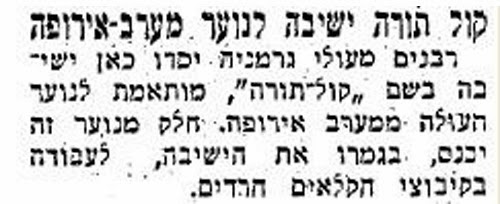
I guarantee you that even on the hottest of days, none of the Kol Torah students will be wearing shorts. For those who don’t know, Kol Torah was founded by German Orthodox rabbis and was originally very different than it is today. Here is how it was described upon its founding, in a short notice in Davar, August 27, 1939.
It is hard to imagine today, but this was a yeshiva that actually intended for some of its students to take up agriculture. See also here which cites R. Hayyim Eliezer Bichovski, Kitvei ha-Rav Hayyim Eliezer Bichovski (Brookyn, 1990), p. 180, that the Chafetz Chaim said that yeshiva students in Eretz Yisrael should learn nine months a year and work the land the other three months
Speaking of shorts, here are a couple of pictures showing how the boys of the German Orthodox separatist Adass Jisroel community looked when playing sports (also notice the lack of kippot).
This was the community of R. Esriel Hildesheimer and R. David Zvi Hoffmann. The pictures come from Mario Offenburg, ed., Adass Jisroel die Juedische Gemeinde in Berlin (1869-1942): Vernichtet und Vergessen (Berlin, 1986).
Here is how the girls dressed for sports, also with shorts and sleeveless.
And here is how the boys and girls looked when not at a sporting event.
These pictures come from Max Sinasohn, ed., Adass Jisroel Berlin (Jerusalem, 1966).[23]
4. Some people didn’t appreciate the humor in my post with regard to the Gaon R. Mizrach-Etz. I think they should lighten up, and in a previous post, available here, I gave some references to humor in rabbinic literature. This was followed up by a more extensive post by Ezra Brand, available here.
According to the commentary Siftei Hakhamim, it is not just the talmudic sages who would at times show their humorous side, but on at least one occasion Moses thought that God himself was joking with him!
In Ex. 33:13 Moses says to God: ועתה אם נא מצאתי חן בעיניך. Rashi explains this to mean: “If it is true that I have found favor in Your eyes.” This means that Moses was in some doubt as to whether he found favor in God’s eyes, but this is problematic since in the previous verse Moses quotes God as saying to him, “you have also found favor in My eyes.” So if God told Moses that he found favor in His eyes, how can Moses be in doubt and say to God, “If I have found favor in Your eyes”?
Here is the Siftei Hakhamim.
According to Siftei Hakhamim, Moses was in doubt if he really found favor in God’s eyes, since even though God said he did, perhaps God was joking just like people joke around!
דלמא מה שאמרת מצאת חן בעיני מצחק היית בי כדרך בני אדם
5. I want to call readers’ attention to a recent book, Shevilei Nissan, which is a collection of previously published essays from R. Nissan Waxman. There is lots of interesting material in the book, and let me mention just a few things.
In Studies in Maimonides and His Interpreters, p. 75 n. 302, I referred to R. Yaakov Avigdor’s strong criticism of R. Hayyim Soloveitchik’s approach. R. Avigdor also criticized R. Solomon Polachek, the Meitchiter. R. Waxman was a student of the Meitchiter, and on p. 23 n. 1, he comes to his teacher’s defense.
On p. 150, R. Waxman, who was the rav of Lakewood, mentions the problem of how some yeshiva students are halakhically more stringent than their teachers. He quotes R. Yaakov Kamenetsky in the name of R. Aharon Kotler how a student once visited R. Kotler and when the latter offered the student some cookies, the student was reluctant to take before asking which bakery they came from. (Perhaps this behavior can be explained by what I have heard – and maybe someone can confirm this – that in R. Aharon Kotler’s day the Lakewood bakery Gelbstein was not under hashgachah, and yet R. Kotler bought his challot from it. See also here and here The original post referred to in these links has definitely been taken down.)
On p. 233, R. Waxman notes that even though we have the principle, “A Jew who sins remains a Jew”, in actuality, it is possible for a Jew to so remove himself from the Jewish people (e.g., apostasy) that as far as most things are concerned, he is indeed no longer regarded as Jewish. This essay was written concerning the “Brother Daniel” case, and R. Waxman’s approach is similar to that of R. Aharon Lichtenstein who also wrote a famous article on the topic, “Brother Daniel and the Jewish Fraternity,” republished in Leaves of Faith, vol. 2, ch. 3.
On pp. 251ff., R. Waxman deals with Menahem Mendel Lefin’s Heshbon ha-Nefesh, an influential mussar text which as many know was influenced by a work of Benjamin Franklin.
6. I want to also call readers’ attention to two other books recently sent to me. The first is R. David Brofsky, Hilkhot Moadim: Understanding the Laws of the Festivals. This is very large book (over 700 pages) dealing with the Holidays and is a welcome addition to the growing number of non-haredi halakhah works in English.. In a future post I hope to deal with it in greater depth. The second book is Haym Soloveitchik, Collected Essays, vol. 1, published by Littman Library, my favorite publisher. This book is required reading for anyone with an interest in the history of medieval halakhah. I was happy to see that it also includes two essays that appear here for the first time. Furthermore, Soloveitchik’s classic essay on pawnbroking (which was his first significant article) has been expanded to almost double the size of the original. In the new preface to the essay, he writes: “Every essay is written for an imagined audience, and mine was intended for the eyes of Jacob Katz, Saul Lieberman, and my father.”
[1] I also must point out that someone involved with hebrewbooks.org informed me that the essay was not removed from the site because it was viewed as “problematic”, but because they were requested to do so by one of the members of R. Zevin’s family who claimed to hold the copyright to the work. This is obviously a false claim, since as we have seen there is no proof that R. Zevin wrote the essay.
[2] See R. Waldenberg, Hilkhot Medinah, vol. 2, pp. 14, 60, 62, and R. Frank’s haskamah, ibid., pp. 17.
[3] See Jack Feinhotz’s letter in Tradition 22 (Winter 1987), p. 120. R. Zevin’s view, that there is no need for keriah, was also advocated by R. Reuven Katz, Sha’ar Reuven (Jerusalem, 1952), p. 32.
[4] See Terry Novetsky’s letter in Tradition 23 (Summer 1987), pp. 98-99.
[5] Tradition 22 (Winter 1987), p. 120.
[6] In the interview with R. Zevin that appeared in my last post, R. Nahum’s comments tended to be somewhat dogmatic, even “haredi”, and should be contrasted with his grandfather’s words.
[7] Even among the vast majority of Lubavitchers this is the case (so I am informed by R. Chaim Rapoport). This is quite strange since the Rebbe held that you have to do keriah. What this shows us is that not everything advocated by the Lubavitcher Rebbe was adopted by his hasidim.
[8] See R. Dov Lior, Devar Hevron (Kiryat Arba, 2009), Orah Hayyim no. 567
[9] Even the incredibly learned Meir Benayahu was stumped by מו”ש. See this page from his Tiglahat be-Holo Shel Moed (Jerusalem, 1995), p. 21.


Regarding Benayahu, a recent book argues that the missing pages of the Aleppo Codex were not destroyed in Aleppo, but were actually stolen by Benayahu after arriving in Jerusalem. See Matti Friedman, The Aleppo Codex (Chapel Hill, 2012).
[10] I have found one occasion where it is written מ”ש, although this is probably a typo. See R. Yaakov Reischer, Shevut Yaakov, vol. 2, no. 129. R. Reischer was a member of this beit din,
[11] Iyunim u-Mehkarim (Jerusalem, 1963), vol 2, pp. 179ff.
[12] In the Vilna Shulhan Arukh, Yoreh Deah, there is a commentary by R. Jacob Emden. Yet R. Yaakov Hayyim Sofer, Menuhat Shalom, vol. 6, p. 116, shows that it was not written by him, and one of his proofs is that the commentary refers to הגאון אב”ד וב”ד מו”ש, implying that the author lived in Prague.
[13] See Kook, Iyunim u-Mehkarim, p. 180.
[14] See Simhah Assaf, Batei ha-Din ve-Sidreihem Aharei Hatimat ha-Talmud (Jerusalem, 1924), ch. 11.
[15] See ibid., pp. 80ff. for other examples of אפילאנט
[16] This statement should not be taken to imply that the leading rabbis in Eretz Yisrael were happy with the institution of this court, which was pretty much forced upon them by the British. See Amichai Radzyner’s book-length article, “Ha-Rav Uziel, Rabanut Tel Aviv-Yafo, u-Beit Din ha-Gadol le-Irurim: Sipur be-Arba Ma’arakhot” Mekhkerei Mishpat 21 (2004), pp. 120-242.
[17] R. Ovadiah Hadaya, in his approbation to R. Amram Aburabia, Netivei Am (Jerusalem, 1964), states that everyone in Jerusalem should follow “minhag Yerushalayim”. If his opinion is accepted, it would mean the end of any Ashkenazic practices in the city.
[18] Regarding earlier in the nineteenth century, see Yehoshua Kaniel, “Kishrei ha-Edot be-Inyanei Halakhah u-Minhag bi-Yerushalayim ba-Meah ha-Yod Tet,” Morashah 4 (5736), pp. 126-136. In the eighteenth century, the Vilna Gaon was of the opinion that Ashkenazim who come on aliyah should indeed adopt Sephardic practices. See Bezalel Landau, Ha-Gaon he-Hasid mi-Vilna (Jerusalem, 1978), p. 250, n. 30.
[19] This has indeed been the Ashkenazi approach, yet R. Abraham Danzig disagreed. See Hokhmat Adam: Sha’ar Mishpetei ha-Aretz 11:23:
נ”ל דהבאים לא”י אם יקבעו עצמם בעיר שיש שם מנין אעפ”י שהבאים הם מרובים יש להם דין יחיד וחייבים לנהוג חומרי מקום שהלכו לשם ופקעו מהם החומרות שהיו נוהגין במקומם.
[20] As far as I know, R. Samuel Judah Katzenellenbogen was the first great rabbi to have his picture made (unfortunately, it no longer exists). See R. Moses Porti, Palgei Mayim (Venice, 1608), p. 6b (referred to by R. Gedaliah Oberlander, Minhag Avoteinu be-Yadenu [Monsey, 2012], p. 451):
והלא אנכי הייתי הראשון שבקשתי להציב תמונתו לנגד עיני ע”י הצייר ואותה לקחתי לי והצבתיה בבית מדרשי לקיים מה שנאמר והיו עיניך רואות את מוריך
While this picture was hung in the beit midrash, see this post where I mention how R. Pinchas Teitz took down the poster of R. Elchanan Wasserman that I hung up in a room used for tefillah. (R. Porti’s Palgei Mayim is devoted to the famous dispute about the mikveh in Rovigo.)
[21] The standard biographies all record that R. Judah Mintz lived a very long life. This is based on R. Joseph Yavetz, Hasdei Ha-Shem (Jerusalem, 1934), Introduction, p. 9, where R. Yavetz’s son mentions that R. Mintz recited birkat ha-hamah when he was כבן מאה שנה. This would have been in 1505, and he lived another three years after that. R. Meshulam Fishel Behr, Divrei Meshulam (Frankfurt, 1926), pp. 147ff., rejects the younger Yavetz’s testimony and claims that R. Mintz died in his seventies. See, however, R. Naftali Yaakov ha-Kohen, Otzar ha-Gedolim (Haifa, 1967), pp. 35ff.
[22] See also Jewish Encyclopedia, s.v. Katzenellenbogen, Samuel Judah. R. Yissachar Hoffman called my attention to She’elot u-Teshuvot Hakham Zvi, no. 15, where R. Samuel Judah Katzenellenbogen is (mistakenly?) referred to as מהר”י מפאדואה. See also R. Aryeh Yehudah Leib Lifshitz, Avot Atarah le-Vanim (Warsaw, 1927), p. 48 n. 44
[23] When I was in high school in the early 1980s, in the New Jersey-New York yeshiva league only the girls of Bruriah wore sweat pants during basketball games (and the boys were not allowed to attend home games). At the other high schools the girls wore shorts. Today, the league requires all girls to wear sweat pants (i.e., not even long shorts). For a wonderful discussion of the yeshiva basketball league, see Jeffrey S. Gurock, Judaism’s Encounter with American Sports (Bloomington, 2005), ch. 7. Gurock discusses how for six years in the early 1950s, Yeshiva Chaim Berlin was part of the basketball league together with the Modern Orthodox co-ed high schools, something that could never happen today. During this time co-ed schools had cheerleaders, and this was a major factor in forcing Chaim Berlin to leave the league. (Mesivta Tifereth Jerusalem was also in the league for two years.) When I mention cheerleaders, don’t think of current NFL cheerleader outfits. Here, for example, is how the Brooklyn Central girls looked (from Gurock, p. 143).
Yet Gurock, ibid., points out that “as the 1950s progressed, the Brooklyn Central cheerleaders’ skirts also got shorter and shorter.” (Speaking of short skirts, anyone who has looked at Modern Orthodox yeshiva high school yearbooks from the early 1970s will see that the mini-skirt craze was also tolerated at these institutions.)


Assorted Comments on R. Jacob Emden, Ashkenazic Views of Sephardic Gedolim, and More

Assorted Comments on R. Jacob Emden, Ashkenazic Views of Sephardic Gedolim, and More
by Marc B. Shapiro

1. Since I have discussed R. Jacob Emden in many posts, let me add the following. If you examine Emden’s Birat Migdal ha-Oz you find that he refers to himself as הסריס. Here is the Berditchev 1836 edition of the work, p. 135a.[1]
I think all would agree that this is a strange title to give oneself. In this work, p. 116a, he also calls himself שלו.

On p. 44a he refers to himself as שאול.

On pp. 101b and 102a he refers to himself as שכוי.

Here is Lehem Shamayim (Wandsbeck1728), vol. 1, p. 1a (see also 2a) where he also refers to himself as שכוי.

Returning to Birat Migdal Oz, on p. 108b he refers to himself as שלה.

What is this all about? The answer was revealed by R. Meir Segal in his 1881 commentary on Emden’s siddur (although I am sure many people had already figured it out).[2] The gematriyot of all these words are either 335 or 336. This corresponds to יעקב בן צבי, the gematria of which is also 336 (and we know that gematriyot are allowed to be off by one number).
In Amudei Shamayim, vol. 2, p. 154a, which you can see here

Emden writes:
סוד פורי”ים בקצור רומז ג”א ממותקים בג”ה (ס”ה של”ו הוא בה”ס . . .)

As R. Segal explains,[3] this is to be “translated” as: 

סוד פורים בקיצור רומז ג’ א-להים ממותקים בג’ הויות ס”ה גימטריא של”ו הוא בעל הספר

ס”ה obviously stands for סך הכל and what it is saying – ignoring the kabbalistic allusion – is that the gematria of פורים equals 336 and this is also equaled by א-להים x 3 = 258 + הויה x 3 = 78 (258+78=336)..

As mentioned, Emden refers to himself as שלו. How is this supposed to be pronounced? Some people would assume shelo. I originally thought that a more likely meaning was shalev, which means “calm” or “tranquil”. R. Segal also understands it this way since he writes[4]  כנה א”ע בשם שלו כי השלום יאות לבוטח

Shilo is also sometimes spelled as שלו so that is another possibility.

However, these suggestions are incorrect, and the proper way to pronounce it is selav, as in quail. We know this because of the verse in Psalms 105:40:

שאל ויבא שלו ולחם שמים ישביעם

The second half of the verse has the words לחם שמים. This is the name of Emden’s commentary on the Mishnah. I am certain that the connection of שלו and לחם שמים was regarded as significant by Emden, and this also reveals how שלו should be pronounced.[5]

2. In Changing the Immutable, p. 205, I cite a letter from R. Elhanan Wasserman to R. Eliezer Silver and note that the published version of the letter, in Kovetz Ma’amarim ve-Iggerot, vol. 2, p. 97, omits R. Wasserman telling R. Silver that before R. Hayyim Ozer Grodzinski’s death the latter reached for his wife’s hand. R. Moshe Maimon informed me that the letter with the deleted words restored was published in R. Pinchos Lipshutz, Peninei Hen (Monsey, 2000), pp. 76-77. Here it is.

From the original letter we can see that R. Hayyim Ozer’s comment that things are not good was made to his wife. However, one who reads the letter in Kovetz Ma’amarim ve-Iggerot would have to conclude that this statement was made to R. Elhanan, as the passage reads:
שעה קלה לפני הפטירה . . . אמר: “דוא וויסט עס איז ניט גוט” (אתה יודע שהמצב אינו טוב)
As I mentioned in the book, I think it is significant that the publisher inserted three dots showing that something was deleted, since this is very uncommon among haredi publishers. But the following is also important: In the original letter R. Elhanan writes אמר לה, meaning that R. Hayyim Ozer made this comment to his wife. Also (and this point was made to me by Maimon), in the Hebrew translation what appears is אתה יודע which is masculine and indicates that the comment was made to R. Elhanan. These changes had to be made since once the line about holding his wife’s hand is removed, it would not make sense for the reader to see a reference to a woman, as in אמר לה.

Maimon also called my attention to the following: Here is a famous painting portraying Napoleon granting freedom to the Jews. Notice how Napoleon appears like Moses, holding a Tablet of the Law. 

Here incidentally is another image from a coin minted on the occasion of the meeting of the Sanhedrin summoned by Napoleon. Notice how Napoleon is handing the Two Tablets of the Law to Moses. In other words, Napoleon is portrayed as God.[6]

Returning to the painting of Napoleon, it is reproduced in R. Binyamin Shlomo Hamburger’s Meshihei ha-Sheker u-Mitnagdeihim (Jerusalem, 2009), p. 481, yet here sleeves have been added to the woman.

Since I have just mentioned R. Moshe Maimon, let me continue with a couple of his comments. In my book, p. 97 n. 67, I translate minhag vatikin[7] as a “long established practice”. I actually should have said “long established practice of the pious ones” (although some might see this as already implied). Maimon questions whether there is any relationship between vatikin and “long established”, or it if just means “the pious ones”. I always assumed that vatikin means the “pious ones of old”. Indeed, Jastrow translates the word as “the conscientiously pious men of former days”, and an online search reveals that others translate similarly.

Yet Rashi, Berakhot 9b, explains vatikin as אנשים ענוים ומחבבין מצוה, and in this explanation there is no assumption that the vatikin lived in former days. In other words, a practice developed by contemporary pious ones could also be regarded as a minhag vatikin, and there appears to be no reason for me to have thought that Rashi would assume that the vatikin he describes were also “men of old”.

While modern Hebrew uses the word vatik to mean old or one involved in something for a long time, e.g., מוותיקי הסופרים, I have to acknowledge that, with apparently one exception (see note 8), I have not found early uses of the term that have this connotation. One who paid attention during the High Holidays liturgy would have noticed the term and it has nothing to do with “old” here, e.g., הועד והותיקות, לותיק ועושה חסד, and others.[8] See also Arukh, ed., Kohut, s.v. ותק, which offers Arabic and Greek cognates that have no connection to age. For those really interested in the topic, you should consult David Golinkin’s learned and comprehensive article which also shows that the term vatikin has no connection to age.[9]

Maimon also made the following correction. On p. 229 n. 64, I refer to R. Hayyim Eleazar Shapira’s criticism of Slobodka students and his negative view of R. Moses Mordechai Epstein, and note that this was removed from some editions of R. Moses Goldstein’s Mas’ot Yerushalayim.[10] The censored material I refer to is from a conversation between R. Shapira, the Rebbe of Munkacz, and R. Solomon Eliezer Alfandari, and contrary to what I carelessly wrote, what was deleted was stated by R. Alfandari, not R. Shapira. This matter, and the censorship, is discussed by Maimon in a Seforim Blog contribution here.

Let me offer another example where Mas’ot Yerushalayim is censored (and this is not noted by Maimon in his post just mentioned). Here is Mas’ot Yerushalayim (Munkacz, 1931), pp. 91a-91b.

It mentions that after R. Alfandari’s death his writings were under the control of certain Sephardic rabbis who were associated with the Chief Rabbinate. These rabbis are referred to as .איזה רבני ומלקקי המשרד מהצפרדעי”ם The last word, צפרדעים (frogs) is a play on ספרדים.

Here is how the page looks in a later edition published in Israel (pp. 319-320). As you can see, the reference to the צפרדעים has been deleted.

The same deletion is found in the 2004 edition (p. 237)

Needless to say, Sephardic readers were not pleased to see this. But this wasn’t the only thing to upset them. Earlier in the book (pp. 26a-b in the first edition), we find that R. Shapira stated that he heard from R. Yehezkel Shraga Halberstam of Sieniawa that when the latter was in Jerusalem on the yahrzeit of R. Hayyim ben Attar, the Or ha-Hayyim, he observed that the Sephardim did not visit his grave. He inquired about this and was told that even though the Or ha-Hayyim was a Sephardi, he had disputes with the Sephardim and the latter did not recognize his greatness. Referring to the Sephardim, he quotes Psalms 82:5: “They know not, neither do they understand; they go about in darkness.” This is contrasted to the Ashkenazim who give the Or ha-Hayyim his proper respect.

Here is the passage.

The text was altered in the next edition.

In the Jerusalem 2004 edition it is back in its entirety.

When Mas’ot Yerushalayim appeared, R. Meir Vaknin, the rav of Tiberias, was quite angry upon seeing the two texts I have discussed and responded sharply.[11] He completely rejects the notion that the Sephardim do not properly respect the Or ha-Hayyim. He also denies that there was ever a dispute between the Sephardic community and the Or ha-Hayyim.

Why then do the Sephardim not go to the Or ha-Hayyim’s grave on his yahrzeit?  R. Vaknin explains that the reason is simple, namely, that Sephardim don’t have this minhag and they were never taught to do so by R. Isaac Luria. Therefore, they don’t go to graves on any yahrzeit, “not to the ARI, not to Maran the Beit Yosef, and not to the Rambam. Even to Rabbi Shimon Ben Yohai only a very small number go to Meron.”

R. Vaknin is speaking about the Sephardic community in the Land of Israel before the massive aliyah of the North African Jews. Today, of course, Meron is full of Sephardim on Lag ba-Omer (which people mistakenly believe to be the yahrzeit of R. Shimon Ben Yohai[12]), but R. Vaknin provides testimony about how things were very different not too long ago.

As for Mas’ot Yerushalayim referring to Sephardim as צפרדעים, R. Vaknin is simply outraged by this insult:

והאם טוב וישר הדבר הזה בעיני א-להים ואדם לכתוב ולכנות שם רע על העם הקדוש הספרדי כולו בכללותו, מי יוכל להתאפק על בזיון ושם רע על כללות עם הקודש, ואיזה תקון יועיל לכלות העון הזה ולהתם הפשע החמור, אפילו המכנה שם רע לחברו עיין ברז”ל כמה חמור ענשו, וכל שכן על כללות העם כולו אשר כמה וכמה גדולי תורה נמצאים בתוכו, כמה צדיקים וחסידים וסובלי חולאים וסיגופים ותעניות לכבוד ה’ ותורתו נמצאים בתוכו

R. Vaknin also printed a letter by R. Jacob Zarihan of Tiberias. He too was very upset by what appears in Mas’ot Yerushalayim.

The 2004 edition of Mas’ot Yerushalayim has Goldstein’s reply to R. Vaknin in which he apologizes if he caused offense.[13] He stresses that his negative words about the צפרדעים were only made with reference to those Sephardic rabbis associated with theמשרד , i.e., the Chief Rabbinate.[14] This could hardly have been of any comfort to R. Vaknin since unlike the Ashkenazic world, the Sephardic world did not have an extremist Edah Haredit, and almost all of the Sephardic rabbis had great respect for the Rishon le-Tziyon, R. Jacob Meir, and the other outstanding Sephardic rabbis who worked with him.

It is noteworthy that Goldstein’s rebbe, R. Hayyim Eleazar Shapira, also had some negative things to say about Sephardim. In his discussion about the apparently Sabbatean work Hemdat Yamim, R. Shapira refers to R. Hayyim Palache who in his Kol ha-Hayyim[15] defends the Hemdat Yamim, even if the author was a Sabbatian. As R. Palache states, Rabbi Akiva made a mistake in thinking that Bar Kokhba was the Messiah, but this does not disqualify the Torah teachings of R. Akiva. Similarly, we should not disqualify the Hemdat Yamim no matter what the author believed about Shabbetai Zvi. R. Shapira thinks that this is nonsense, and it is obvious to him that if the author of Hemdat Yamim was a Sabbbatian then the work must be shunned.

What angers R. Shapira even more is that R. Palache later states (Kol ha-Hayyim, p. 18a) that there is a tradition not to speak at all about the Shabbetai Zvi episode, not even in a negative way[16]:

וכבר יש קבלה מרבותינו ואבותינו הקדושים שלא לדבר מטוב ועד רע על ענין ש”ץ כי גם קוב לא תקבנו גם ברך לא תברכנו

R. Shapira finds this outrageous, since how can one not speak negatively about such an evil person as Shabbetai Zvi. He writes:[17]

ורחמנא לישזבן מהאי דעתא הנפסדת המטלת ספיקות מעין היש ה’ בקרבנו וכו’ והיתכן כי על משיח השקר שהמיר דתו למחמדנות באונס או ברצון ועכ”פ שהסית והדיח אלפים מישראל עליו כתוב “גם קוב לא תקבנו” ובודאי בע”כ שהטיל ספיקות אולי הי’ אמת ע”כ קוב לא תקבנו לרעה. לא יאומן כי יסופר שיהי’ כזה נדפס מרב מגדולי הספרדים לולי ראיתי בעיני – אוי לנו שכך עלתה בימנו שהפרוץ מרובה. ואולי [צ”ל ואילו] הי’ כזה נדפס בדור הקדום היו גדולי הדור מרעישים עולם.

After these harsh words, R. Shapira offers his explanation of how R. Palache could have written what he did, and it is perhaps the all-time greatest put-down of Sephardim in rabbinic literature. While R. Shapira has great respect for the Sephardim of earlier generations, and also for special individuals such as R. Alfandari,[18] he thinks that most Sephardim of recent years are simply not that smart, and are thus able to believe all sorts of nonsense.

וחשבתי להצדיק קצת את הה”ג ז”ל בע”ס כל החיים להיות הספרדים בימינו בטבעם רובם נמוכי השכל נוחין להתפתות ולהאמין לכל דבר ע”כ השיאם עון אשמה גם לגדוליהם רבניהם בספיקות כאלה.

What R. Shapira did not know is that this strategy of not speaking bad about Shabbetai Zvi had nothing to do with being sympathetic to him, and was certainly not an example of Sephardic stupidity. Rather, as Gershom Scholem notes, it was a strategy chosen by the rabbis in order to allow the community to return to normal.

In choosing this course, the rabbis of Constantinople and Smyrna may have attempted the impossible; at any rate they acted in what seemed to them the most reasonable and responsible fashion. . . . The messianic propaganda, which had not been checked by either the rabbis or the lay leaders, had roused their emotions and faith to such a pitch that rational criticism and appeals to traditional standards would probably have availed little. It seemed safer and wiser to ignore the whole matter as far as possible, and to let time and oblivion heal the wound. Neither condemnation nor apologies, but silence alone would enable the disturbed community to find the way back to normal life.[19]

Scholem quotes the passage from R. Palache cited above, and he also summarizes another passage from the very same section in R. Palache’s Kol ha-Hayyim.

The earlier version of the story was that R. Sabbatai Ventura of Sofia had shown disrespect at Nathan’s tomb, whereupon his hand dried up and remained paralyzed until he returned again to the tomb and prayed for forgiveness. When his son Abraham Ventura passed through the city on his travels on behalf of the community of Safed, “a drop fell on him during his first night there and he died . . .  and was buried next to the tomb of R. Nathan.” (The story is told by R. Hayyim Palache of Smyrna in Kol ha-Hayyim [Smyrna, 1874], pp. 17-18.)[20]

In the earlier Hebrew version of Scholem’s work, Shabbetai Tzvi  (Jerusalem, 1957), vol. 2, p. 794 n. 2, the direct quotation of R. Palache is a little different:

“נפל עליו טיפה בלילה ראשונה שנכנס שם וימת שם אברהם וקברוהו סמוך ממש לקברו” של ר’ נתן, כפי שסופר בס’ כל החיים לר’ חיים פאלאג’י מאיזמיר, דפים יז, יח.

Notice how in the Hebrew quotation from R. Palache there is no mention of “R. Nathan” (of Gaza). In other words, the English version is mistaken in including the words “R. Nathan” as part of the direct quote.

Most people who examine the matter will probably also assume that Scholem’s Hebrew text is mistaken, since the story R. Palache tells (which appears on p. 18a, not pp. 17-18 as mentioned by Scholem), has nothing to do with Nathan of Gaza and thus the latter should not have been mentioned by Scholem. As you can see from the page following this paragraph (from Kol ha-Hayyim 18a), R. Palache’s story is about the grave of the anonymous author of Hemdat Yamim, not Nathan of Gaza. (Scholem himself did not regard Nathan of Gaza as the author of Hemdat Yamim.[21])

What is going on here? Can we assume that a careful scholar like Scholem made such a blunder and inserted Nathan of Gaza into a story that has nothing to do with him? The answer is no, and let me explain what is behind what Scholem writes since for some inexplicable reason he doesn’t do it himself. In Mekhkerei Shabtaut (Tel Aviv, 1991), p. 251, Scholem notes that once R. Jacob Emden (mistakenly) identified Nathan of Gaza as the author of Hemdat Yamim,[22] most Ashkenazic scholars kept away from the book. However, the Sephardic scholars had a different view, and they continued to treasure Hemdat Yamim despite the fact that they regarded Nathan of Gaza as its author. Furthermore, they began to refer to Nathan of Gaza as הרב חמדת ימים.

So let us now look again at the passage from R. Palache. It mentions that R. Shabbetai Ventura visited the city of איסקופייא where the grave of הרב חמדת ימים is found. איסקופייא is none other than Skoplje in Macedonia, and this is where Nathan of Gaza died and was buried. In other words, when the story speaks about visiting the grave of הרב חמדת ימים it is referring to visiting the grave of Nathan of Gaza. In Kol ha-Hayyim, p. 17b, R. Palache states that we don’t know who wrote Hemdat Yamim, so it seems that he was passing on a tradition the significance of which even he did not grasp. (If my assumption is correct that R. Palache did not realize that the story he told was referring to visiting the grave of Nathan of Gaza, then he must have assumed that while his generation did not know who the author of Hemdat Yamim was, earlier generations did know, and even knew where his grave was.) What Scholem writes in Sabbatai Sevi about the grave of Nathan of Gaza and Rabbi Shabbetai Ventura and his son Abraham is incomprehensible without the explanation just given, and I have no idea why Scholem did not feel it necessary to provide it himself.

Returning to the comments of R. Hayyim Eleazar Shapira, I wonder what he would have said about the Ashkenazi R. Joseph Seliger who commented that it really doesn’t matter whether R. Jonathan Eybeschuetz believed in Shabbetai Zvi, and our respect for him would not be lessened by such an error.[23]

בדבר המחלקת שבין הגאונים ר’ יונתן ור’ יעקב עמדן כבר עשה העם כלו פשרה בין שני החולקים ששניהם היו חכמי אמת וצדיקים גמורים, אלא שר’ יונתן ז”ל היה נוח ועלוב וענו תלמידו של הלל. ולכן עלה גם בחכמה וגם במעשה מאיש ריבו הקנא והקפדן של שמאי. נושא המחלקת היה נכבד רק בשעתו, בעת אשר פשתה האלילות של ש”ץ וכמעט גמרה לבלע את כל ישראל ותורתו בהבליה ובקסמיה. היום הנה שאלה קלת ערך אם האמין ר’ יונתן בש”ץ או לא . . . לו האמין ר’ יונתן באמת בש”ץ, אין הטעות החלקית הזאת גדולה מהטעות הכללית להאמין בקמעות. ואם בכל זה כבוד ר’ יונתן במקומו מונח לפי מצב הדעות בזמנו, כי לא כל חכמי ישראל זוכים לאמונה צרופה כבן מימון, לא היה ר’ יונתן נופל בעינינו אף לו האמין בנביא השקר כר”ח בנבנשתי ז”ל. אבל באמת לא היתה בר’ יונתן האמונה הזאת לא ממנה ולא מקצתה.

Due to what R. Shapira said about Sephardim, R. Ovadiah Yosef was very unhappy with him. The following passage, from 24 Sivan, 5767, appears in R. Eliyahu Sheetrit’s Rabbenu.[24] This book is quite fascinating as it is a diary that Sheetrit kept during the years he learnt with R. Ovadiah and assisted him in publishing his books. Most significantly, only a few of the published texts of the diary have been censored.

רבנו כתב על החמדת ימים, ואז ראה בספר חמשה מאמרות של אחד מגאוני הדור הקודם שכתב בצורה לא יפה על הרבנים הספרדים ועל הספרדים בכלל, וגם נזכר במה שבזמנו אמר הגאון הנ”ל על הספרדים “צפרדעים”, וביקש ממני לעבור בספר, ובכל מקום שכתוב שמו של הגאון הנ”ל למחוק את המלה “הגאון”. עוד אמר רבנו, שהגאון הנ”ל ביקר אצל הגאון מהרש”א אלפנדארי, ושלשה ימים לאחר מכן, נפטר מהרש”א אלפנדארי (ואמר רבנו, שכנראה הגאון הנ”ל עשה עליו עין הרע).

It would be interesting to check if indeed R. Ovadiah’s books published after 2007 are missing the title הגאון before R. Shapira’s name. In the introduction to Hazon Ovadiah: Arba Ta’aniyot, published in 2007, R. Ovadiah refers to R. Shapira’s comments and indeed in this source not only is there no הגאון before his name, but R. Shapira also doesn’t get the less exalted הרה”ג, and he is left with just a ר’. As for what R. Ovadiah said about R. Shapira apparently unintentionally causing the death of R. Alfandari, this will obviously be a great insult to all Munkatcher hasidim.

It must also be noted that R. Ovadiah did not remember correctly, as it was not R. Shapira who referred to the Sephardim as צפרדעים but his follower Moses Goldstein.

R. Chaim Amsalem took note of R. Shapira’s comments about Sephardim and he too was quite offended, and placed these comments in the context of continuing discrimination against Sephardim by the Ashkenazic haredim. He writes as follows (adding a heavy dose Sephardic pride at the end):[25]

מה אני יכול לומר על דברים מעליבים ופוגעים שכאלו “בטבעם רובם נמוכי שכל”, אני רק יכול להודות לו שגלה דעתו האמיתית מה הוא חושב הוא ואחרים שכמותו, וא”כ אין פלא על יחס השחצנות והגזענות שהם מגלים כלפי הספרדים, שרי ליה מאריה, וכמה ראוי לו לבקש מחילה קודם כל ממושא הערצתו הגאון מהרש”א אלפאנדרי זצ”ל, הדברים כ”כ נמוכי שכל שאינני רוצה להגרר להעלבות וכדומה, דבריו מדברים בעד עצמם, אבל עוד יבואו ימים שכולם יאכלו מכף ידינו . . .

I am aware of another place where R. Shapira speaks negatively about a great Sephardic sage, R. Hiyya Pontremoli, author of the halakhic work Tzapihit bi-Devash. In Minhat Eleazar, vol. 4, no. 45 (p. 37a), R. Shapira writes as follows:

הנה עשה א”ע כאלו לא ידע או העלים בכונה סוף דברי רש”י . . . וכבר תמהתי עליו איך שכח או במזיד הביא להיפך ממ”ש במאירי

Simply put, he is accusing R. Pontremoli of intellectual dishonesty. R. Ovadiah Yosef[26] calls attention to the second part of the quotation just given, and expresses his great distress that R. Shapira spoke this way about R. Pontremoli.

ואנכי איש צעיר נוראות נפלאתי עליו הפלא ופלא, מפני היד שנשתלחה, לחשוד רב גדול כהגאון בעל צפיחית בדבש, ששכח או הזיד ח”ו בדברי המאירי. הס כי לא להזכיר.

In Abir ha-Ro’im, the recent biography of R. Ovadiah by his grandson, R. Yaakov Sasson, the latter also gives examples of Ashkenazic scholars belittling Sephardic gedolim.[27] The instances Sasson cites should not be understood as conscious belittling. It is just that in these cases the Ashkenazic scholars, not knowing anything about the Sephardic Torah greats, did not take them very seriously. One of Sasson’s examples comes from Iggerot Moshe, Hoshen Mishpat, vol. 2, no. 69 (p. 298), which is R. Moshe Feinstein’s famous responsum on abortion. Here R. Moshe writes:

ופלא שראיתי בספר רב פעלים לחכם ספרדי

Sasson is correct that this is not the most respectful way to refer to R. Joseph Hayyim. R. Moshe continues by rejecting R. Joseph Hayyim’s view and does not pay him much regard. It is because of this that R. Eliezer Waldenberg, in his response to R. Moshe, says as follows after expressing his surprise with the way R. Moshe deals with R. Joseph Hayyim:[28]

ושרי ליה מריה בזה

I would like to know, did R. Moshe even have any idea who R. Joseph Hayyim was? Someone obviously showed R. Moshe the responsum in Rav Pealim, but was it explained to R. Moshe that the author of Rav Pealim is the Ben Ish Hai, and that for many Sephardim R. Joseph Hayyim’s significance is the equivalent of what the Hafetz Hayyim is for Ashkenazim, i.e., a towering figure, both spiritually and halakhically? Did R. Moshe even know the name of the man who wrote Rav Pealim, since if he only had a copy of the responsum he wouldn’t see the author’s name, as there is no name given at the end of the various teshuvot?

It is possible that the answer to one or more of these questions is “no”, and R. Moshe therefore related to R. Joseph Hayyim the same way he related to other scholars, Sephardic and Ashkenazic, whom he did not view as top-of-the-line poskim. In the last paragraph of his responsum, when dealing with R. Eliezer Waldenberg, here too R. Moshe does not show great respect but simply refers to R. Waldenberg as .חכם אחד. Contrast this with how in this responsum R. Moshe refers to R. Hayyim Ozer Grodzinksi, R. Jehiel Jacob Weinberg, and R. Isser Yehudah Unterman.

Leaving aside what I have just mentioned, R. Moshe’s responsum does have some problematic elements. R. David Feldman even claimed that it was not written by R. Moshe! Here is his letter that appears in Tzitz Eliezer, vol. 20, no. 56.

This is a very strange claim, as the responsum first appeared in 1978 in the Sefer ha-Zikaron for R. Yehezkel Abramsky. Are we supposed to believe that a responsum that appeared in R. Moshe’s lifetime was not written by him? This is clearly impossible. (When I made this point to R. Feldman he continued to insist that R. Moshe did not write the responsum.) Yet as I mentioned, there are indeed some problematic things in this responsum. For example, what is one to make of the following sentence in which R. Moshe attacks a point in R. Eliezer Waldenberg’s first responsum on abortion?[29]

וגם כתב שהשאילת יעב”ץ מתיר אף שאסר בפירוש, בשביל לשון וגם בעובר כשר יש צד להקל לצורך גדול, אף שברור ופשוט שלשון יש צד להקל הוא כאמר שיותר צדדים איכא לאסור.

R. Waldenberg states that it is “ridiculous” to claim that when R. Jacob Emden writes יש צד להקל that it really means that it is forbidden.[30] We, of course, would never use such language about something R. Moshe wrote, but the question remains, could R. Moshe really have believed that יש צד להקל means שיותר צדדים איכא לאסור?

R. Moshe Maimon wrote to me as follows:

As for the question of יש צד להקל – I think all R. Moshe meant is that when a posek says יש צד להקל he is conceding that the presumption is that it should really be אסור but nevertheless sees some ground for a קולא. To R. Moshe this indicates that this posek is more inclined to the צד איסור and can be counted on as a סניף supportive of a more stringent view.[31]

An alternative perspective is offered by a Lakewood scholar who wrote to me: “R. Moshe may have vehemently disagreed with the יעב”ץ but preferred to twist the meaning rather than say openly that the יעב”ץ was mistaken, a very typical thing for someone like R. Moshe to do.” I responded that I don’t find this compelling, since in the second to last paragraph of his responsum R. Moshe has no problem stating that Emden is mistaken, so why would he write differently in the last paragraph?

The Lakewood scholar replied as follows:

If it was a sensitive issue (I’m guessing) R. Moshe may have wanted to strip the opposing view of any legitimacy by insisting that the יעב״ץ didn’t mean it. It’s almost like saying he couldn’t have meant it. Regarding the general approach of twisting the words of achronim in order make it consistent with your own view: The Mekor Baruch describes a similar approach that he attributes to Rabbi Chaim Volozhin, that although one may rule against the Shulchan Aruch, one should nonetheless seek to find hairsplitting differences between your ruling and the Shulchan Aruch’s so not to appear as if you are going head on. The Chazon Ish would say that a טעות סופר נפלה rather than say a rishon made a mistake.

Similar to what the Lakewood scholar claimed, R. Chaim Rapoport, who has published a good deal on the Iggerot Moshe, wrote to me as follows:

מ”ש הגרמ”פ שם “שברור ופשוט שלשון יש צד להקל הוא כאמר שיותר צדדים איכא לאסור” [שיש שתמהו על זה], הנה לפענ”ד הדבר מתאים מאד לדרכו של הגרמ”פ כשהוא משוכנע לחלוטין בצדקת שיטתו ובשלילת השיטה החולקת, ובכה”ג הרגיש בעצמו שמוכרח הוא לקרב את הרחוקים בזרוע, כדי לקיים את מה שהי’ ברור בעיניו כשמש בצהריים.  

ובאמת, בנידון תשובה זו אין דבריו תמוהים כ”כ, שהרי לפעמים מצינו בדברי הפוסקים שכתבו שיש צד להקל ומ”מ אין להקל למעשה [וע”כ צ”ל דהיינו] בגלל שישנם צדדים אחרים [ואפילו צדדים יותר גדולים] להחמיר. ואם כי בנדו”ד הרי מתוכן דברי היעב”ץ אין נראה כן, מ”מ העמיס הגרמ”פ כוונה זו בדברי היעב”ץ, כי ‘ההכרח לא יגונה’. 

מה שזלזל הגרמ”פ בכבודו של הגרא”י ולדנברג בעל שו”ת ציץ אליעזר, הנה אם כנים הדברים, נראה שהי’ זה בגלל שהיטב חרה לו להגרמ”פ ע”ז שפרסם הגרא”י ולדנברג את היתרו להפיל עוברי ‘תיי-סקס’ – אשר לדעתו הר”ז בגדר שפיכת דמים ממש, ואורייתא הוא דמרתחא בי’. 

 ומ”ש הרב בעל ציץ אליעזר על הגרמ”פ “ושרי לי’ מרי’ בזה” [על מה שנראה מלשונו שמיעט בחשיבותו ומעמדו של הרב פעלים] נראה שכתב כן כלפי מה שכתב הגרמ”פ בתשובתו הנ”ל עליו [על הצי”א] “ושרי לי’ מרי’ בזה”, ועד”ז כתב הגרמ”פ בתשובתו (שם) על היעב”ץ, וע”ד מה שאחז”ל מדויל ידי’ משתלים. 

Finally, returning to the matter of negative portrayals of Sephardim, take a look at this bizarre passage in Israel Abraham’s classic Jewish Life in the Middle Ages, p. 122.

There was less warmth in the Oriental Jewish home, less of that tenderness which was once a common characteristic of Jews all the world over, but came in process of time to distinguish Western Jews from their gayer but more shallow brethren of the East. One seems to detect a feebler sense of responsibility in the mental attitude of an Oriental father to his offspring, just as one detects more volubility but less intensity in the Oriental Jew’s prayers.

3. For those who are interested, on Saturday night November 7 at 8pm, I will be speaking at Congregation Ohr Torah, 48 Edgemount Road, Edison, N.J. The title of the talk is “Some Unusual Orthodox Responses to the Rise of Nazism.”

[1] He also refers to himself this way in Birat Migdal Oz two pages later, which is mistakenly numbered as 135a. See also Torat ha-Kenaot (Lvov, 1870), p. 54, where he writes: ונמסר לי הסריס.
[2] Va’ad le-Hakhamim (Lublin, 1881), p. 3a.
[3] Ibid., p. 3b.
[4] Ibid., p. 4a.
[5] See R. Meir Mazuz, Emet Keneh (Bnei Brak, 2000), p. 227. R. Mazuz knows that Emden referred to himself as השכוי, but I can’t tell if he is aware that Emden also referred to himself as .שלו I say this since R. Mazuz mentions the gematria of שלו without indicating that Emden ever used the word. He then makes the connection to ולחם שמים ישביעם.
In 1756 the book Shevirat Luhot ha-Aven appeared. The title page says Zolkiew but this is probably intended to cover up its real place of publication, Altona. According to the haskamah, written by R. Abraham of Zamocz, the author is דוד אוז, an otherwise unknown person. There is no doubt, however, that this book was written by Emden. R. Menahem Mendel Goldstein even found a gematria to tie this name to Emden. See Etz Hayyim 15 (Tamuz-Av, 5771), p. 235 n. 46:
דו”ד או”ז עם ב’ הכוללים בגי’ יעק”ב ב”ן צב”י במספר קטן

[6] The image is from here. This site mistakenly explains that “The kneeling figure represents the Sanhedrin.”
[7] Technically, the word should be pronounced vetikin, with a sheva under the vav, but no one does this.
[8] See Ovadiah Hen, Ha-Ketav ve-ha-Mikhtav (Bnei Brak, 2014), p. 89. See also Ben Yehudah’s dictionary which does not list any early sources in which vatik means old. However, Michael Sokoloff, A Dictionary of Jewish Babylonian Aramaic of the Talmudic and Geonic Periods (Ramat Gan, 2002), p. 396, gives “old” as a translation for ותיק, referring to its use in an incantation bowl.
[9] “Le-Ferush ha-Munahim ‘Vetikin’, ‘Vatik’, ve’Talmid Vatik’ be-Sefer Ben Sira u-va-Sifrut ha-Talmudit,” Sidra  13 (1997), pp. 47-60.
[10] Maimon and pretty much everyone else transliterate the title as Masaot Yerushalayim. I believe this to be mistaken. מסעות in the title is a construct, and is the same thing as מסעי. There should be a sheva under the samekh, not a kamatz. See here.
[11] See his Va-Yomer Meir, vol. 1, no. 10.
[12] For the origin of the notion that R. Shimon Ben Yohai died on Lag ba-Omer, see Eliezer Brodt’s post here.
[13] This letter originally appeared in Vaknin, Va-Yomer Meir,vol. 1,  no. 10.
[14] Mas’ot Yerushalayim (2004), p. 258.
[15] Ma’arekhet he, no. 18 (pp. 17ff.).
[16] I am surprised that R. Shapira doesn’t also criticize R. Palache for mentioning the tradition that R. Hayyim Joseph David Azulai was a gilgul of the author of Hemdat Yamim. See Palache, Kol ha-Hayyim, p. 18a.
[17] Hamishah Ma’amarot (Jerusalem, n.d.), p. 157 (Ma’amar Meshiv Mipnei ha-Kavod).
[18] Regarding R. Alfandari, see the first two stories here from Otzrot ha-Sofer 13 (Tishrei 5763), p. 89.

It boggles the mind to think that there are people who are so gullible that they can actually believe that R. Alfandari met the Hatam Sofer in Pressburg.

There are all sorts of legends about great rabbis visiting far-off places and meeting with other great rabbis. Sometimes the stories are chronologically impossible, e.g., the tale of Ibn Ezra visiting Rashi. See Naftali Ben-Menahem, Inyanei Ibn Ezra (Jerusalem, 1978), pp. 356ff. See my Limits of Orthodox Theology, p. 115, about the legend of Maimonides’ visit to France. See also Otzar ha-Geonim: Hagigah, p. 16, where we are told of the well known “fact” that R. Natronai Gaon magically came from Babylonia to Spain and then returned home.

ודבר ברור ומפורסם לאנשי ספרד ומסורת בידם מאבותיהם כי מר רב נטרונאי גאון זצ”ל בקפיצת הדרך בא אליהם מבבל וריבץ תורה וחזר, וכי לא הלך בשיירא ולא נראה בדרך
[19] Gershom Scholem, Sabbatai Sevi: The Mystical Messiah, trans. R. J. Zwi Werblowsky (Princeton, 1973), pp. 698-699.
[20] Scholem, Sabbatai Sevi, p. 926 n. 270.
[21] See Scholem, Mehkerei Shabtaut (Tel Aviv, 1991), p. 251.                                                             
[22] See Avraham Ya’ari, Ta’alumat Sefer (Jerusalem, 1954), p. 10.
[23] Kitvei ha-Rav Dr. Yosef ha-Levi Seliger (Jerusalem, 1930), p. 503. The last section of this book, where the quoted comment appears, has been deleted (censored?) on Otzar ha-Hokhmah. It can be found in full on hebrewbooks.org.
[24] (Jerusalem, 2014), p. 378.
[25] Gadol ha-Neheneh mi-Yegio (n.p., 2012), pp. 93-94. The three periods at the end of the quotation appear in the original.
[26] Yabia Omer, vol. 2, Orah Hayyim, no. 18.
[27] See Abir ha-Ro’im, vol. 2, p. 134.
[28] Tzitz Eliezer, vol. 14, p. 186.
[29] Iggerot Moshe, Hoshen Mishpat 2, p. 300.
[30] Tzitz Eliezer, vol. 14, p. 186.
 ומגוחח {צ”ל ומגוחך] הוא לפרש כוונתו ולומר דלשון יש צד להקל הוא כאומר שיותר צדדים איכא לאיסור
[31] Somewhat parallel to this is R. Yair Hayyim Bacharach’s view that when R. Moses Isserles write ויש מחמירין it actually means that he doesn’t accept the stringency, since if he did he would have written .ויש אוסרין See Havot Yair, no. 185.


Preview of R. Shmuel Ashkenazi's Latest Work

Preview of R. Shmuel Ashkenazi’s Latest Work


One of the hidden giants of the seforim world both in ultra orthodox and academic circles is a man known as Rabbi Shmuel Askenazi. Professor Zev Gris writes about him:


אני ובני דורי נוכל להעיד על בור סיד שאין מחשב שידמה לו, כר’ שמואל אשכנזי גמלאי מפעל הביבליוגרפיה העברית”) הספר כסוכן תרבות מראשית הדפוס עד לעת החדשה, לימוד ודעת במחשבה יהודית (תשסו) עמ’ 257).


This man has authored many books and hundreds of articles in dozens of journals – both academic and charedi. Besides for authoring so much he has assisted many people in both circles helping in many areas of the Jewish literature. At times he is acknowledge and thanked and other times not. A few years back, a partial bibliography of his writings was printed in a work called Alfa Beta Kadmita de-Shmuel Zera. This book was a start of an attempt to print all of his writings in a multi-volume set. R. Askenazi has been writing and collection information on thousands of topics for close to seventy years. Unfortunately, he did not print much of what he gathered. The main reason for this omission is R. Ashkenzi’s “weakness” for incredible levels of perfection. When he printed his Alfa Beta Kadmita de-Shmuel Zera he proofread it seven times (the work is over 800 pages!). [If the editors of this blog attempted to emulate that level of perfection, there would be, perhaps, one post a year.]  Now to understand the significance of this one has to know that one of his many specialties is his incredible ability to find mistakes in grammar, typos and the like – a master proofreader. It is as if he has like a homing device built in as soon as he sees the printed text he notices the mistakes. Now after his sefer went to press he still found mistakes and it disturbed him greatly. He learned from this an important lesson which he already knew.


לא עליך המלאכה לגמור


For personal reasons the project that began a few years back was stopped by R. Askenazi. Two years ago the project was restarted again by others. He and these people have been working daily to prepare the writing for print. To date this project has gotten very far in preparing for print his writings. Two volumes of over five hundred pages are ready to go, a few more are almost near completion. The only thing holding back the printing is funds to print the volumes. No one is making money off the project the hope is that if enough funds to cover the printing of the first few are raised than the sales will hopefully be enough to cover the printing of the rest. We are talking about multiple volumes as this is one man’s writings of over seventy years. Not everything that he gathered is worth printing and heavy editing is done as with many of the available data bases what he gathered today is not worth much as a quick search on these data bases will find the same thing. The topics that these works deal with are virtually everything on some level, sources on expressions, minhaghim, dininm, evolvement of famous stories, bibliography corrections of authors encyclopedia style information on thousands of topics culled from thousands of seforim many very rare or unknown. There are also thousands of letters to authors and professor’s containing notes on their works additional sources of their work etc; In addition there are R. Askenazei notes on tefilah, piyut, Chumash, Shas, Zohar, and from other seforim that he marked down on the side. It is a work that almost anyone interested in the Jewish book will find many things to enjoy. I hope that you can help contribute I know very well that the financial times are very hard but even a little bit can assist this project move forward. For more information please e mail me at eliezerbrodt-at-gmail.com. We are printing here for the first time, a chapter from one of the books which is print ready.


כי הוו חלשי רבנן מגרסיהו, הוו אמרי מִלתא דבדיחותא


כתב ר’ משה בר’ מימון [הרמב”ם; ד’תתצח-תתקסה]: כמו שילאה הגוף בעשותו המלאכות הכבדות עד שינוח וינפש, ואז ישוב למזגו השוה – כן צריכה הנפש גם כן להתעסק במנוחת החושים, בעיון לפיתוחים ולענינים הנאים, עד שתסור ממנה הַלֵּאוּת. כמו שאמרו. כי הוו חלשי רבנן מגרסיהו, הוו אמרי מלתא דבדיחותא (שמונה פרקים, פרק ה, בהוצאת ‘ראשונים’, תל-אביב תשח, ס”ע קפד – ר”ע קפה).
וכבר נלאו חכמי לבב למצוא את מקור המאמר שהביא הרמב”ם[1]. ויש מי ששִׁער, שהיתה לפניו גרסא שונה בתלמוד הבבלי. כן כותב ר’ שאול ליברמן [תרנח-תשמג]: ונ”ל, שמקור הדברים הוא בבבלי תענית (דף ז ע”א): א”ל ר’ ירמיה לר’ זירא. ליתא מר ליתני. א”ל. חליש לבי ולא יכילנא. לימא מר מילתא דאגדתא וכו’. ואפשר, שלפני הרמב”ם היתה כאן הגירסא: מילתא דבדיחותא וכו’ (שקיעין, ירושלים תרצט, ראש עמ’ 83).
גם היו מחברים שהראו על מאמרים אחרים בתלמוד, ששמשו, לדעתם, כמקור לרמב”ם[2].
 
אמנם מצאנו בתלמוד ובמדרש כמה ענינים השיכים לבדיחותא בבית-המדרש:
א. אביי הוה יתיב קמיה דרבה. חזייה, דהוה קא בדח טובא, אמר: וגילו ברעדה כתיב! אמר ליה: אנא תפילין מנחנא. רבי ירמיה הוה יתיב קמיה דרבי זירא. חזייה דהוה קא בדח טובא. אמר ליה: בכל עצב יהיה מותר, כתיב! אמר ליה: אנא תפילין מנחנא (ברכות ל סע”ב)[3].
ב. אמר רב יוסף: חלמא טבא – אפילו לדידי בדיחותיה מפכחא ליה (ברכות נה סע”א). פירש רש”י: אפילו לדידי. שאני מאור עינים.
ג. כי הא דרבה, מקמי דפתח להו לרבנן אמר מילתא דבדיחותא. ובדחי רבנן. לסוף יתיב באימתא ופתח בשמעתא (שבת ל ע”ב; פסחים קיז ע”א)[4].
ד. אמר ליה רבינא לרבא. היינו רגל היינו בהמה! אמר ליה. תנא אבות וקתני תולדות. אלא מעתה, סיפא דקתני השן מועדת, מאי אבות ומאי תולדות איכא? הוה קמהדר ליה בבדיחותא, ואמר ליה. אנא שנאי חדא ואת שני חדא (בבא קמא יז רע”ב). פירש רש”י: הוה קמהדר ליה. רבא לרבינא. בבדיחותא. בשחוק. וא”ל אנא שנאי חדא, רישא. ואת שני [חדא]. סיפא.
ה. … אהדר ליה בבדיחותא. חלש דעתיה דרב ששת. אישתיק רב אחדבוי בר אמי ואתיקר תלמודיה. אתיא אימיה וקא בכיא קמיה. צוחה צוחה ולא אשגח בה. אמרה ליה. חזי להני חדיי דמצית מינייהו! בעא רחמי עליה ואיתסי (בבא בתרא ט ע”ב). פירש רש”י: הוה קמהדר ליה. רב אחדבוי לרב ששת בבדיחותא. לפי שהיה רב ששת נכשל בתשובותיו. אשתתק רב אחדבוי. נעשה אלם. אתיא אימיה. דרב ששת. צווחה קמיה. שיתפלל עליו. להני חדיי. הדדים הללו. חדיי תרגום של חזה. דמצית מינייהו. שינקת מהן. [עי’ שם בתוספות, ד”ה אתיא, שהכונה לאמו של רב אחדבוי, “והיא היתה מניקתו של רב ששת”. וכן פירש רבנו גרשום, שהכונה לאמו של רב אחדבוי, שהיתה מינקת של רב ששת.]
ו. רבי אבהו הוה רגיל דהוה קא דריש בשלשה מלכים. חלש. קביל עליה דלא דריש. כיון דאיתפח, הדר קא דריש. אמרי. לא קבילת עלך דלא דרשת בהו? אמר. אינהו מי הדרו בהו, דאנא אהדר בי … (סנהדרין קב סע”א). פירש רש”י: איהו מי הדרו בהו, מדרכם  הרעה, דאנא אהדר (לי) [בי]  מלדרוש …
ז. רבי היה יושב ודורש, ונתנמנם הצבור. בקש לעוררן. אמר. ילדה אשה אחת במצרים ששים רבוא בכרס אחת … זו יוכבד, שילדה את משה ששקול כנגד ששים רבוא של ישראל … (שיר השירים רבה א טו ג).
וביומא ט סע”ב: וריש לקיש מי משתעי בהדי רבה בר בר חנה?! ומה רבי אלעזר, דמרא דארעא דישראל הוה, ולא הוה משתעי ריש לקיש בהדיה, דמאן דמשתעי ריש לקיש בהדיה בשוק יהבו ליה עיסקא בלא סהדי, בהדי רבה בר בר חנה משתעי?! ופרשו בתוספות ישנים: לא הוה מישתעי ריש לקיש בהדיה. כלומר, לא היה פותח לדבר עמו בשום מילתא דבדיחותא – – –
השוה גם: בראשית רבה, נח ג (מהדורת תאודור-אלבק, עמ’ 621): ר’ עקיבה היה דורש, והציבור מתנמנם. ביקש לעוררן. אמר. מה ראת אסתר שתמלוך על קכז – – – . עי’ שם במנחת יהודה. וראה עוד ברכות כח ע”א (=ערובין כח רע”ב): רבי זירא כי הוה חליש מגירסיה, הוה אזיל ויתיב אפתחא דבי רבי נתן בר טובי[5]. אמר: כי חלפי רבנן[6], אז איקום מקמייהו ואקבל אגרא.
אך אין לראות בספורים אלו מקור המאמר כי הוו חלשי רבנן מגרסיהו, הוו אמרי מלתא דבדיחותא.
 
מאמרנו מצוי בספרי הראשונים שלאחר הרמב”ם, וכנראה, ממנו לקחוהו.
כן כותב ר’ יעקב בר’ אבא מרי אנטולי [סוף האלף החמישי]: … ההתמדה בדרישה ובעיון, מאין הפסק … היא רעה מאד. לפי שהשכל האנושי ישיגהו ליאות … עד שיבוא החכם לומר דברים לא טובים. ולפי הענין הזה היה דרך חכמי התלמוד לערב דברי שמחה ושחוק בדבריהם. כמו שמצאנו להם: כי הוו חלשי רבנן מגירסא, הוו אמרי מלי דבדיחותא … (מלמד התלמידים [נכתב לאחר ד’תתקצ], בראשית, ליק תרכו, דף ב, ראש ע”ב).
וכן בדברי ר’ לוי בן אברהם [המאה הראשונה לאלף זה]: ובדרש כִּוְּנוּ פעם לְהָשִׂישׂ וְחַזֵּק לב וְהַפְחִיד נמהרים (בתי הנפש והלחשים, מאמר א, בתוך: ידיעות המכון לחקר השירה העברית בירושלים, כרך חמישי, הוצאת שוקן, ברלין-ירושלים תרצט, עמ’ לז, חרוז רטז). ופירש המפרש: ובדרשות התלמוד יש קצת הגדות, לא היתה כונת אומרם כי אם להשׂישׂ ולשׂמח האנשים. כמו שאמרו ז”ל. כי חלשי רבנן מגרסייהו, הוו אמרין מילי דבדיחותא.
וכן כותב בן-דורו, ר’ מנחם בר’ שלמה המאירי [ה’ט-עה]: … לפעמים צריך שיכריח האדם עצמו, אף בחוץ מטבעו, לשנות בתכונת הדיבור, פעם … דרך שמחה ולשון הבאי. כאמרם ז”ל. כי חלשי רבנן מן גירסא, הוו אמרי מילי דבדיחותא (פרוש המאירי למשלי טו כג, פיורדא תרד, עמ’ 151).
ור’ הלל בר’ שמואל מוירונה, אף הוא בן הדור, האריך בענין: דע, כי כל דברי רבותינו ז”ל נחלקים לששה חלקים. החלק … החמישי, הוא קיבוץ דברי בדיחותא, כדי לשמח הלב ולהרחיבו, אחר שיגע החכם בעיון דק ובלמוד ההלכות החמורות והשִטוֹת העמוקות … אמנם החלק החמישי, שהוא כמו דברי בדיחותא מקצתו. כמו: אתריגו לפחמי[ן], ארקיעו (זהבים וכו’) [לזהבין, ועשו לי שני מגידי בעלטה (ערובין נג ע”ב)]. וכמו פלוני ופלוני היה משתעי לשון חכמה. כמו: עלת נקבת (בברא יכעון) [בכדא ידאון] נשריא לקיניהון (צריך לראות זאת) (ועלו בגערה) ועלז בנערה אחרונית עירנית חננית[7]. וכל דומה לזה. ויש רבים ממנו בתלמוד – אל תחשוב שהוא ענין בטל, אבל הוא דבר מועיל, בעבור כי היתה כוונתם בזה לשמח הלב ולהרחיבו, כדי שלא ישתבש ולא יחלש שכלם מרוב היגיעה הגדולה שהיו יגעים בלימוד התורה ובהלכות החמורות, כדי להוציא המסקנא על אמיתתה. וכי (הא) [הוו] חליש[י] מגרסתם (הוו) [היו] משככים רתיחתם ומפיגים עצמם במילי דבדיח[ו]תא, למען יתחדש כח שכלם (ויודכך) [ויזדכך] מוחם בשובם אל העסק. והיו צריכים לכך … ובעבור שלא היו רוצים להפסיק שמחתם בדברי בטלה, היו מדברים בלשון (תורה) [חידה] על צד טיול. וכל זה לשם שמים, להגדיל תורתם ולהאדירה … (תגמולי הנפש [השלימו בשנת ה’נא],  חלק שני,  ציון שני, ליק תרלד, דף כה-כו).
דברים דומים כותב ר’ שמואל צרצה, בהקדמת חבורו שכתב בשנת קכט: דע, כי חכם אחד כתב, כי האגדות הנמצאות בתלמוד ובמדרשות יתחלקו למינים רבים. יש מהם שאמרום ז”ל, כאשר אירע להם חולשה בהפלגת העיון, והכריחם הצורך לשמח הנפש ולהקל מעליהם היגיעה והעצבון, היו מדברים בשעות כאלה בדברי שמחה ובדיחותא. ולזה כונו רז”ל באמרם: כי הוו חלשי רבנן מגרסייהו, הוו מתעסקי במילי דבדיחותא. וכאשר יעיין המשכיל בדברים הנאמרים בתלמוד בזה הדרך, יבין בעין שכלו, שאין הכונה בדברים ההם לשום ידיעה בעולם זולתי הערת שמחה והטבת הנפש, להקל מעליהם יגיעת הלמוד וחזרת כחות הנפש לעניינם הראשון (ספר מכלל יופי, הקדמה. נדפס במאמרה של גתית הולצמן, סיני, קט [חורף תשנב], עמ’ מ-מא).
גם כאשר בא ר’ יהודה מוסקאטו [רצה-שנ] לבאר דעתו בסִבת האגדות, הוא מקדים להביא שתי דעות של קודמיו: וכי תשאלך נפשך: מה זאת אשר חכמים הגידו דברי מוסר והשכל דרך משל וחידה? – – – הנה זאת תשובתה באלו ובכיוצא בהם, אחרי הקדימי, כי נאמרו בזה דברים שונים: מהם – דכד הוו חלשי מגירסייהו, הוו עסקו במילי דבדיחותא; ומהם – שהיה זה כדי לחדד שכלם. אמנם, אענה אף אני חלקי לאמר – – – (נפוצות יהודה, דרוש השלושה-עשר, ויניציאה שמט; במהדורת ארץ-ישראל וניו-יורק תשס, דף קכ ע”ב).
ובדור שלפני ר’ מנחם המאירי ור’ הלל מוירונה, כותב רבנו יונה גירונדי [נפ’ ה’כד], הביא דבריו ר’ יוסף יעבץ בפירושו לאבות (ג יד): וכתב רבינו יונה ז”ל: הנה השי”ת נטע אזן באדם ויצר עין … יצר עינים, לראות ולהתעורר ולאחוז בחכמה ולהחזיק במלאכה, פן יאחזוהו ימי עוני; וכן העין, לעיין ולא לישן. הוא אומרו אל תאהב שנה פן תורש [משלי כ יג], וזה טעם שניהם, לסלק המונעים המטרידים אותו מעיונו בכל כחו, ולפי שאי-אפשר לעיין תמיד תחת היותנו בעלי חומר, כמו שאמרו ז”ל: כי הוו חלשי רבנן מגירסייהו הוו עסקי במילי דבדיחותא. עכ”ל ר’ יוסף יעבץ. נראה, שכן היה לפניו בפירוש רבנו יונה למשלי. ולפנינו ליתא.
אנו מוצאים את המאמר גם בשלהי תקופת הראשונים. כן כותב ר’ שמעון בן צמח דוראן [רשב”ץ; קכא-רד]: וכל מעשיך יהיו לשם שמים … וכשימצא גופו חלוש מהלימוד ויצטרך לטייל מעט בשווקים וברחובות, יכוין בזה כדי להרחיב לבו לשוב לתלמודו. וכמו שאמרו רז”ל. כי הוו רבנן חלישי מגרסייהו, הוו אמרי מילי דבדיחותא. וזהו ענין האגדות הזרות הנמצאות בתלמוד (מגן אבות, פרק ב, משנה יב, ליפציג תרטו, דף לד ע”ב)[8].
השוה גם דברי ר’ אברהם בן הרמב”ם [ד’תתקמו-תתקצח]: בחלק החמישי, דרשות, דברו בהם לשון הבאי ודמיון. החלק הזה בגמרא דפסחים [דף סב, סוף ע”ב]: אמר מר זוטרא. מאצל עד אצל הוה טעון ארבע מאות גמלי[9] … והדרשה היא על שני פסוקים אלו. ועל שני הדרכים לא יסור דרש זה מהיותו לשון הבאי, כי לא יתכן בעיני כל בעל דעה, שיש דרש על המקרא כולו משא ארבע מאות גמלי, וכל שכן על שני פסוקים. הילכך אינו אלא לשון הבאי. וכבר ביאר זה זולתינו (ברכת אברהם, ליק כתר, עמ’ 6; ובמהדורת ר”ר מרגליות, נספח לספרו של ר’ אברהם, מלחמות השם, ירושלים תשיג, עמ’ צב).
נוסח חדש לאגדה זו מצוי בפירוש, המיוחס לרש”י, לדברי הימים א, סוף פרק ח: ועוד אמרו חכמים בספר’ [בפסחים?]. ולאצל ששה בנים. תליסר אלפי גמלי טעוני מדרשות!
את הגדרת ה’אגדות הזרות’ שבתלמוד הבבלי כמִלי דבדיחותא אנו מוצאים גם אצל ר’ ידעיה בדרשי הפניני [ל-ק]: ואמנם ההגדות, וכל מה שבא מן הספורים הרבים בתלמוד ובמדרשות, ננהיגם על זה הדרך כלם. ונחלק אותם לפי זה לד חלקים – – – החלק השלישי. כל המאמרים המספרים בשום חדוש יוצא מן המנהג, ועל הכלל בשנוי אי זה טבע, שלא ימשך לנו ממנו שום תועלת מבואר באמונה או שום חזוק. אלא שיזכירו על צד הסִפוּר לבד, לתועלת הרוחת התלמידים וצורך הכנסתם במלי דבדיחותא, להניח מכובד העיון ועמל הגרסא. וזה בספורי רבה בר בר חנא [בבא בתרא עג ע”ב – עד ע”א], וזולתם מהדומים להם רבים (“כתב ההתנצלות, אשר שלח החכם אנבוניט אברם [=ידעיה בר אברהם בדרשי] לרשב”א“, בתוך: שו”ת הרשב”א, ח”א, סימן תיח, ירושלים תשנז, דף רכא סע”א – רכב רע”א).
ממנו לקח ר’ יצחק אברבנאל, אלא שהוא מחלק את האגדות לששה מינים. וזה לשונו: המין החמישי, מה שנזכר על צד הסיפור ממין הנמנעות, מבלי שימשך לנו ממנו שום תועלת מבואר באמונה, אלא שנזכר על צד הסיפור בלבד לתועלת הרווחת התלמידים, והצורך להכניסם במילי דבדיחותא, להניח להם מכובד העיון ועמל הגירסא, כסיפורי רבה בר בר חנא והדומה לו (ישועות משיחו, החלק השני, הקדמה, קניגסברג תרכא, דף יז ע”א).
וכתב ר’ אברהם אבן-עזרא [ד’תתמט/תתנ-תתקכז] בהקדמת פרוש התורה: מפרשי התורה הולכים על חמשה דרכים – – – הדרך הרביעית, קרובה אל הנקודה / ורדפו אחריה אגודה. זאת דרך החכמים / בארצות יונים ואדומים / שלא יביטו אל משקל מאזנים / רק יסמכו על דרך דרש, כלקח טוב ואור עינים – – – גם יש דרש להרויח נפש חלושה בהלכה קשה – – –[10].
וכן הוא כותב בהקדמת פרושו לאיכה: אנשי אמת יבינו מדרשי קדמונינו הצדיקים / שהם נוסדים על קשט וביציקת מדע יצוקים / וכל דבריהם כזהב וככסף שבעתים מזוקקים. / אכן, מדרשיה – אל דרכים רבים נחלקים: / מהם חידות וסודות ומשלים גבוהים עד שחקים / ומהם להרויח לבות נלאות בפרקים עמוקים / ומהם לאמן נכשלים ולמלאת הריקים – – –[11].
והשוה דברי הרשב”א: תחילה אעירך על ענין ההגדות שבאו בתלמוד ובמדרשים. דע, כי באו מהם בלשון עמוק, לסיבות רבות – – – ועוד יש להם סיבה אחרת, גילו אותה הם ז”ל בקצת המדרשים, והוא, כי לעתים היו החכמים דורשים ברבים ומאריכים בדברי תועלת, והיו העם ישנים, וכדי לעוררם היו אומרים להם דברים זרים, לבהלם ושיתעוררו משנתם – – – (חידושי הרשב”א, לרבינו שלמה ב”ר אברהם אדרת; פירושי ההגדות. יוצא לאור על פי כתבי יד … הערות ובאורים, מאת אריה ליבפלדמן, ירושלים תשנא, עמ’ נח-נט).
והובאו הדברים, בשמו, על ידי ר’ מאיר אלדבי, בספרו שבילי אמונה, הנתיב השמיני, ורשה תרמז, דף 166 רע”א.
 
גם מצאנו לרבותינו האחרונים שהביאו את המאמר הזה.
כן כותב הגאון יעב”ץ [תנח-תקלו]: … כי הנפש תלאה ותעכור המחשבה, בהתמדת עיון הדברים הכעורים, כמו שילאה הגוף בעשותו המלאכות הכבדות, עד שינוח וינפש, ואז ישוב למזגו השוה. כן צריכה הנפש גם כן להתעסק במנוחת החושים בעיון, לפתוחים ולענינים הנאים, עד שיסור ממנה הלאות, כמ”ש כי הוו חלשי רבנן מגרסייהו, הוו אמרי מילתא דבדיחותא (מגדל עוז, בית מדות, נוה חכם, חלון ב, סימן א, ורשה תרמז, דף 70, עמוד א).
והרי זה לשון הרמב”ם, בשמונה פרקים, שהבאנו בראש המאמר [שבתי וראיתי בפתיחה לחלון א: … נעתיק כאן משמנה הפרקים הידועים להר”מ ז”ל, שהקדים למס’ אבות, פרקים שנים … עכ”ל. למעשה העתיק מן הפרק הרביעי רק את חציו הראשון. ואולם את הפרק החמישי, העתיק כולו.]
אף כי לא שמענו עד עתה על מי שנהג בפועל כהמלצת מאמרנו, היו גם כאלה. אחד מהם הוא ר’ אברהם טריוויש, שבספרו, שהדפיס בשנת שיב, לאחר שהאריך במִלי דבדיחותא, שאין לסמוך להלכה על דעת הנשים, הוא כותב: – – – ויושבת תחת הלחי וקורה, בשבת, ומוציאה הרעלות והפארים / והצעד”ות והקשורים / ואומרת שם שיר השירים / ושם משׂחקת באגוז”ים עם נערים / ולא מחינן בידייהו, כמצות דברי סופרים / כי אפילו נמחה בידה, עשרים נשיאים וממשפחת רמים וגבורים / ועמנו מאתים חכמים מלכי רבנן ושרים / – כלנו לפניהן כעזים מאתים ותישים עשרים. וכד הוו חלשי רבנן מגירסייהו, הוו אמרי מילי דבדיחותא / ובתר הכי הדרי לשמעתא (ברכת אברהם, חלק ראשון, סימן נח, ויניציאה שיב, דף כג ע”א).
כאן הוא מוסיף: ובתר הכי הדרי לשמעתא. תוספת זו אינה במקורות קדומים והיא שלו. משום שקטע את פלפולו ההלכתי במִלי דבדיחותא, הוא מודיע שהוא חוזר לשמעתא.
וכן הוא נהג גם להלן. שם הוא מודיע במפורש את סִבת התעסקותו במִלי דבדיחותא. וזה לשונו: והנני אומר. דכד הוו חלשי רבנן מגירסייהו, הוו אמרי מילי דבדיחותא / ובתר הכי הדרי לשמעתייהו. אנן נמי נעביד הכי, דידענא, דמאן דיליף בסיפרא הדין, לימא עילואי: כמה ארכן הוא זה. ומשום הכי כתבית בכמה דוכתי – בפרט בשלשה חלקים ראשונים וגם באי זה מקומות מועטין בזה החלק הרביעי, גם בשאר חלקים דלקמן – מילי דבדיחותא, דלשמוחי לרבנן הוא דבעינא / והכא נמי לא שנא. כי בזה אמשוך לב הקוראים בדברי אריכותי / לו חכמו ישכילו זאת יבינו לאחריתי – – – (חלק רביעי, סימן קפח, דף קעא ע”א).
גם ר’ אפרים אליקים גצל מלזק [תקמ-תריד], נהג כך. וזה לשונו:
עתה באתי להוציא מלבן של שלשת הרבנים הללו[12], שלא יהיו להוטין עוד אחר כח המדמה שלהם – ובכבודן של רבנן דחלשי מגירסייהו, אסיים הגמטריאות במילתא דבדיחותא, ואכחד שלשת הרואים במחזות שוא ומדוחים אלו, בחזקת יד גימטריא אחת.
להתוודע ולהגלות! דאינהו לא חזו באספקלריא המאירה של הקלירי, אך מזלייהו חזי באספקלריא שאינה מאירה, בבואה דבבואה מדמות של עצמם. רצוני לומר, שהחרוז אנסיכה מלכי / לפניו בהתהלכי / אומצו בהמליכי, שעולה, לדעתם, כמספר אני אלעזר בירבי יעקב קיליר, 1164, עולה ממש:
אני שלמה יהודה ליב הכהן רפאפורט, 1164;
אני ליפמאן דאקטיר צונץ מברלין, 1164;
הקטן משה הלוי לאנדא מדפיס מפראג, 1164 – – –
ומי זה חסר-טעם, שישתגע לומר, שפיוט אנסיכה חיברו אחד משלשת הרבנים האלו, בעבור שעולה החרוז כחתימתם – – – עכ”ל רא”א מלזק (ראביה, אופן תקצג, דף יט ע”ג, סעיף ז).


[1] בהגהה שנדפסה בשולי גליון שמונה פרקים הנדפס בתלמוד בבלי, נאמר: לפי שעה לא ידעתי מקומו. ובשבת ל ע”ב איתא, דרבא מקמי דפתח להו לרבנן, אמר מילתא דבדיחותא וכו’. וכן כותב יעקב ריפמן: לא אדע מקום המאמר הזה. ובשבת ל ע”ב כתוב בדרך אחרת. יעויין שם (עיונים במשנת הראב”ע, בעריכת נפתלי בן-מנחם, ירושלים תשכב, עמ’ 29).


[2] כמו ר’ יודא ליב אינדעך, לאחר שמביא לשון רמב”ם, הוא מעיר: לשון זה לא מצינו בגמרא, אבל כונת הרמב”ם על שני מאמרי חז”ל, מברכות כח ע”א, ועירובין כח ע”ב: ר’ זירא כי הוי חליש מגירסיה וכו’. עי”ש. דמזה ראיה, דהנפש צריכה גם כן מנוחה מעבודתה, כמו הגוף. ומרבה דהכא [=שבת ל ע”ב], שמותר להתעסק במנוחת החושים בענינים נאים, כמו מילתא דבדיחותא וכדומה, עד שיסור מנפשו הליאות ותשוב למזגה (זהרי הש”ס, ח”א, לשבת ל ע”ב, לונדון תשלד, דף 88 רע”ב). ודבריו דחוקים, שכן בברכות וערובין, אמנם נזכר חליש מגירסיה, אך אין שם זכר לבדיחותא!


[3] ראה גם בהמשך (ל סע”ב – לא רע”א): מר בריה דרבינא עבד הלולא לבריה. חזנהו לרבנן דהוו קבדחי טובא. אייתי כסא דמוקרא, בת ארבע מאה זוזי, ותבר קמייהו, ואעציבו. רב אשי עבד הלולא לבריה. חזנהו לרבנן דהוו קא בדחי טובא. אייתי כסא דזוגיתא חיורתא ותבר קמייהו, ואעציבו.


[4] בספר הזוהר (תזריע, מז ע”ב), נזכר מאמר דומה: דאמר רבי שמעון לרבי אבא: תא חזי, רזא דמִלה, לא נהיר חכמתא דלעילא ולא אתנהיר אלא בגין שטותא דאתער מאתר אחרא, ואלמלא האי נהירו ורבו סגיא ויתיר לא הוה, ולא אתחזיא תועלתא דחכמתא – – – וכך לתתא, אלמלא לא הוה שטותא שכיח בעלמא, לא הוי חכמתא שכיח בעלמא. והיינו דרב המנונא סבא, כד הוה ילפין מניה חברייא רזי דחכמתא, הוה מסדר קמייהו פרקא דמלי דשטותא. בגין דייתי תועלתא לחכמתא בגיניה. הדא הוא דכתיב: יקר  מחכמה  מכבוד  סכלות  מעט [קהלת י א],  משום  דהיא תקונא דחכמתא ויקרא דחכמתא – – –
ור’ חיים הכהן מארם צובה מביא את הזוהר בתוספת באור: כדאיתא בזוהר, כי הא דרב המנונא סבא ע”ה, דהוה אמר פרקא דשטותא ובדחי חברייא, ואחר כך פותח בתורה (מקור חיים, ח”ג, הלכות פסח, סימן תמד, ס”ק ג, פיעטרקוב תרלח, דף מא ע”ד).


[5] בערובין: ויתיב אפיתחא דרב יהודה בר אמי.


[6] בערובין: כי נפקי ועיילי רבנן.


[7] ערובין, שם: אמהתא דבי רבי, כי הות משתעיא בלשון חכמה, אמרה הכי. עלת נקפת בכד; ידאון נשריא לקיניהון … רבי אלעאי … עלץ בנערה אהרונית אחרונית עירנית.


[8] דברי רשב”ץ הובאו במדרש שמואל, לַמִּשְׁנָה, במקוצר ובשנויי לשון. המחבר, ר’ שמואל די-אוזידה, מתנצל על כך וכותב: והואלתי לכתוב ולהאריך רוב דבריו של רשב”ץ ז”ל, ואף אם הוא האריך יותר ויותר, לפי שזה הוא עיקר גדול בהנהגת האדם ובכל פרטיו.
מאידך, הוסיף המעתיק, בתוך דברי רשב”ץ, שני חדושים משל עצמו, הבנוים על יסוד דברי רשב”ץ. הוא מודיע על כך בציון ‘ונ”ל הכותב’ (בראש החדוש הראשון) ובציון ‘ואני הכותב נ”ל’ (בראש החדוש השני). ונצטט את חדושו השני, הקשור יותר לעניננו: ואני הכותב נראה לי, שזה שאמר דוד המלך ע”ה: ואתהלכה ברחבה. כלומר, לטייל ברחבה, לפי שפקודיך דרשתי, וחליש דעתאי מן הגרסא, ולזה אני הולך לטייל. ולזה לא אמר ואהלך ברחבה, אלא ואתהלכה, מן ההתפעל, שהוא מורה על הטיול. וכמו שארז”ל כי הוו רבנן חלשי מגרסייהו אמרי מילי  דבדיחותא.  וזהו  ענין  ההגדות הנמצאות בגמרא – – –


[9] לפנינו: בין אצל לאצל טעינו ד מאה גמלי דדרשא. פירש רש”י: מאצל לאצל. שני מקראות הן, ופרשה גדולה ביניהן. ולאצל ששה בנים [ד”ה א ח לח], וקא חשיב ואזיל הבנים. וסיפא דפרשתא אלה בני אצל (ט מד).
אמנם בספר הערוך, ערך אצל: בגמ’ … בין אצל לאצל טעון ארבע מאה גמלי דרשא. פי’. פסוק בדברי הימים [א ח לח] הוא, ותחלתו אצל וסופו אצל. ואף על פי שקרובין זה לזה, הוי טעון ת גמלי דרשא.
וראה גם ספר מעריך, לר’ מנחם די לונזנו: ואני אומר. לא כי! אלא ב פסוקים דומים הם. אחד בסוף סימן ח, ואחד בסוף סימן ט. ובין זה לזה מה פסוקים, כמנין אדם. עכ”ל רמד”ל. ותמיהני, שהרי זה פירוש רש”י בפסחים!


[10] הביא דבריו ר’ יוסף יעבץ, בפֵרושו לאבות ג יד. עי”ש. וראה: יעקב ריפמן, עיונים במשנת הראב”ע, בעריכת נפתלי בן-מנחם, ירושלים תשכב, עמ’ 29-28.


[11] וראה: יעקב ריפמן, שם, עמ’ 48.


[12] שלמה יהודה הכהן רפופורט (שי”ר), ליפמן צונץ ומשה הלוי לנדא, שעל סמך גימטריא יחסו את הפיוט אנסיכה מלכי לר’ אלעזר הקלירי.
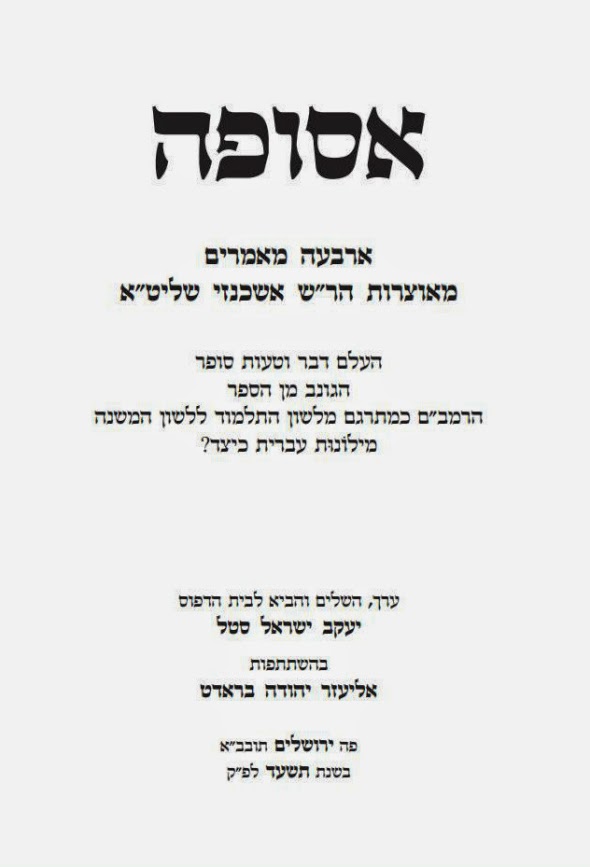


Rav Shmuel Ashkenazi, a contemporary Maecenas of the world of seforim.

A few years ago I began fundraising to print seforim of Rabbi Shmuel Ashkenazi. I am happy to announce that finally two volumes were just printed volume one is being sold in stores now and volume two will be released to be sold in stores before Shavos. In earlier posts I have put up some chapters of these new works. In one post I described Rabbi Shmuel Askenazi as follows: One of the hidden giants of the seforim world both in ultra orthodox and academic circles is a man known as Rabbi Shmuel Askenazi. Professor Zeev Gries also a great expert of the Jewish book and bibliography writes about him:
אני ובני דורי נוכל להעיד על בור סיד שאין מחשב שידמה לו, כר’ שמואל אשכנזי גמלאי מפעל הביבליוגרפיה העברית” )הספר כסוכן תרבות מראשית הדפוס עד לעת החדשה, לימוד ודעת במחשבה יהודית (תשסו) עמ’ 257).
This man has authored many books and articles in dozens of journals – both academic and charedi. Besides for authoring so much he has assisted many people in both circles helping in many areas of the Jewish literature. At times he is acknowledge and thanked and other times not. A few years back, a partial bibliography of his writings was printed in a work called Alfa Beta Kadmita de-Shmuel Zera. This book was a start of an attempt to print all of his writings in a multi-volume set. R. Askenazi has been writing and collection information on thousands of topics for close to seventy years. Unfortunately, he did not print much of what he gathered. The main reason for this omission is R. Ashkenzi’s “weakness” for incredible levels of perfection. For personal reasons the project that began a few years back was stopped by R. Askenazi. Two years ago the project was restarted again by others. He and these people have been working daily to prepare the writing for print. To date this project has gotten very far in preparing for print his writings. Two volumes of over five hundred pages were just printed; five more volumes are almost near completion. After that there are many more waiting to be worked on. The only thing holding back the printing of these volumes are funds to print the volumes. Not everything that he gathered is worth printing and heavy editing is done as with many of the available data bases what he gathered today is not worth much as a quick search on these data bases will find the same thing. However much of what he has gathered is very valuable even today with all kinds of search engines. The topics that these works deal with are virtually everything on some level, sources on expressions, minhaghim, dininm, evolvement of famous stories, bibliography, corrections of authors, encyclopedia style information on thousands of topics culled from thousands of seforim many very rare or unknown. There are also thousands of letters to authors and professor’s containing notes on their works additional sources of their work etc; In addition there are R. Askenazei notes on tefilah, piyut, Chumash, Shas, Zohar, and from other seforim that he marked down on the side. These newly released volumes contain about two hundred chapters on a wide range of topics including many of which trace famous statements people say over in the name of Chazal. In these chapters he traces them through an incredible wide range of sources showing how it was used and by whom it was used. The tour of sources going through out all ages of history (literally) that one is exposed to in these chapters is breathtaking. This book is also well written and organized making it a pleasure to read. It is a work that almost anyone interested in the Jewish book will find many things to enjoy. This book is available for purchase by Girsa and other seforim stores in Jerusalem, in Beigleiesein and other stores in the US. It is also available through me. For more information about this work or helping continue this project in any way please e – me at eliezerbrodt-at-gmail.com. A table of contents of this current work is available upon request to the above mentioned e-mail.