Torah Under Wraps

Torah Under Wraps

by Yoav Sorek

translated by Daniel Tabak

Their publications are not allowed to get out. Their roiling Internet forums are blocked by filters. The articles they publish omit the names of professors considered verboten. A cohort of Haredi scholars [1] challenge the academy and their natural surroundings, unafraid to deal with subjects deemed taboo in the yeshiva world. Few Religious Zionists have penetrated this alternative ivory tower, but one of them—Eitam Henkin, may his blood be avenged—succeeded in breaking down barriers.

*

One needs to strengthen oneself with faith; one should not entertain philosophical questions nor even glance at the books of philosophers,” said Rabbi Nahman of Bratslav already at the end of the eighteenth century. This motto is particularly popular today, in the post-modern era of “religious strengthening,” in which religiosity is perceived as synonymous with simplicity and unsophistication. Yet that very approach also runs counter to the Jewish mind, which is by its nature anything but naive. The legacy of Jewish erudition constitutes part of the DNA not only of the academy, but of even the most Haredi sectors of the yeshiva world, and it finds expression in the spirited Jewish Studies scholarship flourishing under the radar in circles that are presumed to recoil from it.

Israelis distant from the world of Jewish Studies were offered a glimpse of it in the amusing film “Footnote,” but it portrayed only the nerve center of the field’s academic milieu, when in reality a great deal more is out there. In the reading rooms of the National Library, and in many houses in Bnei Brak and Jerusalem, many scholars sit and study the same topics as academics but without academic degree, without traveling to conferences, without aspirations toward an academic appointment. The history of medieval and modern rabbinic authorities, the stories of their compositions, the manuscripts and their provenances, variant customs, disputes both ancient and alive—all of these preoccupy a non-negligible group of yeshiva graduates, Haredi in dress and behavior, who publish articles in “non-academic” journals of Torah scholarship and produce corrected editions of sacred texts, some of which can even be considered quasi-critical editions.

They number Hasidim and Mitnaggedim, the truly God-fearing and those trapped in the Haredi lifestyle who cut corners, those lacking any academic title and others who have earned one—sharp and knowledgeable one and all, still faithful to, and actively participating in, the intra-Haredi discourse. Some of them evidence a dual non-conformism in their lives: on the one hand, they have opted to put distance between themselves and the safe space of the yeshiva, pasturing in the treacherous fields of scholarship; on the other hand, they are Haredim who hail from circles thoroughly suspicious of academia and would not dream of lending credence to its guiding assumptions. Nearly every remarkable personality in the field originates in the circles of Ashkenazi religious zealots, yet the scholarly discussion—which takes place not only on journal pages but in the lively Internet forums of Be-Hadrei Haredim and Otzar HaHochma—is not private, and sometimes a handful of others participate. Rabbi Yoel Catane of Yeshivat Sha‘alvim, editor of the journal HaMa’yan, is one of those others, as his home is in the Religious Zionist world, and his publication represents the enlightened German Zionist Orthodoxy of bygone years. The late Eitam Henkin also was one of them—a Torah scholar and brilliantly wide-ranging scholar who took prominent part in the back and forth of these torani scholars.

In National-Religious society, there are, to be sure, many others involved in Jewish Studies scholarship, but one would be hard-pressed to find the same kind of polemical verve that exists amongst Haredi scholars. According to K., a young Haredi scholar, the passion attests to the fact that the scholarly endeavor is for them an existential need:

The Haredi does his research in order to mask his own crisis of faith in a world that forbids thinking. Those who try to identify the composer of a liturgical poem or the copyist of an unknown manuscript, and those who uncover a forgotten rabbinical position held by R. Joel Sirkes, and those who wade through tomes to reconstruct a partially extant word in an Akkadian inscription, are all really fleeing forbidden thoughts. They release the tension between the silent extinguishment of faith in the Haredi world and the soul aflame with newly forged ideas by running for the hills of manuscripts and book archives.

K.’s criticism begins with the Procrustean bed of Haredi yeshiva education:

The Haredi kollel fellow is force-fed a diet of Torah study characteristic of the Lithuanian yeshivas of the previous century. Should he not be of a mind to rebel completely, the only somewhat legitimate pursuit open to him is Jewish Studies. In that way he can edit the novellae of the Rosh to tractate Nazir without raising too many eyebrows. For that reason Haredi scholars, at least initially, are more involved in editing and less with research or writing articles. And if they are open to producing scholarship, the closer the subject matter is to our time, the better: better on the modern rabbinic authorities than the medieval ones, better on the medievals than the Ge’onim, and God forbid not on the Talmud—don’t even mention the Bible. Preference is given to writing biographical pieces and endless discussions of historical chronology, such as clarifying the years of rabbi X’s rabbinic post in town Y, rather than anything deep about his method of study.

Not everyone agrees with K.’s psychological diagnosis. “Some have ventured into the academic world not out of frustration with the kollel world, but because they were introduced to scholarship in minute doses and became enchanted by it,” says R. Yosef Mordechai Dubovick, a Boyaner Hasid who recently completed his doctorate on Rabbenu Hananel. He says that this field presents something the young prodigy would find difficult to resist.

We have been taught and trained to question, explore, plumb the depths and not be satisfied with a superficial reading or understanding. When the intellectual yeshiva student is exposed to new tools and unfamiliar hermeneutical lenses and modes of understanding, his natural curiosity—nurtured so well—gobbles them up.

It’s ‘spontaneous academia,’” says Rabbi J., who would prefer to avoid equating it with academia. “It develops independently, without institutional bodies to dictate rules and regulations. It is anarchic, autodidactic, and exhilarating. It is a breathtaking demonstration of unfettered intellectual ability.”

A Scholar is Born

Rabbi Dr. Zvi Leshem, Director of the Gershom Scholem Library at the National Library of Israel, has occasionally bumped into scholars from the very heart of the Haredi world. “They are not the typical kollel fellow because the scholarly approach is not that of yeshiva students,” he says. He continues:

Look, when I began working here I met a senior rosh yeshiva from a respected hesder yeshiva, and I told him about those who come from the yeshiva world to do research here. He was at a loss. “What sort of thing do they research?” he asked me, and I responded in turn with the example of Hemdat Yamim.[2] “Why would they research Hemdat Yamim,” the Torah scholar asked me, “when they can buy it in any seforim store?” That is the mainstream approach. Those who embark on scholarship are atypical.

They may be exceptional and individualist, but one unmistakable quality binds them all together: they are autodidacts. This is evident in how they handle material in a foreign language. Some of these scholars have never studied English or German systematically yet refer to non-Hebrew sources in their articles. Each apparently bridged the gap in his own way.

Anyone interested in this phenomenon is invited to open, for example, a volume of Yerushaseinu, an annual tome published by the Institute for German Jewish Heritage (Machon Moreshet Ashkenaz). Some of the articles published therein would be perfectly suitable for any standard academic journal; among the numerous footnotes adorning the pages one finds references to scholarly literature in Hebrew and other languages. Other publications include Yeshurun, Moriah (published by Machon Yerushalayim, which for decades already has been involved in the professional editing of medieval and modern rabbinic literature), the Chabad journal Heikhal Ha-Besht, and others. Torani scholars fondly remember the journal Tzfunot, which met its demise over a decade ago, and in the meantime they publish in Torah supplements to Haredi newspapers, primarily in Kulmos of the newspaper Mishpacha. Likewise, the new scholarly journal Chitzei Gibborim – Pleitas Soferim, published in Lakewood, NJ, is at the moment taking its first steps.

Prominent names in the field include Mordechai Honig, a Hasid from Monsey who is extremely knowledgeable in medieval rabbinic literature; Yaakov Yisrael Stahl, a scholar of Franco-German Jewry forced to lower his profile in connection with academia; Moshe Dovid Chechik, a historian who until recently co-edited Yerushaseinu and currently co-edits Chitzei Gibborim; Yehudah Zeivald, a Boyaner Hasid who is quite busy with philosophy and Hasidism; Yitzchak Rosenblum, who had to move from Kiryat Sefer to Bet Shemesh on account of the library he opened, and currently teaches at the Haredi yeshiva high school Nehora; Yaakov Laufer, a scholar who focuses on linguistics and on the conceptual mode of Torah study; Betzalel Deblitsky, a prodigious zealot from Bnei Brak who runs the forum associated with Otzar HaHochma (the monumental digitization project of the Jewish library); Nachum Grunwald of Lakewood, NJ, a Chabadnik who grew up a Satmar-Pupa Hasid and serves as editor of Heikhal Ha-Besht; Aharon Gabbai, a rising star from Bnei Brak who graduated from a Lithuanian yeshiva, of course; Yechiel Goldhaber, slightly older than the rest, a historian and bibliographer whose scholarship is famous, and for whom the National Library is a second home; and Avraham Shmuel Taflinsky, who has toiled for the past few years in uncovering the sources of the aforementioned Hemdat Yamim.

Once we are mentioning the denizens of the National Library, mention must be made of the all-important tool in their scholarly work—the Internet. The global web of knowledge enables Haredi men from conservative yeshivas, whose library holdings are what you would expect, to come in contact with Jewish Studies scholarship and its historical-critical mindset. Most Haredi scholars have a home Internet connection, but not all. Zvi Leshem relates that some come to the library not to peruse ancient manuscripts or converse with the university’s scholars who use it as their place of study, but simply to work at a place that provides Internet access.

“In the digital age, Jewish Studies scholarship has successfully managed to wiggle its way, however constrainedly, into Haredi and yeshiva circles via databases such as Otzar HaHochma,” Mordechai Honig relates. “Until recently, it was the books. The birth of a Haredi scholar was generally triggered by incidental exposure to academic scholarship that invitingly charmed him. For me, it was Ephraim Urbach’s The Tosaphists, which I purchased at age fifteen.”

No one can deny the love story between digital media and the world of Haredi scholarship, with the latter exercising its acumen also in its use of technology. Along those lines, a weekly Internet journal popped up several years ago which, in the course of a couple years, became an especially favored forum for the group of torani scholars. It bore the name Datshe (ДАЧА), a Russian word that made its way into yeshivish slang, which evokes a leisurely space in which people enjoy life, a kind of rare legitimation of self-indulgence and letting loose a bit. The journal, founded and edited by Yitzchak Baruch Rosenblum, was, according to its subtitle, “where sages of Israel come to relax.” The publication insisted upon respectable discussion and high-caliber argumentation, but one also could find among the directives to its readers and writers the following note of caution, which furnishes an additional explanation to the choice of digital format: “Please preserve the low profile of this publication. One can print it for ease of reading but should not show it to just anyone. Wisdom belongs to the discreet.”[3]


Instead of Polemic, Shock

Along with Internet databases and online journals, forums also have an important place in the discourse of these scholars. After many long years in which the forum Soferim u-Sefarim on the site Be-Hadrei Haredim served as the water cooler for torani scholars, the baton was passed to the forums of Otzar HaHochma. A lengthy, fascinating thread recently began there, for example, whose purpose is to generate a list of “dissenting opinions [made by lone rabbinic scholars],” that is, halakhic positions taken by well-known decisors over the generations when their colleagues were of a different mind. The thread reveals the foundational analytic-halakhic erudition of the discussants, expert not only in bibliography and history but also in a wide range of positions expressed by medieval and modern rabbinic authorities on scores of issues.

The administrator of the Otzar HaHochma forums is, as was said above, Betzalel Deblitsky (under the username “Ish Sefer”). What had been permissible on Be-Hadrei Haredim the fearless zealot Deblitsky bans, censoring discussions and silencing voices he deems unworthy of being heard. But even those who miss the great openness that marked the forum of yore understand that the change is permanent—discussions of relevance within the scholarly community take place principally on the new forum.

Zeal, parenthetically, is a relative matter: the strict filter Netiv, which runs according to the guidance of a confidential rabbinic board, blocks the Otzar HaHochma forum on account of its content being deemed subversive and problematic. To take but one example, the forum has an intense, politically-charged discussion surrounding one of the veteran decisors of the Edah Haredit in Jerusalem—R. Yitzhak Isaac Kahana. A broadside that circulated in Jerusalem against R. Kahana’s book Orhot Tohorah and his lenient rulings on questions regarding menstruation inflamed not only the physical Haredi street but the virtual one as well, engendering scathing posts on the forum in support of each side. A symptom of one of the forum’s pathologies is partially manifest in this case: the deletion of threads by the moderator, who perceived them as deviating from the Haredi party line. Over three pages of posts inexplicably disappeared from the site, only to return the next day, redacted.

Rabbi Eitam Henkin was among those disappointed by the limits set on the forum’s discourse as compared with past fora, but he nevertheless realized that this was the place to be. Under the username “Tokh Kedei Dibbur,” Henkin took part in discussions on the forum, and at the same time carried on extensive personal e-mail correspondence with scholars who were active on it. This became the gateway through which Israeli reality penetrated the Haredi ivory tower—users discovered that the man murdered together with his wife, in front of his children, in the middle of Sukkot, was none other than “their very own” Rabbi Eitam. The forum was filled with emotional threads of eulogy and anguish, memorial initiatives and activities to be done in his merit, and the revelation of the many connections that Henkin had weaved amongst his Internet friends.

It is difficult not to resort to superlatives when speaking about Eitam Henkin. Anyone who had followed his abundant Torah publications — which were marked by eloquent prose, intellectual honesty, and the self-confidence of someone on home turf — had trouble believing the subject of conversation was so young. Even the conversation about him on the forums sketches a fascinating profile. The user known as “Meholat Ha-Mahanayim wrote:

The distinguished victim, may God avenge his blood, was wondrously knowledgeable about the entire history of our people, and specifically the history of Lithuanian Torah scholars and their writings. I merited corresponding with him a bit here, and as much as he was honest, fair, and truth-seeking, he was also intensely and diligently exacting […] None of his responses contained any triviality; his prose was shot through with words of Torah and wisdom, brimming with old wine […] One could discern his constant drive for the truth from his responses. He was never too flustered for a retort, and he always based what he said on the most solid of foundations. Even when he argued for an alternative position, he was a fair and honest opponent, unafraid to admit he was wrong when necessary.”

None other than Deblitsky (“Ish Sofer”), who is so distant from Henkin’s worldview and rarely treats anything with a velvet glove, eulogized Henkin at length. The forum’s moderator wrote:

His statements stood out in their richness, sharpness, and precision—they have no equal. The wide range of people who corresponded with him is astounding. Despite their working in various fields, his correspondents unanimously attested to the immense benefit they gained from him and to the rich sources with which he magnanimously and pleasantly inundated them. Many a time in answering some inconsequential question, he would—as soon as you could say Jack Robinson[4] whip out one of his many lists, chock-full and cornucopian, while noting that he was collecting additional material on the matter and it would have to wait until a future opportunity […]

Many have mentioned honesty and artlessness among his noble qualities. I would like to emphasize one thing that no one like me realized until they fell prey to it: his sharp and resolute style tended to invite polemic, but anyone who responded harshly as a tit-for-tat comeback found himself embarrassed and pathetic upon discovering the affable and unpretentious man behind those words.

Further on, Deblitsky touched on Henkin’s transcendence of the entire sectoral framework. According to him, Henkin noted in a personal communication “that his unique pedigree as a son and grandson of American rabbis who did not fit in with any of the specific groups of Torah-observant Jews enables him to view himself as free of the shackles of sometimes artificial classification and group affiliation. One could say that this feeling largely allowed him to cast a critical eye upon and evaluate phenomena from all sectors without bias.” Deblitsky claimed this to be evident in the independent stance Henkin took in a slew of polemics, in which his misgivings and speculations were spelled out numerous times in private messages, as he took pains to publish in the forum only those things that he could wholeheartedly stand behind.

“I, for one, find exaggeration on both sides,” wrote Henkin to Deblitsky regarding the polemic within the forum surrounding the figure of the late Rabbi Aharon Lichtenstein. “Be it the disparaging vitriol about him […] or, on the other side, those feigning innocence, as if he was just another link in the chain of Torah sages throughout the ages, some of whom have always engaged to some degree in general culture.” Henkin conceded to Deblitsky that even within the National-Religious community opposition to Rabbi Lichtenstein had existed: “It was undoubtedly quite grating for a regular yeshiva student (excluding those from Har Etzion and to “the left”) to see citations from non-Jewish culture and the like in a Torah article. In this case (of criticism within the National-Religious community—Yoav Sorek), however, opposition to that approach was disjoined from ad hominem attacks.”

“We should be very sad that ‘sectoral’ boundaries make no exceptions for Torah giants,” wrote Henkin in another e-mail to Deblitsky.

The definitive assignment of each person into specifically this community or that one is often artificial. It is absurd that the public considers many comedians, musicians, and low-brow entertainers (for purposes of this example) as “Haredi” because they attended heder and wear a hat in the synagogue, while thousands of families who give their all for Torah and are punctilious about every jot and tittle (not to mention that for them television, secular newspapers, and the like are not even up for discussion) are “not Haredi” because they wear a colored shirt and also rejoice on Yom Ha-‘Atzma’ut. Although people can only see externals, they can ascertain what they will have to account for in the Heavenly court, whether they will be asked about Torah study, honesty in business, and hoping for the redemption,[5] or whom they cast their vote for in national elections.

Henkin wrote the following when describing Rabbi Dov Lior’s Torah greatness. “I can say unhesitatingly that we are talking about a serious heavyweight in Torah erudition and jurisprudence who has the entire Talmud and Shulhan Arukh in his head—incredible!” Still, he noted that the Haredim do not respect him simply because his stance on Zionist matters “meant he was to be associated with only one camp and perforce rendered off-limits for the other camp, even if for him the only thing in his world is Torah, pure and simple. (Elements of Western culture or academia, which are accepted in large segments of his camp, he derides at every turn.)”

In these citations of Henkin one can hear the Haredi lilt. As Deblitsky and others in the forum pointed out multiple times, Henkin had the ability to converse with various people in language they were comfortable with. In private communication with another user in the forum, Henkin disclosed that when he would write on Otzar HaHochma, he would adopt the appropriate style and cautiously promote topics close to his heart.

What motive could there be for entering this lion’s den? Henkin had faith that every place has its bright spots, and he was happy to become acquainted with people he would not have otherwise met. He described himself as “attempting to pursue peace, even in a place where they pursue the likes of me.” As he wrote another time under the username “Tekhelet Domah in the somewhat-calmer forum of Be-Hadrei Haredim: “I try my utmost not to hate anyone and not to write off any community that believes itself to be doing God’s will, even those which, in accord with their own aforementioned belief, would write me off and disparage my Rebbe in an unacceptable way.”

Professor in All But Name

After Henkin’s murder, a debate arose between his acquaintances and family over the the respective value he assigned to the two antipodes of academic study and religious study. Not surprisingly, the tension between the two constantly taxes many torani scholars. In the Otzar HaHochma forum and others, it is not uncommon to find a venomous and disparaging treatment of classic academics, who are caricatured as wasting their time on the trivial or unnecessary because they do not know how to study Torah, plain and simple. In the acerbic language of one forum contributor: “they are incapable of studying a page of Talmud without Schottenstein and a dictionary.”

In this way, the methodology of the elderly professor David Halivni, for example, has been pilloried and subject to sharp ridicule, perhaps also on account of his past affiliation with the Conservative movement. Along the lines of the approach with which he is associated (which presumes that most Talmudic passages were edited by a generation of anonymous sages, termed stamma’im, during the Savoraic period), the user “Afarqasta De-‘Anya” writes that he read Halivni’s introductions to two tractates and concluded: “Halivni did not write them himself; rather, he composed specific passages in which even he did not fully understand what he was writing or what he intended. His editor and publisher added stammaitic passages, thereby integrating the scattered pieces into what appears to be a single, unified text.”

This derision may, of course, result from an inferiority complex afflicting those with no proper academic training, or from the ignorance of those whose intellectual horizons do not extend beyond the narrative in which they were raised. In any case, it is far from being the consensus of the community of torani scholars: some have integrated into academia in recent years, others recognize that the yeshiva world’s disdain toward Jewish Studies is outdated. As Dubovick notes, Jewish Studies of this past generation is not what it had been previously, when scholars had no connection to the traditional study hall, and their scholarship at times revealed their ignorance and at other times could not sort the wheat from the chaff. In this generation, the preeminent scholars in the field are also serious Torah scholars.

Yet, anyone who publishes in Haredi journals or seeks legitimacy from the Haredi street cannot write without inhibition. “They must be careful about how they write, whom they cite, and even what titles they bestow,” explains Zvi Leshem. “I recall someone here who wanted to cite Rabbi Saul Lieberman’s Tosefta Ki-Feshutah, but he could not figure out which was the worse option—writing Rabbi Lieberman or Professor Lieberman. In the end he simply omitted his name.”

Though many of them already bear the title Dr., generally the torani scholars are not in the academic race for positions and recognition, and that fact profoundly impacts their lives. “The disconnect from the academic world and all its rivalry makes it easy for a scholar to share his wisdom with his colleagues, without having to worry about material or future scholarship being stolen, as well as to partake of his colleagues’ wisdom,” says R. Yoel Catane. “At the same time, the pressure to publish quality articles in the academic world, and the need to subject one’s research to peer review, occasionally yields excellent results that cannot be achieved in torani scholarship.”

“The fact that we are not part of that competition,” explains G. to me, “grants us peace of mind, intellectual freedom, the freedom to choose our areas of research without the need for prerequisite courses that are not entirely necessary, and the freedom to develop our ideas as we see fit. I see Haredi scholars benefitting from the sort of freedom enjoyed by the first generation of scholars in the Wissenschaft des Judentums movement.”

Between Seclusion and Entrenchment

The heightened awareness of Jewish sages to the development of their tradition preceded by centuries the Wissenschaft des Judentums movement, which set the critical modern gaze upon the Jewish library. Across the generations there were Ge’onim, medievals, and moderns engaging in textual criticism, historicizing customs, unearthing deep-rooted errors, and looking askance at what the ignorant perceived as a “Judaism” that could not be questioned.

Even from the narrower, more modern perspective of relations between the academy and Haredim, the group that forms the subject of this article certainly cannot claim originality. The “Bibliography of the Hebrew Book,” a superb academic project that catalogs all titles printed in Hebrew and other Jewish languages through the ages, is currently led by Yitzchok Yudlov, an erudite Haredi with no academic schooling. Among the founders of the project Rabbi Shmuel Ashkenazy (Deutsch), raised in Batei Ungarin, stands out. Ashkenazi, one of the most famous Haredi scholars of the book, serves today as an honorary member of the Mekize Nirdamim Society, a venerable publisher identified with the Wissenschaft movement. Two Haredi scholars also stand out among the employees of the National Library: Yehoshua Mondshine, an independently-minded Habadnik known for his scholarship on Hasidism, who passed away this past Hanukkah[6] after a terrible illness; and Meir Wunder, may he live a long life, a bibliophile and historian who wrote, among other things, his monumental project Meorei Galitziya (Luminaries of Galicia). A similar undertaking for Hungarian sages was brought into being by the late Haredi scholar Yitzchak Yosef Cohen, who worked within the framework of Machon Yerushalayim, the most famous of the Haredi publishers with a scholarly inclination. Also worthy of note are Yitzchak Yeshaya Weiss and Moshe Alexander Zusha Kinstlicher, both prolific scholars in the field of rabbinic history, who edited the now-defunct Tzfunot.

What, then, distinguishes the members of this young group from all their predecessors? Perhaps it is the fact that the integration that had once seemed so organic has become more complicated as a result of two parallel processes: the seclusion of Haredi society, and the entrenchment of the academy’s formality. The world of the learned, from all walks of life, for whom knowledge and curiosity are essential, has been replaced by the reality of evaluative categories within the halls of the academy, and an inflexible, censorial “hashkafah within the Haredi camp. Few are those who seek to restore the former glory of scholarship, back when its throne did not have to be an academic chair nor its crown a black hat.

—————————

A DUAL DESTINY

The doctoral advisor of Eitam Henkin, may God avenge his blood, was convinced that his student had chosen academia over the halakhic discourse of the yeshiva. Others attest that Henkin viewed halakhic discourse, in fact, as paramount.

*

Although his world was built upon foundations quite different from those of his Haredi interlocutors, Eitam Henkin had no difficulty finding a shared language with torani scholars. An autodidact to the core, he also held fast to the truth, was intellectually curious, loved profound discussion, and was prepared to swim against the tide. And as can be expected from anyone who has an independent love for knowledge, it turns out that he also wrote for—or at least corrected and made changes to—the Hebrew Wikipedia. On his user page, under the username “Shim‘on Ha-Eitan” (which he used in other contexts, such as on the site Mida), he opted for a pithy self-description that speaks volumes: “a Jerusalemite with diasporic roots, whose world is Torah and whose occupation is writing and research.”

Henkin began his doctoral research under Prof. David Assaf of Tel-Aviv University. He dedicated it to the biography of R. Israel Meir Ha-Kohen of Radun, the Hafetz Hayyim (1839-1933), one of the mythic personalities who have exercised incredible influence on contemporary Orthodoxy. Assaf, who deeply admired Henkin, published a eulogy on his blog Oneg Shabbat that aroused immediate contention. He wrote:

Eitam was a wunderkind. I first met him in 2007. At the time he was an avrekh meshi (by his own definition), a fine young yeshiva fellow, all of twenty-three years old. He was a student at Yeshivat Nir in Kiryat Arba, with a long list of publications in Torah journals already trailing him. He contacted me via e-mail, and after a few exchanges I invited him to meet. […] We spoke at length, and I have cared about him ever since. From his articles and our many conversations I discerned right away that he had that certain je ne sais quoi. He had those qualities, the personality, and the capability—elusive, unquantifiable, and indefinable—of someone meant to be a historian, and a good historian at that.

I did not have to press especially hard to convince him that his place—his destiny—did not lie between the walls of the yeshiva, and that he should not squander his talents on the niceties of halakha. He needed to enroll in university and train himself professionally for what truly interested him, for what he truly loved: critical historical scholarship. […]

Eitam, hailing from a world of traditional yeshiva study that is poles apart from the academic world, slid into his university studies effortlessly. He rapidly internalized academic discourse, with its patterns of thinking and writing, and began to taste the distinct savors of that world.

In the continuation, Assaf heaps praise upon his young student. The sharp opposition that he posed between “the niceties of halakha” and critical scholarship, however, engendered grievances on the part of several Oneg Shabbat readers, particularly those familiar with Henkin’s other side. His brother Dr. Yagil Henkin criticized Assaf’s piece relatively delicately. “He believes Eitam saw himself primarily as a scholar, not a rabbi with plans to fill a rabbinic post,” he told Yosef Ehrenfeld in the newspaper Shevi‘i. “I have a different take on the matter […] His first and foremost desire was to be a Torah scholar, but he also wanted to be an academic scholar. In everything that interested him and everything he engaged in, he strove to do his best, to go the extra mile.”

Rabbi Dr. Michael Avraham protested Assaf’s denigration of Torah discourse, leading with the following cynical preface:

I am unable to restrain myself from making the objective academic comparison (apparently the product of systematic methodology and critical-historical scholarship) between “squandering one’s time on the niceties of halakha” and “entering the precincts (heikhalot) of the academy.” I won’t lie: a quiver of holiness washed over me upon reading those words, but I nevertheless summon my courage and dare to murmur something in the heart of the sanctuary (heikhal). May its priests, Levites, and prophets forgive me after kissing their sacred, perfumed feet.”

Offended, Assaf responded with a stinging riposte of his own, explaining that he was not deriding the yeshiva’s methods of study; rather, he was convinced that Eitam, as a young man who had needed to choose his intellectual path, was inclined more towards academic methods of study and writing. This assertion would seem to fit the activity of Eitam’s final years, but it somewhat contradicts the testimony of Deblitsky, according to which Henkin viewed his thoroughly halakhic composition about Sabbath law—a book that has yet to be published[7]—as his most important work.

Translator’s Notes:

This article was first published in Hebrew in Mekor Rishon (30 October 2015), and is translated here with permission of Mekor Rishon and the author. The translator would like to thank Shaul Seidler-Feller for his invaluable assistance. A groysn shkoyekh!

[1] A preliminary terminological distinction in order to forestall confusion:

  • A hoker is someone with the skills to conduct sustained research on a topic of interest and produce noteworthy scholarship. Such a person may have academic training and credentials, but the subjects of this article, for the most part, do not. I translate ‘hoker’ as ‘scholar.’

  • A hoker torani is such a scholar who happens to be firmly ensconced in the world of Torah, and whose research interests center around topics related to that world. Owing to the lack of suitable English adjective, I will leave the adjective in the Hebrew, yielding “torani scholar.”

  • A talmid hakham is someone with measurably significant Torah erudition, but that knowledge does not necessarily have any bearing on his ability to produce scholarship. I will retain the standard translation of ‘Torah scholar.’

[2] A compilation of customs, prayers, and kabbalistic practices printed about 300 years ago that has had tremendous influence ever since. It nevertheless generated controversy regarding its author’s identity and its content due to suspicions of Sabbateanism.

[3] Cf. Prov 11:2.

[4] The closest idiomatic equivalent of tokh kedei dibbur, Henkin’s username.

[5] cf. Shabbat 31a.

[6] Hanukkah 5775 (24 December 2014). A tribute has been published on these pages by Eli Rubin, “Toil of the Mind and Heart: A Meditation in Memory of Rabbi Yehoshua Mondshine,” the Seforim blog (13 December 2015), available here (http://seforim.blogspot.com/2015/12/toil-of-mind-and-heart-meditation-in.html).

[7] The book, Zeh Sefer Esh Tamid, has since been published by Mossad HaRav Kook in April 2016.


Who can discern his errors? Misdates, Errors, Deceptions, and other Variations in and about Hebrew Books, Intentional and Otherwise: Revisited

Who can discern his errors?
Misdates, Errors, Deceptions, and other Variations in and about Hebrew Books, Intentional and
Otherwise: Revisited[1]
by Marvin J. Heller

Marvin J. Heller is the award winning author of books and articles on early Hebrew printing and bibliography. Among
his books are the Printing the Talmud series, The Sixteenth and Seventeenth Century Hebrew Book(s): An Abridged Thesaurus, and collections of articles.

R. Eleazar once entered a privy, and a Persian [Roman] came and thrust him away. R. Eleazar got up and went out, and a serpent came and tore out the other’s gut. R. Eleazar applied to him the verse, “Therefore will I give a man (אָדָם adam) for thee (Isaiah 43:4).” Read not adam [a man] but אֱדֹם edom [an Edomite = a Roman] corrected by the censor to “but a Persian.” (Berakhot 62b)
 “R. Eleazar said: Any man who has no wife is no proper man; for it is said, Male and female created He them and called their
name Adam” corrected by the censor to “any Jew who is unmarried” (Yevamot 63a).[2]
Sensitivity to the contents of Jewish texts by non-Jews, and apostates in their employ, was a feature of Jewish life at various periods, one particularly notable and noxious time being in the sixteenth century when, during the counter-Reformation, the Church undertook to censor and correct those Hebrew books that were not placed on the index and banned in their entirety. In the first example, the understanding based on the reading of adam אָדָם as edom אֱדֹם (Rome) is completely lost by the substitution of Persian for Edom. In the second example “Any man who has no wife is no proper man” was deeply offensive to a Church that required an unmarried and celibate clergy. In both instances the text was altered to adhere to the Church’s sensibilities despite the fact that not only was the original intent lost but that, particularly in the first case, it ceased to be meaningful.
            Books, and even more so Hebrew books, often underwent modifications, textual changes, due to the vicissitudes and complexities of the Jewish condition, frequently involuntary. The subject of “Misdates, Errors, Deceptions, and other Variations in and about Hebrew Books, Intentional and Otherwise,” addresses textual changes, as well as other errors, intentional and unintentional, that may be found in Hebrew books. Addressed previously in Hakirah, this is a companion article, providing additional examples of book errors, variations, and discrepancies. As noted previously, errors “come in many shapes and forms. Some are significant, others are of little consequence; most are unintentional, others are purposeful. When found, errors may be corrected, left unchanged, or found in both corrected and uncorrected forms. . . . Other errors are not to be found in the book per se but rather in our understanding of the book. This article is concerned with errors in and about Hebrew books only. It is not intended to be and certainly is not comprehensive, but rather explores the variety of errors, some of consequence, most less so, providing several interesting examples for the reader’s edification and perhaps enjoyment.”[3]
Among the errors discussed in this article are 1) those dealing with the expurgation of the Talmud; 2) expurgation of other Hebrew works; 3) internal censorship, that is, of Hebrew books by Jews; 4) accusations of plagiarism and forgery; 5) misidentification of the place of printing; 6) confusion due to mispronunciations.
I
            Returning to the beginning of the article, the Talmud, initially banned in 1553 and placed on the Index librorum prohibitorum in 1559, was subsequently permitted by the Council of Trent in 1564, but only under restrictive and onerous conditions. Reprinted in greatly censored form, the introductory quote refers to modifications in the Basle Talmud (1578-81). A condition of the Basle Talmud was that the name “Talmud” be prohibited. Heinrich Graetz explains the Pope’s and Council’s considerations in forbidding the name.
the Council only approved the list of forbidden books previously made out in the
papal office, the opinion of the pope and those who surrounded him served as
a  guide in the treatment of Jewish writings. The decision of this point was left to the pope, who afterwards issued
a bull to the effect that the Talmud was indeed accursed – like Reuchlin’s ‘Augenspiegel
and Kabbalistic writings’ – but that it would be allowed to appear if the name
Talmud were omitted, and if before its publication the passages inimical to
Christianity were excised, that is to say, if it were submitted to censorship
(March 24th, 1564). Strange, indeed, that the pope should have allowed the
thing, and forbidden its name! He was afraid of public opinion, which would
have considered the contradiction too great between one pope, who had sought
out and burnt the Talmud, and the next, who was allowing it to go untouched. At
all events there was now a prospect that this written memorial, so
indispensable to all Jews, would once more be permitted to see the light,
although in a maimed condition.[4]
            Among the most egregious examples of censorship of the Talmud is Bava Kamma 38a. That amud (page) of the Talmud, dealing with financial relations between Jews and non-Jews, was expurgated, almost in its entirety. Prior to the much censored Basle Talmud (1578-1581) the text was completely printed, for example, in the 1519/20-23 Venice edition of the Talmud published by Daniel Bomberg. After the censored Basle Talmud was published, initially, rather than contract the text, large blank spaces were left, clearly indicating that text had been expurgated.
            Abraham Karp notes that in some editions of the Talmud “many expurgated passages are restored, and where deletions are retained, blank spaces are left to indicate the omission to the reader and, no doubt, to permit him to fill in by pen what they dared not to print.”[5] An example of the blank spaces can be seen from the Frankfurt an der Oder Talmud 1697-99, printed by Michael Gottschalk. Such omissions are to be found in almost all seventeenth and early eighteenth editions of the Talmud, a notable exception being the Benveniste edition (Amsterdam, 1644-47).[[6]  Rabbinovitch too notes that blank spaces were left for expurgated text, those omissions being consistent with the Basle Talmud. He adds, however, that this policy was followed until the 1835 Vilna Talmud. At that time government officials prohibited the practice so that the omissions would not be so obvious.[7]  In fact, text was consolidated much earlier, as evidenced, by the illustrations of Bava Kama 38a from the 1734‑39 Frankfurt an der Oder Talmud. This expurgated material is restored in current editions of the Talmud.

Frankfurt an der Oder – 1697-99

Frankfurt an der Oder – 1734-39

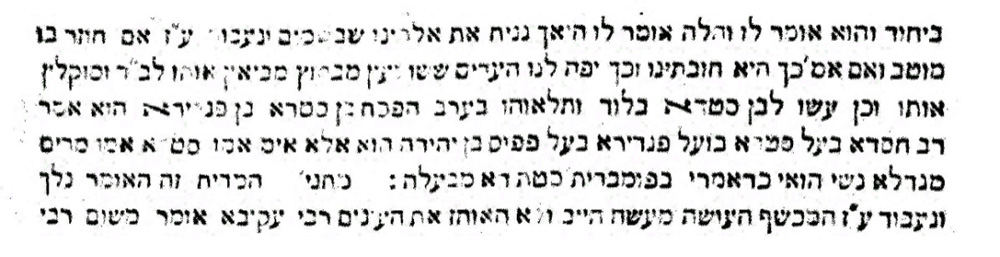
Another example of interest, one that has not fared as well, the text not yet restored in most editions of the Talmud, is to be found in Shabbat 104b and Sanhedrin 67a. The reference there is to Ben Satda, beginning, in the latter tractate “and so they did to Ben Satda
in Lod, and hung him on erev Pesah. Ben Satda? He was the son (ben) of Padera . . .”[8] Popper notes that Gershom Soncino, when publishing “a few of the Talmudic tracts at Soncino during the last decade of the fifteenth century, he took care not to restore any of the objectionable words in the MSS. from which he printed.”[9] Here too the text is complete in the Bomberg Talmud. Two subsequent exceptions in later editions of Sanhedrin where the Ben Satda entries do appear are in the Talmud printed by Immanuel Benveniste and in the edition of Sanhedrin printed in Sulzbach in or about 1696.

Sanhedrin 67a, Benveniste Talmud
However, in two complete editions of the Talmud (1755-63, 1766-70) printed in Sulzbach, the Ben Satda entries are omitted, as is the case of most modern editions of the Talmud.[10]
II
            The Talmud isn’t the only work to have been censored. Amnon Raz-Krakotzkin provides several examples of text in books
that were modified due to the censor’s ministrations. Among them is R. Abraham ben Jacob Saba’s (d. c. 1508) Zeror ha-Mor, a commentary on the Pentateuch based on kabbalistic and midrashic sources.[11] On the passage “They would slaughter to demons without power, gods whom they knew not, newcomers recently arrived, whom your ancestors did not dread” (Deuteronomy 32:17), referring to “Christians in general and priests in particular as ‘demons’ (shadim): ‘For as the nations of the world, all their abominations and vanities come from the power of demons, hence, the monks would shave the hair of their heads  and leave some at the top of the head as a stain.’” This passage continues, referring to bishops and popes, concluding that their entire heads are shaved like a marble with only a bit of hair about their ears, so that they have the appearance of demons, hairless, and like demons, provide no blessings, are like a fruitless tree, and “thus, it is fitting that they bear no sons of daughters.” Raz-Krakotzkin informs that this passage appeared in the first two editions of Zeror ha-Mor printed by Bomberg, and the Giustiniani edition (1545) but was already expurgated by the Cavalli edition (1566), a blank space in place of the text. That space subsequently disappeared and, although a Cracow edition based on the Bomberg Zeror ha-Mor restored the text it remains missing from most later editions.[12] Raz-Krakotzkin continues, citing additional examples.
            Early halakhic works were also subject to the ministrations of the censor.[13] Among them are such works as R. Samson ben Zadok’s (thirteenth century) Sefer Tashbez (Cremona, 1556). Samson was a student of R. Meir of Rothenburg (Maharam, c. 1220-1293). When the latter was imprisoned in the tower of Ensisheim, Samson visited him regularly, serving as his attendant and carefully recording in Tashbez Maharam’s teachings, customs, and daily rituals, as well as what he heard and observed, from the time Meir rose in the morning until he retired at night, on weekdays, Sabbaths, and festivals. Although a relatively small work (80: [6], 55 leaves), it consists of 590 entries beginning with Sabbath night (1-17), Sabbath day (18-98), followed by festivals, Sefer Torah, priestly benedictions, prayer, slumber, talis and tefillin, benedictions, issur ve-heter (dietary laws), redemption of the first born, hallah, vows, marriage and divorce, monetary laws, and piety. Expurgation by the censor of Tashbez was done sloppily, for terms such as meshumad and goy, normally excised, remain, but with a disclaimer near the end that they refer to idol worshipers only.[14]
III
Not all errors are due to the ministrations of the censor. Jews, too, at times, have taken their turns at modifying the text of books.
            A recent and perhaps quite surprising example of internal censorship is to be found in R. Solomon Ganzfried’s (1804–1886) Kizzur Shulḥan Arukh. First printed in 1864, that work an abridgement of the Shulhan Arukh for the average person, went through fourteen editions in the author’s lifetime, and numerous editions since then, as well as translations into many languages and has been the subject of glosses.[15] Marc B. Shapiro informs that in the Lublin (1904) edition of the Kizzur Shulḥan Arukh and several other editions the entry (201:4) that “apostates, informers, and heretics –for all these the rules of an onan and of mourners should not be observed. Their brothers and other next of kin should dress in white, eat, drink, and rejoice that enemies of the Almighty have perished,” the words “apostates, informers, and heretics” have been removed. In the Vilna edition (1915) the entire paragraph is removed and the sections renumbered from seven to six. In the Mossad Harav Kook vocalized edition a new halakhah was substituted, but that has since been corrected to reflect the original text. The reason, according to Shapiro, is that with the expansion of Jewish education to include girls, it was felt that schoolchildren, with assimilated relatives, would see this as referring to family members.[16] Several recent editions of the Kizzur Shulḥan Arukh that were examined, in both Hebrew and English, have the original text.
            R. Abraham Isaac Kook (1865–1935), chief rabbi of Jerusalem and first Ashkenazic chief rabbi in Israel (then Palestine),
was a profound, influential, and mystical thinker. Highly regarded by his contemporaries, his strongly Zionist views also resulted in some opposition, but even most of his contemporaries who disagreed with him held him in high regard. Shapiro notes that with time, Kook’s reputation changed. Despite the fact that such pre-eminent rabbis as R. Solomon Zalman Auerbach (1910-95) and R. Joseph Shalom Elyashiv (1910-2012) were unwavering in their high regard of Kook, strong anti-Kook sentiment developed later in religious anti-Zionist circles. Shapiro notes that “Kook has been the victim of more censorship and simple omission of fact for the sake of haredi ideology than any other figure. When books are reprinted by haredi and anti-Zionist publishers Kook’s approbations (hascomas) are routinely omitted.” One of several examples of this modified opinion Shapiro cites is a lengthy eulogy delivered by R. Isaac Kossowsky (1877-1951) praising Kook. When the eulogy was reprinted in She’elot Yitzhak, a collection of Kossowsky’s writings, the name of the subject of the eulogy, Rav Kook, was omitted. In the reprint of She’elot Yitzhak the eulogy is deleted in its entirety.[17]
            Shapiro’s observation about Rav Kook’s approbations is confirmed in several books. R. Eliezer Mansour Settehon’s (Sutton, 1860-1937) Notzar Adam: Hosafah Notzar Adam (Tiberius, 1930), discourses on spiritual development, has approbations from R. Abraham Abukzer, R. Moses Kliers, and R. Jacob Hai Zerihan, and R. Abraham Isaac ha-Kohen Kook. In a description of Notzar Adam in in Aleppo, City of Scholars (Brooklyn, 2005), Kook’s name, Kook’s name is omitted from a list of the book’s approbations.[18]

In a variation of this, two internet sites that reproduce the full text of Hebrew books both include Rav Isaac
Hutner’s (1906-80) Torat ha-Nazir (Kovno, 1932). This, the first edition, has three approbations; a full page hascoma from R. Hayyim Ozer Grodzinski (1863–1940), and the following page two approbations, side by side, from R. Abraham Duber Kahana (1870–1943) and Rav Kook. The first internet site, with more than 53,000 books for free download, follows R. Grodzinski’s approbation with a blank page and then the text. The second, a subscription site with more than 76,000 scanned books, goes directly from R. Grodzinski’s hascoma to the text, dispensing with the blank page, also not reproducing the second page of approbations. It is not clear whether the copies scanned were faulty, the scanning incomplete, or the omission intentional. Nevertheless, to conclude this section on a positive note, surprisingly, given the omission of Rav Kook’s approbation in both scans of Torat ha-Nazir, both sites list and provide an extensive number of Rav Kook’s works.

IV
Accusations of plagiarism accompany the publication of two works by and/or attributed to R. Nathan Nata ben Samson Spira (Shapira, d. 1577). Spira, born to a distinguished family that was, according to the Ba’al Shem Tov, one of the three pure families throughout the generations in Israel (the others being Margulies and Horowitz), served as rabbi in Grodno (Horodno) until 1572, when he accepted a position in Posnan. His grandson was R. Nathan Nata ben Solomon Spira (Megalleh Amukkot, c. 1585-1633). Among Nathan Nata Spira’s works is Imrei Shefer (20: [1], 260 ff.), a super-commentary on Rashi and R. Elijah Mizrahi (c. 1450–1526). The book was brought to press by Spira’s son R. Isaac Spira (d. 1623), Rosh Yeshiva in Kovno and afterwards in Cracow. Work on Imrei Shefer began in Cracow in 1591 but before printing was finished Isaac Spira accepted a position in Lublin where publication was completed at the press of Kalonymus ben Mordecai Jaffe (1597).[19]
The title-pages states that Spira, “gives goodly words (Imrei Shefer)’ (Genesis 49:21) and he gives, ‘seed to the sower, and bread לזורע ולחם (357=1597) to the eater’ (Isaiah 55:10) of Torah.” In the introduction, Isaac informs that the work is entitled Imrei Shefer from the verse, “he gives goodly words” (and the word “he gives הנתן” in the Torah is without a vav), implying the name of the author [Nathan נתן] and Shefer שפר is language of Spira שפירא the family name of the author. Isaac then addresses the existence of an unauthorized and fraudulent edition ascribed to his father, printed in Venice (Be’urim, 1593),
found and brought out by men who lack the yoke of the kingdom of heaven. A work discovered, who knows the identity of the author, perhaps a boy wrote it and wanted to credit it to an authoritative source אילן גדול), [my father my lord]. God forbid that his holy mouth should bring forth words that have no substance, vain, worthless, and empty, a forgery, “[And, behold], it was all grown over with thorns, and nettles had covered it over” (Proverbs 24:31).
Isaac Spira took his complaint to the Va’ad Arba’ah Artzot (Council of the Four Lands), requesting they prohibit the distribution of the Be’urim in Poland. The response of the Va’ad is printed at the end of the introduction,
It has been declared, by consent of the rabbis, and the [communal] leaders of these lands,
that these books shall neither be sold nor introduced into [any Jewish] home in
any of these lands. Those who have [already] purchased them shall receive their
money back and not keep [such] an evil thing in their home.
What was and who wrote the Be’urim, the reputedly plagiarized copy of R. Nathan Nata ben Samson Spira’s Imrei Shefer? The title-page of the Be’urim (40: 180 ff.), printed in Venice in 1593 “for Bragadin Giustiniani by the partners Matteo Zanetti and Komin Parezino at the press of Matteo Zanetti,” states that it was written by ha-Rav, the renowned, the gaon, R. Nathan from Grodno in the year, “For you shall go out with joy בשמחה (353=1593), and be led forth with peace” (Isaiah 55:12). Be’urim does not have an introduction nor a colophon that provides any additional information.
Isaac Spira’s accusation that the Be’urim is a forgery, not to be ascribed to his father, but rather was written by an unknown young man who then attributed it to Spira, is confirmed by R. Issachar Baer Eylenburg (1550-1623), who writes in his responsa, Be’er Sheva (Venice, 1614) and also in his commentary on Rashi, Zeidah La-Derekh (Prague, 1623) that it is obvious that the Be’urim were not the work of the holy Spira, but rather of an erring student “who hung (attributed it) to himself, hanging it on a large tree” (cf. Pesahim 112a).[20]
Among the distinguished sages of medieval Sepharad is Rabbenu Bahya ben Asher ben Hlava (c. 1255-1340). Best known for his popular, multi-faceted, and much reprinted Torah commentary, written in 1291 and first published in Naples (1491),  Rabbenu Bahya was also the author of Kad ha-Kemaḥ (Constantinople, 1515) and Shulḥan shel Arba (Mantua, 1514). The former, Kad ha-Kemaḥ, is comprised of sixty discourses on varied subjects, among them festivals, prayer, faith, and charity, all infused with ethical content. Among the numerous editions of Kad ha-Kemaḥ is a scholarly edition entitled Kitvei Rabbenu Baḥya (Jerusalem, 1970) edited and with annotations by R. Hayyim Dov Chavel (1906–1982).
Among the essays in Kad ha-Kemaḥ is one entitled Kippurim, on Yom Kippur. Part of that discourse includes a commentary on the book of Jonah, read on Yom Kippur. Chavel, in the introduction to his annotations on Rabbenu Bahya’s commentary on Jonah, suggests that Rabbenu Bahya took his commentary from R. Abraham ben Ḥayya’s (d. c. 1136) Hegyon ha-Nefesh, first published by E. Freimann (Leipzig,
1860). Abraham ben Ḥayya, a resident of Barcelona, was a philosopher, mathematician, and astronomer, reflected in his several works, including translations from the Arabic. Hegyon ha-Nefesh “deals with creation, repentance, good and evil, and the saintly life. The emphasis is ethical, the approach is generally homiletical – based on the exposition of biblical passages – and it may have been designed for reading during the Ten Days of Penitence.”[21] Kitvei Rabbenu Baḥya and Hegyon ha-Nefesh are sufficiently alike to support Chavel’s contention that
Rabbenu utilized the Sefer Hegyon ha-Nefesh (or Sefer ha-Mussar) of the earlier sage R. Abraham ben Ḥayya ha-Nasi, known as ṣāḥib-al-shurṭa . . . In it is found this commentary on the book of Jonah. This was already noted by the author of Zaphat ha-Shemen – the usage by Rabbenu of this book is comparable to his use of other works: according to his needs. The reason that he does not mention it in his commentary is, perhaps, because the books of R. Abraham ha-Nasi were well known, and the leading sages, such as the Rambam, Ramban and other leading rabbis utilized it, comparable to “Joshua was sitting and delivering his discourse without mentioning names, and all knew that it was the Torah of Moses” (Yevamot 96b).[22].
We leave accusations of plagiarism and turn to forgery, a well-known case involving a person of repute, Saul Hirsch (Hirschel)
Berlin’s (1740-94) Besamim Rosh.[23] Berlin was a person of great promise; the son of R. Hirschel Levin (Ẓevi Hirsch, 1721–1800), chief rabbi of Berlin, ordained at the age of twenty and in 1768 av bet din in Frankfurt an der Oder. At some point Berlin became disillusioned with what he believed to be antiquated rabbinical authority. He gave up his official rabbinic position in Frankfurt, removing to Berlin. There Berlin was an associate of Moses Mendelssohn (1729–1786), providing, in 1778, an approbation for Mendelssohn’s Be’ur (Berlin, 1783) and was a supporter of the enlightenment figure Naphtali Herz Wessely (1725–1805), writing an anonymous pamphlet in defense of  Wessely’s
Divrei Shalom ve-Emet (Berlin, 1782) entitled Ketav Yosher (1794).[24]
An earlier forgery of Berlin, described by Dan Rabinowitz, this under the pseudonym of Ovadiah bar Barukh Ish Polanya, was Berlin’s Mitzpeh Yokteil (1789), a vicious attack on R. Raphael Kohen, rabbi of the three communities, Altona-Hamburg-Wansbeck, who had opposed Mendelssohn’s Be’ur, and on Kohen’s Torat Yekuteil (Amsterdam, 1772) on Yoreh Deah. The Communities’ beit din placed Ovadiah, the presumed author, under a ban. The ban’s proponents approached R. Tzevi Hirsch, the chief rabbi of Berlin and Saul Berlin’s father, seeking his signature on the ban.[25] It appears that Tzvi Hirsch initially concurred with the ban, but, as he was close to deciding in favor of signing the ban, someone whispered in his ear the verse “woe is me, my master, it is borrowed שאול” (II Kings 6:5), – which he understood to be a play on שאול (borrowed), referring to his son, Saul, the true author of Mitzpeh Yokteil.[26]
 

Turning to Besamim Rosh Saul Berlin’s infamous forgery, it claims to be the responsa of R. Asher ben Jehiel (Rosh, c. 1250–1327), among the most preeminent of medieval sages of European Jewry. The title-page describes it as the responsa Besamim Rosh, 392 responsa from books from the Rosh and other rishonim (early rabbinic sages) compiled by R. Isaac di Molina and with annotations Kasa de-Harshana by the young Saul ben R. Ẓevi Hirsch, av bet din, here (Berlin).[27] It is dated “and will keep you in all places where you goושמרתיך בכל אשר תלך   553 = 1793)” (Genesis 28:15), note Asher אשר in the date. In Besamim Rosh Berlin, having become an adherent of the haskalah, presents ideas inconsistent with and at variance with traditional halakhic positions. Among the novel responsa are removing the prohibition on suicide due to the difficult conditions of Jewish life; permitting shaving on Hol ha-Mo’ed; requiring a shohet to test the sharpness of his knife on his tongue; saying a blessing over non-kosher food; disregarding commandments that are upsetting; not taking Megillat Esther seriously; and that Jews beliefs can change. An example of the responsa, albeit a brief one and without Berlin’s Kasa de-Harshana, is the much quoted responsum concerning “legumes, rice, and millet which some Ashkenazic rabbis prohibit and is the practice in some communities. . .” (105b: no. 138): The responsum states:

This is very strange, for the Talmud permits it and no bet din is known to have made such an enactment. It is not for us to inquire why such an enactment was made and why it was followed by some. Possibly because of the exiles and the confused גירושים והבלבוחים, weighed down in poverty . . . and also due to the small community of Karaites in their midst who were also exiled. . . . unable to distinguish between bread and bread and all leavening from which it is possible to make flour and bread. But, God forbid, that we freely prohibit that which is permitted, and all the more because of the poor and needy, who lack sufficient meat and bread all the days of the festival. . . . “who eat [but] a litra of vegetables for at a meal” (Sanhedrin 94b). Also “a leap year is not intercalated in the year following a Sabbatical year for this reason.” All the more (kal ve-homer) to prohibit most types of food to the poor and needy on festivals and the overly strict (mahmerin) will have to answer on the day of judgement.
            How has Besamim Rosh been received? Soon after its publication R. Wolf Landsberg, in Ze’ev Yitrof (Frankfurt an der Oder, 1793), stated that Besamim Rosh was a forgery, and R. Mordecai Benet (1753-1829) wrote to Berlin’s father, that Besamim Rosh was “from head to foot only wounds and grievous abscesses from sinful, vile men.”[28] R. Hayyim Joseph David Azulai (Hida, 1724–1806) in his Shem ha-Gedolim, one of several works in which he mentions Besamim Rosh, states “I have heard ‘a voice of a great rushing’ (Ezekiel 3:12) that there are in this book strange things. . . . Therefore the reader should not rely on it.”[29] The Hatam Sofer (R. Moses Sofer, 1762–1839), based on the responsum on suicide, also concluded that Besamim Rosh was a forgery.[30] Among the varied modern authorities who quote Besamim Rosh, albeit critically, are R. Solomon Joseph Zevin (1885–1978) and R. Ovadia Yosef (1920-13) the latter writing an approbation for the 1984 edition of Besamim Rosh.[31]
How influential was Besamim Rosh? Fishman writes that “Besamim Rosh is of itself cast as a work of rabbinic literature, a Trojan horse of sorts, capable of injecting reformist viewpoints directly into the camp of halakhic discourse. Indeed, the sheer frequency with which Besamim Rosh has been cited in subsequent halakhic writings [documented by Samet] raises the question of whether the work may not have been effective in introducing unconventional perspectives into rabbinic thought.”[32] Similarly, Shmuel Feiner notes that “Some scholars
regard Besamim Rosh as the beginning of the reform of Judaism.”[33] Finally, knowledge that Besamim Rosh was a forgery was so widespread, that it is even so described in a book dealers catalogue, that of Jakob Ginzburg, in Listing of Rare and Valuable Books (Minsk, 1914), stating “565 Besamin Rosh attributed to the Rosh, poor condition Berlin, 1792, 50 1.”
V
Of less consequence is a common error, if it may be so described, that is, the misleading identification of the place of printing on the title-pages of late seventeenth through the early nineteenth century books. Amsterdam, from the early seventeenth century, was the foremost center of Hebrew printing in Europe. Its reputation was such that printers in other lands, often with the only the most tenuous, if any, connections with Amsterdam, attempted to associate their imprints with that city. In a wide variety of locations the actual place of printing is minimized; what is enlarged is that the letters are באותיות אמשטרדם Amsterdam letters. Mozes Heiman Gans describes this practice,
Amsterdam may have had an embarrassing lack of rabbinical training facilities, but thanks to the Hebrew printing works it nevertheless had a great name in the world of Jewish scholarship. Moreover, the haskamot (certificate of fitness) was also sought by Jewish printers abroad, and so highly-prized were books ‘printed in Amsterdam’ or ‘be-Amsterdam’ that cunning rivals invented the phrase ‘printed ke-Amsterdam’, i.e. in the manner of Amsterdam, hoping to deceive the readers by relying on the similarity of the Hebrew k and b.[34]
            An early example of this practice is in Dessau, where the court Jew, Moses Benjamin Wulff, established a Hebrew press in Anhalt-Dessau.[35] Approval for the press was given on December 14, 1695 by Princess Henriette Catherine of Orange, Prince Leopold I’s mother, acting as regent in her son’s frequent absences in the service of the Prussian army. The first books were published in 1696, among them R. Jacob ben Joseph Reischer’s (Jacob Backofen, c. 1670–1733) Hok Ya’akov and Solet le-Minhah ve-Shemen le-Minhah, and the following year R. Shabbetai ben Meir ha-Kohen’s (Shakh, 1621–1662) Gevurat Anashim, each with a title-page, with a pillared frame topped by an obelisk and the statement,
Printed here [in the holy congregation of] Dessau with AMSTERDAM letters
Under the rule of her ladyship, the praiseworthy and pious Duchess, of distinguished birth HENRIETTE CATHERINE [May her majesty be exalted]
Another notable instance are the title-pages of R. Judah Leib ben Enoch Zundel’s (1645–1705) Hinnukh Beit Yehudah (Frankfurt am Main, 1708), a collection of one hundred forty-five responsa, among them several by the author. Zundel (1645–1705), who succeeded his father as rabbi of the district of Swabia in 1675, subsequently relocated to Pfersee, where he remained until his death. Judah Leib was also the author of Reshit Bikkurim (Frankfurt, 1708), homilies by Judah Leib and his father. The sermons in that work are on festivals and Sabbaths based upon R. Joseph Albo and includes excerpts from a commentary on the Bible which Judah Leib had intended publishing.[36]

 The publisher of these books was Johann Koelner, the distinguished Frankfurt am Main printer (1708-27), credited with publishing half of the Hebrew books printed in Frankfurt up to the middle of the nineteenth century as well as a fine edition of the Babylonian Talmud.[37] Koelner began printing with Hinnukh Beit Yehudah; it is unusual in that there are two title-pages for the book, one noting that it was printed in Frankfurt am Main, the other stating that Hinnukh Beit Yehudah was printed, in an enlarged font with, Amsterdam, in a smaller font, letters, and the place of printing, Frankfurt am Main, also set in a smaller font.[38]

Another way of emphasizing Amsterdam fonts rather than the city in which a book was printed is evident from R. Jacob Uri Shraga Feival’s ben Menahem Nachum’s Bet Ya’akov Esh (Frankfurt an der Oder, 1765) on Job. Here, somewhat unusually, even the reference to the source of the fonts is highlighted, saying with Amsterdam letters. The place of printing is given below in abbreviation in a slightly smaller font as printed here פ”פ דאדר (Frankfurt an der Oder).
In addition to several locations in Germany, such as Hamburg and Jessnitz, we also find this practice in such varied locations as in Zolkiew, for example, R. Aaron Moses ben Zevi Hirsch of Lvov (Lemberg) Ohel Moshe (1765) on grammar; in Lvov, on the title-page of R. Jacob ben Baruch of Tyczyn’s (c. 1640-1725) Birkat Yosef (1784) on Shulhan Arukh Hoshen Mishpat; and with a mahzor that states, in large red letters, that it was printed in Slavuta and, in a small font in German only, that is, it was printed (gedrukt) in Lemberg. We also find this done, somewhat far afield, in Livorno; the title-page of Seder Nezikin of the Jerusalem Talmud (1770), printed with a frame that is like but not exact of the Amsterdam edition of Seder Nashim (1754), by Carlo Giorgi, stating “printed here, Livorno, with Amsterdam letters.
            And then there are inadvertent errors, such as misreading a colophon. Popular books, frequently reprinted, go through numerous editions. At times it is difficult to identify early editions and, as might be expected, books are occasionally misidentified, attributed to the wrong press, misdated, and there are instances when editions are recorded that never existed. All of these errors can be found in R. Leon Modena’s (Judah Aryeh, 1571-1648) Sur me-Ra.[39]
Sur me-Ra, a popular and much reprinted tract opposing the snares and consequences of gambling, was written by Modena when, according to his autobiography, he was only twelve or thirteen years old. Paradoxically, Modena would later become a compulsive gambler, even gambling away his daughters’ dowries. Translated into Latin, German, Yiddish, French, and English, Sur me-Ra is not a straightforward denunciation of gambling but rather a dialogue between two friends, one opposed to games of chance, the other a proponent of such games, both positions well argued, accounting for its popularity. It was first published in Venice in the year בשמחה (with joy, [5]355 = 1594/95) by the Venetian press of Giovanni di Gara as an anonymous tract on the evils of gambling, Modena initially choosing to be anonymous. Sur me-Ra was republished, not long afterwards, twice, according to several bibliographic sources, in 1615. One edition, attributed to a Venice press, appears to be dubious, it not being recorded in any library collection and the sources that list it do so without descriptive details.[40]
The two 1615 Prague editions are recorded in a library listing, one published at the press of Moses ben Bezalel Katz, octavo in format, here consisting of ten unfoliated leaves. The second Prague edition, a bi-lingual Hebrew-Latin edition, is not so much dubious as mislabeled, having been printed several decades later and elsewhere. The Katz edition has an introduction from R. Jacob ben Mattias Treves which concludes “And it came to pass, because the midwives feared God, that he made them houses” (Exodus 1:21) at a goodly בשע”ה (375 = 1615) time, “a time to cast להשלי”ך (75 = 1615) away stones” (cf. Ecclesiastes 3:5).
A bi-lingual Hebrew-Latin edition of Sur me-Ra was purportedly printed in Wittenburg in 1665 by Johannis Haken. This edition is physically small, octavo in format, measuring 18 cm.; otherwise it is an expanded edition of Sur me-Ra, being comprised of [134] pp. and ending on quire Q3 followed by several index pages. There is a Latin title-page with a Hebrew heading, giving the place of printing, printer’s name, and date, followed by considerable preliminary matter in Latin. There is a second Hebrew-Latin title page, lacking all of these particulars about the edition and with a somewhat dissimilar briefer Latin text.
This Wittenburg edition of Sur me-Ra has been incorrectly recorded in at least one major library as a second 1615 Prague Hebrew-Latin edition of that work. The reason for the error appears to be twofold. First, the library copy lacks the first descriptive title-page and the second title page, as noted, lacks identifying information. Moreover, the introduction to the Prague edition is included, with its reference to Prague at the beginning and, at the end, two highlighted dates, although the first “at a goodly בשע”ה (375 = 1615) time” is not highlighted here and a close reading indicates that the second date was set improperly, that is, the Prague edition which concludes with the date “a time to cast להשלי”ך (375 = 1615)” here, reading להשלי”ך, the final khaf being emphasized as if to be included in the enumeration of the letters, which likely misled a reader looking at it too casually, as it results in a figure (395) too large for the Prague edition and too small for the Wittenburg edition.[41]
Another edition of Sur me-Ra was printed in Leiden by Johannes Gorgius Nisselius. An orientalist, Nisselius, poor and unable to obtain a post as a teacher, became a printer. The title-page is misdated תנ”ו (456 = 1696) instead of 1656, attributed by L. Fuks and R. G. Fuks‑Mansfeld to Nisselius’ unfamiliarity with Hebrew chronology, and causing Moritz Steinschneider to describe it as an “edition negligenitissime curate (a very slipshod edition).[42]
Three reported bi-lingual editions of Sur me-Ra, Hebrew with Latin translation, quarto format, are recorded in bibliographic sources. The dates given are 1698, 1702, and 1767. These editions are listed, without further details, in Julius Fürst’s Bibliotheca Judaica, Benjacob’s Otzar ha-Sefarim, and Vinograd’s Thesaurus of the Hebrew Book, each likely repeating the entries in the previous earlier work.[43] That three editions of Sur me-Ra were printed in Oxford within this time frame seems highly unlikely, given that from the first Hebrew book reported for Oxford, Maimonides’ commentary on Mishnayot, with Latin, printed in 1655, concluding with a Bible in 1790, only sixteen titles with Hebrew text are reported. One printing of Sur me-Ra seems reasonable, two less so, three unlikely.
VI
            Mispronunciations and misunderstandings are the source of numerous errors, a problem that persists from biblical times, as in the following passage from Judges (12:36)
And the Gileadites took the passages of Jordan before the Ephraimites; and it was so that when those Ephraimites who had escaped said, Let me cross over; that the men of Gilead said to him, Are you an Ephraimite? If he said, No; Then said they to him, Say now Shibboleth; and he said Sibboleth; for he could not pronounce it right. Then they took him, and slew him at the passages of Jordan; and there fell at that time of the Ephraimites forty two thousand.
R. David Cohen observes that not all typesetting errors can be attributed to the compositor selecting the wrong letters. In Kuntres ha-Akov le-Mishor: le-Taken ta’uyot ha-Defus shel ha-Shas Hotsa’at Vilna he observes that there are mistakes that can only be attributed to hearing. Many printers realized that it was possible to save hours of labor by having type set by a pair of workers, one reading to the setter, who either did not hear correctly or misunderstood due to different dialects. Cohen provides several examples from the 1880-86 Vilna Talmud, for example, פסח in place of פתח, and comments that much ink has been has been spent resolving apparent difficulties that are in reality nothing more than printers’ errors. Among the numerous examples are:[44]
Rosh HaShanah 14a: Rashi בקוביא (dice-playing) – a piece of עצם (bone) . . . other reading עצים (wood).
Megillah 14a: Many prophets arose for Israel מי-הוה, (it should say מיהוי) [double the number of [the Israelites]
who came out of Egypt].
Zevahim 48a: Rashi Midrasha – (Leviticus 4) . . . Should say 6.
           
Similarly, R. Menahem Mendel Brachfeld (Brakhfeld, 1917-84), in his two volume work, Yosef Halel, based on the Reggio di Calabria (1475) and other early editions, provides a lengthy listing of emendations to current texts of Rashi. He informs that numerous errors in more recent editions of Rashi are due to errors in transmission, frequently compounded by editors, printers, and the unkind modifications of censors. Indeed, R. Solomon Alkabetz, the grandfather of the eponymous author of Lekhah Dodi, in his edition of Rashi’s Torah commentary (Guadalajara, 1476), admittedly corrected it according to his own reasoning. Furthermore, explanations of Rashi are often based on these faulty editions.[45] At the beginning of each volume are the detailed emendations and at the end a brief summary of the changes, for example:
Leviticus 10: 16) The goat of the sin-offering, the goat of the additional service of the month and the three goats of sin-offering sacrificed on that day, the he-goat, the goat of Nahshon, and the goat of [Rosh Hodesh], etc. According to this version it is not clear what Rashi is suggesting by the he-goat. In the first edition (Reggio di Calabria) and the Alkabetz edition, the text is three goats of sin-offering sacrificed on that day, take a he-goat and the goat of Nahshon, etc. and with this Rashi alludes to the verse at the beginning of the parasha that speaks about the obligatory offerings of the day, writing take “a he-goat.”[46]
Leviticus 26: 21) Sevenfold according to your sins, seven other punishments, etc. Seven שבע is in the feminine,
and others ואחרים is male. In the first edition and in the Alkabetz edition the text is seven other punishments, as the number of your sins חטאתיכם.[47]
Our text
16) the he-goat, the goat of Nahshon,  and
the goat of [Rosh Hodesh].
21) Sevenfold according to your sins, seven other punishments,
Text first edition
16) take a he-goat and the goat (RH) of Nahshon, the goat of Rosh Hodesh.
21) seven other punishments as the number of your sins.[48]

            Another, quite different, inadvertent, error is of interest. In the late seventeenth- early eighteenth century a small number of printers of Hebrew books employed monograms, formed from the Latin initials of the Hebrew printer’s name, as their devices. Several were mirror-image monograms, which can be read directly and in reverse (mirror) image, resulting in more attractive and certainly more complex pressmarks than the simple interlacing of letters; perhaps graphic palindromes.[49] They are, however, often difficult to interpret; the undiscerning reader is often unaware that the mark is a signet rather than an ornamental device.


Gottschalk device correct usage – Frankfort am Main

 Gottschalk device inverted – Zolkiew


The first usage of a monogram in a Hebrew book is that of the Frankfurt-am-Oder printer, Michael Gottschalk, noted above. Over several decades his mirror-image monogram appears in  all of his Talmud editions, in three forms, all consisting of Gottschalk’s initials interwoven in straight and mirror images (MG), that is, it can be read in straight and reverse images. The last of his mirror-image monograms, employed on the title-pages of the Berlin and Frankfurt an der Oder Talmud editions (1715‑22, 1734‑39) is an elongated form of his initials. Gottschalk’s place in Frankfurt was taken by Professor F. Grillo, who, in association with the Berlin printer Aaron ben Moses Rofe of Lissa, completed the third Talmud. The printer’s device on the title pages of this edition is the elongated Gottschalk Mirror-monogram.  It is correctly placed on most tractates but inverted on tractate Niddah.  The error was quickly corrected, for on the title page of Seder Tohorot, printed immediately after and bound with Niddah, the monogram is right side up. We also find the elongated Gottschalk monogram, inverted, employed in Zolkiew on the title-page of  the responsa of R. Saul ben Moses of Lonzo’s Givat Shaul (1774) by David ben Menahem, who, in this instance, likely did not realize that it was comprised of Gottschalk’s initials.[50]
            At the beginning of the article it was stated that “this article is concerned with errors in and about Hebrew books only.” While the following example might tend to belie that statement, that is so only if the reader does not accept that the Bible is a Hebrew book, even if in translation. With that caveat, we bring an interesting and, from the printer’s perspective, an especially unfortunate error. For centuries the King James Bible was the authoritative English translation of the Bible by and for English speaking non-Jews. First published in 1611 by Robert Barker, it was reissued in 1631 by Barker, together with Martin Lucas, then the royal printers in London. This edition of the King James Bible is now best known as the Wicked Bible, but is also referred to as the Adulterous Bible or Sinners’ Bible. The error is in the Ten Commandments, in which the prohibition against adultery (Exodus 20:14; Heb. Bible 20:13) reads “Thou shalt commit adultery,” the “not” having been omitted, thus accounting for this edition of the King James Bible being referred to as the wicked Bible.
King Charles I was made acquainted with the error and the printers were called before the Star Chamber, where, upon the facts being proved, the printers were fined £3,000 about 34,000 pounds today). Subsequently, Barker and Lucas lost their printer’s licenses. The Archbishop of Canterbury, angered by the mistakes in this edition of the Bible, stated:
I knew the tyme
when great care was had about printing, the Bibles especially, good compositors
and the best correctors were gotten being grave and learned men, the paper and
the letter rare, and faire every way of the beste, but now the paper is nought,
the composers boyes, and the correctors unlearned.[51]
Printed in a press run of 1,000 copies, the wicked Bible was subsequently ordered destroyed; a handful of copies only are extant today.[52]
This article began with censorship, primarily of the Talmud and other Hebrew books, followed by internal censorship of Hebrew books, plagiarism and forgery, errors intentional (misleading) and unintentional, of varying levels of consequence. As noted in the previous article, “what they have in common is the consequence of inadvertently or deliberately misleading the reader. This is a subject that fascinates and certainly deserves further study. Nevertheless, even this overview should caution the reader that not everything in print, no matter how innocuous or well received, is necessarily so, for,”
Who can discern his errors? Clean me from hidden faults. Keep back Your servant also from presumptuous sins; let
them not have dominion over me; then shall I be blameless, and innocent of great transgression (Psalms 19:13-14).[53]


[1] I would like to express my appreciation to Eli
Genauer for reading the article and for his many corrections, my son-in-law, R.
Moshe Tepfer at the National Library of Israel, Israel Mizrahi of Mizrahi Book
Store, and R. Yitzhak Wilhelm and R. Zalman Levine, reading room librarians,
Chabad-Lubavitch Library for providing me with facsimiles of the rare books
described in this article.
[2] William
Popper, The Censorship of Hebrew Books (New York, 1899, reprint New
York, 1968), pp. 59, 60.
[3] “Who can
discern his errors? Misdates, Errors, and Deceptions, in and about Hebrew
Books, Intentional and Otherwise” Hakirah: The Flatbush Journal of Jewish
Law and Thought
12 (2011), pp. 269-91, reprinted in Further Studies in the Making of
the Early Hebrew Book
(Brill, Leiden/Boston, 2013), pp. 395-420.
[4] Heinrich
Graetz, History of the Jews IV (Philadelphia, 1956), p. 589.
[5] Abraham J. Karp, From
the Ends of the Earth. Judaic Treasures of the Library of Congress
(Washington,
1991), p. 47.
[6] Despite having a more accurate text than later seventeenth
and eighteenth editions, the Benveniste Talmud is, with exceptions, not always
highly regarded due to its small size. An
interesting early example of this relates to the handsome Lublin Talmud
(1617-39), from the perspective of the seventeenth century. In correspondence
between a representative of Duke Augustus the Young of Braunschweig [1635-66], founder
of the Ducal Library in Wolfenbuettel and R. Jacob ben Abraham Fidanque, author
of a super-commentary on the Abarbanel’s commentary on Nevi’im Rishonim and a dealer,
Fidanque writes “My lord’s letter arrived today, Wednesday, Erev Rosh Hodesh
Tevet, concerning the Lublin edition of the Talmud. I have one to sell, and it
is very fine in its beauty and its paper, in sixteen volumes and new. If my
lord wishes to give me 40R, that is, forty R. I will send it to him immediately
upon receipt of his response. I will sell it for less, but if my lord wants to
purchase an Amsterdam edition I will sell it for 14R. . . .” (K.
Wilkelm, “The Duke and the Talmud” Kiryat Sefer, XII (1936), p. 494
[Hebrew).
[7] Rabbinovicz, p.
100.
[8] Ben Satda, a
surname of Jesus of Nasereth, is, according to Marcus Jastrow, A Dictionary
of the Targumim, the Talmud Babli and Yerushalmi, and the Midrashic Literature

(Brooklyn, N.Y., n. d.), p. 972, probably of Greek origin. The section on Ben
Satda (Sanhedrin 67a) begins “and so they did to Ben Satda in Lod, and
hung him on erev Pesah. Ben Satda? He was the son (ben) of Padera . . .,
Padera being a name given to both the mother and father of Jesus.” As noted
above, neither this or comparable entries appear in many current editions of
the Talmud.
[9] Popper, p. 21.
[10] A somewhat inconsistent exception is
the Soncino translation of the Talmud. In the edition of Sanhedrin
published by the Traditional press (New York, n. d.) the Ben Satda entry is
omitted from both the Hebrew and English text. However, in the Judaic
and Soncino Classic Library (Judaica Press, Brooklyn, NY) edition, translator
David Kantrowitz, the Ben Satda entry is
available in Hebrew but not in English. However, in the Rebecca Bennet
Publications (1959) Soncino edition of Shabbat and the Judaic and
Soncino Classic Library edition of that tractate the Ben Satda text appears in both the Hebrew and in the English
translation, as well as in the Art Scroll Schottenstein edition of Shabbat.
That entry, however, is incomplete, and the Hebrew portion of the Judaic
and Soncino Classic Library edition notes that the censor has removed part of
the text.
[11] Abraham
Saba rewrote Zeror ha-Mor in Portugal from memory, having lost his writings
after the expulsionof the Jews from Spain.. Saba was imprisoned in Portugal for
refusing to accept baptism. Eventually released, he resettled in Morocco. Less
well known is what occurred afterwards. R. Hayyim Joseph David Azulai (Hida,
1724–1806) informs that Saba, after residing in Fez for ten years, traveled to
Verona, Italy. En route, a storm arose. The captain, in despair, requested Saba
pray for the ship’s safety. He agreed, but on the condition that, if he were to
die at sea, the captain should not bury him at sea, but rather take him to a
Jewish community for proper burial. The captain agreed, Abraham Saba’s prayed
and the storm abated. Two days later, on the eve of Yom Kippur, Saba died. The
captain took his body to Verona, where the Jewish community buried him with
great honor. (Hayyim Joseph David Azulai, Shem ha-gedolim ha-shalem with additions by Menachem Mendel Krengel
I (Jerusalem, 1979), pp. 13-14 [Hebrew].
[12] Amnon
Raz-Krakotzkin, The Censor, the Editor, and the Text: the Catholic
Church and the Shaping of the Jewish Canon in the Sixteenth Century
,
translated by Jackie Feldman (Philadelphia: University of Pennsylvania
Press, 2007), pp. 142. My edition of Zeror ha-Mor,
published by Heichel ha-Sefer (Benei Brak,1990) includes this passage.
[13] Among other censored halakhic works are R. Menahem ben Aaron ibn
Zerah’s (c. 1310-1385) Zeidah la-Derekh (Ferrara, 1554). The entry in Zeidah
la-Derekh
on malshinim (slanderers, informers), comprising almost an
entire leaf, was removed and the enumeration of the prayers comprising the Amidah
was correspondingly adjusted when the second edition (Sabbioneta, 1567) was
printed. The expurgated material has not been restored in subsequent editions. Another
contemporary halakhic work that was also censored is R. Isaac ben Joseph
of Corbeil (d. 1280) of the Ba’alei Tosafot’s Amudei Golah (Cremona,
1556), in which objectionable terms, and occasionally entire paragraphs, were
either substituted or suppressed. Concerning Zeidah la-Derekh and Amudei
Golah
see my “Concise and Succinct: Sixteenth Century Editions of Medieval
Halakhic Compendiums,” Hakirah: The Flatbush Journal of Jewish Law and
Thought
15 (2013), pp. 122-24 and 114-16 respectively.
[14] Isaiah
Sonne, “Expurgation of Hebrew Books,” in Hebrew Printng and Bibliography, Editor
Charles Berlin (New York, 1976), p. 231.
[15] Jacob S. Levinger, “Ganzfried, Solomon ben Joseph,” Encyclopaedia
Judaica
. Ed. Michael Berenbaum and Fred Skolnik, 7 (Detroit, 2007),
379-380.
[16] Marc B.
Shapiro, Changing the Immutable: How Orthodox Judaism Rewrites its History
(Oxford, Portland, 2015), p. 85-89.
[17] Shapiro, pp. 142 ff.
[18] David Sutton, Aleppo, City of Scholars
(Brooklyn, 2005), p. 334 no. 539.
[19] 1575, Birkat
ha-Mazon
, Lublin – Birkat ha-Mazon, facsimile reproduction
(Brooklyn, 2000), with introductions by Dovberush Weber and Eliezer Katzman,
pp. 6-23, 1-10 [Hebrew].
[20] Katzman, facsimile, p. 3; Meijer Marcus Roest, Catalogue
der Hebraica und Judaica Rosenthalishen
Bibliotek. Bearbetet von M. Roest,
with Anhang by Leeser Rosenthal (Amsterdam, 1875, reprint Amsterdam,
1966), II p. 42 n. 243  [Hebrew].
[21] Geoffrey Wigoder, “Abraham Bar Ḥiyya,” EJ 1, pp. 292-294.
[22] Hayyim Dov Chavel, “Kitvei Rabbenu Baḥya (Jerusalem, 1970), pp. 213-14 [Hebrew]. These remarks
are preceded by Chavel in the introduction to Kitvei Rabbenu Baḥya (p.
13), where he writes similarly that “the entire commentary on Jonah (in the
essay on Kippurim) is from this author (R. Abraham
ben Ḥayya). It is not clear to me why he concealed his name. Perhaps the reason
is that his books were very well known. . . .”
[23] Besamim
Rosh
was briefly referred to in “Who can discern his errors? . . .” in
footnote (25). It is addressed here in greater detail. Besamim Rosh has
been the subject of considerable interest. A sample biography includes the
following: Raymond Apple, “Saul Berlin (1740-1794) – Heretical Rabbi,”
Proceedings of the Australian Jewish Forum held at Mandelbaum House, University
of Sydney, 8-9 February 2004, Mandelbaum Studies in Judaica 12,
published by Mandelbaum House,
here; Samuel
Joseph Fuenn, Kiryah Ne’emanah (Vilna, 1860). pp. 295-98 [Hebrew];
Reuben Margaliot, “R. Saul Levin Forger of the book ‘Besamim Rosh’,” Areshet,
ed. Isaac Raphael, (1944) pp. 411-418 [Hebrew]; Moses Pelli, The age of
Haskalah, (Lanhan, 2010) pp. 171-89; idem., “Intimations of Religious
Reform in the German Hebrew Haskalah Literature” Jewish Social Studies 32:1
“(Jan. 1970), pp. 3-13); “No Besamim in this Rosh,” On the Main Line May
12, 2007, here; Dan
Rabinowitz, “Besamim Rosh,” The Seforim Blog, October 21, 2005, here;
Moshe Samet, “The Beginnings of Orthodoxy,” Modern Judaism, 8: 3
(1988), pp. 249-269;
[24] Abraham
David, “Berlin, Saul ben Ẓevi Hirsch Levin,” EJ 3, 459-460.
[25] The ban called for Mitzpeh Yokteil to be
burned  and destroyed with “great shame,”
and, in Berlin, it was so burned in the old synagogue courtyard (Israel
Zinberg, A History of Jewish Literature VIII (New York, 1975),
translated by Bernard Martin, p. 195.
[26] Dan
Rabinowitz, “Benefits
of the Internet: Besamim Rosh and its History
,” The Seforim Blog,
April 26, 2010, here.
[27] Talya
Fishman suggests that Berlin selected di Molina because little was known about
him and “it is probably of significance that this halakhist was ridiculed by
the Shulhan arukh’s (sic) author as one who failed to understand
the teachings of his predecessors and who said things of his own opinion, as if
‘prophetically, with no basis in Gemara or poskim [i.e. decisors]’.
Halakhically erudite readers of Besamim Rosh who learned that it was discovered
and compiled by R. Isaac di Molina might not have suspected the volume’s
dubious provenance, but they might well have been negatively prejudiced in
their assessment of its reliability as a legal source.” (Talya Fishman,
“Forging Jewish Memory, Besamim Rosh: and the Invention of
Pre-Emancipation Jewish Culture” in Jewish History and Jewish Memory: Essays
in Honor of Yosef Hayyim Yerushalmi
, ed. Elishiva
Carlebach
, John
M. Efron
, David
N. Myers
, pp. 78). Zinberg (p. 197) suggests that this
di Molina is a fabricated person, noting that the gematria
(numerical value) of di Molina equals di Satanow,
(137), a maskilic collaborator of Berlin.
[28] Zinberg, p. 197.
[29] Azulai, Shem
ha-Gedolim
II, p. 34 no. 127.
[30] Dan Rabinowitz, “Benefits
of the Internet.”
[31] Fishman, p. 75.
[32] Fishman, p. 81.
[33] Shmuel Feiner, The
Jewish Enlightenment
, tr. Chaya Naor (Philadelphia, 2011), p. 336.
[34] Mozes
Heiman Gans, Memorbook. History of Dutch Jewry from the Renaissance to 1940
with 1100 illustrations and text
(Baarn, Netherlands, 1977), p. 140.
[35] Concerning
Moses Benjamin Wulff see Marvin J. Heller, “Moses Benjamin Wulff – Court Jew in
Anhalt-Dessau,” European Judaism 33:2 (London, 2000), pp. 61-71,
reprinted in Studies in
the Making of the Early Hebrew Book
(hereafter Studies, Brill, Leiden/Boston,
2008), pp. 206-17.
[36]  Yehoshua Horowitz, “Judah Leib ben Enoch Zundel,” EJ 11.

[37] Richard Gottheil,
A. Freimann, Joseph Jacobs, M. Seligsohn,
“Frankfort-on-the-Main,” JE.

[38] The left
image is courtesy of Israel Mizrahi, Mizrahi Book Store.
[39] For a more detailed discussion of Leon (Judah Aryeh) Modena and Sur
me-Ra
see my “Sur me-Ra: Leone (Judah Aryeh) Modena’s Popular and
Much Reprinted Treatise Against Gambling” (Gutenberg-Jahrbuch, Mainz,
2015), pp. 105-22).
[40] Isaac Benjacob,
Otzar
ha-Sefarim: Sefer Arukh li-Tekhunat Sifre Yiśraʼel Nidpasim ṿe-Khitve Yad
(Vilna, 1880), p. 419, samekh 314 [Hebrew];
Ch. B. Friedberg, Bet Eked Sefarim, (Israel, n.d.), samekh
331 [Hebrew]; Yeshayahu Vinograd, Thesaurus of the Hebrew Book. Listing of
Books Printed in Hebrew Letters Since the Beginning of Printing circa 1469
through 1863
II (Jerusalem, 1993-95), p. 266 no. 1084 [Hebrew].
[41] The library in question was contacted and has since
modified their catalogue.
[42] L. Fuks
and R. G. Fuks‑Mansfeld, Hebrew Typography in the Northern Netherlands 1585
– 1815
(Leiden, 1984-87), I pp. 47-48 no. 53; Moritz Steinschneider, Catalogus Liborium Hebraeorum in Bibliotheca
Bodleiana
(CB, Berlin, 1852-60), no. 5745 col. 1351:24.
[43] Isaac Benjacob,
Otzar ha-Sefarim, p. 419, samekh
317 [Hebrew]; Julius Fürst, Bibliotheca Judaica: Bibliographisches Handbuch
der Gesammten Jüdischen Literatur . .
.II (1849-63, reprint Hildesheim,
1960), p. 384; Vinograd, Thesaurus of the Hebrew Book. II pp. 14-15 nos.
6, 8, 15.
[44] David
Cohen, Kuntres ha-Akov le-Mishor: le-Taken ta’uyot ha-Defus shel
ha-Shas Hotsa’at Vilna
(Brooklyn, 1983), pp. 4, 18, 22, 40.
[45] Menahem Mendel Brachfeld, Yosef Halel I (Brooklyn,
1987), pp. 8-9.
[46] Brachfeld, II p. 36. An accompanying footnote notes
that this is also the order in the Rome, Soncino, and Zamora editions, as well
as in many manuscripts on parchment.
[47] Brachfeld, II p. 102. The accompanying footnotes
states that this is also the text in the Rome and Zamora editions.
[48] Brachfeld, II, pp. 13, 33.
[49] A
palindrome is a word, line, verse, number, sentence, etc., reading the same backward as forward, for example, Madam, I’m Adam; able was I ere I saw Elba; and mom.
[50] Concerning
the usage mirror-image monograms see Marvin
J. Heller, “Mirror-image Monograms as Printers’ Devices on the Title
Pages of Hebrew Books Printed in the Seventeenth and Eighteenth Centuries,” Printing
History
40 (Rochester, N. Y., 2000), pp. 2-11, reprinted in Studies, pp. 33-43. The
title-page of Givat Shaul, as does other of works printed in various
locations, as noted above, states that it was printed, in Zolkiew, in small
letters, with fonts, again small letters, and then Amsterdam, in a very large
font.
[51] Louis Edward Ingelbart, Press
Freedoms: a Descriptive Calendar of Concepts, Interpretations, Events, and
Courts Actions, from 4000 B.C. to the Present
, (Greenwood Publishing,
1987), p. 40.
[52] A copy was
recently offered for sale for $99,500. here.
Among other errors in early editions of the Bible are the “Cannibal Bible,”
printed at Amsterdam in 1682, with the sentence “If the latter husband ate her
[for hate her], her former husband may not take her again” (Deuteronomy
24:3); a 1702 edition has the Psalmist complaining that “printers [princes]
have persecuted me without a cause” (Psalm 119:161); and  an edition published in Charles I’s reign,
reads “The fool hath said in his heart there is a God” (Psalm 14:1) here.
[53] Having pointed out the errors of others, I thought, in
all fairness, to note some errors in my own work, both those of consequence and
those less so. Those errors, however, in both categories, being too numerous,
might, given the length of this article, prove excessive and tedious for the
reader. They need, therefore, to be saved for a later day, for a possible
future article.


The Origins of Hamentashen in Jewish Literature (Revisited)

The Origins of Hamentashen in Jewish Literature: A Historical-Culinary Survey Revisited*
By Eliezer Brodt

I. Introduction

As Jews, most of our holidays have special foods specific to them; and behind each culinary custom, lays enveiled the reasoning behind them. Shavuot brings with it a vast array of customary dairy delicacies – in some parts of the world, cheesecake is practically obligatory – not to mention different customs in regard to how and when to eat them. Rosh Hashanah in renowned for the different fruits and vegetables eaten as physical embodiments symbolizing our tefillot; Chanukah has fried foods (no trans-fats please); whether latkes sizzling in the frying pan, or the elusive Israeli sufganiyot (jelly doughnuts) seen for a month before but not to be found a minute after Chanukah’s departure, and on the fifteenth of Shevat a veritable plethora of fruits are sampled in an almost ‘Pesach Seder’-like ceremony. Of course, on Purim we eat hamentashen.

Hamentashen. Those calorie-inflated, Atkins-defying, doughy tri-cornered confections filled with almost anything bake-able. The Mishpacha reports that this year in Israel alone, an astounding 24.5 million hamentashen will be sold, weighing 1225 tons, and yielding an approximate 33 million NIS in sales.[1] The question that many will be asking themselves is “where did this minhag to eat hamentashen come from?”

Recently I started researching this topic; thus far (and I hope to find more) my results are as follows.

II. Origins

The earliest source I have located so far can be found in the first Jewish comedy called Ztachus Bedechusa Dekidushin. This play was written in Hebrew by Yehudah Sommo (1527- 1592) from Italy. He was a friend of R. Azariah Men Hadomim and is even quoted in the Meor Eynamim (at the end of chapter eighteen). This comedy was written for Purim as he writes in the introduction:

הוא ספר חדש מדבר צחות אשר בדה מלבו פ’ בימי בחרותו לצחק בו בימי הפורים ובשעת חדוה

In one of the scenes the following conversation take place:

יאיר: אם בדברים כאלה אכפרה פניו, כבר יש לי קושיא אחת אשר ייעפו כל תוספי התורה להתירה, כי הנה כתוב במגלת פורים “ויתלו את המן” ובפרשת בלק נכתב בפירוש “ויאכלו בני ישראל את המן”. ואיך יאכלו היהודים הנשמרים מכל רע את נבלת התלוי ההוא ואל הכלב לא ישליכו אותה?

יקטן: גם זה ראיתי אני וכבר תרץ הקושיא הזאת רב בלעם בן בבי בשם אביו: כי מה שאמרה התורה “ויאכלו את המן” היא אזהרה וציווי לנו שנאכל בימי הפורים האלה מאזני המן – הן המה הרקייקם הנעשים בסולת בלולה בשמן, וזהו שאמר אחרי כן “וטעמו כצפיחית בדבש”.

יאיר: יפה פירוש בן ביבי זכור לטוב!

Professor Schirman who printed this play from manuscript notes that רב בלעם בן בבי is the name of one of the characters in the Massekhet Purim of R. Kalonymus ben Kalonymus. [2] In connection with Yehudah Sommo’s play, it is possible to understand an engmatic statement in the Tishbi. Specifically, R. Elijah Bocher writes:

ערך “מנלן”- מנלן להמן מן התורה שנאמר ויאכלך את המן, גם זו מלה מורכבת מן ב’ מלות אן ולן
R. Yeshaya Pick in his notes on the Tishbi asks, the Gemarah in Chulin which asks this same question has a different source for Haman min Hatorah where does the Tishbi get this Chazal from? He suggests that maybe he had different chazal which we do not have. However in the new edition of Tishbi they printed notes of R. Mazauz who suggests that it is highly probable that there was no such Chazal rather the Tishbi was referring to the famous lezunuot about eating hamntashen. This suggestion is all the more probable after seeing the words of Yehudah Sommo in his play written a little after the Tishbi.[3]

The next source I have located is in the poetry of the brothers Yakov and Emanuel Pranosish (1618- 1703) in one piece [4] they write:

אמנם נזרק העט ונקצר ענינים,

כי יום פורים זה בא, נכין לו מעדנים,

נכין מרקחות ממתקים מכל מינים,

נגדיל אזני המן מאזני השפנים,

Ben-Yehudah, in his dictionary also cites to a manuscript excerpt of a Purim comedy penned by R. Yehudah Aryeh de Modena, where he is supposed to mention this food Hamantashen.[5]
Mention can also be found in some liturgical parodies [6] from the seventeenth-century, where it includes references to eating hamentashen:

שתו אכלו אזני המן

Thus, from the above, it seems that the original word was aznei Haman the name Hamantashen only came later.

In an 1846 cook book called The Jewish Manual by Lady Judith Cohen Montefiore we find a recipe for “Haman fritters.”[7] R. Barukh ha-Levi Epstein, in his Mekor Barukh, relates the following interesting anecdote which highlights the importance his grandfather placed on eating hamentashen:

One year in the beginning of the month of Adar he [my grandfather] noticed that the bakeries were not selling hamentashen. When he inquired as to why this was so, he discovered that there was a shortage of flour. He promptly went ahead and gave the biggest bakers in the city a large sum of money to enable them to buy flour to bake hamantsashen.[8]

In a nineteenth-century Lithuanian memoir again the import of hamentashen is apparent. The author recalls that “my sister spent the day preparing the baked delicacies of Purim. Most important were the hamentashen.”[9] R. Michael Braver in his excellent memoir of Galicia written in the mid 1800’s also describes the sending of Hamantashen on Purim. [10] A. S. Sachs in his memories on shtetl life notes that his “grandma would add a Haman-tash for the kiddies” in the meshloach manot.[11] Chaim Hamburger also mentions the baking of Hamantashen on purim in his memoirs. [12]. Professor Simha Assaf, in an article describing Purim, also writes that people made special foods called hamentashen.[13] Shmarya Levin recollects in his autobiography with great detail the hamentashen:

The much-loved little cakes, stuffed with nuts and poppy seed, which are called ‘Haman’s ears’ – sometimes ‘Haman’s pockets’ – had been prepared for us in vast numbers. Their shape alone was a joy. They were neither round, like rolls, nor long, like the loaf; with their triangular shape they were like nothing else that we ate during the year. The stuffing was made of poppy-seeds fried in honey, but there was not enough of it, so we used to eat the cake cagily, in such wise that with every mouthful we got at least a nibble of honeyed poppy seed.[14]

Similarly, David Zagier in his memoirs of Botchki writes about his childhood there: We commemorated Purim . . . Lesser Miracles came in the wake of the Purim miracle . . . the invention of Hamentashen, the best cakes one could dream of, all poppy seed and honey (p. 69).[15] We also find hamentashen being eaten in Amsterdam[16] and Jews from Bucharia, as well, make אזני המן, similar to hamentashen. [17] לאה אזני המן מנין is a comedy listed in Avraham Yari’s bibliographical listing of comedies.[18]

III. Other possible early origins for Hamentashen

As we can see, the custom of eating hamentashen is widespread and common from at least the 16th century. In fact, R. Shmuel Ashkenazi pointed to some sources which may demonstrate that hamentashen were eaten even earlier. Ben Yehuda in his dictionary claims that as early as the time of the Abarbanel (1437-1508), hamentashen were consumed. The Abarbanel, discussing the food which fell from heaven, the mon, describes these cakes as:[19]

וצפיחית הוא מאכל הקמח מבושל בשמן כצורת צפחת המים הנאכל בדבש והוא כמו הרקיקים העושים מן הבצק כדמות אזנים מבושלות בשמן ויטבלו אותם בדבש ויקראוהו אזנים

This sounds like our hamentashen although there is no reference to eating them on Purim. But R. Ashkenazi pointed out to me that if this is the source, you might then be able to suggest that hamentashen was already eaten much earlier, as this piece of the Abarbanel is word for word taken from R Yosef ibn Kaspi who lived several hundred years earlier (Kaspi was born in 1298 and died in 1340)!

Another possible early source for our Hamentashen could perhaps be found thru the words of Emanuel Haromi. In Machbres Emanuel [20] he writes:

מה אומר המן? לכל זמן

וזרש? לא תקלל חרש!

And then again:

ואם אמר: ארור המן וזרש! ישיבון: אל תקלל, דוד, לחרש!

Dov Yardan when he was preparing his excellent critical edition of Machbres Emanuel composed a list of statements of Emanuel that Yardan was unable to locate sources for. One of these was this line regarding Haman’s deafness. Yaran suggests that this maybe this has to do with why we eat aznei Haman! And maybe that is also tied to the banging and using of gragers when we say Haman name. [21] Interestingly Dov Sadan also writes in his youth he used to hear that Haman was deaf.

So to conclude it seems from all this that the original word was aznei Haman the name Hamantashen only came later and earliest origins are from Italy. [22]

IV. Ta’am ha-Hamentashen

Irrespective when the custom of eating hamentashen began, the question we need to now explore is why hamentashen, what connection do hamentashen have with Purim?

Hayyim Schauss explains that in actuality the origins of the hamentashen are not Jewish, rather, we originally appropriated them from another culture. He explains that “the hamentashen are also of German origin. Originally they were called mohn-tashen, mohn meaning poppy seed and tashen meaning pockets and also signified dough that is filled with other food stuffs. The people therefore related the cake to the book of Esther and changed the mahn to Haman [due to its similarity]. In time the interpretation arose that the three cornered cakes are eaten because Haman wore a three cornered hat when he became prime minister to Ahasuerus. The three corners were also interpreted as a symbolic sign of the three patriarchs whose merit aided the Jews against Haman.”[23]

Another reason offered for eating hamentashen also deals with the meaning (more correctly a pun) of the word – hamentashen, because Haman wanted to kill us out and Hashem weakened him, preventing him from doing evil to us. Thus, the treat is called המן תש (Hamen became weakened). Eating these pastries is representative of our faith that the same result will befall all our antagonists.[24]

The next reason offered by Menucha u-Kedusha has to do with the pastry itself, more specifically, how the filling is hidden. Until the events which occurred on Purim, the Jews were accustomed to open miracles like those in their battle with Sisra, whereas the Purim miracle appeared to be through natural events – only Mordechai knew that this was a miracle. To remember this, we eat pastries that the main part – the filling – is hidden in the dough, similar to the miracle which was hidden in nature. The filling chosen was specifically zeronim (seeds – poppy seed – mahn) to remind us of Daniel having eaten only seeds (and not non-kosher food) while in captivity at Nevuchadnezar’s court. Furthermore, according to this source the triangular shape also has meaning. The Talmud (Megillah 19b) records a three way argument from where to start reading the megillah. As the halakhah is to follow all three opinions and start from the beginning, we cut the pastries in triangular shape to symbolize our accordance to all three opinions. Another reason mentioned in Menucha u-Kedusha for the filling is based on the writings of R. Moshe Alsheikh, who states the Jews did not really think they were going to get completely wiped out until Mordechai finally convinced them so. The possibility arises that Mordechai was afraid to keep on sending out letters, so pastries were baked and the letters hidden therein. These pastry-letters saved the Jews; in turn we eat filled pastries. This reason is a bit interesting for itself, but what is even more interesting is that he never calls the pastries hamentashen.[25] A possibility might be kreplach, meat filled pockets boiled in soup, but the theory is unlikely as kreplach are not something special eaten exclusively for Purim – we eat it other times such as Erev Yom Kippur and Hoshana Rabah.

R. Yaakov Kamenetsky offers yet another reason for eating hamentashen on Purim. As we eat the hamentashen and eating is a form of destroying the item being eaten. Therefore, in eating hamentashen, we are fulfilling the commandment (figuratively) of destroying Amalek we are eating Hamen.[26]

Yom Tov Lewinsky and Professor Dov New both suggest that the reason for eating the hamentashen is because the custom in the Middle Ages was to cut off the ears of someone who was supposed to be hung,[27] to remember that we eat pastries from which a part had been cut off. Another point mentioned both by these authors is an opinion that the filling in the pastries [this is specific to poppy seeds] is in remembrance to the 10,000 silver coins that Haman offered to contribute to Achashverosh’s coffers.[28]

Aside from the general merrymaking on Purim, there is also a long tradition of written fun. Specifically, since the famous Massekhet Purim of R. Kalonymus ben Kalonymus (1286-1328), there have been many versions of these type of comedies written throughout the ages. One such was R. Avraham Mor, Kol Bo LePurim (Lemberg, 1855), which is a complete sefer all about Purim written to be humorous. Included therein is a question regarding changing the way hamentashen should be made from a triangle to make them square shape! He answered that it would be terrible to make hamentashen square. If the hamentashen are square they would have four corners which in turn would obligate the attachment of tzitzet like any clothes of four corners.[29]

One last interesting point in regard to hamentashen can be found within Prof. Elliott Horowitz’s recent book-length discussion related to Purim[30] where he notes that as recent as 2002, a Saudi ‘scholar’ Umayna Ahamad al Jalahma claimed that Muslim blood can be used for the three cornered hamentashen.[31] Horowitz also notes that in middle of the Damascus affair in 1840, a work from 1803 was discovered which claimed that Christian blood was used in the ingredients for Purim pastries.[32] Again in 1846, Horowitz writes that “on the holiday of Purim it was claimed the Jews would annually perform a homicide in hateful memory of Haman, and if they managed to kill a Christian the Rabbi would bake the latter’s blood in triangular pastries which he would send as mishloach manot to his Christian friend.”[33] In 1938 the Jews were once again accused of murdering an adult Christian and drying his blood to be mixed into the triangular cakes eaten on Purim.[34]

Thanks to Rabbis Y. Tessler, A. Loketch and Yosaif M. Dubovick, and the two anonymous readers, for their help in locating some of the sources.

* This article has been heavily updated from last year’s version with many important additions and corrections.

Notes
[1] Mishpacha (27 Shevat 5767), 30.
[2] This play was printed for the first time from manuscript by C. Shirman in a critical edition in 1946 and than reissued by him with additions in 1965. This piece with the quote of aznei Haman can be found in the second edition on page 67. This particular passage was also reprinted by Shirman in his Letoldos Hashira vHadrama Haivrit, 2, pg 52-53. Shirman includes a nice introduction and background on Yehudah Sommo printed in both these places.

This play is the first known play performed for Purim. From this time period and onwards we have a very rich literature of plays and musicals. They were performed especially on Purim but on other occasions such as Simchas Torah and weddings (Shirman, Ibid, pp. 63-67; 80 -85). To be sure these plays were also met with opposition most notable by R. Samuel Abhuv [See, Shu”t Davar Shmuel, siman daled and Shirman, ibid pg 47, 56]. This is the one and the same that was against Meschtas Purim and cross dressing. However, it could be there was not so much out rage against it as the Rabonim felt it was a lost battle or the lesser of two evils to go to ones of Gentiles. Of the many play writers some were very famous gedolim most notable the author of Ikrei Dinim, R. Moshe Zechuto and the Ramchal. This whole topic has been dealt with very much in depth by C. Shirman in his Letoldos Hashira VHadrama Haivrit, 2, pgs 44-94. On the Ramchal see: Shirman, ibid, pg 84-85 and 161-175.

This era in Italy was followed by a long period of Yiddish plays many of which were collected by C. Shmirk. Until today in many circles especially yeshivas plays are performed on Purim. In Europe some of the plays were performed by the bochrim to raise money for themselves. In many memoirs we have accounts of how much the masses enjoyed these plays. Just to list a few of the very many sources on this topic. See the accounts in Pauline Wengeroff, Rememberings: The World of a Russian-Jewish Woman in the Nineteenth Century pp. 31- 32; A. S. Sachs, Worlds That Passed, pp. 232-234 ; Zechronot Av Ubeno, p. 356.

On purim plays in general much has been written see: Israel Abrahams, Jewish life in the Middle Ages, pgs 260- 272; H. Pollack, Jewish Folkways in Germanic Lands (1648-1806), pp. 184- 190 and 332-335; Sperber, Minhagei Yisroel,6, p. 201 who writes this was from outside influences; M. Breuer, Ohele Torah, pp. 418-419; E. Horowitz, Reckless Rites, pp. 84-87;
[3] New edition of Tishbi p. 162.
[4] Printed in Kol Shirei Yakov Pronsish p. 363. On these brothers see the Introduction printed in this edition. See also: C. Shirman, Letoldos Hashira vHadrama Haivrit, 2, pp. 57, 138.
[5] Though I was unable to pin-point the comedy, it might be the one called La Reina Esther; see Mark R. Cohen, The Autobiography of a Seventeenth-Century Venetian Rabbi: Leon Modena’s Life of Judah (Princeton University Press, 1988), p. 235. This play was written in Italian and is extremely rare. Recently Marina Arbib wrote an excellent article called ‘The Queen Esther Triangle: Leon Modena, Ansaldo Ceba and Sara Copio Sullam’, printed in the book Aryeh Yeshag pp. 103-135. See also C. Schirman, Letoldos Hashira vHadrama Haivrit, 2, p. 55.
[6] Israel Davidson, Parody in Jewish Literature (New York, 1907), p. 193.
[7] Lady Judith Cohen Montefiore, The Jewish Manual (London, 1846)
[8] R. Barukh ha-Levi Epstein, Mekor Barukh (vol 1, p. 974)
[9] Pauline Wengeroff, Rememberings: The World of a Russian-Jewish Woman in the Nineteenth Century, ed. Bernard Dov Cooperman, trans. Henny Wenkart (University Press of Maryland, 2000), p. 29.
[10] Zechronot Av Ubeno, p. 24.
[11] A. S. Sachs, Worlds That Passed (Jewish Publication Society of America, 1928), p. 229.
[12] Shlosha Olmos, 3, p. 22.
[13] Simha Assaf, Sefer Hamoadim, p. 29.
[14] Forward from Exile: The Autobiography of Shmarya Levin, ed. and trans. Maurice Samuel (Jewish Publication Society of America, 1967).
[15] Botchki, p. 69.
[16] Minhagei Amsterdam p. 149 # 12
[17] Yalkut ha-Minhagim, pg. 210
[18] Hamachazeh Ha-Ivri, p. 76 n.654.
[19] Parashat Beshalach, end of chap. 16; [This source is also quoted in the Otzar ha-Lashon ha-Ivrit, however the editors simply describe it as a “phrase from the Middle Ages” (vol 1 p. 59).] When I first wrote this suggestion from R. Askenazi, R. M. Honig pointed out to me that it is more likely that they were referring to Sufganyuos as it is evident from the words of Rav Mamion the father of the Rambam where he says:

אין להקל בשום מנהג ואפילו מנהג קל. ויתחייב כל נכון לו עשית משתה ושמחה ומאכל לפרסם הנס שעשה השם יתברך עמנו באותם הימים. ופשט המנהג לעשות סופגנין, בערבי אלספינג, והם הצפחיות בדבש ובתרגום האיסקריטין הוא מנהג הקדמונים משום שהם קלויים בשמן לזכר ברכתו (כלומר לנס שבפך שמן)

(See my earlier post on this). This could be further supported with the words of Emanuel Haromi in Machbres Emanuel where he writes (p. 168):

בכסליו… ואחרת תבשל הרקיקים, וצפחית ומעשה החבתים.
This could be another early source for Sufganyuos. However in light of these words of Yehudah Sommo where he says:

לנו שנאכל בימי הפורים האלה מאזני המן – הן המה הרקייקם הנעשים בסולת בלולה בשמן, וזהו שאמר אחרי כן “וטעמו כצפיחית בדבש”.
So it could very well be that the Abarbanel and Kaspi were referring to Hamantashen.
[20] Machbres Emanuel pp. 109, 169. According to this that the possible source for eating aznei Haman comes from Emanuel Haromi! It is not clear if he had a source from Chazal for this statement that Haman was deaf as much of what he says is based on Chazal. However there is a good chance that this was just a joke of his. This would not be the first time that a joke of his became accepted in our regular literature. R. Askenazi pointed out to me one such example in the Tur Al Hatoroah, Bresheis (pg 7) where he writes as follows:

ויאמר האדם האשה אשר נתתה עמדי הוא נתנה לי מן העץ ואכל. לפי הפשט שהכתני בעץ עד כי שמעתי לדבריה.
The source for this is really Emmanuel Haromi (pg 400) where he writes:

ויגש העשרי ויאמר: אמר נא, פלא יועץ מה רצה הכתוב באמרו היא נתנה לי מן העץ והיה לו לומר מפרי העץ, לפי הנראה ועתה אמר נא, בחסדך מה פרוש בו אתה רואה? ואען ואמר: חייך, ידידות נפשי! פרוש הפסוק הוא: היא נתנה לי מן העץ על ראשי ודכאה לארץ חיתי עד שאכלתי על כרחי, שלא בטובתי.

R. Askenazi noted that this pirish which was meant as a joke was accepted by many besides for the Tur amongst them the Moshav Zekanim R. Yakov Meveinia.
[21] Yedah Haam, 3, p. 70.
[22] See the excellent article of Dov Saden printed in his work Shay Olomos (pp. 25-38) on the development of this word hamantashen, based on an incredible wide range of sources. This piece helped me find some of the rather unknown sources. See also Yehudah Avidah in his work on Yiddish Foods ‘Yideishe macholim’ pp. 46-49. See also Dov New, Machanaim (# 43) and the recent issue of the Kulmos (#60) p. 17.
[23] Hayyim Schauss, The Jewish Festivals (Random House, 1938; Hebrew, 1933), p. 270. The source for the first reason can be found in Judah David Eisenstein, Otzar Dinim u-Minhagim (New York, 1917), p. 336, and for the last reason in Yitzhak Lifshitz, Sefer Ma’atamim (Warsaw, 1889), p. 86.
[24] Avraham Eliezer Hershkowitz, Otzar Kol Minhaghei Yeshrun (St. Louis, 1918), p. 131. See also R. Cohen in his book Puirm VChodesh Adar, pp. 116-117 and R. Kamile, Shar Reveun, p. 206.
[25] R. Yisrael Isserl of Ponevezh Sefer Menucha u-Kedusha (Vilna, 1864), pp. 271-72.
[26] Yaakov Michoel Jacobs, Bemechitzas Rabbeinu: Hagaon Rav Yaakov Kamenetzky, zt”l (Feldheim, 2005), p. 142.
[27] Yom Tov Lewinsky, Sefer Hamoadim (pp. 153-154); Dov New, Machanaim # 43. New quotes a piece from Yashar which I have been unable to locate on this topic if any one knows its location please be so kind as to let me know. This source is also quoted by Ben Yehuda in his dictionary under the entry aznei.
[28] Ibid.
[29] R. Avraham Mor, Kol Bo LePurim (Lemberg, 1855), pg. 6. See Israel Davidson, ibid. pg 234-235, #191.
[30] Elliott Horowitz, Reckless Rites: Purim and the Legacy of Jewish Violence (Princeton University Press, 2006)
[31] Ibid, p. 9.
[32] Ibid, p. 218.
[33] Ibid, p. 219.
[34] Ibid, p. 228.


Kabbala, Halakha and Kugel: The Case of the Two Handed Blessing

Kabbala, Halakha and Kugel:  The Case of the Two Handed Blessing*
          In parshat Vayehi, Yaakov simultaneously blesses his two grandchildren, Ephraim and Menashe by placing one hand upon each of their heads.  Today, there is a widespread custom of blessing one own’s children on Friday night (although some only do it on the eve of Yom Kippur).  This custom most likely originated with the Hasedi Ashkenaz in the 14th century but quickly spread to the rest of Europe, including France, Spain, and Italy.[1]  The exact details of the blessing, however, are subject to some variation. 
            The earliest sources mention only the priestly blessing and not Yaakov’s.[2] It was not until the 18th century, R. Yaakov Emden propose the specific usage of Yaakov’s blessing to his grandsons “God shall make you like Ephraim and Menashe.”   Likewise, even within those sources they are inconsistent as to whether both hands are to be used or only one.  Some provide that one hand should be used because it has 15 joints the same number of words as in the priestly blessing, while others urge two hands because they contain 60 bones which corresponds to the word “סמך” “somekh” “to lay hands” to be read as the letter “סמ״ך” “samach” and correspond to the numerical value of sixty rather than the literal translation equaling the number of letters in Birkat Kohanim. These sources disagree because of the symbolic nature of the hands vis-à-vis the blessing.
The anonymous book, Hemdat Yamim, states that one should only use the right hand to bless.  Likewise, R. Yitzhak Lampronti records that some refrain from using two hands to avoid “mixing hesed with din” corresponding to the right and left hands respectively.  But he rejects that and he used both hands.
R. Emden firmly rejects the idea of singlehanded blessings.  He explains that Moshe and others used two.  Yaakov was but an exception as he wanted to bless both of his grandsons simultaneously because he was already changing the order and wanted to minimize, as much as possible, the differences between the two.  Further blessing the younger before the older would be an unforgivable insult. Thus, this was a special case where he was compelled to use one hand.[3]    But in the late 19th century, a one handed blessing was suggested because of halakhic reasons.
            In 1779, R. Yehezkel Landau was born in Vilna.  In 1793 he married his cousin, the daughter of Tzvi Hirsch and Mushka Zalkind, Haye Sorah.[4]  Unexpectedly, an event surrounding Landau’s wedding would become a touchstone for birkat ha-banim. 
            R. Landau was among those who were privileged to study with the Gaon and received his particular form of learning that eschewed pilpul and focused on peshat.[5]  Additionally, R. Landau considered himself a talmid muvhak of and prayed in the same synagogue as R. Hayyim Volozhin.[6] That synagogue, the Parnes Kloyz, also claimed a number of other important members including R. Avraham Abele Poswoler, R. Landau’s brother-in-law.[7]  With the death of R. Abele in 1806 R. Landau took over the position as Rosh Av bet Din of Vilna.[8]  The position was first offered to R. Akiva Eiger but he turned it down.[9]  R. Landau held that position until his death in 1870.
            Until this point the discussion regarding whether to use two hands or one is limited to symbolic or kabalistic reasons.  But there are those who argue that there is a legal issue with using two hands and they attribute this view to the Gaon.  Determining the Gaon’s practices is a very difficult task, he did not write a book of customs and instead most of what we have is from second hand or third hand sources, many of which are contradictory or unsupportable.[10] 
            Close to one hundred years after the Gaon died, the siddur, Siddur ha-Gaon be-Nigleh u-Nistar, was published by Naftali Hertz, and for the first time it is recorded that the Gaon only used one hand for a blessing.  The source for this practice is unclear.  The “Nigleh” portion is generally taken from Ma’ashe Rav and Likutei Dinim meha-Gra, neither of which records this practice. 
            R. Barukh ha-Levi Epstein, however, records a story about that Gaon that is related to the prohibition of a non-kohen reciting the priestly blessings in the synagogue.  In Epstein’s commentary on the Torah, Torah Temimah, he posits a novel ruling that not only is a non-kohen prohibited from blessing the congregation but is prohibited from ever using two hands – like the priests – to bless anyone.  According to Epstein, such a practice would violate a biblical commandment. But he wanted to address as to why he is the first to raise this issue and rather than concede that he is the source of this innovative ruling he records a story from “a trustworthy source” that “when the Gaon of Vilna blessed R. Yehezkel Landau the Moreh Tzedek of Vilna at his huppa, the Gaon only placed one hand on R. Landau’s head during the blessing.  Those present asked the Gaon to explain his practice and he replied that only the priests in the temple can use two hands.”[11]  Thus, R. Epstein is able to “toleh atsmo be-ilan gadol” (one should hang themselves on a big tree).
            Indeed, R. Epstein’s version of the Gaon’s position is still accepted today. Two siddurim that were recently published based upon the Gaon’s practices both record that it was his opinion that one must only use one hand because “only the priests in the temple were permitted to use two hands.”  Both cite R. Epstein as their source.[12] 
            That R. Landua received the Gaon’s blessing is attested to on his epithet.
 “חן הוצק בשפתיך כי גברה עליך ברכת אליהו גאון ישראל.”
“Grace was placed upon his lips because he was overtaken by the blessing of Eliyahu Gaon of Israel.”[13]  Nonetheless, the exact details of that blessing are not as clear.  Indeed, the details of R. Epstein’s version that was transmitted by a “trustworthy source” seem somewhat suspect. First, R. Landau would not have been referred to as a מו״ץ because he oversaw the entire bet din system in Vilna and controlled all of the moreh tzedeks.  Hence R. Landau was referred to as Rosh Av Bet Din “Ravad” or ראב״ד.[14]  Second, the Gaon was not known for getting out much.  He no longer studied at all in what was known as the Gaon’s kloyz that was located in the Great Synagogue Courtyard (shulhoyf) but studied in the same house he lived in, a location known as the Slutzki building.[15]  While R. Landau was well-regarded none of the other histories of Vilna that discuss R. Landau and mention the he studied with the Gaon or the Gaon’s blessing also include the Gaon’s attendance at the wedding.[16]  Finally, the Gaon’s commentary to Shulchan Orakh does not mention any issue with a non-kohen using two hands, nor does it appear in any of the books collecting the Gaon’s customs.[17] 
While admittedly none of the above issues are dispostive, there is a far better reason to discount R. Epstein’s version because there is a more reliable alternative version of the story that R. Epstein records, and according to this version, there is nothing to suggest that the Gaon deliberately avoided using two hands nor that there is any reason to do so.  Indeed, stories that are attributed to the Gaon are notoriously unreliable. Already with the first “biography” of the Gaon, R. Dovid Luria cautioned that “the greatness of my teacher, Rabbenu ha-Gadol z’l [ha-Gaon] is such that there are many stories and legends attesting to that greatness there are as many variations, embellishments and deficiencies in every story.”  In this instance, however, we have the benefit of hearing the story directly from the protagonist, R. Landau.
R. Ben-Tzion Alfes
Ben-Tzion Alfes was born in Vilna in 1851 and when he was a young boy spent time in the Gaon’s Kloyz and met R. Landau.  Alfes records in his autobiography that “R. Landau recalled that the Shabbat after he was married, his father-in-law brought him to the Gaon to receive a blessing.  When he arrived the Gaon was in the middle of his lunch meal, eating kugel.[18]  R. Landau was wearing the new fur hat he received for his wedding and when the Gaon went to place his hands on R. Landau’s head, he turned away so that the Gaon wouldn’t dirty the fur hat with his greasy hands.  The Gaon ended up just putting one hand on the hat and blessed R. Landau.  R. Landau lived very long, over ninety and never required eyeglasses, and for the rest of his life he was disappointed regarding his small mindedness of valuing the hat more than the hands of the Gaon.”[19] 
כשהייתי בן עשר דרנו בחדר אצל אחד שהיה לו סבא זקן שהיה מכיר את הגאון רבנו אליהו מווילנא זצ”ל, ונהניתי מאד בשעה שאבי ז”ל ישב אצלו לשמוע ספורים מהגר”א, וכאשר אחרי נשואי קבעתי מקומי ללמוד ולהתפלל בקלויז הגר”א, הכרתי שם זקן אחד שהיה חתן הגאון ר’ אברהם (בעל מעלות התורה) אחי הגר”א, וכן הכרתי את הגאון ר’ יחזקאל לנדא אב”ד דווילנא שכאשר נעשה חתן הביא אותו מחותנו בשבת לפני הגר”א שיברך אותו, והגר”א ז”ל ישב בסעודה שניה של שבת ואכל את הקוגל, והחתן היה מלובש בשטריימיל ורצה הגאון להניח ידיו על ראש החתן לברכו ונסוג החתן לאחוריו שלא ישמין הגאון את השטריימיל בידיו השמנות מהפשטידא, והניח הגר”א ידו אחת על השטריימיל וברכו, והאריך ימים ולמד עד יומו האחרון בלי משקפים, והצטער רבי יחזקאל לנדא כל ימיו, על קטנות המוח שלו שהוקיר את השטריימיל יותר מידיו של הגר”א

According to R. Landau it was his own fault that the Gaon only used one hand and it had nothing to do with symbolism, kabbala and certainly not because of a halakhic concern.  It came down to kugel and fur hats.[20] 

* A different version of this article previously appeared in Or HaMizrach in Hebrew. Dan Rabinowitz, “Birkat ha-Banim be-Sheti Yadim:  Mesoret ha-Gra be-Nedon,” Or HaMizrach 51, 3-4 (2006), 181-85.  Additionally, Professor Daniel Sperber modified and added additional materials to it for Bar Ilan’s Shabbat Torah pamphlet.  Daniel Sperber, “Al Birkat ha-Banim,” Daf Shevoei (University Bar Ilan) Parshat Vehi, 2008, no. 735.
[1] See Yecheil Goldhaver, Be’er Sheva, in Bunim Yoel Tevesig, Minhagei ha-Kehilot (Jerusalem:  Le’or, 2005), 186-89.  See also, Shmuel Ashkenazi, Alpa Beta Kadmeta (Jerusalem, 2010), 207-09.
[2] R. Eliyahu Dovid Rabinowich Toemim, however, incorrectly asserts that the priestly blessing was not part of the blessing of the children.  Instead, he suggests that since the inception of the custom on Yaakov’s blessing was used.  Eliyahu Dovid Rabinowich Teomim, Shu”t Ma’aneh Eliyahu (Jerusalem:  Yeshiva Har Etzion, 2003), no. 122, 349.
[3] Hemdat Yamim, (Venice, 1812), Helek Shabbat, chapter 7, 48; Yitzhak Lamporti, Pahad Yitzhak  ha-Shalem (Jerusalem, 1998), ma’arekhet ha”Bet,” 52; Yaakov Emden, Siddur Ya’avetz (Jerusalem, 1992), 564-65. See Goldhaver who provides many of these sources and the additions of Eliezer Brodt in Yerushatanu 2 (2008), 205-206 (Eliezer also kindly provided additional sources for this post).  For an example of a death bed blessing see Michel Hakohen Brever, Zikhronot Av u-Beno (Jerusalem:  Mossad Harav Kook, 1966) 122
[4] The Zalkinds would later establish a kloyz, with a women’s section, that was alternatively referred to by Reb Herschel Zalkinds Kloyz and perhaps more notably by his wife’s name:  Mushke Leybele Zalkinds kloyz.  The kloyz is no longer extant but was located in Vilna’s Old Jewish quarter on what is today Šv. Mikalojaus Street.   Synagogues in Lithuania, N-Z: A Catalogue, eds. Aliza Cohen-Mushlin, Sergey Kravtsov, Vladimir Levin, et.al. (Vilnius:  Vilnius Academy of Arts Press, 2012) 312.
[5] Shmuel Yosef Fuenn, Kenest Yisrael:  Zikhronot le-Toldot Gedolei Yisrael ha-No’adim le-shem be-Torotum, be-Hokhatum, ube-Ma’asehem (Warsaw, 1886), 517.
[6] Hillel Noach Steinschneider, Ir Vilna (Vilna, 1900), 32. 
[7] For a biography of R. Abele, see Ir Vilna, 19-29.  His third wife, Fagie, was R. Landau’s sister. For more about the Kloyz see Cohen-Mushlin, Synagogues in Lithuania N-Z, 308 and for more details on the building and the Parnes see Aelita Ambrulevičiūtė, Houses that Talk:  Sketches of Vokiečiu Street in the Nineteenth Century (Vilnius:  Auko Žuvys, 2015), 91-95.
[8] Ir Vilna, 32. 
[9] Ir Vilna, 30-31.
[10] See the comments of R. David Luria, “the greatness of my teacher, Rabbenu ha-Gadol z’l [ha-Gaon] is such that there are many stories and legends attesting to that there are as many variations, embellishments and deficiencies in every story.”  R. David Luria, “Letter from ha-Gaon ha-Rav RD”L,” in Yeshua Heschel Levin, Aliyot Eliyahu (Vilna, 1857), 4.
[11] Barukh Halevi Epstein, Torah Temimah: Bamidbar 6:33.  
[12] Siddur Aliyot Eliyahu (Machon Ma’dani Asher, 1999); Siddur Ezer Eliyahu (Jerusalem: Kerem Eliyahu, 1998).
[13] Ir Vilna, 35.
[14] See Ir Vilna, 102.
[15] For more on this building and the history of it and the Gaon’s kloyz see Shlomo Zalman Havlin, “ ‘Ha-Kloyz’ shel ha-Gaon me-Vilna Zts”l, Helek shel ‘Pinkas ha-Kloyz,’” in Yeshurun 6 (1999), 678-85; Dan Rabinowitz, The Lost Library:  The Legacy of Vilna’s Strashun Library in the Aftermath of the Holocaust (Waltham:  Brandeis University Press, 2018), 55-58.
[16] See, e.g. Ir Vilna, 32; Keneset Yisrael, 517-18.
[17] Even the siddur that does provide that the Gaon’s custom was to use just one hand there is no mention that the practice was because of potentially violating a biblical commandment. 
[18] Kugel was among the customary foods eaten on Shabbat across Europe.  Herman Pollack, Jewish Folkways in Germanic Lands (1648-1806):  Studies in Aspects of Daily Life (Cambridge:  M.I.T. Press, 1971), 112, 275n39.  
Hasidic thought imbued kugel with special powers and it occupied a lofty place in its rituals. See Allan Nadler, “Holy Kugel:  The Sanctification of Ashkenazic Ethnic Foods in Hasidism,” in Food and Judaism:  A Special Issue of Studies in Jewish Civilization 15 (Lincoln:  University of Nebraska Press, 2005), 193-214 (my thanks to Shaul Stampfer for calling this source to my attention).  See also Joan Nathan, “Kugel Unraveled,” New York Times Sept. 28, 2005, F1.
Kugel was one of the foods that originated in Germany and spread to eastern Europe and both Jews and non-Jews ate it.  See Pollack, Jewish Folkways, 112. Other traditional foods include fish, cholent, tsimes, farfl, kneydlekh, kikhelekh, lokshn and kasha. For fish see Moshe Hallamish, Ha-Kabbalah be-Tefilah be-Halakha, u-be-Minhag (Ramat Gan:  Bar-Ilan University Press, 2000), 486-506; for the others see Pollack, Jewish Folkways, 100-112.
[19] Ben Tzion Alfes, Ma’ashe Alfas:  Tolodah u-Zikhronot (Jerusalem, 1941), 9-10.
[20] Today if one wants to combine the two, there is a recipe for striemel kugel here


Review of Amudim be-Toldot Sefer ha-I…

Review of Amudim be-Toldot Sefer ha-Ivri Haghot u-Maghimby Eliezer Brodt and Dan Rabinowitz
Yaakov S. Spiegel, Amudim be-Tolodot Sefer ha-Ivri Haghot u-Maghim (Chapters in the History of the Jewish Book Scholars and their Annotations), Ramat Gan, 20052, 689 pp.

In 1996, Bar Ilan Press published Amudim be-Toldot Sefer ha-Ivri Haghot u-Maghim from Professor Yaakov S. Spiegel. Shortly thereafter, this edition sold out due to its popularity. A few years later Amudim be-Toldot Sefer ha-Ivri Kitevah ve-haTakah (volume two) was published.  More recently, Amudim be-Toldot Sefer ha-Ivri Haghot u-Maghim was reprinted with over seventy five pages additional pages full of many important additions. In this new edition, Spiegel apologizes to the people who purchased the first edition of his work and would now have to buy the new one if they want the updates.  Spiegel offered that the requirement for a completely new edition rather than an addendum was out of his control.  Although the importance and quality of the book will be obvious shortly, it has not been reviewed or discussed properly in academic journals except for a short review on Hamayan (37, 3: 69-75). This post hopefully is a start in rectifying this omission.  This volume is the first of two (current) volumes discussing the History of the Jewish book – specifically the creation and alteration of the Jewish books.  That is, this volume covers annotating or editing texts.  Essentially, this work is divided into two parts, (Spiegel divides it into four parts) the first, discusses the permissibility of editing texts and the second discusses annotators and editors.  The first portion begins with the sugyah of editing texts in the time of the Mishana (sifrei torah) and moves into the topic of the prohibition of having a unedited sefer. These two chapters play an important role in the background of this topic of editing seforim.  Spiegel then moves into the era of the geonim and rishonim dealing at great length with there methods of editing or annotating texts. He discuses at great length the methods of Rabbenu Gershom, Rashi and Rabbenu Tam.  As is well known Rabbenu Tam prohibited the editing or annotating texts Spiegel discusses the complete background of Rabbenu Tam's opinion going through the myriad of sources when Rabbenu Tam's restriction applies. This discussion includes an analysis of Rabbenu Tam's work Sefer Hayashar and his famous disagreement with R Meshulem. Spiegel, as he does in each of the chapter, quotes all the previous sources on the topics and rechecks it all carefully and comes out with many new important conclusions. Spiegel then proceeds to deal with the different works of haghot in the times of rishonim and the nature of these works. Of particular interest is his sections on the Haghot Ashrei (pp. 183-90) and on the Ravad's comments on the Ramabam discussing if those comments are plain haghot or hasaghot (pp. 198-207).  The second section of the book surveys the story of Haghot u-Maghim from the beginning of the printing press, in approximately 1456, until 1840. He begins with chapters on the importance of the printing press (see also pp. 300-06) and moves in to the job of the annotators and editors and their methods. Dealing with topics such as, did Rabbenu Tam only speak to instances where one is erasing the text and substituting another but if one merely notes an alternative reading and preserves the original that is OK? Or, is it only applicable to manuscripts or does it apply to printed works as well?  The distinction being, in the case of a manuscript, that manuscript may be the only copy and, if one alters the text, the original is forever lost.  Additionally, Spiegel discusses at length the important question of whether one can correct texts based on logic or textual support. An interesting section is where he brings a bunch of sources that there is a special will from God that these mistakes happened and should remain (pg 262-269). There are chapters on the various 'editors' such as R. Betzalel Ashkenazi, R. Yoel Sirkes (Bach), Maharshal, Maharsha, Maharam, R. Jacob Emden, R. Y. Pick, Gra, Rashash, and a host of others.  For each one Spiegel discusses which version of the Talmud they were addressing their emendation and whether their emendations were based on manuscript evidence or their own determination that the text was corrupted. These questions are very important. For example, Spiegel notes that the Maharshal (p. 315) and Maharsha (p. 323) did use manuscript evidence many times whereas the Maharam (p. 325) did not use manuscript evidence frequently.   As to the Bach's emendations, Spiegel notes that weren't published until the 19th century, but the Bach's comments were addressed at earlier, different version of the Talmud.  Thus, at times, it is unclear what the Bach is changing.  Indeed, Spiegel shows how some commentaries have misunderstood the Bach's comments. Spiegel deals with at length what the Bach's goals were. Spiegel also shows that there were additions to the work after the Bach's death. As to the Bach's usage of manuscripts Spiegel shows it's still not proven that the Bach  used them as most of the changes can be found in Ein Yakkov.    Spiegel devotes a long chapter dealing with the Gra notes amongst the topics he discusses are what was the Gra's point in his comments, and to why there are contradictions in his notes on Shas to his other writings (pg 450). As to the question of whether the Gra used manuscripts Spiegel concludes that it appears that he did not [although he did visit libraries and saw old seforim (pg 454-457)]. Another whole section Spiegel devotes to is discussing Rabinowich's Dikdukei Soferim at length. This is especially important in that Dikdukei Soferim is a collection of variant readings of the Talmud.  As many great Rabbis of Rabinowich's time praised this work, this tends to show these Rabbis' position on emending texts. Spiegel shows the may people who used it and how those who did not use it could have benefited from availing themselves to Dikdukei Soferim. Spiegel deals with various theories why it was not used widely. He concludes that it appears that the Dikdukei Soferim is becoming more widespread. He even quotes recent sales of Dikdukei Soferim and notes how quick it sold out after being reprinted after being out of print for quite a while. Although a Otzar haChochma search comes up with well over 2000 hits in over a thousand seforim (of course not all this are good hits as there search engine is still limited although useful). It still does not appear that the Dikdukei Soferim is used widely in the main yeshiva circles. Perhaps that will change.
Spiegel deals extensively with the position of the Hazon Ish regarding manuscripts.  This topic, one which has gotten much attention (see, e.g. the Shnayer Z. Leiman, Kook, Moshe A. Bleich articles in Tradition, Hevlin in Meah Shearim as well as the articles in Beis HaVaad), is discussed in detail with the backdrop of all the nuances Spiegel raises throughout this work. Spiegel discusses the curious fact that the Chazon Ish himself did sometimes use the manuscripts of Gemarah when learning (p. 567 n.126). Spiegel concludes this section with a discussion on to more recent printings of the Shas such as the shas Vilna, Frankel and Oz veHadar. It appears that the methodology of both Shas Vilna (the original one) and Oz veHadar in deciding which texts to use etc are not clear. This is especial important to know with Oz veHadar what the methods that they use as they advertise as if they are making incredible important changes but one only wonders what they are ad on what basis they are made. The last section of the sefer is devoted to the various annotators and editors to various editions of the Ramabam including the editions of Bragadin and Justintine. Spiegel also deals with when were the divisions of halachot put into the Rambam (pp. 637-638).  He also deals at length with the Amsterdam edition and the comments of R. Sholom Leon and showing its influence on later editions. R. Sholom Leon authored other seforim  including Mesectas halacha Le moshe miSinia which was recently printed in a annotated edition including a nice introduction. The editor of this new edition was not aware of Spiegel discussion regarding R. Leon. Spiegel has an interesting discussion about a third work called Merkevet ha-Mishna by R. Leon that was not known to many people and thus people made a mistake attributing a source (pp. 648-49). It is amazing to see Spiegel's mastery of the Talmud and the sources with all its nuances throughout the book. The amount of classical seforim quoted and discussed is breathtaking many very rare works are quoted. Another point is the respect and tone he uses when he speaks about all the authors, a problem some have with many academic books. Another thing is he is not embarrassed to admit mistakes he made – he could have easily left out a specific footnote instead he writes it and explains that he made a mistake (see, e.g., p. 259).  From the above, it should be apparent that this book contains a wealth of information regarding the issue at hand, emending texts.  While that alone would be enough to recommend in the strongest terms this book, it must be noted that Spiegel, mainly in the many footnotes, covers an amazing amount of tangential topics.  Here are some examples:p.29 n. 8 Spiegel has a discussion about the sefer Kol Dodi quoted by Agnon (for more on this work see this post ).p. 41 n.12 sources regarding the custom of placing a possul sefer torah in the ark and whether this violates the prohibition of "al tiskon be-ohelkha" (one should not have uncorrected texts in their home).
p. 65 n.105 testimony from R. Yaakov Katz that Rav Hai Goan was a copyist. 
p. 75 n.153 noting that la"z the term used to indicate a translation should not contain the quote mark as it is not an abbreviation. 
p. 80 n.177 noting that Krochmel in his Moreh Nevukeh haZeman quotes the Mahritz Heyos only as "Hakham Eched."
p. 89 n.29 discusses R. Zevin's offhanded comment that the rishonim did not use "nusach aher."
p. 102 n.110 discusses "nusach Sefard" and whether it is more reliable.
p. 103 n.115 notes that although a statement from the Rosh (responsa, klal 20, no. 20) is used by multiple authors to show that Ashkenazik customs have a long history, those many authors ignored the other implication of the statement regarding the "nusach haTalmud shel beni Ashkenaz."
p. 105 n.123 who authored rashi on Horyois.p.105 n. 126 if one learnsa small daf is it considered a Complete daf.p.107 n.132 discussing the issue of when the Talmud records a pusuk differently than our Sifrei Torah.  p. 131 n.14 corrections of rashi that were later added into the printed edition of Shas.p. 142 n.55 when Rashi says Hachei Garseninon did he have a different version in front of him.
p. 170 n.64 the common meaning of the word "sefer" – as in yodeah sefer which sefer?
p. 218 n.7 Spiegel explains the melitza used by the printers of the 1494 Nevim to describe what they did.  The melitza includes the line "lower the high and raise the lower" (Ezekiel 21:31).  Dr. M. Glaser explained that in the early printing presses the letters would be set and they faced upwards, the printer would coat them in ink and then place the paper on top.  This is in contrast to how writing was done previously – from above. 
p. 230 n.67 citing examples of books where the Soncino press accused the Bomberg press of using (illegally?) Soncino editions.
p. 234 n.79 discussing the alleged apostasy of Yakkov ben Hayyim Ibn Adoniyahu, the editor of the Mikrot Gedolot and other seminal texts.
p. 268 n.95 many sources that say the Havah Minah of the gemarah is true and important.  p. 318 -21  he discusses the methods of R Dovid Meubin a talmid of the Maharshal in annotating the Gemarah including many general rules that he mentions in his sefer.p. 329 -35 discuses the notes of the Levush on shas if they were really from him and dealing with R. Zechariah criticism on this.p. 426 n.18 discuses about Fogelman work on R. Menasha Milyah.p. 464 n.167 the Gra's opinion on the laining on Rosh Chodesh.p. 540 n.29 the plagiarism of the Tolodos Adam.p. 587 n.41 deals with a bit if Chaim Bloch was a forger.p. 652 n.185 Kapach opinon on the Teshuvos of Rambam to Chachemei Lunel.  In the academic world Spiegel work has gotten some attention for his discussion of the Chazon Ish and manuscripts.  Specifically, Benny Brown in his unpulished dissertation, The Hazon Ish Halakhic Philosophy, Theology and Social Policy As Expressed in His Prominent Later Rulings  (Hebrew) pp. 129-40, & Appendix pg 111- 113  deals with Spiegel's discussions with comments and additions. As has been noted here Sperber in his recent work Nesivos Pesikah uses Spiegel's discussions on this topic. And, in his doctorate on R. Betzalel Askenazi B. Toledano uses Spiegel's comments on R. Betzalel. Finally, others have used Spiegel's work, but as Spiegel notes only sometimes do they give Spiegel credit, (see here for more and see the introduction p. 13 and the notes therein and page 183 n.132).  Finally, although Spiegel's work is very comprehensive, there are some additions to some of the topics discussed in the sefer:   In the beginning of the book Spiegel has a chapter about אין כותבין ספרים תפלין ומזוזות במועד ואין מגיהין אות אחת אפילו בספר העזרה בספרים אחרים גורסים ספר עזראTo add to his long list of sources see Archaei Tanamim Vamorim (Rebbe of Rokeach) (Blau edition 2:666-67) and R. Meshulam Roth, Shut Kol Mevaser 2:2823. For the chapter (pp. 39-83) about המחזיק בספר מוטעה אל תשכן באהליך עולה see Efodi in his Maseh Efodie p. 18 in the introduction. For his chapter about Rabbenu Tam's methods of amending texts see also R. Yakov Shor (intro to Sefer haIttim p. vii) where he says he followed Rabbenu Tam's method in his edition of the Sefer haIttim and did make corrections on the actual text.  In chapter twelve where he discusses the Mesectos which are not learned (407-414) Spiegel mentions Nedarim as not being learnt (p. 407). See also the Merei in his Seder Hakabbalah (p. 128 Ofek Edition) where he writes דעו בעדות נאמנה שלא נשנית מסכת נדרים בישיבה זה ק' שנהOn Nedarim see also R. Reven Margolis, Mekharim beDarkei HaTalmud, pp. 81-84; R. Zevin, Sofrim Veseforim (geonim) pp. 46-48; the extensive discussion of R. Zev Rabanovitz in his Shaerei Toras Bavel (pp. 299-310). About Meschates Moed Koton see the important comment of R. Yissacar Tamar, Alei Tamar Moed Koton pg 312; and Yeshurun 20:702. Another mesectah not really learnt in the time of the Rishonim was Mesectas Avodah Zarah see; Professor Chaim Solovetick, Hayayin Byemei Habenyaim pp. 133-36. When discussing Meshtas Chagigah (pg 409) he brings the famous story from the Menorot haMeor that:מעשה בתלמיד אחד, שהיה מתייחד במקום אחד, והיה למד בו מסכת חגיגה. והיה מהדר ומהפך בה כמה פעמים, עד שלמד אותה היטב והיתה שגורה בפיו, ולא היה יודע מסכתא אחרת מן התלמוד זולתה, והיה שונה בה כל ימיו. כיון שנפטר מן העולם הזה, היה לבדו באותו בית שהיה לומד בו מסכת חגיגה, ולא היה שום אדם יודע פטירתו. מיד באה אשה אחת, ועמדה עליו, והרימה קולה בבכי ובמספד, ותרבה אנחתה וצעקתה, כאשה שהיא סופדת על בעלה, עד אשר נקבצו ההמון, ואמרה להם, ספדו לחסיד זה, וקברוהו בכבוד גדול, וכבדו את ארונו, ותזכו לחיי העולם הבא, שזה כבדני כל ימיו ולא הייתי עזובה ולא שכוחה בימיו. מיד נתקבצו כל הנשים וישבו עמה סביב למטתו ועשו עליו מספד גדול, והאנשים נתעסקו בתכריכיו ובכל צרכי קבורתו, וקברו אותו בכבוד גדול. ואותה אשה בוכה במר נפש וצועקת. אמרו לה, מה שמך. אמרה להם, חגיגה שמי. וכיון שנקבר אותו חסיד נעלמה מן העין אותה אשה. מיד ידעו שמסכת חגיגה היתה, שנראית להם בצורת אשה, ובאה בשעת פטירתו לספוד לו ולבכותו ולקברו בכבוד, מפני שהיה שונה בה ושוקד עליה ללמוד אותה. והלא דברים קל וחומר, ומה חסיד זה שלא למד אלא מסכתא אחת בלבד כך, הלמד תורה הרבה ותלמוד הרבה ומעמיד תלמידים הרבה על אחת כמה וכמה. It should be noted that there are eleven versions of the story see S. Askenazi notes to Kav Hayashar and updated to 15 versions in his Alpha Beta Kadmita Deshmuel Zeria pp. 331-36. [These sources were not know to Y. Hacohen in his new annotated edition of the Magid Mesharim (p. 292). The Otzar Yad Chaim (pg 198) goes so far as to say that because of this story some say it's a segulah to learn this Mesechtah on a yarzheit. [See also Megedaim Chadashim introduction to Chaggiah.] In regard to The famous abrevation ענ"י which Mescetas were hard add R. Emden who writes on the Zohar which says עני איהו תמן בסימן עירובין נדה יבמות "בנה סוד על הלצה בעלמא, שהיתה מצויה בפי עוסקי התלמוד בישיבה, שלא יכלו לירד לעמקן של מסכתות הללו החמורות מאד, מחמת ריבוי החלוקות החדודות שבהן, הודו ולא בושו בעניות דעתם וקוצר יד השגתם, שלא יכלו להשוות כל הסוגיות השונות והסתירות הנמצאות בהן, לתרצם וליישבם כדרך שעשו בשאר כל המסכתות, חוץ מאלו קשות ולא מצאו כל אנשי חיל ידיהם. ונתנו בהן סימן על דרך הצחות, שלא יתפלא אדם, גם אם יאמר החכם למצוא פשר דבר לא יוכל, שכבר צווחו בהן קמאי דקמאי ולא אסקו בידייהו, אלא כמאן דמסיק תעלא מבי כרבא ועניא דקרי אבבא, היאומן שדברים כאלה יצא מפי תנא, אין צריך לומר מפי משה רבנו וא משאר נשמות מעולם הנעלם".  (מטפחת ספרים עמ' מו).  See also S. Askenazi, Alpha Beta Kadmita Deshmuel Zeria pp. 422-24. For General sources on this topic of which Mesctas were learnt (partially based on Spiegel) see M. Breuer, Ohelehi Torah, pp. 90-94.  On page 280 Spiegel discusses the famous correction of a godal that the beracha of Pidyon Haben is אשר קרש עובר and not אשר קדש he brings some attribute it to R. Chaim Berlin. In the Zecher Daver, the Aderes has a fascinating chapter showing fifty seven examples how a kutzo shel yud makes a difference.  The Aderes cites his friend, R. Chaim Berlin, who told him this (p. 20). On this see also R. Chanoach Erentru in his Eiyunim Bdevrei Chazal Vleshonoim pp. 144-45; R. Yissacar Tamar, Alei Tamar Shekalim (p. 17) writes he does not believe it's a mistake.Additionally, although Spiegel cites to one of Prins' books discussing this issue, פרנס לדורו p. 460 a discussion regarding this topic appears on page 455 of the same book as well as the other book from Prins, פרנס לדורות on page 270.   On pp. 287-88 Spiegel discusses the Tana De be Eliyeahu with the perish Zikukin Denoroah Ubiyorin. But, see the strong words of the Radal against this pirish in his intro to Pirkei de Reb Eliezer p. 11 saying how this is what the Cherem against changing texts was referring to. See also A. Epstein (Kesavim vol 2, pp. 368-69); M. Ish Sholom, intro to his edition of Tana De be Eliyhu (pp. 4-7). Although Spiegel writes at the outset of his list of those who used Dikdukei Soferim that its not complete – the following can be added: R Sholom Albeck in his incredible sefer, Mishpachet Sofrim where he used the Dikdukei Soferim on almost every page (this sefer has a very warm haskamahs from the Maharsham and R Eleyahu Meisles amongst others). Another work well worth mentioning is the Shaerei Toras Bavel from R Zev Rabanovitz he also used Dikdukei Soferim extensively [in his work on Yerushalmi he also amends texts – but according to R Zevin in Sofrim Vseforim a bit to much]. Another person who used the Dikdukei Soferim was R. Greubart in Chavalim Beniymim (last page of volume 3, he also mentions seeing a shas from 600 hundred years ago in Chicago). Another person who used it was R. Yeruchem Leiner in his Tifres Yeruchem (pp. 115, 189). Another is R. Elyashiv in his teshuvot (1: p. 478) and in his work on Sotah he uses the Munich ed. in the Talmud HaYisraeli edition (p. 234). A Bar Ilan search shows that others not included in Spiegel list use or used it such as Beis Mordechaei and Shevet haLevei (four times), the latter being very interesting as he is close to the camp of Chazon Ishnicks. Bar Ilan search also shows that some of the Gedolim which Spiegel shows used it used it even more than he shows such as R Zodok and the Or Someach.   In Spiegel's discussion of the Adres using Dikdukei Soferim Spiegel does not have too many sources (p. 491). To add to this: first in Knesses haGedolaih the Adres uses it in at least two places – these two pieces are now printed in back of his Har haMorieah printed by Ahavat Sholom pp. 253 and 254. In his sefer Megilat Simanim which explains all the Simanim in Shas he used the Dikdukei Soferim numerous times (see index) this work was printed after Spiegel printed his sefer. In his Tefilah leDovid (Ahavat Sholom edtion pp. 8-9,23, 25, 121, 125, 137) (which is the best edition of thos work) we see he was involved in switching texts some times based on manuscripts of Rishonim.  On page 500 Spiegel leaves one thinking that A. Epstein was not pro the Dikdukei Soferim, which is not true at all (see Epstein's Kesavim vol 2  p. 354) where he criticizes Halevei for בכל ספרו לא נמצא זכר החיבור הנחמד דקדוקי סופרים, שנאספו ובאו בו נוסחאות כתבי יד שונים וספרים עתיקים. (see also pgs 83,51,357).  Another very interesting passage in regarding Dikdukei Soferim was written by A. Berliner:בדרכי לברלין השתמשתי בשעת הכושר לבקר במינכן את ידידי המלומד רבינוביץ ולהציץ למעבדתו הרחונית בה נעשית היצירה הגדולה דקדוקי סופרים שהכרך הששי מאותו הספר הענקי יצא בזמן האחרון. כאן השתוממתי והתפעלתי מאוסף כתבי היד ודפוסים יקרי המציאות, המשמשים יסוד לרבינוביץ בעבודתו. ובאמת ניתן לומר, שאותו מפעל גדול ונהדר, להוציא את התלמוד הוצאת ביקורתית על יסוד כתבי היד ואינקונאבלים הוא מפעל לאומי, הראוי לתמיכה מצד כל אלה, שיש להם הבנה למדעי היהדות ולב פתוח ועד לקידומם. איני יודע חתימה נאה לפרשת מסעי מאשר להביע את משאלתי מי יתן ואותו מפעל גדול יוכתר בהשלמה וסיום מוצלחים". (ששה חדשים באיטליה עמ' עב). On page 426 Spiegel deal with the reliability of M. Fogelman (Plungin) see the interesting piece by A. Korman in Musagim Behalcha p. 203. See also the recent article from D. Kamentsky in Yeshurun vol 20.  On pages 428-29 Spiegel deals a little with the Kol Hatohar.  It should be added the recently printed work Olam Nistar Bemaddei Hazman by R.Shucat pp. 262-91 (see also this post discussing Shucat's work generally.)   To the disscusion of Chazon Ish and manuscripts see also Maseh ish 1:93; 2:72, 218; 3:92  Finally to add to Spiegel's sources on pages 555, 569 regarding the yarhzeit of Yehoshua bin Nun. R. Hamburger, in his Shorshei Minhag Ashkenaz (3:262) points to one such source that Lag b'omer is the yarzeit. Additionally, in the Megillas Ta'anis, the last section, there's a section called Megilas Taanis Basra. In many versions of this text, the death of R' Yehoshua bin Nun is on Lag b'omer. Professor Shulamis Elitzur, in a recent incredible book, Lama Tzamnu, deals with this at great length and brings many early sources from ancient piyutim which verify this (pp. 18, 26, 34, 39, 66, 120, 126, 172). 


Tevie Kagan: The Enigmatic R. David Lida

The Enigmatic R. David Lida
by Tevie Kagan
Tevie Kagan works in the Seforim industry.  This is his first post for the TraditionOnline Seforim blog.
Part I: R. David of Lida and Plagiarism
R. David ben Aryeh Leib of Lida (c.1650-1696) is a fascinating and enigmatic figure. He was the rabbi of multiple communities over the course of his lifetime including Lida, Ostrog, Mainz, and the Ashkenazic community in Amsterdam. He was forced to leave Amsterdam under a cloud of alleged plagiarism and possible Sabbatean beliefs; though he was acquitted of these charges by the council of the four lands (Va’ad Arba Ha-Aratzot), he never recovered from the various accusations. He is not a well-known individual today, yet many of his works survive and are still available in print. This post (the first of two) will present a detailed account of his life and will attempt to see if both the accusations of plagiarism and heretical beliefs have merit.
R. (David) Lida was born in Zwollen, Lithuania into a prominent rabbinical family. His uncle was R. Moshe Rivkes, author of the Be’er Ha-Golah. Other family members that Lida cites within his works include R. Yeshaya Horowitz, author of the Shnei Luchos Habris (Shelah), R. Yosef of Pozna, R. Naftali Hertz of Lemberg, and R. Yaakov Cohen of Frankfurt. He was married to Miriam the daughter of R. Wolf Yuspef of Lvov (Lemberg) and had two sons, Nathan and Pesachya, and two daughters. One of the daughters was married to R. Yerucham b. Menachem, who helped prepare Shomer Shabbos (one of Lida’s early works) for printing, and the other was married to R. Abraham b. Aaron, who helped with the printing of Shomer Shabbos in Amsterdam. In his work Ir David, Lida testifies[1] that his primary teacher was R. Joshua Hoeschel b. Jacob of Cracow (c.1595-1663), who was one of preeminent rabbis of the time.[2]
From 1671 until 1677, R. David was rabbi in Lida. He then served as a rabbi in Ostrog and Mainz, replacing R. Samuel David b Chanoch of Lublin, the author of Divrei Shmuel who had passed away. In 1681, Lida left Mainz and became a rabbi in Amsterdam. After being forced out of Amsterdam, Lida appealed to the council of the four lands. By doing so he succeeded in getting himself reinstated in Amsterdam. However, his position was untenable, so he reached a financial agreement and moved to Lvov, where he lived until his death in 1696.[3]

The following is a list of Lida’s works (with the topic covered in parentheses):
¨ Beer Esek – Frankfurt on the Oder/Lublin, 1684 (apologetic)
¨ Beer Mayim Chaim- lost, never printed (on Code of law)
¨ Chalkei Avanim– Fuerth, 1693 (on Rashi’s commentary on bible) reprinted in Yad Kol Bo under the title Migdol Dovid
¨ Divrei David– Lublin, 1671 (ethics)
¨ Dovev Sifsei Yesheinim- lost, never printed (mishnah)
¨ Ir David– Amsterdam, 1683 (incomplete), 1719 (complete) (Homiletics)
¨ Ir Miklat – Dyhernfurth, 1690 (613 commandments)
¨ Migdol David –Amsterdam,1680 (Ruth)
¨ Pitschei She’arim – Pirush Tefilos- partially printed in Yad Kol Bo (prayer)
¨ Shalsheles Zahav
¨ Shir Hillulim– Amsterdam, 1680 (poem in honor of dedication of a new Torah)
¨ Shomer Shabbos – Amsterdam, 1687 printed with Tikkunei Shabbos, reprinted in Yad Kol Bo, and reprinted separately in Zolkolov, 1804 (laws of Sabbath)
¨ Sod Hashem Sharbit Hazahav– Amsterdam, 1680 (on circumcision)
¨ Tapuchei Zahav kitzur reishis chochma – Fuerth, 1693
¨ Yad Kol Bo- Amsterdam/Frankfurt on the Oder, 1727(Collection)
While in Amsterdam (about 1694), Lida was accused of libel, plagiarism and Sabbatean leanings. Since many of the documents surrounding both controversies no longer exist, we can only attempt to recreate what happened.
Lida is Accused of Libel

R. Yaakov Sasportas (c.1610-1698) has a series of responsa[4] that refer to the libel case. One of the prominent members of the Sephardic congregation, R. Nissan ben Judah Leib, the brother in law of R. Isaac Benjamin Wolf ben Eliezer Ashkenazi (Chief Rabbi in Berlin and the author of the Nachlas Binyomin (Amsterdam, 1682)), claimed that on a trip to Wessel R. Nissan had found defamatory letters about himself and R. Isaac Benjamin Wolf, which R. Nissan alleged were written by Lida. Lida denied having written these letters. R. Nissan submitted copies of the letters to the Sephardic court, presided over by R Yitzchak Abuhav, R Yaakov Sasportas and R Shmuel Deozida. The court requested the original letters, and when they could not be produced, the court decreed that Lida did not write the letters and that he was an upstanding rabbi of the community. The court also demanded that R. Nissan apologize, which he did. Subsequently the Sephardic court sent a letter to both R Wolf Lippman and the Council of the Four Lands requesting they revoke all bans against Lida and to forgive both themselves and Lida. This letter included the signatures of many prominent rabbis of the time, though many of these rabbis may have been influenced by Lida’s famous brother-in-law, Yitzchak b. Abraham of Posnan, who was the first signature on the list.
Additionally, Lida himself wrote a work entitled Beer Esek,[5] in which he attempts to clear his name.The work begins with an introductory homily, after which Lida then proceeds to defend himself from the charges of plagiarism. Lida’s letter ends off with letters and signatures of approbation..
Charges of Plagiarism

Charges of plagiarism hounded Lida regarding many of his works. The first work that this charge was leveled at was Divrei David (Lublin, 1671), an ethical treatise broken up into seven parts, corresponding to the days of the week. On the title page of this work, Lida states that it is culled from the words of Rishonim upon which he added his own additions. The bibliographer, Joseph Zedner (1804-71), in his Catalogue of the Hebrew Books in the Library of the British Museum (London, 1867), was the first to note that the text of the Divrei David is identical to a part of the text of the Sefer Yirah published by Aryeh Judah Loeb ben Aryeh Priluck.
The work itself contains information that is inconsistent with Lida’s biography. For example, the author talks about trips to Israel (nos. 6, 77, and 85), serving as rabbi in Israel (no. 46), and refers to a work that he wrote called Zer Zahav on the Bible (no.72). At the time Divrei David was published Lida was 21 and, as far as we know, never visited Israel, as he never mentions it anywhere else in any of his works. Even more puzzling is that he never authored a work on the Bible called Zer Zahav! Interestingly, Gershom Scholem argues that whoever the author of Divrei David was the author had Sabbatean leanings as there is a possible Shabbati Zevi reference in the beginning of the section on Shabbos.[6] Was this work stolen from a previous work? It would appear so; but, in defense of Lida, he admits that he culled his work from other sources. Nevertheless, this would not account for his borrowing of accounts of positions, travels or works written.
The Sefer Yirah was first published from manuscript in 1724 (Lida had published Divrei David in 1671). The publisher of the Sefer Yirah, Priluck, clearly states on the title page that he found a manuscript and had no idea as to whom was its author. Priluck adds statements and revises the original work where he saw fit. One example is in the “morning half” of the “first day,” where he adds (in the fifth section) that he already printed a prayer book which was grammatically correct. Most of the other additions are merely clarifications of the earlier work [for example, in the “night section” of the first day he clarifies that the Shema referred to is the one said in bed before sleep (Kriat Shema al Ha’Mita)]. Within the section of the fourth day Lida mentions (part 77) that he was in Jerusalem, and he concludes that one should cover their head with a hat when saying grace (birkat ha’mazon); yet this last item is not found in the Priluck version of Sefer Yirah. In total, there are about twenty slight differences, but most are stylistic, with Priluck changing particular words and verses. The Sefer Yirah concludes with a statement that this is where the manuscript ends and that he does not want to add from other sources. The Warsaw edition of 1873 of the Divrei David adds an entire section of good traits (minhagim tovim). Interestingly the most recent reprinting (Brooklyn, 2006 by R. N.M., German) adds 2 more pages of character traits not found in the Warsaw edition. This would not be the only work that would come under suspicion that Lida wrote.
Lida’s most famous work that is under the suspicion of plagiarism is his Migdol David, published in 1680 while Lida was still rabbi in Mainz. The work was published with 17 approbations (haskamot). While some of the approbations do not mention the work Migdol David specifically, by reading them one gets the idea that many felt it was an original work. In his Beer Esek, Lida alludes to R. Nisan’s claim that accused Lida of stealing the work (R. Nisan did so by saying that Lida “wears the talis of another”). Many believe that this work was really a copy of R. Hayim Ben Abraham Ha-Kohen’s (c.1585-1655) [7]Toras Chessed. For instance, R. Hayyim Yosef David Azulai, ,writes “truthfully [Migdol David] is the work of R. Hayim Kohen, author of the Tur Barekes…” (Shem ha-Gedolim, Marekhet Seforim, s.v. Migdol David). ,Azulai also cites the Yaavetz (R. Yaakov Emden) and his charge in Toras Hakanaos (see below). The Menachem Tziyon attempts to clear Lida’s name by showing that many great rabbis attested to his kabalistic knowledge, but ultimately he too leans towards the plagiarism charge. [8]

The Yaavetz, in his Toras Hakanaos, lists a group of works that he charged with having Sabbatean leanings and allusions. He includes Lida’s work, not as a potential Sabbatean work,[9] but rather as a plagiarized one, and, more specifically, to support his claim that Lida’s character was suspect, and even possibly Sabbatean. Sabbateans were known to have “double natures,” one being outwardly righteous, while the inner being corrupt and immoral (more about this to come in part 2 of this post, R. David of Lida and Sabbatianism). The Yaavetz shows that Lida took the work but left an allusion to Hayim Kohen’s name in the introduction, which states, “ממקור מיים בריכה העליונה כה”נא רב”א” Lida’s choice of words is suspect, as Lida was neither a Kohen nor named Hayim.
More recently, Marvin Heller[10] has argued that a parable in the introduction to Lida’s work alludes to the fact that it is not an original work. The allegory (from the Zohar) regards a rooster who finds a pearl while searching for food. Startled by the pearl’s beauty, the rooster recoils and wonders what caused the pearl to be hidden. A man, seeing the rooster recoil, stops to see what caused the reaction; when he sees the pearl, he proceeds to give it to the king. As a result, the king honors the rooster. Lida writes: “So to I found in this scroll blossoms and fruit which give forth a brightness, delightful to the sight and desirable to the eye, ‘its fruit is good for food’ (Genesis 2:9)…when this distinguished book comes to the hand of one who appreciates its value … and also who publishes it will be remembered for good before the King, King of the universe” (emphasis added). This choice of language seems to be referring to a publisher not an author. In Lida’s Ir Miklat, in the glosses where Lida mentions “my book Migdol David,”[11] Azulai (in his comments) interjects: “He printed it.” Eisner seeks to defend Lida, even though he had never seen a copy of the rare Migdol David. Eisner argues that since all the charges were found to be groundless in the first case against Lida, so too the plagiarism charges must be false. He attempts to buttress this by showing that Lida had a reputation for being a Kabbalist. In 1681, the notorious anti-Semite Johann Andreas Eisenmenger (ca.1654-1704) visited Amsterdam and wrote about meeting Lida in his Entdecktes Judentum (Frankfurt am Main, 1700). He speaks of Lida and how he was a great scholar and Kabbalist. Interestingly, towards the end of the introduction of Ir David, Lida states that he hopes that this work will be printed without the mistakes and errors that the printers added to his work Migdol David, which he was unable to fix. Is Lida attempting to lay the groundwork for the argument that any troubling pieces within Migdol David are not his, but rather the work of the printers?
Slightly more telling about both of the works that are suspected of being stolen is that Lida references them in his other works very infrequently. In contrast, Ir David is referenced quite frequently within his other writings. When themes or interpretations are referenced in Chalkei Avanim that are supposedly printed in Lida’s other works (specifically Migdol David) he does not give the work’s name, but just the statement “and it is understood.”[12]

Even after his death Lida’s works have encountered problems. His son Pesachya printed a collected volume of his works entitled Yad Kol Bo (Amsterdam 1727) in which was included a work on Psalms called Assarah Hillulim. According to Brill, this was actually written by the Calvinist-Hebraist, Heinrich Jacob van Bashuysen (1679-1750) and published in Sefer Tehilim im Pirush ha-Katzar, Hanau, 1712.[13]
[1] Ir David, First Sermon
[2] See Dembitzer Kelilas Yofi Krakow:1893 pg59a-59b
[3] For the date of Lida’s death, see Solomon Buber, Anshei Shem (Krakow, 1895), where he recreates the correct date based on approbations Lida had given, which are marked after the date on his tombstone.
[4] Ohel Yaakov 75-76
[5] Reprinted in Abraham Eisner, Toledot Hagaon R. David Lida (Breslau,1938) and in Aaron Freimann, Sefer Hayovel for Nahum Sokolow (Warsaw, 1904)
[6] See Warsaw edition that actually puts Lida as author and includes that he wrote Zer Zahav and Bris Yitzchok, which Lida did not.
[7] See Encyclopedia Judaica entry where Scholem states that Lidas plagiarism was well known in Kabalistic circles before H.J.D. Azulai made it public. Scholem offers no source or examples for this statement. Also interesting to note is that whatever Azulai’s thoughts on Lida’s character may have been, he still wrote glosses to Lida’s work Ir Miklat.
[8] See also Ohr Hayim (Hayim Michael), where he unequivocally states that it is a stolen work from R. Hayim Kohen.
[9] Yehuda Liebes, in “Sefer Tzadik Yesod Olam- Mythos Shabetai” (reprinted in On Sabbateanism and its Kabbalah: Collected Essays (Jerusalem, 1995), pg. 303-304, note 22) shows that even Migdol David is not free of possible Sabbatean leanings. These could not have come from R Hayim Kohen as he died before Sabbateanism grew to the movement that it later became.
[10] Marvin J. Heller, David Ben Aryeh Leib of Lida and his Migdol David: Accusations of Plagiarism in Eighteenth Century Amsterdam, Shofar (Jan. 1, 2001) (translation of text is his).
[11] Commandment 190
[12] For examples see Brooklyn edition 2006-pg. 5, fn 1; pg. 8, fn 8.
[13] For more on Bashuysen, see Encyclopaedia Judaica under his name entry. Eisner strongly disagrees and says that it clearly is not a Christian work, and that it includes many ideas from Lidas other works.