Eliezer and Joseph ben Naphtali Hertz Treves: Hebrew Publishers, briefly, in the Mid-Sixteenth Century

Eliezer and Joseph ben Naphtali Hertz Treves:
Hebrew Publishers, briefly, in the Mid-Sixteenth Century
[1]

Marvin J. Heller

A Hebrew press was briefly active in Thiengen (Tiengen) in 1560. The publishers, from the distinguished rabbinic Treves family, were Eliezer and Joseph ben Naphtali Hertz Treves. The brothers only published six (possibly seven) books before being forced to close by a meeting of the leaders, both Protestant and Catholic, of the Swiss Confederation in June 1560, who feared that they were about to print the Talmud.[2]

The Treves family was noted for the many rabbinic scholars and communal leaders it produced over several centuries. Yehoshua Horowitz, in his description of the family history, informs that the family origin may have been in Troyes, France and subsequently in Italy and Germany. A second possibility is Treviso near Venice, Italy, in the 14th century, and yet another is that the family came from Trier, Germany (Trèves in French).[3] Isidore Singer, et. al., record forty-one distinguished members of the family, writing that “No other family can boast such a continuous line of scholars as this one, branches of which have been known under the names Treves, Tribas, Dreifuss, Trefouse, and Drifzan. There exists, however, no means of tracing the connection of these various branches, which even as early as the fourteenth and fifteenth centuries were already scattered over Germany, Italy, southern France, Greece, Poland, and Russia.”[4]

The earliest known Treves is Johanan ben Mattithiah Treves, chief rabbi of France (c. 1385 – 1394), who, after the expulsion of the Jews from France in 1394, resettled in Italy, where he passed away on July 21, 1439. A responsum on the prayers of orphans for their deceased parents, and a letter addressed to the community of Padua, are still extant in manuscript in the Florence Library (Bibliothecæ Hebraicæ Florentinæ Catalogus, p. 426). Several members of the family were employed in printing presses in Italy, among them Johanon Treves at the Bomberg, Sabbioneta and Bologna presses (and later partnered with Ovadiah Seforno. As well as a scholar in his own right. Like his relative, Yochanan authored a commentary to the Siddur that was published in Bologna in 1540 and Raphael ben Johanon, rabbi of Ferrara, as editor and proofreader in Sabbioneta.[5]

Our Treves of primary interest are Joseph and Eliezer ben Naphtali Hertz Treves (1495–1566),[6] who operated the press in Thiengen. The latter served in the rabbinate in Frankfurt am Main for approximately twenty-two years. He was considered among the leading rabbis of his generation. In 1558, Kaiser Friedrich I assigned Eliezer to a committee of three rabbis to resolve the controversy surrounding the election of the chief rabbi position in Prague. committee to register the votes of Prague Jewry for the chief rabbi position. A renowned Talmudist and a Kabbalist, Eliezer became an adherent of several pseudo-Messiahs, namely Asher Lemlein (Lemmlein), who appeared in the sixteenth century; Eliezer attributed the non-fulfilment of Lemmlein’s prophecy concerning the Messiah to “circumstances other than fraud.”[7] In 1561, Eliezer, a collector of manuscripts, went to Cracow, where he transcribed Solomon Molko’s commentaries.[8][9]

Eliezer had printed previously, briefly, in Zurich. His imprints were an all-Yiddish Josippon and Sefer Hayira (both 1546), as well as a Yiddish Psalms. Dr Moshe Nathan Rosenfeld informs that the same vignette was used in Zürich with the Yiddish Psalms (1558), as well as in Tiengen. He writes that “at a meeting of the Eidgenossenschaft in Baden the Catholic representatives of Luzern, accused their Zürich colleagues of allowing the sale of anti-Christian pamphlets in the streets of Zürich.” This resulted in Treves relocating to Thiengen, with the permission of the Count of Sulz, leaving his Yiddish types behind.[10]

Joseph Treves, born in 1490, added an introduction and glosses to their father’s prayer-book, which they published, as well as the publication of the Midrash Ha-Ne’elam on Ruth, under the title Yesod Shirim.

Their father, Naphtali Hirz or Hirtz Shatz (1473-c.1540)[11] was a kabbalist and rabbinic scholar, who served as hazzan and rabbinic judge in Frankfurt am Main. He authored a kabbalistic commentary on the prayer-book, entitled Dikduk Tefillah, printed with the prayer-book, Malah ha’Aretz Deah and Naftulei Elokim (Heddernheim, 1546) and a super commentary and index on R. Bahya ben Asher (1255-1340) on the Pentateuch.[12] The former work, Dikduk Tefillah, a kabbalistic interpretation of the prayer book, reflects the rise in messianic and Kabbalah currents in Ashkenazic Jewry. As Michael A. Meyer writes, “Dikduk Tefillah (The Precise Interpretation of Prayer, 1560), reflects a rise in such tendencies.”[13] These tendencies are evident in Eliezer’s interests, as shown above.

Naftulei Elokim

Turning to Thiengen, now Waldshut-Tiengen, home to our press of interest. It is located in Baden Germany, that is southwestern Baden-Württemberg at the border of Switzerland, north of Zurzach. Jews were likely resident there in the 14th century. In 1650, eight Jewish families received a letter of protection allowing them to conduct trade but not open stores. There was continuous friction with the local population through the 18th century. Jews were only welcome in public from 1870.[14]

Eliezer, together with his brother, Joseph,[15] established their Hebrew press in the small town of Thiengen in 1559 to print kabbalistic treatises, but primarily their father’s commentary, Malah ha’Aretz Deah. As noted above, the press was active for one year only, issuing six books in 1560 and, perchance, one title in 1566, a reprint of the previous edition of the piyyut (liturgical hymn) Shir ha-Yihud (Hymnerchandce, Divine Unity).[16] Printing in Thiengen had been permitted by the Count of Sulz. However, complaints were brought by the burghers, afraid of damages because of the press, to the Bishop of Constance. He initially, in a vague response, permitted the press to continue to operate. However, when, the matter was brought before a meeting of the leaders of the Swiss Confederation in June, 1560, to which Thiengen was subject, they demanded its closure, fearing that the Talmud was to be printed there.

Another brother was Samuel, who relocated to Russia and took the family name of Zevi. He was the author of Yesod Shirim (below) on the Book of Ruth. Samuel’s sons were Eliezer, author of distinguished works, among them Dammesek Eliezer (Lublin, 1646) on tractate Hullin and Si’ah ha-Sadeh (ibid., 1645), a collection of prayers.

Kimḥa de-Avishuna

Another Treves of interest, although his relationship to our Treves family is not clear, is R. Johanan ben Joseph Treves (c. 1490–1557). A peripatetic rabbi, he wandered for twenty years in northern and central Italy, where he served as a religious instructor and rabbi in various communities in northern and central Italy. An author and publisher, Johanan Treves wrote responsa, is credited with the commentary, Kimha de-Avishuna (Bologna, 1540) on the Roman rite festival prayer book, published anonymously, as well as several halakhic works, among them glosses to the Alfasi and commentary on the laws of shehitah au-vedikah. Johanan Treves reputedly was employed in the Hebrew press in Bologna from 1537 to 1541 and, perchance, from 1545–46, as a proofreader in Daniel Bomberg’s press in Venice (noted above).[17]

The books published in Thiengen are few in number. Yeshayahu Vinograd, in the Thesaurus of the Hebrew Book, records seven titles only, all but one printed in 1560, and a single title published in 1566, which, as noted above and we shall see below, is questionable. The varied books printed in Thiengen, in alphabetical (Hebrew) order, are:

אדם שכלי Adam Sedkheli – Kabbalistic and philosophic treatise by R. Simeon ben Samuel. Of French or German birth, Simeon ben Samuel lived in the fourteenth – fifteenth centuries. Adam Sedkheli was published in quarto format (40: 24 ff.).

Adam Sedkheli
Courtesy of the National Library of Israel

The text of the title page is set within a woodcut architectural frame. The two upper corners have shields, the right shield with a key, the left a double-headed eagle, the symbol of the Holy Roman Empire, likely indicating that Thiegen was not a free city but under the direct auspices of the Empire. Simeon added the subtitle, Hadrath Kodesh, because his name, given as שמעון בן שמואל ז”ל יסדו (1012) plus the number of letters in the title (7) equals the phrase Hadrath Kodesh הדרת קודש (=1019).[18] It is that name that appears as the header in the volumes’ text pages. The intent of the book, as stated on the title page, is to save souls from destruction.

Adam Sedkheli is on the Decalogue, thirteen attributes of God (shelosh esreh middot), thirteen articles of faith, and resurrection, with a commentary by the author. The book, written about 1400, is completed with a poetic kabbalistic entreaty, Or Kadmon, which exhorts God to “[further] rescue us from the cruel decrees [following] the four miracles [performed] for us this year [1400].”[19] The miracles are enumerated as:

Salvation from a decree of death in the Jubilee year

Rescue from thousands, all dressed in white

Deliverance from the murderous brigades of Geislsler

the abdication of the “Shameful King [Wentzel], who persecuted us for many years.

The printers’ names do not appear on Adam Sedkheli nor on several of the other books printed in Thiengen. In the absence of another press in this small community, however, it may be assumed that they were responsible for those works as well. David Gans, in Zemah David, notes that Eliezer died in Frankfort in 1563.[20]

Adam Sedkheli has been reprinted several times. Ch. B. Friedberg records seven editions in the Bet Eked Sepharim, beginning with a Lublin (1599) edition through a Warsaw (1915) edition.[21]

בגידת הזמן (משכיל על דבר ימצא טוב) Begidat Hazman – An allegoric maqāma (a poetic narrative in rhymed prose) by Mattathias (Mattityah ben Moses), a 15th century Spanish or Provençal Hebrew poet or Mattathias ha-Yiẓhari, a representative of the Jewish communities of Aragon at the Tortosa disputation (1413–14). This, the first edition of Begidat Hazman, was published in octavo format (80: [26] pp.).

Begidat Hazman
Courtesy of the National Library of Israel

The title page, with a pillared frame with cherubim, has the heading “מַשְׂכִּ֣יל עַל־דָּ֭בָר יִמְצָא־ט֑וֹב וּבוֹטֵ֖חַ בַּיהֹוָ֣ה אַשְׁרָֽיו He who is adept in a matter will attain success; Happy is he who trusts in the Lord (Proverbs 12:20).” Below it the text continues “For I will give all good things, and I will give the way of traitors. I will pour out my spirit, and I will declare to the multitude my words of the betrayal of time בגידת הזמן (Begidat Hazman); the words of Mattathias from captivity.” Here too the title-page header is not the book title.

Begidat ha-Zeman was written in c. 1450. It is described as having “a clear pedagogic, apologetic, and moral purpose. . . . It is written in the first person and the personal element is important. The author repents the sins of his youth, describing his experiences, writing that he speaks from his heart, so that his tale might serve as a warning.”[22]

Mattathias is also credited as being the author of Ahituv ve-Zlmon, also a maqāma, similar in style to Begidat ha-Zeman, written prior 1453, inspired by the religious disputations held in Spain. He is also credited with a commentary on Psalm 119 with references to the disputation, and a commentary to Pirkei Avot (preserved in part only).

Ch. B. Friedberg records three subsequent editions of Begidat ha-Zeman, published in Prague (1609), Amsterdam (1650), and Offenbach (1714).[23]

יסוד שירים Yesod Shirim – Our next title, Yesod Shirim, was written by Naphtali Hirz’s son Samuel. He was, as noted above, the brother who settled in Russia. Samuel authored Yesod Shirim, a kabbalistic commentary on the Book of Ruth, literal and kabbalistic explanations.[24] It was published in 19 c. ([32] ff.).

Yesod Shirim
Courtesy of the National Library of Israel

Here too the title-page has a pillared frame with images of cherubim, unlike those employed on the title-pages of Begidat ha-Zeman (above), and Malah ha-Aretz De’ah and Shir ha-Yihud (below). The header on the title-page, in large bold letters, is given as Tapuchei Zahav, from “Like golden apples (Tapuchei Zahav) in silver showpieces is a phrase well turned (Proverbs 25:11).” Below the brief title-page text continues “behold, this is a new thing… and hidden secrets, the taste of Marut, the secret of the Kingdom of the House of David, head of the poets. Therefore, I entitled it Yesod Shirim.” Within the text, set in a single column in rabbinic letters, the page header is Yesod Shirim.

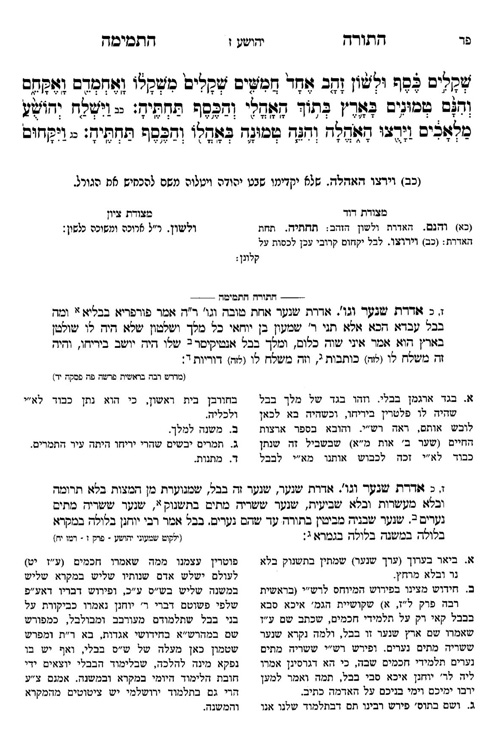
Yesod Shirim, as noted above, is on Megillat Ruth. But it is not a commentary, rather it is Midrash ha-Ne’elam, the first printing of that section of the Zohar on Ruth. The colophon states that it was printed in Thiengen by the oppressed Joseph ben Naphtali on Sunday, 23 Teves 320 (January 10, 1560). Why oppressed (עשוק) is unclear.

מלאה הארץ דעה Malah ha-Aretz De’ah – The siddur (prayerbook) prepared by R. Naphtali Hirz Treves. Malah ha-Aretz De’ah was published in octavo format (80: [242] pp.). The text of the title-page has an attractive frame with cherubim at the sides.

Malah ha-Aretz De’ah
Courtesy of the National Library of Israel

The title מלאה הארץ דעה is from “For the land shall be filled with devotion (malah ha-aretz de’ah) [to God]” and below it the verse continues “As water covers the sea” (Isaiah 11:9).[25] The text of the title-page continues that it is tefillah (prayer) for the entire year with an attractive commentary as well as a commentary in a kabbalistic manner by R. [Naphtali] Hirz [Treves]. Malah ha-Aretz De’ah is an Ashkenaz rite siddur. The text of the volume is in vocalized square letters accompanied by the commentary in rabbinic letters.

In addition to Naphtali Hirz Treves’ use of kabbalistic works in preparing his commentary to the siddur, he utilized several other sources, among the most important of which was R. Eleazar of Worms (c. 1176–1238) Sefer ha-Rokeah, an important and classic halachic and kabbalistic work.[26] Among his other sources was the Maharil (R. Jacob Moelin (c. 1365 –1427) and R. Bahya. Malah ha-Aretz De’ah closely follows the liturgy of Hasidei Ashkenaz. The commentary is extensive and lengthy.

Malah ha-Aretz De’ah was reprinted three times; two editions in Beni Brak, 1971 and 2004 and by Renaissance Hebraica c. 2000. The Renaissance Hebraica edition includes an alternative title page border. It reuses the border from Begidat Hazman.

מלכיאל Malkiel – A multi-faceted philosophical and ethical work on the afterlife, reward and punishment, and comforting Zion by R. Malkiel Hezkiah ben Abraham. Printed in quarto format (40: 22 pp.), the text of the title-page is concise, set in a decorative border. The purpose of Malkiel is described as being intended to understand the words of the sages.

Malkiel
Courtesy of the Library of Agudas Chassidei Chabad Ohel Yosef Yitzhak

Malkiel addresses such subjects as Gan Eden and Gehinom for the souls and body after death. The concealed meaning of pairs is explained, and the issue of “the tree of knowledge of good and evil” (Genesis 2:9) that the Lord prohibited to the first man and the reasons for his sin. Also explicated are the Garden of Eden, the Tree of Knowledge, Og King of Bashan and additional enigmatic aggadic materials. Additional subjects based on the words of the sages in the Talmud and Midrashim are addressed. The text is in a single column in rabbinic letters.

This is the first printing of Malkiel. Friedberg records seven later editions, beginning with Offenbach (1715) through Vilna and Grodno (1819).[27]

שיר היחוד Shir ha-YihudShir ha-Yihud (Hymn of Divine Unity) is an anonymous piyyut (liturgical poem) written in the mid-twelfth century, most often attributed to Samuel ben Kalonymus he-Hasid (c. 1130-1175), less often to his son, Judah ben Samuel he-Hasid (c. 1150-1217), author of the Sefer Hasidim, both among the foremost representatives of the Hasidei Ashkenaz, and, on occasion, to yet others. This edition was published in quarto format (40: 20 ff.). The title-page has the same frame with cherubim as Begidat Hazman (above).

Although there exist several piyyuttim entitled Shir ha-Yihud, this is the most well-known. Unlike most early manuscript versions of the Shir, which were divided into chapters, later versions, and all printed editions, are divided by the days of the week, one for each day, praising God and his uniqueness, in contrast to the insignificance of man. Lines are divided into rhymed couplets, with four beats to a couplet The fourth day differs from the other days in that it is the only day for which the verses are arranged in alphabetic order; however, the number of lines to a letter are not equal. Shir ha-Yihud is, philosophically, based on the Sefer ha-Emunot ve-ha-De’ot of R. Saadiah Gaon (882-942), a fact acknowledged on the title page.

Shir ha-Yihud
Courtesy of the National Library of Israel

It is customary, today, to recite Shir ha-Yihud on Yom Kippur eve, at the end of services, its more frequent repetition being opposed by a number of rabbinic figures, such as R. Jacob Emden (16971776), R. Solomon Luria (1510-1574) and Rabbi Judah Loew (Maharal, 1525-1609). The latter restricting it to Yom Kippur only, a “day set aside for praise of God, when a person is on a higher level, comparable to an angel” (Netivot Ovodah ch. 12, Netivot Olam).

The text of Shir ha-Yihud is accompanied by the commentary of Yom Tov Lipman Muelhausen (14th-15th centuries). Muelhausen was a dayyan in Prague, a highly respected halakhist and kabbalist. His most famous work is the Sefer ha-Nizzahon, a polemic against Christianity, passed down by hand from generation to generation, until a monk, Theodore Hackspan, seized a copy from the rabbi of Schneittach. Hackspan translated Nizzahon into Latin, added notes in attempt to refute its arguments, and had it printed (Altdorf, 1644). A Jewish edition did not appear until 1701. In a brief introduction to Shir ha-Yihud, Muelhausen writes that he has seen many commentaries on this holy work, but found them to be “straw mixed with grain.” Noting that these are inadequate, not explaining the intent of the author, he asks, “help from the Helper, my Rock, the Almighty, and I will write here all that I received, “mouth to mouth” (Numbers 12:8) from those who know the truth.” [28]

1566 שיר היחוד Shir ha-Yihud – A improbable edition of Shir ha-Yihud is listed in the Thesaurus as the seventh Thiengen imprint. It is also recorded by Isaac Benjacob in Otzar ha-Sefarim (Vilna, 1880) together with the previous 1560 printing.[29] Nevertheless, it is improbable that six years after the press was forced to close it should reopen and publish a single work, identical to one of its previous titles. Furthermore, no library records a copy of this edition. Perchance, the entry was a misreading of the early printing, copied by bibliographers and then recopied, so that in some circles it was accepted as a valid edition.[30]

The books printed in Thiengen, small in number, are nevertheless diverse. Subject matter is varied, encompassing kabbalistic and philosophic works, an allegoric maqāma, a kabbalistic commentary on the Book of Ruth, the siddur prepared by R. Naphtali Hirz Treves, and a liturgical poem. An unusual and interesting aspect of several of the Thiengen imprints is that the large lead phrase on the title-page is not the book title, which follows later in a smaller text font.

The publishers were prominent rabbis from a distinguished rabbinic family. The books printed within the span of one year, to be repetitive, are rich and varied. Thiengen, as so many other small short-lived presses, deserves to be recalled, having made a short lived but valuable contribution to Hebrew literature.

  1. Once again, I would like to express my gratitude and appreciation to Eli Genauer for his insightful comments.
  2. Stephen G. Burnett, “The Regulation of Hebrew Printing in Germany 1555-1630” in Infinite Boundaries: Order, Disorder and reorder in early Modern German Culture, ed. M. Reinhart & T. Robisheux, Sixteenth century Essays and Studies, no. 40 (Kirksville, 1998), pp. 329-30.
  3. Yehoshua Horowitz, “Treves,” Encyclopedia Judaica, (Jerusalem, 2007), vol. 20 pp. 134-35. See generally, Marcus Horovitz, Rabbanei Frankfurt (Jerusalem, 1972), 21-26; Nahum Brüll, “Das Geshiechet der Treves,” in Jahrbücher für jüdische Geschichte und Litteratur (Year 1, 1874), 87-122; and his additions, id., (Year 2, 1876), 209-10; Tzvi Lehrer, Tolodot Naphtali Hertz Treves,” in Hetzei Geborim, 7, (2014), 485-95.
  4. Isidore Singer, Schulim Ochser, Frederick T. Haneman, Richard Gottheil, Isaac Broyde, “Treves,” Jewish Encyclopedia vol. 12 (New York, 1901-06), pp. 243-48.
  5. David Amram, The Makers of Hebrew Books in Italy (Philadelphia, 1909, reprint London, 1963), pp. 205, 291.
  6. There is uncertainty about his birth and death dates. Horovitz, Rabbanei, 191-92.
  7. According to R David Gans, Eliezer attributed the failure to “the sins of the generation.” David Gans, Zemah David (Prague, 1592), Asher Lemlein (Lammlin) (16th century) was a false messiah active in 1500–02. Of Ashkenazi origin, Lemlein began his activities in northeast Italy, continuing in Germany. He claimed that, the redemption was approaching because the Messiah, Lemlein himself, had already come. Even some Christians accepted his Messianic prophecy. After his passing his movement ceased. Richard Gottheil, Isaac Broydé, “Lemmlein (Lammlin), Asher,” vol. 7, Jewish Encyclopedia, p. 680; “Lemlein (Lammlin), Asher,” vol. 12, Encyclopedia Judaica, p. 638. Dan Rabinowitz informed that Eliezer was living in Cracow already and transcribed the letters because he was caught up in the Messianic speculation. In 1531, he wrote to his father Naphtali, about the religious fever Molcho introduced into the general public. See Naphtali Hertz Treves, Malah ha-Aretz De’ah.
  8. Mordechai Margalioth, ed., Encyclopedia of Great Men in Israel I (Tel Aviv, 1986), col. 190 [Hebrew]; Isidore Singer, Schulim Ochser, Frederick T. Haneman, Richard Gottheil, Isaac Broyde, “Treves,” Jewish Encyclopedia vol. 12 (New York, 1901-06), pp. 243-48. Horovitz, Rabbanei 22-28, who provides the most comprehensive discussion regarding Eliezer.
  9. Solomon Molcho (1500-32) was born Diogo Pires to Marrano parents. He circumcised himself, became a follower of David Reubeni, who claimed to be the son of a King Solomon and brother of a King Joseph ruler of the lost tribes of Reuben, Gad, and half Manasseh in the desert of Habor. At some point he too claimed to be the Messiah. His sermons were published, Derashot (Salonika, 1529) and subsequently as Sefer ha-Mefo’ar. In 1532, Molcho went to Ratisbon, where the emperor Charles V imprisoned him. An ecclesiastical court sentenced Molcho to death by fire for Judaizing. He was offered a pardon by the emperor on the condition that he recant and return to the church. Molcho refused, choosing a martyr’s death. (Isidore Singer, Philipp Bloch, “Molko, Solomon,” vol. 8 JE, p. 651); Joseph Shochetman] “Molcho, Solomon,” vol. 14 EJ pp. 423-24. Elisheva Carlebach, “Messianism,” The YIVO Encyclopedia of Jews in Eastern Europe, Gershon David Hundert, ed. Vol. 1 (New Haven & London, 2008), p. 1160, informs that Molcho left a deep impression on Ashkenazic Jews. His messianic flag and caftan were preserved by the Jews of Prague and can still be seen there today. Concerning both false messiahs also see Moses Idel, Messianic Mystics (New Haven & London, 1998) and Gershom S. Scholem, Sabbatai Sevi; the Mystical Messiah (Princeton, 1973), var. cit.
  10. Dr Moshe Nathan Rosenfeld, “The Identity of an unknown Yiddish Prayer Book (From Zürich to Zürich),” Seforim Blog (February 18, 2025).
  11. He died prior to 1546 because, in Yesod Shirim, published that year, he is referred to as already deceased. But the exact year of his death is unknown. See Lehrer, Tolodot, 494n106.
  12. https://en.wikipedia.org/wiki/Naphtali_Hirsch_Treves. See also, Horovitz, Rabbanei, 21. Naftulei Elokim is one of two books printed in Heddernheim, a quarter of Frankfurt am Main. the other work being a Selihot, also printed in 1546, both published by a Hayyim ben Joseph (Yeshayahu Vinograd, Thesaurus of the Hebrew Book. Listing of Books Printed in Hebrew Letters Since the Beginning of Printing circa 1469 through 1863 II (Jerusalem, 1993-95), p. 158.
  13. Michael A. Meyer, editor, German Jewish History in modern Times, vol. 1 Tradition and Enlightenment 1600-1780 (1996 New York) p. 72.
  14. “Tiengen,” The Encyclopedia of Jewish life Before and During the Holocaust, editor in chief, Shmuel Spector; consulting editor, Geoffrey Wigoder; foreword by Elie Wiesel, vol. 3, p.1306.
  15. Some question whether they were related or just shared similarly named fathers. See Lehrer, “Tolodot,” 295n110.
  16. Friedberg, Ch. B. History of Hebrew Typography of the following Cities in Europe: Amsterdam, Antwerp, Avignon, Basle, Carlsruhe, Cleve, Coethen, Constance, Dessau, Deyhernfurt, Halle, Isny, Jessnitz, Leyden, London, Metz, Strasbourg, Thiengen, Vienna, Zurich. From its beginning in the year 1516 (Antwerp, 1937), [Hebrew]; Vinograd, Thesaurus of the Hebrew Book. II p. 3394
  17. Yehoshua Horowitz, “Treves, Johanan ben Joseph,” EJ, vol. 20, p. 135.
  18. Executive Committee of the Editorial Board.,M. Seligsohn, “Simeon ben Samuel,” Jewish Encyclopedia vol. 11, p. 357.
  19. Marvin J. Heller, The Sixteenth Century Hebrew Book: An Abridged Thesaurus vol. II (Brill, Leiden, 2004), pp. 504-05.
  20. David Gans, Zemah David (New York, n. d.), I, yr. 1563 [Hebrew].As Brüll notes, this is an error. Likely reversing the letter “gimal” and “zayin.”
  21. Ch. B. Friedberg, Bet Eked Sepharim, (Israel, n. d), alef 629 [Hebrew].
  22. Yonah David/Angel Sáenz-Badillos, “Mattathias (or Mattityah ben Moses?)” vol. 13 EJ, pp. 685-86.
  23. Friedberg, Bet Eked Sepharim, bet 243. Concerning the Prague edition, Gavin McDowell, “A Genealogy of Errors: Targum Pseudo-Yonatan’s Commentary Tradition” (https://books.openedition.org/ephe/2868?lang=en) informs that Shabbetai Bass (1641-1718), author of the first bibliography of Hebrew books by a Jewish author, in his Siftei Yeshenim (Amsterdam, 1680) misdated Begidat ha-Zeman. Acording to McDowell “The tally of the numeric value of these letters is 369 (80 + 5 + 80 + 200 + 1 + 3), which is 1608/09 of the Christian calendar. Bass forgot to count the word פה, reducing the date by 85 years and resulting in the year 284, which is 1524 CE.”
  24. Yehoshua Horowitz, EJ vol, 20 p. 134.
  25. The exact title is subject to some confusion and debate. The enlarged words on the title page, Malah ha-Aretz De’ah, would normally indicate it is the title. But, some of the other Thengin prints like Sod Yesharim, the enlarged letters, in that instance, Tapuchei Zahav, are not the title. Following Ben Jacob, Friedberg, in Bet Eked Sepharim refers to it Tefilot me-Kol ha-Shana Minhag Ashkenaz. Friedberg, Bet Eked Sepharim, Taf 1711. Yet, he is cited in many rabbinic texts as Siddur Rav Hirtz Shatz, and the two Beni Brak reprints use that title. See Lehrer, Tolodot, 492. Naphtali, in his introduction, titles the work Dikduk Tefilah. Unlike the printer’s introduction that precedes the work, Naphtali’s does not appear until after P’sukei D’Zimra, and may have been overlooked.
  26. The entire commentary for P’sukei D’Zimra are from Eleazar. See “Editor’s Note,” Hetzei Geborim, 8(2015), 1121.
  27. Friedberg, Bet Eked Sepharim, mem 2094.
  28. Heller, The Sixteenth Century Hebrew Book, p. 518-19; Joseph Dan, ed., Shir Hayihud (Jerusalem, 1981), pp. xii-ix and 7-26 [Hebrew with English introduction]; and A. M. Habermann, Shir ha-Yihud ve-ha-Kovod (Jerusalem, 1958), pp. 11-12 [Hebrew]. See also Abraham Berliner, “Shir ha-Yihud,” in Ketavim Nivharim I (Jerusalem, 1945), pp. 145-70 [Hebrew].
  29. Isaac Benjacob in Otzar ha-Sefarim (Vilna, 1880), p. 183 no. 475 [Hebrew].
  30. Concerning the misdating and other errors in the publishing of Hebrew books see Marvin J. Heller, “Who can discern his errors? Misdates, Errors, and Deceptions, in and about Hebrew Books, Intentional and OtherwiseHakirah: The Flatbush Journal of Jewish Law and Thought 12 (2011), pp. 269-91, reprinted in Further Studies in the Making of the Early Hebrew Book (Leiden/Boston, 2013), pp. 395-420; ibid. “Who can discern his errors? Misdates, Errors, Deceptions, and other Variations in and about Hebrew Books, Intentional and Otherwise: Revisited,” Seforimblog, Sunday, July 03, 2016, reprinted in Essays on the Making of the Early Hebrew Book (Leiden/Boston, 2020, pp. 507-36.


Mysteries of the Magical Fifth Passover Cup (II): The Great Disappearing Act

Mysteries of the Magical Fifth Passover Cup (II): The Great Disappearing Act

By Leor Jacobi

Years ago, as a Yeshiva Bochur, a Rabbi explained to me that, according to the GRA, the Cup of Elijah at the Passover Seder is really the Fifth Cup mentioned in the Talmud which there is a doubt about  Thus, it is Elijah’s cup because when he returns to herald the redemption, every Talmudic tequ will be solved. I found that the elusive Fifth Cup is not actually mentioned in the Talmud as we have it, but by most of the Rishonim, who all had a textual variant.

Later, as a Junger Mann, I found R. Menachen Mendel Kasher’s pamphlet on the Fifth Cup, also published in his Haggadot (generally abridged). Despite some intrinsic flaws, it is a masterful and ingenious integration of traditional and modern methods.

A few years ago, groundbreaking publications by my teacher, David Henshke, and my colleague, Eliezer Brodt, inspired me to build upon their foundation, concentrating on points which remain obscure or unsolved.

As there are quite a few of these, I divided up the study into seven chronological and thematic parts which I hope will evolve into book chapters eventually but also stand alone as they are. The first part of the envisioned series, on the magical genesis of the fifth cup, was accepted by a prominent journal that graciously agreed to have an early draft distributed here. Part four, on 19th century scholarship post-Levinsohn was recently submitted to another leading academic journal.

With the current social upheavals due to the Coronavirus pandemic in mind, thanks to the generosity of the editors of the Seforim Blog, we can forego delays and release a draft of part two in time for Passover. Hopefully, the virus will disappear faster than the fifth cup did! Please favor me with your feedback towards advancing the project and I will do my best to acknowledge any and all contributions.

In a previous study on the genesis of the Fifth Cup, a primary textual variant of the Babylonian Talmud (Pesachim 118a) was identified as the source, an original teaching from the Talmudic Sages. Following the compilation of the Talmud, Babylonian Geonim not only received this textual variant, but actually drank the fifth cup themselves, with the apparent exception of Rav Hai Gaon, who also had the fifth cup Talmudic variant, but interpreted it as an optional practice, one which he did not follow. If the fifth cup was ordained in Babylon due to zugot, concern for even pairs arousing evil spirits, as explained in the prior study, perhaps Rav Hai inherited the original Palestinian custom of only four cups (zugot was only an issue in Babylon), as the Sages of Erez Israel did not believe in zugot. Alternatively, perhaps Rav Hai rejected the fifth cup as far as his own practice but not to the point of speaking out against it.

The fifth cup was widely observed among the Babylonian Geonim, and subsequently mentioned by Alfasi, Maimonides, and by Tur (14th century), the latter at length, with an entire siman (OḤ 481) devoted to it. 


However, if we fast-forward to the 16th century, we find that, despite an extensive discussion in R. Joseph Karo’s monumental Bet Yosef the fifth cup disappeared completely in his Shulḥan Arukh. Following the order of Tur, R. Karo gave names to all of the simanim. Here, he adopted a side issue of the siman and made it the focus and new title: “Not to drink after the fourth cup”. 


Furthermore, none of the principal commentators on the Shulḥan Arukh (“nose kelim”, 16th-17th centuries) even noted its disappearance. Explaining the magical disappearing act of the fifth cup during the Middle Ages will be the focus of this study.

The disappearance has bothered modern scholars of rabbinic literature, who struggled to explain it, most notably R. Menahem Kasher. Several factors have been suggested to explain the elimination of the fifth cup. They include: 1) Deletion of the Talmudic text mentioning the fifth cup due to homoteleuton (skipping text from one similar word to another)[1], 2) Endorsement of this variant by Rashi and Rashbam, 3) Application of this variant by subsequent Ashkenazi scribes,[2] 4) Circulation of an abbreviated version of Rav Hai Gaon’s responsum (in Tur) which suggests that Rav Hai Gaon also received the “Rashbam’s” version of the Talmud which does not mention the fifth cup,[3] 5) A statement at the beginning of Tur that the fifth cup should not be drunk, probably explaining Rashbam’s opinion, but ambiguously stated, 6) the development of a stringency in Medieval Ashkenaz to refrain from all drinking after the fourth cup, with some including even water in the prohibition (see below) and 7) The publication of the Venice edition of the Talmud, in 1520-23 following Rashbam’s textual variant, with no mention of the fifth cup, all subsequent editions following in kind, almost certainly the edition consulted by R. Joseph Karo.

Despite this multitude of factors, they don’t adequately explain R. Joseph Karo’s editorial decision to completely delete such a well-entrenched custom as the fifth cup, mentioned by all three of his pillars, Alfasi, Maimonides, and Rosh.[4] I propose that an additional factor, barely recognized previously and never noted in this context, was the one that settled the matter conclusively in the mind of Maran.

Rabbenu Yonah Girondi (13th century) maintained that one should refrain from drinking extra wine so as to be able to study the laws of Passover and the story of the Exodous all night, as the Sages did in Bne Braq. Maharil cites Rosh (Asheri) as adding that the fifth cup was permitted due to the verse v’heveiti. However, our standard printed text of Rosh states that the fourth cup is permitted due to the verse v’laqaḥti

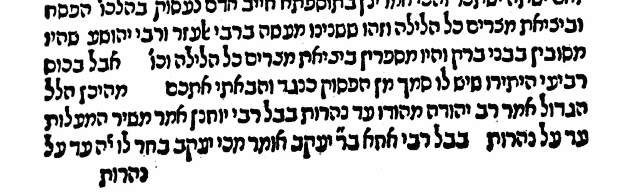
(אבל בכוס רביעי התירו שיש לו סמך מן הפסוק כנגד ולקחתי אתכם. (סימן לג…

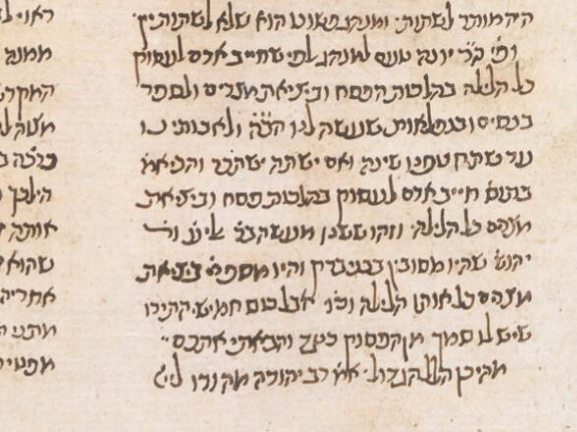
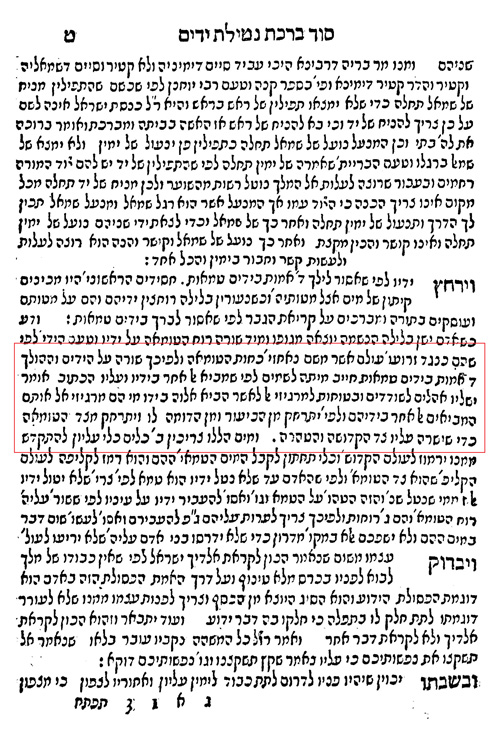
Rabbi Alter Hilewitz (1906-1994, author of halakhic works and editor of Encyclopedia Talmuditobjected that the printed text makes no sense and must have become corrupted.[5] There is no reason to permit the fourth cup after it has already been mandated in the Mishnah. The special dispensation must have been for the fifth cup and Maharil cited the genuine text version of Rosh.[6] R. Hilewitz’s hunch was correct, as we find in an early manuscript of Rosh (Asheri) written in Spain in 1325 during the lifetime of Rosh (from middle of 3rd line from bottom):[7] 


Rabbi Hilewitz

The corruption was a by-product of proliferation of the Rashbam’s text of the Talmud eliminating the fifth cup entirely. It probably represents an unintended stringency in interpretation of the prohibition on drinking excessively. Another correction we find in the manuscript is the attribution of the opinion. The manuscript attributes it to Rabbenu Yonah, corresponding to the attribution in Tur. However, the printed edition misattributes it to ר”מ, R. Meir of Rothenburg, master of Rosh.

The text of Rosh which R. Joseph Karo relied upon was almost certainly that of the famous aforementioned Venice edition of the Talmud.[8] It reads:

.אבל בכוס רביעי התירו שיש לו סמך מן הפסוק כנגד והבאתי אתכם…


The text does not make sense. It is conflated. Either the fourth cup was permitted by the verse v’laqaḥti (as in the modern printed editions), or the fifth cup was permitted by the verse v’heveiti (as in the manuscript). The fourth cup could not have been permitted by the verse v’heveiti. The development was apparently a two-stage process and the Venice Edition represents the “missing link”, an intermediate stage in which the fifth cup was changed to the fourth cup but the verse remained intact. At this point, R. Joseph Karo or the later publishers could have corrected the text back to “the fifth cup”, restoring the original version in the manuscript. However, the tide was already turning towards the fourth cup Talmudic textual variant in Bet Yosef, with his decision to read Rashbam’s Talmudic textual variant into Rav Hai Gaon’s responsum.[9] R. Joseph Karo decided to keep “the fourth cup” and to ignore the word v’heveiti, or to mentally “correct” it to v’laqaḥti, exactly how the later printers chose to emend the text of Asheri.

One can speculate as to why Kasher, Benedict and subsequent Rabbinic scholars did not discover this source. R. Hilewitz’s observation was published in a 1945 newspaper article in Palestine. At the time, war was raging and R. Kasher was in America. Manuscript variants of the text of the Talmud have been studied and published on for years[10] and the last generation has brought us two editions of Tur prepared using manuscripts.[11] Even Tosafot Rosh is published from manuscripts in critical editions.[12] However, for some reason, manuscripts of Rosh are relatively uncharted territory, despite the centrality and rabbinic authority of the work. Perhaps (similar to Rashi’s Talmudic commentary, up until the groundbreaking work of my teacher, Aaron Ahrend) it is this very centrality that led its manuscripts to be ignored, as it was printed so early on, in the Venice Talmud, and so many times. 

Most significantly, the text is hidden from view. Tur clips off this section of the discussion and Bet Yosef does not cite it. However, once we return to the textual version that laid open before R. Joseph Karo on his desk, which he certainly meditated on, we can understand how he interpreted the abbreviated text of Tur and why he decided to delete the fifth cup.


Addendum: The Power of Piyyut

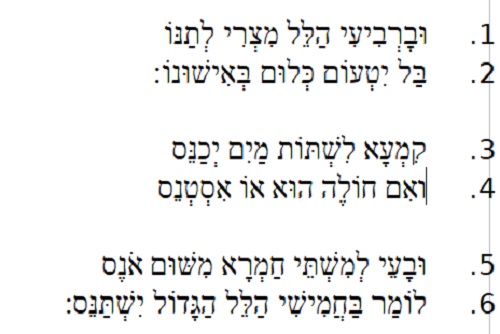
Shmuel of Evreux adopted a stringency not to drink even water after the four cups.[13] His source was the piyyut composed by R. Yosef Tuv Elem for a qerova recited on Shabbat ha-Gadol.[14] The last two stanzas at the end of the piyyut are the most famous today, for they are recited almost universally at the end of the Haggadah: “Hasal siddur Pesah”. The stanza preceding it is one mentions the fifth cup. There are two textual variants of this line interpretations of the piyyut. Three manuscripts read as follows:[15]


According to this text, line 3 states that it is permitted to drink water absolutely, in accordance with normative halakhah. Line 4 adds conditions for drinking wine, being sick or finicky, as described in line 5 with the recitation of Hallel ha-Gadol in line 6.

Medieval piyyut commentaries also follow this text, for example, the commentary by Samuel b. Salomo of Falaise:[16]

…קמעא, מעט, לשתות מים יכנס, לאחר סעודתו אם ירצה לשתות, ואם חולה הוא או אסטניס ובעי למשתי חמרא ואינו יכול לשתות מים, לומ’ בה’ על שם ‘ה הלל הגדול, ישתנס, יאזור

However, the textual variant followed by the Tosafot (Pesahim 117b) omits the vav at the beginning of line 4. Now the conditions of line 4 apply to line 3 as conditions for drinking water. Apparently from this piyyut, R. Shmuel of Évreux derived the stringency against drinking water after the Seder.[17] Tosafot for chapter Arvei Pesahim were based upon the Tosafot of R. Yechiel of Paris or a student of his, such as Rabbenu Peretz (Shalem Yahalom). R. Yechiel was in contact with R. Shmuel. R. Yechiel would attempt to refute R. Shmuel’s novel stringencies. Sometimes the refutation was accepted, such as cited by R. Peretz in his gloss to Smak 93, and sometimes not, as found in Orhot Hayyim, Hilkhot Tum’ah, vol 2, p. 602, and apparently in our case regarding the stringency of not drinking water. In this case, the development of a stringent shitta forbidding even the drinking of water likely shifted the goalposts of halakhic discussion away from the option of the Fifth Cup of wine. 

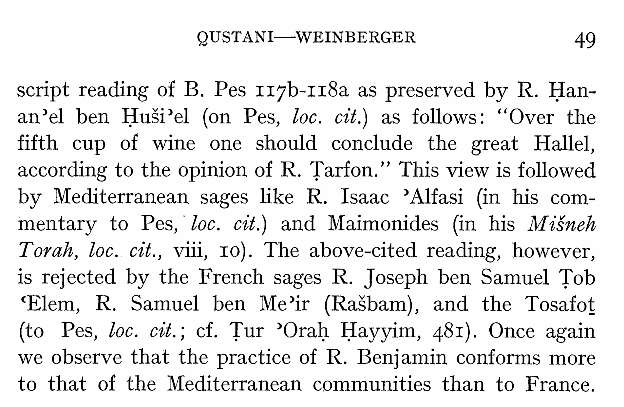
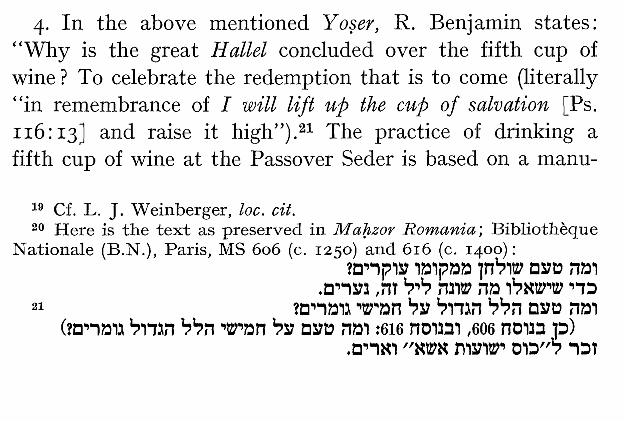
Finally, on the topic of piyyut, Leon J. Weinberger described a poem from R. Binyamin which mentions the fifth cup as a basic custom, an integral part of the Passover Seder. The piyyut was later published in its entirety by Ezra Fleischer.[18] According to Weinberger, it provides a messianic interpretation of the fifth cup, an aspect of the fifth cup that will become more evident during later periods to be discussed in chapters of this study yet to come. 


Editor Note: please see Eliezer Brodt’s earlier post on this subject: https://seforimblog.com/2013/03/the-cup-for-visitor-what-lies-behind/

[1] Henshke; also see here for another possibility and analysis of Talmudic manuscripts here.
[2] Kasher noted Rabbenu Tam’s fierce opposition in general to applying proposed emendations into the text of the Talmud itself, blaming Rashbam (his older brother) in particular. See Spiegel, Soloveitchik, briefly reviewed in my Jewish Hawking in Medieval France.
[3] Rav Kasher advanced this claim convincingly to explain the deletion by R. Joseph Karo. R. Avraham Benedict also advanced this claim, without crediting Kasher. As far as rendering a legal decision, Benedict took a diametrically opposite position. According to Kasher, now that we possess the full version of Rav Hai Gaon’s responsum, we see that R. Joseph Karo was led astray by an ambiguous text. Benedict considers R. Karo’s decision binding and the presence of the abbreviated version is ample justification.
[4] Noted especially by Kasher, also by Henshke.
[5] ‘Kos shel Eliahu’, Bamishor 245-6 (25.3.1945), p. 5.
[6] This version is also found in Abudraham (Seder ha-Haggadah u’Perisha, ed. S. Kroizer, Jerusalem 1963, p. 234), citing Rabbenu Yonah. Abudraham’s source was probably Asheri, but he did not generally cite secondary sources, as he himself stated in his introduction (p. 6.). See: L. Jacobi, “Talmudic Honey”, Fragments of the Novellae of R. David ben Saul of Narbonne”, Giluy Milta B’alma, 2/17/2016.

[7] British Library Add. 27293 f. 131v.
[8] Bomberg: Venice 1520-1523, p. 138b.
[9] Kasher, Benedict.
[10] Diqduqe Sofrim, Lieberman Instritute, Friedberg.
[11] Shirat Devorah; Ma’or.
[12] Mossad Ha-Rav Kook, Ofeq Institute.
[13] Cited by Mordechai, Hagahot Maimoniot (Ed. Constantinople, 6:11, “gedole Evreax”), Agur. Tosafot Pesachim 117b.
[14] See a letter from Pinchas Eliyahu Lawee in Kobetz Beit Aharon 15:5 (89, 1998), pp. 135–136.
[15] With only minor variants irrelevant for our purposes. Gabriel Wasserman shared with me his pilot edition of variants and Abraham Levine provided me with expert guidance in this study.
[16] Parma – Biblioteca Palatina Cod. Parm 3000 (de Rossi 378), f. 30a-35b. I was aided in locating piyyut commentaries by Elisabeth Hollender’s monumental Clavis.
[17] Another later piyyut follows this strict opinion, recently published by R. Jacob Israel Stal. See his note at page 33.
[18] Kobez al Yad 21 (1985), p, 31.


R’ Orenstein, Author of the Yesuos Yaakov: The Controversy Over Publication of his Works

R’ Orenstein, Author of the Yesuos Yaakov: The Controversy Over Publication of his Works
by R. Yosaif M. DubovickR. Y. Dubovick has published many articles on diverse topics. He is currently working on many projects including a critical edition of the Rabbenu Hananel’s commentary on Bava Kama. Additionally, he has published a critical edition of the Mahrashal on hilchot shehita and Yoreh Deah (discussed here ) and R. Dubovick is working on some of the Mahrashal’s other works. As R. Orenstein’s yarhzeit is the 25th of Av, Tuesday, Aug. 26, R. Dubovick provides the following information on this personage and his works.
Biographical Sketch of R’ Orenstein

Perhaps the crown of pre-war Polish Jewry was the city of Lvov (Lviv, Lemberg). Settled in the dawn of our history in Poland, the city was renowned as a center of learning and piety, drawing from the elite of scholarship to its helm. The mere mention of the city’s name draws to mind those Gaonim, such as R’ Yehoshua, author of Shut Pnei Yehoshua, Sefer Maginei Shlomo (grandfather of the author of the noted Pnei Yehoshua on Shas), as well as R’ Shmuel HaLevi author of Turei Zahav on Shulchan Aruch [1](son-in-law of R’ Yoel Sirkes[2] the author of Bayis Chodosh on Tur)[3]. R’ Zvi Ashkenazi (author of Chacham Tzvi, father of R’ Yaakov Emden), R’ Shlomo of Chelm, author of Merkeves haMishnah on Rambam (as well as homilies on the haftorot and a volume of responsa[4]), and R’ Chayim Hakohen Rappoport[5] all held the position of Av Beis Din and Rav of Lvov. The subject of Toldos Anshei Shem by R’ Shlomo Buber, Lvov has had its history well written and studied. R’ Buber went so far as to personally request from the Rav of Krakow, the noted historian and author, R’ Noson Chayim Dembitzer to collate his own findings; the result, a sefer of immense value to any student of history and genealogy, Klillat Yofe.[6] These seforim list prominent men of stature and renown, leaders of the kehillot, their works and ancestors, shedding valuable light on the city’s history. From the beginning of the 5th century, (1640) Lvov’s two communities [‘inner’ Lvov, and ‘outer’ Lvov] united under the leadership of one Rav. This period of grace between the communities lasted for close to two hundred years, and ended with the passing of the famed Gaon of Lvov, R’ Yaakov Meshulem Orenstein in 5599 (1839), the focus of this article. Much has been written regarding this sage, with numerous accounts detailing his biography. Klillat Yofe details his father’s position as Rav of Lvov, R’ Mordechai Zeev, who took office after R’ Shlomo of Chelm stepped down as Rav in order to embark on a journey to Eretz Israel.[7] In 5547 (1787) R’ Mordechai Zeev was taken suddenly from this world, leaving a young twelve year old Yaakov Meshulem an orphan. The youth’s best interests in mind, whilst still in the shiva period he was betrothed to the daughter of R’ Tzvi Hirsch of Yaruslav, who was financially well off and would support his son-in-law.[8] As such, the young man developed in his studies, and gained repute as a scholar of stature. His opinion was sought in many difficult matters, and elders as well as his contemporaries flocked to his doorstep in Yaruslav to discuss various issues with him. Notably, R’ Aharon Moshe Tobias of Satnin, author of Shut Toafos Reem, would spend much time conversing with R’ Yaakov Meshulem.[9] Additionally, he was friends with R’ Yehonosan Shimon Frankel, author of Etz Pri Kodesh, Lember, 1838. See his haskmah where he referrs to him as “yidid nafshe.” He was also friendly with R’ Yaakov Tzvi Yalish, author of Melo haRoim who he refers to as “hu yedidi min’noar.”
R’ Yaakov Meshulem mentions having been Rav AB”D of Zhalkov for a period, but the exact dates aren’t clear. Later, he was appointed to take his father’s seat as Rav AB”D of Lvov, and we find witness that in 5566 (1806) was already serving Lvov as its spiritual head, a position he held for over 30 years, until his passing. The hub of religious activity in Poland, R’ Yaakov’s opinion on halachic matters was sought out by the leading sages of his time. Halachic authorities such as R’ Moshe Sofer (author of Shut Chasam Sofer), and R’ Akiva Eiger, R’ Aryeh Leibish of Stanislaw (as well as with his son and successor R’ Meshulem Yissocher, author of Shut Bar Levai), as well as R’ Yaakov’s relative, R’ Chaim Halberstam of Sanz all queried him on matters of grave importance. His opinions regarding rulings issued by R’ Shlomo Kluger of Brody versus his dissenters are collected in sefer Shivas Eynayim, along with those of his son, R’ Mordechai Zeev. While himself not a member of the Chassidic camp, R’ Yaakov showed no animosity towards Chassidim and their leaders, and is purported to have met with Rebbe Yisroel Freidman of Ruzhin, as well as Rebbe Meir of Premshlyn. As the head of the most prestigious community in the area, R’ Yaakov also held the position of Nasi or president of Eretz Israel, and was responsible for the collation and distribution of all tzedakah funds earmarked for the Holy Land’s poor.[10] In addition, being financially secure, R’ Yaakov established a personal free-loan organization, a gemach. The apple of his eye, his only son R’ Mordechai Zeev was taken from him at an early age on the 17th of MarCheshvan 5597 (Oct 28, 1836). Less than three years later, R’ Yaakov passed away on the 25th day of Av, 5599 (Aug 5, 1839), and was buried next to R’ Shmuel Halevi, author of Turei Zahav. Out of respect for their venerable leader, it was agreed upon that no longer would there be one Rav heading both communities, rather a new title called ‘Rosh Bais Din’, with less authority was implemented. In the succeeding line of leaders, Lvov called R’ Yaakov’s grandson, R’ Tzvi Hirsch to take his rightful place. In turn, R’ Tzvi Hirsch’s son-n-law, R’ Aryeh Leib Broide[11] succeeded him. R’ Orenstein’s Works & the Controversy Over Their PublicationA prolific writer, R’ Yaakov is best known for his magnum opus, Yeshuos Yaakov, novella covering all four sections of the Shulchan Aruch. Published in his lifetime, R’ Yaakov is said to have danced with a copy of a second edition, stating that he is now assured that this work is considered by heaven to be ‘prophetic’ in nature.[12] He also penned chiddushim on the Torah in the order of the parshiyos, at first printed together with the chumash entitled ‘Ein Yaakov‘, and later published as a separate volume. A new edition of these chiddushim was re-typeset in 5764 (2004), with a two page biographical sketch. Throughout Yeshuos Yaakov, R’ Yaakov cites numerous times his chiddushim on Shas, Rambam as well as his teshuvos, responsa. Seemingly, these works remained in manuscript form, and over the course of the years were lost. Recently, an attempt was made to ‘reconstruct’ those chiddushim on Shas based on chiddushim and references gleaned from sefer Yeshuos Yaakov. Chiddushei Yeshuos Yaakov al Seder haShas, 7 volumes, printed by Machon leCheker Kisvei Yad – Chochmas Shlomoh, Yerushalayim, 5757-60/1997-2000. In the last months of 5666 (1906), R’ Avraham Yosef Fisher, a well-known publisher, printed R’ Yaakov’s teshuvos from manuscript, in Peterkov. According to R’ Fisher, he was given the autograph from the then Gerrer Rebbe, R’ Avraham Mordechai Alter (author of Imrei Emes) for printing. The responsa were reordered according to the Shulchan Aruch, and in the end of the sefer, a table of contents as well as a list of errata and annotation was added. For reasons not fully explained, R’ Fisher printed the book sans approbations that he claimed to have received from various leaders. He had applied to several sages for their approval, and while waiting for their response, decided to publish without them. In deference to those letters not at hand, he chose to omit those he did have, citing his desire to publish as taking precedence. This printing of the sefer was photo-mechanically reproduced in New York some forty years ago. Several months after his sefer was printed, R’ Aryeh Leib Broide, the son-in-law of R’ Yaakov’s grandson and heir, R’ Tzvi Hirsch, issued a variant title page, and introduction. Claiming that the book had been in his personal possession to date, he alone had sent it to a printer, one Shimon Neiman for publication. Seemingly, the book changed hands, R’ Fisher took possession of the printed volumes, selling them under his name, with R’ Aryeh Leib Broide receiving a mere thirty volumes. As rightful owner, R’ Aryeh Leib decried this act, and wondered how the name of the Gerrer Rebbe had been brought in to the fray. The variant pages were then bound to these thirty volumes. Speculation as the behind the scenes reasoning would be an exercise in futility, as no word of it was mentioned by the Gerrer Rebbe himself.[13] While it is possible that R’ Aryeh Leib’s claims are accurate, R’ Fisher was a respected publisher, and would only stand to lose by stooping to theft. Further, the silence of the Gerrer Rebbe on the issue is deafening in its own right. What cause could he have had be still regarding this issue? If he did give the book along with a letter, why remain silent? On the other hand, if his name was simply being used, why did he allow himself to remain an accessory to theft, even if only a defacto one? One might postulate based upon the religious leanings of those involved. Lvov at the time was torn between the haskalah movement, and the majority of its opposition, the Chassidim. While R’ Yaakov stood strong against the waves of the enlightenment, after his passing those safeguards he passed began to lose potency. The Rabbinate in Lvov became politically controlled by those with positions of power and wealth, and sentiment among the Chassidic community in Lvov was that even R’ Tzvi Hirsch was suspect of leaning towards the maskilim.[14]> Certainly R’ Aryeh Leib was considered controversial. His son Mordechai (Marcus) studied in Polish schools, received a doctorate, and married Martin Buber’s sister, Gila. It is possible that R’ Neiman had suspicions as to the religious opinion of the book, seeing how the main buyers market were Chassidim. Should the book be published under R’ Aryeh Leib’s name, it might not sell. Moreover, it could be he suspected R’ Aryeh Leib of wanting to edit the text, based on his personal leanings. Perhaps he sent it to the Gerrer Rebbe, who in turn allowed for R’ Fisher to print it, and use his name. In the event of exposure, R’ Fisher would take the blame, while the Gerrer Rebbe would remain silent, thereby obfuscating the facts. This year, a new edition of this controversy-fraught sefer has been published. Completely re-typeset, with the annotations and corrections penned by R’ Fisher added in their rightful locations. Additionally, an index has been set up, to reference the standard ensemble of basic halachic texts; Shas Bavli and Yerushalmi, Rambam, Tur and Shulchan Aruch. Many of the responsa are those alluded to by R’ Yaakov in his Yeshuos Yaakov; some of the letters are replies to expound his thoughts in Yeshuos Yaakov. A veritable ‘who’s who’ of Galitzian Rabbis can be listed among those querying R’ Yaakov; R’ Chayim Halberstam of Sanz, R’ Aryeh Leibish of Stanislaw, and R’ Moshe Sofer, to name a few. The current publisher did not feel the edition would be complete without scouring the available literature and storehouses for those novella and letters that are not readily available. Such, an addendum was appended to the sefer, with additional responsa, derashos, chiddushim and even witticisms and anecdotes not found in the more common seforim. Of note, is a particularly interesting piece R’ Yaakov expounded upon in the main beis medrash of Lvov in honor of Kaiser Franz Joseph [Emperor Franz II], on June 29 1814 (the 11th of Tamuz 5). The spirit of the derashah is the miraculous victory the Emperor had over Napoleon Bonaparte, and how he was Divinely aided in battle. A lone copy of this sermon survived, and Dr. M. Balaban reproduced it in his volume in honor of Dr. Mordechai (Marcus) Broide. Other curios include novella that elaborate on those posed in Yeshuos Yaakov, and anecdotes from obscure works of that period. In one incident, while speaking with a local Rav of lesser standing, R’ Yaakov offered a very insightful thought. The Rav, realizing the potential use of this thought in a personal derashah, asked of R’ Yaakov to ‘present’ him with this thought and make it his “own”. Understanding the Rav’s motive, R’ Yaakov agreed under one condition: that upon using the thought as his own, he must announce that he received it as a gift from R’ Yaakov. As a final touch, the publisher added a photo of the original title page, as well as the variant pages printed by R’ Aryeh Leib. The ability to locate an extant copy of one of thirty copies ever bound testifies to the sheer effort expended in this edition.[Available at Girsa Books, Jerusalem; Biegeleisen Books, Brooklyn NY USA, and fine bookstores worldwide]

[1] Originally, the sefer was written as glosses and comments on Tur, much like the work by his father-in-law. [One might correlate the two works even more closely, and claim both emanated from marginal notes. See Prof. Y. S. Speigel, Amudim bToldot Hasefer haIvri, vol. 1, p. 297.] Later these notes were edited to form the present commentary.[2] R’ Shmuel married R’ Yoel’s widowed daughter-in-law (m. R’ Shmuel Tzvi Hertz, son of the Bach), and raised her orphan R’ Aryeh Leib, author of Shut Shagas Aryeh (w/ Kol Shachal). R’ Aryeh Leib was sent along with his brother by his stepfather to investigate the issue of Shabbtai Zvi.[3] During the outbreaks of 5424, two of his sons were massacred along with hundreds of the cities inhabitants. See D. Kahane, Sinai, 100 (Jubilee Volume), pp. 492-508.[4] Both published by Mossad HaRav Kook from manuscript.[5] Author of Shut R’ Chayim HaKohen.[6] Indexed by Jacob B. Mandelbaum.[7] Unfortunately, he never made it to E. Israel, having passed away along with his wife in the city of Salonika, Greece, and is entombed there. See A. Brick, Sinai 61, pp. 168-84.[8] Introduction to Yeshuos Yaakov.[9] Citation in Klillat Yofe and see here as well.[10] Called “the charities of R’ Meir Baal Hanes”. There is uncertainty regarding the true name of this charity. Historically, the tanna Rebbi Meir was never called “Baal HaNes” and the name is not found in neither Geonic literature or in works by the Rishonim. Furthermore, geographical guidebooks that list gravesites in E. Israel mention TWO R’ Meirs, one in Teveryah (this is the grave of the well known tanna, the student of R’ Akiva and friend of R’ Yehuda and R’ Shimon Bar Yochai) and one in Gush Chalav, the second bearing the name “Baal Hanes”. This would seem to distance the moniker from the well known R’ Meir even further despite his ability to perform miraculous accounts (see A”Z 18b. see also Petach Eynayim by R’ Chida ad loc). In his pamphlet biography of Ramban, R’ Reuven Margolis notes the above discrepancies. Based on Ramban’s final sermon in Spain, extolling the urgency to support those dwelling in the Holy Land, as well as Ramban’s personal activities in founding a house of worship along with a yeshiva in the then desolate Yerushalayim, R’ Margolis offers a novel theory. He is of the opinion that at one point, whether while heading his personal yeshiva in Yerushalyaim, or perhaps as the subsequent head of the Yeshiva of R’ Yechiel of Paris in Acco, Ramban established a central organization charged with soliciting and collecting funding from the Diaspora. As the years passed, the fund was named after its founder, Charities of Ramban. In all likelihood, at the fall of Acco to the Mamelukes, the Yeshiva was dismantled, and the funding dwindled, the name falling into disuse. At the rebirth of E. Israel settlement, perhaps in the times of R’ Chayim Abulefia in Tiveryah, the acronym forming the name RMB”N was reinstated as an antique fund, and further misinterpreted to be read R’ Meir Baal haNes.[11] Father of Dr. Marcus Broide. Out of respect for his grandfather, who opposed secular studies, Marcus did not attend university. See M. Balaban, Shalshelet haYachas shel Mispachat Orenstein-Broide, Warsaw, 1931.[12] Intro to Y”Y al hatorah[13] Rosh Gulat Ariel (A.M. Segal, Yerushalayim, 1990) page 378 citing an article in Ner Yisroel by the late R’ Tzvi Yizchok Abromovitz, rabbi of Chatzor HaGalilit.[14] Balaban.


Censorship: The Autobiography of R. Eliyahu David Rabinowitz, ADeReT

Censorship: The Autobiography of R. Eliyahu David Rabinowitz, ADeReT

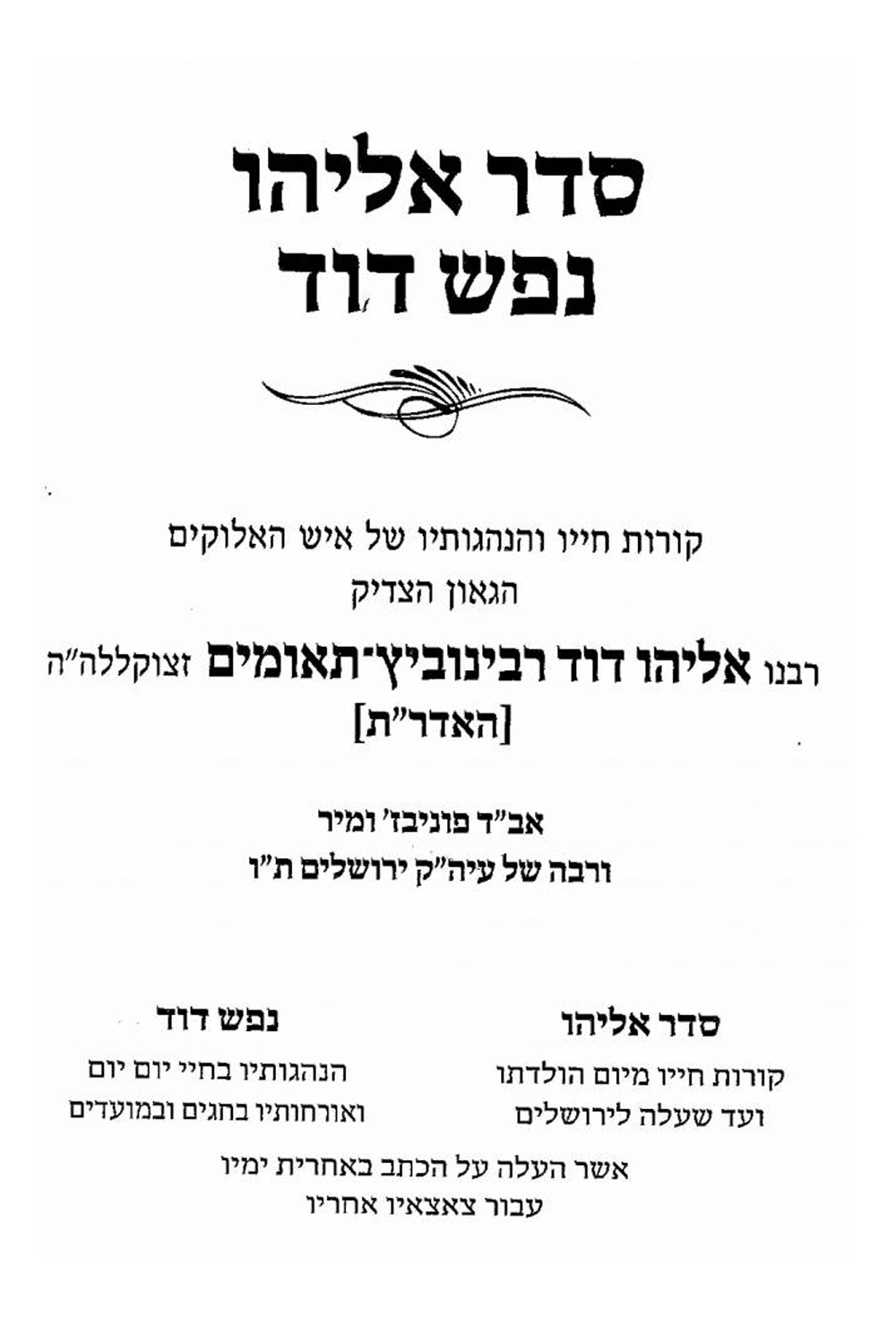
There are a handful of rabbinic autobiographies, R. Yehuda Areyeh of Modena, Hayyei Yehudah, R. Yaakov Emden, Megillat Sefer, and a few others.[1]  One of the more recent rabbinic autobiographies is that of R. Eliyahu David Rabinowitz, otherwise known as Aderet.  This work, was first published in the journal, Ha-Peles edited by Aderet’s nephew, Eliyahu Akiva Rabinowitz.  Only a portion of the autobiography appears in Ha-Peles. However, the editor did give us the title of this work for posterity.  Although Aderet did not title the work, in Ha-Peles it appears under the title, Seder Eliyahu, this title remains today.[1a] In reality, Seder Eliyahu is one part of three part work, the second part, Nefesh David, records various customs (and has been reprinted a few times), and the third part, regarding how to handle Aderet’s body after his death, Achar Eliyahu or Acharei David, apparently was never written. 

Aderet’s autobiography was first published in its entirety in 1983 by Mossad ha-Rav Kook.   The Mossad received the manuscript from Aderet’s grandson.  As will become apparent, much of what was written, prior to 1983, regarding Aderet is lacking because  prior to its publication in 1983,  his autobiography was virtually unknown.  As an aside, the New Encyclopaedia Judaica reuses the article on Aderet from the original Encyclopaedia Judaica and is but one example of the shortcomings of the New Encyclopaedia, for more examples see Dr. Leiman’s critique here, and Dr. Havlin’s critique here, and Dr. Richler’s critique here of the New Encyclopaedia Judaica. 

The 1983 edition, however, has been out-of-print for years, and this year, some of Aderet’s desendents republished Seder Eliyahu (additionally, they also reprint Nefesh David in this volume).  The editors of this new edition thank Mossad ha-Rav Kook for allowing them to reprint this work.  But, in their introduction, they argue that Aderet “never intended to publish this work and allow others to read it, instead, it was meant for his family.” Seder Eliyahu, Jerusalem, 2010, at 7 (“Jer. ed.” or “New Edition”).  Based upon this assertion, the editors of this edition justify “removing various passages that were never intended for outsiders to read.”  Id. at 9.  They explain that whenever they removed text “three lines (- – -) serve to indicate missing text.”  Id.  As we shall see they are inconsistent at best at using the three dash device and many instances of removal are not noted. 

Regarding the claim that Aderet never intended this book to be published. The original publication in 1983 includes the entire text with no omissions.  Recall that this text was obtained by Mossad ha-Rav Kook from Aderet’s grandson, we have no indication that he objected to publishing the entire text.  Moreover, the first time the autobiography (partially) appeared in Ha-Peles much of the “offensive” material was included. Recall that Aderet’s nephew was the editor of Ha-Peles  and he saw no need to censore anything. Finally, although there may be some indications that an autobiography was merely written for family members and not intended for broader publication, this device is common in autobiographies.  R. Emden also implies that he didn’t intend his autobiography to be widely distributed, but as Dr. Schacter demonstrates, Emden wanted others to read it.[2]  Indeed, according to Schacter, R. Emden’s autobiography can be classified as “that of ‘autobiography as polemic.'”  As Emden writes of his purpose, “[i]n order that the sun of my righteousness should shine forth . . . [and because] many of [my enemies] libelous writings will certainly remain extant in the world for some time.  Therefore, necessity has compelled me to clarify my case before God and man. . . . Behold [this autobiography] will serve as a vindication for me, for my children and my descendants.”[3] Thus, “there is equally no question that the overriding primary impetus behind Megillat sefer was a desire on the part of Emden to clear his name and vindicate himself in his controversy with Eybeschutz,” and “[t]here is no doubt that it is the Emden-Eybeschutz controversy that serves as the ‘center of gravity’ for” Megillat Sefer.[4]  Of course, for R. Emden to be publicly vindicated, presumably the public would need to be aware of the work.[5]

With Emden’s motives in mind, it is important to distinguish Aderet’s work.  While Aderet includes descriptions of others in his work, and, at times, some of these descriptions are far from flattering, it does not appear that Aderet was looking for vindication or had a polemic motive in mind.  While Aderet did not get along with his constituents in Ponovitch, that dispute was mainly surrounding Aderet’s salary and how the community treated him.  Aderet wasn’t involved in any global disputes like the Emden-Eybeschutz controversy and thus Aderet wasn’t required to vindicate himself.  Moreover, Aderet ultimately came out on top, becoming Chief Rabbi of the Ashkenazim in Jerusalem.  Thus, he was well-respected and had no reason to resurrect his image – his image was already good.

Perhaps a better understanding of some of the material as it relates to others in Seder Eliyahu may be better understood by looking at Marcus Mosley’s comments[6] and quote from Rousseau: 

Autobiography operates upon an entirely different set of criteria. For the autobiographer, the significance of the other is determined solely by the role that he or she plays in the formation of the self, regardless of social standing. Thus Rousseau, in the “Neuchatel” variant of the preamble to the Confeinddow: “The relationships I have had with several people compel me to speak as freely of them as of myself. I can only succeed in making myself known by making them known also.” Many of the more decisive encounters with the other in the shaping of the autobiographer’s self occur in the years of childhood and adolescence. Parents, teachers, schoolmates, and domestic staff may thus achieve a prominence in the autobiography that would, in the memoir, be reserved for generals and prime ministers, renowned men of letters, and so on. This is not to say that the formative encounters with the other in an autobiography are restricted to the historically obscure. But when the great do drift in and out of the pages of an autobiography, it is often not on account of the qualities that granted them this status that they are recalled.
Thus, Aderet’s comments about others, most notably regarding R. Yitzhak Elchonon Spector, may be understood as merely providing insight into Aderet’s own life rather than commenting on R. Spector, for example.

The new edition of Seder Eliyahu, however, leaves out much of Aderet’s comments about others, depriving the reader of fully understanding the Aderet as well as distorting history.  We will provide all the examples of where the new edition has altered or removed material from the 1983 edition. 

Biography of Aderet

The basic outlines of Aderet’s biography are not in dispute.  Here are the highlights.  Aderet was born, with his twin, on the first day of Shavout in 1843.  His father was a rabbi and Aderet’s family were descendant from famous rabbinic figures from both his father’s and mother’s side.  When he was five, his mother died and his father remarried.  At twelve, Aderet began writing his first sefer, and began wearing tefflin for his entire twelth year.  At thirteen, he had his bar mitzvah and, contrary to the custom, was allowed to read the haftorah for the first day of Shavout. This haftorah is typically reserved for the rabbi or a talmid hakham due to the content of the haftorah.  But, Aderet’s father argued that it was appropriate for his son to read the haftorah.  Soon after his bar mitzvah he completed his first work with his twin brother, Shevet Achim.  At fifteen he became engaged to girl, and soon after was appointed rabbi of Ragali.  The engagement didn’t end well. His fiancee’s mother died and the step-mother was lax in her observance and the marriage was called off.  But, in due course, Aderet was engaged again to the daughter of a prominent family in Ponovitch.  This time, Aderet went through with the wedding.  He remained in Ponovitch, supported by his in-laws, and studied in a small bet midrash.  In 1875, Aderet was selected to be the rabbi of Ponovitch.  In 1893, the town of Mir approached Aderet to become its rabbi.  Aderet accepted.  Ponovitch, however, wanted its rabbi to remain, but, after receiving advice from various rabbis, eventually, Aderet left and went to Mir.  In 1901 he was invited and accepted to become Chief Rabbi of the Ashkenazim in Jerusalem.  On the 3rd of Adar I, 1905, Aderet died in Jerusalem.

Aderet is known as having a phenomenal memory.  He was also a prolific author, but much of his writings remained in manuscript.  In the last decade or so, many of his books have been published, a bibliography of which will appear soon. 

The above provides a basic outline of Aderet’s biography, but a close examination of his autobiography provides additional detail.    

Autobiography of Aderet

There are a few important gaps in Aderet’s biography that can be filled only by utilizing his autobiography.  For example, Aderet’s father’s second wife.  If one reads some of the biographies, she is mentioned only in passing.  But, Aderet explains she was no minor figure.  To the contrary, it appears that Aderet’s step-mother and his father had a horrible marriage.  Indeed, Aderet couldn’t stand her and he was especially bothered the way she treated his father.  After Aderet’s father died, Aderet immediately left town as he couldn’t bear remaining with her.  He turned down his father’s position as rabbi of Vilkomer because that would mean he would have to live in the same city as his step-mother.  Aderet recalls bitterly how he sped home once and therefore missed out on meeting various rabbis only to find out that his step-mother hadn’t told anyone he was coming and no one was there when Aderet returned causing him to miss meeting the rabbis and not seeing family.

Some biographies make it appear that Aderet had a great relationship with the people of Ponovitch.  These biographies point to the fact that when Mir approached him, Ponovitch tried its hardest to keep Aderet. But, in his autobiography Aderet explains how horrible the people of Ponovich were to him.  They paid him almost nothing and even that little amount wasn’t always timely.  He was so poor that he didn’t have his own bed and had to sleep on a few chairs.  Although Aderet had some of his children die and others were sick, for the most part, the people of Ponovitch made his life even more difficult.  The town didn’t help when he had sick children.  One particularly shocking incident was one of the Ponovitch community members became gabbi.  Aderet didn’t like waiting between Kabbalat Shabbat and Ma’ariv because waiting only meant that people ended up talking and not acting as one should in Shul.  The gabbi, however, wanted to talk and wanted a break.  Thus, when Aderet asked the hazzan to immediately begin ma’ariv, the gabbi told the hazzan “it’s not time yet.”  This type of maltreatment by the Ponovitch community members was not uncommon.  Therefore, when Mir came knocking, and, although Mir was a significantly smaller community, Aderet wanted to get out of Ponovitch and accepted Mir’s offer.

As Aderet was almost always looking to leave Ponovitch, he competed for a job in Riga.  And, although he was the most qualified candidate, the position was given to someone else. Aderet lost out on the position because R. Yitzhak Elchonon Spector backed Aderet’s rival.  Aderet was extremely upset at R. Yitzhak Elchonon and even sent a very nasty letter to R. Yitzhak Elchonon.  R. Yitzhak Elchonon’s reaction was that “the letter was so disrespectful that but for Aderet’s reputation as a talmid hakham, he [R. Yitzhak Elchonon] would see to it that Aderet couldn’t even get a job a beadle in a bet midrash.”  Aderet was so embittered by this episode he remarks that he never forgave R. Yitzhak Elchonon. This was not the only time Aderet had a falling out with R. Yitzhak Elchonon.  At a rabbinic conference, led by R. Yitzhak Elchonon, there was a miscommunication which R. Yitzhak Elchonon took personally.  As such, R. Yitzhak Elchonon refused to entertain anything else during the conference and the conference was totally unsuccessful. Aderet was appalled that R. Yitzhak Elchonon’s personal feelings didn’t allow the conference to produce anything of value. 

Aside from making Aderet’s life miserable, the treatment of the town of Ponovitch also forced Aderet to allow his son-in-law, R. Abraham Isaac Kook, to leave and take up his own rabbinic position.  Although Ponovitch had promised Aderet a higher salary, the town never came through and thus Aderet couldn’t support his daughter and son-in-law.  In his autobiography, he describes how heartbroken he was when his son-in-law and daughter left. 

Comparison of the New Edition and 1983 Edition of Aderet’s Autobiography


As noted above, the editors of the New Edition provide that they have removed material from Seder Eliyahu, and that they have noted any time anything is removed.  This is false.  Although it is true that the editors have removed material but they have not always noted when they did so.  At times removed material is noted by “- – – ” in the text, many times there is no indication that anything is missing.  Moreover, the editors are inconsistent when they alter the text.  That is, in correcting typos or when removing abbreviation, sometimes they note they are altering the text and other times they do not.  Of course, this omission is less serious than wholesale removal of text, but consistency is still important.  For example, in the 1983 edition many persons are only referred to in abbreviated form, while in the New Edition their full name is used; thus the original reads “my uncle רפ”ק” while in the New Edition it reads “my uncle Rabbi Pinchus Cantor.”  The editors don’t note that they have inserted his full name; however, whenever the text uses an abbreviation to refer to R. Shmuel Mohilever – “הגרש”מ” in the New Edition they provide his full name but do so in brackets indicating an insertion into the text. Compare 1983 ed. pp. 84 &  92 & Jer. ed. at 71 & 76. It is unclear why they decided to consistently indicate this insertion and not others.

Turning the censored materials. These materials can roughly be divided into three categories.  (1) materials that mention Zionism or are related to Zionism; (2)  in this category we include what is best described as negative comments about women and marriage; and (3) personal attacks or observations about other Rabbis.  We must note that many of these omissions have been cataloged here as well.

First Category – Zionism

Items from this category include material that appears in the footnotes to the 1983 edition as well as items in the text itself.  The New Edition resuses almost all the footnotes that appear in the 1983 edition but leave out information when that information relates to Zionism.  Thus:

1983 ed. (p. 17 n.5) provides a footnote when the text mentions R. Moshe Telsher “for more information see Sefer Zikhron le-[Rabbi Abraham Isaac Kook] 1945″  Jer. Ed. (p. 15) doesn’t include this note at all. 
1983 ed.  (p. 28 n.14) contains a citation to Maimon’s Sa’arei ha-Meah, Jer. ed. (p. 26 n. 17) removes citation no notation anything is missing.
1983 ed. (p. 29 n.16) explains that R. Mordechai Gimpel Yaffo “was one who espoused emigration to Israel and himself emigrated in 1888”, Jer. ed. (p. 23 n.19) removes this text without notation.
1983 ed. (p. 59 n.46) regarding R. Mordechai Elisberg, the note explains “one of the leaders of the Hovvei Tzion movement,” Jer. ed. (p. 57 n.55), removes this text, no notation.
1983 ed. (p. 72 n.57) regarding R. Shmuel Mohliver “was the head and founder of the Hovvei Tzion movement,” Jer. ed. (p. 69 n.68) removes this text, no notation.
1983 ed. (p. 102 n.78) explaining that the author of Chavush Pe’ar “is R. Kook,” Jer. ed. (p. 96) the note is missing.

We should noted that the editors of the Jerusalem edition didn’t excise every Zionistic mention.  Instead, they retain the sentence “the Hovvei Tzion chapter in Bialystok requested that I [Aderet] give a derasha.”  Jer. ed. at 81.  Similarly, Aderet describes how heart broken he was when his son-in-law and daughter had to leave because Aderet couldn’t support them and how happy Aderet was when he met up with his son-in-law later that year and spent time together.  In the text, however, Aderet doesn’t identify by name his son-in-law.  The New Edition retains the footnote from the 1983 edition which identifies the son-in-law as “The Gaon R. Abraham Isaac Kook ZT”L.”  Jer. ed. at 60 n.57.

Second Category – comments about women

The vast majority of these changes relate to women, and specifically, when there was martial discord or divorce.  There are essentially two women whose mention is censored, Adert’s step-mother and Aderet’s nephew’s first wife.  As mentioned above, Aderet had serious issues with his step-mother and he is very vocal about those problems in his autobiography.  Additionally, Aderet’s nephew’s first marriage didn’t work out.  The first wife was the daughter of R Eliezer the chief rabbi of Anchin but she was uninterested in leading a religious life and thus this marraige ended in divorce.  Whenever mention of either of these two women occurs in Seder Eliyahu the Jerusalem edition leaves them out.  Thus, there is no mention in the Jerusalem edition that Aderet didn’t get along with his step-mother and that the nephew’s first wife wasn’t religious. Rather than explain what is missing each time, as the excised portions are generally similar, we have indicated where a passage relating to Aderet’s feelings about his step-mother is missing and where the excised passage relates to the non-religious first wife of Aderet’s nephew.  We will, however, indicate where there is missing text and the editors of the new edition fail to note that they have removed text.

Step-mother
1983 ed. (18-19) lacking in Jer. ed. (16) noted with – – –
1983 ed. (23) lacking in Jer. ed. (21) no notation
1983 ed. (35) lacking in Jer. ed. (33) noted with – – –
1983 ed. (37) lacking in Jer. ed. (35) noted with – – –
1983 ed. (46) lacking in Jer. ed. (44) noted with – – –
Non-religious wife
1983 ed. (64) lacking in Jer. ed. (60) no notation
1983 ed. (71) lacking in Jer. ed. (68) noted with – – –

There is one final example that arguably fits in this category although it relates to neither of the above mentioned women.  Instead, this instance relates to Aderet spening time in Vienna and meet R. Shlomo Netar.  As part of their conversation R. Netar related some of his problems to Aderet.  One related to his wife who is described – in the 1983 ed. (42)- as “the really horrible woman, may God save us, who is the granddaughter of R. Simcha Bunim Peshischa (or so I [Aderet] recall).” This quote is lacking in the Jer. ed. but is noted with – – -.

We should note that much of the material regarding Aderet’s step-mother appears, in toto, in a separate biography of Aderet that is appended to the beginning of Hiddushei ha-Gaon ha-Aderet, Machon Kitvei Yad ha-Aderet be-Artzot ha-Brit, Israel, 2003.  This is somewhat ironic in that this biography is very careful what it mentions, or doesn’t mention.  Specifically, although Aderet’s son-in-law (and, ultimately, after the untimely death of Aderet’s daughter and remarrying Aderet’s niece, became Aderet’s nephew), R. Abraham Isaac Kook, wrote a fine biography of Aderet, Adar ha-Yakar, and Kook’s biography is used in the biography appearing in Hiddushei, R. Kook’s name is never mentioned.  That is, the mention of R. Kook was controversial (this may be related to the fact that the publisher of this volume is a member of the Satamar sect).[7]  But, regarding Aderet’s step-mother, all that material appears in the biography in HiddusheiSee Hiddushei, at pp. 4, 6, 8 and 10 almost all of which are taken, almost verbatim, from the autobiography. Thus, even without access to the autobiography, any reader can find the relevant passages. 

Third Category – personal observations or attacks on other rabbis

Some of these negative assesments relate to R. Yitzhak Elchonon although comments about other rabbis are also censored. 

1983 ed. (60-61) discussing Aderet’s failed bid to become Riga’s chief rabbi, and, specifically, how R. Yitzhak Elchonon sunk Aderet’s bid.  Additionally, Aderet notes that he sent R. Yitzhak Elchonon a very nasty letter explaining how disappointed Aderet was with R. Yitzhak Elchonon’s involvement and decision to pick someone else.  Jer. ed. (68) the entire story is missing and there is no notation anything was removed.  
1983 ed. (62) Aderet expresses his displeasure with some Ponovitch residents regarding salary negotiations and essentially calls them animals.  Jer. ed. (69) lacking the name calling, no notation anything is missing.
1983 ed. (78) Aderet records the comments of a beadle who questioned R. Yitzhak Elchonon’s authority.  Jer. ed. lacking but noted with – – – .
1983 ed. (79) Aderet meets someone who is wearing two pairs of teffilin neither of which are in their proper place.  Aderet goes on to explain while this person passed himself off as a miracle worker, in reality he was a fraud.  Aderet says the person “is the author of the book Kav Chen.”  This must be incorrect.  The author of Kav Chen, R. Noach mi-Koruv, died in 1855, but Aderet says this meeting took place in 1890. What is more likely is that Aderet was referring to the publisher of Kav Chen, R. Noach’s grandson, R. Hayyim Moshe Ze’ev.  In all events, rather than attempting to correct or ascertain who Aderet is referring to, the Jer. ed. (75) “solves” the problem by removing the passage “the author of the book Kav Chen” and replace it with – – -. 
1983 ed. (83) Aderet mentions “Leib Grabman” who involved the secular authorities in a communal dispute.  Jer. ed. removes “Leib Grabman” and replaced with – – -.  
1983 ed. (87-88) Aderet discusses a rabbinic conference he attended.  In attendence was also R. Yitzhak Elchonon who became personally insulted after a miscommunication.  As such, R. Yitzhak Elchonon refused to allow passage of any of the many “good ideas” the conference attendees offered.  To add insult to injury, in the Jewish press, R. Yitzhak Elchonon blamed the poor result on everyone else.  Jer. ed. (84) removes the entire story and replaced it with – – -.  
1983 ed. (91) Aderet describes some rather insulting behavior directed at him by members of the Ponovitch community, including the gabbi ignoring Aderet.  Jer. ed. (85) leaves out these stories and replaces them with – – -.
1983 ed. (93) after the Aderet leaves Ponovitch a very prominent member of the Ponovitch community died suddenly and “some people said his death was because he failed to show Aderet proper respect and to pay Aderet on time.  As such Aderet is said to have cursed the dead man and his family.”  Jer. ed. (86) removed and replaced with – – -.  
1983 ed. (98) discusses a plan, by persons unconnected to Aderet, to trick R. Yitzhak Elchonon that was ultimately unsucessful. Jer. ed. (91) removed and replaced with – – – .
1983 ed. (99) Aderet details how various rabbis/roshei Yeshiva of Mir weren’t completely honest with Aderet.  Aderet refers to these persons by name.  Jer. ed. (92) removed entirely and replaced with – – -.
1983 ed. (103-04) Aderet details attempts at thwarting him from becoming a teacher at Yeshivat Mir.  Jer. ed. (97) removed and replaced with – – -.  Inetrestingly, much of the background and history of this incident is found in Pinchus Lipschutz’s – the editor of Ya’ated Ne’eman – book Peneni Chen, Monsey, 2000, p. 17 (thanks to a Seforim Blog reader for this citation).  

Additional Comments Regarding Aderet’s Autobiography

Aside from the issues raised above, it should be noted that Aderet’s biography is full of facinating information both about him and his contemporaries as well as of general interest to students of Jewish history, custom, and law. While we intend to devote an entire post to the full contents of Seder Eliyahu we wanted to provide a few particularly interesting passages from Seder Eliyahu.  All of the following examples appear in both editions of Seder Eliyahu.  As mentioned above, Aderet, when he was in Vienna, met R. Shlomo Netar, who was also bookseller and who studied in the Yeshiva of Hatam Sofer.  R. Netar related that he was in class with Hatam Sofer’s son, R. Shimon Sofer (eventual author of Michtav Sofer), was in the same class.  R. Shimon Sofer “was often hit with sticks [by the teacher] and this was at the request of R. Shimon’s father,” Hatam Sofer.  1983 ed. at 42; Jer. ed. at 40.

A few halacha/custom related items.  Aderet records that when he travelled by ship, once the gangplank was lifted and the ship was underway he recited tefillat ha-derekh.  Someone on board the ship questioned this practice arguing that since the ship hadn’t left the city limits, one cannot recite teffilat ha-derekh.  Aderet, however, responded by distinguishing between normal overland transport and ships (and presumably airplanes).  Aderet explained that when going overland there is a fear that one may decide to return home thus one needs to wait until leaving the city limits, the point of no return.  But, once one is onboard a ship and the gangplank is removed one can’t leave and therefore one can immediately recite teffilat ha-derekh. 1983 ed. at 42; Jer. ed. at 40.

Another time, Aderet also advocated for a novel halachic position.  In this case, Aderet wanted to personally perform the circumcision of his son. But, the circumcision fell on Saturday, and, as Aderet hadn’t ever performed a circumcision previously, the rule is that one cannot perform their first circumcision on Saturday.  Aderet, however, argued that the prohibition on performing one’s first circumcision on Saturday applies if one is circumcising someone other than their own child. That is, as there is a unique obligation to circumcise one’s child that trumps the prohibition against performing the first circumcision on Saturday.  Aderet marshalled various sources that supported his position and presented his argument to R. Yosef Zechariah Stern (an equally impressive contemporary) who rejected Aderet’s argument.  Aderet concludes that he “decided to refrain from deciding law in way that runs counter to Shulchan Orach and thus would appear strange to the public.”  1983 ed. 52; Jer. ed. at 51.  

On one Saturday, there was a communal rift which resulted in the secular authorities confiscating the shul’s sefer torah.  Thus, the shul didn’t complete the weekly mandatory reading.  Although Aderet ended up hearing the reading in another shul, Aderet argued that the shul whose sefer torah was confiscated was required the next week to make up the reading it missed.  He argued this position to R. Aaron Halberstam, son of R. Hayyim Halberstam, the Sanzer Rav.  R. Aaron disagreed.  He explained that the torah reading obligation is communal in nature and so long as a community shul recited the proper reading, those in the community that missed it need not repeat it.  Aderet, however, argued that while one needs a minyan and thus is communal in nature, there is an individual obligation to read the weekly portion and if one shul didn’t hear the weekly portion then they need to recite it the next week.  [Hida in his diary/travelouge seems to support Aderet’s postion, see Ma’agel Tov ha-Shalem when he too missed the torah reading].  1983 ed. at 80; Jer. ed. at 77.

One final story relating to custom.  Aderet spends some time on why he picked particular names for his children. One name, however, is particularly noteworthy.  Aderet named one of his sons Mordechai Yonah.  Aderet explains that he picked Yonah because “of [his] mother’s name” Tova which is the Yiddish equivalent of Yonah.  This practice indicates that Aderet wasn’t bothered giving a boy a woman’s name or that naming for someone does not necessarly means using the same form as the original name.  1983 ed. at 51; Jer. ed. at 50.

Post Script Regarding Aderet’s Works & Works About Aderet

Besides for not using the Aderet’s autobiography at all or enough. It is worth pointing out that in the past recent years there has been a virtual explosion of the Aderet’s works which, until now, have remained in manuscript.  The Aderet authored over one hundred works although most still remain in manuscript and are scatered all over the world in various collections.

A few notable works of Aderet that have recently been published.  Mechon Ahavat Shalom has printed eight volumes of Aderet’s works, and, in addition, have published many shorter pieces  in their journal Mekabziel. Worth noting is the recent lengthy correspondence which Machon Ahavat Shalom printed between the Aderet and Yakov Reifman. Mechon Yerushalayim has printed three volumes of the Aderet’s comments on Humash aside from the many pieces they have printed in their journal Moriah. Additionally, there are some other volumes that have been printed from manuscripts. One worth mentioning is the Over Orach which was printed by Mechon Me’or the editor of this work proudly told me how he took out many pieces from this manuscript before printing it for the public as he felt it was not “kovod” for the Aderet. Now this censorship isn’t mentioned anywhere in the work.  Besides for the significance of the Torah found in these works which will be the subject of its own post including a in depth bibliography and description of the works. There is also much important material about Aderet’s life that can be gleaned from these recently published works. 

Below is a (non-comprehensive) list of articles discussing Aderet’s biography, although some are better than others:

Ehad be-Doro, vol. 1, 191-202
Seder Parsheyot le-Aderet, vol. 1, Machon Yerushalyim, Jerusalem, 2004, 329-99 (includes bibliography)
Shlomo Albert, Aderet Eliyahu, Jerusalem, 2003
Hiddushei ha-Gaon ha-Aderet, Machon Kitvei Yad ha-Aderet be-Artzot ha-Brit, Israel, 2003, Katzman 1-42.
Moshe Tzinovitz, Ishim u-Kehilot, Tel Aviv, 1990 128-30
Moshe Tzinovitz, Mir, Tolodot Yeshivat Mir, Tel Aviv, 1981, 175-83
Rabbotenu she-beGoleh, Jerusalem, 1996, vol. 1, 121-28
Asher Yetzaveh, Mechon Ahavat Shalom, Jerusalem, 2004, vol. 1, pp. 395-425 (Nefesh David is reprinted in this work, however, the editors fail to mention that they copied it from the 1983 ed.). 

  
Notes:
[1]  See Jacob J. Schacter, “History & Memory of Self:  The Autobiography of Rabbi Jacob Emden,” in Jewish History & Jewish Memory, Essays in Honor of Yosef Hayim Yerushalmi, eds. E. Carlebach, J. Efron, D. Myers, Brandeis University Press, 1998, 429 and nn. 6-8 discussing these autobiographies and providing additional examples. Emden’s autobiography, the Kahana edition is available online at here, and here with Gershom Scholem’s notes. Scholem penned his own autobiography (although it only covers a small portion of his life), Gershom Scholem, From Berlin to Jerusalem, tr. Harry Zohn, New York, 1980. Elliot Horowitz discusses Scholem’s autobiography in Horowitz’s article, “Confessions of a Jewish Autobiography Reader,” in JQR (n.s.), 95 (1), Winter 2005, pp. 74-80 & Saverio Campanini, “A Case for Sainte-Beuve, Some Remarks on Gershom Scholem’s Autobiography,” in Creation & Re-Creation in Jewish Thought, eds. R. Elior & P. Schafer, Paul Mohr Verlag, 2005, pp. 363-400.  More recently, Scholem’s diaries have also been published, Lamentations of Youth:  The Diaries of Gershom Scholem 1913-1919, ed. & tr. A.D. Skinner, Cambridge, Mass, 2007, a review appears here.   
Returning to Emden’s autobiography aside from the Kahana edition linked to above, there is another edition published by Abraham Bick-Shauli in Jerusalem in 1979, however, Schacter has serious reservations about this edition.  Schacter’s assesment of Bick-Shauli’s edition is that it “is absolutely and totally worthless.”  Schacter, id. at 446 n.13.  Of late, someone attempted to question the authenticity of Emden’s autobiography, Schacter’s comments are equally appropriate regarding this work as well.
Regarding Modena’s autobiography, see also Ariel Rathaus, “Leon Modena’s Autobiography & His Realistic Poetics,” in Italia, ed. Robert Bonfil, Conference Supplement Series, 1, Magnes Press, Jerusalem, 2003, 131-42. Of course, regarding Modena one should always consult Howard Ernest Adelman, Success & Failure in the Seventeenth Century Ghetto of Venice:  The Life of Leon Modena, 1571-1643, unpublished doctoral dissertation, Brandeis Univ., 1985, and this post by Yitzhak and this follow-up post on Ishim ve-Shitos. Modena’s autobiography is available in excellent editions in both Hebrew and English (part of which is online at Google books here), The Autobiography of a Seventeenth-Century Venetian Rabbi: Leon Modena’s Life of Judah, ed. Mark R. Cohen, Princeton Univ. Press, 1998 (English) & Sefer Hayyi Yehuda, ed. Daniel Carpi, Tel Aviv Univ., Tel Aviv, 1985. 
Additionally, regarding Jewish autobiography generally this discussion here, and see  M. Stanislawski, Autobiographical Jews, Essays in Jewish Self- Fashioning, Univ. Washington Press, 2004.  Thanks to both Menachem Butler and Eliezer Brodt for providing many of these sources.
[1a] The Ha-Peles piece has a very nice footnote where Aderet’s sister’s erudition is described.  “She knew Hebrew and the Talmudic language. During the winter, on Friday nights, she would sit by the fire and study the responsa literature of the rishonim, such as the responsa of Rashi, Rambam, Rosh and similar titles that don’t contain pilpul. She was fluent in many responsa.  She also studied the Sefer Hassidim daily.”  She was so well-versed in Sefer Hassidim that her father, when he was unsure of a citation in Sefer Hassidim would ask her. Eliyahu Akiva Rabinowitz also records that after Aderet published an article in Yagdil Torah she read it and asked an insightful question, which Aderet subsequently published, in her name, in Yagdil TorahSee ha-Peles, 720 n.2.
[2]  See id. at 438 and nn. 58-59 (Schacter offers citations to other similar works who employ this device).
[3] Id. at 431 quoting Megillat Sefer, Kahana ed. (“with slight corrections from the manuscript”) pp. 54-55. 
[4] Id. at 433.  
[5] Assuming that Schacter is correct regarding Emden’s motives, the lingering question is why wasn’t Megillat Sefer published during Emden’s lifetime or soon after? Emden had his own press and was not shy about publishing his own works that defended his position, no matter how controversial those works were.  Why didn’t Emden do the same with his autobiography?  Unfortunately, Schacter doesn’t address this question, perhaps in his forthcoming translation of Megillat Sefer, he will provide more background regarding the publication of Megillat Sefer.
[6] Marcus Mosley, “Jewish Autobiography:  The Elusive Subject,” in JQR (n.s.), 95, 1 (Winter 2005), 25.   
[7] The author of this biography, however, is not Satmar.  The author of the biography portion is R. Eliezer Katzman who is perhaps the only person who has demonstrated the similarities between various positions of R. Abraham Isaac Kook and the Satmar Rebbi.  See Eliezer Katzman,  in Ketonet Yosef, ed. D. Gotlieb et. al. New York, 2002.   


Parshanut in English: Rabbinic Bible Commentary in Translation

Parshanut in English: Rabbinic Bible Commentary in Translation

Revised updated edition

Yisrael Dubitsky

The following revises, expands upon and updates my previous effort on this forum. Originally it was meant as a ten year retrospective, to see not only which works were completed in that time span but also which commentators were first touched upon. Of course, in the course of my research, I found several errors of mine from the earlier edition, and many items I had neglected to include, or was not even aware of before. Technical difficulties have delayed its appearance until now but what better time to present it than at the beginning of a new Torah reading cycle?

In contrast to the first edition, I struggled with the criteria for inclusion. Ideally, and initially, I had wished to include only items which were

1)  Commentary on Tanakh or an individual book within it (but not a supercommentary upon a commentary);

2)  Rabbinic in substance (so, for example, not Samaritan, or Karaite, or based on modern scientific scholarship);

3)  Generally, from the High Middle Ages and later (thus not classical rabbinic midrash or targum; but medieval midrash compilations/anthologies such as: Midrash ha-Gadol; Midrash Lekah Tov; Midrash Sekhel Tov; Yalkut Makhiri; or Yalkut Shimoni would be eligible; and so would slightly earlier work such as Geonic literature if any existed);

4)  Where the work was an intentional and systematic commentary on the biblical book (meaning, not that every verse in a chapter is commented upon, but most are; not simply essays on “themes” or “issues” in the chapters or parshiyot);

5)  Where the translation was complete, not adapted, digested, excerpted, paraphrased, or selected from the original;

6)  Of significant length, meaning (subjective as the choice was) more than a chapter or two long (unless the entire biblical book was only a chapter, such as Obadiah);

7)  Where no matter in what language the original work first appeared, the translation was into English (meaning, original commentary – even in English — was not eligible);

8)  Appears in a separate monograph publication, either entirely devoted to the work, or even just a chapter within the book, but not simply an article in a periodical, which is more difficult for the average reader to access.

Unfortunately as I progressed in my compilation, I realized I could not stand by many of these requirements. There were simply too many less-than-ideal-as-above works, which a learned public would expect and/or require in such a listing. For example, Abarbanel or Hasidic commentary are not precisely verse by verse but are important, and perhaps expected, additions to a listing of rabbinic commentary. I think I retained fully requirements 2, 3 and 7 above, but the other requirements are less than perfectly observed. Thus, among other breaches, there are supercommentaries as well as some journal articles represented.

There were several items (especially theses from HUC or books at British Library) which I couldn’t examine personally. Nevertheless, I added them to the list. If it should turn out that the items were not actually relevant to this list (i.e. they don’t translate a text systematically, etc.), I will delete them in a later edition. In case they were relevant, however, it is important that readers are aware of them.

Clearly, as a delimited compilation, there will be some works that many will believe should not be included, and some that many may think should be included. Every reader may have a different perspective on what should or should not be included. However, a bibliographer must be granted privilege in determining which items to include. I welcome arguments, complaints, suggestions or recommendations and apologize in advance for inadequacies, deficiencies and/or errors in my compilation.  The nature of the beast is such that this is a work in progress (hopefully to be updated in less than 13 years’ time between editions).

Commentaries are arranged chronologically by author, and then by biblical book (standard Hebrew Bible order). For space and simplicity sake, works are identified only by their author’s and translator’s (or publishers’) names but, for fuller bibliographical data, also linked to a bibliographical record in a library catalog database (usually the National Library of Israel [NLI]; where a record didn’t exist there, or I was unsatisfied with it in some way, I linked to OCLC’s public international union catalog database WorldCat. When needed, I linked to other catalogs instead. Sometimes i recorded a newly published volume not yet represented on any of the WorldCat contributor records). This method of linking to a stable URL of a catalog’s bibliographical record could not be done in the previous edition, as JTS at that time had not provided permanent URLs for their records. Thus, clunky as it may have been, the only alternative to reach the bib records at JTSAL was to request readers copy and paste the Call Number I provided. Thankfully, this method is no longer required. I will expand a bit on my linking to library bib records, rather than standard bibliographical citation, below.

Where a title of an author’s work, rather than his name, serves more popularly as his principal identification, the title is used, with the author’s name appearing parenthetically. Otherwise, the author name is the primary identifier. Translations of entire works are listed before only parts of the same, and then by date of publication. As mentioned, links to online library catalog records (generally, NLI or WorldCat) for the item serve as the full bibliographic data. Publication years in parentheses following the link indicate only the first year of the edition. Generally, where possible, the first edition of the work is listed.

As mentioned, generally only significantly lengthy works (covering more than one or two chapters of Bible text) are included. There are several cases of introductions to works that are included here too. Unless delimited otherwise, items cover the entire book, number of volumes notwithstanding (e.g. 4 vols. on the five books of Torah). Items marked “currently…” imply a work in progress.

Again, as mentioned, adaptations, anthologies, digests, excerpts or paraphrases of translations, such as are found in the Hertz, Soncino Press, Judaica Press (except for Rashi), ArtScroll, Living Torah and Living Nach or Etz Hayim bible commentaries, are generally not included. However, this ideal could not always be observed. Perhaps contradicting the above, but condensed versions, as are sometimes found in Munk translations, are in fact included. The JPS Commentators Bible, in addition to its systematic translation of four major commentators, also occasionally includes selections from Bekhor Shor, Radak, Hazekuni, Gersonides, Abarbanel and Sforno. These latter have not been included in the list.

Further, as per requirement 2 above, academic or modern critical commentaries, even those written by rabbis, are excluded.

It is important to emphasize, no implication regarding quality of the translation (or the commentary itself!) should be drawn from inclusion in this list.

I have endeavored, where feasible, to include in addition a link to a digital copy of the work – whether as a simple PDF (from sites such as Hebrewbooks, Internet Archive, Google Books or the like) or via more sophisticated presentations such as on Sefaria or Alhatorah or the like. I only include links to sites that are free for all, not subscription or paid sites which would limit access. In addition, Sefaria or Alhatorah or other websites sometimes host a work before it has reached print status; as such, it is “online-only” or even “born-digital.” These I included by adding the word “online” in parentheses following the author name; if it wasn’t clear to me when the work was added to the site, it appears with a question mark in place of the year of publication. Moreover, Sefaria and Alhatorah are such wonderful sites that they often add new material so that my listing may be incomplete or obsolete very soon after it appears. Yet another reason for this compilation to be considered a work in progress!

Furthermore, I have colored items in red that are new or newly discovered by me since the first edition some 13 years ago. When the commentator’s name is in red, it means all works/translations beneath it are new. When a new work or an added volume of an already published work has appeared in that time period, that detail (e.g. biblical book name, volume number, publication year) is in red. Thus, readers will be able to spot new materials immediately. 

Romanization of Hebrew titles follows Mahler’s Library of Congress authorized system (e.g. no doubling for dagesh, etc.; except for inferior dots). Thus, for example, Hazekuni, and not Chizkuni. Authors’ names are based on the spelling in VIAF, but not always its form (thus, Rashbam, not simply “Samuel ben Meir”; or Joseph Kara, not “Kara, Joseph”). Further, where an added word (or different date) will make the identification more accessible (e.g. Rabenu Hananel and not just Hananel ben…), it is preferred. Bold-face is used to reflect more popular identifications. 

Finally, a brief word as to reasons for a bibliography linking to library catalog records rather than the standard format of a bibliographical index of works: While standard bibliography format represents the known literature of the subject in a very brief form, there is often little way for an average reader to access all the material, or even know where to turn to reach it. In these times, however, where much of the world is a click away, it is important for the average reader – one not necessarily associated with a university library or geographically near a large library – to have easy access to the material and the choice of whether to see further bibliographical data than the absolute minimum. A library catalog record provides the bibliographical data, and holding information for where the item is held; a particular library’s holdings information is an important gauge in evaluating its worth. Furthermore, a database like WorldCat is important for providing many different library possibilities in varying geographical areas. This helps the average reader access the item. A catalog may be a bit unwieldy, inasmuch as different titles on the different volumes of the same work may result in the work spread out over a few records (see the Sifte Hakhamim records as an example) – or even duplicate records for the same item (as happens often in WorldCat). Those varying details, however, are often covered over in a standard bibliography which may “normalize” all variations so as to be contained in one line entry. A more severe disadvantage of such a system is if/when the library catalog changes (permanent) URL details. However, this is a risk that seems to be outweighed by the advantages of such a system. Referring to a book via its library catalog record will prove beneficial to more readers than a standard bibliography.

BIBLIOGRAPHY OF ENGLISH TRANSLATIONS OF RABBINIC BIBLE COMMENTARIES

Medieval

  1. Sa`adia ben Joseph Gaon [882-942]
  2.   Torah

Linetsky [Gen 1-28] (2002)

  1.     Job

Goodman (1988)

  1.     Esther

Wechsler (2015)

         alhatorah.org

  1.   Daniel

Alobaidi (2006)

  1. Rabenu Hananel ben Hushi’el [d. 1055/6]

Torah

Munk (2006) 4 vols.

Sefaria.org

  1. Rashi [Solomon ben Isaac, 1041-1105]

A.  Bible

Judaica Press (Hoenig/Rosenberg):

  1. [All] CD (1998) / Chabad
  2. [Gen] (1993) 3 vols.
  3. [Ex] (1995) 2 vols.
  4. [Nakh] (1969) 20 vols. in 24

    B. Torah

  1. Rosenbaum/Silbermann (1929) 5 vols.

a. Sefaria.org / Sefaria.org / Sefaria.org / Sefaria.org / Sefaria.org

b. Alhatorah.org

  1. Ben-Isaiah/Sharfman (1949) 5 vols.
  2. Metsudah (Kleinkaufman) (1991) 5 vols.

Mnemotrix

  1. Artscroll (Herczeg) (1994) 5 vols.
  2. JPS (Carasik) (2005) 5 vols
  3. Lowe [Gen] (1928)
  4. Doron [Gen 1-6] (1982)
  5. Milstein [currently partial ?] (1993) 9 vols.
  6. “Ariel Chumash” (Feldman et al.) [currently Gen] (1997) 2 vols.
  7. Moore [currently Gen] (2002)

C. Joshua

  1. See above: Judaica Press
  2. Metsudah (Davis) (1997)

a. Sefaria.org

b. alhatorah.org

D. Judges

  1. See above: Judaica Press
  2. Metsudah (Rabinowitz/Davis) (1998)

a. Sefaria.org

b. alhatorah.org

E. Samuel

  1. See above: Judaica Press
  2. Metsudah (Pupko/Davis) (1999) 2 vols.

a. Sefaria.org

b. alhatorah.org

F. Kings

  1. See above: Judaica Press
  2. Metsudah (Pupko/Davis) (2001) 2 vols.

a. Sefaria.org

b. alhatorah.org

G. Isaiah

  1. Turner [Isa 11; 52-53] (1847)

         pdf

  1. See above: Judaica Press

H. Ezekiel

  1. VanGemeren [Chariot chapters and passages] (1974)
  2. See above: Judaica Press

I. Psalms

  1. See above: Judaica Press
  1.     Gruber (2004)
  2. Feldheim (Herczeg) (2009) 2 vols.

J. Five Scrolls

  1. See above: Judaica Press
  1.     Metsudah (Pupko/Davis) (2001)

a. Sefaria.org

b. alhatorah.org

  1. Beattie [Ruth] (1977)
  2. Schwartz [Esther, Song of Songs, Ruth] (1983)
  3. Shute [Lamentations] (1998)
  4. Anderson [Lamentations] (2004)

pdf

  1. Herczeg [Esther] (2016)

K. Daniel

  1. See above: Judaica Press
  2. Shahar/Oratz/Hirshfeld (1994)


  1. Joseph Kara [ca. 1065-1135]

  A. Ezekiel

VanGemeren [Chariot chapters and passages] (1974)

  B. Lamentations

Anderson (2004)

  1. Pdf
  2. alhatorah.org


  1. Rashbam [Samuel ben Meir, ca. 11-12th cens.]

A.  Torah  

  1. Lockshin

           a.   [Gen] (1989)

b.   [Ex] (1997)

c .   [Lev & Num] (2001)

d.  [Deut] (2004)

alhatorah.org

  1. Munk (2006) 4 vols.

Sefaria.org

  1. JPS (Carasik) (2005) 5 vols.

    B. Five Scrolls

  1. Thompson [Song of Songs] (1988)

alhatorah.org

  1. Japhet/Salters [Ecclesiastes] (1985)
  1. Eliezer, of Beaugency [ca. 12th cen.]

Ezekiel

VanGemeren [Chariot chapters and passages] (1974)

  1. Menachem ben Simon, of Posquières [ca. 12th cen.]

Ezekiel

VanGemeren [Chariot chapters and passages] (1974)


  1. Abraham ben Meir Ibn Ezra [1092-1167]

   A. Torah

  1.     Strickman/Silver (1988) 5 vols.
  2.     Benyowitz (2006) 3 vols.
  3.     JPS (Carasik) (2005) 5 vols.
  4.     Oles [Gen] (1958)
  5.     Shachter [Lev, Deut] (1986) 2 vols.

a. Sefaria.org / Sefaria.org

b. alhatorah.org / alhatorah.org

  1.     Linetsky [Gen 1-6] (1998)
  2.     Lancaster [introduction] (2003)

   B.  Isaiah

  1. Friedlander (1873)

Sefaria.org

  1. Turner [Isa 11; 52-53] (1847)

pdf

C. Hosea

Lipshitz (1988)

D.  Haggai, Zecharia, Malakhi

Frazer (2017)

E. Psalms

Strickman (2009) 3 vols.

         alhatorah.org

     F. Five Scrolls

  1. Mathews [Song of Songs] (1874)

a. Pdf

b. Alhatorah.org

  1. Block [Song of Songs] (1982)
  2. Beattie [Ruth] (1977)
  3. Strickman (online) [Ecclesiastes] (2017)

a. Pdf

b. Alhatorah.org

  1. Shute [Lamentations] (1998)

Pdf

  1. Anderson [Lamentations] (2004)

a. Pdf

b. alhatorah.org


  1. Moses ben Sheshet [fl. ca. 1190-1200?]

Jeremiah/Ezekiel

Driver (1871)

pdf

  1. Shmuel ibn Tibbon [1150-1230]

Ecclesiastes

Robinson (2007)

  1. Radak [David ben Joseph Kimhi, ca. 1160-ca. 1235]

  A. Genesis

Munk (2006) 4 vols.

  1. Sefaria.org
  2. alhatorah.org

     B. Isaiah

  1. Turner [Isa 11; 52-53] (1847)

pdf

  1. Cohen [Isa 40-66] (1954)

     C. Ezekiel

VanGemeren [Chariot chapters and passages] (1974)

D.  Hosea

Turner [Hos 1] (1847)

         pdf

    E.  Zechariah

M’Caul (1837)

pdf

   F.  Psalms

  1.     Greenup [Pss 1-8] (1918)
  2.     Finch [Pss 1-10, 15-17, 19, 22, 24] (1919)

Sefaria.org

  1.     Baker/Nicholson [Pss 120-150] (1973)

G.  Ruth

Beattie [Ruth] (1977)

H.  Chronicles

Berger (2007)

  1. Ezra ben Solomon, of Gerona [d. ca. 1238]

Song of Songs

Brody (1999)

  1. Joseph ben Isaac Bekhor Shor, of Orleans [12th cen.]

Genesis

  1.     Thompson (online) [Gen 1-2 :3] ( ?)

alhatorah.org

  1.     Lockshin (online) [Gen 2 :4-9 :13] ( ?)

alhatorah.org


  1. Unknown [Anonymous, late 12th cen]

Song of Songs

Japhet/Walfish (2017)


  1. Ramban [Moses ben Nahman = Nachmanides, ca. 1195-ca. 1270]

  A.  Torah

  1.     Chavel (1971) 5 vols.
  2.     Artscroll (Blinder et al) (2004) 7 vols.
  3.     JPS (Carasik) (2005) 5 vols.
  4. Newman [Gen 1-6] (1960)
  5. Bick [introduction] (online) (?)
  6. Kanter [introduction] (In: Academic Journal of Hebrew Theological College, 1 (2001): 13–35)
  7. Strickman (online) [currently Ex] (?)

alhatorah.org

    B. Ecclesiastes

Chavel (1978): vol. 1


  1. Tanhum ben Joseph ha-Yerushalmi [ca. 1220-1291]

Five Scrolls

  1. Alobaidi [Song of Songs] (2014) 
  2. Wechsler [Ruth/Esther] (2010)
  1. Shem Tov ben Joseph Falaquera [ca. 1225–1295]

(Torah)

Jospe (1988)

  1. Zohar [ca. 1280]

Torah

  1. Soncino (Sperling/Simon) (1931) 5 vols.
  2. Matt (“Pritzker edition”) (2004) 12 vols.
  1. Midrash ha-Ne`elam (Zohar) [ca. 1280]

Ruth

Englander/Basser (1993)

  1. Hazekuni [=Hezekiah ben Manoah, 13th cen.]

Torah

Munk (2013) 4 vols.

  1. Sefaria.org
  2. alhatorah.org


  1. Da`at Zekenim mi-Ba`alei ha-Tosafot [probably compilatory, 13th cen]

Torah

Munk (online) (2015)

  1. Sefaria.org
  2. alhatorah.org


  1. Yalkut Shimoni [=Shim`on ha-Darshan, of Frankfurt?; compilatory, 13th cen]

  A. Jonah

Greenup (1922)

  B.   Nachum

Greenup (1923)

C.    Zecharia

King (1882)

         pdf

D.  Psalms

  1. Narot (1940)
  2. Fischer [Bk 1] (1962)
  3. Waldenberg [Bk 2-3] (1962)


  1. Unknown [Anonymous, probably compilatory, 13th cen]

Job

Hirsch (1905)

         pdf


  1. Ba`al ha-Turim [= Jacob ben Asher, ca. 1269-ca. 1340]

Torah

  1.     Artscroll (Touger) (1999) 5 vols.
  2.     Munk (2005) 4 vols.

a. Sefaria.org

b. alhatorah.org

  1. Ralbag [Levi ben Gershom = Gersonides, 1288-1344]

A.  Job

  1. Lassen (1946)
  2. Stitskin [introduction] (1963) In: Tradition, 6:1 (Fall 1963): 81-85

B.    Song of Songs

  1. Weis (1983)
  2. Kellner (1998)


26. Rabenu Bahya ben Asher ben Hlava [d. 1340]

Torah

Munk (1998) 7 vols.

  1. Sefaria.org
  2. alhatorah.org


  1. Yalkut ha-Makhiri [=Makir ben Aba Mari, ca. 1335-1410]

Jonah

Greenup  (1911)

         pdf / pdf


  1. Abraham ben Isaac ha-Levi Tamakh [d. 1393]

Song of Songs

Feldman (1970)


  1. Midrash ha-Gadol [=Adani, David ben Amram, 14th cen]

Numbers

         Fisch (1940)

                     pdf


  1. Avat Nefesh [Unknown, end of 14th cen]

Genesis

Gartig (1994)


  1. Akedat Yitshak [= Isaac ben Moses Arama, ca. 1420-1494]

Torah

Munk (1986) 2 vols.

Sefaria.org


  1. Isaac Abravanel [1437-1508]

A.  Torah

  1. Tomaschoff [Gen] (2007)
  2. Bar Eitan [currently Gen-Lev] (2012) 5 vols.
  3. Lazar (2015) 5 vols.
  4. Kasnett (2017)

  B.   Jonah

Werner (1979)

  1. Tseror ha-Mor [= Abraham ben Jacob Saba, 1440-1508]

Torah

Munk (2008) 5 vols.


  1. Obadiah ben Jacob Sforno [ca. 1470-ca. 1550]

Torah

  1.     Artscroll (Pelcovitz) (1987) 2 vols.
  2.     Munk (2006) 4 vols.
  1. Sefaria.org
  2. alhatorah.org
  1.     Stahl [Deut] (1975)


(Pre-)Modern

  1. Moses Alshekh [ca. 1520-1593]

A.  Torah

  1. Munk (1988) 2 vols.
  2. Rose [Gen] (2019) 2 vols.

B.    Jonah

  1. Werner (1979)
  2. Shahar (1992)  

C.    Psalms 

Munk (1990) 2 vols.

D.  Proverbs

  1. Munk (1991)
  2. Hirshfeld/Braude (2006) 2 vols.

E.    Job

Shahar (1996) 2 vols.  

F.    Five Scrolls

  1. Shahar [Song of Songs] (1993) 
  2. Shahar/Oschry [Ruth] (1991)
  3. Hirshfeld [Lamentations] (1993)
  4. Shahar [Ecclesiastes] (1992)
  5. Honig [Esther] (1993) 2 vols.   

g.  Daniel

Shahar/Oratz/Hirshfeld (1994)


  1. Eliezer ben Elijah Ashkenazi [1512-1585]

Esther

Brown (2006)


  1. Keli Yakar [= Ephraim Solomon ben Aaron, of Luntshits (Lenczycza), 1550-1619]

Torah

  1.     Levine [currently Gen-Ex] (2002)
  1. Genesis
  2. Exodus 2 vols.
  1.     Kanter [Deut] (2003)


  1. Tse’enah u-Re’enah [= Yaakov ben Yitzchak Ashkenazi, of Janow, 1550-1628]

Torah

  1.     Artscroll (Zakon) (1983) 3 vols.
  2.     Faierstein (2017) 2 vols.
  3.     Hershon [Gen] (1885)

pdf


  1. Shelah [Shene Luhot Ha-berit = Isaiah Horowitz, ca. 1565-1630]

Torah

Munk (1992) 3 vols.

Sefaria.org


  1. Sifte Hakhamim [=Shabbetai ben Joseph Bass, 1641-1718]

Torah

Davis et al.

  1. Genesis (2009) 2 vols.
  2. Exodus (2009) 2 vols.
  3. Leviticus (2012)
  4. Numbers (2013)
  5. Deuteronomy (?)


  1. Me`am Lo`ez [= Jacob Culi, d. 1732, et al.; Shmuel Yerushalmi, d. 1997]

Moznaim (Kaplan et al.) (1977) 43 vols.:

  1.                 Torah (1977) 20 vols.
  2.                 Joshua (1990)
  3.                 Judges (1991)
  4.                 Samuel I (1991) Samuel II (1993)
  5.                 Kings I (1994) Kings II (1997)
  6.                 Isaiah (1999)
  7.                 Jeremiah (1994) 2 vols.
  8.                 Trei Asar (1997) 2 vols.
  9.                   Psalms (1989) 5 vols.
  10.                   Proverbs (1993) 2 vols.
  11.                 Ruth (1985)
  12.                   Song of Songs (1988)
  13.               Ecclesiastes (1986)
  14.                 Lamentations (1986)
  15.                 Esther (1978)


  1. Or ha-Hayim [= Hayyim ben Moses Attar, 1696-1743]

Torah

  1.     Munk (1995) 5 vols.
  1. Sefaria.org
  2. alhatorah.org
  1.     Artscroll (Herzka) (2016) 10 vols.


  1. Moses Mendelssohn [1729-1786]

Ecclesiastes

Preston (1845)

pdf


  1. Hatam Sofer [= Moses Sofer, 1762-1839]

Torah

Stern [currently Gen-Lev] (1996) 3 vols.


  1. Ha-Ketav veha-Kabalah [= Jacob Zevi Meklenburg, 1785-1865] 

Torah

Munk (2001) 7 vols.


  1. Shadal [Samuel David Luzzatto, 1800-1865]

Torah

  1. Munk (2012) 4 vols.
  2. Klein [currently GenEx] 2 vols.
  1. Genesis (1998)

alhatorah.org [only Gen 1-11]

  1. Exodus (2015)

alhatorah.org [only Ex 1-5]

  1. [Leviticus (March 2021)]
  1.     Morais [introduction] (1926)

pdf


  1. Samson Raphael Hirsch [1808-1888]
  1.   Torah
  1.     Levy (1956) 6 vols.
  2.     Haberman (2000) 6 vols.
  3.     Breuer [Gen] (1948) 2 vols.


  1. pdf (v.1)
  2. pdf (v.2)

     B. Psalms

Hirschler (1960) 2 vols.

C.    Proverbs

Paritzky (1976)


  1. Malbim [Malbim, Meir Loeb ben Jehiel Michael Weiser, 1809-1879]

A.  Torah

Faier [GenEx 12] (1978) 5 vols.

         alhatorah.org [currently Ex]

B.    Jonah

Werner (1979)

C.    Proverbs

Wengrov/Zornberg (1982)

D.  Job

Pfeffer (2003)

  E.   Five Scrolls

  1. Kurtz [Ruth] (1999)
  2. Weinbach [Esther] (1990)
  3. Taub [Esther] (1998)


  1. Netsiv [Naphtali Zevi Judah Berlin, 1817-1893]

Song of Songs

Landesman (1993)


  1. Bet ha-Levi [= Joseph Baer Soloveichik, 1820-1892]

Torah

Herczeg [currently Gen-Ex] (1990) 2 vols.


  1. Julius Hirsch [1842-1909]

Isaiah

Breuer (2015)


  1. Joseph Breuer [1882-1980]

  A.  [Torah

See above: Hirsch (Genesis)]

B.    Jeremiah

Hirschler (1988)

C.    Ezekiel

Hirschler (1993)


  1. Da`at Sofrim [= Chaim Dov Rabinowitz, 1911-2001]

Bible

Starrett [currently Jos-Jud; Sam; Kgs; Isa; Jer; Ezk; 12; Ps; Prov; Job; Dan-Neh; Chr]  (2001) 12 vols.


  1. Da`at Mikra [=Mordekhai Zer-Kavod et al., 20th cen.]

  A. Psalms

Berman (2003) 3 vols.

B.    Job

Green (2009)

C.    Proverbs

Kanter & Cohen (2014)

Hasidic:

  1. Levi Isaac ben Meir, of Berdichev [1740-1809]

Torah

Munk [currently Gen-Lev] (2009) 3 vols.


  1. Menahem Mendel, of Rymanov [1745-1815]

Torah  

Levine (1996)


  1. Me ha-Shiloah [= Mordecai Joseph Leiner, 1802-1854]

Torah

Edwards (2001)


  1. Sefat Emet [= Judah Aryeh Leib Alter, 1847-1905]

Torah

Green (1998)


Concerning the Zohar and Other Matters

Concerning the Zohar and Other Matters
Marc B. Shapiro
1. In the last issue of Milin Havivin I published an article dealing with the Zohar and the supposed obligation to accept that it was written by R. Shimon ben Yohai. You can see it here. In the article I mentioned authorities who pointed to passages that in their minds were certainly post-Rashbi interpolations.[1] At the end of the article I also published a letter from R. Isaac Herzog in which he briefly deals with the issue of non-literal interpretation of the Torah. We see that he was uncertain as to what the boundaries are in this matter, and thought that this was an issue that needed to be worked out. That is, he did not believe that the last word on this issue had been stated.
Subsequent to publication I found some more interesting material and I also received a number of emails making various points, so now is as good a time as ever to return to the topic.
First, let me mention what David Farkas wrote to me in an email. In the article I cited Bruriah Hutner-David who brings the following proof that R. Zvi Hirsch Chajes rejected the traditional authorship of the Zohar: In order to show that the Targum to Ecclesiastes should be dated to the geonic period, Chajes notes that while the angel Raziel is mentioned in this Targum, he is not mentioned in talmudic literature. Hutner-David notes that Raziel is mentioned in the Zohar, a fact that Chajes was presumably aware of, meaning that he was hinting that the Zohar is also a late work.
Chaim Landerer called my attention to the fact that in a talmudic era Aramaic incantation bowl the name Raziel does appear, and I cited this to show that Chajes was incorrect in his assumption that the name Raziel post-dates the rabbinic period. However, Farkas has correctly noted that the name Raziel in the bowl refers to God, while Chajes was specifically referring to Raziel as a name of an angel. In other words, there is no refutation of Chajes. Yet I still think that Chajes assumed that the name Raziel itself was post-talmudic. Once we see that the name existed in the rabbinic period, even if so far the only evidence of its use is for God, it is certainly possible that it was also used for angels as well. If that is the case, there is no evidence that the use of the word Raziel as an angel’s name points to a post-rabbinic date.
I also found that Saul Berlin notes, in the introduction to his Kasa de-Harsana (his commentary to Besamim Rosh), that unlike all other ancient Jewish books, the Zohar has an introduction. Because of this, he writes that when it comes to the authorship of the Zohar he inclines to the view of his great-uncle, R. Jacob Emden.
A few years ago the outstanding scholar, R. Yaakov Yisrael Stoll, published the anonymous Sefer Kushyot. Here are pages 123-124.

I ask readers to look at note 887. He discusses a mistake made by many in assuming that an expression is a biblical verse. He then notes that the Zohar also makes the same mistake, and refers to other such mistakes made by בעל הזוהר. He doesn’t say so explicitly, but I think the way he formulates the note lets the reader, who is attuned to these things, know that in his mind בעל הזוהר is not R. Shimon ben Yohai.

Someone called my attention to this video

I have no idea who the speaker is, and if he has ever even read a page of the Zohar, but he does seem very sure of himself. I have no objection to discussing the authorship of the Zohar and the ideas found there, or Kabbalah as a whole. However, I would think that a little humility is called for when discussing a discipline that was a basic part of the religious worldview of so many central figures. Do the names Nahmanides, R. Joseph Karo, or the Vilna Gaon mean anything to this speaker?
In my article, I cited all sorts of texts by Orthodox figures dealing with the authorship of the Zohar. Yet I overlooked the following by R. Joseph Hertz.
The question of the authorship of the Zohar, like that of Sefer Yetzirah, is one of the cruces of Jewish literature. The authorship by Simeon ben Yochai, or by his immediate disciples, though this is still an article of faith with millions of Jews in Eastern Europe, has from internal evidence long proved to be untenable. The Zohar explains Spanish words, contains quotations from Gabirol, and mentions the Crusades.[2]
As noted, in my article cited a number of sources that point to additions to the Zohar. Rabbi Akiva Males commented to me that I neglected to mention R. Isaac Haver, Magen ve-Tzinah, ch. 21. This book was written in response to R. Leon Modena’s Ari Nohem, a work aimed at disproving the antiquity of the Zohar. Unless one’s head is totally in the sand, it is impossible to deny that there are passages in the Zohar that post-date the tannaitic era. For Modena, this was proof that the Zohar could not have been written by Rabbi Shimon ben Yohai. Haver, who wants to hold onto the ancient dating, adopts the only path open to him, arguing that there are indeed many post-tannaitic additions, but the core of the book is ancient.
ובאמת ספר הזוהר נכתב כמה דורות אחר רשב”י מה שנכתב ונתקבל משמו ומשאר חבריו ותלמידו שהיו בימיו, וגם זה נעשה בו הוספות רבות עד מאוד מן אחרוני האחרונים אחר שבאו בכתב וניתנו להעתיק ושלטו בו ידי רבים כל אחד מה שנראה בדעתו ומה שנתחדש לו וכתב בגליון על ספר הזוה”ק מן הצד ואח”ז בא ריעהו מעתיק מן המעתיק ומצא בגליון דברים רבים ובמעט התבוננות חשב שזה היה חסרון בגוף ספר והכניסם בפנים.
Haver points out that is how we can explain the obviously late passages, where we see that the Zohar includes material that comes from Rashi and R. Tam. Among kabbalists, it was not unheard of to say that Rashi actually knew the Zohar and was influenced by it.[3] But Haver will have none of this and recognizes that the influence is in the reverse direction, i.e., Rashi influencing the Zohar. He states that anyone who understands the Zohar will recognize these additions.
What does Haver mean when he mentions that there is material from R. Tam in the Zohar? I am aware of one obvious example. It says in Kiddushin 30b that “one should always divide his years into three: [devoting] a third to Mikra, a third to Mishnah, and a third to Talmud.” R. Tam explains why the practice in his day was not in accord with what the Talmud states, an explanation that became very influential and served as a justification for the widespread ignoring of the study of Tanakh in the Ashkenazic world[4]
בלולה במקרא ובמשנה וכו’: פירש רבינו תם דבתלמוד שלנו אנו פוטרין עצמנו ממה שאמרו חכמים לעולם ישלש אדם שנותיו שליש במקרא שליש במשנה שליש בתלמוד.
What he says is that since the Talmud itself contains Bible and Mishnah, there is no need to divide one’s time among the three categories. Rather, by studying Talmud one combines all three areas. I always found this a difficult explanation, for if the Talmud agreed with this perspective, it would have said so, instead of stating that one is to divide one’s time. The intention of the talmudic instruction in Kiddushin was that people become well acquainted with all three subjects, and if they only devote themselves to Talmud, there is a great deal of Bible and Mishnah[5] they will never encounter. (According to Maimonides, Hilkhot Talmud Torah 1:12, once one is already a scholar, he does not need to divide his time between the three areas, but can focus almost entirely on Talmud.)
Despite what R. Tam says, R. Samson Raphael Hirsch claims that it was due to a misunderstanding of this opinion that people were led to stop studying Tanakh.[6] Not mentioned by Hirsch is that even before R. Tam some scholars ignored Tanakh. There were even talmudic Sages who were not expert in Bible. Bava Kamma 54b-55a states:
R. Hanina b. Agil asked R. Hiyya b. Abba: Why in the first Decalogue is there no mention of wellbeing [טוב], whereas in the second Decalogue there is a mention of wellbeing?[7] He replied: While you are asking me why wellbeing is mentioned there, ask me whether wellbeing is in fact mentioned or not, as I do not know whether wellbeing is mentioned there or not.
Tosafot, Bava Batra 113a, s.v. travayhu, cites this text to support its contention about the amoraim: .פעמים  היו שלא היו בקיאין בפסוקין After referring to this strange passage in Tosafot (concerning which there is an entire literature), R. Moses Salmon sarcastically declares[8]: ועל זה סומכים הלומדים עמי הארץ וד”ל
Unlike Salmon, R. Samuel Strashun, in his note to Bava Batra 8a, defended those talmudists who were deficient in knowledge of Bible.
משמע דאפשר שיהיו בעלי משנה או בעלי גמרא ולא בעלי מקרא . . . ודלא כאותן ששופכין בוז על מקצת גדולי זמנינו בש”ס ופוסקים ואין להם יד כ”כ במקרא.
So returning to my question, what does Haver mean when he says that there is material from R. Tam in the Zohar? Well it turns out that R. Tam’s explanation, which we have just been discussing, is also found in the Zohar Hadash (ed. Margaliyot), Tikunim p. 107b:
תקינו רבנן לשלש שנותינו במקרא בתלמוד . . . ואוקמוה דמאן דמתעסק (במשנה) [בתלמוד] כאלו התעסק בכלא בגין דאיהי בלילא במקרא במשנה בתלמוד.
There is no question that this passage is adopted from R. Tam, who lived a millennium after R. Shimon ben Yohai.
Incidentally, regarding R. Tam’s view, here is a page of an article by R. Yehudah Aryeh Schwartz that appeared in the Agudah journal Kol ha-Torah, Adar 5765 [2005], p. 102 (second pagination).

The following page comes from R. Yehiel Michel Stern’s Ha-Torah ha-Temimah on the Book of Joshua, p. 84 no. 3, which appeared in 2009.

As you can see, Stern’s comment is lifted word for word from Schwartz’s article. I am not sure what to make of this. That is, are dealing with a simple plagiarism? Perhaps one of the readers has some insight. (Stern may be the world’s most prolific writer of Torah publications.)

In my article I referred to passages in the Zohar which traditional authorities had claimed were really later interpolations. There are examples of the opposite phenomenon as well, namely, attributing things to the Zohar that are not found there. The most famous instance of this that I know of is found in the Bah, Orah Hayyim 4 (and quoted from there in Be’er Heitev, Orah Hayyim 1:2) that upon waking up if you walk four amot without washing your hands you are subject to the death penalty![9]  This Zoharic text is quoted in the name of the work Tola’at Yaakov, authored by R. Meir Ibn Gabai (1480-ca. 1543). The passage is cited over and over again by aharonim in trying to show the importance of the morning washing. Yalkut Meam Loez, Deut. 4:9, doesn’t even mention the Zohar, stating simply:
ואמרו חז”ל כל המהלך ד’ אמות בלי נטילת ידים חייב מיתה
A few scholars actually point out that this passage is not to be found in the Zohar.[10] One of those who realized this is R. Eleazar Fleckeles, Teshuvah me-Ahavah, vol. 1 no. 14, whom we will come back to later in this post. He writes that he looked in the Zohar and didn’t find the passage referred to. With reference to the Tola’at Yaakov, whom he (falsely) thinks cited the Zohar (since that is what it says in the Bah), Fleckeles writes:
ושארי לי’ מארי’ שעשה רוב ישראל לחייבי מיתות
Because very few of the aharonim actually had the sefer Tola’at Yaakov (which is itself a little strange as the book was printed a number of times), they were unable to see that the Tola’at Yaakov never quotes the Zohar!  Here is p. 9a from the Cracow 1581 edition.

If you look in the second paragraph you will see that Ibn Gabai does state that one who doesn’t wash his hands is חייב מיתה, but he doesn’t attribute this to the Zohar. How he derives this idea is worthy of investigation at a different time. For now, it is important to just note that what we have here is an independent idea of a sixteenth-century Kabbalist which for some reason was misquoted by the Bah as if Ibn Gabai was citing the Zohar. This misquotation was to be repeated again and again, down to the present day.

The supposed Zohar text has led to additional stringencies. For example, the hasidic master R. Meshulam Zusha of Anapole stated that that one should not even to put one’s legs on the ground before washing one’s hands.[11]

Here is an interesting story that relates to the false Zohar quotation: A very learned and rich student came to study with R. Simhah Bunim of Peshischa.[12] The problem was that this young man was a bit of an independent thinker, and the Kotzker, who was also there, didn’t think that the young man belonged with them. The story explains how the Kotzker was able to convince the young man to leave. What was it about this man that turned the Kotzker against him? We are told the following:
הוא הגיה בזוה”ק שכתב “ההולך ד’ אמות בלי נטילת ידים חייב מיתה”, והוא הגיה: “והוא שהרג את הנפש”, וזה נגד חז”ל.
So here we have a story of an emendation of a non-existent Zoharic text. And even if we assume that the man was emending the text as it appears in the Bah, we see from the story that the Kotzker thought that the quote was authentic.

I wasn’t sure what to make of this passage. I therefore consulted a learned friend who said that the problem was that the young man who emended the text to read והוא שהרג את הנפש was making a joke at the expense of the (supposed) Zoharic passage. He was saying that you are only deserving of the death penalty if you kill someone while walking the four amot. I then sent him a page from R. Zvi Yavrov, Ma’aseh Ish, vol. 4, p. 113, where it appears that the Hazon Ish took the emendation-explanation just mentioned as an authentic understanding of the passage. The text in Yavrov reads as follows:

על מה שהביא ה”באר היטב” (או”ח סימן א’ סק”ב) שההולך ד’ אמות בלי נטילת ידים שחרית חייב מיתה, אמר רבינו להגאון ר’ שמריהו גריינימן זצ”ל, שמישהו כתב בגליון הספר “והוא שהרג את הנפש” (מבנו הג”ר ברוך שליט”א).

My friend replied by referring me to a discussion on Hyde Park here where the text from Yavrov is also mentioned. One of the commenters there claims that the Hazon Ish was also joking in his remark, and the one who heard this (who was hardly a tyro), or the person who passed on the information to Yavrov, didn’t realize that it was a joke. The commenter also assumes that despite what appears in the Bah and Be’er Heitev, the Hazon Ish would have known that that it wasn’t an authentic quote from the Zohar. I find this very unlikely, as the Hazon Ish is not known to have been an expert in the Zohar, and what reason would there be for him to doubt that which is quoted in numerous earlier sources? 

The one point that the commenter has going for him is that he is correct that there are many examples in this book, and others like it, from which we see that the author does not know how to distinguish between what should and should not be included in a book. The commenter gives an example to illustrate this. In vol. 5, p. 141, Yavrov gives us the following important information about the Hazon Ish, recorded by one of his students: They never saw the Hazon Ish picking his nose! I kid you not.

העיד אחד מגדולי תלמידי רבינו: מעולם לא ראו את הרבי עם אצבע באף (מהרב מרדכי ויספיש)

Regarding this issue, R. Eliezer Melamed – who really is a great halakhic scholar – writes that picking one’s nose in public is forbidden.[13]

ויש מעשים שכשאדם עושה אותם בסתר, אין בכך פגם, אבל בפני אנשים אחרים הם נחשבים למגעילים ואסורים משום ‘בל תשקצו’ ומשום המצוות שבין אדם לחבירו. למשל, המחטט באף או מגרד פצעונים שבפניו, עובר באיסורים אלו. וכן אמרו חכמים (חגיגה ה, א): “כִּי אֶת כָּל מַעֲשֶׂה הָאֱלוֹהִים יָבִא בְמִשְׁפָּט עַל כָּל נֶעְלָם. אמר רב: זה ההורג כינה בפני חבירו ונמאס בה. ושמואל אמר: זה הרק (היורק) בפני חבירו ונמאס בה”. ובמיוחד בעת שאוכלים, צריך להיזהר בכך יותר, כי מעשים מאוסים, וכן דיבורים מגעילים, מבטלים את התיאבון ומעוררים בחילה בקרב הסועדים.
Getting back to the supposed Zoharic passage, R. Yitzhak Abadi discusses this in Or Yitzhak, vol. 1, no. 1. He begins his responsum by pointing out that despite the fact that the Mishnah Berurah records how one is not to walk four amot before washing one’s hands, R. Aaron Kotler did not concern himself with this. Abadi then explains that the words of the Zohar are not intended for everyone,[14] and none of the rishonim write that it is forbidden to walk four amot before washing. He concludes by stating that he is inclined to rule – ולולי דמסתפינא הייתי אומר להלכה למעשה – that the entire practice of negel vasser is no longer relevant to us because ruah ra’ah is no longer a concern.[15] Here again we see that the author of a responsum assumes that the issue he is discussing, of not walking four amot before hand washing, is based on the Zohar, when in fact the Zohar doesn’t mention this at all.

Finally, I must mention that R. Hayyim Joseph David Azulai, Birkei Yosef, Orah Hayyim 1:1, recognizes that there is nothing in the Zohar about being subject to the death penalty for walking four amot. However, he notes that both he and his forefather, R. Abraham Azulai, saw an alternate version which indeed states that one who walks four amot אתחייב מיתא לשמיא. Based on this alternate text, the Hida declares that the Tola’at Yaakov is correct in how he quoted the Zohar, and the criticism of him for the inaccurate quotation is therefore misplaced. Even the Hida didn’t have access to the Tola’at Yaakov, and based on the Bah assumed that the Tola’at Yaakov quoted the Zohar and must indeed have had the alternate text. Yet as we have already seen, the Tola’at Yaakov does not quote the Zohar, and there is no actual alternate version of the text such as quoted by the Hida.

What happened was that someone saw the Bah quoting the Tola’at Yaakov as quoting the Zohar that one who walks four amot is subject to the death penalty. Not finding this passage in the Zohar, this individual inserted it into his text of the Zohar in the section that deals with hand washing in the morning (Zohar, vol. 1 p. 10b). I don’t think this was intended as a forgery. Rather, whoever put it in assumed that it was an authentic Zoharic teaching, found in an alternate text, and he was inserting it where it should be. He thought that it was an authentic Zoharic teaching because the Tola’at Yaakov had testified to it. But as we have already seen, Tola’at Yaakov said nothing of the sort. This alternate girsa can therefore be traced back to the Bah’s misquotation of the Tola’at Yaakov.

How can we explain the Bah? I think the answer is simple. When the Bah cited the Tola’at Yaakov he did not have the book in front of him, and was relying on his memory, the sort of mistake that is found among all of our great sages. That is how this error crept in which has had a great influence on Jewish religious texts and practice for hundreds of years, and yet it all goes back to a simple mistaken quotation.

Returning to my article on the Zohar, Rabbi Akiva Males called my attention to the following paragraphs that appear in an essay by R. Aryeh Kaplan.[16] It would be great if a reader has examined the manuscript and can testify to the accuracy of what Kaplan reported.

Rabbi Yitzchok deMin Acco is known for a number of things. Most questions regarding the authenticity of the Zohar were raised by him, since he investigated its authorship. He was a personal friend of Rabbi Moshe de Leon, who published the Zohar. When questions came up regarding the Zohar’s authenticity, he was the one who investigated, going to the home town of Rabbi Moshe de Leon. The whole story is cited in Sefer HaYuchasin, who abruptly breaks off the story just before Rabbi Yitzchok reaches his final conclusion. Most historians maintain that we do not know Rabbi Yitzchok’s final opinion – but they are wrong.

Around three years ago, someone came to me and asked me to translate parts of a manuscript of Rabbi Yitzchok deMin Acco, known as Otzar HaChaim. There is only one complete copy of this manuscript in the world, and this is in the Guenzberg Collection in the Lenin Library in Moscow. This person got me a complete photocopy of the manuscript and asked me to translate certain sections. I stated that the only condition I would translate the manuscript is if I get to keep the copy. This is how I got my hands on this very rare and important manuscript.

Of course, like every other sefer in my house, it had to be read. It took a while to decipher the handwriting, since it is an ancient script. One of the first things I discovered was that it was written some 20 years after Rabbi Yitzchok investigated the Zohar. He openly, and clearly and unambiguously states that the Zohar was written by Rabbi Shimon bar Yochai. This is something not known to historians, and this is the first time I am discussing it in a public forum. But the fact is that the one person who is historically known to have investigated the authenticity of the Zohar at the time it was first published, unambiguously came to the conclusion that it was an ancient work written by Rabbi Shimon bar Yochai.
Leaving aside for now the important information recorded by Kaplan, there is a good deal that can be said about R. Moses de Leon and the creation of the Zohar, and it is questionable if one can even speak of a single author. One essential point that must be recognized by all who investigate this matter is that De Leon himself was involved in other forgeries, in particular forgeries of geonic responsa.[17] As such, he obviously is not the most reliable source when he announces to the world that he is in possession of a text of mystical lore dating from the tannaitic period.

Regarding the Zohar and forgery, I think readers will also find the following interesting.  (Many already know some of the story, but it is worth repeating for those who don’t.) In the journal Or Torah, Tevet 5772, p. 362, a reader, whose knowledge of Jewish bibliography is not that great, had a question. He saw the following page in R. Yudel Rosenberg’s Hebrew translation of the Zohar to Va-Yikra.


This is important information, as Emden confesses that his attack against the Zohar was only designed to pull the wool out from under the Sabbatians, whose ideology was linked to the Zohar. The man who wrote to Or Torah, not knowing anything about Rosenberg, asked for help from the readers. He tried to locate the book Tzur Devash quoted by Rosenberg, but was unable.

In Or Torah, Adar 5772, pp. 555-557, two individuals let the first writer in on the “not-so-secret” that there is no book Tzur Devash, and that Rosenberg had a long history of making up texts; see here. This is so even though Rosenberg was a respected rabbi and posek. Here, incidentally, is the picture of Rosenberg that appears at the beginning of his Zohar translation.

With some of Rosenberg’s “forgeries”, it seems that what he was doing was creating a form of literature, and anyone who takes the story literally has only himself to blame (much like anyone who thinks that Animal Farm is really about animals has no one to complain to but himself). At times, Rosenberg would even hint to the reader what he was doing, as in Hoshen ha-Mishpat shel ha-Kohen ha-Gadol, where in the preface he mentions that part of the story also appeared in a work of Arthur Conan Doyle. If any reader would have taken the time to find out who this was, he would have realized that we are dealing with a fictional account. At other times, however, Rosenberg offers no such hint, at least none that I am aware of, and what we have appears to be a simple forgery. That would seem to be the case here, with the phony letter from Emden.

The second correspondent in Or Torah also calls attention to R. Yaakov Hayyim Sofer’s discussion in Etz Hayyim 7 (5769), pp. 267-268. While for a long time everyone has known that the Emden letter was a forgery, Sofer identifies another forgery. Rosenberg’s translation (second edition) vol. 1, contains a letter of approbation from R. Hayyim Hezekiah Medini, the Sedei Hemed.[18] Sofer claims, and I think he is correct, that this approbation is a forgery. His prime proof is that in the approbation Medini refers to the Hida as האזולאי. There are many hundreds, if not thousands, of references to the Hida in Medini’s work, and not once does he refer to the Hida as האזולאי, which is a form only used by Ashkenazic rabbis. What Sofer didn’t realize, and further supports his point, is that Rosenberg himself, in his introduction, p. 5a, refers to Hida as האזולאי.

In Or Torah, Iyar 5772, p. 744, another writer called attention to Sedei Hemed, Peat ha-Sadeh, kelalim, mah’arekhet bet, no. 47, where Medini states that it is disrespectful to use this sort of language, referring specifically to the expression האלגאזי.[19] This is another proof, if any was needed, that Medini would never have referred to the Hida as האזולאי. Let me also add that the way Medini (=Rosenberg) concludes the forged haskamah is not like any of his other letters, which are included in Iggerot Sedei Hemed (Bnei Brak, 2006). In the authentic letters, before his name Medini always adds הצב”י or הצעיר , which he does not do in the forged haskamah.. In his authentic letters, he also never closes them by adding to his name רב ומו”ץ בעיר הקדש חברון. Therefore, there can be no doubt that the letter of approbation sent by Medini to Rosenberg is simply another one of the latter’s forgeries.

Now let us turn to the incredible recent publication of a derashah by R. Yehezkel Landau, the Noda bi-Yehudah.[20] But before doing so, it is necessary to say a few words about R. Eleazar Fleckeles, the outstanding student of the Noda bi-Yehudah. (Fleckeles’ grave, entirely ignored by tourists, stands right near that of his teacher.) Ever since the publication over two hundred years ago of the strong comments of Fleckeles downplaying the authority of the Zohar, people have wondered where this came from. It just seemed strange that an 18th-19th century traditional Torah scholar would express himself this way. We now have the answer. Fleckeles was following in his teacher’s footsteps. Thanks to the publication of the Noda bi-Yehudah’s derashah by Michael Silber and Maoz Kahana, a derashah that had previously only appeared in a censored form, we now know that that the Noda bi-Yehudah had a skeptical view of the Zohar, at least in the form that it has come down to us. The issue that the Noda bi-Yehudah was concerned with was the same thing that bothered Emden and Fleckeles, namely, distinguishing the authentic ancient Jewish mysticism from the many later additions that found their way into the Zohar.

What caused the Noda bi-Yehudah in his later years to adopt a skeptical position, one so much at odds with his earlier outlook, is of course worthy of investigation and something for the scholars to fight over (and they already have!).

Regarding Fleckeles, his negative comments about the Zohar that appear in Teshuvah me-Ahavah are well known and have often been cited. In my article I also referred to Fleckeles’ citation of Wessely who quoted R. Jonathan Eibschuetz as supposedly stating that one need not believe in Kabbalah. (Needless to say, it is very difficult to believe that Eibschuetz could have ever expressed himself this way.) In preparing for my Torah in Motion talks on R. Moses Kunitz,[21] I found another relevant text from Fleckeles that as far as I know has gone unnoticed among those who have discussed the matter. It appears in Kunitz’s responsa Ha-Metzaref,[22] which happens to be one of the strangest responsa works ever published. It is also noteworthy in that it contains something extremely rare, namely, a responsum from R. Nathan Adler, the Hatam Sofer’s teacher. Knowing that some people might doubt that the teshuvah could really have been authored by R. Nathan, he also included a letter from the Hatam Sofer testifying to the responsum’s authenticity. 

In Ha-Metzaref, vol. 1 no. 11, Fleckeles again focuses on additions to the Zohar that are not part of the authentic work, but here he adds a new point which is important for an accurate description of Fleckeles’ position. He says that if a Zoharic text is quoted by R. Isaac Luria, R. Moses Cordovero, or R. Menahem Azariah of Fano then you can assume that it is part of the original Zohar, authored by R. Shimon ben Yohai.

One final comment regarding the Noda bi-Yehudah’s derashah: Yehoshua Mondshine somehow got hold of it before it was published by Silber and Kahana. Here is the relevant page, from Or Yisrael, Nisan 5766, p. 202.

Notice how Mondshine doesn’t reveal where this text comes from, something not expected from a careful scholar. Since this is such an amazing passage, and Mondshine’s article was the first time it appeared in print, you can be sure that loads of people must have turned to Mondshine asking him for its source. Presumably, when he was given the text he gave his word not to reveal its source. He might not have even known the source, and was only given the small passage.

2. Due to correspondence with a couple of people, I realized that I forgot to include something about the word מחיה in my last post. So here it is now.

In the Amidah we say מחיה מתים אתה. There is a tzeirei under the yod meaning that this is not a verb. Artscroll correctly translates “Resuscitator of the dead.” Sacks,[23] on the other hand, gives the mistaken translation “You give life to the dead”. The next line reads

מכלכל חיים בחסד, מחיה מתים ברחמים רבים

Is מחיה in this verse a verb? Ifמכלכל  is translated as a verb, then מחיה will also have to be translated this way. The Tehilat ha-Shem siddur has a segol under the yod of מחיה, and with this vocalization it is correct to translate it as a verb. However, for siddurim with a tzeirei the only accurate translation is a noun. Metsudah, which we have seen is consistent in this matter, translates: “Sustainer of the living with Kindliness, Resurrector of the dead with great mercy.” Both Artscroll and Sacks, however, translate מחיה as a verb which is incorrect. But why is it incorrect? It is only incorrect because of the vocalization (tzeirei), but I think that in the sentence מחיה is indeed a verb. This means that it is the vocalization that is incorrect, and that instead of a tzeirei under the yod, there should be a segol, as in the Tehilat ha-Shem siddur[24]. So my recommendation to Artscroll and Sacks would not be to change the translation, but only to change the vocalization.

After reading my last post, Ben Katz sent me an example where of all the translations, only Artscroll gets it right. The last lines of Adon Olam read:
בידו אפקיד רוחי בעת אישן ואעירה
ועם רוחי גויתי ה’ לי ולא אירא

Sacks translates as follows (and Metsudah is similar):

Into His hand my soul I place,
when I awake and when I sleep.
God[25] is with me, I shall not fear;
Body and soul from harm will He keep.
What this means is that God has my soul at all times, when I am awake and when I sleep, and  that that is why I have no fear.

Artscroll translates as follows:

            Into His hand I shall entrust my spirit
            When I go to sleep – and I shall awaken!
            With my spirit shall my body remain.
            Hashem is with me, I shall not fear.
Before getting to what I think is the significant  part of the translation, let us look at the last line: ועם רוחי גויתי, ה’ לי ולא אירא. In his translation, Sacks has turned the order of the sentence around. That is OK as it was done so that the rhyme works (and Sacks deserves enormous credit for having most of the song rhyme in English). The real problem is Sacks’ rendering of the words  ועם רוחי גויתי. There is no way this can be translated as “Body and soul from harm will He keep.” The words imply nothing about keeping from harm. The typical translation sees ועם as referring to God, meaning that God is with my soul and body and therefore I will have no fear.

However, Artscroll gets it right, I think, by translating these words literally: “With my spirit shall my body remain.” To see how Artscroll gets to this translation, we have to look at the previous verse, and that is where we see Artscroll’s brilliance. בידו אפקיד רוחי בעת אישן ואעירה. The other translations understand this to mean that I place my spirit (or soul) in God’s hands when I sleep and when I am awake. The problem with this rendering is that if my spirit is always in God’s hands, then what sense does it make to say that I place it there? If it is always there, during the day and at night, there is nothing for me to place.

Artscroll translates: “Into His hand I shall entrust my spirit when I go to sleep – and I shall awaken!” This is an allusion to the famous Midrash that we are all taught in school, that when you go to sleep your spirit returns to God, and is given back to you in the morning.[26] This isn’t just some random Midrash, but is derived from Psalm 31:6, which states: בידך אפקיד רוחי.[27] In other words, the Midrash is commenting on the exact words used by Adon Olam. This shows that Artscroll’s translation has indeed beautifully captured the correct meaning.

We now can properly understand the next verse. Since my spirit has returned and joined with my body, I know that God is with me and I shall not fear.

3. There is a relatively new publication for all who are interested in Jewish intellectual life. I refer to the Jewish Review of Books, expertly edited by Abraham Socher. Modeled after the New York Review of Books, each issue is full of great material. In the latest issue I published a translation of part of an essay by R. Jehiel Jacob Weinberg on Berdyczewski. Only subscribers can access the essay, but everyone can see the artwork that went along with it. See here. (Due to copyright restrictions, I can’t reproduce the artwork in the post.)

If you examine the picture of Weinberg produced by the artist, you will see that it was modeled after this picture that appears in my book on Weinberg, and also on the front cover of the soft-cover edition.


The original photograph was part of a faculty picture taken when Weinberg taught at the University of Giessen. However, the artistic reproduction adds something that is not found in the original, something that the artist assumed no rabbi should be without; see here.

4. Those outside of the United States who want to post (or read) comments, please access the Seforim Blog site by going to http://seforim.blogspot.com/ncr.  Only by doing this will you be taken to the main site (and not have a country code in the URL). Readers outside the United States do not have access to the comments posted in the U.S. We don’t know why this is, or how to fix it yet, but the above instruction fixes the matter.

* * * *
Quiz

I have an extra copy of one of the volumes of R. Hayyim Hirschensohn’s commentary on Rashi. The person who answers the following question will receive it. Send answers to me at shapirom2 at scranton.edu

1. Tell me the only place in the Shulhan Arukh where R. Joseph Karo mentions a kabbalistic concept? I am referring to an actual concept e.g., Adam Kadmon, Ein Sof, etc.

2. If more than one person answers the above question correctly, the one who answers the following (not related to seforim) will win: Which is the only United States embassy that has a kosher kitchen?

If no one can answer question no. 2, I will do a lottery with the names of those who answer no. 1 correctly.

[1] R. Moshe Zuriel kindly sent me the following additional sources that should be added to my list.

[א] ספר “אור החמה”, ביאור בשלשה כרכים על הזוהר, נלקט ע”י הרב אברהם אזולאי, מביא דברי ר’ אברהם גלאנטי שם על זהר ח”א קסח, והוא בנדפס דף קנט ע”א ראש טור שמאל, “הם דברי מחבר הספר בימי הגאונים או חכמים אחרים שחברו כל המימרות יחד שכתב ר’ אבא, שהיה סופר של רשב”י והם חלקום לפרשיות כל פסוק בפרשה שלו, והם אמרו משלהם”.
[ב] בפירוש ר’ יוסף חיים מבבל (בן איש חי) בשם “בניהו” (דף ד ע”ב בנדפס) פירוש על תיקוני זהר, בתחילת ההקדמה לתקו”ז (ב ע”ב) מזכיר “ועל האי ציפור רמיזו רבנן בהגדה דבתרא דרבה בר בר חנה” כותב הרב: “נראה פשוט בספר בתקונים הראשון אשר הועתק מכתיבת יד חכמי הזוהר כך כתוב ‘קא רמיזו רבנן’ וכו’ אך חכם אחרון שראה דבר זה כתוב בגמרא דבתרא במאמרי רבב”ח הוסיף על הגליון תיבות אלו בהגדה דבתרא דרבב”ח וכו’ ואחר כמה שנים המדפיסים הכניסו בפנים מה שראו כתוב בגליון. ועל חינם הגאון יעב”ץ הרעיש העולם לערער בדבר זה וכיוצא בו”.
[ג] אדמו”ר ר’ יצחק אייזיק קומרנא בספרו “נתיב מצותיך” שביל התורה אלף, מהד’ שנת תש”ל עמ’ קא  כתב: “ור’ אבא היה כותב כל מה ששמע, הן ממנו הן מהחברים וכו’ בסוף ימי רבנן סבוראי תחילת הגאונים היה איש קדוש אאחד שהיה בו נשמת משה רבנו ממש וכו’ וכו’ והוא חיבר ספר רעיא מהימנא וקרא לזוהר חיבורא קדמאה”.
[ד] ר’ צבי אלימלך (מחבר בני יששכר) בספרו “הגהות מהרצ”א” (נמצא בתוכנת אוצר החכמה) על פרשת בא לח ע”א (בנדפס בספר שם דף קכו) כותב: “לפי גירסא הזו ע”כ [על כרחך] צ”ל דהזהר נתחבר בג”ע [בגן עדן] בזמן הגאונים, דהרי רב חסדא אמורא היה בזמן האמוראים” עכ”ל.
[ה] הרב אברהם יצחק קוק, מאמרי הראי”ה, עמ’ 519: מתוך מכתב להרב קאפח: “אפילו אם נשתלשלו דורות רבים והיו בהם הוספות והערות מחכמים שונים, ואם אפילו נתערבו בהם איזה דברים שראויים לביקורת, כמו שעשה הגאון יעב”ץ במטפחתו, אין העיקר בטל בכך”.
[2] Sermons, Addresses and Studies, vol. 3 p. 308. I learnt of this passage from Ben Elton, Britain’s Chief Rabbis and the Religious Character of Anglo-Jewry, 1880-1970, p. 176.
[3] See Studies in Maimonides and his Interpreters, p. 89 n. 376, where I mention that R. Abraham ben ha-Gra, who (for his time) had a critical sense, was among those who thought that Rashi knew the Zohar.
[4] Tosafot, Sanhedrin 24a s.v. belulah. The uncensored text, found in the Venice edition, reads בתלמוד, but the Vilna edition has בש”ס.
[5] Since the Daf Yomi siyum is just about upon us as I write these words, let me add the following: While I don’t think that R. Joseph B. Soloveitchik can be called an opponent of Daf Yomi, I was present at a shiur in the summer of 1985 where he expressed his dismay that due to the growing popularity of Daf Yomi, people were no longer studying all six orders of the Mishnah, much of which has no Talmud and is thus not included in the Daf Yomi cycle. (Due to how the Talmud was printed, Kinnim and Middot are the only tractates of Mishnah included in Daf Yomi. )
[6] Nineteen Letters, Letter Eighteen.
[7] See Deut. 5:15: כבד את אביך ואת אמך כאשר צוה ה’ אלקיך למען יאריכן ימיך ולמען ייטב לך על האדמה אשר ה’ אלקיך נתן לך
R. Samuel Schonblum offers an explanation of the talmudic passage that many will no doubt claim attributes a heretical assumption to one of the Sages. See his edition of R. Isaac Ibn Latif, Rav Pealim (Lemberg, 1885), p. 54:
כפי השקפה הראשונה נוכל לומר כי השנוים שבדברות האחרונות משה אמרן מדעת עצמו כמ”ש הראב”ע ז”ל כמוסיף וגורע ואפשר לומר כי לא נאמר טוב בסיני כלל ע”כ כאשר שאל לו מ”מ [מפני מה] בראשונות לא נאמר טוב ובאחרונות נאמר טוב השיב לו שאלני אם נאמר טוב אם לאו, שאפשר שגם באחרונות לא נאמר טוב כך משה הוסיף או גורע עד שבא לר’ תנחום בר חנילאי ואמר לו כי באמת נאמרו כך בסיני ע”י משה וזה שלא נכתבו על הלוחות הראשונות יען כי היו עתידין להשתבר ע”כ לא נאמר ע”י הדיבור הנעלם רק ע”י משה, ה’ יראני מתורתו נפלאות.
In Limits of Orthodox Theology, I did not discuss the commentary of Ibn Ezra (Ex 20:1) referred to by Schonblum. That is because I assumed that he agreed with the standard medieval view that even though Moses may have written things on his own accord, when these texts were later included as part of the Torah given to the Children of Israel, this was done at God’s direction and that is what sanctified the text. I am no longer convinced of this. All Ibn Ezra says in his commentary to Ex. 20:1 is that minor variations in wording are due to Moses changing God’s original words. Nowhere in his commentary does Ibn Ezra state that Moses’ changes were ever given divine sanction.
[8] Netiv Shalom (Budapest, 1898), p. 33.
[9] I wonder if this exaggeration is related to the seeming exaggerations found in Sotah 4b regarding those who are not careful with netilat yadayim:  כל האוכל לחם בלא נטילת ידים כאילו בא על אשה זונה . . . כל המזלזל בנטילת ידים נעקר מן העולם  See also Yalkut Shimoni, Ki Tisa, no. 386:  כל האוכל בלא נטילת ידים כבא על אשת איש (I say “seeming” exaggerations, because maybe these are not exaggerations. See the story with R. Akiva in Eruvin 21b.) Why were the Sages so strident in this matter? After citing the two rabbinic passages just mentioned, R. Zvi Hirsch Chajes points to an anti-Christian motivation. See Kol Sifrei Maharatz Chajes, p. 1003:
והטעם שהחמירו חז”ל בזה, דענין נטילת ידים הוא הענין הראשון אשר זלזל בו המחוקק לנוצרים, כמבואר בספריהם דשאלו אותו מדוע תלמידיו אוכלים בלי נטילת ידים והשיב מה שיצא מן הפה הוא טמא ומה שהולך לפה הוא טהור, ומפני זה למען לא יהיה לנו השתוות עמהם, החמירו בנטילת ידים, דהמזלזל בזה הוי כמודה להם.
See R. Mordechai Fogelman, Beit Mordechai, part 2, no. 15:2 (p. 224), who uses the Christian angle to explain another talmudic passage dealing with washing of hands. (Those who have read R. Israel Meir Lau’s wonderful autobiography will recognize Fogelman’s name.) See also Abraham Buechler, Am ha-Aretz ha-Gellili, ch. 4.
[10] See e.g., R. Pinchas of Koretz, Imrei Pinhas ha-Shalem (Bnei Brak, 2003), p. 209:
מה שכתב הבאר היטב (או”ח א, ס”ק ב) בשם תולעת יעקב בשם הזוהר, ההולך ארבע אמות בלי נטילת ידים חייב מיתה, הקפיד מאד הרב ז”ל על זה, שאינו בזוהר כלל, וגם במגן אברהם (או”ח ד, א) ובתולעת יעקב עצמו לא כתב בשם הזוהר רק דעת עצמו.
[11] See R. Zvi Elimelech of Dinov, Igra de-Firka, no. 9.
[12] See Menachem Yehudah Baum, Ha-Rabbi Rabbi Bunim mi-Peshischa (Bnei Brak, 1997), vol. 1, p. 212.
[13] See here.

See also R. Shmuel Eliyahu’s responsum on the topic here, R. Yaakov Peretz, Emet le-Yaakov (Jerusalem, 1979), p. 29, and R. Moshe Zuriel, Tziyon be-Mishpat Tipadeh (Bnei Brak, 2007), pp. 107-108. The section in Zuriel’s book is entitled
                               
 בענין הנוהג הנפסד של חיטוט באף ובאוזן, בעת לימוד תורה והתפילה
There might even be enough material for a booklet dealing with the halakhot related to picking one’s nose. I know some of you are laughing right now, but I am entirely serious. See also R. Israel Pesah Feinhandler, Avnei Yoshpeh, vol. 5, Orah Hayyim no. 71, who discusses if it is permissible to pick one’s nose on Shabbat.

See also R. Ovadiah Yosef, Yabia Omer, vol. 5, Orah Hayyim no. 30:

ואתה תחזה שע”פ האמור יש להעיר עמ”ש הגאון מהר”ח פלאג’י בס’ רוח חיים (סי’ שכא סק”ב וסי’ שמ סק”א), ובס’ כף החיים (סי’ ל אות קה), שיש להזהיר לאלה שמקנחים צואת החוטם (ובפרט כשהיא יבשה), שתולשים עי”ז כמה שערות, ואע”ג דדבר שאינו מתכוין מותר, היכא דפסיק רישיה יש להחמיר

There is also the issue of phlegm and hatzitzah that has been dealt with by many. It is interesting that halakhic sources regard putting one’s finger in one’s ear the same way as in one’s nose (e.g., in discussing if you have to wash your hands after this), while contemporary mores sees the latter as being in much poorer taste.

While on the topic of unusual halakhic subjects, let me call attention to a new book by the young scholar R. Yissachar Hoffman, from whom I have learnt a great deal. It focuses on sneezing. In his approbation, R. Gavriel Zinner writes: ראינו חשיבות התורה שיכולים מכל ענין לעשות ספר שלם

Here is the title page.

[14] I heard from a former student of the Lakewood yeshiva that someone once challenged one of R. Abadi’s pesakim by pointing out that the Mishnah Berurah stated that a “ba’al nefesh” should be stringent in the matter. Abadi replied that in the entire yeshiva, of which he was the official posek, maybe there were four people who would fall into the category of what the Mishnah Berurah designates a “ba’al nefesh”.

[15] I asked R. Yehudah Herzl Henkin the following question: Would you have any hesitation telling someone who didn’t believe in demons that it’s OK to only wash one time in the morning, in accordance with the Rambam’s opinion?
He replied:
“I don’t think ruach ra’ah has any operative role nowadays, either, but I hesitate to encourage the abandonment of accepted practices particularly when they are innocuous (as opposed, say, to doing kaparot with a live chicken). There is something to be said for doing what klal Yisrael does even if one doesn’t believe in the activity. That being said, yes, certainly, if the person is bothered about it to that extent, tell him to follow the Rambam.”
Another posek wrote to me: “These are in my view simply matters of minhag yisrael, and not subject to psak in the classical sense of the word. There are questions of minhag ha’avot and the like – but in the end, I do not sense that one would be sinning if one washed only once.”
[16] “The Age of the Universe:  A Torah True Perspective,” pp. 17-18, available here.
[17] See Elliot R. Wolfson, “Hai Gaon’s Letter and Commentary on Aleynu: Further Evidence of Moses de León’s Pseudepigraphic Activity,” JQR 81 (1991), pp. 365-409; and the sources cited by Shmuel Glick, Eshnav le-Sifrut ha-Teshuvot (New York, 2012), pp. 237-238. Meir Bar-Ilan sugests that the Zohar is the first example of what would later become a common practice: the creation of a forgery by attributing one’s own work to an ancient manuscript. In earlier times, pseudepigraphical works made no such claims. See “Niflaot Rabbi Yehudah Yudel Rosenberg,” Alei Sefer 19 (2001), available here
[18] Sofer didn’t realize that the Medini approbation is also found in the first edition, published in 1906.
[19] Medini also says that he will not mention the name of the rabbi who used this expression. Regarding whom he had in mind, see R. Yaakov Hayyim Sofer in Moriah, Av 5769, pp. 143-144. Despite Medini’s feeling, the expression האלגאזי does appear in numerous rabbinic texts.
[20] All bibliographical information for sources cited in this paragraph is found in my article.
[21] Torah in Motion how has a great deal. For only $10.99 you can get a silver membership (good for one month) that allows unlimited access to recorded lectures. See here.
[22] Some have mistakenly transliterated the title as Ha-Matzref. On the title page itself it is spelled in Latin letters Hamzaref; see here.
[23] Regarding the Sacks siddur, I recommend that all listen to the wonderful dialogue between Rabbi Sacks and Leon Wieseltier available here.

I have to say, however, that I was surprised to hear Sacks say at minute 49: “There is no doubt that the actual construction of the Temple was an extraordinarily disastrous moment for the Jewish people.” He then discusses how Solomon, in order to build the Temple, used force labor and thus “turned Israel into Egypt.” What surprises me is that I know of no other Orthodox thinker who sees the building of the Temple as a negative development in Jewish history. Nor, for that matter, have I ever seen an Orthodox thinker read the Bible as criticizing Solomon for this endeavor. If the construction of the Temple was such a negative event, then why on Tisha be-Av are we supposed to mourn its absence?
[24] On my recent trip to Italy, I learnt that the Italian nusah also always puts a segol under the yod of מחיה.
[25] Sacks does not consistently translate ה’ as “Lord”. Metsudah actually translates it as “A-donay”, which I have never seen before.
[26] This is also the meaning of the blessing המחזיר נשמות לפגרים מתים . A similar concept is found among Christians. I am sure many are aware of the Christian prayer recited by children
Now I lay me down to sleep,
I pray the Lord my soul to keep,
If I shall die before I wake,
I pray the Lord my soul to take. Amen.
[27] Midrash Tehillim (ed. Buber), 252::
זהו שאמר הכתוב: ‘בידך אפקיד רוחי’ . . . וכשהוא ישן הוא יגע, ומשלים [ומשליש?] נפשו ונפקדת ביד הקב”ה, ולשחרית היא חוזרת לגופו בריאה חדשה, שנאמר ‘חדשים לבקרים רבה אמונתך’.
See also Devarim Rabbah 5:14
והן ישנים וכל הנפשות עולות אצלו, מנין, שנאמר ‘אשר בידו נפש כל כי’, ובבקר הוא מחזיר לכאו”א נשמתו, מנין, שנאמר ‘נותן נשמה לעם עליה’.
Bereshit Rabbah 78:1 (parallel text in Eikhah Rabbah 3:21) states:
על שאתה מחדשנו בכל בקר ובקר אנו יודעין שאמונתך רבה להחיות לנו את המתים.
See also Tosafot, Berakhot 12a s.v. le-hagid.