A Mild Case of Plagiarism: R. Abraham Kalmankes’ Ma’ayan Ha-Hokhmah

A Mild Case of Plagiarism:  R. Abraham Kalmankes’ Ma’ayan Ha-Hokhmah
by Shnayer Leiman
1.  The Accusation.

Rabbi Joseph Samuel ben R. Zvi (d. 1703) – more popularly known as ר’ שמואל ר’ חיים ר’ ישעיה’ס – served as a member of the rabbinic court in Cracow for some 26 years, after which he was appointed Chief Rabbi of Frankfurt in 1689.1 An avid collector of books and manuscripts, he made good use of them in listing in the margins of his copy of the Talmud variant readings, emendations, and annotations to the text of, and commentaries on, the Babylonian Talmud. These were published posthumously in the Amsterdam and Frankfurt editions of the Talmud, 1714-21. Today, they are incorporated in every edition of the Vilna Talmud, and every student of the Talmud benefits from the efforts of this great rabbinic scholar.2
One of the many tasks of the leading rabbis in the 17th and 18th centuries was to write letters of approbation on behalf of mostly young rabbinic scholars seeking to publish their manuscripts. R. Joseph Samuel wrote some 40 such letters of recommendation during his lifetime, not an insignificant number in those days.3 This, despite the fact that he looked askance at the recommendations that many of his colleagues were writing, and was less than impressed by the quantity and quality of books being published. Indeed, at one point he called for – and apparently instituted – a moratorium on the publication of rabbinic works in Germany, claiming that many of them were superfluous and some were even harmful.4
On January 2, 1701, R. Joseph Samuel wrote a letter of approbation for a kabbalistic work by R. Mordechai Ashkenazi, an otherwise unknown author (then) who was a protégé of the distinguished Italian rabbi and kabbalist, R. Abraham Rovigo (d. 1713).5 The book, entitled אשל אברהם, and the letter of approbation, were published later in 1701 in Fürth. After a lengthy critique of the proliferation of works on Kabbalah in the late 17th century, the letter reads, in part:6
They [the new authors of kabbalistic works] are guilty of two evils. First, they neither know nor understand the deeds of God. Second, they cause the common folk to slight the rabbis expert in the exoteric Torah. The common folk assume that rabbis not expert in Kabbalah are not true scholars. So they cast away their expert rabbis, listening instead to the enchanters, whose wisdom is borrowed from others. I can testify that this is true [i.e., that the enchanters’ wisdom is borrowed from others], for I was involved in such a case. I recall vividly how some fifty years ago I owned a copy of a delightful kabbalistic work entitled התחלת חכמה. Some upstart student, a novice with no knowledge based on accumulated learning, printed the book under his own name. He simply plagiarized the entire book.

2.  The Identity of the Plagiarized Book.
No book entitled התחלת חכמה has ever appeared in print. It therefore could not have been plagiarized by anyone. Moreover, R. Joseph Samuel did not reveal the name of the plagiarist and the title of the book in its plagiarized form. This literary riddle was first raised in print early in 1976 by the noted bibliophile, Abraham Schischa of London.7 The solution was not long in coming. That same year, R. Shmuel Ashkenazi, also a noted bibliophile, solved the riddle.8 He correctly identified התחלת חכמה as the title of a kabbalistic book in manuscript form, still available in a variety of contemporary libraries.9 In book form, it was entitled מעין החכמה and it first appeared in print in Amsterdam in 1652.10 The plagiarist who published מעין החכמה under his own name was R. Abraham Kalmankes of Lublin. Ashkenazi provided other useful information as well, but all that is important for our purposes is that he clearly identified R. Abraham Kalmankes as a plagiarist. As such, he agreed fully with R. Joseph Samuel’s characterization (in his letter of approbation) of the novice upstart student. The  late Professor Gershom Scholem also identified R. Abraham Kalmankes as a plagiarist. He would write:11
והוא [ר’ אברהם קלמנקס] הדפיס ס’ התחלת חכמה הגניבה [כך כתוב] על שמו,
וכבר יש רמז לדבר בהסכמת הרב מפרנקפורט לס’ אשל אברהם.

“He [R. Abraham Kalmankes] published the pirated book entitled Hathalat Hokhmah under his own name. The matter is alluded to in the letter of approbation by the rabbi of Frankfurt to the book entitled  Eshel Avraham.”

It is our contention that R. Abraham Kalmankes has received less than a fair hearing in the court of modern scholarship. If we reopen the investigation, it is because much of the evidence has either been misconstrued or overlooked. The reader will have to decide for himself whether or not Kalmankes was, in fact, a  plagiarist, and whether or not he should be better remembered for his seminal contribution to Jewish teaching and literature.
3. מעין החכמה.
            a) Claims of the Author/Editor
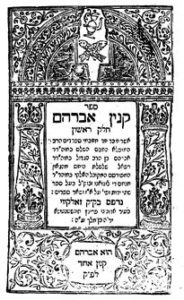
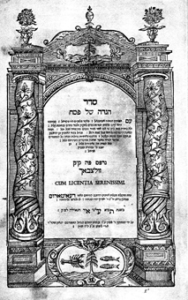
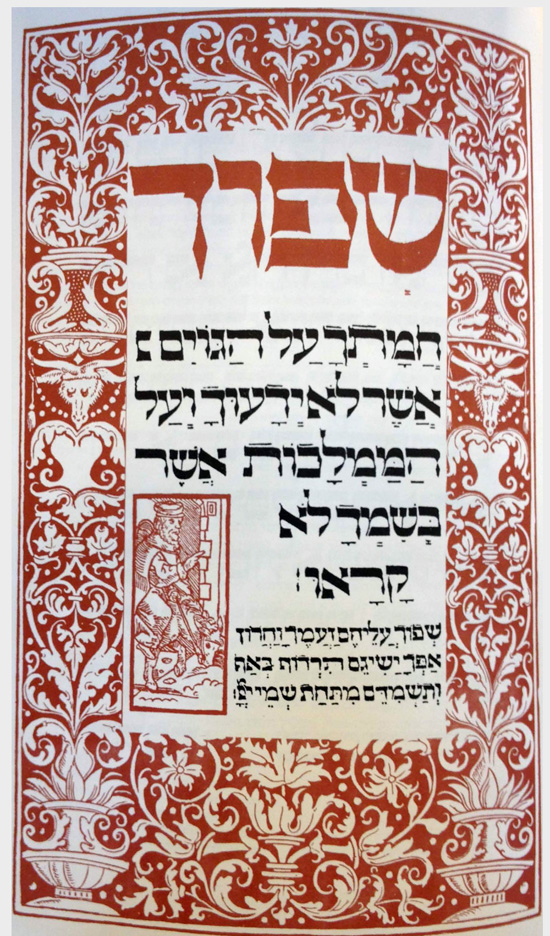
מעין החכמה, the first book to appear under R. Abraham Kalmankes’ name, is a short introduction to Lurianic Kabbalah. Indeed, it was among the earliest such works to appear in print. The title page of the quarto sized volume is followed by a one-and-a-half page introduction (pages 2-3). The introduction is followed by the text (pp. 4-22), which consists of 78 tightly-knit chapters (פרקים), perhaps more properly labeled today as paragraphs. Thus, several of the “chapters” consist of no more than15 lines of print (and, sometimes, even less). Scattered throughout the book are occasional comments in parentheses. These may reflect an educational tool used by the original author to clarify a difficult term by means of a gloss, creating — in effect — what we would call today a footnote. Or, as appears likely, these may reflect a second hand, i.e., material added to the base text by someone other than the author, e.g., a later editor of the original manuscript. Our immediate concern, however, will not be with the book’s content or structure, but rather with its authorship. What are the claims of the title page and the introduction? What do they tell us about the authorship of
מעין החכמה?
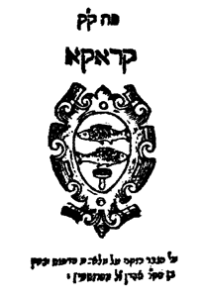
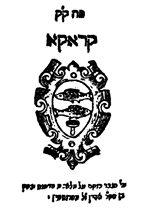
The title page basically announces the content of the book.12 It is a kabbalistic manual, we are informed, the likes of which has yet to appear in print. It provides the kabbalistic underpinning upon which all of R. Isaac Luria’s teachings rest. The title page then indicates that the book’s secret teachings are being  brought to press [ Hebrew:תעלומים  הוציא לאור] by “the exceedingly wise and young divine kabbalist, R. Abraham, son of the Gaon, Chief Rabbi and Head of the Yeshiva, R. Aryeh Leib, scion of the Kalmankes family of Lublin.” Note that the phrase “being brought to press by” is ambiguous. It is unclear from the title page whether R. Abraham Kalmankes is being presented as the author, editor, or publisher of מעין החכמה.
We perforce turn to the introduction, which – if read carefully – resolves much of the ambiguity of the title page.13The introduction, written and signed by R. Abraham Kalmankes, begins with a justification for the book’s publication. Briefly, Kalmankes, himself a victim and survivor of the Chmielnitzki massacres, informs the reader that he was puzzled by the seemingly endless exile of the Jews, with redemption nowhere in sight. After much reflection – and deeply influenced by kabbalistic teaching – Kalmankes concluded that it was faulty prayer that was prolonging the exile of the Jewish people. Jewish prayer was not piercing the heavens and reaching God on high. He compared the state of the Jewish people to a ship adrift at sea, with no one on board who knows how to steer the ship to safety. Nothing will change, argued Kalmankes, until kabbalistic teaching spreads throughout the Jewish communities. The seeds of redemption were planted by R. Isaac Luria, the master of proper kabbalistic prayer. Alas, he died before redemption set in, but he left a successor, R. Hayyim Vital, who in turn left “a basket full of manuscripts,” i.e. he reduced to writing the kabbalistic teachings of R. Isaac Luria, especially those relating to prayer. Once these teachings were mastered by Jews the world over, redemption would be at hand.
Unfortunately, “the basket full of manuscripts” was not being made available to the Jewish community at large. Kalmankes explains that those who horde the manuscripts refuse to publish them. This, for two reasons. First, for reasons of vanity. By retaining the manuscripts for themselves, they became the masters of esoteric teaching and the power brokers to whom all had to turn for guidance. Second, for reasons of profit. The owners of the manuscripts charged a hefty price for those who wished to view and copy them. Kalmankes decided to put an end to this scandalous state of affairs by acquiring and publishing one of the manuscripts that preserved some of the key esoteric teachings of R. Isaac Luria. Moreover, he “added a few comments of his own, in order to benefit the many readers,” almost certainly a reference to the comments in parentheses mention above. He gave the manuscript a new title, מעין החכמה [Wellspring  of Knowledge], for “just as a wellspring begins with a narrow opening that ultimately widens as it fills with water, so too this book begins with nuggets of wisdom that broaden and deepen as one grows in wisdom.” Kalmankes concludes the introduction with the following signature: “These are the words of the youngest
member of the group, Abraham, son of my father and teacher Rabbi Aryeh, son of the Gaon, our teacher and rabbi, the honorable R. Joseph Kalmankes Yaffe of Lublin.”
            b) Editions
Some of the confusion surrounding מעין החכמה relates to the multiplicity of published kabbalistic works with the title מעין החכמה, some of which have been mistakenly ascribed to Kalmankes in library catalogues throughout the world.
Confusion surrounding Kalmankes’ alleged plagiarism is also due, in part, to variant readings that appear in the later printed editions of מעין החכמה, for which Kalmankes can hardly be held responsible. After brief mention of some unrelated kabbalistic works with the title מעין החכמה, we will list and describe each of the printed editions of Kalmankes’ מעין החכמה.
An anonymous kabbalistic treatise entitledמעין חכמה  (ascribed in part to Moses) is included in the collection entitled ארזי לבנון (Venice, 1601).14 It is unrelated to Kalmankes’ מעין החכמה. The Ashkenazic printing house of the partners Judah Leib b. Mordecai Gimpel and Samuel b. Moses Ha-Levi published yet another anonymous kabbalistic treatise entitled מעין החכמה (Amsterdam, 1651).15 Frequently reprinted, it too is unrelated to Kalmankes’ מעין החכמה.
Four different editions of Kalmankes’ מעין החכמה have appeared in print. They are:
1. מעין החכמה, Amsterdam, 1652. Printed by the Immanuel Beneviste publishing house during the lifetime of its author/editor Abraham Kalmankes, it is the only reliable edition of Kalmankes’ מעין החכמה. As such, we will claim that Kalmankes can be judged only on the basis of this, and no other, edition of מעין החכמה. For a detailed description of the book, its title page, and introduction, see above.16
2. מעין חכמה, Koretz, 1784. This edition was printed by the Johann Anton Krieger publishing house which, in Koretz, was devoted to the publishing of kabbalistic and hasidic works.17 Although Kalmankes’ title of the book is retained, the title page ascribes the book to R. Isaac Luria and makes no mention of Abraham Kalmankes. More importantly, this edition omits Kalmankes’ introduction to the book. The text is a slightly revised and updated version of the Kalmankes edition. It incorporates most of Kalmankes’ parenthetical notes, with slight revision.18 The text was edited in its present form sometime between 1698 and 1784, i.e. well after Kalmankes’ death.19
3. מעיין חכמה, Polonnoye, 1791. Printed by the Samuel b. Yissokhor Baer Segal publishing house, this edition of מעין החכמה  appears at the end of a collection of kabbalistic works whose title page reads: ספר הר אדני.  מעיין חכמה is accorded no title page of its own. It begins with a skewed version of Kalmankes’ introduction, entitled: הקדמת המחבר ספר מעיין חכמה. No such title is applied to Kalmankes’ introduction in the first edition. We have already indicated (see above) that the introduction is omitted entirely from the second edition, so no such title appears there. The introduction to this, the third edition, closes with the name of the author:  אברהם בן מהו’ ארי’ בן הגאון מה’ משה יוסף קלמן מלובלין. In the first edition, however, Kalmankes’ grandfather’s name is given as: הגאון מורנו ורבנא כמוהר”ר יוסף קלמנקס ייפה מלובלין, with no mention of either משה or קלמן. The text that follows is entitled: התחלת החכמה האלהות כפי דרך האר”י אשכנזי ז”ל הנקרא ספר מעיין החכמה. It differs considerably from the text published in the first two editions. It  mostly lacks Kalmankes’ parenthetical comments strewn throughout the first two editions. It regularly omits readings that appear in the first two editions, and often adds material that is lacking in the first two editions. Indeed, it is a different manuscript version of the Lurianic digest that was first published by Kalmankes in 1652.20
4. מעין החכמה, Lvov, 1875. No publisher’s name is given. This is a hybrid version drawn from two earlier printed editions. Kalmankes’ introduction is drawn from the skewed version that accompanies the Polonnoye, 1791 edition. The text is drawn from the Koretz, 1784 edition.21 As such, this edition has no independent value and requires no further discussion.
            c) Relationship of the Published Editions to the Extant Manuscripts
No one has written more intelligently about the history of Lurianic kabbalistic manuscripts than Yosef Avivi.22 What follows is essentially a brief account of the relationship between the published editions of Kalmankes’מעין החכמה and the extant manuscripts, based largely (but not entirely) upon the results of Avivi’s investigations.
Numerous manuscripts copies of the kabbalistic treatise entitled התחלת החכמה, most of them dating to the 17th and 18th centuries, are extant in libraries throughout Europe, Israel, and the U.S. While they vary slightly from each other, they clearly reflect a single recension of an early 17th century kabbalistic treatise. The anonymous treatise, whose original title is unknown, was written by a disciple of Luria in Damsascus and then sent to Italy. There, the manuscript was copied and circulated under a variety of names such as קונטרס ההיכלות, כללי חכמת שיעור קומה, התחלת החכמה, and התחלת חכמה. It was precisely because a manuscript copy of התחלת חכמה came into the possession of R. Joseph Samuel b. R. Zvi of Cracow sometime prior to 1652, that he was so startled when he saw Kalmankes’ printed edition of מעין החכמה. Even after the printed edition made its debut in 1652, new manuscript copies of the kabbalistic treatise were written and circulated under a variety of titles, now including the title מעין החכמה.
Avivi has shown that the  התחלת החכמה manuscripts formed the first part of a larger Lurianic treatise that originally included a second part as well. Whereas the first part focused entirely on עולם האצילות, the second part focused  on עולם הבריאה — and is extant in manuscript form only. The two parts were separated from each other, and largely due to Kalmankes’ publication, the first part became an independent work entitled מעין החכמה. In sum, Kalmankes’ מעין החכמה is an accurate copy (with the addition of occasional glosses by Kalmankes) of an anonymous early 17th century Lurianic treatise that circulated widely under a variety of titles, including the title התחלת החכמה.
4. R. Abraham Kalmankes.
            a) Family History
The accusation of plagiarism leveled against R. Abraham Kalmankes by R. Joseph Samuel b. R. Zvi, and seconded by both R. Shmuel Ashkenazi and  Gershom Scholem, was not accompanied by any discussion of R. Abraham Kalmankes himself. When and where did he live? How did he make a living? What other books did he author? Was he an inveterate plagiarizer?23 Had such an investigation been conducted, we suspect that the accusation of plagiarism would not have been leveled at all.
In a brief biographical account of Kalmankes published in 1992, the author of the account bemoans the fact that so little is known about Kalmankes’ life history.24 Nonetheless, much more is known about him – and his family — than the meager snippets of information recorded in the 1992 biographical account or in the standard discussions of מעין החכמה. We will take as our point of departure the clear reference in Kalmankes’ introduction to מעין החכמה to his distinguished grandfather, “the Gaon, our Teacher and our Rabbi, R. Joseph Kalmankes Yaffe of Lublin.” For our purposes, what is most important about the grandfather is that after an illustrious rabbinic career in Lublin, he spent his last years in Prague, where he died, and remains buried to this day.25 The elaborate epitaph on his tombstone informs us that he died at the age of 56 on Sunday,13 Tishre, in the year 5397 (= October 12, 1636).26 The significance of this information will become apparent shortly, but first we need to turn elsewhere.
In 1678, at the family owned printing press in Lublin, R. Abraham Kalmankes published the only other work he would publish in his lifetime. Entitled ספר האשל, it is a masterful (and typical seventeenth century) rabbinic commentary on the book of Genesis.27It was the first installment of a planned commentary on the entire Torah, but apparently the rest of the commentary either never materialized or was never published.  The commentary is essentially a midrashic-halakhic work, replete with citations from the Midrash, Talmud, Codes (especially R. Joseph Karo’s שלחן ערוך), and kabbalistic literature. The volume itself is accompanied by a series of letters of recommendations by rabbis from Kremenitz, Lublin, Brisk, Pinsk, Grodno, Vilna,28 and more, all attesting to Kalmankes’ rabbinic scholarship. Once again, Kalmankes prefaced his work with an informative introduction. Kalmankes alludes to the many trials and tribulations that accompanied him through life, including hazardous trips to Egypt and the land of Israel. He was near death on several occasions during his travels, but managed to make his way back safely to Lublin.29 Upon his return, he undertook to publish two works in his lifetime. This, in order to fulfill the talmudic dictum: “Happy is he who arrives here [i.e., on High] with his talmudic teaching in hand.”30 Since according to biblical teaching, a matter is established by “two witnesses,” Kalmankes was determined to author two books and publish them, so that he would have them “in hand” when necessary. The first book, ספר האשל, intended for a more or less popular audience, took the form of a commentary on the book of Genesis. The second book, entitled ברכת אברהם, was intended for talmudic scholars only. Kalmankes informs us that the manuscript copy of ברכת אברהם was completed and that he looked forward to its publication. Sadly, it was never published. What  needs to be noted immediately is that Kalmankes never imagined that his earlier publication of מעין החכמה could count as one of his “two witnesses”! (And this was in 1687, long before R. Joseph Samuel b. R. Zvi leveled his accusation of plagiarism in 1701.) Indeed, מעין החכמה is not mentioned at all in Kalmankes’ introduction to ספר האשל. Clearly, he did not consider it a book that he had authored.
Elsewhere in the introduction, Kalmankes notes that he will make a special effort to cite דברי תורה from his grandfather, R. Joseph Kalmankes, who he describes as: “א”א זקני מ”ו הגאון מוהר”ר יוסף קלמנקס, זצ”ל, אשר מנוחתו כבוד בק”ק פראג.”  Kalmankes adds that upon his grandfather’s death in Prague, all of his writings were lost, and that he – Kalmankes – will therefore record his grandfather’s teachings as he heard them from his disciples. “For,” explains Kalmankes, “I merited to sit at his feet only until the age of ten. Thus, I was a child, and have no real knowledge of his novellae.” We, of course, cannot be certain whether Kalmankes sat at his grandfather’s feet in Lublin or Prague (or both). If only in Prague, and if Kalmankes was ten years old when his grandfather died, we have the latest possible date of birth for Kalmankes, namely 1626, for we have already established that Kalmankes’ grandfather died in 1636. Kalmankes, of course, could have been born earlier than 1626, and we have reason to believe that this was the case.
At the other end of the spectrum, it seems likely that R. Abraham Kalmankes died somewhere between 1678 and 1701. That he was still alive in 1678 is attested by the publication of ספר האשל in that year, and by several of the letters of recommendation dated 1678, all of which describe Kalmankes as alive and well. Since Kalmankes never responded to the devastating accusation of plagiarism made against him in 1701 by a leading rabbinic contemporary, it is probably safe to assume that he died before the accusation appeared in print. Though we cannot pinpoint the year of his death with precision, the most likely candidates are either 1692 or 1693. Kalmankes died in Lvov, where he served on its rabbinic court as דיין.31 The text of the epitaph on his tombstone was copied and published in 1863 and reads:32
שנת תתן אמת ליעקב
                          ביום טוב נהפך כי טוב פעמים ואבל ומספד ונהי בכפלים
ט”ו בחודש ניסן נגנז צנצנת המן המאיר באספקלריא המאירה
כבוד מורינו ורבנו ומאורנו נתבקש בישיבה של מעלה
הגאון האלוף עין הגולה מו”ה אשר יעקב אברהם בן הרב מוהר”ר אריה קלמנקש
צלל במים אדירים של תורה וחיבר ס’ אשל אברהם על שמו נקרא
ובשביל שזיכה את הרבים יבוא שלום וינוח על משכבו בשלום
תנצב”ה
Thus, Kalmankes died on 15 Nisan on a Tuesday.33 But in which year? The text states unequivocally that it was in the year whose numerical value was embedded in the biblical phrase תתן אמת ליעקב.34 But the copyist (in 1863) informed his readers that, due to an erasure, he could no longer determine which letters from the phrase were enlarged or highlighted on the original tombstone. This makes it difficult, but not impossible – as we shall see – to calculate Kalmankes’ approximate year of death. Since Kalmankes died on the first day of Passover which fell on a Tuesday, seven candidates (between the years 1678 and 1701) present themselves: 1679, 1686, 1689, 1692, 1693, 1696, and 1699. The Hebrew equivalents for these years are: [5]439, [5]446, [5]449, [5]452, [5]453, [5]456, and [5]459. Now the numerical value of a combination of letters from the phrase תתן אמת ליעקב must add up exactly to one or more of the above Hebrew dates. Only two solutions are possible: [5]45235 and [5]453.36 These are 1692 and 1693, respectively.37 In sum, if we had to give mostly approximate dates for the three generations of the Kalmankes family mentioned by R. Abraham Kalmankes in both of his publications, they would be:
R. Joseph Kalmankes:    1580-1636
R. Aryeh Kalmankes:      1600-167038
R. Abraham Kalmankes: 1620-169339
b) Citation from מעין החכמה in ספר האשל
Critical for our discussion is the fact that R. Abraham Kalmankes cites מעין החכמה in his ספר האשל!40 It is the only reference to מעין החכמה in ספר האשל.The passage reads:41
       או יאמר מאמר הר”י ז”ל באשר נקדים מאמר מהאר”י לור”י[א] הנזכר בספר מעיין החכמה
אשר הביאותיו לבית הדפוס בפ’ י”ד שבשעת הבריאה…
Or we can explain this by citing a passage from R. Isaac of blessed  memory, i.e., by first introducing a passage by R. Isaac Luria Ashkenazi — which is mentioned in chapter 14 of the book מעיין החכמה, which I brought to press [literally: to the publishing house] — which states that during the period of creation…
If one examines chapter 14 of מעין החכמה, the passage cited by Kalmankes in ספר האשל appears exactly as referenced, but Luria’s name appears nowhere in the text of chapter 14! This is precisely because מעין החכמה was a repository of Lurianic teaching which he – Kalmankes – brought to press. Kalmankes never claimed authorship of the book, and he tells us so in his own words in 1678, long before any accusation was leveled against him.
5. Conclusions.
Ultimately, whether or not Kalmankes is viewed as a plagiarist will depend largely on one’s definition of plagiarism.42 In terms of literary (as distinct from oral) plagiarism, a reasonable definition would seem to be:
Plagiarism is the act of appropriating in print another person’s ideas,          writings, or words, and passing them off as one’s own by not providing proper attribution to their original source.
Even aside from the definition itself, the moral opprobrium attached to any specific act of plagiarism will depend on a variety of factors. Thus, it seems to me, that the more literal and lengthy the borrowing, the more heinous the offense. Motive too will surely play a role in determining the severity of the offense. We turn to the specifics of the Kalmankes case.One can certainly sympathize with R. Joesph Samuel’s outrage when, in the 1650’s, he chanced upon a copy of the recently published מעין החכמה. He leafed through its pages and realized instantaneously that it was virtually word for word a printed copy of a manuscript he owned under the title התחלת חכמה. Worse yet, prominently displayed on the title page of the pirated book was the name of the “divine kabbalist,” R. Abraham Kalmankes, a name otherwise unknown to R.Joseph Samuel. He could only conclude that this was a blatant case of plagiarism that called for condemnation. Indeed, he was still upset about the matter some fifty years later!
But, as we have seen, the title page of מעין החכמה is somewhat ambiguous about Kalmankes’ role in its authorship and publication. It simply states that Kalmankes הוציא לאור the תעלומים, i.e., he published the secret or hidden digest of Lurianic teaching. One suspects that R. Joseph Samuel never examined Kalmankes’ introduction to מעין החכמה. Had he done so, he surely would have noticed that Kalmankes admits openly that he is publishing a manuscript that contains a digest of Lurianic teaching, authored by a disciple of Luria – and not by him. Kalmankes’ states unequivocally that his contribution to the volume is limited to the few comments he added (almost always in parentheses) and to the new title, מעין החכמה, he provided for it. It is only in the third edition of מעין החכמה, published in Polonnoye, 1791 – long after Kalmankes’ death – that a skewed version of Kalmankes’ introduction is labeled: הקדמת המחבר ספר מעיין חכמה, in effect suggesting that Kalmankes was the author of מעין החכמה. Anyone who reads this skewed version of Kalmankes’ introduction, and compares it to the original, will realize at once that it is was created in 1791 in order to harmonize its content with that of a different manuscript version of the Lurianic digest (one that lacked Kalmankes’ comments) that was being attached to it.43
 We have also the clear evidence from Kalmankes’ introduction to ספר האשל, published by him in 1678, that he sought to author and publish two books in his lifetime, so as not to be embarrassed when he was called “on High.” He provides the titles of both books, yet makes no mention of the fact that he had authored and published a book called מעין החכמה. He knew full well that this was a book written by others, which he had brought to press. Indeed, as we have seen, he cited מעין החכמה in his ספר האשל. When doing so, he stated openly that it was a Lurianic work that he had brought to press.
            There doesn’t seem to be much evidence here for plagiarism, as defined above. Kalmankes’ מעין החכמה was based upon a Lurianic manuscript that was anonymous and was circulating under a variety of titles. Kalmankes never claimed authorship of the manuscript, and indicated clearly that all he did was to provide the manuscript with a new title and some brief annotation. This he did for the best of motives, namely to bring about the ultimate redemption of the Jewish people. He did not pass off the work as his own (other than the title and the annotations, which were legitimately his own creation); he withheld no proper attribution.
On the other hand, three distinguished scholars, R. Joseph Samuel of the seventeenth century, and R. Shmuel Ashkenazi and the late Professor Gershom Scholem of the twentieth century, were persuaded that Kalmankes was a plagiarist. Perhaps they felt that the appearance of Kalmankes‘ name on the title page of מעין החכמה,  preceded by the words “אב בחכמה ורך בשנים המקובל האלוהי כמוהר”ר,” with no mention of any manuscript or attribution to others, was sufficiently misleading – and, perhaps, even deliberately intended – to create the impression that Kalmankes was the author of the book. If so, they would argue, he deserves to be listed among the plagiarizers. I am not persuaded that this is the case, but in deference to the three distinguished scholars mentioned above, I have allowed the title of this essay to read as it does. At best (or: worst), it is a mild case of plagiarism, if even that.44
NOTES
1 For biographical studies of R. Joseph Samuel b. R. Zvi, see H.N. Dembitzer,
כלילת יופי (Cracow, 1893), vol. 2, pp. 144b-152b; M. Horovitz, Frankfurter Rabbinen (Jerusalem, 1969), ed. J. Unna, pp. 94-97 and 296-297; and idem,
רבני פרנקפורט (Jerusalem, 1972), ed. J. Unna, pp. 67-69 and 212. For the epitaph on his tombstone, see idem, אבני זכרון (Frankfurt, 1901), p. 151. For legendary accounts of R. Joseph Samuel, see E. Sternhell, “,תולדות יצחק” p. 2b, in Y.I. Billitzer, באר יצחק (Paks, 1898); and Y.L. Maimon, שרי המאה (Jerusalem, 1955), vol. 1, pp. 231-233.
2 For an assessment of R. Joseph Samuel’s contribution to the printed text of the Talmud, see Y. S. Spiegel, עמודים בתולדות הספר העברי: הגהות ומגיהים (Ramat-Gan, 2005), second edition, pp. 404-407.
3 See L. Loewenstein, מפתח ההסכמות (Lakewood, 2008), ed. S. Eidelberg, pp. 99-100.
H.N. Dembitzer, op. cit., vol. 2, p. 150a.
See G. Scholem, חלומותיו של השבתאי ר’ מרדכי אשכנזי (Jerusalem, 1938); and Y. Tishby, נתיבי אמונה ומינות (Jerusalem, 1964), pp. 81-107. Cf. the historical vignette in Rabbi P. Katzenellinbogen, יש מנחילין (Jerusalem, 1986), ed. Y.D. Feld, pp. 74-75.
The original reads:
ושתים רעות עושים כי לא ידעו ולא יבינו אל פעולות השם,  גם גורמים להשניא  בעיני המון את חכמי תורה שבנגלה, כסבורים העם דמאן דלא ידע האי לאו גברא רבה הוא, ומשליכים אחרי גיום חכמים חרשים ושומעים לקול מלחשים, אשר בטליתות שאינן שלהם מלבשים, כאשר בקושטא קא אמינא בדידי הוה עובדא, נהירנא זה חמישים שנה שבידי ספר נחמד כתוב על חכמת הקבלה נקרא תחלת חכמה, והנה קם מאן דהו תלמיד חדש שישן אין בו והדפיסו על שמו, והנה גנוב הוא אתו.
A. Schischa, “שלושה ספרים נעלמים,” עלי ספר 2(1976), pp. 237-240.
S. Ashkenazi, “שתי הערות,” עלי ספר 3(1976), pp. 171-173. For an expanded version of Ashkenazi’s comments in עלי ספר, see his אסופה: ארבעה מאמרים מאוצרות הר”ש אשכנזי שליט”א (Jerusalem, 2014), pp. 49-53. Cf. S.Z. Havlin, “הערת העורך,” עלי ספר 11(1984), p. 134.
These include the National Library in Jerusalem, the Bodleian Library at Oxford, and a host of other libraries in Europe and the United States. For an early description of two such manuscripts in the National Library in Jerusalem, see G. Scholem, כתבי יד בקבלה (Jerusalem, 1930), p. 63, manuscript 2512, and p, 117, manuscript 47. The Bodleian Library lists some 10 manuscript copies of התחלת חכמה in its collection. See A. Neubauer, Catalogue of the Hebrew Manuscripts in the Bodleian Library and in the College Libraries of Oxford (Oxford, 1886), column 1001. Cf. the corrections to these listings in M. Beit-Arie and R.A. May, eds., Catalogue of the Hebrew Manuscript in the Bodleian Library: Supplement of Addenda and Corrigenda (Oxford, 1994), passim. A manuscript copy of התחלת חכמה was in the private library of R. Joseph Solomon Delmedigo in 1631. See his נובלות חכמה (Basel, 1631), p. 195a. The precise title of the book varies in the manuscripts, with the most common titles being התחלת חכמה  and
התחלת החכמה.
10 See L. Fuks and R.G. Fuks-Mansfeld, Hebrew Typography in the Northern Netherlands 1585-1815 (Leiden, 1984), vol. 1, pp. 176-177, entry 233.
11 See the undated loose page, in Scholem’s hand, appended to Scholem’s copy of מעין חכמה at the National Library in Jerusalem. Cf. ספריית גרשם שלום בתורת הסוד היהודית: קטלוג (Jerusalem, 1999), vol. 1, p. 312, entry 4188.

12 See the scan of the title page.


13 See the scan of the introduction.
14 The title is so listed on the pages of the treatise itself in ארזי הלבנון, pp. 46b-47a. On the title page of ארזי הלבנון, it is listed as מעיין החכמה. The frequent and easy interchange between the spellings מעין and מעיין and the spellings חכמה and החכמה characterizes virtually all the printed editions of the various books bearing these titles.
15 L. Fuks and R.G. Fuks-Mansfeld, op. cit., vol. 1, p. 195, entry 270,
16 Only a handful of copies are extant world wide. To the best of my knowledge, the first edition of Kalmankes’ מעין החכמה has not been photo-mechanically reproduced, and it is not available online (as of the date this note was recorded). Nor is it available on any of the standard electronic collections of rabbinic literature, such as HebrewBooks, אוצר החכמה, or אוצרות התורה. I am indebted to the National Library in Jerusalem and the Jewish Theological Seminary in New York for making their copies available to me. The scans of the title page and the introduction are reproduced here courtesy of the Bibliotheca Rosenthalia, now in the Special Collections of the University of Amsterdam (online catalogue: http://permalink.opc.uva.nl/item/001748453).
17 H. D. Friedberg, תולדות הדפוס העברי בפולניא (Antwerp, 1932), p. 61.
18 One key revision appears on p. 1, chapter 2, where ספר ויקהל משה is referenced. The book is not mentioned in the first edition of Kalmankes’ מעין החכמה, nor could it have been, since ספר ויקהל משה was not published until 1698. The reference is to R. Moshe Graf, ויקהל משה (Dessau, 1698). It does not appear likely that Kalmankes saw Graf’s work in manuscript form, since מעין החכמה was published in 1652 and Graf was born in 1650.
19 For the date of Kalmankes’ death, see below. The Koretz, 1784 edition was photo-mechanically reproduced in Jerusalem, 1970.
20 The Polonnoye, 1791 edition of מעיין חכמה was photo-mechanically reproduced in Jerusalem, n.d. (circa 1998), in a thin, dark blue, hardbound volume whose spine and outer cover read צדיק יסוד עולם, and whose title page reads הר אדני. (In other words, when seeking a copy in a bookshop of the reprint of the Polonnoye, 1791 edition of מעיין חכמה, whatever else you do, don’t ask for a copy of מעיין חכמה.)
21 As noted by S. Ashkenazi (see above, note 8), the title page of the Lvov edition indicates that its text is based upon the Koretz edition, and reproduces the very biblical phrase used by the Koretz edition for indicating its original date of publication in 1784. But by highlighting a different set of letters within the same biblical phrase, the Lvov edition announces to the reader that its date of publication is 1875.
22 Y. Avivi, קבלת האר”י (Jerusalem, 2008), 3 volumes, passim. See especially vol. 1, pp. 204-208, 443; and vol. 2, pp. 565-568, 840-841. See also, idem, “כתבי האר”י באיטליה עד שנת ש”פ”,” עלי ספר 11(1984), pp. 91-134; and “הערה,” עלי ספר 12(1986), p. 133.
23 “Plagiarism is something people may do for a variety of reasons but almost always something they do more than once.” So T. Mallon, Stolen Words: Forays into the Origins and Ravages of Plagiarism (New York, 1989), preface, p. xiii.
24 Rabbi M.Y.S. Goldenberg, “פתח דבר,” to the reissue of R. Abraham Kalmankes’ ספר האשל (Brooklyn, 1992).
25 On R. Joseph Kalmankes Yaffe of Lublin, see J. Kohen-Zedek, שבת אחים ( St. Petersburg, 1898), pp. 59-76; S. B. Nissenbaum,  לקורות היהודים בלובלין, (Lublin, 1920), second edition. pp. 36-37; S. Buber, אנשי שם (Cracow, 1895), p. 89, entry 217;  and S. Englard, “צפונות יוחסין (א), “ ישורון 3(1997), p. 680, note 6 and p. 694, note 36a.
26 See K. Lieben, גל עד (Prague, 1856), German section, p. 46; Hebrew section, pp. 34-35.
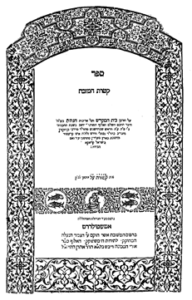
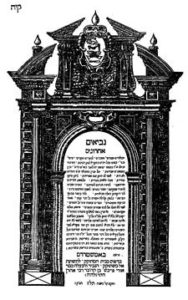
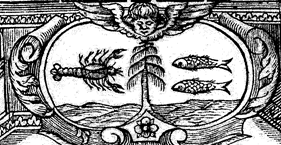
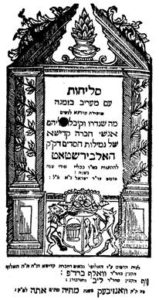
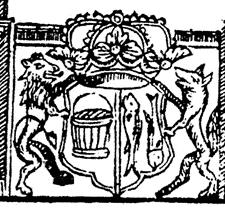
27 R. Abraham Kalmankes, ספר האשל (Lublin, 1678). Few copies have survived. For the copy at the Bodleian Library, see M. Steinschneider, Catalogus Librorum Hebraeorum in Bibliotheca Bodleiana (Berlin, 1860), vol. 1, column 752, entry 4458:1; and A.E. Cowley, A Concise Catalogue of the Hebrew Printed Books in the Bodleian Library (Oxford, 1929), p. 45. For the copy at the British Library, see J. Zedner, Catalogue of the Hebrew Books in the British Museum (London, 1867), p. 14. For the copy at Yeshiva University’s Mendel Gottesman Library, see B. Strauss, אהל ברוך (London, 1959), p. 31, entry 534. To the best of my knowledge, the first edition of Kalmankes’ ספר האשל has not been photo-mechanically reproduced, and is it not available online (as of the date this note was recorded). Nor is it available on any of the standard electronic collections of rabbinic literature, such as HebrewBooks, אוצר החכמה, or אוצרות התורה. A new edition of this exceedingly rare volume was made available by Rabbi M.Y.S. Goldenberg (Brooklyn, 1992) and we are indebted to him. Nonetheless, one needs to use this new edition with caution; the text has been “improved” for the modern reader. A comparison of the texts of the title page, as they appeared in 1678 and 1992, serves as an indicator of the occasional liberties taken with the text. A seemingly enigmatic woodcut (opposite the opening page of the commentary on Genesis) depicting a Jew (Kalmankes?) drawing water from a well (מעין החכמה?) – and framed in an elaborate frame marked by two angelic beings holding up a crown inscribed with the words כתר תורה – was not reproduced in the 1992 edition. See the attached scans:
 
28 The letter of recommendation from Vilna, dated 1673, was written by its Chief Rabbi, R. Moses b. David Kramer (d. 1687), the paternal great-great-grandfather of the Vilna Gaon.
29 These vicissitudes of life may account for the additional first names of Kalmankes, who in ספר האשל is identified as אשר יעקב אברהם קלמנקס. For the practice of changing names and/or adding additional first names when confronted by difficult circumstances, see R. Judah He-Hasid, ספר חסידים (Jerusalem, 1957), ed. R. Margulies, p. 214, paragraph 245 and notes. Cf. A. Teherani, כתר שם טוב (Jerusalem, 2000), vol. 1, pp. 293-315.
30 B. Pesahim 50a and parallels.
31 S. Buber, op. cit., p. 45, entry 101.
32 G. Suchestow, מצבת קודש (Lemberg, 1863), second edition, vol. 1, no pagination, entry 32.
33 The opening line ביום טוב נהפך כי טוב פעמים signals that Kalmankes died on a holiday that fell on the day when כי טוב was said twice. The next line identifies the holiday as 15 Nisan, i.e., the first day of Passover. The day כי טוב was said twice refers, of course, to the third day of creation, i.e. Tuesday. See Gen. 1:10 and 12.
34 Buber, loc. cit., writes with confidence that the highlighted letters are אמ”ת, which would indicate that Kalmankes died in [5]441 or 1681. But in 1681, the first day of Passover fell on a Thursday, not on a Tuesday. Suchestow was more circumspect, indicating it was no longer possible to determine which of the engraved letters were enlarged or highlighted. He left the problem unresolved. The usual practice for highlighting was the placement of a protruding dot over the engraved letters that were to be used for reckoning the year of death. The problem cannot be resolved by emending the second line to read ט”ז בחודש ניסן instead of ט”ו בחודש ניסן, since the second day of Passover can never fall on a Tuesday. See שלחן ערוך, אורח חיים, סימן תכח: א.
35 By highlighting the letters תתן אמ’ת’ לי’עקב’.
36 By highlighting the letters תתן א’מ’ת’  לי’עקב’.
37 These dates are based upon the assumption that the text of Kalmankes’ epitaph, as copied and published by Suchestow in 1863, is an accurate copy of the original. But this may not be the case. Suchestow’s מצבת קודש is marred by egregious errors. He sometimes copied and published as many as four different versions of the same epitaph! In another instance, he divided an epitaph into two parts, creating two dead persons when only one was called for. See the critiques of Suchestow in S. Buber, op. cit. (above, note 25)pp. vi-viii and in R. Margulies, “”,לתולדות אנשי שם  סיני 26(1949-50), p. 113 ( and throughout the later installments to this essay published in סיני between 1950 and 1952). Given that Kalmankes’ tombstone was close to 200 years old when it was copied in 1863, it is likely that the epitaph could be read only with great difficulty. While any attempt at emending the received text is speculative, a slight emendation of the first lines of the epitaph yields the following text:
שנת תתן אמ”ת ליעקב
ביום טוב נהפך טוב פעמים ואבל ומספד ונהי בכפלים
ט”ו בחודש ניסן נגנז צנצנת המן המאיר באספקלריא המאירה
The sense would be that Kalmankes died on 15 Nisan, on יום טוב, on a day when טוב was twice overturned. It was overturned first, because every day of the week of creation was described as  טוב(with the exception of the second and seventh days); and second, because it was יום טוב, a holiday. This would allow for 15 Nisan to fall on a Thursday, and indeed in 1681 (the numerical equivalent of אמ”ת), the first day of Passover fell on a Thursday. If so, Kalmankes may well have died in 1681.
38 These dates are an approximation. We know only that R. Aryeh Kalmankes died in 1671 or earlier, as his name appears with ברכת המתים in several letters of approbation dated 1671 and appended to ספר האשל.
39 These dates, as well, are an approximation. For possible evidence that R. Abraham Kalmankes died in 1681, see above, note 37. If Kalmankes was born in 1620, he would have been 32 years old when מעין החכמה was published in 1652. This fits well with his description on its title page as a רך בשנים. It also fits well with R. Joseph Samuel’s characterization of him (at the time) as an “upstart student.” It would also mean that he was nearing 60 years of age in 1678, when he published ספר האשל. This fits well with his bemoaning the fact – in the introduction to the volume – that the hair on his head and beard had turned gray and that old age was overtaking him.
40   It is astonishing that the author of the most comprehensive study of the Kalmankes family, J. Kohen-Zedek, שבת אחים (see above, note 25), concluded on pp. 67-68, that the authors of מעין החכמה and ספר האשל were two different people named Kalmankes (cousins, of course)! Among his proofs is the alleged fact that the author of ספר האשל was unaware of the existence of מעין החכמה. Alas, Kohen-Zedek overlooked the passage cited here. So too Gershom Scholem, who wrote: “המחבר [של ספר מעין החכמה] לא הזכיר את הספר בספריו הוא, כגון ספר האשל.” See the loose page in Scholem’s hand and the Scholem Library Catalogue, referred to above, note 11. Scholem, however, did not conclude with Kohen-Zedek that the authors of מעין החכמה and ספר האשל were two different people. Even more astonishing is the fact that the late bibliophile, R. Reuven Margulies, cited Kohen-Zedek’s conclusion approvingly. See R. Margulies, “לתולדות אנשי שם בלבוב,” סיני 26(1949-50), p. 219. It appears likely that Scholem (in part) and Margulies were misled by Kohen-Zedek.
41 ספר האשל (Lublin, 1678), p. 8b. We have printed the text as it appears
  in the first edition. In the 1992 edition, it appears on p. 29 as follows:
או יאמר באשר נקדים מאמר הר”י לוריא הנזכר בספר מעיין החכמה אשר הביאותיו לבית הדפוס בפ’ י”ד, שבשעת הבריאה…
 42 In general, see A. Lindey, Plagiarism and Originality (New York, 1952); T. Mallon, op. cit. (above, note 23); and J. Anderson, Plagiarism, Copyright Violation and Other Thefts of Intellectual Property: An Annotated Bibliography with a Lengthy Introduction (Jefferson, North Carolina, 1998).
43 Thus, in the introduction to the first edition of מעין החכמה, Kalmankes states:
וגם מעט מזער מדעתי הוספתי אך לזכות הרבים היא כוונתי (I added but a few comments of my own; my only intention is to benefit the many). In the Polonnoye, 1791 edition this was radically changed to: וגם מעט מזער מדעתי לא הוספתי אך לזכות הרבים היא כוונתי (I added not even the fewest of comments of my own; my only intention is to benefit the many). This change was made necessary because the kabbalistic manuscript now appended to Kalmankes’ introduction, and being published together with it for the first time, did not contain Kalmankes’ additional comments.   
44 I am deeply grateful to Rabbi Menachem Silber for reading and commenting on an earlier draft of this essay. The errors that remain are entirely mine.
Should we celebrate birthdays or not? Is it better to ignore them?

Should we celebrate birthdays or not? Is it better to ignore them?
By Rav Binyamin Wattenberg

This post was originally an answer posted on july 25 2016 on the French website techouvot.com (https://www.techouvot.com/feter_les_anniversaires-vp46393.html).

The author agreed to have it translated into English but did not review the translation.

The author, Rav Binyamin Wattenberg teaches Talmud in Neuilly sur Seine, France, among other talmudic activities (techouvot.com…)

This subject is widely debated in our sefarim. Some are convinced that it is entirely a “non-Jewish” custom which is important not to follow, but I think that it is rather because of ignorance of what has been written on the subject.

I will try to summarize the different rabbinical positions with their reason, and as we will see we can find anything and everything.

GOOD MAZAL

The Yerushalmi Rosh Hashana (III, 8) relates that Amalek placed soldiers on their birthday at the battle front because they would have a good “mazal” and Moshe had to “mix mazalot”. Korban Haeda explains that by raising his hands, Moshe “mixed / disturbed” the Mazalot to counter the good mazal of Amalek’s warriors.

This idea is also found in the Chida who writes (Chomat Anakh, Iyov 3) on behalf of the Kabbalists that the birthday is a day of good mazal.[1]

That would explain the wish of the day: Mazal Tov!

There is also Rabbi Tsadok Hacohen Rabinovicz of Lublin in his Resisei Layla (Divrei Chalomot 20) who writes that a man has nothing to fear on his birthday and while the Gmara Kiddushin (38a) says that Tzadikim die on their birthday (and therefore have something to fear about), it is because for them, death is an accession to a higher level (and is therefore a positive occasion).[2]

There is a more plausible explanation of the Maguen Avraham in his Zayis Raanan on Yalkut Shimoni (‘Habakkuk 3) who answers that it is a blessing for the tzaddik to die on his birthday because “the Holy One, Blessed be He, sits and completes the years of the righteous from day to day” (Kiddushin 38a, Sotah 13b and Rosh Hashana 11a).[3]

But some consider that this good mazal on this day concerns only non-Jews (like Amalek).[4]

This is perhaps why we find several authors who are very reluctant about the idea that a Jew could celebrate such a day.

AGAINST CELEBRATING:

For example, in his Torah Shleima (Vayeshev p.1522 note 49), Rav Menachem Kasher quotes a manuscript (Chemat Hachemda) commentary on Bereshit 40, 20, that still today, non-Jews celebrate birthdays (meaning that Jews do not).[5]

Certainly, in the Gmara (Moed Katan 28a) we are told that Rav Yossef celebrated his 60th birthday, but that also indicates that he did not celebrate his other birthdays – neither he nor the other Amoraim – and it is only for its 60th that he wished to celebrate because – as he says it – it excluded Karet’s punishment.

The Minchat Elazar (the Munkasz’ Rebbe) writes[6] that there is nothing to celebrate on one’s birthday since the Sages tell us (Eruvin 13b) that it would have been better for the man not to be born.[7]

It is also the position of many authors, such as : Rav Horovitz of Strasbourg (and then of Badats of Jerusalem) in his Shout Kinian Torah Bahalacha (III, §21), Arugat Habossem (II, §215),[8] Abelsohn (Shut Knesset Avraham Yoel, §6 p.116 – linked with Shut Etz Chaim),[9] R. Tsadok Hacohen (Likutei Maamarim §13, p.140), the Klausenburg-Sanz Rebbe (Michtevei Torah II, 82 p.55), Rav Shlomo Zalman Bloch (Hatzadik R. Shlomo, p.29, ot 18), Patsovsky rav (Pardes Yosef Vayeshev Milouim p.48 and in the new edition, Bereshit II, p.777), Rav Dunner (Leket Sheelot Hametzuyot IV, p.13 and Kol Hatorah 65, p.164), Rav Stern (Beer Moshe) and Rav Wozner (Shevet Halevy) both quoted by Rav Harfenes in Beit Vaad LaChachamim (adar 2009, p.356), Shut Lehorot Natan (IX, §5, 9),[10] Gdulat Yehoshua (Chelek 2, Hakdama), Rav Shmuel Mohliver (Midei Chodesh BeChodsho, II, Jerusalem 1957, p.192 and Shana Beshana 1976, p.237).

In Hapeles (shana III, 1903, p.633) it cites the Beer Yitzchak of rav Itzchak Ber Levinzohn (p.34) stating that birthdays were non-Jewish holidays close to Avoda zara, although this Rav himself was close to Haskala![11]

The Kinian Torah Bahalacha (III, §21) is also opposed to celebrating birthdays, and quotes in support the Vizhnits’ Rebbe, Ahavat Israel, who refused to make a seuda for his 70th birthday and recited a lot of Tehilim and Bakachot instead.[12]

Rav Israel of Rouzhin also vigorously refused the surprise birthday organized by his wife and dismissed all the guests.[13]

The Otsar Kol Minhaguei Yeshurun (4th ed., §XXVII, 4, p.60 and 3rd ed., St Louis 1917-8, Hashmatot §14, p.304) considers that celebrating one’s birthday is a non-Jewish custom and the only character in the Choumash that one finds celebrating his birthday is Paro.[14]

It seems that it is also the opinion of the Aderet in his Nefesh David (p.129) who did not appreciate when we wished him a happy birthday, saying that it was never a holiday among the Jews and that the only one that one finds celebrating his birthday in the Chumash is Pharaoh, while the Gmara Erouvin (13b) tells us that it would have been better not to be born … He even states that he tries to forget that it is his birthday because it causes him great sadness[15] (because “it is better not to be born …”).[16]

He emphasizes, however, that the Tzadikim have something to celebrate their birth, according to the opinion of Tosfot (Avoda Zara 5a).

He nevertheless rejoiced on the day of his 60 years for the same reasons as Rav Yosef in Moed Katan (28a), as he wrote in a letter (Eder Hayakar II, Igrot, p.93, §14 ).

Not that you have to be ashkenaz to oppose birthdays. The Rav Chalfon Moshe HaC ohen in his Yad Moshe (Vayeshev, §63 daf 70b) writes that the custom of celebrating birthdays is very present in Europe, but we (the Jews) mark this date with fasting and repentance, preferring in this the useful to the pleasant.

There is in any case a very clear tendency to connect the birthday party to Pharaoh and that would therefore be considered as a “non-Jewish” rejoicing.[17]

IN FAVOR OF CELBRATING BIRTHDAYS :

However, one could just as easily see things differently.

For the Sadigura Rebbe,[18] if the Torah tells us that there was a celebration in honor of Pharaoh’s birthday, it is not in vain, it is here for us to learn that we must celebrate birthdays. And even though Pharaoh is not a good person, the fact that the Torah mentions it indicates it has to be a followed practice. He brings as a support we learn the principle of not mixing two feasts (ein mearvin simcha bessimcha) from the Torah relating the habit of the non-Jews and particulary Lavan (see Bereshit XXIX, 27 and see Yeroushalmi Moed Katan I, 7) ; and Lavan is also the source for the idea of the seven days of wedding’s festivities.

Therefore, it should not be considered as a non-Jewish minhag, and there is no problem of Chukot hagoyim in celebrating birthdays (see also Shut Beth David, §176).

Rabbi Meir Mazouz also writes (annotations on Ben Ish Chai shana 1, Ree §7, p.580) that he has heard that some people are against celebrating birthdays but since he remembers reading that the Baal Shem Tov was celebrating his – on Elul 18th – and deduces that there is no problem.[19]

His brother-in-law, Rav Yitzchak Berdah, is even clearer in his Shut Yitzak Yeranen (V, §54) and validates the birthdays minhag by writing that those who do so have whom to rely upon.

Rav Nissim Karelitz (Chut Hashani, §195, 1, 6 p.215), unlike Rav Zeldner cited above, does not seem to consider it problematic to offer a birthday present.[20]

Ben Ish Chai (I, Ree, §17) writes that it is a good custom to celebrate birthdays every year and note that some are celebrating the anniversary of their circumcision, indicating that in his family, they usually follow the first minhag (= celebrate the day of birth).[21]

R. Avraham Pallagi in his Veavraham Zaken (Yod, §19) mentions also the minhag of celebrating birthdays. Yabia Omer (VI, WH, §29) also finds this positive.

The custom of a birthday seuda, has also been endorsed by multiple and different authors such as’ Havot Yair (§70), Shout Beth Israel (Landau) (§32), Beer Moshe (Yeroushalaimsky) (Maamar Zikhron Tov, daf 138a, §5).

The Tiferet Israel, in his will prompts his children to mutually wish each other good wishes on the days of their respective birthdays (Hamaayan -Tamuz 1971- ot 6).

It is also a habit taken seriously by Loubavitsh Chassidim. The chabad literature is full of advice and remarks on to conduct oneself on one’s birthday and even tracks sources for it in Kabbalah (Shaarei Halakha UMinhag II, §302).

We also find many Tzadikim who have celebrated their birthdays themselves.

Rabbi Avraham Pallagi already mentioned, celebrated his birthday every year from the age of 70 – according to the testimony of his son Rabbi Avraham Pallagi (Tsavaa Mechaim §40 and see also Guinzei Chaim, yud §16). And this is also the case of Rabbi David Chazan quoted in Yishrei Lev (daf 2b).[22]

We also find the Midrash Sechel Tov (XL, 20 ; p.247) stating that “the majority of “people” enjoy (mechavevim) their birthday, rejoice and make a feast”. (But it’s not clear if he speaks only of gentiles or also of jews.)

The Ktav Sofer probably did not celebrate each of his birthdays with great fanfare, but celebrated his 50th one publicly (see Shut Ktav Sofer Y “D, §148).[23]

We also know – as mentioned above – that Rav Yosef celebrated his 60th birthday (Moed Katan 28a).

And this habit was followed by several rabanim, such as the Trumat Hadeshen, quoted by his pupil (Leket Yosher II, Y “D, p.40), or the Tshortkov Rebbe and the Rudzimin’s Rabbi both cited by R.A Nayerman in his Toafot Reem (volume 1, Warsaw 1936, p.30, §23).

We also find the idea of especially ​​thanking G-d on one’s 60th birthday, as Pele Yoets in his Chesed Laalafim (§221-230, sk.8, p.372) who advocates reciting Shehechiyanu without shem UMalchut or else to prepare a fruit or a new garment for that. This is also the Ben Ish Chai’s opinion (I, Ree, §9) for the 60th and 70th birthday.

For the 70th birthday, we find in Shut Chavot Yair (§70) that it is necessary to recite Shehechiyanu (without restriction). But this opinion is not followed and the Chida (Birkei Yosef-Shiyurei Bracha §223, sk.2) will impose the same restrictions as for 60th birthday, i.e without pronouncing the name of G-d or wearing a new garment (or eating a new fruit).

See as well the Pri Megadim (Mish Zahav §444, sk.9), Shut Tzitz Eliezer (XVIII, §33), Shut Tshuva Meahava (II, §239), Samach Nefesh (erekh Shehechyanu), Rabbi Avraham Pallagi (Tsavaa Mechaim, §40), Hagahot Chatam Sofer (O.C §225), Shut R. Yedidia Tia Weill (Y “D §106 p.224 of the recent edition), Kaf Hachaim (§223, sk.28), Shut Beth Israel (Landau) (§32), Shut Beth David (§176), Chesed Laalafim (§221-23, sk.8), Divrei Israel (II, p.175) and Afarkasta Deania (I, §123), who all oppose reciting shehchiyanu “only because of the 70th birthday”, since this blessing should only be recited for the situations indicated by Chazal, as Shut Olat Shmuel (Kauder) writes (I, §22 ).[24]

However, it will still be necessary to mark the hit. The Chafetz Chaim, for his 70th birthday, invited rav Elchanan Wasserman and rav Yossef Shlomo Kahaneman for a little cake and drink and recited Shehechiyanu! (Mishnat Yaakov II, §225).

But according to other sources (Hechafetz Chaim, chayav UPealo, p.312), he did it (on his 70th birthday) on a new garment.[25]

The Chafetz Chaim also celebrated his 90th birthday and finished his Beth Israel that day (see Hechafetz Chaim, chayav UPealo, p.25).

I was myself invited to the 80th birthday (the last one) of my teacher Rabbi Chaim Yaakov Rottenberg (see Shut Beth Israel -Landau- §32), he did not recite shehechiyanu, but there was cake anyway.

Rav Fishman-Maïmon also celebrated his 80th birthday, and Rav Reuven Margulies participated to the “party” (Machanayim LXXII of Elul 5722 -1962, page 41).

Rav Nathan Adler, from London, traveled to Hanover, Germany for his mother’s 80th birthday (Letter from Rav Shlomo Eiger, printed in Igrot Sofrim, 1, p.83).

It seems that Rav Sonnenfeld also “celebrated” his 80th birthday and Rav Mendel Alter (son of the Sfas Emes) presented him his wishes despite some hesitation about the dubious origin of the birthday minhag (see his letter printed in Kerem Shlomo – Bobov – vol.205, p.47).

But for the 60 years, it is likely that there was nothing dubious, since his older brother, since the Imrei Emes, organized his (the Imrei Emes) 60th birthday party and during the meal he explained the reason for rejoicing, i.e Moed Katan 28a (Shut Maharaav – R. Avraham Binyamin Zilberberg – NY 1941, Volume 2, §61).

Returning to the 70th birthday, Rav Schneebalg (Shut Shraga Haméir IV, §69) was in favor of celebrating it.

Sdei Chemed also celebrated his (Hameassef X, Tevet 5665, IV, p.43 and p.46), and it is also the case of the Vizhnitz rebbe who celebrated it joyfully with his pupils (Israel Saba Kadisha, II, p. 177). This is also what Rav Michael Goldberger did.[26]

In 1860, for Shir’s 70th birthday (Rav Shlomo Yehuda Rapoport), his students had prepared a feast and honors for him, but he refused the honors, humbly explaining that he was born in the year Takan / TIKEN (1790) but he has not been Metaken – Ma Tikanti? (Toldot Shir of Bernfeld, p.126).

See also Voice of Truth (p.282-3) or in Hebrew Kol Chotsev (p.263-4) about the 70th birthday of Rav Schwadron.[27]

We ca find another rationale for the celebration of the 70th birthday. In the Mekor Chesed (Rav Reouven Margulies) on Sefer Chasidim (§213, note 1 ), it brings that the Yerushalmi (Yevamot VIII, 3) states that a plague occurs (at least) once every 60 or 70 years. Therefore, whoever reaches his 70 years has certainly escaped the plague that has declared “in his day”, and that’s a good reason to make a “seudat Hodaa”!

Finally, we even find in the Orchot Chaim (Bukhner) (Krakow edition 1654, §16) that the 60th and 70th birthday’s meals are of the nature of a Seudat Mitzvah.

We realize therefore that many (to the exception of those mentioned in the previous part) view positively the birthday party, and especially those of the 60th and 70th one. But we still have to define what should be done to celebrate a birthday properly.

HOW TO CELEBRATE?

On one’s birthday, it is proper to :

– as we have seen bless Shehechyanu on a fruit or a new garment (Shut Guinzei Yossef §4, 2 quoting his father-in-law, Rav Deutsch, author of Shut Pri Hassadé);

– give a lot of tzedakah (R. Chaim Pallagi in Tzedaka Lechaim – maarechet ayin §555)

– make it a “day of prayer” (Melitsei Esh p.54)

– dedicate this day or at least most of it for divine service (Torat Shalom-Schneersohn-p.398 ; Kerem Habad II, p.102 ; see also Hapardes, year 62 volume 9, p.2 on the name of the Lubavitsh Rebbe)

– learn a lot (Shut Hillel Omer, O “H §139).[28]

One should also be careful to reserve a moment for introspection and Cheshbon Hanefesh over the past year, as the Chut Hameshoulash (Munkasz edition 1893, volume 1, daf 59b-60a footnote) brings about the Ktav Sofer who had locked up hiself on his birthday (54th one) and someone who mistakenly entered the room found him sitting on the floor crying, and asked him what was happening to which he replied that he was crying over the loss of time over the past years (see also the preface to Ktav Sofer Al Hatorah, p.29)

In Shut Hadar (§18), the author states that his master – the Rav of Stretin – wanted to have an aliyah to the Torah on his birthday (which is not feasible every year …). In the same vein, the Divrei Yechezkel Shraga (parshat Vayakel) and the Tehilat Caim (p.409) bring down that the Divrei Yechezkel of Shinova wanted to be shaliach tzibur on his birthday (which is practicable more often). And this is also what R. Shaul Broch did (Shaul Behir Hashem, Ashkavta derabbi, p.275)

See also Torat Shalom (p. 406) who – for his birthday – advocates having an aliyah to the Torah, giving tzedakah, adding moments of prayer, tehilim, study and introspection, bless shehechiyanu on a fruit or a garnment (etc).

I have also read in the name Spinka Rebbe quoted in the Shut Chakal Yitzchak (I, 3) that it is appropriate on one’s birthday, to take upon oneself the commitment on something one knows he has to work on.[29]

There is also a notion of making a Siyum on a birthday.

Several rabanim wanted to make a siyum on their birthday, the Terumat Hadeshen did one on his 60th birthday (Leket Yosher II, Y “D, p.40).

See also Leket Hakemach (131) that it is appropriate to mix this rejoicing with a siyum massechet.

Thus, the Chatam Sofer planned that the end of the cycle of chumash study with his pupils falls on his birthday – the 7th Tishri (Minhaguei CS, VII, §14, p.31).[30]

His son Ktav Sofer also completed a massechet each year on his birthday (Chout Hameshoulash ed Munkasz 1893, Volume 1, daf 59b footnote).

Another fact deserves to be emphasized:

In the Sheerit Natan (p.392 ; quoted in Or Israel 46, p.249) we find a very particular siyum minhag that was taking place at Yeshivat Chachmei Lublin, every 7th Adar, birthday of the Rosh yeshiva Rabbi Meir Shapira (initiator of the study of Daf Yomi). Talmud treatises were “dispatched”, and each student took a massechet or half of it, in order that they altogether fnished Shas in one night, so that on the next day, the 7th of Adar, they were all together making a great Siyum Hashas with the Rav.

All this being said, personally, I will be tempted to give an argument in favor of those who celebrate their birthdays, but I have not seen any Acharon underlining this aspect (except Torat Shalom -Schneersohn (p.399-400 ) I found recently):

The halacha is to celebrate annually a miracle that would have happened to us (see Mishna Berura end of §218), for example the one who survives a fatal accident must celebrate this event every year.

If it is so, given the great danger of a baby birth, one could consider that it is necessary to celebrate the miracle of his birth each year.

True, nowadays, in civilized countries, the risk of miscarriage is pretty much reduced and infant mortality has also fallen down, B “H, but if the minhag has been implanted since a time when it was not the case, we may continue this custom because the danger is still not totally absent.

Only that according to this, it should also be that each mom celebrates the birthday of each of her children, because she also escaped death that day.

And, according to this rationale, we should celebrate the Hebrew date rather than the civil one.[31]

Anyway, even if no halakhic argument would push to celebrate the birthdays (and it is probable because we proved Moed Katan 28a that the Amoraim did not celebrate any birthday, only Rav Yosef distinguished itself by celebrating 60 years old – and only that one …), there is another reason, especially for children: nowadays this custom is widespread and children are sometimes misled and are tempted to move away from family. It is beneficial to show each child in the family that he is important and at least one day a year, we celebrate together. He becomes the hero of a day.

See also, a bit in this way, Kitvei Reb Eizik (Schwei) (p.273) and Torat Shalom (p.405).

At the time of the Talmud, it was not necessary, but today it can be according to the situations, the families and the place.

It would be inappropriate to say that since the Amoraim did not celebrate them, we must refrain from doing so.

To refrain from them at their time meant nothing particular, because no one was celebrating them (among the Jews at least). Today it would have another meaning for the child …

It cannot be said that he fails to celebrate, but that those who are accustomed to it should not lose it under a “religious” pretext, they must perhaps channel its spirit and enhance it by making it look, more “kadosh”, by giving more meaning to it.

See also Shut Mayim Hahalacha (Metzger) (IV, §46) who writes that it is necessary to know how to give a kedusha spirit to birthdays and not to celebrate them in frivolity.

More generally, Rav Shach used to say (see Machshevet Zkenim p.342 and also p.141 and 332) that each birthday brings us closer to death, so why rejoice? That is why only the “ben aliya”, the one who progresses from year to year in the Torah, must rejoice, because each passing year carries a new advance in Avodat Hashem, so it is closer to Chayei Netsach, the reverse of death, for the tzaddikim are called alive even after their death (Brakhot 18a).

Once a rav had suggested to the great and famous Rav Yechezkel Lewinstein – when he was mashgiach of Ponovez – to suppress the minhag of the “Santukha” (small celebration among friends of the Yeshiva when one of them is engaged) for it is systematically engaged in flattery to highlight the qualities of the chatan and the speaker, in a laudatory spirit, sometimes praises too much, which necessarily leads to a uncontrollable feeling of pride so repudiated by Baalei Moussar.

Rav Lewinstein exclaimed: “Once in the life of a man it happens that his friends give him compliments and even that you want to suppress?! “

IN CONCLUSION: It is perfectly legitimate to wish and celebrate birthdays, but you must know how to do it.

Those who are not used to accompany a family snack with Cheshbon Hanefesh are not required to adopt this minhag. But those who already celebrate this day with a small party should not abandon this beautiful habit because of some rabbis who grumble against birthdays; as we have seen, the rabbis who attached importance to these moments of rejoicing are very numerous and to the extent that one does not feast bestially but for a constructive purpose, with a feeling of Hodaa, Tshuva and introspection, it’s a very good Minhag.

[1] See also Ben Yehoyada Brachot 28a, that if a miracle happens on one’s birthday, it does not diminish his merits…
[2] It seems that some Tzadikim were not so happy to leave this world. The story that is told about the Gaon or the ‘Hazon Ish (or others, depending on the version), who would have cried before dying while saying regret a world where we can buy mitzvot for some pennies like Tzitzis, shows us that feelings are mixed ….
[3] Which means that by dying on that day, it indicates that they could have died before but have benefited from an extension, so it is “positive”.
[4] Taam Vodaas Bereichit XL, 20, however, see Nefesh Chaya (Orach Chaim §580).
[5] From Rav Aharon Zeldner’s Mate Aharon (p.68) it is deduced that giving a gift to a friend on his birthday is a non-Jewish custom not to follow.
[6] Minchat Elazar in his Divrei Torah (V, §88).
[7] This argument seems strange. In fact, we find in the prayers, all kind of different expressions of gratitude to G-d for the life He gives us (the Gomel, for example), which seems to indicate that life has its interest …

Moreover, Ramban (Shemot XIII, 16) writes that we must thank G-d for creating us.

We must therefore temper the teaching quoted (Erouvin 13b), since it is impossible to interpret it as if God had made a mistake by creating us!

It is only from men’s viewpoint that he would have been “noach“, pleasant/easier, to not have been created. Easier, certainly, but not “preferable” since G-d knows what He does.
[8] But his son (Shut Migdalot Merkachim, O.C, §31) greatly relativizes his father’s opposition by explaining the very particular context of this responsum and the specific case of the person who was concerned. Shut Vayaan Yossef (§73) also diminish the opposition of Arugat Habossem stating he was only opposed to big feasts, but not to small family party at home (see also in the same way Kvod Chachamim (Jerusalem 1982 – p.208, rav Meir Eisenstein’s maamar).
[9] See also in his Knesset Chachmei Israel, kountras 3, §66, 4 daf 65b and Kountras 6, §115, 1 daf 125a.
[10] Though he tolerates a birthday meal if it is exclusively reserved for scholars, as Rav Yossef did in Moed Katan 28a – see Lehorot Natan IX, § 5, 11.
[11] Rav H.D Halévy (Asse Lecha Rav IV, §26) has not read it, but writes that it is obvious that there is no issur Avoda Zara nor Chukot Hagoyim, because the Avoda Zara part was only the sacrifices they brought to their gods, but to celebrate a birthday is in itself a healthy idea.
[12] He quotes also his grandfather Rav Pinchas Chaim Horovitz, the Pitcha Zuta, whom he was surprised to see on his birthday – on the 18th Tamouz 1938 – crying while reading Tehilim. He explained to his grandson (the Ahavat Israel) that he was crying over the suffering he had cause to his mother when he was born 80 years earlier … However, see how Rav Eisenstein (Zichron Shlomo, p.214 and following) rejects every argument of Rav Horovitz.
[13] Shout Knesset Avraham Yoel – Abelsohn – §6 p.116 and Knesset Chachmei Israel §115, 1 daf 125a.
[14] He also states that when the pupils of Rav Yitzchak Elhanan Spektor of Kovno in 1889 wanted to celebrate the anniversary of his 50th year in the rabbinate, he was firmly opposed it – but this was not really a birthday [Actually, it was for his 25th years (not the 50th) in Kovno, as we see in Hatzfira (No. 68) and later on in Shana Beshana (1976, p.237), even if it was already his 52th in the rabbinate in different cities].

The opposition of the Rav was also published in Hatzfira (No. 77 – 11 Nissan 1889) and for more on this subject see Toldot Yitzchak p.114 of Rav Yaakov Lifshitz, Darkenu (shana II , guilion 3, p.16) and Pardes Yosef (Vayeshev Miluim p.48) who quotes several opponents of birthdays, including “the Toldot Yitzchak of an Italian rav with the Kotna rav’s haskama” [There is indeed a Toldot Yitzchak of the rav Yitzchak Luzzato but it is a book of poems and songs which does not contains neither an approval of the Kotna’s rav, nor opposition to birthdays party. In fact, the Pardes Yossef mixed up when copying the references on this subject from the Darkenu (op cit) which quotes Toldot Yitzchak and then Kochav MiYaakov of an Italian rav with approval of Kotna’s rav (in the Kochav MiYaakov it’s p.54)].

As an aside, many other rabanim did not mind celebrating the anniversary years of their rabbinate or action for Torah, often by the publication of a sefer Hayovel, as for R. Shimon Schkop for his 50 years of teaching (see what Moshe Avigdor Amiel writs in this collection, in 1943 there will also be a sefer Hayovel for him), Rabbi Meir Shapira from Lublin (in 1930) for his 20 years in the service of the Torah, Rav Fishman-Maïmon for his 50 years (in 1926), sefer Hayovel for Rav Rabinovicz’s 70th birthday (NY 1930), another for 70 years of rav Azriel Hildesheimer (Shay Lemora), and for his rav, rav Yitzchak Bernays, for whom his 25 years of rabbinate in Hamburg were celebrated with great fanfare in 1846 (Shana Beshana 5736 p.238).
[15] Rabbi David Pardo, author of many sfarim including Lamnatzeach LeDavid and Chasdei David, writes at the end of his commentary Shoshanim LeDavid that he finished it on his 34th birthday, 1st Nissan 1752, and it does not seem to sadden him at all …
[16] But he himself writes in his Har Hamoria (Ahavat Shalom ed., P.59) that he requoted the Bracha of Shehechiyanu for his birthday with great joy! [However, in this instance, he was sick, with 41 ° C fever (!) and thought he would pass away. So, when he had the strength to pray Shavuos Maariv BeTzibur, he rejoiced (and thus the Shehechiyanu blessing). Especially since having been born in Shavuot, he perhaps said it for the Yom Tov, although he wrote that he requoted it for his birthday).
[17] We also find some who were opposed to the celebration of a death day (yohrtseit) of a tzaddik! In 1890, some wanted to celebrate the 50 years of the death of Chatam Sofer, but his students, Rav Naftali Sofer (see the beginning of Kountras Beth Efraim printed at the end of Et Sofer Volume 2) and Rav Yehuda Modern (strange name for a disciple of Chatam Sofer, symbol of the opposition to modernism deviating from the massoret) for whom it was a non-Jewish custom directly inspired by Maskilim who had recently (in 1886) celebrated the 100 years of the death of their master Mendelssohn, opposed it. “Yohrtzeit” yes, but “specifically for the 50th years”, no ! (Leket Shoshana (1942, §19) and Beth Vaad Lachachamim (Nissan 5771, p.463)). It is the idea that there would be a particular reason to celebrate only the symbolic years because “round”, which displeased these Rabanim.

Personally, I do not see why this notion should be classified as heretical / non-Jewish, if not – and it is this their real motive – in my opinion – because of the likeness with the Maskilim whose aspirations were rarely holy. The Rabanim at that time were doing everything to remove their flock from the Maskilim in order to stop the spread of the Haskala “virus”, it is a kind of prophylactic disposition. It would have been purely conjunctural, so, nowadays “the prohibition” would no longer be appropriate, but disbanded. And it is probably what could explain why for the 100th years of the death of Chatam Sofer (in 1940), they published a Sefer Hazikaron with a great ceremony in Pressburg, presided over by R. Akiva Sofer himself.
[18] Quoted in Messilot-Kislev 5747 ; see also Abir Yaakov – of the Sadigura Rebbe- p.161
[19] He does not remember where he has read this about the Baal Shem Tov, but I suppose it’s in Chabad literature, for example in Sefer Hasichot (1943, p.154, 187), Kountras Chay Elul, and Kerem Chabad (II, p.100).
[20] See also Rav Halevy in Assé Lecha Rav (IV, §26) for whom there is also no problem.
[21] Shut Beer Eliyahu (Katz) (II, Y “D §32) writes that, in his opinion, the advantage of the day of circumcision can only concern the first twelve birthdays, but from the Bar Mitzvah and on, it is more logical to celebrate the day he took upon himself to commit to the mitzvos, which is birth.
[22] See the Knesset ChaChmei Israel – kountras 3 – §115, 1 for which only birthdays of 60 and 70 deserve attention, but not the following ones.
[23] see Afarkasta Deania (I, §123) who is surprised about it because it seems to be against his father’s position. In fact, the Chatam Sofer states (Torat Moshe, Vayera, Bereshit XXI, 8) that Avraham used to celebrate every year on his son Yitzchak’s circumcision day – not his birthday.
[24] This rationale is rejected by the Tshuva Meahava for whom the Chavot Yair is not absurd (when advocating the shehechiyanu blessing in other occasion than those of takanat chazal) because, as the Bach (où, O.C 225 ?) writes, it is a bracha that has been instituted on man’s joy (and not only on the precise situations listed by chazal.

The Komarno Rebbe (Chulchan Hatahor §223, 7) sides with the Chavot Yair and indicates – at odds with all the poskim listed- to recite the bracha (he often has marginal positions in this book).

See also Rav Shlomo Tzvi Shik (Shout Rashban I, §61). According to whom, Chavot Yaïr does not hold one should recite shehechiyanu (!), but he personally thinks we should.
[25] Hard to know who to trust when the two are also contradicted by Rav Shlomo Zalman Bloch who, when he heard that the Chafetz Chaim would have given a small snack for his 70th birthday, exclaimed : “Sheker Gomur! Dos iz nit kein arbeit far Chofetz Chaim, s’iz nit a yiddishe weg!” (Hatzadik R. Shlomo, p.29, ot 18). In other words, according to him, it is absolutely impossible for the Chafetz Chaim to do so, because it is not “Jewish” to celebrate his birthday … (see Or Israel 24, p.193 note 103).
[26] see Shut Rashban I, §61 where Rav Shik wrote to him that he learned from his son (the son of rav Goldberger) that his father (rav Michael Goldberger) was about to celebrate his 70th birthday and according to him (rav Shik) it would be appropriate to recite Shehechyanu, and that he himself, if he was able to attend, would have recited it (because of Haroe et chavero achar 30 yom) as well as shechalak MeChoChmato liyereav (which is recited at the sight of a great sage in Torah).
[27]
To celebrate the 70th years of a Tzadik is noble and desirable according to the Chesed LeAvraham (Brudno) (volume 2, pticha, p.6 §4)

We also find the idea of ​​rejoicing on the birthday -at least a tzadik’s one- in the Midrash Tanchuma (Pekoudei XI) which states that G-d wished to mix the joy of the Mishkan with the joy of the birthday of Yitzchak (the 1st Nissan).

See also Tosfot and Rosh (Nazir 14a) explaining there is a doubt arising when someone says “I will be as Moshe the 7th adar” (is he Nazir or not?) because this person might allude to Moshe’s death a sad day when mourners engage in a Nezirut, or he alludes Moshe’s birthday a day of celebration and joy …

Still on the subject of celebrating important people birthdays, it seems (from see Oshea (VII, 5) “yom malkenou” and Metzudas David, ad loc) that contrary to what Rav Fraenkel writes in his Labar-mitzvah Encyclopedia (p.217), Jews did celebrate their kings’ birthdays, who explains that this is the birthday of the king and there was a feast. However, Malbim (ad loc) explains otherwise.
[28] In yeshivos, the custom is to “have a mishmar”, i.e to study all the night of the 20 years anniversary.
[29] If we do not find one (we are a great tzaddik or we do not understand the concept), we can always work on acquiring a ” Jewish spirit “. In fact, it is sometimes thought that doing all the mitzvot makes us a good Jew, but the truth is that we can do lots of mitzvot, pray three times a day, put on tfilin and tzitzit, keep Shabbat, eat strictly kosher etc. … and yet … being far from a true Judaism.

The Piaseczner Rebbe, R. Kalmish Shapiro (killed by the Nazis in Trawniki camp on 4th Heshvan 1943 after being deported from the Warsaw Ghetto in April 1943 following the insurrection), had a diary in which he wrote on his 40th birthday (19 Iyar 1929) that he should take a commitment on himself, but that he does not know what to take as “kabala” this year, “to study more? it seems to me that I’m not wasting a moment in my schedule; stay away from Taavos ? Baruch Hashem I am not dependent on any material Taava ; so what do I lack ? What I lack … is being “a Jew”! I feel like a human form, with its colors and shapes etc. to which only one thing is missing: the Neshama! Master of the world! … This is what I wish for this year (from now on), I want to convert and become a Jew! “(Quoted in Mimaayanot Hanetsach p.294).
[30] However, in the Shut Afarkasta Deania (§123), he quotes the Chatam Sofer as being opposed to choosing the birthday rather than circumcision day (see on this subject Or Israel 49, p.142, note 46).
[31] But Zichron Shlomo (Jerusalem 1994, p.219) emphasizes that according to the idea that birthdays are days of good Mazal (as mentioned in the first part), as it is related to the stars (mazalot), one must follow the solar/civil calendar ! But more on this (which date someone should celebrate) in a future post.


Jewish Communal Workers, Preacher’s Kid Syndrome, and Sefer Shmuel

Jewish Communal Workers, Preacher’s Kid Syndrome, and Sefer Shmuel [1]

This article is dedicated to the memory of HaRav Gedalia Dov Schwartz, zt”l, – whose 5th Yahrtzeit was on Erev Chanukah, the 24th of Kislev 5786 (2025). Rav Schwartz was an overflowing spring of Halachic guidance, wisdom, and practical rabbinic advice. I will always feel indebted to Rav Schwartz for the numerous times he graciously shared his vast knowledge — as well as his compassionate heart — with me.

______________________

. . . וכל מי שעוסקים בצרכי צבור באמונה, הקדוש ברוך הוא ישלם שכרם . . .

. . . and all those who faithfully occupy themselves with the community’s needs, may the Holy One, Blessed is He pay their reward . . . [2]

Yichus [pedigree] is a lot like potatoes – often times, the best part is underground.” [3]

While great ancestry may sometimes provide a person with a head start in life, pedigree offers no guarantee of achieving greatness. We have observed this reality in the world around us, we know this fact from our study of Jewish history, and we certainly know this to be true from countless episodes in Tanach.

It is important to remember, however, that while a child may not have emulated the lofty character traits and/or achievements of his/her parents, those parents and their child-raising efforts are not necessarily at fault. After all, numerous factors (i.e. inborn nature, environment, etc.) play a role in shaping a child’s development. Unless there are clear indications of bad parenting, it would be foolish speculation (at best) or outright cruelty (at worst) to accuse parents of failing to properly raise their children.

If we agree not to automatically label friends and neighbors as bad parents based on how their child(ren) turned out, do our great ancestors — our role models found in Tanach — deserve any less? Of course, we ought to extend them the same courtesy. Hence, we should not assert that any of the great figures of Tanach were guilty of poor parenting without clear indications from the texts themselves, the teachings of our Mishnaic / Talmudic Sages, or the early Biblical commentaries that this was in fact the unfortunate case.

In the Book of Shmuel I, we sadly find two tragic cases where the sons of great Jewish leaders — Eli and Shmuel — did not live up to the hopes of their fathers or their people[4]. While our Sages and the classic commentaries suggest interpretations which minimize the guilt of each leader’s sons[5], it is clear nonetheless that the sons of Eli (the High Priest of the Tabernacle at Shiloh) as well as the sons of Shmuel (the great selfless prophet) abused the power of their respective offices and were therefore unworthy of leading the Jewish people.

Do Eli’s and Shmuel’s sons’ failures to live up to their fathers’ examples indicate poor parenting on the part of their fathers? Fortunately, there is at least one of our classical commentaries to offer us some direction.

Among the early Biblical commentaries, the explanations of Ralbag[6] to Tanach are most unique. Aside from authoring a running commentary, Ralbag also provides us at regular intervals with what he refers to as the To’eliyos — the practical lessons to be learned from many Biblical episodes. Ralbag’s takeaway lessons offer a treasure trove of insights into human nature, the character traits which we aspire to attain, and a better understanding of the Mitzvos. Finally, Ralbag often utilizes his To’eliyos as a vehicle for explaining the Torah’s worldviews.

In two places in his To’eliyos to Shmuel I, Ralbag provides us with a great deal of insight into the sons of Eli and Shmuel — as well as their fathers’ roles in their unfortunate outcomes.

Ralbag #1

רלב”ג שמואל א פרק ז

העשרים ושלשה[7] הוא להודיע כי לא היתה הסבה בחטא בני עלי הוא היות עלי בלתי משגיח בענינם ובלתי מיישיר אותם אל הטוב. וזה כי את פני עלי ובהשגחתו נתיסר שמואל לשרת את ה’. ועם כל זה לא הועילה הנהגת עלי להישיר בניו אל השלמות מצד רוע תכונתם.

To paraphrase Ralbag, the sins of Eli’s sons were not due to a lack parental oversight and/or an effort to steer them in the proper direction. After all, it was Eli’s oversight and guidance which brought Shmuel to properly serve G-d. Unfortunately, Eli’s efforts did not succeed in steering his own sons towards wholesomeness, for they were born with a propensity for wrongdoing.

In this To’eles, Ralbag relates several details about Eli and his sons:

A) Eli was an involved parent. He was משגיח בענינם — he looked after the affairs of his sons and tried to be מיישיר אותם אל הטוב — steer them in the right direction.

B) Eli’s parenting skills were successful in ensuring that Shmuel — his young charge and student — developed into the consummate servant of G-d we know him as.

C) Despite Eli’s valiant efforts as a parent, unfortunately, he was unsuccessful with his own sons. Why were Eli’s parenting skills effective with Shmuel but not with his own biological children?

רוע תכונתם — unlike Shmuel, Eli’s sons naturally possessed a propensity for wrongdoing.

The picture of Eli which emerges from this To’eles / lesson of Ralbag is that of an involved parent. Though he was successful in raising Shmuel, Eli saw no such success with his own sons. Why not? The fault was not Eli’s. With a natural disposition for wrongdoing, Eli’s sons had a handicap working against them which they failed to overcome.

On the surface, this To’eles of Ralbag, wherein Eli seems blameless for the failures of his sons, stands in sharp contrast to a second To’eles of Ralbag found just a bit later in Shmuel I.

Ralbag #2

Following Chapter 12 of Shmuel I, Ralbag records another To’eles which assesses Eli’s parenting efforts.[8]

רלב”ג שמואל א פרק יב

הראשון הוא להודיע שראוי לשלם שידקדק בהנהגת בניו שתהיה באופן הראוי, ולא יקל מזה מפני רוב טרדותו בהנהגת העם. הלא תראה מה שקרה לשמואל בעבור שלא דקדק בהנהגת בניו שתהיה לפי הראוי. וזה, שזה היה סבה שסרה הממשלה מזרעו. ונמשך מזה ששאלו להם ישראל מלך, שהיה סבה בסוף לגלות ישראל מעל אדמתם, כמו שזכרנו. וכזה בעצמו קרה לעלי, מפני שלא דקדק בהנהגת בניו לפי הראוי. כי זה היה סבה שמתו בניו, וסרה מבי’ עלי בסוף הענין הכהונה הגדולה ונתנה לזרע פנחס בן אלעזר.

To paraphrase Ralbag, a wholesome person ought to be exacting in regard to his children’s conduct. One must not let communal responsibilities get in the way of his familial obligations. As an example, see what resulted from Shmuel’s not having been as exacting with his sons as he should have been. As a result, his children were not worthy of being leaders of the Jewish people. This led the people to request a King, which was the eventual cause of their exile from Israel. This is exactly what befell Eli — and it was all a result of his not having been as exacting with his sons as he should have been. This is why Eli’s sons died and the office of the High Priesthood was transferred to the offspring of Pinchas the son of Elazar.

In this To’eles / lesson, Ralbag teaches us that:

A) A truly good parent is one who is מדקדק בהנהגת בניו — exacting regarding his/her children’s conduct — despite the many communal responsibilities he/she may be tasked with.

B)  Unfortunately, Shmuel could have done better in this regard. As he was so occupied in his selfless work on behalf of the Jewish people, he neglected to be as exacting as he should have been with his own sons. Regrettably, Shmuel’s neglecting to properly involve himself in his sons’ lives eventually resulted in tragedy for the Jewish people. This sounds very much like what is referred to nowadays as “preacher’s kid syndrome” – which is “a situation in which the parents of a preacher’s kid are attuned to everyone’s problems but those of the kid.” [9]

C) Sadly, Eli preceded Shmuel in this very regard. He too was not as exacting with his sons as he should have been. Eli’s deficiency in this parental role had grave consequences for his immediate family.

The second To’eles of Ralbag clearly ascribes the failure of the sons of both Eli and Shmuel to some lack of parental involvement. On the surface, this second To’eles of Ralbag seems to contradict what he wrote about the diligent parenting efforts of Eli in the previously quoted To’eles. In that first comment, Ralbag had written that Eli’s sons failed in life as a result of their own deficiencies — not because of any lack in Eli’s parenting.

Can these two seemingly contradictory comments of Ralbag be reconciled?

I believe the following approach best resolves the apparent contradiction between Ralbag’s two Toeliyos involving the parenting efforts of Eli:

According to Ralbag, there are two different levels of parental involvement one can exercise when raising children:

  1. Ralbag’s lower level of parental involvement is described as being – משגיח בענינם. Such a parent is by no means oblivious of what the child is up to. On the contrary, that parent keeps tabs on the child, monitors the child’s affairs, and maintains a certain level of involvement in the child’s life.[10]
  2. Ralbag’s higher level of parental involvement is described as being – מדקדק בהנהגת בניו. That parent is exacting and even more involved, taking a hands-on interest in the life of the child. Such a parent is not just a משגיח / observer looking in on the child’s life. This level of parental involvement connotes one who is actively involved in every aspect of the child’s conduct.

From Ralbag’s perspective, neither Eli nor Shmuel was an uninvolved father who gave no time to their sons and left their kids alone to raise themselves. They were fathers who were definitely involved in their sons’ lives. Their commitment in raising their sons, however, was simply limited to משגיח בענינם — general oversight, that is the lower level of parental involvement. Neither Eli nor Shmuel could claim to have been a father who was מדקדק בהנהגת בניהם. According to Ralbag, they just were not exacting with, or extremely involved in every aspect of their sons’ lives.

Thus, there is no contradiction between the two To’eliyos of Ralbag. In his first To’eles, Ralbag noted that Eli fulfilled the first level of his parental responsibilities vis-à-vis his sons — that of being משגיח בענינם. While that level of parental involvement may suffice when raising a child with a propensity for goodness — i.e. Shmuel — it is not the level of involvement needed when raising children with an inclination for wrongdoing — i.e. Eli’s own sons.

In his second To’eles, Ralbag stated that while one would be wrong to claim that both Eli and Shmuel completely ignored their parental responsibilities, neither of them was as fully involved of a father he should have been. Both Eli and Shmuel should have realized that in order to successfully raise their sons, each would need to be a father who was מדקדק בהנהגת בניו. Their sons’ inborn dispositions demanded a greater level of parental involvement from their fathers.[11]

Why did Shmuel fail to be as exacting with his sons as he should have been? Ralbag clearly states that Shmuel erred due to his pre-occupation with being the consummate Jewish communal leader.[12] While Shmuel never fully ignored his parental responsibilities, Ralbag learns that in his passion to selflessly address the very real needs and concerns of his people, unfortunately, Shmuel neglected to give his sons the full measure of parental involvement which — due to their dispositions — they so desperately required.[13]


Conclusion

Having presented a working approach to reconcile two seemingly conflicting תועליות of Ralbag, it behooves us to conclude by emphasizing Ralbag’s crucial message.

In Koheles (2:14) we read: . . . הֶחָכָם עֵינָיו בְּרֹאשׁוֹ, וְהַכְּסִיל בַּחֹשֶׁךְ הוֹלֵךְ — The wise man’s eyes are in his head, but the fool walks in darkness . . . Long before the Boy Scouts of America coined their motto, King Solomon taught how important it is to “Be Prepared”. In a similar vein, during World War II, Winston Churchill is credited as having stated: “He who fails to plan is planning to fail”.

In his To’eliyos cited above, Ralbag reminds us how crucial it is that every Jewish communal worker adopt a strategy for juggling his/her many responsibilities. Jewish communal workers must struggle with allocating their limited amounts of time, attention, and energies. Anyone involved in such work must be ever alert to ensure that the needs of his/her family are not overlooked in the process of nobly serving the needs of their community.

Is there any one proven formula to help a Jewish communal worker properly balance the very real and competing needs of one’s spouse, family, and community? Absolutely not — after all, the characteristics and circumstances of no two spouses, families, communities, or Jewish communal workers are perfectly alike.

There are, however, three crucial steps which I believe each Jewish communal worker should take when allocating his/her time, attention, and energies:

  1. Communicate — One must truly know and understand their spouse, family, and community in order to correctly allocate the time and attention each requires. The only way to accomplish this is through frequent and meaningful communication.
  2. Re-evaluate — As good a balance one may have achieved in the past, the needs of one’s spouse, family, and community constantly change. As such, it is wise for every Jewish communal worker to periodically reassess the formula he/she has created to meet the needs of those requiring his/her time, attention, and energies.
  3. Pray — Ultimately, each and every Jewish communal worker is only human. As such, even one’s most thought-out plans to allocate his/her limited resources may have been made in error. Without G-d’s help, no Jewish communal worker can possibly hope to succeed in the balancing act he/she must perform. Once one has done his/her part in this process, the Jewish communal worker should sincerely ask G-d for His assistance as he/she strives to work on behalf of His people.

May the lives of Eli HaKohoen and Shmuel Hanavi serve as an inspiration — as well as a lesson — to all Jewish communal workers.[14]

  1. I am greatly indebted to my Rabbeim who introduced me to Ralbag’s commentary to Tanach during my years in Yeshiva; Rabbi Avrohom Semmel (Queens, NY) and Rabbi Yitzchok Shapiro (Boca Raton, FL) for their assistance (several years ago) with the sources cited in this article; and my father, Mr. U. Harold Males for his editorial assistance.
  2. From the pre-Mussaf prayer recited each Shabbos in synagogues around the world.
  3. A number of years ago, I heard that sharp remark from Rabbi Berel Wein, zt”l, during a Jewish history lecture. In a personal communication with Rabbi Wein regarding the origins of this adage, he told me that while he was not aware of a specific source, he believes it to be one of our people’s great Yiddish folk sayings.
  4. See Shmuel I, 2:12-22 and Shmuel I, 8:1-5.
  5. See for example the ideas mentioned in Rashi to Shmuel I, 2:22 and Radak to Shmuel I, 8:2.
  6. Ralbag (רלב”ג) is the acronym for Rabbi Levi ben Gershom — sometimes referred to by his Latinized name — Gersonides. Ralbag (1288-1344) lived in the region of Southern France known as Provence. In recent years, Ralbag’s commentaries on much of Tanach have been masterfully annotated and republished by Mossad Harav Kook in Jerusalem, Israel.
  7. In the standard Mikra’os Gedolos editions of Nach, this To’eles is listed as number 23 and can be found after Chapter 7 of Shmuel I. In the newer Mossad Harav Kook edition, however, it is listed as תועלת number 24.
  8. In all editions of Ralbag’s commentary this lesson is listed as number 1 in this group of To’eliyos.
  9. From: http://en.wikipedia.org/wiki/Preacher’s_kid
  10. According to Ralbag, this parent also makes efforts to be מיישיר אותם אל הטוב — to steer his/her children in the proper direction.
  11. Although he did not state so overtly, it seems clear that Ralbag understood Shmuel’s sons as having propensities for wrongdoing just like Eli’s sons did. Otherwise, the lower level of parental involvement, which Ralbag described as משגיח בענינם in his first To’eles would have sufficed for Shmuel’s sons.
  12. See Shmuel I 7:15-16 and Ralbag’s accompanying comments for an example of Shmuel’s devotion to serving his people in such a time-consuming and selfless fashion.
  13. Why did Eli fail to be as involved of a parent as he should have been? Ralbag does not address that question. Was Eli overly occupied with the needs of his people — like Shmuel — so that his sons’ needs were neglected? Or, perhaps Eli was not as busy with the needs of the Jewish people, but he just did not realize his sons had propensities for wrongdoing, and therefore required a higher level of parental involvement on his part? While one could certainly speculate, Ralbag does not seem to clearly address this point.
  14. Two additional comments of Ralbag concerning Dovid HaMelech are very relevant to this discussion. See Ralbag’s comments to Shmuel II 8:18 as well as To’eles #3 to Melachim I chapter 2. In both of those places, Ralbag introduces an even greater level of parental involvement which he called משגיח במוסר בניו – ensuring that one’s child is reprimanded and/or punished for his/her wrongdoings. This highest level of parenting goes beyond mere oversight, and is necessary when one’s child has stepped beyond the lines of acceptable behavior. According to Ralbag, had Dovid achieved that level of parental involvement, several of his sons might have turned out better. (It is important to note that unlike his treatment of Shmuel, Ralbag did not overtly attribute Dovid’s parental failings to his untiring efforts on behalf of the Jewish people.)


A Few Comments Regarding The First Woodcut Border Accompanying The Prague 1526 Haggadah

A Few Comments Regarding The First Woodcut Border Accompanying The Prague 1526 Haggadah

The Prague 1526 edition of the Haggadah is one of the most important illustrated haggadot ever published.  It is perhaps the earliest printed illustrated haggadah for a Jewish audience and served as a model for many subsequent illustrated haggadot.[1] The earliest printed haggadah with illustration was published in 1512 in Latin and for a non-Jewish audience. That haggadah contains six woodcuts, and was intended as a response to the infamous anti-Semite Pfefferkorn’s screeds against Judaism.[2]The woodcut accompanying the first page shows three Jews around the seder who have four cups in front of them.  Although the Talmud explicitly states that one is not required to have four distinct cups of wine, presumably the image is a crude method of indicating the four-fold nature of the wine during the seder rather than prescribing custom.

The Prague 1526 edition was published by Gershom and his brother Gronom Katz on Sunday, 26th of Tevet 5287 or December 30, 1526.[3] This detailed publication information does not appear on the title page, rather it appears at the end of the book and is  referred to as a colophon.  The colophon is a manuscript convention that was incorporated into earlier printed books. The Prague 1526 edition does not have a title page at all.  At that time, the usage of the title page was only in its early stages.[4]

  1.          The Earliest Hebrew Title Pages

As with non-Hebrew titles, the title page developed over time, both in terms of content as well as usage.[5]   The first Hebrew title page is that of the Sefer Rokeah published in Fano in 1505.[6] But that title page is really one of the more basic forms of the title page, known as a “label title page” providing only the title and author and no other ornamentation or information.[7] In that same year, an edition of Abarbanel’s Zevah Pesach was published in Constantinople.  This edition was the first to contain a border with the title and author, but no place or date of publication.[8] The first Hebrew book containing all the elements of a traditional title page, border, title, author, place and date is likely the 1511 Pesaro edition of the Talmud published by Soncino.[9]

Traditionally, the Hebrew title page is referred to as a “sha’ar” or gate.  The theory behind this description is that many title page borders are comprised of “gates,” the most common are the pillars that adorn many Hebrew books and are assumed to be those at Saint Peter’s Basillica in Rome.  Their inclusion in Hebrew books is perhaps linked to the (discredited) notion that the Catholic Church maintains certain portions of the Jewish Temple, and these pillars were actually in the Temple.  The first Hebrew book to use an architectural border is Daniel Bomberg’s edition of the Jerusalem Talmud published in 1522.[10]

  1. Illustrations in Hebrew Books

Returning to the Prague 1526 haggadah, as mentioned previously, this edition was copiously illustrated, including the first page of the book. This is not the first example of Hebrew printed illustrations.  The earliest illustration to appear in a Hebrew book is that of a lulav and a handful of other explanatory images accompanying the Rome edition of the Sefer Mitzvot Gedolot dated to before 1480.[11]


The first fully illustrated Hebrew book was published in the incunabula period as well, it is Isaac ben Solomon Ibn Sahula’s Meshal ha-Qadmoni, printed in Italy, circa 1491, by Gershom Soncino.[12]

The border surrounding the first page of the Prague 1526 incorporates both Jewish as well as non-Jewish elements.  First, it is obvious that a Jew had a hand in the border as, in the inset, it displays someone performing bedikat hametz (searching for the bread) where he is using the traditional implements of a candle and chicken feather.  The outside border is less Jewish, and as many have noted, appears to be a copy of Italian/German renaissance borders.  The two most likely candidates for models for Prague are the border first used in the 1518 edition of Sacri Doctoris by Raymond Lulli (available here) or a border first used in 1519 for Paolo Ricci’s, Lepida et litere in Augsburg and reused in an Augsburg 1522 edition of Erasmus, Ad reverendum (available here).  Although we cannot pinpoint exactly which of these, if any, served as a model, what is clear is that among the images included in this border are bare-breasted women.

The use of bare breasted women to illustrate the haggadah is not limited to Prague. Both Charles Wengrov and Elliot Horowitz have pointed to earlier manuscript antecedents for Prague’s usage of such illustrations.[13] Aside from the printed example of the Prague 1526 Haggadah, this convention continued in manuscripts as well illuminated after 1526.  There are at least four such 16th century examples.[14] Additionally, and contrary to Horwitz’s contention that Spanish Jews were less accepting of such displays,[15] the Sarajevo Haggadah, which originated in Spain around 1350, includes two panels of Adam and Eve both depicting a bare-breasted Eve.


Likewise, the Golden Haggadah, 1320 Spanish manuscript includes the same form of illustration of the Adam and Eve scene.  Additionally, the Golden Haggadah includes images of nude bathers when it depicts Miriam standing from afar to see what will become of baby Moses.[16]

III.            Censorship in Modern Reprints of Prague 1526

            These historical antecedents notwithstanding, recent reprints of Prague 1526 have not been as accepting.  This initial border has been altered to airbrush and removes the bare breasts.  In 1989, a facsimile edition of Prague 1526 was published with the commentary of the Prague rabbi, Rabbi Yehuda Loew (Maharal). This border has been “touched up.”

Similarly, in 1998, a colorized facsimile edition of Prague 1526 was published.  Although the publishers took great pains to provide color where before there was black and white, they also altered this border.

Oddly enough, although they found this image offensive, they decided to reproduce it in two other places in this reprint even though this image only appears once in the original. Here is the original:

Not only is the first border altered, but other instances of bare breasts have been removed; most notably the image accompanying the verse from Ezekiel 16:7 “I made you grow like a plant of the field. You grew up and developed and became the most beautiful of jewels. Your breasts were formed and your hair grew, you who were naked and bare.”

(As discussed previously here a later, Venice 1609, edition also altered this page.)  Again in 2001, a facsimile of Prague 1526 “published by the Religious Council of Efrat in honor of the settlement’s twentieth anniversary . . . . two illustrations are surreptitiously deleted: the bare breasted woman” accompanying the verse from Ezekiel.[17] Most recently, in 2009, the airbrushed image of this woman was reproduced in The Schechter Haggadah: art, history; commentary.[18]

[1] There may be an earlier illustrated print haggadah, however, only 12 leaves of this haggadah are extant making it difficult to date (or identify the country of origin).  For a bibliography regarding this fragment haggadah see Y. Yudlov, Otzar haHaggadot, Magnes Press, Jerusalem:1997, entry 9; and most recently, Eva Frojmovic, “From Naples to Constantinople: The Aesop Workshop’s Woodcuts in the Oldest Illustration Printed Haggadah,” in The Library, Sixth Series, Vol. XVIII, No. 2, June:1996, pp. 87-109.

[2]  See R. Cohen, Jewish Icons: Art & Society in Modern Europe, University of California Press, CA:1998, pp. 21-22; see also Y.H. Yerushalmi, Haggadah; History: A Panorama in Facsimile, Philidelphia:1978, plates 6-8.

[3] Aside from the edition discussed herein, there is at least one copy of another haggadah that is also published by Cohen in Prague that same year.  While both versions are substantially similar, some of the images and borders have been changed.  Relevant for our purposes, is that the image accompanying “Sefokh” which is a full
page border with images of bare breasted women, has been replaced with a more innocuous border found elsewhere in the haggadah.  See Yudlov, Otzar, entry 8; A. Ya’ari, Bibliography of the Passover Haggadah,
Bamberg & Wahrman, Jerusalem:1960, entry 7; Rabbi Charles Wengrov, Haggadah & Woodcut: an Introduction to the Passover Haggadah Completed by Gershom Cohen in Prague, Shulsinger Bros., New York:1967, pp. 78-9.

[4] The first Prague imprint to include a separate title page is in a 1526 edition of Yotzrot published by Cohen.  See Wengrov, Haggadah & Woodcut, p. 82 n.238.

[5] Although, with regard to the adoption of the title page, Jews appear to adopt this convention at or near the time as society at large, that was not the case with other literary advances.  While the majority of the western world adopted the codex and discarded the scroll some time in the third century, the first recorded Jewish reference to the codex does not occur until the late
eighth or the early ninth centuries.  See Anthony Grafton, “From Roll to Codex: A Christian Initiative,” in Crossing Borders, Hebrew Manuscripts as a Meeting-place of Cultures, ed. Piet van Boxel & Sabine Arndt, Bodleian Library:2012, pp. 15-20.

[6] A.M. Habermann, Title Pages of Hebrew Books, Museum of Printing Art, Safed:1969, pp. 8-9.

[7] For a discussion of the development of the title page as well as the different types, i.e., label, border, end-title, see M.M. Smith, The Title-Page its early development 1460-1510, The British Library & Oak Knoll Press, London & Deleware:2000.

[8] See M.J. Heller, The Sixteenth Century Hebrew Book: An Abridged Thesaurus, Brill, Leiden & Boston:2004, vol. I, pp. 6-7.

[9] The border used for the Pesaro Talmuds first appeared in Decachordum Christianum (The Christian Ten String Harpsichord) published in Fano, 1507 by Gershom Soncino.  See M.J. Heller, Printing the Talmud, pp. 104-117  Additionally, see Heller’s discussion, id. p. 113, regarding Soncino’s reuse of the Dechachaordum‘s frames.  In reality, although the frames were originally cut for Decachordum, they were first used on Gershom’s edition of Bahya ibn Pakua’s commentary on the Torah, published four months prior to Decachordum.  See M.J. Heller, The Sixteenth Century Hebrew Book: An Abridged Thesaurus, Brill, Leiden & Boston:2004, vol. I, p. 41; Smith, The Title-Page, supra, pp. 47-59 (discussing the use of the blank title page).

[10]  See A.M. Habermann, “The Jewish Art of the Printed Book,” in Jewish Art, An Illustrated History, ed. Cecil Roth [revised ed. by B. Narkiss], New York Graphic Society Ltd., Connecticut:1971, pp. 167-68.  In Habermann’s earlier work, Title Pages of Hebrew Books, p. 9, he erroneously asserts that the earliest works to include architectural title pages were Soncino’s Melitza le-Maskil and Bomberg’s Tanach, both published in 1524/25.

[11]  See Joshua Bloch, “The Library’s Roman Hebrew Incunabula,” in Hebrew Printing & Bibliography, ed. Charles Berlin, New York:1976, p. 140.  For a description of this work see S. Iakerson, Catalogue of Hebrew Incunabula from the Collection of the Library of the Jewish Theological Seminary of America, JTS, New York & Jerusalem:2005, entry 7.

[12] See A.M. Habermann, “The Jewish Art of the Printed Book,” supra, at 169.  Habermann appears to argue that this is first printed Hebrew book containing illustrations, is incorrect. As discussed above, the first was the Rome edition of Sefer Mitzvot Gedolot. He is not alone in this error.  Ursula Schubert makes the same error.  See Ursula Schubert, Jewish Book Art, From the Renaissance until Emancipation, [Hebrew], Kibbutz hami-Uchad, Tel Aviv:1994, p. 27.  Habermann, id., notes that the great Hebrew bibliographer, Mortiz Steinschneider, was tricked with regard to one of the illustrations contained in Meshal
ha-Qadmoni
.  Steinschneider, in a discussion about the alleged Christian origins of these illustrations, called attention to the fact that in one of them contains a monk wearing a crucifix. But, in the interim we have learned “that this last embellishment was a
practical joke played by a Christian scholar. . . [the crucifix] having been added by [a later] hand!”  Regarding the history and origins of the images included in Meshal ha-Qadmoni, see César Merchán-Hamann, “Fables from East to West,” in Crossing Borders, pp. 35-44; Ursula Schubert, Jewish Book Art, pp. 27-8.

[13]  Rabbi Charles Wengrov, Haggadah & Woodcut, p. 47 nn.112-13;Elliot Horowitz, “Between Cleanliness and Godliness,” in Tov Elem: Memory, Community & Gender in Medieval & Early Modern Jewish Societies, ed. E. Baumgarten, et al., Bialik Institute, Jerusalem:2011, *38-*39.

[14] Mendel Metzger, La Haggada Enluminée, E.J. Brill:1973, plate LIV, nos. 303-305; Chantily Haggadah, Musée Condé, Ms.
732, fol. 13, reproduced in Index of Jewish Art, eds. B. Narkiss & G. Sed-Rajna, Jerusalem-Paris:1976, vol. I, card no. 36.

[15] Horowitz, “Between Cleanliness,” at *38, (“One suspects that a Spanish Jew coming to Germany in the early 15th century would have been equally surprised to see an image of a naked woman” in a Hebrew manuscript.).

[16]  The Golden Haggadah, ed. Bezalel Narkiss, Pomegranate Artbooks, California:1997, figs. 17 & 24.

[17]  Id. n.37.  Horowitz only notes the 2001 example of censorship of Prague 1526, and apparently is unaware of the earlier
examples.  Additionally, he chastises the Efrat reproduction for erroneously indicating a 1527 publication date.  Efrat is not only in erring regarding the secular date.  The first facsimile edition (Berlin:1925), which includes a scholarly introduction, full title
is:  “Die Pessach Haggadah Des Gerschom Kohen Gedruckt Zu Prag 5287/1527.” Perhaps one can excuse the error as, in reality, it was completed on the eve of 1527, December 30, 1526.

[18] The Schechter Haggadah: Art, History & Commentary, [illustrations selected and annotated by David Golinkin], Schechter Institute of Jewish Studies, Jerusalem:2009, p. 36, fig. 16.1.


Rav Shmuel ben Hofni Gaon

Rav Shmuel ben Hofni Gaon
by Rabbi Yosaif Mordechai Dubovick
The 25th of Av of this year marks 1000 years since the passing of Rav Shmuel ben Hofni, Gaon Sura in Baghdad. R. Avraham Ibn Daud writes of him: “he too composed many books”.[1] It is thus fitting that the Seforim Blog dedicated a page presenting a brief biographical sketch in his memory.[2]
Rav Shmuel ben Hofni HaKohen, was born into an aristocratic family among the hierarchy of the Pumbadithan Yeshiva in Baghdad. His grandfather, Rav Kohen Zedek ben Yosef was appointed Gaon of Pumbaditha by the Resh Galuta, David b. Zakkai in 926. Rav Sherira, in his
renowned epistle to Rav Yaakov b. Nissim of Kairouan states: “there was a disagreement between the Yeshiva’s Rabbis and Rav Mevasser HaKohen ben Rav Kimoi Gaon was appointed Gaon, with David Nasi appointing Rav Kohen Zedek b. Rav Yosef HaKohen. This split lasted until Elul 921, at which point a peace was brokered between David Nasi and Rav Mevasser Gaon, [with the elite students remaining with Rav Mevasser, while Rav Kohen Zedek had his own students. In Kislev 924 Rav Mevasser passed away] with his students joining Rav Kohen
[Zedek], who in turn passed away in 934”.[3]
Despite Rav Sherira’s report that the elite students remained with Rav Mevasser, we are informed that Rav Saadiah arrived in Baghdad at the time of the split, and joined Rav Kohen Zedek’s yeshivah, attaining the honorific ‘Alluf’.[4] Hence, Rav Sherira’s words should be taken within the context of the author’s views.
Upon Rav Mevasser’s passing in 942, the two yeshivot were reunited under Rav Shmuel’s grandfather, Rav Kohen Zedek. However, the peace was not a lasting one; in 943, with the passing of Rav Hananiah ben Yehudah Gaon (father of Rav Sherira), Rav Aharon Sarjado appointed himself Gaon of the yeshiva, causing yet another split. Rav Shmuel’s uncle, Rav Nehemiah, rejected Sarjado’s appointment, and formed a break-away yeshiva, himself serving as Gaon and his brother, Rav Hofni (Rav Shmuel’s father) serving as Av Beit Din. We have very scanty information regarding Rav Shmuel’s father, only his appointment as Av Beit Din as well as a list of works he authored: commentary on Devarim, Commentary on Bamidbar, as well as a work of the Laws of Testimony.[5] In 960, upon Rav Aharon Sarjado’s passing, Rav Nehemiah was installed as Gaon of the newly reunited yeshiva. However, upon his passing in 968, with the installation of Rav Sherira as Gaon (taking his father’s place), Rav Nehemiah’s faction again broke away, forming a concurrent yeshiva, with Rav Shmuel assuming a position as its head.
In a effort to broker a peace between the factions within Pumbaditha, sometime after 987 it was decided to re-open the Suran Yeshiva, which had closed with Rav Saadiah’s passing in 944.[6] The first Rosh Yeshiva of the newly reopened Sura was Rav Zemah Zedek ben Yitzchak. Rav Zemah Zedek’s son, Rav Paltoi passed away during his father’s lifetime, leaving him no heir to the Gaonate. Presumably, Rav Shmuel held the position of Av Beit Din, and upon Rav Zemah Zedek’s passing sometime before the turn of the century, Rav Shmuel was appointed Gaon of Sura. Along with the reopening of Sura, a further effort to broker peace between Rav Shmuel’s faction and Rav Sherira’s was advanced; a political marriage between one of Rav Shmuel’s daughters and Rav Sherira’s son, Rav Hayya. However, despite all these efforts, the two Gaonim were engaged in lively dispute over the donations sent by the Diaspora. This is witnessed by the letters both sent to the Diaspora, informing them of each Yeshiva’s superiority over the other, and entreating them to send their queries as well as support to their respective Yeshiva.
Rav Shmuel passed away on Monday, the 25th of Av, 1013.[7] Upon his passing the Gaonate of Sura passed to Rav Dosa, Rav Saadiah’s son, and upon his passing to Rav Shmuel’s son, Rav Yisrael.[8]
As mentioned, Rav Shmuel was noted for his literary oeuvre. Through several booklists of his writings preserved in the Genizah, we can estimate his literary output at close to sixty five works.[9] However, despite this prolific volume of accomplishment, almost none of his works have survived outside the Genizah.[10] The most likely explanation for this is the language he wrote in, Judeo-Arabic, which, while having been the lingua-franca of the Mediterranean, was unknown in European lands. This lack of translation most likely prevented his many halachic and exegetic works from being disseminated in European lands.[11] With the discovery of the Genizah, many Torah Scholars as well as researchers expended great effort to restore Rav Shmuel’s former glory to the bookshelves, and were successful in locating many
fragments of his works and publishing them. The great many of these articles were collected in one volume,[12] and recently of his several works have been published as critical editions.[13]
1) Sefer HaBagrut, ed. T. Meacham, Yerushalayim 1999[14]
2) Sefer HaGerushin, ed. Z.Y. Shtampfer, Yerushalayim 2009[15]
Additionally, G. Libson published a second article containing further chapters of Sefer HaMitzranut: ‘Additional Chapters from Sefer HaMitzranut (Kitab al-Shuf`a) by Rav Shmuel ben Hofni Gaon’ (Hebrew), Kabetz al Yad 13 (1996), pp. 43-89.[16]
It bears noting that a new edition of Rav Shmuel’s Introduction to the Study of the Mishnah and Talmud is currently in preparation.[17]
Scholars of the Geonim era are aware of Rav Shmuel’s rationalistic approach to Torah and Mitzvot. With the publication of D.E. Sklare’s groundbreaking volume on Rav Shmuel,[18] his cultural background in M`utazilite Kalaam (Philosophy), has become more readily understood. Rav Shmuel’s approach was already noted by his son in law, Rav Hayya in a teshuvah,[19] who takes his father in-law to task for delving too deeply into Arabic Philosophy.[20] Perhaps the most well known comment by Rav Shmuel expressing his rationalistic viewpoint is his commentary to the ‘witch of `Ein Dor’ episode (1 Sam. 28:3-25). His view is cited by Radak ad loc as well as in the fragmentary
commentary of R. Yehudah ibn Bala’am, and in a responsa preserved in a Genizah fragment.[21] In short, King Shaul seeks out a witch to raise the spirit of Shmuel HaNavi, who in turn informs him that he will perish tomorrow in battle.
As a rationalist, Rav Shmuel does not accept that there are evil forces in the world (Ruach HaTumah) and as such, sorcery can not conjure up the dead, but rather is nothing more than slight of hand. While Rav Saadiah and Rav Haaya are in agreement with this basic premise, they see the episode as factually having occurred, declaring that HaShem created a miraculous event whereby allowing the witch to raise Shmuel HaNavi’s spirit, and allow for Shaul to converse with him. Thus, while Chazal view the entire episode as factual, based upon their acceptance of evil forces as a reality, and so expounded upon the event, Rav Saadiah and Rav Hayya accept only part of the event as fact, and so accept only part of the midrashim, while rejecting those which are based upon evil forces existing.
In contrast, Rav Shmuel rejects the entire episode, and explains that the witch had concealed someone to speak on ‘behalf’ of the spirit, while she merely acted as if she saw a ‘ghost’. When Shaul arrived, she recognized him as the King, but only pretended not to, so as to strengthen the effect of the ‘spirit’s’ visit. She discerned from his demeanor that he was apprehensive of the upcoming battle, a battle which the nation was already aware would take place in the morning, and she knew of his guilt for executing the Kohanim of Nov, as well as his transgression in not eradicating Amalek along with his punishment for this, and had her accomplice use this knowledge to speak in the name of Shmuel.
Rav Shmuel proposes this explanation because, in his words: ‘the rational mind rejects any other explanation’. In other words, a complex explanation with little textual grounding trumps the literal reading of the text, because in Rav Shmuel’s belief system, evil forces, or even a miracle to raise the dead, is untenable. It is interesting to note the ‘reversal’ of roles in the following issue. Regarding Balaam’s ass, the commentaries[22] cite Rav Saadiah as rejecting the ass as having possessed actual speech, but rather an angel was created and tasked with speaking in the proximity of the ass so as to mislead Balaam.[23] The commentaries inform us that Rav Shmuel opposed Rav Saadiah’s view and accepted the text at face value.[24]
It is our hopes that this biographic sketch, as well as this additional vignette of Rav Shmuel’s Torah commentary[25] serves to promote further discussion both in Rav Shmuel’s works and views, and in the cultural world of the Geonim as well.
[1] Abraham Ibn Daud, Sefer Ha-Qabbalah, ed. G.D. Cohen, Philadelphia 1967, p. 60.
[2] The above is based primarily upon the recent work in this field by D.E. Sklare, Samuel ben Hofni Gaon and His Cultural World; Texts and Studies, Leiden 1996 (herein: Sklare, RSbH); M. Gil, In the Kingdom of Yishmael During the Geonic Era (Hebrew), Tel Aviv 1997 (herein: Gil, Kingdom).
[3] Ed. B.M. Lewin, Haifa 1921, p. 119.
[4] Sklare, RSbH, p. 3.
[5] Gil, Kingdom, p. 355, 357. See idem for the possibility that Rav Shmuel’s mother was of the royal Davidic lineage.
[6] The date 987 is based upon Rav Sherira’s Epistle, where he states (p. 118) that: ‘and there is still no Yeshiva in Mehasia (Sura)’, the letter itself dated as written in 987. It should be noted that this comment is cited as proof-text to the originality of the ‘French’ version of the Epistle, while the ‘Spanish’ version contains ‘corrections’ to ‘update’ the later text. See J.N. Epstein, Prolegomena to the Amoraitic Literature (Hebrew), Yerushalayim 1962, p. 612. See further M. Ber, The Sages of the Mishnah and the Talmud (Hebrew), Ramat Gan 2011, pp. 172-187; N.D. Rabinowich, The Iggeres of Rav Sherira Gaon, [Brooklyn,N.Y.] 1988. Contra D. Metzger, Iggeres Rav Sherira Gaon, [Yerushalayim 1997], pp. 7-9
[7] This date is arrived upon by combining the data in two sources; a manuscript published by A. Neubauer, Mediaeval Jewish Chronicles, Oxford 1887 (2nd ed. Jerusalem 1967), p. 189: ‘Our Master Shmuel passed away in the month of Av, 324 Sel. (= 1013)’, and a Genizah fragment T-S 6K2 2r: ‘Our Teacher Shmuel [passed away] Monday the 25th of A[v]. While the 25th of Av, fell out on a Tuesday that year, Rav Shmuel most likely passed away Monday night, thus we read ‘Monday, the 25th by night’. This proposal remains true to the manuscripts cited, contra Gil, Kingdom, p. 358 who proposes emending the Neubauer text to ‘Elul 323 (1012)’, as 25 Elul 2012 was indeed a Monday.
[8] It is possible that the succeeding Gaon, Rav Ezariah, was the son of Rav Yisrael. See Gil, Kingdom, p. 372 and p. 403. We note here that Rav Yisrael composed a siddur tefillah, the fragments of which are currently being edited for publication. See now Sklare, RSbH, p. 25 note 107.
[9] Sklare, RSbH, pp. 11-36.
[10] It seems that three works, 1) Shaarei Shechitah ve-Bedikah ve-Shaarei Treifot 2) Shaarei Berachot and 3) Shaarei Eidut were translations of works originally written in Arabic. At some point they were translated in to Hebrew and were thus known by Rishonim outside the Mediterranean basin. See Sklare, RSbH, pp. 24-26. Sklare, ibid, p. 25 note 107 mentions the possibility that the Shaarei Berachot is really a part of Rav Yirsrael’s suddur (above, note 8). R. Brody, however, sees no reason for this. See R. Brody, The Geonim of Babylonia and the Shaping Medieval Jewish Culture, New Haven and London 1998, p, 261 note 48.
[11] Compare the works of his son in law Rav Hayya. While Sefer HaMekach and Mispatei Shavuot were translated and remained extant in manuscript, and were even printed, other works by Rav Hayya, such as ‘Ethics of Jurisprudence (Mussar HaDayanim)’ and Kitab Al-Hawaya (Compendium), were lost to the annals of time, until their partial reconstruction from Genizah Fragments. Sefer HaMekach was translated 39 years after Rav Hayya’s passing, in 1078 by R. Yitzchak b. Reuven of Barcelona. See S. Assaf, ‘Rav Hayya Gaon’s Halachic Works (Hebrew), in: Toratan Shel Geonim (herein: TSG), vol. 5, Yerushalayim 1992, pp. 2-11. See also S. Abramson, ibid, pp. 12-99. Regarding Mishpatei Shavuot, see D. Domb (ed.), Mishpatei Shavuot, Bnei Brak 2002; S. Abramson (ed.), Mishpatei Shavuot, Yerushalayim 2012. [see the review by YB Soloveitchik, HaMaayan 53 (2013), pp. 78-85 (http://www.shaalvim.co.il/uploads/files/13-C-11%2078-85.pdf)].
[12] TSG, vol. 4, ed. S.Z.
Havlin and Y. Yudlov, Yerushalayim 1992. While the value of this compilation for any library or scholar of the period can not be exaggerated, not every article published prior to 1992 was included. We hope that the scholarly editors will prevail upon the publishing house to resume their worthy undertaking and publish supplementary volumes of those articles which were not published, as well as new material published after 1992.
[13] The list here isintended to update the list published by Sklare, ibid.
[14] See Sklare, RSbH, p. 19 note 69.
[15] See Sklare, RSbH, p. 20 note 74.
[16] See Sklare, RSbH, p. 22 note 84.
[17] See Sklare, RSbH, p. 16-19.
[18] Above, note 2.
[19] Published lately by Y.M. Dubovick, “Rav Hayya Gaon’s Response Regarding Four Who Entered ‘The Orchard'”, Yeshurun 25 (2011), pp. 15-23.
[20] This, contra to A. Greenbaum, The Biblical Commentary of Rav Samuel Ben Hofni Gaon (Hebrew), Yerushalayim 1978, p. 316 note 34, who understood Rav Hayya’s comment to refer to Rav Shmuel’s use of the Peshitta.
[21] Genizah Studies in Memory of Dr. Solomon Schechter, vol. 1, New York 1928, pp. 298-309. See also Gil, Kingdom, pp. 360-361.
[22] See the sources cited by HaRav Y. Kafih, Rabbeinu Saadiah Gaon’s Torah Commentary (Hebrew), Yerushalayim 1963, p. 126 note 8. I might note that in his translation, Rav Saadiah does not say the ass spoke, rather ‘HaShem opened her mouth and she spoke’. However, this might merely reflect the standards of translation, and not an implied intent that the ass did not actually speak.
[23] It would seem that this would also be Rav Saadiah’s explanation of the Mishnah in Avot 5:6, as opposed to him rejecting the Mishnah’s authenticity.
[24] Rav Hayya as well authored a responsa dealing with this and cites the words of the pasuk as proof-text of the factuality of the episode. See S. Assaf, Gaonica, Rabbinic Texts and Documents, Yerushalayim 1933, pp. 152-159.
[25] This note is not mentioned in Greenbaum’s edition. The above sources are mentioned in part by R Brody, The Geonim of Babylonia and the Shaping Medieval Jewish Culture, New Haven and London 1998, p. 297. Brody does not mention Rav Shmuel’s opinion regarding Balaam’s ass, rather the similarity of opinion between Rav Saadiah regarding the ass and Rav Shmuel regarding the witch.


The Fish Motif on Early Hebrew Title-Pages and as Pressmarks

The Fish Motif on Early Hebrew Title-Pages and as Pressmarks

by Marvin J. Heller

            Fish are a symbol replete with meaning, among them, in Judaism, representing fertility and good luck, albeit that fish are not an image that, for most, quickly comes to mind when considering Jewish iconography. Created on the fifth day of creation, fish symbolize fruitfulness, and, as Dr. Joseph Lowin informs, the month of Adar on the Hebrew calendar (February-March, Pisces) is considered “a lucky month for the Jews (mazal dagim).” He adds that in Eastern Europe people named sons Fishl as a symbol of luck, and that in the Bible, the father of Joshua is named fish, that is, Nun, which is fish in Aramaic.[1] Similarly, Ellen Frankel and Betsy Platkin Teutsch note the allusion to fertility and blessing, the former that when Jacob blesses Ephraim and Manasseh, Joseph’s sons, he says “May they multiply abundantly ve-yidgu, like fish) in the midst of the earth” (Genesis 48:16) and the latter to the Leviathan, the great sea monster the Jews will feast upon in the messianic age.[2]

Other biblical references to fish include Dagon, the fish-god of the Philistines, also worshipped elsewhere in the Middle East, mentioned several times in the Bible (Joshua15:41, 19:27; Judges 16:23; I Samuel 5:2–7; and I Chronicles 10:10).  A fish also appears in the biblical story of Jonah, a large fish (dag gadol), not the popular whale that swallowed the prophet.

            Not only Jewish sources and printers used devices that were fish related. The Medjed fish, a species of elephant fish, a medium-sized freshwater fish with a long downturned snout, abundant in the Nile, was worshipped at Oxyrhynchus in ancient Egypt and appears in Egyptian art. Fish are a not infrequent image on medieval coat of arms. Indeed, there are as many as 181 shields of salmon alone in heraldry.[3] The most well-known printer device with a fish is the anchor and dolphin of Aldus Manutius (1449-1515), albeit not strictly speaking a fish, as a dolphin is actually an aquatic marine mammal. Among the most novel of the marine pressmarks is that of the Liege printer J. M. Hovii, active during the latter half of the seventeenth century, whose mark consisted of a mermaid enwrapped about a tree with a skull at the foot of the tree.[4]

            This article is the most recent in a series describing printer’s devices and motifs appearing on the title-pages and with the colophons of early Hebrew printed books.[5] The use of the fish images described here are varied, comprised of pressmarks and full page frames which include representations of marine life. The discussion of the images and the presses are for the sixteenth into the eighteenth century. Although a number and variety of presses that that utilized marks with fish are addressed in this article they are examples only and not necessarily complete. Furthermore, the entries are expansive, that is, printers’ marks are not described in isolation but with discussions of the presses that employed them and examples of the books on which they appeared. Entries are in chronological.[6]

            As noted above, the month of Adar is, if not exactly, coterminous with the astrological sign of Pisces. That sign is represented by a pair of fish swimming in opposite directions, as fish swimming against the stream represents the powerful Pisces potential. They can be ‘sharks’ – charismatic, strong leaders with vision and clarity about leadership that can guide an entire nation, like Moses, who was also a Pisces. But those Pisces who prefer to go with the flow can be weak people who get carried away easily and are prone to addictive patterns of behavior.

Pisces is known for the holiday of Purim. According to the sages, it will be the only holiday to continue to be celebrated throughout the world after the Messiah comes. “When Adar begins, joy enters,” as the famous Hebraic phrase goes. It is a month of happiness, miracles and wonders. It affords us the ability to achieve mind over matter, to overcome our doubts, and connect to the Light.[7]

            Another compatible view of Adar and fish states that “The astral sign of Adar is the fish (Pisces). Fish are very fertile, and for that reason are seen as a sign of blessing and fruitfulness. The Hebrew word for blessing is bracha, from the root letters betreish, kaff. In Jewish numerology (gematria), the letter bet has a value of 2, reish is 200 and kaff is 20. Each of these is the first plural in their number unit. What this tells us is that the Jewish concept of ‘blessing’is intertwined with fertility, represented by the fish of Adar.”[8]

            Our first example of a pressmark with a fish is the most unusual in the article, the only device in which the fish is not only completely inconsistent with the above description but is the least prominent representation of a fish of all the pressmarks in the article. Among the earliest printers to make utilize of the fish in a pressmark is Joseph ben Jacob Shalit in Sabbioneta. Although the Sabbioneta press is commonly associated with Tobias ben Eliezer Foa, it was Shalit who appears to initially have been the motivating force behind the press and, with other partners, the provider of necessary financial support. Tobias Foa is credited with providing only the physical quarters, Duke Vespasian Gonzaga’s patronage, and limited financial assistance. Also associated with the press were Cornelius Adelkind, Vincenzo Conti, and R. Joshua Boaz Baruch, all prominent names in mid-sixteenth century Hebrew printing in Italy.

The first title printed at the press was Don Isaac ben Judah Abrabanel’s (1437-1508) Mirkevet ha‑Mishneh (1551), a commentary on Deuteronomy. Abrabanel began work on Mirkevet ha‑Mishneh when still in Lisbon, unlike the remainder of his commentary on the Torah which was written much later. Its completion was postponed, however, due to his responsibilities at the Portuguese court. The incomplete manuscript of Mirkevet ha-Mishneh was lost when Abrabanel was forced to flee Portugal in 1483. However, on his later peregrinations after the expulsion of the Jews from Spain Abrabanel came to the island of Corfu in 1493, where he serendipitously (miraculously) found a copy of the manuscript. Leaving aside other work he turned to completing this commentary, but after the departure of French troops from Naples, Abrabanel went to Monopoli (Apulia), where Mirkevet ha-Mishneh was finally completed in the first part of 1496.

The title page, dated 5311 Rosh Hodesh Sivan (Wednesday, May 16, 1551) is comprised of an architectural border with standing representations of the mythological Mars and Minerva. This border was first employed by Francesco Minizio Calvo in Rome in 1523 and as late as 1540 in Milan. This is its earliest appearance in a Hebrew book. It would be often reused and copied, appearing on the title pages of books printed as far apart as Salonika and Cracow.[9]

On the final unfoliated leaf are two devices, on the right that of Foa, a palm tree with a lion rampant on each side and affixed to the tree a Magen David, about it the verse, “The righteous flourish like the palm tree” (Psalms 92:13), all within a circle, and to the sides the letters ט and פ for Tobias Foa. On the left is Shalit’s device, a peacock standing on three rocks, facing left, with a fish in its beak within a cartouche, although Avraham Yaari, after describing the peacock with a fish, adds, in parenthesis, (or a worm?). The letters יביש about this device stand for Joseph ben Jacob Shalit. Also printed by the press that year was R. Isaac ben Moses Arama’s (c. 1420–1494) Ḥazut Kashah, on the relationship of philosophy and religion. It too has the Mars and Minerva title-page, but here the last leaf is foliated and has one pressmark only, the peacock with fish of Shalit.[10] Parenthetically, Arama too was a refugee from Spain.

Fig. 1 pressmarks of Joseph Shalit (left) and Tobias Foa (right)

The peacock with fish pressmark was reused by Shalit in Mantua at the press of Venturin Rufinelli with the colophon of several works, for example the late 10th century ethical work based on animal tales, translated from the encyclopedic Arabic Rasa`il ikhwan as-safa` wa khillan al-wafa` (Epistles of the Brethren of Purity and Loyal Friends) into Hebrew by Kalonymus ben Kalonymus (c. 1286-c. 1328) as Iggeret Ba’alei Hayyim (1557). The original is comprised of 52 eclectic volumes (pamphlets) on philosophy, religion, mathematics, logic, and music. The portion from which Iggeret Ba’alei Hayyim is taken appears at the end of the 25th book. The original was prepared by the Brethren of Purity, a secret Arab confraternity which flourished in Basra, Iraq in the second half of the tenth century. The tales themselves have an Indian origin. Four other varied works of note with the peacock with fish pressmark are R. Saadiah ben Joseph Gaon’s (882-942) Sefer ha-Tehiyyah ve-Sefer ha-Pedut (1556) on resurrection; R. Abraham ben Samuel ha-Levi ibn Hasdai’s (13th century) Ben ha-Melekh ve-ha-Nazir (1557), also based on an Indian romance and here derived from the Arabic; Berechiah ben Natronai ha-Nakdan’s (12th-13th century) Mishlei Shu’alim (1557-58) popular collection of fables, and a Haggadah with the Mars and Minerva title-page (1568).

The Shalit pressmark also appears on the title-page of several books printed in Venice at the press of Giovanni di Gara, without mention of Shalit, so that Yaari suggests he was not involved with the books but it was used simply as an ornament. Among the titles with this pressmark are R. David Kimhi’s (Radak, c. 1160-c.1235) commentary on Psalms (1566), R. Moses ben Baruch Almosnino’s (c.1515 – c.1580) Me’ammez Ko’ah (1587-88), R. Samuel ben Abraham Laniado’s (d. 1605) Keli Hemdah (1596), each with a biblical verse about the frame, and R. Aaron ibn Hayyim of Fez’s  (1545–1632) Lev Aharon (1608), this last without the biblical verses about the cartouche. The Shalit pressmark appears in various places in the books, after the introduction, by the colophon, least often on the title-page. Yaari notes that the Shalit device was also employed by Georgi di Cavilli in an Ashkenaz rite Mahzor (1568).[11]

Leaving Italy, for now, and Shalit, we turn to Cracow where Isaac ben Aaron Prostitz, who together with his sons after him, printed Hebrew books for fifty years, beginning in 1569. In 1578, Prostitz printed at least three large format attractive tractates from the Talmud, Avodah ZarahKetubbot, and Rosh Ha-Shanah, the last extant in a ten folio unicum fragment in the library of the Jewish Theological Seminary. Moritz Steinschneider writes that Avodah Zarah was printed “si revera Supplementi tantum instar ad ed. Basil,” and “seu castrata . . .Cracoviae vero supplementi instar excusus,” that is, to compensate for its omission of the entire tractate from the much censored Basle Talmud.[12] Another feature of this tractate is that it is the first employ by Prostitz of the shield with two fish facing in opposite directions, the upper facing left, the lower facing right, above a printer’s inker, as his device.

Prostitz’s apparent next use of this device, this the first noted in bibliographic sources, is a Mahzor (1584) printed with the support of four partners, and reused frequently afterwards on such varied titles as Josippon (1589) at the end of the book, Avot with the commentary Derekh Hayyim by R. Judah Loew ben Bezalel (Maharal of Prague, c. 1525-16) after the introduction (1589), R. Moses ben Jacob Cordovero’s (Ramak, 1522-1570) Pardes Rimmonim (1591), between the books introductions, R. Bahya ben Joseph ibn Paquda’s (late 11th century) Hovot ha-Levavot, after the translator’s preface (1593) and R. Naphtali Hirsch ben Asher Altschuler’s (16th-17th cent.) Ayyalah Sheluha c. 1595. Pardes Rimmonim was actually printed in Cracow/Nowy Dwor, the change in location due to a serious outbreak of plague in Cracow, Prostitz and his family forced to flee to Nowy Dwor with the press’ typographical equipment. Pardes Rimmonim was completed in that location, the only Hebrew book printed in that Nowy Dwor.[13]

Fig. 2 Pressmark of Isaac Prostitz

Yaari questions Prostitz’s use of this pressmark. While the employ of the printer’s tool is clear, that is not the case for the fish. He suggests that it might be a propitious sign for the partners in the printing of the Mahzor in 1584, which Prostitz continued to use afterwards. This is unlikely, however, for, as we have noted, this device had been employed previously in 1578 on tractate Avodah Zarah. Another possibility is that the fish alludes to the month (Adar) in which Proztitz was born, but he then inquires why the pressmark was not used previously on all the books printed by the press. Yaari notes Steinschneider’s suggestion that the fish represented Prostitz’s entreaty for children, as his sons were borne at an old age. Here to, however, he observes that Prostitz’s four sons were born earlier, being mentioned in the colophon to Toledot Yitzhak in 1593. Another suggestion is that the fish allude to the name of R. Naphtali Hirsch ben Asher Altschuler who was known by all as Hirsch mokhir seforim (bookseller) in Lublin and for whom Prostitz printed books, for example Hovot ha-Levavot, the fish alluding to the name Naphtali, for the portion of the tribe Naphtali included the Kinneret Sea, in which fish were plentiful, but Yaari concludes this is only speculative.[14] I would question why, even if this is true for R. Altschuler, what does this have to do with Prostitiz and why he should have adopted this fish image for his pressmark?

A short lived press existed in Thannhausen, Bavaria, near Augsburg, a zoltot (supplementary festival prayers for the period between Passover and Shavu’ot) and a Mahzor (c. 1594) for the entire year according to the Ashkenaz rite were printed in the last decade of the sixteenth century. The press was a furtive effort to print Hebrew books by R. Isaac Mazia, whose name, it has been suggested, is an abbreviation for mi-zera Yehudim anusim, that is, he was of Marrano origin, or that he had served as rabbi in several communities in southern Germany, together with R. Simeon ben Judah ha-Levi of Guenzburg (Simon zur Gemze) of Frankfurt, who arranged with the Munich printer Adam Berg, to issue those works. When printing the mahzor the printers, concerned about the Christian response to sensitive passages and accusations of blasphemy, left blanks to be filled in by the purchasers.

After an examination of the still incomplete mahzorim by the censor at the University of Ingolstadt the press run of 1,500 copies was destroyed; only five copies are known to be extant today. In August, 1597, Mazia was fined 200 florin and released, while Berg, as late as 1604, was still attempting to have his impounded press returned. All of this occurred despite the fact that the authorities concurred that the mahzorim had been approved for publication by the imperial authorities in Prague. Nevertheless, the printers had neither received nor sought permission from the local authorities in Burgau to print. Moreover, as the books were for export they gave the impression that printing was done with the permission of those authorities.

 Fig. 3b Zoltot


Fig. 3a Zoltot Extract

Both titles have a like frame comprised of an ornamental border with three entwined fish at the top (the signet of Mazia), at the sides are armed men in armor each with a shield, the right shield engraved with the name R. [Isaac] Mazia, the left with the name R. Simeon Levi. At the bottom is a laver pouring water on two hands, representative of the [Simeon] Levi. Isaac Yudlov informs that the fish here represent Isaac Mazia; this appearance of three fish as a printer’s mark is apparently unique. [15]

Not long afterwards we find the fish image employed in Lublin at the press of Zevi bar Abraham Kalonymous Jaffe. Lublin has a long and proud history as a Hebrew printing center, beginning with the press established by the family of Hayyim Shahor (Schwarz), that is, his son Isaac and his son-in-law Joseph ben Yakar. This press, through descendants and collateral members, would be active for almost a hundred and fifty years. The presses’ began publishing in 1551, with a folio Polish rite mahzor for the entire year, continuing until 1646 when a fire forced the press to close; printing resumed in 1648 when tah-ve-tat (gezerot Polania, the Chmielnicki massacres of 1648-49), broke out. That and the 1655-60 Swedish Muscovy wars, combined with others conflicts besetting the area made it impossible for Jaffe to continue and he had to close the press. Printing did resume when Solomon Zalman Jaffe ben Jacob Kalmankes of Turobin, encouraged and supported by his father, reestablished a Hebrew press. He printed 30 books until 1685 and the entire Jaffe family is credited with as many as 180 Hebrew titles.

Fig. 4 Pressmark of Zevi Jaffe

A device employed by Zevi Jaffe, found on the title page of tractates in the large folio edition of the Babylonian Talmud published from 1617-1639, and after the introduction to R. Joel Sirkes’ (Bah, 1561–1640), Meishiv Nefesh, and possibly other works is a deer with raised forelegs, above a crown atop a shield with two fish, the upper facing left and the lower facing representative of the fact that he was a Levi, often accompanied by two fish, here too indicating that he was born in the month of Adar.

Among the many prominent printers of Hebrew books in Amsterdam is Uri Phoebus ben Aaron Witmund ha-Levi. He had previously worked for Immanuel Benveniste; in 1658, Uri Phoebus established his own print-shop. He would print about one hundred titles, from 1658 to 1689, the period he was active in Amsterdam, generally traditional works for the Jewish community, encompassing Bibles, prayer-books, halakhic works, haggadotaggadot, and historical treatises (Yosippon). Prostitz’s first pressmark, employed in 1569 on the title-page of R. Naphtali Hertz ben Menahem of Lemberg’s Perush le-Midrash Humash Megillot Rabbah and intermittently afterwards was a stag within a cartouche. Subsequently, Uri Phoebus employed as his device a hand pouring water from a laver, representative of the fact that he was a Levi, often accompanied by two fish, here too indicating that he was born in the month of Adar.

The first usage by Uri Phoebus of this device was in 1660 on the title-page of Ketoret ha-Mizbe’ah, R. Mordecai ben Naphtali Hirsch of Kremsier’s (d. 1670) work on the aggadic portions of tractate Berakhot dealing with the destruction of the Temple and the length of the exile. The title-page of this folio book has an arabesque frame and across the lower half of the page is Uri Phoebus’s fish mark. That device would be frequently used as a decorative ornament in many of the books that Uri Phoebus printed, placed in various locations, after introductions or the colophons.

Fig. 5a Ketoret ha-Mizbe’ah

Fig. 5b Ketoret ha-Mizbe’ah Extract

Examples of the fish woodcut appears in other works, but not necessarily on the title-page, for example, in R. Hayyim ben Benjamin Ze’ev Bochner’s Or Hadash (c. 1671-75), on the laws of benedictions in a concise and abridged form, the title page of Or Hadash has an architectural frame headed by an eagle but no fish, that device being but one of several tail-pieces.

In 1662 Uri Phoebus printed an illustrated Haggadah accompanied by the commentary of R. Joseph Shalit ben Jacob Ashkenazi of Padua entitled Nimukei Yosef. The title-page of this quarto Haggadah has an architectural frame with two robed men at the sides, above winged cherubim and between them two fish with the winged head of a cherub. At the bottom are two vignettes; on the left the punishment of Shehem for the rape of Dinah and on the right the tribe of Levi killing the worshipers of the golden calf. In 1667-68, Uri Phoebus printed, also with this title-page, Nahalat Shivah (below and extract to right), R. Samuel ben David Moses ha-Levi’s (c.1625–1681) work on legal documents, particularly relating to divorce and civil matters. Nahalat Shivah has the same title-page as the Haggadah, here dated, “The Messiah ben David is coming משיח בן דוד בא (427 = 1667),” reflecting the referring to the false messiah Shabbetai Zevi. This title-page and fish crest (below) would be reused by Uri Phoebus for many years and elsewhere besides Amsterdam.

Fig. 6a Nahalat Shivah

Fig.6 Nahalat Shivah Extract

Other title-pages employed by Uri Phoebus, with different architectural frames but with a like laver and fish image include such varied works as R. Jonah ben Isaac Teomim (d. 1669) of Prague’s Kikayon di-Yonah (1669-70), novellae on tractates of the Babylonian Talmud and, attributed to R. David ben Aryeh Leib of Lida (c. 1650-96) Migdal David (1680), both with the Benveniste frame; and R. Isaac Benjamin Wolf ben Eliezer Lipman (d. c. 1698), rabbi of Landsberg, Germany’s Nahalat Binyamin (1682), the first part of a commentary on the taryag [613] mitzvot and R. Shabbetai ben Meir Ha-Kohen’s (Shakh, 1621–1662) Siftei Kohen, a commentary and halakhic novellae on Shulhan Arukh Hoshen Mishpat these with a frame with rectangular shapes, all with the fish and lave at the apex.[16]  The title-page of Siftei Kohen, the first part of a commentary on the taryag [613] mitzvot dates the beginning of the work to 21 Tammuz, days of the Messiah ימי המשיח (423 = Thursday, July 26, 1663). The colophon dates completion of the work to Monday, 21 Heshvan, in the days of the Messiah בימי   המשיח (425 = November 9, 1664, actually a Sunday), both dates (Messiah) a possible allusion to Shabbbtai Zevi.[17]

Among the more elaborate title-pages is that of the first complete translation of the Bible (1676-78) into Yiddish by R. Jekuthiel ben Isaac Blitz, a rabbi from Witmund, Germany and corrector at the press of Uri Phoebus. This edition was the subject of a serious controversy with the Amsterdam printer Joseph Athias, who published an almost simultaneous and related Yiddish edition by Joseph Witzenhausen printed (Amsterdam, 1679-87).

Fig. 7a Bible – Engraved Front-piece

Fig. 7b Later Prophets

Figs. 7c, 7d Extracts

The Bible has an engraved front-piece title-page with depictions of Moses and Aaron, Mount Sinai at the top, and in the lower right hand corner a coronet and below it the raised hands of the Kohen giving a benediction. In the lower left hand corner is a fish and laver image, here the two fish are crisscrossed. The engraved title page is incorrectly dated תזל כטל (439 = 1679), whereas the like title-pages for each of the biblical divisions are correctly dated  תלז(437 = 1677), such as Later Prophets, below. The text has a separate but like title-page for Former Prophets, Later Prophets, and Writings. Note that in the otherwise like depictions of the fish and laver the position of the laver and water is reversed.

In 1689, Uri Phoebus ceased printing in Amsterdam, in order to relocate to Poland. Faced with competition from the large number of Hebrew printers in Amsterdam, Uri Phoebus felt that he would be more successful in Poland, located closer to its large Jewish population, a major market for the Hebrew printing-houses of Amsterdam. He established the first Hebrew press in Zolkiew in 1691, bringing his typographical material with him. Uri Phoebus’ descendants continued to operate Hebrew printing-presses in Poland into the twentieth century.

One of, if not the first book printed by Uri Phoebus in Zolkiew is R. Mordecai ben Moses Katz of Prostitz’s Derekh Yam ha-Talmud (1692) a super-commentary on the Hiddushei Halakhot of R. Samuel Eliezer ben Judah ha-Levi Edels (Maharsha). The title-page of this small work (40: 8ff.), much worn, appears to be the Benveniste frame, but at the apex is the same fish image as at the apex of Siftei Kohen. Among the decorative material, after the introduction and after the colophon is Uri Phoebus’ four fish mark, one on each side facing a laver from which water is being poured.

Among the other works published by Uri Phoebus in Zolkiew with the Nahalat Shivah title page reproduced above, is R. Jekuthiel ben Solomon Zalman ha-Levi Suesskind’s Dat Yekuthiel (1696,), a concise (80: 16 ff.) versified enumeration of the taryag mitzvoth (613 commandments). After the approbations to Dat Yekuthiel, there are thirteen, is the press mark comprised of four fish and laver. The title-page informs that the manuscript was found by Jekuthiel’s son Jonah of Kalish in his father’s bag, and arranged and brought to press by his grandson Menahem Feibush.

After the approbations is a letter from Jekuthiel to his son Eliezer. Jekuthiel, who was incarcerated at the time, in which he writes from his dark cell of his painful existence, where he had “wormwood, and gall to drink” (cf. Jeremiah 9:14) until “‘My soul is weary of my life’ (Job 10:1) ‘and my soul became impatient’ (Zechariah 11:8) to die in this way with this ‘light bread’ (Numbers 21:5) that I eat, absorbed in all my limbs, ‘the bread of adversity, and the water of affliction’” (Isaiah 30:20). Jekuthiel continues, describing his hardships, and then writes, “I will pay my vows to the Lord” (Psalms 116:14, 18) and that he took “of that which came to my hand a (new) offering” (cf. Genesis 32:14) on the taryag mitzvot. He thought to write on them in verse, “parallel, one with the other” (Exodus 26:17, 36:22), in single stanzas to the end, in the order of the Torah with references to the Hamishah Homshei Torah in the margins. Jekuthiel tells his son to take this as his blessing, which will be for a remembrance for both of them.

Uri Phoebus passed away in c. 1705.[18] He was succeeded in Zolkiew by his son Hayyim David, who had assisted his father at the press. Unfortunately, Hayyim David died shortly after his father, leaving the print-shop, in turn, to his sons, Aaron and Gershon. Uri Phoebus’ descendants continued to operate Hebrew printing-presses in Poland into the twentieth century. Aaron and Gershon did not use the ornamental material brought by Uri Phoebus to Zolkiew, instead preparing new frames that also reflected that they were Levi’im, and employed on such small format books as R. Raphael Lonzano’s Kinyan Avraham (1723) and R. Meir ben Levi’s Likkutei Shoshanim (1727). This ornate frame continued to be used by their descendants, among them Judah Solomon Yarsh Rappaport in Lvov on a Shir ha-Shirim with the commentary Magishi Minhah (1817) in Lvov.[19]

Fig. 8a Kinyan Avraham

Fig. 8b Kinyan Avraham Extract

            Turning to, Germany, we find two fish, here facing in the same direction, on a title-page with an architectural pillared title-page, and at the bottom a palm tree, about it on the left a crab facing right and on the right two fish, both facing left, the former the sign of Tammuz (Cancer, scorpio), and, as already well noted, the latter the sign of Adar. The two zodiacal emblems may have had a personal significance, but, as Yosef Hayyim Yerushalmi observes describing a slightly later usage “the significance of this combination is difficult to ascertain.[20]

First employed in Fuerth by Joseph ben Solomon Zalman Schneur and his sons from 1691 through 1698, beginning with Torat Kohanim, and other folio volumes, primarily from the Shulhan Arukh, a like frame was subsequently used by Aaron ben Uri Lippman Frankel beginning with a Haggadah, in Sulzbach (below). Aaron was active in Sulzbach from the mid-1690’s until he passed away in 1720 at the age of seventy-five, first utilizing the fish image on a Mahzor printed in 1699 and afterwards in his folio imprints. Among those titles is a Haggadah (1711) with an attractive engraved copperplate front-piece (but without fish) followed by the second architectural pillared title-page described above. The architectural title-page was subsequently reused in Feurth by Hayyim ben Zevi Hirsch, who is credited with printing as many as 164 titles in that location, among the works with this frame and fish mark are several Haggadot (1746, 1752, and 1756).[21]

Fig. 9a Aaron ben Uri Lippman Frankel

Fig. 9b Aaron ben Uri Lippman Frankel Extract

The site of yet another press that employed fish on the title-page, here apparently once only, was in Wandsbeck, a borough in north-west Hamburg in Schleswig-Holstein. The first printed books in Wandsbeck are dated to the late sixteenth and early seventeenth centuries, beginning with the Astronomiae instauratae Mechanica of Tycho Brahe (1546-1601), the famous Danish astronomer, published in 1598 by the printer Phillip van Ohr. Hebrew printing in Wandsbeck is a later occurrence, beginning approximately a century after its non-Jewish counterparts. It flourished for a brief period, primarily, albeit not solely, at the press of Israel ben Abraham.[22] The Thesaurus of the Hebrew Book enumerates forty-four titles from 1688 through 1744, several of which, including the titles previous to Israel’s sojourn in Wandsbeck, are listed as doubtful and includes duplicates as well.[23]

Israel ben Abraham was a proselyte who, reputedly, had previously been a Catholic priest. After his conversion Israel eschewed the sobriquets common among converts such as Avinu or the Ger (convert). Israel converted to Judaism in Amsterdam, where he wrote a Yiddish-Hebrew grammar Mafte’ach Leshon ha-Kodesh (Amsterdam, 1713). In 1716, after leaving Amsterdam, Israel ben Abraham acquired the typographical equipment belonging to Moses Benjamin Wulff, the court Jew in Dessau, and printed in Koethen, Jessnitz, and then in Wandsbeck from 1726-33, returning, after a brief retirement, to Jessnitz in 1739, printing a small number of titles to 1744.

Fig. 10a Selihot with ma’ariv be-zemanah

Fig. 10b Selihot with ma’ariv be-zemanah Extract

Selihot with ma’ariv be-zemanah (evening prayers in its time) is one of if not the first dated book attributed to Israel ben Abraham in Wandsbeck; it is a small octavo book (80: 7, 9, [4], 10-13, 13-23, [3] ff.). Its distinct title-page states that it is a Selihot with ma’ariv be-zemanah and that it contains matter pertaining to women; it informs that it was printed “as vowed and accepted upon themselves by the men of the hevra kaddisha (burial society) of the gemilut hasadim (charitable association) of HALBERSTADT,” and that it was “brought to press by the heads, the officers of the hevra kaddisha, R. Wulff and the noble R. Leib Warburg.” The title-page is dated in the year “You resuscitate the dead מחיה מתים אתה (469 = 1709),” a misdate, as noted by Moritz Steinschneider, who rejects the 1709 date (non admittunt; recusus ergo . . .) and dates it to 1730?[24]  At the bottom of the title-page are images of a lion at the left supporting a signet enclosing a pail, at the right a wolf supporting on the right side of the signet, two vertical fish, facing in different directions. The symbolism of these images is not clear, although it might be related to Wulff and Warburg, prominent contemporary family names.

The most dramatic, eye catching title-page with a fish motif was printed in Bad Homburg vor der Höhe at the press of Aaron ben Zevi Hirsch of Dessau. This Homburg is the district town of the Hochtaunuskreis, Hesse, Germany, on the southern slope of the Taunus, bordering, among others, Frankfurt am Main and Oberursel.[25] The title-page appears on successive editions of R. Meir ben Jacob ha-Kohen Schiff’s (Maharam Schiff, 1605-41, var. 1608-44) Hiddushei Halakhot, novellae on tractates of the Talmud, printed in Homburg in 1737, 1741, and 1747. Maharam Schiff, scion of a distinguished rabbinic family, a prodigy, was appointed rabbi of the important city of Fulda at the age of 17, where he was also served as a Rosh Yeshivah. There is a tradition that he was appointed rabbi of Prague in 1641, but if, as his grandson, who brought his works to press, reports, that he lived only 36 years, Maharam Schiff must have passed away immediately after his appointment. Maharam Schiff’s novellae are highly regarded and are reprinted in standard editions of the Talmud.[26]

The title-page has a four part frame, the top image of a fish (sea creature) attacking a ship and within the fish two men, apparently roasting a small fish (?). Below the fish (sea creature) appears to be the face of a man. On the other editions the other portions of the frame are varied. A. M. Habermann, in his work on Hebrew title-pages describes the top portion of the frame as mythological.[27]

Fig. 11 1741, Hiddushei Halakhot

Returning to Amsterdam, an edition of Avot de-Rabbi Nathan with the commentary Ahavat Hesed (1777) by R. Abraham ben Samuel Witmond (1696-1773), also the author of novellae on the Pentateuch and Babylonian Talmud (1734). Avot de-Rabbi Nathan is one of the minor tractates, fourteen (fifteen, depending upon the enumeration) minor non-canonical tractates of the Talmud today appended to Seder Nezikin. It is an ethical work, considered a supplement to or a further development of Avot but with much aggadic material not related to the Mishnah, suggestive of an aggadic midrash. Ahavat Hesed was published posthumously by Witmond’s son-in-law and grandson at the press of Gerard Johann Janson. The header and place of publication on the title-page are printed in an oversized font in red letters. At the bottom of the page is a pressmark

Fig. 12a Ahavat Hesed

Fig. 12b Ahavat Hesed Extract

At the bottom of the title-page is a shield with topped by a coronet and within it on the right are two fish facing in opposite directions, above them the sun, moon, and a star, and above them the phrase “and (Samson) said, [O Lord God,] remember me, I pray you, and strengthen me” (Judges 16:28); on the left a hand holding a pail above water, again above the sun, moon, and a star, and above the phrase “And David blessed the Lord” (I Chronicles 29:10). Yaari informs that the two phrases, allude to Witmond’s son-in-law, R. David, son of the late Solomon Bloch, together with the author’s grandson, Samson ben Moses, who brought the book to press. Furthermore, the fish refer to Samson ben Moses, born in the month of Adar, the sign of which is a fish, and the pail refers to his son-in-law David, born in the month of Shevat, that month’s sign being a pail.[28]

            The fish image, replete with its symbolism of fertility and good fortune, continued to be used in Jewish imagery and pressmarks. Indeed, shortly after its appearance on Ahavat Hesed it was again employed, if only occasionally, on the title-page of works from another Amsterdam printer, this into the nineteenth century. The usage over centuries depicted here attest to the popularity and power of the fish image, persisting to the present.

[1] Joseph Lowin, “Hebrew Root Word [D-Y-G]” Jewish Heritage on Line Magazine, http://www.jhom.com/topics/fish/lowin.html.
[2] Ellen Frankel and Betsy Platkin Teutsch, The Encyclopedia of Jewish Symbols) Northvale, London, 1995), p. 55.
[3] https://commons.wikimedia.org/wiki/Category:Salmons_in_heraldry
[4] W. Roberts, Printers’ Marks. A Chapter in the History of Typography, (London, 1893), pp. 201-02.
[5] Previous articles in this series are “Mirror-image Monograms as Printers’ Devices on the Title Pages of Hebrew Books Printed in the Seventeenth and Eighteenth Centuries,” Printing History 40 (Rochester, N. Y., 2000), pp. 2-11, reprinted in Studies in the Making of the Early Hebrew Book (Brill, Leiden/Boston, 2008), pp. 33-43; “The Cover Design, ‘The Printer’s Mark of Marc Antonio Giustiniani and the Printing Houses that Utilized It,’” Library Quarterly, 71:3 (Chicago, July, 2001), pp. 383-89, reprinted in Studies, pp. 44-53; “Mars and Minerva on the Hebrew Title Page,” The Papers of the Bibliographical Society of America 98:3 (New York, N. Y., 2004), pp. 269-92, reprinted in Studies, pp. 1-17; “The Bear Motif on Eighteenth Century Hebrew Books” The Papers of the Bibliographical Society of America 102:3 (New York, N. Y., 2008), pp. 341-61, reprinted in Further Studies in the Making of the Early Hebrew Book (Brill, Leiden/Boston, 2013), pp. 57-76; “Akedat Yitzhak (the Binding of Isaac) on the Title-Pages of Early Hebrew Books,” in Further Studies, pp. 35-56; “The Eagle Motif on 16th and 17th Century Hebrew Books,” Printing History, NS 17 (Syracuse, 2015), pp. 16-40; “The Lion Motif on Early Hebrew Title-Pages and Pressmarks,” (Printing History, NS 22, (Syracuse, 2015), pp. 53-71.
[6] Among the primary sources for this article are my The Sixteenth Century Hebrew Book: An Abridged Thesaurus (Brill, Leiden, 2004) and my The Seventeenth Century Hebrew Book: An Abridged Thesaurus. Brill, Leiden/Boston, 2011, and Avraham Yaari, Hebrew Printers’ Marks From the Beginning of Hebrew Printing to the End of the 19th Century, (Jerusalem, 1943), Hebrew with English introduction.
[7] Kabbalah Centre, https://livingwisdom.kabbalah.com/pisces-adar.
[8] Aish.com, http://www.aish.com/h/pur/b/The_Choice_of_Adar.html.
[9] Concerning the widespread use of this frame see my “Mars and Minerva on the Hebrew Title Page,” noted above.
[10] Yaari, Hebrew Printers’ Marks, pp. 12, 132 no. 19.
[11] Yaari, p. 132.
[12] Moritz Steinschneider, Catalogus Liborium Hebraeorum in Bibliotheca Bodleiana (Berlin, 1852-60), col. 220 n. 1407, col. 228 n. 1427.
[13] Nowy Dwor, Polish for ‘new manor’, is the prefix of several locations with that title. Another Nowy Dwor, Nowy Dwor Mazowiecki, was home to a Hebrew press in the late eighteenth – early nineteenth centuries, printing a significant number of Hebrew titles from 1781 through 1818.
[14] Yaari, pp. 26, 139 no. 42.
[15] A. M. Haberman, Title Pages of Hebrew Books (Safed, 1969), pp.m 48,129 no. 34; Isaac Yudlov, Hebrew Printers’ Marks: Fifty-Four Emblems and Marks if Hebrew Printers and Authors (Jeruslaem, 2001), pp. 36-40 [Hebrew]. He also informs that three small fish are the mark of the Gronim family of Prague in the sixteenth century, appearing on their headstones.
[16] Concerning Lida and Migdal David see my“David ben Aryeh Leib of Lida and his Migdal David: Accusations of Plagiarism in Eighteenth Century Amsterdam,” Shofar 19:2 (West Lafayette, Ind., 2001), pp. 117-28, reprinted in Studies in the Making of the Early Hebrew Book, pp. 191-205.
[17] Another work refering to Shabbetai Zevi noted by Ch. B. Friedberg, History of Hebrew Typography of the following Cities in Europe: Amsterdam, Antwerp, Avignon, Basle, Carlsruhe, Cleve, Coethen, Constance, Dessau, Deyhernfurt, Halle, Isny, Jessnitz, Leyden, London, Metz, Strasbourg, Thiengen, Vienna, Zurich. From its beginning in the year 1516 (Antwerp, 1937), p. 29 [Hebrew] published by Uri Phoebus is Tikkun Keria with a depiction of Shabbetai Zevi “sitting upon a throne, high and lifted up” (Isaiah 6:1).
[18] Ch. B. Friedberg, History of Hebrew Typography in Poland from the beginning of the year 1534, and its development up to our days . . . Second Edition, Enlarged, improved and revised from the sources (Tel Aviv, 1950), p. 64 [Hebrew] and Yaari, p. 158, date Uri Phoebus death to 1705. L. Fuks and R. G. In contrast, Fuks-Mansfeld, Hebrew Typography in the Northern Netherlands 1585 – 1815, II (Leiden, 1984), p. 242, writes that although Uri Phoebus was very productive in Zolkiew, he returned to Amsterdam in 1705, where, in 1710, he wrote “a short history of the first settlement of the Sephardic Jews in Amsterdam,” and where he died on 23 Shevat 5475 (17 January, 1715).
[19] Yaari, p. 158.
[20] Yosef Hayyim Yerushalmi, Haggadah and History, A Panorama in Facsimiles of Five Centuries of the Printed Haggadah from the Collections of Harvard University  and the Jewish Theological Society of America, (Philadelphia, 1976), plates 64, 65.
[21] Yeshayahu Vinograd, Thesaurus of the Hebrew Book. Listing of Books Printed in Hebrew Letters Since the Beginning of Printing circa 1469 through 1863 I (Jerusalem, 1993-95), I, p. 450 [Hebrew]; Yaari, pp. 51, 152-52 no, 82; Yudlov, pp. 59-61
[22] Concerning Hebrew printing in Wandsbeck see Marvin J. Heller, “Israel ben Abraham, his Hebrew Printing-Press in Wandsbeck, and the Books he Published,” Further Studies in the Making of the Early Hebrew Book (Brill, Leiden/Boston, 2013), pp. 169-93.
[23] Vinograd, II, pp. 168-69.
[24] Steinschneider, cols. 2792-93 no. 7517, 446-47 no. 2939.
[25] Concerning Hebrew printing in Homburg see my “Early Hebrew Printing in Bad Homburg vor der Höhe,” in progress.
[26] Itzhak Alfassi, “Schiff, Meir ben Jacob Ha-Kohen,” Encyclopaedia Judaica, (Detroit, 2007) vol. 18, p. 131; Mordechai Margalioth, ed. Encyclopedia of Great Men in Israel IV (Tel Aviv, 1986), col. 1028-29 [Hebrew].
[27] A. M. Habermann, Title Pages of Hebrew Books (Tel Aviv, 1969), pp. 104, 134 no. 88 [Hebrew].
[28] Marvin J. Heller, Printing the Talmud: A History of the Printed Editions of the Talmud from the mid-17th Century to the end of the 18th Century and the Presses that published them (Brill: forthcoming); Yaari, Hebrew Printers’ Marks, pp. 89, 169-70 no. 145.