Pets on Shabbat, Rabbi Morenu, and Epidemics

Pets on Shabbat, Rabbi Morenu, and Epidemics

Marc B. Shapiro

1. In my last post here I wrote as follows:

R. Yitzhak Nahman Eshkoli calls attention to what he sees as another mistake made by those who published R. Moshe Feinstein’s works.[1] Here is Iggerot Moshe,Orah Hayyim 5, 22:21.

According to the text of R. Moshe’s responsum, animals are muktzeh, even those that children play with. This means that R. Moshe held that pets are also muktzeh. Yet in the small print the editor added that pets are permitted, even though this completely contradicts the first part of the sentence. See also Iggerot Moshe, Orah Hayyim 4, no. 16 (end), where R. Moshe forbids moving a fish tank on Shabbat and Yom Tov: דבע”ח מוקצין.

If you search online you will find a number of people who deal with R. Moshe’s view of pets on Shabbat. R. Chaim Jachter, referring only to Iggerot Moshe, Orah Hayyim 4, no. 16, states that R. Moshe held that pets are muktzeh. See here. Rabbi Dov Lev writes:

See Orach Chaim 308:39 that all animals are considered muktzeh. However, see Shu”t Igros Moshe (Orach Chaim 5:22:21) that rules that designated pets are exceptional and are not muktzeh. On the other hand, Rabbi Y. P. Bodner writes (Halachos of Muktzeh, Feldheim, p. 118) that he heard from Rabbi Feinstein that pets are indeed muktzeh. This is supported by Rabbi Feinstein’s responsum (#24) at the end of the book as well as by Shu”t Igros Moshe (Orach Chaim 4:16).

There are two interesting things here. The first is that R. Lev cites the most recent responsum in Iggerot Moshe that pets are not muktzeh without taking note of what many have seen as a contradiction between what R. Moshe wrote and the small print added by the editors. Also of significance is that R. Pinchas Bodner, who wrote a book on muktzeh and consulted with R. Moshe, claims that R. Moshe told him that pets are muktzeh. See also R. Natan Slifkin, Man and Beast: Our Relationships with Animals in Jewish Law and Thought, p. 237 n. 1.

R. Yonason Rosman, Petihat ha-Iggerot, p. 314, quotes R. Moshe Kaufman, a son-in-law of R. Mordechai Tendler, that after R Moshe gave his stringent answer to R. Bodner, he then reconsidered and came to a lenient opinion. R. Kaufman adds that  R. Moshe permitted his son-in-law, R. Moshe Tendler, to handle his cat on Shabbat.

R. Doniel Yehuda Neustadt, The Daily Halacha Discussion, p. 115, n. 108, writes that “there are conflicting sources regarding Harav M. Feinstein’s opinion on this subject.”

R. Anthony Manning writes:

In the 8th volume of Iggrot Moshe (published posthumously) (O.C. 5:22:21) Rav Moshe again rules that animals are muktza. However Rav Moshe’s grandson, R. Mordechai Tendler, adds afterwards – (אלא א”כ הם מיוחדים לשעשועים (פעטס. It is not clear if Rav Moshe agreed with this addition. Rabbi Pinchas Bodner writes (Halachos of Muktza p. 119 footnote 6) that he heard directly from Rav Moshe that pets are muktza.

R. Zvi Ryzman was also troubled by the apparent contradiction inIggerot Moshe,Orah Hayyim 5, 22:21. He wrote to R. Shabbetai Rapoport, as it was R. Rapoport and R. Mordechai Tendler who were the editors of this posthumous Iggerot Moshe volume and the ones responsible for the small print. Ryzman published his correspondence with R. Rapoport in Moriah 36 (Nisan 5778), pp. 358-359.[2]


I think that for most people R. Rapoport’s letter will settle the matter that R. Moshe did not regard pets as muktzeh. It would thus be permissible to handle your own cat that lives in your home, but not to do so with a stray cat or with an animal on a farm, as they are not pets. While we must be grateful to R. Rapoport for explaining matters, there is no question that this should have been properly explained in Iggerot Moshe, as the poor editing job there has created an enormous amount of confusion.[3]

Ryzman provides a number of sources in traditional texts that express a negative view of having dogs as pets. Chronologically, the first on his list is R. Jacob Emden in She’elat Ya’avetz, vol. 1, no. 17.[4] It is worth noting that R. Emden also discusses this matter in Birat Migdal Oz (Warsaw, 1912), p. 127a (5:16):

.ולגדל לשחוק בהן אית ביה איסור מוסיף אחד אנשים ואחד נשים ביחוד אותן המשתעשעים ומגעגעים בכלבים חלקים מעשה עכו”ם הוא ר”ל

R. Emden had another issue with dogs, in that he tells us that one of the leading members of the Ashkenazic community of Amsterdam named his dog after R. Emden’s father, as a way of showing how he despised him. This matter greatly upset R. Emden, and all he can write is:[5]

‘שהיה מגדל כלב וקורא לו שם כו
‘הוא גידל כלב וקרא שמו כו

We thus don’t know what exactly he called the dog. Azriel Shohet writes that he called it “Hakham Zvi,”[6] but that is not in the text, and he could have just as easily called the dog simply “Zvi” or some other form of the name.

Regarding dogs, the Shulhan Arukh, Even ha-Ezer 22:18, states:

אלמנה אסורה לגדל כלב מפני החשד

“A widow is forbidden to raise a dog, because of suspicion [people will suspect her of bestiality].”

As far as I can tell, there is agreement among the aharonim that this law also applies to a divorced woman, but there is no consensus about a single woman. There also seems to be agreement that there is no problem with a female dog.

Despite the fact that this halakhah is found in the Shulhan Arukh, there is no question that it is ignored in the Modern Orthodox world, either because people don’t know about it or because they find it far-fetched or even offensive. The Taz, Even ha-Ezer 22:10, brings a limud zekhut for ignoring this law from Tosafot, Bava Metzia 71a, s.v. lo, who understood the matter as being in the realm of humra, but that there is no actual prohibition as Jews are not suspected of bestiality:

לא תרבי כלבא: משום לזות שפתים בעלמא לפי שהולך אחריה שלא נחשדו ישראל על הזכור ועל הבהמה וגם אין אסור להתייחד

(The Taz’s words should be examined in the Machon Yerushalayim or Rosh Pinah editions which are corrected based on manuscripts.)

R. Isaac Lampronte (1679-1756) testifies that in eighteenth-century Italy theShulhan Arukh‘s ruling was ignored and the rabbis did not protest.[7]

אלמנה לא תגדל כלב בתוך ביתה . . . והאידנא לא ראיתי מוחים באלמנה מלגדל כלב אולי דעתה לא נחשדו ישראל על כך

In general, dogs don’t come out looking too well in rabbinic literature, something which must be distressing for all of us dog lovers. In a future post I will give examples of what I am talking about. However, there are a few positive things said about dogs as well. For example, Yalkut Shimoni, Shemot ch. 11 (no. 187), tells us that the dogs were rewarded for not whetting their tongues against the Israelites (Ex. 11:7):

שזכו לעבד עורות מצואתן לכתוב בהן ספר תורה תפילין ומזוזות

In this same section of Yalkut Shimoni there is the following passage about dogs, but I don’t think you can regard it as saying anything positive about them:

כת’ לכלב תשליכון אותו (שמות כב, ל) ללמדך שהכלב מכובד מן הגוי שהרי טריפה לכלב ונבילה לגוי

Let me make one final point about dogs. In Louis Jacob’s autobiography, Helping With Inquiries, pp. 54-55, he writes:

Before leaving my account of the Gateshead Kolel, I feel it would be incomplete unless I said something more about Rabbi Dessler, one of the most remarkable men I have ever met. Until he became the spiritual guide of the Ponievezh Yeshivah in B’nai B’rak, near Tel Aviv, Rabbi Dessler was the moving spirit behind the Kolel and his wise counsel was sought by its members even when he had moved to Israel. He was physically small and had a full but neatly trimmed beard until he went to Ponievezh, when he allowed it to grow long. He had studied in his youth at the famed Musar School in Kelm, presided over by the foremost disciple of Reb Israel Salanter, R. Simhah Züssel. He married the daughter of Reb Nahum Zeev, son of Reb Simhah Züssel. Reb Nahum Zeev was also an outstanding Musar teacher. He earned his living as a merchant in Koenigsberg, where he dressed and conducted his life in Western style. His wife and daughters dressed in the latest fashion. He even had a dog. Rabbi Dessler told us of the occasion when a Polish rabbi, in Koenigsberg to consult a physician, was invited by Reb Nahum Zeev to be a guest in his home. Witnessing the Western style in which the home was conducted, the rabbi was careful to eat very little, suspecting that the food was not completely kosher. Late at night, the Polish rabbi was awakened from his sleep by the sound of bitter weeping from a nearby room. Thinking someone needed help, the rabbi went on tiptoe to the room from which the sobs were coming only to hear the “Westernised gentleman” sobbing his heart out as he chanted the verse from Ecclesiastes: “Vanity of vanity; all is vanity.” Needless to say, after this experience, the rabbi had no further qualms about eating at Reb Nahum Zeev’s table.[8]

I cite this passage because it reports that that R. Ziv had a dog, and this information must have come from R. Dessler.

R. Ziv was a very great man and there is a lot more that can be said about him. R. Jehiel Jacob Weinberg reports that when he lived in Germany, not only did he dress in a modern fashion, but he also trimmed his beard and shook the hands of women. R. Yosef Yozel Horowitz of Novardok was very upset about these things and asked the young R. Weinberg, at this time serving as a rabbi in Pilwishki, to rebuke R. Ziv. R. Ziv told R. Weinberg, “What does he want from a Jew in Germany? I am just a simple Jew and I do not wish to cause ahillul ha-Shem. I behave like the other German Orthodox Jews.”[9] R. Weinberg added that all of R. Ziv’s actions were infused with Mussar ideals, and when he had a question, he traveled to the Hafetz Hayyim to consult with him.[10]

2. In my last post here I gave an example where the people who put together Mesorat Moshe from R. Mordechai Tendler’s notes did not understand what was being discussed. Here is another example from Mesorat Moshe, vol. 3, p. 343, no. 1.

It begins by saying that R. Moshe Feinstein receive a letter from רב מורינו. The editor explains that this refers to Jacob Rosenheim. When I read this I immediately knew it was a mistake. This volume of Mesorat Moshe covers Tevet 5735-Tevet 5736, and Rosenheim died ten years prior to this, in 1965.

Leaving this aside, the editors were led to think that the story concerned Rosenheim as he was given the honorary title “Morenu ha-Rav” by the Agudat Israel organization.[11] Yet even if he was alive at the time of the story, no one would have referred to him as “Rabbi Morenu.” In fact, he was not a rabbi even though subsequent to his death and continuing until now he is constantly given this title,[12] much like today every askan or writer associated with the Agudah is referred to as “Rabbi”. (R. Jehiel Jacob Weinberg commented that for the Agudah every rabbi who joins them is treated like a great gaon,[13] to which we can add that every askan is treated like a rabbi. For the haredi critics of the Agudah, it is not only that the askanim are treated like rabbis, but that they are often treated like gedolim. A recurring theme in haredi criticism of the Agudah, since the beginning and continuing until today, is that many of the important decisions taken by Agudat Israel in the past century were made by the askanim without consultation with the Torah leaders who are supposed to be in charge.[14])

Although I knew that Mesorat Moshe could not be referring to Rosenheim, I had no idea who רב מורינו was, and assumed that there was some problem in the transcription. It never occurred to me that מורינו here was actually a name. I have to thank R. Mordechai Berger who pointed out to me that the letter is referring to R. Zev Moreno (Morejno in Polish), who served as rabbi in Lodz until 1973 when he came to New York. R. Moreno has a Wikipedia page devoted to him here.

Even after leaving Lodz, R. Moreno continued to be regarded as the chief rabbi not only of this city but of the entire country of Poland. R. Moshe Feinstein even ruled that in all matters dealing with religious life in Poland, such as appointing rabbis or shochetim, R. Morenu had to give his approval. See here and here. When R. Menahem Joskowitz arrived in Warsaw in 1989 and started functioning as the Chief Rabbi of Poland, this caused a big dispute with R. Morenu who travelled to Warsaw to confront the new rabbi. See here.

R. Morenu was clearly somewhat of a character, as only such a person would have written letters to President Ephraim Katzir, Prime Minister Menachem Begin, and Foreign Minister Moshe Dayan with the following “genius” suggestions, in which great rabbis are placed in the highest political offices as figureheads, while the politicians do all the real work: The president of the State of Israel should be the Satmar Rebbe, three vice presidents (a position that Israel does not even have) should be R. Moshe Feinstein, the Gerrer Rebbe, and the Lubavitcher Rebbe, who will serve together with Katzir. R. Zvi Yehudah Kook should be appointed prime minister, while the real work of the prime minister’s office should be conducted by Begin. The foreign minister should be R. Yosef Shalom Elyashiv while Dayan carries out the actual duties of the foreign ministry. You can read all about his political suggestionshere.

R. Berger also called my attention to another source relevant to my last post where I discussed R. Abraham Sofer. In 2018 Minhagei Yeshivat Torah va-Da’at (Torah Vodaath)[15] was published. On p. 23 n. 45, the following story about Sofer appears. Particularly interesting is the report that the Satmar Rebbe told the young man who refused to allow Sofer to get an Aliyah and publicly embarrassed him to ask Sofer for forgiveness.

פעם נכנס לישיבת ביהמ”ד עליון תלמיד חכם נכבד נכד החת”ס, אשר מחמת דוחק הפרנסה עבד במוסד של קאנסרבטיבים. כאשר כבדו הגבאי בעליה, קפץ אחד מתלמידי הישיבה ועלה במקומו לס”ת, והוכיח את החכם הנכבד האיך יכול הוא לעבוד אצל פוקרים בעוד שסבו נלחם במסי”נ נגד הניאולוגים, וביישו ברבים עד שההוא יצא מביהמ”ד מבוייש. כאשר סיפרו זאת להרב ראובן גרוזובסקי זצ”ל, אמר שהוא בבחינת הלכה ואין מורין כן, וכשסיפור זה הגיע לאזניו של האדמו”ר מסאטמאר זצ”ל הגיב שהבחור עשה כהוגן, אך משום כבודו של החת”ס שהוא זקנו של הלה .הורה לבקש ממנו מחילה.

3. Since so many have recently discussed rabbinic responses to epidemics, let me add the following. In years past there were two understandings of how diseases were spread. One is known as the Miasma Theory, and I can do no better than to quote the opening lines of the Wikipedia entry on the topic: “The miasma theory (also called the miasmatic theory) is an obsolete medical theory that held diseases—such as cholera, chlamydia, or the Black Death—were caused by a miasma (μίασμα, ancient Greek: ‘pollution’), a noxious form of ‘bad air’, also known as night air. The theory held that the origin of epidemics was due to a miasma, emanating from rotting organic matter.”

The other theory is Germ Theory, which in non-scientific language must be regarded as a fact. Germ theory explains the spread of disease as coming about through the spread of living organisms. Until the second half of the nineteenth century, both the Miasma Theory and Germ Theory (in earlier versions) found supporters in the scientific community.

In an article published in 1851,[16] Joseph Loewy claims that the amora Samuel accepted the Miasma Theory. He calls attention to Bava Metzia 107b: “And the Lord shall take away from thee all sickness (Deut. 7:15). . . . Samuel said: This refers to the wind. Samuel follows his views, for he said: All [illness] is caused by the wind.”

Loewy also cites Ta’anit 21b:

Once Samuel was informed that pestilence was raging amongst the inhabitants of Be Hozae, and he ordained a fast. The people said to him: surely [Be Hozae] is a long distance away from here. He replied: Would then a crossing prevent it from spreading?

4. In my last post I discussed letters from R. Hayyim Ozer Grodzinski and R. Jehiel Jacob Weinberg to R. Isaac Unna that were sold by two auction houses. I mentioned how these letters came from the Unna archive at Bar Ilan University which had disappeared. A third auction house has also gotten into the act, and on June 30, 2020 the following letter from R. Grodzinksi to R. Unna is being auctioned. See here.

I refer to this letter in Between the Yeshiva World and Modern Orthodoxy, p. 126 n. 69.

Obviously, the person who acquired the Unna archive has decided to unload it, and as mentioned in my last post, Bar-Ilan University could not care less that documents that it agreed to watch over are now being sold at public auctions. In the previous post I showed how the Bar-Ilan manuscript numbers are clearly visible on the letters that were sold. Take a look at the letter above from R. Hayyim Ozer to R. Unna. There is no manuscript number visible. Yet this is how the letter really looks (ignore my handwriting at the top of the page).

The manuscript number appears right above the name “Grodzienski,” but has been removed from the image used by the auction house (yet presumably is still found on the actual letter).

Excursus

The general practice is to transliterate יעבץ in שאילת יעבץ as Ya’avetz. Yet in I Chron. 4:9-10, the Bible mentions a righteous man named יעְבּץ, and his name is spelled with a sheva under the ע and a dagesh in the ב. When speaking of R. Jacob Emden, יעבץ stands for יעקב בן צבי. Yet in the introduction to שאילת יעבץ, R. Emden tells us that the title also alludes to the righteous man named יעבץ in I Chron. 4:9-10, as both of their births came with pain. On the title page of his responsa, in giving the publication date, R. Emden also cites I Chron. 4:10 with the name of יעבץ.

I assume, therefore, that R. Emden intended us to pronounce the word in the title as Ya’betz. This is also grammatically correct, as there is a sheva under the ע. Regarding the title, also note that the word is written as יעבץ and not יעב”ץ.

In the introduction to שאילת יעבץ, R. Emden mentions that the mother of Othniel ben Kenaz named him Ya’betz because of her painful childbirth. It is true, as Jacob J. Schacter points out, that there is nothing in Chronicles “to support Emden’s assertion that Yavez and Athniel were the same person.” See Schacter, “Rabbi Jacob Emden: Life and Major Works” (unpublished doctoral dissertation, Harvard University, 1988), p. 70 n. 18. However, when R. Emden writes

קראתי בשם ספרי זה שאילת יעבץ, נסמך הכתוב בד”ה שאמו של עתניאל בן קנז קראתו יעבץ לאמר כי ילדה בעוצב

he has in mind Temurah 16a: “A tanna taught: Othniel is the same as Ya’betz. . . . He was called Othniel because God answered him, and Ya’betz because he counselled and fostered Torah in Israel.”

In I Chron. 2:55 it mentions “the families of scribes that dwelt at יעבץ.” Does this city have anything to do with the person Ya’betz mentioned in I Chron. 4:9-10? We have no evidence, but Radak, I Chron. 2:55, suggests that perhaps Ya’betz built the city and it was named after him. Rashi, ibid., connects יעבץ with the city אבץ in Josh. 19:10.

There is another noteworthy point about the name יעבץ. We find the following in Derekh Eretz Zuta, ch. 1:

ט’ נכנסו בחייהם בג”ע ואלו הן חנוך בן ירד ואליהו ומשיח ואליעזר עבד אברהם וחירם מלך צור ועבד מלך הכושי ויעבץ בנו של רבי יהודה הנשיא ובתיה בת פרעה וסרח בת אשר ויש אומרים אף ר’ יהושע בן לוי

This is a list of those who entered Paradise during their lifetimes. A few of the names are not what we would expect and need to be explained. There is also a textual issue, as another version has R. Joshua ben Levi replacing Hiram of Tyre rather than being added. Why Hiram should be on the list in the first place is something I can take up on another occasion. For now, I just want to note that the son of R. Judah ha-Nasi (other versions read בן בנו) was also named Ya’betz, and that he is reported to have entered Paradise alive.

There is another version that lists Ya’betz separately from the son of R. Judah ha-Nasi. See R. Matityahu Strashun, Mivhar Ketavim, pp. 90-91. Alfa Beita de-Ben Sira (Warsaw, 1927), p. 23, has both עבדו של רבי יהודה and Ya’betz.

The Jerusalem Talmud, Hagigah 2:1, refers to an amora named Ya’betz. For a list of post-talmudic figures named יעבץ, see R. Zev Aharon Teller in Beit Va’ad le-Hakhamim (Tishrei 5769), p. 504 n. 88. See also Asher Weiser, “Ya’betz,” Sinai 78 (1975), pp. 6-8. Masoretic scholars know of Ya’betz ben Shlomo. See e.g., Shlomo Zalman Havlin, Masoret Torah she-Be’al Peh (Jerusalem, 2012), p. 611.

For others who referred to themselves as יעבץ, including Judah Leib Gordon, see Saul Chajes, Otzar Beduyei ha-Shem (Vienna, 1933), pp. 162-163.

A very important figure called יעבץ is R. Emden’s contemporary, R. Jacob Ibn Tzur (Abensur; 1673-1753) of Fez, author of the responsa work Mishpat u-Tzedakah be-Ya’akov. For generations, all Moroccan Jews knew R. Ibn Tzur, who was also a poet, yet he is pretty much unknown in the Ashkenazic world. Menachem Elon recalls how he learned about R. Ibn Tzur. He was doing research on a topic and יעבץ was mentioned, but he could see that it did not refer to R. Emden. He investigated the matter and learned that there was another great halakhic authority who also is known as יעבץ. He writes:

גאון מופלג זה, שיותר ויותר התודעתי לתורתו ולאישיותו, היה זמן ניכר בבחינת נעלם בעולם התורה והישיבות הגדולות שבפולין, ליטא ואשכנז, וכמעט לא היה ידוע בין החוקרים, ומאד חוששני שכך הוא הדבר, עד עיצומם של ימים אלה

See Elon, “Yihudah shel Halakhah ve-Hevrah be-Yahadut Tzafon Afrika mi-le-Ahar Gerush Sefarad ve-Ad Yamenu,” in Moshe Bar-Yuda, ed., Halakhah u-Fetihut: Hakhmei Morocco ke-Foskim le-Dorenu (Tel Aviv, 1985), p. 24.

After R. Emden, the most famous יעבץ is R. Joseph Jabez of Spain, author of Or ha-Hayyim among other works. His name is often written as Yavetz or even Yaavetz, but I don’t know how he himself pronounced the first three letters. The one thing I can say is that he did not pronounce the final letter of his name as “tz”, as that is an Ashkenazic (inauthentic) pronunciation which never would have been heard in Spain and won’t even be heard today among Sephardim who have had a traditional Sephardic upbringing. See R. Benzion Cohen, Sefat Emet (Jerusalem, 1997), pp. 114ff. This explains why, for instance, in Hebrew Barcelona is written as ברצלונה and Safed is written as צפת.

With regard to צפת, the modern pronunciation is Tzefat. However, R. Meir Mazuz notes that the correct pronunciation is indeed Safed (using “s” for צ and the accent on the first syllable), and this is in line with the Arabic pronunciation. See his introduction to R. Hayyim Joseph David Azulai, He’lem Davar (Bnei Brak, 2006), p. 27. See also R. Jacob Saphir, Even Sapir (Lyck, 1866), p. 1a. In previous generations, this is how the Sephardim in Eretz Yisrael would pronounce it. See R. Elijah Hazan, Ta’alumot Lev, vol. 3, no. 19 (p. 38b). In the page on Otzar HaChochma the vowels are not clear, but you can see them clearly here.

R. Ovadiah Bartenura, in a letter sent from Eretz Yisrael, refers to the city as ספיתה. It should be vocalized as סׇפֵיתׇה as this is how the locals pronounced it, non-Jews and Jews alike. See Avraham Yaari, Iggerot Eretz Yisrael(Ramat-Gan, n.d.), p. 151.

It is true that there is a city צְפֵת (Tzefat) mentioned in Judges 1:17, yet this is a city in the south and has nothing to do with the northern city of Safed we all know so well. צְפֵת is never again mentioned in the Bible, which is understandable as Judges 1:17 tells us that the city was destroyed and its name was changed to Hormah.

As for the original pronunciation of צפת, R. Mazuz does not note that R. Elazar Kalir indeed pronounced the name of the city as Tzefat. Look at the first two lines below, which come from Kalir’s kinah איכה ישבה חבצלת השרון (from the Goldschmidt edition of Kinot, p. 50).

As you can see, the final word צפת can only be read as צְפַת. It thus seems that the pronunciation as Safed only dates from the medieval period. See Encyclopaedia Judaica, s.v Safed: “Between the talmudic period and the Crusades the history of Safed is not known. The town reappears in 1140 under the name Saphet.”

* * * * * *

[1] Tza’ar Ba’alei Hayyim be-Halakhah ve-Aggadah, p. 514 n. 1171
[2] This was called to my attention by Yonatan Emett. R. Rapoport mistakenly refers to R. Shimon Eider as the recipient of R. Moshe’s responsum instead of R. Pinchas Bodner. He also refers to R. Eider as shlita, even though he passed away in 2007.
[3] From the various quotations, you can see that there are different ways people have transliterated the first word of R. Moshe’s responsa, אגרות. There is a dagesh in the gimel perhaps because of a nun that dropped off. Regarding the word, see R. Solomon Judah Rapoport, Toldot Rabbenu Natan Ish Romi (Warsaw, 1913), p. 24; R. Matityahu Strashun, Mivhar Ketavim (Jerusalem, 1969), p. 82 n. 9.
[4] See Excursus regarding the word יעבץ.
[5] Megilat Sefer, ed. Bombach (Jerusalem, 2012), pp. 41, 64.
[6] Im Hilufei Tekufot (Jerusalem, 1960), p. 104.
[7] Pahad Yitzhak, s.v. almanah.
[8] The same story, with slight variations, is found in Kitvei ha-Saba ve-Talmidav mi-Kelm, vol. 2, p. 649.
[9] That German Orthodox Jews shook hands with women is mentioned by R. Solomon Carlebach, who states that he also does so if the woman puts her hand out and to not shake it would embarrass her. See Meir Hildesheimer, et al., eds. Le-David Tzvi (Berlin, 1914), p. 218 (Hebrew section).
[10] From an unpublished letter of R. Weinberg.
[11] At the beginning of the Hebrew section of the Festschrift fuer Jacob Rosenheim (Frankfurt, 1931), the Agudah declaration is printed.

[12] For R. Zvi Yehudah Kook, the “original sin,” as it were, of Agudat Israel is precisely that it was founded by a layperson (Rosenheim), and R. Zvi Yehudah contrasts this to Mizrachi which was founded by a great Torah scholar, R. Isaac Jacob Reines. See Be-Ma’arakhah ha-Tziburit (Jerusalem, 1986), p. 76. In his eulogy for Rosenheim, R. Jehiel Jacob Weinberg, Li-Frakim (2016 edition), p.  607, also refers to him as the founder of Agudat Israel. Yet it is more correct to say that Rosenheim was the major force in the founding of Agudat Israel, as he cannot be identified as the organization’s sole founder.
[13] “Scholars and Friends: Rabbi Jehiel Jacob Weinberg and Professor Samuel Atlas,” Torah u-Madda Journal 7 (1997), p. 111.
[14] See here for a recent example of the Agudah rabbinic leadership responding to such a claim (regarding synagogue closures and coronavirus). See here regarding Yaakov Litzman serving as minister in the current Israeli government, which was never approved by the rabbinic leadership of Yahadut ha-Torah. See also here.

In R. Jehiel Jacob Weinberg’s letter to R. Moshe Soloveitchik, dated Oct. 20, 1949, and published here for the first time, R. Weinberg writes (ellipsis in original):

.וצדק הרבי ממונקאטש ז”ל שאמר לי כי עתידה האגודה להעביר את מרכז היהדות מביה”מ לאולם האספות ושם ימחאו הרבנים מחיאות כף לנאומים והאדמורי”ם יתכבדו באמירת ברכות . . . חכם עדיף מנביא

[15] On its hundredth anniversary in 2019, Torah Vodaath put out a beautifully produced book, America’s Yeshiva: Celebrating a Century of Torah Leadership in America. The pictures are wonderful and the story of the yeshiva’s beginning and growth are told in an honest way. Also noteworthy is that the yeshiva has a website with a lot of historical information, including most of the high school yearbooks that were produced. See here. Just going through the yearbooks, looking at the pictures, and reading the entries on each of the graduating students makes history come alive. The following yearbooks are missing from the website: 1944, 1947, 1948, 1951, If anyone has these yearbooks, please reach out to the yeshiva so they can be uploaded. The last yearbook on the website is 1978, which I assume means that the students did not publish any more yearbooks.

I do have two comments about the Torah Vodaath website and book. On the website herethere are biographies of the roshei yeshiva. However, there is no biography for R. Dovid Leibowitz, even though the book, pp. 150-152, devotes three pages to him, as well as mentioning him elsewhere. I hope that the omission from the website is not an intentional slight because of the dispute between R. Leibowitz and R. Shraga Feivel Mendlowitz that led to R. Leibowitz leaving Torah Vodaath and founding his own yeshiva. See Moshe D. Sherman, Orthodox Judaism in America (Westport, CT, 1996), p. 129.

While I think the book as a whole is great, there is a real blemish on p. 630 when the newest rosh yeshiva is discussed. I think most will understand why this is a terrible bizayon ha-Torah (a double bizayon ha-Torah, i.e., omitting mention of grandfather and father).

We are grateful that in 2018, just as Torah Vodaath began to mark its milestone centennial year, the Yeshiva welcomed Rav Yitzchok Lichtenstein, a descendant of Rav Chaim Soloveitchik and a grandson through marriage of Rav Reuven Grozovsky, to lead the Yeshiva. Rav Lichtenstein was a talmid of Rav Dovid Soloveitchik in Yerushalayim.

On p. 628 the other rosh yeshiva, R. Yosef Savitsky, is introduced as follows: “Rav Yosef Savitsky was raised in Boston by his father Rav Mordechai, a highly-respected Rav.”

If R. Lichtenstein had distanced himself from his family, I could understand the omissions (not that it would be right, but I could understand it). Yet not only has R. Lichtenstein not done so, but he himself has contributed to the legacy of his grandfather, with his most popular contribution undoubtedly this edition of R. Soloveitchik’s insights on the Haggadah.

[16] “Toldot Shmuel,” Kokhvei Yitzhak 15 (1851), p. 31.


Abraham’s Chaldean Origins and the Chaldee Language

ABRAHAM’S CHALDEAN ORIGINS AND THE CHALDEE LANGUAGE

by Reuven Chaim (Rudolph) Klein
Rabbi Reuven Chaim Klein is the author of the newly published Lashon HaKodesh: History, Holiness, & Hebrew [available here]. His book is available online and in bookstores in Israel and will arrive to bookstores in America in the coming weeks. Rabbi Klein published articles in various journals including Jewish Bible Quarterly, Kovetz Hamaor, and Kovetz Kol HaTorah. He is currently a fellow at the Kollel of Yeshivas Mir in Jerusalem and lives with his wife and children in Beitar Illit, Israel. He can be reach via email: historyofhebrew@gmail.com.
For the purposes of this discussion, we shall divide the region of Mesopotamia (the area between the Tigris and Euphrates Rivers) into two sub-regions: the southern region known as Sumer (Shinar in the Bible) and the northern region known as Aram. Under this classification, Sumer incudes Babylon and the other cities which Nimrod (son of Cush son of Ham) built and ruled in southern Mesopotamia (Gen. 10:8–10). The northern Mesopotamian region of Aram includes the city of Aram Naharaim, also known as Harran, and Aram Zoba, also known as Aleppo (Halab). Both regions of Mesopotamia shared Aramaic as a common language.

ABRAHAM WAS BORN IN SUMERIAN UR

In painting the picture of Abraham’s background, most Biblical commentators assume that Abraham was born in Ur and that his family later migrated northwards to Harran. The Bible (Gen. 11:28; 11:31; 15:7; Neh. 9:7) refers to the place of Abraham’s birth as “Ur Kasdim,” literally “Ur of the Chaldeans.” Academia generally identifies this city with the Sumerian city Ur (although others have suggested different sites).[1]
According to this version of the narrative, Abraham’s family escaped Ur and relocated to Aram in order to flee from the influence of Nimrod. The reason for their escape is recorded by tradition: Nimrod—civilization’s biggest sponsor of idolatry—sentenced Abraham to death by fiery furnace for his iconoclastic stance against idolatry.[2] After Abraham miraculously emerged unscathed from the inferno, his father Terah decided to relocate the family from Ur (within Nimrod’s domain) to the city of Harran in the Aram region, which was relatively free from Nimrod’s reign of terror (Gen. 11:31). It was from Harran that Abraham later embarked on his historic journey to the Land of Canaan (Gen. 12).
Josephus in Antiquities of the Jews mentions a similar version of events. He quotes the first-century Greek historian Nicolaus of Damascus who wrote that Abraham, a “foreigner” from Babylonia, came to Aram. There, he reigned as a king for some time, until he and his people migrated to the Land of Canaan.[3]

NAHMANIDES: ABRAHAM WAS BORN IN HARRAN

Nahmanides (in his commentary to Gen. 11:28) offers a slightly different picture of Abraham’s origins and bases himself upon a series of assumptions which we shall call into question.
He begins by rejecting the consensus view that Abraham was born in Ur Kasdim by reasoning that it is illogical that Abraham was born there in the land of the “Chaldeans” because he descended from Semites, yet Chaldea and the entire region of Sumer are Hamitic lands. He supports this reasoning by noting that the Bible refers to Abraham as a “Hebrew” (Gen. 14:13) not a “Chaldean.”
He further proves this point from a verse in Joshua (24:2) which states, Your forefathers always dwelt ‘beyond the River’, even Terah, the father of Abraham, and the father of Nahor. The word always (m’olam) in this context implies that Abraham’s family originated in the “beyond the river” region, even before Terah. Similarly, he notes, the next verse there (24:3) states And I took your forefather Abraham from ‘beyond the river’ and led him throughout all the land of Canaan, which also implies that Abraham is originally from the region known as “beyond the river.” For reasons we shall discuss below, Nahmanides assumes that the term “beyond the river” favors the explanation that Abraham was originally from Harran, not Ur Kasdim.
Nahmanides further proves his assertion from the fact that the Bible mentions Terah took Abram his son, and Lot the son of Haran, his grandson, and Sarai his daughter-in-law, his son Abram’s wife and he went forth with them from Ur Kasdim to go into the land of Canaan and they came unto Harran and dwelt there (Gen. 11:31). In this verse, the Bible only mentions that Terah travelled to Harran with Abraham, Sarah, and Lot, yet elsewhere, the Bible mentions Nahor lived in Harran (see Gen. 24:10 which refers to Harran as the City of Nahor). Nahmanides reasons that if Abraham’s family originally lived in Ur Kasdim and only later moved to Harran without taking Nahor with them, then Nahor would have remained in Ur Kasdim, not in Harran. Hence, the fact that Nahor lived in Harran proves that the family originally lived in Harran, not Ur Kasdim.
Elsewhere in his commentary to the Bible (Gen. 24:7), Nahmanides offers another proof that Abraham was born in Harran and not Ur Kasdim. He notes that when Abraham commanded his servant to find a suitable bride for his son Isaac, he told him, Go to my [home]land and the place of my birth (Gen. 24:4), and the Bible continues to tell that the servant went to Harran, not to Ur Kasdim, implying that Harran is the place of Abraham’s birth. He further notes that it is inconceivable that Abraham would tell his servant to go to Ur Kasdim to find a suitable mate for Isaac, because its inhabitants—the Chaldeans—were Hamitic and are therefore unsuitable to intermarry with the family of Abraham (who were of Semitic descent).

Abraham’s early travels according to Nahmanides

In light of his conclusion that Abraham was born in Harran, not in Ur Kasdim, Nahmanides offers a slight twist to the accepted narrative. He explains that Abraham was really born in Aram, which is within the region known as “beyond the river,” and is well within the territory of Shem’s descendants. He explains that Terah originally lived in Aram where he fathered Abraham and Nahor. Sometime later, Terah took his son Abraham and moved to Ur Kasdim, while Nahor remained in Aram in the city of Harran. Terah’s youngest son, Haran, was born in Ur Kasdim. Based on this, Nahmanides explains that when the Bible says Haran died in the presence of his father Terah in the land of his birth, in Ur Kasdim (Gen. 11:28), the Bible means to stress that Ur Kasdim only was the city of Haran’s birth, but not the city where Abraham and/or Nahor were born. After living in Ur Kasdim, Terah and his entourage eventually left and returned to Harran (when Abraham was en route to the Land of Canaan).
The Talmud (TB Bava Batra 91a) mentions that Abraham was jailed in the city Cutha and identifies that city with Ur Kasdim. Nahmanides also cites Maimonides (Guide to the Perplexed 3:29) quotes the ancient gentile author of Nabataean Agriculture[4] who writes that Abraham, who was born in Cutha, argued on the accepted philosophy of his day which worshipped the sun, and the king imprisoned him, confiscated his possessions, and chased him away. Nahmanides explains that researchers have revealed that the city of Cutha is not in Sumer, the land of Chaldeans, but is, in fact, located in the northern Mesopotamian region of Aram between Harran and Assyria. This city is considered within the region of “beyond the river” because it lies between the Euphrates and Tigris Rivers (making it “beyond the Euphrates” if the Land of Israel is one’s point of reference).[5] Thus, argues Nahmanides, the Talmud also shares his view that Abraham was born in Aram, not Sumer.
Based on his view of Abraham’s early life, Nahmanides explains an inconsistency addressed by the early commentators. When God commanded Abraham to go to the Land of Canaan, He told him to leave from your [home]land and from the place of your birth and from the house of your father (Gen. 12:1). The early commentators (see Rashi and Ibn Ezra ad loc.) address the following question: If Abraham had already left Ur Kasdim, the presumed place of his birth, and had moved with his father to Harran, then why did God tell him again to leave the place of his birth? Nahmanides answers that according to his own understanding, this question does not even begin to develop because Abraham was not born in Ur Kasdim, he was born in Harran and later moved to Ur Kasdim, only to return to Harran from where God commanded him to go to the Land of Canaan.
In addition to what Nahmanides wrote in his commentary to Genesis, he repeats this entire discussion of Abraham’s origins in his “Discourse on the words of Ecclesiastes.”[6]

QUESTIONING NAHMANIDES’ ASSUMPTIONS

As we have already mentioned, Nahmanides’ position is based on several assumptions, each of which needs to be examined. Firstly, Nahmanides asserted that it is illogical to claim that Abraham was born in Ur Kasdim because the inhabitant of Sumer were Hamitic peoples, yet Abraham was a Semite. This claim is unjustified because there is no reason to assume that only Hamites lived in Sumer, only that Sumer was, in general, a Hamite-dominated principality. Furthermore, even according to Nahmanides’ own internal logic, this argument is certainly flawed because Nahmanides himself admits that Abraham and his family did live in Ur Kasdim at some point, thus he clearly concedes that Semites could live there.
Secondly, Nahmanides maintains that while Terah and his two eldest sons were born in Harran, he later relocated with Abraham alone to Ur Kasdim. Nahmanides fails to explain Terah’s rationale for moving with Abraham Ur Kasdim and why he did not take Nahor with him. This vital part of the story should have been explained by the Bible or at least by tradition. Abarbanel (to Gen. 11:26) raises this issue as one of five difficulties with Nahmanides’ approach. He compounds the difficulty by arguing that if Terah’s family originally lived in Harran and only later moved to Ur Kasdim, then the Bible should read and he went forth with them from Ur Kasdim to go into the land of Canaan and they returned to Harran and dwelt there, to imply that they had once lived in Harran. Yet, instead the Bible says and they came unto Harran and dwelt there, implying that they reached Harran for their first time.
Furthermore, Nahmanides proves that Abraham’s family originated in Harran not Ur Kasdim from the fact that after Terah took Abraham, Sarah, and Lot from Ur Kasdim to Harran—leaving Nahor where he was—Nahor was also found in Harran, even though he did not come there with his father. However, this proof is also unjustified and had already been addressed by Ibn Ezra (in his commentary to Gen. 11:29). Ibn Ezra writes that it is likely that Nahor arrived to Harran either before or after his father and for that reason he is not listed amongst Terah’s entourage when relocating from Ur Kasdim to Harran. In fact, there is Biblical precedent for Ibn Ezra’s first suggestion, for when Jacob and his family relocated from the Land of Canaan to Goshen in Egypt, Judah was sent there ahead of the rest of his family (see Gen. 46:28). In the same vein, it is likely that when Terah relocated his family from Ur to Harran, Nahor was sent ahead of everyone else.
In addition, Nahmanides proves from Abraham’s incarceration at Cutha that he lived in Aram at the time; however, contemporary scholars seem to agree that Cutha is actually in Sumer, not in northern Mesopotamia as Nahmanides mentions in the name of other researchers.[7]
Nonetheless, to Nahmanides’ credit, there is some proof that Cutha is in northern Mesopotamia, not in Sumer: The abovementioned Talmudic passage (TB Bava Batra 91a) notes that in addition to his incarceration at Cutha, Abraham was also jailed at Kardu. Where is Kardu? When the Bible tells that the Ark of Noah landed at the mountains of Ararat (Gen. 8:4), all the Tagumim (Onkelos, Jonathan, Neofiti, and Peshitta) explain that Ararat is Kardu. This leads to the conclusion that the location of Abraham’s imprisonment was Armenia, north of Assyria and northeast of Aram, the region in which the Ararat mountains lie (in present-day Turkey). In fact, the name Kardu is preserved by a contemporary nameplace in that region: Kurdistan and its inhabitants who are called Kurds.[8] Based on this, one can argue that if Abraham was incarcerated at Kardu, then Cutha is also likely in that same general area, placing the city closer to Aram than to Sumer.

R. NISSIM OF GERONA AND ABARBANEL DISAGREE WITH NAHMANIDES

R. Nissim of Gerona (1320–1376), in his commentary to the Torah, quotes Nahmanides and then proceeds to disagree. He argues that even if Ur Kasdim is in Sumer as Nahmanides assumes, the verse Your forefathers always dwelt ‘beyond the River’ is still not true. This is because the word always implies that Abraham’s family never lived elsewhere, yet even Nahamanides freely admits that the family lived in Ur Kasdim, which he does not consider within the region of beyond the river. R. Nissim reasons that if Haran and Lot were born in Ur Kasdim, then Terah’s family must have stayed there for at least thirty years (a reasonable age of fatherhood in the post-Babel era, see Gen. 11:10–26) for Haran to be born, mature, and father Lot.
Instead, R. Nissim proposes that Ur Kasdim is, in fact, considered beyond the river. Accordingly, he understood that Ur Kasdim is actually located in northern Mesopotamia [9] and Abraham was born there, as were Haran and Lot, before the family relocated to Harran, which is also within the same region. According to this explanation, Your forefathers always dwelt ‘beyond the River’ literally means that Abraham’s family never left that region, even when they lived in Ur Kasdim.[10] This view is also adopted by Abarbanel.[11]
In addition to the two difficulties mentioned above and R. Nissim’s question, Abarbanel points out two more difficulties with Nahmanides’ approach. He quotes the verse And Abram and Nahor took for themselves wives… (Gen. 11:29) and notes that by grouping together Abraham and Nahor’s respective marriages, the Bible implies that Abraham and Nahor married their wives together—at the same time and place. If so, this passage is at odds with Nahmanides’ explanation who understood that at that time, Nahor was in Harran while Abraham was in Ur Kasdim.
Abarbanel’s fifth and final difficulty is with Nahmanides’ assumption that Ur Kasdim is not considered beyond the river. He cites two Biblical verses which together imply that Ur Kasdim is considered beyond the river. When God identified Himself to Abraham He said unto him: ‘I am the LORD that brought thee out of Ur Kasdim, to give thee this land to inherit it’ (Gen. 15:7). Quoting God, Joshua says I took your father Abraham from beyond the River, and led him throughout all the land of Canaan, and multiplied his seed, and gave him Isaac (Josh.24:3). When analyzing these two verses collectively, one concludes that Ur Kasdim and beyond the river are synonymous, casting suspicion on Nahmanides’ view that Ur Kasdim is not considered beyond the river. (Nahmanides himself addresses this issue by differentiating between being “brought out of” Ur Kasdim and being “taken” from beyond the river, a distinction which Abarbanel rejects.)

WHO WERE THE CHALDEANS?

Another issue with Nahmanides’ abovementioned explanation (although not necessarily crucial to his position on Abraham’s birthplace) is his assumption that the Chaldeans were Hamites who did not live together with Semites and would certainly not marry them. This assumption is clearly at odds with other early commentators who assume that the Chaldeans were indeed Semitic peoples. Furthermore, the Bible never explicitly mentions the “Chaldean” people in connection with Sumer until the time of King Nebuchadnezzar of Babylon; thus, there is no reason to assume that the Chaldeans occupied Sumer in the time of Abraham.
The notion that the Chaldeans are Semitic peoples has its roots in early works. Josephus writes in Antiquities of the Jews that the Chaldeans descend from Arphaxad, the son of Shem,[12] an assertion echoed by R. Gedaliah Ibn Yahya (1515–1587).[13] Interestingly, the last three letters of Arphaxad’s name (KHAF-SHIN-DALET) spells Kesed (Chaldea), the eponym of the Kasdim (Chaldeans).
Ibn Ezra (to Gen. 11:26) writes that while Abraham was born in Ur Kasdim, the city was not yet known under that name in his time because Kasdim are descendants of Abraham’s brother Nahor.[14] It seems that Ibn Ezra understood that in Abraham’s time, the Chaldeans had not
yet developed into a nation. Similarly, Radak (to Gen. 11:28) writes that Ur Kasdim was not actually called “Ur of the Chaldeans” at the time that Terah’s family lived there because the Chaldeans did not yet exist. He explains that the Chaldeans are descendants of Terah’s grandson Kesed, son of Nahor (mentioned in Gen. 22:22, see Radak there) who was born later. Radak mentions this a third time in his commentary to Isaiah 23:13 where he notes that the Chaldeans, who descend from Kesed, son of Nahor, conquered the cities originally built by Assur and his descendants.
Maharal of Prague (1520–1609) explains[15] that the Chaldeans were mostly descendants of Assur (a son of Shem, see Gen. 10:22) but were called “Chaldeans” because the descendants of Kesed conquered them. Maharal also equates the Chaldeans with the Arameans, implying that the Chaldeans were not a Hamitic nation, but rather a Semitic nation descending from Aram, another son of Shem (see Gen. 10:22). By equating the Chaldeans with the Arameans, Maharal understood that the Chaldeans were not a Hamitic nation; but were Semitic. Maharal elsewhere[16] also identifies the Chaldeans with the Arameans and notes that his explanation is inconsistent with the words of Nahmanides in Parshat Hayei Sarah, but does not specify what Nahmanides says or even to which passage in Nahmanides he refers. Given our discussion, it seems that Maharal refers to the passage in question in which Nachmanides writes that the Chaldeans are descendants of Ham. In fact, Maharal in his commentary to the Torah (Gur Aryeh to Gen. 24:7) explicitly rejects much of what Nahmanides there writes.[17]
In short, most commentators understand that the Chaldeans were actually Semitic peoples, unlike Nahmanides’ assumption that they were Hamitic. Nonetheless, there is some support for Nahmanides’ position in the apocryphal Book of Jubilees (11:1-3) which tells that Reu, the great-grandfather of Terah, married the daughter of Ur, son of Kesed, who founded the city Ur.[18] While according to Radak, the Chaldeans descend from Kesed, a grandson of Terah, Jubilees seems to maintain that the Chaldeans descend from an earlier person named Kesed who already lived in the time of Reu, Terah’s great-grandfather, and merely married into the Semitic family.[19] Either way, there is certainly no validation of Nahmanides’ assertion that the Hamitic Chaldeans and the Semites were completely separate.

NEBUCHADNEZZAR THE CHALDEAN WAS A HAMITE

There is one Talmudic source which, by reasonable extension, might serve as a source for Nahmanides’ assumption that the Chaldeans were Hamitic peoples. The Talmud (TB Hagiga 13a) states that Nebuchadnezzar was “a son of a son of Nimrod.” As explicitly noted in the Bible, Nimrod was a Hamite (a son of Cush, son of Ham).[20] Prima facia, the Talmud explains that Nebuchadnezzar was a grandson of Nimrod, thereby making Nebuchadnezzar a Hamite. Although the Bible never mentions explicitly that Nebuchadnezzar was a Chaldean, it certainly implies such by calling his subjects in Babylonia “Chaldeans.” Furthermore, the Talmud calls Nebuchadnezzar’s granddaughter Vashti a Chaldean (see below), implying that Nebuchadnezzar himself was also Chaldean. All of this together raises the likelihood that the Talmud understood that Chaldeans are Hamites.
Rashi (to TB Pesahim 94b) endorses a somewhat literal reading of the Talmud and explains that Nebuchadnezzar was not really Nimrod’s grandson; he was simply a descendant of Nimrod (a view shared by Tosafot to TB Yevamot 48b). Rabbi Aryeh Leib Ginzberg (1695–1785) favors this approach in his work Turei Even (to TB Hagiga 13a), giving credence to the notion that Nahmanides took this Talmudic passage literally as well.
However, the Tosafists (there) reject a literal reading of the Talmud. They argue that since there is no source to the notion that Nebuchadnezzar was a descendant of Cush (Nimrod’s father), then the Talmud must not mean that Nebuchadnezzar was literally a grandson or even descendant of Nimrod.[21] Instead, the Tosafists explain that the Talmud was simply drawing an analogy between Nimrod, who was a wicked ruler of Sumer and persecuted Abraham, and Nebuchadnezzar, who was also a wicked king there and persecuted the Jews, as if to imply that Nebuchadnezzar was his “spiritual” heir. Furthermore, there is a Jewish legend which states that Nebuchadnezzar descended from the union of King Solomon and the Queen of Sheba.[22] According to this legend, Nebuchadnezzar was certainly not paternally Hamitic.[23]
Finally, some commentators understand that the Talmud does not mean that Nebuchadnezzar was literally a genealogical descendant of Nimrod, rather that he was a reincarnation of Nimrod.
All in all, there is no clear proof from the Talmud’s assertion about Nebuchadnezzar that the Chaldeans were Hamites.

THE LANGUAGE OF THE CHALDEANS

We shall now turn to a discussion concerning the Chaldean language, which may help us better understand the origins of the Chaldean people and whether they were Hamitic or Semitic.
The prophet Isaiah relates that God said, I will rise up against them—the word of God, Master of legions—and I will discontinue from Babylonia its name and remnant, grandchild and great-grandchild—the word of God (Isa. 14:22). The Talmud (TB Megillah 10b) tells that R. Yonatan would expound this verse as an introduction to the Book of Esther. The Talmud understood that this verse refers to the Chaldeans (the people of Babylonia) who destroyed the First Temple. R. Yonatan would explain that its name refers to their script, remnant refers to their language, grandchild refers to their monarchy, and great-grandchild refers to Vashti—the last scion of the Babylonian royal family who was wed to the Persian king Ahasuerus and was executed at the beginning of the Book of Esther. Accordingly, declares the Talmud, the Chaldeans are a nation that has neither script nor language.[24]
However, in actuality, the Chaldeans did have a language, for the Chaldeans spoke Aramaic. Why then does the Talmud not reckon with the fact that they spoke Aramaic? This question is asked explicitly by the Tosafists (to TB Megillah 10b, Avodah Zarah 10a) and is addressed by many commentators.
Rashi[25] explains that the Talmud does not mean that the language spoken by the Chaldeans would cease to exist, but rather that the Chaldeans borrowed their language (Aramaic) from other people (Arameans). According to this understanding, the Chaldeans were the inhabitants of Southern Mesopotamia (i.e. Sumer, where Babylon lies), while the Arameans were the inhabitants of Northern Mesopotamia (i.e. Aram) and are not the same people, they simply shared a common language. Although Rashi fails to explain the significance of the fact
that the Chaldeans borrowed Aramaic from the Arameans, his explanation does shed light onto the Talmud’s declaration that the Chaldeans do not have a language; the Talmud means that the Chaldeans do not have their own language.
The Tosafists (there) offer another answer. They explain that the when the Talmud states that the Chaldeans have neither language nor script, this does not refers to a common language and script, but rather to a royal language and script. That is, the Talmud acknowledges that the Chaldeans spoke Aramaic, but understood that they are to be “discontinued” in that their royal class would no longer have a special language of its own. It seems that the Babylonian royalty originally spoke a separate language (perhaps Akkadian[26] or the even older Sumerian) than did the rest of the nation, and this language was eventually lost as punishment for their role in the destruction of the First Temple.[27]
R. Shlomo Alkabetz (1500–1580) proves this explanation in the introduction to his work Manot HaLevi (a commentary to the Book of Esther). He shows from the fact that Nebuchadnezzar and all the Babylonian kings after him spoke Aramaic—by then the dominant language in the Ancient World—that the original Chaldean language fell into disuse. In fact, he notes, the Bible tells that the Chaldean language had to be taught to members of the royal household (see Dan. 1:4), proving that it was by then relegated to obscurity. It is unlikely that the “Chaldean Language” referred to is actually Aramaic because one would assume that members of the royal court in Babylon already knew Aramaic![28] R. Alkabetz further notes that by the time of Ahasuerus, king of Persia, the Chaldean language was almost extinct and with the demise of Vashti, the language completely died, allowing Ahasuerus to declare each man shall rule over his house and speak the language of his nation (Est. 1:22), marking the utter end of the language of Babylon.
Interestingly, R. Moshe Ashkenazi Halpern (c. 1555)[29] writes in his work Zikhron Moshe (to Est. 1:22) that Vashti justified her impudence by claiming not to understand the language of Ahasuerus. He explains that this is the meaning of the verse the queen Vashti refused to come at the king’s commandment (Est. 1:12) which can super-literally be translated as the queen Vashti refused to engage in the king’s words. Because of this, upon executing Vashti, Ahasuerus proclaimed that each man should be able to speak the language of his nation, i.e. without his wife claiming not to understand him.
Maharsha and R. Yehuda Aryeh Leib Alter (1847–1905)[30] reject a literal reading of the Talmud and instead explain it esoterically. They understand, in slightly different ways, that when the Talmud mentions that the language of the Babylonians would be discontinued, it does not refer to their actual language but to the “essence” of their existence, which their language represents. They are therefore not bothered by the question of the Tosafists that Aramaic continued and continues to exist as a spoken and written language because they understood that the Talmud was not actually talking about the discontinuation of their language, it was discussing the discontinuation of their core essence. Once their core essence disappeared, they needed to adopt the “essence” of other nations in order to continue to exist, thereby losing their own identity. If this meta-physical reality was mirrored by physical reality (a point which is unclear in those sources), it would probably mean that the Chaldeans originally spoke Akkadian and/or Sumerian, but when their “essence” was lost, they needed to borrow Aramaic from the Arameans, their northern neighbors (similar to the understanding of Rashi).
However, Maharal, who similarly interpreted this passage esoterically[31] and understood that the Chaldeans and Arameans are one and the same (as mentioned above), would certainly not agree with this theory. Instead, Maharal cites a Talmudic passage (TB Sukkah 52b) which relates that God “regretted” that He created the Chaldeans. Because of this “regret,” the Chaldeans are considered non-existent, personae non grata. If the Chaldeans do not exist, then their language, Aramaic, is to be considered equally non-existent, lingua non grata. For this reason, explains Maharal, Aramaic is not counted in the seventy languages.[32]

THE CHALDEAN LANGUAGE IN PERSPECTIVE

To summarize, according to Maharal, the Chaldeans and the Arameans are one and the same, so the Chaldean language is to be identified with Aramaic. This explanation precludes the view of Nahmanides who maintains that the Chaldeans were Hamitic people (as opposed to the
Arameans who were Semitic). In fact, we have already shown that Maharal explicitly disagrees with Nahmanides on this issue.
On the other hand, Rashi (and perhaps others) understood that the Chaldeans took Aramaic from the Aramean inhabitants of northern Mesopotamia. According to this explanation, the Chaldeans are a distinct people from the Arameans. This explanation leaves open the possibility for Nahmanides’ view that the Chaldeans were the original Hamitic inhabitants of Sumer, albeit their Semitic neighbors to the north influenced them linguistically.
Similarly, according to the Tosafists, the Chaldean language was spoken by the royal court in Babylon in tandem with Aramaic. This explanation also leaves open the possibility for Nahmanides’ explanation that the Chaldeans were the Hamitic inhabitants of southern Mesopotamia, and despite their acceptance of Aramaic (which originated from their neighbors to the north and had spread throughout most of the civilized world), they also maintained a distinct Chaldean language to be used by the ruling class.

IN SUMMATION

In short, Nahmanides proposes a new theory that Abraham was actually born in Harran (in the northern Mesopotamian region of Aram), before his family relocated to Sumerian Ur and eventually returned to Harran. Nahmanides offers several justifications for his theory, most significant of which is the notion that Sumerian Ur, which was inhabited by the Chaldeans, was Hamitic territory and it is therefore unlikely that Abraham’s family, who were Semitic, originated there. We cast doubt on this proof by noting that even if the Chaldeans occupied Sumer at that time, they were not necessarily Hamitic peoples and certainly there is no justification for arguing that non-Hamitic families could not live there. Additionally, we explored the possibility of Hamitic origins for the Chaldean by surveying various commentators’ understandings of the “Chaldean Language” mentioned in the Talmud. While some of those explanations definitely allowed room for Nahmanides’ position, none of them directly support it. Finally, each of the proofs that Nahmanides offers for his view is based on certain assumptions and we have shown that each of those assumptions is not universally agreed upon.


[1] A. Marcus, Keset
HaSofer
(Tel Aviv, 1971) pgs. 296–297 writes that Ur Kasdim was definitely
in the southern region of Mesopotamia, close to the Persian Gulf.

[2] TB Pesachim 118a, Bereishit Rabbah §38:13, Targum Jonathan
(to Genesis 11:28), and more.

[3] See Kitvei Yosef ben Matityahu, Kadmoniut
HaYehudim
Vol. 1 (Jerusalem: Reuven Mass, 1939) pg. 31.

[4] The work Nabataean
Agriculture
was written in Arabic by the 9th century Muslim
philosopher Ibn Wahshiyya. It is supposedly an Arabic translation of an ancient
Syriac text describing the beliefs of the Sabian religion. However, academia
believes this work to have been forged (at least in part) by Ibn Wahshiyya
himself.

[5] Interestingly, several
popular maps place Ur Kasdim southwest of the Euphrates River, meaning that it
is on the same side of the Euphrates as is the Land of Israel, technically
outside of Mesopotamia, albeit still within the same general vicinity. This lends
credence to Nahmanides’ view that Aram is considered “across the river”
while Ur Kasdim is not, even though both are in the general region of
Mesopotamia. See A. Kaplan, The Living Torah (New York: Maznaim
Publishing Corporation, 1985) pg. 42; Ramban Al HaTorah Bereishit
Vol. 1 (Artscroll/Mesorah Publications, 2004) pg. 593; and Y. Elitzur & Y.
Keel (eds.), Atlas Da’at Mikra (Jerusalem: Mossad HaRav Kook, 1998) pg.
66.

[6] C. Chavel (ed.), Writings
of the Ramban,
Vol. 2 (Jerusalem: Mossad HaRav Kook, 1963) pp. 202–203.

[7] M. Berenbaum and F.
Skolnik (eds.), “Cuth, Cuthah,” Encyclopedia Judaica 2nd ed.
Vol. 5. (Detroit: Macmillan Reference USA, 2007) pp. 344–345.

[8] Y. Elitzur & Y.
Keel (eds.), Atlas Da’at Mikra (Jerusalem: Mossad HaRav Kook, 1998) pg.
386.

[9] P. Berlyn, “The Journey
of Terah to Ur-Kasdim or Urkesh,” Jewish Bible Quarterly Vol. 33:2
(Jerusalem: Jewish Bible Association, 2005) suggests that Ur mentioned in the
Bible is actually Urkesh, an ancient city in Northern Mesopotamia. Other than
that, she accepts the narrative proposed by Nahmanides (that Terah
originally lived in Harran where Abraham was born, relocated to Ur, and later
returned to Harran), without mentioning him by name.

[10] L. A. Feldman (ed.), Pirush
HaRan Al HaTorah
(Jerusalem: Machon Shalem, 1968) pp. 153–154.

[11] See there for an
explanation of why Ur is associated with the “Chaldeans” if it is located in
Aram. Rabbi Eliezer Ashkenazi (1512–1585) disagrees with Nahmanides’
narrative and instead proposes that Abraham never lived in southern
Mesopotamia. He argues that Abraham’s family moved from within northern
Mesopotamia from Aram Naharim to Harran (which he understands to be two
separate places) and all references to Ur of the Chaldeans do not refer to a
southern Mesopotamian city named Ur but rather to the Chaldean (Sumerian?)
dominion over northern Mesopotamia in Abraham’s time. See Ashkenazi’s Maasei
HaShem
(Warsaw, 1871) pp. 78a–79a .

[12] Kitvei Yosef ben
Matityahu, Kadmoniut HaYehudim
Vol. 1 (Jerusalem: Reuven Mass, 1939) pg.
27.

[13] Shalshelet
HaQabbalah
(Jerusalem, 1962) pg. 218.

[14] A. Marcus, Keset
HaSofer
(Tel Aviv, 1971) pgs. 296 criticizes Ibn Ezra for confusing Kesed
son of Nahor with Kesed of the family of Arphaxad.

[15] Gur Aryeh to
Deuteronomy 32:21.

[16] Gevurat HaShem (Ch.
54).

[17] See also “Galut
V’Geulah”
(by Rabbi Chaim Wallin of Baltimore) printed in Kovetz
Yeshurun
Vol. 7 (New York-Jerusalem: Machon Yeshurun, 2000) pg. 572 who
elaborates on what Maharal writes there.

[18] E. Yassif (ed.), The
Chronicles of Jerahmeel
(Ramat Aviv: Tel Aviv University, 2001) pg. 121
gives “Milcah bat Ruth” as the name of Reu’s wife.

[19] Nonetheless, Jubilees
(9:4) mentions that Arphaxad’s land includes Chaldea, which implies that the
Chaldeans are descendants of Arphaxad (as Josephus understood).

[20] Rabbi Gershon Chanoch
Heinich Leiner (1839–1891) discusses Nebuchadnezzar’s lineage in light of his
previous position at the court of the Assyrian king Sannechreb. See Rabbi
Leiner’s Petil Tekheilet, (Lublin, 1904) pp. 137–138.

[21] R. Hayyim Yosef
David Azulai (1724–1806) in his work Petah Einayim (to TB Hagiga 13a) notes that a contradiction
between selections of Tosafot to differing tractates is not considered a
contradiction because they were authored by different people. However, Tosasfot
HaRosh
, which was ostensibly written by one person, namely R. Asher ben Yehiel
(1250–1327), also contains this contradiction: In Tosafot HaRosh to TB Hagiga
13a, he writes that Nebuchadnezzar was not literally a descendant of Nimrod,
while in Tosafot HaRosh to TB Yevamot 48a, he writes that he was. This
contradiction has yet to be resolved.

[22] See Rashi to I Kgs.
10:13 and J.D. Eisenstein (ed.), Otzar Midrashim (New York, 1915) pg. 46
and Rabbi David Yoel Weiss’ Megadim Hadashim (to TB Hagiga
13a).

[23] Nonetheless, it is
possible that his Hamitic lineage comes from his maternal genealogy, for Sheba
is listed as a grandson of Cush (Gen. 10:7). However, it is equally plausible
that the Queen of Sheba herself was Semitic as the name Sheba also appears
twice in Semitic genealogies, namely as a son of Joktan (Gen. 10:28) and as a
grandson of Abraham (Gen. 25:3).

[24] The Talmud elsewhere
(TB Avodah Zarah 10a) makes a similar comment about the Romans (who destroyed
the Second Temple), see the commentators there.

[25] To TB Megillah 10b, as
explained by R. Yosef Hayim of Baghdad (1832–1909) in his Talmudic work Ben Yehoyada (there).

[26] If, in fact, the
“lost language” to is Akkadian, then it is much easier to understand
how and why Aramaic suddenly superseded Akkadian as the lingua franca of the
Ancient world and why rabbinic literature seemingly never refers to that
language.

[27] Azulai in Petah
Einayim (to TB Megillah 10b) quotes
an anonymous scholar who explains the juxtaposition of the lack of a royal
language and the death of Vashti. He explains that because Vashti rejected
Ahasuerus’ request to appear before him unclothed by publicly responding to him
a disrespectful way, Ahasuerus had no choice but to execute his wife in order
to save face. Had there been a royal language used internally by the ruling
class, Vashti’s insolence would not have created such an impact because she
would have responded to her husband in that language, limiting the knowledge of
her disrespectful response to her husband and his royal courtiers, while the
other attendees at the party would not have realized what transpired.

[28] Ibn Ezra (Daniel 2:4)
writes that when the Bible says that Nebuchadnezzar’s necromancers spoke to him
in Aramaic, this refers to the Chaldean language, which was spoken by the king.
See also M. Amsel, Shut Hamaor Vol. 1 (Brooklyn, 1967) pp.
472–474.
[29] R. Halpern was either
the father-in-law or brother-in-law of the more famous scholar R. Shmuel
Eliezer Eidels (Maharsha). See Zikhron Moshe (Jerusalem: Zichron
Aharon  Publications, 2003) pp. 7–9 for
further discussion.
[30] Sfat Emet (to TB Megillah 10b).
[31] In the introduction to Ohr Hadash (a commentary to the Book of Esther).
[32] See Tiferet Yisrael (Ch. 13), Gevurat
HaShem,
(Ch. 54) and Chiddushei Aggadot (to TB Sotah 33a).


Foie Gras “Fake News”: A Fictitious Rashi and a Strangely Translated Ethical Will

Foie Gras “Fake News”: A Fictitious Rashi and a Strangely Translated Ethical Will
by Ari Z. Zivotofsky
Controversial topics can sometimes lead to contrived sources, i.e. fake news. That is certainly true with the effort by vegetarians to find traditional sources to support their position. In the past I have shown how a booklet claiming Judaism supports vegetarianism was full of misquotes (here here ) and how a “quote” of the Rema was fabricated ( here ). Here I will expose two fake quotes that have been used by vegetarians in the battle against foie gras.
Foie gras (pronounced “fwä-grä, meaning “fat liver” in French) is the fattened liver of a waterfowl that grew to 5-10 times its usual size due to gavage. Foie gras, a delicacy today rightly associated with the French who are indeed by far the largest producers and consumers of it, was for much of history an Ashkenazi Jewish expertise. This luxury item has been the subject of a great deal of controversy in recent years. Until its production was banned in 2003 by the Supreme Court, Israel was one of the leading producers in the world. Within the last year, kosher foie gras has begun to be produced in the US for the first time in history.
The issue driving the current debate is animal welfare, or in the Jewish world, tza’ar ba’alei chaim. For hundreds of years, in traditional Jewish sources “stuffed goose” was indeed controversial, but not because of animal welfare. The debate revolved around potential treifot due to possible damage to the esophagus caused during the feeding process. it was a widespread debate involving the greatest of authorities. The Rema (YD 33:9) notes that in his town they would stuff geese to make schmaltz and they would check the veshet of each bird. Rav Yoel Sirkis (Bach, YD 33) was in favor of banning force feeding because of this potential serious problem. The Aruch Hashulchan (YD 33:37) says they did not do force feeding in his town. The Chochmas Adam (16:10) preferred to ban the gavage process because of the concern for treifot of the veshet, but agreed that if done, it could potentially be kosher. In modern times the Tzitz Eliezer (11:49, 11:55, 12:52) and Rav Ovadia Yosef (Yabia Omer 9:YD:3) came out against foie gras, while Rav Yosef Shalom Elyashiv was reported as approving the foie gras that was being produced in 2005. The most famous posek to permit stuffed geese was the Chasam Sofer (2:YD:25; Chullin 43b).

Despite the centuries long debate, force feeding geese was extremely common among Ashkenazic Jews. Many of the greatest poskim lived in regions where they would have been personally exposed to the process and yet none of them ever suggested that it was cruel and bordered on tza’ar baalei chaim. The issue was not even raised for discussion until the late 20th century. The only place tzaar ba’alei chaim is mentioned in the context of fattened geese is in the opposite direction – the rabbis were aware that geese used to being fed in this manner would not eat any other way and thus, out of concern for tza’ar ba’alei hayyim, permitted, with certain stipulations, gavage for these geese on Shabbat (Mishna Berurah 324:27). This is as opposed to other chickens and geese, for which this is not permitted.

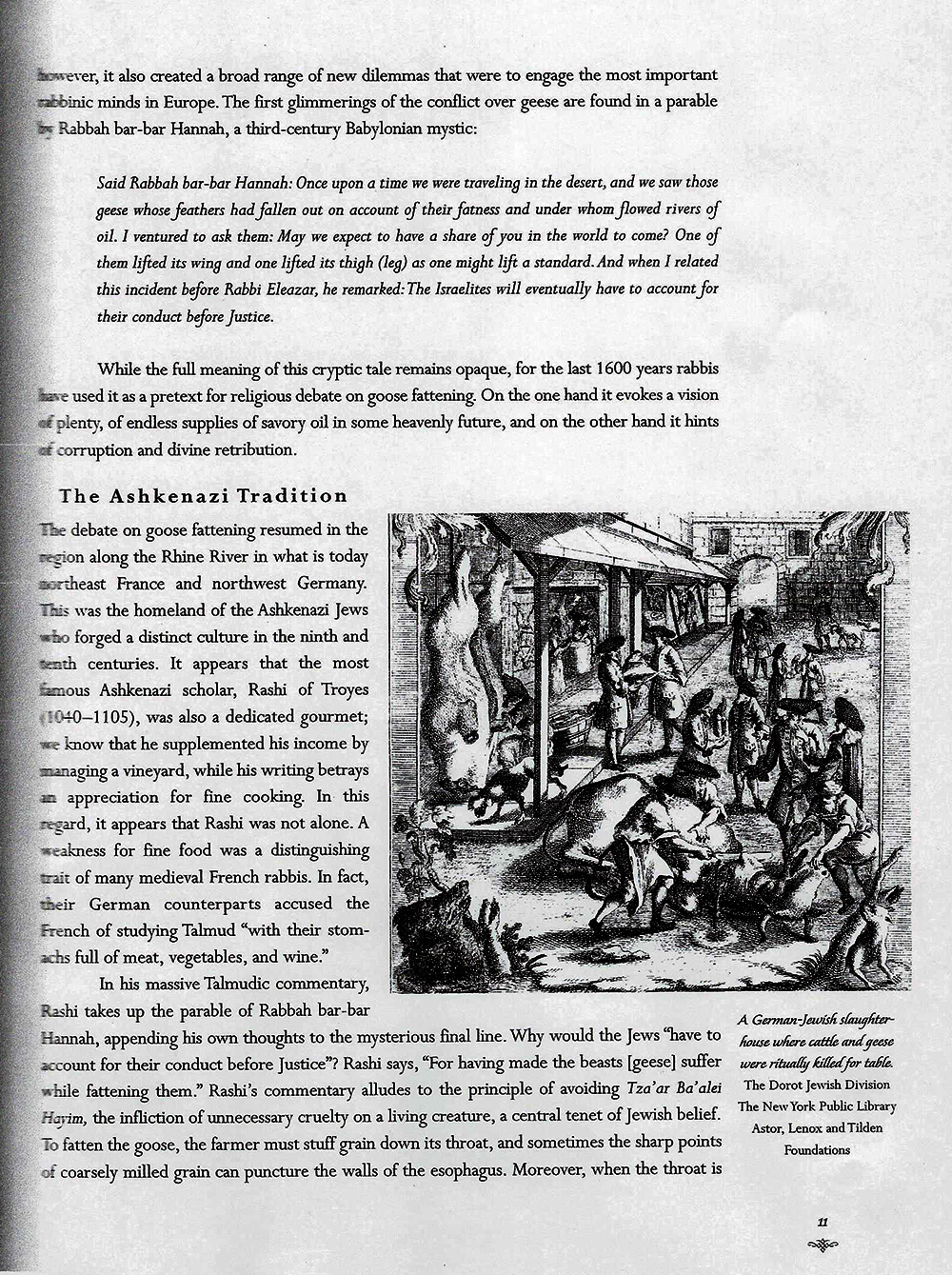
Despite efforts by some to demonstrate that force feeding geese is cruel and was recognized as such by Jews in previous generations, it’s a common misunderstanding based on a mistranslation that seems to defy explanation, and one of these situations where people keep repeating an error because they didn’t examine the primary source. In contemporary Jewish anti-foie gras literature, two “quotes” are regularly bantered about, even by scholars. One is a “quote” from Rashi and the other from a 14th century ethical will.

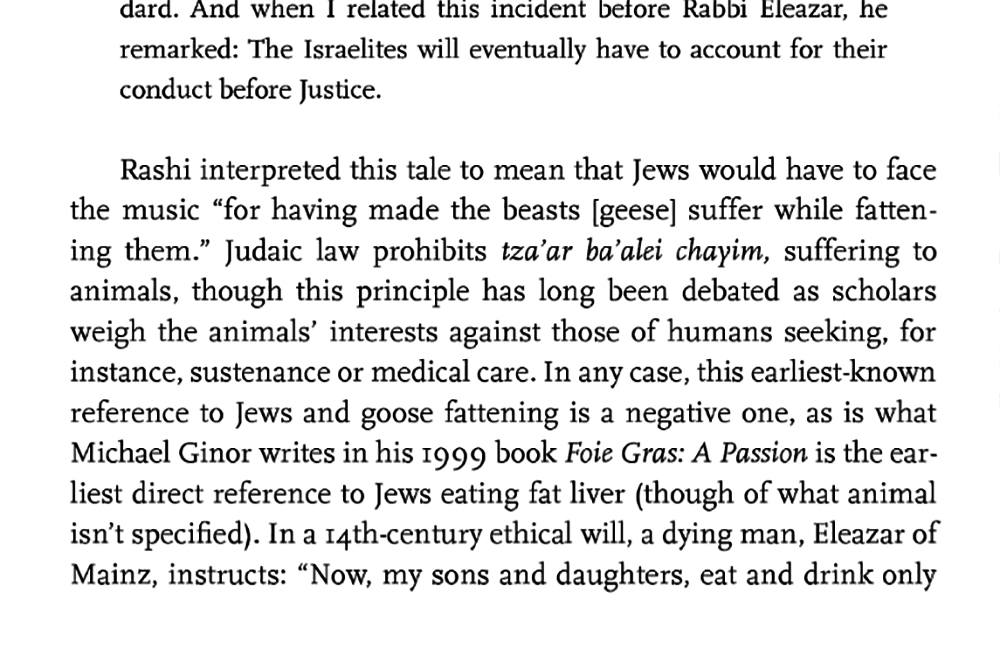
Both quotes can be found in the book “The Foie Gras Wars: How a 5,000-Year-Old Delicacy Inspired the World’s Fiercest Food Fight” (2011) by Chicago Tribune reporter Mark Caro. On p. 26 he writes:

“Rashi interpreted the tale to mean that Jews would have to face the music ‘for having made the beasts[geese] suffer while fattening them’.”

And on p. 26-27 he writes:
“In a 14th-century ethical will, a dying man, Eleazar of Mainz, instructs: “‘Now, my sons and daughters, eat and drink only what is necessary, as our good parents did, refraining from heavy meals, and holding the gross liver in detestation’.”
The comment of Rashi sounds like it may indeed be a condemnation of fattening geese. It turns out that Rashi never wrote any such thing. First, the source for this “quote” is Bava Basra 73b and as is well known, on 29a of Bava Basra of our printed texts, there is a note in bold letters in the Rashi column that says: “until here is the commentary of Rashi zt”l, from here on in is the commentary of Rabbeinu Shmuel ben Rav Meir”, ie Rashbam. The first error is therefore that the comment was not written by Rashi but by his grandson. 

Nonetheless, even if Rashbam had written that, it would be of significance. But he didn’t.

The comment was made on the 10th of the fantastic, esoteric tales of Rabbah bar bar Chanah. The story is:
תלמוד בבלי מסכת בבא בתרא דף עג עמוד ב
ואמר רבה בר בר חנה: זימנא חדא הוה קא אזלינן במדברא, וחזינן הנהו אווזי דשמטי גדפייהו משמנייהו וקא נגדי נחלי דמשחא מתותייהו, אמינא להו: אית לן בגוייכו חלקא לעלמא דאתי? חדא דלי גדפא, וחדא דלי אטמא. כי אתאי לקמיה דרבי אלעזר, אמר לי: עתידין ישראל ליתן עליהן את הדין.

Rabbah b. Bar Hana also related: We were once travelling in the desert and saw geese whose feathers fell out on account of their [excessive] fatness, and streams of oil [fat] flowed under them. I said to them: ‘Shall we have a share of your [flesh] in the world to come?’ One lifted up its wing, the other lifted up its leg. When I came before R. Elazar he said to me: Israel will be held accountable because of them.

Commenting on the last line, Rashbam commented:
רשב”ם מסכת בבא בתרא דף עג עמוד ב
ליתן עליהם את הדין – שבחטאתם מתעכב משיח ויש להם צער בעלי חיים לאותן אווזים מחמת שומנן.
According to the Rashbam, the Jews are responsible for the suffering of the geese in that the geese had to live extra-long with unnatural fat because the Jews sinned and thereby delayed the coming of the Messiah and the slaughtering of these geese. The Rashbam was discussing a fanciful story involving the suffering of mythical geese whose feathers fall out and whose fat drips off of them, i.e. who were clearly suffering and are different from a typical goose. Such geese he suggests may suffer due to their excessive fat. He makes no mention of the fattening process and says nothing about any suffering during that process or about the suffering of geese that his Jewish neighbors were raising.
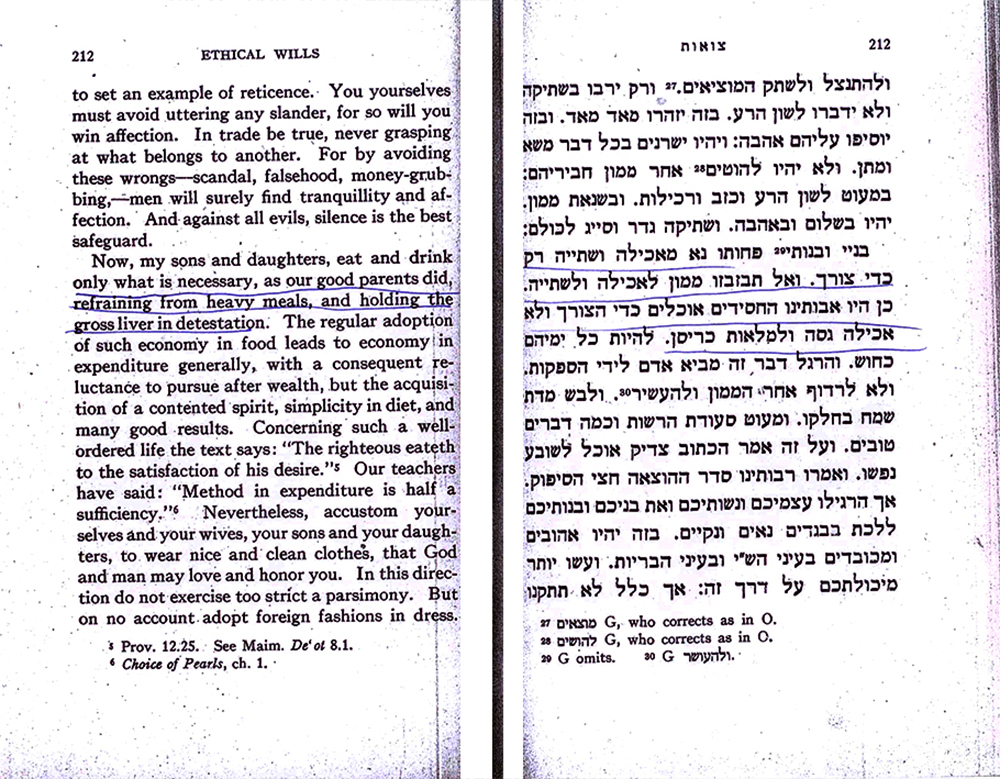
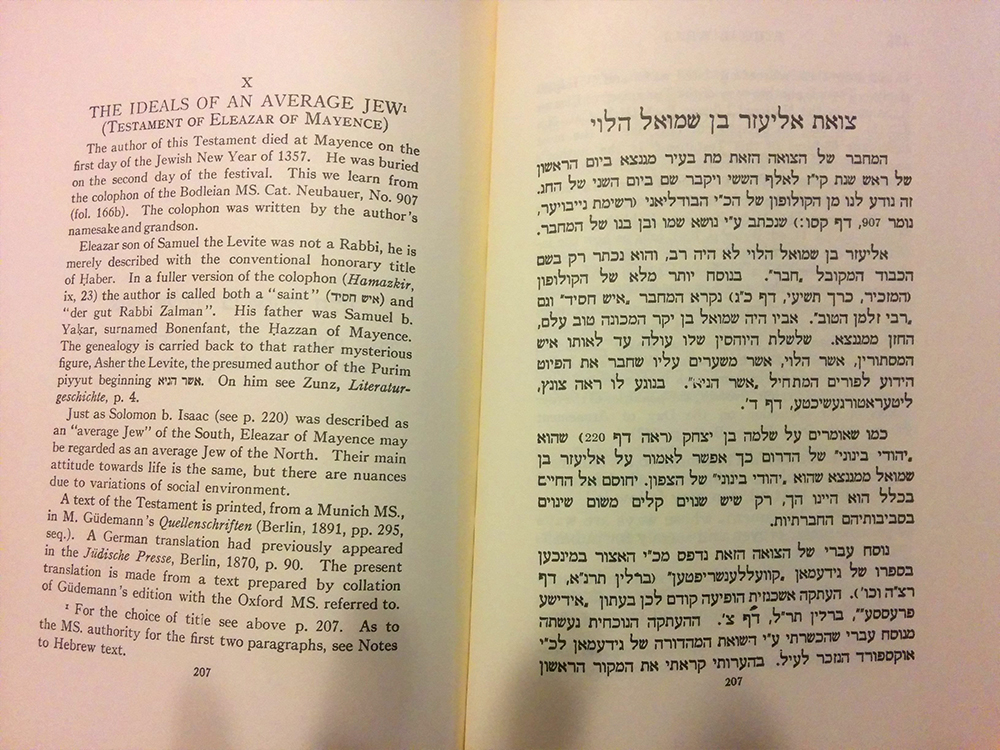
And how about the ethical will? Hebrew Ethical Wills (JPS Library of Jewish Classics) (English and Hebrew Edition) [1976], Israel Abrahams (Editor), Judah Goldin (Foreword) is a facsimile edition of the 1926 original. Beginning on p. 207 is “The Ideals of an Average Jew (Testament of Eleazar of Mayence)” and on p. 212 it indeed says: “Now, my sons and daughter, eat and drink only what is necessary, as our good parents did, refraining from heavy meals, and holding the gross liver in detestation.” 

From this it is not at all clear why liver should be so disliked, and it is certainly not obvious that he is talking about foie gras. It could be that he simply abhors liver (perhaps because, as Chazal note, it is full of blood). In an effort to better understand, I looked on the other side of the page, at the Hebrew text. And what a shock! It seems that when Israel Abrahams (Reader in University of Cambridge and a Senior Tutor at Jews’ College) translated this text he used some poetic license, likely never suspecting it would be then adopted by the anti-foie gras activists. Here is what the Hebrew found in Abrahams says:
בניי ובנותי פחותו נא מאכילה ושתייה רק כדי צורך. ואל תבזבזו ממון לאכילה ולשתייה. כן היו אבותינו החסידים אוכלים כדי הצורך ולא אכילה גסה ולמלאות כריסן. להיות כל ימיהם כחוש.
No mention whatsoever of liver! It appears that it is not an actual translation. It seems strange that Abrahams fabricated the liver in the English. He says the translation was made on the basis of two Hebrew texts. Maybe he translated straight off of them and the Hebrew in his edition is not accurate. The first is a text that is based in a Munich MS and appears on Moritz Güdemann’s Quellenschriften (Berlin, 1891, reprinted by Philo Press in 1968).

There on p. 296 one finds an almost identical text:
בניי פחותו נא מאכילה ושתייה רק כדי צורך ואל תבזבזו ממון לאכילה ולשתייה. כן היו אבותינו החסידים אוכלים כדי הצורך ולא אכילה גסה ולמלאות כריסן להיות כל ימיהם כחוש
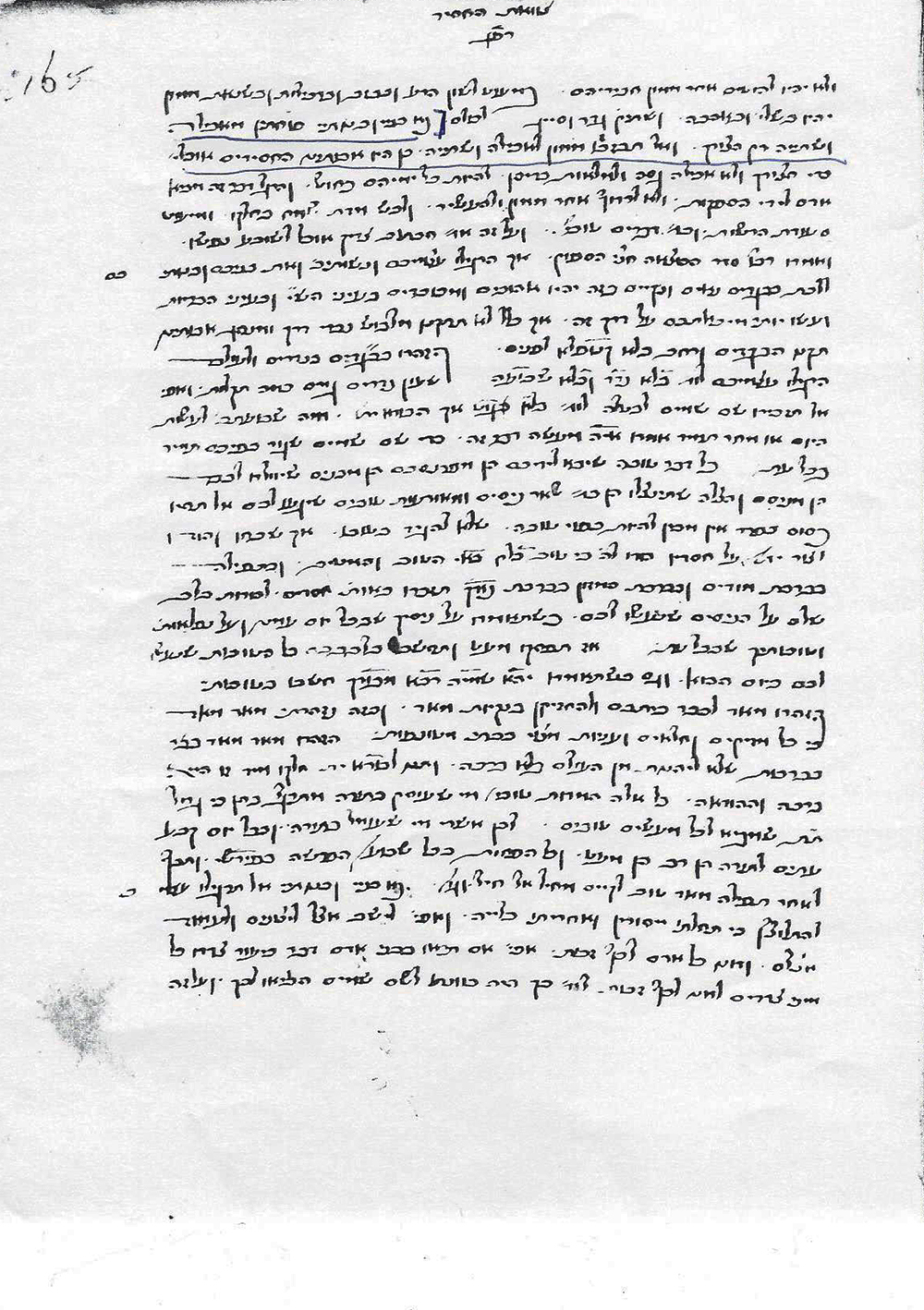
The other manuscript is Bodleian MS cat Neubauer No. 907, fols. 164a-166a (not 166b as Abrahams erroneously wrote) and the relevant section is at the top of 165a (I thank Ezra Chwat for his assistance in obtaining this ms.). As can be seen the text is identical to that found in the Abrahams’ book. 
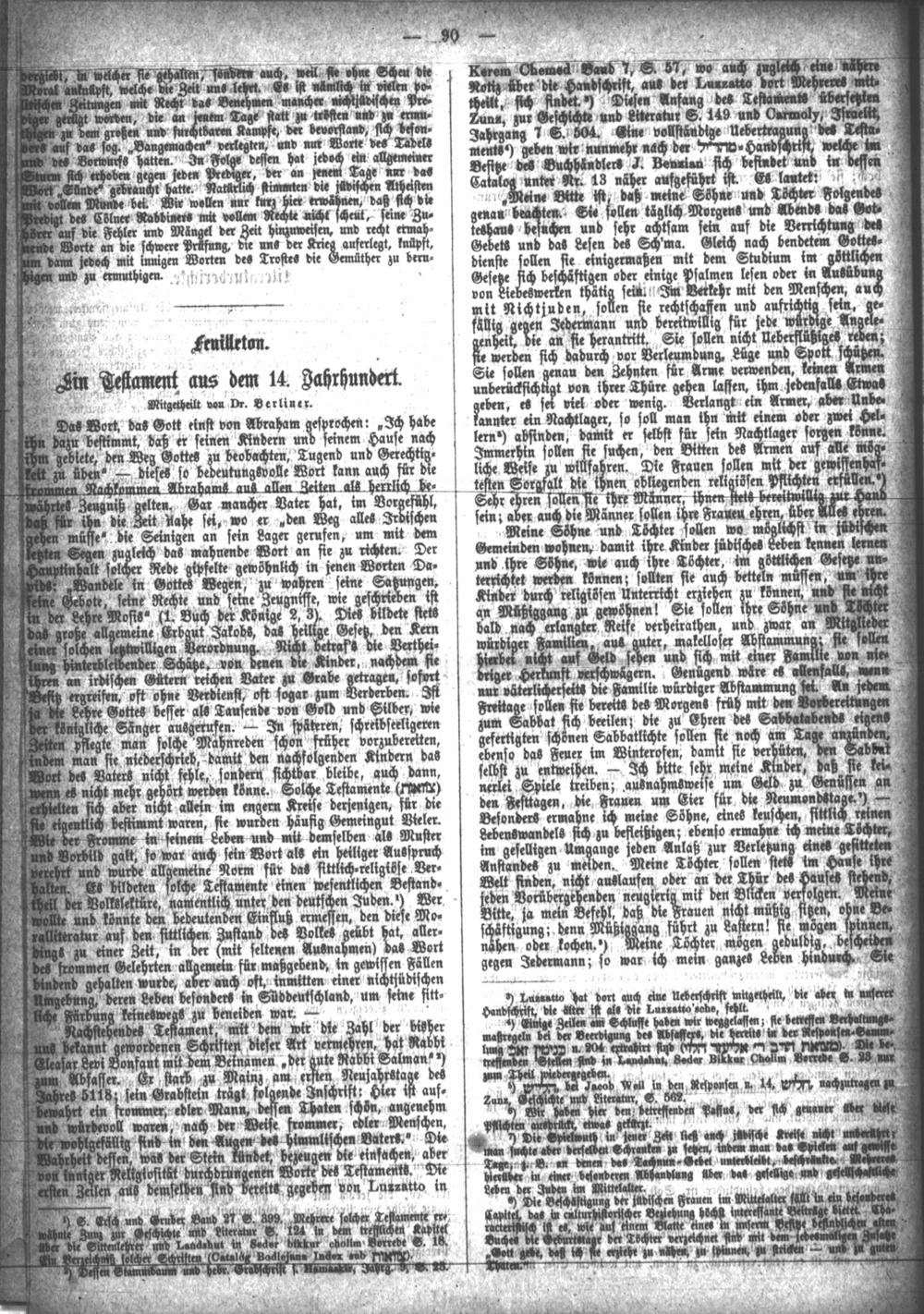
There seemed to be a final possibility. In his introduction, Abrahams notes that a previous translation, into German, had appeared in the journal Jüdische Presse, Berlin 1870, p. 90.

The journal is available here (I thank Sharon Liberman Mintz for finding that link for me). In issue 11 (Sept 9, 1870) a translation appears on the 6th and 7th page of the issue, pages 90-91 of the volume, as can be seen in the figure below.
However, it is only a translation of the first half of the will, ending just before the relevant section. It says that it was to be continued, but unfortunately that was the first year of the journal and the next issue (12) is missing (as are several others such as 3, 7, 9, 10) from the digitized microfilm at that website and I have been unable to locate it in any Israeli library. the translation until that point seems to be accurate and it is hard to ascribe the insertion of the liver to the German translator (I thank Rabbi Dr. Seth Mandel and Prof Michael Segal for assistance with the German).
It thus seems clear the liver was inserted into the English transition for some inexplicable reason, but certainly does not appear in this 14th century ethical will.
Once an author is convinced of the authenticity of the sources they often embellish. In the academic work, Food and Morality: Proceedings of the Oxford Symposium on Food and Cookery (2007) edited by Susan R. Friedland, there is a chapter called the foie gras fracas: sumptuary Law as Animal welfare? By Cathy K. Kaufman, a scholar-chef and Adjunct Chef-Instructor, Institute of Culinary Education, in New York City.
On p. 126 she writes: 

“The best written evidence for the medieval production of foie gras – and its ambiguous moral status – is found among the writings of the Ashkenazi Jews who spread throughout Europe. Rabbi (sic) Rashi ……”

But in fact we have shown that among the Jewish writings there is ZERO evidence regarding any ambiguous moral status!
Even the well-known American cookbook author Joan Nathan couldn’t avoid this pitfall. 
Recently, in her King Solomon’s Table: A Culinary Exploration of Jewish Cooking from Around the World (2017) on p. XXI she wrote: 

“Rashi was a thinker who knew both religion and agriculture. He condemned, for example, the force-feeding of geese to produce foie gras ….”.

In 2013, an article in Moment magazine (here) stated: 

“More complex, however, were the ethical questions. In the 11th century, the French scholar Rashi warned Jews against the force-feeding practice, “for having made these beasts (geese) suffer while fattening them.” This went against Jewish law prohibiting tza’ar ba’alei chayim, suffering to animals, although some rabbis claimed that since none of the geese’s limbs were harmed and the geese did not feel discomfort in their throats, foie gras was not treyf, or forbidden. Other rabbinic scholars suggested that it is only permissible to inflict pain on an animal when the benefit of doing so is significant; since there are no real nutritional benefits to foie gras, the process of force-feeding was questionable.”

One can only wonder who these “some rabbis” and “other rabbinic scholars” were who argued with this non-existent Rashi!
The book that is the source for many of these other articles is the beautiful coffee-table book Foie Gras: A Passion (1999) by Michael Ginor and Mitchell Davis. Ginor, an American who spent two years in the IDF and while in Israel discovered foie gras, co-founded, co-owns, and is President of NY based Hudson Valley Foie Gras and New York State Foie Gras, the most comprehensive foie gras producer in the world. His book is an absolutely comprehensive book on everything one could possibly want to know about foie gras. And there on p. 11 he quotes the non-existent Rashi and on p. 12 the English version of the strangely translated ethical will. I have no idea where he found those two quotes that have today become so common in the vegetarian literature. 
The fact that all one has to do is look in the Hebrew originals to see that these quotes are fake news, explains why they are found in English sources and I have not yet found them in any of the Hebrew works on animal rights.


Assorted Comments

Assorted Comments
Marc B. Shapiro
1. In this post I mentioned the strange comment of R. Shabbetai Bass in his Siftei Hakhamim, Exodus 33:13, Moses thought that God was joking with him.[1] A few readers emailed me that in the new Mikraot Gedolot Ha-Maor this passage has been deleted, i.e., censored. Here is how the passage looks in the first edition of Siftei Hakhamim, published in R. Bass’ lifetime..
Here is the passage as it appears in the censored Mikraot Gedolot Ha-Maor.

Fortunately, the new English translation of Siftei Hakhamim published by Metsudah includes the passage in its entirety.

2. In a recent post I referred to the Yemenite Rabbi Shlomo Korah and his experience in Lakewood. R. Korah has also published a commentary on Maimonides’ Mishneh Torah entitled Sefat Melekh. Although R. Korah presumably knows Arabic, for some reason he didn’t know what to make of the word שָם found throughout the Mishneh Torah, including right at the beginning:

יסוד היסודות ועמוד החכמות לידע שים שם מצוי ראשון
Numerous commentaries struggle with the word, and R. Korah offers his own interpretation, stating that it should be vocalized with a tzereh under the shin, not a kamatz.[2] Yet R. Samuel Ibn Tibbon, in the introduction to his translation of the Guide, already explained what the word means.
שבערבי כשירצו החכמים לומר שיש בעולם דבר או בנמצא דבר אחד, יאמרו שיש שם דבר אחד, רומזים במלת “שם” אל המציאות.

See also R. Joseph Kafih’s commentary to Hilkhot Yesodei ha-Torah 1:1. Confusion about the word שם goes back to medieval times, and in a recently published text of the Provencal sage R. Meir ha-Meili we see that he too did not know its meaning.[3]
R. Shlomo Korah should not be confused with R. Ezra Korah who is the translator of a new edition of Maimonides’ Commentary on the Mishnah that was published in 2009. The new translation is not very different than R. Kafih’s translation and is obviously based on the latter. It is also not an improvement on what R. Kafih provided us with. What makes this edition valuable is that each page is full of helpful notes compiled by a team of scholars. In fact, I don’t think anyone can seriously study Maimonides’ Commentary on the Mishnah without making use of this new edition.
Yet there is something deeply problematic about this edition. As is well known, R. Kafih’s translation of Maimonides’ Commentary sparked a new interest in study of this work, and for decades was the text that everyone used.[4] R. Korah’s new edition, which as already indicated is based on that of R. Kafih, only mentions R. Kafih once in the lengthy introduction.[5] Throughout the notes to the Commentary, R. Kafih is not mentioned, but is referred to as יש מי שכתב or יש מי שתרגם.

When will these people ever grow up and realize that just because you don’t agree with someone’s outlook doesn’t mean you can’t be a mensch and give him the scholarly credit he deserves? To give an idea of who R. Kafih was, R. Mordechai Eliyahu went so far as to state that was greater than R. Abraham Maimonides![6]

אנו, שאנו מכירים את הרב יוסף קאפח, הוא יותר טוב מבנו של הרמב”ם, איזה בקיאות יש לו בדברי הרמב”ם, הבן שלו לא ידע והוא ידע.

Here is the English dedication page of the new translation and the Hebrew title page.

Look at what it says in the dedication page. Is it possible that they told the donor that the translation that he was funding would be the first time that the Commentary on the Mishnah would be translated into Hebrew?

3. I have many unpublished rabbinic letters that readers will find interesting. Some of them need to be published in a journal, complete with an introduction and footnotes, as I have done in Milin Havivin, Or Yisrael, and elsewhere. (Discerning readers will note the incongruity of the two journals just mentioned.) For others, I don’t need to do anything but post them, as they are easy to read and self-explanatory.

Here is one such example. It is a 1950 letter from Chief Rabbi Isaac Herzog to R. Isser Yehudah Unterman, chief rabbi of Tel Aviv. I found it in the R. Herzog archive in Jerusalem and I thank the archive for allowing me to reproduce the letter. It is significant in that we see how impressed R. Herzog was with R. Elyashiv, and he hopes that R. Elyashiv will agree to move to Tel Aviv to serve as a dayan.[7]

Recently there was talk that if the Israeli draft bill was passed that the Belzer Rebbe would leave the State of Israel. Here is a February 14, 1948 letter from R. Herzog to a previous Belzer Rebbe. As you can see, R. Herzog was very upset when he heard that the Rebbe was thinking of leaving Eretz Yisrael due to the deteriorating security situation. He thought that this would create a hillul ha-shem and break the spirits of some of the Rebbe’s followers.

According to the Steipler, R. Isaac Zev Soloveitchik (the Brisker Rav) also wanted to leave Israel during the 1948 war, and even traveled to Haifa to receive his exit permit. In the end, he was prevented from leaving for reasons beyond his control, and didn’t continue his efforts in this regard. The Steipler explained that his desire to leave Israel was not because he was afraid but because he thought that the halakhah requires one to leave a place of danger to life.[8] I have difficulty understanding this view, as it would mean that all the Jews in Israel would have been required to leave. Presumably, R. Velvel’s point was that one who has no civilian or military role has to leave, since there is no justification for such a person to put his life in danger as he is not in any way contributing to the military cause.

4. In his latest article criticizing the haredi mentality, R. Berel Wein writes:

The great struggle of most of Orthodoxy in the nineteenth and early twentieth centuries against Zionism influenced all Orthodox thought and behavior. As late as 1937, with German Jewry already prostrate before Hitler’s madness and Germany already threatening Poland, the mainstream Orthodox rabbinate in Poland publicly objected to the formation of a Jewish state in the Land of Israel on the grounds that the heads of that state would undoubtedly be secular if not even anti-religious.

A number of people wanted details about this rejection of a Jewish state by the Polish rabbinate in 1937. Let me begin by saying that there is no truth to what Wein reports. The mainstream Polish rabbinate, represented by the Agudat ha-Rabbanim of Poland, never publicly objected to the creation of a Jewish state. The Agudat ha-Rabbanim included many rabbis who were Zionist and thus would never act in the way Wein describes. In fact, R. Yehezkel Lifshitz, author of the respected work Ha-Midrash ve-ha-Ma’aseh, was the head of the Agudat Rabbanim until his death in 1932. He was also a great lover of Zion who supported the creation of a Jewish state.[9]

In 1937, not only did Agudat ha-Rabbanim of Poland not reject the idea of a Jewish state, but it issued a public letter affirming the Jewish right to the Land of Israel. This letter also stated that under no circumstances could Agudat ha-Rabbanim agree with the removal of any part of the Land of Israel from future Jewish sovereignty.[10] Here is part of this letter, containing the Agudat ha-Rabbanim’s strong endorsement of a Jewish state.

ישמעו העמים הנאורים שהצהירו בסן-רימו על זכותנו הישנה והמוחלטת על נחלתנו הקדושה בגבולותיה שהציב בורא עולם ית’ את העוולה הנוראה שרוצים לעשות לנו. מחאתנו הכבירה צריכה להגיע לועדת המנדטים, למלך אנגליא, לנשיא ארצות הברית של אמריקה ולבישוף מקנטרבורי

Even Agudat Yisrael at its 1937 international convention in Marienbad (the third Kenesiyah Gedolah) did not reject a Jewish state, even though it was urged to do so by R. Elchanan Wasserman and R. Aaron Kotler. Neither R. Wasserman nor R. Kotler reflected the outlook of the mainstream Lithuanian or Polish rabbinate in this matter. In fact, according to the report of R. Samuel Aaron Pardes who attended the convention, R. Kotler agreed with R. Wasserman that acceptance of a Jewish state before the coming of the Messiah, even a State that would be completely Torah observant, is a denial of the messianic belief.[11] In other words, they both shared what would later be identified as the Satmar philosophy.

5. The internet is an amazing thing. Yechezkel Moskowitz, who listened to my Torah in Motion classes on R. Hayyim Hirschensohn, asked me where he was buried. I didn’t know but after only a couple of minutes online I found the answer: Riverside Cemetery in Saddlebook, N.J. The cemetery was very helpful and sent both me and Yechezkel a picture of the grave. Seeing that it needed to be cleaned up, Yechezkel took the opportunity to do this mitzvah, and here is how the grave currently looks.

Yechezkel also sent the picture to Kevarim.com and it can be found here here.

Here is a picture of R. Hirschensohn.

There is so much to be said about R. Hirschensohn and his enormous literary output and fascinating ideas in all areas of Torah. (I also have a number of unpublished responsa of his.) I have never seen anyone refer to the many short musings of R. Hirschensohn that appear in the Budapest journal Apiryon. I could have a lengthy post discussing any number of his short comments, that remind me both of R. Kook’s Shemonah Kevatzim and also of Nietzsche. Here is musing no. 46, which appears in Apiryon 3 (1926) p. 183:

יש עיקרי אמונה לישראל אשר אינם בספר רק בדם ובמורשה, ואם הספר מתנגד להם ישבקו לקראי דאינהו דחוקים ואוקמי אנפשייהו

The final words of the sentence are derived from Pesahim 59b, and the translation is (based on Artscroll) “Leave the verses alone, for they force themselves to be interpreted this way.”

What R. Hirschensohn is saying in the first part of the sentence is that there are Jewish principles of faith that are not to be found in a book, but are intuitive, i.e., part of our heritage and our blood. We can each come up with our own examples. One which comes to my mind is that it is a principle of faith not to try to settle Jewish problems by involving the non-Jewish authorities. Over thousands of years we have learnt that such an approach leads to all sorts of negative consequences, both foreseeable and unintended.

The second half of the sentence tells us that when a “book truth” contradicts the principle of faith we know intuitively, then the “book truth” is to be understood (reinterpreted if necessary) to conform to our intuitive faith. One can find similarities to this idea in the writings of R. Kook (see here and here where I discussed the observant Jewish masses’ innate natural morality and how according to R. Kook it is superior to the book-learning-based morality of the scholars).

The significance of R. Hirschensohn’s words is in 1) the denial that basic principles of faith are all found in books, and 2) the assertion that intuitive truths can effectively trump what appears in the canonical books. It is obvious that what when R. Hirschensohn writes of דם ומורשה he is speaking about the experience of the Jewish people as a whole, not about the Torah scholars. The Torah scholars are to be viewed as part of this experience of דם ומורשה , not something apart.[12]

In previous posts I have commented that one of the novelties of haredi ideology is the notion that the “Gedolim” are the carriers of all truth. See here where I quote R. Itzele of Ponovezh’s assertion that it is the people, עמך, not the Gedolim, who represent what today is referred to as Daas Torah.[13] This idea can be found in the Talmud and later rabbinic literature as well. When the Talmud and post-Talmudic authorities state
אם אינם נביאים בני נביאים הם  or
פוק חזי מאי עמא דבר  or
 קול המון כקול ש-די  or
מנהג ישראל תורה  they are not referring to the Gedolim but to the masses of pious Jews, the ones who make up the kehillah kedoshah.

Earlier in this post I referred to R. Kook and Nietzsche. Some readers might be thinking that I should write “R. Kook and Nietzsche lehavdil.” Yet R. Hirschensohn rejects the notion that this word should be used to distinguish Jews from non-Jews. See his commentary to Horayot (Jerusalem, 1926), part 3, p.6a.

וזה אין לנו לומר כי הלא אב אחד לכלנו א-ל אחד בראנו

For those who do want to use the word, R. Hirschensohn says that it is wrong to say הגוי להבדיל since it is precisely the Jews whom God chose to separate as his special people. Therefore, one should say (if he want to use the word),  “Nietzsche and R. Kook lehavdil.” Yet as mentioned already, R. Hirschensohn rejects the usage of this word when it comes to Jews and non-Jews. In addition to what I already quoted, he writes:

כונת האומר “להבדיל” הוא כמו להבדיל בין הקדש ובין החול, ואין הבדלה כזאת בין ישראל לעמים, כי כל בני תמותה נבראו בצלם אלקים וחייבים בשבע מצות רק אותנו הבדיל אלקים לו לחייבנו בתרי”ג מצות

R. Hirschensohn is assumed by everyone to be very liberal, in both his outlook as well as in his halakhic decisions. Yet this is not the entire truth, as we can see from his comment in Apiryon 3 (1926), p. 101, where he describes the “New Orthodoxy”, also known as “Conservative”, as akin to Christianity!

היהדות היא פעולת המוח על הלב הנצרות היא פעולת הלב על המוח, אך רבים מחליפים המושגים, לזאת נמצאים יהודים כשרים רבים אשר הם באמת לדאבון לבבינו נוצרים במסוה יהודית אשר קוראים בשם אורטודוקסיה חדשה או קאנסירוואטיף.

He states that in traditional Judaism  the mind is the center, and the heart is influenced by it, while in Christianity it is the reverse, with the heart influencing the mind. The problem with the “New Orthodox” is that they too put the stress on the heart over the mind. As we all know, when the heart is the determining factor, then Jewish law must be constantly updated in accord with people’s changing feelings.

His very next musing (ibid.) is undoubtedly directed against Hasidism, which he sees as mixing up the heart and mind.

עוד כת אחת יש בישראל אשר אם שהם שומרי תורה, אבל יש בהם עירבוב המושגים והתנגשות הלב והמוח

And finally, what is one to make of the following statement (ibid.) that removes Christian belief (as opposed to worship) from the status of avodah zarah?

אין בהנצרות ע”ז רק אולת ושגעון, אבל ההשתחויה מול התמונות הקדושות להם היא עבודה זרה גמורה ע”כ אמרו יום נצרי לעולם אסור.

Does this mean that a belief alone can never rise to the level of avodah zarah?

There is a lot more I want to say about R. Hirschensohn. In the Limits of Orthodox Theology I mentioned his view that even in Messianic days animal sacrifices would not be reinstated. He also has some significant comments about sacrifices in the introduction to his Nimukei Rashi, vol. 3. (This four volume commentary on Rashi is an outstanding work of scholarship.) 

In discussing the origins of sacrifices, R. Hirschensohn sees no reason to assume that Cain and Abel actually brought sacrifices in the sense we think of. While for us, a sacrifice means placing something on an altar and burning it, R. Hirschensohn states that there is no evidence that this is what Cain and Abel did. It is possible that all Cain did was bring his vegetable offering to the top of a mountain where he would commune with God, and left it there. With Cain’s “meager religious philosophical knowledge” he perhaps thought that after he left it there, God would take it. This is how R. Hirschensohn explains that Cain concluded that his sacrifice was not accepted. He reascended the mountain after a few days and lo and behold, the sacrifice had not been taken by God. For Cain, this meant that God didn’t accept it. And what about Abel’s sacrifice? Here, too, R. Hirschensohn says that there is no reason to think that it was burnt on an altar. Rather, it was a gift to God, and what Abel did was send his offering away, so that it would wander freely. This was the gift to God, not that he killed an animal. If you look at Genesis ch. 4, all it mentions is that Cain and Abel brought their offerings to God, not that they were ever burnt as a sacrifice.

How then did the idea of offering animal sacrifices come to be? The first example we have in the Bible is that of Noah when he leaves the ark. At this time he was not yet permitted to eat meat and yet he concluded that it would be proper to kill animals and birds for God. Where did he get this notion? The question is especially sharp as one would have assumed that Noah would be more interested in ensuring that the species multiply, rather than killing members of them. After Noah offers his sacrifices, we are told (Gen. 8:21), “And the Lord smelled the sweet savour; and the Lord said in His heart: ‘I will not again curse the ground any more for man’s sake; for the imagination of man’s heart is evil from his youth; neither will I again smite any more every thing living, as I have done.” This would seem to imply God’s approval of Noah’s sacrifices. R. Hirschensohn’s suggested understanding of this episode is, I think, shocking in its boldness:

ואם שלא רחוק לפרש פסוק זה כמו שהקב”ה צחק בלבו ורחם על קטון דעת האדם החושב להודות לו על ידי עולה וזבח עולת הבהמה ועולת העוף לשורפם ולכלותם בעת אשר הם כל כך מעט בעולם וחושב זה לטובתו, שזה בכלל יצר לב האדם רע מנעוריו שגם מנחה לאל עושה בדרך אכזריות, אמנם צריכים לעמוד על מחשבת האדם ודעתו בהתפלספותו בפליסופיא [!] אלקות איך יוכל לחשוב שבזה יתרצה אל אדוניו?
R. Hirschensohn’s suggested explanation assumes that part of man’s heart being “evil” from his youth was the thought that he should serve God is such a cruel fashion as killing an animal, and God accepting this sacrifice was an example of God being kind to the simpleton Noah who didn’t know any better.

R. Hirschensohn continues by saying that he in no way rejects the sacrificial system. His explanation is only applicable to an era when eating meat was not allowed. However, once the Torah makes clear that killing an animal to eat it is not cruel, we cannot say otherwise. Furthermore, he says, it makes no sense for people who eat meat to object to sacrifices on philosophical grounds.

R. Hirschensohn still has to explain the origin of sacrifices, and his position is quite original. He states that in ancient days people showed their loyalty to one another by a ceremony in which blood was drawn from each of them and mixed together. Later it developed that instead of using human blood to seal covenants, animal blood was used. The next natural development was the notion that sacrifices to the deity should also involve blood, and this is why the nations began to offer sacrifices to their gods, including sacrifices for all the good the god did.

R. Hirschensohn adds that sacrifices represent instinctual religious feelings, and no one who believes in God can degrade such a sign of faith.[14]

Let me now return to what I wrote here concerning R. Hirschensohn’s discussion of the comment of Rashi to Genesis 26:8. The verse states that Abimelech looked out his window and saw that Isaac “was amusing himself with Rebekah.” Upon this verse, Rashi, based on a Midrash, states that Abimelech saw them having marital relations. In the earlier post I expressed surprise that some commentators thought it was appropriate for them to discuss the Patriarch’s sexual life. One reader called my attention to R. Levi ben Hayyim, Livyat Hen: Eikhut ha-Nevuah ve-Sodot ha-Torah, ed. Kreisel (Beer Sheva, 2007), p. 672, which is another example of what occasioned my surprise.

R. Levi contrasts Isaac negatively to both Abraham and Jacob. He regards the latter two as on a higher spiritual level, and thus closer to God, than Isaac, and brings a number of biblical proofs to support this contention. In a really outrageous comment, much more objectionable than R. Levi’s allegorical passages that R. Solomon ben Adret was so upset with (and which don’t appear at all problematic when seen in context), R. Levi suggests that Isaac’s blindness was brought on by the fact that he was so attracted to Rebekah’s beauty[15] that it led to him having too much sex! (Although R. Levi reflects an old superstition, there is actually a medically documented phenomenon of temporary blindness following sex.)
גם תראה היותו נמשך לתענוגים, עד שאהב עשו בעבורם ואמר (בר’ כז, ג): “ועשה לי מטעמים כאשר אהבתי”. ואפשר שזה סבב לו להרבות המשגל עד שכהו עיניו מראות, כי נמשך אחרי יפי רבקה, שהעיד עליה הכתוב שהיתה יפת תואר מאד, הלא אבימלך ראהו מן החלון מצחק עם רבקה אשתו

Finally, let me make one more point about sexual matters in the Torah. Genesis 35:22 states that “Reuben lay with Bilhah.” The Artscroll multi-volume commentary on Bereshit (i.e., not the Stone Chumash), p. 1522, states that in Shabbat 55b “the Sages emphatically declare that Reuben did not commit the sin of adultery. They proclaim that מי שאמר ראובן חטא אינו אלא טועה.”

I believe this to be a conscious distortion of what appears in the Talmud, in the name of “frumkeit”, of course. If you open up the Talmud to Shabbat 55b you find that, first of all, it is not the “Sages” who proclaim מי שאמר ראובן וכו’ but one of the Sages, R. Samuel Bar Nahmani in the name of R. Jonathan. This is a very minor point, since following this statement in the Talmud we find other Sages who agree with this statement, i.e., they also assume that Reuben never actually had sexual relations with Bilhah (and they are quoted in the Artscroll commentary to Bereshit). However, from the Talmud we also learn that there were Sages who disagreed with R. Jonathan and took the biblical text literally. It is none other than the Artscroll Talmud that, quoting Maharsha, explains that according to R. Eliezer, Reuben did have sexual relations with Bilhah.

The Artscroll commentary on Bereshit is a very long work (2232 pages), providing numerous perspectives on every verse. Yet in this case they chose not to include the view of R. Eliezer and R. Joshua that Genesis 35:22 is to be taken literally, and Reuben indeed had sexual relations with Bilhah. A conscious choice had to be made to exclude this view, and I think we all understand why. But doesn’t Artscroll’s choice in this regard show a real lack of respect for R. Eliezer and R. Joshua? Maybe others see things differently, but it appears to me that Artscroll stood in judgment, as it were, over R. Eliezer and R. Joshua, and decided that their view was not worthy of being included since Artscroll did not like what they said. This is hardly the sort of kevod ha-Torah that Artscroll is supposed to represent.

[1] In a comment to my post, Cyril Fotheringay-Phipps noted that Siftei Hakhamim’s interpretation is actually based on a misreading of what appears in R. Elijah Mizrachi’s commentary on Rashi.
[2] See similarly R. Menahem Krakowski, Avodat ha-Melekh, ad loc. R. Hayyim Kanievsky, Kiryat Melekh, ad loc., also apparently has this view, as both he and R. Krakowski refer to Pirkei de-Rabbi Eliezer, ch. 3:
עד שלא נברא העולם היה הקב”ה ושמו הגדול לבד
See Va-Ya’an Shmuel 1, pp. 63-64, where R. Meir Mazuz writes to R. Korah to correct his error.
[3] See Yehudah Hershkovitz, “Ma’amar Meshiv Nefesh le-R. Meir ben R. Shimon ha-Meili,” Yeshurun 27 (2012), p. 78.
[4] I should say “almost everyone”. See Mesorat Moshe, p. 612, that R. Moshe Feinstein only used the old translation because he (mistakenly) assumed that the translators were “geonim” and thus superior to any modern translator. In Iggerot Moshe, Yoreh Deah, vol. 1, no. 63, R. Moshe assumes that the word “wine” in Maimonides’ Commentary on the Mishnah is a later insertion. Yet examination of R. Kafih’s edition shows that Maimonides indeed wrote this word. According to R. Yisrael Genos, R. Velvel Soloveitchik used to consult with R. Kafih as to the correct translation of Maimonides’ Commentary. See his haskamah to R. Kafih’s She’elot u-Teshuvot ha-Rivad (Jerusalem, 2009). See also R. Joseph Karo, Beit Yosef, Orah Hayyim 26, who assumes that a passage in the Commentary on the Mishnah was put in by an “erring student”. Yet this is incorrect. See R. Kafih’s note to Commentary on the Mishnah, Menahot 4:1.
[5] See p. 32 n. 162.
[6] “Ma’alat Beuro shel Mahar”i Kafih al ha-Rambam,” Masorah le-Yosef 8 (2014), p. 16.
[7] See the similar letter R. Herzog sent to R. Judah Leib Maimon in Ha-Shakdan, vol. 3, pp. 20-22.  
[8] A. Horowitz, Orhot Rabbenu, vol. 5, p. 74.
[9] See Moshe Tzinovitz, Ishim u-Kehilot (Tel Aviv, 1990), p. 209. See also Geula Bat Yehudah, Ish ha-Hegyonot (Jerusalem, 2001), p. 19.
[10] Ha-Hed, Elul 5697 (1937), p. 13.
[11] See Ha-Pardes, October 1937, p. 8. The October and November 1937 issues of Ha-Pardes contain a detailed report from the convention. See also Zvi Weinman, Mi-Katowitz ad Heh be-Iyar (Jerusalem, 1995), ch. 21
[12] R. Kook offers a different perspective (which does not seem to be in line with the passages I earlier referred to that focus on the masses’ natural morality). See Ma’amrei  ha-Re’iyah, p. 91:
שמא תאמר ליישב ע”פ הנוסח הרגיל מיסודו של מר אחד-העם: הספר הוא ספר, והלב עושה את החיים, וכיון שהלב נלחם בספר – הראשון הוא המנצח. במטותא מנך חביבי, אל נא תרפא שבר גדול על נקלה. הספר וכל אגפיו – גילוייו של הלב הם, ואיזה לב – לב האומה, הלב של נשמתה, הלב של תמצית כל הוייתה, של מעמק חייה, זה הלב דוקא בספר הוא מונח וגנוז, ותוך כל גרגיר המתגלה מאוצר הספר המון רב של לב ושל חיים מונחים.

[13] Those who are interested in R. Itzele should read R. M. S. Shapiro’s article on him in Ha-Mesilah 2 (Shevat, 5697), pp. 2ff. Among other things, Shapiro discusses how R. Itzele went from a supporter of Zionism to a strong opponent. One of the reasons he offers was the influence of Jacob Lifshitz, the askan par excellence. As Shapiro notes, the great rabbis were afraid of Lifshitz, for anyone who didn’t follow his orders was in danger of having Lifshitz destroy his reputation. The other reason Shapiro gives for R. Itzele’s rejection of Zionism was the fact that R. Chaim Soloveitchik was such a strong opponent of it
[14] For another comment of R. Hirschensohn on sacrifices, see Malki ba-Kodesh, vol. 1, p. 37:
זה פשוט שבימי דעה אלו [ימות המשיח] לא יהיה בהם המושג לרצות פני א-ל ברבבות נחלי שמן
See also Nimukei Rashi, vol. 3, parashat Va-Yikra, nos. 10-12. I think many will be surprised to see Rashi’s somewhat negative view of sacrifices. See his commentary to Psalms 40:7 (called to my attention by R. Moshe Shamah) and Amos 5:25. R. Isaac Sassoon refers to this latter passage in his Destination Torah (Hoboken, 2001), p. 202. Sassoon regards it as unlikely that the sacrificial system will ever again be reinstituted.
For Ibn Caspi’s negative view of sacrifices, see his Mishneh Kesef, vol. 2, p. 229, translated here.
[15] Speaking of physical beauty, in R. Yaakov Fink’s recently published Tiferet Yaakov, Introduction, p. 20, we are told that when his future wife was described to him by the shadchan as not being too good-looking, he replied: נו – אתרוג צריך להיות יפה. As a result of this, R. Fink’s wife made sure every year to find a beautiful etrog for him! (R. Fink was a student of R. Jehiel Jacob Weinberg.) 

See also Hokhmat Manoah to Ketubot 16b (found in the back of the Vilna Shas) who discusses Ketubot 17a, which states that according to Beit Hillel (and this is the halakhah) even regarding a bride who is not attractive one says that she is “beautiful and graceful,” נאה וחסודה. Hokhmat Manoah suggests that the two words, נאה and חסודה, mean two separate things. He explains that one says to the groom כלה נאה. However, to everyone else one says חסודה, which means חרפה, just like we find with the word חיסודא in Aramaic (see Onkelos, Genesis 30:23, 34:14, and Jastrow. This is also one of the meanings ofחסד  in Hebrew). In other words, while one tells the groom that his bride is beautiful, to everyone else at the wedding one says that she is repulsive! This is done, Hokhmat Manoah tells us, so that the men at the wedding don’t desire her:

שלא יתאוו ולא יחמדו לה שלא יעברו על לא תחמוד אשת רעך
Even in our age of increasing humrot, I can’t imagine Hokhmat Manoah’s suggestion being adopted anytime soon.
Regarding the matter of desiring other men’s wives, the following is also relevant. When someone gets married, Ketubot 7b tells us that the following words appear in one of the blessings recited:
                       
והתיר לנו את הנשואות על ידי חופה וקידושין  [נ”א בקידושין]
These are the words recorded by Maimonides, Hilkhot Ishut 3:24, and are found in almost all early sources from the Sephardic world, as well as in many from the Ashkenazic world. However, at Ashkenazic weddings (and I believe at all Sephardic weddings as well, see R. Ovadiah Yosef, Yabia Omer, vol. 5, Even ha-Ezer no. 6) the following is recited:
והתיר לנו את הנשואות לנו על ידי חופה וקדושין
Why do we repeat the word לנו as it is not part of the original blessing? R. Nissim, in his commentary on the Rif to Ketubot (p. 2b in the Alfasi pages), writes:

ורבינו תם ז”ל הגיה והתיר לנו את הנשואות לנו
What this means is that R. Tam altered the text of a blessing that had been in use for probably a thousand years. This is obviously a very radical step, so what led him to do it? As R. Meir Mazuz, Or Torah, Av 5772, p. 1012, points out, the original formulation is somewhat ambiguous. It states והתיר לנו את הנשואות, which could be understood to mean that through this blessing one can now have sexual relations with all married women. (This reason for R. Tam’s emendation is also noted by the Taz, Even ha-Ezer 34:3, R. Samuel ha-Levi, Nahalat Shiv’ah [Bnei Brak, 2006], 12:6, and many others.) Ritva, Ketubot 7b, wonders why the blessing is so ambiguous:
ותימה גדולה למה תקנו לשון סתום בזה הברכה הנאמרת ברבים
Not noted by R. Mazuz is that Rashi is cognizant of the problem and on the words והתיר לנו explains:
את נשותינו הנשואות לנו על ידי חופה וקידושין
What R. Tam did was take the explanation of Rashi and insert it into the blessing by his addition of the word לנו. It is, of course, difficult to imagine that anyone would have really assumed that the blessing allowed him to sleep with other married women. Yet according to R. Tam, the fact that the words could be understood in an improper way was reason enough to alter them. R. Abraham ben Nathan notes that R. Tam’s emendation was directed towards the stupid people. See his commentary to Kallah Rabbati (Tiberias, 1906), p. 7:
ומנהג צרפת בברכה לומר והתיר לנו את הנשואות לנו, לרווחא דמילתא שלא להטעות הפתיים
Although by now R. Tam’s emendation is the standard version recited by Ashkenazim and Sephardim, neither R. Joseph Karo nor R. Moses Isserles, Shulhan ArukhEven ha-Ezer 34:1, refer to it.


Hayyim ben Benjamin Ze’ev Bochner: Kabbalist, Talmudist, and Grammarian

Hayyim ben Benjamin Ze’ev Bochner: Kabbalist, Talmudist, and Grammarian

by Marvin J. Heller[1]

Hayyim ben Benjamin Ze’ev Bochner (c. 1610–84), a multi-faceted individual, was the author of varied works reflecting diverse contemporary intellectual interests. His books are both independent works and commentaries on earlier titles. A Kabbalist, Talmudist, and grammarian, Bochner wrote on these subjects as well as annotating numerous other works.

Born in Cracow, Bochner’s family was one of that city’s wealthiest Jewish families, owners of a stone mansion and two adjoining stores on Casimir place, a street otherwise without Jews. A student of R. Israel Seligman Ganz (1541-1613) in nigleh (revealed Torah) and of R. Jacob Temerls (Jacob Ashkenazi, d. 1666) in nistar (concealed Torah – Kabbalah), Bochner married the former’s daughter. Upon his father’s death in 1647, Bochner inherited a share in the family business and property. He elected, however, in order to further pursue his studies, to forgo his portion of the business and the properties in lieu of a life-long weekly allowance, selling his share to his three brothers a a sister. Initially, Bochner opened a free rabbinical school and associated with several renowned scholars, among them R. Lipmann Heller. Bochner, however, was subsequently called to serve as rabbi and head of the bet din in Ebenfurth and afterwards in Lackenbach in Austria, maintaining a yeshiva in both locations. He later relocated to Vienna, remaining there until the expulsion of the Jews from that city in 1670. His final residence was in in Fürth, Bavaria, where he passed away on Feb. 2, 1684.[2][3]

Bochner was a Talmudic scholar, reflected in his works. His primary lifetime occupation was writing, editing, and publishing books.[4] In this article we first address books which Bochner authored or seriously annotated, followed by other titles which he edited or annotated to a lesser extent. We begin with Orhot Hayyim published in 1654.

I

Orhot Hayyim – Bochner based his first composition of consequence, Orhot Hayyim, on the Minhagim of R. Isaac Tyrnau (1c. 1380/85-1439/52); it is an abridgment and annotation of that popular work. Orhot Hayyim was published in Cracow in 1654 at the press of Menahem Nahum ben Moses Meisels. It is a small book, a quarto in format (40: [10] ff.). The Meisels’ press was established in 1630, acquiring the typographical equipment that had previously belonged to the Prostitz press. In addition to that acquisition, Meisels had new letters cast in Venice. Meisels’ publications reflect the Prague style, likely due to the influence of his manager, Judah ha-Kohen of Prague. Meisels received a privilege from King Sigismund III Vasa, later reconfirmed by King Ladislaus IV Vasa and the town authorities.[5]

Isaac Tyrnau’s Minhagim was very popular at its time and remains so today. In the Bet Eked Sepharim, Ch. B. 2Friedberg records thirty-two editions of that work, beginning with a 1566 Venice printing though an 1880-88 Munkatch edition, including commentaries and Yiddish translations.[6] Minhagim, a compilation of customs written in the mid-fifteenth century, records the religious conventions and practices of central European Jewry for the entire year.[7]

Tyrnau was born in the Hungarian city of Tyrnau (now in Slovakia) or in Vienna, but later resided in Tyrnau, Austria. He was a student of R. Abraham Klausner, R. Shalom ben Isaac of Neustadt (Sar Shalom), and R. Aaron of Neustadt (Blumlein). Tyrnau later served as rabbi in Pressburg. An interesting digression. It is reported that Tyrnau’s beautiful daughter was kidnaped by the crown prince of Hungary who fell in love with her and subsequently renounced the crown and converted to Judaism. The prince went to study Judaism with Sephardic rabbis, returned to Hungary and had a clandestine marriage with Tyrnau’s daughter. He continued to study, with Tyrnau. Catholic priests, however, accidentally became aware of the prince’s situation, and demanded that he return to Catholicism. Upon his refusal, he was burned at the stake and the Jews were expelled from Tyrnau.[8]

The title page of Orhot Hayyim notes the inclusion of material from the Zohar and is dated, in the year, quiet השקט in the month Menahem (Av) (414 = July/August, 1654). Bochner’s abridgment of Tyrnau’s Minhagim is described on the title page as:

Abridged Minhagim of the gaon R. Eizek Tyrnau with the annotations and many laws collected from the work of the great gaon R. Moses Isserles (Rema, Shulhan Arukh) of which the eyes of all Israel behold and from whose waters they drink and according to whom the halakhah is determined everywhere in these lands and by whom we live and from other poskim who have gathered in their hands the spirit of God. . . . All the customs and laws of the entire year done and mentioned, all the order of prayers and [birkat ha-mazon], piyyutim and yozerot (liturgical poetry), reading of the parashiot and haftarot, all explained. This book includes only that which every man does not know well. . . .

On the verso of the title page is Bochner’s introduction, where he writes that he has written this work because he has seen that the hearts of people are much troubled due to the many hardships and bitterness that have befallen us in our exile, harsh and bitter, in which we have forgotten many customs which are not so frequent. Bochner continues that the gaon [R. Isaac Tyrnau] ז”ל arranged them correctly albeit in a new order, found in most siddurim (prayer books). Nevertheless, it appears to him that they are not understood by all due to their length and errors occur in many matters. Bochner remarks that many entries are not arranged in order but rather are scattered here and there so that it is not easy to locate them. Also, in some instances, they are located in a new entry, others in the applicable laws. With the result that many people, of varying stature, lesser and greater “are astray in the land” (cf. Exodus 14:3) and in doubt about many customs and laws, as Tyrnau brings different opinions that are inconsistent with each other. Furthermore, the gaon, the Rema (R. Moses Isserles, 1530-72) who came after Tyrnau, made great effort as to “search Jerusalem with lamps” (cf. Zephania 1:12) for all the customs related to Ashkenazim. Many customs are found in the Shulhan Arukh that are not among the customs of Tyrnau. Bochner notes that the world is accustomed to follow the decisions of Tyrnau when in truth they should follow the Rema whose rulings they have “ordained and taken upon” (Esther 9:27) themselves to follow. So that there should not be two Torahs he has therefore arranged it with that in mind. He has entitled the book Orhot Hayyim so that one should know the way of life (Orhot Hayyim).

1654, Orhot Hayyim, Cracow

Courtesy of the Jewish National and University Library

There are approbations from R. Gershon Saul Yom Tov, called Lippman ben Nathan ha-Levi Heller, and R. Isaac ben Abraham Moses Israel Eilenberg, a listing of the contents, and the text in two columns in rabbinic type, excepting 7a-b which are primarily in one column. Pages have the heading dinei from the book Orhot Hayyim. Isaac Yudlov observes that the text, as suggested above, is an abridgement of Isaac Tyrnau’s Minhagim with annotations and additions from the Rema’s Shulhan Aruk.[9]

There is only one incomplete edition that survives. It was part of Mehlman and now in NLI. Thus, all of the reprints are also incomplete. It was also republished in 2003, (Zikhron Aaron, Jerusalem), with Or Hadash. It is preceeded by a of part of Yudolov’s article that appeared in Moriah discussing the unicum and Bochner. Apparently Orhot Hayyim was not reprinted for several hundred years. the Jewish National and University Library catalogue records two later editions, that is Jerusalem 1994 and Brooklyn 2006. The former is incomplete, that is, selected portions of Orhot Hayyim, the second not seen.

Luah ha-HayyimOur next Bochner title is Luah ha-Ha-Hayyim, a popular medical work on dietetics. Published in 1669 in Prague by Judah ben Jacob Bak. It too is a small work, quarto in format (40: 4 ff.). The Bak press was a printing house of note, founded by Jacob ben Gershom Bak (d. 1618) in 1605; eight generations of the Bak family printed Hebrew books in Prague until the beginning of the nineteenth century. Jacob Bak was succeeded by his sons Joseph and Judah who, from 1623, printed under the name Benei (sons of) Jacob Bak. After Joseph left the firm in 1660, Judah printed alone until August, 1669, when a libel suit caused a temporary cessation in printing. Two years after Judah’s death (1671), in October, 1673, his sons Jacob and Joseph were permitted to restart the press, afterwards publishing books with Hebrew letters until 1696 under the name Benei Judah Bak.

1669, Luah ha-Hayyim, Prague

Courtesy of the Jewish National and University Library

The first text page has a heading and introductory paragraph in place of a title page, stating that:

It shall be health to your navel” (proverbs 3:8), etc. For to the Lord, “For they are life to those who find them, and health to all their flesh” (Proverbs 4:22).

Concise rules of behavior for a person for medical purposes, to maintain bodily health. This is a great principle in the service of the Rock, may His name be blessed. For the public good it is being published anew by R. Hayyim Bochner of Cracow. And it is ישקיט (429 = 1669). “For this was the custom in former times in Israel” (Ruth 4:7) and it has received approbations from the leading physicians. All these things are correct, “and right to those who find knowledge” (Proverbs 8:9) and thereby merit.

Below this brief header are approbations of two doctors, Dr. Solomon and Dr. Mattathias, both of Lublin, followed by the text, in two columns in rabbinic type with enlarged initial words in square letters. Luah ha-Hayyim, brought to press by Bochner, is frequently attributed to a R. Raphael by distinguished bibliographers such as Isaac Benjacob and Moritz 4Steinschneider, who note that Raphael’s name is formed by an acrostic of the initial letters of the first line, רבות פעמים אשר לקטתי .[10]

Luah ha-Hayyim provides dietary advice, such as not eating or drinking until one is hungry or thirsty; nor immediately after exertion; recommends wheat bread and pure sweet white wine, but in limited measure; strong drink made from wheat is also good but should be aged, pure, and clear, that being a sign that it has been properly and sufficiently cooked. One should eat more in the winter and in those long nights additional sleep is beneficial. It warns against harmful foods, among them fruit from trees, limiting those that are dried and especially those that are more juicy, which if eaten when not ripe are like a two-edged sword; and lists foods that are diarrheic. An example of the text is:

It is beneficial to let blood in the first three hours of the day, for the blood prevails over a person during the first three hours of the day. In the winter bloodletting should be done from the left arm, in the summer from the right arm, indicated by, “Length of days is in her right hand” (Proverbs 3:16). Bloodletting should not be done on a day when one returns from traveling nor on a day when one is intending to leave, nor should one go to the bathhouse that day. Also, on the day before and after one should refrain from marital relations.

At the end of the volume is the following tail-piece.

Luah ha-Hayyim was a popular work. It was also printed in Cracow in 1669 and reprinted by Johann Wagenseil in Altdorf, 1687, is one of four Hebrew translations in Exercitationes sex varii agumenti. [It appears on pp. 78-98.], accompanied by a Latin translation entitled Tabulae vitae…brevis introductio hominis, in viam sanitatis. In that edition the Hebrew text and Latin translation are set in parallel columns. In Prague in1688, Altdorf in 1697, and Berlin in 1699, as well as several later editions.[11] is Menorat Zahav Tohor (4 ff.), a kabbalistic commentary on Psalm 67 attributed to R. Solomon ben Jehiel Luria (Maharshal, c. 1510-64). The Berlin edition is printed together with R. Ze’ev Wolf ben Judah Leib of Rosienie’s Gefen Yehidit, an ethical work based on the memorial prayer El Malei Rahamim, and that commemorates what befell the Jews of Podhajce (Podgaitsy), Ukraine in 1677 during a Tartar incursion and massacre of the Jews.

Parenthetically, Bochner is also credited with a Luah Hayyim, extant as a 12ff. unicum in manuscript only. Written in 1684, shortly before his death, it is in the National Library of Israel, as a 12 ff. The subject matter of Luah Hayyim, in contrast to Luah ha-Hayyim described above, is the calendar.[12]

Or Hadash – Our next Bochner title, Or Hadash, was published in Amsterdam at the press of Uri Phoebus ben Aaron ha-Levi in c. 1671-75 in quarto format (40: [6], 53, [3] ff.). Uri Phoebus ben Aaron Witmund ha-Levi, who had previously worked for Immanuel Benveniste, established his own print-shop in 1658. He would print about one hundred titles, from 1658 to 1689, the period he was active in Amsterdam, generally traditional works for the Jewish community, encompassing Bibles, prayer-books, halakhic works, haggadot, aggadot, and historical treatises (Yosippon). In 1689, Uri Phoebus ceased printing in Amsterdam, in order to relocate to Poland. He established a Hebrew press in Zolkiew in 1691. His descendants continued to operate Hebrew printing-presses in Poland into the twentieth century.

The title page of Or Hadash has an architectural frame. The text notes that it is a very small volume:

“full with the blessing of the Lord” (Deuteronomy 33:23) specifically birkat ha-mitzvot and birkat ha-nehenin, as “men of renown” (Genesis 6:4) testify. Therefore, we said it should be printed, perhaps it will be a refuge in time of trouble for us, “to be enlightened with the light of the living Or ha-Hayyim” (Job 33:30), “and he shall plant the tents of his palace” (Daniel 11:45) . . .

The title-page is dated בו יגדל שלום (in which peace will grow, 431 =1661). The colophon is dated, Monday, Rosh Hodesh Shevat תל”ה (435 = January 28, 1675). It has been suggested that the colophon is a typesetter’s error and should read תל”א (431 = January 12, 1671), both days are Mondays, which would be consistent not only with the title page but also with the dates of the approbations, which were given in 1671 or earlier. The title-page is followed by Bochner’s preface with a border of verses, the first line is from the prayer book “Shine a new light (Or Hadash) upon Zion, and may we all soon be privileged to [enjoy] its brightness.” In the center is an acrostic of Bochner’s name, חיים באכנור Hayyim Bochner (above).[13] This is followed by twenty-six approbations from prominent Ashkenaz and Sephardic rabbis, among them among them R. Yom Tov Lipmann Heller (1579-1654) and R. Jacob Temerls (d. c. 1667).[14] The approbations are followed by a note of appreciation from Bochner (5b), his introduction (1a-6b), and then the text (7a-52b).


c. 1671-75, Or Hadash, Amsterdam

Courtesy of Hebrewbooks.org

The text of Or Hadash encompasses all the blessings of birkat ha-mitzvot and birkat ha-nehenin, excepting those pertaining to prayer. Or Hadash incorporates Or Yisrael, by Bochner’s teacher R. Israel Ganz, as well as his Birkat ha-Nehenin, which is from Bochner’s Orhot Hayyim (Cracow, 1654) on R. Isaac Tyrnau’s Minhagim, as well as other small works.[15]Among its contents, in addition to the blessings over food, are benedictions for a talit katan, tefillin, talit gadol, fixing a mezuzah, lulav, Hanukkah lights, dam betulah, sanctification of God’s name, visiting the ill, comforting mourners, and accompanying a body to its burial. As alluded to on the title-page there is an appendix entitled Or ha-Hayyim, also on dietary issues.

There are copies of Or Hadash in which the title page has a variant arrangement of the text. The text of Or Hadash is set in two columns in rabbinic type, excepting headers and initial words. There are several attractive woodcut tail-pieces, among them one, appearing several times, with a hand pouring water from a lave and two fish on each side, all symbols of a Levi, which here would be the printer, Uri Phoebus.[16] Reprinted and re-typeset in the 2003 Zikhron Aaron edition discussed above.

Or Hadash is recorded in Shabbetai ben Joseph Bass’s (1641-1718) Siftei Yeshenim (Amsterdam, 1680), the first bibliography of Hebrew books by a Jewish author, the only one of the above works so noted.[17]

Tozot Ḥayyim – This is the only edition of Tozot Ḥayyim (the Issues of Life), an abridged grammatical work on the popular Perek Shira by the renowned grammarian R. Elijah Levita (Bahur, 1468-1549). Published together with Perek Shira is Bochner’s Ma’amar al Shimoneh Beninim im ha-cenu’im ha-peshutim ve-ha-Mercovim (Essay on the construction of simple and complex pronouns). Tozot Ḥayyim was published in Hamburg at the press of Isaac Hezekiah di Cordova, one of the first publications of that press, established in 1710-11. Tozot Ḥayyim was issued in duodecimo format (120: 20 ff.).

1710, Tozot Ḥayyim

Courtesy of the Jewish National and University Library

The title-page dates beginning of the work to Tuesday, 23 Adar in the year “In an hour of favor I answer you בעת רצון עניתיך (470 = 23 February, 1710)” (Isaiah 49:8).[18] The text begins that Tozot Ḥayyim is an abbreviated essence of Perek Shira, divided into thirteen stanzas and with the addition of Ma’amar al Shimoneh Beninim im ha-cenu’im ha-peshutim ve-ha-Mercovim.

Perek Shira, the first of four parts of a larger work by Levitas entitled Pirke Eliyahu, was first published in Pesaro in 1520. It discusses in thirteen stanzas the laws of letters, vowel-points, and accents.[19] Ma’amar al Shemoneh Beninim, Bochner’s contribution to Tozot Ḥayyim is a small work, beginning on 12b. The text is bi-lingual, comprised of both Hebrew and Yiddish (Judeo-German) entries, the former in a square vocalized font, the later in rabbinic (Rashi) letters, explaining the rules of Hebrew grammar.

II

Midrash Konen – Our first Bochner title which he edited or annotated to a lesser extent than in the above works is Midrash Konen, printed in 1648 in Cracow at the press of Menahem Nahum Meisels, noted above. It as a small 20 cent. work (8, 5, 4 ff.) published together with Ma’in Hochmah, at the end of the volume.


1648, Midrash Konen

Courtesy of the Jewish National and University Library

Midrash Konen deals with creation, heavens, paradise, and hell. It reflects apocalyptic sources of the Second Temple period and mystic literature of the beginning of the Middle Ages. It was composed in about the 11th century and first published in Venice in 1601.[20] The title-page begins that Midrash Konen is based on the verse “He established the heavens by understanding” Proverbs 3:19). The title-page notes that it was edited by Bochner,

Sefer ha-Nikud vi-Sod ha-HashmalAlso printed in 1648 is Sefer ha-Nikud vi-Sod ha-Hashmal, also in Cracow, also by the Meisels press, in octavo format (80: 13ff.). These are kabbalistic works. Sefer ha-Nikud is a mystical explanation of the vocalization and deeper meaning of the twenty-two letters of the Hebrew alphabet; Sod ha-Hashmal is on the vision of Ezekiel. Both titles, written by R. Joseph ben Abraham Gikatilla (1248–c. 1325), were first published in Venice at the press of Giovanni di Gara in Arzei Levanon, a compendium of seven small independent works.21

1648, Sefer ha-Nikud vi-Sod ha-Hashmal

Courtesy of the Jewish National and University Library

Additional works that Bochner contributed to are Tikkunei Shabbat (Cracow, 1660) based on R. Isaiah Horowitz’s (Shelah ha-Kodesh, 1555-1630) Shenei Luḥot ha-Berit. It was published in octavo format (80: [25] ff.), the press is uncertain. At the conclusion of Tikkunei Shabbat are prayers to be recited at the conclusion of Shabbat. Another small title that Bochner added to is R. Ḥayyim Rashpitz’s (Raschwitz) Iyyun Tefillah (Amsterdam, 1671) on meditation in prayer based on the persecutions and the martyrdoms of Prague. Yet other titles to which Bochner is credited [he lists these, and others at the beginning of Or Hadash as written but yet unpublished] with having contributed to but not seen by this writer include Mayim Ḥayyim, containing homilies on Bible and Talmud according to the peshat, remez, derush, and sod; Beit Tefillah (Arba’ah Roshim), a grammatical and mystical commentary on the prayer-book, the laws concerning prayers; and Patora di Dahaba, a compendium of the Shulḥan Aruk unpublished [a portion (or whole?) was published on circumcision in 2003 as part of Sefer HaBrit].[22]

III

R. Hayyim ben Benjamin Ze’ev Bochner was, as noted above, a multi-faceted individual. He was the author of varied works reflecting diverse contemporary intellectual interests. His books are both independent works and commentaries on earlier titles. A Kabbalist, Talmudist, and grammarian, reflected in the titles he wrote and annotated. In summary, the works addressed in this article, all relatively small, are Orhot Hayyim on minhagim; Luah ha- Hayyim, a medical work; Or Hadash on the blessings birkat ha-mitzvot and birkat ha-nehenin; Tozot Ḥayyim, an abridged grammatical work; Midrash Konen dealing with Creation, heavens, paradise, and hell; and Sefer ha-Nikud vi-Sod ha-Hashmal, kabbalistic works a mystical explanation of the vocalization and deeper meaning of the twenty-two letters of the Hebrew alphabet and on the vision of Ezekiel as well as additional works.

These works were written while Bochner was occupied with communal issues and Torah, for which he gave up his share in a successful family business. Not well remembered today, Bochner led a meaningful and fruitful life, and should be recalled for his lifestyle and personal achievements.

[1] Once again, I would like to express my appreciation to Eli Genauer for reading the article and his constructive comments. I would also like to thank Dan Rabinowitz for his review and additive annotations.
[2] Kaufmann Kohler, S. Roubin, “Bochner, Hayyim b. Benjamin Ze’eb,” ”Jewish Encyclopedia vol. 3 (New York, 1901-06), p. 280; Mordechai Margalioth, ed., Encyclopedia of Great Men in Israel II (Tel Aviv, 1986), col. 492 [Hebrew].
[3] The order of expulsion was issued on Monday, March 1, 1670. By August 1 no Jews remained in Vienna. Soon after there was a reported deficit amounting to 40,000 florins a year in the state tax as well as a loss of 20,000 florins reported in the Landstände due to the departure of the Jews. The citizens of Vienna had agreed to pay the annual Jews’ tax of 14,000 florins but were now unable to pay their own taxes. On Sept. 26, 1673, in a conference in Wischaw, Moravia between government and Jewish representatives, it was agreed that upon payment of 300,000 florins and the former yearly tax of 10,000 florins 250 Jewish families could return to Vienna and occupy fifty business places in the inner city. (Joseph Jacobs, Meyer Kayserling, Gotthard Deutsch, Theodor Lieben, “Vienna,” Jewish Encyclopedia vol. 2 pp. 430-32).
[4] Hayyim Michael, Or ha-Hayyim (Frankfurt am Main, 1891, reprint, Jerusalem, 1965), p. 385 no. 861 [Hebrew].
[5] Krzysztof Pilarczyk, “Hebrew Printing Houses in Poland against the Background of their History in the World,” Studia Judaica 7:2 (Cracow, 2004), pp. 210-11.
[6] Ch. B. 3Friedberg, Bet Eked Sepharim, (Israel, n.d.), mem 2174 [Hebrew].
[7] Chaim Tchernowitz, Toledoth ha-Poskim, II (New York, 1946), pp. 260-61 [Hebrew].
[8] Shmuel Ashkenazi, “Tyrnau, Issac” vol. 20, Encyclopedia Judaica (Jerusalem, 2007), pp. 219-20). Another somewhat similar affair, is that the ruler of Poland, King Casimir the Great (1333-70) fell in love with Esterka, the Jewess daughter of a tailor from a small town. Later generations took this as the reason for Casimir’s noteworthy friendship for his Jewish subjects. However, when the clergy became aware of Casimir’s very close friendship towards Jews, they incited the population against them, resulting in several riotous anti-Jewish outbreaks (Moses A. Shulvass, Jewish Culture in Eastern Europe: The Classical Period (New York, 1975, pp. 4, 6).
[9] Isaac Yudlov, Ginzei Yisrael, The Israel Mehlman Collection in the Jewish National and University Library (Jerusalem, 1984), pp. 135-36, no. 808 [Hebrew].
[10] Isaac Benjacob, Otzar ha-Sefarim (Vilna, 1880), p. 257 no. 92 [Hebrew] and Moritz 5Steinschneider, Catalogus Liborium Hebraeorum in Bibliotheca Bodleiana (CB, Berlin, 1852-60), cols. 825-26 no. 4679.
[11] Yeshayahu Vinograd, Thesaurus of the Hebrew Book. Listing of Books Printed in Hebrew Letters Since the Beginning of Printing circa 1469 through 1863 I (Jerusalem, 1993-95), p. 203 [Hebrew].
[12] I would like to thank R. Eliezer Brodt for bringing it to my attention. Concerning this see the National Library of Israel Jerusalem Israel Ms. Heb. 6678=28 Hekhal Shlomo Jerusalem Israel Ms. Goldschmidt 28
[13] Bochner’s name in the works described here as well as on the title-page of Midrash Konen (below) is spelled באכנור, that is, with an א. For reasons that are not clear, several bibliographic works, including some descriptive entries in the JNL catalogue, spell it בוכנר, that is with a ו.Yet another spelling באכנער is in Isaac Benjacob, Otzar ha-Sefarim, p. 24 no. 487 [Hebrew].
[14] For a complete list of the approbations see L. Fuks and R. G. FuksMansfeld, Hebrew Typography in the Northern Netherlands 1585 – 1815 II (Leiden, 1984-87), pp. 264-65 no. 325.
[15] Benjacob, op cit.; Michael, op cit.
[16] Concerning the fish motif in Hebrew books see Marvin J. Heller “The Fish Motif on Early Hebrew Title-Pages and as Pressmarks” http://seforim.blogspot.com/, September 25, 2019, reprinted in Essays on the Making of the Early Hebrew Book (Brill, Leiden/Boston, 2021), pp. 62-84.
[17] Shabbetai Bass, Siftei Yeshenim (Amsterdam, 1680), p. 5 no. 93 [Hebrew].
[18] Problematically, 23 February, 1710 was a Sunday.
[19] Joseph Jacobs, Isaac Broydé, “Levita, Elijah,” Jewish Encyclopedia vol. 8, pp. 46-49.
[20] Moshe David Herr, “Midrashim, Smaller,” vol. 14 Encyclopedia Judaica (Jerusalem, 2007), p. 189.
[21] Concerning R. Joseph Gikatilla see Marvin J. Heller, “R. Joseph ben Abraham Gikatilla: A Medieval Sephardi Kabbalist,” Sephardic Horizons (Forthcoming). The other titles in Arzei Levanon are Midrash Konen, on the origin of the world, the heavens, paradise, and hell; Ha-Emunah ve-ha-Bittahon, a kabbalistic work generally attributed to R. Moses ben Nahman (Ramban, 1194–1270) but now believed to have been written by R. Jacob ben Sheshet Gerondi (13th century); Pirkei Heikhalot of R. Ishma’el Kohen Gadol, on Merkavah mysticism; Ma’ayin ha-Hokhmah, attributed to R. Jacob ben Sheshet Gerondi; and Klalei Midrash Rabbah, an abridged form of the methodological treatise on the Midrash Rabbah by R. Abraham ben Solomon ibn Akra.
[22] Kaufmann Kohler, S. Roubin, op. cit.


Some Unusually “Liberal” Statements by Mainstream Rabbinic Figures

Some Unusually “Liberal” Statements by Mainstream Rabbinic Figures
Marc B. Shapiro
I have found a number of statements by mainstream rabbinic figures that, if one didn’t know better, one would think that they were said by liberal Orthodox figures. For example:
ומה אעשה ולבי מרחם על אלמנה [ובפרט בימינו] רחמים גדולים, ואולי אפשר לערער אם אני כשר לדון דין אלמנה, אבל מצד הדין אינני רואה פסול לעצמי.
If a liberal Orthodox rabbi made this statement, I think many would say that he was not “objective” and thus not suitable to serve as a dayan. Yet the statement I just quoted was made by R. Isaac Herzog.[1]
I was surprised to see that R. Ovadiah Yosef stated that had the Hazon Ish been a dayan and seen the pain of agunot first-hand then he would have been more lenient.[2]
רבנו דיבר על החזון איש שהחמיר בענין תרי רובי בעגונות, והחמיר עוד בעניינים אחרים, ואמר רבנו אודות החזון איש, שאם החזון איש היה אב בית דין היה מוכרח להקל, כי כך אמרו הרבה שכאשר הרב מוכרח לומר דברים למעשה הוא מוכרח יותר להקל, ואמר רבנו חבל שלא עשו את החזון איש אב בית דין, כי אם היו ממנים אותו אב בית דין היה מוכרח להקל, כי הוא יושב בביתו וכותב, אם היה יושב בבית דין, והיה רואה את הנשים שבוכות כשבאות לבקש להתיר אותן וכו’ היה מוכרח למצוא צדדים להקל. ובספר אבי הישיבות אמרו על רבי חיים מוולוזין שהיה אומר בתחלה שכל עוד שלא נתמנה לאב”ד היה מחמיר בתרי רובי, ועכשיו שמינו אותו לדיין הוא מיקל בתרי רובי בעגונה.
Regarding R. Hayyim of Volozhin, who is mentioned by R. Ovadiah, see what he writes in Hut ha-Meshulash, no. 8.
שכת”ר נוטה אל החומרא מחמת שאין הדבר מוטל עליו ואף אני כמוהו לא פניתי אל צדדי היתרים העולים מתוך העיון טרם הוחלה עלי עול ההוראה והן עתה שבעוה”ר בסביבותינו נתייתם הדור מחכמים והעלו על צוארי עול הוראה מכל הסביבה שאינם מתירים בשום אופן בלתי הסכמת דעתי הקלה וחשבתי עם קוני וראיתי חובה לעצמי להתחזק בכל כחי לשקוד על תקנת עגונות.
Some people will think that the following statement, which appeals to a dayan’s emotion, is problematic:
והוא הדבר גם כאן על הדיין לראות מעצמו אם היה ענין כזה באחת מבנותיו ח”ו, ובא הבעל נגדה בטענה כזו, האם ירצה שביה”ד יפסקו עליה להוציאה בע”כ מבלי כתובה.
Yet this was said by R. Ovadiah Hadaya.[3] 
In fact, words very similar to those of R. Hadaya were earlier stated by R. Hayyim Palache.[4] He explains that the Sages referred to Jewish women as בנות ישראל and not נשי ישראל in order to teach us that when a dayan and beit din deal with women in difficult halakhic circumstances, they should treat them just like their own daughters. Just like they would move heaven and earth to try to find a heter for their own daughters, so too they should do this with every woman who comes appears before them. Here are some of his words, and I wouldn’t be surprised if they are soon emblazoned on the website of ORA.
שירחם הדיין והב”ד וכל מי שהוא חכם בעל הוראה להשתדל על נשי ישראל כאלו הם בנותיו שיצאו מיריכו ובכן בבא עליהן צרה וצוקה שנעלמו בעליהן באיזה אופן שיהיה ותהיינה צרורות שישים כל מגמתו לחפש בספרי הפוסקים חיפוש מחיפוש עד מקום שידו מגעת וידיעתו מכרעת בינו לשמים אם המצא ימצא להפוך בזכותן כאלו היתה בתו ממש כדי שלא תשאר עגונא כמו שמשתדל האב על בתו?:
.The following sentence sounds very 20th century

כנראה שהר’ ז”ל [רש”י] כאב הבנות הפך בזכותן בכל ואולי מזה הצד הוסיף כפייה לחליצה שלא כדברי שאר הפוסקים.

It states that because Rashi had daughters he was led to decide the halakhah in a certain way. Although it sounds modern, it was actually stated by R. Levi Ibn Habib.[5]
Look at the following sentences that explain a dispute among rishonim about the messianic era based on the environments they were living in.
וכפי הנראה החלוקה באה מסיבת חלוקת הזמנים והמקומות שהיה לכל אחד ואחד, שהרמב”ן ז”ל היה בעת המצור והמצוק שהציקו את ישראל ואכלום בכל פה בימי הבינים בין הקתולים, לכן לא מצא מקום למלאות תקות הגאולה אם לא ביד חזקה וכפיות הרצון הנעשה ע”י נפלאות כבימי פרעה מלך מצרים. אבל הרד”ק ז”ל היה בשעתו ומקומו בין מלכי חסד ועמים רודפי צדק אשר לא שנאו את ישראל והיתה תקוה קרובה, כי ישוב לבם לטוב על ישראל.
This definitely sounds like a liberal Orthodox approach, since traditionalists do not usually say that rishonim are influenced by their environment when it comes to such an important thing as their vision of the End of Days. Yet the passage I quoted actually comes from R. Jonathan Eliasberg, Shevil ha-Zahav (Warsaw, 1897), pp. 64-65.
What about someone who writes words of praise for the woman who does not ask the rabbis if she can wear tallit and tefillin, but simply does it on her own? Believe it or not, such a sentiment is found in the writings of R. Yom Tov Algazi, who served as Rishon le-Tziyon in the 18th century.[6]
והנה בפ”ק דברכות אמרו אין עוז אלא תפילין שנא’ נשבע ה’ בימינו ובזרוע עוזו ועוד אמרי’ התם האי מאן דבעי למהוי חסידא לקיים מילי דברכות מפני שהברכות הן להמשכת החסדים כנודע והוא הנרצה באומרו עוז והדר לבושה שהית’ לובשת תפילין וטלית שנקרא עז והדר ומעיד עליה הכתוב לאמר ותשחק ליום אחרון דשכרה איתה ליום אחרון בעה”ב דאע”ג דאינה מצוו’ ועושה מ”מ יש לה שכר, דגדול המצווה אמרו מכלל דמי שאינו מצוו’ ועוש’ נמי נוטל שכר אבל אף חכמת’ עמדה לה שלא באת’ לשאול לחכמי’ אם תהי’ מנחת או”ל אלא היא מעצמה פיה פתחה בחכמ’ ותור’ חסד על לשונה שהית’ עוש’ מ”ע שה”ג שלא נצטו’ בהם מעצמ’.
If someone says that the Talmud was written by men for men and reflects a male approach in the way it is written, I would normally assume that this person is a feminist who sees patriarchy at every corner and interprets everything through the prism of gender. Yet in fact this was actually said by R. Avrohom Chaim Levin of Chicago.[7]
Even when it comes to women rabbis, I have been surprised by some of what I have found. Take a look at this rabbi’s response to a question:
אישה תוכל לכהן כרבנית קהילה?
אני לא יודע. ברור שיש ראשונים שחשבו שזה בסדר ויש כאלו שסלדו מהרעיון. רש”י על התורה מביא את דברי ‘הספרי’ על הציווי למנות שופטים: התורה אומרת ‘הבו לכם אנשים’, והספרי תמה ‘וכי יעלה על דעתך נשים?’. אנחנו אומרים: רש”י, מורנו ורבנו, על דעתך זה לא עולה? על דעתנו זה עולה. אחרי שזה עולה יכול להיות שאנחנו נוריד את זה, אבל אנחנו לא חושבים שמדובר בשיגעון או טירוף. הציווי לבנות עולם ניתן גם לנשים וגם לגברים, ‘לעבדה ולשמרה’.
This was not said by a liberal rabbi but by R. Aharon Lichtenstein.[8] R. Lichtenstein also deals with this matter in his conversations with R. Haim Sabato.[9] Here he tells us that he simply doesn’t know what will be in thirty years when it comes to women’s ordination. 

איני יודע מה יפסקו פוסקי הדור בעוד שלושים שנה בשאלות סמכות נשים וכדומה. אין לי מושג . . . ידועים דברי הרמב”ם, על סמך הספרי, בעניין המינויים הפורמליים, אך יש פוסקים שלא נרתעו מכך. מה יהיה בעתיד איני יודע. אבל מה שאני יודע זה שהיום חשוב שבנות ישראל תדענה תורה, שתהיינה דבקות בתורה. לגבי כל השאר איני אומר בדיוק. בהדי כבשי דרחמנא למה לך

His position, which recognizes the possibility of change in this matter guided by Modern Orthodox/Religious Zionist halakhic authorities, is much more nuanced than what we have been hearing recently. R. Lichtenstein recognized that changes occur and he was honest enough to admit that he didn’t know what the future will bring.

R. Norman Lamm has also stated that he doesn’t know if women will be ordained, and that his opposition to women’s ordination is “social, not religious.”[10] In another interview he took the middle ground, saying that he doesn’t know if it is halakhically permissible for women to become rabbis, but he also doesn’t know if this is forbidden.[11]
Regarding the general matter of women’s ordination, I have already commented on it here.[12] Let me just add that I think I have read everything coming out of the RCA and its people in the last few months, and I confess that I still don’t see the objection to female clergy. I am not talking about women pulpit rabbis, but what is the problem with a woman chaplain at a hospital or a woman teacher of advanced Torah studies or even a woman posek (poseket)? I realize that there are objections to using the title of “rabbi” for women, and Saul Liebeman focused on this in his letter of opposition. So why not just come up with a different title?
The RCA is apparently opposed to giving learned women any title. However, titles are important, as they are community recognition that someone has reached a certain level. There are women who are learned and it is only fitting that they too have a title. In fact, some women who went into academic Jewish studies would have been just as happy to remain in traditional Jewish studies if there was some way of recognizing their achievements. And before you start putting down the importance of titles, I can tell you that there are learned (and not so learned) men who use the title “rabbi”, even though they have never received semikhah. They do so because they feel the title is important for their community work. By the same token, a title can also be important for women who are involved in teaching Torah and community leadership.
As for the title of “rebbetzin”, or “rabbanit” in modern Hebrew,[13] this has no appeal for many of the Modern Orthodox, as I have mentioned here. This point is also seen in a recent comment by Yakir Englander and Avi Sagi, that the title “rabbanit” is used to create a halo of authority where none exists.[14] Yet as I note in the just mentioned post, there is biblical precedent for calling women by their husband’s title. I subsequently saw that in Shabbat 95a, Rashi, s.v. אשה חכמה claims that אשה חכמה here does not mean a learned woman but the wife or daughter of a scholar who would have picked up some knowledge by virtue of her family situation.[15] Isn’t this the same thing with rebbetzins in the haredi world? Simply by being married to a rabbi they end up more Jewishly learned, especially in practical halakhah, than the typical haredi woman.
For a long time the ones pushing women’s ordination have pointed to a responsum by R. Eliyahu Bakshi-Doron, Binyan Av, vol. 1, no. 65, in which he affirmed that women could be poskot. Here is his conclusion.
I have already noted here that very few rabbis are poskim, but every posek is by definition a rabbi. And since R. Bakshi-Doron is telling us that a women can be a posek, it is easy to see why this responsum has been cited again and again in support of women rabbis. This led the RCA to turn to R. Bakshi-Doron for clarification as to whether he indeed supports women’s ordination. Here is the RCA letter[16] and R. Bakshi-Doron’s response
As you can see, he strongly rejects the notion of women rabbis, seeing this as a Reform innovation. He also says that while women can function as poskot, they cannot be appointed to any such position in an official way, and thus a rabbinic position is also out of the question. (So again I ask, what would be the problem with a woman being given a title if she served as a chaplain or teacher? This does not contradict what R. Bakshi-Doron says.[17]) R. Bakshi-Doron concludes his letter as follows:
ויש להבהיר להם שלא יהא יהירות לנשים כדברי הגמ’ במגילה, וחשך דרא דמברא איתתא. ויש בדבר חוסר צניעות בפרט בדורנו שפרוץ מרובה על העומד ותורה על מכתבכם שיש בו כדי להסיר מכשול.
Rabbi Gordimer did a post on R. Bakshi-Doron’s reply. In it, he translated the last sentence of the final paragraph of R. Bakshi-Doron’s letter.
There inheres in the matter (of women serving as rabbis and licensed halachic authorities) a lack of modesty, especially in our generation, in which immodesty is more prevalent than modesty. I thank you for your letter, which has enabled me to remove a source of misinformation.
Rabbi Gordimer did not translate the final paragraph in its entirety. The first part of it states: “It should be explained to them that haughtiness is not fitting for women, as stated by the Gemara in Megillah.” The exact reference is Megillah 14b.
If this wasn’t enough for the Orthodox feminists to stop citing R. Bakshi-Doron, then his next words will be. He wrote וחשך דרא דמברא איתתא. The first thing to note is that there is a typo here and דמברא should read דמדברא. The source of this passage is Midrash Tehillim 22:20 where it states: חשיך דרא דאתתא דברייתא. This means, “Woe unto the generation whose leader is a woman.” This is definitely not the sort of thing that a typical RCA rabbi would feel comfortable putting in print, or announcing from the pulpit. For those arguing against women rabbis this kind of sentiment would hurt, not help, the cause. I think this is the reason why the RCA has not released a translation of R. Bakshi-Doron’s letter, and as noted, Rabbi Gordimer didn’t provide a complete translation either.
To give an example of how this passage from Midrash Tehillin has been used in the past, R. Yisrael Zev Mintzberg published his Zot Hukat ha-Torah in Jerusalem in 1920. This work is devoted to showing that women are not permitted to vote. Look how he cites the passage in his conclusion on p. 33.
R. Hayyim Hirschensohn referred to this passage as well, in his strong attack on R. Mintzberg in which he goes so far as to say that the latter does not even permit women to be women.[18]
ואחד מרבני ירושלים הרה”ג מוהר”ר ישראל זאב מינצבערג נ”י יצא בקונטרס “זאת חוקת התורה” אשר חוקה הוא חוקק גזרה הוא גוזר בכח הפלפול ובכח הקבלה ובכח האגדה לשלול כל זכיה מנשים אפי’ מלהיות נשים, כל ההולך בעצת אשתו נופל בגהינם, אינון מסיטרא דדינא קשיא, חשיך דרא דאיתתא דבריתא, דא היא גזירת אורייתא, ואי אתה רשאי להרהר אחריה.
R. Shlomo Zalman Ehrenreich also cites the phrase חשיך דרא דאיתתא דברייתא in order to make the following point:[19] Women were not created to bring others to Torah. Rather, their role is to enable their husbands to reach perfection.
האשה לא נבראת לטהר אחרים לאביהם שבשמים כדאיתא במגילה י”ד לא יאי יוהרא לנשי ובמדרש שוח”ט חשיך דרא דאיתתא דברייתא הובא בילקוט שמעוני שופטים ב’ ע”ש. ולפמש”כ דכל עיקר האשה הוא רק לתכלית שהבעל יתקדש על ידה.
Finally, when it comes to the matter of women rabbis, I think people will find the following amusing, or disturbing. There are liberal Muslims in Israel, and these are the people that Israel should be supporting. Recently, a Muslim member of Kenesset, Issawi Frej, journeyed to Bnei Brak to try to convince some leading rabbis to support the appointment of women qadis. The problem is that Minister Yaakov Litzman of the Yahadut ha-Torah bloc is strongly opposed to appointing women as qadis, because he fears that this will then lead to pressure for recognition of women rabbis. Knowing that Litzman and the other haredi Kenesset members take their orders from the rabbis, Frej understood that he had to convince the rabbis of his position. Yet unfortunately for Frej and liberal Muslims as whole, and I think for the rest of us as well, the Bnei Brak rabbis he met with refused to budge. See the story here.
Regarding the issue of yoatzot, I don’t want to get into that in any detail, but I do want to call readers’ attention to the following which surprisingly has not been referred to by any of the supporters of yoatzot. In the Leket Yosher (pp. 35-37 in the Machon Yerushalayim edition) we can see a yoetzet in action. A woman wrote to the wife of R. Israel Isserlein with a halakhic question. The wife inquired from her husband, R. Isserlein, and then replied to the woman. Had she already known the answer she would not have had to ask her husband. This is exactly what yoatzot do in the 21st century. Here is the text.
There is also a text in Niddah 13b that refers to what we can term a yoetzet, yet I have also not seen it cited.
אמר רבי חרשת היתה בשכונתינו לא דיה שבודקת לעצמה אלא שחברותיה רואות ומראות לה.
Rashi explains:
ומראות לה: שהיתה בקיאה במראה דם טמא ודם טהור.
Let me now return to the matter of halakhic decisions and ideology. As mentioned, Rabbi Gordimer is mistaken in stating that Modern Orthodox poskim evaluate matters the same way as haredi poskim. They don’t, and this isn’t even something that they should aspire to. Does this mean that a posek’s general ideology should disqualify him in some people’s eyes? For example, if someone is a recognized posek, does the fact that his ideology on Zionism is diametrically opposed to yours (e.g., R. Moshe Sternbuch) mean that you shouldn’t ask him questions?
Historically, ideological matters were kept separate from halakhah. The various rabbinic organizations in Europe and the United States were comprised of rabbis who held different views about Zionism and other matters. If you were a Mizrachi supporter but the rav of your town was an Agudist, you still asked him all of your halakhic questions, because he was your rav. By the same token, if you were an Agudist and the rav of the town was Mizrachi, he was still the one to answer your halakhic questions. This is how matters worked in Lithuania and Poland and then in the United States. One of the unfortunate results of modern haredi Judaism (and it has precedents in Germany and Hungary) is that this model was destroyed.
A basic feature of “official” haredism, especially in Israel, is the attitude that even if someone is a great posek, he is still disqualified if he doesn’t follow the correct Da’as Torah. It is hard to imagine a greater degrading of respect for Torah scholars than this (which thankfully is not shared by all who identify as haredim, even though it is reflected in all the Israeli haredi newspapers and “official” publications). It is precisely this approach, that of degrading one’s ideological opponents despite their great Torah knowledge, that stands at the root of all the terrible disputes in the haredi world. It also explains why, in recent years, haredi figures and newspapers felt that it was OK to speak so inappropriately about outstanding sages such as R. Ovadiah Yosef, R. Meir Mazuz, R. Shlomo Amar, R. Aharon Leib Steinman, and R. Shmuel Auerbach.
Unfortunately, this approach has now entered the Sephardic world as well, where in the last Israeli elections we saw the worst aspects of Ashkenazic haredi society, i.e., personal denigration for ideological reasons, arise for the first time in the Sephardic world. I will discuss this in detail in a future post when I speak about R. Mazuz’s religious and political outlook, his role in the last Israeli elections, and the vicious things said about him and his yeshiva.
While it is true that it was Ashkenazim who began the personal denigrations, it is a Sephardi, R. Shalom Cohen, who brought it to a new low. I will discuss this in the upcoming post, but for now, suffice it to say that for all the Ashkenazic haredi disrespect for opponents, I don’t know of anyone who has referred to an opponent’s yeshiva in the way R. Cohen referred to R Mazuz’s Yeshivat Kise Rahamim, a yeshiva that has educated thousands of students and today is of much greater significance than R. Cohen’s Porat Yosef. For those who haven’t heard, and it is difficult for me to even repeat this, R. Cohen publicly referred to the great Kise Rahamim yeshiva as a בית הכסא. Can anyone imagine a more disgraceful statement about a place of Torah? This is what happens when people think that they can degrade those who don’t adopt a certain Da’as Torah perspective.
Here is a letter I recently received from R. Mazuz, which I publicize with his permission. 

In it he states:

 גדולה שנאה ששונאים חרדים את החרדים משנאה ששונאים חילונים את החרדים.
It is unfortunate that the disqualification of great Torah scholars due to ideological reasons has also been seen in the Religious Zionist world, though not to the extent that it is found in the haredi world. For some Religious Zionist figures, haredi poskim are disqualified in the exact same way that haredim disqualify Religious Zionist poskim. R. Dov Lior quotes R. Kook as stating that the rabbis we today refer to as haredim cannot arrive at the truth of Torah in any matter.[20]
שמי שחי בדור שלנו ואינו מביט אל האור הזרוע של תהליך גאולת עם ישראל, לא יוכל לכוון בשום דבר לאמתה של תורה. גם אם הם יכולים להתפלפל בעניייני שור שנגח את הפרה, בענייני ההנהגה של כלל ישראל הם לא מכוונים לאמיתתה של תורה.
R. Lior’s statement was made in response to haredi indifference to the Gush Katif expulsion, and he claims to be simply citing R. Kook. Yet if we look at R. Kook, Iggerot ha-Re’iyah, vol. 2, no. 378 (p. 37), we find that R. Kook’s statement is much narrower, and I have underlined the point that R. Kook focuses on.
ואם יבא אדם לחדש דברים עליונים בעסקי התשובה בזמן הזה, ואל דברת קץ המגולה ואור הישועה הזרוחה לא יביט, לא יוכל לכוין שום דבר לאמתתה של תורת אמת.
Even R. Lior’s statement is not entirely clear, since he begins by saying that the haredi rabbis can never arrive at Torah truth, but in the end he only seems to be referring to Torah truth when dealing with communal and national matters. R. Kook would agree with this latter point, but I know of no evidence that he would say that in general the haredi rabbis can never arrive at Torah truth.
R. Zvi Yehudah Kook, basing himself on the same letter of R. Kook cited by R. Lior, stated that one should not ask a haredi posek any halakhic questions.[21]
רבנו לימד את אגרת שע”ח: “ואשר יבוא לחדש דברים עליונים בעסקי התשובה ואל דברת הקץ המגולה ואור הישועה הזרוחה לא יביט, לא יוכל לכוון שום דבר לאמתתה של תורת אמת”. הוא הסביר: “עסקי תשובה – הכוונה לדברים כלליים”. תלמיד שאל: “האם בהלכות שאינן נוגעות לענייני תשובה ואמונה ושאר דברים כלליים – אפשר לשאול רב חרדי”? רבנו הגיב חדות: “הדברים ברורים! מה כוונתך?” התלמיד חזר ושאל: “למשל, האם אפשר לשאול רב חרדי בהלכות בשר וחלב”? רבנו דפק על השולחן והגיב בתקיפות: “חרדיות זה מיעוט אמונה, ומיעוט אמונה זה עקמומיות בשכל, ועקמומיות בשכל צריכה בדיקה.”
This is just the flip-side of the common haredi position that one should not ask a Religious Zionist posek any halakhic questions. As mentioned already, the haredim were the first to push this approach, and I find it unfortunate that some Religious Zionist leaders have responded in kind.
Coming soon: R. Hershel Schachter on poskim as communal leaders, a newly discovered letter from R. Jehiel Jacob Weinberg in which he praises R. Joseph B. Soloveitchik, and a previously unknown picture of R. Moshe Feinstein and R. Soloveitchik.

[1] Pesakim u-KhetavimEven ha-Ezer, no. 229 (p. 1291).
[2] Rabbenu, p. 191.
[3] See R. Ovadiah Yosef, Yabia Omer, vol. 3, p. 300. R. Ovadiah Yosef does not agree with R. Hadaya’s sentiments.
[4] Hayyim ve-Shalom, vol. 2, Even ha-Ezer, no. 1 (p. 2a).
[5] She’elot u-Teshuvot ha-Ralbah, no. 36.
[6] Kedushat Yom Tov (Jerusalem, 1843), p. 87b (emphasis added). This passage was noted by Zvi Zohar in Akdamot 17 (2006), pp. 81-82. He mistakenly identifies the author as R. Israel Jacob Algazi, the father of R. Yom Tov.
[7] This is recorded in R. Yona Reiss’s shiur, “Women’s Issues in Halacha: Female Rabbis, Torah for Women, Saying Kaddish & Bat Mitzvas,” available here, beginning at 18:30.
[8] See here (called to my attention by Marc Glickman).
[9] Mevakshei Panekha (Tel Aviv, 2011), p. 177. The passage below from R. Lichtenstein comes from this page.
[10] See here.
[11] See here.
[12] Regarding the matter of women dayanim that I discussed here, see also R. Jonathan Eliasberg, Darkhei Hora’ah (Vilna, 1884), part 2, ch. 8. R. Eliasberg thinks that a woman can be a dayan, but she cannot be a dayan together with men.
דלעולם אשה כשירה לדון אלא דכמו דאשה חייבת בזימון (להאי שיטה) ומ”מ אינה מצטרפת עם אנשים ועקרו חכמים בשוא”ת משום פריצותא מכש”כ דאשה אינה מצטרפת עם עוד שני דיינים משום פריצותא. אבל לעולם אשה שהיא מומחית כיחיד מומחה דנה וכן ג’ נשים דנות וא”כ א”ש הכל דדבורה ע”כ דדנה ביחידי.

[13] See my discussion of “rabbanit” here, where I note that R. Hayyim Joseph David Azulai uses the term “rabbanit” in his Shem ha-Gedolim, but for him it means a female rabbi. R. Hershel Schachter responded to my comment about the Hida and female rabbis. See here.
[14] Guf u-Miniyut be-Siah ha-Tziyoni-Dati he-Hadash (Jerusalem, 2013), p. 123.
[15] R. Meir Mazuz, Asaf ha-Mazkir, p. 115, calls attention to JShabbat 13:7:
דאמר ר”ש בי רבי ינאי אני לא שמעתי מאבא אחותי אמרה לי משמו ביצה שנולדה ביום טוב סומכין לה כלי בשביל שלא תתגלגל אבל אין כופין עליה כלי.
[16] It is strange that the RCA stationery used in June 2015 still listed Barry Freundel as a member of the Executive Committee, even though at that time he was in prison.
[17] R. Bakshi-Doron might see women rabbis as forbidden due to the prohibition of serarah for women. I haven’t seen this point mentioned by RCA figures, and it is difficult to see the modern position of rabbi as having anything to do with serarah. Regarding this matter, see R. Aryeh Frimer, “Nashim be-Tafkidim Tziburiyim bi-Tekufah ha-Modernit,” in Itamar Warfhaftig, ed., Afikei Yehudah (Jerusalem, 2005), pp. 330-354. On p. 345, R. Frimer cites R. Eliezer Silver’s hiddush that there is no issue of serarah in the Diaspora. On p. 346, he cites R. Isaac Herzog’s view that there might not even be an issue of serarah today in the Land of Israel. See also p. 353 where he prints a 1986 letter he received from R. Shaul Yisraeli that is almost prophetic, since in those days no one in Orthodoxy other than Blu Greenberg was even considering the matter of women rabbis. While R. Frimer had argued in favor of including women on religious councils in Israel, R. Yisraeli responded as follows:
כבודו מדבר על השאלה הספציפית של חברות במועצה הדתית. האם כבודו חושב, שבזה יגמר הדבר? הן כבר עיננו רואות את המפלגות החילוניות שעטו על המציאה, וכולם נעשו לפתע מעונינות למנות את נציגיהם, יותר נכון – נציגותיהן, לגוף הבוחר של רב הראשי לתל-אביב. הן לא נטעה, שמחר-מחרתיים, תופיע דרישה למנות “רבנית” במקום “רב”. והרי גם לזה לא קשה למצוא סימוכין – דבורה הנביאה וחולדה הנביאה.

[18] Malki ba-Kodesh, vol. 2, p. 172.
[19] R. Hayyim ben Betzalel, Iggeret ha-Tiyul, ed. Ehrenreich (Jerusalem, 1957), p. 90.
[20] Devar Hevron: Hashkafah ve-Inyanei Emunah (Kiryat Arba, 2011), p. 232 (emphasis added).
[21] Iturei Yerushalayim, Sivan 5769, p. 5.