Ha-Osek be-Mitzvah Patur min ha-Mitzvah: The Case of Prayer and Torah Study

Daniel Sperber has just published a new book, On the Relationship of Mitzvot Between Man and His Neighbor and Man and His Maker. The Seforim Blog is happy to present chapter 4 from the book. 
Ha-Osek be-Mitzvah Patur min ha-Mitzvah: The Case of Prayer and Torah Study
Daniel Sperber
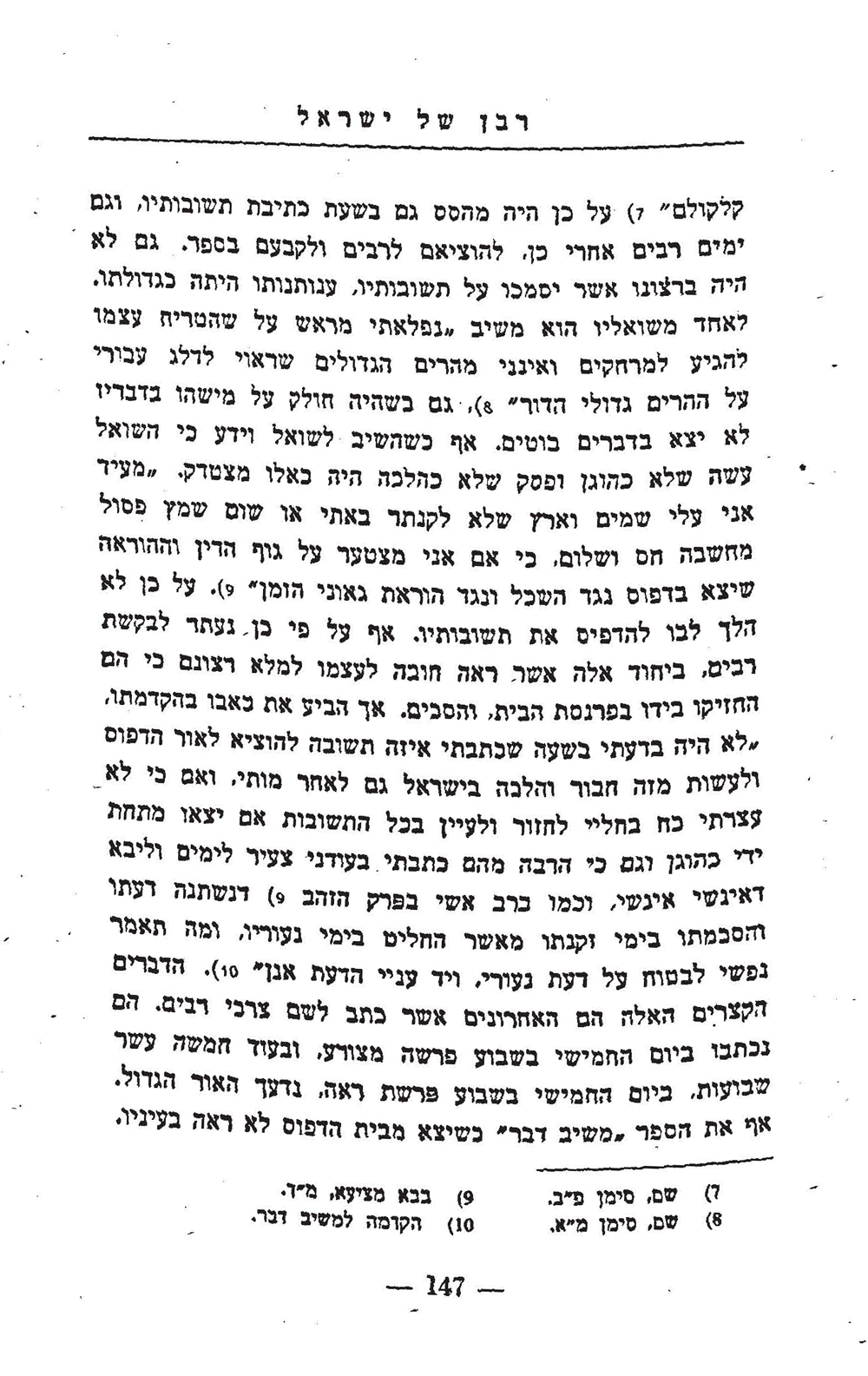
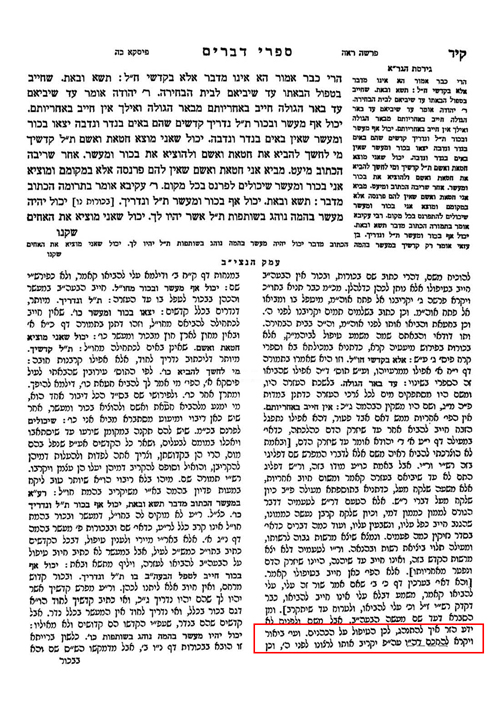
We find in Sefer ha-Rokeah, section 369 ad fin., that a person who is sitting in the synagogue, wrapped in his talit and with his tefillin on his head and is reciting liturgical songs, must, nonetheless, rise up before his teacher, since he can carry out both actions and he will receive fine rewards in both worlds. Now there are early authorities who hold that the principle that one who is engaged in one mitzvah is exempt from another is also the case when both could be carried out. (See Shulhan Aruch Orah Hayyim 38:8, and in the Beur Halachah, ibid., and also R. Yaakov Hayyim Sofer, Brit Yaakov [Jerusalem: 1985], section 2, 36; R. Ovadiah Yosef, Hazon Ovadiah: Sukkot [Jerusalem: 2005, 167].) The author of the Rokeah, R. Elazar of Germaiza, was a disciple of R. Yehudah (b. R. Shmuel) he-Hasid, the author of Sefer Hasidim. And it is the view of R. Yehudah he-Hasid that even if one can carry out both mitzvot, one is exempt from doing so, if one is engaged in a prior mitzvah; and this, indeed, is the view of R. Elazar Rokeah himself (Rokeah, Hilchot Sukkah, section 299; see Sofer). Why then should one who is engaged in praising the Lord in the synagogue, have to rise up before his teacher? Surely he is already engaged in a mitzvah, and therefore exempt from others! The answer, I suggest, is because ritual synagogue worship is directed towards God, but respect for one’s teacher is a mitzvah between man and his fellow, and he is therefore not exempt from it. So too the Hida, R. Hayyim Yosef David Azulai, rules, that even in the hour of prayer one rises before a Torah scholar, (Birkei Yosef Orah Hayyim, section 244:1; and see Sofer, note 8 on page 37; and see most recently the discussion of R. Yitzchak Eliyahu Stessman, Kimah ve-Hidur [Jerusalem: 2011, 88–91], with additional references).
Indeed, the severity of not rising before one’s teacher is expressed by R. Eleazar in very extreme terms in BT Kiddushin 33b:
Any scholar who does not rise before his teacher is called a wicked person (רשע), and will not live long and will forget his learning.
(See also R. Yaakov Hezkiyahu Fisch, in his Ve-Haarachta Yamim, ed. Y.M. Sofer, [Jerusalem: 2010, 71–72].)
To this we may add what we are told of the Arizal, by his disciple R. Hayyim Vital, that he was very particular in paying his workers exactly on time and without delay. And if he did not have the money with which to pay these wages, he would delay his afternoon prayer (minhah) until close to sunset in order to search out a loan with which to make the payment. Only afterwards would he hurriedly daven minhah. He would explain himself by saying: “How can I pray to the Lord, may He be blessed . . . , when such an important mitzvah is incumbent upon me, and I have not carried it out?” (See R. Hayyim Vital, Shemonah Shearim: Shaar ha-Mitzvot [Jerusalem: 1872], Parshat Tetzeh; Avraham Tobolsky, Hizaharu be-Memon Haverchem, vol. 2, [Bnei Brak: 1981, 211–212].)
In a somewhat different vein, but with much the same principle as its basis, we read in Niflaot Beit Levi, by A. Kleiman (Pietrokov: 1911, 32, [Yiddish]), cited in Louis I. Newman and Samuel Spitz, The Hasidic Anthology: Tales and Teachings of the Hasidim (New York: 1944, 178:2, 480) as follows:
A teamster (=wagon driver) sought the Berditchover’s (Reb Levi Yitchak of Berditchov’s) advice as to whether he should give up his occupation because it interfered with regular attendance at the synagogue. “Do you carry poor travellers free of charge?” asked the Rabbi. “Yes,” answered the teamster. “Then you serve the Lord in your occupation just as faithfully as you would be frequenting the synagogue.”
(However, see A.Y. Pfoifer, Ishei Yisrael [Jerusalem: 1998, 104, section 11, and notes ad loc].)
And indeed, the Rambam in Hilchot Talmud Torah 3:4, followed by the Shulhan Aruch, Yoreh Deah 246:8, rules:
If there came before him [the choice of performing] a mitzvah and (i.e., or continuing) learning Torah, if that mitzvah could be carried out by another, he should not interrupt his learning; but if not, he should carry out that mitzvah and then return to his study. And when it comes to giving charity, one should always give charity first.[1]
This indeed is the conclusion to be drawn from the sugya in Yerushalmi Pesahim 3:7 (and parallel to JT Hagigah 1:7). There we read that R. Abahu, who lived in Caesarea, sent his son R. Haninah to study in Tiberias, in the Yeshiva of R. Yohanan.
They came and informed him that [his son] was engaged in charitable activities (i.e., in the burial of dead). He sent him a message, saying to him: “Are there no graves in Caesarea that I sent you to Tiberias?” (i.e., for such activities you could have stayed at home).
The Talmud continues that it was already decided at Beit Nitzeh in Lod that “study is greater for it leads to deeds,” (see below). However, the rabbis of Caesarea qualified this by saying:
This is the case when there is someone else to carry out the deeds. But if there is not anyone else to carry them out, the deed comes before [the study], (i.e., has precedence).
We then are told a tale:
R. Hiyya, R. Yosi [and] R. Ami were late coming to R. Eleazar [for their lesson with him]. He asked them, “Where were you?” They replied, “We were involved in charitable activity” (meaning in the burial of someone). “Was there no one else [who could do this?]” he asked of them. They replied, “He was a neighbor [according to the Pnei Moshe, or a proselyte – according to the Korban ha-Edah,” i.e., and there was no one else to deal with his burial.]
Incidentally, we may add here that the interpretation of the Pnei Moshe is supported by a passage in Sefer Haredim, (by R. Eleazar Azikri, [Safed: 1533–1600]), Mitzvot Aseh . . . ha-Teluyot be-Lev 22, which states that:
A person is obligated to act charitably towards his neighbors and his relations more than to other people, as is clearly stated in the Bavli and the Yerushalmi.
(See S. Lieberman, HaYerushalmi Kiphshuto [Jerusalem: 1934, 426] and his other comments.) And the parallel text in JT Hagigah 1:7., begins with an additional passage, namely:
R. Yehudah, when he would see a dead person (i.e., a burial) or a bride (i.e., a marriage procession), [and people] praising them (i.e., honoring them in the processions), he would turn to his students (נותן עיניו בתלמידים), and say: “The [dealing with] the dead precedes the study of Torah (תלמוד).”
And a somewhat similar notion, but expressed in a Hassidic vein, may be found in a story related in Yehezkel Shraga Fraenkel’s Rabbenu ha-Kaddosh mi-Shinyeve (Ramat Gan: 1992, 256–257). He relates that once the Rabbi of Warsaw came to visit the Divrei Hayyim, R. Hayyim of Sanz. The Sanzer Rebbe asked him, “Do you learn?” “Yes,” the Warsaw Rabbi replied. The Rebbe repeated, “Do you always learn?” The reply was, “When someone who is embittered and needs help comes to me, I close my gemara and deal with him, to help and encourage him.” “This is what I wanted to hear,” said the Sanzer, “whether you have the good sense to close your gemara when someone needs your help,[2] both in word and in deed, and in any case to encourage him and bolster his spirit.”[3]
Here we must make something of a digression, which is not really a digression, as this touches upon a very important point. For the Mishnah in Peah 1:1 states that: “the study of Torah is equal to all of them,” i.e., even to those mitzvot listed in the Mishnah which are social ones, such as honoring one’s parents, doing charitable deeds, bringing peace between rival individuals, etc. The question we ask ourselves is: is the study of Torah (תלמוד תורה) a ritual or a social mitzvah? Into which category does it fall? For if the former, according to our suggestion how can it be superior to those other social mitzvot?
To clarify this issue we must go back to a very ancient discussion that took place in the attic at Beit Nitzeh in Lod, between R. Tarfon and the Elders. For this question was put before them: which is greater, or more important תלמוד או מעשה, learning or deeds? R. Tarfon answered: Deeds are greater. While R. Akiva said study is greater. And they all replied: Study is greater for it leads to deeds (BT Kiddushin 40b).[4] That is to say the importance of study is in that it constitutes the key to the proper execution of the mitzvot. This is also the meaning of R. Shimon the son of Rabban Gamliel’s statement in Avot 1:17: Not the expounding of the law (midrash) is the chief thing, but the doing [of it] (maaseh). And this is amplified by Rabbenu Bachya in his commentary ad loc.: that the aim of man’s labor in Torah is not that he should just learn a lot, but that [his learning] should lead to deeds, as we have learned from the verse [in Deuteronomy 5:1], ‘and ye may learn them [i.e., the statutes and judgments], and keep and do them.’ And this is further amplified in Shulhan Aruch ha-Rav, by R. Shneur Zalman Mi-Ladi, in his Hilchot Talmud Torah 4:2, by telling us that “it is impossible to fulfill all the mitzvot in all their details without intensive study and knowledge of them. And for this reason it is equal to all of them,” i.e., not intrinsically, but as a means to their proper application.[5]
This issue has been analyzed recently by R. Yitzchak Shapiro, in his article in Hakirah 9, (2010), 221–243, entitled “To know the Forbidden and the Permitted: An Analysis of Rambam’s View of the Purpose and Goals of Talmud Study.” He shows that the Rambam’s view, as expressed in his letter to his disciple R. Yosef,[6] is that “learning Torah is a utilitarian endeavor, with extracting halachic conclusions its functional objective” (227).[7] He goes on to show that “the simplicity and obviousness [of this position] might go unnoticed if not for its staggering ramification and total incompatibility with contemporary realities in derech halimud ” (227–228). For as he earlier showed (223–224): “the Aharonim do identify an aspect of Torah study, unrelated to fulfillment of the other mitzvot, based on the verse והגית בו יומם ולילה – ‘but thou shalt meditate therein day and night’ (Joshua 1:8, cf. BT Menachot 99b). This mitzvah of ‘limud ha-Torah’ is distinct from the mitzvah of ‘yediat ha-Torah,’ and can be fulfilled regardless of the subject matter that is learned, whereas the mitzvah of yediat ha-Torah requires a curriculum that is limited to ‘halachah’ (or at least the sharpening of one’s mental acuity, which is necessary for accurate application of halachah). However, one may fulfill both facets of the mitzvah simultaneously only by learning halachic subject matter.”[8]
This is the view of the Meiri, as formulated in his commentary to BT Berachot 7b:
The knowledge of how the Torah actually expresses itself indeed requires serving or observing Torah scholars. While intellectual learning is the cause of wisdom, observing the Sages is the cause of knowing how the Torah manifests itself. This is both true for monetary matters as well as that which is prohibited and permitted.
Hence, we may well understand the statement of Rav in BT Megillah 3b, that Talmud Torah is greater than the sacrifice of the daily offerings (­temidin).
Here we may also call attention to R. Meir Triebitz’s insightful analysis (in his introduction to R. Daniel Eidensohn’s Daas Torah: A Jewish Sourcebook [Jerusalem: 2005, 31–35]). He begins by noting that God commands us twice to study Torah: once in Deuteronomy 11:19, and again in Deuteronomy 4:9–11. He analyzes the differences between these two formulations in all their details – e.g., one in the plural and the other in the singular; one talks of teaching, the other telling; one focuses on parents to children, while the other lists three generations. He concludes that “the two verses which obligate us to learn the Torah actually refer to two types of study. One refers to the study of the legal part of Torah, and the other to the study of Torah’s theology. Each form of study is deemed a separate scholarly enterprise.” He characterizes these two forms of study as “legal” (i.e., halachic) study, and “faith” study, which he states “deals primarily with Aggadic parts of the Torah.” But for our purposes it is important to emphasize that both verses, that is to say both classes of study, require the student also to be a teacher, and to pass on his learning to future generations. Hence, Torah study has a social aspect too.
This is a very broad subject that requires a study in its own right, and we cannot enlarge on it here. But what emerges very clearly is that the mitzvah of Torah study is in a very special category, for without it one would not know how to carry out ritual or social mitzvot correctly. Nonetheless, the Or Zarua and the Rav
Baal ha-Tanya agree that one interrupts learning Torah to fulfill other mitzvot, if both cannot be carried out at the same time, and one is not exempt because one is already involved in a prior mitzvah.[9]
This is clear from the baraita in BT Ketubot 17a (BT Megillah 3b, 29a) that we interrupt our study of Torah (מבטלין תלמוד תורה) not merely for a met mitzvah and to accompany the dead (הוצאת המת), but also for wedding ceremonies (הכנסת כלה) – all supreme social mitzvot.[10] And in this way, we may better understand the passage in Avot de-R. Natan, chapter 41, (ed. Schechter, Vienna: 1887, 133):
It once happened that R. Tarfon was sitting and teaching his disciples, and a bride went past him. He ordered that she be brought into his house, and told his mother and his wife that they should bathe her, anoint her, and decorate her with jewelry, and dance before her until she goes to her husband’s house.
Apparently, he interrupted his teaching in order to carry out the mitzvah of hachnasat kallah.[11] And indeed we read in the letters of the Hafetz Hayyim (Michtevei ha-Hafetz Hayyim he-Hadash, vol. 2, Bnei Brak: 1986) II, 86:
You occasionally see a Jew who [in a praiseworthy way] learns Torah [as much as possible] and values his time [not wasting a minute]. But if he does not set aside part of the day to do deeds of kindness, what a lack of intelligence!
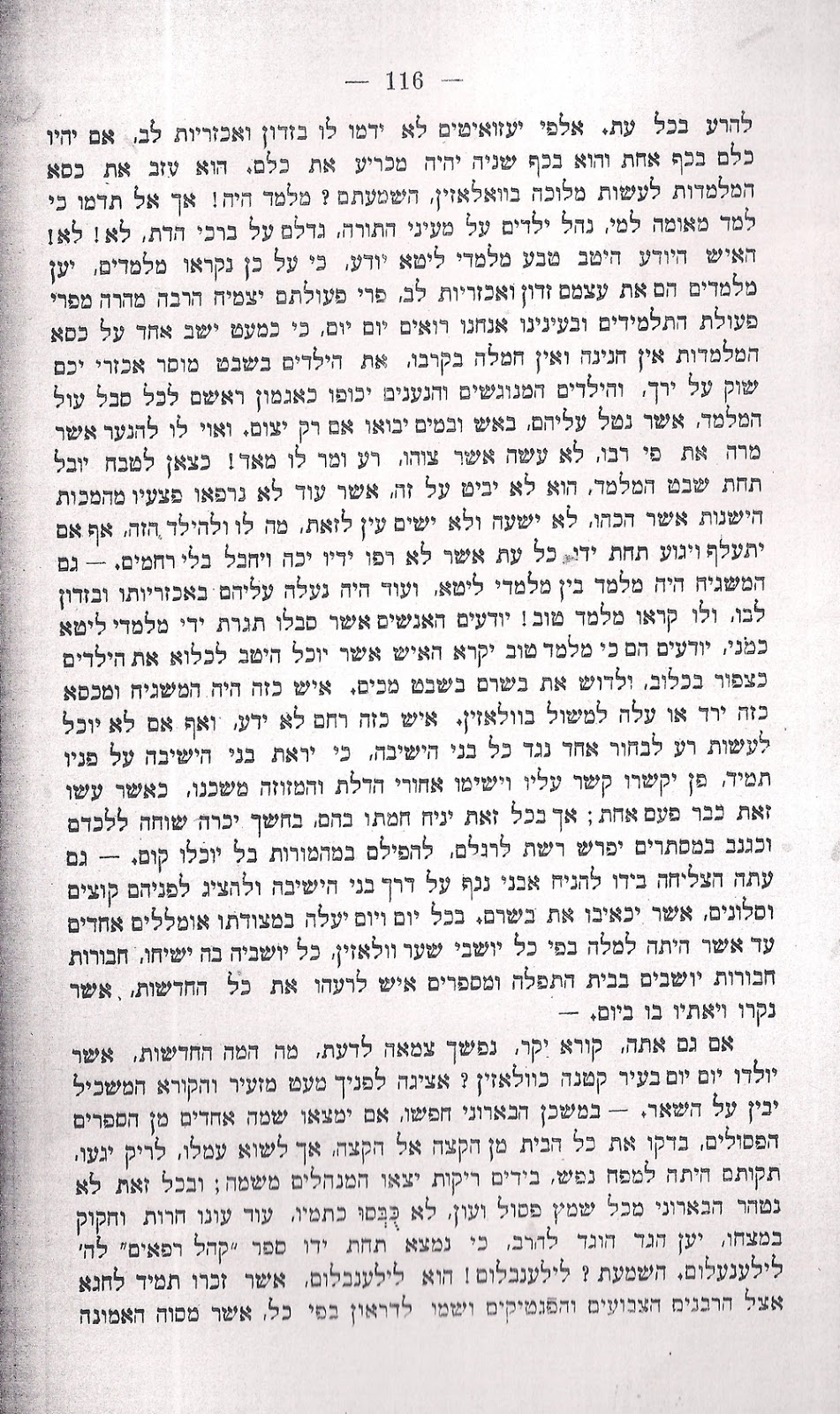
And interestingly enough, this also becomes evidence from the commentary of R. David ha-Nagid, the Rambam’s grandson, to Avot 1:15. There Shammai is cited as saying: “Make thy [study of the] Torah a fixed
habit (קבע); . . . . And receive all men as its cheerful countenance.” And this is explained by the Nagid to mean that even when you are engaged in your fixed period of Torah study, you should not desist from receiving people cheerfully, thinking that in doing so you are “wasting” Torah-study time.[12] So apparently he regarded proper interpersonal relationship of such importance as even to override one’s involvement in Torah learning. And this presumably goes under the category of kevod ha-beriyot, respect for the individual. (Cf. below, sections 15 and 19.)
We are reminded of the statement of Reb Yisrael of Rizhyn (died 1850), who expounded the verse in Psalms 115:16, “the heavens are the heavens of the Lord; but the earth hath He given to the children of men.”
There are two kinds of tzaddikim. Those of the one sort learn and pray the livelong day and hold themselves far from lowly matters in order to attain holiness. While the others do not think of themselves, but only of delivering the holy sparks which are buried in all things back to God, and they make all lowly things their concern. The former, who are always preparing for Heaven, the verse calls “the heavens,” and they have set themselves apart for the Lord. But the others are the earth given to the children of men.
(Martin Buber, Tales of the Hasidim: The Later Masters, New York: 1948, 53–54)
Here, he is contrasting the Lithuanian mitnagdim’s way, (in a double-edged complementary fashion), with that of the Hasidim, while we well know with which way he personally sided.
At the same time we should recollect how Yehudah ha-Levi in his ­Kuzari, begins his definition of the religious man according to Jewish tradition with the negative statement that “in Jewish opinion, the religious man is not to be defined as one who cuts himself off from the world” (Book III, sect. I, ed. Hirschfeld, Leipzig: 1882, 140–141). Perhaps he was combating predominant contemporary Sufi views on extreme asceticism. (See Franz Rosenthal, “A Judaeo-Arabic Work under Sufic Influence,” HUCA XV 1940,
440, and cf. page 465 for an extreme view of this form of asceticism, and note 104.)

[1] See Le-Hair Hilchot Tzedakah be-Or Yekarot (Jerusalem: 2010, 6–7). And see below sect. 16 on the overriding importance of charity, and Appendix.
[2] See, for example, the practice of the Brisker Rav, Reb Hayyim Soloveitchik, as described in Aharon Sorasky, Marbitzei Torah u-Musar bi-Yeshivot Nusah Lita mi-Tekufat Volozin ve-ad Yameinu, vol. 1 (Jerusalem: 1976, 110).
[3] Cf. BT Shabbat 127a: Said R. Yohanan: Great is the hosting of guests as are those rising up early to the House of Study [of Torah], as we have learned: to make room for guests [to avoid] hindrance in the House of Study. But Rav Dimi of Nehardea said: It is greater than rising up early to the House of Study. For we learned: “for guests,” and only afterwards “to avoid hindrance in the House of Study.” And see below sects. 11 and 12 on hosting guests.
[4] On this text see Benedict Thomas Viviano, Study as Worship: Aboth and the New Testament (Leiden: 1978, 105–109). Directly related to this is the text in JT Pesahim 3:7, and JT Hagigah 1:7, cited above, from which the Rabbis learned that if others can carry out these charitable activities, a person should not interrupt his Torah studies. And this seems to be the dominant view among the poskim. See further BT Moed Katan 9a; Shulhan Aruch Yoreh Deah 246:18; Meiri to BT Shabbat 9a and Moed Katan ibid.; Rabbenu Yeruham 22a in the name of the Ravad, etc. See R. Asi ha-Levi Even Yuli, Shulhan Aruch ha-Middot, vol. 2, Halachah u-Musar (Jerusalem: 2009, 243–244).
[5] See R. Mordechai Shmuel Ashkenazi’s magnificent commentary to Hilchot Talmud Torah Mi-Shulhan Aruch Admor ha-Zaken, vol. 5 [= ha-Rav] (Kefar Habad: 2000, 86).
[6] Ed. Y. Shilat, Iggrot ha-Rambam, vol. 1 (Jerusalem: 1987, 254–259); and see editor’s note on 257–258 to line 4).
 [7] At the simplest level, there is, in the Rambam’s view, an obligation upon one who has learned Torah,
also to teach it to others. See Hilchot Talmud Torah 1:2, and so too in the listing of the positive commandments at the beginning of his Mishneh Torah, no. 11. (This list is also that of the Rambam, as attested by the author of the Magid Mishneh in his introduction to Hilchot Eruvin, and the Kesef Mishneh in Hilchot Hannukah 3:6; Responsa Noda bi-Yehudah Kama, Orah Hayyim, sect. 29; Petah ha-Dvir, vol. 2, sect. 194, subsect. A. See R. Yaakov Hayyim Sofer, Drupteki de-Oraita, vol. 1 [Jerusalem: 1987, 45]. And see further his remarks, 68–69, on the need to teach others.) Of related interest is the article of Sarah Pessin, “Maimonides and the Sacred Art of Teaching,” apud Adaptations and Innovations: Studies in the Interaction between Jewish and Islamic Thought and Literature from the Early Middle Ages to the Late Twentieth Century, Dedicated to Professor Joel Kraemer, ed. Y. Tzvi Langermann (Paris & Louvin: 2007, 285–298). See also, most recently, the remarks of R. Aharon Lichtenstein, in H. Sabato and A. Lichtenstein, Mevakshei Panecha (Tel Aviv: 2011, 212–215).
[8] See the material R. Yitzchak Shapiro brings from the letters of R. Yisrael Salanter (no. 27), in this regard. See also Kuntres Aharon shel Shulhan Aruch ha-Rav, Talmud Torah 3:1, ed. Y.A. Lev (Ashdod: 1989, 39 et seq.). And see R. Aharon Lichtenstein’s very comprehensive study entitled “Does Involvement in Torah Study Exempt One from Mitzvot?”, which appeared in Alei Etzion 16 (5769 [2009]), 71–107, which examines this issue in depth, dealing with questions of delaying procreation, Megillah reading, prayer, all mitzvot, etc., and seeks to explain Rambam’s position that “ha-osek be-mitzvah patur min ha-mitzvah” theoretically applies to Torah study too, when “it is studied with the purpose of performing” (91); and cf. ibid., 105, for his suggestive interpretation of the view of the Maharach Or Zarua. His study of this very complex issue is extremely rich and requires intense study. See also Moshe Zvi Polin, Sefer ha-Mitzpeh al ha-Rambam, vol. 1, (on Hilchot Talmud Torah) (Jerusalem: 2005, 11–26), that studying (lilmod ) and teaching (lelamed ) are two interconnected mitzvot. See Ramban Hilchot Talmud Torah 1:1; Hilchot Hagigah 3:1: that anyone who is obligated to study is obligated to teach, and cf. ibid., 1:4. I think this is the meaning of the statement in Seder Eliyahu Rabba, ed. Friedman, p. 63 =Tanna Debe Eliyahu, transl. W.G. Braude & I.J. Kapstein (JPS, 1981, 183) that “one who toils in Torah is like a lamp which provides light for the eyes of many.” And in this connection, it is also worth reading Benjamin Blech’s article “Personal Growth or Communal Responsibility: A Question of Priorities,” The Torah U-Madda Journal 2 (1990), 134–142. However, to give a slightly different point of view, see Hatam Sofer to Nedarim 81a; R. Hayyim Volozin’s Nefesh ha-Hayyim, Shaar Dalet, sect. 3; Ruah Hayyim to Avot 6:1, and the introduction to Eglei Tal.
A very extreme expression of this view is to be found in R. David Baharan’s “Hanhagot u-Piskei Halachah,” in Otzrot Yerushalayim, vol. 13 (Jerusalem: [2010?]), 40, where he insists one must learn halachah every day, and it is not sufficient to learn merely Gemara. He goes on to say that one must learn Shulhan Aruch Orah Hayyim or Hayyei Adam, and he who does not do so will surely have no part in the World to Come. (See also ibid., 41–42.)
See further R.S.Z. Auerbach, Halichot Shlomo . . . al Moadei ha-Shanah, ed. Y. Terner and A. Auerbach (Jerusalem: 2007), 537–539, who also is of the opinion that there are two aspects to Torah study: the one being to study in order to learn how to act properly, and the other as an independent positive commandment which is not just in order to know how to act, but the actual practice of learning as an end in its own right. He expands on this position bringing biblical and rabbinic sources to bear out this point of
view. However, here too he agrees that ultimately this is in order “to purify his body through the light of Torah, in order to cleave to God . . . who orders the world (àùø äìéëåú òåìí ìå), and without which the world cannot subsist (åáìà ÷éåîí – àéï î÷åí ÷éåí ìòåìí)” so that in the final reckoning this non-action-orientated
study is nonetheless direct to úé÷åï òåìí, the betterment of our world, (see ibid., 536).
[9] See Kuntres Aharon ibid., in the editor’s Midrashei ha-Kuntres, 36; and also Kuntres Aharon, Talmud Torah 4:3, that one interrupts
learning for persuading others to give charity, where others are less
persuasive, or helping in burying the dead, etc. See R. Mordechai Shmuel
Ashkenazi, ibid., 87 et seq.
See
further R. Ovadiah Yosef, Hazon Ovadiah: Sukkot
(Jerusalem: 2005, 168), on the special status of Talmud
Torah, because it is mandated at all times (îöåä
úîéãéú), and, hence, cannot exempt from other mitzvot, as this
would free us from all other mitzvot (citing the Birkei
Yosef of the Hida 38:7).
This
subject has most recently been examined in considerable detail, with a wealth
of sources, by R. Asi ha-Levi Even Yuli, in his Shulhan
Aruch ha-Middot, vol. 2, Halachah ve-Musar
(Jerusalem: 2009, 243–247). He shows that there are two opposing views. For the
Yosef Omez, by R. Yosef Juspa Kahn Neurelingen (c.
1639), (Frankfurt am Main: 1908, [reprint, Jerusalem: 1965] 316), writes that
the Rabbis said: Anyone who is involved in Torah learning and not in gemilut hasadim, acts of charity, is as one who has no
God. And therefore he wrote that a Torah scholar should make sure that every
day he should carry out one act of charity. And the Seder
ha-Yom (by R. Moshe ibn Machir [Venice: 1599], and numerous editions)
wrote that one must not interrupt the learning of Torah for any mitzvah which
can be carried out by another, with the exception of acts of charity. And
therefore the enthusiastic should take this to heart and pursue acts of charity
as one pursues life itself. (And see the continuation of this passage.) Even
Yuli further refers us to Responsa Aderet Tiferet
(by R. Avraham Dori, vol. 4, sect. 44), who following on the words of the Seder ha-Yom seeks to find additional support for this
view in the Rambam, citing the gemarot in BT Megillah 3b, 29a; BT Ketubot
17a as further proof, in that one interrupts Torah learning to accompany the
dead to his final resting place. (See below on this subject.) He then refers us
to the Sdei Hemed to which we referred earlier on.
However, this runs counter to the prevailing majority view found in a multitude
of rabbinic sources, to which he referred on 243–244, and therefore very
convincingly he rejects and refutes this argument on 246–247. See there in
detail. However, the above just underscores what we have tried to point out,
namely the complex ambiguity of the status of Torah study.
[10] See Rema, Even ha-Ezer 65:1; Ba”h
ibid., that even the leading Torah authority, Gedol
ha-Dor, does so. And even public learning is so interrupted, (Pnei Yehoshua to BT Ketubot
ibid., on the basis of Tosafot Megillah ibid.). However, see D. Friedman, Piskei Halachot, vol. 3 (Warsaw: 1901, 35), argues that
nowadays, that we are not intimately acquainted with the laws and our studies are directed to their correct understanding, therefore,
we do not interrupt Torah learning for wedding ceremonies. See, in detail, on
all the rules related to this subject, B. Adler, Ha-Nisuim
ke-Hilchatam, 2nd ed., vol. 2 (Jerusalem: 1985, 394–395).
Clearly
hachnasat kallah is related to the mitzvah of procreation,
which is one of the paramount duties of a man, in Jewish halachic thought. See
my Netivot Pesikah (Jerusalem: 2008, 162–163, n.
251). (And cf. below, sect. 30.)
Here
we may add that a communal positive mitzvah always takes precedence and outweighs
a private individual’s positive mitzvah. A teacher sitting shiva is forbidden to learn and teach Torah. However, he
is permitted to do so if the community needs him (Shulhan
Aruch Yoreh Deah 384:1). See Tzvi Marx, Halakha
and Handicap (Jerusalem: 1992–1993, 228).
[11] See Schechter’s note
in his edition of Avot de-R. Natan, n. 24, and p.
131, n. 10.
[12] Midrash
R. David ha-Nagid to Avot, ed. BenTziyyon
Kipnis (Jerusalem: 1944). The Arabic original appeared in Na Amon 1901. However, there are some doubts as to the
attribution of authorship. See Milhamot Ha-Shem by
R. Avraham ben ha-Rambam, ed. M. Margaliot (Jerusalem: 1953, 38, n. 8); A.
Katz, JQR 48
(1957), 140–160; Midrash R. David ha-Nagid to
Genesis, ed. A. Katz (Jerusalem: 1964, 16–18). On R. David ha-Nagid himself,
see A. Strauss (Ashtor), Toldot ha-Yehudim be-Mitzrayim
ve-Suriah tahat Shilton ha-Mamelukim, vol. 1 (Jerusalem: 1944, 117–128).


Rabbi Steinman and the Messiah, part 1

Rabbi Steinman and the Messiah, part 1

Marc B. Shapiro

Since in a recent post I discussed Maimonides and the Principle of the Messiah, let me add one more thing. Yet before doing so, I need to make a few preliminary comments. Many readers know about the Peleg, which has caused all sorts of problems in Jerusalem. After the passing of R. Yosef Shalom Elyashiv, the simmering dispute in the Lithuanian world broke out into the open, and a minority of the Lithuanian community refused to accept the leadership of R. Aharon Yehudah Leib Steinman, who was backed by R. Hayyim Kanievsky. The opponents, known as the Peleg, were led by the late R. Shmuel Auerbach.

While people are aware of the wild behavior of the Peleg youth as they are the ones who block streets in Jerusalem, there is very little awareness of what was another element of the battle in the Lithuanian community, and that was the attempt to delegitimize R. Steinman. An entire literature was created that focused on two things. The first was citing all sorts of things that R. Steinman said which were believed to be in opposition to haredi ideology. The point was to show that because of his supposedly liberal views he was not suited to lead the haredi world, and that he had departed from the approach of R. Shakh.[1]

The other focus, also found in Peleg publications, was to show that R. Steinman did not have the requisite Torah scholarship to lead the community. For obvious reasons, they never made this claim about R. Hayyim Kanievsky, and never explained why they felt able to disagree with R. Kanievsky who was the most outstanding backer of R. Steinman.

While this dispute was playing out, R. Steinman said something that was like manna from heaven for the Peleg, for now they had a chance to use some heavy “ammunition” on him, as they could claim that he rejected the Rambam’s Twelfth Principle which affirms the coming of the Messiah. In response to the attacks on R. Steinman, his defenders claimed that his words were taken out of context. During the dispute, a couple of people in correspondence with me wondered if R. Steinman should be added to the list of people who disagree with one of the Principles.

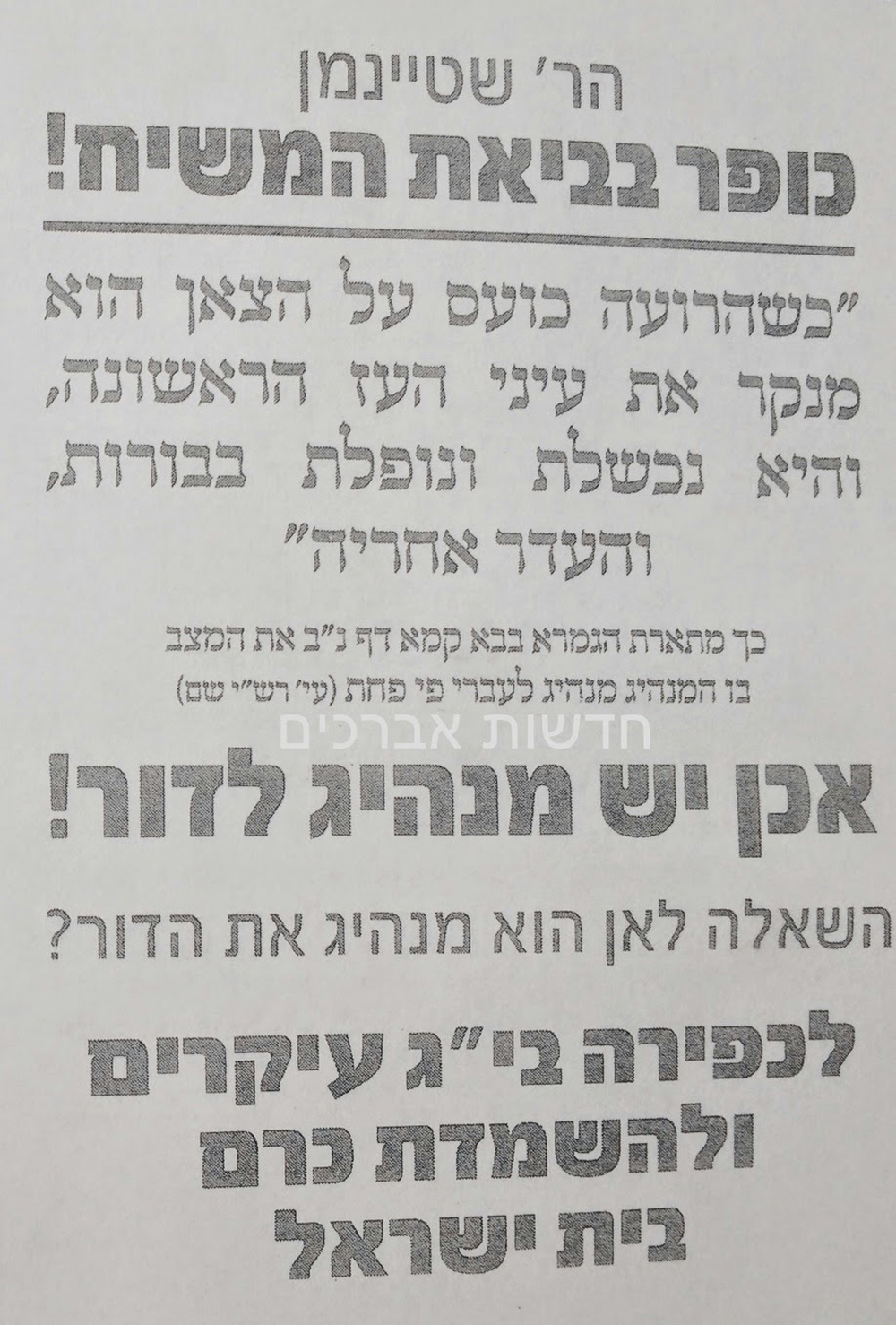
Here is a poster put up against R. Steinman by some unnamed extremist (found here).

So what did R. Steinman say that created such a mini-explosion in the haredi world. You can find the transcript of R. Steinman’s words here. You can hear the actual conversation here.

R. Meir Zvi Bergman, in discussion with R. Steinman, said that according to the Rambam one must wait for the Messiah’s arrival and not merely believe in his coming.[2] In other words, there are two separate things that are required: 1. Belief that he will come, and 2. Actively awaiting his arrival. R. Bergman referred to the Rambam’s words in the Mishneh Torah, Hilkhot Melakhim 11:1, which seem to say exactly this:

וכל מי שאינו מאמין בו או מי שאינו מחכה לביאתו לא בשאר נביאים בלבד הוא כופר אלא בתורה ובמשה רבנו

R. Bergman later notes that this is also included as part of the Twelfth Principle. What he must mean is the following: In the Principle the Rambam says that we must believe that the Messiah will come, and he cites the verse from Habakkuk 2:3: “Though he tarry, wait for him.” By citing this verse, the Rambam is adding a second aspect to the principle, just like he later does in Hilkhot Melakhim.

I would add to this that presumably the Rambam also had in mind Shabbat 31a, which says that in the next world everyone will be asked if צפית לישועה. How this sentence should be translated is itself a problem. Soncino translates it as “Did you hope for salvation?”, while Koren translates as “Did you await salvation?” Hoping for salvation and waiting for it are two separate things.[3] Artscroll’s translation combines the approaches of both Soncino and Koren: “Did you wait in hope for the [Messianic] salvation?”

In response to R. Bergman’s point, about the need to actively wait for the Messiah, R. Steinman replies that no one fulfills this, namely, no one is really waiting for the Messiah. My understanding of what he said is that no one is consciously focusing on, and anxiously awaiting, the Messiah’s arrival. They believe that the Messiah will come, but in the meantime they are learning Torah and doing mitzvot and when he comes, he comes, but until then Jews have plenty to do to keep themselves busy.

R. Bergman is surprised by R. Steinman’s comment and states that the Rambam says that if one does not wait for the Messiah he is a heretic, to which R. Steinman repeats his earlier point that no one does this. Upon being questioned again, R. Steinman replies that this is a “decree that the community cannot follow.” He adds that people say that the Chafetz Chaim “waited” for the Messiah. “Maybe yes, I don’t know. This is what they say, maybe yes.” R. Steinman then adds that the Chafetz Chaim was unique, but the Torah was not given just for such special people.[4]

R. Steinman’s statements are quite provocative, first, because he expresses uncertainty if the Chafetz Chaim can really be said to have actively waited for the Messiah, and second, because he makes it clear that the other great rabbis did not really wait for the Messiah. It would have been controversial enough if all he said was that he himself, or the people of this generation, do not really wait for the Messiah, but he applied this statement also to great ones of previous generations.

As the conversation continues, R. Bergman insists that waiting for the Messiah is one of the Thirteen Principles, and that in earlier times people indeed did wait for the Messiah. R. Steinman replies that in earlier days the Jews suffered greatly and that is why they had a focus on the Messiah.

R. Moshe Schneider, who was R. Steinman’s havruta and present at the conversation, adds: “The Rambam in the Thirteen Principles says, ‘Even though he may delay, nevertheless, I wait daily for him to come.’ Doesn’t he mean that there is an obligation in the Thirteen Principles to wait [for the Messiah]?” R. Steinman could have pointed out that the version of the Principle found in the siddur which R. Schneider quoted was not written by the Rambam, and its words do not appear in the actual text of the Principle found in the Rambam’s commentary to Mishnah, Sanhedrin. However, I don’t know how much this would help, for as we have seen, in the Mishneh Torah, Hilkhot Melakhim 11:1, the Rambam is explicit about the need to wait for the Messiah.

וכל מי שאינו מאמין בו או מי שאינו מחכה לביאתו לא בשאר נביאים בלבד הוא כופר אלא בתורה ובמשה רבנו

R. Bergman adds that if people do not fulfill this aspect of the Principle, then all the Thirteen Principles are weakened.

So far we see that R. Steinman held that the Principle is to believe in the coming of the Messiah, but this does not mean that one has to “wait” for him, which I think means to have a focus on the Messiah and actively wait in hope for his return.[5] We also see that R. Steinman himself was not “actively waiting” for the Messiah. Although Chabad claims that a focus on the Messiah is basic to Judaism,[6] it appears that R. Steinman thought otherwise. The Hatam Sofer already mentioned—in opposition to Maimonides—that the Messianic idea, while of course true (and denial of it is heresy), is not an essential element of Judaism, namely, basic to the very structure of the religion.[7]

אא לי בשום אופן להאמין שיהי‘ גאולתנו אחד מעיקרי הדתושאם יפול היסוד תפול החומה חלילה . . . ועכפ הגאולה וביאת המשיח איננה עיקר

Many have wondered about these words of the Hatam Sofer. Yet they are simply a repetition of what appears in Nahmanides, and as is well known, the Hatam Sofer greatly valued the writings of Ramban. Here is what Nahmanides states (and as with the Hatam Sofer, despite these words he continues by noting that denial of the messianic idea is indeed heresy):[8]

ודעיעזרך האלהיםכי אם נסכים בלבנו שפשעינו וחטאת אבותינו אבדו ממנו כל הנחמותושיארך ויתמיד עלינו הגלות מאין קץ וסוףוכן אם נאמר שרצה האלהים לענותנו בעולם הזה בשעבוד המלכיות לרצון או לתועלתכל זה לא יזיק בעיקר התורהכי אנחנו אין תכלית גמולנו ימות המשיחואכול פירות הארץ ההיאוהתרחץ בחמי טבריה וכיוצא בהן מן התענוגיםגם לא הקרבנות ועבודת בית המקדש תכלית רצוננו רק גמולנו ומבטנו העולם הבאוהתענג הנפש בתענוג הנקרא גן עדן והנצל מעונש גיהנם

Returning to R. Steinman’s conversation, in response to R. Bergman he cites R. Hillel’s view (Sanhedrin 99a) that there will be no Messiah for Israel, “because they have already enjoyed him in the days of Hezekiah.” It is not clear why he cited this. Was R. Steinman stating that one does not need to believe in an individual Messiah at all, in accord with the commentary to attributed to Rashi’s understanding that R. Hillel’s point is that in the future there will only be a messianic era, not a Messiah? R. Bergman asks R. Steinman point blank if he holds like R. Hillel in opposition to the Rambam, and R. Steinman does not answer the question, instead replying, “It is enough for us to observe the mitzvot that we can.”[9] 

R. Steinman’s point in mentioning R. Hillel could also be that R. Hillel certainly did not “wait” for the Messiah, as he thought that the Messiah had already arrived. Nevertheless, he is not regarded as a heretic, thus showing that this point is not essential. In any event, it is obvious that R. Steinman was not happy with R. Bergman’s focus on the details of the Twelfth Principle, and instead wanted the focus to be on the performance of mitzvot.

Not surprisingly, when the tape of R. Steinman speaking to R. Bergman was released it created a great controversy, which was called סערת המשיח. For attacks on R. Steinman by Satmar rabbis, which degrade him in the most harsh way, including one that says that R. Steinman is “worse than Kook,” see here.

A Chabad rabbi, R. Yechezkel Sofer, also responded to R. Steinman’s words (see here), and he makes a very interesting point which could explain what R. Steinman was getting at. R. Sofer states that one is not a heretic if he is lacking an emotional connection to the coming of the Messiah. The problem is only if one develops an intellectual position that there is no reason to wait for the Messiah. R. Sofer adds, however, that from a hasidic perspective a higher level of “waiting” is required, which he acknowledges not everyone is capable of. Here is how he concludes, and the second part of the sentence must be seen as a put-down of all those who do not put a stress on constantly waiting for the Messiah.

רק במישור החסידות ופנימיותהתורה נדרש רף גבוה של ציפייה‘ שלאו כל מוחא סביל דאובהעדרהציפייה מורהשבתוככינפשוחלשה אמונתו במשיחאחרת ודאי היה כולו משתוקק אמתי קא אתי מר

I think R. Steinman can be explained very simply, that despite what the Rambam says, it is difficult for virtually anyone to be emotionally invested in the coming of the Messiah, and thus have a sense of waiting for him, especially waiting constantly (every day) which is how the Principle is formulated in the siddur. R. Steinman was saying, what is the point of speaking about something which hardly anyone can fulfill? At the end of the day, it is enough to believe in the coming of the Messiah without adding anything else to this basic belief.

R. Avraham Yehoshua Soloveitchik defended R. Steinman, and this is some of what he said before he moved into a general attack on the Peleg:[10]

גאון אחד נכנס לביקור בביתו של ר‘ יחזקאל אברמסקי זצל וראה על השולחן בסמוך אליו ספר שעוסק בציפייה למשיח” שחיבר אדם בן זמנינומיד הוא פנה אל ר‘ חצקל ושאל: “מה הספר הזה עושה אצלך על השולחן“? השיב לו ר‘ חצקל‘: לפניך נכנס כאן יהודי שאיני מכיר והביא לי את הספר הזה שהוא חיברוהוסיף ר‘ חצקל‘: פעם נכנס לרוגוטשובער יהודי שהיה מאוד מוטרד ושאל מה עושים ואיך מחזקים בציבור את העניין של אמונה בביאת המשיחהשיב לו הרוגוטשובערפרנסה כבר יש לךאוכל לאשתך ולילדים אתה נותןקודם כל תדאג לעניינים הללו אחר כך תדאג למשיח.

סיים ר‘ חצקלגם אני רציתי לשאול את היהודי שחיבר את הספר הזה האם פרנסה כבר יש לךאוכל לאשתך ולילדים אתה נותןאלא שנמנעתי רק מפני שחסתי על כבודו

The upshot of R. Soloveitchik’s point is that thinking about the Messiah is not something that needs to be at the top of our concerns. Using Scholem’s terminology, we can say that R. Soloveitchik’s approach is that of neutralization of the messianic impulse. Should we be surprised that after R. Soloveitchik’s words were made public he too was attacked.[11] Here is a poster against him that was plastered on walls in Jerusalem.

Whatever you may think of R. Soloveitchik’s words, I don’t know how to square them with what his grandfather, R. Isaac Zev Soloveitchik (the Brisker Rav), is quoted as saying, that not only must we await the Messiah every day, but we must do so the entire day and every instant.[12] R. Moshe Mordechai Shulzinger notes, based on the Brisker Rav’s understanding, that all those who give dates when the Messiah will arrive are undermining Maimonides’ Principle (which he explains in line with Maimonides’ words in Hilkhot Melakhim), because the result of their predictions is that they (and those who follow them) will not believe that the Messiah can come at any minute, as they will only be expecting him at a future time.[13]

R. Shulzinger also explains the meaning of the Brisker Rav in a different way than his words are usually understood. He says that what the Brisker Rav meant is that one must believe that the Messiah can come at any instant, and that is the meaning of “waiting” for the Messiah. Understood this way, the Brisker Rav’s point is exactly in line with what R. Steinman said, for R. Steinman never denied that the Messiah could come at any time. He simply said that the idea of consciously waiting for the Messiah is not something that a typical person can do. Here are R. Shulzinger’s words:[14]

זה חיוב של אמונהשמאמין שיכול לבוא בכל רגעוהאינו מחכה” – הוא מי שהחליט בלבו חו על זמן מסוים שעדיין לא יבואומפני זה – הזמן ההוא מופקע אצלו מלחכות ולצפותוזה הוא חסרון אמונהוזה מיקרי שאינו מחכה לביאתו“, רחל . . . כשמאמין שיכול לבוא בכל רגע – הרי זה מחכה לביאתו“.

R. Shulzinger also prints a letter he sent to an unnamed rabbi who had argued that when the Rambam speaks of “waiting” for the Messiah, it does not mean that you must really believe that he can come at any minute. This rabbi compares it to someone who has a son in prison. He waits for the son to return home, even though he knows that this will not happen in the near future. According to the unnamed rabbi, this too falls under the Rambam’s understanding of “waiting,” a point that R. Shulzinger strongly rejects.[15]

In line with his understanding of the meaning of “waiting”, R. Shulzinger also makes the following very interesting point, which I don’t know if everyone would agree with: A person says that he would prefer that the Messiah not come in the near future, but only in a few years as he will by then have completed study of the entire Talmud, and will be more prepared to greet the Messiah. Nevertheless, this person knows that God does not take into account his wishes, and he believes that the Messiah can come at any instant. R. Shulzinger says that this person has not violated Maimonides’ Principle. In other words, the Principle requires the belief that the Messiah will come, and can come at any instant. Yet it does not require you to actually desire the Messiah’s arrival. Thus, to give a different example than that offered by R. Shulzinger, if someone has a very good business in the Diaspora, it could be that while he believes in the coming of the Messiah, he does not actually want this to happen, because he thinks that after the Messiah’s arrival all Jews will have move to Israel, and he does not want to give up his thriving business. According to R. Shulzinger, these sentiments would not be in contradiction to Maimonides’ principle:[16]

שהצפי‘ המחכה הוא שיעור בהצהרת גודל האמונה שלי בזה [לא הצהרה של רצון או לא רצון], כמדו‘ שזה נקרא מאמין ומחכה ומצפה לביאתו בכל רגע

To be continued

Excursus

Is there anywhere in tannaitic or amoraic writings where it says that all Jews will live in Israel is messianic days? I ask because this certainly does appear to be a widely held view throughout Jewish history. Maimonides states that “all Israel” will be gathered around the Messiah (Hilkhot Melakhim 12:3), but I don’t think this can be taken literally. I say this since according to Maimonides the messianic era will not be an era of open miracles, and people will still have free will, including free will to sin, so one can assume that some Jews will choose to remain in places outside of Israel. For those who see the messianic era as a time of miracles, when life will not continue as it does now, then it makes sense to imagine a time when all Jews will come to Israel. Thus, R. Isaac Abarbanel states that in messianic days not even one Jew will remain outside of Israel. See his commentary to Ezekiel 39:28 (p. 583), Mashmia Yeshuah, ed. Golan (Bnei Brak, 2014), pp. 72, 208. This is also stated on many occasions by the Lubavitcher Rebbe. See e.g., Likutei Sihot, vol. 11, pp. 1ff.

On the other hand, R. Shmuel Tuvyah Stern understands the issue in a purely naturalistic way. He states that the Jewish people are themselves obligated to go to Israel, as God will not be bringing them there. Those who refuse to go, or delay in going, are preventing the Jewish people in the Land of Israel from the performance of certain mitzvot that come into effect when the majority of the Jewish population lives there. (Regarding these mitzvot, see R. Yehudah Amihai here.) In other words, R. Stern acknowledges that even in messianic times not everyone will follow the Torah path. See She’elot u-Teshuvot ha-Shavit, vol. 9, p. 62:

ובאמת כשם שהקבה הבטיח לגאול אותנו כך חייב אותנו להגאל ולקרב את הגאולהואלו בני עמנו שהם מאחרים לצאת מן הגולה ומעכבים את הגאולה מבטלים אחת מהמצות הכי עיקריות של התורהכי הגאולה היא כמפתח להרבה מצות התלויות בארץ ובגולה . . . ואלו שמעברין זאת מבטלין מצות הרבים מישראלוהנה זכות הגאולה היא מצד הקבה שהוא מזכה אותנו בגאולהוחוב הגאולה היא מטעם ישראל

This topic has relevance to the issue of Yom Tov Sheni. Will it still be celebrated in messianic days for those Jews living outside of Israel? Since we will return to the old way of declaring Rosh Hodesh, rather than by a calendar, the assumption in pre-modern times would presumably have been yes, as far flung places would still not know what day was declared the New Moon. However, with modern communications, it would seem that there will be no Yom Tov Sheni in messianic days, even for people who live in the Diaspora.

Writing before the invention of modern communications, R. Moses Sofer states that there will indeed be Yom Tov Sheni in messianic days. See Derashot Hatam Sofer, vol. 2, p. 274b, s.v. למען. He sees this as in remembrance of our time in exile. See, however, ibid., p. 208a, s.v. כל, where he says that Yom Tov Sheni will be abolished in messianic days, and that this is the meaning of the rabbinic teaching in Yalkut Shimoni, Mishlei no. 944: “All the festivals [i.e., Yom Tov Sheni] are to be abolished in the future [messianic era], but Purim will never be abolished.”

Elsewhere, in speaking of Yom Tov Sheni in the messianic era, R. Sofer refers to it as ב‘ ימים טובים של גאולתינו. He makes this comment while discussing R. Judah’s position in Gittin 8a: “R. Judah holds that all islands fronting the coast of Eretz Israel are reckoned as Eretz Israel” (see his commentary to Beitzah 4b. See also his commentary to Beitzah 24b and She’elot u-Teshuvot Hatam Sofer, Orah Hayyim no. 145 [end]). R. Sofer notes that this means that all islands in the Mediterranean on the same latitude as the biblical Land of Israel (which extends into Lebanon), are regarded as belonging to Israel. If you look on a map (and you can actually see a good one in the Koren Talmud, Gittin 8a) you will see that this means that Cyprus, Crete, and Sicily are part of the territory of Israel. R. Sofer states that Jews who live in these places in messianic days will have to observe a second day of Yom Tov.

It is not clear to me why R. Sofer assumes that R. Judah’s position is accepted. See Tosafot, Gittin 8a, s.v. Rabbi Yehudah, where Rabbenu Tam states that we do not accept his position. Maimonides, Mishneh Torah, Hilkhot Terumot 1:7, also rejects R. Judah’s opinion.

In describing how far the territory of Israel extends, the R. Sofer writes (Teshuvot, Orah Hayyim, no. 145 [end]):

דכל הנסין שבים הגדול עד אוקיינוס שייכים לארץ ישראל והוא עד מצר רמון ספרד

The word נסין, which he uses, is found in Gittin 8a and it means “islands”. See Jastrow, s.v. נס and ניסא.

(Regarding R. Judah’s position about the islands being included as part of Israel, R. Hayyim Kanievsky points to Psalms 97:1: “The Lord reigneth; let the earth rejoice; let the multitude of isles be glad – ישמחו איים רבים.” R. Kanievsky asks why does it say איים in plural. He answers that this makes sense according to R. Judah’s view that the islands opposite Israel are included in the territory of Eretz Yisrael. See R. Kanievsky, Ta’ama de-Kra to Ps. 97:1.)

In the quotation above, R. Sofer refers to רמון ספרד. In medieval Hebrew, this is how the kingdom of Granada is called. The word “Granada” means pomegranate, which are abundant in that part of Spain, and a pomegranate was on the kingdom’s coat of arms (and is also found on the contemporary Spanish coat of arms). The reason the kingdom was generally called Rimon Sefarad and not just Rimon, which would be the literal translation of “Granada”, is because the expression רמון ספרד is a play on the biblical place רמון פרץ that is mentioned in Num. 33:20. See R. Meir Mazuz, Bayit Ne’eman, vol. 1, p. 32. In Yehudah Halevi’s poem בעברי על פני רמון the first line reads בעברי על פני רמון מפחד. Some scholars believe that instead of מפחד it should read ספרד. See Halevi, Diwan, ed. Brody (n.p., 1971), vol. 1, p. 78 (note to poem no. 34). Yet Halevi elsewhere does refer simply to רמון. See Diwan, vol. 1, p. 153, line 59, and vol. 2, p. 280, line 46

Since the Hatam Sofer is absolutely clear in what he writes, that the boundary of Israel extends until the end of Granada, which means the Atlantic Ocean, I don’t understand how R. Mordechai Winkler can cite without objection a report that R. Sofer said that England also falls within the borders of Israel. See Levushei Mordechai, Yoreh Deah vol. 3, no. 49.

R. Hayyim Hirschensohn interprets R. Judah’s position differently than the Hatam Sofer. He assumes that R. Judah is speaking not of the Mediterranean but of the Atlantic Ocean, and thus the territory of Israel extends all the way to the United States. He also interprets R. Judah to be including not merely the islands but also the land territory that is on the same latitude as Israel. What this means is that a good deal of the southern United States is included in the territory of Eretz Yisrael! Furthermore, R. Hirschensohn claims that according to R. Judah you can pray in the direction of these southern states, and those in the U.S. who want to fulfill all opinions should do this!. (Interestingly, he also does not see any significance for people in the U.S., who are so far from Israel, to face the Holy Land in their prayers.) See his article in Avraham Moshe Luntz, ed., Yerushalayim 8 (1909), p. 196:

והרוצה לצאת ידי כל הדעות יתפלל באמירקא [!] נגד הדרום כי לדעת ר‘ יהודה (בגיטין דח עאשכל שכנגד ארץ ישראל הרי הוא כארץ ישראל . . . זה כולל חלק גדול מצפון אלגריאובאמירקאדרום סויט קארליינאצפון דזארזיצפון אלאבאמאצפון מסיסיפיצפון לוזיאנידרום אריקאנסיסצפון טעקסיסדרום ניו מעקסיקודרום אריזאנאדרום קאליפארנעכל אלה המקומות לדעת ר‘ יהודה הם ארץ ישראלוהעומד בתפלה נגדם כעומד נגד ארץ ישראל

See also R. Yeshayahu Steinberg in Ha-Ma’yan, Tishrei 5775, pp. 43-44, who has a different approach according to which even Northern France is perhaps regarded as having the holiness of Eretz Yisrael. He even says that if someone is forced to live in the Diaspora, it is better to live in northern France since it is in some sense part of Eretz Yisrael!

ויש נפמ מסוימת בדיון זה לעניין בדיעבדאם אדם נאלץ לדור בחול ויש לו אפשרות בחירה – יעדיף לגור בצפון צרפת במקום שאותו הזכירו בעלי התוס‘ הנלכי יש במקום זה צד של קדושת אי ומניעה של עזיבת אי לגמרי

If one has to live in the United States (or west of it), then R. Steinberger says that it is best to live in places on the latitude of Israel (that is, the places mentioned by R. Hirschensohn).

I don’t mean the following to be disrespectful, but I can’t help commenting that what R. Steinberger says might make sense on paper, but I am certain that no one in history has ever  made living plans based on the assumption that there is some spiritual advantage due to the holiness of Eretz Yisrael to living in northern France or South Carolina over anywhere else in the Diaspora.

**********

It has been a while since I have done a quiz, so let me offer one now. Email me with answers at shapirom2 at scranton.edu

1. If you look at older machzorim, in the Tekiat ha-Shofar between the first two sets of blasts you find the letters שב. What is this about?

2. Where in Rashi’s commentary on the Talmud does he say that a certain individual knew all of Shas?

***************

[1] In addition to citing “liberal” passages in R. Steinman’s works in order to discredit him, they also cited a number of strange things that he supposedly said, also in order to discredit him. As always with these types of attacks, it is hard to know if R. Steinman really said what they claim he did. There is a long history of famous rabbis being misquoted, both by opponents and even more so by supporters. Thus, I find it incredibly difficult to believe that R. Steinman ever said the following which is quoted in his name by an unnamed student.

פעם אמר רבנו הגראי”ל, שאודות השואה כולם חושבים על האסון שנהרגו הרבה מכלל ישראל, אבל יש כאלו שבאמת היה עדיף שיהרגו, כי הם היו מחללי שבת וע”י זה שנהרגו עשו פחות עבירות. היטלר הרג את כל המשומדים שהתבוללו בזדון, וזה דבר אחד טוב שיצא מהאסון הזה, שנהרגו כל המשומדים

Me-Ahorei ha-Pargod (Bnei Brak, 2012), p. 454.
[2] R. Bergman discusses this matter in his Sha’arei Orah, vol. 1, pp. 264ff.
[3] Generally, we understand “salvation” to mean the Messianic era. However, see R. Zvi Shapira in his commentary on the Sefer Mitzvot Katan, vol. 1, p. 5, who explains that for the Semak, it refers to individual salvation of various kinds.

דרבינו זל אית לי‘ פירושא אחרינא בהך דצפית לישועהוסל דלא קאי אישועה הכלליתאלא קאי אישועה פרטית לפי הזמןוהיינו דכל אחד לפי מצבו בעת שנצרך לאיזה דבר וקשה לו להשיגומקרי שהוא נזקק לישועה ונצטוה לצפות לה

[4] See also the Chafetz Chaim, Mahaneh Yisrael (Jerusalem, 1973), p. 172:

וכמו שאנו אומרים בתפלה כי לישועתך קוינו כל היום וכתבו בספרים שלא דוקא על הגאולה בלבד צריך לצפות אלא על כל מין צרה שלא תבא צריך לצפות לישועת ה‘ וכבר כתבו בשם הארי זל שבכל יום כשאומר כי לישועתך קוינו כל היום יכוין שמצפה לישועה על כל צרה שנמצא בו

Regarding the Chafetz Chaim, in his Mahaneh Yisrael there is an entire chapter (ch. 25 in the 1973 edition [in the first section]) on the issue of the future redemption. The chapter’s title is

גאולת ישראלבו יבואר שצריך האדם לצפות תמיד לגאולת ישראל

At the beginning of the chapter he writes:

שלא דיי [!] באמור בפה שהוא מצפה לישועה אלא צריך להיות מצפה לישועה בלב שלם ואמונה שלמה

R. Shmuel Greineman writes as follows about the Chafetz Chaim (Chafetz Chaim al ha-Torah, p. 229):

והי‘ מרגלא בפומי‘ תמידכי משיח צדקנו יבוא פתאוםאם רק נחכה עליורגילים אנו לומר כי מחכים אנחנו לך“, “ואחכה לו בכל יום שיבוא“, אבל אנו אומרים זה רק בפינוולבנו בל אתנו

R. Yehezkel Levenstein, Or Yehezkel, vol. 3, p, 298, writes:

התעוררתי לדבר בעניני הגאולה מפני שהתעוררתי בעצמי לזה לכן הנני מרגיש שמחובתי לדבר בענינים אלווזכורני שהחפץ חיים זל היה ממשיל את צורת הצפיה למלך המשיח לחולה אנוש היודע כי רופא גדול בא לבקרו ולהמציא תרופה למחלתוועומד וממתין לביאתו וכל נקישה בדלת גורמת לו להתרגשות שהנה בא הרופא אליווכל שעת איחור אינה ממעטת מצפיתו אלא להיפך עומד ומצפה הנה בודאי עתה יבוא וירפאהוכן חייב להיות הציפיה לביאת הגואלוכל שאינו ממתין כן חייב לחזק את עצמו באיזה אופן שהוא כדי שיוכל להיות מהמחכים לביאתו

The same analogy that R. Levenstein cites in the name of the Chafetz Chaim is cited by R. Elijah Dessler in the name of his father-in-law, R. Nahum Zev Ziv. See Beit Kelm, vol. 2, p. 131.
[5] Regarding Maimonides’ Principle of the Messiah, R. Moses Salmon, Netiv Moshe (Vienna, 1897), p. 44, makes the interesting comment that in the days of the Sages, belief in the Messiah was not a dogma, denial of which would have been regarded as heresy:

שבדורות חכמי המשנה והתלמוד לא היתה אמונת המשיח עוד אמונה עיקרית בישראל ככ עד שיהי‘ הכופר בה ככופר בעיקר הדת אשר הוא אמונת האחדות . . . ואף שהרמ זל מנה אותה בעקריםהנה הוא זל דבר מהדורות האחרונים ואילך ולא מהדורות התנאיםכי מצאנו בתנאים את ר‘ הלל שאמר אין משיח לישראל (סנהדרין צט עבורע גם הוא טעה בבר כוזיבא ודרש עליו הפסוק דרך כוכב מיעקב שהוא משיח (איכה רבתי פסוק בלע ה‘) ובכל זאת לא מצאנו שהרחיקום מכל [!] ישראל בעבור זאת.

I don’t understand his point about R. Akiva, as unlike R. Hillel, he did not deny the concept of a Messiah. He just falsely identified Bar Kokhba as the Messiah. Also, it is not clear whether R. Hillel was a tanna or an amora. See my Limits of Orthodox Theology, p. 141 n. 10.
[6] Regarding Chabad and the Messiah, it is worth noting that Elliot Wolfson has argued that the Rebbe’s secret teaching is that there will be no physical redeemer. Rather, the messianic redemption is able to occur within each person. See Open Secret: Postmessianic Messianism and the Mystical Revision of Menahem Mendel Schneerson (New York, 2009).
[7] She’elot u-Teshuvot Hatam Sofer, Yoreh Deah, no. 356. The Hatam Sofer’s descendant, R. Akiva Glasner, was shocked by what his forefather wrote. See R. Glasner, Ikvei ha-Tzon (London, 1958), p. 104:

אני עומד ומתמיה על קז החתס זצוקל אשר בניגוד אל מה שהעתקתי מדבריו הקדושים הנל פלטה קולמוסו הטהורה דבר המפליא ומבהיל כאחד בתשובותיו

[8] Kitvei Ramban, ed. Chavel, pp. 279-280. See also ibid., p. 324, where Nahmanides has strong words about those who only focus on their personal lives rather than praying for God to bring the messianic era.

כולנו כצאן תעינו איש לדרכו פנינויאשים את ישראל בעבור כי הם בגלותם ישימו כל כוונתם בעסקי העולםומשים כל אחד כוונה לעצמו ביתו ועסקיווראוי להם להיות בוכים ולהתפלל לפני ה‘ לילה ויום שיכפר על עוון ישראל ויחיש קץ הגאולה.

[9] R. Meir Mazuz offers the fanciful suggestion that the reason the Ashkenazic version of Kaddish—and I guess he would include R. Amram Gaon as well—did not include ויקרב משיחיה is so as not to decide against R. Hillel. See Or Torah, Tevet 5778, p. 337. Yet as R. Mazuz himself notes, even Ashkenazim say in the Amidah: ומביא גואל לבני בניהם.

In Kevatzim mi-Ketav Yad Kodsho, vol. 1, p. 37, R. Kook explains R. Hillel’s position as follows:

הלל הי‘ חושב שמציאות מלך באומה בא מצד חסרון המוסראמנם ברוממות המוסר צריך רק תוקף לאומי גדול ונעלה,על כן אמר אין משיח לישראלכי אם בא יבא לנו תוקף לאומי נהדר מאדוכח שלטון של ישראל הוא המשיחות

Yeshayahu Leibowitz claims that R. Hillel’s statement was directed against the Christians. He was telling them not to believe that Jesus is the Messiah, as the Jews already enjoyed the messianic era in the days of Hezekiah. See Sihot al Torat ha-Nevuah shel ha-Rambam(Jerusalem, 1997), pp. 400-401. Graetz already offered this suggestion. See Encylopaedia Judaica, s.v. Hillel.
[10] See here where the poster against him that I include is also found.
[11] Unlike R. Avraham Yehoshua, R. Meir Soloveitchik spoke out against what R. Steinman said. See here. As long as we are speaking about the Jerusalem Soloveitchiks, let me also mention that R. Meshulam Dovid Soloveitchik writes that one who truly waits for the Messiah understands what the Zionists are all about. He also adds that those who have any happiness about the State of Israel are lacking in their belief in the coming of the Messiah. See Shiurei Ha-Gaon Rabbi Meshulam ha-Levi: Derush ve-Aggadah (Jerusalem, 2014), p. 601:

והנה מי שברור אצלו לגמרי ענין האמונה והציפיה לביאת המשיח הוא יודע להסתכל כראוי על הציוניםומי שיש לו משהו של שמחה על המדינה ועל השלטון והחוקים שלהם הדבר מוכיח שחסר אצלו באמונה בביאת המשיח.

R. Meshulam Dovid Soloveitchik has many pages in which he blasts Zionism and the State of Israel in the harshest way imaginable. Yet after all this, he adds that nothing he says should lead to the degrading of any Torah scholar who is mistaken in this matter—a lesson Satmar authors would do well to learn— and this was the path of both his father, the Brisker Rav, and his grandfather, R. Chaim. See ibid., pp. 601-602:

אמנם צריך לדעת שכל מה שאנו מדברים . . . זהו על השיטה ולא לזלזל באנשים חרדים אפילו אם טועים בהשקפתם לילך אחריהםובודאי שאסור לבזות תח וצריך להיזהר בכבוד התורה ולהתנהג עמם בדרך ארץובנפש החיים כתב דהמבזה תח שאין לו חלק לעוהב זהו אפילו תח שלומד שלא לשמהצריך לרחם עליהם על שטועים טעות מרה שכזואבל אסור לבזותםבכל השנים שהייתי אצל מרן זל לא ראיתי מעולם שביזה מישהווגם הגרח זל לא ביזה שום אדםהרבה מעשים שמעתי בבית ומעולם לא שמעתי שביזה מישהו.

[12] Haggadah shel Pesah mi-Beit Levi, p. 120. R. Moshe Feinstein had the same basic approach. See Iggerot Moshe, Orah Hayyim 5, no. 8:

משום דהחיוב בכל יום ויום לצפות כעין וודאי שיבא היום

As the Messiah can come at any time, including during the Covid pandemic, R. Gamliel Rabinowitz wonders if kohanim would be permitted to wear masks while performing their service in the Temple. See Or Torah, Elul 5780, p. 1327.
[13] Peninei Rabbenu Ha-Griz, p. 376. R. Yekutiel Yehudah Halberstamm, Shefa Hayyim: Derashot Humash-Rashi 5742, p. 431, goes so far as to say (emphasis added):

שהרמבם הק‘ פוסק הלכה ברורה שאסור לאדם אפילו לחשוב שמא יתאחר זמן ביאתו של מלך המשיחאלא להאמין באמת שמשיח צדקנו יכול לבוא בכל רגע

R. Jacob Sasportas, Tzitzat Novel Tzvi, ed. Tishby (Jerusalem, 1954), p. 41, writes:

 כי אמונת הדת היא שבכל יום ויום ובכל שעה ורגע בוא יבוא האדון אשר אנו מבקשים

[14] Peninei Rabbenu ha-Griz al ha-Torah, p. 383.
[15] Peninei Rabbenu ha-Griz al ha-Torah, pp. 382ff.
[16] Peninei Rabbenu ha-Avi Ezri, p. 417. There are myriads of other possible reasons why one might not wish the Messiah to come soon or even at all. Consider this hypothetical case: A man who intermarried and had children later became a ba’al teshuvah and divorced his wife. He is now hoping that his former wife and children will convert. However, it will take some time for him to convince them that this is the best path. This man, who now goes to Daf Yomi, learned from Yevamot 24b that in the days of the Messiah no converts will be accepted. So while the man believes in the coming of the Messiah, and wants him to come, he does not want him to come too quickly, since he figures he needs a couple of years before his family will be ready to convert. While some will regard this man as a heretic for not waiting in hope for the Messiah every single day, according to R. Shulzinger’s understanding of the Brisker Rav, there is nothing lacking in this man’s belief in Maimonides’ Twelfth Principle.


Simchas Torah and its Customs Including an Appendix from: R’ Chaim Zev Malinowitz Zt”l Celebrating Simchas Torah All Year Round

Simchas Torah and its customs
Including an Appendix From R’ Chaim Zev Malinowitz Zt”l
Celebrating Simchas Torah All Year Round

By Eliezer Brodt

At the end of the Yom Tov of Succos there is a special Yom Tov called Simchas Torah. While in Eretz Yisroel it’s celebrated on the eighth day of Succos, Shmini Atzeret; in Chutz L’Aretz it’s celebrated the day after Shmini Atzeret. Simchas Torah is a day of great Simcha and like all of our Yom Tovim is replete with its own unique customs. This article is in no way an attempt to cover all of the many aspects of this Yom Tov, but rather to touch upon some of its rich minhaghim, an intellectual smorgasbord of sorts.[1]

The Name of the Chag

The Tur and other Rishonim write that the reason behind the name Simchas Torah is that on this day we complete our weekly reading of the Torah and as such it is proper to be BeSimcha. The Tur also points out that the custom is to begin reading Parshos Bereishis on this day to prevent the Satan from denigrating the Jewish people.

The Hagahos Haminhagim on R’ Issac Tirnah’s Sefer Minhagim expands this point thusly: the Satan berates the Jews before Hashem with the claim that they study Torah but never complete it, and even when they finish the Torah, they do not begin their study anew.[2] Therefore, the minhag is to begin the Torah anew immediately upon its completion in order to preemptively silence the Satan from offering any critique.

The Tur continues by noting that in some communities many Piyutim are said, some of them having the custom to take out all of the Sifrei Torah from the Aron Kodesh while doing so. Other communities make a big Seudah to celebrate the Simcha of completing and starting the Torah anew.[3] From other Rishonim it appears that those responsible for the Seudah are the Choson Torah and Chosson Bereishis.[4]

The Rama adds to above explanation of the Simcha on Simchas Torah as a celebration of completing reading the Torah by correlating the minhag to circle the Bima with the Sifrei Torah to that with the Daled Minim on the earlier days of Succos.[5]

However, in a late-antiquity work called Chilukim Bein Bnei Bavel L’bein Bnei Eretz Yisroel we find that while Bnei Bavel celebrated Simchas Torah every year, the custom in Eretz Yisroel was to finish the Torah once every three and a half years (or so), and only then did they celebrate ‘Simchas Torah’.[6] This custom is mentioned by the Rambam who notes that most communities finished once a year but some had a custom to do so only once every three and a half years. The famous traveler, R’ Binyomin of Tudela, mentions[7] seeing these two customs still in practice in Egypt in the 1160’s-1170’s, as does R’ Avraham ben HaRambam a few years later.[8] [I deal with this last aspect in my Presentation on All Daf Here.]

Additional insight into this special day can be found in the Netziv who writes:

ובהעמק שאלה סוף סימן קע”א הראינו לדעת דסיום התורה הוא גם כן יום שמחה לישראל, ובסימן קמ”ו אות ה’ הכרחנו משיטת רבותינו התוספות, דזה שאומרים הלל ומברכים ביום שמחת תורה, אינו משום ספיקא דיומא של שמיני עצרת, אלא משום שמחת גמרה של תורה, והיינו משום דזהו כעין חנוכת בית המקדש. ונראה דמשום הכי משונה קריאת התורה דזה היום מדיני קריאת התורה בכל השנה, והיינו משום דהוא כמו יום חנוכת המזבח דמשונה הבאת הקרבנות מדיני הקרבנות בכל השנה, כמו שכתבתי לעיל ז’ י’ עיין שם, כן היום ביום סיום התורה משונה מנהגיה מכל השנה. ובאמת הוא זה בעת שאנחנו בגלות והשגחת ה’ עלינו על ידי ד’ אמות של הלכה הוא דבר אחד עם חנוכת המזבח בזמן שישראל בארץ ישראל ובית המקדש קיים, שהשגחת ה’ עלינו ושכינתו היה תלוי בעבודת בית המקדש, שמשום הכי כתיב בכרובים שעשה שלמה ופניהם לבית, ללמדנו שגם עיני ה’ וגם עינינו תלויות על הבית כמש”כ בפרשת תרומה ובפרשת פקודי. כך בזמן הזה סיום התורה והתחלתה הוא שמחת לבבנו. דרך כלל אין שמחת ישראל כמו בזמן שאנחנו עושים סיבה להשכין את אלהי ישראל בקרבנו, כי הוא חיינו הרחב דבר, פרשת בהעלותך, י:י אות (ב) ]9

Simcha and Dancing

One of the ways to find data and get a glimpse of how Yom Tovim were celebrated in the past is through personal memoirs and autobiographical accounts.

Rabbi Elozor Reich described Simchas Torah in Eretz Yisroel in 1953, while he was learning there, thus:

On Simchas Torah in Yerushalayim, Chevron is the center of attraction and hundreds of people pack the beis hamedrash for hakafos and the actual dancing is a showpiece here. The queue of spectators waiting to get into the gallery stretches for a distance. So as to enable them to dance with energy the oilam makes kiddush and has a snack straight after maariv, and in the morning session the hakafos are also preceded by dinner! Even though the chevron performance was outstanding with special shticklech and minhagim I must say that the simchah in Yeshivas Hamasmidim with a heimishe oilam appealed to me more. Just before Yom Tov ends the yeshiva makes a rekkidah which is joined by hundred’s and watched by hundreds more in a square near the yeshiva called Kikar Shabbos. It is near to the entrance to the Meah Shearim area and has been the scene of many battles against chillul Shabbos.[10]

Further on R’ Reich describes[11] Simchas Torah in 1954:

“On Simchas Torah all, or nearly all, Yerushalayim comes to Chevron. The art of singing and dancing has been developed to a fine degree and it is one of the sights of the year. One of the specialties is “Se’u she’arim rasheichem” when the sifrei Torah are taken out. The is a block of about a hundred jumping up and clapping over their heads in front of the aron kodesh, whilst behind them are seim-circle and semi-circle charging backwards and forwards to the magnificent tune. The hakafos ended at 2 a.m. but singing continued until 3:30. You must be wondering when we ate – well, Kiddush was made before Maariv and dinner was served all through the night and the oilam went down in groups. To return to Simchas Torah. In the morning the seder was davening until after mussaf and then dinner followed by hakafos which carried on until four, when after mincha the ulam went out to the main crossroads and several hundred watched by many more, continued enthusiastic rekidos (if not without alcoholic support) until well after nightfall, when the crowd danced up to the Brisker Rav shlit”a and back. What a sight!

Rabbi Reich’s lengthy descriptions grant us a rare glimpse of the Yerushalayim Yeshivah world in the 1950’s.

Rav Chaim Stein, Rosh Yeshivah of Telz kept a diary throughout his travels during World War II. It chronicles his great mesiras nefesh for whatever mitzvos he was able to perform during that bleak period. The entry on Simchas Torah in his home town in 1940 relates Yom Tov was celebrated with great simcha despite the foreboding and funereal atmosphere.[12]

In an account about Mir Yeshivah before the war we find:

בשמחת תורה היה שמח משהו משהו! ר’ ירוחם היה נוהג לתת בשמחת תורה שיחה קצרה בין כל הקפה להקפה. הבחורים רקדו ורקדו זמן ממושך, ואז בתום כל הקפה היו נאספים ליד הבימה, ור’ ירוחם התיישב ודיבר כעשר דקות עד רבע שעה… [שמך לא שכחנו, א, עמ’ 190-191].

In a different account of pre-World War Two life, we find many very familiar details:

Simchat Torah begins, there were processions… the reins are almost completely released. We start with the verse “You have learned to know” and at times the right of distributing to prominent townsmen the honor of reciting the appropriate selections, verse by verse, was sold for the benefit of the synagogue.Sometimes this led to quarrels and to a diminution of the honor, since the person buying the right would privilege only his own relatives and friends, which the town considered to be spiteful. Eventually, selling the right to distribute these verses was abandoned in our town. Then the synagogue official or officials begin to distribute the honor of carrying the Torahs in procession: First the kohanim and Levites, then the town dignitaries, and after them the others. And woe to the official who does not follow the rules of precedence, especially with the procession during which the verse “Helper of the weak” is recited.The cantor leads those holding the Torah scrolls and the children follow them, holding flags. They circle the bimah, then stop before the ark to sing and dance, and the first circuit is completed. And we dare not stop until seven circuits around the synagogue are completed. After the processions, members of the congregation are honored by being called up for the reading of the Torah,… and then people disperse to their homes to eat and to rejoice in the spirit of the holiday.”[13]

A Galician author details the tremendous Simcha felt on Simchas Torah, relating how everyone would visit the Chasan Torah, Chasasn Bereishis and other important members of the city to take part in a kiddush… and how during the Hakafah of ‘Ozer Dalim’ the simcha felt was incredible; in the main shul people from all backgrounds dancing together…[14]

Why is Dancing Permitted?

An important Halachic question that needs to be addressed is, how is all aforementioned dancing etc. permitted if the Halachah rules[15] is one may not dance on Yom Tov?

The Rama, in his Darchei Moshe (OH 699), cites a Maharik who quotes the Geonim as having ruled to permit dancing on Simchas Torah since it is for the Kovod of the Torah.[16]

It is worth noting that the original German Minhag was not[17] to perform any sort of Hakofos with the Sifrei Torah[18] or dancing on Simchas Torah, neither by night or by day!

However, The Arizal and Gra did dance with great Simcha with Sifrei Torah.[19] As the Chayay Adam writes:

והגר”א היה מקיף שבע פעמים ואמר הנוסח שנדפס בסידורים ואחר כך אתה הוא אלהינו, והאדרת והאמונה כמו שנדפס במחזורים, והיה מקיף ומרקד לפני הספר תורה בכל כחו [כלל קנג]

R’ Nochumka of Hordona would also show tremendous simcha on Simchas Torah and even sang special niggunim.[20]

R’ Yaakov Ettlinger writes that one should not say that it’s not befitting my Kovod and Kovod Hatorah, to dance as this was exactly the sin of Michal, Shaul’s daughter.[21] Since the Mishna Berurah cites this ruling,[22] it is quite interesting to find in his son R’ Aryeh’s glowing biography of his father, the Chafetz Chaim, a description of the Chafetz Chaim’s display of intense Simcha during the Hakofos; encouraging all present to take an active part, he himself danced with the Sifrei Torah each Hakafah… he also wanted everyone to get a chance to dance with the Torah and avoid fights.[23]

In Rav Chaim Stein’s World War II diaries (quoted above) he describes how in 1941 he and his friends danced with great simchah; having no Sefer Torah, they danced instead with Chumashim.[24]

In a similar vein, it is reported that R’ Meir Shapiro of Lublin would dance with Gemaras printed by the Slavita publishing house.[25] R’ Aryeh Kagan, son of the Chafetz Chaim, recalls how in his youth the children would dance with the Megilot of Neviyim, but this lead to physical fights among the children at which point the Chafetz Chaim gave his son R’ Aryeh a copy of the Semag to dance with, explaining to him this is an important work that included both the written and oral Torah.[26]

Which brings us to point regarding children and Simchas Torah.

Children and Simchas Torah[27]

It hardly bears saying that this Yom Tov was extremely special for children all over, and they took an active part in the singing and dancing. Thus we find quoted in the account above “the cantor leads those holding the Torah scrolls and the children follow them, holding flags”.

In another account we find:

Every child carried a paper flag or banner on which were painted a lion and hare and the words: “Be swift as a hare and strong as a lion to carry out the commandments of the Torah.” On the flag was perched a large red apple and on top of the apple a lit candle. I still picture all the townspeople gathered in the Beis Medrash , the Torah Scrolls taken out of the Holy Ark, the seven Hakafot (processional circuits) around the synagogue, the men taking turns in carrying the Torah Scrolls and the singing and the dancing. We children joined the processions and heard the Yiddish expression “Derlebt iber ah-yohr” (may you have a good year and be privileged to celebrate again next year) repeated over and over again.[28]

This minhag is noted as early as the Orach Hashulchan.[29] In 1824 a parody called the Sefer Hakundas (trickster) printed in Vilna. Through this parody we get a very interesting glimpse into Jewish life in those days. When talking about Simchas Torah he mentions the big flags carried by ‘the trickster’.[30]

There is a special minhag in Stolin that before the Hakofot they say the 13 Anei Mamin with the children in Yiddish. Rabbi Abish Shor points to early origins for this minhag.[31]

Children participated in numerous other ways and even receive Aliyot; some chicken out or are too young and just stay under the Talis during Kol HaNe-Aryim!

Dancing around a Bonfire

The Magan Avraham rules the following: it is prohibited to light Pulvyer to produce Noise as a form of Simcha. What is he referring to?

The answer is ‘Pulvyer’ is gunpowder and the sentence refers to a custom of making a fire, leaping over it and shooting gunpowder. As mentioned earlier, the custom in many German communities was not to dance with Sifrei Torah or to perform any sort of Hakofos. However, in an early account of life in Worms by Rav Yuzpeh Shamash (1604-1678) we find a lengthy description at how later on in the day, when the Chasan Torah and Chasan Bereishis would make their Seudah, they would light a big fire and eventually they would dance around it. The hagahos to R’ Yuzpeh sefer describe how the Pnei Yehoshua took part in one such fire, during his temporary residence in the city (1753-4).[32]

Interesting enough the Maharil (already quoted by the Darchei Moshe) relates how some children would take apart the Sucah and burn it on Simchas Torah in this fire. The Maharil’s father did not let him do it but the Maharil himself did allow the children do it because of simchas Yom Tov.[33]

Another item that was burned in this fire, according to R’ Pinchas Katzenelenbogen’s account in his fascinating autobiography, was the Shul’s sheimos.[34] Apparently at some point they began adding gun powder to the fire and this is what the Magan Avhrhom is referring to in his aforementioned prohibition.[35]

These are not the only minhaghim the children were involved in.

Fruit and Fruit throwing[36]

In R’ Binyamin Halevi’s Machzor Maagalei Tzedek (first printed in 1550) we find that the adults would give out fruits to the children.[37] Much later, we find this custom mentioned by Y. Gibralter in his memoirs of pre-World War II Kovno, describing how the Gabbai would give out fruit to the children.[38]

Certain Rishonim mention that the adults would through the fruit at the children. Eliyahu Raba says that Rabbenu Bechayah was against this, but he says there is a source for this custom in the Midrash. Although he does not give precise details to his source, it appears that he is referring to a midrash quoted in the Targum Sheini on Esther (3:8), which says that on Atzeres they would go to the roofs of their shuls and they would throw down stuff, which is then gathered. In Amsterdam in 1770 a commentary on this Targum was printed, which added in a few words to this Midrash, to wit that they threw down apples and grass. This is the source for many to show that spreading out grass on Shavuos is a very early minhag. However, the words apples and grass are absent in all earlier editions of Targum Sheini; neither do they appear in other midrashic works that quote this same midrash. Still, there are numerous early sources in the Rishonim to throw apples on Simchas Torah; some chassidim still do so today, understanding the word ‘Atzeres’ as referring to Sukkos-Shemini Atzeres and not Shavuos. Thus, this midrash is not a source for Shavuos but rather for Simchas Torah.[39]

In Rav Yuzpeh Shamash’s work on Worms, while discussing throwing fruit at the children, he describes how a non-Jewish woman bequeathed the Jewish Community her garden upon her death, on condition that they use her garden for the Simchas Torah fruit. R’ Yuzpeh writes that he saw fruit from this garden used.[40]

Related to this last point, this is not the only “involvement” of Goyim with Simchas Torah.

One of the more famous accounts is the British diarist Samuel Pepys’ unexpected visit to Congregation Shaar Hashamayim in London on Simchas Torah in 1663. In his diary entry for Wednesday, October 14th, he writes:

after dinner my wife and I, by Mr. Rawlinson’s conduct, to the Jewish Synagogue: where the men and boys in their vayles, and the women behind a lattice out of sight; and some things stand up, which I believe is their Law, in a press to which all coming in do bow; and at the putting on their vayles do say something, to which others that hear him do cry Amen, and the party do kiss his vayle. Their service all in a singing way, and in Hebrew. And anon their Laws that they take out of the press are carried by several men, four or five several burthens in all, and they do relieve one another; and whether it is that everyone desires to have the carrying of it, I cannot tell, thus they carried it round about the room while such a service is singing. And in the end they had a prayer for the King, which they pronounced his name in Portugal; but the prayer, like the rest, in Hebrew…”.[41]

Women

We now return our focus to the custom to throw fruit; according to some accounts, it was the women who threw the fruit. This in turn leads our attention to the role of women and Simchas Torah.

Rebbetzin Ginsburg, R. Yechezel Levenstein’s daughter, while describing Simchas Torah in Yeshivas Mir in Europe said: “the woman stood behind the mechitzos and watched”. However, I had heard that other witnesses of Simchas Torah in the Mir in Europe had said that the women were not relegated behind the Mechitzah.[42] While checking up the source of Rebbetzin Ginsburg’s interview, I saw that it’s a Hebrew version of an article originally printed in English in the book Daughters of Destiny (Artscroll). However, in the original English version it says, as I had heard from others: “The woman would stand in a corner of the bais medrash separated from the men and wait excitedly for the Hakofos to begin” (p.76). No mention of the woman standing behind a Mechetziah.

Elsewhere I found someone write about the Mir;

בשמחת תורה היה… מעמד זה היה מאד יפה… כל העיירה היתה באה גם נשות העיירה באו לחזות בשמחת תורה מעזרת הנשים… [שמך לא שכחנו, א, עמ’ 190-191].

There are few other sources from other communities that woman came in to the Beis hamedrash on this night to watch the dancing up close.[43] Rav Yuzpeh Shamash of Worms describes how the woman would gather in a circle outside of shul and sing with the wives of the Chasan Torah and Chasan Bereishis.[44] In Baghdad, R’ David Sasson relates a local custom involving woman; all of the shuls would leave the Sifrei Torah out and men and woman would go from shul to shul to kiss them.[45] We find a similar custom mentioned a bit earlier, in his letters, R’ Ovadia Bartenurah relates seeing women doing so on Yom Kippur and Hoshanah Rabah night.[46]

In yet another account we find as follows:

“Simhat Torah is considered the most joyous day in the Hebrew calendar. It is the holiday to commemorate the occasion when the reading of the Pentateuch is finished. On the eve of this day the cantor leads the hakafot as it encircles around the almemer, and girls as well as married women are permitted to take part in some of the exercises usually reserved for men in the bet hamidrash. Everyone lines up to kiss the Torah and to participate in the singing when the hakafot changes hands. The services of the following morning were a repetition of those of the evening before and were characterized by singing and dancing”.[47]

In an Italian work from 1801 we find:

חיפוש דשלושה ס”ת, שאנו עושים תכף אחר ערבית, וכשגמר… פותחים הארון הקודש ומוציאים הג’ ס”ת, וס”ת נותנים אותו למע’ הרב ויוצא עם הס”ת לעזרה, עם זקן א’ ללוות הס”ת כדי לזכות את הנשים שבאות לנשק התורה… [פינקסי קהילות אשכנזיות באיטליה, עמ’ 89]

One other point regarding woman and Simchas Torah; Rivkah Tiktiner (died in 1605), the first Jewish woman to write a complete work (Minkes Rivkah) composed a Yiddish song for Simchas Torah. Yaari suggested that this song was sung while the woman decorated the Sifrei Torah.[48]

Excessive Drinking[49]

By way of introduction to this topic, the Mishna Berurah writes here in his introduction to the Siman about Simchas Torah

מה שנוהגין באיזה מקומות שאחר מנחה של יום טוב ראשון קובעין עצמן לשתות עד הערב ולפעמים נמשך ד”ז עד שעה ויותר בלילה שלא כדין הוא מפני כמה טעמים א) דקי”ל בסימן צ”ט דאם שתה יין כדי רביעית אל יתפלל אף שיכול לדבר עדיין בפני המלך וה”ה אם שתה שאר משקין המשכרין עי”ש בסק”א ואפילו אם שותה שאר משקין שאין משכרין כיון שהגיע ספק חשיכה חל עליו חובת קידוש ואסור לטעום עד שיקדש ואפילו לאחר קידוש הלא מעוכב לאכול מחמת ק”ש של ערבית ואינו מותר רק טעימה בעלמא דהוא מיני פירות או פת כביצה ולא יותר אכן יש לחפש עליהם זכות דרבים מדכרי אהדדי ולא יבואו לשכוח תפלת ערבית אבל עכ”פ יש ליזהר שלא לשתות אז משקה המשכר ומבואר הכל לעיל בסצ”ט ס”ק א’ וב’:

The Source for this (even though the MB does not cite it here) is the Shulchan Shlomo (1771) who writes:

מה שנוהגין בכל י”ט אחר מנחה של יום ראשון שותין ומשתכרין מאוד שאסור לקבוע לשתות דבש או יין ע”ש לעיל ועוד דמשתכרין ואין יכולים לעשות הקידוש ובפרט בשמחת תורה כי אז אחר המנחה מסורין הפתקין מה שנחתם על כל כל השנה ואין להשיב לכן יזהר ללמוד באותו הזמן א”א או להתפלל או לדבר צרכי מצוה…

Then the Shulchan Shlomo writes: that when they would dance around the Bima there were many fights, oftentimes leading to violence especially as some offenders were drunk and people were jealous who got to hold the Torah first. To prevent any altercations, he suggested assigning the honors through Gorel.[50] He then concludes this siman by again encouraging people not to get drunk and fight.[51]

As mentioned, the Chosson Torah and Chosson Bereishis made a Kiddush for the town or shul. In different accounts it was held in shul before Mussaf. Numerous sources describe how the participants would become a bit tipsy and even drunk.[52]

Drunkenness had “Halacha ramifications” too. The Levush writes that although the Kohanim normally Duchen on Yom Tov[53] but as drunkenness is common on Simchas Torah, we do not Duchen on Simchas Torah!

The Mishna Berurah writes:

בא”ר כתב שבפראג נוהגין לעלות במוסף ויש עולין בשחרית וכל מקום לפי מנהגו ויזהרו שלא ישתו [סק יז]

The Menucha uKedusha writes:

תקנו לקדש על יןן טוב המשמח… לעבוד ה’ בשמחה, וכל זה לשתות מעט יותר מהרגלו עד לשמחה, וחס ושללום להשתכר אף בשמחת תורה, ואסור הוא! אבל המתקבצים בבית היין וששים ושמחים ומרקדים בשירים על מלוי תאותם, ובפיהם יתברכו לאמר לכבוד התורה, גונבים דעת של מעלה וסוברים שאין הקדוש ברוך הוא יודע עשתונותיהם [מנוחה וקדושה, עמ’ רעא].

Others got tipsy later on in the day. Pauline Wengeroff (b. 1833 in Minsk), writes:

“On simkhas torah this joy burst all bounds. On this day, you saw drunken Jews in the streets, something we otherwise only very rarely had occasion to experience. In our house, too, there was plenty of excitement. All kinds of drinks were prepared; the Jewish kitchen had to offer the best foods. Many guests were invited to lunch; the children and servants, too, were given full freedom, and strict discipline was abolished. My father, like all the guests, considered it a mitsve (a religious deed) to get tipsy at the table. My parents did not stop the young men when they danced and sang playfully, indeed wildly; Father even sang gaily along with them. Only the notes of the fiddle were missing, since the Jew was never allowed to touch a musical instrument on the festivals. There were also many religious table songs that made allusion to this joyful day and were sung in chorus. For my father, simkhas torah day had particular significance. As I have already said, my father’s main occupation was Talmud study, which he was even more eager to pursue whenever his business suffered losses. He would turn his back to the world, escape into his study room, and live only al hatauro ve‘al ho‘avaudo, as the Jew put it succinctly, that is, only in learning the laws and in prayer, which was the chief purpose of his life. Thus, from time to time, he would make a siyyum; such an event was celebrated very joyously and brought respect and honor, especially when it was a siyyum over the whole shas, that is, completing study of the entire Talmud, whose extent and unfathomable depth our sages compared to the ocean! My father used to keep his siyyum for a simkhas torah”.[54]

This account is of particular significance, as her father was R’ Yehudah Epstein, a talmid of R’ Dovid Tevel, author of Nachalas David; who was a talmid of R’ Chaim Volozhiner.[55]

In another account we find:

“After the processions, members of the congregation are honored by being called up for the reading of the Torah, … and then people disperse to their homes to eat and to rejoice in the spirit of the holiday. Again, the reins are loosened. People go from house to house and drink no end of liquor. Even those who have taken a vow of abstinence don’t abide by it strictly on this day; they get drunk and engage in all sorts of childish behavior, all in the name of rejoicing over the Torah”.[56]

See this special letter of R’ Zundel of Salant, Talmid of R’ Chaim Volozhiner from 1865 who wrote asking for Mechilah from a friend of his which happened when he was younger due to drinking in Yeshiva. The original letter was recently sold by Genazym Auction 8 (2020) item #90 for $4000.

While the Mishna Berurah is against getting drunk, he does encourage A seudah with Simcha quoting the Bikurei Yakov and others:

כתב הא”ר מבואר מהפוסקים דיש לשמוח לרבים בכל מה דאפשר בשמחה של מצוה ודלא כיש שמכין ודוחין אלו לאלו עד שהשמחה נהפך לתוגה ח”ו גם מתוך כך מונעין משמחה של מצוה ולכן יש לגעור בהן עכ”ל גם מהרי”ק בשורש ט’ האריך מאוד שלא לבטל שום מנהג שנהגו לכבוד שמחת התורה ע”ש ולכן רעה עושין בהרבה מקומות במה שביטלו מקרוב שלא לעשות משתה ושמחה בשמחת תורה אף גם ששמחין בשארי ימים וכל ימיהם כחגים ובעו”ה ביזוי כבוד התורה גרם זה שהתורה מונחת בקרן זוית ואין דורש ואין מבקש ומי יתן ישיב וירחם שבר ב”י ב”ב [בכורי יעקב]

R’ Avhrhom Zakheim writes in his memoirs, about Simchas Torah of Volozhin in 1874:

בשמחת תורה נערכה סעודה לכל התלמידים. אם מספרם לא היה גדול עשו את הסעודה בבית הנצי”ב, ואם היו תלמידים רבים ערכו את הסעודה בבית הישיבה. והנצי”ב היה נוהג ביום זה לשרת בעצמו את התלמידים, מגיש להם משקאות, עוגות ופרות. בסעודה היו מאריכים עד השקיעה. תיכף אחר הסעודה מהרו כל התלמידים לתפוס את החזקות. וזה דבר החזקה: כל תלמיד קנה לו זכות על מקום קבוע ללמודיו, והתפיסה נכללה מזה שהוא מהר על המקום שנתן עיניו בו, הניח את הגמרא על השלחן פתחה ולמד בה שעה קלה, וע”י כך קנה לו חזקה על מקומו לכל השנה. ומחר התחדשו הלמודים כסדרם על פסח… [נטעי איתן, ה, עמ’ 50]

Strange custom of Bowing

In 1921, Yitzchak Rivkind described a strange custom he saw when he was learning in Volozhin (after it was reopened and headed by R’ Rephael Shapiro); they would open the Aron when saying Aleinu and then, with the Niggun reserved for Mussaf of Yom Kippur, they would sing and bow on the floor exactly like we do on Rosh Hashonah and Yom Kippur. When he asked for the source of the Minhag he was told it comes from the Gra. Upon visiting Vilna, sometime after, he found the only place where this unique Minhag was observed was in the Gra’s Kloiz, and nowhere else in Vilna.[57]

In 1933, R’ Meir Bar-Ilan printed his memoirs in Yiddish; there he describes the great Simcha in Volozhin on Simchas Torah, both his father, the Netziv’s and the Talmidim’s. Amidst this recollection he relates that when they reached Aleinu the Aron was opened and then, with the Yom Kippur Mussaf Niggun, they would sing and bow on the floor exactly like we do on Rosh Hashona and Yom Kippur – just as Rivkind described.[58] Curiously, this custom is not mentioned in the Maaseh Rav or any of the other collections of the Gra’s Minhagim.

Recently, R’ Dovid Kamenetsky printed a very important manuscript related to the Maaseh Rav, which sheds light on how this important sefer of the Gra’s Minhaghim was written. The Gra had a very close talmid named R’ Saadyah who wrote down various customs he witnessed by his Rebbe, which formed the basis of the Maaseh Rav. He then embellished his work with material from other sources. The original work was recently discovered by Rabbi Kamenetsky who subsequently published it Within, we find that R’ Saadyah writes that on Rosh Hashonah and Yom Kippur the Gra would prostrate fully when saying Aleinu and did the same when saying Aleinu Simchas Torah night.

בר”ה וי”כ וש”י כשאומר הש”ץ זכרנו:… כשהגיע לכורעים הי’ כורע ונופל על אפיו בפשיטת ידים ורגלים וכן בשמחת תורה בלילה היו אומרים מזמורים ותפילות …בים ואח”כ היו נופלים על אפיה’ כנ”ל באימ[ה] בעלינו

Thus for the first time we have the exact source of the Gra’s and Volozhin custom in regards to Simchas Torah.[59]

In an incredible manuscript called Sefer LiKutim written in Vina during the life time of the Gra we find about RH and YK But not about ST:

הנה ראיתי הרבה ב”א מתמיהים על מנהג החסיד דקהלתינו בענין ההשתחואה ברה וביוהכ – שהוא משתחוה בפישוט ידים, לא כמנהג העולם. אבל אדרבה, הם מן המתמיהים, שהחסיד הנ”ל קיים דינא דגמרא, דאי’ בדף הנ”ל [מגילה ד’ כב] ע”ב דיליף מקרא, ד’השתחואה’ זו פישוט ידים ורגלים, ע”ש. רק על כל ישראל יש לדונו ג”כ לכף זכות, שא”א להם לעשות כן אא”כ נעשה לנו נס כמו שהיה בזמן שבהמ”ק היה קיים, שהיו עומדים צפופים ומשתחוים רווחים כי סדנא דארעא חד הוא, שבימים נוראים שחיוב להתפלל בכנופיא ובפרט ע”פ זוה”ק ובכל המדינות בב”כ ובבתי מדרשות דחוק מאוד [ספר הליקוטים, הובא ב’ישורון ו, עמ’ רמז-רמח].60

A possible explanation for this Minhag is when things were getting a bit wilder, i.e. too Lebidick, this served to remind those gathered of Kedushas Yom Tov. This is not the only Simchas Torah minhag based upon the Yomim Noraim; in one account we find: “The Musaf was chanted with the music of the New Year’s ritual”.[61]

Interesting we find in the memoirs[62] of R’ Avrohom Zakheim about Volozhin in 1874, where he describes the Simchas Beis HaShoeva as follows:[63]


Leining at night

Returning to the Night of Simchas Torah. After the dancing and after the Sifrei Torah are returned, Rav Isaac Tirna writes in his Sefer Minhagim that the custom was to again take out the Sifrei Torah and make sure they are prepared for the next day’s leining. However, the Rama both in his Darcei Moshe and in his Mapa writes they the minhag is not so; rather Parshas Nedarim was read. This statement is very puzzling for a few reasons: One there does not appear to be any early sources that mention such a custom; in point of fact, we never find any Leinig from the Torah at night the rest of the year.[64] Two, what does he mean by ‘Parshas Nedarim’? Three, does he mean to do so with a Beracha and call up others.

The Chayay Adam writes that in Prague they did not lein at night. In the various numerous collections of Minhaghim of German Jews we do not find any of them mentioning such a Leining. Neither did the Chasam Sofer Lein in his minyan.[65] The Orach Hashulchan says it’s a strange custom and thus many do not lein at night.[66] However, the Gra did do s [67] and R’ Efrayim Zalman Margolis brings it down in his classic work, Sharei Efrayim.[68]

A possible suggestion as to where this Minhag came from could be based on the fact that some Rishonim bring a custom that some had to finish leining the whole Torah on Simchas Torah night while some had the custom to do so Hoshana Rabbah at night (others did just Sefer Devaryim).[69] In a recent manuscript printed for the first time just a a year ago called Emek Succos we find that at the beginning of the fourteenth century there was a custom in Provence to Lein the whole Torah on Simchas Torah at night in front of the men, woman and children.[70] Most possibly this Minhag has to do with what the Rama brings and eventually they just leined only a small part.

Some other Halacha Questions

What happens when there are only Kohanim and Yisraelim that did not get an Aliyah do we call up a Levi that already got one?

So the Netziv writes once we do the five Aliyot than we do not need to call up the Levi again.

בעזהי”ת יום ה’ ה’ ניסן, תרמ”ג: להרב וכו’ מ’ אליהו ליבאן נ”י מו”צ בקאלאניע זאטישאק מכתב מע”כ מיום ב’ תזריע הגיע במועדו, ומחמת טרדות הימים נתאחר תשובתו, ועתה באתי בעזרו יתש

עוד שאל מע”כ נ”י בשמחת תורה שמרבים לקרות את כל הנמצאים בביהכ”נ, וקורין כ”פ כהן, ואם אין שם לוי שלא עלה לתורה אם יותר טוב לקרות עוד הפעם אותו לוי, או לקרות הכהן במקום לוי, זה הדין מבואר באו”ח (סי’ קל”ה ס”י) נהגי לקרות כהן אחר כהן בהפסק ישראל ביניהם, והקשה הב”י הרי יש לחוש לפגם השני, ויישב דקורא עוד הפעם ללוי בין הכהן וישראל, והקשו האחרונים אם אין שם לוי מה יעשו, ויישב המג”א דקורא הכהן פעמים, וסיים ואפשר לומר דכולי האי לא שרינן לקרות כהן באמצע ושיקרא פעמים, והט”ז יישב בא”א. הא כו”ע מודו שא”א לקרות את הלוי שקרא בראשונה עוד הפעם, והכי מוכח בטור שם שכתב בשם רב עמרם ובתר דקרי כהן לוי וישראל קרי מאן דבעי אי בעי כהן למיתני ומיקרי שפיר דמי, וכשאין שם כהן וקורא לישראל במקומו אומר במקום כהן כדי כו’, אבל העולה במקום לוי א”צ לומר במקום לוי כו’. ולכאורה אינו מובן היאך אפשר לעלות במקום לוי הלא הכהן קורא פעמים, אלא צ”ל דמיירי בפעם השני אחר שקרא ישראל שקורין כהן ואח”כ ישראל במקום לוי, כיון שאין שם לוי שלא קרא עדיין, וכך המנהג אצלנו בשת… ומרוב טרדא הנני בחותמי שים שלום וברכה יאושר חילו ויושבי בצלו ישאו ברכה לרגלו כנפשו ומשאלו וכנפש העמוס בעבודה: נפתלי צבי יהודא ברלין. [שות משיב דבר, ב ,סי’ מח].71

In addition, see the Mishna Berurah

במקום צורך ודחק וכו’ – כגון בשמחת תורה וכה”ג יש לסמוך דמיד שקרא ג’ קרואים הראשונים כהן לוי וישראל מותר לקרות אח”כ כהן או לוי וכמ”ש לעיל בדעת המחבר… [קלה ס”ק לז]

Chasan Torah

Much has written about different aspects of the Chasan torah.

Just to mention two sources:

R’ Efrayim Zalman Margolis writes in his, Sharei Efrayim

יש מקומות שנהגו לעשות חתן תורה אף הקטן פחות מבן יג שנה אך ברוב המקומות נוהגין סלסול בעצמם לכבוד גמרה של תורה ומהדרי’ שיהיה ת”ח הגון ועכ”פ אדם נכבד וגדול במקומו מחמת חשיבתו ועשרו וכך ראוי לעשות [שערי אפרים, שער ח’ אות סא].

Here is a Takanah from Prague 1823 from R’ Eleazar Fleckeles and his Beis Din[72]

Appendix:

By R’ Chaim Zev Malinowitz Zt”l

Celebrating Simchas Torah All Year Round[73]

Yes, I know that Sukkos is already over. Sorry, I am simply not ready to get back to the weekly parshah just yet. The month of Elul, Rosh Hashanah, Aseres Yemei Teshuvah, Shabbos Shuvah, Yom Kippur, preparing for Sukkos, Sukkos, Simchas Beis Hashoeivah, Hoshanah Rabbah, Shemini Atzeres, tefillas geshem, Simchas Torah… It is no small feat to return to “plain ordinary” life. On the other hand, that is exactly what Hashem wants of us. Moreover, the true test of what the Yamim Tovim did for us —did to us— is, of course, the manner we return to what most of our lives consist of —the routine, the standard, the customary. Are we different, did we gain anything more than pounds or inches to our waistlines? It is told that a Rebbe of mine, Hagaon Harav Mendel Kaplan zt”l, was asked the inevitable question, “Nu, Rebbe, how was Yom Tov?” His answer? “I don’t know, come back to me in about a year and I’ll be able to tell you.” Clearly, Reb Mendel had a definitive grasp of what a Yom Tov is and what is supposed to be accomplished through it.

Let us at least dwell on the last day of Yom Tov, Simchas Torah, on which we rejoiced with the Torah and our accomplishments in learning Torah.   This is a universal celebration, encompassing the more learned, the less learned, men, women and children. We rejoice with our communion with the wisdom and ratzon of Hashem, and with our ability to understand it with our human, finite minds and intelligence. Let us delve into this a bit deeper, and try to understand it on a more profound level.

It is really quite interesting that we are so insistent on immediately starting Bereishis after finishing Vezos Haberachah and Sefer Devarim. However, we do so, barely giving the ba’al koreh a chance to catch his breath. We have a Chasan Bereishis, as we have a Chasan Torah. The poem we sing to the Chasan Bereishis when we call him to the Torah speaks darkly in one line of the Satan trying to trip us up in the Heavenly Court if we would dare not start again upon finishing. What is that all about?

Hashem is perfect. That premise is absolutely true by definition, not by happenstance. Which makes it quite peculiar to find as we go through the Torah that —ostensibly— everything He seemed to want to happen —did not! From Adam’s original sin which changed the course of all of history, to Cain’s  inability to share a world with just four other people, to the Flood (which apparently has Hashem saying, “Ok, let’s try this again…”), to Bnei Yisrael’s sin at the very giving of the Torah, which resulted in the breaking of the original Tablets of the Ten Commandments resulting in their having to be “re-given.”, to the sin of the spies which irrevocably changed the history of Bnei Yisrael’s entry into their land, the land of Israel… Why is our history so peppered with doing it over again? Why is Hashem’s world always developing through second chances?

The answer lies in the very purpose of the world’s creation. Hashem said, “Na’aseh Adam,” “Let us make man.” This can be interpreted to mean that man actually shares in the creation. It is man’s input, humankind’s struggles, in which Hashem wants to be a partner in the development of history and humankind. We struggle, we attempt, we try, we fail, and we try again. Hashem is interested in the human struggle. Therefore, imperfection is perfect —for it is exactly and precisely what Hashem is looking for— for that indeed is human nature.

We do not have Torah in an ex-post facto situation. Hashem’s world is not a world of ex-post facto. Eretz Yisrael was not obtained in a second-class way. The failures of mankind are in effect their successes —if, of course, they repair that which they have wrought. For such a world manifests the handiwork of humankind, rather than one handed to humankind on a silver platter.

The Rambam (Hilchos Tefillah 13:8) makes clear that the reading of Vezos Haberachah on Simchas Torah is not simply because that is the end of the Torah and, after all, we are now concluding the Torah and celebrating Simchas Torah.  Rather, there is some aspect of parshas Vezos Haberachah that is inyana deyoma —a timely topic, having to do with the celebration of Simchas Torah. What would that be though?

I would suggest that the answer lies in the famous passuk at the beginning of the parshah, “Torah tzivah lanu Moshe, morashah Kehillas Yaakov.” “Moshe Rabbeinu commanded us concerning the Torah; it is a heritage for the Congregation of Jacob.” Rashi provides some context for this verse, explaining that despite the many persecutions, pogroms, expulsions, killings, attempted forced baptisms and all of the other forms of oppression that the Jewish people have endured; we still maintain the Torah, understanding that it is our heritage.

Now, the word morashah is closely related to the word yerushah —an inheritance. And what is a morashah if not an inheritance of sorts? However, the difference between the two is that an inheritance that I have received is mine, and I am free to do with it as I please. A heritage, a morashah, on the other hand, implies that I have something very unique and special to a particular group. Thus, even when I get it, I have a responsibility to future generations to maintain it and treasure it and make sure that it survives me, and is handed over intact to the future. Truly, the Torah is our morashah.

It is truly our Torah; it is ours to treasure, ours to maintain. Na’aseh —we too have a share in the Torah’s existence in this world. We had to go through the ordeal of the Golden Calf to get the luchos sheniyos (the second tablets). We had to survive centuries of persecution… but the reading of Simchas Torah is the statement that the Torah is indeed our morashah —and we have it in our peculiarly human way. We finish it and we immediately start it again. We may never relinquish our diligence in studying it and maintaining it. We have it as our morashah.

This is a truly inspiring and practical message to take with us into the sometimes cruel, sometimes just cold and indifferent world. Something to teach to and a message with which to inspire our children.

[1] This piece was originally written but not published in 2018. I updated it since then and hope to elaborate on it more in a future Hebrew version IYH.

For useful collections on this topic, the most comprehensive work on this day was written by the legendary expert on Seforim, Avraham Yaari, Simchas Torah (530 pp.) See also the Recently published comments of R’ Shmuel Ashkenazi, in Igrot Shmuel pp. 273-274, 291-293 to his Friend Avraham Yaari. Many later authors who wrote on the Chag seem to have “borrowed” material from Avraham Yaari and “forgot” to attribute it to him. A more recent, comprehensive work, written in a different style is called Simchas Torah from Rabbi Tzvi Varshner.

For general information see R’ Y. Reifmann, Shulchan HaKriyah, Berlin 1882, pp. 92a-99b; Rav Zvi Hirsch Grodzinsky, Mikraei Kodesh, 2, pp. 61-74; R’ S.Y. Zevin, HaMoadim BeHalacha, pp. 158-164; R’ Yechiel Goldhaber, Minhagei Hakehilot 2, pp. 153-182; R’ Ovadiah Yosef, Chazon Ovadiah (Sukkos), pp. 455-478; Luach HaHalachos Uminhaghim; R’ Deblitsky, Kitzur Hilchos HaMoadim (Sukkos), pp. 244-281; R’ Tchezner, Sharei Chag HaSukkos, pp. 273-305, 472-491; Rabbi Tuviah Freund, Moadim L’Simchah, 1, pp. 452-529; R’ Y. Mondshine, Otzar Minaghei Chabad, pp. 345-400; R’ Cohen, Olat Cohen (2014). See also the recently published manuscript by R’ Yakov Stahl [from 1359-1390] published in Yeshurun 37 (2017), pp. 167-199.
[2] In regards to when to do Shnayim mikra ve-echad targum See R’ Yismach, HaOtzar 20 (2019), pp. 244-289.
[3] Tur, no. 669. See Beis Yosef ibid.
[4] See Darchei Moshe ibid.
[5] For recent discussion about the Rama See R’ Shaul Bar ilan, HaMayan 239 (2022), pp. 54-68; Ibid, HaMayan 243 (2023), pp. 44-53.
[6] Chilukim Bein Bnei Bavel, no. 48. See R’ Ezra Altshuler’s comments on this chiluk. See also R’ Greenspan, Melches Machsheves, 2, pp. 353-355; R’ Greivisky, Bris Halevi, p. 480; the final piece of Meshech Chochma, V’Zos Habracha. For the most current bibliography on this work, see Rabbi Y.M. Dubovick, Yeshurun, 34, pp. 15-24.
[7] The Itinerary of Benjamin of Tudela, (Adler Ed.), p. 70.
[8] HaMaspik (Dana Ed.), p. 180.
[9] The following ideas were sent to me by my friend, R’ Benish Ginsburg based on ideas he heard from R’ Chaim Malinowitz (and can be found in his book R’ Benish Ginsburg, Ki BaSukkos Hoshavti, Insights into Sukkos, 2016, pp. 299-307): “Shemini Atzeres is a day on which one can achieve tremendous closeness to HaKadosh Baruch Hu... After achieving kedusha and tahara on Rosh Hashana and Yom Kippur, we experience the simcha of Sukkos, when we feel the hashra’as hashechina in the sukka. In the sukka, one is in the same dwelling, so to speak, as the Shechina. He is very close to Hashem. But there is an even higher level, and that level can be reached on Shemini Atzeres. I heard a mashal… from Rav Chaim Malinowitz… If you have a roommate in yeshiva, that creates closeness. After all, you share a room. But if your roommate is a family member, there is an extra level of love and connection. On Sukkos, we share a dwelling with Hashem, but on Shemini Atzeres, we become, in a sense, family with Hashem, “בנים למקום.” You don’t need any ma’aseh mitzva to help you focus on your simcha and closeness when you are with a family member, because the closeness is just there… However, Chazal understood that this is difficult for us. To focus on the special closeness without doing anything special… That is why the minhag developed to complete the Torah reading cycle so that we celebrate Simchas Torah on Shemini Atzeres. The way we express our highest level of closeness to HaKadosh Baruch Hu is through limud Torah and our dedication to limud Torah. On Shavuos, we celebrate kabbalas haTorah and the opportunity to learn. Shemini Atzeres is when we celebrate learning itself, as that is what helps us develop this direct connection with Hakadosh Baruch Hu. This is why we dance with the sifrei Torah on Simchas Torah. We are celebrating the special closeness with HaKadosh Baruch Hu that results from our limud Torah.
[10] A Treasure of Letters, pp. 57-58
[11]  A Treasure of Letters, pp. 148-149
[12] Mi-Telz Ad Telz, pp. 147-148.
[13] A Jewish Life on Three Continents, pp. 160-161
[14] Zichronos Av Ubno, p. 352
[15] See Rabbi Gedaliah Oberlander, Minhag Avoseinu B’yadeinu (Shonot), pp. 134-147.
[16] See Bikurei Yakov, 669:5,6,9; Rabbi Tzvi Varshner, Simchas Torah, pp. 41-46. See also VaYishma Koli, (Yaakov Spiegel Ed,) pp. 165-166.
[17] See R’ Geiger, Divrei Kohlet, p. 340. See Yerushaseynu 10 (2019), pp. 654-655.
[18] About the Amount of Sifrei torah and the origins of this aspect of ST See Yari, pp. 287-290; Yakov Spiegel, Moriah 37:7-9 (2019), pp. 49-61.
[19] See Maseh Rav, #232-233.
[20] Toldos Menachem, p. 41 see also ibid, p. 128. See Yari, pp.259-318.
[21] Bikurei Yakov, 669:9.
[22] Shar HaTzion, 669:10.
[23] Dugmah MeDarchei Avi, p. 33.
[24] Mi-Telz Ad Telz, p. 277. See also p. 319.
[25] Eleph Kesav, 2, p. 44.
[26] Dugmah MeDarchei Avi, p. 33. See also See also R’ Benish Ginsburg, Ki BaSukkos Hoshavti, Insights into Sukkos, 2016, pp. 328-331; R’ Asher Weiss, Minchas Asher, Sichos al HaMo’adim, pp. 225-226 (cited by R’ Ginsburg).
[27] See Yari, pp. 243-250; Tali Berner, Al Pi Darkom, pp. 237-240, 268-273.
[28] A. Gannes, Childhood in a Shtetl, p. 94-95.
[29] 154:11.
[30] Sefer HaKundas, p. 66. See also Hugo Mandelbaum, Jewish Life in the Village Communities of Southern Germany, p. 69. On flags, see R’ Shevat, L’Harim Es Hadegel; Aron Arend, Pirkei Mechkar LeYom Ha’atzmaut (1998), pp. 103-117.
[31] Ketavim, pp. 1216-1219.
[32] Minhaghim D’Kehal Vermeiza, (1988), pp. 229-232.
[33] See MaHaril, pp. 376-377; Bikurei Yakov, 669:5. On the significance of this passage in the MaHaril see R’ Peles, Sifri Maharil, p. 38, 399.
[34] Yesh Manchilin, pp.319-320. On the author see Maoz Kahana, From the Nodeh Be-Yehudah To the Chasam Sofer, pp.53-60,77-79.
[35] See Herman Pollack, Jewish Folkways in Germanic Lands (1648-1806), pp.174-177.
[36] This custom has been the subject of a many recent articles. See: A. Yaari, Toldos Chag Simchas Torah, pp.231-237; D. Sperber, Minhaghei Yisroel, 6, pp.140-154; R’ S. Hamberger, Shorshei Minhag Ashkenaz, 4, pp. 430-461; R’ Y. Goldhaver, Minhaghei Hakehilos, 2, pp. 147-152; R’ Y. Tessler, Hiechiel Habesht, issue 20, pp. 75-100; Or Yisroel, 41, p. 187.
[37] See Maglei Tzedek, p. 142.
[38] Yosor Yasrani, p. 110. See also Hugo Mandelbaum, Jewish Life in the Village Communities of Southern Germany, p.72.
[39] See My article in Ve-Hinneh Rivkah Yotzet, (2017), pp. 215-217.
[40] Minhaghim D’Kehal Vermeiza, (1988), pp. 228-229.
[41] The Diary of Samuel Pepys, vol. 4: 1663, eds. Robert Latham and William Matthews (London: HarperCollins, 2005), 334-336. My thanks to Menachem Butler for this source. See also Yaari, pp. 255-258 for more sources on this.
[42] Mi-pehem (p. 199) which is a collection of interviews with various Gedolim.
[43] See also Toldos Chag Simchas Torah. pp.251-252.
[44] Minhaghim D’Kehal Vermeiza, (1988), p. 220.
[45] Masseh Bavel, p. 227.
[46] Igros Eretz Yisroel, p. 106.
[47] Between Worlds, p. 93
[48] Toldos Chag Simchas Torah, p.464. This song was recently reprinted by Y. Levine with an introduction and a translation in Hebrew (Simchat Torah Leyad). On Rivkah Tiktiner, see Levine’s Introduction (ibid); Z. Gries, Hasefer Kesochen Tarbut, p.172. Meneket Rivkah, with Introduction of Frauke Von Rohden (2009).
[49] See the results of drunkenness in R’ Avhrhom Zakheim, Nitei Eytan 3 (1927), pp. 11-12.
[50] Shulchan Shlomo, 669:3-4
[51] About this important work see Yeshurun 35 (2016), pp. 788-814
[52] See Kotik, Ma Sherueti, p.330; David Daiches, Two Worlds, p. 127; A. S. Sachs, Worlds That Passed (Jewish Publication Society of America, 1928), pp. 198-204.
[53] See Zichronos Umesoras Al HaChasam Sofer, p. 203; Aderet, Tefilas Dovid, p. 147; R’ Yechiel Goldhaver, Minhagei Hakehilot 2, pp.169-170; Yaari, pp. 237-240; Rabbi Akiva Males, Friends Don’t Let Friends Drink and Dukhen: Birkat Kohanim and Simhat Torah in the Diaspora, Tradition 49:2 (2016), pp. 53-64. See also Hugo Mandelbaum, Jewish Life in the Village Communities of Southern Germany, p.71.
[54] Memoirs of a Grandmother, pp. 167-168.
[55] Her father authored an important work called Minchas Yehudah. On this work see S. Abramson, Sinai, 112 (1993), p. 1-24; N. Steinschneider, Ir Vilna, pp. 248-249.
[56] A Jewish Life on Three Continents, pp. 160-161.
[57] HaIvri, 10:35, (1921), pp. 6-7. See Yaari, p.366.
[58] MeVolozhin Ad Yerushlayim, 1, p. 115. See also Yeshurun 40 (2019). P. 775; HaTzadik R’ Shlomo Bloch, pp. 112-113, (cited in the Yeshurun article).
[59] See Toras Hagra, p. 212. On this work see: Toras Hagra, pp. 127-226.
[60] See also R’ Slutzki, Etz Efrayim, p. 4A; Yakov Spiegel, Moriah 38:10-12 (2023). Pp. 43-54.
[61] Between Worlds, p. 93
[62] Nitei Eytan 5 (1931), p. 50, quoted by Rabbi Feffer, Simchas Beis HaShoeva LeHagra, pp. 216-217.
[63] For discussion about the Gra and the tremendous Simcha in regards to the Simchas Beis HaShoeva See Rabbi Feffer, Simchas Beis HaShoeva LeHagra.
[64] See Yaari, pp. 194-203; Bikurei Yakov, 669:13; R’ Yechiel Goldhaver, Minhagei Hakehilot 2, pp.161-165, 271-277; Rabbi Gedaliah Oberlander, Minhag Avoseinu B’yadeinu, 1, pp.164-184; Rabbi Tzvi Varshner, Simchas Torah, pp. 47-49.
[65] Zichronos Umesoros Al HaChasam Sofer, p. 202.
[66] 669:2.
[67] Maaseh Rav, #230.
[68] See also Aderet, Tifelas Dovid, p. 110, 146.
[69] See my previous article in Ami Magazine “The Mysteries of Hoshana Rabbah”, for sources about this.
[70] See R’ Yakov Stahl, Ginzei Chag HaSuccos, p.95, 152.
[71] See the Luach Halachos Uminhaghim who brings this down, p. 155 and Rabbi Tzvi Varshner, Simchas Torah, pp. 208-212 challenges the Pesak of the Netziv.

This Particular Teshuvah of the Netziv is special to me. I heard it mentioned many times by my Rav, R’ Yisroel Reisman, growing up as a Teenager, along with the following beautiful story. R’’ Reisman was a Levi, he related:

“Twenty years ago, as I began developing a relationship with Rabbi Pam, an incident tozok place, on a Simchas Torah night at the Yeshiva. I had a she’eila, which would come up the next day. At a break in the hakafos, I asked Rabbi Pam this query. He replied that the question had been addressed by the Netziv, in his Meishiv Davar, but struggled to remember the response. (The sefer was then out of print, and not available at the Yeshiva.) After a few moments, his face lit up. He remembered the Netzivs ruling, and the Tur on which it was based. I was certainly satisfied, and returned to the hakafos. A little while later, as I was dancing, I felt a tap on my shoulder. It was Rabbi Pam. “Do you have a raincoat? Come. I have a Meishiv Davar at home. Let’s look up the teshuva (responsum).” I was surprised, and very excited to have the opportunity for such a close personal experience. I rushed to get my coat. As we were leaving, Rabbi Avrohom Talansky, a member of the Yeshiva staff, approached us. He had heard of my question. He told us that Rabb Yaakov Kamenetzky had been asked the she’eila, and had responded in the same manner. My heart sank. I thought our walk home was lost. Rabbi Pam politely thanked Rabbi Talansky and then – together -we went to his home, where we learned through the teshuva. It was exactly as he had said. Rabbi Pam’s Meishiv Davar was full of notations. Numerous teshuvos were marked off; he had listed others in the back cover. (Rabbi Pam enjoyed learning teshuva sefarim. His personal notes contain many pages of she’eilos tha crossed his path and the sefer in which he had come across a p’sak.) We learned through two other teshuvos before heading back to Yeshiva It was a wonderful experience but quite unusual. During the walk back to Yeshiva, I gently asked Rabbi Pam what had prompted him to walk home during the hakafos. Was he unsure if he had remembered the teshuva correctly? Rabbi Pam answered that the bachurim from the dorm had visited his home that day for a Simchas Yom Tov. Rabbi Pam had spoken of dedication to learning, and in particular, mentioned Reb Zalmen of Volozhin’s mesiras nefesh in traveling a distance to look up a teshuva. He explained, “Initially, I could not remember the teshuva. It disturbed me that, at that moment, I didn’t plan to go home to check the teshuva. I had just spoken about this! This is why I had to walk home to check the sefer. “A person must always be honest with himself. (Jewish Observer, 2001, pp. 15-16).”

[72] Published in Kerem Sholomo 8 (1985) (80), pp. 46-47. I found this in R’ Shmuel Ashkenazi’s copy of Avraham Yaari, Simchas Torah which he had received as a gift from Yaari in 1965.
[73] This is an article of the Rav’s published in a Local Newspaper a few years ago. Published here with Permission from the Malinowitz Family.


The Physician-Ḥaver in Early Modern Italy: A Reunion of Long Forgotten “Friends”

The Physician-Ḥaver in Early Modern Italy: A Reunion of Long Forgotten “Friends”[1]
[2]לפרסומי מילתא ולזכר עולם כתבתי

Rabbi Edward Reichman, MD

Introduction

The Italian Early Modern Period is fertile ground for Jewish medical historical study. Its appeal lies partially in the rich lives and interests of the Jewish physicians beyond the practice of medicine alone. For example, historians have written about physician-poets[3] and physician-philosophers,[4] as well as physician-rabbis. Here I introduce a new category of hyphenated physicians that has escaped notice.

Throughout the millennia, Jewish physicians, in varying degrees, have attempted to maintain their connection to Torah learning and Jewish heritage.[5] This tradition continues to this day. Some advanced to higher levels of Torah study, with a select few even obtaining rabbinic ordination in addition to their medical degrees. These physician-rabbis have garnered the attention of scholars the likes of Holub,[6] Sergei[7]  Epstein,[8] Margalit,[9] Salah,[10] and Steinberg.[11]

Early Modern Italy seems to have provided particularly fertile soil for the nurturing and growth of the physician-rabbi, with a high percentage of members represented. This unique geographic and chronological synthesis of medicine and Torah learning is also reflected in an under-recognized phenomenon. There is yet another group of physicians from Early Modern Italy whose commitment to Torah study, albeit less advanced than rabbinic ordination, was formally recognized by the Jewish community. These physicians, or in some cases, soon-to-be physicians, obtained the prestigious degree of Ḥaver, a lower form of rabbinic ordination.[12]

Little attention has been paid to this not insignificant group of Jewish physicians in Italy who procured a Ḥaver certificate. During this period, the University of Padua was, with few exceptions, the primary place of attendance for university-trained Jewish physicians. Indeed, Modena and Morpurgo, who compiled a comprehensive biobibliography of all the Jewish medical graduates of Padua from 1617-1816, omit any reference whatsoever to graduates who obtained a Ḥaver degree.[13] They do however mention students who later obtained rabbinic ordination, such as Samson Morpurgo or Isaac Lampronti. I assume that they were simply unaware of these achievements rather than considering them too insignificant to include.

Here we bring together the Physician-Ḥaver alumni spanning over a century for a virtual reunion, in celebration of their accomplishments, which seem to have been insufficiently appreciated, if not forgotten, with the passage of time. Unsurprisingly, all our Physician Ḥaverim are also alumni of the University of Padua.

The Origin, Requirements and Benefits of a Ḥaver Degree

The term Ḥaver traces itself back to at least Mishnaic times, referring to one versed and punctilious in the observance of the Torah laws, such as tithing (trumah and ma’aser).[14] Later in history the Ḥaver title became associated with a lower form of rabbinic ordination for those capable of independent Torah study. This title was popular in Europe in the Early Modern Period, including Germany, Austria, Moravia, Poland, Lithuania and Italy.

We learn a number of aspects of the Ḥaver degree in various European cities from the local community archives. For example. certain aliyot, as well as designated haftarot for the Torah reading for both Shabbat and Yom Tov were reserved exclusively for those bearing the Ḥaver title. Age limits for obtaining the Ḥaver title were instituted by different communities. For example, in the Moravian city of Mehrin, the Ḥaver title could only be bestowed upon one who was married for at least two years. In Frankfurt on Main completion of the Yeshiva curriculum was required. In 1651, the community of Padua, where many of our Ḥaver degrees were issued, set specific age requirements for both the Ḥaver and Rabbinic degrees.[15] For unmarried men, the age requirement for Havrut was twenty-five and above, while for married men it was age twenty and above. Rabbinic ordination was restricted to those thirty and above irrespective of marital status.

As opposed to rabbinic ordination, for which there are requirements to master specific areas of practical Jewish law, including a large section of Shulhan Arukh, there does not appear to have been a uniform curriculum for the Ḥaver degree.[16] Each location designed its own program. The student would spend a period of time dedicated to Torah study and display basic competency, as well as character traits consistent with Torah values. Those deemed worthy would receive the title Ḥaver, typically bestowed by local rabbinic authorities, often in the presence of communal leaders (parnasim). While the title was intended as an honorific for religious purposes, such as when being called up to the Torah, it could be used at the bearer’s discretion. Some communities required maintenance of daily Torah learning upon receipt of the Ḥaver title.[17]

Our Ḥaverim

Below are the attendees at our first ever physician-Ḥaver alumni reunion. The participants span from the early 17th to the mid 18th centuries. We begin our event with a tribute to our Guest of Honor, Solomon Lustro, who received his Ḥaver degree on August 13, 1697. Lustro was an obvious choice for this distinction. Not only does he possess a well-preserved and most attractive Ḥaver certificate, but the day of his Ḥaver ceremony was momentous for other reasons and reflects the very nature of the physician-Ḥaver relationship. Moreover, the additional archival evidence related to his Ḥaver title represents a major source for identifying our alumni.

Guest of Honor
HeḤaver Shlomo ben Yitzhak ben Shimon Lustro (Solomon Lustro)
Below is the Ḥaver diploma for Solomon Lustro, dated 26 Av 5457.[18]


Solomon Lustro was a member of a prominent Italian family, a physician and graduate of the University of Padua Medical School, and an accomplished poet.[19] In an essay by the twentieth-century scholar Meir Benayahu on Avraham HaKohen of Zante and his famed circle of physician-poets in Padua (“lahakat ha-rofim ha-meshorerim be-Padova”) in the late seventeenth and early eighteenth centuries, Lustro is identified as one of the three core members, along with the leader, HaKohen, and Shabtai Marini,[20] both of whom also grace this list of physicians who obtained a Ḥaver degree.

Examples of Lustro’s poetry can be found in the National Library of Israel. There are also numerous congratulatory poems written by others in honor of Lustro’s medical graduation from Padua, as was the custom during this period.[20] We will have occasion to refer to them below.1

We possess the full record of the Ḥaver diploma issued to Solomon Lustro in neatly written and spaced cursive Hebrew, accompanied by decorative flourishes and interspersed with larger block letters for names or important terms. Would it not be for the fact that this document is bound along with the community archives of Padua, I would assume this was the presentation copy for Lustro himself. It does appear however that while many of the archive entries are written in informal cursive, some, including a number of our Ḥaver degrees, are written by professional scribes.

The Ḥaver diploma of Solomon Lustro contains an element not found in any other known Ḥaver certificate. While it is not the only one to include personal details of the recipient, it is nonetheless a unicum. Attention to the date provides a clue. In addition to the Hebrew calendar date, the Ḥaver diploma includes the secular date- August 13, 1697. The significance of this date is reflected in another archival document related to Lustro:

This document is also dated Tuesday August 13, 1697, though no Hebrew correlate is included. This is Solomon Lustro’s medical graduation record found in the archives of the University of Padua.[22] Lustro’s Ḥaver degree was granted on the very same day.

While an astute historian might possibly have noticed this from the concordance of dates on the two diplomas, the author of the Ḥaver text chose not to leave this to chance and seized the opportunity to explicitly and expansively note the co-incidence of events. The Ḥaver text includes direct mention of Lustro’s medical graduation and gives details of the ceremonial nature of the event. It appears that the Ḥaver was the earlier of “graduations” on that day.[23]

The text reads: We have heard with our ears that on this very day specifically he is to receive from the sages who are not from our nation

הלווריאה הגדולה

I believe this refers to the great Laurea, or graduation ceremony of the University of Padua. The author then speaks of the fanfare with trumpets and flutes and other instruments, with music filling every corner of the city and the ground trembling with excitement. He adds, “And they will shout long live the scholar Shlomo, long live the scholar Shlomo.”[24] I understand this to refer to the medical graduation festivities, as I do not believe this was customary for the Ḥaver ceremony.

Furthermore, the graduation day is referred to as:

ביום זה שהוא יום חתונתו ויום שמחת לבו דהוה ליה ביומא טבא דידיה

The medical graduation is compared to a wedding day, the day of rejoicing of his heart, akin to a holiday (yom tov). This wedding metaphor for the graduation is not unique to this document and (?as we will see) is found in the congratulatory poetry for Jewish medical graduates of Padua.

COMPARE text to Marini and others much of the text is standard

Lustro’s Ḥaver degree was bestowed by three of the prominent rabbinic figures in Padua- Rabbi Shimon Heilpron, Rabbi Dr. Yitzhak Hayyim Cantarini, himself a medical graduate of Padua (1664), and Rabbi Shmuel David Ottolenghi. Lay leaders of the community (parnasim) were also in attendance.[25]

We have additional archival documents corroborating Lustro’s Ḥaver degree. They come from an untapped source which we use for a number of our Physician-Ḥaver alumni in this contribution. Upon graduation from the University of Padua, it was not uncommon for students to receive congratulatory poems from fellow students, physicians, family members, rabbis, or mentors.[26] This practice spanned from at least the early seventeenth century into the early nineteenth century. While I have yet to do a comprehensive review of the extant congratulatory poems, I have thus far identified several poems wherein the graduate is referred to by the honorific, “heḤaver.”

Two of the congratulatory poems penned for Lustro refer to him as a Ḥaver. One was written by Avraham Paltiel Macchioro,[27] where the word Ḥaver is even bolded. The only extant copy of this poem is found in the British Library.[28]

It is perhaps no coincidence that the author who acknowledged Lustro’s Ḥaver degree, who was also a Padua medical graduate, was himself the recipient of a Ḥaver degree some years earlier (see below). Macchioro certainly appreciated the effort required to obtain such a distinction and intentionally chose to acknowledge it in the text of his poem.

A Congratulatory Poem for Two Graduations- The Only One of its Kind

The other poem for Lustro which mentions his Ḥaver degree is found only in manuscript,[29] and the author is tentatively identified as Moshe Heilpron.[30]

Similar to the text of Lustro’s Ḥaver diploma, we find here the wedding-related expressions about the graduation: the day of his wedding (יום חתונתו) and the day of the gladdening of his heart (יום שמחת לבו). [31] We find these expressions in other congratulatory poems for Jewish medical graduates as well.[32] However, there is something unique in this poem that appears in no other medical congratulatory poem. The author adds:

בחתונת בשמחת התורה

Heilpron refers to the wedding (and the associated happiness) with the Torah. Could this be a reference to Lustro’s receiving of his Ḥaver degree? While I have not come across any congratulatory poems written for one who received a Ḥaver degree, it is certainly conceivable that they exist, though likely uncommon. A congratulatory poem for both a medical and Ḥaver graduation which occurred on the same day would constitute a rarity to the extreme.

One poem for Lustro was authored by Shmuel David Ottolenghi, one the rabbinic signatories of his Ḥaver degree. It is housed in the British Library.[33]

While the letters חבר appear in the poem, the word does not bear the meaning of the rabbinic degree.

Perhaps it is a veiled allusion.

I have identified six other congratulatory poems for Lustro,[34] none of which use the Ḥaver honorific. I suggest that since Lustro received his Ḥaver degree literally on the day of his graduation, it is possible that either the poems were written earlier, prior to the day of graduation, and the day the Ḥaver ceremony, or that the authors were simply unaware of this other event in Lustro’s life.

Our Reunion Attendees

Lustro’s experience and archival records set the stage for the remainder of our reunion. Below we discuss the remaining Physician-Ḥaver alumni in attendance, arranged in chronological order by the date of their graduation from the University of Padua Medical School, as the date of the conferral of the Ḥaver degree is unknown for a number of our alumni. For each alumnus we list the date of their medical graduation from Padua (if known); the date of their Ḥaver degree (if known); the historical source confirming their receipt of a Ḥaver title; a copy of the archival record of their Ḥaver degree (if available); and brief biographical notes (if known).

1) HeḤaver Yehuda (family name unknown)
University of Padua Medical Degree: date unknown, circa early 1600’s
Date of Ḥaver Degree: date unknown
Historical Record of the Ḥaver Degree: transcription found in miscellaneous manuscript of Solomon Marini[35]

This medical and Ḥaver graduate is identified only by his first name, Yehuda. Though we have no date for either Yehuda’s medical or Ḥaver graduation, he is likely the oldest of our alumni. Furthermore, we have Yehuda to thank for our Physician-Ḥaver reunion. It was through serendipity that I discovered a transcription of Yehuda’s Ḥaver diploma in a manuscript of the works of Rabbi Solomon Marini of Padua (1594-1670). In the text of the certificate only the recipient’s first name, Yehuda, appears, and the rabbinic granters of the degree are omitted. Yehuda is identified as a physician having trained at the University of Padua. I have more fully explored Yehuda’s identity elsewhere,[36] and have tentatively concluded it to be Yehuda de Lima, a scion of the de Lima medical dynasty in Poland. As the transcription is found in a manuscript attributed to Rabbi Solomon Marini, it is likely, though by no means certain, that the latter was the rabbi who bestowed the honor. It is this discovery of Yehuda’s Ḥaver transcription that led me to a closer look at the Physician-Ḥaver combination during this historical period.

2) HeḤaver David Morpurg
University of Padua Medical Degree: March 9, 1623[37]
Date of Ḥaver Degree: unknown
Historical Record of the Ḥaver Degree: cited in contemporary scholarly literature.[38]

Morpurg graduated from Padua in 1623 and received the title of Ḥaver from Rabbi Leon da Modena. Da Modena had a significant relationship with a number of Padua medical students.[39] Though a resident of Padua during the plague of 1631, we have no record of Morpurg’s medical practice during these times.[40] His father Shemarya was a rabbi, and distributed funds to the poor during the plague, from which he succumbed. After the death of his father, Morpurg moved to Krakow, where he lived the rest of his life, practicing medicine and serving as a head of the Jewish community. In Krakow, Morpurg was engaged in regulating the work of the paramedical personnel in the Jewish district as well, including determining which practitioners were competent to perform enemas and bloodletting.[41] His son Shimon became a physician,[42] and the physician Aron Morpurg, another relative, graduated from Padua in 1671.[43]

3) HeḤaver Shabtai Hayyim Marini[44]
University of Padua Medical Degree: October 10, 1685
Date of Ḥaver Degree: 18 Kislev 5447- December 4, 1686
Historical Record of the Ḥaver Degree: Padua Jewish Community Archives[45]

Shabtai Hayyim Marini received the title of Ḥaver at the age of 24,[46] one year after his medical school graduation from Padua. It was granted by Rabbi Shimon Heilpron. Marini was one of few who went on to obtain his rabbinic ordination and was one the most prominent Italian personalities of his time.

Below is the record of his rabbinic ordination, also from the Padua Jewish community archives, from January 3, 1700.

Marini was one of the circle of physician-poets in Padua and translated Ovid’s Metamorphosis into Hebrew.[47] A number of Marinis graduated the University of Padua medical school.[48] As the names Solomon, Shabtai and Isaac repeat themselves across the generations of the Marini family, there remains confusion regarding precise familial relationships.

4) HeḤaver Avraham HaKohen miZante (Abram di Sabbato Sacerdote)
University of Padua Medical Degree: August 21, 1693[49]
Date of Ḥaver Degree- before 1693
Historical Record of the Ḥaver Degree: congratulatory poem written in honor of his medical graduation.

Abram Sacerdote, also known as Avraham HaKohen, or Avraham miZante, was the first physician in his family and the first student from Zante to attend the medical school of Padua.[50] He was a prolific poet and a prominent figure and leader of the “lehakat harofim-hemeshorerim,” a group of physician-poets in Italy.[51] The other key members of this circle, Solomon Lustro and Shabtai Marini, both received Ḥaver degrees as well. HaKohen authored a volume of poetry on the Book of Psalms (Tehillim) entitled Kehunat Avraham (Venice, 1719) which contains his portrait on the title page.[52]

The source for his Ḥaver degree is gleaned from the congratulatory poem[53] authored by his medical and literary colleague, and our Guest of Honor, Solomon Lustro.[54] Therein, Lustro refers to HaKohen as ha-Ḥaver ha-Rofeh.

5) HeḤaver Rafael Rabeni[55]
University of Padua Medical Degree: May 10, 1696[56]
Date of Ḥaver Degree: November 19, 1698
Historical Record of the Ḥaver Degree: Padua Jewish Community Archives[57]

In addition to being a practicing physician, Rabeni was the secretary or scribe (sofer) of the Jewish community of Padua. He apparently ran a school for young men studying medicine, possibly similar to the that of Solomon Conegliano, which was designed to facilitate the transition of foreign Jews into the world of a major Italian university.[58] Rabeni learned medicine with Isaac Cantarini, the renowned rabbi-physician, and was acquainted as well as with Antonio Vallisneri, Professor of Medicine at the University of Padua. He engaged in a prolonged polemic with Biagio Garofalo on the nature of Biblical poetry[59] and the Protestant Hebraist Theophil Unger penned a letter of inquiry to him, though Rabeni died before receiving it.[60]

There is an erroneous mention of Rabeni obtaining rabbinic ordination at age 15,[61] but no mention by historians of his genuine Ḥaver degree, obtained at the age of forty-one, and published here for the first time. Rabeni’s degree, although granted the same day as two other physicians, Yosef Foah and Eliezer de Mordo, is entered into the archives as a postscript in a different and less formal hand.

The text of the entry explains why:

בליל הנ”ל ובועד הנ”ל הסכמנו לתת סמיכת החברות להחכם הרופא ר” רפאל רבינו דורש ברבים נודע בשערים שמו וסופר הקק”י ומרוב ענותנותו לא כתב שמו ולכן לפרסומי מילתא ולזכר עולם כתבתי אני שמו ויקרא מעלת החכם הרופא החבר ר” רפאל, בראש הקרואים= שמעון היילפרון

Rafael Rabeni was the scribe of the community and wrote some of the archive entries.[62] He himself received his Ḥaver degree on November 19, 1698, along with Foa and De Mordo (see below). Out of great humility, when he entered the proceedings of the Ḥaver ceremony into the community archives, he omitted his own name from among those who received a Ḥaver degree that day. The author of the postscript, Rabbi Shimon Heilpron, one of the rabbis who granted the degree, chose to rectify this omission and to include Rabeni’s name along with the other Ḥaver recipients to publicize, and as an “eternal memory,” that Rabeni also received a Ḥaver degree that day. As there are no entries by Rabeni in the archives in the following days, I wonder if he was even aware of Heilpron’s addition. Our inclusion of Rabeni in our reunion is due to Rabbi Heilpron, whose efforts over three hundred years ago are bearing fruits.

6) HeḤaver Yosef Foa
University of Padua Medical Degree: May 14, 1696[63]
Date of Ḥaver Degree: November 19, 1698
Historical Record of the Ḥaver Degree: Padua Jewish Community Archives[64]

There are many from the Foa family listed in Asher Salah’s comprehensive biobibliography, but alas, no Yosef.[65] Modena and Morpurgo spell the name Fua.

Foa’s ceremony was held together with de Mordo and Rabeni and the presiding rabbis were Rabbis Shimon Heipron, Rabbi Dr. Isaac Hayyim Cantarini and Rabbi Shmuel Dovid Ottolenghi, the same rabbis who bestowed Solomon Lustro’s Ḥaver degree.

7) HeḤaver Azriel Cantarini (Azriel ben Moshe Hayyim (ben Azriel) Katz min HaHazanim (Cantarini)
University of Padua Medical Degree: November 11, 1697[66]
Date of Ḥaver Degree: April 22, 1701
Historical Record of the Ḥaver Degree: Padua Jewish Community Archives[67]

Cantarini received his Ḥaver degree together with Cervo Marini.

Below is a reproduction of a congratulatory poem for Cantarini. The work is anonymous, and the author may possibly bear the acronym HaTORaH.[68] Cantarini is the author of a book on surgery dedicated to the famous scientist/physician, Antonio Vallisnieri.[69] Azriel’s relative, Isaac Cantarini, was close with Vallisnieri and consulted with him on a number of medical cases.[70]

This poem uses the expression “beyom simhat libo” (the day of the gladdening of his heart) to refer to graduation day, similar to the expression used in Lustro’s Ḥaver diploma and in other congratulatory poems.

8) HeḤaver Avraham Paltiel Macchioro
University of Padua Medical Degree: September 4, 1698[71]
Date of Ḥaver Degree: February 18, 1693
Historical Record of the Ḥaver Degree: Padua Jewish Community Archives[72]

A full record of Macchioro’s Ḥaver degree is found in the Padua Jewish Community Archives. He received his Ḥaver distinction years before the completion of his medical training.

9) HeḤaver Naftali (Cervo) Marini
University of Padua Medical Degree: September 4, 1698[73]
Date of Ḥaver Degree: April 22, 1701
Historical Record of the Ḥaver Degree: Padua Jewish Community Archives[74]

Naftali (Cervo) Marini is the brother of Shabtai Hayyim Marini and the son of the Ḥaver Yitzhak Marini. He received his Ḥaver degree in a ceremony along with Azriel Cantarini.

There is a congratulatory poem written for both for Marini and Isaac Pangalli,[75] who graduated Padua on the same day (September 4, 1698).[76] This is a rare example of one poem written for two graduates. The poem was authored by Shmuel David Ottolenghi. Ottolenghi granted the Ḥaver degree for a number of our alumni, and while the presiding rabbis are not listed for Marini’s Ḥaver degree (or for Cantarini), it is quite possible that he bestowed his degree as well. As the Ḥaver was granted a few years after Marini’s medical training, it would not have been mentioned by Ottolenghi in the text of the poem.

10) HeḤaver Maso di Michele (Della) Bella (Meir, son of Mikhael Alatrini)
University of Padua Medical Degree: December 30, 1698[77]
Date of Ḥaver Degree: April 23, 1701
Historical Record of the Ḥaver Degree: Padua Jewish Community Archives[78]

The Alatrini were called Della Bella in Italian. Michelin Della Bella (grandfather of Meir) was the one who rented the place used for the Sephardi synagogue in Padua, first in 1617 and again in 1629 after it was burnt down by a fire.[79]

11) HeḤaver Eliezer (Lazarus) de Mordo
University of Padua Medical Degree: May 21, 1699[80]
Date of Ḥaver Degree: November 19, 1698
Historical Record of the Ḥaver Degree: Padua Jewish Community Archives[81]

De Mordo received his Ḥaver degree along with Yosef Foah. Eliezer was the first of several members of the De Mordis (Mordo, De Mordio) family, hailing from the Island of Corfu, who would graduate from Padua’s medical school.[82] He has been confused with a later family member of the same name, Lazarus (the son of Shabtai) de Mordis (1744–1823), who was also a Padua medical graduate. There is a brief biography of Eliezer (Lazarus) de Mordo[83] which identifies him as a rabbi and physician in Corfu who authored poetry and prayers.[84] The approximate date given correlates with our graduate. De Mordo’s poems appear in the Harrison Miscellany (Corfu, Ca. 1720), which, in addition to its sixty full-page illustrations from the book of Genesis, consists of prayers, blessings, and poems for a wedding ceremony according to the custom of the Jews of Corfu.[85]

There is also reference to a Rabbi Eliezer de Mordo of Corfu, called a zaken ha-musmakh (learned elder), in a discussion published in 1755 about the propriety of singing the Shema prayer with a musical melody if it may lead to confusing the words of the sacred prayer. This is likely our graduate. As De Mordis was a poet and author of prayers for the liturgy, it follows that he would be consulted specifically on an issue related to music in the synagogue.[86] Eliezer De Mordis was also the signatory to a letter in 1751 attesting to the character of a Jew who appeared in Corfu and claimed to have repented from his former evil ways.[87]

Mordo’s medical diploma is extant and part of the Friedenwald Collection at the National Library of Israel.

Isaac Lustro, possibly Solomon’s father, served as a witness on Mordo’s diploma.

12) Shimshon Morpurgo
University of Padua Medical Degree: August 24, 1700[88]
Date of Ḥaver Degree: January 3, 1700
Historical Record of the Ḥaver Degree: Padua Jewish Community Archives[89]

The reference to Morpurgo’s Ḥaver degree is a postscript appended to the mention of the rabbinic ordination of Shabtai Marini (Padua, 1685) and occupies the last two lines of the section above.

Morpurgo’s Ḥaver was granted, like a number of his predecessors, by Rabbis Shimon Heipron, Rabbi Dr. Isaac Hayyim Cantarini and Rabbi Shmuel Dovid Ottolenghi. Morpurgo later received his rabbinic ordination from Rabbi Yehuda Briel and served as rabbi of Ancona for the latter part of his life. His responsa Shemesh Tzedakah were published posthumously by his son.

Morpurgo’s medical diploma is presently housed in the Italian Jewish Museum in Jerusalem.[90]

13) HeḤaver Moshe David Valle
University of Padua Medical Degree: October 22, 1713[91]
Date of Ḥaver Degree: September 20, 1725
Historical Record of the Ḥaver Degree: Padua Jewish Community Archives[92]

Valle received his Ḥaver degree along with the young Moshe Hayyim Luzzatto and Isaiah Romanin, in 1725. One of the rabbis who granted this Ḥaver certificate to Valle was Shabtai Hayyim Marini, a Padua medical graduate (1685) and earlier recipient of a Ḥaver degree (see above), who later became a rabbi.

While Luzzatto matriculated at the University of Padua Medical School for three terms,[93] we have no record of his graduation as a physician. Valle was both a teacher and student of Luzzatto and was a great Torah scholar and prolific author in his own rite.

14) HeḤaver Mandolin Navarra (Menachem di Isacco)[94]
University of Padua Medical Degree: April 29, 1740[95]
Date of Ḥaver Degree: Before April 29, 1740
Historical Record of the Ḥaver Degree: referred to as Ḥaver is congratulatory poetry written in honor of his medical graduation.

Navarra went on to become a rabbi as well as a mohel (ritual circumciser). Among those for whom he performed the rite were the children of Jacob Grassin Basilea and Raffael Ferrarese, both Padua medical graduates.[96]

The evidence for Navarra’s Ḥaver degree, like for Avraham haKohen miZante, is found in the text of the congratulatory poems written in honor of his Padua medical graduation. In Navarra’s case, I am aware of three such poems. As opposed to Lustro, where the title Ḥaver is found in only two of his nine known congratulatory poems, for Navarra, the title Ḥaver appears in all three of the known congratulatory poems in his honor. Two are reproduced below and one, mentioned by Roth, appears to be no longer extant.

15) HeḤaver Yitzhak Consigli
University of Padua Medical Degree: February 17, 1757[97]
Date of Ḥaver degree: unknown
Historical Record of the Ḥaver Degree: In a letter from Jerusalem dated 1782 there is mention of he-Ḥaver ha-Rofeh Ha-Muvhak Yitzhak Consigli.[98]

The title “muvhak,” loosely translated as “expert,” was likely reserved for those physicians who were university graduates.

There are three extant congratulatory poems written in honor of Consigli’s graduation, none of which mention his Ḥaver title. Perhaps he obtained the title after his graduation. One was authored by Moshe b. Yuda Ḥay Romanin, which was auctioned in Paris in 2006;[99] one in Italian, by an author with the initials M. D. L. R.;[100] one in manuscript of anonymous authorship.[101]

16) HeḤaver Menahem (Mandolin) Azzar
University of Padua Medical Degree: Surgical Degree 1764, Medical Degree 1778[102]
Date of Ḥaver Degree: unknown

In the synagogue of Corfu is a list held of piyyutim authored by different members of the community which were recited on a rotational basis. One of the authors is he-Ḥaver ha-Rofeh ha-Muvhak Menahem Azzar.[103] The title “muvhak,” loosely translated as “expert,” was likely reserved for those physicians who were university graduates.

The Columbia University Library possesses two documents for Azzar.[104] One appears to be an affirmation of his credentials in surgery from Corfu in 1761, along with a transfer letter addressed to the University of Padua. The second (pictured below) is a medical diploma from Padua dated 1778.

The University of Padua archives contains a record for a surgery license dated August 8, 1764:

Conclusion

This concludes our inaugural Physician-Ḥaver reunion. Thank you for joining. We boast seventeen alumni, a respectable showing for our first event, nine of whom graduated medical school between 1696-1700, roughly half the Jewish graduates from this period. Without the efforts of Rabbi Shimon Heiplron, we would not have even known to invite Rafael Rabeni.

As to the timing of the Ḥaver degrees and their relationship to the student’s medical training, it is possible that the students’ marital status played a factor. The typical student graduated medical school around the ages of twenty to twenty-two. If a student were married, he could obtain his Ḥaver either before or shortly after the completion of his medical training. If unmarried, however, he would have to wait at least until the age of twenty-five before receiving the title.

This phenomenon of the Physician-Ḥaver is yet further proof how over the centuries Jewish physicians have attempted to combine their medical practice with Torah learning. While with this preliminary study we begin to rectify the prior oversight of the Physician-Ḥaver combination, there will surely be additions to come, and I expect more attendees at our next reunion.

Addendum- Ḥaver Programs Today

The concept of a Ḥaver degree exists to this day in different forms and is a spiritual descendant of its Italian and German ancestors. Some decades ago, I participated in Rabbi J. David Bleich’s Ḥaver program at RIETS, tailored specifically to medical halakha. Rabbi Bleich, Shlit”a, also teaches a Ḥaver program in the field of law. This tailored, profession-specific Ḥaver learning curriculum is a modern iteration of the Ḥaver concept- a curriculum for the student with a serious interest in Torah learning but not interested, able, or yet ready to commit to a full rabbinic ordination program. Today, Yeshiva University has reconfigured its Ḥaver program and other similar programs, such as the popular Semichas Ḥaver program, have become popular.

[1] My profound thanks to Laura Roumani, who brought many of these Ḥaver records to my attention as she was reading through the Padua Jewish community archives. Laura was also instrumental in aiding in the deciphering of the 17th century Italian Hebrew cursive script. The Padua Jewish Community Archives have only very recently been digitized by the NLI and made widely available for study and research.
[2] See discussion of the Ḥaver degree of Rafael Rabeni below.
[3] Benayahu.
[4] See David B. Ruderman, Jewish Thought and Scientific Discovery in Early Modern Europe (Yale University Press: New Haven, 1995).
[5] See, for example, Edward Reichman, “The Yeshiva Medical School: The Evolution of Educational Programs Combining Jewish Studies and Medical Training,” Tradition 51:3 (Summer 2019), 41-56.
[6] David Holub, Pardes David, 2 vols. (Vienna, 1880 and 1882).
[7] Menachem Mendel Leib Sergei, Meshiv Nefesh (Vilna, 1906).
[8] Rabbi Barukh Halevi Epstein, Mekor Barukh vol. 2 (Ram Publishers, Vilna, 1928), 1113-1130.
[9] David Margalit, Hakhmei Yisrael ke-Rofim (Jerusalem: Mosad HaRav Kook, 1962).
[10] Asher Salah, La République des Lettres: Rabbins, écrivains et medecins juifs en Italie au 18th siècle (Leiden: Brill, 2007).
[11] Avraham Steinberg, HaRefuah Ke-Halakhah 6 ,2nd edition (Jerusalem, 5782), 196-206.
[12] The term Ḥaver dates back to Mishnaic times and has multiple uses and meanings. For a select few of these physicians, the Ḥaver, typically granted to the younger student, was a steppingstone to the more advanced semicha or rabbinic ordination, often restricted to those of a greater age, but most sufficed with the Ḥaver degree alone. I am unsure if a Ḥaver degree was a requirement for the more advanced rabbinic ordination, akin, for example, to a master’s degree and a Ph.D.
[13] Abdelkader Modena and Edgardo Morpurgo, Medici E Chirurghi Ebrei Dottorati E Licenziati Nell Universita Di Padova dal 1617 al 1816 (Bologna, 1967). (Heretofore referred to as M and M.)
[14] See Encyclopedia Judaica, s. v., “Ḥaver.” See also Bunim Tausig miMatersdorf, Minhagei HaKehilos in the environs of Bergenland-Austria (Jerusalem, 5765), 210-218, for a lengthy discussion of both the origin and evolution of the term Ḥaver, as well as a list of decrees from different European locations relating to its practice and application. I thank Rabbi Eliezer Brodt for the important reference. This source bears little mention of the Italian experience. Tausig also includes discussion of the introduction and history of the title “Moreinu,” (rabbinic ordination), a modified and diluted version of the original semiha. He cites Hatam Sofer H. M., 163 who notes that the titles “moreinu” and “Ḥaver” lack any talmudic origins and are later constructs of tenuous halakhic basis serving communal purposes.
[15] HM 3102 photo 811, folio 168b (for date Heshvan 5412-1651 and participants), photo 813 folio 169b decision 74 (for the decision).

ליל מש”ק ליל ראשון של ר”ח חשון התי”ב

הושמה פארטי מצד מעכ”ה שמכאן ולהבא לא יוכלו לתת סמיכה מחברות לשום אחד שאינו נשוי אשר לא יהיה מבן חמשה ועשרים שנה ומחמש ועשרים שנה ולמעלה ואם נשוי אשה יוכלו לתת סמיכה לו מחברות אם יהיה מבן עשרים שנה ומעשרים שנה ולמעלה, ולא יוכלו לתת סמיכה מרבנות לשום אחד אם לא יהיה מבן שלשים שנה ומשלשים שנה ולמעלה, ועל שאר מהפארטי על זה התקפה ובגבורתה תעמוד, ולא יוכלו לכשל פארטי זו אם לא יהיה נועד כל נועדי הקק”י חוץ משנים ושתשאר ע”פ שלשה רביעים מאשר ימצאו אז בועד. ונשאר ע”פ י”ז הן ח’ לאו

[16] The famous case of the non-Jew who received rabbinic ordination, was actually a Ḥaver degree. See Shimon Steinmetz, “On non-Jews with rabbinic ordination, real and imagined: some notes on Dr. Leiman’s post on Tychsen,” On the Main-line Blog (September 20, 2011), here.
[17] Taussig, 214-215.
[18] HM 3109 NLI 990041779830205171 photos 49-50, folios 21b-22a.
[19] For a brief bio and bibliography, see Salah n. 585, Benayahu, Avraham miZante 112-117, M and M, n. 133.
[20] Meir Benayahu, “Avraham HaKohen of Zante and the Group of Doctor-Poets in Padua” (Hebrew), Ha-Sifrut 26 (1978), 108-140.
[21] See E. Reichman, “How Jews of Yesteryear Celebrated Graduation from Medical School: Congratulatory Poems for Jewish Medical Graduates in the 17th and 18th Centuries- An Unrecognized Genre,” Seforim Blog (https://seforimblog.com), May 29, 2022.
[22]  CO. V. 285, c. 123 r. See M and M n. 133. I thank Filippo Valle for this photograph.
[23] The text begins with the word, “bayom,” “on the day of.” Some Ḥaver degrees were granted in the daytime, “bayom,” as is the case here, while others were bestowed in an evening ceremony and begin with the words, “baleilah hazeh.”
[24] Here is my transcription of this section:

וכל שכן כאשר באזנינו שמענו כלם כי בפרט היום דוקא ובעצם היום הזה עתיד הוא על פלא חריפא לקבל מאת מע’ החכמים מתא שלא מבני עמינו הלווריאה הגדולה הנהוגה ליתן לכל החכמים עד שבקהל רופאים היום ינוח ויען שבין כך ובין כךהיו מעלתיהם כלם נושאים ונותנים לתת לו כבוד והדר בכתרה של תורה בפתע פתאום כל ברמה נשמע אח”כ קול המולה גדולה בקלא דלא פסיק מכל פינה ופינה ברחוב העיר מחצוצרות וקול שופר בנבל וכנור מקול גדול ולא יסף נזדעזעו כלם והריעו ותקעו כל העם בכל רם חזק מאד ובפרט המון עם יחי החכם שלמה יחי החכם שלמה והעם ומרעים ומרננים אחריהם ומחללים בחליליהם ובשמחה גדולה ותבקע הארץ לקולם וישמעו גם הם ויאמרו מדוע קול הקריה הומה כזאת והביא (?והבינו והכירו) וידעו כי זו היא הבשורה שאמרו והשמחה היא שאמר הכתוב ולישרי לב שמחה וכששמעו בדבר אחר כל זה הסכימו כלם יחד באגודה א’ פה א’ ובשפה א’ ואמרו זה היום שקוינוהו מצאנו ראינו חובה לעצמנו לתת כבוד והדר להאי צורבא מרבנן ויותר ביום זה שהוא יום חתונתו ויום שמחת לבו דהוה ליה ביומא טבא דידיה כי הפיץ מעיינות חכמתו חוצה וברחובות בחוץ תרועה (?), ואם כן לכבוד ה’ ולתורתו הסכימו מעלותיהם כנף לפרוס גולתא דדהבא אצווריה דא(?) גברא ויאי(?) גולתיה ולעטרת תפארת בסמכה וחברות הסמיכוהו והכטירוהו ויהיה מן הסמוכים לעד לעולם ככל שאר כברייא(?) דילן עד שהלוך ילך ועלה יעלה ויגדל שמו כשם הגדולים אשל בארץ המה כי מובטחים מעלותהם וכלם כי קל חיש(?) יעלה ויבא מהרה ויבצבץ ויפרח כשושנה בחכמה ובינה בע”הו כחפצם וכחפץ וכל מע’ הוריו וכל אוהביו אכי”ר

[25] Shmuel Lustro, Avraham de Pase, and Yitzhak Mi-Marini.
[26] E. Reichman, “How Jews of Yesteryear Celebrated Graduation from Medical School: Congratulatory Poems for Jewish Medical Graduates in the 17th and 18th Centuries- An Unrecognized Genre,” Seforim Blog (https://seforimblog.com), May 29, 2022.
[27] M and M, n. 136. Modena and Morpurgo identify him with Abram di Isaac Macchioro. For more on Macchioro, see Benayahu, op. cit.
[28] The Oriental and India Office Collections, Shelfmark 1978.f.3.
[29] JTS Library Ms. 9027. A copy of the poem from JTS is digitized on the NLI website NLI film no. F40082, NLI system n. 990001116080205171-1, p. 326. I thank Laura Roumani for this reference.
[30] According to Laura Roumani, the heading of the poem says that the author is the brother-in-law of Yitzḥak Lustro, father of Solomon Lustro. In his note in Italian, Soave says that Yitzḥak Lustro married Dolcetta, daughter of Shelomoh Heilpron. According to Soave, Shelomoh Heilpron had a son named Moshe. The author should then be Moshe Heilpron. However, there are no cross-references to prove it.
[31] Below is my transcription of the poem:

צאינה וראינה בנות ציון במלך שלמה בעטרה שנתעטר היום יום חתונתו ושמחת לבו בחתונת בשמחת התורה והחכמה כאשר יצא ביד רמה הוכתר בכתר הפילוסופיה והרפואה בחקירות ודרישות הריאה כשמו כן חכמתו וכשלמה חכם הפליא בתכונתו ה”ה החכם החבר שלמה בן גיסי כרע כאח לי המפואר והנעלה כמה”ר יצחק לוסטרו ובכן באומרים לי בית החכמות נלך שמחתי ועל ידי שיר נאמן זה אליו שלחתי אהבתי ונפשי בנפשו קשורה בתורה וקול זמרה

הנה תורת אל(?) רפואת נפש
גבר שלמה זה בהוד עטרת
עתה לנו הורכב בטיט ורפש
רופא הלא נודע ברוב תפארת
דרש וחקר כל מחופש חפש
כחה וגם בזה ביד גוברת
מרפא לנו או לנשמה דוררשים
לבוא עניו(?) לא תהיו בששים

ויעלו האבר
בין כל אשר דת כח
גבר שלמה זה אנוש הגבר
זרח כאש דת למו
נודע ברוב תפארת
עלה עלי אנשי מרומי קדת(?)
השיב לכל שואל אשר קרהו
שם חק ומשפט לו ושם נסהו

[32] See Benayahu.
[33] The Oriental and India Office Collections, Shelfmark 1978.f.3. I thank Dr. Ilana Tahan for her assistance in identifying the location of this poem.
[34] See Edward Reichman, “Restoring the Luster of Solomon Lustro: Newly identified Congratulatory poems,” Forthcoming.
[35] Library of the Jewish Theological Seminary, Ms. 843, Catalogue Lutzki (L 710 Adler), Elkan Nathan Ms. 987, National Library of Israel System n. 990001130520205171. The manuscript is a miscellany of the writings of Solomon (Shlomo) Marini, including drafts and seed ideas for his sermons, among other items.
[36] Edward Reichman, “The Discovery of a Long Lost “Ḥaver”: A Previously Unknown Ḥaver diploma granted by Rabbi Solomon b. Isaac Marini (1594-1670) to a Medical Graduate of the University of Padua,” Koroth, in press.
[37] M and M, n. 11.
[38] S. Simonsohn, Zikne Yehuda (Mosad HaRav Kook: Jerusalem, 5716), 48. Simonsohn mentions the Ḥaver degree but does not provide a reference.
[39] See Edward Reichman, “Congratulatory Poems for Jewish Medical Graduates of the University of Padua in the 17th and 18th Centuries,” forthcoming.
[40] For the role of Jewish medical graduates of the University of Padua in the Plague of 1631, see Edward Reichman, “From Graduation to Contagion,” Lehrhaus (thelehrhaus.com), September 8, 2020.
[41] For the full Latin text of Morpurg’s diploma, see, Majer Balaban, Historja Żydów w Krakowie i na Kazimierzu 1304-1868 (History of Jews in Kraków and Kazimierz), vol. I (Kraków, 1931), 560. I thank Dr. Andrew Zalusky for this reference, and for the additional information on David Morpurg’s practice in Krakow.
[42] N. M. Gelber, “History of Jewish Physicians in Poland in the 18th Century,” (Hebrew) in Y. Tirosh, ed., Shai li-Yeshayahu (Center for Culture of Poel ha-Mizrachi: Tel Aviv, 5716), 347-371, esp. 350.
[43] M and M, 31.
[44] M and M, n. 100. On Marini, see M. Benayahu, “Rabbi Avraham Ha-Kohen Mi-Zante U-Lahakat Ha-Rof ’im Ha-Meshorerim Be-Padova,” Ha-Sifrut 26 (1978): 108-40, esp. 110-111.
[45] Minute Books of the Council of the Jewish Community of Padua (years 1651-1692), Folio 262v. HM-3104 NLI 990041779800205171.
[46] I thank Laura Roumani for this information.
[47] See Laura Roumani, “Le Metamorfosi di Ovidio nella traduzione ebraica di Shabtai Hayyim Marini di Padova” [Ovid’s Metamorphoses translated into Hebrew by Shabtai Ḥayyim Marini from Padua] (PhD diss., University of Turin, 1992). See also L. Roumani, “The Legend of Daphne and Apollo in Ovid’s Metamorphoses Translated into Hebrew by Shabtai Ḥayyim Marini” [in Italian], Henoch (Turin University) 13 (1991): 319–335.
[48] Modena and Morpurgo, as well as the Jewish Encyclopedia (entry on Solomon Marini) claim that Shabtai Marini (1594-1685), Solomon’s brother, was a physician, though the university does not have record of his attendance. The Ḥaver discussed here is a later Shabtai Hayyim Marini and graduated Padua in 1685. Solomon’s brother Shabtai Marini (1594-1685) may have been Shabtai Hayyim’s grandfather.
[49] M and M, n. 121.
[50] Benayahu, 109.
[51] See Benayahu, “Avraham mi-Zante,” op. cit. On this author and poem, see especially, 115, 124-125.
[52] Sacerdote was 47 years old at the time of this portrait. See also, Salah, op. cit., p. 156-157, n. 227.
[53] JTS Library, Ms. 9027 V5:6.
[54] M and M, n. 133.
[55] For a bio of Rabeni, see Salah, n. 817; Francesca Bregoli, Biblical Poetry, Spinozist Hermeneutics, and Critical Scholarship: The polemical activities of Raffaele Rabeni in early eighteenth-century Italy,” Journal of Modern Jewish Studies 8:2 (2009), 173-198. The biographical information below derives from these sources.
[56] M and M, n. 128
[57] HM 3109 NLI 990041779830205171 photo 55, folio 24b.
[58] Bregoli, 175. On Conegliano and his school, see S. Kottek “Tuviya Cohen in Context,” in Kenneth Collins and Samuel Kottek, eds., Ma’ase Tuviya (Venice, 1708): Tuviya Cohen on Medicine and Science (Jerusalem: Muriel and Philip Berman Medical Library of the Hebrew University of Jerusalem, 2021); Ruderman, Jewish Thought and Scientific Discovery (cit. n. 3), 111–113. For more on the Conegliano family, see D. Kaufmann, Dr. Israel Conigliano (Budapest: Adolf Alkalay, 1895).
[59]  See Bregoli.
[60] S. D. Luzzatto, “Correspondence between C. Theophile Unger and Isaac Hayyim Cantarini,” (Hebrew) in Y. Blumenfeld, Otzar Nehmad 3 (Vienna, 1860), 128-149, esp, 128-131. See also Bregoli, op. cit., 175.
[61] See Salah, op. cit., n. 817.
[63] For example, see the community archive entry for the rabbinic ordination of Shabtai Marini mentioned above.
[63] M and M, n. 131.
[64] HM 3109 NLI 990041779830205171 photo 55, folio 25b.

Below is the transcription of the text:

ליל שלמחרתו יום ד’ י”ו כסליו התנ”ט

להרבות תורה ולהגדיל תושיה עדות ה’ נאמנה לכתם אופיו לא תסולה מפז ומפנינים יקרה נתוועדו מעל’ הרבנים והפרנסים יע”א ובתוכם מע” אהרון הכהן במקום נכנס מעלה והכתירו בכתר חברות התורה עץ חיים היא למחזיקים בה מע” הרופא יוסף פואה ומע” אליעזר מורדו מקורפו הבירה ובמקום שאמרו להתר התירו המצועה שמכאן ולהבא בכל דבר שבקדושה בשם חבר יהיה כל אחד מהם נקרא ולחבר באחדות גמורה אהל למודי התורה בזה דבר למחיה לא יבצר משמה ויעלם על רום המרכבה

כמהר”ר שמעון היילפרון, הרופא יצחק חי כהן מהחזנים, שמואל דוד אוטולינגי רבני עיר הזאת המהוללה

מע” כ”מ יצחק לוסטרו, גבריאל לאונציני, משולם היילפרון פרנסים

אהרון כ”ץ במקום נכנס

[65] See Nathan Koren, Jewish Physicians: A Biographical Index (Jerusalem: Israel Universities Press, 1973), 49.
[66] M and M, n. 135.
[67] HM 3109 NLI 990041779830205171 photo 69, folio 31b
[68] This copy is from the Valmadonna Trust, now in the NLI n. 990040718570205171.
[69] Chirurgia pratica accomodata all’uso scolaresco dedicata all’illustrissimo signor Antonio Vallisnieri … dal dottor Angelo q. Grassin Cantarini (Padova, 1715) There is a copy in the British Library, Identifier: System number: 001490104 Shelfmark(s): General Reference Collection 7482.g.25. UIN: BLL01001490104. This may be the only copy.
[70] See Bregoli, op. cit., 175 and 190 (n. 19).
[71] See Modena-Morpurgo, n. 136.
[72] From HM-3109, Minute book of the council of Padova (years 1692-1710).

HM 3109 NLI 990041779830205171 photo 17-18, folio 6a-6b.
[73] M and M, n. 138.
[74] HM 3109 NLI 990041779830205171 photo 69, folio 32b.
[75] M and M, n. 137.
[76] JTS Library Ms. 9027 V5:22.
[77] M and M, n. 139.
[78] HM 3109 NLI 990041779830205171 photo 69, folio 32b.
[79] I thank Laura Roumani for this information.
[80] M and M, n. 141.

[8] HM 3109 NLI 990041779830205171 photo 55, folio 25b.
[82] See M and M, nos. 141, 213, 219, 220, 228, and 278.
[83] N. Y. ha-Kohen, Otsar ha-Gedolim Alufe Ya‘akov (Haifa, n.d.), 188, paragraph 673.
[84] See also Steinschneider’s Hebräische Bibliographie 21 (1881): 118 regarding the composition of a piyut (either by De Mordis or in his honor) with the acrostic Eliezer (in Hebrew). The text of one of the poems mentioned here, as well as additional acrostic poems by and for De Mordis, can be found in S. Bernstein, Piyutim u-Paitanim Ḥadashim me-ha-Tequfa ha-Bizantinit (collected from manuscripts of the maḥzor according to the custom of Corfu) (Jerusalem, 5701), 58, 59, and 71.
[85] This volume is housed in the Braginsky Collection BCB n. 67 (available online at the Braginskcollection.com). I thank Sharon Liberman Mintz for this reference.
[86] See Daniel Tirney, “Ikare ha-dalet tet” (the Hebrew letters correspond to the initials of the author), O. H., n. 4, p. 12. For more on De Mordo and this musical controversy, see S. Simonsohn, “Some Disputes on Music in the Synagogue in Pre-Reform Days,” Proceedings of the American Academy for Jewish Research 34 (1966), 99-110, esp. notes 31 and 53. I thank Sharon Liberman Mintz for this reference.
[87] See M. Benayahu, Ha-Yahasim she-ben Yehude Yavan li-Yehude Italya (Tel Aviv: Ha-Makhon le-Heker ha-Tefutsot, 5740), 283. There is additional information on De Mordis and his other family members in Salah, Le Republique des Lettres (cit. n. 27), 437–438.
[88] M and M, n. 147.
[89] HM 3109 NLI 990041779830205171 photo 61, folio 27b.
[90] For more on Morpurgo, see, Edward Reichman, “The Illustrated Life of an Illustrious Renaissance Jew: Rabbi Dr. Shimshon Morpurgo (1681-1740),” Seforim Blog (https://seforimblog.com), June 22, 2021.
[91] M and M, n. 184.
[92] Archivio della Comunità Ebraica di Padova, no. 13, p. 213. It was published in RMI 20 (1954), pp. 499-503 by Paolo Nissim.
[93] See Debra Glasberg Gail, Scientific Authority and Jewish Law in Early Modern Italy, Ph.D. Dissertation, Columbia University (2016), 127.
[94] On Navarra, see Cecil Roth, “Rabbi Menahem Navarra: His Life and Time 1717-1777. A Chapter in the History of the Jews of Verona,” Jewish Quarterly Review 15:4 (April, 1925), 427-466.
[95] M and M, n. 241.
[96] See Navarra’s circumcision ledger (1745-1783) at NLI system n. 990001857430205171. The original ledger is housed in the University of Leeds in the Cecil Roth Collection (MS Roth/208). The children of Basilea are listed at numbers 41 and 91, and the children of Ferrarese at numbers 116, 130 and 148.
[97] M and M, n. 267.
[98] Avraham ben Yaakov, Yerushalayim bein haHomot (Megilat Yuhsin), p. 367
[99] Tajan Judaica Auction House, June 27, 2006 (Paris).
[100] JTS Library Ms. 9027 V5:25.
[101] NLI, n. 990002098760205171, p. 33. I thank Laura Roumani for this reference and Dorit Gani of the NLI for her assistance in procuring a copy.
[102] M and M, n. 274.
[103] Otzar Yehudei Sefarad: Toldot Am Yisrael, p. 41.
[104] The following description appears in the Columbia University catalogue: Two diplomas for Menaḥem ben Natan Azar 1. Doctoral Diploma (September 28, 1778) for the Degree of Doctor of Philosophy and Medicine of Menachem (Mandolino) Ben Natan Azzar from the University of Padova, “under Venetian authority,” with three signers. The main signer is Leopoldus Marcus Antonius Caldani Bononiensis (4 leaves, illuminated) — 2. Surgeon Diploma (April 1, 1761) of Menachem di Natan Azzar from the Colleges of Padua and Venice with four signers on behalf of the Venetian “Proveditor General,” Francesco Grimani (1 leaf).


The Netziv, Reading Newspapers on Shabbos in General & Censorship (Part Three)

The Netziv, Reading Newspapers on Shabbos in General & Censorship (Part Three)
By Eliezer Brodt

This post is devoted to discussing comments received regarding parts one (here) and two (here).  I will also add in some of the material which I had forgotten to quote [some of which I was reminded of by readers] along with additional material that I have recently uncovered. From the outset, I would like to thank all those people who sent in comments regarding the post. My email address is eliezerbrodt@gmail.com; feel free to send comments.
Censorship

To begin, a few people commented in the comments section and others wrote to me disagreeing with Professor S. Stampfer’s “rule” I quoted on the general topic of censorship: “Those who impose censorship presumably assume that they are wiser than the author whose text they wish to suppress”.
In the case of the Netziv, in all of the issues I have mentioned in the past two articles and in the many others I hope to write about, I feel this rule is one hundred percent true. Is there ever a case that censorship is “permitted”? I am sure there is. I will leave all this to discussions about Marc Shapiro’s new book. My concern here is, for example a sefer or other writings which the author himself printed in his own lifetime, quoted newspapers and never as far as we know wrote to take those quotes out. For us to tamper with the authors work that is wrong and thus I invoke Stampfer’s maxim.
In general, on the subject of censorship which relates to educating children and more, it would be apropos to quote an important passage from the Netziv himself:
ואמרתם אלהם. כבר נתבאר בריש הספר לשון ואמרת אליהם שהוא הלכות המקובלות בפרשה, והנה לא מצינו בכל פרשיות שבתורה זה הלשון ואמרתם אליהם, רק דברו אל בני ישראל לאמר, שביאורו שגם אהרן ידבר אותו הפרשה בעל פה בזה הלשון שאמר משה, אבל ואמרתם אליהם, שהוא הלכות ומשניות אינו מן הצורך לכתוב שילמוד אהרן עם ישראל, שהרי כל המשניות ותורה שב”פ חובה על כל רב ללמוד עם תלמידיו, וא”כ למאי כתיב בזו הפרשה ואמרתם אליהם, אלא כלפי שקשה לדבר בעניני זיבה וקרי שהוא באברי הזרע שמתפעלים במחשבה, והיינו סבורים שיותר טוב למעט הדיבור והלמוד בהם, ורק משה הוא מוכרח ללמד לישראל הקבלות שיש לו בע”פ, שלא יאבדו מישראל, אבל אחר שכבר למדם שוב אין המצוה להגות בהם כמצות ת”ת שהמה למצוה אפילו בלי תועלת למעשה ולזכירה, מש”ה כתיב בפרשה זו ואמרתם אליהם, שגם אהרן ילמוד עם ישראל אחר שכבר למד משה בסדר המשנה כמנהגו, וה”ה כל רב לתלמידיו, ומשום שבאמת בלמוד התורה אין יוצא רע והיא אילת אהבים ויעלת חן. [העמק דבר, מצורע, טו:ב]
This passage would possibly also explain why in Volozhin, Moed Kotton was learnt even though it was not learned in some other Yeshivot.[1]
Relying on Berdyczewski & Bialik in Volozhin

Cyril Fotheringay-Phipps has a very valid comment when he wrote:

I find it odd that this blog post describes MYB’s article as “well  written and appears to be a very accurate portrayal of Volozhin” when the post goes on to quote RCB’s letter in which he writes about that same article that he “found it to be full of errors and mistakes”.

This touches upon a few issues.

In the letter I printed from manuscript R’ Chaim Berlin it says:

במכתב גלוי [וב]מכתב חתום, שמתי עיני על מאמרו, “תולדות ישיבת עץ החיים” בהאסיף [שנ]ת תרמ”ז. ומצאתיו מלא טעויות ושגיאות. והנני סופר ומונה אותם, בפרט, [ב]גליון מיוחד, הרצוף הֵנה – כבקשתו.

A translation of this line would be that this article is full of errors and mistakes. However to be fair to Berdyczewski, we have this part of the letter- I printed it at the end of part two. In all there are only four corrections; even more importantly all those corrections relate to side issues – but nothing about daily life in the yeshiva, which is what I am “relying” on in my article.  I would hardly call that a faulty article. Of course it is possible that Berdyczewski did not print the whole letter, However at that time Berdyczewski was not “off the derech” and I doubt he would print publicly an article while R’ Chaim Berlin was alive which could easily be printed elsewhere. [I am sure others will argue for the sake of arguing].

However in a footnote I wrote:

See S. Stampfer’s Lithuanian Yeshivas of the Nineteenth Century, (p. 159) who cites Bialik that everything Berdyczewski wrote in HaAsif about Haskalah was false. However this is a major issue with relying solely upon autobiographical information; each person is referring to the time he was in the Yeshivah and his experience.

Originally I was not planning on going into this topic, but as it relates to all this, I feel clarification is justified.

On Berdyczewski in Volozhin, a fellow student writes:

הוא הסופר העברי העתידי הד”ר מיכה יוסף ברדיצבסקי ז”ל. זה האברך הקטן הצנום, בידו האחת היה מחזיק את הגמרא, ובשניה הוא ומסלסל בפאותיו הקטנות, הולך וחושב מחשבותיו (בודאי מחשבות ומעשים שלו העתידים) [ישיבות ליטא, פרקי זכרונות, עמ’ 124].
Shmuel Mirsky writes:

זכורני, כשמת מיכה יוסף ברדיצ’בסקי הספידוהו ד”ר הוגו ברגמן ור’ אלתר דרויאנוב. הראשון דיבר על ברדיצ’בסקי שהיה חי בשני עולמות, והשני אמר שהוא הכירו בשני העולמות גם יחד, והוסיף שכשלמד בוולאזין היה יושב מעוטף בטלית ומוכתר בתפילין ולומד, ואעפי”כ הכיר בו הנצי”ב שהוא מעולם אחר, והוא צדק [מוסדות תורה באירופה, עמ’ 61]
In a memoir written by a student of Volozhin we find that he writes about the article of Berdyczewski:
הנה התגלגל לידי האסיף לשנת התרמ”ז ובהחומר הנאסף שם במאמר מיוחד על ידי מר מיכה יוסף ברדיטשבסקי לתולדות ישיבת ולזין נאמר… החמר נאסף ממקרות ראשונים ומדויקים ויש לו ערך היסטורי שלם בלא שום פקפוק [ישיבות ליטא, פרקי זכרונות, עמ’ 71].[2]
Bialik writes in a letter written while he was learning in Volozhin about Berdyczewski’s essay:

וכל מה שכתוב ברדיטשבסקי להאסיף, לא מניה ולא מקצתיה… [אגרות חיים נחמן ביאליק, א, תרצח, עמ’ כא-כב].
In an autobiographical essay Bialik writes a bit more:

תחלה לוולאזין ואח”כ לברלין. ולמה וואלאזין מפני שכפי השמועה לומדים שם בוואלאזין, יחד אם התלמוד גם שבע חכמות ושבעים לשון, בגליו או בסתר… תקותי לא באה. בוואלאזין אין זכר לשבע חכמות ולשבעים לשון, אבל יש שם בחורים כמוני, וטובים או רעים ממני, שיושבים ולמודים גמרא, גמרא, גמרא… [ספר ביאליק, תל-אביב תרצד, עמ’ 80-81].
Menachem Zlotkin, another student of Volozhin writes about this essay:

 שכל אלו שכתבו על בניה הישיבה בוולוז’ין ונתנו לנו את תמונתם, התמונות והציורים האלה אינם אלא של חלק קטן מתלמידי הישיבה, של הבחורים והאברכים הידועים להם מקרוב, ולא של הרוב הגדול של תלמידי הישיבה. בכתיבת ציורים כאלה הצטיין ביחוד הסופר מיכה יוסף ברדיטשבסקי, שנתן בהאסיף, ובהכרם תמונות של תלמידי הישיבה, שלא התאימו כלל למה שהיו באמת כפי שכתב ביאליק מוולוז’ן… על פי הציורים האלה היה מקבל הקורא את הרושם כאילו היתה ישיבת וולוז’ין, באותה תקופה, משתלה של משכילים, וכל הבא לוולוז’ין התמשכל מיד ונעשה חכם בשבע חכמות. קריאת ציורים כאלה היתה בודאי גורמת צער לראשי הישיבה ולתלמידי הישיבה שהיו רחוקים מרחק רב מהשכלה ומלימודי חול, ולא באו לוולוז’ין אלא כדי להשתלם בלימוד התלמוד ולא יותר… [פרקי זכרונות, עמ’ 183-184].
It appears from Zlotkin and Bialik that at least one aspect of Berdyczewski’s essay was not correct.
I would venture to disagree, as anyone who learned in any particular Yeshivah and left and decides to follow up a few years later about life in said Yeshiva will usually find that some things change – different crowds bring different habits and the like. It’s very possible when Berdyczewski was in Yeshiva, Haskalah was being learnt in Volozin and when Bialik got there, there was not.
 Furthermore another student of Volozhin who learned there at the same time as Bialik writes:

חדר הכרמלית שלהם נעשה רשות הרבים שבני הישיבה היו מצויים בו תמיד, מקום כינוס לתמימי דעים, בית ועד לאנשי שלומנו, מעין מרכז לעסקנות ולהשכלה. מכאן נשלחו בשם הישיבה מכתבי תנחומים למשפחות הנפטרים: רש”י פין צ”ה גרץ ול’ פינסקר מכאן יצאה ההתעוררות לאסוף כסף בתוך הישיבה לתמיכתו של יעקב רייפמן לעת זקנתו, פה נאגדו אגודות למינוי על עתונים, ולהפצת ספרי אגורה של בן אביגדור שהתחילו להופיע בשנה ההיא. בכל יום ויום היו בחורים מתכנסים לשם, ודנים ומתוכחים על דברי קודש וחול, על עניני הישיבה ועל עניני האומה, על עניני הכלל ועל עניני הפרט. חומר לשיחות שימשו מאמרים ראשיים, ושאר מאמרים ודברי סופרים שבעתונים ובמאספים ובספרים… [פרקי זכרונות, עמ’ 165]
Even more strange is Zlotkin in the aforementioned  account, a mere few pages later also mentions a few times (pp. 187-188)[3] that there was haskalah being learned in Bialik’s time, so I am not sure what exactly the issue with Berdyczewski was – maybe it was he made it out to be even more.  As far as Haskalah being learned in Volzohin, there is no need to deal with it as it has been dealt with properly by Jacob J. Schacter in his frequently quoted article “Haskalah, Secular Studies and the Close of the Yeshiva in Volozhin in 1892“, Torah u-Madda Journal 2 (1990), pp. 76-133 and S. Stampfer, Lithuanian Yeshivas of the Nineteenth Century.
Bochurim knowing what went on in the Netziv’s home

Cyril Fotheringay-Phipps wrote regarding a further issue:

I continue to disagree with your assumptions about what people knew or didn’t know about what the Netziv did in his house. I don’t think there was nothing to talk about in Volhozhin besides what the Netziv did, but even if there was, that wouldn’t apply to things that they wouldn’t have a basis to know about and didn’t impact them. And even if they did know certain things of this sort, that doesn’t mean that they were in a position to rule out the Netziv engaging in some activity if an insider claimed he had done so. (Especially since the MB was published decades after Volhozhin closed.)
First, here is an account of a fellow student of Volozhin who read the accounts of R’ Epstein:
חבל מאד שגדולינו אדירי התורה והחכמה שקבלו חינוכם בישיבת וואלוזין לא העניקו לנו מזכרונתיהם על הישיבה הזאת, שבודאי ערכם רב לתולדות ישראל, ואלה החיים ב”ה אתנו, כדאי היה שיתקנו וימלאו את חובתם זו. עד היום לא נמצא איש שיאסף את כל החומר לתולדות ישיבת וולאוזין, אם כי אמנם חומר רב יש בספר הגאוני מקור ברוך לר’ ברוך הלוי אפשטיין, גיסו וקרובו של הנצי”ב. אבל לא די החומר הזה, ואולי עוד יוסיף תת לנו החכם הנ”ל ספר מיוחד לתולדות הישיבה [ישיבות ליטא, פרקי זכרונות, עמ’ 126]

As I have written in the past, relying on this work is a topic that much has been written about and perhaps I will return to one day.

However, in regard to what I wrote about the Bochurim watching every move of the Netziv, one talmid of Volozhin writes in his memoirs:

מנהגים קלים של כפרות ושל תשליך, שרבים מגדולי ישראל קוראים להם מנהגים של שטות, היו מדקדקים בהם בכל זאת כבחמורות, וקראו עבריין למי שעבר עליהם ולא נזהר בהם. ובולוז’ין העמידו התלמידים משמרות על בית הרב בערב יום הכיפורים ובראש השנה, כדי לאמת את השמועה שאין נוהגים בו מנהג של כפרות ושל תשליך… [פרקי זכרונות, עמ’ 174].

It could be you (CFP) personally did not do so when you were in yeshivah, but from what I hear it’s still done by many bochurim.

Why did the Netziv read newspapers?

Another commenter wrote:

What’s the big deal if the Netziv read “newspapers” such as HaLevanon or HaMaggid? It’s not like we’re talking about The NY Post or The Seattle Times. I’d consider them to be closer to something like a blend of the Me’asef and The Jerusalem Report which, apparently, the Netziv didn’t feel was a problem.

To be fair I did not say it’s a big deal if the Netziv read newspapers, merely that some appear to feel it was a big deal and decided to cover it up. This gives me an excuse to talk about the Netziv! I would also like to emphasize something I have not yet done. The Netziv was one of the greatest gedolim of the past 200 hundred years. In the future I will elaborate at length about this subject. One of the most impressive attributes that everyone who knew him writes about was his tremendous Hasmadah, how he did not waste any time. For over forty years, he ran the largest Yeshivah in Europe, dealing with most of its daily issues, traveling often to defend the Yeshivah and at the same time giving shiur a few times a week and a daily Chumash Shiur. He also penned dozens of letters daily, was a world renowned posek and wrote and published numerous works. All this, making him one of (if not the most) prolific litvish author(s). It bears noting his concluding remark he signed most of his letters with:
העמוס בעבודה.

One student relates:

אף בלכתו מביתו להישיבה שהיה מהלך של חמשים רגל, היה מחזיק בידו את התנ”ך הקטן, או המשניות בפורמאט קטן ומעיין בו [פרקי זכרונות, עמ’ 125].[4]
Yet he found time to read and comment in newspapers. He obviously felt it was very important, as it gave him a window to the world which he needed to understand. His son R’ Meir Bar Ilan writes:
קריאת העתונים היתה לו לא בילוי זמן, אלא כפי הנראה צורך פנימי להיות קרוב לכל מה שמתרחש בעולם הגדול. מטבעו לא היה זר לעולם, לכל דבר שאירע כל עוד לא מצא בזה סתירה לאהבת התורה [מוולוזין עד ירושלים, א, עמ’ 138].
If one wishes to understand what newspapers were like in those days, one need go no further than to peruse the thousands of issues that are currently on-line. Perhaps at a later date I will elaborate on this subject, for now see Roni Beer Marx, Between Seclusion and Adaption; The Newspaper Halevanon and East European Orthodox Society’s Facing Up to Modern Challenges,(Heb.)PhD. Dissertation, Hebrew University, 2011. After reading this dissertation, one can understand much more the types of newspapers, importance of newspapers and why the gedolim needed to read them.
To be clear, I never said these newspapers were similar to the NY Post or the like.
Did the Netziv read other parts of the Newspapers besides for the Torah sections?

Cyril Fotheringay-Phipps writes further:

Regarding the Netziv and RCB reading newspapers on Shabbos, it would appear that these newspapers contained a section of Torah writing and all examples of the Netziv referencing them apparently refer to those sections (unless I’ve missed something). It’s worth bearing this in mind before conjuring up images of the Netziv reading something like the NYT on Shabbos.

Once again I must disagree. It is clear that the Netziv read these newspapers cover to cover and not just the Torah sections. If one looks at the some of the articles the Netziv wrote in the Papers, collected in Igrot HaNetziv Me-Volozhin, one will see he comments on different things he read in different parts of the various papers.[5]

I would like to point to a few places in his work on Chumash that the information he is using is from the non-Torah parts of these papers. Many of these papers had sections dealing with science, nature and other worldly issues.[6] Of course, it is very possible that some of this information he could [or did] have gotten from other sources.

See for example the following passages[7]:

א. ויברא וגו’ למינהם. הודיע הכתוב דאע”ג דבשעת מאמר הקב”ה. יצאו כמה מיני בריות במים ובעוף. מ”מ גם אח”כ הוסיף הקב”ה לברוא מאלו אשר יצאו כבר במאמר כמה מינים. כגון תרנגול שיצא במאמר ברא בו ה’ כמה מינים באותו תכונה של תרנגול וכולם מין א’ לענין הרכבה כידוע. וכן בכל הנזכרים בזה המקרא הוא כן [העמק דבר, בראשית א:כא]
ב. עפר מן האדמה. קיבץ מכל חלקי האדמה עפר מזה המקום מעט ומזה מעט. ולא ככל בהמה וחיה. וכדאי’ בסנהדרין דל”ח א’ אדם הראשון מכל העולם כולו והצבר עפרו. וטעמו של דבר שמשונה טבע האדם מכל בהמה וחיה שאינם יכולים לחיות אלא באקלים של כל בריה לפי טבעו. ובאותו אקלים הוא נוצר (וע’ מ”ש להלן ו’ י”ב) משא”כ האדם נוצר באופן שיהא יכול לחיות בכל העולם בין במקום היותר קר בין במקום שיותר חם וניזונים בכל אופן שהמקום גורם… [העמק דבר בראשית, ב:ז]
ג. והנה נשחתה כי השחית וגו’. הכי מיבעי וירא אלהים כי השחית כל בשר. אלא ה”פ שראה כי גם אדמת הארץ נשחתה מטבעה שהטביע הבורא ית’ להספיק מזון לכל הברואים והנה אבדה כחה. ופי’ הטעם משום שהשחית כל בשר את דרכו וטבעו. כי כל בריה יש לה טבע מיוחדת במזונותיה ואויר הראוי לה. וכך טבע האדמה אשר הם עליה וכמש”כ לעיל ב’ ז’ י”ט. אבל כאשר השחיתו בדור הלז כל המינין ע”י הרכבות זרות את טבעון ודרכן על הארץ ממילא נשחתה האדמה לפניהם. וע”ע מש”כ לעיל ה’ כ”ט [העמק דבר, נח, ו:יב]
ד. וימח את כל היקום. נמחו הגופות ודייק הכתוב אשר על פני האדמה דוקא אלו שהיו מונחים על פני האדמה. אבל נשתיירו כמה גופות שנפל עליהם עפר הרבה ע”י שטף המים ונשארו הגופות קיימין. והן הנה עצמות שמוצאין חופרי ארץ ומוצאין עצמות מבריות שלא נמצא עתה בעולם. ומזה שפטו הרבה שהי’ לפני בריאה זו עולם אחר ואז היו בריות אחרות… ומה שמוצאין בריות משונות הוא ממה שהרכיבו שני מינים שונים ונולד ע”י זה בריות משונות כמו הפרד היוצא מהרכבת סוס וגמל… [העמק דבר, נח, ז:כג]
ה. ובכה ובעמך ובכל עבדיך יעלו הצפרדעים. גם בהיותם בבתיך שמה יוסיפו לעלות. היינו שיולידו שם הרבה כמותם. וכדכתיב בתהלים (ק”ה) שרץ ארצם צפרדעים בחדרי מלכיהם. היינו בחדרי מלכיהם שרצו. וכאן כתיב ובעמך בשו”א היינו עם מיוחד שומרי ראש פרעה. ומש”ה כתיב בזה המקרא קודם לבכל עבדיך. משום דחשיבי יותר. וזה המכה היתירה לא שלטה בכל עמי פרעה אלא בו תחלה ובשומרי ראשו ובעבדיו המה שרי יועציו. והנה ידוע דעות שונות בין מפרשים ראשונים ז”ל אם היו הצפרדעים מין הידוע המשחית הנמצא עוד היום ביאור ונקרא (קראקאדיל) או הוא מין הנמצא ברובי הנהרות וצועקים ומכרכרים… [העמק דבר, וארא, ז:כט][8].
 ו. לא תקיפו וגו’ ולא תשחית וגו’. מנהגם היה להשמר בשערות הראש והזקן כמו שעוד היום מנהג בני ישמעאל כך ומי שהוא איש המעלה משמר ביותר שלא יגע באיזה שערות הפאות והזקן לרעה… [העמק דבר, קדושים, יט: כז]
ז. את חקתי תשמורו. כפי’ חז”ל ברבה ר”פ אם בחקתי חוקותי שחקקתי שמים וארץ. כך הפי’ כאן כמבואר ברבה החקים שחקקתי עולמי בטבע כל אחד. והמערב מין בשא”מ ה”ז משחית טבעם כמש”כ ר”פ נח עה”פ את הארץ והנה נשחתה כי השחית כל בשר את דרכו עה”א. וכן לבישת שעטנז משחית סגולת חוטי צמר ופשתים וממה שהיה בפ”ע. והוא מסתרי הטבע וידועים לחכמי הטבע…. [העמק דבר, קדושים, יט:יט]

In the additions to the HD the Netziv adds to the last sentence:

שהקושר חוט שזור של צמר ופשתים יחד על חוט הברזל של הטעלעגראף מפסיק המשכת הדיבור שנדבר ממרחק, הרי הוא משנה טבע הברזל וחקי הטבע שבברזל, ומכ”מ אינו אסור…
ח. ושרט לנפש לא תתנו בבשרכם. מנהג האוה”ע לעשות הוספת צער למת שריטות על הבשר של אדם חי. וגם לעשות זכרון ע”י כתב קעקע שם המת. ומי שלא רצה לעשות על בשרו היה שוכר אדם אחר עני לעשות על בשרו ומשלם לו כמו שעוד היום הנהג שם לשכור מקוננות ומתופפות על הלב… [העמק דבר, קדושים, יט: כח]
ט. ונתנה הארץ יבולה. לא כתיב פריה כמו לעיל כ”ה י”ט. דפרי הארץ אחר עבודת הארץ אינו שכר מצוין שהרי כך דרך העולם אלא יבולה משמעו הולכה ממקום למקום כמש”כ לעיל בפי’ יובל. ונכלל בזה פירות שאין באים ע”י הזריעה וגידול במקומו אלא ממציאים כחות הארץ מרחוק ומעומק עד שנעשו הפירות גדלים מהרגלן וכמו שידוע שיש לזה המצאות מאומנים במלאכת גידולי הארץ… [העמק דבר, בחוקתי, פרק כו:ד].
יא. הוא משל על אוהל אנשי יעקב. והנה משונה גידולי גנה לשדה. דשדה אינו נזרע אלא מין א’ או שנים משא”כ זרעוני גינה המה רבים. מכ”מ כל גן יש בו מין א’ שהוא העיקר אלא שסביביו נזרע עוד הרבה מינים מעט מעט… והיינו שהמשיל כל א’ מאנשי יעקב כגנה שיש בה מין מיוחד ומכ”מ מלאה מינים רבים. אמנם גנה שאינה על הנהר ממהרת לשנות צורתה. ועלי ירקות נובלים מהר ונראים כמושים. אבל שעל הנהר בכל בוקר מתחדש ומתחזק ביופי גידול כל ירק… והנה כבר המשיל הכתוב בפרשת שופטים כי האדם עץ השדה אמנם יש ד’ מיני עצים. א’ הוא קוץ מונד אשר לא ביד יקחו שאין בהם תועלת. ולא נבראו אלא כדי להזיק לאחרים ולהיות כברזל ועץ חנית. היינו מזיקים בעצמם או משמשים למזיקים. או לשרוף אותם להחם בם בימי שבת היינו בעת מנוחה… ב’ עץ האטד. שחסים בצל ענפיו ועליו וכדומה לו… ג’ עץ פרי… אבל אין נהנים מגוף האילן בקיומו. ד’ ארז שנהנים מגוף האילן בבנין וכדומה…. ויש ארז טוב לתורן עלי מים…[העמק דבר, בלק, כד:ו]
יב. יזל מים וגו’. אחר שהראהו הקב”ה שבחן של בניו. הראהו שבחי הדורות משעה שנכנסו לארץ עד ימי משיח שיבא ב”ב. ולא ראה ימי הרעה רק ימי הטובה כדי לנקר את עיניו ונגמר זה הענין בפעם הרביעית. ואמר על דור השופטים שהיה להם מלחמות וגלו הרבה בקרב אוה”ע. ואנו לא ידענו ועוד היום יש מקומות שנמצאים ישראל שאומרים שהן מזמן פילגש בגבעה…[9] [העמק דבר, בלק, כד:ז]
יג. וחכמים התרים את התבל מעידים שיש עוד היום במדבר סלע מוציא מים אלא שלא בשפע כ”כ… [העמק דבר, חקת,  כ: ח]
יד. כי תצא למלחמה על אויביך. בפרשה הקודמת למדנו שני אופני מלחמות. א’ במלחמת תנופה שיוצאים במחנה מול מחנה. ובזה כתיב כי תצא למלחמה על אויבך וראית סוס וגו’. ב’ שמצירים על עיר ובזה כתיב כי תצור על עיר. ומדכתיב כאן כי תצא למלחמה על אויבך. מבואר דמיירי באופן הראשון. ולא כמש”כ הראב”ע. מעתה יש להבין דלפי הנראה ענין פרשה זו שייך יותר במלחמת מצור על עיר מלאה אנשים ונשים וכשנפתחה והרי רואה אשה יפ”ת. משא”כ כשיוצאים במלחמה בשדה מה לנשים בשם. אבל כבר ביארנו בס’ בראשית י”ד ט”ז שדרכם היה באוה”ע. בעת שיוצאים בחורים למלחמה יוצאות ג”כ נשים יפות מקושטות ועומדות לינשא. ומי בחור שמזדרז במלחמה ורוח גבורה נוססה בו. קופצות עליו נשים היפות. ועפ”י זה מתחרים הבחורים בעוז. והיינו דכתיב שמלת שביה. ומשמעות שמלה בכ”מ בגד חשוב כמו ושמת שמלותיך עליך. ומשום שהיו מתקשטות וכשלוקחים אותן בשביה נמצאות בקישוטן. משא”כ במלחמת מצור ואין הבחורים עושים מלחמה ודבר גבורה ומה להנשים להתקשט אז בשעת השבי [העמק דבר, כי תצא, כא:י]
More additions and comments related to part one:
Additions to note six about the Journal ‘Ittur Sofrim’
Here are parts of the fourth part of the journal which was never published.
Addition to note ten:

About the Netziv’s letters see; Mekor Baruch, 4, pp. 2000-2010.
Moshe Tzinovitz writes:

בקשר לכתיבת מכתביו יש לציין, כי בכל מכתב ומכתב היה כותב פרט מיוחד מפרשת השבוע, כשהוא מתאים תמיד לתוכנו המכתב ולאיש שאליו נערך המכתב [עץ חיים, עמ’ 238].
Rabbi Chaim Berlin writes in his Hesped on the Netziv:

אבל תלמיד חכם יחיד בדורו… הרי שמו הולך מסוף העולם עד סופו, הוא השליט בכל דבר הוראה, בתשובותיו לכל אפסי ארץ… לכולם היה רב מובהק… [דרשות הנצי”ב, עמ’ קמה].
לכתוב כל הלילה חידושי תורה ותשובות, ומכתבים לחזק הישיבה… וכמה מכתבים פיזר בענין ישוב ארץ ישראל… [דרשות הנצי”ב, עמ’ קמו].[10]
 Rabbi Meir Bar Ilan writes:

בין עשרות המכתבים, ממש עשרות שאבא ז”ל היה כותב כמעט בכל יום בעצם ידו… היו רבים לא תשובות בדברי הלכה, גם לא בעניני הישיבה, אלא תשובות לשאלות בענינים מסויימים של כלל ישראל או בעניני הקהילה בערים שונות… לצערנו לא היה אז המנהג להעתיק את המכתבים, וכל אלפי המכתבים שהיו יכולים לשמש מקור לחקר החיים התרבותיים במשך שני דורות אבדו…
דעתו היתה שונה ממחשבותים של רוב רבנים… מדפסים שו”ת שלהם, וכמה מהם קנו שם בעולם רק על ידי התשובות. אבא ז”ל לא התייחס לזה בחיבה יתירה הוא היה אומר כשפונים בשאלה יש להשיב, ואם יש דברים שאינם פשוטים מן הראוי כמובן לברר את ההלכה על פי המקורות, אבל לעשות מתשובה או שאלה חיבר שלם עם ענפים או סניפים כמו שהיו מחברים גדולים ידועים נוהגים לעשות אז הרי זה קצת יותר מדי… דבר זה מוכיח, כי אין הכוונה להשיב על השאלה אלא לחבר ספרים ולהראות גדולה… נוסף לזה לא היה אבא ז”ל מחשיב הרבה כתיבת חיבורים והדפסתם רק לשם פירסום והיה אומר מה ערך יש לזה כשכל אחד יפרסם בדפוס כל מה שהוא כותב ומוצא חן בעיניו, הרי על זה נאמר עשות ספרים הרבה אין קץ… [מוולוז’ין עד ירושלים, א, עמ’ 137-138][11].
Elsewhere Rabbi Meir Bar Ilan writes:

Addition for note 22: In regard to Chumash being learnt in Volozhin

Reb Itzeleh Volozhiner writes in his introduction to Nefesh Ha-Chaim about his father Reb Chaim Volozhiner:

לא הניח ידו מלהגיד לבני עירו אחר תפלת השחר פרשה מסדרא דשבוע יום יום. וכל הנכנסין לביהמ”ד יצאו מלא דבר כשאר כ”א קלט לפי דרכו. אוהבי הפשט קלטו עומק פשוטו במקרא. ודורשי הרשומים דרוש דרשו ממה שלקחה אזנם. מה שנזרקה מפיו מדי דברו בקצרה. וכל השומעים שמחו במתק שפתיו אשר ברור מללו כקורא הפרשה לפני תשב”ר.

A student of Reb Itzeleh Volozhiner writes:

ומדי דברי בה אזכור ימי נעורי ועד היום לא אשכח את רגשי העונג, עת אשר בכל יום ויום ראיתי אה הגאון הגדול הקדוש… הנעלה על כל בני דורו מו”ה יצחק זצל”ה מוואלאזין יורה לנו בבקר בבקר הפרשה חומש מפרשת השבוע עפ”י פשוטו של מקרא הממשיך את הלב, מי שלא ראה את פני הגאון הנ”ל אשר תואר פנים כפני מלאך אלקים, ומי שלא שמע מדברותיו המרעיפים כטל וכמטר לקחו לא יכול לצייר עונג הנפש ורחשי לב טהור שברא לנו אלקים… [המליץ, שנה יז, יום כג אדר, גליון ו, תרמ”א, עמ’ 119].
Another talmid writes:

דרכו של הגאון מהרי”ץ הי’ להתפלל ביום השבת בבהמ”ד של הקהל ואחר התפלה הי’ מגיד פרשה אחת מן הסדר של יום והיו כל בני הישיבה הולכים לבהמ”ד לשמוע הדרוש [ר’ אליהו לעווינזאהן, מכתב מאליהו, עמ’ 47].
R’ Simcha Edelman (father of the Marcheshes) writes:
נהירנא כד הוינא בר שיתסר למדתי בקיץ תקצז בישיבת וולאזין והרב הגאון האב”ד מ’ יצחק ז”ל הגיד לפני התלמידים יום יום אחר תפלת השחר פרשה בתורה מסדר השבוע ושמעתי מפיו… [התירוש, ג, עמ’ 155].
Additions to the sources in note 22 about the Netziv’s Chumash shiur:

הוא זכה ללמד תורה ברבים בישיבת עץ החיים אשר באוואלאזין כיובל שנים והעמיד לאלפים בישראל ומורים, הוא הגיד יום יום אחר תפלת השחר, לפני בני הישיבה, פרשה בתורה ויפרשנה כדרכו בקדש, בהלך נפש בפשט ודרוש, עד להפליא… [הספד של תלמידו,[12] ר’ ישראל בנימין פייוולזאהן, צרור החיים, ווארשא 1914, עמ’ טו (= ר’ זאב רבינר, מרן הרב קוק זצ”ל, עמ’ רכה)].
יש אשר בבוקר לאחר התפלה, אך ישב הנצי”ב אל מקומו בראש השלחן והתחיל מבאר לתלמידי הישיבה את פרשת השבוע [פרקי זכרונות, עמ’ 88].
הדבר הי’ באחד הימים… אחר תפלת שחרית, ואחר שהגיד שעור פרשה חמש מסדר פרשיות השבוע, כדרכו יום יום, [מקור ברוך, ד, עמ’ 1978].
ראש הישיבה הראשי היה הרב הגאון נפתלי צבי הירש בערלין ז”ל… ראש הישיבה הטיף פרשה מחומש בכל יום בבוקר אחרי תפילה… [יהושע ליב ראדוס, זכרונות, עמ’ 65].
בעלות השחר קמתי… התפללתי בלי כונה, שמעתי את הפרשה של חומש מפי’ הנצי”ב אשר הטיף כדרכו, בכל יום ויום לאחר התפלה, והדברים לא נכנסו לאזני… [מ’ אייזנשטדט, הצפירה, תרע”ח, מספר 35].[13]
 In 1881 Rabbi Baruch Epstein wrote an article in Hamelitz about Volozhin, defending it from attacks in the newspapers [See Appendix one]. He describes the daily routine in Volozhin:

סדר היום והלמודים בשעה 8 בבוקר אחר תפילת שחרי, יורה הגרנצי”ב נ”י פרשה חומש מפרשת השבוע וכולל בה פשטי המקראות על פי יסודי טובי המבארים משולבים עם דברי חז”ל (וזה לא כביר הוציא לאור ביאורו הנאור עה”ת בשם ‘העמק דבר’ וראוהו חכמי ישראל בארצנו וחו”ל ויפזרו לו מלא חפנים תהלות ותשבחות וזה לא כביר הגיע לו מכתב תודה והלל מהד”ר א. א. הרכבי), עוד יוסיף דברי אהבה וחן, לטעת בלבות התלמידים מוסר ומדות והנהגות ישרות וצניעות בין אדם למקום ובין אדם לחבירו וחובות היהודי לעמו ולארצו ולמלכו, וירחיב דרושו עד ערך שעה ויותר…” [המליץ, יז, ב’ אדר, תרמ”א (1881), גליון 3, עמ’ 54[.
Another student who learned in Volozhin in the years 1873-1876 describes in his Yiddish Memoirs:

דער נציב פלעגט זאגען אלע טאג נאכ’ן דאוונען א פרשה חומש פון דער וואך. דער חומר איז אפגעדרוקט געווארען [תרגום: הנצי”ב היה רגיל לומר בכל יום לאחר התפילה פרשה בחומש מתוך פרשת השבוע. החומר נדפס] [אלכנסדר זיסקינד הורוויץ, זכרונות פון צוויי דורות, עמ’ 226-227].
One more description of the Netziv’s Chumash Shiur worth quoting, although not based on an eye witness account but rather interviews,[14] is from Fischel Schneersohn’s classic work Chaim Gravitzer:
לאחר התפילה עמד ר’ הירש לייב מעוטף בטלית ותפילין, וכמנהגו בכל יום אמר פרשה של חומש מן הסדרה של השבוע. ואותה שעה נדלק בעיניו הניצוץ הקסום, המתחדש בכל רגע ורגע, ובקלסתר פניו מאירה בת צחוק של איש מלהב בעמלו ואינו מתייגע אלא מתבסם וההולך ביגיעתו, יגיעת הקודש וכלל שהוא נלהב ומשוקע, כן יישא ביתר עוז ויתר שלווה ובטחה בעול עמלו המושך כל כך את הלב. הפרשה של החומש נמשכת כמחצית השעה… [חיים גראביצר, עמ’ 377].
Rabbi Chaim Berlin writes in his Hesped on the Netziv:

אבל תלמיד חכם יחיד בדורו… הרי שמו הולך מסוף העולם עד סופו, הוא השליט בכל דבר הוראה, בתשובותיו לכל אפסי ארץ… לכולם היה רב מובהק וכולם היו תלמידיו… ואף מי שלא היה שמה הלא קבל תורה מספריו… וזה מהעמק דבר… [דרשות הנצי”ב, עמ’ קמה].
Addition to the end of note 22: I wrote in part one: “In Pirkei Zichronot [p.84] we find a claim from Shmuel Zitron that R. Yehoshua Levin gave a chumash shiur using Mendelsohn’s Biur. However, S. Stampfer [ibid, p. 68] already notes that Zitron’s memoirs are not always accurate.”
Add to this: Max Lilienthal records in his memoirs about his visit to Yeshivat Volozhin his discussion with Reb Itzeleh Volozhiner where Reb Itzeleh told him the following:
We have prayers in the morning… After the Service I explain to them some chapters of the Sidrah of the week and the Haphtarah with the commentary of Rashi, adding some free explanations of my own, into which I interweave some remarks from the commentary of Moshe Dessau (Mendelssohn) [David Philipson, Max Lilienthal, American Rabbi Life and Writings, New York 1915, p. 348]. [Thanks to Zevi Fried, for sending me this reference].

 However it’s worth stressing that while many of the parts of Lilienthal’s account appear to be true, not all of them are.[15]
Another connection between Mendelssohn and Reb Itzeleh Volozhiner can be found in a Haskamah that Reb Itzeleh Volozhiner gave to a 1852 edition of the Biur. However it’s pretty clear that Reb Itzeleh Volozhiner was required to do so by the government.[16]
There is, however, a connection between Mendelssohn’s Biur and the Netziv. Dr. Nissim Eliakim in his work Haamek Davar la-Netziv, [Moreshet Yaakov 2003, pp. 45-48] notes a few places in the Netziv’s writings where there are similarities.
Gil Perl comments on this (p. 175): “As of a result of a few striking similarities between the work of the Netziv and that of Moses Mendelsohn, Eliakim (45-48) perceptively states that “with great care I would guess that Mendelssohn’s Biur did not escape the sight of the Netziv.” Again, Netziv’s commentary on Sifre furnishes the evidence which Eliakim lacks.” Gil Perl points to two passages in the work on Sifre where the Biur is quoted.[17]

During the Volozhin Yeshiva’s long existence, both the government and the Maskilim tried several times to close it down. One such instance was in 1858, when, amidst the dealings with the government, a document was written describing the curriculum of the Yeshiva. In the document it states that students were learning chumash with Rashi and the Biur.[18]

Addition to note 26: For more on the censorship and the new version of the Ha’amek Davar see hereherehere and here
Addition for note 28: the cite for what the Netziv wrote about the Newspaper Ha’Shachar to Dr. Eliyahu Harkavi should be:
 שנות דור ודור, א, עמ’ קפד (= תולדות בית ה’ בוואלאז’ין, עמ’ 86-88; אגרות הנצי”ב, עמ’ לב).

On the Reading of the Ha’Shachar in Volozhin see Pirkei Zichronot, p. 73; Shaul Stampfer, Lithuanian Yeshivas of the Nineteenth Century, (p. 157); Jacob J. Schacter, Haskalah… p. 86.

Appendix one:

Appendix two:

Appendix three:


[1]  See Pirkei Zichronot, p. 154. For sources on this see my Likutei Eliezer, p. 85 note 228. Add to that: R’ Y. Avidah, Kos Shel Eliyahu, pp. 26-27; M. Breuer, Ohalei Torah, p. 506; R’ Teichtel, Mishnat Zachir Al Hatorah, introduction, p. 11; R Yair Chaim Bachrach, Mekor Chaim, Introduction.
[2]  See also what Y. Rivkind writes:
מאיר ברלין איז ניט דער היסטאריקער פון וואלאזינער ישיבה… נאך מעהר, די תקופה, די לעצטע, וואס מאיר ברלין באשרייבט, פון דער גרויסער שרפה… איז מעהר אדער וועניגער באשריבען געווארען. האט דאף עפעס אין דער תקופה געלערענט אין וואלאזין די גרויסע ווארט-פיהרער און ליטעראטורמיסטער פון אונזער דור, בערדיטשעווסקי, דרויאנאוו, יהואש, ליעסין, ביאליק און פיל פיפ אנדערע. איבערהויפט האט בערדיטשעווסקי אין זיין לערן-צייט פיל געשריבען איבער דער ישיבה און איהרע פראבלעמען און פון איהר אינערליכען לעבען (אין הכרם, המליץ און האסיף)…
 תרגום חפשי: עוד יותר, התקופה האחרונה, שמאיר ברלין כותב [עליה] – מהשריפה הגדולה בשנת 1886 עד לסגירת הישיבה ע”י הצאר הרוסי ב1892 – פחות או יותר נכתב אודותיה. הלא בתקופה זו למדו בוולוז’ין מנהיגי-הכתיבה ואמני-הספרות של דורנו, ברדיטשבסקי, דרוינוב, יהואש, ליעסין, ביאליק, והרבה אחרים. מעבר לכך, ברדיטשבסקי בתקופת כתיבתו כתב הרבה אודות הישיבה ובעיותיה וחייה הפנימיים. [די צוקוונפט, ז (1933), עמ’ 670-671, וראה שם, עמ’ 673].
[3]  Shaul Stampfer, Lithuanian Yeshivas of the Nineteenth Century, p. 159 also makes a similar point. See also the introduction to Pirkei Zichronot, pp. 31-40. For more about Bialik in Volozhin, see Pirkei Zichronot, pp. 78, 157, 180, 182, 195. See also Menachem Zlotkin, ‘HaChevrah HaChashayit Netzach Yisrael’, Molad 5:27 (1950) pp. 181- 185; Rabbi Nosson Kamenetsky, Making of a Godol, vol. 1, pp. 445-446, vol. 2, p. 893, pp. 896-902.
[4]  See the letter of R’ Gifter, Mili Di-Igrot, (2015), pp. 51-52.
[5]  See also the piece I quote in note 9.
[6] See Y. Shavit and Y. Reinharz, The Scientific G-d (heb.), 2011; Roni Beer Marx, Between Seclusion and Adaption; The Newspaper Halevanon and East European Orthodox Society’s Facing Up to Modern Challenges,(Heb.)PhD. Dissertation, Hebrew University, 2011, pp. 116-205.
[7]  Gil Perl, The Pillar of Volozhin, pp 176-178, points to some of these pieces.
[8]  See Rabbi S. Gershuni, Hama’yan, 52:4 [202] (2012), p. 54 note, 21.
[9]  On this see Igrot HaNetziv Me-Volozhin, pp. 162-163 where he wrote  a letter to R’ Yosef Charny, [author of Sefer Ha-Masot]:
לשמחת לבבי שמעה אזני כי רגלי מע”כ שיחי’ מועדות ללכת שנית לקהלות דאגעסטאן… שע”י מעל’ שיחי’ נזכה לדעת משלום אחינו הנדחים שמה ולחקור ולהתחקות על מעשיהם והליכות עולמם… וכאשר ראיתי בעלי המגיד ושאר מכה”ע לב”י, שמו לב אני סגולה לדעת כמה פרטים אשר צמאה גם נפשי לדעתם. ואני הנני להוסיף שאלה איך היה סדר מנהגם בפתחי נדות? וכן.. סכין שחיטה…”.
[10]  This is repeated in the various Hespedim that Reb Chaim gave on his father; see Drashos HaNetziv, p. 147, 148. The reason why Reb Chaim gave several Hespedim on his father can be found in Drashos HaNetziv, p. 153. 
[11]  About this work see Appendix three.
[12] On him, see: Moshe Tzinovitz, Etz Chaim, p. 409.
[13]  In Shimon Meller’s recent book Rabon Shel Kol Bnei Hagoleh, on R’ Chaim Soloveitchik, he quotes various passages from memoirs of Rabbi Menachem Tzvi Eisenstadt, (for example on pp. 286, 288,289, 306-308). This passage appears on p. 308. On page 289 Meller cites the source for this memoir, an article in the Newspaper Dos Vort. On page 288 and 306 he has pictures of Rabbi Menachem Tzvi Eisenstadt. However, I was unable to locate such a piece, nor could I find a Rabbi Menachem Tzvi Eisenstadt who learned in Volozhin. There was a Rabbi Menachem Tzvi Eisenstadt, who was close to R’ Chaim but he was born in 1901, from whom a nice collection of his material was printed in 2003 called Minchat Tzvi. Obviously, he could not be writing memoirs about the Netziv. There was a R’ Michal Eisenstadt, who was a close talmid of the Netziv and his comments on the Haemek Shealah were included inside. The Netziv even thanks him at the end of the introduction to his Haemek Shealah. But as far as I could locate, he never printed memoirs about Volozhin. His Torah novellea were collected and printed as Yad Malachi. [The Netziv also quotes him in his Hamek Davar, Vayirah [25:47], (Harchev Davar). There was a Moshe Elozer Eisenstadt who learned in Volzhin and wrote memoirs about Volozhin. These memoirs were translated from Russian and printed in Pirkei Zichronot (pp. 105-119). The passages which Meller printed did not appear in this chapter. After much searching eventually I found some other articles of Moshe Elozer Eisenstadt; one of them was this article in Ha-Zefirah (some were quoted by Stampfer but not this one). See Appendix two.

[14]  About this see:
בשמו של אברהם צארט קשור ביקורו של פר’ פישל שניאורסון, שבא לוולוז’ין כדי לאסוף חומר לשם כתיבת הכרך השני של ספרו חיים גראוויצער המוקדש כולו לוולוז’ין [ספר וולוז’ין, עמ’ 497].
Thanks to Shlomo Hoffman for this source. I will return to this book in one of the next parts of this series.
[15]  On this visit see: R’ Dovid Soloveichik, Shiurei Rabbenu Meshulam Dovid HaLevi, (2014), pp. 566-569; R’ Moshe Tzvi Neryeh, Pirkei Volozhin, pp. 28-30;  Jacob J. Schacter, “Haskalah, Secular Studies and the Close of the Yeshiva in Volozhin in 1892“, Torah u-Madda Journal 2 (1990), p. 124-125; Shaul Stampfer, Lithuanian Yeshivas of the Nineteenth Century, pp. 58-59; Moshe Tzinovitz, Etz Chaim, pp. 185-191; Rabbi Nosson Kamenetsky, Making of a Godol, 1, pp. 198-255.
Rabbi Moshe Shmuel Shapiro, R. Moshe Shmuel Vidoro, pp. 46-48 translated part of these memoirs of Lilienthal into Hebrew but not this passage. This was already noted by Jacob J. Schacter, ibid, p. 124 note 85. See Shevil Ha’zahav, pp. 8-9 about Rabbi Mordechai Eliasberg’s meeting with Lilienthal. For a general account of the impact of Lilienthal’s visit see Pauline Wengeroff, Memoirs of a Grandmother, 2010, pp. 174-186.
For more on Reb Itzeleh’s shiurim, see: Rabbi Moshe Shmuel Shapiro, R. Moshe Shmuel Ve-doro, p. 41
On Reb Itzeleh Volozhiner, see: R’ Moshe Tzvi Neryeh, Pirkei Volozhint, pp.26-36.
[16] See Berdyczewski’s article about Volozhin in Volume three of HaAssif (1886), p. 240 where he mentions the haskamah. Interestingly enough, R’ Chaim Berlin in his article in Beis Hamedrash (see part two), containing his corrections to Berdyczewski’s article, does not comment about this.
See also see Pirkei Zichronot, p. 84; P. Sandler, Habiur Letorah, p. 180; see also Jacob J. Schacter, “Haskalah, Secular Studies and the Close of the Yeshiva in Volozhin in 1892“, Torah u-Madda Journal 2 (1990), pp. 123-124; R’ Eliach, HaGoan, 3, p. 1307.
[17]  See also Gil Perl, The Pillar of Volozhin, p. 37, 89.
[18] See S. Stampfer, Lithuanian Yeshivas of the Nineteenth Century, p.195Toldot Beis Hashem B’Volozhin (p. 236) briefly mentions this “closing” but does not mention the curriculum.


Approbations and Restrictions: Printing the Talmud in Eighteenth Century Amsterdam and Two Frankfurts

Approbations and Restrictions:
Printing the Talmud in Eighteenth Century Amsterdam and Two Frankfurts
by Marvin J. Heller
Approbations designed to protect the investment of printers and their sponsors when publishing a large work such as the Talmud were well intentioned. Unfortunately, the results were counter-productive, resulting in acrimonious disputes between publishers within and between cities. This article discusses the first approbations, issued for the Frankfurt on the Oder Talmud (1697-99), and the resulting dispute with printers in Amsterdam in 1714-17. The background of the presses and the pressmarks utilized by the printers are discussed, giving a fuller picture of the printing of the Talmud in the subject period, as well as addressing antecedent (Benveniste) and subsequent editions.
Approbations for books have multiple purposes, among them commendations, indicating approval or praise for the subject work, confirming that a book’s contents do not contain forbidden or prohibited matter, and to protect a publisher’s investment from competitive editions for a fixed period of time. This article is concerned with the last purpose, here rabbinic approbations (hascoma, pl. hascomot) limiting or preventing rival editions of the Talmud published in the last decade of the seventeenth century into the first half of the eighteenth century.
The restrictive approbations discussed here are unlike those issued previously, such as the first approbations for a Hebrew book, R. Jacob Barukh ben Judah Landau’s (15th cent.) concise halakhic compendium, Sefer Ha-Agur (Naples, 1487), one of seven approbations, that of R. Judah ben Jehiel Rofe (Messer Leone, 15th cent.) stating he has examined ha-Agur, and, “it is a work that gives forth pleasant words. . . . I have, therefore, set my signature unto these nectars of the honeycomb, these words of beauty,” or those in Italy or in Basle, which assured the authorities that nothing untoward or offensive to Christianity was included in the book, or to current approbations, which assure the reader that a work’s contents are in conformity with the community’s religious standards. In contrast, the approbation issued for the Frankfurt on the Oder Berman Talmud, and to subsequent editions, was a license for a fixed number of years, prohibiting other publishers from printing competitive editions that would prevent the printer and his sponsor(s), who would otherwise be reluctant to make the substantial investment required to print such a large multi-volume work as the Talmud, from realizing a return on their investment.
The discord arising from restrictive approbations for printing the Talmud were not the first such disputes. In Amsterdam, disputes between printers arose over editions of the Bible. Johannes Georgius Nisselius and Joseph Athias competed in the mid-seventeenth century over a Sacra Biblia (Hebrew Bible) for the use of students and several years later Athias and Uri Phoebus were involved in controversy over their translations of the Bible into Yiddish, competing for the Jewish market in Poland. Arguing over the right to publish for and sell to that market, they sought to reinforce their positions by seeking approbations from the Polish, as well as the Amsterdam rabbinate.[1] Nevertheless, their competition pales in contrast to the recurring altercations over the right to print the Talmud, which spanned several centuries and much of the European continent.
Raphael Natan Nuta Rabbinovicz writes that the intent in granting this and subsequent approbations was for the good of the community, to insure investors a reasonable return on their investment. The result, however, was that the Talmud was printed only eight times in the century from 1697 to 1797, and the price of a set of the Talmud was dear. Prior to that the Talmud had been printed several times in Italy and Poland within a relatively short period of time, the primary impediment then being the opposition of the Church and local authorities. Rabbinovicz concludes that after 1797 the use of restrictive approbations declined, with the consequence that within four decades, to 1835, the Talmud was printed nine times.[2]
During last decade of the seventeenth century into the first half of the eighteenth century several rival editions of the Talmud appeared, beginning with the Frankfurt on the Oder Talmud (1697-99) followed by two incomplete editions in Amsterdam (1714-17 and 1714), the Frankfurt on the Main Talmud (1720–22), again in Amsterdam (1752–1765), and finally the Sulzbach Red (1755-63) and Black (1766-70). We are concerned with and focus on the early editions, that is, on the dispute between the Frankfurt on the Oder and Amsterdam printers, their dispute resulting from restrictive approbations issued to presses printing the Talmud. This article discusses the background of the Hebrew presses that published these Talmud editions in the seventeenth and eighteenth century; its primary focus, being the disputes resulting from the restrictive approbations.
I Amsterdam – Benveniste Talmud
Amsterdam has a distinguished place in Jewish history. Among the notable features of that city’s Jewish community are its printing-houses, among the foremost in Europe for centuries. Highly regarded, Amsterdam imprints were distributed and sold throughout all of Europe. The preeminence of Amsterdam as a European book center is evident, for it is estimated that the output of the Dutch presses in the seventeenth century exceeded the combined production of all the presses of all other European countries. The number of book-printers totaled 273 at its peak in 1675-99, employing at its height in excess of 30,000 people supported through some facet of the book trade.[3] The important works published by its presses include editions of the Talmud, beginning with the Benveniste Talmud of 1644-47, through the much praised Proops’ Talmud of 1752-65. In addition to complete editions of the Talmud individual treatises, frequently in a smaller format, were also published for students and individuals who did not require or who could not afford a complete Talmud.[4]
The printing of Hebrew books in Amsterdam by Jews begins in 1627, when two printers published books, Manasseh (Menasseh) Ben Israel (1604-57) and Daniel de Fonesca. The former’s press was the first to publish with a Sephardic rite prayer-book, completed on January 1, 1627. Manasseh Ben Israel would achieve acclaim that, together with its founder’s many other achievements, is still recalled today. Manasseh did not publish Talmudic tractates but his press did issue three critical editions of Mishnayot (1632, 1643, and 1646). He also intended to publish an edition of the Talmud but that did not come to pass.
The next printer of Hebrew books of import in Amsterdam was Immanuel (Imanoel) Benveniste. Benveniste is believed to have been among the Jewish refugees from Spain or Portugal, and that he was descended from the illustrious Sephardic family of that name.[5] Beneveniste relocated to Amsterdam because, by the mid-seventeenth century that city offered better opportunities for the distribution of Hebrew books than any city in Italy.[6] Beneveniste was the publisher of the first Amsterdam Talmud, printed from 1644-47. The Benveniste Talmud is in a smaller (c. 260:195 cm.) quarto format than the usual large folio editions.[7]

Fig. 1
Although not subject to restrictive approbations it is included here due to its relevance to the history of the printing the Talmud in Amsterdam and because the title-pages of Benveniste’s publications are distinguished by his escutcheon, an upright lion facing inward towards a tower; a star is above the lion and the tower. The lion is on the viewer’s right, the tower on the left. At least six forms of Benveniste’s device have been identified. In all cases, excepting his Talmudic treatises, Benveniste’s insignia is set in a crest above an architectural frame surrounding the text of the title page. On the title-pages of the Benveniste tractates his mark appears at the bottom of the page in an ornamental shield, with a helmet in the crest (fig. 1). Given the high regard of most Benveniste imprints this device was subsequently used by several printers in Amsterdam, including two of the following subject editions, as well as by other presses in various locations.[8]
This Talmud has been has been praised for restoring expurgated material. Unlike Benveniste’s other publications, however, the Beneveniste Talmud is not highly regarded. Raphael Natan Nuta Rabbinovicz quotes from an approbation given by R. Moses Judah ha-Cohen, Av Bet Din, of the Ashkenazi community in Amsterdam, for the Berman Talmud (Frankfurt on the Oder, 1697-99) which states that Benveniste, due to his concern over expenses, printed a Talmud edition which was, due to its small size, difficult to learn from. Furthermore, Benveniste used letters that were “the smallest of the small and blurred so that the users eyes become heavy and his sight wanders as if from old age.”[9] This notwithstanding, no less a personage than the Vilna Gaon (R. Elijah ben Soloman Zalman, Gr”a, 1720-70) made use of the Benveniste Talmud, Rabbinovicz writing that “he had heard from a great Talmudic scholar who related that he had seen a Talmud from which the Gr”a had learned by R. Judah Bachrach (1775-1846) av bet din Seiny with his (Gr”a’s) handwritten annotations, brief and varied from his printed annotations, and that it was a Benveniste Talmud.”[10]
II – Frankfurt on the Oder – Michael Gottschalk
Printing with Hebrew letters in Frankfurt on the Oder begins when the Christian printers Joachim and Friedreich Hartmann (1594-1631), who, using new Hebrew fonts and vowels cast by Zechariah Crato (?) of Wittenberg, published a Hebrew Bible in 1595-96. While there are references to an even earlier Bible, half a century earlier, that is uncertain. More than a century later, Johann Christoph Beckmann (1641-1711), professor of Greek language history, and theology at the University of Frankfurt on the Oder, operated a printing-press in Frankfurt on the Oder from 1673 to 1717, which he acquired from his brother Friedreich on June 1, 1673 for 400 Thaler; Friedreich, in turn, had purchased the press for a like amount. Beckmann obtained a travel scholarship from the Brandenburg Elector and, during his travels in Europe came to Amsterdam. In 1663, in that city, Beckmann met Jewish students, the renowned R. Jacob Abendana (1630-85), and studied Talmud. In 1666, Beckmann returned to Frankfurt, where he obtained a position at the university (Viadrina), teaching there until his death in 1717 and serving as rector eight times. Because of the admission of Jewish students, the Viadrina became the “Amsterdam of the East,” both Hebrew and oriental studies being of importance.[11]
Beckmann was granted, initially, on May 1, 1675, a license to employ two Jewish workers, under the direct protection of the university, to print a Hebrew Bible, this despite of the protests of Frankfurt city. By 1693, however, Beckmann found that his responsibilities at the university left him with insufficient time to manage the press. Therefore, he contracted with Michael Gottschalk, a local bookbinder and book-dealer to manage the printing-house, transferring all of the typographical equipment and material to Gottschalk. Their arrangement was noted on the title-pages of the books issued by the press, which stated “with the letters of Lord Johann Christoph Beckmann, Doctor and Professor . . . at the press of Michael Gottschalk.” Gottschalk became the moving spirit of the press for almost four decades.
After printing several varied Hebrew titles Gottschalk approached Beckmann, requesting that he obtain permission to reprint the Talmud. Beckmann petitioned Friedreich III, Elector of Brandenburg (1657-1713, reigned 1688-1713, from 1701 King of Prussia), requesting a license to print the Talmud. Friedreich, in turn, sought the counsel of the Berlin professor Dr. Daniel Ernest Jablonski (1660-1741), from 1691, court preacher at Königsberg for the elector of Brandenburg, Friederick III. Jablonski, a Christian German theologian of Czech origin, an orientalist, had been associated with universities in Holland and England, settling in Lissa in 1686, and from there moving to Berlin. In 1700, Jablonski became a member of the Academy of Sciences in Berlin. Jablonski established a Hebrew press in Berlin, publishing a scholarly edition of the Hebrew Bible based on the Leusden edition (Amsterdam, 1667, Atthias) and a translation of Richard Bentley’s A Confutation of Atheism into Latin (Berlin, 1696). Jablonski, was to become personally involved with Hebrew printing in Berlin, and would be participate in the publishing of two later editions of the Talmud.
When a sponsor was sought for the Frankfurt on the Oder Talmud, Beckmann found one in the Court Jew Issachar (Ber Segal) ha-Levi Bermann (1661-1730) of Halberstadt, known as Bermann Halberstadt or, in his commercial dealings with the non-Jewish world, as Behrend Lehmann. It was Bermann who bore the cost of this Talmud, and whose name is associated with it. Selma Stern observes that Bermann was a pious and observant Jew throughout his life. He was held in high regard by his fellow Jews; and was described as “a second Joseph of Egypt” and “the chosen of the Lord, who warns him about the machinations of his enemies and miraculously rescues him when he is in dire straits.” Bermann was known among his people as “the founder of the Klaus in Halberstadt, the publisher of the Talmud, the man who defeated the first Prussian king at chess and who even in the glittering world of the Court never forgot Eternal Truth, corresponded to the ideal which Jews have had of their great men leaders.”[12]
Beckmann and Bermann entered into an agreement to publish the Talmud, Beckmann transferring his rights to Bermann, and the latter accepting responsibility for publishing the entire edition, making an initial payment of three hundred reichsthalers at the time of the agreement.[13] The printer was to be the Christian, Michael Gottschalk. Approximately half of the sets of this Talmud, known as the Berman Talmud, were distributed by Bermann to yeshivot and penurious scholars who could not otherwise have acquired a complete Talmud. Not only did he spend fifty thousand reichthalers of his own money to publish the Talmud, from which he apparently saw no financial gain, distributing copies to Talmudic students, but afterwards granted permission to the Amsterdam and Frankfurt on the Main printers to publish a complete Talmud, this in spite of the fact that he had approbations preventing republication of competitive editions.[14]
Fig. 2
Each volume of this Talmud has two title-pages. The first, a volume header page, has an engraved copper plate title-page (fig. 2) by the craftsman Martin Bernigeroth (1670-1733), Dt. Kupferstecher u. Zeichner (engraver and illustrator).[15] This initial title-page consists of an upright lamb with a pitcher on top of a portico. Below it, on the sides of the page, are Moses to the right and Aaron to the left. Beneath them, similarly situated, are King David with a harp, and King Solomon. Above each figure is that individuals’ name. Avraham Habermann and Avraham Yaari both write that the sheep and laver represent Bermann, who was a Levi. Yaari adds that the sheep further represents Bermann’s “mazel” or constellation, for Bermann was born on the 24th of Nissan (April 23), 1661, the astrological symbol for that month being a sheep.[16]
The second textual tractate title-page follows immediately after the volume title-page. The tractate title-pages are basically copied, with several modifications, from the Benveniste Talmud; but also includes some features characteristic of the Basel Talmud, which is supposed to be the source of this edition. The text concludes in Latin, informing that it is “in accordance with expurgations of the Council of Trent. . . .” and that it was printed in conformity with the Basle edition (1578 – 1581). Between the Hebrew and Latin text is Michael Gottschalk’s printer’s mark (fig. 3), which appears on the title-pages of this Talmud. It is a mirror-image monogram (cipher) of his name, the first usage of such a monogram in a Hebrew book.[17]

Fig. 3
Printed with this Talmud are approbations for the edition. When Johann Christoph Beckmann secured permission in 1695 from the Kaiser, Leopold, and from Friedreich Augustus, Elector of Saxony and King of Poland, to print the Talmud, he was given not only authorization to print the Talmud, but was also granted the sole and exclusive right to do so for twelve years. Leading rabbinic figures, according to Rabbinovicz, issued restrictive approbations, the first instance in which such rabbinic licenses were granted. The rabbis who signed the approbations were R. Naftali ben Isaac ha-Kohen Katz, av bet din (head of the rabbinical court) of Pozna, R. Joseph Samuel of Cracow, av bet din of Frankfurt on the Main, R. David ben Abraham Oppenheim, av bet din of Nikolsburg, and R. Moses Judah ha Kohen and R. Jacob Sasportas of Amsterdam concurred in granting this monopoly, issuing approbations (hascomas) for twenty years.
These approbations were unlike those issued previously in Italy, which assured the authorities that nothing untoward or offensive to them was included in the book, or current approbations, which assure the reader that a work’s contents are in conformity with the community’s religious standards. The approbation issued for this Talmud, and to subsequent editions, was a license for a fixed number of years, prohibiting other publishers from printing competitive editions that would prevent the printer and his sponsor(s), who would otherwise be reluctant to make the substantial investment required to print the Talmud, from realizing a return on their investment.
Oppenheim refers to the burning of the Talmud and other Hebrew books in the Chnielnicki massacres tah ve-tat (1648–49), fires that resulted in the loss of many Hebrew books, resulting in a dire need for Talmudic tractates. Indeed, he writes that the entire Jewish educational system was endangered due to insufficient copies of the Talmud. He praises Lehmann, noting his benevolence in distributing half of the copies to needy students free of charge.[18] Towards the end of his long and flowery approbation Oppenheim forbids the printing of the Talmud by anyone without the permission of Issachar Bermann SG”L, from the day that printing commences until twenty years have elapsed from its completion. This prohibition is “whether for all or for part, even for one tractate only, whether for oneself or for others, and is not to be done by means of guile or ruse.” To enforce his decree R. Oppenheim states that “this decree falls equally upon the purchaser as well as the seller, for that which a rabbinic court declares ownerless is ownerless. Any [such tractate] found in a person’s possession without license, is to be taken forcibly, without payment or deed . . .”[20]
Similarly, R. Joseph Samuel of Cracow begins by praising Berman, noting that all realize that these many days many thought to print the Talmud due to its being unavailable, not to be found, except one to a city and two to a family. He notes, however, that although many wanted to print the Talmud it was to no avail, for it is a large project of much work and difficult to complete, until the Lord aroused the spirit of R. Berman of Halberstadt for the public benefit and the honor of the Torah, to print an entire Talmud on good paper, with fine ink, and diligent workers, well edited. Lest there be many who “bear gall and wormwood” (Deuteronomy 29:17) who also wish to print the Talmud and therefore cause great harm R. Berman’s interests, and “lock the door before him” (cf. Bekhorot 10b) who performs a great mitzvah to benefit the public, for “such is such theTorah, and such is its reward” (Berakhot 21b, Menahot 21b)? He therefore, concurs with the other leading rabbis to decree,
Excommunication and a ban on each and every person who should take it upon himself to print the Talmud in its entirety or in whole or in part without the agreement and knowledge of the noble R. Berman, except for a section needed to learn in yehivot, which is not included in the ban. It is permitted to print only that section and not a complete tractate in order to “magnify the Torah, and make it glorious” (Isaiah 42:21). A blessing should come upon he who hearkens to our words, may blessings of good come upon him and may he receive good from God Who is good. But “he who breaches through a fence, shall be bitten by a serpent” (Avodah Zara 27b) . . . and all the curses written in the Torah shall come upon him. . . .
Even before the privilege for this Talmud had expired the need for a new edition became apparent, numerous appeals being made to Issachar Bermann to republish the Talmud. Gottschalk, who had the rights granted to Beckmann, was also favorable to reprinting the Talmud. The Talmud had sold well and Gottschalk, as a result, had become a wealthy man.[20] Frederick William I of Prussia acceded to their request on May 23, and a new privilege, dated October 13, 1710, was granted to Gottschalk by Joseph I, successor to Leopold, in 1705, to print the Talmud and sell it throughout his domain, albeit with the customary restrictions and with the provision, as with all Hebrew books, that five copies be brought to the Imperial court. Similarly, on January 11, 1711, Frederick Augustus I (Augustus II), Elector of Saxony and King of Poland, also granted such a privilege. Nevertheless, these privileges were not immediately acted upon by Gottschalk and it would be several years before he printed the second of his three editions of the Talmud.[21]
III – Marches and de Palasios and Solomon Proops
Individual tractates were frequently published in Amsterdam, to address the continuing communal need for treatises for study purposes. The printers of these tractates include Moses Mendes Coutinho, Asher Anshel and Issachar Ber, Issac de Cordova, Joseph Dayyan and Moses Frankfurter, the latter two dayyanim (judges) of the Ashkenaz religious court. During the interval between the Benveniste and the Frankfurt on the Oder editions of the Talmud no complete Talmud had been printed. It must have appeared unseemly, however, that in Amsterdam, the center of Hebrew printing, with the greatest number of, and the largest, Hebrew printing-presses, that no Talmud edition had been issued for over six decades.
An attempt to correct this, even if that was not the printers’ primary intent, occurred during the interval between the first and second Frankfurt on the Oder editions of the Talmud. two independent editions of the Talmud were begun in Amsterdam in 1714. The first was published by the partners Samuel ben Solomon Marcheses and Raphael ben Joshua de Palasios, the second by Solomon Proops. Both publishers began to print in 1714; both editions are in attractive large folio format; the title-pages of both Talmuds have, as a printer’s device, copies of the Benveniste escutcheon (figs. 4, 5). Most importantly, neither Talmud edition was completed.
Except for a Sephardic rite prayer-book, printed by Samuel Marcheses at the press of Joseph Athias, neither partner, prominent members of the Amsterdam Sephardic community, had previously published any works. Their motivation in establishing a press was for the specific purpose of printing the Talmud. Furthermore, they intended to do so in such a manner as to produce an especially fine and accurate edition. The workers would not be hurried, so that they could work with care, reducing errors, supervised by R. Moses Frankfurter, who would help establish the correct text.[22] Marcheses and de Palasios did so under the influence of R. Judah Aryeh Loeb ben Joseph Samuel Schotten ha-Kohen (1644-1719), av bet din of Frankfurt on the Main, and his father-in-law R. Samuel Settin of Frankfurt n Main. Judah Aryeh Loeb had previously attempted to have a Talmud printed in Frankfurt in 1710 but, due to the prior approbations granted to the Frankfurt on the Oder Talmud his efforts were to no avail, and he was unable to get authorization from the emperor to print the Talmud. In 1713, Judah Aryeh Loeb explored the possibility of obtaining permission to print in Frankfurt from the Kaiser in Vienna, but did not even receive a response to his inquiries. Judah Aryeh Loeb next turned to Amsterdam where, with the assistance of his father-in-law and the agreement of R. Issachar (Ber Segal) ha-Levi Bermann who had the prior approbation he commenced to print the Talmud.[23] Subsequently Samuel Settin arranged for Samuel Marches and Joshua de Palasios to undertake this venture, arranging for R. Zvi Hirsh of Sharbishin, at the time a resident of Amsterdam, to visit various Jewish communities, seeking subscribers to defray the cost of publication.[24]
Printing began with tractate Berakhot in 1714; the following tractates are recorded by Rabbinovicz as having been printed: 1715 – Shabbat and Seder Zera’im: 1716 – EruvinPesahimHagigahMo’ed KatanYomaShekalimMegillah, and Ketubbot: 1717 – BezahRosh Ha-ShanahSukkahTa’anit, and Yevamot.[25] Printing was discontinued in 1717 due to the approbations issued to the Frankfurt on the Oder printer for the Berman Talmud.
The approbations for this edition appear in tractate Shabbat. They are from R. Solomon ben Jacob Ayllon, R. Gabriel ben Judah Loeb of Cracow, R. Samuel ben Joseph Schotten ha-Kohen, R. Baruch ben Moses Meir Rappaport, R. Ezekiel ben Abraham of the house of Katzenellenbogen, R. Menahem Mendel Ashkenazi, R. Isaac Aaron ben Joseph Israel of Metz, and R. Phineas ben Simeon Wolff Auerbach of Cracow. The approbation of R. Menahem Mendel Ashkenazi, at the time Landesrabbiner in Bamberg and Baiersdorf, subjected anyone who violated the copyright to excommunication, placing a
ban, and anathema, and death on anyone who would reprint the Talmud during twenty years from the completion of this edition without the knowledge or permission of the above [Judah Aryeh Loeb] in any manner, whether in its entirety or in part, even a single tractate, excepting a section needed for learning in the yeshivot according to the requirements of the times, whether by himself or by his agent or his agent’s agent, directly or indirectly, whether a member of his household or not a member of his household . . . and he who heeds our words shall be blessed . . .
Marcheses and de Palasios acknowledge the existence of the prior restrictive approbation for the Berman Talmud on the title-pages of their tractates, which note that most of its benefits can be attributed to the Talmud of R. Issachar Bermann of Halberstadt, and also state
[And even though] most of the qualities to be found in this Talmud were acceded to me by the noble, the eminent, the distinguished R. Issachar Bermann Segal of Halberstadt even though the time restricting publication established by the geonim of the land for the above noble (Berman) for printing his Talmud has not yet elapsed. An palanquin to the above eminent noble for this. Now “My eyes and my heart are always toward the Lord” (cf. Psalms 25:15) . . .

Fig. 4. 1714, Berakhot, Marches and de Palasios 

Fig. 5. 1714, Berakhot, Solomon Proops
In the same year, 1714, that Berakhot was published a second Talmud was begun in Amsterdam. The publisher of that edition was Solomon ben Joseph Proops, then a book dealer, Maecenas to numerous Amsterdam publishers, and the founder of the famous Proops press. He had been a book-dealer and financed and partnered in a number of works published at other presses before establishing his own press in 1704. The printing-house founded by Solomon Proops would become one of the most illustrious in the history of Amsterdam Hebrew printing. It issued, almost simultaneously with the Marches and de Palasios edition, a copy of Berakhot with Seder Zera’im, possibly followed by Bezah.
Proops was unable to continue with his proposed Talmud edition, publishing one (two) volume(s) only. Judah Aryeh Loeb, relying on the approbations given his Talmud prior to the Proops edition, objected to the publication of a rival Talmud, and brought the matter before a rabbinic court. The court’s enjoined Proops from printing additional tractates, and trespassing on Judah Aryeh Loeb’s rights as a printer. To avoid further difficulties of this sort, Marques and de Palasios secured approbations from leading rabbinic authorities for their Talmud, prohibiting other printers from publishing a Talmud.
Rabbinovicz observes that Proop’s defense, that he was unaware that Samuel Marches and Joshua de Palasios were already engaged in the publication of the Talmud, was untenable. Proops had to know that R. Judah Aryeh Loeb was publishing tractates in Amsterdam. Proops might argue that he had begun Berakhot prior to the other press, was unaware of their approbations, and having begun, should be allowed to complete his work.
This was not the last law suit concerning the Talmud that Judah Aryeh Loeb had to contest. Although we can sympathize with Judah Aryeh Leib’s difficulties with Solomon Proops, there is a certain poetic justice to his situation, for just as he protested the Proops Talmud in Amsterdam, so too did he face objections from the Frankfurt on the Oder printer. As noted above, Michael Gottschalk, the Berlin and Frankfurt on the Oder printer, who had printed his first Talmud (1697-99) and would subsequently print two additional two editions of the Talmud (1715-22, 1734-39), brought a suit to force Judah Aryeh Loeb and the partners to cease printing their Talmud. In addition to his prior approbations Gottschalk claimed that he had obtained the sole authorization to print his second Talmud, again for twenty years, from Kaiser Joseph I of Germany in 1710, King Frederick Augusta of Poland and Saxony in 1711, Kaiser Karl VI and King Frederick Wilheim in 1715. Gottschalk filed his complaint in mid-1717.
Rabbinovicz writes that he does not know why Gottschalk waited so long to exercise his rights to stop the printing of this edition. Gottschalk had obtained royal permission, as well as rabbinic approbations, as early as 1715. Instead, he permitted Judah Aryeh Loeb to print a number of tractates over a period of several years before he acted. According to Friedberg, in that year, Samuel Schotten took tractates from the Amsterdam Talmud to the book fair in Lippsia (Leipzig).
There were several book fairs of importance in Germany, among the most important being those of Frankfurt on the Main from as early as 1240 and the Leipzig (Lippsia) fair, which predates it, from 1170. Both locations were centers of the printing industry, Frankfurt midway between north and south, Lippsia in the north. Although Frankfurt initially overshadow Leipzig, it later “was forced to yield to the Saxon city. . . . which became . . . the centre of German book publishing.” Leipzig’s importance can be further credited, “not in its number of presses but in its number of shops, its number of book dealers, and publishing houses.” Furthermore, although many German cities had book fairs, “Leipzig was one of the most important fairs eastern and south Eastern Europe and soon utilized the advantage of her connections for the development of the book trade.”[26] It is not surprising then, that Moses Schotten, the son of Samuel Schotten, attended the book fair.[27]
Returning to Friedberg’s account of events, Moses Schotten attended the Leipzig book fair, bringing samples of the tractates printed in Amsterdam. Gottschalk “waited for him and then ambushed him in secret.” Immediately after Schotten arrived in Leipzig Gottschalk contacted the fair officials, that the tractates brought by Schotten should be confiscated. The fair officials did not act, however, instead awaiting instructions from the prince of the district capital, Dresden, who delayed until the conclusion of the fair. In the interim, Schotten was able to sell the tractates that he had brought without hindrance.
Gottschalk returned home, bitter, and submitted a complaint on January 3, 1716 to the king. In it Gottschalk related what had occurred at the fair and petitioned the king for recourse against those who had trampled “with their feet” on his legal rights. The king responded to affirmatively to Gottschalk on February 12, 1716, prohibiting the sale of the Talmud at the fair by anyone except Gottschalk. Several additional tractates were printed in Amsterdam and Schotten returned, in October 3, 1717, to the fair. Gottschalk, when he became aware of this, informed the officials of their obligations and this occasion all the books (tractates) that Schotten brought with him were seized. Moses Schotten justified his actions, stating that he had come only as an agent of his father, Samuel Schotten, from Frankfurt on the Main. If the fair officials had complaints they should bring them to that city. Although Gottschalk was successful in preventing the sale at the fair and the further publication of tractates from this Talmud in Amsterdam ceased in 1717, his victory was short lived. Soon after Judah Aryeh Loeb was able to resume printing in Frankfurt on the Main, publishing a fine and complete Talmud.[28]
III
Frankfurt on the Main Talmud
Printing was relatively late in coming to Frankfurt on the Main, partly due to its proximity to Mainz, an early center of printing. The first Frankfurt printer was Beatus Murner, who printed nine books in 1511-12. Among those nine titles are the first books printed in Frankfurt with Hebrew letters, a 1512 editions of a Birkat ha-Mazon Benedicite Judeorum’ (Hebrew in woodcut) and Hukat ha-Pesach Ritus et celebrate phase judeorum’ by Beatus Murner’s better known brother, Thomas Murner, a Maronite brother and enemy of Martin Luther.
The printing of a significant number of Hebrew books begins in the last decades of the seventeenth century, in about 1675. Four hundred ninety titles, albeit some questionable, are ascribed to Frankfurt in the hundred-year period from 1640 to 1739.[29] Johann Koelner (1708–28), who published a complete Talmud (1720-22) is credited with more than one hundred titles, although that number includes each of the tractates in his edition of the Talmud.[30] This Talmud was initially the completion of the Talmud begun in Amsterdam in 1714 by R. Judah Aryeh Loeb together with Samuel Marches and Joshua de Palasios interrupted by the suit, based on approbations for his edition, brought by Michael Gottschalk
Judah Aryeh Loeb now attempted, successfully, to complete the Talmud he had begun in Amsterdam in Frankfurt on the Main. Given that Gottschalk, based on the approbations he had received for his second Talmud, was able to prevent publication of Judah Aryeh Loeb’s Talmud in Amsterdam, only three years earlier, how was Judah Aryeh Loeb able to publish a complete Talmud only three years later in Frankfurt? Friedberg writes, tersely, that “the eminent, the prominent R. Samson Wertheimer from Vilna, court Jew of Karl VI, influenced him to give Aryeh Loeb ben Joseph Samuel av bet din Frankfurt on the Main authorization to print a new edition of the Talmud. The sovereign acceded to his request and authorized publication of the Talmud in Frankfurt from 1720.”[31] Rabbinovicz remarks that the interruption in the work on the Amsterdam edition and the ensuing great expense, as well as the bribes in the courts until Aryeh Leib succeeded, left him in reduced financial condition, until Samson Wertheimer, became involved, making it possible to continue and publish this fine edition.[32]

Fig. 6
Approbations were also published with this Talmud, primarily reprints from the Amsterdam edition and with one new approbation, from R. Jacob ben Benjamin Katz (Poppers, Shav Ya’akov) (1719). Another example of the continuity of the two editions is that the volumes issued in both cities are alike, the title pages showing minor textual variations only, such as the new place of publication, and on some but not all of the Frankfurt tractates, the inclusion of accompanying Latin text, confirming that it was printed in accordance with the text of the censor Marco Marino (Basle Talmud, 1578-81) and variations of the printer’s mark. Whereas the treatises printed in Amsterdam have a new woodcut of the Benveniste printer’s mark, the Frankfurt volumes, although retaining the outer crest with helmet, replace the lion and tower with the double headed eagle of the Hapsburgs (fig. 6).
Printing began in Frankfurt on the Main in 1720 with tractate Kiddushin, it having been anticipated that they would be allowed to bring the tractates printed previously in Amsterdam to Frankfurt. However, this was not permitted, so that they began to print the remainder of the Talmud, beginning with Berakhot completing the Talmud until Kiddushin that year, except for Seder Zera’im and tractate Ta’anit which were printed in 1722. Another possibility, suggested by Rabbinovicz, is that they were allowed to publicly sell the tractates printed in Amsterdam in Germany, but the market for the tractates printed in Frankfurt exceeded expectations, so that, to complete sets of the Talmud it was necessary to reprint those tractates printed earlier in Amsterdam.[33]
IV Aftermath
The next controversy over rival editions of the Talmud occurred with the second printing of the Talmud by the Proops’ press in 1752 – 1765. This edition, published by Solomon Proop’s sons, Joseph, Jacob, and Abraham, is a large, very fine folio edition. Publication was interrupted for several reasons, but primarily due to the publication of rival editions of the Talmud in Sulzbach by Meshullam Zalman Frankel and afterwards by his sons, Aaron and Naphtali, that is, the Sulzbach Red (1755-63) and the Sulzbach Black (1766-70). The first Sulzbach Talmud is known as Sulzbach red because the first title-page in the volume was printed with red ink, in contrast to Sulzbach black, in which the first title-page in the volume is printed entirely in black ink. Both the red and the black are smaller folio and not highly regarded.
Resolution of the dispute between the two publishing houses was settled by a rabbinic court that determined, among its findings, that despite Proops’ prior approbations the Sulzbach printer did not have to desist from publishing, for the Sulzbach Talmud was less expensive and therefore available to individuals who could not afford the larger and finer Amsterdam Talmud, the latter marketed to a more affluent market.
One other dispute of significance, that embroiled leading rabbis in Europe, was over the rival editions of the Talmud printed by the Shapira press in Slavuta and the Romm press in Vilna of their respective editions of the Talmud in 1835. Both the Amsterdam-Sulzbach and Slavuta-Vilna disputes are beyond the scope of this article. However, they, as well as the controversy surrounding the Frankfurt on the Oder and Amsterdam editions of the Talmud, the subject of this article, confirm Raphael Natan Nuta Rabbinovicz’s observation as to the negative and disruptive results of restrictive approbations.
Even though the intent in granting approbations was for the good of the community, to insure investors a reasonable return on their investment, the result, as noted above, was detrimental. The Talmud was printed only eight times in the century from 1697 to 1797, and the price of a set of the Talmud was dear. Prior to that the Talmud had been printed several times in Italy and Poland within a relatively short period of time, the primary impediment then being the opposition of the Church and local authorities. After 1797 the use of restrictive approbations declined, with the consequence that within four decades the Talmud was printed nine times, this notwithstanding the Slavuta-Vilna rivalry. Given these controversies and their negative outcomes, perhaps a better course for all would have been to apply Hillel’s admonition in Avot.
Be of the disciples of Aaron, loving peace and pursuing peace.
(Avot 1:12)
[1] L. Fuks and R. G. FuksMansfeld, Hebrew Typography in the Northern Netherlands 1585-1815, (Leiden, 1984-87), I pp. 45-48, II pp. 237-40, 297.
[2] Raphael Natan Nuta Rabbinovicz, Ma’amar al Hadpasat ha-Talmud with Additions, ed. A. M. Habermann pp. 100, 155-56 (Jerusalem, 1952) [Hebrew].
[3] H. I. Bloom, The Economic Activities of the Jews of Amsterdam (Port Washington, 1969), p. 45.
[4] Concerning individual tractates not printed as part of a Talmud in this period see Marvin J. Heller, Printing the Talmud: A History of the Individual Treatises Printed from 1700 to 1750 (Leiden, 1999).
[5] The Benveniste family, distinguished and widespread in Spain and Provence, is mentioned as early as 1079 in documents from Barcelona. After the expulsion of the Jews from Spain in 1492 the family was widely dispersed, but primarily throughout the Ottoman Empire where many eminent rabbis were named Benvensite. (“Benveniste,” Encyclopaedia Judaica. Ed. Michael Berenbaum and Fred Skolnik. 2nd ed. Vol. 3 (Detroit, 2007. 382. Gale Virtual Reference Library. Web. 4 Jan. 2012).
[6] A. M. Habermann, The History of the Hebrew Book. From Marks to Letters; From Scroll to Book (Jerusalem, 1968), p. 155 [Hebrew].
[7] In addition to the well-known commercial edition, there was also a deluxe edition, measuring 310 x 225 mm. This was brought to my attention by of Daniel Kestenbaum of Kestenbaum and Company.
[8] Concerning the widespread use of the Benveniste device see my “The Printer’s Mark of Immanuel Benveniste and its Later Influence,” Studies in Bibliography and Booklore XVIII (Cincinnati, 1993), pp. 3-14, reprinted in Studies in the Making of the Early Hebrew Book (Brill, Leiden/Boston, 2008), pp. 54-71. Parenthetically, among the first to employ the Benveniste escutcheon on a tractate title-page was the press of Asher Anshel ben Eliezer Chazzen and Issachar Ber ben Abraham Eliezer of Minden in their edition of Bava Batra (1702). Their other tractate, Bava Mezia (1699) does not have the Benveniste escutcheon.
[9] Rabbinovicz, pp. 95-6.
[10] Rabbinovicz, p. 129 no. 1. Yaakov Shmuel Spiegel, Amudim be-Toldot ha-Sefer ha-Ivri: Hagahot u-Megihim (Ramat-Gan, 1996), pp. 404-05 [Hebrew] adds that the Vilna Gaon learned from and made annotations on the Berlin – Frankfurt on the Oder Talmud of 1715-23. 
[12] Selma Stern, The Court Jew. A Contribution to the History of Absolutism in Central Europe (Philadelphia, 1950), pp. 55-59.
[13] Friedberg. History of Hebrew Typography of the following Cities in Central Europe: Altona, Augsberg, Berlin, Cologne, Frankfort M., Frankfort O., Fürth, Hamberg, Hanau, Heddernheim, Homberg, Ichenhausen, Neuwied, Wandsbeck, and Wilhermsdorf. Offenbach, Prague, Sulzbach, Thannhausen from its beginning in the year 1513 (Antwerp, 1935), p. 37 [Hebrew].
[14] Manfred R. Lehmann, “Behrend Lehmann: The King of the Court Jews” In: Sages and Saints, ed. Leo Jung (Hoboken, 1987), p. 205; Ya’akov Loyfer, Mi-Shontsino ve-ad Ṿilna (Jerusalem: ha-Modia, 2012), p. 139 [Hebrew].
[15] A highly regarded engraver, Martin Bernigeroth is known to have done as many as 1600 engravings, many portraits. His sons, John Martin (1713-1767) and Johann Benedict (1716-1764), were also worked noted engravers. Concerning the former see, Joseph Strutt, A Biographical Dictionary, containing an historical account of all the engravers, from the earliest period of the art of engraving to the present time, and a short list of their most esteemed works . . . I (London, 1785), p. 88.
[16] Avraham Habermann, Title Pages of Hebrew Books, (Tel Aviv, 1969), pp. 63, 130 no. 47 [Hebrew]; Yaari, Printers’ Marks, pp. 49, 152 no. 78.
[17] Avraham Yaari, Hebrew Printers’ Marks (Jerusalem, 1943), pp. 50, 152 no. 79 [Hebrew]; Marvin J. Heller, “Mirror-image Monograms as Printers’ Devices on the Title Pages of Hebrew Books Printed in the Seventeenth and Eighteenth Centuries,” Printing History 40. Rochester, N. Y., 2000, pp. 2-11, reprinted in Studies, pp. 36-38, 363, figs. 21-23.
[18]  Menahem Schmelzer, “Hebrew Printing and Publishing in Germany, 1650-1750,” in Leo Baeck Institute Year Book XXXIII (London, Jerusalem, New York, 1988), p. 375.
[19] “That which a rabbinic court declares ownerless is ownerless’ is discussed in Yevamot 89b, Gittin 36b and Jerusalem Talmud Shekalim 3a. The source for this concept is Ezra 10:8 “And anyone who will not come within three days, as according to the counsel of the princes and the elders, all his property will be forfeited and he will be separated from the congregation of the captivity.”
[20] Institut für angewandte Geschichte – Gessellschaft und Wissenschaft im Dialog e. V. http://www.juedischesfrankfurtvirtuell.de/en/en_C.php
[21] Friedberg, Central Europe, pp. 40-41; William Popper, The Censorship of Hebrew Books (New York, 1899, reprint New York: Burt Franklin, 1968), pp. 111-12.
[22] Ch. B. Friedberg, History of Hebrew Typography of the following Cities in Europe: Amsterdam, Antwerp, Avignon, Basle, Carlsruhe, Cleve, Coethen, Constance, Dessau, Deyhernfurt, Halle, Isny, Jessnitz, Leyden, London, Metz, Strasbourg, Thiengen, Vienna, Zurich. From its beginning in the year 1516, (Antwerp, 1937), p. 43[Hebrew].
[23] Friedberg, Central Europe, pp 44-45; William Popper, The Censorship of Hebrew Books (New York, 1899, reprint New York: Burt Franklin, 1968), p. 115.
[24] Friedberg, Amsterdam, p. 43.
[25] Rabbinovicz, p. 101.
[26] James Westfall Thompson, The Frankfort Book Fair. The Francofordiense Emporium of Henri Estiene: Edited with Historical Introduction Original Latin Text with English Translation on Opposite Pages and Notes (Chicago, 1911, republished New York, 1968), pp. 10-11, 15, 42.
[27] Jewish attendance at book fairs appears to have been common place. It was at the Frankfurt on the Main book fair in 1577 that Ambrosius Froben met R. Simon Guenzburg (Simon zur Gemze) of Frankfurt, a meeting that eventually culminated in the Basle Talmud (1578-81). Concerning this see my Printing the Talmud: A History of the Earliest Printed Editions of the Talmud (Brooklyn, 1992), p. 244-45.
[28] Friedberg, Central Europe, p. 46.
[29] Yeshayahu Vinograd, Thesaurus of the Hebrew Book. Listing of Books Printed in Hebrew Letters Since the Beginning of Printing circa 1469 through 1863 II (Jerusalem, 1993-95), pp. 579-90 [Hebrew].
[30] Vinograd, I p. 459.
[31] Friedberg, Central Europe, p. 67.
[32] Rabbinovicz, p. 111.
[33] Rabbinovicz, pp. 109-10.