Do We Cut Off or Bury One’s Head in the Sand?

Do We Cut Off or Bury One’s Head in the Sand?

Review: Elliott Horowitz, Reckless Rites: Purim and the Legacy of Jewish Violence

In 2017, the erudite and eclectic scholar Elliott Horowitz unexpectedly passed away. His oeuvre is exceptionally diverse, having authored more than seventy-five articles and reviews and five books, with topics ranging from studies on Italian art, Jews and coffee, the significance of the beard among Jews, comparing and contrasting Jewish and non-Jewish biblical exegesis, and Jewish violence (see his Academia page for most of them). Seven additional articles appeared on this site, in a similar vein as his others, covering Bugs Bunny, nude imagery in the Haggadah, Isaiah Berlin, Saul Lieberman, among others. He regularly used the “Molkho Institute for Absurdly Abstruse Research” to identify his affiliation in his email signature. Jewish violence was a long fascination of Horowitz. Beginning in 1994, with an article in the Hebrew journal Zion, he revisited the issue in no less than six articles that culminated in his 2006 book, Reckless Rites: Purim and the Legacy of Jewish Violence (Princeton University Press, Princeton, New Jersey). Horowitz documents how the conclusion of the Purim story, culminating in the Jews massacring 75,800 people over two days, was used as a justification for Jewish violence against non-Jews throughout history. Horowitz revisited this topic on this website, “Modern Amalekites from Adolf to Avigdor.” In a later article, he also identified the Biblical story of Dinah as another source for this type of violence.

While arguably, the violence at the end is only a minor part of the story, for some, that aspect has clouded everything about the Book of Esther and Purim. First, Horowitz looks at how non-Jews viewed the Book. Some had a very negative view due to the Jewish revenge. They considered that motif un-biblical (read non-Christian). Horowitz goes through each character and how first non-Jews interpreted their actions. For instance, Mordechai was treated rather harshly by many of these commentators, as was Esther, due to her passivity. What is especially fascinating is how these non-Jewish understandings sometimes crept into Jewish thought. Thus, Horowitz documents Jews parroting these rather un-Jewish, as it were, interpretations.

Horowitz then tackles the overarching theme of Amalek and how this has been understood throughout history. Some hold there is no obligation to destroy Amalek today, while others are willing to label any perceived enemy of Jews as deserving of the harsh consequences of Amalek. Some of these examples are rather disturbing.

After dealing with the Book of Esther specifically, Horowitz focuses on the Jewish practice of Purim. Specifically, he deals with Jewish violence or violent acts on Purim directed at non-Jews. He provides a discussion of the stereotype of the “mild” (read the wimp) Jew, including its origins and whether it is borne out by history. He then discusses numerous diverse examples spanning from the 5th century until today of Jewish violence. Some are not physical violence. Instead, it is host desecration or general enmity of non-Jewish symbols, while other, most recently Barukh Goldstein, is physical violence in its worst form.

Horowitz is compelling in the scope of this idea and how prevalent this is. It is especially telling when tracing and seeing how systematically Jews have decided to sweep these under the rug these examples; it demonstrates that censorship is not limited to any one group, and even amongst supposedly dispassionate scholars; they too can fall prey to their own biases.

To play down some of these incidents, we have Jewish historians who decided to avoid discussion of such matters or, at times, downplay their significance. However, in light of the many examples here, it is challenging to ignore such examples. Indeed, Shaul Magid noted in his review that Horowitz’s book “seems to elicit a kind of cognitive dissonance among peers, as if to say ‘this simply cannot be true’ even given the detailed evidence and argumentation to the contrary. This is often because of the audacity of the thesis and the way it challenges how we understand the present.” Hillel Halkin’s review of Commentary magazine is one example that fails to adequately address Horowitz’s thesis and his substantial evidence. Halkin claims that the book is a distortion of history and places too much emphasis on too few examples. In the next issue, Horowitz responded to Halkin’s criticism, noting Halkin’s misreading of some texts and inability to present any contrary evidence. In his inimical style, Horowitz invokes the Godfather to prove his point.

Halkin remained obsessed with Horowitz’s book and, a year later, returned to it and attempted to compare it and Michael Stanislawki’s book (A Murder in Lemberg), to Ariel Toaff’s Pasque di Sangue that seemingly argued Jews regularly killed non-Jewish children.”, which is riddled with methodological errors and has been entirely discredited (here). This time, not only Horowitz took issue with Halkin. Three scholars, Allan Nadler (who previously wrote a very positive review of Reckless Rites and presciently noted that Horowitz is a “scrupulously honest voice, dealing in exemplary fashion with an important subject that has been ignored by scholars precisely because of its extreme delicacy. In his execution of narrating the repercussions of Haman’s execution, Horowitz has enriched us with a model of historical scholarship. Anything but reckless, “Reckless Rites” is a rare gem of academic work that will make a real difference”), Elisheva Carlebach, and Naomi Gratz, derided Halkin’s attempt to tar Stanislawki and Horowitz. Perhaps it is best to view Halkin’s criticism through the prism of his long history of minimizing Israeli responsibility for violence, Horowitz being but one example. Indeed, Halkin himself seemingly accepted Yigal Amir’s murder of Yitzhak Rabin. Halkin claims that Amir’s error was not in the assassination itself; instead, “What made Yitzhak Rabin’s assassination exceptionally atrocious was not it’s being a murder, but it’s being a cataclysmic political blunder.” Hillel Halkin, “Israel & the Assassination: A Reckoning,” Commentary Magazine, January 1996. Halkin, however, was willing to criticize one person affected by Rabin’s murder, his son. Halkin, under the pseudonym Philologos, pokes fun at Rabin’s son’s pronunciation of the Kaddish he said on behalf of his father. See “On Language,” “Yuval Rabin’s Kaddish,” Forward, November 17, 1995. Perhaps if Amir had butchered a blessing rather than Rabin, Halkin would have found occasion to criticize.

Commentary, however, wasn’t done with Horowitz. In 2010, Commentary published Abby Wisse Schachter’s essay, “The Problem with Purim,” which is generally about feminist views of Purim characters. As an aside, she claims that Horowitz’s book contains “the questionable claim” and the “bizarre thesis” that “Purim has long been the occasion for outbreaks of Jewish animosity and even violence toward Christians.” She asserts that Horowitz’s thesis is based solely on the example of Baruch Goldstein. This is incorrect. As Horowitz demonstrates in his letter to the editor, it is evident that she could not have spent more than ten minutes with the book to arrive at her conclusion. Horowitz shows that Schechter’s article contains other mistakes beyond her discussion of his book.

In the end, there is little doubt that he wrote a well-researched and thorough book that inevitably engenders discussion, whether or not readers agree with Horowitz, is less the point. (See, for example, Eliezer Brodt’s post, “The Origins of Hamenstashen in Jewish Literature (Revisited),” on this site. Brodt references Horowitz’s discussion regarding a Saudi scholar who alleges Jews use blood to make hamenstashen.) Instead, as with all groundbreaking scholarship, a Talmudic approach, one that values discussion over conclusion is the best one can hope for.


Yigdal: A Case Study in Modern Customology

Yigdal: A Case Study in Modern Customology
by Dan Rabinowitz

Another blog recently raised the question about the origin of saying Yigdal at the end of services on Friday night. Specifically, they wanted to demonstrate that this custom is not a “modern” or “Young Israel” custom and instead was very old. Although in practice today, this view is perhaps the prevalent custom with most yeshivot and similar minyanim not reciting this and Young Israel and those similar do. In an attempt to refute this postion, the Hertz siddur was marshaled. Chief Rabbi Joseph H. Hertz records that in 1722 in England they said Yigdal Friday night, thus, according to that post, demonstrating the Yigdal custom is old (or at least from 1722).

While the above provides a basic introduction, this topic, and that of Yigdal in general, deserves greater explication.

First, to establish when people said Yigdal on Friday night, a check of early siddurim is necessary. Today this can be done online via the JNUL’s digital project which has numerous early siddurim. The earliest I have located which contains Yigdal is in the 1486 edition of the siddur. From then on, in just about every subsequent edition of the siddur, Yigdal appears at the end of Friday night prayers. This is the case irrespective of the nusach. These early siddurim then show that, at least from the late 15th century on, the almost universal custom was to say Yigdal Friday night. [This is not to say the recitation Friday night is the only custom, in fact there are others, but merely to point out the custom of reciting Yigdal on Friday night has a clear precedent.]

We now must turn to see if there are other issues with the recitation of Yigdal which would label it as “modern.” Admittedly in this search we are somewhat handicapped in that we don’t know what would qualify as a “modern” or as some refer to it “Young Israel” custom, thus, we are forced to utilized gross generalizations, which unfortunately may not be the exact definition of “modern.” Perhaps, as the study of Hebrew grammar has been referred to by some as “modern” it is an emphasis upon grammar which makes Yigdal “modern.” This, however, is not borne out by the commentaries. To the contrary, many grammarians disapprove, on grammatical grounds, of Yigdal. For example, R. Yitzhak Satanow, in both his earlier work on prayer – Iggeret l’Bet Teffilah – and his later and more comprehensive work – V’etar Yitzhak decries the grammar in Yigdal. He notes that Yigdal, among other Hebrew poems, uses incorrect grammar to satisfy the meter of the poem. R. Shelomoh Zalman Hanau also makes the same point. So it would appear there is not an overemphasis on grammar, rather the opposite is the case, it actually presents some grammatical problems.

R. Jacob Emden disapproves of Yigdal because it makes it seem that there are only thirteen requirements to Judaism, while in fact there are many, many others. While this may be an issue with Yigdal it is equally a problem with reciting the Ani Ma’amin prayer which many do at the end of the daily prayers. Additionally, this does not speak to the specific question at hand – reciting Yigdal on Friday night, and not, as these authorities would have it, never. Even though many do not say Yigdal Friday night, and in some siddurim today it does not appear there, many still include it as part of the morning prayers. Again, it appears this would not be the issue with the Friday night recitation.

Now, we must turn to the authorship of Yigdal. For many years it was an open question who actually authored Yigdal. As there is no clear acrostic it was difficult to prove conclusively who was the author. Some said since it is based upon Maimonides’s formulation of the Thirteen Principles of Faith he must also be the author. Others said it was R. Yehiel b. Barukh. They argued his name appears in the last verse of Yigdal – יחי אל and “ברוך” עדי עד. The first option, the Maimonidian authorship, is somewhat problematic for two reasons. First, although Maimonides did formulate Thirteen Principles that does not mean he then wrote every single thing about them which followed. In fact Yigdal is not the only poem to use the Rambam’s principles – there are about ninety-one poems which utilize the Rambam’s principles. Second, at first glance it appears that one of the principles is actually missing from Yigdal. The principle that does not appear is limiting pray to God and no other. But, this has been solved by noting there is in all likelihood a very small error in the text of Yigdal. Two very similar letters – the Resh and the Daled – have been switched. Instead of יורה למכותו it should read יודה למלכותו. Meaning, thank or praise his (God’s) kingdom and “God’s” kingdom alone.

In the 19th century, R. Samuel David Luzzatto (“Shadal”) claimed to have discovered the real author of Yigdal. He did so based upon two manuscripts he called attention to. These state that ר’ דניאל בן יהודה הדיין was סדר Yigdal. Thus, we now have explict evidence of who was the author – we have an author’s byline as it was.

Although this would have appeared to settle the issue, it did not. Soon after, Shadal’s thesis was challenged and instead another person was claimed to be the true author of Yigdal – Immanuel b. Isaac of Rome. The basis for this assertion was Immanuel has a similar poem to Yigdal which actually contains the word Yigdal and then continues to go through the Thirteen Principles of Faith. Additionally, Immanuel’s name can be found in Yigdal – לעמו אל.

But what to do with the manuscript Shadal found which explicitly states it was not Immanuel but instead Daniel b. Yehudah? According to those who espouse Immanuel as the author, they note the word is not חיבר – authored- but instead סדר – which typically means edited.

Now if in fact Immanuel did author Yigdal it would be somewhat understandable why some may take issue with Yigdal. The Yigdal corollary appears in Immanuel’s Machberet, which also contains some risqué poems. This was offensive to some and R. Yosef Karo actually mentions this book by name, a somewhat unusual occurrence in his Shulhan Arukh, and says one should not read it on the Shabbat.

Nevertheless, it appears the consensus on the authorship of Yigdal follows Shadal and declines to read סדר as edited. So we are left with a rather innocuous author of Yigdal. So, on its face it seems there is nothing which leads to the conclusion that Yigdal is a “modern” custom. Instead, in all likelihood the reason that some do not say Yigdal is not due it modernity but rather due to a modern concern. This concern is that of the 16th century Kabbalist, R. Isaac Luria, (“Ari”). The Ari states that certain poems were written without the necessary kabbalistic intent and therefore they should not be recited – Yigdal is one of them. Thus, it would seem that this modern concern is why some have stopped saying Yigdal on Friday night.

Sources: As mentioned above, one can see the siddurim which include Yigdal Friday night at the David and Fela Shapell Family Digitization Project at the Jewish National and University Library; Iggeret l’Bet Teffilah (Berlin, 1772): 7b-8a; Y. Satanow, V’etar Yitzhak (Vienna, 1815): 9; Landshuth, Amudei Avodah (Berlin 1857): 101; D. Oppenheim, “Ha’arot ve-Heherot ‘al Shir Yigdal v’Yud Gimel Ikkarim,” in HaMaggid 11:21 (29th May 1867): Immanuel of Rome, Machbarot, Steinschneider ed. (Lemberg, 1870): 39, end of the fourth section; Samuel David Luzzatto, Mevo l’Machzor Beni Roma, p. 44; Reifmann, Michtavim, in HaKarmel, Shana Bet, 103-04, 165-66; Hartwig Hirschfeld, “Immanuel of Rome and Other Poets on the Jewish Creed,” Jewish Quarterly Review (n.s.) 5:4 (April, 1915): 529-542; idem., “The Author of the Yigdal Hymn,” Jewish Quarterly Review (n.s.) 11:1 (July, 1920): 86-88; Alexander Marx, “A List of Poems on the Articles of the Creed,” Jewish Quarterly Review (n.s.) 9:3-4 (January, 1919): 305-36; Jacob J. Schacter, Rabbi Jacob Emden: Life and Major Works (unpublished PhD dissertation, Harvard University, 1988), 327; Marc B. Shapiro, The Limits of Orthodox Theology, pp. 17-20.


A World War II Liberator’s Letter to his Hometown Rabbi

A World War II Liberator’s Letter to his Hometown Rabbi

By Rabbi Akiva Males

I recently realized that this year, January 26th will correspond to the 26th of Teves. That date marks the tenth Yahrtzeit of a remarkable man — who lived through some extraordinary experiences exactly eighty years ago. I had the honor of knowing Mr. Charles Press (1920 – 2015) for the last eight years of his life. However, others in Harrisburg, PA (where I served as a pulpit Rabbi from 2007 – 2016) enjoyed his friendship for over nine decades. Over the course of those many years, Charlie (as he was lovingly known) was a very active member of his synagogue (Kesher Israel Congregation) and the Jewish community that had nurtured him. With his devoted wife Eunyce (1924 – 2023) at his side, Charlie was also among the most dedicated volunteers that his Shul ever knew.

Charlie was a member of the heroic cohort which journalist Tom Brokaw reverently labeled as “The Greatest Generation”. On several occasions, I had the opportunity to hear him speak about some of his World War II experiences. As the 80th anniversary of those events approaches, I believe some of what Charlie told me needs to be shared with a broader audience.

Measuring over six feet, Charlie was a very tall man — yet one of the gentlest people I ever met. As much as I try, it is hard for me to imagine him as a strapping young man in his early twenties, struggling to stay warm under his olive drab steel helmet, and spending sleepless nights in frigid fox holes, while slugging it out with the Nazis. However, that is exactly what the early months of 1945 were like for Charlie Press.

After the US entered World War II in December of 1941, Charlie saw many of his childhood friends leave Harrisburg to join the fight in both the European and Pacific theaters of war. As an employee of the Pennsylvania Railroad, the powers-that-be saw Charlie’s role as essential to the US war effort. As much-needed personnel and war supplies were constantly being shipped through Pennsylvania from other states, he received a draft deferment. In fact, his superiors pleaded with Charlie to remain at his railroad position in the Keystone State. Nonetheless, as a proud Jewish-American, Charlie yearned to play a more direct role in the fight against the Nazis. Unable to continue observing from the sidelines, he quit his job, enlisted in the US Army, and left the safety of Pennsylvania behind.

Charlie trained to be part of a two-man bazooka team and was assigned to the 90th Infantry Division, 357th Battalion. The bazooka (a shoulder-fired rocket launcher) was a relatively new — and highly-appreciated — weapon which gave US soldiers the firepower they needed to attack the enemy’s tanks and fortifications. In addition to his rifle and personal gear, Charlie also carried the bazooka’s shells and loaded the weapon for his partner (another Jewish GI named Harvey Goldreyer from Queens, NY) who would carefully aim and fire it.

Charlie joined his unit as a replacement following the bloody ‘Battle of the Bulge’ (December 1944 – January 1945). In the months that followed, he and his bazooka partner’s skills were called upon numerous times.

On April 23, 1945, US forces liberated the Flossenburg Concentration Camp. Decades later, this is how Charlie described those events:

I was in the 90th Infantry Division which liberated the Flossenburg Concentration Camp, located about six kilometers (about 3.5 miles) from the German-Czech border as the war in Europe drew to a close in 1945. We were not prepared for what we saw: Still smoldering crematoria and open gravesites of human ashes, piles of corpses and shoes stacked about 20 feet high. When we arrived there were about 70 men and women who survived. They were so emaciated; they were just skin and bones. Speaking with them we found out that this was a political camp as well as an exterminating camp for Jews, Gypsies, and the disabled. The camp guards and personnel had fled before our unit arrived.

In addition, there were [US] soldiers that were captured by the Germans in the Battle of the Bulge and were forced to undergo long forced marches in the cold after being deprived of their overcoats and warm clothing. As the Americans began falling by the wayside the SS guards shot them. Many never made it to Flossenburg.

The German soldiers that were taken prisoners and returned to the camp as prisoners of war were very arrogant in defeat. They [repeated how they] were following orders and were proud that they were Germans.

For many years I never talked about what I saw. My granddaughter had to do a paper for school about who was her hero. That was the first time that I told her about what I experienced at Flossenburg.

Shockingly, in the years since WWII, the outlandish claims of Holocaust deniers have gained traction in some quarters. As a result, in his later years, Charlie became more open about what he had personally witnessed at Flossenburg. What follows is the text of a letter Charlie wrote in Flossenburg and sent to his beloved Rabbi back home — Rabbi David L. Silver (1907 – 2001).

Rabbi David L. Silver — the son of the famed Rabbi Eliezer Silver (1882 – 1968) — founded Harrisburg’s Jewish day school, and led Kesher Israel Congregation for more than 50 years. Charlie Press told me that he had one goal in publicizing this historic letter which contains his eye-witness account:

Read the letter. Now tell me there was no Holocaust!”

____________________________________

Germany, July 3, 1945

Dear Rabbi,

At present my outfit is located at the Flossenburg Concentration Camp guarding Hitler’s elite. This camp was at one time a living hell for many Jewish, Polish, Czech, and German political prisoners. The atrocities which I have witnessed are uncountable. At this moment I am in a guard tower which is equipped with weapons to hinder any attempted break by the criminals. At one time though, this same tower was occupied by some of the criminals who are now inside the fence.

To the left of this tower is a crematorium where daily human beings were burned. In the rear of this crematorium is a room with small vases in which the ashes of only the German dead were placed and sent to their families. The other prisoners’ ashes and bones were piled in a small ravine and covered up. The rain washed all the dirt off and uncovered the hideous evidence. In another section of the field is where human bodies were stacked crosswise on top of wood, and oil was poured over and lighted. When one row would be burned, the next row would be started, and so they kept the fires burning continuously.

The past few Sundays I have been visiting in a small town called Floso, where there are about fifteen Jewish displaced persons who at one time have been in this camp. We go there and have services and sing songs and tell stories. It’s really wonderful to make them happy although in their hearts there is unrest from what they have gone through. They are having a synagogue rebuilt and as soon as it is finished I am going to try and have services there for all of the soldiers and civilians around. It will be great to go to Shul once more.

I thank you again for the holiday greetings, and hope next Pesach I can be home with the family in a civilian suit, and enjoying a good Pesach-dig Seder.

Sincerely yours,

Charles Press

____________________________________________

Young Israel of Memphis’ Rabbi Akiva Males can be reached at rabbi@yiom.org

Mr. Charles Press and Pennsylvania Governor Ed Rendell at the Governor’s Civic Commemoration of the Holocaust in April 2009 (Photo taken by Rabbi Akiva Males)

WWII-era photo of Charlie Press in his US Army uniform — note the 90th Infantry Division insignia

A plaque honoring the 90th Infantry Division at Flossenburg

WWII-era US soldier aiming a bazooka

Kesher Israel Congregation’s 1953 dinner honoring Rabbi David L. Silver

Left to right: Rabbi David L. Silver; Samuel Brenner (President of Kesher Israel); Rabbi Eliezer Silver (father of Rabbi David L. Silver and former Rabbi of Kesher Israel); Rabbi Dr. Samuel Belkin (President of Yeshiva University)

Charlie Press in September of 2014 – just four months before his passing (Photo taken by Rabbi Akiva Males)


The 1908 Student Strike at Rabbi Isaac Elchanan Theological Seminary: A Newly Discovered Document

The 1908 Student Strike at Rabbi Isaac Elchanan Theological
Seminary: A Newly Discovered Document
By Eli Genauer

I would like to thank Dr Zev Eleff for his invaluable assistance in helping me frame this article. I would also like to thank Sharon Horowitz of the Library of Congress for providing research assistance.

The Rabbi Isaac Elchanan Theological Seminary (RIETS), present day Yeshiva University, was officially founded on March 20, 1897. RIETS was the first unequivocally Orthodox Jewish seminary on American soil.  Initially, its mission was entirely religious, limited “to promote the study of the Talmud and to assist in educating and preparing students of the Hebrew faith for the Hebrew Orthodox Ministry.”[1] RIETS’ first years were difficult ones.  It did not move into a building of its own until 1904.[2] Additionally, RIETS faced difficulty meeting its financial obligations.  including a student stipend. As a result, in 1906, RIET’s was beset by a major student strike. Among the student’s demands was that RIETS expand its mission beyond religious education and they demanded that they be instructed in secular subjects, including learning English.[3] While that strike was settled, another student strike and a lockout occurred over similar issues in May 1908. The strike was ended when changes were promised by the board of directors.  Yet, that settlement proved fleeting.
By August 1908, the students were striking again. The students’ strike received notice from the national press, when on August 19th,
the New York Times reported:[4]
the Talmuds are lying idle on the shelves of the Rabbi Isaac
Elchanan Theological Seminary at 156 Henry Street, and the drone of the voices
of the students as they walked back and forth reading aloud from the Hebrew
text is heard no more. For the last few weeks the students have not received
the $3.50 a week which they are paid while they are learning to become Rabbis.
Consequently, they have gone out on strike. Boruch Shapiro, Louis Mahler and
Samuel Broida, the leaders of the demonstration, stationed themselves at the
door of the school yesterday and effectively blockaded the entrance of all the
smaller boys. Nathan Lamport of the Lamport Manufacturing Supply Company, at
278 Canal Street, president of the school, and David Abramowitz of 47 Forsyth
Street, the Secretary, do not know what to do.[5]
On August 20th, citing financial reasons, the board locked out the students and
closed the school.[6] As a result of the closure of the school by the board of directors, some of the students and some Rabbinic leaders tried to form a new school called Yeshiva le-’Rabbanim which was designed to address some of the deficiencies of RIETS.[7]
Although the closure of the RIETS has been documented, the August 1908 student strike that led to the closure is not reflected in any published histories discussing the unilateral closing of the school and lockout of the students by the board ofdirectors on August 20th.[8]
One of the difficulties in piecing together exactly what happened during that August 1908 strike, lockout and its immediate aftermath is the dearth of contemporary records. This lacuna is in part attributable to a general lack of documntation of REITS’ early years.  And, “there are no records extant of the Seminary from its inception in 1897 to its merger with Yeshivat Etz Chaim in 1915. Only the Certificate of Incorporation, scattered newspaper accounts, one or two contemporary citations, and passing references in the memoir literature of the time remain as silent witnesses to the great vision and determination of a few men who…created the first Orthodox rabbinical seminary in America.”[9] As an example, in reporting on the August 1908 closure of the school by the board of directors and its aftermath, one scholar quotes mainly from newspaper accounts of the day.[10] There was an important memoir of that period written by Hayim Reuben Rabinowitz, who was an 18 year old student at the time, but Rabinowitz published his account 60 years later.[11]
Recently, however, a contemporaneous account of the events of 1908 has come to light.  This account was discovered as a result of construction at Congregation Bikur Cholim Machzikay Hadath in Seattle, Washington, when workers came upon a box of papers labeled, “Rabbi B. Shapiro Papers, 1920s-1960’s.” Rabbi Boruch Shapiro (1883-1970) was born in Szmorgon, Lithuania and was recognized as a Talmudic genius (Iluy) at an early age.[12] He was a student of, and received ordination from, Rabbi Meir Simcha of Dvinsk, (Or Sameakh), one of the outstanding rabbinic leaders of his time.[13] While in Dvinsk, R. Shapiro also received ordination from Rabbi Joseph Rozin, known as the “Rogatchover Gaon”.[14]  R. Shapiro immigrated to America in the early 1900’s and visited Seattle in 1913 on a fundraising trip. His visit became permanent when he ended up marrying a local woman, Hinda Gershonowitz and remained in Seattle until his passing in 1970. Rabbi Shapiro is perhaps best remembered as the Rav of Congregation Machzikay Hadath in Seattle, a position he held for forty years.
Before arriving in Seattle and shortly after arriving in America, Rabbi Shapiro studied at RIETS. Because he already possessed rabbinic ordination, he was considered in a special class of students, receiving a higher weekly stipend than most others who studied there. [15] He was sent by the school to give lectures at a synagogue in Brooklyn during the Sukkot holiday of 1905 as an example of the quality of students that were studying in the yeshiva.[16]
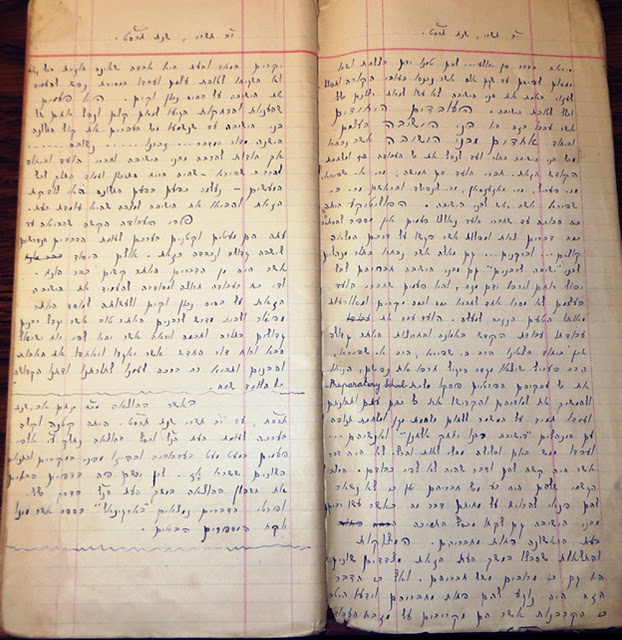
The box of papers discovered contains Rabbi Shapiro’s account of the events surrounding the student strike in August 1908, and the subsequent founding of the Yeshiva Le’Rabbanim. The account was written on October 7th, 1908 and covers the period from August 20 until that time. Because Rabbi Shapiro was one of the three student leaders of the strike, his account is particularly relevant to filling in the picture of the details of the August 1908 RIETS student strike.[17] Rabbi Shapiro’s writings, it should be noted, reflect that he and his fellow students had been involved in a struggle with, in his view, a dysfunctional and stubborn board of directors for over two years.[18]
Rabbi Shapiro records that:
On Thursday night, 24 Av 5668(20 August 1908), the Rabbi Isaac
Elchanan Yeshiva was closed in a very unseemly fashion. Mr. [Jonathan] Shepp,
the treasurer of the Yeshiva called the police several times to evict the
yeshiva students from the building in which they learned.[19]
But despite all his efforts, the police declined to do harm to the students.
They remained there despite his displeasure until midnight and at that time
they left for their residences.”[20]
After the students of the Yeshiva had concluded that there was no
hope to improve both the physical and spiritual conditions of the Yeshiva due
to the obduracy of the leaders whose concern was only for themselves, the
students decided to separate from the above named Yeshiva and move to “Adas Bnei
Yisroel” at 213 East Broadway, which welcomed them with open arms.[21] On
28Av (25 August-1908), the students of the Yeshiva moved their place of Torah
study to the above mentioned address in the company of well-known rabbis, such
as Rabbi [Shalom Elchanan] Jaffee[22],
Rabbi [Chaim Sholom] Shoher[23],Rabbi
[Aaron] Gordon [24],
and others, who had gathered there to guide them. After much discussion, it was
decided that the yeshiva students would study temporarily in Adas Bnei Yisroel,
and that they would acquire a charter. So that the leaders of Yeshiva Rabbeinu
Yitzchak Elchanan would not collect money in their name, they decided that this
yeshiva would be called “Yeshiva L’Rabanim”. Similarly, they decided to send
out boxes to collect members and to try to establish this yeshiva on a proper
foundation.
From 28 Av 5668 until 12 Tishrei 5669, three meetings of well-known
rabbis and prominent lay leaders were held. At the second meeting, an interim
leadership team for Yeshiva L’Rabanim was chosen: Rabbi Jaffe, chairman; Rabbi
Shoher vice chairman and treasurer; Rabbi [Joseph Judah Leib] Sossnitz,
administrator;[25]
Rabbi Dr. Rabinowitz from Brooklyn, administrator; Rabbi [Judah Leib] Lazeroff,
administrator,[26]
and others. The job of developing a “program” both in religious and secular
studies for this yeshiva was also assigned to the above leaders.
Even before the closure of the Yeshiva Rabbi Isaac Elchanan, the
physical situation of the students was very bad because for seven weeks prior
to the closure, all they received was a half a kilogram of bread per week.
However, the situation since they left the Yeshiva until now was much worse,
and the poverty and embarrassment they suffered is difficult to describe. Many
of them could have found other means of support, but because of their love of
Torah, they accepted their lot and did not abandon Torah study with which they
had been engaged their entire lives.
Many Rabbis, in writing, speech and action, promised to help. From
all the promises very little materialized, aside from Rabbi Lazaroff, who had
spoken up a few times in his synagogue on behalf of the Yeshiva. He assembled a
worthy number of members from whom he collected funds. The prominent Mr.
[Abraham J.] Goldstein and his brother-in-law, Mr. [P.] Feinberg from Jersey
City came to the assistance of the Yeshiva in the beginning. [27]With
the help of other prominent members of their congregation who worked alongside
their honored Rabbi [Shlomo David] Posner, that synagogue supported the yeshiva
a bit.[28]
To describe in detail all the problems faced by this new endeavor
and the stumbling blocks that were placed in front of this new Yeshiva from the
beginning until now would amount to an entire book. The task was difficult and
the conflict with the administration of the Yeshiva Rabbi Isaac Elchanan
weighed heavily on us. Many did not want to support the students of the Yeshiva
since they saw that the “Morgen Journal” had “sold out” to those above
mentioned administrators to do their bidding. They also felt that the “Tageblatt”
was leaning in the direction of those administrators, and not on the side of
the Yeshiva L’Rabanim. Many rabbis knew and admitted that the yeshiva students
were right, but kept silent due to fear. So much so, even those who had joined
the new Yeshiva were not really able to help it.
The primary laborers on behalf of the new Yeshiva were the students
themselves and especially a student council that was chosen from among them to
lead the struggle. The five members of this council were Mr. A.[vraham]
Shapira, Mr.[Ben Zion] Perl, Mr. [Chaim Yechezkel] Mosesohn, Mr. [H.S.] Linfeld
and Mr. B.[aruch] Shapira who was the leader.[29]
The politics were so intense that oftentimes those in the Yeshiva did not
confide in their fellow students for fear that they were supporting the other
side. The council worked diligently with the three main activists, Rabbi B.
Shapira, Rabbi A. Shapira, and Rabbi Perl who were most instrumental.  They abandoned all their other pursuits such
as attending “Preparatory School,” working day and night to battle with the
administration of Yeshiva Rabbeinu Isaac Elchanan.  Nothing was too difficult for them or beneath
their dignity. Their physical situation was worse than the conditions of other
students, as they had no other means of sustenance and they also received a
more meager stipend compared to what they had been entitled to. They suffered
immensely during this time. They knew that they were making great sacrifices
and losing precious time. Nevertheless, they did not consider their own
personal situations so that they could help establish this new Yeshiva on a
proper foundation. There were times that matters grew so bad that many of the
yeshiva students echoed the complaints of the Jews in the desert: they wanted
to return to their previous Yeshiva, but thanks to many of the yeshiva students
and the student council, especially Rabbi B. Shapira, these complaints were set
aside and it allowed the Yeshiva to attain the status it claims today. The
result of what has been done so far is small compared to what needs to be
completed. Nevertheless, laying the foundation, which was the most difficult to
accomplish, has been done. More effort is required to establish this Yeshiva on
a firm foundation and to transform it into an excellent school that will train
great rabbis in Torah, wisdom, fear of Heaven; who will work within the spirit
of ancient Israel and the spirit of this new generation; and who will unite
both old and young, thereby bring blessing to our people, our Torah and our
holy faith.”
In the end, Yeshiva Le-Rabbanim did not exist for very long because it never had substantial financial backing and support from the general community.[30] The attempt to form an alternative yeshiva apparently did not deter some of the student dissidents to return to RIETS. In 1917, in a RIETS publication, Rabbi Baruch Shapiro and his brother Rabbi Abraham Shapiro along with Rabbi Ben Zion Perl are listed among those ordained by RIETS now serving as rabbis in America.[31] Even more curious, the strike leader Rabbi Baruch Shapiro went on a fundraising tour in 1917 to raise money for the Rabbinical College of America, one of whose components was RIETS.[32]
The strike’s impact, however, on one of the most important future leaders of RIETS and Yeshiva University was profound.  Chaim Rabinowitz wrote “The strikes stimulated the mind of a young Rabbi who had recently arrived in America. This young Rav was Rabbi Dov Revel.” Rabinowitz cites a letter that Dr. Revel wrote to Rabbi Zvi Masliansky in the spring of 1908, where he grieves about the turmoil in RIETS that Rabbi Masliansky had told him about and hopes for better days for the Yeshiva. Rabinowitz concludes “the dream of Rabbi Revel came to fruition in 1915 when he became the Rosh Hayeshiva…and instituted great changes in the order of studies.”[33]
Here is a sample page of the document:


[1]
“Rabbi Isaac Elchanan Theological Seminary Association Certificate of
Incorporation,” March 20, 1897, (quoted in Gilbert Klaperman, “Yeshiva
University:  Seventy-Five Years in
Retrospect,” American Jewish Historical Quarterly 54,1 (September,
1964), 6). William Helmreich, however, states that teaching “the language of
the land” and Talmud was articulated in the RIETS charter, and, as such, “the
first such mention of combining secular and religious studies in one
institution.”  William B. Helmreich, “Old
Wine in New Bottles:  Advanced Yeshivot
in the United States,” American Jewish History, 69, 2 (December 1979),
235.  But, the 1897 certificate does not
mention “language of the land,” and Helmreich’s assertion is without
citation.
[2]
Gilbert Klaperman, The Story of Yeshiva University: The First Jewish
University in America
(New York: Macmillan, 1969) 71-72.
[3]Alexander
Dushkin, Jewish Education in New York City (New York: Bureau of Jewish
Education, 1918), 77-78.
[4]
“Boys Go On Strike,” New York Times, August 19, 1908.
[5] The Times
report may have been the result of the RIETS’ students, who, to gain
sympathy to their cause alerted it to the unrest. See Klaperman, Story,
95
[6] The
most complete report on the student unrest from 1906-1908 can be found in Klaperman,
Story, 94-112.
According
to Rabbi Klaperman, the closure and lockout on August 20th was
reported by the Jewish Morning Journal on Friday August 21st,
1908 and the Judisches Tageblatt on Sunday August 23, 1908. Idem.
217n8.
[7] Gurock,
Men and Women, 40; Rabinowitz, “60 Shana,” 553; and Klaperman, Story,
118.
[8] There
are three discussions regarding the closure of RIETS on Thursday, August 20th,
1908
See Klaperman, Story, 111-12. There is no mention of a
strike immediately preceding the board’s action. Rabbi Klaperman does not cite
the Times article in any of his footnotes. Additionally, in footnote 21,
p.218, he writes that there was no clear picture of presidential succession of
RIETS between February 1906 and fall of 1908, despite an indication in the NY
Times article that Nathan Lamport was the president of the school in August of
1908.
The
second is Hayim R Rabinowitz’s recollections that appeared in Hadoar in
1968. Hayim R. Rabinowitz, “60 Shana le-Shvitot be-Yeshivat Rabbeinu Yitzchok Elchanan,”
Hadoar, June 14, 1968, 552-554. In 1908, Rabinowitz was an
eighteen-year-old student at RIETS, and writes at length regarding the
situation leading up to the closing of the school on August 20th,
with the resultant lockout of the students from the building at 156 Henry
Street, but does not mention that the students had been on strike immediately
preceding this event. Although Rabinowitz was a contemporaneous observer, his
reminiscences were only published sixty years after the events in question.
The third discussion is by Jeffrey Gurock.  Jeffrey Gurock, The Men and Women of
Yeshiva: Higher Education, Orthodoxy, and America Judaism
(New York:  Columbia University Press, 1988) 39-40. Citing
Rabinowitz, p.553, he writes “Frustrated, feeling that a double cross was in
the making, RIETS students were once again talking strike in the late spring
and early summer of 1908.” Gurock, however, does not mention that a strike and
blockade of the building took place in August as indicated by the headline of
the New York Times and in the subsequent article.
[9] Klaperman,
Story, 48.
[10] Idem, 217-19.
[11]
Rabinowitz, “60 Shana,” 552-554, quoted extensively in Gurock, Men and Women,39-41.
[12] The
Jewish American Family Magazine and Gazette (Amerikaner Familian Magazin un
Gazetten)
, vol. XXXIX, no. 47, September 19, 1941, 2.
[13]
Rabbi Meir Simcha was the author of “Ohr Sameach”, an important commentary on
Maimonides’ “Mishna Torah”, and of “Meshech Chochmah”, a commentary on the
Torah. Rabbi Meier Simcha wrote of Rabbi Boruch Shapiro “he has the ability to
formulate outstanding novella acceptable to all”. The Jewish American Family,
2.
[14]
Prior to coming to America, Rabbi Shapiro obtained letters of support from two
other leading rabbinic figures in eastern Europe, Rabbi David Hirsch Eisenstein
and Rabbi Shlomo Vilner. The Jewish American,2. Rabbi Vilner wrote that
he never gives ordination to one so young, but in the case of Rabbi Shapiro, he
was willing to make an exception.
[15]
Rabinowitz, “60 Shana,” 553.  Rabinowitz
also refers to Rabbi Shapiro as a “Gadol B’Torah”
[16] Klaperman,
Story, 62.
[17] The
New York Times article identifies him as one of the three student strike
leaders. See also, Rabinowitz, p.553 As early as 1906, R. Shapiro held a
leadership role.   He was among the four
students chosen to represent the students’ views before RIETS’ board of directors.  Rabinowitz, “60 Shana,” 553; The Jewish American,
2, which states that Rabbi Shapiro was chosen as a representative by the
students in dealing with the board.
[18] Regarding
the student’s relationship with the board of directors, Klaperman describes an interaction
between the students and the directors as follows: “The student’s
dissatisfaction and the obduracy of the directors brought about continuous
agitation in the school and highlighted the confusion of aims in the
curriculum” Klaperman, Story, 86.
[19] Klaperman,
Story,99 writes that in 1906, Jonathan Shepp was elected as the new
treasurer, and that Jonathan Shepp was part of the finance committee appointed
on August 31, 1908 to assist in reopening the school after it was closed on
August 20. Klaperman, Story, 99, 113.
[20] Gurock
indicates that the treasurer threatened to call the police, but that in fact
the police were never called.  Gurock, Men
and Women
, 40 (citing Rabinowitz, “60 Shana,” 553).
[21]
Regarding the address of the building to which the students moved, Rabbi
Shapiro was physically at this new address so it is reasonable to assume that
he recorded it correctly. Additionally, on June 3, 2015, there was an auction
of documents associated with the newly founded Yeshiva La-Rabbanim (Kedem
Auction No.8, Lot 301). One of the documents evidences a stamp which says 213
East Broadway. Rabbi Klaperman lists the address
as 123 East Broadway.  Klaperman, Story,
116, 219n38.
[22] Rabbi
Shalom Elchanan Jaffe (1858-1923) was an important early American Orthodox
Rabbi. He received Semicha from both Rabbi Naftali Zvi Yehuda Berlin and Rabbi
Yitzchak Elchanan Spektor. He arrived in America in 1890 and served as a Rav in
St Louis and in Brooklyn before becoming the Rabbi in 1901 of the prestigious
Beth Midrash Hagadol synagogue on the Lower East Side of New York. He was one
of the most influential of Rabbis at the time, especially when it came to the
supervision of kosher meat. Jaffe’s motivations for his involvement with this breakaway
school, may have less to do with issues than his personality.  According to Klaperman, Jaffe was not one
wedded to the idea of secular education, one of the central demands of the
students. “On the other hand, Rabbi Jaffe was the stormy petrel on the rabbinic
scene, known as an impetuous non conformist who rushed in without fear when his
mind was made up.” Klaperman, Story, 117.
[23] Rabbi
Chaim Sholom Shochar (Rabbi H.S. Shoher) came to Boston in 1882 to be the Rabbi
of Bais Avraham synagogue and subsequently served as the Rabbi of Hadrath
Israel and Mishkan Tefillah among other synagogues in Boston. In 1905, he moved
to New York City to become the Rabbi of the prestigious Shaare Zedek synagogue
located at 38-40 Henry Street. In 1910, he is listed as living at 215 East
Broadway, next door to the location of Yeshiva Le-Rabbanim. He authored a
pro-Zionist book Shalom Yerushalyim in 1909 and passed away in 1918.
[24] Rabbi
Aaron Gordon (1845- 1922) known as the Miadziol (Myadel) Iluy, emigrated to
America in 1890 and was the chief Rabbi of Rochester, New York until 1900 when
he moved to New York City. He was one of the founders of the Agudath Harabanim
and served as head of a Bet Din on the lower east side. He served as the Rabbi
of Congregation Talmud Torah Tiphereth Jerusalem at 147 East Broadway. He was a
prolific writer, authoring many books on Halacha, among them Even Meir
(Pietrokov 1909), Teshuvat Meleat Even (Pietrokov 1912), Minchat Aharon
(Jerusalem, 1920) and Sha’arei Da’at (Jerusalem, 1921).
[25]
Rabbi Joseph Judah Leib Sossnitz (1837-1910) was born in Birzhi, district of
Kovno. He has been described as a Talmudic scholar, mathematician and
scientific author. He settled in New York in 1891 and in 1893, founded a Talmud
Torah on 104th street in Manhattan. In 1899, he was appointed a
lecturer in Jewish ethics at the Educational Alliance at 197 East Broadway.
[26]
Rabbi Judah Leib Lazarov (1875-1939), studied inTelz, Mir, Volozhin and Radin
before immigrating to America in 1898.He was hired as a preacher at Beth
Midrash Hayei Adam at 89 Henry Street in 1903 and succeeded Rabbi S.E. Jaffee
as Rabbi of Beth Midrash Hagadol in 1910. He authored a multi volume work Divrei
Yehudah
(New York, 1906-1910).
Except for Rabbi Dr Rabinowitz who was from Brooklyn, all the above
named rabbinic leaders were from the Lower East Side near both Rabbi Isaac
Elchanan Yeshiva on Henry Street and Yeshiva La’Rabanim on east Broadway. They
most likely would have been aware of the struggles of the students with the
board of the Yeshiva and had possibly allowed them to speak in their synagogues
during the May strike. See Klaperman, Story, 104. It is also possible
they were consulted by the students on an ongoing basis even before they tried
to start a new school.
[27] Abraham
J. Goldstein emigrated to America in 1884 and immediately settled in Jersey
City. One book, Distinguished Jews of America, (New York, 1917), describes
him as “a strict Orthodox Jew in every sense”, “one of the richest and most
prominent citizens of Jersey City”, and “a member of almost every Jewish
organization in Jersey City”. He owned a grocery wholesale business, was
president of the Erie Building and Loan Association, and was one of the largest
real estate owners in Jersey City.
[28] Rabbi
Shlomo David Posner (Rabbi S.D Posner) was a Rabbi in Jersey City, New Jersey,
for many decades. He signed his letters “Rav V’Av Beit Din” of Jersey
City.  He authored a book of homilies Eshed
Hanahar
(New York, 1932). In the introduction, he writes candidly about
being a Rabbi in America over many years. He was involved on a national level
in many Rabbinic organizations and he helped raise money for the Jewish
community in Palestine
[29] It
is interesting to note that Rabbi Shapiro refers to this group as Mr. but later,
refers to three of the group as Rabbi. The two Shapiro brothers and Ben Zion
Perl are referred to by Rabinowitz as having Rabbinic ordination already at
that time. Rabinowitz, “60 Shana,” 553.
The four referred to by Rabbi Shapiro aside from himself are:
(1) Rabbi Abraham Shapiro was the brother of Rabbi Boruch Shapiro.
Like his brother, Abraham already possessed Semicha from Eastern Europe at this
time. He later served as a Rabbi in Canton, Ohio and in Utica, New York. He was
considered to be a prominent Musmach of RIETS in later years.
(2) Rabbi Ben Zion Pearl served as a Rabbi in Harlem. He was the
director of the Uptown Talmud Torah Association which had 2,400 students in
1919. In 1925, he was involved in raising money for the building fund of Rabbi
Isaac Elchanan Yeshiva. He passed away in 1929.
(3) Rabbi Chaim Yechezkel Moseson came
from Lodz Poland, learned in the Yeshiva in Lomza Poland and received Smicha
from Rabbi Yechial Michal Epstein, author of the Oruch Hashulchon. He was the
principal of Yeshiva Torah Vadath, Mesivta Tiferes Yerushlayim, and other
Yeshivot. He wrote many articles for Dos Yiddishe Licht, a newspaper
financed by Cantor Yossele Rosenblatt.
(4) Harry Sebee Linfield
(1889-1978), was a rabbi and statistician. His Jewish Statistical Bureau
conducted research on Jews in America and published numerous reports and other
publications on their findings, specifically the Statistics of Jews. He was born in
Lithuania and came to the United States in 1905. He was awarded a PhD by the
University of Chicago in Semitic language in 1916, and the following year was
ordained a rabbi by the Hebrew Union College in Cincinnati
[30] Klaperman,
Story, 118.
[31] Idem.
262
[32] The
Reform Advocate
, December 29, 1917, p.501
[33]
Rabinowitz, “60 Shana,” 553-554.


The Rabbi, the Rebbe, and the Messiah

The Rabbi, the Rebbe, and the Messiah
By Brian Schwartz
If someone were to ask you of an instance where a rabbi was declared the messiah by his followers, the first example that would probably come to mind is the last Lubavitcher Rebbe, R’ Menachem Mendel Schneersohn, who to this very day many of his chasidim regard as the Messiah, despite his death.  Many people would struggle to point to any other similar times in history, besides for the Shabbethai Tzvi affair and his various successors[1], where someone was thought of as the Jewish Messiah. However, throughout the past few hundred years, there have been a handful of rabbis who have been explicitly or implicitly declared the messiah, suggested it, or have been accused of suggesting it. 
Messiahship was a chasidic and mystical phenomenon, with chasidic rebbes; R’ Yisrael Ba’al Shem Tov[2], R’ David of Tulna[3], R’ Yisrael of Ruzhin[4], R’ Nachman of Breslov[5], R’ Yitzchak Isaac Safrin of Komarna[6], R’ David Moshe of Chortkov[7], and mystics; R’ Chaim Vital[8], R’ Chaim ibn Attar[9], R’ Moshe Chaim Luzzato[10], Shukar Kuchayil I[11], and Shukar Kuchayil II[12], and more recently Yisrael Dov Odesser[13], all being labeled one way or another as the Messiah[14].  Despite the characterization of these individuals as the Messiah, most lived on without any scandal associated with the eschatological attribution.  There is one instance however, which unfortunately did cause a great uproar.  I refer to you the case of R’ Menachem Mendel Hagar, the scion of the Vizhnitz chasidic dynasty, and the Transylvanian town of Borşa.
Borşa was a mountain village located in Northern Transylvania, in the Maramureș region of Romania.  In 1830 it had a Jewish population of 250, rising to 1,432 in 1890.  Most of the people in Borşa were chasidim of the Kosov-Vizhnitz dynasty.  In 1855, R’ Yaakov Tzvi Waldman, a chasid himself, though an adherent of R’ Chaim Halberstam of Sanz, was chosen as rabbi of Borşa.  Considered a great talmid chacham by his peers[15], Rabbi Waldman was defrocked by his own kehillah because of his harsh words towards the Vizhnitz Chasidim of his town.  The story behind this is relayed by R’ Avraham Yehuda Schwartz, author of the Sh”ut Kol Aryeh, in two letters he sent; one to the townspeople of Borşa, and one to R’ Menachem Mendel Hagar, the Rebbe of Vizhnitz.  In the letters, he mourns over the great bizuy talmid chacham that transpired because of the people of the town removing Waldman from his position as rabbi, replacing him with a boor, and threatening anyone who still considered him rabbi with excommunication.  

What caused all this to transpire?  In the year 1870, the Chasidim of Borşa decided that since the gematria of “Menachem” (the Vizhnitzer rebbe’s name) is equivalent to that of “Tzemach” (a term used by the prophets to refer to the messiah, see Zachariah 6:12, and Midrash Eicha Rabbah 1:57), Menachem Mendel Hagar, the Rebbe of Vizhnitz must be the messiah.  Reacting to this, Waldman said, “כי אמונה כזאת ועבודת האנשים המאמינים בה זרה.”

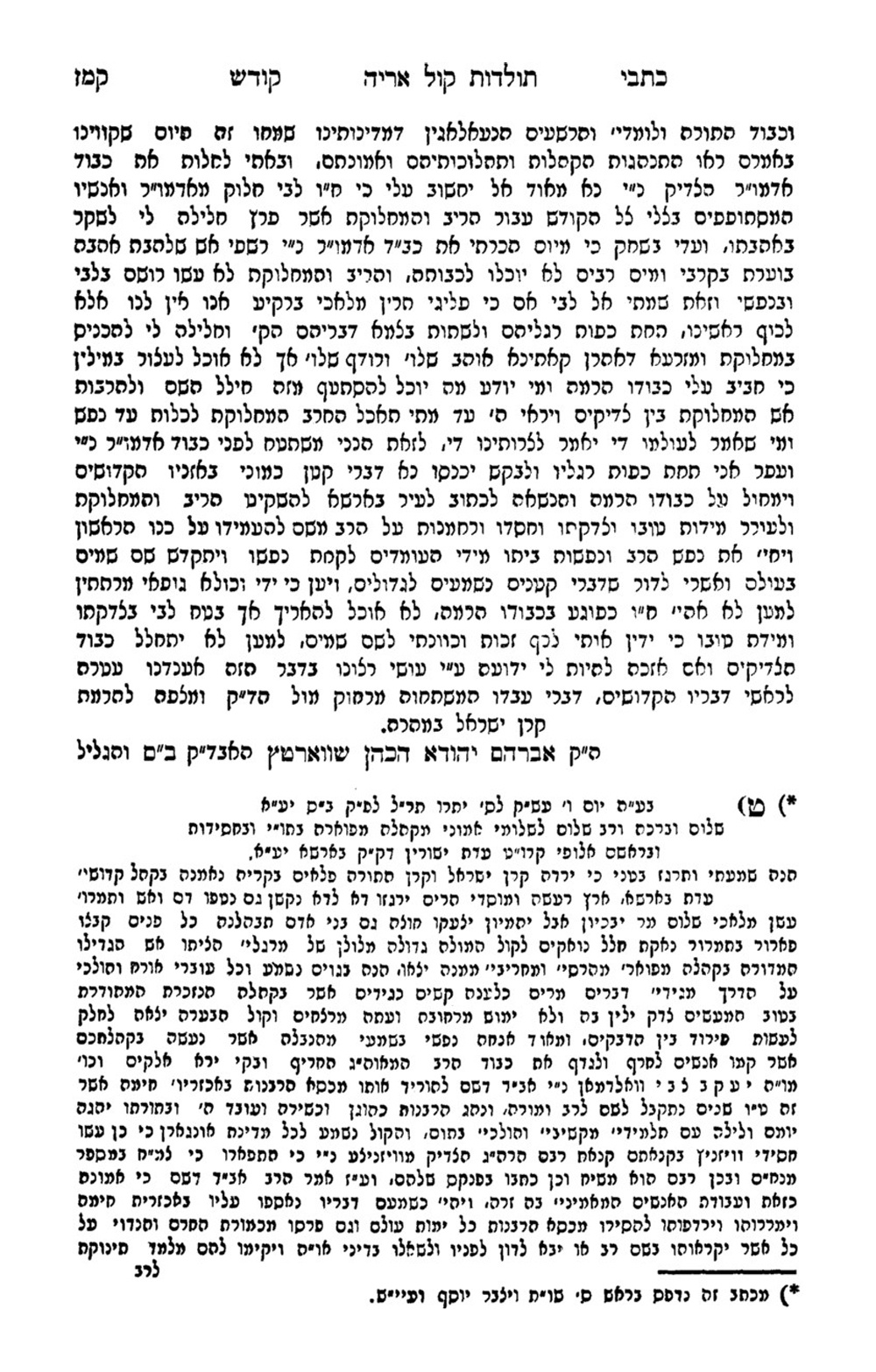
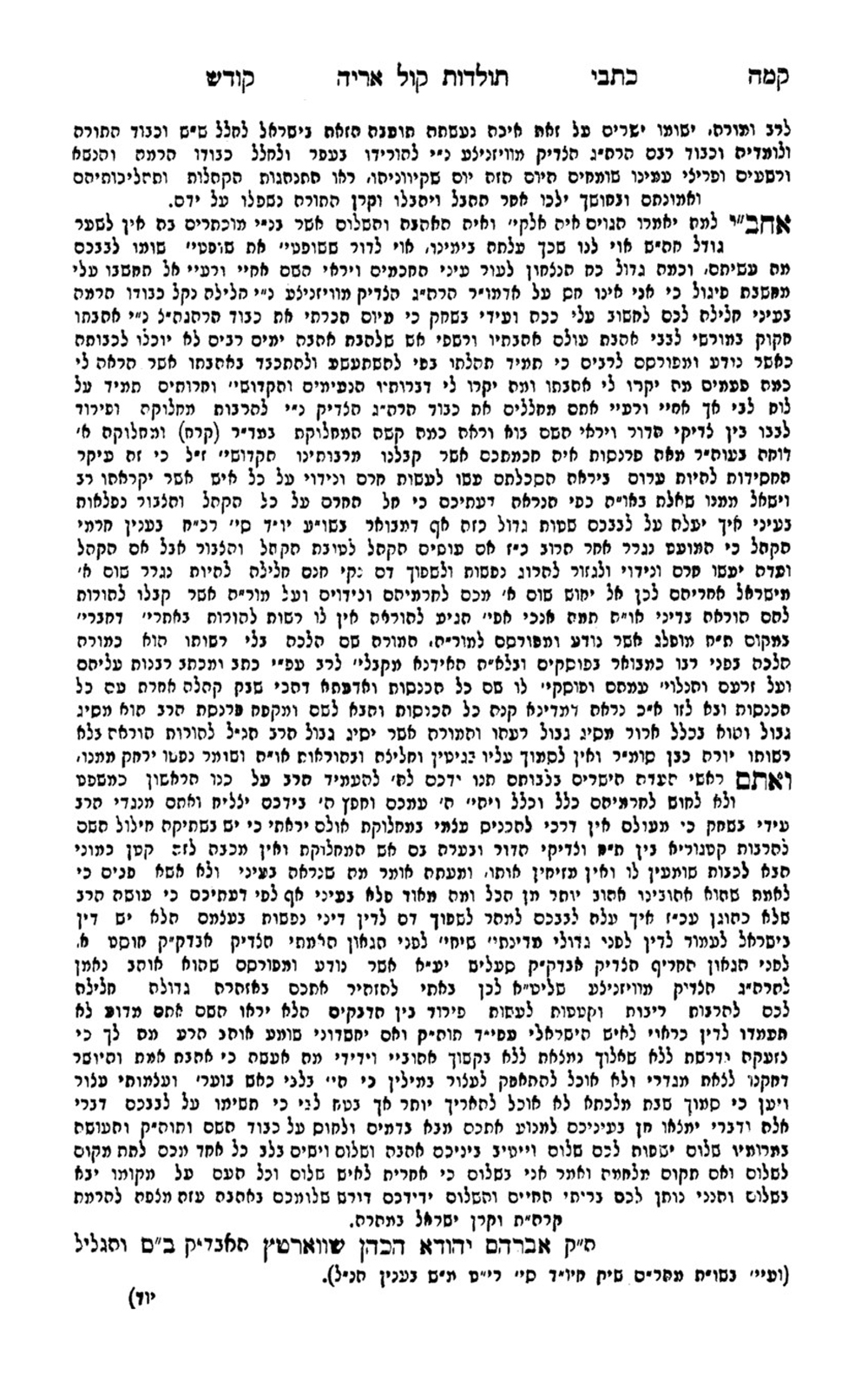
Here are the two letters printed in the Toldos Kol Aryeh, and if you look at the footnote to the letter to Borşa on p.147, you’ll notice that it says that it was first printed in the beginning of Shu”t Vayitzbor Yosef:
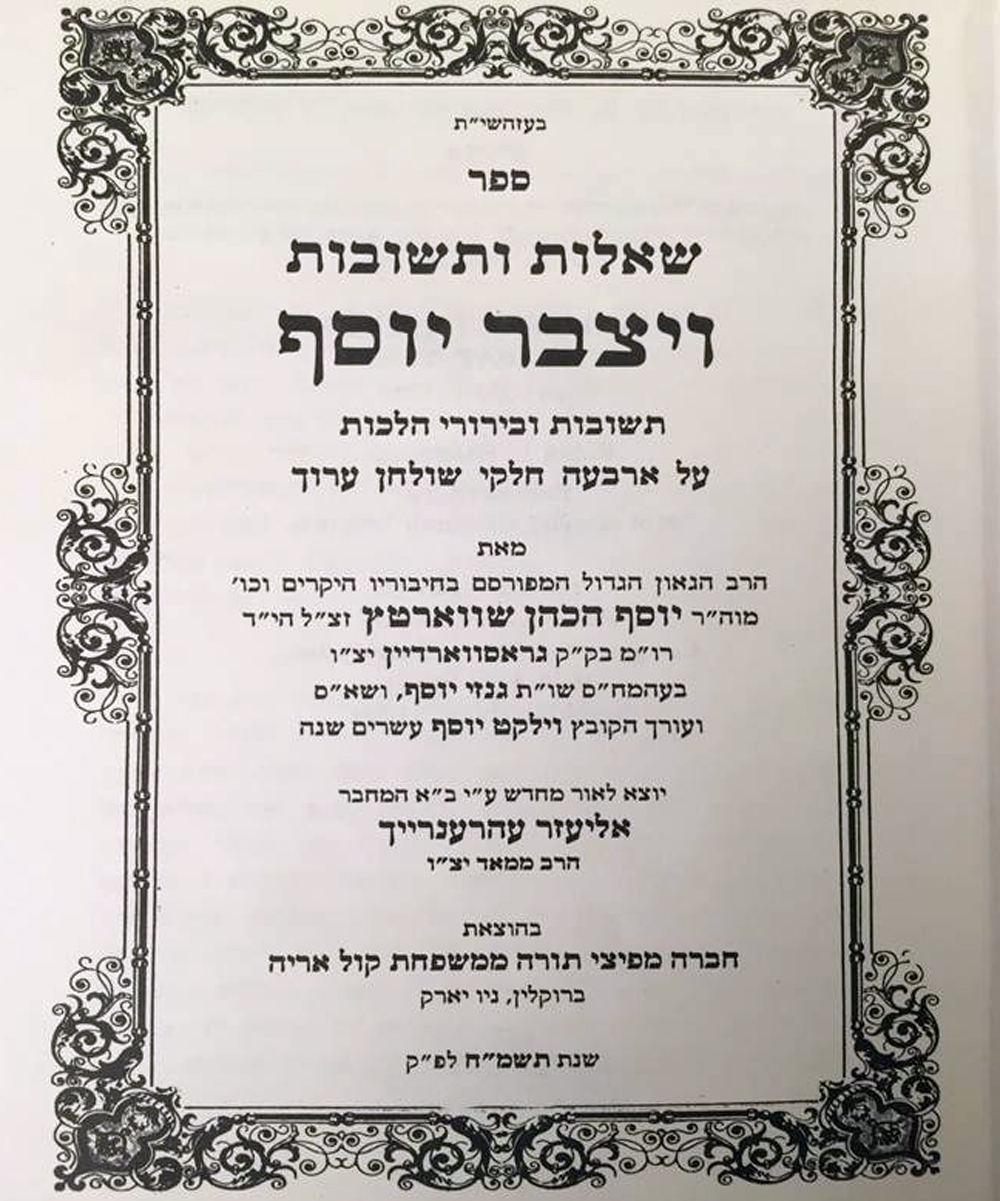
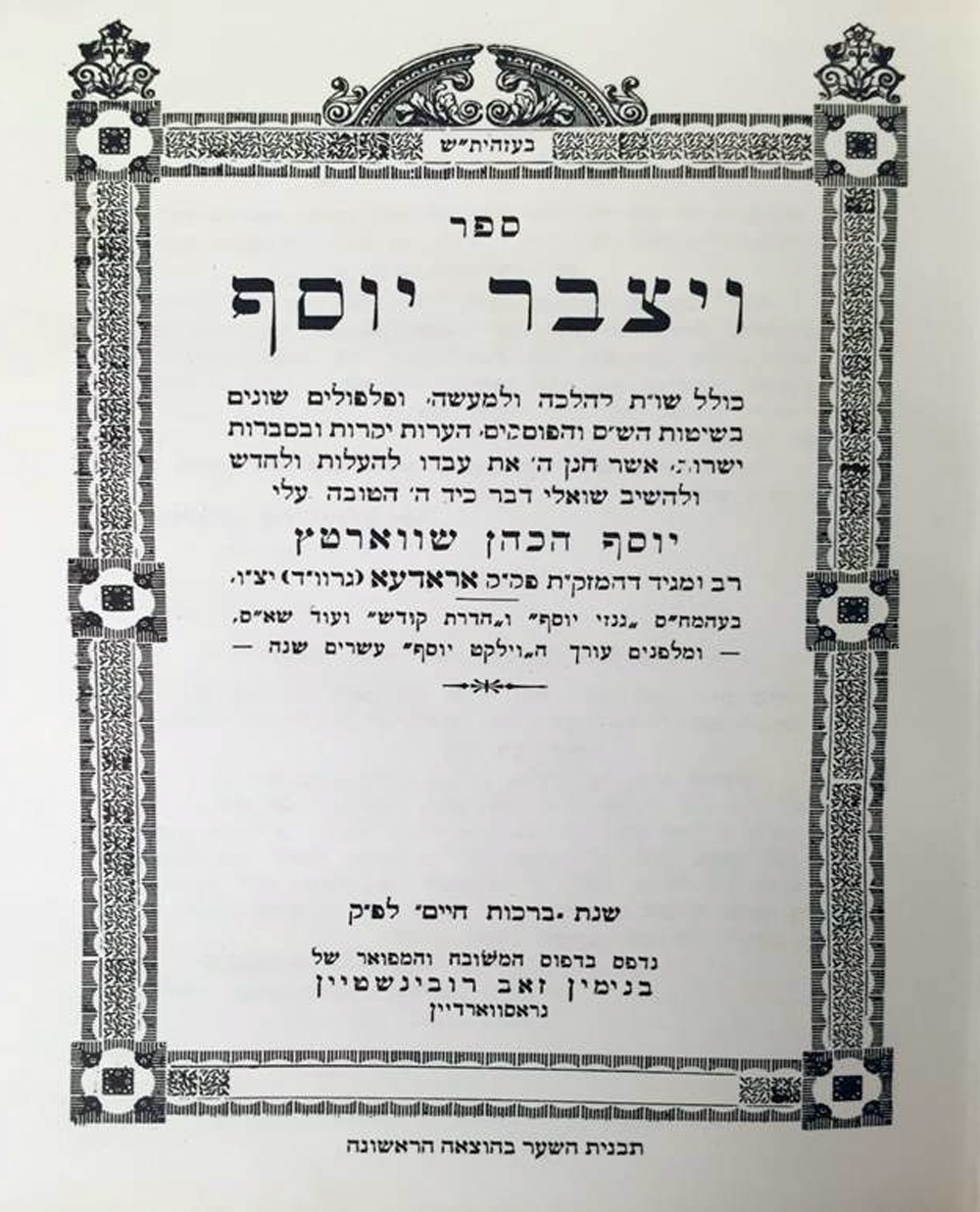
The Vayitzbor Yosef was written by R’ Yosef Schwartz[16], the grandson of R’ Avraham Yehuda Schwartz.  The copy I initially had, was the second edition printed by R’ Yosef’s nephew in Brooklyn in 1987[17].  Here is the title page:
  
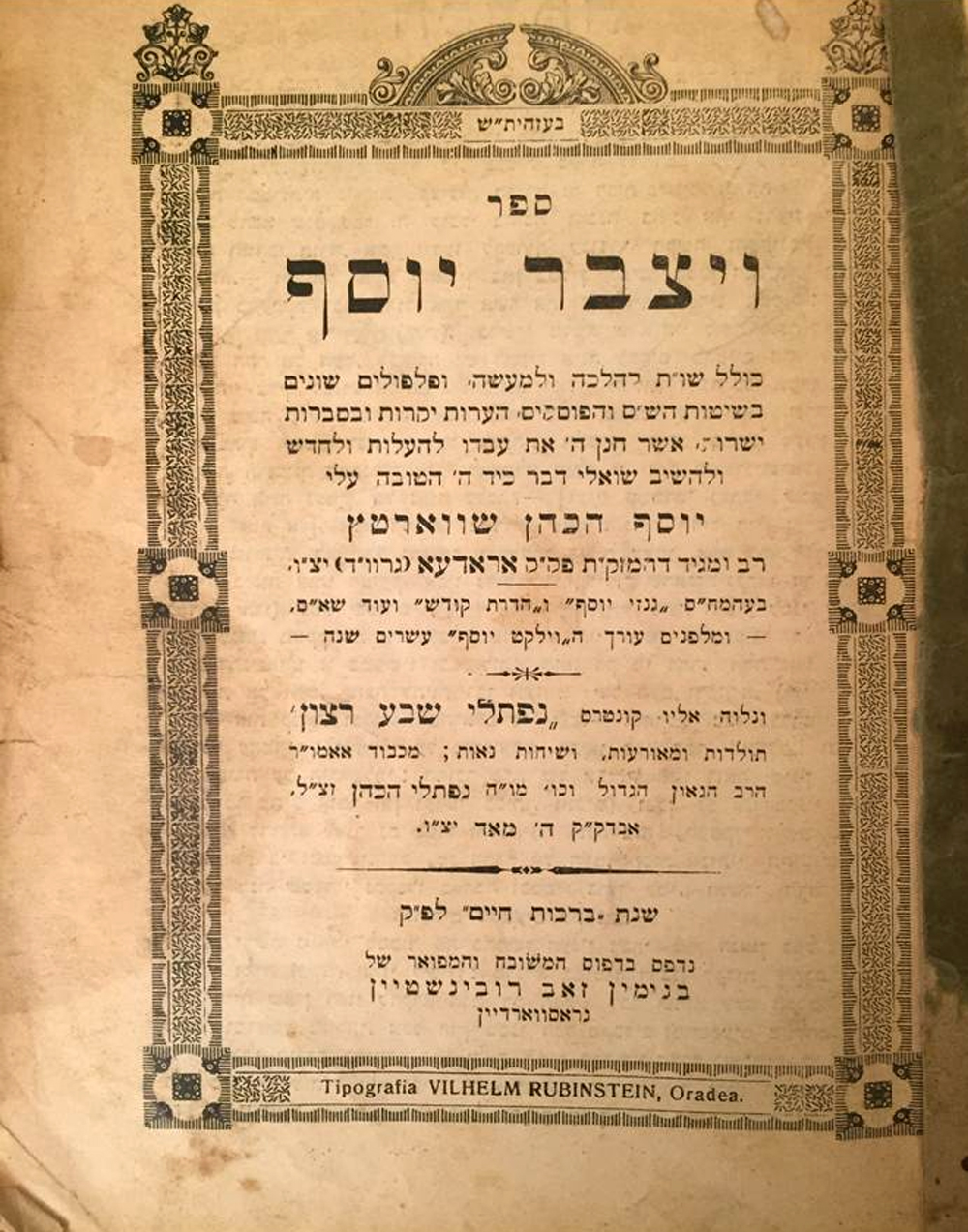
However, a thorough search for the letter through the entire work came up with nothing.  It seems to have vanished.  After an exhaustive hunt, I was finally able to procure a first edition of the Vayitzbor Yosef, and upon examination, I was able to realize the full extent of how doctored the second edition is.  In the second edition, there are approbations added from R’ Yosef Schwartz’s other work Ginzei Yosef, and the index is in the back of the sefer, unlike the first edition where they were printed in the front, right after the hakdamah and before the pesicha.  These changes are quite innocuous.  However, in the second edition, a picture of the original title page is presented with a glaring omission.
Here is how it is presented:
And here is it in actuality:
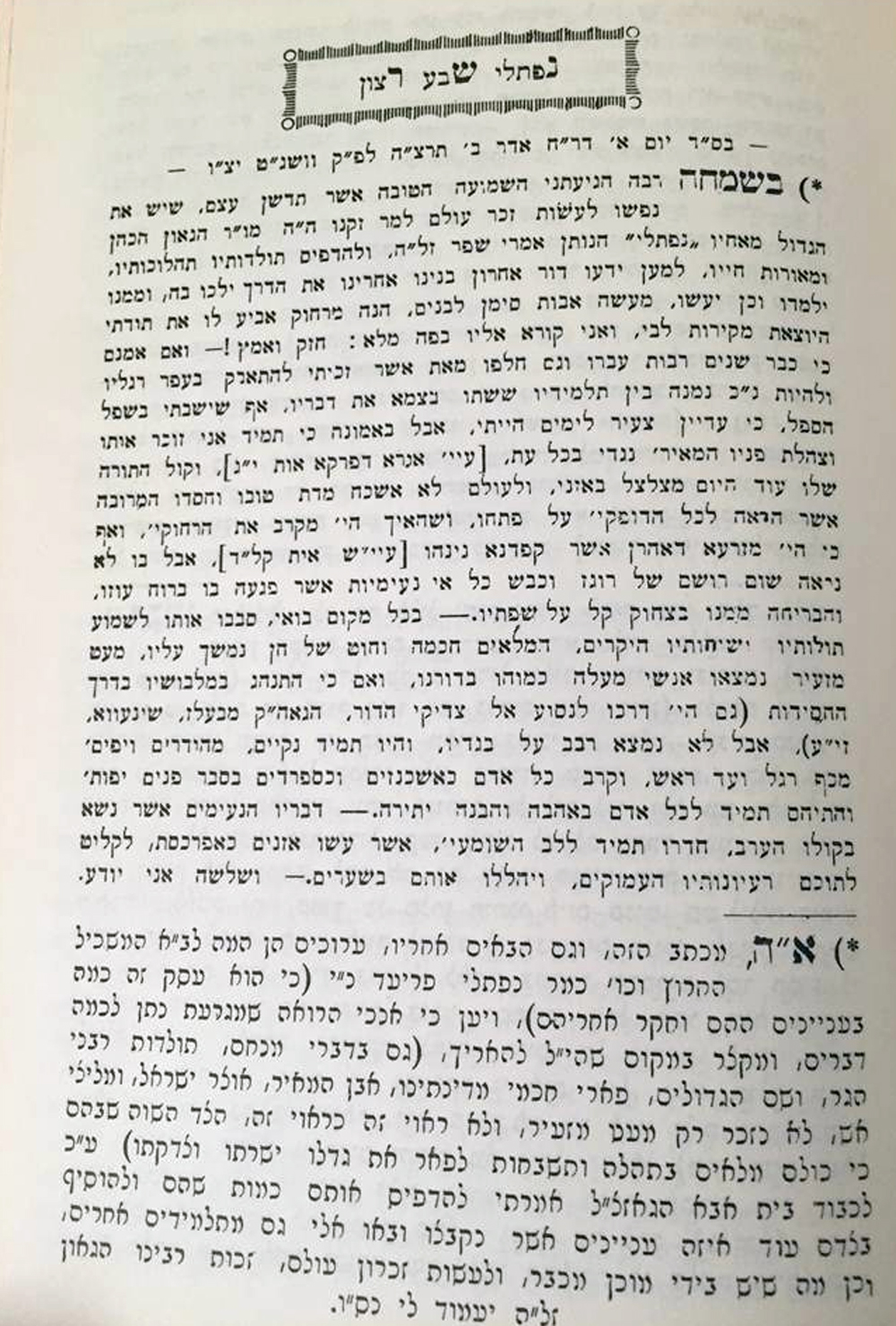
Notice anything different?  That’s right, on the original title page, there is mention of a separate part of the sefer, “Naftali Savah Ratzon” which is supposed to be a collection of things that the author heard from his father R’ Naftali Schwartz.  If you guessed that the second edition is devoid of this section in its entirety, you would also be correct.  Here is a picture of the beginning of that missing section, which also happens to be printed in the back of the New York edition of Toldos Kol Aryeh:
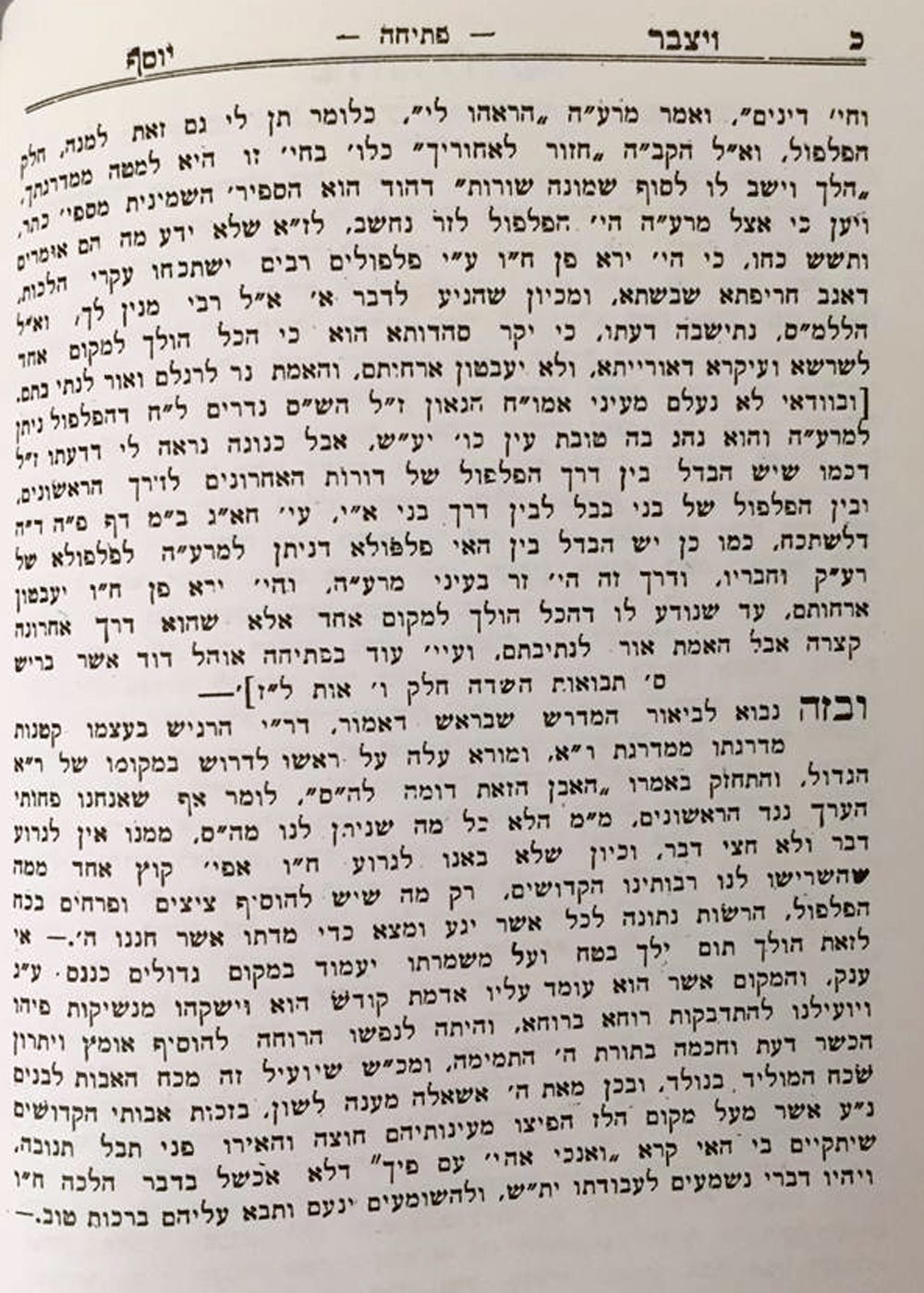
Having gone through the Naftali Savah Ratzon, I couldn’t find any objectionable material that would have motivated the publishers from removing it.  So what was their motivation?  Remember the missing letter from R’ Avraham Yehuda Schwartz, the Kol Aryeh?  Well, in the first edition, there is another small section right after the pesicha, called “Hashmatah V’hosafa L’kunteres Naftali Savah Ratzon.”

Here is how the second edition appears:
And here is how it’s supposed to look like:
This section is four pages long, and in it can be found the censored letter from R’ Schwartz to the people of Borşa.  It would seem that this sensitive letter was behind the publisher’s motivation to totally remove any mention of the Naftali Savah Ratzon, since it was officially part of it as a hashmatah.  So not only was an important document lifted from the sefer, a whole section became a casualty along with it.  Why the publishers couldn’t just take the letter out and keep the rest of the Naftali Savah Ratzon, I’m not sure.  I guess they wanted as “clean” of a job as possible.
I must point out how Leopold Greenwald, Yaakov Tzvi Abraham, Dr. Yehuda Speigel, and Gedaliah Stein explain the rationale of the people of Borşa’s belief that Menachem Mendel Hagar was the Messiah, and how their explanation is mistaken.  Greenwald[18], Abraham[19], Speigal[20], and Stein both suggest how the belief was formulated as a reaction to Hagar’s sefer, Tzemach Tzadik.  In his work Zichron Borsa[21], Stein explains that since Hagar gave no explanation to the title of his sefer, which was perplexing since it did not have Hagar’s name within its title as do other sefarim, such as “Kedushas Levi” by R’ Levi Yitzchak of Berditchev, or “Ahavas Yonasan” by R’ Yonasan Eibeshutz, his chasidim saw in it an esoteric meaning.  As the gematria of “Tzemach,” which is used to refer the Messiah in Zachariah 6:12, is equivalent to “Menachem,” and likewise the gematria of “Tzaddik,” which is also used in Zachariah 9:9 to refer to the Messiah, is equivalent to “Mendel,” this must mean that their rebbe, R’ Menachem Mendel Hagar is indeed the Messiah! 
This explanation is simply untrue.  In no way, could the work Tzemach Tzadik have had any influence on what happened in Borşa in 1870, when it was only published for the first time in 1885.  As for the reason why it was called Tzemach Tzadik, Hagar’s son Baruch, explains in the preface to the work that he simply named it because the gematria is equivalent to Menachem Mendel.  It is also untenable to argue that a manuscript, or knowledge of one with the title Tzemach Tzadik, was floating around at the time of the dispute, because  R’ Baruch Hagar writes in the preface that the material for the work was only written a few years before his father’s passing in 1885.  Consequentially, we must take the letters of the Kol Aryeh for their simple meaning, that the people themselves came up with the gematria of tzemach and its link to the Messiah and the Vizhnitz Rebbe.
Many leading rabbis of the time came to R’ Waldman’s defense, including; R’ Moshe Schick[22], R’ Chaim Sofer of Munkatch[23], R’ Chaim Halberstam of Sanz[24], R’ Yosef Shaul Nathansohn[25], and the previously mentioned R’ Avraham Yehuda Schwartz. It seems that the only rabbi that came to the defense of the Vizhnitz Chasidim, was R’ Yehuda Modern[26].  What happened next isn’t very clear, but it seems that a tribunal was held by Schwartz to settle things[27], and Waldman was reinstituted as rabbi of Borşa.  Waldman died in Vienna in 1883.
As a side note, take a look at the last page of the letter of R’ Schwartz, printed in the first edition of the Vayitzbor Yosef, on the very bottom:
That is a stamp referring to the responsum of R’ Moshe Schick to Borşa!  I don’t know if this appears in every first edition copy, or if some private owner went to the trouble to specially stamp this, but it would be interesting to find out!


[1] Mordechai Mochiach of Eisenstaedt, Baruchia Russo, Jacob Querido, Abraham Cordozo, Yehuda Leib Prossnitz, and Jacob Frank
[2] See Ba’al Shem Tov Al Hatorah (Jerusalem 1998) in the Hakdamah #23 in the name of Nachum from Chernobyl, though this is seemingly a contradiction to the Iggeres Hakodesh of the Ba’al Shem Tov where he writes that he spoke with the Messiah.
[3] See Aharon Wertheim, Halachos V’halichos B’Chasidus (Mossad Harav Kook, 2002), pp. 20-21 fn. 52
[4] See David Assaf, The Regal Way (Stanford University Press, 2002), pp. 257-261
[5] See Yehuda Leibes, Studies in Jewish Myth and Jewish Messianism (State University of New York Press, 1993) p. 115
[6] See the hakdamah to Chumash Heichal Bracha (Lemberg 1864), “וגם דודי מורי החסיד השלם הצדיק אא”ק מוהר”ר משה הוא קרא אותי בפעם הראשון בשם מורה מורנו בפ’ בהר וקרא לפני או דודו יגאלנו ואמר עשיתי אותך גואל ואמר זה באנפין נהרין.”.  See Heichal Bracha on Leviticus 25:49 where he says that the verse is referring to Mashiach ben Yosef.  See also Megilas Starim (Jerusalem 1944) where he says he was born in the year משיח בן יוסף,  here.
[7] See Nochum Brandwein, Imrei Tov (1891) p.29a where he writes, “כמו ששמעתי מפי מרן הק’ והטהור איש צדיק תמים שמו נאה לו מוהר”ר דוד משה שליט”א. וזאת ידוע כי “משה” עולה :”אלקים אחרים”, כי בכוחו נמתק אלקים אחרים , “משה דוד” עולה: “שטן”,כי בכוחו להמתיק את השטן מישראל, ואז נמשך גאולה לישראל, כי: “משיח” עם הכולל עולה: “משה דוד”, ואז יקויים “ועינינו תראינה מלכותך” ע”י דוד משיח צדקך .  here.
[8] See Chaim Vital, Sefer Hachizyonos (Jerusalem, 2001) pp. 8, 17-18
[9] See Ohr Hachaim, Deuteronomy 15:7 at the end, here.
[10] See Isaiah Tishby, Messianic Mysticism (Littman Library, 2014) pp. 196-199
[11] See Yaakov Sapir, Iggeres Teiman Hasheni (Mainz, 1873)  here and Amram ibn Yachya Kerach, Sa’aras Teiman  (Jerusalem. 1954) pp.36-39 here.
[12] See ibid.
[14]  Though R’ Shalom Shachna of Lublin allegedly wrote on his gemara about the debate in Sanhedrin 98b over the name of the Messiah, “אני אומר שכנא שמו שנאמר לשכנו תדרשו”, referring to Deuteronomy 12:5, See Reuven Margolyos, Margolyos Hayam, Sanhedrin 98b #14, it was probably from a disciple in jest.  See Asher Ziv, Rabbeinu Shalom Shachna Milublin, Hadarom No.57, p.119.
[15] His two volume halachic work, Shu”t Tzvi V’Chamid, was printed from a manuscript in 2008.
[16] Here is a picture of R’ Schwartz with his wife:

[17] Unfortunately, hebrewbooks.org doesn’t yet have the sefer online. You can still look at the first forty pages for free on Otzar Ha-Hochma online with this link, here, even if you don’t have a subscription.
[18] Matzevat Kodesh (New York 1951) p.24 fn.57 here,  L’toldos Hareformatzian Hadatis B’Germania U’bungaria p.20 fn.40 here.
[19] L’koros Hayahadus B’trasylvania (New York) p.84
[20] Toldos Yisrael V’hispatchus Hachasidus B’Rusia H’Karpatis p.32
[21] (Kiryas Motzken, 1984) part 2 pp.68-71
[22] Shu”t Maharam Schick, Yoreh Deah #219,  here.  The published teshuva is written to an anonymous kehillah, though it is attributed to the town of Borşa.
[23] Toldos Sofrim (London, 1962) pp.37-38, here.  From Sofer’s letter we see how this was also part of the greater dispute between the Sanz and Sadigura chasidim, on this see David Assaf, Heitzitz V’Nifga Ch.19.
[24] Measef Ha’be-er year 7 p.42,  here.  I was very pleased when I first saw this letter. In it, Halberstamm argues that even an evil person that learns torah, his torah isn’t נמאסת, how more so then to a righteous person.  He brings a proof from the famous gemara in Chagiga 15b where a fire came down from heaven in front of Yehuda Hanasi to defend Elisha ben Avuya from disparagement.  I always made the same argument to fanatics who would say disparaging remarks about R’ Joseph B. Soloveitchik.
[25] Shu”t Shoel U’Meishiv Sheviah #16, also in Kerem Shlomo Tamuz 5743
[26] Tzfunos no.10 Teves 5751 p.118, here.
[27] See Toldos Kol Aryeh p.79 #122, here.


Emek ha-Netziv : The Manuscript

Emek ha-Netziv : The Manuscript
by Gil S. Perl

Rabbi Dr. Gil S. Perl is dean of the Margolin Hebrew Academy/Feinstone Yeshiva of the South in Memphis. The following selection comes from his new book, The Pillar of Volozhin: Rabbi Naftali Zvi Yehuda Berlin and the World of Nineteenth-Century Lithuanian Torah Scholarship.


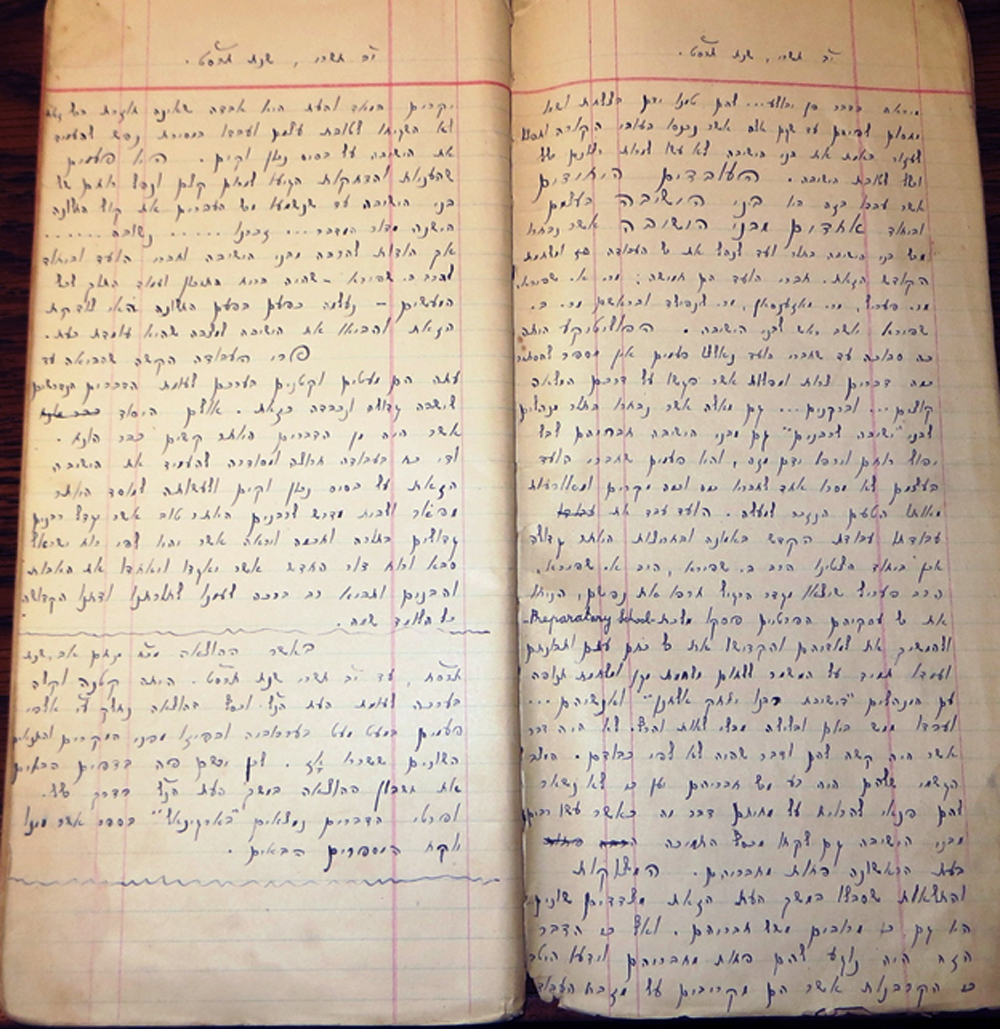
The manuscript of ‘Emek ha-Netziv remains in the possession of the Shapira family and there are no additional extant copies. The family are prominent members of a staunchly traditionalist Ḥaredi community in the Geulah neighborhood of Jerusalem. Members of this community generally oppose sustained contact with Western culture and its representative institutions, including universities of any type. The Shapira family seems to harbor additional skepticism toward those researching Netziv , due to the fact that his relative openness to certain aspects of non-traditional culture has made him a controversial figure in some ultra-Orthodox communities.[1]These facts, combined with the sheer value of their manuscript collection,[2] make the family understandably guarded about allowing access to thematerials they possess. However, with the assistance of Rabbi Zevulun Charlop, Dean of the Rabbi Isaac Elchanan Theological Seminary in New York City and a cousin of the Shapira family,[3] I was able to secure brief and accompanied access to the manuscript from which ‘Emek ha-Netziv was taken.[4]

The manuscript is handwritten in three volumes, corresponding to the three volumes of the printed text. The first two volumes were bound, but the binding has completely deteriorated and sections of each volume easily separate from one another. The third volume seems never to have been bound. The pages of all three volumes are severely frayed at the edges.

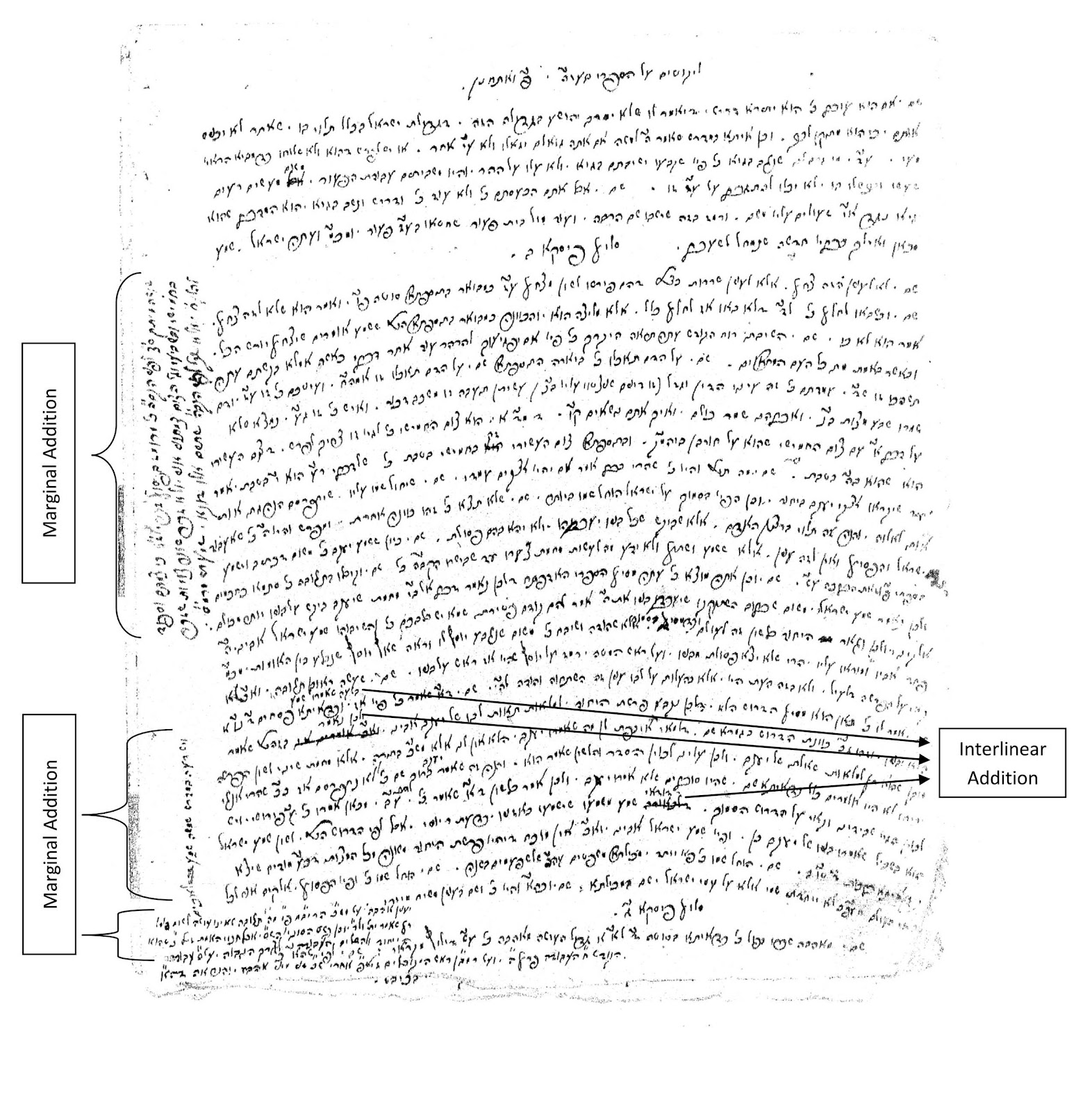
As suspected, the manuscript contains a core text with countless interlinear and marginal additions as well as words and entire lines that have been crossed out:


.

It is important to note that the brackets and parenthesis which appear throughout the printed text do not correspond to these additions. Rather, they correspond to places in which Netziv placed parenthesis or brackets around his own words both in the core text and in the additions. The additions and the notes he appended to the end of the manuscript (referred to by the Netziv as hashmatot )[5] were incorporated without indication into the printed text.


The script of the core text through the first two volumes and half of the third is a fairly consistent narrowly-spaced brown cursive[6] written with a fairly wide-tipped pen. In the second half of the third volume the script of the core text changes to a blacker, wider-spaced cursive seemingly done with a thinner-tipped pen. The script of the later marginal additions varies.

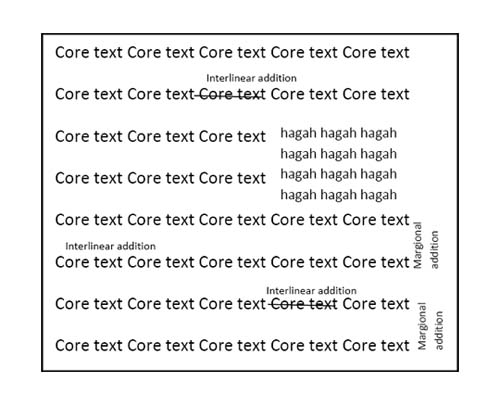
The notes which appear scattered throughout the printed text (referred to by the Netziv as hagahot) were written at the same time as the core text,[7] as evidenced by the identical script used and the intentional indentations left in the text of the core commentary in order to create space for the hagahot. The hagahotalso contain marginal additions. A typical page in the manuscript containing hagahot, then, is represented in the following diagram:

The reference to the newly printed book ‛Emek Halakhah mentioned above appears as an interlinear addition to the core text, thus implying that for that particular section of the commentary on Naso, the core text was written prior to 1845 and the addition was included after 1845. The references to Reb ‘Iẓele are also found in the core text with the word “she-yiḥyeh,” which dates those passages of the core text to the years prior to 1849 as well.[8]

The orderly progression of chapters in the core text, which begin at varying places on the physical page of the manuscript, indicates that Netziv wrote down his comments in this manuscript in proper sequence, following the order of Sifre. [9]That is, one can safely assume that in this particular copy of the manuscript, the core text of Netziv’s comments on Parashat Bamidbar were committed to writing before those of Parashat Naso, and his comments on pesikta’ aleph were committed to writing prior to those of pesikta’ bet.[10] If the core text of the manuscript was written sequentially, and the core text of EH Naso 49 (I:181) was necessarily written prior to the publication of Zev Wolf ben Yehudah Ha-Levi’s 1845 publication of ‘Emek Halakhah, one can deduce that, at the very least, the entire core text until that point was also committed to writing prior to 1845. Likewise, from the appearance of the word “she-yiḥyeh” in the core text of Be-ha‛alotekha andShelaḥ[11] one can assume that the text up to that point was written prior to Reb ’Iẓele’s death in 1849. If we then add that the handwriting remains rather constant in the core text until the second half of the third volume, we have reason to believe that all of the core text until that shift in appearance was committed to writing prior to 1849.

Thus, one can safely conclude that a good portion of the printed edition of‘Emek ha-Netziv was indeed written while Netziv was a young man in his twenties and thirties. As such, the general character and main attributes of the work must be seen as a product of the cultural and intellectual atmosphere of Lithuanian Jewish society in the 1830s and 1840s. At the same time, given the large number of later additions and the lack of any demarcation in the printed text, one can not firmly ascribe a date to any specific passage found in it, with the exception of those which contain explicit or implicit references to the time of composition.

Censorship

The process of preparing ‘Emek ha-Netziv  for publication was painstakingly performed by the Shapira family over the course of many years, and thus the printed text seems to be relatively free of printing errors. However, there are two hints in the printed text which suggest the possibility of editorial censorship.

As noted above, Netziv’s relative openness to sources of information beyond the pale of the current traditionalist canon is a character trait which is at odds with the values of the contemporary ultra-Orthodox community. As we will describe at length in the pages that follow, Emek ha-Netziv  is filled with citations and references to such sources of information. On two such occasions the reference found in the printed text appears to be intentionally altered so as to prevent proper identification of the source. In his comments on ‘Ekev, Netziv writes that for further study one should consult the book called “thirty-two Middot of [sic] in Vilna.”[12] In all probability Netziv is referring to the book published in 1822 called Netivot Olam: Beraita de-32 Middot with the commentary of Ẓvi Hirsch Katzenellenbogen. Katzenellenbogen is known to have been a member of Vilna’s more “enlightened” circles.[13] As such, the possibility exists that the publisher intentionally left out Katzenellenbogen’s name. This prospect is bolstered by the fact that the manuscript contains a name in the standard acronymic form where the printed edition has a blank space. When I asked to look at this reference in the manuscript, it was reviewed by two members of the Shapira family and I was denied permission to look at it. Nonetheless, I did manage to see what seemed like a legible acronym ending in the letter qof.[14] Although it is possible that the editor could not discern the letters of the acronym, if such had been the case one would expect a bracketed editorial note, such as those which appear on several occasions in the printed text where the manuscript is illegible due to stains or frayed edges.[15]

The second possible instance of editorial censorship concerns a passage in Netziv’s commentary on Shoftim which refers the reader to “hakdamat ḥumash besau[16] ve-‘tav’’alef’.[17] The most common referent for the initials tav”alef in the context of Torah commentary is Targum Onkelos, the ancient Aramaic translation of the Bible. However, if the bet of the word “besau” is replaced with adaled so as to read “desau” we might suggest that the tav”alef stands for targum Ashkenaz, German translation, rather than Targum Onkelos. As such, the citation would be of the well-known introduction to Moses Mendelssohn’s Torah commentary, which was printed in Dessau and contains a German translation of the biblical text. The fact that the subject matter under discussion in this passage of Netziv’s commentary correlates to subject matter discussed by Mendelssohn in the introduction to his Bible commentary supports the latter suggestion.

We might raise the question, then, as to whether the printed text was intentionally manipulated so as to prevent easy identification of Mendelssohn’s work or whether the daled of Dessau was simply mistaken as a bet by the printsetter.[18]The fact that this particular citation was underlined in pink pencil in the manuscript bolsters the suspicion that the publishers of ‘Emek ha-Netziv were sensitive to the potential controversy the citation of Mendelssohn might have caused in the ultra-Orthodox community and that they therefore intentionally altered the printed text.[19]

Both of the above instances of possible censorship beg the question as to why the references were included altogether if the printers wished them to remain unidentified. Furthermore, as will be discussed below, the printed text of ‘Emek ha-Netziv contains references to numerous other works that lie well beyond the traditional contemporary ultra-Orthodox canon which were not censored. As such, the evidence for editorial censorship cannot be considered conclusive. Nonetheless, these two passages do raise the possibility that other parts of the text were more cleverly censored or that other citations were completely deleted.
The End of ‘Emek ha-Netziv
The end of Netziv’s commentary on Sifre, as it appears in the printed edition of ‘Emek ha-Netziv , is also an issue of concern to the critical reader. The commentary in both the printed edition and the manuscript comes to an abrupt halt halfway through the parashah of Ki Teẓeh[20] and well before the end of the text of Sifre itself. One is therefore led to question whether Netziv truly ended his commentary there, or whether there was more to the commentary that does not appear in the printed text.

Several factors indicate that Netziv’s commentary did, in fact, extend beyondpiska’ 27 of Parashat Ki Teẓeh.[21] To begin, Netziv starts his commentary at the beginning of Sifre with an introductory double couplet, and thus one would expect a similar poetic composition at the end of the work, but none appears in the printed text or in the manuscript. Furthermore, a statement of completion marks the close of each parashah throughout the text, but none appears at the end of Parashat Ki Teẓeh. Likewise, the completion of the Book of Numbers is marked by two rhyming stanzas of nine lines each,[22] while Deuteronomy, and the commentary as a whole, has no formal conclusion at all.

One must entertain the possibility that the abrupt ending of the work suggests not that the final portion of the commentary is missing from the printed text but that Netziv never completed the commentary. This theory might be supported by the fact that the statements of conclusion which follow everyparashah are in poetic form in the first two volumes, whereas in the third volume, which consists of the Book of Deuteronomy, the statements consist of nothing more than “Piska’ 8 is complete and [so too] the entire portion of ve-’Etḥ anan.”[23] One might interpret this phenomenon as suggesting that the final touches, such as the transformation of abrupt closing statements into clever couplets, were never applied to the third volume of the work.

Such a conclusion seems unlikely, however, when one considers the numerous revisions and recensions to which Netziv subjected the rest of the commentary. One generally does not spend the time editing, expanding, and re-copying a work that one has yet to complete. Furthermore, in his introduction toHa‘amek She’elah Netziv regrets that he has not yet brought his commentary onSifre to press, but he makes no mention of not having completed writing the text. Similarly, in a comment found in his Harḥev Davar, published along with his Ha‛amek Davar in 1878, Netziv writes that while he has not elaborated on a particular point in this work, he will do so at length when God grants him the merit of “publishing the commentary on Sifre.[24] Here too, Netziv does not ask for God’s help in finishing the work, but in bringing it to press. Likewise, Avraham Yiẓḥak Kook, one of the outstanding students of Netziv , publically called upon his teacher to publish his Sifrecommentary in a footnote to a biographical article on Netziv published in 1888.[25]He too seems to suggest that the work was complete.

The physical form of the third volume of the manuscript makes the possibility of missing material rather plausible as well. The printed text contains commentary to every piska’ in Sifre up until piska’ 27 of Parashat Ki Teẓeh.[26] There is no commentary on piska’ot 27-54, but the text resumes with brief comments on piska’54[27] and then ends completely. In the manuscript, piska’ 27 ends at the bottom of a page, which raises the possibility that further commentary followed on subsequent pages which are now lost. The brief comments to piska’ 54 appear on the reverse side of comments labeled as hashmatot; therefore, they may well represent hashmatot to a core commentary, now lost, on the end of Deuteronomy.[28] When one considers the fact that, unlike the first two volumes, the third volume of the manuscript is not bound and does not appear to ever have been bound, the notion that pages from the end of the commentary were lost must be seriously considered.[29]
Conclusions
The conclusion one must draw from the above investigation of the text of‘Emek ha-Netziv is that a historical analysis of the content found in the printed text must be made with caution. The possibility of the text being incomplete must always be considered both in regard to possible editorial censorship and in regard to the possibility that the text originally contained additional chapters that are currently lost. Whereas the core text of the commentary prior to Shelaḥ [30] can be rather definitively dated prior to 1849, the printed text makes no distinction between the core text and later additions. As such, with the exception of a few passages which include embedded historical evidence, no single passage in the printed text can conclusively be dated to the 1830s or 1840s. Nonetheless, there is sufficient evidence, both in Netziv’s own testimony with which this chapter began and in the clues offered by the text and corroborated by the manuscript, to conclude that the bulk of the commentary does indeed reflect a project with which Netziv was engrossed in his early years. Thus, trends which can be identified throughout the printed text and which comprise its general character must indeed be seen as reflective of the intellectual currents of Lithuanian Jewish culture in the 1830s and 1840s.
[1] In recent years, certain circles in the ultra-Orthodox community recommended that Moshe Dombey and N.T. Erline’s adaptation of Barukh Ha-Levi Epstein’s Mekor Barukh, entitled My Uncle the Neẓiv (Brooklyn, N.Y.: Mesorah Publications, 1988), not be read due to its portrayal of Neẓiv as one who did not share all of the values of the contemporary ultra-Orthodox community. See Jacob J. Schacter, “Haskalah, Secular Studies, and the Close of the Yeshiva in Volozhin in 1892,” Torah u-Madda Journal 1 (1989): 76-133; Don Seeman, “The Silence of Rayna Batya: Torah, Suffering, and Rabbi Barukh Epstein’s Wisdom of Women’,” Torah u-Madda Journal 6 (1995-1996): 91-128; Don Seeman and Rebecca Kobrin, “’Like One of the Whole Men’: Learning, Gender and Autobiography in R. Barukh Epstein’s Mekor Barukh,”Nashim 2 (1999): 52-94; Brenda Bacon, “Reflections on the Suffering of Rayna Batya and the Success of the Daughters of Zelophehad,” Nashim 3 (2000): 249-256; Dan Rabinowitz, “Rayna Batya and Other Learned Women: A Reevaluation of Rabbi Barukh Halevi Epstein’s Sources,” Tradition 35: 1 (Summer 2001): 55-69. This position toward Neẓiv, however, was already espoused a century earlier when a series of articles appeared in the Galician newspaper Maḥzike Ha-Da’at (volumes 16, 17, and 18) warning traditionalist Jews to stay away from Netziv’s Bible commentary,Ha‛amek Davar, due to its modern stance toward the authority of the Talmudic Sages. A similar sentiment is reflected in the fact that many ultra-Orthodox houses of study have refused, and continue to refuse, to include Ha‛amek Davar in their libraries.
[2] A value which stands in stark contrast to the overwhelming poverty of most of Geulah’s inhabitants.
[3] See Neil Rosenstein, The Unbroken Chain. (New York: CIS Publishers, 1990) 433-440.
[4] My examination of the manuscript took place in July of 2004 with the assistance of a Summer Travel Grant awarded by the Center for Jewish Studies at Harvard University.
[5] The hashmatot probably represent additions to the text which Neẓiv could not fit in the margins of the page of the core text due to lack of space.
[6] The letters are in cursive form, but Neẓiv generally did not attach his letters to each other. The brown color was probably black when originally applied but has lost its vibrance with the passage of time.
[7] The hagahot seem to have been intended as tangential footnotes to the main commentary in a manner similar to the way in which Netziv’s Harḥev Davar was intended to supplement his Ha‛amek Davar on the Bible. This format was typical of Lithuanian Torah commentary, for reasons which will be explained in Chapter Three below.
[8] I had hoped to demarcate the beginning and end of each addition in my own printed text along with a description of the script used in each addition. The Shapira family, however, was not willing to grant me the sustained access to the manuscript required for such an endeavor.
[9] If it had not been written in order, one would expect to find empty spaces on the bottom of a page where a particular chapter or section ended and new sections beginning on the top of new pages. Instead the end of each section in the manuscript is followed immediately by the beginning of the next section, indicating that they were written sequentially.
[10] There is reason to believe that this manuscript itself is a later recension of an earlier edition. The family showed me what they said were the few extant leaves of an earlier version of the commentary written by Neẓiv which predates the manuscript used for the printed text, but I was not allowed to study them at length. As such, the above analysis does not suggest that Neẓiv actually composed his commentary according to the sequence of the Sifre text, but simply that the transcription of the core text of the commentary into the manuscript at hand was done in sequential order.
[11] See note 14 above.
[12] EH ‘Ekev 4 (III: 52).
[13] See Chapter Two below.
[14] My access to the manuscript was always limited to sitting next to a member of the Shapira family, who would turn to the page I wished to check and look at the specific textual anomaly before deciding whether to let me look as well. In this case I was able to peer over his shoulder and attempt to decipher the acronym. The exact answer this member of the Shapira family gave me was, “Suffice it to say, it is not a siman in Shulḥan Arukh.”
[15] E.g., EH Naso 42 (I: 162); EH Naso 44 (I: 173); EH Matot 1 (II: 279); EHMatot ‛Ekev (III: 45); EH Re’eh 9 (III: 92).
[16] Bet-ayyin-sameh-vav.
[17] EH Shoftim 16 (III: 189).
[18] In cursive Hebrew writing the bet and daled look quite similar.
[19] A glaring example of this type of censorship recently appeared in a photo-offset of the 1926 Frankfurt edition of David Ẓvi Hoffmann’s responsa, Melamed le-Ho‛il, published by the Lebovitz-Kest foundation. In Responsa #56 in the original printing (II: 50), Hoffmann gives his approval, in exigent cases, for an Orthodox Jew to swear before a civil court without a head covering. In the context of his piece, Hoffmann also attests to the fact that Samson Raphael Hirsch instructed the students in the Frankfurt Orthodox school which he founded to cover their heads only for Judaic studies and allowed them to remain bare-headed for their secular studies. The recent photo-offset contains an introduction by a grandson of Hoffmann, David Ẓvi ben Natan Naftali Hoffmann, which gives the reader the impression that the grandson belongs to the ultra-Orthodox community of Jerusalem. Responsa #56, however, permits a practice clearly anathema to that community. Hence, when one turns to page fifty in the off-set, in place of what was earlier Responsa #56, one finds a blank space. I thank Rabbi Moshe Schapiro, librarian at the Mendel Gottesman Library of Yeshiva University, for bringing this example to my attention.
[20] EH Teẓeh (III: 296).
[21] Note that the piska‘ot of Neẓiv do not correspond to those of the Sifre text with which the commentary is printed. In the text of Sifre the last piska’ for which there is continuous commentary is 43, and it then resumes in 54. See Chapter 5.
[22] EH Mas‛ai (II: 334).
[23] EH Ve-’Etḥanan (III: 43).
[24] HrD Num. 6: 19.
[25] Avraham Yizhak Kook, “Rosh Yeshivat Eẓ Ḥayyim,” Kenesset Yisrael, ed. S.J Finn (Warsaw, 1888), 138-147. Also in Ma’amarei HaRe’iyah (Jerusalem, 1984), 123-126.
[26] EH Teẓeh (III: 296). Piska’ot here are according to Netziv’s division. For more on Netziv’s method of dividing piska’ot see Chapter Three below.
[27] EH Teẓeh (III: 299). In the absence of Netziv’s commentary, piska’ot here refer to the division found in the standard Sulzbach edition.
[28] When I asked the Shapira family about the strange ending of work, they too suggested that there might have been more that was lost. When I asked them who had possession of the manuscript prior to them, they declined to give me any names and replied instead, “Suffice it say, it has been handed down, son after son.”
[29] The existence of commentary on the latter parts of Deuteronomy could have been conclusively proven had Neẓiv included a reference to it in his other writings. I have found no such reference, but no conclusions can be drawn from silence.
[30] EH Shelaḥ 1 (II: 10)