Depicting Difference: The Tower of Babel and the Language of Sacred Art

Depicting Difference: The Tower of Babel and the Language of Sacred Art

“For form is only the manifestation, the shape of content.”
Ben Shahn, The Shape of Content, p. 72

Genesis chapter 11 presents the narrative of the Tower of Babel, detailing how, contrary to the divine directive to disperse and populate the earth, the descendants of the flood’s survivors congregated in a single city and commenced construction of a substantial tower. God intervened to prevent further cooperation among them by disrupting their shared language, thereby introducing linguistic diversity, which ultimately ceased the building process and resulted in the broad dispersal of the population.

The account of the Tower of Babel offers a unique context for exploring what characterizes an image—and, by extension, a work of art—as Jewish. In Christian artistic traditions, from medieval illuminations to Renaissance paintings, the tower is often portrayed as a symbol of pride and serves as a cautionary emblem against human ambition. In contrast, Jewish philosophy and visual culture do not treat the tower as an important iconographic motif or as a warning against aspiration. Where the story does appear in Jewish art, it offers an alternative interpretation, and in certain instances, it recasts the tower motif in a more positive light.

The Architecture of Arrogance: Bruegel’s Tower and the Christian Moral Imagination

A painting of a tower of babel AI-generated content may be incorrect.

Figure 1: Pieter Bruegel, The Tower of Babel, Kunsthistorisches Museum, Vienna

Among the most celebrated representations of the Tower of Babel is Pieter Bruegel the Elder’s painting housed in Vienna’s Kunsthistorisches Museum (we previously discussed another painting from the museum, Samuel van Hoogstraten’s Old Man at a Window, and whether it is a Jewish painting, its subject a famous Rabbi). Measuring over three feet wide and five feet high, this work features a monumental spiral structure composed of arches and tiers that ascend unevenly into the clouds. The immense scale of the tower stands in stark contrast to the small human figures depicted throughout—hundreds of workers engaged in various tasks. Bruegel’s paintings are notable for their comprehensive and detailed portrayal of subjects. (This site allows you to zoom in on all the details.) In this scene, each trade and stage of construction is rendered with meticulous attention; some laborers transport massive stone blocks along ramps, while oxen-pulled carts bear heavy loads of building materials. Human-powered treadwheel cranes lift supplies upward, and scaffolding constructed from poles, planks, and ropes clings to the sides of the tower. Masons apply mortar and lay bricks, carpenters reinforce beams, and overseers direct operations, attempting to manage the complexity and activity inherent in such an undertaking.

In the foreground, King Nimrod, adorned in elaborate robes and a crown, oversees the construction as the principal architect of the tower. He reviews architectural plans with his attendants while laborers kneel. Surrounding him, foremen gesture towards the ascending walls, effectively conveying his directives to the assembled workforce. Beyond the imposing structure of the tower, ships are visible entering the harbor, their masts prominent on the horizon.

Bruegel often used allegory in his work. By integrating contemporary construction methods and maritime elements into the depiction of the ancient story, he placed Babel in the context of his own time. The painting presents examples of human innovation alongside the risks associated with ambitious endeavors, making its observations applicable from the 16th century to the present day.[1]
A painting of people working on a tower AI-generated content may be incorrect.

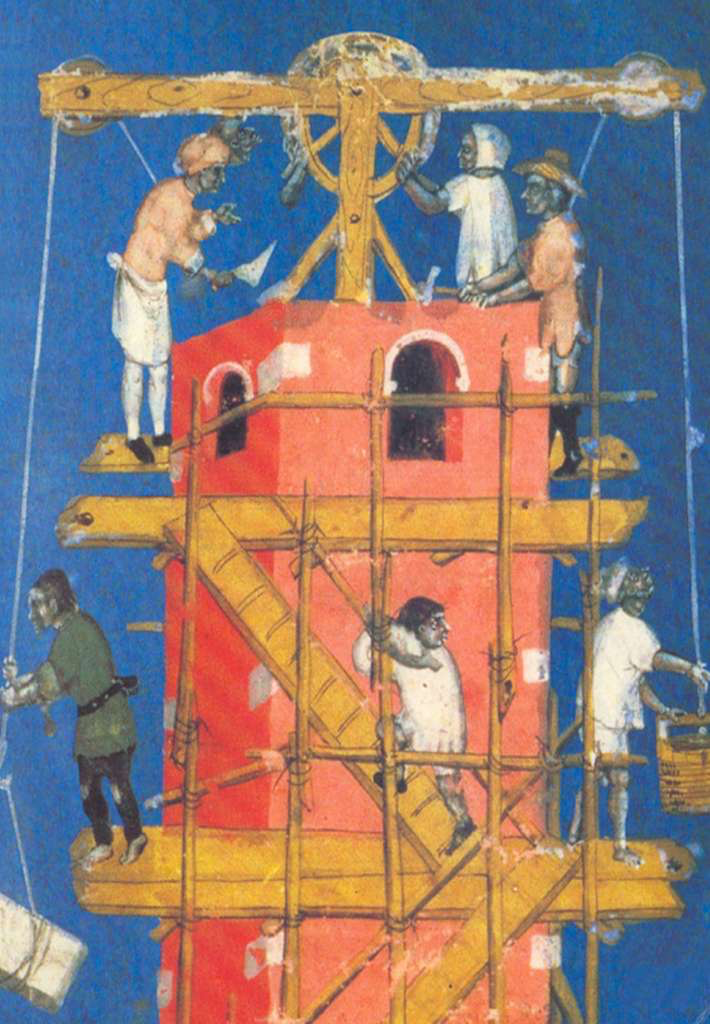
Figure 2: 13th Century Manuscript of Rudolf von Ems Poetry
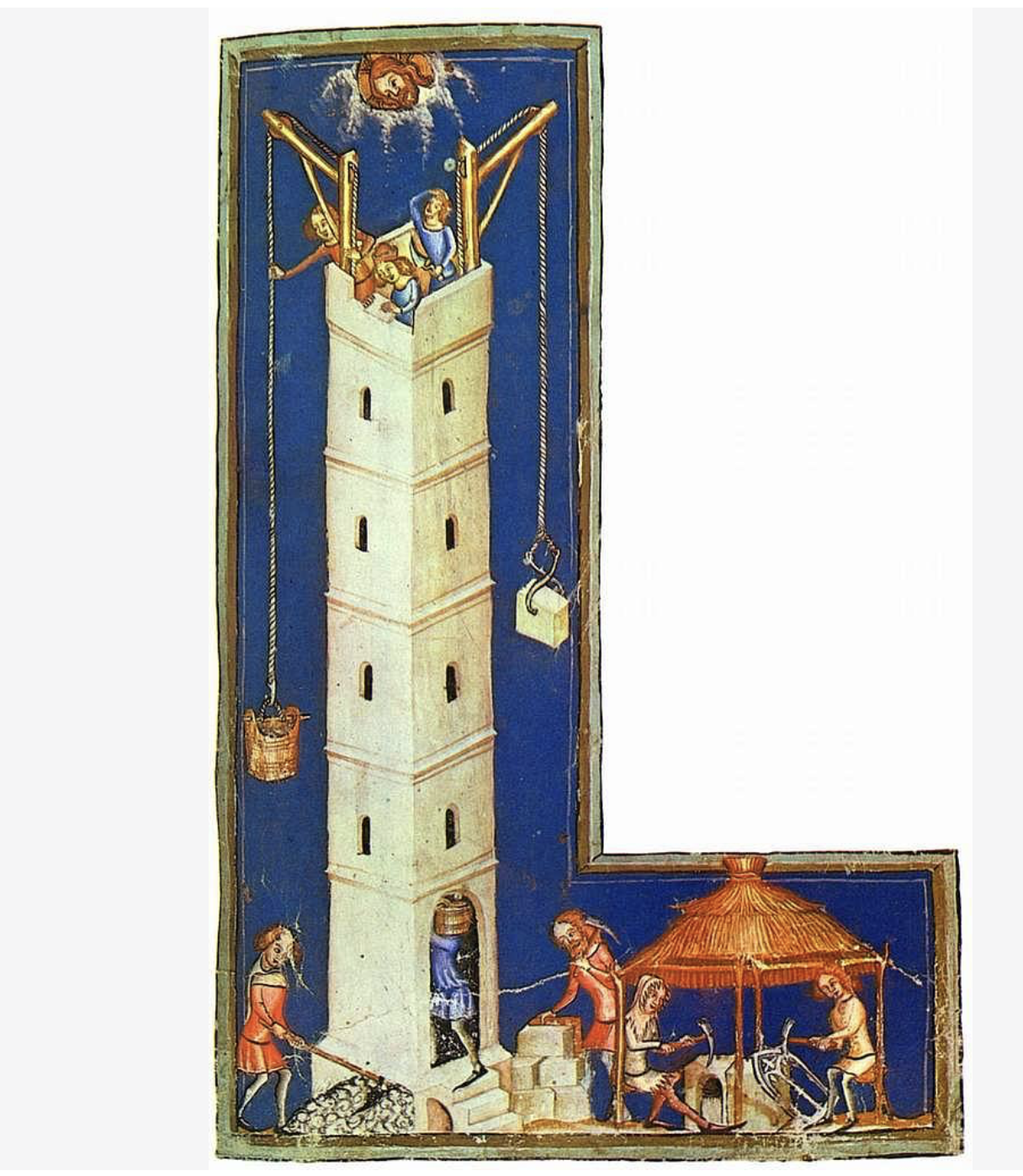
A letter l with a tower and people working AI-generated content may be incorrect.

Figure 3: 14th Century York Manuscript

Earlier artistic portrayals commonly focused on Babel’s height and grandeur. Medieval manuscripts and Church paintings often depicted it as upright, rectilinear, and monumental, resembling a fortress or cathedral spire. In contrast, Bruegel presents the tower as unstable, leaning, and showing deterioration at its foundation, while construction continues at the upper levels. The structure appears to challenge natural order by being built atop a mountain and using brick, which leads to rock formations that affect its stability. Bruegel incorporates Roman arches reminiscent of the Colosseum, suggesting parallels to historical architecture that had fallen into decline by the time of his visit in 1560. Some areas are already inhabited; for example, a woman is seen hanging laundry. The residents appear unaware of the structural issues beneath them, blinded by their hubris. Nimrod’s prominence in the foreground, with the workers genuflecting to him and his plans that he holds in his hands, further emphasizes the fetishization of human ambition.

At the time, Bruegel’s audience didn’t have to look far to see a potential Babel in the making: Antwerp was booming, expanding, and building like never before, and its populace risked falling into the sin of pride. In 1563, when Bruegel painted the Tower of Babel, the city was Europe’s busiest port and a magnet for wealth, with goods and materials streaming in daily through the Scheldt River. Massive new fortifications were under construction to secure the city’s growth, while the Cathedral of Our Lady still stood unfinished, its single soaring spire a symbol of grandeur halted midstream. Cranes, treadwheels, scaffolding, and teams of laborers were familiar sights on Antwerp’s skyline, all details Bruegel carefully folded into his painting. Even the ships visible in the harbor of his Babel recall Antwerp’s bustling docks, tying the biblical story directly to his contemporaries’ lived experience. For Bruegel’s viewers, the tower was not just a monument to ancient pride but a mirror of their own city’s dazzling ambition and its underlying fragility.

Bruegel does not show the dramatic aftermath, the confusion of tongues, and the scattering of peoples across the earth. Instead, he arrests the narrative at the moment of construction, filling the canvas with the feverish activity of workers and the looming mass of the tower itself. In doing so, he lets the architecture bear the weight of the story: the leaning walls, the buckling arches, and the crumbling base foreshadow the enterprise’s futility. The punishment is absent because the tower already embodies it, an image of human ambition that carries within itself the seeds of its own destruction.

Bruegel’s legacy is twofold. On the one hand, he fixed Babel’s appearance for centuries: spiraling, leaning, and crumbling, the visual template repeated in paintings, engravings, church murals, and biblical illustrations well into the modern era. From 16th-century Flemish workshops to 18th-century Bibles, from church frescoes to Romantic illustrations, and even into 20th-century literature and contemporary art, Bruegel’s leaning Tower of Babel has been endlessly reimagined as the enduring image of human ambition and collapse.[2] On the other hand, he reshaped its meaning. Earlier images celebrated human pride by showing the tower upright and impregnable. Bruegel’s version, and the generations of artists and authors who followed, transformed it into a parable of fragility, a monument doomed to collapse even as it rose.

Buildings Fall Books Endure: The Jewish Reading of Babel

Within the Jewish exegetical tradition, the story of Babel carries a different emphasis than in Bruegel’s Christian retelling. The tower itself is a bit player in a larger story, a catalyst and not the focus, less important than the human decision it symbolizes. In Genesis 9:1, God commands Noah’s descendants to “be fruitful, multiply, and fill the earth.” Yet instead of dispersing across the world, humanity chooses to settle in one place and build a city and tower “lest we be scattered abroad upon the face of the whole earth” (Gen. 11:4). In this reading, the sin is not arrogance against heaven but resistance to God’s plan of dispersal. The tower becomes a narrative device, a means of dramatizing humankind’s determination to remain unified, sedentary, and secure.[3]

Seen from this perspective, the confusion of languages and scattering of peoples is not so much a punishment as a necessary correction. The multiplicity of tongues is God’s way of ensuring that His will for humanity, for it to spread, diversify, and populate the earth, is carried out. The Jewish interpretation, therefore, reads the story as a lesson about human attempts to thwart divine design, not Bruegel’s Christian vision, which centers on pride and monumental ambition. What matters is not the tower’s collapse but humanity’s refusal to scatter, and the way God ultimately enforces the order of creation.

This contrast is confirmed by the way Jewish tradition titles the episode “Dor Haflagah,” meaning “the Generation of Division,” rather than “Migdal Bavel,” the Tower of Babel. (Sanhedrin 10:3; Baba Metziah 4:2). The Hebrew name shifts attention away from architecture altogether and toward the human drama: the refusal to scatter, the divine act of dividing languages, and the dispersal across the earth. In other words, where Christianity made the tower a visual icon, Judaism made the generation itself the lesson.[4]

This approach was not only in Jewish exegesis but also in Jewish art. There are only five identified examples of the tower in Jewish art, but in all of them, it is illustrated in a uniquely Jewish manner.
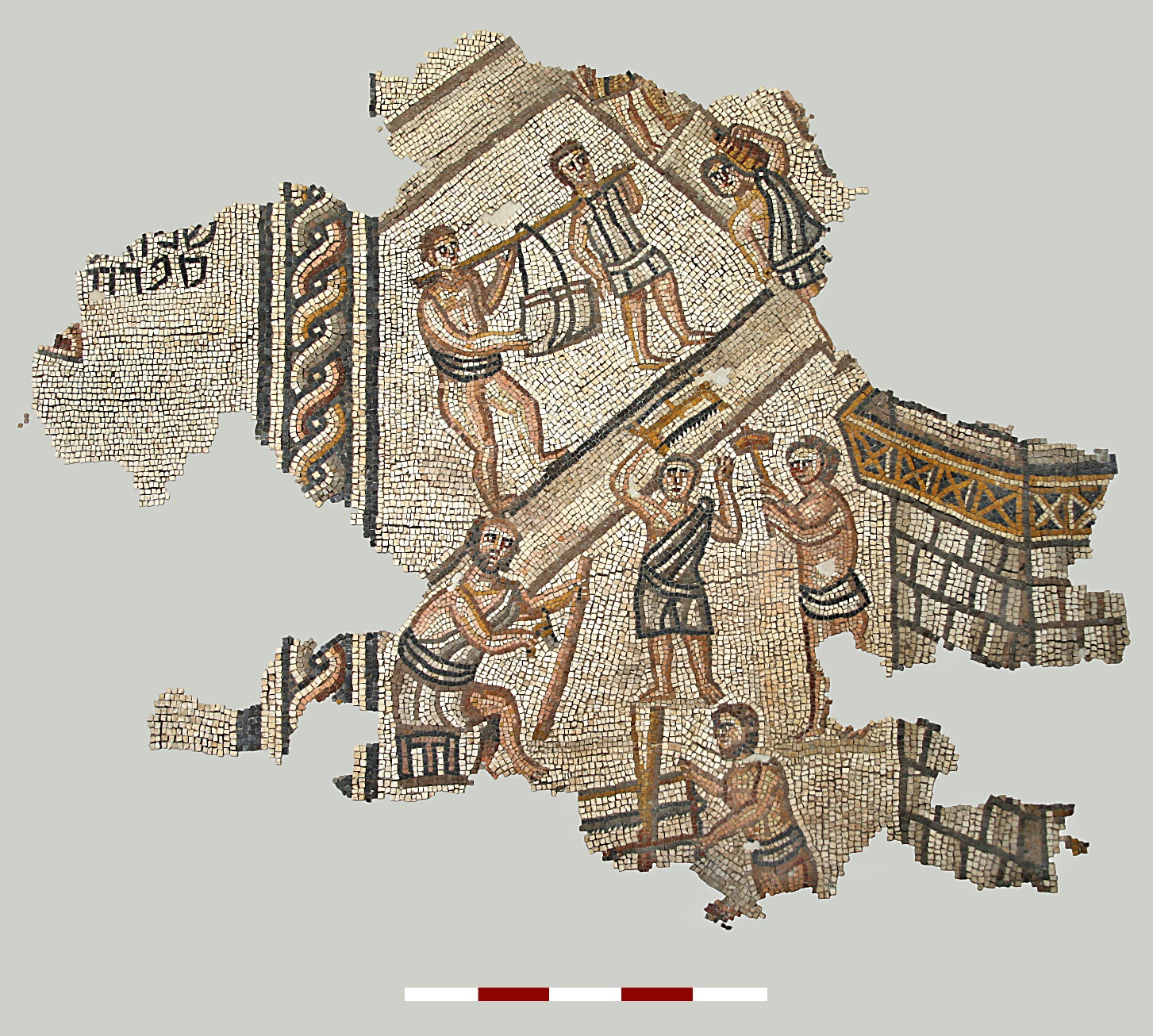
A mosaic of people in different poses AI-generated content may be incorrect.

Figure 4: Tower of Babel, Khirbet Wadi Hamam Mosaic, c. 3rd century, source.
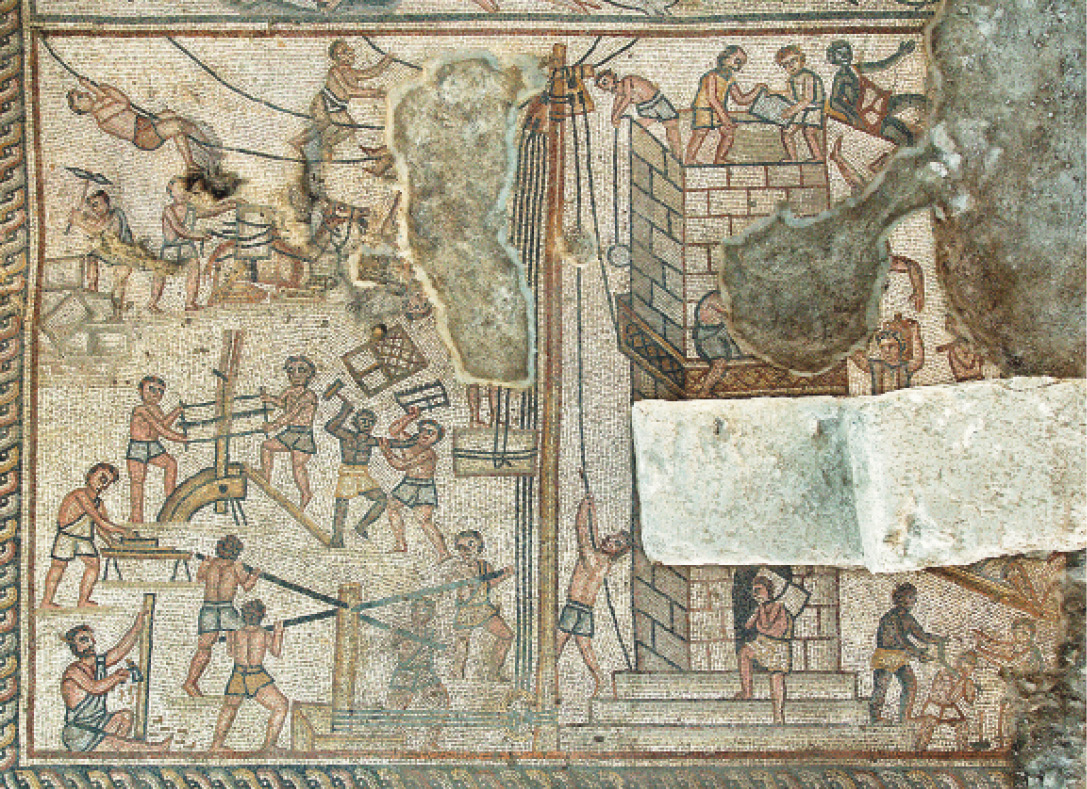
A mosaic of people working on a building AI-generated content may be incorrect.

Figure 5: Tower of Babel, Huqoq Synagogue, c. 5th Century

The earliest two examples are synagogue mosaics, a third-century synagogue in Wadi Hamam, and a recently discovered fifth-century mosaic on the floor of the Huqoq Synagogue in northeastern Israel. Only a part of the Wadi Hamam scene has survived, though it is the largest intact biblical scene found. It shows workers and a tower on the left. In the center, two workers are hitting each other. The Huqoq mosaic is larger and illustrates all stages of construction, including detailed depictions of hoists, levers, and various chiseling and cutting tools. At the center of the scene, two workers are engaged in conflict—one wielding a hammer and the other a saw.[5] Similarly, three medieval manuscripts feature this theme; in two, the depiction of violence is the central focus, while in the third, it forms part of a broader image, akin to the mosaic. [6]
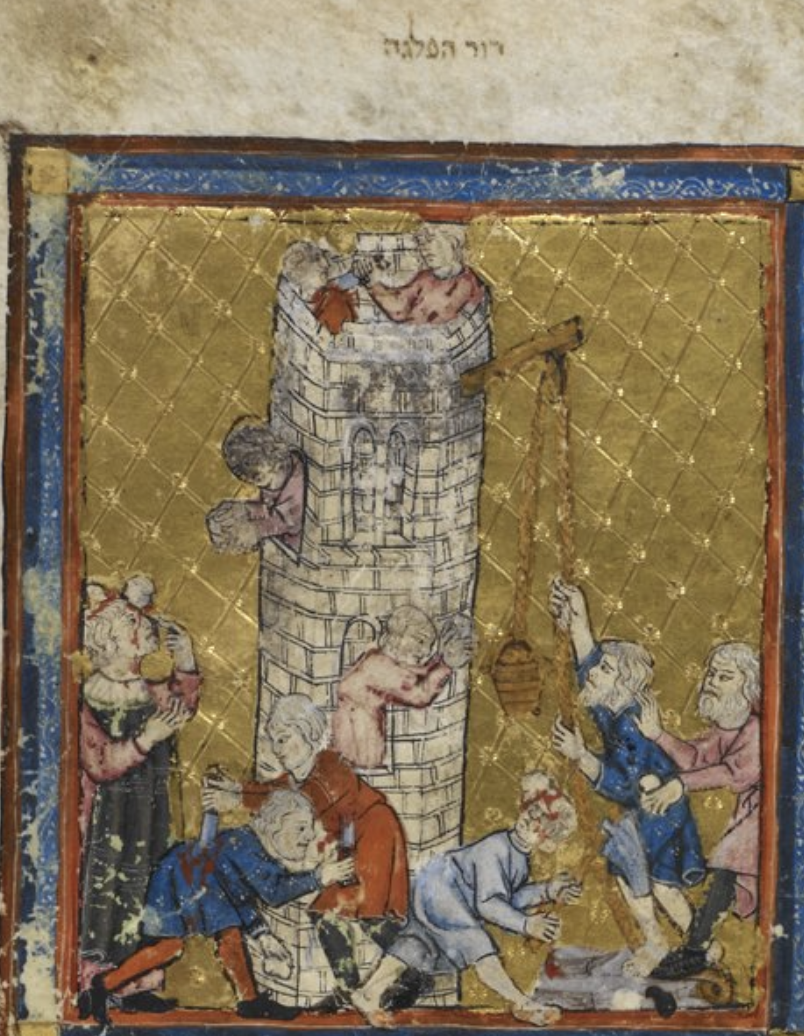
A close-up of a painting AI-generated content may be incorrect.

Figure 6 Golden Haggadah, fol. 3r

Although these examples feature the tower, they can be distinguished from the Christian perspective. Firstly, the labeling of the images aligns with Jewish tradition, specifically referencing Dor Haflagah. Secondly, Bruegel’s comprehensive visual representation notably omits any mention of violence. The interpretation that linguistic confusion led to violence is exclusive to Jewish sources, appearing in Genesis Rabba and various other texts, but not in Christian writings.[7] Given that the mosaic dates to the third century, this seems to potentially point to an earlier codification of Genesis Rabba than is currently assumed or that this approach was already was an oral legend.[8] The only known medieval Christian manuscript featuring a descent into violence, The Bedford Book of Hours, has prompted one scholar to assert that it “is undoubtedly based on a Jewish legend.”[9]

While Jewish manuscript culture preserves the uniquely Jewish interpretation of the iconography of the Tower of Babel, Jewish print culture would transform Bruegel’s symbol of pride and sin into a fortress of divine protection.

The Soncino family was the first great dynasty of Hebrew printers, active in northern Italy from the late 15th to the early 16th century.[10] Originating from the town of Soncino in Lombardy and operating intermittently between roughly 1483 and 1527, they established presses in a succession of Italian cities, including Soncino, Brescia, Fano, Pesaro, and Rimini, as well as in Turkey. The founder, Joshua Solomon Soncino, and his nephew, Gershom ben Moses Soncino, expanded the enterprise into one of the most respected printing houses of Renaissance Italy. Gershom issued one of the earliest dated Hebrew books, a Talmudic tractate printed at Soncino in 1484. This work, with its unique layout, is the first of its kind to become canonized, combining the source text with two surrounding commentaries, and is itself a work of art. Their editions combined typographic precision with decorative sophistication equal to the best contemporary Latin and vernacular presses, and their name became synonymous with the art of Hebrew printing itself. They did not just print for a Jewish audience, but also printed over 100 non-Jewish titles, outdoing their Jewish output of 64 titles.
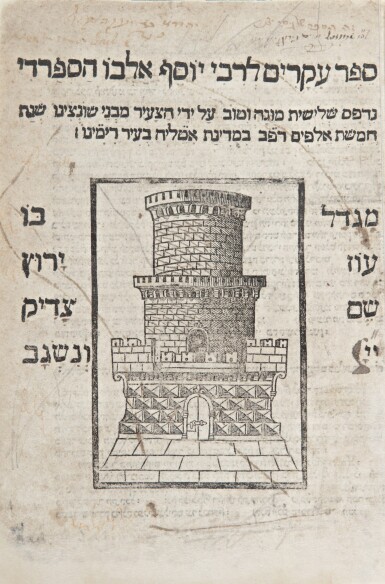
SEFER IKKARIM (BOOK OF PRINCIPLES), RABBI JOSEPH ALBO, RIMINI: GERSHOM SONCINO, 1522 | Sacred Splendor: Judaica from the Arthur and Gitel Marx Collection | 2019 | Sotheby's

Figure 7: Joseph Albo, Sefer Ikkarim, Rimini, 1522

The Soncino family was active from 1483, but in books printed from 1522, first in Rimini and subsequently in Salonika and Constantinople, Gershom incorporated a new printer’s mark – essentially a printer’s coat of arms.[11] This first appeared in R. Joseph Albo’s Sefer Ikkarim and depicts a traditional Renaissance-style solid stone tower rising above a crenellated wall, accompanied by the verse ‘מִגְדַּל עֹז שֵׁם יְהוָה, בּוֹ יָרוּץ צַדִּיק וְנִשְׂגָּב” “the name of the Lord is a mighty tower; the righteous runneth into it, and is set up on high,’ (Proverbs 18:10) on the left and right sides of the image. Gershom chooses to highlight the tower, unlike other possible symbols such as the rainbow, clouds of glory, or King David, which could have served a similar purpose.
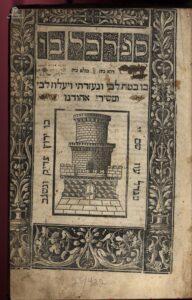
Figure 8: Kol Bo, Rimini, 1525, Gross Family Collection

In the Sefer Kol Bo, published in Rimini circa 1525 and considered Gershom’s most distinguished work from that period, a prominent introductory statement appears above the tower: “In You I place my heart and you will help me, and I will raise my heart and with song I will praise you: ‘the name of the Lord is a strong tower; the righteous runs into it, and is safe.’” This clearly presents the tower as an icon of divine protection and intervention. Notably, Gershom’s tower does not correspond with any physical structure in Soncino or Rimini; instead, the tower symbolizes a spiritual rather than an earthly construct.[12] There is one small, but somewhat strange, detail about Gershom’s tower: the doors are latched on the outside, making the locks useless. This oddity reinforces that the tower is divine, as it does not need a locked door. We reenact this belief annually during the Pesach seder. Gershom’s tower, rooted in Mishlei rather than Bereishit, represents divine protection in contrast to retribution. For a Jewish printer deeply engaged with Renaissance book art, this choice offered a thoughtful reinterpretation, reclaiming the tower as a symbol of resilience and trust in God’s safeguarding of the Jewish community people.[13]

The story of the “tower,” whether Bruegel’s collapsing monument or Soncino’s enduring emblem, reminds us how difficult it is to define what makes art “Jewish.” The same image can signify pride or faith, sin or sanctity, depending on the hands and the heart that shape it. Jewish art, then, is not confined to subject or style, but often lives in subtler places — in the design of a page, the mark of a printer, or the choice of a verse. Ultimately, even art speaks in different languages.

Notes: 

  1. For background on the creation of the painting see Margaret A. Sullivan, Bruegel and the Creative Process, 1559-1563 (Ashgate: England, 2010), 191-204. For a direct comparison of the painting with the biblical narrative see Ruth Dorot and Edna Langenthal, “Pieter Bruegel the Elder’s The Tower of Babel (1563). From Art to Architecture,” Journal Education Culture and Society, 2, (2023), 380-400.

  2. See Diána Kulisz, “The Tower of Babel Motif in the Art of the Low Countries,” in Mesopotamia Kingdom of Gods and Demons, ed. Zoltán Niederreiter, (Budapest: Museum of Fine Arts, 2024), 424-439.
  3. See Umberto Cassuto, A Commentary on the Book of Genesis, Part II, trans. Israel Abrams, (Jerusalem: Magnes Press, 1974), 225-226. Abarbenal, however, interprets the section much more in line with Bruegel’s themes. See Nehama Leibowitz, Studies in Bereshit, trans. Aryeh Newman, (Jerusalem: World Zionist Organization), 95-97.
  4. See Cassuto, id. at 203.
  5. See Karen Britt and Ra’anan Boustan, “Artistic Influences in Synagogue Mosaics: Putting the Huqoq Synagogue in Context,” BAR, May/June 2019, 40-41. They note that these are the only two known examples of synagogue mosaics to depict the Tower of Babel.
  6. The Golden Haggadah, Bezalel Narkiss ed. (England, 1996) 24-25; Marc Michael Epstein, The Medieval Haggadah: Art, Narrative & Religious Imagination (New Haven: Yale University Press, 2011), 157-158.
  7. For a collection of the various sources see M.M. Kasher, Torah Shelemah, vol. 1, 515, no. 60 and 517 no. 73.
  8. See Anat Reizel, Introduction to Midrashic Literature, (Tevunot: Alon Shevut, 2011), pp. 105–106.
  9. See Mira Friedman, “The Tower of Babel in the Bedford Book of Hours,” in The Old Testament as Inspiration in Culture, Jan Heller, ed. (Trebenice: 2001), 113-114.
  10. See generally, A.M. Haberman, Perakim be-Toldoth Hamdpissim ha-Ivrim (Jerusalem: Rubin Mass, 1978),15-101; Moses Marx, “Gershom Soncino’s Wander Years in Italy, 1498-1527” in HUCA XI (1936), reprinted as a stand alone work with many examples of Soncino illustrations, in 1969, by the Society of Jewish Bibliophiles.
  11. Abraham Yaari, Hebrew Printers’ Marks: From the Beginning of Hebrew Printing to the End of 19th Century (Jerusalem: Hebrew University Press, 1943), 4-5, 123-124. Gershom once used a different mark with a tower in the 1505 Fano edition Mashal ha-Kadmoni. Id. 124.
  12. Yaari, Printers Marks, 124.
  13. Gershom’s prayer may have been tied to a conflict with a Jew who had converted to Christianity. In the end, perhaps because of this conflict, although it remains unclear, Gershom was forced to flee Italy soon after. See Marx, “Wandering Years,” 55-59.


Elliott Horowitz – “”Most of all you’ve got to hide it from the kids…’ Reading Esther before Bed”

Elliott Horowitz teaches at Bar Ilan University and is co-editor of Jewish Quarterly Review.
This is his fourth contribution to the Seforim blog. We hope that you enjoy.
“”Most of all you’ve got to hide it from the kids…’:
Reading Esther before Bed”

Elliott Horowitz
“The problem of selecting Bible stories for the early grades is an especially difficult one,” wrote Emanuel Gamoran in his introduction to the first volume of Lenore Cohen’s Bible Tales for Very Young Children (2 vols, 1934-36), of which he was the editor. “Not all stories of the Bible are suited to the needs of little children,” continued Gamoran, who was an American Reform rabbi, and a disciple of the pioneer Jewish educator Samson Benderly,[1] “nor should all those children be told them in their entirety. In some instances certain details should be omitted.” In comes as little surprise, then, that in the second volume of Cohen’s Bible Tales the book of Esther contains only a single casualty – the evil Haman, who by the king’s order is hanged on the gallows he had prepared for Mordecai. No mention is made of the death by hanging of Haman’s ten sons, or of the more than 75,000 non-Jews killed, with the king’s permission, by Mordecai’s coreligionists. This was clearly one of those instances in which, according to Rabbi Gamoran, “certain details should be omitted.”
The identical omissions had been made three years earlier in a biblical anthology for children (The Children’s Bible: Selections from the Old and New Testaments) whose contents were “translated and arranged” by two distinguished non-Jews: Henry Sherman, who headed the “department of religious literature” at Charles Scribner’s Sons, which published the book, and Charles Foster Kent, who, as indicated on the frontispiece, was “Woolsey Professor of Biblical Literature in Yale University.”[2] The same editorial policy had earlier been followed by the American children’s writer Frances Jenkins Olcott (1873-1967) in her delightful Bible Stories to Read and Tell, published by Blue Ribbon Books in 1916.
Cohen and Gamoran, then, followed a venerable tradition in saving their “very young” readers from any knowledge of the sad fate of Haman’s sons. Yet they could arguably have followed the model of their British coreligionist Mrs. Philip Cohen in her two-volume Bible Readings with My Children (2nd ed., 1899). In her retelling of the book of Esther she acknowledged that not only Haman, but also his “ten sons were hanged on the gallows which their father had set up for Mordecai.”[3] Moreover, unlike Frances Olcott, who omitted mention of the permission given the Jews by Ahasuerus to defend themselves, and Messrs. Sherman and Kent, who included “the king’s “command that the Jews who were in every city should gather together and protect their lives,” but said nothing about the consequences thereof, Mrs. Cohen felt that it was safe to tell children that “the Jews, in defending themselves, killed numbers of their enemies.”
Mrs. Cohen’s justly popular anthology went through several editions, the fourth of which appeared in London in 1923. In that same year the future (but now lamented) Bible scholar Nahum Sarna was born in London. Not surprisingly, it was from that anthology that he acquired his earliest knowledge of Scripture. Reminiscing decades later about how he came to devote his life “to the study and teaching of the Hebrew Bible,” Sarna, then recently retired from Brandeis University, recalled that among his “earliest and most agreeable recollections is my father reading to me every Shabbat, with unfailing regularity from a little two-volumed work entitled Bible Readings with my Children by a Mrs. Philip Cohen. I am not certain, but I believe I was about three years old when the regimen began.”[4]
II
Bible Readings with my Children was not the first such anthology produced for Jewish children in Victorian England. Already in 1877 Ellis Davidson had published The Bible Reader under the explicit “sanction” of Britain’s Chief Rabbi Nathan Marcus Adler.[5] It was intended, as its subtitle indicated for the Use of Jewish Schools and Families, With the Addition of Questions on the Text, and Moral Reflections on Each Chapter. Davidson’s Bible Reader contained material from the popular book of Esther, but not much from the book’s brutal ending. Thus, anticipating Sherman and Kent’s Children’s Bible of 1930 readers were informed of the permission granted the Jews by Ahasuerus “to destroy, to slay, and to annihilate any armed force…that might attack them, with their children and their women,” but learned nothing of the consequences of that permission. Davidson did find a way to include the deaths of Haman’s sons, which both the Children’s Bible and Frances Olcott’s earlier Bible Stories later chose to omit, but he did so at the cost of changing the biblical story. They “were slain in battle,” and only afterwards hanged, wrote Davidson, “to show the people how utterly the whole house of Haman was degraded, and in order that future assaults might be prevented.”[6]
During the 1890’s two graduates of Oxford, each of whom had been at Balliol College when it was headed by the legendary Benjamin Jowett (1817-93), brought out their own biblical anthologies intended – at least in part – for young readers. The first of these to appear was John William Mackail’s Biblia Innocentium: Being the Story of God’s Chosen People Before the Coming of Our Lord…upon Earth, Written Anew for Children (1892). Mackail (1859-1945), who was born on the Isle of Bute and whose father was a minister of the Scottish Free Church, had overlapped as an undergraduate at Balliol with Claude Montefiore (1858-1938), who was a great nephew of the renowned Sir Moses. It is likely that they knew each other, since neither – unlike the bulk of their classmates – was an Anglican product of a posh “public school.” Both were also among the college’s most distinguished students; achieving “firsts” in the demanding course of study known as Greats (Literae Humaniores) in which their classmate George Nathaniel Curzon (a former Etonian and future viceroy of India) received only a “second.”[7]
In 1896 Montefiore, who was presumably familiar with Mackail’s Biblia Innocentium (which had appeared in a second edition in 1893) brought his Bible for Home Reading (1896), a two-volume anthology “with comments and reflections for the use of Jewish parents and their children. ” In certain respects Montefiore’s anthology followed the limitations that both his coreligionist Davidson and his former classmate Mackail had imposed upon themselves. No mention was made, for example, of the rape of Dinah in Genesis 34 or the subsequent massacre perpetrated by her brothers in Shechem. Yet with regard to the book of Esther Montefiore took a diametrically different approach. Whereas both previous Victorian anthologies, the one Jewish and the other Christian, had informed their readers of the permission granted the Jews to defend themselves but not of the bloody consequences thereof, Montefiore decided to include all the chpaters of Esther in their entirety despite what he acknowledged as the “religious and moral deficiencies.” These, he claimed, had been “ignored or explained away” by some, but also “exaggerated and falsely labelled” by others.” The best solution, he believed was to let readers, young and old, judge for themselves.
There were other ways of dealing with the book’s “religious and moral deficiencies” when presenting its contents to young readers. In his Story of the Bible: first published in 1904, Jesse Lyman Hurlbut (1843-1930), a Methodist Episcopal clergyman, reported not only that “Haman died upon the gallows that he made for Mordecai, but also that his sons “were put to death for their father’s evildoing.” He added, however, that this had been done “according to the cruel usage of those times.”[8] In contrast to Ellis Davidson’s clumsy attempt, in 1877, to make the hanging of Haman’s sons more palatable to his younger readers, Hurlbut, a native of New York, showed that it was possible to add without detracting.
Notes:
[1] On both Gamoran and Benderly, see Penny Schine Gold, Making the Bible Modern: Children’s Bibles and Jewish Education in Twentieth-Century America (Ithaca, 2004).
[2] H. A. Sherman and and C. F. Kent, The Children’s Bible (New York, 1933), 223-25.
[3] Mrs. Philip Cohen, Bible Readings with my Children, two volumes (rev. ed. London, 1899), II, 336.
[4] Nahum Sarna, “Ruminations of a Jewish Bible Scholar,” Bible Review 4:3 (June 1988). See also the obituary by Tom Long in the Boston Globe (25 June 2005).
[5] On Davidson, see Geoffrey Cantor, “‘From nature to nature’s God’: Ellis A. Davidson—mid-Victorian educator, moralist, and consummate Designer,” Jewish History 23:4 (December 2009): 263-388.
[6] On Davidson’s work and its treatment of the book of Esther, see Elliott Horowitz, Reckless Rites: Purim and the Legacy of Jewish Violence (2nd ed., Princeton, 2008), 24.
[7] On Montefiore at Balliol and the impact on the college of Jowett, see Horowitz, Reckless Rites, 25, and the sources cited there.
[8] Hurlbut, Story of the Bible: For Young and Old (Philadelphia, 1952).


Review of Dr. Michael Stanislawski, “A Murder in Lemberg: Politics, Religion, and Violence in Modern Jewish History”

Some have already pointed out that Columbia University Professor Michael Stanislawski has a new book/thriller.[1] This book describes the murder of R. Abraham Kohn and the events leading up to it and its aftermath.

Prof. Stanislawski attempts to discern whether, in fact, R. Kohn was murdered — Stanislawski thinks so — and in doing so, provides a wonderful description of Lvov (Lemberg) during the mid-nineteenth century. The basic background is that R. Kohn was a Reform Rabbi who became the main Rabbi in Lemberg. This allowed him to enact various rules, some such as the abolition of the various Jewish taxes which were collected by Orthodox Jews and thus they profited from it at the expense of the poor could be viewed as postive. But, as he was Reform, even the poor who benifited from this, still complained about such changes. As Stanislawski shows, much of R. Kohn’s actual reforms to Jewish practice were to be found in his articles (and his prior pulpit) rather than his public speeches or proclamations in Lemberg. While the book is interesting and Stanislawski does a good job on the whole, there are several points which I think need to be addressed.

The first is his conclusion. Although he does allow there may be room to doubt whether Kohn was murdered, anyone reading the book comes away with the impression that Stanislawski thinks Kohn was murdered. Stanislawski chides prior authors who don’t conclude Kohn was murdered. The problem with this, is Stanislawski provides the entire legal history after Kohn’s death, which seriously questions whether Kohn was murdered. That is, after Kohn died one person stood trial for his murder and was convicted. However, on appeal this was overturned. After the verdict was overturned, it was again reviewed by the highest court and the appellate court’s judgment was upheld.

While there are some issues with both of these appellate decisions, I don’t see how, after 150 years, and the fact that he admits he doesn’t have all the documentation, Stanislawski could then chide these other authors for relying upon these contemporaneous decisions! If Stanislawski unearthed some document which pointed to the perpetrator that would be one thing, but that is not the case here.

Additionally, Stanislawski intimates that as the accused was Orthodox, later Orthodox writers and publishers attempted to cover up the whole incident and label it as a death. He singles out the publishing house Mossad HaRav Kook and lays claim they also deliberately got it wrong. [2] Setting aside the possiblity that these Orthodox publications decided to rely upon the decision of the abovementioned courts, it is disingenuous to accuse Mossad HaRav Kook when in fact, another one of their publications — one that they have reprinted just a few weeks ago — includes the story as Stanislawski wants to believe it happened. Included in Prof. Meir Hershkovics’ biography on R. Tzvi Hirsch Chajes (Maharetz Chajes) published by Mossad HaRav Kook, it is noted that Kohn and his child were murdered by Orthodox Jews.[3]

While, a conspiracy theory makes for more exciting reading, the facts don’t seem to support it.

Notes:
[1] Michael Stanislawski, A Murder in Lemberg: Politics, Religion, and Violence in Modern Jewish History (Princeton University Press, 2007)
[2] See esp. id. p. 77
[3] See Meir Hershkovics, Maharetz Chayot: Toledot Rabbi Tzvi Hirsh Chayot u-Mishnato (Mossad HaRav Kook, 2007), p. 103-05.


An Incident of “Pilegesh B’Givah” in 19th Century Germany

AN INCIDENT OF “PILEGESH B’GIVAH” IN 19TH CENTURY GERMANY
by Eli Genauer
I recently purchased an antique Hebrew book for less than the price of a dinner at a moderately priced restaurant. This particular edition is what some would call a “common” — meaning it is the 36th edition (the fourth edition of a revised version) of this book and it was printed in the mid-19th century. Generally, the market does not assign a high price for books like these, but they can be a treasure trove of knowledge and information.
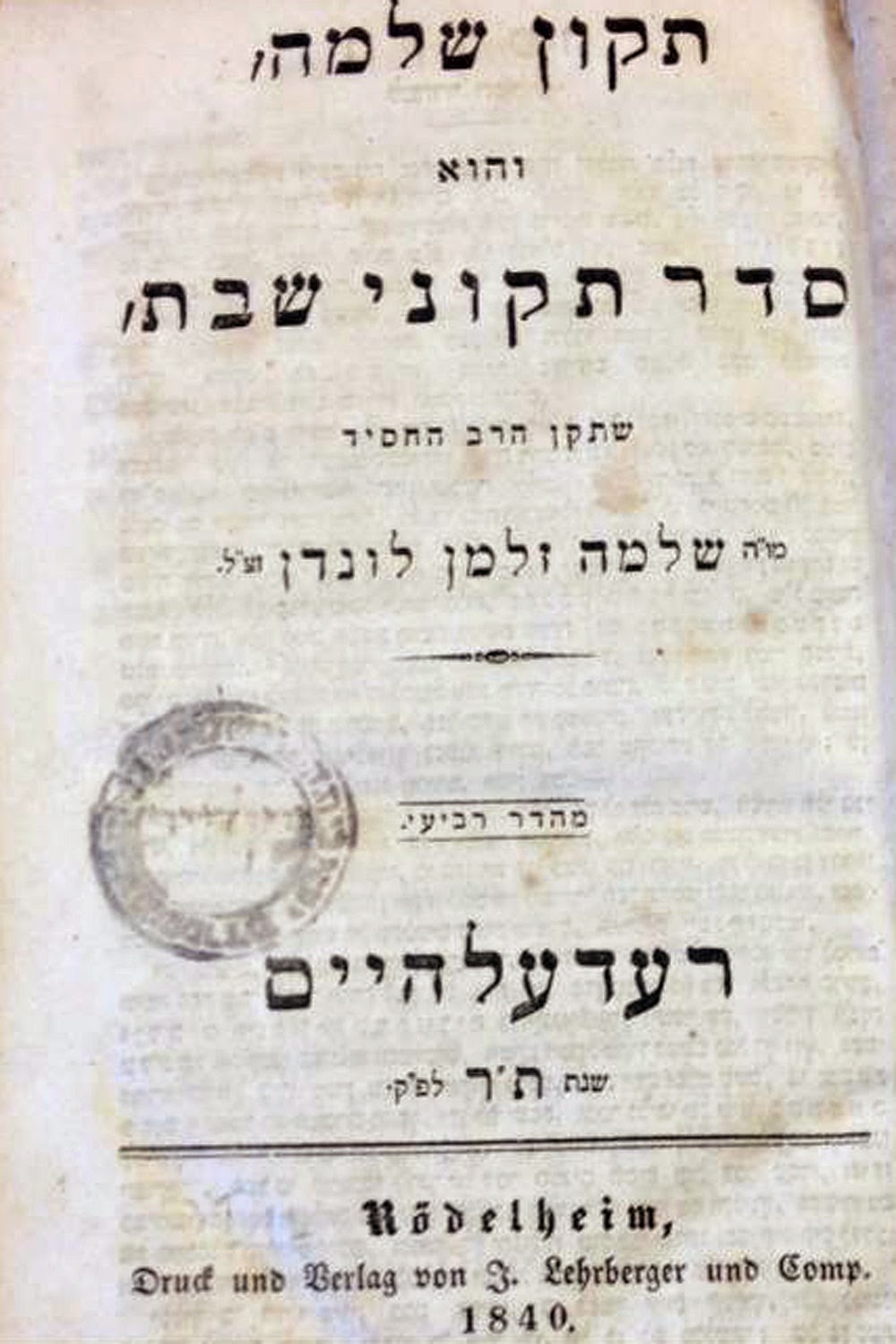
The work is Tikkun Shlomo and is primarily focused on the Shabbos liturgy.  I reproduced the title page:
Many will no doubt recognize the name of the compiler, Shlomo Zalman London (1661-1748) who wrote the book “קהלת שלמה”and that it was reprinted thirty times in the next 200 years.  
Tikkun Shlomo was first published in Amsterdam by Dr. Naftali Hertz HaLevi in 1733.  Dr. Levi published many a storied book, including the first edition of Mesilat Yesharim and the edition of the Shu”t HaTashbetz that is alleged (erroneously) to have been cosigned to flames.  According to Friedberg, when Dr. Levi published the Tikun Shlomo, not much else was being published in Amsterdam due to the effect of the Thirty-Year War.[1]  The Tikkun Shlomo was very popular, going through almost 40 editions by the late 19th century. Heidenheim expanded this work in 1835, and the edition I purchased was the fourth Heidenheim edition (two of the three were published in Roedelheim and the other in Lemberg).  
Things get off to a wonderful start in this book with the Hakdamah which is indicated to come from the third edition. In it, the unnamed editor pays tribute to his mentor Wolf Heidenheim Z”L and maintains that he has followed in his footsteps in all matters because “anyone who follows him will not err”. The editor only refers to himself at the end of the Hakdamah as “HaTzair”, but he leaves us an unmistakable hint as to his identity. Before we get to that, let us see what else he includes in this “Hakdamah”
ויהי מימים,ויקם עוד בּישׂראל פּורץ גדר,וישׁחת דברים נעימים, ויוסף עוד להרוס חומת שׂפת עבר ולדבּר תועה אשר לא כּדת. כּי פּרץ מצפון בא בא, ותפתח הרעה, וידפיס אישׁ אחד את המחזורים ב׳האננאפער׳, ויעבור חק, ויהפוך וישׁנה מדעתו את דברי התפילות ופיוטים, ויעקש ויעקל מאוד כמעט בכל דף ודף, ותהי זמירת ישׂראל בידו מעין משחת ומקור נרפשׁ, אשה יפה וסרת טעם, כּי שנה את טעמה ויתעמר בה וימכרה בּכּסף, וכן לא יעשׂה.
He takes great offense to a certain Machzor printed by “one man”. The Machzor to which he referring to is known as “Ordnung der Oeffentlichen Andacht für die Sabbath und Festtage des Ganzen Jahres, nach dem Gebrauche des Neuen Tempel-Vereins”, otherwise known as “Seder ha-‘Abodah, Minhag Ḳehal Bayit Ḥadash” printed in Hamburg (not Hanover) in 1819. Two editors are listed:  Seckel Isaac Fraenkel and Meyer Israel Bresslau. It was the new prayer book of the Hamburg Reform Temple dedicated in 1818.  To paraphrase what he writes about this effort: “ a great evil has descended from the north, one that has been perpetrated by a man who published Machzorim in the city of Hanover ( Hamburg ). In his hands, the prayers, which are like a beautiful  woman , are now left with no personality. His purpose was to destroy the Hebrew language, the prayers as we know them, and Judaism itself.”


He continues by writing that he has authored a work Zichron Livnei Yisroel ( Altona 1819) in which he lays out his war against these Machzorim.[2] The title incorporates this explanation:
זה ימים יצא בדפוס קונטרס מיוחד לתפילת ערבית ושחרית לשבת, ומעתיקי תפלה הזאת עברו גבול אשר גבלו הראשונים, גרעו והוסיפו כחפץ לבבם … חלילה … לשנות מסדר תפלתינו / … דברי … עקיבא בר”א ברעסלויא, ראב”ד פה ק”ק אלטונא
This was Rabbi Akiva Wertheimer (1778-1835), the Rav of Altona, Germany, today part of the city of Hamburg. He wrote “Zichron Livnei Yisroel” and was the editor of our edition of “Tikun Shlomo”. His opposition to the new Reform prayer service is noted in a book called “Shnos Dor V’Dor” printed in Jerusalem by Artscroll/Mesorah in 2004. It records the following that occurred in 1819 which coincides with the printing of his book “Zichron Livnei Yisroel”:
בשנת תקע״ט, עוד קודם להתמנורנו, בקום המחדשים ״אנשי ההיכל״
הרפורמי דהמבורג לשנות את סדרי התפילה היה הוא הראשון אשר יצא כנגדם והזהיר את כל הקהילות סביבות אלטונא מפניהם.
Continuing in the Hakdamah to Tikun Shlomo, we find that Rav Wertheimer has launched a campaign against the reformers by adding that he has sent this out broadside everywhere to warn others of this assault on tradition. He does this brilliantly by paraphrasing a Pasuk in Tanach ( Shoftim 20:6) which deals with the tragic story of “Pilegesh B’Givah” an incident which almost tore the Jewish people apart.
The Pasuk reads:  וָאֹחֵז בְּפִילַגְשִׁי, וָאֲנַתְּחֶהָ, וָאֲשַׁלְּחֶהָ, בְּכָל-שְׂדֵה נַחֲלַת יִשְׂרָאֵל:  כִּי עָשׂוּ זִמָּה וּנְבָלָה, בְּיִשְׂרָאֵל.
His paraphrase reads:
ואוחז בפּילגשׁו ואנתחה ואשׁלחה בכל גבול ישׂראל, למען יראו זקני עם וקציניו, והסירו גם את המכשלה הזאת מקרבּם
The full text of the broadside was published in Dukes, AW”H leMoshav, Cracow: 1903, 104-05.  Additionally, the National Library of Israel has a copy (perhaps that of Israel Mehlman, see his catalog Ginzei Yisrael, no. 1743).  The broadside is signed, Akiva br”a Bresslau without additional identifiers, i.e. the son of Avigdor Wertheimer.  As Dukes notes, Graetz mistakenly attributed this work to a different Akiva, Akiva Eiger.  But he was not the only one to publish against the Hamburg Temple and its prayer book in Altona that year.  The work, Eleh Divrei ha-Brit, was also published in Altona in 1819 and it contains, among others, the position of the Hatam Sofer.  
The battle was waged by both sides, and Meyer Israel Bresslau, one of the editors of the Hamburg prayer book, that same year responded with Herev Nokmat (available online here).  The other editor, Fraenkel, in the prayerbook includes a defense of the changes[3].  
As with many editors of Siddurim, Rav Wertheimer extols the exactness of his edition, claiming that he has fixed many of the errors that have crept into previous Siddurim. Specifically, he addresses the text of Mishnayos Shabbos which appeared in many Siddurim and which he has carefully edited especially when it comes to the “Nekudos”.
He continues and states that when it comes to words of foreign origin, such as in Greek, Latin or Arabic, he has also made sure that the “Nekudos” are correct reflecting the proper pronunciation in those languages.
Unfortunately this is not a simple task and this example will illustrate the difficulty in doing so.
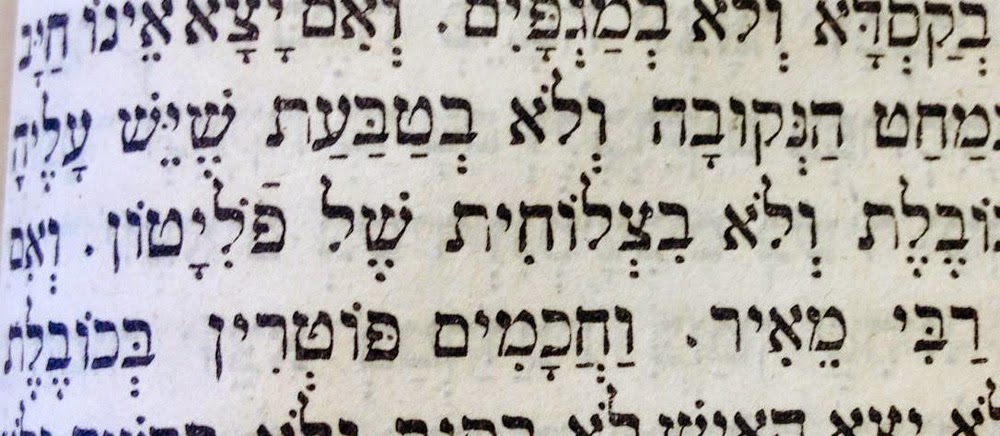
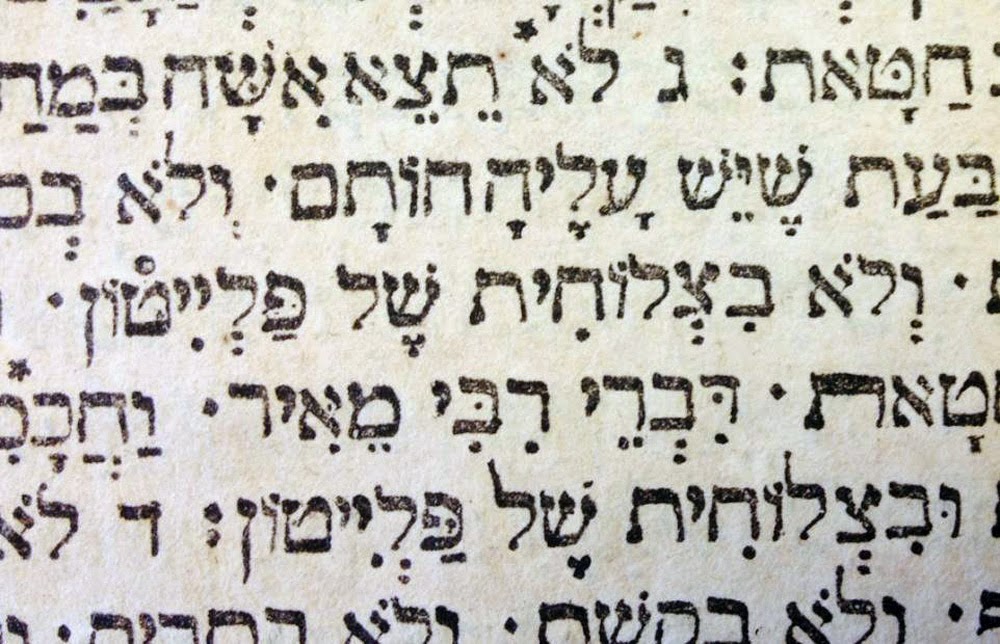
The laws of what a woman may or may not carry outside on Shabbos are discussed in Shabbos 6:3. Among the items prohibited is something called a “Tzlochis Shel Palyiton”, a flask of “Palyiton.” Jastrow defines this word as “an ointment or oil prepared from the leaves of spikenard”. He adds that its origin is the Latin word “foliatum”. The Latin Lexicon website spells this word foliātum and gives the exact same definition. So how should this Latin word be spelled in Hebrew?
Rav Wertheimer indicates that it should be pronounced something like “Folia’tone”which is pretty close to the Latin word except for there being an “n” sound at the end of the word instead of the “m” sound.
I have a Mishnayos printed in Pisa during the same time period (1797) which makes it look more like “Pal’yi’tone”:
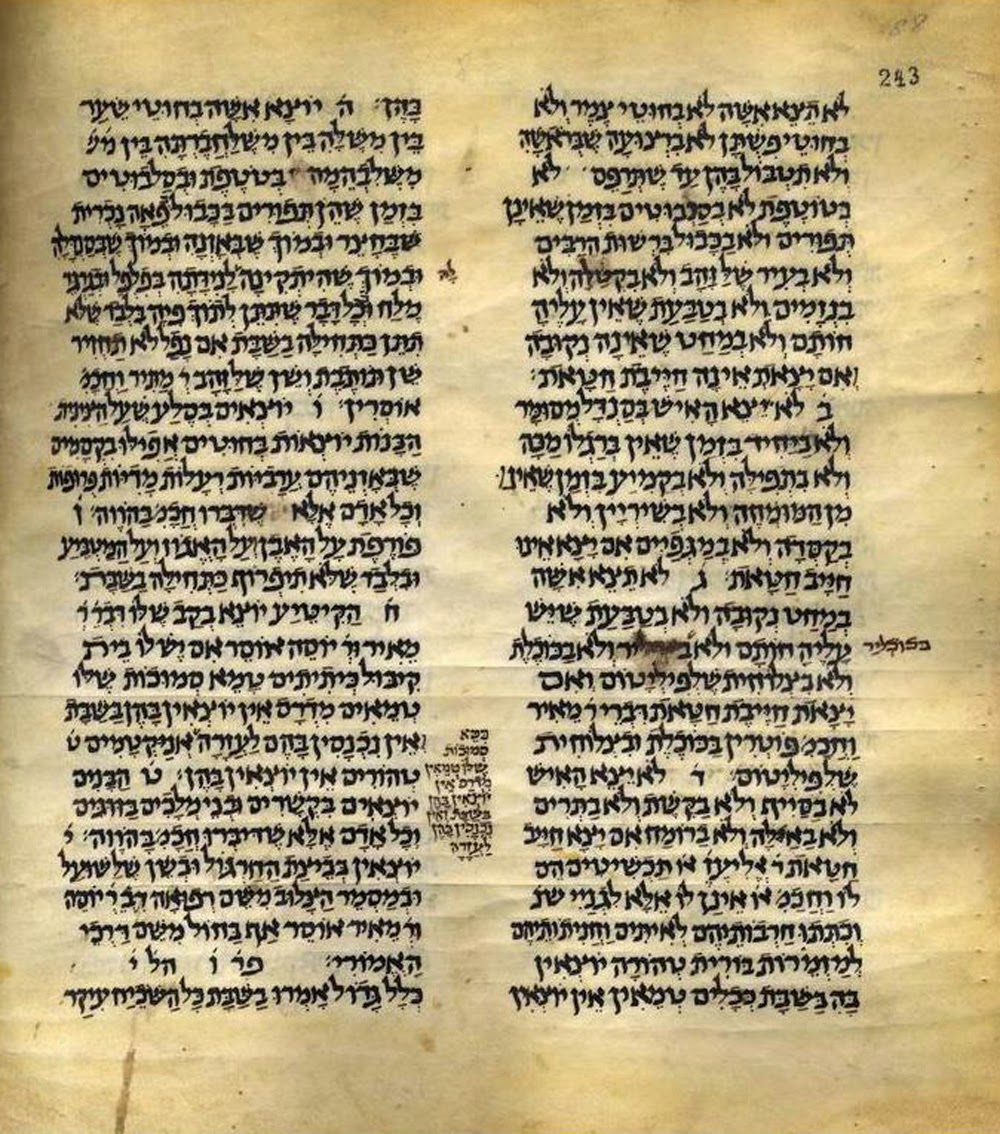
Two very old manuscripts of the Mishneh shed some light on how the word was originally spelled. One of the most famous is known as Codex Kaufmann ( MS Kaufmann A 50) which was written in 10th or 11th century Palestine. There we find the word looking more like “Pil’Ya’Tome”, with an “m” sound at the end:
The Parma manuscript referred to as MS Parma, De Rossi 138 written in 1073 has it the same as Kaufmann.
In recently printed Mishnayos such as from Feldheim, Artscroll, Steinsaltz, and Blackman, the word is spelled “פלייטון” with either a Patach ,Chirik, or “Shva”  under the “Peh”, or “פולייטון”, which looks more like Rav Wertheiner’s rendering.
One thing is clear- it is sometimes very difficult to write a foreign word with Hebrew letters and vowels, and it is also difficult to ascertain which version is “correct”.
Another wonderful aspect to the book that I bought was learning about the man whose name is embossed on the front cover. He is listed as יוסף אשר בן כ״ה (כבוד הרב) משה פאלאק   
We know a bit about Yosef Asher Pollock from some of the other books and manuscripts he owned. The following two citations are from the online catalogue of the Israel National Library:
1. A manuscript written in the 19th century by Chaim ben Yaakov Abolofia.
תקנות קהלת איזמיר. ‬
Los Angeles – University of California 960 bx. 1.9
ותו הספר: “מספרי יוסף אשר פאלאק ז”ל” משנת תרפ”ה. ‬
From this record we know that he had passed away before 1925 and that the manuscript is now in Los Angeles.


2. A manuscript written in the 18th century
(ספר הכונות (חלק שבת ומועדים. 
Amsterdam – Universiteitsbibliotheek MS Rosenthal 567
בראשו תו ספר של הבעלים “יוסף אשר פאלאק
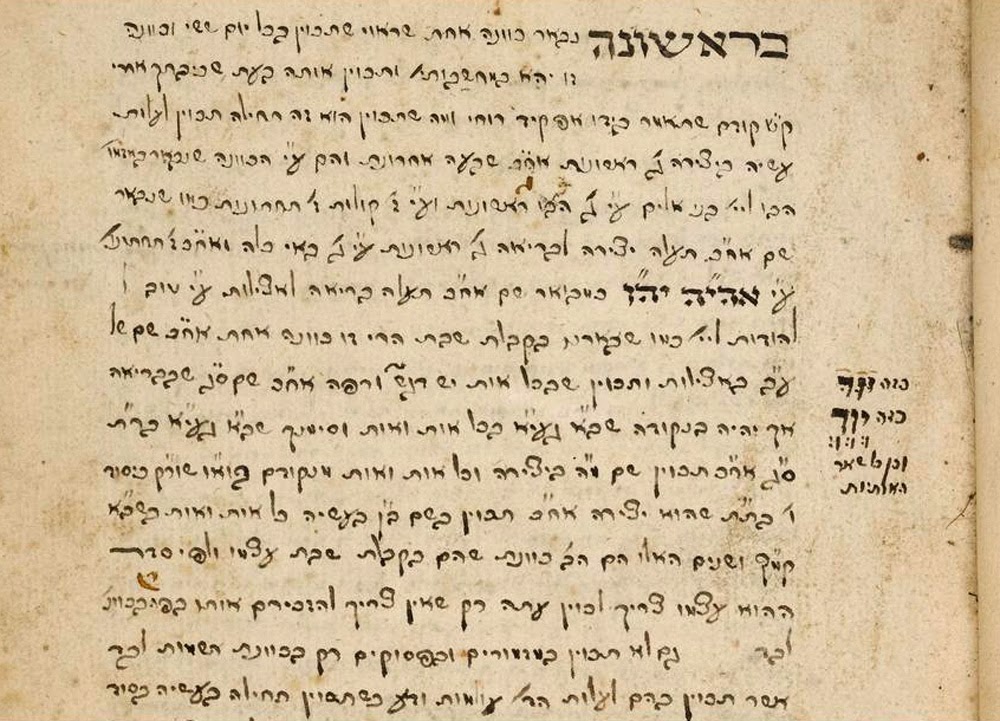
This rare manuscript has been scanned and is available online. The first page looks like this:
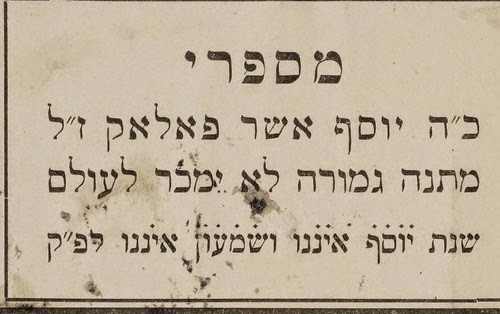
From this one we also learn quite a bit more about Yosef Asher Pollock because it contains this bookplate on the inside front cover

We surmise from here that this was not the only book he had that was donated, as someone went to a lot of trouble composing and printing such a heartfelt donation plate. (“ Yosef is not here, nor is Shimon”) The year the bookplate was printed was 5693(1933). There is also a stern warning that since this is a gift, it may never be sold by the recipient.   

The history of the Bibliotheca Rosenthaliana in Amsterdam is also interesting, especially how the collection of Judaica survived the Nazi occupation. The library’s website notes the following:
“The Germans closed the Bibliotheca Rosenthaliana in the summer of 1941 and transported part of the collection to Germany, where it was earmarked for Rosenberg’s ‘Institut zur Erforschung der Judenfrage’.
Happily, these plans were thwarted with the German capitulation. Most of the boxes of books were in storage in Hungen, near Frankfurt am Main, where they were found and shipped back to Amsterdam. But the curator and his assistant together with their families had also been deported-for them there was no return”
Finally, it seems clear to me that my book was also a gift never to be sold. I surmise this from the fact that the name of Yosef Asher Pollack is beautifully embossed on the front cover of the Siddur, making it unnecessary to have an ownership bookplate inside the Siddur.
Nevertheless, on the inside front cover there is a rectangular remnant of a bookplate which has been torn off.  
Coincidentally, its size exactly matches the bookplate of the manuscript donated to the Bibliotheca Rosenthaliana, which contained the admonition of not selling the book. Tearing off this “warning label” enabled the book to be sold, something that most likely happened over time to many books that were donated to libraries.
___________________________________________________
[1] Friedberg, History of Hebrew Typography, Antwerp: 1937, 49.  Although Dr. Levi’s production may have slowed, the bases for Freidberg’s assertion that Amsterdam publishing was affected by the Thrity-Year War is uncertain.  During the 18th century, production of Hebrew books in Amsterdam ranges from 82 to a high of 246 per decade.  The 1730s, the period that Tikkun Shlomo was published, is in the mid-range of those two extremes, with 145 books published between  1730-39.
[2] This work is a single sheet broadside and begins with Moda’ah raba . . . Zikhron Le-veni Yisrael.  
[3] For a summary of his arguments, see Petuchowski, Prayerbook Reform in Europe, New York, NY: 1968, 53-54.


From Print to Pixel: Digital Editions of the Talmud Bavli

From Print to Pixel: Digital Editions of the Talmud Bavli

Ezra Brand

Ezra Brand is an independent researcher who resides in Tel Aviv. He has an MA from Revel Graduate School at Yeshiva University in Medieval Jewish History, and has studied in the Talmud Department of Bar-Ilan University. He has contributed a number of times previously to the Seforim Blog (tag), and a selection of his research can be found at his Substack blog. His most recent major work is a “Guide to Online Resources for Scholarly Jewish Study and Research”. He is currently working on an overview of names and naming in early Jewish literature. He can be reached at ezrabrand@gmail.com; any and all feedback is greatly appreciated.

Intro – the tzurat hadaf[1]

It is a surprising fact that despite incredible advancements in technology, the layout of the Talmud has remained the same for centuries. The Bomberg edition from the 16th century, a groundbreaking achievement, still sets the standard. Yoel Finkelman writes in his recent, impressive overview of the layout of the printed Talmudic page:[2] “What is remarkable about the Gemara’s mise-en-page (the term for tzurat ha-daf in the academy) is not its invention, but its staying power as the normative way to produce texts of the Talmud.”[3] Finkelman then delves into the “history of the tzurat ha-daf of the Gemara.”

For an illustration of the lengths to which traditional publishers have gone to preserve the traditional tzurat hadaf, even in the 21st century, see Elli Fischer and Shai Secunda’s 2012 review article of the then-just-released “Artscroll Digital Library Schottenstein Talmud (English) App”, for the iPad:[4]

Since this elucidation is significantly longer than (and, in fact, already includes the actual text of) the Hebrew/Aramaic original, each Vilna page ends up being reproduced two to five times for every English page (a grey bar shows the reader which segment of the Vilna corresponds to the facing elucidation). This decision, both brilliant and perverse, added well over 10,000 pages, bringing the entire series to 73 volumes. The perversity of adding 10,000 apparently superfluous pages is obvious, but the brilliance of the decision was that it always kept the “original” page before the reader.

The digital daf

At the outset, Finkelman (in the above-mentioned article) highlights that the material manifestation of the written word can be broadly attributed to three factors: 1) The technological and material resources that are utilized to create and disseminate texts, 2) The economic and market forces that influence the demand for knowledge and education, and 3) The cultural perceptions of the role and function of language.[5] The ongoing decline in printing costs during the 20th and 21st centuries, coupled with the increasing accessibility of education, have led to significant advancements in all these factors.[6]

The advent of the internet has opened up entirely new avenues for publishing and designing the daf. Furthermore, for the very first time, readers have the opportunity to customize their reading experience, tailoring it to their unique preferences.

One popular author writes:[7]

“After more than a thousand years as the world’s most important form of written record, the book as we know it faces an unknown future. Just as paper superseded parchment, movable type put scribes out of a job, and the codex, or paged book, overtook the papyrus scroll, so computers and electronic books threaten the very existence of the physical book.”

However, one could plausibly say that the claim of the death of books has been greatly exaggerated. Physical books continue to be highly popular, and their sale has only continued to grow. And Orthodox Jews have yet an additional incentive to continue to buy physical books, as they can’t use ebooks on Shabbat and Chag. Regardless, there’s no question that we are in the middle of a decades-long revolution in how we have the ability to consume text, if one so chooses.

Despite the vast technological advancements that have revolutionized publishing, the digital daf is a peculiar return to pre-printing press methods in at least one regard: nowadays, the Talmud can be studied in isolation, without the surrounding commentaries. Most of the layouts that will be examined below diverge from the traditional tzurat hadaf that has been preserved for more than four centuries. In this way, they resemble the medieval Talmudic manuscripts, which include only the Talmud itself (sometimes accompanied by Rashi’s commentary).[8]

Let’s turn our attention to another aspect that Finkelman highlights: the groundbreaking nature of implementing a universal pagination system. Bomberg himself astutely utilized pagination and indexing as a key selling point.[9] Similarly, one of the numerous revolutionary features of digital editions such as Sefaria and Al-HaTorah is the capacity to reference not only the daf and amud, but also the section number. (I’ll explain the specific details of this later in this piece.) One can cite using section number, and hyperlink directly to that section. Every amud has around 10-15 sections, so this narrowing down is considerable. Even without reference to a specific section, checking a reference is far easier in a digital edition: with a simple “control + f”, one can search for a word from the quote. Gone are the frustrating days of scanning a giant wall of text in an amud to find a quote.

What will be discussed in this review

My focus here will be on modern editions that are available open-access digitally, online.[10] Therefore, I won’t review modern print editions.[11] I will also not review digital editions that, in my opinion, are inferior in every way to the editions discussed here.[12] And I won’t discuss editions targeted towards beginner students.[13]

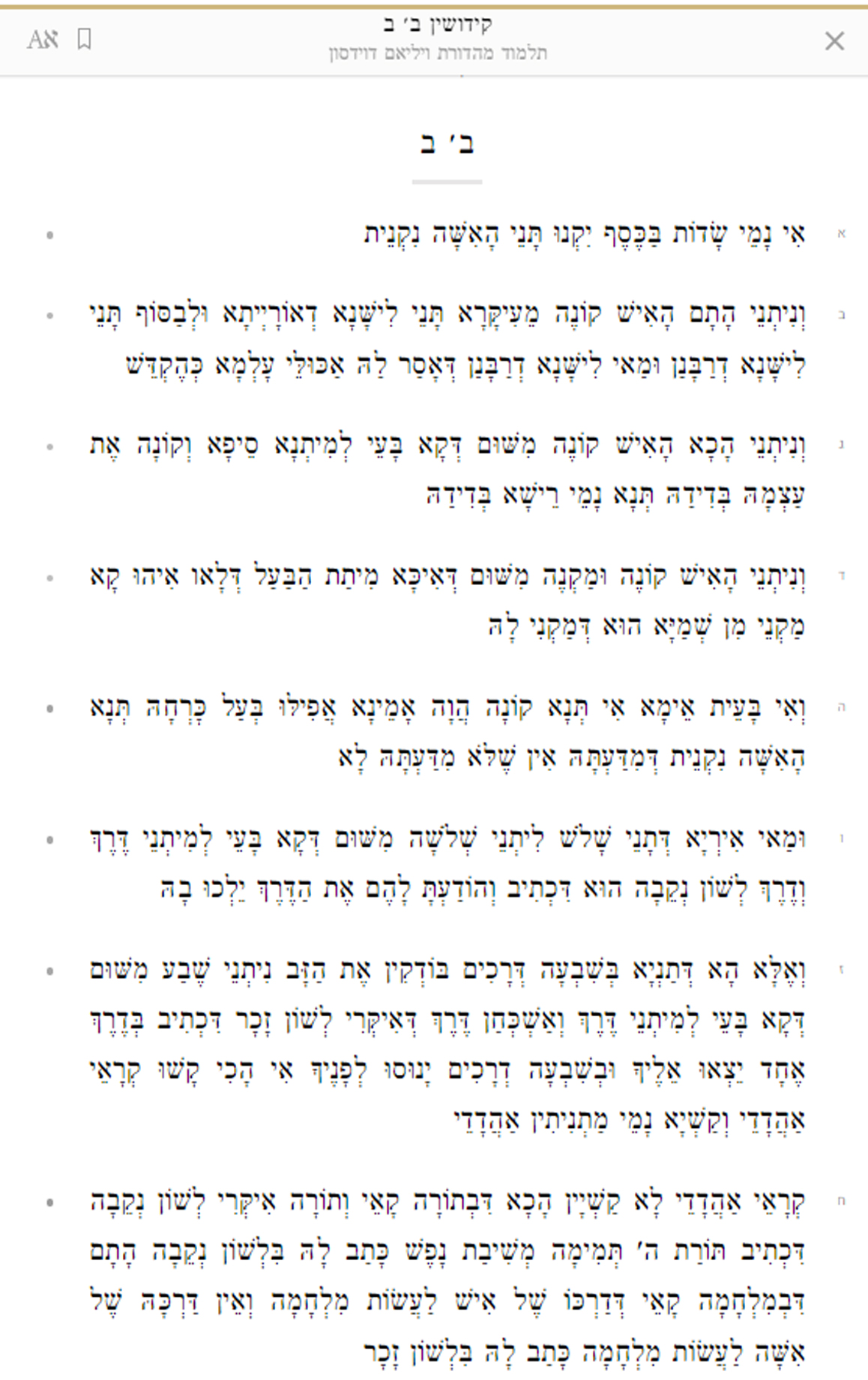
As one of the resources exclusively pertains to Kiddushin (Katz’s Mahberot Menahmiyot), my sample will be from Tractate Kiddushin, specifically Kid. 2b, which solely features the Gemara without the Mishnah. Images will only be of Gemara, Rashi, and Tosafot, meaning that, I will exclude the surrounding glosses (Mesoret HaShas, etc). I will not be discussing supplementary texts and commentaries, and hyperlinks to outside sources that each has.[14] I will be discussing different customization and viewing options.

Another caveat: This piece is focused on layout, and so it will not discuss the textual accuracy of the editions.[15]

An interesting element of modern editions is the typography; specifically the choices of font. However, this will not be discussed here.[16]

Outline

Intro – the tzurat hadaf 1
The digital daf 2
What will be discussed in this review 4
Outline 5
Tzurat hadaf AND customizable 6
Mercava 6
Shitufta 7
Static PDF 9
Mahberot Menahmiyot (=MM) 9
Gemara Sedura HaMeir 10
Talmud HaIgud – Society for the Interpretation of the Talmud (האיגוד לפרשנות התלמוד) 12
Digital, not customizable 14
Wikisource 14
Pirkei Talmud Me’utzavim – R’ Dan Be’eri 15
Talmud Or Meir 18
Dicta 19
Digital and customizable 20
Sefaria 20
Al-Hatorah 22
Speculation on the future 24
Concluding Thought 27

Tzurat hadaf AND customizable

Mercava

At present, Mercava contains only Tractate Berachot. It includes a menu option that enables users to toggle punctuation and nikud. It is also worth noting that Mercava is presently in beta version, as stated explicitly by the page header. Many of the menu options are grayed out or non-functional, resulting in a suboptimal user experience. Often, it seems that two features cannot be employed simultaneously, without any discernible explanation.

Shitufta

Quite basic. It has section splits, which are the same as those of Sefaria and Al-Hatorah.[17] Like them, it enables linking to a specific section. However, it diverges from the section numbering in Sefaria and Al-Hatorah by commencing from 0 instead of 1, resulting in all section numbers in Shitufta being one less from those of Sefaria and Al-Hatorah.

Static PDF

Mahberot Menahmiyot (=MM)[18]

By Prof. Menachem Katz.

Image of Talmud text, from p. 3, line # 7:

MM is a static PDF. It divides every sentence into a separate line, as opposed to splitting into larger blocks of sections. The lines are numbered. It offers complete punctuation, without nikud.[19] MM displays citations for biblical verses, Mishnah, and Tosefta, as well as additional features discussed in the introduction.

Gemara Sedura HaMeir [20]

With punctuation, and split by line.

Talmud HaIgud – Society for the Interpretation of the Talmud (האיגוד לפרשנות התלמוד) [21]

The text is split into lines and numbered, similar to MM. Due to the nature of the work, the primary purpose of the Talmudic text in the Talmud HaIgud is not for its own sake, but to serve as a basis for subsequent commentary.

Digital, not customizable

Wikisource[22]

The crowd-sourced Wikisource is a sister-project of Wikipedia. It is replete with hyperlinks to primary sources, and to external secondary sources. Like MM, the text contains punctuation but not nikud. Instead of using numbered sections (like Sefaria and Al-Hatorah) or lines (like MM), the text is divided into unnumbered paragraphs. Moreover, these paragraphs are longer than those found in Sefaria and Al-Hatorah.

Pirkei Talmud Me’utzavim – R’ Dan Be’eri[23] [24]

Available as downloaded Word docs, from the Da’at website, for a few chapters. I consider this to be not customizable.[25] Has nikud, punctuation, and is split into numbered lines.

Talmud Or Meir

Has nikud, punctuation, and is split into numbered lines. While there are technically some customization options available, they are limited in scope.[26]

Dicta

Dicta has a suite of powerful tools, which combined could make for an incredible studying experience. These include automated tools for nikud and for Biblical sources.[27] Unfortunately, at this time it appears that the only way to view a passage of Talmud is via search results. There, a link is offered to the page in Sefaria. There is a section called Library, with powerful tools for reading rabbinic works, but only 300 works are currently offered there.[28]

Here’s a screenshot, of what appears after searching the first words of Kidushin 2b (“אי נמי שדות בכסף יקנו”), opening the first result, and scrolling to 2b:

Digital and customizable

Sefaria[29]

Image of customization options:

Splits into numbered sections. In our example, there are 15 sections. The default Hebrew doesn’t split these into paragraphs, but there is an option to split into paragraphs. Many tractates have nikud, some have punctuation. Our example page doesn’t have punctuation, even though it shows that option. Sefaria gives the option to remove nikud. As mentioned, as with Shitufta and Al-Hatorah, one can hyperlink to a specific section.

Al-Hatorah[30]

The section numbers in circles on the right side of the page are hyperlinked, which is a convenient feature. In the example page we are looking at, there is no nikud, unlike Sefaria. However, there is a period after each section, which provides a slight advantage over Sefaria‘s lack of punctuation, as it helps to break up the passages when viewing with no section breaks.

While Al-Hatorah also includes hyperlinked sections, it does not explicitly label which section is which, unlike Sefaria. Therefore, finding a specific section requires trial and error. As with Shitufta and Sefaria, it is possible to hyperlink to a particular section in Al-Hatorah.

One notable difference is that Al-Hatorah does not expand acronyms, as Sefaria does. For instance, מט is not expanded to מאי טעמא, and אבא is not expanded to איבעית אימא.

Speculation on the future

Secunda and Fischer, in the faraway land of 2012 (cited at the beginning of this piece), envision a future Talmud app:

“First of all, it would be a virtually borderless intertextual web. Talmudic passages that shed light upon one another would be linked in intricate overlapping networks. Passages citing earlier texts—biblical verses, the Mishnah, other rabbinic texts, the apocrypha—would be hyperlinked to the collection in which the cited text originally appears. Passages would also link to later commentaries, super-commentaries, relevant excerpts from legal codes and responsa, manuscript variants, monographs, homiletic interpretations, and, indeed, translations and elucidations. Discussions of Akkadian medicine would call forth images of Babylonian tablets. People, places, historical events, concepts, practices, and all sorts of other realia mentioned in the text would link to relevant explanatory pages, pictures, recordings, and video clips. […] [T]wo new Jewish text websites, themercava.com and sefaria.org, offer promising platforms for crowd-sourced translation, commentary, and discussion of the Bavli and other Jewish texts. […]”[31]

While some aspects of this idealistic vision have been realized, many others have not, at least not yet. Moreover, it remains unclear whether a more crowdsourced and social-media-oriented approach, (suggested in an un-cited part of Secunda and Fischer’s article), would even be desirable. In retrospect, the year 2012 was marked by somewhat utopian thinking, with Wikipedia and Facebook having recently achieved great success in spreading knowledge and connecting people worldwide. It seemed only natural to aspire to something similar in the realm of literature. However, today, with greater awareness of the unpredictable dynamics of such systems (such as misinformation), it is far from clear that such a goal is attainable or even desirable.

In my view, Sefaria, Al-Hatorah, and Dicta are the most promising candidates for realizing the immersive and highly hyperlinked experience envisioned by Fischer and Secunda. Once this is achieved, the resulting research tools are likely to be extremely powerful as well. However, the idea of leveraging comparative sources, as described by the authors, still seems quite far off, particularly with the current set of available tools.

Regarding the social and chavruta aspect discussed by Fischer and Secunda, a new possibility has emerged that was not even envisioned a year ago: an artificial intelligence-powered chavruta. I recently experimented with ChatGPT by providing it with the first paragraph of Kidushin 2b.[32]

As usual, ChatGPT demonstrated impressive coherence and confidence. However, it provided laughably incorrect interpretations. In fact, in some cases, it provided interpretations that were the exact opposite of the correct one.

I conducted a comparable test by inputting a paragraph of Ramban’s commentary on that sugya, requesting an explanation from ChatGPT. To my surprise, ChatGPT provided a reasonably good rephrasing in English. Although some of it was correct and some of it was incorrect, even the incorrect part was not entirely off. However, ChatGPT still requires further yeshiva study before being able to serve as a teacher.[33]

Given the rapid advancements in artificial intelligence and large language models, it appears highly likely that AI will continue to improve its ability to interpret the Talmud, along with all other sources, including digitized manuscripts. It may not be long before we turn to AI to obtain the ultimate p’shat in the Talmud.[34] Furthermore, there is a possibility that AI could eventually bring comparative sources to bear, as previously mentioned.

To update the speculative future envisioned by Fischer and Secunda, my ideal Talmud study experience would be an app with a GPT plug-in acting as a virtual chavruta/Rebbe, to interpret text and answer questions. In fact, something like this is already being tested by Khan Academy.[35]

With current tools, it will even be possible to create a virtual shiur.[36] In the future, it could even be live and interactive, happening in real time.

Another interesting idea that is ripe to be explored is visualization of the Talmudic text. This was put to the test by Yael Jaffe, in a 2015 Columbia dissertation.[37] Jaffe writes in her abstract (bolding is mine):

“This study investigates the effect of access to a visual outline of the text structure of a Talmudic passage on comprehension of that passage. A system for defining the text structure of Talmudic passages was designed by merging and simplifying earlier text structure systems described for Talmudic passages, following principles taken from research on text structure. Comprehension of two passages were compared for students who did traditional reading of a Talmudic passage (the passages had punctuation added, and a list of difficult words and their meanings was appended) (the control condition), and students who read the passage with these same materials as well as with an outline of the text structure of that passage (the experimental condition) […]

The results provide evidence that awareness of the text structure of a Talmudic passage helps readers when the passage is concrete and somewhat well organized. ”[38]

It is interesting to note that Jaffe’s control group had punctuation added. There is, in fact, no good reason why the punctuation should not be added to all the standard Vilna-Romm editions. This is something that I did as a matter of course in my gemaras in my yeshiva days, and I presume that I was not the only one.[39]

Concluding Thought

Will there ever be a single Talmud application to rule them all, similar to how the Bomberg layout remained the standard for 500 years, and continues to do so? Such a scenario is improbable and perhaps even unwanted in today’s rapidly changing and complex digital landscape. It would suggest a lack of progress. We may have to wait for the arrival of the Messiah or, at the very least, the AI singularity to provide the ultimate Talmud super-app.

[1] This piece was written as part of preparation for the workshop “Editions of Classical Jewish Literature in the Digital Era”, to be held at University of Haifa, June 18-20, 2023, at which I’ll be presenting. I want to express my gratitude to Menachem Katz for his efforts in organizing that workshop, and for inviting me to speak there. I’d also like to thank Eliezer Brodt for his helpful comments on an earlier draft of this piece. I would also like to thank my father, my brother, and S. Licht for reviewing, making suggestions, and helping clarify in conversation some of the ideas discussed.
[2] 
Finkelman, ”From Bomberg to the Beit Midrash: A Cultural and Material History of Talmudic Page Layout”, Tradition (Winter 2023), Issue 55.1, p. 14. I’d like to thank Eliezer Brodt for bringing this article to my attention.
[3] Immediately before, he writes (my bolding): “[T]he famous and ubiquitous tzurat ha-daf (page layout) of the Gemara was never exclusively by Talmudists for Talmudists. It was a common practice for producing non-Jewish European glossed texts in manuscript and later print from the high middle-ages though the sixteenth century. Some copyists and later printers of the Gemara—whether those printers were Jews or not—adopted it from contemporary Christian textual production.” This point is also made by Michele Chesner, in her interview on the Seforim Chatter podcast: “With Michelle Chesner discussing old books, Seforim, and more” (April 29, 2020).
[4] “Brave New Bavli: Talmud in the Age of the iPad”, Jewish Review of Books (Fall 2012). Archived here.
[5] Finkelman, pp. 16-17.
[6] Relatedly, I have heard the theory a few times from Prof. Meir Bar-Ilan that the writing down of the Talmud may have occurred due to the spread of the Chinese invention of paper to the West in the early medieval period. For some work on when the Mishnah and Talmud were first written, with previous scholarship cited, see: Yaakov Elman, “Orality and the Redaction of the Babylonian Talmud”, Oral Tradition, 14/1 (1999): 52-99 ; Shamma Friedman, “The Transmission of the Talmud and the Computer Age”, in Sharon Liberman Mintz and Gabriel M. Goldstein, eds., Printing the Talmud: From Bomberg to Schottenstein (2005), pp. 143-154 (esp. pp. 146-148) ;

יעקב זוסמן, “‘תורה שבעל פהפשוטה כמשמעה: כוחו של קוצו של יוד“, מחקרי תלמוד ג, א (תשסה), עמ‘ 209-384 (נדפס שוב כספר ב– 2019) ; נחמן דנציג, “מתלמוד על פה לתלמוד בכתב: על דרך מסירת התלמוד הבבלי ולימודו בימי הביניים“, בראילן ללא (תשסו), עמ‘ 49-112.

[7] Keith Houston, The Book: A Cover-to-Cover Exploration of the Most Powerful Object of Our Time (2016), introduction (available via Amazon Kindle sample). He adds in a footnote: “It is worth introducing “codex” as a technical term: it means specifically a paged book, as opposed to a papyrus scroll, clay tablet, or any of the myriad other forms the book has taken over the millennia.”
[8]
Recently pointed out by Ari Zivotofsky in a Seforim Blog post (“The Longest Masechta is …”, March 31, 2023): “[I]t is worth noting that ambiguity regarding sizes of masechtot only arose when commentaries began to be put on the same page as the text of the gemara. In other words, until the era of the printing press there was no ambiguity as to which masechta was the longest.” See also Finkelman, pp. 18-19 ; Friedman, “Printing”, p. 148. The early Soncino editions also only contained the Gemara and Rashi, see Finkelman, pp. 22-24. And see the recent statement of Yehuda Galinsky (bolding is mine): “The end of the thirteenth century witnessed a discernable growth in the composition of glossed works in Ashkenaz. It was from this time onwards that authors penned influential talmudic and halakhic works from France and Germany with the intention that they be accompanied by a supplementary gloss, which was to be copied alongside the text […] Instead, we find stand-alone commentaries that were copied separately from the text it was interpreting. In contrast to the well-known layout of the printed Talmud page, the writings of Rashi and Tosafot were written and usually copied as stand-alone commentaries and not as actual glosses to be copied on the same page.” (Judah Galinsky, “The Original Layout of the Semak”, Diné Israel, Volume 37 (2023), pp. 1*-26*, pp. 1-2.) A commenter to Zivotofsky’s blogpost pointed out that there is a print edition that contains only the Talmud (with supplementary indexes). It was printed 25 years ago. Here’s bibliographic info according to the National Library of Israel catalog entry:

תלמוד בבלי: כולל כל המשנה והמסכתות הקטנות : נערכו, סודרו והודפסו מחדש בכרך אחד, עם חלוקה לפסקאות, איזכורים מהמקרא, מלווים בשבעה מפתחות בסגנון אנציקלופדי, כולל מפתח ערכים אלפבתי, בעריכת צבי הפרייזלר הרב שמואל הבלין הרב חנוך הבלין (1998).

As an aside, Finkelman states (p. 18) that “The earliest [Talmudic manuscripts] are Geniza fragments from the ninth century”. However, see Friedman, pp. 147-148, that the earliest Talmudic manuscript is a scroll that can be dated to the 7th century.
[9] Finkelman, pp. 25-28. See also the interesting point by Finkelman, p. 41 (based on Jordan Penkower), that Bomberg was also the one to establish the standard method of citation for Tanach in the Jewish world: “In his first Mikraot Gedolot, Bomberg made a significant addition by adding chapter numbers and (in the second edition) verse numbers, features with little Jewish precedent which were based on thirteenth-century Catholic developments.”
[10] See my recent “Guide to Online Resources for Scholarly Jewish Study and Research – 2022”, where I discuss many of the resources discussed in this piece with more breadth. There I also discuss many of the resources excluded from this review for the reasons enumerated further. Bar-Ilan Responsa Project’s Talmud is online, but is not open-access. Bar-Ilan Responsa Project’s Talmud is linked from Yeshiva.org.il’s Talmud pages, top right of page. (See on Yeshiva.org.il in a later footnote.) That version of Bar-Ilan Responsa Project’s Talmud has punctuation, but no nikud, and is not split into sections/paragraphs, and is inferior in every way than the editions discussed here.

For the same reason (not open-access), I have not reviewed any editions on Otzar HaHochma, or other digital libraries which require a subscription.
[11]
Such as Vagshal, Oz VeHadar, Shas Vilna HeChadash, Gemara Sedura. See image here of layout of Gemara Sedura. (See Shimon Steinmetz’s interesting piece here on self-censorship in the Vagshal edition: “Vagshal’s revision of the history of the Vilna Talmud, or, One of the most egregious examples of censorship I have ever seen”.) The best completely static tzurat hadaf edition that I could find available online as open-access is the Moznaim edition, available at Daf-yomi and HebrewBooks. It is a PDF, simply re-typeset. There are also printed editions with punctuation, such as Steinsaltz-Koren; Oz VeHadar; and Tuvia’s. See these news articles from 2016 on Oz VeHadar’s (ongoing?) Talmud edition with nikud and punctuation: here and here. And see the National Library of Israel (=NLI) catalog entry here. See also the NLI catalog entry on Yosef Amar’s 1980 Talmud edition (17 vols.) with nikud based on Yemenite pronunciation, here. And see NLI catalog entries of Koren’s (ongoing?) Talmud edition with nikud and punctuation: Sanhedrin (2014) ; Bava Metzia (2015) ; Sukkah (2016) ; Bava Batra (2017) ; Kidushin (2018).
[12] So I won’t discuss the following: Kodesh.snunit ; Mechon Mamre ; Daf-yomi.com > “Text”. Daf-yomi.com’s “Chavruta commentary” and “tzurat hadaf” are indeed worthwhile. See previous note on Daf-yomi.com’s Moznaim tzurat hadaf edition. The Friedberg Project website Hachi Garsinan technically has a few digital editions of Talmud on their website, but they are all for the purpose of presenting the manuscript variants. So I won’t be reviewing that, since this piece is focused on layout and UX/UI, and in that regard, the edition is sub-par. (Again, this is not necessarily a critique, as this isn’t the point of those editions.) As I say further, in this piece I will not discuss the editions’ textual accuracy. For this reason, I also won’t discuss The Academy of the Hebrew Language’s Ma’agarim edition. Tashma.jewishoffice.co.ils Talmud shows promise, but for now seems to be inferior in every way than the editions discussed here. The website Yeshiva.org.il (פרשני ויקישיבה) has the Chavruta commentary of the Talmud. However, as mentioned, the original PDFs of Chavruta commentary are available on the Daf-yomi.com website, so in my opinion it’s clearly best to use that. There’s no advantage to the text version (except for the ability to copy-paste). Yeshiva.org.il’s Chavruta is fully editable, wiki-style. But I see that as a negative, as you don’t know what you’ll be getting.
[13] Such as Gemara Brura and The People’s Talmud. See more at R’ Josh Waxman’s blogpost, “Some excellent Talmud projects out there” (March 5, 2020).
[14] For example, Sefaria and Al-Hatorah have the Steinsaltz translation and commentary, and Wikisource has extensive links to other resources.
[15] Many of the textual elements of the Vilna-Romm edition have been superseded by better editions (though many are still incomplete). Some examples:

תלמוד: דקדוקי סופרים (השלם); הכי גרסינן

רשי: מהדורות פרופאהרן אהרנד

תוספות ; תוספות ישנים; רבינו חננאל : מהדורות רב קוק

עין משפט: עינים למשפט של ריצחק אריאלי (כל שבעה כרכים זמינים בהיברובוקס, לדוגמא, כאן)

מסורת השס: דקדוקי סופרים השלם; תלמוד האיגוד

ריף: מהדורת שבט

[16] For now, see Yakov Mayer in his recent ground-breaking book on the first edition of Talmud Yerushalmi (which was also printed by Bomberg’s press), who cites previous studies on typefaces used by Bomberg: Yakov Z. Mayer, Editio Princeps: The 1523 Venice Edition of the Palestinian Talmud and the Beginning of Hebrew Printing (2022, Hebrew).

See also the recent book by Simon Garfield, Just My Type: A Book About Fonts (2011 ) for a fascinating, well-written, popular overview of typesetting and fonts. On medieval handwriting styles of Hebrew, see the monumental 3-volume series, under Malachi Beit-Aryeh’s editorship (each area is a different volume):

מפעל הפליאוגראפיה העברית, אסופות כתבים עבריים מימיהביניים (1987-2017)

On second temple era styles, see the various works by Ada Yardeni, especially:

עדה ירדניספר הכתב העברי: תולדות, יסודות, סגנונות, עיצוב (1991).

[17] It is unclear to me who first made these section splits. It’s a question I’d be quite interested in knowing the answer to.
[18] Links to all of parts of MM:

  1. אקדמות למהדורה של התלמוד הבבלימסכת קידושיןמחברות מנחמיות

  2. מסכת קידושין ב עא יד עב

  3. מסכת קידושין יד עבכה עב

  4. מסכת קידושין כה עבכט עא

  5. מסכת קידושין כט עאמא עא

  6. מסכת קידושין מא עאנח עב

  7. מסכת קידושין נח עבסט עא

  8. מסכת קידושין סט עא פב עב

Compare Katz’s similar work on Yerushalmi (which also includes textual variant apparatus, and short commentary, unlike his work on Bavli), available at his Academia.edu site: “פסחן ומצתן של נשים Women on Passover and Matzah”.
[19]
 I personally prefer this style (punctuation, without nikud). See my discussion later.
[20] Tractate Sukka, p. 2 (ב). Not to be confused with Gemara Sedura (no HaMeir). Currently available online: Tractate Sukka (2013, here) and Tractate Avoda Zara (2015, here). See more on the project here.
[21] From the latest volume available online:

נתנאל בעדני, סנהדרין פרק חמישי (תשעב), עמ‘ 4.

See more on the project here.
[22]
See more on the project here.
[23] See also some of R’ Be’eri’s other editions, available on Da’at website, here and here. On R’ Be’eri, see the Hebrew Wikipedia entry on him: דן באריויקיפדיה
[24] Screenshot of downloaded Word document.
[25] To explain: Even though everything in the Word doc can be customized, this isn’t built into the website. Any of the editions in this “Digital” section can be pasted into a Word document and customized.
[26] Notably, the text itself is actually an image, which makes copying it impossible.
[27] Dicta was started by Prof. Moshe Koppel of Bar-Ilan University. He has contributed to Seforim Blog.
[28] As of 15-Apr-23.
[29] See more on the project here.
[30] See more on the project here.
[31] Compare also, at length, Friedman, “Printing”, pp. 150-154 ; Shai Secunda, “Resources for the Critical Study of Rabbinic Literature in the Twenty-First Century” in Compendia Rerum Iudaicarum ad Novum Testamentum (CRINT) 16, Christine Hayes (ed.), (2022), pp. 621-632.
[32] On 15-Apr-23, at https://chat.openai.com/.
[33] I should point out that I did not have access to GPT-4, which is the latest version of GPT. So I could not test whether GPT-4 is more capable at interpreting Talmud. For a discussion of some sources of the Yeshivish dialect of English possibly used as datasets for training ChatGPT-4, see my “From the Shtetl to the Chatbot: Some contemporary sources of Yeshivish content, in light of ChatGPT-4”.
[34] For some preliminary algorithmic research on the Talmud, see, for example, Satlow M., Sperling M. (2017). “Naming Rabbis: A Digital List”; Satlow M., Sperling M. (2020), “The Rabbinic Citation Network”; Satlow M., Sperling M. (2020). “The Rabbinic citation network”, AJS Review ; Zhitomirsky-Geffet M., Prebor G. (2019), “SageBook: toward a cross-generational social network for the Jewish sages’ prosopography”, Digital Scholarship in the Humanities, 34(3), pp. 676–695 ; “A graph database of scholastic relationships in the Babylonian Talmud”, Digital Scholarship in the Humanities, Volume 36, Issue Supplement_2, October 2021, Pages ii277–ii289, https://doi.org/10.1093/llc/fqab015, Published: 22 February 2021. See also Shira Shmidman, “Self-Evident Questions and Their Role in Talmudic Dialectic”, AJS Review (2023), p. 128: “Recently, I analyzed talmudic questions (that open with the phrase baʿei or beʿah minei) and discovered that by charting the questions by the generation in which they were asked, one can identify chronological trends of question asking in the Babylonian Talmud.”
[35] See Sal Khan, “Harnessing GPT-4 so that all students benefit. A nonprofit approach for equal access”, Khan Academy Blog (March 14, 2023). See especially this description: “Khanmigo [=the AI tool] engages students in back-and-forth conversation peppered with questions. It’s like a virtual Socrates, guiding students through their educational journey. Like any great tutor, Khanmigo encourages productive struggle in a supportive and engaging way.” For fun, I asked ChatGPT for a clever name for an AI chavruta/Rebbe. It gave me ten options. One of them is a great one (ChavrutAI), while three of them were hilarious ( AIvrumi; AIsh Torah; RoboRabbi). RoboRabbi could provide many of the intellectual aspects of being a rabbi: psak, eitza, questions in learning, and divrei torah.
[36] With tools like ChatGPT (content), ElevenAI (voice), D-ID (video), one can create any style of shiur. See my “Heimish High-Tech: Video in Yeshivish dialect using Generative artificial intelligence”. For training sources for the Yeshivish dialect, see my article: “From the Shtetl to the Chatbot: Some contemporary sources of Yeshivish content, in light of ChatGPT-4”.
[37] Jaffe, The Relevance of Text Structure Strategy Instruction for Talmud Study: The Effects of Reading a Talmudic Passage with a Road-Map of its Text Structure (2015). See especially ibid. Appendix E (pp. 103-104).
[38] On visualizations, see also this article, and the bibliography cited there:

יעקב אמיד, “עיצוב ייצוגים גרפיים של דיון תלמודי: תחום דעת מתחדש בהכשרת מורים להוראת תלמוד

See also the lengthy intro of Menachem Katz to his Mahberot Menahmiyot (discussed earlier), with relevant bibliography. One good existing resource for outlines and charts for Talmud is Daf Yomi Advancement Forum – Kollel Iyun HaDaf. See Josh Waxman, “Some excellent Talmud projects out there” (cited earlier), #2. A fascinating related project is that of R’ Dr. Michael Avraham on mapping out the logic of the Talmudic sugya, using the tools and notation of modern logic. See his massive series Studies in Talmudic Logic, currently at 15 volumes. Note the surprising claim made in the abstract of vol. 14 of the series (Andrew Schumann, ed., Philosophy and History of Talmudic Logic, bolding is mine): “The Talmud introduces a specific logical hermeneutics, completely different from the Ancient Greek logic. This hermeneutics first appeared within the Babylonian legal tradition established by the Sumerians and Akkadians to interpret the first legal codes in the world and to deduce trial decisions from the codes by logical inference rules. The purpose of this book is (i) to examine the Talmudic hermeneutics from the point of view of its meaning for contemporary philosophy and logic as well as (ii) to evaluate the genesis of Talmudic hermeneutics which began with the Sumerian/Akkadian legal tradition. The logical hermeneutics of the Talmud is a part of the Oral Torah that was well expressed by the Tannaim, the first Judaic commentators of the Bible, for inferring Judaic laws from the Holy Book.”
[39]
My suggestion for breaking the tzurat hadaf into sections: the pilcrow (¶). On the pilcrow, see the entertaining popular book, Shady Characters: The Secret Life of Punctuation, Symbols, and Other Typographical Marks (2013) by Keith Houston, chapter 1. (Available from Amazon for free as a Kindle sample.)

It should be pointed out that trop is an early medieval Hebrew form of punctuating the Biblical text. A few alternatives of punctuating the Torah arose in Geonic times.

On early nikud of Mishnah and Talmud, especially nikud bavli (we use nikud tavrani), see Yeivin:

ישראל ייבין, מסורת הלשון העברית המשתקפת בניקוד הבבלי (תשמה), פרקים בו.

I will point out the following: Tuvia’s edition adds nikud. But once one is past the beginner stage, nikud does little to enhance the reading experience, and in fact many readers find it a distraction. Modern Hebrew rarely uses nikud. Exceptions are for literature geared towards children and beginners (as noted), as well as instances where decoding is especially difficult, such as poetry, transliterated foreign words, and ambiguous words. In contrast, punctuation is a huge boost to faster comprehension, as Jaffe notes. Modern Hebrew texts use standard punctuation, like all modern languages.


The Lost Library by Dan Rabinowitz and the “Burial of Souls” by Yehuda Leib Katznelson: Different Expressions of the Same Sentiment

The Lost Library by Dan Rabinowitz and the “Burial of Souls” by Yehuda Leib Katznelson: Different Expressions of the Same Sentiment

By Rabbi Edward Reichman, MD

Having just completed Dan Rabinowitz’s superb book, The Lost Library, about the Strashun Library in Vilna, I am reminded of a remarkable, little-known short story written by a man who lived during the creation of the famous Strashun Library. He, like Rabinowitz, laments the loss of a famous Jewish library, though the literary nature of the lament differs. Rabinowitz has written a magnificent, captivating, thoroughly researched, historical lament. Our author has chosen the short story to metaphorically express his grief over the “loss” of one of world’s greatest Jewish libraries.

Yehuda Leib Katznelson (1846-1917),[1] a physician, poet, writer, and publicist of Hebrew Literature penned a short story in Hebrew entitled “The Burial of Souls.”[2] A summary of the story follows:

Stylistically based on Megillat Esther,[3] it tells the story of a man, Abul Said Ibn Alsalami, who possessed immense material wealth, and had everything one could wish for, save for one exception. As a child he neglected to study or read and his knowledge was sorely lacking. He realized that nothing could compensate for the lost opportunity and that he would never attain intellectual heights. His response to this fact comprises the substance of the story.

Essential to what follows is the notion that that every person is endowed with a soul while on this earth, a soul that departs and ascends to the heavens after death. However, those who amass much knowledge, and with the intent to share their knowledge and benefit others, commit their learning to paper in the form of a book, are granted an additional soul. This soul remains on earth even after the death of the author, and is embedded in the book he has written. This soul remains dormant until someone learns from this book. At that time the soul is reanimated and elevates the heavenly soul as well. In addition a new soul is replicated to dwell within the body of the book’s reader. While those with only a heavenly soul cannot advance their status after death, those with the additional soul can continue to accrue good deeds in perpetuity. For those who cannot author books, another option is available to obtain an additional soul. They can support houses of learning for those who cannot afford to study or hospitals for the poor and needy. The institutions can be called by the donor’s name and an additional soul will inhabit the walls of the building, surfacing when the children are learning or when the sick are being treated. Regretfully, Abul Said was either unaware or dismissive of the alternate track to obtaining a second soul, and had another more sinister plan.

Abul Said summoned his servant, Abdul Safran,[4] who served as his literary advisor and mouthpiece, and inquired if there was a list of all Hebrew books that have ever been written. The servant responded that indeed a man by the name of Azulai had compiled just such a list. The man instructed his servant to obtain a copy of every book on the list and to spare no expense. The servant scrupulously followed Said’s command sending messengers far and wide in search of every book on the list. The inhabitants of the land were all abuzz. What could Abul Said possibly want with all these books? He is no man of letters. Surely he desires to add a soul and build a massive public library for all to learn and study freely. Alas, Abul Said had other plans.

Meanwhile books arrived at the palace from all over the world. As there was insufficient place for the treasures, all the furniture of the palace was removed, and special shelves were built from floor to ceiling to line all the available walls. Each book was bound in special hand-crafted leather and labeled with gold leaf. Upon completion of the library, it was opened to the public for three days. The totality of the literature of the nation of Israel since its inception, all under one roof.

Abu Safran had succeeded in his mission and presented this remarkable library to Abul Said, though the former could not have been prepared for his master’s next request. “If we burn the entire library will this not curtail all Jewish knowledge?” Aghast at such a suggestion, Safran quickly thought to divert his master from such a plan. He succeeded in dissuading Said from his initial request and suggested the burial of the books instead. Abul Said was amenable to the suggestion, but stipulated that the burial should not be in a Jewish cemetery, but rather in cemetery far from the Jewish community where no one would have access. The servant reluctantly carried out the wishes of his master and the site was marked with a sign that read, “Here lies buried the spirit of Israel.”

And so it was, the entire library was unceremoniously buried in a non-Jewish cemetery. On the night after the books were interred, Abul Said was unable to sleep. He was ultimately drawn into the vast hall which just the day before had housed the library. Suddenly an apparition appeared before him. Where the books had once stood were now full size paintings of their authors, cloaked in shrouds. One painting slowly began to approach Abul Said, getting larger and larger as it drew nearer and nearer. “Do you recognize me!?” shouted the man in the painting. Abul Said was silent. “I am Chaim Yosef David Azulai! It is my book that you used as a guide to gather the books that you ultimately buried.” Azulai proceeded to vilify Abul Said for burying all the additional souls of the authors, thus depriving them all of the benefits when their books are learned on earth. The story concludes with Azulai relating Abul Said’s punishment and the latter’s entreaty to repent. While Azulai considered Said’s actions irrevocable, he nonetheless offered him the opportunity to make partial amends by supporting all future publications and restoring the library to its former glory for all to use.

I read this short story some years ago and found it compelling, though only recently did I come to the realization that Katznelson[5] had not conceived of this fictional tale de novo, but rather was likely expressing his lament about a factual historical event through the vehicle of this story.

Rabbi Chaim Yosef David Azulai (1724-1806) had indeed composed a monumental bibliographical work entitled Shem HaGedolim, which listed all extant Hebrew books until his time. In the course of his research for this project, he amassed one the world’s rarest and most comprehensive collections of Hebrew books and manuscripts up to his time. This is doubtless the work to which the servant Abu Safran refers in our story. When Azulai died, the collection was sold in its entirety by Azulai’s son to the Italian businessman Baruch Almanzi.[6] Almanzi’s son Joseph was a passionate bibliophile and poet and meticulously maintained and enhanced the collection, adding much valuable material. The great Judaica scholars of that time, including Zunz, Steinschneider and Luzzato, were welcomed into the Almanzi’s home to avail themselves of the treasures of this collection in pursuit of their research. In fact, Luzzato compiled a catalogue of the collection. When Joseph Almanzi died, however, there were apparently no heirs interested in maintaining the collection, and it was put up for auction. The name of the protagonist in our story, Alsalami, is perhaps derivative or reminiscent of Almanzi. The British Library purchased the manuscripts of the collection,[7] while the books were sold to an Amsterdam bookseller, ultimately finding their way to Temple Emmanuel in New York City, which subsequently donated the collection to Columbia University in 1893. Katznelson laments the “burial” of these precious books in a “non-Jewish cemetery,”[8] essentially precluding access to this library for the Jewish population who could benefit most from its use.[9]

I exhume this essay to both supplement and complement Rabinowitz’s lament of the loss of a great Jewish library. A number of elements of Katznelson’s story are reminiscent of the Strashun Library story – bookshelves from floor to ceiling covering every wall; open to the public with visitors from across the land; representative of the totality of rabbinic literature. Both the Azulia and Strashun collections began as the library of one scholar/bibliophile and were subsequently expanded and opened for broader access. Fortunately, however, the Strashun library books themselves remain accessible at a Jewish institution, though as Rabinowitz emphasizes, they are bereft of their unity as a distinct library and reflection of a remarkable period of intellectual Jewish history.

Perhaps the fate of the Hebrew book parallels the fate of the Jewish people, condemned to wander with only temporary respite. While the digitizing of large swaths of rabbinic literature, both print and manuscript, including parts of the Strashun Library, might partially mitigate our pain, there is no gainsaying the loss of the unity of the historically priceless Strashun collection. Let us hope that we will one day merit a permanent physical residence for the totality of Jewish/rabbinic literature,[10] but meanwhile, let us follow the instruction of Rabbi Azulai in our story and continue publishing books and supporting institutions for public access of Jewish knowledge. Rabinowitz’s remarkable contribution represents a historical continuation and expression of our longing to preserve the heritage of the books of our people, the people of the book.

[1] For a brief biography, see H. A. Savitz, “Judah Loeb Katznelson (1847-1916): Physician to the Soul of His People,” in his Profiles of Erudite Jewish Physicians and Scholars (Spertus College Press: Chicago, 1973), 56-61; On the literary contribution of Katznelson, see M. Waxman, A History of Jewish Literature 4 (Bloch Publishing: New York, 1947), 154-156. For his contribution, as well the contribution of others, to Biblical and Talmudic Medicine, see ibid., 702ff.

[2] For the full text of the story, see https://benyehuda.org/yogli/008.html. Katznelson introduces the story as a tale told to him as a child by his grandfather about events that transpired eighty years earlier. It is unclear to me whether this is factual or simply a literary device.

[3] The story is littered with literary and content allusions to the Megillah, which are literally lost in translation. My objective here is not to provide a full translation, nor to highlight these allusions, but rather to provide a summary of the story as it relates to our essay.

[4] Safran means librarian in Hebrew.

[5] Or perhaps his grandfather.

[6] The date of Rabbi Azulai’s death, and subsequent sale of his library, coincides with the time of the event mentioned in the story’s introduction, eighty years previous.

[7] See W. Wright, “The Almanzi Collection of Hebrew Manuscripts in the British Library,” The Journal of Sacred Literature and Biblical Record 9(1866), 354-365.

[8] The “burial” analogy was invoked regarding the loss of another important Hebraica collection in an article in Der Orient in 1846 cited by Ismar Schorsch, “Catalogues and Critical Scholarship: The Fate of Jewish Collections in 19th-Century Germany,” Tablet (December 28, 2015): “It is now nearly 20 years that a similar treasure, assembled for the same purpose, was shipped out of Germany to a remote corner of the scholarly world, where buried and inaccessible it is of no value to scholarship. … Let us not commit such a travesty a second time. May the new interest in Jewish scholarship that since then has been aroused contribute to fostering an appreciation for this vital task. It is a matter of honor for Germany, and especially for its Jews, that this collection remain here.”

[9] Katznelson’s story could have equally been written about other Jewish libraries, including the exceptional library of Moses Friedland, which Rabinowitz writes was sold in 1892 to the Imperial Library of St. Petersburg, where it lay “buried” and inaccessible to the Jewish readers. See D. Rabinowitz, The Lost Library (Brandeis University Press: 2019), 52-53. The library of Rabbi David Oppenheim was likewise “buried” in 1829 when purchased by the Bodleian Library of the University of Oxford.

[10] The National Jewish Library in Israel is continually bringing this dream closer to fruition. Another great Jewish library, the Valmadonna Trust Library of the late Jack Lunzer a”h, has been integrated into its collection, though a small portion of the collection was sold at auction.