Plagiarism, Halakhic Paradox, and the Malbim on Kohelet

Plagiarism, Halakhic Paradox, and the Malbim on Kohelet
by
Marc B. Shapiro
1. A story recently appeared alleging plagiarism in the writings of R. Yonah Metzger.[1] Such accusations are nothing new and the topic of plagiarism in rabbinic history is of great interest to me. Many of the scholars of Jewish bibliography have also written about the phenomenon,[2] and a good deal on the topic has appeared on the Seforim Blog.[3] Suffice it to say that every generation has had problems in this regard, and we see even see apparent instances of it in the Talmud.[4] The examples range from taking another’s ideas (including one’s teacher[5]), to copying sections of another work, to reprinting an entire book and changing the title page.[6] It is interesting that R. Moses Sofer, unlike others, is reported not to have been troubled by people plagiarizing from him. As he put it, he doesn’t mind if they attach his hiddushim to their names, as long as they don’t attribute their own hiddushim to him.[7]
R. Isaac Sternhell, in the introduction to his Kokhvei Yitzhak, vol. 1, gives a good illustration of how widespread the problem of plagiarism has been in explaining why R. Joseph Karo and R. Moses Isserles don’t mention anything in the Shulhan Arukh about the obligation to repeat a Torah teaching in the name of one who said it (itself of great importance, not to mention the geneivat da’at involved if one doesn’t give proper credit [8]). R. Sternhell states that that since so many people plagiarize, including תלמידי חכמים שיראתם קודמת לחכמתם, therefore, just like it is a mitzvah to say that which people will listen to, so too it is best to be quiet about something they won’t pay attention to [9]. R. Sternhell reports that this reason was actually given by R. Yissachar Dov Rokeah of Belz in explanation of why there is nothing in the Shulhan Arukh about the prohibition of leshon hara.[10]
והם מתוך שחששו מלהביא קטרוג על כלל ישראל התעלמו מדינים אלה בפסקי הלכה והשמיטום. ובכך קיימו דברי הנביא עמוס (ה’ ג’) והמשכיל בעת ההיא ידום
R. Sternhell then lists a few books that plagiarized, and the books from which they stole. The problem is that he only identifies the plagiarizing books by their initials, which makes identifying them quite hard.
Today we have Otzar ha-Hokhmah which makes spotting plagiarism easier. Let me share with you one example. I am a long time reader of the journal Or Torah, which is where so many of R. Meir Mazuz’s writings have been published. In Tamuz 5758 an article appeared by a certain R. Daniel Weitzman. Here are the first two pages. On the second page there is something suspicious, which I don’t know if anyone other than me would take notice of. He cites R. Weinberg’s famous responsum on abortion but instead of citing it from Seridei Esh, he refers to an earlier appearance in Ha-Pardes. This sort of thing immediately sets off bells for me, since how would a rabbi in Israel in the pre-hebrewbooks.org and pre-Otzar ha-Hokhmah era have access to a thirty-year-old issue of Ha-Pardes? How would he ever come to that? In fact, if you look at the article, it seems that he doesn’t even know what Ha-Pardes is, referring to it as Pardes. The title he gives to R. Weinberg’s article is also not correct and is taken from the source he plagiarized from.


Now compare what Weitzman wrote with what appears in R. Shmuel Hayyim Katz’s Devar Shmuel (Los Angeles, 1986).


Weitzman has not just plagiarized, but he has copied word for word from Katz. Needless to say, I was quite distressed when I saw this. Since it is rare that someone plagiarizes only once, I decided to check Weitzman’s other articles that appeared in Or Torah.

Here is an article from Tamuz 5757 (first page, but here is a link to the complete article).

This article is also plagiarized from R. Katz’s Devar Shmuel.

And here Weitzman’s article from Or Torah, Av 5758, and it too is plagiarized from R. Katz’s Devar Shmuel.


Here are the pages from Devar Shmuel:

With the aid of Otzar ha-Hokhmah I was able to find the following. Here is the first page of Weitzman’s article that appears in Or Torah, Heshvan 5761.

It is taken almost word for word from R. Mordechai Friedman’s Pores Mapah (Brooklyn, 1997).


Pores Mapah is not a well-known book (although it has much to recommend it), and having been published in the U.S. was probably hard to come by in Israel. This is the perfect sort of book for an Israeli to plagiarize from, and years ago it would have been virtually impossible for anyone to realize what had happened. Yet with Otzar ha-Hokhmah I was able to locate the plagiarism in a matter of seconds.
I think the explanation for plagiarisms like this is simply because people are greedy. They not only want that which they can achieve, but want to take from others as well. To once again cite the Gaon R. Mizrach-Etz, “a man’s got to know his limitations.”
Yet I must also note are cases of men who plagiarized in their early years but later became great Torah scholars, showing that a youthful error need not determine the course of one’s subsequent development.[11]
Sometimes, what appears to be a plagiarism has a much simpler explanation.[12] Here is a page from R. Moses Teitlebaum’s Heshiv Moshe, no. 87.

Compare this responsum with what appears in R. Abraham Bornstein, Avnei NezerHoshen MishpatLikutei Teshuvot no. 101. The responsa are basically identical except for the dates and addressee.

What is going on here? I think it is obvious that R. Bornstein had a handwritten copy of the responsum, which he presumably copied out of Heshiv Moshe, a work published in 1866. After his death the one who put together his responsa did not realize that this was a responsum of R. Moses Teitelbaum, so he published it adding Bornstein’s signature and a new date. He also assumed that when the original responsum referred to the questioner as ש”נ it meant שינאווי when in fact it means שיאיר נרו or שיחיה נצח. Furthermore, in the original responsum it states דבר זה מתורת משה ילמדני which is an allusion to the one being asked the question, R. Moses Teitelbaum. Yet this was overlooked when the responsum was included in the Avnei Nezer.

Here is another example of what has been alleged to be plagiarism.[13] It is a passage from the Beur Halakhah, 494, s.v. מבחודש השלישי.


Now look at the Shulhan Arukh ha-Rav, 494:8-11, and you can see that it has been copied word for word, even though at the end of the Beur Halakhah it states: זהו תמצית דברי האחרונים


What to make of this? One of the commenters on the site that calls attention to this text sees here an indication that the Hafetz Hayyim’s son was also involved in the writing of the Mishnah Berurah (as he claimed), since the Hafetz Hayyim himself would not do such a thing. Yet matters are more complicated than this, as there are also other places where the Mishnah Berurah copies word for word from the Shulhan Arukh ha-Rav (and presumably from others sources as well).[14] Are we to assume that these were all inserted by his son?

It appears that the Hafetz Hayyim’s conception of what was proper in using earlier sources differed from what is accepted today, much like standards were also different in medieval times. Furthermore, since the Hafetz Hayyim writes זהו תמצית דברי האחרונים, even from a contemporary perspective we are not dealing with plagiarism. But the question is – and I don’t have the answer – why in some places the Hafetz Hayyim did not indicate when he was taking material from the Shulhan Arukh ha-Rav. He does mention in the introduction that the Shulhan Arukh ha-Rav is one of the sources from which his own commentary derives its material, and he constantly refers to it, so why in this case is there no indication of his source? Maybe one of the readers can answer if the Shulhan Arukh ha-Rav is unusual in this regard, or if this is done with other sources as well. As far as I know, we don’t yet have an edition of the Mishnah Berurah that provides all the sources used in the text.
2. In Ha-Ma’ayan, Tishrei 5771 and Tevet 5771 there are articles on the idea of “Halakhic Paradox” by R. Michael Avraham and R. Meir Bareli. You can see Ha-Ma’ayan online here.
Here is another halakhic paradox that I found in the journal Ohel Yitzhak, Sivan 5668, p. 4b. Take a look at R. Menahem Ratner’s second question. I tried to actually put what he is asking into English but was unsuccessful as my mind kept going in circles. As with all such cases, and one immediately thinks of Zeno’s paradoxes, the problem is to determine if we are indeed dealing with a real paradox or if the paradox is only apparent. So I ask those readers who want to try to get their head around what Ratner is saying, is this a real paradox or is he missing something?

3. In the past few years there were many topics I wanted to get to, but simply didn’t have the time. These matters are not much in the news now so I won’t discuss them in detail as I had originally hoped to. However, I will make a few comments as I think readers will still find the topics of interest.
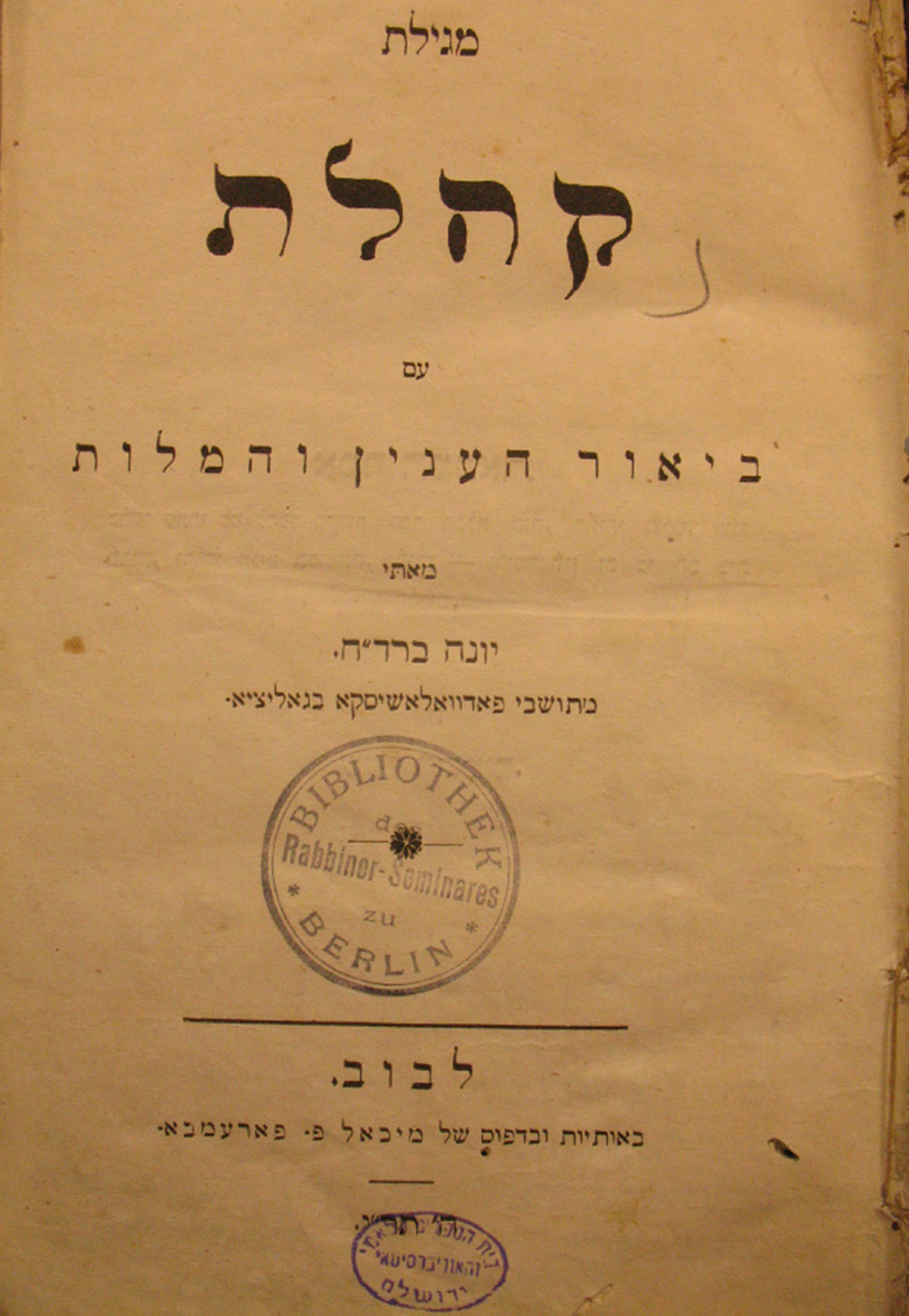
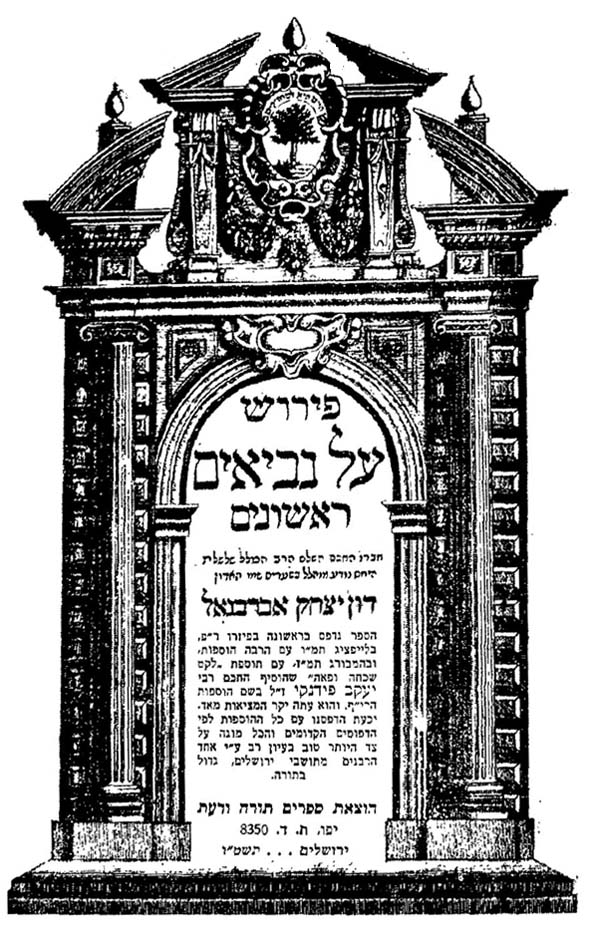
Let’s start with the commentary of the Malbim on Kohelet that was published in 2008. Here is the title page.

Understandably, there was much excitement when this book appeared since it is quite an event when an unknown commentary of such a major figure is discovered. However, the excitement was short-lived, as it soon became known that the commentary was not by the Malbim but by a nineteenth-century maskil, Jonah Bardah. Even more embarrassing for the publisher, Machon Oz ve-Hadar, is that Bardah’s commentary even appeared in print in 1850. Here are the title pages.


This would be bad no matter who the publisher was, but the fact that Machon Oz ve-Hadar is from New Square, which is as far removed from Haskalah imaginable, makes the mistake drip with irony.
How did such a blunder happen? Today, it seems that everyone is looking for unknown material to publish. There are a number of journals that devote a good deal of space to this, and I often wonder what will happen when we run out of unpublished documents. With this mindset you can imagine how excited the publisher was when he was informed that someone had located a previously unknown commentary by the Malbim. The assumption that this was the Malbim’s text was due to the similarity between the method of commentary in the newly discovered work and other commentaries of the Malbim. Without careful examination, the Kohelet commentary was published and this would in turn lead to great embarrassment, not to mention a lot of wasted time and money.
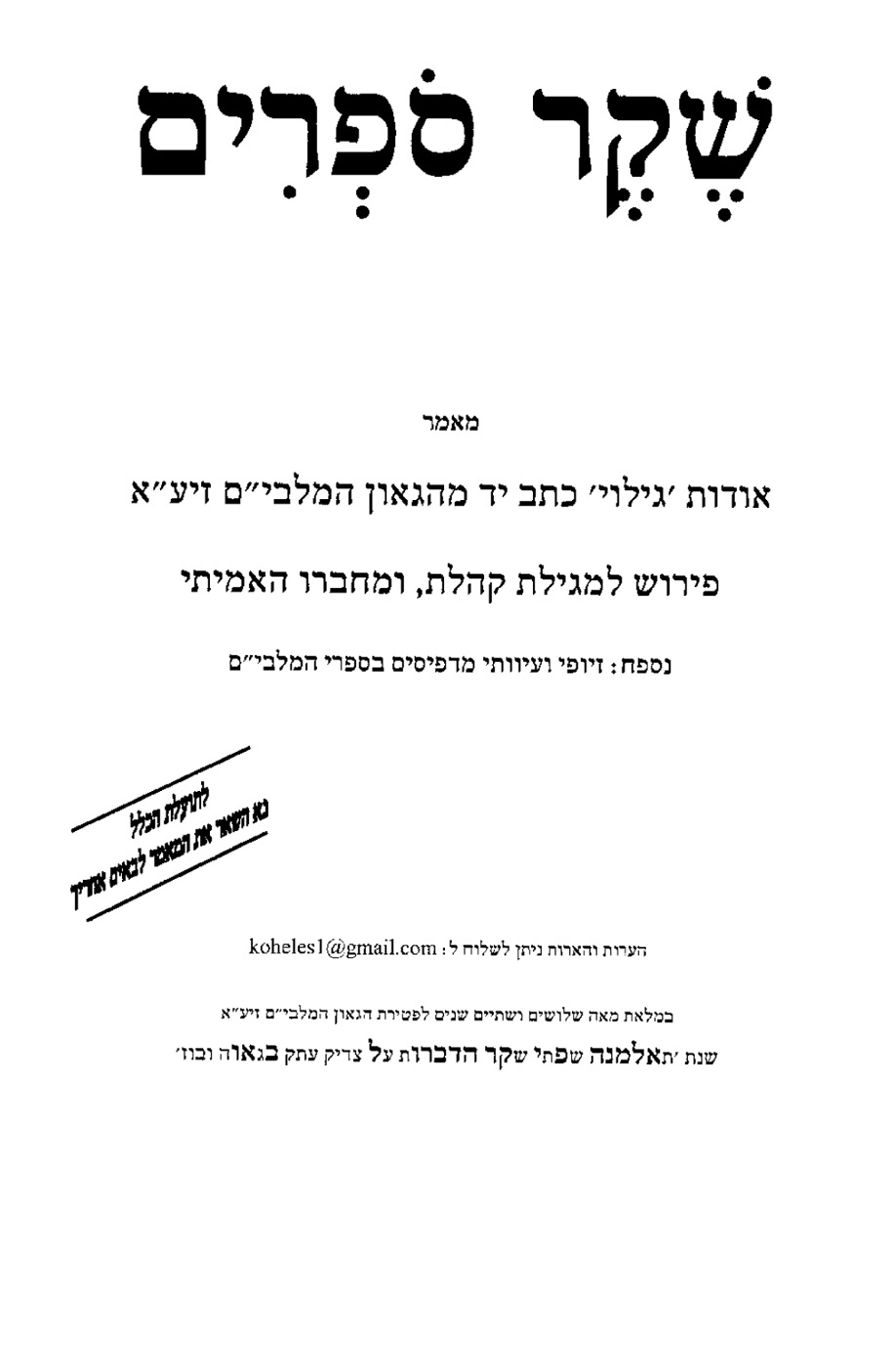
The story of this mistake is found in a document entitled Sheker Soferim. Here is the title page.

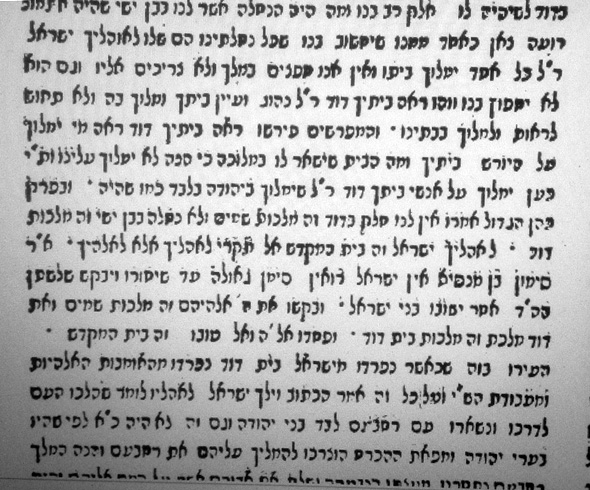
(A softened version of this article appeared in Yeshurun 25 [2011], pp. 724ff., and there the author’s name is revealed: R. Avraham Yeshaya Zecharish.[15]) This is really a damning document as it shows that the publisher had already been told that the handwriting of the commentary was not that of Malbim. I am not going to say that the publisher knowingly printed a fraud in order to profit by the Malbim’s name. But I think it is obvious that that the publisher’s great desire to publish the work caused him ignore what he had been told and to instead rely on his own “experts.” Whoever edited the work also showed his (their?) ignorance, since when the commentary referred to רמבמ”ן , not knowing that this referred to Mendelssohn the text was “corrected” to read רמב”ן!
Despite my sense that there was no intentional fraudulence in this publication, I don’t entirely discount the possibility that the publisher knew the commentary was not by Malbim but printed it anyway. I say this because as shown in Sheker Soferim there is one passage in the commentary where the “Malbim” claims that there is a mistake in the biblical text. The editors censored this passage, and this to be expected as from a haredi perspective such a comment is heretical. But if so, could the publisher actually believe that the Malbim wrote that which was censored?
Lest people think that things like this don’t have real effects in the world, let me just note that, as pointed out by Eliezer Brodt, an entire chapter of a doctoral dissertation is devoted to the false Malbim commentary on Kohelet.[16] Just think of how many hours were devoted to this dissertation chapter, all of which were wasted.
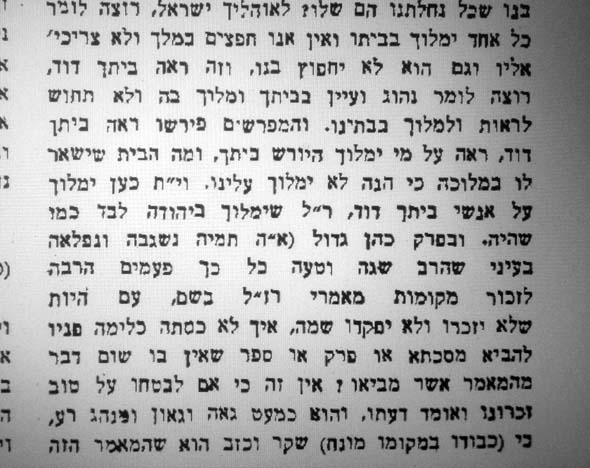
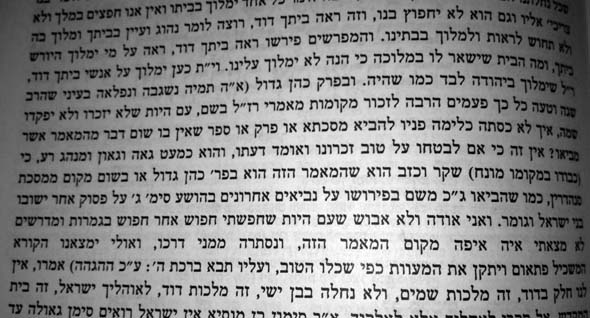
While Zecharish points to various “problematic” elements of the commentary that the publisher should have been aware of, he misses one right on the first page.

The notes at the bottom of the page are found in the original manuscript and publication. Here is the page.

In the commentary to the first verse the “Malbim” explains how the beginning of biblical books, where the author is introduced, is written by a later person.
.ואדמה כי לא יטעה כל משכיל לחשוב אשר המחבר בעצמו דיבר אלה הדברים
In the note the “Malbim” adds:
.עיין בהראב”ע בהתחלת ספר דברים
The beginning of Deuteronomy states: “These are the words which Moses spoke unto all Israel beyond the Jordan.” Upon these words Ibn Ezra introduces his “secret of the twelve” which focuses on post-Mosaic additions to the Torah. It is incredible that while the “Malbim’s” intention is crystal clear, namely, that the beginning of Deuteronomy was written after Moses, the editors didn’t catch this and see anything problematic in the comment, a comment that would never have been made by the Malbim.[17]
——

[1] See here. For former French Chief Rabbi Gilles Bernheim’s plagiarism, see the statement in First Things available here.
I think this sentence, from the article, is particularly apt:

One of the perversions of our era is to make a god of intellectual property. Most commentators described Bernheim as “stealing” words and sentences. This is wrongheaded. Plagiarism is a sin against truth, not property. It’s first and foremost a kind of lying, not a kind of stealing. He violated our trust by speaking in a voice that was not his own, which is why in this and other cases of plagiarism the writer loses intellectual and moral authority broadly.

The importance of our spiritual leaders speaking the truth cannot be stressed enough. R. Kook writes about how forces of heresy were strengthened when people saw unethical behavior among בעלי תורה ואמונה. See Eder ha-Yekar, p. 43.
R. Joseph Ibn Caspi explains at length how a prophet, who models himself on God who is called א-ל האמת, always speaks the truth, even when speaking to his wife and children (!). See Shulhan ha-Kesef, ed. Kasher (Jerusalem, 1996), pp. 146, 163. This is so important to Ibn Caspi that he deals with a number of biblical examples where it appears that a prophet did not speak truthfully, and he argues that the meaning is not what appears at first glance. The one case where he acknowledges that we are dealing with a lie is Jacob telling Isaac, “I am Esau your firstborn” (Gen 27:19). Yet this does not affect Ibn Caspi’s thesis because he claims, p. 150, that when Jacob told this lie he was not yet a prophet.
.הנה כחש אבל עדין לא הגיע למדרגת הנבואה עד היותו בדרך חרן וראה הסולם
After his discussion about prophets and how they were always truthful, Ibn Caspi concludes, p. 163, that this is also how a חכם should behave. Our rabbis now stand in place of the prophets of old, thus they too much be paragons of truth.
With regard to Ibn Caspi’s Shulhan ha-Kesef, I would like to make one further point. In a previous post, see here, I discussed how, according to Ibn Caspi, the Torah contains statements that are not actually true, but were believed as such by the ancients. We see another example of this in Shulhan Kesef, p. 147, where he writes, in seeking to explain an example where it appears a prophet lied:
.כי הנביא שם משותף וכבר הרחיב הכתוב ואמר “חנניה הנביא” בסתם
What Ibn Caspi is saying is that even though the Bible refers to someone as a prophet, this doesn’t mean he was really a prophet. It could be that he is referred to as such because this is what the people believed, even though the people were incorrect. In other words, the Bible incorporates the incorrect view of the people in its narrative. The proof he brings is from Jeremiah 28 where Hananiah is referred to as a prophet but in reality he was a fraud.
[2] See most recently Shmuel Ashkenazi, “Ha-Gonev min ha-Sefer,” Yeshurun 25 (2011), pp. 675-690.
[3] See here.
[4] See e.g., Bekhorot 31b, Menahot 93b; R. Moses Zweig, Ohel Moshe, vol. 1, no. 41. The fact that the Sages had this problem in their own day is probably also why they stressed the importance of proper attribution. This is pointed out by R. Nathan Neta Olevski, Hayei Olam Nata (Jerusalem,1995), p. 241:
מזה נראה כי גם בימיהם כבר פשתה המספחת להתגדר בגנבי גנובי את תורת אחרים ולכן ראו חז”ל להגדיל ערך המשתמר מזה ולחשוב דבר זה בין המ”ח דברים שהתורה נקנית בהן
[5] See e.g., R. Yekutiel Yehudah Greenwald, Mekorot le-Korot Yisrael (n.p., 1934), p. 48.
[6] See e.g., Nahum Rakover, Zekhut ha-Yotzrim bi-Mekorot ha-Yehudi’im (Jerusalem, 1991), pp. 38ff.
[7] Otzrot ha-Sofer 14 (5764), p. 91:
.זה אני מוחל לכם אם אתם אומרים חידושיי בשמכם, אבל אם אתם אומרים חידושים שלכם בשמי זה אינני מוחל לכם
For a communal rabbi, who was expected to prepare his own derashot, it was unacceptable to inform his listeners that he was using material from others. However, R. Asher Anshel Yehudah Miller, Olamo shel Abba (Jerusalem, 1984), p. 187, reported one tongue-in-cheek justification of this practice if due to circumstances beyond his control the rabbi was unable to properly prepare for his Shabbat ha-Gadol derashah. Since the Talmud, Pesahim 6a, states שואלין ודורשין בהלכות פסח, one can derive from this that מותר “לשאול” מאחרים בשעת הדחק ולדרוש בהלכות פסח
[8] I mention geneivat da’at, yet according to some one who plagiarizes actually violates the prohibition against actual geneivah. See R. Yaakov Avraham Cohen, Emek ha-Mishpat, vol. 4, nos. 2, 24; R. Yaakov Hayyim Sofer, Hadar Yaakov, vol. 5, no. 38. R. Isaiah Horowitz, Shenei Luhot ha-BeritMasekhet Shevuot, no. 71, writes about plagiarism:  יותר גזילה מגזילת ממון
R. Eleazar Kalir states that the plagiarizer violates a positive commandment. See Havot Yair (Vilna, 1912; printed as the second part of the Malbim’s Eretz Hemdah), p. 26a:
ואומרים חידושי תורה מה שלא עמלו בו רק מפי השמועה שמעו ואומרים משמיה דנפשם ועוברים על עשה . . . שכך אמרו כל האומר דבר בשם אומרו מביא גאולה לעולם
See also the very harsh comments of R. Joseph Hayyim David Azulai in his Berit Olam to Sefer Hasidim, no. 224, which should be enough to scare away at least some of the plagiarizers:
אם כותב ספר וגנב תורת אחרים . . . בחצי ימיו יעזבנו ואחריתו יבא בגלגול אחר ויהיה נבל ויהיה מזולזל כי נבל הוא ונבלה עמו. רחמנא ליצלן
[9] Robert Klein called my attention to the final part of R. Solomon Ephraim Luntshitz’s introduction to his Keli Yekar, where he suspects that some of the commentators who preceded him were guilty of plagiarism. See also his Olelot Ephraim, at the end of the introduction, where he claims that all the plagiarisms are delaying the arrival of the Messiah. He plays on the verse עשות ספרים הרבה אין קץ  and explains that since so many new books are full of plagiarisms, עשיית ספרים הרבה גורם איחור קץ הימים.
R. Solomon Alkabetz, Manot ha-Levi (Lvov, 1911), p. 91b, also refers to the plagiarizers of his day. I called attention to R. Eliyahu Schlesinger’s plagiarism in my review of Avi Sagi’s and Zvi Zohar’s book on conversion, available here. See p. 9 n. 29. See also my post from June 25, 2010, available here, where I cite another case of plagiarism from Schlesinger. I found these examples by chance, and I am sure that if I were to carefully examine the latter’s writings I would come up with more. Yet there doesn’t seem to be much point in doing so, since in the haredi world there simply is no accountability in matters like this.
A number of scholars have discussed plagiarism with regard to Abarbanel, and I hope to return to this. For now, let me just note the following. In his introduction to Trei Asar, p. 13, Abarbanel explicitly denies that he plagiarized, while at the same time accusing R. David Kimhi of doing so.
שהמובחרים והטובים מהפירושים שזכר רבי דוד קמחי מדבר [!] הראב”ע לקחה [!], עם היות שלא זכרם בשמו ואני איחס כל דבר לאומרו פן אהיה ממגנבי דברים
At the end of his commentary to Amos, he repeats the accusation:
ומה שפירש עוד בהלא כבני כושיים בשם אביו הנה הוא לקוח מדברי הרב רבי אברהם בן עזרא ומה לו לגנוב דברים
See R. Dovberish Tursch, Moznei Tzedek (Warsaw, 1905), p. 195; Abraham Lipshitz, Pirkei Iyun be-Mishnat Rabbi Avraham Ibn Ezra (Jerusalem, 1982), p. 131.
[10] It is hard to take this explanation seriously. Talking during the repetition of the Amidah has always been common, yet rather than omit mention of this matter, the Shulhan ArukhOrah Hayyim 124:6, writes:
לא ישיח שיחת חולין בשעה שש”צ חוזר התפלה ואם שח הוא חוטא וגדול עונו מנשוא וגוערים בו
R. Zvi Yehudah Kook reported that his grandfather, R. Shlomo Zalman Kook, once strongly rebuked someone for talking during the repetition of the Amidah. When it was pointed out to him that דברי חכמים בנחת נשמעים, he replied that the Shulhan Arukh uses the word גוערים and that does not mean a gentle suggestion but a sharp rebuke. See R. Yair Uriel, Be-Shipulei ha-Gelimah (n.p., 2012), p. 32. (The story immediately following this one is also of interest. It records that R. Zvi Yehudah opposed the common practice [at least in America] of singing אשמנו בגדנו:
יש לומר את הדברים ברצינות, בצער ובכאב, ולא מתאימה לזה שירה 
It seems that R. Abraham Isaac Kook followed in the path of his father. See ibid., pp. 58-59, for the famous story of how R. Kook, while rav in Bausk, once slapped a “macher” in the face when he insulted R. Zelig Reuven Bengis. (The story is told in great detail in R. Moshe Zvi Neriyah, Sihot ha-Re’iyah [Tel Aviv, 1979], ch. 22.) R. Kook later explained that he did not slap the man in a fit of anger, but was of completely sound mind and did it in order to follow the Sages’ prescription of how to respond to one who degrades a Torah scholar:
“וכך אמר: “דינא הכי, מי ששומע זילותא של צורבא מרבנן צריך למחות
All I would say is that one must be careful with who one slaps. R. Yekutiel Yehudah Greenwald, Li-Felagot Yisrael be-Ungaryah (Deva, 1929), p. 25, records a story from mid-eighteenth-century Hungary where in the synagogue and in front of the congregation the head of the community slapped the rabbi in the face. This was the last straw for the rabbi (who was really a phony), and he, his wife, and children converted to Christianity.
R. Naphtali Zvi Judah Berlin would occasionally slap a student in the face. On one occasion it even led to a noisy protest by the students. Because the students refused to back down, the Netziv unable able to deliver his shiur. This led to him making a public apology to the students, which they happily accepted. See M. Eisenstadt, “Revolutzyah bi-‘Yeshivah,’” Ha-Tzefirah, June 2, 1916, pp. 1-2 (referred to by Shaul Stampfer, Lithuanian Yeshivas of the Ninteenth Century [Oxford, 2012], p. 113).
Since we are on the subject of slapping in the face, and since I mentioned R. Yitzhak Zilberstein in my last post, here is something else from his Hashukei Hemed on Bava Kamma, pp. 492-493.


I think it is quite interesting that he takes it as a given that policemen in Israel will beat thieves until they confess. Is there any truth to this at all? He himself thinks it is good that thieves be given a good slap in the face.

There are many more examples I could cite of people being slapped in the face, including by rabbis. One thing that is clear is that face-slapping has gone out of style.. It is like fainting, which was common in old movies. But when was the last time you saw a woman faint? It just doesn’t happen anymore.
Returning to R. Bengis, it is noteworthy that he and R. Kook were great friends from their days in Volozhin.  See the booklet Or Reuven (Jerusalem, 2011), which is devoted to their relationship R. Bengis’ letters to R. Kook in Iggerot la-Rei’yah show that he regarded R. Kook as rav of Jerusalem and chief rabbi of the Land of Israel. Only after R. Kook’s death did R. Bengis become Rosh Av Beit Din of the Edah Haredit in Jerusalem. His life-long admiration for R. Kook, even in his new position with the Edah Haredit, is, of course, not usually mentioned in haredi discussions of him. Since in the past I have criticized Yeshurun for its conscious distortions (all in the service of the haredi cause), let me now praise it for including the following in vol. 12 (2003), p. 156 n. 35.

Rabbi Nathan Kamenetsky, Making of a Godol, pp. 305-306, reports in the name of R. Yosef Buxbaum that R. Bengis knew the poetry of Pushkin. (He also quotes a report that R. Bengis did not know Russian and when tested by a government official to ensure that secular studies were being taught in Volozhin, he just repeated the page of Pushkin from memory which he had prepared ahead of time by having another student read it for him. This strikes me as an apologetic attempt to “kasher” R. Bengis, as followers of the Edah Haredit will not take kindly to the knowledge that R. Bengis knew Russian poetry.)
For a recent discussion of R. Bengis and his brother, who went by the name of “Ben Da’at”, see here.
According to an unpublished collection of Brisker stories in my possession, R. Velvel Soloveitchik said about R. Bengis that just because one is a great talmid hakham does not mean that he is also a leader. Perhaps R. Velvel had this view of R. Bengis because the latter’s extremist credentials left something to be desired.
[11] Marvin J. Heller, Studies in the Making of the Early Hebrew Book (Leiden and Boston, 2008), p. 204, writes as follows about R. David Lida: “I would suggest, and this is highly speculative and certainly not a justification, that Lida’s acts of literary piracy were youthful improprieties, albeit of a most serious nature. A young man, inexperienced, perhaps immature, from whom much was expected, hoping to impress others and to further a burgeoning career, erred and claimed authorship of works he had not written, but rather discovered in manuscript.”
[12] The following example, with some of the explanations I give, is found here.
[13] This too was noted here.
[14] In a comment to my last post, someone wrote:

“The part about Anshei Keneset ha-Gedolah requiring the Amidah to be recited twice a day and that women are also obligated in this is not from Nahmanides. This is the Mishnah Berurah speaking.”

Actually, these are the words of the Shulchan Aruch HaRav (או”ח קו,ב), quoted here verbatim.

This practice of the MB citing whole paragraphs from the SAH – without attributing the author – is common throughout the his work, in leads many times to run-on sentences and disambiguation such as the one at hand.

[15] See also the online discussion here.
[16] “Ha-Sinonomyah bi-Leshon ha-Mikra al Pi Shitat Malbim,” (unpublished doctoral dissertation, Bar Ilan University, 2009).
[17] See here where I mention how R. Yosef Reinman also didn’t know anything about Ibn Ezra’s “critical” views. In the post I also discuss the controversy regarding Reinman co-authoring a book with a Reform rabbi. In the introduction to his Avir Yosef (Lakewood, 2008), Reinman defends himself.


A Little-Known Rabbi Doctor and his Exceedingly Rare Medical Diploma Leon Cantarini- AKA Yehuda HaKohen Katz Me-HaHazzanim (University of Padua, 1623)

A Little-Known Rabbi Doctor and his Exceedingly Rare Medical Diploma
Leon Cantarini- AKA Yehuda HaKohen Katz Me-HaHazzanim (University of Padua, 1623)

Rabbi Edward Reichman, MD

Professor of Emergency Medicine, Albert Einstein College of Medicine
Isaac and Bella Tendler Chair of Jewish Medical Ethics, Yeshiva University


“He obtained a degree in medicine and philosophy on 31 October 1623, as can be seen from his original diploma which has been perfectly preserved despite the destructive effects of time.” (translated from the Italian)

Marco Osimo 1875

Original Books and manuscripts of past centuries known to historians throughout the ages have sometimes been lost forever to the ravages of time or war. Every so often, these works disappear from the public eye and are preserved in an intentional or accidental state of hibernation, only to reappear centuries later.

In late 2024, Manfred Niekisch, a German biologist, nature conservationist, and former director of the Frankfurt Zoo, died at the age of 73. He left a vast archive covering a wide range of topics, including taxonomy, ecology, behavior and reproduction of reptiles, amphibians and birds, not a place one would expect to find any items of Jewish interest, let alone of importance.

In April 2025 I was contacted to assess the historical significance of a single item from Niekisch’s massive collection. A thematic outlier, it is a small leatherbound volume, the contents of which comprise a seventeenth century medical diploma, and for a Jewish student, nonetheless. I was enlisted to address whether this item has any unique value or contribution to Jewish or medical history. This article constitutes the substance of my response. We will attempt to breathe a little life into this comatose medical document, resuscitate some long-forgotten and little-known archives, and perform at least a preliminary examination of the life of a remarkable, if little-known, Jewish medical graduate of the Early Modern period.


The Graduate- Leon Cantarini

The name of our graduate is Leon Cantarini. Leon, the son of Shmuel Cantarini, was one of eight children and a member of a prominent dynastic family in Early Modern Italy. Leon was also known as Yehuda HaKohen Katz Me’ha-Hazzanim. The synonymous Italian and Hebrew family name purportedly derives from family members having led the synagogue services as the hazzan, or cantor. Standard literature searches, including main search engines, library databases (such as the National Library Israel), or archival records (such as Internet Archives and Haithi Trust) yield next to nothing about our graduate. The few brief biobibliographical entries for him are scant, inconsistent, and often error filled.

Much of what we know about Leon is found in a comprehensive nineteenth century Italian biography of the Cantarini family by Marco Osimo, himself a medical graduate of Padua centuries later in 1851. This work was seemingly inaccessible or unknown to many of Leon’s biographers. In this essay we draw on the work of Osimo, correct some earlier biographies (including Osimo), and add much important previously unknown archival material to flesh out the existing skeletal biography of Leon Cantarini.


Dates of Birth and Death

Confusion abounds regarding the dates of both Leon’s birth and death. We begin with his date of death, as Leon’s birth date is inferred therefrom. The Jewish Encyclopedia entry for “Cantarini, Judah (Leon) ben Samuel Ha-Kohen,” authored by Louis Ginzberg and Israel Berlin, reads, “Italian physician and rabbi; born about 1650 at Padua; died there April 28, 1694.”[1] While the description is clearly of our graduate, the dates are grossly in error. Perhaps they confused Leon’s date of death with his date of birth. These dates were unfortunately perpetuated by others.[2] Osimo, the definitive biographer of the Cantarini family, places Leon’s date of death in July of 1651 based on a decree from July 20, 1651, announcing the election of Leon’s pupil to a community position, replacing his mentor upon the latter’s death. While this proves that Leon had already died by this date, it does not pinpoint his date of death.

There is a single unexpected, unimpeachable source that states the exact Hebrew date of Leon’s death. Leon’s relative, Isaac Hayyim Cantarini, also a rabbi and graduate of Padua’s medical school, engaged in a correspondence with the Christian theologian Christian Theophil Unger from 1717 to 1719. The exchange was first published by Shadal in his Otzar Nehmad in 1860.[3] While scholars have studied these letters for obvious reasons, they also contain a wealth of biographical information about the Jewish Italian scholars of this period. In a list of the dates of death of a number of prominent members of the Italian Jewish community, we find the following

The date of Leon’s death is listed as 26 Nisan 5410, corresponding to April 27, 1650. He is buried in the ancient (Via Wiel) cemetery of Padua,[4] though his tombstone does not remain.

There is one non-Jewish source, published in 1728, which correctly lists the exact date of Leon’s death.[5]

This is because the Christian author was familiar with the letter exchange of Cantarini and Unger, unlike his Jewish counterparts who only learned of it through the journal of Shadal published over a century later.

There is no independent source confirming the day or year of Leon’s birth. What is known with certainty is that he died at the age of fifty-six, a fact recorded in multiple sources, including a memorial book for the Jewish community of Padua.[6] Since Osimo dated Leon’s death in 1651, he placed his date of birth fifty-six years earlier, “around 1595.” The year 1595 is widely quoted as Leon’s birth year, based on Osimo. Since we now know the exact date of Leon’s death as being in 1650, we would revise his date of birth to “around 1594.”

Leon’s Father’s Name

The name of Leon’s father was Shmuel. Yet, he is also referred to as Simon, including on Leon’s medical diploma (see below). Simon (or Simeon) today is the English name for Shimon. What is the origin of this alternate name. The answer is surprisingly found in the aforementioned letter exchange between Isaac Cantarini and Christian Theophil Unger.

Among the numerous questions posed by Unger to Cantarini is why, for example, Rabbi Menahem Porto is called by the first name Emanuel instead of his Hebrew first name.[7] Cantarini answers that while all Italian Jews have a given Hebrew name, many have an additional secular or vernacular “translation” or substitute for their Hebrew name. He provides two examples. One is the name Mandolin for Menahem. The other is the name of one of his own children: “In my home I have a young child whom I named Shmuel, but in la’az (vernacular) he is called Simon, which is (synonymous with the Hebrew) Shimon.” This analysis of Isaac Cantarini’s child’s name provides direct insight into the double name of Leon’s father, after whom this child was likely named. It appears that while today our English correlate for Shmuel is Samuel, and for Shimon is Simon, at that time Simon was the accepted latinized form for Shmuel.

Leon’s Relationship to Isaac Hayyim Cantarini

The historical record of Leon Cantarini is dwarfed by his more famous relative, Isaac Hayyim Cantarini,[8] whose writings contribute to Leon’s biography as well. Isaac, a physician, rabbi, poet and orator, is one of the towering figures of Early Modern Jewish history. How were Leon and Isaac related? Nepi and Ghirondi identify Isaac as Leon’s “nekhed.”[9] While this typically means grandchild, perhaps they were using the term to mean descendant. Leon was in fact Isaac’s uncle, the brother of Isaac’s father, Ventura Yaakov Yitzchak. Isaac, born in 1644, would have been only six years old at the time of Leon’s death, precluding any substantive personal relationship. Nepi and Ghirondi state that they viewed a eulogy written by Isaac for his uncle Leon.[10] It is unclear to me when this eulogy would have been written, given Isaac’s age at the time of Leon’s death, though perhaps he wrote some form of eulogy when he was older to commemorate his uncle’s yartzheit (anniversary of his death). Isaac clearly had great reverence for his uncle Leon, always referring to him in a highly praiseworthy fashion. In his historical work, Pahad Yitshak, Isaac refers to Leon twice describing him as expert in both Torah and medicine.[11]

Leon Cantarini the Rabbi

Leon obtained his rabbinic ordination in 1618, at the age of twenty-four.[12] Rabbi Judah Saltara, who would later serve as a witness for his medical graduation (see below), was one of the granting rabbis. In the Padua community archives (pinkassim) for the years 1603-1630, his name appears on two occasions (October 28, 1621, and October 31, 1625) in his rabbinic capacity serving as judge for routine community matters.[13] Leon founded a yeshivah in the Ashkenazi synagogue, where he taught Talmud. He also officiated as preacher and delivered sermons and eulogies in both Padua and Venice.

I am aware of only one published responsum from Leon,[14] which he penned to Yaakov ben Yisrael Levi dealing with a dispute between three sons regarding the disposition of their father’s estate after their father had left very explicit and equitable instructions. Leon was clearly well versed in rabbinic literature, citing multiple references to support his position, and dealt among other issues with the propriety of bypassing the biblical requirement to grant a double portion to the firstborn.

Osimo was in possession of numerous rabbinic related manuscripts of Leon in varying stages of completion, the whereabouts of which are unknown to me. These manuscripts include sermons, biblical commentaries, philosophical and theological treatises. As Osimo was not versed in rabbinic literature, he forwarded Leon’s Jewish related manuscripts to a Rabbi Benedetto Levi of the Rabbinical Institute of Padua for evaluation of their content.[15] The text of Rabbi Levi’s response is provided where he comments on Cantarini’s familiarity and facility with rabbinic literature and philosophy and the areas where his work may or may not have exhibited originality. Osimo bases his laudatory comments in his work on Levi’s analysis.

Leon Cantarini the Physician

Leon’s medical degree was from the University of Padua. This university, over 800 years old, plays a prominent role in Jewish medical history.[16] As the first, and for some time only, medical school in Europe to officially admit Jewish students, it was the hub of Jewish medical training from the sixteenth to eighteenth centuries, during which some 400 Jewish students attended.

Leon graduated from Padua on October 31, 1623. We would be remiss if we did not mention that Leon wasn’t the only Cantarini to walk down the aisle of the Aula Augustiori (Grand Hall) that day to receive his medical diploma. Caliman, his younger brother by two years, graduated right alongside him. These two Cantarini brothers would be the first of a total of eleven members of the Cantarini family who would graduate from Padua over a span of some one hundred and twenty years. There is even an entry in the Padua University Archives which includes both brothers, Clemente (Latinized form of Caliman/Kalman/Kalonymus) and Leo, together.

Leon maintained a large practice among both the Christian and Jewish population of Padua. He is also recognized for his exemplary treatment of the poor, visiting them up to three or four times a day without receiving compensation.

Osimo was in possession of multiple medical manuscripts of Leon, the whereabouts of which today are unknown to me. The medical material he notes as summaries or comments on the works of Hippocrates, Galen and Avicenna, the latter explicitly mentioned in Leon’s diploma, as discussed below, and copies of his medical school lectures.

An entry in the archives of the Venetian Senate mentioning Leon reflects on the challenges and discrimination facing Jews and Jewish physicians at that time. Jews in Italy were obligated to wear distinctive clothing to identify them as members of the Jewish faith.[17] This included a specific color hat, sometimes red, sometimes yellow. This would preclude Leon, or any other Jewish physician, from wearing the black hat (biretta or cappello) which was granted them upon graduation from medical school and associated with the medical profession.[18] On May 15, 1643, Leon requested permission from the Venetian Senate to be exempted from the prohibition against wearing the black cappello on the basis of his medical degree. While Leon’s request was granted, and he was permitted to wear the black cappello both during the day and at night without any hindrance,[19] the Venetian Senate was generally conflicted about whether Jewish physicians should qualify for this exemption.[20] Other Jewish medical graduates of Padua often petitioned for similar exemptions.[21]

Leon Cantarini’s Marriage

On March 10, 1628 Leon married Mindele, daughter of Yosef Kohen Rofeh De Datolis (Tamari). They had three children.[22]

Impact of the Padua Plague of 1631 on Yehudah and the Cantarini Family

Any biographical discussion of Leon would be woefully inadequate, both literally and figuratively, without discussion of the impact on his life of the 1631 Plague in Padua. Indeed, this is exactly how Nepi and Ghirondi introduce his brief biography:[23]

The plague’s toll on the Jewish community of Padua was profound with around a fifty percent fatality. The plague was assiduously chronicled by Abraham Catalano, a physician and one of the administrators of the plague for the Jewish community, in his Olam Hafukh. One of the many remarkable aspects of this unique plague chronicle is Catalano’s scrupulous documentation for posterity of the names of all those involved, including each one of the victims. Catalano includes a passage about the Cantarini family where he singles out our graduate:


After recording the death of Leon’s brothers in the plague, Catalano writes, “May my mouth speak the praise of God
[24] that their brother the physician, prominent leader (aluf), Rabbi Yehuda Katz was not present in Padua during the plague, having married a woman from Venice and settling there. He provided aid and assistance (during the plague).”

Though the impact of Leon’s family losses during the 1631 plague is inestimable, there is likely one loss that affected him differently than others. Leon’s brother Caliman was also a physician, having graduated together with him on the very same day. Caliman was living in Padua during the plague and served as a physician for the Jewish community. Acutely aware of the raging and highly fatal epidemic in Padua, and concerned for the welfare of his dear physician brother on the medical battlefield, on July 18, 1631, Leon penned a letter to Caliman, advising him of some effective remedies recommended to overcome the dreaded disease, as well as appropriate precautions to prevent the contracting or spread of the infection.[25] Leon specifically recommended the use of emeralds, which since the Black Death had been considered a cure for plague. Leon emphatically warned his brother to exercise extreme caution and diligence in order to preserve his health. It would be only twelve days after the writing of Leon’s letter, on July 30, that Caliman succumbed to the plague at the age of 38. Below is a record of Caliman’s death in the Libro De Morti, the Padua City Death Registry.

His death is recorded in the city death registry alongside his profession, which was unusual for these records. He is also identified as “ebreo.

In order to fully assess the nature of the impact of the plague on the entire Cantarini dynasty, one would need to carefully read every line of Olam Hafukh and to note every time a member of the Cantarini family is mentioned. It turns out that this work has already been done already, by none other than Isaac Hayyim Cantarini. Isaac painstakingly transcribed the entire manuscript of Olam Hafukh by hand. While this manuscript, housed at Columbia University, is well known to Jewish scholars and historians, there is one “key” factor which has gone overlooked. For every mention of a Cantarini family member in the work, Isaac added a notation shaped like a key, akin to an asterisk, referring the reader to the margin, where he noted how the individual was related to him. Below are some examples:

Shmuel Katz MeHazanim, Isaac’s maternal grandfather, died from the plague 8 Tammuz


Menahem Katz MeHazanim, Isaac’s paternal great uncle died on 22 Tammuz


During the plague Leon lost his father, three brothers and many additional extended family members.

Leon Cantarini and the Venice Plague of 1630

While Leon’s absence from Padua during the 1631 plague is recorded for posterity by Catalano, it is not as if he completed evaded the impact of the Bubonic plague. The impact on his life of the Venetian Plague, which preceded that of Padua by just one year, has gone unnoticed. It is unappreciated that the very same bubonic plague, on its way to Padua, devastated Venice in 1630,[26] where Leon was living at the time.

We know from other sources that a young Jewish physician by the name of Isaac Gedalia served as the physician for the Jewish community of Venice during the plague. This is the same physician who wrote a poem in honor of Leon’s graduation, and Leon would certainly have been in contact with him. Tragically, Gedalia met the same fate as Leon’s brother Caliman, and succumbed to the plague. Gedalia died in 1630 at the age of 32 and is buried in the Lido Cemetery of Venice. His epitaph, composed by Rabbi Yehuda Aryeh Modena, reflects his service as a physician to the Jewish community during that time.[27] Below is the epitaph in the autograph of Modena,[28] followed by the transcription of Berliner.[29]


We have not known, however, what medical role if any Leon played in the Venice plague of 1630. Was he simply a bystander, or perhaps worked side by side with Gedalia, his fellow Padua alumnus. Leon’s diploma, discussed below, sheds new light on this question.

Leon Cantarini’s Graduation Diploma

Leon Cantarini’s magnificently bound and meticulously calligraphed medical diploma was ceremoniously placed into his hands on October 31, 1623 accompanied by the traditional pomp and circumstance of the University of Padua graduation. He put it to good use during his lifetime. Over three hundred years later, we find Leon’s diploma in the possession of Marco Osimo, a Padua-trained physician. In his definitive history of the Cantarini family he writes regarding Leon: “He obtained a degree in medicine and philosophy … and his original diploma … has been perfectly preserved despite the destructive effects of time.” The renowned Hungarian Jewish historian David Kaufmann recalled that he had viewed Leon’s diploma at Osimo’s home.[30] The Cantarini biography was published in 1875 and Osimo died in 1881. As the family biographer, Osimo likely procured the diploma from members of the Cantarini family. While details of the journey from Osimo’s home to that of Professor Manfred Niekisch, whose collection contained Leon’s diploma, are unknown, it appears that no one, not Osimo nor Kaufmann, has previously carefully examined Leon’s diploma.

One of the archival items that reflects the unique historical chapter of Jewish medical training at the University of Padua is the medical diploma.[31] Prior to reviewing Leon Cantarini’s diploma, I had identified, in libraries, museums and private collections, eighteen extant diplomas of Jewish medical graduates of the University of Padua, the earliest of which was 1647.[32] One of these is the diploma of Gershon Cantarini (1703),[33] Leon’s grandnephew. Below we review the features found in our “new” graduate’s diploma, as compared to those of his fellow Padua alumni.

Form

Leon’s diploma is a bound quarto booklet with a red Italian tooled leather binding consistent with the typical Padua diploma of this period.

In its original form, a pair of wax seals would have been attached to the binding, as pictured in the diploma of Emanuel di Jacob (Del) Medigo de Dattolis (Menachem Kohen Rofeh Tamari)[34] from 1686,[35] a member of Leon’s wife’s family.[36]

The text is written in period calligraphy appointed with periodic gold leaf lettering. The text of the diploma, written with generous font size and spacing, as well as wide margins, occupies ten double sided pages. This is unusual, as the typical diploma text usually fills four to six sides. 

Content

The diplomas of Jewish medical graduates of Padua contain some deviations from the standard issue. As the standard Padua diploma contained a number of Christian references, the university accommodated the Jewish students by allowing certain alterations or emendations:

  1. The invocation was changed from “In Christi Nomine Amen” to “In Dei Aeterni Nomine Amen.” Leon’s diploma conforms to this pattern:

  1. The convention for writing the year of the graduation invariably contained a Christian reference, such as anno Domino, anno Christiano, or anno a Christi Nativitate. In many Jewish diplomas this reference is omitted. Here we do not see an alteration of the date and it retains the Christian reference, Anno Christiano.

  1. The graduation for the Christian student was held in the Episcopal palace, a religious venue. This is mentioned in the text of the diploma. The graduation for the Jewish student was convened in a non-ecclesiastical location, a fact reflected in the diploma text. Leon’s graduation was held in the “Aula Augustiori” (grand hall) of the university, the largest hall in the university at the time and not designated for religious use.[37]

  1. Many diplomas contained ornate illustrations and images, typically of a Christian nature. If the Jewish student diploma were illustrated, it would be with flora and fauna and devoid of any Christian imagery. This diploma has no added illustrations.

  1. The identifier “ebreo” or “hebreus” was added for Jewish students. This was a convention followed consistently in Padua, and less so in other European universities. This was not specifically requested by the student, nor was its presence a reflection of antisemitism.

  1. Witnesses were required to attest to the graduation. Jewish graduates often enlisted Jewish witnesses. Leon’s three witnesses were Jewish.

The above changes are not found uniformly or consistently in every Jewish student diploma, and Leon’s diploma contains all but one of them.

General Diploma Observations

Chronological Precedence

This is the earliest extant diploma for a Jewish medical graduate of the University of Padua of which I am aware. Previously the earliest extant diploma of this type was from 1647.[38]

During the early centuries of the University of Padua Medical School, doctoral degrees were granted exclusively by the Sacred College of Philosophers and Physicians in a Catholic religious ceremony. Non-Catholics who received training at the university could obtain medical degrees through a different pathway outside of the university walls, granted by specific individuals known as Counts Palatine, who received their authority from the Holy Roman Emperor. These ceremonies were held privately before a notary and witnesses.[39] It was only in 1615 that the Collegio Veneto was established to serve the purpose of granting formal degrees to non-Catholic students and essentially replaced the Counts Palatine. Leon was the fifteenth Jewish graduate after the procedure changed.[40]

Faculty Support for Graduation

In order to graduate, a student required the support of a number of faculty to promote his candidacy. Names of the faculty members promoting the graduate are listed in the diploma. One such faculty member identified in the diploma maintained a unique relationship with Leon and the Jewish community regarding an important aspect of the educational experience of the Jewish medical students.

Caesar Cremonin was a Professor of Philosophy in Padua, as philosophy at this stage of history was an integral part of medical training. In fact, the medical diploma for each graduate, including Leon, certified a degree in “Philosophia et Medicina.”

We know from historical records of the Padua Jewish community that Professor Cremonin served as a university representative to the Jewish community on a matter of utmost significance. Since the expansion of the anatomy curriculum during the tenure of Vesalius in the mid sixteenth century, and the subsequent construction during the time of Fallopius of the first historical dedicated anatomical theater, the demand for cadavers for teaching at the university exponentially increased. The university turned to the student body, including the Jewish students, to provide cadavers from their respective communities. As this request ran counter to Jewish law, which prohibited the desecration of the corpse after death, the Jewish community negotiated a compromise arrangement whereby a fee would be paid to the university in exchange for an exemption to provide cadavers.[41] The following entry appears in the Padua Jewish Community Archives from April 19, 1624.[42]

In that the spirit of God has enlightened the esteemed philosopher Senior Caesar Cremonin to declare freedom (from dissection) for our deceased, through the continued annual designated payment to the College of Arts, generation after generation. As a result, they are obligated to allow us to properly bury our dead during the season of dissection. Any violators will be fined, and they have coordinated with us to obtain from the government permission for a required fine for all who violate this agreement in a way amenable and sufficient for our needs.

The continuation of the archival entry mentions the Jewish community member delegated to negotiate with Cremonin. It is none other than our graduate.

The aforementioned Master Caesar and Yehudah Katz have already spoken on this matter and have begun discussion regarding the amount the Jewish community is willing to pay for this privilege.

The archival entry is dated just a few months after Leon’s (Yehudah’s) graduation, and he was an ideal representative for the community given his preexisting relationship with Cremonin, one of his medical school professors and graduation promoters.

Curriculum

The diploma contains a list of the student’s professors and course subject matter. For example, Leon was taught the works of Avicenna by Professor Francisco Bonardo.

Avicenna (980–1037), known in Hebrew sources as Ibn Sina, was a Persian physician of great renown. His main work, The Canon, was considered the authoritative work on medicine for many centuries and is quoted extensively by rabbinic sources. The only extant Hebrew medical incunabula is a copy of Avicenna’s Canon (Naples, 1491). Many Hebrew manuscripts of Avicenna were found in the Cairo Geniza.[42]

The Identity of the Witnesses

Two of Leon’s witness were prominent local rabbis and are known to us from other sources.

  1. Rabbi Jacob Alpron (also known as Helipron or Heilbronn)[44]

Alpron was a Talmudic scholar, author, and translator, most known for his popular work, Mitzvot Nashim,[45] a Hebrew translation of an Italian work on the three mitzvot specific to women, the laws of niddah, hallah, and lighting of Sabbath candles, which, if not observed, “are the three transgressions for which woman die in childbirth” (Shabbat 31b).

  1. Rabbi Leon (Yehudah) Saltaro da Fano (1505-1629)[46]

Saltaro was one of the rabbis who granted Leon his rabbinic ordination five years earlier.[47] It must have been meaningful for him to serve as a witness for his student’s medical graduation.

Saltaro authored a work, Sefer Sha’arei Gan Eden, attempting to identify the location of the Garden of Eden.[48] In his Mikveh Israel on the laws of the ritual bath, inter alia, Saltaro provides insight into the Jewish education of students attending the medical school in Padua. He mentions Avtalyon miModena, the uncle of Yehuda Aryeh da Modena, who in addition to his medical studies at the University of Padua, learned Torah in the Yeshiva of Rabbi Meir Katzenelenbogen (Maharam Padua).[49]

In fact, the Jewish Ghetto of Padua was and remains mere steps from the University of Padua campus, and other students over the centuries pursued Torah study with the prominent rabbis of Padua while enrolled in the city’s famous medical school.

Addenda to the Diploma- New Evidence of Leon’s Medical Involvement in the Venice 1630 Plague

It is not uncommon to find handwritten records appended to Padua diplomas documenting subsequent academic or clinical experiences. Occasionally, a student would present his diploma as part of his application for a medical position and the institution would inscribe acceptance or approval on the diploma itself. We find such an entry in Leon’s diploma that sheds some light on his clinical role in the Venice plague. On the inside of the back cover appears the following entry dated August 1630:

The diploma was presented to the Officio di Sanità in Venice (Provveditori e sopraprovveditori alla sanità) and “admesso” (accepted). This was required in order for Leon to practice in Venice. Until now, we have had no evidence of Leon himself practicing medicine during the plague. These few lines reveal that Leon was indeed providing medical service during the Venice 1630 plague, and like his fellow Padua graduates, including Gedalia and his own brother Caliman, put his life at risk in the process. While the latter two succumbed to the plague, Leon was fortunate to survive and to live for another twenty years practicing medicine and teaching Torah.

Congratulatory Poems for Leon’s Graduation

In seventeenth century Italy it was common for Jews to compose celebratory or commemorative poems for a variety of occasions, such as weddings or funerals. One such occasion that precipitated a poetic response was the graduation of Jewish students from the medical school of the University of Padua. I have identified over one hundred such poems written in the seventeenth and eighteenth centuries, most of which are extant. Rabbi Yehudah Arye Modena compiled an entire book of collected poems in honor of Joseph Hamitz, a fellow graduate of Leon from Padua in 1623.[50]

Sometimes the poems were composed by fellow students or alumni. Isaac Gedalia, a Padua medical graduate of 1622,[51] composed two poems for our graduate, one in Spanish and one in Latin.[52] There is also a record in the Padua city medical archives from April of 1625 of Gedalia treating a number of Jewish patients,[53] one of whom was Jacob Alpron, a witness for Leon’s medical graduation.

April 20 1625
Giacob Alpron Rabi Hebreo di anni 85 in circa ammalato giorni 15 di mal di muchi visitato dall’Ecc.mo Gadilia Hebreo nel ghetto.

Giacob Alpron Rabi Hebreo aged about 85. He was ill for about 15 days with a sore throat [?]. His Excellency Gadilia Hebreo examined him in the Ghetto.[54]


A Diploma for a Rabbi Doctor

Leon was a rabbi by the time he graduated medical school and he is identified as such in his diploma. Just how rare is it find a medical diploma for a rabbi doctor? Throughout history there have numerous attempts to create institutions or formal curricula combining the study of both Torah and Medicine.[55] These initiatives, well intentioned as they may have been, were of only limited duration and success. It was thus left to the individual physician to navigate his Torah study independently, something most physicians did informally. Some however sought more formal training. The Haver degree, a lower and less rigorous form of rabbinic ordination, was one such option. Unlike rabbinic ordination, with its expansive requirements to master specific areas of practical Jewish law, there was no uniform curriculum for the Haver degree.[56] Each location designed its own program. The student would be required to spend a period dedicated to Torah study and display basic competency, as well as character traits consistent with Torah values. Those deemed worthy would receive the title Haver within a few short years or less, typically bestowed by local rabbinic authorities.[57] A number of Padua alumni chose the Haver option,[58] including Leon’s fellow graduate, David Morpurg.[59] We have record of one Padua graduate receiving his Haver degree on the very same day as his medical graduation.[60]

A select few physicians throughout Jewish history chose the more advanced and labor-intensive course of study to obtain rabbinic ordination. These physician-rabbis have garnered the attention of scholars such as Holub,61] Sergei,[62] Epstein,[63] Margalit,[64] Salah,[65] and Steinberg.[66] Of this elite group, a large number received their medical training through apprenticeship, especially prior to the sixteenth century, when, with few exceptions, Jews were barred from university training. There is thus no official diploma to be found for these rabbi doctors.

As the University of Padua was the first European university to officially admit Jewish students and remained a major center of Jewish medical training into the late eighteenth century, many of our rabbi doctors in this period are counted among its alumni.[67] Leon, though less known and not mentioned by the aforementioned scholars, was one of these university-trained rabbi doctors.

Even among this relatively small group of rabbi doctors from Padua, most obtained their rabbinic ordination after completion of their medical training. The average age of the Jewish medical students upon entry to medical school was late teens to early twenties. This would have been too young to obtain rabbinic ordination, which was not typically granted to students of this age.

In 1651, the community of Padua, set specific age requirements for both the Haver and Rabbinic degrees.[68] For unmarried men, the age requirement for Havrut was twenty-five and above, while for married men it was age twenty and above. Rabbinic ordination was restricted to those thirty and above irrespective of marital status, though I am unsure if these age limits were either in force or enforced prior to this date. It is thus rare to find a Padua medical graduate who was already a rabbi at the time of his graduation.

Leon Cantarini is one such example. Born in 1594, Leon obtained his rabbinic ordination in 1618,[69] around the age of twenty-four, and had already been an ordained rabbi for five years by the time he graduated medical school at the (atypical) age of twenty-nine. In his diploma, he is identified as “Rabbi” Leon Cantarini throughout the entire twenty-page text of the diploma.

Of note, in the university records of his graduation, maintained to this day in the archives, he is not identified as a rabbi.

Leo Cantarinius hebreus[70]

Leon’s own brother Caliman, two years his junior, also obtained rabbinic ordination, though we do not know when.[71]

While it was indeed rare for a medical graduate of Padua to have already been a rabbi, another example happens to be one of Leon’s fellow Class of 1623 graduates, Moises Uziel.72 We do not possess Uziel’s diploma, but in his archival record, unlike Leon, he is identified as a rabbi.

Rabi Moises Uziel hebreus

Leon’s however is the only extant Padua medical diploma for a rabbi, and I have not seen any other medical diplomas elsewhere where the graduate was identified as a rabbi.

Conclusion

In sum, I hope our resuscitative efforts have been successfully for both Leon Cantarini and his diploma. Leon’s diploma is the earliest known extant diploma of a Jewish medical graduate of the University of Padua, and I believe it is the only extant diploma (of any kind) granted to a rabbi who is identified as such in the text. Furthermore, it possesses nearly all the alterations, accommodations and features that can be found in the diplomas of the Jewish medical graduates of the University of Padua. Moreover, an addition later appended to the document fills an important historical lacuna in Leon’s biography and established his role in the Venice plague of 1630.

While Leon Cantarini’s diploma may be one of the least artistically adorned of the Jewish Padua graduates, it may also be one of the most historically noteworthy. A rare unicum of no mean significance, this diploma sheds light on one of the greatest chapters in Jewish medical history and its resurfacing has afforded us the opportunity to explore the life of a prominent Early Modern rabbi physician. I look forward to the reawakening of other diplomas and archives from their state of hibernation.

[1] This is all the more perplexing as in the bibliography to the entry they cite the letter exchange published by Shadal mentioned below, wherein we find the exact date of Leon’s death.
[2]
Salah, who has only one line on Leon, follows Ginzberg and Berlin and includes the date of 1694, associating it with Leon’s medical education, which would thus have had to have been postmortem. See Asher Salah, La Republique des Lettres: Rabbins, Ecrivains et Medecins, Juifs en Italie au XVIIIe Siecle (Brill: Leiden, 2007), 120. Friedenwald also followed the JE Jews and Medicine (Johns Hopkins University Press, 1944), 606.
[3]
Otzar Nehmad 3 (1860), 145.
[4] Meir Benayahu, Kabbalistic Writings of Rabbi Moshe Hayyim Luzzatto (Hebrew) (Jerusalem, 5739), 303.
[5] Christoph Wolfii Bibliothecae Hebrae 3 (Hamburg, 1728). Shadal even mentions in his introduction to the Cantarini-Ungar letters that some of the material from Cantarini’s letters were incorporated in the “Bibliotheca shel Vulfius.”
[6] Marco Osimo, Narrazione della Strage Compiuta nel 1547 Contro gli Ebrei d’Asolo e Cenni Biografici della Famiglia Koen-Cantarini (Casale-Monferrato, 1875). 108.
[7] Otzar Nehmad 3 (1860), 144.
[8] On Cantarini, see, for example, H. A. Savitz, Profiles of Erudite Jewish Physicians and Scholars (Spertus College of Judaica Press, 1973), 25-28; C. Facchini, “Icone in sinagoga: emblemi e imprese nella predicazione barocca di I.H. Cantarini”, in Materia Giudaica, 7 (2002), 124–144. I thank Professor David Ruderman for this last reference. Cantarini’s Jewish legal responsa were published in both Yitzak Lampronti’s Paad Yitzak and Samson Morpurgo’s Shemesh Tzedakah. Cantarini authored a work, also entitled Paad Yitzak, in which he records an account of an anti-Jewish incident in the Jewish ghetto of Padua in 1684 relating the anatomical dissection at the University of Padua. For his correspondence with the Christian intellectual Theophilo Ungar, see Y. Blumenfeld, Otzar Nehmad 3 (Vienna, 1860), 128-50. For the definitive work on the Cantarini family, see Marco Osimo, Narrazione della Strage Compiuta nel 1547 Contro gli Ebrei d’Asolo e Cenni Biografici della Famiglia Koen-Cantarini (Casale-Monferrato, 1875). For a comprehensive bibliography on Cantarini, see Asher Salah, La Republique des Lettres: Rabbins, Ecrivains et Medecins, Juifs en Italie au XVIIIe Siecle (Brill: Leiden, 2007), 120-124.
[9] Hananel Nepi and Mordechai Girondi, Toledot Gedolei Yisra′el (Trieste, 1853),198-199.
[10] Ibid.
[11] Pahad Yitshak, 10a and 42a. Nepi and Ghirondi also mention another manuscript of Isaac’s, Lev Hakham, which mentions his uncle Leon. I have been unable to locate a copy.
[12] Osimo, 61.
[13] I thank Pia Settimi and Laura Roumani for their assistance.
[14] It is cited by Marco Mortara, Indice alfabetico dei rabbini e scrittori israeliti di cose giudaiche in Italia : con richiami bibliografici e note illustative (Padova: F. Sacchetto, 1886), 10, though the reference is incorrect. Yaakov ben Yisrael HaLevi, Shu”t Yaakov l’Beit Levi section 8, n. 68 (not 88).
[15] Osimo, 110. The letter appears in the appendix as document (z), but does not seem to be referenced in the text.
[16] Jacob Shatzky, “On Jewish Medical Students of Padua,” Journal of the History of Medicine 5 (1950), 444-447; David B. Ruderman, “The Impact of Science on Jewish Culture and Society in Venice (with Special Reference to Jewish Graduates of Padua’s Medical School,” in Jewish Thought and Scientific Discovery in Early Modern Europe (Yale University Press: New Haven, 1995), 519-553; K. Collins, “Jewish Medical Students and Graduates at the Universities of Padua and Leiden: 1617-1740,” Rambam Maimonides Medical Journal 4, no. 1 (January 2013), 1-8; E. Reichman, “The Valmadonna Trust Broadside Collection and a Virtual Reunion of the Jewish Medical Students of Padua,” Verapo Yerapei: Journal of Torah and Medicine of the Albert Einstein College of Medicine Synagogue 7 (2017), 55-76.
[17]  See Benjamin Ravid, “From Yellow to Red: On the Distinguishing Head-Covering of the Jews of Venice,” Jewish History 6:1-2 (1992), 179-210.
[18] See Benjamin Ravid, “In Defense of the Jewish Doctors of Venice, ca. 1670,” in M. Perani, ed., Una manna buona per Mantova: Man Tov le-Man Tovah: Studi in onore di Vittore Colorni per il suo 92 compleanno. (Leo S. Olschki: Florence, 2004), 479-506.
[19] ASV, Cattaveri, b. 248, reg. 15, 37v-38r, 15 May 1643 (cited in Ravid).
[20] Ravid, “From Yellow to Red,” 190.
[21] Edward Reichman, “From Graduation to Contagion: Jewish Physicians Facing Plague in Padua, 1631” Lehrhaus (thelehrhaus.com), September 8, 2020.
[22] Osimo provides a history of the children. Mindele’s father Yosef De Datolis died in prison in October 1632 and Leon subsequently served as guardian for his under-aged brother-in-law for a brief period of time.
[23] Nepi and Ghirondi, 198-199.
[24] Excerpted from Tehillim, a section of the Ashrei prayer.
[25] Osimo, 109.
[26] See Yaffa Kohen, The Development of Organizational Structures by the Italian Jewish Commnities to Cope with the Plagues of the Sixteenth and Seventeenth Centuries (Hebrew) (Ph.D. Dissertation, Bar Ilan University, 1979).
[27] See Abraham Berliner, Lukhot Avanim: Hebraische Grabschriften in Italien (Frankfurt a. Main 1881), p. 40, n. 59. Berliner erroneously lists the year for Leon Cantarini’s graduation as 1618 instead of 1623.
[28] JTS Library. MS 3551 JTS. Soave’s marginalia mention the poems written by Gedalia for Leon, citing Osimo.
[29] I believe Berliner erred in his transcription. In the second line, middle section, it should be v’tov avad (dalet instead of reish).
[30]
 Zeitschrift für die Geschichte der Juden in Deutschland 4(1890), 98. Kaufmann mentions other diplomas he had seen at Osimo’s home, including those of Leon’s brother Caliman and his nephew Isaac. These are not mentioned in Osimo’s biography and may have been acquired after 1875, the date of the book’s publication.
[31] I have catalogued and analyzed the extant Padua medical diplomas of Jewish students elsewhere. See Edward Reichman, A Catalogue of the Diplomas and Poems of the Jewish medical Graduates of the University of Padua, in Press.
[32] Edward Reichman, ” The Medical Diploma of Moses Crespino from the University of Padua (1647): The Only ‘Jewish’ Medical Diploma in History,” Tradition Online (July 24, 2022).
[33] University of Pennsylvania Library, Call number Mapcase CAJS Rar Ms 531, identifier 9978072224103681. I thank Arthur Kiron for bringing this diploma to my attention.
[34] Modena and Morpurgo, n. 104; Salah, n. 276.
[35] Private Collection of Dr. Aaron Feingold.
[36] Leon married Mindele de Dattolis.
[37] Correspondence with Francesco Piovan, Archivist at the University of Padua Archives (April 24, 2025).
[38] Edward Reichman, ” The Medical Diploma of Moses Crespino from the University of Padua (1647): The Only ‘Jewish’ Medical Diploma in History,” Tradition Online (July 24, 2022).
[39] On the Counts Palatine, see Paul Grendler, The Universities of the Italian Renaissance (Johns Hopkins University Press: Baltimore, 2002), 183-186; Andreas Rehberg, “Le Lauree Conferite dai ContiP di Nomina Papale: Prime Indagini,” in Anna Esposito and Umberto Longo, eds., Lauree Università e Gradi Accademici in Italia nel Mmedioevo e Nella Prima età Moderna (Cooperativa Libraria Universitaria Editrice: Bologna, 2013), 47-76. For discussion of the Counts Palatine in a Jewish context, see Harry Friedenwald, “On the Giving of Medical Degrees During the Middle Ages by Other than Academic Authority,” in his Jews and Medicine 1 (Johns Hopkins University Press, 1944), 263-267; Benjamin Ravid, “In Defense of the Jewish Doctors of Venice, ca. 1670,” in M. Perani, ed., Una Manna Buona per Mantova: Man Tov le-Man Tovah: Studi in onore Vittodire Colorni per il suo 92 compleanno. (Leo S. Olschki: Florence, 2004), 479-506, esp. 480.; Debra Glasberg Gail, Scientific Authority and Jewish Law in Early Modern Italy, Ph.D Dissertation, Columbia University (2016), Chapter 3.
[40] Abdelkader Modena and Edgardo Morpurgo, Medici E Chirurghi Ebrei Dottorati E Licenziati Nell Universita Di Padova dal 1617 al 1816 (Bologna, 1967), 7.
[41] For a more expansive discussion of this historical chapter, see E. Reichman, “The Anatomy of an Auction: A Previously Undissected Body of Literature on the History of the Jews and Postmortem Dissection,” Seforim Blog (https://seforimblog.com), June 13, 2023.
[42] (entry #545) headlined “compromise with the students during the season of dissection.”
[43] Haskell D. Isaacs, Medical and Para-Medical Manuscripts in the Cambridge Genizah Collections (Cambridge, 1994).
[44] On Alpron, see Edward Fram, “Where to Turn? How One Italian Rabbi Understood Ashkenaz, ca. 1600,” Jewish History 37 (2024), 173-208; Marvin Heller, “Jacob ben Elhanan Heilbronn- A Multifaceted erudite scholar,” The Seforim Blog (February 8, 2022).
[45] On this work, see Edward Fram, My Dear Daughter. Rabbi Benjamin Slonik and the Education of Jewish Women in Sixteenth-Century Poland (HUC Press: Cincinnati, 2007).
[46] On Saltaro, see Nepi, Hananel and Mordechai S., Girondi, Toledot Gedolei Yisra′el (Trieste, 1853), 193; Andrew Berns, “The Place of Paradise in Renaissance Jewish Thought,” Journal of the History of Ideas 75:3 (July 2014), 351-371.
[47] Osimo.
[48] Berns, op. cit.
[49] Judah Saltaro Fano, Mikveh Israel (Venice, 1607) 35a-36b.
[50] B’leil Hamitz (Venice, 1623). On amitz and this collection of poems, see David Ruderman, “Padua and the Formation of a Jewish Medical Community in Italy” in his Jewish Thought and Scientific Discovery in Early Modern Europe (Yale University Press: New Haven, 1995), 100-117.
[51] See A. Modena and E. Morpurgo, op. cit., p. 4, n. 10.
[52]  Osimo 61, 109. Osimo does not mention the location of the poems.
[53] Jacob Alpron (Heilpron), Jacob Aboav and Jacob Figlio. See Ufficio di Sanita, vol. 469 for April 20, 24 and 30 for the year 1625. I thank Pia Settimi for this reference.
[54] The scribe describes his illness with forgotten words. Muchi is the plural of Mucus, i.e., phlegm, and Mal di muchi can indicate a respiratory condition, such as a lung infection or bronchitis, with cough, phlegm, or breathing difficulties. I thank Pia Settimi for the transcription and translation.
[55] E. Reichman, “The Yeshiva Medical School: The Evolution of Educational Programs Combining Jewish Studies and Medical Training,” Tradition 51:3(Summer 2019), 41-56.
[56] The famous case of the non-Jew who received rabbinic ordination, was actually a Haver degree. See Shimon Steinmetz, “On non-Jews with rabbinic ordination, real and imagined: some notes on Dr. Leiman’s post on Tychsen,” On the Main Line Blog (September 20, 2011).
[57] While the title was intended as an honorific for religious purposes, such as when being called up to the Torah, it could be used at the bearer’s discretion. See Bunim Tausig miMatersdorf, Minhagei HaKehilos in the environs of Bergenland-Austria (Jerusalem, 5765), 210-218, for a lengthy discussion of both the origin and evolution of the term Haver, as well as a list of decrees from different European locations relating to its practice and application. I thank Rabbi Eliezer Brodt for the important reference.
[58] E. Reichman, “The Physician-aver in Early Modern Italy: A Reunion of Long Forgotten ‘Friends,'” Seforim Blog (https://seforimblog.com), December 4, 2023. The earliest Haver degree
[59] Abdelkader Modena and Edgardo Morpurgo, Medici E Chirurghi Ebrei Dottorati E Licenziati Nell Universita Di Padova dal 1617 al 1816 (Bologna, 1967); Edward Reichman, “From Graduation to Contagion: Jewish Physicians Facing Plague in Padua, 1631” Lehrhaus (thelehrhaus.com), September 8, 2020; S. Simonsohn, Zikne Yehuda (Mosad HaRav Kook: Jerusalem, 5716), 48. Simonsohn mentions the Haver degree but does not provide a reference.
[60] Edward Reichman, “Enhancing the Luster of HeHaver HaRofeh Solomon Lustro, an Illustrative Medical Graduate of the University of Padua,” Korot, in press.
[61] David Holub, Pardes David, 2 vols. (Vienna, 1880 and 1882).
[62] Menachem Mendel Leib Sergei, Meshiv Nefesh (Vilna, 1906).
[63] Rabbi Barukh Halevi Epstein, Mekor Barukh vol. 2 (Ram Publishers, Vilna, 1928), 1113-1130.
[64] David Margalit, Hakhmei Yisrael ke-Rofim (Jerusalem: Mosad HaRav Kook, 1962).
[65] Asher Salah, La République des Lettres: Rabbins, écrivains et medecins juifs en Italie au 18th siècle (Leiden: Brill, 2007).
[66] Avraham Steinberg, HaRefuah Ke-Halakhah 6 ,2nd edition (Jerusalem, 5782), 196-206.See also Edward Reichman, “Jewish Medical History in Barukh Epstein’s Mekor Barukh: When the Doctor’s Became Rabbis, the Jewish People Were Healthy,” Hakirah 38 (in press).
[67] Examples include Isaac Hayyam Cantarini, Isaac Lampronti, Samson Morpurgo, and Shabtai Marini.
[68] HM 3102 photo 811, folio 168b (for date Heshvan 5412-1651 and participants), photo 813 folio 169b decision 74 (for the decision).

ליל מש”ק ליל ראשון של ר”ח חשון התי”ב

הושמה פארטי מצד מעכ”ה שמכאן ולהבא לא יוכלו לתת סמיכה מחברות לשום אחד שאינו נשוי אשר לא יהיה מבן חמשה ועשרים שנה ומחמש ועשרים שנה ולמעלה ואם נשוי אשה יוכלו לתת סמיכה לו מחברות אם יהיה מבן עשרים שנה ומעשרים שנה ולמעלה, ולא יוכלו לתת סמיכה מרבנות לשום אחד אם לא יהיה מבן שלשים שנה ומשלשים שנה ולמעלה, ועל שאר מהפארטי על זה התקפה ובגבורתה תעמוד, ולא יוכלו לכשל פארטי זו אם לא יהיה נועד כל נועדי הקק”י חוץ משנים ושתשאר ע”פ שלשה רביעים מאשר ימצאו אז בועד. ונשאר ע”פ י”ז הן ח’ לאו

[69] Osimo
[70] It appears that at the time of the entry of the archival graduation records for Clemente (Caliman) and Leon, the scribe was not aware of the name of their father. A space for the name was left and the name Simeonis was later added in different ink for both of their entries.

In addition to their separate graduation records, there is an entry for both Clemente and Leon together.

[71] See Pachad Yitzchak 10a and Osimo 59. Caliman is not identified as a rabbi in the university archives.
[72]
Abdelkader Modena and Edgardo Morpurgo, Medici E Chirurghi Ebrei Dottorati E Licenziati Nell Universita Di Padova dal 1617 al 1816 (Bologna, 1967).


Sefer HaNer on Mesechet Bava Kamma

Sefer HaNer on Mesechet Bava Kamma: A Review
by:Rabbi Yosaif Mordechai Dubovick

Not every important work written by a Rishon is blessed with popularity.[1] While many texts were available throughout the generations and utilized to their utmost; others were relegated to obscurity, being published as recently as this century, or even this year. Nearly a month doesn’t pass without a “new” Rishon being made available to the public, and often enough in a critical edition. While each work must be evaluated on its own merit, as a whole, every commentary, every volume of Halachic rulings adds to our knowledge and Torah study.[2]          From the Geonic era through the Rishonim, North Africa was blessed with flourishing Torah centers, Kairouan in Tunisia (800-1057),[3] Fostat (Old Cairo) in Egypt, and many smaller cities as well. Perhaps the crown jewel of “pre-Rambam” Torah study was the sefer Hilchot Alfasi by R’ Yitchock Alfasi (the Rif).[4] Many Rishonim focused their novella around the study of Rif,[5] the Rambam taught Rif in lieu of Talmud,[6] and a pseudo-Rashi and Tosefot were developed to encompass the texts used and accompany its study.[7]

In Aghmat, a little known city in Morocco, circa the Rambam’s lifetime, rose up a little known Chacham whose work is invaluable in studying Rif, and by correlation, the Talmud Bavli as a whole. Yet, this Chacham was unheard of, for the most part, until the past half century. R’ Zechariya b. Yehuda of Aghmat, authored a compendium of Geonim, Rishonim, and personal exegesis on Rif. Spanning a period of 200 years of Talmud commentary of the first order, this work was also unique in its approach. Various editors have justly compared it to a work of similar nature and provenance, Shittah Mikubetzet by R. Betzalel Ashkenazi.

However, this source of Talmudic material from an almost blank period remained unknown until HaRav Prof. Simha Assaf published several leaves on Mesechet Berachot.[8] This followed by a semi-critical edition of a complete manuscript, by Meir David Ben-Shem bearing its rightful title, Sefer HaNer.[9] Later, J. Leveen published a facsimile version of a manuscript in the British Museum[10] on the three “Bavot” along with an English preface, indexes and a brief critique of Ben-Shem’s edition of Berachot. Since, many articles have been written about the work[11] and the Torah world has been blessed to see several volumes in print.

To date we are in possession of Sefer HaNer on Berachot,[12] Shabbat,[13] Eruvin, Moed Katan[14] and Mesechet Nezikin; namely the three Bavot.[15] In general, R’ Zechariah complied his work from the following sources, most of which were unknown as a work, and sometimes even the author was unknown. These Pirushim include Geonim; Rav Hai in particular, Rabbeinu Chananel,[16] R’ Yosef ibn Migash, R’ Baruch Sefardi (RB”S),[17] R’ Yitzchok Ghiyyat, Rav Natan author of Sefer ha Aruch, Rashi,[18] Rambam,[19] as well as material of unknown authorship.[20] Further, a notable portion of the material is in Judeo-Arabic of that period, including Geonic response and commentary, citations from R”Y ibn Migash, the Rambam’s commentary on Mishnah, and even short remarks within other commentaries as well. Accurately translating the material is a handicap, limiting the sefer’s use, and perhaps played a part in its falling into disuse at the decline of a Judeo-Arabic speaking Talmudist audience. [Much like the loss of many (non-translated) Judeo-Arabic Geonic works over time].          Recently, a new edition of HaNer on Mesechet Bava Kamma has been published; this article will attempt a comparison between the two printed editions, focus remaining upon the newer edition. While parts of the material of the manuscript (British Museum OR 10013) have been utilized in the past,[21] never has the manuscript been published as a whole, with critical notes. In 5761, as a part of Ohel Yeshayahu, a compilation of works on B”K, R. Hillel Mann published the relevant portion of Sefer HaNer from this manuscript. While this edition was surprisingly accurate to the mss. (the facsimile published by Leveen is available on Otzar HaChochmah), his notes are exceptionally lacking, with only the barest citation to what could be best described as “yeshivishe reid“; the common knowledge on the topic as discussed in the Yeshivot of today. Certainly not the optimal choice when editing and annotating a work based on Geonic and early Rishonic material, with many variant readings in the Talmud, as well novel commentaries hitherto unutilized.

Upon perusal of this edition, one cannot help but notice that in sharp contrast to the remaining nine chapters, the first chapter seems well edited, and the material in the footnotes is richer. The answer to this oddity is found in Mann’s preface; in 5752, an article containing a critical edition of the first perek was published by R’ Yehoshua Hutner of Machon Talmud Yisraeli[22]. This material had been meticulously edited by R’ Dov Havlin shlit”a and R’ Yosef haKohen Klien ob”m. Mann made use of the extensive notes, gleaned what he felt valuable, and ignored what he deemed he could.[23] According to Mann, R’ Tzvi Rotstein[24] copied the mss., and R’ Yosef Kafich translated the Arabic text.

Several months ago, a new edition of this work graced our tables. R’ Dov Havlin, the editor of the Talmud Yisraeli article, and his family[25] received permission to publish the work in its entirety.[26] Using the material previously assembled, and R’ Kafich’s translations, a preface was added, and the book printed. A mere glance at the first footnote to the preface shows the thoroughness and care taken when approaching a Rishon. As opposed to an “on-the-job training” attitude displayed by some authors, here the appropriate material was gathered and made use of in order to assess the task at hand.

The preface offers the uninitiated a précis of the academic papers written on R’ Zechariah, and deals with the author, his era and his works. Alongside, a chapter is devoted to R’ Baruch Sefardi, if only for the sake of providing the public exposure to Abramson’s pamphlet.[27] In one paragraph, the editor explains his decision to title the work “Shitta MiKubetzet Kadmon” although the author R’ Zechariah named it “HaNer”. I must confess I was not persuaded to concede to the change, and regret the license taken.[28]

Another liberty taken is the exclusion of the abbreviation “Pir'”, short for “Pirush”. This nomenclature has been edited out and replaced with a dash, although no mention was made of this in the preface.[29] This is not the case in the original article, and it would appear that this was done solely by the new editor(s). In addition, Arabic pieces, be they ever so brief, are replaced with the translation, and while the replacement is noted the original text is lacking. Mann’s edition reproduces the original, and relegates the translation to a footnote as the original article. By way of comparison, the original sports 261 footnotes on the first perek, the newer model, 98, and Mann’s version contains 102. Clearly, editing has been done, and while citations previously footnoted are now in the body of the text (parenthesized and font size lowered), one wonders what else has been omitted, and at what cost.[30]Diacritics found in the mss. are sorely lacking in all three editions, and HaShem’s name, typically written as three letters “yud”, is modernized to two.[31] Further, abbreviations have been expanded; Mann remained true to the text. Many of Mann’s mistaken readings are especially accurate in the new edition, yet typographical errors (as is wont) remain.As the work is based upon Rif, and collates many authorities, attempts to correlate the work to the Talmud’s present pagination is daunting. Many times R’ Zechariah will continue to copy a commentator, covering material spanning several folios, only to backtrack in order to begin a parallel commentary. Special attention need be given to this, and often Mann has rearranged material to fit within the parameters of one page; Havlin et al reproduce the original order.[32] The mss, while largely legible, has many additions, in different hands. Some addenda are written perpendicular to the text as marginal glossa, in a smaller hand. Mann has lost text in this fashion, as opposed to the Havlin edition wherein they are preserved. Publishing any edition of a manuscript reverts at some point to become eclectic. The editor is forced to decide on punctuation placement, and sentence/paragraph breaks, causing differing interpretations. While I cannot agree to the many changes made in the new edition,[33] this treasure trove of valuable material has now been made available to the public, and our thanks due. The text is highly accurate to the manuscript, the notes offer useful information, cross references and variant readings. This new addition to the Talmudic bookcase is most welcome, and while the implication given by the publisher that the next two meschtot are not on the agenda, may any continuation of so worthy a project be expediently brought to light.


[1] See Zohar, Bamidbar (3:134a) “everything is dependant upon fate, even the Sefer Torah in the Heichal”.

[2] See E. Soloveitchik, ‘Al Pirush Kadmon lMesechet Sukkah’, Tzfunot 18 (5752), pp 9-13. See also Prof. R’ S. Z. Havlin, Sefer Vaad lChachomim, Yerushalayim 5763, p 13-35/

[3] Home of the Yeshiva of R’ Chananel and R’ Nissim Gaon, among others. See M. Ben-Sasson, Tzemichat haKehillah haYihudit bArtzot haIslam, Yerushalayim 5757.

[4] See Ta-Shma, Sifrut Ha-parshanit le-Talmud vol. 1, Yerushalayim 5760, pg 156-159.

[5] See E. Chwat, Doctoral Dissertation, Bar-Ilan University, Ramat Gan 5750. See also S. Gottesman, Yeshurun 9 (5761) and Nitzutzei Aish, Memorial Volume, (Newhouse) Israel 2004.

[6] See E. Chwat, Yeshrun 20 (5768); M.A. Friedman, Tarbiz 62 (4) (5752).

[7] Chwat ibid. see also TaShma, ‘Klitatam shel Sifrei haRif, Rach, vHalachot Gedolot bTzarfat ubAshkenaz bMaot 11 v12’ (Knesset Mechkarim 1, Yerushalayim 5764, previously, Kiryat Sefer 54 (a)). See also Prof. Shamma Yehuda Freidman, ‘MiTosefot Rashbam lRif’, Kovetz al Yad 8 (5736).

[8] S. Assaf, ‘Chelek miPirush Kadmon liMesechet Brachot liEchad miBnei Zemani shel haRambam’, in ‘L’Zichron R’ Z’ P’ Chayyes, Yerushalayim 5693.

[9] Yerushalayim, 5718 [available here at hebrewbooks]

[10] A digest of commentaries on the tractates Babah kamma, Babha mesi’a and Babha bhathera of the Babylonian Talmud, compiled by Zachariah Ben Judah Aghmati; reproduced in facsimile from the unique manuscript in the British Museum OR. 10013; edited, with an introduction by Jacob Leveen, London 1961.

[11] C. Z. Hirschburg, Tarbiz 42 (5733); Ta Shma ‘Sifrut Haparshanit’ pg 156-159.

[12] Ben-Shem ibid.

[13] S. Eidison, Yerushalayim 5770.

[14] N. Sachs, Harry Fischel Institute, Yerushalayim 5726.

[15] B”M in Kovetz Sakosah lRoshi, Bnei Brak 5763. B”B (ch. 1-3), R’ Yekutiel Cohen, Yerushalayim 5748

[16] One of the more problematic references in HaNer is to “Miktzat”, see Abramson, ‘Pirush Rav Baruch b”r Shmuel haSefardi lTalmud’, who offers a possible theory that Miktzat means R’ Chananel’s pirush “brought in part”, as opposed to “some [commentators]”, at least in some instances.

[17] See S Abramson ‘Pirush Rav Baruch b”r Shmuel haSefardi lTalmud’, Bar Ilan Annual 26-27 (YD Gilat Jubilee volume) 5754.

[18] See Y. Malchi, ‘R, Zechariah Aghmati, haIsh, Yitzirato, haParshanit, vYachasah lPirushei Rashi’, Shanan 14 (5769) pg 65-73.

[19] See Abramson, Mechkarei Talmud 3.

[20] See Abramson ‘Pirush Rav Baruch b”r Shmuel haSefardi lTalmud’.

[21] R. M.Y. Blau, Shittas HaKadmonim B”M, B”B (2 volumes) and Three Bavot. See also TaShma, Kovetz al Yad, 10.

[22] Sefer Zikaron le R’ Yitzchok Yedidyah Frankel, Tel Aviv 5752.

[23] This explains the unintelligible note no. 81, citing Rav Nissim Gaon on B”K. After searching through Prof. Abramson’s work on RN”G, the passage (then) existed only in a re-creation of RN”G based upon Prof. Abramson’s hypothesis. Comparison to the article in the Frankel volume revels not only the true source material (Abramson), but also an additional citation to Abramson’s work Inyanut (Yerushalayim 5734, p 300), wherein a fragment of RN”G is published, verifying Abramson’s earlier thesis. All this is lacking in Mann’s note, leaving the reader at a loss.

[24] Of Rif reknown. It was Rotstein who brought the fragment mentioned in the above note to Abramson, under the impression the material was Rif. Additionally, R’ Rotstein is listed translator of the Arabic material in HaNer Bava Metziea (Sakosa lRoshi). R’ Eliezer Brodt once mentioned to me in the name of R’ Shmuel Ashkenazi that R’ Rotstein was not fluent in the language and had others translate the Rif material for him. Assumedly, one can rely on the accuracy.

[25] I am not clear as to the involvement and responsibility of each party. The preface is unsigned, R’ Havlin’s daughters are credited with copying the mss. and notes, and at the close of the preface, one R’ Bunim Shwartz’s passing is lamented, being cited as with the acronymic usage of “father”. One tends to understand that R’ Havlin’s son in law was instrumental in the ultimate publishing. This is corroborated by the disclaimer on the inside of the title page.

[26] The publication was done privately, and mention of the Machon is due to having used material penned under their auspices and ownership. However, the volume does not bear the logo nor name of the Machon and carries a private publisher (HaMesorah) on the title page’s reverse.

[27] While the original publication was in the Gilat volume [see above note no.[17], Abramson re-published the article (privately?) as a pamphlet, with corrections and additional material. I have only a photocopy of it, and welcome any information towards procuring an original.

[28] Similarly is “Chochmat Betzalel“, R’ Betzalel of Rensburg, Mossad HaRav Kook. The author had titled the book “Pitchay Niddah” and the manuscript owner and publisher, R’ Maimon took the liberty of changing the name.

[29] The dash has been implemented as a punctuation tool as well; I am unclear why this was done at all.

[30] From the outset, it seems notes detailing textual emendations based on the text of the Talmud have been omitted, and the reader is required to infer from the standard “[…]” that the text has been altered with some “self-evident” basis. It is noteworthy that the editors chose to revise the text of R’ Chananel in this fashion, by use of parentheses. Even in the case where the mss. (Add. 27194) used by the Vilna Shas is identical with the print, variant readings of Rach are common between mss, and may be based upon provenance. See J. Rovner ‘An Introduction to the Commentary of Rav Hananel ben Hushiel of Kairawan of Tractate Bava Metzia, Accompanied by a Reconstruction of the Lost Commentary to the Second Part of the Tractate based upon Cairo Genizah Fragments and Citations in the Rishonim’ (1993) Ph.D.

[31] See Y. S. Spiegel, Amudim bToldot Hasefer HaIvri, vol. 2 pg 565-632.

[32] C.f. 42b. However, on 94b, Havlin transfers text as well.

[33] It escapes me the need for semi-colon usage in Talmudic text, especially enmass.


A Tribute to Rav Shlomo Elyashiv, Author of Leshem Shevo v-Achloma: On his Ninetieth Yahrzeit

A Tribute to Rav Shlomo Elyashiv,
Author of
Leshem Shevo v-Achloma:
On his Ninetieth Yahrzeit
by Joey Rosenfeld

Joey Rosenfeld is a psychotherapist in St. Louis where he moved with his family. He published his first sefer, sc’hok d’yitzchak on the Kabbalistic theme butzina d’kardinusa, or darkened light. He is currently working on a monograph of R. Shlomo Elyashiv and the philosophical and psychoanalytic themes in Leshem Shevo v-Achloma.

His first essay at the Seforim Blog, is entitled: “Dorshei Yichudcha: A Portrait of Professor Elliot R. Wolfson,” is available available here.

Here is buried
Holy anointing oil, the light of souls
A torch of holy fire, speaker of heights
Sent from on-high to reveal the concealed
Enlightened the darkness through Leshem Shevo v-Achlomot
The Rav like an Angel of God
Genius of the world signified and clear
Secrets of the world in the Torah of truth
Revealed and opened before him
Righteous pillar of the world, vessel of modesty
A great humility in his roots
Our great teacher supernal holiness
Master of secrets unique in his generation
Our teacher R. Shlomo Elyashiv zt”l nbg”m
Author of the holy books Ha”Kadosh v-Leshem Shevo v-Achloma
Called to the Heavenly academy
27th of Adar 1925 here in the holy city of Jerusalem
May his soul be engraved in eternal life
and may his merit protect us Amen

–Rav Avraham Yitzhak Ha-Kohen Kook’s handwritten epitaph for Rav Shlomo Elyashiv, from Rav Kook, which is made available here courtesy of the private collection of Reb Shlomo Gross.

Lurianic Mysticism

When R. Issac Luria (1534-1572) known as the Arizal, developed his theosophical system often referred to as Kabbalat Ha-Ari or Lurianic Mysticism, he initiated a revolution within the Jewish mystical tradition.[1] In the margins of his predecessor and teacher R. Moshe Cordevaro (1522-1570) and through a highly innovative form of Zoharic hermeneutics, the Arizal established a radical approach to the ancient theories of Jewish cosmology (tzimtzum, shevirat ha-keilim), theurgy (kaavanot) and eschatology (tikkun). Codified by his various disciples, primarily R. Chaim Vital (1542-1620) and R. Yisrael Sarug (1590-1610), the Lurianic system took form in the work Eitz-Chaim and the eight volumes of collected teachings known as Shemoneh-Shearim.[2] After the Arizal’s passing, it was generally agreed upon that the Lurianic corpus should, and would remain a closed system, one in which novelty and creativity from subsequent scholars was discouraged and even prohibited. The treatment of the Lurianic corpus as a sacred textual matrix in which creative hermeneutics are discouraged appears to stem from epistemological as well as philological phenomenon. On the epistemological register, the esoteric material being elucidated within the Lurianic system was viewed as an exceedingly sensitive body-of-work that demanded a high level of secrecy and concealment.[3] Only the most spiritually refined individuals were seen as worthy and capable of processing the complexities of the kabbalah. While the political secrecy surrounding the Arizal and his disciples was not a new phenomenon in the history of Jewish esotericism; the emphasis placed on character refinement, both spiritual and physical, for the sake of initiation into the ranks of talmidei ha-Ari is noteworthy. The danger of an unqualified and inexperienced student imposing his own imaginative interpretations upon the system was seen as a potentially catastrophic event with both spiritual and historical consequences.[4] On the philological register, the Arizal himself imposed strict prohibitions upon his disciples regarding the sharing or revelation of his insights, thus creating an economy of occlusion in which his ideas flourished within the strict contours of secrecy. Historically, the Arizal’s pedagogical methods perpetuated the veil of secrecy that kept his teachings hidden while simultaneously enabling them to be collected. Much like the rabbinic sages of the Talmud, R. Issac Luria maintained a strict orality while teaching his disciples. Continuing the rabbinic model wherein oral teachings are associated with a direct teacher-student relationship in which the risk of mistakes and misunderstanding is mitigated, the Arizal delivered his teachings in small groups, often prohibiting his students from textually recording his lessons. It wasn’t until the Arizal was near death that he allowed his disciple R. Chaim Vital to exclusively record his teachings posthumously.

Interpretations of the Lurianic system

While various attempts at interpreting the Lurianic system following R. Issac Luria’s passing did exist, it wasn’t until the seventeenth-century that authoritative schools of interpretation were born. Generally speaking one may categorize four primary approaches towards Kabbalat Ha-Ari in which the Lurianic system was expounded while simultaneously adhering to the strict prohibition of creating concepts that had not been directly recorded by R. Chaim Vital. While each school contained followers who differed from the founding member, the four major personalities associated with unfolding the Arizal’s system were R. Moshe Chaim Luzzatto (1707-1746) known as the Ramchal, R. Elijah of Vilna, known as the Gaon of Vilna (1720-1797), R. Shalom Sharabi (1720-1777) known as the Rashash, and R. Yisrael ben Eliezer (1700-1760), known as the Baal Shem Tov. Respectively, each school can be said to have utilized a different mode of hermeneutical interpretation in emphasizing what they viewed as the fundamental aspect of Lurianic Kabbalah, or Kabbalat Ha-Ari. For Ramchal and his Padua school[5] an emphasis was placed on unpacking the metaphorical nature of the Lurianic system for the purpose of revealing the various modes (hanhaagot) in which the Divine is manifest throughout history, culminating with the metahistorical eschaton in which all will be rectified (tikkun) and unified (yichud). For Rashash and the Jerusalem kabbalists of the Beit El Yeshiva[6] the emphasis was placed almost exclusively on the theurgical nature of religious phenomenology, expounding and developing a highly complex and intricate system of mystical intentions (kavaanot) associated with prayer and religious ritual. The Baal Shem Tov,[7] founder of the Hasidic movement along with his early students read and translated the intricate details of Kabbalat Ha-Ari unto the psychological register, transferring the locus of the Arizal’s system from the hidden depths of the Godhead to the hidden depths of the individual soul, thereby democratizing the once guarded secrets of concealed wisdom (chochmat ha-nistar). The School known as Kabbalat Ha-Gra or Lithuanian Kabbalah,[8] consisting of the Vilna Gaon and the select disciples who learnt directly or indirectly from him, emphasized the spiritual nature of temporality and history with a focus on the Messianic personalities who actively participate in the apocalyptic eschaton, as well as the biblical allusions towards the Lurianic system.

Fourfold of Kabbalistic PaRDeS

It has been suggested that these four schools of Kabbalistic interpretation be compartmentalized according to the fourfold structure of rabbinic hermeneutics known as PaRDeS[9]- an acronym for Peshat, the literal meaning; Remez, the allegorical meaning; Drash, the moral meaning; and Sod, the secret meaning. Generally speaking the gamut of Jewish esotericism-including Kabbalat Ha-Ari- represents the realm of Sod, and as such these four schools of thought would represent the specific substructure of PaRDeS as applied to the Sod of the general structure of PaRDeS. The Rashash and his school primarily engage the textual edifice of Kabbalat Ha-Ari, unearthing apparent contradictions within the system itself while reconciling them through an innovative theory of relativity (erchin) represent the literal approach (Peshat) to the Arizal’s system. The Gra and his school exemplify the allegorical approach (Remez) by utilizing the various forms of creative hermeneutics- primarily sacred numerology (Gematria) and acronyms (Roshei Tevot)- to uncover allusions and intimations signifying aspects of the Lurianic system within biblical texts. The attempt of the Ramchal and his school to uncover the latent meaning within the metaphors of the Arizal represents the moral approach (Drash) in which the externalities of the system are plumbed and simultaneously shed to reveal the inner kernel of meaning. Finally, the Baal Shem Tov and the Hasidic approach, by translating Lurianic ontology into psychological terms represent the essential secret (Sod) wherein the spiritual seeker finds the entirety of existence within themselves thus enabling a unique form of dynamic divine service.

R. Shlomo Elyashiv: Leshem Shevo v-Achloma

R. Shlomo Elyashiv (1841-1926) known as the Leshem after his vast body-of-work Leshem Shevo v-Achloma was a Lithuanian Kabbalist known for his adherence to the school of Kabbalat Ha-Gra.[10] Described as the fourth stage, or peh revieeh within the chain of talmidei ha-Gra, the Leshem formed a system in which the apparent contradictions between the Vilna Gaon and the Arizal were reconciled through a unique form of Kabbalistic analytics. R. Avraham Yitzhak ha-Kohen Kook, close friend and student of the Leshem described R. Elyashiv as applying Talmudic analytics (pilpul) onto the Lurianic corpus thereby clarifying and reconciling the various contradictions and textual ambiguities.[11] With an exhaustive knowledge of the gamut of Jewish esoterica- from the philosophic rationality of the rishonim to the complex intricacies of R. Chaim de La Rosa’s Torat Chachom[12]- the Leshem can be described as one of the most comprehensive as well as creative Kabbalistic thinkers of the late 19th and early 20th century. Born in Zagory, a small city in northern Lithuania, R. Elyashiv was raised studying Talmud with his father R. Chaim Chaikl Elyashiv until leaving home to study under the tutelage of R. Gershon Tanchum of Minsk where he became known for his Talmudic expertise. After his marriage to the daughter of R. Dovid Fein the Leshem went on to study at the Telshe yeshiva where his intellect and vast memory earned him the appellation of Telsher illui. While in Telshe the Leshem was introduced to chochmat ha-nistar by his teacher R. Yosef Reissen who then served as the Rav of Telshe. While learning in Telshe, R. Elyashiv became familiar with the fundamental texts of Jewish mysticism, learning the Pardes Rimonim of R. Moshe Cordevero as well as the Vilna Gaon’s commentaries on Sefer Yetzirah, Safra D’Tzniyuta and the Tikkunei Zohar. Only afterwards did the Leshem begin studying the system of the Arizal and it’s commentaries. R. Aryeh Levin who served as R. Elyashiv’s assistant after the latter’s move to Jerusalem includes within the curriculum the texts of R. Moshe Chaim Luzzato as well; however the distinctive relationship between R. Shlomo Elyashiv and the Ramchal’s school of Lurianic mysticism will be discussed below. After leaving Telshe, the Leshem settled in Shavel, Lithuania where he began to write what would become his vast oeuvre known as Leshem Shevo v-Achloma. In 1922, through the help of Rav Avraham Isaac haKohen Kook and Rav Yitzhak haLevi Herzog,[13] R. Shlomo Elyashiv moved to Jerusalem with his family where he eventually passed away on the 27th of Adar in 1926. While never accepting upon himself any form of communal leadership, the Leshem became known as the preeminent scholar of Kabbalah, through his written works, glosses, vast reaching editorial skills and the various rabbinic personalities with whom he studied and taught.[14]

Leshem Shevo v-Achloma: Overview of Texts

R. Elyashiv’s oeuvre generally referred to as Leshem Shevo v-Achloma is comprised of four separate yet highly integrated volumes.[15] While a comprehensive overview of each work is far beyond the scope of this essay, what follows is an attempt to describe the framework and context of each sefer. The four Kabbalistic works are Leshem Shevo v-Achloma: Hakdamot u-Shearim (1909); Leshem Shevo v-Achloma: Drushei Olam ha-Tohu (1911); Leshem Shevo v-Achloma: Klalei Hitpashtut v-Histalkut (1924); and Leshem Shevo v-Achloma: Chelek ha-Biurim (1935).

Leshem Shevo v-Achloma: Hakdamot u-Shearim

Known as Sefer Hakdo”Sh,[16] this work serves as an introduction to Kabbalat ha-Ari for the novice student, clarifying such concepts as Divine names, unity of God and the mystical anthropomorphization of God. In an attempt to simplify the complexities of Lurianic Kabbalah, R. Elyashiv sets forth a five staged multileveled process through which Ein Sof becomes manifest in/as reality. There is nothing particularly original in the Leshem’s depiction of a five stage process, an idea that is ever-present in the Lurianic system of partzufim. The novelty of Sefer Hakadosh, however, may be found in the Leshem’s configuration wherein the five partzufim; Arich Anpin, Abba, Immah, Zeir Anpin and Malchut are analogously aligned with the five-tiered revelatory process (seder ha-gilluim) in which the latent potentiality of existence emerges as the manifest actuality of creation. These stages, or orders-of-revelation are Ein Sof; Tzimtzum/Kav; Adam Kadmon; Atzilut; and the triadic unit Beriah,Yetzira and Asiya (BY”A). Working with certain Lurianic axioms as refracted through Rashash’s concept of hitklalut v-hitkashrut (integration and redistribution),[17] R. Elyashiv depicts a highly integrated system in which each general stage (seder klali) encompasses a subsystem (seder prati) wherein the five stages operate in a self-contained manner. Thus for example, the general partzuf of Abba- analogous to the revelatory stage of Adam Kadmon- contains within itself a subsystem comprised of every other partzuf and/or gillui. Far from a theoretical divergence into complexities, this multivalent system wherein each part contains the whole rests at the foundation of the Leshem’s system of integration (seder ha-klilut) and secret of unity (sod ha-achdut). The first seven gates of Hakadosh discuss each revelatory-stage in detail including the interconnection between each stage, thus engaging the reader in a textual excursion through the basic framework of the Lurianic system. The eighth gate in Hakadosh– titled Shaar ha-Poneh Kadim– comprises a work unto its own. Here R. Elyashiv undertakes the formidable task of elucidating the Kabbalistic system of R. Yisrael Sarug, commonly referred to as Olam ha-Malbush. While an overview of Olam ha-Malbush as refracted through the works of R. Naftali Hertz Bacharach and R. Menachem Azariah of Fano is far beyond the scope of this essay, R. Elyashiv’s decision to include R. Sarug’s depiction of “hidden mysteries that begin far beyond the worlds described in the writings of our master R. Chaim Vital,” is a significant gesture regarding the source and validity of the Sarugian system.[18]

Leshem Shevo v-Achloma: Drushei Olam ha-Tohu

Drushei Olam ha-Tohu – or Deah as it is known – is a monumental work that deals primarily with the Lurianic cosmological theme Olam ha-Tohu, the world(s) of chaos. Comprised of two parts, Sefer haDeah examines the primordial cataclysm known as the shattering of the vessels (shevirat ha-keilim). For the Leshem, this event- known as the death of the Edomite kings (mitat malchei edom) after the biblical account in parshat VaYishlach– serves as the pre-original opening through which the entirety of history unfolds. Far beyond a simple depiction, or elucidation of this Lurianic motif, part one discusses the “roots and foundations, existence and kingship, death and shattering” of the primordial kings, as well as “the ramifications that are born through this process, the source and the purpose of all this and the general process of rectification.”[19] According to R. Elyashiv the shevira was not an isolated event whose effects were limited to immediate consequences, rather, it serves as the traumatic source of everything that follows.[20] The stage of tohu– and all that transpires therein- is the constitutive break through which history gains its subjectivity. On a psychoanalytic register, not unlike Freud’s original seduction theory, the shattering of the vessels and the subsequent chaos represents the original trauma whose symptoms constitute the subject, as opposed to preexistent subject who experiences the symptoms. The worlds of tohu, resting at the beginning- before the beginning- accompany the historical process, concealed from sight, imposing and composing the ebb and flow of shevira and tikkun, shattering and rectification, which make up history.[21] Part one examines the roots of the necessarily imperfect tohu, from its most concealed source to its revealed manifestation as the existential condition of this-worldliness (olam ha-zeh or asiyah). Part two of Sefer haDeah, while similar to part one in that it deals with the various states of pre and post-shattered existence, is unique in both its conceptual arrangement as well as its area of focus. In part one the Leshem utilizes the complexities of the Lurianic system as well as the textual contradictions therein to slowly build his system. The second chelek assumes that the reader has a knowledge of these complex details and moves beyond the pratim to engage the biblical and historical manifestations of the framework described in the first chelek. R. Elyashiv sees the basic structure of shevira-tikkun, or chaos-order as a pattern that incessantly reasserts itself unto the stage of history. Moving from Adam ha-Rishon’s prelapsarian state, through the primordial serpent’s seduction, the Leshem illuminates the subterranean flow of Divine interpolation which he calls nora ahlilah based on the verse in Psalms (66:5), “Lichu u-riuh mif’alot Elokim nora ahlilah al bnei adam.” R. Elyashiv moves from Adam ha-Rishon’s expulsion from Eden to the narratives of Abraham, Isaac and Jacob, interweaving Lurianic interpretations with his distinctive focus on the delicate balance between the forces of tohu and tikkun. From there the Leshem goes on to describe the concealed essence of Knesset Yisrael’s movement from Egyptian servitude, the exilic wanderings in the wilderness, and the eventual climactic experience at Har Sinai. The Leshem continues clearing a path from Israel’s unconscious repetition of the shevira as embodied in the collective event of Cheit ha-Eigel towards the eschatological advent as depicted in the Rabbinic feasts of the righteous wherein the enigmatic Leviathan, Behemoth and Ziz Shadi take on immense Kabbalistic significance. The second chelek also includes an extensive treatment of the Talmudic narrative of the four who entered the Pardes as well as an analysis of R. Akiva and his nonlocal relationship with Moses. The Leshem closes Sefer haDeah with various maamarim that while related to the concepts expressed in Dea”h comprise a separate unit; these include Drush Eitz ha-Daat; Drush Sfeikot Iggulim vi-Yosher; and Drush Mi’ut ha-Yareiach.

Leshem Shevo v-Achloma: Klalei Hitpashtut v-Histalkut

Klalei Hitpashtut v-Histalkut- or Sefer HaKlalim as it is referred to- can be described as R. Elyashiv’s most difficult as well as significant work. Following the Arizal’s depiction of the dialectical process through which existence comes-to-be as described in Eitz Chaim- particularly Shaar Mati v-lo Mati and Shaar ha-Akudim- the Leshem builds a system wherein each stage of revelation contains within itself a subsystem of Hitpashtut, egression and Histalkut, regression. In laying out the framework of this work, R. Elyashiv describes a comprehensive system “In which we will speak regarding the weaving and concatenation of the worlds. From the heights of the most elevated world to the limit of the lower worlds, Briah, Yetzira and Asiyah.”[22] For the Leshem the constant ebb and flow in which existence is revealed in order to be concealed as it is concealed in order to be revealed marks the basic structural framework that enlivens reality.[23] The dialectical play of egression/revelation and regression/concealment that serves to produce each subsequent stage of existence opens into the fourfold process of Hitpashtut Alef; Histalkut Alef; Hitpashtut Beit; Histalkut Beit. Generally speaking, through the act of Hitpashtut, the prior plenitude- seen as infinite relative to the ensuing stage- undergoes a process of concealment, akin to the first Tzimtzum in that, paradoxically, the prior levels concealment allows the next level to transition from its covert potential within the previous level into the overt manifestation as the new stage in existence. Next, with the first Histalkut, the new level now revealed undergoes a process of regression where what has become manifest returns to its previous source, leaving behind a roshem, or trace thus engraving a potential space in which the new level will eventually concretize. While an overview of this complex dynamic is far beyond the scope of this essay the main goal for the Leshem is to show how each and every stage can trace “their roots and spacing within the world of Adam Kadmon, both the details and the details of the details. To show how they are all eternally rooted and unified there, from the initial thought until the limit of action.”[24] In emphasizing the significance of this system, there is no better description than the words of R. Elyashiv himself, printed on the title page of the sefer:

And the concept of the two Hitpashtiut and the two Histalkiut is as follows, for the Creator blessed be His Name has established the entirety of existence- the totality of which stems only from the surge of His blessed light that is revealed through His actions and his hanhagot from eternity to eternity- He has established it upon the concatenation of many stages, one below the other; and each stage is a totalized system and the entirety of a world, and that which is in this one is in that one as well, with each subsequent stage drawing from the preceding stage situated above it; and now each world has its source above it from which it is drawn and in/through which it exists; and upon this rests the two Hitpashtiut and the two Histalkiut, for the first Hitpashtut and Histalkut form the supernal source of each world that remains above, and the second Hitpashtut and Histalkut form the essential existence of each world in its physical space below. And now, these stem from the light of the Name Yud-Hei-Vav-Hei that shines in each and every world. The first Hitpashtut and Histalkut stem from the letters Yud-Hei of the Name, and the second Hitpashtut and Histalkut stem from the letters Vav-Hei of the Name.”[25]


Sefer Ha-Klalim is made up of two parts discussing each stage of existence and the fourfold process of Hitpashtut and Histalkut that occurs therein. The second chelek is primarily comprised of perek eighteen, anaf ten, or Chai Ani (Yud-Cheit, Anaf-Yud) which the Leshem describes as “the sum total of all of my teachings to show the interconnection of everything within A”K and A”K within everything.” Due to the highly complex nature of this system- running from the unconscious depths of the concealed Godhead to the existential reality of this-worldliness- the Leshem appended a chart in which the system of 52 integrated manifestations of the Tetragrammaton are codified and elucidated.

Leshem Shevo v-Achloma: Chelek ha-Biurim

In Chelek ha-Biurim R. Elyashiv undertakes the enormous task of writing a “wondrous and detailed elucidation of the entirety of the Holiest of Holy, the Arizal’s Eitz Chaim.” While numerous works have been written on Sefer Eitz Chaim, simplifying and clarifying the Lurianic system, the Leshem’s vision lay beyond the normative approach to the text. For the Leshem, R. Chaim Vital’s Eitz Chaim represents a work whose “words are blocked and closed off, concealed by ancient days, as R. Chaim Vital wrote in his introduction, that all that has been revealed to us is nothing but the revelation of a singular handbreadth through the concealment of thousands.” As such, a worthy depiction of the Lurianic mosaic assembled within the gates of Eitz Chaim demands a resistant reading in which the work is read against itself in the hopes of revealing that which has remained concealed within the text. Rooting himself in the “deep wells of the holy Ari and Gra from who’s milk I have suckled and from who’s water I have drawn and drank” the Leshem seeks to “reveal the cherished light and archival secrets…deep beyond depth, elevated beyond height” that rests at the core of Eitz Chaim. In order to do this, R. Elyashiv works through the text, opening that which was closed through an incessant mode of questioning. Taking no statement for granted, the Leshem examines each idea through a hermeneutics of suspicion where the content of Eitz Chaim is measured and compared to similar and dissimilar concepts throughout the Lurianic corpus. When contradictions and textual ambiguities arise, the Leshem utilizes his unique mode of Kabbalistic analytics (pilpul) in reconciling the opposing texts by clearing a new path in which both statements are seen as augmenting one another. Arming himself with Rashash’s conception of Kabbalistic relativity known as archin, R. Elyashiv interprets Eitz Chaim as a dynamic system whose parts can only be properly understood with an intimate knowledge of their particular context. While the Leshem did undertake the enormity of this task, we have only been left with a biur up to Shaar Ha-Nekudim, Perek Gimmel leaving the majority of Eitz Chaim without commentary. The hundreds of pages it took R. Elyashiv to explicate such a small fraction of Eitz Chaim leaves one pondering the sheer vastness of the Leshem’s vision.

Mitnagdic Kabbalah

From a historical perspective Rav Shlomo Elyashiv served an important role in bridging the gap that existed between the Lithuanian world of the yeshiva and baalei mussar and the world of Lurianic Kabbalah. Throughout his time in Lithuania the Leshem studied Kabbalah with R. Yisrael Meir haKohen Kagan,[26] R. Elya Lopian,[27] R. Yosef Leib Bloch,[28] R. Yitzchak Blazer,[29] R. Yeruchem Levovitz,[30] and R. Yosef Yuzel Horwitz.[31] A more significant, yet historically ambiguous relationship was the purported interaction between R. Elyashiv and the founder of the Mussar movement, R. Yisrael Salanter.[32] The Leshem’s engagement with the various rabbinic personalities-most of who served as leaders of Lithuanian yeshivot- may be viewed through one of two sociohistorical lenses. As an adherent of the school referred to as Kabbalat ha-Gra, R. Shlomo Elyashiv represented a dying breed of mitnagdic-mysticism.[33] While never engaging the political polemics surrounding the mitnagdic/hasidic debate, the Leshem was a strong advocate for a clear and exacting approach to the Lurianic corpus, in contradistinction to the “Hasidic” approach in which the Lurianic system underwent a form of imaginative and psychological revisionism. It is important to note that while the Leshem appears to have associated this mode of interpretation with the “Hasidic” explanation of Kabbalat ha-Ari, he by no means viewed it as a uniquely Hasidic phenomenon. Many of the critiques leveled by R. Elyashiv were in fact directed towards R. Naftali Hertz haLevi, author of Siddur ha-Gra be-Nigleh u-Nistar who represented “those who delve too deeply into the system of Ramchal, interpreting the words of the Arizal as imaginative principles (maareh ha-nevuah).”[34] Nevertheless, by associating with rabbinic personalities who represented the mitnagdic elite, the Leshem maintained his position as a Lithuanian mekubal, one who continued the path of the Vilna Gaon.

Messianic Mysticism

Another possible explanation for R. Elyashiv’s vast interactions with the rabbinic elite of his time has less to do with his spiritual/political predilections and more to do with the Kabbalistic subject matter itself. Following a long tradition in which the expansion and expression of Kabbalistic studies was seen as a fundamental stage within the Jewish eschatological process,[35] the Leshem viewed his historical situatedness as signifying his personal spiritual mission. The spiritual and historical significance as well as the strident dereliction of Kabbalah study that the Leshem saw in his generation may have influenced R. Elyashiv’s emphasis on teaching and sharing his knowledge of chochmat ha-nistar. In one text the Leshem decries what he saw as the rabbinic elite’s disregard of Kabbalah as follows:

And I am amazed with some of the wise ones of our generation (chochmei ha-dor), for they have no knowledge in this area whatsoever, how can they manage without engaging chochmat ha-emes, that is pnimiyut ha-Torah, and it is strange in their eyes to the point that they know nothing about it. And all of their answers and excuses are meaningless after what is written in Eruvin (55a), “it is not in heaven, and if it was in heaven you must ascend after her, and if she is beyond the sea, you must cross after her,” and it is apparent that this applies to all areas of Torah…including the esoteric aspect (chelek ha-nistar)…and the chelek ha-nistar transcends all other areas [of Torah].”[36]

Elsewhere, R. Elyashiv quotes from R. Yisrael Salanter in describing the unique historical moment in which the secrets of the Torah (sodot ha-Torah) were now accessible to all who were interested:

And permission has been granted to all those who engage this wisdom to understand these ideas, each according to their level. And specifically from the year taf-reish (1840)[38] and onwards as it is written in the Zohar (2:117), “and in the six-hundredth year of the sixth millennia, the gates of the higher-wisdom (chochma li-ailah) were opened,” and what [the Zohar] meant in writing “opened,” this means to say that permission has been granted to all those who yearn to cleave with the living God (Elokim Chaim), to engage chochmat ha-emes, to enter and to utilize the Name properly. And anyone who delves into this matter will be enlightened and find that this was not the case before the year taf-reish (1840), because then it was still hidden and enclosed, except for a few exceptional individuals, so have I heard in the name of the gaon and chossid R. Yisrael Salanter z”l, and all of this is rooted in the revelation of supernal light that is revealed above and egresses below, as it draws into this world (olam ha-zeh) additional light and the secrets of Torah are revealed in order to rectify (tikkun) the world for the eventual rectification.”[37]

Ignorance coupled with what the Leshem saw as a historically unique time in which sodot ha-Torah were accessible to all may have influenced R. Elyashiv’s drive to engage those rabbinic personalities hitherto unaffiliated with the Kabbalistic system.

R. Elyashiv and R. Avraham Isaac Hakohen Kook

Another significant relationship centered around R. Elyashiv’s expertise in Lurianic Kabbalah was the friendship between the Leshem and the first chief rabbi of Israel, R. Avraham Isaac Hakohen Kook.[39] Serving as a young Rav in the town of Zaumel, Lithuania, R. Kook sought to resolve the “questions and difficulties with some foundational ideas in chochmat ha-nistar” [40] that had arisen in his studies. With permission from the members of his community, R. Kook travelled to Shavel where he spent a month studying and learning from the elder Rav Shlomo Elyashiv. From that point on Rav Kook and the Leshem continued their relationship, exchanging letters, with R. Kook eventually procuring the documents necessary for R. Elyashiv and his family’s move to Jerusalem.[41] R. Kook saw the Leshem as a unique link in the chain of Jewish mysticism, reportedly commenting on the latter’s work Leshem Shevo v-Achloma: Hakdamot u-Shearim (Hakdo”Sh) that “from the time of R. Moshe Cordevaro there has been no sefer in chochmat ha-emet that grasps and expounds the subject matter like the sefer Hakdamot u-Shearim.”[42] Thanking the Leshem for sending his newly published manuscript, R. Kook wrote: “The house was filled with light upon the appearance of his holy book. I cannot convey to my soul-friend my feelings of inner happiness from the good light. In its yet unbound state, I have already devoured several pages, so enamored am I. It was sweet as honey to my mouth.”[43] R. Aryeh Levin, close student of R. Kook and assistant to R. Elyashiv in Jerusalem describes many nights during which the Leshem and R. Kook would study sifrei kabbalah from midnight until the early morning. R. Kook’s sense of a “divine bond in the depths of the heart”[44] existing between himself and Leshem was reciprocated by the elder R. Elyashiv who saw in the chief rabbi “a vast knowledge and unification of all variant Kabbalistic positions (shitot) and one who has earned the description of “no secret being removed from him” (kol raz lo anis leh).”[45] After the Leshem’s passing shortly after arriving in Jerusalem, R. Kook eulogized the great mekubal and composed the epitaph marking R. Elyashiv’s kever, a lasting testimony to their significant relationship.[46] While there has been no scholarly attempt at identifying the Leshem’s influence on the thought of R. Kook, the overlap in both thinkers approach to the spiritual significance of history as well as the utilization of R. Azriel of Geroni’s concept of the “potential (for) limitation within the unlimited (koach ha-gevul bi-bilti gevul)” is significant. It is important to note that while R. Kook and R. Aryeh Levin appear to have viewed R. Elyashiv’s approach to the Lurianic corpus as authoritative, this was not the case for R. Kooks other students comprising the chug ha-rayah. Both R. Yaakov Moshe Charlop[47] and the R. Dovid Cohen regarded the Leshem’s critical view of Ramchal’s interpretative reading of the Arizal as problematic. While the details of R. Elyashiv’s critical approach towards Kabbalat Ramchal will be discussed in a future essay, it appears that the critique of R. Charlop and R. Cohen, both deeply influenced by Ramchal, was more reactionary than substantive.

Leshem Shevo v-Achloma and the Kabbalists of Beit-El

Described by R. Yosef Chaim of Baghdad as the “lion of secrecy (Ari bi-Mistarim),”[48] it is surprising that R. Elyashiv’s vast body-of-work known generally as Leshem Shevo v-Achloma has been all but ignored by both the traditional and academic schools of Kabbalah study. Within the Haredi network of Kabbalah yeshivot the Leshem’s works are seen as important contributions towards the explication of the Lurianic system, but by no means have they entered the limited curriculum of primary texts comprising the “meforshei ha-Ari.” Only the glosses written by R. Elyashiv under the title ha”ShevaCh (Shlomo ben Chaikl) on the first half of Eitz-Chaim- compiled and printed in R. Menachem Menchin Halperin’s Hagaaot u-Biurim– have received treatment in the writings of sefardi mekubalim.[49] While greatly respected by the sefardic Kabbalists of his day- two works by R. Shaul Dweck ha-Kohen were printed with approbations from the Leshem[50]- his works did not enjoy the same treatment. Those following the sefardic approach to Kabbalat ha-Ari- namely the texts of R. Shalom Sharabi and his students- pay little or no attention to the texts of R. Elyashiv due to the fact that he is considered an adherent of the Vilna Gaon’s school whose focus on the allegorical nature of Kabbalat ha-Ari differs from the attempt to uncover the “depth of the practical meaning”[51] (omek ha-peshat). A point that remains to be shown however, is that while R. Elyashiv did not align himself with the interpretative approach of R. Sharabi and the Kabbalists of Beit-El; he engaged their texts both intellectually- composing a short peirush to Rashash’s Rechovot ha-Nahar[52]– and practically, editing R. Dovid of Agier’s Kuntreis Chasdei Dovid.[53] The Leshem’s respect and engagement with the system of RaSha’’Sh becomes clear with the following passage in which R. Elyashiv praises R. Sharabi’s interpretation regarding shvirat ha-Melachim as a process affecting each particular (prat) as opposed to the collective (Klal) understanding:

And the words of our teacher Rashash are alive and sustained, and who like him descends to the depths of the abyss, drawing depth from the depths on each statement of the Arizal. We have seen as well by all the great chochmei sefard who have followed him, in particular the great R. Chaim de la Roza in his work Torat Chochom which engraves a path following him at every point, raising vast treasures on all of his words.”[54]

With this level of admiration and engagement with the thought of Rashash the conscious ignorance on behalf of chochmei sefard of R. Elyashiv’ texts becomes more conspicuous. However, a recently rediscovered letter the Leshem wrote to R. Menachem Menchin Halperin helps shed light on the (non)relation between sefardi mekubalim and the Leshem:

And now my dear friend I will not refrain from informing you that which is within my heart, for I have seen how the great chochmei ha-sefardim- may the supernal sweetness be upon them eternally- align the teachings of our holy teacher R. Shalom Sharabi [in relation] to the teachings of the holy Ari, as they do regarding the oral law in relation to the written law. However in my opinion this does not stand with me. Because regarding the words of the holy R. Shalom may his merit protect us, here I will state that while in truth many of the teachings from his holy words are fundamental and essential regarding the depth of Torat ha-Ari without which it is difficult to grasp the truth; in general his approach is but one facet in the Torat ha-Ari, and it is possible to understand them properly, in my opinion, with other approaches as well, for there are many faces to Torah, and it is not necessary to understand them with his holy path (derech) alone. Furthermore his holy derech is sharp (charif) and very very deep and not every mind can handle this (lav kol moach savil da) and it is possible to understand based on a simpler and easier derech, as I have shown and seen in numerous places that God has graced me with.”[55]

From this letter it is clear that while R. Elyashiv held the Rashash and his derech in high esteem, by no means did he view it as the authoritative and essential approach to the writings of the Arizal. The Leshem’s opinion regarding the teachings of R. Sharabi runs counter to the hyper-essentialism with which the talmidei ha-Rashash viewed his approach. Whether or not this letter was known to the Kabbalists of Beit-El, R. Elyashiv’s stance may have influenced the disassociation from his writings.

Leshem Shevo v-Achloma and Kabbalat ha-Gra

Within the Ashkenazi world of Kabbalah, sifrei Leshem Shevo v-Achloma have experienced a significantly stronger engagement which has been both deeply respectful as well as revisionistic. Considered a student of the Vilna Gaon’s approach to kabbalah, R. Elyashiv differs from the other talmidei ha-Gra in that he had no direct line linking him to the Gra’s teachings. Both R. Chaim Volozhiner (1749-1821) and R. Menachem Mendel of Shklov (d. 1827), considered the main students of the Gra were taught the Lurianic system directly from him. R. Yitzchak Issac Haver (1789-1853), considered peh shlishi in the school of Kabbalat ha-Gra was a student of R. Menachem Mendel of Shklov, and devoted much of his effort towards developing a unifying system wherein the disagreements between the Arizal and the Gra were reconciled.[56] By grafting together the teachings of the Gaon with those of the Arizal in his Pischei Shearim, R. Haver attempts to show that the derech of the Gra is the derech of the Ari. Many of R. Haver’s other writings are direct peirushim on various works of the Vilna Gaon, thus emphasizing his place as an authoritative student. R. Haver’s main disciple, R. Yitzchak Kahane-Kellner- whose three-volume Toldot Yitzchak contains a commentary on the Gra’s peirush to Sefer Yetzirah– spent most of his later years creating institutions in Jerusalem whose sole purpose was to be the study and expansion of the Vilna Gaon’s kabbalistic writings. The Leshem on the other hand had no teacher linking him to the Vilna Gaon, nor did he devote any text to the primary treatment of Kabbalat ha-Gra. Although R. Elyashiv was deemed worthy of editing the writings of the Gra by R. Shmuel Luria of Mohilev and R. Dovid Luria, this did not translate into his works being treated and studied as fundamental texts within the system of Kabbalat ha-Gra.

Current Trends in Leshem Shevo v-Achloma Study

In recent years the writings of the Leshem have seen renewed interest within the Haredi world of Kabbalah study with newly edited editions as well as supplementary works being published. This development however can be divided into two schools of thought; one in which the texts Leshem Shevo v-Achloma are treated as a complex system in which the Lurianic system undergoes an intensive and analytic treatment, thus preserving the difficulty and detailed nature of the text; and one in which Leshem Shevo v-Achloma undergoes a process of simplification for the sake of popularization. Regarding the former, the texts of the Leshem are being edited and reprinted for the primary purpose of textual emendations. In addition, sources as well as footnotes have been added, directing the reader to the source material utilized by the Leshem. Furthermore, various seforim have been published in which the system of the Leshem is treated and clarified. A prime example of this approach is the recently published Yud-Gimmel Maarachot[57] in which the author elucidates the Leshem’s highly complex system of 52 integrated manifestations of the Tetragrammaton that serve as the basic infrastructure running from the recesses of Ein-Sof down to the coarse reality of this-worldliness. This is historically significant in the sense that never before have there been texts solely devoted to understanding R. Elyashiv’s system. With regards to the latter school, the Leshem’s texts have been combed with the redactors culling the philosophical and aggadic material discussing creation, free-will, and matters of faith while discarding the complex Kabbalistic subject matter. The primary example of this approach is the work entitled Shaarei Leshem Shevo v-Achloma (Barzani, 1993), in which R. Yehoshua Edelstein “collected, in full without any change from the holy books Leshem Shevo v-Achloma.”[58] This likkut has two parts; the first contains “a clarification of the fundamentals of faith and worship,” while the second discusses “the order of creation and concatenation (hishtalshlut) in time leading towards the full rectification, may it come speedily in our days.”[59] While the publisher acknowledges that this work serves only as an “opening of the gate to the works of the Rav who is like an angel of God (rav ha-domeh li-malach Hashem) the expert (gaon) in torat emet”[60] it appears to have taken the place of the primary texts for many and as such the actual works comprising Leshem Shevo v-Achloma have been overlooked.

R. Moshe Shapiro: The Popularization of Leshem Shevo v-Achloma

This phenomenon in which the texts of the Leshem undergo the “occasional deletion of a passage so as not to include matters of concealment (nistarot)”[61] for the sake of making them “equal to every searching ben-torah” has taken place primarily within the school of R. Moshe Shapiro and his students. Viewed by many within the Haredi world as the preeminent baal-machshava, R. Shapiro is purported to see in the Leshem– who he describes as “a giant, discordant with the nature of our lowly generation, sent to enlighten our eyes and enable us to grasp a miniscule taste of the depths of torah”[62]- a paradigm of authentic hashkafat ha-torah. In a letter reprinted in Shaarei Leshem[63] at the behest of the Leshem’s grandson R. Yosef Shalom Elyashiv, R. Shapiro explains the rational for publishing a collection of texts taken out of context as follows:

Many have been asking and searching, who will give us faithful waters to drink from the well of living water, the seforim of our master (the Leshem) that were given over closed (chatumim), and they are yearning to find an opening, one that does not engage the depth of the sugyot in the Zohar and writings of the Arizal. And it is known that many of the drushim open gates in the knowledge of God, the fundamentals of faith and yearning for redemption that each Jew is commanded to know, and in our generation in which the wicked ones surround us and things are “cheapened in the eyes of men” and anything that stands at the height of the world is cheapened and lowered to the dust, it appears to be a “time to act for God” (ait laasot la-Hashem), to open an opening for the masses to the enlightened writings that cleanse the eyes and heal the spirit, that they may swim in them so that knowledge be spread; and I know personally how wondrous the affect these writings have on those who learn them, and even on those who taste from the edge of their sweetness, their eyes shall be enlightened.”

R. Shapiro’s logic is clear, due to the spiritual dereliction of the generation two difficulties arise in learning Leshem Shevo v-Achloma properly. The first is practical in the sense that many have expressed interest in the philosophical aspects of the Leshem’s system without a prior knowledge of the Kabbalistic subject matter. Secondly, the spiritual climate in which the holy is “cheapened in the eyes of men” demands a paradoxical transgressive act for the sake of upholding the law, an “ait laasot la-Hashem.” By utilizing the rabbinic notion of ait laasot R. Shapiro enables himself to support the simplification of the Leshem’s work while simultaneously maintaining the non-ideality of such an undertaking. R. Shapiro’s ambivalence between the ideal sanctity of Leshem Shevo v-Achloma as a unique contribution to the Lurianic system and the real inability of many within the Haredi yeshiva world to grasp the complex subject matter is relieved through the utilization of ait laasot, a temporary disavowal in which the laws governing the revelation of Kabbalistic texts are held in abeyance.[64] Sociopolitical factors notwithstanding, the fact that R. Shapiro acknowledges the ideal treatment of the Leshem’s thought as a self-contained Kabbalistic system is apparent from his involvement with texts that maintain the Kabbalistic and highly complex nature of Leshem Shevo v-Achloma. For example, the abovementioned Yud-Gimmel Maarachot contains a letter of approbation in which R. Shapiro praises the author for “revealing to the light of the world the valuable pnimim in the sugya of yud-gimmel maarachot that our master the Leshem valued and held as the fundamental and root of creation and the revelation of atzilut within the worlds of adam-kadmon; these words are enlightening and deep, and they demand much effort to understand, and few actually learn them…” This ambivalence between the popularization of Leshem Shevo v-Achloma and the faithfulness to its complexities is not unique to R. Shapiro; R. Yehoshua Edelstein who compiled Shaarei Leshem has also published Maf’teach Leshem Shevo v-Achloma, a compendium of Kabbalistic sources- from both the Arizal as well as the Vilna Gaon- that appear within the thousands of pages comprising the Leshem’s system. In a letter printed at the beginning of Maf’teach, R. Shapiro describes the project as one “whose great significance need not be explained to those who learn such things,” again highlighting the ideality of approaching the texts in a faithful and accurate way. R. Yosef Shalom Elyashiv, grandson and occasional study partner of his maternal grandfather was in possession of a library that contained seforim with glosses and annotations written by the Leshem. Some of these glosses- primarily Kabbalistic in nature- have been printed in Gilyonot Leshem Shevo v-Achloma as well as a recent edition of the journal Yeshurin dedicated to the memory of the Leshem. In addition to R. Shapiro and his students, the late Haredi Kabbalist R. Yisrael Eliyahu Weintraub delivered classes on some of the Leshem’s writings, often advising novice students to study Leshem Shevo v-Achloma: Sefer Hakdamot u-Shearim as an introductory text.

R. Moshe Schatz: Leshem Shevo v-Achloma as Foundational Text

Within the Hasidic world of contemporary Kabbalah study, Rabbi Yitzchak Meir Morgenstern – rosh yeshiva of Yeshivat Torat Chochom – has consistently incorporated the works of the Leshem into his dynamic synthesis wherein the works of the Arizal, Rashash, Baal Shem tov and Gra are grafted together creating new constellations of thinkers who coalesce in a textual matrix described as “secret of secrets” (razin di-razin)[65]. It is R. Morgenstern’s teacher however, who serves as a significant scholar of Leshem Shevo v-Achloma. R. Moshe Schatz- born and raised in Brooklyn- sits in his cramped study in the Jerusalem neighborhood of Givat Shaul teaching the Leshem’s system to a wide range of students, many of whom have studied the Lurianic system extensively only to reach a point of confusion. In a process akin to Derridian deconstruction, R. Schatz leads his students through a process of deliberate unlearning in which the previously held assumptions regarding the Lurianic system are shed.[66] Once the student has moved beyond the preconceived notions that have compounded their confusion, R. Schatz begins to slowly work from the bottom up, elucidating and clarifying the fundamental ideas that the Kabbalistic system is built upon. For R. Schatz the Lurianic system – as refracted through the teachings of Rashash – is a complex structure in which specific concepts undergo a process of repetition through reconfiguration. Utilizing the Lurianic depiction of Partzufim, the works of the Arizal, Rashash, Baal Shem Tov, and the Vilna Gaon coalesce into a unified whole that is greater than the sum of its parts. Building a gestalt of sod, R. Schatz simultaneously reveals the unity that rests beneath the disparate manifestations of Kabbalah throughout history as he removes the commonly held assumptions of machloket that have marked the interpretive approaches of many scholars. According to R. Schatz, these basic concepts such as tzimtzum, reshimu and kav ha-yashar re/present themselves countless times throughout the system, generating a simple pattern in which the general concepts remain the same while the specific details change according to their relative position within the system. This notion of relativity, or archin as the Rashash termed it, has enabled R. Schatz to see in modern quantum physics a valuable model wherein the Lurianic system is mirrored. While R. Schatz utilizes the entirety of the Leshem’s system in explicating his understanding, it is Leshem Shevo v-Achloma: Klalei Hitpashtut v-Histalkut (Sefer ha-Klalim) that serves as the primary model for the dialectics of repetition and difference that permeate the Lurianic model. While writing extensively, R. Schatz’s primary publication is his Maayan Moshe (Jerusalem, 2013), an introductory work that serves to guide both the novice and expert towards “a clear understanding of Kabbalat ha-Ari and Rashash.” Maayan Moshe is comprised of three sections; the first serves as an overview of R. Azriel of Gerona’s treatment of the sefirotic arrangement in Biur Esser Sefirot as well as R. Meir ibn Gabbai’s Derech Emunah based on the Arizal and the Leshem; the second section contains a critical edition of both Biur Esser Sefirot and Derech Emunah with footnotes and textual emendations; the third and final section contains a previously unprinted (and now, recently-published) correspondence between R. Elyashiv and R. Naftali Hertz haLevi in which the Leshem clarifies his critique of “those who delve too deeply into the writings of Ramchal” as well as his literalist interpretation of the Arizal’s system. From the hitherto unpublished correspondence R. Schatz shows how indebted the Leshem was to the ideas expressed within the work of R. Azriel of Gerona, namely the conceptual description of Ein-Sof’s “potential (for) limitation within the unlimited (koach ha-gevul bi-bilti gevul),” which as stated above greatly influenced the Kabbalistic approach of R. Avraham Isaac Hakohen Kook as well. R. Schatz continues to teach the Leshem Shevo v-Achloma in a creative approach wherein the ideas of quantum physics, neuroscience and Kabbalat ha-Ari meld together in what he views- based in part on the Leshem’s mystical historiography- as the messianic union of “the lower wisdom of below and the higher wisdom from above.”

R. Meir Triebitz: The Leshem as Authentic Mitnaged

Another current teacher of Leshem Shevo v-Achloma within the Haredi yeshiva world is R. Meir Triebitz who serves as a maggid shiur at Yeshivat Machon Shlomo, a baal-teshuva institute in Jerusalem. R. Triebitz, who also serves as a posek for his community, completed his dissertation in mathematical physics at Princeton University before moving to Jerusalem to teach. Aside from the Talmudic course he teaches, R. Triebitz delivers classes on Leshem Shevo v-Achloma: Hakdamot u-Shearim as well as pertinent source materials from the Leshem’s writings. R. Triebitz’s approach is noteworthy in that he maintains that the Leshem’s system is one in which the Kabbalistic system is purified from any pantheistic and acosmic notions. As an adherent to the Vilna Gaon’s interpretation of Kabbalah, R. Triebitz views the Leshem as the last authentic Mitnagdic thinker, fighting both the Hasidic predilection towards pantheism as well as R. Chaim Volozhiner’s revisionism of the Gra’s radical materialism. In supporting his thesis, R. Triebitz highlights the Leshem’s usage of Maimonides’s Guide as well as his literalist approach to the Lurianic system as signifying his attempt to bridge the widening gap separating mysticism and rationality. Of note is R. Triebitz’s usage of philosophical texts- from Kant to Kripke – in an effort to contextualize the evolution of Kabbalistic theology.[67]

Leshem Shevo v-Achloma and the Academic Study of Jewish Mysticism

Within the academic field of Jewish mysticism the apparent ignorance of R. Elyashiv and his works is even more pronounced. While Gershom Scholem does include “Solomon Eliashov’s Leshem Shevo v-Achloma” among the works in which “the basic tenets of Lurianic Kabbalah are systematically and originally presented,”[68] there is no further treatment or analysis of the works. The only other place in which Scholem references the Leshem is in the context of the dialectical process of egression and regression that permeates the Lurianic system. Regarding the tzimtzum and residual reshimu, Scholem writes, that “Throughout this process the two tendencies of perpetual ebb and flow- the Kabbalists speak of hithpasthtuth, egression and histalthkut, regression- continue to act and react upon each other.”[69] In a note on this text Scholem directs the reader to R. Chaim Vital’s Eitz Chaim and adds that “This fundamental idea has been made the basis of the great Kabbalistic system propounded in Solomon Eliassov’s magnum opus Sefer Leshem Shevo v-Achloma. The third volume (Jerusalem 1924) called Klalei Hithpasthuth v-Histalthkut.”[70]

The next academic study that touched upon aspects of the Leshem’s thought was Mordechai Pachter’s 1987 essay Circles and Straightness.[71] In this study Pachter analyzes the Lurianic motif of iggulim v-yosher as described in the writings of R. Chaim Vital and refracted through the teachings of R. Moshe Chaim Luzzatto and R. Yitzchak Isaac Haver. In analyzing the textual contradictions that arise within the works of R. Vital, Pachter utilizes the Leshem’s analytic approach as recorded in Leshem Shevo v-Achloma: Chelek ha-Biurim to clear a path of understanding. While there are a few references to the Leshem’s position as a mitnagdic Kabbalist, primarily with regards to his stance on tzimtzum,[72] Pachter does not engage the Leshem beyond the complex details surrounding the topic of iggulim v-yosher.

Following Pachter’s limited treatment of the Leshem, Ron Wacks completed his Hebrew University master’s thesis, “Chapters in the Kabbalistic Doctrine of Rav Shlomo Elyashiv” (1995), in which the Leshem Shevo v-Achloma undergoes the first significant academic treatment. However, it is Eliezer Baumgarten’s master’s thesis “History and Historiography in the Doctrine of Rav Shlomo Elyashiv” completed at the Ben-Gurion University (2006) where the thought of R. Elyashiv is treated in a systematic and significant fashion. Baumgarten analyzes R. Elyashiv’s usage of the historical process, primarily the teleological emphasis that the Leshem placed on historical temporality. The source material’s utilized by the Leshem, including the writings of the Arizal, Vilna Gaon as well as R. Yisrael Sarug are analyzed as well. It is the relationship between R. Elyashiv and the works of the Ramchal however, that receives the most significant treatment. Baumgarten traces the history of the literal/figurative debate regarding the Lurianic system, touching upon the notion of metaphoric (mashal) versus literal (nimshal) approaches, a topic that will be discussed at length in a future essay. While Baumgarten’s work remains the most extensive and systematic treatment of the Leshem’s system, there is much that remains unanalyzed as well as unthought.

There has been some, albeit limited research regarding the Leshem’s relationship with other mainstream approaches to Lurianic Kabbalah including the sefardic school of Rashash as well as the Hasidic approach to the Arizal’s system. Regarding the former, Jonatan Meir has correctly pointed out R. Elyashiv’s critique of the students of Rashash, or the michavnim in that they saw in R. Sharabi’s approach the only legitimate interpretive stance towards Kabbalat ha-Ari.[73] While Meir does gesture towards R. Elyashiv’s simultaneous critique and admiration for the sefardi mekubalim, his comments are limited to the historical relationship between the two wherein the Leshem “came close to the group of mechavnim, and spent time learning in the Rechovot ha-Nahar yeshiva, even writing a warm letter of approbation for a sefer of kavvanot that was published through the yeshiva.”[74] What is left unexamined is the Leshem’s deep engagement with the system of Rashash, both on a theoretical as well as practical level, manifested through editing and publishing various texts from within the Rashash’s school itself. Meir notes that the instigating factor in the Leshem’s critique of the Rashash’s system was “a difference in approach regarding the relationship between the mashal and the nimshal”[75] within the Lurianic system. Elsewhere[76] Meir suggests that both R. Elyashiv as well as the R. Yehuda Leib Ashlag, the baal ha-Sulam, took issue with the school of Rashash for similar reasons. Namely, that the michavnim were unable to penetrate the depths of meaning within the Lurianic system that were now revealed, a phenomenon- at least for R. Elyashiv – that was symptomatic of the historical epoch. From both sources it appears that Meir conflates the Leshem’s historical/practical critique of the sefardi mekubalim– namely the hyper-essentialism with which they viewed Rashash’s teachings- and the exegetical/theoretical critique that he claims the Leshem held vis a vis the school of Rashah. For Meir the alleged exegetical/theoretical critique was based on a difference of approach regarding the relationship between mashal and nimshal in the Lurianic system, with the Leshem disagreeing with Rashash. While it is clear, as will be discussed in a future essay, that R. Elyashiv did clear a unique path regarding the literal nature of Lurianic Kabbalah in contradistinction to the figurative approach championed by “those who delve too deeply into Ramchal,” it is difficult to claim that the Leshem’s stance varied from the approach of Rashash.[77]

With regards to the (non)relationship between the Leshem and the Hasidic interpretation of Lurianic Kabbalah, Bezalel Naor, Kana’uteh de-Pinhas (2013) offers a hitherto unpublished correspondence between R. Pinchas Lintop and R. Avraham Isaac Hakohen Kook regarding R. Elyashiv’s Leshem Shevo v-Achloma: Hakdamot u-Shearim. As a Kabbalist, R. Lintop associated himself with the theoretical school of Habad and as such, took issue with the Leshem’s treatment of keilim within the world of Atzilut. While R. Elyashiv was in all probability unaware of R. Lintop’s critique, Naor serves as the Leshem’s surrogate in identifying what in Naor’s eyes serves as the distinguishing factor between R. Elyashiv’s mitnagdic-materialism versus Hasidic-acosmism, or pantheism. While Naor does present a coherent, and correct formulation of the differing opinions regarding the status of vessels (keilim) within the world of Emanation (Atzilut), his exegetical analysis in which the issue becomes analogous with the literal/figurative interpretation of tzimtzum is flawed. As will be discussed in a future essay, the Leshem’s understanding of tzimtzum as a literal event is a complex process resulting in a third category wherein tzimtzum must be viewed as both literal and figurative, or to borrow Elliot Wolfson’s locution it is both “figuratively literal as it is literally figurative.”[78] In addition, Naor’s approach appears to be narrow in scope, culling material from limited sources within the Habad school of Kabbalistic theosophy while quoting from only two sources within Leshem Shevo v-Achloma. From a sociohistorical perspective, Naor – correctly basing himself on R. Lintop’s letter in which the criticism of the Leshem is predicated on Hasidic texts as well as Ramchal’s system- appears to conflate R. Elyashiv’s critique regarding “those who delve too deeply into Ramchal”[79] with an assumed hostility towards Hasidut. While it is a legitimate to assume that as an adherent to the system of the Vilna Gaon, R. Elyashiv viewed Hasidut with a critical eye, I do not believe that the Leshem engaged in the harsh polemics that Naor would associate with him. Firstly, the textual evidence in which the Leshem even hints to Hasidut is extremely limited, with Naor’s main source being a letter written to R. Naftali Hertz HaLevi in 1883.[80] If R. Elyashiv, theoretically following in the footsteps of his spiritual predecessor, the Vilna Gaon, held the same beliefs regarding the danger and heretical leanings of the Hasidic movement, one would assume a more explicit and direct critique within his writings. Taking R. Elyashiv’s harsh criticism of Ramchal as an example,[81] it is apparent that the Leshem was not subtle when it came to those who misinterpreted the Lurianic system. Second, the Leshem quotes at times from texts written by Hasidic thinkers, a minuscule yet significant gesture when coming from the pen of a Mitnagdic Kabbalist.[82] While Naor is in all likelihood correct in that R. Elyashiv disagreed with the Hasidic approach to Lurianic Kabbalah,[83] it is reasonable to claim that the criticism was not nearly as severe as Naor, or R. Lintop for that matter, claim.

A positive exception to the ignorance of R. Elyashiv and his works within the academic study of Jewish Mysticism is Professor Jonathan Garb, who holds the Gershom Scholem chair in Kabbalah in the Department of Jewish Thought at the Hebrew University of Jerusalem. Garb, in his multifarious studies on twentieth-century Kabbalah has consistently gestured towards the significant impact the Leshem has had on individual thinkers as well as the field of Kabbalah study in general. While never offering a critical or comprehensive reading of the Leshem, Garb has pointed out certain significant aspects of R. Elyashiv’s unique approach to Lurianic Kabbalah. Of note is the Leshem’s particular stance with regards to the literal/figurative debate as applied to Kabbalat ha-Ari. As Garb notes in the name of R. Elyashiv, “The main sanctity and importance of the study of Kabbalah is to speak [to the realms] above, not below.”[84] Emphasizing the necessary demetaphorization of Lurianic mashal, the Leshem- as Garb correctly notes- highlights the ontological significance of Kabbalah study.[85] As opposed to the metaphorical readings in which the significance of the Kabbalah is limited to the historical or psychological influence leveled upon the subject,[86] R. Elyashiv calls for a metaphorically-literal reading wherein the Lurianic system maintains its transcendental quality. Garb is correct in pointing out that while the Leshem decries the strictly metaphorical reading of Lurianic Kabbalah, he by no means disregards the historical and psychological significance contained within an immanentist reading of the Kabbalah.[87] While most of Garb’s comments on the Leshem are relegated to tangential points or footnotes, the gesture towards his unique approach is noteworthy.

In situating R. Shlomo Elyashiv within the realm of modern Kabbalah scholarship, my aim is to point towards the significant impact – both historically and theoretically – the Leshem had on the world of Lurianic Kabbalah. While this essay has been primarily focused on the historical context of R. Elyashiv and his works, it is my hope that this serve as an introduction into the gates of the Leshem.[88]

Appendix A: R. Shlomo Elyashiv’s Approbation to R. Chaim Shaul Dweck’s Benayahu Ben Yehoyada: Tikkunei ha-Nefesh (Jerusalem, 1911):

Now it has come before me distinguished in tireless [effort] from the holy land in which God resides a flying scroll, sweet and pleasant, piercingly precious. A sefer enshrined in its clarity. Founded upon the purity of the soul, to purify her and sanctify her in the holy supernal light. And I have seen that it is a clarifying cornerstone, its foundations in the sanctified mountains, built and contained on wondrous and frightening unifications, built and founded upon these two holy Rabbis of Jerusalem, who are, the unique one of the nation- whose holiness is known by all- the holy Rabbi and godly mekubal, holy do we say regarding him, our teacher R. Chaim Shaul Dweck ha-Kohen, may God lengthen his days and years, and his viceroy the Rav, great in Torah and Hassidut in whom the wisdom of god rests our teacher R. Eliyahu Yaakov Lagimi may his days be lengthened and good, they are the builders of this holy edifice, a house for God, a palace for God. However, the essence of this sefer, its roots, branches and fruits belong to our master, the holy of holies, (the) Arizal himself from Sefer Shaar Ruach ha-Kodesh, but these chachamim I mentioned have revitalized her with additional light and great blessing, and they have done great work, holy work that has amazed me. For these yichudim that are in the Sefer Shaar Ruach ha-Kodesh, they contain various yechudim that remain closed off (Torah chatuma) and they necessitate clarification and explanation to unfold their essence, and some (yechudim) need workmanship in order to build them. Even the ones that are simple to understand, they too necessitate a clear order as to how to engage them practically; all of this has been rectified by these chachamim mentioned above, who accordant to their wisdom and righteousness have revitalized all of these yechudim collected from Shaar Ruach ha-Kodesh and concretized them within this holy sefer, and their wisdom has stood for them in ordering each and every yichud according to the desired intention, to the point that they no longer need any clarification as they remain open to all. They have also organized each and every yichud in an order appropriate for practical usage, and they have organized each yichud with the myriad Holy names that are applicable, and they have written them out explicitly in this sefer so that nothing is lacking for their practical utilization, one will find everything spread before their eyes in the opening of the gates to the holiness of God, and they need but to gaze with the proper intentions at the crowns of the letters that sparkle and shine the eyes in the holiness of the flaming fire of the godly flame. Furthermore, these chachamim have added crowning stones that shimmer with the spirit of God, for their essential goal is to reveal rectifications for the transgressive soul as the result of various transgressions, to reveal to them soul atonement, to save them from descent to the abyss and to enlighten them with the light of the face of the living King, and because it is impossible to rectify each transgression completely as if it never took place, until all of the blemishes that relate to the root soul and the myriad supernal lights are fully rectified, these chachamim have utilized their wisdom with regards to this as well, and they have taken from the teachings of our holy teacher R. Shalom Sharabi who is known for the wondrous teachings that have been revealed to him through supernal gates within the teachings of Arizal, and he has revealed each particular light that dwells in the chambers of the chariot, specifically with regards to the rectifications of the intentions of prayer and mitzvot; these chachamim have taken from his teachings as well and organized according to this the tikkun of each transgression correspondent to each specific light, to draw forth to each one (transgression) the light of yichud specific to each particular transgressions blemish, in order to perfect each tikkun as it applies to the root soul that is rooted in the holy of holies. There is no doubt that yichudim like these are included in our Sages statement (tb. Yoma 86b), “great is repentance wherein transgressions are transformed to merits”. Furthermore, these chachamim have included in this sefer various frightening yichudim that serve to draw forth upon oneself the holy supernal light, as the benefit of those who engage yichudim with purity and sanctity and who privatize their souls with God is known, and they have organized it all in the order necessary for practical engagement and they have intensified the process though all this. For this reason, there is no limit to the measurement of this sefer’s valuable elevation, for it is a jewel that knows no value, and it is worthy for all those in whose heart rests the fear of God to cleave to Him always and to serve as a stamp upon their hearts and a stamp upon their arms, for everything is contingent on the movement from below, as our Sages (Yumah, ch.3) have stated, “Man sanctifies himself a bit, and he is sanctified immensely, from below- he is sanctified above, in this-world- he is sanctified in the next”. These are the words written by the writer for the sake of this sefer’s holiness and practicality, for the merit of the masses, today the 8th of Adar, 1910,

Shlomo Ben R. Chaim Chaikal, author of Sefer Leshem Shevo v-Achloma

Appendix B: R. Shlomo Elyashiv’s Approbation to R. Chaim Shaul Dweck’s Eipha Sheleima al Otzrot Chaim (1907):

I have received what has been sent to me, a few leaves from the planted plaything, with numerous scents from the tents that God has planted, they are the works of the wondrous worker who seeks the concealed depths in all the proper measurements, with the full and righteous measuring stone (Eipha Sheleima v-Tzedek), clarifying and explaining the words of [the] Arizal in the holy and frightening Otzrot Chaim, and from what I have seen here and there, I have seen that it is a worthy and elevated sefer, great is the effort and great is the strength of this great man, the Rav of the land of Israel, the great Rav who contains vast measurements of valuable light, our teacher R. [Chaim] Shaul ha-Kohen may he live long and good days, his ability is great in deepening and widening these concealed teachings that stand at the apex of the world, in the supernal concealment, his strength is great to search and seek this concealed wisdom in her depths and heights, this is the Torah and this is its reward, to reveal the concealed wisdom, and may his wellsprings burst forth so that the masses may enjoy his light that enlightens the eyes of the wise, and to water the masses from his well, the well of living water that rests in the holy and frightening Sefer Otzrot Chaim. These are the words of he who speaks for the honor of the Torah and for the honor of this holy man, the godly mekubal, Kohen to the transcendent God, the wise author may his days be long and good, written and sealed bein ha-mitzarim, erev Shabbos kodesh, the 23rd of Tammuz of this year 1906, waiting with exhausted eyes for the comfort of Zion and Jerusalem,

Shlomo Ben R. Chaim Chiakal Elyashiv

Notes:
Thank you to yedidi Reb Menachem Butler a true “chaver le-dvar naaleh.” Thanks as well to Reb Shlomo Gross for all of his insight and help with this essay.

[1] On the academic history and theosophy of R. Isaac Luria and the Lurianic school of Kabbalah, see Lawrence Fine, Physician of the Soul, Healer of the Cosmos: Isaac Luria and His Kabbalistic Fellowship (Stanford University Press, 2003); Gershom Scholem, Major Trends in Jewish Mysticism (Schocken, 1978), 244-286; Ronit Meroz, ”Redemption in Lurianic Teaching,” (PhD dissertation, Hebrew University of Jerusalem, 1988; Hebrew); Moshe Idel, “‘One from a Town, Two from a Clan’: The Diffusion of Lurianic Kabbala and Sabbateanism: A Re-Examination,” Jewish History 7:2 (Fall 1993): 79-104; Elliot R. Wolfson, “Divine Suffering and the Hermeneutics of Reading: Philosophical Reflections on Lurianic Mysticism,” in Robert Gibbs and Elliot R. Wolfson, eds., Suffering Religion (London: Routledge, 2002), 101-163; Morris M. Faierstein, “From Kabbalist to Zaddik: R. Isaac Luria as Precursor of the Baal Shem Tov,” in Leonard J. Greenspoon and Ronald A. Simkins, eds., Spiritual Dimensions of Judaism Omaha (NE: Creighton University Press, 2003), 95-104; Shaul Magid, From Metaphysics to Midrash: Myth, History, and the Interpretation of Scripture in Lurianic Kabbala (Bloomington: Indiana University Press, 2008), Morris M. Faierstein, “Traces of Lurianic Kabbalah: Texts and their Histories,” Jewish Quarterly Review 103:1 (Winter 2013): 101-106, among other sources. See also my forthcoming essay, “Metaphoric Literality: The Leshem and Lurianic Kabbalah.”
[2] On the formulation of the Lurianic corpus, see Yosef Avivi,
Kabbalat HaAri (Jerusalem: Ben-Zvi Institute, 2008), three volumes.
[3] Regarding the complex dialectic of concealment and secrecy in Jewish mysticism, see Elliot R. Wolfson,
Language, Eros, Being: Kabbalistic Hermeneutics and Poetic Imagination (New York: Fordham University Press, 2005), 200-224; Elliot R. Wolfson, Open Secret: Postmessianic Messianism and the Mystical Revision of Menahem Mendel Schneerson (New York: Columbia University Press, 2009), 28-66.
[4] See Rav Chaim Vital,
Hakdamah li-Shaar HaHakdamot, printed in R. Chaim Vital Sefer Eitz Chaim (Jerusalem, 1985), 5-24; Rav Tzvi Hirsch Eichenstein, Tzur Me-Rah v-Asseh Tov (Bnei Shlishim, 2004); Louis Jacobs, Turn Aside From Evil and do Good: An Introduction and a Way to the Tree of Life (London: Littman Library, 1995).
[5] On Rabbi Moshe Chaim Luzzatto and his systematic approach to the Lurianic system, see Isaiah Tishby,
Messianic Mysticism: Moses Hayim Luzzatto and the Padua School, trans. Morris Hoffman (London: Littman Library, 2005); Jonathan Garb, Kabbalist in the Heart of the Storm: Rabbi Moshe Hayyim Luzzatto (Tel Aviv: Tel Aviv University Press, 2014; Hebrew); Mordechai Chriqui, Rehev Yisrael: Kabbalat R. Moshe Chaim Luzzatto (Machon Ramchal, 1995); and Elliot R. Wolfson, “‘Tiqqun ha-Shekhinah’: Redemption and the Overcoming of Gender Dimorphism in the Messianic Kabbalah of Moses Hayyim Luzzatto,” History of Religions 36:4 (May 1997): 289-332. For a socio-historical treatment of Ramchal and colleagues, see Elisheva Carlebach, “Redemption and Persecution in the Eyes of Moses Hayim Luzzatto and His Circle,” Proceedings of the American Academy for Jewish Research 54 (1987): 1-29; and Jonathan Garb, “The Political Model in Modern Kabbalah: A Study of Rabbi Moses Hayyim Luzzatto and His Intellectual Surroundings,” in Benjamin Brown, Menachem Lorberbaum, Avinoam Rosenak, Yedidia Z. Stern, eds., Religion and Politics in Jewish Thought: Essays in Honor of Aviezer Ravitzky, vol. 2 (Jerusalem: Israel Democracy Institute and Merkaz Zalman Shazar, 2012), 533-565 (Hebrew).
[6] For a historical overview of Rav Shalom Sharabi and his system of Kabbalistic theurgy, see Pinchas Giller,
Shalom Shar’abi and the Kabbalists of Beit El (Oxford: Oxford University Press, 2008); Jonatan Meir, Rechovot HaNahar: Kabbalah and Exoterica in Jerusalem (1896-1948) (Jerusalem: Hebrew University Press, 2011), 19-74. For an in-depth depiction of Sharabi’s approach to the Lurianic system, see Rav Yaakov Hillel, Ahavat Shalom: Yesodot u-Klalim bi-Torato shel Maran HaRashash (Ahavat Shalom, 2001). On Rav Yaakov Hillel, see Jonatan Meir, “The Boundaries of the Kabbalah: R. Yaakov Moshe Hillel and the Kabbalah in Jerusalem,” in Boaz Huss, ed., Kabbalah and Contemporary Spiritual Revival (Beer Sheva: Ben-Gurion University of the Negev Press, 2011), 163-180.
For a recent, massive work devoted to Rav Sharabi’s system, approach and relationship vis-a-vis other Kabbalistic schools, see Shmuel Ehrenfeld,
Yar’ucha Im Shemesh: Klalim bi-Derech Limmud Torat HaRashash (Yam HaChochma, 2014). The interface between the Rashash, psychoanalysis and the philosophy of Merleau-Ponty will be discussed in my forthcoming essay, “Hitklalut u-Hitkashrut: Individuation, Depth and Coming to be.”
[7] While the bibliography on Hassidut is immense, I will limit the sources to works that deal primarily with the Hasidic (re)vision of Lurianic Kabbalah, See Elliot R. Wolfson,
Open Secret: Postmessianic Messianism and the Mystical Revision of Menahem Mendel Schneerson (New York: Columbia University Press, 2009), 24-43, for a discussion of the transmutation of the Lurianic system unto a Hasidic/Messianic register. See Gershom Scholem, Major Trends in Jewish Mysticism (New York: Schocken, 1978), 325-350; Rachel Elior, The Paradoxical Ascent to God: The Kabbalistic Theosophy of Habad Hasidism (Albany: SUNY Press, 1993), 5-18; Naftali Loewenthal, Communicating the Infinite: The Emergence of the Habad School (Chicago: The University of Chicago Press, 1990); Rivka Schatz-Uffenheimer, Hasidism as Mysticism: Quietistic Elements in Eighteenth-Century Hasidic Thought, trans. Jonathan Chipman (Princeton: Princeton University Press, 1993); and Zvi Mark, Mysticism and Madness: The Religious Thought of R. Nachman of Bratslav (London and New York: Continuum Books, 2009), 28-60; 185-200.
[8] On the Kabbalistic school on the Vilna Gaon and students, see Immanuel Etkes,
The Gaon of Vilna: The Man and His Image (Berkeley and Los Angeles: University of California Press, 2002), 3-26; Yosef Avivi, Kabbalat HaGra (Jerusalem, 1993); Eliezer Baumgarten, “The Gra and His Disciples’ Attitude towards the Authority of the Ari,” Da’at 72 (2011): 53-74; Sid Z. Leiman, “When a Rabbi is Accused of Heresy: The Stance of the Gaon of Vilna in the Emden-Eibeschuetz Controversy,” in Ezra Fleischer, Gerald Blidstein, Carmi Horowitz, and Bernard Septimus, eds., Me’ah She’arim: Studies in Medieval Jewish Spiritual Life in Memory of Isadore Twersky (Jerusalem: The Hebrew University, Magnes Press, 2001), 251-263; Yehuda Liebes, “Tzidkat ha-Tzadik: The Vilna Gaon and His Students Relationship with Sabbatianism,” Kabbalah 9 (2003): 225-306 (Hebrew).
See also The Vilna Gaon and his Disciples, eds. Moshe Hallamish, Yosef Rivlin, and Raphael Shuchat (Ramat-Gan: Bar-Ilan University Press, 2003), especially the two articles by Mordechai Pachter, “The Gaon’s Kabbalah from the Perspective of Two Traditions,” 119-136, and Yosef Rivlin, “The Influence of Kabbalah and Zoharic Literature on the Gaon’s Writings and Commentaries,” 137-154, and Eliyahu Stern, The Genius: Elijah of Vilna and the Making of Modern Judaism (New Haven: Yale University Press, 2013), 196-198n19, and the review by Lawrence Kaplan at the Seforim blog (19 November 2013), available here. On R. Chaim of Volozhin, see Norman Lamm, Torah Lishmah: Torah for the Sake of Heaven in the Works of R. Hayyim of Volozhin and His Contemporaries (Hoboken, NJ: Ktav, 1989), 21-45; 286-295. On R. Menahem Mendel of Shklov, see Moshe Idel, “R. Menahem Mendel of Shklov and R. Abraham Abulafia,” in Moshe Hallamish, Yosef Rivlin, and Raphael Shuchat, eds., The Vilna Gaon and his Disciples (Ramat-Gan: Bar-Ilan University Press, 2003), 173-184 (Hebrew); Yehuda Liebes, “The Students of the Vilna Gaon, Sabbateanism, and Dos Pintele Yid,” Da’at (2003): 255-290 (Hebrew); Eliezer Baumgarten, “Rabbi Menahem Mendel of Shklov: Symbolic Interpretation within the Students of the Gra in the Eighteenth-Century,” in Israel Rozenson and Yosef Rivlin, eds., The Vilna Gaon’s Disciples in Eretz Israel: History, Thought, Reality (Jerusalem: Efrata College Publications, 2010), 23-54 (Hebrew). Regarding R. Yitzhak Isaac Haver, see Eliezer Baumgarten, “The Primordial Light and the Light of the Leviathan: Torah in the Teachings of R. Yitzhak Issac Hever Wildman,” Da’at 76 (2014): 83-110 (Hebrew). On R. Yitzhak Kahane-Kellner, see S.Y Popper, “Toldot ha-Michaber Baal Toldot Yitzhak,” in Toldot Yitzhak: Sefer Yetzirah im Biur HaGra (Machon HaGra, 2008), 32-44 (Hebrew).
[9] See Michael Fishbane,
The JPS Bible Commentary: Song of Songs (Philadelphia: Jewish Publication Society, 2015), 17-21; Moshe Idel, Absorbing Perfections: Kabbalah and Interpretation (New Haven: Yale University Press, 2002), 429-437; Elliot R. Wolfson, Language, Eros, Being: Kabbalistic Hermeneutics and Poetic Imagination (New York: Fordham University Press, 2005), 220-223. See also Lily Glasner, “The Jewish Pardes Metaphor as Reflected in the Magical Garden of a Christian Knight,” in Marcel Poorthuis, Joshua Schwartz, and Joseph Turner, eds., Interaction between Judaism and Christianity in History, Religion, Art and Literature (Leiden: Brill, 2009), 219-235.
[10] The biographical and historical information on R. Shlomo Elyashiv is limited. The works utilized in this effort are R. Aryeh Levin, “Toldot HaGaon HaKadosh Mechaber Sifrei Leshem Shevo v-Achloma,”
printed in Leshem Shevo v-Achloma: Chelek ha-Biurim (Barzani, 2010), 5-12; Rav Seraya Dublitzky, Kuntress Ari bi-Mistarim (Bnei Brak, 1951); Tzvi Hirsch Ferber, “Notes and Comments on the Works of the Vilna Gaon,” Talpiyot 5 (1951): 354-361, esp. 358-360 (Hebrew); and M.D. Chechick, “Aryeh d’Bei Illah: Perakim mi-Chayei HaMekubal HaGaon R. Shlomo Elya`shiv: In Honor of 100 Years Since the Publication of his First Sefer: Hakdamot u-Shearim,” Yeshurun 22 (2010): 781-796 (Hebrew). This volume of Yeshurun 22 (2010) was dedicated to the memory of Rav Sholmo Elyashiv. This volume included a reprint of Aryeh Levin’s classic biographical sketch on the Leshem; M.D. Chechick’s overview culling from materials printed on Rav Elyashiv, and an essay of The Leshem’s glosses to various seforim as well as hitherto unpublished letters. For an interesting discussion on R. Elyashiv’s writing-act itself, see Eliezer Brodt, Likkutei Eliezer, vol. 1 (Jerusalem, 2010), 69
While it is beyond the scope of this essay to discuss the role of Kabbalah in the psak of Rav Shlomo Elyashiv’s grandson, Rabbi Yosef Shalom Elyashiv, their relationship is noteworthy. See
Leshem Shevo v-Achloma: Klalei Hitpashtut v-Hitklalut, 6, where the Leshem thanks his grandson for his help with writing and arranging the texts. As a young child, Rabbi Yosef Shalom Elyashiv, son-in-law of Rabbi Aryeh Levin, was able to relocate in Jerusalem through the efforts of Rav Avraham Yitzhak Ha-Kohen Kook, who was a close friend of his grandfather and served on his eventual Mesader Kidushin. About Rav Yosef Shalom Elyashiv, see Avraham (Rami) Reiner, “Rabbi Yosef Shalom Elyashiv as a Halachic Decisor,” Modern Judaism 33:3 (October 2013): 260-300, and also Tzvi Hersh Weinreb, “Rav Kook & Rav Elyashiv,” Jewish Action (23 May 2013), online here for a review of Yisa Shalom: Choveret al Rav Kook v’Rav Elyashiv (2012).
[11] R. Moshe Zvi Neria, Likkutei ha-Re’ayah (Bnei Brak, 1990), 58.
[12] R. Elyashiv exhibits a succinct comprehension of R. Chaim de La Rosa’s highly complex
Torat Chachom in numerous places, see for example Leshem Shevo v-Achloma: Drushei Olam HaTohu, Chelek Alef, Drush Gimmel, Siman Hei, No. 7 (p.55). The author of Yir’ucha Im Shemesh, 899, recounts that Rav Elyashiv’s copy of Torat Chocham came into his possession and how the margins as well as the title page were filled with personal notations. For more on R. Chaim de La Rosa, see my forthcoming essay, “Hitklalut u-Hitkashrut: Individuation, Depth and Coming to be.”
[13] See Rav Avraham Yitzhak Ha-Kohen Kook, Igrot ha-Re’ayah (Jerusalem: Mosad ha-Rav Kook, 1961), 212-213 (no. 132). Rav Elyashiv’s letter to Rabbi Yitzhak Isaac ha-Levi Herzog is printed in Avraham Shapira, “Geulah ve-Mikdash,” Techumin 5 (1983): 437-438 (Hebrew).
[14] Rav Elyashiv edited and played a major role in printing various Kabbalistic texts. See the comments of Rav Aryeh Levin, “Toldot HaGaon HaKadosh Mechaber Sifrei Leshem Shevo v-Achloma,” 8-9, regarding Rav Elyashiv’s involvement in editing the works of The Vilna Gaon that remained in the library of Rav Dovid Luria, in the hands of Rav Shmuel Luria. According to M.D. Chechick, “Aryeh d’Bei Illah,” 785-786, the edition of Rav Levin’s
booklet that is found in The Gershom Scholem Collection at the National Library of Israel contains the following marginal note, “However, these seforim do not recall his (R. Elyashiv) name, and they specifically mention the names of others.” See however Ramchal, Daat Tevunot (Warsaw, 1889) and Rav Yitzhak Isaac Haver, Pitchei Shearim (1888) that contain mention to Rav Elyashiv’s editorial efforts. Regarding R. Elyashiv’s personal statement regarding his involvement in editing and publishing the Ramchal’s works, see Leshem Shevo v-Achloma: Drushei Olam HaTohu, Chelek Alef, Drush Hei, Siman Zayin, 162, (No. 8). Rav Elyashiv also edited and reviewed Rav Dovid of Aiger, Kuntress Chasdei Dovid and Rav Shalom Sharabi, Rechovot HaNahar, both printed in the back of Sefer Eitz Chaim (Barzani, 2008), see Menachem Menchin Halperin, “Hakdamat ha-Misader veha-Miaseif et ha-Hagaaot u-Biurim,” Eitz Chaim (Barzani, 2008), 4.
[15] All references to
Sifrei Leshem Shevo v-Achloma are based on the Barzani editions of the texts.
[16]
Leshem Shevo v-Achloma: Hakdamt u-Shearim has recently been reprinted by two separate editors, both appending their own footnotes and clarifications; Yehoshua Lipschitz, Hakdamot u-Shearim im Likkut Meir HaLeshem (Jerusalem, 2014) and Menachem Makover, Hakdamot u-Shearim: ha-Aruch ve-ha-Mevu’ar (Yerid HaSefarim, 2010).
[17] While the concept of the integration and redistribution of each level within all other levels is found in the Lurianic system as codified by R. Chaim Vital, it is my opinion that R. Elyashiv’s depiction of a highly complex equation of
hitklalut u-hitkashrut through which each stage undergoes the process of individuation is rooted in RaShaSh’s conception of this Lurianic idea. See Leshem Shevo v-Achloma: Hakdamot u-Shearim, Shaar Gimmel at length; compare to R. Sharabi, Hakdamat Rechovot HaNahar (Barzani, 2008), 2c-3b; Nahar Shalom (Barzani, 2008), 10a-b. Although R. Elyashiv makes no reference to RaShaSh’s conception of hitklalut u-hitkashrut in Shaar Gimmel of Hakdamot u-Shearim, the significance of this idea of the Leshem is apparent, see Leshem Shevo v-Achloma: Biur li-Rechovot HaNahar in Gilyonot HaLeshem (Jerusalem, 1987), 323-328. The Kabbalistic concept of hitklalut u-hitkashrut can be compared to what the French philosopher Gilbert Simondon has termed “collective individuation.” See David Scott, Gilbert Simondon’s Psychic and Collective Individuation: A Critical Introduction and Guide (Edinburgh: Edinburgh University Press, 2014), 27-66, as well as Carl Jung’s description of “psychological individuation,” see Frances Gray, Jung, Irigaray, Individuation: Philosophy, Analytical Psychology, and the Question of the Feminine (London: Routledge, 2004), 35-85. While Simondon and Jung depict the individuation process on the epistemological (Simondon) and psychological (Jung) register, R. Shalom Sharabi, and his disciple R. Chaim de La Rosa appear to be describing the complex dynamic of ontological individuation. For an insightful treatment of Jungian individuation as it applies to Lurianic Kabbalah and Hassidut, see Haviva Pedaya, “Guf ha-Nesirah ve-Individuation” in Dov Noy and B. Kahane, eds., El ha-Atzmi: Ta’halichei Individuation ve-Maavrei Hayim (Reuven, 2015), 297-332, and Haviva Pedaya, Psychoanalysis and Kabbalah (Yediot Sefarim, 2015), 69-84. See also my forthcoming essay, “The Whole is in the Part: Ontological Individuation in the Leshem and Rashash.”
[18] On the Kabbalistic teachings of R. Sarug/Saruq and his school, see Moshe Idel,
Golem: Jewish Magical and Mystical Traditions on the Artificial Anthropoid (Albany: SUNY Press, 1990), 134-154; Moshe Idel, “Between the Kabbalah of Jerusalem and the Kabbalah of Israel Sarug,” Shalem 6 (1992): 165-173; and Ronit Meroz, “Contrasting Opinions Among the Founders of Saruq’s School,” in Paul Fenton and Roland Goetschel, eds., Expérience, Écriture et Théologie dans le Judaïsme et les Religions du Livre (Leiden: Brill, 2000), 191-202. While the teachings of R. Sarug and the worlds of the Malbush were highly significant within the school of Kabbalat HaGra, it was R. Elyashiv who revealed the interdependency between Rav Chaim Vital’s writings and the writings of the Sarugian school, see Leshem Shevo v-Achloma: Hakdamot u-Shearim, 119-121, where R. Elyashiv offers an insight regarding the historical fact that R. Sarug’s writings were published before the writings of R. Chaim Vital, as well as the significance that the Vilna Gaon placed on the teachings of the Sarugian school. For a brief overview of R. Elyashiv’s engagement with R. Sarug’s system, see Eliezer Baumgarten, “History and Historiography in the Doctrine of R. Shlomo Elyashiv,” (MA thesis, Ben-Gurion University of the Negev, 2006), 16-19 (Hebrew). Regarding R. Naftali Hertz Bacharach’s Emek HaMelech, see the recently-printed letter by Rav Yosef Shalom Elyashiv in Yeshurun 22 (2010): 842 (Hebrew).
On the centrality of gevurot in the Leshem, from Olam ha-Malbush to Olam ha-Asiyah, see my forthcoming essay, “Expression, Intensification and Manifestation: Gevurot in the thought of the Leshem.”
See as well the brief comments of Rav Yitzchok Hutner regarding the
Leshem and the Sarugian writings of Rabbi Menachem Azariah of Fano, in Pachad Yitzchok: Iggerot u-Ketavim (Brooklyn: Gur Aryeh, 1998), 147 (no. 80) (Hebrew). See also Robert Bonfil, “New Information on Rabbi Menahem Azariah da Fano and His Age,” in Immanuel Etkes and Yosef Salmon, eds., Studies in the History of Jewish History in the Middle Ages and in the Modern Period: Presented to Professor Jacob Katz on his Seventy-Fifth Birthday by his Students and Friends (Jerusalem: Magnes Press, 1980), 98-135 (Hebrew); and Robert Bonfil, “Halakhah, Kabbalah and Society: Some Insights into Rabbi Menahem Azariah da Fano’s Inner World,” in Isadore Twersky and Bernard Septimus, eds., Jewish Thought in the Seventeenth Century (Cambridge: Harvard University Press, 1987), 39-61.
[19]
Leshem Shevo v-Achloma: Drushei Olam HaTohu (Barzani, 2006), 2. Recently a new edition of Sefer haDea”H, Chelek Alef was printed with notes and annotations from the editor, Yehoshua Lipschitz, Leshem Shevo v-Achloma: Drushei Olam HaTohu im Likkut Meir HaLeshem (Jerusalem, 2016).
[20] Ibid.,
“Maamar Klali al Yesod haSefer,” 3-12.
[21] Gershom Scholem’s interpretation of the
Shevira as the traumatic formation of history is similar to Rav Elyashiv’s treatment, see Gershom Scholem, Major Trends in Jewish Mysticism (New York: Schocken, 1978), 246-250; Elliot R. Wolfson, “Divine Suffering and the Hermenutics of Reading: Philosophical Reflections on Lurianic Mysticism,” in Robert Gibbs and Elliot R. Wolfson, eds., Suffering Religion (London: Routledge, 2002), 101-163; Harold Bloom, Kabbalah and Criticism (New York: Seabury Press, 1975), 24-49. Regarding Scholem’s conception of history and the influence it played on his Kabbalistic interpretations, see David Biale, Gershom Scholem: Kabbalah and Counter-History (Cambridge, Mass.: Harvard University Press, 1982), 94-147. See also my forthcoming essays, “Constitutive Trauma: A Psychoanalytic reading of Drushei Olam HaTohu” and “Afterwardness: The Temporality of Shevirat HaKeilim.”
[22]
Leshem Shevo v-Achloma: Klalei Hitpashtut v-Histalkut (Barzani, 2010), 1.
[23] The dialectical play of concealment and revelation within Jewish Mysticism is a key trope in the thought of Elliot R. Wolfson, which I described in an essay in Joey Rosenfeld, “Dorshei Yichudcha: A Portrait of Professor Elliot R. Wolfson,”
The Seforim Blog (21 July 2015), available here, as well as my forthcoming essay, “Difference through Repetition: The Dialectical Play of Egression and Regression in Klalei Hitpashtut v-Hitklalut.”
[24] For a comprehensive account of this process, see A. Fraenkel,
Nefesh HaTzimtzum, Volume 2: Understanding Nefesh HaChaim through the Key Concept of Tzimtzum (Jerusalem: Urim Publications, 2015), 35-58.
[25]
Leshem Shevo v-Achloma: Klalei Hitpashtut v-Hitklalut (Barzani, 2010), 3.
[26] M.D. Chechick, “Aryeh d’Bei Illah,” 787n16. See also Benjamin Brown, “Kabbalah in the Hafetz Hayyim’s Halakhic Work,” in Rachel Elior, ed.,
‘New Old Things’: Myths, Mysticism and Controversies, Philosophy and Halakhah, Faith and Ritual in Jewish Thought through the Ages, vol. 2 [=Jerusalem Studies in Jewish Thought 23] (Jerusalem: Hebrew University, 2011), 486-542 (Hebrew).
[27] See R. Elya Lopian’s
Lev Eliyahu, vol. 1 (Jerusalem, 2005), 12 (Hebrew).
[28] R. Yosef Leib Bloch quotes a private discussion held with R. Elyashiv regarding acosmic/materialistic view of existence, see R. Yosef Leib Bloch,
Shiurei Daat, vol. 1 (Jerusalem: Feldheim, 1975), 163-164 (Hebrew). R. Bloch refers to the Leshem as R. Shlomo Fine-Elyashiv after his father-in-law’s name.
[29] R. Aryeh Levin, “Toldot HaGaon HaKadosh Mechaber Sifrei Leshem Shevo v-Achloma,” 11.
[30] R. Yeruchem Levovitz,
Daat, Chochma u-Mussar, vol. 2 (Brooklyn: Daas Chochmah U’mussar Publications, 1972), 184 (Hebrew).
[31] Tzvi Hirsch Ferber, “Notes and Comments on the Works of the Vilna Gaon,”
Talpiyot 5 (1951): 358 (Hebrew).
[32] Curiously – and in my view, unfortunately – the purported encounter between R. Shlomo Elyashiv and R. Yisrael Salanter has been one of the most widely discussed topics within the small world of
Leshem scholarship. Regarding the historical ambiguity surrounding this (non)event, see Benjamin Brown, “Eineni Shayich Li Ki Eini Osek Be-Zeh – ‘It Does Not Relate to Me’: The Relationship Between R. Yisrael Salanter and Kabbalah,” in Maren R. Niehoff, Ronit Meroz, and Jonathan Garb, eds., ve-Zot le-Yehuda – And This Is For Yehuda: Studies Presented to our Friend, Professor Yehuda Liebes on the Occasion of His Sixty-Fifth Birthday (Jerusalem: Bialik Institute, 2012), 420-439; S. Hoffman, “ha-Im Nifgash Baal haLeshem Shevo v-Achloma im R. Yisrael Salanter?” Yeshurun 16 (2005): 838-841 (Hebrew); On Rav Yisrael Salanter and Kabbalah, see Iggerot u-Ketavim le-Rav Shlomo Wolbe, vol. 1 (Jerusalem, 2005), 49; Nathan Kamenetsky, “Al Pigishat haLeshem im R. Yisrael mi-Salant,” ha-Ma’ayan 46:3 (2006): 81-90 (Hebrew); Bezalel Naor, Kana’uteh de-Pinhas (Monsey: Orot, 2013), 114n58.
[33] Regarding
mitnagdic, or Lithuanian Mysticism, see Allan Nadler, The Faith of the Mithnagdim: Rabbinic Responses to Hasidic Rapture (Johns Hopkins University Press, 1999), 29-50. See footnote eight above.
[34] The correspondence between R. Shlomo Elyashiv and R. Naftali Hertz were recently reprinted in R. Moshe Schatz,
Maayan Moshe (Jerusalem, 2013), 254-273.
[35] See Gershom Scholem,
Messianic Idea in Judaism: And Other Essays on Jewish Spirituality (New York: Schocken Books, 1971), 37-49.
[36]
Leshem Shevo v-Achloma: Hakdamot u-Shearim, Introduction, 5.
[37]
Leshem Shevo v-Achloma: Drushei Olam HaTohu, Chelek Alef, Drush Hei (no. 4), 76.
[38] Regarding the eschatological significance of “the sixth millennia” in Jewish mysticism, see Haviva Pedaya, “The Sixth Millennium: Millenarism and Messianism in the Zohar,”
Da’at 72 (Winter 2012): 66-80 (Hebrew). On the year 1840 and its messianic significance, see Israel Bartal, “Messianism and Nationalism: Liberal Optimism vs. Orthodox Anxiety,” Jewish History 20:1 (March 2006): 5-17.
[39] See Jonathan Garb,
The Chosen Will Become Herds: Studies in Twentieth Century Kabbalah (New Haven: Yale University Press, 2009), 140n16. Eliezer Baumgarten, however, takes issue with Garb’s depiction of R. Elyashiv as R. Kook’s teacher, claiming that at best their relationship was one of mutual admiration; see Eliezer Baumgarten, “History and Historiography in the Doctrine of R. Shlomo Elyashiv,” (MA thesis, Ben-Gurion University of the Negev, 2006), 9n8 (Hebrew).
[40] R. Moshe Zvi Neria,
Be-Sdei ha-Re’ayah (Bnei Brak, 1990), 25-26 (Hebrew).
[41] R. Avraham Yitzhak ha-Kohen Kook,
Iggerot ha-Re’ayah (Jerusalem, 1996), 750 (Hebrew). This pilgrimage is discussed in Yehudah Mirsky, “An Intellectual and Spiritual Biography of Rabbi Avraham Yitzhaq Ha-Cohen Kook from 1865 to 1904,” (PhD dissertation, Harvard University, 2007), 100 and also, note 197.
[42] R. Moshe Zvi Neria,
Moadei ha-Re’ayah (Jerusalem, 2007), 422-423 (Hebrew).
[43] R. Avraham Yitzhak ha-Kohen Kook,
Iggerot ha-Re’ayah (Jerusalem: Mosad ha-Rav Kook, 1996), 236-237. The translation of this letter is found in Bezalel Naor, “Rav Kook and Rav Shlomo Elyashev (“Leshem”) (1841-1926),” Orot (20 October 2015), here.
[44] R. Avraham Yitzhak ha-Kohen Kook,
Iggerot ha-Re’ayah, vol. 2 (Jerusalem: Mosad ha-Rav Kook, 1996), 114 (Hebrew).
[45] R. Moshe Zvi Neria,
Likkutei ha-Re’ayah (Bnei Brak, 1990), 164 (Hebrew).
[46] See appendix for the handwritten epitaph written by Rav Kook. For a description of R. Elyashiv’s funeral procession, see M.D. Chechick, “Aryeh d’Bei Illah,” 791.
[47] Regarding R. Yaakov Moshe Charlap’s critique of the
Leshem, see Mei Marom al Shemoneh Perakim liha-Rambam, Vol. 1 (Jerusalem: Beit Zevul, 1981), 176-177; R. Y.L Sussman, me-Bechirei Tzadikei: Maamarim v-Iggerot, Reshamim v-Zichronot Me’at Ha-Tzaddik ha-Yerushalmi, HaRav Yosef Leib Sussman (Jerusalem, 2005), 172-173. With regards to R. Dovid Cohen’s view of the Sifrei Leshem Shevo v-Achloma, see R. Dovid Cohen, Kol haNevuah (Jerusalem, 1969), 219, 287, 291, as well as R. Dovid Cohen’s comments recorded in Klach Pitchei Chochmah im Pitchei haPardes: Biurei Nazir Elokim R. Dovid Cohen (Machon Ariel, 2004), 93-96. On the relationship between Rav Kook and R. Dovid Cohen, see the brief essay by my brother Josh Rosenfeld, “Seeker Finds Master—and Transcendence,” Tablet Magazine (14 August 2015), here.
[48] R. Moshe Zvi Neria,
Sichot ha-Re’ayah (Tel Aviv, 1978), 161-162 (Hebrew). See also Jonatan Meir, “Toward the Popularization of Kabbalah: R. Yosef Hayyim of Baghdad and the Kabbalists of Jerusalem,” Modern Judaism 33:2 (May 2013): 148-172.
[49] See R. Menachem Menchin Halperin, “
Hakdamat ha-Misader veha-Miaseif et ha-Hagaaot u-Biurim,” Eitz Chaim (Barzani, 2008), 3-4.
[50] See appendix for the text of these two
haskamot
[51] My thanks to Prof. Jonathan Garb for this phraseology.
[52] “
Leshem Shevo v-Achloma: Biur li-Rechovot HaNahar,” in Gilyonot HaLeshem (Jerusalem, 1987), 323-350.
[53] R. Menachem Halperin, “
Hakdamat ha-Misader veha-Miaseif et ha-Hagaaot u-Biurim,” Eitz Chaim (Barzani, 2008), 4.
[54]
Leshem Shevo v-Achloma: Drushei Olam HaTohu, Chelek Alef, Drush Gimmel, Siman Hei, no. 7 (p.55).
[55] The printed letter can be found in see Shmuel Ehrenfeld,
Yar’ucha Im Shemesh: Klalim bi-Derech Limmud Torat HaRashash (Yam HaChochma, 2014), 544-545.
[56] Regarding the Vilna Gaon’s school of Kabbalah, see footnote eight above.
[57] R. M.D Parchiah,
Kuntress Yud-Gimmel Maarachot (Jerusalem, 2015).
[58]
Shaarei Leshem Shevo v-Achloma (Barzani, 1993), 1.
[59] Ibid.
[60] Ibid.
[61] Anonymous,
Haggadah Shel Pesach im Likkutei Niglot Leshem Shevo v-Achloma (Jerusalem, 2000), Introduction.
[62] See Rav Moshe Shapiro’s approbation
printed at the beginning of Maf’teach Leshem Shevo v-Achloma (Jerusalem, 2002):

[63]
Shaarei Leshem Shevo v-Achloma (Barzani, 1993), 4.
[64] For an in-depth treatment of the paradoxical adherence of the law through its very disavowal, see Elliot R. Wolfson,
Venturing Beyond: Morality and Law in Kabbalistic Mysticism (New York: Oxford University Press, 2006), 186-286.
[65] On Rabbi Yitzchak Meir Morgenstern, see Jonathan Garb, “Mystical and Spiritual Discourse in the Contemporary Ashkenazi Haredi Worlds,”
Journal of Modern Jewish Studies 9:1 (March 2010): 17-36; Jonathan Garb, Yearnings of the Soul: Psychological Thought in Modern Kabbalah (Chicago University Press, 2015), 140-144; Aubrey Glazer, Mystical Vertigo: Contemporary Kabbalistic Hebrew Poetry Dancing Over the Divide (Boston: Academic Studies Press, 2013), 21-70; Elliot R. Wolfson, A Dream Interpreted Within a Dream: Oneiropoiesis and the Prism of Imagination (New York: Zone Books, 2011), 230-235, and Elliot R. Wolfson, “Afterword,” in Aubrey Glazer, Mystical Vertigo: Contemporary Kabbalistic Hebrew Poetry Dancing Over the Divide (Boston: Academic Studies Press, 2013), 270-273.
[66] For an autobiographical depiction of R. Schatz undergoing the same process of unlearning, see the introduction to Moshe Schatz,
Maayan Moshe (Jerusalem, 2013), Jonathan Garb, Yearnings of the Soul: Psychological Thought in Modern Kabbalah (Chicago: The University of Chicago Press, 2015), 122-123.
[67] Rabbi Meir Triebitz’s classes can be found online here
.
[68] Gershom Scholem, Kabbalah (New York: Meridian, 1978), 144.
[69] Gershom Scholem,
Major Trends in Jewish Mysticism (Schocken, 1978), 136.
[70] Ibid., 404n56. See also Daniel Abrams,
Kabbalistic Manuscripts and Textual Theory: Methodologies of Textual Scholarship and Editorial Practice in the Study of Jewish Mysticism (Jerusalem: Magnes Press, 2010).
[71] Mordechai Pachter, “Circles and Straightness: A History of an Idea (From Lurianic Kabbalah to the Teachings of Rav Kook),”
Da’at 18 (1987), 59-90 (Hebrew), translated and reprinted in Mordechai Pachter, Roots of Faith and Devequt: Studies in the History of Kabbalistic Ideas (Cherub Press, 2004), 131-185.
[72] Ibid., 143n26.
[73] Jonatan Meir,
Rehovot HaNahar: Kabbalah and Exoterica in Jerusalem (1896-1948) (Jerusalem: Yad Ben Zvi, 2011), 51.
[74] Ibid.
[75] Ibid. 51n137.
[76] See Jonatan Meir, “Wrestling with the Esoteric: Hillel Zeitlin, Yehudah Ashlag, and Kabbalah in the Land of Israel,” in Ephraim Meir and Haviva Pedaya, eds.,
Judaism: Topics, Fragments, Faces and Identities: In Honor of Professor Rivka Horwitz (Beer Sheva: Ben Gurion University of the Negev Press, 2007), 585-647, esp. 602-604 (Hebrew).
[77] Regarding the similarities between the
Leshem and Rashash’s approach to the literalist/figurative discussion regarding Lurianic Kabbalah, see Rav Yaakov Hillel, Ad ha-Gal ha-Zeh (Ahavat Shalom, 2004), 97-132 (Hebrew).
[78] See Elliot R. Wolfson,
A Dream Interpreted Within a Dream: Oneiropoiesis and the Prism of Imagination (New York: Zone Books, 2011), 200.
[79] See
Leshem Shevo v-Achloma: Drushei Olam HaTohu, Chelek Alef, Drush Hei, Siman Zayin (no. 7-8), 162.
[80] See Bezalel Naor,
Kana’uteh de-Pinhas (Monsey: Orot, 2013), 120n68. The publication of this volume was announced by Bezalel Naor at the Seforim blog (17 July 2013), here.
[81]
Leshem Shevo v-Achloma: Drushei Olam HaTohu, Chelek Alef, Drush Hei, Siman Zayin (no. 7-8), 162.
[82] See for example,
Leshem Shevo v-Achloma: Chelek ha-Biurim, Shaar Ach”P, Perek Gimmel (no. 5), 128. where the Leshem references R. Yitzchak Isaac Yehuda Yechiel Safrin of Komarno’s Zohar Chai, and Chelek ha-Biurim, Shaar TaNT”A, Perek Dalet (no.3), 203, where the Leshem references R. Eliezer Tzvi Safrin of Komarno’s Ohr Einayin. See also the letter printed in Yeshurun 22 (2010), 842, where the Leshem refers to R. Yaakov Tzvi Yalish, a close student and follower of R. Yaakov Yitzchak Horowitz- the Chozeh of Lublin- as “haGaon haChossid Baal Maalei haRo’im” when referencing his Kabbalistic encyclopedia Kehilat Yaakov, a worked adorned with Haskamot from Hasidic masters including the Divrei Chaim of Sanz, the Trisker Maggid and the Bnei Yissaschar.
[83] See for example the statement made by R. Yosef Leib Sussman in the name of R. Yaakov Moshe Charlop regarding the
Leshem’s animosity towards Hassidut, R. Yosef Leib Sussman, me-Bechirei Tzadikei: Maamarim v-Iggerot, Reshamim v-Zichronot Me’at Ha-Tzaddik ha-Yerushalmi, HaRav Yosef Leib Sussman (Jerusalem, 2005), 172-173.
[84] Jonathan Garb,
The Chosen Will Become Herds: Studies in Twentieth Century Kabbalah (New Haven: Yale University Press, 2009), 180.
[85] ibid, 181. See the text of a lecture by Garb, entitled: “Kabbalistic Cultures in Jerusalem in the Early Twentieth Century,” and available online here.

[86] See Garbs discussion on R. Elyashiv’s critique of “those who delve too deeply into the works of Ramchal” in Jonathan Garb,
Kabbalist in the Heart of the Storm: Rabbi Moshe Hayyim Luzzatto (Tel Aviv: Tel Aviv University Press, 2014), 328-331 (Hebrew).
[87] See Jonathan Garb,
Yearnings of the Soul: Psychological Thought in Modern Kabbalah (Chicago: The University of Chicago Press, 2015), 90-91.
[88] In future work, I shall discuss the theological and philosophical ideas that run beneath the Leshem’s system will move beyond the context into the subtext of R. Elyashiv’s mystical hermeneutics.


In Search of Memory:Towards an Understanding of Baladhur

In Search of Memory:
Towards An Understanding of the Baladhur
By Rabbi Eliezer Brodt

In a recent post at the Seforim blog, while reviewing R. Ovadiah Yosef’s recent work, Chazon Ovadia, I wrote as follows:

“R’ Ovadiah Yosef is world famous for his unbelievable memory, resulting in a tremendous bekius. I once joked that he must have had someone develop a computer program and attach it to his brain to help him retain so much information and recall it at all times.”

To this, one anonymous commenter wrote as follows:

“Actually, there is a (unconfirmed) shmu’a that R. Ovadya partook of the Jewish mythological memory-booster known as Balzar. It is mentioned in different sources as being very dangerous, but granted one survives, it leaves the one who ingested it with a superlative memory. (The Sefer Hakanah refers to this when it says: “chazor chazor, v’al titz’tarech l’balzar”). The Chida is said to have accidentaly ingested it as a child, and fortunately came away with only a few paralyzed fingers — and a great memory. I recently heard a “ma’aseh nora” regarding someone who recently attempted to track this (grass?) down and how min hashamayim he was stopped. Very scary.”

I would like to thank this anonymous commentator for giving me a great excuse to discuss this interesting topic of baladhur, the topic of the post below, which will elaborate on the anonymous above. I would like to explain some possibilities of what this baladhur is, whether or not it’s dangerous to use, and list various gedolim who have actually used it. I will be tracing this through early Jewish and Arabic works – some rather rare and unknown – and I will, as well, provide the background to the authors of those works.

Memory Improvement and Chazal:

Methods for improving memory has been around for a considerable amount of time. Chazal were very concerned with memory, as orignally Torah Shel Ba’al Peh was not allowed to be written. Thus, to ensure correct transmittal, a good memory was essential. Further, (and perhaps based in part on the above concern,) the Mishna in Avos (3:9) states if one forgets his learning, this “sin” is punishable by death. Indeed, throughout Chazal we find many different techniques to help one remember. For instance, the use of Asmachtos, according to some rishonim, is to aid memory. The use of simanim such as the one which appears in the Haggadah from R. Yehuda of Detsach-Adash-Beachav are also for purposes of memory. Many of these simanim are the subject of a recent sefer printed from manuscript of the Aderet called Miglat Samanim. [Additionally, there is an entire work devoted to explicating the simanim, Simanim HaShalem.] Aside from memory tools, we find many things one should refrain from eating or doing because it will cause one to forget. It is also commonplace, to find many different segulos (as opposed to ashmachtos and the like which have a rational connection to memory) to improve one’s memory. R. Yehudah Aryeh (Leon) Modena devoted an entire sefer to this topic, called Lev HaAreyeh. Recently, R. Chaim Kanievsky has also written a complete work on this topic. Even more recently, R. Lerner has devoted a part of his now bestseller (currently over ten printings) Shmirat Haguf VeHanefesh to this topic. This year R. Avraham Zion printed a very comprehensive work on the topic, Zekher Oseh, some 562 pages gathered from many sources (pgs. 323-324 helped me a bit in my preparation of this post).

Returning to the memory segulah, some mention ingesting baladhur as one such segulah. Baladhur became so popular that it even became used in a pisgam used to remind one to review ones learning.

Early Usage of baladhur:

The use of baladhur has early roots. R. Emmanuel Loew in his Die Flora Der Juden (Vol 2 pg 203) cites a source that attributes this discovery of Baladhur to Shlomo Hamelech. The Zohar Chadash relates a story where baladhur was eaten to help them understand Torah; referred to as balad on pg. 8b Margolis edition.

Professor Gerrit Bos has written a very comprehensive article tracing this baladhur, regarding how early one can find that it was used at all and in particular to improve ones memory[3]. Bos provides examples showing how Galen was aware of the baladhur, but the earliest specific reference to it can be found in the writings of Alexander of Tralles (mid-sixth century), with subsequent references found amongst the Arabic physicians Ibn Masawayh (d. 857), Sabur ibn Sahl (d. 869) and ibn Yahya al-Razi (d. 932).

Ibn al-Jazzar, a famous Arab physician (d. 980) and medical author, wrote a treatise entitled Risala Fi Al Nisyan Wa Ilajihi. This work is on “Forgetfulness and its Treatments.” “In 1995 Gerrit Bos printed a critical edition of this Arabic text and all the subsequent Hebrew translations of this work, with an excellent introduction and commentary. The title of this new volume is “Ibn Al-Jazzar on Forgetfulness and Its Treatment.” (This work had been translated into Hebrew many times.) Ibn al-Jazzar writes about baladhur several times – how to use it exactly to help ones memory (pg. 50, 52, 69-70). For more on this work see here.

We now turn to the Jewish sources advocating for the use of baladhur for improved memory. They include: R. Moshe Narboni,[4] R. Meir Aldabi (grandson of the Rosh), R. Yehudah Aryeh (Leon) Modena, R. Hayyim Vital and R. David de Silva (son of the Prei Chadesh). R. Hayyim Vital, besides for providing a recipe for baladhur[5], writes that there were people who used to give it to their sons every day for petihat lev.[6]

What is baladhur?

Chulsis:

Now that we have seen that there is a history to baladhur (and later on we will discuss specific examples of baladhur use), we must now turn to the question of what exactly baladhur is. Meir Benayahu cites “old people in Jerusalem” that baladhur is חלתית (chulsis). Chulsis appears frequently throughout Chazal including in the Mishna, Tosefta, Talmud Bavli and Yerushalmi. Many of these places are quoted by R. Moshe Perlman (Midrash Ha’Refuah, 1:80).[9] In Masekhet Shabbat, chulsis (140a) appears in a discussion about the permissibility of soaking it in water as a medical cure. The Yerushalmi (Shabbat 20:3) brings from Shmuel that chulsis is a healthy food.

The gemara in Chulin (58b) discusses whether swallowing chulsis renders a bird a treifah. Shmuel says it does, as it punctures the bird’s throat. But, the Talmud concludes that it depends whether it is the branch of the chulsis or it was swallowed in its liquid form. Additionally, the Yerushalmi in Shabbat records that R. Yehudah says that if someone eats chulsis on an empty stomach, he will start to burn up and his skin will start peeling. Rav Avuhah says he actually ate chulsis and luckily he was standing in water when he did so as the water cooled him down. From these sources it appears that chulsis is something very sharp physically, as it could harm the throat of a bird, and it also has a sharp effect on the body, i.e. raising one’s temperature.

The Rambam (hilkhot de’ot 4:8) writes that in the rainy season, one should eat a little bit of chulsis. The Avodat Hamelech in his comments on this Rambam references the two statements above discussing the effects of chulsis on body temperature. He most likely means to explain that the Rambam’s source to eat chulsis is based on the gemara in Shabbat that says it’s healthy, however his source to eat only eat a little bit is based on the gemara in Chulin that shows that eating a lot is dangerous.

R. Tanchum Yerushalmi writes that chulsis was a plant whose seeds are eaten for medical purposes (Ha’madreich Ha’maspek, pg. 151). Meiri writes that chulsis was used for heart problems, and R. Ovadiah Bartenurah writes that chulsis is something hot eaten by people in cold places (probably based on the above Rambam). [See also Arukh Hashalem, 3:421.]

Rashi in Shabbat (140a), Avodah Zarah (35b) and Chulin (58b) translates chulsis as לזר”א. Lazei Rashi does not know what this word means in old French (#1251), but לזר”א sounds like it’s our baladhur. The Rosh states explicitly that chulsis is in fact baladhur and there is nothing as sharp as baladhur (Avodah Zarah, 3:166). The Beit David accepts that this is the correct definition of chulsis (Yoreh Deah, #36). Rabbeinu Yerucham writes that the chulsis is the baladhur and although eating it does not pose a problem for hilkhot tereifah, it is prohibited for another reason – sakanat nefashot (Sefer Ha’dom Netiv 15:5, pg. 121b). We see from the above sources that the definition of the “old people” quoted by Meir Benayahu has some support.

The Shulhan Arukh writes that if a bird eats something that punctures its intestines, for example, a branch of chulsis, the bird is rendered a treifah (Yoreh Deah 51:4). The Prei Chadash, after quoting the Rabbeinu Yerucham, says that it can’t be that baladhur is deadly, as we know that people eat this baladhur and it helps the memory. According to the Prei Chadash, the method of eating baladhur was actually by means of a bird (I assume he means they ate birds that were feed the baladhur). He writes that although the gemara in Chulin says that it can dangerously raise one’s temperature, this was only when it was eaten on an empty stomach, as it states explicitly. The Tevos Shor disagrees with this and he says there is a printing mistake in the Rabbenu Yerucham. He meant to say that chulsis is, in fact, assur because it renders the bird a treifah. When he says it is dangerous, he is actually referring to a something else mentioned there, unrelated to chulsis. The Shulhan Gavoah writes that the chulsis is baladhur and he heard that baladhur is extremely sharp and dangerous to eat, but nonetheless improves ones memory. The Shulhan Gavoah brings that in his country, Salonkia (Thessaloniki), there was a great talmid hakham who was famous for his memory and he later found out that they said this memory was a result of his eating the baladhur. The Shulhan Gavoah writes he is not sure exactly what the connection is between baladhur and a bird, but it seems that they would feed a bird this baladhur before shehitah and than one eats this bird.

Chulsis, thus baladhur, is Coffee:

The Kanfei Yonah cites the work Otzar Ha-Hayyim who says the chulsis is coffee! The Kanfei Yonah writes that although we know that coffee is not so sharp, being that the Otzar Ha-Hayyim was a big hakham in his time, especially in medicine, we therefore must follow his opinion. Additionally, according to the Otzar Ha-Hayyim, baladhur is coffee. The Darkei Teshuvah cites the Maaseh Tuviah that chulsis is the actual coffee bean, but not in its more common ground state. The Malbim in his Alim Le’treufah (Rambam, hilkhot de’ot, #21) writes that it’s very hard to accept that chulsis is coffee, as chulsis is supposed to be extremely sharp and we know that coffee is not. (However, this truly really depends on the specific type of coffee, as there are both sharper and milder strains.) Furthermore, the Malbim notes that today people drink coffee on empty stomachs and nothing happens, whereas the gemara said that your skin starts peeling and one’s temperature rises. Therefore, he concludes it is an error to link coffee with chulsis.

The Segulat Yisrael dismisses the Malbim’s question from the gemara in Chulin that the statement that chulsis will cause one’s skin to peel and raise one’s temperature is only when chulsis is eaten alone – that is, without water. But as coffee is typically mixed together with water, that is the reason we don’t see this effect on people who drink coffee even on an empty stomach. Thus, the Segulat Yisrael concludes that coffee does help the memory a bit (pg. 33). This is then quoted in Shmirat Haguf VeHanefesh (2:794) to prove that coffee helps ones memory. The Da’at Torah writes that he experimented with coffee and never found it to be so sharp as to qualify for what the gemara is referring to so it can not be that it is chulsis[10].

Interestingly enough today medical studies show that coffee does help the memory (see here) although some of the sources seem to say it only helps women who drink coffee (see here). It is worth pointing out that that in the popular and excellent historical fiction work by David Liss, The Coffee Trader, one of the main characters, a woman, eats coffee and it has a profound effect on her.

It is clear that R. David de Silva did not think that baladhur is coffee as he has a special entry for the medical benefits of coffee in his Peri Megadim and he does not write its Baladhur. R. David de Silva knew what baladhur is as clear from the story with his grandfather (quoted soon).

R. Samuel Joseph Finn in his Ha’otzar explains that chulsis is Asa Foetida (2:93). R. Emmanuel Loew in his Die Flora Der Juden (3:454) translates it to mean Asa Foeitida. Dr. Katzenelson in his notes on the Midrash Refuah (pg. 147 is missing – by mistake – in the new reprint of this sefer) writes that chulsis is Asa goefida, and that Persians use it for spices. Professor Saul Lieberman also writes its Asa Foeitida (Tosefta Kifshutah, Shabbat, pg. 265 and Baba Kama, pg. 57). Yehudah Feilkeis, in his Hazomach Vhachai Bamishna (pg. 65), and Michael Sokoloff, in his Dictionary of Jewish Babylonian Aramic Of The Talmudic And Geonic Periods, translate chulsis to mean Asa Foeitida (pg. 456).

So it seems that chulsis is not the same as our baladhur.

So what is the baladhur?

R. Hayyim Vital writes baladhur is Anacardium. [5] Much later Ben Yehudah writes this same this baladhur is Anacorde (Milon, pg. 545 “Erech Baladhur”).

Gerrit Bos also documents that it is Anacardium which is the marking nut. Bos writes this is used even today in many medicines. Ibn Al Jazzar in his work on “Forgetfulness and its treatments” gives some exact recipes for this cure. R. Hayyim Vital gives an exact recipe for this baladhur. As noted above (at footnote three), Gerrit Bos brings different recipes for this cure.

People who used baladhur:

There is an old legend that the Rambam when he was twenty he had not learnt anything and he had been working somewhere. Than his master had to go out of town so he told him not to eat from the baladhur. When the master left Moshe ate the baladhur. and he became smart instantly (see Shivchei Harambam pg 76) [Of course this story is not true at all historically and is an embarrassment to the Rambam as much has been written on another such similar legend to this in regard to the youth of the Rambam in the past few months.]

R’ Avraham Kalifon, who knew the Chida personally [7], writes that the Chida, when he was young, ate baladhur. and as a result, the middle finger of his left hand became paralyzed (Sefer Hachida, pg. 185). Incidently Meir Benayahu writes that the Chida had an incredible memory; he remembered whatever he saw (Hachida, volume 1, pg. 91). Others that have used it include the Prei Chadash and R. Chaim Saton – the author of the Aretz Chaim (Benayahu Sinai ibd).

Dangers of using baladhur:

R Avrohum Gibson in his Omer Hashicha writes of a person who he knew who heard of the Baladhur.that it helps ones memory he went and used it incorrectly and died (pg 133). Benayhu brings that R. Chaim Saton mind was effected by his using of the baladhur.
R Yehudah Aryeh Modena writes that people try different ways to help their memories one of the ways is thru the baladhur. However he does not recommend it as it’s very dangerous he knew many people who lost their minds completely from using it (Lev Haryeh pg 13) [8]. R’ Yaakov Emden says that one should be careful not to use the baladhur. because it’s more likely that the person who takes it will lose their memory rather than gain memory (Migdal Oz, pg. 50).

Meir Benayhu printed a letter from a manuscript where the Jews from Fez asked R Yakov ibn Zor to write to R Yosef Konki that some of the Talmidi Chachmim who learn the whole day but forget some of what they learn had heard about the Baladhur. On the one hand they heard that it helps ones memory but on the other hand they heard that its dangerous if used incorrectly so they asked me to write to you R Yosef Konki being that they heard you use it successfully to explain how exactly does one use it. We do not have R Yosef Konki response (Sinai, 36, 1937, 67-70).

In the Prei Megadim of R. Dovid de Silva records an interesting story that happened with himself in regard to this baladhur. He had read somewhere the statement of Chazal that ‘Chazor, chazor val titztarech l’Baladhur’ [more on this soon] so he went and started to eat a lot of this baladhur. His mother saw this and went to ask her father R Refal Malchi who was a doctor if what her son is eating is healthy. R Refal came and saw what his grandson was eating he gave it to him – telling him how could you eat something you do not know about it its something that could make you lose your mind he told him it is lucky you did not eat it wet. He told him the only way you could eat it with it causing damage is to eat it with a bird [more on this soon] (pg 58-59). [These two great people, R Dovid and R Refal will be the subject of an upcoming post.] Interestingly enough Meir Benayhu brings an old rumor that R Dovid’s father the Prei Chadash used the baladhur.

Professor G. Bos brings many non-Jewish medical sources which also say how dangerous the incorrect use of baladhur could be. Bos even brings those who say that Galen died from using baladhur (pg 236). There was a 9th century Persian historian named Ahmad Ibn Yahya al-Baladhuri who lived at the court of the Chaliphs al-Mutawakkil and Al-Musta’in and was tutor to the son of al-Mutazz. He died in 892 as the result of using a drug called Baladhur, hence his name.

Recent Usage of baladhur:

In a recent printing of Lev Ha-Aryeh, R. E. Monzor writes (pg. 31 and on) that he asked his father and many experts in ancient seforim about this baladhur, and he was told that this refuah consists of a few different plants, and the mixture must be exact. He writes about R. Yaakov Katzin, who had a phenomenal memory. He writes that he remembers when he was young, that people heard of the baladhur, and there were three rabbanim who used it. These rabbanim went to consult someone who was an expert in the correct measurements of baladhur. After using it each one suffered from different side effects. One was cold even the summer and R. Yaakov Katzin (who was known for having an incredible memory), who was one of the three, had problems with his intestines. In the Or Torah Journal (Tishrei 5751): 10, there is another source which also claims that he heard that R. Yaakov Katzin used baladhur. In the same journal in a later issue (Tevet 5751): 280, there is a source which brings from R. Ovadiah Yosef that a rebbi of his, R. Eliyahu Lupas, went to purchase this baladhur and the seller told him that it does not really help.

Sources for the Pisgam, ‘Chazor, Chazor V’al Titztarech l’Baladhur’:

As I have mentioned earlier this baladhur, was used in a Pisgam (saying) to remind one to review his learnings. In regard to the sources and evolvement of this pisgam of ‘Chazor, Chazor V’al Titztarech l’Baladhur’. One of the first places to consult is as always the Alpah Beta Kadmita D’shemuel Zeirah of R. Shmuel Askenazi. R. Askenazi has a short comment about it (pg. 595) and than he writes more will be in the second volume. In the back of the sefer amongst the list of future topics he plans on writing about he mentions that this pisgam is one of the topics of the next sefer (pg. 842). For whatever reasons, as of now volume two is not happening. So I asked R. Askenazi if he could give me the material he was planning on printing but unfortunately thus far, he was unable to locate the material. So – as the saying goes – Bemokom Shein Ish, I will attempt to trace it a bit, in a similar style to R. Ashkenazi.

One of the first sources is found in a sefer recently printed from manuscript from R. Yosef Alashkar in his Marchevet Hamishna on the Mishneh in Avot (pg. 139) (see my forthcoming post at the Seforim blog on this topic) where he brings this quote חזור חזור ואל תצטרך לבלדור. R. Yosef Alashkar was a youngster during the Spanish Expulsion. A bit earlier, the Abarbanel in his commentary on Avot, entitled Nachalat Avot (pg. 351) brings this same exact quote. R. Tobias Cohen in his Ma’aseh Tuviah (pg. 133b) brings this quote but adds that it’s mentioned in the gemara. R. David de Silva, a younger contemporary of R. Tobias Cohen also quotes this statement saying it is from Chazal in his Peri Megadim (pg 59). R. Jacob Emden in Migdal Oz (pg. 100) brings the same quote except he says בלאזור. Professor Simha Assaf printed a letter from manuscript that a melamad in Italy who instructed his students רק חזור חזור טוב מבלאזור apparently this is alluding to our pisgam (Toldos Hachinch Byisroel 2:391). R. Yehezkel Feivel, in his Toldot Adam, writes “that there is a famous Mamaor that people say חזור חזור ואל תצריך לבלאזור (vol 1 pg 70).” Levinsohn in his Zerubavel already writes the source for this Toldot Adam is the Ma’aseh Tuviah (pg 42). This pisgam is also found in the Tiferet Yisrael to Avot 1:4.

Azariah de Rossi also alludes to our pisgam at the end of chapter 59 of Meor Einayim:
הטעמים שאינם אלא פרפראות להבנת הענינים ובלאדור נגד השכחה.

R. Yehudah Aryeh (Leon) Modena in Lev Ha-Aryeh brings it a bit different claiming, its from chazal הדור הדור ואל תצטרך לבל דור (pg 7).

R. David Pardo writes it a little different חזור חזור ואל תסתרך לב”ל הדו”ר (Shu”t Michtam LeDavid, Yoreh Deah, pg 87b).

The Da’at Torah writes this baladhur is what the Sefer Hakanah is talking about when he says חזור חזור ואל תצטרך לבלזור. From here the Sefer Hakanah is quoted by many amongst them R. Menachem Mendel Krengel (in his notes Menachim Zion on Shem Hagdolim (pg. 146, note 18), Sefer Hameshalim V’Hapisgamim (by C. Bialik and Y. Rivinski, pg. 167) and R. Lerner in his Shmirat Haguf VeHanefesh (2:794). However both Meir Benayahu and R. Shmuel Ashkenazi have pointed out that all these people are quoting it wrong, as the Sefer Hakanah does not talk about it, rather the author of the Sefer Hakanah does, in a different work of his, the Sefer Hapliah. However the Sefer Hapliah does not bring the pisgam the same way the Da’at Torah quotes it. Rather, he says חזור חזור יפה מבלזור. (Volume 2, pg. 17a)

Interestingly enough R. Yisrael Tayber writes in his book Mikveh Yisrael (which is a biography of the author of the Terumat HaDeshen) that the Terumat HaDeshen used to say this pisgam to his talmidim however, he brings no source for this statement (pg. 16). R. Tauber notes that the Ma’aseh Tuviah cites this quote from chazal. R. Yosef Halpern suggests that the Ma’aseh Tuviah is incorrect, because it is a Sefer Hakoneh not a chazal.[11] But then R. Haplern concludes that perhaps the Ma’aseh Tuviah is correct because the Sefer Hakoneh is a sefer of chazal (Kuntres Me’at Zri pgs. 8-9). Now, R. Yosef Halpern is incorrect for a few reasons first of all, the Ma’aseh Tuviah specifically says it found in the gemara second of all, its in the Sefer Hapliah and not in the sefer Hakoneh and third of all, most agree today that Sefer Hakoneh and Sefer Hapliah are much later from the times of the late rishonim.

Notes:

I would like to thank Professors Gerrit Bos and Zohar Amar for their helpful articles; to Manuscript boy and R. Motti Jackobwitz for their help with finding some references; and, as always, thank you to Dan Rabinowitz and Menachem Butler of the Seforim blog for all of their assistance, especially in helping tracking down some of the more obscure sources.

[1] R. Shabsei Donlo (1:80).

[2] Sori Haguf was a medical work written in the late thirteenth century. Less than a year ago, Professors Zohar Amar and Yael Buchman published part of this work. The piece about baladhur can be found on pages 163-164 of this edition. Not much is known about this work, though Professor Gerrit Bos and Resianne Fontaine have discussed this sefer in their “Medico-Philosophical Controversies in Nathan B. Yoel Falaquera’s ‘Sefer Sori ha-Guf’,” Jewish Quarterly Review 90:1-2 (July – October, 1999): 27-60.

[3] Gerrit Bos, “‘Balādhur’ (Marking-Nut): A Popular Medieval Drug for Strengthening Memory,” Bulletin of the School of Oriental and African Studies, University of London 59:2 (1996): 229-236. See this fantastic article for additional sources and complete citations.

[4] This work only in manuscript, for this quote, see Gerrit Bos, “Jewish Traditions on Strengthening Memory and Leone Modena’s Evaluation,” Jewish Studies Quarterly 2:1 (1995): 48. For more on this author in general, see Gerrit Bos, “R. Moshe Narboni, Philosopher and Physician: A Critical Analysis of Sefer Orah Hayyim,” Medieval Encounters 1:2 (1995): 219-251.

[5] R. Hayyim Vital, the most famous student of the Arizal, wrote many seforim, including a nearly unknown work on medicine and alchemy. It was briefly mentioned by Gershom Scholem. The alchemist section of this book was discussed by Raphael Patai in his book, Jewish Alchemists. Meir Benayahu discusses it in various places in his writings (amongst them in his book on the Ari). Gerrit Boss, “Hayyim Vital’s Kabbalah Ma‘asit we-Alkhimiyah (Practical Kabbalah and Alchemy), a Seventeenth Century ‘Book of Secrets’,” Journal of Jewish Thought and Philosophy 4 (1994): 55-112, wrote an extensive article on this book, and does an excellent job of putting each remedy into its proper categories, as the book is not published in proper order. More recently, Prof. Zohar Amar and Yael Buchman in Sinai 121 (1996): 231-238 and, idem., “Theory and practice in an essay by R. Hayyim Vital,” Sinai 125 (2000): 202-215, about the various halakhic aspects discussed in this work. After that, Yael Buchman wrote her doctorate on this work of R. Hayyim Vital, and a recent article, “A Kabbalist as Healer: The Medical Practice of Rabbi and Healer Hayyim Vital (1543-1620),” Korot: The Israel Journal of the History of Medicine and Science 17 (2003-2004): 7-30 (Hebrew). Less than a year ago, Buchman and Amar printed part of this book, calling it Refuah Maasios L’Rav Chaim Vital. The only part they printed was the medical portion that contains diseases and cures. The recipe for baladhur can be found on page 262 of Buchman and Amar edition. One hopes that they will print the rest of this work in the future. What makes this work very interesting is that we see that R. Hayyim Vital was a medical doctor of sorts, who gave remedies to people for all kinds of illnesses, in all areas of health, whether asthma, infertility, etc. Much of the advice was based on real medical advice that R. Hayyim Vital had read in various medical works, other pieces of advice were based on Segulos or the like. For more on this issue see, the excellent introduction of Amar and Buchman to Refuah Maasios L’Rav Chaim Vital; and Gerrit Boss, “Hayyim Vital’s Kabbalah Ma‘asit we-Alkhimiyah (Practical Kabbalah and Alchemy), a Seventeenth Century ‘Book of Secrets’,” Journal of Jewish Thought and Philosophy 4 (1994): 59-62.

[6] This piece is only in manuscript, its quoted by Gerrit Boss, “Hayyim Vital’s Kabbalah Ma‘asit we-Alkhimiyah (Practical Kabbalah and Alchemy), a Seventeenth Century ‘Book of Secrets’,” Journal of Jewish Thought and Philosophy 4 (1994): 78. The subject of “petihat lev” has been discussed much in recent literature. This concept of petihat lev is found in many different sources where people used to do all kinds of things to help with memory and understanding Torah enabling one to understand and recall the torah effortlessly. One example something done for petihat lev of this are the customs relating to the educational initiation ceremony of young boys still done today in many circles.

Professor Israel Ta-Shma published a piece, included in his Kneset Makcharim (1:1540), from a work written in 1294 called Sefer Hamaskil which gives us a little insight into this petihat lev, which says:

ומאותו היום שאכלו אדם הראשון ניתנו לו חדרדים בלבו לקבל כוח רוח עץ הדעת, שהוא רוח מעורבב מטוב ורע, ויש לו לאדם כמה חדרים בליבו, כל חדר ממונה על ממשלת חכמה אחת, חדר זה ממונה על מלאכת החרש… ובאמצעית הלב יש חדר גדול המקבל רוח שכל עץ הדעת ושותין ממנו שאר חדרים כולו. נסתם חדר אחר או שנים נסתמים ממונים עליהם, כאשר אתה רואה קצת בני אדם שהם סכלים בחכמות העולם והם חכמים גדולים בחכמת המלאכים. ובזמן שהחדר האמצעי כולו סתום, ואין הרוח יכול להתפשט מתמלא המוח עשן ומשתטה

Some general sources on petihat lev can be found in: Ivan G. Marcus, Rituals of Childhood, Jewish Acculturation in Medieval Europe (Yale University Press, 1998), 28; Ephraim Kanarfogel, Peering through the Lattices, Mystical, Magical and Pietistic Dimensions in the Tosafist Period (Wayne State University Press, 2000), 140-141, 156 and 237; and in the excellent article by Yuval Harrari, “‘The Opening of the Heart’: Magical Practices for Gaining Knowledge, Understanding and Good Memory in Judaism of Late Antiquity and Early Middle Ages,” in Shefa Tal: Studies in Jewish Thought and Culture presented to Bracha Sack, eds., Z. Gries, H. Kreisel, and B. Huss (Beer Sheva, 2004), 303–347.

[7] A younger contemporary of R. Hayyim Yosef David Azulai (the Chida), R. Avraham Kalfon (1735-1820) served as a rabbi in Luv. R. Avraham corresponded with the Chida for many years. Later on, he even visited him in Loriano for over a year. They had a close personal relationship. Through his sefarim, he mentions personal anecdotes and discussions he had with the Chida. He also quotes all of the Chida’s works. This piece, where R. Kalfon writes about the Chida using Baladhur, was printed by M. Benayahu in the Sefer Hachida (a collection of articles dealing with the Chida, pages 177-184) More recently, this piece was reprinted in a sefer Igrot V’Haskamot Rabbeinu Hachida (pages 133-134). This book is an excellent collection of letters of the Chida and history of the Chida. One problem with this book, is that in the introduction, the editor acknowledges different sources for helping him write the book, but he doesn’t give credit to his main source, the writings of Meir Benayahu. He does quote these writings extensively, but never uses Benayahu’s name.

R. Avraham Kalfon authored several works, including the small work titled Chayeh Avraham, a collection of reasons of various minhaghim related to Orah Hayyim and Yoreh Deah which he had gathered from many different sources. He authored another work entitled Leket Hakatsir on Orah Hayyim, which remained in manuscript form until a few years ago, when it was printed the first time in 1992. Leket Hakatsir is a large and excellent collection of material gathered from many sources on all topics relating to Orah Hayyim. R. Kalfon quotes many points that he had heard personally from the Chida. Unfortunately, this work is pretty much unused and unknown by our generation of halakhic authors. Nearly thirty years ago, Harvey Goldberg printed Higgid Mordechai (Jerusalem: Ben-Zvi Institute, 1978), from part of a work by R. Mordechai Cohen, entitled Koros Luv ve-Yehuda, and quotes many things from manuscripts of R. Avraham Kalfon.

[8] R. Yehuda Aryeh (Leon) Modena’s Lev Ha-Aryeh was completed in 1611. The idea of this work was to develop a course for memory improvement. In this short work, Modena brings down many ways of how people went about improving their memories, all types of scientific methods, medical methods and segulos for improving memory, and mnemonic systems. For a discussion of this work, see Howard E. Adelman, “Success and Failure in the Seventeenth-Century Ghetto of Venice: The Life and Thought of Leon Modena, 1571-1648,” (PhD dissertation, Brandeis University, 1985), 431-433, who writes that it is possible that Modena’s source was an edition printed in Venice, 1603. For an extensive discussion of Lev Ha-Aryeh, see Gerrit Bos, “Jewish Traditions on Strengthening Memory and Leone Modena’s Evaluation,” Jewish Studies Quarterly 2:1 (1995): 39-58. This work Lev Ha-Aryeh was recently reprinted by Mechon Shuvi Nafshi (2001)

[9] The Midrash Harefuah was written by R. Moshe Perlman, son of R. Yeruscham Leib Perlman (the Minsker Gadol), and is a three-volume-collection of all the health and medical related information that one can find in the Talmud Bavli and Yerushalmi, Tosefta and Zohar. It is incredible to see how much material R. Perlman was able to gather. More importantly, R. Perlman presents the information in an extremely organized manner and brings complete and exact quotations of each source and is careful to properly reference each citation. Additionally, in the footnotes R. Perlman has a brief explanation of some points from the text. This work was first printed in 1936 and a few months ago, thankfully, was reprinted in Jerusalem. R. Perlman writes, in the introduction, that he came to working on Midrash Harefuah while working on a completely different topic, and was going through the abovementioned sources in a systematic manner listing all of the statements that he needed. In working on this project, R. Perlman noticed the many statements throughout chazal about medical and health issues. He began gathering all of the sources – without knowing that others had previously done the same, and had he known, he would likely have not bothered to put Midrash Harefuah together. When he finished the work he went to bring it to a great medical expert Dr. Heindis, who, at first glance, told him not to bother printing the work, as much has already been written on this topic. Dr. Heindis then started to study the work in-depth and could not put it down. Dr. Heindis then asked R. Perlman to leave the work with him for several days. When Dr. Heindis returned the book to R. Perlman, he told him he was unaware that there was so much information in chazal on these topics and this is an important work. Before printing Midrash Harefuah, R. Perlman sent it to medical experts Drs. Katzenelson and Mazeyah for their comments, and their notes on many of the topics are printed in the back of each volume.

R. Meir Halpern, in his excellent work on the Minsker Gadol – the topic of a upcoming post at the Seforim blog – writes about his abovementioned student, R. Moshe Perlman, he was great in learning and eventually entered into a career of business, but did not waste any of his free time. His tremendous knowledge is evident from the work Medrash Harefuah (Hagadol Me-Minsk, pg 208).

[10] For more on chulsis and coffee: see the forthcoming work of R. Yechiel Golhavher (famous for his excellent work Minhaghai Hakehilos) on coffee.What is this sefer Otzar Ha-Hayyim that the Kanfei Yonah is quoting which writes chulsis is coffee? R. Yaakov Zahalon (1630-1693), a graduate of medical college in Rome, became a doctor at the age of twenty-six, and for several years, was also a Rav and Baal Darshan in Rome. He was very involved in the famous plague in the ghetto of Rome in 1656, which he describes at length in his work, Otzar Ha-Hayyim. He wrote many works, amongst them Margolios Tovos (available at HebrewBooks.org), which has prayers for different occasions; including those for a doctor to say before he treated a patient and for a darshan to recite before he spoke in public. R. Zahalon wrote a book called the Or Darshanim, a guide for darshanim on how to compose and deliver sermons. Twenty-years-ago, the work was printed with an extensive introduction and English translation by Henry Adler Sosland, A Guide for Preachers on Composing and Delivering Sermons: The Or Ha-Darshanim of Jacob Zahalon, A Seventeenth Century Italiam Preacher’s Manual (JTS Press, 1987).

However, R. Zahalon’s most famous work was the Otzar Ha-Hayyim, first printed in 1683. It was the first medical work whose original language was Hebrew. This work was intended to be an encyclopedia for the doctor and layman alike. He intended to discuss every aspect related to medical and health issues. Unfortunately, only part of this work was printed only one time, thus making it a very rare book. This definition of chulsis being coffee attributed to him can be found on page seven in the Otzar Ha-Hayyim. R. Zahalon included a whole section in his sefer to explain the fourth chapter of Rambam’s Mishneh Torah, Hilkhot Deot – all of the health related issues, including where this piece related to coffee can be found. Recently Professor Zohar Amar reprinted just this part of the work of the Otzar Ha-Hayyim called Shemirat Haberiut LeHa-Rambam including many additions from an autographed copy of R. Zahalon. One only hopes someone will reprint this whole work again.

For more on Zahalon, see David B. Ruderman, Jewish Thought and Scientific Discovery in Early Modern Europe (Wayne State University Press, 2001), 232-239. See also, J. Leibowitz, “R. Yaakov Zahalon, Man of Rome, His Poem in Honor of the Sabbath, 1687,” Scritti in Memoria di Enzo Sereni: Studies in the History of the Jews in Rome (Jerusalem 1970), 167-181. See also, Professor Zohar Amar in his introduction to his reprinted edition of the Otzar Ha-Hayyim- the part on the Rambam Hilkhot Deot called Shemirat Haberiut LeHa-Rambam.

The question is how this medical work came to R. Yonah Lansdorf. The answer is found by looking in his entry in the Chida’s Shem Hagedolim, where he writes that R. Yonah Landsdorf – besides for being a great Goan – was well versed in all chochmos (Erech Mil Tzedakah). In addition to R. Yonah Landsdorf quoting the Otzar Ha-Hayyim, at least one other goan used Otzar Ha-Hayyim and quotes this definition of chulsis being coffee. R. Yehezkel Feivel, famous for his Toldot Adam, also wrote a work on the Rambam’s Hilkhot Deot and Teshuva, entitled Mussar Haskel. In the beginning of chapter four of Hilkhot Deot (in a section called Loshon Chachamim), Feivel writes that he obtained a copy of the work Otzar Ha-Hayyim and will quote from it throughout the chapter. This explanation of the Lashon Chachamim is quoted by the Sefer Hakovetz in his comments on this Rambam (found in the back of most printings of the Mishneh Torah). R. Yehezkel Feivel and his various works will be discussed at greater length in a future post at the Seforim blog; for now, see the significant discussion in Edward Breuer, “The Haskalah in Vilna: R. Yehezkel Feivel’s ‘Toldot Adam’,” Torah u-Madda Journal 7(1997):15-40.

[11] Much has been written regarding the authorship of the Sefer Hakanah and Sefer Hapliah. Some attribute it to R. Avigdor Kra (see here). See also Sdei Chemed (vol. 9), Klalei HaPoskim V’HaHoraa (15:59), Shorshei Minhag Ashkenaz (3:375, notes 71-72), Chida in Shem Hagedolim (Erech Hakanah and Erech Hapliah , notes of Menachem Zion ibid, notes of Shimon Chanes in Rav Upalim of R. Avraham Ben Hagra (pg. 97), A. Marcus, Hachasidus (pg. 377), and Professor Israel Ta-Shma (Kneset Makcharim, 3:228).


The Proselyte Doth Protest Too Much

THE PROSELYTE DOTH PROTEST TOO MUCH
By Eli Genauer
I recently acquired an early edition of Abarvanel’s Peirush Al Neviim Rishonim. It was printed in Leipzig in 1686. It was only the second edition of this commentary, following the first edition printed in Pesaro in 1511 by Gershom Soncino.
The publisher of this edition was Mauritium Georgium Weidmannum. The editors were Friedrich Albrecht Christiani, an apostate, and August Pfeiffer, a German Lutheran theologian. It was printed primarily for a Christian reading audience for reasons we shall discuss.
F. A. Christiani, who was the main editor, is described in a publication called “World – Today’s News Christian Views” (March 2, 2002):

“Friedrich Albrecht Christiani is stunned to find himself believing in Christ. The Hamburg resident, educated in the Talmud, says, ‘I was so zealous for my Jewishness that had someone told me then of my prospective conversion, it would have appeared as strange to me as it seems incredible to others.’ But finding himself unable to refute Esdras Edzard’s arguments, he decides to go with what his mind, rather than tradition, tells him, and takes the last name “Christiani.””

It seems that later on he returned to Judaism as noted by this entry in the Encyclopedia Judaica:

“He was baptized in 1674 at Strasburg, having formerly borne the name of Baruch as Hazzan at Bruchsal. After having occupied for twenty years the chair of Semitic studies at the University of Leipsic, he retired to Prossnitz, where he returned to Judaism.”

For the purpose of this study, we will assume that he was a practicing Christian when he edited this book by the Abarvanel, as this was before he had returned to Prossnitz. 
In studying the cover page of my Leipzig edition, I noticed the following handwritten notation:
The top notation reads עיין דף רמ”ד 2 (“see page 244b”). I do not know who made this notation in the last 300+ years, but I was curious to see what it was all about.
Shlomo Hamelech had died and his son Rechavam took over as king. The people had asked him to relieve some of the burdens placed on them by Shlomo, but instead he told the people that he would deal much more harshly with them than had his father. The people replied that they wanted nothing to do with him as king.
Their reply is reflected in the following pasuk in Melachim Alef 12:16.

טז וַיַּרְא כָּל-יִשְׂרָאֵל, כִּי לֹא-שָׁמַע הַמֶּלֶךְ אֲלֵהֶם, וַיָּשִׁבוּ הָעָם אֶת-הַמֶּלֶךְ דָּבָר לֵאמֹר מַה-לָּנוּ חֵלֶק בְּדָוִד וְלֹא-נַחֲלָה בְּבֶן-יִשַׁי לְאֹהָלֶיךָ יִשְׂרָאֵל, עַתָּה רְאֵה בֵיתְךָ דָּוִד; וַיֵּלֶךְ יִשְׂרָאֵל, לְאֹהָלָיו 

16 And when all of Israel saw that the king had not listened to them, the people answered the king, saying: ‘What portion have we in David? Neither have we inheritance in the son of Yishai; to your tents, O Israel; now see to your own house, David.’ So Israel departed unto their tents.

Abarvanel cites a Maamar Chazal which explains that the Jews meant as follows:
אין לנו חלק בדוד, זו מלכות שמים. ולא נחלה בבן ישי זו מלכות דוד.לאוהליך ישראל זה בית המקדש אל תקרי לאהליך אלא לאלוקיך
The people stated that they had no portion in the Kingship of Heaven, the Kingship of the House of David, nor of the Beis HaMikdash, which is interpreted to mean that they wanted no part of Hashem.
First let us look at how this section looks in the first edition printed in Pesaro in 1511. Starting on the 3rd line it reads ….. ובפרק כהן גדול אמרו אין לנו חלק בדוד . Clearly there is no editorial note in this edition after the words ובפרק כהן גדול אמרו אין..


Now let us see how this is recorded in our Leipzig edition, whose editor was F.A. Christiani.

It turns out that the quotation is actually from Yalkut Shimoni, Shmuel Aleph 8:26 (and quite similarly in the Midrash Shmuel Chapter 13) but the Abarvanel mistakenly cites “Perek Kohen Gadol” in Maseches Sanhedrin as the source.
This error precipitated Christiani to launch into what can only be termed a “rant”.
You can follow his harangue starting on the first line, inside the parentheses, starting with the abbreviation א”ה

Let me paraphrase what Christiani writes: “So says the editor…It is truly unbelievable what he (Abarvanel) says…..the Rav has made so many mistakes in citing specific sources from the Rabbis….he should be totally embarrassed to cite a source that is not found anywhere close to where he said it was…It is only because he relied on his memory and his mind, which is a conceited and harmful trait….because, setting his honor aside, it is a bold and shamefaced lie to say that this saying is contained in this Perek or in any Perek in Sanhedrin…I have looked high and low for this Maamar Chazal and have found it nowhere …if anyone can find it and bring to a close this terrible error, he will truly be blessed.”
Christiani opens himself up for some criticism by stating that he has searched, “Chipus achar chipus be-gemaros u-midrashim” and was not able to find this Maamar Chazal. And yet we know that it is found both in the Yalkut Shimoni and the Midrash Shmuel, both of which pre-dated Christiani by many centuries. The Jewish Encyclopedia lists Abravanel as the first to quote from Yalkut Shimoni saying, “after the beginning of the 15th century, on the other hand, the work must have been disseminated in foreign countries, for it was used by Spanish scholars of the latter half of that century, Isaac Abravanel being the first to mention it.”
One might imagine that launching a diatribe against a respected Jewish scholar was to be expected of a Meshumad. However, Christiani’s hakdamah to this edition shows a complete other side of him. He writes as follows (starting from the second line with the word od):
Again, let me paraphrase: 

“I found in many places where the Rav erred in citing sayings of Chazal by saying that it was in this Masechta and it turned out to be in another one…..The reason for this might be that he relied on his memory or relied on other authors who misquoted the source. It is also possible that he did not have with him his books, as he was exiled from the land of his birth and wandered from place to place with his books being lost…as he himself laments in the foreward to this and in other works.”

Christiani is referring to Don Isaac’s life on the run. He lived in Portugal until 1483 and was forced to flee to Spain at that time leaving behind his books and his wealth. He fled Spain in 1492, again leaving everything behind. He settled in Naples and was forced to flee from there in 1495. He wrote his commentary on Yehoshua, Shoftim and Shmuel in 1483 after he had fled to Spain. He wrote his commentary on Melachim in 1493 after he had fled to Naples. Most ordinary humans would have been satisfied to just survive, but the Abarvanel did much more than that. He continued to write with or without a library, relying on an almost superhuman memory, and was truly one of the creative geniuses of commentary in Jewish history. Christiani seems to acknowledge that in his foreward, but he cannot contain himself later on from lashing out at the Abaravanel. What gives?
I mentioned before that this Leipzig edition was produced by Christians for a Christian audience. It would be helpful to find out what attracted them to Abarvanel. B.Z Netanyahu in his book “Abaravanel, Statesman and Philosopher” (fifth edition, Cornell 1998, pp.252-253) gives several reasons on what made Abarvanel popular with Christian audiences. Among them are:
1. “His lucid and colorful style was preferred to the schematic, sometime illusive language which characterized the works of other Jewish commentators.”
2. “His manysided method of discussion….was preferred….to the terseness of his predecessors..”
3. The audacity he displayed in refuting certain Jewish authorities and the objecitivity with which he treated certain Christian biblical interpretations. ( my paraphrase)
However he concludes with the following statement:

“These, however, were merely contributory causes to Abarvanel’s influence in the Christian world. The main cause from a Christian standpoint, lay not in the positive aspects of Abarvanel’s writings, but rather in their negative ones. More plainly, his influence in Christendom was due to his attack upon Christianity as a whole and its messianic doctrine in particular, and that is why it was in the religious world, even more than in the world of learning, that Abarvanel’s figure loomed large.”

It seems that what Netanyahu is describing is that the Christians had somewhat of a love/hate relationship with Abarvanel. The love portion is displayed in Christiani’s hakdamah where he makes excuses for the Abarvanel, but the hate portion comes to the fore when he digs into the Abarvanel for misquoting a source. It is almost as if he tried to control himself, but in the end, was not able to.
There was another edition of the Abarvanel printed in Hamburg in 1687. It was meant for a Jewish audience and quite clearly did not contain Christiani’s editorial note.
At the end of the seventh line starting with “u-be-pherek”, you can see that the diatribe by the Lepizig editor is missing because the Hamburg edition was copied from the first edition printed in Pesaro in 1511.
The next printed edition of the Abarvanel did not appear until 1956. The title page looks like this:
It states quite empahitically that this edition was researched and edited very carefully according to all the previous editions “by the hands of one of the resident Rabbis of Jerusalem who is great in Torah,” והכל מוגה על צד היותר טוב בעיון רב על ידי אחד הרבנים מתושבי ירושלים גדול בתורה.
This great Torah scholar was not aware that Christiani’s diatribe was written by a Meshumad, or I doubt whether he would have included it in the edition he so carefully researched!
You can see it above starting from the 8th line from the bottom.
The next edition of the Abarvanel was printed between 1989 and 1999 as one of the commnetaries in a Mikraot Gedolot. The title page looks like this:
Here too we find the offensive hagaha ( starting on the 4th line):
We finally find it missing from the latest edition which was printed in 2011. The editor of this latest edition notes that he based his edition “Al pi defus rishon, u-defusim yeshanim”, but not on any kisvei yad of the Abarvanel. Here, the editor cites Midrash Shmuel as the source. While most editions of the Midrash Shmuel do not read exactly the way it is quoted in the Abarvanel, Shlomo Buber in his Cracow 1893 edition notes that in a manuscript of the Medrash Shmuel, the last portion is found אל תקרי לאהליך אלא לאלוקיך.
Finally, I want to mention that Christiani’s edition did receive praise from a noted scholar of the 19th century. This scholar composed an entry on Abarvanel in A Cyclopedia of Biblical Literature, John Kitto ed., 3rd ed., J. B. Lippincott and Co, Philadelphia, 1866.
The end of the entry speaks about which editions of Abarvanel’s various works are recommended by this scholar.
This scholar writes clearly that the best edition of the commentary on the earlier Prophets is the one printed in Leipzig in 1686 and edited by Professor Pfeiffer and F. A. Christiani. This scholar bypasses the first edition printed in Pesaro in 1511, and the Hamburg edition printed in 1687 which included the important commentary of Rabbi Yaakov Fidanque. He signed his name to this entry as C.D.G. He is better known by his full name Christian David Ginsburg, the noted 19th century scholar of the Masoretic corpus of the Tanach. He is described in the Jewish Encyclopedia in part as: “English Masoretic scholar and Christian missionary; born at Warsaw Dec. 25, 1831. He was converted in 1846, and was for a time connected with the Liverpool branch of the London Society’s Mission to the Jews, but retired in 1863, devoting himself entirely to literary work.” It seems that in many ways, he followed in the footsteps of F. A. Christiani and perhaps that is why he favored Christiani’s edition of the Abarvanel.