‘Masa’ot Yerushalayim’ and the ‘Sabba Kaddisha’ R. Shlomo Eliezer Alfandari


‘Masa’ot Yerushalayim’ and the ‘Sabba  Kaddisha’ 
R. Shlomo Eliezer Alfandari
By: Moshe Maimon
One of the greatest and most unique Torah scholars, Sephardic or otherwise, of the past 100 years was R. Shlomo Eliezer Alfandari . His life spanned about a century[1] and his prolific rabbinic career included stints in Istanbul, Damascus, Safed and Jerusalem. Besides for being an outstanding scholar with a near-photographic memory he was also extremely diligent and was a prodigious writer of responsa and novellae. Additionally, he was renowned as an independent thinker and outspoken critic of many of the societal norms prevalent around him including Zionism and modernity, and he had little tolerance for those who he felt had strayed from the torah-true path.[2] This quality earned him many admirers and not a few adversaries, but all admitted that R. Shlomo Eliezer’s sole motivation was the truth and he did nothing for personal gain. Indeed, despite his considerable means, he lived a life of asceticism and completely shunned any form of publicity.
Amongst his native Sephardic brethren he was known as ‘Chacham Mercado Alfandari’.[3] This unusual-sounding surname; ‘Mercado’, meaning ‘purchased’ in Ladino, was somewhat common in his native Turkey and was indicative of the fact that it’s bearer had undergone a symbolic ceremony in his youth whereby he was ‘sold’ and redeemed. This practice is mentioned in Sefer Hasidim (#245) and was widespread in Sephardic lands.[4] My Great-uncle, Sam Bension Maimon, himself a Turkish native, in his book The Beauty of Sephardic life (p. 188) has this to say about that interesting custom:
This practice of “purchase,” was followed by a family that was blessed with a newborn baby, but had previously suffered the loss of an infant before the new arrival. In order to ensure the life of the muevo nasido (newborn baby), they would go through a formality in which a relative or a friend would “purchase” this baby from the parents, thus transferring ownership. This was done to outsmart the evil spirits and ward off their fatal hold on this family’s offspring that was marked for a fatal accident. So, if it was a boy, he was called Mercado; or if it was a girl, she was called Mercada.[5]
Today, however, he is more popularly known as ‘the Sabba Kaddisha’ which was the title bequeathed upon him by the Minchas Elazar of Munkacz; R. Chaim Elazar Shapira, who was largely responsible for bringing this sage to the attention of the greater public especially in Europe among the Ashkenazim.  This also was used as the title of his response – שו”ת הסבא קדישא. In a sense, the Munkaczer was also responsible for shaping the perception that many people have of R. Alfandari, as his perspective as detailed in his writings and in Masa’ot Yerushalayim, is the lens through which many see the Sabba Kaddisha.
The Munkaczer, after hearing about this extraordinary personality almost completely coincidentally, gradually became convinced that this sage was the ‘Holy elder’ or Sabba Kaddisha of the generation. According to a personal Hassidic tradition he had, the Holy Elder of every generation was capable of bringing the Messiah. This is what drew this great Hassidic leader, born and bred in Ashkenazic/Hassidic Hungary to R. Alfandari, although from a distance it might have seemed that the two made strange bedfellows. R. Alfandari, for his part, was delighted to make the acquaintance of an important Torah leader who shared his extreme views on Zionism and modernity.
Masa’ot Yerushalayim; Journey To Jerusalem: A review
 
There are various sources which provide biographical information on this unique sage,[6] but predominant among them is the detailed account of the Munkaczer Rebbe’s trip to meet R. Alfandari in the late spring of 1930 shortly before the latter’s passing. This account was written by a follower of the Rebbe, who accompanied him on his trip, by the name of R. Moshe Goldstein. The book, entitled Masa’ot Yerushalayim which also contains a biographical section on R. Alfandari[7] was first published 1931 in Munkacz and has been published many times since. This monumental meeting between east and west is a most interesting narrative and in addition to providing insight into the lives of these great scholars, it also allows for a view of pre-war Israel which is the backdrop for this meeting.
The book was recently translated into English by Artscroll (in 2009) and is called Journey to Jerusalem. It is this last work which I will focus on. Unfortunately, instead of adhering to their usual high standard and putting in the type of quality effort they have come to be known for into producing a professional edition of this classic, I found it to be lacking in many basic areas. First off, it is essentially just a simple translation from the original, complete with the archaic syntax such as ‘the Holy Rebbe’, ‘the Holy shul’, etc. Generally speaking, such prose, although sounding fine in Rabbinic Hebrew, nevertheless grates on the ears when rendered into English.
Additionally, the ’famed’ Artscroll system of transliteration[8] was dropped in the case of this book, instead they adopted in many instances
the Hungarian Hasidic mode of pronunciation. Understandably, this can be accepted when mentioning the Minchas Elazar who was known to his Hasidim as the Minchas Eluzar; but what justification is there, on the other hand, for spelling out Rabbi Eluzar son of Rabbi Shimon (p. 136) and Rabbi Eluzar Azikri (p. 157)?
In one instance (p. 205) they transliterated the Hebrew spelling of the Isle of Rhodes (רודיס) and thereby refer to “…The great Rabbi Rephael Yitzchak Yisrael, rav of Rudis (!)”.
In one case a faulty translation of the original completely corrupts the meaning of the sentence such as when discussing the origin of the famous Abohab Synagogue in Safed the author writes parenthetically:
אינו נודע אם זהו בעהמח”ס מנורת המאור או זקינו.
In English they got it backwards and wrote (p. 148):
It is unclear whether it was he or his grandfather who authored the Menoras Hamaor.
So much for style, but when it comes to content there are also quite a few editorial blunders such as when they refer to the Maharit (= Moreinu Harav Yosef diTrani) as Rabbi Yitzchak (!) of Trani (p. 204). One particularly egregious oversight can be found in the following paragraph (from p. 142 – 143):
The story is told in the holy Rabbi Shlomo ibn Gabirol’s accounts of his travels in Eretz Yisroel that because of Rabbi Alkabetz’s great wisdom, the gentiles envied him, and an Arab killed him and buried him under a tree in his garden. When the tree bore fruit early, people investigated. The crime was discovered, and the murderer was hanged on that very tree. This story is recorded in the holy work Kav Hayashar (chapter 86) about Rabbi Shlomo Alkabetz.
Besides for the obvious problem with this story being that R. Shlomo Ibn Gabirol preceeded R. Alkabetz by 500 years, there are two contradictory sources given for this tale, namely the supposed ‘accounts of R. Ibn Gabirol’s travels’  (a non-existent work) and Kav Hayashar. A quick check with the Hebrew Edition will reveal the source of this error. Here is the original:
ולפלא, כי המעשה שהביאו בספרי תיירי ארץ הקודש מהקדוש מה״ר שלמה בן גבירול שמרוב חכמתו נתקנאו בו אומות העולם, וישמעאל אחד הרגו והטמינו תחת אילן בגן שלו, ועל ידי שהתאנה חנטה פגיה קודם זמנה חקרו, ואכן נודע הדבר ונתלה הרוצח על אותו אילן, מובא בספר הקדוש קב הישר (פרק פ״ו) על מה״ר שלמה אלקבץ ז״ל, יעיין שם.
What he is saying is that he was amazed to find that different accounts of tourists’ travels in Israel record a story supposedly about R. Shlomo Ibn Gabirol, while in Kav Hayashar it is reported to have happened to R. Shlomo Alkabetz. This is indeed an important bibliographical point, but In truth this legend is actually quoted in Shalshelet hakaballah regarding Ibn Gabirol[9] and although the authenticity of this sefer is often questioned, there can be no doubt that the legend predates R. Shlomo Alkabetz and indeed no contemporary sources indicate that R. Alkabetz had anything but a peaceful end. Even though all early prints of Kav Hayashar that I have checked say R. Shlomo Alkabetz, the context leaves no doubt that it is a mistake and should read Ibn Gabirol.[10]
Censorship and political correctness in Masa’ot Yerushalayim
 
It is clear that the English edition is a translation from the latest Hebrew Edition published in 2003[11] by Emes publishing ltd. (the official publishing house of the Munkacz Hasidim in Brooklyn).[12] This addition is somewhat different from the first edition and I am not sure on what basis these changes were made. In addition to the footnotes which were actually parenthetical remarks included in the text in the original they have added numerous footnotes expanding and cross-referencing the material[13] and there is no differentiation made between the original footnotes and the later ones. There are also various differences in the text itself. For instance the original edition when describing the Grave of R. Haim ibn Attar, (the author of Ohr Hachaim) the first edition (p.25b) adds:
‘סמוך למנוחת האוה”ח הקדוש שם ג”כ מנוחת אשתו ושתי יבמות שהיו לו לנשים’
The 2003 edition is less shocking in it’s revelation by stating instead:
‘סמוך למנוחת האור החיים הקדוש שם גם כן מנוחת שתי נשיו
This is also the version found in the English translation and if memory serves correct, contemporary restorations at the actual gravesite reflect the veracity of the later edition. In fact, this may be the reason they took the initiative, justified or not, to change the text.[14]
On another occasion the altering of the text was clearly intended to avoid possible fallout with today’s Yeshiva adherents. I refer you to the passage in the first edition (p.87b-88a) which recounts how certain members of the Hareidi Rabbis of Jerusalem approached the Munkaczer Rebbe in an attempt to find a solution to the problem of the negative effect the recently established Hebroner yeshiva was having on native Jerusalmite youth on account of the former’s modern style of dress.[15] The Rebbe hastened to consult with R. Alfandari who wisely advised him not to make a commotion over it as such a fuss would only have negative ‘political results’. It reads like this:
בהיות רבנו שליט”א בתוככי ירושלים באו אליו גדולים חקרי לב מהרבנים החרדים שם ליהנות ממנו עצה ותושי’ כדת מה לעשות ע”ד ישיבת סלאבאדקע שהיתה מלפנים בחברון ואחר הפרעות והשחיטות ר”ל נעתקו משם וקבעו ישיבתם בירושלים והמה רובם ככולם (אם כי למדנים הם) הולכי קצוצי פאות וזקן ומגדלי בלורית ורגילים לזה ממדינתם ובהיותם בחברון שאין שם ישוב חסידים מהאשכנזים כ”כ לא הזיקו לאחרים משא”כ פה בקרתא דשופריא עיר מלאה חכמים חסידי עליון ירעו וישחיתו לנו ולבנינו ותלמידי ישיבתנו שילמדו מהם ח”ו בדמותם כצלמם.
רבנו בשמעו את כל התלאה הזאת הלך להתייעץ עם הסבא קדישא הרב מהרש”א אם להרעיש עליהם כעת אחרי שנמלטו על נפשם מהפראים וכו’. והוא השיב בחכמת שלמ”ה אשר בקרבו כי יש לחוש בעודם בחמימות מהרוגי חברון שנשחטו גם מתלמידי ישיבתם (ובתוכם יראי ה’ הי”ד) ואם ירעישו עליהם יכנסו תחת כנפי אותו האיש קוק וכל משרד הרבנות הציונית שר”י ועי”ז יתרבה חילם עי ישיבת סלאבאדקי מפורסמת בעולם והראש מתיבתא שלהם מפורסם ללמדן ע”כ שוא”ת עדיף כעת…
וכשאני לעצמי כשבאו תלמידי סלאבאדקא לביתי לדבר דברי תורה, וראיתים בלי זקן ופיאות ומגדלי בלורית, אמרתי להם על הכתוב (שיר השירים ב, יד) הראיני את מראיך (צלם אלקים על פי התורה. ואחר כך) השמיעיני את קולך בדברי תורה. אבל כשהוא ההיפך לא אדבר עמכם, ודחיתים כי הם באמת מחריבי קרתא קדישא. וכן יעשה גם הדר״ת להזהיר לאנשי שלומו ויראי אלקים להתרחק מישיבתם, אבל לא לצאת עתה בקול רעש מטעם הנ”ל עכתד”ה.
The 2003 edition censors this passage and simply writes:
בהיות רבינו שליט״א בתוככי ירושלים באו אליו גדולים חקרי לב מהרבנים החרדים שם ליהנות ממנו עצה ותושיה כדת מה לעשות על דבר פרצה מיוחדת שנפרצה בעיר ה׳. ושאל רבנו להסבא קדישא מה לעשות במחיצת כרם בית ישראל שנפרצה. וענה לו הסבא קדישא כי יש לחוש וכו’ על כן שב ואל תעשה עדיף כעת…
וכן סיפר הסבא קדיש אל רבינו כשבאו תלמידי ישיבה מסוימת לביתי לדבר דברי תורה, וראיתים בלי זקן ופיאות ומגדלי בלורית, אמרתי להם על הכתוב (שיר השירים ב, יד) הראיני את מראיך (צלם אלקים על פי התורה. ואחר כך) השמיעיני את קולך בדברי תורה. אבל כשהוא ההיפך לא אדבר עמכם, ודחיתים כי הם באמת מחריבי קרתא קדישא. וכן יעשה גם הדר״ת להזהיר לאנשי שלומו ויראי אלקים להתרחק מהם, אבל לא לצאת עתה בקול רעש, עד כאן תורף דבריו הקדושים.
There is no reason to suspect that this was done to protect the identity of R. Kook, because this edition shows little sympathy for R. Kook, in fact in the preceding paragraphs dealing with R. Alfandari’s opposition to R. Kook, the Chief Rabbinate[16], and even to Agudath Israel, nothing is omitted and the material is buttressed with lengthy footnotes detailing all the letters written by various Rabbis opposing Zionism in general and the Chief Rabbinate in particular. It is obvious that sensitivities for the Slabodka Yeshiva are at the root of this censorship. This is also why the next passage (from p. 88a), which I am loath to reproduce here, detailing R. Alfandari’s assessment of R. M.M. Epstein and R. Kook is also omitted in the 2003 edition.
Needless to say the English edition not only follows lead of the 2003 edition in censoring the Slabodka passages but also omits all of the anti R. Kook passages such as this one, from p. 229 in the 2003 edition:
כשבאו אליו אח”כ אנשים גם רבנים או אדמורי״ם שבאו לא”י, ושמע שהיו אצל ׳קוק׳ רב חראשי של המשרד חציונית והחפשים, לא אבה לקבלם להכניסם לביתו, ואמר הלא כבר היה אצל קוק[17] ומה יחפצו ממני, ומדוע אתם פוסחים על שתי חסעיפים.
Gone too are the following statements regarding Agudath Israel attributed to R. Alfandari, and with them a possible window into the special relationship he shared with the Munkaczer:
פעם אחד שאלו אותו לחוות דעתו בענין האגודה. והשיב שאין חילוק בין הציונים והמזרחים והאגודים רק בשמא, וחוט המקיף את כולם הוא הכסף והשתררות ולא כבוד שמים. על כן היה אוהב מאוד כששמע מצדיק ואדמו״ר אשר לא כרע לבעל לשום אחת מהמפלגות וכתות הנזכרים לעיל, ואדרבה מוחה בהם ומקנא קנאת ה׳ צבאות. ואמר כי מדה זו אהוב לו מן הכל ועולה על כולנה יותר מבקיאות התורה והפלגה בחסידות וזכות אבות, אם כי רב הוא.
Understandably, the English speaking audience this book is intended for is not as virulently anti-Zionist as the Munkacz/Satmar Hasidic base that the Hebrew edition was intended for and certainly wouldn’t countenance any anti-Agudah sentiments and therefore excised the more extreme passages from its translation. It is therefore all the more surprising that the following passage got by the careful eye of the censor and made it into the English edition on P. 178:
We found out that the main reason they did not keep their word was because they were afraid of their rabbi and leader, Yaakov Maier, a member of the official rabbinate, which the Sabba Kaddisha strenuously opposed. Immediately after the Sabba Kaddisha’s demise the zealous Torah scholars of Jerusalem warned Yaakov Maier not to come eulogize him.
Obviously they did not realize that despite R. Yaakov Meir’s affiliation with the Rabbinate as the Sephardic Rishon L’zion, nevertheless he was widely respected by virtually all segments of orthodox Jewry[18]. Indeed another popular Artscroll biography actually lauds R. Yaakov Meir for forging a close connection with Jerusalem’s Ultra-Orthodox Eidah Hachareidit and working together with them on various occasions.[19] Most likely, the American proofreader did not know who this famous Israeli-Sephardic personality was and thus allowed this disrespectful passage though.
In conclusion
 
The biographical information available on R. Alfandari is sparse, and precious little of it pertains to the bulk of his life before his move to Jerusalem in his final decade. There is certainly much more to the picture we could gain from a fuller biography of his life, also taking into perspective the vastly different milieu that he sprouted from. Yet, the detailed picture we have from the period of the Munkaczer’s visit certainly is an accurate portrayal of at least one dimension of his great personality. As I have demonstrated, the reader is best served consulting the original version where possible to obtain a more complete and accurate snapshot of this historic encounter.
In the case of R. Alfandari, this sort of contest for understanding and presenting his legacy is a testament to his greatness, his broad appeal, and to his own multi-faceted personality. He is certainly worthy of further in-depth study, and a full-length professional biography would certainly give us much to learn from and be inspired. However, this will only be true if the study is free of the constraints of bias and preconceived notions.


[1] It is difficult to pinpoint his exact year of birth and many different dates have been given. Masa’ot Yerushalayim, on the basis of a statement of R. Shlomo Eliezer regarding his involvement in the Damascus Blood Libel of 1840, assumes that he had to have been born at least by 1810 and thereby making him 120 years old at the time of his death in 1930. In Ohalei Shem (pinsk 1912) p. 507 he is mistakenly referred to as ר’ חיים(!) מירקאדו אלפנדרי, and this has caused many to overlook his entry there, but there it states that he was born in 1846. Most sources give 1826 as the year of his birth.
[2] This quality was unique even among Ashkenazic Rabbis of that era but certainly among the Sephardic Rabbis. See what R. Yosef-Zundel of Salant had to say about his Sephardic contemporaries in Ha-tzaddik R. Yosef Zundel M’Salant p. 37 to wit ‘רבני הספרדים שיחיו…אעפ”י שהם ת”ח וצדיקים אכן אין הם יודעים מעניני האשכנזים כלל… ודאי כוונתם לש”ש אמנם יותר טוב היה להם השתיקה ולא להתערב בעניני האשכנזים’ .
[3] His name has understandably been misunderstood and misspelled by Ashkenazic writers. See for example: Mara D’ara Yisrael vol. 2 page 201 where he is addressed as כמהר”ר אלעזר מלכאדו אלפנדרי.
[4] In fact, the Hida writes in glosses to Sefer Hasidim (Brit Olam ad. loc.): ‘בראותי דברי רבנו הנאני דכך נוהגים במדינת תוגרמה ומתקיימים ונמצא שרש הענין בדברי רבנו ז”ל’. See also the other sources referenced in R. Margolies edition. R. Eliezer Brodt pointed out that some Ashkenazic scholars have also followed the advice of Sefer Hasidim, such as the Aderet; see his Seder Eliyahu p. 30.
[5] The practice of calling a child by anything other than his given surname may seem strange today but it had a parallel among Sephardim not too long ago, where many firstborns were called “B’chor” to the point of where his official surname was all but forgotten. See Keter Shem Tov (Keidan 1934) vol. 1 p. 680 where he writes: ‘המנהג בא”י וסת”מ כשנולד בן בכור, מלבד שם העריסה, קוראין אותו בשם “בכור” ולנקבה “בכורה”, ושם העריסה משתקע לגמרי. ואם יש לו משרה דתית קוראים לו רבי בכור, חכם בכור, או האדון בכור’.
[6] Including articles in these two publications here and here. The latter article by R. Aharon Surasky was later expanded and included in his Orot Hamizrach.
[7] This section was printed recently as the introduction to a new work of R. Alfandari’s published from manuscript by Ahavat Shalom (2011), as part of new initiative to publish more of his writings, called Yakhel Shlomo. Surprisingly, they attribute the article to the noted Jerusalem Kabbalist R. Yeshaya Asher Zelig Margolies. I am not sure how they could have made that mistake since it was clearly part of R. Goldstein’s work although he does credit R. Margolies, among others, for providing him with valuable information on R. Alfandari.
[8] See here.
[9] See here. The language used by R. Goldstein is too similar to that of Shalshelet Hakabbalah to be a coincidence and it is therefore surprising that he gave such a vague reference. The story is also recounted in Divrei Yosef (Jerusalem 2011) p. 81 with regards to R. Shlomo Ibn Gabirol.
[10] In the edition published by Machon Haktav (Jerusalem 2001) available here they have corrected it but leave no clue as to on what basis they did so. The legend itself has been shown to be inaccurate. See Yeshurun 25 pp. 769-770 and also R. Eliezer Brodt’s fine article here.
[11] The prologue to the English edition, basing itself on the Hebrew תשסד, mistakenly claims it was published in 2004.
[12] Available here.
[13]Some of which just don’t make any sense, such as this one (from the English edition p. 152): ‘Rabbeinu David ibn Zimra, who taught much Torah and had many great students. He wrote over 2000 halachic rulings, of which only 300 were printed.’ I can’t figure out what is the basis for this statement as there are actually well over 2000 responsa printed from the Radvaz.
[14] R. E. M. Reich pointed out that in Toldot Chachmei Yerushalayim vol. 3 p. 10, the author states that although according to folklore the two women buried adjacent to the Ohr Hachaim were יבמות, in reality they were his two wives. Interestingly enough, the account in Masa’ot Yerushalayim mentions three women altogether. It would seem that Toldot Chachmei Yerushalayim is the source for this change as you can tell by looking at the interesting footnote in the 2003 ed. (ad. loc.) which was lifted straight from Toldot Chachmei Yerushalayim. To wit: מקובל כי הן .היו נשים גדולות ומופלאות במעשיהן, ומנהגיהן היה להתעטף בטלית ולהתלבש בתפלין על דרך שאיתא במיכל בת שאול The only difference is that in Toldot Chachmei Yerushalayim this is only reported with regards to the second of his two wives. See also R. Rueven Margolies’ Toldot R. Chaim ibn Attar pp 45-46. Interestingly, he records an unsubstantiated report that there were four יבמות in addition to the two wives.
[15] It is noteworthy that R. Dov Cohen, a Slobodka student at that time, reported that the transition to Jerusalem was smooth ‘and almost completely devoid of any opposition’. See his memoirs: Vayelchu Shneihem Yachdav (Feldheim 2009) p. 250.
[16] R. Alfandari was so opposed to the Rabbinate that when he heard that R. Tzvi Pesah Frank, who had been close with him, had become involved with the Rabbinate, he remarked that it was ‘חמץ שנמצא בפסח’. I heard this from a descendant of R. Asher Zelig Margolies.
[17] It is instructive that in a written correspondence reproduced on p. 228 of the 2003 ed., R. Alfandari refers to R. Kook respectfully as הר’ מהרא”י קוק ה”י even when disagreeing with him sharply. It may be the zealotry of R. Goldstein who saw fit to leave out the honorifics in this quotation.
[18] To be sure, his appointment to this position after the death R. Elyashar in 1906, was not without controversy, as many favored R. Elyashar’s son to succeed him over the Alliance-trained and Zionist-inclined R. Yaakov Meir. In some cases he proved himself to be too right-wing for some factions, such as when he opposed the Vaad Ha’leumi for giving women the right to vote. See B’toch Hachomot (Jerusalem 1948) pp. 334-335.
[19] See Guardian of Jerusalem (Artscroll 1983) p. 401.



Halakhah and Haggadah – Manuscript Illustrations and their Halakhic and Customary Significance

This post is part of a series of posts regarding illustrations adorning manuscript and print Haggadot. Our first post dealt with a new work on the topic and can be viewed here. In this post we will focus upon the some of the Halachik implications of these illustrations. In many Ashkenazic manuscripts, the Passover illustrations begin chronologically earlier than the Seder. Many begin with the preparation of the matzah. For example, in the Second Nuremberg Haggadah[1], (the manuscript is online here) a 15th century Ashkenazic haggadah, contains ten scenes devoted to the matzah process. A similar haggadah, likely illustrated by the same artist, also includes numerous matzah baking scenes. All of these, however, begin with the bringing of the grain to the miller. This is in contrast to today’s practice whereby the matzah producing process begins earlier, with the cutting of the wheat.
(All images may be clicked for larger viewing.)
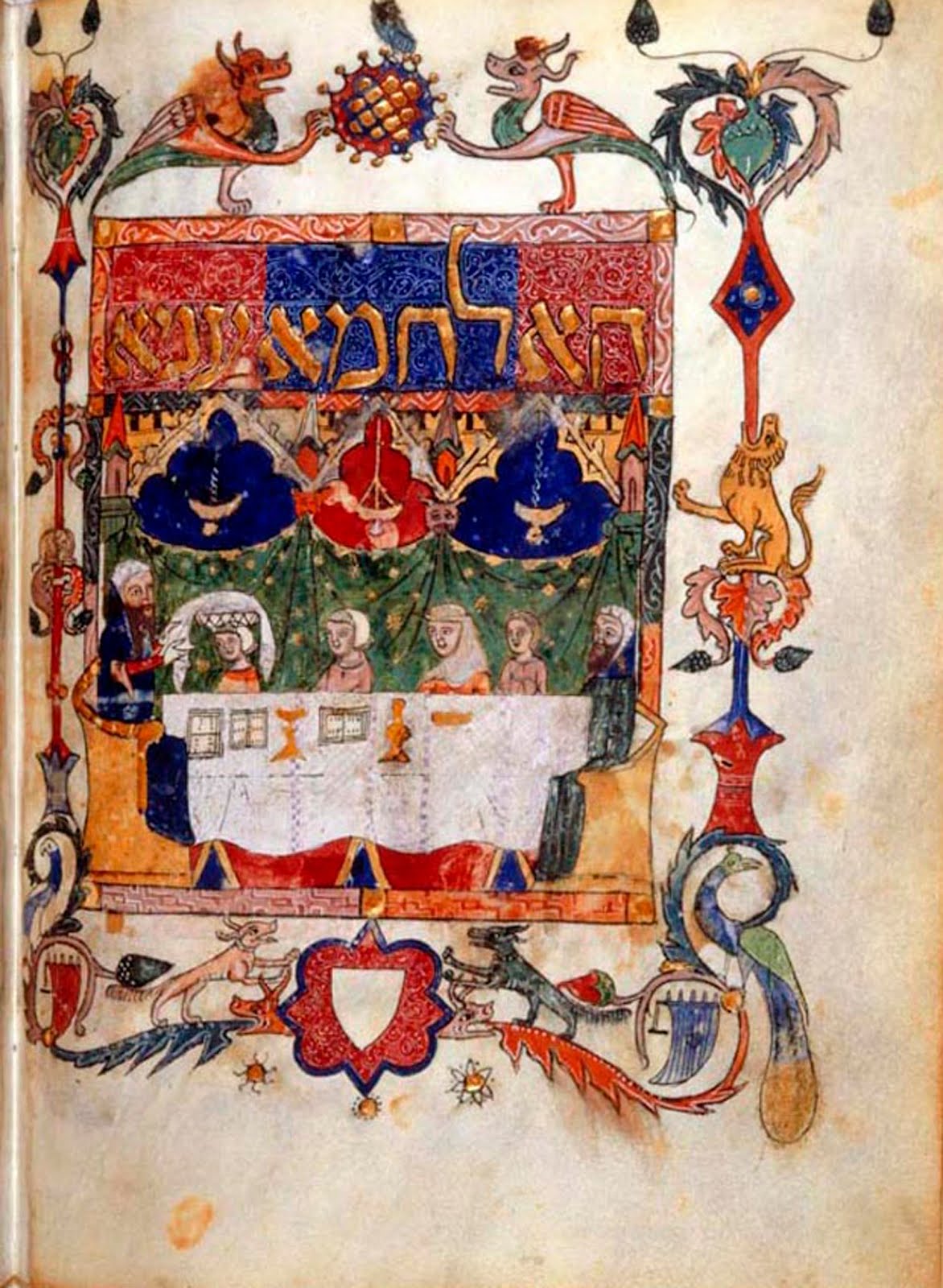
That is, for many today, matzah shmurah means shmurah (watched) from the time of harvest and not from the time of grinding. But, in reality the reason for the illustrations beginning where these haggadot do, is simply because they reflect the practice in Ashkenaz, based upon the R. Ya’akov ben Asher, the author of the Tur, that only from the time of grinding is it necessary to “watch” the grain. Matzah Shmurah in Ashkenaz in the medieval period meant grain which had been watched from the time of grinding not cutting.[2] Turning to a Sefardic custom, the Barcelona Haggadah, produced after 1350, is the earliest record of the custom to place the Seder Plate on someone’s head during the recitation of Ha Lahma Ania (Ashkenazim remove the plate from the table).Only some three hundred years later is this custom mentioned in printed sources. Additionally, there is a difference between the Sefardic and Ashkenazic haggadot regarding what the Seder Plate actually was, with the Ashkenaz depicting a plate, whereas the Sefardic manuscripts depict a basket.[3]
When it comes to marror and what vegetable that is, we have at least two different types depicted in various manuscripts. In the Brother to the Rylands Haggadah, marror is depicted as an artichoke, as is in the case with the Sarajevo Haggadah.

While in many manuscripts, marror is a leafy vegetable.[4]
Setting aside the issue of what marror is, another custom related to marror can be found in both printed and manuscript haggadot. In the Prague, 1526, the first illustrated printed haggadah, there is a picture of a man pointing at his wife with the legend, “there is a custom that a man points to his wife when mentioning marror based upon the verse Ecclesiastes 7:26 “Now I find woman more bitter than death.”
A.Y. Hyman the scholar of Jewish liturgy was appalled when he came across this. In his autobiography, he claims that there is no basis whatsoever for this “custom.” Hyman is wrong.[5] If you look at the Brother to the Rylands Haggadah you can see that it shows this custom. As does the Washington Haggadah. Likewise, the Rothschild Miscellany shows the same custom.

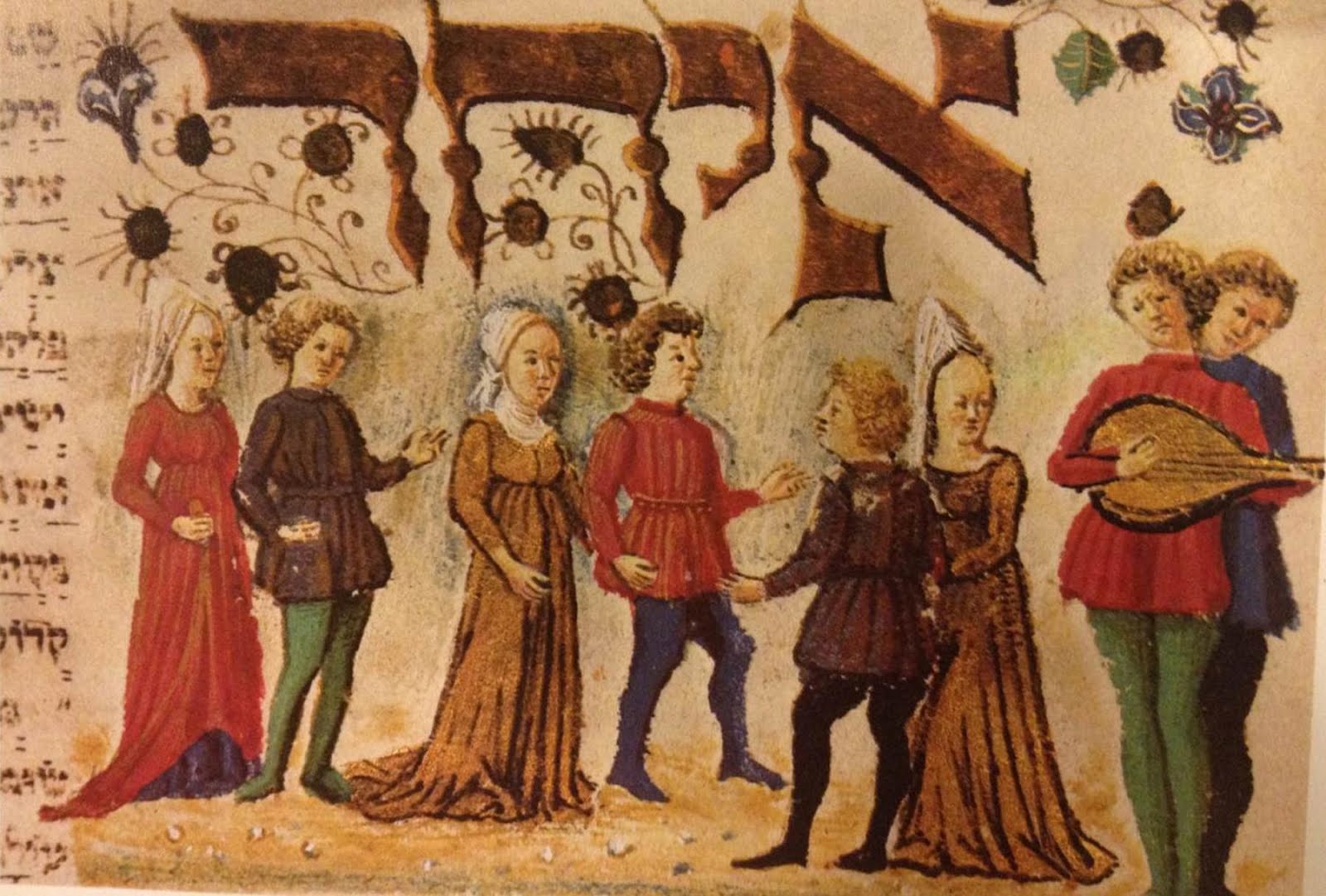
It’s worth noting that the Rothschild Miscellany shows another custom at the time, mid-14th century, that of mixed dancing.

The mixed dancing is that of couples, husband and wives dancing with each other, and not that of unmarried men and women dancing[6] In Italy, where this manuscript was composed, mixed dancing was apparently common during this period.[7] Returning to the gesturing at one’s wife at marror, in the Hiluq and Biluq Haggadah this custom takes on a somewhat more humorous dialogue with the wife no longer passive but instead returns the compliment. In that haggadah it includes speech balloons and they record the following: The husband states “touching marror I must recall that this one, too is bitter [as gall].” To which the wife replies, “It is you [my husband] is one of the causes of bitterness as well.” After which, we have a play on the 13 attributes of Rabbi Yishmael and the haggadah provides that “the third comes between them [perhaps the marror itself] and makes a stink” – or in Hebrew ve-yavo ha-shlishei ve-yakhriach benehem.[8]


Similarly, in some Ashkenazic haggadot manuscripts, they show the the husband and wife pointing at one another.[9] Finally we get to a halachik error in a manuscript haggadah. The Washington Haggadah was written by a scribe calledJoel ben Simon. This haggadah was first printed as part of the Diskin Orphan House haggadah series in 1965. The Library of Congress didn’t publish its facsimile edition until 1991, and last year another facsimile edition of this haggadah was published as well.[10] Although this haggadah was written close to 300 years prior to Diskin publishing it, until that time a significant scribal error escaped notice. Specifically, in the text for eruv tavshilin rather than just saying “with this eruv I am allowed to cook from Yom Yov for Shabbat,” it continues and says “and on Shabbat for Yom Tov.”


Needless to say this did not escape the eagle eyes of some who feared that someone may use this haggadah (we note that contrary to the other reproductions mentioned, the Diskin version is a poor copy) and inadvertently think it is permissible to cook on Shabbat. So, the ever wise Aggudat ha-Rabbonim took out ads in the Yiddish daily, Der Tag, and the Forward to let its readers know of this error. The publishers took this one step further and mailed out a letter, with the provocative title, “Heresy or Blunder,” after Passover indicating the error and also included a letter from Cecil Roth, who had written about manuscript haggadot.


In his letter he indicates that indeed this was most likely inadvertent and that Joel did not have a different tradition regarding eruv tavshilin. Indeed, we know from Joel’s other manuscripts, where he records the correct blessing, that the Washington Haggadah’s version was simply a scribal error.

This is not the only error related to halakha and haggadah illustrations. R. S.H. Kook, criticizes two aspects of illustrations that appear in the Prague 1526 Haggadah. Both of these issues center around how the wine glass is depicted. Specifically, he takes issue with the fact that in many of the illustrations show the wine glass in the left hand and not the right. Additionally, he complains that the illustration show the holder grasping the glass at the stem and not at with his fingers cupping the bottom of the glass.
Regarding the first issue, that of left handedness, this anomaly may be attributed to the fact that this was the first completely illustrated woodcut haggadah. And, as it was the first, it was not necessarily perfectly executed. But, before we continue we must digress and explain about woodcuts in order to get to the left handedness. A woodcut when inked and put on paper produces a mirror image of whatever the woodcut depicts. Thus, if the woodcut was of a right hand, when pressed on paper would produce a left handed image. Additionally, when copies were made, the copyist were not careful and would reverse the images. That is, they were working off the printed image and would copy it directly rather than accounting for reversing the image to ensure that when it was used it would produce the same and not a mirror image. So, as has been explained, during the early history of woodcuts “copies [of woodcuts] were constantly being made, with or without leave, for copyright hardly existed, and the same printer would often have to replace worn cuts by new blocks in successive editions. It is not always an easy task to distinguish copy from original. Immediately recognizable as from different blocks are subjects which appear in reverse directions, for the copyist who does not take the trouble to reverse his drawing from the original print, will make a block that will print the subject reversed.”[11] We can now explain why the images are left handed, presumably, they were copied and the woodcutter was not careful to reverse the image, thus producing a left handed image. As an aside, another example of copying which reverses the images may be seen when the Prague 1526 Haggadah was itself used as a model for a woodcut. The border surrounding Shefokh was reused in the Levush. As is apparent, the images are that appear on the right in the Prague 1526 Haggadah appear on the left in the Levush. And, those on the left appear on the right.

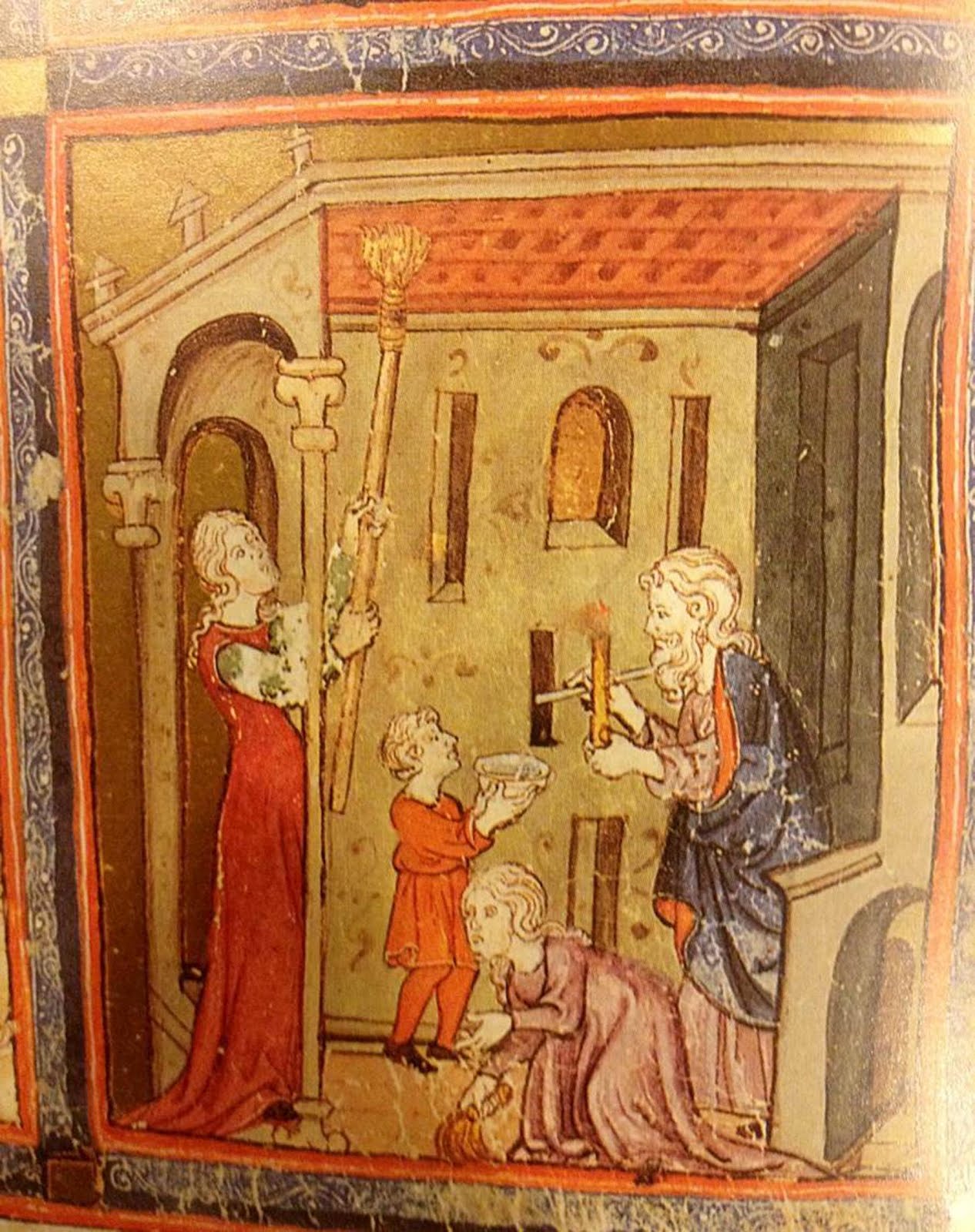
Regarding the second point, the failure to cup the glass rather than grasp the stem, this can be attributed to an error on R. Kook’s part and not the woodcutter. While today it may be commonplace to cup the glass, this was only popularized by R. Yeshaya Horowitz, in his book, Shnei Luchot ha-Brit, (Shelah). R. Horowitz wasn’t born when the Prague 1526 Haggadah was printed – he lived between 1565-1630. Moreover, his book was published posthumously, in 1648, more than 120 after the Prague 1526 Haggadah was published. Thus, it is unremarkable that the Prague 1526 Haggadah failed to account for a custom that didn’t exist at that time. This is another example of why bibliography is important, for other examples see here. Finally, we conclude this part of the series regarding halachot and Passover in general, and specifically, the notion that on Passover we are stricter than normal. At times it appears that some go overboard with the various humrot on Passover as well as cleaning all sorts of items that seemingly don’t require cleaning. But, from the evidence of manuscript illustrations, this notion of stringency is not a new one. The Golden Haggadah, circa 1320, includes this very nice image of cleaning and searching for leaven. If one looks closely they will note that the woman on the left is apparently sweeping the ceiling! Thus, indicating that perhaps going overboard has been the case for some while. Also of note is that the father is performing bedikat hametz and he is bareheaded (as is the son).[12]
[1] Its title is a reference to the fact that from the mid-nineteenth century until 1957 it was housed in Nuremberg, after which it moved to the Schocken Library, and then to a private collector. The reason it is the the Second, is because Nuremberg also had another manuscript haggadah – now known as the First Nuremberg Haggadah. It too is no longer in Nuremberg. Today it is in the Israel Museum.
[2] See Steven Fine, “The Halakhic Motif in Jewish Iconography: The Matzah-Baking Cycles of the Yahuda and Second Nurnberg Haggadahs,” in A Crown for a King, Gefen, Jerusalem-New York: 2000, pp. 106-07. [3] See Evelyn M. Cohen, “Seder Foods & Customs in Illuminated Medieval Haggadot,” in The Experience of Jewish Liturgy, D.R. Blank ed., Brill, Leiden:2011, 24-25. We note that while this article provides a summary of some of the images and text accompanying medieval haggadot, the article provides little context for various practices. Indeed, the article fails to provide sources which support many of the illustrations and texts and instead merely parrots what the the manuscripts say or depict. [4] On this issue of which vegetable is preferable for marror see Zohar Amar, Merorim, n.p., 2008. [5] His comments appear in the Misrad Hasikon 1965 reprint of the Prague 1526 Haggadah at pp. 14-15. [6] See Therese & Mendel Metzger, Jewish Life in the Middle Ages, Chartwell Books, Inc.:1982, 216-17. [7] See the sources collected by R. Henkin, Shu”t Benei Banim, vol. 1, Jerusalem: 1998, no. 37, esp. section 5 where he discusses Italian sources. Thanks to R. Weinfeld for bring this source to our attention. [8] See Bezalel Narkiss, “Art of the Washington Haggadah,” in The Washington Haggadah, Commentary, M. Weinstein, ed., Washington D.C.: 1991, pp. 73-75, discussing manuscripts that contain the marror/wife images, as well as the source in the following note. [9] See R. Yisrael Mordechi Peles, “Controversies Regarding Customs That Can Be Gleaned from Haggadot,” in HaMaayan, Nissan: 5771 (51,3), pp. 13-14, available here. [10] The 1991 edition was accompanied by a commentary volume. The 2011 edition also includes some articles with the color reproduction of the haggadah. [11] Arthur M. Hind, An Introduction to the History of Woodcut, Boston: 1935, vol. 1, pp. 284-85, quoted in R. Charles Wengrov, Haggadah and Woodcut, New York: 1967, pp. 87-88. In general Wengrov’s book provides a wealth of information regarding the images contained in the Prague 1526 Haggadah.[12] Mendel Metzger, Jewish Life in the Middle Ages, supra, p. 148 discussing generally medieval manuscripts and depictions of headcovering or lack thereof.


The Haftarot in the1806 Lopez Calendar

The Haftarot in the1806 Lopez Calendar
Eli Duker

Although[1] a Sephardi Machzor was published in 1766 in colonial New York by Isaac Pinto,[2] the first Jewish book printed in the newly formed United States that I am aware of was a calendar published by Moses Lopez of Newport, in 1806.

Lopez born in Lisbon, Portugal in 1740 with the given name Duarte to a “New Christian” family, arrived with that family in Newport in 1767 on a ship sent by his uncle Aaron where he was circumcised together with his father and brothers, upon which he took the name Moses.[3] His arrival in Newport coincided with the most active period in the colonial Jewish community’s existence.[4]

The synagogue of Congregation Nefutsé Israel (later known as Yeshuat Israel) opened in 1763,[5] and thrived for the next few years.

As the struggle between the British and the Colonists began in the 1770’s, it became more difficult to conduct business in Newport. After the Revolutionary War began, the fighting and damage caused the community to flee, mostly to New York. While some returned after the war ended, and the synagogue had the distinct honor of receiving a letter from President Washington. Nonetheless, the community never recovered. Uriah Hendricks, a Jewish traveler from New York attending services there in 1789, noted that they read the parasha from a Humash rather than from a sefer torah.[6] Upon his return there for Rosh Hashana in 1790, he became upset with how the shofar was blown. He walked out and did not return.[7]

IN 1818 it was recorded in the synagogue’s congregational minutes that there had not been any services there “for a great number of years.” In 1820, Lopez himself, the last Jew remaining in Newport, moved to New York, but continued to involve himself in the upkeep of the Newport synagogue and cemetery from afar.

Lopez’s calendar, printed in English with all Hebrew words transliterated, covers the dates from 5566 (corresponding to 1805-6 until 5519 (1858-9). It also has estimated times for the commencement of the Sabbath (rounded off to the half hour) and a list of parshiyot and haftarot. The historical context and details of the calendar are all covered quite well in M. Satlow’s “Jewish Time in Early Nineteenth Century: A study in Moses Lopez’s Calendar”.[8] Yet, other than mentioning that a list of Haftarot was printed there, there are no details or specifics given about what those Haftarot were. That will be the focus of this article.

As a Sephardic community, most of the Haftarot listed there are similar to what appears in most printed Humashim as the Sephardi Haftarah. This is not immediately apparent, as Lopez used the chapter system as it appears in the King James Bible, rather than the standard “Jewish” chapters.[9]

That said, there are points of interest concerning some of the Haftarot listed there. While there are no haftarot unique to this list, some have an end or a beginning that I have not found in any of the hundreds of Geniza fragments, or Humashim in manuscript or printed form, that I have checked. Others accord with a practice that was practiced in some other places, but that clearly deviate from the standard Sephardi practice,

Here is a list of the Haftarot in the calendar in these categories:[10]

Parashah

Haftarah

Also found in:

Closest Practice

Standard Sephardi practice

Bereishit

Isiah: 42:5-43:11

Not found anywhere else

Old Sephardi practice before Expulsion, standard Ashkenazi practice today end the Haftarah at 43:10

42:5-42:21

Vayera

II Kings 4:1-37

Old Sephardi practice before Expulsion (as well as in most Geniza fragments); later on it was the practice in Algiers, as well as the practice among most Ashkenazim, and in Italy and Yemen

4:1-23

Miketz

I Kings 3:15-28

Found in some Ashkenazi Humashim in manuscript

3:15-4:1

Beshalach

Judges 4:5-31

Old Sephardi practice before expulsion; later on in most Morrocan communities, standard Ashkenazi practice throughout history

5:1-31

Ki Tisa

I Kings 18: 20-45

Not found anywhere else

Most sources including all Sephardi ones 18: 20-39

Pekudei

I Kings 7:40-51

Some Ashkenazi and Sephardi Humashim in manuscript; one Chumash in print

7:40-50

Shemini

II Samuel 6:1-23

One Sephardi Humash in manuscript

6:1-19

Kedoshim

Ezekiel 20:1-20

Italy, one practice in Bukhara, Geniza fragments

20:2-20

Behar

Jeremiah 32:6-28

Not found anywhere else

Most communities today, and most Sephardim throughout history
32:6-26

Naso

Judges 13:3-25

Not found anywhere else

All communities that read this Haftarah (almost all) 13:2-25

Re’eh

Isaiah 54:11-55:7

Not found anywhere else

Most communities (including almost all Sephardi sources) 54:11-55:5

Second Day of Rosh Hashanah

Jeramiah 30:25-31:19[11]

Not found anywhere else

Almost all communities: 31:1-19

Second Sabbath of Hannukah

I Kings 7:40-51

Italian practice found in some Sephardi humashim in manuscript

7:4-50

Parashat Zachor

I Samuel 15:1-35

Not found anywhere else

Sephardic Italian and one Geniza fragment 15:1-34

Parashat Parah

Ezekiel 36:16-38

Ashkenaz, Italy

36:16-36

Parashat Hachodesh

Ezekiel 45:18-46:18

Some Romaniotes, and some printed Chumashim

45:18-46:15

First Day of Passover

Joshua 5:3-15

Not found anywhere else

Most communities (including Sephardim) 5:2-6:1[12]

Tisha B’Av Morning

Jeremiah 8:13-9:24

Not found anywhere else

All other communities 8:13-9:23

The only other source I was able to find regarding specific Haftarah practices in colonial America and the early United States was in the English prayer book of 1806, which lists the haftarot for the Festivals. It always conformed to the standard Sephardi practice, without the deviations found here.

It is hard to understand where these alternate Haftarot came from. Lopez was raised under the thumb of the Inquisition in Portugal. It seems highly unlikely that he attended synagogue at all, let alone with any regularity. After a few short years of belonging to a fully functioning congregation in Newport, the community began to decline, and 12 years after the completion of the calendar we know that there hadn’t been any services “for a great number of years.” In all likelihood, a man who had never really attended synagogue until he was 27 and was living in a community that likely hadn’t held Sabbath services regularly in quite some time sat on his own with a Christian Bible, writing down what he believed to be were the texts to be read for the Haftarot, even though some of these do not seem to have been practiced in the larger Sephardi Shearith Israel synagogue in New York.

Are these Haftarot figments of his faulty recollections? Or is it perhaps possible that a synagogue without a Hacham, whose members were former Anusim and their descendants, developed practices disconnected from other communities? Or is this reflective of a minhag not yet familiar? I have no answers

Selected Bibliography

Chyet, Stanley F. Lopez of Newport: Colonial American Merchant Prince. Detroit, Wayne State University Press, 1970.
Pinto, Isaac (translator). Prayers for the Sabbath, Rosh HaShana and Kippur: or the Sabbath, the Beginning of the New Year and the day of Atonements, with the Amidah and Musaph of the Moadim, or Solemn Seasons, According to the Order of the Spanish and Portuguese Jews. New Tork, J. Holt, 1766.
Satlow, Michael L. “Jewish Time in Early Nineteenth Century: A Study in Moses Lopez’s Calendar.” American Jewish Archives 65, 1-2 (2013), 1-29.
Urofsky, Melvin I. A Genesis of Religious Freedom: The Story of the Jews of Newport RI and Touro Synagogue, Including Washington’s letter of 1790 New York, George Washington Institute for Religious Freedom, 2013.

Notes

[1] I would like to thank R. Stephen Belsky for alerting me to the existence of these haftarot and sending me a copy of the calendar and my brother R Yehoshua Duker for editing the article. I would also like to thank Dr. Gabriel Wasserman, R’ Dr. Zev Ellef, and the staff of the National Library of Israel for their input and assistance. As the 4th of July approaches I feel it is an honor for me to be writing about the possible practices of an early American shul, having in mind the words that my beloved Rav, Rabbi Avraham Levene ZT”L spoke on the Sabbath of my bar mitzvah, that even after the arrival of mashiach we will have to continue to show appreciation to America. I merited making aliyah, but that sentiment is still with me.
[2] “Prayers for the Sabbath, Rosh HaShana and Kippur: or the Sabbath, the Beginning of the New Year and the day of Atonements, with the Amidah and Musaph of the Moadim, or solemn seasons, according to the order of the Spanish and Portuguese Jews.” It is the only such book I have seen to be printed entirely in English.
[3] See S.F. Chyet “Lopez of Newport” pp. 106-107.
[4] It is worth noting that the synagogue is still in use today making it the oldest synagogue building in the United States.
[5] M. Urofsky “A Genesis of Religious Freedom – The Story of the Jews of Newport RI and Touro Synagogue” p. 59.
[6] Urofsky p. 76.
[7] Ibid. p. 86.
[8] American Jewish Archives vol. LXV pp. 1-29.
[9] Sifrei Kodesh seemed to have been a rarity in America then; see Stalow p. 9.
[10] For a more complete list of the various practices of Jewish communities regarding these Haftarot throughout history, see my site on AlHatorah. https://alhatorah.org/Index:Haftarot/0/he
[11] Listed there as Jeremiah 31: 1-20 it is following the chapters that appear in the Kings James Bible, which would be consistent with the other listings. Some Jewish Bibles, such as that of Cassuto, use this chapter breakdown as well. It is worth noting that the New York Machzor from 1766 lists the Haftarah as Jeremiah 31:2-20, which would be consistent with the standard practice using the same chapter breakdown.
[12] The verse 6:27 is then added. It is clear that the calendar does not include anything that involves skipping verses, so it is unclear what the author intended here.


Keter Shem Tov: A Study in the Entitling of Books, Here Limited to One Title Only

Keter Shem Tov: A Study in the Entitling of Books, Here Limited to One Title Only[1]

by Marvin J. Heller

Entitling, naming books is, a fascinating subject. Why did the author call his book what he/she did? Why that name and not another? Hebrew books frequently have names resounding in meaning, but providing little insight into the contents of the book. This article explores the subject, focusing on one title only, Keter Shem Tov. That book-name is taken from a verse “the crown of a good name (Keter Shem Tov) excels them all (Avot 4:13). The article describes the varied books with that title, unrelated by author or subject, and why the author/publisher selected that title for the book.

  1. Simeon said: there are three crowns: the crown of Torah, the crown of priesthood, and the crown of royalty; but the crown of a good name (emphasis added, Keter Shem Tov) excels them all (Avot 4:13).
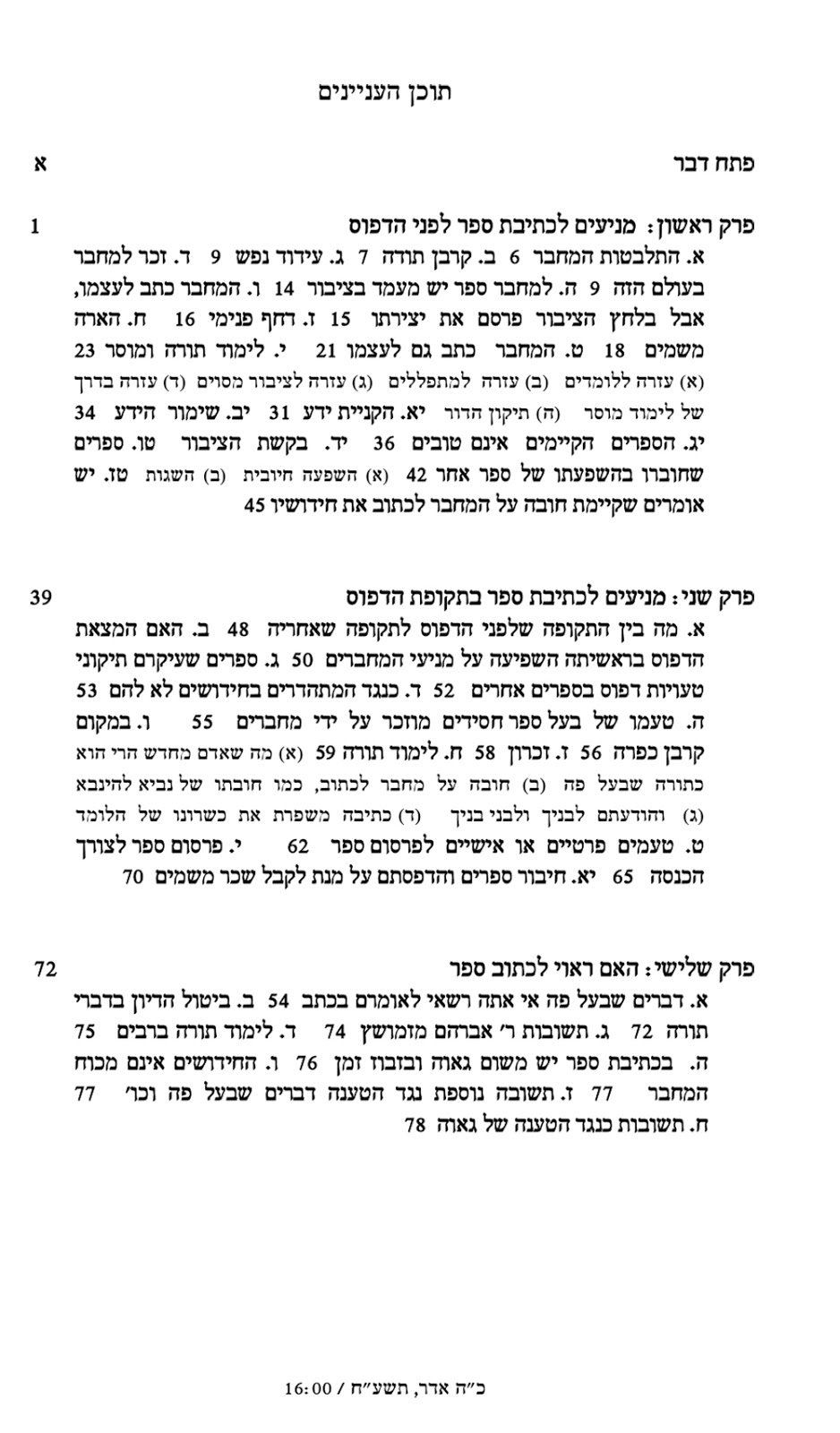
“As a pearl atop a crown (keter), so are his good deeds fitting” (Israel Lipschutz, Zera Yisrael, Avot 4:13).

Entitling, naming books, remains, is, a fascinating subject. Why did the author call his book what he/she did? Why that name and not another? Hebrew books since the Middle-Ages often have names resounding in meaning, but providing little insight into the contents of the book. A reader looking at the title of a book in another language, more often than not, is immediately aware of the book’s subject matter. This is not the case for many Hebrew titles, the name having been selected by the author for any one of a number of reasons, least of all the book’s subject matter, but rather the intention is/was to give the book “the crown of a good name (Keter Shem Tov).”

Book titles have been addressed in both books and articles. Menahem Mendel Slatkine wrote a two volume work, Shemot ha-Sefarim ha-Ivrim: Lefi Sugehem ha-Shonim, Tikhunatam u-Te’udatam (Neuchâtel-Tel Aviv, 1950-54) on book names; it has been the subject of encyclopedia articles in both The Jewish Encyclopedia and the Encyclopedia Judaica; and such authors as Abraham Berliner, Joshua Bloch, and Solomon Schechter have written articles on book titles, all this apart from this subject being mentioned in passing in numerous other works. I too have addressed the subject, first in “Adderet Eliyahu; A Study in the Titling of Hebrew Books,” describing about thirty books with that single title, two only related to each other, and in “What’s in a name? An example of the Titling of Hebrew Books,” describing varied books taken from a single verse “Your neck is like the tower of David built with turrets, on which hang one thousand bucklers, all of them shields of mighty men (Song of Songs 4:4).[2]

What then is the justification for yet another article on the same subject? It is, as suggested above, the allure of how authors of varied unrelated works came to entitle their books, reflective of their intellectual or emotive processes or objectives. The title selected here, Keter Shem Tov, unlike Adderet Eliyahu, is not the title of as large a number of books, but the titles here are certainly as varied as those in the previous articles. Indeed, the works so entitled are sufficiently different, again providing insight into authors’ thoughts and, perhaps, an article of interest to the reader. We will not attempt to second guess or analyze an author’s motives, all of whom intended their book to have the crown of a good name (Keter Shem Tov), but rather we will let the authors speak for themselves when describing their books

In several instances, books are so entitled as to reflect the author’s name, Shem Tov. The use of a line from Avot, to reiterate the injunctions noted previously (“Adderet”), rather than directly using the author’s name, is to avoid violating R. Judah ben Samuel he-Hasid of Regensburg’s (c.1150-1217) proscription to not do so, so as to not benefit from this world, thereby decreasing one’s portion in the world to come, or to not reduce their offspring and the good name of their progeny in this world.[3] The Roke’ah (R. Eleazar ben Judah of Worms, c. 1165–c. 1238), however states at the beginning of the introduction to his Roke’ah, that everyone should inscribe his name in his book, as we find in the Tanna de-Vei Eliyahu.[4] Indeed, the Sefer ha-Roke’ah, is so entitled because the numerical value of the family name, Roke’ah (רקח=308), equals his personal name, Eleazar (אלעזר=308). It is, therefore, permissible to allude to the author’s name, for example, a Shem Tov using the title Keter Shem Tov, a quotation from Avot. Indeed, a substantial number of the books described here refer to the author’s name.

Our selection encompasses homilies on the Torah, Kabbalah on the Tetragrammaton, halakhah and minhagim (customs), the sayings of the Ba’al Shem Tov, in praise of Sir Moses Montefiore, a letter on behalf of the Jewish community in Tiberias, and a highly unusual work on the Dead Sea scrolls. Finally, this article is a vignette, no more no less, an insight into and, in a manner of speaking, a photograph of one manner of how Hebrew books are named.

Several caveats. First, our Keter Shem Tovs are organized within subject categories, beginning with 1) discourses, both literal and kabbalistic on the Torah, followed by 2) halakhah and minhag (custom), 3) biographical and related anecdotal works, 4) miscellanea, all ordered chronologically within category, and concluding with 5) a brief summary. Secondly, our approach will be somewhat expansive, the various Keter Shem Tovs giving us entry into related aspects of Hebrew printing and Jewish history. Lastly, while the number of works entitled Keter Shem Tov is not large, that notwithstanding, our examples are an overview and not meant to be all inclusive or comprehensive but intended as an interesting insight into an aspect of Hebrew book practice.

I Discourses, Literal and Kabbalistic on the Torah

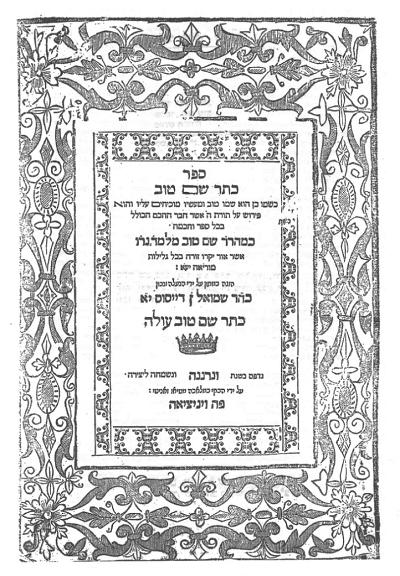
Keter Shem Tov, R. Shem Tov ben Jacob Melamed, Venice, 1596: Our first Keter Shem Tov is a commentary on the Torah by R. Shem Tov ben Jacob Melamed. It was printed in Venice (1596, 20: 136, 16 ff.) at the press of Matteo Zanetti. This Zanetti, a member of the famous Venetian printing family of that name, established his print-shop on the Calle de Dogan, publishing seven books from 1593 to 1596. Among his titles, in addition to Shem Tov Melamed’s Keter Shem Tov, are R. Nathan Nata Spira’s (Shapira) Be’urim, R. Bezalel Ashkenazi’s responsa, and R. Solomon le-Bet ha-Levi’s Divrei Shelomo.

The title page has the decorative frame employed by Zanetti on several of his books with a smaller frame in the center about the text. The title-page states that,

Keter Shem Tov

As is its name so is his name good and his deeds confirm it of him. It is a commentary on the Torah of HaShem written by the sage, the complete, in every book and wisdom.

Shem Tov Melamed

Whose precious light shines throughout [may

God shield him].

Edited patiently by the lofty and exalted

Samuel ibn Dysoss [may God watch over him]

Keter Shem Tov excels

Printed in the year, “that we may rejoice ונרננה (5356=1596) and be glad [all our days]” (Psalms 90:14) from the creation.


The introduction, from a student of the author, R. Samuel ben Solomon Segelmassi follows (2a), then a page of verse from the editor Samuel ibn Dysoss, the text (3a-136a), his apologia (136b), indexes (1a-16a), errata (16a), and the colophon (16b), which states that it was completed, “on the very day that Moses went up to the firmament (6 Sivan) and the Egyptians drowned in the sea (21 Nissan), in the year, “Then he saw it, and declare it ויספרה (5356=1596) (Job 28:27), from the creation.” It is unclear why there are two apparently contradictory completion dates. The text is in two columns in rabbinic type, excepting headings and initial words.

In the introduction Samuel ben Solomon writes that one who knows matters in truth and faithfully,

“shall come back with shouts of joy” (Psalms 126:6), “to perceive the words of understanding” (Proverbs 1:2) and this is the first intent of every man who presumes in his heart (Esther 7:5) to write “goodly words” (Genesis 49:21) in a book to leave after him a blessing. . . . It is a commentary on the holy Torah, “high and lofty” (Isaiah 6:1, 57:15), on each and every parshah . . .

The introduction continues that it contains derashot (discourses) according to the literal meaning, casuistic (pilpul), and very sharp. In the following paragraph we are informed that not everything that was said on every parshah was printed because of financial restraints. In the apologia ibn Dysoss adds a familiar plaint for the period, type set late erev Shabbat could not be properly corrected. Moreover, the compositors, not Jewish and not fully familiar with Hebrew and Hebrew letters, did that which was right in their eyes, and for which he should not be held responsible.

That the title clearly alludes to the author’s name, R. Shem Tov ben Jacob Melamed, is further suggested by the last line of verse at the end of the introduction, which states that “you will find that the crown of a good name (KETER SHEM TOV) excels them all. This is, as noted above, that authors’ names were frequently employed in book-titles, but, in keeping with the injunction of R. Judah he-Hasid, indirectly, here by referencing a quote from Avot.

Shem Tov Melamed was also the author of Ma’amar Mordekhai (Constantinople, 1585), a commentary on Megillat Esther, printed by Joseph Jabez. Melamed is described on the title of this work as a physician.

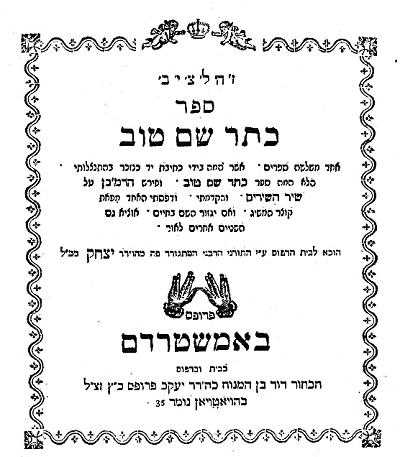
Keter Shem Tov, Amsterdam, R. Abraham ben Alexander (Axelrad) of Cologne, c. 1810-16: A kabbalistic Keter Shem Tov on the Tetragrammaton by R. Abraham ben Alexander (Axelrad) of Cologne (13th century). In Judaism the Tetragrammaton, the four letter divine name, is not directly expressed but instead referred to with a euphemistic name for God. The title-page describes this Keter Shem Tov as,

זהלציב [This is the gate of the Lord: the righteous shall enter through it] (Psalms 118:20)

Sefer

Keter Shem Tov

One of three books in my hand in manuscript, as described in my apologia. They are Keter Shem Tov and the commentary of the Ramban (R. Moses ben Nahman, Nachmanides, 1194–1270) on Shir ha-Shirim (Song of Songs). I have first printed one book only due to limited means. If the Lord will so decree I will publish the other two books. . . .


Although the title-page refers to three books two only are mentioned. The third work, noted in the editor’s apologia, is a commentary on the Merkavah of Ezekiel. Keter Shem Tov is not dated, so that various bibliographic sources date it as 1810 or 1816. The title-page is embellished by the Proops’ family press-mark, consisting of the kohen’s spread hands at the time he pronounces the priestly blessing. This edition of Keter Shem Tov (80: 5, 7 ff.) was printed in Amsterdam by David ben Jacob Proops. The Proops’ press, founded by Solomon Proops in 1704, was the longest lasting and most productive of the Hebrew printing-houses in Europe in the eighteenth century; it would continue to print Hebrew books until the mid-nineteenth century when, in 1869, the widow of David Proops sold the press to the Levissons, who printed until 1917.

Abraham, a student of R. Eleazar ben Judah of Worms (c. 1176–1238, Roke’ah), traveled through Spain between approximately 1260 and 1275, where he reportedly studied with R. Solomon ben Adret (Rashba, 1235–1310), the latter praising Abraham’s oratorical skills. Keter Shem Tov, as noted above, deals with the Tetragrammaton and also the Sefirot, addressing sacred names, using gematriot and synthesizing the mysticism of the Ashkenaz pietists (Hasidim) and Sephardic Kabbalistic methodologies.[5] Here too the reason for the title is not explicitly stated but, given the subject matter, is obvious.

This is not the first printing of Abraham ben Alexander’s Keter Shem Tov. It appeared earlier, included in a collection entitled Likkutim me-Rav Hai Gaon (Warsaw, 1798), under the title Ma’amar Peloni Almoni (ff. 26-32a). It has since been reprinted several times, often among collections of other works.

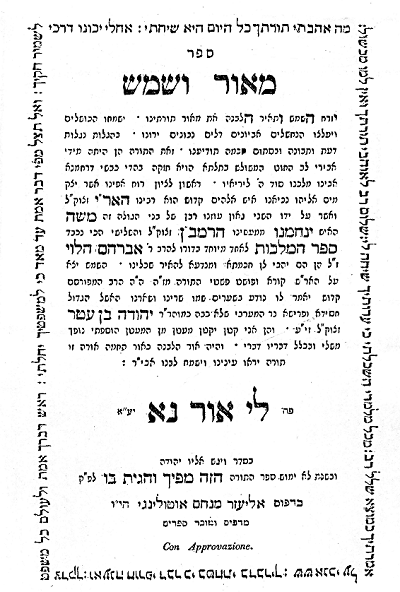
Ma’or va-Shemesh, R. Shem Tov ben Abraham ibn Gaon, Livorno, 1839: The next Keter Shem Tov, by R. Shem Tov ben Abraham ibn Gaon, is also a kabbalistic discourse on the Torah, this part of a larger multi-volume work entitled Ma’or va-Shemesh (Livorno, 1839, 80: [3], 3-11, [1], 128 ff.) printed by Eliezer Menahem Ottolenghi. The inclusion of Ma’or va-Shemesh represents a more expansive view of works entitled Keter Shem Tov as it is an independent work included in a larger collection of dissertations. The author (compiler) of Ma’or va-Shemesh, R. Judah ben Abraham Coriat (d. 1787) of Tetuán, was a scion of a distinguished Moroccan family.

  1. Shem Tov ibn Gaon (c. 1287-c. 340) was born in Soria, Spain and went up to Eretz Israel in 1312, settling in Safed where he wrote most of his books. He was a student of R. Solomon ben Adret (Rashba, 1235–1310) and R. Isaac ben Todros (13th cent.). Best known of ibn Gaon’s titles is Migdal Oz, on Maimonides’ Mishneh Torah as well as several works in manuscript. Keter Shem Tov, his first book, was reportedly written in Spain, while Rashba was still alive.[6]

The title-page of Ma’or va-Shemesh has a frame comprised of verses, all from Psalm 119:

“O how I love your Torah! It is my meditation all the day” (Psalms 97);

“O that my ways were directed to keep your statutes!) (5);

“The sum of your word is truth; and every one of your righteous judgments endures for ever” (160);

“So shall I have an answer for him who insults me; for I trust in your word” (42);

“So shall I have an answer for him who insults me; for I trust in your word” (162);

“I have more understanding than all my teachers; for your testimonies are my meditation” (99); “Great peace have those who love your Torah; and nothing can make them stumble” (165).


An additional verse is employed for the date, “This Book of the Torah shall not depart from your mouth; but you shall meditate on it הזה מפיך והגית בו (599 = 1839)” (Joshua 1:8). The title too is from Psalms, “The day is yours, the night also is yours; you have prepared the light and the sun (Ma’or va-Shemesh)” (Psalms 74:16).

The text of the title-page notes several of the authors whose kabbalistic works comprise Ma’or va-Shemesh, notably the Ari ha-Kadosh (R. Isaac Luria, 1534 – July 25, 1572), R. Moses ben Nahman (Ramban), Sefer ha-Malkut, and R. Judah ben Attar, Coriat’s maternal grandfather. The verso of the title-page has a pressmark, a lion rampant holding thistle under crown and below it the phrase Gur Aryeh Yehudah. This device was used previously in Livorno by Eliezer Saadun. When employed by Ottolenghi the lion has been turned to face right, it having previously faced left.[7]


There are introductions from R. Elijah Benamozegh and Abraham ben Judah Coriat, the former comprised of five paragraphs, each beginning with the word Kol and concluding with Judah, the latter’s introduction comprised of eight paragraphs, each beginning with Ben and concluding with Av. The text is comprised of several kabbalistic works, among them Shem Tov ben Abraham ibn Gaon’s Keter Shem Tov (ff. 25-54a), here not explicitly stated but rather entitled Perush Sodot ha-Torah. Shem Tov was a kabbalist, who studied with the Rashba and R. Isaac ben Todros. He was greatly influenced by the Ramban (R. Moses ben Nachman), reflected in his Keter Shem Tov, which is a kabbalistic super-commentary on Ramban’s Torah commentary. Here too, the title comes from the author’s name, Shem Tov.

A small portion of ibn Gaon’s Keter Shem Tov was printed previously (ff. 41b-44a), in R. Jehiel ben Israel Luria Ashkenazi’s Heikhal ha-Shem (Venice, 1601), on the ten Sefirot, Likkutei Kabbalah Kadmonim.


This much expanded version of Keter Shem Tov is based on an 1810 manuscript prepared by R. Elijah Lombroso.

II Halakhah and Minhag

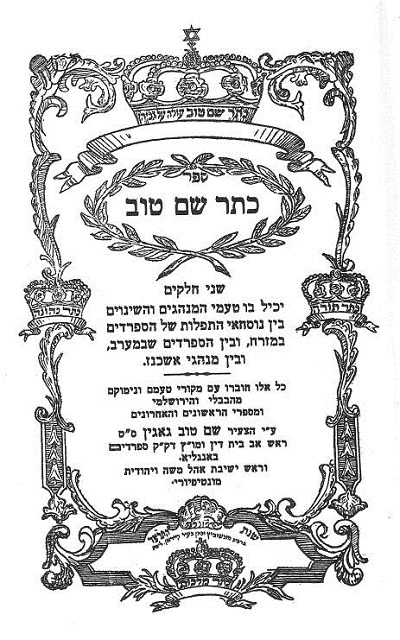
Keter Shem Tov, R. Shem Tov ben Isaac Gaguine, Kaidan, Lithuania, 1934: An encyclopedic work on the varied customs and liturgy of eastern and western Sephardim and Ashkenazim by R. Shem Tov Gaguine (Gaguin, 1884-1953). Gaguine, scion of a famous Moroccan Rabbinical dynasty which emigrated to Palestine from Spain, was a great-grandson of R. Hayyim Gaguin the first Hakham Bashi of Eretz Israel in the Ottoman Empire and a great-great grandson of the kabbalist Sar Shalom Sharabi. Gaguine, who received semicha (ordination) from R. Hayyim Berlin, served as a dayyan in Cairo, rabbi and dayyan in Manchester, England, Rosh Yeshivah of Judith Montefiore Theological College, Ramsgate, and, from 1935, as head of Sephardi Medrash Heshaim in London.[8]


This Keter Shem Tov is comprised of seven volumes, the first two published in 1934, and the last four published posthumously by his son Dr. Maurice Gaguine. The complete work has been republished several times.

As noted above, Keter Shem Tov is a comprehensive work describing the liturgy and customs of eastern and western Sephardim and of Ashkenazim, accompanied by detailed footnotes from the Babylonian and Jerusalem Talmuds and later halakhic authorities. Although most of the entries explain more familiar customs, many are unusual. Example of the latter are:

The custom in [Eretz Israel and Syria, Turkey and Morocco] when the father, grandfather, father-in-law, one’s rabbi, or elder brother has an Aliyah, to stand on one’s feet until he returns to his place, and to go to them, kiss their hand and receive a blessing (I:213).

An unusual custom of the Sephardim in the city of Algiers is the phrase “marror zeh (this marror)” is said three times and then thrown to the ground, and afterwards picked up and returned to the ka’arah (Seder plate).[9]

Why is the marror called hasa or hazeret (lettuce or horse raddish)?

The Ashkenaz custom is to take, in place of hazeret a type of dry radish called in their language hrain, which is as sharp as mustard and does not have a bitter taste. The Sephardic custom is specifically hazeret. . . . (III: 158-59).

Keter Shem Tov, R. Avishai Taharani, Jerusalem, 2000: Another work on halakhah and customs, this most specific, described on the title-page as “a treasure of all the halakhot and personal customs concerning naming sons and daughters” by R. Avishai Taharani. The title-page continues that in it are explained the basic guidelines for giving names “by whose observance man shall live” (Leviticus 18:5, Ezekiel 20:11, 13, 21). Also addressed are the names that one should refrain from using.

In the introduction (pp. 1-23) to this two volume work, Taharani informs that he has so entitled the book, based on the injunction of the Roke’ah (above), as well as several other works. He has done so, however, with gematriot (numerical equivalencies) for “Avishai Taharani ben my lord and father Isaac אבישי טהרני בן לאדוני ואבי יצחק (977) which corresponds to Keter Shem Tov כתר שם טוב (977).” The text is wide ranging, comprehensive, and accompanied by detailed footnotes. Several examples of the more unusual entries in the text are:

If a father errs and calls his son or daughter with two names, forgetting that the additional name was given to another child, there are those who say that until thirty days he may change the name (I:118).

Some say that if one has a child from an unmarried woman, the child should be called with a name that predates [the time of the] Patriarch Abraham or with a name that is not customary, for example, Dan, so that he will be judged according to his problem. There are places that it is customary to give these names to those who are kosher and Heaven forfend one should come to question those who are kosher (I: 237-38).

Some say that one should not call [a child] with one of the names that predates the Patriarch Abraham, for example: Adam, Noah, and all who call by a name that predates the Patriarch Abraham is not in the category of one who “labors in the Torah, and does not give pleasure to his Creator” (cf. Berakhot 17a). (I:397-400).

It is permissible to shorten a name, whether for a son or a daughter, as long as that name is used only casually, and it is best to use the full name at least once a day in order that the short form dies not become customary (II:110-13).

In a lengthy footnote to the third entry concerning names that predate the Patriarch Abraham a source for the entry is given, ha-Mabit (R. Moses ben Joseph of Trani, 1500 – 1580). It is followed by a number of contrary sources by other prominent rabbis, and then a lengthy discussion. That this Keter Shem Tov has proven to be a relatively popular work is evident from the publication of two additional editions, the last in 2007.

Keter Shem Tov, Kollel Keter Shem Tov, Kiryat Bialik, 2002: Collection of discourses and responsa on Shulhan Arukh Hoshen Mishpat by rabbis from the Kollel Keter Shem Tov in Kiryat Bialik, located in the vicinity of Haifa. There is an introduction from R. Mahluf Aminadav Krispin, Chief Rabbi of Kiryat Bialik, followed by the text, comprised of nineteen articles, including one by the Rosh Yeshiva R. Solomon Shalosh. Examples of the articles are 5) “on the prohibition turning to secular courts” by R. Efied Hagibi, member of the Kollel; 6) finding a relative or one who is unfit among the judges by R. David Alharar, member of the Kollel; 9) witnesses who have fulfilled their charge” by R. Evied Elul, member of the Kollel; 11) “the obligation of rent after divorce, the portion in the residence” by R. Abraham Atlas, av bet din, Haifa; 14) “acquisition through forgiveness (relinquishment) by R. Solomon Shalaoh; and 19) “the wages of a worker and contractor who did not provide the agreed upon benefit” by R. Abraham Atlas.

The title-page numbers the volume as no. one, but it is not known whether additional volumes were published.

III Biographical and Related Anecdotal Works

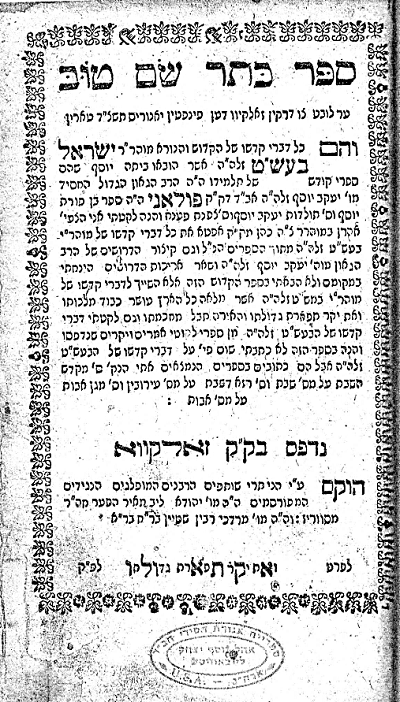
Keter Shem Tov, R. Aharon ben Zevi ha-Kohen of Apta, Zolkiew, 1794/95: The most popular of our Keter Shem Tovs, based on the printed editions, is the collection of tales and stories of the remarkable and astounding deeds of the Ba’al Shem Tov (R. Israel ben Eliezer, Besht, c. 1700–1760), founder of the Hasidic movement, as well as his recorded sayings, assembled from the works of his disciples. This collection of tales and sayings was assembled by R. Aaron ben Zevi Hirsch ha-Kohen of Opatow (Apta).


The book is in two parts, each with its own title-page but identical text, except that the first title-page is dated with a chronogram, the second title-page, printed a year later, is dated in a straightforward manner, תקנ”ה (555 = 1795). Perhaps the reason that the second title-page is so dated is that the first title-page exists in two forms, the rare first title-page, is dated “and the glory of his splendid majesty ואת יקר תפארת גדולתו (544 = 1784)” (Esther 1:4), which is incorrect, the book having been printed a decade later. The error was likely quickly caught, for the corrected and much better known title-page has the same chronogram, now reading ואת יקר תפארת גדולתו, the yod in the second word enlarged and emphasized, for a correct total of 554 (1794).[10] The variants are recorded separately in several bibliographic works.[11]

The title-page informs that that much of the contents are from the works of R. Jacob Joseph ben Zevi ha-Kohen av bet din of Polonnoye (d. c. 1782), the Ba’al Shem Tov’s leading disciple, that is, Toledot Ya’akov Yosef, Ben Porat Yosef, and Zafenat Pa’ne’ah, as well as discourses, also from other works. Among these latter sources are Likkutei Amorim and the sayings of the Ba’al Shem Tov, all collected by R. Aaron ben Zevi Hirsch ha-Kohen of Opatow (Apta).

In addition to the variations to the first title-page, the second title-page also exists in two formats, with, unlike the first title-page, some textual variations. Within the text of the book, despite Aaron ben Zevi Hirsch ha-Kohen’s comments that he has assembled the Ba’al Shem Tov’s words from the above mentioned titles, he did not, in fact, merely transcribe them in toto, nor did he distinguish which were the words of the Ba’al Shem Tov and those of Jacob Joseph.[12]

Keter Shem Tov has an approbation from R. Menachem Mendel of Liska, followed by the famed Iggeret Hakodesh, a letter from the Ba’al Shem Tov to his brother, dated Rosh Ha-Shanah, 1747, in which he relates that his soul ascended to heaven where he met with the Messiah, and then the text. This Keter Shem Tov, as noted above, has proven to be an enduring and popular work; it was printed soon after in Korezec (1797), Lemberg (1809) and several times afterwards there, in numerous other locations, and continues to be republished to the present.

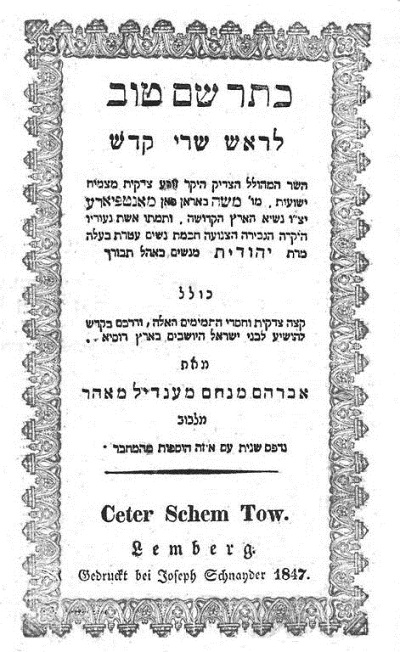
Keter Shem Tov, Abraham Menahem Mendel Mohr, Lvov (Lemberg), 1847: Sir Moses Montefiore (1784–1885) was one of, if not the most prominent member of English Jewry in the nineteenth century. Cecil Roth described him as “the most notable Jew, and indeed one of the most notable Englishmen, of the 19th century by virtue of his outstanding philanthropic work extending over a period of three-quarters of a century, into his venerable old age.”13 Montefiore traveled to the Middle East during the Damascus Affair, to Russia, Morocco, and Rumania on behalf of persecuted Jewry, as well as providing leadership and support of Jewry at home and in Eretz Israel. His indefatigable efforts on behalf of world Jewry are recorded and acknowledged in books, articles, and newspapers, several works entitled Keter Shem Tov.

The first Keter Shem Tov praising Sir Moses Montefiore is by Abraham Menahem Mendel Mohr (1815–1868), a scholarly maskil, author of a number of Hebrew and Yiddish books. The title-page states that it is,

Keter Shem Tov

For the chief, holy prince

The praiseworthy, the righteous, the dear, who sows righteousness and brings forth salvation. Our teacher, Moses Baron from Montefiore [May his Rock and Redeemer protect him], prince of the holy land. And the pure wife of his youth, the honorable lady, the modest, the wisdom of women “is a crown to her husband” (Proverbs 12:4), the lady Judith “blessed shall she be above women in the tent” (Judges 5:24). . . .

The title-page continues that the text includes some of the righteousness and perfect kindness on behalf of the Jews in Russia. A small book, (80: 16 pp.: Joseph Schnander), the text begins with verse, with the header “from Moses to Moses there was none like Moses” normally referring to Maimonides but here applied to Montefiore. The verse beginning,

“Moses ben Amram brought Israel out from the burdens of Egypt

and Moses Montefiore redeemed them from death to life.

Moses ben Amram “struck the rock, so that the waters gushed out” (Psalms 78:20)

and Moses Montefiore softened the heart of stone with “words of lips” (cf. II Kings 18:20, Isaiah 36:5). . . .


The volume concludes with a letter of appreciation from Sir Moses Montefiore.

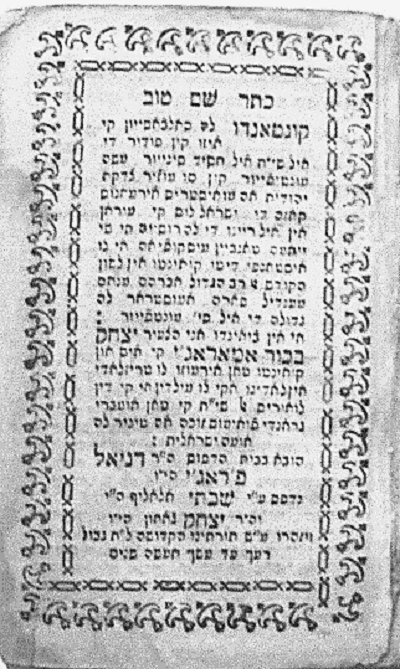
A Ladino (Judeo-Spanish) version of Mohr’s Keter Shem Tov was printed in Salonika (1850, 80: 48, 53-80 ff.) together with two other works, Tiferet Yisrael on the Rothschilds, and Ma’aseh Eretz Israel on Eretz Israel from the destruction of the Temple to the nineteenth century. Among the many other works either praising or including a section on Montefiore are Kol Kitvei Rabbi Ya’akov Saphir ha-Levi (Jerusalem, 1934), the writings of R. Jacob Saphir (1822–1886), an emissary of the Jewish community in Jerusalem and the author of Even Saphir on the Jewish communities in such varied places as Yemen, Egypt, India, and India that he visited. In Kol Kisvei is a section entitled Keter Shem Tov Kenaf Renanim Sir Moses Monrefiore, accompanied by a cameo of Montefiore.


Yet another Keter Shem Tov about Montefiore was published by Hayyim Guedalla (London, 1884). The Hebrew title-page is followed by an English title-page that states,

The Crown of A Good Name

a brief account

of a few of the

Doings, Preachings, and Compositions

On

Sir Moses Montifieore’s Natal Day,

November 8th, 1883,

on which he was favored with a succession of telegraphic

Congratulations from the QUEEN OF ENGLAND and many

Eminent People of all Creeds.

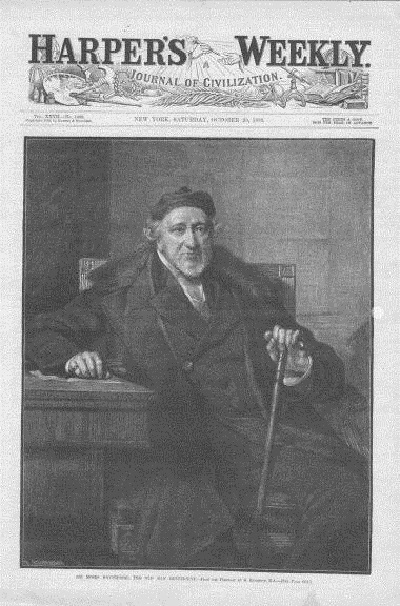
Below is the quote from Pirke Avot. The text includes congratulatory letters from the Queen, the Duke of Edinburgh, many others, and special services in both Hebrew and English. In addition, many other publications relate to Moses Montefiore, among them, albeit this not directly pertinent to the article but of interest as a further example of how widespread the high esteem in which the venerable Sir Moses Montefiore was held, is the title page of the October 20. 1883 Harper’s Weekly Journal of Civilization (New York), with a full cover portrait of Montefiore.


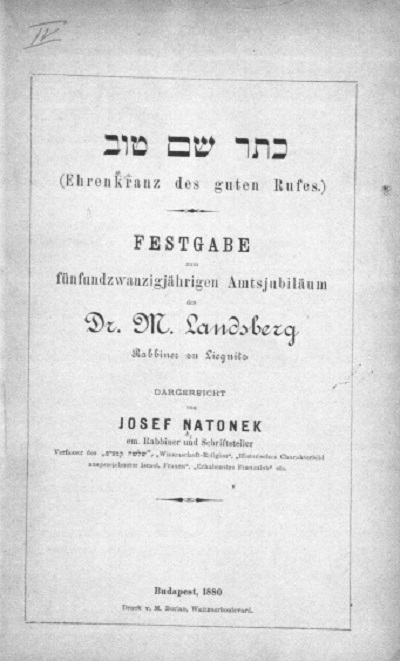
Keter Shem Tov (Ehrenkranz des guten Rufes), R. Josef Natonek, Budapest, 1880: German Keter Shem Tov by Josef Natonek in honor of Rabbi Dr. Moritz Landsberg (1824-80), son of R. Elias Landsberg (1800-79). Except for a Hebrew header the title page is entirely in German, as is the text (32 pp.), with only occasional Hebrew.


The title, Ehrenkranz des guten Rufes, is our “crown of a good name,” a Festgabe zum fünfundzwanzigjährigen Amtsjubilaeum des Dr. M. Landsberg, Rabbiner zu Liegnitz dargereicht von Rabbiner Josef Natonek em Rabbiner und Schriftsteller verfasser, that is a festive volume presented to Landsberger on the twenty-fifth jubilee of his service as rabbi in Liegnitz, by R. Josef Natonek (1813-92), a rabbi and author. Landsberg, doctor of philosophy educated in Berlin, became, in 1854, the rabbi of Legnica. Born in Rawicz, He served as rabbi for twenty-five years until his death in Liegnitz (Legnica, Silesia).[14] Landsburg was also the author of a number of studies on the history of medicine, particularly in ancient times, published for the most part in the journal Juno, published by von Henschel.[15]

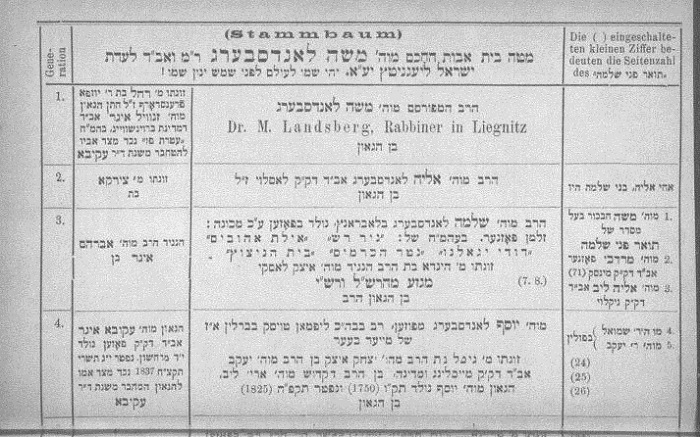
At the end of the volume is a two page Stammbaum (family tree) of the Landsberg family.


IV Miscellanea

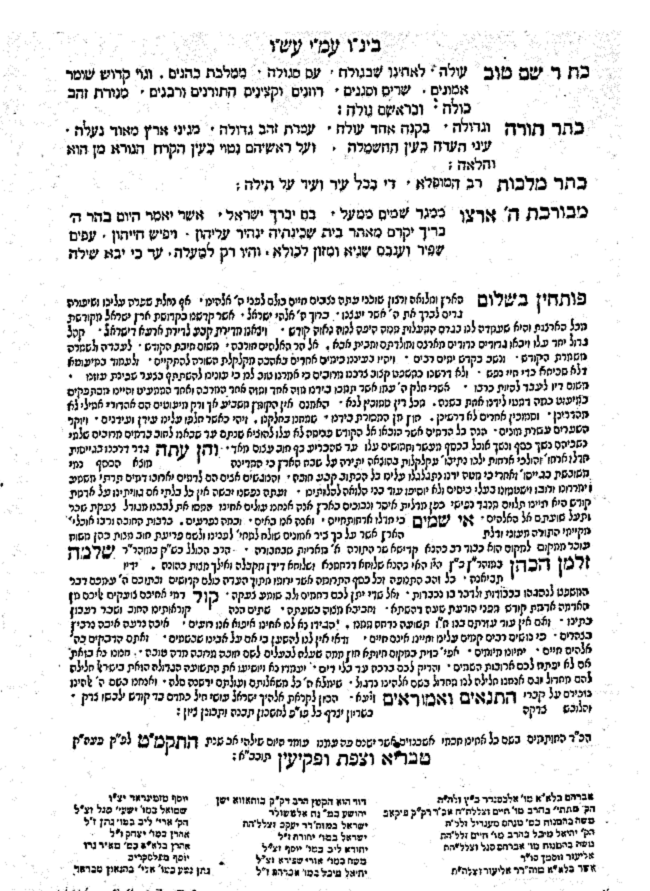
Keter Shem Tov, R. Solomon Zalman ben Zevi Hirsch ha-Kohen, Livorno, c. 1789: Our next Keter Shem Tov is a quarto sized page printed in Livorno in c. 1789 for the Hassidic Tiberius Kollel Ashkenazim. It informs that R. Solomon Zalman ben Zevi Hirsch ha-Kohen (d. 1799) is an emissary of the Merciful One and of us (the Ashkenaz Hasidic community of Tiberias). The letter is signed by twenty-one rabbis.[16]


The letter begins with a reference to Keter Shem Tov followed by a list of honorifics “but the crown of a good name (Keter Shem Tov) excels them all. To our brothers in the exile, a treasured people, ‘a kingdom of priests and a holy nation’ (Exodus 19:6), keepers of the faith, princes and chieftains, princes and leaders, ‘a lampstand all of gold’ (Zechariah 4:2) Torah scholars and rabbis.”

It informs about their joy in the merit to live in Eretz Israel. Until now they had relied upon support from the country from which they had come; but now, however, due to war between Russia and the Ottoman Empire, they could no longer depend on that funding, so that they are now turning to Jews in other lands for support. Indeed, in describing the situation the letter notes the dire financial situation and that the land “‘is infested with bandits’ (Yevamot 115a, 122a) ‘the task masters hurried them’ (Exodus 5:13), they ‘lie in wait for blood’ (Micah 7:2). . . . ‘But now our soul is dried away; there is nothing at all (Numbers 11:6)’”

Solomon Zalman had traveled twice previously as an emissary to Russia (1779-81/1784-85), but this was his first trip to Western Europe. Avraham Yaari relates that Solomon Zalman’s undertaking was not without objection. The Sephardic community protested that the Hasidic community, which had previously received support from Eastern Europe, a venue now closed to them, was, by sending an emissary to Western Europe, entering into the domain of the general Tiberias community. The dispute was resolved several years later when joint representatives of both communities went to Eastern Europe.[17]

The letter begins with that part of the phrase from Avot referring to Keter Shem Tov intimating that a way one obtains the “crown of a good name (Keter Shem Tov)” is through good deeds and charity, which, as noted above, is “As a pearl atop a crown (keter), so are his good deeds fitting,” certainly appropriate for an appeal for the destitute community in Israel, the subject of the our Keter Shem Tov.

Keter Shem Tov, Shani Tzoref, Ian Young, Editors; Piscataway, NJ, 2013: A highly unusual Keter Shem Tov, this the proceedings of a conference on the Dead Sea scrolls held in memory of the late emeritus professor Alan David Crown in late 2011 at the University of Sydney, Mandelbaum House. This volume is part of a series entitled Perspectives on Hebrew Scriptures and its Contexts published by Gorgias Press, which describes itself as “an independent academic publisher of books and journals covering several areas related to religious studies, the world of ancient western Asia, classics, and Middle Eastern studies.” Among their subject matter is Ancient Near East, Arabic and Islam, Archaeology, Bible, Classics, Early Christianity, Judaism, Linguistics, Syriac, and Ugaritic.

Professor Alan David Crown (1932-2010) in whose memory this book was published, was Professor in Semitic Studies at the University of Sydney, and a renowned scholar and author. As noted on a website referring to him the title relates to the name Crown (Keter), for “He may have inherited the name Crown from his parents, but he earned the title ‘CROWN’ – the Crown of Torah, through his own merit, his sharp intellect and his deep respect for scholarship.”[18] The editors are Dr. Shani Tzoref, Ph.D., Skirball Department of Hebrew and Judaic Studies, New York University and currently a Qumran Institute Fellow, Seminar für Altes Testament, Georg-August-Universität Göttingen, and Dr. Ian Young, Associate Professor, Chair of Department at the University of Sydney, Australia, teaching Classical Hebrew and Biblical Studies.

This edition of Perspectives on Hebrew Scriptures and its Contexts 20: Keter Shem Tov (x, 400 pp.) is comprised of sixteen articles on various subjects in the field of Qumran studies (Dead Sea scrolls) from scholars in the field. The articles encompass the development and phases of Qumran scholarship; textual transmission of the Hebrew Bible, including Samaritan texts and Masada Biblical Scrolls; reception of Scripture in the Dead Sea Scrolls; community and the Dead Sea Scrolls; and eschatology and sexuality in the So-Called Sectarian Documents from Qumran; and the Temple and the Dead Sea Scrolls.

V Summary


This concludes our survey of books with the title Keter Shem Tov. As noted above, the article is vignettes of books so entitled. There is no single pattern in the use of the title, it being applied to a wide variety of books. There are discourses on the Torah, both literal and kabbalistic, works on Jewish law and customs, biographic or anecdotal, and several miscellaneous works, among them an appeal for support of Jewish communities in the Holy Land and on the Dead Sea scrolls. The title Keter Shem Tov has been chosen because it refers to an author’s name, for example, R. Shem Tov Melamed, R. Shem Tov ibn Gaon, and R. Shem Tov Gaguine; bibliographical works such as those referring to the Ba’al Shem Tov, Sir Moses Montefiore, and Rabbi Dr. Moritz Landsberg; and more diverse works, such as one being the novellae of a Kollel, the Dead Sea scrolls, and even topically related as in R. Avishai Taharani’s Keter Shem Tov, which actually deals with laws and customs applicable to names.

We began by noting that the title of Hebrew books, unlike books in other languages, may have “been selected by the author for any one of a number of reasons, least of all the book’s subject matter; rather the intention is/was to give the book ‘the crown of a good name (Keter Shem Tov)’.” Indeed, not one book in this article, with the possible exception of Taharani’s Keter Shem Tov, indicates its subject matter by the title. What each of these examples do have in common, is the intent to associate the name of the author, subject, or even organization with the Mishnah in Pirke Avot, which states,

  1. Simeon said: there are three crowns: the crown of Torah, the crown of priesthood, and the crown of royalty; but the crown of a good name (emphasis added, Keter Shem Tov) excels them all (Avot 4:13).

[1] I would like to thank Eli Genauer for reading the article and his comments and my son-in-law, R. Moshe Tepfer, for his assistance and research in the National Library of Israel, including getting the 1789 Livorno illustration from
[2] Marvin J. Heller, “Adderet Eliyahu; A Study in the Titling of Hebrew Books,” in Studies in the Making of the Early Hebrew Book (Brill, Leiden/Boston, 2008), pp. 72-91; idem. “What’s in a name? An example of the Titling of Hebrew Books,” in Further Studies in the Making of the Early Hebrew Book (Brill, Leiden/Boston, 2013) pp. 371-94.
[3] Judah he-Hasid, Sefer Hasidim (Jerusalem, 1973), ed. Re’uven Margaliot, pp. 210-11, n. 367 [Hebrew].
[4] Eleazar ben Judah, Sefer Roke’ah ha-Gadol (Jerusalem, 1967), ed. Barukh Shimon Shneurson, p. 1 [Hebrew].
[5] Gershom Scholem, Kabbalah (New York, 1974), p. 51.
[6] Shimon Vanunu, Encyclopedia Arzei ha-Levanon. Encyclopedia le-Toldot Geonei ve-Hakhmei Yahadut Sefarad ve-ha-Mizrah IV (Jerusalem, 2006), pp. 2152 [Hebrew].
[7] Avraham Yaari, Diglei ha-Madpisim ha-Ivriyyim (Jerusalem, 1943, reprint Westmead, 1971), pp. 96, 174 no. 160, [Hebrew].
[8] Shimon Vanunu, Encyclopedia Arzei ha-Levanon. Encyclopedia le-Toldot Geonei ve-Hakhmei Yahadut Sefarad ve-ha-Mizrah IV (Jerusalem, 2006), pp. 2155-56 [Hebrew].
[9] In contrast, the Mishnah Berurah (477:1:5) quotes the Shelah ha-Kodesh who states that ” have seen people of status who kiss the matzah and the marror . . . all to cherish the mitzvah.”
[10] Such errors and their corrections are known as stop-press corrections. Sheets were proof read while the press-run was under way; while it certainly was preferable to correct the sheets before the run began, reading also took place while the run was under way. When the corrector would find an error he would stop the run, remove the forme, quickly correct the error, and resume printing. Unless substantial, stop-press corrections did not necessitate disposing of the previous sheet – four pages in a folio, more so in a smaller format – but rather both the altered states and the originals are used. In such a case, there will be variant copies of the book, consisting of sheets printed from forms in both the earlier and later states, as is the case here.
[11] The copy with the misdated title-page in the Chabad-Lubavitch Library is attractively bound in a soft brown leather, the cover stamped כתר שם טוב ב”ק אדמו”ר שליט”א, that is, it was in the private library of the Lubavitcher Rebbe, R. Menachem Mendel Schneeersohn (1902–94). The reading room librarian, R. Zalman Levine, informs me that to his knowledge this is the only book so bound, and that it “was given to the rebbe with this binding.
[12] Keter Shem Tov (Brooklyn, 1972), p. v [Hebrew].
[13] Cecil Roth, “Moses Montefiore, 1784-1885,” in Essays and Portraits in Anglo-Jewish History (Philadelphia, 1962), p. 262.+
[14] As an aside, Jewish settlement in Lieignitz can be traced to the Middle Ages, interrupted by pogroms, the first in 1447 due to a dispute between Elżbieta, Duchess of Legnica with Jewish bankers, who demanded that she return a loan. Liegnitz is best remembered for a battle that took place there in 1241, when a Polish-German Army lead by Duke Henry II of Silesia engaged invading Mongol near the town. The Mongols were victorious, collecting nine sacks of ears from their fallen enemies, all of whom perished.
[15] Klatzkin, Jacob and Ismar Elbogen, editors, Enyclopaedia Judaica: Das Judentum in Geschichte und Gegenwart 10 (Berlin, 1928-34), p. 619.
[16] The signatories are R. Abraham ben Alexander Katz of Kalisk; R. Matthias ben Hayyim; R. Moses ben Menahem Mendel; R. Jehiel Michal ben Hayyim; R. Moses ben Abraham Segal; R. Eliezer Sussman; R. Asher ben Eliezer; R. David he is the Katan, rav of Bohava Yeshain; R. Joshua ben Noah Altshuler; R. Israel ben Jacob; R. Israel ben Judah; R. Judah Leib ben Joseph; R. Moses ben Uri Shapira; R. Jehiel Michal ben Abraham; R. Joseph of Zimigrad; R. Samuel ben Isaiah Segal; R. Aryeh Leib ben Nathan; R. Aaron ben Isaac; R. Aaron ben Meir; R. Joseph of Poloskov; and R. Nathan Nata ben Eli of Brod.
[17] Avraham Yaari, Sheluhei Eretz Yisrael II (Jerusalem, 1951, reprint Jerusalem, 1997), pp. 619-28 [Hebrew].
[18] http://learning.mandelbaum.usyd.edu.au/about-us/alan-crown/


New Book Announcement: Some New Works by Professor Yaakov Shmuel Spiegel

New Book Announcement: Some New Works by Professor Yaakov Shmuel Spiegel
By Eliezer Brodt
עמודים בתולדות הספר העברי, הדר המחבר, 521 עמודים וישמע קולי, 385 עמודים
I am very happy to announce the recent publication of an important work, which will be of great interest to readers of the Seforim blog. The forth volume of, Amudim be-Toldot ha-Sefer ha-Ivri by Professor Yaakov Shmuel Spiegel, of Bar-Ilan University’s Talmud department.
As I have written in the past, Professor Spiegel is one of the most prolific writers in the Jewish academic scene, authoring of over 160 articles and 18 books (16 of those are publications for the first time of works which remained in manuscript).  Many suspect that he possesses Hashbot Hakulmos (automatic writing) (about which see here).
His articles cover an incredibly wide range of subjects related to many areas of Jewish Studies, including history of Rishonim, piyutim authored by Rishonim, bibliography and minhaghim, to name but a few. His uniqueness lies not only in the topics but also that his work has appeared in all types of publications running the gamut from academic journals such as Kiryat SeferTarbizSidraAlei Sefer, Assufot, TeudahKovetz Al Yad and also in many prominent Charedi rabbinic journals such a YeshurunYerushasenuMoriah, Sinai and Or Yisroel. It is hard to define his area of expertise, as in every area he writes about he appears to be an expert!
He has edited and printed from manuscript many works of Rishonim and Achronim on Massekhes Avos and the Haggadah Shel Pesach. He is of the opinion, contrary to that of some other academics, that there is nothing non-academic about printing critical editions of important manuscript texts. Although there is a known “belief” in the academic world, “publish or perish,” which some claim is the cause of weak articles and books, at times, Spiegel’s prolific output does nothing to damper the quality of his works. Another point unique to Speigel’s writings, besides his familiarity with all the academic sources, he shows great familiarity with all the classic sources from Chazal, Geonim, Rishonim and Achronim, to even the most recent discussions in Charedi literature – this bekius (breadth) was apparent well before the advent of search engines of Hebrew books and Otzar Ha-hochmah. Alongside all this is his penetrating analysis and ability to raise interesting points.
Some of these articles were collected into a volume called Pischei Tefilah u-Mo’ad, which was reviewed a few years back here on the seforim blog. This volume is currently out of print.
One of Professor Spiegel’s main areas of interest has been the History of the Jewish Book. He has written numerous articles on the subject and even published two books on this topic in a series called Amudim be-Toldot ha-Sefer ha-Ivri.  Volume one was first printed in 1996 and is called Amudim be-Toldot ha-Sefer ha-IvriHaghot u-Maghim. It was reprinted with numerous additions in 2005 (copies are still available). It was reviewed by Dan Rabinowitz and me, a few years back here on the Seforim Blog.
The second volume is called Amudim be-Toldot ha-Sefer ha-Ivri; Kesivah Vehatakah. This volume is currently out of print and will hopeful be the subject of a book review by Dan Rabinowitz and myself in the near future.
The third volume is called Amudim be-Toldot ha-Sefer ha-Ivri;Bisharei Hadefus
I think that anyone who has an interest in the Jewish Book will enjoy this work immensely.
In the near future I hope to review this work in depth.
I am selling copies of this work. Copies are also available at Biegeleisen. For more information about purchasing this work, or for some sample pages, feel free to contact me at Eliezerbrodt@gmail.com
To get a sense of what exactly this new book is about, I am posting the Table of Contents here:


Also, worth mentioning is about ten months ago Professor Spiegel printed a book from manuscript called וישמע קולי.
Here is the description and Table of contents of the book.


For more information about purchasing this work, or for sample pages of the introduction to this work contact me at Eliezerbrodt@gmail.com


Bein hashemashot: A Reevaluation of the Texts Part IV

Bein hashemashot: A Reevaluation of the Texts Part IV
by: Dr. William Gewirtz

This is the last of four posts based on a forthcoming monograph by Dr. William Gewirtz that addresses the period of bein hashemashot, the most fundamental area of dispute in the area of zemanim.

The previous post summarized the main sections of the monograph; this post summarizes some of the areas of innovation and is followed by concluding observations.

Much of what was proposed tacitly made two basic assumptions:

 First, both halakhic practice and its conceptualization were influenced by the migration of Jews from the Middle East to Central and Northern Europe during a period when the impact of latitude on zemanim was not yet understood.
 Second, with the subsequent growth of clocks, increasingly, halakhic practice was specified using time in preference to observation of natural events.

It is probable that both of these factors were consequential. (Increasingly, time replaced observation as the basis for specifying halakhot. Preference for a time based halakhic rule (72 minutes, for example) over the underlying event from which the interval of time was derived has become increasingly common. More subjectively defined phenomena like misheyakir or the approximate boundary between a medium and a small star were less often utilized and, as a result, became less well understood.)

The PDF of the entire epilogue is attached. The epilogue includes a complete list of the innovations that have been proposed and a more extensive version of post 3. A subset of the innovations proposed and a concluding example and remarks follow below:

1. The dispute between the geonim and Rabbeinu Tam revolves around placing the interval of bein hashemashot, whose length is the time to walk ¾ mil, within the interval between sunset and tzait (kol) hakokhavim whose length is the time to walk 4 mil. It is normally assumed that:

 the opinion of the geonim places bein hashemashot at the start of the interval, while
 Rabbeinu Tam places it at its end.

Those two alternatives represent opposite extremes. Two modifications were suggested throughout:

 First, separate the dispute between the geonim and Rabbeinu Tam into two distinct components; the first concerns the beginning and the second the end of the bein hashemashot period, subject to a constraint on the length of the bein hashemashot interval.
 Second, assume that there are multiple hybrid / intermediate positions, bracketed by these two alternatives. (These positions might be more properly characterized as variants to the position of the geonim as they are all much closer to their bein hashemashot interval.)

This allows:

 an interpretation of the gemara in Shabbat similar or more likely identical to that of the overwhelmingly compelling position of the geonim relative to the end of the bein hashemashot period,

 while defining the beginning of bein hashemashot using a variant of the textual approach of the Shulchan Aruch and Rabbeinu Tam.

While I have not seen this conceptualization formulated explicitly (Throughout R. Kapach’s commentary on Mishneh Torah, however, he asserts that this is the position of Rambam.) in the classic halakhic literature, practice and a number of pragmatic opinions are supportive of such an approach. This approach impacted sections 5 – 8 and is central to many of the suggested innovations. The opposite implication:

 Anyone who rejects the start of Shabbat precisely at or even some number of minutes after sunset must embrace the approach of Rabbeinu Tam

which does not follow logically, is often found in the literature.
2. It is preferable to read the gemara in Shabbat assuming that all opinions vary insignificantly concerning the end of Shabbat; this is the opinion of almost all rishonim and independent of the position of Rabbeinu Tam. The gemara’s focus is primarily on the beginning of bein hashemashot on Friday evening, and that point is in dispute.

3. Modern practice, contemporary halakhic literature, as well as colloquial idiom, typically refers to time intervals calculated from sunset. Assuming that way of thinking when reading specific sources, we fail to consider that the gemara, various rishonim and achronim (we referenced R. Lorberbaum, R. Adler and R. Sofer) refer to intervals of time counting backward from the end of Shabbat as well, not always counting forward from sunset.

4. Rabbah’s interval, the time to walk ¾ mil, is more likely an upper bound on the length of bein hashemashot (the length of bein hashemashot in the summer) counting back from the point of chashekha versus a lower bound (the length of bein hashemashot in the spring) counting forward from sunset. Treating the gemara in Shabbat similar to the gemara in Pesachim as referring only to the (fall and) spring equinox is unnecessary when thinking of the interval as a practical upper bound. (First suggested by the Gaon in OC 261 and widely assumed in recent halakhic literature. Note while the gemara in Pesachim assumes an average that occurs at both the spring and fall equinox, the Gaon’s argument assumes, not an average, but a minimum and referring only to the spring, but not the fall equinox. No rishonim, who limit the gemara in Pesachim to the equinox periods in the fall and spring, make any such assertion with respect to the gemara in Shabbat. A maximum, as opposed to a minimum, would apply year round, as one might also conclude from the lack of commentary.) All the other measures in the gemara of chashekha, the appearance of the horizon, or the visibility of three stars apply year-round. Some of the arguments in favor of such a position include:

 The gemara in Shabbat is discussing Friday night and the beginning of bein hashemashot, as opposed to its end. If the time to walk ¾ of a mil were a minimum, counting forward from the beginning of bein hashemashot, it would address the end of bein hashemashot and the end of Shabbat, as opposed to its beginning.
 The three fractions of the time to walk a mil that are given as alternatives for the length of bein hashemashot would all have identical semantics counting back from the assumed point of chashekha.
 The interval of bein hashemashot is of practical consequence providing a useful upper-bound as opposed to a theoretical lower bound.
 If someone were countering the position of Rabi Yosi, who says bein hashemashot is instantaneous, it is more likely that he would say that it can be as long as opposed to as short as.

5. Shmuel’s assertion about 1, 2 and 3 stars is likely to mean that one star can still occur during daytime, but two stars only (If we assume that bein hashemashot begins 14 -15 minutes after sunset then “only” should be replaced with “almost always.” Though proposed by R. Kapach in his interpretation of Rambam, it would make Shmuel’s assertion slightly less useful. The suggested meaning of Shmuel’s statement is more elegant if we assume that bein hashemashot starts at most 12 – 13 minutes after sunset in the Middle East.) appear after the beginning of bein hashemashot (whose start may also precede the appearance of the first star) and three stars confirm that the transition to the next day has occurred.

6. Moving the beginning of bein hashemashot forward from sunset even according to Rabbah, a variant of the generally assumed opinion of the geonim, successively solves the following issues:

 at 4 – 5 minutes, the minimal time reported as the custom of Jerusalem as well as the opinion of R. Shneur Zalman of Liadi, the point when the sun disappears from the highest elevations around Jerusalem, Shmuel is consistent at least in a limited sense with R. Yosef while remaining completely inconsistent with Rabbah.
 at 6 minutes, the opinion of R. Chaim Volozhiner and the appearance of a single star in the spring to an expert observer, Shmuel is more easily consistent with R. Yosef but consistent with Rabbah only in a limited sense.
 at 7 – 15 minutes depending on a variety of factors, Shmuel is entirely consistent with Rabi Yehudah and the time to walk ¾ mil can be easily considered a practical upper bound.

7. While many equate and then struggle to resolve Rambam’s approach to Shabbat and Kiddush Hachodesh; I assume they are dissimilar. (Why so obvious an approach was not considered may be related to the assumption that safek chashekha and bein hashemashot are coincident. Though the two notions may be practically coincident, they are certainly not conceptually the same. For those following an opinion akin to the geonim for the end of Shabbat, they may not even be practically coincident. Within the halakhic literature there are differing opinions about the relationship between safek chashekha and bein hashemashot.) In both instances, Rambam considers chashekha as defining the end of a day. For a beit din declaring the beginning of a new month, Rambam sees no necessity to impose an interval of bein hashemashot. Thus, Rambam in hilkhot Kiddush Hachodesh states the halakha in (2:8) and then the recommended practice in (2:9). However, in hilkhot Shabbat, as noted in our opening paragraph, when dealing with a community, Rambam utilizes a notion of bein hashemashot, an interval that he defines practically as opposed to theoretically.

8. While the appearance of the horizon and the visibility of stars are difficult to reconcile with the opinion of Rabbeinu Tam, the argument between Abaye and Ravah, looking east and west at the same point in time, is most challenging. I cannot conceive of anyone in the Middle East detecting any change looking at the eastern sky 50 – 60 minutes after sunset. This is perhaps the greatest challenge to Rabbeinu Tam’s definition of the end of Shabbat.

9. It is probable that R. Adler’s 24/35 minute period of bein hashemashot is computed counting back from Rabbeinu Tam’s conceptual end of Shabbat. The alternatives, either counting back from the time that the Frankfurt community typically observed as the end of Shabbat or counting forward from any point in time, are less plausible. While this formulation faces textual challenges, other attempts to explain R. Adler’s opinion including that assumed by the editors referenced by Dr. Leiman as well as multiple suggestions of R. Benish face far more difficulty.

10. A number of recent essays on zemanim, including those by R. Kotler and R. Willig, suggest specific dependencies linking

 the dispute between the geonim and Rabbeinu Tam,
 the dispute whether shaot zemaniot are calculated from sunrise or from alot hashachar,
 and in the case of R. Willig even the time to walk a mil.

I see no such logical dependency and found that custom and / or authorities supported almost every possible combination of alternatives.

11. It is puzzling that when calculating the opinion of the Magen Avraham / Trumat Hadeshen attention to the impact of latitude and/or seasonality is rarely taken into account. In addition to morning zemanim, like the latest time for kriat shema, being earlier, this approach would also provide an alternative for plag haminkha (that many communities in US latitudes might find useful.) Similarly, adjusting alot hashachar would often imply an earlier start for those fast days that start at daybreak (particularly the 17th of Tammuz.) (While not a Magen Avraham specific issue since alot hashachar is applicable according to all opinions, invariance of the 72/90 minute interval is likely inherited from similar practice applied to the position of Rabbeinu Tam with respect to the end of Shabbat which then influenced the calculation of shaot zemaniot according to the Magen Avraham. (See summary for category 3. where this is further explained.) Though conceptually challenging in both contexts, a fixed 72/90 minutes does not create obvious observational issues, except for alot hashachar and only at latitudes further from the equator, like northern Europe.) That would avoid a practice that allows eating on the morning of a fast as late as (or even after) the time of misheyakir.

A concluding example:

The migration of Jews from the Middle East to other locations required adjustment in practice that often necessitated creating concrete concepts in areas that might have otherwise been left unexplored. That process contributed to a wealth of material with which many poskim have had to grapple. Both the categorization and the new approaches that have been proposed should make this vast halakhic literature more understandable.

As I mentioned in the preamble, criticism within the rabbinic literature has been muted, (There are a few very notable and important exceptions.) and potential inaccuracies have often not been identified and discussed adequately. As a result, it is impossible (perhaps even for great poskim who are unacquainted with astronomy or the impacts of season and /or latitude) to read the literature without intense effort.

Let me illustrate using the most widely followed posek of our times, and conclude with a few words, which I hope will be taken as they are meant. I choose R. Feinstein because I assume that many will conclude that if his responsa illustrate my concerns, I could have easily chosen any number of other poskim.

Consider five decisions of R. Feinstein:

1. In the New York area, Shabbat ends 50 minutes after sunset even in accordance with Rabbeinu Tam.
2. One can pray as early as 90 minutes before sunrise under special circumstances.
3. Perform a brit the following week on Wednesday, for example, for a baby born late Wednesday afternoon until 9 minutes after sunset.
4. In the New York area, allow specific activities forbidden only at a rabbinic level on the Shabbat until 40 minutes after sunset on Friday.
5. Unlike other zemanim, chatzot is always at the same time (that varies by location) and does not vary throughout the year.

Summarizing issues discussed previously, these tshuvot are challenging in six (R. Feinstein’s mention of the time to walk 4 mil as 96 minutes while given no practical consequence is also problematic.) different areas:

1. Like R. Pimential approach to Holland, R. Feinstein’s derivation of 50 minutes for New York, reasons by analogy on the appearance of stars, using Lithuania as his base for 72 minutes. Were R. Feinstein to have used Babylonia, certainly a more logical choice, he would undoubtedly have reached a radically different conclusion. R. Willig expresses a similar point, albeit less directly. (This issue was raised directly in a recent sefer by R. D. Heber, Shaarei Zemanim, page 90.) Generally, this psak is quoted without hesitation or comment. (Perhaps new meaning for the term chassid shoteh can be ascribed to the publishers of a sheet I picked up at the Kotel, that provide R. Feinstein’s 50 minute zman for New York for use in Jerusalem.)
2. As R. Feinstein is following the conceptual approach of Rabbeinu Tam, then the end of Shabbat and the time for alot hashachar ought to be treated identically. Instead, R. Feinstein:

 relies on a 22.5 versus 18 minute time to walk a mil for alot hashachar but never even suggests a 22.5 minutes based stringency for Shabbat,
 adjusts only Shabbat’s end but not alot hashachar based on latitude (R. Feinstein does briefly mention the possibility of latitude adjustments for alot hashachar in the tshuva but chooses not use it.) and
 never addresses the relationship between his rulings that, according to the opinion of Rabbeinu Tam that he is following, are conceptually linked.

3. Adjusting zemanim based on latitude to correlate to a physical occurrence like the appearance of stars or the degree of light is strongly supported. However, directly adjusting the time to walk a mil whose length is linked neither to latitude nor to season by location, has no logical basis and leads to conclusions that are in fundamental conflict with observation. (While there exists imprecise language in the literature prior to R. Feinstein that talks in terms of such adjustments, using it as a basis for a psak that reduces / equates 13.5 minutes to 9.375 minutes is inexplicable. As we have noted, this is logically equivalent to asserting a watch that moves 72 minutes in Lithuania, only moves 50 minutes in New York.)

4. Deriving the beginning of bein hashemashot by subtracting from the time that Shabbat ends is common in psak and rooted in the text of the gemara. However, it requires that the end of Shabbat be accurately established. The time that R. Feinstein uses for the end of Shabbat is his (and R. Y. M. Tukitzinsky’s) calculation that is among the most stringent methods for calculating what is already a stringency based on three small stars and not the point that the gemara uses, three medium stars. This is further impacted by R. Feinstein’s use of a “truncated / adjusted” time to walk ¾ mil of 9.375 minutes (as opposed to 13.5 minutes) for the New York area, resulting in a significant leniency. To be concrete, as opposed to the 40 minutes (50 minutes and subtracting 9.375 minutes for bein hashemashot) after sunset that R. Feinstein derives, three medium stars are visible approximately 27 – 32 minutes after sunset, safek chashekha and certainly bein hashemashot precedes that point by some number of minutes. Of course, R. Feinstein, operating within the framework of Rabbeinu Tam, may not consider 50 minutes as a stringency.

5. Chatzot varies slightly day to day (given the tilt of the earth in its orbit) according to the all methods for calculating the hours of the day; the variation is approximately 20 minutes in the New York area.

6. At a very fastidious level, R. Feinstein calculates adjustments based on latitude without regard for the non-linear relationships that exist between the duration of different sub-intervals of bein hashemashot.

In all but the third item above, R. Feinstein had an extensive literature from which to derive support. As was noted, R. Soloveitchik carefully recast the opinion Rabbeinu Tam to avoid these and other issues. However, he ended up with a conceptual approach to Rabbeinu Tam as well as a personal chumrah, which is almost unheard of in the halakhic literature and widely divergent from practice. However, given that this is an area with a long tradition of practice, great poskim, of which R. Feinstein is a unique example, exhibit an impeccable sense (In addition to or perhaps as a result of siyatta di’shemaya.) that guides them in how to decide. I remain struck by the accuracy of the psakim, independent of their problematic rationale. Let us reexamine the five decisions and how they might be alternatively justified:

1. Shabbat ends 50 minutes after sunset in the New York area. Despite this not being the conceptual opinion of Rabbeinu Tam, as R. Feinstein assumes, it is precisely the opinion of the geonim as calculated by R. Yechial Michal Tukitzinsky, the first major contemporary figure to write extensively on this topic combining knowledge of both halakha and astronomy. (R. Belsky’s (re)interpretation of R. Feinstein makes this correspondence precise. See the commentary supporting the www.myzmanim.com website.)
2. One can pray as early as 90 minutes before sunrise in special circumstances. A latitude and seasonal adjustment of 90 minutes provides a basis for yet greater leniency. Beyond the reliance on a 22.5 minute mil, 90 minutes in New York is close to both the scientific point of first light (approximately 90 to 120 minutes), and, more importantly, a latitude/season adjusted 72 minutes (approximately 80 to 110 minutes). The fact that R. Feinstein was willing to rule so differently on the end of the Shabbat and alot hashachar aligns with tradition, albeit in conflict with the conceptual viewpoint of Rabbeinu Tam.
3. Perform a brit the following week on Wednesday, for example, for a baby born late Wednesday afternoon until 9 minutes after sunset. Clearly, this psak is in perfect alignment with the views developed and similar to the tradition of Jerusalem over the generations that assumed that a baby born a few minutes after sunset has his brit on the same day the following week. (See Minhagei Eretz Yisrael by R. Yaakov Gliss, pages 102 and 282 who mentions 4 – 5 minutes and Zemanim Kehilkhatam by R. Boorstyn, chapter 2, section 1, footnote 7, who claims that R. Shmuel Salant, would rule that a baby born after sunset but before the call of the mugrab, seven to ten minutes after sunset, has his brit on the same day the following week.) Even rejecting Rabbeinu Tam’s late end of Shabbat based on the overwhelming arguments of the Gaon and others, a start to a day a few minutes after sunset is supported by generations of practice. Even R. Feinstein’s reliance on Rabbeinu Tam for a slightly delayed beginning to bein hashemashot is often rejected.
4. Allow specific activities forbidden only at a rabbinic level on the Shabbat until 40 minutes after sunset. Perhaps the most challenging given the undisputed assumption that the gemara meant bein hashemashot to extend back from three medium stars (a depression angle of about 6 degrees) versus R. Feinstein’s roughly 8.5 degrees and R. Feinstein’s use of a “truncated / adjusted” 9.375 minutes to walk ¾ mil. Nonetheless, being exceedingly liberal with respect to a rabbinic prohibition, especially, in the face of need, has a long tradition. Unfortunately, in most, if not all seasons of the year, 40 minutes after sunset, is well past the point of chashekha, in the New York area.
5. Chatzot is always at the same time. As with R. Feinstein’s 50 minutes, there is a need for seasonal adjustment. It appears, like a number of Rabbis who oppose this type of complexity in psak, R. Feinstein’s tradition was to use a single time.

On the first three rulings, R. Feinstein’s psak can be easily justified on other grounds. The last two are somewhat less critical and more problematic. However, it is often dangerous for Rabbis to apply or extend elements of R. Feinstein’s logic to other areas where zemanim are critical without his innate sense of psak.

Final Comments:

This monograph was intended to address seminal issues relevant to bein hashemashot without covering in depth many important sub-topics. Hopefully, the approach and observations will make this vast literature easier to study. While I did not want to address explicitly either philosophic issues or practical issues of psak, I suspect that my personal opinions on both are clear. I was strongly motivated to defend minhag Yisroel, a mimetic tradition that for many centuries, even until the Second World War, relied on the opinion of Rabbeinu Tam in many parts of Europe.

As I studied this topic, I was repeatedly revisiting three issues:

 If in ancient times, sunset, a very easily identified occurrence, was considered the precise starting time for Shabbat, how could it have ever been forgotten and / or abandoned? If Shabbat started sometime after sunset, then the position of Rabbeinu Tam and an overwhelming number of rishonim is more plausible. As Jews migrated northward, the required beginning to Shabbat separated even further from sunset, particularly if bein hashemashot was thought to have an unchanging maximum length – the time to walk ¾ of a mil.

 If observation challenged only Rabbeinu Tam’s opinion while leaving the approach of the geonim free of any issues, why did major figures living in southern Europe and even the Middle East, including Ramban and (likely) R. Yosef Caro, adhere to Rabbeinu Tam’s opinion?

 How could generations of practice that relied on the opinion of Rabbeinu Tam or some related variant be so easily discounted? In my mind, the modern bias to treat sunset as a given (and reject even R. Feinstein’s limited reliance on the position of Rabbeinu Tam) is unwarranted.

I hope that what I have written, at least partially, addresses these questions.

The approach developed posits that bein hashemashot begins after sunset, later than many assume, while its end is somewhat earlier than current practice. (R. Y. C. Sonnenfeld’s tshuva 33 (an approbation to a sefer on zemanim) on this topic is remarkably supportive. While speculating that we may have to wait for Elijah to defend the fundamental difficulties with Rabbeinu Tam’s end to bein hashemashot and Shabbat, he raises issues with the approach of the Gaon as to the beginning of bein hashemashot from texts of gemara that imply that the day extends past sunset. While suggesting that we follow both chumrot and stating a personal preference not to attempt to decide on a matter so long in dispute, he expresses hope that this will be clarified one day. I believe that I have taken a step in that direction. In any case, regardless of his suggested practice, like this monograph he raises issues with both the end time of Rabbeinu Tam and the start time of the geonim. While R. Sonnenfeld suggests that one adopt the stringencies of both positions, the approach developed and generations of practice often made use of the leniencies of a hybrid approach.) While some will contend that the criticism, suggested innovations, and conclusions do not exhibit sufficient deference to recent generations of psak, I hope that this monograph demonstrates a commitment to integrity, clarity, simplicity, consistency with basic astronomic observations, faithfulness to basic texts and respect for generations of halakhic insights and in particular, practice.

In summary, a fulsome defense for a later start to Shabbat is anchored on three points:

1. Mishetishkeh hakhamah refers to a point after sunset.

2. The time to walk ¾ of a mil is the maximum length of bein hashemashot not the minimum.

3. When applying the gemara’s interval of bein hashemashot to other locations, its length need not be extended.

The first is the preferred reading of the gemara in Shabbat according to most rishonim. The second is strongly supported by simple logic and arguably by the statement of Shmuel, though certainly at variance with the prevalent contemporary interpretation. The third is clearly debatable, but the viewpoint of some major poskim. All three are needed to defend fully historical practice. However, even the first, or certainly the first two points, should influence contemporary psak in extenuating circumstances.

Those familiar with R. Kapach’s approach to Rambam throughout Mishnah Torah, will recognize that his conclusions as to Rambam’s position on the twilight period and much of this monograph are consistent. While R. Kapach’s approach tacitly assumed stars, as opposed to darkness, as defining both the beginning and the end of bein hashemashot, something I believe that Rambam did not support, R. Kapach’s practical conclusions and insights into Rambam aligns Rambam across Mishnah Torah closely with the ideas that have been developed. (1. R. Kapach also insists on bein hashemashot beginning at 15 minutes after sunset, something we are not convinced that Rambam necessarily maintained. 2. As has been mentioned previously, objections to the approach of the geonim derive from sugyot where sunset does not appear to be a precise delimiter. Similarly, despite Rambam’s clear identification with the position of the geonim, some try to align his position with Rabbeinu Tam based on the fact that he did not consider sunset as critical as many assumed that an approach like that of the geonim had to maintain. As has been argued throughout this monograph, the “either-or” assumption of either Rabbeinu Tam or the geonim, without intermediate positions is an assumption that I find neither conclusive nor correct. 3. Building on R. Kapach’s approach, a future paper will attempt to demonstrate that Rambam maintained a hybrid / intermediate position, similar to the position of the geonim, consistent with the text of the gemara, astronomic observation and supportive of the approach taken in this monograph.)

It should also be clear, that while their rationales were entirely different, many poskim who in practice followed R. Pimential’s approach supported a position akin to what has been suggested throughout the monograph. In practice, they allowed work after sunset proper and awaited only three (small) stars, not a full 72 minutes. As well, they would never allow work on Friday, anywhere near as late as Rabbeinu Tam’s conceptual position would suggest.

Both the practice suggested by these poskim and R. Kapach’s interpretation of Rambam conceptually aligns with the approach developed throughout this monograph.

Clearly, in the study of zemanim, one has to “look up” as well as “look in.” Over the last few hundred years, careful observation of the skies has often been replaced with a fixation on time and timepieces. This contributed a false sense of accuracy as opposed to enhanced clarity to an already complex area.