The “Doctored” Medical Diploma of Samuel, the Son of Menasseh Ben Israel: Forgery or “For Jewry”?

The “Doctored” Medical Diploma of Samuel, the Son of Menasseh Ben Israel:[1] Forgery or “For Jewry”?

Rabbi Edward Reichman, MD

Menasseh ben Israel is a prominent figure in Jewish history known for his role in the return of the Jews to England in the time of Oliver Cromwell, as well being the first to establish a Hebrew printing press in Holland.[2] Menasseh had two sons and a daughter. His son Samuel, born in 1625, was a Hebrew printer,[3] publishing a number of his father’s works, and also assisting his father with his diplomatic endeavors in England. Here we focus on another aspect of Samuel’s life- his medical career.

In a correspondence dating from the mid seventeenth century, we find information about Samuel’s medical training and degree. The letter, dated Tammuz, 5416 (1655), is from Yehuda Heller Wallerstein to Samuel Ben Israel. Yehuda writes from Salonica and reports how he encountered Jan Nicholas, the brother of Sir Edward Nicholas, British politician and advocate for the resettlement of the Jews in England, who enlightened him as to Samuel’s recent activities: “He informed me that in a short period of time you achieved great success in your study of the sciences and merited, with the assistance of Edward his brother, to present for examination before the professors of the University of Oxford, and to obtain the distinction, ‘Doctor of Medicine and Philosophy’.”[4]

There would appear to be no reason to doubt this account. Menasseh was certainly connected to the influential Sir Edward Nicholas, whose work advocating for the Jews return to England he translated. Samuel is in fact known to have been a physician. However, this account is found in the writings of Abraham Shalom Friedberg, master of historical fiction. While Samuel is an historical figure, Heller Wallerstein is a likely a figment of the author’s imagination and the letters are primarily a vehicle to explore the historical chapter of Shabbetai Zevi, the false messiah, for which this account of the diploma is only peripheral.

The only historical source, upon which the remainder of this fanciful account revolves, is a medical diploma from the University of Oxford granted to Samuel ben Israel on May 6, 1655,[5] and even the veracity of this document is suspect. A number of historians have discussed this diploma, primarily through the lens of Samuel’s famous father Menasseh, and have concluded that it is a forgery. Here we introduce a new perspective to this discussion and view the diploma from the vantage point of Jewish medical history, an aspect strikingly absent from previous discussions. It is only through this lens that we can gain an accurate assessment of its content and context. Was it really a forgery, or merely a product of the historical realities of its age?

A Word on the Medical Training of Menasseh ben Israel, Samuel’s Father

As a backdrop to our discussion about Samuel’s medical training, it is instructive to analyze the medical qualifications and practice of his father. Aside from his activities as a rabbi, statesman and author, Menasseh was also a physician.[6] The medical face of Menasseh has received scant treatment by historians, and perhaps for good reason. It was clearly not a major aspect of his daily life or contribution to Jewish history. His medical personality was manifest only peripherally or secondarily, and inconsistently as well. Nonetheless, understanding Menasseh’s medical identity sheds light not only on Jewish medical history in general, but also on his son’s medical training.

In a number of published works Menasseh refers to himself as a physician. In his letter to the Lord Protector of the Commonwealth, published in 1655, the very same year as Samuel’s diploma, he is identified as a “Doctor of Physick.”

In the work below from 1656 he is called a physician:

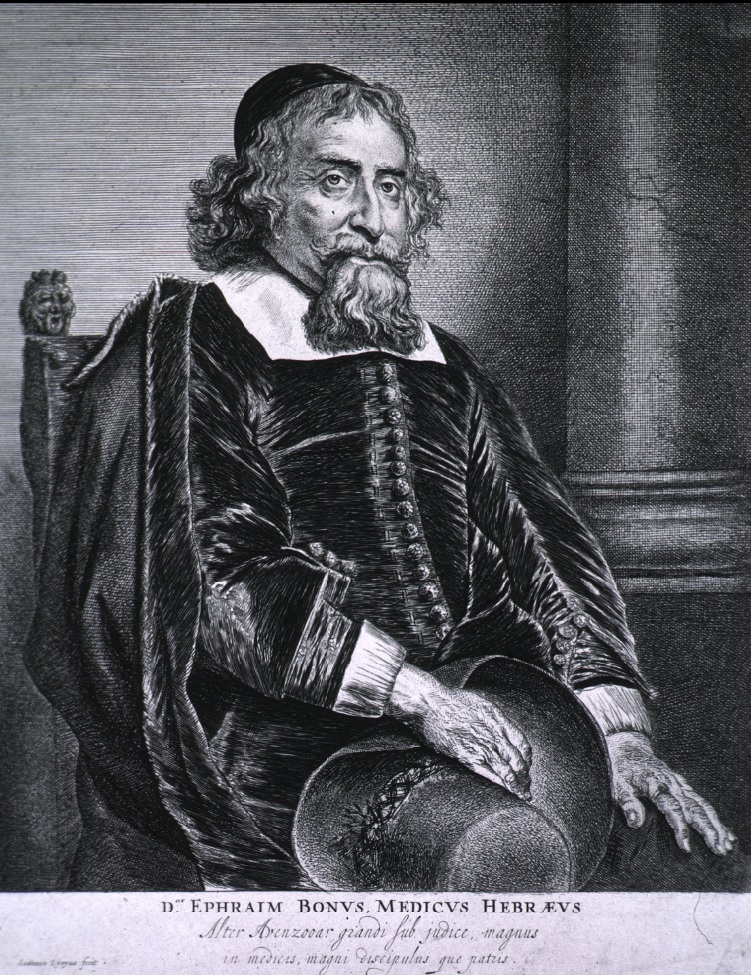
Menasseh also referred to himself as “Medicus Hebraeus.”[7] This title was also used to describe Ephraim Bueno, a prominent Amsterdam physician, as well as a friend and supporter of Menasseh.[8] Furthermore, his connection to medicine is reflected in his translation of the aphorisms of Hippocrates into Hebrew [9] and his relationships with a number of physicians.[10]

To my knowledge there is no record of Menasseh obtaining a medical diploma or graduating from a university. One scholar writes, without reference, that he attended medical school at the University of Groningen for a short time, though apparently did not complete his degree.[11] I have seen no evidence to corroborate this assertion and the university has no record of his matriculation in their archives.[12]

Menasseh’s identification as a physician was not consistent. In some works, the medical title is omitted:

Another curious fact is that Menasseh’s Hebrew writings make no mention whatsoever of his role or title as a physician, nor have I seen him identified as a rofeh in any Hebrew literature. Roth suggests that he may have practiced, though evidence is lacking, and that he included his address when he identified as a physician in his English works as a form of advertising.[13] The tombstone of Menasseh in the Ouderkerk Cemetery does not bear the title doctor or physician.[14]

While historians are wont to call Samuel’s diploma a forgery, his own father considered himself a physician without obtaining a degree or diploma. Should we not, to be consistent, consider Menasseh an imposter physician?

Essential to our assessment of the medical titles and careers of both Menasseh and his son is an understanding of the training of Jewish physicians at this period in history. While today the notion of a physician without formal university training culminating in a diploma is anathema, not to mention criminal, this was simply not the case in the Middle Ages and Renaissance, particularly for the Jew. In fact, Jews were universally barred from attending or graduating universities, which were invariably under the auspices of the Catholic Church. Graduation from universities, such as Oxford, included and required statements or oaths avowing one’s belief in Christianity.

This did not prevent Jews from becoming physicians. They pursued an alternate medical educational pathway comprised of independent learning and clinical training through apprenticeship.[15] This enabled them to take licensing exams and earn the title doctor. Some simply self-identified as a physician or rofeh by virtue of their extensive training. The overwhelming majority of Jewish physicians trained through this alternate pathway, and it is likely that Menasseh is counted amongst them. Once universities began to open their doors to Jewish students,[16] a number of academically motivated students chose this conventional pathway. These university-trained physicians initially accounted for only a small percentage of the health professionals in the Jewish community. Thus, the title “rofeh” or “doctor” in this period was not specifically associated with a university degree.[17]

The Medical Diploma of Samuel ben Israel

The full text of Samuel’s medical diploma was first printed by Koenen in 1843.[18] Koenen raises no doubts whatsoever as to the veracity of the document and publishes it, without discussion, comment or context, as part of a collection of important documents in Dutch Jewish history. Through what training or means Samuel attained this diploma is entirely omitted.

After its publication, the diploma was initially accepted by historians and scholars without question. For example, G. I. Polak wrote that Samuel, through extraordinary skill and acumen, was able to obtain his degree in medicine and philosophy from Oxford.[19] Some even took the liberty to provide additional details. For example, Graetz writes in his classic History of the Jews:[20]

Samuel ben Israel … was presented by the University of Oxford, in consideration of his knowledge and natural gifts, with the degree of Doctor of Philosophy and Medicine, and according to custom, received the gold ring, the biretta, and the kiss of peace.[21]

Where could Graetz have derived this detailed information? It actually appears in the Latin text of Samuel’s diploma, which describes the features of the classic graduation ceremony for European universities during this period. The biretta, often called the Oxford Cap, is the ancestor of our contemporary four-cornered graduation cap.

The scholar Adolph Neubauer appears to have been the first person to suspect something was not kosher with Samuel’s credentials, and at his behest, in 1876, Richard Griffith, the Keeper of the Archive at the University of Oxford reviewed the text of the diploma.[22] The following are the summary points of his analysis:[23]

  • Samuel is not mentioned in the Registers of the university as having ever attended or received a degree.
  • Degrees from Oxford were not issued in the month of May, the date of the diploma.
  • The diploma is signed by two specific people, while the typical Oxford degree is conferred by the university and bears a seal, without the signature of any specific person.
  • The degree is granted in both philosophy and medicine, and Oxford never granted degrees in philosophy, either alone or combined with medicine.
  • There are multiple phrases not used in the Oxford diploma and multiple procedural aspects referred to that simply were not part of Oxford’s protocols.

Griffith’s inescapable conclusion is that this is unequivocally not a genuine Oxford diploma. His analysis is unassailable. Griffiths was certainly familiar with the text of the medical degrees from Oxford during Samuel’s time; indeed, he literally wrote the book on the subject.[24]

Based on Griffith’s analysis, Samuel’s diploma is so fundamentally different than the standard Oxford diploma, there would seem to be no reason to obtain an actual Oxford diploma from that time to further compare the two. Even if one were to consider such a comparison, it would be challenging if not impossible to find an extant diploma from Oxford contemporary with Samuel. In response to my query, the Oxford Archives today responded that they do not possess any diplomas from this period, nor, for that matter, are they aware of any held elsewhere. The archivist added that they cannot be sure that diplomas or degree certificates, in the sense we understand the term, were even created or issued at Oxford from the 15th to the 17th centuries. As mentioned, there was however a specific template and wording associated with the granting of degrees at Oxford,[25] and the graduate would receive some confirmation of their degree, albeit perhaps not a formal diploma in the classic sense. The document did however bear the university seal. It is upon this Oxford template that Griffith based his analysis.

After negating any connection to Oxford, Griffith adds that the diploma was rather an adaptation of a form then used by the University of Padua, “with alterations willfully and insufficiently made.” Griffith was familiar with the Padua diploma template from his Oxford position for a curious reason. In the seventeenth century many graduates in medicine desiring to practice in England obtained their degrees outside of the United Kingdom, often at the University of Padua. In order to practice in England, the graduate had to be “incorporated” into either the University of Oxford or Cambridge. As a prerequisite to incorporation the students were required to present their diplomas/degrees from the granting institution.[26]

The Location of the “Original” Diploma

While Koenen published the full text of Samuel’s diploma, he makes no reference as to the location of the original document. Roth notes that he received a photo of the diploma from the Montezinos Library (known today as Ets Haim- Livraria Montezinos) in Amsterdam. A catalogue of the library holdings from 1927[27] states that the library possessed copies of the first and last pages of the diploma, though not the original.[28] The Ets Haim Library today does not have a record of the diploma photographs.[29] I reached out as well to the Bibliotheca Rosenthaliana, the other major Jewish historical collection in Amsterdam, to see if perhaps the diploma ended up there, which it did not.[30] I also contacted the Roth Collection at the University of Leeds to see if perhaps Roth’s copies of the diploma are kept there, and to my dismay, they likewise have no record of Samuel’s diploma.[31]

Without the actual document, it is impossible to definitively comment on its veracity. Access to the original would allow analysis of the ink and paper for dating. Even access to the copies would be useful. For example, the diploma contains signatures of two faculty members of the University of Oxford. A comparative graphological analysis with known signatures of these men could easily confirm the document’s origin. Regretfully, I have access to neither the “original,” nor the copies. I nonetheless offer additional information and analysis in defense of a Jewish physician accused of forgery in the hopes of restoring his reputation. Absent such essential material information for my case, you may feel free to conclude that my diploma (analysis) is a forgery of sorts. I hope to nonetheless persuade you to drop the charges of forgery, though definitive proof beyond a shadow of a doubt awaits the discovery of the “original” diploma.

Was the diploma a forgery?[32]

Samuel’s diploma was beyond doubt not an official Oxford-issued document, as Griffith details, but was it necessarily a forgery? All historians to date familiar with Griffith’s analysis assume the answer to be a resounding yes, some even labelling it a “brazen” forgery.[33] There is no evidence of any suspicion of the document’s veracity during the lifetime of its bearer. As to when the document was supposedly forged, while the theoretical possibility exists that the diploma was a product of the nineteenth century, Roth convincingly dismisses this theory. He concludes, “The hypothesis of a nineteenth-century fabrication may thus be definitely ruled out.”[34] We are thus left with the universally accepted belief that Samuel forged his own diploma.

Kayserling notes that Menasseh, and thus Samuel, had not yet visited England in May of 1655, the date of the document. This would seemingly conclude the case for forgery and leave little room for discussion. Roth however subsequently rejected this assertion upon finding record in the Calendar of State Papers of the period (documents not accessible to his predecessors and only then recently made available) that Samuel had been sent ahead to England prior to his father and was indeed there at that time.[35] 

The accumulated evidence is certainly suggestive of forgery, but is it dispositive? Could there be another plausible explanation behind this diploma? I would like to suggest that its rejection as an official Oxford diploma does not inexorably lead to a verdict of forgery. By placing this diploma into the larger context of Jewish medical training and diplomas, as well as comparing Samuel’s diploma to other known medical diploma forgeries of the time, specifically for the universities of Padua and Oxford, we may be able to offer another alternative to criminality for one not known to be inclined to such behavior, not to mention being the son of a prominent Jewish rabbi and statesman. I endeavor at minimum, to prove reasonable doubt regarding the accusation of forgery.

Griffith’s Omission and the “Jewish” Diploma

Griffith correctly asserts that Samuel’s diploma is modeled after that of Padua. There is however, a key aspect of this supposed forgery that has previously gone unnoticed. What Griffith did not mention, nor was he likely aware, is that the diplomas issued to Jewish students in Padua often differed in a number of ways from the standard university issue. While there was no specific Jewish diploma template per se, as the standard diploma contained a number of Christian references, the diplomas of Jewish graduates invariably contain some combination of omissions or emendations to the standard text.

As part of our investigation into the diploma’s possible forgery, it is important to ascertain whether Samuel’s diploma is a copy of a standard Padua diploma or one of the Jewish variety. Below we list a few of the typical changes found in Padua diplomas of Jewish medical graduates of Samuel’s period, providing examples of each. We then compare them to Samuel’s diploma.

  1. The Headline of the Diploma

The most obvious change to the Jewish diploma meets the eye of the reader immediately upon viewing the document. The headline of the typical diploma reads, “In Christi Nomine Amen” (in the name of Christ, Amen), and it usually appears in larger decorative font, occasionally occupying an entire page.

William Harvey’s Medical Diploma (Padua 1602)

This would clearly have been objectionable to the Jewish student. The diplomas of the Jewish students were therefore usually emended to read, “In Dei Aeterni Nomine” (in the name of the eternal God), or some variation thereof.

Below are a number of emended diplomas of Jewish students:

Diploma of Isaac Hellen (Padua, 1649)[36]

Diploma of Emanuel Colli (Padua, 1682)[37]

  1. The Date

There are number of ways the year of the degree could appear on the typical diploma, and all of them include Christian reference. Examples include Anno Domini, Anno a Christi Nativitate, and Anno Christiano. Two typical examples are below.

Diploma of Giulio Antonio (1679)[38]

Diploma of John Wallace (around 1618)[39]

The date was unaltered for many Jewish diplomas

Diploma of Jacob Levi (Padua, 1684)[40]

Diploma of Isaac Hellen (Padua, 1649)

In some Jewish diplomas however, the Christian reference is omitted, and the date is listed as “currente anno,” current year.

Diploma of Moise Tilche (Padua, 1687)[41]

Diploma of Lazzaro De Mordis (Padua, 1699)[42]

The date alone is not a reliable indicator of the “Jewishness” of the diploma.

  1. The Location of the Graduation Ceremony

The graduation ceremony for the Catholic medical students was held in the Episcopal Palace and this was recorded in the diploma:

Diploma of Giulio Antonio (Padua, 1679)

The degrees of the Jewish students were not granted in the Episcopal Palace, but rather in non-ecclesiastical venues. As such, the words “Episcopali Palatio” are omitted, leaving the phrase “in loco solito examinu,” (in the usual place of examination).[43]

Diploma of Isaac Hellen (Padua, 1649)

This is the case in virtually all Jewish diplomas.

  1. Hebreus or Iudeus

There is one feature of the typical Jewish diploma that is not an emendation or omission, but rather an addition. With few exceptions, the Jewish students were identified as Hebreus or Iudeus. This was the convention in Padua for centuries and was found in other Italian universities as well.[43]

Diploma of Isaac Hellen (Padua, 1649)

Diploma of Emanuel Colli (Padua, 1682)

Diploma of Moise Tilche (Padua, 1687)

There are a few exceptions:

Diploma of Moysis Crespino (Padua, 1647)[45]

Notarized Copy of Diploma of Abraham Wallich (Padua, 1655)[46]

Abraham Wallich graduated Padua in 1655, the same year as Samuel’s diploma. His original diploma is not extant, though we have a notarized copy that he presented to the Jewish community of Frankfurt as proof of his credentials. In this copy, the identifiers of Hebreus or Iudeus do not appear. I suggest that “Iudeus” could have in fact appeared in his original diploma and was possibly omitted here by the copyist. As Wallich was a religious Jew applying to a Jewish institution, it would have been superfluous to add “Hebreus.”

  1. The Details of the Graduation Ceremony.

The standard Padua diploma also included a description of the graduation ceremony. This was not altered in the Jewish diplomas as the Jewish students participated in this ceremony, albeit with some changes. While the location may have been different, and perhaps the oath would have been tailored for the Jewish student, the core of the ceremony for the Jewish student otherwise remained the same. A remarkable pictorial testimony to this fact is the diploma of Moise di Pellegrino (AKA Moshe ben Gershon) Tilche, who graduated Padua in 1687.[47]

Underneath the portrait of the graduate is the illustration, represented with putti, of the features of the graduation ceremony of Padua.

This ceremony involved a golden ring, a wreath and a hat, known as a biretta (though not the four-cornered variety). The opening and closing of books as a representation of the transmission of knowledge was also a part of the ceremony.

Was Samuel’s Diploma modeled after a standard or “Jewish” Diploma from Padua?

In review of the Jewish diplomas from Padua of Samuel’s day, the headline was consistently altered, as was the location of the graduation. The typical Christian recording of the year of graduation was occasionally, though not uniformly altered. The majority of the Jewish graduates, with few exceptions, were identified as either Iudeus or Hebreus.

Which of these additions, omissions or alterations appear in Samuel’s diploma?

  1. The Headline

In his article republishing the existing material on Samuel’s diploma, Neubauer writes, “in order to make the documents concerning this degree accessible to the Anglo-Jewish public, I shall reproduce here the Latin diploma line by line (Neubauer’s emphasis) as given by Koenen.” The text of the diploma he provides begins as follows:

In the original publication by Koenen however, the diploma begins with a short phrase:

Neubauer omitted the introductory words, “In Nomine Dei, Amen,” perhaps assuming they were not part of the diploma, or simply noncontributory to the text. In fact, these four words are crucial in identifying the nature of Samuel’s diploma and reflect one of the major differences found virtually ubiquitously in the Jewish diplomas of Padua.

  1. Date

A typical Christian date is used.

  1. Location of Graduation

The location of the ceremony is given as the Academy of Oxford.

  1. Hebreus or Iudeus

The identifier Hebreus or Iudeus is not found in Samuel’s diploma.

The headline in Samuel’s diploma is clearly consistent with the Jewish form of diploma. The date is of a Christian format, Anno Christiano, and the location is listed simply as Oxford with no reference to an ecclesiastical venue.

The identifier “Hebreus” is conspicuously absent. To be sure, there were certainly other examples where this was true. However, the omission in Samuel’s case is noteworthy, as his own father, Menasseh, self-identified as Medicus Hebreus, as did other Jewish physicians in Amsterdam, such as Ephraim Bueno. Surely the son would have adopted the title of the father.

In sum, the headline of Samuel’s diploma, a crucial element in determining its style, conforms to the Jewish Padua diploma, as does the venue for the degree, which is non-ecclesiastic. While the date retains the Christian reference, this is non-contributory. Samuel’s diploma does however omit the typical Jewish identifier of Hebreus, a title specifically used by his own father, a fact that begs explanation.

Other Medical Diploma Forgeries of the Seventeenth Century

If Samuel’s diploma were indeed a forgery, it would be the only known case of a forged medical diploma by a Jewish physician in the pre-Modern era. To be sure, there have been numerous forgeries of diplomas, including the medical variety, throughout history. Below we discuss two forgeries of the same historical period as Samuel and purported to be from the two very institutions with which Samuel’s diploma is associated. These may shed light on our forgery discussion.

A Forged Medical Diploma from Padua 1628

The diploma of John Wallace sat in the Royal College of Physicians for centuries, assumed to be genuine. It was only recently that Dr. Fabrizio Bigotti took a closer look at the diploma, revealing that it was a clear forgery.[48] Below you see the latinized name of Wallace clearly written in a different pen and different hand than that of the original diploma.

The year of graduation, 1628, was also altered.

The date was proven to be fake, as the authentic signatures at the end of the diploma include Fabrici d’Acquapendente and Adrian van de Spiegel, both of whom had died by 1628. The true date is assumed to be around 1618.

In this case of forgery, Wallace procured an existing diploma and replaced the name and date with his own. There is apparently no record of his medical practice, so it is unclear if his forgery was successful. Perhaps he forged this diploma with intent to present to Oxford for incorporation. I do not know if the RCP checked the Oxford Register of Congregation for the relevant years.[49]

The Frankland Forgery of an Oxford Diploma[50]

In the diary entry for Anthony Wood, Oxford antiquary, for November 15, 1677, we find the following:[51]

Frankland first presented his false credentials in 1667.[52] He was apparently a haughty and disagreeable man disliked by his colleagues at the college. It was his juniors who raised suspicion about his credentials and privately inquired of Dr. Hyde, King’s Professor of Physic, as well as the registrar, to verify his documents. The forgery was confirmed by Oxford in November 1677,[53] when it was determined that Frankland was not listed in the Medical School Register and that he had forged the university seal.[54] Furthermore, Frankland defrauded Cambridge University, which granted him a medical degree solely on the basis of his previously obtained Oxford diploma. Frankland not only forged the university seal of Oxford, which was an integral part of the official document, he seems to have added an element to the diploma which was a tip off as to its forgery. Dr. Brady of Cambridge reported:[55]

This exact issue was also identified by Griffith as one of the elements of Samuel’s diploma that deviated from Oxford protocols. Of course, with Samuel’s diploma, this was one of many deviations from Oxford’s template; for Frankland, this was more essential in identifying the forgery.

These two forgeries from Samuel’s period, and from the very institutions associated with his diploma are instructive. If Samuel was truly a forger, could or should he have pursued the methods of Wallace or Frankland?

A Padua Diploma Forgery ala Wallace

Forging a genuine Padua diploma would have been more challenging than one from Oxford for a number of reasons, both technical and cultural. While objectively few Jewish students attended the University of Padua Medical School,[56] it was the main address for Jewish students wishing to obtain a university medical degree. While far from Amsterdam, the Jews of Europe were all connected. In addition, Amsterdam was a hub of Jewish printing and a number of works by Italian authors were printed there. A forged medical diploma could possibly have been detected by Italian visitors. It would have been risky.

From a technical perspective, the Padua diploma, in Italian Renaissance fashion, was copiously illustrated and meticulously calligraphed, often including a portrait of the graduate. A number of these diplomas are extant in libraries and private collections.[57] It would have been exceedingly difficult to replicate the diploma itself, not to mention that it was typically bound in a gilded leather binding with official wax seals attached by thread.

Picture Courtesy of Professor Fabrizio Bigotti

All these accoutrements would have made the endeavor of forgery prohibitive from the outset.

There could have been another option for a Padua diploma forgery. Abraham Wallach had a notarized copy of his 1655 Padua diploma made for his job application as a community physician in Frankfurt.[58]

Beginning of the copy of the diploma:

Notarization of the diploma:
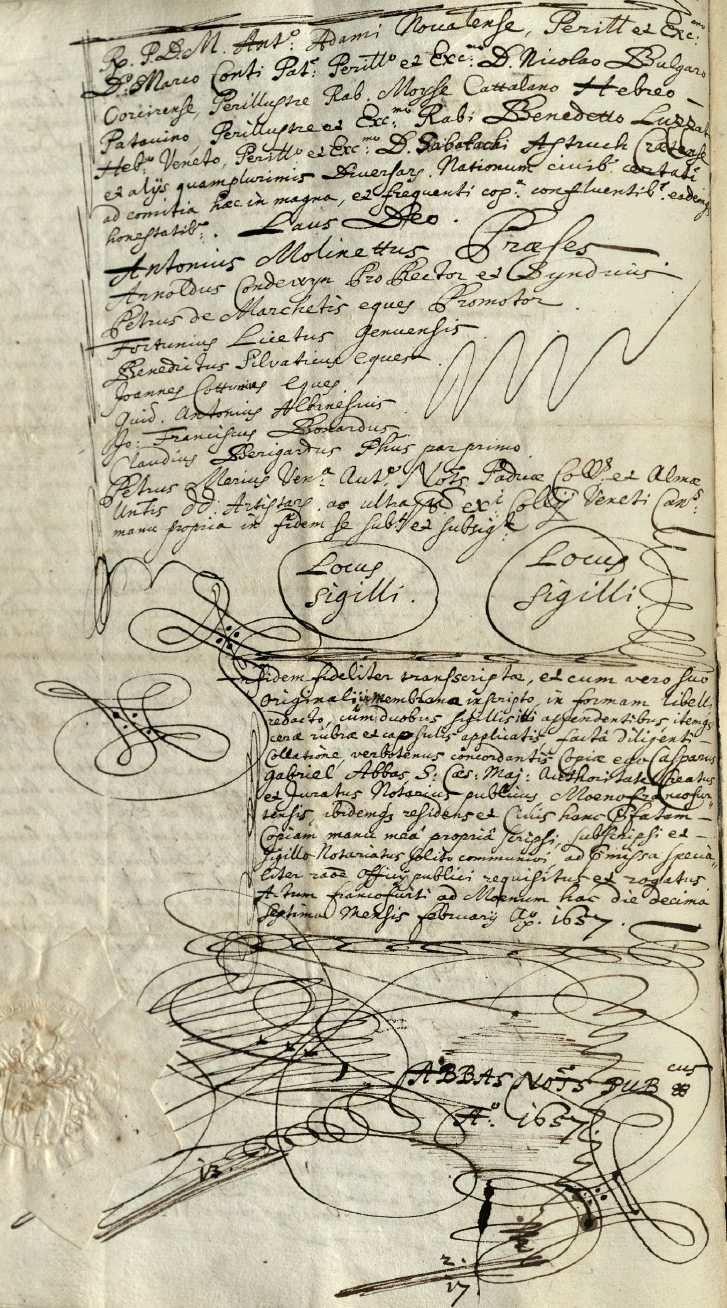
Perhaps Samuel could have created a similar “notarized” copy, which would not have required the artistry or associated binding and seals. This option would likely not have sufficed for Samuel, who as the “graduate,” would have been expected to possess and present the original.

Could Samuel have obtained an existing Padua diploma and simply replaced the name of the graduate with his own, as Wallace had done? This would certainly have been easier than forging the diploma de novo. However, recall that the Padua diplomas of the Jewish students had some alterations, the most obvious one being the headline change from In Christi Nomine to In Dei Aeterne Nomine, not to mention other more subtle, less noticeable changes. Samuel would have had to procure an old diploma that previously belonged to a Jewish student, an impossible task.

An Oxford Diploma ala Frankland

Should Samuel have created a diploma more in line with the actual Oxford model, as Frankland, whose forged university seal and diploma were sufficient to fool even the Royal College of Physicians and Cambridge University? Had he produced a Frankland-esque diploma no one would have suspected otherwise, as no Jew had ever obtained or presented an Oxford diploma before. While this could have been an ideal forgery,[59] I suggest below why this may not have served Samuel’s needs.

The Medical Training and Practice of Samuel ben Menasseh

Irrespective of the veracity of his diploma, Samuel appears to have been a practicing physician. Samuel is listed as a physician by both Steinschneider[60] and Koren,[61] each of whom provides additional references. He is also listed in an early twentieth century work among a group of exceptionally prominent Jewish physicians across the ages.[62] Moreover, his tombstone identifies him as a physician. To my knowledge we do not have any specific account of his clinical practice.

As we have no direct evidence as to how Samuel trained in medicine, we can only surmise based on the general climate of Jewish medical training at the time, coupled with whatever fragmentary evidence we have of Samuel’s personal medical exposure.

Samuel had personal exposure to both the apprenticeship and university pathways of medical training. His father most likely obtained his education through the apprenticeship pathway. Samuel certainly could have learned the medical art from his father Menasseh, though the biographies of Menasseh reveal that he had little time, if any, for the practice of medicine. It would have been difficult for Samuel to acquire comprehensive medical knowledge without prolonged extensive clinical exposure, something his father could not provide.

Though Menasseh himself may not have had the time to mentor his son, he could have delegated the task to one of his physician colleagues.[63] Ephraim Bueno, for example, was a prominent physician in Amsterdam with whom Menasseh had a relationship.[64] Bueno supported Menasseh’s first publication.[65] They also both shared the distinction of having their portraits drawn by Rembrandt.[66] Perhaps Samuel apprenticed with, or at the very least, was inspired by Bueno.

Had he desired, Samuel could have obtained a formal university medical degree. In the early part of the seventeenth century, this would only have been possible in Italy, and primarily at the University of Padua. Traveling to Padua, however, would entail leaving the family and other potential hardships, such as the language barrier. Fortunately, beginning in the mid-century universities in the Netherlands (primarily Leiden), following in the footsteps of Padua, began opening their doors to Jewish medical students for the first time.[67] In fact, Samuel’s cousin Josephus Abarbanel, who also lived in Amsterdam, graduated from the University of Leiden on June 2, 1655, just a few weeks after Samuel received his Oxford diploma.[68]

Which option/pathway did Samuel choose? Though his diploma is Padua-esque, there is no record of Samuel attending the University of Padua. There is also no record of his attendance or graduation from any school in the Netherlands.

Samuel certainly would not have attended the University of Oxford as a student. Professing Jews were not allowed there. Moreover, it would also have required his presence in England for a prolonged period, which, by all accounts was not the case. Roth writes regarding the likelihood of Samuel obtaining an Oxford degree, “it was as difficult for a Jew to be graduated from it (Oxford) as it would have been for an anthropoid ape.”[69] This unwelcoming climate for the Jews persisted even long after the return of the Jews to England.[70] In fact, in Herman Adler’s lecture on the Jews of England in the late nineteenth century, he comments on the medical degree of Samuel, which he assumed to be authentic: “This fact (granting a medical diploma to the Jew Samuel ben Israel) would seem to show that the university was more enlightened in the year 1655 than it is in 1870.”[71]

Samuel’s “For Jewry” Diploma

I suggest that Samuel trained primarily through the apprenticeship pathway but requested and received university acknowledgement or imprimatur of his medical education and knowledge. The diploma was thus an affirmation of Samuel’s expertise attested to by members of the Oxford faculty. As opposed to today, when a student must attend a certain number of years in a university as a prerequisite to obtaining a degree, universities often gave exams and imprimatur to those who studied elsewhere, either formally or not, but passed the required examination demonstrating the required knowledge and competence. This could explain the unusual nature of the diploma he procured from Oxford.

While many Jewish physicians in this period practiced freely without university education or diplomas, there may have been an additional impetus for Samuel to procure this affirmation from Oxford. The Dutch were generally known for their tolerance, but this apparently did not extend to the Jews and the practice of medicine. According to historians, “Although Jews with foreign degrees were permitted to engage in medicine as general practitioners, tolerance was not extended to tertiary education.”[72] Thus, even though Samuel may have been qualified to practice by virtue of his apprenticeship, and could have practiced freely in other European countries, his practice in the Netherlands would have been limited without a foreign degree.[73]

Do the existing facts and diploma support this theory?

The Signatories

The two signatories on Samuel’s diploma were Dr. John Owen and Dr. Clayton at Oxford. Owen was a friend of Cromwell and Vice Chancellor of the University at that time. Thomas Clayton was Regius Professor of Medicine at Oxford from 1647 to 1665. These were not fictional characters, and if one were to obtain an affirmation of medical knowledge or education, these would be the perfectly appropriate people to attest to such a document. Given Menasseh’s connections, it is not inconceivable that he utilized his influence to arrange for his son’s exams, or that they acceded to Samuel’s request out of deference to Menasseh.

The Absence from the Oxford Register

Griffith highlights the fact that Samuel’s degree is not found in the Oxford Register. Indeed, no professing Jews were listed in the register at Oxford at that time. According to our theory, this absence from the Register is no proof of forgery. There was not the slightest thought of entering this exchange into the official university Register, as not only did it not meet the standard protocols, the recipient was also of the Jewish faith and expressly precluded from such a privilege. Samuel may have assured the examiners that he had no intention of practicing in the United Kingdom, a fact that would have made it easier for them to feel comfortable affixing their names to the document.

Likelihood of Exposure

If indeed Samuel were prone to deceit, what is the likelihood his rouse would have been discovered? His father would certainly have realized.[74] The very purpose of Samuel’s trip was to pave the path for his father’s visit. Samuel was thus expecting his father to later visit England and likely interact with the very same people he did. Indeed, Menasseh appears to have visited Oxford.[75] Surely Samuel’s diploma would have come up in conversation, if only peripherally. This alone could have served as a deterrent for forgery. Additionally, John Owen, a signatory on the diploma, was a close friend of Cromwell’s, and a forgery could have been revealed through this avenue. If one were to arbitrarily choose Oxford faculty for a fake diploma, better not to choose someone whose trail could ultimately lead to disclosure.

A forgery would have been suspected, if not revealed, from another source. Samuel’s cousin Joseph Abarbanel completed his medical training in Leiden at the very same time as Samuel’s diploma was issued, and also lived in Amsterdam. He surely would have been suspicious if Samuel suddenly started practicing medicine after a forged Oxford diploma emerged de novo and appeared, metaphorically, framed on Samuel’s office wall.

The Text of the Diploma- An Oxford-Padua Synthesis ala Samuel ben Menasseh

Working with our new theory, which type of diploma would Samuel have procured or designed had he genuinely presented to Oxford and successfully passed oral exams from the university faculty? This would not have been an official, formal process, but rather a unique private opportunity to confirm his medical expertise with the Oxford faculty. As this was a personalized, non-institutional diploma, the examiners would not have much cared or paid attention as to the diploma’s format and could have left the document particulars to Samuel.

I suggest, therefore, that Samuel designed the document in a way that would best serve his needs and would be well-received by his Jewish clientele in the Netherlands. A brief informal text with attestation from the Oxford professors would have been unfamiliar and unimpressive to his Jewish patients.[76] Virtually the only diploma a Jewish university-trained physician would have possessed in this period is a diploma from the University of Padua.[77] He therefore utilized the familiar Padua template, as awkward and inconsistent with Oxford’s typical diploma it may have been. Furthermore, he made sure to use the emended headline and non-ecclesiastic venue consistent with the “Jewish” diploma.

Why did Samuel not include the term “Hebreus,” which would surely have been familiar to the Jewish viewers of the diploma, not to mention following in the path of his father, who was known as “Medicus Hebraeus?” It is possible that Samuel would have specifically omitted this title given the history of the degree-granting institution. Professing Jews were categorically precluded from attending or graduating Oxford. While the signators may not have paid close attention to the details of the diploma, the word Hebreus after Samuel’s name would likely have caught their eye, especially as it appears adjacent to the graduate’s name.

There are numerous elements in the diploma that were simply untrue. For example, included is a description of the graduation, as cited by Graetz. Did Samuel actually participate in a formal graduation from Oxford? Whether Samuel obtained a genuine diploma of some sort from Oxford can be debated, but there is no doubt that as a professing Jew in England at this time he would never have participated in any formal graduation ceremony. Samuel may have disregarded these details favoring style over substance in order to achieve his objective. The signators would likely not have bothered to analyze the text.

Not a single Jew would have known the difference, let alone read the Latin document, nor would they have questioned further.[78] They would have seen a document that appeared in style and largely in substance similar to the diplomas they had seen previously. Samuel’s father would have been proud of his son’s accomplishment, as would his cousin Josephus Abrabanel, who later graduated from Leiden. Menasseh could also have personally thanked Drs. Owens and Clayton for their kindness when he visited Oxford a short time later. If this construct is true then Samuel’s diploma would not have been a forgery, but rather “for Jewry,” being designed intentionally with the Jewish community in mind, and in the context of Jewish medical history.

Postscript

Whether forged on not, Samuel sadly had but little time to utilize the Oxford diploma dated May 1655. Later that month he returned to Amsterdam, diploma in hand, to persuade his father to go to England and personally lay his case before Cromwell. Two years later, Manasseh ben Israel arrived in London, accompanied by Samuel. Samuel tragically died during their stay. In accordance with Samuel’s dying wish, Manasseh ben Israel conveyed his son’s corpse back to Holland where he was buried on 2 Tishrei, 5418. Below is a picture of the grave of Samuel ben Israel in the Middleburg Cemetery, 1912, shortly after it was renovated.[79]

Here is a picture of the grave and tombstone today:[80]

His medical identity is forever enshrined on his tombstone, where he is referred to as “Doctor Semuel.”[81]

Roth writes, “It seems obvious that the honorific description (on the tombstone) has its basis the supposed Oxford degree.”[82] I beg to differ. Many Jewish physicians were trained through apprenticeship and never obtained university degrees, Samuel’s own father being a case in point, and they were nonetheless known as physicians. I believe Samuel could have been such a physician.

Menasseh himself died shortly thereafter on Nov. 20, 1657, before reaching his home at Middelburg, Zealand.

Which account is closer to the truth? Was Samuel an ambitious and accomplished student of medicine, honestly earning some form of an Oxford diploma, perhaps not unlike Friedberg’s description at the beginning of this article; or was he an unabashed imposter possessing no medical training, brazenly forging a medical diploma, and practicing medicine without proper training? Historians have been quick to condemn Samuel, though they have neglected to incorporate the history of Jewish medical training into their analyses. Ultimately, I suggest that the truth lies in the chasm between these two polar extremes. Closer to which one? I leave to the reader to decide. At the very minimum I believe we have provided enough evidence to at least create reasonable doubt as to whether Samuel the son of the right honorable Menasseh ben Israel committed willful forgery of his medical diploma.

[1] Also known as Samuel Abravanel Soeyro. See Moritz Steinschneider “Judische Aertze,” Zeitschrift fur Hebraeische Bibliographie 18: 1-3 (January-June, 1915), p. 45, n. 1923. Abravanel is taken from his mother’s family and Soeyro from his father’s family. Both names have multiple variant spellings.
[2] Cecil Roth, A Life of Menasseh Ben Israel: Rabbi, Printer, and Diplomat (Jewish Publication Society, 1945); Jeremy Nadler, Menasseh ben Israel: Rabbi of Amsterdam (Yale University Press, 2018). See also the wonderful online exhibit, “Menasseh ben Israel, rabbi, scholar, philosopher, diplomat and Hebrew printer, 1604-1657,” curated by Dr. Eva Frojmovic of the University of Leeds.
[3] For a history of Jewish physicians as printers, see J. O. Leibowitz, “Jewish Physicians Active as Printers,” (Hebrew) Harofe Haivri Hebrew Medical Journal 1 (1952), 112-120; Hindle Hes, “The Van Embden Family as Physicians and Printers in Amsterdam,” (Hebrew) Koroth 6:11-12 (August, 1975), 719-723.
[4] https://benyehuda.org/read/3230#fn:173, Zichronot LiBeit David vol 4 (Achiasaf Publications, Warsaw, 1897).
[5] Friedberg himself references the mention of the diploma in Meyer Kayserling’s The Life and Labours of Menasseh Ben Israel (London, 1877). 63 and 92, n. 241.
[6] Friedenwald mentions Menasseh, but as opposed to his other entries, adds justification for his inclusion in his work: “He is included in this list because several of his works bear his name with the title Medicus Hebraeus,” as well as his identifying as a Doctor of Physick in his letter to the Lord Protector. See Harry Friedenwald, The Jews and Medicine vol. 2 (Johns Hopkins Press: Baltimore, 1944), 739. Menassah is also is listed in Koren under the spelling Manasseh ben Israel. See Nathan Koren, Jewish Physicians: A Biographical Index (Israel Universities Press: Jerusalem, 1973), 89.
[7] Roth, op. cit., Menasseh, 109.
[8] While Bueno is famous for his portrait drawn by Rembrandt, his portrait was also drawn later in life by another Dutch artist, Jan Lievens. The description underneath the painting, Dor Ephraim Bonus Medicus Hebraeus, found in the collection of Joods Historisch Museum Amsterdam, can be seen below:
[9] This work is not extant. See Roth, op. cit., Menasseh, 314, n. 17.
[10] I. M. Librach, “Medicine and Menasseh Ben Israel,” Medical History 4:3 (July, 1960), 256-258 discusses Menasseh’s connection to physicians. Librach suggests that the close relationship between religion and medicine among the Jews has led some historians, notably Henry Milman (1863) to regard Menasseh as a physician as well as a rabbi. For further reference to Menasseh’s physician friends see Ernestine G.E. Van Der Wall, “Petrus Serrarius and Menasseh ben Israel: Christian Millenarianism and Jewish Messianism in Seventeenth Century Amsterdam,” in Yosef Kaplan, et. al., eds., Menasseh Ben Israel and His World (E. J. Brill: Leiden, 1989), 172; George M. Weisz and William Albury, “Rembrandt’s Jewish Physician- Dr. Ephraim Beuno (1599-1665): A Brief Medical History,” Rambam Maimonides Medical Journal 4:2 (April, 2013).
[11] Van Der Wall, op. cit., 165.
[12] Personal communication with Hans Froon of the Central Medical Library in Groningen (December, 2020).
[13] Roth, op. cit., Menasseh, 42, 109, 314, 341
[14] This picture of the epitaph appears in Cecil Roth, “New Light on the Resettlement,” Transactions of the Jewish Historical Society 11 (1924-1927), facing p. 118.
[15] For articles on the training of Jewish medical students, see Harry Friedenwald, “The Jewish Medical Student of Former Days,” Menorah Journal 7:1 (February, 1921), 52-62; Cecil Roth, “The Medieval University and the Jew,” Menorah Journal 19:2 (November-December, 1930), 128-141; Idem, “The Qualification of Jewish Physicians in the Middle Ages,” Speculum 28 (1953), 834-843; Joseph Shatzmiller, “On Becoming a Jewish Doctor in the High Middle Ages,” Sefarad 43 (1983), 239-249. Idem, Jews, Medicine and Medieval Society (University of California Press: Berkeley, 1994), esp. 14-27; John Efron, “The Emergence of the Medieval Jewish Physician,” in his Medicine and the German Jews: A History (Yale University Press: New Haven, 2001), 13-33; Edward Reichman,  “From Maimonides the Physician to the Physician at Maimonides Medical Center: The Training of the Jewish Medical Student throughout the Ages,” Verapo Yerape: The Journal of Torah and Medicine of the Albert Einstein College of Medicine 3 (2011), 1-25; Nimrod Zinger, Ba’alei haShem vihaRofeh (Haifa University, 2017), 242-251.
[16] The University of Padua was the first to formally allow admission of Jews to its medical school.
[17] It is possible that there were titles that distinguished between university and non-university trained physicians, such as rofeh mumheh, but this requires further study.
[18] H. J. Koenen, Geschiedenis der Joden in Nederland (Utrecht, 1843), 440-444.
[19] Gabriel Isaac Polak, Seerith Jisrael: Lotgevallen der Joden in alle werelddeelen van af de verwoesting des tweeden tempels tot het jaar 1770 (Amsterdam, 1855), 549.
[20] Heinrich Graetz, History of the Jews vol. 5 (Jewish Publication Society: Philadelphia, 1956), 38.
[21] Herman Nathan Adler clearly follows Graetz in his, The Jews of England A Lecture (Longmans, Green and Co.: London, 1870), 23.
[22] Since the initial publication of Griffith’s letter was in an obscure inaccessible journal, both the transcription of the diploma as well as Griffith’s letter were later republished. All the documents and articles are reproduced in Rev. Dr. Adler, “A Homage to Menasseh ben Israel,” Transactions of the Jewish Historical Society of England 1 (1893-1894), 25-54, esp. 48-54. This explains why some scholars were unaware of Griffith’s conclusions until years later. For additional comments and analysis, see Cecil Roth, A Life of Menasseh Ben Israel (Jewish Publication Society: Philadelphia, 1934), 221-222 and 337-339; Idem, “The Jews in English Universities,” Miscellanies of the Jewish Historical Society of England 4 (1942), 102-115, esp. 105, n. 14.
[23] Griffith lists fifteen differences in the form of the diploma from that of Oxford.
[24] Statutes of the University of Oxford codified in the year 1636, under the authority of Archbp. Laud, Chancellor of the University, with an introduction on the history of the Laudian Code by C.L. Shadwell, ed. by John Griffiths, 1888. See p. 126. For the study of medicine at Oxford in the seventeenth century see chapter by Robert G Frank Jr. entitled “Medicine” in The History of the University of Oxford, volume IV: Seventeenth Century Oxford (ed. N Tyacke, Clarendon Press, 1997). For a more general study of the period, see Phyllis Allen, “Medical Education in 17th Century England” Journal of the History of Medicine and Allied Sciences 1:1 (January 1, 1946), 115-143.
[25] G. R. M. Ward, Oxford University Statutes (1845), 53-54, 117-118, 128-131.
[26] Oxford’s Register of Congregation during this period contains numerous examples of Padua students applying for incorporation.
[27] Alphei Menasheh Catologus of J. S. Da Silva Rosa (Portugeesch Israelietische Seminarium: Amsterdam, 1927), 25, no. V. lists a picture of the first and last pages of the diploma in the possession of the Montezinos Library.
[28] Roth did not mention if he possessed copies of the entire text of the diploma.
[29] I thank Heide Warncke, Curator of the Ets Haim Library for her assistance.
[30] I thank Rachel Boertjens, Curator of the Bibliotheca Rosenthaliana for her assistance.
[31] I thank Eva Frojmovic and the staff of the Roth Collection at University of Leeds for their assistance. The cataloguing of the Roth Collection is an ongoing process and there is a fair amount of material still uncatalogued. I am hopeful the copies of the diploma will one day surface there.
[32] In the interest of full disclosure, I recently wrote an article entitled, “Confessions of a Would-be Forger: The Medical Diploma of Tobias Cohn (Tuvia Ha-Rofeh) and Other Jewish Medical Graduates of the University of Padua.” I am not however personally inclined to forgery. I would be happy to send the reader a copy of my medical diploma upon request, once I am able to locate it.
[33] David S. Katz, Philo-Semitism and the Readmission of the Jews to England, 1603-1655 (Oxford University Press, 1982), 197.
[34] Roth, op. cit., Menasseh, 338-339
[35] Roth, op. cit., Menasseh, 338-339.
[36] Germanisches Nationalmuseum, reference no. HA, Pergamenturkunden, Or. Perg. 1649 Juli 09.
[37] A copy of the full diploma is accessible through the Magnes Online Collection, http://magnesalm.org (accessed January 5, 2021).
[38] See G. Baldissin Molli, L. Sitran Rea, and E. Veronese Ceseracciu, Diplomi di Laurea all’Università di Padova (15041806) (Padova: Università degli studi di Padova, 1998), diploma C21, p. 151.
[39] See below for further discussion of this diploma, which is a forgery. The body of the diploma, including the relevant phrase cited here, is original and dates to around 1618.
[40] This diploma is housed in the Umberto Nahon Museum of Italian Jewish Art in Jerusalem. See http://www.museumsinisrael.gov.il/en/items/Pages/ItemCard.aspx?IdItem=ICMS-EIT-0076. The museum website provides a description of the diploma and a picture of the outer cover. I thank Dr. Andreina Contessa, former Chief Curator of the U. Nahon Museum, for kindly furnishing me with pictures of the entire diploma. I thank Sharon Liberman Mintz for bringing this diploma to my attention.
[41] The diploma is in the William Gross Collection and is available for viewing at the website of the National Library of Israel, system number 990036743400205171 (accessed January 3, 2021). I thank Sharon Liberman Mintz for bringing this diploma to my attention.
[42] NLI, system number 990035370060205171.
[43] Of course it was not “the usual place of examination,” but this text allowed for the least amount of deviation from the diploma template.
[44] See, for example, the diploma of Chananya Modigliani from Siena, 1628 in the Jewish Theological Seminary Library, MS 8519.
[45] NLI, system number 990034232880205171.
[46] Stadt Frankfurt am Main, Altes Archiv – Städtische Überlieferung bis 1868, Medicinalia, Akten, Nr. 250 (fol. 51-52v).
[47] For an expansive discussion on the diplomas of Jewish medical students from the University of Padua, see Edward Reichman, “Confessions of a Would-be Forger: The Medical Diploma of Tobias Cohn (Tuvia Ha-Rofeh) and Other Jewish Medical Graduates of the University of Padua,” in Kenneth Collins and Samuel Kottek, eds., Ma’ase Tuviya (Venice, 1708): Tuviya Cohen on Medicine and Science (Jerusalem: Muriel and Philip Berman Medical Library of the Hebrew University of Jerusalem, 2019), in press.
[48] Pamela Forde, “Power and Beauty: Fakes and Forgeries,” (December 11, 2015) Royal College of Physicians Museum. I thank Dr. Bigotti of Centre for the Study of Medicine and the Body in the Renaissance, Domus Comeliana Pisa (Italy) for providing me the images of this diploma.
[49] I do not have access to the relevant years.
[50] For the most expansive discussion of the Frankland affair see William Munk, The Roll of the Royal College of Physicians of London vol 1, 1518-1700 (Longman: London, 1861), 358ff.
[51] Andrew Clark, The Life and Times of Anthony Wood, Antiquary, of Oxford, 1632-1695, Described by Himself vol. 2 (Clarendon Press: Oxford, 1892), 392-393.
[52]  Munk, op. cit., 359.
[53] Munk, op. cit., 360.
[54] Munk, op. cit., 363.
[55] Munk, op. cit., 362.
[56] For a list of the Jewish students attending the University of Padua during Samuel’s time, see Abdelkader Modena and Edgardo Morpurgo, Medici E Chirurghi Ebrei Dottorati E Licenziati Nell Universita Di Padova dal 1617 al 1816 (Bologna, 1967). This list has been supplemented over the years, but the overall numbers are not significantly different.
[57] For a collection of diplomas from the University of Padua, see G. Baldissin Molli, L. Sitran Rea, and E. Veronese Ceseracciu, Diplomi di Laurea all’Università di Padova (15041806) (Padova: Università degli studi di Padova, 1998). Only a very small percentage of the diplomas in this book are from the medical school. For examples of diplomas from other Italian universities, see Honor et Meritus: Diplomi di Laurea dal XV al XX Secolo, ed. F. Farina and S. Pivato (Rimini: Panozzo Editore, 2005), a catalogue of an exhibition held in 2006 to mark the 500th anniversary of the founding of the University of Urbino.
[58] For more on Abraham Wallich and other physician family members of the Wallich family, see, Edward Reichman, “The Medical Training of Dr. Isaac Wallich: A Thrice-Told Tale in Leiden (1675), Padua (1683) and Halle (1703),Hakirah, in press.
[59] It is possible that Samuel was simply unaware of the composition and protocols of the Oxford degree, as he would not have had occasion to see one. Perhaps he was attempting to mimic a genuine Oxford diploma, but just erroneously assumed it was similar to that of Padua.
[60] Moritz Steinschneider “Judische Aertze,” Zeitschrift fur Hebraeische Bibliographie 18: 1-3 (January-June, 1915), p. 45, n. 1923. He is listed as “Samuel (b. Menasseh) b. Israel Abravanel-Soeyro (Suerus).”
[61] Nathan Koren, Jewish Physicians: A Biographical Index (Israel Universities Press: Jerusalem, 1973), 126. He is listed as “Soeiro Samuel Abrabanel of Amsterdam, son of Menasseh ben Israel, grad. in Oxford.”
[62] Dov Bear Turis, Shiva Kokhvei Lekhet (Warsaw, 5687), 16. Menasseh is not mentioned in this list.
[63] I thank Heidi Warncke for this suggestion.
[64] On Bueno, see, for example, George Weisz and William Albury, “Rembrandt’s Jewish Physician Dr. Ephraim Beuno (1599-1665): A Brief Medical History,” Rambam Maimonides Medical Journal 4:2 (April 2013), 1-4.
[65] Sefer Penei Rabah (Amsterdam, 1628)
[66] See Steven Nadler, Rembrandt’s Jews (University of Chicago, 2003). Nadler discusses the debate as to whether Rembrandt actually painted a portrait of Menasseh ben Israel. In either case, both Bueno and Menasseh were well acquainted with Rembrandt, who lived in the Jewish quarter of Amsterdam.
[67] Hindle S. Hes, Jewish Physicians in the Netherlands (Van Gorcum, Assen, 1980); Kenneth Collins, “Jewish Medical Students and Graduates at the Universities of Padua and Leiden: 1617-1740,” Rambam Maimonides Medical Journal 4:1 (January, 2013), 1-8; M. Komorowski, Bio-bibliographisches Verzeichnis jüdischer Doktoren im 17. und 18. Jahrhundert (K. G. Saur Verlag: Munchen, 1991). Komorowski, p. 33, lists the dissertations of a handful of Jewish graduates of Netherland universities prior to 1650.
[68] Hes, op. cit., 3, Komorowski, op. cit., 33. Josephus was Menasseh’s first cousin. His dissertation was entitled “De Phthisi.” Joseph’s father, Jonah, joined Bueno in supporting Menasseh ben Israel’s book, Penei Rabah. Joseph Abarbanel was later excommunicated by the Sephardic community for rejecting the prohibition against buying poultry from Ashkenazi Jews. See Yosef Kaplan, An Alternative Path to Modernity: The Sephardic Diaspora in Western Europe (Brill, 2000), 136.
[69] Roth, op. cit., Menasseh, 221. The only Jews who would have attended Oxcam at this time would have been converts to Christianity, though Jews from birth. See Cecil Roth, “The Jews in English Universities,” Miscellanies of the Jewish Historical Society of England 4 (1942), 102-115. This is why Roth comments that the diploma is a “not too skillful forgery of an inherently improbable doctorate.” Roth adds that into the eighteenth century the climate for Jews at the universities in England was so unwelcoming that even native English Jews travelled abroad to Germany, Netherlands, Scotland, or Italy to obtain their medical degrees.
[70] Until the 1800’s Jews could not graduate Oxford or Cambridge unless they professed their belief in Christianity. See Joseph L. Cohen, “The Jewish Student at Oxford and Cambridge,” Menora Journal 3 (1917), 16-23.
[71] Graetz, op. cit., also wrote, “It was no insignificant circumstance that this honor should be conferred upon a Jew by a university strictly Christian in conduct.”
[72] Weisz and Albury, op. cit.
[73] Admittedly, this is also a strong motivation for forgery, but I shall leave this line of argument for the prosecution.
[74] Roth comments that, “it is impossible to believe that Menasseh ben Israel can have been a party to the deception. One can only imagine that he was a victim of it.”
[75] Roth, op. cit., Menasseh, 251-252.
[76] It likely would not have sufficed for the Dutch government either.
[77] While the universities of the Netherlands had begun issuing diplomas to Jewish students, the Padua diploma would still have been far more common.
[78] Would the Dutch government have accepted such a document? The record is silent on this question.
[79] https://www.zeeuwseankers.nl/verhaal/portugese-joden-in-zeeland. In 1911/1912 English Jews visited Middelburg and found the grave in decay. They told the city that a very important person is buried there who played a vital role (together with his father of course) in the readmission of the Jews in England. The gravestone was renovated, and possibly raised at that stage, and a chain was put around it. I thank Heide Warncke, Curator of the Ets Haim Library in Amsterdam for the information and references.
[80] https://www.omroepzeeland.nl/nieuws/100031/Joodse-begraafplaatsen-verstopt-in-Middelburg.
[81] Ephraim Bueno is also identified as a physician on his tombstone. Picture in Weisz and Albury, op. cit.
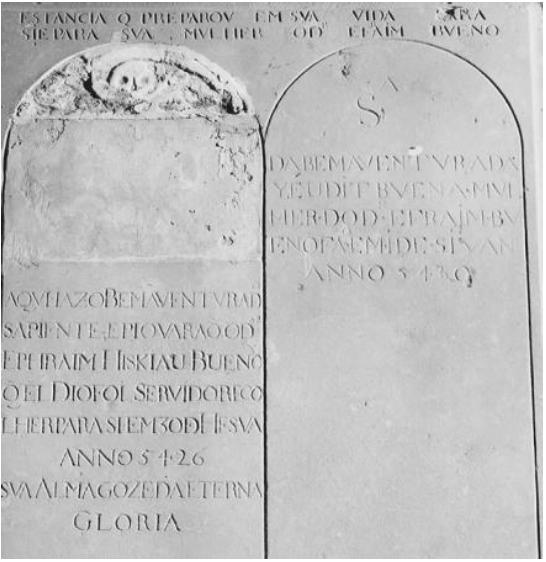
On the tombstone on the left, the end of the second line reads, Dor (doctor).

Joseph Abarbanel, while identified in the Ouderkerk Cemetery record as a physician, is not identified as such on his tombstone (inscription at the bottom of the document).

I thank Heide Warnicke for her assistance with the translation of these tombstones.

[83] Roth, op. cit., Menasseh, 139. Nadler echoes the same sentiment, adding that no one suspected the ruse in his lifetime as his gravestone identifies him as a doctor. See Nadler, op. cit., 263.


Saul Lieberman and his Ketubah, Driving on Shabbat, an Unusual Marriage Practice, Girls born on Friday, and More

Saul Lieberman and his Ketubah, Driving on Shabbat, an Unusual Marriage Practice, Girls born on Friday, and More

Marc B. Shapiro

For a long time, I have had an interest in Saul Lieberman. It has been almost twenty years since my book Saul Lieberman and the Orthodox appeared.[1] I have also dealt with Lieberman in many Seforim Blog posts. A few years ago, I did a series of eighteen classes on Lieberman on Torah in Motion. You can watch the classes on Youtube here or listen to the podcasts here. A letter from Lieberman that has recently come into my hands allows me to turn to Lieberman again. Yet before doing so, I must note at the same time that I was researching, writing, and teaching about Lieberman, Aviad Hacohen also published a number of works on Lieberman. His latest is a lengthy article on Lieberman and the Lithuanian Torah world that appeared in the recently published Rabbi David Golinkin Jubilee volume titled Shir ha-Ma’alot Le-David. It can be read here. In his article, Hacohen includes this nice photograph of Lieberman speaking with R. Aharon Lichtenstein.

We can also look forward to Hacohen’s forthcoming volume of Lieberman’s letters which will be vital for any future scholarship on Lieberman.

While Lieberman was always careful not to do anything that would be at odds with the Orthodox rabbis, there was one exception to this, and that was his ketubah. In order to help solve the Agunah problem, Lieberman proposed including in the ketubah a clause that the husband and wife authorize the beit din to award compensation if either party refuses to come to the beit din to halakhically end the marriage. For those married under Conservative auspices, the beit din mentioned in the ketubah would be the newly formed beit din of the Rabbinical Assembly and the Jewish Theological Seminary.[2]

A lengthy letter from Lieberman to R. Isaac Herzog, dated November 22, 1954, was recently placed at auction, available here. I thank a student who purchased the letter and sent it to me, enabling me to see page 4 which is missing from the auction site. After this post appears, I will present the letter to a suitable archive for safekeeping. This letter is of great significance, as Lieberman explains what motivated him to develop his addition to the traditional ketubah. We are also given insight into how he viewed the Orthodox and Conservative rabbis. Those who wish can see the complete letter in one PDF here.

In the letter, Lieberman begins by saying that he had not written to R. Herzog—who was a very close friend[3]—because he did not want to create difficulties for R. Herzog by bringing him into the controversy swirling around his proposed ketubah. He explains that certain non-Orthodox rabbis had begun to perform marriages for women who were only divorced civilly. This led people to think that the obligation of a get was not a serious matter. Lieberman notes that in circumstances where the husband does not want to give a get, it is usually possible to convince him to do so. The problem is that these “menuvalim” demand so much money to issue the get, that the women are unable to pay this: ואין מי שיתבע את עלבון העלובות

Lieberman then turns to what in his time was a well-known agunah case. I do not wish to go into details but only mention that the woman involved was the famous Trude Weiss-Rosmarin, who after her experience became a critic of the Orthodox approach in Jewish marriage and divorce law. In Lawrence Grossman’s great new book, Living in Both Worlds: Modern Orthodox Judaism in the United States, 1945-2025, p. 204, he writes that Weiss-Rosmarin was “perhaps the first woman from an Orthodox background to publicly demand the wholesale revision of the system [of Jewish divorce law].” In Weiss-Rosmarin’s 1953 article, “Wanted: Equality for Jewish Women,”[4] and in her later article “The Agony of the Agunah,”[5] she called for batei din to assume the authority of issuing divorces instead of husbands. She further claimed that “Jewish law is male-made and inevitably the male prerogatives are protected at the expense of the rights of women. While Jewish law is chivalrous in certain areas, ‘chivalry’ is not enough for the modern woman.”[6] Because of her strong stand in the matter of agunah, Weiss-Rosmarin has even been called the “the first feminist Jew and the first Jewish feminist.”[7] You can read about her here.

Lieberman says that when he saw how the rabbis did not do anything to help Weiss-Rosmarin, that he came to the conclusion that he must do something. His answer to the agunah problem was his ketubah. If the beit din orders payments based on the ketubah, he believed that this would be upheld by the secular court. Lieberman states that originally he wanted the beit din that would be in charge of this to have: רבנים יראי שמים ובקיאים בדיני גיטין וקדושין. He even reveals that R. Abraham Price of Toronto agreed to serve on this beit din, which means that R. Price accepted the halakhic legitimacy of Lieberman’s ketubah. However, the Rabbinical Council of America threatened to put the Orthodox rabbis in herem if they joined Lieberman’s proposed beit din.[8] Lieberman adds that since the RCA did not allow for Orthodox rabbis to join this beit din, there was no longer any possibility that the beit din would be able to write gittin. Rather, its only role would be to compel the man who refused to give a get to do so. He tells R. Herzog that he reformulated the ketubah, so that any recognized beit din can compel the man to issue a divorce and also require monetary payments.

Lieberman adds that the Orthodox assertion that Conservative rabbis wish to involve themselve in matters of gittin is laughable. It is of interest how Lieberman distinguishes between Orthodox and Conservative rabbis, something that only comes across in the Hebrew words he uses for “rabbi”:

כל הצעקה של הרבנים שהרבייס הקונסרבטיביים רוצים להכנס לענייני גיטין היא מצחיקה

Lieberman continues that the Conservative rabbis have no need for the income they could get from doing gittin, and they can make more money from other things. They have not gotten involved in kashrut, which is less complicated than gittin and has much more money in it. Lieberman adds that the fact that the Conservative rabbis accepted his proposal is a very positive thing, since if any of them now perform a wedding before the woman has received a get, they will be expelled from the Rabbinical Assembly. All Conservative rabbis are therefore forced to explain to their communities that civil divorce is meaningless and the woman is still regarded as married.

Lieberman then tells about the “young rabbis” who were in an uproar about his proposal. By this he means the rabbis of the Rabbinical Council of America. He says that they were claiming that it is forbidden to alter any of the formulations used in the ketubah, and that this is based on the fact that it is also forbidden to alter the text of a get from what the Sages have decreed.[9] Lieberman notes that he did not pay them any mind, and was happy to let them show their ignorance in public. He adds that the RCA rabbis have now begun screaming that the beit din of the Conservative rabbis has permitted kohanim to marry divorced women and to drive to synagogue on Shabbat.[10] Lieberman says that this is completely false. To begin with, they do not have a beit din. What this apparently means is that the Conservative movement does not have a national beit din that could issue rulings for the movement. Lieberman adds that a number of Conservative rabbis, mostly his students, demanded that any rabbi who performs a wedding between a kohen and a divorced woman, or permits his congregants to drive on Shabbat, should be expelled from the Rabbinical Assembly. Yet at the convention of the Rabbinical Assembly this proposal was rejected.

Already in 1952 the Committee on Jewish Law and Standards permitted Conservative rabbis to perform weddings between kohanim and divorced women.[11] As for driving on Shabbat, the famous responsum that permitted driving to synagogue, and only to synagogue, on Shabbat, was authored by Rabbis Morris Adler, Jacob Agus, and Theodore Friedman. It was reprinted in Mordecai Waxman, ed., Tradition and Change: The Development of Conservative Judaism (New York, 1958). Here is part of the preface to the responsum from which you see background:

The responsum printed below is the collective effort of three men who prepared it for the approval of the Law Committee of the Rabbinical Assembly. It secured the support of a majority of the Law Committee and it was subsequently presented at a convention of the Rabbinical Assembly (1950). However, in conformity with the policy of the Assembly not to give approval to legal provisions which have not been unanimously approved by the Law Committee, it was not voted upon. It thus remains as the opinion of a group of men, but has no official status.[12]

Although the responsum did not have official status as a ruling of the Conservative Movement, because of the support it received on the Committee on Jewish Law and Standards—the new name of the Law Committee beginning in 1948—it was regarded by the Conservative Movement as a halakhically acceptable option.[13] The way the Committee worked is that “a unanimous opinion is recorded as such and becomes binding upon every member of the Rabbinical Assembly. Where there is a difference of opinion, the opinion which dissents from the majority becomes a minority opinion, and the minority opinion also may be followed by the members of the Rabbinical Assembly.”[14]

In a 2023 article that appeared on the Rabbinical Assembly website here, it states that the responsum “was approved by the Law Committee,” which must mean “approved” as an acceptable option.

The halakhic position advocated by Adler, Agus, and Friedman is summed up in this paragraph from the responsum:

Refraining from the use of a motor vehicle is an important aid in the maintenance of the Sabbath spirit of repose. Such restraint aids, moreover, in keeping the members of the family together on the Sabbath. However, where a family resides beyond reasonable walking distance from the synagogue, the use of a motor vehicle for the purpose of synagogue attendance shall in no wise be construed as a violation of the Sabbath but, on the contrary, such attendance shall be deemed an expression of loyalty to our faith.[15]

Since we are dealing with a halakhic teshuvah, they also had to come up with a way to permit driving to synagogue that could be in line with halakhic sources. The way they did this was by asserting that driving a car is only a rabbinic prohibition. When it comes to the electricity that the car uses, that was not a difficult point to argue, but how could they assert that combustion of gasoline to produce power is also only a rabbinic prohibition? Their solution is to claim that burning is only a Torah-prohibited act when used for the purposes that the Sages recorded, such as cooking, heating, or lighting. “Burning for the sake of power was not included in this list” (p. 369). They also claim that any heat produced by the car’s combustion of gas is not intended or desired so it is a pesik reisha de-lo niha leh “which is permitted by the latest authorities” (p. 369). For good measure they add that the combustion is a melakhah she-einah tzerichah le-gufah according to the opinion of Tosafot, since the combustion is not for the purpose of burning but in order to cause the car to move.

After concluding that driving a car on Shabbat is only a rabbinic prohibition, they then claim that rabbinic prohibitions can be set aside when they prevent the fulfillment of a mitzvah, in this case the mitzvah being attendance at synagogue which is “indispensable to the preservation of the religious life of American Jewry.”[16] It is important to remember that the permission to drive on Shabbat was only for the purpose of attending synagogue. In 1961 Friedman clarified that the permission to drive on Shabbat was only intended to apply to the synagogue one normally attends, not to allow people to drive to a bar mitzvah at another synagogue. This outlook was affirmed in a statement adopted by the Committee on Jewish Law and Standards.[17]

It continues to amaze me that the majority of the Committee on Jewish Law and Standards, and no doubt the overwhelming majority of all Conservative rabbis, supported the Adler, Agus, and Friedman responsum. In the responsum it states: “To continue unmodified the traditional interdiction of riding on the Sabbath is tantamount to rendering attendance at the synagogue on the Sabbath physically impossible for an increasing number of our people.” This was always a foolish argument. In the 1950s there were plenty of Orthodox synagogues that had members who drove to synagogue on Shabbat. There were even Orthodox synagogues that left the parking lot open. But they never officially said that this was permissible. They just looked the other way, and many of the children of those who drove to synagogue became completely observant. In fact, over time, a number of those who drove to an Orthodox synagogue also became observant, precisely because they were never told that it was OK to drive on Shabbat and instead were given a religious goal—Shabbat observance—to strive for. This is the exact model today of Chabad synagogues.

In Rabbi Robert Gordis’ dissenting opinion from the majority of the Committee on Jewish Law and Standards, he wrote: “All experience teaches that the task of winning back the erring and the estranged, heartrendingly difficult as it is, is more often successfully achieved by traditional religion than by its non-traditional forms.”[18] Gordis also states: “To modify Jewish law in order to bring it into conformity with their [Sabbath violators’] way of life is tantamount to amending the Constitution of the United States so as to harmonize it with the viewpoint of an anarchist. . . . Had there been a large number of Elisha ben Abuyas or general Sabbath violators in their day, the Rabbis would not have consulted them as to how Sabbath observance should be conceived of.”[19]

Why couldn’t the Conservative movement simply ignore the fact that people in the synagogue had driven there on Shabbat instead of seeking to offer halakhic justification? Were they afraid that if congregants felt that the rabbi viewed them as sinning by driving to synagogue, that the congregants would be inclined to join a Reform temple where they wouldn’t be judged? Did they really think that people would stop coming to synagogue if they did not permit driving on Shabbat? The authors of the responsum were certainly aware that the people who drove to synagogue on Shabbat did not restrict themselves to only driving there, but they also drove throughout the Sabbath to wherever they wanted to go. So, what in the end did they think would be accomplished by this responsum? How did they not see that once the permission was granted, that even rabbis and cantors would avail themselves of it rather than moving within walking distance of their synagogues?[20] In 2003 Rabbi Ismar Schorsch, chancellor of the Jewish Theological Seminary, said that the decision to allow driving to the synagogue on Shabbat was a mistake,[21] but by this time, there were hardly any Conservative rabbis in the United States who would agree with him.[22]

Returning to Lieberman’s letter, he notes that “the rabbi from Boston,” by which he means R. Joseph B. Soloveitchik, also attacked him—without mentioning Lieberman by name—regarding the proposed addition to the ketubah. This is interesting, as I am unaware of any public communication from the Rav in which he attacked Lieberman. However, in 1954 R. Emanuel Rackman, working “with the direction of” R. Soloveitchik, expressed opposition to the Lieberman Ketubah. Rackman would later claim that the Rav’s opposition was “mild” and that the Rav admitted that he would have been able to work out a mutually satisfactory version of the ketubah with Lieberman.[23] Also of note is that in 1959, R. Norman Lamm published a critique of the Lieberman Ketubah.[24] Knowing Lamm’s connection to R. Soloveitchik, it is hard to believe that he would have published this article without the Rav’s approval. It is noteworthy that at this point in the letter Lieberman also refers negatively to musmakhim of RIETS as רבייס.

Lieberman continues that he would never change a text established by the Sages, but there is no problem changing the ketubah’s language. He cites R. Simeon ben Zemah Duran that one is even allowed “to lie” in the ketubah (the quotation marks are found in the letter). The case of R. Duran is about a young woman who was not a virgin but they wrote “virgin” in the ketubah, and R. Duran says that there is no problem in doing this.[25][26]

Lieberman adds that the Rabbinical Council of America has an ally in their opposition to Lieberman’s ketubah, namely, Professor Mordechai Kaplan, who viewed Lieberman as more dangerous than all the Orthodox rabbis.

Lieberman concludes the main part of the letter that he is prepared to accept the ruling of a beit din in Israel. His condition is that the beit din be composed of R. Herzog, R. Isaac Zev Soloveitchik (the Brisker Rav), and a third rabbi that they would agree on. If they rule that his ketubah is forbidden, he will abandon it. Since the ketubah he prepared was for the Conservative movement, it mentioned that the parties have to come to the Conservative beit din. However, Lieberman says that one can insert the name of any beit din in the ketubah, “as longs as it is a beit din that does not accept bribery.”

The remainder of the letter contains comments on a Torah article of R. Herzog.

It is noteworthy that R. Herzog dealt with the Lieberman ketubah at a meeting of the Moetzet ha-Rabbanut ha-Rashit on March 10, 1955.[29]

In attendance at the meeting, representing the Rabbinical Council of America, were Rabbis David Hollander and Herschel Schacter. At the meeting, R. Herzog said that although Lieberman is a great Torah scholar, he is not a gadol ba-Torah that we are all obligated to listen to. He adds that he does not see Lieberman’s addition to the ketubah as halakhically problematic. However, he has strongly protested the notion that a Conservative beit din will have any involvement in this matter. In 1953 R. Herzog wrote to British Chief Rabbi Israel Brodie and mentioned that years before he had already suggested a proposal similar to that of Lieberman.

See also this 1953 letter to South Africa Chief Rabbi Louis I. Rabinowitz where he repeats what he told R. Brodie.

We see from both these letters that R. Herzog had no objection to Lieberman’s ketubah and even wondered if Lieberman’s proposal based on his own prior suggestion.[30]

Great Torah scholar that he was, the ability to stand up to voices on his right was not one of R. Herzog’s strengths. As such, it was not long before he was dragged into a strong condemnation of the Lieberman Ketubah. Here is how Amihai Radzyner sums up what happened:

It appears that Rabbi Herzog was not at all sure that the new clause in the ketubah posed a halakhic problem (unlike the Conservative rabbinical court issue) and therefore decided that the Rabbinate would discuss the matter further and consider issuing an official protest. Later, Rabbi Herzog formulated a relatively moderate objection, in which he expressed doubt regarding the halakhic claim that the new clause would inevitably lead to coerced (and thus invalid) divorce (גט מעושה). Herzog drafted a statement to this effect, which he sent to members of the Chief Rabbinate Council. The moderate nature of the statement did not please Rabbi Reuven Katz, who insisted that would “assist criminals, God forbid.” He demanded a stronger wording that would express solid opposition to this “serious matter.” His demands seem to have been heeded: the Rabbinate ultimately would issue a statement in which Rabbi Herzog would warn congregations in the U.S. of the grave danger posed by the Conservative ketubah, in accordance with the wishes of the American Orthodox leadership. This statement – an appeal to rabbis of the United States signed by Israel’s two Chief Rabbis – refers to the Conservative ketubah as the “defiant ketubah” (כתובה חוצפנית) and states that the amendment will not solve the problem of “chained women,” and also warns that the new language, in conjunction with the new rabbinical court, could lead to a rift within the Jewish people.[31]

Here is the statement of the Chief Rabbinate, which includes the attack on the Lieberman ketubah, that Radzyner refers to.

It would be great to see how R. Herzog explained to his good friend Lieberman why he was forced to issue the condemnation, complete with its derogatory description of the Lieberman Ketubah. Unfortunately, no such letter exists in the archive, but Lieberman well understood the pressures R. Herzog was under.

Here are some additional points relevant to my Saul Lieberman and the Orthodox.

1. Mesorat Moshe, vol. 3, p. 389: Someone asked R. Moshe Feinstein if you can rely on Lieberman’s Tosefta. R. Moshe replied that Lieberman is a religious Jew so there is no fear that he would alter the text of the Tosefta.

2. In September 2025 Legacy Judaica, see here, put this letter up for auction from R. Chaim Kanievsky.

He replies that there is no prohibition to use the works of Lieberman. Asked about purchasing works published by JTS, he replies that he does not know. See here where I published the letter from Lieberman recommending that R. Kanievsky receive the Rothschild Prize, and see also here.

See also R. Meir Mazuz, Makor Ne’eman, vol. 3, no. 1337, who permits use of Tosefta ki-Feshutah.

3. See Ha-Ma’yan64 (Tamuz 5784), p. 119 n. 27, that R. Amos Tabanchik reports that R. Elazer Shakh gave R. Noah Shimanovitz a copy of Tosefta ki-Feshutah as a present. Also of note is that the ArtScroll English translation of Mishnah, Kilayim 8:4 cites Tosefta ki-Feshutah.

4. In Saul Lieberman and the Orthodox, I mentioned that R. Shemaya Grunbaum, a Satmar hasid, published a letter from Lieberman in his book,Siyata di-Shemaya al Masekhet Shabbat (Jerusalem, 1970), pp. 159-160. He does not refer to Lieberman by name, but as “hakham ehad”. However, Lieberman’s identity is only slightly veiled, as R. Grunbaum leaves in the letter’s reference to Ha-Yerushalmi ki-Feshuto. He obviously intended that those “in the know” would recognize with whom he was corresponding.

After R. Grunbaum’s book appeared, he sent it to Lieberman and asked Lieberman to send him his recently published Sifrei Zuta/Talmudah shel Kesarin. R. Grunbaum also apologized that due to reasons beyond his control, he could not mention Lieberman by name and thus referred to him as “hakham ehad”.[32]

5. In Ha-Mashbir5 (2025), I published a few letters from Lieberman to Heschel. See here. In one of the letters, Lieberman offers some notes to Heschel’s Torah min ha-Shamayim. Here is Heschel’s reply to Lieberman’s letter.[33]

6. I am writing this right before Thanksgiving, so it reminded me that it is reported that Lieberman did not saytahanunon Thanksgiving. Shearith Israel in Manhattan also does not say tahanun on Thanksgiving. In fact, they say a partial Hallel, from הללו את ה’ כל גוים until the final הודו לה’ כי טוב.[34]

7. David Sarna reports that Lieberman did not accept the Manhattan eruv and that he would not allow a bat mitzvah girl to address the congregation at the JTS synagogue.[35]

* * * * * * * *

I want to call Seforim Blog readers’ attention to the wonderful Youtube channel of Kerem: Bein Torah le-Hokhmah here. The main feature is R. Yonason Marton’s daily daf yomi and other shiurim. While his shiurim are in Yiddish, the summaries available in the show notes on Youtube are in Hebrew. R. Marton’s shiurim are a unique combination of traditional lomdus and academic scholarship. In addition, Kerem has hosted numerous academic scholars whose videos are also on the Youtube channel. Kerem is a unique institution led by special people, and I wish it much success as it continues to grow.

Appendix

We routinely use the word “virgin” in the ketubah, together with the applicable monetary amount, unless the woman has been previously married. We even do so if the couple is living together. As mentioned, this is allowed because as long as the future husband knows the truth, it does not matter what is written in the ketubah. That this is the law has been affirmed in modern times by R. Moshe Feinstein[36] and many others. In fact, this is so well established that I think it is a “known truth” that before marriage the husband needs to know if his future wife is a virgin, and that the ketubah is invalid if he gets married without knowing the truth. Indeed, how could it be any different, as we see from Ketubot 11b that if the man marries a woman thinking she is a virgin and she is not, that it is a mekah taut?

It will therefore come as a surprise for many that this view is not accepted by all. For instance, R. Shalom Mordechai Schwadron[37] deals with a case of an orphan woman who not only was not a virgin, but who had a child out of wedlock. She later got engaged to a man who did not know about her past. R. Schwadron ruled that in the interests of peace they could write “virgin” in the ketubah and keep the husband in the dark. As for the incorrect monetary amount, R. Schwadron has a few suggestions on how to deal with this as well, including having the woman sign a document foregoing the extra ketubah money due a virgin. This document would have to be kept with the beit din as the husband would not be aware of it.

I think people will also be surprised by the following, not merely the ruling of R. Joseph Hayyim but the entire situation he describes, as it is so foreign from our experience. I apologize if what follows is a little too explicit, but everything comes directly from Rav Pealim, vol. 1, Even ha-Ezer, no. 2.[38] R. Joseph Hayyim describes the following case. A man betrothed a woman on the assumption that she was a virgin. At the time, her father, mother and all her relatives “knew” that she was a virgin. However, between the betrothal and the marriage her parents learned that she had been intimate a few times with another man.

The practice in Baghdad was that on the night of the wedding, after the bride and groom went into their room, female relatives of the bride and groom would sit outside the door. In addition, a few male relatives and friends of the groom would also be there. They were all waiting to see the dam betulim. After the husband finished his marital duty, he would get dressed, open the door, and leave.[39] The women would then come in to see the dam betulim. If they saw it, they would make the loud celebratory sound we have all heard from women from Arab countries, which is called zaghrouta. If they did not see the dam betulim, that meant the groom did not do his job properly, and he would come back to try again.[40]

In the particular case of the responsum, the parents of the woman came up with a trick to spare her embarrassment: The bride put blood on the sheet, but it was not her blood. However, someone who was close to the family of the bride knew the truth and was worried that the marriage was not halakhically binding. After all, the man married her under false pretenses as he thought she was a virgin, and so it was written in the ketubah.

R. Joseph Hayyim replies that the marriage is binding and the husband should not be told that he was fooled, as this will lead to great shame for the bride and her family. As for the matter of the ketubah, R. Joseph Hayyim says that the bride and her relatives must be told that in the event of her being able to collect the ketubah money, she can only claim that which a non-virgin is entitled to.

Both R. Schwadron and R. Joseph Hayyim are cited by R. Netanel Meoded in his own responsum where he concludes that one should not inform a man that the woman he is marrying, whom he thinks is a virgin, was sexually active before their engagement. See Mizrah Shemesh, vol. 2, no. 31.

R. Joel Roth, writing from a Conservative perspective, argues for removing the word betulta from the ketubah. See Roth, Hakol Kol Yaakov, ed. David Golinkin (Jerusalem, 2023), pp. 361ff.

Let me now turn to another strange thing. In previous centuries there was a belief among some that a girl who was born on Friday did not have betulim. Quite apart from the absurdity of the belief, the halakhic problem it would create is obvious, since as R. Abraham Zvi Klein notes, it would mean that with any woman whose birthday is unknown, there would be no ta’anat betulim because perhaps she was born on Friday. To this I would add, since there is no mention of this “medical” point in the Talmud or rishonim, it is shocking that anyone took it seriously. In R. Eliyahu Bar Shalom’s standard work, Mishpat ha-Ketubah,[42] he feels it necessary to write:

גם לנולדת ביום ששי יש כתובת בתולה ככל שאר הנישאות, אף שיש שמועה שאין לה בתולים

What is the origin of this belief? The first reference I found is in R. Isaac Lampronte of Ferrara’s (1679-1756) halakhic encyclopedia Pahad Yitzhak. R. Lampronte was also a doctor, so his recording of this medical legend is itself noteworthy.

In Pahad Yitzhak, s.v. na’arah, R. Lampronte mentions that in Italy the practice is that if a girl is born on Friday this fact is recorded, precisely in order to deal with the halakhic issue already mentioned. That is, if the husband will later assert that there was no dam betulim, this would not be regarded as a valid claim. R. Lampronte states that despite the Italian practice, he did not find any mention of the unique nature of girls born on Friday either in the Talmud or poskim, and that there is also no mention of it in scientific or medical works. He therefore claims that the assumption that girls born on Friday lack betulim should not be relied upon, as on the contrary, sometimes girls born on Friday indeed have belutim.

R. Hayyim Joseph David Azulai, who lived in Italy, also mentions the belief that girls born on Friday lack betulim. He says that he was told about this from distinguished people in Italy and Amsterdam. He also cites from the then unpublished section of Pahad Yitzhak just mentioned. As with R. Lampronte, R. Azulai is surprised by this biological assumption, because if it is true, the Sages would have mentioned something about it.[43]

Many people have cited the Pahad Yitzhak and Hida, however, the story does not end there. There was another great rabbi in Italy, R. Daniel Tierni of Florence (died 1814), author of the commentary on the Shulhan ArukhIkarei ha-Dat (הד”ט – playing on the abbreviation of his name). In his commentary to Yoreh Deah 21:10, he tells us that he saw additions that R. Lampronte made to the Pahad Yitzhak. These additions have not appeared in print, so we must be grateful for what R. Tierni preserved. Here R. Lampronte states that the entire matter is a complete falsehood, sheker gamur.[44] Yet R. Tierni adds that everywhere in Italy where he has lived, they are careful to record in the communal record whenever a baby girl is born on Friday to avoid problems when she later gets married. He notes that the non-Jews also do this. As for why there are girls born on Friday who have betulim, he explains this through astrology, and suggests that it depends when on Friday they are born, since only certain hours on Friday are under the rule of Venus.

As late as 1902, R. Isaac Raphael Ashkenazi (1826-1908), the rav of Ancona, writes that the practice of his city is to record the girls who are born on Friday, and he thinks this is what other communities should do as well.[45]

Riddles

It has been a long time since I included a riddle, and I now have a bunch of books that I can give away to those who get the right answers. If you have the answers, email them to me at shapirom2 at scranton.edu

1. Where do we find that Shammai not only disagrees with Beit Shammai, but also agrees with Beit Hillel?

2. In the days of the tannaim a certain item was unquestionablymuktzeh. However, in the post-talmudic period, some hold that this item is no longermuktzeh. What item am I referring to? Provide the actual source in the Talmud and later authorities to justify your answer.

I asked ChatGPT this question but the answer it provided was phony, complete with a non-existent citation from R. Moshe Isserles. I am sure ChatGPT will provide other answers, and perhaps one of them might be correct

* * * * * *

[1] This book began as an invited lecture in memory of Lieberman sponsored the Union of Traditional Judaism. One of the organizers of the event was Rabbi Ronald Price. I mention this because R. Price is the author of the newly published book, Divrei Halev: Thoughts of Rabbi Professor David Weiss Halivni on the Weekly Torah Portion. Here is part of the book’s description on Amazon:

Divrei Halev is the result of a multi-year collaboration between Rabbi Ronald D. Price and his teacher, the world-renowned Talmudic scholar Rabbi Professor David Weiss Halivni, of blessed memory. Nearly every week from 2008 to 2012, Rav Halivni shared a thought with Rabbi Price on the weekly Torah portion, which the student faithfully recorded. Divrei Halev includes over two hundred brief divrei Torah spread across all fifty-four parashiyot.

I was one of those privileged to write a blurb for the book, together with Professors Gershon Bacon Reuven Kimelman, David Novak, and Dr. Elana Stein Hain. In the interests of space, my blurb was edited, so here is a good opportunity to record my unabridged blurb.

Rabbi Halivni’s greatest contribution was of course his groundbreaking talmudic scholarship. Yet anyone who had the pleasure of davening with Rabbi Halivni on Shabbat, as I did in the late 1990s and early 2000s, saw a different side of him, that of a rav of a kehillah, a spiritual leader, whose spoken word on Shabbat was able to both enlighten and inspire. Those of us who were able to experience this, and those who never had the opportunity, owe a great debt to Rabbi Ronald Price for bringing the words of our teacher to life.

Regarding Halivni, see also what I wrote here.

Let me now share another story about Halivni. On Erev Pesah 2001 or 2002 I was walking to shul on the Upper West Side and I saw Halivni coming down the street. I asked what brought him to my neighborhood, as I knew he did not live in the area. He told me that he wanted to find a minyan that said Hallel after maariv. I took him to Ohab Zedek and was told that they do not say maariv. We started out in search of another shul and came upon the Chabad minyan on the Upper West Side, where we davened. I remember being very impressed by two things at this minyan. First, that the Chabad rabbi and at least a couple of other Chabad attendees knew who Halivni was. Second, how they treated him with the greatest respect.

[2] Subsequent to publication of my Saul Lieberman and the Orthodox, Monique Susskind Goldberg discussed Lieberman’s Ketubah in id. and Diana Villa, Za’akat Dalot: Pitronot Hilkhati’yim le-Be’ayat ha-Agunot bi-Zemanenu (Jerusalem, 2006), pp. 104ff. On p. 112, she also discusses a proposed adjustment to the ketubah by R. She’ar Yashuv Cohen.

Whether the Lieberman Ketubah could be civilly enforced was at the center of the famous 1980s N.Y. case, Avitzur vs. Avitzur. See here and here. Contrary to all the naysayers, the court upheld the legitimacy of the Lieberman Ketubah from the standpoint of American law. The National Jewish Commission on Law and Public Affairs, an Orthodox organization, got involved with the case together with the Jewish Theological Seminary to support the plaintiff whose husband had refused to appear before the beth din of JTS and the Rabbinical Assembly in order to give her a get. Nathan Lewin told me that R. Moshe Sherer, the head of Agudat Israel, asked Lewin to become involved with the case. Even though it did not focus on the Orthodox community, Sherer—and the Agudah rabbinic leadership he must have consulted—thought it was important that the principle that the government could, in certain circumstances, require people to go to beit din be upheld.

[3] According to Chaim Herzog, Lieberman was his parents’ closest friend. See Elijah J. Schochet and Solomon Spiro, Saul Lieberman: The Man and His Work (New York, 2005), p. 53. On this page, Schochet and Spiro write that “Lieberman enjoyed the respect of R. Yosef Shalom Eliashiv, the av beit din of Jerusalem.” If one consults the source they offer for this sentence, Yitzhak Raphael’s eulogy for Lieberman in Sinai 93 (Nisan-Iyar 5783), p. 91, one finds that Raphael’s actually refers to R. Elyashiv’s grandfather, the kabbalist R. Solomon Elyashiv.

[4] Congress Weekly, Aug. 17, 1953, cited in Regina Stein, “The Boundaries of Gender: The Role of Gender Issues in Forming American Jewish Denominational Identity, 1913-1963” (unpublished doctoral dissertation, Jewish Theological Seminary, 1998), p. 319.

[5] Conservative Judaism 20 (Fall 1965), pp. 51-54.

[6] Stein, “The Boundaries of Gender, p. 320.

[7] See Naomi Salfati, “On Feminist Judaism, Jewish Feminism and the Advancement of Women’s Roles in Jewish Tradition” (unpublished master’s dissertation, Hebrew University, 2014), p. 16, available here. Salfati discusses Weiss-Rosmarin’s article, “The Unfreedom of Jewish Women,” which also deals with the “unfairness of Jewish marriage laws to divorced and abandoned women.”

Weiss-Rosmarin is also known for her book Judaism and Christianity The Differences. In Alan Brill’s newly published A Jewish Trinity: Contemporary Christian Theology through Jewish Eyes, Weiss-Rosmarin’s approach, which is the “standard” view Jews are taught, is specifically rejected throughout the book. In the very first paragraph of A Jewish Trinity, Brill writes: “For many Jews and Christians, Weiss-Rosmarin’s basic unbridgeable theological divide between the religions remains a truism. This book rejects Weiss-Rosmarin’s simple zero-sum declaration by asking whether the Jewish theological vision and the Christian theological vision are fundamentally irreconcilable, or can the positions be conceptually bridged.”

[8] In a December 3, 1954, statement, the RCA and the Rabbinical Alliance of America condemned the Lieberman ketubah, stating that it had “the gravest implications to the sanctity of Jewish family life and represents the most disastrous disavowal of the principles of Jewish law.” See Benjamin Steiner’s important article, “The Lieberman Clause Revisited,” American Jewish Archives 69 (2017), p. 54.

[9] For criticism of the Lieberman Ketubah from another angle, see R. Eliezer Waldenberg, Tzitz Eliezer, vol. 5, pp. 23ff., vol. 21, no. 62. See also R. Joseph Elijah Henkin, “Tikun o Harisah,” Ha-Pardes, Shevat 5755, pp. 20-22. R. Isaac Herzog responded to this article, see Tehukah le-Yisrael al Pi ha-Torah, vol. 3, pp. 208-209.

At a 1953 gathering of Conservative rabbis and JTS faculty, Lieberman discussed his proposal, which he referred to as a takkanah. He said as follows, clearly exasperated with the American Orthodox rabbinate.

I saw that some of you were accused of being frightened by the Orthodox rabbis. I want to tell you that I am not frightened by them at all.

I want, therefore, to give you a point of information. In truth, they were frightened, and I want you to know why they were frightened. They weren’t afraid that the בית דין would issue some תקנות. No, not at all. They were afraid that the בית דין will issue תקנות in accordance with the law.

As a matter of fact, one of the very important members of the Orthodox rabbis said so in so many words: If this בית דין of the Rabbinical Assembly will issue a תקנה, that will be תקנתו קלקתו. It will be a great misfortune because they will get authority and that is the reason why they oppose this. Many of them think that that בית דין will begin to move in this line, the movement can become strong and it will affect them.

Now about this תקנה. I would like to tell you that this תקנה has nothing to do with the בית דין that will be established—and I hope it will be established soon; but this I would like to see you adopt immediately because it has a tremendous practical value.

David Golinkin ed., Proceedings of the Committee on Jewish Law and Standards of the Conservative Movement 1927-1970 (Jerusalem, 1997), vol. 2, pp. 810-811.

[10] These two points are mentioned by Rabbi Hollander at the meeting with the Moetzet Ha-Rabbanut ha-Rashit. See below. Hollander refers to Conservative rabbis permitting these matters, not a Conservative beit din.

[11] See here. The basis for the Committee on Jewish Law and Standard’s ruling was the responsum of Rabbis Ben Zion Bokser and Theodore Friedman published in Proceedings of the Committee on Jewish Law and Standards of the Conservative Movement 1927-1970, vol. 3, pp. 1459-1462.

[12] Waxman, Tradition and Change, p. 351.

[13] Regarding the change of name from Law Committee to Committee on Jewish Law and Standards, see here.

It is of interest that in 1992 the Conservative movement in Israel, known as Masorti, issued a ruling forbidding travel to synagogue by car on Shabbat in Israel. See here. See also Rabbi David Golinkin’s responsum on this matter here.

[14] Formulation of Rabbi Aaron Blumenthal in Proceedings of the Committee on Jewish Law and Standards of the Conservative Movement 1927-1970, vol. 3, p. 1464.

[15] Waxman, Tradition and Change, p. 361.

[16] Waxman, Tradition and Change, p. 370.

[17] Proceedings of the Committee on Jewish Law and Standards of the Conservative Movement 1927-1970, vol. 3, pp. 1186-1188.

[18] Waxman, Tradition and Change, p. 390.

[19] Waxman, Tradition and Change, p. 390. See also ibid., pp. 392ff. for Rabbi Ben Zion Bokser’s rejection of the permission to drive on Shabbat

[20] For the recent debate of the Committee on Jewish Law and Standards regarding use of an electric car on Shabbat, see here. In this article, Rabbi Danny Nevins is quoted: “Those who accept the 1950 CJLS minority position permitting people to drive to synagogue in a gas-powered car would be justified extending this permission to electric cars.” Yet as mentioned above, the 1950 CJLS position permitting people to drive to synagogue on Shabbat was the majority position, not the minority.

[21] See here.

[22] Regarding driving to synagogue on Shabbat, I think many will be surprised by some of the lenient views that have been expressed. Following this paragraph is a responsum from Kollel Eretz Hemdah’s Be-Mareh ha-Bazak, vol. 3, no. 38, in which they rule that it is permitted for a non-Jew to drive a Jew to synagogue on Shabbat if this is vital to keep the person connected to Judaism. They also state that this should not be done every week. According to what is stated at the beginning of the volume, all responsa published in the book were approved by R. Shaul Yisraeli.

R. J. Simcha Cohen suggested that for people who could not walk to synagogue in Century Village in West Palm Beach, that they could get on the bus that transports people along set routes within the community’s confines. This would only apply if the driver was not Jewish. See Cohen,Shabbat: The Right Way(Jerusalem, 2009), pp 181ff. He also includes R. Moshe Dovid Tendler’s letter opposing this leniency. R. Tendler writes: “The heter would destroy the sanctity of the Shabbos. It would be extended to other ‘good deeds’ like visiting parents, hospital patients, attending rallies and even earning money on Shabbos to pay yeshiva tuition.” R. Yosef Carmell, the head of Eretz Hemdah, also replied, and he followed the approach already approved by R. Yisraeli.

If the bus is clearly labeled as a ‘Shabbat bus,’ is announced as appropriate only for those too weak to walk on their own, and even then only to be used for transportation to and from shul, it could be positive, provided that someone familiar with the community feels it would be necessary. (One must, of course, verify that only non-Jewish drivers are used.) However, we would recommend monitoring public impression (not only before implementation but also after) so as to gauge whether people view this as either a religious farce or a sweeping abrogation of hilchot Shabbat (in which case the service should be discontinued).

We would also like to suggest the aforementioned ruling of Rav Yisrael, zt”l (Be-mareh ha-bazak IIII:38) of having the Shabbat bus run only occasionally (or perhaps alternate weeks, etc.) so as to stress that we are dealing with a she’at ha-dechak.

R. Carmell understood R. Cohen to be referring to a special Shabbat bus run by the Jewish community. But what he was referring to was the already existing bus that transports people, free of charge, to different places within Century Village.

Significantly, when asked by the community of Century Village, Boca Raton, R. Hershel Schachter gave his permission for people who can’t easily walk to take the communal bus to synagogue. See here.

See also R. Schachter, Nefesh ha-Rav, p. 233, that R. Soloveitchik opposed having a “Shabbat bus”. The Rav noted that although this could be justified halakhically, since driving to synagogue on Shabbat had become a symbol of the Reform and Conservative movements, this means that even driving to synagogue in a halakhically permissible manner is now forbidden.

R. Ben Zion Uziel earlier gave permission for Jews to use public transportation to go to synagogue, but only in a place where the majority of riders are non-Jewish. SeeMishpetei Uziel, vol. 1,Orah Hayyim, no. 9, Mahadura Tinyana, vol. 1, Orah Hayyim, no. 32.

At the end of his book, R. Cohen offers a different suggestion, namely, a rickshaw attached to a bicycle. He writes:

Accordingly, a rickshaw bicycle driven by a non-Jew would also not be prohibited because of the concern that he might repair the bicycle on Shabbat, since a Gentile may repair anything he wishes on Shabbat. . . Using all the methods mentioned above, one could arrange, well within the bounds of Halacha, for a bicycle rickshaw to transport Jews who are unable to walk to and from the synagogue on Shabbat. This would involve no Biblical violations at all.

In Hakirah 37 (2025), Avi Kadish published a memoir which describes how he became religious. He reports that R. Moshe Feinstein permitted him to ride to synagogue on Shabbat in the car driven by his father. This only happened twice, as Kadish’s father realized that his son was uncomfortable using the car. From then on, every Shabbat they walked the two hours fifteen minutes each way to synagogue. What makes R. Feinstein’s ruling so interesting, is that Kadish was over bar mitzvah age. (Kadish notes that R. Avraham Pam had also given such a ruling with regard to a katan.) Kadish publishes the following comment from R. Shabbetai Rapoport:

I see no halakhic novelty here. If your father was going to shul anyway, why should there be any reason to forbid you to go with him? Rav Moshe’s opinion was that there is no difference between partnership with a Sabbath violator and partnership with a gentile. The ḥumra that a passenger in a car causes more fuel to be burned is mentioned in his writing, but only as a ḥumra. Therefore, this ruling fits his halakhic methodology quite well. The [real] novelty is that he did not fear any criticism that might have arisen, and this is indeed characteristic and correct [of Rav Moshe].

I don’t understand R. Rapoport’s point. The novelty is that Kadish was receiving benefit from a melakhah done on Shabbat by a Jew.

R. Shlomo Zalman Auerbach has an interesting pesak in Minhat Shlomo, Orah Hayyim, no. 3 (end). He rules that one who accepts Shabbat early is able to be driven by a non-Jew, and in a “tzorekh gadol” can also be driven by a Jew. He says that there is no ziluta de-Shabbat involved.

הואיל וליכא בכה”ג זילותא דשבתא שהרי אצל כולם עדיין הוא חול

R. Yitzhak Yosef states that for someone who drives to synagogue on Shabbat, it is better that he arrange to be taken by a non-Jew, unless this will lead to communal problems (e.g., others who are currently walking to synagogue might now feel that it is OK to have a non-Jew take them). Thus, he requires a local rav who knows the situation to make such a decision. SeeYalkut Yosef, Hilkhot Shabbat, vol. 5, p. 61.

Regarding using an autonomous taxi on Shabbat, see R. Eitan Kupietzky in Ha-Ma’yan, Tevet 5784, pp. 35-42. According to R. Aharon Goldberg, R. Shlomo Zalman Auerbach’s grandson, R. Auerbach had no objection to use of a car on Shabbat if there are no halakhic violations with this car, and that this could actually enhance Shabbat observance. In response to the objection that use of such a car would destroy Shabbat as we know it, a concern that was at the center of the Hazon Ish’s approach to use of electricity on Shabbat, he replied:

ההלכה היא לא איך שנראה לנו, אלא אם זה מותר אז מותר!

See Aryeh Edrei and Amir Mashiah, “Arba Amot shel Halakhah: Ha-Rav Shlomo Zalman Auerbach,” in Binyamin Brown and Nissim Leon, eds. Ha-Gedolim (Jerusalem, 2017), pp. 720-721. Along these lines, a new pesak has recently appeared from R. Menachem Perl, the head of the Tzomet Institute. According to him, one can make use of an iRobot vacuum on Shabbat as long as it is activated before Shabbat. See here.

Because the world is changing so much when it comes to technology, I think that due to pressing circumstances the future will bring a number of lenient rulings regarding Shabbat. For example, the day is not far off when in major cities one will not be able to enter an apartment building, or even a private apartment in such a building, without using an electronic keypad or key card. It is hard to imagine that poskim will rule that Jews are not allowed to live in these buildings, as that would mean the end of Orthodox communities in many places.

[23] Stein, “The Boundaries of Gender,” pp. 331, 338.

[24] Norman Lamm, “Recent Additions to the Ketubah,” Tradition 2 (Fall, 1959), pp. 93-118.

[25] The case R. Duran discusses is of a girl who might not have even been twelve years old. She was kidnapped by non-Jews and brought to Tunis where she was redeemed (“bought”) by a Jewish man who proceeded to have sex with her. Another man then removed her from Tunis—he must have paid the first man—to bring her to her father. On the way he married her, and that is when the ketubah was written stating that the young woman was a virgin. By this time, she was checked by women and showed signs of physical maturity, and the halakhic significance of this is discussed by R. Duran. The fact that the girl was raped by her first “redeemer” is not even discussed as it is not relevant to the halakhic issue R. Duran focuses on.

In general, when one sees responsa that refer to sexual relations with young girls, one need not assume that we are dealing with a case of rape, as it is possible that the husband was also very young. See e.g., Teshuvot Hakhmei Tzarfat ve-Lotir, no. 14:

בועל בעילת מצוה ופורש בתנוקת מפני צחצוחי זיבה

See also ibid., no. 52.

[26] See Appendix.

[27] See Saul Lieberman and the Orthodox, p. 20, where I discuss Lieberman’s relationship with Kaplan, and that it seems that after the Agudas ha-Rabbonim put Kaplan in herem, Lieberman observed the herem. See also my earlier post here. See also here where I discuss the burning of Kaplan’s siddur and show that contrary to what has often been said, this was not sanctioned by Agudas ha-Rabbonim.

[28] Regarding Lieberman and the Brisker Rav, see the passage from R. Mordechai Elefant’s memoir I posted here.

[29] Israel State Archives, Chief Rabbinate files, 15796/2-גל, new file locator: 000ier0.

[30] The letters to Brodie and Rabinowitz are found in Israel State Archives, Herzog files 4255/11-פ, new file locator: 000bvq8. There is another letter to Brodie in Herzog, Tehukah, vol. 3, pp. 201-202. See also Herzog, Tehukah, vol. 3, p. 201, from a 1954 letter to Haim Cohn, where he again mentions Lieberman’s ketubah with reference to his own suggestion. This last reference and the manuscript letter to Brodie published here are mentioned in Amihai Radzyner, “Reform or Necessary Change: The Attempt to Translate the Ketubah into Hebrew and the Reactions to It,” Hebrew Union College Annual 93 (2022), p. 176 n. 111. However, he does not mention R. Herzog’s letter to Rabinowitz.

[31] Radzyner, “Reform or Necessary Change,” p. 176.

[32] This letter is found in the Saul Lieberman Archives, Arc. 76/6, Library of the Jewish Theological Seminary of America. I thank the Library for permission to publish this letter as well as the letter from Heschel to Lieberman below.

[33] This letter is found in the Saul Lieberman Archives, Arc. 76/6, Library of the Jewish Theological Seminary of America.

[34] This was confirmed by Zachary Edinger, Ritual Director at Shearith Israel.

[35] Sarna, Growing up Conservadox, pp. 30, 32.

[36] Iggerot Moshe, Orah Hayyim, vol. 4, no. 118.

[37] Teshuvot Maharsham, vol. 7, no. 152.

[38] In some communities there was even a practice after the wedding night of a public recitation of a blessing known as birkat betulim. Maimonides, however, saw this as a disgraceful breach of modesty as well as a berakhah le-vatalah. See Ezra Brand’s post here.

[39] He would leave and not return to her, because the practice in Baghdad was that husband and wife did not sleep alone in the same room until after she had gone to the mikveh. This was also the practice in Djerba (it no longer is), and there is a source for this in the rishonim. See R. Meir Mazuz, Asaf ha-Mazkir, pp. 299-300.

Regarding the Baghdad practice described by R. Joseph Hayyim, see Ketubot 12a:

In Judea, at first they would appoint for them two groomsmen [shushvinin], one for him and one for her, in order to examine the groom and the bride at the time of their entry into the wedding canopy [and thereafter, to ensure that neither would engage in deception with regard to the presence or absence of blood from the rupture of the hymen]. . . . In Judea, at first the groomsmen would sleep in the house in which the groom and bride sleep, [in order to examine the sheet on which the marriage was consummated immediately following intercourse].

[40] See Tosafot, Kiddushin 12b. s.v. mishum, that according to R. Tam, this custom is to be regarded as peritzut.

דהיינו פריצותא לפי שצריך או עדי ביאה או עדי יחוד ודבר מכוער שמעמיד עדים על כך

[41] See Roth, Hakol Kol Yaakov, ed. David Golinkin (Jerusalem, 2023), pp. 361ff.

[42] Vol. 3, p. 124.

[43] Ayin Zokher, ma’arekhet bet, no. 3.

[44] See, similarly, R. Joshua Solomon Ardit, Hina ve-Hisda, vol. 1, p. 164a. I saw this reference in Zev Wolf Zicherman, Otzar Pelaot ha-Torah, vol. 3, p. 926.

[45] Va-Ya’an Yitzhak, Even ha-Ezer, no. 8.


Birds’ Heads, Romaine Lettuce, and the Art of Reading a Haggadah

Birds’ Heads, Romaine Lettuce, and the Art of Reading a Haggadah

A persistent question arises with every illustrated Haggadah, whether a fourteenth-century Sephardic manuscript or a mid-twentieth-century Maxwell House edition: what function do these images serve? Are they merely decorative, do they provide commentary, or do they serve as documentary evidence of ritual practice? Furthermore, when these images draw from the visual culture of the surrounding non-Jewish world, as is often the case, does such borrowing diminish their Jewish character, or does it indicate a more complex dynamic?

These questions are more thorny than they initially appear, and scholarly responses have evolved significantly in recent decades. This post synthesizes several strands: our previous discussions of specific manuscripts, insights from Marc Michael Epstein’s influential scholarship on medieval Haggadah manuscripts, and a notable controversy documented by Leor Jacobi. Our aim is to provide a more nuanced and comprehensive guide to interpreting these images.

The Two Mistakes

Anyone who works closely with illuminated Haggadot will recognize two recurring interpretive errors, both of which diminish rather than illuminate.

The first is the “derivative” thesis: the assumption that when an image in a Jewish manuscript resembles one in a Christian context, it is merely borrowed and thus lacks distinctive Jewish meaning. This perspective has informed much scholarship. Medieval Jewish and Christian artists often employed similar pictorial conventions; when similarities are observed, scholars have typically identified the Christian source, labeled the Jewish version as dependent, and concluded their analysis. This approach, however, overlooks the transformation that occurs when such imagery is adapted within a Jewish context and the specific messages it conveys to a Jewish audience.

The second error is more nuanced and may be termed the Wissenschaft snapshot: interpreting manuscript images as direct documentary evidence of ritual practice. For example, treating a depiction of marror as a definitive record of the vegetable used at the Seder, or viewing an illustration of bedikat chametz as a literal representation of the search process. This approach originates in nineteenth-century Jewish scholarship, which sought to extract concrete evidence about historical Jewish life from all available sources.

In 2012, in the comments section of this very blog, Marc Michael Epstein intervened in just such a discussion with a statement worth quoting in full:

Rabbosai (and Marasai): A manuscript is NOT a mirror. Jews depict themselves in their art (or commission art that depicts them) not as they were, but as they desired to be seen. Please please please do not engage in the typical Wissenschaft strategy of looking at illuminated manuscripts for “clues to Jewish life in the Middle Ages” or even to Jewish history. What we can learn from them is histoire des Mentalites, but even that takes a lot of work to get to.

This intervention arose from a debate about whether Sephardic medieval Haggadot depict marror as an artichoke, a topic addressed further below. The methodological insight, however, is broadly applicable: these images provide access to the histoire des mentalités—the internal landscape of aspiration, theological imagination, and communal self-representation. This perspective offers a richer understanding than the Wissenschaft snapshot, though it requires careful interpretation. Importantly, analyzing how a community chose to represent itself constitutes significant historical evidence, even if it does not directly reveal specific ritual practices.

The Birds’ Head Haggadah

The oldest extant illustrated Haggadah text, dated to the early 1300s (and now in the Israel (now in the Israel Museum, although the exact provenance remains murky like so many Jewish items), takes its name from its most immediately striking feature: nearly all the human figures bear birds’ heads rather than human faces. Non-Jewish figures — Egyptians, angels — are instead shown with blank circular discs where faces should be. The zoophilic imagery has attracted a remarkable range of explanations: halakhic anxiety about depicting human faces too completely; a visual encoding of relative spiritual status; and, at the least plausible extreme, the claim that the birds’ beaks are an anti-Semitic caricature of the Jewish nose inserted by a hostile illustrator.

Birds Head Haggadah, Exodus Scene

Epstein critically examines these theories, ultimately adopting a more nuanced position that acknowledges the halakhic dimension without attributing the imagery to a single cause. As discussed in our earlier review, the most illuminating aspect of his analysis is his attention to an anomaly previously dismissed as carelessness. In the Exodus scene depicting the Israelites fleeing and Pharaoh’s army in pursuit, most figures conform to expectations: Israelites with birds’ heads and Egyptians with blank discs. However, two figures in the pursuing army also have birds’ heads. Epstein, prompted by his ten-year-old son’s observation, suggests these figures represent Datan and Aviram, members of the erev rav who chose to remain with the Egyptians. The presence of birds’ heads is intentional, signifying that even the sin of siding with oppressors does not erase Jewish identity. This artistic choice introduces themes of the wicked son, belonging, apostasy, and the potential for return, all of which are particularly resonant in the context of the Seder.

This approach exemplifies Epstein’s methodology: treating anomalies not as errors to be dismissed, but as interpretive keys to deeper meaning.

The Golden Haggadah

The Golden Haggadah, a Sephardic manuscript from around 1320 distinguished by its extensive use of gold borders and embellishments, illustrates a key structural distinction within the manuscript Haggadah tradition. In Ashkenazic manuscripts, illustrations are integrated throughout the text, appearing in margins and between passages, and typically serve to comment on or extend the Haggadah narrative, such as scenes of Pesach preparations, the search for chametz, or the baking of matzah. In contrast, Sephardic manuscripts concentrate pictorial content before the text in a visual preamble: a series of full-page panels, arranged two or four per page, that trace Jewish history from the patriarchal era or creation through the Exodus, preceding the Haggadah text itself. These images function as a visual overture rather than direct illustrations of the liturgy.

While the Golden Haggadah adheres to Sephardic conventions, Epstein demonstrates that its imagery is more sophisticated than a straightforward chronological sequence. The illustrator establishes a network of visual connections across panels separated by generations, particularly through the motif of water. Water is depicted in scenes such as Jacob before Pharaoh, the drowning of Israelite boys in the Nile, the rescue of infant Moses, and Moses drawing water for Jethro’s daughters. In each instance, the depiction of water, its color, movement, and spatial relationship to the figures, is distinctive and cross-referential, encouraging viewers to interpret these scenes collectively rather than in isolation. The resulting theological argument centers on themes of divine providence, measure-for-measure justice, gratitude, and salvation as continuous threads throughout history. This constitutes visual midrash: interpretive commentary conveyed through imagery, fulfilling the Seder’s purpose of provoking reflection.


The Rylands Haggadah, Its Brother, and the Marror That Wasn’t an Artichoke

The third and fourth manuscripts analyzed by Epstein—the Rylands Haggadah (currently housed at the John Rylands Library in Manchester) and the manuscript referred to as the Brother to the Rylands—are Sephardic codices discussed together in his work. The term “Brother” was introduced by Bezalel Narkiss due to the notable visual similarities between the two manuscripts; Katrin Kogman-Appel has since argued that the so-called Brother likely predates the Rylands and served as its model. For the purposes of this discussion, both manuscripts represent a shared visual tradition, and the direction of influence is less significant than the insights they collectively provide.

Rylands Brother Haggadah

These manuscripts prompted a particularly instructive methodological episode in recent Haggadah scholarship, which unfolded in real time in the comments section of this blog in 2012 and was subsequently documented by Leor Jacobi. The central question was whether depictions of marror in the Rylands, the Brother, and the Sarajevo Haggadah represent an artichoke. David Golinkin had cited these illustrations as evidence that artichokes were used as marror in medieval Catalonia. Upon encountering this question on Erev Pesach 5772, wrote immediately to Epstein, who replied within the hour:

I don’t believe the Sephardic mss show an artichoke, rather they depict an entire head of romaine lettuce. The way to prove or disprove this would be to compare contemporary or roughly contemporary botanical mss.

When the same identification appeared in a post on this blog, Epstein returned with the fuller statement quoted above — “a manuscript is NOT a mirror” — and added the crucial clarification about representational logic:

Also, because a head of Romaine is SHOWN in the haggadah it doesn’t mean that there was a head of (possible unchecked-for-bugs) Romaine on the table. Every image is not a snapshot, but a representation — a combination of the real, the general, the ideal and the symbolic. Showing the head is a way of REPRESENTING Romaine — it says, “We use a type of lettuce that grows with leaves together in a head like this.” It does NOT necessarily mean “We use complete heads of Romaine at the Seder, like this.”

This logic warrants careful consideration. A manuscript illuminator aiming to depict marror must clearly indicate the species. Depicting the entire head of romaine lettuce—leaves clustered in a recognizable form—serves as an effective visual shorthand for this type of lettuce. Illustrating individual romaine leaves would make them nearly indistinguishable from other leafy vegetables. Thus, the whole head functions as the visual vocabulary for the species, rather than as a literal representation of the serving. The same reasoning applies to artichoke identification: if an artist intended to depict an artichoke, the distinctive globed, thistle-shaped head would be unmistakable. The Sarajevo Haggadah’s depiction of veined leaves bound at the base with a cord, as Epstein observes, aligns with characteristics of lettuce rather than artichoke.

Jacobi’s account adds another layer of insight: Epstein posits that artists of later manuscripts (the Rylands and Brother, likely produced after the Golden Haggadah) may have copied a lettuce image from an earlier model and, interpreting the veined and slightly “spiky” leaves, mistakenly identified it as an artichoke. Patrons did not correct this, as they recognized that artichokes were not used as marror and thus interpreted the image as romaine, regardless of the artist’s intent. These images illustrate the challenges of visual transmission when botanical knowledge is limited, but they do not provide evidence of actual Seder practice beyond confirming that romaine was regarded as the standard marror species in Sephardic communities, a fact already established by textual sources.

Rylands Haggadah

The Barcelona Haggadah introduces additional complexity: its marror illustration appears to have been added by a post-medieval artist who, relying on earlier Haggadah images as models, no longer understood the original intent, resulting in a stylized hybrid that is neither distinctly artichoke nor lettuce. As Evelyn Cohen observes, some manuscripts left the marror space blank, indicating that the image was occasionally tailored to the patron’s local practice. This underscores the non-monolithic nature of the visual tradition and the influence of artist-patron relationships on the final product.


In summary, there is no textual or visual evidence that artichokes were ever used as marror. Romaine lettuce, which becomes increasingly bitter as it is chewed—beginning with a mild taste and culminating in pronounced bitterness at the spine, thus symbolizing the intensification of Egyptian servitude—is far better supported as the intended species and is almost certainly what these images depict.

The Printed Haggadah: The Same Logic

The interpretive methodology applied to medieval manuscripts is equally relevant to the printed tradition.The four foundational printed Haggadot—Prague 1526, Mantua 1560, Venice 1609, and Amsterdam 1695—established a visual vocabulary that influenced nearly every subsequent illustrated Haggadah for centuries thereafter. As we have discussed at length in earlier posts (see here, here, and here), these Haggadot draw from both manuscript precedents and the broader visual culture of their respective eras, exhibiting the same patterns of intentional borrowing and creative transformation observed in medieval manuscripts.

The Mantua 1560 Haggadah, the first illustrated Italian Haggadah, exemplifies this dynamic. Its depiction of the Wise Son is modeled unmistakably on Michelangelo’s prophet Jeremiah from the Sistine Chapel ceiling. However, while Michelangelo’s Jeremiah is bareheaded, the Haggadah’s Wise Son wears the Pileus Cornutus, the conical hat mandated for Jews by Christian law (and likely the beginning of the custom of universal Jewish headcovering). Thus, a figure from the Vatican’s most prominent sacred space is appropriated, marked with a symbol of Jewish social subordination, and reimagined as an embodiment of Jewish wisdom at the Seder table. This reflects both dependence and subversion.

Mantua, 1526, The Wise Son

A similar complexity is evident in the title page’s distinctive helical “barley-sugar” pillars. While these are sometimes attributed to their prominent use at St. Peter’s Basilica, suggesting Christian architectural borrowing, the more probable source is local: the Cortile della Cavallerizza at the Palazzo Ducale in Mantua, designed by Giulio Romano and completed around 1540. The printer Ruffinelli appears to have incorporated these pillars throughout his Mantuan publications as a regional identifier, functioning not as a Christian symbol but as a marker of local identity, akin to a colophon. What may appear as Christian iconography is, in fact, civic geography repurposed as a printer’s device.

Prague Haggadah, Kiddush

The warning against treating images as direct records of practice is relevant here as well. R. Shlomo Hakohen Kook criticized the Prague 1526 Haggadah for depicting the wine cup held in the left hand and grasped by the stem rather than cupped at the base, but both critiques conflate artistic representation with ritual documentation. The left-handed depiction results from the woodcut printing process, which produces a mirror image of the original block; copyists working from printed exemplars, rather than the original block, further reversed the image, consistently yielding left-handed figures. This reflects printing history, not halakhic instruction. The issue of cupping the cup is another anachronism: this practice became widespread only after the publication of the Shelah, which appeared more than a century after the Prague Haggadah. Thus, the woodcut cannot be faulted for omitting a custom that did not yet exist.

What We Can and Cannot Learn

The illuminated Haggadah is a remarkable historical source, but its value depends on the questions posed to it. These manuscripts and early printed books are not objective records of ritual practice; rather, they reflect the choices of communities, shaped by artistic conventions, available models, patron preferences, and the expressive possibilities of the visual vocabulary of their era. When interpreted thoughtfully, they reveal the inner imaginative life of the communities that produced them: their understanding of the Exodus, their self-conception, the theological claims embedded in their liturgical texts, and their engagement with and adaptation of surrounding visual cultures.

This constitutes an exceptionally rich body of evidence, surpassing any attempt to treat the images as mere snapshots of Seder table contents. However, extracting meaningful insights requires art-historical expertise, contextual historical knowledge, and a readiness to embrace interpretive ambiguity—qualities that distinguish the approach exemplified by Epstein from earlier traditions.

Readers who have not yet encountered The Medieval Haggadah: Art, Narrative & Religious Imagination (Yale University Press, 2011) — reviewed here when it appeared here — would do well to remedy that before this Pesach. And to spend a few more minutes at the Seder with the pictures. Additionally, Epstein’s recently released book, People of the Image: Jews and Art,  similarly tackles these topics, including discussions of Haggadah illustrations and, like his The Medieval Haggadah, is among the best in the genre. A review of the book is forthcoming.

Related posts: our 2012 review of Marc Michael Epstein’s The Medieval Haggadah: Art, Narrative & Religious Imagination (here); Leor Jacobi on the artichoke controversy and how to read manuscript marror illustrations (here) and earlier discussions about the vegetable here and here; halakhic implications of Haggadah illustrations (here); and our discussions of the Prague 1526 Haggadah (here here, and here), and for our examination of printed illustrations see “The Mother Haggados: Models for Modern Analysis of Printed Jewish Illustrations.”


Rambam’s Response to the Inclusion of Chicken, Duck and Quail in Qaraite Cuisine

Rambam’s Response to the Inclusion
of Chicken, Duck and Quail in Qaraite Cuisine
By Tzvi H. Adams

In “Waiting
Six Hours for Dairy- A Rabbanite Response to Qaraism” (here)
I posited that Rabbeinu Chananel initiated the practice of waiting six hours
between meat and dairy in order to protect Rabbanite values. This association
was inspired by Dr. Bernard Revel’s studies of 
Rabbanite leaders’ efforts to counter sectarian influences during the
early Middle Ages[1], as well as a shiur by
Rabbi David Bar-Hayim. I then
suggested that Rambam furthered this anti-Qaraite motion by including poultry
into the required six hour waiting category. Rambam’s poultry innovation was intended
to protect Rabbanites from influence of their Qaraite neighbors who cooked meat
and poultry with dairy. Briefly, this latter suggestion was based upon two observations:

a) The simple reading of the Talmud Chullin
104b -עוף וגבינה נאכלין באפיקורן – בלא נטילת ידים ובלא קינוח הפה- as interpreted
by the Gaonim and rishonim for five centuries until Rambam, allowed poultry and
dairy to be consumed consecutively without even kinuach ve’hadacha in
between. Unless we imagine that Rambam possessed a secret hitherto unheard-of
tradition which understood the Talmud’s words in some other fashion, we can
assume that Rambam actually changed the Talmudic halacha in his Yad. Being
the strong proponent of Rabbanite halacha and tradition that he was, Rambam
surely had a compelling reason to make this drastic alteration.

b) There are many instances of
anti-Qaraite creativity in Rambam’s writings and rulings. Examples include:

§ 
Rambam was the first rishon to
disqualify a get (divorce document) written in a Qaraite court by a
Qaraite scribe[2].
§ 
Though the Gaonim and R. Chananel
explicitly say that not eating on the three minor fast days is the individual’s
choice (as per the Talmud’s ruling RH 18b- אין שמד ואין
שלום – רצו – מתענין, רצו – אין מתענין), Rambam chose to
overlook this detail about fast days in his halachic writings. The purpose of
this intentional omission was almost certainly to separate Rabbanites from the
Qaraite community who did not observe the Rabbanite fasting calendar[3].
§ 
Most rishonim recognized the
rabbinic origins of the Yom Kippur afflictions other than not eating or
drinking. Rambam, however, led readers to believe that all five afflictions are
biblically proscribed. It seems that Rambam presented the Yom Kippur restrictions
in this way only to protect the halacha from the Qaraite perspective[4]. 

Other examples were cited in my previous article. It is therefore reasonable to
say that the required waiting period between poultry and dairy, found first in Yad
HaChazaka
, is one more instance of Rambam’s anti-Qaraitic halachic
reformation.

An
analysis of the historical development of Qaraite rules of kosher birds strongly
supports my suggestion[5].
Qaraite halacha did not rely on the Rabbanite Oral Law. Therefore, the kosher
signs of the Mishna Hullin 59a –
 וסימני העוף לא נאמרו אבל אמרו
חכמים כל עוף הדורס טמא כל שיש לו אצבע יתירה וזפק וקורקבנו נקלף טהור ר’ אלעזר
בר’ צדוק אומר כל עוף החולק את רגליו טמא
and the statement of the Talmud Hullin
63b, עוף
טהור נאכל במסורת, were of little
significance to Qaraites. That chicken, duck, quail and other fowl were eaten in
Rabbanite tradition[vi] was
unreliable evidence for these strict Scriptualists. Because the identity of most birds mentioned in the Torah
was ambiguous, Qaraites had no reliable means of recognizing birds as kosher other
than the pigeon and turtledove; they were confident that the correct
translation of תור and יונה had been preserved. The devout Qaraite, therefore, could not
partake of chicken, quail, or duck. Over time, some Qaraites communities became
lenient and found legal rationale to permit these commonly eaten birds. Slowly
over the 12th Description: https://ssl.gstatic.com/ui/v1/icons/mail/images/cleardot.gifand 13th
centuries a lenient policy was adopted by the broad Qaraite community. Because
from the inception of Qaraism its scholars read the passuk, “לא
תבשל גדי בחלב אמו” literally[7],
they had no hesitations against eating and cooking the newly accepted fowl and
dairy together. 

            The
Rabbanite and Qaraite communities were very much interconnected politically and
socially[8];
the divide between the parties was often blurred[9].
Rabbanite leaders sought to protect the integrity of their tradition from sectarian
influence. I demonstrated previously how R. Chananel (990 -1053) and his
disciple, R. Yitchak Al-fasi[10]
(1013
– 1103), created a six hour waiting requirement
between meat and dairy in the early eleventh century – thereby limiting the
social participation of Rabbanites with Qaraites. During the years of the legislating
activity of these sages it was not common practice amongst Qaraites to eat
chicken, duck, and quail, birds on the daily North African Rabbanite menu[11]. R.
Chananel and R. Al-fasi, therefore, did not see a need for demanding a wait
after poultry as there was little concern that Rabbanites and Qaraites would be
dining together over such fowl. Furthermore, it was difficult to reread the
obvious permitting statement of the Talmud, עוף וגבינה
נאכלין באפיקורן. During the century between these sages
and the rise of Rambam (1135-1204) to prominence, Qaraites widely allowed
themselves to eat the same fowl consumed by the Rabbanite community. Now a
Qaraite-Rabbanite poultry dinner was possible and influence from the cooking
practices of “the eaters of milk with meat” (the nickname for Qaraites) was
real. Rambam, seeking to protect Rabbanite tradition from Qaraite values by
building social barriers, creatively placed fowl alongside meat in the
requirement to wait six hours before dairy:
מִי
שֶׁאָכַל בָּשָׂר בַּתְּחִלָּה, בֵּין בְּשַׂר בְּהֵמָה בֵּין בְּשַׂר עוֹף–לֹא
יֹאכַל אַחֲרָיו חָלָב עַד שֶׁיִּשְׁהֶה בֵּינֵיהֶן כְּדֵי שֵׁעוּר סְעוֹדָה
אַחֶרֶת, וְהוּא כְּמוֹ שֵׁשׁ שָׁעוֹת:  מִפְּנֵי
הַבָּשָׂר שֶׁלְּבֵין הַשִּׁנַּיִם, שְׁאֵינוּ סָר בְּקִנּוּחַ
(רמב”ם משנה תורה מאכלות אסורות פרק ט’
הלכה כז)
This addition did not
go unnoticed. In the two generations following Rambam, the greatest rishonim
criticized the Rambam’s reform as it reversed the ruling of the Bavli. Ramban
(1194-1270) was the first to challenge Rambam’s alteration:


אבל הרמב”ן ז”ל כתב דאגרא אפילו עוף ואחר כך גבינה שרא דלישנא הכי משמע
דקאמר עוף וגבינה…(ר”ן על הרי”ף חולין דף לז’)
R. Aaron Halevi
(1230-1300) also challenged Rambam’s ruling:
…ואפילו
הכי שרינן בעוף בלא נטילת ידים משום דקיל דלא מיתסר אלא מדרבנן, ודאי לא שני לן
בין עוף ואחר כך גבינה בין גבינה ואחר כך עוף… הוא הדין לקנוח הפה דלא בעינן
אפי’ בין עוף לגבינה…. ולהוציא קצת מדברי רבי’ ז”ל (=הרמב”ם) שפרשו
דההיא דאגרא דאמר עוף וגבנה נאכלין באפיקורן דוקא גבינה תחילה ואחר כך עוף…
(חידושי רא”ה לחולין דף קד’)
However, within a
century of the publication of Mishna Torah, creative ways of
reinterpreting the words of אגרא were created to fit
this new reform into the Talmud[12].
Tur (1275-1340) YD 89 cites Rambam’s ruling on poultry as if none other exists.
Professor Daniel Frank has thoroughly examined the historical
development of the laws of kosher birds in Qaraite halacha in his monograph,
“May Karaites Eat Chicken? Indeterminacy in Sectarian Halakhic Exegesis”[13].
My chiddush is that the inclusion of chicken, duck, and quail in Qaraite
cuisine in the 12th century provoked Rambam’s tightening of the
poultry and dairy separation laws. Unless noted otherwise, the following
sources and translations are summarized from Frank’s article:

Views of Early Qaraite Scholars
Anan ben David
In his Book of Commandments[14], the early learned schismatic, Anan
ben David (c. 715 – c. 795) writes the following:
Now we do not find any birds were
used for burnt offerings save turtledoves and pigeons, as it is written… (in
lev. 1:14). The juxtaposition of the words ‘of every clean bird’ and ‘he
offered burnt offerings’ thus proves that the only clean birds are turtledoves
and pigeons.
Benjamin Nahawandi
One
of the greatest of the Qaraite scholars of the early ninth century, Benjamin Nahawandi, states:
The only clean birds that can be
eaten are the pigeon and its kind. There are many clean and unclean varieties…
but they cannot be identified by means of physical criteria, since Scripture
does not make these explicit. … The pigeon is (the bird) that makes the cooing
noise in is throat, as it is stated: We coo like doves (Is. 59:11)….
Therefore the only clean bird that is mentioned is the pigeon and its kind[15].
The identification of other clean birds remains uncertain
because the Torah provides no physical description of the birds. Pigeons (and
their turtledove subspecies) are an exception because the Scriptural verse, We
coo like doves
(Is. 59:11), gives a physical sign to identify the
bird.  
Daniel al-Qumisi
Daniel al-Qumisi (d. in Jerusalem 946), founder of the Qaraite
“Mourners of Zion” movement, likewise insisted that because Biblical Hebrew is no longer
the vernacular, the meaning of most of the birds of the Torah has been
forgotten; “for God-fearing people, the only permitted birds are turtledoves,
pigeons and wild pigeons- at least until the coming of the Righteousness”[16].
He attacks the Rabbanites for having invented physical criteria for identifying
kosher birds- as Scripture does not supply these.
Jacob Al-Qirqisani
The
early tenth century Qaraite dogmatist and exegete, Jacob Al-Qirqisani writes similarly
in his Kitabal-Anwar (written in 937):
Should someone say, “The people
already knew these signs via oral tradition from the prophet…” He may be
answered: “As for your statement that the people used to know these signs via
oral tradition from the prophet- this is (but) a claim. You have no proof of
this….”[17]
Japeth ben Ali
The maskil
ha-Golah
and
foremost Qariate Bible commentator, Japeth ben Ali (10th century, born in Iraq
and died in Jerusalem), emphasized that pigeons and turtledoves are the only
unquestionably permitted birds; all other species should be avoided.
Of all the birds, those which are
demonstrably permitted are turtledove and pigeon…. As for chicken, mountain
quail, partridge, duck, goose, crane, sparrow, and others- we must suspend
judgement concerning them all- “until he comes and teaches righteousness”
(Hos.10:12)[18]
Rabbanite Rishonim


The rishonim were very familiar with Qaraite claims.

R. Saadya Gaon
In response to Qaraite scholars, R. Saadya Gaon (882-942) addresses the topic
of the identification of the birds of the Torah in his writings[19],
delivering anti-sectarian polemics.

Targum Psuedo-Yonathan[20]

Dr. Bernard Revel proved in his “תרגום יונתן על
התורה” (here) that the Targum Yonathan (ben
Uziel) was really an early ninth century targum commissioned by the Torah sages
of Eretz Yisroel. He demonstrated that this targum is filled with views of the
Talmud Yerushalmi as well as interpretations aimed at countering sectarian
movements. (here)

וית אלין מינייא תשקצון מן עופא דלית
להון ציבעא יתירא ודלית ליה זפקתא ודקורקבניה ליתוהי מקליף לא יתאכלון (תרגום
יונתן ויקרא יא:יג)
The Targum’s author included the physical criteria for
kosher birds to imply that these signs are contained within the Torah itself
and valid- unlike the views of early Qaraites who disregarded these signs only
known by rabbinic tradition.
Mah-Yedidut [21]

The popular Friday night zemer, Mah-Yedidut, by Menachem (possibly ben
Saruq[22],
920-980 Spain), highlights the differences between the Rabbanite and Qaraite
Sabbath. Menachem emphasizes the obligations of kavod  ve’oneg Shabbos (לְבוּשׁ
בִּגְדֵי חֲמוּדוֹת
and עֹֽנֶג קְרָא לַשַּׁבָּת[23],
וְהַשֵּׁנָה מְשֻׁבַּֽחַת)
and kindling Sabbath lights ([24]לְהַדְלִיק
נֵר בִּבְרָכָה),
the permissibility of thinking of post-Sabbath work ([25]הִרְהוּרִים
מֻתָּרִים)
and gives an allusion to marital relations        (כַּשּׁוֹשַׁנִּים
סוּגָה[26],
בּוֹ יָנֽוּחוּ בֵּן וּבַת וְלָנֽוּחַ בְּחִבַּת) – all points of contention between
Qaraites and Rabbanites.
מַה
יְּדִידוּת מְנוּחָתֵךְ, אַתְּ שַׁבָּת הַמַּלְכָּה, 
בְּכֵן נָרוּץ לִקְרָאתֵךְ, בּֽוֹאִי כַלָּה נְסוּכָה, 
לְבוּשׁ בִּגְדֵי חֲמוּדוֹת, לְהַדְלִיק נֵר בִּבְרָכָה, 
וַתֵּֽכֶל כָּל הָעֲבוֹדוֹת, לֹא תַעֲשׂוּ מְלָאכָה. 
לְהִתְעַנֵּג בְּתַעֲנוּגִים בַּרְבּוּרִים וּשְׂלָו
וְדָגִים. 
מֵעֶֽרֶב מַזְמִינִים, כָּל מִינֵי מַטְעַמִּים, 
מִבְּעוֹד יוֹם מוּכָנִים, תַּרְנְגוֹלִים מְפֻטָּמִים
וְלַעֲרֹךְ כַּמָּה מִינִים, שְׁתוֹת יֵינוֹת מְבֻשָּׂמִים, 
וְתַפְנוּקֵי מַעֲדַנִּים, בְּכָל שָׁלֹשׁ פְּעָמִים. 
לְהִתְעַנֵּג בְּתַעֲנוּגִים בַּרְבּוּרִים וּשְׂלָו
וְדָגִים.  

חֲפָצֶֽיךָ
בּוֹ אֲסוּרִים, וְגַם לַחֲשֹׁב חֶשְׁבּוֹנוֹת, 
הִרְהוּרִים מֻתָּרִים, וּלְשַׁדֵּךְ הַבָּנוֹת, 
וְתִינוֹק לְלַמְּדוֹ סֵֽפֶר, לַמְנַצֵּֽחַ בִּנְגִינוֹת, 
וְלַהֲגוֹת בְּאִמְרֵי שֶֽׁפֶר, בְּכָל פִּנּוֹת וּמַחֲנוֹת. 
לְהִתְעַנֵּג בְּתַעֲנוּגִים בַּרְבּוּרִים וּשְׂלָו וְדָגִים. 
הִלּוּכָךְ תְּהֵא בְנַֽחַת, עֹֽנֶג קְרָא לַשַּׁבָּת, 
וְהַשֵּׁנָה מְשֻׁבַּֽחַת, כְּדָת נֶֽפֶשׁ מְשִׁיבַת, 
בְּכֵן נַפְשִׁי לְךָ עָרְגָה, וְלָנֽוּחַ בְּחִבַּת, 
כַּשּׁוֹשַׁנִּים סוּגָה, בּוֹ יָנֽוּחוּ בֵּן וּבַת. 
לְהִתְעַנֵּג בְּתַעֲנוּגִים בַּרְבּוּרִים וּשְׂלָו
וְדָגִים.

The poet sings of Rabbanite dishes: stuffed chicken (תַּרְנְגוֹלִים
מְפֻטָּמִים),
duck or goose (בַּרְבּוּרִים),
and quail (שְׂלָו)[27]
– poultry one would not find at Qaraite meals. By mentioning these items
Rabbanite tradition is strengthened and cherished.

Byzantium 


Constantinople was a thriving
center of Qaraism during much of the Middle Ages. The Byzantine Rabbanite, Tobiah ben Eliezer (late 11th – early 12th
centuries), often attacks Qaraite ideas[28]
in his Medrash Lekach Tov (written in 1097 and revised it in 1107 or
1108). In Vayikra[29],
Tobiah emphasizes that “generation after generation” birds eaten by the
Byzantine Rabbanites have been permitted: ועוף טהור נאכל
במסורת דור אחר דור כגון האווז ואווז בר ותרנגולת. This indicates that in
his lifetime Byzantine Qaraites refrained from eating the chicken, goose, and
duck.

However, only half a century later, the Byzantine Qaraite scholar, Judah Hadassi, tells that many of
his landsmen allowed themselves to partake of these fowl. In his Eshkol
ha-Kofer
(1148), Hadassi notes this transition in Qaraite law with
disapproval:
Now some of the (Karaite) teachers
approved those domestic fowl, which are customarily raised in their home. (They
did so) because this was the choice of the entire nation, not because there are
any scriptural allusions that justify or confirm (this practice). Happy is he
who guards himself wholeheartedly against uncertainties so that he is stringent
in all (matters pertaining) to ritual slaughter! For knowledge of the Holy
Tongue has disappeared from our midst, and we no longer know the names of (the
birds) so as to recognize which is permitted and which is forbidden to us.
Therefore we will remain silent until (Elijah) comes and teaches us
righteousness. But if we rely upon custom (minhag) and tradition, does
this tradition not take away from and add to our Torah, even contradicting it
in part?
Eventually, the lenient approach to the kosher status of
chicken and duck became the norm and the Qaraite Nicomedian theologian, Aaron ben Elijah
(1328-1369), states definitely in his Gan
Eden
(1354):
Since knowledge of our language has
now become deficient during our exile, we do not know the clean species. All
that remains in fact, is knowledge of several of the names (mentioned) in
Scripture and those known via the tradition (sevel ha-yerushah[30]),
such as pigeon, turtledove, quail, partridge, swan, chicken, and goose. For it
has been transmitted, one person from the next, that these are raised
domestically and that they are permitted…[31]
Spain


These transformations in Qaraite halacha were taking place in the Byzantine
Empire during Rambam’s lifetime though geographically removed from him. The
Rambam did correspond with students and scholars from France to Syria and even
had knowledge of a Jewish community in India. We also see in Rambam much
anti-Qaraite activity. It can be assumed that Rambam had his finger on the
pulse of nuances in Qaraites halachic and cultural development. However, Rambam
may have had an even more intimate knowledge of these developments. There is
evidence that the Qaraite fowl ‘kosherification’ process was taking place in
Rambam’s very own mother country, Spain, while Rambam was yet a young man:
R. Yehuda Halevi (1075 – 1141) writes
in his Kuzari (completed
around 1140):
והייתי
רוצה כי ישיבו לי הקראים תשובה מספקת על זה… ועוד רוצה הייתי כי יבארו לי מה בין
העוף המותר לבין העוף האסור (זולת העופות המפרסמים כיונה ותור) ומנין להם כי
התרנגלת והאוז והברוז והתכי אינם מן העופות הטמאים (כוזרי ג:לה)
 I wish the Qaraites would give me a
satisfactory answer to questions of this kind… I desire an explanation of the
lawful and unlawful birds, excepting the common ones, such as the pigeon and
turtledove. How do they know that the hen, goose, duck, and partridge are not
unclean birds?” (Kuzari 3:35)
This passage indicates that by the 1130s, (note- Rambam was
born in 1135), Qaraites in Spain permitted the consumption of the same fowl
eaten by the Rabbanites[32].

Rambam lived at the end of the Qaraite Golden Age. He observed many Rabbanites
leave the fold for Qaraism and a weakened respect for the Oral Torah in the
Rabbanite community[33].
Witnessing Qaraites begin to consume many birds eaten by the Rabbanite
community, Rambam feared that his followers would be influenced by Qaraite
meat/poultry and milk cooking practices. He tightened baasar be’cholov
laws – a process begun a century earlier by R. Chananel – by requiring a six
hour wait for poultry as well.

Many people ask, “If the political anti-Qaraite origins of
the six hour wait are correct, why was this fact not expressed by rishonim and
medieval writers?” In “Waiting Six Hours for Dairy- A Rabbanite
Response to Qaraism”, I cited the opinion of R. Tam and others that R.
Chananel’s six hour ruling was instituted merely because בקעא
מצאו
וגדרו
בה
גדר. There was indeed some awareness of
social-political causation. However, the anti-Qaraite purpose of Rambam’s
poultry-wait innovation went unnoted. Rambam had discreetly inserted fowl
alongside genuine meat in his Mishna Torah. Many later authorities may
have assumed that Rambam, the scion of an illustrious rabbinical family,
possessed an alternative method of interpreting the Talmud. The reason why R.
Chananel, R. Al-fasi, and Rambam did not disclose the reasons for their
halachic reforms is readily understood in light of the following passage:
…דאמר
עולא כי גזרי גזירתא במערבא לא מגלו טעמא עד תריסר ירחי שתא דלמא איכא איניש דלא
ס”ל ואתי לזלזולי בה (ע”ז לה ע”א)
In
Eretz Yisroel when a decree was issued its purpose was not revealed for twelve
months. This is because many people would not accept the meaning, and
consequently would show a negative attitude toward the decree.  (Avodah Zara 35a)
The general Rabbanite
populace may not have adhered to the new strict laws if they realized they were
merely enacted for social-political reasons.  
HaRav David Bar-Hayim of Machon Shilo has already noted in
his “Meat and Milk” series (here) that Rambam was the first to
require any waiting between poultry and dairy. He therefore opines that one may
eat poultry and then dairy without even kinuach ve’hadacha as clear from
the Talmud, Gaonim, and early Baalei Tosfos[34]. 
For more interesting articles visit www.UncensoredJudaism.com

I
would like to thank Pe’er Barzilai for reading and commenting on this essay. His insights
greatly improved its quality.


[1] A Torah luminary of the last century, Dr. Bernard Revel,
devoted many studies to the relationship between rabbinic authorities and
Qaraism. In his”פרקים
בחילופי המנהגים”  (here)
and
“תרגום
יונתן על התורה” (here), Dr. Revel revealed how much of the rabbinic
writings of the early Middle Ages
were aimed at separating the Rabbanite community from sectarian influence.
Dr.
Revel wrote his 1911 doctoral dissertation
on the origins of Qaraite halacha- “The Karaite Halakhah and Its
Relation to Sadducean, Samaritan, and Philonian Halakhah” (here). Here is a sample from Dr. Revel’s article: The Gaonim (see Beit
Yosef
O.C. 24) opposed holding and gazing at the tzitit during the
recital of the Shema only because this was Qaraite practice in accordance with
the literal understanding of וראיתם אותו. (here)
[2] Responsa 2:628-29 http://hebrewbooks.org/pdfpager.aspx?req=1731&st=&pgnum=351
See Rustow, Heresy and the Politics of Community: the Jews of the Fatimid
Caliphate
(2008), pg. 345.
[3] This topic deserves a comprehensive
discussion. For a preview see “R. Yitchak Al-fasi’s Anti-Qaraite
Legislative Activity” here Case #3.
[4] Rambam writes:
 וכן למדו מפי השמועה, שאסור לרחוץ בו או לסוך או לנעול את הסנדל
או לבעול.  ומצוה לשבות מכל אלו, כדרך ששובת מאכילה ושתייה:  שנאמר
“שבת שבתון”
שבת לעניין מלאכה, ושבתון לעניינים
אלו.  ואין חייבין כרת או קרבן, אלא על אכילה ושתייה בלבד; אבל אם רחץ או סך
או נעל או בעל, מכין אותו מכת מרדות.
Later authorities were perplexed by
Rambam’s view and much ink was spilled trying to resolve it. See Beit
Yosef
O.C. 611 and acharonim there.

Often
Rambam precedes modern academic research by eight and a half centuries. It is
unlikely that he was unaware of the late origins of the Yom Kippur laws. See
Dr. Israel Drazin’s article “Yom Kippur is Not a Biblical Holiday
(here).
Rambam may have lead readers to
believe all five afflictions were biblical only to counter Qaraite views. 

A century ago, Bernard Revel made an identical argument about Targum Pseudo-Yonathan (here). The early ninth century Targum on Lev. 15:29 mentions all
five afflictions as being implicit from the Torah itself. Revel concluded that
the Targum had but one purpose – to oppose the Qaraites and strengthen belief
in the Oral Torah. 

For a thorough analysis of what Rambam meant when he wrote למדו
מפי השמועה, see Albert D. Friedberg’s “An
Evaluation of Maimonides’ Enumeration of the 613 Commandments, With Special
Emphasis on the Positive Commandments” pgs. 275- 281 here (-also in his
recent 2014 Crafting the
Commandments
). 

Another
anti-Qaraism in Mishna Torah may be in Hilchot Chamets u-Matzah where
Rambam describes how chametz is forbidden from midday of the fourteenth
of Nisan:
מצות עשה מן התורה להשבית החמץ קודם זמן
איסור אכילתו
שנאמר “ביום הראשון, תשביתו שאור מבתיכם” (שמות יב,טו)
מפי השמועה למדו שראשון זה, הוא יום ארבעה עשר.  וראיה
לדבר זה
מה שכתוב בתורה “לא תשחט על חמץ, דם זבחי” (שמות לד,כה)
כלומר לא תשחוט הפסח והחמץ קיים; ושחיטת הפסח, הוא יום
ארבעה עשר אחר חצות

(הלכות חמץ ומצה פרק ב:א)

Friedberg
(pg. 282, note 53) suggests that
Rambam adds the emphasis of “from Scripture” – “מן התורה” – only to polemicize with his Qaraite
adversaries who held that chametz could be kept until the beginning of
the first day of the festival.

Another
interesting point Friedberg makes (pgs. 298-302) is that a very careful reading
of Maimonides shows that he regarded tefillin and mezuza as
practices which began with the lay population and were later sanctioned by the
rabbis, or possibly originated by the rabbis, but were certainly not biblical.
In the his conclusion to Crafting
the Commandments
, Friedberg explains why Rambam was
so careful to conceal his view:      
            I conjectured further that Maimonides deliberately withheld the
scriptural designation from certain commandments that had been labeled as
scriptural in the ShM (=Sefer HaMitzvoth) when the plain reading of the
scriptural text did not appear to provide sufficient evidence for them, even
when rabbinic interpretation suggested otherwise. To this end, he chose an
artful but somewhat concealed literary device to designate them as such, the
participle of correct practice. This is the case with such prominent practices
as the recitation of the Shema, the binding of the tefillin, the writing and placing
of the mezuzah and the study of Torah.
In the heavily politicized atmosphere of Cairo,
where Rabbanites were both assiduously courted and continuously attacked by
sectarian groups (largely Karaites) over the role of the oral law in
interpreting Scripture, Maimonides chose to keep his radical opinions hidden
yet recoverable. When applied to the legal sections of the Torah, Maimonides’
peshateh di-qera hermeneutics would likely raise hackles among his own
co-religionists and, worse yet, give comfort to the deniers of the oral law.
His carefully planted literary cues could lead the reader who is familiar with
rabbinic terminology and unburdened by popular and superficial conclusions to
discover the Master’s true opinion or at the very least sense his ambivalence.

[5] I
thank Sam Kahan. His comments on my previous “Waiting Six Hours for Dairy”
article prompted me towards further investigation and discoveries and the
writing of this article.

[6] These birds were eaten by
Jews around the Mediterranean for centuries. See Zohar Amar’s מסורת
העוף 
Tel Aviv (2004).

[7] Al-Qirqisani,
Kitab al-AnWar, XII, 25:4 “‘in its mother’s milk’ refers only to the
milk of its mother”.
[8] I wrote more on this here.
[9] Marina Rustow argues in Heresy and the Politics of
Community
that there was more tolerance of Qaraism in
Rabbanite communities outside Spain. The likelihood of influence was thus also
increased.
[10]
R. Al-fasi may have changed Talmudic halacha in many areas for political
anti-Qaraite reasons. See many examples in “R. Yitchak Al-fasi’s Anti-Qaraite
Legislative Activity” (here).
[11] Correction:

In  “Waiting Six Hours for Dairy- A
Rabbanite Response to Qaraism” I wrote the following:
This Qaraite
breach of the Oral Law earned them the nickname “the eaters of meat with milk”.
This transgression of the Qaraites became symbolic of the entire conflict
between the Rabbanite and Qaraite camps. 
Throughout this period, the two camps were very connected socially,
politically, and economically. There were Rabbanite-Qaraite marriages, joint
business ventures, and joint communities. The lines between the two camps were
not as distinct as we may imagine. At some point in the early eleventh century,
the Rabbanite rishonim devised a way to create greater division and social
split between the two camps. Choosing the very topic which represented the
heart of the schism, they reinterpreted Talmudic passages in a manner which
requires waiting six hours between eating red meat and dairy products, further
separating the Rabbanites from the Qaraites both halachically and socially. However,
Rabbanites and Qaraites could still enjoy a poultry-dairy meal together during
community gatherings or business meetings
. It was more difficult to
redefine an explicit statement in the Talmud allowing poultry and dairy
together without any separation in between (אגרא’s statement). Maimonides was the first to
attempt to further widen the gap by including poultry in the six-hour wait
category. (Italics added for emphasis.)
This is a mistake. Besides for the
occasional pigeon or turtledove, there were no birds which Qaraites could have
eaten with Rabbanites.
[12] See Rashba and Ritva on Hullin 104. They probably
assumed that Rambam had a tradition that this was the way the Talmud is
interpreted.
[13] Daniel Frank,“May Karaites Eat Chicken? Indeterminacy in Sectarian
Halakhic Exegesis”, Jewish Biblical Interpretation and Cultural Exchange
ed. Natalie B. Dohrman and David Stern, (2008) Philadelphia: University of
Pennsylvania Press pgs.124-138.
[14] Harkavy, Zikhron la-rishonim 67-68.
[15] Harkavy, Zikhron la-rishonim 179.
[16] See al-Qirqisani, Kitab al-Anwar 1.16 vol I pg
57. Trans. in W. Lockwood,  Ya’qub
al-Qirqisani on Jewish Sects and Christianity
(Frankfurt am Main: Peter
Lang, (1984) 150. Also Karaite Anthology: Excerpts from the Early
Literatur
e  (1980) ed. By Leon Nemoy
pgs 32-34.
[17] Al-Qirqisani, Kitabal-Anwar XII.2.3-6. Qirqisani also mentions that- “One allows chicken,
another forbids it, while yet another asserts that he does not know whether it
is permitted or forbidden.” (Al-Qirqisani, Kitabal-Anwar
I.19.3 vol.1 pg 61). This tells that though the leading Qaraite scholars
forbade most birds, there were existent alternate views and practices amongst
early sectarians. These lenient views did not become the norm until much later.
[18] Yapheth ben Eli, Comment on Dt 14,11-20
[19] See Frank’s
article for relevant citations. An interesting passage in R. Avraham ibn Ezra’s
commentary discusses R. Saadya:
שם האחד. אמר
הגאון (=ר’ סעדיה) כי פישון יאור מצרים… ואין ראיה על פישון שהוא היאור, רק
שתרגם החוילה כפי צרכו, כי אין לו קבלה. וכן עשה במשפחות, ובמדינות ובחיות ובעופות
ובאבנים. אולי בחלום ראם. וכבר טעה במקצתם כאשר אפרש במקומו. א”כ לא נשען על
חלומותיו, אולי עשה כן לכבוד השם, בעבור שתרגם התורה בלשון ישמעאל ובכתיבתם, שלא
יאמרו כי יש בתורה מצות לא ידענום.
(אבן עזרא בראשית
ב:יא)
R. Saadya Gaon may have fabricated
translations for uncertain names of birds in the Torah only to protect
Rabbanites from Qaraite ridicule. By supplying translations, Saadya saw to it
that Rabbanite Torah readers would not easily sympathize with Qaraite scholars
by thinking that, indeed, their Rabbanite tradition knows very little about the
meaning of words in the Torah.
[20] This source I add
to Frank’s list.
[21] This source I
add to Frank’s list.
[22] R. Yaakov Emden
writes in his סידור בית יעקב pg 154
ובראשי הבתים חתום מנחם (אולי הוא בר מכיר). I suggest that Menachem is not Menachem ben Machir of 11th
century Germany, but Menachem ben Saruq (10th century Spain) or
another early Spanish poet. That this piyut, in recent times, is
traditionally sung mainly in Ashkenazi homes does not disprove Sephardic
anti-Qaraite origins.
[23] See Judah
Hadassi’s words- לאכול ולשתות די מחייתו וקיום נפש ולנוח
מעט במשכבך in Haym
Soloveitchik’s  Collected Essays II,
pg 391.
[24] The blessing
said before kindling the Sabbath lights was likely initiated to strengthen this
rabbinic practice in response to the Qaraite custom. See Naftali Vieder,  התגבשות נוסח התפילה במזרח ובמעריב Volume I (1998), pg. 343-346.

[25] See O.C. 306:8.
Judah Hadassi writes in Eshkol HaKofer 145 (here):
המחשבות והדמיונות הלב ומשפטים
ודקדוקים ועסקים שאין מתורת אלהים אסור לחשוב בימי קודש בדעתך

I
thank R. Shimon Szimonowitz for this source and association.

[26] From Shir
HaShirim
7:3. The literal context in Shir HaShirim is erotic and
sensual. Good poetry has multiple layers of meaning.
[27] וְדָגִים is added
merely so the “im” will rhyme with בְּתַעֲנוּגִים.
[28] See here.
[29] Here
(Shemini pg 31). Also see Devarim Re’eh pg 44- here.
[30] Sevel
ha-yerushah
is a Qaraite term for ‘commonly accepted tradition.’
[31]  Gan Eden, “Inyan shehitah,” chapter 2, 82d
[32]
R. Avraham ibn Ezra (1089–1167), Halevi’s contemporary and
landsman, makes an interesting comment:
הדוכיפת. אמרו הצדוקים שהיא התרנגולת,
ואלה טפשי עולם, כי מי הגיד להם. (אבן עזרא ויקרא יא:יט)
These Qaraite Bible interpreters may have intended to
ridicule Rabbanites by arguing that chicken is the non-kosher דוכיפת bird. It is
apparent that these particular Qaraites still refrained from chicken. If so,
the reality reported in Kuzari may not have yet been uniform throughout
Spain. Or perhaps Ibn Ezra was recording Qaraite views he encountered along his
many global travels.
[32] Qaraites and
Rabbanites lived in adjacent quarters in Cairo—Harat al-Yahud and Harat
al-Yahud al-Qarain. (here
)
[34] Rambam in Moreh Nevuchim 3:48 writes:
אבל אסור בשר בחלב הרי עם היותו מזון גס מאוד בלי
ספק, וגורם מילוי רב אין הדבר רחוק לדעתי שיש לעבודה
וממה שמחזק את זה לדעתי, שאסור בשר בחלב הזכירו פעמים
בתחילת הציווי בו כאשר הזכיר מצוות החג, שלוש פעמים בשנה וגו וכאילו יאמר בחגכם
וביאתכם לבית ה’ אלוהיך לא תבשל מה שתבשל שם בצורה פלונית כפי שהיו הם עושים, זהו
המתקבל יותר לדעתי בטעם איסורו, אלא שלא ראיתי את זה כתוב במה שעיינתי מספרי
ה”צאבה.

Ibn
Ezra:
והנה קדמונינו ז”ל החמירו להסיר כל ספק, ואסרו בשר
בחלב, והשם שנתן להם חכמה, הוא יתן משכורתם שלימה. (ר’ אברהם אבן עזרא שמות כג:יט)
Ibn
Ezra’s view is that meat cooked in the milk of an animal other than its mother
was only forbidden by Rabbinic law (unlike what is understood from Talmud
Chullin and Shulchan Aruch Yoreh Deah).
Accordingly,
we see a three stage development of changes in biblical law. 

First, the early rabbis expanded the Torah’s prohibition against the pagan
practice of cooking a kid in its mother’s milk. They said cooking milk in any
meat is forbidden. Some rabbis even forbade fowl cooked with dairy. This view
eventually became the normative halacha. At this early stage kinuach
ve’hadacha
was required between meat and dairy- though, not between poultry
and dairy.
Second,
in the beginning of the eleventh century, the rabbinic meat-milk prohibition
was expanded by Rabbeinu Chananel to require a separation of six hours between
consuming meat and dairy. About this time Qaraites had loosened their mourning
customs and began eating meat; they did not hesitate to cook that meat with dairy.
R. Chananel created this new law to protect and separate rabbinically-oriented
Jews who accepted the concept and binding force of the Oral Torah from
influence of the Qaraites.
Third,
in the century following R. Chananel’s enactment, Qaraites included chicken,
duck and and other birds on their kosher list and cooked these fowl with dairy.
Now that Rabbanite and Qaraite Jews shared the same list of kosher birds they
could eat poultry meals together. Rambam responded by requiring a six hour wait
for poultry as well, to assure that the two groups would not overly socialize –
so as to avoid Rabbanite Jews being drawn to and accepting Qaraite views.


Hebrew Printing in Lissa (Leszno), A Brief (Perchance) Transitory Moment

Hebrew Printing in Lissa (Leszno), A Brief (Perchance) Transitory Moment

 By Marvin J. Heller[1]

Jewish history is replete with cities, locations, that in their time were centers of Jewish life, replete with communal activities and prominent sages, but sadly, are poorly recalled today, if at all, except in academic and historical circles. One such location is Lissa, Leszno in Polish. Given its relative prominence, Lissa is unusual in that, unlike many similar locations, it was not home to a prominent Hebrew press. Lissa did, perchance, host a printing press for a brief period of time, and that press, together with the books it is credited with publishing, is the subject of this article.

Lissa (Leszno) is located in the Poznan district of Prussia, or, depending on one’s perspective, in the Wielkopolska province of Poland.[2] Previously a village, Lissa was incorporated as a town in 1534, granted a charter by Count Andreas Lescynski, whose descendants include Stanislas Leszczynski, King of Poland (1704-1709). Jewish settlement followed soon after, the settlers likely coming from Germany, having such names as Auerbach and Oldenburg, and several decades later from Silesia. There were Jews prior to that time, however, as communal records record a coronation tax in 1507.

There are contradictory reports as to Jewish settlement, one noting that the Jewish community was granted a charter in 1580, and at about that time a synagogue and a cemetery were established. Another recounting informs that the privilege granted to the Jewish community is dated March 10, 1626, and the earliest preserved tombstone dates to 1662/67. The Jewish population of Lissa consisted of approximately 5,000 Jews in 1765 (about 15% of the town’s population); one of the largest Jewish communities in the Polish–Lithuanian Commonwealth.

The Lissa (Leszno) community had business relations with Breslau as early as 1650. By 1740 Jewish merchants outnumbered non-Jews; by 1793, 40 of the 53 merchants were Jewish, as were 200 of the 201 brokers. Similarly, by 1800, 32 of the 51 tailors were Jews, while others were smelters, tanners, furriers, and embroiderers. Products such as woven goods, furs, and hides reached Moscow and the Turkish borders. After the second partition of Poland and the absorption of Lissa into Prussia in 1793, the community, deprived of its markets in Poland and Russia, began to decline, falling as low as 804 in 1913.

Jewish life was not entirely pacific. The Jewish community of Lissa suffered during tah-ve-tat (the Chmielnicki massacres of 1648-49) and during the second Swedish war which forced the Jews to temporarily flee in 1659. In the Northern War (1706–07), the community underwent extra exactions from both sides, suffering plunder and rape from Russian soldiers, the entire Jewish quarter being burned. In 1709, there was a plague and Jews were accused, by bringing the corpse of a Jew to be buried, of infecting the town with the plague. There were several subsequent events, including devastating fires in which Jewish homes and synagogues were destroyed.

All this notwithstanding, Lissa became a center of Jewish life in Greater Poland in the mid-eighteenth century, renowned throughout Europe for its rabbinic sages and yeshivot. Among the prominent rabbinic sages who served in Lissa are R. Isaac Eilenburg, R. Jacob Isaac ben Shalom; Isaac ben Moses Gershon; R. Ephraim Kalisch; Mordecai ben Ẓevi Hirsch; the latter’s brother, R. Abraham Abusch Lissa; R. David Tevele; R. Jacob Lorbeerbaum, and from 1864 to 1912 R. Samuel Baeck. Also associated with Lissa is R. Akiva Eger, who studied in Lissa from 1780 to 1790.

Given the above, it would be surprising if there was not a Hebrew press in Lissa. Nevertheless, Lissa’s subsequent history, would suggest that locating a press there in the early decades of the nineteenth century is also, perchance, surprising, as will be addressed later. Concerning the Lissa press, Yeshayahu Vinograd records eight entries for it in his Thesaurus of the Hebrew Book.[3] Those works are all small, in octavo format, generally booklets at best. One additional work, not recorded in the Thesaurus as a Lissa imprint, but so listed by the National Library of Israel, is R. Joseph Yuspa Hirschfeld’s Yad Yosef.

We come now as why the Hebrew press in Lissa is referred to in the article title as “Brief (Perchance) and Transitory.” In contrast to the above record of Lissa imprints, Ch. Friedberg, in his History of Hebrew Typography, does not have an entry for Lissa, but rather subsumes the publications credited to that city to his entry for Dyhernfurt (Dyhernfurth) writing concisely in a footnote, that “the printers intentionally give the place of printing on several title-pages as Lissa in place of Dyhernfurth for reasons that are unclear. There is no doubt that these books were printed in their entirety in Dyhernfurth.”[4] That location is in Lower Silesia, a community approximately 50 miles (80 km.) distant from Lissa. It had, at times, been under Austrian (Hapsburg) rule, subsequently considered part of Poland and of Prussia.

Dyhernfurth was home to a press that had previously been very successful, beginning with Shabbetai Bass (1641-1718) who established a Hebrew press there in 1689. In the more than ensuing century, Hebrew presses in Dyhernfurth printed numerous titles including individual tractates from the Talmud, as well as two complete editions of the Talmud. However, the second edition of the Talmud, printed from 1816 through 1824, was not successful.[5] The then current Hebrew press, that of David Sklower and Naphtali Zevi ben Moses David Hochmavitz, was forced to close. Part of the typographical equipment fell to Sklower who relocated to Breslau and afterwards to Warsaw. The remaining typographical equipment went, in 1821, to R. Zevi Hirsch ben Meir Katz, known as Warschauer.

It is Warschauer who is credited as the Hebrew printer in Lissa (Leszno). It is his name that appears on the title-pages of several of the books that give Lissa as the place of publication. Friedberg, as noted above, writes that these books were actually Dyhernfurth imprints. Friedberg references an article in the Soncino-Blãtter by Dr. Louis Lewin who writes, in considerably greater detail, that it has escaped notice that the Lissa type is consistently Dyhernfurth type and “dass sie durchgangig Dyhernfurther Typen aufweisen, eilweise nur Fortfetzung eines Dyhernfurther Druckes sind . . . (that it is partially only a continuation of the Dyhernfurth press)”. Furthermore, a Lissa ליסא press being concealed, only alluded to by the phrase Gedruckt in der hebrãischen “Buchdruckerei.”

Lewin continues that works such as the Mahzor are either a reprint of the popular and much reprinted Heidenheim Machzorim or a plagiarism of an author whose authorship is disputed. He is also dismissive of the women’s prayer books, not consequential works. Lewin also observes that no mention is made of the press in the Lissa commuity news or in other contenporary Lissa docments. concluding that “all these prints must be “Es mńssen darum alle diese Drucke als Pseudo-Lissaer”not noted in Jewish literature. But ratherליססא , the names of the print shop owners and staff echte Dyhernfurther bezeichnet werden, deren Druckherren die Brūder Hirsch und Markus Warschauer waren (described as pseudo-Lissaer and actually Dyhernfurth imprints, the printers being the brothers Hirsch and Markus Warsawer).[6]

Interestingly. Friedberg, in his bibliographical lexicon, Beit Eked Sefarim, records these Lissa imprints without modifying notation.[7] Other bibliographers also record Lissa imprints without qualifications. For example, Aron Freiman, in A Gazetteer of Hebrew printing, records Joseph Hirschfeld’s Lekitat Yosef as the first Lissa imprint.[8]

At this time, that is the early nineteenth century, there was a prohibition in Austria on the publication of several categories of Hebrew books, particularly Hasidic and kabbalistic books as well as Yiddish works. Lissa, however, although previously part of the Habsburg domain, appears to have been apart from that realm at this time. When those prohibitions were in effect, Hebrew printers attempted to circumvent them by either by backdating books to a period prior to its imposition of the prohibition or giving a false publication place on the title-page. However, the books credited to the Lissa press, with a rare exception, do not appear to fall into the prohibited categories and should not, therefore, have required any prevarication.[9]

As noted above, only a small number of titles are credited to the Lissa press. The titles described are indicative of the market to which this small press directed its publications. It did not publish large works, such as Talmudic tractates or major halakhic treatises. Rather its publications are small books addressed and of value to the general population.

La-Yesharim Tehillah – Among the first titles published by the press is La-Yesharim Tehillah, a drama by the renowned kabbalist R. Moses Hayyim Luzzatto’s (Ramhal, 1707–1746). Ramhal is best known today for his Mesillat Yesharim, a popular and much studied ethical masterpiece. La-Yesharim Tehillah (Praise to the Upright), a very different composition, is one of Ramhal’s last works. It is an allegory, expressing the feelings of persecution he experienced due to controversy about him, and reflecting his belief in the ultimate victory of the just. This edition was published in octavo format (80: 72 pp.).

1824, La-Yesharim Tehillah

The title-page, which has no ornamentation, neither decorative borders nor a printer’s mark, states:

La-Yesharim Tehillah
Shir Yididos

On the day of the wedding of the sage, the wise, כהר”ר [the honorable rabbi]
Jacob Di-Gais יצו [may his Rock and Redeemer watch over him]
With the bride, the virgin, the modest
Lady Rachel De Vega Enriques יצו [may her Rock and Redeemer watch over her]

I, the young
Moses Hayyim ben Jacob Hayyin Luzzatto, have written it.
First printed in Amsterdam in 1740
And printed a second and third time in Berlin in 1780
And in the year
[5]584 (1824) לבע [From the creation of the World].
LISSA
At the press of the partners, Gabridor Warschauer, and Company.
At the expense of the exalted R. Lipman of Koenigsberg.

The title, La-Yesharim Tehillah, is from the verse “[Sing forth, O you righteous, to the Lord; it is fit that] the upright [acclaim, praise] Him” (Psalms 33:1); the subtitle, is from “For the leader; on the shoshannim by the son of the Korah, A maskil, a song of endearment (A Love Song, Shir Yididos (Psalms 45:1).

The title-page is followed by prefatory material set in rabbinic letters, among them introductions, one from R. Solomon ben Joel of Duvno, descriptions of the allusions in the play, a list of the characters, and the play. The text is in square vocalized Hebrew. La-Yesharim Tehillah, Ramhal’s third and last play, was written in Amsterdam and represents the climax of his dramatic art. The play is an allegory in three acts of four, five and six scenes. [10] An example of the text,

Understanding: O Uprightness, Beloved of my soul, let thy heart take courage; like a girdle gird on strength! For when assistance seems far away, relief comes suddenly to us. When in the blazing heat, in summer drought, the sky is covered with thick darkness of the clouds whose thunder roaring makes the earth beneath to quake; when lightning flashes like an arrow; when the wind rends the mounts, as thought they were earthen pitchers . . . then the beasts of the forest all together take refuge, and all the young doves flee into the clefts of rocks. . . .

Uprightness: O understanding, of joy of my heart, thy comforting has surely enlarged my heart. For now it seems as though from the words of thy mouth I behold an opening for my hope. But be so kind, if thou hast good tidings. Withhold it not from me.[11]

A popular and much reprinted work, the Bet Eked Sepharim records twenty-six editions through 1949. According to the Bet Eked Sepharim this is the eighth edition, not the fourth printing of La-Yesharim Tehillah.[12]

Likitat Yosef – Also printed in 1824 and, reportedly, again in 1826 is R. Joseph Yuspa ben Tzvi Hirsch Hirschfeld’s Likitat Yosef, a linguistic work, a Hebrew-Yiddish Dictionary with references to Biblical verse for instructing children.[13] This too is an octavo ([6], 61, [1] ff.). The publishers are given as Medihernfort and Kamp. Hirschfeld (d. 1848), a pedagogue, is credited with three additional works, Yad Yosef (below), Middot ha-Derashot Halakah (Berlin, 1840), and Shir ha-Yahid (Berlin, 1833), on prayer and zemirot.[14] Another work, recorded by William Zeitlin is Bechinath Olam (Berlin, 1838), “Reflections on the world and its inhabitants by R. Jedaya Penini. …”[15]

The title-page of Likitat Yosef is formatted in the same manner as La-Yesharim Tehillah, that is, without ornamentation. However, unlike the preceeding work, which is dated in a straight forward manner, Likitat Yosef is dated with a chronogram, “‘Accursed is the one who moves the boundary of his fellow ארור מסיג גבול רעהו (584 = 1824)’ (Deuteronomy 27:17) for fifteen years.” The restriction on reprinting Likitat Yosef is highly unusual, not because it states the time limit for reprinting the work, but due to its mention on the title-page rather than in an approbation, which is the customary way of restricting unauthorized republication, and that it is used as the dating chronogram. The title-page states that it is:

Sefer
Likitat Yosef
A key
To finding pleasing items,
One language and other things[16]
Hebrew . . . words from
Yuspa Hirschfeld
Preschool teacher . . .
Printed
Here, in the crowned city
LISSA
“Accursed is the one who moves the boundary of his fellow” (584 = 1824) for fifteen years.
At the press of the partners from Dyhernfurth, Medihernfort and Kamp

The title-page is followed by the introduction which begins “‘A wise man has his eyes in his head’ (Ecclesiastes (2:14), an understanding scale in his hand, and the roots of understanding branch out in his eyes. He will see that ‘My heart overflows with a goodly theme’ (Psalms 45:2): to teach the young of the children of Israel ‘a clear language’ (Zephaniah 3:9).” Hirschfeld continues on the importance and value of the youth of Israel learning the language well, on a daily basis. The heart of the wise person values this in contrast to the fool who has no appreciation. Hirschfeld states that due to his love of brevity he has not expounded on words at length

There is a brief postscript in which Hirschfeld references his father, R. Tzvi Hirsch, followed by a brief statement from the printer who states that it is not as leket shikhhah, the forgotten gleanings from the field, but rather is selections all pure. Below is an acronym, the first letter of each line spelling Joseph Yuspa. Next is a list of sixty-three contributors (sponsors) arranged by city in German (Fraktur), that is, Breslau (22), Posen (17), Lissa (14), Krotoschin (6), Wortenborg (2), and D. Ostrowo (2).

1824, Likitat Yosef

The text is set in two columns, arranged alphabetically. Within each column words are given in Hebrew in square vocalized letters with their explanation in Yiddish set in a smaller font comprised of a mixture of Vaybertaytsh and rabbinic letters. Synonyms are given in order and words are organized by letters of the alphabet and vowels, for example, ayin patach, ayin segol, for example

Likitat Yosef has been reprinted several times, beginning, as noted above, with a reported second Lissa edition (1826), Vienna (1825), and again in Vienna (1835).[17]

Tehinat Imahot; Techina Shlosha She’arim – Our next Lissa titles are two small octavo tehinot, that is, Tehinat Imahot ([8] ff.) by Hadas, the wife of the late R. Yudel of Hadzish and Techina Shlosha She’arim ([16] ff.), no author given. Both were printed, respectively, in 1824 and 1825, by the Hebraisher Buchdruckerei (Hebrew book printers) with the same title-page format as noted above.

Tehinnot are described by A. Idelsohen as private devotions, often the source for later public prayers. They are a personal, spontaneous and inspired form of expression representing the craving of the soul. They may be understood as in keeping with Berakhot (28b), which states, “do not make your prayer routine, but rather free supplications and petitions before God.” Tehinnot were written through the ages by men of piety; they have been described as a “rivulet of that warm and soulful outpouring [that] never ran dry in Israel.” They have been written through the generations to express plights, needs, wishes, and aspirations which move the heart. Originally in Hebrew, they have been written in all languages spoken by Jews. Tehinnot in Yiddish were mainly for women and those unfamiliar with Hebrew. In many cases tehinnot were published in book form.[18]

Similarly, Meyer Waxman writes that “Tehinoth were the special medium of devotion of the women of Israel and were adapted . . . both in form and content to their needs. Generation after generation of pious souls had poured forth their hearts before their Maker and pleaded for the health and welfare of their near and dear ones in the semi-lyrical language of these supplication prayers.” He notes their varied nature, describing them as heterogenous, addressing all phases of life, supplications in an intimate tone.[19]

The text of both or our tehinot are set in Vaybertaytsh, a semi-cursive type generally but not exclusively, reserved for Yiddish books, so named because these works were most often read by the less educated and women. They were clearly meant for an Ashkenazi audience, for books in Vaybertaytsh were certainly not directed or intelligible to a market outside that community, but also evidence that that market was sufficiently large enough to justify the publication of works for a particular element of rather than for the entire Jewish community.[20]

The title-page of Tehinat Imahot (mother’s supplications) states that it is a collection of prayers of life, continuing in Yiddish that it is with the merit of our fathers and mothers and the Lord who has given us years of life through honorable deeds. The text is in a single column, set in Vaybertaytsh.

Techina Shlosha She’arim is in three parts, as noted on the title-page, that is, hallah, niddah, and lighting Sabbath candles; Shabbat and Rosh Hodesh; and the Yamim Nora’im. The text, set in a single column in Vaybertaytsh, excepting headings and introductory lines, is comprised of both prayers and brief halakhic notes. The references to hallah, niddah, and lighting Sabbath candles concerns the taking of a portion of bread for an offering; niddah, the monthly menstrual separation; and hadlaka, lighting the Friday evening Sabbath candles. The importance of these activities is based on Shabbat 31a, which states “For three transgressions woman die in childbirth. Because they are not observant [of the laws] of Niddah, Hallah, and lighting of Sabbath candles.”


1825, Techina Shlosha She’arim


This is the only edition of Tehinat Imahot. This is the first edition of Techina Shlosha She’arim; it has been reprinted numerous times, the Thesaurus records twenty-one editions.[21]

Yad Yosef – Our second R. Joseph Yuspa Hirschfeld title is Yad Yosef. This, the first edition, is not, as noted above, recorded in the Thesaurus as a Lissa imprint but rather as having been printed in Vienna at the press of Anton Schmidt in 1826. Friedberg, in the Bet Eked, does record this edition as a Lissa imprint.[22] It was published as a duodecimo (120: [2], III-VI, [VII-XII], 216, [2] pp.). The title-page, which does not name Lissa as the place of publication, follows the style of the other Lissa imprints, that is, with a simple title-page devoid of ornamentation. It describes Yad Yosef as the names of the persecuted שמות הנרדפים for which there are references. It is dated “And we will rejoice in the words of your Torah ונשמח בדברי תורתך (588 = 1828).” The colophon dates completion of the work to Wednesday, Rosh Hodesh Heshvan, in the year “Happy is the one who waits אשרי המחכה (589 = October 8, 1828)” (Daniel 12:12).

Yad Yosef reads from left to right, like a German book. Nevertheless, it begins with a Hebrew title-page followed a multi-page vorrede (preface) in German followed by a second lengthy preface in Hebrew. The former has an image of justice, sitting blindfolded with a sword in one hand, scales in the other. Below it is Hebrew text that states,

“See for yourselves how my eyes
lit up when I tasted that bit of honey” (I Samuel 14:29)
“If my anguish were weighed” )Job 6:2) on the matter.
“My full calamity laid on the scales” )Job 6:2) and for my heart suffices.

Repeated below it are those verses in German. The Hebrew introduction begins in a light manner that might perchance be meant to be humorous or sarcastic, stating that “it is well known, especially to those who love words of acumen אמרי בינה that it is the custom for a work, small or large, to have a have a brief summary of the book’s topic – to place words in the mouth of the reader, his eyes to see, his eyelids discern the apology, and quickly find the object of his desire.” He then continues, begins, in a more serious vein,

that he “has walked in their footsteps and prepared a lexicon, also I – and this work (letter) I gathered with great diligence, nights as days, with exertion for the honor of the Torah and those who study it: who love and cherish it the beloved! “The teaching of the LORD is perfect” (Psalms 19:8), in it are written and I have found the reasons of DIFFERENT WORDS IN EXPRESSION AND TOUGHT – I have arranged them alphabetically . . .

1828, Yad Yosef

The introduction is followed by the text, set from left to right, comprised of Hebrew works and concise bi-lingual references. Entries are brief, the Hebrew word in the center in square vocalized letters, to the left a source of the term in rabbinic letters, and to the right a translation in German and biblical source. Three examples of the text, one only with a reference, that to Rashi, from the above image, are:

כביר ע’ רש’י ובאור – Matratze. 1. Sam 19. 13.

ענג Lust, Wohlleben. Jes. 58. 13

תענוג Vergnūgen. Sprūch. 19. 10.

כביר Matratze. 1. Sam 19. 13. which refers to the verse “Michal then took mannequins and placed them in the bed, and she put a כביר goat-skin at its head and covered it with a cloth.” (I Samuel 19:13).

ענג Lust, Wohlleben. Jes. 58. 13 (If you restrain your foot because it is the Sabbath, refrain from accomplishing your own needs on My holy day; if you proclaim the Sabbath ענג ‘a delight’ and the holy [day] of the Lord ‘honored’ and you honor it by not engaging in your own affairs, from or discussing the forbidden: seeking your own needs.” (Isaiah 58:13)

תענוג Vergnūgen. Sprūch. 19. 10. תענוג Pleasure does not befit a fool; surely [it is not fitting for] a servant over dignitaries. (Proverbs 19:10).

Yad Yosef concludes with a multi-page bi-lingual Hebrew-German Oeffentliche Danksagung (public thanksgiving) addressed to Tobias Marcus and L. Mende, an example below:

Let your home be wide open, and let the poor be members of your household. (Avot 1:5)
Dein Haus sei offen, Fremde aufaunehmen, um Gastfreiheit an ihnen su üben; achte sie wie deine Hausgebornrn.”

Open your hand to the poor and needy kin in your land (Deuteronomy 15:11)
Thue deine Hand auf gegen deinen Bruder, de Arman und Dürftigen in deinem Lande.

Yad Yosef has been reprinted twice, in Frankfurt on the Oder (1828) and in Berlin (1830).[23]

A final word on Joseph Yuspa Hirschfeld. Moritz Steinschneider has an entry for Joseph Hirschfeld, which begins “Privatlehrer in Schweria a. d. Warte. [Postena Berol. etc. Mrt. mense Decmbr. A1848. – Autor suspectus,” that is he describes Hirschfeld as a private tutor and concludes that the authorship is suspect.[24] No reason is given for that suspicion and in the absence of any supporting or contradictory evidence Steinschneider’s position remains open, unresolved.

Also attributed to the Lissa press is a Mahzor, dated 1824, not seen by the author. Perchance, this is the Heidenheim Mahzor referred to by Lewin. Another work credited to the press, although its date distances it from the general period of activity of the subject press, is R. Saul Isaac ben Ahron Jacob Kaempf’s Toldot Rabbi Akiva Eger, dated 1838. Also noted is another undated edition of Techina Shlosha She’arim.

We now return to the subject of perchance, that is, whether there was a press in Lissa or, as Dr. Lewin suggests, the books attributed to Lissa were actually printed in Dyhernfurth. Lewin was a respected scholar and his reservations need be taken seriously. However, upon inspection, his contention does not appear to be convincing.

Among his arguments for a Dyhernfurth publication site for the books attributed to Lissa are the likeness of the fonts in the books printed in both locations. However, likeness of fonts is not a strong argument: not only is type available to more than one press from a foundry, but more likely Warschauer took typographical equipment with him when relocating to Lissa, as did Sklower when he relocated to Breslau. Similarly, there is no reason why the worker’s names, not noted in the colophons, is any more suggestive of Dyhernfurth than Lissa, nor does the insufficient description of the press seem sufficient evidence to question its location. That the women’s prayer books appear to be inconsequential to Lewin does not detract from their communal value or suggest that they were printed elsewhere. That the press is not mentioned in communal news or documents may be because the press was not consequential. It might be well asked, if the Lissa press was in Dyhernfurth, why is it not mentioned in their communal records, or, finally, what was to be gained by concealing the press’s location.

On the other hand, just as Sklower left Dyhernfurth for Breslau so did Warschauer leave Dyhernfurth for Lissa. That the press appears to have done poorly there actually supports a Lissa location. A small press, it did not publish “consequential” works such as the Talmud, large halakhic titles, or responsa. The books that it did publish were of value to a, perchance, less educated community, addressing their needs, including women’s prayer books.

A likely reason for the presses’ difficulties and brief existence may actually be its location, that is, in Lissa. That location, as noted above, at one time a city of import, had begun to decline after the partition of Poland and its annexation by Prussia in 1793. No longer an important commercial center nor a location with a history as a center of printing. Lissa had no prior press, nor was it well situated for a press. The books it published were small, of value to a local population, consisting of ethical, linguistic and liturgical works, but did not address the needs of a more sophisticated population with leading yeshivot, as Lissa had been so earlier. It was not set up for book distribution, a basic requirement for a successful press. Several of the books that it did publish, were quickly reissued in Vienna, republished at the press of Anton Schmidt, a publisher of consequence.[25]

Given the restrictions on reprinting stated on the title-page of Likitat Yosef it would appear that the almost immediate reprinting of that title and other works were at the initiative of the author. Given the poor distribution of Lissa imprints Hirschfeld likely sought a larger and more successful press, an objective filled by the press of Anton Schmidt. Perchance, no, in this instance certainly not perchance, but more likely, indeed assuredly, if the books had been printed in Dyhernfurth, with its history of printing and successful book distribution, there would not have been a need to reprint these titles in Vienna.

All of the above notwithstanding, the books that were published in Lissa, albeit small in number and in size, were worthy titles. Lissa was, as noted at the beginning of this article, one of many presses, small in size and output, which are poorly recalled today. Nevertheless, this does not detract from the fact that these presses published valuable works, serving the needs of the local population. Here too, the Lissa press, despite being short lived, published books of value to its community and deserves to be remembered and well regarded.

[1] I would like to express my appreciation to Eli Genauer for reading the article and his comments. All images in this article are Courtesy of the National Library of Israel.

[2] The background information on the history of Lissa (Leszno) is a composite of the following articles on that city, namely Jacob Rothschild and Danuta Dombrowska, “Leszno,” Encyclopaedia Judaica, vol. 12, p. 667; Gotthard Deutsch and Samuel Baeck, “Lissa (called formerly Polnisch Lissa),” Jewish Encyclopedia, vol. 8, pp. 107-08; “Leszno (I),” The Encyclopedia of Jewish Life Before and During the Holocaust, vol. 2, pp. 74-74; and Hanna Węgrzynek, “Leszno,” YIVO Encyclopedia of Jews in Eastern Europe, translated from Polish by Joanna Nalewajo-Kulikov, vol. 1, p. 107.

[3] Yeshayahu Vinograd, Thesaurus of the Hebrew Book. Listing of Books Printed in Hebrew Letters Since the Beginning of Printing circa 1469 through 1863 II (Jerusalem, 1993-95), p. 407 [Hebrew].

[4] Ch. Friedberg: History of Hebrew Typography of the Following Cities in Europe: Amsterdam . . .Dyhernfurt . . . From its Beginning in the year1516 . . (Antwerp, 1937), p. 72 [Hebrew].

[5] Concerning the printing of the Talmud in Dyhernfurth see Marvin J. Heller, Printing the Talmud: A History of the Individual Treatises Printed from 1700 to 1750. (Brill, Leiden, 1999), pp. 219-43.

[6] Louis Lewin, “Hebrãische Drucke und Drucker aus Grosspolen,” Soncino-Blãtter (Berlin, 1925-26), pp. 173-74. R. Louis Lewin (1868–1941), was a German rabbi and historian. He served as rabbi in several communities prior to settling in 1937 he settled in Palestine. Among his several works is Geschichte der Juden in Lissa (1904). Israel Halpern, “Lewin, Louis,” EJ 12, p. 761.

[7] Ch. B. Friedberg, Bet Eked Sepharim, (Israel, n.d), var. cit. [Hebrew].

[8] Aron Freiman, A Gazetteer of Hebrew printing, reprinted in Hebrew Printing and Bibliography (New York, 1976), p.298.

[9] Concerning the intentional misdating of Hebrew books or giving a different location see Marvin J. Heller, “Who can discern his errors? Misdates, Errors, and Deceptions, in and about Hebrew Books, Intentional and Otherwise,” in Further Studies in the Making of the Early Hebrew Book (Brill, Leiden/Boston, 2013), pp. 395-420.

[10] Meyer Waxman, A History of Jewish Literature III (New York, London, 1960), pp. 101-04.

[11] Benzion Halper, “Dispute Between Understanding and Uprightness” in Post – Biblical Hebrew Literature: an Anthology (Philadelphia, 1921), pp. 243-246

[12] Friedberg, Bet Eked Sepharim, lamed 422. The eight printings recorded by the Bet Eked Sepharim, in contrast to the first editions cited on the title-page of this edition are 1) Amsterdam,1743; 2) Berlin, 1780; 3) Lvov, 1790; 4) Lvov, 1799; 5) Berlin, 1799; 6) Lvov, 1803; 7) Lvov, 1823; and (8) Lissa, 1824.

[13] Both the Thesaurus and the Beit Eked Sefarim have entries for a 1826 edition of Likitat Yosef. However, none the library catalogues checked, admittedly a small number, nor World Cat, he world’s largest network of library content and services, record an 1826 edition of Likitat Yosef.

[14] Vinograd, Thesaurus I, p. 221.

[15] William Zeitlin, Biblotheca hebraica post-Mendelssohniana (Leipzig, 1983). p. 144.

[16] This phrase appears, with a single letter variation, in Genesis 11:1 as “[The whole earth was of] one language and of common purpose .שפה אחת ודברים אחדים.” Perhaps this form of the verse on the title-page is more appropriate for Likitat Yosef, as it appears in halakhic and midrashic works as well as commentaries, and one kabbalistic work, Sefer Milḥamot Hato Likitat Yosef’ as “The whole earth was of one language and other purposes שפה אחת ודברים אחרים,” suggesting Likitat Yosef’s linguistic purpose, that is, it is a bi-lingual dictionary.

[17] Friedberg, Beit Eked Sefarim, lamed 788; Vinograd, Thesaurus, I, p. 221. Concerning the 1825 Vienna edition of Likitat Yosef. There is no question of misdating or incorrect labeling. The 1825 Vienna was seen and a comparison of the two editions show that it is as described, a separate, independent, and apparently slightly expanded printing of the Lissa edition of Hirschfeld’s Likitat Yosef, this at the press of Anton Schmidt.

[18] A. Idelsohen, Jewish Liturgy and its development (New York, 1932), pp. 257-58, 264-65;

[19] Waxman, p. 641.

[20] Concerning the early use of Vaybertaytsh see Herbert C. Zafren, “Variety in the Typography of Yiddish: 1535-1635,” Hebrew Union College Annual LIII (Cincinnati, 1982), pp. 137-63; idem, “Early Yiddish Typography,” Jewish Book Annual 44 (New York, 1986-87), pp. 106-119. In the former article, Zafren informs that the first book in which Yiddish was a segment was major was Mirkevet ha-Mishneh (Sefer shel R. Anshel), a concordance and glossary of the Bible (Cracow, 1534/35). In the latter article he suggests that the origin of Vaybertaytsh, which he refers to as Yiddish type, was the Ashkenaz rabbinic fonts, supplanted by the more widespread Sephardic rabbinic type which prevailed in Italy (p. 112).

[21] Vinograd, Thesaurus II, p. 165.

[22] Friedberg, Bet Eked Sepharim, yod 119; Vinograd, Thesaurus II, p. 230.

[23] Friedberg, Bet Eked Sepharim, yod 119.

[24] Moritz Steinschneider, Catalogus Liborium Hebraeorum in Bibliotheca Bodleiana (Berlin, 1852-60), col. 1043, no. 5233.

[25] Anton Schmidt was sufficiently sucessesful and the quality of his books highly regarded with the result that he was ennobled in 1823 by the Austrian Emperor, so that he now was Anton Von Schmid.


Daily Birkat Cohanim in the Diaspora

Daily
Birkat Cohanim in the Diaspora *
By Rabbi Daniel
Sperber
Question: May
Cohanim outside the Land of Israel give the priestly blessing (Birkat
Cohanim
, or Nesiat Kapayim) on weekdays and on regular Shabbatot?
Answer: The
Torah explicitly requires the Cohanim to bless the people (Numbers
6:23), but does not tell us where or when they should do so. Rambam (Sefer
ha-Mitzvot
, Mitzvat Assei 26) who gives no details, but refers us to
B. Megillah 24b, Taanit 
2b, and Sotah 37b, to work out the details. However, there are
versions of the Rambam’s text (edited by R. Hayyim Heller and R. Yosef Kefir)
when there are the additional words “every day”, and this, indeed, is
his ruling in the heading of his Hilchot Tefillah and Birkat Cohanim;
and see further ibid chapter 14, and this also is the ruling in Sefer
ha-Hinuch
, Mitzvah 367. However, there we find the additions that
“the Mitzvah applies in all places at all times…” Hagahot
Maimoniyot,
to Rambam Hilchot tefillah 15:12 note 9 writes, on the
basis of R. Yehoshua ha Levi’s statement in B. Sotah 38b, that any Cohen
who does not bless the people transgresses three commandments, splitting as it
were the biblical verse in Numbers ibid. thus: “So shall you bless
the children of Israel/ say unto them”, adding verse 27 ibid., “And
they shall put my name upon the children of Israel…” The Hagahot
Mordechai
modifies this by adding that if the Cohen has not been summoned
to bless the people, he does not transgress by not doing so, referring to the
Yerushalmi text, and this view is accepted by the Beit Yosef, Orah Hayyim
128. There is also a minority view, rejected by mainstream authorities, that of
Rabbenu Manoah, that even if the Cohen was not called, if he did not bless the
people, he transgresses at least one commandment.
Outside
Israel it is the practice for the Cohanim not to give the priestly blessing, even
though the mitzvah clearly applies abroad (see R. Hayyim Hezkel Medini, Sdei
Hemed
vol.3, p.271, vol.8 pp.177 and 381), and for the congregation not to
request that they do so, – this with the exception of musaf on the
foot-festivals and Yom Kippur – even during Neilah. The Beit Yosef was very
perturbed by this practice. He writes (Orah Hayyim 128):
The Agur wrote that Mahari Kolin [the Maharil] was
asked why the Cohanim do not give the priestly blessing every day, since it is
a positive commandment. And he answered that it was the custom of the priests
to make a ritual ablution [in the Mikvah] before blessing,
* This is
an expanded version of an article published under this title in Conversations
20, 2014, pp.150-155.
as is recorded in Hagahot Mordechai, and to do so
every day in the winter would be very difficult for them.
Hence, the custom evolved to do so only on the
festivals. Furthermore, [doing so] would curtail the business activities (mi-taam
bitul melachah
), and in any case if the Cohen is not summoned he
does not transgress.
However,
the Beit Yosef continues:
He forced himself to justify his local custom; but the
reasoning is insufficient. For that which he said that they were accustomed to
make a ritual oblution every day, this is a stringency – i.e. it is not really
required – which leads to leniency… Since ritual ablution as a requirement for
the priestly blessing is not mentioned in the Talmud. And even if they took
upon themselves this stringency, why would they cancel three commanments, even
if they were not transgressing since they had not been summoned. Surely it
would be better that they carry out these three commandments clearly and not
make the ritual ablutions, since there are not required, and by not doing so
they could fulfill the three commandments.
He ends
by saying:
And praise be to the inhabitants of Eretz Yisrael and
all Egypt who give the priestly blessing every day, and do not make ritual
oblutions for it.
Indeed
there are some congregations that still follow the Beit Yosef’s position. Thus,
the Syrian community has birkat Cohanim every day, (see H.C. Dobrinsky, A
treasury of Sephardic Laws and Customs
, Hoboken N.J., New York 1986, p.168).
This too was the Amsterdam custom of the Portuguese community, (Shemtob
Gaguine, Keter Shem Tov, vol.1, Kédainiai 1934, pp.222-227 note 268, who
also quotes Even Sapir, that this was the practice in Yemen, and
possibly in some Moroccan congregations), while in Djerba they did it on
Shabbatot and festivals, (R. Moshe HaCohen, Brit Kehunah, Orah Hayyim,
pp.101-102, and note 30). Thus, there are several precedants for this practice.
However,
the Ashkenazi Rema, R. Mosheh Isserles, in his Darkei Mosheh ibid. 21,
seeks to justify the Ashkenazi custom. He writes:
Because [doing so] would curtail business activities
for the people in these countries, for the Cohenim are struggling to support
themselves in the exile, and they can barely support their families, other than
the bread they gather by the sweat of their brows daily, and they are not
happy. And it is for this reason that they do not carry out the priestly
blessing, which leads to bitel melachah la-am. And even on Shabbat they
do not do so, because they are troubled and concerned about their future…, and
they are only joyful on the festivals. And thus the custom evolved only to
bless the people on the festivals. So it would appear to me.
The
notion that the Cohen must be joyful when blessing the congregation has its
roots in the early Rishonim, (in Rash’s teacher, R. Yitzhak ben Yehudah).
The Mateh
Efraim
, of R. Efraim Zalman Margaliot, added that this was an ancient
practice, even more than five hundred years old, going back to the Tashbetz
ha-Katan, a disciple of the Maharam Mi-Rothenburg, and the Kol Bo
sect.128, and accepted by the Maharit, the Agur, the Darkei
Mosheh
etc., “and one may not stir from this custom” . He also
gives additional reasons to support this custom.
R. Efraim
Zalman Margaliot (1760-1811) in his response, Beit Efraim, Orah Hayyim 6,
Lvov 1818, also suggested that the reason for the absence of birkat Cohanim
abroad is because in our days the pedigree of Cohanim is questionable, and a Zar,
non-Cohen, may not bless the people (see B. Ketubot 24b), and doing so
several times every day would be making a berachah le-vatalah – an idle,
that is to say, unnecessary, blessing, which is forbidden – on numerous
occasions by many people. However, since birkat Cohanim is a mitzvat
aseh
, a positive commandment, and we rule that even in questions of
uncertainty – safek -, when we are dealing with a mitzvat aseh,
we rule le-humra, stringently; and certainly it is superceded by the
seriousness of the mitzvah. Furthermore, if the Beit Efraim‘s
argument were correct, how come the Cohanim abroad do bless the people
on festivals during musaf?  [1]
The
Sefardi Kaf ha-Hayyim, R. Yaakov Hayyim Sofer, on the other hand (Orah
Hayyim
ibid note 16), cites French R. Yaakov of Marvege, (in his Shut
Min-ha-Shamayim
no.38), who writes that:
In a place where there are suitable Cohanim to bless
the people, and they do not do so even once a year, both the congregation that
do not call them to do so, and the Cohanim themselves, who do not make the
blessing, transgress, also because they seem not to be relying on their Father
in Heaven.
This was
cited by the Egyptian Radbaz, R. David ben Zimra, and especially  the Hesed le-Avraham of R. Avraham
Azulai, who writes at length censuring those who do not bless the people, enumerating
the negative effects of their flawed thinking, concluding that “it be
proper to do so in every place, and not to seek out strategies to avoid doing
so.”
And even
the Ashkenazi Hafetz Hayyim, in his Mishnah Berurah 128:12 in the
Beur Halachah wrote:
It is only because of weekness that the Cohanim can go
out and not go up [to bless the people. For if not so, certainly they are not
acting well to needlessly nulify a positive commandment.
Indeed,
there are some Ashkenazi congregations where they do carry out the priestly
blessing at least once a month, as we learn from the Sefer ha-Miktzoot,
or even every Shabbat, as is mentioned in the Mateh Efraim.
Finally,
we may cite the words of R. Yehiel Michel Epstein, in his Aruch ha-Shulhan,
Orah Hayyim
128:4, who writes:
And behold, it is certainly the case that there is no
good reason to nullify the mitzvah of birkat Cohanim the whole
year long, and [it is] a bad custom. And I have heard that two great
authorities of former generations – probably the Gaon Eliyahu of Wilna and R.
Hayyim of  Volozin – each one wished to
reestablish birkat Cohanim daily in their location, and when they
decided on a given day [to begin], the issue become confused and they did not
succeed, and they said that from Heaven it was thus decreed.
In view
of all the above we may state that Birkat Cohanim does not require
ritual oblution, and in present day diaspora countries, blessing the people
will not effect or curtail any business activities, and people in the diaspora
are not downtrodden nor do they live in permament misery, so that they cannot
be joyful enough to bless the congregation. And according to some opinions
(e.g. the Pri Hadash) even if they are not called to give the blessing,
they may/should do so, (see e.g. Piskei Maharitz, Orah Hayyim vol.1,
Bnei Brak 1987, pp.259-260, with the note of R. Yitzhak Ratzabi ibid. Note 7,
ibid. Beerot Yitzhak). Thus, the reasons given for avoiding giving the
priestly blessing are for the main part largely irrelevant in present-day diaspora
conditions.
On the
other hand, not doing so means not carrying out three positive biblical
commandments, and according to some ,albeit minority, opinions this is also the
case when the congregation does not summon the Cohanim. Some, somewhat mystical
sources also stress the great spiritual benefits of the priestly blessing, and
the considerable negative effect of their absence. Furthermore, we have seen
evidence that in some Ashkenazi communities Birkat Cohanim was practiced
on Shabbatot or monthly, and not merely on the festivals.
Taking
into account all of the above, I would think that nowadays, there is little
justification for not carrying out the priestly blessing daily in our diaspora
congregations.
I would
like again to refer to the Hesed le-Avraham:
מי שאינו
מברך מאבד טובה הרבה ומראה שאינו חפץ במצות ולא חפץ בברכה, ובז לדבר יחבל לו, לכן
הכהן הירא את דבר ד’ ובמצותיו חפץ, לא יעבור מלברך לעשות נחת רוח ליוצרו, כי טוב
בעיני ד’ לברך את ישראל ומה טוב ומה נעים מנהג איזה מקומות, שהכהנים נושאים כפיהם
בכל יום וכן ראוי לנהוג בכל מקום, שלא לבקש תחבולות לבטל מ”ע מן התורה.
To
summarize:
This is a
biblical commandment obligating the Cohanim to bless the people.
Not doing
so means not fulfilling that biblical commandment, and, according to some
authorities, even transgressing three biblical commandments.
Here we
may add yet another element to our discussion. There is a well-known opinion of
R. Eliezer Azikri, in his Sefer Haredim chapter 4 (with the commentary
of R. Yitzhak Leib Schwarz, Kunszentmiklos 1935, p.19), that “those who
stand before the Cohanim in silence and direct their hearts to receive the
benedictions as the words of God, they too are included in the mitzvah
as parts of the 613 [mitzvot]”.
The
commentator, ad loc. (note 18-19) discusses this opinion, printing out that it
is a subject of considerable controversy among the greatest of authorities, but
he quotes the author of the Haflaah, R. Pinhas ha-Levi Horowitz, (in his
notes to Ketubot 24b and Rashi ibid.), that just as there is a
commandment to the Cohanim to bless Israel, so too is there a commandment to
Israel to be blessed by the Cohanim. He states that there are other examples
where the torah, explicitly commands only the active partner and not the
passive recipient, but nonetheless both are obligated. He brings as one example
to mitzvah of yibum which devolves both on the levir (yavam)
as well as the sister-in law (yevamah), even though the Torah
commandment is directed towards the levir alone. The Haredim‘s novum was
widely accepted, even though his source remained to many unclear.
Furthermore,
the Gemara in B. Sotah 38b states in the name of R. Yehoshua ben Levi, that God
Himself yearns to hear Birkat Cohanim, basing himself on the verse in Numbers
6:27, “And they shall put My name upon the children of Israel; and I will
bless them”, further adding that “Every Cohen who blesses [the
people] is blessed”, and he that does not do so is not blessed”, as
it is written, “And I will bless them that bless thee” (Genesis
12:3).
This view
is already found in a statement of the Tosafist R. Yaakov of Mervege,
Sheelot u-Teshuvot min ha-Shamayim
(ed. R. Reuven Margaliot, Jerusalem
1957, no.37, p.69), already briefly 
cited above, who writes as follows:
I was also uncertain as to those places where there
are Cohanim who are suitable to carry out birkat cohanim and were
accustomed not to do so even once a year. And I asked [advice] concerning this
issue, whether [in their not doing so] there is a transgression, or whether one
can rely upon R. Yaakov who said that the Cohanim are not obligated to bless
other than when the people tell them to do so.
And they [i.e. from Heaven] replied: Both these and
these transgress; namely, the people (literally: Israel who do not tell  them [to bless], and appear not to be  fearful of [the requirement to receive] the
blessing of  Father in Heaven, and the
Cohanim, who do not bless on their own accord the nesiat kapayim, for is
it not written, “And I will bless those that bless thee” (Genesis
12:3), and from the positive [statement] we may deduce the negative, (i.e. that
from the positive statement that God will bless the blessers, we may deduce
that he will curse them that do not bless).
Admittedly
this is an opinion of a Kabbalistic nature, and we do not necessarily rule
accordingly when there is an opposing view of the niglah (the
rationalist position), as is well known. However, this same view was also
indicated in the commentary attributed to the Raavad to Tamid 33b, [2] but
which is actually by the rationalist Tosafist R. Baruch be-R. Yitzhak Vermaiza,
[3]  the 
author of Sefer ha-Terumah. This commentary in this instance
bases itself on (the largely lost) Sefer Miktzoot. [4]  The editor of this commentary pointed out (in
note 48) that this was the view of the Haredim, adding that it was also
noted by R. Zeev Pomeranchik, in his Emek Berachah, Jerusalem 1948,
sect.7, further cited by R. Pinhas Horowitz, in his Sefer Haflaah (to Ketubot
24b), and so also in Hagahot R. Akiva Eiger to Shulhan Aruch, Orah
Hayyim
128:1, and similarly in the Beur Halachah ibid.
It should
however not be overlooked that this point of view was not accepted by all
authorities. Thus, it was questioned by R. Yosef Babad, in his Minhat
Hinuch, Mitzvah
378, (ed. Machon Yerushalayim, vol.3, Jerusalem 1991, p.66)  [5],
basing himself on the Ritba to Sukkot 31b,  [6]  who writes explicitly that there is no
obligation on the part of “Yisrael to be blessed. [7]
Nonetheless,
considering the gravity of the iussue, [8] we
should surely take servious account of the Haredim’s view, appearing as
it does in a number of significant rishonim and aharonim, and not
deprive Am Yisrael in the diaspora from having opportunity to participate in
this important mitzvah.
The
reasons given by the various authorities for not fulfilling this mitzvah
regularly in the diaspora, are, of themselves problematic, but in any case
quite irrelevant to present day diaspora communities. There exist precedents in
different congregations, even outside Eretz-Israel, for daily, weekly or
monthly priestly blessings. [9]
In
Jerusalem and in some parts of Eretz Yisrael the priestly blessing is carried
out daily.
This
being the case, why should we deprive Am Yisrael in the diaspora and its
Cohanim, and even, as it were, God Himself, from the opportunity to participate
in this all important mitzvah?
In view
of all of the above, I see no reason why the daily, or at least weekly,
blessing on the part of the Cohanim not be reinstated in diaspora communities.

[1]  R. Shaar
Yishuv Cohen, Shai Cohen vol.1, Jerusalem 1997, pp.54, discusses this
issue in detail, showing that the view of that a Zar is forbidden to
bless was not mentioned in the Rambam, the Rif and the Rosh,
and that there is no issue of a berachah le-vatalah, etc. We shall not
repeat his detailed argumentation, which is beyond the scope of this study.
[2] Ed. Yair
Goldstoff, Jerusalem 1989, p.131.
[3] See E. E.
Urbach, Baalei ha-Tosafot: Toldotehem, Hibburehem, Shitatam, 2nd
edition, Jerusalem 1980, vol.1, pp.346-361, on this personality. He was a disciple
of Rabbenu Tam (ibid. p. 347 note 13), and definitely of the rationalist
school.
That this commentary is by R. Baruch be.R. Yitzhak was
demonstrated by A. Epstein, in his pamphlet on Sefer Yihusei Tannaim
ve-Amoraim
p.16; Poznansky, Anshei Kairuwan, (Harkavy Festschrift
, Petersburg 1909), p.22; Hayyim Michel, Or ha-Hayyim 2nd
edition, Jerusalem 1965, p.28; M.M. Kasher and Y. Mandelbaum, Sarei ha-Elef
2nd edition, Jerusalem 1979, vol.1, p.330 no.4; vol.2, p.629,
referring also to Eliav Schochetman, Alei Sefer 3, 1979, p.83.
Goldstoff, in his introduction seems to have been quite unaware of all of the
above.
[4]  Ed. Simhah
Assaf, Jerusalem 1947, pp.39-40, no.47. In his note at the end of the passage,
he brings a wealth of bibliographic references, which supplements that which
was cited in the preceding note.
[5]  For some
reason that sentence is bracketed in that edition.
[6]  Ed. Eliyahu
Lichtenstein, Jerusalem 1975, p.97. And see editor’s note 319 ibid.
[7]  The editor
also refers us to R. Avraham Dov Shapira, Dvar Avraham, vol.1,
Warsaw-Pietrokow 1906, sect.31, basing himself on Yerushalmi Megillah
4:8, and cited by the Tosafot in Hagigah 16a, s.v. be-Cohanim,
and the Shiyarei Korban to Nazir 7:1, R. Reuven Margaliot, in his
note ibid., also refers to the Rashba to Sukkah ibid. However,
here I think his albeit (prodigious) memory failed him, since there is no
Rashba to Sukkah, and no doubt he really meant the Ritba. And
perhaps his mistake came about because the Ritba to Sukkah was
first published in Sheva Shitot la-Rashba, Berlin 1757, so that many
authorities mistakenly attributed it to the Rashba. See Lichtenstein’s
introduction, ad init and his note 1.
[8]  We may
further note that this has a lively current discussion in Habad circles. See,
for example, Hearot Ha-Temimim ve-Anash, published by Yeshivat
Tomchei Temimim Lubawitz
ha-Merkazit, Kfar Habad, issues 219-221,
224, 233, 239, and in Pardes Habad 15-18. There the discussion is
primarily directed to Eretz Yisrael. And the case for Eretz Yisrael was argued
very persuasively and in great detail by R. Shaar Yashuv Cohen, in his Shai
Cohen
, vol.1, Jerusalem 1997, pp.3-79. And on p.24 he brings a letter from
the Lubawitch Rebbe, in which he mentions that the Baal ha-Tanya
expressed his desire to reinstitute the daily birkat Cohanim, especially
since in his words this blessing “is rapidly drawn throughout all the worlds,
without prevention or hiderance and with no examination of the forces of
stringency” (Likkutei Torah, Korah ad fin.).  However, despite this, he did not do so for
some unknown reason. And it was for this reason that the Rebbe preferred to let
the existing situation be, rather than reactivating the daily blessing. Very
recently this subject has also been discussed in Mosheh Rahamim Shayo’s Mehkerei
Aretz: Hilchot Birkat Cohanim
Jerusalem 2015, chapter 10, pp.128-129, who,
however, makes no significant novum to the whole issue.
A more comprehensive discussion may be found in Eitan
Shoshan, Minhat Eitan, vol.1, Bnei Brak 2003, sect. 7 note 1, pp.141-144.
He refers us to Hatam Sofer, Orah Hayyim sect.22, who seems to find
support for this view from the Tosafot to Rosh ha-Shanah 16b,
s.v. ve-Tokin; but he notes that in a different responsum, (sect. 167),
he wrote that most decisors are of the opinion that there is no obligation upon
the Yisrael to be blessed. The problem of this apparent contradiction is left
unsolved. The Maharsham, R. Shalom Mordechai Schwadron, vol.8, Satmar
1910, sect.25, cites the view of the Ritba, but concludes that,
nonetheless, there is an obligation on the part of the Yisrael, since he
is assisting the Cohen to carry out the mitzvah. (See Bentzion A.
Rabinowitz, Piskei Teshuvot, vol.2, Jerusalem 2002, p.2, note 4.)
Shoshan brings a number of additional sources supporting this view, but also
the opposing position, e.g. Mahari Assad (R. Yehudah Assad) Yehudah
Yaaleh
, Lvov-Petersburg 1873-1880, sect.46, Aruch ha-Shulhan, Orah
Hayyim
128:4; and that this was apparently the view of the Hazon Ish,
according to R. Hayyim Kanievsky, (referring to R. Shalom Yuda Gross, Nesiat
Kapayim ke-Hilchata
p.14). (Incidentally, his references are not altogether
reliable, and his attributions likewise.) Finally, he examines the implications
(nakfa mina) of these two opposing views. And see his summarizing
remarks on p.611.
[9]  Indeed, this
is exactly what R. Y.M. Tycocynsky wrote concerning Eretz Yisrael…”for the
reasons given by the Poskin for abolishing a positive mitzvah
outside Israel every day, and the reasons… because of the need for ritual
ablution and also the problems of livelihood that cause them to be without
being joyful, and birkat Cohanim has to be [carried out] with joy and
good will, since we end the blessing ‘be-ahavah‘, ‘with love’ – [these
reasons] were not sufficient for the greatest of Poskim to abolish a
great mitzvah that [actually] comprises three mitzvot, and
[consequently] they praised the people of Eretz Yisrael who keep this positive
commandment…, (cited by Shaar Yiashuv Cohen, ibid. pp.16-17).