Crafting the Commandments

Albert D. Friedberg’s Crafting the Commandments has just appeared. The Seforim Blog is happy to present the following excerpt from the book’s conclusion.
Scholars have ascribed far too much importance to Maimonides’ enumeration of the commandments and far too little to the motivations that lay behind his appropriation of R. Simlai’s aggadah as the basis for the enumeration and to the significance that Maimonides attached to this aggadah. The proximate reason for creating an enumeration was his need to have a reasoned and methodical outline of all Torah legislation in front of him, a reminder of topics to guide his preparation of the upcoming code of law, a massive and unique undertaking. Thus we find him saying in the introduction to the ShM [Sefer ha-Mitzvot]:
All this [I would do] in order to guard against omitting any topic [emphasis added] from discussion, for only by including them in the enumeration of the commandments [heading the various treatises] would I insure against such omission.
This sense is reinforced by some of the Rules, especially Rules 7 and 10-14, which are essentially taxonomic rules rather than definitions of what constitutes a mitsvah. I posited that the logically unnecessary identification of this outline with R. Simlai’s count of 613 commandments owed its existence to Maimonides’ desire to incorporate the two fundamental beliefs of the Jewish faith, God’s existence and His oneness, into the legal realm, and thus transform their intellection into obligations, a dramatic departure from the preceding geonic paradigm. I inferred this conclusion from a dispassionate and unapologetic assessment of the mitsvah count. Maimonides stretched the meaning of mitsvat ‘aseh well beyond its common rabbinic usage, relying uncharacteristically on an aggadah of questionable legal worth, a homiletic creation with didactic aims and no pretensions of being precise, and resorted to a contrived and hardly compelling logic to arrive at the numerical target, likely fully aware of the variant results that could be legitimately obtained.
The enumeration, qua a reasoned list of commandments, has diverted the attention of the countless students of his works ever since the ShM left his hands. But I posit that it was not R. Simlai’s dictum that 613 commandments were given to Moses at Sinai that was significant, but rather R. Hamnuna’s accompanying exegesis. Maimonides used R. Hamnuna’s midrashic exegesis that the verses I am the Lord thy God and Thou shalt have no other God before Me specifically formed part of the count of 613 commandments to prove that to intellect the existence of God and His oneness constituted a positive, performative obligation. The credibility of R. Hamnuna’s exegesis was even more firmly established when Maimonides inferred from its language what he believed was a theological truth: the nature of the commandments to believe in the existence of God and to believe in His oneness was categorically distinct from the nature and motivation underlying the rest of the commandments. He explained this distinction by averring that the former were philosophically demonstrable truths, capable of being apprehended without the medium of revelation, while the latter were only conventions, necessitating the mediation of a lawgiver and prophet.
The two articles of faith occupy the most prominent position in the MT, appearing in the opening lines of the Sefer ha-Madda’. In a letter to his disciple, Joseph b. Judah, Maimonides wrote that he undertook to compile a code of law in his zeal for the glory of God, “in seeing a nation bereft of a truly comprehensive book (diwan) of law, and bereft of clear and correct [theological] notions.”  Only the inclusion of these two beliefs in the canon of law could have satisfied the requirements of “a truly comprehensive book (diwan)” containing “correct theological notions.”  In sum, the unequivocal and unique statement found in R. Simlai’s aggadah, that the beliefs in God’s existence and His oneness constituted positive obligations, led Maimonides to appropriate the aggadah, adopt its numerical value of 613, and conflate it with the outline that he was preparing—all despite the constraints that it imposed.
In the second half of the book, I turned my attention to the sub-section of positive commandments and drew some conclusions from the way they are described and defined in the Halakhot. While my readings hinged on what Maimonides actually wrote, I recognized that, being human, Maimonides was bound to make the occasional mistake. That said, the exceptional (but more than occasional) omission of the formulaic phrase “X is a mitsvat ‘aseh” at the start of a topical discussion held my special attention because of the implausibility of it being forgotten: the phrase is rich, bold, highly informative, and consistent with Maimonides’ sustained interest for making categorical distinctions. Additionally, and just as importantly, my readings focused on how Maimonides expressed himself. The rhetoric, the literary presentation of his ideas, and the logic of composition mattered as much to me as the slight inferences one could arrive at by noting the absence or presence of a particular term, elements which have constituted the more traditional way of studying his works.
I began the book’s second section by noting that in the Halakhot, Maimonides moves away from the contrived artificiality adopted in the ShM of using the term mitsvat ‘aseh to designate all types of legal themes: here he applies the term to a very specific case, that of an absolute and unconditional obligation. Combing scriptural and rabbinic sources, Maimonides searches for clear indications of unconditional commands and imperatives to perform well-defined acts. These he designates boldly and prominently at the commencement of each topical
discussion, with a formulaic phrase that states that the directive at hand is a mitsvat ‘aseh. Where Maimonides withholds the mitsvat ‘aseh designation, I theorized that he must have done so because the scriptural and/or rabbinic evidence was insufficient to make such a determination. I tested for this evidentiary insufficiency, and when confirmed, I theorized further that under the influence of reigning Islamic legal theory (which was also heavily if not wholly influenced by rabbinic thinking), Maimonides opts for a softer definition. As a result, certain scriptural directives are categorized as recommendations rather than orders, wise pieces of advice rather than commands. Supporting these with scriptural proof texts, he labels them with the solo term mitsvah, a label that he also uses to designate rabbinical directives. The scriptural mitsvot include such prominent directives as to love and fear God, to imitate Him, to appoint a king, to heed the call of a prophet, to rebuke the sinner, to honor the wise, to testify in court, and a few others.
I conjectured further that Maimonides deliberately withheld the scriptural designation from certain commandments that had been labeled as scriptural in the ShM when the plain reading of the scriptural text did not appear to provide sufficient evidence for them, even when rabbinic interpretation suggested otherwise. To this end, he chose an artful but somewhat concealed literary device to designate them as such, the participle of correct practice. This is the case with such prominent practices as the recitation of the Shema, the binding of the tefillin, the writing and placing of the mezuzah and the study of Torah.
In the heavily politicized atmosphere of Cairo, where Rabbanites were both assiduously courted and continuously attacked by sectarian groups (largely Karaites) over the role of the oral law in interpreting Scripture, Maimonides chose to keep his radical opinions hidden yet recoverable. When applied to the legal sections of the Torah, Maimonides’ peshateh di-qera hermeneutics would likely raise hackles among his own co-religionists and, worse yet, give comfort to the deniers of the oral law. His carefully planted literary cues could lead the reader who is familiar with rabbinic terminology and unburdened by popular and superficial conclusions to discover the Master’s true opinion or at the very least sense his ambivalence.
Maimonides was informed by a hermeneutics of peshateh di-qera that was firmly and demonstrably anchored in the Andalusian tradition. His insistence on presumed philological validity, however, left him uneasily placed, uncomfortably close to sectarian investigation and interpretation. Ironically, this led him at times to mount a struggling defense of his own traditional Rabbanite views, well aware that the plain sense of Scripture did not lend convincing support for such a stance.
Consciously or unconsciously, Maimonides navigated his legal system between the Rabbanites and the Karaites, upholding the former’s respect for authoritative tradition and the latter’s insistence on relying only on philologically informed readings. Maimonides’ extraordinarily novel application of peshateh di-qera to the halakhic corpus threatened the very foundations of a Rabbanism, one that was intimately intertwined with the Talmud and its authority. Nahmanides understood this too well when he criticized Rule 2:
[F]or this book of the master, its content is delightful, full of love [based on Song of Songs 5:16] except for this principle, which uproots great mountains of the Talmud and throws down fortified walls of the Gemara. For the students of the Gemara, this notion is evil and bitter. Let it be forgotten and not said.
Of course, Maimonides would not have conceded this point: he would have maintained that his paradigm flowed quite naturally from the pages of the Talmud. Did not the Talmud’s quest for peshateh di-qera support the distinction between divine and man-made law? Did not the rabbis of the Talmud acknowledge that explicitly stipulated scriptural laws enjoyed an epistemic advantage over and a distinction from man-made laws? To Maimonides the answer to these two questions was a resounding yes.


Thanks to his remarkable codification, Maimonides left an indelible mark on Jewish law. Unfortunately, an important part of his jurisprudence, the exquisitely fine distinctions he made between divine and human law and between command and advice, was never fully appreciated, perhaps because of its radical import—or perhaps because Maimonides, for his own good reasons, hid many of these contributions behind formulaic omissions, terminological nuances, and subtle literary devices. It is this rich and layered nuancing that in some modest way I have tried to recover.


Tevie Kagan: The Enigmatic R. David Lida Part II

The Enigmatic R. David Lida Part II
by Tevie Kagan
R. David of Lida and Sabbateanism
The case for Sabbatean leanings in R. David ben Aryeh Leib of Lida’s works are somewhat cloudy. The first clear accusation in this regard is from R. Yaakov Emden in his Toras Hakanaos. [1]Specifically, R. Emden, dealt with the conclusion of one of Lida’s poem’s entitled Shir Hillulim, which was printed with his Migdol David. Shir Hillulim was written in honor of a torah dedication in Amsterdam in 1680. It was comprised of verses to be recited by the congregation and cantor. The letters at the end that are enlarged spell out “Tishbi,” and says “Tishbi, he will redeem us.” In traditional Jewish literature, Tishbi (Elijah) is referenced as a forerunner for the messiah. Emden saw this as an allusion to Shabbetai Zevi, as the letters in “Tishbi” form “Shabbetai” when transposed. Emden continues and notes that the letters between the last lines (spelling out “David”) demonstrate that Lida was attempting to equate David with Tishbi, and, consequently, with Shabbetai Zevi.
There are those who argue with Emden’s assertion that Shir Hillulim displays Sabbatean tendencies. Specifically, they note that David de Castro Tartas, who routinely printed prayer books and other works of sabbatean nature, [2]printed Shir Hillulim. Eisner, for example, postulates that Tartas added the problematic lines and that Lida knew nothing about it. [3] However, as Heller [4]points out, it would seem unlikely that a printer would modify such a small work, and that of the chief rabbi, meant for immediate distribution. Even more so, if this were the case, why would Lida use the same printer again, as he did with for his Shomer Shabbos in 1687?
Indeed, it is especially difficult to determine whether a work is Sabbatean in nature.  Within Sabbatean writings there are certain recurring themes. There is often a thematic fixation on the Messiah. The writings often focus on King David, and explain how he did not sin with Bat-Sheba (Samuel II, Chapter 11). They also frequently discuss the concept of “mitzvah ha-ba’ah be-averah,” the notion of reinterpreting biblical figures actions as foreshadowing Shabbetai Zevi’s acts (particularly Esther or King David), and the rabbinic dictum that “greater a sin done for heavens sake than a commandment done other than for the sake of heaven.” Writing about any one of these topics alone does not deem one to be a Sabbatean. However, a recurring reference to these beliefs within ones writings, combined with a less then stellar character, may deem one suspect.  Coupled with actual accusations from one of the foremost experts on Sabbateanism (R. Yaakov Emden), one must be wary and investigate further.
Aside from the obvious reasons for not overtly stating the sabbatean nature of a work, inherent in Sabbateanism is the notion of a “dual nature.”  Scholem describes this dualism as having one side bordering on nihilism and another that is outwardly religious. Elsewhere, [5] Scholem states that “[a] double-faced nature came to be seen as a characteristic trait . . . [to] live in a high tension between outward orthodoxy and inward antinomianism.” This corresponds with the paradox that the followers of Shabbetai Zevi were left with after he apostatized in 1666. This also follows Sabbatean teachings that corrupted the Lurianic doctrine of tikun, using sin as the preferred medium for rectification, as opposed to mitzvoth. Shabbetai Zevi sought to abolish many commandments, stating that since it was the messianic age they no longer were applicable. He instead preached a doctrine of “mitzvah ha-ba’ah be-averah,” asserting that the path to a mitzvah is through a sin.[6] This is one of the many ways that Shabbetai Zevi’s followers attempted to rationalize his apostasy.  They argued that he was merely gathering “sparks” from within the broken shards that reside in the Islamic faith. Shabbetai Zevi advocated certain sins outright, such as eating chelev, the forbidden fat of an animal, and abolishing the fast of the 9th of Av (Tisha B’Av”). Thus, it is unsurprising that it is difficult to uncover what truly is a Sabbatean work and what is not.
Migdol David was Lida’s first major work that was disseminated widely. It was written on the book of Ruth and seeks to explain the Davidic lineage. Migdol David does have messianic tones; yet, if the author was truly a Sabbatean, one would expect to find it overflowing with Sabbatean references. Oddly enough, though, through most of the work there are few Sabbatean references.  The ending lines are what lead to its Sabbatean suspicion, as they include the words “שבתי בבית ה'” This verse is in of itself not problematic, but the choice of  “שבתי” would fit with a common trait of Sabbatean writing to identify ones work to those who knew of certain code words. This was a fairly common tactic as can be adduced from Emden’s list in Toras Hakanaos, where many books were banned for similar reasons. [7]
Within Lida’s Sod Hashem, a manual of the rules of milah (circumcision)  with a running commentary called Sharbit Hazahav, there are a couple of problematic themes. While describing the kabalistic reasons behind mila, Lida explains that the foreskin is as an offering to Samael and, because of the phrase “nachash efer lachmo,” the foreskin is placed in dirt. Sabbatean Kabbalah often equates the nachash (snake) with the messiah, as both have the same numerical value. This does not mean that every reference to the nachash is suspect; in this case, though, clearly equating it with Samael and the offering is odd. Slightly more problematic is the quote [8]from R. Yehoshua Heshel from Vilna that discusses the verse: “Abraham was ninety-nine years old and the Lord appeared to him” (Gen. 17:1). He proceeds to give an interpretation explaining its significance within the sefiros of the numbers involved. Now, one would assume this to be the same R. Heshel under which Lida studied. However, it is R. Heshel Zoref[9] (c.1663-1700), the noted Sabbatean Kabbalist, and supposed prophet of the Sabbatean movement in Poland, to whom Lida is referring. Zoref wrote the Sefer Ha-Zoref where, among other things, he proclaimed himself Messiah b. Joseph and Shabbetai Zevi as Messiah b. David. Lida’s quoting of Zoref is not a damning piece of evidence on its own, as it is one isolated quote, and as Naor points out,[10] classic works such as Kav Hayashar contain quotes from Zoref as well.  Still, this does not help Lida,s case.
Quite possibly the most egregious piece of suspect Sabbateanism that Lida published is the homily at the beginning of his Be’er Esek. [11]After discussing the Medrash that the Yalkut Shimoni brings in Samuel (151) that David climbed the olive crop and cried, Lida goes into detail about why David would cry and why these do not suffice as reasons. Lida brings quotes from the Zohar and Peliah that say that David did not sin with Bat-Sheba, but that rather she was prepared for him from the six days of creation and that, indeed, it was a good thing that he had relations with her. David saw himself as Adam, Bat-Sheba as Eve, and Uriah the Hittite as the nachash. By having relations with Bat-Sheba, David rectified the sin of Adam and the act of the Snake having relations with Eve, ultimately bringing death to this world. Next Lida equates David, Adam and Messiah, explaining how David did not sin, but in fact effected a great tikun (rectification). Lida continues in this vein for at least another page and a half, equating his own travails with David being maligned for taking Bat-Sheba and running from Absalom.[12] This work is ostensibly setting out to clear his name of all Sabbatean charges, yet within the work Sabbatean charges are never mentioned, and the work opens with the epitome of a Sabbatean sermon!
Lest one think this is an isolated instance, one has but to look at much of Lida’s Ir David to see this is more the norm than the exception. Ir David was Lida’s magnum opus. He was only able to bring the first third to print, as he states in the introduction. Lida’s son Pesachya ended up printing the entire work in Amsterdam in 1719, through the press run by Solomon Proops.[13] In the introduction Lida discusses the rabbinic claim that when the messiah comes all holidays will be nullified except for Purim. This saying had become a popular adage among the Sabbateans, since Shabbatai Zevi had abolished all holidays (including the 9th of Av), as he believed he was the Messiah. Lida proceeds to expound on a passage (#143) in the Megaleh Amukos (by R. Nathan Nata Shapiro) that the Merkavah Chariot is alluded to in the letters שב”ת implying, therefore, that the redemption is connected to the Jews keeping shabbos. Lida proceeds to equate this using the gematria  שין, בית, תיו and אליהו משיח בן דוד   which equal 496. The equation of these two sets of words is suspect, since a popular “pastime” of Sabbateans was to show that Shabbetai Zevi’s name was numerically similar to the numerical value of the word “messiah.” If we suppose that Lida had a Sabbatean mindset, than one more passage in the introduction is suspect as well. Lida bring uses a statement from R. Isaac Luria, the Ari, that states that all souls stem from the same 248 souls, which are mired in impurities and kelipot, except those of certain individuals, one of them being the messiah. Scholem, in his article on Shabetai Zevi in the Encyclopaedia Judaica, explains how Sabbateans viewed the messiah’s soul within their own kabalistic view:[14]
“He is essentially different from all those souls which play their part in the process of tikkun. In fact, he was never under the authority of the Torah, which is the mystical instrument used by the power of the thoughtful light and the souls connected with it. He represents something utterly new, an authority which is not subject to the laws binding in the state of cosmic and historic exile. He cannot be measured by common concepts of good and evil and must act according to his own law, which may become the utopian law of a world redeemed. Both his history and his special task explain his behavior after he had freed himself from the prison of the kelippah.”
This can be used as a rationale for Shabbetai Zevi’s apostasy, for if his soul was not from among the “regular souls,” it could not be influenced by the impurities inherent in regular souls. Accordingly, he had the ability to save those who needed to be saved. Lida ends with one of his favorite verses, “ושבתי בבית ה'” with, once again, his “favorite letters” standing out. As mentioned previously, all of this is innocuous on its own, but taken within the larger picture, gives one pause.
Within Ir David there are certain recurring pieces. As in his Be’er Esek, the concept that King David didn’t sin with Bat-Sheba is an important and recurrent trope. In part 42,[15] for example, Lida argues that the reason David was perceived to have sinned was to inspire the concept of repentance in individuals. Similarly, the Israelites were perceived to have sinned by the golden calf to inspire repentance among larger groups. In part 54, Lida explains that David came to replace Adam and rectify the snake’s relations with Eve. This discussion continues in part 55 where Lida discusses two interpretations of what happened with the snake and Eve, and how this affects, depending on the interpretation, our interpretation of whether or not David sinned. Lida continues with this theme in part 58, which also combines one of Lida’s favorite aspects of David’s life, that of David being persecuted by Absalom (perhaps a reference to Shabetai Zevi or Sabbateans being persecuted). In part 64 we are reminded that King David knew he was not sinning and that, on the contrary, he was eventually rewarded with a spot in the merkavah with the forefathers. Part 86 continues this theme by asserting that David, Moses, and the Israelites all did not sin because their motivations were right; through this, Lida sets forth the concept of “better a sin done for the sake of heaven than a mitzvah done with the wrong intention.” Finally, part 88 references the Talmud in Shabbos 56 that asserts that anyone who says David sinned is wrong, as well as referencing a passage in the Assarah Maamaros that discusses why David’s name is not invoked in prayer.
 If one views Lida as a Sabbatean, then David is not the one speaking, but rather the Messiah, Shabbetai Zevi.[16] This further complicates much of Lida’s sermons, since this implies that he is no longer merely using Psalms as a springboard for simple rabbinic-homiletic discourse; on the contrary, this gives everything he states a double meaning.
It cannot be disputed that Lida was a great scholar and a prolific author. Whether he plagiarized works or held Sabbatean beliefs remains up for discussion. However, much of his writing lends proof to the fact that he did. Why his works are still in print today, as opposed to the works of other possible Sabbateans, has more to do with the luck that Lida had of being reprinted early on by the Hasidic Rabbi Tzvi Hirsh of Liska (1808-1874) (and why a Hasidic rabbi chose to latch on to such a controversial figure may have to do with the similar ideological mindset of early Hasidism and Sabbateanism).[17]
*The author would like to thank the editors of the seforim blog who make this great forum available. I would like to thank Professor S.Z Leiman for helping me with the idea for this post and guidance throughout, and Efraim Keller at the Habad Library who helped with attaining Eisner’s Toldos of Lida. and Achron Achron Chaviv Eli Meir Cohen who has been a tremendous asset with his wealth of knowledge of everything seforim related especially getting out of print items.
[1] Emden, Toras Hakanaos (Amsterdam, 1752), 71b
[2] See Rosenthaliana Studiahttp://cf.uba.uva.nl/nl/publicaties/treasures/text/t18.html
[3] Eisner, Toldot ha-Goan Rabbi Dovid Lida, pg.12
[4] pg.123
[5] ‘Shabbetai Zevi,” Encyclopaedia Judaica, pg.1251
[6] See Scholem, Mitzvah Habah Beaverah: Mechkarim Umekoros Letoldos Hashabsaut Ugilgoeha (Jerusalem, 1982)
[7] For an examination/explanation of Emden’s list, see S.Z. Leiman, Sefer Hazikaron R. Moshe Lipshitz (New York, 1996)
[8] David Lida, Sod Hashem (Kiryath Joel, 2002), pg. 25
[9] Strashun, Mivhar Kesavim (Jerusalem, 1995), pg.128, n 2
[10] Betzalel Naor, Post-Sabbatian Sabbatianism (Spring Valley, 1999), pg.43
[11] Aaron Freimann, Sefer Hayovel for Nahum Sokolow (Warsaw, 1904), pg. 464
[12] While this is most probably just a standard writer’s convention, it lends credence to Emden’s contention that Lida may have had some messianic aspirations. See Emden’s Toras Hakanaos, discussing Shir Hillulim.
[13] For more about Solomon Proops, see Richard D. Abraham, “Selomoh Proops, Corrector or Copyist?” Hispanic Review, Vol. 43, No. 3. (Summer, 1975), pp. 317-320; Quaerendo, Volume 37:2 (April, 2007), pg. 96-110; Marvin J Heller, Printing the Talmud: A History of the Individual Treatises Printed from 1700
[14] pg. 1242
[15] All numbers refer to the paragraphs assigned in Amsterdam edition.
[16] See Naor, Post-Sabbatian Sabbatianism, pg. 168, n 16
[17] See Scholem, Major Trends in Jewish Mysticism (New York, 1967), “Ninth Lecture- Hasidim: The Latest Phase”


How Dare You Translate Kabbalah!

How Dare You Translate Kabbalah!

by Avinoam Fraenkel

Avinoam Fraenkel’s new book, Shomer Emunim: The Introduction to Kabbalah (Urim Publications, 2021), is a full facing page translation and expansive commentary on Shomer Emunim by R. Yosef Ergas, together with an extensive Kabbalah Overview systematically explaining key concepts of Lurianic Kabbalah in the context of a revolutionary framework of scientific understanding (see here).

His previous two-volume Nefesh HaTzimtzum (Urim Publications, 2015), is a full facing page translation and expansive commentary on Nefesh HaChaim together with all related writings by R. Chaim Volozhin, and a broad study on the Kabbalistic concept of Tzimtzum (see here).[1]

Before publishing Nefesh HaTzimtzum and Shomer Emunim, I sought the feedback and approbation of several scholarly Kabbalists of note. Most were warmly encouraging and actively supportive. However, I encountered some who vigorously opposed any form of translation of Kabbalistic texts from their original Hebrew/Aramaic and who fundamentally challenged my objectives in the strongest terms.

When subsequently approaching potential publishers, I discovered that this vocal group exerts substantial influence over various Jewish publishers serving the ultra-orthodox community. In 1996, Artscroll/Mesorah Publications was halfway into a Nefesh HaChaim translation project, when the project was suddenly shelved following the intervention of a respected Kabbalist.[2] I understand from an authoritative senior source at Artscroll, that the project was stopped as they were fearful that continuing would jeopardize their multimillion-dollar Talmud business. As a result, to this day, they do not publish serious Kabbalah works in English. For example, their publication of an English translation of Nachmanides/Ramban’s commentary on the Torah, while keeping the original Hebrew intact, omits the translation of all the many Kabbalistic comments. Feldheim Publishers, who act as a distribution channel for several Jewish book publishers, also refused to distribute English Kabbalah works.[3]

Then we have Judaica Press who published what they claim is a translation of Nefesh HaChaim, where in the translator’s introduction it states “Please note: The sections of Nefesh HaChaim dealing with Kabbalistic subjects have been omitted, as the subject matter is not suitable for translation.”[4] Given that Nefesh HaChaim is a Kabbalistic work with its primary messages expressed in Kabbalistic language, it is beyond comprehension how Judaica Press can consider their publication to be anything other than a radical distortion of the original work. Not only is the English translation severely expurgated and summarized, without any hint given to its reader either in its Hebrew or English sections, the original Hebrew text published at the back of the book has also undergone a drastic act of editing. It entirely omits R. Chaim Volozhin’s fifty-two notes, many of which are lengthy and Kabbalistic, amounting to a major part of the original Hebrew text, that were written and published as an integral part of Nefesh HaChaim.[5]

The Kabbalists of this genre that I encountered very firmly expressed their objection. Primarily, there were those who argued that the subtle and diverse array of multiple meanings and nuances of both names and expression of the Kabbalistic concepts, embedded within the original Hebrew/Aramaic, are entirely lost in translation. This, they explained, would result in a translated text that diverges from the original, misleading its reader into thinking that it may accurately capture at least some of the depth encrypted in the original. Surprisingly to me, they suggested this to be the case even when translating basic introductory texts that were specifically designed to combat widespread misinformation and distortion of Kabbalistic concepts. One such example is Shomer Emunim, which communicates the basic concepts simply, clearly and unambiguously, so that they cannot be taken out of context.[6] 

Remarkably, another view expressed by one individual, went even further. This view additionally holds that just as it is forbidden to eat non-Kosher meat, so too, it is forbidden to use either a foreign language or even scientific analogies to express Kabbalistic concepts!

These Kabbalists hardly pointed to any sources to support their position of forbidding the translation of Kabbalistic texts from their original Hebrew/Aramaic. We will soon look at the key points from the sources and arguments they did provide to appreciate the basis of their position.

However, before doing so, it is important to briefly examine why the communication of Kabbalistic ideas was historically considered so sensitive in general, even in its original language, thus generating a Kabbalistic culture that fostered an aversion to public discourse. In contrast, over the centuries there have been several highly esteemed Kabbalists who very openly broke rank and chose to record these concepts in a format for wider consumption. There were several primary factors and various historical triggers that motivated them to do so and for the purpose of this essay it will be helpful to focus on one of these triggers. It will then be relevant to reflect on the nature of contemporary access to Kabbalah by the many who are currently intrigued with it.

Kabbalah is the inner understanding of the depth of Torah. Given that Torah is the blueprint for all creation and for everything we see in the natural world around us, Kabbalah is therefore the body of knowledge that captures the underlying essence of God’s Creation.[7] As an essential part of the Torah, there is an obligation to study it just like every other part of the Torah. For example, the Baal HaTanya sets out a syllabus for an adult beginner in Torah study that includes a portion on Kabbalah, and advocates that the proportion of Kabbalah study is to increase as the beginner advances. In particular, there is a substantial obligation for every Torah scholar to study it.[8]

However, while Kabbalah study should certainly be an aspiration for all who study the Torah, R. Ergas also highlights that it is not necessarily for everybody and quotes the Lurianic caution for those beginning its study. In introducing this caution he states, “The foundations of the Kabbalah and the paths of Divine Wisdom are such that not every person is suited to search out and be involved with them as not everyone who wants to take God’s Name, [i.e., to study Kabbalistic knowledge,] should do so.”[9] Primary requirements for such engagement include a genuine aspiration for increased personal improvement, a rechanneling of life focus from physical pursuits to intellectually guided spiritual goals, and a maturity of understanding.[10] A Kabbalah teacher should therefore be discerning in choosing a student, as R. Ergas states based on a source from the Zohar, “It is incumbent on the teacher to only teach one who properly serves God.”[11]

Historically, after Moshe received the Torah on Mount Sinai and handed it over to the Jewish People, it was fervently transmitted from generation to generation. In contrast to the rest of the Torah, however, the transmission of Kabbalah from generation to generation has been heavily restricted. Instead of being passed down the generations via the entirety of the Jewish People like the rest of the Torah, the Kabbalistic tradition has been passed down via select individuals in each generation. These select individuals were all rabbinic sages of the highest caliber, however, while many were well-known, this chain also often included sages who were completely unknown.

This mode of transmission was very necessary due to the subtle nature of Kabbalistic concepts, especially in the earlier generations. Due to the limitations of human language to express these subtle non-physical ideas, it was all too easy for the highly cryptic expression of these concepts using human physically related language to be completely misinterpreted and used to build a physicalized perspective of God, either in a partial or complete way. Since a belief in any form of a physicalized perspective of God fundamentally contravenes the Jewish Faith, there was no choice but to restrict the Kabbalistic transmission to individuals of sterling character and maturity of understanding, with whom there would be zero risk of misinterpretation.[12]

During and beyond the Middle Ages, with the circulation of ancient cryptic Kabbalistic manuscripts, and particularly in the subsequent age of printing when these texts were frequently published, Kabbalistic ideas became increasingly widespread. The great fear the rabbinic sages had of the risk of distortion of the Kabbalah in physical terms, materialized in the most dramatic and public way with the appearance of the false messiah, Shabbetai Tzvi, in the mid-17th century. Shabbetai Tzvi distorted Kabbalistic concepts to justify gross Halachic malpractice, licensing flagrant and unspeakable transgressions of Jewish Law. With his extraordinary charisma, he spawned a wide following and sparked a movement that from approximately 1650 until 1800, attracted and led astray many tens, if not hundreds, of thousands of Jewish followers from authentic Judaism.

With the episode of the Shabbetai Tzvi, several great Kabbalist sages felt compelled to break rank from their avoidance of publicly explaining and widely sharing Kabbalistic concepts. The Kabbalistic concepts were already in the public domain, however the misinformation surrounding them now had to be urgently corrected to stem the flow away from authentic Judaism.

One example was R. Ergas, who was engaged in a vitriolic polemic with a follower of the school of Shabbetai Tzvi, Nechemia Chiya Chayun,[13] who distorted Kabbalistic principles, including the framing of God in a physical context. R. Ergas vigorously attacked Chayun’s position in his polemic work Tochachat Megula, expressing his intention to set the record straight by providing an explanation of these principles, commenting as follows:

If God grants [me] life, I will be the talebearer who reveals secrets that are hidden and hinted at about these [Kabbalistic] matters. [To explain] what is Tzimtzum? What is Makom Panui/Empty Space? What are the pipe[/Kav], dissemination, removal, marital relations, pregnancy and other similar expressions? To save students from error so that they should not stumble and be trapped in the net of error and distortion as happened to this excommunicated one, [to Nechemia Chiya Chayun].[14] 

R. Ergas expressed the inappropriateness of such a future act of revelation by stating that he would be a “talebearer who reveals secrets.”[15] Nevertheless, the circumstances of those times dictated that he must save future students from error. He did indeed subsequently materialize this intention in his writing of Shomer Emunim, whose succinct clarity of explanation of basic Kabbalistic concepts is striking.

Another stark example was from R. Ergas’ contemporary, R. Moshe Chaim Luzzatto, the Ramchal, who also attacked the Sabbatians in his work Kinat Hashem Tzvaot. This work addresses what the Ramchal perceived to be fundamental Sabbatian errors in the way they misinterpreted Kabbalistic concepts to license committing terribly sinful acts of lust. The Ramchal felt the urgent need to explain some very deep Kabbalistic secrets that had not previously been publicly explained. His motivation was that they would no longer be taken out of context and pose what he saw as nothing less than a life-threatening risk to the continuity of Judaism. In doing so he repeatedly justified the need to explain these matters and to override the strict policy of silence over them. In one of several such justifications he commented as follows:

Dear reader, know that I need to tell you the most awesome and significant secrets here in Part Two. Matters that stand at the highest point of the Universe, about which it states … “it is God’s honor to conceal a matter.”[16] However, you should know that “everything has its season and there is a time for everything,”[17]for it is “a time to act for God, they have voided Your teaching.”[18] Just as we were commanded to be silent about the smallest or greatest details of these exalted matters, so too, there is a great commandment and imposed obligation to save many great lives from the current destruction. There are substances that kill a healthy person but heal the sick, for “there is a time for silence and a time to speak.”[19] Since the area of failure of these foolish boors [the Sabbatians,] is with the roots of the Holy Wisdom [of the Kabbalah], I must therefore reveal these roots in their proper context, to properly establish them and to extract them from their untrue [Sabbatian] falsehood.[20]

While, during the Sabbatian crisis, individual Kabbalists responded to it by clarifying the distorted Kabbalistic concepts, the overarching rabbinic response was to publicly impose restrictions on Kabbalah study to dampen its allure. For example, the Brody ban of 1756 forbade the study of almost all Kabbalistic works for people under the age of 40. This was in response to a resurgence of a cult branch of Sabbatianism under the auspices of Jacob Frank and his followers, the “Frankists.” Although this policy of restriction may have eventually been successful, with Sabbatianism and its offshoots eventually dying out around 1800, nevertheless it added to the mystique surrounding the Kabbalah.

Moving forward to today and the age of the internet, not only does the mystique surrounding Kabbalah study still exist, it is also greatly accentuated due to the ease of access to information over the internet. There are many genuine knowledge seekers who are intrigued by the now very widely discussed Kabbalistic concepts and are thirsting to deepen their understanding. However, almost invariably and unknown to many of these seekers, the Kabbalistic information currently available via internet articles and presentations, and in the plethora of available books, is generally highly misleading and distorted. The presentation of Kabbalah information tends to present watered-down ideas based on secondary indirect sources, with the ideas for the most part being transformed into oversimplified motivational, behavioral and ethical messages, taken far from their original context. These watered-down ideas are also often used as a medium to support various disciplines of study, many of which are New Age related, but also appear in some more traditional disciplines such as psychology. In addition, it is unfortunately often the case that many of these distorted Kabbalistic ideas are disseminated by charlatan organizations and individuals, motivated primarily by financial gain. In sum, there are currently many thirsting for a real understanding of the depth of Jewish thought and for true Kabbalistic knowledge, who are unwittingly forced to quench their thirst with distorted information.

Against this background there is a Kabbalistic tradition brought in the Zohar that “as we draw closer to the future redemption, even children will be able to relate to hidden wisdom … and at that time it will be revealed to all.”[21] This piece from the Zohar elaborates with a depiction of a simultaneous opening of the gates of Kabbalistic and scientific knowledge from the year 1840 onwards together with the subsequent continued acceleration of the revelation of both these areas of knowledge over time. Before the “opening of the gates” the sheer depth of abstract subtlety of the Kabbalistic concepts made them impossible to transmit except on a one-to-one basis to a select few individuals alone. These individuals were able to relate to the concepts, even though they were framed with highly limited human language, without misinterpreting the vagueness of the analogies that were available at the time. The Zohar’s reference to the opening of the gates of both Kabbalistic and scientific knowledge is not accidental. It is the opening of the gates of scientific knowledge that acts as the primary key to provide a language of expression with more accurate and relatable analogies, enabling ordinary people to relate to the deepest Kabbalistic ideas in the run-up to Messianic times.[22]

Looking at the world around us it is impossible to miss the exponential pace of accelerating increase in scientific and technological knowledge. The Zohar predicts that there will be a corresponding increase in Kabbalistic understanding. Some Kabbalistic concepts can already be related to using analogies from relatively recent scientific discoveries, and as the Zohar notes, even by children.[23] As demonstrated in Shomer Emunim: The Introduction to Kabbalah, several fundamental Kabbalistic concepts can now be properly related to using very recently understood scientific concepts and language. These Kabbalistic concepts are therefore now truly accessible to the wider public in a way they have never previously been, and most importantly, without any danger of misinterpretation.

However, the sheer volume of distorted Kabbalistic information that is currently available is seriously preventing many from properly learning Kabbalah, and by extension from learning Torah. There are many who as a result of this distortion, disconnect Kabbalah from Torah and think they can be studied independently of one another. They engage with what they believe to be Kabbalah, often unwittingly disconnected from Torah, and with no appreciation of the depth of Kabbalah’s intrinsic and vital connection to Torah.

It is therefore incumbent upon those who are familiar with real Torah true Kabbalistic knowledge, to make this information widely and publicly available. In particular, it is imperative for them to use various languages, together with analogies of contemporary science, as mediums through which the many can now genuinely relate to the underlying concepts. As was the case in R. Ergas’ and the Ramchal’s day, now is also a “a time to act for God,” as those who earnestly search for true knowledge can have their thirst quenched with real Kabbalistic understanding framed in a language they understand and genuinely relatable contemporary analogies.

With all the above in mind, let us now return to the arguments of those few scholarly Kabbalists who vigorously oppose any form of translation of Kabbalistic concepts from their original Hebrew/Aramaic. A primary source they quote is a responsum of the Kabbalist, R. Yosef Chayim of Baghdad, the Ben Ish Chai,[24] answering a question posed to him if it is permissible to translate and publish one of the most esoteric sections of the Zohar, the Idra Rabba, into Arabic or other languages. A detailed English outline together with a link to the full original Hebrew text of this responsum is brought in the note.[25]

The opening comments of this responsum suggest that it may indeed have been the first responsum forbidding the translation of esoteric Kabbalistic texts. This could account for why this was the only authoritative Kabbalistic focused source quoted to me by the few Kabbalists I encountered who insisted that Kabbalah must not be translated into English.

The key points expressed by the Ben Ish Chai in this responsum are as follows:

  • The Kabbalistic texts – in particular the Zohar and the Lurianic texts (and also the texts of Shir HaShirim, and of the Aggadah/story narrative of the Talmud) – refer to God, His Attributes and Actions, in highly physical terms. Nevertheless, they are written in a highly esoteric and cryptic way, such that there is absolutely no literal meaning of their words. The keys to unlock the cryptic information were handed down, by word of mouth only, to individuals of great stature, and even then, almost always partially. Therefore, a literal translation of these texts cannot even begin to capture any truth of their meaning and can only mislead its reader into thinking that any understanding of the underlying text has been conveyed. Much worse, it can convince its reader that God can be related to blasphemously in physical terms.
  • Furthermore, the Ben Ish Chai understands that the Zohar was specifically written with Divine inspiration like the text of Jewish prayer, such that in addition to its words being written in the form of a deeply encrypted analogy, there is another dimension of encoded esoteric concepts. These encoded concepts are contained within the specific letter sequences and numerical values of the words and phrases of the Zohar. This clearly cannot even be vaguely hinted to in any form of translated text. The Ben Ish Chai therefore concludes that it is forbidden to translate the Zohar.
  • A final point is made by quoting a section from Shomer Emunim highlighting the sheer importance of not framing the Sefirot in a physical context, such that one should only focus on the concept of each Sefira and on the image of the Hebrew letters from which its name is constructed. The Ben Ish Chai understands from this that when the Sefirot names are translated, the letters of the translated names do not represent the same underlying encoded concepts as the original Hebrew names. A translation of these Sefirot names therefore bears no relationship with their original intended meaning.

The Ben Ish Chai’s position is crystal clear. He strongly forbids the literal translation of any Kabbalistic text that is written in a deeply cryptic style for fear of physicalizing God. However, he does not forbid a non-literal, highly explanatory translation of an encrypted Kabbalistic text that provides conceptual background underpinning Kabbalistic terminology referred to with transliterated Hebrew, (i.e., not translated). Much more significantly, he most certainly does not forbid the translation of an unencrypted Kabbalistic text designed to properly explain Kabbalistic concepts such that there is zero risk of any physical misinterpretation of Divine concepts.

The quotation brought by the Ben Ish Chai from Shomer Emunim to bolster his view is significant, in that it emphasized the clarity of that work in distancing its reader from the physicalization of God. As mentioned earlier Shomer Emunim communicates basic Kabbalistic concepts in a simple, clear and unambiguous manner. It was specifically written as an entirely unencrypted and accessible text. It is therefore extremely difficult to understand how any of the Kabbalists I encountered who forbid the translation of all Kabbalistic texts, including Shomer Emunim, can use the Ben Ish Chai’s responsum as a basis to support their opinion. Moreover, there is clear evidence that the Ben Ish Chai’s responsum has unfortunately been misrepresented by these Kabbalists, as per the example in the note.[26]

In addition to the Ben Ish Chai’s responsum, only one other source was mentioned. A responsum of the contemporary Halachist and prolific author, R. Menashe Klein.[27] While R. Klein had no claim of Kabbalistic expertise, he wrote an interesting rich responsum going much further than just forbidding the translation of encrypted hidden concepts. He forbade the translation of any texts of Jewish learning and primarily the Halachic texts.[28] He absolutely refused to endorse any translated text as he put it “especially in the current times when translations already exist of the Shulchan Aruch, the Talmud and the entire Torah such that it is as if [the Torah] was not given in the Holy Tongue.” He closed his responsum by objecting to outreach programs translating the Torah in order to reach those on the periphery of Judaism and stated that “they should be drawn near, by teaching them the Holy Tongue and only then teaching them Torah from holy works, rather than distancing them even further from Torah by translating the Torah for them.”

It is beyond any question that R. Klein’s extreme views on this are not accepted by the mainstream rabbinic authorities and publishing houses, including the ultra-orthodox publishers, and we are indeed blessed with a vast library of meaningful translated Torah texts that are of significant assistance to all requiring them in their Torah study. It is also clear that his outreach strategy is not taken seriously or considered acceptable by any of the successful outreach programs like Chabad and Aish HaTorah. R. Klein’s position therefore has no meaningful bearing on the Kabbalah translation discussion.

Another view encountered, as mentioned earlier, was the statement that just as it is forbidden to eat non-Kosher meat, so too, it is forbidden to use either a foreign language or even scientific analogies to express Kabbalistic concepts. This appears to be an incorrect assertion and the technicalities of this issue are discussed in the note.<[29]

From all the above, it is beyond question that great care needs to be invested to ensure that Kabbalistic concepts are correctly built up and presented in their proper context, especially when translated into other languages. However, it seems that the objection to the translation and proper explanation of these concepts is entirely unwarranted, especially in relation to the translation of unencrypted Kabbalah works such as Shomer Emunim. This is particularly true in our current times when, as stated above, it is “a time to act for God” for those who earnestly seek true knowledge.

No-one understood this better than the brilliant Kabbalist and prolific author, R. Aryeh Kaplan,[30] who blazed the trail in not only presenting Kabbalistic concepts in English, but also even going so far as to translating and unlocking encrypted Kabbalistic works, such as Sefer Yetzirah, with proper contextual explanation on a level that arguably had never been done before him.

When it came to the provision of ethical teachings for the future generations, our Sages never held back from heaping praise or providing stinging critique for various types of actions. There are a pair of Mishnayot in Yoma that starkly illustrate this.[31] The first Mishna praises four individuals for their different types of gifts and sponsored initiatives related to the Temple. In contrast, the second Mishna describes four groups of people, all of whom had perfected a specific area of knowledge that facilitated serving God in different ways. The commonality between these four groups is that they each refused to teach their acquired knowledge and for this our Sages severely castigated them. While there is discussion in the Talmud and various commentators as to whether some of these groups may or may not have been justifiably motivated in withholding this information, the overriding message of the second Mishna is that by default there is an obligation incumbent on all to share all knowledge facilitating our service of God.

This sentiment is echoed by the Kabbalist, R. Yehuda HaChassid, who says, “Anyone who God revealed information to and doesn’t write it and is capable of writing it, such a person is stealing from the One who revealed it, for [God] only revealed it to him so that he should write it, as written ‘God’s secret is to those who fear Him, and His covenant is to make it known [through] them.’”[32]

Therefore, in our day and age, in the run-up to Messianic times, there is an incumbent obligation upon all those who have knowledge of true Torah based Kabbalah, to translate, explain and share Kabbalah texts and concepts for the consumption of the many who deeply thirst and yearn for them.[33] Through this and the wider study of true Torah based Kabbalah, may it be God’s Will that the prophecy of the Zohar will be fulfilled that “In the future, Israel will taste of the Tree of Life, which is this book of the Zohar [the knowledge of Kabbalistic wisdom], and with it will exit the exile with mercy [with minimal hardship].”[34]

[1] The author’s conclusions in this essay are based on his observations, detailed research and consultations with various Rabbis and Kabbalists. In addition, his Kabbalistic translations, commentaries, and in-depth presentations have been published with the blessing and approbation of leading Rabbis and Kabbalists. Notwithstanding that, there may be those who disagree with him.

[2]  The Artscroll Nefesh HaChaim translation project had reached the end of the 2nd Gateway.

[3] This was certainly true as per inquiries made at the time of publishing Nefesh HaTzimtzum, when investigating publication possibilities with a boutique publishing house who used Feldheim Publishers as their distribution channel. Although not personally validated, I recently heard that Feldheim Publishers have changed their policy on this.

[4] This Judaica Press edition was published in 2009.

[5] The integral nature of these notes is clearly evidenced by several direct references to them from the main text of Nefesh HaChaim (see Nefesh HaTzimtzum, Vol. 1, p. 54, fn. 50).

[6] R. Ergas’ Shomer Emunim was first published in 1736 and is also known today as Shomer Emunim HaKadmon. This is to differentiate it from the much later work first published in 1942, composed by the leader of a specific Chassidic sect that is known for its extreme views. As we will see, one of the primary objectives of Shomer Emunim was to specifically combat the Kabbalistic distortions of the Sabbatians.

[7] Mishna Avot 3:14: “A desirable vessel [the Torah] was given to them [Israel] … with which the world was created.” (It should be noted that this statement does not appear in all versions of Mishna Avot. It does however appear in the Bar Ilan Responsa version. It is also directly referred to in several important commentaries on this Mishna, including those from Rashi, Rabbeinu Yona, Tosefot Yom Tov and Tiferet Yisrael.)

Bereishit Rabba 1:1: “God looked into the Torah and created the world. The Torah states ‘With Reishit, God created’ [Bereishit 1:1], and there is no ‘Reishit’ apart from Torah.”

Zohar II Pekudei 221a: “When God wanted to create the world, He looked into the Torah and created it.”

See Nefesh HaTzimtzum: Vol. 1, p. 128, fn. 74; Vol. 1, p. 666/682; Vol. 2, p. 162.

[8] Detailed sources relating to the importance of including Kabbalah within a Torah curriculum from the Ramchal, Vilna Gaon, Baal HaTanya and others, are brought and discussed in Shomer Emunim: The Introduction to Kabbalah, Translator’s Introduction, Chap. 4, pp. 46-52.

[9] Shomer Emunim: The Introduction to Kabbalah, Second Introduction, Third Prerequisite, p. 340.

[10] There are many who consider that Kabbalah study is primarily subject to a minimum age. However, the real criterion is not reaching a particular age, rather it is the attainment of a suitable level of maturity of understanding. This is explained with sources in Shomer Emunim: The Introduction to Kabbalah, Translator’s Introduction, Chap. 4, pp. 51-52.

[11] Shomer Emunim: The Introduction to Kabbalah, Second Introduction, Fourth Prerequisite, p. 362 (and fn. 133 there).

[12] Details of the transmission contrast between the Kabbalah and the other parts of Torah are brought in Shomer Emunim: The Introduction to Kabbalah, Translator’s Introduction, Chap. 5, pp. 58-63. The details touched on in the following paragraphs relating to the greater accessibility to Kabbalistic concepts directly resulting from recent scientific advancement are expanded upon in Shomer Emunim: The Introduction to Kabbalah, Translator’s Introduction, at the end of Chap. 4, and also in Chap. 5.

[13] Details about Chayun are provided in several places in Shomer Emunim: The Introduction to Kabbalah that can be found from its Index of People’s Names.

[14] Tochachat Megula, London, 1715, p. 9a

[15] A play on Mishlei 11:13. The connotation of a “talebearer” being highly pejorative, as e.g., expressed in the Mishna brought in Sanhedrin 29a.

[16] Mishlei 25:2.

[17] Kohelet 3:1.

[18]  Tehillim 119:126. This verse underpins a Halachic concept brought down in many places, e.g., Berachot 54a, that justifies developing or changing a previously accepted practice to prevent error arising from the changed circumstances of a new era. In this case it relates to the practice of being silent about Kabbalistic secrets.

[19] Kohelet 3:7.

[20] Kinat Hashem Tzvaot, as per the complete edition published in Ginzei Ramchal, compiled by R. Chaim Friedlander, Bnei Brak, 1980, pp. 73-74.

[21] Zohar I Vayera 118a.

[22] See further comment on this Zohar piece by R. Shlomo Elyashiv, the “Leshem,” in Leshem Shevo VeAchlama, Sefer HaDe’ah (Sefer Derushei Olam HaTohu), Vol. 1, Derush 5, Siman 3, Ot 4 (see Nefesh HaTzimtzum, Vol. 2, p. 153).

[23] E.g., there is a Kabbalistic principle that every whole contains all the parts but at the same time every part contains the whole. Until recently this was a very difficult concept to relate to. However, with the recent scientific understanding of what DNA is, every educated child knows that all human cells in a person’s body contain DNA and that the DNA is a code structure from which the whole body is constructed. So, using the DNA as an analogy a child can, nowadays, easily relate to this Kabbalistic concept.

[24]  The Ben Ish Chai (1835-1909) was an outstanding Kabbalist, a highly respected rabbinic authority, a gifted educator and a prolific author writing about all parts of Torah.

[25] Rav Pe’alim, Part 1, Yoreh De’ah, Question 56. The full responsum is lengthy and can be seen here. The following is a detailed outline of the key points of this responsum:

  • Previous authors have not forbidden translation of the Idra Rabba as it has not previously occurred to anyone to do such a thing.
  • There was however a precedent recorded in a responsum which the Ben Ish Chai quotes in full, from R. Yosef Chanina Lipa Meisels, the head of the Bet Din of Przemyśl, written to R. Chaim, the head of the Bet Din of Sanz. It deals with a question about the permissibility of translating Ein Yaakov, the Aggadah/story narrative of the Talmud, into German [This responsum was published in R. Meisels’ Tiferet Yosef, Przemyśl 1869 edition, p. 133a].
    • R. Meisels strictly forbids such a translation. His key point is that the Aggadah of the Talmud contains exalted secrets that are only accessible to select individuals and he states “it is forbidden to explain the majority of the Aggadah in a literal way so that one will not come to physicalize God, God forbid.”
  • If these sages were so zealous about translating Talmudic statements then how very much more so should this apply to the Idra Rabba, which is entirely comprised of exalted secrets. “It is certainly forbidden to translate it into any other language as a translation will [misleadingly] appear to its reader as giving over the real meaning of the original author.”
  • In addition, in contrast to the rest of the Torah, the book of Shir Hashirim was written as an analogy that significantly departs from its literal presentation as a love song. This is reflected in the official Targum, Aramaic translation, of Shir Hashirim, which is not a literal translation, compared to the Targum of the rest of Torah, which is literal. Therefore, in response to an approach by someone who had written a literal Arabic translation of Shir Hashirim for his young students, the Ben Ish Chai forbade it and considered it misleading for young children and the uneducated, who would consider the literal translation to be the real meaning.
    • This demonstrates that if a literal translation of Shir Hashirim is inappropriate, how much more so that the Idra Rabba should not be translated into another language.
  • A translation into Arabic of the Idra Rabba which literally expresses Divine concepts in physical terms, would expose it to misinterpretation by Jews and non-Jews, leading to erroneous understanding and blasphemy “when they see the Higher Realms described in physical terms.”
  • The Zohar and in particular its sections, the Idra Rabba and Idra Zuta, contains great depth and was written with multifaceted meaning in a highly encrypted way, such that it is only accessible to one who is on an appropriate level. The Lurianic teachings were also written down in an encrypted format such that only a great sage, who was verbally handed down the keys to relate to them, can unlock an understanding of their meaning. Even with this, there are concepts from the Lurianic teachings that have remained locked and beyond the grasp of even the greatest such scholars.
  • More than this, with the exception of the Arizal’s primary student, R. Chaim Vital, even the greatest students of the Lurianic teachings who heard them directly from the Arizal himself were requested by the Arizal to desist from their study as their incorrect understanding could lead them to blasphemy and self-destruction. How very much more so is this the case with one who studies these ideas from books without receiving a handed down verbal tradition.
    • “This is because these secrets can only be spoken about when framed in the context of human physicality … but they don’t have even the slightest physical nature about them at all.”
  • An additional strong argument as to why the Idra Rabba and Idra Zuta should not be translated is that they, together with the rest of the Zohar, were written with Divine Inspiration. This means that every word contains great encoded secrets, far beyond the meaning of the words, related to hinted meaning encoded in the sequence of its letters, numerical letter values etc., such that is found in the words of prayer constructed with Divine Inspiration by the Men of the Great Assembly.
  • Now, our Torah also contains great encoded secrets related to letter sequences, numerical values etc. so how can it be permitted to translate the Torah? There is a clear distinction, as with all the great secrets embedded in the Torah, it nevertheless has a true literal meaning. However, the Idra Rabba and Idra Zuta, together with the Zohar, only have encrypted and encoded meaning and do not have any literal meaning at all.
  • “With all that has been said above … it should suffice to forbid the translation of the Idra Rabba and Idra Zuta, and the Zohar, into any other language, and there is no need to elaborate on this.”
  • The Ben Ish Chai closes his responsum with the following statement:
    • “There is just one point I will bring to strengthen our words from the teaching of the well-known Kabbalist, R. Yosef Ergas in Shomer Emunim [2:11, from the discussion of the 5th principle ] as follows:
      • “‘Take care, that when you think about any of the Sefirot, that you should not apply your abilities of imagination [to them] and that through such imagination come to frame the Sefirot in a physical context. This is a complete mistake and serious offense. Rather, you should intellectually focus on the concept [of each Sefira] and imagine the form of the letters of the Names [of God, as each Sefira is associated with a different Name of God], as you are permitted to do this. But, one who imagines more than the letters, frames [the Sefirot] in a physical context. Imagining the letters [of the Names of God, is done] with the intellectual thought that this [structure of the Name] ‘YHVH’ relates to the secret of a particular Sefira as is known from Sefer HaKavanot and is similarly written in [R. Moshe Cordovero’s] Sefer Eilima [Maayan 1 (Ein Kol), Tamar 1, Chap. 5, which is the source for this entire statement].’
    • “[The Ben Ish Chai continues:] It is therefore that even with the names of the Sefirot it is required to think about their letters. As it is with [the letters] that the conceptual secret of the Sefira is hinted. If you translate the names of the Sefirot, which are Keter, Chochma, Binah, etc. to another language, constructing each Sefira out of different letters as per the foreign language, then you have corrupted the secret of that Sefira, as this is not the name of the Sefira or its secret. For that Sefira is only called with these letters of Keter, or Chochma, or Binah etc. When you read them with different letters [pronouncing them] as per a translation the result is that you are lying.
    • “These words are true and the Rav [R. Ergas] brought them from R. Moshe Cordovero. These are exactly the points that I argued above about the translation of the holy Idra [Rabba] into another language ….”

[26] R. Yaakov Moshe Hillel writes about the conditions and methods for Zohar study in his Vayeshev HaYam, Part 3, Siman 32, sect. 11, which includes the following statement (the original Hebrew is followed by its translation and analysis):

… ובפרט יש להודיע ולהזהיר, לגבי אותם הקטעים שבזוהר העוסקים על דרך הסוד, שאיסור חמור הוא לתרגם אותם, כי אין בהם שייכות עם הפשט, והם סודות מופשטים ונעלמים, ורק שהלבישום במשלים גשמיים, אבל אין להם שום דמיון עם המשל החיצוני לפי האמת. ולכן אין בתרגומם שום תועלת כלל, כי הרי אין הדברים כפשטן כלל. ואדרבא הוא מזיק מאד, שמגשים בתכלית את הסודות. (ופשוט דגם ללשון הקודש אין נכון לתרגם לשונות כאלו). וכבר האריך בזה בתשובה רבינו הרי”ח טוב ז”ל בשו”ת רב פעלים (חלק א’ חלק יו”ד סימן נ”ו), וגזר חרם ושמתא על אדם אחד על שתרגם שיר השירים והאדרות וספר שומר אמונים ללשון ערבי המדוברת בין היהודים (באותיות עבריות). ואסר בכל תוקף לתרגם סודות התורה, עי”ש באורך.

“It should specifically be made known and the caution given, that there is a severe prohibition to translate those passages of the Zohar that relate to Kabbalistic secrets, as they do not have any associated literal meaning. They are abstracted and concealed secrets expressed using physical analogies. However, in truth, they are not comparable with the external analogy. Therefore, there is no purpose in translating them at all, as these matters are not like their literal meaning at all. On the contrary, it is very damaging, as it absolutely physicalizes the secret concepts. (It is obvious that it is also improper to translate these expressions [from Aramaic] into Hebrew.) This has already been elaborated upon by R. Yosef Chaim in a responsum in Rav Pe’alim (Part 1, Yoreh De’ah, Question 56). He decreed the excommunication of an individual who translated Shir Hashirim, the Idrot [Rabba and Zuta] and the work Shomer Emunim into Arabic that was spoken by the Jews (using Hebrew letters). He forbade, in the strongest terms, the translation of the secrets of the Torah. Refer there at length.”

R. Hillel’s comment broadly echoes one of the key points of the Ben Ish Chai’s responsum. However, his brief closing statement summarizing the Ben Ish Chai’s responsum is highly inaccurate, as follows:

1. While the Ben Ish Chai strictly forbids translation, he did not decree excommunication of anyone;

2. There were three people involved in acts of translation, not one. One from Bombay who translated the Idra Rabba into Arabic, the primary subject of the responsum. Another, referred to in a quoted responsum, who translated Ein Yaakov into German. Then there was a third person from Baghdad who translated Shir HaShirim into Arabic, referred to within the detailed discussion;

3. The responsum gives no indication or any reason to assume that the translations were written down using Hebrew letters, and they all appear to have been written in their translated language of Arabic and German;

4. There is no mention in the responsum of anyone having translated Shomer Emunim into any language;

5. Most importantly, in contrast to explicitly stating that it is forbidden to translate Idra Rabba, and to literally translate Ein Yaakov and Shir HaShirim, the responsum does not say that it is forbidden to translate Shomer Emunim!

[27] R. Klein (1924-2011) penned at least 19 volumes of responsa together with more than 20 other works.

[28] Mishne Halachot, Vol. 10, Siman 164. R. Klein also wrote a brief responsum on Kabbalah study in current times (Mishne Halachot, Vol. 7, Siman 220) in which he unsurprisingly mentions his disfavor with the fact that “Kabbalistic works have already begun to be translated into English and studied in English.”

[29] The single individual providing this view explained that the Hebrew language is holy, whereas Aramaic is something called “Kelipat Nogah,” a milder form of impurity that can be used for the good. In contrast, he considered that other languages and scientific concepts, like non-Kosher meat, are part of what is called the “3 Core Kelipot,” a stronger form of impurity that has no good application. A proper contextual explanation of Kelipat Nogah and the 3 Core Kelipot has been provided elsewhere (see Shomer Emunim: The Introduction to Kabbalah, Kabbalah Overview, Chap. 3, Section 4), however, the basic point is that the essential difference between them relates to different levels of impurity, and it this difference that specifically determines much of the Halachic legal practice required by the Torah. Most entities in this physical world are either Kelipat Nogah or from the 3 Core Kelipot. An entity that is Kelipat Nogah is what would Halachically be defined as “Mutar,” permitted to engage with, and the purpose of the Torah Commandments is to engage with Kelipat Nogah in a positive way to elevate it from impurity to holiness. For example, a Kosher piece of meat is Kelipat Nogah. If it is eaten in the correct measure to cater for the body’s needs so that the body is specifically empowered to engage in good activities, then the Kosher meat together with the person eating it are elevated in holiness by this action. However, if it is eaten gluttonously in surplus quantities for no other purpose than to satisfy an animalistic desire, then the person eating it descends into a level of impurity. This level of impurity is relatively easier to subsequently rectify. So, Kelipat Nogah is an entity that has the potential to either be used for holiness or impurity, it can go either way depending on how we choose to use it. In contrast an entity that is part of the 3 Core Kelipot is Halachically defined as “Assur,” as forbidden by the Torah to engage with. For example, a non-Kosher piece of meat is part of the 3 Core Kelipot. If it is eaten, the person eating it descends into a severe level of impurity that is far more challenging to subsequently rectify.

Against this background, the question is which category of Kelipah truly includes the foreign languages. Are they Kelipat Nogah and therefore Mutar, or are they part of the 3 Core Kelipot and Assur. There is a principle that Kabbalah must be consistent with Halacha and this is a key to answer this question (e.g., expressed by the Vilna Gaon, see Nefesh HaTzimtum, Vol. 1, p. 42). Therefore, if the Halacha permits the Torah to be translated into foreign languages, it must be Mutar and Kelipat Nogah. The Torah records Moshe’s instruction to the Jewish People that after crossing over the Jordan River into Israel, they should set up large stones upon which the Torah should be written,“Ba’er Hetev/in a well explained manner” (Devarim 27:8). Our Sages comment that “Ba’er Hetev/well explained” means “in 70 languages” (Sotah 32a/36a, see Shomer Emunim: The Introduction to Kabbalah, p. 834, fn. 407 for deeper insight). It is therefore very clear that our Sages understand that it is Mutar to translate the Torah into 70 languages (see bracketed paragraph below marked with *). Furthermore, we have various Halachic practices that are specifically permitted to be performed in any language. For example, the Mishna Berura writes that “the Acharonim write that the [commandment of] counting the Omer can be fulfilled in any language” (Mishna Berurah, Hilchot Pesach, 489:1:5). It is therefore very clear that Torah permits the usage of any language, that all foreign languages are Mutar, Kelipat Nogah, and are not part of the 3 Core Kelipot as was asserted. (Note that in Likutei Moharan 1:19, R. Nachman of Breslov seems to say that the “holy language” is differentiated from the 70 languages which are part of the “3 Core Kelipot.” However, there is no contradiction, as other teachings from R. Nachman and his school clarify this by defining his use of the term “holy language” as referring to the purity and sanctification of speech, in all languages and not just Hebrew. E.g., see Likutei Eitzot, Erech Hitbodedut, 13/Erech Brit Pegamo Vetikuno, 11; Hishtapchut HaNefesh, Ot 70; Kitzur Likutei Moharan MiMoharanat, 1:19:9.)

In relation to the use of scientific concepts as analogies however, the individual who expressed this view is clearly unaware that much of the language of Kabbalah is based on and expressed through the contemporary scientific knowledge available at the time of writing. It is therefore clear that the use of scientific analogies to properly explain Kabbalah is also Mutar and is certainly not part of the 3 Core Kelipot. The historic usage of contemporary science to explain Kabbalah is detailed in Shomer Emunim: The Introduction to Kabbalah, p. 47-48, fn. 38.

*(Further insight is provided in the Kabbalistic work Shela, Masechet Shabbat, Perek Ner Mitzva, 13, who quotes the Halachic work Mateh Moshe, 464, which provides an explanation of why our Sages explain that we are required to review the Torah portion three times each week, twice in Hebrew and once with Aramaic translation. In particular, Mateh Moshe explains why fulfilment of this requirement is specifically in the sequence of first twice in Hebrew and only then the third time in Aramaic. He bases himself, without quoting it, on the Talmud, Chagigah 6b, which states “R. Akiva said: The generality and details [of the Torah] were said over at Sinai. They were repeated in the Ohel Moed/Tent of Meeting. They were repeated again BeArvot Moav/in the Plains of Moav.” It should be noted that Moshe’s instruction to set up large stones upon which the Torah should be written Ba’er Hetev, in 70 languages, was given BeArvot Moav. Mateh Moshe as quoted by Shela, says the following: “I heard the reason why it is necessary to complete the weekly portion [three times]. It corresponds to the Torah which was given three times. The first time on Mount Sinai. The second time in Ohel Moed and the third time Ba’er HeTev. It is for this reason that we read each verse twice [in Hebrew] and the third time is the Aramaic translation, corresponding to Ba’er HeTev.”)

[30] R. Aryeh Kaplan (1934-1983) left a substantial legacy of Torah literature in English, plumbing all aspects of Jewish thought. This included several important works on Kabbalah.

[31] Mishna Yoma 3:10-11. The second of these, Mishna 11 (quoting Mishlei 10:7) is as follows:

“And these are to be denigrated: Those of the House of Garmu did not want to teach how to make the [Temple] showbread. Those of the House of Avtinas did not want to teach how to produce the [Temple] incense. Hugras the Levite had a special musical skill and did not want to teach it. Ben Kamtzar did not want to teach a [special] writing skill. Concerning the first ones [listed in the previous Mishna, Mishna 10], it is said ‘The mention of a righteous one is for a blessing.’ And concerning these [listed above in this Mishna], it is said ‘And the name of the wicked will rot.’”

[32] Sefer Chassidim, 530. A more complete quotation from this source is as follows:

“God decrees who will be wise and what the nature of his wisdom will be, how many years [he will live] and how many works he will produce. There are those who are decreed to produce one work, or two, or three. Similarly, [in producing commentary on the] Talmud. Similarly, [in producing] Scriptural explanations. Similarly, with other secrets. Anyone who God revealed information to and does not write it and is capable of writing it, such a person is stealing from the One who revealed it, for [God] only revealed it to him so that he should write it, as written ‘God’s secret is to those who fear Him, and His covenant is to make it known [through] them’ [Tehillim 25:14], and it is written ‘Your wellsprings shall disseminate outwards’ [Mishlei 5:16]. This is the meaning of the verse ‘Judgment is brought for all that which is concealed, [whether good or evil]’ [Kohelet 12:14], as he causes that it should be concealed, ‘whether good’ [meaning the information] that was revealed to him, ‘whether evil’ [meaning] that he does not write it [causing it to be concealed].”

R. Chaim Yosef David Azulai, the “Chida,” wrote a commentary on Sefer Chassidim named Brit Olam (published at the end of the Livorno/Leghorn 1789 edition of the Chida’s work Lev David). His comments on Sefer Chassidim, 530, conclude with:

“I saw in the manuscript work of R. Ephraim on the Torah, on the Torah portion of [Ki] Tissa, that he wrote in the name of [the Kabbalist] R. Elazar of Garmiza of blessed memory [the author of Sefer HaRokeach], that whoever Heaven reveals Torah secrets to and does not write them will ultimately undergo judgement.”

[33] One may ask that surely the Talmud, Chagiga 11b, restricts the Kabbalistic study that it refers to as the “Maaseh Bereishit/Act of Creation” and “Maaseh Merkava/Act of the Chariot” to just one or two people. Therefore, how can we even begin to discuss the mass dissemination of this information? The answer is that the stern injunction given by this section of the Talmud is only applicable to the teaching of practical acts using Kabbalah and does not forbid the teaching and publication of general Kabbalistic knowledge. This is explained in context with sources in Shomer Emunim: The Introduction to Kabbalah, p. 49, fn. 40.

[34] Zohar Raya Mehemna III Naso 124b.


Bridging the Kabbalistic Gap Nefesh HaTzimtzum by Avinoam Fraenkel reviewed by Bezalel Naor

Bridging the Kabbalistic Gap
Nefesh HaTzimtzum by Avinoam Fraenkel
Vol. 1: Rabbi Chaim Volozhin’s Nefesh HaChaim with Translation and Commentary
Volume 2: Understanding Nefesh HaChaim through the Key Concept of Tzimtzum and Related Writings
(Jerusalem: Urim, 2015)
Reviewed by Bezalel Naor
Recently there has been a spate of English translations of the classic of Mitnagdic philosophy, Nefesh ha-Hayyim by Rabbi Hayyim of Volozhin (1749-1821), eminent disciple of the Vilna Gaon. This is perhaps the most glorious—certainly the lengthiest—of the translations, one that attempts to rewrite the debate between Hasidim and Mitnagdim.
The present edition, the most extensive to date, is divided in two volumes. Volume One consists of a Hebrew-English edition of the entire book with the exception of the famous note by the author’s son, Rabbi Isaac (Itzeleh) of Volozhin, known as “Ma’amar Be-Tzelem.” That note and other related writings of Rabbi Hayyim have been translated in Volume Two. In a unique typesetting innovation, the translator divides the complex Hebrew sentences into phrases, easing the English reading.
In the lengthy introduction to Volume Two, entitled “Tzimtzum—The Key to Nefesh HaChaim,” Avinoam Fraenkel has carved out for himself a most ambitious goal: to tackle the perennial problem of latter-day Kabbalah, namely the Lurianic doctrine of Tzimtzum or divine self-contraction. Traditionally, there have been two schools of thought on the matter: those who hold “tzimtzum ki-peshuto,” i.e. the doctrine is to be taken literally; and those convinced that “tzimtzum she-lo ki-peshuto,” i.e. Tzimtzum is not to be taken literally. As Fraenkel points out, this terminology first gained currency in the debate between two Italian kabbalists, Rabbi Joseph Ergas (author Shomer Emunim) and Rabbi Immanuel Hai Ricchi (author Yosher Levav) back in 1736-7.[1]
Fraenkel’s thesis is that even when things are “pashut” (simple), they truly are not so “pashut” (simple). Even when a kabbalist such as Rabbi Shelomo Elyashiv (author Leshem Shevo ve-Ahlamah) writes boldly that he understands the doctrine literally as did the author of Yosher Levav—that requires complexification.
You might ask of what concern is this rarefied debate to the masses of Jews living in the twenty-first century. Ah! It just so happens that many if not most historians have assumed that this debate, which translates into transcendentalist versus immanentist theology, was at the heart of the terrible controversy between the Mitnagdim and Hasidim that tore apart East European Jewry in the late eighteenth century. At that time, the Vilna Gaon issued a herem, an official rabbinic ban excommunicating the followers of the Ba’al Shem Tov.
If it can be proven that there is essentially no difference of theology between the Tanya (the “Bible” of Hasidism), written by Rabbi Shneur Zalman of Liadi, founder of the Habad school of Hasidism, and the Nefesh ha-Hayyim (the “Shulhan ‘Arukh” of Mitnagdic ideology), then we will have dissolved any continuing animus between Hasidim and Mitnagdim, and “Shalom ‘al Yisrael” (Peace to Israel). This is the fondest wish of the author.
The truth is—as the author makes us aware—this is not the first attempt to smooth over theological differences between the Tanya and Nefesh ha-Hayyim. On the eve of World War Two, Rabbi Eliyahu Eliezer Dessler—a preeminent master of the Mussar school, Mashgi’ah Ruhani of Gateshead and later of the Ponevezh Yeshivah in B’nei Berak—then residing in London, wished to issue a proclamation to the effect that there is essentially no mahloket, no difference of opinion between Rabbi Shneur Zalman and Rabbi Hayyim regarding the correct interpretation of Tzimtzum. Rabbi Dessler’s distinguished houseguest at the time was Rabbi Yitzhak Horowitz (known in Lubavitch as “Reb Itche Der Masmid,” on account of his legendary “hatmadah,” or devotion to learning), who acted as fundraiser on behalf of the Lubavitcher Rebbe, Joseph Isaac Schneersohn. Rabbi Dessler asked Rabbi Horowitz to sign on the proclamation.
To make a long story short, eventually Rabbi Dessler’s overtures were forwarded to the son-in-law of the Rebbe, Rabbi Menachem Mendel Schneerson (eventual successor to his father-in-law as Rebbe of Lubavitch), who penned a formal reply. For the life of him, Rabbi M.M. Schneerson could not fathom how someone with competence in Kabbalah (which Rabbi Dessler certainly did possess) could fail to see the obvious differences between the Habad and Volozhin understandings of Tzimtzum. (Rabbi Schneerson further outlined that there was a difference between the Vilna Gaon and his student Rabbi Hayyim of Volozhin regarding Tzimtzum, a point in the letter which continues to rile Mitnagdim to this day. In fact, Rabbi Yosef Zussman of Jerusalem, eminent disciple of Rabbi Ya‘akov Moshe Harlap, wrote several unanswered letters to the Lubavitcher Rebbe remonstrating how absurd it is to entertain the notion that Rabbi Hayyim, who adored his master the Gaon, disagreed with him on so basic an issue.)
Left without a “partner in peace” of the opposite camp, Rabbi Dessler’s proclamation was buried. Where titans such as Rabbis Dessler and Schneerson could not see eye to eye, Avinoam Fraenkel certainly has his work cut out for him. Before we proceed further to the “nuts and bolts” of the Tanya—Nefesh ha-Hayyim debate, the reader may wish to listen to some music pleasing to the ear:

·         When Rabbi Abraham Mordechai Alter, Rebbe of Gur (“Imrei Emet”) asked Rav Kook how he knew so much Hasidut, Rav Kook responded that he had studied Nefesh ha-Hayyim.
·         Rabbi Michael Eliezer Forshlager of Baltimore, a foremost student of Rabbi Avraham Bornstein, Rebbe of Sokhatchov (author Responsa Avnei Nezer) carried in his tallit bag a volume which consisted of Tanya and Nefesh ha-Hayyim bound together at Rabbi Forshlager’s special request.
·         Once around the family table in Brooklyn, Rabbi Menachem Mendel Schneerson (by then Lubavitcher Rebbe) spoke so enthusiastically of Nefesh ha-Hayyim that his brother-in-law Rabbi Shemariah Gurary said in jest: “Then perhaps we Hasidim should take to studying Nefesh ha-Hayyim.”

Back to the mahloket. What are the cold facts concerning the debate?
It is incontrovertible that Rabbi Hayyim has stood the Zohar’s terms “memale kol ‘almin” (“filling all worlds”) and “sovev kol ‘almin” (“surrounding all worlds”) on their heads. What for the Tanya is “memale kol ‘almin,” is for Nefesh ha-Hayyim, “sovev kol ‘almin,” and vice versa. Rabbi Shelomo Fisher of Jerusalem has written that this is merely semantics.[2] Others read into the shift of terminology a substantive controversy as to Weltanschauung. What for Hasidism is common experience, namely the immanence, the immediate presence of God, is for Mitnagdism a recondite mystery reserved for the elite.
In the words of Rabbi Eizik of Homel, a major disciple of Rabbi Shneur Zalman of Liadi and of his son, Rabbi Dov Baer of Lubavitch (Mitteler Rebbe):

This belief is possessed by all the Hasidim, but the Mitnagdim, even those who are not etc. [the word etc. occurs in the original], do not have this faith, only in a very, very concealed manner, as Israel were in Egypt…They have no room for this faith that Altz iz Gott (All is God).[3]

Fraenkel observes that much of the “poisoning of the waters” was done by publication of a spurious letter attributed to the “Alter Rebbe,” Rabbi Shneur Zalman, in the anonymous Matzref ha-‘Avodah (Koenigsberg, 1858). Later the letter was incorporated in Heilman’s more responsible Beit Rebbi (Berdichev, 1902). In the forged epistle, Rabbi Shneur Zalman writes that it has come to his awareness that the Vilna Gaon understands Tzimtzum literally.
This letter contributed to Rabbi Menachem Mendel Schneerson’s formulation concerning the Vilna Gaon’s view of Tzimtzum. One might mistakenly assume that once the letter is exposed as a forgery, Habad should have no problem accepting that there truly was no disagreement between the two rival camps concerning Tzimtzum. But Fraenkel knows that this is not the end of his troubles.
There is the matter of the passage in the second part of Tanya (titled Sha‘ar ha-Yihud ve-ha-Emunah) which reserves some pretty harsh language for the literalists:

…the error of some wise men in their own eyes, may the Lord forgive them, who erred and were mistaken in their study of the writings of the Ari, of blessed memory, and understood the doctrine of Tzimtzum mentioned there literally, that the Holy One, blessed be He, withdrew Himself and His essence, God forbid, from this world, only that He supervises from above.[4]

Who are the unnamed villains of this passage? To endeavor to answer this question, we would do well to research the printing history of the Tanya. The passage in question was missing from all editions of the Tanya printed before the year 1900. In that year, the passage surfaced in the Romm edition printed in Vilna at the behest of Rabbi Shalom Dov Baer Schneersohn of Lubavitch. Until that time, it had been preserved in manuscript in the keeping of the heirs of the Ba‘al ha-Tanya. That means that for over a century since the Tanya was first printed in Slavuta in 1796, this sensitive piece—a sort of J’accuse, if you will—was suppressed. Why was it ever suppressed to begin with, and why was it finally revealed in 1900?
An obvious solution would be that the passage obliquely lambasted the Vilna Gaon, and it was not until a century later that a direct descendant of the author felt that times had changed and that the sociological “climate” had warmed sufficiently to allow for an unexpurgated version of the Tanya to appear in print. This time, no herem would be issued in Vilna.
And for the record, Rabbi Menachem Mendel was not the first Schneerson to assume that the Gaon understood Tzimtzum literally. Earlier, the Rebbe of Kopyst, Rabbi Shelomo Zalman Schneerson (1830-1900), author Magen Avot, wrote in a letter to Rabbi Don Tumarkin: “This is the entire subject of Tzimtzum, and this is the Hasidism of the Ba‘al Shem Tov and the Maggid, may they rest in peace, that the Tzimtzum is not to be taken literally, as opposed to the opinion of the Mishnat Hasidim [i.e. Rabbi Immanuel Hai Ricchi] and the Gaon Rabbi Elijah, of blessed memory.”[5]
Fraenkel is not willing to accept that the passage in Tanya is directed at the Vilna Gaon or earlier Rabbi Immanuel Hai Ricchi. He stands in good company. Upon receipt of Hayyim Yitzhak Bunin’s Mishneh Habad II (Warsaw, 1933), Rav Kook wrote back to the author requesting that he retract his statement that the pejorative “wise men in their own eyes” refers to the author of Mishnat Hasidim and the Gaon of Vilna.[6]
But then the question remains. Who are the “bad guys” of the Tanya? Fraenkel would have us believe that the reference is to the likes of the crypto-Sabbatian Nehemiah Hiyya Hayyon, against whom Ergas inveighed in his polemical works Tokhahat Megulah and Ha-Tzad Nahash (London, 1715).[7]
If that were the case, the language of the Tanya is too mild and reserved. Sabbatians (believers in pseudo-Messiah Shabtai Tzevi) are usually treated to much more invective, such as “blasted be their bones.” There is a parallel passage in the work of Rabbi Aaron Halevi Horowitz of Starosselje, Sha‘arei ha-Yihud ve-ha-Emunah. There the language is even more compassionate and conciliatory. It is hard to imagine that the Ba‘al ha-Tanya and his prime pupil Rabbi Aaron Halevi Horowitz would show such empathy towards a Sabbatian heresiarch. With very few exceptions, members of the rabbinate were not “melamed zekhut” when it came to deviants of the Sabbatian persuasion. The passage reads:

…As it occurred to some latter-day kabbalists who attempt to be wise (mithakmim)…to understand Tzimtzum literally, as if He contracted Himself, and this is a crime, and their sin is too great to forbear, but their merit is that they have not spoken all these things with premeditation, God forbid, but rather from lack of understanding. May the Lord forgive them, “for in respect of all the people it was done in error” (Numbers 15:26).[8]

Tzimtzum-literalism is not a characteristically Sabbatian posture, nor is it the exclusive domain of Sabbatians. Rabbi Jacob Emden, the arch-nemesis of the Sabbatians, took Tzimtzum literally, drawing an analogy to the vacuum created by a pump.[9] In fact, Emden excoriated Ricchi for belaboring the point, when “certainly, absolutely, it is not to be construed other than literally, and it is one of the a priori assumptions for the believer in our holy religion, if not for anti-religious apikorsim who do not concede the creation of the world.”[10]
There is another problem with deflecting the Tanya’s critique away from the Gaon of Vilna toward Sabbatian kabbalists. If Sabbatians were being targeted, then why did the passage need to be suppressed at all? The Vilna Gaon and his disciples were certainly condemnatory of Sabbatianism in all its guises, so there would have been nothing in the passage to give offense to the Mitnagdim, the opponents of Hasidism.
Fraenkel’s work is much more difficult than that of Rabbi Dessler, for Fraenkel has tasked himself with harmonizing the view of Rabbi Shelomo Elyashiv (1841-1926), author of Leshem, as well. Rabbi Shelomo Elyashiv wrote—both in his Helek ha-Bi’urim and in his recently published correspondence with fellow Mitnagdic kabbalist Rabbi Naftali Herz Halevi Weidenbaum—that he subscribes to the literalist interpretation of Tzimtzum as described in Ricchi’s Yosher Levav.[11] The Leshem went so far as to cast aspersions on the Likkutim printed at the conclusion of Bi’ur ha-Gra to Sifra di-Tzeni‘uta, which present a non-literal reading of Tzimtzum.[12]
Professor Mordechai Pachter was struck by the most incongruous dovetailing of the perspectives of Lubavitch and Leshem concerning the Vilna Gaon’s interpretation of Tzimtzum. Both ascribe to the Gaon a literalist interpretation.[13]
“To cut to the chase,” Fraenkel’s strategy for reconciling what appear glaring differences of opinion involves invoking the kabbalistic theory of relativity, namely the distinction between the divine perspective and the human perspective. The Aramaic expressions that convey this thought are “le-gabei dideh” versus “le-gabei didan.”[14] (In Nefesh ha-Hayyim, the Hebrew terms “mi-tzido”/”mi-tzidenu” serve the same purpose.)[15] This distinction is certainly a valuable tool but it should not be overused. It strikes this reader as overly simplistic to assume that all writers (with the exception of Sabbatians) who grasp Tzimtzum literally are necessarily writing from the human perspective, while writers who understand Tzimtzum non-literally are necessarily writing from the divine perspective. And if the distinction should not be overused, a fortiori it should not be misused. To ascribe the human perspective (as opposed to divine perspective) to Rabbi Immanuel Hai Ricchi when he clearly writes the opposite, is to do violence to his words. A key passage in his Yosher Levav (quoted in fact by Fraenkel) reads:

Therefore relative to us (le-gabei didan), it is as if there was no Tzimtzum and we can say that the Tzimtzum is not literal. However, relative to the Ein Sof (le-gabei ha-Ein Sof) itself, it is literal.[16]

How it is then possible to flip around the author’s mindset and reverse his stated position, is beyond me.
At day’s end, the warring factions within Knesset Yisrael may have to make peace with their differences of opinion intact, even in the matter of Tzimtzum.

[1] Prof. Menachem Kallus confided to the writer that in his estimation the earliest discussion whether Tzimtzum was intended literally or not, is to be found in the notes to Vital’s ‘Ets Hayyim penned by Rabbi Meir Poppers (ca. 1624-1662). Poppers writes that it sounds to him as if Luria’s disciples Rabbi Hayyim Vital and Rabbi Yosef ibn Tabul understood from the Rav [Isaac Luria] that “the Tzimtzum is literal” (“ha-tzimtzum ke-mishma‘o”). See Rabbi Meir Poppers, ’Or Zaru‘a, ed. Safrin and Sofer (Jerusalem: Hevrat Ahavat Shalom, 1986), Sha‘ar ha-‘Iggulim ve-ha-Yosher, chap. 2 (p. 29).
[2] See “Derush ha-Tefillin” in Rabbi Shelomo Fisher, Beit Yishai—Derashot (Jerusalem, 2004), p. 355.
[3] Rabbi Eizik of Homel, “Igeret Kodesh” (Holy Epistle) printed at the conclusion of Hannah Ariel—Amarot Tehorot (Ma’amar ha-Shabbat, etc.) (Berdichev: Sheftel, 1912), 4b.
[4] Tanya II, 7 (83a).
[5] Published in M.M. Laufer, Ha-Melekh bi-Mesibo II (Kefar Habad: Kehot, 1993), p. 286.
[6] Rav Kook’s manuscript was published in Haskamot ha-Rayah (Jerusalem: Makhon RZYH Kook, 1988).
Ironically, Rav Kook’s maternal grandfather Raphael Felman was a Hasid of the Rebbe of Kopyst.
Fraenkel dismisses out of hand the notion that the Tanya pilloried Ricchi because of the fact that references to Ricchi’s Mishnat Hasidim figure prominently in the Tanya. See Nefesh HaTzimtzum, vol. 2, p. 79, n. 89. This argument is unconvincing. It is quite conceivable that the Ba‘al ha-Tanya was fond of Mishnat Hasidim, a popular digest of Lurianic Kabbalah, while viewing Ricchi’s other work Yosher Levav as being outside the pale. And for the very reason that such a venerable Kabbalist erred in his judgment concerning Tzimtzum, he was worthy of compassion. Cf. Rabbi Tzadok Hakohen Rabinowitz:
There were already found many great men, authors among the Mekubbalim, who stumbled in this, including the author of Yosher Levav, who explained the matter of Tzimtzum and similarly many matters of Kabbalah in [terms recognizable] to the understanding [as] total corporealization. I have spelled out his name, for some authors published after him already publicized him in order to clarify his errors in this respect. Behold he was a great and holy man, as is known, and erred only in his faith. Though this too is a great error and requires atonement (as explained above), nonetheless it is not such a grievous sin, as explained in the words of the Rabad…”
(Sefer ha-Zikhronot in Divrei Soferim [Lublin, 1913], 32d)
The reference is to Rabad’s animadversion to Maimonides’ statement in MT, Hil. Teshuvah 3:7 that one who professes belief in a corporeal deity has the halakhic status of a “min.”
[7] Fraenkel’s “Shabbetian Tzimtzum Kipshuto” (as opposed to the “Acceptable Tzimtzum Kipshuto”) strikes this writer as a “straw man” contrived for purposes of pilpul.
[8] Rabbi Aaron Halevi, Sha‘arei ha-Yihud ve-ha-Emunah (Shklov, 1820), Part 1, Gate 1, chap. 21, note (f.51).
[9] Rabbi Jacob Emden, Mitpahat Sefarim (Altona, 1768), 35b-36a (i.e. 45b-46a).
[10] Mitpahat Sefarim 35b (i.e. 45b).
To the question of whether Ricchi himself was a crypto-Sabbatian, I devoted an entire chapter of my book Post-Sabbatian Sabbatianism (1999): “Immanuel Hai Ricchi—Literalist among Kabbalists.”
[11] Rabbi Shelomo Elyashiv, Helek ha-Bi’urim (Jerusalem, 1935), 3a-b. The letters of Rabbi Elyashiv to Rabbi N.H. Halevi Weidenbaum were published in Rabbi Moshe Schatz, Ma‘ayan Moshe (Jerusalem, 2011).
[12] Helek ha-Bi’urim, 5b.
[13] Mordechi Pachter, “The Gaon’s Kabbalah from the Perspective of Two Traditions” (Hebrew), in The Vilna Gaon and his Disciples (Ramat-Gan: Bar-Ilan University Press, 2003), pp. 119-136.
[14] See Rabbi Menahem Azariah da Fano, Ma’amar ha-Nefesh, Part 2, chap. 4 in Ma’amrei ha-Rama mi-Fano (Jerusalem: Yismah Lev, 1997), p. 339; Rabbi Immanuel Hai Ricchi, Yosher Levav (Amsterdam, 1737), chap. 15 (10a), Rabbi Moshe Hayyim Luzzatto, Kalah Pithei Hokhmah (Koretz, 1785), petah 27 (31b); idem, Peirush Arimat Yadai in  Adir ba-Marom II, ed. Spinner (Jerusalem, 1988), p. 74; Rabbi Aaron Halevi Horowitz, Sha‘arei ha-Yihud ve-ha-Emunah (Shklov, 1820), Part 1, Gate 1, note to chap. 21 (43b-44a); Rabbi Isaac of Volozhin, “Ma’amar Be-Tzelem” (note to Nefesh ha-Hayyim, Gate 1, chap. 1) in Avinoam Fraenkel, Nefesh HaTzimtzum, vol. 2, p. 397; Rabbi Abraham Isaac Hakohen Kook, Shemonah Kevatzim (Jerusalem, 2004), 2:120 (vol. 1, p. 284).
[15] Nefesh ha-Hayyim III, 6.
[16] Rabbi Immanuel Hai Ricchi, Yosher Levav (Amsterdam, 1737), chap. 15 (10a). Quoted in Nefesh ha-Tzimtzum, vol. 2, pp. 260-261. See also Fraenkel’s discussion of Ricchi’s position on pp. 63-71.


Book Review: Yosie Levine, Hakham Tsevi Ashkenazi and the Battlegrounds of the Early Modern Rabbinate

BOOK REVIEW

Yosie Levine. Hakham Tsevi Ashkenazi and the Battlegrounds of the Early Modern Rabbinate. London: Littman Library, 2024. xiv, 266.

Reviewed by Bezalel Naor

Yosie Levine has tackled the enigmatic figure of Hakham Tsevi Ashkenazi (1658-1718), a man whose title alone beggars the imagination. At first blush, the terms “Hakham” and “Ashkenazi” present an oxymoron. The term “Hakham” is generally reserved for Sephardic sages. (An outlier would be Hakham Isaac Bernays of Hamburg [1792-1849], but that is a discussion for another paper.) Hakham Tsevi went so far as to add to his signature the letters samekh teth, in typical Sephardic fashion. (Levine grapples with the significance of the suffix on pages 206-207.)[1]

Reared in Budin (today Budapest),[2] then under Ottoman rule, our protagonist lived at various times in the Balkans (Adrianople, Belgrade, Constantinople, Salonika and Sarajevo), Central Europe (Altona, Hamburg, Wandsbek) and Western Europe (Amsterdam and London). This straddling of Ashkenazic and Sephardic communities produced a hybrid: Hakham Tsevi Ashkenazi.

In the final chapter of the book, entitled “Afterlife: The Response of Modern-Day Posekim to Hakham Tsevi’s Early Modern Responsa,” the author demonstrates how certain positions of Hakham Tsevi which seemed outlandish and even revolutionary at the time, have come home to roost in the twenty-first century.

First, there is the Hakham’s responsum discussing whether an artificial man, a golem, can be counted in a minyan or prayer quorum of ten.[3] The Talmud (Sanhedrin 65b) recounted how Rava created a man by employing Sefer Yetsirah. The Hakham’s own ancestor, Elijah Ba‘al Shem of Chelm, created such a humanoid. (The Hakham’s son, Rabbi Jacob Emden, would later address this very issue in his responsa.)[4] In our own age of robotics and Artificial Intelligence, one anticipates a robust halakhic literature on the subject of the golem. (The golem of the Gemara was bereft of the power of speech, so in that respect, present-day robots are certainly superior.) An area of Halakhah that immediately comes to mind is Nezikin, torts or damages.

An outspoken responsum of the Hakham directed Diaspora Jews visiting the Land of Israel to observe but a single day of Yom Tov in conformity with local custom.[5] A the time it was written, Hakham Tsevi’s decision flew in the face of the accepted practice, whereby Diaspora Jews observed two days of the festival during their sojourn in the Land, in conformity to their place of origin. Writing from Safed in the sixteenth century, Rabbi Joseph Karo attested that pilgrims to the Land would assemble their own minyan, in which they recited the prayers for the second day of Yom Tov in exile, a practice sanctioned by the gedolim of old.[6]

Hakham Tsevi’s own son, Rabbi Jacob Emden, respectfully disagreed with his father’s opinion. In a lengthy responsum, he militated for the two-day observance.[7]

According to Levine, the 1903 decision of Rabbi Elijah David Rabinowitz-Te’omim (Aderet) in Jerusalem, invoking and inveighing with Hakham Tsevi’s responsum, was a first.[8] In Levine’s words: “This ruling represented a radical break with established norms and constituted a watershed in the reception history of Hakham Tsevi’s responsum” (page 197).[9]

Earlier, Levine writes that Rabbi Shneur Zalman of Liady (1745-1812) was “sympathetic to Hakham Tsevi’s ruling in principle” (p. 195). The footnote refers us to Rabbi Shneur Zalman’s Shulhan ‘Arukh 496:11. This reference requires some unpacking. While Rabbi Shneur Zalman’s ruling just happened to coincide with that of Hakham Tsevi, it was certainly not the basis of his ruling. Rather, he based his decision on a rishon, the medieval authority Rabbi Eliezer ben Nathan (Ra’avan) of Mayence. Ra’avan, in turn, followed in the footsteps of Rabbenu Hananel ben Hushiel of Kairouan.[10]

(An aside: Rabbi Abraham David Lavut of Nikolayev [1814-1890], a disciple of Rabbi Menahem Mendel Schneersohn of Lubavitch [Tsemah Tsedek], brought to the discussion a mystical element, whereby the “illumination” [he’arah] of the Festival takes a day longer to reach the Diaspora.[11] The late Rabbi Baruch Na’eh, of blessed memory, impressed upon this writer in no uncertain terms that the Alter Rebbe’s pesak was derived from Rabbenu Hananel—which is to say Ra’avan—and not from these mystical considerations.)[12]

Aderet’s contemporary, Rabbi Hayyim Soloveichik of Brisk, also maintained that visitors to Erets Yisrael should observe but a single day of Yom Tov, but unlike Aderet, he did not see the need to invoke the authority of Hakham Tsevi. Neither did he seek support in the work of the rishon, Rabbi Eliezer ben Nathan (as did Rabbi Shneur Zalman). As it is often quipped, “Reb Hayyim was a rishon!”[13]

In more recent times, Rabbi Tsevi Pesah Frank was open to the thinking of the Hakham Tsevi (though he countered that the law might devolve upon the individual, “a-karkafta de-gavra”).[14] On the other hand, Rabbi Shelomo Zalman Auerbach rejected the ruling of the Hakham Tsevi.[15]

This issue remains a heated debate to this day. Some Diaspora Jews keep two days in Erets Yisrael, while others observe but one day.

*

Perhaps the most infamous, and certainly the most traumatic of Hakham Tsevi’s controversies, was his confrontation with crypto-Sabbatian Nehemiah Hiyya Hayyon in Amsterdam in 1713. Hayyon, a man of dubious character, arrived in town from the East (he claimed to be from Safed), intent on publishing his literary oeuvre. Hakham Tsevi served at that time as Rabbi of the Ashkenazic community of Amsterdam. Upon perusal of Hayyon’s book ‘Oz le-Elohim, printed in Berlin earlier that year, Hakham Tsevi discovered that the work contained arch-heresy. (For a long time, it was thought that this was the theology of Shabbetai Tsevi. Today, the scholarly consensus is that ‘Oz le-Elohim is in fact an offshoot of the theology of Abraham Miguel Cardozo [1627-1706].)[16]

Hakham Tsevi proceeded to issue a broadside banning the book. (Levine provides a facsimile on page 168.) One would imagine that the preeminent sage would have easily prevailed over the rascal. Actually, the outcome was the exact opposite. Hayyon remained in Amsterdam and Hakham Tsevi was routed, beating a retreat to London. (Elisheva Carlebach treated this sorry chapter in Jewish history in her biography of Hakham Tsevi’s ally in the affair, Rabbi Moses Hagiz, The Pursuit of Heresy.) It turned out that the Sephardic Hakham of Amsterdam, Solomon Ayllon, was himself a crypto-Sabbatian. Presented with the political clout of the powerful Spanish-Portuguese Mahamad (or Ma‘amad), and ultimately, the Dutch authorities, Hakham Tsevi was forced to flee.

One finds it of interest that Hakham Tsevi’s broadside skirts the issue of the mistaken belief in the pseudo-Messiah Shabbetai Tsevi. (You might call that “the elephant in the room.”) Instead, it focuses on how scandalous is this strange notion that Levine felicitously refers to as Hayyon’s “belief in a First Cause that was decoupled from the revealed God of Israel” (page 167).

Since Levine has discussed the afterlife of Hakham Tsevi’s literary legacy, I should like to take this opportunity to explore the afterlife of Hayyon’s—or more precisely, Cardozo’s theology.

Today one puzzles over vestiges of the opposition of the Sibah Rishonah (First Cause) and Elohei Yisrael (God of Israel) that survive in the reputable works of Rabbi Baruch of Kosov (Yesod ha-Emunah)[17] and Rabbi Israel Hapstein, the Maggid of Kozienice (‘Avodat Yisrael).[18] Should we suspect these authors of being closet Sabbatians?

We need to disentangle theology from sociology. Espousal of this kind of theology does not necessarily connect one to the Sabbatian movement.

It is plausible (though unlikely) that even the way Cardozo himself came to his theology was coincidental to his attraction to the Sabbatian movement. Prima facie, what one observes in Cardozan theology is the convergence of two worlds: that of the philosopher and that of the kabbalist. The Marrano physician, educated at Salamanca in general philosophy, encountered, upon reentry to the Jewish fold, an opposed worldview of a particularistic Judaic nature. The valorization of Elohei Yisrael over the Sibah Rishonah is a celebration of Cardozo’s conversion (or re-conversion) to Judaism. The “decoupling,” or to use the Hebrew term, the pirud that so scandalized Hakham Tsevi, is an outgrowth of the maelstrom, and perhaps unresolved tension, within Cardozo’s soul.

Hakham Tsevi was outraged by the proposition of a First Cause without will (ratson) and intention (kavanah). Similarly irksome was the notion that on the ultimate level of divinity, chosenness disappears. The first proposition is articulated by Rav Kook.[19] The second, by Rabbi Dov Baer Shneuri of Lubavitch (Mitteler Rebbe).[20] Would Hakham Tsevi consider these writings beyond the pale? Perhaps not.

As long as unity (yihud)—for lack of a better term, monotheism—is maintained, one remains within the mainstream of Jewish belief. It was precisely the “decoupling” of these two elements—the universalist and the particularist—that provoked the defender of the faith. The Hakham recognized shtei reshuyot (dualism)[21] when he saw it. No amount of sophistry could camouflage an incipient idolatry.

Again, we need to distinguish between Cardozo’s Messianism and his theology. And even then, there is required a refinement before that theology can mainstream. (Just as Rav Kook entertained the thought that by a process of purification or tseruf, Spinoza’s pantheism might one day be rehabilitated. No longer would Spinoza be referred to as Maledictus but Benedictus.)[22]

Notes

  1. Hakham Tsevi’s son, Jacob Emden, continued the practice, signing responsa “Ya‘abets Samekh Teth.” Ya‘abets is the initials of Ya‘akov ben Tsevi.
  2. Also referred to in German as Ofen.
  3. She’elot u-Teshuvot Hakham Tsevi, no. 93.
  4. She’elat Ya‘abets II, no. 82.
  5. She’elot u-Teshuvot Hakham Tsevi, no. 167. He reasoned that should one observe an additional day in Erets Yisrael, one would thereby be in violation of Bal Tosif (Thou shalt not add). See Rosh Hashanah 28b, regarding one who sleeps in the sukkah on Shemini ‘Atseret.
  6. See Rabbi Joseph Karo, She’elot u-Teshuvot Avkat Rokhel, no. 26
  7. She’elat Ya‘abets, Part One, no. 168.
  8. See Rabbi Elijah David Rabinowitz-Te’omim, Kuntress Shevah ha-Arets, in Be-Shemen Ra‘anan, vol. 2, ed. Ben Zion Shapira (Jerusalem, 1991), p. 209, par. 35. The reference to Hakham Tsevi’s responsum should read no. 167 (not no. 147).
  9. Rabbi Elijah David Rabinowitz-Te’omim (known by the acronym Aderet) served as the assistant to Rabbi Samuel Salant, Rabbi of Jerusalem. Aderet was the father-in-law of Rav Kook, who would go on to become Ashkenazic Chief Rabbi of Erets Israel. Evidently, Rav Kook—unlike Aderet—did not accept the ruling of Hakham Tsevi. See Rabbi Avraham Yitzhak Hakohen Kook, Orah Mishpat, no. 125.
  10. See the commentaries of Ra’avan and Rabbenu Hananel to Pesahim 51b-52a. Rabbenu Hananel’s reading differs from our own. In our version, Rav Safra travels from Erets Yisrael to Bavel. In Rabbenu Hananel’s version, Rav Safra travels from Bavel to Erets Yisrael. The conclusion is that in places of habitation (yishuv), one must conform to local custom (and observe a single day of Yom Tov); in the desert (midbar), one maintains one’s original custom of two-day observance. See the letter of Rabbi Meir Don Plotzki published in Rabbi Shelomo Zalman Ehrenreich’s edition of Ra’avan. Unfortunately, Rabbi Ehrenreich terribly misunderstood the reference to Ra’avan in Rabbi Shneur Zalman of Liady’s Shulhan ‘Arukh. This misreading persisted in Rabbi Yitzhak Flakser’s Sha‘arei Yitzhak.
    See Rabbi Eliezer ben Nathan of Mayence, Even ha-‘Ezer/Sefer Ra’avan, ed. Shelomo Zalman Ehrenreich (Simleul, 1926), Pesahim, 162b (text of Ra’avan), 161d-162c (supercommentary of Even Shelemah); Rabbi Yitzhak Flakser, Sha‘arei Yitzhak, vol. 1 (Jerusalem, 1999), Hilkhot Yom Tov Sheni, chap. 3.
    In a stroke of originality, Rabbi Moshe Sternbuch suggested that this variant of Rabbenu Hananel might have been the source of Maimonides’ startling ruling (Hilkhot Kiddush ha-Hodesh 5:12) that in the desert of Erets Yisrael one observes two days of Yom Tov. See Rabbi Moshe Sternbuch, Mo‘adim u-Zemanim, Part III (Pesahim) (Jerusalem, n.d.), chap. 121 (62a).
    First published in Prague in 1610, Ra’avan was available to Rabbi Shneur Zalman of Liady. Rabbenu Hananel’s commentary to Pesahim, on the other hand, did not become available until 1868, when it was published in Paris (from a Munich manuscript) by Rabbi Yosef Halevi Stern.
  11. Rabbi A.D. Lavut, Sha‘ar ha-Kollel (Brooklyn, 2005), 1:2 (1b-2a).
  12. Rabbi Baruch Na’eh in private conversation with the writer (BN) before Pesah of 1987. He was the son of the famed Habad halakhist Rabbi Abraham Hayyim Na’eh, author of Ketsot ha-Shulhan (on Shulhan ‘Arukh Harav). Rabbi Barukh Na’eh authored two volumes of Gemara Shelemah Pesahim.
    Inter alia, see the reaction of Rabbi Meir Mazuz when presented with the Sha‘ar ha-Kollel. Recorded in She’elot u-Teshuvot Ish Matsli’ah, vol. 1, 2nd edition (B’nei Berak, 1989), Orah Hayyim, no. 40 (116b). Rabbi Matsli’ah Mazuz’s posture as a posek–similar to that of the Hakham Tsevi (Part One, no. 36)—was that the Kabbalistic perspective must never result in a bouleversement of the Halakhah. See Levine, pp. 84-86. Also, Rabbi Jacob Emden’s lengthy responsum in She’elat Ya‘abets, Part One, no. 47.
  13. See Rabbi Tsevi Yosef Reichman, Reshimot Shi‘urim, Sukkah (New York, 1990), p. 227; Rabbi Tsevi Schachter, Nefesh Harav (Jerusalem, 1994), p. 84; Levine, Hakham Tsevi, p. 198.
    Another Lithuanian posek who inclined to the one-day observance was Rabbi David Friedman of Karlin. See She’elat David (Piotrkow, 1913), Kuntress ha-Minhagim, 11b, footnote. One should not be surprised that he did not mention Hakham Tsevi. Reb Dovid Karliner was famous for his eschewal of Aharonim (later-day authorities)!
  14. Har Tsevi, Orah Hayyim, vol. 2 (Jerusalem, 1973), no. 78 (126b).
  15. See the letter of Rabbi S.Z. Auerbach to Rabbi Yitzhak Flakser in Sha‘arei Yitzhak, vol. 1 (Jerusalem, 1999), Hilkhot Yom Tov Sheni, chapter 17.
  16. See Yehudah Liebes, On Sabbateanism and Its Kabbalah (Hebrew) (Jerusalem, 1995), pp. 35-36.
    For a cornucopia of Cardozo’s literary output, see David J. Halperin, Abraham Miguel Cardozo: Selected Writings (Mahwah, New Jersey, 2001).
    Rabbi Yahya Kafah of San‘a, Yemen, mistook ‘Oz le-Elohim for a work of mainstream Kabbalah. Rav Kook set him straight that this is in fact a heretical work. See Rabbi Yahya Kafah, Milhamot Hashem (Jerusalem, 1931); RAYH Kook, Ma’amrei ha-Rayah, vol. 2 (Jerusalem, 1984), p. 520; idem, Haskamot ha-Rayah (Jerusalem, 1988), no. 41, p. 46; idem, letter and pesak din in front matter of anonymous Emunat Hashem (Jerusalem, 1937).
  17. See Rabbi Baruch of Kosov, ‘Ammud ha-‘Avodah (Chernowitz, 1863), Kuntresim le-Hokhmat ha-Emet, 128d. In the newer edition, Yesod ha-Emunah, ed. Ya‘akov Aharon Ilowich (Monsey, NY, 2007), Kuntresim le-Hokhmat ha-Emet, par. 206 (p. 488). And see Esther Liebes, Ahavah vi-yetsirah be-haguto shel R. Baruch mi-Kosov (Ph.D. dissertation, Hebrew University, 1997), pp. 279-280.
  18. In the Pe’er mi-Kedoshim edition of ‘Avodat Yisrael (B’nei Berak, 2013), 290b. The context is a kavanah for Rosh Hashanah.
    See the lengthy discussion in Bezalel Naor, Navigating Worlds: Collected Essays (New York, 2021), pp. 529-530.
  19. Siddur ‘Olat Re’iyah, vol. 1, p. 23, s.v. Le-shem yihud; p. 111, s.v. Atah hu ‘ad she-lo nivra ha-‘olam.
  20. Rabbi Dov Baer of Lubavitch, Imrei Binah (Brooklyn, 2018), Sha‘ar Keri’at Shema‘, par. 94 (120c); quoted in Bezalel Naor, The Project of Hasidism (New York, 2025), p. 108.
  21. Mutatis mutandis, we find in the Mishnaic era the heretic Elisha ben Abuyah (Aher) constructing a duality of the Unmoved One (“no sitting or standing”) and Metatron, the advocate of Israel (“sitting and writing the merits of Israel”). See Hagigah 15a; and the reading of Maimonides, Commentary to the Mishnah, Introduction to Perek Helek (Sanhedrin chap. 10), the third fundamental (Kafah edition, p. 141).
  22. Rav Avraham Yitzhak Hakohen Kook, Pinkas Rishon le-Yaffo, par. 117, in Kevatsim mi-Ketav Yad Kodsho, ed. Boaz Ofen (Jerusalem, 2006), p. 146.
    It seems such a purification of Cardozan theology was uppermost in the mind of Rabbi Pinhas Elijah Hurwitz of Vilna. See his Sefer ha-Berit (Brünn, 1797), Part One, ma’amar 20, chap. 15 (109a-111a). After presenting the opposition of the First Cause and the God of Israel (the hallmark of Cardozo’s theology), Hurwitz quotes the Italian kabbalist Rabbi Joseph Ergas (author of Shomer Emunim) in his polemic work, Tokhahat Megullah & Ha-Tsad Nahash (London, 1715) against Hayyon and Abraham Cardozo. The upshot is the integration of the two aspects of the divinity within an acceptable orthodox framework. Concerning Ergas’ anti-Sabbatian polemic, see Bezalel Naor, Post-Sabbatian Sabbatianism (Spring Valley, NY, 1999), pp. 145-149.Hurwitz has misquoted Tokhahat Megullah f.12. For “Hu mitparesh bi-fe‘ulotav ve-ne‘elam be-‘atsmuto,” read: Hu mitparsem bi-fe‘ulotav ve-ne‘elam be-‘atsmuto.


A Mild Case of Plagiarism: R. Abraham Kalmankes’ Ma’ayan Ha-Hokhmah

A Mild Case of Plagiarism:  R. Abraham Kalmankes’ Ma’ayan Ha-Hokhmah
by Shnayer Leiman
1.  The Accusation.

Rabbi Joseph Samuel ben R. Zvi (d. 1703) – more popularly known as ר’ שמואל ר’ חיים ר’ ישעיה’ס – served as a member of the rabbinic court in Cracow for some 26 years, after which he was appointed Chief Rabbi of Frankfurt in 1689.1 An avid collector of books and manuscripts, he made good use of them in listing in the margins of his copy of the Talmud variant readings, emendations, and annotations to the text of, and commentaries on, the Babylonian Talmud. These were published posthumously in the Amsterdam and Frankfurt editions of the Talmud, 1714-21. Today, they are incorporated in every edition of the Vilna Talmud, and every student of the Talmud benefits from the efforts of this great rabbinic scholar.2
One of the many tasks of the leading rabbis in the 17th and 18th centuries was to write letters of approbation on behalf of mostly young rabbinic scholars seeking to publish their manuscripts. R. Joseph Samuel wrote some 40 such letters of recommendation during his lifetime, not an insignificant number in those days.3 This, despite the fact that he looked askance at the recommendations that many of his colleagues were writing, and was less than impressed by the quantity and quality of books being published. Indeed, at one point he called for – and apparently instituted – a moratorium on the publication of rabbinic works in Germany, claiming that many of them were superfluous and some were even harmful.4
On January 2, 1701, R. Joseph Samuel wrote a letter of approbation for a kabbalistic work by R. Mordechai Ashkenazi, an otherwise unknown author (then) who was a protégé of the distinguished Italian rabbi and kabbalist, R. Abraham Rovigo (d. 1713).5 The book, entitled אשל אברהם, and the letter of approbation, were published later in 1701 in Fürth. After a lengthy critique of the proliferation of works on Kabbalah in the late 17th century, the letter reads, in part:6
They [the new authors of kabbalistic works] are guilty of two evils. First, they neither know nor understand the deeds of God. Second, they cause the common folk to slight the rabbis expert in the exoteric Torah. The common folk assume that rabbis not expert in Kabbalah are not true scholars. So they cast away their expert rabbis, listening instead to the enchanters, whose wisdom is borrowed from others. I can testify that this is true [i.e., that the enchanters’ wisdom is borrowed from others], for I was involved in such a case. I recall vividly how some fifty years ago I owned a copy of a delightful kabbalistic work entitled התחלת חכמה. Some upstart student, a novice with no knowledge based on accumulated learning, printed the book under his own name. He simply plagiarized the entire book.
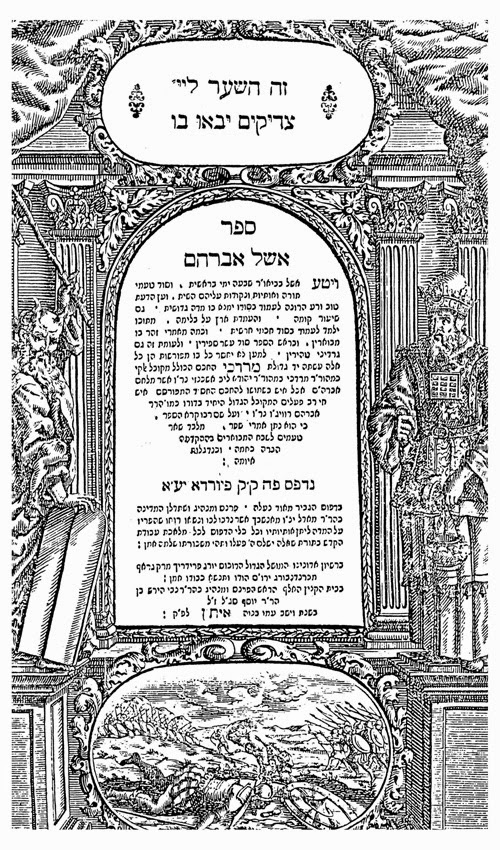
2.  The Identity of the Plagiarized Book.
No book entitled התחלת חכמה has ever appeared in print. It therefore could not have been plagiarized by anyone. Moreover, R. Joseph Samuel did not reveal the name of the plagiarist and the title of the book in its plagiarized form. This literary riddle was first raised in print early in 1976 by the noted bibliophile, Abraham Schischa of London.7 The solution was not long in coming. That same year, R. Shmuel Ashkenazi, also a noted bibliophile, solved the riddle.8 He correctly identified התחלת חכמה as the title of a kabbalistic book in manuscript form, still available in a variety of contemporary libraries.9 In book form, it was entitled מעין החכמה and it first appeared in print in Amsterdam in 1652.10 The plagiarist who published מעין החכמה under his own name was R. Abraham Kalmankes of Lublin. Ashkenazi provided other useful information as well, but all that is important for our purposes is that he clearly identified R. Abraham Kalmankes as a plagiarist. As such, he agreed fully with R. Joseph Samuel’s characterization (in his letter of approbation) of the novice upstart student. The  late Professor Gershom Scholem also identified R. Abraham Kalmankes as a plagiarist. He would write:11
והוא [ר’ אברהם קלמנקס] הדפיס ס’ התחלת חכמה הגניבה [כך כתוב] על שמו,
וכבר יש רמז לדבר בהסכמת הרב מפרנקפורט לס’ אשל אברהם.

“He [R. Abraham Kalmankes] published the pirated book entitled Hathalat Hokhmah under his own name. The matter is alluded to in the letter of approbation by the rabbi of Frankfurt to the book entitled  Eshel Avraham.”

It is our contention that R. Abraham Kalmankes has received less than a fair hearing in the court of modern scholarship. If we reopen the investigation, it is because much of the evidence has either been misconstrued or overlooked. The reader will have to decide for himself whether or not Kalmankes was, in fact, a  plagiarist, and whether or not he should be better remembered for his seminal contribution to Jewish teaching and literature.
3. מעין החכמה.
            a) Claims of the Author/Editor
מעין החכמה, the first book to appear under R. Abraham Kalmankes’ name, is a short introduction to Lurianic Kabbalah. Indeed, it was among the earliest such works to appear in print. The title page of the quarto sized volume is followed by a one-and-a-half page introduction (pages 2-3). The introduction is followed by the text (pp. 4-22), which consists of 78 tightly-knit chapters (פרקים), perhaps more properly labeled today as paragraphs. Thus, several of the “chapters” consist of no more than15 lines of print (and, sometimes, even less). Scattered throughout the book are occasional comments in parentheses. These may reflect an educational tool used by the original author to clarify a difficult term by means of a gloss, creating — in effect — what we would call today a footnote. Or, as appears likely, these may reflect a second hand, i.e., material added to the base text by someone other than the author, e.g., a later editor of the original manuscript. Our immediate concern, however, will not be with the book’s content or structure, but rather with its authorship. What are the claims of the title page and the introduction? What do they tell us about the authorship of
מעין החכמה?
The title page basically announces the content of the book.12 It is a kabbalistic manual, we are informed, the likes of which has yet to appear in print. It provides the kabbalistic underpinning upon which all of R. Isaac Luria’s teachings rest. The title page then indicates that the book’s secret teachings are being  brought to press [ Hebrew:תעלומים  הוציא לאור] by “the exceedingly wise and young divine kabbalist, R. Abraham, son of the Gaon, Chief Rabbi and Head of the Yeshiva, R. Aryeh Leib, scion of the Kalmankes family of Lublin.” Note that the phrase “being brought to press by” is ambiguous. It is unclear from the title page whether R. Abraham Kalmankes is being presented as the author, editor, or publisher of מעין החכמה.
We perforce turn to the introduction, which – if read carefully – resolves much of the ambiguity of the title page.13The introduction, written and signed by R. Abraham Kalmankes, begins with a justification for the book’s publication. Briefly, Kalmankes, himself a victim and survivor of the Chmielnitzki massacres, informs the reader that he was puzzled by the seemingly endless exile of the Jews, with redemption nowhere in sight. After much reflection – and deeply influenced by kabbalistic teaching – Kalmankes concluded that it was faulty prayer that was prolonging the exile of the Jewish people. Jewish prayer was not piercing the heavens and reaching God on high. He compared the state of the Jewish people to a ship adrift at sea, with no one on board who knows how to steer the ship to safety. Nothing will change, argued Kalmankes, until kabbalistic teaching spreads throughout the Jewish communities. The seeds of redemption were planted by R. Isaac Luria, the master of proper kabbalistic prayer. Alas, he died before redemption set in, but he left a successor, R. Hayyim Vital, who in turn left “a basket full of manuscripts,” i.e. he reduced to writing the kabbalistic teachings of R. Isaac Luria, especially those relating to prayer. Once these teachings were mastered by Jews the world over, redemption would be at hand.
Unfortunately, “the basket full of manuscripts” was not being made available to the Jewish community at large. Kalmankes explains that those who horde the manuscripts refuse to publish them. This, for two reasons. First, for reasons of vanity. By retaining the manuscripts for themselves, they became the masters of esoteric teaching and the power brokers to whom all had to turn for guidance. Second, for reasons of profit. The owners of the manuscripts charged a hefty price for those who wished to view and copy them. Kalmankes decided to put an end to this scandalous state of affairs by acquiring and publishing one of the manuscripts that preserved some of the key esoteric teachings of R. Isaac Luria. Moreover, he “added a few comments of his own, in order to benefit the many readers,” almost certainly a reference to the comments in parentheses mention above. He gave the manuscript a new title, מעין החכמה [Wellspring  of Knowledge], for “just as a wellspring begins with a narrow opening that ultimately widens as it fills with water, so too this book begins with nuggets of wisdom that broaden and deepen as one grows in wisdom.” Kalmankes concludes the introduction with the following signature: “These are the words of the youngest
member of the group, Abraham, son of my father and teacher Rabbi Aryeh, son of the Gaon, our teacher and rabbi, the honorable R. Joseph Kalmankes Yaffe of Lublin.”
            b) Editions
Some of the confusion surrounding מעין החכמה relates to the multiplicity of published kabbalistic works with the title מעין החכמה, some of which have been mistakenly ascribed to Kalmankes in library catalogues throughout the world.
Confusion surrounding Kalmankes’ alleged plagiarism is also due, in part, to variant readings that appear in the later printed editions of מעין החכמה, for which Kalmankes can hardly be held responsible. After brief mention of some unrelated kabbalistic works with the title מעין החכמה, we will list and describe each of the printed editions of Kalmankes’ מעין החכמה.
An anonymous kabbalistic treatise entitledמעין חכמה  (ascribed in part to Moses) is included in the collection entitled ארזי לבנון (Venice, 1601).14 It is unrelated to Kalmankes’ מעין החכמה. The Ashkenazic printing house of the partners Judah Leib b. Mordecai Gimpel and Samuel b. Moses Ha-Levi published yet another anonymous kabbalistic treatise entitled מעין החכמה (Amsterdam, 1651).15 Frequently reprinted, it too is unrelated to Kalmankes’ מעין החכמה.
Four different editions of Kalmankes’ מעין החכמה have appeared in print. They are:
1. מעין החכמה, Amsterdam, 1652. Printed by the Immanuel Beneviste publishing house during the lifetime of its author/editor Abraham Kalmankes, it is the only reliable edition of Kalmankes’ מעין החכמה. As such, we will claim that Kalmankes can be judged only on the basis of this, and no other, edition of מעין החכמה. For a detailed description of the book, its title page, and introduction, see above.16
2. מעין חכמה, Koretz, 1784. This edition was printed by the Johann Anton Krieger publishing house which, in Koretz, was devoted to the publishing of kabbalistic and hasidic works.17 Although Kalmankes’ title of the book is retained, the title page ascribes the book to R. Isaac Luria and makes no mention of Abraham Kalmankes. More importantly, this edition omits Kalmankes’ introduction to the book. The text is a slightly revised and updated version of the Kalmankes edition. It incorporates most of Kalmankes’ parenthetical notes, with slight revision.18 The text was edited in its present form sometime between 1698 and 1784, i.e. well after Kalmankes’ death.19
3. מעיין חכמה, Polonnoye, 1791. Printed by the Samuel b. Yissokhor Baer Segal publishing house, this edition of מעין החכמה  appears at the end of a collection of kabbalistic works whose title page reads: ספר הר אדני.  מעיין חכמה is accorded no title page of its own. It begins with a skewed version of Kalmankes’ introduction, entitled: הקדמת המחבר ספר מעיין חכמה. No such title is applied to Kalmankes’ introduction in the first edition. We have already indicated (see above) that the introduction is omitted entirely from the second edition, so no such title appears there. The introduction to this, the third edition, closes with the name of the author:  אברהם בן מהו’ ארי’ בן הגאון מה’ משה יוסף קלמן מלובלין. In the first edition, however, Kalmankes’ grandfather’s name is given as: הגאון מורנו ורבנא כמוהר”ר יוסף קלמנקס ייפה מלובלין, with no mention of either משה or קלמן. The text that follows is entitled: התחלת החכמה האלהות כפי דרך האר”י אשכנזי ז”ל הנקרא ספר מעיין החכמה. It differs considerably from the text published in the first two editions. It  mostly lacks Kalmankes’ parenthetical comments strewn throughout the first two editions. It regularly omits readings that appear in the first two editions, and often adds material that is lacking in the first two editions. Indeed, it is a different manuscript version of the Lurianic digest that was first published by Kalmankes in 1652.20
4. מעין החכמה, Lvov, 1875. No publisher’s name is given. This is a hybrid version drawn from two earlier printed editions. Kalmankes’ introduction is drawn from the skewed version that accompanies the Polonnoye, 1791 edition. The text is drawn from the Koretz, 1784 edition.21 As such, this edition has no independent value and requires no further discussion.
            c) Relationship of the Published Editions to the Extant Manuscripts
No one has written more intelligently about the history of Lurianic kabbalistic manuscripts than Yosef Avivi.22 What follows is essentially a brief account of the relationship between the published editions of Kalmankes’מעין החכמה and the extant manuscripts, based largely (but not entirely) upon the results of Avivi’s investigations.
Numerous manuscripts copies of the kabbalistic treatise entitled התחלת החכמה, most of them dating to the 17th and 18th centuries, are extant in libraries throughout Europe, Israel, and the U.S. While they vary slightly from each other, they clearly reflect a single recension of an early 17th century kabbalistic treatise. The anonymous treatise, whose original title is unknown, was written by a disciple of Luria in Damsascus and then sent to Italy. There, the manuscript was copied and circulated under a variety of names such as קונטרס ההיכלות, כללי חכמת שיעור קומה, התחלת החכמה, and התחלת חכמה. It was precisely because a manuscript copy of התחלת חכמה came into the possession of R. Joseph Samuel b. R. Zvi of Cracow sometime prior to 1652, that he was so startled when he saw Kalmankes’ printed edition of מעין החכמה. Even after the printed edition made its debut in 1652, new manuscript copies of the kabbalistic treatise were written and circulated under a variety of titles, now including the title מעין החכמה.
Avivi has shown that the  התחלת החכמה manuscripts formed the first part of a larger Lurianic treatise that originally included a second part as well. Whereas the first part focused entirely on עולם האצילות, the second part focused  on עולם הבריאה — and is extant in manuscript form only. The two parts were separated from each other, and largely due to Kalmankes’ publication, the first part became an independent work entitled מעין החכמה. In sum, Kalmankes’ מעין החכמה is an accurate copy (with the addition of occasional glosses by Kalmankes) of an anonymous early 17th century Lurianic treatise that circulated widely under a variety of titles, including the title התחלת החכמה.
4. R. Abraham Kalmankes.
            a) Family History
The accusation of plagiarism leveled against R. Abraham Kalmankes by R. Joseph Samuel b. R. Zvi, and seconded by both R. Shmuel Ashkenazi and  Gershom Scholem, was not accompanied by any discussion of R. Abraham Kalmankes himself. When and where did he live? How did he make a living? What other books did he author? Was he an inveterate plagiarizer?23 Had such an investigation been conducted, we suspect that the accusation of plagiarism would not have been leveled at all.
In a brief biographical account of Kalmankes published in 1992, the author of the account bemoans the fact that so little is known about Kalmankes’ life history.24 Nonetheless, much more is known about him – and his family — than the meager snippets of information recorded in the 1992 biographical account or in the standard discussions of מעין החכמה. We will take as our point of departure the clear reference in Kalmankes’ introduction to מעין החכמה to his distinguished grandfather, “the Gaon, our Teacher and our Rabbi, R. Joseph Kalmankes Yaffe of Lublin.” For our purposes, what is most important about the grandfather is that after an illustrious rabbinic career in Lublin, he spent his last years in Prague, where he died, and remains buried to this day.25 The elaborate epitaph on his tombstone informs us that he died at the age of 56 on Sunday,13 Tishre, in the year 5397 (= October 12, 1636).26 The significance of this information will become apparent shortly, but first we need to turn elsewhere.
In 1678, at the family owned printing press in Lublin, R. Abraham Kalmankes published the only other work he would publish in his lifetime. Entitled ספר האשל, it is a masterful (and typical seventeenth century) rabbinic commentary on the book of Genesis.27It was the first installment of a planned commentary on the entire Torah, but apparently the rest of the commentary either never materialized or was never published.  The commentary is essentially a midrashic-halakhic work, replete with citations from the Midrash, Talmud, Codes (especially R. Joseph Karo’s שלחן ערוך), and kabbalistic literature. The volume itself is accompanied by a series of letters of recommendations by rabbis from Kremenitz, Lublin, Brisk, Pinsk, Grodno, Vilna,28 and more, all attesting to Kalmankes’ rabbinic scholarship. Once again, Kalmankes prefaced his work with an informative introduction. Kalmankes alludes to the many trials and tribulations that accompanied him through life, including hazardous trips to Egypt and the land of Israel. He was near death on several occasions during his travels, but managed to make his way back safely to Lublin.29 Upon his return, he undertook to publish two works in his lifetime. This, in order to fulfill the talmudic dictum: “Happy is he who arrives here [i.e., on High] with his talmudic teaching in hand.”30 Since according to biblical teaching, a matter is established by “two witnesses,” Kalmankes was determined to author two books and publish them, so that he would have them “in hand” when necessary. The first book, ספר האשל, intended for a more or less popular audience, took the form of a commentary on the book of Genesis. The second book, entitled ברכת אברהם, was intended for talmudic scholars only. Kalmankes informs us that the manuscript copy of ברכת אברהם was completed and that he looked forward to its publication. Sadly, it was never published. What  needs to be noted immediately is that Kalmankes never imagined that his earlier publication of מעין החכמה could count as one of his “two witnesses”! (And this was in 1687, long before R. Joseph Samuel b. R. Zvi leveled his accusation of plagiarism in 1701.) Indeed, מעין החכמה is not mentioned at all in Kalmankes’ introduction to ספר האשל. Clearly, he did not consider it a book that he had authored.
Elsewhere in the introduction, Kalmankes notes that he will make a special effort to cite דברי תורה from his grandfather, R. Joseph Kalmankes, who he describes as: “א”א זקני מ”ו הגאון מוהר”ר יוסף קלמנקס, זצ”ל, אשר מנוחתו כבוד בק”ק פראג.”  Kalmankes adds that upon his grandfather’s death in Prague, all of his writings were lost, and that he – Kalmankes – will therefore record his grandfather’s teachings as he heard them from his disciples. “For,” explains Kalmankes, “I merited to sit at his feet only until the age of ten. Thus, I was a child, and have no real knowledge of his novellae.” We, of course, cannot be certain whether Kalmankes sat at his grandfather’s feet in Lublin or Prague (or both). If only in Prague, and if Kalmankes was ten years old when his grandfather died, we have the latest possible date of birth for Kalmankes, namely 1626, for we have already established that Kalmankes’ grandfather died in 1636. Kalmankes, of course, could have been born earlier than 1626, and we have reason to believe that this was the case.
At the other end of the spectrum, it seems likely that R. Abraham Kalmankes died somewhere between 1678 and 1701. That he was still alive in 1678 is attested by the publication of ספר האשל in that year, and by several of the letters of recommendation dated 1678, all of which describe Kalmankes as alive and well. Since Kalmankes never responded to the devastating accusation of plagiarism made against him in 1701 by a leading rabbinic contemporary, it is probably safe to assume that he died before the accusation appeared in print. Though we cannot pinpoint the year of his death with precision, the most likely candidates are either 1692 or 1693. Kalmankes died in Lvov, where he served on its rabbinic court as דיין.31 The text of the epitaph on his tombstone was copied and published in 1863 and reads:32
שנת תתן אמת ליעקב
                          ביום טוב נהפך כי טוב פעמים ואבל ומספד ונהי בכפלים
ט”ו בחודש ניסן נגנז צנצנת המן המאיר באספקלריא המאירה
כבוד מורינו ורבנו ומאורנו נתבקש בישיבה של מעלה
הגאון האלוף עין הגולה מו”ה אשר יעקב אברהם בן הרב מוהר”ר אריה קלמנקש
צלל במים אדירים של תורה וחיבר ס’ אשל אברהם על שמו נקרא
ובשביל שזיכה את הרבים יבוא שלום וינוח על משכבו בשלום
תנצב”ה
Thus, Kalmankes died on 15 Nisan on a Tuesday.33 But in which year? The text states unequivocally that it was in the year whose numerical value was embedded in the biblical phrase תתן אמת ליעקב.34 But the copyist (in 1863) informed his readers that, due to an erasure, he could no longer determine which letters from the phrase were enlarged or highlighted on the original tombstone. This makes it difficult, but not impossible – as we shall see – to calculate Kalmankes’ approximate year of death. Since Kalmankes died on the first day of Passover which fell on a Tuesday, seven candidates (between the years 1678 and 1701) present themselves: 1679, 1686, 1689, 1692, 1693, 1696, and 1699. The Hebrew equivalents for these years are: [5]439, [5]446, [5]449, [5]452, [5]453, [5]456, and [5]459. Now the numerical value of a combination of letters from the phrase תתן אמת ליעקב must add up exactly to one or more of the above Hebrew dates. Only two solutions are possible: [5]45235 and [5]453.36 These are 1692 and 1693, respectively.37 In sum, if we had to give mostly approximate dates for the three generations of the Kalmankes family mentioned by R. Abraham Kalmankes in both of his publications, they would be:
R. Joseph Kalmankes:    1580-1636
R. Aryeh Kalmankes:      1600-167038
R. Abraham Kalmankes: 1620-169339
b) Citation from מעין החכמה in ספר האשל
Critical for our discussion is the fact that R. Abraham Kalmankes cites מעין החכמה in his ספר האשל!40 It is the only reference to מעין החכמה in ספר האשל.The passage reads:41
       או יאמר מאמר הר”י ז”ל באשר נקדים מאמר מהאר”י לור”י[א] הנזכר בספר מעיין החכמה
אשר הביאותיו לבית הדפוס בפ’ י”ד שבשעת הבריאה…
Or we can explain this by citing a passage from R. Isaac of blessed  memory, i.e., by first introducing a passage by R. Isaac Luria Ashkenazi — which is mentioned in chapter 14 of the book מעיין החכמה, which I brought to press [literally: to the publishing house] — which states that during the period of creation…
If one examines chapter 14 of מעין החכמה, the passage cited by Kalmankes in ספר האשל appears exactly as referenced, but Luria’s name appears nowhere in the text of chapter 14! This is precisely because מעין החכמה was a repository of Lurianic teaching which he – Kalmankes – brought to press. Kalmankes never claimed authorship of the book, and he tells us so in his own words in 1678, long before any accusation was leveled against him.
5. Conclusions.
Ultimately, whether or not Kalmankes is viewed as a plagiarist will depend largely on one’s definition of plagiarism.42 In terms of literary (as distinct from oral) plagiarism, a reasonable definition would seem to be:
Plagiarism is the act of appropriating in print another person’s ideas,          writings, or words, and passing them off as one’s own by not providing proper attribution to their original source.
Even aside from the definition itself, the moral opprobrium attached to any specific act of plagiarism will depend on a variety of factors. Thus, it seems to me, that the more literal and lengthy the borrowing, the more heinous the offense. Motive too will surely play a role in determining the severity of the offense. We turn to the specifics of the Kalmankes case.One can certainly sympathize with R. Joesph Samuel’s outrage when, in the 1650’s, he chanced upon a copy of the recently published מעין החכמה. He leafed through its pages and realized instantaneously that it was virtually word for word a printed copy of a manuscript he owned under the title התחלת חכמה. Worse yet, prominently displayed on the title page of the pirated book was the name of the “divine kabbalist,” R. Abraham Kalmankes, a name otherwise unknown to R.Joseph Samuel. He could only conclude that this was a blatant case of plagiarism that called for condemnation. Indeed, he was still upset about the matter some fifty years later!
But, as we have seen, the title page of מעין החכמה is somewhat ambiguous about Kalmankes’ role in its authorship and publication. It simply states that Kalmankes הוציא לאור the תעלומים, i.e., he published the secret or hidden digest of Lurianic teaching. One suspects that R. Joseph Samuel never examined Kalmankes’ introduction to מעין החכמה. Had he done so, he surely would have noticed that Kalmankes admits openly that he is publishing a manuscript that contains a digest of Lurianic teaching, authored by a disciple of Luria – and not by him. Kalmankes’ states unequivocally that his contribution to the volume is limited to the few comments he added (almost always in parentheses) and to the new title, מעין החכמה, he provided for it. It is only in the third edition of מעין החכמה, published in Polonnoye, 1791 – long after Kalmankes’ death – that a skewed version of Kalmankes’ introduction is labeled: הקדמת המחבר ספר מעיין חכמה, in effect suggesting that Kalmankes was the author of מעין החכמה. Anyone who reads this skewed version of Kalmankes’ introduction, and compares it to the original, will realize at once that it is was created in 1791 in order to harmonize its content with that of a different manuscript version of the Lurianic digest (one that lacked Kalmankes’ comments) that was being attached to it.43
 We have also the clear evidence from Kalmankes’ introduction to ספר האשל, published by him in 1678, that he sought to author and publish two books in his lifetime, so as not to be embarrassed when he was called “on High.” He provides the titles of both books, yet makes no mention of the fact that he had authored and published a book called מעין החכמה. He knew full well that this was a book written by others, which he had brought to press. Indeed, as we have seen, he cited מעין החכמה in his ספר האשל. When doing so, he stated openly that it was a Lurianic work that he had brought to press.
            There doesn’t seem to be much evidence here for plagiarism, as defined above. Kalmankes’ מעין החכמה was based upon a Lurianic manuscript that was anonymous and was circulating under a variety of titles. Kalmankes never claimed authorship of the manuscript, and indicated clearly that all he did was to provide the manuscript with a new title and some brief annotation. This he did for the best of motives, namely to bring about the ultimate redemption of the Jewish people. He did not pass off the work as his own (other than the title and the annotations, which were legitimately his own creation); he withheld no proper attribution.
On the other hand, three distinguished scholars, R. Joseph Samuel of the seventeenth century, and R. Shmuel Ashkenazi and the late Professor Gershom Scholem of the twentieth century, were persuaded that Kalmankes was a plagiarist. Perhaps they felt that the appearance of Kalmankes‘ name on the title page of מעין החכמה,  preceded by the words “אב בחכמה ורך בשנים המקובל האלוהי כמוהר”ר,” with no mention of any manuscript or attribution to others, was sufficiently misleading – and, perhaps, even deliberately intended – to create the impression that Kalmankes was the author of the book. If so, they would argue, he deserves to be listed among the plagiarizers. I am not persuaded that this is the case, but in deference to the three distinguished scholars mentioned above, I have allowed the title of this essay to read as it does. At best (or: worst), it is a mild case of plagiarism, if even that.44
NOTES
1 For biographical studies of R. Joseph Samuel b. R. Zvi, see H.N. Dembitzer,
כלילת יופי (Cracow, 1893), vol. 2, pp. 144b-152b; M. Horovitz, Frankfurter Rabbinen (Jerusalem, 1969), ed. J. Unna, pp. 94-97 and 296-297; and idem,
רבני פרנקפורט (Jerusalem, 1972), ed. J. Unna, pp. 67-69 and 212. For the epitaph on his tombstone, see idem, אבני זכרון (Frankfurt, 1901), p. 151. For legendary accounts of R. Joseph Samuel, see E. Sternhell, “,תולדות יצחק” p. 2b, in Y.I. Billitzer, באר יצחק (Paks, 1898); and Y.L. Maimon, שרי המאה (Jerusalem, 1955), vol. 1, pp. 231-233.
2 For an assessment of R. Joseph Samuel’s contribution to the printed text of the Talmud, see Y. S. Spiegel, עמודים בתולדות הספר העברי: הגהות ומגיהים (Ramat-Gan, 2005), second edition, pp. 404-407.
3 See L. Loewenstein, מפתח ההסכמות (Lakewood, 2008), ed. S. Eidelberg, pp. 99-100.
H.N. Dembitzer, op. cit., vol. 2, p. 150a.
See G. Scholem, חלומותיו של השבתאי ר’ מרדכי אשכנזי (Jerusalem, 1938); and Y. Tishby, נתיבי אמונה ומינות (Jerusalem, 1964), pp. 81-107. Cf. the historical vignette in Rabbi P. Katzenellinbogen, יש מנחילין (Jerusalem, 1986), ed. Y.D. Feld, pp. 74-75.
The original reads:
ושתים רעות עושים כי לא ידעו ולא יבינו אל פעולות השם,  גם גורמים להשניא  בעיני המון את חכמי תורה שבנגלה, כסבורים העם דמאן דלא ידע האי לאו גברא רבה הוא, ומשליכים אחרי גיום חכמים חרשים ושומעים לקול מלחשים, אשר בטליתות שאינן שלהם מלבשים, כאשר בקושטא קא אמינא בדידי הוה עובדא, נהירנא זה חמישים שנה שבידי ספר נחמד כתוב על חכמת הקבלה נקרא תחלת חכמה, והנה קם מאן דהו תלמיד חדש שישן אין בו והדפיסו על שמו, והנה גנוב הוא אתו.
A. Schischa, “שלושה ספרים נעלמים,” עלי ספר 2(1976), pp. 237-240.
S. Ashkenazi, “שתי הערות,” עלי ספר 3(1976), pp. 171-173. For an expanded version of Ashkenazi’s comments in עלי ספר, see his אסופה: ארבעה מאמרים מאוצרות הר”ש אשכנזי שליט”א (Jerusalem, 2014), pp. 49-53. Cf. S.Z. Havlin, “הערת העורך,” עלי ספר 11(1984), p. 134.
These include the National Library in Jerusalem, the Bodleian Library at Oxford, and a host of other libraries in Europe and the United States. For an early description of two such manuscripts in the National Library in Jerusalem, see G. Scholem, כתבי יד בקבלה (Jerusalem, 1930), p. 63, manuscript 2512, and p, 117, manuscript 47. The Bodleian Library lists some 10 manuscript copies of התחלת חכמה in its collection. See A. Neubauer, Catalogue of the Hebrew Manuscripts in the Bodleian Library and in the College Libraries of Oxford (Oxford, 1886), column 1001. Cf. the corrections to these listings in M. Beit-Arie and R.A. May, eds., Catalogue of the Hebrew Manuscript in the Bodleian Library: Supplement of Addenda and Corrigenda (Oxford, 1994), passim. A manuscript copy of התחלת חכמה was in the private library of R. Joseph Solomon Delmedigo in 1631. See his נובלות חכמה (Basel, 1631), p. 195a. The precise title of the book varies in the manuscripts, with the most common titles being התחלת חכמה  and
התחלת החכמה.
10 See L. Fuks and R.G. Fuks-Mansfeld, Hebrew Typography in the Northern Netherlands 1585-1815 (Leiden, 1984), vol. 1, pp. 176-177, entry 233.
11 See the undated loose page, in Scholem’s hand, appended to Scholem’s copy of מעין חכמה at the National Library in Jerusalem. Cf. ספריית גרשם שלום בתורת הסוד היהודית: קטלוג (Jerusalem, 1999), vol. 1, p. 312, entry 4188.

12 See the scan of the title page.
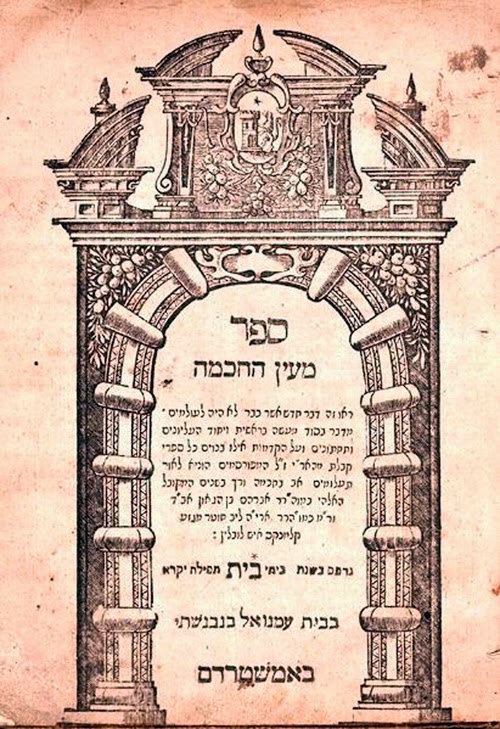
 

13 See the scan of the introduction.
14 The title is so listed on the pages of the treatise itself in ארזי הלבנון, pp. 46b-47a. On the title page of ארזי הלבנון, it is listed as מעיין החכמה. The frequent and easy interchange between the spellings מעין and מעיין and the spellings חכמה and החכמה characterizes virtually all the printed editions of the various books bearing these titles.
15 L. Fuks and R.G. Fuks-Mansfeld, op. cit., vol. 1, p. 195, entry 270,
16 Only a handful of copies are extant world wide. To the best of my knowledge, the first edition of Kalmankes’ מעין החכמה has not been photo-mechanically reproduced, and it is not available online (as of the date this note was recorded). Nor is it available on any of the standard electronic collections of rabbinic literature, such as HebrewBooks, אוצר החכמה, or אוצרות התורה. I am indebted to the National Library in Jerusalem and the Jewish Theological Seminary in New York for making their copies available to me. The scans of the title page and the introduction are reproduced here courtesy of the Bibliotheca Rosenthalia, now in the Special Collections of the University of Amsterdam (online catalogue: http://permalink.opc.uva.nl/item/001748453).
17 H. D. Friedberg, תולדות הדפוס העברי בפולניא (Antwerp, 1932), p. 61.
18 One key revision appears on p. 1, chapter 2, where ספר ויקהל משה is referenced. The book is not mentioned in the first edition of Kalmankes’ מעין החכמה, nor could it have been, since ספר ויקהל משה was not published until 1698. The reference is to R. Moshe Graf, ויקהל משה (Dessau, 1698). It does not appear likely that Kalmankes saw Graf’s work in manuscript form, since מעין החכמה was published in 1652 and Graf was born in 1650.
19 For the date of Kalmankes’ death, see below. The Koretz, 1784 edition was photo-mechanically reproduced in Jerusalem, 1970.
20 The Polonnoye, 1791 edition of מעיין חכמה was photo-mechanically reproduced in Jerusalem, n.d. (circa 1998), in a thin, dark blue, hardbound volume whose spine and outer cover read צדיק יסוד עולם, and whose title page reads הר אדני. (In other words, when seeking a copy in a bookshop of the reprint of the Polonnoye, 1791 edition of מעיין חכמה, whatever else you do, don’t ask for a copy of מעיין חכמה.)
21 As noted by S. Ashkenazi (see above, note 8), the title page of the Lvov edition indicates that its text is based upon the Koretz edition, and reproduces the very biblical phrase used by the Koretz edition for indicating its original date of publication in 1784. But by highlighting a different set of letters within the same biblical phrase, the Lvov edition announces to the reader that its date of publication is 1875.
22 Y. Avivi, קבלת האר”י (Jerusalem, 2008), 3 volumes, passim. See especially vol. 1, pp. 204-208, 443; and vol. 2, pp. 565-568, 840-841. See also, idem, “כתבי האר”י באיטליה עד שנת ש”פ”,” עלי ספר 11(1984), pp. 91-134; and “הערה,” עלי ספר 12(1986), p. 133.
23 “Plagiarism is something people may do for a variety of reasons but almost always something they do more than once.” So T. Mallon, Stolen Words: Forays into the Origins and Ravages of Plagiarism (New York, 1989), preface, p. xiii.
24 Rabbi M.Y.S. Goldenberg, “פתח דבר,” to the reissue of R. Abraham Kalmankes’ ספר האשל (Brooklyn, 1992).
25 On R. Joseph Kalmankes Yaffe of Lublin, see J. Kohen-Zedek, שבת אחים ( St. Petersburg, 1898), pp. 59-76; S. B. Nissenbaum,  לקורות היהודים בלובלין, (Lublin, 1920), second edition. pp. 36-37; S. Buber, אנשי שם (Cracow, 1895), p. 89, entry 217;  and S. Englard, “צפונות יוחסין (א), “ ישורון 3(1997), p. 680, note 6 and p. 694, note 36a.
26 See K. Lieben, גל עד (Prague, 1856), German section, p. 46; Hebrew section, pp. 34-35.
27 R. Abraham Kalmankes, ספר האשל (Lublin, 1678). Few copies have survived. For the copy at the Bodleian Library, see M. Steinschneider, Catalogus Librorum Hebraeorum in Bibliotheca Bodleiana (Berlin, 1860), vol. 1, column 752, entry 4458:1; and A.E. Cowley, A Concise Catalogue of the Hebrew Printed Books in the Bodleian Library (Oxford, 1929), p. 45. For the copy at the British Library, see J. Zedner, Catalogue of the Hebrew Books in the British Museum (London, 1867), p. 14. For the copy at Yeshiva University’s Mendel Gottesman Library, see B. Strauss, אהל ברוך (London, 1959), p. 31, entry 534. To the best of my knowledge, the first edition of Kalmankes’ ספר האשל has not been photo-mechanically reproduced, and is it not available online (as of the date this note was recorded). Nor is it available on any of the standard electronic collections of rabbinic literature, such as HebrewBooks, אוצר החכמה, or אוצרות התורה. A new edition of this exceedingly rare volume was made available by Rabbi M.Y.S. Goldenberg (Brooklyn, 1992) and we are indebted to him. Nonetheless, one needs to use this new edition with caution; the text has been “improved” for the modern reader. A comparison of the texts of the title page, as they appeared in 1678 and 1992, serves as an indicator of the occasional liberties taken with the text. A seemingly enigmatic woodcut (opposite the opening page of the commentary on Genesis) depicting a Jew (Kalmankes?) drawing water from a well (מעין החכמה?) – and framed in an elaborate frame marked by two angelic beings holding up a crown inscribed with the words כתר תורה – was not reproduced in the 1992 edition. See the attached scans:
 
28 The letter of recommendation from Vilna, dated 1673, was written by its Chief Rabbi, R. Moses b. David Kramer (d. 1687), the paternal great-great-grandfather of the Vilna Gaon.
29 These vicissitudes of life may account for the additional first names of Kalmankes, who in ספר האשל is identified as אשר יעקב אברהם קלמנקס. For the practice of changing names and/or adding additional first names when confronted by difficult circumstances, see R. Judah He-Hasid, ספר חסידים (Jerusalem, 1957), ed. R. Margulies, p. 214, paragraph 245 and notes. Cf. A. Teherani, כתר שם טוב (Jerusalem, 2000), vol. 1, pp. 293-315.
30 B. Pesahim 50a and parallels.
31 S. Buber, op. cit., p. 45, entry 101.
32 G. Suchestow, מצבת קודש (Lemberg, 1863), second edition, vol. 1, no pagination, entry 32.
33 The opening line ביום טוב נהפך כי טוב פעמים signals that Kalmankes died on a holiday that fell on the day when כי טוב was said twice. The next line identifies the holiday as 15 Nisan, i.e., the first day of Passover. The day כי טוב was said twice refers, of course, to the third day of creation, i.e. Tuesday. See Gen. 1:10 and 12.
34 Buber, loc. cit., writes with confidence that the highlighted letters are אמ”ת, which would indicate that Kalmankes died in [5]441 or 1681. But in 1681, the first day of Passover fell on a Thursday, not on a Tuesday. Suchestow was more circumspect, indicating it was no longer possible to determine which of the engraved letters were enlarged or highlighted. He left the problem unresolved. The usual practice for highlighting was the placement of a protruding dot over the engraved letters that were to be used for reckoning the year of death. The problem cannot be resolved by emending the second line to read ט”ז בחודש ניסן instead of ט”ו בחודש ניסן, since the second day of Passover can never fall on a Tuesday. See שלחן ערוך, אורח חיים, סימן תכח: א.
35 By highlighting the letters תתן אמ’ת’ לי’עקב’.
36 By highlighting the letters תתן א’מ’ת’  לי’עקב’.
37 These dates are based upon the assumption that the text of Kalmankes’ epitaph, as copied and published by Suchestow in 1863, is an accurate copy of the original. But this may not be the case. Suchestow’s מצבת קודש is marred by egregious errors. He sometimes copied and published as many as four different versions of the same epitaph! In another instance, he divided an epitaph into two parts, creating two dead persons when only one was called for. See the critiques of Suchestow in S. Buber, op. cit. (above, note 25)pp. vi-viii and in R. Margulies, “”,לתולדות אנשי שם  סיני 26(1949-50), p. 113 ( and throughout the later installments to this essay published in סיני between 1950 and 1952). Given that Kalmankes’ tombstone was close to 200 years old when it was copied in 1863, it is likely that the epitaph could be read only with great difficulty. While any attempt at emending the received text is speculative, a slight emendation of the first lines of the epitaph yields the following text:
שנת תתן אמ”ת ליעקב
ביום טוב נהפך טוב פעמים ואבל ומספד ונהי בכפלים
ט”ו בחודש ניסן נגנז צנצנת המן המאיר באספקלריא המאירה
The sense would be that Kalmankes died on 15 Nisan, on יום טוב, on a day when טוב was twice overturned. It was overturned first, because every day of the week of creation was described as  טוב(with the exception of the second and seventh days); and second, because it was יום טוב, a holiday. This would allow for 15 Nisan to fall on a Thursday, and indeed in 1681 (the numerical equivalent of אמ”ת), the first day of Passover fell on a Thursday. If so, Kalmankes may well have died in 1681.
38 These dates are an approximation. We know only that R. Aryeh Kalmankes died in 1671 or earlier, as his name appears with ברכת המתים in several letters of approbation dated 1671 and appended to ספר האשל.
39 These dates, as well, are an approximation. For possible evidence that R. Abraham Kalmankes died in 1681, see above, note 37. If Kalmankes was born in 1620, he would have been 32 years old when מעין החכמה was published in 1652. This fits well with his description on its title page as a רך בשנים. It also fits well with R. Joseph Samuel’s characterization of him (at the time) as an “upstart student.” It would also mean that he was nearing 60 years of age in 1678, when he published ספר האשל. This fits well with his bemoaning the fact – in the introduction to the volume – that the hair on his head and beard had turned gray and that old age was overtaking him.
40   It is astonishing that the author of the most comprehensive study of the Kalmankes family, J. Kohen-Zedek, שבת אחים (see above, note 25), concluded on pp. 67-68, that the authors of מעין החכמה and ספר האשל were two different people named Kalmankes (cousins, of course)! Among his proofs is the alleged fact that the author of ספר האשל was unaware of the existence of מעין החכמה. Alas, Kohen-Zedek overlooked the passage cited here. So too Gershom Scholem, who wrote: “המחבר [של ספר מעין החכמה] לא הזכיר את הספר בספריו הוא, כגון ספר האשל.” See the loose page in Scholem’s hand and the Scholem Library Catalogue, referred to above, note 11. Scholem, however, did not conclude with Kohen-Zedek that the authors of מעין החכמה and ספר האשל were two different people. Even more astonishing is the fact that the late bibliophile, R. Reuven Margulies, cited Kohen-Zedek’s conclusion approvingly. See R. Margulies, “לתולדות אנשי שם בלבוב,” סיני 26(1949-50), p. 219. It appears likely that Scholem (in part) and Margulies were misled by Kohen-Zedek.
41 ספר האשל (Lublin, 1678), p. 8b. We have printed the text as it appears
  in the first edition. In the 1992 edition, it appears on p. 29 as follows:
או יאמר באשר נקדים מאמר הר”י לוריא הנזכר בספר מעיין החכמה אשר הביאותיו לבית הדפוס בפ’ י”ד, שבשעת הבריאה…
 42 In general, see A. Lindey, Plagiarism and Originality (New York, 1952); T. Mallon, op. cit. (above, note 23); and J. Anderson, Plagiarism, Copyright Violation and Other Thefts of Intellectual Property: An Annotated Bibliography with a Lengthy Introduction (Jefferson, North Carolina, 1998).
43 Thus, in the introduction to the first edition of מעין החכמה, Kalmankes states:
וגם מעט מזער מדעתי הוספתי אך לזכות הרבים היא כוונתי (I added but a few comments of my own; my only intention is to benefit the many). In the Polonnoye, 1791 edition this was radically changed to: וגם מעט מזער מדעתי לא הוספתי אך לזכות הרבים היא כוונתי (I added not even the fewest of comments of my own; my only intention is to benefit the many). This change was made necessary because the kabbalistic manuscript now appended to Kalmankes’ introduction, and being published together with it for the first time, did not contain Kalmankes’ additional comments.   
44 I am deeply grateful to Rabbi Menachem Silber for reading and commenting on an earlier draft of this essay. The errors that remain are entirely mine.