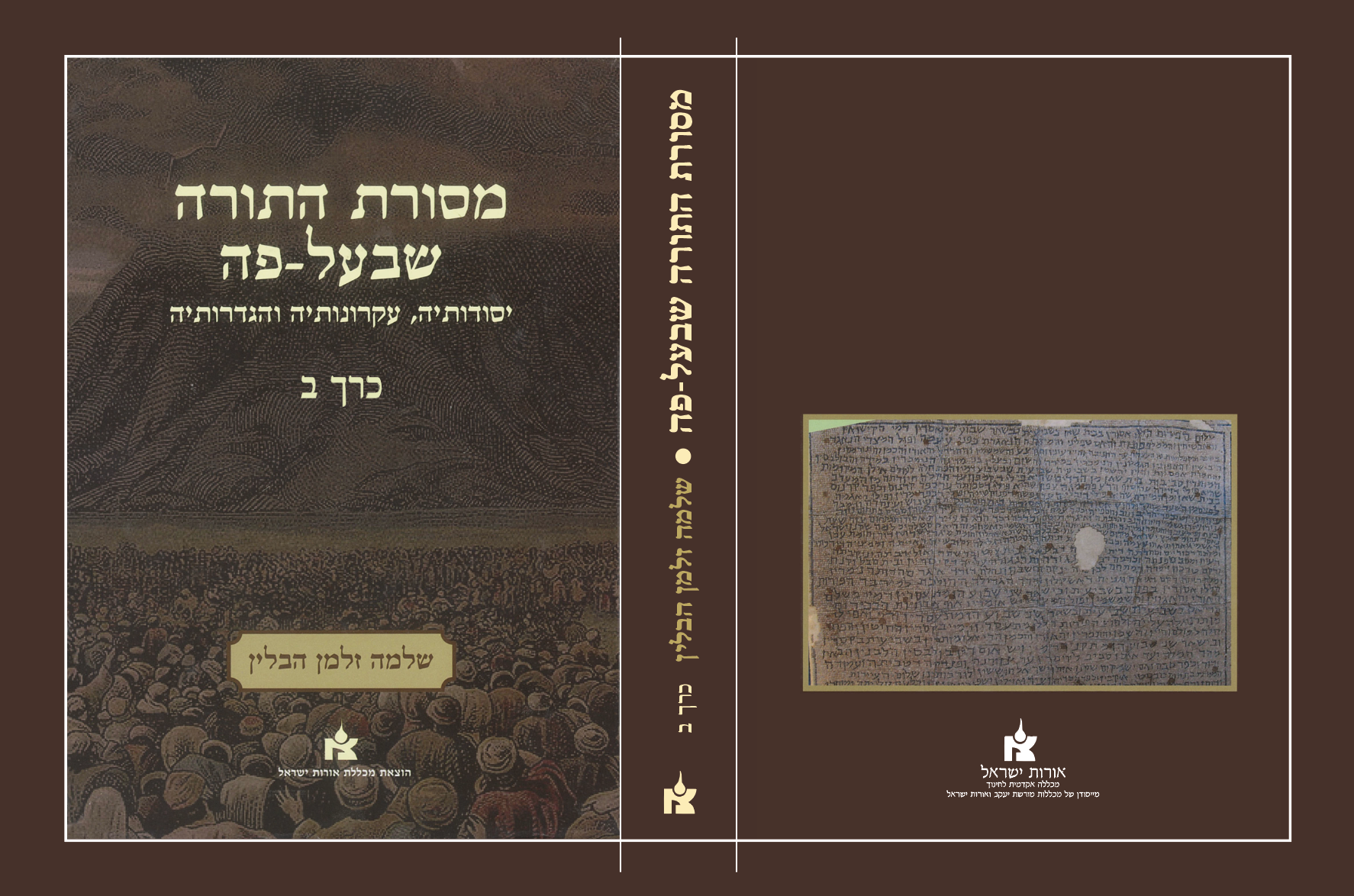
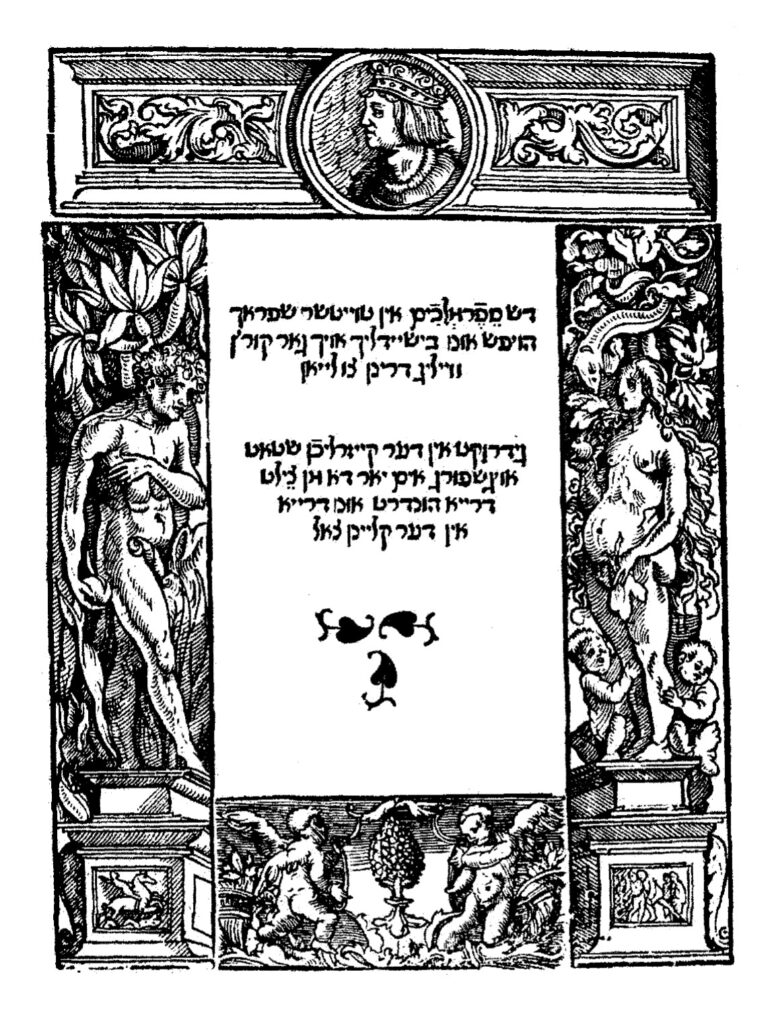
New Book Announcement: Mesoras Torah Sheba’al Peh by Harav Professor Shlomo Zalman Havlin

New Book Announcement: Mesoras Torah Sheba’al Peh by Harav Professor Shlomo Zalman Havlin

By Eliezer Brodt

רשלמה זלמן הבלין, מסורת התורה שבעל פה, יסודותיה, עקרונותיה והגדרותיה בג [בחלקים], 1048 עמודים

I am very happy to announce the recent publication of an important two-volume work, which will be of great interest to readers of the Seforim Blog. Mesoras Torah Sheba’al Peh by Harav Professor Shlomo Zalman Havlin, of Bar-Ilan University’s Talmud department.

There are various “agendas” in the following post:

The first: to further the Seforim Blog’s mission to inform its readership of new works and furnish them with a descriptive review; case in point these two incredible new volumes recently published.

Second: making some of the seforim mentioned and reviewed here available for sale; the proceeds help support the Seforim Blog.

Professor Havlin is one of the more prolific writers in the Jewish academic scene, having authored hundreds of articles and edited and published numerous seforim.

His articles cover an incredibly wide range of subjects in many areas of Jewish Studies; Geonim, Rishonim and Achronim as well as Bibliography, to name but a few. It is hard to define his area of expertise, as in every area he writes about he appears to be an expert!

He also served as chief editor of Bar Ilan University’s bibliographical journal, Alei Sefer for many years; in this capacity he also wrote numerous short but immensely insightful book reviews.

Over his career, RSZ Havlin devoted a lot of time and energy studying and analyzing various important Rishonim. Of note is the Rashba, he expended immense energy in publishing numerous manuscripts alongside his own in-depth essays regarding them. These were collected a few years back and published in two volumes by Mechon Even Yisroel.

He has edited and printed from manuscript works of Rishonim and Achronim, being firmly of the opinion, contrary to that of some other academics, that there is nothing non-academic about publishing critical editions of important manuscript texts.

His uniqueness lies not only in the topics he has taken up, but also in that his work has appeared in all types of publications running the gamut from academic journals such as Kiryat Sefer, Sidra, Alei Sefer as well as many prominent Charedi rabbinic journals such a Yeshurun, Moriah and others.

Another point unique to Havlin’s writings, besides his familiarity with all the academic sources, is that he shows prodigious familiarity with all the classic sources from Chazal, Geonim, Rishonim and Achronim, to even the most recent discussions in Charedi literature – this bekius was apparent well before the advent of search engines such as Bar-Ilan’s Responsa Project, Hebrew Books and Otzar Ha-hochmah. Alongside all this is his penetrating analysis and ability to raise interesting points.

A few years ago, my dear friend Menachem Butler made available dozens of RSZ Havlin’s publications online at his academia page available here.

About ten years ago, he published volume one of his writings, which contained fifteen chapters spanning from Chazal all the way until the Chazon Ish.

At the time, Professor Havlin mentioned to me that he hopes that he will find the strength and funding to publish the rest of his material. Over the years I reached out to him about it and he said he had no luck finding funding. To my great surprise, a few months ago he reached out to me and sent me the Table of Contents, saying the work has been finally published.

As one can see from the Table below, lots of material is devoted to the Rambam – to whom Havlin has devoted years researching all aspects of his writings from the manuscript to early printings. At one point, he published under Mechon Ofek the “Sefer Mugah (Authorized Copy) of the Rambam’s Yad and included an incredible introduction. This classic essay is included in this new collection alongside numerous essays of his on the Rambam many of which have also become classics.

These volumes have other important essays on Rishonim; included are his lengthy introductions to the Meiri’s Seder Kabbalah and his work on Avos, both of which he published critical, annotated editions through Mechon Ofek a few years back.

Some other essays in these volumes worth pointing out are his excellent introduction to the set Torasan Shel Geonim (published by Vagshal), and his essay on the authorship of the Kol Bo and Orchos Chaim.

There are also very important essays starting with the earliest Achronim to various essays on the Chazon Ish; sandwiched between are important essays on the Gra and others. One essay I enjoyed learning through a few times is his material on R’ Yechiel Ashkenazi from the time of the Rama. Another important essay of his which I enjoyed and use often is on Pilpul which was based on a talk in Harvard he gave many years ago.

There are also various book reviews of editions of seforim (some are rather sharp) all worth learning through carefully.

There is much more to say about the materials and essays in these two volumes but time is short.

Some of the essays were updated with new material or corrections from when they were published the first time.

Two minor complaints I would like to voice, one is there is no index to these works which makes it impossible to maximize all the nuggets all over in his various tangents. I imagine the reason for this is because indices costs lots of money to produce and the raising of funds for the publication was long, tedious and painful as it is so no index was included.

Another complaint which I have not come up with a good defense for is not every article has the original publication information included in the beginning of the chapter or at the end of the volumes. I imagine this too had to do with the budget.

Be that as it may, these two small complaints are negligible; these incredible volumes are worth owning and learning through carefully to gain from the research and discoveries of Havlin of over fifty years of learning.

I am the distributor of this work and I am selling copies of this work (currently it is not for sale anywhere else), so for more information about ordering\purchasing this work, contact me at Eliezerbrodt@gmail.com

Here are the Table of Contents of the book:

Vol. I:

Vol. II:


Sefer HaNer on Mesechet Bava Kamma

Sefer HaNer on Mesechet Bava Kamma: A Review
by:Rabbi Yosaif Mordechai Dubovick

Not every important work written by a Rishon is blessed with popularity.[1] While many texts were available throughout the generations and utilized to their utmost; others were relegated to obscurity, being published as recently as this century, or even this year. Nearly a month doesn’t pass without a “new” Rishon being made available to the public, and often enough in a critical edition. While each work must be evaluated on its own merit, as a whole, every commentary, every volume of Halachic rulings adds to our knowledge and Torah study.[2]          From the Geonic era through the Rishonim, North Africa was blessed with flourishing Torah centers, Kairouan in Tunisia (800-1057),[3] Fostat (Old Cairo) in Egypt, and many smaller cities as well. Perhaps the crown jewel of “pre-Rambam” Torah study was the sefer Hilchot Alfasi by R’ Yitchock Alfasi (the Rif).[4] Many Rishonim focused their novella around the study of Rif,[5] the Rambam taught Rif in lieu of Talmud,[6] and a pseudo-Rashi and Tosefot were developed to encompass the texts used and accompany its study.[7]

In Aghmat, a little known city in Morocco, circa the Rambam’s lifetime, rose up a little known Chacham whose work is invaluable in studying Rif, and by correlation, the Talmud Bavli as a whole. Yet, this Chacham was unheard of, for the most part, until the past half century. R’ Zechariya b. Yehuda of Aghmat, authored a compendium of Geonim, Rishonim, and personal exegesis on Rif. Spanning a period of 200 years of Talmud commentary of the first order, this work was also unique in its approach. Various editors have justly compared it to a work of similar nature and provenance, Shittah Mikubetzet by R. Betzalel Ashkenazi.

However, this source of Talmudic material from an almost blank period remained unknown until HaRav Prof. Simha Assaf published several leaves on Mesechet Berachot.[8] This followed by a semi-critical edition of a complete manuscript, by Meir David Ben-Shem bearing its rightful title, Sefer HaNer.[9] Later, J. Leveen published a facsimile version of a manuscript in the British Museum[10] on the three “Bavot” along with an English preface, indexes and a brief critique of Ben-Shem’s edition of Berachot. Since, many articles have been written about the work[11] and the Torah world has been blessed to see several volumes in print.

To date we are in possession of Sefer HaNer on Berachot,[12] Shabbat,[13] Eruvin, Moed Katan[14] and Mesechet Nezikin; namely the three Bavot.[15] In general, R’ Zechariah complied his work from the following sources, most of which were unknown as a work, and sometimes even the author was unknown. These Pirushim include Geonim; Rav Hai in particular, Rabbeinu Chananel,[16] R’ Yosef ibn Migash, R’ Baruch Sefardi (RB”S),[17] R’ Yitzchok Ghiyyat, Rav Natan author of Sefer ha Aruch, Rashi,[18] Rambam,[19] as well as material of unknown authorship.[20] Further, a notable portion of the material is in Judeo-Arabic of that period, including Geonic response and commentary, citations from R”Y ibn Migash, the Rambam’s commentary on Mishnah, and even short remarks within other commentaries as well. Accurately translating the material is a handicap, limiting the sefer’s use, and perhaps played a part in its falling into disuse at the decline of a Judeo-Arabic speaking Talmudist audience. [Much like the loss of many (non-translated) Judeo-Arabic Geonic works over time].          Recently, a new edition of HaNer on Mesechet Bava Kamma has been published; this article will attempt a comparison between the two printed editions, focus remaining upon the newer edition. While parts of the material of the manuscript (British Museum OR 10013) have been utilized in the past,[21] never has the manuscript been published as a whole, with critical notes. In 5761, as a part of Ohel Yeshayahu, a compilation of works on B”K, R. Hillel Mann published the relevant portion of Sefer HaNer from this manuscript. While this edition was surprisingly accurate to the mss. (the facsimile published by Leveen is available on Otzar HaChochmah), his notes are exceptionally lacking, with only the barest citation to what could be best described as “yeshivishe reid“; the common knowledge on the topic as discussed in the Yeshivot of today. Certainly not the optimal choice when editing and annotating a work based on Geonic and early Rishonic material, with many variant readings in the Talmud, as well novel commentaries hitherto unutilized.

Upon perusal of this edition, one cannot help but notice that in sharp contrast to the remaining nine chapters, the first chapter seems well edited, and the material in the footnotes is richer. The answer to this oddity is found in Mann’s preface; in 5752, an article containing a critical edition of the first perek was published by R’ Yehoshua Hutner of Machon Talmud Yisraeli[22]. This material had been meticulously edited by R’ Dov Havlin shlit”a and R’ Yosef haKohen Klien ob”m. Mann made use of the extensive notes, gleaned what he felt valuable, and ignored what he deemed he could.[23] According to Mann, R’ Tzvi Rotstein[24] copied the mss., and R’ Yosef Kafich translated the Arabic text.

Several months ago, a new edition of this work graced our tables. R’ Dov Havlin, the editor of the Talmud Yisraeli article, and his family[25] received permission to publish the work in its entirety.[26] Using the material previously assembled, and R’ Kafich’s translations, a preface was added, and the book printed. A mere glance at the first footnote to the preface shows the thoroughness and care taken when approaching a Rishon. As opposed to an “on-the-job training” attitude displayed by some authors, here the appropriate material was gathered and made use of in order to assess the task at hand.

The preface offers the uninitiated a précis of the academic papers written on R’ Zechariah, and deals with the author, his era and his works. Alongside, a chapter is devoted to R’ Baruch Sefardi, if only for the sake of providing the public exposure to Abramson’s pamphlet.[27] In one paragraph, the editor explains his decision to title the work “Shitta MiKubetzet Kadmon” although the author R’ Zechariah named it “HaNer”. I must confess I was not persuaded to concede to the change, and regret the license taken.[28]

Another liberty taken is the exclusion of the abbreviation “Pir'”, short for “Pirush”. This nomenclature has been edited out and replaced with a dash, although no mention was made of this in the preface.[29] This is not the case in the original article, and it would appear that this was done solely by the new editor(s). In addition, Arabic pieces, be they ever so brief, are replaced with the translation, and while the replacement is noted the original text is lacking. Mann’s edition reproduces the original, and relegates the translation to a footnote as the original article. By way of comparison, the original sports 261 footnotes on the first perek, the newer model, 98, and Mann’s version contains 102. Clearly, editing has been done, and while citations previously footnoted are now in the body of the text (parenthesized and font size lowered), one wonders what else has been omitted, and at what cost.[30]Diacritics found in the mss. are sorely lacking in all three editions, and HaShem’s name, typically written as three letters “yud”, is modernized to two.[31] Further, abbreviations have been expanded; Mann remained true to the text. Many of Mann’s mistaken readings are especially accurate in the new edition, yet typographical errors (as is wont) remain.As the work is based upon Rif, and collates many authorities, attempts to correlate the work to the Talmud’s present pagination is daunting. Many times R’ Zechariah will continue to copy a commentator, covering material spanning several folios, only to backtrack in order to begin a parallel commentary. Special attention need be given to this, and often Mann has rearranged material to fit within the parameters of one page; Havlin et al reproduce the original order.[32] The mss, while largely legible, has many additions, in different hands. Some addenda are written perpendicular to the text as marginal glossa, in a smaller hand. Mann has lost text in this fashion, as opposed to the Havlin edition wherein they are preserved. Publishing any edition of a manuscript reverts at some point to become eclectic. The editor is forced to decide on punctuation placement, and sentence/paragraph breaks, causing differing interpretations. While I cannot agree to the many changes made in the new edition,[33] this treasure trove of valuable material has now been made available to the public, and our thanks due. The text is highly accurate to the manuscript, the notes offer useful information, cross references and variant readings. This new addition to the Talmudic bookcase is most welcome, and while the implication given by the publisher that the next two meschtot are not on the agenda, may any continuation of so worthy a project be expediently brought to light.


[1] See Zohar, Bamidbar (3:134a) “everything is dependant upon fate, even the Sefer Torah in the Heichal”.

[2] See E. Soloveitchik, ‘Al Pirush Kadmon lMesechet Sukkah’, Tzfunot 18 (5752), pp 9-13. See also Prof. R’ S. Z. Havlin, Sefer Vaad lChachomim, Yerushalayim 5763, p 13-35/

[3] Home of the Yeshiva of R’ Chananel and R’ Nissim Gaon, among others. See M. Ben-Sasson, Tzemichat haKehillah haYihudit bArtzot haIslam, Yerushalayim 5757.

[4] See Ta-Shma, Sifrut Ha-parshanit le-Talmud vol. 1, Yerushalayim 5760, pg 156-159.

[5] See E. Chwat, Doctoral Dissertation, Bar-Ilan University, Ramat Gan 5750. See also S. Gottesman, Yeshurun 9 (5761) and Nitzutzei Aish, Memorial Volume, (Newhouse) Israel 2004.

[6] See E. Chwat, Yeshrun 20 (5768); M.A. Friedman, Tarbiz 62 (4) (5752).

[7] Chwat ibid. see also TaShma, ‘Klitatam shel Sifrei haRif, Rach, vHalachot Gedolot bTzarfat ubAshkenaz bMaot 11 v12’ (Knesset Mechkarim 1, Yerushalayim 5764, previously, Kiryat Sefer 54 (a)). See also Prof. Shamma Yehuda Freidman, ‘MiTosefot Rashbam lRif’, Kovetz al Yad 8 (5736).

[8] S. Assaf, ‘Chelek miPirush Kadmon liMesechet Brachot liEchad miBnei Zemani shel haRambam’, in ‘L’Zichron R’ Z’ P’ Chayyes, Yerushalayim 5693.

[9] Yerushalayim, 5718 [available here at hebrewbooks]

[10] A digest of commentaries on the tractates Babah kamma, Babha mesi’a and Babha bhathera of the Babylonian Talmud, compiled by Zachariah Ben Judah Aghmati; reproduced in facsimile from the unique manuscript in the British Museum OR. 10013; edited, with an introduction by Jacob Leveen, London 1961.

[11] C. Z. Hirschburg, Tarbiz 42 (5733); Ta Shma ‘Sifrut Haparshanit’ pg 156-159.

[12] Ben-Shem ibid.

[13] S. Eidison, Yerushalayim 5770.

[14] N. Sachs, Harry Fischel Institute, Yerushalayim 5726.

[15] B”M in Kovetz Sakosah lRoshi, Bnei Brak 5763. B”B (ch. 1-3), R’ Yekutiel Cohen, Yerushalayim 5748

[16] One of the more problematic references in HaNer is to “Miktzat”, see Abramson, ‘Pirush Rav Baruch b”r Shmuel haSefardi lTalmud’, who offers a possible theory that Miktzat means R’ Chananel’s pirush “brought in part”, as opposed to “some [commentators]”, at least in some instances.

[17] See S Abramson ‘Pirush Rav Baruch b”r Shmuel haSefardi lTalmud’, Bar Ilan Annual 26-27 (YD Gilat Jubilee volume) 5754.

[18] See Y. Malchi, ‘R, Zechariah Aghmati, haIsh, Yitzirato, haParshanit, vYachasah lPirushei Rashi’, Shanan 14 (5769) pg 65-73.

[19] See Abramson, Mechkarei Talmud 3.

[20] See Abramson ‘Pirush Rav Baruch b”r Shmuel haSefardi lTalmud’.

[21] R. M.Y. Blau, Shittas HaKadmonim B”M, B”B (2 volumes) and Three Bavot. See also TaShma, Kovetz al Yad, 10.

[22] Sefer Zikaron le R’ Yitzchok Yedidyah Frankel, Tel Aviv 5752.

[23] This explains the unintelligible note no. 81, citing Rav Nissim Gaon on B”K. After searching through Prof. Abramson’s work on RN”G, the passage (then) existed only in a re-creation of RN”G based upon Prof. Abramson’s hypothesis. Comparison to the article in the Frankel volume revels not only the true source material (Abramson), but also an additional citation to Abramson’s work Inyanut (Yerushalayim 5734, p 300), wherein a fragment of RN”G is published, verifying Abramson’s earlier thesis. All this is lacking in Mann’s note, leaving the reader at a loss.

[24] Of Rif reknown. It was Rotstein who brought the fragment mentioned in the above note to Abramson, under the impression the material was Rif. Additionally, R’ Rotstein is listed translator of the Arabic material in HaNer Bava Metziea (Sakosa lRoshi). R’ Eliezer Brodt once mentioned to me in the name of R’ Shmuel Ashkenazi that R’ Rotstein was not fluent in the language and had others translate the Rif material for him. Assumedly, one can rely on the accuracy.

[25] I am not clear as to the involvement and responsibility of each party. The preface is unsigned, R’ Havlin’s daughters are credited with copying the mss. and notes, and at the close of the preface, one R’ Bunim Shwartz’s passing is lamented, being cited as with the acronymic usage of “father”. One tends to understand that R’ Havlin’s son in law was instrumental in the ultimate publishing. This is corroborated by the disclaimer on the inside of the title page.

[26] The publication was done privately, and mention of the Machon is due to having used material penned under their auspices and ownership. However, the volume does not bear the logo nor name of the Machon and carries a private publisher (HaMesorah) on the title page’s reverse.

[27] While the original publication was in the Gilat volume [see above note no.[17], Abramson re-published the article (privately?) as a pamphlet, with corrections and additional material. I have only a photocopy of it, and welcome any information towards procuring an original.

[28] Similarly is “Chochmat Betzalel“, R’ Betzalel of Rensburg, Mossad HaRav Kook. The author had titled the book “Pitchay Niddah” and the manuscript owner and publisher, R’ Maimon took the liberty of changing the name.

[29] The dash has been implemented as a punctuation tool as well; I am unclear why this was done at all.

[30] From the outset, it seems notes detailing textual emendations based on the text of the Talmud have been omitted, and the reader is required to infer from the standard “[…]” that the text has been altered with some “self-evident” basis. It is noteworthy that the editors chose to revise the text of R’ Chananel in this fashion, by use of parentheses. Even in the case where the mss. (Add. 27194) used by the Vilna Shas is identical with the print, variant readings of Rach are common between mss, and may be based upon provenance. See J. Rovner ‘An Introduction to the Commentary of Rav Hananel ben Hushiel of Kairawan of Tractate Bava Metzia, Accompanied by a Reconstruction of the Lost Commentary to the Second Part of the Tractate based upon Cairo Genizah Fragments and Citations in the Rishonim’ (1993) Ph.D.

[31] See Y. S. Spiegel, Amudim bToldot Hasefer HaIvri, vol. 2 pg 565-632.

[32] C.f. 42b. However, on 94b, Havlin transfers text as well.

[33] It escapes me the need for semi-colon usage in Talmudic text, especially enmass.


A Review of Beis Havaad by Eliezer Brodt

Beis Havaad, Le’arechat Kitvei Rabboseinu, ed. Yoel Hakoton and Eliyahu Soloveitchik, (Jerusalem, 2003); 272 pp. Beis Havaad is a collection of articles based on a series of lectures that were delivered in Yerushalayim dealing with many aspects of the proper way seforim should be published. Beis Havaad was originally intended to be a journal but, to date, no other issue has appeared. With its focus on books, it is only proper that a review of this book should appear at the Seforim blog — albeit somewhat belatedly — and discuss some of the many important points raised in this book. This book is a collection of articles from many of the top names in the field of printing and editing of seforim and includes articles by both rabbanim and professors. This sefer is basically a must have for anyone who wants to understand how seforim are printed, how to write them, how to find information and the importance of printing proper texts. Although I believe it is currently out of print, The sefer is available at Beigeleisen and many of the articles can be accessed online here. I will list some of the many points of interest raised in the various articles in the book. The book begins with an excellent article by Professor S.Z. Havlin regarding the importance of establishing the correct text of the seforim and using manuscripts. He gives some great practical samples demonstrating his points. Havlin also explains and examines the Hazon Ish’s position regarding the use of manuscripts and the need (or lack thereof) to establish a correct text. At the end of the article, Havlin highlights a source not typically used in the discussion about manuscripts etc. Havlin notes that the topic was touched upon in Chaim Potok’s novel The Promise. Havlin is not the only one to deal with this topic in Beis Havaad, R. Eliyahu Soloveitchik, in his article also discusses this topic. Both of these discussions add some more points to this ongoing discussion amongst talmidei hakhamim and scholars alike regarding the use of manuscripts and correcting texts. [I shall return to this topic at greater length in a forthcoming post at the Seforim blog.] Professor Havlin also mentions a bit about the derech halimud of R. Avraham Eliyahu Kaplan. Additionally, included in this journal is a reprint of much of R. Kaplan’s work on the topic. This work of R. Kaplan is a very special blueprint of how to print an extensive commentary on shas. [This great goan and his works will be the subject of a forthcoming post at the Seforim blog.] With permission of the family, they printed parts of this fascinating project which unfortunately never came to full fruition. Another important article in this journal is from R. Hillel Parush of Machon Harav Herzog and deals with other aspects of the nusach of the Talmud. Amongst the topics that he discusses is the the Hagahos of the Maharshal on the gemara, if they were from based on logical deduction or manuscripts. [For more on this topic, see Yaakov Shmuel Spiegel, Amudim b’Toldot Sefer HaIvri, Haghot u’Maghim, pp. 279-85.] There are at least three articles discussing exactly how one should edit seforim. Each of these articles contribute different, yet offer very important points for discussion. The first is from R. Y. Weiss who was the editor of the excellent journal, Tzefenous. He gives many practical samples on mistakes found in various classical seforim and how he would suggest these mistakes be corrected. Following R. Weiss’s article on the topic is another article on the topic from Professor Robert Brody of the Hebrew University of Jerusalem, famous for his work on the geonim. Specifically, Brody’s article discusses how after tracking down all the manuscripts of a specific sefer, the next step is to establish which manuscript is the most accurate text to base the actual text of the sefer. He also points out how one has to be very careful to be crystal clear when printing a sefer to note one’s methods in coming to the decision of which manuscript to use. [As Prof. Brody notes, this whole topic is a very complicated one, one that takes him a few months to teach how exactly this is done. Here, however, he provides an outline of some of the more salient points.]

R. Yoel Koton, co-editor of this volume and editor of the Hamaayan, has an in-depth article with all the rules of writing an article or sefer. Amongst the topics are all rules of grammar and how to quote the sources exactly. This is an extremely important article and anyone who is printing anything for the public should look at it as he raises many important issues. Amongst the points he raises are: the need to cite exactly what source is being quoted, including the edition used as many times there can be many works with the same name or even of the same author with different printings and one trying to track it down has great difficulty doing so; and, consulting experts on particular topics. Koton gives the example of if one is working on Mesechtas Rosh Hashana and comes to the topics relating to Hilchos Kiddush Hachodesh, he should consult people who are familiar with astronomy. [One who looks at the work of R. Chaim Kanivesky on Hilchos Kiddush Hachodesh will see how he consulted an expert on these topics.] As R. Zev Lev writes, in his introduction to Marchei Lev, how he used to explain and discuss the various aspects of science with R. Shlomo Zalman Auerbach when he was working on his teshuvos about opening a refrigerator on Shabbos.

Another article of interest is from Benjamin Richler where he discusses the history of the Institute of Microfilmed Hebrew Manuscripts (IMHM), situated in the Manuscripts and Archives Wing on the ground floor of the Jewish National and University Library, of the Hebrew University of Jerusalem.[2] Richler writes that 95% of the Jewish manuscripts in the world can be found there, either through microfilm, or actual text. This was written a few years ago. More recently, Richler writes only 90% can be found here. Be that as it may, an extremely large percentage of the Jewish manuscripts in the world are found there. He writes that a very large percentage of the halachic works of the Rishonim have been printed. But on kabbalah and other topics there are still many works in manuscript. Richler encourages anyone working on a work of the Rishonim or Achronim to check if perhaps there’s another manuscript that will help them print a more accurate text of the work. See also Benjamin Richler’s posts (here and here) offering some examples on the benefits of the JNUL manuscript room. The catalog is available online, and it is very easy to navigate through. The staff of the manuscript room is very helpful.

Another article is by Ezra Schwat, also of the JNUL Manuscript Room. His article has a list of all the different helpful websites for one to find different manuscripts. These sites are very helpful for all different kinds of research related to all Jewish areas. Another article is from Professor Spiegel, one of the heads of the Bar Ilan Responsa project. He writes that it is very important for any person working on a sefer to use the Bar Ilan program and similar programs, as they are extremely helpful, especially for locating sources. This article was written before the waves of hard drives from Otzar Hachochma, Otzar Haposkim, Otzros Hatorah, and Hebrewbooks.org which are also important to use.

Another important article was written by Rabbi Mordechai Honig. This article is a continuation of an article from Professor Simcha Emanuel, available here, about the great necessity of an updated version of the sefer Sarei Haelef from Rabbi Menahem M. Kasher. The last updated print edition of the Sarei Haelef was in 1979 and much has been printed since then. Emanuel began to list in his article some of the updates and Hoenig gives another few hundred additions. The work is extremely important. Many times when one is working on a topic, one is curious to know if a work quoted by a Rishon was actually printed, or if there was any historical information about the Rishon. One can turn to this reference. But, as both Emanuel and Hoenig show, Sarei Haelef really requires an comprehensive update.

Included in this journal is an article from Rav Yitzchak Shilat dealing with one of his pet projects, the reprinting of the Perush HaMishnah of the Rambam. There is also an article describing the important project of Halacha Berurah based on R. Kook.

One of the articles which seems to be completely out of place of the spirit of this journal is written by R. Yehuda Liba ben Dovid. This author has written many excellent articles in different Torah journals, some of which he collected and printed in a very interesting sefer called Shevet Mi’Yehuda. Reprinted here is an article that was printed many times before, which is his macha’a (objection) on the way many frum authors write their works. His first problem is on two works printed from Machon Ofek, one called the Teshuvos Hagaonim Hachadashos by Prof. Simcha Emanuel and another called Teshuvos R’ Naturnai Gaon by Professor Robert Brody. His main complaint is that both of these works use Christian, Greek, Karai and Maskilic sources. He says that there’s no reason for a frum work to quote any of these works today. He writes that there is a reason why these works aren’t found in the local beis medrash or yeshiva library. Another example he gives is Ahavat Shalom reprinted a work on minhagim called Kesser Shem Tov from Shem Tov Gagen. This author also brings quote in his work from Christians, Karaim, and Reform Jews. Again, R. ben Dovid writes that he doesn’t understand how a respected publishing house could reprint this work. He goes on to list some other examples and complaints.

In my humble opinion I beg to differ on this point. The basic problem with R. ben Dovid’s article is that what he is suggesting runs directly counter to a significant portion of Beis Havaad and general common sense. As the Rambam teaches: Halomed Mikol Adam. Even if the sources aren’t religious or Jewish at all, if they have a good point, they may be quoted. Granted, this approach has been debated throughout the generations by many. In litvish circles, most notably, R. Yosef Zecharia Stern held that one may quote all sources as long as one realizes who he is quoting. Today in the field of Jewish academics and printing new seforim, there’s much to be learned from the way scholars, even non-Jewish ones, have presented their works, and sometimes they might have good point or two that’s beneficial for the work at hand. For example, if one is working on medical halakhic questions, he can’t just rely on the words of the poskim, but he must be familiar with updated studies in the scholarly world of medicine and to be at least aware of what they write about the various medical conditions before he reaches his conclusions. Knowledge of history is also very important especially in learning halakha as one needs to know who learnt by whom and who was born first, all of which plays a great role in deciding halakha. It is quite obvious to all that the Chida in his classic work Shem Hagedolim was not wasting his time when he wrote it.

There are many other examples of why this is important. For another example, see the excellent Haskamah of R. Shlomo Cohen to the Otzar Haseforim [a bibliography of Hebrew books] by Ben Yakov a Maskil – yes, a maskil – how, according to R. Yehudah, could he give a haskamah to such a work. So to in printing these works of Gaonim, Rishonim and even Achronim many times it is very helpful to be aware of history of the time in order to understand there words. Many times statements of the Geonim it has been proven how many things they wrote were specifically against the Karaim (there are numerous examples of this). Of course, no one is suggesting to pasken based on these Karaim or Christian sources, but it just helps one understand the specific words of the Gaonim and Rishonim. Great people had no problem using works that quoted such sources just to list a few: R. Mordechai Gifter, R. Shlomo Zalman Auerbach, R. Shlomo Yosef Zevin, R. Yechiel Yaakov Weinberg and R. Reuven Margoliyot all quote Prof. Saul Leiberman in their writings, as they did not seem to be bothered by R. ben Dovid’s concern. (many others have hid it see Marc B. Shapiro, Saul Lieberman and the Orthodox).

Another example is when Professor A. Sofer, who also taught at JTS, passed away late at night. R. Shlomo Zalman Auerbach, who was a good friend of his, was feeling very weak than yet he made it his business to attend the funeral as a hakarat hatov for all R. Sofer’s work on the Meiri’s writings. (See Yeshurun, vol. 15, p. 501). When one works on minhagim it’s very helpful to be familiar with the history of the time in order to understand the development of certain things as Professor Daniel Sperber ably demonstrates time and time again in his now-eight-volume set of Minhagei Yisrael. Recently an excellent work on minhaghim came out from the ultra-Orthodox — as opposed to academic — circles called Mihnaghei Hakehilos by R. Yehiel Goldhaber. R. Goldhaber also uses such sources and he has received many haskamot from various gedolim. In sum it is important to use all available sources to understand what ever topic one is working on.

Of course, there is the very important point to all this which Professor Lieberman said many times, that the most important thing is to learn real Torah. All of these things are helpful but only a tafal to the learning. All of Professor Lieberman’s excellent writings on Greek in Jewish Palestine were on the side his main learning goals was to complete his works on the Tosefta and Yerushalmi.

In all, Beis Havaad, is an extremely important collection of articles on the topic of seforim in general.


S.Z. Havlin – Additional Notes on the New Encyclopeadia Judaica

הערות על אנ”י
מאת: ש”ז הבלין

הרב הנקין הזכיר מכשול בערך מערכי האנצ”י, ואולי ראו להוסיף, כי אכן נכון הדבר, ואף הרב הנקין שליט”א בעצמו, נכשל בעבר בהסתמכו על מידע שלקח מאצ”י. באחת מחוברות ‘קושט’, עלון רבני שעורך הרב הנקין (לצערי איני זוכר את מס’ חוברת, ואף אני עכשיו רחוק מביתי ומארצי), ציין הרב כמקור ראשון ל’אני מאמין’ שבסידורים, את הגדת ונציה שכ”ו. פרט זה לקוח מהערך על י”ג העיקרים שבאנציקלופדיה יודאיקה (שכתב פרופ’ אלטמן מברנדייס). והנה לא זו בלבד שאין שם ה’אני מאמין’, אלא שככל הנראה אף אין הגדה שנדפסה בונציה בשנה זו!

ציון זה הכשיל גם את עורך הסידור היפה מאוד, הן בתוכנו ובמקורותיו והן בצורתו הנאה מאוד, ‘עליות אליהו’,[1] שציין פרט זה כמקור ל’אני מאמין’.

מקורו של ‘אני מאמין’ לענ”ד עדיין נעלם. אמנם רבים חושבים שהוא הוא על פי דעת הרמב”ם, אך מי שיעיין וישוה ימצא ניגודים לא מעטים ואף חשובים בין דברי הרמב”ם ובין נוסח ה’אני מאמין’. בסידורים שבדפוס, דומני שהקדום מהם שראיתי בו את השיר הזה הוא סידור פראג רצ”ו (אני כותב כנ”ל מרחוק ומחוסר ספרים[אני בדקתי וזה אמת ד.ר.]), וכנראה הוא מצוי גם בכתבי יד של הסידור, אך מסופקני אם יימצא בהם קדום יותר מאשר המאה הט”ז.

במיוחד חשוב פרט אחד, שנאמר בשם הגאון מבריסק ר’ וולוולע זצ”ל, ואשר רבי מ”מ שולזינגר בספריו הפך אותו לאחד מעיקרי הדת ופלפל בו הרבה מאוד, והוא שהצורה הנכונה של האמונה בביאת המשיח, היא כמו שנאמר בסידור: ‘בכל יום שיבוא’, והיינו לפי פירושו שיש להאמין שמשיח יבוא בכל יום, היינו היום הזה, וכך יש להאמין בכל יום. ידוע ששאלוהו על דברי הגמרא בעירובין שאין משיח בא בשבתות או בערבי שבתות, והשיב, קודם כל יבוא, ואנו כבר נמצא תירוץ מתאים!

על כל פנים יש לעיין, מיהו מחבר ה’אני מאמין’ ומה סמכותו כפוסק בענין זה, והלוא ברמב”ם לא נאמר שיש להאמין שמשיח יבוא בכל יום! (פרט לכך אפשר לדחוק ולומר שגם ב’אני מאמין’ הפירוש להאמין בכל יום, שיבוא, ולא שיבוא בכל יום. . .)

וגם ברצוני להגיב על מאמרו היפה של פרופ’ ש”ז ליימן, על האנציקלופדיה יודאיקה החדשה. חשוב מאוד לדון כך, באנציקלופדיה שמהווה מקור עיקרי למידע, ובעיקר לחשוף מגמות ונטיות לא ענייניות ולא אובייקטיביות. כמובן שיש לבקר גם את הרמה ואת המקצועיות.

מסקנתו של פרופ’ ליימן, שרמתה של המהדורה הישנה גבוהה יותר מהחדשה. וזה פרדוכס שכמדומני מאפיין במידה רבה את המצב במדעי היהדות בכלל, לרבות התחומים הטכניים והאינפורמטיביים. בנהוג בעולם, בעיקר במדעי הטבע והרפואה,שמקיימים את צו התורה, וישן מפני חדש תוציאו. לא אחת ראיתי בספריות, שהגיעו מהדורות חדשות, ואף של סדרות גדולות,ומיד השליכו החוצה את הישן, כאבן שאין לה הופכים. אין הדבר כך לא ביהדות, לא במדעי היהדות, ואף לא בביבליוגרפיה שעדיין עלינו למשמש ולהשתמש בספרים הישנים, כגון ספרי הרחיד”א, חיים מיכל ועוד, ומוצאים בהם לעתים, גילויים שחוזרים ומתגלים כעת מחדש, ואין מחסור בדוגמאות.

כדי לשבר את האוזן, הרי אירוע שאירע לי בערך שכתבתי למהדורה הישנה (כתבתי בה למעלה מחמישים ערכים). הזמינו ממני ערך ‘הגהות’. נושא זה היה חדש, ולא מצאתיו בספרים קודמים (ראה למשל אצל יעקב שפיגל, עמודים בתולדות וכו’. הע’ 1, שלא מצא שכתבו על נושא ההגהות פרט ל’ערך’ זה באנצ”י), הסתפקתי אם הכוונה היא לתופעת ההגהות, או לתולדות ספרות ההגהות והשתלשלותה. פניתי למערכת ומתשובת העורך הבנתי שהשאלה לא הובנה, ואי לכך כתבתי על שניהן (ובמיוחד שנוכחתי שיש כנראה קו ישר והתפתחותי מהתופעה אל הספרות).

לאחר הכתיבה, לאחר העריכה, התרגום, הבדיקה וההגהה, לקראת סגירת העבודה, קבלתי קריאה בהולה מן המערכת, שקרתה תקלה, וכלל לא התכוונו לערך זה. אמנם מאחר שכבר נכתב ונערך וכו’ הם ישמחו להדפיסו, אך בגלל הטעות נמצא שעכשיו חסר להם הערך ‘הגהות מיימוניות’ שאותו התכוונו להזמין בשעתו. בקשוני אפוא להכין להם בדחיפות ובמהירות ערך כזה . . .

זוכר אני את הרעש ואת המהומה שהתחוללה בארץ, כאשר נודע שפרופ’ י’ לייבוביץ שהיה אז אחד מעורכי האנציקלופדיה העברית, מתעתד לכתוב בעצמו את הערך על דוד בן גוריון באנציקלופדיה. היו צעקות רמות, שלא יתכן שאדם בעל דעות כשלו, ושעמדותיו הפוליטיות והערכותיו לראשי המדינה היו ידועות ברבים, יקח על עצמו כתיבת ערך חשוב זה.

ברור שיש להבליט בכל מקרה כזה כמו לפנינו, את המגמות המעוותות, חוץ מהכשלונות האובייקטיביים, והשקפות מסוימות של חוגים מסוימים, שמשתמשים בהזדמנויות להשליט את דעותיהם על הצבור.

הערות [1]סידור ‘עליות אליהו’ הוא גם סידור הגר”א, היינו שאמנם אינו סידור שעשה הגר”א, שכידוע אין סידור כזה, אלא סידור על פי מה שמשוער להיות נוסחת הגר”א ודעתו בהלכות הנוגעות לסידור, כמו שנהגו בסידורי הגר”א כולם.
והנה לאחרונה הופיעה מהדורה חדשה של סידור, זה, על ידי המחבר והמהדיר של ‘עליות אליהו’ ובהשתתפות האדמו”ר מנוואומינסק שליט”א, בשם ‘קרני הוד’, ובנוסח ספרד. הרי לנו אפוא, סידור הגר”א בנוסח ספרד! ת


The Enigma of Abraham Rosenberg, R. Yitzchak Scheiner, Mordecai Kaplan, and Prof. Marvin Fox

The Enigma of Abraham Rosenberg, R. Yitzchak Scheiner, Mordecai Kaplan, and Prof. Marvin Fox


Marc B. Shapiro

Abraham Rosenberg made his first appearance during the dispute over Solomon Friedlaender’s forged Yerushalmi Kodashim. He portrayed himself as a student of Friedlaender. Here is the title page of his booklet Aneh Khesil in which he defends Friedlaender from the attacks of his critics.


Rosenberg also wrote some other things in defense of Friedlaender, including an article in the Frankfurt Orthodox paper Der Israelit and letters to various figures who were involved in the dispute over the Yerushalmi Kodashim.

Who was Rosenberg? Discussion of this will be found in R. Baruch Oberlander’s forthcoming book on the forged Yerushalmi Kodashim, a work which is sure to be a tour de force of scholarship. (The Hungarian version of the book has already appeared.) Based on what R. Oberlander documents, I don’t think there can be any doubt that Rosenberg was not a real person but was a creation of Friedlaender. Even the city that Rosenberg claimed to be rabbi of does not exist. In the meantime, for those who want to learn about this fascinating story, I recommend this video from R. Oberlander.

The story becomes even stranger, as beginning some fifteen years after Rosenberg’s first appearance in the Yerushalmi Kodashim controversy, a few articles written by an otherwise unknown “A. Rosenberg” appeared in 1923 and 1924. Friedlaender died in January 1924, so in theory it is possible to argue that he is the author of these articles that appeared in the Hebrew section of the German Orthodox journal Jeschurun.[1] Yet it is much more likely that the articles were written by someone else who took the pseudonym. Two of the articles in Jeschurun focus on the Jerusalem Talmud. The other article deals with how biblical verses are cited with variations in the Babylonian and Jerusalem Talmuds, and Rosenberg argues against the notion that these quotations are evidence of biblical readings at variance with what is found in the so-called Masoretic text. In addition to these articles, Oberlander also refers to A. Rosenberg’s Al Devar Tikunei Nushaot bi-Yerushalmi, which was published in Lodz, 1928 (so at least it says on the book’s title page). This is four years after Friedlaender’s death, so he could not have been the author.


If you look at Rosenberg’s book, you can’t help but be impressed that the author knows the Jerusalem Talmud and rishonim, and he is also on top of modern scholarship. At first glance, it seems that were very few people in the world at that time who were able to write such a work, which has led to speculation about who the author could be. Oberlander, in his forthcoming book, writes as follows:

מהרב פרופ’ ש”ז הבלין שמעתי את ההשערה ש”א. רוזנברג” מירושלים אינו אלא פרופ’ שאול ליברמן (1898-1983), שידוע כמי שאהב מעשה קונדס כאלו (ראה גם י”ש שפיגל: ’עמודים בתולדות הספר העברי – בשערי הדפוס ‘עמ’ 46 הערה 151, 48 הערה 161). אמנם פרופ’ מלך (מרק) שפירא במכתבו אלי דוחה השערה זו, שהרי עד שנת 1928, כשהתחיל ללמוד באוניברסיטה העברית בירושלים, לא היה לו לליברמן שום ידע מדעי ולא השתמש בשיטות מדעיות בלימודים שלו. ראה Elijah J. Schochet and Solomon Spiro, Saul Lieberman – The Man and His Work, New York, 2005, p. 7-8

Oberlander cites Prof. Shlomo Zalman Havlin who speculates that A. Rosenberg is none other than Saul Lieberman. Indeed, a cursory examination of Rosenberg’s book shows great similarity with Lieberman’s works on the Yerushalmi and Tosefta. Yet when R. Oberlander asked me about this, I told him that Lieberman could not have written Al Devar Tikunei Nushaot bi-Yerushalmi. On p. 106 we see that the book, which shows great awareness of modern scholarship, was completed erev Yom Kippur 1926. Rosenberg’s articles in Jeschurun from a few years before also show an awareness of modern scholarship. Yet until Lieberman began studying at the Hebrew University in 1928, he had not been introduced to academic scholarship on the Talmud,[2] and he certainly was not writing anything about this in the early 1920s.

If Lieberman is the author of Al Devar Tikunei Nushaot bi-Yerushalmi we must assume that there are three A. Rosenbergs. 1. Friedlaender, 2. the author of the Jeschurun articles, 3. Lieberman. Even if Lieberman has nothing to do with the book, it is still possible that the author of Al Devar Tikunei Nushaot bi-Yerushalmi took the name “A. Rosenberg” in imitation of the earlier author in Jeschurun, but they are not the same person.

I asked Havlin what led him to conclude that Lieberman is the author. He replied by noting that we cannot learn anything from the name “A. Rosenberg”, and he added that even the year and place of publication (Lodz) are not certain. In other words, it is possible that the book actually appeared after 1928 and was published in Palestine.

Havlin noted a few other considerations that led him to his conclusion: The book appeared at the same general time as Lieberman’s Al ha-Yerushalmi (Jerusalem, 1929), the improbability of attributing such a work to anyone else during this period, Lieberman’s relationship with J.N. Epstein (see below), and that Lieberman had a mischievous streak that could have led him to publish the book anonymously. Havlin also noted that he heard the following from Prof. Yaakov Sussman. Sussman asked Lieberman about Al Devar Tikunei Nushaot bi-Yerushalmi, and Lieberman responded: “Sheigetz, how did you come to this book?” By refusing to discuss the book with Sussman, or even to comment about who authored it, it is obvious that Lieberman was hiding something. Furthermore, I would add, isn’t it strange that Lieberman never refers to this book in any of his writings on the Yerushalmi? Here is a book with the exact sort of research that Lieberman was doing and yet he doesn’t mention it. דבר זה אומר דרשני.

Havlin also noted the following: On p. 19 n. 31 the author refers to a book of his in manuscript with the title המדע התלמודי וצרכיו. This is actually the title of a 1925 lecture delivered by J.N. Epstein upon assuming his position at the Hebrew University. The lecture was later published in Yediot ha-Makhon le-Madaei ha-Yahadut 2 (1925), pp. 5-22. Clearly the author was having some fun here, and we know that Lieberman had an interesting relationship with Epstein. Another personal comment is found on p. 91 where the author refers to R. Chaim Heller as “my friend”.

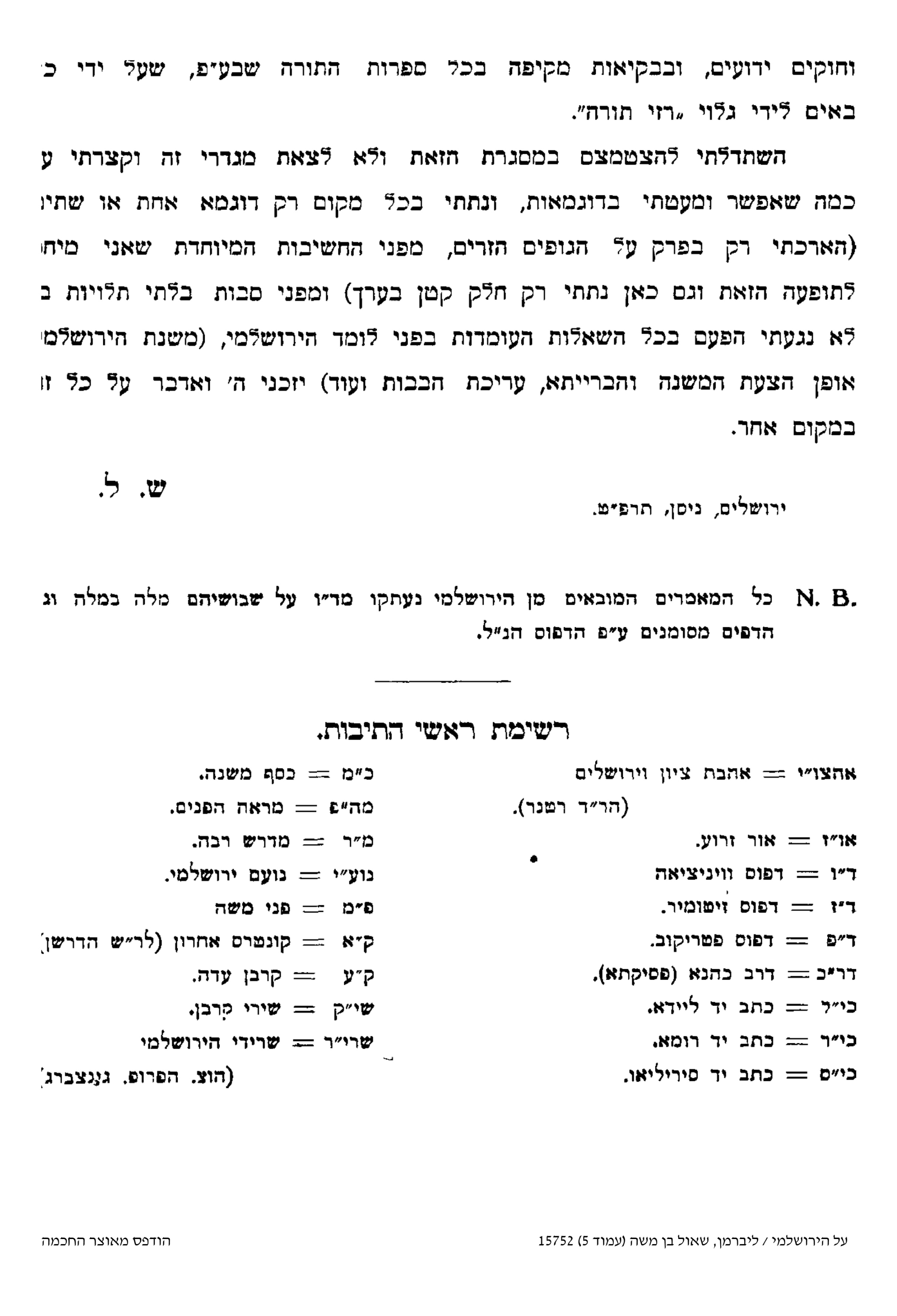
Returning to the quote above from R. Oberlander, he cites Yaakov Spiegel who gives two examples of Lieberman being a bit unconventional in some of his writings. In his book Amudim be-Toldot ha-Sefer ha-Ivri: Be-Sha’arei ha-Defus,[3] Spiegel notes that in the preface to the 1970 publication of the first volume of R. David Pardo’s Hasdei David on Taharot, which was edited by Lieberman (as were the next two volumes on Taharot), Lieberman signs his name in the preface as .ש.ל. Spiegel adds:

יש אומרים שחתם את שמו בראשי תיבות ולא בשמו המלא, מפני שרצה שהספר יכנס לבית המדרש, והמבין יבין

Yet this is incorrect, as Lieberman always ended the prefaces to his books with his initials. We see this beginning with his first book, Al ha-Yerushalmi, published in Jerusalem, 1929, long before he ever thought of joining the JTS faculty.


So his use of initials has nothing to do with covering up who he was, and on the very first page of the preface to Hasdei David he refers to what he wrote in Tosefta ki-Feshutah. However, it is noteworthy that Lieberman’s name does not appear on the title page of the book as you can see here.

This, perhaps, was due to a desire to have the book accepted in yeshivot. It is one thing to have references to Tosefta ki-Feshutah inside the book, and something else entirely to have Lieberman’s name on the title page, which might have prevented yeshivot from purchasing Hasdei David.

Spiegel also notes that Louis Finkelstein is referred to in the preface to Hasdei David as ר’ אליעזר אריה נר”ו בהרב ר’ שמעון הלוי ז”ל, without his last name. Spiegel sees this as a way of hiding Finkelstein’s identity, just as Lieberman did with the others mentioned in the preface. One of the people Lieberman refers to is הרב ר’ יהושע נר”ו בהרב ר’ יהודה ליב who discovered the manuscript of R. Pardo. (This is R. Yehoshua Hutner.) Lieberman also mentions two other people, one who transcribed the manuscript and another who proofread the book. It is possible that one or more of these individuals did not want to be mentioned by name as helping Lieberman, and this explains why Lieberman abridged all the names, including Finkelstein’s. But I repeat, Lieberman’s name in the preface is not in code, as .ש.ל is how he always signed the end of the prefaces of his books.

Spiegel[4] also notes that in Sinai 85 (1979), p. 199, the following short piece is signed בלי שם.

It is known, Spiegel tells us, that this was written by Lieberman. He also mentions that there is a hint to Lieberman’s authorship in that all the letters in בלי שם are found in Saul Lieberman’s name. This is indeed significant, as it shows us that for whatever reason, Lieberman was not averse to writing anonymously. In fact, in 1932 Lieberman used the pseudonym .ל.ל when he published a note in Tarbiz.[5] In 1936 he again published a note with this pseudonym.[6]

When I first examined Al Devar Tikunei Nushaot bi-Yerushalmi, I too thought that Lieberman must have written it, for the reasons already mentioned. What stood out most to me, as I have mentioned already, is that Lieberman in his many writings, including those that focus on the Jerusalem Talmud, never referred to the book even though it does the same thing what he was doing in Ha-Yerushalmi ki-Feshuto. I assumed that had anyone other than Lieberman written the book he certainly would have mentioned it, at least in the introduction to Ha-Yerushalmi ki-Feshuto, even if only to express his disagreement about certain matters. Obviously, Lieberman had a reason for not referring to this book, and I assumed it was because he did not want to associate his later scholarship with it.

Yet when I looked carefully at Al Devar Tikunei Nushaot bi-Yerushalmi and compared it to other writings of Lieberman on the very same sugyot, I was not able to find any parallels. This is so even though the book is written in the same style as Lieberman’s writings. Just when you would have expected some repetition from Al Devar Tikunei Nushaot bi-Yerushalmi in Yerushalmi ki-Feshuto and Tosefta ki-Feshutah, you find nothing.

I also noticed that there is a good deal of fraudulence in Al Devar Tikunei Nushaot bi-Yerushalmi, and it is impossible to imagine that Lieberman, in his alter ego “Rosenberg,” would have been a part of this. For example, on p. 5 in the note he cites Solomon Buber from Ha-Levanon, Sep. 18, 1872, as stating that there is a Yerushalmi Kodashim in the Vatican. Yet if you look at Buber’s article you find that he says the exact opposite, that there is no such manuscript there. Buber further states that he doesn’t believe that there ever was a Yerushalmi Kodashim. What is the point of “Rosenberg” providing such misinformation other than to play games with the readers? On p. 30 n. 37, “Rosenberg” actually states that he thinks that portions of the Yerushalmi Kodashim published by Friedlaender are authentic. This makes no sense, as there was no manuscript to which Friedlaender could have added his own material.[7] All academic scholars in the 1920s knew this, so what kind of fraudulence is “Rosenberg” peddling here? Interestingly, on pages 3 and 8 “Rosenberg” also refers to the earlier work by the other Rosenberg (i.e., Friedlaender), the booklet Aneh Khesil. This must be seen as an inside joke, especially since the page number given is 36 but the booklet doesn’t have this many pages.

Only after I had gone through Al Devar Tikunei Nushaot bi-Yerushalmi did I learn that the entire book is a series of plagiarisms from earlier authors, as has been noted by Elyashiv Cherlow[8] and an anonymous commenter here. Cherlow also points out that “Rosenberg” quotes a Geniza text that he invented from thin air. I too found an example of the author’s plagiarism that is not noted by Cherlow or the anonymous commenter: The lengthy passage, with numerous sources, found on pp. 71-72 n. 57, is lifted word for word from Avigdor Aptowitzer’s article in Ha-Tzofeh le-Hokhmat Yisrael 1 (1911), pp. 87-88.

There are some other strange things in Al Devar Tikunei Nushaot bi-Yerushalmi. For example, what is one to make of the dedication to the Jewish communal leader Louis Marshall?

Since this post has dealt with Lieberman, even if only to reject the notion that he is the author of Al Devar Tikunei Nushaot bi-Yerushalmi, let me add a couple of more points about him. From 1918-1962 there was an Orthodox publication called the Jewish Forum.[9] In the January 1961 issue there appeared an article by “Dayyan al-Yahud” sharply criticizing Conservative Judaism. In this article the author also took aim at Lieberman, referring to him as a “careerist”. He writes:

We ask, in all sincerity, where is the steadfastness of principle and consistent loyalty to Torah-Tradition on the part of the same Professor? This “guiding spirit” of the new kethubah, who only a few years ago, when the Agudath Harabbanim of the United States and Canada had declared Dr. Mordecai M. Kaplan under “herem” (anathema), himself recognized the “herem” as binding upon all Traditional Jews and refused to be in Kaplan’s company, as evidenced, in our presence, by his demonstrably stepping out of the Seminary elevator at the very entrance to the main building of the Seminary, no sooner than Dr. Kaplan had stepped in.

Such incongruous and compromising practices on the part of the Seminary’s present “scion” of Halakhah must of necessity lead to lack of reverence for time-honored traditions by its student body and graduates. No wonder that the latter, with few exceptions, are now groping in darkness and exhibit vacillation and uncertainty in their respective ministries.

Quite apart from the criticism of Lieberman, the passage is significant because the author testifies to having personally seen that Lieberman had previously observed the herem against Kaplan and refused to be in his presence.[10]

Who is Dayyan al Yahud? If you google the name, you will find that he also wrote articles critical of Kaplan and Heschel, yet none of the American authors who refer to Dayyan al Yahud identify who he is. He also wrote a number of articles under this pseudonym in Or ha-Mizrah. Yet his identity was never really a secret and is none other than the noted scholar Israel Elfenbein (1891-1964). The author of many works, Elfenbein is most known for his scholarly edition of Teshuvot Rashi (New York, 1943), which incidentally also includes notes from Louis Ginzberg. Elfenbein became a significant figure in American Orthodoxy, serving as editor of Or ha-Mizrah and education director of Religious Zionists of America. He was also honored with a Jubilee Volume (Jerusalem, 1963), which in addition to articles from various academic scholars, also has contributions from R. Eliezer Silver, R. Yehudah Gershuni, R. Nissan Telushkin, R. Leo Jung, and R. Menahem M. Kasher. Elfenbein also engaged in polemics against Conservative leaders. Yet one would not have expected his prominence in Orthodoxy, as in his early years Elfenbein received semikhah from the Jewish Theological Seminary and served as rabbi of the Conservative congregation Adath Israel in Nashville from 1915-1916.[11] 

In truth, Elfenbein’s identification with Orthodoxy was a return to his youth, as before he came to America he had studied in Pressburg and had received semikhah from R. Shalom Mordechai Schwadron. That at least is the story told by his relative, Y. N. Adler,[[12] but being that Elfenbein came to America when he was fifteen years old, is it really possible that he received semikhah at such a young age?[13] Upon arriving in New York in 1906 he entered Yeshivas Rabbeinu Yitzchok Elchonon (where his classmate was Bernard Revel, who himself had received semikhah at age 16).[14] With such a background in traditional Torah learning, how did Elfenbein end up at JTS?

Adler tells a fascinating story, different versions of which we know from other sources as well, although as far as I can tell, only the Rabinowitz article (see note 15) mention Elfenbein’s name. During Elfenbein’s time at RIETS—from other sources we know that the year was 1908—he and some friends wanted to study at a university (Yeshiva College did not yet exist). They therefore took the regents exam which allowed them to apply to institutes of higher learning. According to Adler, among the students who were part of this group, and who later became quite distinguished, were Rabbi Baruch Shapiro, who later served as rav in Seattle, Rabbi Louis Epstein, Rabbi Yehiel Kaplan, Dr. Israel Efros, Rabbi Solomon Goldman of Chicago, and Dr. Abraham Neuman.

This action, Adler tells us, greatly upset the rabbinic leadership of RIETS. In response to this, Elfenbein and his friends stopped learning at RIETS and set up a beit midrash, which they called Beit ha-Midrash ha-Elyon, in the Adass Bnei Yisrael synagogue of R. Solomon Elhanan Jaffe. (Other sources record the name as “Yeshivah le-Rabbanim”.) This beit midrash did not last long, and most of the students, including Elfenbein, transferred to JTS.[15]

Returning to Lieberman, there is another interesting comment in R. Dov Cohen’s Va-Yelkhu Shneiheim Yahdav, p. 168. He mentions how in Jerusalem Lieberman was treated with great respect at the Chevron Yeshiva, even after he had gone to the university. As for his going to JTS, Cohen recalls a biting hasidic comment about mitnagdim, that for Torah study a Litvak would even enter a church!

האיש היוה דוגמא למה שהיו החסידים טוענים על המתנגדים, כי התורה בליטא התקדשה עד כדי כך שעבורה היה מוכן הליטאי להכנס לכנסיה. . . [הנקודות במקור] אחר שהתגורר כמה שנים בירושלים, נמלך בדעתו כי מוטב שילמד באין מפריע. מאחר שהציעו לו משרה חשובה בסמינר קונסרבטיבי באמריקה, נסע שם וקיבלה. הוא לא שיתף עמם פעולה בסיוע לדרכיהם הנלוזות, חלילה. גם שם היה יושב בחדרו ועוסק בגמרא וכן בחיבור ספריו על התוספתא. זכורני שבכינוס של אגודת הרבנים באמריקה, בו השתתפתי, התייחסו אליו כאל “אחד משלנו” שיכול לעזור ולסייע, אף שהוא “אצלם”. גם הרב אברמסקי, התקיף והלוחם, קיבלו בכבוד גדול. שמעתי גם כן, שהוא החזיק מכספו כמה וכמה בני תורה בירושלים.

Regarding Lieberman, I have one final point to make. In Saul Lieberman and the Orthodox, p. 7, I mentioned a November 1930 letter from Lieberman to Louis Ginzberg in which Lieberman writes that he began working on a great project on the Jerusalem Talmud, but had to stop because one cannot work on Berakhot without knowing all of the Yerushalmi. Only when he finished the entire Jerusalem Talmud did he pick up the project again. I added that the project Lieberman refers to must be Ha-Yerushalmi ki-Feshuto, which appeared in 1935.

Here is the relevant section of Lieberman’s letter:

 התחלתי ג”כ בעבודה גדולה על שדה הירושלמי אבל הוכרחתי לעזוב אותה מפני שאי איפשר [!] לעבוד ב”ברכות” כל זמן שאינם יודעים [!] את כל הירושלמי עד “נדה” ורק בקיץ זה אחרי גמר הירושלמי שבתי עוד הפעם לברכות

The problem with my assumption that Lieberman’s project was Ha-Yerushalmi ki-Feshuto is that this book includes his commentary on ShabbatEruvin, and Pesahim, and in his letter he speaks of returning to Berakhot. Yet I didn’t know of anything else that could fit the description of a great project on the Yerushalmi during this time period. 

Dan Rabinowitz has, I think, provided the answer. He called my attention to Tovia Preschel’s article in Ma’amrei Tuviah, vol. 2, pp. 155-156. Preschel recounts that not long after Lieberman settled in Jerusalem in 1928, he was asked by R. Michel Rabinowitz to assist him in translating the Yerushalmi into Hebrew. Lieberman replied that he had never studied the Yerushalmi and he can’t translate a work that he doesn’t know. He asked for time to immerse himself in it, and for the next year and a half he completed the Yerushalmi a few times. In the end, the Hebrew translation did not appear, but I have to agree with Dan that it is this project that Lieberman is referring to in his letter to Ginzberg, not Ha-Yerushalmi ki-Feshuto.

2. Since I mentioned RIETS earlier in this post, let me add the following. In 2022 the ArtScroll biography of R. Yitzchok Scheiner appeared, authored by Nachman Seltzer.[16] This book tells how R. Scheiner was living in Pittsburgh and was intending to attend a local university. However, a fundraiser for RIETS (i.e., Yeshiva College) was in Pittsburgh and convinced R. Scheiner’s parents to send him there. Seltzer, p. 30, includes all of one paragraph dealing with R. Scheiner’s time at Yeshiva College. I quote it here, followed by the two subsequent paragraphs.

The winter that Yitzchok Scheiner enrolled at Yeshivas Rabbeinu Yitzchok Elchonon was cold, dark, and dreary. Though he had been raised in Pittsburgh and was no stranger to the grayness and never-ending winter months, the young man came down with the kind of cold that turned into something more serious and that he couldn’t seem to shake.

The illness that plagued him for so many months would turn out to be a blessing in disguise, because it forced him to find a place to convalesce.

In those early years, Jewish camps suitable for yeshivah bachurim were few and far between, which is why, come summertime, Yitzchok Scheiner found himself on a bus headed up to the mountains, to the one and only Camp Mesivta, founded by the legendary R. Shraga Feivel Mendlowitz. It was a summer that would change his life.

Seltzer continues by describing how at camp R. Scheiner was influenced to enroll in Torah Vodaath at the end of the summer. Interestingly, the book never refers to Yeshiva College, only Yeshivas Rabbeinu Yitzchok Elchonon, but R. Scheiner was enrolled in the college, in addition to studying in the yeshiva.

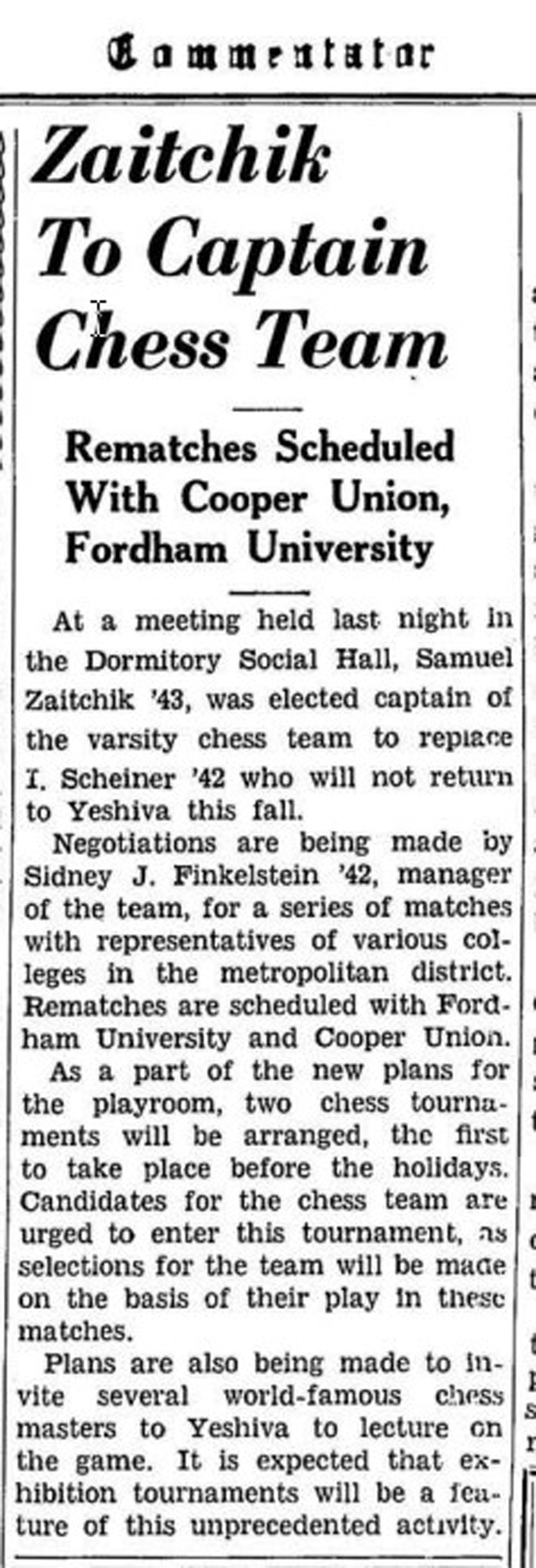
According to Seltzer, R. Scheiner was only at Yeshiva College for less than one academic year, for he tells us that he enrolled in the winter. As far as I know, this is incorrect, and he was at Yeshiva College the entire academic year 1939-1940. In fact, he was on the chess team and was even chosen as the captain.

This page from the Yeshiva College yearbook, Masmid 1940, can be seen here.

What complicates matters is that R. Scheiner himself said that he was at Yeshiva College for two years (and this was after a semester at the University of Pittsburgh, a point which is not mentioned by Seltzer).[17] According to the records of the University of Pittsburgh, Office of the University Registrar, Isadore Leon Scheiner attended the University of Pittsburgh for a semester in 1938-1939, during which time he took seven classes (I presume that the semester ended in January.) Even if R. Scheiner entered Yeshiva College for the spring 1939 semester, his time there would have been three semesters, not two years, so presumably when he said “two years” he was not being exact. By fall 1940 R. Scheiner – who was on track to graduate in 1942 – had left Yeshiva College. We know this because the Sep. 18, 1940 issue of the Yeshiva College Commentator mentions that he is no longer there.[18]

In discussing his time at Yeshiva College, R. Scheiner states: “When I got there, I discovered that the other students did not take Torah learning as seriously as I wanted to or as seriously as some of the rabbeim wanted them to, so I left.”[19]

Interestingly, in an interview that appeared on Matzav.com here, R. Scheiner does not mention that he attended Yeshiva College, or perhaps this was censored by Matzav.com:

Where did the Rosh Yeshiva learn in his youth?

HaRav Scheiner: I learned in the United States, in Yeshivas Torah Vodaas, from Rav Reuven Grozovsky zt’l, Rav Boruch Ber’s son-in-law and from Rav Shlomo Heiman zt’l. There was a group of students who would go to Lakewood to hear Rav Aharon Kotler’s shiurim and I sometimes joined them. Some of them stayed on afterwards to learn there permanently, among them HaRav Elya Svei. The Rosh Yeshiva, Rav Reuven Grozovsky, made my shidduch.

R. Scheiner would later teach at the Etz Chaim Yeshiva in Montreux, Switzerland, where he developed a close relationship with R. Jehiel Jacob Weinberg who lived in the town. For R. Scheiner, it was a great privilege to be in such close proximity to one of the gedolei Yisrael, and they spent much time together “talking in learning.” When R. Scheiner moved to Jerusalem, they continued their relationship by mail, with many Torah letters going from one to the other.

Here is a never-before publicized picture of R. Weinberg, together with R. Scheiner. The man in the middle who is speaking is R. Meir Just of Amsterdam. I thank Israel Bollag for sending it to me. (In a future post I will include more unknown pictures of R. Weinberg, including some in color.)

Unfortunately, the only mention of R. Weinberg in Seltzer’s book is in the following paragraph (p. 81).

There were other great Torah scholars teaching at the yeshivah in Montreux alongside Rav Yitzchok. One of them was R’ Betzalal Rakow, who would later be appointed rav of Gatesehad, England. R’ Yechiel Yaakov Weinberg, also known as the Seridei Eish, also spent time in the yeshivah.

R. Weinberg never officially taught at the yeshiva, although he would sometimes give the opening shiur of the semester. I assume this is what Seltzer means by “spent time in the yeshivah.” The real problem with the paragraph is that it makes it seem as if these three figures were colleagues, and at the same level. The truth is that both R. Scheiner and R. Rakow regarded R. Weinberg as a rebbe of sorts, which is understandable, especially as he was decades older than them.

3. In my last post here, I linked to a lecture from Professor Isadore Twersky that I found at the University of Scranton. Dr. Marc Herman called my attention to another video here in which Prof. Twersky appears. Unlike the video I posted, in this video you can hear Prof. Twersky very clearly. I was at Harvard when this presentation took place, yet I had no idea that Twersky was ever on this panel.[20] I think people will find it interesting that the moderator is none other than Alvin Bragg, the current Manhattan District Attorney. Prof. Harvey Mansfield also appears and is provocative as always (this time saying that grade inflation came about because of Affirmative Action).

4. Earlier in the post I mentioned Mordecai Kaplan, so here is a good place to add another point about him. Kaplan’s father, R. Israel, was close to R. Isaac Jacob Reines. (Mordecai Kaplan was actually born in Svencionys, where R. Reines had served as rav.) This explains why Kaplan, who had already been ordained by the Jewish Theological Seminary, turned to R. Reines when he wished to acquire a semikhah from a well-known rabbi. Everyone who writes on this matter refers to Kaplan traveling to Europe on his honeymoon after his June 2, 1908 wedding, at which time he also received semikhah from R. Reines who was then serving as rav in Lida.[21] People have generally assumed that he traveled to Lida to receive the semikhah.

In 1994 Jacob J. Schacter published a picture of R. Reines’ semikhah, dated 28 Elul, 5668 (Sep. 24, 1908). From this document we see that Kaplan actually met R. Reines in Frankfurt, and that is where they “spoke” in learning, following which R. Reines gave him semikhah. Schacter writes: “While traveling through Frankfurt he met his father’s old friend, Rabbi Yizhak Reines, spent some time with him, and received rabbinic ordination from him.”[22] This is based on Kaplan’s own recollection where he writes: “I had the opportunity to meet the late Rav Yitzhak Reines in Frankfort-on-the-Main and to obtain the requisite Hatarat Hora’ah from him.”[23]

Did Kaplan just happen to be passing through Frankfurt while on his honeymoon? The answer is no, and I’m happy to share something that is completely unknown: Kaplan was actually in attendance, together with R. Reines, at the 1908 Frankfurt Mizrachi conference. Here is the report of the conference in the Sep. 4, 1908 issue of the Cracow newspaper Ha-Mitzpeh. Kaplan is mentioned in the first paragraph.

5. In Hakirah 32 (2022), I published a number of letters from R. Joseph B. Soloveitchik. One of them was sent to Professor Marvin Fox who had asked the Rav about the synagogue he attended, Agudas Achim of Columbus, Ohio. The synagogue had recently built a new building and instituted mixed seating.[25] Fox also turned to R. Mordechai Gifter. Here is R. Gifter’s letter to Fox.

Here is a draft of a Hebrew letter from Fox to the Rav.

It is not known if Fox ever sent the Hebrew letter, or if he sent an English one. I would presume the latter, as the Rav’s reply, that appears in Hakirah, is in English. 

Fox’s archive also contains the following English letter. In the Rav’s June 1955 letter in Hakirah, he is responding to Fox’s 1955 question about praying in a synagogue without a mechitzah (i.e., Agudas Achim). The letter below is from a later period and asks about praying in the synagogue’s beit midrash, in which no women are present. (As Fox’s son Avi informed me, Fox was at Harvard during much of 1956; this letter to the Rav is from when he returned to Columbus after his time in Boston.)  Fox’s archive does not contain a reply to this letter.

Here is the letter that Fox sent to Rabbi Samuel Rubenstein, the rabbi of Agudas Achim.


Fox’s reference in the Hebrew letter concerning the synagogue of R. Leopold Greenwald—of Kol Bo al Avelut fame—as not having a regular mehitzah is of interest. R. Greenwald was a strong opponent of anything smacking of reform. He himself spoke strongly against mixed seating in the synagogue and would never enter a synagogue with such an arrangement. Yet his own synagogue, Beth Jacob, against his wishes also decided to remove the mehitzah. Since it still kept separate seating, R. Greenwald felt that he could remain as rabbi even though he was not happy with the situation.[25]

While Beth Jacob remained in the Orthodox fold, and would later reinstall a regular mehitzah, in 2004 Agudas Achim decided to affiliate with the Conservative movement.

All the letters published above are found in the Marvin Fox Papers, Box 11 and Box 29, Brandeis University, and appear here courtesy of the Robert D. Farber University Archives and Special Collections Department, Brandeis University.

Since in this post I mention both R. Bernard Revel and R. Mordechai Gifter, let me add one more point regarding them. In 2011 Milei de-Igrot, vol. 2, appeared. This contains the letters between R. Gifter and his rebbe at RIETS, R. Moshe Aharon Poleyeff.

In addition to all the Torah the volume contains, it also offers us insights regarding both of these rabbis’ personalities and the history of Orthodoxy in the U.S. and Lithuania. Here is p. 168.


In addition to describing the incredible effect that Telz had upon him, R. Gifter also levels strong criticism against the אדמון running Yeshiva College who is destroying young people by exposing them to heresy. This refers to R. Revel who had a red beard. In fact, R. Aharon Rakeffet informed me that the opponents of R. Revel used to refer to him in a disgusting way as the “reiter hunt”.

6. In my last post I had the following quiz questions:

1. Which Hebrew book was the first one to use footnotes (and the footnotes even used Arabic numerals)?

2. Point to a halakhah on Pesach that the Shulhan Arukh decides in accord with the Rosh, while the Rama records the practice in accord with the Rif and the Rambam.

The answer to no. 1 is R. Noah Hayyim Zvi Hirsch Berlin, Ma’yan ha-Hokhmah (Rodelheim, 1804).[26] No one answered this question.


The answer to no. 2, which a few people answered correctly, is found in Shulhan Arukh, Orah Hayyim 474. Here R. Joseph Karo rules like R. Asher ben Jehiel, cited in Arba’ah Turim, Orah Hayyim 474, that there is no blessing on the second and fourth cups of wine at the Passover seder. R. Moses Isserles rules like the Rif, Pesahim 24a in the Alfasi pages, and the Rambam, Mishneh Torah, Hilkhot Hametz u-Matzah 8:5, 10, that one recites the blessing on all four cups.

*********

[1] “Pesukei Mikra she-be-Talmud,” Jeschurun 4 (1923), pp. 43-47, available here,“Le-Heker ha-Talmud ha-Yerushalmi,” ibid., pp. 109-112, available here, ibid., 5 (1924), pp. 18-20, available here.

[2] See Elijah J. Schochet and Solomon Spiro, Saul Lieberman: The Man and His Work (New York, 2005), p. 8.

[3] (Jerusalem, 2014), p. 46 n. 151.

[4] Amudim be-Toldot ha-Sefer ha-Ivri: Be-Sha’arei ha-Defus, p. 48, n. 161.

[5] “Od ‘le-Tikunei Girsaot be-Sifrei,’” Tarbiz 3 (1932), p. 466.

[6] See B. M. Lewin, ed., Alumah (1936), p. 156. This source and the prior one are listed in Tovia Preschel’s bibliography of Lieberman’s writings here. While this is a very complete bibliography, it omits one source that is completely unknown, and which fans of Lieberman will certainly want to examine. Here is a short article by Lieberman that appeared in Otzar ha-Hayyim 10 (1934), pp. 83-84.


[7] In the article in Jeschurun, “Le-Heker ha-Talmud ha-Yerushalmi,” p. 110, “A. Rosenberg”  states that the Jerusalem Talmud to Kodashim is lost, and he does not mention Friedlaender. Regarding the Yerushalmi Kodashim, I recently found that R. Mordechai Vorhand, Be’er Mordechai, p. 152, states that he is not going to take a stand regarding its authenticity. This is quite strange as Be’er Mordechai appeared in 1927 and the forgery had already been established for a number of years. Even stranger is that R. Menahem Mendel Kirschbaum, Menahem Meshiv, vol. 2, p. 8, also cites the Yerushalmi Kodashim. His responsum is from 1933 and Menahem Meshiv, vol. 2, was published in 1938. How could anyone at this late date still cite the Yerushalmi Kodashim? Interestingly enough, R. Kirschbaum disputes “the commentator’s” (i.e., Friedlander’s) understanding of the passage he is dealing with. Of course, “the commentator” is none other than the author (forger) of this passage, who presumably knows what he himself intended. This point is made by R. Shlomo Yosef Zevin, Soferim u-Sefarim, vol. 1, p. 307. In Menahem Meshiv, vol. 1, p. 163 (published in 1936), R. Kirschbaum shows that he is aware of the forgery, so he must have assumed that despite the forgery, some of the Yerushalmi Kodashim published by Friedlander is authentic. This explains how in Menahem Meshiv, vol. 1, pp. 70, 234, he cites Yerushalmi Bekhorot as authentic. R. Yeruham Fishel Perla states that portions of the Yerushalmi Kodashim are indeed authentic, while Friedlander forged the rest. See his edition of R. Eshtori ha-Parhi, Kaftor va-Ferah, p. 145b.

[8] “Toldot ha-Nusah shel ha-Talmud ha-Yerushalmi: Iyunim be-Kit’ei ha-Genizah,” Tarbiz 87 (2020), p. 610 n. 70.

[9] See Ira Robinson and Maxine Jacobson, “When Orthodoxy was not as Chic as it is Today”: The Jewish Forum and American Modern Orthodoxy,” Modern Judaism 31 (Oct. 2011), pp. 285-313.

[10] Regarding Lieberman and the herem against Kaplan, see my Saul Lieberman and the Orthodox, pp. 19-20. See my post here for the text of the herem against Kaplan. Here is a tidbit that is not generally known: As late as 1945, when Kaplan’s theological views were public knowledge, he was still a member of the Rabbinical Assembly’s Committee on Jewish Law. See David Golinkin, ed., Proceedings of the Committee on Jewish Law and Standards of the Conservative Movement 1927-1970 (Jerusalem, 1997), vol. 1, p. 155.


[11] See herehere, and here.

[12] See Adler’s article in the Elfenbein Jubilee Volume, pp. 9-14. Adler twice says that Elfenbein studied nine years at RIETS, but this is an obvious mistake, and is contradicted by the dates in Adler’s own article.

[13] For an earlier post in which I deal with young rabbis, see here. R. Ovadya Hoffman called my attention to another young rabbi (I also mention Hoffman in the post just linked as he noted an additional young rabbi): It is reported R. Yitzhak Isaac Katz (1753-1787) was thirteen years old at his marriage and was also appointed rabbi of Koretz at this time. His Wikipedia entry is here. The information about him becoming rav at age thirteen in found here in the biographical introduction to his Zikhron Kehunah (Lvov, 1863). I don’t know of any other examples of a thirteen-year-old who served as the official rav of a community. In the Encyclopaedia Judaica entry on R. Meshullam Roth (called “Rath” in the EJ), written by R. Mordechai Hacohen, it states that he was ordained at the age of 12 by R. Isaac Shmelkes and R. Jacob Teomim. This detail is not found in any of the sources listed in the bibliography so it is hard to know where R. Hacohen came to this information. One of the descendants of R. Roth told me that he never heard that R. Meshullam received semikhah at age 12.

[14] Aaron Rakeffet-Rothkoff, Bernard Revel: Builder of American Jewish Orthodoxy (Jerusalem/New York, 1981), p. 30.

[15] For more on student restlessness at RIETS and the 1908 student strike, see Gilbert Klaperman, The Story of Yeshiva University (London, 1969), chs. 5-7 (on pp. 115ff. he discusses the Elfenbein group); Hayyim Reuven Rabinowitz, “60 Shanah li-Shevitot bi-Yeshivat R. Yitzhak Elhanan,” Ha-Doar, June 14, 1968, pp. 552-554. See also Eli Genauer’s Seforim Blog post here which includes R. Baruch Shapiro’s recollections of the 1908 student strike.

[16] Nachman Seltzer, Rav Yitzchok Scheiner: The Life and Leadership of the Kamenitzer Rosh Yeshivah (Brooklyn, 2022).

[17] See the Pittsburgh Post-Gazette, May 1, 1998, p. A-14; Samuel Heilman, Defenders of the Faith (Berkeley and Los Angeles, 1992), p. 262. Chapter 17 in Heilman’s book is an interview with R. Scheiner, and as Heilman informed me, R. Scheiner told him that was at Yeshiva College for two years. He must have also provided this information to the Pittsburgh Post-Gazette. See also here.

[18] This page from the Commentator was posted by Dovi Safier here.

[19] Heilman, Defenders of the Faith, p. 262. I have corrected Heilman’s spelling of “rabbaim” to “rabbeim”.

[20] Regarding Twersky, I found it interesting that in a recent article Levi Cooper refers to him as a “noted academic and hasidic master.” See Cooper, “Jewish Law in the Beit Midrash of Hasidism,” Dine Israel 34 (2020), p. 63.

[21] See e.g., Mel Scult, Judaism Faces the Twentieth Century: A Biography of Mordecai Kaplan (Detroit, 1993), pp. 26, 96.

[22] Jacob J. Schacter, “Mordecai M. Kaplan’s Orthodox Ordination,” American Jewish Archives 56 (1994), p. 6.

[23] Ibid., p. 7. Schacter , ibid., also writes that R. Reines did not rigorously examine Kaplan, and therefore the semikhah should not be “considered an indication of any advanced talmudic scholarship on Kaplan’s part.” This reminded me of something interesting regarding the name “Mordechai”. According to Tosafot, Menahot 46b, s.v. amar, the name Mordechai was a second name given to those who showed great intellect and knowledge: בקיאים בעלי שכל ומדע. See also Tosafot, Bava Kamma 82b, s.v. ve-al:

דכל אותן שהיו בקיאים ברמזים ובלשונות היו נקראים על שם מרדכי לפי שהוא היה ראש וחכם להכיר

In Italy, people with the Hebrew name Mordechai were often named Angelo in Italian. This is likely because of the rabbinic identification of the biblical Mordechai with the prophet Malachi (and Malachi is akin to מלאך, i.e., “angel”). See Megillah 15a; Moshe David Cassuto, Ha-Yehudim be-Firentzi bi-Tekufat ha-Renesans, trans. Menahem Hartom (Jerusalem, 1967). p. 183.


[24] According to Marc Lee Raphael, Jews and Judaism in a Midwestern Community: Columbus Ohio, 1840-1975 (Columbus, 1979), p. 348, the synagogue also had mixed seating even before the new building, but as we see from Fox’s letter this was not the case.

[25] See Raphael, Jews and Judaism in a Midwestern Community, p. 348; Adam S. Ferziger, Beyond Sectarianism: The Realignment of American Orthodox Judaism (Detroit, 2015), p. 26; Rivka Schiller’s article on Greenwald here.

[26] This is noted by R. Binyamin Shlomo Hamburger, Ha-Yeshivah ha-Ramah be-Fiorda (Bnei Brak, 2010), vol. 2, p. 115. How is the first word of the sefer, מעין, to be pronounced? It has become common in modern Hebrew to pronounce it as “ma’ayan”. Yet this is not how it appears in the Bible. There the word has a shewa under the ayin, מַעְיׇן, so the word is to be pronounced ma’yan. The change in pronunciation of this word is noted by Joshua Blau, “Al ha-Mivneh ha-Murkav shel ha-Ivrit ha-Hadashah le-Umat ha-Ivrit she-ba-Mikra,” Leshonenu 54 (1990), p. 106. The plural of מעין is מַעְיָנוֺת, as seen in Is. 41:18, Prov. 8:24, II Chron. 32:4 (Ps. 104:10 has מַעְיָנִים). Therefore, it is unfortunate that the popular Bergen County, N.J. girls’ school has as its name “Ma’ayanot,” instead of the correct word, “Ma’yanot”. Yet in conversation, it appears that pretty much everyone seems to pronounce it correctly as Ma’yanot.


Cherubim: Winged Celestial Beings on the Title-Pages of Early Hebrew Books

Cherubim: Winged Celestial Beings on the Title-Pages of Early Hebrew Books
by
Marvin J. Heller[1]


And having driven out the man, He stationed at the east of the Garden of Eden the Cherubim and the flame of the ever-turning sword, to guard the way to the Tree of Life (Genesis 3:24).

You shall make two Cherubim of gold—hammered out shall you make them—from both ends of the cover. You shall make one cherub from the end at one side and one Cherub from the end at the other; from the cover shall you make the Cherubim at its two ends. The Cherubim shall be with wings spread upward, shielding the Cover with their wings with faces toward one another; toward the cover shall be the faces of the Cherubim being turned toward the cover. (Exodus 25: 18-20).

Rav Ketina said: When the Jewish people would ascend for one of the pilgrimage festivals, the priests would roll up the curtain for them and show them the cherubs, which were clinging to one another, and say to them: See how you are beloved before God, like the love of a male and female (B.T. Yoma 54a).

Cherubim (angels) are a frequent presence on the title-pages of early Hebrew imprints in the sixteenth century and afterward, the latter beyond the scope of this article. They are also to be found in incunabula, on the frames of initial pages and head-pieces for text.

How do you define what are cherubim? One definition, that of the Encyclopedia Judaica, is “a winged celestial being which appears in the Bible in several different guises.” It then proceeds to give several descriptions of cherubim. The Jewish Encyclopedia begins with a more detailed description, stating cherubim are “the name of a winged being mentioned frequently in the Bible. The prophet Ezekiel describes the cherubim as a tetrad [set of four] of living creatures, each having four faces—of a lion, an ox, an eagle, and a man—the stature and hands of a man, the feet of a calf, and four wings.”[2]
The use of cherubim is also noted in the 1911 Encyclopædia Britannica where they are described as “imaginary winged animal figures of a sacred character, referred to in the description of Solomon’s temple (1 Kings vi. 23-35, vii. 29, viii. 6, 7), and also in that of the ark of the tabernacle (Ex. xxv. 18-22, xxvi. 1, 31, xxxvii. 7-9). . . . In Gen. iii. 24 the cherubim are the guards of Paradise . . .”[3]
The frequency of the appearance of cherubim in Hebrew literature can be found on Sefaria, a bibliography of Jewish texts, which records fifty-six entries for cherubim under biblical, Mishnah 27, and Talmud 991. Among other entries are Midrash, 590; Halakhah 7947; Kabbalah 747; and yet still others as well as multiples of commentaries on the first works.[4]

These multi-winged creatures are also a feature in general literature. Franz Sales Meyer, under the heading Miscellaneous heads, describes the “Angel faces, youthful heads, with a circular or disc-like halo, are first met-with in the Byzantine style, as the result of ecclesiastic articles,” He continues that in the early Italian Renaissance such renderings were charmingly naïve. They appeared as adornments on friezes and arches, medallions, and in borders. They also are to be found on tombs and are “Much used in Modern ecclesiastical decorations.” The text is accompanied by a page of examples of the cherub head, including one of a skull.[5]

It had been my intention to describe Hebrew title-pages with images of cherubim over a period of two centuries.[6] The numerous instances of such usage, however, has necessitated a considerable limiting of our subject period. Indeed, rather than noting all the examples in our current period, in the sixteenth century, we only describe several exemplars, giving background about the books in which they appear, that is, the publisher, author, and book subject.[7] This article is expansive, that is, in describing cherubim, it discusses the varieties of Hebrew literature, the authors of the subject works, the presses that published them, and even Hebrew book history. The title-pages and infrequent text pages with displays of cherubim addressed here are in chronological order, but from diverse locations and, again, on a variety of books, indicative of how widespread Hebrew publishing was and even more so the depth and nature of Hebrew literature.[8]

1514-18, Hameshei Humshei Torah – Our first work with the appearance of cherubim is a folio (20) edition Hameshei Humshei Torah (Pentateuch) with haftorat and commentary of Rashi printed in 1514-18 in Prague at the press of Gershom ben Solomon ha-Kohen and partners. Gershom later received a royal privilege from King Ferdinand of Bohemia, allowing him, that is Gershom alone, to enjoy a monopoly on Hebrew printing in Prague. His descendants, known as the Gersonides, continued to print in Prague until the mid-seventeenth century.
 

1514, Hameshei Humshei Torah
Courtesy of the Library of the Jewish Theological Seminary

A magnificent edition, with ornate woodcut frames and large type for the text. Each book has a unique decorative opening page, there is no title page, comprised of four separate pieces, those on the pillared sides with vases, leaves, and cherubim, similar but not identical, the top piece with a concave bottom edge. Genesis has a convex curved piece to fit with this top piece on the upper half of the page, with winged cherubim holding a shield with the spread hands of the Kohen giving the priestly blessing.[9]

Work on the Pentateuch began on 10 Sivan (June 14, 1514) but, perhaps as a result of the success of the prayer book, the partners found they had overextended themselves and found it necessary to suspend work on this project for two years. In 1530 Gershom and his sons reprinted this Pentateuch in an identical format, except for changes to the decorated initial pages.

1527, Dictionarium ChaldaiOur next entry with cherubim is an Aramaic grammar by the Christian-Hebraist scholar Sebastian Muenster (1489-1552). It was printed in Basle in 1527 at the press of Johannes Froben in quarto format (40: [1], 434, [7] pp.). The Froben family was the most significant printers of Hebrew books in Basle. Johannes Froben published as many as 250 titles, among them Hebrew/Latin books of the Bible and grammatical works, primarily works by Muenster.

Sebastian Muenster, a cosmographer, astronomer, and orientalist was, for twenty three years, professor at Basle. Born in Niederingelheim, Hesse, the son of a Spitalmeister (hospital master), Muenster had no university education nor did he ever receive a degree. His education consisted of some private instruction in Latin and later studies at Frieberg and attendance at lectures given by the Franciscans. In 1506, Muenster entered the Minorite order and was sent to study in Rufach under Conrad Pellican (Pellicanus, 1478-1556). The following year he took vows and, in 1512, was ordained a priest. Muenster assisted Pellican in teaching in Pforzheim and, from 1524-29, occupied the chair of Hebrew at the University of Heidelberg. In 1529, Muenster converted to Protestantism and moved to Basle, where he occupied the chair of Hebrew, at a salary of 60 gulden; from 1547/8 he was rector. From about 1525, Muenster was a student of Elijah Levita, translating and editing his grammatical works. Muenster also translated a number of other Hebrew works into Latin and was a prolific author in his own right. By the time of his death more than 100,000 volumes of his works were in circulation. His Jewish oeuvre, more than three-score publications, covers all aspects of Judaica, excepting Kabbalistic studies, which did not interest him. In 1523, Muenster published Dictionarium Hebraicum . . . adiectis Chaldaicis vocabulis, his study of the Aramaic language. The book reads from left to right but the text follows the Hebrew alphabet. Words are given in vocalized Hebrew, followed by their etymology, definition and examples.

The title page of the Dictionarium Chaldai has an architectural frame with cherubim in various positions, as well as additional cherubim below mounted and otherwise. This title page, designed by Hans Holbein, was used as early as 1516 on Basel statutes and into the seventeenth century.[10] [11]

Not long afterwards, from 1540 through 1543, at least five titles were printed in three locations with varied images of cherubim on the title-page, that is Augsburg, Prague, and Bologna. That is not to say these frames were not used on other books, most likely they were, but rather these are examples of cherubim used by the printers of Hebrew books at the time.

Augsburg has an early history related to Hebrew printing. Several early anti-Jewish works beginning with the apostate Johannes Pfefferkorn’s Der Judenfeind (1509) and other anti-Semitic books by apostates were published there. Another early Augsburg publication of note, this certainly more positive, albeit not a Hebrew edition of that popular and much republished work, is the first printing of R. Joseph ben Abraham Gikatilla’s (1248–c. 1325) kabbalistic classic, Sha’arei Orah, which explains and analyzes the ten Sefirot. This edition of Sha’arei Orah is a Latin translation of that work by the apostate Paulus Ricius (Paulus Israelita, 1480-1541) under the title Portae lucis, published in 1516 at the press of Johann Miller.
1527, Dictiorionarim Chaldai
Courtesy of the Fales Library and Special Collections, New York University

Serious Hebrew printing in Augsburg begins when Hayyim ben David Shahor, among the pioneers of Hebrew printing outside of Italy, came to Augsburg in about 1533/34. In Augsburg, Schwarz worked in the print shop of Silvan Otmar (d. 1540), a renowned and highly productive printer, and resided in the home of Bonifacius Wolfhart, a Protestant pastor who also served as the censor of Hebrew books for Augsburg.[12] Shahor printed several works in conjunction with his son, Isaac, and his son-in-law, Joseph ben Yakar, who assisted him at the press, although their names are not mentioned on the title-pages.[13]

Shahor likely joined with a non-Jewish printer, perhaps August Wind, a printer of Hebrew works for Christian clergyman. Hayyim left for Italy, returning to Augsburg in 1540. He then printed three books, Avkat Rokhel, Arba’ah Turim and a prayer book for, according to the Thesaurus of the Hebrew Book, a total of ten works in Augsburg. Due to a lawsuit by an apostate, Paulus Aemilus, with whom Shahor had been associated in Ferrara, resulting from their failed venture, Shahor and his family were forced to cease publication and leave Augsburg. Aemilus, seeing a market in Augsburg for Hebrew/Yiddish books, began to print on his own account. He issued a small number of titles, most notably the Melokhim Bukh (1543) and the Shmuel Bukh (1544), Yiddish poetical renditions of the books of Kings and Samuel, both with images of cherubim (below).[14]

1540, Avkat Rokhel Our first Augsburg title is Avkat Rokhel, an eschatological work on the principles of faith attributed to R. Machir ben Isaac Sar Hasid, a student of R. Judah ben Asher, son of the Rosh. Printed in octavo format (80: 18 ff.), perchance by Shahor. The Thesaurus of the Hebrew Book attributes it, albeit in brackets, to Hayyim Shahor, in contrast to the National Library of Israel that records the printer as unknown.[15]

The text of the title page is set within a decorative frame with nineteen cherubim and a number of animals. The title-page states that it is,

Sefer Avkat Rokhel

Printed by the printers named at the end of the volume. Edited with great care, with all our ability, “the good hand of our [Lord] upon us,” (ref. Ezra 8:18). And it was completed, here Augsburg, the great city, with the help of the Lord and His salvation. In the year, “[Rejoice, O you nations, with his people; for he will avenge the blood of his servants,] and will render vengeance to his adversaries, and will make expiation כפר (300=1540) for the land of his people” (Deuteronomy 32:43).

The names of the printers, Hayyim Shahor, Isaac ben Hayyim, and Joseph ben Yakar, the statement on the title page notwithstanding, are not given at the end of the volume. A brief introduction informs that the work was named Avkat Rokhel (the perfumer’s powders, Song of Songs (3:7)) for as the perfumer’s powders strengthen the soul, so too when one reads this book will he fear and cause his soul to be pure and free from all sin and transgression, thus meriting the good.
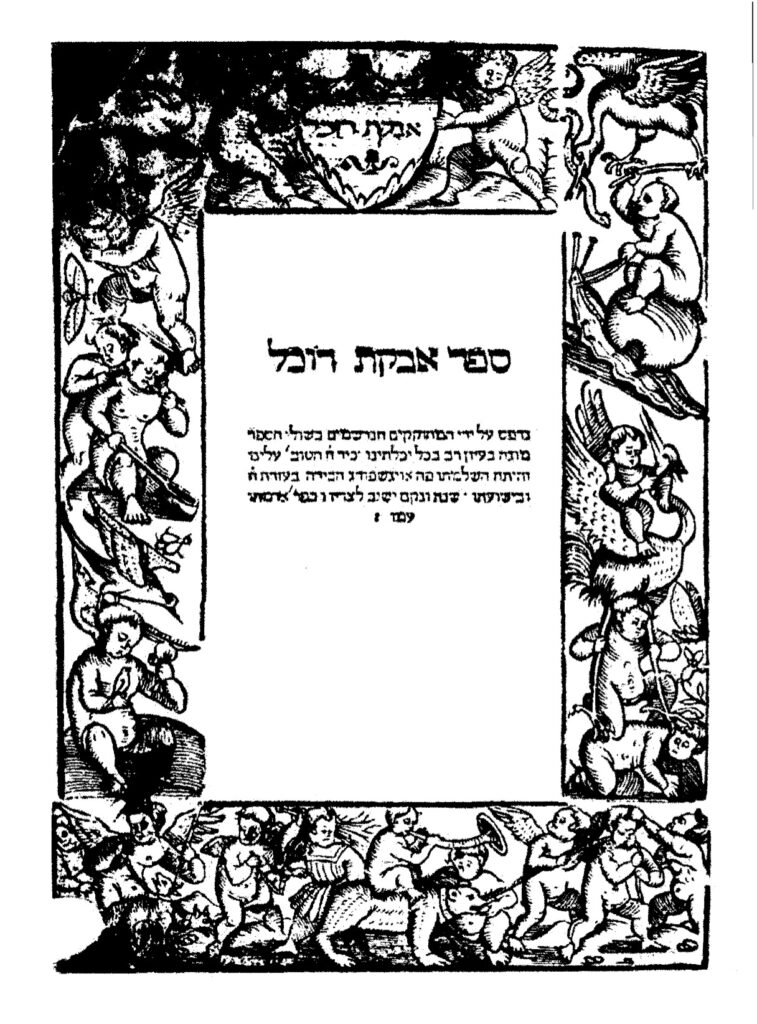
1540, Avkat Rokhel
Courtesy of the Dorot Jewish Division New York Public Library

The like title-pages of Avkat Rokhel and Unterricht Wie ain Christenmensch, the latter a non-Hebrew work printed approximately two decades earlier, reflect a relationship between Jewish and Christian printers, that is, Christian printers published Hebrew books in association with Jewish associates. The relationship between the printers was mutually beneficial. For the Christian publisher “the Hebrew books sector, being unique, was attractive to investors, being more limited and not so wildly competitive as the Italian book sector.”[16] In addition to the non-Jewish printer’s access to the Jewish book market, the Jewish publisher was able to not only publish Hebrew books, but he also gained access to the typographical material of his Christian associate. The latter, for example, frequently provided attractive frames to the former after having used them for his market and the Jewish partner also utilized the printer’s other ornamentation. This was of value to the Jewish partner as he did not have to go the expense of having decorative material prepared, at a relatively much greater expense as it would be utilized for a much smaller market. This despite the fact that the frames were often incompatible with traditional Jewish sensibilities.[17]

1521, Unterricht Wie ain Christenmensch [18]

The like title-pages of Avkat Rokhel and Unterricht Wie ain Christenmensch, the latter a non-Hebrew work printed approximately two decades earlier, reflect a relationship between Jewish and Christian printers, that is, Christian printers published Hebrew books in association with Jewish associates. The relationship between the printers was mutually beneficial. For the Christian publisher “the Hebrew books sector, being unique, was attractive to investors, being more limited and not so wildly competitive as the Italian book sector.”[19] In addition to the non-Jewish printer’s access to the Jewish book market, the Jewish publisher was able to not only publish Hebrew books, but he also gained access to the typographical material of his Christian associate. The latter, for example, frequently provided attractive frames to the former after having used them for his market and the Jewish partner also utilized the printer’s other ornamentation. This was of value to the Jewish partner as he did not have to go the expense of having decorative material prepared, at a relatively much greater expense as it would be utilized for a much smaller market. This despite the fact that the frames were often incompatible with traditional Jewish sensibilities.[20]

The title-page of Avkat Rokhel has the largest number of cherubim of our title-pages, nineteen in all, of our title-pages. The cherubim appear on the bottom, sides, and top of the frame, all active, albeit in different activities. The text of Avkat Rokhel is in three parts, each further subdivided. The first section addresses the struggle against one’s evil urge prior to redemption and the birth pangs and advent of the Messiah, and an explanation of the pertinent midrashim; the second part discusses the rewards and punishments of the soul after the resurrection, the nature of the world to come according to Judaism, in contrast to the views of non-Jews, and resurrection; and the third part the laws stated by the sages of the Talmud as halakhah Moshe me-Sinai, the formation of man and the number 248 limbs in a person, the statement of our sages concerning three partners in that process (God, man, and woman) and some gematriot.

This is the third edition of Avkat Rokhel, it having been printed previously in Constantinople (1516) and Rimini (1526). Ch. B. Friedberg records, in his Bet Eked Sepharim, more than twenty-five printed editions of Avkat Rokhel. It was translated into Latin by A. Hulsius and printed in his Theologia Judaica, (Breda, 1653) and a Yiddish edition was prepared by Naphtali Pappenheim (Amsterdam, 1647).[21]

1543, Melokhim Buch Two additional works printed in Augsburg, attributed to Moses (Esrim ve-Arbeh) Ashkenazi, are Yiddish poetical renditions of the books of Kings and Samuel. Moses’ appellation, Esrim ve-Arbeh (24), derives from either his birthplace, Vierundzwanzig Hoefe (24 courts) in Wuerttemberg, or from his extensive knowledge of the 24 books of the Bible. Moses’ accreditation with either authoring or transcribing the Melokhim Bukh is due to its similarity to the Shmuel Bukh, more reliably attributed to him. Nevertheless, sufficient differences exist between the two works that many scholars believe they do not share a common author. It is clear, however, that the author, even if not this Moses, was an Ashkenazi Jew. The Melokhim Bukh was published in quarto format (40: [123] ff.) by, according to the colophon, Paulus Aemilus. A Latin colophon states, Augustae Vindelicorum/ per Paulum Aemilium, Anno/ Domini M. D. XLIII. Meyer Waxman suggests that it is doubtful, the colophon notwithstanding, that the publisher was Aemilus; more likely it was Hayyim Shahor.

We have noted above that the frames on these title-pages were first used by Christian printers and that when that market no longer needed the frames, they were made available to Jewish printers. The cherubim frames noted above were generally acceptable to a contemporary renaissance Jewish public, although some, many, were questionable and would not be used today. In contrast, the title-page of the Melokhim Buch has a border made up of a four-part frame, the top with a representation of a king, the left and right sides respectively with images of Adam and Eve, unclad, the latter with the snake, two small children, and expecting. At the bottom are two cherubim. Use of this frame is surprising, for in contrast to other frames its’ contents appear to be objectionable, more so than other frames, even those with mythological characters. It seems likely that this frame might also be distasteful to Christian sensibilities.[22]

1543, Melokhim Buch
Courtesy of Dr. Moshe Rosenfeld

The title page states that it is “The book Melokhim (Kings) in Taytsher sprach, beautiful and clear and very entertaining to read. Printed in the imperial city of Augsburg in the year 303 (=1543)” [23] The colophon dates the completion of the work to Friday, 14 Av, 303 (July 25, 1543), which was a Sunday in 1543.

The Melokhim Bukh was not written as a sequel to the Shmuel Bukh. It is the older of the two books, originally written as a separate work, possibly as early as the fourteenth century. The format of the Melokhim Bukh, a rhymed paraphrase of the book of Kings, is that of the heroic epic, stylistically modeled after comparable German sagas, such as the Nibelungen. The subject matter is the events in Kings I and II, imaginatively and colorfully enhanced by material from the Talmud and Midrashim, all expressed with a deep piety. Intended as a complete history, it begins with a hymn of praise to God in three strophes followed by nine strophes from the Exodus to the last days of David, the contents of Kings, and as a sequel, the history of the Jews to the end of the second commonwealth in thirty strophes). An example of the text is,

You have frequently performed signs for the children of Israel;

Therefore they are obliged to have You for their Lord.

And to fear Your name-that is useful and good for them.

That man is foolish who acts contrary to Your word.[24]

1544, Shmuel Bukh The Shmuel Bukh was published, also likely by Hayyim Shahor in quarto format (Format 40: [102] ff.). It has an ornate title page made up of figurines above and about pillars with cherubim on the sides. It too is in Vaybertaytsh; among its reprints is a Latin edition (Ingolstadt,(1562). Waxman suggests that the Shmuel Bukh was likely written at least a hundred years earlier, most likely an original production of medieval Jewry. The author reworked the biblical material and incorporated aggadic elements. It was written in “vigorous poetic style” in eight line strophe and was meant to be sung.[25]

1544, Shmuel Bukh
Courtesy of Dr. Moshe Rosenfeld

In contrast to what was written above, “works that many scholars believe they do not share a common author,” Zinberg informs that both the Melokhim Bukh and the Shmuel Bukh are composed in the same verse-meter. Moreover, the title-page states that “Shmuel is the first part of

the book Melokhim, for it is all related.” Nevertheless, Zinberg quotes other sources that “these are two quite different works and were probably written by two different poets.”[26]

1553, Ma’yan GannimA composition book comprised of sample letters from R. Samuel ben Elhanan Jacob Archivolti (c. 1515-1611). Ma’yan Gannim was published in a small sextodecimo format (160: 45, [1] ff.) at the Venice press of Alvise Bragadin. The Bragadin press was active before the papal bull, dated August 22, 1553, by Cardinal Giovanni Pietro Caraffa, the future Pope Paul IV, an extreme reactionary and bitter anti‑Semite, who ordered the confiscation and burning of the Babylonian and Jerusalem Talmuds. This had a chilling effect on Hebrew printing and resulted in a considerable decline if not outright cessation of printing in Venice, and the subsequent expurgation and censorship of Hebrew books. When Hebrew printing resumed in Venice in 1563, among the Christian printers who took up the publication of Hebrew books was Alvise Bragadin. Bragadin died in the mid-1570’s, he was succeeded by his son, and after him by successive members of the family well into the eighteenth century, the last known Bragadin being Alvise III. Throughout that time the press remained a leading printer of Hebrew books in Venice.
1553, Ma’yan Gannim
Courtesy of the Library of Agudas Chassidei Chabad Ohel Yosef Yitzhak

Archivolti, a student of R. Meir Katzenellenbogen (Maharam, 1473-1565), served as rabbi, av bet din, and rosh yeshivah in Padua. Among his students was R. Judah Aryeh (Leon) Modena (1571-1648). Prior to settling in Padua in 1568, Archivolti worked as a corrector for the Hebrew presses in Venice.

In contrast to our preceeding examples of cherubim, this exemplar does not appear on the title-page of the book, which has the Bragadin device, that is, three crowns, but rather at the beginning of each of the book’s five chapters, a woodcut illustration comprised of three cherubim in a cage, surrounded on all four sides by a verse.

The title is from “A fountain of gardens (ma’yan gannim), [a well of living waters, and streams from Lebanon” (Song of Songs 4:15). The text states that there are fifty letters, that is, twenty-five letters with their responses, written by Archivolti. There is a preface and introduction from Archivolti, followed by a table of contents, and, beginning on 7a, the text. Ma’yan Gannim is the first book written by Archivolti, for he describes it as his first fruits, an offering to the Lord. Archivolti also wrote Degel Ahavah (Venice, 1551), an ethical work; He’arot le-Sefer he-Arukh (Venice, 1553), textual references for the Arukh of Nathan ben Jehiel; and, his most important title, Arugat ha-Bosem (Venice, 1602) a grammatical work in 32 chapters.

The sections or chapters, each on a different theme, are correspondence between a father and son; between friends; from an older to a younger man; with government officials; and others, including letters of a romantic, and even sensual nature. Such letters, at the very least inappropriate by modern religious standards, are intermingled with those of a sacred nature, reflecting contemporary mores and addressing current issues, including therefore, information of historical and cultural value. Ma’yan Gannim is designed to teach through example the rules of correspondence. The letters are in metrical form, designed by Archivolti as literary models, many with ethical content, for his students.[27]

1556, She’ilot u’Teshuvot Jacob ben Moses Moellin (Maharil) – Two hundred and five responsa from R. Jacob ben Moses Moellin (Maharil, c. 1360-1447). The She’ilot u’Teshuvot were published in Cremona at the press of Vincenzo Conti in octavo format (80: [7] 79 ff.). After the Talmud was burned in Venice in 1554 there was a precipitous decline, if not a complete cessation, in the number of Hebrew books printed in Venice for several years. The breach was filled by presses in Ferrara, Sabbioneta, Cremona, and Riva di Trento. Vincenzo Conti (d. 1569) printed briefly in Sabbioneta and subsequently in Cremona, where his press was active from 1556 to 1567, issuing more than forty titles.

Maharil was the leading halakhic authority of his time. His most important work is Sefer Maharil (Minhagei Maharil, 1556, Sabbioneta), a popular and influential work on customs and laws. It was composed by his pupil Eleazar ben Jacob (Zalman of St. Goar), from the discourses that he heard from Maharil. She’ilot u’Teshuvot is comprised of Two hundred and five responsa, a small part only of Maharil’s responsa. The subject matter, as in the Sefer Mahril, deals to a great extent with custom, but also includes much personal material. They also reflect Maharil’s considerable humility and compassion.
1556, She’ilot u’Teshuvot Jacob ben Moses Moellin (Maharil)
Courtesy of the Library of Agudas Chassidei Chabad Ohel Yosef Yitzhak

The title-page has an ornamental frame made up of four parts, enabling the printer to use them in other arrangements, although this is the manner in which the parts are most often employed. The top frame has the face of a man and cherubin; on the sides are suits of armor, shrubs, and musical instruments and, in the center of the left vertical frame the letters SPQR, reputedly standing for Senatus Populusque Romanus; and on the bottom a two headed crowned eagle and on the sides the cherubim. This frame was used by Conti on his early imprints, appearing on about ten works.

1558, Sefer Rav Alfas Sefer Rav Alfas, (Hilkhot Rav Alfas, Sefer ha-Halakhot of Alfasi, Rif) was published in Riva di Trento by R. Joseph Ottolenghi and Cardinal Cristoforo Madruzzo in a three volume folio format (20: 288, 268, 302 [8] ff.). The Tyrolese town of Riva di Trento is the source of an unusual episode in the history of the Hebrew book. It was for a short time, from 1558 to 1562, a refuge for the Hebrew book; one in which about forty Hebrew titles were printed. Believed to be the first work printed in Riva di Trento, Hilkhot Rav Alfas was likely selected, in addition to its inherent popularity and value, due to the ban on the Talmud, the Rif, being a halakhic compendium of the Talmud, filling, to some extent, the gap left by the scarcity of that work.

It was in Riva di Trento that Cardinal Cristoforo Madruzzo (1512-78), Cardinal of Trent, a scholar and supporter of learning, who argued at the Council of Trent (1562) for leniency and moderation in condemning books, became the patron and protector of a Hebrew press, which was also a source of revenue for him. Ottolenghi (d. 1570), originally of Ettlingen, in Baden, Germany, reflected in its Italianized form in his name, was rosh yeshivah at Cremona, and under his tutelage Talmudic studies had continued in Cremona after that work had been banned and burned elsewhere. He assisted the press, providing indices and annotations to a number of works and assuring that material offensive to the church had been deleted from those books of value to his yeshiva. and R. Jacob Marcaria, a dayyan on the bet din presided over by Ottolenghi and a physician, recruited by Madruzzo help finance and play a role in the press. Marcaria edited and wrote brief prefaces for most of the books printed in Riva di Trento. The press was located in the house of Antonio Broën.

Sefer Rav Alfas is a halakhic compendium by R. Isaac ben Jacob Alfasi (Rif, 1013-1103). Alfasi, born in the Algerian village of Qal’at Hammad, was a student of the great sages R. Nissim ben Jacob (c, 990-1062) and Hananel ben Hushi’el (d. c. 1055) in Kairouan. After learning with them Alfasi relocated to Fez, from where his surname al-Fasi (Rif) is derived, and became recognized as the leading Talmudic sage of the time. In 1088, at the age of 75, two informers denounced him to the government – the charges are unknown – and he was forced to flee to Spain. Eventually settling in Lucena, Alfasi succeeded R. Isaac ben Judah ibn Ghayyat (c. 1020-89), who had died a few months earlier, as head of the yeshiva.
1558, Sefer Rav Alfas
Courtesy of the National Library of Israel

The text of the title-page of each volume has cherubim at the sides, and below bears the Cardinal’s coat‑of‑arms , a significant statement of the Cardinals’ support and protection of the press at a time when his church was burning and banning Hebrew books. Furthermore, the title pages informs that Sefer Rav Alfas was edited with great care by the gaon R. Joseph Ottolenghi and was printed and financed by him, and that this was done, “in the dominion of” the following in bold letters “Cardinal Cristoforo Madruzzo.”

Sefer Rav Alfas, Alfasi’s major work, is one of the greatest works in halakhic literature. It is extracts all pertinent legal decisions from the Talmud, eliminating non-halakhic material, discussions, and subject matter not applicable today. It covers the following orders of the Talmud, Mo’ed, Nashim, and Nezikim, as well as tractates Berakhot and Hullin. Laws in Kodashim and Tohorot, such as mezuzah and tefillin, are organized as Halakhot Ketannot. Sefer Rav Alfas differs from earlier works, such as Halakhot Gedolot, in that it is more comprehensive, more detailed, and by the inclusion of material from the geonim, although, like them, it follows the order of the tractates.

1559-60, ZoharClassic kabbalistic work of Jewish mysticism, attributed to R. Simeon bar Yohai (second century). This, the second printing of the Zohar, it was published previously in Mantua (1558-60), published in Cremona at the press of Vincenzo Conti in a three volume folio format (20: 132, 122, 146 ff.) by Vincenzo Conti (d. 1569). Conti, who had printed briefly in Sabbioneta, is better known for his activity in Cremona, where his press, active from 1556 to 1567, issued more than forty titles.

The title page of has a decorative architectural frame with an arch, at the top a vignette of Akedat Yizhak (the binding of Isaac), surmounted by an eagle, and accompanying cherubim; below in the bottom squares, figurines, perchance also cherubim. It is dated, “For the Lord will not forsake כי לא יטש (319=1559) his people [for his great name’s sake] (Samuel I 12:22), and it was completed in the year ש”ך ([5]320=1560).” At the bottom of the page is an imprimature from the Inquisition on the title page, the sole Cremona imprint to place it there, as well as a longer permission at the end of the book.
1559-60, Zohar
Courtesy of the Library of the Jewish theological Seminary

Written in Aramaic and Hebrew, Sefer ha-Zohar al ha-Torah is a comprehensive system of kabbalistic theosophy, encompassing cosmology, the soul, and good and evil. It is an esoteric commentary on the Torah, with homilies, midrashic passages, parables, and numerous discursive passages. It is based on the concept that within scriptures is a concealed stratum, deciphered by Kabbalah, expressing the inner meaning of the Torah, with its “splendor, beauty, and greatness.”

The corrector (and expurgator) was the apostate Vittorio Eliano, grandson of the foremost grammarian, Elijah Bahur Ashkenazi Segal. A member of a Dominican commission to review Hebrew books, Eliano was associated with all the books published by Conti from 1558 through 1559. Although begun later than the Mantua edition, noted above, this printing, done in haste, was completed earlier. Nevertheless, it was not immediately released for sale, for when more than 10,000 Hebrew books were burned in Cremona, with the complicity of Eliano, the entire edition was seized. It was just barely saved, in contrast to other works, by the apostate Dominican, Sixtus of Siena. It is known as the Zohar Gadol (large Zohar), in contrast to the smaller Mantua edition (Zohar Katan), and is also referred to, because of Eliano’s involvement, as the “Christian edition.” This notwithstanding, the Cremona edition was the preferred of the two editions by eastern European kabbalists.[28]

1560, Shir ha-Yihud – Shir ha-Yihud (Hymn of Divine Unity) an anonymous piyyut (liturgical poem) written in the mid-twelfth century, most often attributed to Samuel ben Kalonymus he-Hasid (c. 1130-1175), less often to his son, Judah ben Samuel he-Hasid (c. 1150-1217), author of the Sefer Hasidim, both among the foremost representatives of the Hasidei Ashkenaz, and, on occasion, to yet others.
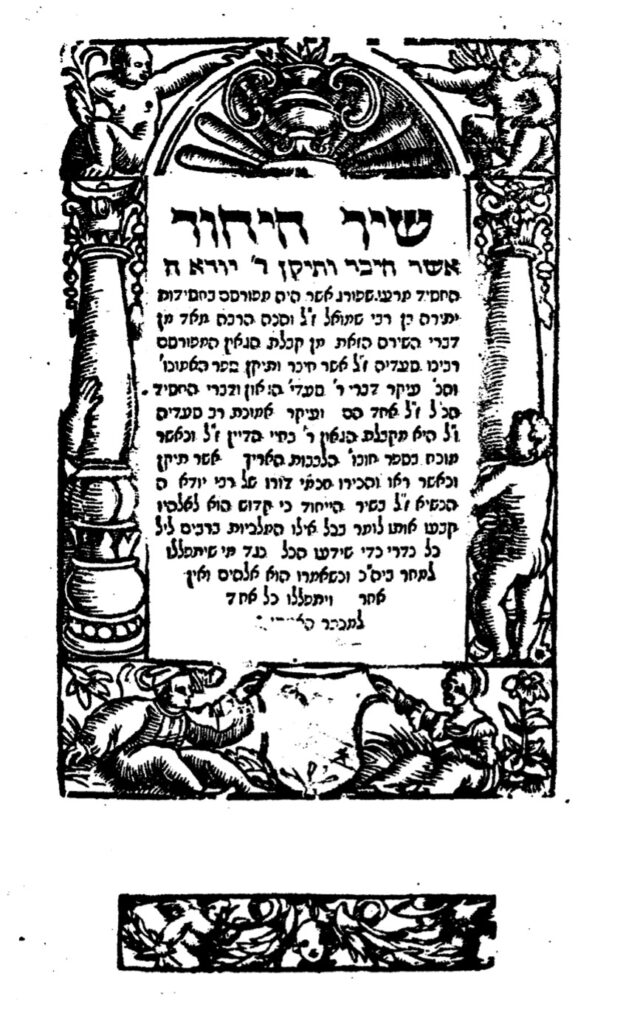
Shir ha-Yihud
Courtesy of the National Library of Israel

Shir ha-Yihud was published at the press of Eliezer and Joseph ben Naphtali Hertz Treves. Active for one year only, in 1560, they issued six books, before being forced to close by a meeting of the leaders, both Protestant and Catholic, of the Swiss Confederation in June, 1560, who feared that they were about to print the Talmud.

The frame, one of several with cherubim employed by the press, also was used on the title-page of Begidat Hazman, an allegoric maqāma (a poetic narrative in rhymed prose) by Mattathias (Mattityah ben Moses), a 15th century Spanish or Provençal Hebrew poet or Mattathias ha-Yiẓhari, a representative of the Jewish communities of Aragon at the Tortosa disputation (1413–14).

1568, Passover Haggadah Passover Haggadah printed in Mantua in folio format (20: 36 ff.) by Joseph Shalit ben Jacob Ashkenazi of Padua. This edition is a reprint of the 1560 Passover Haggadah, also printed in Mantua, but with modifications and the addition of the marginalia of R. Joseph Shalit ben Jacob Ashkenazi of Padua entitled Nimukei Yosef.
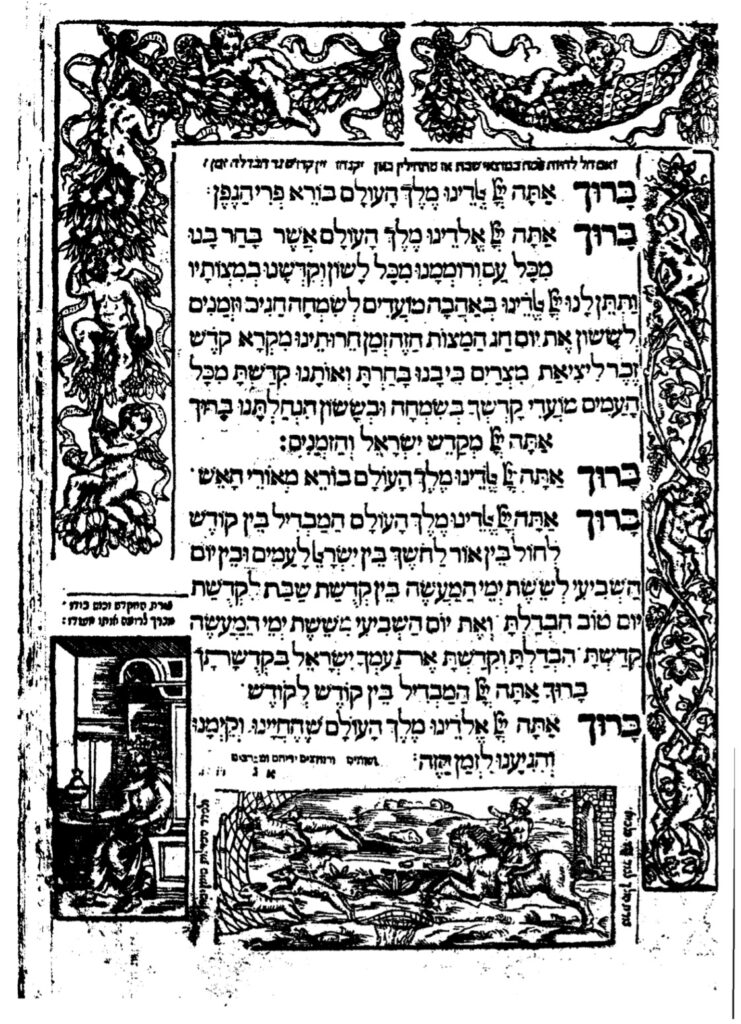
1568, Passover Haggadah
Courtesy of the National Library of Israel

The title page frame has representations of the Mars and Minerva followed by the first text page, which has two woodcuts of cherubim along the top. Following text pages have those cherubim image, as well as numerous other cherubim images, including several marginal cherubim images. This Haggadah shares some features with the Prague Haggadah of 1526. Woodcuts are accompanied by captions, given as rhymed couplets, a feature of Ashkenaz manuscript Haggadot. In some instances, for example, by the four questions, the earlier edition was framed by a lush Italian border, without illustrations. Here the types and the top and upper left borders with their vines and cherubs only are alike.[29]


1576, Yosef LekahYosef Lekah is a commentary on Megillat Esther by R. Eliezer ben Elijah Ashkenazi (1513-86). It was published in Cremona in 1576 by Christopher Draconi in octavo format (40: 83, 1 ff.). Draconi, previously associated with Vincenzo Conti, attempted to publish Hebrew books in Cremona. Although he would issue Latin books from 1569 to 1614, he printed one Hebrew book only, Yosef Lekah.
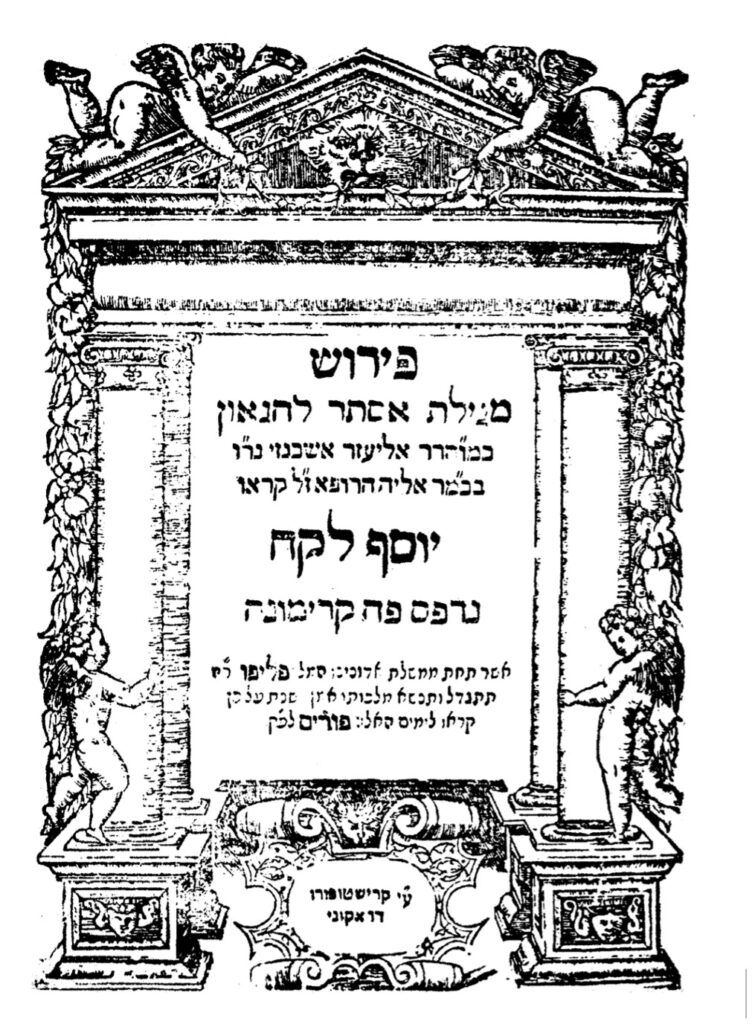
1576, Yosef Lekah
Courtesy of the Fales Library and Special Collections, New York University

R. Eliezer ben Elijah Ashkenazi was a multi-faceted individual, a Talmudist, physician, and well-rounded scholar, who served as rabbi in a number of varied communities. His first rabbinic position, from 1538-61, was in Fostat, Egypt. Forced to leave Fostat, Ashkenazi went to Famagusta, Cyprus, where he was rabbi for two years, and then to Venice. He left for Prague (1561), after a dispute with the Maharam of Padua, and after traveling as far as the Crimea, returned, via Famagusta, to Venice. Ashkenazi was next rabbi in Cremona, where he published Yosef Lekah. Shortly after he left to be rabbi of Posen, and, from 1584, was in Cracow. Ashkenazi experienced difficulties in Poland, disputing over his right to open a yeshiva in close proximity to an existing yeshiva, so that Joseph Solomon Delmedigo (1591-1655) wrote about him, “You have brought a vine from Egypt; you have cast out the nations, and planted it” (Psalms 80:9). Ashkenazi was highly regarded by his contemporaries, corresponding with prominent rabbinic figures such as R. Joseph Caro, R. Joseph Ha-Kohen (Katz), R. Moses Isserles (Rema), and R. Solomon Luria (Maharshal), several mentioning him in their responsa. R. Elijah of Pesaro, in Famagusta in 1563, praised Ashkenazi’s scholarship, noting that he was fluent in twelve languages.

The title-page has four cherubim images, two reclining at the top of the structure, two standing erect by the pillars at the sides. The title-page is dated “Therefore they called these days Purim קראו לימים האלו פורים (336 = 1576)” (Esther 9:26). Yosef Lekah is dedicated to Don Joseph Nasi, Duke of Naxos, whom Ashkenazi, in the introduction, compares to Joseph in Mizraim and Mordecai at the time of Ahasuerus. Ashkenazi, therefore, entitled this work Yosef Lekah. Two, almost identical, editions of Yosef Lekah exist, both dated 1576. Although almost exact copies of the original, it is clear, upon close examination, that the book was reset. Christopher Draconi’s Yosef Lekah was the last Hebrew book printed in Cremona.

Ashkenazi’s most important work is Ma’aseh HaShem (Venice, 1583), on the historical occurrences in the Torah, with a commentary on the Passover Haggadah; selichot; and, not extant today, a super-commentary on the Ramban (Nachmanides) and annotations to R. Caro’s Beit Yosef.[30]

Conclusion – In this article we have described books printed in Augsburg, Basle, Cremona, Mantua, Prague, and Venice. The cherubim imagery on these title-pages, reflecting the influence of Renaissance humanism, their attractiveness notwithstanding, do not appear on the title-pages or accompanying the text in Hebrew books published in more modern times. A review of the title-pages reproduced here, all dissimilar, with their numerous depictions of cherubim, attest to the popularity of that image. Given the strictures on Hebrew printing from the mid-sixteenth century in Italy, the frequent use of cherubim testify to the cooperation of Jewish and non-Jewish printers, their frequency perchance suggesting a positive relationship going beyond mere monetary gain.

We conclude with the Talmudic statement above, which suggests why the image of cherubim was so popular:

Rav Ketina said: When the Jewish people would ascend for one of the pilgrimage festivals, the priests would roll up the curtain for them and show them the cherubs, which were clinging to one another, and say to them: See how you are beloved before God, like the love of a male and female. (Yoma 54a)

Lastly, in conclusion an image of a cherub, both chronologically and, in cherubian activity, quite different from those depicted in this article. It is included as it is unusual and eye catching, an image of a Cherub smoking a pipe. It appears in in at least two Basle imprints published by Israel ben Moses ben Abraham Halle, active in Offenbach, although not continuously, from 1718/19 to c. 1738/43. The works are Anaf Etz Avot, R. Benjamin ben Yekutiel Wulff’s commentary on Pirke Avot, and tractate Sanhedrin (1721).[31]

  1. Once again, I would like to express my gratitude and appreciation to Eli Genauer for reading the article and his insightful comments.
  2. Emil G. Hirsch, W. Muss-Arnolt, J. Frederic McCurdy, Louis Ginzberg, “Cherub ( ; plural, Cherubim)” Jewish Encyclopedia IV (New York, 1901-06), pp. 13-16; Shalom M. Paul, Louis Isaac Rabinowitz, “Cherub” Encyclopedia Judaica IV (Jerusalem, 2007), pp. 600-01.
  3. Thomas Kelly Cheyne, 1911 Encyclopædia Britannica, Volume 6, reproduced in https://en.wikisource.org/wiki/1911_Encyclop%C3%A6dia_Britannica/Cherubim
  4. https://www.sefaria.org/search?q=%D7%9B%D7%A8%D7%95%D7%91%D7%99%D7%9D&tab=text&tvar=1&tsort=relevance&svar=1&ssort=relevance.
  5. Franz Sales Meyer, Handbook of Ornament: a Grammar of Art, Industrial and Architectural Designing in all its Branches for Practical as well as Theoretical use (New York, 1957), pp. 108-09.
  6. Codices and early imprints did not have title-pages, the first leaf normally being left blank to protect the book, that page later becoming a dedicated page. The first book with a detailed title-page was the Calendarium of Johannes Regiomontanus, appearing in 1476 (Venice), being a fifty-five year calendar (1475-1530), printed by Johannes Regiomontanus. The first Hebrew book with a title-page was the Sefer ha‑Roke’ah (Fano, 1505) of R. Eleazar ben Judah of Worms (c. 1165 – c. 1230).
  7. Cherubim also appear on the frames of Hebrew books printed in the incunabular period. For examples of such frames see Marvin J. Heller “Behold, you are beautiful, my love: The Use of Ornamental Frames in Hebrew Incunabula” Printing History NS 10 (New York, July, 2011), pp. 39-55, reprinted in Further Studies in the Making of the Early Hebrew Book (Leiden/Boston, 2013), pp. 3-33.
  8. The following book descriptions are selected, modified from Marvin J. Heller, The Sixteenth Century Hebrew Book: An Abridged Thesaurus ( Brill, Leiden, 2004), var. cit.
  9. Avraham Yaari, Hebrew Printers’ Marks (Jerusalem, 1943), pp. 7 and 126-27 n. 10 [Hebrew].
  10. Jerome Friedman, The Most Ancient Testimony. Sixteenth-Century Christian-Hebraica in the Age of Renaissance Nostalgia (Athens, Ohio, 1983), pp. 44-48, 214-15; A. M. Habermann, Title Pages of Hebrew Books (Tel Aviv, 1969), p. xi [Hebrew with English introduction], pp. 19-20, 125-26 nos. 4-5; Joseph Prijs, Die Basler Hebräischen Drucke (1492-1866) (Olten, 1964), pp. 49-51 n. 26; Frank Rosenthal, “The Rise of Christian Hebraism in the Sixteenth Century,” Historia Judaica II (New York, 1945), (New York, 1945), pp. 182-91; and Richard S.Westfall, “Sebastian Muenster,” http://es.rice.edu/ES/humsoc/Galileo/Catalog/Files/muenster.html
  11. An interesting example of this later usage is R. Moses ben Hanokh Altschul’s (c. 1546–1633) Brant Shpigl, a popular Yiddish work on ethics, correct demeanor, and customs for women, published by Konrad Waldkirch (Basle, 1602), also indicative of the passage of typographic material between printers.
  12. Stephen G. Burnett, “German Jewish Printing in the Reformation Era (1530-1633),” University of Nebraska – LincolnUniversity of Nebraska – Lincoln DigitalCommons@University of Nebraska – LincolnDigitalCommons@University of Nebraska.
  13. Ch. B. Friedberg, History of Hebrew Typography of the following Cities in Central Europe: Altona, Augsberg, Berlin, Cologne, Frankfort M., Frankfort O., Fürth, Hamberg, Hanau, Heddernheim, Homberg, Ichenhausen, Neuwied, Wandsbeck, and Wilhermsdorf. Offenbach, Prague, Sulzbach, Thannhausen from its beginning in the year 1513 (Antwerp, 1935), pp. 29-31 [Hebrew].
  14. A. M. Habermann, “The Printer Hayyim Shahor, his Son Isaac and Son-in-law Joseph Yakar,” in Studies in the History of Hebrew Printers and Books (Jerusalem, 1978), pp. 103-07 [Hebrew].
  15. Yeshayahu Vinograd, Thesaurus of the Hebrew Book. place, and year printed, name of printer, number of pages and format, with annotations and bibliographical references II (Jerusalem, 1993-95), p. 2 no. 10 [Hebrew].
  16. Zipora Baruchson, “Money and Culture: Financing Methods in the Hebrew Printing Shops in Cinquecento Italy,” La Bibliofilia 92 (1990), 25.
  17. For examples of such usage see Marvin J. Heller, “Behold, you are beautiful, my love: The Use of Ornamental Frames in Hebrew Incunabula” Printing History NS 10 (New York, July, 2011), pp. 39-55, reprinted in Further Studies in the Making of the Early Hebrew Book. (Brill, Leiden/Boston, 2013), pp. 3-33; “Mars and Minerva on the Hebrew Title Page,” The Papers of the Bibliographical Society of America 98:3 (New York, N. Y., 2004), pp. 269-92, reprinted in Studies in the Making of the Early Hebrew Book (Brill, Leiden/Boston, 2008), pp. 1-17; and the “The Printer’s Mark of Marc Antonio Giustiniani and the Printing Houses that Utilized It,’ Library Quarterly, 71:3 (Chicago, July, 2001), pp. 383-89, reprinted in Studies, pp. 44-53.
  18. Unterricht Wie ain Christenmensch by Urbanus Rhegiosu (1489-1541), a Protestant Reformer active in Northern and Southern Germany promoting Lutheran unity in the Holy Roman Empire. Unterricht is one of several titles with this frame printed by Silvan Otmar of Augsburg (https://www.flickr.com/photos/58558794@N07/6576279085).
  19. Zipora Baruchson, “Money and Culture: Financing Methods in the Hebrew Printing Shops in Cinquecento Italy,” La Bibliofilia 92 (1990), 25.
  20. For examples of such usage see Marvin J. Heller, “Behold, you are beautiful, my love: The Use of Ornamental Frames in Hebrew Incunabula” Printing History NS 10 (New York, July, 2011), pp. 39-55, reprinted in Further Studies in the Making of the Early Hebrew Book. (Brill, Leiden/Boston, 2013), pp. 3-33; “Mars and Minerva on the Hebrew Title Page,” The Papers of the Bibliographical Society of America 98:3 (New York, N. Y., 2004), pp. 269-92, reprinted in Studies in the Making of the Early Hebrew Book (Brill, Leiden/Boston, 2008), pp. 1-17; and the “The Printer’s Mark of Marc Antonio Giustiniani and the Printing Houses that Utilized It,’ Library Quarterly, 71:3 (Chicago, July, 2001), pp. 383-89, reprinted in Studies, pp. 44-53.
  21. Ch. B. Friedberg, Bet Eked Sepharim, (Israel, n. d), alef 286 [Hebrew].
  22. A later example of an objectionable title-page is the responsa of R. Joel ben Samuel Sirkes’ (Bach, 1561-1640), She’elot u-Teshuvot Bayit Hadash, printed in Frankfurt am Main (1697) by Johann Wust. The title-page had an ornate frame with forms of unclad women which aroused rabbinic opposition, for those authorities considered the title-page inappropriate and offensive to Jewish sensibilities. The quire had to be reprinted with a new title-page, now with two cherubim holding a floral wreath with grapes. A similar situation occurred earlier in Hanau in 1630. Sefer ha-Roke’ah, by R. Eleazer of Worms, was issued in a small format, 12×16 cm., due to the economic restrictions resulting from the Swedish War. On the title-page “Venus rises naked from the waters on a seashell – a common pagan motif” (The book was issued by a press belonging to a non-Jew, Hans Jacob Hena, so that, it has been suggested, no attention was initially given to the title-page. When the book was sold, “many Jewish purchasers tore out the offending page” (Raphael Posner and Israel Ta-Shema, ed. The Hebrew Book: An Historical Survey [Jerusalem: Keter Publishing House, 1975]). There does not appear to have been any opposition to this last title-page in Venice, for the Venus rising from the waters motif appears in Hebrew works printed there, where it was the press mark of Alessandro Gardoni (Venice, 1577-78) and can be found in the Mishneh Torah printed by Meir Parenzo at the press of Alvise Bragadin in 1574.
  23. Taytsher sprach (Vaybertaytsh), is a type generally but not exclusively reserved for Yiddish books, so named because these works were most often read by the less educated and women. Concerning the early use of Vaybertaytsh see Herbert C. Zafren, “Variety in the Typography of Yiddish: 1535-1635,” Hebrew Union College Annual LIII (Cincinnati, 1982), pp. 137-63.
  24. Israel Zinberg, A History of Jewish Literature, translated and edited by Bernard Martin VII (Cleveland, 1973), p. 116.
  25. Meyer Waxman, A History of Jewish Literature (1933, reprint Cranbury, 1960), II pp. 632-33.
  26. Zinberg, p. 106.
  27. Robert Bonfil, Jewish Life in Renaissance Italy (Berkeley, 1994), tr. Anthony Oldcorn, pp. 133, 169; Deror Schwartz, “Samuel Archivolti, his Life and Writings,” Asufot VII, ed. Meir Benayahu (Jerusalem, 1993), pp. 82-83 [Hebrew]; and Zinberg, II p. 130.
  28. Amram, pp. 324-27; Robert Bonfil, “Change in the Cultural Patterns of a Jewish Society in Crisis: Italian Jewry at the Close of the Sixteenth Century,” in Essential Papers on Jewish Culture in Renaissance and Baroque Italy, ed. David B. Ruderman (New York, 1992), p. 418; Rachel Elior, “Messianic Expectations and Spiritualization of Religious Life in the Sixteenth Century,” in Essential Papers . . ., p. 286.
  29. Yaari, Printers’ Marks, pp. 12, 132 n. 19; Yosef Hayim Yerushalmi, Haggadah and History (Philadelphia, 1975), nos. 28-31; and Isaac Yudlov, The Haggadah Thesaurus. Bibliography of Passover Haggadot: From the Beginning of Printing until 1960 (Jerusalem, 1997). p. 4 n. 25 [Hebrew].
  30. David Amram, The Makers of Hebrew Books in Italy (Philadelphia, 1909, reprint London, 1963), p. 319; Meir Benayahu, Hebrew Printing at Cremona: Its History and Bibliography (Jerusalem, 1971), pp. 22-24, 232-34; and Jacob Elbaum, Openness and Insularity. Late Sixteenth Century Jewish Literature in Poland and Ashkenaz (Jerusalem, 1990), p. 47, [Hebrew].
  31. This image appeared in my article “Offenbach Revisited: An enigma Reexamined,” published in the Gutenberg-Jahrbuch (Mainz, 2012), pp. 219-28, and reprinted in Essays on the Making of the Early Hebrew Book (Brill, Leiden/Boston, 2021) pp. 273-92. It was noted there that “in his observations to a draft of this paper, Professor Dr. Hans Schneider observes that he has never seen ‘a cherub smoking a pipe’ and suggests that if the figure is an angel the instrument is a flute. He agrees, however, that the object in question does look like a clay pipe as in the self-portrait of Gerrit Dou. Professor Dr. Schneider suggests that the figure might be an oriental man or boy, as was often painted in the seventeenth and eighteenth century, wearing a turban-like cap with plumes, and that what appears to be an angel’s wings might be a fluttering cape. The reader may draw his or her own conclusions.”