From Print to Pixel: Digital Editions of the Talmud Bavli

From Print to Pixel: Digital Editions of the Talmud Bavli

Ezra Brand

Ezra Brand is an independent researcher who resides in Tel Aviv. He has an MA from Revel Graduate School at Yeshiva University in Medieval Jewish History, and has studied in the Talmud Department of Bar-Ilan University. He has contributed a number of times previously to the Seforim Blog (tag), and a selection of his research can be found at his Substack blog. His most recent major work is a “Guide to Online Resources for Scholarly Jewish Study and Research”. He is currently working on an overview of names and naming in early Jewish literature. He can be reached at ezrabrand@gmail.com; any and all feedback is greatly appreciated.

Intro – the tzurat hadaf[1]

It is a surprising fact that despite incredible advancements in technology, the layout of the Talmud has remained the same for centuries. The Bomberg edition from the 16th century, a groundbreaking achievement, still sets the standard. Yoel Finkelman writes in his recent, impressive overview of the layout of the printed Talmudic page:[2] “What is remarkable about the Gemara’s mise-en-page (the term for tzurat ha-daf in the academy) is not its invention, but its staying power as the normative way to produce texts of the Talmud.”[3] Finkelman then delves into the “history of the tzurat ha-daf of the Gemara.”

For an illustration of the lengths to which traditional publishers have gone to preserve the traditional tzurat hadaf, even in the 21st century, see Elli Fischer and Shai Secunda’s 2012 review article of the then-just-released “Artscroll Digital Library Schottenstein Talmud (English) App”, for the iPad:[4]

Since this elucidation is significantly longer than (and, in fact, already includes the actual text of) the Hebrew/Aramaic original, each Vilna page ends up being reproduced two to five times for every English page (a grey bar shows the reader which segment of the Vilna corresponds to the facing elucidation). This decision, both brilliant and perverse, added well over 10,000 pages, bringing the entire series to 73 volumes. The perversity of adding 10,000 apparently superfluous pages is obvious, but the brilliance of the decision was that it always kept the “original” page before the reader.

The digital daf

At the outset, Finkelman (in the above-mentioned article) highlights that the material manifestation of the written word can be broadly attributed to three factors: 1) The technological and material resources that are utilized to create and disseminate texts, 2) The economic and market forces that influence the demand for knowledge and education, and 3) The cultural perceptions of the role and function of language.[5] The ongoing decline in printing costs during the 20th and 21st centuries, coupled with the increasing accessibility of education, have led to significant advancements in all these factors.[6]

The advent of the internet has opened up entirely new avenues for publishing and designing the daf. Furthermore, for the very first time, readers have the opportunity to customize their reading experience, tailoring it to their unique preferences.

One popular author writes:[7]

“After more than a thousand years as the world’s most important form of written record, the book as we know it faces an unknown future. Just as paper superseded parchment, movable type put scribes out of a job, and the codex, or paged book, overtook the papyrus scroll, so computers and electronic books threaten the very existence of the physical book.”

However, one could plausibly say that the claim of the death of books has been greatly exaggerated. Physical books continue to be highly popular, and their sale has only continued to grow. And Orthodox Jews have yet an additional incentive to continue to buy physical books, as they can’t use ebooks on Shabbat and Chag. Regardless, there’s no question that we are in the middle of a decades-long revolution in how we have the ability to consume text, if one so chooses.

Despite the vast technological advancements that have revolutionized publishing, the digital daf is a peculiar return to pre-printing press methods in at least one regard: nowadays, the Talmud can be studied in isolation, without the surrounding commentaries. Most of the layouts that will be examined below diverge from the traditional tzurat hadaf that has been preserved for more than four centuries. In this way, they resemble the medieval Talmudic manuscripts, which include only the Talmud itself (sometimes accompanied by Rashi’s commentary).[8]

Let’s turn our attention to another aspect that Finkelman highlights: the groundbreaking nature of implementing a universal pagination system. Bomberg himself astutely utilized pagination and indexing as a key selling point.[9] Similarly, one of the numerous revolutionary features of digital editions such as Sefaria and Al-HaTorah is the capacity to reference not only the daf and amud, but also the section number. (I’ll explain the specific details of this later in this piece.) One can cite using section number, and hyperlink directly to that section. Every amud has around 10-15 sections, so this narrowing down is considerable. Even without reference to a specific section, checking a reference is far easier in a digital edition: with a simple “control + f”, one can search for a word from the quote. Gone are the frustrating days of scanning a giant wall of text in an amud to find a quote.

What will be discussed in this review

My focus here will be on modern editions that are available open-access digitally, online.[10] Therefore, I won’t review modern print editions.[11] I will also not review digital editions that, in my opinion, are inferior in every way to the editions discussed here.[12] And I won’t discuss editions targeted towards beginner students.[13]

As one of the resources exclusively pertains to Kiddushin (Katz’s Mahberot Menahmiyot), my sample will be from Tractate Kiddushin, specifically Kid. 2b, which solely features the Gemara without the Mishnah. Images will only be of Gemara, Rashi, and Tosafot, meaning that, I will exclude the surrounding glosses (Mesoret HaShas, etc). I will not be discussing supplementary texts and commentaries, and hyperlinks to outside sources that each has.[14] I will be discussing different customization and viewing options.

Another caveat: This piece is focused on layout, and so it will not discuss the textual accuracy of the editions.[15]

An interesting element of modern editions is the typography; specifically the choices of font. However, this will not be discussed here.[16]

Outline

Intro – the tzurat hadaf 1
The digital daf 2
What will be discussed in this review 4
Outline 5
Tzurat hadaf AND customizable 6
Mercava 6
Shitufta 7
Static PDF 9
Mahberot Menahmiyot (=MM) 9
Gemara Sedura HaMeir 10
Talmud HaIgud – Society for the Interpretation of the Talmud (האיגוד לפרשנות התלמוד) 12
Digital, not customizable 14
Wikisource 14
Pirkei Talmud Me’utzavim – R’ Dan Be’eri 15
Talmud Or Meir 18
Dicta 19
Digital and customizable 20
Sefaria 20
Al-Hatorah 22
Speculation on the future 24
Concluding Thought 27

Tzurat hadaf AND customizable

Mercava

At present, Mercava contains only Tractate Berachot. It includes a menu option that enables users to toggle punctuation and nikud. It is also worth noting that Mercava is presently in beta version, as stated explicitly by the page header. Many of the menu options are grayed out or non-functional, resulting in a suboptimal user experience. Often, it seems that two features cannot be employed simultaneously, without any discernible explanation.

Shitufta

Quite basic. It has section splits, which are the same as those of Sefaria and Al-Hatorah.[17] Like them, it enables linking to a specific section. However, it diverges from the section numbering in Sefaria and Al-Hatorah by commencing from 0 instead of 1, resulting in all section numbers in Shitufta being one less from those of Sefaria and Al-Hatorah.

Static PDF

Mahberot Menahmiyot (=MM)[18]

By Prof. Menachem Katz.

Image of Talmud text, from p. 3, line # 7:

MM is a static PDF. It divides every sentence into a separate line, as opposed to splitting into larger blocks of sections. The lines are numbered. It offers complete punctuation, without nikud.[19] MM displays citations for biblical verses, Mishnah, and Tosefta, as well as additional features discussed in the introduction.

Gemara Sedura HaMeir [20]

With punctuation, and split by line.

Talmud HaIgud – Society for the Interpretation of the Talmud (האיגוד לפרשנות התלמוד) [21]

The text is split into lines and numbered, similar to MM. Due to the nature of the work, the primary purpose of the Talmudic text in the Talmud HaIgud is not for its own sake, but to serve as a basis for subsequent commentary.

Digital, not customizable

Wikisource[22]

The crowd-sourced Wikisource is a sister-project of Wikipedia. It is replete with hyperlinks to primary sources, and to external secondary sources. Like MM, the text contains punctuation but not nikud. Instead of using numbered sections (like Sefaria and Al-Hatorah) or lines (like MM), the text is divided into unnumbered paragraphs. Moreover, these paragraphs are longer than those found in Sefaria and Al-Hatorah.

Pirkei Talmud Me’utzavim – R’ Dan Be’eri[23] [24]

Available as downloaded Word docs, from the Da’at website, for a few chapters. I consider this to be not customizable.[25] Has nikud, punctuation, and is split into numbered lines.

Talmud Or Meir

Has nikud, punctuation, and is split into numbered lines. While there are technically some customization options available, they are limited in scope.[26]

Dicta

Dicta has a suite of powerful tools, which combined could make for an incredible studying experience. These include automated tools for nikud and for Biblical sources.[27] Unfortunately, at this time it appears that the only way to view a passage of Talmud is via search results. There, a link is offered to the page in Sefaria. There is a section called Library, with powerful tools for reading rabbinic works, but only 300 works are currently offered there.[28]

Here’s a screenshot, of what appears after searching the first words of Kidushin 2b (“אי נמי שדות בכסף יקנו”), opening the first result, and scrolling to 2b:

Digital and customizable

Sefaria[29]
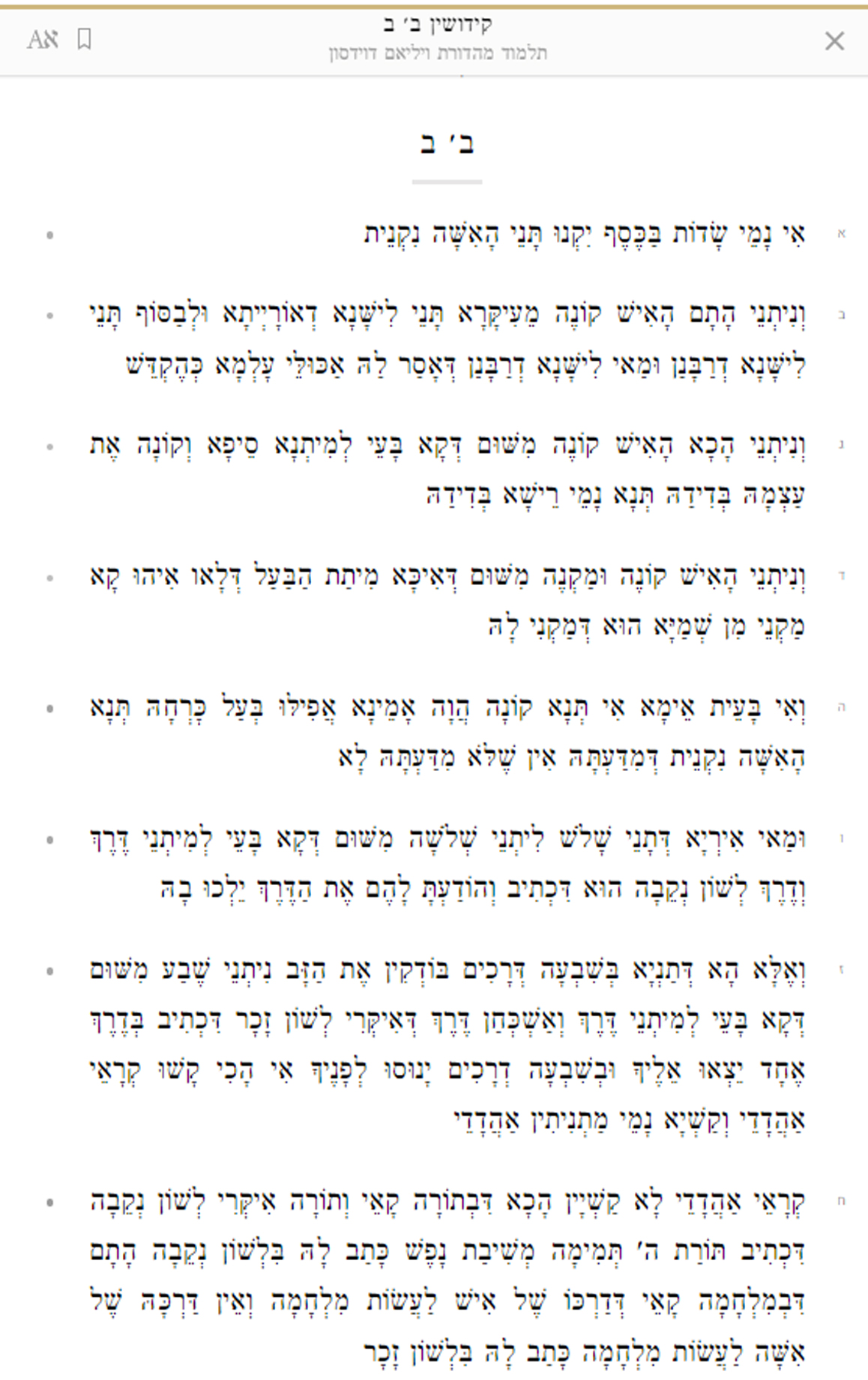
Image of customization options:

Splits into numbered sections. In our example, there are 15 sections. The default Hebrew doesn’t split these into paragraphs, but there is an option to split into paragraphs. Many tractates have nikud, some have punctuation. Our example page doesn’t have punctuation, even though it shows that option. Sefaria gives the option to remove nikud. As mentioned, as with Shitufta and Al-Hatorah, one can hyperlink to a specific section.

Al-Hatorah[30]

The section numbers in circles on the right side of the page are hyperlinked, which is a convenient feature. In the example page we are looking at, there is no nikud, unlike Sefaria. However, there is a period after each section, which provides a slight advantage over Sefaria‘s lack of punctuation, as it helps to break up the passages when viewing with no section breaks.

While Al-Hatorah also includes hyperlinked sections, it does not explicitly label which section is which, unlike Sefaria. Therefore, finding a specific section requires trial and error. As with Shitufta and Sefaria, it is possible to hyperlink to a particular section in Al-Hatorah.

One notable difference is that Al-Hatorah does not expand acronyms, as Sefaria does. For instance, מט is not expanded to מאי טעמא, and אבא is not expanded to איבעית אימא.

Speculation on the future

Secunda and Fischer, in the faraway land of 2012 (cited at the beginning of this piece), envision a future Talmud app:

“First of all, it would be a virtually borderless intertextual web. Talmudic passages that shed light upon one another would be linked in intricate overlapping networks. Passages citing earlier texts—biblical verses, the Mishnah, other rabbinic texts, the apocrypha—would be hyperlinked to the collection in which the cited text originally appears. Passages would also link to later commentaries, super-commentaries, relevant excerpts from legal codes and responsa, manuscript variants, monographs, homiletic interpretations, and, indeed, translations and elucidations. Discussions of Akkadian medicine would call forth images of Babylonian tablets. People, places, historical events, concepts, practices, and all sorts of other realia mentioned in the text would link to relevant explanatory pages, pictures, recordings, and video clips. […] [T]wo new Jewish text websites, themercava.com and sefaria.org, offer promising platforms for crowd-sourced translation, commentary, and discussion of the Bavli and other Jewish texts. […]”[31]

While some aspects of this idealistic vision have been realized, many others have not, at least not yet. Moreover, it remains unclear whether a more crowdsourced and social-media-oriented approach, (suggested in an un-cited part of Secunda and Fischer’s article), would even be desirable. In retrospect, the year 2012 was marked by somewhat utopian thinking, with Wikipedia and Facebook having recently achieved great success in spreading knowledge and connecting people worldwide. It seemed only natural to aspire to something similar in the realm of literature. However, today, with greater awareness of the unpredictable dynamics of such systems (such as misinformation), it is far from clear that such a goal is attainable or even desirable.

In my view, Sefaria, Al-Hatorah, and Dicta are the most promising candidates for realizing the immersive and highly hyperlinked experience envisioned by Fischer and Secunda. Once this is achieved, the resulting research tools are likely to be extremely powerful as well. However, the idea of leveraging comparative sources, as described by the authors, still seems quite far off, particularly with the current set of available tools.

Regarding the social and chavruta aspect discussed by Fischer and Secunda, a new possibility has emerged that was not even envisioned a year ago: an artificial intelligence-powered chavruta. I recently experimented with ChatGPT by providing it with the first paragraph of Kidushin 2b.[32]

As usual, ChatGPT demonstrated impressive coherence and confidence. However, it provided laughably incorrect interpretations. In fact, in some cases, it provided interpretations that were the exact opposite of the correct one.

I conducted a comparable test by inputting a paragraph of Ramban’s commentary on that sugya, requesting an explanation from ChatGPT. To my surprise, ChatGPT provided a reasonably good rephrasing in English. Although some of it was correct and some of it was incorrect, even the incorrect part was not entirely off. However, ChatGPT still requires further yeshiva study before being able to serve as a teacher.[33]

Given the rapid advancements in artificial intelligence and large language models, it appears highly likely that AI will continue to improve its ability to interpret the Talmud, along with all other sources, including digitized manuscripts. It may not be long before we turn to AI to obtain the ultimate p’shat in the Talmud.[34] Furthermore, there is a possibility that AI could eventually bring comparative sources to bear, as previously mentioned.

To update the speculative future envisioned by Fischer and Secunda, my ideal Talmud study experience would be an app with a GPT plug-in acting as a virtual chavruta/Rebbe, to interpret text and answer questions. In fact, something like this is already being tested by Khan Academy.[35]

With current tools, it will even be possible to create a virtual shiur.[36] In the future, it could even be live and interactive, happening in real time.

Another interesting idea that is ripe to be explored is visualization of the Talmudic text. This was put to the test by Yael Jaffe, in a 2015 Columbia dissertation.[37] Jaffe writes in her abstract (bolding is mine):

“This study investigates the effect of access to a visual outline of the text structure of a Talmudic passage on comprehension of that passage. A system for defining the text structure of Talmudic passages was designed by merging and simplifying earlier text structure systems described for Talmudic passages, following principles taken from research on text structure. Comprehension of two passages were compared for students who did traditional reading of a Talmudic passage (the passages had punctuation added, and a list of difficult words and their meanings was appended) (the control condition), and students who read the passage with these same materials as well as with an outline of the text structure of that passage (the experimental condition) […]

The results provide evidence that awareness of the text structure of a Talmudic passage helps readers when the passage is concrete and somewhat well organized. ”[38]

It is interesting to note that Jaffe’s control group had punctuation added. There is, in fact, no good reason why the punctuation should not be added to all the standard Vilna-Romm editions. This is something that I did as a matter of course in my gemaras in my yeshiva days, and I presume that I was not the only one.[39]

Concluding Thought

Will there ever be a single Talmud application to rule them all, similar to how the Bomberg layout remained the standard for 500 years, and continues to do so? Such a scenario is improbable and perhaps even unwanted in today’s rapidly changing and complex digital landscape. It would suggest a lack of progress. We may have to wait for the arrival of the Messiah or, at the very least, the AI singularity to provide the ultimate Talmud super-app.

[1] This piece was written as part of preparation for the workshop “Editions of Classical Jewish Literature in the Digital Era”, to be held at University of Haifa, June 18-20, 2023, at which I’ll be presenting. I want to express my gratitude to Menachem Katz for his efforts in organizing that workshop, and for inviting me to speak there. I’d also like to thank Eliezer Brodt for his helpful comments on an earlier draft of this piece. I would also like to thank my father, my brother, and S. Licht for reviewing, making suggestions, and helping clarify in conversation some of the ideas discussed.
[2] 
Finkelman, ”From Bomberg to the Beit Midrash: A Cultural and Material History of Talmudic Page Layout”, Tradition (Winter 2023), Issue 55.1, p. 14. I’d like to thank Eliezer Brodt for bringing this article to my attention.
[3] Immediately before, he writes (my bolding): “[T]he famous and ubiquitous tzurat ha-daf (page layout) of the Gemara was never exclusively by Talmudists for Talmudists. It was a common practice for producing non-Jewish European glossed texts in manuscript and later print from the high middle-ages though the sixteenth century. Some copyists and later printers of the Gemara—whether those printers were Jews or not—adopted it from contemporary Christian textual production.” This point is also made by Michele Chesner, in her interview on the Seforim Chatter podcast: “With Michelle Chesner discussing old books, Seforim, and more” (April 29, 2020).
[4] “Brave New Bavli: Talmud in the Age of the iPad”, Jewish Review of Books (Fall 2012). Archived here.
[5] Finkelman, pp. 16-17.
[6] Relatedly, I have heard the theory a few times from Prof. Meir Bar-Ilan that the writing down of the Talmud may have occurred due to the spread of the Chinese invention of paper to the West in the early medieval period. For some work on when the Mishnah and Talmud were first written, with previous scholarship cited, see: Yaakov Elman, “Orality and the Redaction of the Babylonian Talmud”, Oral Tradition, 14/1 (1999): 52-99 ; Shamma Friedman, “The Transmission of the Talmud and the Computer Age”, in Sharon Liberman Mintz and Gabriel M. Goldstein, eds., Printing the Talmud: From Bomberg to Schottenstein (2005), pp. 143-154 (esp. pp. 146-148) ;

יעקב זוסמן, “‘תורה שבעל פהפשוטה כמשמעה: כוחו של קוצו של יוד“, מחקרי תלמוד ג, א (תשסה), עמ‘ 209-384 (נדפס שוב כספר ב– 2019) ; נחמן דנציג, “מתלמוד על פה לתלמוד בכתב: על דרך מסירת התלמוד הבבלי ולימודו בימי הביניים“, בראילן ללא (תשסו), עמ‘ 49-112.

[7] Keith Houston, The Book: A Cover-to-Cover Exploration of the Most Powerful Object of Our Time (2016), introduction (available via Amazon Kindle sample). He adds in a footnote: “It is worth introducing “codex” as a technical term: it means specifically a paged book, as opposed to a papyrus scroll, clay tablet, or any of the myriad other forms the book has taken over the millennia.”
[8]
Recently pointed out by Ari Zivotofsky in a Seforim Blog post (“The Longest Masechta is …”, March 31, 2023): “[I]t is worth noting that ambiguity regarding sizes of masechtot only arose when commentaries began to be put on the same page as the text of the gemara. In other words, until the era of the printing press there was no ambiguity as to which masechta was the longest.” See also Finkelman, pp. 18-19 ; Friedman, “Printing”, p. 148. The early Soncino editions also only contained the Gemara and Rashi, see Finkelman, pp. 22-24. And see the recent statement of Yehuda Galinsky (bolding is mine): “The end of the thirteenth century witnessed a discernable growth in the composition of glossed works in Ashkenaz. It was from this time onwards that authors penned influential talmudic and halakhic works from France and Germany with the intention that they be accompanied by a supplementary gloss, which was to be copied alongside the text […] Instead, we find stand-alone commentaries that were copied separately from the text it was interpreting. In contrast to the well-known layout of the printed Talmud page, the writings of Rashi and Tosafot were written and usually copied as stand-alone commentaries and not as actual glosses to be copied on the same page.” (Judah Galinsky, “The Original Layout of the Semak”, Diné Israel, Volume 37 (2023), pp. 1*-26*, pp. 1-2.) A commenter to Zivotofsky’s blogpost pointed out that there is a print edition that contains only the Talmud (with supplementary indexes). It was printed 25 years ago. Here’s bibliographic info according to the National Library of Israel catalog entry:

תלמוד בבלי: כולל כל המשנה והמסכתות הקטנות : נערכו, סודרו והודפסו מחדש בכרך אחד, עם חלוקה לפסקאות, איזכורים מהמקרא, מלווים בשבעה מפתחות בסגנון אנציקלופדי, כולל מפתח ערכים אלפבתי, בעריכת צבי הפרייזלר הרב שמואל הבלין הרב חנוך הבלין (1998).

As an aside, Finkelman states (p. 18) that “The earliest [Talmudic manuscripts] are Geniza fragments from the ninth century”. However, see Friedman, pp. 147-148, that the earliest Talmudic manuscript is a scroll that can be dated to the 7th century.
[9] Finkelman, pp. 25-28. See also the interesting point by Finkelman, p. 41 (based on Jordan Penkower), that Bomberg was also the one to establish the standard method of citation for Tanach in the Jewish world: “In his first Mikraot Gedolot, Bomberg made a significant addition by adding chapter numbers and (in the second edition) verse numbers, features with little Jewish precedent which were based on thirteenth-century Catholic developments.”
[10] See my recent “Guide to Online Resources for Scholarly Jewish Study and Research – 2022”, where I discuss many of the resources discussed in this piece with more breadth. There I also discuss many of the resources excluded from this review for the reasons enumerated further. Bar-Ilan Responsa Project’s Talmud is online, but is not open-access. Bar-Ilan Responsa Project’s Talmud is linked from Yeshiva.org.il’s Talmud pages, top right of page. (See on Yeshiva.org.il in a later footnote.) That version of Bar-Ilan Responsa Project’s Talmud has punctuation, but no nikud, and is not split into sections/paragraphs, and is inferior in every way than the editions discussed here.

For the same reason (not open-access), I have not reviewed any editions on Otzar HaHochma, or other digital libraries which require a subscription.
[11]
Such as Vagshal, Oz VeHadar, Shas Vilna HeChadash, Gemara Sedura. See image here of layout of Gemara Sedura. (See Shimon Steinmetz’s interesting piece here on self-censorship in the Vagshal edition: “Vagshal’s revision of the history of the Vilna Talmud, or, One of the most egregious examples of censorship I have ever seen”.) The best completely static tzurat hadaf edition that I could find available online as open-access is the Moznaim edition, available at Daf-yomi and HebrewBooks. It is a PDF, simply re-typeset. There are also printed editions with punctuation, such as Steinsaltz-Koren; Oz VeHadar; and Tuvia’s. See these news articles from 2016 on Oz VeHadar’s (ongoing?) Talmud edition with nikud and punctuation: here and here. And see the National Library of Israel (=NLI) catalog entry here. See also the NLI catalog entry on Yosef Amar’s 1980 Talmud edition (17 vols.) with nikud based on Yemenite pronunciation, here. And see NLI catalog entries of Koren’s (ongoing?) Talmud edition with nikud and punctuation: Sanhedrin (2014) ; Bava Metzia (2015) ; Sukkah (2016) ; Bava Batra (2017) ; Kidushin (2018).
[12] So I won’t discuss the following: Kodesh.snunit ; Mechon Mamre ; Daf-yomi.com > “Text”. Daf-yomi.com’s “Chavruta commentary” and “tzurat hadaf” are indeed worthwhile. See previous note on Daf-yomi.com’s Moznaim tzurat hadaf edition. The Friedberg Project website Hachi Garsinan technically has a few digital editions of Talmud on their website, but they are all for the purpose of presenting the manuscript variants. So I won’t be reviewing that, since this piece is focused on layout and UX/UI, and in that regard, the edition is sub-par. (Again, this is not necessarily a critique, as this isn’t the point of those editions.) As I say further, in this piece I will not discuss the editions’ textual accuracy. For this reason, I also won’t discuss The Academy of the Hebrew Language’s Ma’agarim edition. Tashma.jewishoffice.co.ils Talmud shows promise, but for now seems to be inferior in every way than the editions discussed here. The website Yeshiva.org.il (פרשני ויקישיבה) has the Chavruta commentary of the Talmud. However, as mentioned, the original PDFs of Chavruta commentary are available on the Daf-yomi.com website, so in my opinion it’s clearly best to use that. There’s no advantage to the text version (except for the ability to copy-paste). Yeshiva.org.il’s Chavruta is fully editable, wiki-style. But I see that as a negative, as you don’t know what you’ll be getting.
[13] Such as Gemara Brura and The People’s Talmud. See more at R’ Josh Waxman’s blogpost, “Some excellent Talmud projects out there” (March 5, 2020).
[14] For example, Sefaria and Al-Hatorah have the Steinsaltz translation and commentary, and Wikisource has extensive links to other resources.
[15] Many of the textual elements of the Vilna-Romm edition have been superseded by better editions (though many are still incomplete). Some examples:

תלמוד: דקדוקי סופרים (השלם); הכי גרסינן

רשי: מהדורות פרופאהרן אהרנד

תוספות ; תוספות ישנים; רבינו חננאל : מהדורות רב קוק

עין משפט: עינים למשפט של ריצחק אריאלי (כל שבעה כרכים זמינים בהיברובוקס, לדוגמא, כאן)

מסורת השס: דקדוקי סופרים השלם; תלמוד האיגוד

ריף: מהדורת שבט

[16] For now, see Yakov Mayer in his recent ground-breaking book on the first edition of Talmud Yerushalmi (which was also printed by Bomberg’s press), who cites previous studies on typefaces used by Bomberg: Yakov Z. Mayer, Editio Princeps: The 1523 Venice Edition of the Palestinian Talmud and the Beginning of Hebrew Printing (2022, Hebrew).

See also the recent book by Simon Garfield, Just My Type: A Book About Fonts (2011 ) for a fascinating, well-written, popular overview of typesetting and fonts. On medieval handwriting styles of Hebrew, see the monumental 3-volume series, under Malachi Beit-Aryeh’s editorship (each area is a different volume):

מפעל הפליאוגראפיה העברית, אסופות כתבים עבריים מימיהביניים (1987-2017)

On second temple era styles, see the various works by Ada Yardeni, especially:

עדה ירדניספר הכתב העברי: תולדות, יסודות, סגנונות, עיצוב (1991).

[17] It is unclear to me who first made these section splits. It’s a question I’d be quite interested in knowing the answer to.
[18] Links to all of parts of MM:

  1. אקדמות למהדורה של התלמוד הבבלימסכת קידושיןמחברות מנחמיות

  2. מסכת קידושין ב עא יד עב

  3. מסכת קידושין יד עבכה עב

  4. מסכת קידושין כה עבכט עא

  5. מסכת קידושין כט עאמא עא

  6. מסכת קידושין מא עאנח עב

  7. מסכת קידושין נח עבסט עא

  8. מסכת קידושין סט עא פב עב

Compare Katz’s similar work on Yerushalmi (which also includes textual variant apparatus, and short commentary, unlike his work on Bavli), available at his Academia.edu site: “פסחן ומצתן של נשים Women on Passover and Matzah”.
[19]
 I personally prefer this style (punctuation, without nikud). See my discussion later.
[20] Tractate Sukka, p. 2 (ב). Not to be confused with Gemara Sedura (no HaMeir). Currently available online: Tractate Sukka (2013, here) and Tractate Avoda Zara (2015, here). See more on the project here.
[21] From the latest volume available online:

נתנאל בעדני, סנהדרין פרק חמישי (תשעב), עמ‘ 4.

See more on the project here.
[22]
See more on the project here.
[23] See also some of R’ Be’eri’s other editions, available on Da’at website, here and here. On R’ Be’eri, see the Hebrew Wikipedia entry on him: דן באריויקיפדיה
[24] Screenshot of downloaded Word document.
[25] To explain: Even though everything in the Word doc can be customized, this isn’t built into the website. Any of the editions in this “Digital” section can be pasted into a Word document and customized.
[26] Notably, the text itself is actually an image, which makes copying it impossible.
[27] Dicta was started by Prof. Moshe Koppel of Bar-Ilan University. He has contributed to Seforim Blog.
[28] As of 15-Apr-23.
[29] See more on the project here.
[30] See more on the project here.
[31] Compare also, at length, Friedman, “Printing”, pp. 150-154 ; Shai Secunda, “Resources for the Critical Study of Rabbinic Literature in the Twenty-First Century” in Compendia Rerum Iudaicarum ad Novum Testamentum (CRINT) 16, Christine Hayes (ed.), (2022), pp. 621-632.
[32] On 15-Apr-23, at https://chat.openai.com/.
[33] I should point out that I did not have access to GPT-4, which is the latest version of GPT. So I could not test whether GPT-4 is more capable at interpreting Talmud. For a discussion of some sources of the Yeshivish dialect of English possibly used as datasets for training ChatGPT-4, see my “From the Shtetl to the Chatbot: Some contemporary sources of Yeshivish content, in light of ChatGPT-4”.
[34] For some preliminary algorithmic research on the Talmud, see, for example, Satlow M., Sperling M. (2017). “Naming Rabbis: A Digital List”; Satlow M., Sperling M. (2020), “The Rabbinic Citation Network”; Satlow M., Sperling M. (2020). “The Rabbinic citation network”, AJS Review ; Zhitomirsky-Geffet M., Prebor G. (2019), “SageBook: toward a cross-generational social network for the Jewish sages’ prosopography”, Digital Scholarship in the Humanities, 34(3), pp. 676–695 ; “A graph database of scholastic relationships in the Babylonian Talmud”, Digital Scholarship in the Humanities, Volume 36, Issue Supplement_2, October 2021, Pages ii277–ii289, https://doi.org/10.1093/llc/fqab015, Published: 22 February 2021. See also Shira Shmidman, “Self-Evident Questions and Their Role in Talmudic Dialectic”, AJS Review (2023), p. 128: “Recently, I analyzed talmudic questions (that open with the phrase baʿei or beʿah minei) and discovered that by charting the questions by the generation in which they were asked, one can identify chronological trends of question asking in the Babylonian Talmud.”
[35] See Sal Khan, “Harnessing GPT-4 so that all students benefit. A nonprofit approach for equal access”, Khan Academy Blog (March 14, 2023). See especially this description: “Khanmigo [=the AI tool] engages students in back-and-forth conversation peppered with questions. It’s like a virtual Socrates, guiding students through their educational journey. Like any great tutor, Khanmigo encourages productive struggle in a supportive and engaging way.” For fun, I asked ChatGPT for a clever name for an AI chavruta/Rebbe. It gave me ten options. One of them is a great one (ChavrutAI), while three of them were hilarious ( AIvrumi; AIsh Torah; RoboRabbi). RoboRabbi could provide many of the intellectual aspects of being a rabbi: psak, eitza, questions in learning, and divrei torah.
[36] With tools like ChatGPT (content), ElevenAI (voice), D-ID (video), one can create any style of shiur. See my “Heimish High-Tech: Video in Yeshivish dialect using Generative artificial intelligence”. For training sources for the Yeshivish dialect, see my article: “From the Shtetl to the Chatbot: Some contemporary sources of Yeshivish content, in light of ChatGPT-4”.
[37] Jaffe, The Relevance of Text Structure Strategy Instruction for Talmud Study: The Effects of Reading a Talmudic Passage with a Road-Map of its Text Structure (2015). See especially ibid. Appendix E (pp. 103-104).
[38] On visualizations, see also this article, and the bibliography cited there:

יעקב אמיד, “עיצוב ייצוגים גרפיים של דיון תלמודי: תחום דעת מתחדש בהכשרת מורים להוראת תלמוד

See also the lengthy intro of Menachem Katz to his Mahberot Menahmiyot (discussed earlier), with relevant bibliography. One good existing resource for outlines and charts for Talmud is Daf Yomi Advancement Forum – Kollel Iyun HaDaf. See Josh Waxman, “Some excellent Talmud projects out there” (cited earlier), #2. A fascinating related project is that of R’ Dr. Michael Avraham on mapping out the logic of the Talmudic sugya, using the tools and notation of modern logic. See his massive series Studies in Talmudic Logic, currently at 15 volumes. Note the surprising claim made in the abstract of vol. 14 of the series (Andrew Schumann, ed., Philosophy and History of Talmudic Logic, bolding is mine): “The Talmud introduces a specific logical hermeneutics, completely different from the Ancient Greek logic. This hermeneutics first appeared within the Babylonian legal tradition established by the Sumerians and Akkadians to interpret the first legal codes in the world and to deduce trial decisions from the codes by logical inference rules. The purpose of this book is (i) to examine the Talmudic hermeneutics from the point of view of its meaning for contemporary philosophy and logic as well as (ii) to evaluate the genesis of Talmudic hermeneutics which began with the Sumerian/Akkadian legal tradition. The logical hermeneutics of the Talmud is a part of the Oral Torah that was well expressed by the Tannaim, the first Judaic commentators of the Bible, for inferring Judaic laws from the Holy Book.”
[39]
My suggestion for breaking the tzurat hadaf into sections: the pilcrow (¶). On the pilcrow, see the entertaining popular book, Shady Characters: The Secret Life of Punctuation, Symbols, and Other Typographical Marks (2013) by Keith Houston, chapter 1. (Available from Amazon for free as a Kindle sample.)

It should be pointed out that trop is an early medieval Hebrew form of punctuating the Biblical text. A few alternatives of punctuating the Torah arose in Geonic times.

On early nikud of Mishnah and Talmud, especially nikud bavli (we use nikud tavrani), see Yeivin:

ישראל ייבין, מסורת הלשון העברית המשתקפת בניקוד הבבלי (תשמה), פרקים בו.

I will point out the following: Tuvia’s edition adds nikud. But once one is past the beginner stage, nikud does little to enhance the reading experience, and in fact many readers find it a distraction. Modern Hebrew rarely uses nikud. Exceptions are for literature geared towards children and beginners (as noted), as well as instances where decoding is especially difficult, such as poetry, transliterated foreign words, and ambiguous words. In contrast, punctuation is a huge boost to faster comprehension, as Jaffe notes. Modern Hebrew texts use standard punctuation, like all modern languages.


The Lost Library by Dan Rabinowitz and the “Burial of Souls” by Yehuda Leib Katznelson: Different Expressions of the Same Sentiment

The Lost Library by Dan Rabinowitz and the “Burial of Souls” by Yehuda Leib Katznelson: Different Expressions of the Same Sentiment

By Rabbi Edward Reichman, MD

Having just completed Dan Rabinowitz’s superb book, The Lost Library, about the Strashun Library in Vilna, I am reminded of a remarkable, little-known short story written by a man who lived during the creation of the famous Strashun Library. He, like Rabinowitz, laments the loss of a famous Jewish library, though the literary nature of the lament differs. Rabinowitz has written a magnificent, captivating, thoroughly researched, historical lament. Our author has chosen the short story to metaphorically express his grief over the “loss” of one of world’s greatest Jewish libraries.

Yehuda Leib Katznelson (1846-1917),[1] a physician, poet, writer, and publicist of Hebrew Literature penned a short story in Hebrew entitled “The Burial of Souls.”[2] A summary of the story follows:

Stylistically based on Megillat Esther,[3] it tells the story of a man, Abul Said Ibn Alsalami, who possessed immense material wealth, and had everything one could wish for, save for one exception. As a child he neglected to study or read and his knowledge was sorely lacking. He realized that nothing could compensate for the lost opportunity and that he would never attain intellectual heights. His response to this fact comprises the substance of the story.

Essential to what follows is the notion that that every person is endowed with a soul while on this earth, a soul that departs and ascends to the heavens after death. However, those who amass much knowledge, and with the intent to share their knowledge and benefit others, commit their learning to paper in the form of a book, are granted an additional soul. This soul remains on earth even after the death of the author, and is embedded in the book he has written. This soul remains dormant until someone learns from this book. At that time the soul is reanimated and elevates the heavenly soul as well. In addition a new soul is replicated to dwell within the body of the book’s reader. While those with only a heavenly soul cannot advance their status after death, those with the additional soul can continue to accrue good deeds in perpetuity. For those who cannot author books, another option is available to obtain an additional soul. They can support houses of learning for those who cannot afford to study or hospitals for the poor and needy. The institutions can be called by the donor’s name and an additional soul will inhabit the walls of the building, surfacing when the children are learning or when the sick are being treated. Regretfully, Abul Said was either unaware or dismissive of the alternate track to obtaining a second soul, and had another more sinister plan.

Abul Said summoned his servant, Abdul Safran,[4] who served as his literary advisor and mouthpiece, and inquired if there was a list of all Hebrew books that have ever been written. The servant responded that indeed a man by the name of Azulai had compiled just such a list. The man instructed his servant to obtain a copy of every book on the list and to spare no expense. The servant scrupulously followed Said’s command sending messengers far and wide in search of every book on the list. The inhabitants of the land were all abuzz. What could Abul Said possibly want with all these books? He is no man of letters. Surely he desires to add a soul and build a massive public library for all to learn and study freely. Alas, Abul Said had other plans.

Meanwhile books arrived at the palace from all over the world. As there was insufficient place for the treasures, all the furniture of the palace was removed, and special shelves were built from floor to ceiling to line all the available walls. Each book was bound in special hand-crafted leather and labeled with gold leaf. Upon completion of the library, it was opened to the public for three days. The totality of the literature of the nation of Israel since its inception, all under one roof.

Abu Safran had succeeded in his mission and presented this remarkable library to Abul Said, though the former could not have been prepared for his master’s next request. “If we burn the entire library will this not curtail all Jewish knowledge?” Aghast at such a suggestion, Safran quickly thought to divert his master from such a plan. He succeeded in dissuading Said from his initial request and suggested the burial of the books instead. Abul Said was amenable to the suggestion, but stipulated that the burial should not be in a Jewish cemetery, but rather in cemetery far from the Jewish community where no one would have access. The servant reluctantly carried out the wishes of his master and the site was marked with a sign that read, “Here lies buried the spirit of Israel.”

And so it was, the entire library was unceremoniously buried in a non-Jewish cemetery. On the night after the books were interred, Abul Said was unable to sleep. He was ultimately drawn into the vast hall which just the day before had housed the library. Suddenly an apparition appeared before him. Where the books had once stood were now full size paintings of their authors, cloaked in shrouds. One painting slowly began to approach Abul Said, getting larger and larger as it drew nearer and nearer. “Do you recognize me!?” shouted the man in the painting. Abul Said was silent. “I am Chaim Yosef David Azulai! It is my book that you used as a guide to gather the books that you ultimately buried.” Azulai proceeded to vilify Abul Said for burying all the additional souls of the authors, thus depriving them all of the benefits when their books are learned on earth. The story concludes with Azulai relating Abul Said’s punishment and the latter’s entreaty to repent. While Azulai considered Said’s actions irrevocable, he nonetheless offered him the opportunity to make partial amends by supporting all future publications and restoring the library to its former glory for all to use.

I read this short story some years ago and found it compelling, though only recently did I come to the realization that Katznelson[5] had not conceived of this fictional tale de novo, but rather was likely expressing his lament about a factual historical event through the vehicle of this story.

Rabbi Chaim Yosef David Azulai (1724-1806) had indeed composed a monumental bibliographical work entitled Shem HaGedolim, which listed all extant Hebrew books until his time. In the course of his research for this project, he amassed one the world’s rarest and most comprehensive collections of Hebrew books and manuscripts up to his time. This is doubtless the work to which the servant Abu Safran refers in our story. When Azulai died, the collection was sold in its entirety by Azulai’s son to the Italian businessman Baruch Almanzi.[6] Almanzi’s son Joseph was a passionate bibliophile and poet and meticulously maintained and enhanced the collection, adding much valuable material. The great Judaica scholars of that time, including Zunz, Steinschneider and Luzzato, were welcomed into the Almanzi’s home to avail themselves of the treasures of this collection in pursuit of their research. In fact, Luzzato compiled a catalogue of the collection. When Joseph Almanzi died, however, there were apparently no heirs interested in maintaining the collection, and it was put up for auction. The name of the protagonist in our story, Alsalami, is perhaps derivative or reminiscent of Almanzi. The British Library purchased the manuscripts of the collection,[7] while the books were sold to an Amsterdam bookseller, ultimately finding their way to Temple Emmanuel in New York City, which subsequently donated the collection to Columbia University in 1893. Katznelson laments the “burial” of these precious books in a “non-Jewish cemetery,”[8] essentially precluding access to this library for the Jewish population who could benefit most from its use.[9]

I exhume this essay to both supplement and complement Rabinowitz’s lament of the loss of a great Jewish library. A number of elements of Katznelson’s story are reminiscent of the Strashun Library story – bookshelves from floor to ceiling covering every wall; open to the public with visitors from across the land; representative of the totality of rabbinic literature. Both the Azulia and Strashun collections began as the library of one scholar/bibliophile and were subsequently expanded and opened for broader access. Fortunately, however, the Strashun library books themselves remain accessible at a Jewish institution, though as Rabinowitz emphasizes, they are bereft of their unity as a distinct library and reflection of a remarkable period of intellectual Jewish history.

Perhaps the fate of the Hebrew book parallels the fate of the Jewish people, condemned to wander with only temporary respite. While the digitizing of large swaths of rabbinic literature, both print and manuscript, including parts of the Strashun Library, might partially mitigate our pain, there is no gainsaying the loss of the unity of the historically priceless Strashun collection. Let us hope that we will one day merit a permanent physical residence for the totality of Jewish/rabbinic literature,[10] but meanwhile, let us follow the instruction of Rabbi Azulai in our story and continue publishing books and supporting institutions for public access of Jewish knowledge. Rabinowitz’s remarkable contribution represents a historical continuation and expression of our longing to preserve the heritage of the books of our people, the people of the book.

[1] For a brief biography, see H. A. Savitz, “Judah Loeb Katznelson (1847-1916): Physician to the Soul of His People,” in his Profiles of Erudite Jewish Physicians and Scholars (Spertus College Press: Chicago, 1973), 56-61; On the literary contribution of Katznelson, see M. Waxman, A History of Jewish Literature 4 (Bloch Publishing: New York, 1947), 154-156. For his contribution, as well the contribution of others, to Biblical and Talmudic Medicine, see ibid., 702ff.

[2] For the full text of the story, see https://benyehuda.org/yogli/008.html. Katznelson introduces the story as a tale told to him as a child by his grandfather about events that transpired eighty years earlier. It is unclear to me whether this is factual or simply a literary device.

[3] The story is littered with literary and content allusions to the Megillah, which are literally lost in translation. My objective here is not to provide a full translation, nor to highlight these allusions, but rather to provide a summary of the story as it relates to our essay.

[4] Safran means librarian in Hebrew.

[5] Or perhaps his grandfather.

[6] The date of Rabbi Azulai’s death, and subsequent sale of his library, coincides with the time of the event mentioned in the story’s introduction, eighty years previous.

[7] See W. Wright, “The Almanzi Collection of Hebrew Manuscripts in the British Library,” The Journal of Sacred Literature and Biblical Record 9(1866), 354-365.

[8] The “burial” analogy was invoked regarding the loss of another important Hebraica collection in an article in Der Orient in 1846 cited by Ismar Schorsch, “Catalogues and Critical Scholarship: The Fate of Jewish Collections in 19th-Century Germany,” Tablet (December 28, 2015): “It is now nearly 20 years that a similar treasure, assembled for the same purpose, was shipped out of Germany to a remote corner of the scholarly world, where buried and inaccessible it is of no value to scholarship. … Let us not commit such a travesty a second time. May the new interest in Jewish scholarship that since then has been aroused contribute to fostering an appreciation for this vital task. It is a matter of honor for Germany, and especially for its Jews, that this collection remain here.”

[9] Katznelson’s story could have equally been written about other Jewish libraries, including the exceptional library of Moses Friedland, which Rabinowitz writes was sold in 1892 to the Imperial Library of St. Petersburg, where it lay “buried” and inaccessible to the Jewish readers. See D. Rabinowitz, The Lost Library (Brandeis University Press: 2019), 52-53. The library of Rabbi David Oppenheim was likewise “buried” in 1829 when purchased by the Bodleian Library of the University of Oxford.

[10] The National Jewish Library in Israel is continually bringing this dream closer to fruition. Another great Jewish library, the Valmadonna Trust Library of the late Jack Lunzer a”h, has been integrated into its collection, though a small portion of the collection was sold at auction.


Do We Cut Off or Bury One’s Head in the Sand?

Do We Cut Off or Bury One’s Head in the Sand?

Review: Elliott Horowitz, Reckless Rites: Purim and the Legacy of Jewish Violence

In 2017, the erudite and eclectic scholar Elliott Horowitz unexpectedly passed away. His oeuvre is exceptionally diverse, having authored more than seventy-five articles and reviews and five books, with topics ranging from studies on Italian art, Jews and coffee, the significance of the beard among Jews, comparing and contrasting Jewish and non-Jewish biblical exegesis, and Jewish violence (see his Academia page for most of them). Seven additional articles appeared on this site, in a similar vein as his others, covering Bugs Bunny, nude imagery in the Haggadah, Isaiah Berlin, Saul Lieberman, among others. He regularly used the “Molkho Institute for Absurdly Abstruse Research” to identify his affiliation in his email signature. Jewish violence was a long fascination of Horowitz. Beginning in 1994, with an article in the Hebrew journal Zion, he revisited the issue in no less than six articles that culminated in his 2006 book, Reckless Rites: Purim and the Legacy of Jewish Violence (Princeton University Press, Princeton, New Jersey). Horowitz documents how the conclusion of the Purim story, culminating in the Jews massacring 75,800 people over two days, was used as a justification for Jewish violence against non-Jews throughout history. Horowitz revisited this topic on this website, “Modern Amalekites from Adolf to Avigdor.” In a later article, he also identified the Biblical story of Dinah as another source for this type of violence.

While arguably, the violence at the end is only a minor part of the story, for some, that aspect has clouded everything about the Book of Esther and Purim. First, Horowitz looks at how non-Jews viewed the Book. Some had a very negative view due to the Jewish revenge. They considered that motif un-biblical (read non-Christian). Horowitz goes through each character and how first non-Jews interpreted their actions. For instance, Mordechai was treated rather harshly by many of these commentators, as was Esther, due to her passivity. What is especially fascinating is how these non-Jewish understandings sometimes crept into Jewish thought. Thus, Horowitz documents Jews parroting these rather un-Jewish, as it were, interpretations.

Horowitz then tackles the overarching theme of Amalek and how this has been understood throughout history. Some hold there is no obligation to destroy Amalek today, while others are willing to label any perceived enemy of Jews as deserving of the harsh consequences of Amalek. Some of these examples are rather disturbing.

After dealing with the Book of Esther specifically, Horowitz focuses on the Jewish practice of Purim. Specifically, he deals with Jewish violence or violent acts on Purim directed at non-Jews. He provides a discussion of the stereotype of the “mild” (read the wimp) Jew, including its origins and whether it is borne out by history. He then discusses numerous diverse examples spanning from the 5th century until today of Jewish violence. Some are not physical violence. Instead, it is host desecration or general enmity of non-Jewish symbols, while other, most recently Barukh Goldstein, is physical violence in its worst form.

Horowitz is compelling in the scope of this idea and how prevalent this is. It is especially telling when tracing and seeing how systematically Jews have decided to sweep these under the rug these examples; it demonstrates that censorship is not limited to any one group, and even amongst supposedly dispassionate scholars; they too can fall prey to their own biases.

To play down some of these incidents, we have Jewish historians who decided to avoid discussion of such matters or, at times, downplay their significance. However, in light of the many examples here, it is challenging to ignore such examples. Indeed, Shaul Magid noted in his review that Horowitz’s book “seems to elicit a kind of cognitive dissonance among peers, as if to say ‘this simply cannot be true’ even given the detailed evidence and argumentation to the contrary. This is often because of the audacity of the thesis and the way it challenges how we understand the present.” Hillel Halkin’s review of Commentary magazine is one example that fails to adequately address Horowitz’s thesis and his substantial evidence. Halkin claims that the book is a distortion of history and places too much emphasis on too few examples. In the next issue, Horowitz responded to Halkin’s criticism, noting Halkin’s misreading of some texts and inability to present any contrary evidence. In his inimical style, Horowitz invokes the Godfather to prove his point.

Halkin remained obsessed with Horowitz’s book and, a year later, returned to it and attempted to compare it and Michael Stanislawki’s book (A Murder in Lemberg), to Ariel Toaff’s Pasque di Sangue that seemingly argued Jews regularly killed non-Jewish children.”, which is riddled with methodological errors and has been entirely discredited (here). This time, not only Horowitz took issue with Halkin. Three scholars, Allan Nadler (who previously wrote a very positive review of Reckless Rites and presciently noted that Horowitz is a “scrupulously honest voice, dealing in exemplary fashion with an important subject that has been ignored by scholars precisely because of its extreme delicacy. In his execution of narrating the repercussions of Haman’s execution, Horowitz has enriched us with a model of historical scholarship. Anything but reckless, “Reckless Rites” is a rare gem of academic work that will make a real difference”), Elisheva Carlebach, and Naomi Gratz, derided Halkin’s attempt to tar Stanislawki and Horowitz. Perhaps it is best to view Halkin’s criticism through the prism of his long history of minimizing Israeli responsibility for violence, Horowitz being but one example. Indeed, Halkin himself seemingly accepted Yigal Amir’s murder of Yitzhak Rabin. Halkin claims that Amir’s error was not in the assassination itself; instead, “What made Yitzhak Rabin’s assassination exceptionally atrocious was not it’s being a murder, but it’s being a cataclysmic political blunder.” Hillel Halkin, “Israel & the Assassination: A Reckoning,” Commentary Magazine, January 1996. Halkin, however, was willing to criticize one person affected by Rabin’s murder, his son. Halkin, under the pseudonym Philologos, pokes fun at Rabin’s son’s pronunciation of the Kaddish he said on behalf of his father. See “On Language,” “Yuval Rabin’s Kaddish,” Forward, November 17, 1995. Perhaps if Amir had butchered a blessing rather than Rabin, Halkin would have found occasion to criticize.

Commentary, however, wasn’t done with Horowitz. In 2010, Commentary published Abby Wisse Schachter’s essay, “The Problem with Purim,” which is generally about feminist views of Purim characters. As an aside, she claims that Horowitz’s book contains “the questionable claim” and the “bizarre thesis” that “Purim has long been the occasion for outbreaks of Jewish animosity and even violence toward Christians.” She asserts that Horowitz’s thesis is based solely on the example of Baruch Goldstein. This is incorrect. As Horowitz demonstrates in his letter to the editor, it is evident that she could not have spent more than ten minutes with the book to arrive at her conclusion. Horowitz shows that Schechter’s article contains other mistakes beyond her discussion of his book.

In the end, there is little doubt that he wrote a well-researched and thorough book that inevitably engenders discussion, whether or not readers agree with Horowitz, is less the point. (See, for example, Eliezer Brodt’s post, “The Origins of Hamenstashen in Jewish Literature (Revisited),” on this site. Brodt references Horowitz’s discussion regarding a Saudi scholar who alleges Jews use blood to make hamenstashen.) Instead, as with all groundbreaking scholarship, a Talmudic approach, one that values discussion over conclusion is the best one can hope for.


Yigdal: A Case Study in Modern Customology

Yigdal: A Case Study in Modern Customology
by Dan Rabinowitz

Another blog recently raised the question about the origin of saying Yigdal at the end of services on Friday night. Specifically, they wanted to demonstrate that this custom is not a “modern” or “Young Israel” custom and instead was very old. Although in practice today, this view is perhaps the prevalent custom with most yeshivot and similar minyanim not reciting this and Young Israel and those similar do. In an attempt to refute this postion, the Hertz siddur was marshaled. Chief Rabbi Joseph H. Hertz records that in 1722 in England they said Yigdal Friday night, thus, according to that post, demonstrating the Yigdal custom is old (or at least from 1722).

While the above provides a basic introduction, this topic, and that of Yigdal in general, deserves greater explication.

First, to establish when people said Yigdal on Friday night, a check of early siddurim is necessary. Today this can be done online via the JNUL’s digital project which has numerous early siddurim. The earliest I have located which contains Yigdal is in the 1486 edition of the siddur. From then on, in just about every subsequent edition of the siddur, Yigdal appears at the end of Friday night prayers. This is the case irrespective of the nusach. These early siddurim then show that, at least from the late 15th century on, the almost universal custom was to say Yigdal Friday night. [This is not to say the recitation Friday night is the only custom, in fact there are others, but merely to point out the custom of reciting Yigdal on Friday night has a clear precedent.]

We now must turn to see if there are other issues with the recitation of Yigdal which would label it as “modern.” Admittedly in this search we are somewhat handicapped in that we don’t know what would qualify as a “modern” or as some refer to it “Young Israel” custom, thus, we are forced to utilized gross generalizations, which unfortunately may not be the exact definition of “modern.” Perhaps, as the study of Hebrew grammar has been referred to by some as “modern” it is an emphasis upon grammar which makes Yigdal “modern.” This, however, is not borne out by the commentaries. To the contrary, many grammarians disapprove, on grammatical grounds, of Yigdal. For example, R. Yitzhak Satanow, in both his earlier work on prayer – Iggeret l’Bet Teffilah – and his later and more comprehensive work – V’etar Yitzhak decries the grammar in Yigdal. He notes that Yigdal, among other Hebrew poems, uses incorrect grammar to satisfy the meter of the poem. R. Shelomoh Zalman Hanau also makes the same point. So it would appear there is not an overemphasis on grammar, rather the opposite is the case, it actually presents some grammatical problems.

R. Jacob Emden disapproves of Yigdal because it makes it seem that there are only thirteen requirements to Judaism, while in fact there are many, many others. While this may be an issue with Yigdal it is equally a problem with reciting the Ani Ma’amin prayer which many do at the end of the daily prayers. Additionally, this does not speak to the specific question at hand – reciting Yigdal on Friday night, and not, as these authorities would have it, never. Even though many do not say Yigdal Friday night, and in some siddurim today it does not appear there, many still include it as part of the morning prayers. Again, it appears this would not be the issue with the Friday night recitation.

Now, we must turn to the authorship of Yigdal. For many years it was an open question who actually authored Yigdal. As there is no clear acrostic it was difficult to prove conclusively who was the author. Some said since it is based upon Maimonides’s formulation of the Thirteen Principles of Faith he must also be the author. Others said it was R. Yehiel b. Barukh. They argued his name appears in the last verse of Yigdal – יחי אל and “ברוך” עדי עד. The first option, the Maimonidian authorship, is somewhat problematic for two reasons. First, although Maimonides did formulate Thirteen Principles that does not mean he then wrote every single thing about them which followed. In fact Yigdal is not the only poem to use the Rambam’s principles – there are about ninety-one poems which utilize the Rambam’s principles. Second, at first glance it appears that one of the principles is actually missing from Yigdal. The principle that does not appear is limiting pray to God and no other. But, this has been solved by noting there is in all likelihood a very small error in the text of Yigdal. Two very similar letters – the Resh and the Daled – have been switched. Instead of יורה למכותו it should read יודה למלכותו. Meaning, thank or praise his (God’s) kingdom and “God’s” kingdom alone.

In the 19th century, R. Samuel David Luzzatto (“Shadal”) claimed to have discovered the real author of Yigdal. He did so based upon two manuscripts he called attention to. These state that ר’ דניאל בן יהודה הדיין was סדר Yigdal. Thus, we now have explict evidence of who was the author – we have an author’s byline as it was.

Although this would have appeared to settle the issue, it did not. Soon after, Shadal’s thesis was challenged and instead another person was claimed to be the true author of Yigdal – Immanuel b. Isaac of Rome. The basis for this assertion was Immanuel has a similar poem to Yigdal which actually contains the word Yigdal and then continues to go through the Thirteen Principles of Faith. Additionally, Immanuel’s name can be found in Yigdal – לעמו אל.

But what to do with the manuscript Shadal found which explicitly states it was not Immanuel but instead Daniel b. Yehudah? According to those who espouse Immanuel as the author, they note the word is not חיבר – authored- but instead סדר – which typically means edited.

Now if in fact Immanuel did author Yigdal it would be somewhat understandable why some may take issue with Yigdal. The Yigdal corollary appears in Immanuel’s Machberet, which also contains some risqué poems. This was offensive to some and R. Yosef Karo actually mentions this book by name, a somewhat unusual occurrence in his Shulhan Arukh, and says one should not read it on the Shabbat.

Nevertheless, it appears the consensus on the authorship of Yigdal follows Shadal and declines to read סדר as edited. So we are left with a rather innocuous author of Yigdal. So, on its face it seems there is nothing which leads to the conclusion that Yigdal is a “modern” custom. Instead, in all likelihood the reason that some do not say Yigdal is not due it modernity but rather due to a modern concern. This concern is that of the 16th century Kabbalist, R. Isaac Luria, (“Ari”). The Ari states that certain poems were written without the necessary kabbalistic intent and therefore they should not be recited – Yigdal is one of them. Thus, it would seem that this modern concern is why some have stopped saying Yigdal on Friday night.

Sources: As mentioned above, one can see the siddurim which include Yigdal Friday night at the David and Fela Shapell Family Digitization Project at the Jewish National and University Library; Iggeret l’Bet Teffilah (Berlin, 1772): 7b-8a; Y. Satanow, V’etar Yitzhak (Vienna, 1815): 9; Landshuth, Amudei Avodah (Berlin 1857): 101; D. Oppenheim, “Ha’arot ve-Heherot ‘al Shir Yigdal v’Yud Gimel Ikkarim,” in HaMaggid 11:21 (29th May 1867): Immanuel of Rome, Machbarot, Steinschneider ed. (Lemberg, 1870): 39, end of the fourth section; Samuel David Luzzatto, Mevo l’Machzor Beni Roma, p. 44; Reifmann, Michtavim, in HaKarmel, Shana Bet, 103-04, 165-66; Hartwig Hirschfeld, “Immanuel of Rome and Other Poets on the Jewish Creed,” Jewish Quarterly Review (n.s.) 5:4 (April, 1915): 529-542; idem., “The Author of the Yigdal Hymn,” Jewish Quarterly Review (n.s.) 11:1 (July, 1920): 86-88; Alexander Marx, “A List of Poems on the Articles of the Creed,” Jewish Quarterly Review (n.s.) 9:3-4 (January, 1919): 305-36; Jacob J. Schacter, Rabbi Jacob Emden: Life and Major Works (unpublished PhD dissertation, Harvard University, 1988), 327; Marc B. Shapiro, The Limits of Orthodox Theology, pp. 17-20.


A World War II Liberator’s Letter to his Hometown Rabbi

A World War II Liberator’s Letter to his Hometown Rabbi

By Rabbi Akiva Males

I recently realized that this year, January 26th will correspond to the 26th of Teves. That date marks the tenth Yahrtzeit of a remarkable man — who lived through some extraordinary experiences exactly eighty years ago. I had the honor of knowing Mr. Charles Press (1920 – 2015) for the last eight years of his life. However, others in Harrisburg, PA (where I served as a pulpit Rabbi from 2007 – 2016) enjoyed his friendship for over nine decades. Over the course of those many years, Charlie (as he was lovingly known) was a very active member of his synagogue (Kesher Israel Congregation) and the Jewish community that had nurtured him. With his devoted wife Eunyce (1924 – 2023) at his side, Charlie was also among the most dedicated volunteers that his Shul ever knew.

Charlie was a member of the heroic cohort which journalist Tom Brokaw reverently labeled as “The Greatest Generation”. On several occasions, I had the opportunity to hear him speak about some of his World War II experiences. As the 80th anniversary of those events approaches, I believe some of what Charlie told me needs to be shared with a broader audience.

Measuring over six feet, Charlie was a very tall man — yet one of the gentlest people I ever met. As much as I try, it is hard for me to imagine him as a strapping young man in his early twenties, struggling to stay warm under his olive drab steel helmet, and spending sleepless nights in frigid fox holes, while slugging it out with the Nazis. However, that is exactly what the early months of 1945 were like for Charlie Press.

After the US entered World War II in December of 1941, Charlie saw many of his childhood friends leave Harrisburg to join the fight in both the European and Pacific theaters of war. As an employee of the Pennsylvania Railroad, the powers-that-be saw Charlie’s role as essential to the US war effort. As much-needed personnel and war supplies were constantly being shipped through Pennsylvania from other states, he received a draft deferment. In fact, his superiors pleaded with Charlie to remain at his railroad position in the Keystone State. Nonetheless, as a proud Jewish-American, Charlie yearned to play a more direct role in the fight against the Nazis. Unable to continue observing from the sidelines, he quit his job, enlisted in the US Army, and left the safety of Pennsylvania behind.

Charlie trained to be part of a two-man bazooka team and was assigned to the 90th Infantry Division, 357th Battalion. The bazooka (a shoulder-fired rocket launcher) was a relatively new — and highly-appreciated — weapon which gave US soldiers the firepower they needed to attack the enemy’s tanks and fortifications. In addition to his rifle and personal gear, Charlie also carried the bazooka’s shells and loaded the weapon for his partner (another Jewish GI named Harvey Goldreyer from Queens, NY) who would carefully aim and fire it.

Charlie joined his unit as a replacement following the bloody ‘Battle of the Bulge’ (December 1944 – January 1945). In the months that followed, he and his bazooka partner’s skills were called upon numerous times.

On April 23, 1945, US forces liberated the Flossenburg Concentration Camp. Decades later, this is how Charlie described those events:

I was in the 90th Infantry Division which liberated the Flossenburg Concentration Camp, located about six kilometers (about 3.5 miles) from the German-Czech border as the war in Europe drew to a close in 1945. We were not prepared for what we saw: Still smoldering crematoria and open gravesites of human ashes, piles of corpses and shoes stacked about 20 feet high. When we arrived there were about 70 men and women who survived. They were so emaciated; they were just skin and bones. Speaking with them we found out that this was a political camp as well as an exterminating camp for Jews, Gypsies, and the disabled. The camp guards and personnel had fled before our unit arrived.

In addition, there were [US] soldiers that were captured by the Germans in the Battle of the Bulge and were forced to undergo long forced marches in the cold after being deprived of their overcoats and warm clothing. As the Americans began falling by the wayside the SS guards shot them. Many never made it to Flossenburg.

The German soldiers that were taken prisoners and returned to the camp as prisoners of war were very arrogant in defeat. They [repeated how they] were following orders and were proud that they were Germans.

For many years I never talked about what I saw. My granddaughter had to do a paper for school about who was her hero. That was the first time that I told her about what I experienced at Flossenburg.

Shockingly, in the years since WWII, the outlandish claims of Holocaust deniers have gained traction in some quarters. As a result, in his later years, Charlie became more open about what he had personally witnessed at Flossenburg. What follows is the text of a letter Charlie wrote in Flossenburg and sent to his beloved Rabbi back home — Rabbi David L. Silver (1907 – 2001).

Rabbi David L. Silver — the son of the famed Rabbi Eliezer Silver (1882 – 1968) — founded Harrisburg’s Jewish day school, and led Kesher Israel Congregation for more than 50 years. Charlie Press told me that he had one goal in publicizing this historic letter which contains his eye-witness account:

Read the letter. Now tell me there was no Holocaust!”

____________________________________

Germany, July 3, 1945

Dear Rabbi,

At present my outfit is located at the Flossenburg Concentration Camp guarding Hitler’s elite. This camp was at one time a living hell for many Jewish, Polish, Czech, and German political prisoners. The atrocities which I have witnessed are uncountable. At this moment I am in a guard tower which is equipped with weapons to hinder any attempted break by the criminals. At one time though, this same tower was occupied by some of the criminals who are now inside the fence.

To the left of this tower is a crematorium where daily human beings were burned. In the rear of this crematorium is a room with small vases in which the ashes of only the German dead were placed and sent to their families. The other prisoners’ ashes and bones were piled in a small ravine and covered up. The rain washed all the dirt off and uncovered the hideous evidence. In another section of the field is where human bodies were stacked crosswise on top of wood, and oil was poured over and lighted. When one row would be burned, the next row would be started, and so they kept the fires burning continuously.

The past few Sundays I have been visiting in a small town called Floso, where there are about fifteen Jewish displaced persons who at one time have been in this camp. We go there and have services and sing songs and tell stories. It’s really wonderful to make them happy although in their hearts there is unrest from what they have gone through. They are having a synagogue rebuilt and as soon as it is finished I am going to try and have services there for all of the soldiers and civilians around. It will be great to go to Shul once more.

I thank you again for the holiday greetings, and hope next Pesach I can be home with the family in a civilian suit, and enjoying a good Pesach-dig Seder.

Sincerely yours,

Charles Press

____________________________________________

Young Israel of Memphis’ Rabbi Akiva Males can be reached at rabbi@yiom.org

Mr. Charles Press and Pennsylvania Governor Ed Rendell at the Governor’s Civic Commemoration of the Holocaust in April 2009 (Photo taken by Rabbi Akiva Males)

WWII-era photo of Charlie Press in his US Army uniform — note the 90th Infantry Division insignia

A plaque honoring the 90th Infantry Division at Flossenburg

WWII-era US soldier aiming a bazooka

Kesher Israel Congregation’s 1953 dinner honoring Rabbi David L. Silver

Left to right: Rabbi David L. Silver; Samuel Brenner (President of Kesher Israel); Rabbi Eliezer Silver (father of Rabbi David L. Silver and former Rabbi of Kesher Israel); Rabbi Dr. Samuel Belkin (President of Yeshiva University)

Charlie Press in September of 2014 – just four months before his passing (Photo taken by Rabbi Akiva Males)


Jewish Communal Workers, Preacher’s Kid Syndrome, and Sefer Shmuel

Jewish Communal Workers, Preacher’s Kid Syndrome, and Sefer Shmuel [1]

This article is dedicated to the memory of HaRav Gedalia Dov Schwartz, zt”l, – whose 5th Yahrtzeit was on Erev Chanukah, the 24th of Kislev 5786 (2025). Rav Schwartz was an overflowing spring of Halachic guidance, wisdom, and practical rabbinic advice. I will always feel indebted to Rav Schwartz for the numerous times he graciously shared his vast knowledge — as well as his compassionate heart — with me.

______________________

. . . וכל מי שעוסקים בצרכי צבור באמונה, הקדוש ברוך הוא ישלם שכרם . . .

. . . and all those who faithfully occupy themselves with the community’s needs, may the Holy One, Blessed is He pay their reward . . . [2]

Yichus [pedigree] is a lot like potatoes – often times, the best part is underground.” [3]

While great ancestry may sometimes provide a person with a head start in life, pedigree offers no guarantee of achieving greatness. We have observed this reality in the world around us, we know this fact from our study of Jewish history, and we certainly know this to be true from countless episodes in Tanach.

It is important to remember, however, that while a child may not have emulated the lofty character traits and/or achievements of his/her parents, those parents and their child-raising efforts are not necessarily at fault. After all, numerous factors (i.e. inborn nature, environment, etc.) play a role in shaping a child’s development. Unless there are clear indications of bad parenting, it would be foolish speculation (at best) or outright cruelty (at worst) to accuse parents of failing to properly raise their children.

If we agree not to automatically label friends and neighbors as bad parents based on how their child(ren) turned out, do our great ancestors — our role models found in Tanach — deserve any less? Of course, we ought to extend them the same courtesy. Hence, we should not assert that any of the great figures of Tanach were guilty of poor parenting without clear indications from the texts themselves, the teachings of our Mishnaic / Talmudic Sages, or the early Biblical commentaries that this was in fact the unfortunate case.

In the Book of Shmuel I, we sadly find two tragic cases where the sons of great Jewish leaders — Eli and Shmuel — did not live up to the hopes of their fathers or their people[4]. While our Sages and the classic commentaries suggest interpretations which minimize the guilt of each leader’s sons[5], it is clear nonetheless that the sons of Eli (the High Priest of the Tabernacle at Shiloh) as well as the sons of Shmuel (the great selfless prophet) abused the power of their respective offices and were therefore unworthy of leading the Jewish people.

Do Eli’s and Shmuel’s sons’ failures to live up to their fathers’ examples indicate poor parenting on the part of their fathers? Fortunately, there is at least one of our classical commentaries to offer us some direction.

Among the early Biblical commentaries, the explanations of Ralbag[6] to Tanach are most unique. Aside from authoring a running commentary, Ralbag also provides us at regular intervals with what he refers to as the To’eliyos — the practical lessons to be learned from many Biblical episodes. Ralbag’s takeaway lessons offer a treasure trove of insights into human nature, the character traits which we aspire to attain, and a better understanding of the Mitzvos. Finally, Ralbag often utilizes his To’eliyos as a vehicle for explaining the Torah’s worldviews.

In two places in his To’eliyos to Shmuel I, Ralbag provides us with a great deal of insight into the sons of Eli and Shmuel — as well as their fathers’ roles in their unfortunate outcomes.

Ralbag #1

רלב”ג שמואל א פרק ז

העשרים ושלשה[7] הוא להודיע כי לא היתה הסבה בחטא בני עלי הוא היות עלי בלתי משגיח בענינם ובלתי מיישיר אותם אל הטוב. וזה כי את פני עלי ובהשגחתו נתיסר שמואל לשרת את ה’. ועם כל זה לא הועילה הנהגת עלי להישיר בניו אל השלמות מצד רוע תכונתם.

To paraphrase Ralbag, the sins of Eli’s sons were not due to a lack parental oversight and/or an effort to steer them in the proper direction. After all, it was Eli’s oversight and guidance which brought Shmuel to properly serve G-d. Unfortunately, Eli’s efforts did not succeed in steering his own sons towards wholesomeness, for they were born with a propensity for wrongdoing.

In this To’eles, Ralbag relates several details about Eli and his sons:

A) Eli was an involved parent. He was משגיח בענינם — he looked after the affairs of his sons and tried to be מיישיר אותם אל הטוב — steer them in the right direction.

B) Eli’s parenting skills were successful in ensuring that Shmuel — his young charge and student — developed into the consummate servant of G-d we know him as.

C) Despite Eli’s valiant efforts as a parent, unfortunately, he was unsuccessful with his own sons. Why were Eli’s parenting skills effective with Shmuel but not with his own biological children?

רוע תכונתם — unlike Shmuel, Eli’s sons naturally possessed a propensity for wrongdoing.

The picture of Eli which emerges from this To’eles / lesson of Ralbag is that of an involved parent. Though he was successful in raising Shmuel, Eli saw no such success with his own sons. Why not? The fault was not Eli’s. With a natural disposition for wrongdoing, Eli’s sons had a handicap working against them which they failed to overcome.

On the surface, this To’eles of Ralbag, wherein Eli seems blameless for the failures of his sons, stands in sharp contrast to a second To’eles of Ralbag found just a bit later in Shmuel I.

Ralbag #2

Following Chapter 12 of Shmuel I, Ralbag records another To’eles which assesses Eli’s parenting efforts.[8]

רלב”ג שמואל א פרק יב

הראשון הוא להודיע שראוי לשלם שידקדק בהנהגת בניו שתהיה באופן הראוי, ולא יקל מזה מפני רוב טרדותו בהנהגת העם. הלא תראה מה שקרה לשמואל בעבור שלא דקדק בהנהגת בניו שתהיה לפי הראוי. וזה, שזה היה סבה שסרה הממשלה מזרעו. ונמשך מזה ששאלו להם ישראל מלך, שהיה סבה בסוף לגלות ישראל מעל אדמתם, כמו שזכרנו. וכזה בעצמו קרה לעלי, מפני שלא דקדק בהנהגת בניו לפי הראוי. כי זה היה סבה שמתו בניו, וסרה מבי’ עלי בסוף הענין הכהונה הגדולה ונתנה לזרע פנחס בן אלעזר.

To paraphrase Ralbag, a wholesome person ought to be exacting in regard to his children’s conduct. One must not let communal responsibilities get in the way of his familial obligations. As an example, see what resulted from Shmuel’s not having been as exacting with his sons as he should have been. As a result, his children were not worthy of being leaders of the Jewish people. This led the people to request a King, which was the eventual cause of their exile from Israel. This is exactly what befell Eli — and it was all a result of his not having been as exacting with his sons as he should have been. This is why Eli’s sons died and the office of the High Priesthood was transferred to the offspring of Pinchas the son of Elazar.

In this To’eles / lesson, Ralbag teaches us that:

A) A truly good parent is one who is מדקדק בהנהגת בניו — exacting regarding his/her children’s conduct — despite the many communal responsibilities he/she may be tasked with.

B)  Unfortunately, Shmuel could have done better in this regard. As he was so occupied in his selfless work on behalf of the Jewish people, he neglected to be as exacting as he should have been with his own sons. Regrettably, Shmuel’s neglecting to properly involve himself in his sons’ lives eventually resulted in tragedy for the Jewish people. This sounds very much like what is referred to nowadays as “preacher’s kid syndrome” – which is “a situation in which the parents of a preacher’s kid are attuned to everyone’s problems but those of the kid.” [9]

C) Sadly, Eli preceded Shmuel in this very regard. He too was not as exacting with his sons as he should have been. Eli’s deficiency in this parental role had grave consequences for his immediate family.

The second To’eles of Ralbag clearly ascribes the failure of the sons of both Eli and Shmuel to some lack of parental involvement. On the surface, this second To’eles of Ralbag seems to contradict what he wrote about the diligent parenting efforts of Eli in the previously quoted To’eles. In that first comment, Ralbag had written that Eli’s sons failed in life as a result of their own deficiencies — not because of any lack in Eli’s parenting.

Can these two seemingly contradictory comments of Ralbag be reconciled?

I believe the following approach best resolves the apparent contradiction between Ralbag’s two Toeliyos involving the parenting efforts of Eli:

According to Ralbag, there are two different levels of parental involvement one can exercise when raising children:

  1. Ralbag’s lower level of parental involvement is described as being – משגיח בענינם. Such a parent is by no means oblivious of what the child is up to. On the contrary, that parent keeps tabs on the child, monitors the child’s affairs, and maintains a certain level of involvement in the child’s life.[10]
  2. Ralbag’s higher level of parental involvement is described as being – מדקדק בהנהגת בניו. That parent is exacting and even more involved, taking a hands-on interest in the life of the child. Such a parent is not just a משגיח / observer looking in on the child’s life. This level of parental involvement connotes one who is actively involved in every aspect of the child’s conduct.

From Ralbag’s perspective, neither Eli nor Shmuel was an uninvolved father who gave no time to their sons and left their kids alone to raise themselves. They were fathers who were definitely involved in their sons’ lives. Their commitment in raising their sons, however, was simply limited to משגיח בענינם — general oversight, that is the lower level of parental involvement. Neither Eli nor Shmuel could claim to have been a father who was מדקדק בהנהגת בניהם. According to Ralbag, they just were not exacting with, or extremely involved in every aspect of their sons’ lives.

Thus, there is no contradiction between the two To’eliyos of Ralbag. In his first To’eles, Ralbag noted that Eli fulfilled the first level of his parental responsibilities vis-à-vis his sons — that of being משגיח בענינם. While that level of parental involvement may suffice when raising a child with a propensity for goodness — i.e. Shmuel — it is not the level of involvement needed when raising children with an inclination for wrongdoing — i.e. Eli’s own sons.

In his second To’eles, Ralbag stated that while one would be wrong to claim that both Eli and Shmuel completely ignored their parental responsibilities, neither of them was as fully involved of a father he should have been. Both Eli and Shmuel should have realized that in order to successfully raise their sons, each would need to be a father who was מדקדק בהנהגת בניו. Their sons’ inborn dispositions demanded a greater level of parental involvement from their fathers.[11]

Why did Shmuel fail to be as exacting with his sons as he should have been? Ralbag clearly states that Shmuel erred due to his pre-occupation with being the consummate Jewish communal leader.[12] While Shmuel never fully ignored his parental responsibilities, Ralbag learns that in his passion to selflessly address the very real needs and concerns of his people, unfortunately, Shmuel neglected to give his sons the full measure of parental involvement which — due to their dispositions — they so desperately required.[13]


Conclusion

Having presented a working approach to reconcile two seemingly conflicting תועליות of Ralbag, it behooves us to conclude by emphasizing Ralbag’s crucial message.

In Koheles (2:14) we read: . . . הֶחָכָם עֵינָיו בְּרֹאשׁוֹ, וְהַכְּסִיל בַּחֹשֶׁךְ הוֹלֵךְ — The wise man’s eyes are in his head, but the fool walks in darkness . . . Long before the Boy Scouts of America coined their motto, King Solomon taught how important it is to “Be Prepared”. In a similar vein, during World War II, Winston Churchill is credited as having stated: “He who fails to plan is planning to fail”.

In his To’eliyos cited above, Ralbag reminds us how crucial it is that every Jewish communal worker adopt a strategy for juggling his/her many responsibilities. Jewish communal workers must struggle with allocating their limited amounts of time, attention, and energies. Anyone involved in such work must be ever alert to ensure that the needs of his/her family are not overlooked in the process of nobly serving the needs of their community.

Is there any one proven formula to help a Jewish communal worker properly balance the very real and competing needs of one’s spouse, family, and community? Absolutely not — after all, the characteristics and circumstances of no two spouses, families, communities, or Jewish communal workers are perfectly alike.

There are, however, three crucial steps which I believe each Jewish communal worker should take when allocating his/her time, attention, and energies:

  1. Communicate — One must truly know and understand their spouse, family, and community in order to correctly allocate the time and attention each requires. The only way to accomplish this is through frequent and meaningful communication.
  2. Re-evaluate — As good a balance one may have achieved in the past, the needs of one’s spouse, family, and community constantly change. As such, it is wise for every Jewish communal worker to periodically reassess the formula he/she has created to meet the needs of those requiring his/her time, attention, and energies.
  3. Pray — Ultimately, each and every Jewish communal worker is only human. As such, even one’s most thought-out plans to allocate his/her limited resources may have been made in error. Without G-d’s help, no Jewish communal worker can possibly hope to succeed in the balancing act he/she must perform. Once one has done his/her part in this process, the Jewish communal worker should sincerely ask G-d for His assistance as he/she strives to work on behalf of His people.

May the lives of Eli HaKohoen and Shmuel Hanavi serve as an inspiration — as well as a lesson — to all Jewish communal workers.[14]

  1. I am greatly indebted to my Rabbeim who introduced me to Ralbag’s commentary to Tanach during my years in Yeshiva; Rabbi Avrohom Semmel (Queens, NY) and Rabbi Yitzchok Shapiro (Boca Raton, FL) for their assistance (several years ago) with the sources cited in this article; and my father, Mr. U. Harold Males for his editorial assistance.
  2. From the pre-Mussaf prayer recited each Shabbos in synagogues around the world.
  3. A number of years ago, I heard that sharp remark from Rabbi Berel Wein, zt”l, during a Jewish history lecture. In a personal communication with Rabbi Wein regarding the origins of this adage, he told me that while he was not aware of a specific source, he believes it to be one of our people’s great Yiddish folk sayings.
  4. See Shmuel I, 2:12-22 and Shmuel I, 8:1-5.
  5. See for example the ideas mentioned in Rashi to Shmuel I, 2:22 and Radak to Shmuel I, 8:2.
  6. Ralbag (רלב”ג) is the acronym for Rabbi Levi ben Gershom — sometimes referred to by his Latinized name — Gersonides. Ralbag (1288-1344) lived in the region of Southern France known as Provence. In recent years, Ralbag’s commentaries on much of Tanach have been masterfully annotated and republished by Mossad Harav Kook in Jerusalem, Israel.
  7. In the standard Mikra’os Gedolos editions of Nach, this To’eles is listed as number 23 and can be found after Chapter 7 of Shmuel I. In the newer Mossad Harav Kook edition, however, it is listed as תועלת number 24.
  8. In all editions of Ralbag’s commentary this lesson is listed as number 1 in this group of To’eliyos.
  9. From: http://en.wikipedia.org/wiki/Preacher’s_kid
  10. According to Ralbag, this parent also makes efforts to be מיישיר אותם אל הטוב — to steer his/her children in the proper direction.
  11. Although he did not state so overtly, it seems clear that Ralbag understood Shmuel’s sons as having propensities for wrongdoing just like Eli’s sons did. Otherwise, the lower level of parental involvement, which Ralbag described as משגיח בענינם in his first To’eles would have sufficed for Shmuel’s sons.
  12. See Shmuel I 7:15-16 and Ralbag’s accompanying comments for an example of Shmuel’s devotion to serving his people in such a time-consuming and selfless fashion.
  13. Why did Eli fail to be as involved of a parent as he should have been? Ralbag does not address that question. Was Eli overly occupied with the needs of his people — like Shmuel — so that his sons’ needs were neglected? Or, perhaps Eli was not as busy with the needs of the Jewish people, but he just did not realize his sons had propensities for wrongdoing, and therefore required a higher level of parental involvement on his part? While one could certainly speculate, Ralbag does not seem to clearly address this point.
  14. Two additional comments of Ralbag concerning Dovid HaMelech are very relevant to this discussion. See Ralbag’s comments to Shmuel II 8:18 as well as To’eles #3 to Melachim I chapter 2. In both of those places, Ralbag introduces an even greater level of parental involvement which he called משגיח במוסר בניו – ensuring that one’s child is reprimanded and/or punished for his/her wrongdoings. This highest level of parenting goes beyond mere oversight, and is necessary when one’s child has stepped beyond the lines of acceptable behavior. According to Ralbag, had Dovid achieved that level of parental involvement, several of his sons might have turned out better. (It is important to note that unlike his treatment of Shmuel, Ralbag did not overtly attribute Dovid’s parental failings to his untiring efforts on behalf of the Jewish people.)