Some Observations Regarding Approbations for Hebrew Books

Haskamot (rabbinical approbations) to Hebrew books have an very interesting history.  There are a few different forms of haskamot, perhaps the most important form is that which granted the author and/or publisher a copyright. Typically, the haskamah would prohibit republishing the particular book for a period of ten or fifteen years, etc.  In some instances, it was not only the particular book but any book in the field. For example, the haskamah to R. Yom Tov Lipmann Heller's edition of the Mishna with his commentary, Tosefot Yom Tov (Prague 1617) provides that "it is prohibited from printing any Mishnayot with any commentary for four years."[1] The history of this particular form haskamah begins with the approbation that appears on the first Rabbinic bible (Venice 1517).  As Jordan Penkower has previously provided, the approbation which appears at the end of Chronicles states that it is  forbidden [for] any one under the penalty of excommunication and also the loss of the books in the territories of the Holy Roman Church, to print or cause to be printed these books with the Targum or without the Targum and the Hebrew Commentaries of the Bible for the space of ten years from 1515.[2]This approbation is somewhat unique for Hebrew books as it was not given by a Rabbi but instead by Pope Leo X. Indeed, the version of this bible which contains this approbation was also dedicated to the Pope. Felix Pratensis, the editor and former Jew (he became a Augustin monk), explains in the dedication that the very idea of including the Targumim is favorable to the Church.  He explains that  the text we have added the ancient Hebrew and Chaldee Shcola, to wit the common Targum and that of Jerusalem.  These contain many obscure and recondite mysteries, not only useful, but necessary to the devout Christian.  We have wished with good reason to publish the whole under the sanction of your name [Leo X], for whereas on this book the foundation and the entire superstructure of Christianity rests, you are revered by us as the chief head of the Christian Church on earth and no one can deny the appropriateness of the dedication to you of our work.  Another odd approbation appears in the book printed much later in Lemberg, 1878.  This book, Peni Abraham, authored by R. Abraham Abba Seelenfreund includes approbations dated years before the book was ever published. For example, R. Meir Perles' approbation is dated 1852.  But, that approbation is not unique in the history of approbations.  In fact, the first Ashkenazik approbations, appearing in R. Shlomo Luria's Hakmat Shlomo (Krakow 1581) contains the approbation of R. Kalman of Worms dated 1542.  Instead, the odd approbation is that of R. Yitzhak Meir Alter, the Gerrer Rebbi otherwise known as the Hiddushei ha-Rim.  The reason this approbation is odd does have to do with the date.  Specifically, it is dated, Rosh Hodesh Tamuz, 1870.  The problem is that R. Alter died some four years earlier on the 23 of Adar 1866!  Now it is possible that instead of 5630 (1870) it should read 5620 (1860) and the letter Chuf was inadvertently changed to a Lamed, but in all events, it is a rather interesting slip of the pen.[3]    Now, it is not only the approbation that is of interest, in fact, R. Seelenfreund himself was somewhat of a character. According to the brief biography by R. Yekutiel Yehuda Greenwald,[4] R. Seelenfreund ended up divorcing his first wife during sheva Berakhot.  Additionally, although R. Seelenfreund was the Rabbi in Zaloshick (Poland) for a period of time, in 1875 he took a position in Kosice, Hungary for a short period of time.  While R. Seelenfreund was considered Ultra-Orthodox, as the term was used by the Hungarians, Kosice, as were many cities in Hungry was split between three Jewish factions, Reform, Ultra-Orthodox and Status Quo.  R. Seelenfreund was appointed Rabbi of the Status Quo  synagogue and thought that his relationships with Ultra-Orthodox Rabbis would allow him to remain to be viewed as such.  Indeed, on his first sefer, Pras Avot (Lemberg 1865), he obtained the approbation of R. Yosef Shaul Nathanson.  It was R. Nathanson's suggestion for the title of the book to be Pras Avot. It appears that R. Seelenfreund, however, was very wrong in his calculation regarding Kosice. He eventually left Kosice and returned to Zaloshick but not before relationships between himself and the community broke down.  He even published a small book, Kol Shover Shekarim (Kosice 1878) to defend himself.  It is unclear why much of this history of R. Seelenfreund does not appear in Cohen's biography of R. Seelenfreund from Hakmei Hungaria.[5]  It appears that Cohen was unaware that R. Seelenfreund left Kosice or that he published Kol Shover Shekarim.  

[1] For this and other similar approbations see Nahum Rakover, Copyright in Jewish Sources (Israel 1991), 150-53 (Hebrew). Both Rakover's work as well as Benayahu's, see infra n3, break new ground on the issue of approbations.  The new edition of the Encyclopaedia Judaica, however, does not use any of these sources.  In fact, the new version merely reprints the earlier article on haskma which appeared in the 1971 edition and is seriously lacking.  This is but another example of how the new version has significant gaps.  See Shnayer Z. Leiman's review of the new edition here and Shlomo Zalman Havlin's additional note on the topic here[2] The translation of this and the next quote is taken from Christian D. Ginsburg, Introduction to the Massoretico Critical Edition of the Hebrew Bible (Ktav Press 1966), 935-36, 946.[3] In addition, Pratensis claims that this edition was unique as the prior editions "hav[e] almost as many errors as words in them" and that "no one has attempted [such an edition] before." Ginsburg in his discussion about this edition shows, however, that in fact previous editions were (close) to error free. Ginsburg bemoans the fact that "Felix Pratensis should have been betrayed to resort to such unfair expedients."  But, it is possible that Pratensis' claim regarding the novelty of the work was necessary in part due approbations.  Not Rabbinic approbations but the approbation of the Venetian Senate.  This is so, as in 1517 the Senate passed a law that would abolish all printing monopolies (copyrights) and hence forth would only grant monopolies for works which "are new or which have never been printed before."  Horatio Brown, The Venetian Printing Press (London 1891), 74. Indeed, Bomberg, the printer of this edition had appealed to the Senate for a monopoly when he began printing in 1515 and which the new law abolished. See Meir Benayahu, Copyright, Authorization & Imprimatour for Hebrew Books Printed in Venice (Israel 1971), 17 (Hebrew).  Thus, it is possible that Pratensis claim of novelty was to argue implicitly that this book qualified for a monopoly even under the new law as it was a "new" book.   [4] Y.Y. Greenwald, "The Descendants of the Rema and their Influence in Hungary," Sinai 28 (1951): 85-87 (Hebrew).  [5] Y.Y. Kohen, Hakmei Hungaria (Israel 1997), 342. 


Kalir, False Accusations, and More

Kalir, False Accusations, and More
by Marc B. Shapiro
1. I now want to return to Kalir and the criticism of me. To recap, I had earlier mentioned how Artscroll originally correctly identified Kalir as post-tannaitic, but later changed what it wrote in order to be in line with Tosafot’s opinion that he was a tanna. Some think that it is wrong to criticize Artscroll by using academic methodology instead of judging them by traditional sources, since they don’t recognize the academic approach.
My first response is that this is nonsense and a textbook example of obscurantism. If there is evidence of a certain fact, one can’t say that it is only a fact if it appears in some “traditional” source, and therefore one who ignores this evidence gets a pass.
Furthermore, when it comes to Kalir one can also date him using traditional sources.[1] One of these sources is quite fascinating. Whether there is any truth to the event described, I can’t say, but the fact that a traditional source dates him after the tannaitic era is what is important for us at present. This shows that Tosafot’s dating is not the only traditional source in this matter. The source I refer to is the medieval R. Ephraim of Bonn who states that the paytan Yannai, who is usually dated to the seventh century but could even be a few centuries earlier (but still post-tannaitic), was the teacher of Kalir.
R. Ephraim notes that Yannai was not the most kind of teachers and he was jealous of his student Kalir, showing that the Sages’ statement that people are jealous of all, except for a son and student (Sanhedrin 105b), can have exceptions. In order to deal with his problem, Yannai decided to terminate Kalir, with extreme prejudice of course. He therefore put a scorpion in Kalir’s sandal which took care of matters. R. Ephraim reports that because of this murder, in Lombardy (Italy) they refused to recite one of Yannai’s hymns.[2]
אוני פטרי רחמתים. ואמר העולם שהוא יסוד ר’ יניי רבו של רבי אלעזר בר קליר, אבל בכל ארץ לומברדיאה אין אומרים אותו, כי אומרים עליו שנתקנא בר’ אלעזר תלמידו והטיל לו עקרב במנעלו והרגו. יסלח ה’ לכל האומרין עליו אם לא כן היה.
R. Ephraim is the source for this report and as you can see from his final words, he took the report very seriously and literally, declaring that if it wasn’t true then those who spread this rumor were in need of repentance. Israel Davidson, however, claims that to take the report literally would be “absurd”, and the report of the scorpion is merely an “idiom, undoubtedly Oriental in origin, for expressing unfriendliness.”[3] The problem with this is, as we have seen, R. Ephraim and the community of Lombardy did take the report literally, so why should Davidson, living well over a thousand years after the supposed event, know more than people who lived in medieval times?[4] It is one thing to say that the murder never occurred, but that doesn’t mean that the story as told was not meant to be understood literally, and there is every reason to assume that it means what it says. If it happened, it would hardly be the first murder committed by a Jew. Thus, although the story is almost certainly a legend, our reason for making this determination is not because it is impossible to imagine one Jew doing such a thing to another.
Another important source is found in R. Hayyim Joseph David Azulai, Mahazik Berakhah, Orah Hayyim 112 (end). Azulai, as we all (should) know, had a keen bibliographical sense, and knew rabbinic history very well. After mentioning how Tosafot and the Rosh state that Kalir was really the tanna R. Eleazar ben Shimon,[5] the Hida quotes R. Isaac Luria as follows:
דהפייטן היה בו ניצוץ מנשמת ר’ אלעזר ברבי שמעון.
In other words, it is not that Kalir was actually a tanna, but that his soul was connected with R. Eleazar ben Shimon. I presume that this is an attempt to preserve the old tradition identifying the two, while at the same time recognizing that historically they were two different people. We find the same approach among many commentaries that deal with aggadic statements that make all sorts of identifications, of what can perhaps be called the rabbinic “conservation of people.” In other words, there is a tendency to identify biblical figures with other known biblical figures, such as Elijah with Pinhas and Harbonah, Hagar with Keturah, Pharaoh with the King of Nineveh, Yocheved and Miriam with Shifrah and Puah, Mordechai with Malachi[6] and Ezra, Tziporah with the Cushite woman,[7] Balaam with Laban, Daniel and Haman with Memukhan, to mention just a few.[8]
I don’t think people should be surprised that also among traditional commentators one can find the viewpoint that these identifications are not to be taken literally[9]—kabbalists are often inclined to see these texts as referring to reincarnation[10]—and some modern scholars have spoken of these identifications as examples of what they term “rabbinic fancy.” Some of these identifications are so far-fetched that I have no doubt that R. Azariah de Rossi and R. Zvi Hirsch Chajes are correct that the Sages who expounded them never intended them to be taken literally.[11]  Although I haven’t investigated the matter, I assume one would find the same tendency to non-literal interpretation when dealing with Aggadot that insert historical figures into other biblical episodes, e.g., Balaam and Jethro becoming Pharoah’s advisors, or when the Aggadah identifies spouses, e.g., Caleb marrying Miriam and Rahab marrying Joshua (and having daughters with him[12]).
2. In the previous post I quoted what the late R. David Zvi Hillman said in the name of R. Shlomo Yosef Zevin regarding Saul Lieberman. Some people were incredulous, and this raises the question of how reliable Hillman was and if he would distort things for ideological purposes.[13] I have spoken about him before, and I reproduced his defense of the Frankel edition of the Mishneh Torah not citing R. Kook.[14] Despite his strong ideological leanings, as of yet I haven’t found any evidence that he would purposely distort. My sense is that he was quite honest in his scholarship (and the issue with R. Zevin and Lieberman might have been something he misunderstood or perhaps R. Zevin wasn’t clear in what he said. It simply is impossible now to reconstruct events.)
Even though I believe that Hillman was honest in his scholarship (i.e., not intentionally distorting as is so often the case with haredi writers), we do find that his ideology led him to unfounded conclusions. These are not intentional distortions because he really believed what he was saying, but they are distortions nonetheless. Here is one example.
In 1999 a memorial volume appeared called Ohel Sarah Leah. Beginning on p. 246 is an article by Hillman dealing with R. Joseph Saul Nathanson’s view of the International Date Line. In this article, he deals with a letter by R. Zvi Pesah Frank published by R. Menachem M. Kasher. He believes that Kasher added material to the letter so as to align it with his own viewpoint. The fact that Kasher published the letter in 1954, almost seven years before R. Zvi Pesah Frank’s death, does not deter Hillman from his argument. Other than Hillman, I think everyone realizes that if you are going to forge something in another’s name, you don’t do it when they are still alive![15] We can thus completely discount Hillman’s argument and see it as an ideologically based distortion.
Despite this defense of Kasher, it must also be pointed out that there are serious questions about the reliability of some things he published. In Between the Yeshiva World and Modern Orthodoxy I mentioned R. Eliezer Berkovits’ claim that the Weinberg letter Kasher published was not authentic. Berkovits clearly thought that Kasher forged it, but when I pressed him to say so openly, he wouldn’t. All Berkovits would say is that Weinberg never wrote such a letter, and it was fraudulent. When I asked, “So R. Kasher forged it?” he replied that he wasn’t going to speculate about this, and would only say that the letter did not exist. Being that Kasher claimed that Weinberg wrote the letter to him, this means that Berkovits was accusing him of forgery, but for whatever reason did not want to say so openly.
I have a 1982 letter from Berkovits to another rabbi, and in this letter he is not as circumspect as he was with me. Here he pretty much states that Kasher forged the letter “le-shem shamayim.”
בענין מו”ר הגאון זצ”ל אני בטוח שהוא מעולם לא כתב אותם הדברים שהרב כשר מוסר בשמו בנועם. אדרבה יראה לנו את מכתבו של מו”ר זצ”ל. לפני כשנה כתבתי לו בדואר רשום ובקשתי בעד צילום או העתק של מכתבו של הרב וויינברג זצ”ל. עד היום לא קבלתי תשובה ממנו. מבטחני שהדברים שנאמרו ושנכתבו בשמו אינם אמיתייים. בעונותינו הרבים הגענו למצב שגם אנשים ירא שמים וכו’ מורים היתר לעצמם בכל מיני ענינים כשהם חושבים שכל כוונתם לשם שמים היא. והוא רחום יכפר וכו’.
In the recently published Genazim u-She’elot u-Teshuvot Hazon Ish, pp. 263ff. the unnamed editor also levels serious accusations against Kasher, in a chapter entitled הזיוף החמור והנורא. He puts forth a series of claims designed to show that another letter Kasher published on the International Date Line, this time a posthumous letter from R. Isser Zalman Meltzer, is also forged. I have to say that in this example, unlike the one dealt with by Hillman, there is at least circumstantial evidence, but no smoking gun. The most powerful proof comes from Kasher himself in which he tells of a meeting with the Hazon Ish and how at that meeting he told the Hazon Ish about the letter he received from R. Isser Zalman in opposition to the Hazon Ish’s position. Yet the letter Kasher publishes from R. Isser Zalman is dated from after the Hazon Ish’s death. There is clearly a problem here, but more likely than assuming forgery is that Kasher was simply mistaken in his description of his visit with the Hazon Ish. Let’s not forget that this element of the account of his visit was published thirty-three years after the event, and it is possible that Kasher didn’t recall everything that was said. The followers of the Hazon Ish have indeed always claimed that his description of his visit, in Ha-Kav ha-Ta’arikh ha-Yisraeli (Jerusalem, 1977), pp. 13-14, is not to be relied upon. Since his own recollection of his visit is the strongest evidence in favor of Kasher forging R. Isser Zalman’s letter, it is not very convincing.
In the previous paragraph I wrote that “this element” of Kasher’s account was published thirty-three years after his visit, so let me explain by what I mean by that. In Ha-Pardes, Shevat 5714, p. 30, soon after the Hazon Ish’s death, he originally published his account. Only when he later published his Kav ha-Ta’arikh ha-Yisraeli did he mention that he told the Hazon Ish that he received letters from R. Zvi Pesah and R. Isser Zalman, and this point is mentioned after his description of his visit. In his original description he mentions nothing about receiving letters, only that R. Zvi Pesah told him his opinion and R. Isser Zalman agreed with this. I think what likely happened is that in the passing decades Kasher forgot that the letters he received only arrived after the Hazon Ish’s death. As mentioned, if you look at what he wrote right after the death of the Hazon Ish, he doesn’t mention any letters, and he even states explicitly that he didn’t have anything in print from R. Zvi Pesah. I think this shows that while Kasher’s recollection was not exact, there is no evidence that he forged the letter.
I do, however, have to mention that in the 1977 version of the visit Kasher adds something that is not in the original recollection and must therefore be called into question. In the original recollection he reports that the Hazon Ish began reading Kasher’s work on the dateline and then said that he is tired and asked if he could hold on to the work to read later. In the 1977 version Kasher then adds the following, which shows the Hazon Ish as not very committed to his own position, a point which is at odds with everything else we know about the Hazon Ish and the dateline:
והוסיף בזה הלשון: נו, יעדער מעג (קען) זיך האלטען ווי ער פערשטעהט. [כל אחד רשאי (יכול) להחזיק כפי הבנתו].
Kasher was also involved in another problematic episode related to his book Ha-Tekufah ha-Gedolah, which is dedicated to showing the messianic significance of the State of Israel. In the book, pp. 374ff., he includes a proclamation urging participation in the Israeli elections. This proclamation is signed my many rabbinic greats and states that the State of Israel is the beginning of the redemption. This is a very significant document and is often referred to, because among the signatories are some who were never identified with Religious Zionism.
But is the document authentic? Zvi Weinman has shown (and provided the visual evidence) that a number of the rabbis signed a document that did not mention anything about athalta di-geula but instead referred to kibutz galuyot.[16] In Kasher’s book, their names are listed together with those who signed the document referring to athalta di-geula, even though they never agreed with this formulation. This would appear to be a Religious Zionist forgery (unless it is simply a careless error), although it is impossible to know whether Kasher was responsible for this or if he was misled by someone else.
If it can ever be proven that Kasher was indeed responsible for a forgery, there is still a possible limud zekhut for this type of behavior (and I mentioned it in a prior post): If you are convinced of the correctness of your position, it is not hard to construct an argument, based on traditional Jewish sources, that false attribution and even forgery is permissible. In the book I am currently working on I bring all sorts of examples of this which I think will be very distressing for readers, as it is in complete opposition to what most of us regard as basic intellectual honesty.
Returning to the recently published Genazim u-She’elot u-Teshuvot Hazon Ish, the editor also makes an outrageous accusation and I am surprised that no one has yet publicly protested. The canard is leveled at Chief Rabbi Isaac Herzog, whose saintliness was universally acknowledged even by those who opposed his Zionist outlook. It was R. Herzog who in early 1940 flew to London and was able to convince the English government to grant a number of visas for Torah scholars. He was thus directly responsible for saving the lives of, among many others, R. Velvel Soloveitchik and R. Shakh.[17] This fact alone should have been enough to prevent any scurillous accusations directed against R. Herzog.
On pp. 226ff. there appears a 1941 letter, dated 24 Elul, from R. Shlomo Yosef Zevin to the Hazon Ish asking him about the problem of Shabbat in Japan for those who had escaped the Nazi clutches. R. Zevin wrote to the Hazon Ish at the request of R. Herzog, who said that only two people in the Land of Israel were expert in this matter, R. Tukatchinzky and the Hazon Ish.
There is a good deal that can be said about R. Zevin’s letter and the Hazon Ish’s response, but that is not my concern at present. Yet I must at least mention that the editor provides another letter from the Hazon Ish in which he expresses his displeasure that R. Zevin’s Torah writings had appeared in the newspaper Ha-Tzofeh. According to the Hazon Ish, these should have been published as a special booklet, as it is inappropriate to publish Torah articles in a newspaper that in the end is used to wrap food in. He also mentions that Ha-Tzofeh itself is not suitable, referring obviously to its Religious Zionist outlook. (R. Zevin would, over his lifetime, write hundreds of articles for Ha-Tzofeh, many of which have not yet been collected in book form.)
Also noteworthy is that in his reply to R. Zevin the Hazon Ish raises the possibility that the viewpoint of the rishonim would have to be rejected if it turns out that they were mistaken in their understanding of the metziut.

העומד עדיין על הפרק הוא אם טעם הראשונים ז”ל הוסד על המחשבה שאין ישוב בתחתית הכדור, ואז נקח עמידה נועזה לנטות מהוראת רבותינו ז”ל ולעשות למעשה היפוך דבריהם הקדושים לנו ולכל ישראל, או שאין לדבריהם שום זיקה לשאלת ישוב התחתון.
(In a later letter, quoted on p. 231, we see a different perspective.) In R. Zevin’s letter he mentions why the issue of Shabbat in Japan was so pressing. R. Herzog had recently received a telegram from Kobe, Japan, asking on what day the Jewish refugees should fast.[18] Here is a copy of the telegram, as it appears in David A. Mandelbaum’s Giborei ha-Hayil, vol. 1.


Genazim u-She’elot u-Teshuvot Hazon Ish, p. 227, makes the astounding assertion that this telegram was a scheme cooked up by the Chief Rabbinate (i.e., R. Herzog).This would enable R. Herzog to call a gathering a great Torah scholars at which time he could push them to accept his opinion in opposition to the viewpoint of the “gedolei Yisrael.” It is hard to imagine a more outrageous accusation directed against a man of unquestioned piety such as R. Herzog.

Quite apart from the slander I have just pointed to, the volume also contains a good deal of ideologically based distortion, which is why it is noteworthy that it not only includes the letter from the Hazon Ish to Saul Lieberman (p. 330) that I published in Saul Lieberman and the Orthodox,,[19] but even identifies him in the following respectful way:
המכתב נשלח לבן דודו פרופ’ ר’ שאול ליברמן ז”ל מחה”ס תוספתא כפשוטה, ירושלמי כפשוטו וש”ס.
Considering how Lieberman is persona non grata in the haredi world, I find this identification, as well as mention of his books, nothing sort of remarkable.[20]
In fact, the story gets even more interesting. A couple of months ago volume two of Genazim u-She’elot u-Teshuvot Hazon Ish appeared. Before I was able to get a copy, people emailed me to let me know that this volume contained a lengthy letter from Lieberman to the Hazon Ish. (I thank Ariel Fuss for sending me a copy of the letter.) It appears on pages 207-209 and is really fascinating. Leaving aside the talmudic analysis, the end of the letter shows the different outlooks of these cousins. We see that the Hazon Ish had criticized Lieberman for referring to Prof. Jacob Nahum Epstein as mori ve-rabbi. Lieberman didn’t understand why the Hazon Ish found this objectionable, since Epstein was a pious Jew and Lieberman learnt many things from him, “true Torah and not the path of the maskilim but that of our teachers of blessed memory, who search for the truth in the words of Hazal, in all possible ways, and many obscure places in the Jerusalem Talmud were explained to me precisely through this approach.”[21]
Lieberman then turns to another criticism of him by the Hazon Ish, that he was not devoting himself adequately to his Torah study. It is hard to know what to make of this critique, as who was more devoted to his studies than Lieberman. Lieberman defends himself from this accusation, noting:
אני לפעמים נופל על הספסל מחוסר אונים מרוב התאמצות ויושב אני לפעמים כמה ימים על סוגיא אחת עם ראש חבוש.
Here is Lieberman’s grave, in the Sanhedria cemetery. Note who he is buried next to. (As I mentioned in Saul Lieberman and the Orthodox, according to Chaim Herzog, Lieberman was R. Herzog’s closest friend. It is therefore fitting that he be buried next to R. Jacob David.)
3. Regarding the last post, a number of people emailed me pointing out other “immodest” title pages and also learned women that I didn’t mention. I thank all who emailed. Many of the other title pages I knew about and might refer to at a future time, but the post was specifically concerned with censorship of title pages, and this explains the ones I cited. One of the commenters did refer to a title page that I did not know, from a 1731 Hamburg manuscript. See here (the rest of the Haggadah has other interesting pictures). If you ever needed an example of how what we today regard as unacceptable is not necessarily how people hundreds of years ago viewed matters, this is it.[22]
Regarding learned women, a great deal has obviously been written about this and I don’t see it as my purpose to simply repeat what others have written elsewhere. I hope that in the prior post (and indeed in all my posts), people find new material and learn things that they wouldn’t know from elsewhere, even those who are experts in the various topics.
Since the matter has been raised again, le me mention something that I originally was going to write about. At the last minute I took it out, as I was convinced (by both a scholar who will remain anonymous and Prof. Shamma Friedman) that I was in error.
Tosefta Ketubot 4:7 (and the parallel passage in J. Ketubot 5:2) reads:
נושא אדם אשה . . . על מנת שתהא זנתו ומפרנסתו ומלמדתו תורה.
It then follows by telling us that R. Joshua son of R. Akiva arranged exactly this sort of marriage. I think that if you show this passage to people, and cover up the commentaries, they will translate it to mean that a man can marry a woman on the condition that she will take care of his physical sustenance “and will teach him Torah.” (This is how Neusner translates in his Tosefta and Yerushalmi translation, and is also found in some academic articles.) Yet all of the traditional commentaries understand this text to mean that the woman provides the financial support her husband needs in order that he is able to study Torah on his own. For a while I assumed that this was an apologetic understanding by the commentators, and we know that the Talmud does offer a few examples of learned women. Yet as mentioned, I was convinced of my error.[23] In email correspondence, Friedman also called attention to other unusual Hebrew formulations which don’t mean what they literally say. For example, Yevamot 13:12 states: בא על יבמה גדולה תגדלנו. Yet this does not mean that she has to raise the boy, but only that she has to wait until he is of age to give her a divorce. He also pointed to Nazir 2:6 (and see also 2:5) which uses the language of הרי עלי לגלח חצי נזיר and this has nothing to do with shaving the Nazir.
One final point I would like to make about learned women is that before drawing any conclusions about their knowledge, we must be sure that we are not dealing with ghost writers. For example, Dov Katz, Tenuat ha-Mussar (Jerusalem, 1982), vol. 1, p. 242 n. 30, refers to the wife of R. Aryeh Leib Horowitz (the son of R. Israel Salanter) as a “learned woman” based on the introduction she wrote to her deceased husband’s Hayyei Aryeh (Vilna, 1907). Here is the text.

I can’t prove it, but I am very confident that someone wrote this on behalf of the wife, who was a traditional rebbetzin, not a maskilah.

4. In preparation for the trip I am leading to Italy in July (we still have room for some more people, and also for the August trip to Central Europe), I thought it would be helpful to read the letters of R. Ovadiah Bartenura. Right at the beginning of the first letter[24] I found something very interesting. I immediately suspected that this passage would be omitted from a translation directed towards the Orthodox masses. I checked, and lo and behold, the passage is indeed deleted. Here is the text:

Note how R. Ovadiah testifies that while the Jews in Palermo were careful about not drinking non-Jewish wine, which was noteworthy since elsewhere in Italy Jews routinely consumed this, their sexual morality and observance of the Niddah laws left something to be desired. He claims that most young women there were already pregnant at their wedding.
Here is how the page appears in the translation by Yaakov Dovid Shulman:
This text was censored even though the preface to the book states: “In publishing these letters in their entirety, including the critical comments made by Rabbi Ovadiah Bartenura of those people and practices of which he disapproved, the assumption is made that these criticisms were written to instruct the reader and not to denigrate any individuals.” As you can see, the letter has not been published in its entirety, and if one were to go through the text carefully, perhaps some other deleted passages would be discovered.[25]
5. I have done six posts on R. Kook and from email I receive I know that some people want me to return to this. I plan to, but I still have a few more posts to do before I get to that. In the meantime, however, I want to inform readers that a new volume of R. Kook’s writings has just appeared. It is called Ginzei ha-Rav Kook and I thank R. Moshe Zuriel for drawing my attention to it. My sense is that this volume does not have much importance, as much of it, and maybe even the majority, has already appeared in other collections, particularly the Shemonah Kevatzim. I was able to determine this using the R. Kook database, which except for the most recently published material includes all of R. Kook’s writings.
I did find one passage (p. 87, no. 85) which I am pretty sure has not yet appeared, even in the most recent writings. It relates back to a point I already called attention to in R. Kook, namely, his privileging of the pious masses over the Torah scholars in certain ways. One rabbinic text that would appear to oppose R. Kook’s conception is the famous Avot 2:5: ולא עם הארץ חסיד. See how R. Kook neutralizes this text, pointing out that there are a lot of things more important than being a hasid. Here is R. Kook, a member of the rabbinic elite, nevertheless insisting that the am ha-aretz can have just as much holiness as the Torah scholar, be visited by Elijah, and even have ruah ha-kodesh:
“ולא עם הארץ חסיד”. אבל מה שהוא למעלה מהחסידות, כמו קדושה וענוה ותחית-המתים וגילוי אליהו ורוח-הקודש, מפני גודל קדושתם הם שוים לכל נפש. כי כל לבבות דורש ד’, ואחד המרבה ואחד הממעיט ובלבד שיכוון לבו לשמים, ומעיד אני עלי שמים וארץ, אמר אליהו, בין איש בין אישה, בין עבד בין שפחה, בין נכרי בין ישראל, הכל לפי מעשיו רוח הקודש שורה עליו. וכיון שלא יצאו שפחה ונכרי מכלל רוח-הקודש, קל-וחומר שלא יצא עם-הארץ שהוא מזרע קודש, מעם ה’ וצבאותיו אשר הוציא ממצרים להיות לו לעם נחלה כיום הזה, סגולה מכל העמים.
(The reference to Elijah is from Tanna de-Vei Eliyahu, ch. 9.)
P. 112, no. 104, returns to a theme I have also dealt with, that study of halakhic details can be problematic for a mystical personality such as R. Kook.[26] Yet he adds that this is still the job of the righteous ones, and we can see here an autobiographical reflection.
אף על פי שלימודם של המצוות המעשיות בדקדוק קיומם מכביד לפעמים הרבה על הצדיקים הגדולים השרויים תמיד באור המחשבה העליונה, מכל מקום מתוך כח היראה העליונה שבלבבם, מתגברים הם גם על שפע קדושתם, ועוסקים בתורה ובמצוות במעשה ובדקדוק, אף על פי שהם צריכים למעט על ידי זה את אורם העליון.
Can we also see an autobiographical reflection on p. 114, no. 106, where R. Kook speaks about the righteous who want the world to recognize their greatness and holiness?
לפעמים מתגלה בצדיקים גדולים תשוקה גדולה, שיכירו הכל את מעלתם ושיאמינו בקדושתם. ואין תשוקה זו באה כלל משום גסות הרוח או אהבת כבוד המדומה, כי אם מפני החשק הפנימי של התפשטות האור הטוב שבהם על חוג היותר רחב האפשרי. וזהו מעין התשוקה של הופעת החכמה על ידי המצאות טובות וספרים טובים שכשהיא אידיאלית היא עומדת בנקודה היותר עליונה שבאור הנשמה הא-להית.
He then returns to the difficulty the Tzaddik has with halakhic particulars (p. 115):
ישנם צדיקים גדולים כאלה, שהם למעלה מכל שרש הדינים, ועל כן אינם יכולים ללמוד שום דבר הלכה. וכשהם מתגברים על טבעם ועוסקים בעומקא של הלכה, מתעלים למעלה גדולה לאין חקר, והם ממתקים את הדינים בשרשם.
[1] R. Yaakov Yisrael Stoll, in his recently published Segulah (Jerusalem, 2012), pp. 50ff., takes it as a given that Kalir is post-tannaitic.
[2] Israel Davidson, Mahzor Yannai (New York, 1919), p. xlix                     
[3] Ibid, p. xxv.
[4] Unless R. Ephraim was misinformed about Lombardy, this practice must have changed at some time because we know that in Lombardy the piyut was recited on Shabbat ha-Gadol. See R. Moshe Rosenwasser, Le-Hodot u-le-Halel  (Jerusalem, 2001), p. 379. As Rosenwasser points out, R. Ephraim is also the source for the story of R. Amnon of Mainz writing U-Netaneh Tokef.
[5] This is impossible as in one of his hymns he tells us that is father’s name is Jacob. See R. Simon Federbush, Ha-Lashon ha-Ivrit be-Yisrael u-ve-ha-Amim (Jerusalem, 1967), pp. 70-71.
[6] This identification explains how in Italy Jews with the Hebrew name Mordechai were sometimes given the vernacular name Angelo (= מלאכי). See Cecil Roth, Venice (Philadelphia, 1930), p. 168.
[7] This identification is rejected by Rashbam. See his commentary to Num. 12:1. Regarding Rashbam’s comment, see the lengthy discussion of Lockshin in his translation. While Rashbam rejects the notion that the Cushite is Tzipporah, he apparently has no problem repeating the legend  that “Moses reigned in the land of Cush for forty years and married a certain queen [from there].” He knew this legend from the work Divrei ha-Yamim de-Moshe Rabbenu, although as Lockshin mentions, it is also found in more “kosher” sources, such as Yalkut Shimoni. Ibn Ezra also cites the legend of Moses ruling in Cush in his commentary to Num. 12:1, despite the fact that in his commentary to Ex. 2:22 he writes:
Do not believe what is written in the book called the History of Moses. I will give you a general rule. We should not rely on any book not written by prophets or by the sages who transcribed traditions passed on to them. We definitely should not rely on these books when they contradict reason. The same applies to the Book of Zerubavel, the Book of Eldad ha-Dani, and similar compositions.
In a previous post I discussed Rashi’s understanding of the word Cushite, and how it is not to be taken literally. Ibn Ezra does take it literally (and still thinks that it refers to Tziporah). As with Rashi, he assumes that Cushites are not very attractive and explains that Miriam and Aaron, who spoke negatively about Moses, “suspected that Moses refrained from sleeping with Tzipporah only because she was not beautiful.” (Commentary to Num. 12:1).
Regarding the Cushite woman, I found something strange in R. Joseph Solomon of Posen’s Yesod Yosef (Munkacs, 1907), p. 8b. This is how he explains Aaron’s and Miriam’s talk against Moses on account of the Cushite he married (Num. 12:1):
מרים ואהרן רצו לתלות בוקי סריקי במשה ולהטיל מום בקדשי’ לפי דברי התרגום שני שפירש אשה כושית מלכה כוש שטימא את ברית קודש ובעל בת אל נכר וכל ביאה שאינה בהיתר נקרא הוצאת זרע לבטלה
R. Joseph Solomon goes on to explain why Aaron and Miriam were mistaken in their judgment.
[8] See R. Joseph Zekhariah Stern, Zekher Yehosef, Orah Hayyim no. 121 (p. 34a). R. Shmuel Avraham Adler, Aspaklaryah, vol. 27, s.v. shem, pp. 119ff
[9] R. Menahem Azariah of Fano acknowledges that when it comes to Elijah-Pinhas, most scholars understood this literally. Yet he rejected this position, perhaps because it would require Pinhas to have lived at least 350 years.) See Asarah Ma’amarot, Hikur Din section 4 ch. 18:
ואף על פי שיש מרבותינו אומרים בפשיטות פינחס הוא אליהו אין הדבר כמחשבת המון החכמים שפינחס לא מת ושקיים בעצמו שנוי השם.
[10] Opponents of gilgul had argued that if this was an authentic Jewish doctrine, certainly the Talmud would have mentioned it. R. Elijah Benamozegh argues that these texts, identifying various people as one and the same, are the proof that the talmudic sages indeed accepted reincarnation. He assumes that for many of these passages, where the different eras of the individuals mentioned is an obvious problem, no one with any intelligence can believe that the Talmud meant these passages to be understood literally. The meaning must therefore be reincarnation. See Eimat Mafgia, vol. 2, p. 2b:
איככה יוכל האיש לא טח עיניו מראות להניח כי לבן הארמי אשר חי בימי יעקב אבינו הוא עצמו בלעם הרשע, אשר היה בימי בני בניו האחרונים . . . וחירם שהיה בימי שלמה הוא אשר היה בימי יחזקאל . . . כיצד נוכל לייחס הבנתם הפשטית לחכמינו הקדושים אשר גם לפי דעות המנגדים לא יתכן לתלות בהם חסרון ושגעון כ”כ עצום כאשר כל אחד יראה בדמיונות האלה.
There are two books entitled Eimat Mafgia, one by Benamozegh and the other by R. Moses ben Ephraim of Brody (Warsaw, 1888). Both of them are directed against R. Leon Modena’s Ari Nohem. The title comes from Shabbat 87b: אימת מפגיע על ארי
[11] Meor Einayim, ch. 18; Mevo ha-Talmud, ch. 21, in Kol Sifrei Maharatz Chajes, vol. 1. In other words, the peshat is not literal. According to traditional commentaries, we find plenty of examples of this in the Bible also. Thus, when the Torah speaks of God’s outstretched arm, Maimonides insists that the peshat is that these words are not to be understood literally. Many have argued that even according to the peshat “an eye for an eye” is not to be understood literally. I think that most people today who read the book of Job will conclude, as did Maimonides, that the peshat is that it is not a historical tale.
[12] See Megillah 14b, Tosafot, Megillah 3b s.v. melamed, Maharsha, Hidushei Aggadot, Eruvin 63b (why does he quote Tosafot and not the Talmud in Megillah14b?), R. Samuel Strashun’s note to Eruvin 63a.
[13] Some people might have been led to thinking this because his letter was published in Yeshurun, which has in the past published articles that have engaged in censorship and ideological distortion. In the most recent volume, Nisan 5772, which also contains the Hillman letter, we find another instance of the disrespect for Torah scholars that is routine, and almost required, in haredi literature, and which in previous posts I have provided numerous examples of. (I refer obviously to Torah scholars not in the haredi camp.) On pp. 456-467,  there are letters from five deceased rabbis to R. Avraham Zeleznik. Four of them have the acronym זצ”ל put after their name. The only one who doesn’t merit זצ”ל, and instead is given ז”ל , is the Zionist R. Avraham Shapira (who incidentally was by far the most distinguished Torah scholar of the five.) R. Shapira also wasn’t provided with a short biography, presumably because then his position as Rosh Yeshiva of Merkaz ha-Rav and Chief Rabbi of the State of Israel would have to be mentioned.
[14] See here. With regard to Hillman, in this post I misstated his genealogy. Prof. Shlomo Zalman Havlin wrote to me as follows:
יש לתקן: הגרד”צ אינו נכד של הגרמ”מ חן הי”ד כפי שכתב [ע”פ האיזכור מבטאון חב”ד שהשתבש.] הוא בנו של ד”ר אשר הילמן בעל משרד רו”ח בת”א, נינו של הגרד”צ, רבה הידוע של צ’רניגוב, אביו של הרמ”מ. אגב, גם המשוררת זלדה [מישקובסקי] היתה נכדת הגרד”צ מצ’רניגוב, ואף אחיינית האדמו”ר האחרון מליובאוויטש.מאחיו של הגרמ”מ היה הרב אברהם חן, שהיה סופר מעולה, מחבר ‘במלכות היהדות’, קונטרס יפה ומרגש על אביו  
הגאון. היה רבה של שכונת בית הכרם [כמדומה שהיתה זו שכונה שלא נזקקה לרב]. מעניין לעניין, כדאי להוסיף, כי לגרמ”מ דובר בשעתו שידוך עם בתו של ר’ חיים מבריסק. לצ’רניגוב בא שליח להכיר את החתן המיועד, ולפי התיאורים ששמעתי ,הוא היה כנראה הגאון ר’ זלמן סענדר, אביו של הגאון ר’ אברהם בעל דבר אברהם, ורבה של קובנה [הוזכר ג”כ במאמר זה]. וכמה נשים ממשפחת הגרד”צ נסעו לבריסק להכיר את הכלה ומשפחתה. בגלל שיבושי הדואר הרוסי, חשבו בצ’רניגוב שאין תשובה, בעוד התשובה החיובית נדדה לעיר אחרת, והשידוך כידוע לא יצא אל הפועל. אגב, שמעתי, כי הנשים ממשפחת הגרד”צ כששבו אמרו, שלאור המסופר על גדולת ר’ ‘חיים וכו’, הרי כאשר שמעוהו בתפילת ערבית, אמרו, אצל אבא רואים יותר אפילו ב”אשר יצר
[15] See the response to Hillman by R. Ephraim Greenbaum (Kasher’s grandson), in Ohel Leah Sarah, pp. 942-943.
[16] Mi-Katovitz ad Heh be-Iyar (Jerusalem, 1995),  pp. 130ff.
[17] See A. Bernstein et al., Yeshivat Mir: Ha-Zerihah be-Fa’atei Kedem (Bnei Brak, 1999), vol. 1, pp. 218-219.
[18] One of my high school teachers was with the Mir yeshiva during the War. He told us how on Yom Kippur some people actually fasted for two days, eating pahot mi-ke-shiur after the first day so that they would be able to fulfill both the opinion of R. Herzog and the rabbis aligned with him as well the Hazon Ish’s view.
Fasting two days on Yom Kippur is actually not new. Ibn Ezra records how certain people did it in medieval times. He minces no words about what he thinks of them. See Sefer ha-Ibur, ed. Halbertam, pp. 4a-b:
ואם טען טוען הלא אתם אומרים כי שני ימים טובים צוו לעשות קדמונינו בעבור הספק למה לא קבעתם צום כפור שני ימים גם יש טפשי עולם מחברינו שיתענו שני ימים ואני אראה להם שלא יועיל להם תעניתם כי הוא שוא ושקר.
[19] This letter was previously printed in Sefer Zikaron Tuv Moshe (Bnei Brak, 2008), p. 253, and here too Lieberman is referred to respectfully. This book does not inform the reader where it found this letter, although Genazim u-She’elot u-Teshuvot Hazon Ish informs us that its source is Sefer Zikaron Tuv Moshe. I know that a number of copies of Saul Lieberman and the Orthodox made their way around Bnei Brak, and one of them apparently found its way to the editor of Sefer Zikaron Tuv Moshe.
[20] With reference to the Hazon Ish’s family, in Saul Lieberman and the Orthodox I noted how the Steipler stated that one should not study Lieberman’s books since he left the Orthodox world. Last year a new edition of the Tosefta was published and included some questions to R. Chaim Kanievsky. In the original question the authors spoke negatively about Lieberman. When they gave the page with their question and R. Hayyim Kanievsky’s reply to the typist (who might even have been a woman) they added the word להשמיט with reference to the comment about Lieberman. Perhaps this was because they didn’t want people to know about the family connection between the Hazon Ish and Lieberman. However, the typesetter didn’t understand their intention and included the word להשמיט, thinking that this word was to be added to the text. Here is the page (click to enlarge, or see detail directly below it).

Portions of the letter of the Hazon Ish to Lieberman, referred to on this page, are also found in Kovetz Iggerot Hazon Ish, vol. 3, no. 2.

I just mentioned women typists, which is common in the haredi world (Kitvei R. Weinberg vol. 1, which was printed by a Satmar company, was typed by a woman.) Let me now turn to what I think is an example of a woman translator, and I thank Elchonon Burton for bringing this text to my attention. Here are two pages from R. Shakh’s Lule Toratekha.

In it he mentions how the Hafetz Hayyim famously referred to Adam ha-Kohen as yemah shemo. Adam ha-Kohen was the pen name of Abraham Dov Baer Lebensohn, and for more on how the Hafetz Hayyim viewed him, see S.’s post here. Note how R. Shakh adds שר”י  to Adam ha-Kohen’s name. This stands for שם רשעים ירקב (“the name of the wicked shall rot” – Prov. 10:7) and is only applied to the most wicked.

Here is how this passage appears in Artscroll’s English translation, Rav Shach on Chumash.

The translator did not understand what שר”י means and assumed that it was part of his name, creating a previously unknown maskil, Adam HaKohen Sherry. Based on this error, I assume that the initial translation was done by a woman who knew modern Hebrew but not “rabbinic code.” The final translator, who is a talmid hakham, probably just revised the initial translation. Now knowing anything about the Haskalah, when he saw the name Sherry it didn’t raise a red flag leading him to check the original. S. pointed out to me that in the Wikipedia entry for Yimach Shemo, Adam HaKohen Sherry also makes an appearance.

[21] While on the topic of Lieberman, let me note that he has an unknown article in Otzar ha-Hokhmah 10 (1934), pp. 83-84, signed ש. ל.. In this short article he criticizes some of what R. Leopold Greenwald wrote about the Jerusalem Talmud. I refer to this article as “unknown” because I have never seen anyone refer to it, and it is not found in Tuvia Preschel’s bibliography of his writings included in Sefer ha-Zikaron le-Rabbi Shaul Lieberman, ed. Shamma Friedman (New York and Jerusalem, 1993).
 [22] After writing these words I saw that the title page of this haggadah was included in Leon Wieseltier’s article in the most recent Jewish Review of Books (Spring 2012), which is presumably where the commenter saw it. See here. See also this post regarding a different Haggadah, and see also Dan’s post here.
Here are some other pictures that I think people will find interesting. They appear in R. Leon Modena’s Tzemah Tzadik (Venice, 1660). This is not found on hebrewbooks.org but is on Otzar ha-Hokhmah (at least for now). This particular copy was originally part of Elkan Nathan Adler’s collection. (Adler used for his middle name the name of his father, R. Nathan Adler, chief rabbi of England. This was not unusual. To give another example, R. Samson Raphael Hirsch’s father’s name was Raphael.) Here is Adler’s book plate. His Hebrew name was Elhanan.
From Tzemah Tzadik, here is an illustration showing love of people.
Here is one showing love of man and wife.

Here is an “immodest” picture showing mermaids, which Modena, like so many others of his time, believed in.

Modena’s name does not appear on the title page of Tzemah Tzedek, but he reveals his authorship at the beginning of ch. 1, where first letters of the first sixteen words read: יהודה אריה ממודינא

Here is the page.

[23] He had already corrected Tal Ilan in this regard. See “A Good Story Deserves Retelling – The Unfolding of the Akiva Legend,” Jewish Studies Internet Journal 3 (2004), p. 85 n. 96.
[24] Darkhei Tziyon (Kolomea, 1886), pp. 5a-b
[25] As part of my preparations for the trip I have also been reading Elliot Horowitz’ many important articles on Italy. Not long after finding the censored text I saw that Horowitz had already discussed this passage and showed that there is indeed a history of omitting and distorting it. See “Towards a Social History of Jewish Popular Religion: Obadiah of Bertinoro on the Jews of Palermo,” Journal of Religious History 17 (1992), pp. 140ff. While the examples Horowitz discussed are motivated by a Victorian style of writing, the example I give is probably motivated by a desire to shield the masses from the knowledge that even in pre-Reform Europe violation of halakhah was in many places a common phenomenon. It never ceases to amaze me how little knowledge of history some otherwise very intelligent people have, which I guess means that the censorship and rewriting of history is having an effect. Not long ago I was with someone who had spent a number of years in yeshiva, and he really believed that in 19th century Eastern Europe the porters and wagon drivers were all great talmidei hakhamim whose free time was devoted to mastering Shas.
[26] See also Tomer Persico, “Ha-Rav Kook: Al Tzadikim Gedolim ve-Yishrei Lev – be-Ma’alah ha-Hasagah ha-Mistit,” Moreshet Yisrael 5 (2008), available here.


Post-script by S. of On the Main Line:

Two points may be of further interest.

1) Regarding the Western Askenazic custom of using the father’s name as a middle name ala  the aforementioned R. Hirsch and Elkan Nathan Adler, E. N.’s two older half brothers also used  their father’s name, Nathan, as middle names; there was Marcus Nathan Adler, best known for his edition of Benjamin of Tudela’s Travels. In addition, Chief Rabbi Herman Adler also used it as a middle name, especially in his earlier years. In his university matriculation record from 1856 he is listed as “Hermann Nathan Adler.”

2) In addition to the coded acrostic self-reference by the author of Zemach Zedek in the opening lines referred to above (‘יושר האהבה וכו), R. Yehuda Aryeh Modena also refers to himself in the opening lines of the hakdamat ha-mekhaber: נודע ביהודה אלקים ובישראל אריה שאג.


Answers to Quiz Questions and Other Comments, part 2

Answers to Quiz Questions and Other Comments, part 2
 
by Marc B. Shapiro
1. In my previous post, in discussing the words in Ecclesiastes 2:8 עשיתי לי שרים ושרות, I referred to the interpretation in Kohelet Rabbati. This very section of Kohelet Rabbati has an amazing comment, which as far as I know was never referred to in the dispute over Sara Hurwitz’ rabbinical ordination. Commenting on the words שדה ושדות, which appear in the same sentence as שרים ושרות, the Midrash states:

שדה ושדות: דיינים זכרים ודיינות נקבות
In other words, Solomon is portrayed as appointing female dayanim! (See also Ruth Rabbah 1:1 where Deborah and Yael are described as judges.[1]) The standard commentaries find this passage very difficult and offer alternative explanations, sometimes in opposition to the plain sense of the words. Etz Yosef suggests that the job of the women was to judge other women. R. David Luria adopts the lav davka approach, and assumes that דיינות must mean policewomen of sorts.
ודיינות נקבות: לאו דווקא דיינות דאשה פסולה לדון. אלא שופטת להשגיח שלא ישלטו [ישלחו?] הנשים בעולתה איש לרעותה את ידה
His position is rejected by R. Abraham Horowitz, Kinyan Torah ba-Halakhah, vol 1, no. 8:3. Rabbi Horowitz, who was a member of the Edah Haredit beit din, assumed that when the Midrash referred to female dayanim, it didn’t mean that they actually took part in beit din proceedings, but it did mean that they decided halakhic matters, and in that sense they are דיינות. Here are his words, which everyone should examine closely.
ובאמת ל”י [לא ידעתי] מה החרדה הזאת דהא הפת”ש בחו”מ סי’ ז’ סק”ה הביא מספר החינוך מצוה קנ”ח דאשה חכמה ראוי’ להורות . . . אפש”ל דיינות שנתמנו [ע”י שלמה] רק לפסוק הוראה ולא לדון. ועימנ”ח סו”מ ע”ח דפשיטא לי’ דנשים מצטרפות לרוב חכמי הדור אם חולקין באיזו דין . . . מכ”ז נראה דאין לזלזל בסמכות אשה כשירה
I requested that readers examine his words, because in the backlash over Hurwitz’ ordination a number of statements were made the upshot of which was that halakhic decision-making is reserved for men. Ironically, this position is given support by at least some of the women serving as yoatzot, for they are careful to stress that while they provide guidance, they don’t, Heaven forbid, actually decide halakhah. When there is a real halakhic question they turn to the experts, that is, the male rabbis. The message of this is, of course, that women, no matter how learned, are disqualified from deciding halakhah.[2]
Returning to Kohelet Rabbati, R. Yisrael Be’eri accepts that the Midrash means what it says when it refers to dayanim, but suggests that Solomon not only had female courts, but also “co-ed” batei din. See Ha-Midrash ka-Halakhah (Nes Tziyonah, 1960), p. 317:
ולולי מסתפינא אמינא שזה היה הרכב זוגי ז”א אותו דין היה מתברר בפני בי”ד רגיל וכן הוסיף שיתברר בפני דיינות נקבות שאולי יש בהן בינה יתירה וגישה מיוחדת ואחר כך שוקלין זה מול זה ואז היה מתברר הדין בדקדוק ושיקול מיוחד וצ”ע.
It is noteworthy that he sees value in having the female dayanim examine the matter, since they can bring a feminine perspective to bear. If I just presented the text without telling you who the author was and when it was written, I am sure people would assume that only a modern feminist type could have penned these words. Yet we see that this is not the case.
R. Hayyim David Halevi also deals with this Midrash (Aseh Lekha Rav, vol. 8, pp. 247-248). He suggests that the Midrash is indeed operating under the assumption that there is no problem with women dayanim. Alternatively, he suggests that Solomon and his council accepted the authority of the women, and therefore this was permissible. In other words, there is only a halakhic problem when a woman is made a dayan against the will of the community, but if she is accepted by them, then she can serve. And how do we determine if the community accepts her as a dayan? Halevi explains:
וקבלה ודאי שמועילה, והכל כשרים לדון בקבלה, וקבלת גדולי הקהל מספיקה ואין צורך שכל העומדים לדין יקבלו עליהם. וכן מצאנו “דיינות נקבות” כלשון המדרש, ואין סתירה להלכה
What this means is that if the leaders of the community accept women dayanim, then this is sufficient. (I am speaking about in matters of Hoshen Mishpat, not dayanim for Even ha-Ezer.) Therefore, if leaders of the OU or the RCA declare that they accept women, that would open the door to appointing a woman as a dayan on the RCA beit din. Halevi refers to acceptance by גדולי הקהל. In the context of the United States, where there are lots of different kehilot, I would assume that this means that if the leaders of any one community, or even of one synagogue, agree to accept a woman as dayan, then this is sufficient.
R. Ben Zion Uziel also claimed that women can serve as dayanim, and the means of achieving this would be through a takanah. He cites meta-halakhic reasons to explain why this is not a good idea, but from a pure halakhic standpoint, he sees it as entirely acceptable.[3]
Leaving aside the issue of serving as a dayan, it is obvious to me that women rabbis are coming to Modern Orthodoxy, even if the powers that be are standing firmly against it. Yet they have already let the genie out of the bottle. By sanctioning advanced Torah study for women, there is no question that the time will come when there will be women scholars of halakhah who are able to decide issues of Jewish law. The notion that a woman who has the knowledge can “poskin” is not really controversial, and has been acknowledged by many haredi writers as well.[4] Very few rabbis are poskim, but every posek is by definition a “rabbi”, whether he, or she, has received ordination or not.[5] So when we have women who are answering difficult questions of Jewish law, they will be “rabbis”,[6] and no declarations by the RCA or the Agudah will be able to change matters. I am not talking about pulpit rabbis, as this position has its own dynamic and for practical reasons may indeed not be suitable for a woman. Yet as we all know, very few rabbis function in a pulpit setting, and much fewer will ever serve as a dayan on a beit din.
The reason why the issue of ordaining women has been so problematic is because the Orthodox community is simply not ready for it. Yet when women will achieve the level of scholarship that I refer to, and are already deciding matters of halakhah, then their “ordination” will not be regarded as at all controversial in the Modern Orthodox world, and will be seen as a natural progression. People will respond to this no differently than how they responded to the creation of advanced Torah institutes for women. [7] Since women were already being taught Talmud, the creation of these institutes was a natural step.
There is one more thing that needs to be added, and that is that we have not reached the point where there are women halakhic authorities.[8] I hope I won’t be accused of bashing women by pointing out the following fact, that as of 2012 not one traditional sefer, in Hebrew, written by a woman has been published. By traditional sefer I mean a halakhic work or a commentary on a talmudic tractate. I am waiting for this day, which I hope won’t be too long in the future. I also hope that a learned woman is currently working on a commentary to a tractate, even if it is one of the easier tractates such as Megillah. The point is that for women to be recognized as talmudic and halakhic authorities they will have to do exactly what the men do, and that is show the world that they are serious talmidot hakhamim. The major way to do this is through publishing. (Publishing has its own significance, even if no one actually reads the book. Let’s be honest, of the many volumes of commentary on talmudic tractates that are published by people in yeshiva and kollel every year, does anyone read them? With so many great works of rishonim and aharonim on the tractates, as well as the writings of contemporary gedolim, the modern commentaries by unknown talmidei hakhamim are understandably not anyone’s focus. Yet they are of great benefit to the author, in developing his ideas and advancing his learning, and that is reason enough for the works to appear.)
I agree that it isn’t “fair” that while men can be given the title “rabbi” simply by learning sections of Yoreh Deah, the women must do a lot more to be accepted. But that is required any time new developments come into place. I have been assured by people in the know that the day is coming when we will have first-rate women halakhists and talmudists. It will be fascinating to see what insights they bring to matters, and if a woman’s perspective affects how halakhah is decided. But we haven’t reached that day yet, and just as importantly, the Orthodox world as a whole is not yet ready for that day, as they have not yet become comfortable with the idea of a woman poseket.
In note 7 I refer to the recent article by Broyde and Brody in Hakirah 11. While they leave open the possibility of a future with women rabbis, R. Hershel Schachter also has a very short article in that issue, and he is completely opposed. What I think is interesting is that the only recent authority he cites in support of his rejection of women rabbis is “Rabbi Shaul Lieberman.” I guess R. Schachter regards Lieberman as one of the gedolei Yisrael.[9]
Regarding R. Schachter’s opposition to women rabbis, there is one other point worth noting. In an earlier post, available here, I wrote as follows:
R. Hayyim Joseph David Azulai has an entry for “rabbanit” in his Shem ha-Gedolim. He lists there a few learned women. When Azulai uses the term rabbanit, it does not mean “rebbetzin” but “female rabbi”. I am sure that there are those who would object to the Hida that these women were never “ordained”. Yet the Hida also includes many others who were not ordained, but I don’t think anyone would take the title of “rabbi” away from them. One such figure is Moses ben Maimon.
My point in this was to show that women have already been given the title approximating that of rabbi by no less than the Hida (obviously in a pre-feminist context).[10] As far as I know, I was the only one to make this point during the hullabaloo a couple of years ago about the ordination of Sara Hurwitz. I was surprised that no one else picked up on this as I happen to think it would give the pro-ordination side a strong piece of ammunition.
My post went up on June 25, 2010, and someone must have mentioned this to R. Schachter because on July 7, 2010 he responded. You can listen to what he says here (beginning at minute 6). He mentions that the Hida’s use of rabbanit was cited in support of women’s ordination, and concludes that nevertheless this proof is “not so conclusive.” [11]
Flora Sassoon (1859-1936) was an extremely learned woman who lived too late to be included by the Hida.[12] In 2007 the Sassoon family published Nahalat Avot, which is a large collection of letters sent to the Sassoons by great Torah figures. Many of the Torah letters in this book were sent to Flora, and she is addressed in a number of them as “rabbanit”. Her husband held no rabbinic office and I think we can therefore conclude that the term “rabbanit” is being used as a title of respect for her knowledge.[13] Another example of this is seen in how she is introduced by R. Joel Herzog, who published a derashah she delivered in his Imrei Yoel, vol. 3, pp. 204-206. (Are there any other examples of a traditional sefer including something written by a woman?) Herzog too uses the term rabbanit as a title of respect.
Finally, with regard to women’s roles, let me call attention to what I think is a little known fact. Liberal Orthodoxy is very interested in finding ways to expand the opportunities for women to be involved in Jewish rituals. This encompasses everything from reading the Torah and leading Kabbalat Shabbat, to reciting sheva berakhot and reading the ketubah at a wedding. I haven’t yet seen any proposals to have a woman serve as a sandak. This would not be a new practice. R. Meir of Rothenburg writes that in his day in “most places” a woman sat in the synagogue and held the baby during circumcision.[14] In other words, this was the mainstream Ashkenazic minhag. R. Meir opposed this practice and made efforts to uproot it. This opposition was successful and is the background of R. Moses Isserles, Shulhan Arukh, Yoreh Deah 265:11, declaring that a woman cannot be a sandak, because it is peritzut.[15] Yet despite Rama’s comment, my experience is that this is the sort of judgment that the liberal Orthodox are quick to revise. Certainly, the Rama would assume that there is more peritzut in having a woman serve as a hazzan than in holding the baby during a circumcision. Yet for some reason, while the latter has become accepted on the left of Orthodoxy, I haven’t heard anyone speak about instituting female sandakot. (If there are places where women are indeed serving as sandakot, please leave a comment.)
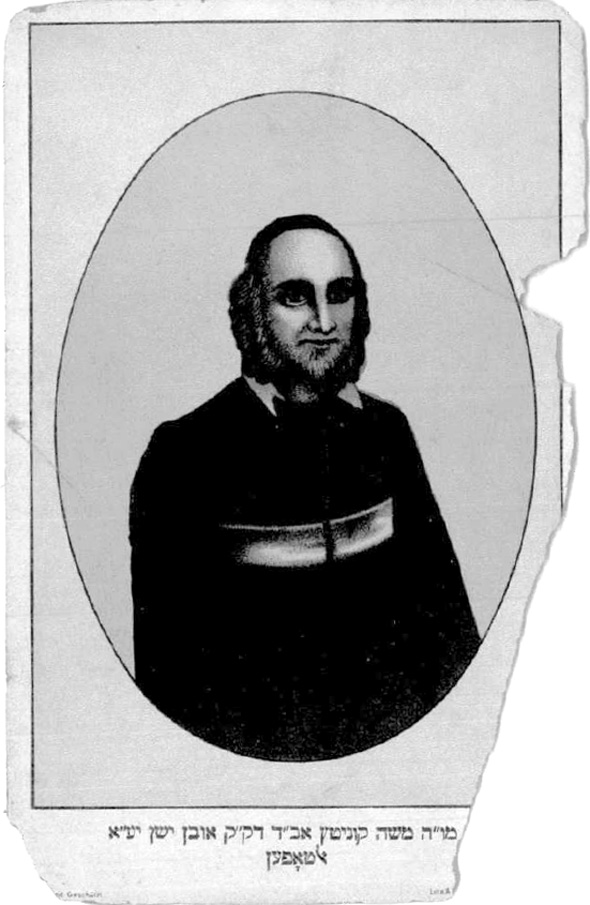
2. In an earlier post I discussed how R. Moses Kunitz’s biography of R. Judah the Prince was censored from a recent printing of the classic Vilna Mishnah. I also included a picture of Kunitz. Here is another, completely unknown, picture of Kunitz.
I found it in the Yeshiva University Archives, call no. 1992.008, and I thank the Archives for permission to publish it here.
In the earlier post dealing with Kunitz, I wrote:
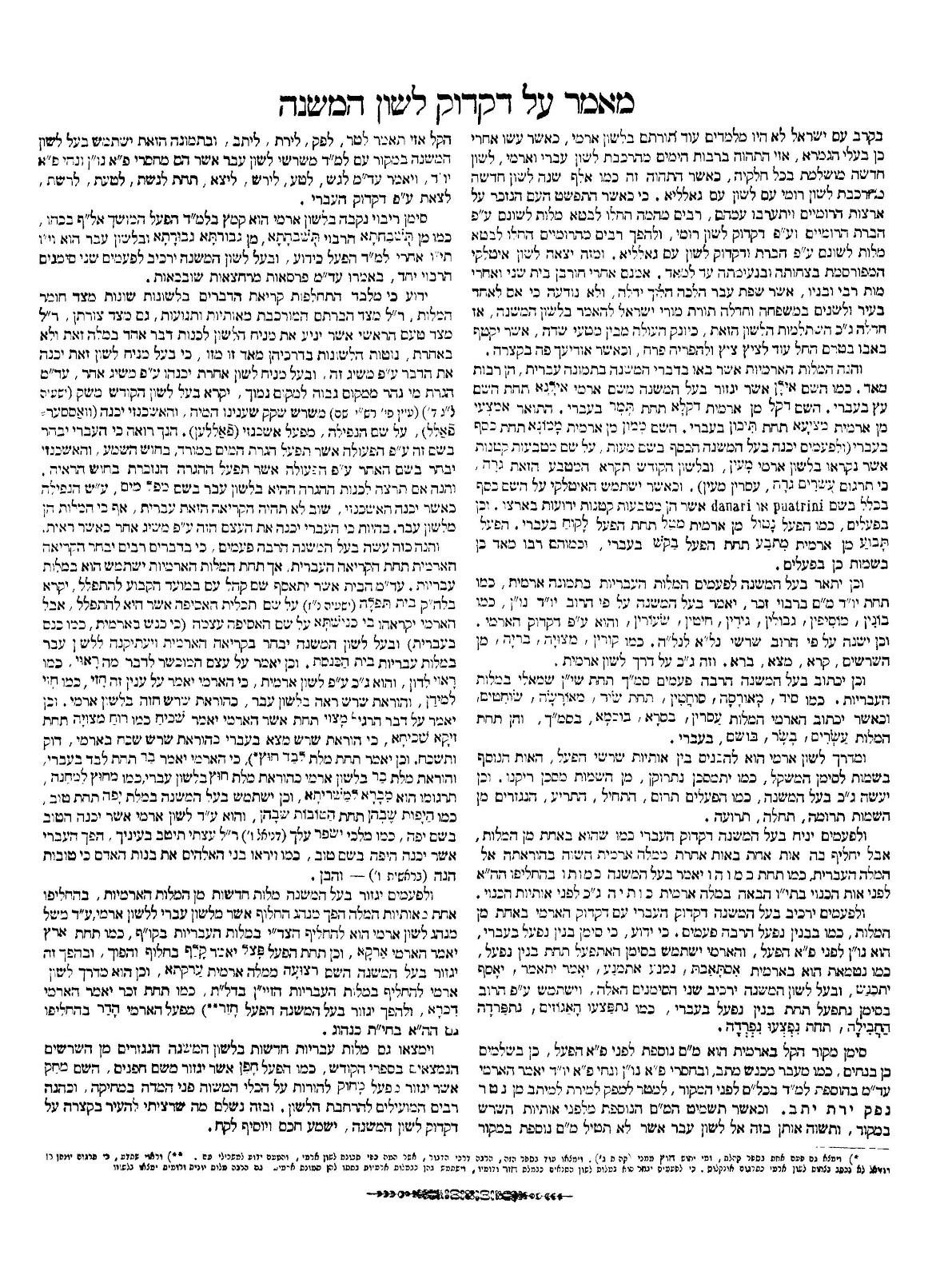
Immediately following Kunitz’ essay, there is another article on the grammar of Mishnaic Hebrew by Solomon Loewisohn.[16] In the very first note he refers to the book of Ecclesiastes, and concludes his comment with והטעם ידוע למשכילי עם. What he is alluding to in this note is that Ecclesiastes is a late biblical book, and thus could not have been written by Solomon. To show this he points to the word חוץ, which in its usage in Ecclesiastes 2:25 is an Aramaism, and thus post-dates the biblical Hebrew of Solomon’s day. To use an expression of the Sages, we live in an olam hafukh. Kunitz’ essay was thought worthy of censorship, and at the same time this note remains in every printing of the Vilna edition of the Mishnah. Yet as I mentioned above, let’s see how long it is before this note, or even the complete essay, is also removed.
What I didn’t realize, and I thank an anonymous commenter for pointing out, is that this note has already been tampered with, and in such an ingenious fashion that there is now no need for it to be deleted. Here is how it appears in the Vilna Mishnah.[17]
And here is the page in the 1999 Zekher Hanokh edition of the Mishnah, published by Wagshal (an edition which also deletes Kunitz’ introduction).
Now, instead of והטעם ידוע למשכילי עם, we have והדבר ידוע למשכילי עם. In the original, Loewisohn is telling the reader that the reason why there is an Aramaism in Ecclesiastes is known to the wise (i.e., the book is post-Solomonic), In the Zekher Hanokh edition all he is saying is that the existence of Aramaisms in Ecclesiastes is known to the wise, with no daring implication as to dating.
I also found something else of interest. Here is the last page of Kunitz’ essay on R. Judah the Prince.
Notice how he mentions Mendelssohn, Rabe’s German translation of the Mishnah, and how in his opinion R. Judah would be happy with such a translation.
This all sounds a little too “maskilish,” and here is what same page looks like as it appears on Otzar ha-Hokhmah.
Look at what has been removed. Is there really such an edition with the removed lines, or did Otzar ha-Hokhmah censor the material itself? (I will return to the censorship of Kunitz in the next post, as new information regarding this has recently come to light.)
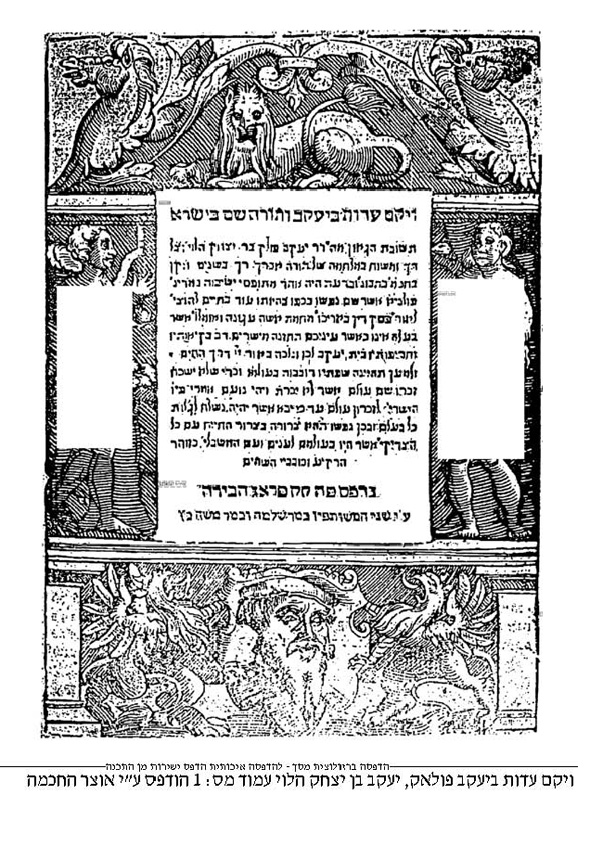
There are other examples where I think it is Otzar ha-Hokhmah that is responsible for the censorship. Here is the title page of the book Va-Yakem Edut be-Yaakov (Prague, 1594) as it appears on Otzar ha-Hokhmah
Here is the uncensored page, as is found on hebrewbooks.org
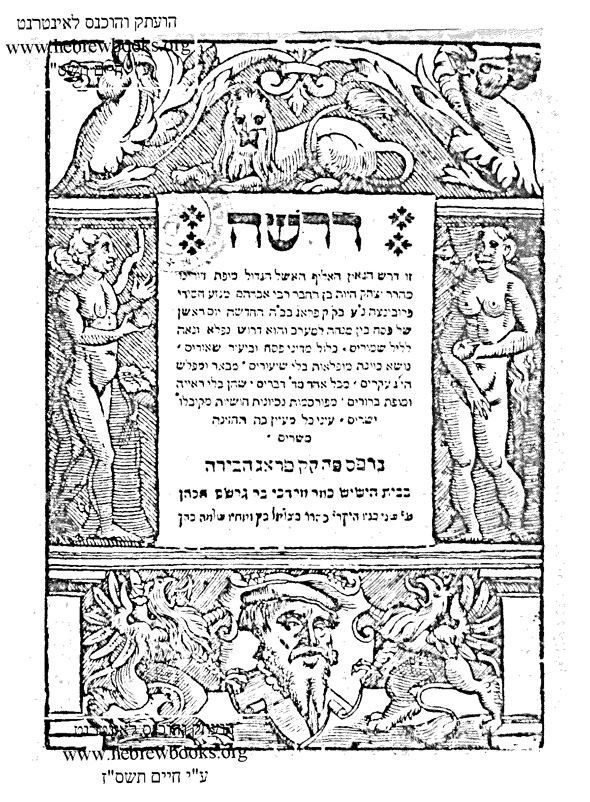
Incidentally, the title page of R. Yitzhak Chajes’ Derashah (Prague, 1589) used the exact same model.
Dan already discussed the Chajes title page here and called attention to how an auction catalog ridiculously suggested, without any evidence whatsoever, that the non-Jewish workers of the Jewish publisher put this immodest picture in.
How were the workers able to get away with this? The catalog has the “religiously correct” answer: it was hol ha-moed and the owner was not around! Since a pious Jew would never have anything to do with such a picture, the non-Jewish workers must have used their own money to buy the plates for this engraving. And why would the non-Jewish workers have spent their own money doing something that would anger the owner and get them fired? It must be that they wanted to cause Jews trouble, which is what non-Jews are always interested in. Knowing that when the owner saw what they did he would never agree to sell a book with such a title page, the non-Jewish workers must have taken all the books from the printing press and, at their own expense, sent them out to all the book sellers. All this could happen without the owner being aware because it was hol ha-moed and during this time the owner of the press wouldn’t dream of dropping by his shop (so much did he trust his workers), just like today none of us know any religious Jews who would ever consider going to work on hol ha-moed.
The title page of Va-Yakem Edut be-Yaakov, published in Prague five years after Chajes’ Derashah appeared, shows us that the non-Jewish workers must have once more, on hol ha-moed of course, surreptitiously inserted the same picture as a title page for a different book. I think everyone has to wonder, why didn’t the publisher learn anything from the first time these non-Jewish trouble makers played around with a Jewish printing press?
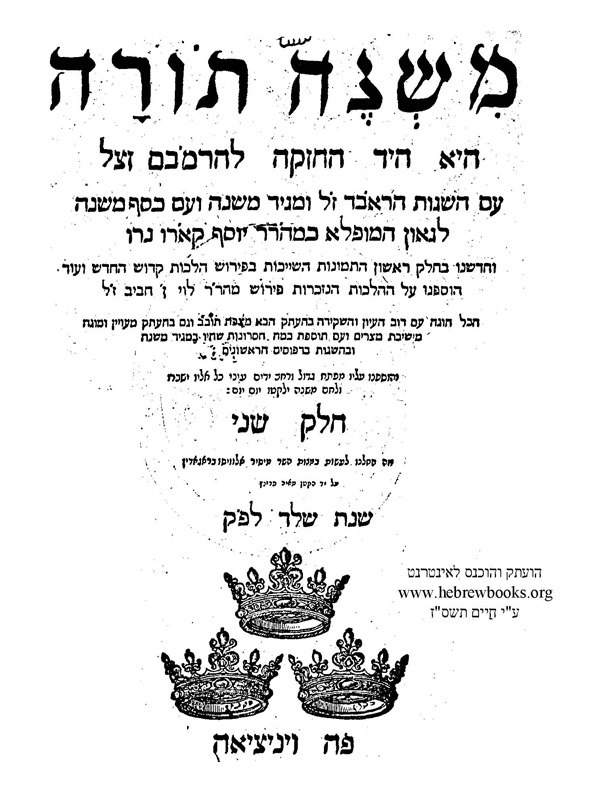
Another example of censorship on Otzar ha-Hokhmah is seen with the Venice 1574 edition of the Mishneh Torah. Here is the title page.
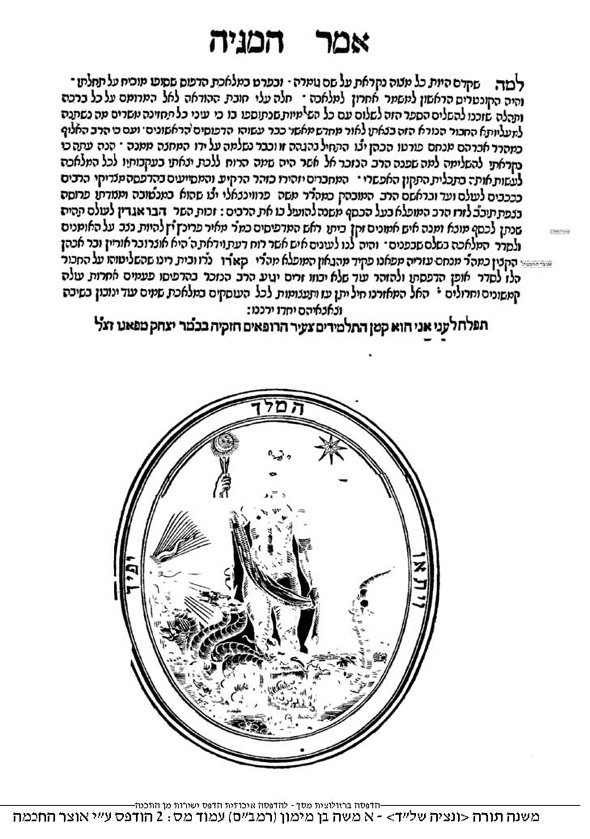
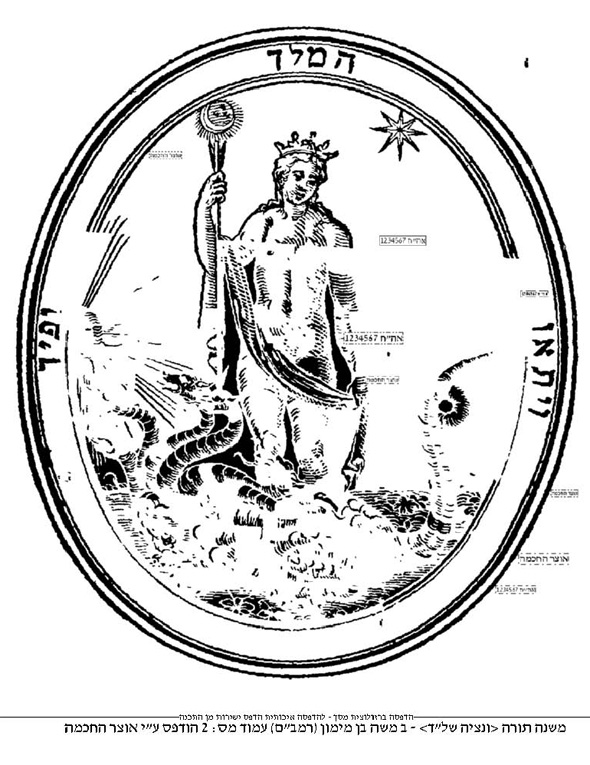
Here is how the second page looks, from volume 2 (as seen on hebrewbooks.org). The verse along the edges is from Psalm 45:12: “The king shall desire your beauty.”.
This edition was published in four volumes. In the copy on Otzar ha-Hokhmah, three of the four volumes contain the second page. Two of the pictures are significantly whited out, and in the second picture below you can see that they have whited out enough so that the reader will think he is looking at a man.
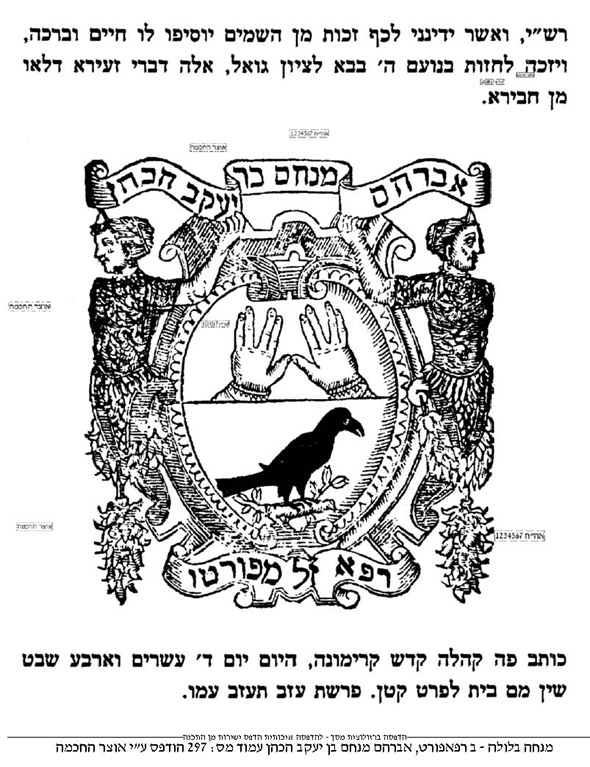
There are, to be sure, plenty of examples where the pictures appear without any censorship on Otzar ha-Hokhmah (and even with the examples I have given, it is not clear if Otzar ha-Hokhmah is responsible for the censorship or the book came to them this way). Here, for example, is the famous family crest of R. Abraham Menahem Rapa of Porto, which appears at the end of his Minhah Belulah.
S. has already pointed out that this picture was altered in a recent printing of the sefer.[18] Here is what the altered version looks like.
Michael Silber has noted that in Binyamin Shlomo Hamburger’s recent book Ha-Yeshiva be-Fiorda, the women have been turned into men, complete with beards![19]
Here is what the Encyclopaedia Judaica, s.v. Rapoport, writes:
The name Rapa originated in the German Rabe (Rappe in Middle High German), i.e., a raven. In order to distinguish themselves from other members of the Rapa family, the members of this family added the name of the town of Porto, and thus the name Rapoport was formed . . . The family escutcheon of Abraham Rapa of Porto shows a raven surmounted by two hands raised in blessing (indicating the family’s priestly descent).
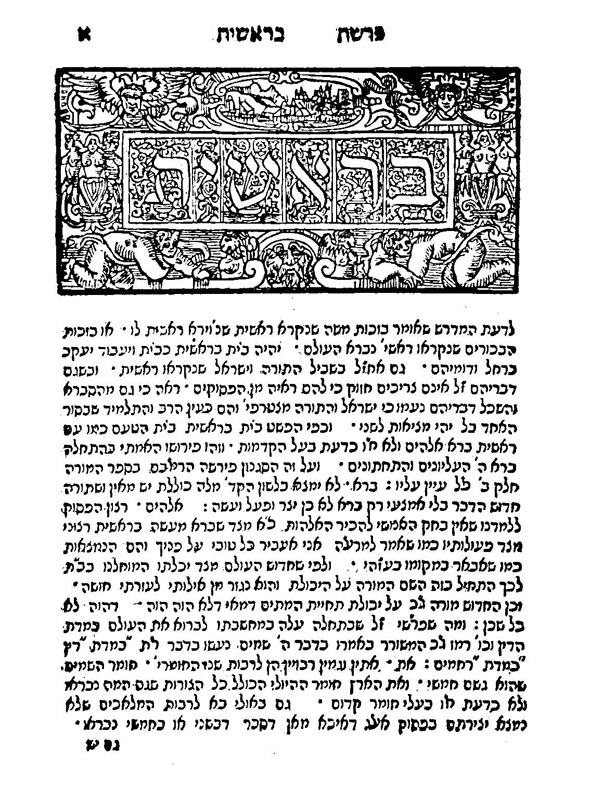
Regarding the sefer Minhah Belulah, at the beginning of each book of the Pentateuch the following “immodest” picture also appears.
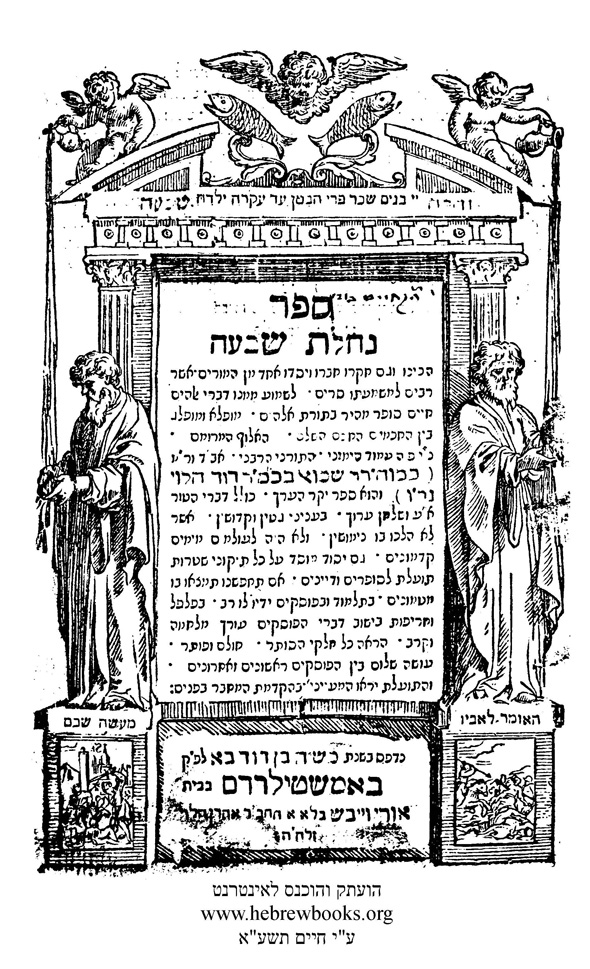
As far as I know, hebrewbooks.org has not censored any of the books that appear on the site. (We have previously discussed books that it refuses to put up.) A few years ago the Reich collection of reprints was added to hebrewbooks.org and these have all sorts of interesting title pages. Here is the title page of R. Samuel ben David Ha-Levi’s Nahalat Shivah.
The year is expressed as משיח בן דוד בא. This adds up to 427 (i.e., 5427), and is an allusion towards Shabbetai Zvi. The year 5427 corresponded to 1666-1667, and the convention normally would be to write 1667 (and this is the date given in the Harvard catalog). However, in this case I assume it is more accurate to give the date as 1666. We know that Shabbetai Zvi converted on September 15, 1666. By 1667 this information would have reached Amsterdam and the title page would no longer refer to him as the Messiah. Therefore, I think we can conclude that the book appeared after Rosh ha-Shanah of 1666, but before January 1, 1667. Nevertheless, it is noteworthy that if you look at the end of the book there is a comment by the typesetter from which we see that, despite the date on the title page, the book was not actually ready for publication until the beginning of 1668. In other words, the title page was not changed in the interim, despite Shabbetai Zvi’s apostasy.
Among the Reich reprints, here is another fascinating title page (actually the first of two title pages in this book). It is from R. Abraham ben Shabbetai’s Kehunat Avraham (Venice 1719).
Here is the author’s picture, that appears on the second page. He clearly is wearing a wig.
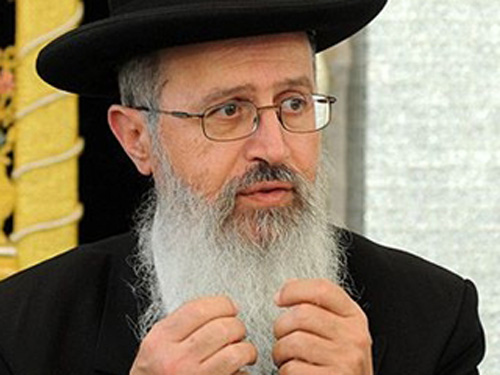
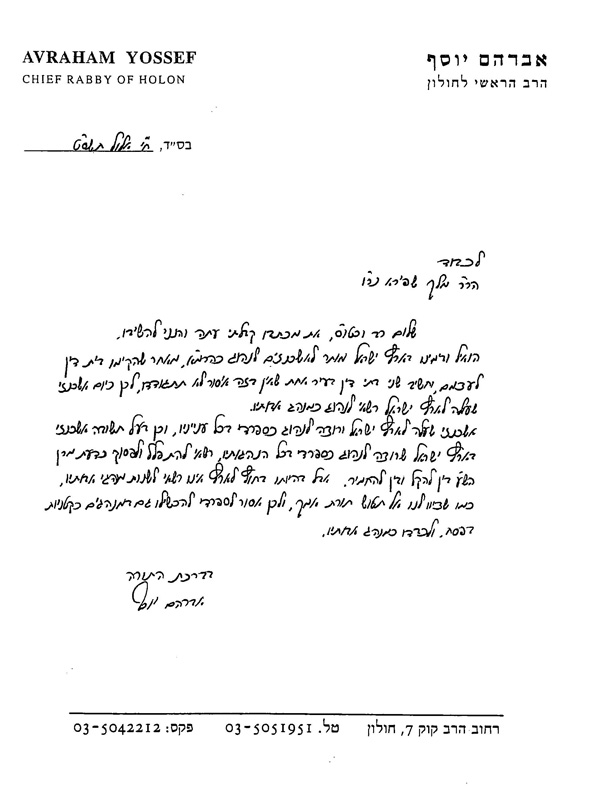
3. In the previous post I mentioned something I was told by R. Avraham Yosef, the son of R. Ovadiah. He is the chief rabbi of Holon and while a great talmid hakham, unlike his brothers R. Yitzhak and R. David he has not published very much. Here is his picture.
Like his father, R. Avraham is known for some controversial statements. He has also surprised people with his viewpoints. See here, for example, where he expressed his support for Livni becoming prime minister. I have found that he is very accessible and will answer any letter written to him. Since we are approaching Passover, let me share with readers the following.
From reading the works of R. Ovadiah Yosef,[20] I have always assumed that in his opinion even Ashkenazim living in Israel are obligated to follow R. Joseph Karo. Despite what R. Yitzhak states in his letter published below, I haven’t seen any convincing explanation as to why the Moroccans and the Yemenites should be obligated in this according to R. Ovadiah, but not the Ashkenazim. And yet R. Ovadiah does not say so openly, perhaps to avoid involving himself in controversy. He also doesn’t say that Ashkenazim should keep their practices in the Land of Israel, except for one issue, namely, kitniyot, where he is explicit that Ashkenazim are obligated to follow their tradition.[21] However, based on my assumptions from reading R. Ovadiah, I assumed that the obligation of kitniyot in the Land of Israel only applied to those who identified as Ashkenazim. If, on the other hand, someone wanted to “convert,” as it were, to Sephardi practice, he would no longer be obligated in kitniyot.
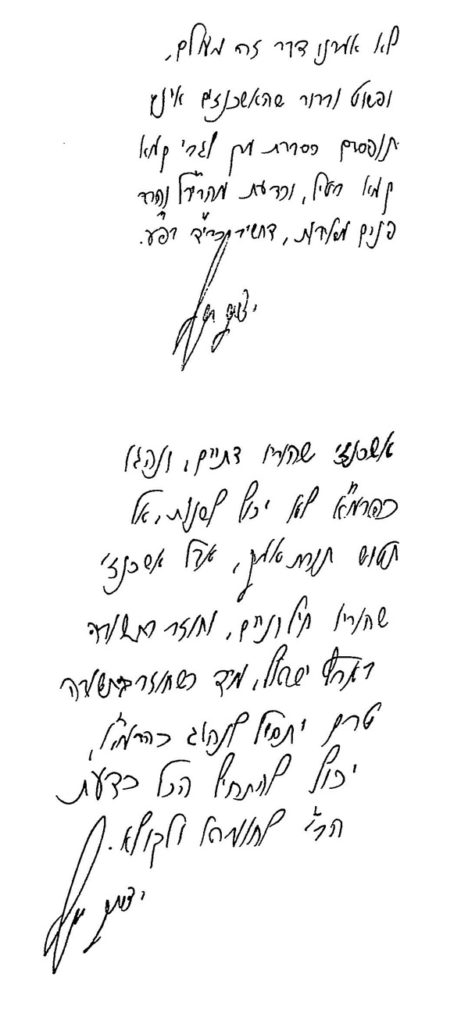
To test my theory, I wrote to three of R. Ovadiah’s sons, R. David, R. Yitzhak, and R. Avraham, asking if it was permissible for an Ashkenazi to adopt Sephardi practices in all areas, meaning that he would no longer have to avoid kitniyot. R. David never replied, but I did receive replies from R. Yitzhak and R. Avraham. Readers might recall how R. David and R. Yitzhak differed about what blessing should be recited over Bamba, and each claimed to have the support of their father. In the kitniyot case as well there is a dispute. R. Yitzhak wrote to me that an Ashkenazi, even in Israel, is bound to his communal practices. The only exception is if he is a baal teshuvah., In this case, he hasn’t yet adopted the Ashkenazic practices, and he can therefore “become Sephardi”. Here is R. Yitzhak’s letter (it was one letter, with two signatures).
However, R. Avraham has a different perspective, believing that he too is properly representing his father’s outlook (and what he writes is what I also assumed based on my own reading of R. Ovadiah). According to R. Avraham, an Ashkenazi in Israel (and only in Israel) is permitted to become Sephardi, בין לטוב ובין למוטב. Here is R. Avraham’s letter.
4. Rabbi Moshe Shamah’s commentary on the Torah has recently appeared. At over one thousand pages, it is titled Recalling the Covenant: A Contemporary Commentary on the Five Books of the Torah. In a future post I hope to deal in more detail with one of Shamah’s essays, but in the meantime I wanted to let readers know about the book’s appearance. Many volumes of Torah commentary appear each year, usually written in the same style. Shamah’s book is different. The sources used and the questions asked will be eye-opening for many. It is not derush and does not psychoanalyze biblical figures. Rather, Shamah’s book is high level Torah scholarship in the tradition of the great peshat commentators, both medieval and modern,. I also found it interesting that the book contains a blurb from the noted biblical scholar Gary Anderson (as well from Yaakov Elman, Barry Eichler, and Jack Sasson).
Just as I was about to send in this post I also received Rabbi Nathaniel Helfgot’s just published Mikra and Meaning: Studies in Bible and Its Interpretation. This is a collection of essays on different themes in Tanakh and is a good example of the Modern Orthodox revolution in the study of Bible. Just as the Rav commented that that it would be impossible today to (successfully) teach Talmud to students who are secularly educated if not for R. Chaim’s approach, something similar can be said regarding Tanakh. For those with a secular education, who have read great books, it is very difficult to connect to Tanakh without the new approach that has been developed in the last forty years or so. As R. Yoel Bin Nun puts in his preface to Helfgot’s book: “It is impossible to study Tanakh in the land of Israel as if we are still residing in Eastern Europe prior to the Holocaust.”[22]
[1] There are, to be sure, opposing passages. See e.g., Bamidbar Rabbah 10:17, where it records that Manoah stated: והנשים אינם בנות הוראה. This text is cited by a number of halakhists to show that women are not to issue halakhic rulings. Both R. Hayyim Hirschensohn, Malki ba-Kodesh, vol. 4 p. 104 and R. Yissachar Tamar, Alei Tamar, Zeraim, p. 151, reject drawing any conclusions from the passage. Both of them claim that one can’t rely on what Manoah said, as he was an am ha-aretz (see Berakhot 61a: מנוח עם הארץ היה). This is an interesting point, but I wonder if it has any validity. It obviously depends on how one is supposed to read Midrash. On the one hand, Manoah may have been an am ha-aretz, but the sage who put this expression in his mouth was not, and neither was the redactor of the text, so perhaps Manoah’s statement should indeed be seen as a rabbinic position. On the other hand, since it was put in the mouth of an am ha’aretz, perhaps it should be regarded as simply that, namely, an uninformed opinion.
It is interesting that the well-known author, R. Aaron Hyman, responded to Hirschensohn in Malki ba-Kodesh, vol. 6, p. 204. He criticized Hirschensohn for writing as if he believed that because the Midrash quoted a statement of Manoah, that the historical Manoah actually said this:
ומה שמביא חתנו הלשון מבמ”ר נשים אינן בנות הוראה, ורוצה אדוני לתלות יען שמנוח ע”ה הי’ אומר דבר זה, חס מלהזכיר שיאמין כבודו שבאמת מנוח אמר דבר זה, האם אמרו חז”ל מדברי נביאות או בקבלה, הלא אך בדרך דרש אמר הדרשן כן וכן והוא דברי הדרשן הי’ מי שהי’ אבל מדרש הוא ואדם גדול קבצם, וכן ידוע כל השקלא וטריא שהיה בין קרח ומשה בענין טלית שכלה תכלת והאלמנה והכבשה, זהו אך מליצה נשגבה אבל לא שבאמת היה כן.
See Hirschensohn’s reply, ibid., p. 209, that his intent was only that the Midrash, בדרך דרש, attributed words to Manoah.
[2] Another irony is that the halakhic textbook written by the most distinguished of these yoatzot turns out to be more stringent, and requires consultation with rabbis more often, than halakhic texts written by men. See Aviad Stollman’s review of Deena R. Zimmerman’s A Lifetime Companion to the Laws of Jewish Family Life in Meorot 6 (2007), p. 5. I can’t imagine that women think that there is an advantage in having halakhic works written by other women if these works actually reduce female autonomy in intimate hilkhot niddah matters and require more consultation with male rabbis.
With regard to calling the women yoatzot and not poskot, Stollman, p. 8, n. 20, believes that “this is merely a tribute to Orthodox political correctness.” Maybe someone who knows the situation better than I can comment on Stollman’s point. That is, are these women really giving halakhic decisions and merely “covering” themselves by using the politically correct term yoatzot?
Regarding Stollman, I should point out that he is an academic scholar, and in addition to articles has published a critical edition and commentary of Eruvin, ch. 10, Ha-Motze Tefillin (Jerusalem, 2008). He has also published a volume of responsa, Pele Yoetz (Jerusalem, 2011). Responsum no. 45 is, I think, unique in responsa literature. Stollman was asked if it is permitted to create Santa Claus dolls that sing Jingle Bells. He rules that it is permissible. If I’m not mistaken, Stollman is the first one since R. Jehiel Jacob Weinberg to combine academic Talmud study with the writing of halakhic responsa.
Returning to yoatzot, I think many will find interesting that in Yemen and in some of the Sephardic world there was never a concept of asking a rabbi intimate niddah questions. This was because the women were embarrassed to do so, seeing it as “untzniusdik”. I mention this only because I have heard rabbis say that in truth there are no tzeniut issues with this, and women shouldn’t be embarrassed. They make it seem that it is only due to modern values that all of a sudden this sort of thing is uncomfortable for women. This is clearly not the case, as we see from what happened in the Yemenite and some of Sephardic worlds, hardly centers of modernity. (I am only speaking of the historical reality, not the wisdom of the Yemenite and Sephardic approaches, which usually meant that any doubt would be assumed to render the woman impure.) R. Yitzhak Shehebar, the Sephardic rav of Buenos Aires, writes as follows in his Yitzhak Yeranen, no. 95 (quoted in Beit Hillel, Tamuz 5769), p. 120:
ואשר לעניין מראות הדמים לא נהגנו בזה כלל, כי מעולם לא ראיתי להרבנים באר”צ [ארם צובה] שטפלו בזה, אך הנהיגו את הנשים שכל מראה הדומה למראית אדמומית שהוא טמא, זולתי אם יהיה כמראה לבן או ירוק שהוא טוהר.
Regarding Yemen, R. Yitzhak Ratsaby writes (Piskei Maharitz, vol. 3, section Be’erot Yitzhak, pp. 339-340):
אצלנו בק”ק תימן יע”א אין שואלין כלל לחכמים בעניין הכרת מראות הדמים, ובכל ספק הנשים מחזיקות עצמן טמאות ויושבות ז’ נקיים [ואפי’ לבעליהן נמנעות מלהראות כדי שלא יתגנו בעיניהן . . .] וכ”ה גם ברב ק”ק ספרדים יע”א . . . האידנא דהשאלה בדרך כלל היא רק לעיתים רחוקות, עי”ז נשתלשל הדבר שנמנעו מלשאול לגמרי מחמת בושתן היתירה וצניעותן המרובה כנודע
Ratsaby points out that this practice developed even though talmudic literature provides plenty of examples showing that in the days of the tannaim and amoraim the Sages did examine ketamim.
Regarding Yemen, see also R. Nachum Eliezer Rabinovitch, Siah Nahum, no. 60. In this responsum, Rabinovitch supports the institution of yoatzot and suggests that this practice, of turning to women in niddah matters, even existed in tannaitic times: כי לפנות לאשה חכמה אין חשש שמא תתגנה
In a note to this responsum, the editor provides further testimony about Yemen.
שמעתי עדות מחכם נאמן, שהיו מקומות בתימן בהם היו זקנות שהיו מוחזקות כבקיאות בעניני מראות, והנשים היו פונות אליהן, ומעולם לא ערער אדם על כך.
R. Moshe Maimon called my attention to the Meam Loez’s discussion of the laws of niddah, addressed to both men and women, and there is no mention there of bringing anything to the rabbi. This omission was rectified by R. Aryeh Kaplan, who in his translation (vol. 1, p. 136) adds: “When in doubt, a competent rabbi should be consulted.”
[3] Mishpetei Uziel, Hoshen Mishpat, no. 5.
[4] For sources on women deciding halakhic questions, see the three responsa in support of Sara Hurwitz’ being ordained as a “Maharat,” authored by Rabbis Yoel Bin-Nun, Daniel Sperber, and Joshua Maroof, available here.
[5] The Hafetz Hayyim, who was a “rabbi” if there ever was one, only received semikhah when he was 85 years old, and that was to satisfy a bureaucratic requirement. See Moshe Meir Yashar, He-Hafetz Hayyim (Tel Aviv, 1958), vol. 1, p. 19. According to R. Isaac Abarbanel, rabbinic ordination as currently practiced arose due to Christian influence. See Nahalat Avot, beginning of ch. 6:
אחרי בואי באיטאליאה מצאתי שנתפשט המנהג לסמוך אלו לאלו. וראיתי התחלתו בין האשכנזים כלם סומכים ונסמכים ורבנים. לא ידעתי מאין בא להם ההתר הזה אם לא שקנאו מדרכי הגוים העושים דוקטורי ויעשו גם הם.
[6] The title “rabbi” is indeed significant. This can be seen by the fact that when Sara Hurwitz was called Maharat there wasn’t any outcry, but when she was given the title “rabba” that is when the controversy really broke out, even though her job description didn’t change in the slightest. Does this mean that there was no objection to a woman functioning as a rabbi as long as she didn’t have the title? Only after she was renamed “rabba” did the RCA adopt a resolution rejecting the “recognition of women as members of the Orthodox rabbinate, regardless of the title.” Yet despite that resolution, there are synagogues where women are still serving, for all intents and purposes, as members of the rabbinate minus the title.
[7] Similar, though not identical, perspectives have recently been offered by Rabbis Norman Lamm, Michael Broyde and Shlomo Brody. See Broyde and Brody, “Orthodox Women Rabbis? Tentative Thoughts that Distinguish Between the Timely and the Timeless,” Hakirah 11 (Spring 2011), pp. 25-58. None of them reject the notion of Orthodox women rabbis at some time in the future. From speaking to many people, my own sense is that a majority of the Modern Orthodox community supports women rabbis (although not necessarily pulpit rabbis). When I say “support,” I mean if asked the question, the reply will be yes. But at the same time, the overwhelming majority of the Modern Orthodox world doesn’t care about this issue at all, and this includes women also. However, I believe that the minority will continue to push this issue, and when women rabbis become a reality, the Modern Orthodox will not reject these women or the congregations that employ them, as we can already see at present with Rabba Hurwitz and other female synagogue rabbis (in everything but name). I think this will happen before the natural development of female poskot who, as already indicated, will by definition be rabbis even without a formal ordination.
One more point that needs to be mentioned with regard to women rabbis is the issue of economic fairness. There are significant tax savings, due to parsonage, that an ordained clergyman receives from the government. While it is true that R. Michael Broyde has written that even women teaching Torah are eligible for this even under current tax laws (see here) and a prominent New York law has firm also expressed this opinion, many yeshiva day schools, acting under the advice of their accountants, have refused to adopt this policy. Some sort of formal ordination for women would settle the parsonage question, and give a financial boost to many of our underpaid teachers.
[8] There are, however, a number of very good articles on halakhah written by women. See e.g., Devorah Koren’s article in the recently published Milin Havivin 5 (2011), available here.
[9] Regarding Lieberman, I would like to call readers’ attention to what appears in the latest Yeshurun, vol. 25. On p. 21 the following footnote appears:
“How Much Greek in Jewish Palestine לגרסאות ופירוש תיבות אלה, ראה דברי הגר”ש ליברמן “
Here Lieberman is given the title due a gadol be-Yisrael. Perhaps this can be seen as making up for the censorship of references to Lieberman (and Louis Ginzberg) in an article by R. Mordechai Gifter that appeared in an earlier Yeshurun. See Saul Lieberman and the Orthodox, p. 32 n. 117. After my book appeared, I was informed by one of the editors of Yeshurun that the censorship of R. Gifter’s piece was carried out by the one who prepared the article for print, and the editors knew nothing about this and were upset when they learnt what had occurred.
On p. 632 of the new Yeshurun there is a letter from R. David Zvi Hillman to Prof. Shlomo Zalman Havlin in which he states the following: In the early volumes of the Encylopedia Talmudit Lieberman was referred to as ר”ש ליברמן, a point I noted in Saul Lieberman and the Orthodox. Yet American rabbis protested and insisted that he not be mentioned. These rabbis are identified with the Rabbinical Council of America: מהסתדרות הרבנים ר”ל המזרחניקים. In response to this, R. Zevin from that point on only mentioned the name of Lieberman’s books but not Lieberman himself. A Bar Ilan search reveals that vol. 13 is the last volume where ר”ש ליברמן is mentioned. (Vol. 15 was the last volume to appear in R. Zevin’s lifetime. See Zevin, Ishim ve-Shitot [Jerusalem, 2007], p. 40 [first pagination]).
Why would R. Zevin agree to this? The answer is obvious: money. The Mizrachi in America was an important source of funds for the Encyclopedia Talmudit.
[10] The term “rabbanit” was primarily used for the wife of a rabbi. See Robert Bonfil, Rabbis and Jewish Communities in Renaissance Italy, p. 77 n. 186. My point is only that it was also used for scholarly women.
[11] The continuation of the shiur is also of great interest, as he explains that if one ends up in a hotel on Shabbat and sees that the lights in the hall go one every time one leaves one’s room, it is still permissible to walk in the hallway and it is not even regarded as a pesik reisha.
[12] See the biography and picture of her here. For pictures of Flora and her family, see also here.
[13] Rivka bat Meir of Prague (died 1605) was another learned woman who was called “rabbanit”, see Frauke von Rohden, ed. Meneket Rivkah (Philadelphia, 2009), pp. 6-7. Rivka authored the Yiddish mussar work Meineket Rivka, published in Prague, 1609. On the title page she is referred to as הרבנית הדרשנית . (In the Altneuschul memorial book it also says that she preached. See Von Rohden, p. 6) Here is the first page of the book, where she is again referred to as “rabbanit”.
Lest anyone misunderstand, I must stress that Rivka only served as a rabbi and preacher for other women, and was therefore not a prototype for twenty-first century women rabbis. My point in referring to her is to highlight the use of the term “rabbanit” as designating a learned woman.
[14] Teshuvot Pesakim u-Minhagim, vol. 2, ed. Kahana, nos. 155-156.
[15] See Daniel Sperber, Minhagei Yisrael, vol. 1, pp. 65-66.
[16] I originally wrote Levinsohn, and thank a helpful reader for the correction. Loewisohn’s essay originally appeared in his posthumously published Mehkerei Lashon (Vilna, 1849).
[17] Incidentally, the note as it appears in the Vilna Mishnah has also been altered from what appears in the original work. In the original it states אשר אינם על טהרת לשון עבר, and in order that people understand what Loewisohn was saying, these words were altered to read: אשר המה כפי תכונת לשון הארמי
[18] See here.
[19] See here. As one of the commenters pointed out to this post, the women appear to be mermaids. He helpfully provided this link.
[20] For my essay on R. Ovadiah, see here.
[21] See Yabia Omer, vol. 5, Orah Hayyim no. 37, Yehaveh Da’at, vol. 1, no. 9, vol. 5 no. 32.
[22] R. Aharon Lichtenstein also has a preface to the book, where his ambivalence about the new approach comes through very clearly. This short essay deserves its own analysis.


New Seforim, books, random comments and Benny Brown’s Work on the Chazon Ish

New Seforim, books, random comments and Benny Brown’s Work on the Chazon Ish.
By Eliezer Brodt

As a courtesy to our readers, below I provide a list of some new seforim and books that I recently have purchased or become aware of. Some are brand-new, others have been out already for a few months. Some of these books, will be reviewed at great length at a later date, B”n. As I note, I have copies of the TOC of some of the works mentioned here, feel free to e mail me if you want a copy of the TOC.

ספרים
1. המעשים לבני ארץ ישראל, יד בן צבי, מהדיר: הלל ניומן.
2. פסקי הרי”ד, מסכת חולין, מכון תלמוד הישראלי
3. תשובות מהר”ם מרוטנבורג וחבירו, על ידי שמחה עמנואל, שני חלקים, 1251 עמודים, איגוד העולמי למדעי היהדות, כולל מבוא של 180 עמודים. ניתן לקבל תוכן הענינים.

This beautiful new work contains 501 teshuvot of Maharam Mi-rotenburg and his colleagues. Over 300 of these teshuvot were never printed before. Many of the others were only printed once before in a rare, little-known work of Y. Kahana.

4. פתחי שערים, ר’ יצחק אייזק חבר, עם הערות.
5. ר’ צבי פסח פרנק, הר צבי על התורה השלם, שס”ו עמודים.
6. ר’ דוב וואלף ליבשיץ, [אביו היה תלמיד של ר’ חיים מוואלז’ין] פרי חיים- כולל בתוכו באר חיים באור על סידור התפילה, רוח חיים באור על קהלת, מעין חיים חלק א חידוש תורה עם תולדות המחבר ומשפחתו, 260 עמודים בערך.
7. ר’ מנחם די לונזנו, דרך חיים, אהבת שלום, כולל מבוא חשוב, מפתחות והערות, שצ”ב עמודים. I will hopefully be dealing with this work at greater length in a future post shortly.
8. ר’ ישכר טייכטאל הי”ד, משנת שכיר, מועדים, ב’ חלקים.
9. ר’ שמואל אויערבאך, אהל רחל, חנוכה פורים, קצ עמודים.
10. חידוש הגר”מ הלוי סולוביצ’יק, מהדורא תנינא.
11. פתח הדביר, ה’ חלקים על שולח ערוך אורח חיים.
12. ר’ שלמה אלפאנדארי, יקהל שלמה, מערכת וזכרונות בהלכה ואגדה, חלק א, אהבת שלום, רס עמודים.
13. ר’ אברהם בן שמואל הלוי אבן חסדאי, בן המלך והנזיר, סידרה שירת תור הזהב, עם הערות ומבוא מאת אילת עטינגר, 242 עמודים. ראה כאן
14. פירוש ר’ יצחק ב”ר יוסף על התורה, מגדולי הראשונים שבספרד, תלמיד חבר של הרשב”א, בראשית, שנט עמודים, י”ל ע”י ר’ דוד וזכריה הולצר.
15. ר’ איתם הנקין, לכם יהיה לאכלה, בירור להלכה בסוגיית חרקים במזון, 167 עמודים, ראה כאן
16. ר’ חיים הלפרין, חמדה טובה, על י”ג עיקרים, לייקוואוד, שצ”ה עמודים. ראה כאן
17. ראש יוסף על מסכת שבת, פרקים ה-ז, עם הערות מר’ אפרים בנימין שפירא, כולל הפתיחה כוללת להלכות שבת ומפתח ענינים, תקע”ח עמודים.
18. ר’ חיים לפידות, עשות פרי, במעלת חידושי תורה, כתיבתם, והוצאתם לאור עולם, תתקנד עמודים.
19. ר’ אהרן בריסק, אוצר הזמנים, בין השמשות השיטות ובירורים, תקצג עמודים.
20. ר’ עובדיה יוסף, חזון עבודה שבת חלק ד.
21. ר’ משה היילפרין, זכרון משה על פירוש רש”י ורא”ם, עם מבוא והערות על ידי, ר’ פינחס קריגער, 249 עמודים, כולל הרבה חומר שלא נדפס במהדורת פייליפ.
22. ר’ יעקב גרייזמאן, ברוך ומקודש, דיני ברכת כהנים הנוגעים לישראל המתברך, דיני מצות וקדשתו ואיסור השתמשות בכהן, רסה עמודים.
23. רבנו חיים כסאר, דרך החיים, מצות תלמוד תורה ודרכי קניינה, מכון מרא”ה, קפ עמודים.
24. ר’ מרדכי הלפרן, רפואה מציאות והלכה, ולשון חכמים מרפא,546 עמודים, [מלא חומר חשוב], ניתן לקבל תוכן הענינים.
25. מציאות ורפואה בסדר נשים, עורך ר’ מרדכי הלפרין מהדורה שניה מורחבת, 462 עמודים, ניתן לקבל תוכן הענינים.
26. ר’ משה לייטער, צום העשרי על צום עשרת בטבת, רפז עמודים.
27. ר’ יצחק טסלר, פניני מנהג, ימי חנוכה ג’ חלקים. כריכה רכה מהדורת כיס.
28. ר’ מנחם גיאת, תורת חכם, אוצר דיני תלמיד חכם, שני חלקים, 1034 עמודים.

מחקר –היסטוריה

29. בן איש חי’ תולדותיו קורתיו ומורשתו לדורות, ניתן לקבל דוגמא מהספר אצלי.
This is a beautifully album size work on the Ben Ish Hai, including many rare documents and pictures.
30. ר’ יעקב ישראל סטל, סגולה, ספר ראשון, 153 עמודים, עיונים וברורים במנהג והלכה, פיוט מדרש ואגדה, נדפס במהדורה מצומצמת של 350 עותקים בלבד. ניתן לקבל תוכן הענינים וחלק מפרק לדוגמא.
This work is a excellent collection of articles on topics not usually written about, by others, full of interesting observations from an extremely rich and wide range of sources.
31. השלשלת מאיש לספר, אבישי יורב, ב’ חלקים, ראה כאן.
32. צורה ועריכה בספרות חז”ל, אברהם גולדברג ראה כאן.
33. כרמי שלי, מחקרים באגדה ובפרשנותה מושגים לפרופ’ כרמי הורוביץ, מכון לנדר. ניתן לקבל תוכן הענינים.
34. דוד סורוצקין, אורתודוקסיה ומשטר המודרניות, קיבוץ המאוחד 443 עמודים. ראה כאן
Some of the topics, dealt with in the book, are about the Maharal, R’. Yehudah Aryeh Modena, R’. Yaakov Emden and the Satmar Rebbe.
35. חנה כשר, על המינים האפיקורסים והכופרים במשנת הרמב”ם, קיבוץ המאוחד, 212 עמודים. ראה כאן.
36. ראשית חכמה, חיבור פולמוסי כנגד חסידים, 120 עמודים, מהדירים: יונתן מאיר ושמואל ורסס י”ל פעם ראשונה מכ”י. This is a critical edition of another very early work from an anonymous author attacking Chasidim. It is unclear if it’s from a maskil or a traditionalist talmid chacham. Much of it deals with attacking the Shivchei Habesht.
37. דניאל בוארין, מדרש תנאים, אינטרטסטואליות וקריאת מכילתא, הרטמן, 319 עמודים.
38. ר’ דוב בער שווארץ, משיב דברים, רעג עמודים, מאמרים ומכתבים בעניני היסטוריה.
39. ר’ חנניה ברוין, דרכי משה החדש, תולדות המהר”ם שיק, ש”ל עמודים.
40. ר’ דב אליאך, אבי הישיבות, תולדות חייו ומשנתו של ר’ חיים חיים מוולאז’ין וסיפורה של ישיבות וולאזי’ן מהדורה מורחבת, 719 עמודים.
41. עמנואל אטקס, בעל התניא, רבי שניאור זלמן מלאדי וראשיתה של חסידות חב”ד, מרכז זלמן שזר, 495 עמודים.
42. יונתן מאיר, רחובות הנהר, קבלה ואקזוטריות בירושלים (תרנ”ו-תשח) יד בן צבי, ניתן לקבל תוכן הענינים.
43. טוב עלם: זיכרון קהילה ומגדר בחברות יהודיות בימי הביניים ובראשית העת החדשה,ספר היובל לכבוד ראובן בונפיל, ביאליק, ניתן לקבל תוכן ענינים.
44. יוסף דן, תולדות תרות הסוד העברית ימי הביניים, חלק ז, מרכז זלמן שזר,480 עמודים
45. ספר תא שמע שני חלקים, מחקרים במדעי היהדות לזכרו של ישראל תא-שמע, הוצאת תבונות, 910 עמודים, ניתן לקבל תוכן הענינים. This collection is simply incredible, full of great articles on a wide range of topics.
46. שירת רבנו תם, מהדיר יצחק מיזליש, 185 עמודים.
47. חוה קליין, מתיר העגונות, 160 עמודים חיבור על אביה, ר’ שלמה זלמן קליין
48. רוח המשפט, מיכאל אברהם.
49. תלמידי הגר”א בארץ ישראל, היסטוריה, הגות, ריאליה, עורכים: ישראל רוזנסון ויוסף ריבלין, ניתן לקבל תוכן הענינים.
50. אפרים חמיאל,הדרך הממוצעת ראשית צמיחת הדתיות המודרנית, על שד”ל רב שמשון רפאל הירש, מהר”ץ חיות, הוצאת כרמל.
51. קובץ עץ חיים גליון טז, ניתן לקבל תוכן העינים.
52. עלי ספר חלק כב אפשר לראות תוכן ענינים כאן
53. קובץ המעין, גליון 200, ניתן לראות כל קובץ כאן.
54. ספר זכרון דגל מחנה ראובן, לזכרו של רבי ראובן אליצור,תקמג עמודים.
This work is composed of a few parts. One part is a biography of R. Reuven Elitzur. There are many interesting tidbits about life Eretz a seventy years ago. R. Elitzur was the long-serving librarian in Sifrat HaRambam in Tel Aviv, and was very knowledgeable about seforim. When asked about the story of the Maharal and the Golem, he said its baloney and was made up much later (p. 312). The second part of the work is a collection of historical articles that R. Elitzur wrote in various newspapers, especially against works written by maskilim (or people whom he claimed were maskilim). Among the topics he wrote about were R. Moshe Kunitz, the Cheshbon Hanefesh and Benjamin Franklin, R. Wolf Heidenheim, R. Zalman Hanau and much more. As R. Elitzur was R. Nissim Karelitz’s chavrusa for many years, some of his articles have the approval of R. Karelitz, such as his attack on publishers for printing Kunitz’s work Beis Rabbi in the introduction of Mishnayos Zeraim. R. Elitzur also used to provide rare seforim for R Chaim Kanievsky, such as the critical edition of the Sheva Massechtos published by Michael Higger which R. Kanievsky mentions in the introduction of his work on Geirim without mentioning Higger’s name.

One last issue related to the last two items mentioned on this list; a few months back Dr. Benny Brown’s magnum opus on the Chazon Ish was printed by Magnes Press, as mentioned here on the Seforim Blog. The book sold out in two weeks – one thousand copies! It was reprinted shortly afterward and copies are still available. Shortly after the book appeared, with much surprise, various attacks began on different forums on the Web (see, e.g., here, here, here, here, here and here). One attack was written under a pen name in the Yated Neeman. Shortly afterward, a more restrained and respectful attack was published by the same author – under his real name, Yehoshua Levine, in the journal Ha-Maayan available for reading here. In the most recent edition of the Ha-Maayan Benny Brown responded, and it is available here. One issue not really dealt with in Levine’s review is that the bulk of Brown’s huge book (951 pages) is about the Halacha of the Chazon Ish, not his history, and whether Brown get that right or not. Levine claims he has an article on that part too, which has yet to be printed. If one is interested in this unpublished part of Levine’s attack e-mail me. In my opinion this part of the article needs a lot of work. As for the other parts, I will let the readers decide for themselves, but I am not at all convinced that Levine is correct in the overall picture.

One of the issues raised by Levine, and many others, was about Brown’s claim that the Chazon Ish had a religious crisis in his youth. They do not find Brown’s proof for this convincing. However, it seems that Brown is most likely correct, although one can never know to what extent this crisis was. In the above mentioned work, Sefer Zichron Degel Machaneh Reuven, they print a hesped given in Bnei Brak by R. Yakov Edelstein, a close friend of R. Elitzur. R. Edelstein also knew the Chazon Ish, and his brother is one of the Roshei Yehsiva of Ponevezh today. R. Edlestein said at this hesped, after quoting the famous Rav Hutner on stories of gedolim in their youth:

ואנשים שהתפרסמו לא נולדו ככה, הם עברו הרבה נסיונות והרבה קשיים, על החזון איש לא מספרים על הילדות שלו, על המלחמות שהיה לו בילדותו והצליח לנצח בהם. החפץ חיים סיפר על עצמו שכשהיה בחור צעיר אולי בגיל בר מצווה, כמעט שנפל במלכודת של המשכלים, שהיו תופסים ילדים בעלי כשרונות, ומתחברים אליהם ומקלקלים אותם, ואמר על עצמו שהו’ עזר לו ונתן לו שכל להיות גיבור ולעמוד בניסונות ולהינצל (ספר זכרון דגל מחנה ראובן עמ’ כג).

Another issue that Levine and others raise is that Brown did not interview any family members or close talmidim of the Chazon Ish. I wonder why there is no mention of R. Gedalyah Nadel in the book. However, a very strong defense for Brown in my eyes is found in a short article written by Prof. Saul Leiberman in the journal Bitzaron printed in 1981, which I was shocked to not see it mentioned in Brown’s book or bibliography. One of Brown’s sources throughout the book is Chaim Grade masterpiece Tzemach Atlas and Milchemes Hayetzer (printed as The Yeshiva in English, trans. by Curt Leviant). Although this book is a novelization of the people and period, almost all the details are true, including all the parts about the Chazon Ish, whom Grade knew very well as he learned and lived with him for many years. I have heard from various people that Chaim Grade had an amazing knack to really penetratingly see into people (see here for one great example). Others told me Grade was 100% on the mark regarding the Chazon Ish. One great person told me that it’s a shame that Grade was not good in learning, than he would have been able to give us a similar write up in that area too. Thus it should be seen as a fairly reliable source (with appropriate caution). Now, Saul Leiberman was a relative of the Chazon Ish, who was very close to him in both Europe and in Eretz a (see Lieberman’s small article about this in Mechkarim Betorat Eretz Yisrael pp.608-611). So he is a good person to see what he would say about Grade’s portrayal of the Chazon Ish. Lieberman writes that in 1946 his brother Meir Lieberman – as an aside this brother was much more Orthodox than Lieberman – gave him a work that he said he must read- it was from Grade. Leiberman writes:

כיצד אפשר לחסוף טובה מאדם מישראל בפרט מאחי ובשרי התחלתי על כן לקרוא בקונטרסן בחיוך, אולם מיד חשתי כי נעלם החיוך מפני ואני לובש רצינות יותר ויותר עד שהרגשתי בענן הכבד שנחת עלי הוספתי לקראו מהחל עד כלה…

Lieberman goes onto describe how he met Grade in New York and how he loved to read his articles in the paper weekly.

התחלתי לקרוא את הפרוזה בעתון ללא דילוג אף שבוע אחד, רציתי לנחש כיצד יתפתח הסיפור ומה יהיה בסופה של המעשיה. עלי להודות שלא הצלחתי בניחושי דבר שלא הייתי רגיל לו בעבודתי המדעית וחקר טכסטים…

Then Lieberman writes about Grade’s description of the Chazon Ish as follows:

כאשר קראתי את צמח אטלס נתמלאתי השתוממות לדיוק התיאורים מלבד הגיבור הראשי צמח אטלס, שהנהו דמות חזונית מרכבת מאידיאות מאליפות, הכרתתי כמעט כל הנפשות הפועולת ברומן הישיבה של גראדה…בעל המחזה אברהם [א.ב. החזון איש]… אף אחד לא היה יכול לתארם ביתר נאמנות…

For me it puts to rest the issue if Brown’s work is based on sources of people who knew the Chazon Ish. Many thanks, to Chanan Gafni for informing me about this small article of Lieberman’s.

I would like to conclude with three comments regarding Brown’s book.

One, throughout the work Brown refers the reader to the appendix of his doctorate which contains an interview that he conducted with Dr. Tzvi Yehudah. This interview is full of great material, and in my opinion should have printed as an appendix in the back of the Magnes book.

Two, in Brown’s discussion of the famous controversy on how to write the letter Tzadi, an important source not mentioned can be found in Prof. Shlomo Zalman Havlin’s article in Alei Sefer (12:13-20).

Three, Brown claims that the Chazon Ish’s writings and language shows he was familiar with haskalah literature. I have no problem with such a claim I just wanted a few actual samples.

There was another review written about Dr. Brown book by Sholomo Tikochinski printed in the latest issue of Akdamus. See also this post.

Small announcement- sale.

There is a special sale on the 11 volume set of Chaim Chamiel’s work on Targum, 100 Shekel for the complete set. Contact Reuven Mass at rmass@barak.net.il.


Quiz Answers; Response to Criticism; Rav Schwab Writes to the Rogochover

Quiz Answers; Response to Criticism; Rav Schwab Writes to the Rogochover

Marc B. Shapiro

1. Let me begin with the riddles from my last post here.

A. Where do we find that Shammai not only disagrees with Beit Shammai, but also agrees with Beit Hillel?

B. In the days of the tannaim a certain item was unquestionably muktzeh. However, in the post-talmudic period, some hold that this item is no longer muktzeh. What item am I referring to? Provide the actual source in the Talmud and later authorities to justify your answer.

The answer for number 1 that I intended is found in Orlah 2:4-5. Mike Wiessenberg, David, Shimi, and Sam got this right.

Yet Moshe Schwartz offered a different answer which I think is also correct. He wrote:

From the baraisa brought down in Beitzah 20a, it could be suggested that only Beis Shammai held that one can’t bring an olah on Yom Tov, but from the fact that Bava Ben Buta said the halacha is in accordance with Hillel, it can be inferred that he is testifying to Shammai’s opinion as well. Especially since the Gemara in Shabbos 15a doesn’t ask from the machlokes of olah on Yom Yov when it says that there was only three times that Hillel and Shammai argued.  So, all this suggests to me that here Shammai was in agreement with Beis Hillel and Hillel himself that you can bring an olah on Yom Tov. See also Tosafos in Chagigah 7b.

For number 2, no one gave the answer I intended: In the days of the tannaim a get was muktzeh. That was because you could not do anything with it on Shabbat. You could not even use it to learn the halakhot of writing a get since Torah learning was to be entirely oral. Yet after the Oral Law was written, R Moshe Isserles states, Even ha-Ezer 136:7, that according to some it is now permitted to handle a get on Shabbat as it is not muktzeh. In other words, since you can learn various halakhot by examining the get, one is now permitted to do so on Shabbat. That this is what R. Isserles means is made clear by his comment in Darkhei Moshe, ibid.:

בזמן הזה שנתנה תורה שבע”פ לכתוב לכ”ע מותר לטלטל גט שהרי אדם יכול ללמוד ממנו כמה הלכות גטין

It is interesting to note that while in Darkhei Moshe R. Isserles says that everyone agrees with this opinion, in the Shulhan Arukh he writes “some say”.

The Beit Yosef, Even ha-Ezer 136, also says that everyone agrees that today it is permitted to carry a get, but in the Bedek ha-Bayit he questions this permission.

As mentioned, during the era when the Oral Law was not written all agree that a get was muktzeh (and the same law would apply to a ketubah) since all learning had to be oral. What I don’t understand, and maybe some of our learned readers can enlighten me, is what are we to make of what the Talmud refers to as megilat setarim. These were private notebooks that the Sages had during the period when the Oral Law could not be written down for the public. In order not to forget what they were taught, the Sages wrote things down. Rashi, Shabbat 6b and Bava Metzia 92a, tells us that these notebooks had to be hidden. However, Maimonides, in his introduction to the Mishneh Torah, also notes that the Sages recorded both what they were taught and their own independent Torah insights. Yet, unlike Rashi, he does not mention that they hid their notebooks. Furthermore, unlike Rashi, Maimonides does not view the permission to write down Torah thoughts as intended solely to prevent forgetting. For him, Torah she-be-al Peh signifies that Torah is transmitted orally rather than through written means. Nevertheless, it was never forbidden to write down the Oral Torah for personal use; it was kept hidden only to prevent its use for public teaching.[1]

According to Rashi, in the era of Torah she-be-al Peh one was not allowed to study the Oral Law from a written text. Writing it down was permitted only as an emergency measure, to prevent forgetting, but under normal circumstances it was forbidden. On this view, it makes sense that a get would be considered muktzeh. However, according to Maimonides, it was never forbidden to write down the Oral Law for private use. Since, in his opinion, one could study the Oral Law privately from written texts, why should a get be muktzeh? How is it different from a private notebook used for study? If anyone has an answer to this, I would be interested to hear it.

R. Meir Mazuz offers another interesting example of how halakhah has evolved in response to changing realities. Shulhan Arukh, Orah Hayyim 320:6, states: “One is permitted to squeeze lemons [on Shabbat].” R. Mazuz explains that this ruling is not mentioned by the Geonim or by Maimonides because, in their time, lemons were only primarily for medicinal purposes rather than as a food. Consequently, squeezing them for drinking would have been considered forbidden on Shabbat. This is in line with the halakhah recorded in Shulhan Arukh, Orah Hayyim 328:37: “Anything that is not eaten or drunk by healthy people is forbidden to be eaten or drunk for medicinal purposes [on Shabbat].”

2. In my article “The Brisker Method Reconsidered” and also in my book Studies in Maimonides and His Interpreters, I refer to how R. Hayyim Soloveitchik ignored Maimonides’ own explanation to the sages of Lunel of Mishneh Torah, Hilkhot Nizkei Mamon 4:4.[2] Maimonides informed them that their text of the Mishneh Torah was incorrect and supplied the proper reading. However, R. Hayyim, in his commentary, disregarded Maimonides’ correction, illustrating how the Mishneh Torah had taken on a life of its own such that there was no perceived need to follow even Maimonides’ own assertion that the text was mistaken.[3]

In a recent article, Rabbi Elisha Friedman takes issue with my point:[4]

To correct the record it is worth pointing out one error in Shapiro’s overall excellent discussion of this subject. One of his central proofs for his approach, which he repeats in his Studies in Maimonides and His Interpreters (University of Scranton Press, 2008), 55, refers to R. Hayyim’s explanation in Hilkhot Nizkei Mamon 4:4. The problem is that Rambam, in a letter, revised the text of this halakha, as R. Yosef Karo in his commentary Kesef Mishneh, ad loc., cites. R. Hayyim completely omits any mention of this revision in his discussion, which leads Shapiro into a reflection of how to view halakhic works which are based on faulty texts. This point is made even more emphatically in the book he is reviewing, Norman Solomon, The Analytic Movement: Hayyim Soloveitchik and His Circle (Scholars Press, 1993), 219. While the overall point—that R. Hayyim is impervious to such textual matters—is undoubtedly correct and can be proven from other explanations in his work,[5] Solomon and Shapiro’s example is in fact not one of them. The piece is unrelated to the words Rambam changed in his letter; it works according to all versions. R. Hayyim proves that Rambam must be referring to an animal which pays damages from its own value and then wonders why this halakha appears in the context of the watchman’s larger responsibility for damages. Quoting Rambam’s responsum might have been proper scholarly etiquette for the sake of accuracy, but it would not have changed the overall trajectory.

Let us examine this case. Maimonides writes as follows in Hilkhot Nizkei Mamon 4:4:

When a person entrusts his animal to an unpaid watchman, a paid watchman, a renter or a borrower, these individuals assume the owner’s responsibilities. If the animal causes damages, the watchman is held liable. When does the above apply? When they did not guard the animal at all. If, however, they guarded the animal in an excellent manner, as they should, and it got loose and caused damage, the watchmen are not liable, and the owners are liable.

The problem with this halakhah is that if the watchman guarded the animal properly, and it still got out, why should the owner be liable? Maimonides was asked about this by the Sages of Lunel and he told them that they should correct their texts to read: “If, however, they guarded the animal in an excellent manner, as they should, and it got loose and caused damage, the watchmen are not liable. If the watchmen guarded the animal in an inferior manner, they are not liable if they are unpaid. Instead, the owners are liable, even if the animal kills a person. The watchman is liable if he is paid, a renter, or a borrower.”

What I said—and what Friedman criticizes—is that R. Hayyim offered an analysis of the mistaken text. Looking again at R. Hayyim, I see no reason to retract what I wrote, and I don’t understand how Friedman can criticize me. The issue isn’t whether one of R. Hayyim’s hiddushim works with both the mistaken text and the corrected text. The issue is, as I said, that R. Hayyim analyzes and explains the mistaken text. He does not pay attention to Maimonides’ correction, which he knew as it is mentioned in the Kesef Mishneh. Thus, right at the beginning of R. Hayyim’s commentary to Nizkei Mamon 4:4 he writes:

וא”כ הא קשה רישא שכתב הרמב”ם שבשמירה מעולה הבעלים חייבין, ואמאי חייבין כיון דעיקר הנגיחה הויא נגיחה של פטור

Yet in the corrected text of the Mishneh Torah, it never states that the owners are liable. R. Hayyim continues discussing the uncorrected text, leading the Hazon Ish in his comment on this passage to write: וכבר כתב הכ”מ בשם הר”מ בעצמו שהוא ט”ס

In R. Hayyim’s commentary to Nizkei Mamon 4:11, which I additionally mention in Studies in Maimonides and His Interpreters, his analysis also ignores the corrected text. He cites the uncorrected text and states:

הרי דדעת הרמב”ם דרק בזמן שהשומרין פטורין הוא דהבעלים חייבין

He also writes:

ולפ”ז הרי לכאורה יש למידק מדנקט הכא הרמב”ם הך דינא דהבעלים חייבין

Yet as we have seen, in his responsum to the sages of Lunel, Maimonides says that the underlined words are a mistake, meaning that R. Hayyim’s presentation of Maimonides’ view is not in accord with his corrected text.

In response to what we have just seen from R. Hayyim, the Hazon Ish writes:

צ”ע למה לא נקבל מש”כ הכ”מ בשם רבו בתשובתו לחכמי לוניל

In other words, the Hazon Ish calls attention to the fact that R. Hayyim, in his explanation, operates on the assumption that the printed text is correct, while ignoring Maimonides’ responsum in which he states that the text is mistaken.

In Studies in Maimonides and His Interpreters, p. 55 n. 232, I refer to R. Eliyahu Soloveitchik’s note to an article by Prof. Shlomo Zalman Havlin.[6] Let me cite his words, stated with regard to Nizkei Mamon 4:4, as I think they explain well the phenomenon we are discussing and are in line with my approach.

אמנם עיון בספר חידושי רבנו חיים הלוי מראה (וזוהי גם רוח הדברים בבית מדרשו) שכשהוא נפגש עם שינויי גירסה מסוימים בגמרא או ברמב”ם, אין הוא דן בשאלה “מה יצא מתחת קולמוסו של מר בר רב אשי או של רבנו משה בן מימון”, הוא גם לא דן בשאלה הכללית יותר “מהו הנוסח הנכון”. רבי חיים מתייחס לשינויי גירסה אצל הקדמונים כאל כל מחלוקת אחרת בפשט הסוגיה, שלומדים את שתי הדעות בשווה ואלו ואלו דברי אלקים חיים. מבחינה פרשנית אפשר לומר שרבי חיים קידש את אשר היה לפניו והרחיק את עצמו מכל דיון בשאלות עובדתיות היסטוריות, ובמקומו עסק בחקר התבונה הטהורה של תורתינו הקדושה . . . ומאחר שאין ענייננו “בירור הנוסח” אלא לומדים אנו את הנוסחאות השונות, לכן גם כשהרמב”ם בתשובה מגיה את דברי עצמו, ומנמק את הנוסח הנפוץ בטעות מעתיקים, העובדה שלפני המגיד משנה היה נוסח מסויים ברמב”ם (הנוסח הנפוץ) דיה היא כדי לקבוע שהנוסח הזה תורה הוא, ויש להתייגע על פירושו.

The very point I made, and which Friedman criticizes, is also made by R. Yehoshua Inbal.[7] He writes:

והרי הגר”ח קיצוני בדבר עוד הרבה יותר מהחזו”א, וכנודע גם במקום שהרמב”ם עצמו הסביר את דבריו, והובאו הדברים בנו”כ, וגם במקום שהרמב”ם שלפנינו ט”ס לפי עדות הרמב”ם עצמו המובאת בנו”כ, התעלם מכך הגר”ח.

In his note to this passage, he refers to Nizkei Mamon 4:4 and Maimonides’ correction of the text, and then states:

אבל הגר”ח לא קיבל גילוי זה ומיישב הג’ הישנה ובסו”ד כותב שזה גם ד’ הרמב”ם

I realize that Friedman can criticize Inbal just as he criticized me, but I feel comfortable knowing that I am in such good company.[8]

Turning to a related issue, the Hazon Ish is often cited as one who was opposed to the Brisker approach. However, the most famous opponent was R. Jacob David Wilovsky, the Ridbaz. I have discussed his opposition to what he called “chemistry” (which includes the Brisker method) in earlier posts here, and here. In my earlier writing about the Ridbaz, I was unaware of another example of his criticism of the analytic approach. This appears in his Nimukei Ridbaz, Parashat Terumah, p. 24a:

שבעו”ה נתפרצה במדינות ליטא וביחוד בזאמוט ע”י איזה רבנים לימוד בדרך הכאמי או הגיון והוא לא רוח התורה אך רוח זרה באה מבחוץ והכניסו בעו”ה להתורה שבע”פ ונתפשטה לימוד הזה אצל בחורים בעו”ה עד שהתורה לבשה צורה אחרת בעו”ה והמבינים מועטים והוא רחום יכפר עון

Regarding the Hazon Ish’s critique of R. Hayyim’s hiddushim, R. Elyakim Schlesinger reports that this was not intended for public consumption, meaning that it never should have been published.[9]

R. Hayyim Dov Ber Gulevsky, the grandson of R. Simcha Zelig Reguer, also claimed that the critique of the Hazon Ish was published against the wishes of the Hazon Ish’s family.[10]

והנה בשלהי קיץ שנת תשל”ה, שמוע שמעתי שיצאו אנשים בלתי הגונים, ולא שמעו לקול הורים ומורים, ולמשפחת הגאון החסיד צדיק יסוד עולם בעל החזון איש. והוציאו במרמה נגד רצונם את ההשגות שהחסיד הנ”ל רשם על ספר חדושי רבינו חיים הלוי. והדפיסו את זה יחד עם הספר חדושי רבינו חיים הלוי

R. Hayyim Kanievsky also reported that his father, the Steipler, was unhappy that the Hazon Ish’s critique had been printed, though not because he feared it would be seen as disrespectful. Rather, his concern was that among the Hazon Ish’s comments were some weak proofs. Readers might mistakenly assume that these weak arguments formed the basis of the Hazon Ish’s position, when in fact they were merely supplementary points that did not affect his fundamental argument.[11]

3. In Renewing the Old, Sanctifying the New, I discuss R. Kook’s view about the substitution of vegetarian sacrifices in place of animals. I also refer to what the Nazir—who unlike R. Kook was a vegetarian—says about this. Unfortunately, I overlooked an important passage from the Nazir that appears in Elchanan Shilo, Yahadut Kiyumit (Tel Aviv, 2017), p. 199. This text, written after the Six Day war, was published by Shilo from manuscript:

כל רוחי מתקומם לזביחת זבחים ולהזאת דמם. הן אנו מנוזרים מבשר בהמות ועופות, אני בערך ששים שנה, ובני ביתנו כל ימי חייהם. וכיצד תהי עבודת הקודש והמקדש בזביחת בעלי חיים והזאת דמם
אמנם זה רוח טהור, כמו רוח הקודש, המתקומם נגד זה. אבל זאת היא חוקת התורה, חוקה חקקתי, גזרת התורה, ואין לנו רשות להרהר אחריה
אמנם כבר קדמו חכמינו ז”ל ואמרו בגלוי, עתידים כל הקורבנות שיתבטלו, חוץ מתודה. וכן בשערי אורה. ואולי מתקרב ובא העתיד לבא. ומשום זה מן השמים המניעות והמכשולים, לעכב שלא תתחדש עבודת המקדש בזבחים, כמו קרבן פסח. אמנם יכולה להתחדש העבודה במקדש, בהקרבת המנחות

The Nazir wonders if the future time when there will be no animal sacrifices is almost upon us. This would explain why we are precluded from rebuilding the Temple at present, so as to prevent us from having to offer animal sacrifices. In other words, the Temple will only be rebuilt after we have forsaken animal sacrifices and have moved into the era when only vegetarian sacrifices will be acceptable to God.

4. In a nice post on the Seforim Blog here, R. Shmuel Lesher dealt with aspects of R. Shimon Schwab’s approach to R. Samson Raphael Hirsch. I would like to add a few points.

Lesher deals with the famous letter from R. Schwab to the East European gedolim asking about the validity of the Hirschian approach. Lesher writes: “There seems to be some discrepancies among those who record the story. Marc B. Shapiro dates the letter to 1933, whereas Jacob J. Schacter says it was 1934. Most surprising is R. Dr. Norman Lamm’s assertion that the question was posed from America.”

The letter was sent in 1933. I know this because R. Joseph Rozin’s reply has been published in Leo Levi’s Sha’arei Talmud Torah, p. 348. It is dated 25 Adar, 5693 which corresponds to March 23, 1933. In fact, a copy of R. Schwab’s original letter, which identifies him as assistant rabbi in Darmstadt— the senior rabbi was R. Yonah Merzbach—survives in the R. Joseph Rozin archives at Yeshiva University. It is dated Erev Shabbat, Parashat Ki Tisa, 5693. This corresponds to March 17, 1933. Based on the replies that R. Schwab received, I believe that the identical letter was sent to all the rabbis R. Schwab turned to in 1933.

Leo Levi at one time mistakenly assumed that R. Schwab wrote the letters when he was a yeshiva student in Lithuania.[12] Lesher correctly writes: “Contrary to what Dr. Levi writes that R. Schwab was still a student in a Lithuanian yeshiva when he posed the question, R. Schwab had already left the Mir Yeshiva by 1931.”

But then, Lesher also writes:

Nevertheless, there is reason to believe that Dr. Levi’s record of the story should be the most accurate. In addition to publishing the four responses to R. Schwab, Dr. Levi writes in his Torah Study: A Survey of Classic Sources on Timely Issues (New York: Feldheim, 2002), 363n13, available here, that R. Schwab himself shared R. Yosef Rozen’s response with him personally. It is unlikely that Dr. Levi would not have gotten the context of the letters accurately from R. Schwab. Perhaps one can suggest in Dr. Levi’s defense, that R. Schwab may have posed the question at least twice. Once when he was a yeshiva student in Lithuania and then again in writing later when opening a yeshiva in Bavaria.

Yet this is needless speculation, as there is no question that in the text referred to in note 12 Levi was mistaken about the context of the letters. (As we shall soon see, Levi would get something wrong much more significant than this). In fact, in a later article, Levi correctly writes that R. Schwab sent the letter to the gedolim when he was a young rabbi in Germany, but he was wrong is stating that R. Schwab wrote it when it was rabbi in Ichenhausen.[13] As mentioned, he actually sent it before this, when he was assistant rabbi in Darmstadt.

In Ha-Pardes, December 1939, R. Schwab published what he later said was the letter he sent to the gedolim.[14] Yet this is not correct. The article in Ha-Pardes only includes his halakhic discussion about secular studies, which was the main part of the letter.[15] Missing from Ha-Pardes is the introduction to the letter, which is itself a fascinating historical document that illustrates R. Schwab’s disillusionment with the German Orthodox Torah im Derekh Eretz approach. It is published here for the first time, and in the transcription I have added paragraphs for ease of reading:[16]

מו”צ דק”ק דארמשטאדט והגליל

Rabbin. Ass. S. Schwab

Darmstadt

בעה”י דארמשטאדט עש”ק פ’ כי תשא תרצ”ג לפ”ק
החיים הברכה והשלו’ יחולו על מרום פסגת ראש הר קדש ה”ה עטרת תפארת גאון יעקב מחמד עינינו נשיא ישראל שר התורה קדוש וטהור יאמר להוכקשת”ר רשכבה”ג אדמו”ר מרן הגאון האדיר מו”ר הג”ר יוסף ראזין שליט”א ראב”ד דק”ק דווינסק יע”א

אחרי קידה והשתחוי’ מול הדרת קדשו ופ”ש כנכון!

בזה אגיש נגד פני כקשת”ר שליט”א שאלה חשובה למעשה בבקשה שטוחה שכשת”ר ימחל נא בטובו להשיבני דבר ולהודיעני שמעתתא אליבא דהלכתא בענין דלקמן וכוונתי ללבן ולברר האמת לאמיתו בשאלה זו ואציעה שאלתי ובקשתי בזה רק לידע הלכתא בקושטא ותורה היא וללמוד אני צריך ומעומק מקור חכמת תורתו ידלה נא כשת”ר לי מים חיים ויורני דרך הישר ואורח מישור אלך בה בס”ד

הנה בודאי ידוע להוכקשת”ר שיטת רוב יהודי אשכנז החרידים [!] על דבר ד’ ומקורם הטהור הוא הגרש”ר הירש זצ”ל בענין התחברות חכמת התורה עם חכמות אומות העולם וסברתם היא שכך פירוש המשנה באבות: “יפה תלמוד תורה עם דרך ארץ”, כלומר ללמוד חכמת התורה ביחד עם חכמות חצוניות ויסדו מכאן שיטתם שכל מה שרוח האדם פועל טוב בעולם – ר”ל כל מה שקוראין בלשון אשכנז קולטור ה”ה התרבות האנושית וכל מה שסופריהם וחכמיהם של האומות מפרסמים ומודיעים ומלמדים בעולם – שכל זה נובע ממקור חכמתו של הקבה”ו החונן לאדם דעת ולכן ראוי להגות בכל החכמות ולהתעסק עמן ובכלל להיות “געבילדעט” ככל הגוים אשר סביבותינו ואומרים שגם בדורות הראשונים היתה השיטה הזאת מקובלת בקרב עם ישראל כמו במדינות ספרד שגם שם היו לאנשים היותר חשובים שבכלל ישראל עסק עם כל חלקי החכמה והיתה להם יד בפילוסופיא, ברפואה, בתבונה, ובהנדסה ובשאר המדעות ומציאות זו משמשה לאחבנ”י כאן במדינותינו לראי’ חזקה לתמוך שיטתם. (ובפרט שחושבים הם שע”י התגשמותה של השיטה הזאת תהא להם אפשרות להראות לאפקורסים שיכול אדם להיות בעל תורה ויראה וגם בעל תרבות ומדע. ואין אחת מפרעת חברתה אלא אדרבא יחדיו תהיינה תואמות בשלמות.)

כך שיטתו של הגרש”ר הירש זצ”ל והבאים אחריו המשיכו מזה להתיר לעצמם כל מיני עניני החיצוניות, ועל פי שיטתם הזאת מותר בעיניהם ללמוד כל מיני ספרים חצונים בין ספרי טבע ופילוסופיא בין ספרי אפיקורסים ומינים וכופרים וגם ספרי משוררים שונים ואף ספרי “ראָמאַנעֶן” שבהן נכרכו דברי חכמה ומדע עם דברי חשק וספורי אהבת נשים – ושבר אל שבר יחדיו ידובקו – וגם מותר לגמרי בעיניהם לבקר באוניברסיטאות ששם מתעסקים בקביעות בכל מיני חכמה ומדע ואף הרבה פעמים בתוכן עניני מינות ממש, וגם הבקור בבתי טיאטראות כהיתר גמור נחשב להם שאומרים שבל ישגיחו בדברי עגבים שבהן אך ורק ימצאו ענין בחכמת אומנות – הבימה ובחכמת מעשה הציורים והתוארים שישנם שם – ולא אדבר עוד לא על אדות ענין לימודי החול שילמדו את בניהם עפ”י חוקי הממשלה וגזירת המלכות ואפשר שג”כ יש קצת היתר משום אומנות שכמעט א”א למצא פרוטה מספקה במדינות אלו מבלי איזה ידיעות באותן החכמות וגם בזה לא אדע בעניי עד עתה יסוד חזק של היתר ודאין. אולם לא על זאת עיקר שאלתי שכעת לפ[עמים] אפשר נדונים כמוכרחים עפ”י דינא דמלכותא ללמוד קצת חכמות כלליות בבתי ספר עממיים של כל אתר ואתר אך בראש וראשון אדאג איך למצא היתר לאותם שלומדים בלי הכרח רק מחפץ לבם חכמות אחרות מלבד תלמוד תורה בפרט בבתי הגימנסיות וכדומה

וגם אבקש לידע בבירור פירוש המשנה “יפה ת”ת עם ד”א” אם אפשר בעולם לפרשה על אופן שפרשו תלמידי הג’ רש”ר הירש זצ”ל להתאם תורה וחכמות אחרות יחד, כי כמדומה שהיתה בזמנם אז הוראת שעה אך אין להביא ראי’ מש”ס ופוסקים ליסד הוראת שעה שאין הלכה כמותה בשאר העתים ולפי כל הנ”ל לא היתה מעולם לבי שלמה עם בעלי השטה הנזכרת

R. Schwab lays out the case as follows: Most German Orthodox follow the path of R. Samson Raphael Hirsch regarding joining Torah with worldly wisdom, and they think that this is the meaning of the passage in Avot, “Yafeh Torah im Derekh Eretz”. They believe that culture and literature arise from the wisdom that God grants to humanity, and therefore one should engage in these pursuits in order to become cultured, just like non-Jews. They also maintain that this reflects how Jews lived in medieval Spain, where they were involved in philosophy, medicine, astronomy, and other sciences. Furthermore, they argue that this approach best demonstrates to heretics that one can be a pious and learned Jew while also being cultured and educated. In this way, the different aspects of one’s personality coexist harmoniously rather than creating tension.

R. Schwab states forthrightly that this was the approach of Hirsch, and that those who followed him continued in this path, permitting for themselves all sorts of “external things.” Thus, they studied all kinds of books in science and philosophy, including works written by heretics, as well as poetry and novels in which insights of wisdom and science were interwoven with erotic themes. In their view, it is entirely permissible to attend universities, even though one may encounter heretical ideas. They likewise regard going to the theatre as permissible, advising that any erotic elements simply be ignored.

R. Schwab explains that his question does not concern young people who study secular subjects, since this may be considered obligatory due to government requirements. Moreover, such study may be permitted because it is virtually impossible to earn a livelihood without some secular education. His concern, rather, is with those who engage in secular studies not out of necessity, but out of a desire to immerse themselves in Western culture. He also wants to know if the Mishnah’s expression, “Yafeh Talmud Torah im Derekh Eretz,” can really be understood in accord with the approach of Hirsch’s students, that one should join Torah together with secular studies. He assumes that Hirsch’s approach was a hora’at sha’ah but you cannot apply a hora’at sha’ah to other times. R. Schwab confesses that because of the considerations he lays out, he was never comfortable with the German Orthodox approach to Torah im Derekh Eretz. (In his 1966 work, These and Those, R. Schwab recognized that his earlier understanding, that Torah im Derekh Eretz was intended by Hirsch as a hora’at sha’ah, was a mistake.)

This is the introduction to his letter which is followed by the halakhic section of the letter, and it is this section which was published in Ha-Pardes.

Interestingly, a year after R. Schwab sent his letter to the gedolim of Europe, he sent a shorter but similar letter to R. Kook, together with the halakhic section that had been sent to the other gedolim and would later appear in Ha-Pardes. This letter to R. Kook was first published by Levi.[17] It is striking that R. Schwab, who is identified with the Hirschian separatist ideology, nevertheless included R. Kook among the gedolim he consulted. He also addressed R. Kook with exalted titles:

הגאון הנפלא בצדקתו ובחכמת תורתו מרן הגרא”י הכהן קוק

There is no record of Rav Kook replying to R. Schwab.

One point that Levi does not note is that in the halakhic section sent to R. Kook, R. Schwab added a paragraph that is not found in the original article sent to the gedolim, in which he again expresses his view that Hirsch’s approach was a hora’at sha’ah.

האף למ”ד כי שיטת הגרש”ר הירש זצוק”ל שיש חיוב בלימוד כל חכמות האומות בכדי להתאים התרבות האנושית עם חכמת התורה, בתכלית להיות “געבילדעט” ככל הגוים אשר סביבותנו, כי שיטה זאת שאינה מורה היתר בתנאים המובאים הנ”ל רק מלמד גם חיוב – זו היתה רק ואך הוראת שעה בזמנו ועתו, ויש לחקור אם ההוראה חלה ג”כ בזמננו אנו. עיין געזאמעלטע שריפטען צד 449, 456 חוברת ב’ ועוד מקומות [ועי’ בעל חתם סופר בספרו “תורת משה” פרשת שמות ופרשת בשלח]

Let us now return to Levi, who is cited in Lesher’s post. Although Levi considered himself an advocate of Hirschian Torah im Derekh Eretz, his understanding represents a very restricted version of Hirsch’s ideas. Indeed, his conception of the content of Torah im Derekh Eretz appears to be largely identical to that of R. Schwab. If you examine Levi’s Sha’arei Talmud Torah or his article “Torah im Derekh Erets in Our Time”,[18] the advocacy of secular studies is in order that one is able to make a living—Torah im Parnasah—as through work we join with God in perfecting the world. Levi also regards knowledge of science as an integral part of Derekh Eretz, and he further maintains that art and music, when used in the service of God, are also included within Derekh Eretz.

Yet the humanities, the bedrock of Western Civilization, are completely absent from Levi’s understanding of Torah im Derekh Eretz. Despite the fact that he writes that according to Hirsch, “the Torah affirms all that is true in modern culture,”[19] his presentation of Hirsch’s views completely ignores what modern culture means. He even claims that “it may be argued that it [Hirsch’s Torah im Derekh Eretz educational system] was a hora-at sha’ah, a temporary measure.”[20] Since the notion of Torah im Derekh Eretz as a temporary measure stands in fundamental opposition to Hirsch’s own understanding, Levi’s acknowledgment that this might indeed reflect Hirsch’s view highlights the problematic nature of his approach. I say this even though, after mentioning the point about hora’at sha’ah, Levi adds: “though even if we grant this [that the Torah im Derekh Eretz educational system was a hora’at sha’ah], there may be good reason to maintain that its time has not yet passed.”[21] His footnote to this last sentence is itself enlightening as to how Levi understood Torah im Derekh Eretz.

Today science and technology play an increasingly pervasive role, as we rely more and more on technological devices for our daily needs. Hence all that our sages have said about the importance of scientific knowledge applies today with even greater force.

It would therefore seem that R. Hirsch’s hora-at sha’ah, issued 150 years ago, is no less applicable now. However, any decision on this issue must be made by those rabbinic leaders who are shouldering the responsibility for the community’s spiritual welfare.

Here we see that the Torah im Derekh Eretz educational system is unequivocally regarded as a hora’at sha’ah, unlike in the earlier text, where he presents this as a debatable point.[22] He portrays Torah im Derekh Eretz as focused on science and technology. Finally, Hirsch’s imprimatur is not reason enough for it to be regarded as a valid approach, but contemporary rabbinic leaders must decide on the matter.

In a later article, Levi also notes how Hirsch not only advocated the study of science but also history. He then states:[23]

He encourages the study of nature, of the nature of man (through psychology and anthropology), and of history—but not the study of the humanities, which deal with the meaning of the world, man’s place in the world, aspirations and values, goals and ideas. Even when, on one occasion, dictates of good manners compelled him to eulogize a gentile poet, he praised that poet for having absorbed many lofty Jewish teachings, and for having enriched the gentile world by clothing those teachings in an inspiring form. Nowhere, however, in an address of fourteen pages, did he imply that we, as Jews, should—or need to—absorb ideas from a Gentile.

Levi is referring to Hirsch’s famous speech on Schiller, delivered on the hundredth anniversary of his birth. He is saying that Hirsch felt forced to deliver his speech in order that his school not be seen as departing from what was proper. Elsewhere, he makes the outlandish assertion that Hirsch only “permitted” reading German literature in order to learn the language, but not in order to know the content! [23b]

Contrary to Levi, the issue for Hirsch was not whether Jews need to absorb ideas from non-Jews, but if there is value in non-Jewish wisdom. The notion that Hirsch did not encourage the study of humanities is completely false. He, and his followers, believed strongly that great works of literature can often teach lessons fully compatible with authentic Torah teachings, and these writings are therefore to be included in “Derekh Eretz”. In his Schiller speech he explicitly states that “our forefathers in their wisdom have taught us to look among the ‘wise men of all nations’ for the ‘spirit of wisdom imparted by God to mortals.’”[24] Will anyone be surprised to learn that the study of German literature was included in the curriculum of Hirsch’s school. This was to remain a distinctive feature of Hirschian philosophy. I discuss this at greater length in my article “Rabbi Samson Raphael Hirsch and Friedrich von Schiller,” available here.

Naomi Schwab Schendowich has recently written that Hirsch’s intention in instituting Torah im Derekh Eretz in his school “was that the pupils should have intensive Torah studies as well as a wide secular education in preparation for earning a livelihood.”[25] Yet listen to what Hirsch himself says, completely rejecting the notion that Torah im Derekh Eretz is exclusively about earning a livelihood.

A good secular education can give our young people substantial new insights, added dimensions that will enrich their religious training. . . . Any supporter of education and culture should deplore the fact that when these secular studies are evaluated in terms of their usefulness to the young, too much stress is often placed on so-called practical utility and necessity. Under such circumstances the young are in danger of losing the pure joy of acquiring knowledge for its own sake, so that they will no longer take pleasure in the moral and spiritual benefits to be obtained from study.[26]

* * * * * * * *

[1] See R. Bezalel Zolty, Mishnat Yaavetz, Orah Hayyim, p. 95.

[2] For a recent academic article that deals with R. Hayyim, see Sergey Dolgopolski, “Constructed and Denied: ‘The Talmud’ from the Brisker Rav to the Mishneh Torah” in  James A. Diamond and Aaron W. Hughes, eds., Encountering the Medieval in Modern Jewish Thought (Leiden, 2012), pp. 177-200. Despite the title referring to the Brisker Rav, the article is about R. Hayyim. This reminded me of something interesting. I know someone who delivered a Daf Yomi shiur to a Hasidic audience. Unsure how they would react if he quoted Joseph B. Soloveitchik by name, he instead referred to him as the Brisker Rav.

[3] Here are two other points of note regarding R. Hayyim’s commentary.

1. At the end of the introduction the sons include a four-line remembrance of their mother.
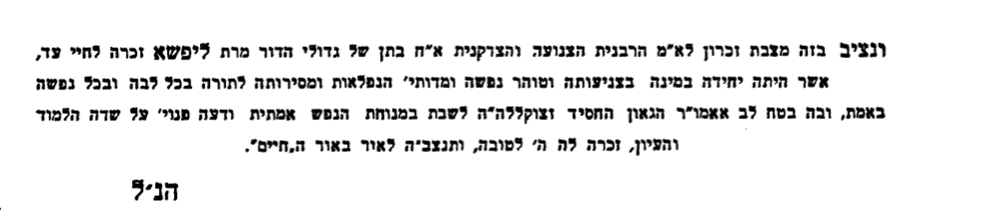
2. It is reported that when R. Hayyim’s commentary was published in 1936, R. Baruch Ber Leibowitz had a ceremony whereby the book was brought into the beit midrash together with music, just as if it were a new Sefer Torah. Students even danced with the book from R. Baruch Ber’s house until the yeshiva. See R. Dov Eliakh, Be-Sod Siah, p. 212.

[4] “Rambam of Brisk: R. Hayyim Soloveitchik’s Relationship with Mishneh Torah,” Tradition 5 (Summer, 2024), p. 2 n. 2.

[5] Friedman, however, points to one example where R. Hayyim suggests that the text of the Mishneh Torah is in error. See Hiddushei R. Hayyim HaleviEdut 21:9. R. Hayyim supports his suggestion by claiming that his preferred reading appears in an old manuscript. However, this raises the question of where he obtained this information, since the Frankel edition of the Mishneh Torah reports that no manuscripts preserve an alternate reading. See Hiddushei R. Hayyim HaleviEdut 21:9 and Friedman, “Kelalei Ha-Gaon Rabbi Hayyim mi-Brisk be-Veur ha-Rambam,” Alumot 1 (2026), pp. 390-391.

[6] “Ha-Yahas li-She’elat Nusah be-Sifrei Hazal,” in Yoel Catane and Eliyahu Soloveitchik, eds., Beit ha-Va’ad (Jerusalem, 2003), pp. 27-28, n. 28.

[7] “Yesodot ve-Ekronot Parshanut ha-Talmud,” Ha-Otzar 6 (Av 5777), p. 266.

[8] See also R. Raphael Amihai Hadad in the recently published Ha-Mashbir, vol. 12 (2026), p. 126:

ושמעתי בשם הגרב”ש דויטש זצ”ל שאף שהגר”ח בחידושו הידוע על “שומר שמסר לשומר” (הלכות נזקי ממון פ”ד ה”ד), בונה מערכת שלמה ליישב ולהסביר דברי הרמב”ם בעוד שהרמב”ם עצמו בתשובתו לחכמי לוניל (הובא במעשה רוקח שם) תולה את זה בטעות סופר, “דומה, כי גם אילו היה הגר”ח יודע את תשובת הרמב”ם, לה היה חוזר בו”

This volume of Ha-Mashbir, edited by the indefatigable Rabbis Yissachar Dov Hoffman and Ovadya Hoffman, is as usual a fascinating publication. It includes a previously unpublished commentary by R. Ovadiah Yosef on Tehillim. It also includes letters I received from R. Meir Mazuz in the years after the publication of Iggerot Malkhei Rabbanan. You can see the letters here.

[9] Ha-Dor ve-ha-Tekufah, p. 48. Truth be told, I am hesitant to quote anything from this book. I say this because the following passage (p. 32), citing R. Isaac Zev Soloveitchik in explaining why R. Kook came to London, is so historically uninformed that it raises questions about the reliability of the entire book. There is no way that R. Isaac Zev could have said what he is quoted as saying.

פעם שאל אותי אם יודע אני איך הגיע רב קוק ללונדון, וסיפר לי כי הוא הורחק מישיבת וואלוז’ין לפי שהי’ קייליקער, ועסק בלימודי השכלה, ואח”כ התחתן וחפש רבנות, כשמוע הגר”ח ז”ל שהוא מחפש רבנות, חרה לו ז”ל מאוד, אמרו לו הלא כבר עשה תשובה, אמר להם וכי ממנים בעל תשובה להיות רב, וכתב הגר”ח לכל העירות שבליטא שלא יקבלוהו לרב, ולכן הוכרח לברוח ללונדון

The statement that we would not appoint a baal teshuvah as rav of a community, which was widely accepted throughout the generations, refers to the classic baal teshuvah, namely, someone who “went off the derekh” and then repented. It does not refer to a “tinok she-nishbah,” i.e., someone born into a non-religious family—either a Converso family or a modern non-Orthodox family—who later in life became religious. The same can be said about a hazzan, concerning which Ta’anit 16b states that he must not have had a bad reputation in his youth. See R. Moshe Sternbuch, Teshuvot ve-Hanhagot, vol. 1, no. 99; R. Netanel Meoded, Mizrah Shemesh, vol. 4, no. 1. See also R. Sternbuch, Teshuvot ve-Hanhagot, vol. 2, no. 462, who sees value in having a baal teshuvah as a darshan. R. Avraham Shapiro has a different perspective; see his Rosh Devarkha (Jerusalem, 2010), p. 565:

כאשר ראה הסבא מסלובודקה זצ”ל שכל הישיבה שלו הלכה לשמוע את הרצאתו של החוזר בתשובה – הרב בירנבוים זצ”ל – הוא אמר: אני הייתי רגיל שבעל תשובה יושב בפינה ובוכה, והיום, יושב על במה ונותן הרצאות

I would only make two points about this passage. The first is that Nathan Birnbaum was a classic baal teshuvah in that he abandoned Orthodoxy before later returning, so his situation is not comparable to current baalei teshuvah who grew up irreligious. Second, Birnbaum was not a rabbi, a mistake that can be attributed to the editor of the book, as R. Shapiro would never have referred to him with the rabbinic title. In R. Shapiro’s Siah Ish, attached to his Hag ha-Sukkot (Jerusalem, 2012), p. 96, R. Shapiro’s comment about Birnbaum also appears. Yet here he refers to “Dr. Nathan Birnbaum,” which is what R. Shapiro would have said.

[10] Gulevsky, Lahat ha-Herev ha-Mithapehet, pp. 5-6.

[11] Kanievsky, Orhot Rabbenu (new ed.), vol. 4, p. 169.

[12] See Levi, “Rabbi Samson Raphael Hirsch – Myth and Fact,” Tradition 31 (Spring 1997), p. 11, called to my attention by Lesher.

[13] Ha-Ma’yan 48 (Nisan 5768), p. 37.

[14] See Jacob J. Schacter, “Torah u-Madda Revisited: The Editor’s Introduction,” Torah u-Madda Journal 1 (1989), p. 15, n. 1.

[15] There are also a few minor differences between the original letter and what appears in Ha-Pardes. The following sentence is only found in Ha-Pardes.

ואם אסור מן הדין בודאי גם כן משום פרנסה אסור ובפרט אם יכול האדם למצא אומנות אחרת נקיה וקלה אף גם שאינו מרויח כך כך

[16] The letter is found in the R. Joseph Rozin Collection, Yeshiva University Archives, MS. no. 1142. I thank Yeshiva University for permission to publish the letter. You can see the original letter here.

[17] Ha-Ma’yan 48 (Nisan 5768), pp. 38-39.

[18] Tradition 28 (Fall 1993), pp. 46-81.

[19] “Torah im Derekh Eretz in Our Time,” p. 68.

[20] Ibid.

[21] Ibid.

[22] When Levi reprinted R. Schwab’s article on Torah im Derekh Eretz in Ha-Ma’yan 48 (Nisan 5768), pp. 38-39, he is clear that Hirsch did not regard Torah im Derekh Eretz as a hora’at sha’ah. See ibid., p. 37.

[23] “Rabbi Samson Raphael Hirsch – Myth and Fact,” pp. 7-8.

[23b] Ha-Ma’yan 48 (Nisan 5768), p. 38 n. 12.

[24] Hirsch, Collected Writings, vol. 9, p. 146.

[25] Schendowich, Hermann Schwab: Historian of German Jewry, His Life and Shorter Works (Jerusalem, 2022), p. 79 n. 24.

[26] Hirsch, Collected Writings, vol. 7, p. 88.


Pets on Shabbat, Rabbi Morenu, and Epidemics

Pets on Shabbat, Rabbi Morenu, and Epidemics

Marc B. Shapiro

1. In my last post here I wrote as follows:

R. Yitzhak Nahman Eshkoli calls attention to what he sees as another mistake made by those who published R. Moshe Feinstein’s works.[1] Here is Iggerot Moshe,Orah Hayyim 5, 22:21.

According to the text of R. Moshe’s responsum, animals are muktzeh, even those that children play with. This means that R. Moshe held that pets are also muktzeh. Yet in the small print the editor added that pets are permitted, even though this completely contradicts the first part of the sentence. See also Iggerot Moshe, Orah Hayyim 4, no. 16 (end), where R. Moshe forbids moving a fish tank on Shabbat and Yom Tov: דבע”ח מוקצין.

If you search online you will find a number of people who deal with R. Moshe’s view of pets on Shabbat. R. Chaim Jachter, referring only to Iggerot Moshe, Orah Hayyim 4, no. 16, states that R. Moshe held that pets are muktzeh. See here. Rabbi Dov Lev writes:

See Orach Chaim 308:39 that all animals are considered muktzeh. However, see Shu”t Igros Moshe (Orach Chaim 5:22:21) that rules that designated pets are exceptional and are not muktzeh. On the other hand, Rabbi Y. P. Bodner writes (Halachos of Muktzeh, Feldheim, p. 118) that he heard from Rabbi Feinstein that pets are indeed muktzeh. This is supported by Rabbi Feinstein’s responsum (#24) at the end of the book as well as by Shu”t Igros Moshe (Orach Chaim 4:16).

There are two interesting things here. The first is that R. Lev cites the most recent responsum in Iggerot Moshe that pets are not muktzeh without taking note of what many have seen as a contradiction between what R. Moshe wrote and the small print added by the editors. Also of significance is that R. Pinchas Bodner, who wrote a book on muktzeh and consulted with R. Moshe, claims that R. Moshe told him that pets are muktzeh. See also R. Natan Slifkin, Man and Beast: Our Relationships with Animals in Jewish Law and Thought, p. 237 n. 1.

R. Yonason Rosman, Petihat ha-Iggerot, p. 314, quotes R. Moshe Kaufman, a son-in-law of R. Mordechai Tendler, that after R Moshe gave his stringent answer to R. Bodner, he then reconsidered and came to a lenient opinion. R. Kaufman adds that  R. Moshe permitted his son-in-law, R. Moshe Tendler, to handle his cat on Shabbat.

R. Doniel Yehuda Neustadt, The Daily Halacha Discussion, p. 115, n. 108, writes that “there are conflicting sources regarding Harav M. Feinstein’s opinion on this subject.”

R. Anthony Manning writes:

In the 8th volume of Iggrot Moshe (published posthumously) (O.C. 5:22:21) Rav Moshe again rules that animals are muktza. However Rav Moshe’s grandson, R. Mordechai Tendler, adds afterwards – (אלא א”כ הם מיוחדים לשעשועים (פעטס. It is not clear if Rav Moshe agreed with this addition. Rabbi Pinchas Bodner writes (Halachos of Muktza p. 119 footnote 6) that he heard directly from Rav Moshe that pets are muktza.

R. Zvi Ryzman was also troubled by the apparent contradiction inIggerot Moshe,Orah Hayyim 5, 22:21. He wrote to R. Shabbetai Rapoport, as it was R. Rapoport and R. Mordechai Tendler who were the editors of this posthumous Iggerot Moshe volume and the ones responsible for the small print. Ryzman published his correspondence with R. Rapoport in Moriah 36 (Nisan 5778), pp. 358-359.[2]


I think that for most people R. Rapoport’s letter will settle the matter that R. Moshe did not regard pets as muktzeh. It would thus be permissible to handle your own cat that lives in your home, but not to do so with a stray cat or with an animal on a farm, as they are not pets. While we must be grateful to R. Rapoport for explaining matters, there is no question that this should have been properly explained in Iggerot Moshe, as the poor editing job there has created an enormous amount of confusion.[3]

Ryzman provides a number of sources in traditional texts that express a negative view of having dogs as pets. Chronologically, the first on his list is R. Jacob Emden in She’elat Ya’avetz, vol. 1, no. 17.[4] It is worth noting that R. Emden also discusses this matter in Birat Migdal Oz (Warsaw, 1912), p. 127a (5:16):

.ולגדל לשחוק בהן אית ביה איסור מוסיף אחד אנשים ואחד נשים ביחוד אותן המשתעשעים ומגעגעים בכלבים חלקים מעשה עכו”ם הוא ר”ל

R. Emden had another issue with dogs, in that he tells us that one of the leading members of the Ashkenazic community of Amsterdam named his dog after R. Emden’s father, as a way of showing how he despised him. This matter greatly upset R. Emden, and all he can write is:[5]

‘שהיה מגדל כלב וקורא לו שם כו
‘הוא גידל כלב וקרא שמו כו

We thus don’t know what exactly he called the dog. Azriel Shohet writes that he called it “Hakham Zvi,”[6] but that is not in the text, and he could have just as easily called the dog simply “Zvi” or some other form of the name.

Regarding dogs, the Shulhan Arukh, Even ha-Ezer 22:18, states:

אלמנה אסורה לגדל כלב מפני החשד

“A widow is forbidden to raise a dog, because of suspicion [people will suspect her of bestiality].”

As far as I can tell, there is agreement among the aharonim that this law also applies to a divorced woman, but there is no consensus about a single woman. There also seems to be agreement that there is no problem with a female dog.

Despite the fact that this halakhah is found in the Shulhan Arukh, there is no question that it is ignored in the Modern Orthodox world, either because people don’t know about it or because they find it far-fetched or even offensive. The Taz, Even ha-Ezer 22:10, brings a limud zekhut for ignoring this law from Tosafot, Bava Metzia 71a, s.v. lo, who understood the matter as being in the realm of humra, but that there is no actual prohibition as Jews are not suspected of bestiality:

לא תרבי כלבא: משום לזות שפתים בעלמא לפי שהולך אחריה שלא נחשדו ישראל על הזכור ועל הבהמה וגם אין אסור להתייחד

(The Taz’s words should be examined in the Machon Yerushalayim or Rosh Pinah editions which are corrected based on manuscripts.)

R. Isaac Lampronte (1679-1756) testifies that in eighteenth-century Italy theShulhan Arukh‘s ruling was ignored and the rabbis did not protest.[7]

אלמנה לא תגדל כלב בתוך ביתה . . . והאידנא לא ראיתי מוחים באלמנה מלגדל כלב אולי דעתה לא נחשדו ישראל על כך

In general, dogs don’t come out looking too well in rabbinic literature, something which must be distressing for all of us dog lovers. In a future post I will give examples of what I am talking about. However, there are a few positive things said about dogs as well. For example, Yalkut Shimoni, Shemot ch. 11 (no. 187), tells us that the dogs were rewarded for not whetting their tongues against the Israelites (Ex. 11:7):

שזכו לעבד עורות מצואתן לכתוב בהן ספר תורה תפילין ומזוזות

In this same section of Yalkut Shimoni there is the following passage about dogs, but I don’t think you can regard it as saying anything positive about them:

כת’ לכלב תשליכון אותו (שמות כב, ל) ללמדך שהכלב מכובד מן הגוי שהרי טריפה לכלב ונבילה לגוי

Let me make one final point about dogs. In Louis Jacob’s autobiography, Helping With Inquiries, pp. 54-55, he writes:

Before leaving my account of the Gateshead Kolel, I feel it would be incomplete unless I said something more about Rabbi Dessler, one of the most remarkable men I have ever met. Until he became the spiritual guide of the Ponievezh Yeshivah in B’nai B’rak, near Tel Aviv, Rabbi Dessler was the moving spirit behind the Kolel and his wise counsel was sought by its members even when he had moved to Israel. He was physically small and had a full but neatly trimmed beard until he went to Ponievezh, when he allowed it to grow long. He had studied in his youth at the famed Musar School in Kelm, presided over by the foremost disciple of Reb Israel Salanter, R. Simhah Züssel. He married the daughter of Reb Nahum Zeev, son of Reb Simhah Züssel. Reb Nahum Zeev was also an outstanding Musar teacher. He earned his living as a merchant in Koenigsberg, where he dressed and conducted his life in Western style. His wife and daughters dressed in the latest fashion. He even had a dog. Rabbi Dessler told us of the occasion when a Polish rabbi, in Koenigsberg to consult a physician, was invited by Reb Nahum Zeev to be a guest in his home. Witnessing the Western style in which the home was conducted, the rabbi was careful to eat very little, suspecting that the food was not completely kosher. Late at night, the Polish rabbi was awakened from his sleep by the sound of bitter weeping from a nearby room. Thinking someone needed help, the rabbi went on tiptoe to the room from which the sobs were coming only to hear the “Westernised gentleman” sobbing his heart out as he chanted the verse from Ecclesiastes: “Vanity of vanity; all is vanity.” Needless to say, after this experience, the rabbi had no further qualms about eating at Reb Nahum Zeev’s table.[8]

I cite this passage because it reports that that R. Ziv had a dog, and this information must have come from R. Dessler.

R. Ziv was a very great man and there is a lot more that can be said about him. R. Jehiel Jacob Weinberg reports that when he lived in Germany, not only did he dress in a modern fashion, but he also trimmed his beard and shook the hands of women. R. Yosef Yozel Horowitz of Novardok was very upset about these things and asked the young R. Weinberg, at this time serving as a rabbi in Pilwishki, to rebuke R. Ziv. R. Ziv told R. Weinberg, “What does he want from a Jew in Germany? I am just a simple Jew and I do not wish to cause ahillul ha-Shem. I behave like the other German Orthodox Jews.”[9] R. Weinberg added that all of R. Ziv’s actions were infused with Mussar ideals, and when he had a question, he traveled to the Hafetz Hayyim to consult with him.[10]

2. In my last post here I gave an example where the people who put together Mesorat Moshe from R. Mordechai Tendler’s notes did not understand what was being discussed. Here is another example from Mesorat Moshe, vol. 3, p. 343, no. 1.

It begins by saying that R. Moshe Feinstein receive a letter from רב מורינו. The editor explains that this refers to Jacob Rosenheim. When I read this I immediately knew it was a mistake. This volume of Mesorat Moshe covers Tevet 5735-Tevet 5736, and Rosenheim died ten years prior to this, in 1965.

Leaving this aside, the editors were led to think that the story concerned Rosenheim as he was given the honorary title “Morenu ha-Rav” by the Agudat Israel organization.[11] Yet even if he was alive at the time of the story, no one would have referred to him as “Rabbi Morenu.” In fact, he was not a rabbi even though subsequent to his death and continuing until now he is constantly given this title,[12] much like today every askan or writer associated with the Agudah is referred to as “Rabbi”. (R. Jehiel Jacob Weinberg commented that for the Agudah every rabbi who joins them is treated like a great gaon,[13] to which we can add that every askan is treated like a rabbi. For the haredi critics of the Agudah, it is not only that the askanim are treated like rabbis, but that they are often treated like gedolim. A recurring theme in haredi criticism of the Agudah, since the beginning and continuing until today, is that many of the important decisions taken by Agudat Israel in the past century were made by the askanim without consultation with the Torah leaders who are supposed to be in charge.[14])

Although I knew that Mesorat Moshe could not be referring to Rosenheim, I had no idea who רב מורינו was, and assumed that there was some problem in the transcription. It never occurred to me that מורינו here was actually a name. I have to thank R. Mordechai Berger who pointed out to me that the letter is referring to R. Zev Moreno (Morejno in Polish), who served as rabbi in Lodz until 1973 when he came to New York. R. Moreno has a Wikipedia page devoted to him here.

Even after leaving Lodz, R. Moreno continued to be regarded as the chief rabbi not only of this city but of the entire country of Poland. R. Moshe Feinstein even ruled that in all matters dealing with religious life in Poland, such as appointing rabbis or shochetim, R. Morenu had to give his approval. See here and here. When R. Menahem Joskowitz arrived in Warsaw in 1989 and started functioning as the Chief Rabbi of Poland, this caused a big dispute with R. Morenu who travelled to Warsaw to confront the new rabbi. See here.

R. Morenu was clearly somewhat of a character, as only such a person would have written letters to President Ephraim Katzir, Prime Minister Menachem Begin, and Foreign Minister Moshe Dayan with the following “genius” suggestions, in which great rabbis are placed in the highest political offices as figureheads, while the politicians do all the real work: The president of the State of Israel should be the Satmar Rebbe, three vice presidents (a position that Israel does not even have) should be R. Moshe Feinstein, the Gerrer Rebbe, and the Lubavitcher Rebbe, who will serve together with Katzir. R. Zvi Yehudah Kook should be appointed prime minister, while the real work of the prime minister’s office should be conducted by Begin. The foreign minister should be R. Yosef Shalom Elyashiv while Dayan carries out the actual duties of the foreign ministry. You can read all about his political suggestionshere.

R. Berger also called my attention to another source relevant to my last post where I discussed R. Abraham Sofer. In 2018 Minhagei Yeshivat Torah va-Da’at (Torah Vodaath)[15] was published. On p. 23 n. 45, the following story about Sofer appears. Particularly interesting is the report that the Satmar Rebbe told the young man who refused to allow Sofer to get an Aliyah and publicly embarrassed him to ask Sofer for forgiveness.

פעם נכנס לישיבת ביהמ”ד עליון תלמיד חכם נכבד נכד החת”ס, אשר מחמת דוחק הפרנסה עבד במוסד של קאנסרבטיבים. כאשר כבדו הגבאי בעליה, קפץ אחד מתלמידי הישיבה ועלה במקומו לס”ת, והוכיח את החכם הנכבד האיך יכול הוא לעבוד אצל פוקרים בעוד שסבו נלחם במסי”נ נגד הניאולוגים, וביישו ברבים עד שההוא יצא מביהמ”ד מבוייש. כאשר סיפרו זאת להרב ראובן גרוזובסקי זצ”ל, אמר שהוא בבחינת הלכה ואין מורין כן, וכשסיפור זה הגיע לאזניו של האדמו”ר מסאטמאר זצ”ל הגיב שהבחור עשה כהוגן, אך משום כבודו של החת”ס שהוא זקנו של הלה .הורה לבקש ממנו מחילה.

3. Since so many have recently discussed rabbinic responses to epidemics, let me add the following. In years past there were two understandings of how diseases were spread. One is known as the Miasma Theory, and I can do no better than to quote the opening lines of the Wikipedia entry on the topic: “The miasma theory (also called the miasmatic theory) is an obsolete medical theory that held diseases—such as cholera, chlamydia, or the Black Death—were caused by a miasma (μίασμα, ancient Greek: ‘pollution’), a noxious form of ‘bad air’, also known as night air. The theory held that the origin of epidemics was due to a miasma, emanating from rotting organic matter.”

The other theory is Germ Theory, which in non-scientific language must be regarded as a fact. Germ theory explains the spread of disease as coming about through the spread of living organisms. Until the second half of the nineteenth century, both the Miasma Theory and Germ Theory (in earlier versions) found supporters in the scientific community.

In an article published in 1851,[16] Joseph Loewy claims that the amora Samuel accepted the Miasma Theory. He calls attention to Bava Metzia 107b: “And the Lord shall take away from thee all sickness (Deut. 7:15). . . . Samuel said: This refers to the wind. Samuel follows his views, for he said: All [illness] is caused by the wind.”

Loewy also cites Ta’anit 21b:

Once Samuel was informed that pestilence was raging amongst the inhabitants of Be Hozae, and he ordained a fast. The people said to him: surely [Be Hozae] is a long distance away from here. He replied: Would then a crossing prevent it from spreading?

4. In my last post I discussed letters from R. Hayyim Ozer Grodzinski and R. Jehiel Jacob Weinberg to R. Isaac Unna that were sold by two auction houses. I mentioned how these letters came from the Unna archive at Bar Ilan University which had disappeared. A third auction house has also gotten into the act, and on June 30, 2020 the following letter from R. Grodzinksi to R. Unna is being auctioned. See here.

I refer to this letter in Between the Yeshiva World and Modern Orthodoxy, p. 126 n. 69.

Obviously, the person who acquired the Unna archive has decided to unload it, and as mentioned in my last post, Bar-Ilan University could not care less that documents that it agreed to watch over are now being sold at public auctions. In the previous post I showed how the Bar-Ilan manuscript numbers are clearly visible on the letters that were sold. Take a look at the letter above from R. Hayyim Ozer to R. Unna. There is no manuscript number visible. Yet this is how the letter really looks (ignore my handwriting at the top of the page).

The manuscript number appears right above the name “Grodzienski,” but has been removed from the image used by the auction house (yet presumably is still found on the actual letter).

Excursus

The general practice is to transliterate יעבץ in שאילת יעבץ as Ya’avetz. Yet in I Chron. 4:9-10, the Bible mentions a righteous man named יעְבּץ, and his name is spelled with a sheva under the ע and a dagesh in the ב. When speaking of R. Jacob Emden, יעבץ stands for יעקב בן צבי. Yet in the introduction to שאילת יעבץ, R. Emden tells us that the title also alludes to the righteous man named יעבץ in I Chron. 4:9-10, as both of their births came with pain. On the title page of his responsa, in giving the publication date, R. Emden also cites I Chron. 4:10 with the name of יעבץ.

I assume, therefore, that R. Emden intended us to pronounce the word in the title as Ya’betz. This is also grammatically correct, as there is a sheva under the ע. Regarding the title, also note that the word is written as יעבץ and not יעב”ץ.

In the introduction to שאילת יעבץ, R. Emden mentions that the mother of Othniel ben Kenaz named him Ya’betz because of her painful childbirth. It is true, as Jacob J. Schacter points out, that there is nothing in Chronicles “to support Emden’s assertion that Yavez and Athniel were the same person.” See Schacter, “Rabbi Jacob Emden: Life and Major Works” (unpublished doctoral dissertation, Harvard University, 1988), p. 70 n. 18. However, when R. Emden writes

קראתי בשם ספרי זה שאילת יעבץ, נסמך הכתוב בד”ה שאמו של עתניאל בן קנז קראתו יעבץ לאמר כי ילדה בעוצב

he has in mind Temurah 16a: “A tanna taught: Othniel is the same as Ya’betz. . . . He was called Othniel because God answered him, and Ya’betz because he counselled and fostered Torah in Israel.”

In I Chron. 2:55 it mentions “the families of scribes that dwelt at יעבץ.” Does this city have anything to do with the person Ya’betz mentioned in I Chron. 4:9-10? We have no evidence, but Radak, I Chron. 2:55, suggests that perhaps Ya’betz built the city and it was named after him. Rashi, ibid., connects יעבץ with the city אבץ in Josh. 19:10.

There is another noteworthy point about the name יעבץ. We find the following in Derekh Eretz Zuta, ch. 1:

ט’ נכנסו בחייהם בג”ע ואלו הן חנוך בן ירד ואליהו ומשיח ואליעזר עבד אברהם וחירם מלך צור ועבד מלך הכושי ויעבץ בנו של רבי יהודה הנשיא ובתיה בת פרעה וסרח בת אשר ויש אומרים אף ר’ יהושע בן לוי

This is a list of those who entered Paradise during their lifetimes. A few of the names are not what we would expect and need to be explained. There is also a textual issue, as another version has R. Joshua ben Levi replacing Hiram of Tyre rather than being added. Why Hiram should be on the list in the first place is something I can take up on another occasion. For now, I just want to note that the son of R. Judah ha-Nasi (other versions read בן בנו) was also named Ya’betz, and that he is reported to have entered Paradise alive.

There is another version that lists Ya’betz separately from the son of R. Judah ha-Nasi. See R. Matityahu Strashun, Mivhar Ketavim, pp. 90-91. Alfa Beita de-Ben Sira (Warsaw, 1927), p. 23, has both עבדו של רבי יהודה and Ya’betz.

The Jerusalem Talmud, Hagigah 2:1, refers to an amora named Ya’betz. For a list of post-talmudic figures named יעבץ, see R. Zev Aharon Teller in Beit Va’ad le-Hakhamim (Tishrei 5769), p. 504 n. 88. See also Asher Weiser, “Ya’betz,” Sinai 78 (1975), pp. 6-8. Masoretic scholars know of Ya’betz ben Shlomo. See e.g., Shlomo Zalman Havlin, Masoret Torah she-Be’al Peh (Jerusalem, 2012), p. 611.
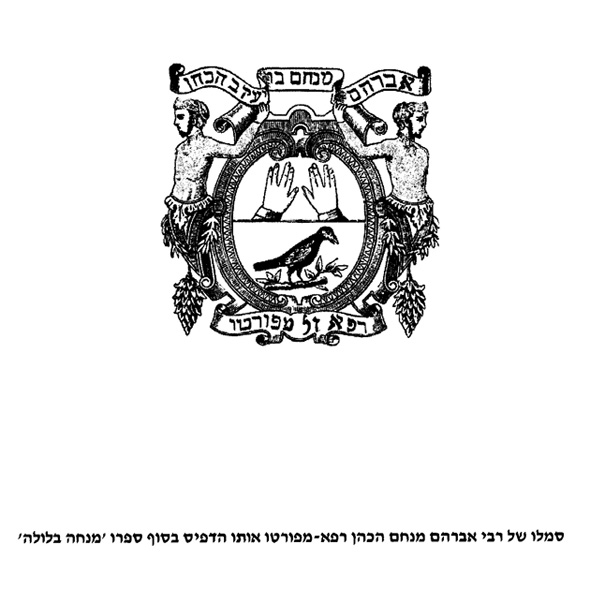
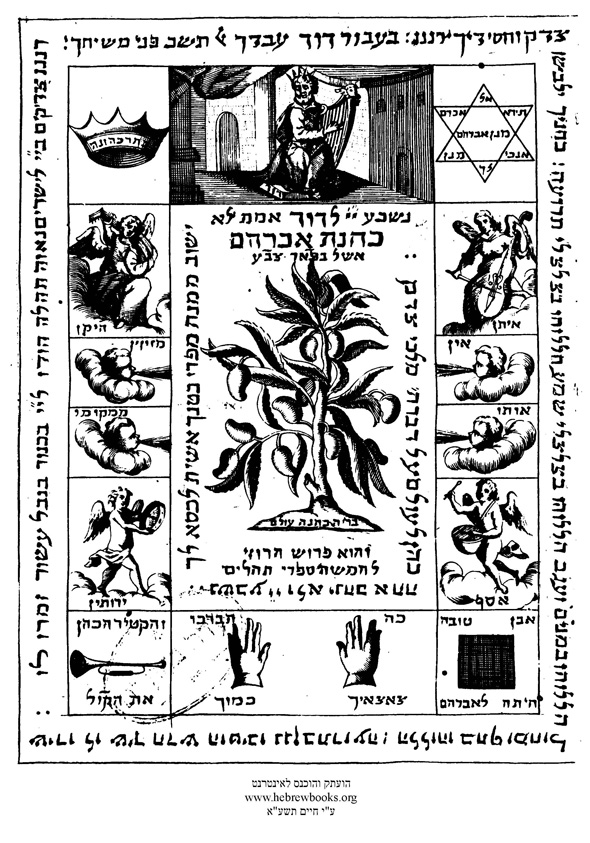
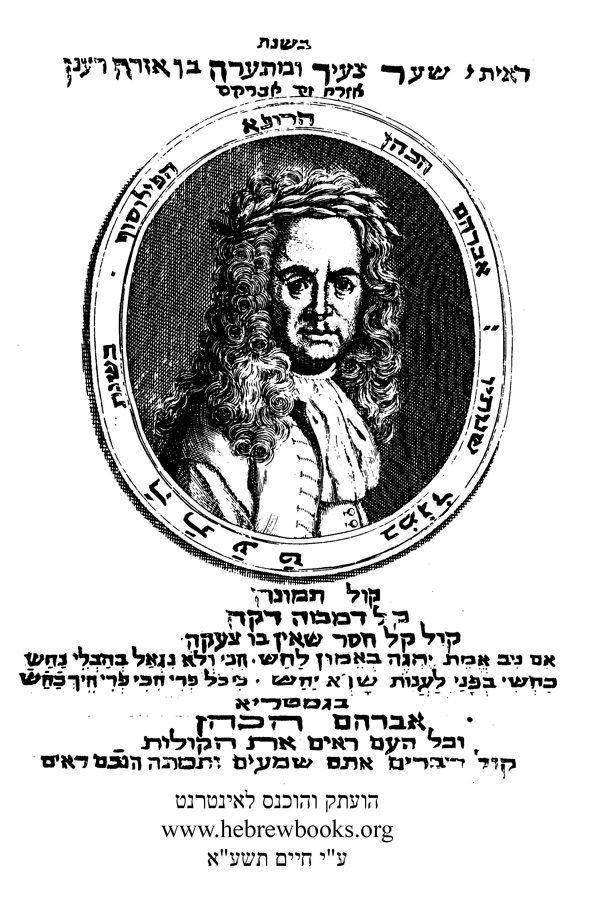
For others who referred to themselves as יעבץ, including Judah Leib Gordon, see Saul Chajes, Otzar Beduyei ha-Shem (Vienna, 1933), pp. 162-163.

A very important figure called יעבץ is R. Emden’s contemporary, R. Jacob Ibn Tzur (Abensur; 1673-1753) of Fez, author of the responsa work Mishpat u-Tzedakah be-Ya’akov. For generations, all Moroccan Jews knew R. Ibn Tzur, who was also a poet, yet he is pretty much unknown in the Ashkenazic world. Menachem Elon recalls how he learned about R. Ibn Tzur. He was doing research on a topic and יעבץ was mentioned, but he could see that it did not refer to R. Emden. He investigated the matter and learned that there was another great halakhic authority who also is known as יעבץ. He writes:

גאון מופלג זה, שיותר ויותר התודעתי לתורתו ולאישיותו, היה זמן ניכר בבחינת נעלם בעולם התורה והישיבות הגדולות שבפולין, ליטא ואשכנז, וכמעט לא היה ידוע בין החוקרים, ומאד חוששני שכך הוא הדבר, עד עיצומם של ימים אלה

See Elon, “Yihudah shel Halakhah ve-Hevrah be-Yahadut Tzafon Afrika mi-le-Ahar Gerush Sefarad ve-Ad Yamenu,” in Moshe Bar-Yuda, ed., Halakhah u-Fetihut: Hakhmei Morocco ke-Foskim le-Dorenu (Tel Aviv, 1985), p. 24.

After R. Emden, the most famous יעבץ is R. Joseph Jabez of Spain, author of Or ha-Hayyim among other works. His name is often written as Yavetz or even Yaavetz, but I don’t know how he himself pronounced the first three letters. The one thing I can say is that he did not pronounce the final letter of his name as “tz”, as that is an Ashkenazic (inauthentic) pronunciation which never would have been heard in Spain and won’t even be heard today among Sephardim who have had a traditional Sephardic upbringing. See R. Benzion Cohen, Sefat Emet (Jerusalem, 1997), pp. 114ff. This explains why, for instance, in Hebrew Barcelona is written as ברצלונה and Safed is written as צפת.

With regard to צפת, the modern pronunciation is Tzefat. However, R. Meir Mazuz notes that the correct pronunciation is indeed Safed (using “s” for צ and the accent on the first syllable), and this is in line with the Arabic pronunciation. See his introduction to R. Hayyim Joseph David Azulai, He’lem Davar (Bnei Brak, 2006), p. 27. See also R. Jacob Saphir, Even Sapir (Lyck, 1866), p. 1a. In previous generations, this is how the Sephardim in Eretz Yisrael would pronounce it. See R. Elijah Hazan, Ta’alumot Lev, vol. 3, no. 19 (p. 38b). In the page on Otzar HaChochma the vowels are not clear, but you can see them clearly here.

R. Ovadiah Bartenura, in a letter sent from Eretz Yisrael, refers to the city as ספיתה. It should be vocalized as סׇפֵיתׇה as this is how the locals pronounced it, non-Jews and Jews alike. See Avraham Yaari, Iggerot Eretz Yisrael(Ramat-Gan, n.d.), p. 151.

It is true that there is a city צְפֵת (Tzefat) mentioned in Judges 1:17, yet this is a city in the south and has nothing to do with the northern city of Safed we all know so well. צְפֵת is never again mentioned in the Bible, which is understandable as Judges 1:17 tells us that the city was destroyed and its name was changed to Hormah.

As for the original pronunciation of צפת, R. Mazuz does not note that R. Elazar Kalir indeed pronounced the name of the city as Tzefat. Look at the first two lines below, which come from Kalir’s kinah איכה ישבה חבצלת השרון (from the Goldschmidt edition of Kinot, p. 50).

As you can see, the final word צפת can only be read as צְפַת. It thus seems that the pronunciation as Safed only dates from the medieval period. See Encyclopaedia Judaica, s.v Safed: “Between the talmudic period and the Crusades the history of Safed is not known. The town reappears in 1140 under the name Saphet.”

* * * * * *

[1] Tza’ar Ba’alei Hayyim be-Halakhah ve-Aggadah, p. 514 n. 1171
[2] This was called to my attention by Yonatan Emett. R. Rapoport mistakenly refers to R. Shimon Eider as the recipient of R. Moshe’s responsum instead of R. Pinchas Bodner. He also refers to R. Eider as shlita, even though he passed away in 2007.
[3] From the various quotations, you can see that there are different ways people have transliterated the first word of R. Moshe’s responsa, אגרות. There is a dagesh in the gimel perhaps because of a nun that dropped off. Regarding the word, see R. Solomon Judah Rapoport, Toldot Rabbenu Natan Ish Romi (Warsaw, 1913), p. 24; R. Matityahu Strashun, Mivhar Ketavim (Jerusalem, 1969), p. 82 n. 9.
[4] See Excursus regarding the word יעבץ.
[5] Megilat Sefer, ed. Bombach (Jerusalem, 2012), pp. 41, 64.
[6] Im Hilufei Tekufot (Jerusalem, 1960), p. 104.
[7] Pahad Yitzhak, s.v. almanah.
[8] The same story, with slight variations, is found in Kitvei ha-Saba ve-Talmidav mi-Kelm, vol. 2, p. 649.
[9] That German Orthodox Jews shook hands with women is mentioned by R. Solomon Carlebach, who states that he also does so if the woman puts her hand out and to not shake it would embarrass her. See Meir Hildesheimer, et al., eds. Le-David Tzvi (Berlin, 1914), p. 218 (Hebrew section).
[10] From an unpublished letter of R. Weinberg.
[11] At the beginning of the Hebrew section of the Festschrift fuer Jacob Rosenheim (Frankfurt, 1931), the Agudah declaration is printed.

[12] For R. Zvi Yehudah Kook, the “original sin,” as it were, of Agudat Israel is precisely that it was founded by a layperson (Rosenheim), and R. Zvi Yehudah contrasts this to Mizrachi which was founded by a great Torah scholar, R. Isaac Jacob Reines. See Be-Ma’arakhah ha-Tziburit (Jerusalem, 1986), p. 76. In his eulogy for Rosenheim, R. Jehiel Jacob Weinberg, Li-Frakim (2016 edition), p.  607, also refers to him as the founder of Agudat Israel. Yet it is more correct to say that Rosenheim was the major force in the founding of Agudat Israel, as he cannot be identified as the organization’s sole founder.
[13] “Scholars and Friends: Rabbi Jehiel Jacob Weinberg and Professor Samuel Atlas,” Torah u-Madda Journal 7 (1997), p. 111.
[14] See here for a recent example of the Agudah rabbinic leadership responding to such a claim (regarding synagogue closures and coronavirus). See here regarding Yaakov Litzman serving as minister in the current Israeli government, which was never approved by the rabbinic leadership of Yahadut ha-Torah. See also here.

In R. Jehiel Jacob Weinberg’s letter to R. Moshe Soloveitchik, dated Oct. 20, 1949, and published here for the first time, R. Weinberg writes (ellipsis in original):

.וצדק הרבי ממונקאטש ז”ל שאמר לי כי עתידה האגודה להעביר את מרכז היהדות מביה”מ לאולם האספות ושם ימחאו הרבנים מחיאות כף לנאומים והאדמורי”ם יתכבדו באמירת ברכות . . . חכם עדיף מנביא

[15] On its hundredth anniversary in 2019, Torah Vodaath put out a beautifully produced book, America’s Yeshiva: Celebrating a Century of Torah Leadership in America. The pictures are wonderful and the story of the yeshiva’s beginning and growth are told in an honest way. Also noteworthy is that the yeshiva has a website with a lot of historical information, including most of the high school yearbooks that were produced. See here. Just going through the yearbooks, looking at the pictures, and reading the entries on each of the graduating students makes history come alive. The following yearbooks are missing from the website: 1944, 1947, 1948, 1951, If anyone has these yearbooks, please reach out to the yeshiva so they can be uploaded. The last yearbook on the website is 1978, which I assume means that the students did not publish any more yearbooks.

I do have two comments about the Torah Vodaath website and book. On the website herethere are biographies of the roshei yeshiva. However, there is no biography for R. Dovid Leibowitz, even though the book, pp. 150-152, devotes three pages to him, as well as mentioning him elsewhere. I hope that the omission from the website is not an intentional slight because of the dispute between R. Leibowitz and R. Shraga Feivel Mendlowitz that led to R. Leibowitz leaving Torah Vodaath and founding his own yeshiva. See Moshe D. Sherman, Orthodox Judaism in America (Westport, CT, 1996), p. 129.

While I think the book as a whole is great, there is a real blemish on p. 630 when the newest rosh yeshiva is discussed. I think most will understand why this is a terrible bizayon ha-Torah (a double bizayon ha-Torah, i.e., omitting mention of grandfather and father).

We are grateful that in 2018, just as Torah Vodaath began to mark its milestone centennial year, the Yeshiva welcomed Rav Yitzchok Lichtenstein, a descendant of Rav Chaim Soloveitchik and a grandson through marriage of Rav Reuven Grozovsky, to lead the Yeshiva. Rav Lichtenstein was a talmid of Rav Dovid Soloveitchik in Yerushalayim.

On p. 628 the other rosh yeshiva, R. Yosef Savitsky, is introduced as follows: “Rav Yosef Savitsky was raised in Boston by his father Rav Mordechai, a highly-respected Rav.”

If R. Lichtenstein had distanced himself from his family, I could understand the omissions (not that it would be right, but I could understand it). Yet not only has R. Lichtenstein not done so, but he himself has contributed to the legacy of his grandfather, with his most popular contribution undoubtedly this edition of R. Soloveitchik’s insights on the Haggadah.

[16] “Toldot Shmuel,” Kokhvei Yitzhak 15 (1851), p. 31.