The Physicians of the Rome Plague of 1656, Yaakov Zahalon and Hananiah Modigliano
The Physicians of the Rome Plague of 1656, Yaakov Zahalon and Hananiah Modigliano
Reclaiming a Long-Lost Role and the
Only Known Example of Father and Son Diplomas
By Edward Reichman
Ellen Wells of the Smithsonian Libraries wrote,[1] “The plague of Rome of 1656 was one of the best recorded medical events of the 17th century. It was referred to in most major political and ecclesiastical histories, in diplomatic correspondence and in personal memoirs. Books and pamphlets were issued in profusion. Commemorative prints were published …” The Jewish physician Yaakov Zahalon[2] contributed to this documentary phenomenon from the Jewish perspective.[3] Zahalon is one of the most famous physicians in Jewish history, and his book Otzar HaHayyim, published in Venice 1683, is one of only few original Hebrew medical treatises written in the premodern era. Therein, Zahalon added to the personal memoir genre of the plague.[4]
In the context of his discussion of pestilential fevers and plague, Zahalon records his recollections, both medical and non-medical, of the Bubonic Plague in Rome of 1656.[5] This passage is well-known and has been partially translated by Friedenwald.[6] It is in this passage that we read of Zahalon preaching from the balconies of the Rome Ghetto due to the closure of synagogues during the plague, an account recalled frequently over this past year.[7]
Zahalon was clearly present and practicing medicine in Rome during the epidemic, as he mentions a first-hand encounter with a patient, Shabtai Kohen, who died with fever and groin swelling, typical of bubonic plague. Zahalon diagnosed an intestinal hernia, despite the insistence of the non-Jewish physician that the patient had succumbed to plague. A diagnosis of plague would have necessitated quarantine of Kohen’s entire household. A postmortem exam confirmed Zahalon’s diagnosis. Yet, Zahalon’s exact role during the plague has remained elusive.
Regarding the administration of medical care in the Ghetto during the plague, Zahalon identifies a number of medical roles. An isolation house, called a Lazaretto, was set up in the Ghetto to accommodate those afflicted with plague.[8] The medical care in the Lazaretto was provided by Samuel Gabai, and his father, Ciroccio (Mordechai), who succumbed to the plague.[9]
Zahalon discusses the division of the ghetto into three sections, each with its appointed physician.[10]

The three physicians who equally divided the medical care of the city were Hananiah Modigliano, Gavriel Lariccia, and Yitzhak Zahalon. Who were these three physicians?
On Lariccia, I have found no additional information, and it is possible that this mention by Zahalon may be the only historical record of his existence. As recorded by Zahalon, Lariccia died during the plague.
On Modigliano, we are fortunate to have archival material. Hananiah Modigliano was a graduate of the University of Siena in 1628 and was one of a mere eleven Jewish graduates from this university from the years 1543 to 1695.[11] His medical diploma is extant and housed in the Jewish Theological Seminary Library.[12]
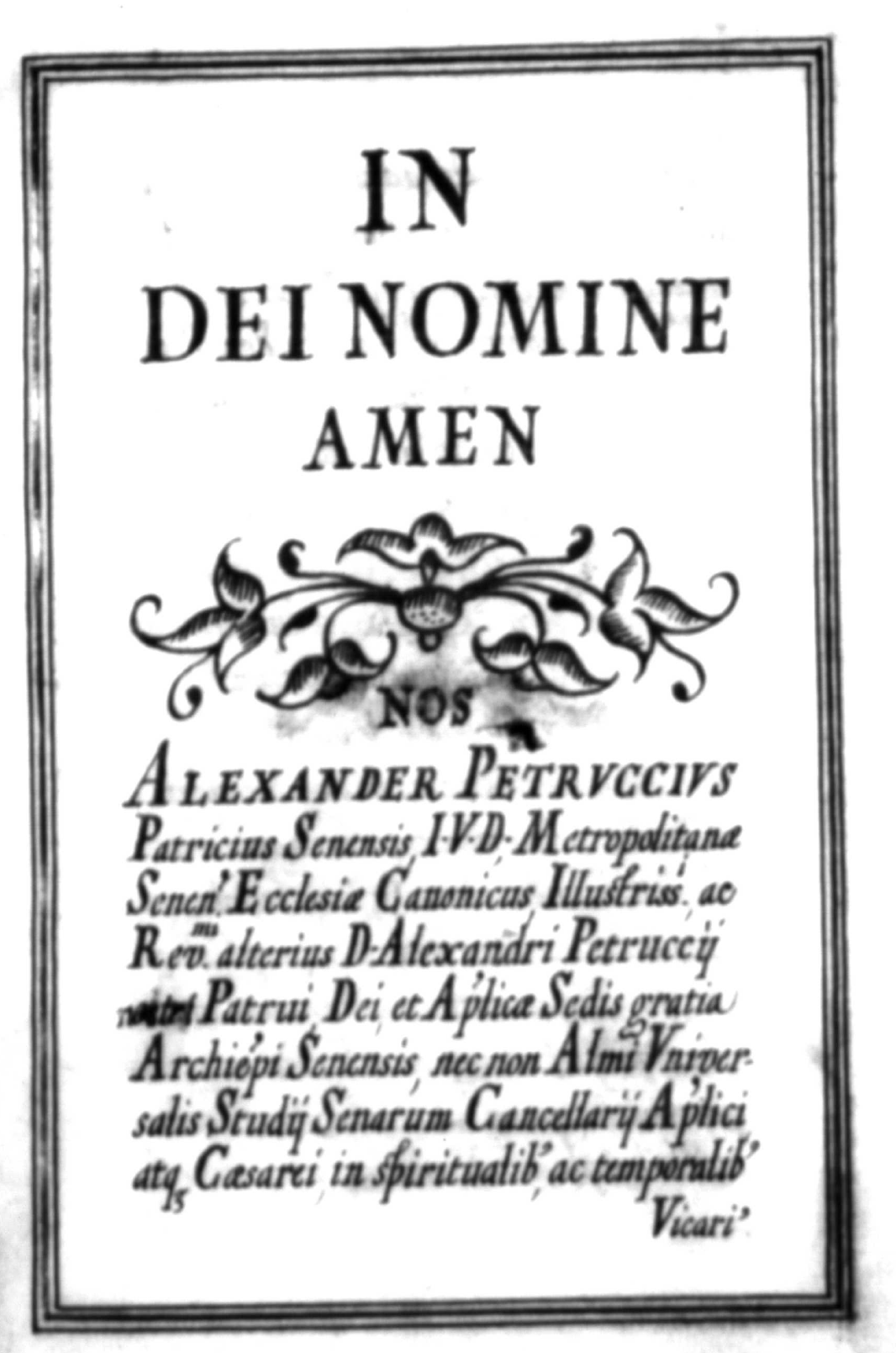
The invocation reads “In Dei Nomine Amen” (in the Name of God, Amen). While I have not seen any other diplomas of this period from the University of Siena,[13] there are a number of extant medical diplomas from this period issued by the University of Padua. The typical Padua diploma invocation reads “In Christi Nomine, Amen” (in the Name of Christ, Amen). The only diplomas that deviated from this norm were those of non-Christian students, in particular diplomas of Jewish graduates. Virtually every Jewish graduate’s diploma begins with the invocation, “In Dei Aeterni Nomine.” It is possible that the University of Siena made the same accommodations for its Jewish graduates as did Padua, few as they may have been.[14] Modigliano was also identified as a Jew in his diploma, with the word “Hebreo” appearing after his name:
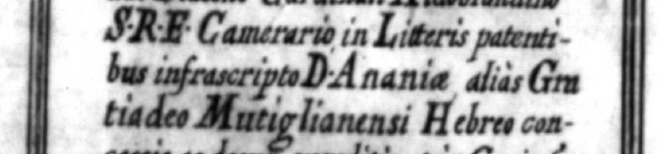
This was also commonly found in the diplomas of the Jewish graduates of Padua, where the word “Hebreus” or “Iudeus” would typically, though not always, follow the name of the Jewish graduates.
We next hear of Modigliano on August 14, 1650, when upon the departure of Rafael Corcos,[15] the Roman Jewish community appointed three new worthy teachers, one of whom was the doctor Hananiah b. Rafael Modigliano.[16] As reported by Zahalon, Hananiah tragically died while serving as a physician for the Jewish community in Rome during the Bubonic Plague of 1656.
Modigliano’s son Raphael was also a physician, as well as a rabbi.[17] Extant medical diplomas of Jewish students are exceedingly rare, yet in this case, we are fortunate not only to possess a copy of Hananiah’s diploma, but we also possess the diploma of his son Raphael as well.[18] This is the only known case of extant father and son diplomas. A copy of his medical diploma from the University of Ferrara in 1662 is below:[19]

The invocation, similar to his father’s diploma, reads, “In Dei Nomine, Amen,” and he is likewise identified as “Hebreus.”

Of note, the document explicitly restricts his medical practice to Jewish patients.
We also have record of Raphael delivering weekly Shabbat sermons in the synagogue in Siena. Moses ben Samuel ben Bassa of Blanes records in his manual for preachers, Tena’ei ha-Darshan,[20] that both he and Raphael Modigliano would deliver weekly sermons, after which they would each provide constructive criticism of the other’s sermon.

What of our third and final physician, Yitzhak Zahalon? Regarding the third of the Jewish plague physicians for Rome in 1656, the author does not reveal additional details about him, despite their sharing the same last name. A few sentences later, however, Yaakov Zahalon enumerates the fatalities of the plague at around eight hundred deaths and mentions his cousin, the young skilled surgeon, Yitzhak Zahalon, amongst the casualties.

This has led at least one scholar to identify the physician in charge of one third of the city as the same Yitzhak Zahalon, the surgeon and cousin of Yaakov, the author. Sosland writes, “Three Jewish doctors are mentioned by Zahalon as having charge over the patients. One of them was a first cousin of our author, a certain Isaac Zahalon, a “skilled surgeon” who died toward the end of the epidemic.”[21]
With the physicians in charge of the medical care of the Lazaretto, as well as the different sections of the Ghetto, accounted for by name, we are left to wonder about the role, if any, the author, Yaakov Zahalon, played during the plague. As Sosland notes, “as to the exact role Jacob filled, we have no direct knowledge.”[22]
Zahalon’s medical work was published in Venice in 1683, and unlike the work of his rough contemporary, Tuviya Cohen, whose Ma’aseh Tuviya has been reprinted numerous times, has not yet merited even a second printing.[23] There is however one extant manuscript of Zahalon’s Otzar HaHayyim housed in the Vatican,[24] dated from no later than 1675, and it is in this manuscript that we find the solution to the riddle of Zahalon’s role in the administration of medical care to the Jews in the Rome Ghetto during the plague.
The manuscript appears to reflect that Otzar HaHayyim was initially part of a larger multi-section work entitled Ohalei Yaakov Otzar HaHokhmot. Zahalon’s medical work is labelled as section two, Hokhmat HaRefuah, the only section in the Vatican manuscript.

Below is the section describing the division of the city into three sections, each with its respective physician.
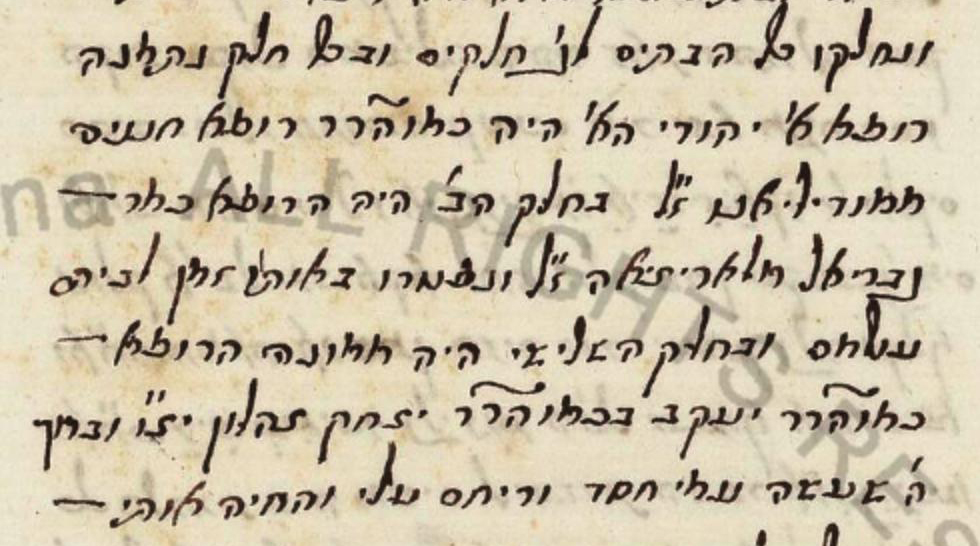
There is one key difference in this passage between the printed edition and the manuscript version. The physician in charge of the third section of the city is not Yitzhak Zahalon, whose identity is ambiguous, but rather, Yaakov ben Yitzhak Zahalon, none other than the author himself! A part of the name was accidentally omitted in the printed work. Zahalon refers to himself here in third person. This correction now facilitates a better understanding of the next sentence in the text, in which Zahalon continues to refer to himself, expressing gratitude to God for having rescued him from the ravages of the plague.
In this vein, I conclude with a comment on Zahalon’s conclusion to his plague passage. Despite the unspeakable tragedies experienced by the Jewish community, Zahalon ends his plague discussion by sharing a positive, though bittersweet, thought reflecting the continuity of the Jewish community:
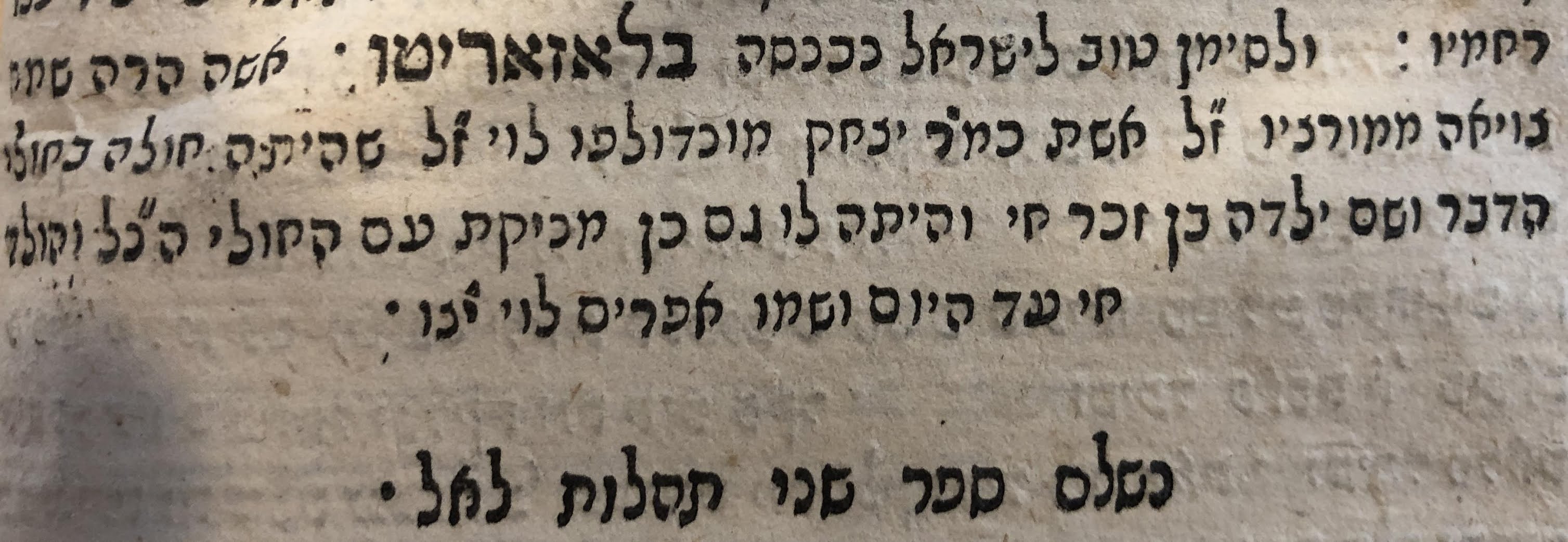
As a good sign for the people of Israel, a pregnant woman named Zivia, the wife Yitzhak Mondolfo, contracted the plague, and though confined to the Lazaretto, was able to deliver a healthy child, whom she was able to nurse for a period before her demise. In the final line of this section in the printed work, we read that the child was still alive “until today,” and that his name was Efraim Levi. Though Zahalon’s book was published in 1683, this line appears in the manuscript, thus “until today” would be some twenty years after the plague.
While this indeed is some form of consolation, the manuscript adds an additional sentence which yields a far more powerful conclusion.

“And the circumcision was performed there (in the Lazaretto), and I say to you by your blood you shall live, and I say to you by your blood you shall live.” Zahalon concludes with the phrase from Yechezkel 16:6 which is traditionally recited as part of the circumcision ceremony. The allusion here to the plague is obvious.
Omitting this last sentence denies us not only the additional factual information about the performance of the circumcision in the Lazaretto, itself a remarkable event, but also Zahalon’s homiletic flourish which marked the community’s (re)birth after the tragedies of the plague. As I write these words, we are still in this midst of the Covid 19 pandemic, though the dissemination of the vaccines portends, God willing, for its cessation in the near future. These final intended words of Zahalon resonate deeply with us today, perhaps even more so than they would have when Otzar HaHayyim was published, some three decades after the plague.
[1] Ellen B. Wells, “Prints Commemorating the Rome 1656 Plague Epidemic,” Annali dell’Istituto e Museo di Storia della Scienza di Firenze 10 (1985), 15-21.
[2] On Zahalon, see Harry A. Savitz, “Jacob Zahalon, and His Book, ‘The Treasure of Life,’” New England Journal of Medicine 213:4 (July, 1935), 167-176; Harry Friedenwald, “Jacob Zahalon of Rome: Rabbi, Physician, Author and Moralist,” in his The Jews and Medicine 1 (Ktav Publishing House: New York, 1967), 268-279; J. Ph. Hes, “Jacob Zahalon on Hypochondriasis,” (Hebrew) Koroth 4:5-7 (December, 1967), 444-447; A. Danon, A. Kadar and D. V. Zaitchek, “Physiology and Pathology of Lactation in Zahalon’s Work,” (Hebrew) Koroth 4:11-12 (December, 1968), 667-678; D. Margalit, “Shmirath Habriuth by Maimonides and Comment by R. Jacob Zahalon,” (Hebrew) Koroth 5:1-2 (September, 1969), 96-98; Yehoshua Leibowitz, “R’ Yaakov Zahalon Ish Roma uPizmono liShabbat Hannukah 1687,” Sefer Zikaron liHayyim Enzo Sereni: Ketavim al Yehudei Roma (Shlomo Mayer Institute: Jerusalem, 5731), 166-181; Jonathan Jarashow, “Yakov Zahalon and the Jewish Attitude Towards Medicine,” Koroth 9:9-10 (1989), 725-736; Zohar Amar, Maimonides’ Regimen Sanitatis: Commentary of R. Jacob Zahalon on “Hilchot Deot” – Chapter Four, With an Added Brief Preface to the Treatise Ozar ha-Hayyim (Hebrew) (Neve-Tzuf, 2002); Samuel Kottek, “Pediatrics in the work Otzar HaHayyim of Jacob Zahalon,” (French), in Gad Freudenthal and Samuel Kottek, eds., Melanges d’Histoire de la Medicine Hebraique: Etudes Choisies de la Revue d’Histoir de la Medicine Hebraique (1948-1985) (Brill: Leiden, 2003), 183-207; Eliezer Brodt, Bein Keseh Le’Asor (Jerusalem, 5768), 184-185; Eliezer Brodt, “Segulot leZikaron uPetihat haLev,” Yerushateinu 5 (5771), 337-360, esp. 352; Michal Altbauer-Rudnik, “Love For All: The Medical Discussion of Lovesickness in Jacob Zahalon’s The Treasure of Life (Otzar Ha-Hayyim),” in Asaph Ben-Tov, Yaakov Deutsch and Tamar Herzig (eds.) Knowledge and Religion in Early Modern Europe: Studies in Honor of Michael Heyd (Brill: Leiden, 2013), 87-106. For discussion of the sources of Zahalon’s medical work, see Iris Idelson-Shein, “Rabbis of the (Scientific) Revolution: Revealing the Hidden Corpus of Early Modern Translations Produced by Jewish Religious Thinkers.” American Historical Review 126, no. 1. Forthcoming, March 2021.
[3] For the response of the Italian Jewish community to plagues in this period, including the plague in Rome of 1656, see Yaffa Kohen, The Development of Organizational Structures by the Italian Jewish Communities to Cope with the Plagues of the Sixteenth and Seventeenth Centuries (Hebrew) (Doctoral Dissertation: Bar Ilan University, submitted Tishrei, 5740). I thank Naomi Abraham, librarian at Bar Ilan University, for her truly exceptional efforts in making this dissertation available to me in the midst of the Covid pandemic.
[4] For more on this passage and on the plague in the Jewish Ghetto of Rome, see Yehoshua Leibowitz, “Bubonic Plague in the Ghetto of Rome (1656): Descriptions by Zahalon and by Gastaldi,” (Hebrew) Koroth 4: 3-4 (June, 1967), 155-169; Kohen, op. cit., 72-95.
[5] Y. Zahalon, Otzar HaHayyim (Venice, 1683), 21a-21b. Elsewhere we have discussed the Jewish physicians of the 1631 plague in Padua. See E. Reichman, “From Graduation to Contagion: Jewish Physicians Facing Plague in Padua, 1631” Lehrhaus (thelehrhaus.com), September 8, 2020.
[6] See H. Friedenwald, “Jacob Zahalon of Rome,” in his The Jews and Medicine (Johns Hopkins Press: Baltimore, 1944), 268-279.
[7] On Zahalon’s abilities and reputation as an orator, see Henry A. Sosland, A Guide for Preachers: The Or HaDarshan of Jacob Zahalon—A Seventeenth Century Italian Preacher’s Manual (Jewish Theological Seminary: New York, 1987). On the plague sermons, see pgs. 23-28.
[8] See, for example, Guenter Risse, “Seventeenth-century Pest Houses or Lazarettos: Rome 1656,” in his Mending Bodies, Saving Souls: A History of Hospitals (Oxford University Press, 1999), 190-214.
[9] On the medical members of the Gabai (and Zahalon) families, see S. Plashkes, “Two Jewish Medical Families in 17th Century Italy: Gabai and Zahalon,” (Hebrew) Koroth 3:1-2 (October, 1962), 97-99.
[10] Otzar HaHayyim 21b.
[11] Israele Zoller, “I Medici Ebrei Laureati a Siena negli Anni 1543-1695,” Revista Israelitica 10 (1913), 60-70 and 100-110. In contrast, the University of Padua counts 127 Jewish medical graduates from 1617 to 1695. See A. Modena and E. Morpurgo, Medici E Chirurghi Ebrei Dottorati E Licenziati Nell’Universita di Padova dal 1617 al 1816 (Italian) (Forni Editore, 1967). For Jewish graduates of Padua earlier than this period, see D. Carpi, “Jews who received medical degrees from the University of Padua in the 16th and early 17th centuries,” (Hebrew) in Scritti in Memoria di Nathan Cassuto (Ben Tzvi Publishers: Jerusalem, 1986), 62-91.
[12] JTS, MS 8519. I thank Sharon Liberman Mintz for bringing this diploma to my attention. As part of my research interest in Jewish medical history, I have sought out copies of medical diplomas of Jewish students from previous centuries. Sharon, aware of this interest, notified me of a medical diploma in the JTS collection. The record does not identify the graduate but lists the University of Siena as the granting institution. I had never seen a diploma of a Jewish medical student from this institution; the majority of extant medical diplomas of Jewish students are from the University of Padua. However, due to the Covid 19 pandemic, access to the original diploma, stored in the remote site of the library, has been impossible. Fortunately, the National Library of Israel had taken black and white photographs of this document some years ago, and I was able to acquire copies. Since the onset of the pandemic, I have been focusing of the history of pandemics in Jewish medical history. When I received the copies of the diploma, and read the name, Hananiah Modigliano, it sounded familiar to me. It was a short while until I realized that I had seen the name mentioned in Zahalon’s passage on the plague.
[13] As per the librarian for the University of Siena Archives, the university does not possess any diplomas of this period.
[14] On the differences in the diplomas of Jewish medical graduates of the University of Padua, see E. Reichman, “Confessions of a Would-be Forger: The Medical Diploma of Tobias Cohn (Tuviya Ha-Rofeh) and Other Jewish Medical Graduates of the University of Padua,” in Kenneth Collins and Samuel Kottek, eds., Ma’ase Tuviya (Venice, 1708): Tuviya Cohen on Medicine and Science (Muriel and Philip Berman Medical Library of the Hebrew University of Jerusalem: Jerusalem, 2019), in press; E. Reichman, “The ‘Doctored’ Medical Diploma of Samuel, the Son of Menasseh ben Israel: Forgery or ‘For Jewry’?” Seforim Blog (https://seforimblog.com) (forthcoming).
[15] The Corcos family was a prominent Jewish Italian family. Another Jewish graduate of the University of Siena was Isaac Corcos, who graduated in 1654. See Zoller, op. cit. He may have been a relative and possibly a brother of Raphael Corcos.
[16] See H. Volgstein and P. Reiger, Geschichte der Juden in Rom, 2 vol (Berlin, 1895-1896), 267.
[17] On Raphael Modigliano, see Asher Salah, La Republique des Lettres: Rabbins, ecrivains et medecins juifs en Italie au XVIIIe Siecle (Brill: Leiden, 2007), 428-429.
[18] What makes this even more exceptional is that Hananiah’s diploma is the only known Jewish diploma from the University of Siena, and Raphael’s diploma is one of only two known Jewish diplomas from the University of Ferrara, the other being from 1802 (Samuel Vita Della Volta).
[19] The diploma was originally part of the Valmadonna Trust Library, Ms. 292, and is now incorporated into the National Library of Israel, system n. 990000822160205171. See Benjamin Richler, The Hebrew Manuscripts in the Valmadonna Trust Library (Valmadonna Trust: London, 1998), n. 269.
[20] Columbia University Library, Ms. X 893 T 15, p. 15a. See Sosland, op. cit., 82-83.
[21] Sosland, op. cit., 25. Others just listed the name as Isaac Zahalon without comment. See H. Volgstein and P. Reiger, Geschichte der Juden in Rom, 2 vol (Berlin, 1895-1896), 212-213.
[22] Sosland, op. cit., 25.
[23] Some years ago, Chaim Reich, a”h, of Renaissance Hebraica, produced a high-quality reproduction of Otzar HaHayyim. I thank Rabbi Eliezer Brodt, who owns one of these copies, for this information.
[24] The manuscript is available online at https://digi.vatlib.it/mss/detail/Vat.ebr.466. On this manuscript see, Malachi Beit-Arié and Nurit Pasternak, Hebrew Manuscripts in the Vatican Library (Vatican City, 2008), 405. I have only compared the manuscript to the printed edition for this brief passage. A comprehensive comparison remains to be done.