When Rabbi Meir Kahane’s Father Translated the Torah

When Rabbi Meir Kahane’s Father Translated the Torah

By Yosef Lindell

Yosef Lindell is a lawyer, writer, and lecturer living in Silver Spring, MD. He has a JD from NYU Law and an MA in Jewish history from Yeshiva University. He is one of the editors of the Lehrhaus and has published more than 30 articles on Jewish history and thought in a variety of venues. His website is yoseflindell.wordpress.com.

In 1962, the Jewish Publication Society published a new translation of the Torah. The product of nearly a decade of work, the new edition was the first major English translation to cast off the shackles of the 1611 King James Bible. Dr. Harry Orlinsky, the primary force behind the new translation and a professor of Bible at the merged Reform Hebrew Union College and Jewish Institute of Religion, explained that even JPS’ celebrated 1917 translation was merely a King James lookalike, a modest revision of the Revised Standard Version that “did not exceed more than a very few percent of the whole.”[1] This new edition was different. As the editors wrote in the preface, the King James not only “had an archaic flavor,” but it rendered the Hebrew “word for word rather than idiomatically,” resulting in “quaintness or awkwardness and not infrequently in obscurity.”[2] Now, for the first time, the editors translated wholly anew, jettisoning literalism for maximum intelligibility. More than sixty years later, JPS’ work remains one of the definitive English translations of the Torah.

The new JPS may have left the King James behind, but it didn’t satisfy everyone. In addition to making the Torah more intelligible, the editors incorporated the insights of modern biblical scholarship, both from “biblical archeology and in the recovery of the languages and civilizations of the peoples among whom the Israelites lived and whose modes of living and thinking they largely shared.”[3] So when asked by Rabbi Theodore Adams, the president of the Rabbinical Council of America, whether the RCA could accept an invitation from Dr. Solomon Grayzel, JPS’ publisher, to participate in the new translation, Rabbi Joseph B. Soloveitchik demurred. He wrote in a 1953 letter to Adams, “I am afraid that the purpose of this undertaking is not to infuse the spirit of Torah she-be-al peh into the new English version but, on the contrary, … to satisfy the so-called modern ‘scientific’ demands for a more exact rendition in accordance with the latest archeological and philological discoveries.”[4]

Just one year after JPS released its volume, in 1963, R. Soloveitchik’s wish for a more “Torah-true” translation was answered, but likely not in the way he expected. The two-volume Torah Yesharah published by Rabbi Charles Kahane (1905-1978) relies heavily on traditional Jewish commentary in its translation.[5] But as we’ll explore, because of its lack of fidelity to the Hebrew text, it can hardly be called a translation at all.

Here is the title page (courtesy of the Internet Archive):

The strategically placed dots on the title page indicate that Yesharah is an acronym for the author’s Hebrew name—Yechezkel Shraga Hakohen. R. Charles Kahane was born in Safed and received semichah from the Pressburg Yeshiva in Hungary. After immigrating to the United States in 1925 and receiving a second semichah from Yeshiva University’s Rabbi Isaac Elchanan Theological Seminary, he served as rabbi of Congregation Shaarei Tefiloh in Brooklyn for most of his professional career, a shul which drew over 2,000 worshippers for the High Holidays.[6] He was a founding member of the Vaad Harabbanim of Flatbush and helped Rabbi Avraham Kalmanowitz re-establish the Mir Yeshiva in Brooklyn. Today, however, he is known as the father of Meir Kahane, the radical and controversial Jewish power activist and politician who needs no further introduction. The father does not seem to have been directly involved in his son’s activities, but he took pride in Meir’s accomplishments and was a staunch supporter of the Irgun in Palestine, Ze’ev Jabotinsky’s Revisionist Zionist movement, and Jabotinsky’s youth group, Betar.[7]

R. Kahane told the New York Times that Torah Yesharah was inspired by Bible classes he gave to his adult congregants where many people did not understand the text even in translation.[8] (Recall that the new JPS translation was not yet available, and other English translations relied on the archaic King James.) He wanted to rectify this problem; indeed, the title page states that the work is a “traditional interpretive translation,” suggesting that it was intended to be more user-friendly. But calling it user-friendly does not do justice to what Kahane did. Here is most of Bereishit 22—the passage of Akedat Yitzchak:

Most translators try to approximate the meaning of the Hebrew. Not so R. Kahane. Nearly every single English verse here contains significant additions not found in the original. The first verse, for example, which states that the Akedah was meant to punish Avraham for making a treaty with Avimelech, follows the opinion of the medieval commentator Rashbam, who, notes that the words “and it was after these things” connect the Akedah to the previous episode—the treaty with Avimelech (Rashbam, Bereishit 22:1). But it’s hard to imagine that Rashbam, famous for his devotion to peshat—plain meaning—would have been comfortable with his explanation being substituted for the translation itself. Many other verses on this page provide additions from Rashi and other commentators. 

Pretty much every page of R. Kahane’s translation looks similar: Hebrew on one side and an expansive interpretive translation drawn from the classical commentators on the other. Kahane makes no effort to distinguish between the literal meaning of the Hebrew and his interpretive gloss.[9] Dr. Philip Birnbaum, the famed siddur and machzor translator, criticizes this aspect of the work in his (Hebrew) review, noting that Kahane’s interpretations are written “as if they are an inseparable part of the Hebrew source, and the simple reader who doesn’t know the Holy Tongue will end up mistakenly thinking that everything written in ‘Torah Yesharah’ is written in ‘Torat Moshe.’”[10]

To be fair, R. Kahane cites sources for his interpretations, but only at the back of each book of the Torah and only in Hebrew shorthand:

Thus, a reader not already fluent in Hebrew and the traditional commentaries would have little idea where Kahane was drawing his “translation” from and might not grasp how much the translation departed from the Hebrew original.[11]

Yet perhaps this was the point. R. Kahane considered literal translation to be illegitimate. In the preface to Torah Yesharah, Kahane contrasts Targum Onkelos, which is celebrated by the Sages, with the Septuagint translation of the Torah into Greek, which the Sages mourned. Kahane suggests that a Targum, which is an interpretation or commentary, is superior to a direct translation. Targum Onkelos, he writes, was composed under the guidance of the Sages and based on the Oral Law, and therefore it was “sanctified.” According to Kahane, “The Torah cannot and must never be translated literally, without following the Oral interpretation as given to Moses on Sinai. … It is in this spirit that the present translation-interpretation has been written.”[12]

Kahane was not the only Orthodox rabbi of his time to criticize translation unfaithful to rabbinic interpretation. We’ve already noted R. Soloveitchik’s concerns about the new JPS.[13] Similarly, the encyclopedist Rabbi Judah David Eisenstein reported that in 1913, when JPS was preparing its initial translation, Rabbi Chaim Hirschenson of Hoboken, NJ, convinced the Agudath Harabbanim to protest JPS’ efforts so the new work should not become the “official” translation of English-speaking Jewry the way the King James had become the official translation of the Church of England. The Agudath Harabbanim noted the Sages’ disapproval of the Septuagint and explained that only Targum Onkelos and traditional commentators that based themselves on the Talmud were officially sanctioned.[14]

R. Kahane’s approach also harks back to a series of articles in Jewish Forum composed in 1928 by Rabbi Samuel Gerstenfeld, a rosh yeshiva at RIETS (a young Rabbi Gerstenfeld is pictured below), attacking the original 1917 JPS translation. Gerstenfeld labeled the JPS translation Conservative and sought to demonstrate its departure from Orthodoxy by comprehensively cataloging all the places where the translation departed from the halakhic understanding of the verse. So, for example, he criticizes JPS for translating the tachash skins used in the construction of the Mishkan as “seal skins,” because according to halachic authorities, non-kosher animal hides cannot be used for a sacred purpose.[15] He believed that the word tachash should be transliterated, but not translated.[16] Gerstenfeld concludes that the JPS translators “missed a Moses—a Rabbi well versed in Talmud and Posekim, who would have been vigilant against violence to the Oral Law.”[17]

Still, R. Kahane’s interpretive translation with additions goes far beyond what R. Gerstenfeld was suggesting. To give one example: Gerstenfeld quibbles with JPS’ translation of the words ve-yarka befanav in the chalitzah ceremony (Devarim 25:9). The 1917 JPS translates that the woman should “spit in his face” (referring to the man who refuses to perform yibbum). Gerstenfeld notes that rabbinic tradition unanimously holds that the woman spits on the ground. He suggests that “and spit in his presence” would be a better translation.[18] Gerstenfeld’s suggestion is reasonably elegant—it gives space for the rabbinic reading without negating the meaning of the Hebrew. Kahane makes no such attempt to be literal, instead translating that she will “spit on the ground in front of his face.”[19] As we’ve seen, Kahane had no compunctions about adding words.

Thus, there is no English-language precedent for Torah Yesharah of which I am aware. As the preface suggests, R. Kahane was inspired by the Aramaic targumim, but it would seem more by Targum Yonatan Ben Uziel than Targum Onkelos. Onkelos translates word-for-word in most circumstances, typically departing from the Hebrew’s literal meaning to address theological concerns, such as a discomfort with anthropomorphism. Targum Yonatan, on the other hand, seamlessly weaves many midrashic additions into its translation and looks more like Torah Yesharah. For example, at the beginning of the Akedah passage, Targum Yonatan goes on a lengthy excursus suggesting that God’s command to sacrifice Yitzchak was in response to a debate between Yitzchak and Yishmael where Yitzchak boasted that he would be willing to offer himself to God. This digression is akin to Kahane’s addition of the Rashbam into his translation. If anything, Targum Yonatan is more expansive than Torah Yesharah.

Torah Yesharah received a fair amount of press upon its publication. It was even reviewed by the New York Times, which called it “[a] new and unusual translation” that was intended to make the Torah “more meaningful to Americans.” The article quoted Rabbi Dr. Immanuel Jakobovits, then the rabbi of the Fifth Avenue Synagogue in Manhattan (before he became Chief Rabbi of the United Kingdom), as calling it “an original enterprise” and “a most specifically Jewish rendering of the Torah.” While the Times was noncommittal about the work, a critical review in the Detroit Jewish News found Kahane’s language confusing and inferior to the new JPS translation published the prior year.[20] As for Dr. Birnbaum, he praised Torah Yesharah’s reliance on traditional Jewish interpretations and lamented the fact that most other biblical translations “were borrowed from the Christians from the time of Shakespeare,” but criticized the format (as noted above) and some of Kahane’s more tendentious translations.[21]

Despite the interest Torah Yesharah generated, its unique approach was not replicated. One might see echoes of R. Kahane in a better known translation—ArtScroll’s 1993 Stone Edition Chumash. As its editors explained in its preface, the “volume attempts to render the text as our Sages understood it.”[22] To this end, ArtScroll famously follows Rashi when translating “because the study of Chumash has been synonymous with Chumash-Rashi for nine centuries,”[23] even when Rashi is at variance with more straightforward readings of the text. Thus, for example, ArtScroll translates az huchal likro be-shem hashem (Genesis 4:26) based on Rashi as, “Then to call in the name of Hashem became profaned”—a reference to the beginnings of idol worship.[24] However, a more literal translation would run, “Then people began to call in the name of God,” which sounds like a reference to sincere prayer—the opposite of idolatry. It’s also well-known that ArtScroll declines to translate Shir Ha-Shirim literally, adapting Rashi’s allegorical commentary in place of translation.

On the other hand, ArtScroll’s overall approach is different than Torah Yesharah’s. ArtScroll is typically quite literal, translating word-for-word even when the syntax of the verse suffers as a result. An example from the Akedah is again relevant: va-yar ve-hinei ayil achar ne’echaz ba-sevach be-karnav (Genesis 22:13). ArtScroll’s translation, that Abraham “saw—behold, a ram!—afterwards, caught in the thicket,”[25] is awkward, but it preserves the word achar in the precise location that it appears in the Hebrew. When ArtScroll wants to highlight more traditional interpretations of the text in line with Chazal and others, it does so in the commentary, not in the translation itself.[26]

Two recent works—the Koren Steinsaltz Humash (2018) and the Chabad Kehot Chumash (2015)—are much closer to Torah Yesharah in that they insert commentary directly into the English translation. But they still differ in an important respect. Both the Steinsaltz—which is a translation of a Hebrew Humash based on the classes of Rabbi Adin Steinsaltz—and the Kehot “interpolate” a good deal of commentary into the translation (the former is more peshat based and the latter leans more on Rashi and Midrash). Nevertheless, they distinguish between what’s literal and what’s added by using bold font for the literal translation. This approach still has its downsides, as it can still be hard to read the English cleanly without the added gloss getting in the way of the literal meaning.[27] But it’s preferable to Torah Yesharah, where R. Kahane did not provide the reader any means of distinguishing between the text and his additions.

Today, Torah Yesharah is but a historical curiosity. Yet its existence highlights the fact that some mid-20th century Orthodox Jews felt a real need for a translation that followed in the footsteps of Chazal and other traditional commentators. To them, JPS’ translation did not embrace an authentic Torah approach. Before ArtScroll came on the scene, Torah Yesharah filled that niche for a time, but its unusual format blurred the line between the Word of God and the words of His interpreters.

Yosef Lindell is a lawyer, writer, and lecturer living in Silver Spring, MD. He has a JD from NYU Law and an MA in Jewish history from Yeshiva University. He is one of the editors of the Lehrhaus and has published more than 30 articles on Jewish history and thought in a variety of venues. His website is yoseflindell.wordpress.com.

[1] Harry M. Orlinsky, “The New Jewish Version of the Torah: Toward a New Philosophy of Bible Translation,” Journal of Biblical Literature 82:3 (1963): 251.
[2] The Torah: The Five Books of Moses (The Jewish Publication Society, 1962), Preface.
[3] Ibid.
[4]
Joseph B. Soloveitchik, Community, Covenant, and Commitment: Selected Letters and Communications (Nathaniel Helfgot, ed., KTAV, 2005), 110.
[5] Charles Kahane, ed., Torah Yesharah (Torah Yesharah Publication: Solomon Rabinowitz Book Concern, NY, 1963).
[6]
To the New York Times, Kahane described the shul as “progressive Orthodox,” and it likely lacked a mechitzah. See Robert I. Friedman, The False Prophet: Rabbi Meir Kahane (Lawrence Hill Books, 1990), 20. That, however, was not unusual for those times.
[7] The biographical information in this paragraph is drawn from Friedman (see previous note) and Libby Kahane, Rabbi Meir Kahane: His Life and Thought (Institute for the Publication of the Writings of Rabbi Meir Kahane, 2008).
[8] Richard F. Shepard, “Rabbi Publishes New Bible Study; Works on Early Scholars Are Reinterpreted,” New York Times (June 21, 1964), 88.
[9] Here is another example of a large interpretive insertion concerning God’s decision that Moshe and Aharon would not lead the people into Israel because of their sin regarding the rock (Bamidbar 20:12):

That’s quite a few more words than are found in the Hebrew!
[10] Paltiel Birnbaum, “Targum Angli be-Ruah ha-Masoret,” in Pleitat Sofrim: Iyyunim ve-Ha’arakhot be-Hakhmat Yisrael ve-Safrutah (Mossad Harav Kook, 1971), 75.
[11] Of note, Kahane’s translation is available on Sefaria, but with modifications that obscure its radicalness. For one, the format is different: the Hebrew and English are not juxtaposed in the same way. Second, the sources for each verse are cited directly below the translation in parentheses. This is not the way Kahane presented his sources in the original.
[12] Torah Yesharah, xviii-ix.
[13] Among the most intriguing critics of the new JPS was Avram Davidson, who wrote in Jewish Life in 1957 that because the translation was being prepared by non-Orthodox scholars who intended to depart occasionally from the Masoretic text in light of new archaeological discoveries, it was not “being prepared on the Torah’s terms” and was unacceptable. A.A. Davidson, “A ‘Modern’ Bible Translation,” Orthodox Jewish Life 24:5 (1957): 7-11. Davidson later became a science fiction writer of some renown but by the end of his life had become enamored with a modern Japanese religion called Tenrikyo.
[14] J.D. Eisenstein, ed., Otzar Yisrael vol. 10 (New York, 1913), 309. See also the criticism of the 1962 JPS translation and the discussion of Eisenstein and R. Gerstenfeld’s article in Sidney B. Hoenig, “Notes on the New Translation of the Torah – A Preliminary Inquiry,” Tradition 5:2 (1963): 172-205.
[15] Samuel Gerstenfeld, “The Conservative Halacha,” The Jewish Forum 11:10 (Oct. 1928): 533.
[16] Indeed, ArtScroll’s Stone Chumash leaves tachash untranslated. Interestingly, R. Kahane just translates “sealskins” like JPS.
[17] Samuel Gerstenfeld, “The Conservative Halacha,” The Jewish Forum 11:11 (Nov. 1928): 576.
[18] Ibid., 575-76.
[19] Torah Yesharah, 331.
[20] Philip Slomovitz, “Purely Commentary,” Detroit Jewish News (Aug. 21, 1964), 2.
[21] Birnbaum, 76. It’s interesting that Birnbaum was far more critical of non-literal translations of the siddur. When the RCA incorporated the poetic translations of the British novelist Israel Zangwill into its 1960 siddur edited by Rabbi Dr. David de Sola Pool, Birnbaum wrote a scathing review in Hadoar, accusing Zangwill’s efforts as being “free imitations,” not translations, and of having Christian influence. Paltiel Birnbaum, “Siddur Chadash Ba le-Medinah,” Hadoar 40:6 (Dec. 9, 1960): 85. Birnbaum may have been jealous of the RCA’s siddur, which was a direct competitor to his 1949 edition. Also, he was unimpressed with Zangwill in particular, who had married a non-Jew and was not halakhically observant. For more about this, see my article in Lehrhaus here.
[22] Nosson Scherman, ed., The Stone Edition Chumash (Mesorah Publications, 1993), xvi.
[23] Ibid.
[24] Ibid., 23.
[25] Ibid., 103.
[26] Rabbi Aryeh Kaplan’s 1981 Living Torah translation also bears some resemblance to Torah Yesharah in its tendency to follow Chazal, but it too, despite its exceedingly colloquial approach to translation, does not insert large interpretive glosses into the text.
[27] R. Steinsaltz calls the commentary “transparent” and “one whose explanations should go almost unnoticed and serve only to give the reader and student the sense that there is no barrier between him or her and the text,” but I am not sure I agree. See The Steinsaltz Humash (Koren Publishers, 2015), ix. 


Ten Commandment Representations in Hebrew Manuscripts & Books: Artistic Approaches to Theological Issues in Judaism

Ten Commandment Representations in Hebrew Manuscripts & Books: Artistic Approaches to Theological Issues in Judaism

Dan Rabinowitz

Today, the Ten Commandments or Decalogue[1] are among the most prominently featured symbols associated with Judaism. The Decalogue is represented by two tablets, generally connected and rounded at the top. This representation occupies a central place within synagogue architecture, often displayed on the exterior or interior of the edifices and frequently above the ark itself, which is regarded as the most sacred element within the building. However, it is noteworthy that these practices only began to emerge in the 16th century. The exact origins of this practice remain unclear, but it is likely that they were influenced by the Christian adoption of the Ten Commandment tablets in art as representative of Judaism. Some scholars suggest that this may not be an instance of benign cultural exchange but might have its roots in anti-semitic legislation, which mandated that Jews wear badges shaped like the Ten Commandments with rounded tops. This imposition may have influenced Jewish consciousness, potentially resulting in eventual self-association with this symbol.[2]

Historical evidence indicates that the ancient Jewish community used of other symbols such as the lulav, shofar, menorah, ark, scroll, and etrog, but not the luchos. The absence of the luchos is unsurprising when one considers the inherent difficulties of accurately replicating them. There is substantial ambiguity surrounding the exact proportions and shape of the tablets. Consequently, accurate reproductions were improbable, preventing their adoption as a common, recognizable symbol. Apart from the Israelites in the desert who witnessed the Sinai revelation, the tablets were not publicly displayed but remained housed within the ark. The fact that the luchos were kept in the ark and never removed suggests that they were intentionally not intended for public display.

In contrast to other Temple implements that are meticulously described, the details of the luchos are only generally mentioned as being made of stone and numbering two. This lack of elaboration has resulted in uncertainty even regarding the inscriptions on the stones and their shape. Today, it is widely accepted that each tablet contained five commandments and can be sourced to the Mekhilta DeRebi Yishmael, Yisro (Horovitz-Rabin, 233-234); however, according to the prevailing opinion in the Talmud Yerushalmi (Shekalim 6:1; Sotah 8:3), each tablet contained the entire Decalogue. Additionally, Rav Saadia Gaon asserted that one tablet recorded the version given in Exodus, while the other contained the version from Devarim.

It was not until the early rabbinic period that there was an explicit discussion regarding the shape of the luchos. The two Talmuds are inconsistent as to the exact dimensions and shape of the tablets (and both versions appear in midrashic literature). According to the TY, the tablets were rectangular, six tefachim in length and three in width. The TB describes them as square, six by six. Some attempt to reconcile the two Talmudic versions, there is clearly no consensus are single traditional regarding the shape.[3]

Beyond the challenges in determining and reproducing accurate divisions and shapes, there is a theological concern with their display. The Mishna records that the recitation of the Decalogue was part of the daily service in the Beis haMikdash. Evidence of this practice is found in the Nash Papyrus, dating between the second and first centuries BCE. In that document, the Ten Commandments appear before the Shema. Although the Nash Papyrus is likely either tefillin or a mezuzah, it seemingly confirms inclusion in the liturgy even outside of the Temple.[4] Nonetheless, the liturgical practice was abolished by Rabban Gamaliel II of Yavne. The rationale for the abolition was that some sect, the Minim, had elevated the Decalogue above the rest of the Torah, and the continued public recitation might imply acceptance of that position.[5] It is worth noting that even when the Decalogue was incorporated into the liturgy, there is no mention of it being displayed.

None of these sources mention the most common shape, tablets with rounded tops. According to one theory, this shape was borrowed from the Roman writing tablet, the diptych, which consisted of two tablets hinged together. Regardless of the original source, the rounded-topped tablets became the standard in Christian art from at least the 12th century. Since Jews adopted the luchos as a symbol much later, roughly in the fifteenth to sixteenth centuries, they chose the most commonly recognized version, which features rounded tops.[6] 

The earliest extant depiction of the luchos appears in the Dura Europos Synagogue fresco, where Moshe is holding a scroll. While Dura Europos does not settle the issue of the shape of the tablets, it does begin to reveal some details about how the luchos iconography has evolved over time to address what can be referred to as the “minim conundrum.” The conflict between the Torah recording God delivering just the Decalogue at Sinai, whereas Jews believe that the entire Torah was given at Sinai.

Illuminated Manuscripts and the Ten Commandments: Resolving the Issue of the Minim

Many manuscripts, including Haggadahs, prayer books, and Bibles, feature imagery related to the Decalogue episode. Beyond merely illustrating the text these illustrators intentionally depicted the scene to address and resolve the minim issue and link the delivery and reception of the Decalogue with the entirety of the Torah. For example, many Ashkenazic Haggadahs include the Decalogue scene, typically accompanying the Dayenu, although two include it later in the liturgy. [7] The earliest, known as the Birds Head (dating to the beginning of the 14th century), depicts two fingers emerging from the cloud, presenting two rounded-topped tablets to Moshe. Immediately below, Moshe appears again transferring the tablets, now five, to two figures, presumably Aaron and/or Yehoshua. The dual tablets have been converted into five, referencing the Five Books of the Torah.[8] The Birds Head Haggadah’s metamorphosis during the transmission process of the two tablets into five is the only example of this solution in any Jewish (or non-Jewish) manuscripts.[9]

Figure 1: Birds Head Haggadah, fol. 23r, Israel Museum

A similar rereading of the Giving of the Law occurs in the thirteenth-century Parma Machzor. Unlike the Birds Head, which transforms the two tablets into five in their delivery, the Parma Machzor, however, depicts God giving Moshe three tablets, presumably alluding to the three books of Tanakh, the entire corpus of the Torah.[10]

Figure 2: Parma Machzor (Biblioteca Palatina, MS Parm. 2887)

Beyond transforming the tablets into more than the two mentioned in the Torah, other forms of iconographical methods were used to address the minim issue. Writing material underwent significant changes throughout the centuries. It was initially etched onto stones, like the luchos, then papyrus (like the Nash), and eventually, using animal skins that are much more resilient than papyrus, it was transformed into scrolls. Finally, “the most revolutionary invention in the history of the book” – the codex – was created at the beginning of the Common Era and became commonplace by the third century CE.[11] The codex, which we recognize as a book today, consists of individual pages written on both sides and addresses the major limitations of the scroll: the difficulty of quickly moving from one section to another and the fact that only one side could be used. Christians were the first to adopt this form sometime in the third century CE. Jews, however, adopted the book or codex much later than most other cultures, likely only in the ninth century.[12] This is unsurprising, as the scroll was not merely a device for Jews, but was imbued with special holiness.

These two forms, the scroll and codex, were used to address the minim issue. In these instances, they assumed the role of the entire torah as contrasted with the tablets, recording just the Decalogue. Scrolls are substituted for the tablets in at least two Haggadahs from the late fifteenth century (c. 1470-1480): the Nuremberg II and the Yahuda.

Figure 3: Second Nuremberg Haggadah (Center for Jewish Art)

Figure 4: Yahuda Haggadah (Center for Jewish Art)

In both, Moshe holds up an open scroll with wooden poles in a manner familiar from the hagbah ceremony. Likewise, in the well-known illuminator Joel ben Simon’s c. 1470 Machzor, now referred to as the Rothschild Weill Machzor, Moshe lifts the scroll. In a later Haggadah, known as MS 1388 Paris (1583), Moshe is holding a partially open scroll, though it is not raised like the other examples.[13] 

Figure 5: Rothschild Weill Machzor (Center for Jewish Art)

A similar image appears in the Ulm Machzor, c. 1430; however, Moshe is receiving it directly from God, echoing the approach of the Parma Machzor that there was no transformation, rather the delivery itself was the entire Torah.

Figure 6: Second Darmstadt Haggadah 9v (Center for Jewish Art)

The codex is similarly employed to address the minim issue. In the Second Darmstadt Haggadah (here), Moshe appears at the top right, beneath the shofar. He is holding two connected rectilinear tablets, hinged at the bottom. A man, dressed differently than Moshe and likely Aaron or Yehoshua, appears at the bottom right holding two separate rectilinear tablets, which are clearly sourced from Moshe. Finally, a group of Israelites appears in the bottom center of the page. The leader is now holding a book. This transforms the tablets into a book or Torah. The connection between the tablets becomes clearer as the person holding the book points to Aaron/Yehoshua and the tablets, indicating that the book’s source is the tablets and ultimately what Moshe received directly from God. Therefore, collectively, the page illustrates the transmission and transformation of the Luchos, from the ten into the Torah – received from God by Moshe, which was then handed off to Aaron and finally to the Jewish people.

Figure 7: Detail Second Nuremberg Haggadah (Center for Jewish Art)

There is perhaps another example of the codex that addresses the minim issue. In the Laud Machzor, c. 1290, the illustration for the piyyut recited on Shavous, Adon Ammani, the upper register has an angel delivering two separate rectilinear tablet while on the right side the Israelites receive a single item with a loop at the bottom. Unlike the Birds Head or other manuscripts that has the transformation into the Torah during the transmission stage; here, the only item the Israelites received was this single item with the loop. What is this unusual single panel with a loop? It may be a a codex. Manuscripts and codices were originally kept in cabinets, armaria, but in the late 13th and early 14th centuries they were more commonly placed on desks, and the practice of chaining books to prevent theft began (see here). Perhaps the loop in the Laud Machzor is a ring of a chained codex and another provides another example of using the codex to address the minim issue.

Figure 8: Laud Machzor 127r (Bodleian Library, MS Laud Or. 321)

Hebrew Book Illustrations & Anti-Jewish Representations

Illustrations in printed books, however, do not appear to be concerned with solving the minim issue. To the contrary, some iconography in printed books can be read to diminish or even undermine not only the torah’s transmission but even the continued applicability and viability of the Decalogue. Printed illustrated Hebrew books depict either Moshe receiving or transmitting the tablets or simply Moshe and the tablets without context. Of the four printed mother Haggadahs that served as models for nearly all subsequent printed illustrated Haggadahs, only one, Amsterdam 1695, depicts ma’mad har sinai. Unlike the other illustrations in that edition, which are modeled after Mathis Merian’s Bible, this illustration was borrowed from other Amsterdam Hebrew prints. As we have previously discussed, while the engraver clearly used Merian as a model he deliberately altered the images to suit the Jewish text rather than their original Christian source. Merian’s imagery for ma’amad har Sinai was entirely at odds with the Jewish view, and therefore, the illustrator sought an alternative source. Merian only depicts the sin of the Golden Calf and not the delivery or transmission of the Decalogue/Torah. That aligns with Christian theology that focuses on the sins of the Jews, rather than the monumental and exceptional example of God speaking directly to the Jews and imparting his Torah.

Figure 9: Amsterdam Haggadah, 1695 (Center for Jewish Art)

The Amsterdam Haggadah used the imagery that first appears on the titlepage of the 1679 Amsterdam Humash and reused on many subsequent editions of the Humashim from Amsterdam and other cities. Here, the mountain is in the middle and Moshe is still on top, receiving the tablets. They are square, and one is held in each of his hands. The illustration does not depict Moshe delivering the Torah or tablets; therefore, it does not address the tension between the Decalogue and the torah. Nonetheless, arguably implicitly, the inclusion of the image on a title page of a Humash, obviates the need to include additional imagery for the minim issue – Moshe receiving the tablets is literally attached and is the precursor to the entire Torah.

Figure 10: Humash, Amsterdam, 1679 (Gross Family Collection)

While the Decalogue scene does not appear in the other mother Haggadahs, Moshe with the luchos is used as one of the border figures in the Venice 1609 Haggadah. Moshe is carrying two connected round-topped tablets and has a light emanating from his forehead. This illustration of Moshe and the luchos is among the most common title page illustrations in Hebrew books.

Figure 11: Title Page Shu”t Rashba, Hanau, 1610 (Gross Family Collecdtion)

It first appears adorning the titlepage of Shu”T Maharil, Hanau, 1610. However, that image was clearly borrowed from a non-Jewish source. Moshe has horns, with rounded topped tablets, and is flanked by Aaron wearing a bishop’s mitre and holding a censer.[14] There is another nuance to the image that may also specifically Chrisitan, and more important theologically than whether Moshe had horns or light emanating from his head. Unlike the Jewish sources discussed above, Moshe does not hold the tablets aloft. Rather, they are standing on the ground, his hand on top. This aligns with the Christian view of the Decalogue; after Jesus, it was relegated to a secondary role or was even superseded by the New Testament. The depiction in Shu”T Hashiv R’ Eliezer, published in 1749 in Neuwied, Germany, presents a particularly striking variation. In this volume, Moshe’s hand is shown flat, seemingly serving to drive down the tablets into the ground rather than grasping them, as seen in the Hanua prints. Additionally, unlike other works that either show some of the text on the tablets or leave them blank, Hashiv depicts the tablets filled with lines, effectively obscuring or erasing any text.

Figure 12: Shu”t Hashiv Reb Eliezer, Neuwied, 1748

The unique nature of Hashiv’s title page is amplified when compared with to similar title pages, one may have even served as the a model for Hashiv. Critically, that title page includes subtle yet significant modifications. For example, David Gans, a disciple of Maharal, in his work Sefer Nitzahon, published in Altdorf in 1644, created one of the most exquisite Hebrew title pages. It features a similar depiction of Moshe as seen in Hashiv, with his hand resting atop the tablets that include some lines, resembling Hashiv. However, these tablets prominently display the Hebrew “Aseres ha-Dibros,” clearly underscoring their importance.

Figure 13: Sefer Nitzhon, Altdorf, 1644

Another contrary example is Yefeh Anaf, by R. Shmuel Jaffe, Frankfurt a.d. Order, 1696, which depicts a Jewish Moshe with rays emanating from his head, holding round-topped tablets with the beginning of each directive in Hebrew.

Like the three manuscripts discussed above, there is another title page that features Moshe with a scroll instead of tablets. This title page, which appears in a number of different Amsterdam books, for example, Sefer Shenei Luchos ha-Bris, Amsterdam, 1698, Yad Yosef, Amsterdam, 1700, and Eshlei Ravrevei, Amsterdam, 1711, is an amalgamation of four biblical figures, each symbolizing one of the four crowns: Torah (Moshe), priesthood (Aaron), kingship (Dovid), and a good name (Shlomo).

Figure 14: Shnei Luchos ha-Bris, Amsterdam, 1698

A later Amsterdam edition of the Humash combines all three Amsterdam illustrations on the title page. The 1827 Amsterdam Humash features Carl Christian Fuchs’s engraved title page. At the top is the image of Moshe accepting the two square tablets. Moshe appears below on the left, holding round-topped tablets with lines representing the text, and in the center is a crown of Torah. Fuchs includes another Amsterdam illustration at the bottom of the page, this one from the 1695 Haggadah, which depicts the temple.

Figure 15: Humash, Amsterdam, 1827

There is another unique depiction of the tablets on an early 19th-century title page. In the third edition of Mendelsohn’s Humash, Fürth, 1801-1803, Moshe and Aaron flank the title page. However, Moshe, with rays, holds only his staff. In the central image, the ark of the covenant is present, and the two tablets, with rounded tops, are superimposed in the foreground.

Figure 16: Derech Selulah, Fürth, 1802 (Gross Family Collection)

One printed book, however, R. Yosef Ergas’ Shomer Emunim (Amsterdam, 1736), may be a unique example that specifically addresses the minim issue. This work, which discusses the legitimacy of Rabbinic Judaism, includes a representation within a circular design surrounded by laurel leaves at the center of the upper register. Initially, the figure appears to be Moshe holding the luchos. However, the accompanying legend identifies the figure as “Rabbenu ha-Kodesh,” Rabbi Yehudah ha-Nasi, the compiler of the Mishna and a key figure in rabbinic Judaism. This suggests that the Mishna – Rebi Yehuda’s text – is synonymous with the luchos.

Figure 17: Shomer Emunim, Amsterdam, 1736 (Moreshet Auctions)

This interpretation is further supported when compared to the title page model for Shomer Emunim, David Nieto’s Matteh Dan, Kuzari ha-Sheni, (London, 1724). This work also defends rabbinic Judaism and depicts the figure labeled “Rabbenu ha-Kodesh” encircled in the upper register, but he is holding a book with the inscription “Mishna.” The printers of Shomer Emunim modeled the title page on Matteh Dan, yet went further in visually equating the Mishna with the Decalogue.

Figure 18: Matte Dan, London, 1714 (Moreshet Auctions)

Except for the Amsterdam prints, title page illustrations consistently show round-topped tablets, unlike Hebrew manuscripts where tablet shapes vary. This likely stems from printing developing after Christian art standardized the round-topped representation. Table 1 summarizes twenty-two manuscripts depicting the tablets, with no consistent shape linked to a specific era or region. In one instance both rounded and rectilinear shapes in the same manuscript.[15] In the Sarajevo Haggadah, the tablets appear on two separate panels (panels 30 and 32): once when Moshe receives and conveys the Decalogue, and a second time in the scene depicting what may be the Tabernacle, Solomon’s Temple, or the Messianic Temple.[16] In the first instance, the tablets are rounded, while in the second, they are rectilinear. It is conceivable, though admittedly improbable, that the original designs were rounded and depicted in the first panel. However, in the second panel depicting the temple, when the decision was made to construct the ark with a square shape, the tops may have been removed to ensure a better fit.

The Ultimate Message of Har Sinai

One final manuscript illustration is notable not only for the shape or material of the tablets, but for the broader message it conveys. The entire nation was present at ma’amad Har Sinai, including men, women, and children. The Dresden Machzor, circa 1290, depicts Moshe receiving the tablets on the upper right of the panel. On the left side of the top register, Moshe delivers them to a kneeling woman, with no men depicted. This representation indicates that the Torah was given to and applies to everyone equally. The shape itself conveys a universal message. The luchos feature rounded tablets within a rectangular frame, symbolizing that everyone fits within Judaism’s broad parameters.

Figure 19: Dresden Machzor, c. 1290 (MS Dresd. A.46A, 202)

Table 1: Manuscripts & the Shape of the Tablets

Square/Rectilinear

Rounded

Scroll

1. Laud Machzor (Southern Germany, c. 1290, Bodleian, Laud Or. 321, fol. 127v) Birds Head Haggadah (Southern Germany, c. 1300, Israel Museum, MS 180/57, fol. 23) Nuremberg II Haggadah (1470-1480, Schocken Library, MS 24087)
2. Rothschild Machzor (Florence, 1492, JTS, fol. 139) Sarajevo Haggadah (Spain, 14th Century, Sarajevo Museum) Yahuda Haggadah (mid 15th century, Israel Museum, MS 180/50)
3. Tripartite Machzor (Southern Germany, c. 1320, British Library, MS. Add. 22413, f. 3r) Parma Machzor (13th century, Western Ashkenaz, Parma, Biblioteca Palatina, MS Parm. 2887, fol. 101v) Rothschild Weill Machzor (c. 1470, NLI, MS 804450, fol. 203)
4. Schocken Bible (Southern Germany, c. 1300, Schocken Library, MS. 14840, fol. iv) Dresden Machzor (1290, Mscr. Dresd. A.46.a, fol. 408) MS 1388 Paris (1583, Bibliothèque Nat., MS 1338, fol. 14r)
5. Regensburg Pentateuch (Regensburg?, c. 1300, Israel Museum, MS 180/52, fol. 154v) Ulm-Treviso Siddur (1450-1453, Parma, Biblioteca Palatina, MS Parm. 2895, fol. 271)
6. Sarajevo Haggadah (Spain, 14th Century, Sarajevo Museum) Floersheim Haggadah (1502, Zurich, Floersheim Collection, fol. 15).
7. First Leningrad Bible Egypt, (?) 929, fragment (Leningrad Public Library, MS II 17)
8. Parma Bible (Parma, Biblioteca Palatina, MS Parm. 2710, fol. 3r)
9. King’s Bible (Catalonia, Spain, 1384, MS King’s 1, f. 3v)
10. Catalan Bible (Catalonia, Spain, third quarter of 14th century, MS Add. 15250, f. 3v)
11. Harley Catalan Bible (Catalonia, Spain, c. 1350, MS Harley 1528, f. 8r)
12. Darmstadt Haggadah II (Universitäts-und Landesbibliothek, Darmstadt, Cod. Or 28, fol. 9v)

[1] Although these terms are inaccurate because the Torah does not refer to them as commandments, huqqim, mitzvos, or mishpatim, rather aseres hadivarim or aseres hadibros, nonetheless, as that is the most widespread description we use that term.
[2]
See generally, Gad Ben-Ami Sarfatti, “The Tablets of the Covenant as a Symbol of Judaism,” in The Ten Commandments, As Reflected in Tradition and Literature Throughout the Ages, ed. Ben-Zion Segal (Jerusalem: Magnes Press, 1985)(Hebrew), 353-388; Ruth Mellinkoff “Round-topped Tablets of the Law,” Journal of Jewish Art I (1974): 28–43.

Almost immediately after the luchos were displayed in synagogues, some argued that their display contravened the injunction against elevating the Decalogue above the rest of the Torah. The first to raise this issue was Rabbi Yom Tov Lipmann Heller. He describes how one synagogue in Prague displayed them and equates the display with the public reading, subsequently banning the practice. Rabbi Heller, who served as the rabbi of the Altneu Synagogue (Old-New Synagogue), incorporated other symbols within the building. The walls bear various abbreviations corresponding to verses that describe the decorum and purpose of prayer. The ark is flanked by two lions at the top, and the luchos do not appear anywhere within the synagogue. Rabbi Heller was most likely referring to the Maisel’s Synagogue which, today, displays the luchos above the ark. This synagogue was originally built in the 1590s. However, since it burnt down in 1689 we cannot be certain that the design of the ark was the same during Rabbi Heller’s lifetime. Whether or not this was the synagogue Rabbi Heller referenced, it serves as an example of how his opinion never gained traction even in Prague. Indeed, the Maisel’s Synagogue also displays the Decalogue on the exterior of the building, as does the Baroque Synagogue (originally built in 1622/23, also destroyed in the 1689 fire). The Klausen Synagogue’s building was completed in 1694, and its ark is topped by the luchos. For more information, see Prague Synagogues (Jewish Museum in Prague: 2011), which includes photographs of the synagogues and descriptions of their respective histories.

For a discussion of the issue of Decalogue displays in synagogues see Yechiel Goldhaver, Minhagei ha-Kehilos, vol. 1 (Jerusalem: 2005), 45-48n1, who collects examples throughout Europe of synagogues with the luchos displays as well as sources discussing the propriety of the practice.

Regading contemporary sources that discuss what shape to use for the luchos, rounded, square or rectangular, see Reuven Chaim Klein, “Square versus Rounded,” available here. Of note is the opinion of R. Yisroel Yaakov Fisher, Chief Rabbi of Badatz Eidah Chareidis, who argues, the contra-historical position, that the original tablets were rounded. Indeed, according to Fisher, there were rounded at the top and bottom.
[3]  See Chaim Kenefsky, Baraysa d’Melehes haMishkan, Da’as (Beni Brak, 1996), 38, and Meir Ish Shalom, Beritah, 43; see also Menahem Silber, “Aron ha-Edus ve-Luchot ha-Bris: Tzurotom u-Tavnesam,” in Sefer ha-Zikhron le-Rebi Moshe Lifschitz, ed. Rafael Rosenbaum (New York: 1996), 236-42; see also, Midrash Devarim Rabba, ed. Saul Liebermann (Jerusalem: Shalem, 1992)122n2.
[4] See Ephraim Urbach, “The Place of the Ten Commandments in Ritual and Prayer,” (Hebrew), in Ten Commandments, ed. Segal, 128.
[5] See Urbach, “Place,” 132-136, 138-142; Von V. Aptowitzer, “Bemerkungen zur Liturgie und Geschichte der Liturgie,” MGWJ 74 (1930), 104-115. Both also attempt to identity of the sect of the minim.
[6] See Mellinkoff, “Round-Top.”
[7] See generally, Sarit Shalev-Eyni, “Receiving the Law: Visual Language and Communal Identity in Medieval Ashkenaz,” Gesta 55(2), (Fall 2016), 239-255. Shalev-Eyni discusses many of the examples below.
[8] See Marc Michael Epstein, The Medieval Haggadah: Art, Narrative, and Religious Imagination (Yale Univ. Press, New Haven, 2011), 90; Metzger, Haggadah, 303. Metzger demonstrates that the second figure is also Moshe. Id.
[9] Metzger, Haggadah, 303.
[10] Shalev-Eyni, “Receiving of the Law,” 246-249.
[11] Anthony Grafton, “From Roll to Codex: A Christian Initiative,” in Crossing Borders, Hebrew Manuscripts as a Meeting-place of Cultures, ed. Piet van Boxel and Sabine Arndt (Bodleian Library, Oxford, 2012), 15.
[12] Grafton, “Roll,” 20.
[13] Metzger, Haggadah, 305.
[14] Regarding the image of the horned Moshe see Ruth Mellinkoff, The Horned Moses in Medieval Art and Thought (University of California Press: Berkeley, 1970. For a collection of articles discussing the depiction of Moshe throughout history and reproductions of many examples, see Moïse Figures d’un Prophète, ed. Juliette Braillon, (Musée d’Art et d’Histoire du Judaïsme: Paris, 2015).
[15] The Sarajevo Haggadah is the only Haggadah manuscript from the Sefard tradition that depicts the Giving of the Torah. While the Sephardic manuscripts precede the Haggadah text with the Biblical Cycle from Genisis to Exodus, the remaining Haggadahs end before the episode at Mount Sinai. See Metzger, Haggadah, 302.
[16] See Shalom Sabar, The Sarajevo Haggadah History & Art (Sarajevo: 2018), 233-235; 239-241. Sabar only offers Solomon’s Temple or the Messianic Temple. Nonetheless, it is equally possible that this panel simply depicts what follows the Giving of the Law, the construction of the Tabernacle.


Finders Keepers? The Itinerant History of Strashun Library of Vilna, Pt I

Finders Keepers? The Itinerant
History of Strashun Library of Vilna

by Dan Rabinowitz
            Since the 1990s, the issue of reparation of items looted by the Nazis has become a high-profile issue, with numerous successful attempts at reuniting owners with their stolen possessions. The recent movie, Monuments Men, fictionalized the
Allies’ post-war efforts that led to the locating some of these looted treasures. While some of the best-known examples of these recovered treasures are related to art, gold, or Swiss bank accounts, Hebrew books were also part of the Nazi’s appropriation scheme and were included in the items recovered after World War II. Some of the books recovered belonged to a unique institution, the first Jewish public library, and tracing the journey of these books, up to present day, parallels that of its patrons, tortured, uncertain, and yet despite all odds, surviving.
 
Matisyahu Strashun the Library’s Architect and Founder
 
Matisyahu Strashun[1] was born in 1817 in Vilna.  His family was among the Vilna elite.  His father, Samuel Strashun (also known as Rashash), whose notes/annotations – he never published a stand-alone work – to numerous classic rabbinic works, including Midrash Raba, Mishna, and Maimonides’ Mishna Torah, and Talmud Bavli.[2]  In terms of breadth, the latter is most
impressive, as his notes cover nearly every single page[3] of the Talmud Bavli.[4]
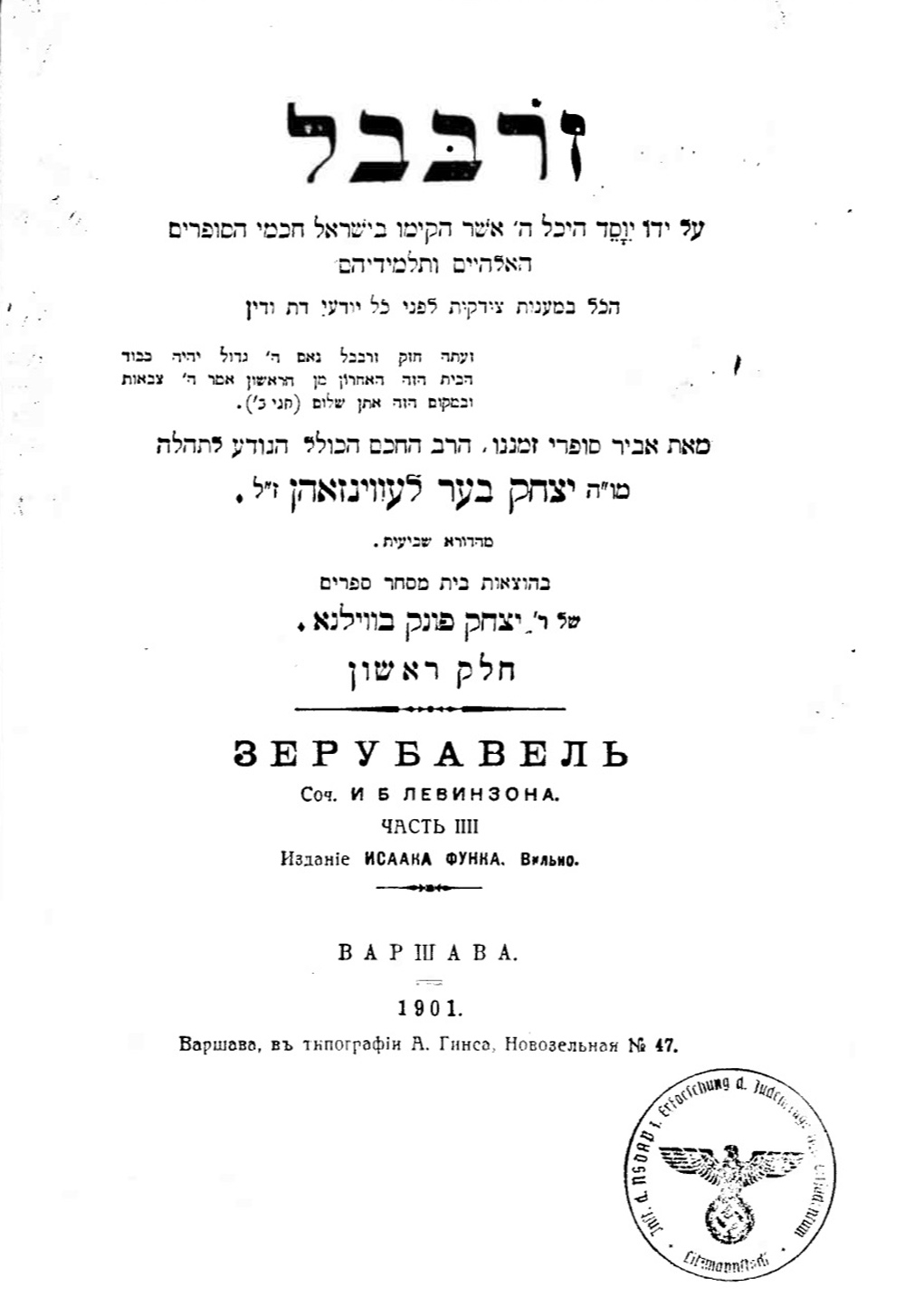
Matisyahu too was a Talmudist, his comments to Baba Batra and Eruvin are incorporated into the Vilna edition of Talmud Bavli, and was proficient in the entire corpus of rabbinic literature.[5] Matisyahu espoused views that were consistent with the haskalah movement.[6] For example, Matisyahu supported Max Lilienthal’s controversial attempt to reform “the Jewish educational system within the Pale Settlement,”[7] and Matisyahu help found and financially supported two schools in Vilna aligned with the haskalah.[8] Matisyahu corresponded with leaders of the haskalah movement, Isaac Ber Levinsohn, among others, and Strashun’s articles appeared in both rabbinic as well as haskalah newspapers and journals.[9] And, his home was a salon of sorts for traditionalists and the maskilim of Vilna.[10]
Strashun was independently wealthy and derived his substantial income from commercial and banking activities rather than rabbinic activities.  Yet he was considered a leader of the Vilna community.  He served on a number of communal institutions including the Vilna Tzedakah Gedolah.  And, at his death, he donated over 50,000 rubles to charity (approximately $1 million today). Leading Eastern European rabbis, R. Yitzhak Elchonon Spector and R. Jacob Joseph (later Chief Rabbi of
New York) among them, eulogized Strashun.[11] Posthumously, a street in Vilna was named after him.[12]
Throughout his life, he was an avid book collector, and, at the time of his death, amassed a collection of over 5,700 books and manuscripts.[13] His collection included incunabula, rare and controversial works (e.g. Me’or Eynaim), and manuscripts – from his father in addition to other authors. As reflected in his outlook during his lifetime, Strashun’s collection included rabbinic and haskalah works and books in non-Hebrew languages.[14]
During Strashun’s lifetime, numerous printing houses and bookstores populated Vilna, providing access to most contemporary books, including in languages other than Hebrew.[15]  But, unfortunately, we do not have much information regarding how and when Strashun amassed his collection that extended well beyond those contemporary books, beyond that when he traveled he took the opportunity to seek out and purchase books. For example, when he took therapeutic trips to the spa he also took that opportunity to seek out and purchasing books.  In addition to Strashun’s spa trips, in 1857 he went on a Rabbinic tour of Eastern Europe and visited R. Shlomo Yehuda Rappaport (Shi”r) in Prague and R. Tzvi Hirsch Chajes.[16] But, R. Rapahel Nathan Rabinowicz, a book dealer and noted book collector, commented after visiting Strashun that while Strashun’s collection was larger than Rabinowicz’s, his collection was richer in rare and older books.[17]


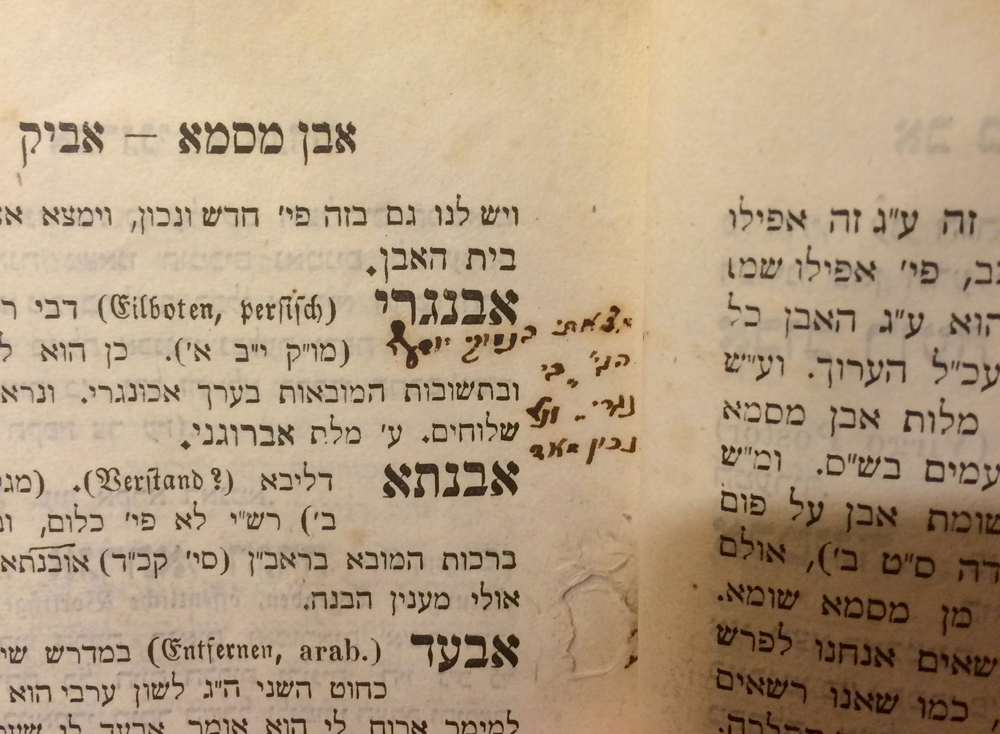
STRASHUN’S COPY OF SHIR’S EREKH MILIM


STRASHUN MARGINALIA TO EREKH MILIM
Creation of the Vilna Jewish Public Library
 
At his death in 1885, Strashun left no direct heirs.  He did, however, provide for the disposition of his library in his will.  In the past, those with large libraries had sold or left it to relatives,[18] Strashun elected a novel approach, rather than an individual or individuals he bequeathed his library to the Vilna Jewish community writ large, with instructions to establish a stand-alone public library.[19] His vision for the library was modeled on “the non-Jewish libraries that he saw [20] in the Diaspora.”[21] To that end, Strashun provided not only the books but also the funds to support the creation and sustainment of the library.[22]  Immediately the impact of this decision was apparent. At his funeral, among other enumerated good deeds and scholarship mentioned was, “the large library he left after death for the benefit of the community,” and which will “provide a
lasting legacy beyond that of any actual blood descendants.”[23]
            The creation of a public library out of Strashun’s personal collection was not a swift one, for seven years following Strashun’s death “the books remained under
lock and key” and were available only to those with special access.[24]  It remained in this state even though there were trustees and enough money to cover its operations.[25] Although the
library did not open to the public, the trustees were not idle during this time; and in 1889, published a complete catalog of Strashun’s collection.  His collection was comprised of 5,753 items, 63 of which contained marginalia in his hand.[26]
The Library is Open to the Public
 
In 1892, the Library was finally opened to the public. At the time, however, it remained in Strashun’s home.[27]  For years
after the library was opened to the public, in legal documents, the listed owner was not the Vilna community but one of the Library’s trustees. Although Strashun’s intent was clear – that the Library belonged to the community and not a trustee or any other individual – the Library’s legal status clouded that directive. In the late 1890s, there was a successful campaign to correct that issue, and the community becomes the sole owner of the Library, fulfilling Strashun’s wishes regarding ownership.[28]
The Library & Its Impact on the Vilna Community
 
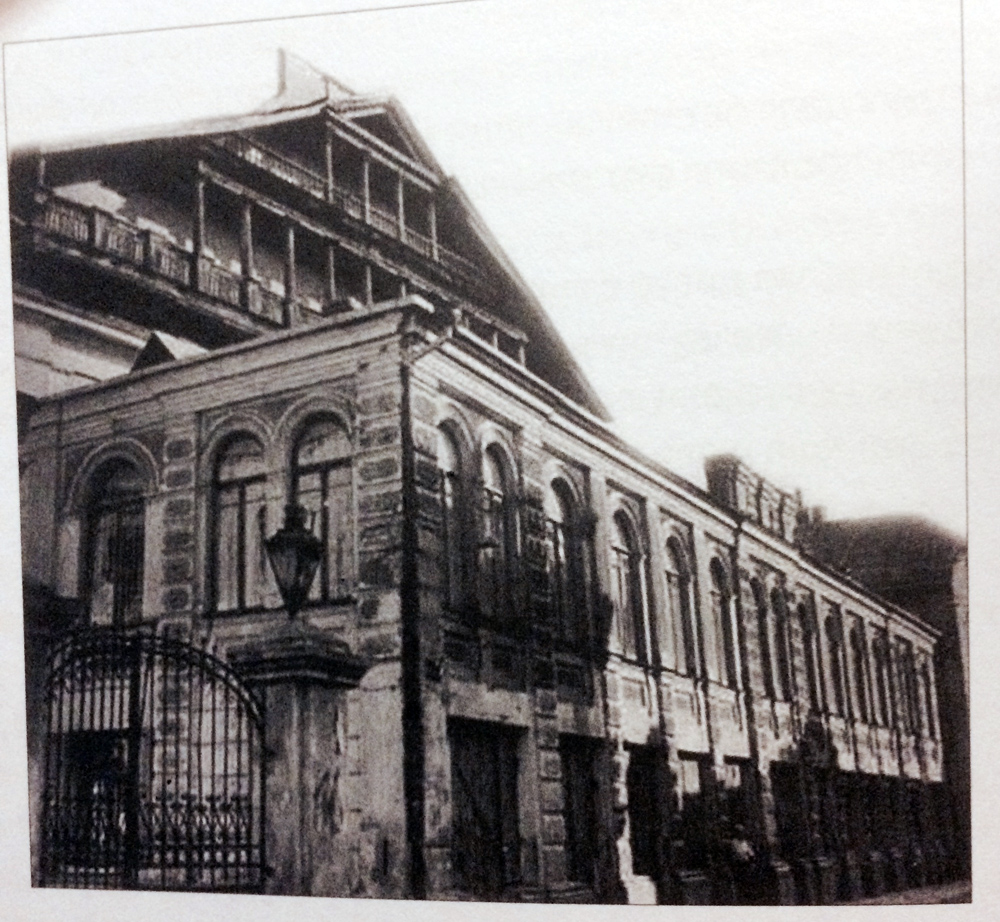
In 1902, the Library finally moved into a building of its own in the courtyard of the Great Synagogue of Vilna.[29]  From this
point forward, the Strashun Library would be one of Vilna’s most important institutions.
            The Strashun Library was a Jewish public institution and, to fulfill the needs of the public, additional steps were required beyond building and maintaining
infrastructure and clarifying ownership.
Specifically, although Strashun’s collection was substantial both in
terms of size and breadth, it was still the product of one man’s idea of a library.  For this reason, Hillel Noach Steinschneider, one of Vilna’s leading scholars and historians, pleaded with the public to donate books and ensure the completeness of the library and fulfill its mission of serving the entire community.  He acknowledged that Strashun amassed a very impressive private collection, but that for a public library his collection alone was insufficient because “it is lacking in books for people” whose interests did not align with Strashun’s.
That is, a public library is not only a place open for all but also one that provides value for all.  Consequently, the library’s composition must reflect the entirety of its audience and not a single collector. Apparently, this plea was successful,[30] many Vilna scholars donated their collections to the Library in addition to the general public, and, by the 1930s, the Library had grown to over 35,000 volumes.[31] Additionally, Vilna’s Tzedakah Gedolah organization also provided funds for acquisitions.  Books acquired through those funds contain a special stamp or receipt.
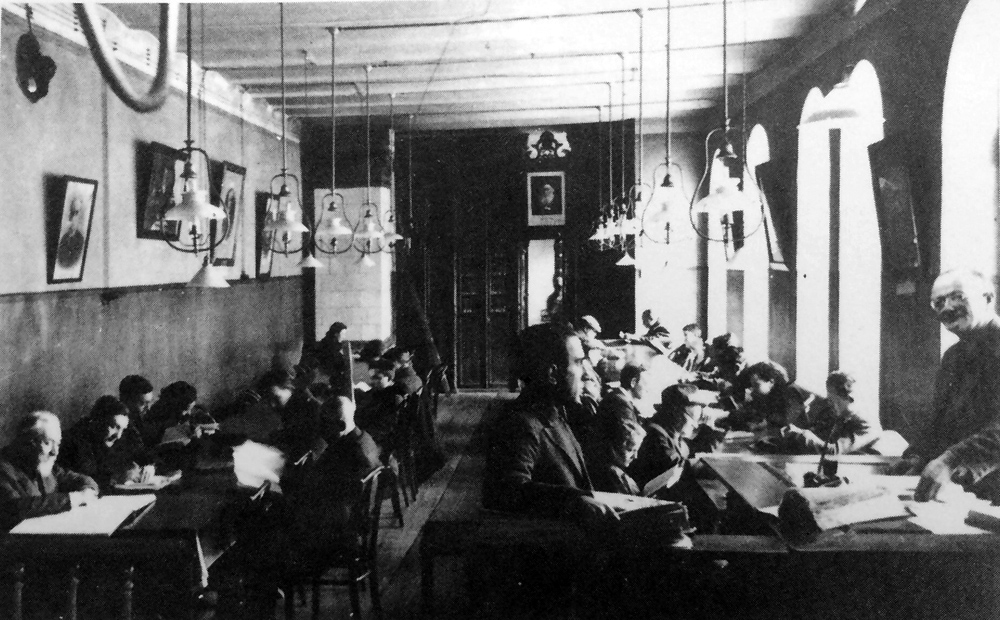
The Library was open seven days a week and became the central meeting location for the residents of Vilna.[32]  The Library’s visitors were representative of Strashun’s commitment to both traditional and modern ideas and ideals.  Patrons included “rabbis and talmudic scholars who were studying responsa and Halakhic
works” and who sat side-by-side with the “younger generation who were reading haskalah works.”[33] When dignitaries came to Vilna, the Strashun library
was a waypoint.[34]
 The intent was to have Herzl be the first visitor to the Library, however, the Russian government prohibited him appearing at the Library.[35]  Other famous Jewish personalities did visit and signed the guest book, known as the Golden Book, including Sholem Yankev Abramovitsh (Mendele Mokher Seforim), and Hayim Nachum Bialik, in addition to more traditionalists, R. David Friedman of Karlin, R. Shlomo Ha-kohen, and the Chafetz Chayim.[36] The Library was not only known for its visiting
Jewish celebrities, but also for its well-regarded holdings.  According to A.J. Heschel, it was the largest public Hebraic library in Eastern Europe reported holding over 40,000 volumes.[37]  On the one hand, the Strashun library was recognized as one of the greatest cultural institutions in Eastern Europe, on the other, like so many public institutions, the Library struggled to raise sufficient funds throughout the early part of the 20th century, consistently hampering its ability to maintain and build its
collections in addition to limiting its public access.[38]  But, it would not be funding that led to its demise but the Nazis and their campaign to appropriate Jewish cultural treasures.
The Nazi’s Looting of the Strashun Library
 
            During World War II, Vilna was occupied and controlled first by the Soviets, then the Lithuanian government, the Soviets again, and finally by the Germans.[39]  While under Lithuanian and Soviet rule, the Library had its share of challenges, but none
of those compared to the Nazi’s systematic campaign to identify, collect, and appropriate important Jewish treasures –specifically books – and, consequently, important libraries. The intent was that these pillaged libraries would supplement the already substantial Judaic holdings of Frankfort City Library.[40]  Immediately after the Nazis occupied Vilna, the Strashun Library as Vilna’s “oldest and perhaps most distinguished” library was identified as a target for this campaign.[41]
            Less than a month after occupying Vilna, the Nazis “enlisted” the Library’s librarian, Chakil Lunski, who had served in that capacity for over forty years, in addition to others, to select, identify and catalog important books including “the incunabula and manuscripts in the Strashun Library” to be sent back to Germany.[42]  Needless to say, Lunski was “distraught” that “he [was] supposed to help remove the treasures from ‘his’ Strashun Library that he protected for 45 years!”[43] Consequently, a number of books from the Strashun Library ended up in Frankfort, Germany.[44]


Post War Efforts to Reclaim Heirless Jewish Property 
 
            The Library’s building did not survive the war, but some of its books did.[45]  After WWII, the Allies recovered thousands of items the German’s looted and collected them at the Offenbach Depot outside of Frankfort.[46]  Much of what was recovered was likely heirless and the Allies faced with the dilemma of restitution. Initially, the Americans took the position that heirless property should return to the country from which it was looted.[47]  This position raised the specter of rare and important Judaica and Hebraica returning to Poland or even Germany.  This outcome was unacceptable to many Jews.[48]  Some elected to influence the fate of looted heirless books through traditional democratic means, others took matters into their own hands.[49]
Free For All? The Disposition of Other Significant European Libraries
 
The Strashun Library was by no means the only library identified at the Offenbach depot.  There were numerous other
libraries, both public and private that ended up at Offenbach, without any clear method of repatriation. This lack of clarity leads to inconsistent results at best.  Indeed, first-hand accounts of post-war Germany confirm the ad-hoc, doubtful legal grounds and sometimes completely lawless reparation regime in the post-war chaos.  In many instances, individuals made many of the decisions regarding disposition with little information and virtually to no oversight.
For example, Solomon B. Freehof, who himself amassed one of the greatest responsa collections in the 20th century, spent time in post-war Germany and encountered heirless property and describes attempts of repatriation. He indicates that
half of the heirless Jewish books recovered by the Allies went to the Jewish National and University Library (“JNUL”) at the Hebrew University (now the National Library of Israel),[50] which was “quite right” because some unnamed person or entity had determined “that clearly the [JNUL] should take the place of the vanished Jewish communities of Europe.”[51]
            Others agreed with Freehof that the natural repository for heirless books of European origin was the JNUL in Jerusalem.  Most notably, Judah Magnes, and the trustees of the JNUL wanted to recover and claim for the JNUL as much heirless Judaica as possible.  The JNUL dispatched Gershom Scholem, the eminent Kabbalah scholar, and bibliophile, to Europe to locate and return heirless property.  He discovered a significant number of important books and manuscripts in the Offenbach Depot
and did everything in his power, including employing very underhanded means, to repatriate items to Hebrew University.[52]
Initially, Scholem had a very difficult time securing authorization to even enter Germany and the Offenbach Depot.[53]  When he was eventually granted permission to view the contents of the Depot, it was with the explicit condition that he
could not remove any items.  But, for Scholem, some items proved too enticing.  Scholem identified a number of rare and important books and manuscripts.  He was concerned that if the disposition of these items were left to the Allied authorities the items would not end up in Jerusalem, but, instead, at the Jewish Theological Seminary, or some other institution, in the United States.  This was unacceptable to Scholem. To facilitate the transfer of these items to the JNUL, Scholem colluded with a Jewish American serviceman to smuggle the works out of Offenbach. Scholem placed the collection into five boxes but did not label
their contents and provided a fake name on the invoice.  The American serviceman personally ensured that the boxes were shipped to Paris, after which they were sent to the JNUL.  Eventually, the Allies found out about the theft, and demanded the return of the five boxes, even lodging a formal diplomatic complaint.  In the end, after much back and forth, the boxes remained at the JNUL.[54]
As germane here, eventually, the boxes’ content were cataloged and it was determined that a third of the works were not heirless – their ownership was clear and restitution was possible.[55]  Nevertheless, the content of the five boxes were incorporated into the JNUL.
Another example of unilateral ostensive benevolent restitution occurred with the “library of the prestigious Klaus synagogue of Mannheim, [that] ended up with U.S. Army Chaplin, Rabbi Henry Tavel.” Who, “on his own authority . . . shipped it to his alma mater, the Hebrew Union College in Cincinnati.”[56]
The Lost & Found: The Strashun Library Post-WWII
 
The determination regarding the disposition of the Strashun library after the Holocaust was no different from other heirless property, ad hoc and questionable.  Lucy Dawidowicz, worked for YIVO before WWII and spent time in Vilna.
After WWII, on behalf of the Jewish Distribution Committee after World War II, she went to the Offenbach Depot to assist with identification of heirless books.  Prior to coming to Offenbach, she had “promised [herself] that [she] would do [her] best to
safeguard the rights of possible owners and heirs.”[57]  And, when she came upon some of the remains of the YIVO collection,[58] she “was in a state of exaltation” and in a letter home wrote that she “had ‘a feeling akin to holiness, that [she] was touching something sacred.’”[59]
Dawidowicz also came upon books that she “could identify came from the Strashun Library.”  Whereupon she recalled “a
strange story” that the head of YIVO, Max Weinreich,[60] had told her “back in 1940.” Weinreich told her that during the brief period of time when the Soviets had returned Vilna to Lithuanian control, YIVO attempted to move its library out of Vilna.[61]  And, that “the trustees of the Strashun Library, also fearing for the sake of their library, asked the Vilna YIVO to ship [the Strashun Library] too.” Unfortunately, the shipment never occurred and both libraries remained in Vilna and ultimately plundered by the Nazis.
While the shipment never occurred, in Dawidowicz’s telling the attempted shipment was an irrevocable act with significant implications regarding the Library’s ownership.  She inferred that the Strashun trustees request to join the YIVO shipment also implicitly ceded ownership of the Strashun Library to YIVO. Thus, there she had no doubt regarding the proper disposition of the Strashun Library. Based entirely upon the “strange story” she heard, and even though according to her retelling the Strashun trustees had only intended YIVO to act as a shipper,[62] Dawidowicz told the Director of the Offenbach Depot that the heirless “remains of the Strashun Library ought to be considered as YIVO property.” She appealed to the Allied authorities and her position carried the day and the remnants of Strashun Library went to YIVO in New York.[63]
In a recent exhibit devoted to YIVO’s Strashun collection, the issue of the Strashun Library’s provenance is not discussed in any detail.  Instead, the book accompanying the exhibit simply states that all the remnants of the Strashun Library “were
rescued from the ruins of Europe and brought back to YIVO in New York in 1947.”[64] YIVO’s library catalog again implies that all the recovered books went to YIVO and links the disposition of the Strashun Library with that of YIVOs, the provenance note explains that “[t]he Strashun Collection, along with the YIVO Vilna collections, were liberated by the American Army, and
re-repatriated to YIVO in New York in April 1947.”[65]
            In reality, not all the remaining Strashun books went to YIVO, nor did everyone agree with the determination that YIVO was the rightful heir of the Strashun Library.
To be continued in Pt. II…


[1] For biographical information and sources see Tzvi Harkavy, Le-Heker Misphahot, (Jerusalem: Hotsa’at ha-Sefarim ha-Erets-Yisre’elit, 1953), 47-48 and n.79.
[2] A complete bibliography of his works, both published and unpublished, appears in Tzvi Harkavy, Le-Heker Misphahot, (Jerusalem: Hotsa’at ha-Sefarim ha-Erets-Yisre’elit, 1953), 45-46. Rashash’s comments on Rambam were printed in
Mekorei Rambam, first published in 1870 in Vilna, and while not a true stand-alone work, Rashash’s comments appear
alone, without the Rambam’s text.  See Mekorei ha-Rambam, Harkavy ed., (Jerusalem, Hatsa’at ha-Sefarim ha-Erets-Yisre’elit, 1957, Im ha-Madurah, and p. 59.
[3] For a list of the handful of pages he omitted, see Rafael Katzenellenbogen, Rash”sh le-Shitato, in Mekori Ha-Rambam Le-Rash”sh, ed. Harkavy, (Jerusalem, 1957), 64.
[4] For general biographical details on the Strashun family, see Frida Shor, From “Likute Shoshanim” to “The Paper Brigade” The Story of the Strashun Library in Vilna, (Tel Aviv: Ariel, 2012), 15-28, and the sources cited therein.  See also Shua Engelman, “Rabbi Samuel Strashun and his Haggahot on the Babylonian Talmud,” (PhD dissertation, Bar-Ilan University, 2009; Hebrew); regarding Samuel’s Talmudic annotations as compared to others, see Yaakov Shmuel Spiegel, Chapters in the History of the Jewish Book, Scholars & their Annotations (Ramat-Gan: Bar Ilan University, 2005), 421-22. Cf. Mordechai Zalkin, “Samuel and Mattiyahu Strashun: Between Tradition and Innovation,” in Mattiyahu Strashun, 1817-1885: Scholar, Leader, and Book Collector, (New York: YIVO Institute, 2001), 6-7.
[5] Moshe Shimon Anktokolski, Evel Kaved, infra n.12, 23.
[6] Mordechai Zalkin, “Samuel and Mattityahu Strashun: Between Tradition and Innovation,” in Yermiyahu Aharon Taub, ed., Mattityahu Strashun, 1817–1885: Scholar, Leader, and Book Collector (New York: YIVO Institute, 2001), 1-27. Samuel has made a very small number of comments that can be read to be consistent with ideas of the haskalah, but these do not approach Matisyahu’s active involvement with the movement, including his very public support of the movement.  Additionally, it is unclear if Samuel’s comments are simply limited to their specific context.
Indeed, the examples Zalkin provides regarding Samuel’s alignment with haskalah do not support Zalkin’s thesis. Id. at 25
n.10. First, Zalkin, cites Strashun’s comment in Gitten 6b, that “we find many amora’im who did not know how to read scripture” as proof of his “unorthodox” views.  But we find a similar statement from the medieval period.  See Tosefot, Bava Batra, 113a.  Zalkin’s second citation is to Rashas’s comments, Rosh ha-Shana 26a, “certain things that were uttered in a particular time and particular place are inserted by editors of the Talmud in their appropriate location in the text.” This misrepresents the Rashash.  Rashash is attempting to answer how the Talmudic sage, Levi, was unaware of an explicit verse as the TB in RH 26a implies.  Rashash explains that although there is no explicit mention of the time or place that this story occurred, Rashash posits that the story in Rosh Hashana occurred at the same time as another story with Levi, Yevamot 105a, where he had a moment of senility.
Rashash is not offering his opinion regarding the redaction of the Talmud, instead he is merely dating the story in Rosh ha-Shana. Finally, it is unclear the relevance of Zalkin’s third example, “you will find many contradictions between different locations is (sic) Rashi’s text.” Locating and alleging contradictions in Rashi is hardly remarkable.
[7] Zalkin, id., at 15.
[8] Shalom Pludermacher, Zikaron le-Hakham: Zeh Sefer Tolodot ha-Rav ha-Go’an, he-Hakham ha-Kollel Rabbi Matitayahu
Strashun Z’L
, in Mattiyahu Strashun, Matat-Ya, Haghot, Hidushim ve-He’arot Me’irot ‘al Midrash Raba Pri Eito Shel Matityahu Strahsun, (Vilna: The Widow and Brothers Romm, 1893), 15.
[9] A partial bibliography of Strashun’s articles appears in his Sefer Matat Yah (Vilna, 1893), 41-74 (Hebrew), available online here.  Reading, and certainly actively participating with, haskalah related newspapers was considered inconsistent with Ultra-Orthodox values and was grounds for expulsion from Volozhin Yeshiva. Shaul Stampfer, The Lithuanian Yeshiva, Revised & Expanded Edition,  (Jerusalem: The Zalman Shazar Center for Jewish History, 2005), 176.
[10] Aviva Astrinsky, “A Brief History of the Strashun Library,” in Yermiyahu Aharon Taub, ed., Mattityahu Strashun, 1817–1885: Scholar, Leader, and Book Collector (New York: YIVO Institute, 2001), i.
[11] Duberosh ben Aleksander Torsh, Me’arat ha-Makhpelah, shnei Hepadim . . ., (Warsaw, 1887), 50.
[12] Moshe Shimon Antokolski, Evel Kaved, (Vilna: be-Defus Avhram Tzvi Katzenellenbogen, 1886), 8; Tzvi Harkavy, Le-Heker Misphahot, supra n.1, 47.  During his lifetime he also donated to public institutions, among them, the yeshivot of Mir and Volozhin.  Id. at 24.
[13] Moshe Shimon Antokolski, Evel Kaved, supra n.12, 11.
[14] Mordechai Zalkin, supra n.6, 17-8.
[15] Hagit Cohen, At the Bookseller’s Shop, The Jewish Book Trade in Eastern Europe at the End of the Nineteenth Century,
(Jerusalem: The Hebrew University Magnes Press, 2006), 48-52.
[16] Shalom Pludermacher, Zikaron le-Hakham, 1893), 17. His meetings are reflected in Strashun’s ownership of their works.
See Likutei Shoshaim, nos. 386,1024,1178, 2522, 3352, 3650, 3781, 4377, 5399, 5592. Regarding other well-known Hebrew book collectors and their collections, see Alexander Marx, “Some Jewish Book Collectors,” in his Studies in Jewish History & Booklore, (New York, 1941), 198-237; Cecil Roth, “Famous Jewish Book Collections & Collectors,” in Essays in Jewish Booklore, (New York: Ktav Publishing House, 1971)330-35.
[17] “A Collection of Letter from Jewish Scholars to ShZH”H,” in Yad ve-Shem, reprinted in Yeshurun.
[18] David Oppenheimer’s library was the first library that was posthumously sold intact – to the Bodleian Library.  See
Alexander Marx, “Some Notes on the History of David Oppenheimer’s Library,” Revue des Études Juives 82 [=Israel Lévi
Festschrift] (1926): 451-460; Charles Duschinsky, “Rabbi David Oppenheimer: Glimpses of His Life and Activity, Derived from His Manuscripts in the Bodleian Library,” Jewish Quarterly Review 20:3 (January 1930): 217-247; Alexander Marx, “The History of David Oppenheimer’s Library,” in Studies in Jewish History and Booklore (New York: Jewish Theological Seminary of America, 1944), 238-255; and more recently in Joshua Teplitsky, “Between Court Jew and Jewish Court: David Oppenheim, The Prague Rabbinate, and Eighteenth-Century Jewish Political Culture (PhD dissertation, New York University, 2012); and Abraham Schischa, “Rabbinic Writings from the Collection of Rabbi David Oppenheim,” Yeshurun 31 (2014): 781-794 (Hebrew).
For other significant personal Hebrew libraries and their purchasing history, see Binyamin Richler, Hebrew Manuscripts: A
Treasured Legacy
(Clevland/Jerusalem: Ofeq Institute, 1990) 66-67.
[19] For earlier examples of private libraries see Nehemya Allony, The Jewish Library in the Middle Ages, Book Lists from the Cairo Genizah (Jerusalem:  Ben-Zvi Institute, 2006); S.D. Goitein, A Mediterranean Society (Berkley: University of California Press, 1967), vol. II, 206, 248; vol. V 3-4, 425.
[20] It is unclear whether Strashun meant this literally because while the 19th century witnessed the modern period of the public library, there were not any public libraries in Eastern Europe during Strashun’s lifetime.
[21] Shor, supra n. 4, at 26.
[22] Sefer Matat Yah, supra n. 9, at 35, listing Strashun’s bequests.
[23] Moshe Shimon Anktokolski, Evel Kaved, supra n.12, 17.
[24] Among those who had access during this time was Ya’akov Wallensky.  During this time, Wallensky was writing his supplement to Piskei Teshuvot on Yoreh De’ahPiskei Teshuvot itself is a collection of obscure and rare works discussing issues
appearing in Yoreh De’ah. Because Wallensky’s materials were even more obscure and rare, the only place he could access these was the Strashun Library. Ya’akov Wallensky, Daltei Teshuva, (Vilna, 1890), Introduction, 5-6, (link).
[25] Shor, supra n. 4, at 29
[26] Cf. Aviva Astrinsky, “A Brief History of the Strashun Library,” in Yermiyahu Aharon Taub, ed., Mattityahu Strashun, 1817–1885: Scholar, Leader, and Book Collector (New York: YIVO Institute, 2001), iii, who provides that his collection was only
comprised of 5,739 items.
[27] Shor, supra n. 4, at 29.  Regarding the conflicting reports of the Library’s locations during this period, see id., n.71.
[28] Shor, supra n.4, 32-3.
[29] While the Library moved to the new building in 1901, and its dedication ceremony occurred on April 14, 1902, it would not be until October 20, 1902, that the Library secured the necessary governmental permits to fully open to the public.  See Shor at 34-35.  The government license is reproduced in Layzer Ran, Jerusalem of Lithuania, vol. 2, (New York: Laureate Press, 1974),
346.
[30] Frida Shor, supra n.4, 51-65,174-87. See Berger, “The Strashun Library in Vilna,” in Zevi Scharfstein, ed., Hebrew Education and Culture in Europe Between the Two World Wars (New York: Ogen Publishing House of Histadrut HaIvrit BeAmerica, 1957), 513 (Hebrew), who discusses the varied subject matter of the Library’s collection.
[31] Id.
[32] According to one account, the Library had over 200 patrons daily, but only 100 seats, forcing people to share chairs and encounter waits of over a half-hour just to enter the Library.  Id. at 513.
[33] Ben Tzion Dinur, “Yerushalim de-Lita,” in Layzer Ran, Jerusalem of Lithuania, vol. 1 (New York: Laureate Press, 1974), XVI; but see the English translation of Dinur’s article that comingles the two groups and has both the Orthodox and younger generation studying “respona or modern Hebrew novels.”  Id. at XX.  It is unclear what accounts for this discrepancy in translation. Lucy S. Dawidwowicz, From That Place And Time, A Memoir 1938-1947, (New York: Bantam Books, 1991), 119, provides a remarkably similar account to Dinur’s (“On any day you could see, seated at the two long tables in the reading room,
venerable long-bearded men, wearing hats, studying Talmudic texts, elbow to elbow with bareheaded young men and even young women, bare-armed sometimes on warm days, studying their texts. The old men would sometimes mutter and grumble about what the world had come to. The young people would titter.”).
For a breakdown of the Library’s readership by type (i.e. students, academics and public intellectuals, workers, etc.), see Berger, supra n. 28, 514-15.
[34] See Shor, supra n. 4, 174, see also the description of David Wolfson’s Vilna visit, Israel Klausner, “The Zionist Movement in
Lithuania,” in Yahdut Lita (Tel Aviv: Am Hasefer Publishers, 1950), 522 (Hebrew). For a photo of one such visit, see Layzer Ran, Jerusalem of Lithuania, vol. 2 (New York: Laureate Press, 1974), 416.
[35] Shor, supra n. 4, 174-75.
[36] Berger, “The Strashun Library in Vilna,” at 519; Shor, MeLekutei, supra n. 4, 169; Khaykl Lunski in Yeshurin’s ‫ווילנע
(New York, 1935 – in Yiddish), p. 286-7
[37] Abraham Joshua Heschel, “Yerushalim de-Lita,” in Ran, Jerusalem, vol. I, XVII; David E. Fishman, The Rise of Modern Yiddish Culture (Pittsburgh, PA, University of Pittsburgh Press, 2005), 143, provides that the holdings of the Strashun Library prior to the Holocaust was comprised of “some forty thousand volumes.”
[38] See Shor, MeLekutei, 38-9; 42 (discussing a 1926 public appeal that the Library undertook where it described its financial condition as “dire and catastrophic”); id. at 43 (“The Strashun Library underwent many difficult financial periods throughout the nineteen years of Polish rule (10/9/1920- 9/19/1939).  But, it continued to major Vilna cultural institution.”).
[39] Shor, MeLekutei, 44-7.
[40] Sem C. Sutter, “The Lost Libraries of Vilna and the Frankfurt Institut zur Erforschung der Judenfrage,” in Lost Libraries, The Destruction of Great Book Collections Since Antiquity, ed. James Raven (New York: Palgrave Macmillan, 2004), 220-22.
[41] Id. at 223 & 224 discussing other Vilna Libraries that were targeted by the Nazis.  See also Dov Schidorsky, Burning Scrolls and Flying Letters (Jerusalem: Magnes Press, 2008), 165-201; David E. Fishman, The Rise of Modern Yiddish Culture (Pittsburgh, PA: University of Pittsburgh Press, 2005), 141-44; Frida Shor, supra n.4, 189-200.
[42] Sem C. Sutter, “The Lost Libraries of Vilna,” supra n.38, 224.
[43] Id. at 226.
[44] Berger, “The Strashun Library of Vilna,” at 517.  The books that were not deemed important we pulped or used as heating fuel. Schidorsky, supra 39, 182. The exact date of when the Strashun Library was transferred to Germany is unclear; however, it was some date after April 1943.  See David E. Fishman, supra n.39,173 n.9. Similarly unclear is the exact number of books that were sent to Frankfort.  Sem C. Sutter, “The Lost Libraries of Vilna,” supra n.38, 228.  But, according to Aviva Astrinsky, “almost all of the Strashun books were crated and shipped by rail to Germany.  Aviva Astrinsky, “Mattitayahu (Mathis) Strashun,” supra n.24, i.
[45] See Ran, Jerusalem, vol II, 522, for a photo of post-war building. For a discussion regarding the numbers of books that survived from the Strashun Library, see Frida Shor, supra n.4, 204-05.
[46]  Dov Schidorsky, supra n.39, 225, listing the countries and libraries who books were deposited at the Offenbach Depot. Sem C. Sutter, “The Lost Libraries of Vilna,” supra n.38, 229-32.
[47] Lisa Moses Leff, The Archive Thief: The Man who Salvaged French Jewish History in the Wake of the Holocaust (United
States:  Oxford University Press, 2015), 121.
[48]  Id. at 124-30, 136-40.
[49]  Id.
[50] Dov Schidorsky, supra n.39, 233, provides the numbers and location of heirless books returned by the Jewish Culture Reconstruction.  For a listing of U.S. institutions that received heirless cultural property from the Offenbach Depot, see Herman
Dicker, Of Learning and Libraries, The Seminary Library at One Hundred, (New York: The Jewish Theological Seminary, 1988), Appendix B. See also F.J. Hoogewoud, The Nazi Looting of Books and its American ‘Antithesis’. Selected Pictures
from the Offenbach Archival Depot’s Photographic History and Its Supplement,” Studia Rosenthaliana 26:1-2 (1992): 158-192; and F.J. Hoogewoud, “Dutch Jewish Ex Libris found among looted books in the Offenbach Archival Depot (1946),” in Chaya Brasz and Yosef Kaplan, eds., Dutch Jews as Perceived by Themselves and by Others (Leiden: Brill, 2001), 247-261.
[51] Solomon B. Freehof, On the Collecting of Jewish Books, (New York, NY: Society of Jewish Bibliophiles, [196-]), 17; regarding the books that Hebrew University received, and its efforts to locate and claim heirless works throughout Europe through its Otzrot Ha-Goleh committee, see Shlomo Shunami, About Libraries and Librarianship, (Jerusalem: Rubin Mass, 1969), 56-65; Zvi  Baras, A Century of Books, The Jewish National & University Library 1892-1992, (Jerusalem: Jewish National & Univ. Library,1992), nos. 94-101; Dov Schidorsky, supra n.39, 212-91.
[52] Dov Schidorsky, supra n. 39, 250-51.
[53] Id. at 248-50.  According to Scholem, Abraham Ya’ari, Scholem’s partner on behalf of Hebrew University and its Goleh ha-Otzrot program, returned to Israel, in part, because of the difficulty in securing the necessary authorizations to enter Germany.
Id. 248; 351.
[54] Id. at 250-51.
[55] Id. at 251 n.51.
[56] See  Druker, Of Learning and Libraries, 58.  Druker, however, concludes that Tavel’s unilateral decision “resulted in
no real harm.”  One wonders if any surviving heirs who had legal claims to the Manheim collection would reach the same conclusion.
[57] Lucy S. Dawidwowicz, From That Place And Time, A Memoir 1938-1947, (New York: Bantam Books,1991), 314-16.
[58] See David E. Fishman, supra n.39, 143-53 174 n.20, discussing the YIVO Library under the Nazis and its ultimate transfer to YIVO in New York.
[59] Id. at 318.
[60] For more information regarding Weinreich and YIVO, see id. at 126-39.
[61] Id.; for a fuller treatment of this attempt see Shor, From ‘“Likute Shoshanim”, 44.
[62] Aside from Dawidowicz’s telling, according to the documents that discuss YIVO’s efforts to save its library and the Strashun and the Lithuanian government’s response throughout this attempt, the Strashun Library is described as a Vilna community
library and not the property of one institution or another.  See Shor, From “Likutei Shoshanim”, at 44.
[63] Her argument has the perverse effect that the trustees attempt to save the library immediately resulted in completely losing control of the library.
[64] Aviva E. Astrinsky, Mattistyahu Strashun 1817-1885, Scholar, Leader, and Book Collector, YIVO, New York: 2001, ii, iv.  But, Astrinsky also indicates that YIVO recovered “a substantial part of the Strashun Library.”  Id. at i.  According to YIVO’s website, however, YIVO only received part of the Strashun Library and the remainder “were transferred to the library of the Hebrew University in Jerusalem. (link).
Similarly, Berger, “The Strashun Library in Vilna,” p. 517 claims that part of the Strashun Library went to YIVO and the other part to Hebrew University.
Beyond these unsupported statements, there is no evidence that any books from the Strashun Library were sent to the JNUL.  While the JNUL’s post-war efforts at obtaining heirless books are well documented, see supra, there is no mention of the Strashun Library.
Similarly, the JNUL catalog does not list any items whose provenance extends to the Strashun Library. It is possible that YIVO and Berger confused the JNUL with the Jerusalem Central Library discussed below.  Or simply conflated the Strashun Library with the numerous other European libraries that the JNUL successfully rescued.
[65] See, e.g., the YIVO catalog entry for Solomon Adret’s Hidushe Nidah leha-Rashba, Altona, [1737].


“Improved” Making of a Godol

R. Nathan Kamenetsky has republished the first volume of his book, “Making of a Godol.” This new edition is labeled “Improved Edition.” The reasons for the improvements are well-known. The original edition was placed under a ban due to perceived slights in the honor of certain Gedolim.

In this new edition, there is a helpful index which shows what exactly has been improved upon. According to the index only one story has been removed in it’s entirety. That story, in which R. A. Kotler responded to an interruption during his shiur from a “red-bearded scholar.” R. Kotler responded by saying “Red Heifer, be still!” This was removed due to the source of the story. Apparently, the source for this particular story did not support R. Kamenetsky when R. Kamenetsky questioned the validity of the ban, and thus R. Kamenetsky did not want to include this persons comments.

According to the index there are no more omissions in this new edition. Instead, there are numerous elaborations, corrections, and a significant amount of new information. R. Kamenetsky states in one of the first “elaborations” that “the unexpected ban issued on the original, unimproved, version” helped the current edition be of value for all time.

unfortunately, this improved edition still suffers from a serious lack of editorial oversight. Although, the book has been altered to conform and appease those that issued a ban, it was not altered to make it more reader friendly. The improved edition still utilizes the same format of text followed by excursuses with numerous footnotes and tangents. It still requires, as R. Kamenetsky points out, a pencil and paper to be able to be able to flip back and forth through the book and keep track of what page one is on.

There is one important addition to the book, while not solving all the difficulties, at least alleviates some of them. R. Kamenetsky included a timeline line which tracks both significant events in world history with a parallel timeline that tracks significant Jewish events. When the Jewish events appear in the book, R. Kamenetsky included a footnote to alert the reader which page they can be found on. This allows, if one so desires, to read the book in a chronological order.

Although, the original book was only $40 (when it was published, subsequent to the ban the book was selling and continues to sell for outrageous prices) this improved version is $125. I assume that the steep raise in price was to allow for R. Kamenetsky to recoup some of his losses he suffered from the first edition. There were only 1,000 copies of the first edition published, however, R. Kamenetsky stopped selling and ordered his distributor to stop distributing them once the ban was pronounced. While it is impossible to know with certainty, this probably left him with numerous unsold copies thus causing significant loss. R. Kamenetsky implemented this policy even though he stood to profit immensely from the ban, he has said he felt bound by the ban even if he felt it was unjust.


Rambam’s Response to the Inclusion of Chicken, Duck and Quail in Qaraite Cuisine

Rambam’s Response to the Inclusion
of Chicken, Duck and Quail in Qaraite Cuisine
By Tzvi H. Adams

In “Waiting
Six Hours for Dairy- A Rabbanite Response to Qaraism” (here)
I posited that Rabbeinu Chananel initiated the practice of waiting six hours
between meat and dairy in order to protect Rabbanite values. This association
was inspired by Dr. Bernard Revel’s studies of 
Rabbanite leaders’ efforts to counter sectarian influences during the
early Middle Ages[1], as well as a shiur by
Rabbi David Bar-Hayim. I then
suggested that Rambam furthered this anti-Qaraite motion by including poultry
into the required six hour waiting category. Rambam’s poultry innovation was intended
to protect Rabbanites from influence of their Qaraite neighbors who cooked meat
and poultry with dairy. Briefly, this latter suggestion was based upon two observations:

a) The simple reading of the Talmud Chullin
104b -עוף וגבינה נאכלין באפיקורן – בלא נטילת ידים ובלא קינוח הפה- as interpreted
by the Gaonim and rishonim for five centuries until Rambam, allowed poultry and
dairy to be consumed consecutively without even kinuach ve’hadacha in
between. Unless we imagine that Rambam possessed a secret hitherto unheard-of
tradition which understood the Talmud’s words in some other fashion, we can
assume that Rambam actually changed the Talmudic halacha in his Yad. Being
the strong proponent of Rabbanite halacha and tradition that he was, Rambam
surely had a compelling reason to make this drastic alteration.

b) There are many instances of
anti-Qaraite creativity in Rambam’s writings and rulings. Examples include:

§ 
Rambam was the first rishon to
disqualify a get (divorce document) written in a Qaraite court by a
Qaraite scribe[2].
§ 
Though the Gaonim and R. Chananel
explicitly say that not eating on the three minor fast days is the individual’s
choice (as per the Talmud’s ruling RH 18b- אין שמד ואין
שלום – רצו – מתענין, רצו – אין מתענין), Rambam chose to
overlook this detail about fast days in his halachic writings. The purpose of
this intentional omission was almost certainly to separate Rabbanites from the
Qaraite community who did not observe the Rabbanite fasting calendar[3].
§ 
Most rishonim recognized the
rabbinic origins of the Yom Kippur afflictions other than not eating or
drinking. Rambam, however, led readers to believe that all five afflictions are
biblically proscribed. It seems that Rambam presented the Yom Kippur restrictions
in this way only to protect the halacha from the Qaraite perspective[4]. 

Other examples were cited in my previous article. It is therefore reasonable to
say that the required waiting period between poultry and dairy, found first in Yad
HaChazaka
, is one more instance of Rambam’s anti-Qaraitic halachic
reformation.

An
analysis of the historical development of Qaraite rules of kosher birds strongly
supports my suggestion[5].
Qaraite halacha did not rely on the Rabbanite Oral Law. Therefore, the kosher
signs of the Mishna Hullin 59a –
 וסימני העוף לא נאמרו אבל אמרו
חכמים כל עוף הדורס טמא כל שיש לו אצבע יתירה וזפק וקורקבנו נקלף טהור ר’ אלעזר
בר’ צדוק אומר כל עוף החולק את רגליו טמא
and the statement of the Talmud Hullin
63b, עוף
טהור נאכל במסורת, were of little
significance to Qaraites. That chicken, duck, quail and other fowl were eaten in
Rabbanite tradition[vi] was
unreliable evidence for these strict Scriptualists. Because the identity of most birds mentioned in the Torah
was ambiguous, Qaraites had no reliable means of recognizing birds as kosher other
than the pigeon and turtledove; they were confident that the correct
translation of תור and יונה had been preserved. The devout Qaraite, therefore, could not
partake of chicken, quail, or duck. Over time, some Qaraites communities became
lenient and found legal rationale to permit these commonly eaten birds. Slowly
over the 12th Description: https://ssl.gstatic.com/ui/v1/icons/mail/images/cleardot.gifand 13th
centuries a lenient policy was adopted by the broad Qaraite community. Because
from the inception of Qaraism its scholars read the passuk, “לא
תבשל גדי בחלב אמו” literally[7],
they had no hesitations against eating and cooking the newly accepted fowl and
dairy together. 

            The
Rabbanite and Qaraite communities were very much interconnected politically and
socially[8];
the divide between the parties was often blurred[9].
Rabbanite leaders sought to protect the integrity of their tradition from sectarian
influence. I demonstrated previously how R. Chananel (990 -1053) and his
disciple, R. Yitchak Al-fasi[10]
(1013
– 1103), created a six hour waiting requirement
between meat and dairy in the early eleventh century – thereby limiting the
social participation of Rabbanites with Qaraites. During the years of the legislating
activity of these sages it was not common practice amongst Qaraites to eat
chicken, duck, and quail, birds on the daily North African Rabbanite menu[11]. R.
Chananel and R. Al-fasi, therefore, did not see a need for demanding a wait
after poultry as there was little concern that Rabbanites and Qaraites would be
dining together over such fowl. Furthermore, it was difficult to reread the
obvious permitting statement of the Talmud, עוף וגבינה
נאכלין באפיקורן. During the century between these sages
and the rise of Rambam (1135-1204) to prominence, Qaraites widely allowed
themselves to eat the same fowl consumed by the Rabbanite community. Now a
Qaraite-Rabbanite poultry dinner was possible and influence from the cooking
practices of “the eaters of milk with meat” (the nickname for Qaraites) was
real. Rambam, seeking to protect Rabbanite tradition from Qaraite values by
building social barriers, creatively placed fowl alongside meat in the
requirement to wait six hours before dairy:
מִי
שֶׁאָכַל בָּשָׂר בַּתְּחִלָּה, בֵּין בְּשַׂר בְּהֵמָה בֵּין בְּשַׂר עוֹף–לֹא
יֹאכַל אַחֲרָיו חָלָב עַד שֶׁיִּשְׁהֶה בֵּינֵיהֶן כְּדֵי שֵׁעוּר סְעוֹדָה
אַחֶרֶת, וְהוּא כְּמוֹ שֵׁשׁ שָׁעוֹת:  מִפְּנֵי
הַבָּשָׂר שֶׁלְּבֵין הַשִּׁנַּיִם, שְׁאֵינוּ סָר בְּקִנּוּחַ
(רמב”ם משנה תורה מאכלות אסורות פרק ט’
הלכה כז)
This addition did not
go unnoticed. In the two generations following Rambam, the greatest rishonim
criticized the Rambam’s reform as it reversed the ruling of the Bavli. Ramban
(1194-1270) was the first to challenge Rambam’s alteration:


אבל הרמב”ן ז”ל כתב דאגרא אפילו עוף ואחר כך גבינה שרא דלישנא הכי משמע
דקאמר עוף וגבינה…(ר”ן על הרי”ף חולין דף לז’)
R. Aaron Halevi
(1230-1300) also challenged Rambam’s ruling:
…ואפילו
הכי שרינן בעוף בלא נטילת ידים משום דקיל דלא מיתסר אלא מדרבנן, ודאי לא שני לן
בין עוף ואחר כך גבינה בין גבינה ואחר כך עוף… הוא הדין לקנוח הפה דלא בעינן
אפי’ בין עוף לגבינה…. ולהוציא קצת מדברי רבי’ ז”ל (=הרמב”ם) שפרשו
דההיא דאגרא דאמר עוף וגבנה נאכלין באפיקורן דוקא גבינה תחילה ואחר כך עוף…
(חידושי רא”ה לחולין דף קד’)
However, within a
century of the publication of Mishna Torah, creative ways of
reinterpreting the words of אגרא were created to fit
this new reform into the Talmud[12].
Tur (1275-1340) YD 89 cites Rambam’s ruling on poultry as if none other exists.
Professor Daniel Frank has thoroughly examined the historical
development of the laws of kosher birds in Qaraite halacha in his monograph,
“May Karaites Eat Chicken? Indeterminacy in Sectarian Halakhic Exegesis”[13].
My chiddush is that the inclusion of chicken, duck, and quail in Qaraite
cuisine in the 12th century provoked Rambam’s tightening of the
poultry and dairy separation laws. Unless noted otherwise, the following
sources and translations are summarized from Frank’s article:

Views of Early Qaraite Scholars
Anan ben David
In his Book of Commandments[14], the early learned schismatic, Anan
ben David (c. 715 – c. 795) writes the following:
Now we do not find any birds were
used for burnt offerings save turtledoves and pigeons, as it is written… (in
lev. 1:14). The juxtaposition of the words ‘of every clean bird’ and ‘he
offered burnt offerings’ thus proves that the only clean birds are turtledoves
and pigeons.
Benjamin Nahawandi
One
of the greatest of the Qaraite scholars of the early ninth century, Benjamin Nahawandi, states:
The only clean birds that can be
eaten are the pigeon and its kind. There are many clean and unclean varieties…
but they cannot be identified by means of physical criteria, since Scripture
does not make these explicit. … The pigeon is (the bird) that makes the cooing
noise in is throat, as it is stated: We coo like doves (Is. 59:11)….
Therefore the only clean bird that is mentioned is the pigeon and its kind[15].
The identification of other clean birds remains uncertain
because the Torah provides no physical description of the birds. Pigeons (and
their turtledove subspecies) are an exception because the Scriptural verse, We
coo like doves
(Is. 59:11), gives a physical sign to identify the
bird.  
Daniel al-Qumisi
Daniel al-Qumisi (d. in Jerusalem 946), founder of the Qaraite
“Mourners of Zion” movement, likewise insisted that because Biblical Hebrew is no longer
the vernacular, the meaning of most of the birds of the Torah has been
forgotten; “for God-fearing people, the only permitted birds are turtledoves,
pigeons and wild pigeons- at least until the coming of the Righteousness”[16].
He attacks the Rabbanites for having invented physical criteria for identifying
kosher birds- as Scripture does not supply these.
Jacob Al-Qirqisani
The
early tenth century Qaraite dogmatist and exegete, Jacob Al-Qirqisani writes similarly
in his Kitabal-Anwar (written in 937):
Should someone say, “The people
already knew these signs via oral tradition from the prophet…” He may be
answered: “As for your statement that the people used to know these signs via
oral tradition from the prophet- this is (but) a claim. You have no proof of
this….”[17]
Japeth ben Ali
The maskil
ha-Golah
and
foremost Qariate Bible commentator, Japeth ben Ali (10th century, born in Iraq
and died in Jerusalem), emphasized that pigeons and turtledoves are the only
unquestionably permitted birds; all other species should be avoided.
Of all the birds, those which are
demonstrably permitted are turtledove and pigeon…. As for chicken, mountain
quail, partridge, duck, goose, crane, sparrow, and others- we must suspend
judgement concerning them all- “until he comes and teaches righteousness”
(Hos.10:12)[18]
Rabbanite Rishonim


The rishonim were very familiar with Qaraite claims.

R. Saadya Gaon
In response to Qaraite scholars, R. Saadya Gaon (882-942) addresses the topic
of the identification of the birds of the Torah in his writings[19],
delivering anti-sectarian polemics.

Targum Psuedo-Yonathan[20]

Dr. Bernard Revel proved in his “תרגום יונתן על
התורה” (here) that the Targum Yonathan (ben
Uziel) was really an early ninth century targum commissioned by the Torah sages
of Eretz Yisroel. He demonstrated that this targum is filled with views of the
Talmud Yerushalmi as well as interpretations aimed at countering sectarian
movements. (here)

וית אלין מינייא תשקצון מן עופא דלית
להון ציבעא יתירא ודלית ליה זפקתא ודקורקבניה ליתוהי מקליף לא יתאכלון (תרגום
יונתן ויקרא יא:יג)
The Targum’s author included the physical criteria for
kosher birds to imply that these signs are contained within the Torah itself
and valid- unlike the views of early Qaraites who disregarded these signs only
known by rabbinic tradition.
Mah-Yedidut [21]

The popular Friday night zemer, Mah-Yedidut, by Menachem (possibly ben
Saruq[22],
920-980 Spain), highlights the differences between the Rabbanite and Qaraite
Sabbath. Menachem emphasizes the obligations of kavod  ve’oneg Shabbos (לְבוּשׁ
בִּגְדֵי חֲמוּדוֹת
and עֹֽנֶג קְרָא לַשַּׁבָּת[23],
וְהַשֵּׁנָה מְשֻׁבַּֽחַת)
and kindling Sabbath lights ([24]לְהַדְלִיק
נֵר בִּבְרָכָה),
the permissibility of thinking of post-Sabbath work ([25]הִרְהוּרִים
מֻתָּרִים)
and gives an allusion to marital relations        (כַּשּׁוֹשַׁנִּים
סוּגָה[26],
בּוֹ יָנֽוּחוּ בֵּן וּבַת וְלָנֽוּחַ בְּחִבַּת) – all points of contention between
Qaraites and Rabbanites.
מַה
יְּדִידוּת מְנוּחָתֵךְ, אַתְּ שַׁבָּת הַמַּלְכָּה, 
בְּכֵן נָרוּץ לִקְרָאתֵךְ, בּֽוֹאִי כַלָּה נְסוּכָה, 
לְבוּשׁ בִּגְדֵי חֲמוּדוֹת, לְהַדְלִיק נֵר בִּבְרָכָה, 
וַתֵּֽכֶל כָּל הָעֲבוֹדוֹת, לֹא תַעֲשׂוּ מְלָאכָה. 
לְהִתְעַנֵּג בְּתַעֲנוּגִים בַּרְבּוּרִים וּשְׂלָו
וְדָגִים. 
מֵעֶֽרֶב מַזְמִינִים, כָּל מִינֵי מַטְעַמִּים, 
מִבְּעוֹד יוֹם מוּכָנִים, תַּרְנְגוֹלִים מְפֻטָּמִים
וְלַעֲרֹךְ כַּמָּה מִינִים, שְׁתוֹת יֵינוֹת מְבֻשָּׂמִים, 
וְתַפְנוּקֵי מַעֲדַנִּים, בְּכָל שָׁלֹשׁ פְּעָמִים. 
לְהִתְעַנֵּג בְּתַעֲנוּגִים בַּרְבּוּרִים וּשְׂלָו
וְדָגִים.  

חֲפָצֶֽיךָ
בּוֹ אֲסוּרִים, וְגַם לַחֲשֹׁב חֶשְׁבּוֹנוֹת, 
הִרְהוּרִים מֻתָּרִים, וּלְשַׁדֵּךְ הַבָּנוֹת, 
וְתִינוֹק לְלַמְּדוֹ סֵֽפֶר, לַמְנַצֵּֽחַ בִּנְגִינוֹת, 
וְלַהֲגוֹת בְּאִמְרֵי שֶֽׁפֶר, בְּכָל פִּנּוֹת וּמַחֲנוֹת. 
לְהִתְעַנֵּג בְּתַעֲנוּגִים בַּרְבּוּרִים וּשְׂלָו וְדָגִים. 
הִלּוּכָךְ תְּהֵא בְנַֽחַת, עֹֽנֶג קְרָא לַשַּׁבָּת, 
וְהַשֵּׁנָה מְשֻׁבַּֽחַת, כְּדָת נֶֽפֶשׁ מְשִׁיבַת, 
בְּכֵן נַפְשִׁי לְךָ עָרְגָה, וְלָנֽוּחַ בְּחִבַּת, 
כַּשּׁוֹשַׁנִּים סוּגָה, בּוֹ יָנֽוּחוּ בֵּן וּבַת. 
לְהִתְעַנֵּג בְּתַעֲנוּגִים בַּרְבּוּרִים וּשְׂלָו
וְדָגִים.

The poet sings of Rabbanite dishes: stuffed chicken (תַּרְנְגוֹלִים
מְפֻטָּמִים),
duck or goose (בַּרְבּוּרִים),
and quail (שְׂלָו)[27]
– poultry one would not find at Qaraite meals. By mentioning these items
Rabbanite tradition is strengthened and cherished.

Byzantium 


Constantinople was a thriving
center of Qaraism during much of the Middle Ages. The Byzantine Rabbanite, Tobiah ben Eliezer (late 11th – early 12th
centuries), often attacks Qaraite ideas[28]
in his Medrash Lekach Tov (written in 1097 and revised it in 1107 or
1108). In Vayikra[29],
Tobiah emphasizes that “generation after generation” birds eaten by the
Byzantine Rabbanites have been permitted: ועוף טהור נאכל
במסורת דור אחר דור כגון האווז ואווז בר ותרנגולת. This indicates that in
his lifetime Byzantine Qaraites refrained from eating the chicken, goose, and
duck.

However, only half a century later, the Byzantine Qaraite scholar, Judah Hadassi, tells that many of
his landsmen allowed themselves to partake of these fowl. In his Eshkol
ha-Kofer
(1148), Hadassi notes this transition in Qaraite law with
disapproval:
Now some of the (Karaite) teachers
approved those domestic fowl, which are customarily raised in their home. (They
did so) because this was the choice of the entire nation, not because there are
any scriptural allusions that justify or confirm (this practice). Happy is he
who guards himself wholeheartedly against uncertainties so that he is stringent
in all (matters pertaining) to ritual slaughter! For knowledge of the Holy
Tongue has disappeared from our midst, and we no longer know the names of (the
birds) so as to recognize which is permitted and which is forbidden to us.
Therefore we will remain silent until (Elijah) comes and teaches us
righteousness. But if we rely upon custom (minhag) and tradition, does
this tradition not take away from and add to our Torah, even contradicting it
in part?
Eventually, the lenient approach to the kosher status of
chicken and duck became the norm and the Qaraite Nicomedian theologian, Aaron ben Elijah
(1328-1369), states definitely in his Gan
Eden
(1354):
Since knowledge of our language has
now become deficient during our exile, we do not know the clean species. All
that remains in fact, is knowledge of several of the names (mentioned) in
Scripture and those known via the tradition (sevel ha-yerushah[30]),
such as pigeon, turtledove, quail, partridge, swan, chicken, and goose. For it
has been transmitted, one person from the next, that these are raised
domestically and that they are permitted…[31]
Spain


These transformations in Qaraite halacha were taking place in the Byzantine
Empire during Rambam’s lifetime though geographically removed from him. The
Rambam did correspond with students and scholars from France to Syria and even
had knowledge of a Jewish community in India. We also see in Rambam much
anti-Qaraite activity. It can be assumed that Rambam had his finger on the
pulse of nuances in Qaraites halachic and cultural development. However, Rambam
may have had an even more intimate knowledge of these developments. There is
evidence that the Qaraite fowl ‘kosherification’ process was taking place in
Rambam’s very own mother country, Spain, while Rambam was yet a young man:
R. Yehuda Halevi (1075 – 1141) writes
in his Kuzari (completed
around 1140):
והייתי
רוצה כי ישיבו לי הקראים תשובה מספקת על זה… ועוד רוצה הייתי כי יבארו לי מה בין
העוף המותר לבין העוף האסור (זולת העופות המפרסמים כיונה ותור) ומנין להם כי
התרנגלת והאוז והברוז והתכי אינם מן העופות הטמאים (כוזרי ג:לה)
 I wish the Qaraites would give me a
satisfactory answer to questions of this kind… I desire an explanation of the
lawful and unlawful birds, excepting the common ones, such as the pigeon and
turtledove. How do they know that the hen, goose, duck, and partridge are not
unclean birds?” (Kuzari 3:35)
This passage indicates that by the 1130s, (note- Rambam was
born in 1135), Qaraites in Spain permitted the consumption of the same fowl
eaten by the Rabbanites[32].

Rambam lived at the end of the Qaraite Golden Age. He observed many Rabbanites
leave the fold for Qaraism and a weakened respect for the Oral Torah in the
Rabbanite community[33].
Witnessing Qaraites begin to consume many birds eaten by the Rabbanite
community, Rambam feared that his followers would be influenced by Qaraite
meat/poultry and milk cooking practices. He tightened baasar be’cholov
laws – a process begun a century earlier by R. Chananel – by requiring a six
hour wait for poultry as well.

Many people ask, “If the political anti-Qaraite origins of
the six hour wait are correct, why was this fact not expressed by rishonim and
medieval writers?” In “Waiting Six Hours for Dairy- A Rabbanite
Response to Qaraism”, I cited the opinion of R. Tam and others that R.
Chananel’s six hour ruling was instituted merely because בקעא
מצאו
וגדרו
בה
גדר. There was indeed some awareness of
social-political causation. However, the anti-Qaraite purpose of Rambam’s
poultry-wait innovation went unnoted. Rambam had discreetly inserted fowl
alongside genuine meat in his Mishna Torah. Many later authorities may
have assumed that Rambam, the scion of an illustrious rabbinical family,
possessed an alternative method of interpreting the Talmud. The reason why R.
Chananel, R. Al-fasi, and Rambam did not disclose the reasons for their
halachic reforms is readily understood in light of the following passage:
…דאמר
עולא כי גזרי גזירתא במערבא לא מגלו טעמא עד תריסר ירחי שתא דלמא איכא איניש דלא
ס”ל ואתי לזלזולי בה (ע”ז לה ע”א)
In
Eretz Yisroel when a decree was issued its purpose was not revealed for twelve
months. This is because many people would not accept the meaning, and
consequently would show a negative attitude toward the decree.  (Avodah Zara 35a)
The general Rabbanite
populace may not have adhered to the new strict laws if they realized they were
merely enacted for social-political reasons.  
HaRav David Bar-Hayim of Machon Shilo has already noted in
his “Meat and Milk” series (here) that Rambam was the first to
require any waiting between poultry and dairy. He therefore opines that one may
eat poultry and then dairy without even kinuach ve’hadacha as clear from
the Talmud, Gaonim, and early Baalei Tosfos[34]. 
For more interesting articles visit www.UncensoredJudaism.com

I
would like to thank Pe’er Barzilai for reading and commenting on this essay. His insights
greatly improved its quality.


[1] A Torah luminary of the last century, Dr. Bernard Revel,
devoted many studies to the relationship between rabbinic authorities and
Qaraism. In his”פרקים
בחילופי המנהגים”  (here)
and
“תרגום
יונתן על התורה” (here), Dr. Revel revealed how much of the rabbinic
writings of the early Middle Ages
were aimed at separating the Rabbanite community from sectarian influence.
Dr.
Revel wrote his 1911 doctoral dissertation
on the origins of Qaraite halacha- “The Karaite Halakhah and Its
Relation to Sadducean, Samaritan, and Philonian Halakhah” (here). Here is a sample from Dr. Revel’s article: The Gaonim (see Beit
Yosef
O.C. 24) opposed holding and gazing at the tzitit during the
recital of the Shema only because this was Qaraite practice in accordance with
the literal understanding of וראיתם אותו. (here)
[2] Responsa 2:628-29 http://hebrewbooks.org/pdfpager.aspx?req=1731&st=&pgnum=351
See Rustow, Heresy and the Politics of Community: the Jews of the Fatimid
Caliphate
(2008), pg. 345.
[3] This topic deserves a comprehensive
discussion. For a preview see “R. Yitchak Al-fasi’s Anti-Qaraite
Legislative Activity” here Case #3.
[4] Rambam writes:
 וכן למדו מפי השמועה, שאסור לרחוץ בו או לסוך או לנעול את הסנדל
או לבעול.  ומצוה לשבות מכל אלו, כדרך ששובת מאכילה ושתייה:  שנאמר
“שבת שבתון”
שבת לעניין מלאכה, ושבתון לעניינים
אלו.  ואין חייבין כרת או קרבן, אלא על אכילה ושתייה בלבד; אבל אם רחץ או סך
או נעל או בעל, מכין אותו מכת מרדות.
Later authorities were perplexed by
Rambam’s view and much ink was spilled trying to resolve it. See Beit
Yosef
O.C. 611 and acharonim there.

Often
Rambam precedes modern academic research by eight and a half centuries. It is
unlikely that he was unaware of the late origins of the Yom Kippur laws. See
Dr. Israel Drazin’s article “Yom Kippur is Not a Biblical Holiday
(here).
Rambam may have lead readers to
believe all five afflictions were biblical only to counter Qaraite views. 

A century ago, Bernard Revel made an identical argument about Targum Pseudo-Yonathan (here). The early ninth century Targum on Lev. 15:29 mentions all
five afflictions as being implicit from the Torah itself. Revel concluded that
the Targum had but one purpose – to oppose the Qaraites and strengthen belief
in the Oral Torah. 

For a thorough analysis of what Rambam meant when he wrote למדו
מפי השמועה, see Albert D. Friedberg’s “An
Evaluation of Maimonides’ Enumeration of the 613 Commandments, With Special
Emphasis on the Positive Commandments” pgs. 275- 281 here (-also in his
recent 2014 Crafting the
Commandments
). 

Another
anti-Qaraism in Mishna Torah may be in Hilchot Chamets u-Matzah where
Rambam describes how chametz is forbidden from midday of the fourteenth
of Nisan:
מצות עשה מן התורה להשבית החמץ קודם זמן
איסור אכילתו
שנאמר “ביום הראשון, תשביתו שאור מבתיכם” (שמות יב,טו)
מפי השמועה למדו שראשון זה, הוא יום ארבעה עשר.  וראיה
לדבר זה
מה שכתוב בתורה “לא תשחט על חמץ, דם זבחי” (שמות לד,כה)
כלומר לא תשחוט הפסח והחמץ קיים; ושחיטת הפסח, הוא יום
ארבעה עשר אחר חצות

(הלכות חמץ ומצה פרק ב:א)

Friedberg
(pg. 282, note 53) suggests that
Rambam adds the emphasis of “from Scripture” – “מן התורה” – only to polemicize with his Qaraite
adversaries who held that chametz could be kept until the beginning of
the first day of the festival.

Another
interesting point Friedberg makes (pgs. 298-302) is that a very careful reading
of Maimonides shows that he regarded tefillin and mezuza as
practices which began with the lay population and were later sanctioned by the
rabbis, or possibly originated by the rabbis, but were certainly not biblical.
In the his conclusion to Crafting
the Commandments
, Friedberg explains why Rambam was
so careful to conceal his view:      
            I conjectured further that Maimonides deliberately withheld the
scriptural designation from certain commandments that had been labeled as
scriptural in the ShM (=Sefer HaMitzvoth) when the plain reading of the
scriptural text did not appear to provide sufficient evidence for them, even
when rabbinic interpretation suggested otherwise. To this end, he chose an
artful but somewhat concealed literary device to designate them as such, the
participle of correct practice. This is the case with such prominent practices
as the recitation of the Shema, the binding of the tefillin, the writing and placing
of the mezuzah and the study of Torah.
In the heavily politicized atmosphere of Cairo,
where Rabbanites were both assiduously courted and continuously attacked by
sectarian groups (largely Karaites) over the role of the oral law in
interpreting Scripture, Maimonides chose to keep his radical opinions hidden
yet recoverable. When applied to the legal sections of the Torah, Maimonides’
peshateh di-qera hermeneutics would likely raise hackles among his own
co-religionists and, worse yet, give comfort to the deniers of the oral law.
His carefully planted literary cues could lead the reader who is familiar with
rabbinic terminology and unburdened by popular and superficial conclusions to
discover the Master’s true opinion or at the very least sense his ambivalence.

[5] I
thank Sam Kahan. His comments on my previous “Waiting Six Hours for Dairy”
article prompted me towards further investigation and discoveries and the
writing of this article.

[6] These birds were eaten by
Jews around the Mediterranean for centuries. See Zohar Amar’s מסורת
העוף 
Tel Aviv (2004).

[7] Al-Qirqisani,
Kitab al-AnWar, XII, 25:4 “‘in its mother’s milk’ refers only to the
milk of its mother”.
[8] I wrote more on this here.
[9] Marina Rustow argues in Heresy and the Politics of
Community
that there was more tolerance of Qaraism in
Rabbanite communities outside Spain. The likelihood of influence was thus also
increased.
[10]
R. Al-fasi may have changed Talmudic halacha in many areas for political
anti-Qaraite reasons. See many examples in “R. Yitchak Al-fasi’s Anti-Qaraite
Legislative Activity” (here).
[11] Correction:

In  “Waiting Six Hours for Dairy- A
Rabbanite Response to Qaraism” I wrote the following:
This Qaraite
breach of the Oral Law earned them the nickname “the eaters of meat with milk”.
This transgression of the Qaraites became symbolic of the entire conflict
between the Rabbanite and Qaraite camps. 
Throughout this period, the two camps were very connected socially,
politically, and economically. There were Rabbanite-Qaraite marriages, joint
business ventures, and joint communities. The lines between the two camps were
not as distinct as we may imagine. At some point in the early eleventh century,
the Rabbanite rishonim devised a way to create greater division and social
split between the two camps. Choosing the very topic which represented the
heart of the schism, they reinterpreted Talmudic passages in a manner which
requires waiting six hours between eating red meat and dairy products, further
separating the Rabbanites from the Qaraites both halachically and socially. However,
Rabbanites and Qaraites could still enjoy a poultry-dairy meal together during
community gatherings or business meetings
. It was more difficult to
redefine an explicit statement in the Talmud allowing poultry and dairy
together without any separation in between (אגרא’s statement). Maimonides was the first to
attempt to further widen the gap by including poultry in the six-hour wait
category. (Italics added for emphasis.)
This is a mistake. Besides for the
occasional pigeon or turtledove, there were no birds which Qaraites could have
eaten with Rabbanites.
[12] See Rashba and Ritva on Hullin 104. They probably
assumed that Rambam had a tradition that this was the way the Talmud is
interpreted.
[13] Daniel Frank,“May Karaites Eat Chicken? Indeterminacy in Sectarian
Halakhic Exegesis”, Jewish Biblical Interpretation and Cultural Exchange
ed. Natalie B. Dohrman and David Stern, (2008) Philadelphia: University of
Pennsylvania Press pgs.124-138.
[14] Harkavy, Zikhron la-rishonim 67-68.
[15] Harkavy, Zikhron la-rishonim 179.
[16] See al-Qirqisani, Kitab al-Anwar 1.16 vol I pg
57. Trans. in W. Lockwood,  Ya’qub
al-Qirqisani on Jewish Sects and Christianity
(Frankfurt am Main: Peter
Lang, (1984) 150. Also Karaite Anthology: Excerpts from the Early
Literatur
e  (1980) ed. By Leon Nemoy
pgs 32-34.
[17] Al-Qirqisani, Kitabal-Anwar XII.2.3-6. Qirqisani also mentions that- “One allows chicken,
another forbids it, while yet another asserts that he does not know whether it
is permitted or forbidden.” (Al-Qirqisani, Kitabal-Anwar
I.19.3 vol.1 pg 61). This tells that though the leading Qaraite scholars
forbade most birds, there were existent alternate views and practices amongst
early sectarians. These lenient views did not become the norm until much later.
[18] Yapheth ben Eli, Comment on Dt 14,11-20
[19] See Frank’s
article for relevant citations. An interesting passage in R. Avraham ibn Ezra’s
commentary discusses R. Saadya:
שם האחד. אמר
הגאון (=ר’ סעדיה) כי פישון יאור מצרים… ואין ראיה על פישון שהוא היאור, רק
שתרגם החוילה כפי צרכו, כי אין לו קבלה. וכן עשה במשפחות, ובמדינות ובחיות ובעופות
ובאבנים. אולי בחלום ראם. וכבר טעה במקצתם כאשר אפרש במקומו. א”כ לא נשען על
חלומותיו, אולי עשה כן לכבוד השם, בעבור שתרגם התורה בלשון ישמעאל ובכתיבתם, שלא
יאמרו כי יש בתורה מצות לא ידענום.
(אבן עזרא בראשית
ב:יא)
R. Saadya Gaon may have fabricated
translations for uncertain names of birds in the Torah only to protect
Rabbanites from Qaraite ridicule. By supplying translations, Saadya saw to it
that Rabbanite Torah readers would not easily sympathize with Qaraite scholars
by thinking that, indeed, their Rabbanite tradition knows very little about the
meaning of words in the Torah.
[20] This source I add
to Frank’s list.
[21] This source I
add to Frank’s list.
[22] R. Yaakov Emden
writes in his סידור בית יעקב pg 154
ובראשי הבתים חתום מנחם (אולי הוא בר מכיר). I suggest that Menachem is not Menachem ben Machir of 11th
century Germany, but Menachem ben Saruq (10th century Spain) or
another early Spanish poet. That this piyut, in recent times, is
traditionally sung mainly in Ashkenazi homes does not disprove Sephardic
anti-Qaraite origins.
[23] See Judah
Hadassi’s words- לאכול ולשתות די מחייתו וקיום נפש ולנוח
מעט במשכבך in Haym
Soloveitchik’s  Collected Essays II,
pg 391.
[24] The blessing
said before kindling the Sabbath lights was likely initiated to strengthen this
rabbinic practice in response to the Qaraite custom. See Naftali Vieder,  התגבשות נוסח התפילה במזרח ובמעריב Volume I (1998), pg. 343-346.

[25] See O.C. 306:8.
Judah Hadassi writes in Eshkol HaKofer 145 (here):
המחשבות והדמיונות הלב ומשפטים
ודקדוקים ועסקים שאין מתורת אלהים אסור לחשוב בימי קודש בדעתך

I
thank R. Shimon Szimonowitz for this source and association.

[26] From Shir
HaShirim
7:3. The literal context in Shir HaShirim is erotic and
sensual. Good poetry has multiple layers of meaning.
[27] וְדָגִים is added
merely so the “im” will rhyme with בְּתַעֲנוּגִים.
[28] See here.
[29] Here
(Shemini pg 31). Also see Devarim Re’eh pg 44- here.
[30] Sevel
ha-yerushah
is a Qaraite term for ‘commonly accepted tradition.’
[31]  Gan Eden, “Inyan shehitah,” chapter 2, 82d
[32]
R. Avraham ibn Ezra (1089–1167), Halevi’s contemporary and
landsman, makes an interesting comment:
הדוכיפת. אמרו הצדוקים שהיא התרנגולת,
ואלה טפשי עולם, כי מי הגיד להם. (אבן עזרא ויקרא יא:יט)
These Qaraite Bible interpreters may have intended to
ridicule Rabbanites by arguing that chicken is the non-kosher דוכיפת bird. It is
apparent that these particular Qaraites still refrained from chicken. If so,
the reality reported in Kuzari may not have yet been uniform throughout
Spain. Or perhaps Ibn Ezra was recording Qaraite views he encountered along his
many global travels.
[32] Qaraites and
Rabbanites lived in adjacent quarters in Cairo—Harat al-Yahud and Harat
al-Yahud al-Qarain. (here
)
[34] Rambam in Moreh Nevuchim 3:48 writes:
אבל אסור בשר בחלב הרי עם היותו מזון גס מאוד בלי
ספק, וגורם מילוי רב אין הדבר רחוק לדעתי שיש לעבודה
וממה שמחזק את זה לדעתי, שאסור בשר בחלב הזכירו פעמים
בתחילת הציווי בו כאשר הזכיר מצוות החג, שלוש פעמים בשנה וגו וכאילו יאמר בחגכם
וביאתכם לבית ה’ אלוהיך לא תבשל מה שתבשל שם בצורה פלונית כפי שהיו הם עושים, זהו
המתקבל יותר לדעתי בטעם איסורו, אלא שלא ראיתי את זה כתוב במה שעיינתי מספרי
ה”צאבה.

Ibn
Ezra:
והנה קדמונינו ז”ל החמירו להסיר כל ספק, ואסרו בשר
בחלב, והשם שנתן להם חכמה, הוא יתן משכורתם שלימה. (ר’ אברהם אבן עזרא שמות כג:יט)
Ibn
Ezra’s view is that meat cooked in the milk of an animal other than its mother
was only forbidden by Rabbinic law (unlike what is understood from Talmud
Chullin and Shulchan Aruch Yoreh Deah).
Accordingly,
we see a three stage development of changes in biblical law. 

First, the early rabbis expanded the Torah’s prohibition against the pagan
practice of cooking a kid in its mother’s milk. They said cooking milk in any
meat is forbidden. Some rabbis even forbade fowl cooked with dairy. This view
eventually became the normative halacha. At this early stage kinuach
ve’hadacha
was required between meat and dairy- though, not between poultry
and dairy.
Second,
in the beginning of the eleventh century, the rabbinic meat-milk prohibition
was expanded by Rabbeinu Chananel to require a separation of six hours between
consuming meat and dairy. About this time Qaraites had loosened their mourning
customs and began eating meat; they did not hesitate to cook that meat with dairy.
R. Chananel created this new law to protect and separate rabbinically-oriented
Jews who accepted the concept and binding force of the Oral Torah from
influence of the Qaraites.
Third,
in the century following R. Chananel’s enactment, Qaraites included chicken,
duck and and other birds on their kosher list and cooked these fowl with dairy.
Now that Rabbanite and Qaraite Jews shared the same list of kosher birds they
could eat poultry meals together. Rambam responded by requiring a six hour wait
for poultry as well, to assure that the two groups would not overly socialize –
so as to avoid Rabbanite Jews being drawn to and accepting Qaraite views.


What Did the Willows Ever Do to Deserve Such a Beating? An Original Explanation for a Perplexing Custom

What Did the
Willows Ever Do to Deserve Such a Beating?
An Original
Explanation for a Perplexing Custom

By Steven Weiner 

Steven had the privilege and good fortune of
learning from Rav Aharon Lichtenstein ztz”l and Rav Yaakov Meidan
Shlit”a at Yeshivat Har Etzion (1982-83) and prior to that from Rav
Yisroel Mendel Kaplan ztz”l and other Rabbeim at the Talmudical Yeshiva of
Philadelphia.  He is currently working on a series of essays on the theme
of Shivat Tzion and its contemporary resonance.

Introduction
The
seventh day of Sukkot – the day we now call הושענא רבה – has no special significance in the Torah.  The day has no distinctive name; no mitzvot
or rules distinguish it from the rest of Sukkot; its sacrifices follow
precisely the same pattern as the previous six days; and, unlike the seventh day
of Pesach, the seventh day of Sukkot is not even a מקרא קדשIn other words, the seventh day of Sukkot
appears in the Torah as indistinguishable from the other days of המועד חול.
Nevertheless,
the Talmud describes several unique practices that were performed on הושענא רבה.  One such practice is the custom we still
observe today known as חיבוט ערבות (chibut aravot),
beating our ערבות against the ground. 
What is the meaning of this strange ritual, and does it have any meaningful
relationship with הושענא רבה?
In
this article, we suggest an original answer grounded in a deep connection
between the curious practice of beating ערבות and the teachings
of the final נביאים who were active during the early days of
the Second Temple, also known as the period of שיבת ציון.
A
most mysterious
מנהג
נביאים
According
to the Mishna (Sukka 4:5), on each day
of Sukkot the people brought tall ערבות branches to the מקדש and stood them on the
ground surrounding the מזבח,
thereby adorning the מזבח with an overhanging
canopy of leaves.  The Gemara (Sukka
44a-44b) concludes that this practice is rooted in a הלכה למשה מסיני
(an
oral tradition received at Sinai).  However,
while the Mishna describes only a ritual performed inside the מקדש, the Gemara adds that a custom involving ערבות also
developed later outside of the מקדש – but only on one day of Sukkot, הושענא רבה.[1]  The Gemara describes this custom using the
verb חיבוט –
understood by Rashi as waving the ערבות,
and by Rambam as beating them e.g. against the floor.  The familiar custom nowadays is to take a
bundle of ערבות on הושענא רבה and strike it
sharply, several times, against the floor or a chair.
What is the
source and meaning of חיבוט ערבות outside the מקדש?  The Gemara (Sukka 44b) calls this practice a מנהג נביאים (“custom of the
prophets”).  Rashi and other traditional
commentators understand this as meaning that the custom was instituted by the trio
of prophetsחגי
זכרי’ ומלאכי , who prophesied during the early Second Temple period and were
members of אנשי כנסת הגדולה.  However, barely one page earlier (44a), the Gemara indicates חיבוט ערבות is a זכר למקדש!  Indeed, Rambam and numerous other subsequent authorities
who discuss the practice of חיבוט
ערבות echo the Gemara on both counts, dubbing
the practice a זכר למקדש
as
well as a מנהג נביאים.  But performing a זכר למקדש
is
an act of דרישת
ציון, a response to Yirmiyahu’s cry that poor
Zion lies destroyed and abandoned with none seeking her.[2]  How could a זכר למקדש in
the spirit of דרישת ציון possibly make sense in the earliest days
of the Second Temple, centuries before its destruction[3]? 
Furthermore, why
does the Gemara ascribe this custom specifically to the prophets?  The intriguing term מנהג נביאים is not used elsewhere
in the Talmud.  While many familiar practices
are known as enactments of אנשי
כנסת הגדולה (the Rabbinic authority during שיבת ציון, whose
members included חגי זכריה ומלאכי as well as other leading scholars of that period), they are not
labeled as מנהג נביאים.  What significance is to be found in the
Talmud’s attribution of חיבוט ערבות specifically to the prophets of the early Second
Temple?
In addition, the
peculiar way we perform this custom – beating ערבות against the ground[4] –
also cries out for explanation.  What does
beating branches symbolize?  Moreover, if
the custom is intended to remind us of the ערבות ceremony inside the מקדש, shouldn’t we instead encircle and adorn
the שלחן with
our ערבות, just as the מזבח was
encircled and adorned with ערבות in the מקדש?  After all, we commemorate the practice of הקפות in
the מקדש (Mishna Sukka 4:5) by marching around the שלחן in very similar
fashion.  Why then do we commemorate a
ceremony of adorning the מזבח by beating our ערבות against the ground?
A well-known Kabbalistic explanation
views חיבוט ערבות as a rite of atonement, and interprets הושענא רבה as
a day of final judgment and forgiveness. 
Beating the branches symbolizes, and mystically brings about, a
sweetening of the Divine attribute of justice.[5] While a mystical interpretation is certainly possible,
the Talmud never mentions judgment or atonement regarding חיבוט ערבות or הושענא רבה.  For
those of us who might prefer a less esoteric alternative, I wish to propose an
explanation for חיבוט ערבות that is
grounded in Biblical sources, and which also helps to resolve the puzzle of exactly
how and why a זכר למקדש
was
initiated as a מנהג נביאים in the early
days of שיבת
ציון.  I am not sure that
difficulty is tackled by the Kabbalistic approach.
Others have suggested that חיבוט ערבות represents
a prayer for rain, the sound of beating ערבות evoking the sounds
and sights of a rainstorm.[6]  This seems plausible, as the Talmud and
Midrash indicate that arba minim and
other practices of Sukkot are in part connected to our prayers for rain, which
begin at this time of year.  However, once
again this explanation fails to shed light on why the custom was initiated specifically
by the prophets of שיבת ציון, or how we can possibly reconcile the seemingly
self-contradictory, dual status of מנהג
נביאים and זכר למקדש.
Affirming a powerful prophecy by acting
it out
I believe the
key to unlocking the significance of חיבוט ערבות may be found by
examining the visions proclaimed by the prophets of שיבת ציון.
The Second
Temple was built in a climate of intensely mixed emotions.  The austere structure of שיבת ציון paled against the splendid, opulent בית ראשון
constructed
by Solomon.  Celebrating their first
Sukkot shortly after rebuilding the מזבח,
the people of Ezra’s time offered the obligatory holiday offerings בְּמִסְפָּר
כְּמִשְׁפַּט דְּבַר־יוֹם בְּיוֹמוֹ – “by number, according to the obligation of each day.”  In contrast, Solomon offered such bountiful
sacrifices for the inauguration of בית ראשון that the capacity of the מזבח was
overwhelmed and more space had to be specially consecrated![7]  Moreover,
בית ראשון
was
graced with a visible appearance of God’s presence, ‘ה כְּבוֹד, with clouds filling the Temple upon its
dedication, just as occurred in the original משכן.[8]  No comparable revelation is reported for בית שני.  Accordingly, elders who remembered the
magnificent First Temple wept loudly over the Second Temple’s modest foundations,
and the inaugural ceremony was accompanied by a heart-rending mixture of tears
and rejoicing (Ezra 3:12-13).  To make matters even worse, Persia soon
suspended further rebuilding of the Temple
in response to slander against the Jews by their envious, non-Jewish
neighbors (see Ezra 4).
Against this painful
backdrop, the prophet חגי received a stirring vision on the 21st day of Tishrei – i.e.
on
הושענא רבה,
the same date when Solomon had concluded his spectacular חֲנֻכַּת הַמִּזְבֵּחַ for the
First Temple centuries earlier:
חגי פרק ב
(א)
בַּשְּׁבִיעִי בְּעֶשְׂרִים וְאֶחָד לַחֹדֶשׁ הָיָה דְּבַר־יְקֹוָק
בְּיַד־חַגַּי הַנָּבִיא לֵאמֹר:
In a powerful message
of hope and encouragement, God first acknowledged that the Jewish people were demoralized
by the humble stature of בית שני
(“it is nothing in your eyes”) in comparison to the glorious Temple and kingdom
of Solomon:
(ג)
מִי בָכֶם הַנִּשְׁאָר אֲשֶׁר רָאָה אֶת־הַבַּיִת הַזֶּה בִּכְבוֹדוֹ הָרִאשׁוֹן,
וּמָה אַתֶּם רֹאִים אֹתוֹ עַתָּה? הֲלוֹא כָמֹהוּ כְּאַיִן בְּעֵינֵיכֶם:
Nevertheless, God
urged the people and their leaders to strengthen themselves and take action (continue
rebuilding), mindful that He is with them.  God declared that in but a moment He could
shake (מַרְעִישׁ)
the heavens and the earth, overturn (וְהִרְעַשְׁתִּי) powerful empires and deliver their wealth
to Israel, and “fill this house with כָּבוֹד.”[9]  The כָּבוֹד of
the new Temple could then exceed even the כָּבוֹד of
the First Temple, in both material wealth and Divine presence:
(ד) וְעַתָּה חֲזַק זְרֻבָּבֶל נְאֻם־יְקֹוָק, וַחֲזַק יְהוֹשֻׁעַ
בֶּן־יְהוֹצָדָק הַכֹּהֵן הַגָּדוֹל, וַחֲזַק כָּל־עַם הָאָרֶץ נְאֻם־יְקֹוָק,
וַעֲשׂוּ – כִּי־אֲנִי אִתְּכֶם, נְאֻם יְקֹוָק צְבָקוֹת:
(ה) אֶת־הַדָּבָר אֲשֶׁר־כָּרַתִּי אִתְּכֶם בְּצֵאתְכֶם
מִמִּצְרַיִם וְרוּחִי עֹמֶדֶת בְּתוֹכְכֶם אַל־תִּירָאוּ:
(ו) כִּי
כֹה אָמַר יְקֹוָק צְבָקוֹת:
עוֹד אַחַת מְעַט הִיא, וַאֲנִי מַרְעִישׁ
אֶת־הַשָּׁמַיִם וְאֶת־הָאָרֶץ וְאֶת־הַיָּם וְאֶת־הֶחָרָבָה
:
(ז) וְהִרְעַשְׁתִּי אֶת־כָּל־הַגּוֹיִם וּבָאוּ חֶמְדַּת
כָּל־הַגּוֹיִם וּמִלֵּאתִי אֶת־הַבַּיִת הַזֶּה כָּבוֹד אָמַר יְקֹוָק
צְבָקוֹת:
(ט) גָּדוֹל
יִהְיֶה כְּבוֹד הַבַּיִת הַזֶּה הָאַחֲרוֹן מִן־הָרִאשׁוֹן
אָמַר יְקֹוָק
צְבָקוֹת וּבַמָּקוֹם
הַזֶּה אֶתֵּן שָׁלוֹם נְאֻם יְקֹוָק צְבָקוֹת:
I suggest our מנהג נביאים of
beating ערבות has its roots in this prophecy.  When חגי received these powerful words, cutting
to the heart of the difficult challenges that he and his generation faced, he responded
by
acting out his own prophecy
וְהִרְעַשְׁתִּי /אֲנִי מַרְעִישׁ, “God
will shake the heavens and the earth” – by striking the earth sharply with a
bundle of
ערבות.[10]
 Using ערבות poignantly evoked the
similar branches that were used on that same day by the people within the מקדש to
encircle and celebrate their modest, fragile מזבח.
Prophets
in the Bible often acted out the imagery of their prophecies, as a way of affirming
and reinforcing their visions.  Ramban notes
this phenomenon in his commentary to the Torah (Breisheet 12:6).  One famous example
is even highly reminiscent of חיבוט
ערבות: Elisha instructed the King of Israel to bang arrows on the ground,
in order to affirm Elisha’s prophecy that Israel would smite and defeat its enemy
(Melachim II 13:16-17).  It is easy to picture חגי
following
in Elisha’s path and striking the ground with ערבות in place of
arrows, as an affirmation of his own prophecy ofוְהִרְעַשְׁתִּי /מַרְעִישׁ and
as a prayer to God that it be completely and speedily fulfilled.[11]
Thus,
חיבוט ערבות was from its very
inception both מנהג נביאים
and זכר למקדש – a זכר למקדש ראשון!!  Our puzzle is solved!  חגי and his colleagues performed חיבוט ערבות in the purest spirit of דרישת ציון.  Their ritual expressed a heartfelt plea for
the redemptive upheaval (רעש) that they envisioned, so that the full glory of בית ראשון could be
restored and exceeded.  At the same time,
the custom also served as a reminder of God’s command to חגי that we
strengthen ourselves and act courageously in fulfillment of God’s mandate to
continue rebuilding.
Although
בית שני was eventually completed, the longed-for glory of Solomon’s
era remained elusive. Judea was a vassal state for most of the Second Temple
period.  God’s presence (שכינה) was not manifest in בית שני, at least in
comparison with בית ראשון.[12]
 Therefore, it makes sense that חגי
and
his colleagues, and eventually all Jews, would annually repeat the custom of חיבוט ערבות outside
the מקדש on
הושענא רבה, affirming the
yearned-for prophecy on its anniversary.  To this day, in the prayer we recite just
before חיבוט ערבות – known as (“”קול מבשר) אומץ ישעך – we plead for complete and imminent
redemption by evoking “sounds” of deliverance including the earth-shaking upheaval
around Jerusalem foretold by זכרי’ , close colleague of חגי.  Like the original
prophecy of חגי, and much
like אני מאמין,
our custom of beating ערבות expresses both a prayer to God for redemption as well as
an uplifting pledge of faith and determination.
Our
novel interpretation also explains why the custom of חיבוט ערבות outside the מקדש is unique
to הושענא רבה.  The Gemara (Sukka 44a) explains why חיבוט
ערבות is performed on only one day of
Sukkot, as opposed to all seven days, but never explains the choice of which
day.[13]
 According to our explanation, the prophecy
of חגי
is
naturally reenacted and reaffirmed on its anniversary.  Intriguingly, Taz[14] suggests
חיבוט ערבות is
performed on הושענא רבה because of its unique holiness: יותר קדושה ביום זה.  Our proposal offers one way of interpreting
that special holiness.  הושענא רבה, the anniversary of בבית ראשון
חנכת המזבח
and
of נבואת חגי, is a day
of yearning for full redemption and the imminence of God’s presence – precisely
the theme expressed by חיבוט ערבות.
Counterpoint: who dares scorn the day of
small beginnings
?
While
beating ערבות outside of the מקדש expressed a deep longing for more
completion redemption, adorning the מזבח with a beautiful canopy of ערבות sounded a complementary
note inside the מקדש.  I believe this latter
practice acquired particular poignancy during the Second Temple period,
precisely because nagging feelings of disappointment over the limited “glory”
of that redemption were so palpable from the very start.  As cited above from Ezra 3, tears threatened
to drown out the shouts of joy heralding the inauguration of the Second
Temple.  Likewise, חגי
in
his הושענא רבה prophecy hears God say: “Who among you remembers the
glory of the First Temple, and what do you think of this house now?  It is nothing in your eyes!”
In
the prophecy of חגי, God’s primary response to these feelings of disappointment is
a promise that the future can be brighter if the people will only be strong and
act with courage and faith.  However, in 4:10
זכרי’, we hear
a somewhat different response: כִּי מִי בַז לְיוֹם קְטַנּוֹת?  – Who scorns
the day of small things?  I sense a sharp
tone of rebuke in the word “scorn”: Who dares to scorn the גאולה of שיבת ציון simply because it appears “small” and
modest compared to Solomon’s empire?  Shouldn’t
the people be grateful for even the smallest beginnings of גאולה?  Perhaps
חגי
2:3
contains a hint of the same rebuke: is the nascent בית שני really nothing
in your eyes?
I
suggest that for the Jews of the Second Temple[15],
adorning the מזבח with ערבות
became a deeply meaningful way of expressing gratitude and appreciation for the
redemption they enjoyed, imperfect as it was. 
The ceremony became a way of saying: we will never scorn you, oh מזבח, you are precious to
us!  In fact, the Mishna (Sukka 4:5) records that when the
ceremonies in the מקדש were completed on הושענא רבה, the people shouted: יופי לך מזבח, יופי לך מזבח
(“beauty is yours, מזבח”).  The reason for this charming salute to the
altar is not discussed in the Talmud, and several commentaries have commented
on it.[16]  Personally, I cannot help but hear an unmistakable
echo of the “cheers of ‘Beauty! Beauty!’” foretold in 4:7 זכרי’:
מִי־אַתָּה הַר־הַגָּדוֹל לִפְנֵי זְרֻבָּבֶל לְמִישֹׁר וְהוֹצִיא
אֶת־הָאֶבֶן הָרֹאשָׁה תְּשֻׁאוֹת חֵן חֵן לָהּ
:
Whatever great mountain
[obstacle] lies before Zerubavel –will be flattened!  He will present the cornerstone amid cheers of
“beauty, beauty!”
This vision of זכרי’
is adjacent
to his rebuke against those who scorn the day of small things.  The prophet’s message is that when the cornerstone
of the new Temple is placed, the proper response is joyous applause of “beauty,
beauty!”  Do not dare to be so ungrateful
as to scorn the modest beginnings of our new מקדש, thunders זכרי’!  I suggest that for the
people of בית שני,
the ערבות ceremony around the מזבח was an opportunity
to align themselves with those who gratefully cheered the cornerstone, and to
distance themselves from any thoughts of scorn.
Our
novel interpretation of the ערבות ceremony in the מקדש is further supported by the Gemara’s
citation (Sukka 45a) of Tehilim
118:27 – אִסְרוּ־חַג
בַּעֲבֹתִים עַד־קַרְנוֹת הַמִּזְבֵּחַ – as a source for encircling the מזבח with a canopy of ערבות. 
In
this section of Tehilim, familiar to us from Hallel, just a few verses earlier (118:22)
we read:
אֶבֶן מָאֲסוּ הַבּוֹנִים
הָיְתָה לְרֹאשׁ פִּנָּה
The
lowly stone once scorned by many is now the celebrated cornerstone!  This echoes the message and “stone” imagery
of זכרי’ that we
read above.  As Tehilim 118 continues, we
rejoice in this remarkable gift from God (23-24), we bless those who come
paying respects to the מקדש (26), and we gratefully salute the מזבח by encircling it
with leafy boughs (27).  The Gemara’s
citation of this excerpt from Tehilim as a source for adorning the מזבח makes perfect sense.
A Message for Our Own Era
We
have suggested a new interpretation for the mysterious custom of חיבוט ערבות, attributed by the
Gemara to the prophets of שיבת ציון.  We suggest the custom
arose from confrontation with the incomplete redemption of the Second Temple era.  The seemingly bizarre ritual of shaking
branches and striking the ground expressed profound longing for (and faith in) a
more perfect גאולה,
by vividly acting out the vision of חגי that one day God will bring a fully redemptive
“upheaval” when His presence returns to “shake” the earth and overthrow all
oppressors.  This same theme is
emphasized even today on הושענא
רבה in our prayers accompanying חיבוט ערבות.
At
the same time, we have also suggested that the related practice of adorning the
מזבח with
a beautiful canopy of boughs and shouting יופי לך מזבח expressed a complementary
sense of gratitude.  Even as the people
of בית שני pined
for complete redemption, they acknowledged the partial, beautiful redemption
which they had merited to receive, and did not dare scorn it.
How
fortunate are we in contemporary times, two thousand years after the Second
Temple’s destruction, that while still yearning for שלמה
גאולה, we can once again also express gratitude
for an imperfect but precious redemption already granted us.  Indeed today’s Jerusalem and Israel are
beautiful gifts – יופי לך
– as well as a work-in-progress.  As we
continue to beat our branches against the earth crying out for the קול מבשר heralding our ultimate redemption, and committing ourselves to the national
project of rebuilding (materially and spiritually), we dare not forget to appreciate
the remarkable gifts God has already bestowed upon us.
[1] It is evident
from the Gemara’s complicated discussion on Sukka 43b-44a, and is universally
accepted by all subsequent authorities, that חיבוט ערבות outside the מקדש is
performed only on הושענא רבה.
[2] Sukka 41a, ditto Rosh Hashana 30a, citing Yirmiyahu
30:17.
[3] One might attempt
to answer that חיבוט ערבות was originally a מנהג נביאים, but after המקדש חורבן it became instead, or in addition, a זכר למקדש.  See Tosafot Yom Tov
(Sukka 4:5), the only source I have seen so far who addresses this apparent
contradiction between מנהג
נביאים and
זכר למקדש.  But this answer seems
problematic.  Following Gemara Sukkah
44b, all of the major poskim rule that we recite no blessing on חיבוט ערבות precisely because it is a mere custom,
a מנהג נביאים.  But
if the practice was converted after the חורבן into a זכר למקדש, then why shouldn’t it warrant a blessing, just like holding arba minim after the first day of Sukkot
זכר למקדש?  Evidently then, even
the זכר למקדש
aspect
of חיבוט ערבות itself only has
the authority of a מנהג נביאים, which leaves our question unanswered.
[4] This question
is strongest according to Rambam and others who understand חיבוט as
banging against a surface, as is our common practice nowadays.  According to Rashi, who interprets חיבוט as
a synonym for waving or shaking, the ritual would not stand out as so unusual per se.
[5] Zohar parshat Tzav (end of 31b); see also
Ramban on Bamidbar 14:9.
[6] E.g. Rabbi Dr. Louis
Jacobs, in The Jewish Religion: A Companion, reprinted  here.
[7] Compare Ezra 3:4 versus Melachim I 8:63-64 and Divrei
HaYamim II 7:5, 7
.
[8] Melachim I 8:10-11, Divrei HaYamim II 7:1-3, Exodus
40:34-35
.
[9] Compare Melachim I 8:11 and Divrei HaYamim II 7:1-2 (כִּי־מָלֵא כְבוֹד־יְקֹוָק אֶת־בֵּית יְקֹוָק).
[10] The same verb רעש

upheaval, literally shaking the earth – also appears prominently in the visions
of final redemption recorded by זכרי’
(contemporary of חגי) and יחזקאל (slightly earlier, during the Babylonian exile), traditionally
read as haftarot during Sukkot.
[11] There is also
Midrashic precedent for the notion that shaking the branches of ארבע מינים symbolizes
the overthrow of our enemies and the redemption of Israel.  See ספר הרוקח,
in the attached source sheets.
[12] Yoma 21b. 
See also Yoma 9b
: because the Jews of that era did not return to
Israel en mass “like a wall”, and instead mustered only a relatively weak
return, God’s presence likewise returned only to a limited extent.
[13] Admittedly, the
choice of הושענא רבה might be
arbitrary: might as well pick the last day, if we must pick one.  Compare Sukka 43a, explaining why ערבה was
taken in the מקדש
on הושענא רבה even on Shabbat.  Essentially, the Gemara explains that הושענא רבה was selected by Chazal for this purpose not necessarily due to its inherent special
character, but perhaps simply because it happens to be “the last day.”  Beit Yosef and Bach (O.C. 664) both suggest explaining
the assignment of חיבוט ערבות to הושענא רבה in a similar manner.  However, it is more satisfying to find an underlying
connection between the day and its practices, if we can.
[14] Taz O.C. 664
note 2; cited by Mishna Berura in note 11. 
Taz also connects the special holiness of הושענא רבה to the performance of seven הקפות in
the מקדש; we hope and intend בעזרת
ה’ to
explore the meaning of הקפות in a separate, companion essay.
[15] The precise
origin of adorning the מזבח with a tall canopy
of ערבות is unclear.  I am not aware of any indication that it was an
essential part of the original הלכה למשה מסיני of
holding extra ערבות in the מקדש.  However, for our
purposes, it doesn’t really matter if the practice originated during the Second
Temple era, or if it was initiated earlier and simply took on additional
meaning later.
[16] See Aruch
Le-Ner (Sukka 45a); Tiferet Yisrael in הלכתא גבירתא
on Mishna Sukka chapter 4.