Mishloah Manot: An Insight of the Rav zt”l

Mishloah Manot: An Insight of the Rav zt”l
By Nathaniel Helfgot

Rabbi Helfgot is Chair of the Dept. of Torah SheBaal Peh at SAR High School and rabbi of Congregation Netivot Shalom in Teaneck, NJ. He has served as editor of Or-Hamizrach and associate editor of The Meorot Journal. He has written and edited a number of sefarim and volumes including  Divrei Berakha U-Moed: Iyunim Be-Nosei Berakhot U-Moadim (Yeshivat Har Etzion, 2002),  Community, Covenant and Commitment: Selected Letters and Communications of Rabbi Joseph B. Soloveitchik (Toras HoRav Foundation, 2005), The YCT Rabbinical School Companion to Sefer Shmuel  (Ben-Yehuda Press, 2006), Mikra and Meaning: Studies in Bible and Its Interpretation (Maggid Publishers, 2012), Al Saf Ha-Aretz (Maggid Publishers, 2014)

One of the abiding contributions of Rabbi Joseph B. Soloveitchik , the Rav zt”l, to halakhic thought was the introduction of the notion that there exists a category of mitzvot that though expressed in external action (maaseh ha-miztvah) is geared to fulfillment in the inner recesses of the heart and soul (kiyum she-ba-Lev). The external act is meant to engender and lead or in other instances to be a concrete expression of an inner emotional experience. Most famously the Rav developed these notions in relationship to the areas of aveilut, simchat yom tov and the experience tefillah and  teshuvah.  Rabbi Reuven Ziegler has noted that the Rav himself, (or in citations by students) used this distinction in print in relation to fifteen distinct mitzvot[1].
I would like to add one more to the list based on two unpublished letters of the Rav. In the year 2000 when I was deep into my research on the letters of the Rav zt”l for the volume that would be published in 2005 entitled Community, Covenant and Commitment : Selected Letters and Communications of Rabbi Joseph B. Soloveitchik )Toras HaRav Foundation-Ktav, 2005), I received copies of a number of letters that the Rav sent to Mr. Aaron Schreiber z”l in the mid 1950’s and early 1960’s.[2]  Mr. Schreiber z”l was a resident of the West Side of Manhattan and an active and devoted member of  the Rav’s celebrated weekly Talmud shiur for the general community held each Tuesday night at the Moriah Shul on West 80th street from  1952 through early 1980. The short letters were notes of good wishes and greetings for Rosh Hashanah and other events and thus not published in the volume mentioned above.
In two of these letters the Rav argued that the mitzvah of משלח מנות  also fell into the paradigm of maaseh ha-mitzva and kiyum she-ba-lev.
Below are the texts of the letters (including the original spellings):
1.                                                                                                             עשרה באדר שני, תשי”ד
                                                                                                                March 14, 1954
Dear Mr. and Mrs. Schreiber:
Thank you so much for the beautiful  basket of fruit which you sent us for Purim. We appreciate greatly the thought behind your kind gesture. As an attentive and intelligent participant in our weekly class, Mr. Schreiber, you certainly recall my remark about a unique group of mitzvoth which display a dual aspect; the technical performance asserts itself in a physical deed whereas the intrinsic content of the mitzvah expresses itself in a state of mind, a thought, a feeling or an emotion.

I believe that the precept of משלח מנות belongs to this category of  dual mitzvoth-the actual sending or giving of the present is an external act, in itself irrelevant, yet the full sublime meaning of it is attained in the manifestation of warm -hearted and sincere friendship. For such sentiments I am always very thankful.  Mrs. Soloveitchik  joins me in wishing you a very happy and joyous Purim.

                                                                       With kindest personal regards, I remain
                                                                       Sincerely yours
                                                                        Joseph Soloveitchik
שמחת פורים וחדות ד’ מעוזכם!
2.                                                                                                                                             
                                            יום שני, יג’ אדר, זמן קהלה תשט”ו                                                                                
  Dear Mr. Schreiber:
     We received the basket of candy which you sent to us for Purim. Permit me to convey to you and to Mrs. Schreiber our sincerest thanks for remembering us at this time of the year. The Halachah has introduced the  practice of  משלח מנות  as an objective symbol of a subjective feeling, as an expression of a sentiment, as a manifestation of friendship, the greatest of all gifts that human beings can bestow upon each other. As such we cherish your present  and are thankful for it.

                                                                    With kindest personal regards to you and Mrs. Schreiber, I remain
                                                                          Sincerely yours,
                                                                          Joseph Soloveitchik


[1] Majesty and Humility (Urim, 2012) pg. 86-87.
[2] My thanks to his son Mr.  Joel Schreiber for sharing the letters with me at that time.


Identifying Achashverosh and Esther in Secular Sources

Identifying Achashverosh and Esther in Secular Sources 
By Mitchell First 

This article is a summary of a longer article which will appear in his forthcoming book Esther Unmasked: Solving Eleven Mysteries of the Jewish Holidays and Liturgy (Kodesh Press), pp. 129-167.

     In this article, we will explain how scholars were finally able to identify Achashverosh in secular sources. We will also show that Esther can be identified in secular sources as well. Finally, we will utilize these sources to shed light on the story of the Megillah.Before we get to these sources, we have to point out that an important clue to the identity of Achashverosh is found in the book of Ezra.
Achashverosh is mentioned at Ezra 4:6 in the context of other Persian kings. The simplest understanding of Ezra 4:6 and its surrounding verses is that Achashverosh is the Persian king who reigned after the Daryavesh who rebuilt the Temple,[1] but before Artachshasta. But what about the secular sources? Was there any Persian king known as Achashverosh or something close to that in these sources?

     Until the 19th century, a search in secular sources for a Persian king named Achashverosh or something close to that would have been an unsuccessful one. Our knowledge of the Persian kings from the Biblical period was coming entirely from the writings of Greek historians, and none of the names that they recorded were close to Achashverosh. The Greek historians (Herodotus, mid-5th cent. BCE, and the others who came after him) described the following Persian kings from the Biblical period: Cyrus, Cambyses, Darius, Xerxes, and Artaxerxes.
    We were thus left to speculate as to the identity of Achashverosh. Was he to be equated with Artaxerxes? This was the position taken by the Septuagint to Esther. Was he to be equated with Cambyses? Or was he, as Ezra 4:6 and its surrounding verses implied, the king between Daryavesh (=Darius I) and Artachshasta (=Artaxerxes I). But why did the Greeks refer to him as Xerxes, a name at first glance seeming to have no relation to the name Achashverosh?
    It was only in the 19th century, as a result of the decipherment of Old Persian cuneiform inscriptions from the ancient Persian palaces, that we were able to answer these questions. It was discovered that the name of the king that the Greeks had been referring to as “Xerxes” was in fact: “Khshayarsha” (written in Old Persian cuneiform). This name is very close to the Hebrew “Achashverosh.” In their consonantal structure, the two names are identical. Both center on the consonantal sounds “ch”, “sh”, “r”, and “sh.” The Hebrew added an initial aleph[2] (a frequent occurrence when foreign words with two initial consonants are recorded in Hebrew), and added two vavs. Interestingly, the Megillah spells Achashverosh several times with only one vav, and one time (10:1) spells the name with no vavs.
     Thereafter, at the beginning of the 20th century, Aramaic documents from Egypt from the 5th century B.C.E. came to light. In these documents, this king’s name was spelled in Aramaic as חשירש, חשיארש and אחשירש. The closeness to the Hebrew אחשורוש is easily seen.
     How did Khshayarsha (consonants: KH, SH, R, SH) come to be referred to by the Greeks as Xerxes?
  • The Greek language does not have a letter to represent the “sh” sound.
  • The initial “KH SH” sounds of the Persian name were collapsed into one Greek letter that makes the “KS” sound. A tendency to parallelism probably led to the second “SH” also becoming “KS,” even though “S” would have been more appropriate.[3] Hence, the consonants became KS, R, KS (=X,R,X).
  • The “es” at the end was just something added by the Greeks to help turn the foreign name into proper Greek grammatical form.[4]
    (It was for this same reason that the Hebrew משה  became “Moses” when the Bible was translated into Greek.)


  Identifying Khshayarsha/Xerxes with Achashverosh thus makes much sense on linguistic grounds. Critically, it is consistent with Ezra 4:6 which had implied that Achashverosh was the king between Daryavesh (=Darius I) and Artachshasta (=Artaxerxes I).[5]
    We have an inscription from Khshayarsha in Persian which lists the countries over which he ruled. Among the countries listed are “Hidush” and “Kushiya,” most likely the Hodu and Kush of the Megillah.[6]
    Now that we have identified Achashverosh in secular sources, we can use these sources to provide some biographical information. Xerxes reigned from 486-465 BCE, when the Temple was already rebuilt. It was rebuilt in the reign of his father Darius I in 516 BCE. According to Herodotus, Xerxes was the son of Darius by Atossa, daughter of Cyrus. Xerxes was also the first son born to Darius after Darius became king. These factors distinguished him from his older half-brother Artabazanes, and merited Xerxes being chosen to succeed Darius. At his accession in 486 BCE, Xerxes could not have been more than 36 years old (since he was born after the accession of Darius in 522 BCE).
    The party in which Vashti rebelled took place in the third year of the reign of Achashverosh (1:3), and Esther was not chosen until the 7th year (2:16). Why did it take Achashverosh so long to choose a replacement? It has been suggested that Xerxes was distracted by his foreign policy. In the early years of his reign, Xerxes ordered a full-scale invasion of Greece. Xerxes went on the invasion himself, which took him out of Persia commencing in the spring or summer of his 5th year and continuing through part of his 7th year.[7] This invasion ended in defeat.
     From the secular sources and a solar eclipse that took place in the battles, it can be calculated that Xerxes did not return to Susa until
the fall of 479 B.C.E.[8] Tevet of Achashverosh’s 7th year, when Esther was chosen, would have been Dec. 479/Jan. 478 B.C.E. Accordingly, Esther was taken to the palace shortly after Xerxes’ return.
    Do we have any evidence in secular sources for the main plot of the Purim story, the threat to destroy the Jews in the 12th year (3:7)? We do not, but this is to be expected. No works from any Persian historians from this period have survived. (Probably, no such works were ever composed.) Our main source for the events of the reign of Xerxes is Herodotus and his narrative ends in the 7th year of Xerxes.[9]
    Interestingly, there is perhaps a reference to Mordechai in a later narrative source. The Greek historian Ctesias,[10] who served as a physician to Artaxerxes II, mentions a “Matacas” who was the most influential of all of Xerxes’ eunuchs. (Probably, “eunuch” was merely a
term used to indicate a holder of a high position in the king’s court.) “Matacas” suggests a Persian name with the consonants MTC, which would be very close to the consonants of the name Mordechai, MRDC.[11]  The information provided by Ctesias bears a significant resemblance to the last verse in the Megillah, which records that by the end of the story, Mordechai was mishneh (=second) to the king.[12]
(Perhaps we do not have to take mishneh literally; the import may merely be “very high official.”)
    Most interesting is what happens when we analyze the secular sources regarding the wife of Xerxes. According to Herodotus, the wife of Xerxes was named Amestris, and she was the daughter of a military commander named Otanes. (In the Megillah, Esther is described as the daughter of Avichail.) Ctesias records that Amestris outlived Xerxes. Moreover, in the further details that Ctesias provides, Amestris is involved in royal affairs even in the reign of her son Artaxerxes.[13] Neither Herodotus nor Ctesias use a term like “queen” for her, but their description of Amestris fits what we would call today the “queen.” Neither gives any indication that Xerxes had any other wife.
    Some postulate that Amestris is Vashti. But this is extremely unlikely since there is nothing in Herodotus or Ctesias to indicate any loss of
status by Amestris. Others postulate (based on verses such as Est. 2:19 and 4:11[14]) that Esther was never the main   wife of Xerxes, but was one of other wives of a lesser status. See, e.g., Chamesh Megillot, Daat Mikra edition (published by Mossad Harav Kook), introduction to Esther, p. 6. The problem with this approach is that the clear impression that one receives from the Megillah is that Esther was the Persian wife of the highest status from the time she was chosen in the 7th year of the reign of Achashverosh through the balance of the years described in the book. See, e.g., verse 2:17 (va-yasem keter malkhut be-roshah va-yamlikheha tachat Vashti).
    The approach that seems to have the least difficulties is to postulate that Amestris is  Esther and that Herodotus simply erred regarding her ancestry. Although Herodotus traveled widely in the 460’s and 450’s B.C.E., he probably never set foot in Persia. His information about Persia is based on what was told to him orally. Every scholar knows that he could not possibly be correct on a large percentage of the details he reports (whether about Persia or any matter). Also, the impression that one receives from the Megillah is that Esther did not disclose her true ancestry for several years. Whatever rumors about her ancestry first came out may be what made their way to Herodotus.[15]
    It is striking that the name Avichayil means military commander.[16] It is not so farfetched to suggest that Avichayil might have had another name which resembled the name Otanes.  The Megillah tells us that Esther had another name, Hadassah.
   Herodotus tells a story depicting the cruelty of Amestris. Amestris takes revenge on another woman by cutting off her body parts and throwing them to the dogs. Ctesias writes that Amestris ordered someone impaled, and had fifty Greeks decapitated. But scholars today know not to believe all the tales told by the Greek historians about their enemies, the Persians. (Herodotus, known as the “Father of History,” is also known as the “Father of Lies.” The reputation of Ctesias as a historian is far worse; he is widely viewed as freely mixing fact and fiction.)
    Although he never says it explicitly, one gets the impression from Herodotus that he believed that Amestris was the wife of Xerxes even in the first seven years of Xerxes’ reign. But it would be understandable that Herodotus might have had such a belief. According to the Megillah, Vashti was gone by the third year of Xerxes. Xerxes reigned 18 years after that. To Herodotus and his informants, Vashti may have been long forgotten.
    We have no Persian sources for the name of the wife of Khshayarsha. But close examination of the name “Amestris” supports its identification with Esther. The “is” at the end was just a suffix added to turn the foreign name into proper Greek grammatical form (just as “es” was added at the end of “Xerxes”). When comparing the remaining consonants, the name of the wife of Xerxes is recorded in the Greek historians as based around the consonants M, S, T, and R, and the name as recorded in the Megillah is based around the consonants S, T, and R. Out of the numerous possible consonants in these languages, three consonants are the same and in the same order! Probability suggests that this is not coincidence and that the two are the same person. Probably her Persian name was composed of the consonants M, S, T, and R, and the M was not preserved in the Hebrew. (One source in Orthodoxy that has suggested the identification of Esther with Amestris, without any discussion, is Trei Asar, Daat Mikra edition, published by Mossad Harav Kook, vol. 2, appendix, p. 3.)

—-   
    Once we realize that Achashverosh is Xerxes, it becomes evident that the asher haglah  of Esther 2:6 cannot be referring to Mordechai. King Yechanyah was exiled in 597 B.C.E. If Mordechai was old enough to have been exiled with King Yechanyah, he would have been over 120 years old when appointed to a high position in the 12th year of Xerxes. Moreover, Esther, his first cousin, would not have been young enough to have been chosen queen a few years earlier. One alternative is to understand verse 2:6 as referring to Mordechai’s great-grandfather Kish.[17] Another alternative is to view the subject of 2:6 as Mordechai, but to read the verse as implying only that Mordechai came from a family that had been exiled.
                                                                     —-
   The identification of Achashverosh with Xerxes does not fit with the view of the Talmud. According to the Talmud (Megillah 11b, based on Seder Olam chap. 29), Achashverosh reigned between Koresh and Daryavesh. In this view, the Temple had not yet been rebuilt at the time of the events of the Megillah. (In the view of Seder Olam and the Talmud, the Persian period spanned the reigns of only three Persian kings. This is much shorter than the conventional chronology. The conventional chronology is set forth in the Table below. For more information about this discrepancy, see my Jewish History in Conflict: A Study of the Major Discrepancy Between Rabbinic and Chronology, Jason Aronson, 1997).
    That the king intended to be depicted in the Megillah was Khshayarsha/Xerxes is accepted by legions of scholars today, even if they question the historicity of the story. Within Orthodoxy, some sources that accept the identification of Achashverosh with Xerxes include: Chamesh Megillot (Daat Mikra edition), R. Isaac Halevy,[18] R. Shelomoh Danziger,[19] R. Avigdor Miller,[20] R. Adin Steinsaltz,[21] R. Yoel Bin-Nun,[22]  R. Yehuda Landy,[23] and R. Menachem Liebtag.[24]
    The Megillah (10:2) implied that we could search outside the Bible for additional information regarding Achashverosh. I trust that this
search has proven an interesting one!
                                                             ——
     Table: The
main Persian kings from this era and their dates (B.C.E.):
Cyrus              539-530
Cambyses [25]   530-522
Darius I         522-486
Xerxes           486-465
Artaxerxes I  465-424[26]
Darius II        423-404
Artaxerxes II 404-358
Artaxerxes III 358-338
Arses             338-336
Darius III      336-332
Mitchell First works as an attorney in Manhattan and lives in New Jersey, and is available to lecture on this topic. He can be reached at MFirstatty@aol.com
[1]
Admittedly, this is an oversimplification, since the Daryavesh who rebuilt the
Temple is mentioned both at Ezra 4:5 and at Ezra 4:24.  See further below, n. 5.
[2]
Both the Elamite and the Akkadian versions of the name Khshayarsha also had an
initial vowel. In Elamite,“i”, and in Akkadian, “a”. See Edwin M. Yamauchi, Persia
and the Bible
(1990), p. 187.
The name of the king is found in Aramaic in
the panels of the Dura-Europos synagogue (3rd century C.E., Syria)
without the initial aleph.
[3]
That the transmission of foreign names is by no means an exact science is shown
by how the name of  the son of Xerxes
was recorded by the Greeks. The Greeks preserved the “Arta” of the first part
of his name, Artakhshaça, but then just tacked on “xerxes,” the name of his
father, as the second part of his name!
[4]
I.e., convert it into the nominative case.
[5] With regard to verse 4:24, the proper understanding of
this verse is as follows. The author of the book of Ezra decided to digress,
and to supplement the reference to accusations made against the Jews in the
reigns of Koresh through Daryavesh with mention of further accusations against
them in the reigns of the subsequent kings, Achashverosh (Xerxes) and
Artachshasta (Artaxerxes I). Verse 4:24 then returns to the main narrative, the
reign of Daryavesh. The role played by verse 4:24 is that of “resumptive
repetition.” This is the interpretation adopted by the Daat Mikra
commentary to Ezra (pp. 27 and 35) and by many modern scholars. See the
references at Richard Steiner, “Bishlam’s Archival Search Report in Nehemiah’s
Archive: Multiple Introductions and Reverse Chronological Order as Clues to the
Origin of the Aramaic Letters in Ezra 4-6,” Journal of Biblical Literature
125 (2006), p. 674, n. 164. This understanding of verse 24 only became evident
in modern times when it was realized that linguistically Achashverosh was to be
identified with Xerxes.
[6]
Roland G. Kent, Old Persian: Grammar, Texts, Lexicon, p. 151 (2d ed.,
1953).
[7]
Many find allusions in the Megillah to the preparation for the invasion and to
the invasion. See, e.g., Esther 1:3 and 10:2.
[8]
See, e.g., William H. Shea, “Esther and History,” Andrews University
Seminary Studies
14 (1976), p. 239. In the Persian system of regnal reckoning,
485 BCE was considered year 1 of Xerxes. 486 B.C.E. was only the accession
year.
[9]
See Pierre Briant, From Cyrus to Alexander (2002), pp. 7 and 516. In his
narrative of events up to the 7th year, Herodotus does make some
tangential references to events after the 7th year. For example, he
refers to Artaxerxes a few times, and he tells a story about something that
Amestris did in her later years. (She had fourteen children of noble Persians
buried alive, as a gift on her behalf to the god of the underworld.) Later ancient sources write about the
assassination of Xerxes.
[10] The Persica of Ctesias only survives in quotations or summaries by others. For this
particular section of Ctesias, what has survived is a summary by Photius (9th cent.)
[11]
Another version of Photius reads “Natacas” here. But this difference is not so significant.
“N” and “M” are related consonants, both being nasal stops; it is not uncommon
for one to transform into the other.
[12]
See also Est. 9:4.
[13]
This means that Artaxerxes I (who empowered Ezra, and later Nechemiah) was
technically Jewish!
[14]
Est. 2:19 refers to a second gathering of maidens, after Esther was
chosen. Est. 4:11 records that Esther had not been called to the king for 30
days.
[15]
It is sometimes claimed that Esther could not have been the wife of Xerxes
because Herodotus (3,84) tells of an agreement between Darius I and his six
co-conspirators that the Persian king would not marry outside their families.
One of the co-conspirators was named Otanes. But Herodotus nowhere states that
the Otanes who was the father of Amestris was the co-conspirator Otanes. Briant
writes that if Amestris had been the daughter of co-conspirator Otanes,
Herodotus would doubtless have pointed this out. See Briant, p. 135. Therefore,
implicit in Herodotus is that Xerxes married outside the seven families.
[16]
I would like to thank Rabbi Richard Wolpoe who first made this observation to me.
[17]
That the name Mordechai may be based on the name of the Babylonian deity Marduk
also suggests that Mordechai was born in exile.
[18]
Dorot ha-Rishonim: Tekufat ha-Mikra (1939), p. 262.
[19]
“Who Was the Real Akhashverosh?,” Jewish Observer, Feb. 1973, pp. 12-15.
[20]
Torah Nation (1971), pp. 40 and 42.
[21]
Talmud Bavli, Taanit-Megillah, p. 47, ha-Hayyim, and p. 50, ha-Hayyim.    .
[22]
Hadassah Hi Esther (1997), p. 49, n. 8. (This work is a collection of
articles by various authors.)
[23] Purim
and the Persian Empire
(2010), pp. 40-42.
[24]
For additional sources in Orthodoxy that accept the identification of
Achashverosh with Xerxes, see Jewish History in Conflict, pp. 178-79.
[25]
Cambyses’ name was discovered to be “Kabujiya” in Persian. His name is recorded
as כנבוזי in Aramaic documents from Egypt from the 5th
cent. B.C.E. He did not reign enough years to be Achashverosh. Nor did he reign
over Hodu. See Jewish History in Conflict, p. 167. Although he is not
mentioned in Tanakh, his reign is alluded to at Ezra 4:5 (in the word ve-ad).
[26]
Another king named Xerxes reigned 45 days after the death of his father
Artaxerxes I.


Do you recall Hrubieszow? Hrubieszow, Home to an Active Early Nineteenth Century Hebrew Press

Do you recall Hrubieszow?

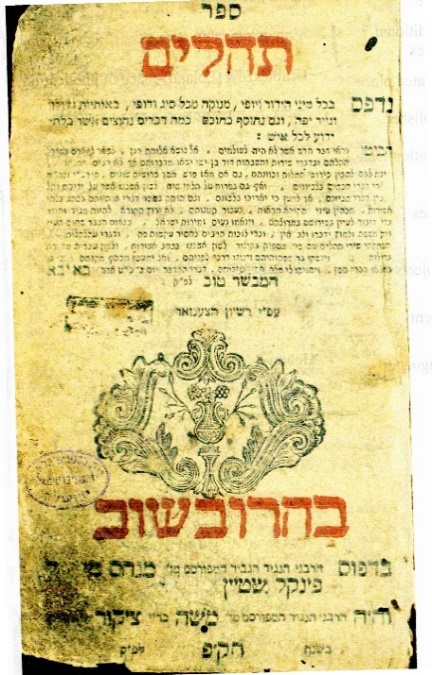
Hrubieszow, Home to an Active Early Nineteenth Century Hebrew Press[1]

Marvin J. Heller

A barely remembered Hebrew press, one credited with as many as forty books, although that number is uncertain, was active in Hrubieszow (Hrubyesho), Lublin district, in southeastern, Poland from 1816 to1821 and then intermittently until 1827. The variance in the number of titles printed may be attributed to the manner in which books are recorded, some titles being a composite of three works. In some instances, the town or the printers’ names are omitted from the title-page due to censorship or book tariff payment. The books published by the press are relatively small varied books, designed to meet the community’s needs and interests. The first works printed include several Yiddish titles. Most of the books are small format, ranging from duodecimo (120) through quarto (40) formats. The article describes a small portion of the Hrubieszow imprints to give a sense of the press’s publications, their variety, indicative of the community and how, through their books, the press served it. The selected works are generally of a scholarly and specialized nature, primarily Hasidic works on the weekly parasha (Torah reading), ethical, and halachic tomes, although varied within each category. These works reflect both the composition and interests of the community.

A barely remembered Hebrew press, one that is credited by the Thesaurus of the Hebrew Book with as many as forty books in the early nineteenth century, was active in Hrubieszow (Hrubyesho), Lublin district, in southeastern, Poland.[2] Jewish presence in Hrubieszow dates to the first half of the fifteenth century, Jews being recorded there as tax farmers and merchants, doing business in such diverse areas as Walachia, Turkey, the Crimea, and Kiev.

In the 10th century, the Hrubieszow district had been part of the Polish state. In 981, however, it was seized by the Kievan Rus’, subsequently changing hands several times, even falling to the Mongol Empire in the mid-13th century. Even earlier, the founding of Hrubieszow dates to the early Middle Ages when there was a defensive ‘gord’ (a medieval Slavonic fortified settlement) on the Huczwa river island. Hrubieszow is mentioned as early as 1254, as a hunting settlement amid forests. In 1366, Hrubieszow, then known as Rubieszów, was recaptured by King Casimir III the Great, again becoming part of the Kingdom of Poland (see banner of early Polish monarchy, right). In about 1400, the town received a charter from Polish king, Władysław II Jagiełło. Hrubieszow (Rubieszów) was destroyed several times by Crimean Tatars, who raided the area in the 15th, 16th and 17th centuries, and by rebellious Cossacks.

In 1772, After the First Partition of Poland, Hrubieszow was annexed by Austria. In 1800, Stanisław Staszic founded the Hrubieszow Agricultural Society, the first cooperative organization in Europe, which existed until 1945. In 1802, the name Rubieszów was changed to Hrubieszow, the name by which it is known today. Seven years later, in 1809, after the Austro-Polish War, Hrubieszow became part of the short-lived Polish Duchy of Warsaw, subsequently becoming, in 1815, by the Congress of Vienna ,part of the Russian-controlled Congress Poland, within the Lublin Governorate.[3]

As noted above, Jews were active in Hrubieszow from the first half of the fifteenth century. At some point in that century, Jews in Hrubieszow received several privileges for wine trade and management of the town tax chamber. By 1551, thirteen Jewish residents occupied four houses, that number rising to 40 Jews living in 5 houses by 1560. That number continued to increase, so that from the 18th century until the beginning of the 20th century Jews comprised a considerable majority of Hrubieszow’s population, controlling trade, industry, and craft. In 1578, King Stephen Bahory granted the Jews in Hrubieszów extensive rights. Less than a century afterwards, during tah-ve-tat (the Chmielnicki massacres of 1648-49), the Jewish community was almost entirely destroyed. Soon afterwards, however, the Jewish community was reestablished – a yeshivah was opened, headed by R. Isaac ben Judah Charif. Hrubieszow would subsequently be home to a number of prominent rabbis and became influential in the Arba’ah Artzot (Council of the Four Lands).[4] In the 18th century the Hasidic movement became active in Hrubieszow, the city becoming a center of Berdichev Hasidism. Among its leaders was R. Joseph ben Mordecai Katzenelboigen (R. Mordechai of Neszhchiz), who relocated there in the 1790s.[5]

We now turn to our subject, Hebrew printing in Hrubieszow. As noted above, the Hrubieszow press is credited by the Thesaurus with as many as forty titles, although that number may be uncertain; in contrast, Avraham Yaari records only thirty-four titles for Hrubieszow.[6] Those works are relatively small varied books, designed to meet the community’s needs and interests, published from 1816 to1821 and then intermittently until 1827. This article will describe a small portion of those works, to give a sense of the press’s publications, their variety, indicative of the community and how, through their books, the press served it. To address a greater number would be tedious for both the reader and the writer.

Dr. N. M. Gelber and Avraham Yaari inform that attempts to establish a Hebrew press in Hrubieszow were made from 1792 through 1804, in the Austrian period, but that the matter was delayed, the privilege to do so not granted. In late 1816, a Hebrew press was established in Hrubieszow, now part of Congress Poland. The founder of the press was R. Menahem Mendel Finkelstein (Finkel Stein). He had partners, namely R. Moses Tzikor and R. Saul Moss Goldstein of Łaszczów. Finkelstein provided the financing, the latter two the necessary skills, being experienced printers, having been partners in the Hebrew press in Łaszczów. Management of the press changed in the following years. Goldstein left the press in 1819, returning to Łaszczów, Finkelstein left the press in 1821, leaving Tzikor in charge. Tzikor then took Solomon ben David as a partner. Eight master printers were employed by the press as compositors and press operators, namely Daniel Ze’ev ben Segal, Baruch Abraham ben David, both from Hrubieszow, Isaac ben David from Łaszczów, Hayyim ben Eliezer from Zhovkva, Israel ben Raphael, Menachem Mendel ben Baruch, Pesach Joseph from Łęczno, and Eliezer Segal, perchance from Hrubieszow.[7]

Printing began shortly after the privilege was granted, the first works being published, including several Yiddish titles. Vinograd records ten titles for 1816-17, beginning with Shir ha-Shirim (1816), Orhot Zaddikim, Gedolus David u-Malchus Shaul, Haggadah shel Pesah, Sefer Hasidim, Lekah Tov, a siddur Tefillas Nehora, Noam Elimelekh, Shivhei ha-Ba’al Shem Tov, and Tanna de-vei-Eliyahu. These are all small format books, ranging from duodecimo (120) through quarto (40) formats. These works are indicative of the variety of the Hrubieszow imprints and the community the press served. For example, R. Judah ben Samuel he-Hasid’s (c. 1150-1217) Sefer Hasidim, an ethical, mystical, and halakhic work; Tanna de-be-Eliyahu is an aggadic midrash attributed to Elijah the prophet as dictated to the third century amora Anan bar Rav: Noam Elimelekh by R. Elimelech of Lizhensk; Shivhei ha-Ba’al Shem Tov, collection of Hasidic tales about the founder of Hasidim, and in contrast to the prior works, Joseph ha-Efrati’s Gedolus David u-Malchus Shaul, a maskilic (enlightened) drama.[8]

Noam Elimelekh – We begin with R. Elimelech ben Eliezer Lippman (Lippa) of Lizhensk’s (1717-87) Noam Elimelekh, a classic and primary Hasidic work, representative of the press’s output and the communities’ interests. R. Elimelech was a student of R. Samuel Smelke Horowitz (Rebbe Reb Shmelke, 1726-78), and afterwards a disciple of R. Dov Baer the Maggid of Mezhirech (1704–72), as well as meeting by the latter R. Levi Yitzhak of Berdichev (c. 1740-1809). After the Maggid’s passing, Elimelech became the acknowledged head of the Hasidic movement and is considered the theoretician and creator of “practical zaddikism.”[9]
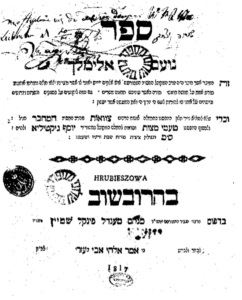
Noam Elimelekh was published as a 23 cm. work ([1], 94 ff.) The title-page begins with honorifics of Elimelech of Lizhensk and informs that in order that there should not be blank paper at the beginning of the book and for benefit of the public, they have published the testament of the author (see below), and at the end of the volume is R. Joseph Gikatilla’s Tamei Ha-Mitzvot. Not noted but also at the end of the volume are Likkutei Shoshana and Iggeret ha-Kodesh. The title page is dated with the chronogram “[for he said] the God of my father’s [house] was my help כי אמר אלקי אבי בעזרי (577 = 1817)” (cf. Exodus 18:4). Elimelech’s testament, entitled conduct (הנהגות) of a man is on the verso of the title-page and consists of twenty-one admonitions for a person.
The title-page states that Noam Elimelekh was published at the press of Menahem Mendel Finkelstein. According to Ch. B. Friedberg the references to the publisher on the title-page varies between books. He notes that initially references to the printer stated Menahem Mendel Finkel Stein and associates. Afterwards, however, he does mention the names of his partners.[10]

1817, Noam Elimelekh

The text, a hasidic Torah commentary on the weekly Torah portion, follows. It emphasizes the role of the zaddik in worship and divine service. At the end of the concluding section of the book are two decorative tail-pieces. These tail-pieces, particularly the one on the left, appear on title-pages of several Hrubieszow books.
Noam Elimelekh is a classic Hasidic work. First printed by his son after his death in Lvov 1788, Noam Elimelekh has proven to be an immensely popular work. This, the Hrubieszow printing, is the sixth edition. It is reported that more than 50 editions of Noam Elimelekh have been printed.[11]

Sefer Hasidim – R. Judah ben Samuel he-Hasid’s (c. 1150–1217) Sefer Hasidim, a different but computable work is, as noted above, an ethical, mystical, and halakhic work. Judah was a disciple of his father, R. Samuel (ben Kalonymous) he-Hasid (c. 1120-75) an eminent kabbalist and ascetic; portions of Sefer Hasidim are attributed to Samuel he-Hasid. They are among the most renowned members and leaders of the Hasidei Ashkenaz, the influential Jewish pietist movement in medieval Germany.

It is reported that when Judah’s mother was pregnant with him, she was walking along a path by a bet medrash (Torah study hall) when a wagon came bearing down upon her, with no place to turn, neither to the right nor to the left. Just as she was about to be crushed by the horses’ hoofs, the walls of the bet medrash opened saving her and her son. It is also told that Samuel he-Hasid witnessed the heavens opening; asked what kind of son he wanted, he replied, one of exemplary piety. Judah reputedly hosted the prophet Elijah, was able to revive the dead, and performed miracles, particularly saving Jews from oppressors. He practiced an ascetic form of mysticism, fasting two days for Yom Kippur, throughout the week, eating at night only, and often fasted on Shabbat, claiming that the change would cause him pain, detracting from his pleasure in Shabbat. It was said by a contemporary that if Judah had lived in the times of the prophets he would have been a prophet.
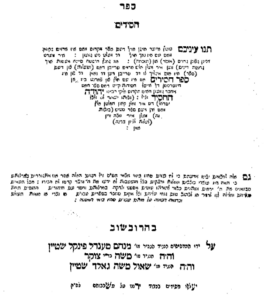
1817, Sefer Hasidim

The title-page of Sefer Hasidim, published is octavo format (80: [64] pp.) is in Yiddish, excepting the names of the printers and the publication date. All of the printers are cited here in bold letters, that is, Menahem Mendel Finkel Stein, Moses Tzikor and Saul Moss Gold Stein. The date in the chronogram, “Let the faithful exult in glory;
let them sing joyously upon their beds יעלזו בכבוד ירננו על משכבותם )577 = 1817).” (Psalms 149:5)

Sefer Hasidim is foremost an ethical manual, practical rather than theoretical, encompassing all aspects of life, including the minutiae of personal, family, and business matters. Numerous examples are cited, containing, considerable information about contemporary Jewish life. Advice is detailed and pragmatic, with the goal of achieving strict adherence to an ethical and pious life. These instructions, often based on kabbalistic teachings, have been influential because of the author’s great piety. Sefer Hasidim is also a mystical work, explaining biblical and talmudic passages.[12]

Gedolus David u-Malchus Shaul – A very different work is Joseph Ha-Efrati of Tropplowitz’s (c. 1770–1804) Gedolus David u-Malchus Shaul, a drama in Yiddish. Among the smallest Hrubieszow imprints, it was printed in duodecimo format (120) 29 ff.
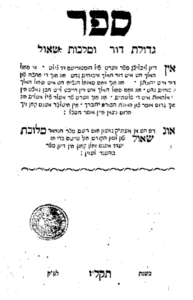
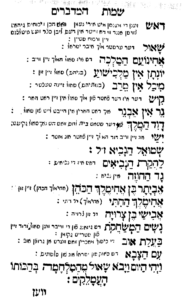
1817, Gedolus David u-Malchus Shaul

The author, born in Tropplowitz, Silesia, was a Hebrew poet, dramatist, and tutor. While working in the last capacity he wrote the first acts of the drama Melukhat Sha’ul from Melukhat Sha’ul completed in Prague in 1793. Gedolus David u-Malchus Shaul is a Yiddish translation, retitled. This version, that is the Yiddish translation, has been described as “part of the traditional Purimshpil (“Purim play”) in many Lithuanian and Polish towns . . . the first modern Hebrew drama of the Haskalah period, is noteworthy for its new egalitarian and humanistic ideas.” In writing Melukhat Sha’ul Ha-Efrati was reputedly influenced by Shakespeare, Goethe, Schiller, and von Haller, as well as M. H. Luzzatto. The primary characters, Saul. David, Jonathan, and Michal reputedly signify abstract ideas rather than lifelike characters, representing “the pathos of a suffering hero, ridden with envy and guilt, torn by fears and loneliness, and not merely a proud and jealous king.”[13]

The title-page is misdated, the date, given in a straightforward manner, is תקלז (= 1777). Depending on when the misdating was caught, it may have been corrected with a stop-press correction, that is, when an error was found the press would be stopped, the error would be quickly corrected and printing resumed. As one copy only of Gedolus David u-Malchus Shaul was seen it not known if that was done or if this is the sole uncorrected title-page for that work.[14] Friedberg writes that he has seen several of the press’s books that are misdated[15] For other examples, see below.

The text is in Yiddish excepting paragraph headers and, similarly, except here vocalized, the names of the participants in the drama on the verso of the title-page. This is the third edition of Gedolus David, the first having been printed in Lvov in 1801; It is a popular work, as many as fourteen editions are recorded for Gedolus David in the Bet Eked Sefarim and only twelve editions for Melukhat Sha’ul.[16]

The following year, 1818, saw the publication of five titles, primarily Hasidic works, among them such classics titles as R. Menahem Nahum Twersky of Chernobyl’s Me’or Einayim, homilies on the weekly Torah portions; R. Samuel ben Nathan Ha-Levi Loew Kolin’s Maḥaẓit ha-Shekel on the Shulḥan Arukh Oraḥ Ḥayyim and Yoreh De’ah; R. Jacob ben Solomon Habib’s Ein Ya’akov, collection of aggadah in the Talmud; R. Levi Yitzhak of Berdichev’s Hasidic classic Kedushat Levi discourses on the weekly Torah readings, and, in Vinograd’s listing, a second Hrubieszow edition of Noam Elimelekh.

Kedushat Levi – R. Levi Yitzhak of Berdichev’s Kedushat Levi, a classic Hasidic work of weekly discourses. was published in quarto format (40: [1], 78, 27, 15 ff.) in the year “Isaac pleaded [with the Lord] ויעתר יצחק (571= 1818)” (Genesis 25:21). R. Levi Yitzhak of Berdichev, who defended Hasidus against its opponents, settled in Berdichev, in 1785, residing there for the rest of his life. When he passed away, it seemed, to R. Nahman of Bratslav that “the light of the world had been extinguished.” Levi Yitzhak was held in the highest regard and affection by Jews. An example of his sensitivity, even to transgressors, is the following incident,

When he happened to meet “a young man eating in public on the fast of Tisha B’Av (the anniversary of the day on which both the first and second Temples were destroyed) the rabbi asked him mildly, “Have you forgotten that today is the Ninth of Av? Or are you perhaps unaware that it is forbidden to eat on the Ninth of Av?” “I have not forgotten what day it is and I am well aware of the prohibition,” answered the young man. “Possibly, my son, you are not in good health and have been advised by your doctor to eat?” the rabbi of Berdichev inquired further. No, I am in excellent health,” was the reply. “See, O Lord,” exclaimed the sage with joy, “how admirable Your children are! Even when they transgress Your Commandments, they do not stoop to falsehood.” [17]

Levi Yitzhak’s first published work, also entitled Kedushat Levi, is discourses on Hanukkah and Purim, printed in Slavuta in 1798. It was subsequently included in later editions of Kedushat Levi on the weekly Torah readings.
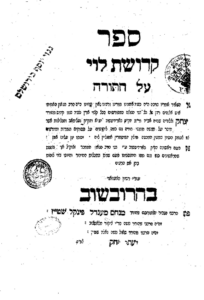
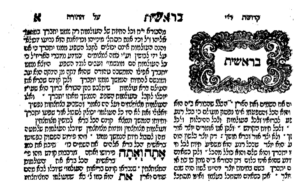
1818, Kedushat Levi

The title-page of this edition of Kedushat Levi begins with honorifics for R. Levi and then informs that it also includes additional material on various subjects. On the verso of the title pages is an approbation from four rabbis from Berdichev; R. David Shalit, R. Aaron Isaac ha-Kohen, R. Nathan Aryeh Davir, and R. Mordecai באאימו son of my lord, my father, teacher, and rabbi David Shalit. Below the approbation is the standard disclaimer that the people among whom the Jews reside today are not like those in the time of the Talmud, immoral idol worshippers, but today show respect for Torah and do justice and righteousness in their lands, The text follows, primarily on the weekly parsha, but also addressing other biblical books, festivals, and concluding with a final section addressing various subjects, including Pirke Avot. Kedushat Levi.

First published in Berdichev in 1811, this, the Hrubieszow edition, is the third printing of Kedushat Levi. A popular work, it has frequently been republished.

Sefer ha-Yashar – Among the books published in 1819 is R. Zerahiah ha-Yevani’s (13th or 14th century) popular ethical work Sefer ha-Yashar (Book of Righteousness). The title-page attributes the work to R. Jacob ben Meir Tam (Rabbenu Tam, c. 1100-1171), a not infrequent error, as well as it being attributed to R. Jonah Gerondi (13th century). The former did author a Sefer ha-Yashar (Vienna, 1811), but that is another work, consisting of responsa and novellae, while the style of the latter, who wrote ethical works, differs from this book. A number of manuscripts, however, name Zerahi ha-Yevani’s as the author. While many now accept him as the author, that attribution is not definite. Little is known about Zerahiah, except that he was a resident of the Byzantine Empire and that he is credited with Sefer ha-Yashar.

Sefer ha-Yashar was published in octavo format (80: [2], 40 ff.). The title-page begins that it is “the path of life and moral reproof, to go on a straight path. It is dated “it is [very] indeed upright וישר הוא מאוד (579 = 1819)” (cf. Deutronomy 32:4; Psalms 21:29). The printers names are given on the title-page as Menahem Mendel F. Sh. and Moses Tzikor,
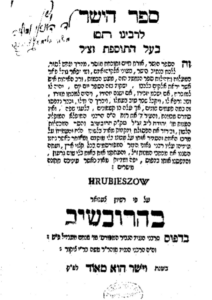
1819, Sefer ha-Yashar

There is an introduction, in which Zerahiah brings proof for the Torah and its precepts from both reason and from the prophets, and bemoans the pursuit of pleasure, wealth, and honor in his time, rather than religion and morality. Sefer ha-Yashar, with the purpose of directing one’s soul towards the correct worship of God, piety, and ethical content, is written in an easy style so that it will influence others to right conduct. Sefer ha-Yashar is comprised of material from earlier ethical works, although they are not mentioned in the text by name nor directly quoted. It is evident, from the book, that he was familiar with Jewish philosophic works. The most significant of the prior works, acknowledged in the introduction, is Bahya ibn Paquda’s Hovot ha-Levavot, studied by Zerahiah, but too long and complex for the average reader. It provides, in summary, the essence of several chapters. Another important influence, evident in the text, is Maimonides.

The text, divided into eighteen chapters which address, beginning with the creation of the world, worship, repentance, knowledge of God, the will of God, the world to come, complete repentance, the significance of the righteous, accountability of a person, remembrance of the day of death, and the distinction between the righteous and the wicked. Zerahiah’s primary subjects are the need to imitate God, conditions of proper prayer, both theoretical and practical; correct conduct and obstacles to be overcome to achieve it; and repentance.[18]

A popular work Sefer ha-Yashar was first printed in Constantinople (1540); this is the twenty-second edition, of slightly more than fifty recorded by the Bet Eked.Sefarim.[19]
Levushe Serad – Another different work, also published in 1819, is R. David Solomon Eybeschuetz’s (Eibenschutz) halachic Levushe Serad on the Shulhan Arukh Yoreh Deah, particularly on the laws pertaining to shechita (ritual slaughter). Printed as a folio (20: [2], 2-102 ff,) in the year “attired as thin beast לבושי השרד בהמה דקה (561 = 1801).” This date is certainly incorrect, a bet ב at the head of the word בהמה (beast) which make the verse meaningful but gives a date in error, as opposed to a kafכ which would read כהמה and would give the correct value of (579 = 1819) but be meaningless. I would suggest, and this is entirely speculative, that the printer wanted the meaning of beast even if that threw the date off. Support for this conjecture can be found in the correct date, immediately below the Hebrew date, in Arabic numerals, that is, 1819. This is the only title-page seen among the Hrubieszow imprints with an Arabic numeral date.

The author, R. David Solomon ben Yerachmiel Eybeschuetz, was born in Russia and studied under R. Moses Ẓevi Heller. He served as rabbi in several locations, among them Buzhanow, Soroki (Volhynia), and Jassy, (Rumania). Eybeschuetz made aliyah, that is, he went up to Eretz Israel, residing in Safed, where he died in 1812. Eybeschuetz was also a kabbalist as well as a Talmudist. His other works include responsa, Ne’ot Deshe (part one, Lvov, 1861), part two and manuscripts, including a commentary on the Torah and discourses.[20]

The title-page describes Levushe Serad as being comprised of three parts, the first explaining the laws pertaining to laws of falling and broken bones in cattle and fowl; the second, laws applying to lungs; and the third, applying to Yoreh De’ah. The printers are given here as Menahem Mendel Finkel Stein. and Moses Tzikor.

The verso of the title-page has an approbation from R. David Shalit. The text is comprised of the commentary in two columns. The text of this volume on Yoreh Deah varies from the previous volume on Orah Haim. Chaim Tchernowitz describes this volume as following R. Alexander Sender Shor’s (d. 1737) influential Simla Hadasha, also on shechita; Levushe Serad being described as the most important commentary on that work [21] It does not include the text of Yoreh De’ah, on which Levushe Serad comments and elucidates.
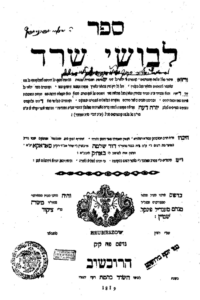
1819, Levushe Serad

Levushe Serad on Orah Haim was first published in Mohilev (1805). This volume, on Yoreh Deah is the third edition, it too having been printed previously in Mohilev (1812).[22]

Havvat Da’at – Among the books printed in 1820 was another work on Shulhan Arukh Yoreh Deah, but considerably different from Levushe Serad, that is, R. Jacob ben Jacob Moses Lorbeerbaum of Lissa’s (c. 1760–1832) Havvat Da’at. It was published as a folio (20: [1], 37 [should say 36], [34] ff.) in the year “Day to day makes utterance, night to night speaks out יום ליום יביע אומר ולילה ללילה יחוה דעת (470 = 1805) 19:3), This chronogram is also misdated, as is noted by the NLI catalogue, which records it as a circa 1820 imprint; which also states that the printer, who is not identified on the title-page, is unknown.
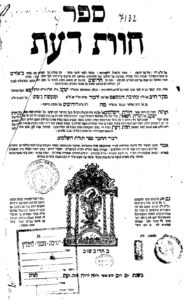
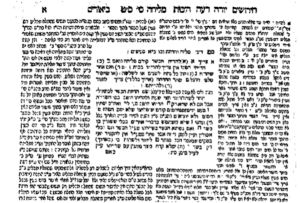
1820, Havvat Da’at

Jacob Lorbeerbaum of Lissa was a distinguished rabbi, who served in several communities, writing, in addition to Havvat Da’at other valued works. [23] However, his early days were difficult and troubled. His father, rabbi of Zborow, passed away prior to Lorbeerbaum’s birth; he was raised by R. Joseph Te’omim (Pri Megadim, 1727–1792), a relative. He initially combined learning and business, being a partner in a brewery but, when that failed, Lorbeerbaum became rabbi in Monasterzyska, founding a yeshivah there. He subsequently became rabbi of Kałusz writing many of his earliest works there, including Havvat Da’at which, reflecting his great humility, was originally published anonymously. When his authorship was subsequently identified ,Havvat Da’at became the name by which he is known.[24]

In 1809, Lorbeerbaum became rabbi of Lissa. Lorbeerbaum was an opponent of the Haskalah movement, their influence resulting in his leaving Lissa in 1822 and returning to Kalisz. Disputes there forced him, in 1830, to again relocate again finally settling in Stryj, serving there as rabbi until his death.

The title-page of Havvat Da’at states that it is on Shulhan Arukh Yoreh Deah, which is a tree of knowledge “desirable as a source of wisdom” (Genesis 3:6), for the pure and the impure. It continues that it is comprised of two parts, Biurim, explanations in depth based on prior commentaries and Hiddushim, novellae, interpretative explanations of statutes and critical analysis. On both sides of the pressmark is the standard disclaimer that the contemporary peoples among whom the Jews dwell today are not immoral idol worshippers as in the past.

The commentary, as described on the title-page, is in two parts, about the text of the Shulhan Arukh. Chaim Tchernowitz describes the subject matter of Havvat Da’at as being on such subjects as salting of meat, meat and milk, mixtures, interest, niddah, and other halakhot dealing with prohibitions such as Stam Yeinam (gentile wine), and treifus. He concludes that according to Havvat Da’at even with laws dealing with permitted and prohibited foods there is room for critical and analytical critique.[25]

Given the title-page variations of this edition, described above, it is not surprising that Avraham Yaari questions, concisely, whether Havvat Da’at is a Hrubieszow imprint. He suggests that it was published elsewhere, writing “one more book that is listed as having been published in Hrubieszow was actually published in Polonne. This is Chavat Da’at by Ya’akov of Lissa.”[26] While we have noted a number of variations in Havvat Da’at, such as the dating error in the chronogram, albeit not that unusual for Hrubieszow publications, the absence of the printers’ names, and a pressmark that is not common to Hrubieszow title-pages, there is also the fact, in contrast to these varoiances, that the place of printing is clearly given on the title-page as Hrubieszow. Furthermore, other bibliographic sources, such as Friedberg’s Bet Eked Sefarim and Vinograd’s Thesaurus record Havvat Da’at as a Hrubieszow imprint. An examination of a sample of Polonne and Sudylkow (also suggested) title-pages did not show any like images. The question of whether Havvat Da’at was a Hrubieszow imprint or was published elsewhere is a teku (u nresolved).

Another Hrubieszow imprint by Jacob Lorbeerbaum of Lissa is a folio edition of Beit Ya’akov, novellae and commentary on Shulchan Aruch, Even Ha–Ezer and tractate Ketubot. The printers are given as Moses Tzikor, of Laszczow, and Solomon, ben David Lev, of Laszczow, Menahem Mendel Finkel Stein having already left the press.

This is the fourth printing of Havvat Da’at. The first edition was published in Lvov (1799).

Avodat ha-Kodesh – Among the books printed in Hrubieszow in 1820 is Avodat ha-Kodesh by R. Ḥayyim Joseph David ben Isaac Zerachia Azulai (Hida, 1724-1807), a prominent kabbalist, rabbinic scholar, bibliophile, and prolific author. More than eighty works are attributed to him, sixty in print, on a wide variety of subjects on Torah, halachah, aggadah, and kabbalah.[27] Avodat ha-Kodesh, an 18 cm. octavo(80: 40 ff.) is comprised of three related works, Vinograd records each independently, that is, Avodat ha-Kodesh, Moreh be-Etzba, and Ziporin Shamir as separate entires. All three titles, kabbalistic explanations of customs, are in octavo format (80) and relatively small works. Shimon Vanunu, describes Avodat ha-Kodesh as a compilation of several of Hida’s prior works.[28]

Hida was born in Jerusalem to a prominent Sephardic family, descendant from exiles from Spain, and his great-grandfather was the kabbalist R. Abraham Azulai (c. 1570–1643, Hesed le-Avraham), originally from Fez, Morrocco and on his maternal side from R. Joseph Bialer, a German scholar. He was educated by leading rabbinic figures, among them R. Isaac ha-Kohen Rapoport, R. Shalom Sharabi, and R. Haim ibn Attar (Ohr ha-Haim). He served as rabbi in several communities and beginning in 1755, served as an emissary from Eretz Israel to Jewish communities in Europe.
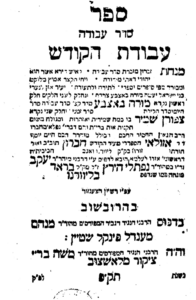
1820, Avodat ha-Kodesh

The title-page has the heading Avodat ha-Kodesh in large bold type and below notes the other two works, and then that the book was brought to press by R. Jacob ben Naphtali Hertz of Brod and that it had been printed previously in Livorno. The title-page is dated in a straightforward manner as (תק”פ = 1820). The verso of the title-page has the disclaimer that the non-Jews among

whom the Jews noted above that contemporary nations are unlike the earlier nations who were immoral idol worshippers, but today show respect for Torah and do justice and righteousness in their lands. It is followed by the tailpiece noted above that appears on the title-pages of several books. Examples of the text are:

147: all who say shirat ha-yam (Exodus 14:30 – 15:19) with joy as if he himself had been delivered from the sea, Pharoh, and his army, when they drowned in the sea, and says Shira with great feeling is forgiven his iniquities.

148: all who weep and mourn for a person who was kosher is forgiven his iniquiites.

149: all who pray erev Shabbat and say [the prayer] ויכלו “the heavens and earth were completed” (Genesis 2:1), two angles say to him turn your eyes and your sins will be atoned for.

The pressmark appears at the end of the book as a tail-piece.

Tomer Devorah – Another work published in 1820 is R. Moses ben Jacob Cordovero’s (Ramak, 1522-1570) popular and much reprinted Tomer Devorah. A small kabbalistic, ethical, and inspirational treatise, it was published as a 19 cm. octavo (14 ff).

Moses ben Jacob Cordovero was the first to describe the dialectical process through which the Sefirot pass in their development and to interpret the various stages of their emanation as manifestations of the Divine mind.[29] Based on his name, Cordovero appears to have been descended from Jewish exiles from the city of Cordova. It has been suggested, but this is uncertain, that he was born in Safed. Cordovero was a student of R. Joseph Caro (1488-1575) in nigleh (revealed, literal Torah) and, after heeding a heavenly voice that urged him to study Kabbalah, of his brother-in-law, R. Solomon Alkabez (Lekhah Dodi) in nistar (esoteric Torah, Kabbalah). Cordovero became a leader of the ascetic mystical community of Safed, preparing for it a list of rules of conduct, primarily instructions and commands. He served as a dayyan in Safed and founded a yeshivah there in about 1550, which he headed until his death in 1570.

Among Cordovero’s students were R. Elijah de Vidas (Reshit Hokhmah), R. Abraham Galante (ha-Kadosh), R. Samuel Gallico (Asis Rimmonim, an abridgement of Pardes Rimmonim), R. Hayyim Vital, and R. Isaac Luria (ha-Ari). Although Luria was Cordovero’s student for a short while only, and his system of Kabbalah would supplant that of Cordovero, Luria refers to Cordovero as his master and teacher, testifying that Cordovero was completely free of sin, that both the sages of the Mishnah and Elijah the Prophet appeared to him, and that at Cordovero’s funeral a pillar of fire preceded his coffin. Others, such as R. Menahem Azariah da Fano, although in Italy, considered themselves disciples of Cordovero. A prolific writer, he is responsible for several of the classics of Kabbalah.[30]

Tomer Devorah is entitled from “And she sat under the palm tree of Deborah (Tomer Devorah) between Ramah and Beth‑El in Mount Ephraim” (Judges 4:5). The title-page urges man to follow a straight path, to end his isolation and reflect on his ways, to cleave to the order of the sephirot. The printers are given as Menahem Mendel Finkel Stein and Moses Tzikor of Łaszczów, their names preceded by honorifics. The title-page is dated with the chronogram in the year “This is the Teaching that Moses placed before the children of Israel זאת התורה אשר שם משה לפני בני ישראל (580 = 1820)” (Deuteronomy 4:44).
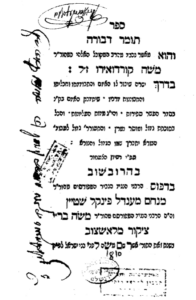
1820, Tomer Devorah

The text is comprised of ten chapters describing Divine qualities and how man should strive to emulate them. They are, 1) the Supernal Crown (Keter) and the thirteen attributes of higher mercy which belong to it; 2) the qualities of the crown, such as humility and kindness, eradicating pride from the heart; 3) wisdom (Hokhmah), love and care for all creatures; 4) understanding (Binah) and repentance; 5) on mercy (Hesed), the methods of performing mercy and assisting the Sefirot to function harmoniously; 6) power (Gevurah), utilizing the evil inclination to serve God; 7) beauty (Tiferet), the study of Torah and behavior appropriate to a scholar; 8) Endurance, Majesty and Foundation (Netzach, Hod and Yesod), support of Torah students and purity of life; 9) Sovereignty (Malkut), sacrifices for Torah and performing marital duties with holiness; 10) Man’s conduct so that he is never separated from the world of the Sefirot. An example of the text, from Keter, is:

Keter – Some major activities that are the main governance: Further for a person to resemble his Creator from the secret of the trait of the Crown (Keter), he must [do] some major activities – which are the main governance. The first: The trait of humility – which includes everything – because it is dependent on the Crown. As behold, It is a trait over all of the Traits, but it does not raise itself and become proud above [the others]. Indeed, It goes down and always looks downwards. And that is from two reasons: The one is that It is embarrassed to look at Its Cause, rather Its Emanator always looks down upon It to benefit It; and It looks down to the lower ones. So [too,] must a person be embarrassed from staring upwards, to be proud. Rather, he must always stare downwards, to diminish himself all that he can.[31]

The title page is followed by a brief introduction from R. Moses Basola, with the pressmark. He found the manuscript of Tomer Devorah in the library of R. Menahem Azriah, who gave it to Basola, in order to bring it to press to merit Israel.

Tomer Devorah is replete with allusions from Talmudic and kabbalistic sources, systemizing and vividly presenting abstruse concepts. It has been frequently republished and translated into other languages, among them English. Tomer Devorah was first published in Venice (1588); this the Hrubieszow edition, is the fourteenth. The Bet Eked Sefarim records thirty-two editions, several with annotations, and not recording translations.[32]

Ayyelet Ahavim – A rhetorical and poetic treatise on the Akedah (sacrifice of Isaac) by R. Solomon de Oliveyra (1633-1708). Ayyelet Ahavim was printed as a 19 cm. octavo (80: [4], 20, [1] ff.). It is dated in a straightforward manner as תקפ”א,ה ([5]581 = 1821).

R. Solomon de Oliveyra is accounted among the Sephardic sages of Amsterdam.[33] Oliveyra’s place of birth, whether Lisbon or Amsterdam, is uncertain. Albert Van Der Heide suggests that as Oliveyra’s parents were fugitive co1nversos, as documented in Amsterdam in 1628, he must have been born in the latter location. Also, based on the marriage certificate issued by the city of Amsterdam, Oliveyra married Rached Dias in 1660, when twenty-seven years old, again attesting to Amsterdam as his place of birth.[34] Oliveyra served as rabbi (hakham) and teacher in the Talmud Torah Etz Haim of the Keter Torah association of the Amsterdam Portuguese community, of which he later became president. He was a member of the rabbinical council, over which he presided after the death of R. Jacob Sasportas (c. 1610-98). In addition to these rabbinic positions, Oliveyra worked as a corrector in the printing-house of Uri Phoebus.[35] Oliveyra was the author of a number of varied multi-lingual works on grammar, lexicography, other philological subjects, poetry, and riddles. Van Der Heide has described Oliveyra as “the preeminent and omnipresent Hebrew poet of Jewish Amsterdam.” Oliveyra became, for a time, an adherent of Shabbetai Zevi, composing liturgical verse in his behalf as well as writing approbations

The primary publisher of Oliveyra’s books was David de Castro Tartas (c. 1625–c. 1700), active from 1662 to 1698 in Amsterdam. Their relationship began in 1665, when our subject work, Ayyelet Ahavim ws published. The title-page begins that it is Igeret: words of truth, “to understand a proverb, and a figure” (Proverbs 1:6). It is entitled Ayyelet Ahavim for it was “a precious vessel” (Hosea 13:15, Nahum 2:10, II Chronicles 32:27), “To receive the instruction of wisdom” (Proverbs 1:3), “He established it and searched it out” (Job 28:27), by the rav, the Sephardic sage SOLOMON ben DAVID Oliveyra, in the month of Ziv in the year תי”ז (1657, printed in Amsterdam in the year תכ”ה (1665). It adds that it has now been brought to press by R. Abraham Moses ben Solomon ha-Levi of Lublin: with the permission of the censor in Hrubieszow at the press of Moses ben Tzikor of Łaszczów.
1821, Ayyelet Ahavim

Oliveyra’s introduction follows (2a-b) in which he states that he does not wish to delve into deep explanations nor to go up to the heights of discourse, but rather his heart wishes to speak of the greatness of that “righteous man, who quarried the fetters of love, of that which he formed יצורו for the love of the One Who formed him יוצרו.” Oliveyra’s intent is to investigate this holy and wondrous deed. Among the several reasons that he entitled this work Ayyelet Ahavim is that it is on the love of Abraham and his soul for God “As the hart longs for water streams” (cf. Psalms 42:2). The wide-ranging text is comprised of numerous aggadot, and including riddles and parables. In one section the alternating paragraphs of verse are between father and son. The prose text is accompanied by infrequent marginal references.

First printed in Amsterdam (1665) this is the third and last published edition Of Ayyelet Ahavim.[36]

Summation – Ten books have been described. The selected books give an insight to the type of works published by the Hrubieszow press. They are generally of a scholarly and specialized nature, primarily Hasidic works on the weekly parasha (Torah reading), ethical, and halachic tomes, although varied within each category. These works reflect both the composition and interests of the community. One book, Gedolus David u-Malchus Shaul, stands out, being of a contrary nature, that is, it has maskilic overtones. The provenance of one other work, Havvat Da’at, has been questioned. Also published were two editions of Shir ha-Shirim (1816, 1827), the former not seen, the latter (1820) with the commentaries of R. Eliezer ben Judah (Rokeah) and R. Moes ben Nachman (Ramban).

A lacuna in the press’s publications is the absence of Mishnaic and Talmudic volumes, attesting to the press’s emphases on small books, perchance the nature of its’ operations, a small publisher catering to and meeting a small market’s needs. It did, however, print an Ein Ya’acov, on the aggadot in the Talmud, this with the commentary Kotnot Or. The emphasis on small works does not in any way detract from the value of the press’s publications. Indeed, the books were well printed and attractive. Yaari, however, while approving of their appearance is not so positive as to the titles printed, writing “The books printed in Hrubieszow were elegant in appearance, but not of significant content. Most had been printed previously by other presses. These books were in great demand, such as popular Yiddish books.”

As noted above, the Thesaurus credits the Hrubieszow press with as many as forty titles, although that number appears uncertain, or perhaps exaggerated; Avraham Ya’ari recorded thirty-four titles only. Perchance, the difference in number can be attributed to the manner in which books are recorded. Avodat ha-Kodesh, for example, is a composite of three works, each listed independently in the Thesaurus but one entry only in Yaari’s listing. Summerly, there are three entries in the Thesaurus for Siddur Tefillat Nehora, a two-part prayer book designed so that it can be used for both Ashkenaz ads Sephardic rites. There is one listing only by Yaari, but more detailed. The entries in the Thesaurus for Tefillat Nehora are several years apart (1817, 1821, [1824]). To complicate matters, Yaari has several entries for Kotnot Or but the Thesaurus has one entry only for the Ein Ya’acov. The exact number of publications must remain then a teku (unresolved).

We have noted misdates and censors’ remarks. Yaari comments on this writing:

The names of the town or the printers are omitted from the title pages of several of the books printed in Hrubieszow. This is probably due to censorship, or book tariff payment. Sometimes the printers mentioned their names in some copies but not in others; sometimes they even inserted the name of a different town or stated a different year, to deceive the censor or the tariff–collector

No books omitting Hrubieszow were seen or noted.[37] Why then, printing with the censors’ approval they would omit their names is unclear. Indeed, the books described above, all, with the exceptions of Havvat Da’at all have the printers’ names. In conclusion, as already noted, the Hrubieszow press published small varied books covering a variety of subjects. The books served communal needs, were works of value, and attractively printed. A press only active for a brief period, it served the Hrubieszow community well. It deserves, should be remembered, in addition entries in bibliographic and historical records.
  1. I would like to express my appreciation to Eli Genauer for reading the article and his corrective comments, and Eli Amsel for his additional insights. All the title and text page images are courtesy of the National Library of Israel. The Polish monarchy banner is a public domain image.
  2. Vinograd, Yeshayahu. Thesaurus of the Hebrew Book. place, and year printed, name of printer, number of pages and format, with annotations and bibliographical references II (Jerusalem, 1993-95), p. 167 [Hebrew].
  3. https://en.wikipedia.org/wiki/Hrubiesz%C3%B3w
  4. The Encyclopedia of Jewish life Before and During the Holocaust, editor in chief, Shmuel Spector; consulting editor, Geoffrey Wigoder; foreword by Elie Wiesel I (New York, 2001), pp. 532-34; Polin: Virtual Shtetl https://sztetl.org.pl/en/towns/h/266-hrubieszow/99-history/137366-history-of-community; Dr. N. M. Gelber, Notes on the History of the Jews of Hrubieszow, tr. Yael Chaver, https://www.jewishgen.org/yizkor/Hrubieszow/hru021.html.
  5. Hurvitz Tzvi Ha–Levi Ish Hurvitz, “The Town of Hrubieszow and its Rabbis,” translated by Yael Chaver, Columns 51-52. https://www.jewishgen.org/yizkor/Hrubieszow/hru051.html
  6. Avraham Yaari, “The Hebrew Printing Press in Hrubieszow,” Kiryat Sefer, (Jerusalem, 1943–4), pp. 219–228 [Hebrew], tr. by Yael Chaver https://www.jewishgen.org/yizkor/Hrubieszow/hru051.html#Page57
  7. Dr. N. M. Gelber, Notes on the History of the Jews of Hrubieszow, tr. Yael Chaver, https://www.jewishgen.org/yizkor/Hrubieszow/hru021.html..
  8. Ch. B. Friedberg, History of Hebrew Typography in Poland from the bginning of the year 1534, and its development up to our days . . . Second Edition, Enlarged, improved and revised from the sources (Tel Aviv, 1950), pp.150-52 [Hebrew].
  9. Mordechai, Margalioth, ed., Encyclopedia of Great Men in Israel I (Tel Aviv, 1986), cols. 179-80 [Hebrew].Tzvi M. Rabinowicz, The Encyclopedia of Hasidism (Northvale, 1996), pp.111-12.
  10. Ch. B. Friedberg, History of Hebrew Typography in Poland, op. cit.
  11. Arnold Green, “Elimelekh of Lizhensk, “The Yivo Encyclopedia of Jews in Eastern Europe, Gershon David Hundert, ed. I (New Haven & London, 2008), p. 467; Rabinowicz, op. cit.
  12. Marvin J. Heller, The Sixteenth Century Hebrew Book: An Abridged Thesaurus II (Leiden, 2004) p. 697: Simcha Kogut, “The Language of Sefer Hasidim, Its Linguistic Background and Methods of Research,” in Studies in Medieval Jewish History and Literature, ed. Isadore Twersky, II (Cambridge, 1984), pp. 95-108; Reuben Margaliot, ed., Sefer Hasidim (Jerusalem, 1973), pp. 3-9 [Hebrew].
  13. https://www.encyclopedia.com/religion/encyclopedias-almanacs-transcripts-and-maps/ha-efrati-tropplowitz-joseph
  14. To replace a sheet with a single error would necessitate replacing several pages, the number depending on the book format. The normal practice, therefore, was to retain the original defective sheet and use both it and the corrected sheet in copies of the book. Due to cost factors, both of paper and labor, the sheet with the error would be replaced only if the error was substantial or substantive. It is therefore possible for books to consist of non-uniform copies, having several sheets with variant readings. For examples of such errors see Marvin J. Heller, “Who can discern his errors? Misdates, Errors, and Deceptions, in and about Hebrew Books, Intentional and Otherwise” Hakirah: The Flatbush Journal of Jewish Law and Thought 12 (2011), pp. 269-91, reprinted in Further Studies in the Making of the Early Hebrew Book, (Brill, Leiden/Boston, 2013), pp. 395-420.
  15. Friedberg, History of Hebrew Typography in Poland, p, 151 n. 1.
  16. Ch. Friedberg, Bet Eked Sefarim, (Israel n.d.), gimmel 128, mem 1922 [Hebrew].
  17. Rabinowicz, p. 61.
  18. Margalioth, Great Men, II col. 465-66; Meyer Waxman, A History of Jewish Literature (1933, reprint Cranbury, 1960), II pp. 276-79.
  19. Friedberg, Bet Eked.Sefarim, yod 1152.
  20. Louis Ginzberhg, N. T. London, “Eibenschutz, David Solomon,” Jewish Encyclopedia V (1New York, 901-06), pp. 75-78.
  21. Itzhak Alfassi “Schor, Alexander Sender ben Ephraim Zalman” v. 18 Encyclopedia Judaica (Jerusalem, 2007), p. 161; Chaim Tchernowitz, Toledoth ha-Poskim, III (New York, 1946), pp. 206-08 [Hebrew].
  22. Friedberg, Bet Eked.Sefarim, lamed 108.
  23. Lorbeerbaum’s other published works are Ma’aseh Nissim (Zolkiew, 1801), on the Passover Haggadah; Mekor Ḥayyim (ibid., 1807), novellae and expositions of the laws of Passover in the Shulḥan Arukh together with the glosses of R. David ben Samuel ha-Levi and Abraham Abele Gombiner on Oraḥ Ḥyyim and novellae to tractate Keritot; Netivot ha-Mishpat (ibid., 1809–16), on Ḥoshen Mishpat; Torat Gittin (Frankfurt on the Oder, 1813), the laws of divorce and novellae on tractate Gittin; Kehillat Ya’akov (1831), on Even ha-Ezer and sections of Oraḥ Ḥayyim; Derekh ha-Ḥayyim, an anthology of liturgical laws, first published with the prayer book (1828) and then separately (1860 or 1870); Naḥalat Ya’akov (1849), expositions of the Pentateuch; Emet le-Ya’akov (1865), expositions of talmudic aggadot; Imrei Yosher, commentaries on the five megillot, each published independently; his ethical will (1875); and Millei de-Aggadeta (1904), sermons and responsa (EJ, op. cit.). In a private correspondence Eli Amsel noted other such works, writing “Another Hrubieszow imprint by Jacob Lorbeerbaum of Lissa is a folio edition of Beit Ya’akov, novellae and commentary on Shulchan Aruch, Even Ha–Ezer and tractate Ketubot.”
  24. Haim Gertner, “Lorbeerbaum, Ya‘akov ben Ya‘akov Mosheh of Lissa, Yivo Encyclopedia, I pp. 1087-88; Ephraim Kupfer, “Lorbeerbaum, Jacob ben Jacob Moses of Lissa” Encyclopedia Judaica XIII pp. 191-92.
  25. Tchernowitz, Toledoth ha-Poskim, III, p. 258.
  26. The Polonne (Polonnoye) press was active from 1789 to approximately 1830, publishing as many as130 titles. Among them three editions of Havvat Da’at. An accompanying note in the Polonnoye entry references it as a Sudylkow imprint (Vinograd, p. 502). Two [1834] editions of Havvat Da’at are listed for that location.
  27. Yaakov Amsalem and Yisrael A. Groweiss, “The Hida’s Riddle,” Mishpaha, March 22, 2022.
  28. Shimon Vanunu, Encyclopedia Arzei ha-Levanon. Encyclopedia le-Toldot Geonei ve-Hakhmei Yahadut Sefarad ve-ha-Mizrah II 649-(Jerusalem, 2006), pp. 649-69 [Hebrew]. The works noted by Vanunu are Moreh be-Etzba, Ziporin Shamir, Kesher Gadol, Kaf Ahas, Yosef be_Seder, Sensen le-Ir, and Shomir Yisrael.
  29. Heller, The Sixteenth Century Hebrew Book, var. cit. ; Gershom S. Scholem, Major Trends in Jewish Mysticism (New York, 1960). Pp. 252-53.
  30. Concerning other works by Moses Cordovero see Marvin J. Heller, “His Hand did not Leave Hers Until he was Grown: Two Little Known Works from Moses Cordovero (Ramak)” Los Muestros no. 44 (Brussels, 2001), pp. 44-46, reprinted in Studies in the Making of the Early Hebrew Book (Leiden/Boston, 2008), pp. 278-83.
  31. https://www.sefaria.org/Tomer_Devorah.2.2?lang=bi&with=SidebarSearch&lang2=en.
  32. Friedberg, Bet Eked Sefarim, tav 484.
  33. Concerning see Marvin J, Heller, ” Solomon de Oliveyra:
    A Seventeenth Century Sephardic Sage,” Sephardic Horizons (v. 13: 1-2 Winter-Spring 2023), https://www.sephardichorizons.org/.
  34. Albert Van Der Heide, “Poetry in the Margin: The Literary Career of Haham Selomoh d’Oliveyra (1633-1708),” Studia Rosenthaliana 40 (2007-08), pp. 14.
  35. L. Fuks and R. G. Fuks-Mansfeld, Hebrew Typography in the Northern Netherlands 1585-1815 2 (Leiden, 1987), p. 247; Margalioth, col. 1264 [Hebrew].
  36. Friedberg, Bet Eked.Sefarim, alef 1626.
  37. While I did not see any such works, Eli Amsel also wrote “I have several in my collection, only TWO without the city mentioned in title, Bet Ya’akov, cityless; Pri Etz Chaim, with koretz as the city in very small font!!!”


Lekah Tov – What’s in a Name?

Lekah Tov What’s in a Name?
by Marvin J. Heller[1]

For I give you good doctrine (lekah tov); do not forsake My Torah (Proverbs 4:2).

The entitling of Hebrew books is a subject of considerable interest, varying as it does from the more common manner of labelling comparable works. Book titles generally reflect a book’s subject matter. In contrast, however, Hebrew book titles often reflect a subtle theme, considerably wide-ranging between books with a like title.

This subject has been addressed previously, by me and by others, in the latter case even in book format, and as the subject of encyclopedia articles. My previously addressed book titles are Adderet Eliyahu and Keter Shem Tov.[2] What the books with those titles and Lekah Tov have in common is that the books so entitled frequently do not share common subject matter.

Our listing of editions entitled Lekah Tov, a popular title, is based on the editions recorded in bibliographic works, primarily Ch. B. Friedberg’s Bet Eked Sepharim, which covers the period 1474 through 1950, and Yeshayahu Vinograd’s Thesaurus of the Hebrew Book, which covers titles printed from 1469 through 1863. Shabbetai Bass’ (1641-1718) Siftei Yeshenim (Amsterdam, 1680), the first bibliography of Hebrew books by a Jewish author, records five works entitled Lekah Tov. Isaac Benjacob, in his Oẓar ha-Sefarim, records fourteen works (through 1863) entitled Lekah Tov.[3]

The editions of Lekah Tov described in this article are the earliest editions from the sixteenth and seventeenth centuries and one title from the first decade of the eighteenth century, that is, in 1704. The order of the works addressed in this article is in chronological order, that is the order in which they were printed, rather than the time of writing or the author’s names.

I

We begin with four sixteenth century editions of Lekah Tov, the lead edition being R. Tobias (Tovyah) ben Eliezer’s Lekah Tov, known as Pesiḳta Zuṭarta (Venice, 1546), followed by R. Moses ben Levi Najara Lekah Tov (Constantinople, 1575), then R. Yom Tov ben Moses Zahalon’s commentary on the book of Esther, and R. Abraham ben Hananiah dei Galicchi Jagel’s Lekah Tov (Venice, 1595).

R. Tobias (Tovyah) ben Eliezer: Our first Lekah Tov, by R. Tobias (Tovyah) ben Eliezer (eleventh cent.), is also known as Pesiḳta Zuṭarta. A midrashic commentary on the Pentateuch and the Five Megillot, it published in רננ”ו (306 = 1546) at the renowned press of Daniel Bomberg in folio format (20:93 ff.). Bomberg, a non-Jew, came to Venice from Antwerp, obtained a privilege from the Venetian Senate to print three books, and issued as his first imprint a Latin Psalterium (1515). Soon after, in December, 1515, Bomberg requested and received the right to print Hebrew books, with a monopoly based on the expenses already incurred with such an activity. By the time his press closed, more than four decades later in 1548/49, it had published between two hundred to two hundred fifty titles, covering the gamut of Jewish literature, encompassing liturgy, Talmud, halakhah, philosophy, and grammatical works, books of high quality.

1546, Venice


R. Tobias (Tovyah) ben Eliezer 1880, Vilna
Courtesy of the National Library of Israel

Tobias (Tovyah) ben Eliezer’s (eleventh-twelfth centuries) place of residence has variously been given as Kastoria, Bulgaria, while others suggest Ashkenaz. Isidore Singer and M. Seligsohn suggest that Tobias might have been a native of Mayence (Mainz) and a son of Eliezer ben Isaac ha-Gadol, a teacher of Rashi. Ashkenaz is given suggested because Lekah Tov was written after 1097 and reference is made several times to the tribulations of the Crusades. In parashat (weekly Torah reading) Emor (Leviticus 21:1 – 24:23), for example, Tobias writes about the slaughter of the Jews in Mainz. However, as Tobias also frequently attacks Karaites and shows a knowledge of Mohammedan customs, it is suggested, by Solomon Buber, that that he was a native of Castoria in Bulgaria. Towards the end of his life Tobias settled in Eretz Israel.[4]

The pillared title-page of Lekah Tov has a header that, in a small font, states “There is neither wisdom, nor understanding, nor counsel against the Lord” (Proverbs 21:30). Below it is the phrase “the light of the righteous [will rejoice]” (Proverbs 13:9). Below in a larger font, is the title, given as Pesikta Zutarta, included here because later editions entitle and record Pesikta Zutarta as Lekah Tov.

This edition is on Vayikra, Bamidbar, and Devorim (Leviticus, Numbers, and Deuteronomy). Because the first edition was based on an incomplete manuscript which was lacking a first page, the printer entitled it Pesiḳta based on the word piska leading the words in the text. Tobias had entitled the work Lekah Tov because of the allusion to his name (tov, Tovyah, Tobias) in the title and begins each weekly Torah portion with a header verse with the word tov. For example, parashat Kedoshim begins with “Depart from evil, and do good (tov); seek peace, and pursue it” (Psalms 34:15); parashat Beha’aloscha “How sweet is the light, and it is good (tov) for the eyes to behold the sun!” (Ecclesiastes 11:7); and parashat Hukat “ You are good (tov) and beneficent, teach me Your laws.” (Psalms 119:68).

Tobias supports the literal meaning of the text but also quotes aggadot, midrashim, and the Talmud. He gives the grammatical meaning of words and quotes many halakhot, a recurrent source being R. Achai Gaon’s She’eltot. Tobias frequently refers to his father R. Eliezer, whom he refers to as ha-gadol or ha-kodesh (the great or the holy). As noted above, he attacks the Karaites and has a thorough knowledge of Mohammedan customs.

Tobias’ Lekah Tov has been cited by such leading rabbinic writers as R. Abraham ibn Ezra, R. Asher ben Jehiel (Rosh), R. Zedekiah (ha-Rofei) ben Abraham (Shibbolei ha-Leket), R. Menahem ben Solomon (Sekhel Ṭov, Even Boḥan), Rabbenu Tam, R. Isaac ben Abba Mari (Ba’al ha-Ittur), and R. Isaac ben Moses of Vienna (Or Zarua).[5]

Several editions of Tobias’ Lekah Tov on the Megillahs have been printed. The first reprint on the Torah commentary was in Vilna (1880) followed four years later by a second printing (1884), both by R. Solomon Buber at the Romm press.

R. Moses ben Levi Najara: Our next Lekah Tov is a commentary on the Torah with reasons for the mitzvot by R. Moses ben Levi Najara. This edition of Lekah Tov was printed in Constantinople at the press of the brothers, Jacob and Solomon ibn Isaac Jabez in folio format (20:150 ff.). They had printed previously in Salonica, for a brief interval in Adrianople and, after an outbreak of plague in Salonica in approximately 1570-72, Joseph Jabez sold his typographical material to David ben Abraham Azubib and left that city to join his brother Solomon in Constantinople. Solomon Jabez, had, in 1559, settled in Constantinople, founding a press that was active for about three decades. The brothers, issued more than forty titles in Constantinople.[6]

R. Moses ben Levi Najara was born in Turkey in c. 1502, perchance from a family whose origins were in Nájera, Spain. The family head, Levi Najara, settling in Constantinople after the expulsion of the Jews from Spain in1492. Moses Najara served as rabbi in Danaiditsch, spent time in Safed where at the age of thirty Najara was considered among the leading rabbinic scholars of Safed. In that location Najara was a student of R. Isaac Luria (Ari ha-Kodesh). He subsequently served as rabbi in Damascus. Moses Najara’s son, Israel Najara (c.1555 – c. 1625) was a noted poet, author of Zemirot Yisrael (Safed, 1587).

1575, Constantinople, Moses ben Levi Najara
Courtesy of the National Library of Israel

The title-page of this edition of Lekah Tov has a decorative border of florets, typical of Jabez brother publications. It dates the beginning of work to Friday, 4 Shevat, then gives the year with the chronogram “Truth will sprout from the earth אמת מארץ תצמח (331 = January 10, 1571) [and righteousness will peer from heaven]” (Psalms 85:12). The dating of this edition of Lekah Tov is problematic. With the exception of Shabbetai Bass, who gives the Hebrew chronogram date, the above bibliographic sources date publication as 1575, as does the National Library of Israel, despite the date on the title-page of מארץ (331 = 1571). Avraham Yaari transcribes the text of the title-page and then also dates it 1575.[7] In contrast to the preceeding, Abraham David, M. Franco, and Shimon Vanunu, respectively writing entries for the Najara entry in the Encyclopedia Judaica, the Jewish Encyclopedia, and Encyclopedia Arzei ha-Levanon, all date Lekah Tov to 1571. This is also the case for Isaac Benjacob who, in his Oẓar ha-Sefarim, dates publication to 1571.[8] Perchance, indeed likely, one early source erred and the later works copied and repeated the error without ever seeing the book. Another apparent error is the weekday date for the beginning of work as Friday, 4 Shevat. In 1571 that was a Sunday and in 1575 a Saturday, so that, whichever year is correct, the date for the beginning of work also appears to be in error.

There is an introduction from Najara in which he informs that he has entitled Lekah Tov for it is a good and important study, one that will guarantee the completion of their souls, truly and completely, as it was given at Sinai, to them for a goodly portion. The text follows, organized by parashah, in two columns in rabbinic letters and homilies on the Talmud, Mechiltah, Sifrah, and Sifri.

This is the only edition of Moses ben Levi Najara’s Lekah Tov. Sha’ar ha-Kelalim, published in the beginning of R. Hayyim Vital’s Etz Hayyim, is attributed to Najara in several manuscripts.

R. Yom Tov ben Moses Zahalon: Commentary on the book of Esther by R. Yom Tov ben Moses Zahalon. Entries in this article are supposed to be in chronological order of printing and this Lekah Tov was published two years after the preceding entry. However, bibliographical sources record and discount a possible, albeit questionable, Constantinople [1565], which is not noted in Avraham Yaari’ Hebrew Printing at Constantinople so that we too are discounting it. The definite publication of Zahalon’s Lekah Tov was in Safed on Friday, Rosh Hodesh Sivan, in the year “[Hear, O Lord, and have mercy on me;] O Lord, be my help! ה” היה עזר לי ([5]337 = Friday, May 27, 1577)” (Psalms 30:11) in quarto format (40: 83, 1 ff.) by Eliezer ben Isaac Ashkenazi.

This Lekah Tov is not only the first book printed in Safed, it is the first book printed in Asia, excluding Chinese imprints. Eliezer ben Isaac Ashkenazi who had printed previously in Lublin for almost two decades, leaving, with his son, to dwell in Eretz Israel – printing also, for a short time on the way, in Constantinople – anticipating that he would print books for a European market eager to purchase books from the land of Israel. Eliezer Ashkenazi became partners with Abraham ben Isaac Ashkenazi, mentioned in the colophon (apparently not a relative), the former supplying the expertise and typographic material, the latter the location and the financing.[9]

R. Yom Tov ben Moses Zahalon (Maharit Zahalon, 1558-1638), born to a Sephardic family in Safed, was a student of R. Moses Bassudia and R. Joseph Caro. He received semicha (ordination) from R. Jacob Berab II. Highly regarded by his contemporaries, who often requested his opinion on complex halakhic issues, Zahalon was a person of great integrity, not influenced by status. For example, it was his opinion, although he had the utmost respect for Caro, that the Shulhan Arukh was, “a work for children and laymen.” Zahalon made several trips as an emissary of the community in Safed to Italy, Holland, Egypt and Constantinople.[10]

1577, Safed, R. Yom Tov ben Moses Zahalon
Courtesy of the Library of the Jewish Theological Seminary

Lekah Tov was written by Zahalon at an early age, seventeen or eighteen, to send, as stated on the title page, for mishlo’ah manot (Purim gifts), to his father. Also on the title page is the prayer that, “the Lord should grant us the merit to print many books, for “from Zion shall go forth Torah, and the word of the Lord [from Jerusalem]” (Isaiah 2:3).

On the verso of the title page is a brief introduction, in which Zahalon refers to the burning of the Talmud in Italy and remarks that, “Great was the cry of the Torah before God and when He remembered the covenant that He made with us at Horeb (Sinai), the Lord roused the heart of the printer Eliezer [so that] honor dwelled in our land . . .” He encourages others to also print their books at the press in Safed. A second brief introduction from Joseph ben Meir follows, and then a longer introduction from the author. Zahalon informs that the book was named Lekah Tov because it has a reference to his name and because of the words of earlier sages on, “For I give you good doctrine (lekah tov); do not forsake my Torah” (Proverbs 4:2). The commentary, which is lengthy, includes both literal, homiletic, kabbalistic, and messianic interpretations. Zahalon does not reference a large number of other works. At the end of the volume is a copy of Marco Antonio Giustiniani’s (Justinian) device, a reproduction of the Temple in Jerusalem. Ashkenazi had used this mark previously in Constantinople.[11]


Zahalon was the author of more than 600 responsa, only partially printed (She’elot u’Teshuvot Yom Tov Zahalon, Venice, 1694); additional volumes of responsa and novellae on Bava Kamma were printed in Jerusalem (1980-81); and an extensive commentary on Avot de-Rabbi Natan entitled Magen Avot, still in manuscript.

R. Abraham ben Hananiah dei Galicchi Jagel: Catechism, or handbook on the principles of the faith, for Jewish youth by Abraham ben Hananiah dei Galicchi Jagel (1553-after 1623). This is the first edition of Jagel’s popular and much reprinted Lekah Tov. A small work, it was published as an octavo (80: 18ff.) by the press of Giovanni di Gara in Venice in 1595. Parenthetically, although the name Giovanni is given in non-Hebrew sources, the Hebrew name, which appears on the title-pages is Zoan, that is, Iohannes. The di Gara press, active from 1564 to 1611, is credited with more than 270 books, primarily in Hebrew letters, and only infrequently in non-Jewish languages.[12]

Jagel was born to the Galicchi (Gallico) family, one of the four noble families exiled from Jerusalem to Rome. The family name Jagel is taken from the liturgy of the afternoon Sabbath services (Abraham would rejoice יגל). Much of what is known about Jagel’s life is from Gei Hizzayon, an autobiographical and ethical work in the style of Dante. He settled in Luzzara, in the vicinity of Mantua in the 1570s, where, after his father’s death, he inherited the latter’s banking business, a venture, by his own admission, for which he was unqualified.

Jagel, mistakenly identified as Camillo Jagel, a censor of books from 1611, has been accused of apostasy. This identification has, however, been shown to be false. Jagel also had difficulties with business associates, particularly Samuel Almagiati, which resulted in their arranging his incarceration on several occasions, for carrying a small dagger, dining at night with a Christian, and for slander. In the last and longer imprisonment, he composed portions of Gei Hizzayon. Jagel later practiced medicine, but retained close ties with several Jewish bankers, among them Joseph ben Isaac of Fano, to whom Lekah Tov is dedicated. Jagel instructed Fano’s children, when, perhaps, he wrote Lekah Tov. In 1614, together with another banker, Jagel was kidnapped, but was able to pray three times a day with Tefillin and eat permitted foods only (Gei Hizzayon).

1595, Venice, Abraham ben Hananiah dei Galicchi Jagel
Courtesy of the Dorot Jewish Division, New York Public Library

Lekah Tov, the first catechism by a Jew, is stylistically copied from and conforms to the Catholic catechism of Peter Canisius (1521-97). It summarizes the principles of Judaism, based on Maimonides’ Thirteen articles of Faith, emphasizing Judaism’s moral and ethical aspects. Jagel also copied passages from Canisius = catechism, but without violating Jewish dogma and beliefs. The dedication, in Renaissance style, begins, “how a servant may benefit to find favor in the eyes of his lord,” followed by the introduction, in which Jagel defines his purpose as, to make a fence for the Torah and state the principles of Judaism, so that they should be fluent in the mouths of all, as did the prophets. He concludes that it is in truth a lekah tov (good doctrine, Proverbs 4:2) that I give you. The text is in the form of a dialogue between a rabbi and student, emphasizing the proper conduct for attaining happiness in the hereafter. Seven classes, each of sin and of virtue, are enumerated. The section on love towards one’s neighbor is quoted extensively in the Shelah’s Shenei Luhot ha-Berit.[13]

Lekah Tov has been reprinted thirty times, and translated into Latin, German, English, and Yiddish. Western European editions, beginning with a 1658 (Amsterdam) edition published by Naphtali Pappenheim, to compensate for insufficient Torah study. Pappenheim writes that Lekah Tov, a concise summary of the principles of the Torah, is suitable for all ages. A Yiddish edition (Amsterdam, 1675) by Jacob ha-Levi was intended for those who had difficulty with the Hebrew text and were engaged in earning a livelihood, not studying Torah sufficiently and who felt that it should be read daily by everyone.

Several editions were published by apostates, who found its style comfortable, and Christian-Hebraists, who wished to learn about Judaism, both utilizing it for missionary purposes. Eastern European editions are associated with precursors of the Haskalah in Russia. Jagel’s other works are Eishet Chail (Venice, 1606), an ode to womanhood and a code of behavior; Beit Ya’ar Levanon, a scientific encyclopedia, mostly unpublished; Be’er Sheva, also an encyclopedic compendium, and works on philosophy, astrology, and halakhah, also unpublished.

II

R. Moses ben Issachar Sertels: A Hebrew Judeo-German (Yiddish) glossary on the Prophets and Hagiographa, printed at the renowned Gersonides press in Prague, headed, from 1601, by Moses ben Joseph Bezalel Katz, his name appearing on the title-page. It was published in quarto format (40:284 ff.) in the year “Now I know that the LORD will give victory to His anointed עתה ידעתי כי הושיע ה” משיחו (364 = 1604)” (Psalms 20:7) in conjunction with Sertels’ Be’er Moshe (1605, 40: 104 ff.), a comparable work on the Torah, Hagiographa and Megillot.

Sertels (d. 1614-15) has been described by Aleander Kisch, et. al, as an exegete, resident in Prague in the first half of the seventeenth century. His name a “(סערטלש) is a matronymic from ‘Sarah.’” Olga Sixtová informs that he “shows up at the turn of the 17th century as one of the most active figures in Prague Yiddish (and Hebrew) book printing, as such he deserves more of our attention.” Sixtová writes that Sertel and his family came from Germany, likely from the Wurzburg area. A son, Issachar, died in Venna in 1625 and a daughter, Shendel, in Prague in 1631. His mobility is reflective of a Ashkenaz Jewish family, more so than of a settled Christian population. Sixtová also notes that the surname name Sertel (variously Sertl[e]in, sertl, Sertln), was after Sarah, his mother.[14]

Sertels’ Lekah Tov is described by Moritz Steinschneider as “a glossary on Pent. etc. (Moses explained), in which text is expressed separately and together with the text. Beginning as a paraphrase preceding it, in which is completed the version of words or sentences together with the expositions.”[15] It is similarly described by Otto Muneles, who records Lekah Tov together with “be’er Moŝe . . . lekah. Prag 1604, 40. (Yidd. Glossary on the Prophets and Hagigrapha.).[16] Be’er Moshe, is also glosses and notes in Yiddish.


1604, Prague, R. Moses ben Issachar Sertels
Courtesy of the National Library of Israel

Sixtová writes that Sertel’s glossaries reflect his long years and experience as a teacher. In the preface to Be’er Moshe he suggests that it could be used in place of a teacher, as the rabbis, who wander from place to place lack the time to go through the entire text with their pupils. 

The title-page of Lekah Tov has a somewhat lengthy text which begins that it is an attractive explanation in [Ashkenaz] (Judeo-German), informing that it is done with understanding and wisdom on the twenty-four books [of the Bible], of great benefit to the aged and the young. Further on Sertels notes that it was written with “an iron pen (stylus)” (Jeremiah 17:1; Job 19:24) and he entitled it Lekah Tov and included reasons. The text begins with Joshua and concludes with Daniel and Chronicles. Lekah Tov is primarily set in Vaybertaytsh, a semi-cursive type generally but not exclusively reserved for Yiddish books, so named because these works were most often read by women and the less educated.[17]

Strangely, Lekah Tov, which preceded Be’er Moshe, is recorded as a supplement to that work. Moreover, Lekah Tov, as noted above, is comprised of 284 ff. whereas Be’er Moshe, is comprised of 104 ff.

R. Abraham ben Hananiah dei Galicchi Jagel: As noted above, Jagil’s Lekah Tov has been translated into several languages. An example of these translations is the 1679 Latin edition with the title Catechismus Judaeorum. It was published in London at the press of Anne Godbid & J. Playford in duodecimo format (160: [26], 58, 58 pp.).


1679, Catechismus Judaeorum (Lekah Tov), Abraham Jagel, London
Courtesy of the National Library of Israel

It is a bi-lingual Hebrew-Latin c6atechism, or handbook on the principles of the faith, based on Maimonides’ thirteen principles of faith, for Jewish youth. Lekah Tov was written at a time when catechisms became popular as a genre due to the Reformation and Counter-Reformation. It is the first such work written for Jews. This notwithstanding, Lekah Tov became popular not only with practicing Jews but also with non-Jews and converts as a window into the beliefs of Judaism.

More unusual is this edition, the first Hebrew-Latin translation. It was prepared by an apostate, Ludovicus de Compeigne de Viel, who had been engaged by Colbert, Louis XIV’s minister of finance, to translate Maimonides’ Yad ha-Hazakah into Latin. Originally a convert to Catholicism, he subsequently converted to Protestantism under the tutelage of Henry Compton, Bishop of London.[18]

The title page, entirely in Latin, is followed by a dedication to Compton [3-10], an introduction in Latin with Hebrew [11-19] which traces the history of Jewish theology and works on Judaism, and errata. The text is in Hebrew and Latin on facing pages, each with its own pagination. The Latin text has marginal biblical references. The volume concludes with a prayer and a colophon from Meshullam ben Isaac. De Viel’s purpose, as expressed in the introduction, is to demonstrate the similarity of much Jewish and Christian doctrine. He also paraphrases Jagel’s introduction. The popularity of Lekah Tov with non-Jews may be partially attributed to the false belief, based on a misidentification, that Jagel had converted to Christianity; that unlike other works by apostates it was used to emphasize similarities rather than differences between the two religions; and that c7atechisms were part of the conversionary experience. None of this was Jagel’s intent when he wrote Lekah Tov, which was intended solely for Jewish youth.

Translations of Lekah Tov in our period were p8rinted previously in Amsterdam (1658, 1675 [Yiddish]), 9and reprinted in London (1680 [English]), Amsterdam (1686), Leipzig (1687 [Hebrew-Latin]), Franeker (1690 10[Hebrew-Latin]), Frankfurt am Oder (1691[Hebrew-Latin]), and Leipzig (1694 [Hebrew-German]).[19]

III

R. Eliezer Lipman ben Menahem Maneli (Menli) of Zamosc: Discourses and explanations of Talmudic aggadot and midrashim by R. Eliezer Lipman ben Menahem Maneli (Menli) of Zamosc, published at the Frankfurt on the Oder press of Michael Gottschalk. Originally a bookbinder and book-dealer, Gottschalk was brought into the press by Johann Christoph Beckmann, a professor of Greek language, history, and theology at the University of Frankfurt on the Oder. The latter, to, whom the press originally belonged, found that he had insufficient time to operate the press and he contracted with Gottschalk to operate the press. Among the latter’s publications is the Frankfurt on the Oder Talmud (1693-99).[20]

The title-page has a decorative frame comprised of two cherubim blowing horns at the top, at the bottom an eagle with spread wings. Within the wings is a carriage and figures, and in the middle of this scenario is a depiction of the Patriarch Jacob meeting Joseph in Egypt.[21] The text of the title-page begins “[The] wise man, hearing them, will gain more wisdom (Lekah ha-tov) ישמע החכם ויוסף הלקח הטוב” (cf. Proverbs 1:5). The initial letters of the first four words in that phrase enlarged, spelling the Tetragrammaton.


1704, Frankfurt on the Oder, Eliezer Lipman ben Menahem Maneli
Courtesy of Hebrewbooks.org

The title-page is followed by several pages of approbations, from fourteen rabbis, two pages of material that had been omitted from the text, an introduction that begins “come and partake of my food and drink of the wine that I mixed” (Proverbs 9:5). Below it a listing of the section heads, the author’s apologia, his introduction, further apologia, and finally the text, set in a single column in rabbinic letters.

IV

Seven editions of Lekah Tov have been described in this article, representing editions of that work published in the sixteenth and seventeenth centuries, as well as one work published in 1704. Among them are two editions of Abraham Jagel’s popular Lekah Tov, that is a Hebrew and a bilingual Hebrew-Latin edition. These works are varied, beginning with a midrashic commentary on the Pentateuch and the Five Megillot; a commentary on the Torah with reasons for the mitzvot; a commentary on the book of Esther; a Hebrew-Judeo-German (Yiddish) glossary on the Prophets and Hagiographa; discourses and explanations of Talmudic aggadot and midrashim, and as already noted, two editions of Abraham Jagel’s popular Lekah Tov.

These works encompass Bible commentaries, a glossary, and a Jewish catechism. None of these works are polemic, but rather, in keeping with the verse from which the title is taken “For I give you good doctrine (lekah tov); do not forsake My Torah (Proverbs 4:2), they are intellectually challenging and inspiring. That authors, from disparate places, and perchance cultures chose this title for their works, is clear, for the books described in this article represent “good doctrine.”

[1] I would like to express my appreciation to Eli Genauer for reading this paper and his editorial; comments.
[2] Previous articles on the varied use of a single book titles by Marvin J. Heller are “Adderet Eliyahu; a Study in the Titling of Hebrew Books” in Studies in the Making of the Early Hebrew Book (Brill, Leiden/Boston, 2008), pp. 72-91; and “Keter Shem Tov: A Study in the Entitling of Books, Here Limited to One Title Only,” http://seforim.blogspot.com, December 17, 2019 reprinted in Essays on the Making of the Early Hebrew Book, (Brill, Leiden/Boston, 2021), pp. 85-111. Menahem Mendel Slatkine wrote a two- volume work, Shemot ha-Sefarim ha-Ivrim: Lefi Sugehem ha-Shonim, Tikhunatam u-Te’udatam (Neuchâtel-Tel Aviv, 1950-54) on book names, Abraham Berliner, Joshua Bloch, and Solomon Schechter wrote articles on the subject and there are encyclopedia entires on the subject.
[3] Shabbetai Bass, Siftei Yeshenim (Amsterdam, 1680), pp. 35-36 nos. 44-48; Ch. B. Friedberg, Bet Eked Sepharim, (Israel, n. d), lamed 745-54 [Hebrew]; Isaac Benjacob, Ozar ha-Sefarim (Vilna, 1880, reprint New York, n. d.), p. 17 nos. 329-37; Yeshayahu Vinograd, Thesaurus of the Hebrew Book. place, and year printed, name of printer, number of pages and format, with annotations and bibliographical references I (Jerusalem, 193-95), p. 71 [Hebrew].
[4] Isidore Singer, M. Seligsohn, “Tobiah ben Eliezer,” Jewish Encyclopedia v. 12 (New York, 1901-06), pp. 169-71.
[5] Mordechai, Margalioth, ed., Encyclopedia of Great Men in Israel II (Tel Aviv, 1986), cols. 565-69 [Hebrew]; Shmuel Teich, The Rishonim: biographical sketches of the prominent early rabbinic sages and leaders from the tenth-fifteenth centuries, ed. Hersh Goldwurm (Brooklyn, 1982), p. 186; https://en.wikipedia.org/wiki/Tobiah_ben_Eliezer#Lekach_Tov.
[6] C. B. Friedberg, History of Hebrew Typography in Italy, SpainPortugal, and Turkey (Tel Aviv, 1956), pp. 134, 144 (Hebrew).
[7] Avraham Yaari, Hebrew Printing at Constantinople (Jerusalem, 1967), pp. 117-18 no. 183 [Hebrew].
[8] Isaac Benjacob, Oẓar ha-Sefarim (Vilna, 1880; reprinted New York, 1965), p. 269 no. 380; Abraham David, “Najara,” Encyclopedia Judaica 14 (Jerusalem, ) pp. 760-61; M. Franco, “Moses Najara,” 9 Jewish Encyclopedia (New York, 1901-06), p. 151; Shimon Vanunu, Encyclopedia Arzei ha-Levanon. Encyclopedia le-Toldot Geonei ve-Ḥakhmei Yahadut Sefarad ve-ha-Mizraḥ III (Jerusalem, 2006), p. 1574 [Hebrew]. A possible solution to the misdating was suggested by R. Aharon Berman, who wrote in a private communication dated December 5, 2023, “I would guess that the words on the line after “me’eretz” indicate that we are counting the 4 letters of the word “me’eretz” as part of the date. That is 331 + 4 equals 335.”
[9] Concerning Eliezer ben Isaac Ashkenazi see Marvin J. Heller, “Early Hebrew Printing from Lublin to Safed: The Journeys of Eliezer ben Isaac Ashkenazi,” Jewish Culture and History 4:1 (London, summer, 2001), pp. 81-96, reprinted in Studies in the Making of the Early Hebrew Book (Leiden/Boston, 2008), pp. 106-20.
[10] Hersch Goldwurm, The Early Acharonim: Biographical Sketches of the Prominent Early Rabbinic Sages and Leaders from the Fifteenth-Seventeenth Centuries (Brooklyn, 1989), pp. 127-28; Mordechai, Margalioth, ed., Encyclopedia of Great Men in Israel III (Tel Aviv, 1986), cols. 735-36 [Hebrew]; Abraham Yaari, Sheluhei Erez Yisrael (Jerusalem, 1951), pp. 236 [Hebrew]; Avraham Yaari, Sheluhei Erez Yisrael I (Jerusalem, 1951), pp. 238-40 [Hebrew];
[11] Concerning the widespread us of the temple device see Marvin J. Heller, “The Cover Design, ‘The Printer’s Mark of Marc Antonio Giustiniani and the Printing Houses that Utilized It,’” Library Quarterly, 71:3 (Chicago, July, 2001), pp. 383-89, reprinted in Studies, pp. 44-53; Avraham Yaari, Hebrew Printers’ Marks (Jerusalem, 1943), pp. 11 and 129-30 nos. 16-17 [Hebrew].
[12] Concerning the Di Gara press see A. M. Habermann, Giovanni di Gara: Printer, Venice 1564-1610. ed. Y. Yudlov (Jerusalem, 1982) [Hebrew].
[13] Morris M. Faierstone, “Abraham Jagel’s Leqah Tov and Its History,” The Jewish Quarterly Review LXXXIX (Philadelphia, 1999), pp. 319-50; David B. Ruderman, Kabbalah, Magic, and Science: the Cultural Universe of a Sixteenthcentury Jewish Physician (Cambridge, 1988), pp. 8-24, 158-68.
[14] Executive Committee of the Editorial Board, Aleander Kisch, “Moses Saerteles (Saertels) b. Issachar ha-Levi” J. E. 9, p. 92; Olga Sixtová, “The Beginnings of Prague Hebrew Typography 1512-1569,” in Hebrew Printing in Bohemia and Moravia, Ed. Olga Sixtová (Prague: Academia, 2012), pp. 67-68.
[15] “in ejus Glossario in Pent. etc. (Explicavit Moses), quod seorsim expressum et una cum textu (1604-5. etc.). [Incipit ut Paraphr. praecedens, sed in Ed. I. foll.12 absolvitur, sistitque Versionem verborum seu sententiarum una cum Expositionibus].” Moritz 2Steinschneider, Catalogus Liborium Hebraeorum in Bibliotheca Bodleiana (CB, Berlin, 1852-60), cols. 2428-29 no. 7038.
[16] Otto Muneles, Bibliographical survey of Jewish Prague: The Jewish State Museum of Prague (Prague, 1952), p. 29 no. 63-64.
[17] Concerning the early use of Vaybertaytsh see Herbert C. Zafren, “Variety in the Typography of Yiddish: 1535-1635,” Hebrew Union College Annual LIII (Cincinnati, 1982), pp. 137-63; idem, “Early Yiddish Typography,” Jewish Book Annual 44 (New York, 1986-87), pp. 106-119. In the former article, Zafren informs that the first book in which Yiddish was a segment was major was Mirkevet ha-Mishneh (Sefer shel R. Anshel), a concordance and glossary of the Bible (Cracow, 1534/35). In the latter article he suggests that the origin of Vaybertaytsh, which he refers to as Yiddish type, was the Ashkenaz rabbinic fonts, supplanted by the more widespread Sephardic rabbinic type which prevailed in Italy (p. 112).
[18] Morris M. Faierstone, op. cit.
[19] Charles Berlin and Aaron Katchen, eds. Christian Hebraism. The Study of Jewish Culture by Christian Scholars in Medieval and Early Modern Times (Cambridge, Ma., 1988), p. 44 no. 71; L. Fuks and R. G. FuksMansfeld, Hebrew Typography in the Northern Netherlands 1585 – 1815 (Leiden, 1984-87), II pp. 249 no. 283, 267-68 no. 332; Cecil Roth, Magna Bibliotheca Anglo-Judaica; a Bibliographical Guide to Anglo-Jewish History (London, 1937), pp. 329 no. 5, 428 no. 1.
[20] Concerning the see Gottschalk press and the Frankfurt on the Oder Talmud (1693-99) see Marvin J. Heller, Printing the Talmud: Complete Editions, Tractates, and Other Works and the Associated Presses from the Mid-17th Century through the 18th Century, (Brill, Leiden/Boston, 2019), pp. 47-73
[21] Concerning the eagle motif on the title-page of Hebrew books see Marvin J. Heller “The Eagle Motif on 16th and 17th Century Hebrew Books,” Printing History, NS 17 (Syracuse, 2015), pp. 16-40, reprinted in Essays on the Making of the Early Hebrew Book, (Brill, Leiden/Boston, 2021), pp. 5-29.


PIYYUT ON THE SURVIVAL OF THE JEWS OF BRECLAV (LUNDENBURG) ON JANUARY 23, 1698

PIYYUT ON THE SURVIVAL OF THE JEWS OF BRECLAV (LUNDENBURG)[1] ON JANUARY 23, 1698
By David Roth[2]
I found a printed pamphlet in the National Library of Israel[3] entitled סליחות מה שאומרים כאן ק”ק לונדענבורג בי”א טבת בכל שנה והמאורע יבואר בתוך הסליחות …, translated as “the selihoth prayers that are recited here [in] the community of Lundenberg (Břeclav), on the 11th of Teveth every year, and the event [commemorated] will be told in the selihoth”.  The pamphlet was published in 5655 [1894-1895], almost two hundred years after the event took place, meaning that the practice of commemorating this date lasted for quite a long time, very possibly until the outbreak of World War II.[4]
What happened to the Jewish community of Lundenburg?
In the חטאנו piyyut contained in this pamphlet, we have a description of the events of 11 Teveth 5458, corresponding to January 23, 1698.[5]  On that day, the dome of the Synagogue collapsed, and the members of the community were almost killed, but they were miraculously saved.  As such, the community established for itself and future generations to fast half a day, and to celebrate the other half of the day, a construct commonly referred to as a “Purim”.  Note that this is the day after a public fast day, so by establishing this fast, the community accepted upon itself to fast half a day immediately after fasting a full day, something that is fairly unusual.  While the practice of establishing local fasts and Purim celebrations is well documented[6] and was practiced in many communities, this particular holiday celebrated in this community is not so well known.
About the order of the selihoth:
The order of the selihoth in the pamphlet is as follows:
  • The pamphlet begins with an instruction that the chazzan repeats the Amidah until מחל לנו מלכנו כי פשענו and then begins the selihoth, something that was common to all selihoth for fast days.
  • It then contains a selihoth service, including the full text of the piyyut איה קנאתך וגבורתך, the pizmon יי יי א-ל רחום וחנון, and the akeidah [7]אם אפס רבע הקן, with the thirteen attributes of mercy (י”ג מדות הרחמים) before and after each piyyut.
  • The service then continues with זכור רחמיך, until חטאנו צורינו, at which point the חטאנו piyyut, described at length below, is recited.
  • After the חטאנו, the service continues with זכור לנו ברית אבות[8], שמע קולינו,and וידוי until הרחמים והסליחות, with an instruction to continue ואל יעכב, meaning that at this point the chazzan finishes his repetition of the Amidah.
In addition to the pamphlet already mentioned, in אוצר השירה והפיוט (index of piyyutim), Davidson makes reference to this piyyut (number 8498א), and he refers to an article where this piyyut was previously published – אוצר הספרות ח”ב, עמ’ 112.  The article – entitled מקורות לקורות בני ישראל by דוד קויפמאנן, was published in תרמ”ח (1888), before the other pamphlet of the selihoth described above, meaning that it must have been based on an earlier printing or manuscript of this piyyut.  In the article, the earlier piyyutim (meaning everything prior to the chatanu) are not printed in full, but rather the service is summarized as follows:
והם הסליחות שאומרים בי”א בטבת
איה קנאתך וגבורתך, סימן ו
פזמון י”ג מדות יי יי א-ל, [סימן] פה
עקידה מצום גדליה: אם אפס, [סימן] מט
זכור: עד אל רשעו ואל חטאתו
ואחרי כך סליחה זו:
[טקסט השלם של החטאנו]
And for a rough translation of the service summary:
Ayei kinathecha u-gevorothekha – number 6
Pizmon – 13 attributes – [number] 85
Akeidah for the Fast of Gedaliah – im afes – number 49
Zekhor until el rish’o ve-el hatatho, and afterwards he says this: [the full text of the chatanu piyyut].
Based on this, we can infer that the selihoth service was originally distributed to members of the community as an insert to put in their selihoth book for yamim noraim.  Furthermore, the numbers listed in this description for the first three selihoth show that this community recited selihoth according to the Bohemian rite, one of the forms of the Eastern Ashkenazic rite.
Noteworthy observations:
The presence of one selihah, a pizmon, an akeidah, and a chatanu is in and of itself something very unusual, as usually a selihot service would have more than one selihah, and the presence of an akeidah would imply a longer selihot service since this type of piyyut is not always present in a selihot service.[9]
There are several unusual things that must be noted about this chatanu piyyut.  As discussed earlier, this community recited selihoth according to the Bohemian rite, one of the Eastern Ashkenazic selihoth rites. The existence of a חטאנו piyyut in an Eastern Ashkenazic selihoth rite is, in and of itself, a phenomenon that is worth noting.  While Western European rites recite a חטאנו piyyut at almost all occasions that they recite selihoth, חטאנו piyyutim in Eastern European rites, at least in print, rarely recite chatanu piyyutim.[10] It is surprising that somebody who is, most likely, not extremely familiar with this type of piyyut would see it fit to write one for this occasion.
Additionally, the structure of the piyyut is extremely bizarre.  In general, chatanu piyyutim repeat the phrase חטאנו צורנו סלח לנו יוצרנו after every two stanzas; in this piyyut, there is an instruction to recite this phrase after every stanza.  Furthermore, in most חטאנו piyyutim, there is שרשור (anadiplosis), meaning that the last word of each stanza is identical to the first word of the next stanza; this poetic phenomenon does not exist in our piyyut.  This leads me to believe that our poet either wrote this as a chatanu without fully understanding the structure of a chatanu, or it is possible that he wrote it as a different type of piyyut and somebody else inserted it in this place and added the refrain of חטאנו צורנו after each stanza.
The piyyut is signed “אני אלעזר הלוי אב”ד בקהלתינו ל”ב חזק ואמץ, I am Elazar the Levite, Rabbi our community L.B. (=Lundenburg), be strong and courageous.”  Although special emphasis is not given to all of the letters, the letters אבד, which in the context of our piyyut means “was lost” but can also serve as the abbreviation for אב בית דין, “Rabbi of the community”, are written as א”ב”ד, making clear that it is supposed to be part of the acrostic.  Unfortunately, I was not able to find any additional information about this Rabbi, although he was presumably the Rabbi of Břeclav/Lundenburg at the time of this event or slightly afterwards, and the אוצר הספרות article says that he was the rabbi at the time of the event although doesn’t cite a source for that claim.
Text and translation of Piyyut:
Below, I have typed up the text of the פיוט.  The אוצר הספרות version of the piyyut is unvocalized; the version in the pamphlet is vocalized, but the vocalization is at times problematic and contains obvious errors. As such, I have used the pamphlet as my base text, but corrected obvious problems to the vocalization.  I have also added notes on where I think there may be an alternative reading, and noted any major (anything other than מלא/חסר) variants in the other text of the piyyut I have available to me.  I have also added references to idioms from Tanakh and Rabbinic sources, and provided an approximate translation.
Text in Hebrew:
חָטָאנוּ צוּרֵנוּ סְלַח לָנוּ יוֹצְרֵנוּ
  אֶ֯ת יי נוֹדֶה בְּפִינוּ וּבְתוֹךְ רַבִּים נְהֲלְּלֶנּוּ
  אֲמִתְּךָ וְחַסְדְּךָ תָּמִיד יִצְּרוּנוּ
  יֵאָמְנוּ צִדְקוֹתֶיךָ אֲשֶׁר בְּךָ מִבְטָחֵינוּ
  מַה נְּדַבֵּר וּמַה נִּצְטַדָּק[11] אֶל אֱ-לוֹהֵינוּ חטאנו
5  נִ֯כְלַמְנוּ בַּעֲווֹנֵינוּ בּוֹשְׁנוּ בְּמַעֲשֵׂינוּ
  וְנָהִינוּ נָא אַל תִּזְכָּר לָנוּ אֶת עֲווֹנוֹתֵינוּ
  לְקִרְיַת נָוְךָ נַהֲלֵינוּ
  בְּךָ תוֹחַלְתֵּינוּ וְאַתָּה יי מְחוֹלֲלֵינוּ חטאנו
  י֯וֹם זֶה קָבַעְנוּ לָנוּ לְצוֹם וְלִזְעָקָה
10 חֲצִי לַיי וַחֲצִי לָכֶם[12] לְחַלְּקָה
   לְהוֹדוֹת וּלְהַלֵּל עַל הַנִּיסִים[13] שֶׁעָשָׂה לָנוּ לְתָמְכָהּ וּלְחָזְקָהּ
   לְבַל הָיָה[14] לָנוּ לְמִכְשׁוֹל וּלְפוּקָה חטאנו
   אֶ֯ל֯ בֵּית מִקְדָּשֵׁינוּ מְעַט[15] לְהִתְפַּלֵּל מִנְחָה הָלַכְנוּ בְּאוֹרַח יְשָׁרָה
   דָּפַקְנוּ דַּלְתוֹת הַבַּיִת יָבֹא אֶל הַקֹּדֶשׁ בְּיִרְאָה וּבְמִצְוַת בָּרָה
15 פִּתְאוֹם הָיִינוּ נִלְכָּדִים ח”ו בִּמְצוּדָה רָעָה[16] זוּ תּוֹרָה וְזוּ שְׂכָרָהּ[17]?!
   בְּי”א בְּטֵבֵת שְׁנַת חָתָ”ן תּוֹרָה
חָטָאנוּ צוּרֵנוּ סְלַח לָנוּ יוֹצְרֵנוּ[18]
   עֵ֯זֶ֯ר וּתְרוּפָה הָיָה לְכוּלָּנוּ
   לוּלֵי יי עֶזְרָתָה לָּנוּ
   כִּמְעַט כִּסְדוֹם הָיִינוּ וְלַעֲמוֹרָה דָּמִינוּ
20 יְהִי חַסְדְּךָ יי עָלֵינוּ[19] חטאנו
   הַ֯לְ֯וִ֯יִּ֯ם וְאַהֲרוֹנִים, וְכָל הָעֵדָה רוּבָּם כְּכוּלָּם הָיִּינוּ עוֹמְדִים לִפְנֵי הַר הַבַּיִת לַעֲרוֹךְ
תַּחֲנוּנִים
   וּבְיַד צִיר נֶאֱמָן[20] הַמִפְתֵּחוֹת לִפְתּוֹחַ בּוֹנִים[21]
   וּבְפָתְחוֹ הַדְּבִיר עָמְדוּ כָּל הָעָם לִכְנוֹס לִפְנַי וְלִפְנִים[22]
   כִּי לְכָל דָבָר שֶׁבִּקְדוּשָּׁה[23] הֵמָּה רִאשׁוֹנִים חטאנו
25 אָ֯בַ֯ד֯ הָיָה כִּמְעַט תִּקְוָתֵינוּ וּמִבְּנֵי יִשְׂרָאֵל[24] וּמֵהוֹנוֹ כָּל אֶחָד יוּפְרָשׁ
   כִּי בְּזוּ הָרֶגַע נָפְלָה הַכִּיפָּה מִבֵּית יי וּכְמוֹ טִיט הַיּוֹצֵר הָיִינוּ רְמָס
   לֹא נִשְׁאַר מִשֹּׂנְאֵינוּ[25] שָׂרִיד וּפָלִיט רַק צָרָה וְצַלְמָוֶת יִירָשׁ
   וְאַתָּה יי בִּזְכוּת נָשֵׁינוּ וְטַפֵּינוּ הִצִּיל אוֹתָנוּ וְשָׁפַךְ חֲמָתוֹ עַל עֵצִים וַאֲבָנִים[26] וְהָיוּ לְמִרְמָס
חטאנו
   בִּ֯קְ֯הִ֯לָּ֯תֵ֯י֯נ֯וּ֯ הַקְּדוֹשָׁה קִבַּלְנוּ עָלֵינוּ וְעַל זַרְעֵינוּ
30 לִגְזוֹר תַּעֲנִית[27] בְּזֶה הַיּוֹם בְּכָל שָׁנָה וְשָׁנָה עַד בִּיאַת מְשִׁיחֵנוּ
   קְרָאנוּךָ בֶּאֱמֶת מְהֵרָה חוּשָׁה לְעֶזְרָתֵינוּ וּלְהוֹשִׁיעֵנוּ[28]
   פָּנֶיךָ אַל תַּסְתִּיר אֵלֶיךָ בְּשַׁוְעֵינוּ חטאנו
   לֵ֯ב֯ חָכָם יַשְׂכִּיל פִּיו וְעַל שְׂפָתָיו יוֹסִיף לָקְחָה
   אֲשֶׁר הִצִּיל אֹתָנוּ מִמָּוֶת לְחַיִּים מַעֲרָכָה מוּל מַעֲרָכָה[29],[30]
35 כְּבִימֵי הָמָן עָמַד לָּנוּ הַצָּלָה וְהַרְוָחָה
   עַל כֵּן קָבַעְנוּ אַחַר חֲצוֹת הַיּוֹם לְמִשְׁתֶּה וּלְשִׂמְחָה וְלִיתֵּן הוֹדָיָה וּשְׁבָחָה חטאנו
חִ֯זְ֯ק֯וּ וְ֯אֲ֯מְ֯צ֯וּ[31] לְבַבְכֶם אֶל יי אֱ-לוֹהֵינוּ
שְמַע יי קוֹל תַּחֲנוּנֵינוּ
בְּשַׁוְעֵינוּ אֵלֶיךָ נוֹרָאוֹת בְּצֶדֶק תַּעֲנֵינוּ
40 הֲשִׁיבֵנוּ יי אֵלֶיךָ וְנָשׁוּבָה וּכְקֶדֶם חַדֵּשׁ יָמֵינוּ[32] חטאנו
   רְצֵה נִדְבַת שְׂפָתֵינוּ בְּשִׁלּוּם פָּרִים
   סְלַח וּמְחַל לְכָל קְהַל הֲמוֹנִים
   וְאַל תְּבִיאֵנוּ בָּאֵשׁ וּבַמַּיִם[33] הַזֵּדוֹנִים
   כִּי שֹׁמֵעַ אֶל אֶבְיוֹנִים חטאנו
45 חַסְדֵּי הַקַּדְמוֹנִים זְכוֹר וּמִלְפָנֶיךָ רֵיקָם אַל תְּשִׁיבֵינוּ
   לְמַעַנְךָ עֲשֵׂה חִישׁ וּפְדֵנוּ
   יָשׁוּב נָא אַפְּךָ וּתְנַחֲמֵנוּ
   וְסָלַחְתָּ לַעֲו‍ֹנֵנוּ וּלְחַטָּאתֵנוּ[34]
חָטָאנוּ צוּרֵנוּ סְלַח לָנוּ יוֹצְרֵנוּ
Translation of Piyyut:
            We have sinned, our Creator, forgive us, our Maker.
   We will thank G-d our mouths and praise Him publicly.
   Your mercy and truth have always preserved me
   We rely on your righteous ways
   What should we say and how can we justify ourselves to G-d
(We have sinned …)
5   We have perished with our sins, and we are embarrassed by our actions
    And we cried out to G-d not to remember our sins
    To Your chosen place, you should guide us
    We rely on You, for You are our creator
(We have sinned …)
This day we established for fasting and prayer
10 To be divided half for G-d and half for you [to enjoy]
    To praise and give thanks for the miracles He did to support us
    So that we shouldn’t stumble
(We have sinned …)
To our Synagogue we went to pray Mincha, we went in a direct route
    We were about to go inside with fear and trembling
15 Suddenly we were, Heaven forbid, trapped in a bad trap. Is this Torah and its
         reward?!
    On the 11th of Teveth the year of Chatan Torah [5458 – 1698]
(We have sinned …)
    Help and healing was given to all of us
    Were it not for G-d we would have been in trouble
    We were almost overturned like Sodom and Gomorrah
20 G-d’s mercy should be upon us
(We have sinned …)
The Levites and Kohanim and all of the people we were standing in front of the
         synagogue to pray
     And with the hands of the reliable shepherd the keys were held
     And when they opened the Synagogue everyone stood up to go inside.
     They were first for all holy matters.
(We have sinned …)
25 We almost lost hope and at this time everyone will be separated from his wealth
    The roof of the Synagogue collapsed and we were trampled
    And nobody would have survived
    And You G-d, in the merit of our wives and children, saved us and let out Your
         anger on wood and stones and they were trampled.
(We have sinned …)
In our community, we accepted upon ourselves
30 To accept a fast day every year on this day until the coming of Messiah
    We called to You to listen to our prayers
    And to save us and listen to our prayers
(We have sinned …)
    The smart ones will thank G-d who saved us from death to life
    In battle after battle[35]
35 Like in the days of Haman he brought about a salvation
    Therefore, in the afternoon we established a feast to give praise and thanks.
(We have sinned …)
    Strong and courageously pray to G-d
    G-d should listen to our prayers
    When we pray to You, you should answer us
40 G-d should return to us and we will return, and like old He will return things to
         the way they used to be
(We have sinned …)
    Accept the saying of our mouths as if we brought sacrifices
    Grant forgiveness to all of the people of the multitudes
    And do not bring us to the destructive fire and waters
    For He hears the pleas of the needy
(We have sinned …)
45 The good deeds of the forefathers remember and do not return our prayers
         unanswered
For your own sake do, listen, and redeem us
    You should return from your wrath and comfort us
    And forgive us for our sins.
(We have sinned …)
[1] Lundenburg is the German and Yiddish name for the city, but the Czech name is Břeclav.  See, for example, here, accessed 19 October 2017.
[2] I would like to thank my Mother, Avraham Fraenkel, and Gabriel Wasserman for their invaluable comments and suggestions for this article.
[3] See here, accessed 19 October 2017.
[4] Nevertheless, I did not find any mention of this holiday in the ledger of the Hevreh Kadisha (Burial Society) of this community (Budapest – Orszagos Rabbinkepzo Intezet Konyvtara K 47), a microfilm of which is found in the Institute of Microfilmed Hebrew Manuscripts (47032).  This is not extremely surprising since this ledger only begins with 5522 (1762), some sixty-five years after the occurrence of the miracle, but the community was certainly still commemorating these events during this time period, so it would not have been surprising if I would have found something about this holiday in the manuscript.
[5] 11 Teveth 5458 corresponds to January 23, 1698 on the Gregorian calendar.  At this point, many countries in Europe were still using the Julian calendar, according to which this Hebrew date would have corresponded to January 13, 1698.
[6] See, for example, חיי אדם, כלל קמה, סי’ מא.  See also Zunz, Ritus, pages 127-130 (131-133 in Hebrew edition) for a list of many such local holidays.
[7] The fact that the akeidah piyyut appears after the pizmon is an indication that this community recited selihot according to an Eastern Ashkenazic rite, as Western Ashkenazic rites (as well as the Lithuanian Eastern rite) always recite an akeidah before the pizmon.
[8] The presence of שמע קולינו is also an indication that this community recited סליחות according to one of the versions of the Eastern Ashkenazic rite, as שמע קולינו is not found in the selihoth of Western Ashkenazic rites.
[9] Akeidah piyyutim are generally not recited at all on fast days, or on the days of selihot up until Erev Rosh Hashanah.
[10] Chatanu piyyutim are recited in the Eastern Ashkeanzic rite at all of the prayers of Yom Kippur.  In addition, the piyyut of א-ל נא רפא is recited in Eastern Ashkenazic communities on fast days, especially the Fast of Esther or if children are ill within the community.  Aside from these, I am not aware of any chatanu piyyutim in any printed Eastern Ashkenazic rite.
[11] בראשית מד:טז.
[12] ע”פ פסחים סח ע”ב ועוד.
[13] ע”פ פסחים קטז ע”ב.
[14] במהדורת אוצר הספרות: יהיה.
[15] ע”פ יחזקאל יא:טז.
[16] ע”פ קהלת ט:יב (ובפס’ כתוב מצודה רעה עם חולם, אבל בקונטרס הסליחות מנוקד עם שורוק).
[17] מסכת שמחות ח:יב.
[18] משום מה, אחרי מחרוזת זו, ‘חטאנו’ מודפס בשלימות במהדורת תרנ”ה, וכך העתקתי פה.
[19] תהלים לג:כב.
[20] משלי כה:יג.
[21] כך כתוב, אבל אולי צ”ל לפתוח כֵּוָנִים, ובמובן המשנה תמיד ג:ו שפותח כֵּיוָן היינו לפתוח ישר = directly.
[22] ברכות ז ע”א ועוד.
[23] מו”ק כח ע”ב ועוד.
[24] במהדורת אוצר הספרות במקום “ומבני ישראל”: ומבי’.
[25] ע”פ שמות יד:כח.
[26] ע”פ איכה רבתי פרשה ד, סי’ יא.
[27] ע”פ משנה תענית טו ע”ב ועוד.
[28] במהדורת אוצר הספרות: חושה להושיענו (ולא גרסינן לעזרתינו).
[29] ע”פ שמואל א יז:כא. הפייטן מדמה את המות והחיים לקרב שעומד כמו בין שני אויבים, והקב”ה הציל אותם בנצחון החיים.
[30] החרוז ‘מערכה’ לא מתאים לחרוז ‘לקחה’ ‘והרוחה’ ‘ושבחה’.  ואם כן אולי זה לא סוף שורה, ובמקום חיתוך זה צריכים לחתוך את שורה 36 ב-‘למשתה ולשמחה’, אבל אם כן הסימטריה של אורך השורות לא הגיונית, וצ”ע.
[31] הניקוד פה יכול להיות וְאֲמְצוּ או וְאִמְצוּ.  ובמקור מנוקד וְאַמְצוּ.
[32] ע”פ איכה ה:כא.
[33] ע”פ תהלים סו:יב.
[34] שמות לד:ט.
[35] The poet is metaphorically comparing life and death to two enemies standing at battle, and G-d saves them and makes life win.


R. Isaac Arama, R. Kook, Mordecai Kaplan, and more

R. Isaac Arama, R. Kook, Mordecai Kaplan, and more
by Marc B. Shapiro
1. In the last post I discussed R. Isaac Arama. In his Conversos, Inquisition and the Expulsion of the Jews from Spain, p. 53, Norman Roth states that Arama was not a “great scholar.” If he means to say that Arama wasn’t a great talmudist (as has been stated about Ibn Ezra and Abarbanel), then perhaps he has a point (although I am sure this would be debated). But I don’t see how the title “great scholar” can be denied to Arama whose Akedat Yitzhak is a classic of Jewish literature and shows his vast knowledge.
Because the style of Akedat Yitzhak does not make it an easy read, many people avoid the work which is a shame as it is full of fascinating insights. One of his views that has often been quoted is that while it is true that individuals have free will, this is not the case for the Jewish people as a whole. It is built into the nature of the Jewish people that there can never be a time when the entire Jewish population rejects God.[1]
I think readers will also find it interesting that in discussing the role of women, he says that their second purpose (which he terms the lesser purpose – התכלית הקטן) is to have children.[2] However, the primary purpose of women is seen in the following quote, which I think is incredible when one considers how most medievals viewed women.
האחד מה שיורה עליו שם אשה כי מאיש לוקחה זאת וכמוהו תוכל להבין ולהשכיל בדברי שכל וחסידות כמו שעשו האמהות וכמה צדקניות ונביאות . . . ודאי עקר תולדותיהם של צדיקים מעשים טובים
How many contemporary Orthodox writers advocate the viewpoint that the primary purpose of women is to bear children, and that is where they find their fulfillment? Yet Arama rejects this completely. Arama’s understanding allows him to explain why Jacob was angered with Rachel when she said to him, “Give me children, or else I die.” (Gen. 30:1). Rachel didn’t realize that the main purpose of the righteous, and this also includes women, is good deeds. She mistakenly thought that her primary goal in life was to have children, and without that her life had no value. Jacob became angry since Rachel didn’t understand the basic point that the value of women is not simply dependent on how many children they can produce.[3]
It is well known that R. Meir Arama accused Abarbanel of plagiarizing from his father, R. Isaac. Abarbanel made heavy use of R. Abraham Bibago, and this also might be considered plagiarism (although much what we would regard as plagiarism today was not regarded as such in medieval times).[4] Abarbanel also used other writings without acknowledgment, such as R. Eleazar Ashkenazi ben Nathan ha-Bavli’s Tzafnat Paneah,[5] R. Nissim of Gerona’s Derashot,[6] and the medieval work Zekhut Adam.[7] R. Azariah de Rossi even accused Abarbanel of plagiarizing from Jerome.[8]
 מן הנראה כי גנוב הוא את החכם דון יצחק מדעת המעתיק לנוצרים בפרוש דניאל
In the introduction to his edition of Akedat Yitzhak, R. Hayyim Joseph Pollak mentions Abarbanel’s unacknowledged use of Arama’s work, and he is not sure what to make of it. In one case he refers to it as שגגה שיצא מלפני השליט. In general, he assumes that Abarbanel copied material from Arama for his own use, without intending to publish it. Yet by the time he published his own biblical commentaries he had forgotten that some sections of this work had come from Arama. Pollak also suggests, without any evidence whatsoever, that originally Abarbanel did mention Arama, yet these references were removed by others who had access to the manuscript. They did so in order to give greater glory to Abarbanel, so that he be given the credit for everything in the commentary.
השמיטו הם (או המעתיקים הבאים אחריהם) את שם בעל עקיד’ ז”ל מהמאמרים הלקוחים מאתו, בחשבם להרבות בזה כבוד הר”א ז”ל, אם יראו כל דברי ספרו כאילו הם ממנו לבד
Pollak’s defenses do not make much sense, and the best explanation is as mentioned, namely, that current standards of plagiarism are not like those found in medieval times.
Speaking of R. Isaac Arama, there are a number of references to him in the new edition of R. Raphael Berdugo’s commentary on the Torah, Mei Menuhot (I have mentioned R. Berdugo in a few prior posts). Here is the title page.

Here is page 918 of the commentary, where you can see that he quotes the Akedat Yitzhak who is criticizing Narboni.

On the top of the second column he refers to המדברים. The problem is that the editor doesn’t know what this term means (or for that matter, the word ההעברה),[9] and provides some fanciful explanation. However, just a little investigation would have revealed that the “Medabrim” are the Mutakallimun, that is, the followers of the Kalam. (Kalam means “word,” “conversation,” or “discourse”.) All one needs to do is open Ibn Tibbon’s translation of the Guide, and you will find lots of references to them. There is also a reference to them in Ibn Tibbon’s translation of Shemonah Perakim, ch. 6. 
The following appears in Guide 1:73 (Ibn Tibbon translation):
ההקדמה העשירית הוא זאת ההעברה אשר יזכרהו וזהו עמוד חכמת המדברים

The problem I am focusing on is not just that the editor did not recognize the term המדברים. It is that he should have been able to see that this was something he didn’t know, which in turn would lead him to investigate. This is a common problem, namely, it is not just that people don’t know, but that they don’t know that they don’t know.[10] What we should be able to expect, however, is that when an editor sees a term or expression that he doesn’t recognize, rather than engage in fanciful speculation he should actually consult with someone who might be able to understand the text.

Let me give another example of what I am referring to from the haredi world. This should not be taken as a general criticism of haredi editors. On the contrary, most of the best editions of rabbinic texts are edited by haredi scholars. They are experts in what they do and we all benefit. They, more than anyone else, are embarrassed when amateurs try to edit texts with all the errors they bring. (In a future post I will bring examples of mistakes by academic scholars in texts they edited, errors that could have been avoided had they consulted with real talmidei hakhamim.)

A few years ago a new edition of Maimonides’ ethical will, with an extensive commentary, was published. Here is a page from the work.

The only problem is that this supposed ethical will is a forgery, a fact recognized by R. Jacob Emden.[11] Actually, let me more exact; only the second part is a forgery, the part where Maimonides addresses his son R. Abraham and among other things tells him that the French scholars “don’t appear to recognize the Creator, blessed be He, except when they are ingesting boiled ox meat, seasoned in vinegar and garlic. . . . Generally, they have two wives, so that their minds are invariably fixed on sex, eating and drinking, and other sensual pleasures.”

The first part of the ethical will, before you come to דע בני אברהם, is not a forgery, but a case of mistaken identification. As noted by Israel Abrahams,[12] and more recently by R. Yitzhak Sheilat,[13] this first part is actually an ethical will of an Italian Jew directed towards his sons. He directs his words to them in the plural. Somehow, this ethical will got attached to the forged document of Maimonides, which of course is directed towards his son in the singular.[14]

In the introduction, the editor, R. Hillel Copperman, deals with the matter of the document’s authenticity.[15] He reports that he went to an unnamed great talmid hakham who told him in no uncertain terms that the ethical will was not written by Maimonides. When challenged that both R. Solomon Luria and the Hatam Sofer assumed that it was indeed written by Maimonides, this talmid hakham was not moved, and stated that they were both in error. It is not clear why the editor does not reveal the name of this talmid hakham. It could be that he is R. Shlomo Fisher, as later in the introduction the editor cites him by name, showing that R. Fisher was consulted in this matter.

After quoting from the anonymous talmid hakham, Copperman refers to numerous earlier sources that assume that the document was written by Maimonides, including various Mussar figures and also R. Aaron Kotler. He then cites R. Moses Samuel Shapiro that even though there might be difficulties with the work, one does not reject a tradition (that the document was authored by Maimonides) based on difficulties. Copperman then tells us that he asked R. Shmuel Auerbach who was uncertain about the matter. That is, the fact that earlier scholars assumed that the ethical will was written by Maimonides did not convince him of its authenticity.

Following this, Copperman went to R. Chaim Kanievsky. He was surprised to hear from R. Kanievsky that the latter had never seen or even heard of the ethical will! To say that this is difficult to believe is to put it mildly. It is indeed impossible to believe. One doesn’t need to be a great scholar to know of this work, which appears in various books and is referred to by numerous authors. Anyone who has been exposed to R. Kanievsky’s unparalleled wide-ranging knowledge knows that he is well aware of the ethical will and must also have reached an opinion about its authenticity, which for some reason he did not want to share with Copperman. Copperman himself raises this possibility but rejects it, seeing it as unlikely that R. Kanievsky would not tell him the truth.

חשבנו שמא לא רוצה הוא להיכנס לסוגיא זו, ומשנה מפני השלום. אך זה רחוק מאד בעינינו

All I would say is that while Copperman might regard this as unlikely, it is much more unlikely (actually, impossible) that a walking encyclopedia like R. Kanievsky has never even heard of the famous ethical will attributed to Maimonides.

Copperman then went to R. Steinman, and he tells us that it was clear to him that R. Steinman does not believe that the problems with the ethical will are enough to refute its authenticity. Yet he also tells us that R. Steinman referred to the matter of the Yerushalmi Kodashim, in order to show that something that even great rabbis originally regarded as authentic could later be shown to be a forgery. This latter point would appear to show that R. Steinman is not certain about the matter.

In seeking to determine if a document attributed to Maimonides is authentic, Copperman turns to the gedolim, the ones who determine Da’as Torah. Yet there are a number of people, some in the haredi world, who are experts in Maimonides’ writings, in particular, his letters and manuscripts. Shouldn’t they be the people to turn to? Shouldn’t Copperman have consulted with R. Yitzhak Sheilat or R. Shlomo Zalman Havlin, to give just two names? This is just one example of how some editors in the haredi world are simply not doing their job properly. It would be one thing to just reprint the ethical will without comment, but once Copperman writes an introduction to discuss its authenticity, how can he possibly assume that the matter will be settled simply by citing R. Steinman’s opinion, especially since R. Steinman would agree that he has no expert knowledge of this issue?

Let me return to Norman Roth, mentioned above and from whom the Seforim Blog recently had the privilege of publishing a post. He is a well-known expert in Spanish Jewish history. His footnotes in particular are always worth reading, as he uses them to correct all sorts of misconceptions. There are many supposed facts, continuously repeated, that actually have nothing to stand on, and throughout Roth’s works errors such as these are corrected. I mention this because I too might be a future subject of one of these footnotes. My book on censorship is currently with the publisher and I can’t make any further changes. In this book I deal with Ibn Ezra’s Iggeret Shabbat and discuss the controversy over whether it was directed against Rashbam. In a recent article which I just read, and thus could not refer to in my book, Roth sums up his position (which I think is unique) as follows: “In my opinion, it is highly unlikely that he [Ibn Ezra] ever went to England, and the “Sabbath letter” is surely a forgery.”[16] I am curious to hear what Ibn Ezra scholars have to say about Roth’s argument.

2. In my post here I quoted R. Nathan Lopes Cardozo’s rejection of dogma. He continues this theme in his recent article in Conversations 19 (Spring 2014). The article is titled “God is Relocating: A Critique of Contemporary Orthodoxy – Four Observations,” and I offer here a selection from it. Are there any other Orthodox (a term Cardozo rejects) rabbis who agree with the sentiments that follow?

The truth is that Jewish Orthodoxy (from the Greek orthos [“true” or “right”) and doxa (“opinion” or “belief”) never existed. Originally Judaism was highly unorthodox. Although it always believed in God and Torah, it never offered any specifics of what God meant or what Torah consisted of. That was left to speculation, never to be determined. The early Sages, as testified by the Talmud and philosophers, disagreed on some of the most fundamental issues of faith.

But over the years we wanted more certainty. We wanted it handed to us on a silver platter, so that we could avoid debates and live a life of religious comfort, apathy, and mediocrity. Influenced by other religions, we adopted the need for cast-iron certainty and psychological security. So we began to rewrite Judaism in a way that would fit into the notions of established religions – well-structured, with a good dose of dogma. What we did not realize is that by doing so, we misrepresented Judaism by losing sight of the plot, thus doing it a great disservice.

We need to realize that our epoch of uncertainty is in fact much more conducive to authentic Judaism than all the conviction we’ve had in previous generations. It forces us to rediscover what Judaism is really about and gives us the opportunity to rebuild where rebuilding is required and leave untouched what should remain untouched.

Tamar Ross is another liberal Orthodox thinker. Here are three separate passages from a recent article.[17]

It is precisely because of the importance of everyday “realist” assumptions in cementing religious commitment that so much effort is expended by religious conservatives in cordoning off some religious beliefs as off-bounds to demythologizing or re-interpretation. Because the notion of “truth” and religious commitment are so intimately connected in the human psyche, critical scrutiny of beliefs that appear indispensable to the system is sometimes held back by upholding the remote possibility that future investigation will overturn current impressions. When scientific discoveries or deeply felt moral intuitions render even such eventualities incredible, religious adherents may resort to deliberate bifurcation, conducting themselves in accordance with reason in the laboratory and in their everyday lives while preserving professions of faith in the synagogue and in formal allegiance to what are regarded by current halakhic consensus as unavoidable halakhic constraints. Irrespective of the difficulty some may have in granting legitimacy or persuasive value to such policies, it would be fair to say that a religious world-view lacking any claims of attunement to a reality beyond its self-contained universe of discourse will never match traditional belief in its ability to preserve the intensity of feeling generated by its models and paradigms and to transmit the passion of its message to future generations.

Given these precedents, we would do will to rid ourselves once and for all of the misnomer of Orthopraxy, often invoked in a pejorative sense in order to dismiss halakhically conformist behavior that is not grounded on acceptance of dogma in its literal sense. Any behavior externally conforming to that which is historically and sociologically identified with traditional halakhic practice indicates some form of belief or justification though it may not tally with the naive objectivism of strict correspondence theory.

Postmodern language theory can redeem modern Orthodoxy from its counter-productive attachment to naive objectivism. The epistemological modesty of non-foundationalism can help religious adherents move away from overly rigid definitions of doctrine and allow them to return to the pre-modern function of religion as providing a valuable universe of discourse and a compelling way of life. It can extricate them from a mindless and stultifying triumphalism and encourage the willingness to refine religious convictions by listening carefully to other points of view.

After reading Cardozo, Ross, and numerous others I have quoted in the past, the only conclusion that can be reached is that, despite what Centrist rabbis like to claim, it is certainly not dogma, Maimonidean or otherwise, that holds wider Orthodoxy together. 

In thinking about the place of dogma, people should pay close attention to the following passage from R. Kook (Shemonah Kevatzim 1:765). R. Kook tells us that even “heretics” can have a more profound belief than so-called Orthodox Jews, and are thus described by the verse from Habakkuk 2:4  צדיק באמונתו יחיה.

לפעמים ימצא כופר שיש לו אמונה חזקה, פנימית, מאירה, נובעת ממקור הקדושה העליונה, יותר מאלפי מאמינים קטני אמנה. דבר זה נוהג באישים פרטיים וכן בדורות, ועל כולם נאמר צדיק באמונתו יחיה
R. Kook’s new published volumes contain many important texts dealing with belief, and I have quoted a number of them in prior posts. Here are some more significant passages.

Kevatzim mi-Ketav Yad Kodsho, vol. 1, p. 182: R. Kook explains that there are two types of faith, one which is based on absolute truth, and one which he refers to as אמונה הסברית. This latter type of faith is not absolute but changes with the times. For example, in one generation one can base a belief on a certain notion (scientific, moral, etc.) while in another generation, such an approach cannot be used, because the underlying notion is no longer accepted, and to use it will be dangerous to faith. We can all think of examples where this is so, i.e., where an explanation used to strengthen faith, and which was successful in its time, today will turn people off from Judaism (for example, explanations for kashrut and circumcision, or various descriptions of women’s nature and their necessary subservience to men, used to explain women’s position in Judaism). Similarly, there are examples where years ago an explanation could not have been used because of its negative impact, while today it can have a positive impact (for example, using evolution in explaining Torah). R. Kook sees the notion he is expounding upon as alluded to in Maimonides’ famous conception of “necessary truths” (Guide 3:28). 

R. Kook’s point is very important as it tells us that while the core of belief remains absolute and unchanging, the way it is understood and expressed must change with the times. This explains why earlier rabbinic conceptions of Judaism are not always satisfying to moderns. Some people assume that the reason for this is because we are at a much lower level than earlier rabbinic greats. R. Kook’s point, however, is that everyone, in every era, is subject to the times, and even the earlier examples of אמונה הסברית  are only to be regarded as provisional. As mentioned, this is a very important point and it could be expanded at great length.

שתי דרכים לאמונה, האחת האמיתית המוחלטת, והשנית ההסברית. האחרונה משתנה היא לפי הזמנים. ישנם זמנים שאם יהיה איזה עיון מתפרסם ומוחזק, היה מזיק ליסוד דברי אמונה ברורים מצד האמת המוחלטת. ואחרי אשר העולם המדעי קבל צורה אחרת בהמשך הזמן, אבדה האמונה ההסברית ההיא את ערכה, וכבר לא מזיק כלל לשום רעיון אמוני מוחלט הפרסום של אותה ההנחה בעצמה, שהיתה בזמן העבר מזקת בפרסומה. והדברים הולכים עוד יותר, שמזדמן הדבר שצורה הסברית אחת היתה מחוייבת באיזה פרק מפרקי הזמן, עד שקבעה לה אז האמונה ההסברית את צורתה באופן מיוחד, ואחר כך יזיק דוקא אופן זה להאמונה המוחלטה, ושיש חיוב אז לפרסם את ההפך מהאמונה המוסברת אז. יסוד החילוק בין שני חלקי האמונה כבר רמז הרמב”ם, אמנם צריך אומץ לב מיוחד לעמוד בניסיון בעת חשיכה כזאת.

Tied in with this is R. Kook’s comment (Kevatzim, vol. 2, p. 167) that certain great truths can only be revealed together with falsehood, which protects the truth as it were.

ישנן אמתיות גדולות, שאינן יכולות להתגלות בעולם כי אם דוקא במעטה של שקר, ומעטה של שקר השומר את האמת נעטר גם הוא באור האמת. ופקוחי עינים יודעים להבדיל בין המעטה לעוטהו, ופחותי הנפש מביטים באור האמת בשביל מעטה השקר שלה, ונמוכי הדעת אינם מכבדים את האמת יותר מהכבוד הראוי למעטהו הנאהב אצלם לפי תכונתם הנמוכה.
One can easily come up with a number of examples of this. Just think of all the foolish talk about God and His nature. It seems that every preacher feels it is OK to talk about what God “wants”, about how God gets “angry”, or is “upset”, or is “pleased”, etc. A little thought will reveal that none of these descriptions of God can be true in an absolute sense, but since these descriptions are thought necessary in order for people to believe in the ultimate truths, i.e., the existence and providence of God, they are tolerated. (See Guide 3:28 for Maimonides’ discussion of “necessary truths”.)

Since I mentioned R. Isaac Arama earlier in this post, let me give an example of this from his writings.[18] Arama asks what is the point of the commandment to build a mishkan. It is not as if God is a physical being who needs a place to live. Yet in order that the masses have a God with whom they could feel connected, that is, a God who exercises providence, the Lord was prepared to compromise and allow them to believe that he actually was found in the mishkan. Here are some of Arama’s words:

כי באומרו ולא יכול משה לבוא אל אהל מועד ויתר להם הרחקת הגשמות למה שיורה שהיה שם דבר ממשיי המעכבו לבא לשם. וזה לפי שלא יראה להמון דבר של מציאות זולת זה. ובאומרו כי שכן עליו הענן ויתר אצלם ענין ההעתק ממקום למקום לקבל מהם שירות ועבודה כי בזה יסמוך לבם על השגחתו עליהם. ובאומרו וכבוד ה’ מלא את המשכן לא נשמר מהתקוממות במקום והיותו כמלך הקובע ישיבתו באמצע המלכות

Kevatzim mi-Ketav Yad Kodsho, vol. 2, p. 129: R. Kook tells us that true belief cannot exist without the possibility of unbelief
.
האמונה בטהרתה תצא דוקא על ידי אפשרות של כפירה בלא שום הגבלה

This is very similar to the sentiments expressed by R. Jehiel Jacob Weinberg.[19] What it means is that true faith is stormy, on the edge, as it were. There are easier paths, where one is perhaps guaranteed “peace of mind.” However, this cannot be regarded as authentic religious faith. Paradoxically, true faith, the faith that keeps you up at night, can easily turn into unbelief. R. Kook also explains, ibid., p. 149, that this true faith can only be developed through freedom of thought. That is, while obedience can be assured by closing off thought, one can never reach what R. Kook terms אור א-להים if one’s thought is controlled.

Even when unbelief does arise, R. Kook does not see this as all bad. As a kabbalist, he believes that there are sparks of holiness in everything, even in unbelief. According to R. Kook, when the unbelief is directed in an ethical direction, then this too can be seen as part of the search for God (ibid., p. 151). In other words, even the atheists are engaged in derishat ha-Shem when they work for the betterment of humanity, and it unfortunate that they do not realize this.

המהומה הכפרנית כל זמן שהיא עסוקה במגמות מוסריות הרי היא ממש דרישת ד’. המוסר והרחבתו, הגדלת ערכם של החיים, ענוגם ושאיפותיהם, הוא בעצמו דרישת ד’, יותר משארי דרישות הבאות ברחשי לב המתעוררים על פי איזה דמיונות פנימיות שאין בהם הטבה מעשית לסדרי החיים. מכל מקום אומללים הם בני אדם כל זמן שאינם יודעים שכל מה שהם עסוקים לרדוף אחריו במובן המוסרי ובקשת הטוב זהו דרישת ד’, ונהרה רבה תופיע עליהם כשיגלה להם רז זה.

R. Kook also sees other positive elements in unbelief (pp. 166, 167). There are people who assume that there is no afterlife, or any reward and punishment. The positive aspect of these mistaken beliefs is that the unbelievers’ good works are not performed in order to receive reward, but for their own sake. This is a very high level of service, something Jews realized long before Kant.

יצר הרע בא לאדם לפעמים להוכיח לו שאין לו תקוה לעולם הבא. – ידע נאמנה, שהוא עומד להתעלות במעלה גדולה מאד, עד שיהי’ עובד ד’ שלא על מנת לקבל פרס, כי אם מאהבה שכלית טהורה.

הכפירה בשכר ועונש מחנכת את הבריות לעשות טוב מצד עצם הטוב. וכל מה שיתרבו עושי טוב באמת, כן יתמעט ההכרח של מציאות רעיון הכפירה, שאיננו כי אם אמצעי תרבותי לזה המצב.

Even the very thought of God when engaged in the good is not the highest level, so again, paradoxically, unbelief prepares the ground for service on the highest level (ibid., p. 166).

הצורך לחשוב על דבר א-להים היא ירידה גדולה, שהיא דרושה לאדם בתור רפואה. הכפירה היא הכנה שלילית לצורך העילוי העליון שלא יהיה שום צורך לחשוב על דבר א-להות, כי אם עצם החיים יהיה אור א-להים

Finally, let me call attention to one more interesting point about faith. R. Jacob Wreschner, Seder Yaakov (Jerusalem, 2010), vol. 2, p. 425, records that he heard from his father that R. Yerucham Levovitz had religious doubts in his youth, and R. Isaac Blazer helped him overcome these. R. Wreschner states that it is no insult to a great figure to reveal this information, though he notes that R. Judah Zev Segal, when he tells this story, does not reveal who the subject is.[20]

Anyone who thinks about the place of belief in traditional Judaism is aware of the phenomenon called, for a lack of a better term, “orthopraxy.” Many people assume that this is a fairly recent phenomenon. Yet already in the nineteenth century R. Solomon Kluger wrote about people who were completely observant but did not have proper beliefs.[21] He sees these people as worse than typical sinners who actually violate prohibitions (he specifically mentions sexual prohibitions).

בימים הראשונים היה הרשעות במעשה. אם ראו באיש אחד שאינו פרוץ בעריות וכדומה ידעו שהוא כשר. לא כן עתה הרשעות תלוי בלב ויתכן שיהי’ מקיים כל התורה ובלבו ישים ארבו ויש בלבו שמץ אפיקרסת [!] והוא גרוע מן הרשעים הראשונים שהי’ בהם כמה חטאים

Someone who is attuned to R. Kook’s way of thinking will approach matters from a completely different perspective, and see the phenomenon of orthopraxy in a much more positive light. Consider the following: The so-called orthoprax individual does not have a traditional view about the Torah. Yet he does not use this as an excuse to live a secular life, what in yeshivah we referred to as a life of “hefkerut”. On the contrary, this individual chooses to bind himself to the Torah, to observe mitzvot, to “inconvenience” himself when it would be much easier to abandon it all. How is one to judge a person who, whatever his theology, makes enormous financial sacrifices to send his children to Jewish schools and happily gives to a variety of Orthodox causes? How is one to judge such a person who when stuck in a strange place for Shabbat asks the hotel clerk to open his door (as it is electronic) and refuses to carry a map on the unfamiliar street, a person who chooses to live on fruit because there is no kosher restaurant in the city he is visiting (to give just a few typical challenges that Orthodox and orthoprax Jews confront)?

R. Kook’s insights about the religious significance of the non-observant who were building the land of Israel must be multiplied many times over when dealing with completely observant Jews who sacrifice in so many ways for Torah and halakhah, even though their beliefs are not “Orthodox”. Yet this is a phenomenon which, as far as I know, R. Kook does not mention. Rather, he refers to those who because of their belief in biblical criticism rejected all observance. They assumed that if you don’t accept the divine origin of the mitzvot that there is no need to observe them. R. Kook rejected this assumption and argued that there is a good reason to observe mitzvot even if one does not have a traditional view of the Torah’s authorship.[22] I will flesh out R. Kook’s argument in the next post.

3. In an earlier post I referred to Mel Scult’s new book, The Radical American Judaism of Mordecai M. Kaplan. Scult discusses the burning of Kaplan’s siddur at an Agudas ha-Rabbonim gathering on June 12, 1945, at which Kaplan was himself also put in herem. The significance of this event can be seen in that there were over two hundred rabbis in attendance.[23]

Here is the text of the herem from Ha-Pardes, July 1945.

The sentence immediately before the text of the herem clearly implies that the burning of the book was part of the ceremony (and see also Ha-Pardes, Nov. 1945 p. 23). Thus, Jeffrey S. Gurock and Jacob J. Schacter had good reason to write as follows:

Scult, Judaism Faces the Twentieth Century, p. 420, n. 38, suggests that the act of book burning was unintentioned and not directed by the rabbinic leaders themselves, but all evidence cited above points to the contrary. This was clearly an official act, sanctioned by those assembled as a fitting and appropriate conclusion to a most serious and solemn deliberation.[24]

Zachary Silver, who has recently written a very nice article on the episode, available here, writes as follows:

Mel Scult’s biography of Kaplan mentions that the event occurred, but he does not believe that Agudat HaRabbanim burned the book as part of the formal ceremony. Rather, he says that the burning occurred incidentally at the back of the room. However, Agudat HaRabbanim’s documents illustrate that it was a previously scripted formula.[25]

This burning of a Jewish book, coming so soon after the end of the Holocaust and so much at odds with the American tradition of freedom of expression, horrified both Jews and non-Jews. The fact that the excommunication and burning were covered in The New York Times only made matters worse, and everyone assumed that this was an officially sanctioned action of Agudat ha-Rabbanim.

In writing about the event in his diary, Kaplan referred to “rabbinical gangsters who resort to nazi [!] methods in order to regain their authority.”[26] He later publicly stated as follows:

It is just too bad that men who call themselves rabbis should in this day and age resort to the barbarous procedure of outlawing a man without giving him a hearing, and to the Nazi practice of burning books that displease them. God save us from such leadership and from the disgrace it is likely to bring upon Jews.[27]

Responding to the horror aroused by the book-burning, Agudat ha-Rabbanim publicly declared that it had nothing to do with this action. It claimed that the burning was done independently by one of its members. Silver writes:

The Union of Orthodox Rabbis later disavowed responsibility for the book burning, claiming that the event was not a scheduled part of the ceremony but rather the act of one rabbi from the audience who acted on his own, after the service was completed. This version seems unlikely, however, since the article about the excommunication in HaPardes, the unofficial magazine of Agudat HaRabbanim, gives specific justification for the book burning as part of the ceremony and does so in halakhic terms. The more likely scenario is that, after witnessing the heated public reaction, Agudat Harabbanim chose to disavow responsibility for burning the siddur as a face-saving public relations move. Thus, by saying that the burning was not part of the planned activities, the Union of Orthodox Rabbis could attempt to refocus public attention on the greater issues of the heresy of Kaplan and the Conservative movement, rather than on a particularly unsettling segment of the ceremony, which itself evoked memories of Nazi ritual book burnings. Of course, the uproar implies that Agudat Ha-Rabbanim did not realize that most Americans would be troubled by a book burning in 1945 – a lapse of judgment that would manifest the extent by which the Union of Orthodox Rabbis had lost touch with contemporary currents in American culture.[28]

Years after the event, R. Norman Lamm reflected on the book burning.

If we want to win people over to Orthodoxy, we need to present ourselves as measured, mature, and moderate people with deep faith and the right practice, but we do not insult others and we do not damage or condemn them. Coming out with issurim [decrees that forbid particular actions] against everyone else is like another Fatwa. When I was younger there was a heretic by the name of Mordecai Kaplan, and the Agudas Harabbonim had this whole big book burning party. I thought it was ridiculous to have a book burning in the twentieth century. It didn’t make anybody decide to become more religious observant. Nobody who was reading his books said[,] “If important Orthodox rabbis burned them, we’re not going to read them.” If anything, it aroused interest in people who otherwise would not have wanted to read these books. But in addition, what it accomplished was that it got people to look at the Orthodox as fanatics. That’s no way to make friends and win people over to Orthodoxy.[29]

What we see from what I have quoted is that there is agreement that it was Agudat ha-Rabbanim that sanctioned the burning of the siddur.[30] Silver adds, “It is unclear who actually burned the siddur, as the report in HaPardes uses the passive voice.”

In fact, we do know who burnt the siddur, Based on this information, we can also determine that the other point that “everyone” knows, that it was Agudat ha-Rabbanim that sanctioned the burning, is incorrect.

In 1945 The Jewish Reconstructionist Foundation published a booklet, A Challenge to Freedom of Worship. I don’t know why, but this is a very rare publication. I have therefore uploaded it here. From this booklet, you get a sense of the great ill-will produced by the excommunication of Kaplan and the burning of his siddur. This is what appears on the very first page of the booklet.

I first saw this booklet shortly before R. Joseph Ralbag passed away. At that time he was not well and I could not schedule a time to speak with him. However, at my request R. Aryeh Ralbag asked his father some questions about the episode, and I can report the following from the late R. Joseph Ralbag. R. Ralbag did not decide on the spur of the moment to burn the siddur. Rather, he knew he was going to do this ahead of time and even discussed it with his future wife. Yet the other members of Agudat ha-Rabbanim were unaware of his plans until he lit the siddur on fire. In other words, this was an individual act by R. Ralbag and, as Agudat ha-Rabbanim would later state, it was not sanctioned by them. This testimony, from the main protagonist of the event, should finally settle the matter. (Although R. Ralbag denied burning the siddur in the telephone call referred to on the page printed above, this was obviously only said to protect himself after the controversy broke out. As indicated, hundreds of people saw him burn the siddur.[31])
One more interesting point about this episode is that Rav Tzair (Chaim Tchernowitz) claimed, in the course of an attack against Kaplan’s siddur, that according to halakhah it was forbidden to burn the work.[32] I would be curious to hear what some of the readers make of this.

שמה שהחכמים גזרו על ס”ת שכתבו מין שישרף, אינו אלא מפני שהשמות לא נכתבו בקדושה, ואפשר שנכתבו לשם ע”ז, אבל בנידון דידן הרי לא את כה”י של קפלן שרפו, אלא את הסידור, שסידר אותו יהודי תמים, שבידוע שלא כוון לשום דבר אחר כשסידר את אותיות השם, ובכן אסור היה לשרוף את האזכרות שבו. ובזה עשו הרבנים שלא כדין ששרפו את הסידור (אולם הם הודיעו שלא גזרו שריפה על הסידור אלא שצורבא מרבנן אחד שרפו על דעת עצמו)
4. Before his passing, R. David Hollander asked if I could review the memoir he had written. At the time he asked me, I was too busy to do so, but hoped that I would later have the opportunity. After Hollander’s death I was unable to find out what became of the memoir. (Hollander did not have any children who would have inherited it.) Perhaps a reader will be able to help in this matter.

5. Last year Yisrael Kashkin produced a nice poster of religious Zionist rabbis. You can see it here. He has recently produced the following poster of German rabbis.

You can order framed 8.5 x 14″ and laminated 8.5 x 14″ copies. The former are meant for a wall and the latter for a sukkah. Anyone interested should write to thetidesociety@gmail.com 

[1] Akedat Yitzhak, parashat Nitzavimsha’ar 99 (pp. 105ff). Speaking of free will, see also R Meir Simhah of Dvinsk, Meshekh Hokhmah, Introduction to Exodus, who states that Moses’ free will was also taken away from him.
שהשי”ת שלל ממנו הבחירה לגמרי ונשאר מוכרח כמלאכים.
See also his Or Sameah, Hilkhot Teshuvah, ch. 4, at the end of his lengthy essay on divine knowledge and free will. In his Introduction to Exodus, R. Meir Simhah also claims that Joshua’s free will was taken away.
גם ממנו שלל השי”ת הבחירה לגמרי כמו ממשה, שלא ישלול חלילה דבר מתורת משה
[2] Akedat Yitzhak, parashat Bereshit, sha’ar 9 (p. 92b).
[3] For another fascinating idea from Arama, see here that he did not believe that the book of Esther was written with ruah ha-kodesh. Rather, the work is a completely secular (i.e., pagan) text, translated into Hebrew, and this explains the omission of God’s name. The ruah ha-kodesh is only seen in the fact that Anshei Keneset ha-Gedolah removed all falsehood from the work. This passage from Arama comes from his introduction to the book of Esther which appears in the standard edition of Akedat Yitzhak, first published in the nineteenth century with a commentary by R. Hayyim Joseph Pollak. If you look at this edition you will find that while the introduction is by Arama, the actual commentary is by his son, R. Meir. This is also what is found in the 1573 Venice edition of Akedat Yitzhak. R. Isaac’s commentary to Esther appeared in the Constantinople, 1518 edition, and was not reprinted again until 1990. In 2005 Mossad ha-Rav Kook also published an edition of this commentary.
[4] Regarding both of these matters, see Menachem Kellner, trans. Principles of Faith (Rosh Amanah) (East Brunswick, N.J., 1982), p. 219 n. 65.
[5] See Abraham Epstein, Mi-Kadmoniyot ha-Yehudim, pp. 117 n. 2, 120.
[6] See R. Yehiel Goldhaber’s Purim 5773 article, “Bitul ha-Ra ha-Nif’al bi-Yemei ha-Purim,” p. 2
[7] See Senior Sachs’ introduction to Yehiel Brill, Yein Levanon (Paris, 1866).
[8] Meor Einayim (Vilna, 1866), vol. 2, ch. 38 (p. 25). Regarding Abarbanel, see also my post here where R. Soloveitchik is quoted as saying that he wouldn’t want Abarbanel as president of Yeshiva University. I have been informed that R. Ruderman did not like Abarbanel and that is why his biblical commentaries are not found in the Ner Israel beit midrash. I was told that the reason for this dislike was that Abarbanel rejects certain aggadic statements (sometimes in a harsh manner). Some have argued that Abarbanel was not a talmudist by pointing out that he apparently didn’t realize that Bnei Brak was a place, instead thinking that מסובין בבני ברק refers to the furniture the Sages were sitting on. See his commentary to the Passover Haggadah, s.v. מעשה בר’ אליעזר. Yet it is hard to imagine that Abarbanel did not know what Bnei Brak is, for it is mentioned a number of times in the Talmud, including the famous statement in Gittin 57b and Sanhedrin 96b that descendants of Haman studied Torah in Bnei Brak. It is also mentioned in the book of Joshua 19:45. Interestingly, R. Shem Tov Ibn Shem Tov, in his commentary on the Haggadah, seems to say that the name of the city is Brak, and Bnei refers to its inhabitants. See Otzar ha-Rishonim al Haggadah shel Pesah, ed. Holzer (Miami Beach, 2006), p. 20. As with Abarbanel, it is hard to imagine that R. Shem Tov did not know the earlier biblical and rabbinic passages from which it is clear that the city’s name is Bnei Brak. For more regarding Abarbanel, see the interesting discussion in R. Yisrael Veltz, Divrei Yisrael, vol. 2, Even ha-Ezer, no. 14, and see also Pardes Eliezer: Erusin ve-Nisuin (Brooklyn, 2010), pp. 176-177.
[9] In Pines’ translation from the Arabic (Guide 1:73) this is rendered “affirmation of admissibility,” and Maimonides explains (Guide 1:73): “They [the Mutakallimun] are of the opinion that everything that may be imagined is an admissible notion for the intellect.” In his note to the passage, R. Kafih states that Ibn Tibbon’s translation as ההעברה is inaccurate, and his version has ההתכנות.
[10] Plotinus refers to this as “two-fold ignorance”, which is also the “disease of the multitude.” See Yehudah Avida, Midrash ha-Melitzah ha-Ivrit (Jerusalem, 1938), p. 49. Of course, the one who has knowledge but because of this thinks that he knows it all is a fool. Here is the formulation of R. Yedai’ah ha-Penini, Mivhar ha-Peninim (Warsaw, 1864), p. 2 (no. 21):
ואמר האדם חכם בעודנו מבקש החכמה. וכאשר יחשוב שהגיע אל תכליתה הוא סכל
For the Arabic source of this formulation, see Yehudah Ratsaby, “Mekorotav ha-Araviyim shel ‘Mivhar ha-Peninim,’” Sinai 102 (1988), p. 113. In the years after Maimonides, the term כת המדברים was used by many, with a few different meanings. For example, in a letter to R. Solomon Luria, R. Moses Isserles writes as follows (She’elot u-Teshuvot ha-Rama, no. 7):

אינני מכת המדברים בעלי הלשון כי כבד פה ולשון אנכי

R. Pinhas Horowitz also refers to the Medabrim and provides this fanciful explanation of its meaning (Sefer ha-Berit, vol. 1, sec. 19, ch. 3):

מדברים ולא מבינים מה שמדברים
[11] See Mitpahat Sefarim (Lvov, 1870), pp. 71-72.
[12] Hebrew Ethical Wills (Philadelphia, 1926), pp. 101-102.
[13] See Iggerot ha-Rambam, vol. 2 pp. 697ff.
[14] In at least one letter Maimonides addresses a man in third person singular feminine, which was a respectful way of speaking in Arabic. See Iggerot ha-Rambam, ed. Sheilat, vol. 1, p. 420. Sheilat “corrected” the original so that the feminine references are now masculine. See also R. Joseph Zechariah Stern, Beur Hadash me-ha-Rav Yosef Zechariah Stern al Shir ha-Shirim (Vilna, 1875), pp. 7b-8a.
[15] Copperman tells us that it was only towards the completion of the project that some people mentioned to him that the work might not be authentic, and this is what led him to consult with various “gedolim”. This, too, is a sign of a problem, for if he had done his homework he would have learnt of this at the beginning of the project, not at the end.
[16] “Abraham Ibn Ezra – Highlights of His Life,” Iberia Judaica 4 (2010), p. 35.
[17] “Religious Belief in a Postmodern Age,” in Avi Sagi and Dov Schwartz, eds., Faith: Jewish Perspectives (Boston, 2013), pp. 217-218, 218 n. 32, 239.
[18] Akedat Yitzhak, Terumahsha’ar 48, pp. 148ff. The Hebrew quotation I cite comes from p. 152b. See the discussion of this text in Louis Jacobs, Judaism and Theology (London, 2005), pp. 60-61.
[19] See here.
[20] See Segal, Yir’ah ve-Da’at (Lakewood, 1989), vol. 2, p. 146 n. 14.
[21] Tuv Ta’am ve-Da’at, series 3, vol. 2, no. 87.
[22] See Kevatzim, pp. 124ff., 132ff.
[23] See Zachary Silver, “The Excommunication of Mordecai Kaplan,” American Jewish Archives 62 (2010), p. 23.
[24] A Modern Heretic and a Traditional Community (New York, 1997), p. 206 n. 14
[25] Silver, “The Excommunication of Mordecai Kaplan,” p. 40 n. 2.
[26] Quoted in Silver, “The Excommunication of Mordecai Kaplan,” p. 23.
[27] Quoted in Silver, “The Excommunication of Mordecai Kaplan,” p. 32.
[28] Silver, “The Excommunication of Mordecai Kaplan,” p. 24.
[29] Quoted in Silver, “The Excommunication of Mordecai Kaplan,” p. 39.
[30] Other sources could also be quoted in support of this assertion. The only source I have found that states otherwise is Simon Noveck, Milton Steinberg: Portrait of a Rabbi (New York, 1978), p. 183.
On June 12, 1945, a few days after the appearance of the Bublick review, the Union of Orthodox Rabbis of the United States and Canada held a special meeting at the McAlpin Hotel in New York to protest the new prayer book. Attended by more than two hundred rabbis, the gathering unanimously voted to issue a writ of excommunication against Mordecai Kaplan as the principal editor of the prayer book. With solemn ceremony, the entire audience rose and repeated, word by word, the text of the first psalm, after which the traditional ban was promulgated. Immediately thereafter, one member of the group suddenly took a copy of the “new heretical prayer book,” placed it on the speaker’s stand, and set fire to it. The Union later disavowed responsibility for the burning, maintaining that the action had been taken by a single rabbi after the formal meeting was over. All admitted, however, that no effort had been made by those present to prevent the prayer book from being burned.
The first Psalm begins “Happy is the man that hath not walked in the counsel of the wicked.”
[31] The page printed above quotes a text from the June 21, 1945 New York Times disavowing R. Ralbag’s action. However, there is no such passage in the New York Times. Perhaps it appeared in the Yiddish Jewish Morning Journal which also covered the event.
[32] Siddur Tefilah shel To’im u-Mat’im (New York, 1946), p. 4. This work used to be on hebrewbooks.org but was removed. You can now find it here.