Beyond the Masthead of the Beys Yaakov Journal, 1923-1980 – Part 2: ‘Abomination’ or Scandal? Mistranslation, Journalism, and the Halivni Controversy

Beyond the Masthead of the Beys Yaakov Journal, 1923-1980 – Part 2:
‘Abomination’ or Scandal? Mistranslation, Journalism, and the Halivni Controversy

By Dan Rabinowitz and Menachem Butler

In Part 1 of this study, it was argued[1] that the Beys Yaakov Journal cannot be understood simply as an ideological mouthpiece of Agudath Israel, nor as an instrument of Orthodox withdrawal. Across decades, its editors repeatedly confronted intellectual challenges in public, publishing voices and materials that lay beyond the formal boundaries of Agudah authority and resisting the impulse toward protective silence. That does not mean it adopted liberal positions; rather, its conclusions fit squarely within the traditions of Ultra-Orthodox theology. The journal’s Orthodox commitments were genuine, but they were not understood to require insulation from controversy or the suppression of methodological dispute. In this second installment of “Beyond the Masthead of the Beys Yaakov Journal, 1923-1980,” the controversy surrounding Rabbi Professor David Weiss Halivni serves as an especially revealing test case for these dynamics.

Rabbi Professor David Weiss Halivni passed away on June 28, 2022. On July 17, the New York Times published a lengthy obituary under the headline and subheadline:

“David Weiss Halivni, Controversial Talmudic Scholar, Dies at 94. He was considered too radical by many Orthodox rabbis and too regressive by many Conservative Jewish leaders. But his work was widely praised.”[2]
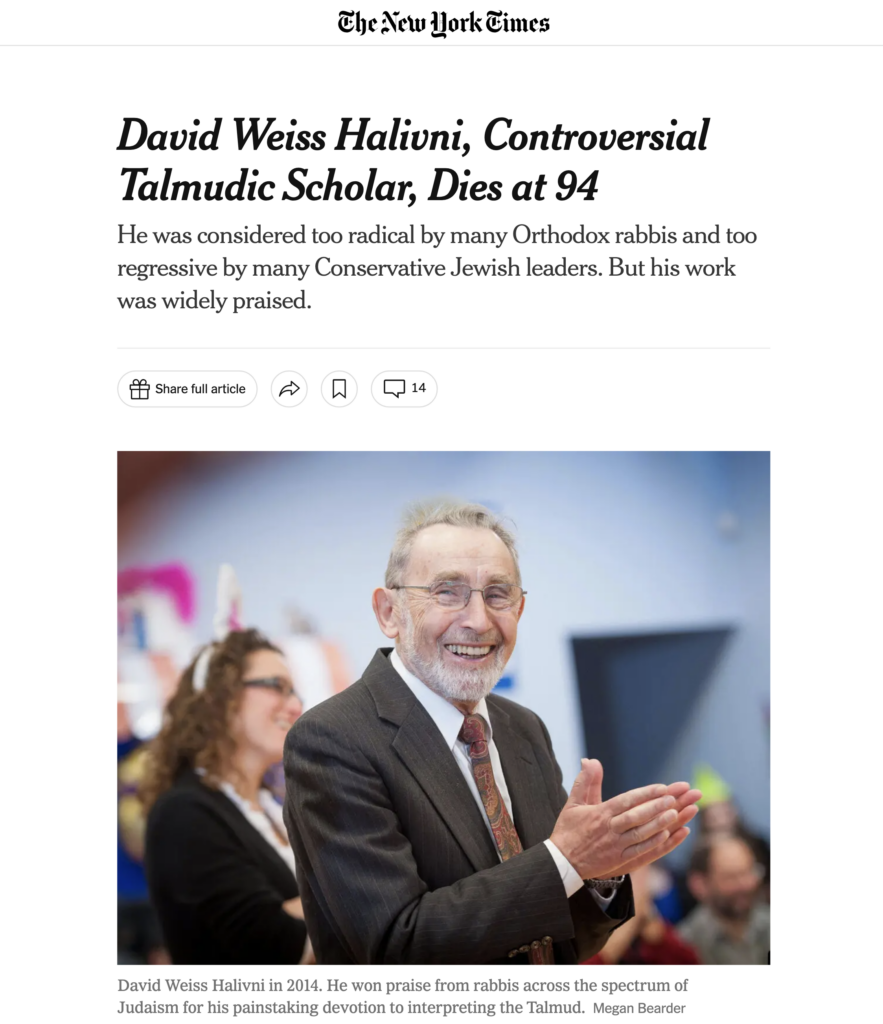
NY Times July 17, 2022 Obituary

The framing is revealing. Halivni is positioned between two opposing camps, too radical for one and too regressive for the other. This symmetrical construction reduces a complex methodological dispute to a narrative of ideological extremity and obscures the substantive nature of Orthodox objections. The obituary further characterized Halivni’s scholarship as grounded in the “controversial idea” that the Talmud is “riddled with inconsistencies and incongruities” resulting from the vulnerabilities of largely oral transmission, “subject to the flaws resulting from fallible memories.” It reproduced Agudath Israel’s denunciation of his work as an “abomination,” accusing him of daring “to enter the domain of the holy” and to suggest that the transmitters of the Talmud altered the text unknowingly. At the same time, Halivni was quoted defending his position: “divine origin does not preclude critical study, since critical study seeks to purge the text of human error.”
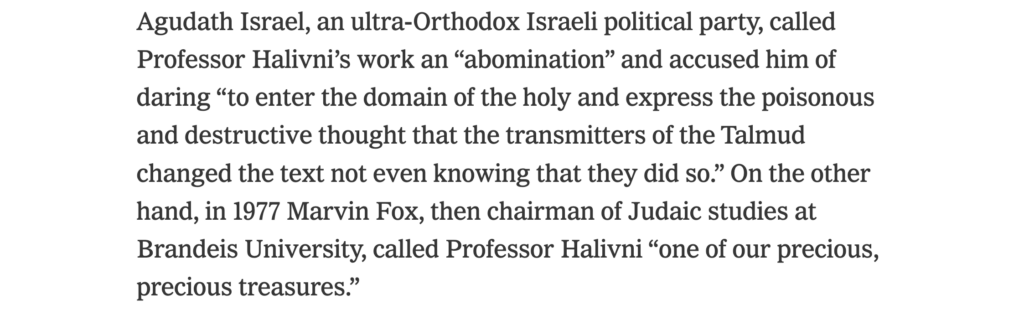
Beyond this polemical exchange, the obituary devoted substantial attention to Halivni’s innovative approach to Talmudic study, illustrating it through an extended discussion of a sugya in Mo’ed Katan. What was “pioneering” about Halivni’s work, the obituary explained, was his effort to “burrow[…] deeply into the history of how the Talmud … came to be compiled,” and to argue that its transmission, “for generations, largely oral,” was inevitably “subject to the flaws resulting from fallible memories.” Halivni therefore sought to “restore the pristine state of the Talmud,” in one student’s formulation, by identifying “incorrect editorial surmises” and exposing moments in which later transmitters resorted to “forced readings” in order to reconcile contradictions. As the obituary emphasized, Halivni’s method aimed to “iron out the inconsistencies and gaps and restore logical coherence” by tracing a concept’s provenance and, where necessary, reconstructing earlier textual strata. This methodological claim entailed a far-reaching reassessment of traditional assumptions about the formation and internal coherence of the Talmud.[3]

David Weiss Halivni (1927-2022) was born in Poljana Kobilecka in interwar Czechoslovakia and received rabbinic ordination in Sighet at the age of fifteen. Deported to Auschwitz in 1944, he survived the camps as the sole remaining member of his family.[4] After immigrating to the United States in 1947, he combined advanced yeshiva learning with formal academic study, ultimately joining the faculty of the Jewish Theological Seminary and later Columbia University.[5] In his later years he made aliyah and taught at Bar-Ilan University. Beginning in 1969, he published the first volume of his monumental Mekorot u-Mesorot,[6] which developed a sustained program of source-critical Talmudic interpretation,[7] aimed at distinguishing between tannaitic dicta and later amoraic and editorial strata.[8] It was this methodological ambition, more than questions of biography or institutional affiliation, that made Halivni a focal point of Orthodox critique.

Such sustained engagement with technical Talmudic scholarship is unusual for The New York Times. Yet this was not the paper’s first encounter with Halivni’s work. On the eve of Rosh Hashanah in 1977, The New York Times Magazine published a lengthy profile of Halivni by Israel Shenker under the title “A Life in the Talmud.”[9] There, Shenker described Halivni as “a respected public enemy at the pinnacle of modern scholarship” and reported that “The ultra-Orthodox Israeli political party Agudath Israel called it an ‘abomination,’” citing an editorial in Beys Yaakov Journal. The juxtaposition of scholarly daring and religious denunciation supplied the dramatic architecture that the 2022 obituary would later reprise.
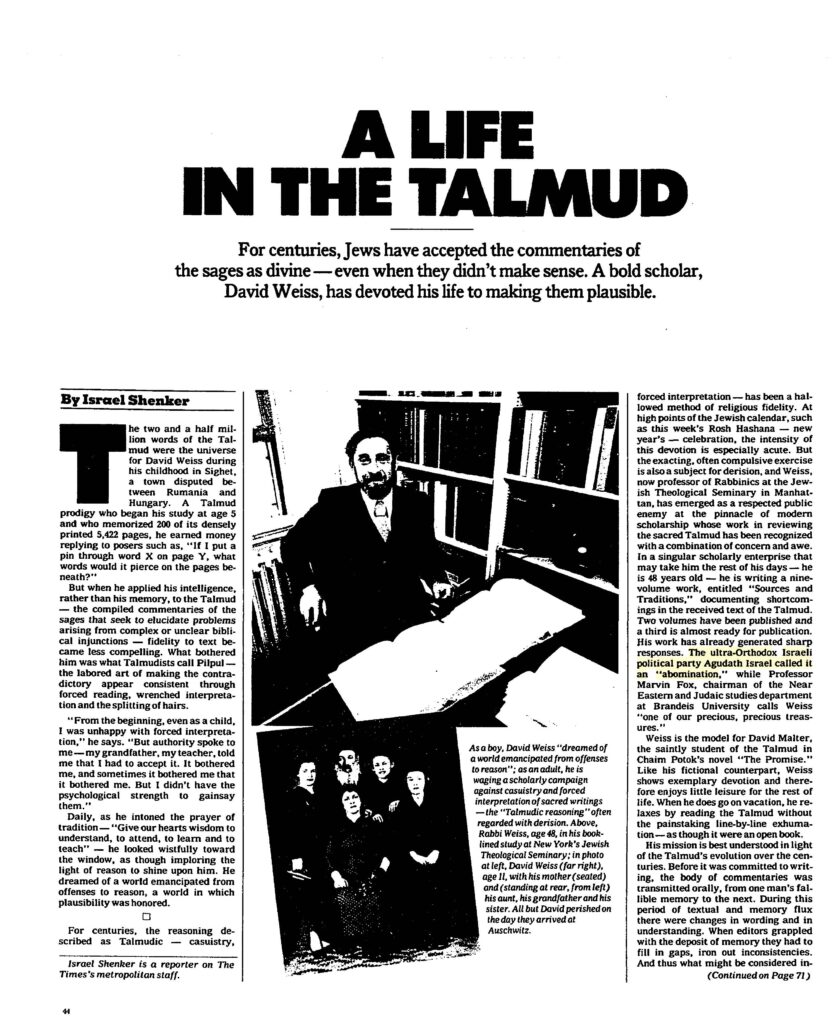
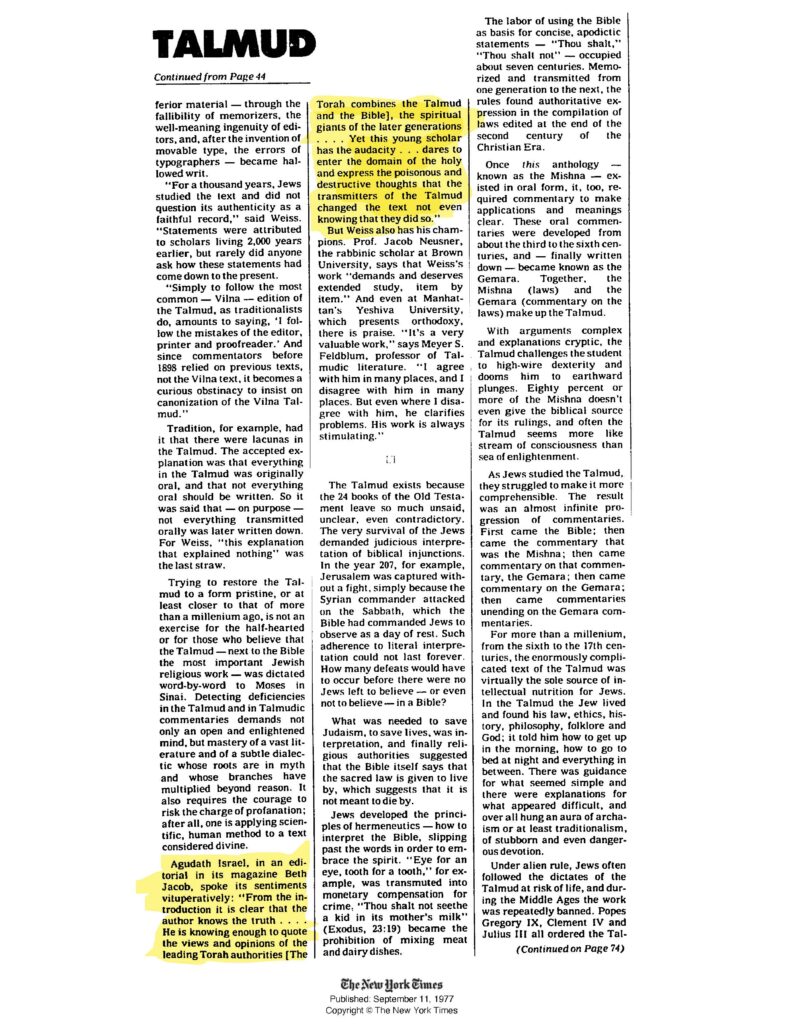
The New York Times narrative, however, is fundamentally flawed. It misidentifies the institutional character and editorial posture of the Beys Yaakov Journal, misconstrues the nature of its engagement with contested scholarship, and rests on a tendentious, if not deliberate, mistranslation of a pivotal passage. More importantly, it mislocates the center of Orthodox resistance to Halivni’s work. The critique in that article in Beys Yaakov Journal, and the journalistic distortions surrounding it, should not be mistaken for the principal arena of Orthodox opposition. The more consequential controversy unfolded within the American Modern Orthodox world, particularly at Yeshiva University and among its associated intellectual networks, circles far more familiar to the Times readership and far more central to the internal struggles of American Judaism during the period under review. As we will demonstrate in a subsequent installment of this series, it was there, rather than in Israeli party politics, that the most sustained and institutionally significant resistance to Halivni took shape.

Israel Shenker: A Scholar “Trapped in a Newsman’s Body”

To grasp the significance of Israel Shenker’s mischaracterization of the Beys Yaakov Journal, one must first understand Shenker himself. He was no ignorant sensationalist, no journalist stumbling blindly into a world he did not understand. On the contrary, he was widely (and aptly) described as “a scholar trapped in a newsman’s body.”[10] Fluent in Hebrew and Yiddish and possessed of formidable erudition, Shenker moved comfortably among texts, languages, and learned worlds that lay beyond the reach of most reporters.

That independence was visible early. While enrolled at the University of Pennsylvania, Shenker reportedly completed his degree without attending classes, preferring to work alone in the library and appearing only for examinations. As his niece later recalled, he “did not attend classes because he did not need to,” a habit that remained a defining feature of his intellectual life: self-directed, book-centered, and impatient with institutional mediation.[11]

Across several decades at The New York Times, Shenker profiled an extraordinary range of cultural and intellectual figures. Yet the range was not random. He gravitated toward individuals who combined mastery with eccentricity, authority with paradox: Groucho Marx,[12] whose comic persona masked a sharp literary intelligence; Jorge Luis Borges,[13] blind yet hyper-lucid; Noam Chomsky,[14] the dissident linguist who destabilized both politics and grammar; Vladimir Nabokov,[15] the aristocratic stylist and relentless classifier; Pablo Picasso,[16] whose genius lay in permanent disruption. Alongside them appeared scientists and system-builders such as Isaac Asimov, polymaths of prodigious output and explanatory ambition.[17]

Shenker brought the same sensibility to Jewish intellectual life. He wrote about scholars such as Uriel Simon,[18] Salo Wittmayer Baron,[19] and Solomon Zeitlin,[20] figures whose authority derived not from popular appeal but from textual mastery and historical depth. He became one of the Times’ principal correspondents on Jewish culture, though with telling selectivity: the Jewish Theological Seminary consistently dominated his institutional coverage,[21] while nearly every other yeshiva or rabbinical seminary in New York went largely unremarked[22]; the Second Avenue Deli became his emblem of Jewish urban life,[23] while nearly every other Jewish restaurant remained invisible.[24] Shenker’s choices reveal a consistent pattern: he favored sites and figures that condensed Jewish meaning into legible symbols.[25]

Much of his Jewish writing was light in tone but not trivial. He reported on a snobbish kosher hotel in England[26]; obscure and declining Jewish communities[27]; the phenomenon of “miraculous” pareve cheesecake[28]; the Twerski rabbinic dynasty[29] and other Hasidic groups[30]; itinerant soferim repairing pesul Torah scrolls[31]; Hebrew book publishing[32]; dreydl manufacturers[33]; the economics of yarmulkes and skullcaps[34]; the professional culture of kosher certification and supervision[35]; and prayer groups on El Al flights so numerous they gathered at the rear of the plane and disrupted its altitude.[36] These were not throwaway curiosities. They were chosen because they dramatized ingenuity, adaptation, and excess.

Other pieces were more substantial. Shenker produced one of the most comprehensive journalistic profiles of Isaac Bashevis Singer,[37] wrote with open admiration about Harry Austryn Wolfson, the legendary Harvard scholar of Jewish philosophy,[38] and reported sympathetically on the Lubavitcher Rebbe’s public call for kindness on the occasion of his seventieth birthday.[39] He covered Holocaust conferences, theological debates, Jewish cultural institutions, and scholarly gatherings with genuine seriousness.[40] Many of these essays were later revised and collected in his 1985 volume Coat of Many Colors, a book that stands as the fullest expression of his intellectual commitments.[41]

Shenker’s first sustained engagement with talmudic scholarship came in 1971, with a profile of Rabbi Adin Steinsaltz,[42] then deeply immersed in producing a new edition of the Talmud.[43] The article was largely respectful, yet it included a pointed dismissal attributed to Rabbi Louis Finkelstein, chancellor of the Jewish Theological Seminary, belittling Steinsaltz’s achievement.[44] The move is revealing. Even where admiration was warranted, Shenker could not resist inserting institutional tension, foregrounding controversy where extended methodological explanation might have sufficed.

That instinct became even more pronounced in Shenker’s 1975 feature, “Responsa: The Law as Seen by Rabbis for 1,000 Years,” based on interviews with Rabbi Moshe and Rabbi Solomon B. Freehof.[45] The pairing itself was astute, recognizing responsa as a transdenominational genre spanning Orthodox and Reform authority. Yet the article in The New York Times was framed by a prominent callout box – “A Responsum Sampler” – that juxtaposed grave contemporary questions, such as homosexuality and women wearing pants, with deliberately quirky cases,[46] including ritual slaughter under hypnosis[47] and a woman who swallowed a fly.[48] Responsa appeared less as a discipline of burdened responsibility than as a theater of ingenuity and oddity. The irony is that Rabbi Feinstein explicitly rejected such a portrayal. “You can’t wake up in the morning and decide you’re an expert on answers,” he insisted, stressing that authority emerges only through long recognition of sound judgment. More pointedly, he framed pesak as religious accountability: “A rabbi who replies to people’s questions works harder than a doctor dealing with a case of life and death. The doctor is responsible only to his patient, but the rabbi is responsible to God.” This ethic of burdened responsibility, articulated in the interview itself, stands in tension with the broader journalistic framing. Rabbi Feinstein articulated the same conception programmatically in the introduction to the first volume of Iggerot Moshe,[49] where he repeatedly describes his rulings not as demonstrations of mastery but as obligations imposed by circumstance. His responsa, he writes, emerge from “darkness,” composed only because he felt compelled to give instruction; the decisor must rule according to “what his eyes see and what appears true to him,” even amid doubt and fear of error. Authority, in this account, lies not in brilliance or certainty but in the willingness to assume responsibility for guidance. This was an ethic that closely parallels his insistence in the Times interview that “the rabbi is responsible to God,” not to ingenuity or acclaim. [50]
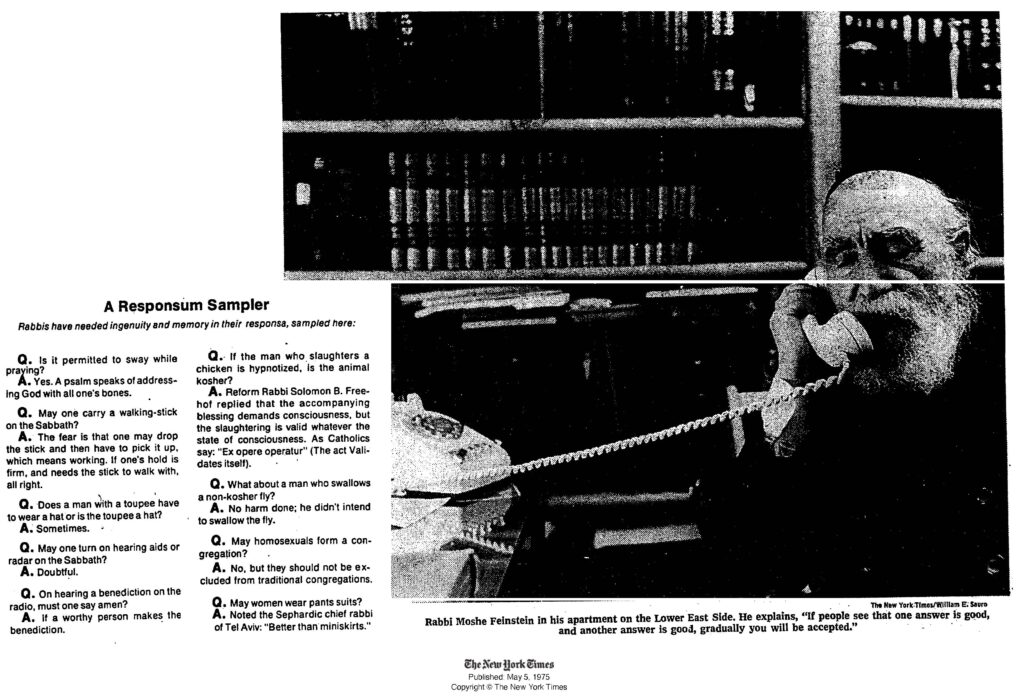
Shenker was plainly fascinated by the genre; he devoted nearly thirty pages to responsa literature in Coat of Many Colors. Whether the emphasis on eccentricity reflected his own priorities or editorial intervention is difficult to determine. Shenker’s own reflections offer some guidance. In a 1986 profile, he described himself as writing “as a reporter more than anything else,” insisting that he was “not interested in arguing any ideas of [his] own.”[51] Baruch Halpern’s account is especially suggestive. A leading scholar of the Hebrew Bible and ancient Israel, he explains that when Shenker worked for Time in postwar Europe, managing its Paris bureau, Shenker deliberately forwent by-lines out of a “corporatist sense of mission,” valuing collective authorship over individual credit.[52] Only later, at The New York Times, did Shenker embrace what Halpern memorably termed “that sacred by-line,” situating his career within a broader shift toward intellectual individuation.[53]

Shenker openly admired religious intellect even while identifying as a nonbeliever. He spoke candidly of his fascination with rabbinic literature – not for its piety, but for what he called “the determination to find excuses for impossible things.” Talmud and responsa were, in his words, “endlessly fascinating.” This posture, respectful yet detached, drawn to paradox rather than normativity, helps explain both his genuine engagement with Jewish learning and his recurrent tendency to foreground eccentricity or scandal at the expense of internal meaning.[54]

That stance was reflected not only in Shenker’s writing but also in the manner in which he chose to live. In his later years he withdrew from institutional journalism altogether and settled in rural Scotland, where his wife Mary, born into the Sagman family of Glasgow, had familial roots. There he described himself as a solitary reader moving from library to library, drawn to places that functioned as what he called “intellectual hospices.”[55] Writing in 1985 about a residential library in Wales founded by William Gladstone, Shenker offered an implicit self-portrait: a scholar without a pulpit, a journalist without a platform, committed less to intervention than to observation, and to books rather than communities. From that deliberately marginal and proudly nonconfessional vantage point, Judaism appeared not as a living system governed by internal norms, but as a repository of endlessly fascinating textual ingenuity. This orientation is also visible in Shenker’s books. Beyond Coat of Many Colors, Shenker published a series of substantial monographs that further attest to the breadth and seriousness of his intellectual interests, including studies of lexicography and the history of language,[56] literary travel[57] and eighteenth-century intellectual culture,[58] and contemporary Jewish and Israeli public life.[59]

Seen against this background, Shenker’s treatment of David Weiss Halivni cannot plausibly be dismissed as a product of ignorance or linguistic incapacity. He possessed the philological competence to read the Hebrew of the Beys Yaakov Journal accurately and the cultural literacy to recognize the specifically Orthodox stakes of Halivni’s project. The resulting mischaracterization was therefore interpretive rather than inadvertent: a reframing of a bounded intramural methodological dispute in the idiom of public scandal. In this instance, Shenker’s erudition did not guard against distortion but conferred authority upon it.

To see why this reframing proved so consequential requires closer attention to the article itself and to the broader Orthodox debate over the academic study of the Talmud in which it intervened. Only within that broader context does the inadequacy of the binary framework later imposed upon Halivni come into focus. In a subsequent installment of this series, we will examine specific episodes in his life, consider his distinctive approach to Talmudic study, and then turn to the controversy it provoked. His trajectory across worlds often presumed to be mutually exclusive, including the traditional yeshiva culture of Eastern Europe, the postwar Orthodox institutions of America, and the emerging academic study of rabbinic literature, forms an essential backdrop to that debate.

The 1969 Beys Yaakov Journal Article: Engaging the Challenge

In early 1969, the Beys Yaakov Journal published “A Cry of Alarm Concerning the New School of ‘Talmud Critics’!”[60] by “Harav Yitzhak M. Shmueli” (almost certainly a pseudonym).[61] The article appeared in issue no. 116, shortly after the publication of the first volume of Halivni’s Mekorot u-Mesorot (1969).[62] It was not a reflexive polemic or an immediate rebuttal, but a considered response to a scholarly methodology that had already begun to exert influence within academic and semi-academic Jewish discourse.[63] Shmueli’s article reflects the Journal’s longstanding editorial posture: the intellectual challenges of modernity, particularly those circulating in print and academic venues, cannot be met with silence or denial. Rather than ignoring them, the Beys Yaakov Journal insisted on direct and public engagement.[64]
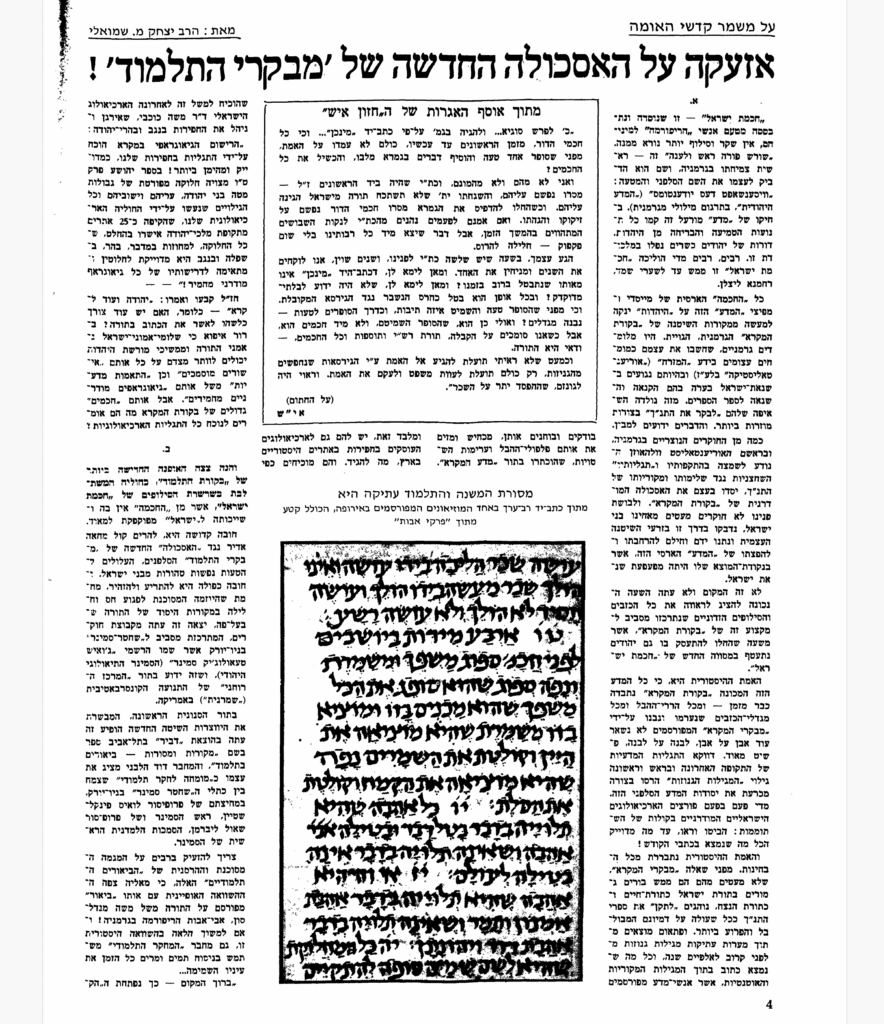
The article offers a sweeping critique of the Jewish Theological Seminary (JTS) and its Talmudic scholarship, with Halivni serving as the central exemplar. After briefly dismissing academic biblical criticism as a spent and methodologically compromised enterprise, Shmueli turns to what he presents as a more urgent danger: the emergence of academic Talmudic criticism within the Jewish Theological Seminary. He notes that Mekorot u-Mesorot bears the subtitle Biʾurim Talmudiyim and explicitly links this nomenclature to the Biʾur associated with Moses Mendelssohn, whom he identifies, in conventional Orthodox polemic, as a progenitor of German Reform Judaism.[65] The terminological parallel is presented as symptomatic rather than incidental.

Shmueli’s extended polemic against biblical criticism should be read less as his operative argument than as a genealogical warning. By tracing “Ḥokhmat Yisrael” back to German biblical criticism and Wissenschaft des Judentums, he establishes a historical cautionary tale rather than mounting a detailed refutation.[66] Once the discussion turns to Talmud, however, the tone shifts markedly: denunciatory generalizations give way to named books, cited introductions, concrete methodological claims, and extended quotation of traditional authorities. The rhetorical genealogy sets the stage; the argument itself unfolds as a focused dispute over the limits of legitimate Talmudic method.

Beyond an Internal Scholarly Debate

Shmueli’s concern, however, was not confined to an intramural scholarly dispute that might otherwise have remained limited to a narrow academic readership. The urgency, he argued, arose from Halivni’s entry into the broader intellectual public. In 1963, Halivni authored the Encyclopaedia Britannica entry “Source Criticism,” appended to the encyclopedia’s discussion of the “Talmud.” There he did not merely note philological problems in passing, but presented “source criticism” as a discrete scholarly method whose central task was to distinguish between the original statements of rabbinic authorities and the forms those statements assumed through oral transmission. A paragraph from that Britannica entry was later reprinted on the inside cover of Mekorot u-Mesorot: Seder Nashim (1969) under the heading, “From the author’s statement in the Encyclopaedia Britannica.” It reads:

“Source criticism seeks to differentiate between the original statements as they were enunciated by their authors and the forms they took as a consequence of being orally transmitted; that is, between the sources and their later traditions. It is not to be confused with the kind of analysis – frequently carried out by the rabbis or the Talmud – which merely traces the historical sources of a given passage without judging whether or not the passage faithfully reflects these sources. Source criticism claims that the transmission of the Talmud was not, and perhaps could not have been, verbatim, and that the text became altered in transmission, with the result that many statements in the Talmud have not come down in their original form. Instead, what survives is the form assumed in the last phase of transmissional development. While such a study is pertinent to most ancient texts, it is particularly relevant to the Talmud, which primarily consists of quotations and their interpretations.”[67]

On Halivni’s account, talmudic transmission “was not, and perhaps could not have been, verbatim,” with the result that many passages survive only in the form assumed in the final phase of transmissional development. The Talmud, he argued in that encyclopedia entry, is therefore particularly susceptible to such analysis, since it largely consists of quotations and interpretive strata. By articulating this claim in the idiom of general textual criticism and situating it within a major English-language reference work addressed to a broad, non-confessional readership, Halivni effectively relocated questions of talmudic authority from the internal norms of the beit midrash to the evaluative jurisdiction of modern academic scholarship. What might otherwise have remained an internal scholarly controversy was thus recast as a public representation of the Talmud within a wider intellectual culture.

It is precisely this public and methodological self-positioning that made the volume contentious. By placing the critical premise at the threshold of the book, Halivni indicated that the issue at stake was not merely philological refinement but the conceptual framework within which the Talmud itself would be understood. The decision to reproduce this paragraph prominently on the inside cover of Mekorot u-Mesorot was therefore more than bibliographic notice. It framed the book from the outset as an intervention in the academic discourse of textual criticism and positioned its central thesis as a methodological claim rather than an incidental observation. Before encountering Halivni’s detailed readings, the reader is confronted with a declaration about the nature of talmudic transmission and the legitimacy of critical reconstruction. In this sense, the reprinted Britannica passage functions as a programmatic preface, signaling that the project’s claims about the Talmud’s layered development are not ancillary but foundational.

This concern about public legitimation was not new. Long before the appearance of Halivni’s Mekorot u-Mesorot, Orthodox critics had already accused JTS, particularly under Finkelstein, of attempting to translate rabbinic tradition into a civic idiom aimed at American elites, a trajectory that would later culminate in highly visible episodes such as the Seminary’s 1957 convocation attended by Chief Justice Earl Warren.[68] This dynamic can already be seen by the early 1930s, such critiques had evolved from responses to discrete initiatives into a sustained indictment of Finkelstein’s leadership. In a widely circulated Yiddish pamphlet responding to the accumulated controversy surrounding the Seminary,[69] Dr. Aaron Rosmarin retrospectively gathered earlier charges, first voiced in The Jewish Forum,[70] Der Tog,[71] and The Jewish Spectator ,[72] into a comprehensive critique of what he presented as a coherent institutional strategy: the deliberate public repositioning of JTS through interfaith initiatives and universalist ethical rhetoric, designed to render Judaism intelligible and respectable to Christian and civic authorities while eroding the internal boundaries of rabbinic tradition.[73] Read in this longer perspective, the anxieties later articulated by Shmueli in the late 1960s appear not as episodic reactions to a single event, but as the continuation of an established polemical grammar through which the Seminary had long been contested within Haredi and Orthodox circles.

Yet the controversy did not unfold solely in the register of political denunciation or institutional suspicion. It also took the form of an internal methodological dispute over the norms of Talmudic scholarship.

Substantive Scholarship, Not Political Condemnation

Shmueli did not confine his critique to rhetorical denunciation. The article prominently featured, in a separate callout box at the top center of the page, the complete four-paragraph letter of the Ḥazon Ish addressing the use of manuscripts and textual emendation in Talmudic interpretation.[74] Given the Ḥazon Ish’s stature as one of the most authoritative scholars of his generation, his methodological positions were widely regarded as normative and were adopted, explicitly or implicitly, by many traditional Orthodox rabbis and scholars. Crucially, the Ḥazon Ish does not reject manuscript evidence as such; rather, he rejects its elevation into a corrective authority over the received text as transmitted and interpreted through the classical rabbinic canon. By foregrounding the Ḥazon Ish’s objections instead of invoking partisan rhetoric or institutional polemic, Shmueli cast the controversy as a serious methodological dispute internal to the discipline of Talmud study.
The letter reads in full:

“To interpret a sugya and to emend the Gemara on the basis of the ‘Munich’ manuscript – does this mean that all the sages of the generation, from the time of the Rishonim until now, all failed to apprehend the truth, because a single scribe erred and added material to the Gemara of his own accord, thereby causing all the sages to stumble?

I am not of them nor of their multitude. The manuscripts that were in the hands of the early authorities of blessed memory – they gave their lives for them, and the providence of the Blessed One, that the Torah not be forgotten from Israel, hovered over them. And when they began to print the Gemara, the sages of the generation gave their lives for its refinement and correction. And even if, at times, one may benefit from manuscripts to cleanse corruptions that arise over the course of time, with regard to a matter that issued from the hands of all our masters without any hesitation – Heaven forbid to disturb it.

Consider this yourself. When there are three manuscripts before us and two agree, we follow the two and set aside the one. And who can say to us that the ‘Munich’ manuscript is not from that one that was nullified by the majority in its own time? And who can say that it was not known to those lacking precision? In any case, it is null and void, like a broken potsherd, in the face of the received version.

And because a scribe erred and omitted a few words, as scribes are wont to err – shall we build towers? Perhaps indeed it is so, that the scribe omitted them and it is not from the sages, but when we rely on the tradition, the Torah of Rashi and Tosafot and all the sages – certainly this is the Torah. And I have almost never seen any benefit in arriving at the truth through variant readings uncovered from the genizot. Rather, they are all a benefit for distorting judgment and perverting the truth. It would have been fitting to consign them to burial, for the loss outweighs the gain.”

By reproducing this letter in full, Shmueli makes clear that his opposition to Halivni’s methodology rests on principled epistemological and methodological grounds rather than on ideological reflex. The Ḥazon Ish’s critique does not deny the existence of manuscript variation or the occasional value of textual witnesses; rather, it rejects the privileging of isolated manuscripts over the cumulative authority of the received tradition as transmitted and interpreted through generations of rabbinic scholarship.[75]
Crucially, Shmueli explicitly acknowledges that multiplicity, difficulty, and textual variation are intrinsic features of Torah she-baʿal peʿh. He concedes that variant readings and unresolved tensions have always belonged to the tradition, and he invokes major figures such as the Ḥatam Sofer and R. Israel Salanter to underscore that truth in Torah does not reside in surface simplicity. This concession sharply distinguishes his position from any naïve textual absolutism. What he rejects is not complexity itself, but the elevation of conjectural reconstruction into a corrective authority over the received text and its interpretive canon. In this way, Shmueli situates his argument squarely within a substantive Talmudic debate. He contends that even academically rigorous methods, supported by extensive philological evidence, remain subject to serious internal critique from within the Orthodox scholarly tradition itself. The article therefore represents intellectual engagement rather than political denunciation or fundamentalist rejection.

A full reading of Shmueli’s article makes clear that his deepest concern is not the existence of critical hypotheses as such, but their translation into public authority. Again and again, the danger he identifies lies in institutional legitimation: a book published by a major Israeli press, authored by a faculty member of the Jewish Theological Seminary, and disseminated to a broad readership through venues such as the Encyclopaedia Britannica. For Shmueli, the methodological question becomes urgent precisely at the point where speculative reconstruction threatens to become normative representation. The issue, in other words, is not academic experimentation behind closed doors, but the public pedagogy of Judaism to Jews and non-Jews alike.

Acknowledging Lieberman’s Authenticity

One of the most revealing features of Shmueli’s polemic is his careful distinction between Halivni and Saul Lieberman. Despite the breadth and intensity of his critique of the JTS approach, he is markedly restrained in his treatment of Lieberman. This restraint is deliberate. Lieberman’s Orthodox credentials were exceptionally strong and widely recognized across multiple sectors of the Orthodox world.[76] Upon his arrival in Palestine in 1928, he was appointed director of Machon Harry Fischel, a flagship Orthodox research institute devoted to advanced talmudic and halakhic scholarship, an appointment facilitated by leading rabbinic figures, including R. Isser Zalman Meltzer and R. Avraham Yitzhak Hacohen Kook.[77] At the same time, Lieberman pursued rigorous academic training at the Hebrew University under Prof. Jacob Nahum Epstein, the foremost architect of modern academic Talmud. Far from disqualifying him, this dual formation reflects the still-open willingness of segments of the Orthodox rabbinic elite in the interwar period to recognize exceptional Torah mastery even when pursued through unconventional scholarly frameworks.[78]

This standing remained intact even as Lieberman later contemplated accepting a position at the Jewish Theological Seminary. Before doing so, he consulted major Orthodox authorities, among them R. Isser Zalman Meltzer and R. Yaakov Moshe Charlap. Their responses ranged from principled refusal to issue a ruling to cautious, conditional acquiescence, but none denied Lieberman’s stature as a preeminent talmid ḥakham.[79] As Marc B. Shapiro has shown, Lieberman’s move to JTS did not erase his reputation within elite Orthodox circles; rather, it exposed unresolved tensions within Orthodoxy itself concerning the boundaries between institutional affiliation, scholarly method, and personal halakhic authority.[80] Lieberman thus occupied a liminal position: fully embedded in the Lithuanian rabbinic elite, deeply shaped by its intellectual ethos, yet operating at the outer limits of what Orthodoxy could comfortably accommodate.

It is precisely this status that explains Shmueli’s careful tone. To indict Lieberman directly would have required confronting not a marginal figure but a scholar whose legitimacy had been affirmed – explicitly or tacitly – by many of Orthodoxy’s leading authorities. Shmueli’s restraint therefore reflects less an endorsement of Lieberman’s methodology than an acknowledgment of the exceptional difficulty of dislodging a figure whose authority derived not from institutional politics alone, but from recognized and formidable Torah greatness. Shmueli’s own rhetoric reflects this distinction with care. He refers to Lieberman explicitly as a “renowned scholar, erudite in Torah she-baʿal peh,” even as he directs his most sustained and forceful criticism toward Halivni and the methodological program embodied in Mekorot u-Mesorot. This differentiation is significant. It underscores the Beys Yaakov Journal’s capacity for discriminating judgment rather than indiscriminate rejection of academic scholarship.
This, despite the fact that Lieberman’s earliest major work, Al ha-Yerushalmi, had already exemplified a disciplined form of textual criticism, drawing on manuscripts, parallel traditions, and internal philological analysis to clarify and correct the text of the Jerusalem Talmud. This could easily have provided fodder for Shmueli, yet he remained silent regarding Lieberman’s method. Recently published letters show that even the Ḥazon Ish engaged Lieberman seriously on these questions. Their correspondence reveals a principled disagreement over method, particularly regarding emendations grounded in manuscript evidence, while also demonstrating that such philological argumentation could be treated as a legitimate subject of rabbinic dispute rather than dismissed outright as heresy. Of course, since this correspondence had not yet been published, it cannot explain Shmueli’s silence on Lieberman’s approach.[81]
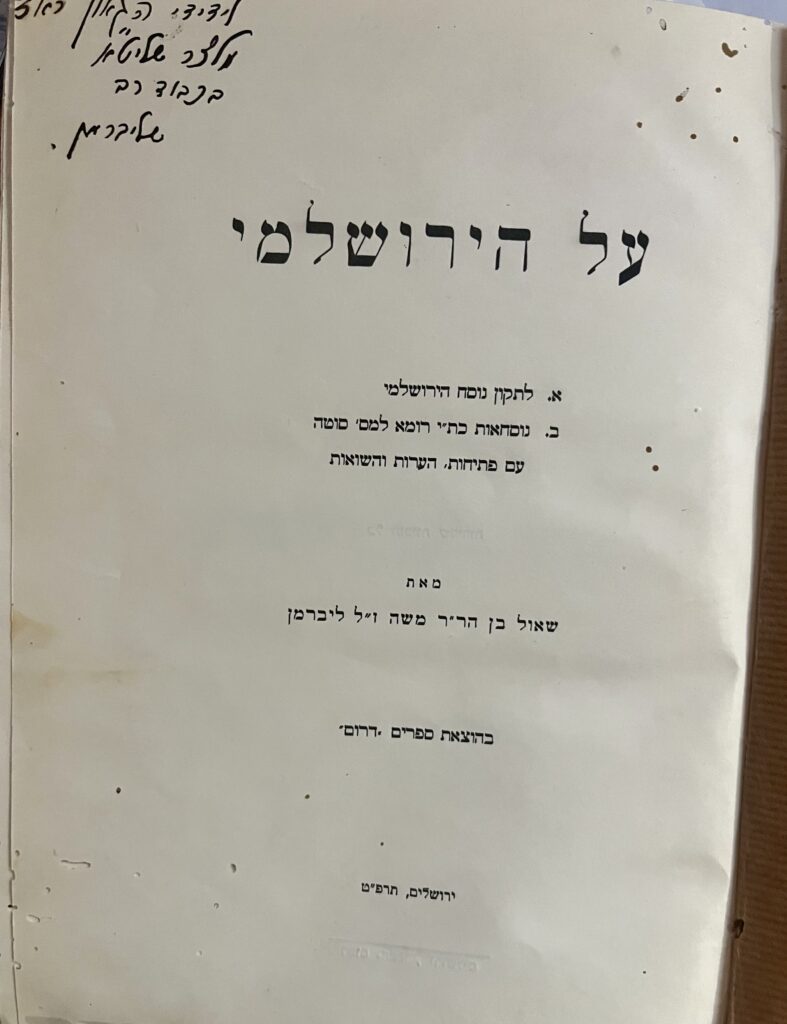
Copy of Al ha-Yerushalmi Gifted to R. I.Z. Meltzer from Lieberman

This nuance is essential for understanding the Beys Yaakov article’s invocation of the Ḥazon Ish. Lieberman is not cast as a theological threat or ideological provocateur, but as a formidable talmid ḥakham whose methods, though troubling to some, remained bounded within an elite scholarly discourse. Halivni, by contrast, is portrayed as extending those methods in a more expansive and publicly consequential direction, one that, in Shmueli’s view, exceeded the implicit safeguards that had contained earlier forms of academic intervention. The result is a portrait of Orthodox engagement with academic Talmud that is internally differentiated, historically self-aware, and intellectually serious, far removed from caricatures of reflexive or indiscriminate rejection.

That differentiation, however, depended upon the boundaries of scholarly containment. It held only so long as the debate remained internal to a learned community. Nowhere does Shmueli’s anxiety emerge more sharply than in his discussion of Halivni’s contribution to the Encyclopaedia Britannica.[82] Written in English for a general readership unfamiliar with the internal conventions of Talmudic study, Halivni’s article marks, in Shmueli’s view, the point at which an intramural scholarly debate enters the public register. At that point, silence becomes irresponsible. What is at stake is no longer a disputed method within a learned guild, but the public representation of the Talmud itself: its authority, coherence, and standing before a wider audience.

Yet the subsequent reception of the controversy would hinge less on Shmueli’s carefully drawn distinctions than on the interpretation of a single line in the Beys Yaakov article itself.

The Mistranslation That Changed Everything

After developing its substantive critique, the Beys Yaakov article closes with a pointed rhetorical question:

!?האפשר לשתוק נוכח שערוריה נוראה מעין זו

The phrase is best rendered: “Is it possible to remain silent in the face of such a terrible scandal?”
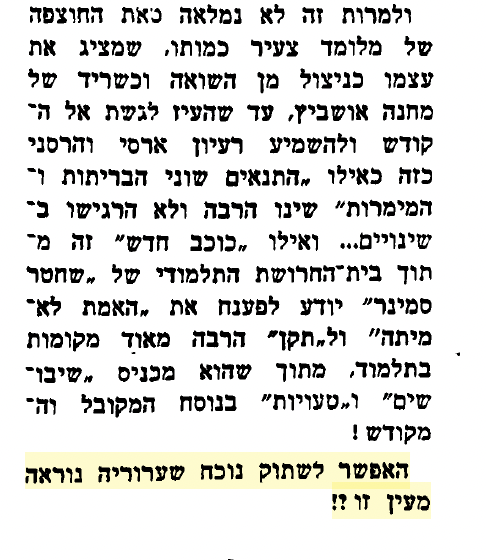
Here we arrive at Shenker’s most consequential error. Shenker isolated the noun שערוריה (sha’aruriyah) and translated it as “abomination.” This was not a neutral lexical choice, but a serious mistranslation with far-reaching interpretive consequences.

In classical and rabbinic Hebrew, as well as in modern Hebrew, שערוריה denotes a scandal or public outrage, an event or claim that provokes alarm, indignation, and moral disquiet. Rooted in the semantic field of סער and סערה, it evokes turbulence and upheaval, suggesting commotion and protest rather than ritual pollution or theological deviance.[83] The term therefore belongs to the register of public scandal and polemical critique, not to the technical vocabulary of halakhic or theological condemnation. It conveys gravity, even urgency, but it does not imply that the object in question lies beyond the bounds of religious legitimacy. By contrast, Biblical and rabbinic Hebrew possess precise and well-established terms for “abomination,” most prominently תועבה (toʿevah) and the ש־ק־ץ family (שקץ, sheqets; שיקץ, shiqets). These terms function as technical markers of religious repugnance and exclusion.[84] תועבה denotes what is abhorrent before God, a term reserved for practices that are religiously intolerable, most prominently idolatry and acts explicitly proscribed as violations of the divine order. שקץ, by contrast, marks what is ritually defiling and categorically repugnant, designating objects or acts that are not merely objectionable but intrinsically contaminating within the cultic and halakhic system. In such usage, these terms do not merely register protest or indignation. They function as categorical markers of religious illegitimacy, designating acts or objects as intrinsically defiling and wholly intolerable within the normative order of divine law.

An Orthodox polemicist seeking to convey that level of categorical condemnation would almost certainly have employed one of these terms. Shmueli does not. His diction is emphatic but restrained, signaling moral alarm and scholarly urgency rather than theological excommunication. Translating שערוריה as “abomination” imputes to the article a category of judgment absent from the Hebrew. The difference is not rhetorical but semantic: the mistranslation shifts the text from protest to proscription, from scandal to heresy. One is reminded of the rabbinic topos of qotzo shel yod, the barely perceptible stroke of the yod (understood by Rashi as its right leg and by Rabbeinu Tam as its curved crown) whose alteration can overturn an entire halakhic construction.[85] Shenker’s substitution performed precisely such a transformation. There is no plausible pathway by which the language of “abomination” could have entered the public narrative surrounding Halivni other than through this mistranslation. In doing so, it recast an argument urging engagement with a grave scholarly challenge as a declaration of religious intolerance and obscured the article’s actual posture, which was not to brand Halivni’s work as heretical but to insist that a development of profound intellectual and communal consequence cannot responsibly be met with silence.

The consequences of this lexical substitution extended far beyond Shenker’s 1977 profile. Once “abomination” entered the New York Times archive as the purported Orthodox verdict on Halivni, it became available for repetition as journalistic fact. Thus, when the Times published its 2022 obituary of Halivni, it reproduced Shenker’s framing and relied on the same source. The obituary’s headline, casting Halivni as a “controversial” scholar rejected by “many Orthodox rabbis,” thus rested in part on a mistranslation that had already transformed a bounded Hebrew critique of scholarly method into a sweeping theological denunciation. In this way, a single erroneous word became the pivot of a durable public narrative.

The Effect of Sensationalism

Israel Shenker’s mistranslation did not merely distort a phrase; it altered the character of the intellectual activity in which the Beys Yaakov Journal was engaged. The original article undertook a demanding and careful task: it presented a sophisticated academic methodology to an Orthodox readership, explained why that methodology posed serious difficulties within the traditional epistemology of Talmudic study, marshaled substantive scholarly objections, above all the position of the Ḥazon Ish, acknowledged internal differentiation within Orthodoxy, and articulated strong disagreement grounded in textual and methodological analysis. By rendering the article’s culminating language as invoking an “abomination,” Shenker recast sustained scholarly critique as fundamentalist denunciation, collapsing methodological dispute into theological outrage and substituting caricature for argument.

This inversion is especially consequential in light of the documented record of the Beys Yaakov Journal of reflective engagement with modernity, both in its prewar Polish incarnation[86] and in its postwar Israeli continuation.[87] Beys Yaakov was not a polemical broadsheet but an educational and intellectual forum that repeatedly confronted modern scholarship rather than retreating from it. Shenker’s portrayal effaced that history and compounded the distortion by mischaracterizing the journal as “an official publication” of Agudath Israel. It was not. Published by the “Central Beys Yaakov of Israel” and later by the “Bais Yaakov Women’s College,” the journal functioned as an educational organ aligned with Agudah but not as a party instrument. The distinction is substantive. Educational journals cultivate explanation and debate; party organs enforce discipline.

The encounter with Rabbi Professor David Weiss Halivni was therefore neither a reflexive ban nor an eruption of obscurantism, but a serious internal reckoning with a scholarly development understood to carry public and pedagogical consequences. The episode demonstrates how readily Orthodox intellectual life in the mid-twentieth century has been recast through external narratives that confuse methodological dispute with theological denunciation. To understand the controversy properly requires moving beyond journalistic distortion to the jurisprudential problem Halivni’s scholarship forced into view. The debate was not about temperament or piety, but about first principles: whether historical reconstruction can be insulated from normativity; whether halakhic authority rests on procedural continuity or on claims of historical transparency; and whether Orthodox institutions possess mechanisms capable of absorbing critical candor without destabilizing the structures of authority they seek to preserve. It is to that institutional and conceptual terrain that we now turn.

[to be continued…]

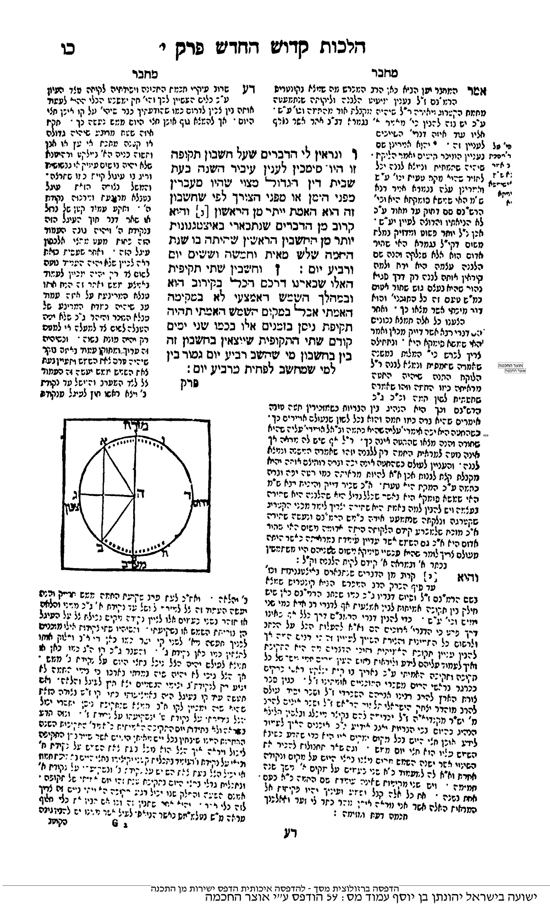
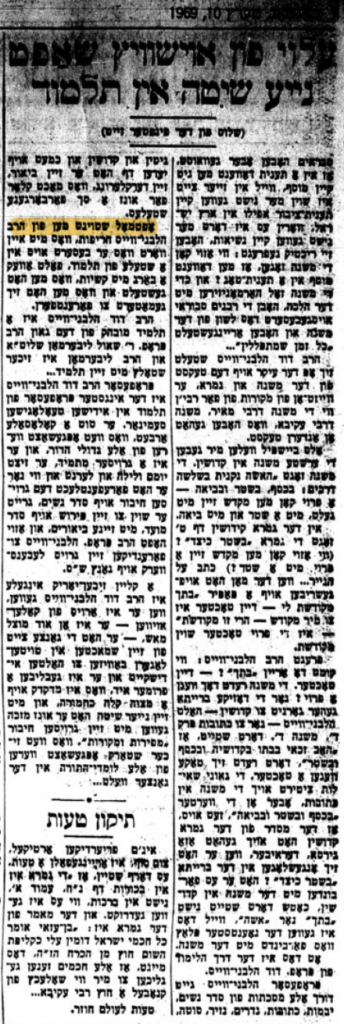
Appendix 1: Yitzhak M. Shmueli, “A Cry of Alarm Concerning the New School of ‘Talmud Critics’!” Beys Yaakov, vol. 10, no. 4 [#116] (1969): 4-5 (Hebrew), available here:

Yitzhak M. Shmueli,

“A Cry of Alarm Concerning the New School of “Talmud Critics”!

Beys Yaakov, vol. 10, no. 4 [#116] (1969): 4-5 (Hebrew)

I.

“Ḥokhmat Yisrael” – that enterprise which was founded and ardently desired at the initiative of the various exponents of “Reform,” in all its forms – there is no falsehood and distortion more dreadful than it. This “root that bears gall and wormwood” – its earliest growth began in Germany, and there it affixed to itself the flattering yet deceptive name: “Wissenschaft des Judentums” (“the Science of Judaism,” in a literal translation from German). Within the bosom of this poisoned “science” arose all the movements of assimilation and derision away from Judaism. Generations of upright Jews fell into this trap. Many – far, far too many – this very “Ḥokhmat Yisrael” led all the way to the gates of apostasy, Heaven forfend.

All the venomous “wisdom” of the founders and disseminators of this “science” concerning “Judaism” in fact drew its sustenance from the sources of malice inherent in German, gentile “Biblical Criticism.” There were German scholars who regarded themselves as immense experts in the knowledge of the “East” (“Orientalistics,” in the foreign tongue), and, being afflicted with hatred of Israel, jealousy and the impulse of enmity toward the Book of Books burned within them. From this was born their aspiration “to criticize the Bible” in the most bizarre forms. And the matter is well known to the discerning. Several of the Christian researchers in Germany, foremost among them the orientalist Wellhausen – notorious for his attacks and his arrogant “discoveries” against the integrity and originality of the Bible – in fact founded the modern school of “Biblical Criticism.” And to our shame, even a few scholars from among our brethren, the Children of Israel, adhered to this path, taking hold of the seeds of self-directed malice, and lent their hand and their strength to the expansion and dissemination of this poisonous “science,” whose very point of departure was permeated with hatred of Israel.

This is neither the place nor the proper hour to display publicly all the falsehoods and malicious distortions that have accumulated around this discipline of “Biblical Criticism,” which, from the moment Jews too began to engage in it, cloaked itself in the new guise of “Ḥokhmat Yisrael.”

The historical truth is that this entire “science” known as “Biblical Criticism” has long since been exposed as false – and of all the mountains of nonsense and all the towers of lies that were heaped up and constructed by the celebrated “Biblical critics,” there remains no longer one stone upon another, one brick upon another, most evidently so. Indeed, it is precisely the scientific discoveries of the most recent period – and first and foremost the discovery of the “hidden scrolls” – that have decisively demolished the foundations of this deceptive “science.”

From time to time, modern Israeli archaeologists burst forth in cries of astonishment: Behold and see, to what degree everything found in the Holy Scriptures is precise!

And the historical truth is being clarified from every perspective. For these “Biblical critics,” not a few of whom are in fact complete ignoramuses regarding the Torah of Israel as a Torah of life and as the Torah of eternity, are accustomed to “correcting” the books of the Bible in accordance with whatever arises from their most confused and wildly unrestrained imagination. And suddenly, from ancient caves, hidden scrolls are found dating from nearly two thousand years ago, and everything written within those original and authentic scrolls – which renowned scholars examine and scrutinize – contradicts and refutes those sophistic vapidities and heaps of nonsense that were crowned with the title “Biblical science.”

And beyond this, the archaeologists engaged in excavations at historical sites in the Land also have something to say. And they demonstrate – as, for example, the Israeli archaeologist Dr. Moshe Kochavi recently demonstrated, who organized and directed the excavations in the Negev and in the Judean Mountains:

“The geographical record in Scripture has been proven by the discoveries in our excavations to be an exceptionally precise and reliable measure! In the Book of Joshua, chapter 15, there is found a detailed delineation of the boundaries of the tribe of the sons of Judah, their cities and their settlements, and all the discoveries made by our archaeological unit, which encompassed approximately twenty-five sites from the period of the kings of Judah, definitively confirmed that the entire division into districts – in the wilderness, in the hill-country, in the lowland, and in the Negev – is completely accurate; it accords with the standards demanded by every rigorous modern geographer!”

Ḥazal already said: “Yehudah ve-‘od la-qera” – that is, is there any further need whatsoever to confirm what is written in the Torah? In this generation, therefore, the whole-hearted faithful of Israel – loyal to the Torah and continuers of the heritage of Judaism – can, for their part, dispense with all those “authoritative confirmations” as well as the “scientific corroborations” of those “rigorous modern geographers.” But those great “sages” of Biblical Criticism – what answer can they possibly offer in the face of all the archaeological discoveries?

II.

And behold, there has emerged the newest fashion of “Talmud Criticism,” as a link integrated into the chain of distortions of “Ḥokhmat Yisrael” – which contains no “wisdom,” and whose association with “Israel” is exceedingly dubious.

It is a sacred obligation to raise a mighty voice of protest against the new “school” of the pretentious “Talmud critics,” who are liable to mislead pure souls among the Children of Israel. It is a double obligation to sound the alarm and to warn, since the dangerous initiative to harm – Heaven forbid – the foundational sources of the Oral Torah has now issued forth from a group of scholars concentrated around the “Schechter Seminary” in New York, whose official name is the “Jewish Theological Seminary,” and which is known as the “spiritual center” of the Conservative (“traditionalist”) movement in America.

As the first swallow heralding the emergence of the new method, there has now appeared, published by “Dvir” in Tel Aviv, a book entitled Sources and Traditions – Explanations in the Talmud. Its author, David Halivni, presents himself as an “expert in Talmudic research” who grew up within the walls of the “Schechter Seminary” in New York, in the company of Professor Louis Finkelstein, head of the Seminary, and Professor Saul Lieberman, the Seminary’s chief scholarly authority.

A public alarm must be sounded regarding the dangerous and destructive tendency of these “Talmudic explanations,” for of itself there surfaces the characteristic comparison with that famous “commentary” on the Torah by Moses Mendelssohn, the founding father of Reform in Germany! And if one extends this historical comparison further, the author of this “Talmudic research” likewise employs an innocent formulation and continually lifts his eyes heavenward…

“‘Blessed is the Omnipresent’ – thus opens the book’s ‘Preface’ – ‘who has merited me to see in print my explanations… May it be His will that just as He has merited me to see in print my explanations on the Order of Nashim, so may He merit me to see in print my explanations on the other orders and other books.’”

As it appears, the destructive hand is raised openly, and the plan is rather broad: to attack all the orders of the Shas and the other sources of Ḥazal, by means of that rusted and poison-saturated weapon called “Sources and Traditions”…

In the author’s scientific idiom this is called “textual truth,” since he strives to demonstrate that the Talmud is supposedly filled and replete with “inaccuracies,” “changes in sources,” “deviations from the simple interpretation,” and the like – claims and arguments that were habitual upon the tongues of all the “Biblical critics.”

From the words of the “Introduction” it is plainly evident that the author knows the truth, and merely intends to rebel against it! He himself writes that variations in textual versions, together with the difficulties bound up with them, have long since become part of the traditions… and indeed, one who has grown accustomed to this – precisely in this he perceives the distinctiveness of the Torah, and that its very diversity is its superior virtue…

The author even knows how to cite the words and opinions of the great Torah authorities, the giants of spirit of the later generations, such as the Ḥatam Sofer or Rabbi Israel Salanter, who explained that the essence of the distinctiveness of the Oral Torah lies precisely in this: that not everything appears revealed and simple at first glance…

This was the considered view of the author of the Ḥatam Sofer (in his novellae to tractate Ketubbot):

“The forced explanations (the resolutions offered to account for the difficulties arising in the comparison of the words of Ḥazal) – most of them are true… however, the rationalizations and inventions – most of them are false, and they are what cover over the face of truth.”

And Rabbi Israel Salanter, founder of the Mussar movement, stated this explicitly (in the introduction to his work Tevunah):

“What is truth? Truth does not live by simplicity alone, for simplicity is but one branch among the ways of proof; and for the most part the cherished difficulties stand ready to wage war against simplicity and to dislodge it…”

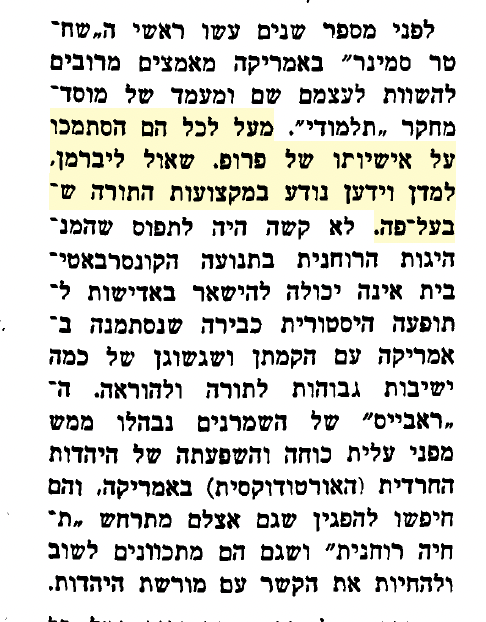
And despite all this, the arrogant audacity of a young scholar such as he has not been satisfied – a man who presents himself as a survivor of the Holocaust and as a remnant of the Auschwitz camp – to the point that he dared to approach the holy and to voice such a venomous and destructive notion, as though “the tannaim who transmitted the baraitot and dicta” altered much and did not even sense the alterations… whereas this “new star” from the Talmudic factory of the “Schechter Seminary” knows how to decipher “the truth in its truest sense” and to “correct” very many passages in the Talmud, by inserting “corruptions” and “errors” into the accepted and sanctified text!

Is it possible to remain silent in the face of such a terrible scandal?

III.

The source of a great danger has been exposed – one that is public-spiritual in character, and not merely literary-scholarly. We have no dispute with the author of this “collection of explanations,” who, notwithstanding everything, is himself compelled to concede that this is in essence not a new invention of his own, and that there have already been such researchers within the domain of “Ḥokhmat Yisrael” who attempted to “explicate” the sugyot of the Shas by a textual “critical method”…

The gravity of the danger is inherent in this fact: that it is an “official product” of the “Schechter Seminary,” and consequently it will be recognized and accepted as a “scientific discovery,” and perhaps even as a “scientific challenge” on the part of the Conservative movement in America.

Several years ago, the heads of the “Schechter Seminary” in America made numerous efforts to confer upon themselves a name and standing as a “Talmudic” research institution. Above all, they relied upon the personality of Professor Saul Lieberman, a renowned scholar and master of knowledge in the disciplines of the Oral Torah. It was not difficult to grasp that the spiritual leadership of the Conservative movement could not remain indifferent to the mighty historical phenomenon that became apparent in America with the establishment and flourishing of several advanced yeshivot for Torah study and rabbinic instruction. The “rabbis” of the Conservatives were truly alarmed by the rise of the power and influence of Haredi Judaism (Orthodox Judaism) in America, and they sought to demonstrate that among them too a “spiritual revival” was taking place, and that they too intended to return and to revivify the connection with the heritage of Judaism.

In accordance with the manner of the Conservatives and of all varieties of Reform, who are oriented primarily outward and whose chief concern is to find favor in the eyes of the gentiles, so they then arranged (some years ago) a grand celebration “in honor of the Talmud,” to which the Chief Justice of the Supreme Federal Court in Washington, Earl Warren, was invited. And the great surprise of the celebration was that the Chief Justice of the highest judges in America delivered an enthusiastic address concerning “the ethics of the Talmud,” and set forth several of the principles of Talmudic ethics as a model and exemplar of justice and uprightness!

The speech of the Chief Justice was not an isolated occurrence in America, where in recent times interest in the sources of Judaism has grown. Thanks to authoritative English translations, Christian scholars obtained some access to the treasures of the Talmud. One scholar, an expert in international law, a gentile from birth, published in the pages of an important scholarly journal a special study on the “spirit of true democracy” which he discovered in the Talmud.

And it is an interesting matter that the scholar paid attention there to that foundational principle in halakhic clarification in the Talmud: that “these and those are the words of the Living God.” The expert in international law translated this into his own terms, as an expression of democracy and freedom of expression – that one does not silence the “minority opinion” and does not disregard the rational arguments of the “opposing side,” but rather grants (as is done in the Talmud!) full right even to the minority opinion to explain its outlook. Even after the ruling has been decided on the basis of the majority view – which precisely accords with formal democracy – the “Talmudic sage” continues to voice and present his opinion upon the pages of the Talmud!

In various forms and through various channels, some of the perspectives of the Talmud began to penetrate American society. The growth in the number of yeshiva students in America – many of whom are regarded as authoritative experts in the domains of modern science – transmitted many of the moral principles of the Oral Torah into the broader world.

Until there arose a young “Talmudic researcher,” among the trainees of the “Schechter Seminary,” and proclaimed from every possible platform that fidelity to the text of the Talmud is doubtful, and that one must begin “Talmudic criticism”…

This matter did not suffice with the preparation of the anthology of “Sources and Traditions,” whose entire purpose is to obscure the sources and to undermine the traditions, but he even offered his “merchandise” (apparently upon the recommendation of the heads of the “Schechter Seminary”) to the editorial board of the world-renowned Encyclopaedia Britannica.

From his pen emerged the article “Source Criticism,” appended to the entry “Talmud” in volume 21 of the Encyclopaedia Britannica. What is the entire tendency of this article – particularly when it appears in English and is directed to the general public and to scholars for whom both the sources of the Talmud and the spirit of the Talmud are foreign – what can it lead to? Destructive views such as these: “that one should not lose one’s reason because of the analyses of the sages of the Talmud, who were not precise in the historical sources.” Both absolute ignorance is embedded in them, and an evil spirit of slander and self-degradation drips from them!

IV.

This figure did not emerge merely to testify concerning himself; rather, he also serves to testify concerning the entire “Schechter Seminary.” And the matter exceeds the limited framework of “literary activity” in the domain of “Talmud Criticism.” The “Schechter Seminary” embodies the “fortress of spirit” of the Conservative movement in America – and not only in America.

In recent years, the “Conservative” leaders have revealed an aspiration for “conquest,” and they seek precisely to transform themselves into a “global spiritual movement.” Concurrently, part of their leadership issues “public declarations,” as though their entire purpose is “to preserve and to draw from the sources of Judaism.”

It is indeed true that the great Torah authorities in America, foremost among them the Gaon Rabbi Aharon Kotler, of blessed memory, related from the outset with great suspicion to all “signs of rapprochement” on the part of the Conservatives, since, according to da‘at Torah, even their “tendencies” bear a pronounced character of Reform. The great Torah authorities in America therefore warned that rabbinic organizations in the United States should not blur the “dividing line” between the Jewish communities and the Conservative associations. A fierce spiritual campaign was waged on this matter in the public consciousness of American Jewry. And now one sees plainly what may be expected even from the learned “masters of sources” within the Schechter Seminary.

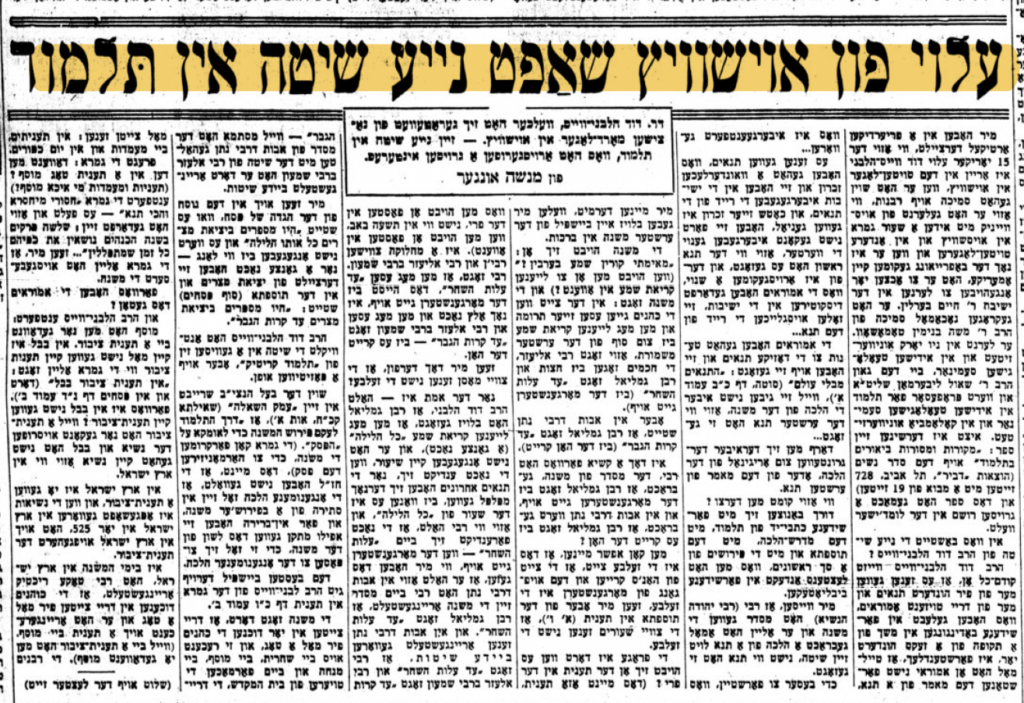
Appendix 2: Menashe Unger, “A Survivor of Auschwitz Creates a New Method in Talmudic Interpretation,” Der Tog (10 March 1969): 5-8 (Yiddish)

Menashe Unger,

“A Survivor of Auschwitz Creates a New Method in Talmudic Interpretation”

Der Tog (10 March 1969): 5-8 (Yiddish)

Dr. David Halivni Weiss, a survivor of the Nazi extermination camp at Auschwitz, has developed a new method in the study of the Talmud, a method that has aroused wide and serious interest.

In an earlier article we described how the fifteen-year-old Eliyahu David Weiss Halivni was sent to the death camp at Auschwitz already possessing rabbinic ordination; how, under conditions of mortal danger, he studied Gemara together with fellow Jews in Auschwitz and in other death camps; and how, after liberation, he arrived in America. At the age of eighteen he began studying at the Rabbi Chaim Berlin Yeshiva, where he again received rabbinic ordination, this time from Rabbi Moshe Binyamin Tomashov. He later pursued studies at New York University and at the Jewish Theological Seminary, under the guidance of the eminent scholar Rabbi Professor Saul Lieberman. He ultimately became professor of Talmud at the Jewish Theological Seminary and at Columbia University.

His book has now appeared: Mekorot u-Mesorot: Biʾurim ba-Talmud (Sources and Traditions: Explanations in the Talmud), on the Order Nashim, published by Dvir in Tel Aviv. The volume comprises 728 pages, with an introduction of nineteen pages. The book has made a powerful impression in the world of Talmudic scholarship.

What constitutes the new method of Rabbi David Halivni Weiss?

Rabbi Halivni Weiss first emphasizes that more than four hundred Tannaim and more than three thousand Amoraim lived under widely differing historical and social conditions over a period of approximately six hundred years. It is therefore understandable that at times an Amora did not fully comprehend a teaching of a Tanna transmitted to him. There were Tannaim who possessed extraordinary memories and transmitted the teachings of earlier authorities in the academies. Yet even when their memory was exceptional, they were not always able to convey the precise wording exactly as the original Tanna had formulated it. As a result, discrepancies arose, and the Amoraim were compelled to discuss these matters in the academies in order to reconcile the transmitted teachings.

The Amoraim even leveled accusations against such Tannaim, declaring: “The Tannaim are destroyers of the world” (Sotah 22a), because they failed to transmit the halakhah of the Mishnah exactly as the earliest Tanna had stated it. Accordingly, one must strive to return to the original formulation of the halakhah, or to the original statement of the earliest Tanna.

How is this accomplished? By making systematic use of variant manuscripts of the Talmud, Midrash Halakhah, the Tosefta, and the interpretations of many early authorities that have been discovered in recent times in various libraries. We know that Rabbi Judah the Prince, the redactor of the Mishnah, himself sometimes transmitted a halakhah according to his own conceptual framework, and not exactly as the Tanna had originally stated it, in order to render it more intelligible.

To clarify this approach, we will offer one example, drawn from the first Mishnah in Tractate Berakhot. The Mishnah opens: “From when does one recite the Shema in the evening?” It states that from the time the priests enter to eat their terumah one may recite the Shema until the end of the first watch, according to Rabbi Eliezer. The Sages say until midnight, and Rabban Gamliel says “until the rise of dawn.” However, in Avot de-Rabbi Natan it is stated that Rabban Gamliel says “until the rooster crows.”

This raises a difficulty: why did Rabbi, the redactor of the Mishnah, transmit Rabban Gamliel’s opinion as “until the rise of dawn,” whereas Avot de-Rabbi Natan reports it as “until the rooster crows”? One might assume that these refer to the same point in time, that the crowing of the rooster coincides with the appearance of the morning star. Yet from the Tosefta in Tractate Taʿanit (1:6) we see that these two temporal markers are not identical.

The discussion there concerns a fast that begins in the morning, as distinct from fasts such as the Ninth of Av, which begin in the evening. A dispute is recorded between Rabbi and Rabbi Eliezer ben Rabbi Shimon. Rabbi maintains that one may eat “until the rise of dawn,” meaning until the appearance of the morning star, which is still considered night, whereas Rabbi Eliezer ben Rabbi Shimon rules “until the rooster crows.” From this it is evident that the two times are not the same.

Rabbi Halivni Weiss therefore concludes that Rabban Gamliel originally stated only that one may recite the Shema “throughout the entire night,” without specifying any precise endpoint. The later Tannaim then debated how long the measure of “the entire night” extended. Since Rabbi held that night ends with the rise of dawn, and since Avot de-Rabbi Natan indicates that he indeed held this position, Rabbi incorporated into the Mishnah the formulation that Rabban Gamliel says “until the rise of dawn.” In Avot de-Rabbi Natan, however, both views were preserved: Rabbi’s position, “until the rise of dawn,” and that of Rabbi Eliezer ben Rabbi Shimon, “until the rooster crows,” because the redactor of Avot de-Rabbi Natan apparently accepted the latter view and therefore recorded both.

A similar phenomenon appears in the text of the Passover Haggadah, where it states: “They would recount the exodus from Egypt all that night,” without specifying an endpoint. By contrast, the Tosefta at the end of Tractate Pesahim states: “They recount the exodus from Egypt until the rooster crows.”

Rabbi David Halivni Weiss has thus developed a method that may be described, in a certain sense, as Talmudic textual criticism, but in a positive and constructive manner. Already the Netziv writes in his Haʿamek Sheʾelah (Sheʾiltah 136, section 1) that “it is the way of the Talmud to reinterpret the Mishnah so as not to uproot the halakhic ruling.” That is, the Sages did not wish the accepted halakhah to stand in contradiction to an explicit Mishnah, and where necessary they even corrected the wording of the Mishnah so that it would conform to the accepted halakhah.

Rabbi Halivni Weiss presents a striking illustration from Tractate Taʿanit (26b). The Mishnah there states that on three occasions during the year the priests raise their hands in blessing four times a day, and it enumerates Shaharit, Musaf, Minhah, and the closing of the Temple gates. These occasions are fast days, Maʿamadot, and Yom Kippur. The Gemara asks: is there a Musaf prayer on a fast day? It answers: “Something is missing, and this is how it should read: On three occasions during the year the priests raise their hands whenever they pray.” We thus see that the Gemara itself emended the Mishnah.

Why did the Amoraim do this? Rabbi Halivni Weiss explains that Musaf was recited only on a communal fast. In Babylonia there was never a communal fast, as the Gemara itself notes, because only the Nasi could proclaim such a fast, and Babylonia lacked a Nasi, unlike the Land of Israel. In the Land of Israel, communal fasts did exist, but after the abolition of the Nasiate in the year 425 they ceased there as well. In the Mishnaic period, however, Rabbi correctly included Musaf among the prayers recited on such days.

Later Amoraim, who lived in Babylonia and knew no communal fasts even in the Land of Israel, were perplexed by the Mishnah’s implication that Musaf was recited on a fast day. In order to harmonize the Mishnah with the accepted halakhah, they therefore emended its wording and inserted the phrase “whenever they pray.”

Rabbi David Halivni Weiss places primary emphasis on the textual foundations of the Mishnah and the Gemara. He demonstrates, on the basis of early sources, that there existed variant versions of the Mishnah, such as the Mishnah of Rabbi Meir and the Mishnah of Rabbi Akiva, which differed in wording.

As an example, he points to the opening Mishnah in Tractate Kiddushin: “A woman is acquired in three ways: by money, by document, and by intercourse.” The Gemara in Kiddushin (9a) asks: “By document, how?” and answers that if a man writes, “You are betrothed to me,” the woman is betrothed. Rabbi Halivni Weiss asks how the formulation “your daughter” enters the discussion, when the Mishnah speaks of a woman. He explains that this baraita originally referred not to Kiddushin but to Ketubbot, chapter four, where the Mishnah states that a father has rights over his daughter’s betrothal by money or by document. The redactor of the Gemara in Kiddushin apparently possessed such a version and connected the baraita to the Mishnah in Kiddushin because it was the closest relevant context.

This, then, is the path of study of Professor David Halivni Weiss. He proceeds through all the tractates of the Order Nashim, Yevamot, Ketubbot, Nedarim, Nazir, Sotah, Gittin, and Kiddushin, offering on every folio his elucidations and explanations, thereby clarifying many passages that have long remained obscure. At times a single incisive observation resolves a complex Talmudic difficulty and causes an entire accumulation of questions, which scholars had struggled to answer, to fall away.

Rabbi David Halivni Weiss is an outstanding disciple of the eminent Rabbi Professor Saul Lieberman, who takes great pride in his student. Professor Rabbi David Halivni Weiss is the youngest professor of Talmud at the Jewish Theological Seminary. He is engaged in a monumental scholarly undertaking that will be appreciated by all the leading Torah scholars of the generation. Having published his major work on the Order Nashim, he is already preparing a commentary on the Order Moʿed, with the aim of completing a comprehensive work on the entire Talmud.

Rabbi David Halivni Weiss emerged from the valley of death as a fragile child, a living remnant who endured the years of torment in the death camps while preserving his Jewish identity. He has remained a deeply observant Jew, meticulous in every detail of halakhic observance. Through his new method he has conferred a great benefit upon the world of Torah scholarship with his work Mekorot u-Mesorot, which will surely be highly esteemed by all students of Torah throughout the world.


Appendix 3: The 1957 Warren Convocation and the Circulation of Talmudic Self-Incrimination Discourse

Shmueli notes in his article in the Beys Yaakov Journal the wider efforts of JTS to translate talmudic discourse into a public idiom of modern legal and ethical relevance, and specifically a visit by Chief Justice Earl Warren.[88] During the 1950s, under the leadership of JTS Chancellor Louis Finkelstein, the Seminary promoted what it termed an “ethics of the Talmud,” presented as a normative program rather than antiquarian scholarship. Finkelstein described this enterprise as a kind of “fifth Shulḥan Arukh,” positioning the Talmud as a source of authoritative guidance for contemporary life.

The scope and aims of this project are documented in a substantial exchange between Finkelstein and Saul Lieberman in the mid-1950s.[89] In a detailed letter dated July 22, 1955, Finkelstein outlined his ambition to develop what he explicitly termed a “fifth Shulḥan Arukh,” by which he meant a systematic exposition of rabbinic ethics derived from the talmudic corpus. The letter makes clear that the two had discussed the matter repeatedly and that Finkelstein regarded Lieberman as indispensable to its realization. He credited Lieberman not only for scholarly guidance but for shaping his understanding of the ethical dimensions of rabbinic literature, remarking that he sought to render “Professor Lieberman as an institution” into a durable intellectual framework. Lieberman’s reply articulates a distinctive conception of legal-ethical obligation. Jewish law, he argued, establishes only the minimal standards necessary for social existence; genuine ethical responsibility begins beyond that threshold. Ethical expectations vary according to intellectual and moral stature. Conduct that might be considered blameless in an ordinary individual could be ethically culpable in a scholar. Rabbinic literature, he maintained, preserves numerous episodes illustrating such graduated responsibility, and only a sustained analytical study of the entire corpus could yield a systematic code of rabbinic ethics. He wrote:

“I might have stated to you my position on Jewish law and legal ethics. I believe that they are only the minimum without which no society can exist. The real legal ethics begin beyond this minimum. Each individual is legally bound by an ethical system conditioned to his individual character, temperament and general stature. A certain behavior on the part of an ordinary man may rightly be considered blameless under the circumstances, but the same behavior on the part of a learned man should be considered ethically criminal. In between the ignorant small man and the learned great man there are numerous gradations of ethical principles which correspondingly should guide the individual according to his status. Rabbinic literature abounds in episodes which highly illuminate the particular ethical principles with which we are concerned. The general idea is that none is exempt from the moral duty to aspire for perfection, thus raising the standards of the ethical principles required by the law for the particular individual.”[90]

This initiative took institutional form in September 1957 with the inauguration of the Lehman Institute of Ethics,[91] marked by a scholarly convocation on “Law as a Moral Force,”[92] attended by Chief Justice Earl Warren and described by one speaker as graced by the presence of “the most beloved citizen of our land.”[93]

Contemporary coverage makes clear that the convocation was designed not only as an internal scholarly gathering but as a publicized civic event. Reporting on the occasion, The New York Times noted that Warren had “enrolled” at the Seminary for a three-day convocation held over the weekend of September 13-14, 1957, devoted to Jewish law and its relevance to contemporary legal problems, and described both his participation in scholarly discussions and his attendance at Sabbath eve services. Finkelstein was quoted as framing the event as a gesture of civic-cultural deference: the Seminary, he declared, sought to honor Warren by sharing with him “our most treasured possession – the Talmud and its teaching.”[94] The report further translated rabbinic jurisprudence into American legal idiom, describing the Mishnah’s interpretive authority as “analogous to a Supreme Court decision,” and noting that Saul Lieberman’s Friday night lecture addressed procedural doctrines, especially self-incrimination and double jeopardy, that resonated directly with American constitutional discourse.[95] A contemporaneous Jewish Telegraphic Agency report similarly quoted Warren as remarking that several American constitutional safeguards, including those against self-incrimination and double jeopardy, appeared to derive from talmudic law. While noting that protection against self-incrimination was “perhaps not as sacred now as in ancient times,” Warren nonetheless affirmed its continuing place within American jurisprudence.[96] The episode illustrates the dynamic that Shmueli sought to resist: talmudic law presented as a moral-jurisprudential resource whose public legitimacy is ratified through elite American recognition.

According to Louis Finkelstein’s later recollection, Warren was so struck by Lieberman’s lecture that, despite an understanding that he would not speak publicly, he insisted on addressing the assembled audience. Warren reportedly expressed astonishment that such teachings were “almost a secret,” asking how it was that “nobody knows about it.” Public attention followed quickly. Finkelstein recalled that former President Harry S. Truman, then visiting New York, read the New York Times account of the event and declared, “If it is good enough for him, it is good enough for me,” before arriving at the Seminary together with Judge Samuel Rosenman, himself not merely a jurist but a leading Democratic insider and former presidential adviser closely associated with Roosevelt and Truman. Shmueli’s polemic thus draws upon a real and widely publicized episode in which the Talmud was presented to prominent representatives of the American political and legal establishment as a jurisprudential and ethical resource.[97]

Although the text of Lieberman’s lecture, “Law as a Moral Force in Rabbinic Literature,”[98] has not been preserved (and no recording was made, as it was delivered on the Sabbath eve), the intellectual aims of the convocation inaugurating the Herbert H. Lehman Institute of Ethics are articulated with unusual clarity in the published preface to Professor Shalom Spiegel’s address, Amos versus Amaziah.[99]

The conclave was explicitly convened to explore the moral dimensions of law as articulated in ancient Hebrew sources and to assess their relevance to contemporary legal and civic problems. Chief Justice Earl Warren and former President Harry S. Truman were among the featured participants, and Warren was quoted as remarking on the “sense of humility” that follows from recognizing that “most of the good things that we find in our law and in our own institutions come from the wisdom of men of other ages.” Spiegel’s address, identified in the prefatory material as one of the principal lectures of the weekend, framed prophetic confrontation and biblical justice through the idiom of constitutional adjudication and judicial review; Truman reportedly described it as “one of the best [lectures] I have ever heard in my life.”[100] In this respect, Spiegel’s published address offers a reliable index of the conceptual register within which Lieberman’s now-lost lecture was heard.

The episode circulated widely beyond the English-language press. Coverage in the Yiddish press highlighted the unusual image of the Chief Justice of the United States Supreme Court sitting in the Seminary, wearing a yarmulke and studying Talmud together with Finkelstein and Lieberman.[101] It was largely through this reportage that the episode entered the retrospective memory of circles associated with Yeshiva University. Decades later, Rabbi Hershel Schachter recalled in writing that R. Joseph B. Soloveitchik reacted sharply to Yiddish newspaper accounts of Lieberman’s talmudic exposition, particularly the suggestion that repentance could nullify liability to punishment in an earthly court, a claim difficult to reconcile with Makkot 13b. He reportedly dismissed such reports as devarim betelim (‘idle talk’) and invoked the Ra’avad’s critique of Maimonides.[102]

Samuel J. Levine has recently suggested that Chief Justice Warren’s later invocation of Jewish law in Miranda v. Arizona (1966) may be traced to his widely reported 1957 visit to the Jewish Theological Seminary. According to Levine, the JTS encounter helped prepare the conceptual ground for Miranda, as contemporary accounts of the visit already portrayed Jewish law as an antecedent to Anglo-American constitutional protections, particularly in the area of self-incrimination.[103] That framework, however, was already in circulation at least a year earlier and cannot be attributed solely to the 1957 Seminary visit.

Newly available correspondence complicates any linear account of influence running from Warren’s 1957 visit to the Seminary to Miranda (1966). In early 1956, Rabbi Norman Lamm, then a pulpit rabbi in Springfield, Massachusetts, published in Judaism a substantial essay written at the height of public controversy over the Fifth Amendment, explicitly framing ein adam mesim atzmo rasha (“no man can render himself legally wicked”) as the halakhic analogue of the constitutional privilege against self-incrimination.[104] Far from offering a casual comparison, Lamm argued that halakhah went beyond the Fifth Amendment by rendering all criminal confessions inadmissible, even if voluntarily offered.[105] This was the argument Warren would later cite in his majority opinion.

On March 19, 1956, more than a year before Warren’s appearance at the Seminary, Justice William O. Douglas wrote to Lamm that he had read the essay and found it “uncommonly suggestive,” praising its “penetrating analysis.”[106] The letter demonstrates that Lamm’s comparative formulation had already circulated within the Court at the moment of its publication, independently of the later public staging of the JTS symposium. Although the precise circumstances under which Warren first encountered the essay remain unknown, Douglas’s correspondence establishes that the argument had entered the Court’s intellectual orbit well before the 1957 visit.[107]

Contemporary Jewish press coverage of Miranda indicates that Warren’s footnote was promptly read in genealogical terms. An editorial in the Wisconsin Jewish Chronicle, titled “Grandpappy of the Fifth Amendment,” presented the decision as evidence that “the ancient Talmudic law” lay at the root of modern constitutional protections. Citing Lamm’s formulation of ein adam mesim atzmo rasha, it described the Talmud as the “great, great, great grandpappy” of the Fifth Amendment and treated the Court’s ruling as a contemporary reaffirmation of an ancient legal principle.[108] Similarly, the St. Louis Jewish Light interpreted Warren’s reference to “ancient times” as an acknowledgment of Lamm’s 1956 formulation, stressing that halakhah not only anticipated but surpassed the Fifth Amendment in stringency.[109] In both instances, a comparative footnote was taken as evidence of a historical lineage linking Jewish jurisprudence to American constitutional doctrine.

The JTS episode should therefore be understood not as the origin of Warren’s engagement with Jewish law, but as a conspicuous public moment that consolidated and legitimated a line of juridical reflection already underway.

This pattern of influence and circulation is also visible, albeit indirectly, in the later secondary literature produced within the Seminary’s own intellectual milieu. Aaron Kirschenbaum, whose Self-Incrimination in Jewish Law emerged from the JTS faculty orbit,[110] neither mentions Warren’s widely publicized 1957 visit to the Seminary nor notes Warren’s later reliance on Norman Lamm’s 1956 essay in his majority opinion in Miranda v. Arizona. He does, however, call attention to Warren’s use of other secondary legal scholarship.[111] The omission is striking, since Enker and Elsen themselves cite Lamm’s essay on the halakhic analogue to the Fifth Amendment,[112] thereby situating Lamm’s argument squarely within the very body of legal literature on which Warren drew.

Indeed, Kirschenbaum explicitly situates his own engagement with self-incrimination in the political and legal climate of the early 1950s. Reflecting on his years at JTS, he recalls how he and his fellow students felt an almost compulsive need to render Moses, Hazal, and Maimonides “relevant,” reading classical sources through the selective lens of modern rights discourse. Under the pressures of the McCarthy era, he writes, congressional investigations and compelled testimony rendered the constitutional privilege of silence a matter of urgent moral significance. The formula “I refuse to answer… because my response would constitute self-incrimination” became, for him, not merely a legalism but a moral idiom. It was precisely this Fifth Amendment protection, he explains, that “captivated” him and first drew him into the surrounding legal literature.[113]

Whatever the precise channels through which Jewish legal analogies entered American constitutional discourse, the Lehman Institute convocation represented a highly visible attempt to stage talmudic law as a public moral resource within elite American civic culture, and it was precisely this institutional posture that drew Orthodox critique. Yet the controversy surrounding the Lehman Institute and the 1957 Warren convocation was not without precedent. From the mid-1930s onward, Louis Finkelstein’s efforts to reposition the Jewish Theological Seminary as a locus of public moral and cultural authority had already provoked sustained criticism from Orthodox and right-wing observers, who viewed such initiatives as compromising rabbinic integrity in pursuit of external validation. Programs aimed at engaging Christian intellectuals or framing Judaism in universal ethical terms were repeatedly denounced in the Orthodox and Yiddish press as apologetic accommodation, and at times as missionary entanglement. Figures such as Aaron Rosmarin cast these projects as oriented less toward the cultivation of internal rabbinic tradition than toward securing legitimacy before non-Jewish audiences and American cultural elites.

Notes

  1. Throughout this article, individuals are occasionally referred to by surname alone, in keeping with established scholarly convention. This practice is adopted solely for stylistic consistency and carries no implication of disrespect.
  2. Joseph Berger, “Rabbi David Weiss Halivni, Scholar Devoted to the Talmud, Dies at 94,” The New York Times (18 July 2022): A17.
  3. Ibid.
  4. See David Weiss Halivni, The Book and The Sword: A Life of Learning In The Shadow of Destruction (New York: Farrar Straus and Giroux, 1996); and Netiʻot Ledavid: Jubilee Volume for David Weiss Halivni, eds. Yaakov Elman, Ephraim Bezalel Halivni, and Zvi Arie Steinfeld (Jerusalem: Orhot Press, 2004).
  5. For the fullest methodological exposition of his theory of Talmudic redaction, see David Weiss Halivni, The Formation of the Babylonian Talmud, trans. Jeffrey L. Rubenstein (Oxford: Oxford University Press, 2013). See also H.A. Alexander, “David Halivni and Shamma Friedman: Conflicting Trends in Talmud Criticism,” Conservative Judaism, vol. 39, no. 3 (Spring 1987): 45-57; Ari Bergmann, Halevy, Halivni and the Oral Formation of the Babylonian Talmud (PhD diss., Columbia University, 2014) and Ari Bergmann, The Formation of the Talmud: Scholarship and Politics in Yitzhak Isaac Halevy’s Dorot Harishonim (Berlin: de Gruyter, 2021); and earlier in Irwin H. Haut, The Talmud as Law or Literature: An Analysis of David W. Halivni’s ‘Mekorot Umasorot’ (New York, Bet Sha’ar Press, 1982). A fuller treatment of Halivni’s method and its reception will be presented in subsequent essays in this series.
  6. For the subsequent editions in this series, see David Weiss Halivni, Mekorot u-Masorot: Seder Nashim (Tel-Aviv: Devir, 1969; Hebrew); David Weiss Halivni, Mekorot u-Masorot: Seder Moed, from Yoma to Hagiga (Jerusalem: Jewish Theological Seminary, 1975; Hebrew); David Weiss Halivni, Mekorot u-Masorot: Shabbat (Jerusalem: Jewish Theological Seminary, 1982; Hebrew); David Weiss Halivni, Mekorot u-Masorot: Eruvin-Pesahim (Jerusalem: Jewish Theological Seminary, 1982; Hebrew); David Weiss Halivni, Mekorot u-Masorot: Seder Nashim, second edition (Toronto: Otsereinu, 1992; Hebrew); David Weiss Halivni, Mekorot u-Masorot: Bava Kamma (Toronto: Otsereinu, 1993; Hebrew); David Weiss Halivni, Mekorot u-Masorot: Bava Metzia (Jerusalem: Magnes, 2002; Hebrew); David Weiss Halivni, Introduction to ‘Mekorot u-Masorot’, first edition (Jerusalem: Magnes Press, 2009; Hebrew); David Weiss Halivni, Introduction to ‘Mekorot u-Masorot’, second edition (Jerusalem: Magnes Press, 2012; Hebrew); David Weiss Halivni, Mekorot u-Masorot: Sanhedrin, Shavu’ot, Makot, Avodah Zarah, Horayot (Jerusalem: Magnes, 2012; Hebrew); David Weiss Halivni, Mekorot u-Masorot: Zevahim-Menahot (Jerusalem: Magnes Press, 2023; Hebrew); and see David Weiss Halivni, The Formation of the Babylonian Talmud, ed. and trans. Jeffrey L. Rubenstein (Oxford: Oxford University Press, 2013).
  7. David Weiss Halivni, Mekorot u-Mesorot: Seder Nashim (Tel-Aviv: Devir, 1969; Hebrew).
  8. A comprehensive bibliographical listing of Halivni’s writings, including digitized scans, is available on the Academia.edu page (here) curated by Menachem Butler in collaboration with Professor Halivni’s family.
  9. Israel Shenker, “A Life in the Talmud,” The New York Times Magazine (11 September 1977): 44-45, 74-82, available here.
  10. Margalit Fox, “Israel Shenker, 82, a Reporter With the Instincts of a Scholar,” The New York Times (17 June 2007): 23.
  11. Ibid.
  12. Israel Shenker, “Groucho, at 81, Discusses Favorite Topic- Women,” The New York Times (4 May 1972): 50; Israel Shenker, “Groucho Marx Uses Room Service to Press Suit,” The New York Times (5 June 1975): 40.
  13. Israel Shenker, “Borges, a Blind Writer With Insight,” The New York Times (6 April 1971): 48.
  14. Israel Shenker, “Former Chomsky Disciples Hurl Harsh Words at the Master,” The New York Times (10 September 1972): 70.
  15. Israel Shenker, “The Old Magician at Home,” The New York Times Book Review (9 January 1972): 2.
  16. Israel Shenker, “Picasso, 90 Today, Assayed By Critic, Curator, 3 Artists,” The New York Times (25 October 1971): 42.
  17. Israel Shenker, “Asimov, ‘on Fire to Explain,’ Writes 100th Book – About Himself,” The New York Times (18 October 1969): 35; Israel Shenker, “I.B. Singer As Traveler,” The New York Times (13 March 1983): 66-70.
  18. Israel Shenker, “A Religious Zionist Urges Compromise on Occupied Lands,” The New York Times (15 June 1978): 12. For contemporaneous coverage of the Oz V’Shalom movement – founded in response to Gush Emunim – see “Orthodox Group in Israel Forming Peace Movement to Oppose Gush Emunim,” The Jewish Week (11 June 1978): 24.
  19. Israel Shenker, “Professor, 80, Looks to Volume 18 of Jewish History,” The New York Times (26 May 1975): 31.
  20. Israel Shenker, “Solomon Zeitlin, Long a Professor of History and Rabbinics, Dies,” The New York Times (30 December 1976): 26.
  21. Israel Shenker, “Shabuoth Group Sifts Gossamer Threads of Torah, Particularly the Ten Commandments,” The New York Times (24 May 1969): 25; Israel Shenker, “Rabbi Gives Views on Birth Control: Cites Jewish Law and Bible on Marital Ethics,” The New York Times (30 November 1969): 50; Israel Shenker, “Rabbi Finkelstein to Retire; Joy of Study Undiminished,” The New York Times (28 September 1971): 41; Israel Shenker, “Two Are Named as Heads of the Jewish Theological Seminary,” The New York Times (28 October 1971): 43; Israel Shenker, “Rabbi to Give Nixon a Kingly Blessing,” The New York Times (19 January 1973): 16; Israel Shenker, “Adele Ginzberg, at 90, Says, ‘So What?’,” The New York Times (16 May 1976): 50; Israel Shenker, “Japanese Christian Is Awarded A Doctorate by Jewish Seminary,” The New York Times (31 May 1977): 33.
  22. See also Shenker’s profile of Rabbi Benjamin Kamenetzky, son of the renowned Torah scholar Rabbi Yaakov Kamenetsky, who fielded religious inquiries through a public telephone ‘Hot Line to the Rabbi’, in Israel Shenker, “On Wednesday, the Rabbis Answered the Phones,” The New York Times (19 May 1978): B1.
  23. See also Israel Shenker, “Deli Waiters Turn Polite for the 4th,” The New York Times (5 July 1969): 38; Israel Shenker, “Delicatessen Puts Clock Back 20 Years,” The New York Times (12 March 1974): 41; Israel Shenker, “For Customers Over 65, The Food Is Half-Price,” The New York Times (25 September 1974): 46; and Israel Shenker, “In Delis, 2d Ave. Is a Palace,” The New York Times (22 April 1977): C19.
  24. There were, of course, rare exceptions. See, for example, Israel Shenker, “Knishes and Latkes, Yes! But Chicken Wellington?” The New York Times (10 March 1971): 45; Israel Shenker, “Taste for Business Builds Brooklyn Knish Empire,” The New York Times (9 May 1971): 80; and Israel Shenker, “They Sing in Praise of Matzoh Brei,” The New York Times (19 November 1973): 44.
  25. Including, for example, Israel Shenker, “Ideological Labels Changing Along With the Label-Makers,” The New York Times (12 November 1970): 45,48; Israel Shenker, “Man and Machine Match Minds at M.I.T.: 5th Conference on Artificial Intelligence Seeks Ways to Smarter Computers,” The New York Times (27 August 1977): 8; Israel Shenker, “Lowell’s Sacco-Vanzetti Papers Are Opened After 50 Years,” The New York Times (10 December 1977): 12; Israel Shenker, “Freiheit Editor’s 75th Birthday Party Is in a Class by Itself: ‘Preserving the Language’,” The New York Times (12 February 1978), 48; Israel Shenker, “Webster, Noah (1758-1843): A Clearly Defined Reputation,” The New York Times (14 April 1978): B1, B5.
  26. Israel Shenker, “Behind the Scenes at the Savoy,” The New York Times (23 June 1985): 19, 36.
  27. Israel Shenker, “Lonely Sea Gate’s Streets Still Belong to Its People,” The New York Times (2 January 1972): A6; Israel Shenker, “Despair Fills Lower East Side Synagogues,” The New York Times (19 March 1974): 4; Israel Shenker, “What’s Nu? Bagel-and-Bus Tours of Jewish New York,” The New York Times (5 May 1976): 89.
  28. Israel Shenker, “The Miraculous Cheeseless Cheesecake: The Cheesecake Without Cheese,” The New York Times (5 July 1978): C1, C7.
  29. Israel Shenker, “The Twerski Tradition: 10 Generations of Rabbis in the Family,” The New York Times (23 July 1978): 38. See also Edward Reichman and Menachem Butler, “The Medical Training and Yet Another (Previously Unknown) Legacy of Rabbi Dr. Abraham J. Twerski, zt”l,” The Seforim Blog (2 February 2021), available here.
  30. Israel Shenker, “Hasidic Group Marks Its 100th Year,” The New York Times (2 June 1971): 46; Israel Shenker, “Hasidic Feat: Simple as Aleph, Beth, Gimel,” The New York Times (3 November 1977): A18.
  31. Israel Shenker, “Brooklyn Brothers Use Scribes’ Ancient Art in Torah Repairs,” The New York Times (27 July 1977): B1.
  32. Israel Shenker, “It’s Onward and Uptown For Hebrew Publishing,” The New York Times (1 August 1976): 40.
  33. Israel Shenker, “Dreydl Makers in City Preparing for What’s a Dreydl? You Shouldn’t Ask,” The New York Times (28 September 1970): 45; and Israel Shenker, “C.C.N.Y’s President Loses Dreydl Crown in Spin-Off,” The New York Times (7 December 1972): 106.
  34. Israel Shenker, “Brides and Bar Mitzvahs Bring a Rush on Yarmulkes,” The New York Times (20 June 1977): 31
  35. Israel Shenker, “The Day the Waldorf Went Kosher,” The New York Times (23 Dec 1977); 20; and Israel Shenker, “With Them, It’s Always Strictly Kosher,” The New York Times (15 April 1979): 32-33, 36-38, 40, 42.
  36. Israel Shenker, “On El Al, They’d Rather Walk: It’s Up and Down the Aisles, Even at Meal Times,” The New York Times (15 November 1968): 93.
  37. Israel Shenker, “Isaac Singer’s Perspective on God and Man,” The New York Times (23 October 1968): 49, 94; Israel Shenker, “A Bit of Reality by I.B. Singer and Son,” The New York Times (17 April 1970): 44; and Israel Shenker, “The Man Who Talked Back to God: Isaac Bashevis Singer, 1904-91,” The New York Times Book Review (11 August 1991): 11.
  38. Israel Shenker, “Harvard’s Resident Sage Marks 85th Birthday Today,” The New York Times (2 November 1972): 45, 86, available here. He later wrote Wolfson’s obituary in Israel Shenker, “Harry Wolfson, 86, Philosopher of Religion at Harvard, is Dead,” The New York Times (21 September 1974): 32, available here. For another contemporaneous tribute, see Mark Jay Mirsky, “Our Greatest Sage: Elegy for Harry Wolfson,” The Village Voice (13 January 1975): 39-41, available here.
  39. Israel Shenker, “Lubavitch Rabbi Marks His 70th Year With Call for ‘Kindness’,” The New York Times (27 March 1972): 39.
  40. Israel Shenker, “Israeli Historian Denies Jews Yielded to the Nazis ‘Like Sheep’,” The New York Times (6 May 1970): 2; Israel Shenker, “How Yiddish Survives At 2 New York Schools,” The New York Times (16 January 1974): 68; Israel Shenker, “An Awesome Reliving of Auschwitz Unfolds at St. John’s,” The New York Times (4 June 1974): 39; Israel Shenker, “The Holocaust: Did God Want It?” The New York Times (6 June 1974): 38; Israel Shenker, “The Holocaust Was ‘Radical Counter-Testimony’ to Religion,” The New York Times (9 June 1974): E5; Israel Shenker, “Scholars at Holocaust Conference Here Seek Answers to the Unanswerable,” The New York Times (4 March 1975): 13; Israel Shenker, “Jewish Cultural Arts: The Big Debate,” The New York Times (13 January 1976): 42; Israel Shenker, “Diverse Views Given on U.S. Jewish Experience,” The New York Times (22 March 1976): 55; and Israel Shenker, “Conference Ponders Who’s a Jew and Why,” The New York Times (26 May 1976): 18;
  41. Israel Shenker, Coat of Many Colors: Pages from Jewish Life (Garden City, NY: Doubleday, 1985).
  42. Israel Shenker, “Israeli Scholar Preparing New Edition of Talmud,” The New York Times (19 September 1971): 78.
  43. And on the controversy two decades later on Rabbi Adin Steinsaltz’ edition of the Talmud, see Haim Shapiro, “Talmudist Continues Down Path of Peace,” The Jewish Week (25 August 1989): 2, 31; Leon Wieseltier, “Unlocking the Rabbis’ Secrets: Review of ‘The Talmud’, by Adin Steinsaltz,” The New York Times Book Review (17 December 1989): 3, 31; Haim Shapiro, “Moving Up The Charts: Rabbi Adin Steinsaltz’s English Translation of the Talmud is Becoming A Surprisingly Hot Seller Abroad,” The Jerusalem Post Magazine (9 March 1990): 7-8; Jonathan Sacks, “Steinsaltz the Polymath,” The London Jewish Chronicle (2 March 1990): 27; Jacob Neusner, “Letter – Steinsaltz’s Say-So,” The Forward (7 December 1990): 6; Jacob Neusner, “Along with the Sizzle, Plenty of Beef: Review of ‘The Talmud: The Steinsaltz Edition, vol. 1: Tractate Bava Metzia. Part 1’, by Adin Steinsaltz,” in Jacob Neusner, ed., Approaches to Ancient Judaism: New Series, vol. 2 (Atlanta: Scholars Press, 1990), 57-65; Emanuel Rackman, “Carved in Stone: Some Powerful Rabbis Won’t Accept New Talmud Interpretations,” The Jewish Week (22 February 1991): 31; and Chaim Rapoport, “On Publishing the Talmud in Translation and With New Commentaries,” Ohr Yisroel, vol. 13, no. 2 (December 2007): 53-88 (Hebrew).
  44. Israel Shenker, “Israeli Scholar Preparing New Edition of Talmud,” The New York Times (19 September 1971): 78. Professor Louis Finkelstein held a very different view on another aid to Talmudic study, a concordance of the Talmud. In that instance, he praised the work describing it as “important as the Dead Sea Scrolls,” because “except for the rare scholar” it was nearly impossible to identify parallel, and potentially related, Talmudic terms. Perhaps JTS sponsorship of the concordance may account for the different treatments of the two works. See Harry Gilroy, “Index to Talmud is Reported Half Finished,” The New York Times (1 April 1968): 42. As well, JTS was involved in the publication of the El Am Talmud. See Moses Eskolosky, “New Key to Talmud’s Treasure Trove,” The United Synagogue Review, vol. 18, no. 1 (July 1965): 14-17; and Elie Wiesel, “A Proposal on How to Learn Talmud with Children,” Forverts (22 September 1967): 2, 5 (Yiddish).
  45. Israel Shenker, “Responsa: The Law as Seen by Rabbis for 1,000 Years,” The New York Times (5 May 1975): 33, 61.
  46. Israel Shenker, “Hats Are Off to Kremlinologists, an Endangered Species in Era of Détente,” The New York Times (20 September 1974): 41, 77.
  47. Israel Shenker, “When a Patient’s Dreams Put Him to Sleep, He May Defy Analysis,” The New York Times (17 December 1976): 29.
  48. Israel Shenker, Coat of Many Colors: Pages from Jewish Life (Garden City, NY: Doubleday, 1985), 74.
  49. Moshe Feinstein, “Introduction,” in Iggerot Moshe, vol. 1 (New York: New York: Noble Book Press Corp., 1959), 3-4 (Hebrew).
  50. See also Tovia Preschel, “Profile of Rav Moshe Feinstein,” The Jewish Press (27 July 1962): 3; Emanuel Rackman, “Halachic Progress: Rabbi Moshe Feinstein’s Igrot Moshe on Even ha-Ezer,” Judaism: A Quarterly Journal, vol. 13, no. 3 (Summer 1964): 365-373; Aaron Kirschenbaum, “Rabbi Moshe Feinstein’s Responsa: A Major Halachic Event,” Judaism: A Quarterly Journal, vol. 15, no. 3 (Summer 1966): 364-373, available here; “Orthodox Jewish Leader Points To A Remedy For Today’s Many Problems,” The American Examiner (16 April 1970): 1-2; Marvin Schick, “Rabbi Moshe Feinstein: A Genius in Learning, Service and Loving Kindness,” The Long Island Jewish World (17 April 1986): 6-7; Harel Gordin, “Torah Sage of America: Rabbi Moses Feinstein,” in Benjamin Brown and Nissim Leon, eds., The Gedolim: Leaders Who Shaped the Israeli Haredi Jewry (Jerusalem: Magnes Press, 2017), 430-455 (Hebrew); and Aviad Hacohen, “Everything Is according to the American Custom: A New Custom for a New Country,” in Joseph Isaac Lifshitz, Naomi Feuchtwanger-Sarig, Simha Goldin, Jean Baumgarten, and Hasia Diner, eds., Minhagim: Custom and Practice in Jewish Life (Berlin: de Gruyter, 2019), 235-324, available here.
  51. Ira Wolfman, “Israel Shenker, A Jewish Writer, Sweet and Sour,” The Long Island Jewish World (24 July 1986): 16.
  52. Baruch Halpern, From Gods to God: The Dynamics of Iron Age Cosmologies (Tübingen: Mohr Siebeck, 2009), 7.
  53. Margalit Fox, “Israel Shenker, 82, a Reporter With the Instincts of a Scholar,” The New York Times (17 June 2007): 23.
  54. Ira Wolfman, “Israel Shenker, A Jewish Writer, Sweet and Sour,” The Long Island Jewish World (24 July 1986): 16.
  55. Israel Shenker, “In Wales, A Bookworm’s Holiday,” The New York Times (2 June 1985): 32.
  56. Israel Shenker, Words and Their Masters (Garden City, NY: Doubleday, 1974); Israel Shenker, Harmless Drudges: Wizards of Language: Ancient, Medieval, and Modern (Bronxville: Barnhardt, 1979).
  57. Israel Shenker, Following Tocqueville through Joyce’s Dublin (New York: Random House, 1972).
  58. Israel Shenker, In the Footsteps of Johnson and Boswell (Boston: Houghton Mifflin, 1984).
  59. Israel Shenker and Mary Shenker, As Good as Golda: The Warmth and Wisdom of Israel’s Prime Minister (New York: Random House, 1970).
  60. Yitzhak M. Shmueli, “A Cry of Alarm Concerning the New School of ‘Talmud Critics’!” Beys Yaakov, vol. 10, no. 4 [#116] (1969): 4-5 (Hebrew), available here, with translation in Appendix 1 below.
  61. See Shmuel Ashkenazi, Iggeret Shmuel, vol. 1 (Jerusalem, 2021), 404 (Hebrew), who subjects another article by “Rabbi Yitzhak M. Shmueli” to sustained critique, describing it as a conspiratorial construction lacking evidentiary support. Through close examination of manuscripts, historical context, and philological detail, Ashkenazi argues that Shmueli’s claim of deliberate textual manipulation for anti-Hasidic purposes is unsupported and rests on conjecture rather than demonstrable proof; see ibid., 401–404. The episode is instructive insofar as it illustrates a broader feature of Shmueli’s polemical style. Apart from this case, Shmueli published only a small number of additional essays on the same figure, most of which are similarly rhetorical and accusatory in tone rather than analytically substantiated; see Beys Yaakov, nos. 113–114 (September 1968): 28-30, 36 (Hebrew); and Beys Yaakov, nos. 160–161 (May 1973): 4-6 (Hebrew).
  62. David Weiss Halivni, Mekorot u-Mesorot: Seder Nashim (Tel-Aviv: Devir, 1969; Hebrew).
  63. Yitzhak M. Shmueli’s article against Halivni in Beys Yaakov constitutes an explicit counter-intervention to the laudatory presentation of David Weiss Halivni’s work published days earlier in Menashe Unger, “A Survivor of Auschwitz Creates a New Method in Talmudic Interpretation,” Der Tog (10 March 1969): 5-8 (Yiddish), translated below in Appendix 2. Unger’s review introduced Mekorot u-Mesorot to a broad Yiddish-reading public, highlighting Halivni’s Holocaust biography, his punctilious Orthodox observance, and, above all, his standing as a distinguished disciple of Professor Saul Lieberman. Framed in these terms, the article suggested that Halivni’s method warranted acceptance within Orthodox circles, treating Lieberman’s imprimatur and Halivni’s personal piety as sufficient markers of legitimacy. It is precisely this public strategy of legitimation, rather than the mere circulation of a scholarly monograph, that the Beys Yaakov article appears designed to contest.
  64. See, for example, the Dan Rabinowitz, “Between Authority and Inquiry: Beyond the Masthead of the Beys Yaakov Journal, 1923-1980 – Part 1,” The Seforim Blog (22 December 2025), available here.
  65. On this motif, see Zev Eleff and Menachem Butler, “Moses Mendelssohn and the Orthodox Mind,” The Lehrhaus (9 January 2017), available here; see, now, Yoav Schaefer, “Haskalah in Berlin: Moses Mendelssohn, Immanuel Kant, and the Foundations of Reform Judaism,” in Stanley M. Davids and Leah Hochman, eds., Re-forming Judaism: Moments of Disruption in Jewish Thought (New York: CCAR Press, 2023), 147-164.
  66. For a more differentiated historical account of Wissenschaft des Judentums and its complex relationship to modern biblical criticism, see Edward Breuer and Hanan Gafni, “Jewish Biblical Scholarship between Tradition and Innovation,” in Magne Sæbø, ed., Hebrew Bible-Old Testament, The History of Its Interpretation, vol. 3: From Modernism to Post-Modernism (The Nineteenth and Twentieth Centuries) (Göttingen: Vandenhoeck & Ruprecht, 2013), 262-303.These studies present a more differentiated genealogy than the schematic lineage invoked by Shmueli.
  67. David Weiss Halivni, “Talmud: Source Criticism,” Encyclopedia Britannica, vol. 21 (1963): 645, available here.
  68. For documentation of the 1957 Lehman Institute convocation inaugurating the Lehman Institute of Ethics, including Chief Justice Warren’s participation, contemporaneous press coverage, later recollections, and the subsequent circulation of talmudic self-incrimination discourse within Supreme Court circles, see Appendix 3 (“The 1957 Warren Convocation and the Circulation of Talmudic Self-Incrimination Discourse”).
  69. Aaron Rosmarin, An Answer (To the Polemic surrounding the Jewish Theological Seminary) (New York: 1943; Yiddish).
  70. Aaron Rosmarin, “Whither the Jewish Theological Seminary?” The Jewish Forum, vol. 17, no. 8 (September 1934): 239-246; Aaron Rosmarin, “Whither the Jewish Theological Seminary?” The Jewish Forum, vol. 17, no. 10 (November 1934): 315-319; Aaron Rosmarin, “Whither the Jewish Theological Seminary?” The Jewish Forum, vol. 18, no. 1 (January 1935): 6-8.
  71. Aaron Rosmarin, “‘Hold-up’ on Sukkot,” Der Tog (28 September 1934): 9 (Yiddish).
  72. Aaron Rosmarin, “American Jewry Awake,” The Jewish Spectator, vol. 4, no. 1 (November 1938): 18-21; Aaron Rosmarin, “Editorial: Missionaries in a Rabbinical Seminary,” The Jewish Spectator, vol. 7, no. 2 (December 1941): 4-5; Aaron Rosmarin, “Is The Jewish Theological Seminary of America Becoming A Den of Missionaries?” The Jewish Spectator, vol. 7, no. 3 (January 1942): 13-16; Aaron Rosmarin, “Editorial: ‘Honors’ for Dr. Finkelstein,” The Jewish Spectator, vol. 13, no. 2 (December 1947): 5; Louis Feinberg and Aaron Rosmarin, “Post-Scripts to the Finkelstein Controversy,” The Jewish Spectator, vol. 13, no. 4 (February 1948): 29-30.
  73. Dr. Aaron Rosmarin’s polemical posture is further complicated by the later fact that he refused to grant his wife a gett, a biographical episode that bears directly on the themes of halakhic coercion and moral accountability that animate his broader critique of rabbinic authority. See Marc B. Shapiro, “Saul Lieberman and his Ketubah, Driving on Shabbat, an Unusual Marriage Practice, Girls born on Friday, and More,” The Seforim Blog (28 January 2026), available here, and the forthcoming essay by Aviad Hacohen and Menachem Butler, “Trude Weiss-Rosmarin as a Philosopher of Halakhic Accountability: The Agunah Crisis and the Lieberman Clause in Postwar America,” which situates Weiss-Rosmarin’s polemic against rabbinic institutional impotence within the longer history of Orthodox–Conservative conflict over authority, jurisdiction, and moral responsibility in Jewish divorce law. Although Rosmarin’s anti-JTS campaign spanned more than a decade and generated a substantial polemical corpus across Yiddish and English venues, it has not yet been reconstructed systematically as an object of intellectual or institutional history; a full study of his sustained polemic against the Seminary remains a scholarly desideratum.
  74. For extended discussion of the Ḥazon Ish’s approach to manuscripts and textual emendation, see Moshe Bleich, “The Role of Manuscripts in Halakhic Decision-Making: Hazon Ish, His Precursors and Contemporaries,” Tradition: A Journal of Orthodox Jewish Thought, vol. 27, no. 2 (Winter 1993): 22-55; Benjamin Brown, “The Method of Study of the Ḥazon Ish in Contrast to the Approach of Critical Scholarship,” in The Ḥazon Ish: Halakhist, Believer and Leader of the Haredi Revolution (Jerusalem: Magnes Press, 2011), 384-397 (Hebrew); and Hannah Kehat, “Fortifying the Status of Torah in the Thought of the Ḥazon Ish,” in Aviad Hacohen, Yitzchak Avi Roness, and Menachem Butler, eds., Milḥemet Mitzvah, vol. 2: Religious Leadership and Halakhic Responsibility in the Military Service Debate (Cambridge, MA: The Institute for Jewish Research and Publications, 2025), 157-241.
  75. The Ḥazon Ish’s position will be analyzed in greater detail in our forthcoming article at The Seforim Blog.
  76. See David Golinkin, “Was Professor Saul Lieberman ‘Orthodox’ or ‘Conservative’?” The Seforim Blog (2 December 2014), available here; and Tuvia Preschel, “R. Saul Lieberman and His Scholarly Work,” in Ma’amarei Tuvia: Reshimot u-Ma’amarim, vol. 2 (Jerusalem: Mossad HaRav Kook, 2017), 155-56. Preschel’s study remains, to date, the most reliable biographical treatment of Lieberman, albeit partial. By contrast, Elijah J. Schochet and Solomon J. Spiro, Saul Lieberman: The Man and His Work (New York: Jewish Theological Seminary of America, 2005), authored by two of Lieberman’s students, fails to do justice to either the man or his scholarship. Despite its publication by an academic press, the volume is largely hagiographic in character, relying heavily on unverified anecdotes and making little effort to reconcile these with the historical record. The authors’ uncritical devotion to Lieberman results in significant apologetic distortion, aimed at rehabilitating his standing among his students and within segments of the Orthodox world. For a more balanced and methodologically rigorous analysis of Lieberman’s complex relationship with Orthodox Judaism, see Marc B. Shapiro, Saul Lieberman and the Orthodox (Scranton: University of Scranton Press, 2007).A comprehensive critical biography of Lieberman and a full assessment of his scholarly legacy remain a desideratum. For now, see the Festschriften for Saul Lieberman in ha-Doar, vol. 43, no. 23 (5 April 1963; Hebrew); Researches in Talmudic Literature in Honor of the Eightieth Birthday of Saul Lieberman (Jerusalem: Israel Academy of Sciences and Humanities, 1983), (Hebrew); Saul Lieberman Memorial Volume (Jerusalem: Israel Academy of Sciences, 1983; Hebrew); Saul Lieberman Memorial Volume, ed. Shamma Friedman (New York and Jerusalem: The Jewish Theological Seminary of America, 2005; Hebrew); Saul Lieberman (1898-1983): Talmudic Scholar, ed. Meir Lubetski (Lewiston: The Edwin Mellen Press, 2002), and see also Elijah J. Schochet and Solomon Spiro, Saul Lieberman: The Man and His Work (New York: The Jewish Theological Seminary of America, 2005), and Marc B. Shapiro, Saul Lieberman and the Orthodox (Scranton: University of Scranton Press, 2007).Professor Aviad Hacohen is at work on a biography of Professor Saul Lieberman; for now, see Aviad Hacohen, “Two Scholars Who Were in Our City: Correspondence between Saul Lieberman and Jacob David Abramsky,” ha-Tsofeh Literary Supplement (21 April 1984): 5 (Hebrew), available here; Aviad Hacohen, “Schlemiel, Schlimazel, and Nebbich: Letters from Saul Lieberman to Gershom and Fania Scholem,” Haaretz Literary Supplement (25 April 2000): H1 (Hebrew) , available here; Aviad Hacohen, “The Tannah from New York: A Selection of Professor Saul Lieberman’s Letters,” Jewish Studies, no. 42 (2003): 289-301 (Hebrew), available here; Aviad Hacohen, “Six Days and Seven Gates: Between Israeli President Izhak Navon and Professor Rabbi Saul Lieberman,” Oneg Shabbat (9 June 2023), available here; Aviad Hacohen, “Lieberman Kifshuto: Personal Letters Revealing the Sensitive and Playful Side of a Talmudic Genius, On the 40th Yahrzeit of Professor Saul Lieberman,” Makor Rishon, Sabbath Supplement, no. 1338: Parashat Tzav (31 March 2023): 8-11 (Hebrew), available here; Aviad Hacohen, “The Generation Did Not Appropriately and Duly Appreciate Mr. Schocken [Eulogy by Rabbi Prof. Saul Lieberman for Shlomo Zalman Schocken, March 1960],” Haaretz Literary Supplement (28 April 2024): 1 (Hebrew), available here; Aviad Hacohen, “The Story of the Rabbi Who Rejected the Maxim: ‘Torah Scholars Increase Peace in the World’,” Haaretz Literary Supplement (25 May 2023): 8 (Hebrew), available here; and Aviad Hacohen, “‘A Lithuanian Mind in Its Lithuanian Essence, From Volozhin to Jerusalem’: R. Shaul Lieberman’s Intellectual Kinship with the Legacy of Lithuanian Torah & Its Bearers,” in Martin S. Cohen, ed., Essays in Jewish Studies in Honor of Rabbi Prof. David Golinkin (Jerusalem: Schechter, 2025), 101-139 (Hebrew), available here.
  77. See Ari (Yitzchak) Chwat, “‘Hokhmat Yisrael in Its Holiness’: Rav Kook’s Vision for True Critical-Scientific Study,” Talelei Orot, vol. 13 (2007): 943-976 (Hebrew); and Ari (Yitzchak) Chwat, “Rabbi Kook’s Connections with Prof. Rabbi Saul Lieberman as a Model for His Attitude Towards Critical Torah Research,” Tzohar, vol. 35 (2009): 59-66 (Hebrew), among other sources.
  78. Aviad Hacohen, “‘A Lithuanian Mind in Its Lithuanian Essence, From Volozhin to Jerusalem’: Rabbi Shaul Lieberman’s Intellectual Kinship with the Legacy of Lithuanian Torah and Its Bearers,” in Martin S. Cohen, ed., Shir Ha-Ma’alot L’David: Essays in Jewish Studies in Honor of Rabbi Prof. David Golinkin (Jerusalem: Machon Schechter, 2025), 101-139, available here.
  79. Saul Lieberman, “Letter to S.A. HaLevi and the editors of ha-Pardes,” in Jehiel Jacob Weinberg, Kitvei ha-Gaon Rabbi Yehiel Ya’akov Weinberg, vol. 2, ed. Marc B. Shapiro (Scranton: University of Scranton Press, 2003), 449-450 (Hebrew).
  80. Marc B. Shapiro, Saul Lieberman and the Orthodox (Scranton: University of Scranton Press, 2006), esp. chs. 2-4.
  81. See Shmuel Glick and Menachem Katz, “‘A Threefold Cord’: On Saul Lieberman and His Relationship with the Hazon Ish and Jacob Nahum Epstein,” in Shmuel Glick, Evelyn M. Cohen, Angelo M. Piattelli, et al., eds., Meḥevah le-Menaḥem: Studies in Honor of Menahem Hayyim Schmelzer (Jerusalem: Schocken, 2019), 269-289 (Hebrew).
  82. David Weiss Halivni, “Talmud: Source Criticism,” Encyclopedia Britannica, vol. 21 (1963): 645, available here.
  83. See Ludwig Koehler and Walter Baumgartner, The Hebrew and Aramaic Lexicon of the Old Testament (Leiden: Brill, 1994), s.v. סער, סערה; cf. modern Hebrew dictionaries, s.v. שערוריה, which define the term as scandal, public outrage, or moral tumult.
  84. Koehler and Baumgartner, Hebrew and Aramaic Lexicon, s.v. תועבה (denoting what is religiously abhorrent, especially in contexts of idolatry or forbidden practice); s.v. שקץ (a detestable or ritually impure object, frequently in cultic contexts).
  85. See b. Menahot 29a, Rashi and Tosafot ad loc., s.v. Qotzo shel yod. For the modern afterlife of this rabbinic proverb, see Ben-Ami Feingold, “Kotzo Shel Yod: The Anatomy of a Satire,” Jerusalem Studies in Hebrew Literature, vol. 2 (1983): 73-103 (Hebrew); and Michael Stanislawski, For Whom Do I Toil? Judah Leib Gordon and the Crisis of Russian Jewry (New York: Oxford University Press, 1988), 125-128.
  86. See Yossef Fund, A Banner for Youngsters: The Agudat Israel Children’s Press (Jerusalem: Carmel, 2021), 67-71 (Hebrew).
  87. See Yossef Fund, Separation or Participation? Agudat Israel Confronting Zionism and the State of Israel (Jerusalem: Magnes, 2009; Hebrew); and Yossef Fund, Assemble Youngsters of Yehuda!: The Youth Movements of Agudat Israel (Jerusalem: Carmel, 2023; Hebrew).
  88. For a foundational analysis of the internal intellectual dialectic at JTS, between an elite philological-textual tradition and a more publicly engaged mode of scholarship oriented toward translating rabbinic learning into contemporary civic and ethical discourse, and for an account that explicitly situates Finkelstein’s mid-century initiatives within that institutional tension, see Jonathan D. Sarna, “Two Traditions of Seminary Scholarship,” in Jack Wertheimer, ed., Tradition Renewed: A History of the Jewish Theological Seminary, vol. 2: Beyond the Academy (New York: Jewish Theological Seminary of America, 1997), 54-80.
  89. See Elijah J. Schochet and Solomon Spiro, Saul Lieberman: The Man and His Work (New York: The Jewish Theological Seminary of America, 2005), 197-199.
  90. Letter quoted in Ibid., 197-198.
  91. Harvey E. Goldberg, “Becoming History: Perspectives on the Seminary Faculty at Mid‑Century,” in Jack Wertheimer, ed., Tradition Renewed: A History of the Jewish Theological Seminary, vol. 1: The Making of an Institution of Jewish Higher Learning (New York: The Jewish Theological Seminary of America, 1997), 355-437, esp. 371.
  92. Louis Finkelstein, “Earl Warren’s Inquiry into Talmudic Law,” in Earl Warren: The Chief Justiceship (Berkeley: The Regents of the University of California, 1977), 1-24, esp. 4-5, recalling Warren’s weekend at JTS and describing Saul Lieberman’s lecture on the talmudic prohibition of self-incrimination and its relevance to Anglo-American constitutional protections.
  93. For the address delivered by the event’s principal patron, emphasizing the civic and moral framing of the convocation, see Simon H. Rifkind, “The Law as a Moral Force,” The Reconstructionist, vol. 23, no. 13 (1 November 1957): 8-12; reprinted in full, including the complete opening remarks, in Simon H. Rifkind, One Man’s Word: Selected Works of Simon H. Rifkind, vol. 1, eds. Adam Bellow and William Keens (New York: Keens Co., 1986), 367-374. Rifkind opened: “The annual convocations of this institution of higher learning are always grand occasions. To this convocation, however, I should like to attribute special virtues. First, because it is graced by the presence of the Chief Justice of the United States, who is also the most beloved citizen of our land. Second, because of its theme, since it is dedicated to the concept of the ‘law as a moral force.’ I feel obliged to recite the traditional prayer of gratitude. She-heḥeyanu ve-kiyyemanu ve-higgiʿanu la-zeman ha-zeh.
  94. Richard Amper, “Warren Studies Talmudic Law Here,” The New York Times (14 September 1957): 1, 10, reporting that Chief Justice Earl Warren “enrolled” at the Jewish Theological Seminary for a three-day program on Jewish law and its contemporary relevance, including lectures by Louis Finkelstein and Saul Lieberman and Warren’s attendance at Sabbath services.
  95. Ibid.; and see Harvey E. Goldberg, “Becoming History: Perspectives on the Seminary Faculty at Mid‑Century,” in Jack Wertheimer, ed., Tradition Renewed: A History of the Jewish Theological Seminary, vol. 1: The Making of an Institution of Jewish Higher Learning (New York: The Jewish Theological Seminary of America, 1997), 355-437, esp. 371-372.
  96. “Truman, Chief Justice Warren Attend Jewish Seminary Lectures,” JTA Daily New Bulletin, vol. 24, no. 178 (16 September 1957): 4.
  97. For contextual discussion of the Warren-JTS episode as part of a broader mid-century encounter between American legal culture and Jewish studies, see Shira Billet, “Harry S. Truman’s Bible and Earl Warren’s Talmud: A Forgotten Story in the Encounter between American Law and Jewish Studies,” Dine Israel, vol. 38 (2024): 11*-36*, available here.
  98. The title of this lecture was noted in “To Discuss Moral Force,” New Jersey Jewish News (13 September 1957): 2, available here.
  99. Shalom Spiegel, Amos versus Amaziah: Address Delivered at the Jewish Theological Seminary of America Weekend Convocation on “Law as a Moral Force,” September 14, 1957 (New York: Jewish Theological Seminary of America, 1957).
  100. See also Harry S. Truman’s letter to Louis Finkelstein, Sept. 17, 1957, as found in the Library of the Jewish Theological Seminary of America, in which Truman wrote that he had long known Amos 7 “word for word” and added: “I wish you would tell that able and distinguished rabbi [Shalom Spiegel] that I have never had a more pleasant experience than listening to his lecture.” This letter is quoted in Shira Billet, “Harry S. Truman’s Bible and Earl Warren’s Talmud: A Forgotten Story in the Encounter between American Law and Jewish Studies,” Dine Israel, vol. 38 (2024): 11*-36*, esp. 12*n9, available here.
  101. “Earl Warren, Chief Justice of the Supreme Court, Studies Gemara at the Jewish Theological Seminary,” Der Tog (15 September 1957): 1-2 (Yiddish).
  102. See Hershel Schachter, MiPninei HaRav (Jerusalem: Flatbush Beth Hamedrosh, 2001), 223 (Hebrew), and then further in Hershel Schachter, “In a Court of Law, a Person Cannot Render Himself an Evildoer,” in Eretz ha-Tzvi (New York: The Michael Scharf Publication Trust of Yeshiva University Press, 1992), 237-240 (Hebrew). In an essay at The Seforim Blog, Yaacov Sasson notes that Lieberman’s reported explanation is difficult to square with Makkot 13b, which states explicitly that repentance does not absolve one from liability to capital punishment administered by an earthly court. He suggests a possible distinction between repentance prior to gmar din and repentance after sentencing, but stresses that such a harmonization is strained, departs from the plain sense of the sugya, and sits uneasily with the dominant trajectory of later halakhic interpretation. See Yaacov Sasson, “Gems from Rav Herzog’s Archive (Part 1 of 2): Giyus, Professor Lieberman and More,” The Seforim Blog (23 May 2018), available here.
  103. Newton M. Roemer, “Chief Justice Warren Studies Talmud,” New Jersey State Bar Journal, vol. 1, no. 1 (Fall 1957): 15.
  104. Norman Lamm, “The Fifth Amendment and Its Equivalent in the Halakha,” Judaism: A Quarterly Journal, vol. 5, no. 1 (Winter 1956): 53-59.
  105. Rabbi Norman Lamm’s engagement with Fifth Amendment discourse predates his 1956 essay and can already be traced in his public sermonic rhetoric during the height of McCarthy-era investigations. In 1954, the Springfield Union reported on a Sabbath sermon delivered by Lamm on the occasion of Albert Einstein’s seventy-fifth birthday, in which he praised Einstein’s resistance to Senator Joseph McCarthy and explicitly invoked the Fifth Amendment as a constitutional idiom of principled restraint under political pressure. The report describes Lamm’s interpretation of Einstein’s guarded response to congressional inquiry (“probably he was wrong”) as a lesson in the moral and civic meaning of the privilege against self-incrimination. See “Einstein’s Courage in Challenge to ‘Demagogue’ McCarthy Hailed,” Springfield Union (13 March 1954): 23.
  106. William O. Douglas to Norman Lamm, “Letter from Justice Douglas about Article on the Fifth Amendment and Halacha,” (19 March 1956), The Lamm Legacy, available here.
  107. Alan M. Dershowitz, Chutzpah (Boston: Little, Brown, 1991), 365 n.4, points that both Miranda v. Arizona, 86 S. Ct. 1602, 1619 n.27 (1966), and Garrity v. New Jersey, 87 S. Ct. 616, 627 n.5 (1967), cited Rabbi Norman Lamm’s article. In each instance the reference appears in a comparative-law footnote and serves an illustrative rather than doctrinal function. The citations demonstrate that Lamm’s argument was known to members of the Court and regarded as jurisprudentially suggestive, but they do not, standing alone, establish that halakhic doctrine exerted a determinative influence on the Court’s constitutional analysis.
  108. “Editorial: Grandpappy of the Fifth Amendment,” Wisconsin Jewish Chronicle (5 August 1966): 6.
  109. “Editorial: Jewish Law Revisited,” St. Louis Jewish Light (3 August 1966): 4.
  110. Aaron Kirschenbaum, Self-Incrimination in Jewish Law (New York: The Burning Bush Press, 1970).
  111. Specifically, to Arnold N. Enker and Sheldon H. Elsen, “Counsel for the Suspect: Massiah v. United States and Escobedo v. Illinois,” Minnesota Law Review, vol. 49, no. 1 (November 1964): 47-91.
  112. Ibid., 67n66, they cite Norman Lamm, “The Fifth Amendment and Its Equivalent in the Halakha,” Judaism: A Quarterly Journal, vol. 5, no. 1 (Winter 1956): 53-59. See the retrospective in Samuel J. Levine, “Rabbi Lamm, the Fifth Amendment, and Comparative Jewish Law,” Tradition: A Journal of Orthodox Jewish Thought, vol. 53, no. 3 (Summer 2021): 146-154.
  113. Yet his autobiographical account of those same years, when he was at JTS, makes no reference to Earl Warren’s 1957 visit, an omission that bears directly on the interpretive frame through which his work might otherwise plausibly be read. Aaron Kirschenbaum, Self-Incrimination in Jewish Law (New York: The Burning Bush Press, 1970), which emerged from the Seminary’s intellectual orbit, could easily be situated within the narrative of Warren’s celebrated encounter with rabbinic jurisprudence. Kirschenbaum himself, however, locates the origins of his interest elsewhere: in the political and legal pressures of the McCarthy era and in the contemporaneous moral salience of the Fifth Amendment privilege against self-incrimination. See Aaron Kirschenbaum, Autobiography (Tel Aviv: Olam Hadash, 2014), esp. 92 (Hebrew).


Which Direction is North?, Geographical Mistakes, and our Woke Universities

Which Direction is North?, Geographical Mistakes, and our Woke Universities

Marc B. Shapiro

1. Numbers 34:15 states: “Two and a half tribes have taken their inheritance on the side of the Jordan by Jericho, to the front, eastward.”

Rashi comments:

קדמה מזרחהאל פני העולם שהם במזרחשרוח מזרחית קרויה פנים ומערביות קרויה אחור לפיכך דרום לימין וצפון לשמאל

This passage is translated as follows in ArtScroll’s Sapirstein edition:

To the Front, Eastward: This means to the front of the world, which is in the east, for the eastern direction is called “face” and the western direction is called “back.” This is why the south is to the right and the north is to the left.

What does the “front of the world” mean? Furthermore, how could Rashi say that south is to the right? Anyone who looks at a map can see that south is not to the right and north is not to the left. Rather east is to the right and west is to the left.

ArtScroll begins its explanation by referring to Psalms 89:13: צָפוֹן וְיָמִין אַתָּה בְרָאתָם

The north and the south [right], Thou hast created them.” What we see from this verse is that “right” is used synonymously with “south”, which means that “north” also signifies “left”. But what does this mean, that “south” is “right” and “north” is “left”?

See also Genesis 13:9: אִםהַשְּׂמֹאל וְאֵימִנָה וְאִםהַיָּמִין וְאַשְׂמְאִילָה

Onkelos and Ps.-Jonathan translate: אם את לצפונא אנא לדרומא ואם את לדרומא אנא לצפונה

As you can see, the Targumim also understand “right” to mean south and “left” to mean north.

Genesis 14:15 states: וַיִּרְדְּפֵם עַדחוֹבָה אֲשֶׁר מִשְּׂמֹאל לְדַמָּשֶׂק

Old JPS translates: “[He] pursued them unto Hobah, which is on the left hand of Damascus.” But this is incorrect. The word משמאל here means “to the north”, and this is how it appears in the new JPS (and also in ArtScroll). See also Ezekiel 16:46 where again the words “right” and “left” refer to south and north.[1]

In its commentary to Rashi, Numbers 34:15, ArtScroll provides examples of other places where Rashi explains “south” to mean “right”. For example, Ezekiel 10:3 states: וְהַכְּרֻבִים עֹמְדִים מִימִין לַבַּיִת בְּבֹאוֹ הָאִישׁ. “Now the cherubim stood on the right side of the house, when the man went in.” Rashi comments:

מימין לביתבדרום

On the right side of the house: In the south [of the Temple].

ArtScroll does not mention Rashi, Genesis 35:18, where he explains the name בנימין as meaning “of the south”, that is, the only son who was born in the south.

Returning to Rashi’s comment in Numbers 34:15, where he says that south is to the right and north is to the left, ArtScroll explains as follows: “When one faces east, his right is to the south, his left is to the north, and his back is to the west.” This explanation is earlier found in the Silbermann translation of Rashi, Exodus, p. 261: “In reality these terms describe the points of the compass relative to one who is facing the place of sun-rise (מזרח) so that ימין, the right, is the South and שמאל, the left, is the North.” Neither ArtScroll nor Silbermann mention that this explanation is already found in Nahmanides, Exodus 26:18.

Now let us look at two passages in Maimonides. In Mishneh Torah, Hilkhot Terumot 1:9, Maimonides states:

איזו היא סוריהמארץ ישראל ולמטה כנגד ארם נהריים וארם צובה כל יד פרת עד בבל כגון דמשק ואחלב וחרן ומגבת וכיוצא בהן עד שנער וצהר הרי היא כסוריה

What constitutes Syria? From Eretz Yisrael and below parallel to Aram Naharaim and Aram Tzovah, the entire region of the Euphrates until Babylonia, e.g., Damascus, Achalev, Charan, Minbag, and the like until Shinar and Tzahar. These are considered like Syria.

I have underlined the problematic word. How can Maimonides say that Aram Naharaim etc. are below the Land of Israel? As R. Mordechai Emanuel notes, the Rambam is placing Damascus south of the Land of Israel which is clearly mistaken.[2] Here is the map, and if we inserted all the places places Maimonides mentions we would find them north of Israel.

R. Isaac Klein writes as follows in his translation in the Yale Judaica Series (p. 436):

Outward” – literally “below.” The term is due to the belief that the Land of Israel was situated higher than all other lands, hence all other countries were considered below it. In modern Hebrew he who immigrates into Israel is termed oleh, “he who has ascended,” while he who leaves Israel is called yored, “he who has descended.

The Touger edition of the Mishneh Torah comments:

The term “below” in this context is problematic. It does not mean “south,” because significant portions of Syria are more northerly than Eretz Yisrael. Some commentaries understand it as meaning in height, because as Kiddushin 69b states, Eretz Yisrael is higher than other lands.

Rambam le-Am states that the word “below” should be understood as meaning “outside of”, which is how Klein also translated the passage:

כלומרמחוצה להוכתב למטה” לפי שארץ ישראל גבוהה מכל הארצות – קידושין סט:

Yet this doesn’t make much sense. Maimonides is giving the borders of Syria so saying מארץ ישראל ולמטה cannot possibly mean “outside Eretz Yisrael”. The fact that Eretz Yisrael is higher than the surrounding lands is also not relevant. In other words, the three editions of the Mishneh Torah we have just mentioned don’t have a clue as to why Maimonides writes למטה, when anyone looking at a map would conclude that he should have written למעלה.

The same problem can be seen in Hilkhot Kiddush ha-Hodesh 11:17 where Maimonides states that Jerusalem is found below the equator.

מתחת הקו השוה המסבב באמצע העולם

Both Solomon Gandz in the Yale Judaica Series and the Touger edition translate this as “north of the equator” without explaining how מתחת can mean north. Again, anyone can look at a map and see that Jerusalem is above the equator, so what is going on here?

The answer to the questions I have asked is that maps in the Islamic world were generally oriented with south at the top. I can do no better than cite Jerry Brotton’s wonderful bookת A History of the World in Twelve Maps (London, 2012), pp. 58-59:

Most of the communities who converted to Islam in its early phase of rapid international expansion in the seventh and eighth centuries lived directly north of Mecca, leading them to regard the qibla as due south. As a result, most Muslim world maps, including al-Idrisi’s, were oriented with south at the top. This also neatly established continuity with the tradition of the recently conquered Zoroastrian communities in Persia, which regarded south as sacred.

This orientation would have appeared on the maps that Maimonides was familiar with, and thus it makes sense for him to describe Aram Naharaim, etc. as below Israel, or Jerusalem as below the equator, as that is what he saw when he looked at a map.[3] Here is an example of such a map by the famed twelfth-century cartographer Muhammad al-Idrisi. This map is known as Tabula Rogeriana as it was made for King Roger II of Sicily.[4]

As you can see, Saudi Arabia is on top. Here is a twentieth-century map which also puts south on the top.[5]

We have other examples of maps in Jewish sources that show the directions differently than what we are used to. For example, here is Gittin 7b and the maps in Rashi show west on top.

We also have maps in medieval manuscripts of Rashi’s commentaries that show east on top, as well as north on top.[6]

Here is Maharsha, Gittin 7b, which shows west on top. Below this you can see the map in R. Meir of Lublin’s commentary that has east on top.

Here is Maharsha, Berakhot 61b, and east is on top.

Here is a page from R. Jonathan ben Joseph’s Yeshuah be-Yisrael, a 1720 commentary on Maimonides’ Hilkhot Kiddush ha-Hodesh (ch. 10), and you can see again that east is on top.

Many people probably assume that what we have seen are printers’ mistakes, but that is not the case. European cartographers regularly put east on top, as Jerusalem was in the east relative to Europe, and the top was often regarded as the most important place on a map.[7] We also have examples from Europe with the west on top, although this is much rarer.[8] The important point is that our current maps that have north on top are not any more correct than these other maps. It is simply a matter of convention which direction should be on top, and interested readers are referred to Brotton’s book mentioned already.

As we have been discussing maps, here are some examples of what appear to be geographical mistakes in rabbinic literature, in no particular order. (In a future post I will deal with rabbinic views about whether the earth is round or flat, and why they thought there was no human habitation in the southern hemisphere.)

Rashi, Shabbat 65b, s.v סהדא, and Kiddushin 71b s.v. עד נהר, states that the Euphrates flows from the Land of Israel to Babylonia.[9] The Talmud, Shabbat 65b, quotes Rav that when the water rises in the Euphrates this is a sign that there has been rain in the Holy Land.[10] I believe the simple explanation of this passage, contrary to Rashi, is that there was an assumption that if there was significant rain in Babylonia then there was also rain in Eretz Yisrael. Presumably, this is also the meaning of pseudo-Rashi to Nedarim 40a s.v. סהדא (this commentary is not by Rashi):

כשנהר פרת גדול הוי עדות לגשמים שיורדין לאי דאי גבוה מכל הארצות ובאין גשמים ונופלין בפרת ומתגדל מהן

Rashi, however, had a different approach, and believed that the Euphrates flows all the way from the Land of Israel to Babylonia, so when the level of the Euphrates is raised this is proof that in the Land Israel it rained. Yet this is incorrect as the Euphrates does not flow from the Land of Israel to Babylonia. See also Tosafot, Shabbat 65b s.v. סהדא, who also think that the Euphrates is found in the Land of Israel, but reject Rashi’s understanding since Tosafot claims that rivers only flow from east to west (so the Euphrates must flow from Babylonia to the Land of Israel).[11]

However, R. Samuel Strashun, note to Shabbat 65b, tells us that he looked at a map and saw that the Euphrates indeed flows from west to east. He further notes that the Danube River also flows from west to east, meaning that Tosafot’s reason for rejecting Rashi is incorrect. We know that the Tosafot on different tractates do not necessarily come from the same school, and Tosafot, Bekhorot 44a, s. v. לא, and 55b, s.v. מיטרא, mention Rashi’s idea that the Euphrates flows from the Land of Israel to Babylonia.

Returning to Rashi, many have wondered how Rashi could describe the Euphrates as flowing from the Land of Israel, although I don’t see what is so difficult, since without accurate maps how could one expect Rashi to have perfect knowledge of the geography of the Middle East?[12] Nahmanides famously records in his commentary to Genesis 35:16 that only when he came to the Land of Israel and could see the geography did he realize that an explanation he had offered was incorrect. Interestingly, Nahmanides never updated his commentary to Genesis 35:18 where he criticizes Rashi for his supposed geographic error regarding Aram Naharaim. Yet most would say that it is Ramban who is mistaken when he writes that “Aram is southeast of the Land of Israel, and the Land of Israel is to its north.”[13]

R. Strashun calls attention to what he thinks is another geographical mistake in Rashi. In his note to Sukkah 36a he mentions that Rashi is mistaken (היפך המציאות) about where Kush is located, as R. Strashun tells us that Kush is Ethiopia. However, as R. Yaakov Hayyim Sofer has noted, Rashi routinely explains Kush as being identical with הינדואה, not Ethiopia. Presumably, Rashi understands הינדואה as India, which means that Hodu, mentioned in Esther 1:1, is a different place. While most people have understood Esther 1:1 to mean “from India[14] unto Ethiopia,” Rashi on Esther 1:1 tells us that Kush and Hodu are next to each other (which is one talmudic opinion in Megillah 11a).

Leaving aside Rashi’s identification of Kush as הינדואה, the real problem is Rashi’s understanding of הינדואה as a different place than Hodu. Interested readers can examine my earlier post here where I discuss this issue and explain why הדו has a dagesh in the dalet.[15] As for Kush, there is no uniformity of opinion as to what it refers to, and it is possible that the different biblical references do not all refer to the same place.[16] In agreement with Rashi, Tosafot, Bava Batra 84a s.v. בצפרא, mention that the Midrash places Kush in the east. R. Jacob Emden, who knew his geography, states that in addition to Ethiopia there was another land near India that was called Kush.[17] No less a figure than R. Abraham Maimonides confesses that he does not know where the Kush mentioned in Genesis 2:13 is to be found.[18]

There is actually a long mountain range called Hindu Kush that passes through Pakistan, which until the second half of the twentieth century was included in the territory called India.[19] Since the term “Hindu Kush” has been in existence for over a thousand years, it was obviously not incorrect for medieval writers to speak of a Kush near India. In my earlier post I also cited P. S. Alexander who writes: “It was a common view in ancient geography, shared by Ptolemy and probably also the author of the book of Jubilees . . . that Ethiopia was joined to India in the east. It is this idea that lies behind the [talmudic] statement that Cush and Hodu are adjacent.”[20] He also notes that the Indians’ dark skin was a reason for the identification. Furthermore, Alexander tell us, there was an ancient belief that there was a land connection between Ethiopia and India south of the Indian Ocean.

Speaking of geographical inaccuracies, Rabbi Natan Slifkin writes as follows in his new book Rationalism vs. Mysticism, p. 517:

The Zohar makes many statements about places in the Land of Israel which are incorrect, but which would be perfectly understandable if they were authored by someone living in Spain. For example, in multiple places the Kinneret is described as being in the territory of Zevulun, and as being the source of the chilazon that produces techelet, even though it was actually derived from the Mediterranean. Lod is described as being situated in the Galilee, and Cappadocia is described as a village near Sepphoris rather than as a province in Asia Minor.[21]

Avraham Korman called attention to a passage in Yalkut Shimoni, Joshua, remez 15.[22] The Midrash is commenting on the verse in Joshua 3:16:

וַיַּעַמְדוּ הַמַּיִם הַיֹּרְדִים מִלְמַעְלָה קָמוּ נֵדאֶחָדהַרְחֵק מְאֹד באדם (מֵאָדָםהָעִיר אֲשֶׁר מִצַּד צָרְתָן

The waters which came down from above stood, and rose up in one heap, a great way off from Adam, the city that is beside Zarethan

The Midrash states:

שמעת מימיך עיר נקראת אדםאלא על אברהם נאמר והאדם הגדול בעקים” (יהושע ידטו)

Korman believes this Midrash was authored by someone who did not know the Land of Israel, and thus could not believe that there was actually a city named Adam. Therefore, the sage offered a midrashic understanding of “Adam”. Yet there was indeed such a city, and it is mentioned in Yerushalmi, Sotah 7:5. It was later called Damiyeh by the Arabs.[23] However, Korman’s notion that the author of the Midrash did not know any of this, and the passage should be read as a denial of the literal existence of the city of Adam, strikes me as complete nonsense.

R. Ovadiah Bartenura in his commentary to Genesis 12:6 strangely does not realize that Hebron is in the south of biblical Eretz Yisrael.[24] R. Ovadiah would eventually journey to the Land of Israel, so this comment must have been made before his arrival there.

R. Moses Sofer, She’elot u-Teshuvot Hatam Sofer, Even ha-Ezer II no. 49, cites Deuteronomy 11:24, which refers to the boundaries of “Greater Israel.”

כָּלהַמָּקוֹם אֲשֶׁר תִּדְרֹךְ כַּףרַגְלְכֶם בּוֹ לָכֶם יִהְיֶה מִןהַמִּדְבָּר וְהַלְּבָנוֹן מִןהַנָּהָר נְהַרפְּרָתוְעַד הַיָּם הָאַחֲרוֹן יִהְיֶהגְּבֻלְכֶם

Every place whereon the sole of your foot shall tread shall be yours: from the wilderness, and Lebanon, from the river, the river Euphrates, even unto the Western Sea shall be your border.”

R. Sofer wonders about the words מן המדבר והלבנון, as these are both in the south, so how could this establish borders when what the verse should have is a site in the north together with a site in the south?

ויש לי מקום עיון בלשון הקרא . . . שלכאורה אין לו שחר כי המדבר והלבנון הוא גבול דרומית לאי שבין צפון ים סוף לדרום אי

This passage is surprising, to say the least, as how could R. Sofer say that Lebanon is in the south of Israel? Ever since this passage appeared in print it has mystified readers and many have simply thrown up their hands without any explanation, as it is impossible to imagine that R. Sofer did not know that Lebanon is located to the north of Israel. R. Sofer was attacked on this point by Leopold Loew in his Hungarian periodical Ben Chananja.[25] R. Joseph Natonek in a German booklet offered an explanation of R. Sofer, but I confess to not understanding his point. Here is how R. Natonek’s position is summarized by Shmuel Weingarten.[26]

הרב נטונק מוכיח איפוא שהאתנחתא” בדברי החתס צריכה להיות אחרי המלים שבין צפון” והוו של והלבנון אינה ו‘ החבור (konjunktiv) אלא ו‘ הפרוד (disjunktiv) . . . דברי החתס ברורים איפוא: “כי המדבר והלבנון הוא גבול דרומית לאי שבין צפון” מן המדבר שבדרום עד הלבנון שבצפון וכו

R. Sofer made his comment regarding Deuteronomy 11:24, and he sees the words מן המדבר והלבנון as indicating that the wilderness and Lebanon are in the same place. The same words are found in Joshua 1:4:

מהמדבר והלבנון הזה ועד הנהר הגדול נהר פרת

From the wilderness, and this Lebanon, even unto the great river, the river Euphrates.”

Here, too, if we didn’t already know where Lebanon is we would assume that the wilderness and Lebanon are together, as that is the simplest way to read the text. It is so obvious, in fact, that Metzudat Tziyon is forced to explain “Lebanon” as referring to the name of a forest. The Vilna Gaon, in his commentary printed in the Mikraot Gedolot, also does not regard this “Lebanon” as referring to the Lebanon we know but a different Lebanon in the southeast of Israel.[27] So we see that R. Sofer was not alone in his understanding.

Avraham Moshe Luntz, who wrote much about the geography of the Land of Israel, also argues that the “Lebanon” referred to here is not the Lebanon we know.[28] He thinks the verse is referring to the borders of a future Greater Israel and the Lebanon mentioned is actually Wadi al-Abyad in the south, in the Land of Edom. (Abyad=white, which is also the root of the word Lebanon.) However, I don’t know which place he is referring to, as while there is a Wadi al-Abyad in Jordan it is not in the south but on the east of Jerusalem.

Here is how Luntz connects what he says with the Vilna Gaon’s comment (p. 83):

והנה כל הדברים האלה אף כי חדשים הם לא שערום הראשונים בכל זאת הרגיש בהם הגרא זל מטעם סוד ה‘ ליראיו אם כי לא שמע מעולם מן ועדאלאביאט ורק מרוח הקודש אשר הופיע בבית מדרשו כתב בבאורו על הגבולין דיהושע והלבנון זה מזרחו של ארץ ישראל הקרוב לצד דרום ולכן אמר הזה” ששם היו עומדים והרב בעל תבואות הארץ כתב עליו נפלאים בעיני דבריו“. אמנםלא נפלאים ולא רחוקים המהרק נפלאת היא בעניניו רוח קדשו של הגרא זל אשר מאת ה‘ נתנה לו.

In Mesorat Moshe, vol. 2, pp. 158-159, R. Moshe Feinstein discusses Venice and Shushan Purim.[29] In the note the following appears:

ואחר כך הזכיר רבינו שונציה שנזכר בפיוטים הוא חלק מרוסיהפעם היה שם רב אליהו פרושנעראבל אפשר שונציה שמוזכר בשער דף של ספריםלמקום הדפוסמכוין ל-Venice [ונציה], שמוצאים זה על ספרים עתיקותבשנים שברוסיה וכו‘ לא היו בתי דפוסואפשר שבאיטליה כן היה.

R. Moshe says that the Venice that is mentioned in piyutim is not Venice, Italy, but a place in Russia. He must have had in mind the town of Vinnitsa – וויניצא – which you can read about here. He also says that R. Elijah Feinstein (of Pruzhan) was there, which appears to mean that he served as a rabbi in Vinnitsa (although this appears to be inaccurate). As for the first point about Venice being mentioned in piyutim, I have never heard of this and if it is the case, it could only refer to Venice, Italy. Perhaps R. Moshe was referring to something like this book of Yotzrot which on the title page says it was published in Venice, and refers to Venice, Italy.

The note in Mesorat Moshe continues that R. Moshe was aware of the name Venice on the title page of seforim, and thought it is “possible” that this refers to Venice, Italy. This is all very strange, and despite what the note says I find it impossible to believe that R. Moshe did not know that Venice was a center for Jewish printing, even if he did not know the extent of this printing. (Venice was where the first Mikraot Gedolot[30] Bible, as well as the first complete Babylonian and Jerusalem Talmuds were printed.) I am inclined to assume that this note does not accurately inform us of what R. Moshe’s point was.

Regarding Venice, Rashi has an interesting passage in his commentary to Isaiah 42:10:

ומלואוהקבועים בים ולא באיים אלא בתוך המים שופכים עפר כל אחד ואחד כדי בית והולכים מבית לבית בספינה כגון עיר ווניצייא

[Those who go down to the sea and] those therein: Those whose permanent residence is in the sea and not in the islands, but in the midst of the water they spill earth, each one of them, enough for a house, and go from house to house by boat, like the city of Venice.


Rashi mistakenly thought that the islands of Venice–of which there are 118—were man-made. He also seems to have thought that there was only one house on each island and you travel from house to house by boat. Incidentally, as Yitzhak Baer has noted, other than Venice the only other contemporary (European) city Rashi mentions by name is Rome.[31] For the reference to Rome, Baer refers to Rashi’s commentary to Isaiah 33:23, but he neglects to note that Rashi also mentions Rome in his commentary to Micah 7:8. Furthermore, in Bomberg’s 1525 Venice Mikraot Gedolot, Rashi to Zechariah 13:7 reads: את מלך רומי הרשעה. Yet in the standard Mikraot Gedolot the following appears: את מלך בבל.

Manfred Lehmann[32] thought that there was something else related to Venice in Rashi’s commentary to Nehemiah 7:3 where in manuscripts, but not in the Mikraot Gedolot printed version, Rashi explains the word משמרות (watches) as: גיטא בלעז. Lehmann states that this is the first time the word “Ghetto” appears in Jewish literature, and that the word originates in Venice. Lehmann then states that he doubts that there was already a ghetto in Venice in the days of Rashi. I don’t understand this at all, because if Lehmann (correctly) doubts that there was a ghetto in medieval Venice, then how could he not realize that the word גיטא cannot refer to “ghetto”. (The Venice ghetto was established in 1516.) This is quite apart from the fact that the word “ghetto” would not make sense in the verse. If you want to know what גיטא means, the place to look is Moshe Katan, Otzar Loazei Rashi (Jerusalem, 1990), p. 88, where he provides the Hebrew translation of the old French word: תצפיותמארבים. I must also note that the commentary to Nehemiah attributed to Rashi was not actually written by him.[33]

In the first draft of this post I wrote that I didn’t understand how R. Hayyim Joseph David Azulai, Shem ha-Gedolimma’arekhet gedolim, s.v. ע no. 2, could write that R. Ovadiah of Bertinoro came from a town in “Romania.” R. Azulai refers to Romania in Shem ha-Gedolimma’arekhet gedolim, s.v. א no. 169, and ma’arekhet seforim, s.v. ח no. 15, and it means  Byzantium. I didn’t think it was possible that R. Azulai was unaware that Bertinoro is a town in Italy, some 200 miles from his home in Livorno. Furthermore, I have no doubt that every Torah scholar who lived in Italy in R. Azulai’s day would have known and been proud of the fact that R. Ovadiah came from Italy. So I didn’t know what to make of R. Azulai’s comment. Shimon Steinmetz enlightened me that when R. Azulai refers to Bertinoro as being in Romania, he actually has in mind the Italian historical region called Romagna. In an era before there was a country named Italy, it makes sense that R. Azulai would refer to the region that R. Ovadiah of Bertinoro came from.

Let me offer one final example where the mistake is not made by the medieval authority, in this case Maimonides, but by his critic, R. Jacob Emden. In the Mishneh Torah, Hilkhot Tzitzit 2:2, Maimonides writes about how tekhelet is produced: “A chilazon is a fish whose color is like the color of the sea and whose blood is black like ink. It is found in the ים המלח.” We all know that ים המלח means the Dead Sea, and the Dead Sea is referred to as such numerous times in the Bible. R. Jacob Emden is shocked that Maimonides makes the error of thinking that fish could live in the Dead Sea.[3] He ends his comment with the strong words: לכן שיבוש גמור הוא זה לרמ זל. A number of later commentators also call attention to Maimonides’ “problematic” words, and some refer to R. Emden’s comment.

Yet the mistake here is not by Maimonides but by R. Emden, who didn’t realize that when Maimonides referred to the “salt sea” he meant the Mediterranean.[35] Maimonides was just translating into Hebrew the Arabic term used to designate the Mediterranean[36]אלבחר אלמאלח. At the end of his Commentary on the Mishnah, Maimonides mentions that he wrote this work while on אלבחר אלמאלח, and in his commentary to Kelim 15:1 he speaks of ships that that go from the Land of Israel to Alexandria by way of אלבחר אלמאלח. In the Mishneh Torah, Hilkhot Arakhim ve-Haramim 8:8, the best texts have: ישליכן לים הגדול ים המלח כדי לאבדן, thus explicitly identifying what he means by “salt sea”. When Maimonides refers to the Dead Sea in Mishneh Torah, Hilkhot Shabbat 21:29, he calls it ים סדום [37]. This is not his own term as Bava Batra 74b refers to ימה של סדום. Yerushalmi, Shabbat 14:3 refers to the Dead Sea as מי סדום. Interestingly, Yerushalmi, Kil’ayim 9:3 refers to it as ימא דמילחא [38]

2. In a number of posts I have documented how material from an archive at Bar-Ilan University ended up in various auctions. I was quite surprised that no one in any position of authority at Bar-Ilan seemed to care at all about what I had discovered. R. Elli Fischer recently discovered something similar, but with a much more expensive manuscript from the Jewish Theological Seminary. The story in this case is that the manuscript was sold by JTS. See the report hereMaybe the story with the archive from Bar-Ilan is similar to what happened with JTS, and it was actually Bar-Ilan which sold the archive. This would explain why they expressed no interest in finding out how the archive ended up at auction.

* * * * * * * *

Some years ago Rabbi Jonathan Sacks told me that in addition to writing scholarship I should also write for the larger world. He specifically mentioned that I should write for the Wall Street Journal. I finally took up his suggestion a few months ago and submitted an opinion piece to the Journal. They get hundreds of submissions a day, so I was not very surprised when they turned it down. Maybe the message in this is that I should stick to what I do best instead of involving myself in the culture wars. Rather than having the piece go to waste, I present it to you here.

Is it all Bad News at Our Universities?

For many people, the campus seems like a scary place these days. One can read about social justice warriors running roughshod over anyone who crosses the latest woke standards. Professors have been raked over the coals, and worse, for even mildly crossing the new woke thought police. We have also been treated to the spectacle of professors confessing their sins and promising to do better in the future, in scenes that look like they came out of Chinese Cultural Revolution re-education camps.

While I don’t wish to downplay any of this, and there have indeed been shocking violations of free speech at some of the top universities, I think that many Americans are getting a warped sense of what takes place at the typical university. I am sometimes asked by people if my university is anything like what they have been reading about, to which I can happily reply that no, I have never had the misfortune to experience that. To begin with, the various excesses are almost always centered in a few departments in the humanities. As one who teaches in a Theology/Religious Studies Department at a Catholic university—which, it bears noting, had in-person classes this academic year unlike so many other institutions—it is hard to see how the woke mentality and cancel culture would play out. Are we to remove the Bible, Augustine, and Aquinas because passages in these works are not in line with twenty-first century woke values?

This clearly is a non-starter, but just as important is that there has never been a push for this from students, who often are the ones behind the most damaging of campus controversies. I daresay that my experience is no different than my colleagues at hundreds of other colleges and universities in the country, institutions that are not what is commonly called “elite” institutions of learning, but which do a wonderful job in educating a student body that reflects middle-class America. Yes, we have liberal and even progressive students, but what we don’t have in any numbers—or at least I have not come across them—are students who speak woke and know all the Marxist lingo, who can go on and on about intersectionality, white supremacist capitalism, and America as the center of evil in the world, and who get outraged (or pretend to be outraged) at things that even a couple of years ago no one would have batted an eye at.

It is certainly possible that things will change in the future, and the wokeness and cancel culture currently infecting the “elite” universities, as well as so many other aspects of elite society, will filter down to the rest of the country including my university. If this happens, it might be a good time to think of retirement, as I wonder—to give an example from one of my courses—how I could teach about ethics under a woke regime. Could we actually have a unit on Affirmative Action where together with Ronald Dworkin’s spirited defense of racial preferences we also read those who see any discrimination on the basis of race, even if it is called “equity,” as deeply immoral? Could we do the unit on capital punishment where we examine whether our criminal justice system is “systemically racist,” instead of assuming that as a given? Could we focus on abortion, where we examine if women really do have a “right” to choose to terminate a pregnancy? Then there are the student presentations where all subjects are open for discussion, including such hot-button matters as immigration, war, sexual ethics, and transgender issues. Never once has a student tried to shut down the freewheeling class debate or complained that another’s point of view makes them feel “unsafe.” That is the way it should be, and I am confident that is how matters will remain in the vast majority of our colleges and universities. For those who are worried that higher education is leading us into the abyss, I can only say that from where I am standing, it is actually higher education that is succeeding where the “elite” universities have often failed.

* * * * * * * *

[1] Rashi, quoting Midrash Tanhuma, identifies Hobah with Dan. Yet as R. Meir Mazuz notes, it is hard to know what to make of this, as Hobah is described as north of Damascus which is not where the territory of Dan was. See Bayit Ne’eman: Bereshit 14:15.

[2] “Gevulot Eretz Yisrael (2),” Ha-Ma’yan 33 (Tevet 5753), p. 15.

[3] This is noted by R. Yisrael Ariel, Otzar Eretz Yisrael (Jerusalem, 2012), vol. 4, p. 13. I have checked numerous editions of the Mishneh Torah and the only one to explain this point is the Makbili edition, Terumot 1:9. Here is the relevant page which also includes a map found in manuscripts which also has south on top.


[4] See here from where I took the map.

[5] This map is found here.

[6] See Portraying the Land: Hebrew Maps of the Land of Israel from Rashi to the Early 20th Century (Berlin, 2018), ch. 1, available here.

[7] They also placed Jerusalem in the center of the known world. There is a commentary attributed to Maimonides on Tractate Rosh ha-Shanah. According to this commentary, the Land of Israel is to be regarded as on the western part of the world. Where then is Europe to be placed? 

 
Here is “Maimonides” comment, Hiddushei ha-Rambam le-Talmud, ed. Zaks (Jerusalem, 1963), p. 79:

צריך אתה לידע שארץ ישראל סמוכה למערבו של עולם הרבה מכל הארצות

[8] See here. See also here. How pre-modern people imagined the world, which was based on the maps they saw, has relevance to the question of where to place the halakhic dateline. See e.g., the important articles, complete with historical maps in color, by R. Dovid Yitzchoki and R. Efraim Buckwold in Tevunot 2 (2018), pp. 969-1095.

[9] See also Rashi, Shabbat 145b s.v. הני. In the Soncino translation to Shabbat 65b the following note appears: “Obermeyer, p. 45 and n. 2 rejects this [Rashi’s opinion] on hydrographical grounds, and explains that in most cases the rains in northern Mesopotamia in the Taurus range, where the Euphrates has its source, are the precursors of rain in Palestine.” The book by Jacob Obermeyer referred to is Die Landschaft Babylonien im Zeitalter des Talmuds und des Gaonats: Geographie und Geschichte nach talmudischen, arabischen und andern Quellen (Frankfurt, 1929).

[10] The term “Holy Land” with reference to the Land of Israel is actually not mentioned in the Bible, the Talmud, or the geonic writings. According to Hayyim Asher Berman, who has investigated the matter, the term in its Hebrew version first appears in the medieval period. Berman also notes that the Zohar uses the term ארעא קדישא hundreds of times. Berman claims that it is actually due to the Zohar’s use of this term that the Hebrew version became so popular. See Ha-Ma’yan 61 (Tevet 5781), pp. 102-103. (Understandably, others will see this as another sign that the Zohar was written in the medieval period.) Berman’s investigation was spurred by R. Shaul Yisraeli’s rejection of the term “Holy Land,” which he saw as a Christian invention in opposition to the term “Land of Israel.” R. Yisraeli noted that unlike ארץ הקודש, the term אדמת קודש is a Jewish expression and relates to the many mitzvot relevant to the Land of Israel. See R. Meir Schlesinger, “Hirhurim al Hibat ha-Aretz,” Ha-Ma’yan 60 (Tamuz 5780), p. 50. R. Yisraeli was obviously aware that the term“Holy Land” was often used by Jews for the last thousand years. However, I believe his intention was about the present, not the past. Today you can find Christians who speak of visiting the Holy Land and are careful to never actually mention the name “Israel.” This has to be seen for what it is, an anti-Zionist delegitimization of the existence of the State of Israel.

[11] See also Tosafot, Kiddushin 71b. s.v. עד.

[12] See R. Jacob Emden’s note to Arakhin 15a where he criticizes Tosafot for a geographical mistake that was also due to not having a reliable map:

ואמנם כל מש תוס‘ כאן אינו נכון גם ציור הארצות והים הוא מתנגד למציאות

To this I would add R. Meir Mazuz’s melitzahאין אחר המציאות כלום (The expression is based on Bava Batra 152b [end]: אין אחר קנין כלום)

[13] See e.g., R. Elijah Mizrahi, Commentary to Genesis 32:2. In his super-commentary to Nahmanides, Gen. 38:18, R. Menahem Zvi Eisenstadt writes:

הדברים קשים להולמם, שהרי צדקו דברי רש”י שא”י בדרום ארם היא, והדבר ידוע

[14] The Soncino translation says as follows: “The Hebrew Hoddu is really ‘Indus,” and refers to the north-western portion of the Indian peninsula which was drained by the Indus. This territory was added to the Persian Empire by Darius.”

[15] To the sources listed there, see also Tosafot Yom Tov, Yoma 3:7, who does not make the connection between the נ in הינדואה and the dagesh in the ד of הדו.

[16] See Avodah Berurah, Sukkah, vol. 2, p. 128.

[17] See his note to Megillah 11a.

[18] Perush ha-Torah le-Rabbenu Avraham ben ha-Rambam, ed. Moshe Maimon, vol. 1, p. 150.

[19] See here.

[20] “Toponomy of the Targumim,” (unpublished doctoral dissertation, Oxford University, 1974), p. 134.

[21] The issue of the Zohar’s knowledge of the Land of Israel has been discussed for a long time. Gershom Scholem, in his article on the Zohar in the Encyclopaedia Judaica, writes as follows:

The Palestinian setting of the book is also fictional, and, in the main, has no basis in fact. The Zohar relies on geographical and topographical ideas about Palestine taken from older literature. Sometimes the author did not understand his sources, and created places which never existed, e.g., Kapotkeya, as the name of a village near Sepphoris, on the basis of a statement in the Jerusalem Talmud (Shev. 9:5), which he combined with another statement in the Tosefta, Yevamot 4. He produces a village in Galilee by the name of Kefar Tarshi, which he identifies with Mata Meḥasya, and tells in this connection of the rite of circumcision which is based on material quoted in geonic literature with regard to Mata Meḥasya in Babylonia. Occasionally a place-name is based on a corrupt text in a medieval manuscript of the Talmud, e.g., Migdal Ẓor at the beginning of Sava de-Mishpatim. In the matter of scene and characters there are very close links between the main body of the Zohar and the stratum of the Midrash ha-Ne’lam, which follows the same path of mentioning places which do not actually exist. In this section Simeon b. Yoḥai and his companions already constitute a most important community of mystics, but other groups are mentioned as well, and particularly later amoraim or scholars with fictitious names who do not reappear in the Zohar. In recent times, several attempts have been made to explain the geographical difficulties, and to give a non-literal interpretation of statements in the Talmud and the Midrashim in order to make them fit the Zohar, but they have not been convincing.

Scholem’s point about Kapotkeya is rejected by R. Reuven Margaliyot, Peninim u-Margaliyot (Jerusalem, 2006), pp. 212ff.

[22] Ha-Adam ve-Tiv’o be-Mada u-ve-Yahadut (Tel Aviv, no date), p. 28.

[23] See Encylopaedia Judaica , s.v. Adam.

[24] See his commentary printed in Ba’alei ha-Tosafot al Hamishah Humshei Torah (Warsaw, 1876), p. 10b. This example is noted by R. Avraham ha-Kohen, Kiryat Arba, p. 237.

[25] See Shmuel Weingarten, Ha-Rav Yosef Natonek (Jerusalem, 1943), pp. 18ff. For another Haskalah attack on R. Sofer, see the anonymous author in Kerem Hemed 9 (1856), Letter 14. In a mocking fashion, the author deals with a number of matters, one of which is that in She’elot u-Teshuvot Hatam Sofer, Orah Hayyim, no. 16, R. Sofer states that R. Amram Gaon is buried in Mainz and he saw the grave. R. Sofer also mentions this in She’elot u-Teshuvot Hatam Sofer ha-Hadashot (Jerusalem, 1989), no. 11. This cannot be correct, and one can only assume that R. Sofer was shown the grave of someone else named R. Amram and given the false information that this R. Amram was R. Amram Gaon. For a possible identification of the R. Amram whose grave R. Sofer saw, see R. Naftali Yaakov ha-Kohen, Otzar ha-Gedolim, vol. 7, p. 332, and the sources cited in R. Nosson David Rabinowich, Safra ve-Saifa (Jerusalem, 2013), pp. 280ff.

[26] Ibid., p. 22 n. 17.

[27] See here for the suggestion that the Vilna Gaon’s comment is a printer’s error and it really should say “north” instead of “south.”

[28] Yerushalayim 7 (1907), pp. 81ff. It has recently been suggested that there are actually two separate biblical places named “Eilat”. See R. Yehudah Berakhah, Birkat Yehudah (Jerusalem, 2021), vol. 8, p. 417.

[29] We refer to the day as Shushan Purim due to the influence of Yiddish. In Hebrew—and this is how Sephardic writers refer to the day—it is called Purim Shushan. R. Elijah Feinstein, who R. Moshe refers to, was actually the shadkhan of R. David Feinstein, R. Moshe’s father. See Iggerot Moshe, vol. 8, Introduction, p. 6. Contrary to what many people think, even though they shared a last name, R. Moshe Feinstein’s family was not related to R. Elijah Feinstein (R. Moshe was a yisrael and R. Elijah was a levi). R. Moshe’s mother was the one who was related to R. Elijah, as she was his sister-in-law. See ibid.

[30] The word מקרא is masculine so it should be Mikraot GedolimMikraot Gedolot” is a mistake invented by printers which soon became an accepted form. See R. Yehudah Ben Lavi, Shevet mi-Yehudah, vol. 2, p. 226.

[31] See Baer, “Rashi ve-ha-Metziut ha-Historit shel Zemano,” in Yehudah Leib Maimon, ed., Sefer Rashi (Jerusalem, 1956), p. 501.

[32] “Iyunim be-Ferush Rashi al ha-Tanakh,” Sinai 107 (5751), p. 84.

[33] See Mayer Gruber, Rashi’s Commentary on Psalms (Philadelphia, 2007), pp. 69ff.

[34] Mitphahat Sefarim, ch. 4, p. 29 in the Jerusalem, 1995 edition.

[35] See e.g., R. Baruch Epstein, Torah Temimah, Numbers ch. 15, n. 118, which, as noted by R. Yaakov Hayyim Sofer, is taken from an earlier writer’s comment. See Sofer in Beit Aharon ve-Yisrael 97 (2002), p. 131.

[36] See R. Kafih’s commentary to Hilkhot Tzitzit 2:2.

[37] See R. Yaakov Hayyim Sofer in Beit Aharon ve-Yisrael 97 (2002), p. 131.

[38] See R. Solomon Judah Rapoport, Ha-Magid, Nov. 26, 1873, p. 421. The word is pronounced kil’ayim and not kilayim, as there is a sheva under the ל. People sometimes mispronounce it as kilaim, as if there is a hirik under the א of כלאים. This reminds me of another common mistake. If you google you will find that many refer to the concept of “shomer pesaim (petaim).” Yet this is a mistake. The verse in Psalms 116:6 reads: שֹׁמֵר פְּתָאיִם. The second word is pronounced pesayim (petayim), as the א is silent. Another example where the א is silent and many people make a mistake is with the name דניאל. Even people who have this name often pronounce it in Hebrew as Doniel (or Doniellah for women). Yet the name is properly pronounced Doniyel: דָּנִיֵּאל. This is unlike the name אריאל where the tzere is under the א and the word is pronounced Ariel.


“Why are the Books of Ruth and Esther so much alike?”

Reuven Kimelman/Brandeis University

וְנַהֲפוֹךְ הוּא

“Why are the Books of Ruth and Esther so much alike?”

No title is more intriguing than “Why are the Books of Ruth and Esther so much alike?” for a study of two biblical books ostensibly having nothing in common besides the featuring of a heroine. Otherwise, there are hardly two narrative biblical books seemingly more unalike.[1] The Book of Ruth takes place in rural Judea, in Bethlehem, in the period of the Judges, before the establishment of the Jewish monarchy. The Book of Esther takes place in Shushan HaBirah, the fortressed-capital city of the Persian empire in the period of the Persian kings, over a half millennium later after the dissolution of the Jewish monarchy. The Book of Ruth employs classical Hebrew on the model of the Books of Samuel and Kings along with some locutions mostly found in late biblical Hebrew. The Book of Esther is of late biblical Hebrew, replete with Persian words and practices. In Ruth, a Moabite woman marries a Jew leading to the fathering of a king; in Esther, a Jewish woman marries a Gentile king with no mention of heirs. Ruth revolves around family; Esther revolves around politics. Ruth is idyllic and agrarian; Esther is hellish and urban. Esther is a story of good versus evil with villains and heroes. Ruth is a story of passivity versus activity without villains or dramatic heroism. In Ruth, the worst eventuality is the destitution of two widows. In Esther, the worst eventuality is the destruction of a people.

Even in the Bible, the two books lack linkage. In the Protestant version of the Bible, following the Septuagint, their locations conform to their historical context. Ruth is placed near the beginning of the historical section between the Book of Judges and Samuel; Esther is placed near the end between Nehemiah and Job. In the current Jewish version of the Bible, following medieval Ashkenazi manuscripts, the Books of Ruth and Esther are placed with the other three Megillot or Scrolls but not juxtaposed. The five are ordered according to their lectionary use in the synagogue, starting with the Song of Songs for Pesach, Ruth for Shavuot, Lamentations for Tishah B’Av, Ecclesiastes for Sukkot, and finally Esther for Purim. Others resorted to a presumed chronological order. The Talmud (B. Baba Batra 14b) places Ruth at the beginning of the Writings right before Psalms, likely due to the David connection.

These differences are consequential in distinguishing Ruth and Esther in terms of narrative, not in terms of narratology. A story can be analyzed by its narrative, or by its narratology. The former focuses on the content; the latter on the construction. On the surface, the Books of Ruth and Esther share little; below the surface, however, the techniques for the structuring of the plot share much. As narrative, they diverge; as narratology, they converge. Narrative consists of what is told; narratology consists of how it is told. The issue is not the storyline, but its fashioning, namely, its emplotment. Emplotment deals with the fashioning of a narrative structure or plot by connecting the various elements in a coherent manner. This involves the arrangement of the individual elements into a larger framework to create a sense of purpose within the narrative. In sum, narrative deals with plot; narratology deals with emplotment.

From the perspective of narratology, the Books of Ruth and Esther share much. The most obvious is the status of Ruth and Esther as heroes in both senses, namely, most admired and most active in moving the story forward to its conclusion. On its own, this is not that telling, as there are many biblical heroines who determine the outcome of the story from Eve to Rebecca, from Rahab to Yael, from Deborah to Abigail and then later, in the Apocrypha, Judith. In Genesis alone, the subtlety and initiative of women resolve progeny issues from Sarah to Lot’s daughters, from Rebecca and Rachel to Tamar. Nonetheless, motherhood plays a minor role in Ruth while totally absent from Esther.

More significant is the sharing of the three narrative unities of time, place, and character. Unlike the stories of Abraham, Isaac, Jacob, Joseph, Moses, Samuel, and David which extend over a lifetime, or take place in different countries, or involve a change of characters, the Books of Ruth and Esther share a limited time, mostly a single place, and consistency of characters. Both stories take less than two years; both occur primarily in a single city, Bethlehem for Ruth, Shushan for Esther; and both begin and end with the same characters, Naomi and Ruth for one, Mordechai and Esther for the other. Each is self-contained, not part of some grand narrative as in Genesis-Exodus and Joshua-Kings.

God plays a backseat role in both; neither speaking, nor directly addressed, nor directly intervening. Still, The Book of Ruth attributes much to God positively (1:6, 4:13) and negatively (1:13, 21-22). God’s blessing is invoked (1:8-9, 2:4, 20, 3:10, 4:14) and God’s aid is evoked (1:9, 2:12). It is the coincidence of events that most points to a behind-the-scenes director, sensed starkly in the happenstance of Ruth (2:3, 2:4, 4:1) as well as throughout Esther. The absence of an explicit God is countered by the presence of an implicit God. The lack of explicit God-directedness correlates with the other historical biblical books of the Persian period such as Ezra and Nehemiah and, of course, Esther in contrast to the pronounced presence of God in Samuel and Kings of the classical biblical period.

Focusing on the pattern or structure of events produces surprising connections such as the pivotal role of marriage and family. In The Book of Ruth, a quondam non-Jewish woman (Ruth) marries a Jewish man (Boaz); in The Book of Esther, a Jewish woman (Esther) marries a non-Jewish man (Achashverosh). In Ruth, a widowed Moabite woman becomes the wife of a Jewish landowner initiating a line of future Jewish kings. In Esther, a Jewish orphan becomes the wife of a Persian king saving the Jewish people. In both cases, an outsider becomes an insider through marriage. Both marriages are of questionable propriety if not once downright prohibited.

Esther herself is the second wife of Achashverosh, having assumed the perquisites of the banished Vashti (2:17b). Boaz is the second husband of Ruth, having assumed the perquisites of the deceased Mahlon (4:9-10).

In Ruth, a distressed widow prevails upon her to-be-husband to extricate her and her mother-in-law from their plight. In Esther, a distraught queen prevails upon her husband to extricate her and her people from their plight.

Both end in unexpected succession. Ruth ends in an unexpected genealogical succession — from Ruth and Boaz to Obed and David. Esther ends in an unexpected political succession — from Haman to Esther and Mordechai.

Besides the move from outsider to insider, Ruth and Esther advance from alien to actual or potential royalty, and from dependency on others to dependency of others on them as illustrated by the reversal of roles of Naomi versus Ruth and Mordechai versus Esther discussed below.

Most significant for establishing commonality is the overlap of terminology starting off with וַיְהִי בִּימֵי, “And was in the days of.” This unique biblical opening establishes the link from the outset.[3] The linkage is tightened by the common terms employed for Esther and Ruth finding favor in the eyes of their patron, making them stand out from among the women courting the attention of their patron.

Regarding Ruth and Boaz, it says:

וַתֹּאמֶר אֵלָיו: מַדּוּעַ מָצָאתִי חֵן בְּעֵינֶיךָ לְהַכִּירֵנִי וְאָנֹכִי נׇכְרִיָּה.

“She said to him, ‘Why have I found favor in your eyes to acknowledge me, being that I am a foreigner?’ ” (2:10b).

Regarding Esther and Achashverosh, it says:

וַיֶּאֱהַב הַמֶּלֶךְ אֶת־אֶסְתֵּר מִכׇּל־הַנָּשִׁים וַתִּשָּׂא־חֵן וָחֶסֶד לְפָנָיו

“The king loved Esther more than all the other women, as she gained his favor and grace” (2:17).

Similarly,

וַיְהִי כִרְאוֹת הַמֶּלֶךְ אֶת־אֶסְתֵּר הַמַּלְכָּה עֹמֶדֶת בֶּחָצֵר נָשְׂאָה חֵן בְּעֵינָיו

“As soon as the king saw Queen Esther standing in the court, she gained his favor” (5:2).

The expression of Ruth’s for finding favor מָצָאתִי חֵן בְּעֵינֶיךָ in the eyes of Boaz is used repeatedly in Esther (5:8, 7:3, 8:5) for finding favor in the eyes of Achashverosh. The חֶסֶד also appears in both albeit of contrasting meanings. For Esther, it is her external beauty, her grace (2:9, 17); for Ruth, it is her internal beauty, her kindness (3:10) or that of God (1:8, 2:20).

Two rare Hebrew usages clinch the case for verbal linkage. The first is the term for guardian or caretaker. Naomi upon taking care of Ruth’s child is designated omenet, תְּהִי־לוֹ לְאֹמֶנֶת (4:16) while Mordechai is designated Esther’s omein, וַיְהִי אֹמֵן אֶת־הֲדַסָּה (2:7). The term usually refers to female caretakers of royalty.[3] By using a term which designates a protective woman[4] for Mordechai designates him, mutatis mutandis, Naomi’s double.

The second is the rare usage of the verb שבר for “looking forward.” Elsewhere, it appears in a religious context.[5] Here alone it applies to non-Jews in a general context. For Ruth 1:13, it is the false hope of Ruth and Orpah looking forward to grown-up children from Naomi: הֲלָהֵן תְּשַׂבֵּרְנָה עַד אֲשֶׁר יִגְדָּלוּ. For Esther 9:1, it is the false hope of the enemies of the Jews looking forward to dominating them: שִׂבְּרוּ אֹיְבֵי הַיְּהוּדִים לִשְׁלוֹט בָּהֶם וְנַהֲפוֹךְ הוּא.

The common use of קים6 also connects them, though it shows up elsewhere.[7] Its distinctive Hebrew use as “legally authorizing,” as in Ruth 4:7 and Esther 9:32, is matched only by the Aramaic use of Daniel 6:8.

The drinking of Boaz and Achashverosh on the verge of making a fateful decision appears in corresponding terms:

Ruth says regarding Boaz:

וַיֹּאכַל בֹּעַז וַיֵּשְׁתְּ וַיִּיטַב לִבּוֹ

“And Boaz ate and drank and got into a good mood” (3:7).

Esther says regarding Achashverosh:

כְּטוֹב לֵב־הַמֶּלֶךְ בַּיָּיִן

“When the king got into a wine-induced good mood” (1:7).

The number ten figures prominently explicitly and implicitly. Explicitly: Ruth specifies that Naomi spent ten years in Moab (1:4), and that ten men are assembled at the city’s entrance gate (4:2). Esther specifies that Esther is taken to the royal quarters on the tenth month (2:16), and that the ten sons of Haman were to be hanged, meriting four mentions (9:10-14). Implicitly: According to Ruth, the generations from Peretz to David add up to ten.[8] According Esther, the number of times the gate of the king is designated as Mordechai’s station comes to ten[9] as do the number of banquet-parties.[10]

Sensitivity to spousal parallels makes others noticeable. Both begin with the loss of a spouse: Ruth loses her husband; Achashverosh loses his wife. Coming at the beginning, both losses create an expectation of a turnaround to make up for the loss. In The Book of Ruth, Naomi resolves the issue by having Ruth marry Boaz. In The Book of Esther, Mordecai resolves the issue by having Esther marry Achashverosh. In both cases, the older relative (Naomi and Mordechai) mentors the younger relative (Ruth and Esther) by guiding the younger on turning around the situation. In both cases, the advice is accepted by the younger though adjusted by their feminine wiles to turn the tables and achieve their goal. The result is that both induce their ruling man (Boaz and Achashverosh) to intervene and save them and company.

The night is the common watershed. Ruth evokes the salvific mid-night of the Exodus by using the identical expression of the Exodus (12:29) וַיְהִי בַּחֲצִי הַלַּיְלָה saying:

וַיְהִי בַּחֲצִי הַלַּיְלָה וַיֶּחֱרַד הָאִישׁ וַיִּלָּפֵת וְהִנֵּה אִשָּׁה שֹׁכֶבֶת מַרְגְּלֹתָיו

At mid-night, the man gave a start and recoiled—behold a woman lying at his feet (3:8).

Esther says:

בַּלַּיְלָה הַהוּא נָדְדָה שְׁנַת הַמֶּלֶךְ.

That night, sleep eluded the king (6:1).

Neither Boaz nor Achashverosh get an uninterrupted night’s sleep. Indeed, the night constitutes the turnaround precipitating the denouement.

The dramatic tension grabs the reader’s attention awaiting the outcome of the heroine’s (Ruth or Esther) daring encroachment on the space of the man in control (Boaz or Achashverosh). Both Ruth (3:3) and Esther (5:1) get dressed up for the occasion. Both resolutions involve a type of exposure, admittedly somewhat distinct, at the respective deciding point: Ruth (3:6) exposes the leg of Boaz at his threshing floor; Esther exposes Haman’s plot to Achashverosh at her party. Both have a potential spoiler: “Tov” or peloni almoni in Ruth; Haman in Esther. The man in control (Boaz or Achashverosh) responds favorably to the heroine’s entreaty and resolves the issue by the disposal or circumvention of the spoiler, “Tov” (Ruth 4:4-10) or Haman (Esther 7:10).

The removal of legal obstacles smooths the way to the final resolution. For Ruth (4:4-10), a prior claim needs to be circumvented to allow Boaz to exercise his option. For Esther (8:8-11), a previous edict needs to be circumvented to allow for Jewish self-defense.

Even Orpah and Vashti have their parallels. Orpah serves as Ruth’s foil; Vashti serves as Esther’s foil. Orpah and Vashti do the sensible and vacate the stage. Ruth and Esther do the outrageous and occupy center stage.

How do Ruth and Esther implement their center-making roles? Both revise their mentors’ urgings to intervene. Ruth subtly amends Naomi’s advice. Naomi instructs Ruth to interrupt Boaz’s sleep on the threshing floor and do what he says, וְהוּא יַגִּיד לָךְ אֵת אֲשֶׁר תַּעַשִׂין (3:4b). Instead, Ruth turns the tables leading Boaz to say:

וְעַתָּה בִּתִּי אַל־תִּירְאִי
כֹּל אֲשֶׁר־תֹּאמְרִי אֶעֱשֶׂה־לָּךְ.

And now, my young lady, have no fear,
whatever you say I will do for you (3:11a).

Naomi assumed that Boaz, the wealthy landowner, would call the shots; Ruth, the destitute foreigner, proved otherwise.

Note also the parallel between Boaz and Achashverosh.

The former says to Ruth: “whatever you say I will do for you” (ibid.);

the latter says to Esther:

וּמַה־שְּׁאֵלָתֵךְ וְיִנָּתֵן לָךְ
וּמַה־בַּקָּשָׁתֵךְ עוֹד וְתֵעָשׂ

Whatever is your wish, it shall be granted.
And whatever is your request? It shall be done (9:12).

Ruth also pointedly revises Boaz’s own compliment to her about God into her directive to Boaz:

(אֲשֶׁר־בָּאת לַחֲסוֹת תַּחַת־כְּנָפָיו = “that you sought refuge under His wings” [2:12b]
וּפָרַשְׂתָּ כְנָפֶךָ עַל־אֲמָתְךָ כִּי גֹאֵל אָתָּה

Spread your wing (= corner of the garment[11]) over your handmaid, for you are the redeemer (3:9).

This expression for being taken under God’s wings indicating solicitude, as in Ruth 2:12b, is frequent in Psalms.[12] Its use at 3:9, however, in the light of Ezekiel 16:8,[13] conjures up conjugality intimating minimally eligibility if not a marriage proposal.[14] Ruth thereby instigates the process of redemption by turning the tables on the male in charge initiating the denouement.

Esther, for her part, deflects Mordechai’s rash advice to barge in on the king and plead the case of her people. Instead, she sets up Haman by inviting him to a party in her private quarters with her husband with whom she has not been for thirty days (4:11b). The impervious Haman, so full of himself (7:5b), as Achashverosh notes, falls for the trap oblivious of the repercussions of a ménage à trois.[15]

Both books record two interventions of women offering advice. In Ruth, the local women speak up twice. The first at 1:19-20 is negative regarding Naomi’s self-pitying bitterness upon her return to Judea and the irony of being called Naomi, which plays on the Hebrew for pleasantness. The second is positive regarding the birth of Obed, her new-born, as it were, grandchild:

וַתֹּאמַרְנָה הַנָּשִׁים אֶל־נׇעֳמִי
בָּרוּךְ יי אֲשֶׁר לֹא הִשְׁבִּית לָךְ גֹּאֵל הַיּוֹם
וְיִקָּרֵא שְׁמוֹ בְּיִשְׂרָאֵל

And the women said to Naomi:
“Blessed be the Lord who has not deprived you of a redeemer today.
May he achieve renown in Israel” (4:14).

In Esther, the first is positive reflecting Haman’s spectacular rise:

She (Zeresh) says along with others “Let a stake be put up fifty cubits high, and in the morning ask the king to have Mordecai impaled on it. Then you can go gaily with the king to the feast” (5:14).

The second is negative projecting his spectacular fall:

His advisers and his wife Zeresh said to him, “If Mordecai, before whom you have begun to fall, is of Jewish stock, you will not prevail; you will fall before him to your ruin” (6:13).

In fact, at 7:8, Haman falls before Esther.

They also share a common historical perspective albeit reversed.

The Book of Ruth projects three generations forward to David, Boaz’s great-grandson:

וּבֹעַז הוֹלִיד אֶת־עוֹבֵדוְעֹבֵד הוֹלִיד אֶת־יִשָׁי וְיִשַׁי הוֹלִיד אֶת־דָּוִד

Boaz begot Obed, Obed begot Jesse, and Jesse begot David (4:21b-22).

The Book of Esther retrojects three generations backward to Kish, Mordechai’s great-grandfather:

אִישׁ יְהוּדִי הָיָה בְּשׁוּשַׁן הַבִּירָה וּשְׁמוֹ
מׇרְדֳּכַי בֶּן יָאִיר בֶּן־שִׁמְעִי בֶּן־קִישׁ אִישׁ יְמִינִי

In the capital Shushan lived a Jew by the name of
Mordecai, son of Jair, son of Shimei, son of Kish, a Benjaminite (2:5).

In the end, the prominence of the younger heroines, Ruth and Esther, yields to that of the older mentors, Naomi and Mordechai. The plot of The Book Ruth begins (1:2) and ends (4:17) with Naomi. Beginning as the mother of Ruth’s husband, she ends up as the mother of Ruth’s child, nearly edging Ruth out. In the middle, at the turning point, Ruth dominates. The plot of The Book of Esther begins (2:5) with Mordechai as Esther’s uncle/cousin and the dominant one. In the middle, at the turning point, Esther dominates. By the end of chapter 9, they appear as coregents albeit with a subtle variance. At 9:29, Esther’s name precedes Mordechai’s, whereas at 9:31 Mordechai’s name precedes Esther’s. True, Esther appears alone at 9:32; but by the end, Mordechai has edged out Esther as evidenced by the closing encomium to Mordechai:

For Mordecai the Jew ranked next to King Ahasuerus and was highly regarded by the Jews and popular with the multitude of his brethren; he sought the good of his people and interceded for the welfare of all his kindred (10:3).

Following suit, II Maccabees 13:42, designates Purim as “the day of Mordechai.”

Ruth ends with the birth of David (4:22), the future regent of Israel. Esther ends with the rise of Mordechai as coregent of Persia (10:3). Mordechai is the great-grandson of an exile from Jerusalem along with the last reigning descendant of King David (2:6). David is the great-grandson of Ruth who left Moab to accompany Naomi on her return to the land of Judah (1:7b).

Two tales of dizzying reversals; so different in content, yet so alike in structure. Both feature individual and collective reversals. Ruth: Individually, a Moabite childless, destitute widow becomes the Jewish spouse of a wealthy landowner and progenitress of David, the future king of Israel. Collectively, in the period of the Judges are planted the seeds of the future monarchy. Esther: Individually, an orphan Jewish girl becomes the Queen of Persia. Collectively, a people threatened with extermination emerge politically dominant and religiously attractive.[16]

Most dramatic are the reversals of Esther regarding those of Haman and Mordecai.[17] Haman — instead of hanging is hanged. Mordechai — instead of being hanged on raised gallows is raised to viceroy of Persia. Haman, seeking the king’s authorization to shame Mordecai by hanging him in public (5:14), is authorized by the king to honor him in public (6:11). Wishing to be exalted by the king (6:6b), Haman is debased by the king. Instead of riding on the king’s horse exultingly, he draws Mordecai on it humiliatingly (6:11). Finally, Mordecai displaces Haman as the king’s second getting Haman’s ring (8:2) and adorned in the royal garments, לְבוּשׁ מַלְכוּת (13:15), of Haman’s aspiration (6:8).

Esther — instead of going down with her people (7:4), becomes the savior of her people (8:5-6). As Esther assumes Vashti’s role (2:17b), so Mordechai assumes Haman’s role (8:2a). Indeed, the leitmotif וְנַהֲפוֹךְ הוּא, “reversal” (9:1, 22), epitomizes the whole book, smacking of a Divine hand. In an upside-down moral world only a reversal can set things right.

Reversals, as noted, also characterizes Ruth, most notably in the land of Israel transitioning from famine (1:1) to abundance (1:6) as Ruth transitions from barrenness to fruitfulness. What, however, is a secondary narratological technique in Ruth emerges as the dominant engine in Esther.

There are even reversals common to both. Both highlight the reversal from non-Jewishness to Jewishness. For Ruth, it involves the individual switching of ethnic and religious loyalties:

עַמֵּךְ עַמִּי וֵא-לֹהַיִךְ אֱ-לֹהָי =

Your people are my people, and your God my God (1:6).

For Esther, it involves the mass switching to Jewishness throughout the Persian empire:

ְרַבִּים מֵעַמֵּי הָאָרֶץ מִתְיַהֲדִים =

Many of the native population profess to be/act like Jews (8:17).

Ruth, who aligns with God and people, is blessed to God by her people (2:20, 3:10). Esther, who aligns with her people (8:6), saves herself and her people (8:5).

There might even be some correlation in the fact that The Book of Ruth ends with the planting of the seeds of the Jewish monarchy while The Book of Esther ends with the Jewish integration into the Persian monarchy.

Both resonate with their own peals of redemption. For The Book of Ruth, redemption is that of Israel in its land; for The Book of Esther, redemption is that of Israel outside its land. Introducing Mordechai as a descendant of Kish who was exiled from Jerusalem along with the Judean king (2:6) could have prompted a finale of the return of Israel to its land as at the end of Chronicles or the beginnings of Ezra or Nehemiah were it not for the restraints of historical verisimilitude.

The result is that The Book of Esther only features an interim redemption, dependent on the whim of a mercurial king. Lacking explicit terminology for redemption, not even a nod to any return, it stands in sharp contrast with The Book of Ruth with its use of a form of the verb שב (= “return”) some twelve times in chapter one about half of which refer to returning to the land and its repetition of the lexeme גאל (= “redeem”) twenty-one times (nine as a noun and twelve as a verb) concentrated in the last two chapters of Ruth. The repeated mention of redemption albeit of individuals and land cannot help but allude to that of the people in its land constituting real redemption. The term is just too repercussive to be contained in or restrained by its denotation especially in the light of the echoes of Exodus 20:2,

, אָנֹכִי יְי אֱלֹהֶיךָ אֲשֶׁר הוֹצֵאתִיךָ מֵאֶרֶץ מִצְרַיִם מִבֵּית עֲבָדִ͏ים

in the formulation of Ruth 3:13: וּגְאַלְתִּיךְ אָנֹכִי חַי־יְי; the redemptive allusion of Ruth 3:8 to the forecited Exodus 12:29; and the revealing double mention of the genealogical line to David (4:17b, 22) making “David” the final word. The redemptive resonances of גאל are most audible in the forecited 3:9 כִּי גֹאֵל אָתָּה and in the reverberating 4:14 –

בָּרוּךְ יְי אֲשֶׁר לֹא הִשְׁבִּית לָךְ גֹּאֵל הַיּוֹם וְיִקָּרֵא שְׁמוֹ בְּיִשְׂרָאֵל

Blessed be the Lord who has not deprived you of a redeemer today. May he be renown in Israel (4:14) –

thereby intimating not so subtly the to-be Davidic role in the redemption of Israel. The combination of גֹּאֵל with וְיִקָּרֵא שְׁמוֹ בְּיִשְׂרָאֵל is the clincher, as the standard way of naming is merely יִקָּרֵא שְׁמוֹ, whereas וְיִקָּרֵא שְׁמוֹ בְּיִשְׂרָאֵל is unique to Ruth 4:14[18] intimating that the גֹּאֵל that emerges on the horizon today is to be renown in Israel. This conforms to the usage of the comparable terminology in the redemption-oriented verse of Isaiah 54:5:

כִּי בֹעֲלַיִךְ עֹשַׂיִךְ יי צְבָאוֹת שְׁמוֹ וְגֹאֲלֵךְ קְדוֹשׁ יִשְׂרָאֵל אֱלֹהֵי כָל־הָאָרֶץ יִקָּרֵא

The Ruth reference thus far exceeds the otherwise unknown Obed. Limiting גֹּאֵל to Obed who somehow redeems Naomi, his mother’s mother-in-law, with which he has no blood relationship, is an unattested usage unable to account for either denotation or connotation. This leads to the allusive possibility that the “redemption” encompasses also the return to the Land.[19]

Esther deftly molds the various plot elements and literary strategies of Ruth into its own version of redemption. As in Ruth, female intuition and initiative engineer the redemption determining the destiny of Israel. The insights and plans of the women prevail over those of the men. Whereas the men — Achashverosh, Haman, Mordechai, and Boaz — tend to misread the situation somewhat blinded by their own set of circumstances; the women — Esther, Vashti, Zeresh, Ruth and Naomi – perceptively size up the situation knowing what to do and when to do it.

Singularly engaging in lucid Hebrew, Ruth and Esther are eminently readable, plot-based narratives, unlike the other three Megillot. Every scene advances the narrative. All purported incidental elements are integrated, nothing remains extraneous. Like a well-structured drama, each character, however introduced, ends up contributing to the plot at the appropriate time. The result is the two most self-contained yet reverberating literary gems of the Bible.

In the final analysis, the surface differences fail to mask the subsurface commonalities. Esther so echoes Ruth that the divergences of narrative pale before the convergences of narratology.[20] The correlation of the roles of Naomi and Mordechai, Boaz and Achashverosh, and — above all — Ruth and Esther seal the case. It’s the latter two that renders the midrashic observation regarding the Exodus —

בזכות נשים צדקניות… נגאלו ממצרים

“By virtue of the righteous women… Israel was redeemed from Egypt”[21] — applicable to both heroines of Shavuot and Purim[22] as we look forward to the merit of righteous woman effectuating other redemptions.[23]

[1] For a fuller treatment of the two books without raising this issue, see the introductions to The JPS Bible Commentary on Esther and Ruth, the first by Adele Berlin, 2001, and the second by Tamara Cohn Eskenazi and Tikva Frymer-Kensky, 2011. The issue is somewhat touched upon by P. Meltsar, Ruth, Da’at HaMikra, amesh Megillot (Jerusalem: Mossad Harav Kook, 1990), pp. 21-22. The issue of the comparability of the two is taken up by Orit Avnery, Liminal Women: Belonging and Otherness in the Books of Ruth and Esther (Hebrew), Shalom Hartman Institute, Jerusalem 2015, from a speculative feminist perspective with little overlap with this study.
[2] According to ancient authorities this portends negatively for both (B. Megillah 10b).
[3] See 2 Samuel 4:4; 2 Kings 10:1, 5; Isaiah 49:12, 60:4.
[4] As confirmed by Moses’s metaphorical use in Numbers 11:12.
[5] See Psalms 104:27, 119:166, 145:15.
[6] Ruth 4:7; Esther 9:21, 29, 31, 32.
[7] See Ezekiel 13:6; Psalms 119:28, 106; Daniel 4:23; 6:8, 16, 27. The four occurrences in Daniel and Esther reflect its frequency in post-exilic Hebrew.
[8] As opposed to 1 Chronicles 2:4-15 which starts with Judah, as would be expected, and traces eleven generations to David. Ten reflects a turning point as in from Adam to Noah (Genesis 5:3-32) and from Shem to Abraham (Genesis 11:10-26), the correlation of which is made explicit in Mishnah Avot 5:2. In the latter, Shem’s father, Noah, is not mentioned just as Perez’s father, Judah, is not mentioned here making for ten in both cases. Genealogical lines climax at ten, with Noah, Abraham, and David, none of which is make explicit.
[9] See Esther 2:19, 2:21, 3;3, 4:2 (2x), 4:6, 5:9, 5:13, 6:10, 6:12.
[10] See Eskenazi, The JPS Bible Commentary Esther, xxiv-xxv.
[11] See 1 Samuel 15:27; 24:5-6, 12.
[12] Psalms 7:2, 17:8, 36:8, 91:4
[13] וָאֶעֱבֹר עָלַיִךְ וָאֶרְאֵךְ וְהִנֵּה עִתֵּךְ עֵת דֹּדִים וָאֶפְרֹשׂ כְּנָפִי עָלַיִךְ וָאֲכַסֶּה עֶרְוָתֵךְ

“When I passed over you and saw it was your time for lovemaking, I spread My garment over you and covered your nakedness.” See Deuteronomy 23:1, 27:20.
[14]For the range of possibilities, see Eskenazi, JPS Bible Commentary Ruth, p. 59.
[15] See Rashi, Esther 5:4, 6:1, along with Alshikh and Alkabetz, ad loc., in Sefaria.
[16] See Esther 8:11.
[17] See Berlin, The JPS Bible Commentary to Esther, p. xxiv.
[18] Albeit close to the related formulation of Deuteronomy 25:10.
[19] This is all the more likely were Ruth composed in the Persian period.
[20] This builds on Esther’s use of biblical motifs especially that of the Joseph story; see Berlin, The JPS Bible Commentary, pp. xxxvii, lvi-lvii. Note specifically Esther’s contraction and inversion of יֵּט אֵלָיו חָסֶד וַיִּתֵּן חִנּוֹ for Joseph (Genesis 39:21) into the unique biblical use of חֵן וָחֶסֶד for Esther (Esther 2:17).
[21] B. Sotah 11b.
[22] For the prior application to Esther, see Rashi, B. Pesahim 108b.
[23] אין הדורות נגאלים אלא בזכות נשים צדקניות שבדור (Midrash Ruth Zuta 4.11, ed. S. Buber, p. 48).


The Book of Disputes between East and West

The Book of Disputes between East
and West
 
or 
A Treasury of Alternate Customs from the Land of Israel and from Babylon 
Translated and Annotated by Leor Jacobi 
Based primarily on the Margulies Edition
with additions from the Appendices of the Miller and Lewin Editions

Menahem Av, 5772
Jerusalem
After the translation of the text itself, various
additional items are added, some of them never before published. Also included
is a translated summary of major sections of Margaliot’s introduction, along
with comments and updates.
Round brackets reflect text found in only certain
Hebrew manuscripts as indicated by Margulies in his
Hebrew edition
.
Square brackets contain English insertions of this
translator.
1.                   
People of the East sit while reading the Sh’ma. The
residents of the Land of Israel stand.
2.                   
People of the East do not mourn for a baby [who has died]
unless he has reached 30 days [of life]. The residents of the Land of Israel
[mourn] even if he is only a day old. (He is like a fully-grown groom
[=man]) 
3.                   
People of the East will allow a nursing mother to marry within
twenty-four months of the death of her baby. Residents of the Land of Israel
require her to wait twenty-four months, lest she come to kill her son.
4.                   
People of the East redeem the
firstborn with twenty-eight (and a half) royal pieces of silver. Residents of
the Land of Israel use five shekels, which are equivalent to seven (and a
third) royal pieces of silver.
5.     
 People of the East exempt a mourner [from observing laws and
customs of mourning, if the relation expired just] before a festival, even a
moment [before]. Residents of the Land of Israel only exempt a mourner from the
decree of seven days [of mourning] if at least three days have elapsed before
the festival.
6.                   
People of the East forbid a bride
from [having relations with] her husband for the full seven [days] for she is
considered to be a menstruating as a result of the relations. The residents of
the Land of Israel (say) that since his removing of her hymen is painful [it is
an external wound and] she is permitted immediately.
7.                   
The marriage contract of the
People of the East consists of twenty-five pieces of silver (and their dowry).
The residents of the Land of Israel (say) that anyone who [obligates himself]
to less than two hundred for a maiden or one hundred for a widow, is effecting
a promiscuous relationship.
8.                   
People of the East permit [the
use of] an oven (during Passover), based on the source: “[We may] roll the
Passover [lamb] in the oven at sundown.” (Mishnah Shabbat 1:11) Residents of
the Land of Israel (say): “Disregard the Passover [lamb] since it is a
sacrifice, and we [even] desecrate the Sabbath on account of it.”
9.                   
People of the East do not wash [=
ritual immersion] after experiencing a seminal emission or after relations
(since they reason that “we are in an impure land”). Residents of the Land of
Israel (do wash after a seminal emission or relations, and) even on the Day of
Atonement (for they maintain that those who have seen emissions should wash in
secret on the Sabbath and on the Day of Atonement) as a matter of course,
[which they learn] from the example of Rabbi Yosi bar Halafta, who was seen
immersing himself on the Day of Atonement.
10.               
People of the East permit gentile
butter [alternatively: cheese], (saying) that it cannot become impure.
Residents of the Land of Israel forbid it on account of (three things: because
of) milk which was expressed by a gentile (without a Jew observing him, because
of gentile cooking) and because of impure fat (which it might be mixed
with).
11.               
People of the East say that a
menstruating woman may perform all types of household duties except for three
things: mixing drinks, making the bed, and washing his face, hands, and legs.
According to the residents of the land of Israel, she may not touch anything
moist or household utensils. Only reluctantly was she permitted to even nurse
her child.
12.               
People of the East do not say
recite eulogies [alternatively: the prayer “tsidduk ha-din”] in
the presence of the dead (during the in-between days of the festival).
Residents of the Land of Israel do recite these before him.
13.               
People of the East do not rip up
a divorce contract. Residents of the Land of Israel rip it up. [Acc. to Lewin,
this may have originally referred to whether a mourner rips his garment during
the intermediate days of a festival.]
14.               
People of the East have mourners
come to the synagogue each day. Residents of the Land of Israel do not allow
him to enter, with the sole exception of the Sabbath.
15.               
People of the East do not clean
their posteriors with water. Residents of the Land of Israel do cleanse
themselves [with water], (based on the source:) A generation which considers
itself pure … [but has not cleaned itself from its excrement.] (Proverbs
30:12)
16.               
People of the East [permit one
to] weigh meat on intermediate days of the festival. Residents of the Land of
Israel forbid hanging it on a scale, even just to keep it away from rodents,
(based on the source: “One may not operate a scale at all.” – Mishna Beitza 6,
3) 
17.               
People of the East circumcise
[babies] over water and then dab [the water] onto their faces, (from here: “and
I will wash you with water, [rinse your blood off of you, and anoint you with
oil]” – Ezekiel 16:9)  Residents of the
Land of Israel circumcise over dust, from here: “Also, due to the blood of your
covenant have I sent your prisoners free from a pit with no water in it.”
(Zechariah 9:11)
18.               
People of the East (only) check
the lungs. Residents of the Land of Israel (check) eighteen types of disqualifications.
19.               
People of the East only recite a
blessing [= grace
after meals] over [a cup of] diluted wine.
Residents of the Land of Israel (will recite a blessing) when it is fully
potent.
20.               
When thurmusin [beans] and
tree-fruit are served to People of the East simultaneously, they recite the
blessing for fruit of the tree and set aside the beans. Residents of the Land
of Israel recite a blessing on the thurmusin, since everything is
included in “[the fruits of] the earth.” 
21.               
On the Sabbath, people of the
East break bread on two loaves, for they expound: “a double portion of bread”
(Exodous 16:21) [which fell on the Eve of the Sabbath]. Residents of the Land
of Israel break bread exclusively on a single loaf, so that the [lesser] honor
of the Eve of the Sabbath will not intrude upon [the honor of] the Sabbath. 
22.               
People of the East spread their
hands [= recite the priestly blessing] during fasts and on the on the ninth of
Av as part of the evening benedictions. Residents of the Land of Israel only
spread their hands during the morning services, with the sole exception of the
Day of Atonement. 
23.               
People of the East will not
slaughter a newly-born animal until the eighth day. Residents of the Land of
Israel will slaughter even a newborn, for [they maintain that] the prohibition
of the eighth day applies only to sacrifices.
24.               
People of the East do mention the
word mazon [=nourishment] in the blessings of grace after dining.
Residents of the Land of Israel consider mazon to be [the] central
[component of the blessings] (for everything else is peripheral to mazon]. 
25.               
A ring does not sanctify marriage
according to people of the East. Residents of the Land of Israel consider it
[sufficient to] fully sanctify a marriage. 
26.               
People of the East individually
redeem the second tithe and the planting of the fourth year. Residents of the
Land of Israel only redeem them in [the presence of] three [men]. 
27.               
The divorce contracts of people
of the East contain two ten-letter words [‘dytyhwyyyn’ and ‘ditibyyyn’]. Those of the residents of the Land of Israel contain
three ten-letter words [the third is not known].
28.               
People of the East bless the
[bride and] groom with seven blessing. Residents of the Land of Israel recite
three [blessings, which have been forgotten].
29.               
According to people of the East,
the prayer leader recites the priestly blessing (before the congregation) [in
the absence of Kohanim]. Residents of the Land of Israel do not (allow the
prayer leader to recite the priestly blessing, for they expound [from the
verse]: “So they shall put my name” (Numbers 6:27) that it is strictly
forbidden for anyone to “put” the holy name), unless they are Kohanim. 
30.               
People of the East forbid bread
baked by a gentile, but will consume gentile bread if a Jew threw a piece of
wood into the fire. Residents of the Land of Israel forbid it (even with the
wood, for the wood neither forbids nor permits. When are they lenient? In cases
when there is nothing [else] to eat, and already a day or two have passed
without consuming anything. It was thus permitted to revive his soul so that
his soul should be maintained, but only from a [gentile] baker who has never
brought meat into his bakery, even though it considered a [separate] cooked
dish.) 
31.               
People of the East carry coins
from place to place on the Sabbath. Residents of the Land of Israel (say) that
it is forbidden to even touch them. Why? Because all types of work are done
with them.
32.               
People of the East recite: “meqadesh
ha-shabbat,”
[who sanctifies the Sabbath]. Residents of the Land of Israel
recite: “meqadesh Yisrael v’yom ha-shabbat” [who sanctifies Israel and
the Sabbath day].
33.               
Among people of the East, a
disciple does not greet his master with: “shalom”. Among residents of
the Land of Israel a disciple greets his master [by saying]: “shalom
unto you, rabbi.” 
34.               
According to People of the East,
if a yevama [=a woman automatically betrothed to the brother of her
deceased husband] should marry [another man] without halitza [=a legal
procedure which frees her from this betrothal] and her yavam [=the
brother] should return from overseas, he performs the halitza (to her)
and she remains with her (second) husband. Residents of the Land of Israel
remove [=forbid] her from both of them. 
35.               
People of the East exempt a yevama
from halitza [only] once the baby is thirty days old. According to
residents of the Land of Israel, even if only the head and most of the body
emerged alive, and even for only a moment (before the father died), she is
fully exempt from halitza and from yivum [and may remarry
freely], (for they expound: “If he has left seed, she is exempt.”) 
36.               
People of the East turn their
faces (towards the congregation) and their backs towards the aron
[=closet containing the Torah scroll]. Residents of the Land of Israel [are
positioned with] their faces towards the aron.
37.               
According to people of the East,
one [scribe] writes the divorce contract and another signs along with the
writer. Among residents of the Land of Israel, one writes and two [others]
sign.
38.               
People of the East marry the
[bride and] groom on Thursday. Residents of the Land of Israel [marry] on
Wednesday, (according to the law: “a maiden marries on Wednesday.” – Mishnah
Ketubot 1:1)
39.               
People of the East perform labors
on the intermediate days of the festivals. Residents of the Land of Israel do
not do them at all. Rather, they eat and drink and exert their [energies in
learning] Torah, (for the sages have taught that: “it is forbidden to perform
labors on the intermediate days of the festivals.”) 
40.               
People of the East begin [the
initial act of] intercourse with genital insertion in the natural manner.
Residents of the Land of Israel use a finger [to break the hymen and enable
conception through the first act of intercourse. Alternatively, to verify
virginity.] 
41.               
People of the East observe two
festival days. Residents of the Land of Israel observe one, (as per the
commandment of the Torah.) 
42.               
People of the East forbid the
Kohanim from blessing the congregation if they have long, unkempt hair.
[Alternatively: with their heads uncovered]. Among residents of the Land of
Israel Kohanim do () [in fact bless the congregation with long, unkempt hair.] 
43.               
People of the East whisper the
eighteen benedictions while praying. Residents of the Land of Israel [pray] out
loud, in order that people should become familiar with them. 
44.               
People of the East count the Omer
only at night. Residents of the Land of Israel count during the day and at
night. 
45.               
People of the East circumcise
with a razor. Residents of the Land of Israel use a knife. 
46.               
(People of the East mix a remedy
for circumcision from donkey dung and cumin. The residents of the Land of
Israel do not do this.) 
47.               
According to people of the East,
the prayer leader and the congregation read the weekly [Torah] portion [of the
annual cycle] together. Among residents of the Land of Israel, the congregation
reads the weekly portion and the prayer leader [reads] the weekly [triennial]
orders.
48.               
People of the East celebrate Simhat
Torah
[the festival of the completion of the Pentateuch] every year.
Residents of the Land of Israel celebrate it once every three-and-a-half years.
49.               
People of the East bless the
Torah while it is being [re-]inserted [into the Aron]. Residents of the
Land of Israel bless both while it is being inserted and while being removed,
(according to scripture and law, as per the verse: “and upon its opening the
entire nation stood.” – Nehemia 8:5)
50.               
(According to people of the East,
a Kohen may not bless the congregation until he has married. Residents of the
Land of Israel [allow him to] bless even before he has married a woman.)
51.               
People of the East do not carry a
palm branch [when the first day of the festival of Tabernacles falls] on the
Sabbath. Rather they take a myrtle branch. Residents of the Land of Israel
(carry both the palm and the myrtle on the first day of the festival which
falls on the Sabbath, according to the verse:) “And you should take for
yourselves” (Leviticus 23:40) [which is expounded to include:] “on the
Sabbath.” (Bavli Sukkah 43a) 
52.               
(Residents of the Land of Israel
permit the consumption of daytra fats. Residents of Babylon forbid it.) 
53.               
People of the East permit [the
consumption of] broad beans which a gentile has boiled, and also locusts.
Residents of the Land of Israel forbid it, (since they mix their boiled meat
with their boiled fruits [= produce].)
54.               
People of the East do not blow
sirens before the onset of the Sabbath. Residents of the Land of Israel sound
three sirens. 
55.               
According to people of the East,
Kohanim lift their hands [to bless the people] three times on the Day of
Atonement. Residents of the Land of Israel [bless] four times on that day: shaharit,
musaf, minha, and neila.
 
56.               
(*). Residents of Babylon permit
[the consumption of] milk [from a cow] which a gentile has milked, [even]
without a Jew having watched him, provided that there are no unclean animals in
his flock. Residents of the Land of Israel forbid its’ consumption. (This item
is found in only one manuscript. Thus, Margulies doubts whether it is included
in the original collection; however, he maintains that it is historically authentic
and thus included it in the commentary section.)
Margulies’ running commentary has not been translated.
[Translator’s note on additional items:
There are four different types of items and it is
important to distinguish between them.
A. Items which appear in multiple versions of the Geonic
list collections, the main body of the present work.
B. Items which appear to have been added to certain
manuscript versions of the list after its “publication,” during the Geonic
period or shortly thereafter. This includes items 46, 50, and 56, and possibly
others. Since they may actually be remnants of the original list and do appear
in the manuscripts, Margulies and Lewin did include them in attempting to
produce a critical version of this text itself. [Elkin’s 1998 Tarbiz article
hints that the original work may have been smaller than Margulies supposed and
hence more of the text translated above would fall into this category.]
C. Items which are culled from external Geonic literature
and provide direct testimonial evidence for the historical validity of these
distinctions. They could conceivably have been included in the original list,
but for one reason or another were not. This describes Lewin’s additions, and
the first section of Miller’s additions.
D. Items which were deduced from prior Talmudic
literature. Kaftor w’Ferah seems to have pioneered this field, picked up
and extended by Miller and others. It should be noted that these items should
all be evaluated separately, as they do not necessarily constitute testimonial
evidence and rather, in some cases, may be merely theoretical.]
Additional items collected by R. Yoel HaKohen Miller
(1878)
From
Masekhet Sofrim:
56.               
People of the East recite kaddish and borkhu
with ten men. People of the Land of Israel [recite] with seven (10:7)
57.               
 People of the East
respond “Steadfast are you” after the reading of the prophets while sitting.
Residents of the Land of Israel [respond] while standing. (13:10)
58.               
 People of the East
fast before Purim. People of the Land of Israel [fast] after Purim, based on
Nikanor. (17:4, from Tosefta)
59.               
People of the East recite Kedusha each day. People of
the Land of Israel only recite it on the Sabbath and Festival days. (Tosafot
Sanhedrin 37b ad. Loc. Mknp, citing Geonim
Compiled
by Miller from Kaftor w’Ferah of Rabbi Ashtori HaParḥi (Isaac HaKohen ben
Moses, 1280-1366), deduced from talmudic sources:
60.               
People of the East do not ordain judges. People of the Land of
Israel do ordain. (Sanhedrin Chapter 1)
61.               
People of the East conclude [the threefold benediction]: “for
the land and the fruit.” People of the Land of Israel [conclude]: “for the land
and its fruit” (Berakhot, 6th chapter)
62.               
People of the East first plow and then sow seeds. People of
the Land of Israel first sow and then plow. (Sabbath, 7th chapter)
63.               
People of the East do not chase after idol worship [in order
to destroy it]. People of the Land of Israel do chase after it. (Sifre Devarim
Re’eh 61)
64.               
People of the East do not collect fines. People of the Land of
Israel do collect in court. (end of Ketuvot ch. 3…)
65.               
People of the East permit a brown citron [for use among the
four species]. People of the Land of Israel forbid it. (Sukkah, ch. 3)
66.               
People of the East grind with a small mortar on a
festival day. People of the Land of Israel forbid it (Beitza, ch. 1)
67.               
People of the East [formally] begin the meal [and apply its laws]
once the belt has been released. People of the Land of Israel [begin] once the
hands have been washed. (Shabbat, ch. 1)
68.               
People of the East maintain that one who purchases a slave from a
gentile, who does not wish to become circumcised [immediately], may postpone
and continue deliberations up to twelve months. People of the Land of Israel do
not allow any delay lest sanctified food become defiled through contact with
him. (Yevamot 48b)
69.               
People of the East do not transfer bones of the dead from little
caves to small holes in caves [where presumably whole cadavers could not fit,]
in order to bury other dead. People of the Land of Israel do transfer [bones].
(Rav Hai Gaon, as cited by Ramban, in Torat
ha-adam
)
70.               
People of the East first marry and then learn Torah. People of the
Land of Israel learn Torah first and then marry. (Kiddushin 29b)
71.               
People of the East recite nineteen blessings. People of the Land
of Israel recite eighteen blessings. (Rabbenu Yeshaya ha-Zaqen,
RID
, in
his commentary to Ta’anit, cited here)
72.               
People of the East do not mention “dew” during the summer. People
of the Land of Israel do mention it. (PT Ta’anit ch. 1, Berakhot ch. 5)
73.               
People of the East are not concerned with “pairs.” People of the
Land of Israel are concerned. (Pesahim 110) [in all manuscript and printed
versions of the Talmud known to me it appears in reverse and was apparently
copied by mistake here.]
    I would now
like to present some very special additions of Rabbi Benjamin Wolf Singer
(1855-1930). R. Daniel Sperber published a
volume of his hiddushim/novella
. See his biography of the author
here and here. Much more about him later. I hope to devote a future
post to Rabbi Singer and his brother.
      These notes
have never before been published, and were found in the form of his handwritten
notes in the back of his personal copy of Miller’s edition of the work, now
housed in the Bar Ilan University central library. The notes follow the extra
hiluqim of Kaftor v’Ferah, ShIR, and Miller which we have just translated
above. Apparently, they inspired Rabbi Singer to continue their work on the
very same page! His notes look like this:
(Click for large, high-resolution images)


What follows is the best I
could do for a transcription. All of the main points are clear, but not all of
the references. Even this I couldn’t have done without a lot of assistance from
my friend R. Yehezkel Druk, who is responsible in no small part for the many
corrections and additions in Moreshet L’Hanhil’s volumes of the new Friedman
Shulhan Arukh.

Hopefully, some of the
readers viewing at home can decipher some more of this. If you can, please
comment! A translation and more follows.
תוספות חלופי מנהגים
של ר’ בנימין זאב זינגער
א. מחלמ”נ [=מחלפי
מנהגים?] דבבבל לא קפדו אטבילת קרי עיין ברכות כ”ב. ובא”י קפדו. ע’ ירושלמי
שם פ”ג ה”ב, תמן נהגין כו’ ע”ש.
ב. בבבל שובתין מתוך
מריעין, שבת לד: מנהג אבותיהן בידיהן. ע”ש.
ג. בבבל קרו הלל בר”ח
ובא”י לא. תענית כח: מנהג אבותיהן בידיהן. ע”ש.
ד. בבבל קרו פרסא עי’
(חולין) פסחים צג: וצ. ולהיפך בא”י קרו רק ד’ מילין. עי’ ירושלמי ברכות פ”א
ה”א ושם נסמן [וירושלמי שבת סוף פרק קמא עד ד’ מיל ועיין יומא כ:] ואותה ?הכחיי?
עצמה דרבי יהודה דאיתא בפסחים פרסא היא בירושלמי במילין. והא דבחולין קכב: עד ד’ מיל
דאמר בשם רבי ינאי ורשל”ק [ריש לקיש] בני ארץ ישראל. ועי’ ברכות טו ע”א [אבל
לאחוריה אפילו מיל אינו חוזר [ומינה] מיל הוא דאינו חוזר הא פחות ממיל חוזר] סוטה
מו: [וכמה א”ר ששת עד פרסה ולא אמרן אלא רבו שאינו מובהק אבל רבו מובהק שלשה
פרסאות] סנה’ ה: [ותניא תלמיד אל יורה הלכה במקום רבו אלא אם כן היה רחוק ממנו שלש
פרסאות כנגד מחנה ישראל] סוכה מד: [אמר אייבו משום רבי אלעזר בר צדוק אל יהלך אדם
בערבי שבתות יותר משלש פרסאות] ושם נראה דראב”ץ [=רבי אלעזר בר צדוק] בבלי
היה מדאמר בלשון פרסי ועי’ תו'[ספתא] ב”ק פ”ח מ”ט [אין פורסין
נשבין ליונין אלא אם כן היה רחוק מן היישוב שלשים ריס]  ל’ ריס (והיינו ד’ פרסי) ועי’ נדה כד: תניא אבא שאול אומר ואי תימא
רבי יוחנן כו’ ורצתי אחריו ג’ פרסאות
ה. לדעת בני א”י
ד’ מפתחות ביד הקב”ו ולדעת הבבלי ג’ עיין ריש תענית ומאיר עיני חכמים דף מב: וכיוצא
בזה ברכו’ ג’ ע”ב רבי אומר ד’ משמרות רבי נתן ג’ ונראה שבא”י קיימו מספר
ד’ ובבל ג’
ו. ירושלמי פ”ק
דראש השנה תמן חשן [תמן חשין לצומא רבה תרין יומין]  ? יומא רבה ב’ יומי’ ועי’ סה”ד [סוף הלכה ד’] שאבוה… בשמת ע”י
זה [פני משה מסכת ראש השנה פרק א: “תמן חשין לצומא רבא תרין יומין. בבבל היו
אנשים שחששו לעשות מספק ב’ ימים יה”כ ולהתענות ואמר להן רב חסדא למה לכם
להכניס עצמיכם למספק הזה שתוכלו להסתכן מחמת כך הלא חזקה היא שאין הב”ד
מתעצלין בו מלשלוח שלוחים להודיע לכל הגולה אם עיברו אלול ואם אין שלוחין באין
תסמכו על הרוב שאין אלול מעובר. ומייתי להאי עובדא דאבוה דר’ שמואל בר רב יצחק
והוא רב יצחק גופיה שחשש ע”ע וצם תרין יומין ואפסק כרוכה ודמיך. כשהפסיק מן
התענית ורצה לכרוך ולאכול נתחלש ונפטר. ועל שהכניס עצמו לסכנה מספק לא הזכירו שמו
להדיא ואמרו אבוה דר’ שמואל בר רב יצחק”.]
ז. ירושלמי ברכות פ”ב
ה”א כך אינון (בבלאי) נהגין גביהון זעירא לא שאל בשלמיה דרבה
ח. עי’ ירושלמי סוכה
פ”ד ה”א ושביעית פ”א ה”ז ועיין שם פ”ד ה”א או’ רבי
יוחנן לרבי חייה בר בא בבלייא תרין מילין סלקון בידיכון מפשיטותא דתעניתא וערובתא
דיומא שביעייא. ורבנן דקיסרין אמרין אף הדא מקזתה ועי’ בבלי סוכה מד. ??
ט. יוסף בבבלי יוסי
בירושלמי עי’ ?יבמות? קג ע”א
7. ברכות פ”ח ה”א
ירו’ אמר אר”י ב”ר נהיגין תמן במקום שאין יין ש”צ עובר לפני התיבה
ואומר ברכה אחת מעין שבע וחותם במקדש ישראל ואת יום השבת. ועי’ ?רא”ש? ?? י”ב
שלא מצאנו כן בבבלי
8. עיין ברכות נ. בבבל
נהגי כרבי ישמעאל ברכו א”ה המבורך – וירושלמי פ”ז דברכות ה”ד [נדצ”ל:
ה”ג] נראה דבא”י כר”ע

9. ירושלמי ברכות פ”ז
ה”ד [נדצ”ל: ה”ג] נראה דבא”י כשקראו כהן במקום לוי לא בירך
שנית ובבבל מברך. עיין שם. תוס’ גיטין נט: [ד”ה כי קאמרינן באותו כהן, והשווה
תוספת לוין סו’ י”ג וי”ד]
10. פסחים
נו: בענין ברוך שכמל”ו [שם כבוד מלכותו לעולם ועד] דבא”י אומרין אותו
בקול רם מפני המינין ובנהרדעא בחשאי שאין שם מינין מב.. לר.. גבי ר’ אבהו ב’. [אולי
הכוונה לצטט ויכוח של מין עם ר’ אבהו.]
Here is a loose translation without the references:
  1. In Babylon they were lax regarding the requirement
    for one who experienced seminal emissions [Ba’al Qeri] to immerse
    himself in a mikva. In the Land of Israel they were stringent.
  2. In Babylonia they commence the Sabbath in the midst
    of the blowing of the shofar teru’ah — They retain their fathers’
    practice. (Sabbath 35b)
  3. In Babylon, they read the hallel on the day of
    the New Moon. In the land of Israel they did not (Ta’anit 28b, “They
    retain their fathers’ practice”).
  4. In Babylon [a large unit of length] is referred to as
    a “parsa.” On the other hand, in the land of Israel, it is referred
    to as “four mil.” [miles]
  5. According to the understanding of the sages of the
    Land of Israel there are four keys in the hands of the holy one, blessed
    be he. According to the understanding of the sages of Babylon, there are
    three.
  6. In Babylon there were sages who fasted two Days of
    Atonement due to uncertainty as to on which day the new month begins.
  7. The Babylonians do not greet [rabbinic authorities],
    so Z’eira [respected their custom and] did not greet Rabbah when he
    visited.
  8. Rabbi Yohanan said to Rav Hiyya bar Bo: “The
    Babylonians have brought two [customs] up with them: full prostration on
    the fast days and the taking of the willow on the seventh day [of Sukkot].
    The Rabbis of Caesarea added bloodletting [to the list] as well.
  9. In the Babylonian Talmud we find: “Yosef.” In
    the Jerusalem Talmud: “Yosi.”
  10. (7) “There, in Babylon, when there is no wine, the
    prayer leader descends to the bima and recites the one blessing in
    place of seven and concludes with meqadesh Israel v’et yom hashabbat.”
    However, in the Babylonian Talmud we do not find this.
  11. (8) In Babylon the custom followed Rabbi Ishmael in
    reciting “borkhu et hashem hamevorakh.” It appears that in the Land
    of Israel they followed Rabbi Akiva [instead].
  12. (9) Is seems that in the Land of Israel, when a Kohen
    was called to the Torah reading in the absence of a Levite, he would not
    recite a second blessing. In Babylon he recites the benediction.
  13. (10) In the Land of Israel they recite “Barukh
    shem kavod malkhuto l’olam va’ed”
    out loud because of the heretics. In
    Nehardea they whisper it since there are no heretics there.
As you can see, the numbering switches from Hebrew to
Latin after tet. This is probably because the tet resembles a
six, so he followed it up with seven. Remember, these were just personal notes,
not intended for publication, obviously. Rabbi Singer’s mind was on more
important things, as the erudition of his notes speaks for itself. Anyway, who was Rabbi Singer? We’ll return to that at the end of
this post. Here in the middle of the work there is a citation apparently to a
Yalkut in Parshat VaYeshev, but I can’t make heads or tails of it.

Appendix to
Lewin’s edition. The articles originally appeared in Sinai 10 and 11.

Like
Zinger, Lewin also noted the additional Hiluqim in Miller’s volume and
decided to add more. Instead of adding exclusively from Talmudic sources, Lewin
leaned more on Geonic sources, of which he was the great master.  Some of these additions are quotations, and
some Lewin formulated himself.
1.                   
After completion [of the section from the public reading], the
reader blesses: “Blessed are you … ruler of the world, rock of ages, righteous
of all generations, the steadfast deity …” Then the congregation promptly
rise and say: “Steadfast are you, he, the Lord, our G-d, and steadfast is your
word. Steadfast, living, and lasting is your name and it’s utterance. Always
will you rule over us forever and ever.” This is one of the disputes between
the sons of the East and the sons of the West, for the sons of the East respond
while sitting whereas the sons of the West [respond] while standing.
2.                   
In Zoan, Egypt, which is called Fustat [today part of old
Cairo], there are two synagogues: one for the people of the Land of Israel, the
al-Shamiyin congregation [=the “Yerushalmi”, this name is
still used today to refer to a Jewish Yemenite branch] (It is named after
Elijah, of blessed memory [?, see below]). The other is the congregation of the
people of Babylon, the al-Iraqiyn congregation. They do not observe the
same customs. (Selections from Yosef Sambari, Seder HaHakhamim, Neubauer
I, p. 118. On page 137 it states that the congregational synagogue then still
in use was built before the destruction of the second temple in Jerusalem.)
One, (the people of the Land of Israel) stands during kedusha, while the
other, (that of the residents of Babylon) sit during kedusha. (Rabbi Avraham
ben HaGra, Maspiq l’ovdei hashem. In
the 1989 edition published by Nissim Dana, page 180,
the opinions appear in
reverse order)
3.                   
It is written in the responsa of the Geonim that the residents
of the Land of Israel recite kedusha only on the Sabbath, since it is written
[in Isaiah 6:2] that the Hayot have six wings. Each wing sings praises
corresponding to the days of the week. When the Sabbath arrives, the Hayot say
to the holy one, blessed be he: “We do not have another wing!” He replies to
them: “I have another wing which sings praises to me, as in (Isaiah 24:16):
“From the end [literally: wing] of the world we have heard song.” (Tosafot
Sanhedrin 37b, ad. loc. Mikanap, Miller 59)
4.                   
We do not recite kadish or borkhu with
any less than ten [men]. Our sages in the west recite it [in the presence] of
[even] seven [men]. They explain themselves according to the verse: “bifroa
p’raot …
” (Judges 5:2) according to the number of words [in the verse = seven.
See also verse 5:9.] Some recite it with even six [men] since [the word] borkhu
is the sixth [word in the verse]. (Some base this opinion on Psalms 68:27,
which contains six words – Avudraham)
5.                   
R.
Joseph said: How fine was the statement which was brought by R. Samuel b. Judah
when he reported that in the West [Israel] they say [in the evening], “Speak
unto the children of Israel and thou shalt say unto them, I am the Lord your
God, True.” (Berakhot 14b, Soncino translation). Still now, several cities [alternatively:
regions] in the Land of Israel observe this custon in the evening. They reason
that shema and v’haya im shamoa, [the first two paragraphs], are
observed both day and night, whereas va’yomer is only observed during
the day [as per Mishna Berakhot 2:2]. (Hilkhot Gedolot 1, Hilkhot Berakhot 2,
p. 37, second Hildesheimer edition)
6.                   
The
sages of the Land of Israel behave as follows: they recite the evening prayers
and later they read the Shema in its proper time. They are not concerned
about connecting [the blessing ending with] geula to the evening
prayers. (Sha’arei Teshuva 76, See Otzar HaGeonim for a list of numerous
rishonim and collections who cite this responsum.)
7.                   
Conserving
a festival which begins after the Sabbath, it is still maintained in the Land
of Israel that a fourth blessing is recited separately… but as for us, Rab
and Samuel instituted for us a precious pearl in Babylon: “Just judgements and
true Torah.” (attributed to Rav Hai Gaon, Otzar HaGeonim Berakhot, Perushim p.
46)
8.                   
On
the final day of the festival miṣwot
u’ḥuqim
and bekhor are read (Megilah 31a, acc. to mss.
Munich and rishonim). Rav Hai Gaon explains this passage as a mnemonic sign: 1.
There are those who read “for this miwa” (Deut. 30:11) and this is
still read in the Land of Israel. 2. There are those who read from “im be’ḥuqotai
until “qomemiut.” (Lev. 26:3-13) 3. There are those who read: “kol
ha’bekhor
” (Deut 15:19). We read “kol ha’bekhor.” (various
sources, Otzar HaGeonim Megillah, p. 62, no. 230)
9.                   
Upon
the conclusion of the Day of Atonement, residents of the Land of Israel blow qashraq
[=tashrat, a serious of various tones]. Residents of Babylon only
sound one plain blow in remembrance of the jubilee. [From here until the end,
Lewin composed most of the statements himself based on the sources he
provides.]
10.               
The
three fast days – Ta’anit Esther – are not observed consecutively, but
rather, separately: Monday, Thursday, and Monday. Our sages in the Land of
Israel were accustomed to fast after the days of Purim, on account of Nicanor
and his company. Also, we delay [unpleasant] payment and do not predicate it.
(Masekhet Sofrim 17)
11.               
Residents
of the Land of Israel would not actually fully prostrate themselves on fast
days. Residents of Babylon would actually fully prostrate themselves.
12.               
Residents
of the Land of Israel did not read Hallel at all on the day of the New
Moon. Residents of Babylon read it while skipping sections [an abbreviated
version].
13.               
Among
residents of the Land of Israel, the first reader from the Torah recites the
beginning blessing, and the last reader recites the final blessing. According
to the residents of Babylonian, each and every reader blesses before and after
the reading, since [members of the congregation may be] coming and going
[during the readings and thus miss one or the other].
14.               
In
the absence of a Levite, residents of the Land of Israel would call a second
Kohen to read from the Torah in his place. Residents of Babylon would call up
the very same Kohen again who just read the first portion.
15.               
Residents
of the Land of Israel permitted writing [Torah] scrolls on the skins of pure
animals even if they were not slaughtered according to specifications of
dietary laws. Residents of Babylon forbade this since they were not
slaughtered.
Translated summary of selected sections of Margaliot’s
introduction
Margulies’ Table of Contents
[The entire Table of Contents of Margulies has been
translated. However, only a summary of chapter 2 and the text of the original
work itself have been translated here.]
Chapter 1
Relations between Babylon and the Land of Israel from the
close of the Talmudic period until the close of the Geonic period
1.                   
The end of the Talmudic Period
2.                   
The Geonic period
3.                   
Attitudes towards divergent
customs until the Geonic period
4.                   
Attitudes of Babylonian Geonim to
the customs of the Land of Israel
Chapter 2
The Book of Disputes between East and West, the nature of
the work and its use by Rabbinic and Karaite Jews.
1.                   
The name of the work
2.                   
The author, his period, and
locale
3.                   
Purpose of the work
4.                   
Characteristics and scope of the
book
5.                   
Language and sources
6.                   
Legal sources and historical
development of the disputes
7.                   
Use of the book by Geonim
8.                   
Use of the book by Rabbinic legal
authorities
9.                   
Use of the book by Karaites
10.               
Scholars who have studied the
work
Chapter 3
Textual sources of
the Book of Disputes, Printed Editions and Manuscripts
1.                   
Text versions, families and
formation
2.                   
The first group
3.                   
The second group
4.                   
The third group
5.                   
This edition’s presentation and
stemmatic diagram of source       relationships
6.                   
The varying order of the disputes
in all of the versions
7.                   
The text
Presentation of the actual text with variant apparatus
Sources, History, and Development of the Disputes
[Systematic Commentary]
Chapter 1 is a general introduction to the context of the
work and is not translated at this time
Chapter 2 Summarized in translation
1.                   
The name of the work
The work appears in numerous manuscript versions and
cited by various Rishonim. Virtually every single one has a different title for
the work – all variations on the same descriptive theme. [Both the variation in
titles and the descriptive nature suggest that the work may have been not only
anonymous, but also untitled. It was simply a list drawn up by a sage, copied
and possibly added to.]
The majority of sources contain a variation of the root ḥlq
in the title, including the
first printed edition
(1616, starts at middle of page)
included at the end of Bava Kamma in Yam shel Shelomo, by the
great Ashkenazi sage Rabbi
Solomon Luria, better known as
Maharshal (1510-1573).

I don’t know who decided to include the work in
Maharshal’s edition, it led some to believe that the Maharshal himself
collected it, a point justly disputed by Rav Avraham ben HaGra [see below].
Margulies is perplexed as to why Miller chose a title
based on the root ḥlp, which only appears in a few secondary sources like
Ravya, Rosh, and Tur.
[Lewin also followed Miller on this point. It seems that
the selection of this root was designed to minimize the controversial nature of
the work. As Lewin stresses in his introduction, this is a work of divergent
customs, not disputes regarding actual Torah law. The reader can evaluate both
titles, which have themselves both been translated here as “alternates”. In
this writer’s opinion, both of the roots may be “alternate” variations of one
original word (probably from the root ḥlq) as the letters peh
and qof are graphically similar. A supporting example of variation
between these very same words is found in The Epistle of Rav Sherira Gaon in
the “French” manuscript branch. See Lewin’s
edition, page 22,
left column, note 19.  There you will find a manuscript with
precisely such an alternate reading.
Also of note is that certain Islamic literature which
records divergent legal opinions is referred to as kḥilaf. See
here
, beginning of intro. On the other hand, an 11th
century Karaite work is entitled Ḥilluq ha-qara’im we-ha-rabbanim]
2. The author, his period, and locale
The author is anonymous, and we have no clue as to his
identity.
The first serious recorded attempt to date the work is by
Rabbi
Abraham ben Elijah of Vilna
, the son of the famous GRA, in
his work Rav
P’alim, p. 126
. He was uncertain as to whether
the work was authored by amoraim or in a later period. [His chief concern here
is disproving the erroneous theory that the Maharshal himself collected
the work from various rabbinic sources.] Miller was able to hone in closer,
from the savoraim at the close of the Talmudic period to the beginning
of the Geonic period. Margulies provides considerable evidence that the work
was composed around the year 700. That is, after the Arab conquest and before Rav Yehudai Gaon.

According to Miller, our author was a native of the Land of Israel and familiar
with Babylonian customs through travel to Babylon. Western Aramaic and Western Hebrew forms abound. In fact, the very
composition in Hebrew suggests composition in the land of Israel, the language
of the “Minor”
Talmudic tractates
produced there during the Geonic
period, as well as Hebrew translations of Eastern Aramaic Babylonian Geonic works themselves. Margulies points out
that since Miller’s publication, new evidence has emerged from the Cairo geniza
which shows that after the Arab conquest, Babylonian Jews migrated to the Land
of Israel and formed their own separate congregations in Tiberias, Ramla, and Mivtzar Dan (Panias-Banias), with the most likely speculative location for our
author being Tiberias, which was a native Torah center that may have already
boasted a Babylonian community during the Talmudic period.
3. Purpose of the work
According to Miller, the work was designed to oppose the
Babylonian side in the dispute between the two great Torah centers. He points
out that many more explanations are offered in support of the
“Yerushalmi” side than the Babylonian. Later, Miller appears to
backtrack and seems to conclude that the work is simply meant to impartially
catalog the various discrepancies.

Margulies accepts the claims regarding the basic “Yerushalmi”
orientation, but understands the purpose more subtly. Rather than taking a
confrontational stance, the work merely seeks to explain and rationalize the
local customs and decisions to the new Babylonian immigrants who were not aware
or respectful of the locals. No attempt is made per se to reject the validity
of the Babylonian customs themselves and at times the author troubles himself
to explain them only.
          4. Characteristics and scope of
the book


The items in the work are haphazardly arranged with only occasional grouping according to topic. It is nowhere near complete
in cataloging all of the items of dispute. According to Miller, the complete
version of the work has not yet been transmitted to us. [This understanding may
underly many efforts to expand on this list, discussed in the Appendix.]
Margulies disagrees, on the basis of the numerous manuscript examples at his
disposal. According to him, the author never meant to compile an exhaustive
list.
          5. Language and sources
It has already been pointed out that the work was
composed in “Yerushalmi” Hebrew. A list of words and phrases is
provided by Margulies along with parallel examples from Talmudic and Geonic
“Yerushalmi” literature. He supposes that many more parallels would
be found in halakhic works from the period and region which are no longer
extant.
[This section is of
considerable philological interest especially regarding Geonic material in
Hebrew which may be of uncertain provenance.]
          6. Legal sources and historical
development of the disputes

          Most of the items can be
documented partially in other Talmudic and Geonic literature. As would be
expected, there is a high level of correspondence between the
“Yerushalmi” side and the Jerusalem Talmud; also, between the
Babylonian side and the Babylonian Talmud.
Most of the items appear to predate the collection and stem from the Talmudic period, many probably earlier, from the  Tannaitic period.
In some cases, a Tannaitic dispute may have been
transmitted unresolved to both regions and eventually decided differently in
each locale in a purely internal manner. Conversely, sometimes entirely
external factors may drive the discrepancies in later periods as well.
Of special interest is following the disputes from the
Geonic period until the end of the period of the Rishomin signified by the publication of the Shulhan Arukh. In
general, the Babylonian side prevailed as their hegemony increased, but in a
number of cases, the position native to the Land of Israel in fact dominated,
especially when it did not contradict any explicit statements in the Babylonian
Talmud. This tradition was especially strong in Tsarfat and Ashkenaz (France
and Germany) as opposed to Sepharad (Spain), which historically remained tied
to the Babylonian Geonim. The influence of the Land of Israel side is
especially noticed in the house of study of the great Rashi and his students (items 2, 3, 6, 7, 10, 13, 14, 18, 19, 25, and more).
The period following the publication of the Shulhan Arukh is not discussed systematically in Margulies’ commentary
since to a large extent geographic boundaries were erased by the free transfer
of books from one region to another and a great amount of cross-fertilization
occurred. Nevertheless, it is noted that a number of disputes remain with us to
this very day between Ashkenazi and Sepharadi communities.
          7. Use of the book by Geonim
In Babylonian Geonic responsa literature, a number of
disputes are addressed, but apparently not through direct exposure to the work.
It is more likely that the inquirers from the Land of Israel or North Africa
might have been motivated in their queries by exposure to concepts from the
work.
However, the later European collections of Geonic material did see fit to
gather material from this work into their nets. The collection known as Sha’are Tsedeq includes no fewer than eleven items culled from the
disputes.
In a few cases, items from the collection are attributed
to Babylonain Geonim themselves, but it is difficult to rely on any of these
attributions and most were clearly added by the later compiler.
          8. Use of the book
by Rabbinic legal authorities

Many of the great authorities were most probably unaware of the work as they
never cite it or it’s contents. Others who do cite it generally cite only
sections known to them through second or third-hand rabbinic sources.

Geographic location was clearly a major factor. In France and Provence use was
much more pronounced than in Spain. The work seems to have reached different
locations at different times. By the 14th century the work seems to
have been lost for the most part, as only citations from by previous
authorities are ever quoted.
One reason for the neglect of this work may have been
it’s brevity. [For example, the usual explanation for the grouping of the
twelve prophets in one scroll, and today in one volume, is so that the small
books would not become lost.] However, a more compelling reason appears to be
the negative impression that the work made on certain authorities, most
notably, Nahmanides, Ramban (Avodah Zara 35b). It was (correctly) perceived
that the work contains material which contradicts the Babylonian Talmud,
already considered supremely authoritative. Methods of study which stressed a
proper historical understanding of all legal points of view would become common
in rabbinic circles well before the modern period, but at the time they were
not yet developed. If an opinion could not be utilized for determining the
halakha, it was not deemed worthy of further inquiry. Nahmanides is the only
early Spanish sage who even mentions the work, so it is not at all surprising
that he considers it outside the pale of legal precedent.

Possibly, the Spanish Sages resisted the work as a result of the utility that
Karaites received from it and quoted from it. They may have suspected the work
of being a Karaite forgery.

In contrast, early Provencal authorities made ample use of the work. They
include: Rabbi Abraham ben Isaac of Narbonne (Eshkol), Rabbi Isaac ben
Abba Mari of Marseilles (Ittur), and Rabbi Abraham ben Nathan of Lunel (Manhig).
The textual versions cited by the Provencal sages are similar to those
found in the Geonic Responsa collections which appear to be most original.

Ashkenazi sages also utilized the work widely, but the stylized textual
citations indicate that they were generally quoting secondary and tertiary
rabbinic sources rather than the work directly. The sages include: Rabbi
Eliezer bar Nathan of Mainz (Ra’avan, Even Ha-Ezer), Ravya, Tosafot, Rabbi
Eliezer of Metz (Yereim), Sha’arei Dura, Machzor Vitry.

From the fourteenth century on mention and discussion of the work seems to
virtually disappear. A most notable exception is Rabbi Ashtori HaParḥi (Isaac
HaKohen ben Moses, 1280-1366) in his Kaftor w-Ferah, who traveled from
France to the Land of Israel, on which his work focuses. He cites the work
according to versions not attested to otherwise among French sages.
[Furthermore, he took an interest in expanding upon the principle of the work
as seen in the additions which Miller culled from it. See below after the main
body of the translation.]

Students of the Maharam of Rottenberg, such as Hagahot Maimoniot, Mordechai,
and Rabbenu Asher ben Yehiel (Rosh) mention the work haphazardly.
Other sages who cite the work include Rikanati, Tashbatz, Agur, Or Zarua, and
Shiltei Giborim. None of the early or later sages undertook an
elucidation of the entire work – they left this important work for us to do!
9. Use of the book by Karaites
Karaites took a much keener interest in the disputes than
Rabbanites. This is not at all surprising. The 
Rabbanites claimed to possess an
authoritative Talmudic tradition handed down from the earlier sages. Every
known dispute amongst the Talmudic sages themselves was utilized in order to
argue against these claims. From Beit Hillel and Beit Shammai to disputes
amongst the Babylonian Geonim themselves, the Karaites seized upon the disputes
between East and West eagerly.

The first Karaite sage to quote the work is Jacob Qirqisani (10th century). Since he cites the work in
an overtly apologetic manner (read: missionary), he was wont to exaggerate and
even forge sections of the work. Thus, it goes without saying that his work
cannot be utilized uncritically. Nevertheless, despite this cautionary note,
his early explanations can at times be very useful in understanding the nature
of the disputes themselves.
He explains his interest in the disputes very clearly.
According to him, the disputes between East and West were more extensive than
the disputes between the 
Rabbanites and the Karaites, but nevertheless, claims
of heresy were never leveled and a spirit of tolerance reigned between the
communities. So too, the Karaites should be accepted by the 
Rabbanites . This
stance led him to exaggerate at times the extent of the disputes which were
considered normative. Thus, even though the majority of the disputes concern
extra-legal customs, he would attempt to thrust them into the body of the legal
arena as exemplars of radical opinions. If at times he may have honestly
misunderstood the disputes, in some of them it appears that he was making a
cynical attempt misrepresent them and create confusion to advance his
rhetorical purposes.

One example which stands out is a dispute which Qirqisani appears to have
invented out of whole cloth, an out and our forgery not attested to in any
other versions of the work:
“People of Babylon do not permit one to betrothe a woman
with [the fruit of] the seventh year. People of the Land of Israel permit this.
Therefore, the betrothals of that year in the Land of Israel are not considered
by the Babylonians to effect marriage, and their children are not valid.”

[According to Mordekhai Akiva Friedman (Madaei HaYahadut 31), a maculation of taba’at
to shevi’it resulting from graphic similarity between the letters tet
and shin led item 25 to be misconstrued by Qirqisani in this manner. If
Lewin did not mention this possibility, at the very least, he noticed the
similarities and listed them together in his collection.]
From Qiqisani’s time on, Karaites have continued to
utilize the work in their own disputations with Rabbanites. As we saw earlier,
this may have led to the work’s falling out of favor among Rabbanites in
regions where Karaites were active.
          10. Scholars who have studied
the work

1.                   
Rabbi Abraham
ben Elijah of Vilna
, the son of the  GRA, in Rav
Pe’alim
2.     Dr. P. P. Frankl in Monatscrifft,
1871 (Heft 8), p. 352-363 (available through compactmemory)
3.                   
R. Yoel HaCohen
Miller, 1878
4.                   
A.
H. Weiss
, Dor
Dor v’Dorshav,
Additions to vol. 3, p.
285-
, 1883
5.                   
Rabbi Gershon Hanoch
Leiner, the Admor of Radzin
,
in his commentary to Orchot Hayyim, mentions that he has composed commentaries
on 50 disputes from the work. This has not been published and according to
Margulies may no longer be extant.
6.                   
R.
Yehudah Meshil HaKohen, Kneset
Hokhmei Israel 1, 60

and 91, 1893
7.                   
R.
Ezra Altshuler, Tosefta, 1899. According to Lewin and
Margulies, he plagiarized Miller (3 above) without mentioning him at all, even
copying his printing errors. Someone should do a study on this work and figure
out if the accusations are justified. Both Eliezer Brodt and I suspect that R.
Ezra did, in fact, add plenty of his own material and didn’t see anything wrong
with copying transcriptions from a previous edition. This version of the Hiluqim
has
been republished

with additional notes from the Aderes.
8.                   
R.
Hayyim Stahon, Eretz Hayyim, 1908
9.                   
R.
Ya’akov Shor, Ner
Ma’aravi  in HaMe’asef, 1910
[for a complete listing of
all issues containing this serial column, see Simha Emanuel’s index, entry 98]. These were
reprinted in כתבי וחדושי הגאון רבי יעקב שור זצ”ל.
10.               
R.
Dr. Benjamin Menashe Lewin, Otzar HaGeonim, [Otzar Hiluf Minhagim, 1942. Lewin’s edition was prepared
more or less simultaneously as Margulies’ edition. Forthcoming from R. Yosaif
Mordechai Dubovick

is a study on the various versions of Lewin’s publication.]
11.               
Dr.
Dov Revel, Horev
1,1
.
12.               
[After
over a Jubilee of reliance on the two critical editions of Marulies and Lewin,
without further critical study, Ze’ev Elkin re-opened the field with his
1997 Tarbiz article focusing on the earliest
manuscripts of the work, which are all of Karaite origin. He questioned several
of Margulies conjectures. Elkin later became a member of the Knesset.
13.               
R.
Dr. Uzi Fuchs, Netuim
2003
. An
examination of the Rothschild manuscript and its role in the development of the
various textual variants.]
Hillel Neuman in Ha-Ma’asim 2011 discusses several items from
this related work in passing. This is a new revised version of his 1987
master’s thesis

(Hebrew University).
Chapter 3          Textual
sources of the Book of Disputes, Printed Editions and Manuscripts
[This technical section has not been translated, except
for the last section, the text itself, found at the beginning of this article.
According to Elkin’s 1997 article the textual analysis may be in need of an
update and revision.]
Now that we are finished duscussing the Hiluqim, we can
return to the question about who Rabbi Benjamin Zev Singer was. Rabbi Singer
published Hamadrich, a Talmudic anthology, in collaboration with his brother, Rabbi Abraham Singer
of Varpalota in 1882 and Das Buch der Jubiläen (Die Leptogenesis) in 1898
as “Wilhelm Singer.” Also, Neue Lehrmethode
für den hebräischen Lese- und Sprachunerricht in der ersten Klas
in 1867, with an additional Hebrew subtitle, אור חדש. This is a slim German Sefer Mesores
for learning the Hebrew alphabet, davvening, handwriting, and selected phrases
in Judeo-German.Singer is identified as a hauptschullehrer, a
schoolteacher.
R. Daniel Sperber published a volume of Rabbi Singer’s
novella/hiddushim on Tractate Shabbat in 1986 and included a biography of him:
That biography is incorporated in a list
of his many unpublished Hebrew works
still in
manuscript which are housed in boxes at Bar Ilan. Apparently University of
Toronto houses manuscripts of his writing in German (maybe Hungarian, too, but
he wrote both of his books in German. I noticed that at least one of the items
Singer listed above (four mil) is apparently given fuller treatment in these
manuscripts. Given the sheer quantity of his output, I suspect that many more
items in the list are as well.
On the title page of the book, Singer lists a couple of
learned review articles in German of the Miller volume.  See it here:

One review appears in Graetz’s Monatsschrift,
1879, pp. 87-91 (Heinrich Graetz took over as editor after Zecharias Frankel);
the other is in Brüll’s Jahrbuecher,
vol. 4, pp. 169-173. (Both are available at www.compactmemory.de.)  A couple of
other articles are listed here as well, after the fact. At the top, the
aforementioned 1871 Monatsschrift article of Dr. P. P. Frankl (listed by
Marguleis), p. 357. At the bottom, an additional Brüll Jahrbuecher article
from the first volume of the series, p. 44, where Talmudic customs of the Galil
and Judah are discussed.

It is quite
interesting to see that the Rabbi Singer brothers, the authors of HaMadrich,
featuring haskamot of R. Yitzchak Elchanan Spector, the Netziv, and (over a
hundred!) gedolim, had an openness to modern scholarship which accommodated
Graetz and even Brüll, a reform rabbi who for a time headed the congregation in
Frankfurt opposite R. Shimshon Raphael Hirsch. This openness is also manifest
in the very existence of R. Singer’s volume on the book of Jubilees, Seforim
Hitzoni’im
.
Another point worth
mentioning is that HaMadrich is essentially a collection of chapters to
be learned by beginning and intermediate students all in one volume with an
eclectic running commentary. That work was briefly touched on in
this forum
previously, but it would be more
interesting to explore in greater detail exactly how eclectic it was once we
have a clearer picture of the depth of lomdus and of academic scholarship
displayed by the authors of this first “Artscroll.”
This “openness” of the Singer brothers did not appeal to
everyone. R.
Yehoshua Monsdhein’s article on HaMadrich
details the controversy surrounding the work. It is difficult
to piece together exactly to what extent the opposition was to any change
whatsoever in the education process, and to what extent it was towards
entrusting the enlightened Singer brothers to this task.
If it can be compared
were these haskamot procured (many of them probably after the controversy
already developed!) any more successful than the ones in Rabinowitz’s Dikdukei
Sofrim?
How many lomdim actually learned with HaMadrich? It was only
reprinted once and then again twenty years ago.
Back to the Hiluqim notes, It seems to me
that except for the first Monatsschrift 
review, the additional three references were added in pencil by
another hand, perhaps R. Singer’s brother R. Abraham, who worked closely with
him on HaMadrich.  But probably
not the other way around. I consulted with R.
Yechiel Goldhaber
– he thinks that these notes are
in the same style as the published hiddushim on Shabbat, and that seems quite
reasonable.
Thanks to Lucia
Raspe
for deciphering these journal references, and to Sara
Zfatman
for the assist.
Translator’s
note: Thanks to Avi Kessner for suggesting and sponsoring this project, also
for proofreading and valuable comments. I am indebted to Sander Kolatch and the
Kolatch Foundation for general assistance during the year. Eliezer Brodt
provided several useful references, without which this post would have been
much poorer. The Guetta, Jacobi, and Peled families who continue with their
unfailing support, especially my wife Dana, who makes it all possible. This translation
is dedicated to my father, Nathan ben Tzipporah, in the hope that he should
enjoy a complete and speedy recovery.


Open Orthodoxy and Its Main Critic, part 1

Open Orthodoxy and Its Main Critic, part 1
Marc B. Shapiro

Please note: The conversation in the comments, while of importance, does not fit the focus of the Seforim Blog. Anyone who wishes to continue can email Dr. Shapiro or the conversation can be continued on a different website.
1. Those who follow Jewish debates on the internet have probably heard of Rabbi Avrohom Gordimer, who has assumed the mantle of defender of the faith. He sees his goal as exposing the non-Orthodox nature of Open Orthodoxy, and has spent many hundreds of hours reading everything written by Open Orthodox figures (and their spouses), looking for a problematic sentence in order to pounce on them. He not only attacks the Open Orthodox rabbis but also shows his contempt for them by generally refusing to even mention their names. Instead, he refers to an unnamed Open Orthodox rosh yeshiva or rabbi and you don’t know who he is speaking about until you click on the link. I realize he doesn’t respect these figures, but to even deny them the simple courtesy of mentioning their names, as if to do so is muktzeh mehamat mius, is in my opinion simply disgraceful (albeit a common writing style in the haredi world).
This obsession with the Open Orthodox reminds me of how in earlier centuries Christian zealots “could declare themselves ‘crusaders’, join a company of St. Peter Martyr, and assume a special responsibility for denouncing suspicious behaviour to the Holy Office.”[1] It also reminds me of how in previous years the right wing would constantly attack YU and Modern Orthodoxy. Now that the Open Orthodox are under attack, YU and Modern Orthodoxy re getting a pass. But make no mistake about it, if there wasn’t an Open Orthodoxy to kick around, YU and Modern Orthodoxy would once again be the focus. It appears to me, and many others, that all of Rabbi Gordimer’s attacks are pretty meaningless by now, as we get it, he doesn’t like Open Orthodoxy and he thinks that they are not “Orthodox” (a Christian term which perhaps it is time to jettison). Simply drumming this point continuously is not going to make it any clearer.[2]
R. Kook famously said that the righteous do not complain about heresy but add faith.[3] In other words, they always focus on the positive. Now the truth is that this quote, taken by itself, is problematic, as we have examples where R. Kook himself complained about heresy. I think that the passage therefore must be speaking in generalities. In other words, he doesn’t mean that the righteous never complain, but that their essential nature does not focus on the negative and finding the flaws in others. Rather, they are focused on adding faith in order to show the truth of their own position.
Rabbi Gordimer gives us a continuing list of controversial statements from people identified with Open Orthodoxy. As mentioned, he will spend hours and hours reading their material until he finally hits pay dirt. We are never told about any of the good things he sees in the writers he so often attacks, and how 99% of what he reads in their writings is not objectionable. I also find it most curious (but not unexpected) that it is only the left who are subjected to this type of detailed examination, all in order to find material with which to attack them. What about people on the right who also say objectionable things? Why are they not subjected to the same criticisms? How come he criticizes Open Orthodox figures for their liberal Zionism, but never says a word of criticism about the anti-Zionism found in Satmar and other haredi groups? The question is rhetorical.
Another problem is that while Rabbi Gordimer himself tries to stick to the issues, the comments to his posts, which have to be approved before being posted, sometimes do contain derogatory and insulting remarks about individuals. How can anyone view this as appropriate?
I have no difficulty if someone wants to criticize, even sharply, Open Orthodox writers, as long as there are no personal attacks. In fact, if the criticisms of Rabbi Gordimer and others were offered on a basis of friendship and common purpose, I can tell you without hesitation that the Open Orthodox writers would be grateful for the criticism and dialogue, as they want nothing more than to engage with all segments of the Jewish world, including the more right wing elements.
As mentioned above, I find it most objectionable that all of Rabbi Gordimer’s (and others’) criticism is of the left, never the right. I have made this point in a number of lectures. Occasionally, individuals have replied to me that it is unfair to compare Open Orthodox ideas with actions of people identified with the haredi world, as these actions are simply the result of people making mistakes and say nothing about haredi Judaism itself. Thus, they claim, if a criminal is haredi, this has nothing to do with the ideals or teachings of haredi society.
While there is some truth to this argument, it is not entirely true. For example, the widespread cover-ups of sexual abuse in haredi society, and the reluctance to go to the authorities, are directly related to haredi ideology. Yet Rabbi Gordimer has never commented on this. I also have no doubt that some financial crimes in the haredi world, including by institutions such as yeshivot, are often related to both the structure of haredi society, which leads many into poverty, and also haredi teachings that may downplay or even deny the halakhic prohibition of certain white collar criminal activity. And you don’t need me to say this. Haredim say the same thing all the time. I mention this only to stress that just as I would be the first to say that there is plenty to criticize in Open Orthodox thought, there is also plenty to criticize in haredi thought (and also in Centrist thought). In fact, as we shall soon see, one can find things written by those on the right that I think many readers, including haredim, would find even more objectionable than what Rabbi Gordimer has written about.
Before going further, let me note that there is much that Rabbi Gordimer criticizes that I don’t find at all objectionable, and I will give an example of this below. By the same token, there are aspects of the Open Orthodox critique of haredism and Centrism that I do not share, and I don’t expect either the haredim or the Open Orthodox to agree with everything I write either. But that is OK, as no one can expect everyone to agree on everything. Well-founded criticism is a vital part of any society and must be appreciated. Just as there is what to criticize in all camps, there is also a great deal to praise in all camps (and in some areas, in particular Torah study and respect for Torah scholarship, the haredi world is far superior to what is found among non-haredim in the United States).
As noted already, Rabbi Gordimer is an avid reader of Open Orthodox writings. In fact, I think he has read more such writings than anyone else (even more than the Open Orthodox!), and yet he is not able to come up with anything positive that they say or do. This shows me that he is not being fair, as I can give a long list of great things that Open Orthodox rabbis have done across the country, things that even the most right wing would applaud. I can do the same with haredi rabbis and I guarantee you that Open Orthodox rabbis would applaud. Contrary to the mean caricatures one finds online, the Open Orthodox are some of the most genuine and giving people I have ever met, and I say this as one who has never been an adherent of Open Orthodoxy. The Open Orthodox leadership and its rabbis show respect not only for those on their left (which leads Rabbi Gordimer and others to criticize them) but also for those on their right, as I can attest from many years of personal interaction. (When I speak of respect for those on their right, I am not referring to people like myself, but of Torah scholars firmly ensconced in the haredi world who do not reciprocate this respect.) In short, we must recognize there is a lot of good in all camps and we should support positive developments no matter where they originate.
Furthermore, it is important for the halakhic community to understand that there needs to be different paths for different people as not everyone has the same spiritual make-up. It is therefore important to have responsible halakhic authorities who can speak to the different communities. Rather than engaging in constant criticism, Rabbi Gordimer should be happy that the communities on the left are able to turn to an outstanding talmid chacham such as R. Dov Linzer, as he understands their situation and can provide proper guidance. I encourage people to examine some of R. Linzer’s recent halakhic writings here.
Returning to an earlier comment I made, if the point of all the criticism of Open Orthodoxy is the protection of authentic Judaism by countering the distortions on the left, then shouldn’t the distortions on the right also be countered? Aren’t these also dangerous, even more dangerous as they reach a wider range of people and are regarded as authentic Torah teachings by many? Since Rabbi Gordimer and others only look to criticize those to their left, never those to their right, they must ask themselves if the protection of Judaism is really their only goal, or if, unconsciously perhaps, their crusade against Open Orthodoxy also has other motivations.
When I have mentioned these points to various people, they always ask me to provide examples of what I am talking about, i.e., of writings from the haredi world that should be criticized by Rabbi Gordimer in the same way he criticizes what Open Orthodox writers are saying. There are lots of examples I could give (and readers can find some of them in previous posts), but let me choose a book that was actually removed from a synagogue library because of the views expressed in it.[4]
In 2007 Rabbi Dovid Kaplan published Major Impact.[5]
It has a chapter entitled “Jews and Goyim”. The chapter begins as follows:
Every Shabbos in Kiddush we declare that HaKadosh Baruch Hu chose us from all the nations. At every Havdalah we declare that we’re as different from them as day is from night. It’s always interesting to see examples of just how different we are. So read this chapter and then enjoy your next Kiddush and Havdalah.
Here are some examples from the chapter:

We once took our kids on a trip to the United States. A goy on the plane asked me how many children we have. I told him five. “How old are they,” he asked. “The oldest is eight, and the youngest is three months.” “Wow,” he said with a look of disbelief, “you have twins?”

COMMENT: The idea of bringing children into the world on a regular basis was utterly foreign to his way of thinking. 

The Polish maid brought her fiancé to meet her employer, Rebbetzin Ruchama Shain. “You have to treat your wife with respect,” she said. “Oh, don’t worry. I’ll only beat her if she disobeys me,” responded the big shaigetz.

COMMENT: And he’ll only steal if he doesn’t have enough money. And he’ll only kill if he’s upset. And he’ll only . . . 

Shechitah houses often employ goyim, big strong ones, to help with the animals. A friend related the following incident to me. A cow had just been shechted. One of the goyim walked over with an empty cup, filled it with blood that was oozing from the neck, and then drank it down.

COMMENT: For him there’s no issue. For us it’s unimaginable. 

I once saw a young boy sitting on a fence at the zoo. A little old goyish lady wearing a zoo maintenance outfit approached him. “Come on down off that fence honey,” she said, “cuz I don’t want you to fall.” Wow, I thought to myself. It’s nice of her to be so concerned. I was really impressed, but only briefly. “cuz if you fall there’ll be brains all over the place, and I don’t wanna hafta clean up no brains.”

COMMENT: Can you imagine a Jewish bubby ever talking like that? 

Dr. Jacobs was making his rounds through the ward accompanied by Dr. Obama [!], an African-American. “What’s happening with Mr. O’Neill?” he asked Dr. Obama. 

“Her blood pressure is up and she has a little edema. Other than that she’s fairly stable.”

“I asked about Mr. O’Neill.”

“And I answered. ”

“But why did you refer to him as ‘she’?”

“Oh, I guess you wouldn’t know. Mr. O’Neill is eighty-eight years old. Back in Africa our native tribe has a custom. Once a man passes eighty-five and can’t do much, he’s referred to as ‘she.’”

COMMENT: We place older people on a pedestal and make every effort to make them feel important. Anything that may even remotely reduce their dignity is by definition pasul. And them? Yuch![6]

I realize that most of these stories are made up in order to make non-Jews look bad, but this last one is really stupid, even as a racist story, since when was the last time you heard an African-American referring to the customs of his native tribe? Also, in case anyone missed it, the name “Obama” is probably not an accident.
I don’t think there is any need for me to elaborate on how offensive this material is. Everyone understands how we would react if the focus was Jews and if one were to extrapolate from a (phony) story with one Jew to the entire Jewish people. The ideology expressed in this book (and others like it) is in direct opposition to everything I was taught about how Torah is supposed to make one a more refined individual. I also wonder, how many potential baalei teshuvah who picked up this book were turned off to Judaism after reading what I have quoted?[7]
I have no doubt that Rabbi Gordimer agrees with me that the views expressed in this book are not in line with what we should stand for as a people. So will we see a condemnation of this book and of ones that express similar views, or do they get a pass because they emanate from the haredi world?
Despite my great opposition to this book, I am willing to acknowledge that other things the author has written can be valuable. Why can’t Rabbi Gordimer, despite his criticism of Open Orthodox writers, admit that even if he disagrees with them about certain things, they can still make valuable contributions in areas where he would agree with them? In sum, when Rabbi Gordimer begins criticizing the problems in the haredi and centrist worlds with the same enthusiasm (or even half the enthusiasm) as he takes on writers in the Open Orthodox world, then I and many others might begin to take him seriously as someone who can offer a valuable perspective.
I should note that R. Yitzchok Adlerstein has made some comments relevant to the matter I have just discussed:

Mean-spirited and racist remarks made on comboxes on websites catering to the Chassidic community turn up quoted on anti-Semitic and anti-Israel websites. . . . Enough material exists to make it easy for intelligent outsiders to get beyond the posturing of spokespeople and learn about attitudes often expressed by the masses. For decades, observant Jews of all persuasions could go about their business flying under the radar of their neighbors. If they stayed out of trouble with the law (or did a good enough job at keeping malefactors out of the headlines), they were more than tolerated by other Americans. There are no longer any secrets. Every small group is the subject of inquiry, and the free sharing of information means that outside investigators quickly learn what people speak about behind closed doors. 

Agudath Israel undertook an impressive program of community education to parts of its membership regarding dina demalchuta[8] and chillul Hashem[9] in the aftermath of too many high-profile scandals. It will not be enough. The next exposés (they have already begun) will not deal so much with criminal behavior as with rejection and contempt. Many Americans who are not anti-Semitic will still not take kindly to the thought that large numbers of people, albeit minorities even within their own communities, have little or no regard for them as human beings, and no concern for their welfare. Those who take the policy of hen am levadad yishkon to the limit will soon learn that there are minimum expectations placed upon citizens not by law but by popular sentiment. If they wish to live as equals in the United States, they will have to come to some sort of modus vivendi with other Jewish values like darkhei shalom and genuine regard for the tzelem Elokim in all people.[10]

Let me now turn to the reason I have been discussing Rabbi Gordimer in the first place, and that is his attack on R. Ysoscher Katz found here. Rabbi Gordimer claims that there is no such thing as Modern Orthodox pesak, and that decisions by Modern Orthodox poskim “should look no different than if [they] were adjudicated by a chareidi posek; process (research) and product (conclusion) should be indistinguishable.” This is simply false, as anyone who knows the writings of Modern Orthodox poskim can attest. A posek is not a computer. All sorts of meta-halakhic considerations go into his rulings and this explains why a Modern Orthodox posek will come to different conclusions than haredi poskim on many issues. I am not referring to whether a tea bag can be used on Shabbat, as in this sort of case there shouldn’t be any differences between haredi and Modern Orthodox poskim, but in matters concerning which the two camps differ (e.g., the role of women) there will obviously be differences among the poskim.
For Rabbi Gordimer, all poskim share the same “process”. Not only is this historically incorrect, it isn’t even “doctrine”. Does he really think that there are any haredim who believe that Modern Orthodox poskim operate the same way as haredi poskim? Of course they don’t, which is precisely the reason why they reject Modern Orthodox halakhists, because they know that their meta-halakhic values influence their halakhic decisions. The haredim don’t oppose meta-halakhic values per se. Meta-halakhah has a very prominent place in haredi halakhah. It is the particular Modern Orthodox meta-halakhic values that they see as problematic.
I realize that for people reading this post what I have just said is neither new or even controversial. Many of you are probably wondering why I am even wasting my time in making an obvious point. So let me mention some important sources that you might have been unaware of that illustrate what I have been saying.
In 1951 R. Joseph B. Soloveitchik was asked if it was permitted to volunteer to serve as a chaplain in the U.S. armed forces, as this might lead to various halakhic problems, in particular with regard to Shabbat. Before analyzing the halakhic sources, R. Soloveitchik gives us an insight into the meta-halakhic factors that are operating within him. He confesses his lack of objectivity in a way that directly contradicts his portrayal of how Halakhic Man operates. A haredi posek who did not see any value in participating in larger American society could never have penned the following words, which stand as a complete rejection of Rabbi Gordimer’s point:
I have undertaken the research into the halakhic phase of this problem, which is fraught with grave political and social implications on the highest level of public relations, with utmost care and seriousness. Yet, I cannot lay claim to objectivity if the latter should signify the absence of axiological premises and a completely emotionally detached attitude. The halakhic inquiry, like any other cognitive theoretical performance, does not start out from the point of absolute zero as to sentimental attitudes and value judgments. There always exists in the mind of the researcher an ethico-axiological background against which the contours of the subject matter in question stand out more clearly. In all fields of human intellectual endeavor there is always an intuitive approach which determines the course and method of the analysis. Not even in exact sciences (particularly in their interpretive phase) is it possible to divorce the human element from the formal aspect. Hence this investigation was also undertaken in a similar subjective mood. From the very outset I was prejudiced in favor of the project of the Rabbinical Council of America and I could not imagine any halakhic authority rendering a decision against it. My inquiry consisted only in translating a vague intuitive feeling into fixed terms of halakhic discursive thinking.[11]
R. Soloveitchik’s description does not only apply to himself, but is how all poskim operate, although, with the possible exception of R. Jehiel Jacob Weinberg, none of them have been as self-reflective as R. Soloveitchik. It would actually be a good project to interview different poskim and see how each of them formulate the role of intuition and their own “ethico-axiological background” in the formation of halakhic decisions. In R. Nachum Rabinovitch’s recently published Mesilot bi-Levavam,[12] he states that a posek who is not guided by broad ethical considerations, a pesak of his “is not worth the paper it is written on.” These ethical considerations will of course vary, depending on whether the posek is haredi or Modern Orthodox/Religious Zionist.
Here are two examples of what I am talking about from R. Jehiel Jacob Weinberg, and which shows how wrong Rabbi Gordimer is in his assumption that one’s ideology doesn’t affect one’s halakhic decisions. R. Weinberg was asked about the halakhic permissibility of autopsies in the State of Israel. He wrote as follows (Kitvei ha-Gaon Rabbi Jehiel Jacob Weinberg, vol. 1, p. 42):
והנה זה דבר ברור, שלעולם לא יגיעו בארץ ישראל לדעה אחת . . . ופתרון השאלה תלוי הרבה בהערכת המצב בעולם הרפואה, וביחס אל המדינה ומוסדותיה; וגם בהבנת המצב במחקר מדע הרפואי, וביחס אל החכמים העוסקים במדע זה, הן במחקר והן בשמוש למעשה.
R. Weinberg explicitly tells us that how one decides the halakhah depends on how one evaluates a series of non-halakhic matters. One of these is how one relates to the State of Israel. Obviously, a haredi posek who sees no real significance to the State of Israel will be inclined to rule one way, while a posek who regards Jewish self-rule as being of momentous significance will be inclined to rule differently. None of what I am saying is at all radical or controversial. It is simply obvious to anyone who studies halakhic literature.
Elsewhere, as we have seen in previous posts, R. Weinberg states that if there is a dispute among halakhic authorities we must reject the view that will bring the Torah into disrepute in people’s eyes (Kitvei ha-Gaon Rabbi Jehiel Jacob Weinberg, vol. 1, p. 60):
ואגלה להדר”ג [הגרא”י אונטרמן] מה שבלבי: שמקום שיש מחלוקת הראשונים צריכים הרבנים להכריע נגד אותה הדעה, שהיא רחוקה מדעת הבריות וגורמת לזלזול וללעג נגד תוה”ק.
Obviously, a posek from a closed haredi society is going to have a different view regarding whether a halakhic decision will bring the Torah into disrepute in people’s eyes. In fact, I would assume that such a posek would reject R. Weinberg’s statement completely, seeing it as giving in to modern values even when in opposition to Torah sources.
Although I can cite numerous other texts to support what I am saying, let me just add one more. The late R. Aharon Felder, She’elat Aharon, vol. 1, no. 12, responded to someone who claimed that R. Moshe Feinstein’s halakhic decisions were not at all influenced by his nature or surroundings. R. Felder completely rejects this claim and adds[13]:
לא נתנה תורה למלאכי השרת וזהו כלל גדול אף בקשר למנהיגי ופוסקי הדור.
I mention R. Felder since I have very fond memories of a Shabbat I spent as scholar-in-residence in his shul not long before his untimely passing. I was fortunate to be able to spend hours talking with him over that Shabbat, and by telephone afterwards. While people generally knew him as a posek, he was also full of information about great rabbis, many of whom he knew personally, and he was happy to share this information. Here is a picture of us together.
One of the interesting things I learnt from speaking to him was that he had semichah from R. Shlomo Yosef Zevin. I think this is very unusual as I have never met anyone else who received semichah from R. Zevin. This connection to R. Zevin probably explained something else that happened over the Shabbat which was also very unusual. On Shabbat morning R. Felder spoke. Usually, when there is a scholar-in-residence the rabbi does not speak, but R. Felder had something he wanted to say. He devoted most of the derashah, which dealt with the importance of truth, to my post here on ArtScroll’s censorship of R. Zevin’s Ha-Moadim ba-Halakhah. Having a derashah focus on a Seforim Blog post was certainly a new one for me. In the derashah, R. Felder mentioned that when he first learnt of the censorship years ago, he told Rabbi Meir Zlotowitz that what ArtScroll did was completely wrong, and that while they are entitled to disagree with what R. Zevin wrote, they had no right alter his words.
To Be Continued
2. This past year we were told that it was Agudath Israel of America’s 93rd convention. This convention was significant as the Agudah finally threw in the towel and accepted the internet, setting up a website for the convention and broadcasting live. See here. The Agudah now has its own website here.
This new policy came in through the back door, with no explanation as to why something that until now has been forbidden is now permitted. This was typical for the Agudah, and years from now we will probably be able to read in the official history of Agudath Israel of America how the Agudah was among the first to recognize the great value of the internet for spreading Torah, and how the Agudah immediately seized this opportunity. Also of interest is that although the website just mentioned is the official Agudah website, and reports on all that is going on with Agudath Israel of America, it is called the Lefkowitz Leadership Initiative. Yet as anyone who examines the website can see, the Lefkowitz Leadership Initiative is only a small part of the website. Apparently, there is still a problem with calling the Agudah website by its proper name so they had to use a bit of false advertising by referring to it as the Lefkowitz Leadership Initiative.
What about the “93rd convention”? This would mean that the first Agudath Israel of America convention was in 1923 (as we are speaking about annual conventions). How is this possible if Agudath Israel in America was not formed until 1939 and its first convention was held on July 9-11, 1939?[14] See here for a 1950 news report which speaks of the 28th annual convention. This would mean that the first convention was indeed in 1923. Yet see here for a 1947 news report that speaks of Agudah’s 9th annual convention. This would mean that the first convention was in 1939, which is indeed correct. In years prior to 1947 the reports of the Agudah conventions also give 1939 as the year of the first convention.
So what happened between 1947 and 1950 and how did the Agudah start portraying itself as having conventions before Agudath Israel of America even existed? Rabbi Moshe Kolodny, the Agudah archivist, informed me that the 93rd year is a commemoration of the founding of the American branch of the World Agudat Israel on July 20, 1921. (As already mentioned, Agudah Israel of America was itself not founded until 1939). The problem with this explanation is that the 2015 convention should then be the 95th convention, not the 93rd. This is quite apart from the fact that I don’t understand how the Agudah can speak of 93 conventions when until 1939 there weren’t any annual conventions for Agudath Israel of America.
1923 as a year is significant in Agudah history, as it is the year when the first World Agudath Israel convention took place in Vienna. This is the convention from which we have the recently discovered video of the Chafetz Chaim. What I think happened is that between 1947 and 1950 some Agudah functionary decided that the annual Agudath Israel of America convention should be tied to 1923, and that is why this year’s convention was called the 93rd convention. The problem with this is, as mentioned, not only that Agudah Israel of America has not had 93 conventions, but that even if you date the conventions to 1923, you still don’t get 93 conventions. I say this because while the first world Agudah convention was held in 1923, this was not a yearly event. The next world convention was not held until 1929.
I have told this to a number of people and they are all surprised. Yet I find it hard to believe that I am the first person to point out that there have not been 93 annual conventions. Maybe some of the readers who attended the convention can weigh in. Can it really be that no one in attendance realized the problem involved in advertising it as the 93rd convention?
I realize that next year when the Agudah announces its 94th convention, opponents of the Agudah will, based on this post, write about how 94 is an incorrect number. But the more important point is that the Agudah actually has an annual convention. Mizrachi used to have an annual convention, but it is no more. Isn’t it significant that the Modern Orthodox have nothing to equal the annual Agudah convention?
3. A couple of months ago I was speaking to two people and one of them asked me why, if the right wing is so opposed to Open Orthodoxy, that they don’t just put its leaders in herem. I replied that in today’s day and age we don’t find anyone being put in herem. They will put books in herem but not individuals, as we saw with R. Nathan Kamenetsky and R. Natan Slifkin. Why don’t they put people in herem anymore? The answer usually given is that no one will pay attention to the herem.[15] Yet people don’t pay attention to the herems on books either, and that hasn’t stopped them from banning books.
In the discussion one of the people said that if they would put a herem on the leaders of Open Orthodoxy, they would have to also to put a herem on some women, and this would never work.  As he put it, the negative publicity would be too much, as the rabbis would be portrayed as big bullies coming after defenseless women. I have no idea if this is the reason why they haven’t put a herem on the Open Orthodox leadership, but I have to confess that I had never thought of the female angle. It probably is the case that putting women in herem would create a public relations nightmare that would equal what we have seen with the sexual abuse cover-ups and the declarations that basic historical and scientific knowledge is to be regarded as heresy. (In fact, I think that even putting men in herem in this day and age would lead to a big backlash.) That then got me thinking, how often in Jewish history have women been put in herem? I am only aware of the following cases: one in the Talmud,[16] two others discussed by R. David Ibn Zimra[17] and R. Meir Katzenellenbogen[18] respectively, and another two separate cases that involved many Italian rabbis.[19] Yet there must be others.
4. As I write this post, Yosef Mizrachi is in the news. It began with his unbelievably ignorant comments about the Holocaust and soon moved into other outrageous things he said, both about the Holocaust and in general.[20] Years ago I found another really offensive comment about the Holocaust, yet in this case the author was actually a well-known posek. In seeking to explain why the Holocaust occurred, R. Ovadiah Hadaya writes as follows, in words that sound like they could have been said by Mizrachi:[21]
לפעמים יש הרבה ממזרים בישראל שלא ידועים ואז הקב”ה מוכרח למחותם וכדי שלא יתביישו משפחתם אז הקב”ה נותן רשות למשחית להרוג גם טובים עמהם בכדי שלא יורגשו מי הם הממזרים.
Just think about the implications of this statement. 6 million pure Jewish souls, including 1 million children, are destroyed, and R. Hadaya suggests this was done to get rid of the mamzerim. Furthermore, in order not to embarrass the families of the mamzerim all the rest had to be killed as well, as if the omnipotent God couldn’t come up with some other way to take care of this. I don’t think that this passage can even be called “theodicy”, as theodicy is the defense of God’s goodness and omnipotence in the face of evil. The theology of this passage, if accepted as true, would actually lead people to doubt God’s goodness and omnipotence.
One day, not long after I found this passage, I was in the National Library of Israel reading room, and there, as usual, was Prof. David Weiss Halivni. I was very comfortable talking with him, but I wasn’t sure if I should tell him about what R. Hadaya said. I thought it might really unsettle him, seeing how a rabbi could give this explanation as to why all his loved ones were slaughtered in the most cruel way. In the end, I decided to share it with him. All Prof. Halivni said, and this is applicable to Mizrachi as well, is that when it comes to the Holocaust Sephardim simply don’t get it. What he meant was that not having the personal connection to the Holocaust, their discussions of it are without the emotional intensity one finds in the Ashkenazic world. In the Ashkenazic world, detached explanations of the sort offered by R. Hadaya and Mizrachi would be too offensive to even consider.
[1] Brian Pullan, The Jews of Europe and the Inquisition of Venice, 1550-1670 (London, 1997),  p. 100.
[2] If one looks at the attacks that have been made on Open Orthodoxy by Rabbi Gordimer and others, you will find the Open Orthodox placed together with Early Christians, Sadducees, Reform, and Conservative Jews. A friend commented that it is a wonder that they aren’t also compared to Sabbateans. I replied that this is probably only because the attackers are unaware of the fact that Shabbetai Zvi gave women aliyot, a step that Gershom Scholem describes as the “substitution of a messianic Judaism for the traditional and imperfect one.” See Sabbatai Zvi, p. 403.
[3] Shemonah Kevatzim 2:99.          
[4] It would be interesting to create a list of books removed from synagogue libraries for heresy or other reasons. When I was in yeshiva in Israel (and some of my classmates will probably remember this episode), Rabbi Alfred Kolatch’s Second Jewish Book of Why popped up in the beit midrash. This volume, and the others in Kolatch’s series, were extremely popular and sold more than 1.5 million copies. See here. Kolatch was a Yeshiva College graduate but he was ordained at the Jewish Theological Seminary. One of the teachers at the yeshiva insisted on having the book removed because the author was a Conservative rabbi. This teacher also wanted to show that Kolatch was an ignoramus. He pointed to a passage, p. 294, where Kolatch discusses why women are not obligated in tzitzit. Kolatch mentions that most assume that it is a mitzvat aseh she-ha-zeman gerama. He also offers another option, that in ancient times the four-cornered type of garment to which tzitzit were attached was a male garment, so women never adopted the practice of tzitzit. The teacher mocked the notion that tzitzit had anything to do with a male garment, and was adamant that the only reason women do not wear tzitzit is because it is a time-bound positive commandment. Unbeknownst to the teacher, and I didn’t feel comfortable mentioning it to him at the time as I thought he might not take it well after making such a public case against Kolatch, Targum Pseudo-Jonathan includes tzitzit (and tefillin) as male garments which women are forbidden to wear. See Targum Ps. Jonathan, Deut. 22:5.
[5] This book was called to my attention by Michael Steel.
[6] It is true that observant Jews place older people on a pedestal. Sometimes they may even go too far. R. Solomon Kluger, one of the most outstanding nineteenth-century poskim, has a passage that is very difficult to understand. It appears in his commentary on the Shulhan Arukh, Hokhmat Shlomo, Hoshen Mishpat 426.
According to R. Kluger, if one has to put oneself in a degrading situation or if it requires too much effort to save the life of another, then one doesn’t have to do it. In giving an example of טרחה יתרה he mentions an old person, who according to R. Kluger would not be obligated to trouble himself excessively to save the life of another. Many have discussed this strange passage (and surprisingly, a number of the discussions do not note that at the end R. Kluger appears to backtrack from his hiddush). R. Moshe Feinstein, Iggerot Moshe, Yoreh Deah 2, p. 290, uses the following very strong language regarding R. Kluger’s suggestion:
הוא טעות גמור ושרי להו מרייהו, דדברי חכמת שלמה הא ודאי ח”ו לאומרם.
As we have come to expect, at least one scholar questioned the authenticity of R. Kluger’s words, a phenomenon we find whenever a radical position is expressed. But in this case the scholar I am referring to is the great R. Reuven Margaliyot who should have known better. He writes (Nefesh Hayah, 13:3):
והנה על כגון דא בוודאי אמרו דחדש אסור מן התורה ותמה אני אם יצאו דברים הללו מפיו הקדוש.
When I first saw R. Kluger’s words, I thought of R. Moses Isserles, Shulhan Arukh Yoreh Deah 251:9:
ואפילו חכם לכסות ועם הארץ להחיות [החכם קודם] ואשת חבירו כחבר.
Many understand להחיות to mean literally to save from death. I think most will offer a sigh of relief that the Shakh writes:
בזמן הזה שאין תלמיד חכם . . . כל שכן דאין לדחות פקוח נפש מפניו.
[7] Contrast what appears in Kaplan’s book with what R. Ahron Soloveichik wrote:

Every human being, regardless of religion, race, origin, or creed, is endowed with divine dignity. Consequently all people are to be treated with equal respect and dignity.  

Anyone who fails to apply a uniform standard of mishpat, justice, tzedek, righteousness, to all human beings regardless of origin, color or creed is deemed barbaric.  

People who refuse to grant any human being the same respect that they offer to their own race or nationality are adopting a barbaric attitude.

The quotations all come from R. Soloveichik’s Logic of the Heart, Logic of the Mind (Jerusalem, 1991), and are discussed in Meir Soloveichik’s recent essay, “Founding Brothers”: The Rav, Rav Ahron, and the American Idea,” in Soloveichik, et al., eds., Torah and Western Thought: Intellectual Portraits of Orthodoxy and Modernity (New Milford, CT, 2015), pp. 96ff.
Torah and Western Thought is quite an interesting book and I highly recommend it. It also contains essays on R. Kook, R. Isaac Herzog, Nehama Leibowitz, R. Immanuel Jakobovits, R. Yehuda Amital, R. Aharon Lichtenstein, R. Norman Lamm, and Prof. Isadore Twersky. For obvious reasons the essay on Twersky, written by Carmi Horowitz, was of particular interest to me, and I was very happy to read, p. 258 n. 26, that Rabbi David Shapiro “is now editing and preparing for publication more than twenty years of Rabbi Twersky’s divrei Torah delivered at the Talner Beit Midrash.”
[8] As long ago as 1819, Leopold Zunz wrote about “the persistent delusion, contrary to law, that it is permissible to cheat non-Jews.” See Amos Elon, The Pity of It All: A Portrait of the Germany-Jewish Epoch, 1743-1933 (New York, 2002),  p. 113. In an earlier post here I wrote:

Isn’t all the stress on following dina de-malchuta revealing? Why can’t people simply be told to do the right thing because it is the right thing? Why does it have to be anchored in halakhah, and especially in dina de-malchuta? Once this sort of thing becomes a requirement because of halakhah, instead of arising from basic ethics, then there are 101 loopholes that people can find, and all sorts of heterim.

After writing this I heard R. Jeremy Wieder’s shiur on the topic of dina de-malchuta dina (available here) and he makes some very similar points.

[9] This is a mistake. It is not Hashem (with a capital “H”, implying “God”) but hashem (or ha-shem). I.e., it is not a desecration of God but of His name. Thus, one should writeחילול השם  not חילול ה’. See Lev. 22:32: ולא תחללו את שם קדשי. Nissim Dana titled his 1989 translation of one of R. Abraham Maimonides’ works ספר המספיק לעובדי השם. Yet the last two words should be ‘לעובדי ה.
Regarding the use the “Hashem”, I found something very confusing in the ArtScroll Stone Chumash. In place of the Tetragrammaton, ArtScroll does not use the word “Lord” but “HASHEM”, as this is how people pronounce the Tetragrammaton. While ArtScroll is the first translation to adopt this approach, it does have a certain logic. However, this logic breaks down a few times on p. 319 when the ArtScroll commentary attempts to explain what occurs at the beginning of parashat Va-Era. For example, “Or HaChaim comments that God’s essence is represented by the name HASHEM.” This makes no sense, as there is no name HASHEM. The commentary should have written that “God’s essence is represented by the four letter name of God.”
[10] “Digital Orthodoxy: The Making and Unmaking of a Lifestyle,” in Yehuda Sarna, ed., Developing a Jewish Perspective on Culture (New York, 2014), pp. 280-281.
[11] Community, Covenant and Commitment, ed. N. Helfgot (Jersey City, 2005), pp. 24-25. See also The Rav Speaks (Brooklyn, 2002), pp. 49-50: “I once said that there exists problems for which one cannot find a clear-cut decision in the Shulchan Aruch (code of Jewish law); one has to decide intuitively.” For another example where we see that R. Soloveitchik did not operate as Halakhic Man, see R. Menachem Genack, “My First Year in the Rav’s Shiur,” in Zev Eleff, ed., Mentor of Generations (Jersey City, 2008), p. 171:

I went to be menachem avel [console the mourner] at his home on Hancock Road in Brookline on Shushan Purim. His aveilus on Shushan Purim itself was something of a chiddush: although the Mechaber writes that one should sit shivah on Shushan Purim, the Remah rules that one should not. And Rav Soloveitchik said that, should he be asked to pasken the question, he would follow the opinion of the Remah. But he himself could not do otherwise than sit shivah on that day. Sitting shivah was the only way he could express himself that day – psychologically he could not do otherwise.

It is impossible to imagine that the Rav’s uncle, R. Isaac Zev Soloveitchik, would have ever consciously allowed his emotions to influence how he decided halakhah. See e.g., here where I write: “Another such example of this is the report that when one of R. Velvel’s sons died shortly after birth, and the family was crying, he was insistent that they stop their tears, since there is no avelut before thirty days.”

[12] (Ma’aleh Adumim, 2015), p. 512.                                                           
[13] R. Menahem Azariah of Fano even states that one can ignore a conclusion of R. Samuel Di Medina as he was angry when he wrote a particular responsum. See She’elot u-Teshuvot ha-Rama mi-Fano, no. 109.
                                                                                              
ואין לחוש לדברי הר”ש די מדינה שכתב ההפך מזה, כי נראין הדברים מתוך התשובה שבא לכלל כעס עם אחד העם שהיה מנהיג כך והוא מוחזק בעיניו שהיה עושה כן להתיהר ושלא לש”ש.
On the other hand, see here for the following story told by R. Eliezer Melamed in which R. Zvi Yehudah Kook turns his father into a religious robot, completely lacking any natural emotion.
פעם ליווה אבי מורי את הרצי”ה בלכתו מהישיבה לביתו, ואז סיפר לו הרצי”ה שלאחר פטירת הרב חיים עוזר גרודז’ינסקי מוילנא, קיימו לזכרו אזכרה בירושלים. אחד הספדנים אמר בתוך דבריו, שאצל רבי חיים עוזר האהבה לישראל לא קלקלה את השורה, והוא אהב את מי שצריך לאהוב. ומתוך דבריו נרמזה ביקורת על מרן הרב קוק, שנפטר שנים ספורות לפני כן, שכביכול אצלו האהבה קלקלה את השורה. דברים אלו ציערו וקוממו את הרצי”ה. זמן לא רב אח”כ התקיימה האזכרה השנתית של מרן הרב קוק, ואז הזכיר הרצי”ה את המשנה בברכות (לג, ב): “האומר על קן ציפור יגיעו רחמיך . . . משתקין אותו”. וזאת משום שהוא תופס את מידותיו של הקב”ה כאילו יש בהן חולשה אנושית של רחמנות שחורגת ממידת הדין והצדק, ואילו האמת היא שגם רחמיו של הקב”ה הם גזרות מדויקות. וכך הוסיף הרצי”ה: הצדיקים הגדולים ההולכים בדרכי ה’, הרחמים שלהם ואהבת ישראל שלהם אינם רגש אנושי שסובל מחולשה וטעות, אלא הם גזרות הנובעות מעומקה של תורה. וכל מי שאומר על הצדיקים שמידותיהם רחמים – “משתקין אותו”! וכך חזר כמה פעמים ואמר כלפי אותו ספדן “משתקין אותו”!
[14] For the founding of Agudath Israel of America and its first convention, see Aharon Rakeffet-Rothkoff, The Silver Era in American Jewish Orthodoxy (Jerusalem/New York, 2000), pp. 162-163.
[15] If they started putting individuals in herem, one of the questions that would be raised is does the banned person’s spouse and children also have to abide by the herem. It is hard to see how a couple could remain married if that was the case. This matter is actually discussed by R. Solomon ben Adret, She’elot u-Teshuvot ha-Rashba ha-Meyuhasot le-Ramban, no. 266. He informs us that R. Abraham ben David (Rabad) did not think that a wife has to observe the herem (we don’t know what he thought about the children). However, the Rashba disagrees and states the wife is indeed obligated to observe the herem.
[16] Nedarim 50b.
[17] She’elot u-Teshuvot ha-Radbaz, vol. 7, no. 50.
[18] See She’elot u-Teshuvot Maharam mi-Padua, no. 73.
[19] See Yakob Boksenboim, ed., Parashiyot me-Havai Yehudei Italyah ba-Meah ha-16 (Tel Aviv, 1986), pp. 29ff.; Nahum Rakover, “Shikulim be-Anishah: Hatalat Ones ke-she-ha-Avaryan Alul la-Tzet le-Tarbut Ra’ah o le-Hishtamed,” in Yitzhak Alfasi, ed., Ha-Ma’a lot li-Shelomo (n.p., 1995), pp. 367ff.
[20] R. Amnon Yitzhak actually spoke about Mizrachi’s statement before anyone else (someone obviously fed it to him). This youtube video was put up on October 25, 2015, two months before Mizrachi’s statement became an international scandal.

After the controversy broke, I looked around a bit and found that from a religious standpoint, Mizrachi has said something regarding the Holocaust that is much worse than what he was called to task over, as his comment defames many great rabbis. In the video below he has the chutzpah to think that he knows why so many tzadikim were killed in the Holocaust. He explains – I hope you are sitting down –  that they were not really complete tzadikim, and he identifies their supposed flaw. On the other hand, he states that the complete tzadikim were saved (and he makes the ridiculous statement that R. Aaron Kotler was a kiruv activist in Europe). Has anyone before Mizrachi ever made the appalling statement that survival of the Holocaust is proof that Rabbi X was more righteous than Rabbi Y who was murdered?

Contrast what Mizrachi said with what R. Jehiel Jacob Weinberg, a survivor of the Holocaust, said (Seridei Esh, vol. 1, p. 1):
רעדה תאחזני ובושה תכסה את פני לבוא ולספר על הנסים והנפלאות שנעשו עם אזוב קטן כמוני, אשר לא אדע במה לתלות נס-הצלתי, בוודאי לא מזכות יתירה, אלא ממיעוט זכות להמנות בין מקדשי השם הגדול והנורא
The only explanation R. Weinberg could give as to why he was miraculously saved was that he was not worthy enough to die al kiddush ha-shem.
In my Torah in Motion classes on R. Elchanan Wasserman I discuss the false claim that R. Elchanan returned to Europe “to die with his students.” I don’t know how this yeshiva myth arose. R. Elchanan left the United States in March 1939, more than five months before the German invasion of Poland. He didn’t know what was coming and would never have returned to Poland if he did. (R. Elchanan’s son, R. Simcha Wasserman, is reported to have made this exact point. See R. Ari Kahn’s post here.)

[21] Yaskil Avdi, vol. 8, p. 200. R. Hadaya was also a kabbalist but surprisingly he makes an obvious mistake, ibid., p. 97, as pointed out by R. Meir Mazuz in his just published Darkhei ha-Limud, p. 7. R. Chaim Vital, Sha’ar ha-Gilgulim, hakdamah 34, states:
והנה משה תחילה היה הבל בן אדם הראשון ואח”כ נתגלגל בשת ואח”כ בנח ואח”כ בשם בן נח
R. Hadaya writes:
הרי לך דעם שמשה היה אחרי כמה מאות שנים, מזמן הבל ושת ונח ובנו שם, עכ”ז נתגלגל בהם
According to R. Hadaya, what R. Vital is saying is that Moses was reincarnated into Abel, and then into Seth, Noah, and Shem, even though Moses lived many years after them. This would be a great mystery if R. Vital had said it, since how could a person be reincarnated into someone who lived before him? Yet this is not what R. Vital said. If you look at the quotation from Sha’ar ha-Gilgulim you can see that its point is that Abel was reincarnated as Seth, and then Noah, and then Shem, and in the end came Moses.


Book Review: Pischei Tefilah u-Mo’ad by Y. S. Spiegel

Book Review

by Eliezer Brodt

פתחי תפילה ומועד, יעקב שמואל שפיגל, ירושלים תש”ע, 540 עמודים.

Pischei Tefilah u-Mo’ad, Y. S. Speigel, Jerusalem: 2010, 540 pp.

Professor Speigel is one of the most prolific writers in the Jewish academic scene, as the author of over 160 articles and 18 books (16 of those are publications for the first time of works which remained in manuscript. The other two are his own original and important studies; one of the latter is reviewed here). His articles cover an incredibly wide range of subjects related to many areas of Jewish Studies, including history of Rishonim, piyutim authored by Rishonim, bibliography and minhaghim, to name but a few. His uniqueness lies not only in the topics but also that his work has appeared in all types of publications running the gamut from academic journals such as Kiryat Sefer, Tarbiz, Sidra, Alei Sefer, Assufot, Teudah, Kovetz Al Yad and also in many prominent Charedi rabbinic journals such a Yeshurun, Yerushasenu, Moriah, Sinai and Or Yisroel. It is hard to define his area of expertise, as in every area he writes about he appears to be an expert! His doctorate was related to later additions in the Talmud by the Savoraim but most of his subsequent work focused on completely different areas. He has edited and printed from manuscript many works of Rishonim and Achronim on Massekhes Avos and the Haggadah Shel Pesach. He is of the opinion, contrary to that of some other academics, that there is nothing non-academic about printing critical editions of important manuscript texts. Although there is a known “belief” in the academic world, “publish or perish,” which some claim is the cause of weak articles and books, at times, Spiegel’s prolific output does nothing to damper the quality of his works. Another point unique to Speigel’s writings, besides his familiarity with all the academic sources, he shows great familiarity with all the classic sources from Chazal, Geonim, Rishonim and Achronim, to even the most recent discussions in Charedi literature – this bekius (breadth) was apparent well before the advent of search engines of Hebrew books and Otzar Ha-hochmah. Alongside all this is his penetrating analysis and ability to raise interesting points. This new collections contains 32 articles related to tefilah, kriyas ha-Torah, halacha and minhaghim related to the mo’adim. Four of these articles are entirely new, and some of the reprinted articles are already classics, quoted and used many times in recent literature. I would just like to list and describe some of the topics, found in this excellent collection. There are parts of the Zecher Tzadik (written in 1467) which is still in manuscript. The section on Pesach was printed by Speigel in a separate book via Ofek. In this collection the Halachos of tefillin and Rosh Hashana were printed. Other articles are various Shu”t from manuscript on a wide range of topics, amongst them, where the Kohanim should say Nesiat Kapayim, a Kotton davening for the Amud, washing when eating vegetables, the fast of the Bechor on erev Pesach, and consumption of sesame oil on Pesach. Each piece has a thorough introduction about the author and topic and the texts contain many useful notes. There is a great article of Hilchos Rosh Hashnah in the Azharot form from Reb Pinchas Halevei, the brother of the Reah. The notes and introduction are very good. I should point out that in the introduction to this piece, Spiegel deals a bit with the famous question of who was the author of the Sefer Hachinuch. Similar pieces in this collection are Azharot from other Rishonim which contains Hilchos Yom Kippur and another on HILchos Succos. Another piece worth mentioning is a teshuvah printed for the first time about the Beracha on Coffee. In the introduction of this piece, Spiegel collects many different aspects of coffee that early Halachic works dealt with. But we should note that his discussion regarding the appropriate shiur (amount) that would require making a beracha acharona really requires an examination of the various forms in which coffee was historically drank. Some coffees are meant to be consumed in small doses while others in larger formats. Today, for example, a typical espresso shot is just an ounce, while a standard cup of coffee is 12 ounces. While espresso is a more recent, it would be helpful to know if one’s position regarding beracha achrona is more a function of size of common cup where the person lived than a sweeping position on coffee generally. There is an article discussing the piyut Achlu Mashmanyim which is customarily recited on Shabbos Chanukah. As an aside, he provides an early source for eating sufganiyot on Chanukah. For Purim he has a large collection of Halachos pertaining to the concept of Venahaphechu – that we do the opposite of what we would think. Another special article related to Purim is a very comprehensive discussion on cross-dressing on Purim and other happy occasions throughout the year. He prints in this collection a Derasha of a talmid of the Rosh on Pesach for the first time (the Halacha part was printed by Speigel in a recent issue of Moriah). One interesting passage in this Derasha which I found was: אם אנשי’ באים ללמוד ונשים באות לשמוע טף למה בא, כדי לתת שכר טוב למביאיהן, אלמא שהתינוקות כמו כן יש שכר גדול למביאיהן לחנכם במצות. ויותר חביב לפני הב”ה בשעה שהתינוקות עונין קדיש או קדושה יותר מגדולים, שאינו דומה הבל שיש בו חטא להבל שאין בו חטא… Hopefully in the future I will return to this topic of bringing kids to shul. Amongst my favorite pieces in this collection is his article on the piyut which we say on the Yomim Noraim of Useshuvha Usefilah Utzedaka. In this piece he deals with piyutim and Halacha- namely, did Paytanim say things contrary to halacha. He deals with the Rambam’s negative opinion of Baalei Azharot (see here). He also deals with the sources of the famous story of Reb Amnon and Unesaneh Tokef. Another favorite piece is his discussion of saying Chazak! when we finish reading each book of the Chumash. A side topic of interest dealt with in this same piece is saying Yashar Koach to the Kohanim after they do nesiat kapyim. Other pieces worth mentioning are his discussions of saying Parsahas Hazinu daily. Another important part of this piece is a discussion of sources for saying Maamodos daily. Another comprehensive piece deals with when the crowd says a Passuk during Krieas Hatorah and Megilot. One last piece worth mentioning is an excellent collection of sources dealing with who decided where the baal koreh stops by each Aliyah. We can only hope that Professor Speigel collects the rest of his articles into a few volumes similar to this collection.