Candles on Yom Kippur: Reinstating a Lost Minhag

The Physical and Spiritual Light of Yom Kippur:
Reinstating a Lost Minhag to Enhance the Spirituality of Today’s Synagogue
by: Rabbis Aaron Goldscheider & Barry Kornblau*
Introduction

“Or Zarua la’tzadik – Light is sown for the righteous.” Each year, we begin our Yom Kippur prayers with these repeated, resounding words which Aruch Hashulchan tells us refer to “great matters that are beyond explanation.” If there is one evening of the entire Jewish year when we most seek the great, inexplicable light of God’s shechina, it is Yom Kippur eve. We enter the synagogue with great expectations, to feel close to the Divine, and to feel the warmth of His light and presence. As we say throughout the penitential season, Hashem ori ve’yishi – God is my light and salvation.

Below, we shall see that rabbinic literature prescribes the lighting of candles in the synagogue on Yom Kippur eve. We believe that, for many, reinstating this practice could enhance the spirituality of Yom Kippur eve.

An ancient practice

The practice we seek to reinstate is neither the kindling of Yahrzeit candles, nor the lighting of candles lit by women at home on each Shabbat and Yom Tov evening, including Yom Kippur eve. Rather, it is a third practice – usually not seen here in the United States – that dates back nearly two millennia, to the Mishna. Let us consider the Misnha (Pesachim 4:4 in its entirety, which begins with the custom of candle lighting in the home:

מקום שנהגו להדליק את הנר בלילי יום הכפורים – מדליקין; מקום שנהגו שלא להדליק – אין מדליקין

A place where they have practiced to kindle the light on Yom Kippur eves – they kindle.
A place where they have practiced not to kindle – they do not kindle.

The Tosefta and both the Babylonian and Jerusalem Talmuds all explain that these differing practices regarding whether to kindle lights in private homes are both intended to prevent marital relations on the night of Yom Kippur, when that activity is forbidden. The custom to kindle was intended to remind a couple to refrain from marital relations on Yom Kippur eve by creating a lit setting in which such relations are forbidden by Talmudic law, and in which people would be naturally sexually reticent.[1] The custom not to light on Yom Kippur eve, on the other hand, was intended to diminish the husband’s desire for relations with his wife by eliminating the light which allows him to see her and thereby desire her.

Having considered differing practices regarding lighting in private homes, the Mishna goes on to discuss the uniform practice of lighting in public venues – the main focus of this post at the Seforim blog:

ומדליקין בבתי כנסיות ובבתי מדרשות. ובמבואות האפלים, ועל גבי החולים

They kindle in synagogues, study halls, and dark alleyways, and near the ill.

The Tosefta (Pesachim 3:11) expands this list to include other public places such as inns, bathhouses, and restrooms (or, according to one interpretation, mikvaot.) The need to illuminate these various public locations is strictly practical: so people can see where they are going, what they are doing, do not trip, can relieve themselves, immerse themselves in a mikvah,[2] and the like. Since the above sources generally confine themselves to rules on halachic, not practical matters, the Jerusalem Talmud (Pesachim 4:4) explains that this last phrase of the Mishna teaches a halachic point, as well: namely, that even where kindling in private homes is forbidden, kindling in public venues is permitted since there is no concern for marital relations occurring in such settings.

The Mishna, Tosefta, and Talmuds, then, note the uniform practice of kindling lights in synagogues and study halls on Yom Kippur eve. It is a practical matter, whose halachic background relates to the specific issue of the prohibition of marital relations on Yom Kippur. This was true beyond the Talmudic period, as well. R. Eliezer b. R. Yoel HaLevi in Sefer Ravyah (section 528) states explicitly that his community did follow the Talmudic custom to kindle lights in synagogues and study halls, relating this kindling to the Talmudic concerns.[3]

Rosh and the Establishment of a Halachically Mandated Lighting

The halachic works of French Jewry, however, invest the kindling of lights on Yom Kippur with symbolic, ritual, and mandatory meanings. In 11th Century France, for example, Machzor Vitri (Seder shel Yom Hakippurim) describes the formal minhag in his community to kindle lights on Yom Kippur, and provides a Midrashic basis for this custom [the Machzor Vitri also records that the Geonim followed this custom as well]. The Midrash (Tanchuma YaShan 24, P. Emor) asserts that God does not require the mitzvoth of Man, and that the light of the menorah in the Temple is therefore for Man’s benefit – to protect him – and not for God’s benefit. Similarly, since Proverbs 20:27 likens a person’s soul to a candle, Machzor Vitri concludes that kindling lights on Yom Kippur protects. Machzor Vitri, however, does not detail that protection or how it connects to Yom Kippur.

In 13th Century France, Rosh (Yoma 8:9) also recognizes this minhag, indicating that an abundance of candles were typically lit in synagogues. Unlike Machzor Vitri, however, Rosh places this custom into a broader and more familiar halachic framework, namely, kavod Yom Tov. To do so, he begins by citing the Talmud’s requirement (b. Shabbat 119a) to wear clean clothes on Yom Kippur to honor the day in the absence of food and drink through which one honors other holidays.Then, he cites Targum Yonaton to Isaiah 24:15 to show that kindling lights is a form of honoring God. Therefore, he concludes, “yesh le’chavdo (one should honor it)” through all means considered to be honor. For Rosh, kindling lights on Yom Kippur eve fulfills this halachic requirement to honor the day. Rosh’s son, the author of the Arba’ah Turim, follows the approach of his father in this area.

Kol Bo (early 14th Century France and Spain)(sec. 68) introduces two further practical considerations favoring this kindling. First, the recitation of the less familiar Yom Kippur prayers “all day and night” necessitates lighting candles in synagogues. Second, such a candle can be used to fulfill the special halachic requirement of ner she’shavat for the havdalah candle used at the close of Yom Kippur.

Mordechai equates the lighting with the judgment of one’s soul

Rosh’s immediate contemporary,R. Mordechai b. Hillel Ashkenazi in his Mordechai, (comment #723 to b. Yoma) provides an entirely different basis for this kindling.17 As we shall see, his rationale will take us far away from the issues of honoring Yom Tov and the practical considerations we have seen so far. It is noteworthy that Mordechai prefaces his novel explanation by stating his conscious intent to strengthen this minhag. As we shall see, Mordechai succeeded in this regard, perhaps beyond his own expectations.

Mordechai begins by quoting a statement from the Talmud (b. Horiot 12a, b. Kritut 5b) indicating that if one wants to see if he will live out the year, he should light a candle and place it in a windless room from Rosh Hashana until Yom Kippur. If the flame lasts, then he will live out the year. (Below we will discuss this practice in light of the Torah prohibition of nichush (divination).) Mordechai rules that “in our time, the practice is to kindle a candle on Yom Kippur for every person since it is the gmar din (the final day of judgment).” Apparently, Mordechai means that, since Jews in his time no longer lit candles during the entire period of judgment from Rosh Hashana to Yom Kippur, we symbolically include that entire time period by lighting a candle at its close, on Yom Kippur.

In late 14th Century Germany, R. Yaakov Moelin in Maharil (Hilchot erev Yom Kippur) cites Mordechai, suggesting that the lighting is a personal obligation that symbolizes the soul of man standing before God on the day of judgment, Yom Kippur. He also notes that the practice was for only men and boys to light but not women or girls, providing a number of homiletic and halachic suggestions for why this might be so. The simplest of them is that a married woman fulfills her obligation through her husband’s lighting. Maharil’s student Mahariv (Responsa Mahiri Weil 192) also elaborates on these matters, and prohibits the then common practice of instructing a gentile to rekindle one’s candle that went out on Yom Kippur.

Codification in Shulchan Aruch, Rema and beyond

How are the differing traditions of Rosh and Mordechai reflected in the voices found in the standard code of Jewish Law, Shulchan Aruch? R. Yosef Karo cites Mordechai’s approach in his Beit Yosef, but his final codification in Shulchan Aruch reflects the tradition of Rosh; i.e., there should be lights in the synagogue and elsewhere, not that there is an individual obligation to kindle such lights.

In his glosses to the Beit Yosef and the Shulchan Aruch, however, Rema (R. Moshe Isserles) codifies the approach of Mordechai, mandating an individual lighting. As he does so, he adds further stringencies to this kindling. For example, Rema rules that if one’s light is extinguished on Yom Kippur, one must relight it at the conclusion of Yom Kippur and allow it to burn down completely. Similarly, although one whose light burned throughout Yom Kippur could extinguish it out at the end of Yom Kippur, one whose candle went out during Yom Kippur must accept upon himself that neither he nor others will ever extinguish his candle at the end of Yom Kippur. Apparently, these build upon an implication of Mordechai’s Talmudic source; namely, that it is a bad sign if one’s candle goes out on Yom Kippur.

A century later, R. Mordecahi b. Abraham Jaffe in his Levush accepts these rulings of Rema, and adds a further stringency based upon the reasoning of Machzor Vitry. First, he sharpens Machzor Vitry’s reason of “protection” by indicating that the Yom Kippur eve light kindled in the synagogue atones for the soul of the one who lights it. Therefore, he (and subsequent authorities, as well) prohibits lighting a candle for a meshumad (an apostate) so that his soul cannot gain an atonement which it does not deserve.

These varied codifications of the practice to light candles in the synagogue by Tur, Beit Yosef, Shulchan Aruch, Rema, and Levush both reflected and contributed to its spread to all of world Jewry. Indeed, in his comments to the Shulchan Aruch, Magen Avraham notes that concerns about fire safety had prompted a widespread practice to hire a Gentile to guard the synagogue throughout the night of Yom Kippur. That, in turn, prompted him to decry infractions of the regulations pertaining to what such a Gentile may be instructed to do in the context of the laws of Yom Kippur.

So far, then, we have seen at least six separate reasons to kindle candles on Yom Kippur eve in the synagogue (in addition to Yahrzeit and Yom Tov candles lit at home): to protect (Machzor Vitri) or gain atonement (Levush); to fulfill the halachic obligation to honor Yom Kippur day (Rosh); to dramatize the final judgment for the forthcoming year that is given for each person on Yom Kippur (Mordechai); and to address practical issues of having a ner sh’shavat and to provide adequate illumination for the extended, unfamiliar nighttime prayers of Yom Kippur (Kol Bo).

A theoretical problem becomes a practical one

Before continuing to follow this practice’s further development, let us return to a problem in Mordechai’s Talmudic source. It indicated that if one lights a candle at Rosh Hashana time which remains lit until Yom Kippur, then this is a sign that one will live out the year. In his comments to Horiot 12b, Maharasha (16th C) states the problem succinctly: “This practice is apparently forbidden by the prohibition of ‘You must not practice divination’ (Vayikra 19:26). For what reason is this [and other similar practices mentioned in the Talmud] permitted…?”

Maharsha’s answer is that this practice of lighting is permitted because it is an act symbolizing one’s hope for a future good (a siman tov) which does not imply the inverse belief that the absence of that sign will negatively affect the future with certainty. Correspondingly, the Talmud only states the positive sign of the candle remaining lit but does not mention the significance of its going out.

However, the widespread popularity of Mordechai’s approach as well as its intensification over time through the successive stringent rulings of Rema, Levush, and others, created a corresponding intensity about this matter in the minds of Jews. Apparently, the Jewish masses did not maintain Maharsha’s caution about the non-significance of their light going out. Put simply, it appears that ordinary people considered this flame to bear a heavenly sent message regarding their very lives in the forthcoming year. If their flame was extinguished before the end of Yom Kippur, then this implied they would not live out the year. Aruch Hashulchan (OC 610:6) and Mishna Berura (OC 610:14), for example, both write that the Jewish masses were distraught if their candle went out on Yom Kippur. As a result, what was a theoretical problem for Maharsha became a practical problem for these later halachic authorities.

They address this problem in three distinct ways. First, they provide practical ways to avoid seeing whether one’s light goes out. Aruch Hashulchan suggests lighting one’s candle amidst those of others so that one’s own candle is no longer specifically identifiable. (OC 610:6) Similarly, Mishna Berura suggests having a shul representative light all the candles so that people cannot identify their own candle. Second, while still encouraging individuals to light their candles, Aruch Hashulchan exhorts the people to be “whole with your God,” and that “it is not becoming for the Holy People [of Israel] to walk in the ways of divination.”

Finally, Aruch Hashulchan also extends the reasoning of Rosh, writing that the lights are not only to honor the day of Yom Kippur, but that “the practice is to honor the King with great lights and this, indeed, is the practice of all Israel, to multiply lights to honor this holy day…in all of the rooms of one’s home, in synagogues, in study halls, in dark alleyways, near the ill, in order that the light should be great and found in all places…”

Where did this centuries old minhag go in the US?

It is clear, then, the preponderance of standard halachic works from the Mishna to the Mishna Berura consider the kindling of candles on Yom Kippur in the synagogue to be the standard, widely practiced, custom. Mateh Ephraim even records its Yiddish moniker, dos gezunteh licht – the light of health and well-being (603:8). And yet in America, this practice has fallen by the wayside.[4] Where did it go? We don’t know for sure. We can conjecture that electric lighting and fire safety concerns in American synagogues displaced it.

Reintroducing a lost minhag, and practical implementation

We believe that the rabbis and synagogue lay leaders should consider reintroducing this beautiful practice to their sanctuaries. This is opportunity for even the most traditional synagogue to do something new and unexpected that is, at the same time, an ancient tradition of our people, practiced for millennia across all the lands of our dispersion. A synagogue already adorned with a white parochet, white kittels and white talitot can now be aglow with the flames of candles lit by each and every member of the synagogue. This will create a unique setting of purity and awe that is conducive to prayer, introspection, and distinct holiness of Yom Kippur itself. [5]

Notes
[1] Interestingly, this reasoning assumes that the prohibition to have marital relations by candlelight was more widely known and observed by the people then the prohibition of marital relations of Yom Kippur itself.

[2] According to some opinions, a ba’al keri was permitted to immerse himself on Yom Kippur, despite the general prohibition to wash or immerse oneself on Yom Kippur.

[3] It is worth noting Rambam, (Hilchot Shvitat Asur, 3:10) for example, codifies these Talmudic sources and mentions the two varying practices regarding kindling in one’s house, but entirely omits discussion of kindling in all public venues. Magid Mishneh (explains Rambam’s omission in a manner similar to the Jerusalem Talmud’s comment (above), noting that the practice not to kindle in private venues never extended to public ones since couples are not secluded there.

Similarly, writing in Vienna at the turn of 13th Century, Or Zarua elaborates at great length upon many familiar minhagim of Yom Kippur eve, yet entirely omits mention of kindling lights in synagogues.

[4] We have seen a practice in some American synagogues that seems related to the tradition we have delineated; i.e., women light their Yom Tov candles for Yom Kippur in synagogue, instead of at home. There are many reasons, however, why this is not the lighting we are advocating. First, since the days of Maharil, only men have done the lighting we describe, but not women. Second, these women are reciting the blessing for Yom Tov kindling over these candles. Unlike most other Shabbat and Yom Tov evenings, women on Yom Kippur are not at home but rather in synagogue. It would seem, then, that they light where they will be while their candles are lit. Indeed, they may feel it unsafe to leave unattended candles lit at home.

[5] Here are some recommendations for those interested in introducing this practice to their synagogues:

*Dim the electric lighting for Yom Kippur eve if technically possible.
*Each synagogue will need to think creatively about how to arrange the candles to be light, given the layout of its sanctuary. Note that a wide variety of candle holding devices are available for sale today through the Internet and other venues.
*In keeping with the ruling of R. Yosef Karo, candles can be arranged without any correspondence to the number of individuals or families in the synagogue.
*Alternately, in keeping with Ashkenazic tradition, lighting can be done by each individual man on behalf of himself and his family. Women, too, can light their own candle if they wish29. It will be necessary in advance of the holiday to encourage those who will be lighting of the need to participate in this practice. Presumably, this could be done by a letter, a class, at the time of ticket distribution, or in other ways. To accommodate the concern first articulated by Maharil, time would also need to be scheduled for people to do this in an orderly and safe manner prior to the onset of Yom Tov. Coming to synagogue earlier might also encourage congregants to enter Yom Kippur in a more reflective manner, recite tefillah zaka, etc.
*Of course, as Magen Avraham pointed out, each synagogue will need to attend to fire safety concerns within the confines of halacha, as well.

[Ed. note – For Additional Reading: for more on the custom of lighting candles on Yom Kippur, see R. Y. Goldhvaer’s Minhagei HaKehilot, Jerusalem, 2005, 88-96, available here (PDF)]

* Aaron Goldscheider serves as the Rabbi of the historic Mount Kisco Hebrew Congregation in N. Westchester, NY.
Barry Kornblau serves as rabbi of the Young Israel of Hollis Hills-Windsor Park, and the Director of Committees and Operations at the Rabbinical Council of America.


Cherubim: Winged Celestial Beings on the Title-Pages of Early Hebrew Books

Cherubim: Winged Celestial Beings on the Title-Pages of Early Hebrew Books
by
Marvin J. Heller[1]


And having driven out the man, He stationed at the east of the Garden of Eden the Cherubim and the flame of the ever-turning sword, to guard the way to the Tree of Life (Genesis 3:24).

You shall make two Cherubim of gold—hammered out shall you make them—from both ends of the cover. You shall make one cherub from the end at one side and one Cherub from the end at the other; from the cover shall you make the Cherubim at its two ends. The Cherubim shall be with wings spread upward, shielding the Cover with their wings with faces toward one another; toward the cover shall be the faces of the Cherubim being turned toward the cover. (Exodus 25: 18-20).

Rav Ketina said: When the Jewish people would ascend for one of the pilgrimage festivals, the priests would roll up the curtain for them and show them the cherubs, which were clinging to one another, and say to them: See how you are beloved before God, like the love of a male and female (B.T. Yoma 54a).

Cherubim (angels) are a frequent presence on the title-pages of early Hebrew imprints in the sixteenth century and afterward, the latter beyond the scope of this article. They are also to be found in incunabula, on the frames of initial pages and head-pieces for text.

How do you define what are cherubim? One definition, that of the Encyclopedia Judaica, is “a winged celestial being which appears in the Bible in several different guises.” It then proceeds to give several descriptions of cherubim. The Jewish Encyclopedia begins with a more detailed description, stating cherubim are “the name of a winged being mentioned frequently in the Bible. The prophet Ezekiel describes the cherubim as a tetrad [set of four] of living creatures, each having four faces—of a lion, an ox, an eagle, and a man—the stature and hands of a man, the feet of a calf, and four wings.”[2]
The use of cherubim is also noted in the 1911 Encyclopædia Britannica where they are described as “imaginary winged animal figures of a sacred character, referred to in the description of Solomon’s temple (1 Kings vi. 23-35, vii. 29, viii. 6, 7), and also in that of the ark of the tabernacle (Ex. xxv. 18-22, xxvi. 1, 31, xxxvii. 7-9). . . . In Gen. iii. 24 the cherubim are the guards of Paradise . . .”[3]
The frequency of the appearance of cherubim in Hebrew literature can be found on Sefaria, a bibliography of Jewish texts, which records fifty-six entries for cherubim under biblical, Mishnah 27, and Talmud 991. Among other entries are Midrash, 590; Halakhah 7947; Kabbalah 747; and yet still others as well as multiples of commentaries on the first works.[4]

These multi-winged creatures are also a feature in general literature. Franz Sales Meyer, under the heading Miscellaneous heads, describes the “Angel faces, youthful heads, with a circular or disc-like halo, are first met-with in the Byzantine style, as the result of ecclesiastic articles,” He continues that in the early Italian Renaissance such renderings were charmingly naïve. They appeared as adornments on friezes and arches, medallions, and in borders. They also are to be found on tombs and are “Much used in Modern ecclesiastical decorations.” The text is accompanied by a page of examples of the cherub head, including one of a skull.[5]

It had been my intention to describe Hebrew title-pages with images of cherubim over a period of two centuries.[6] The numerous instances of such usage, however, has necessitated a considerable limiting of our subject period. Indeed, rather than noting all the examples in our current period, in the sixteenth century, we only describe several exemplars, giving background about the books in which they appear, that is, the publisher, author, and book subject.[7] This article is expansive, that is, in describing cherubim, it discusses the varieties of Hebrew literature, the authors of the subject works, the presses that published them, and even Hebrew book history. The title-pages and infrequent text pages with displays of cherubim addressed here are in chronological order, but from diverse locations and, again, on a variety of books, indicative of how widespread Hebrew publishing was and even more so the depth and nature of Hebrew literature.[8]

1514-18, Hameshei Humshei Torah – Our first work with the appearance of cherubim is a folio (20) edition Hameshei Humshei Torah (Pentateuch) with haftorat and commentary of Rashi printed in 1514-18 in Prague at the press of Gershom ben Solomon ha-Kohen and partners. Gershom later received a royal privilege from King Ferdinand of Bohemia, allowing him, that is Gershom alone, to enjoy a monopoly on Hebrew printing in Prague. His descendants, known as the Gersonides, continued to print in Prague until the mid-seventeenth century.
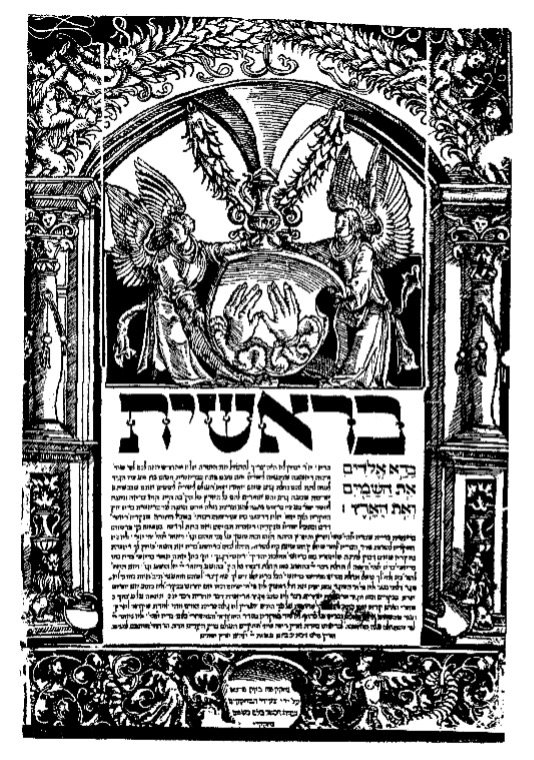
 

1514, Hameshei Humshei Torah
Courtesy of the Library of the Jewish Theological Seminary

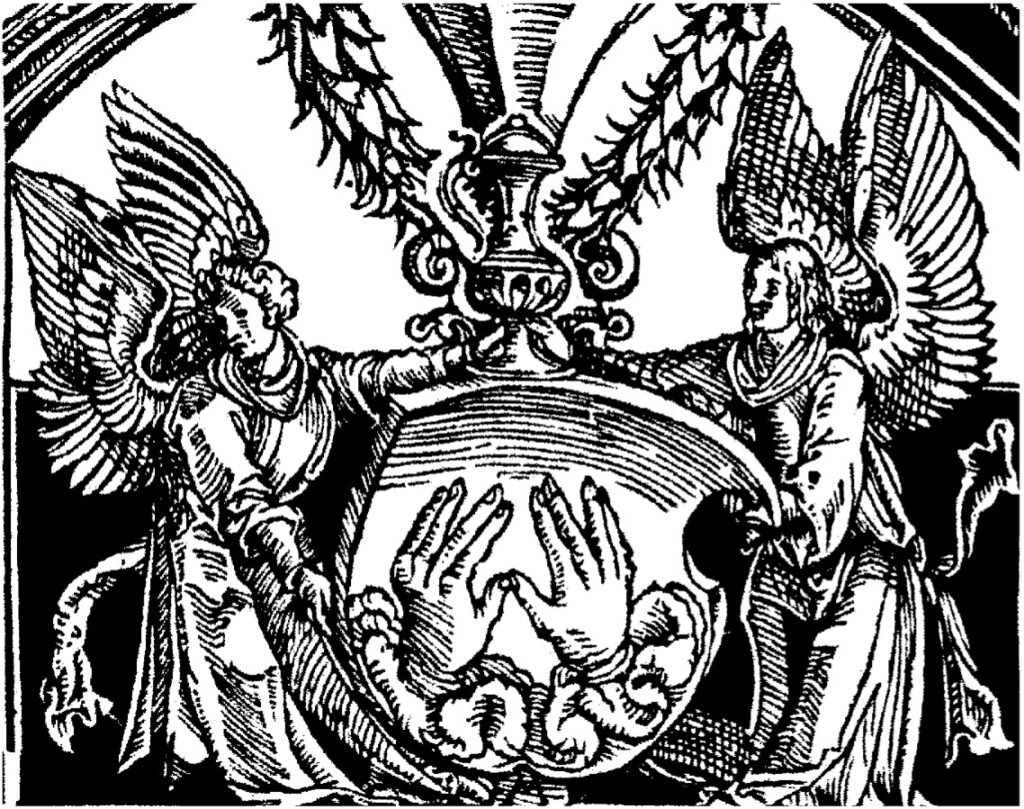
A magnificent edition, with ornate woodcut frames and large type for the text. Each book has a unique decorative opening page, there is no title page, comprised of four separate pieces, those on the pillared sides with vases, leaves, and cherubim, similar but not identical, the top piece with a concave bottom edge. Genesis has a convex curved piece to fit with this top piece on the upper half of the page, with winged cherubim holding a shield with the spread hands of the Kohen giving the priestly blessing.[9]

Work on the Pentateuch began on 10 Sivan (June 14, 1514) but, perhaps as a result of the success of the prayer book, the partners found they had overextended themselves and found it necessary to suspend work on this project for two years. In 1530 Gershom and his sons reprinted this Pentateuch in an identical format, except for changes to the decorated initial pages.

1527, Dictionarium ChaldaiOur next entry with cherubim is an Aramaic grammar by the Christian-Hebraist scholar Sebastian Muenster (1489-1552). It was printed in Basle in 1527 at the press of Johannes Froben in quarto format (40: [1], 434, [7] pp.). The Froben family was the most significant printers of Hebrew books in Basle. Johannes Froben published as many as 250 titles, among them Hebrew/Latin books of the Bible and grammatical works, primarily works by Muenster.

Sebastian Muenster, a cosmographer, astronomer, and orientalist was, for twenty three years, professor at Basle. Born in Niederingelheim, Hesse, the son of a Spitalmeister (hospital master), Muenster had no university education nor did he ever receive a degree. His education consisted of some private instruction in Latin and later studies at Frieberg and attendance at lectures given by the Franciscans. In 1506, Muenster entered the Minorite order and was sent to study in Rufach under Conrad Pellican (Pellicanus, 1478-1556). The following year he took vows and, in 1512, was ordained a priest. Muenster assisted Pellican in teaching in Pforzheim and, from 1524-29, occupied the chair of Hebrew at the University of Heidelberg. In 1529, Muenster converted to Protestantism and moved to Basle, where he occupied the chair of Hebrew, at a salary of 60 gulden; from 1547/8 he was rector. From about 1525, Muenster was a student of Elijah Levita, translating and editing his grammatical works. Muenster also translated a number of other Hebrew works into Latin and was a prolific author in his own right. By the time of his death more than 100,000 volumes of his works were in circulation. His Jewish oeuvre, more than three-score publications, covers all aspects of Judaica, excepting Kabbalistic studies, which did not interest him. In 1523, Muenster published Dictionarium Hebraicum . . . adiectis Chaldaicis vocabulis, his study of the Aramaic language. The book reads from left to right but the text follows the Hebrew alphabet. Words are given in vocalized Hebrew, followed by their etymology, definition and examples.

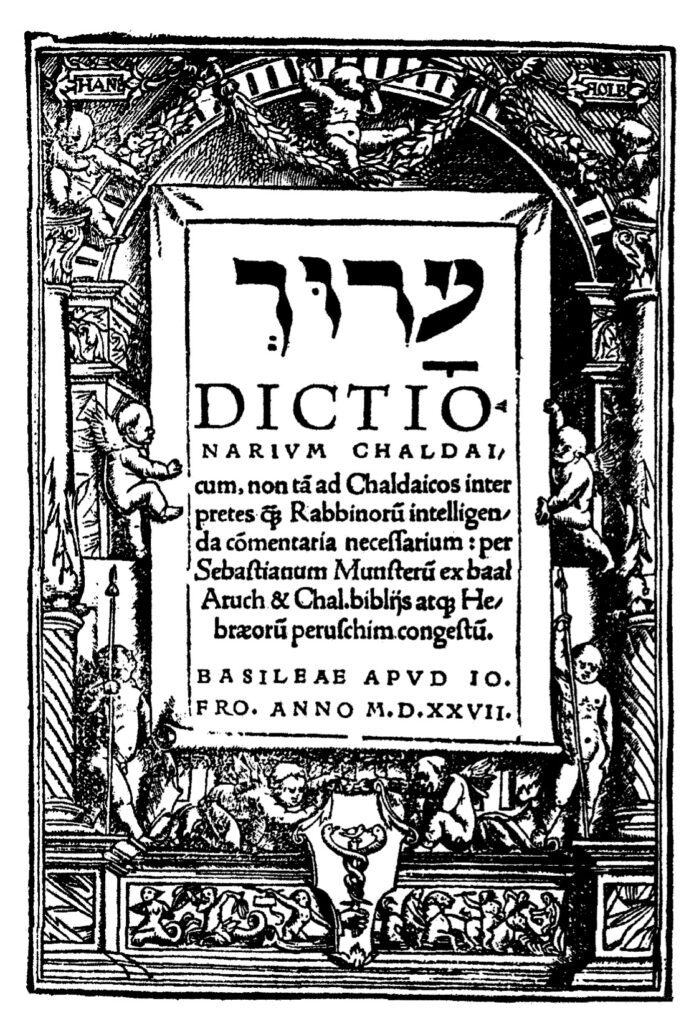
The title page of the Dictionarium Chaldai has an architectural frame with cherubim in various positions, as well as additional cherubim below mounted and otherwise. This title page, designed by Hans Holbein, was used as early as 1516 on Basel statutes and into the seventeenth century.[10] [11]

Not long afterwards, from 1540 through 1543, at least five titles were printed in three locations with varied images of cherubim on the title-page, that is Augsburg, Prague, and Bologna. That is not to say these frames were not used on other books, most likely they were, but rather these are examples of cherubim used by the printers of Hebrew books at the time.

Augsburg has an early history related to Hebrew printing. Several early anti-Jewish works beginning with the apostate Johannes Pfefferkorn’s Der Judenfeind (1509) and other anti-Semitic books by apostates were published there. Another early Augsburg publication of note, this certainly more positive, albeit not a Hebrew edition of that popular and much republished work, is the first printing of R. Joseph ben Abraham Gikatilla’s (1248–c. 1325) kabbalistic classic, Sha’arei Orah, which explains and analyzes the ten Sefirot. This edition of Sha’arei Orah is a Latin translation of that work by the apostate Paulus Ricius (Paulus Israelita, 1480-1541) under the title Portae lucis, published in 1516 at the press of Johann Miller.
1527, Dictiorionarim Chaldai
Courtesy of the Fales Library and Special Collections, New York University

Serious Hebrew printing in Augsburg begins when Hayyim ben David Shahor, among the pioneers of Hebrew printing outside of Italy, came to Augsburg in about 1533/34. In Augsburg, Schwarz worked in the print shop of Silvan Otmar (d. 1540), a renowned and highly productive printer, and resided in the home of Bonifacius Wolfhart, a Protestant pastor who also served as the censor of Hebrew books for Augsburg.[12] Shahor printed several works in conjunction with his son, Isaac, and his son-in-law, Joseph ben Yakar, who assisted him at the press, although their names are not mentioned on the title-pages.[13]

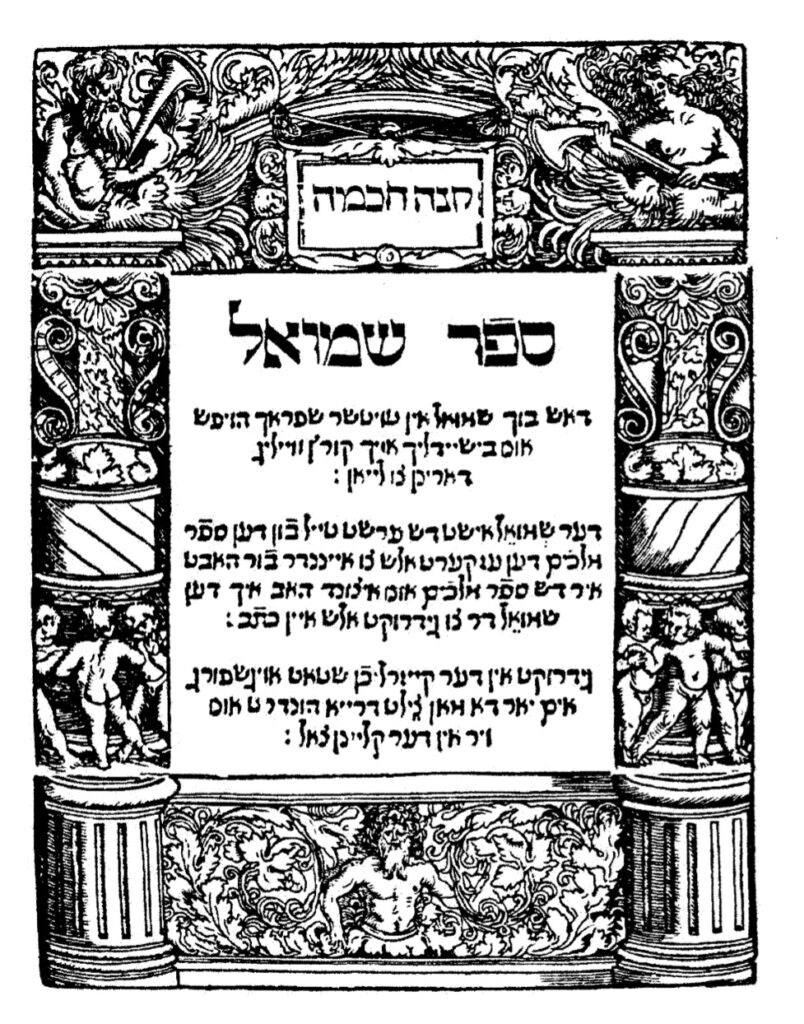
Shahor likely joined with a non-Jewish printer, perhaps August Wind, a printer of Hebrew works for Christian clergyman. Hayyim left for Italy, returning to Augsburg in 1540. He then printed three books, Avkat Rokhel, Arba’ah Turim and a prayer book for, according to the Thesaurus of the Hebrew Book, a total of ten works in Augsburg. Due to a lawsuit by an apostate, Paulus Aemilus, with whom Shahor had been associated in Ferrara, resulting from their failed venture, Shahor and his family were forced to cease publication and leave Augsburg. Aemilus, seeing a market in Augsburg for Hebrew/Yiddish books, began to print on his own account. He issued a small number of titles, most notably the Melokhim Bukh (1543) and the Shmuel Bukh (1544), Yiddish poetical renditions of the books of Kings and Samuel, both with images of cherubim (below).[14]

1540, Avkat Rokhel Our first Augsburg title is Avkat Rokhel, an eschatological work on the principles of faith attributed to R. Machir ben Isaac Sar Hasid, a student of R. Judah ben Asher, son of the Rosh. Printed in octavo format (80: 18 ff.), perchance by Shahor. The Thesaurus of the Hebrew Book attributes it, albeit in brackets, to Hayyim Shahor, in contrast to the National Library of Israel that records the printer as unknown.[15]

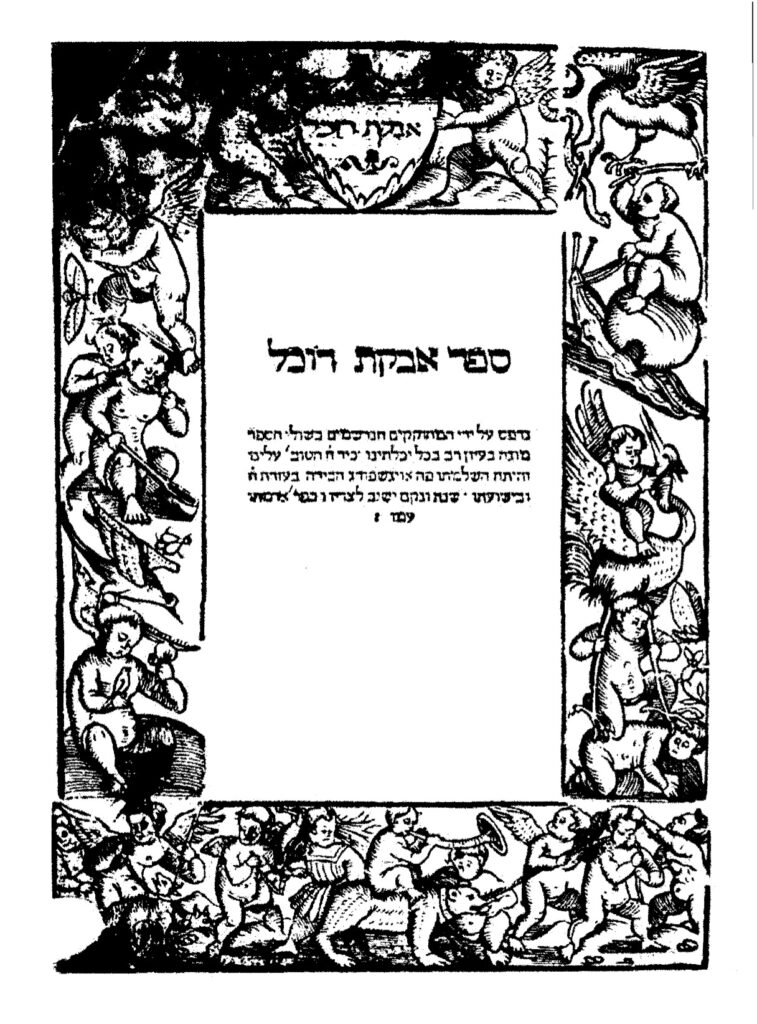
The text of the title page is set within a decorative frame with nineteen cherubim and a number of animals. The title-page states that it is,

Sefer Avkat Rokhel

Printed by the printers named at the end of the volume. Edited with great care, with all our ability, “the good hand of our [Lord] upon us,” (ref. Ezra 8:18). And it was completed, here Augsburg, the great city, with the help of the Lord and His salvation. In the year, “[Rejoice, O you nations, with his people; for he will avenge the blood of his servants,] and will render vengeance to his adversaries, and will make expiation כפר (300=1540) for the land of his people” (Deuteronomy 32:43).

The names of the printers, Hayyim Shahor, Isaac ben Hayyim, and Joseph ben Yakar, the statement on the title page notwithstanding, are not given at the end of the volume. A brief introduction informs that the work was named Avkat Rokhel (the perfumer’s powders, Song of Songs (3:7)) for as the perfumer’s powders strengthen the soul, so too when one reads this book will he fear and cause his soul to be pure and free from all sin and transgression, thus meriting the good.
1540, Avkat Rokhel
Courtesy of the Dorot Jewish Division New York Public Library

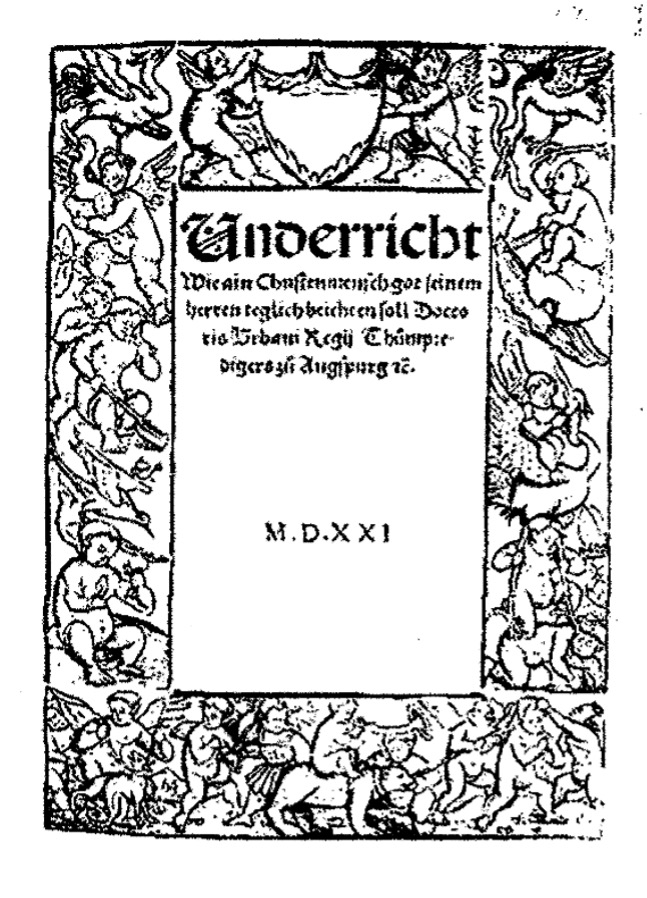
The like title-pages of Avkat Rokhel and Unterricht Wie ain Christenmensch, the latter a non-Hebrew work printed approximately two decades earlier, reflect a relationship between Jewish and Christian printers, that is, Christian printers published Hebrew books in association with Jewish associates. The relationship between the printers was mutually beneficial. For the Christian publisher “the Hebrew books sector, being unique, was attractive to investors, being more limited and not so wildly competitive as the Italian book sector.”[16] In addition to the non-Jewish printer’s access to the Jewish book market, the Jewish publisher was able to not only publish Hebrew books, but he also gained access to the typographical material of his Christian associate. The latter, for example, frequently provided attractive frames to the former after having used them for his market and the Jewish partner also utilized the printer’s other ornamentation. This was of value to the Jewish partner as he did not have to go the expense of having decorative material prepared, at a relatively much greater expense as it would be utilized for a much smaller market. This despite the fact that the frames were often incompatible with traditional Jewish sensibilities.[17]

1521, Unterricht Wie ain Christenmensch [18]

The like title-pages of Avkat Rokhel and Unterricht Wie ain Christenmensch, the latter a non-Hebrew work printed approximately two decades earlier, reflect a relationship between Jewish and Christian printers, that is, Christian printers published Hebrew books in association with Jewish associates. The relationship between the printers was mutually beneficial. For the Christian publisher “the Hebrew books sector, being unique, was attractive to investors, being more limited and not so wildly competitive as the Italian book sector.”[19] In addition to the non-Jewish printer’s access to the Jewish book market, the Jewish publisher was able to not only publish Hebrew books, but he also gained access to the typographical material of his Christian associate. The latter, for example, frequently provided attractive frames to the former after having used them for his market and the Jewish partner also utilized the printer’s other ornamentation. This was of value to the Jewish partner as he did not have to go the expense of having decorative material prepared, at a relatively much greater expense as it would be utilized for a much smaller market. This despite the fact that the frames were often incompatible with traditional Jewish sensibilities.[20]

The title-page of Avkat Rokhel has the largest number of cherubim of our title-pages, nineteen in all, of our title-pages. The cherubim appear on the bottom, sides, and top of the frame, all active, albeit in different activities. The text of Avkat Rokhel is in three parts, each further subdivided. The first section addresses the struggle against one’s evil urge prior to redemption and the birth pangs and advent of the Messiah, and an explanation of the pertinent midrashim; the second part discusses the rewards and punishments of the soul after the resurrection, the nature of the world to come according to Judaism, in contrast to the views of non-Jews, and resurrection; and the third part the laws stated by the sages of the Talmud as halakhah Moshe me-Sinai, the formation of man and the number 248 limbs in a person, the statement of our sages concerning three partners in that process (God, man, and woman) and some gematriot.

This is the third edition of Avkat Rokhel, it having been printed previously in Constantinople (1516) and Rimini (1526). Ch. B. Friedberg records, in his Bet Eked Sepharim, more than twenty-five printed editions of Avkat Rokhel. It was translated into Latin by A. Hulsius and printed in his Theologia Judaica, (Breda, 1653) and a Yiddish edition was prepared by Naphtali Pappenheim (Amsterdam, 1647).[21]

1543, Melokhim Buch Two additional works printed in Augsburg, attributed to Moses (Esrim ve-Arbeh) Ashkenazi, are Yiddish poetical renditions of the books of Kings and Samuel. Moses’ appellation, Esrim ve-Arbeh (24), derives from either his birthplace, Vierundzwanzig Hoefe (24 courts) in Wuerttemberg, or from his extensive knowledge of the 24 books of the Bible. Moses’ accreditation with either authoring or transcribing the Melokhim Bukh is due to its similarity to the Shmuel Bukh, more reliably attributed to him. Nevertheless, sufficient differences exist between the two works that many scholars believe they do not share a common author. It is clear, however, that the author, even if not this Moses, was an Ashkenazi Jew. The Melokhim Bukh was published in quarto format (40: [123] ff.) by, according to the colophon, Paulus Aemilus. A Latin colophon states, Augustae Vindelicorum/ per Paulum Aemilium, Anno/ Domini M. D. XLIII. Meyer Waxman suggests that it is doubtful, the colophon notwithstanding, that the publisher was Aemilus; more likely it was Hayyim Shahor.

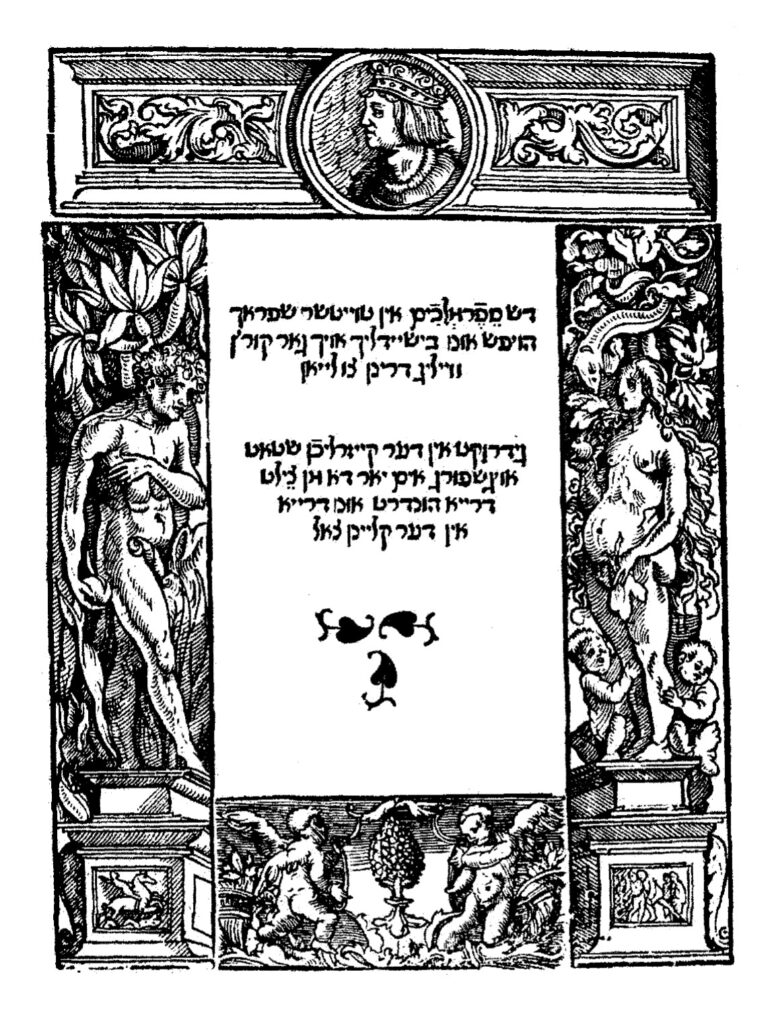
We have noted above that the frames on these title-pages were first used by Christian printers and that when that market no longer needed the frames, they were made available to Jewish printers. The cherubim frames noted above were generally acceptable to a contemporary renaissance Jewish public, although some, many, were questionable and would not be used today. In contrast, the title-page of the Melokhim Buch has a border made up of a four-part frame, the top with a representation of a king, the left and right sides respectively with images of Adam and Eve, unclad, the latter with the snake, two small children, and expecting. At the bottom are two cherubim. Use of this frame is surprising, for in contrast to other frames its’ contents appear to be objectionable, more so than other frames, even those with mythological characters. It seems likely that this frame might also be distasteful to Christian sensibilities.[22]

1543, Melokhim Buch
Courtesy of Dr. Moshe Rosenfeld

The title page states that it is “The book Melokhim (Kings) in Taytsher sprach, beautiful and clear and very entertaining to read. Printed in the imperial city of Augsburg in the year 303 (=1543)” [23] The colophon dates the completion of the work to Friday, 14 Av, 303 (July 25, 1543), which was a Sunday in 1543.

The Melokhim Bukh was not written as a sequel to the Shmuel Bukh. It is the older of the two books, originally written as a separate work, possibly as early as the fourteenth century. The format of the Melokhim Bukh, a rhymed paraphrase of the book of Kings, is that of the heroic epic, stylistically modeled after comparable German sagas, such as the Nibelungen. The subject matter is the events in Kings I and II, imaginatively and colorfully enhanced by material from the Talmud and Midrashim, all expressed with a deep piety. Intended as a complete history, it begins with a hymn of praise to God in three strophes followed by nine strophes from the Exodus to the last days of David, the contents of Kings, and as a sequel, the history of the Jews to the end of the second commonwealth in thirty strophes). An example of the text is,

You have frequently performed signs for the children of Israel;

Therefore they are obliged to have You for their Lord.

And to fear Your name-that is useful and good for them.

That man is foolish who acts contrary to Your word.[24]

1544, Shmuel Bukh The Shmuel Bukh was published, also likely by Hayyim Shahor in quarto format (Format 40: [102] ff.). It has an ornate title page made up of figurines above and about pillars with cherubim on the sides. It too is in Vaybertaytsh; among its reprints is a Latin edition (Ingolstadt,(1562). Waxman suggests that the Shmuel Bukh was likely written at least a hundred years earlier, most likely an original production of medieval Jewry. The author reworked the biblical material and incorporated aggadic elements. It was written in “vigorous poetic style” in eight line strophe and was meant to be sung.[25]

1544, Shmuel Bukh
Courtesy of Dr. Moshe Rosenfeld

In contrast to what was written above, “works that many scholars believe they do not share a common author,” Zinberg informs that both the Melokhim Bukh and the Shmuel Bukh are composed in the same verse-meter. Moreover, the title-page states that “Shmuel is the first part of

the book Melokhim, for it is all related.” Nevertheless, Zinberg quotes other sources that “these are two quite different works and were probably written by two different poets.”[26]

1553, Ma’yan GannimA composition book comprised of sample letters from R. Samuel ben Elhanan Jacob Archivolti (c. 1515-1611). Ma’yan Gannim was published in a small sextodecimo format (160: 45, [1] ff.) at the Venice press of Alvise Bragadin. The Bragadin press was active before the papal bull, dated August 22, 1553, by Cardinal Giovanni Pietro Caraffa, the future Pope Paul IV, an extreme reactionary and bitter anti‑Semite, who ordered the confiscation and burning of the Babylonian and Jerusalem Talmuds. This had a chilling effect on Hebrew printing and resulted in a considerable decline if not outright cessation of printing in Venice, and the subsequent expurgation and censorship of Hebrew books. When Hebrew printing resumed in Venice in 1563, among the Christian printers who took up the publication of Hebrew books was Alvise Bragadin. Bragadin died in the mid-1570’s, he was succeeded by his son, and after him by successive members of the family well into the eighteenth century, the last known Bragadin being Alvise III. Throughout that time the press remained a leading printer of Hebrew books in Venice.
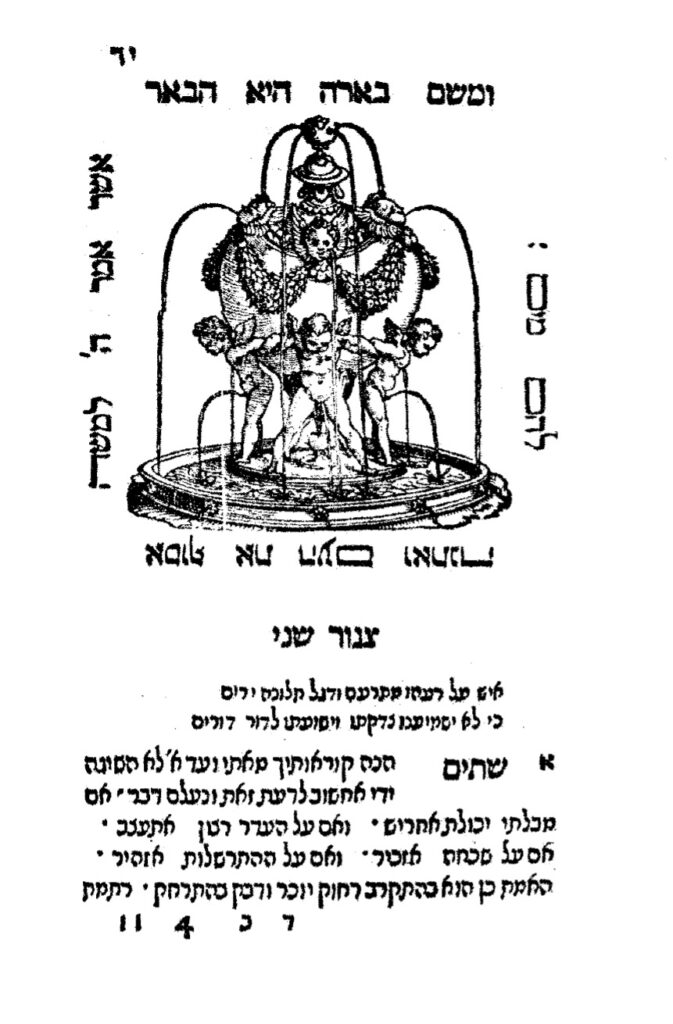
1553, Ma’yan Gannim
Courtesy of the Library of Agudas Chassidei Chabad Ohel Yosef Yitzhak

Archivolti, a student of R. Meir Katzenellenbogen (Maharam, 1473-1565), served as rabbi, av bet din, and rosh yeshivah in Padua. Among his students was R. Judah Aryeh (Leon) Modena (1571-1648). Prior to settling in Padua in 1568, Archivolti worked as a corrector for the Hebrew presses in Venice.

In contrast to our preceeding examples of cherubim, this exemplar does not appear on the title-page of the book, which has the Bragadin device, that is, three crowns, but rather at the beginning of each of the book’s five chapters, a woodcut illustration comprised of three cherubim in a cage, surrounded on all four sides by a verse.

The title is from “A fountain of gardens (ma’yan gannim), [a well of living waters, and streams from Lebanon” (Song of Songs 4:15). The text states that there are fifty letters, that is, twenty-five letters with their responses, written by Archivolti. There is a preface and introduction from Archivolti, followed by a table of contents, and, beginning on 7a, the text. Ma’yan Gannim is the first book written by Archivolti, for he describes it as his first fruits, an offering to the Lord. Archivolti also wrote Degel Ahavah (Venice, 1551), an ethical work; He’arot le-Sefer he-Arukh (Venice, 1553), textual references for the Arukh of Nathan ben Jehiel; and, his most important title, Arugat ha-Bosem (Venice, 1602) a grammatical work in 32 chapters.

The sections or chapters, each on a different theme, are correspondence between a father and son; between friends; from an older to a younger man; with government officials; and others, including letters of a romantic, and even sensual nature. Such letters, at the very least inappropriate by modern religious standards, are intermingled with those of a sacred nature, reflecting contemporary mores and addressing current issues, including therefore, information of historical and cultural value. Ma’yan Gannim is designed to teach through example the rules of correspondence. The letters are in metrical form, designed by Archivolti as literary models, many with ethical content, for his students.[27]

1556, She’ilot u’Teshuvot Jacob ben Moses Moellin (Maharil) – Two hundred and five responsa from R. Jacob ben Moses Moellin (Maharil, c. 1360-1447). The She’ilot u’Teshuvot were published in Cremona at the press of Vincenzo Conti in octavo format (80: [7] 79 ff.). After the Talmud was burned in Venice in 1554 there was a precipitous decline, if not a complete cessation, in the number of Hebrew books printed in Venice for several years. The breach was filled by presses in Ferrara, Sabbioneta, Cremona, and Riva di Trento. Vincenzo Conti (d. 1569) printed briefly in Sabbioneta and subsequently in Cremona, where his press was active from 1556 to 1567, issuing more than forty titles.

Maharil was the leading halakhic authority of his time. His most important work is Sefer Maharil (Minhagei Maharil, 1556, Sabbioneta), a popular and influential work on customs and laws. It was composed by his pupil Eleazar ben Jacob (Zalman of St. Goar), from the discourses that he heard from Maharil. She’ilot u’Teshuvot is comprised of Two hundred and five responsa, a small part only of Maharil’s responsa. The subject matter, as in the Sefer Mahril, deals to a great extent with custom, but also includes much personal material. They also reflect Maharil’s considerable humility and compassion.
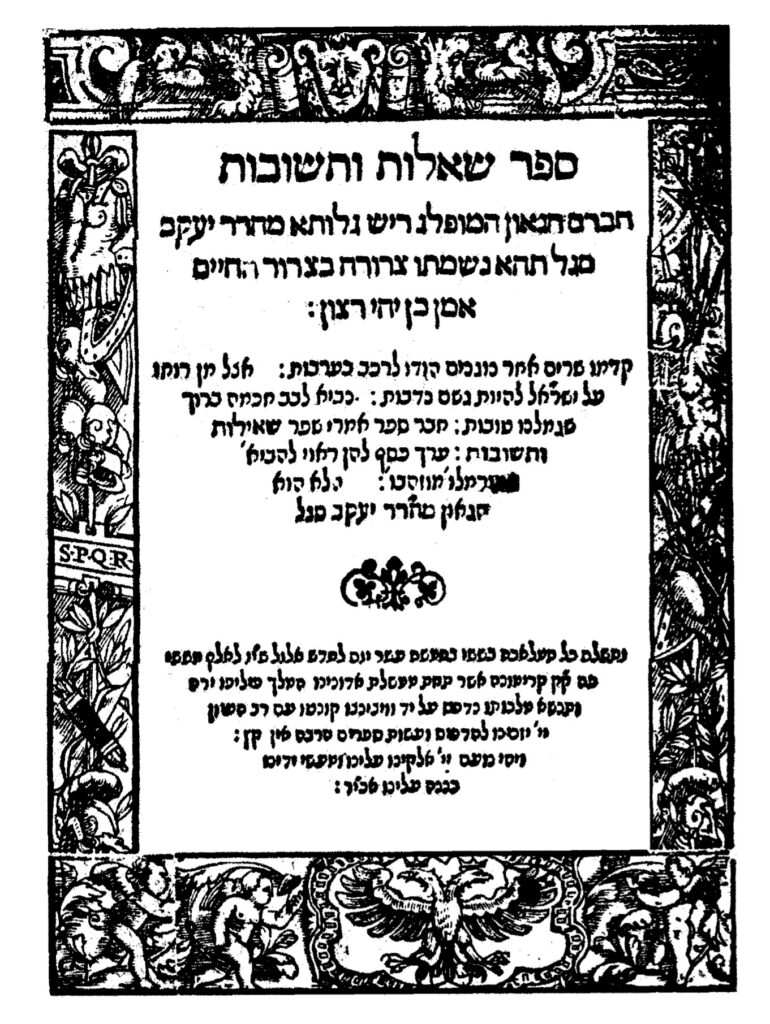
1556, She’ilot u’Teshuvot Jacob ben Moses Moellin (Maharil)
Courtesy of the Library of Agudas Chassidei Chabad Ohel Yosef Yitzhak

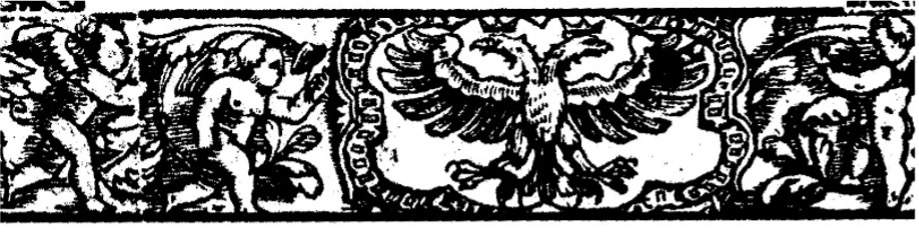
The title-page has an ornamental frame made up of four parts, enabling the printer to use them in other arrangements, although this is the manner in which the parts are most often employed. The top frame has the face of a man and cherubin; on the sides are suits of armor, shrubs, and musical instruments and, in the center of the left vertical frame the letters SPQR, reputedly standing for Senatus Populusque Romanus; and on the bottom a two headed crowned eagle and on the sides the cherubim. This frame was used by Conti on his early imprints, appearing on about ten works.

1558, Sefer Rav Alfas Sefer Rav Alfas, (Hilkhot Rav Alfas, Sefer ha-Halakhot of Alfasi, Rif) was published in Riva di Trento by R. Joseph Ottolenghi and Cardinal Cristoforo Madruzzo in a three volume folio format (20: 288, 268, 302 [8] ff.). The Tyrolese town of Riva di Trento is the source of an unusual episode in the history of the Hebrew book. It was for a short time, from 1558 to 1562, a refuge for the Hebrew book; one in which about forty Hebrew titles were printed. Believed to be the first work printed in Riva di Trento, Hilkhot Rav Alfas was likely selected, in addition to its inherent popularity and value, due to the ban on the Talmud, the Rif, being a halakhic compendium of the Talmud, filling, to some extent, the gap left by the scarcity of that work.

It was in Riva di Trento that Cardinal Cristoforo Madruzzo (1512-78), Cardinal of Trent, a scholar and supporter of learning, who argued at the Council of Trent (1562) for leniency and moderation in condemning books, became the patron and protector of a Hebrew press, which was also a source of revenue for him. Ottolenghi (d. 1570), originally of Ettlingen, in Baden, Germany, reflected in its Italianized form in his name, was rosh yeshivah at Cremona, and under his tutelage Talmudic studies had continued in Cremona after that work had been banned and burned elsewhere. He assisted the press, providing indices and annotations to a number of works and assuring that material offensive to the church had been deleted from those books of value to his yeshiva. and R. Jacob Marcaria, a dayyan on the bet din presided over by Ottolenghi and a physician, recruited by Madruzzo help finance and play a role in the press. Marcaria edited and wrote brief prefaces for most of the books printed in Riva di Trento. The press was located in the house of Antonio Broën.

Sefer Rav Alfas is a halakhic compendium by R. Isaac ben Jacob Alfasi (Rif, 1013-1103). Alfasi, born in the Algerian village of Qal’at Hammad, was a student of the great sages R. Nissim ben Jacob (c, 990-1062) and Hananel ben Hushi’el (d. c. 1055) in Kairouan. After learning with them Alfasi relocated to Fez, from where his surname al-Fasi (Rif) is derived, and became recognized as the leading Talmudic sage of the time. In 1088, at the age of 75, two informers denounced him to the government – the charges are unknown – and he was forced to flee to Spain. Eventually settling in Lucena, Alfasi succeeded R. Isaac ben Judah ibn Ghayyat (c. 1020-89), who had died a few months earlier, as head of the yeshiva.
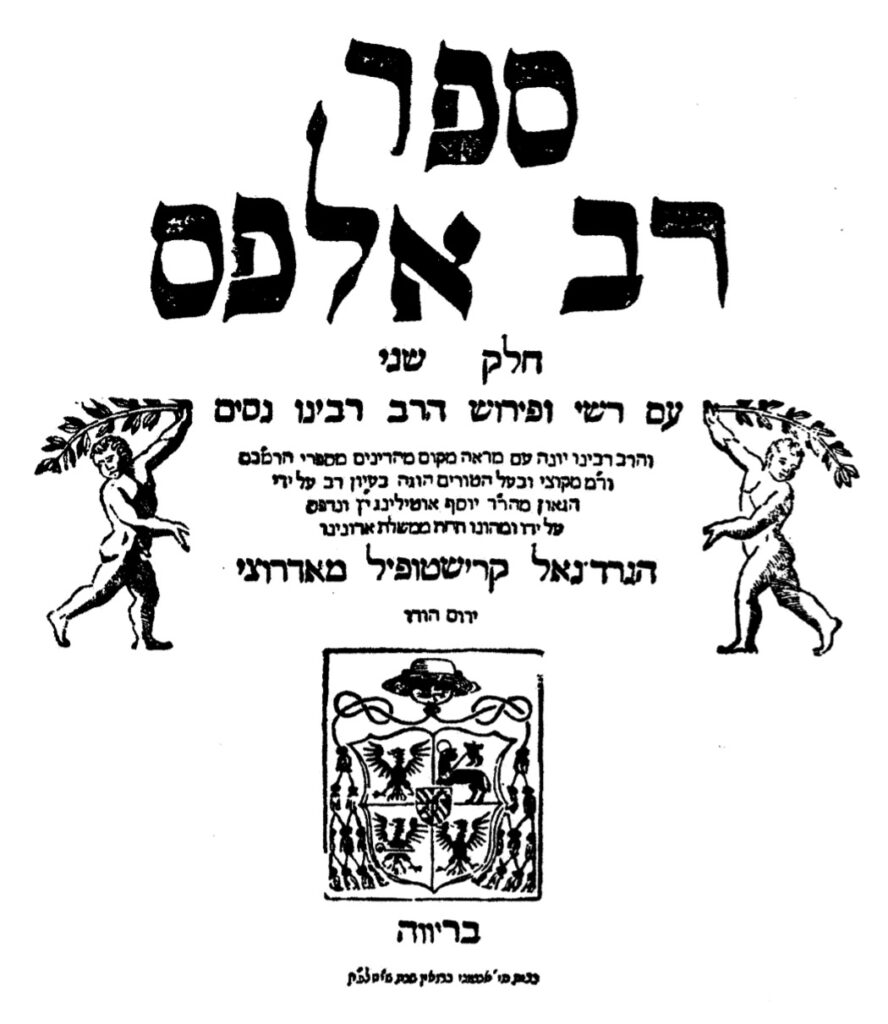
1558, Sefer Rav Alfas
Courtesy of the National Library of Israel

The text of the title-page of each volume has cherubim at the sides, and below bears the Cardinal’s coat‑of‑arms , a significant statement of the Cardinals’ support and protection of the press at a time when his church was burning and banning Hebrew books. Furthermore, the title pages informs that Sefer Rav Alfas was edited with great care by the gaon R. Joseph Ottolenghi and was printed and financed by him, and that this was done, “in the dominion of” the following in bold letters “Cardinal Cristoforo Madruzzo.”

Sefer Rav Alfas, Alfasi’s major work, is one of the greatest works in halakhic literature. It is extracts all pertinent legal decisions from the Talmud, eliminating non-halakhic material, discussions, and subject matter not applicable today. It covers the following orders of the Talmud, Mo’ed, Nashim, and Nezikim, as well as tractates Berakhot and Hullin. Laws in Kodashim and Tohorot, such as mezuzah and tefillin, are organized as Halakhot Ketannot. Sefer Rav Alfas differs from earlier works, such as Halakhot Gedolot, in that it is more comprehensive, more detailed, and by the inclusion of material from the geonim, although, like them, it follows the order of the tractates.

1559-60, ZoharClassic kabbalistic work of Jewish mysticism, attributed to R. Simeon bar Yohai (second century). This, the second printing of the Zohar, it was published previously in Mantua (1558-60), published in Cremona at the press of Vincenzo Conti in a three volume folio format (20: 132, 122, 146 ff.) by Vincenzo Conti (d. 1569). Conti, who had printed briefly in Sabbioneta, is better known for his activity in Cremona, where his press, active from 1556 to 1567, issued more than forty titles.

The title page of has a decorative architectural frame with an arch, at the top a vignette of Akedat Yizhak (the binding of Isaac), surmounted by an eagle, and accompanying cherubim; below in the bottom squares, figurines, perchance also cherubim. It is dated, “For the Lord will not forsake כי לא יטש (319=1559) his people [for his great name’s sake] (Samuel I 12:22), and it was completed in the year ש”ך ([5]320=1560).” At the bottom of the page is an imprimature from the Inquisition on the title page, the sole Cremona imprint to place it there, as well as a longer permission at the end of the book.
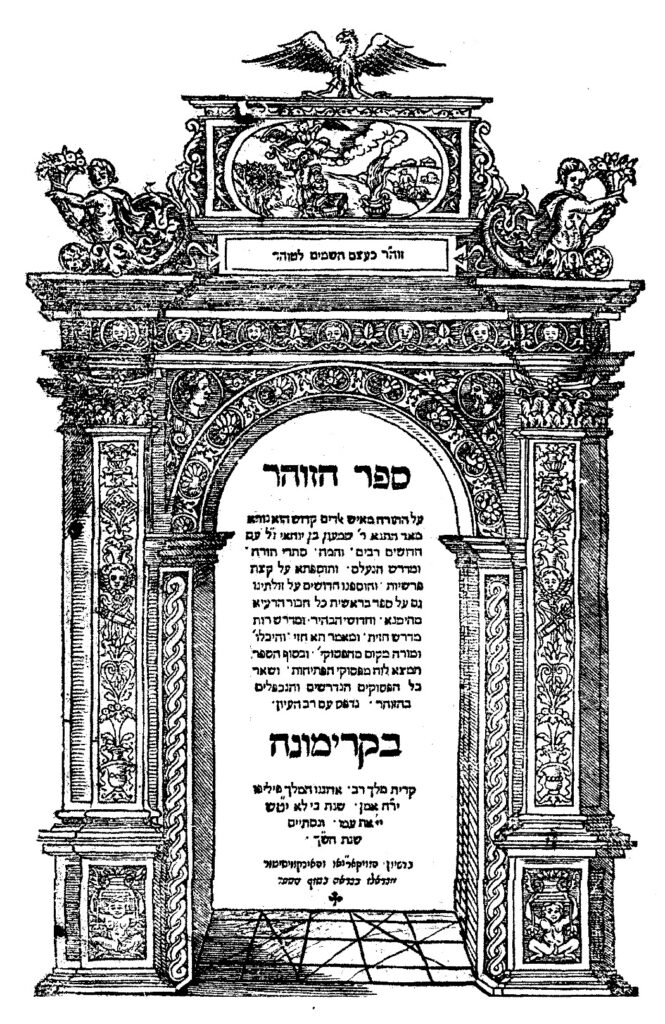
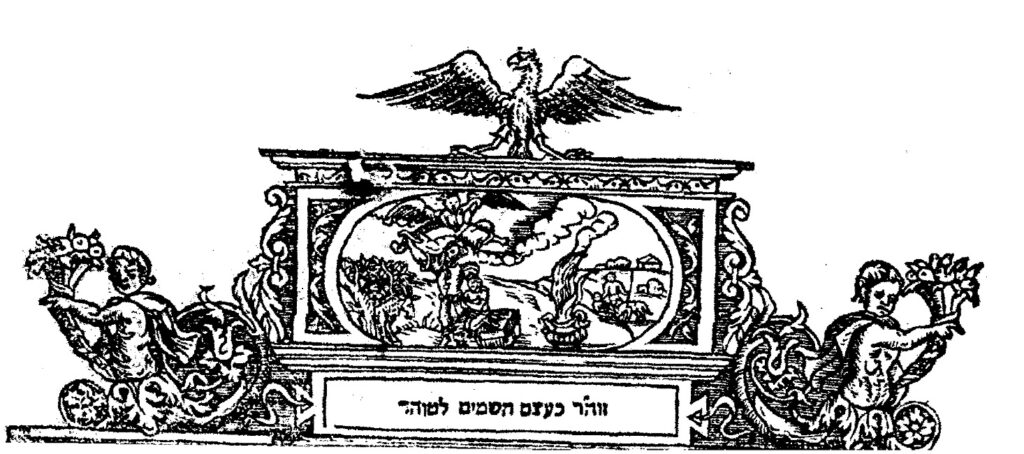
1559-60, Zohar
Courtesy of the Library of the Jewish theological Seminary

Written in Aramaic and Hebrew, Sefer ha-Zohar al ha-Torah is a comprehensive system of kabbalistic theosophy, encompassing cosmology, the soul, and good and evil. It is an esoteric commentary on the Torah, with homilies, midrashic passages, parables, and numerous discursive passages. It is based on the concept that within scriptures is a concealed stratum, deciphered by Kabbalah, expressing the inner meaning of the Torah, with its “splendor, beauty, and greatness.”

The corrector (and expurgator) was the apostate Vittorio Eliano, grandson of the foremost grammarian, Elijah Bahur Ashkenazi Segal. A member of a Dominican commission to review Hebrew books, Eliano was associated with all the books published by Conti from 1558 through 1559. Although begun later than the Mantua edition, noted above, this printing, done in haste, was completed earlier. Nevertheless, it was not immediately released for sale, for when more than 10,000 Hebrew books were burned in Cremona, with the complicity of Eliano, the entire edition was seized. It was just barely saved, in contrast to other works, by the apostate Dominican, Sixtus of Siena. It is known as the Zohar Gadol (large Zohar), in contrast to the smaller Mantua edition (Zohar Katan), and is also referred to, because of Eliano’s involvement, as the “Christian edition.” This notwithstanding, the Cremona edition was the preferred of the two editions by eastern European kabbalists.[28]

1560, Shir ha-Yihud – Shir ha-Yihud (Hymn of Divine Unity) an anonymous piyyut (liturgical poem) written in the mid-twelfth century, most often attributed to Samuel ben Kalonymus he-Hasid (c. 1130-1175), less often to his son, Judah ben Samuel he-Hasid (c. 1150-1217), author of the Sefer Hasidim, both among the foremost representatives of the Hasidei Ashkenaz, and, on occasion, to yet others.
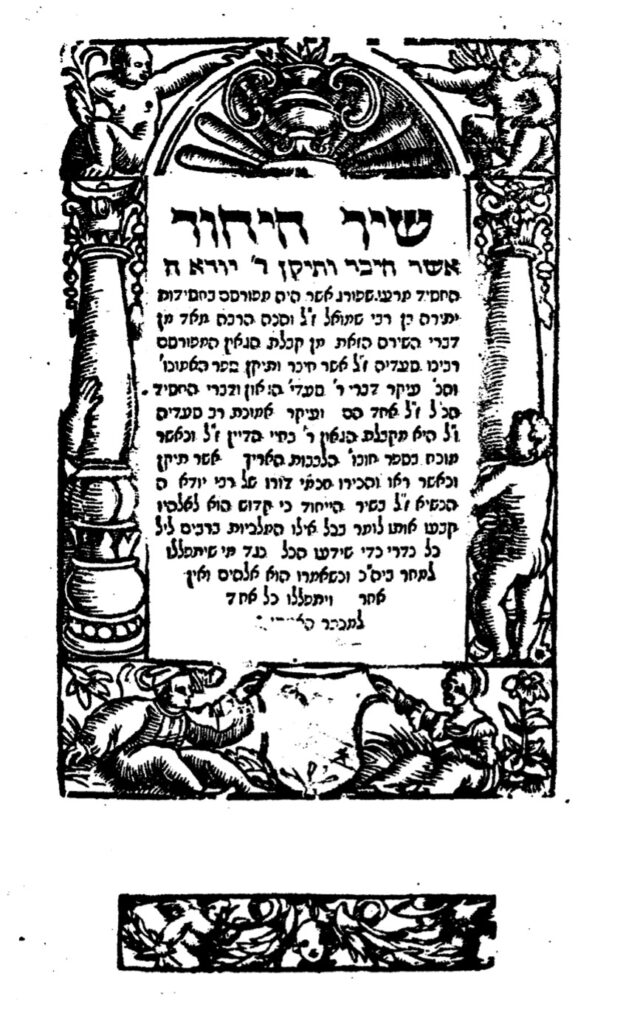
Shir ha-Yihud
Courtesy of the National Library of Israel

Shir ha-Yihud was published at the press of Eliezer and Joseph ben Naphtali Hertz Treves. Active for one year only, in 1560, they issued six books, before being forced to close by a meeting of the leaders, both Protestant and Catholic, of the Swiss Confederation in June, 1560, who feared that they were about to print the Talmud.

The frame, one of several with cherubim employed by the press, also was used on the title-page of Begidat Hazman, an allegoric maqāma (a poetic narrative in rhymed prose) by Mattathias (Mattityah ben Moses), a 15th century Spanish or Provençal Hebrew poet or Mattathias ha-Yiẓhari, a representative of the Jewish communities of Aragon at the Tortosa disputation (1413–14).

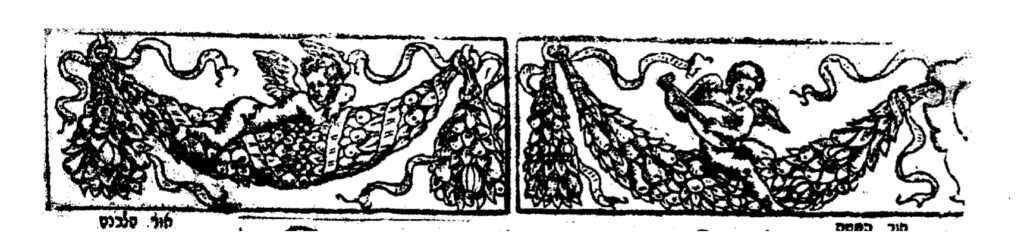
1568, Passover Haggadah Passover Haggadah printed in Mantua in folio format (20: 36 ff.) by Joseph Shalit ben Jacob Ashkenazi of Padua. This edition is a reprint of the 1560 Passover Haggadah, also printed in Mantua, but with modifications and the addition of the marginalia of R. Joseph Shalit ben Jacob Ashkenazi of Padua entitled Nimukei Yosef.
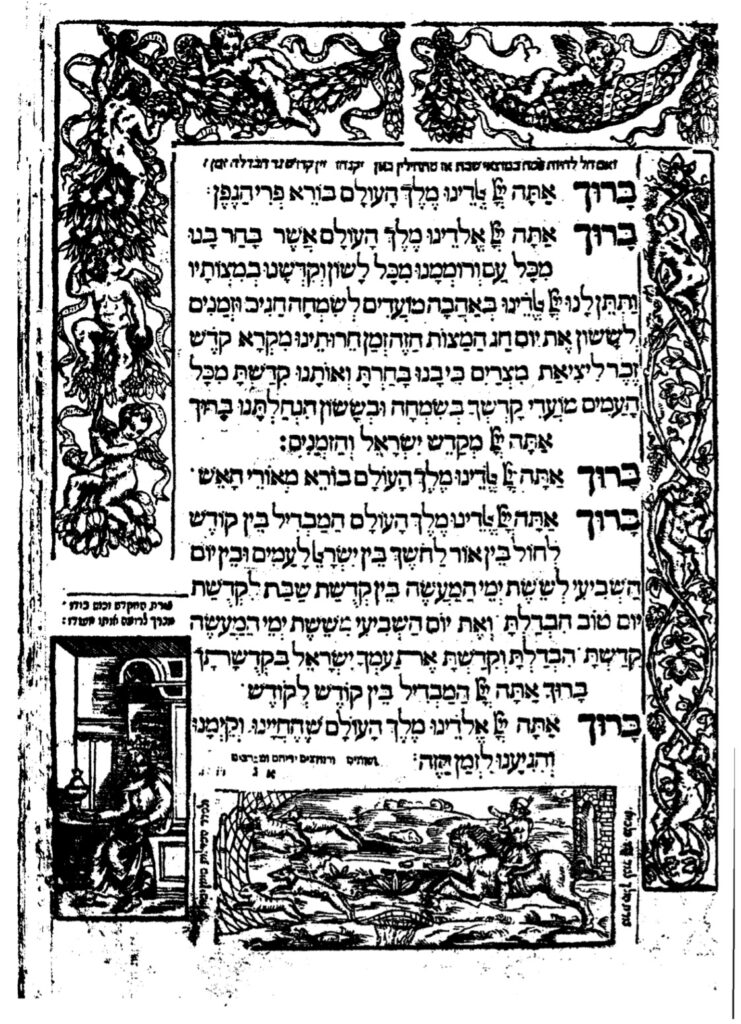
1568, Passover Haggadah
Courtesy of the National Library of Israel

The title page frame has representations of the Mars and Minerva followed by the first text page, which has two woodcuts of cherubim along the top. Following text pages have those cherubim image, as well as numerous other cherubim images, including several marginal cherubim images. This Haggadah shares some features with the Prague Haggadah of 1526. Woodcuts are accompanied by captions, given as rhymed couplets, a feature of Ashkenaz manuscript Haggadot. In some instances, for example, by the four questions, the earlier edition was framed by a lush Italian border, without illustrations. Here the types and the top and upper left borders with their vines and cherubs only are alike.[29]


1576, Yosef LekahYosef Lekah is a commentary on Megillat Esther by R. Eliezer ben Elijah Ashkenazi (1513-86). It was published in Cremona in 1576 by Christopher Draconi in octavo format (40: 83, 1 ff.). Draconi, previously associated with Vincenzo Conti, attempted to publish Hebrew books in Cremona. Although he would issue Latin books from 1569 to 1614, he printed one Hebrew book only, Yosef Lekah.
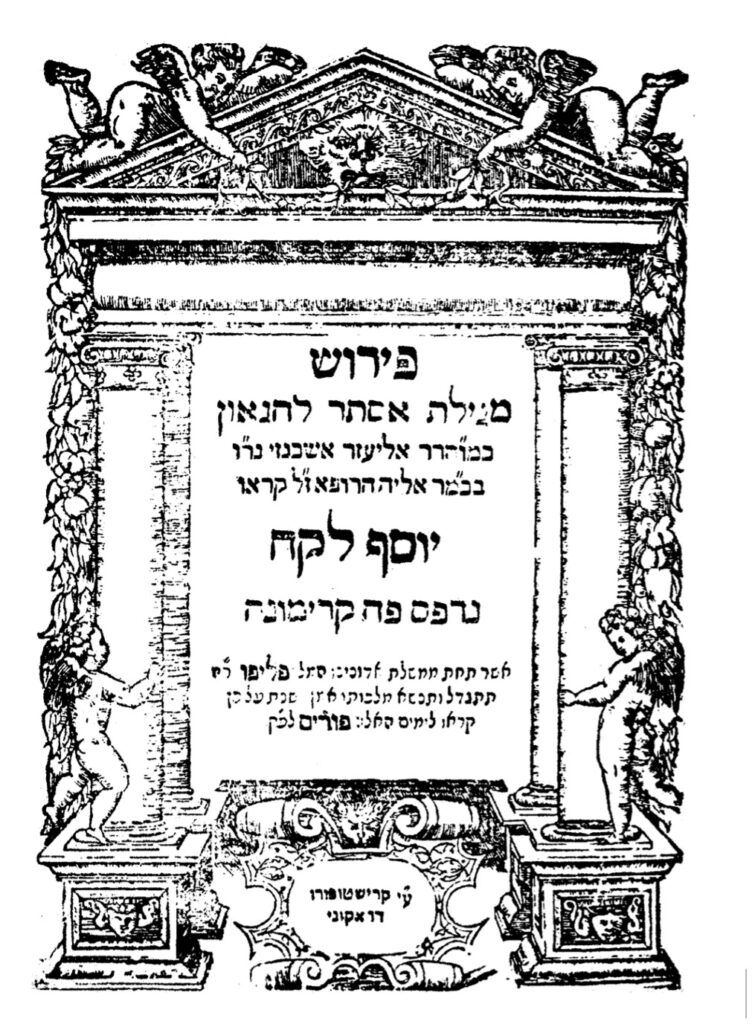
1576, Yosef Lekah
Courtesy of the Fales Library and Special Collections, New York University

R. Eliezer ben Elijah Ashkenazi was a multi-faceted individual, a Talmudist, physician, and well-rounded scholar, who served as rabbi in a number of varied communities. His first rabbinic position, from 1538-61, was in Fostat, Egypt. Forced to leave Fostat, Ashkenazi went to Famagusta, Cyprus, where he was rabbi for two years, and then to Venice. He left for Prague (1561), after a dispute with the Maharam of Padua, and after traveling as far as the Crimea, returned, via Famagusta, to Venice. Ashkenazi was next rabbi in Cremona, where he published Yosef Lekah. Shortly after he left to be rabbi of Posen, and, from 1584, was in Cracow. Ashkenazi experienced difficulties in Poland, disputing over his right to open a yeshiva in close proximity to an existing yeshiva, so that Joseph Solomon Delmedigo (1591-1655) wrote about him, “You have brought a vine from Egypt; you have cast out the nations, and planted it” (Psalms 80:9). Ashkenazi was highly regarded by his contemporaries, corresponding with prominent rabbinic figures such as R. Joseph Caro, R. Joseph Ha-Kohen (Katz), R. Moses Isserles (Rema), and R. Solomon Luria (Maharshal), several mentioning him in their responsa. R. Elijah of Pesaro, in Famagusta in 1563, praised Ashkenazi’s scholarship, noting that he was fluent in twelve languages.

The title-page has four cherubim images, two reclining at the top of the structure, two standing erect by the pillars at the sides. The title-page is dated “Therefore they called these days Purim קראו לימים האלו פורים (336 = 1576)” (Esther 9:26). Yosef Lekah is dedicated to Don Joseph Nasi, Duke of Naxos, whom Ashkenazi, in the introduction, compares to Joseph in Mizraim and Mordecai at the time of Ahasuerus. Ashkenazi, therefore, entitled this work Yosef Lekah. Two, almost identical, editions of Yosef Lekah exist, both dated 1576. Although almost exact copies of the original, it is clear, upon close examination, that the book was reset. Christopher Draconi’s Yosef Lekah was the last Hebrew book printed in Cremona.

Ashkenazi’s most important work is Ma’aseh HaShem (Venice, 1583), on the historical occurrences in the Torah, with a commentary on the Passover Haggadah; selichot; and, not extant today, a super-commentary on the Ramban (Nachmanides) and annotations to R. Caro’s Beit Yosef.[30]

Conclusion – In this article we have described books printed in Augsburg, Basle, Cremona, Mantua, Prague, and Venice. The cherubim imagery on these title-pages, reflecting the influence of Renaissance humanism, their attractiveness notwithstanding, do not appear on the title-pages or accompanying the text in Hebrew books published in more modern times. A review of the title-pages reproduced here, all dissimilar, with their numerous depictions of cherubim, attest to the popularity of that image. Given the strictures on Hebrew printing from the mid-sixteenth century in Italy, the frequent use of cherubim testify to the cooperation of Jewish and non-Jewish printers, their frequency perchance suggesting a positive relationship going beyond mere monetary gain.

We conclude with the Talmudic statement above, which suggests why the image of cherubim was so popular:

Rav Ketina said: When the Jewish people would ascend for one of the pilgrimage festivals, the priests would roll up the curtain for them and show them the cherubs, which were clinging to one another, and say to them: See how you are beloved before God, like the love of a male and female. (Yoma 54a)

Lastly, in conclusion an image of a cherub, both chronologically and, in cherubian activity, quite different from those depicted in this article. It is included as it is unusual and eye catching, an image of a Cherub smoking a pipe. It appears in in at least two Basle imprints published by Israel ben Moses ben Abraham Halle, active in Offenbach, although not continuously, from 1718/19 to c. 1738/43. The works are Anaf Etz Avot, R. Benjamin ben Yekutiel Wulff’s commentary on Pirke Avot, and tractate Sanhedrin (1721).[31]

  1. Once again, I would like to express my gratitude and appreciation to Eli Genauer for reading the article and his insightful comments.
  2. Emil G. Hirsch, W. Muss-Arnolt, J. Frederic McCurdy, Louis Ginzberg, “Cherub ( ; plural, Cherubim)” Jewish Encyclopedia IV (New York, 1901-06), pp. 13-16; Shalom M. Paul, Louis Isaac Rabinowitz, “Cherub” Encyclopedia Judaica IV (Jerusalem, 2007), pp. 600-01.
  3. Thomas Kelly Cheyne, 1911 Encyclopædia Britannica, Volume 6, reproduced in https://en.wikisource.org/wiki/1911_Encyclop%C3%A6dia_Britannica/Cherubim
  4. https://www.sefaria.org/search?q=%D7%9B%D7%A8%D7%95%D7%91%D7%99%D7%9D&tab=text&tvar=1&tsort=relevance&svar=1&ssort=relevance.
  5. Franz Sales Meyer, Handbook of Ornament: a Grammar of Art, Industrial and Architectural Designing in all its Branches for Practical as well as Theoretical use (New York, 1957), pp. 108-09.
  6. Codices and early imprints did not have title-pages, the first leaf normally being left blank to protect the book, that page later becoming a dedicated page. The first book with a detailed title-page was the Calendarium of Johannes Regiomontanus, appearing in 1476 (Venice), being a fifty-five year calendar (1475-1530), printed by Johannes Regiomontanus. The first Hebrew book with a title-page was the Sefer ha‑Roke’ah (Fano, 1505) of R. Eleazar ben Judah of Worms (c. 1165 – c. 1230).
  7. Cherubim also appear on the frames of Hebrew books printed in the incunabular period. For examples of such frames see Marvin J. Heller “Behold, you are beautiful, my love: The Use of Ornamental Frames in Hebrew Incunabula” Printing History NS 10 (New York, July, 2011), pp. 39-55, reprinted in Further Studies in the Making of the Early Hebrew Book (Leiden/Boston, 2013), pp. 3-33.
  8. The following book descriptions are selected, modified from Marvin J. Heller, The Sixteenth Century Hebrew Book: An Abridged Thesaurus ( Brill, Leiden, 2004), var. cit.
  9. Avraham Yaari, Hebrew Printers’ Marks (Jerusalem, 1943), pp. 7 and 126-27 n. 10 [Hebrew].
  10. Jerome Friedman, The Most Ancient Testimony. Sixteenth-Century Christian-Hebraica in the Age of Renaissance Nostalgia (Athens, Ohio, 1983), pp. 44-48, 214-15; A. M. Habermann, Title Pages of Hebrew Books (Tel Aviv, 1969), p. xi [Hebrew with English introduction], pp. 19-20, 125-26 nos. 4-5; Joseph Prijs, Die Basler Hebräischen Drucke (1492-1866) (Olten, 1964), pp. 49-51 n. 26; Frank Rosenthal, “The Rise of Christian Hebraism in the Sixteenth Century,” Historia Judaica II (New York, 1945), (New York, 1945), pp. 182-91; and Richard S.Westfall, “Sebastian Muenster,” http://es.rice.edu/ES/humsoc/Galileo/Catalog/Files/muenster.html
  11. An interesting example of this later usage is R. Moses ben Hanokh Altschul’s (c. 1546–1633) Brant Shpigl, a popular Yiddish work on ethics, correct demeanor, and customs for women, published by Konrad Waldkirch (Basle, 1602), also indicative of the passage of typographic material between printers.
  12. Stephen G. Burnett, “German Jewish Printing in the Reformation Era (1530-1633),” University of Nebraska – LincolnUniversity of Nebraska – Lincoln DigitalCommons@University of Nebraska – LincolnDigitalCommons@University of Nebraska.
  13. Ch. B. Friedberg, History of Hebrew Typography of the following Cities in Central Europe: Altona, Augsberg, Berlin, Cologne, Frankfort M., Frankfort O., Fürth, Hamberg, Hanau, Heddernheim, Homberg, Ichenhausen, Neuwied, Wandsbeck, and Wilhermsdorf. Offenbach, Prague, Sulzbach, Thannhausen from its beginning in the year 1513 (Antwerp, 1935), pp. 29-31 [Hebrew].
  14. A. M. Habermann, “The Printer Hayyim Shahor, his Son Isaac and Son-in-law Joseph Yakar,” in Studies in the History of Hebrew Printers and Books (Jerusalem, 1978), pp. 103-07 [Hebrew].
  15. Yeshayahu Vinograd, Thesaurus of the Hebrew Book. place, and year printed, name of printer, number of pages and format, with annotations and bibliographical references II (Jerusalem, 1993-95), p. 2 no. 10 [Hebrew].
  16. Zipora Baruchson, “Money and Culture: Financing Methods in the Hebrew Printing Shops in Cinquecento Italy,” La Bibliofilia 92 (1990), 25.
  17. For examples of such usage see Marvin J. Heller, “Behold, you are beautiful, my love: The Use of Ornamental Frames in Hebrew Incunabula” Printing History NS 10 (New York, July, 2011), pp. 39-55, reprinted in Further Studies in the Making of the Early Hebrew Book. (Brill, Leiden/Boston, 2013), pp. 3-33; “Mars and Minerva on the Hebrew Title Page,” The Papers of the Bibliographical Society of America 98:3 (New York, N. Y., 2004), pp. 269-92, reprinted in Studies in the Making of the Early Hebrew Book (Brill, Leiden/Boston, 2008), pp. 1-17; and the “The Printer’s Mark of Marc Antonio Giustiniani and the Printing Houses that Utilized It,’ Library Quarterly, 71:3 (Chicago, July, 2001), pp. 383-89, reprinted in Studies, pp. 44-53.
  18. Unterricht Wie ain Christenmensch by Urbanus Rhegiosu (1489-1541), a Protestant Reformer active in Northern and Southern Germany promoting Lutheran unity in the Holy Roman Empire. Unterricht is one of several titles with this frame printed by Silvan Otmar of Augsburg (https://www.flickr.com/photos/58558794@N07/6576279085).
  19. Zipora Baruchson, “Money and Culture: Financing Methods in the Hebrew Printing Shops in Cinquecento Italy,” La Bibliofilia 92 (1990), 25.
  20. For examples of such usage see Marvin J. Heller, “Behold, you are beautiful, my love: The Use of Ornamental Frames in Hebrew Incunabula” Printing History NS 10 (New York, July, 2011), pp. 39-55, reprinted in Further Studies in the Making of the Early Hebrew Book. (Brill, Leiden/Boston, 2013), pp. 3-33; “Mars and Minerva on the Hebrew Title Page,” The Papers of the Bibliographical Society of America 98:3 (New York, N. Y., 2004), pp. 269-92, reprinted in Studies in the Making of the Early Hebrew Book (Brill, Leiden/Boston, 2008), pp. 1-17; and the “The Printer’s Mark of Marc Antonio Giustiniani and the Printing Houses that Utilized It,’ Library Quarterly, 71:3 (Chicago, July, 2001), pp. 383-89, reprinted in Studies, pp. 44-53.
  21. Ch. B. Friedberg, Bet Eked Sepharim, (Israel, n. d), alef 286 [Hebrew].
  22. A later example of an objectionable title-page is the responsa of R. Joel ben Samuel Sirkes’ (Bach, 1561-1640), She’elot u-Teshuvot Bayit Hadash, printed in Frankfurt am Main (1697) by Johann Wust. The title-page had an ornate frame with forms of unclad women which aroused rabbinic opposition, for those authorities considered the title-page inappropriate and offensive to Jewish sensibilities. The quire had to be reprinted with a new title-page, now with two cherubim holding a floral wreath with grapes. A similar situation occurred earlier in Hanau in 1630. Sefer ha-Roke’ah, by R. Eleazer of Worms, was issued in a small format, 12×16 cm., due to the economic restrictions resulting from the Swedish War. On the title-page “Venus rises naked from the waters on a seashell – a common pagan motif” (The book was issued by a press belonging to a non-Jew, Hans Jacob Hena, so that, it has been suggested, no attention was initially given to the title-page. When the book was sold, “many Jewish purchasers tore out the offending page” (Raphael Posner and Israel Ta-Shema, ed. The Hebrew Book: An Historical Survey [Jerusalem: Keter Publishing House, 1975]). There does not appear to have been any opposition to this last title-page in Venice, for the Venus rising from the waters motif appears in Hebrew works printed there, where it was the press mark of Alessandro Gardoni (Venice, 1577-78) and can be found in the Mishneh Torah printed by Meir Parenzo at the press of Alvise Bragadin in 1574.
  23. Taytsher sprach (Vaybertaytsh), is a type generally but not exclusively reserved for Yiddish books, so named because these works were most often read by the less educated and women. Concerning the early use of Vaybertaytsh see Herbert C. Zafren, “Variety in the Typography of Yiddish: 1535-1635,” Hebrew Union College Annual LIII (Cincinnati, 1982), pp. 137-63.
  24. Israel Zinberg, A History of Jewish Literature, translated and edited by Bernard Martin VII (Cleveland, 1973), p. 116.
  25. Meyer Waxman, A History of Jewish Literature (1933, reprint Cranbury, 1960), II pp. 632-33.
  26. Zinberg, p. 106.
  27. Robert Bonfil, Jewish Life in Renaissance Italy (Berkeley, 1994), tr. Anthony Oldcorn, pp. 133, 169; Deror Schwartz, “Samuel Archivolti, his Life and Writings,” Asufot VII, ed. Meir Benayahu (Jerusalem, 1993), pp. 82-83 [Hebrew]; and Zinberg, II p. 130.
  28. Amram, pp. 324-27; Robert Bonfil, “Change in the Cultural Patterns of a Jewish Society in Crisis: Italian Jewry at the Close of the Sixteenth Century,” in Essential Papers on Jewish Culture in Renaissance and Baroque Italy, ed. David B. Ruderman (New York, 1992), p. 418; Rachel Elior, “Messianic Expectations and Spiritualization of Religious Life in the Sixteenth Century,” in Essential Papers . . ., p. 286.
  29. Yaari, Printers’ Marks, pp. 12, 132 n. 19; Yosef Hayim Yerushalmi, Haggadah and History (Philadelphia, 1975), nos. 28-31; and Isaac Yudlov, The Haggadah Thesaurus. Bibliography of Passover Haggadot: From the Beginning of Printing until 1960 (Jerusalem, 1997). p. 4 n. 25 [Hebrew].
  30. David Amram, The Makers of Hebrew Books in Italy (Philadelphia, 1909, reprint London, 1963), p. 319; Meir Benayahu, Hebrew Printing at Cremona: Its History and Bibliography (Jerusalem, 1971), pp. 22-24, 232-34; and Jacob Elbaum, Openness and Insularity. Late Sixteenth Century Jewish Literature in Poland and Ashkenaz (Jerusalem, 1990), p. 47, [Hebrew].
  31. This image appeared in my article “Offenbach Revisited: An enigma Reexamined,” published in the Gutenberg-Jahrbuch (Mainz, 2012), pp. 219-28, and reprinted in Essays on the Making of the Early Hebrew Book (Brill, Leiden/Boston, 2021) pp. 273-92. It was noted there that “in his observations to a draft of this paper, Professor Dr. Hans Schneider observes that he has never seen ‘a cherub smoking a pipe’ and suggests that if the figure is an angel the instrument is a flute. He agrees, however, that the object in question does look like a clay pipe as in the self-portrait of Gerrit Dou. Professor Dr. Schneider suggests that the figure might be an oriental man or boy, as was often painted in the seventeenth and eighteenth century, wearing a turban-like cap with plumes, and that what appears to be an angel’s wings might be a fluttering cape. The reader may draw his or her own conclusions.”


Marc Shapiro: What Do Adon Olam and ס”ט Mean?

What Do Adon Olam and ס”ט Mean ? [1]
by
By Marc B. Shapiro ס”ט
1. People often refer to me as a Modern Orthodox intellectual. There are actually quite a number of us out there. If you hear someone using words like “ontological,” “existential,” “mimetic,” and now, “tergiversation”[2] you can assume he in in our club. Also, another telltale sign is that when we give divrei Torah you will hear us refer to Philo, the Apocrypha, Pseudepigrapha (if we are confident that we can pronounce the word properly[3]), Shadal, or Cassutto.[4] Of course, we are careful to only say Midrash, and never Medrish, as the latter pronunciation is a sure sign of a Philistine.
It is no secret that Modern Orthodox intellectuals like to look down on Artscroll, and to let others know about this. So we must find places where Artscroll makes mistakes. It is not enough to point to the vastly different historical conceptions between us and Artscroll; we need to find places where Artscroll simply got it wrong (for one such example see here). This will show that even if they are conquering the world, they shouldn’t think that they are so brilliant. I am not speaking about the Artscroll Talmud (which we use when no one is looking) or the Artscroll “History” series, which is not popular with the Modern Orthodox.[5] I am referring to the Artscroll siddur and chumash which have taken over the Orthodox world. (The Modern Orthodox intellectuals must have been so busy these last twenty years producing articles read by each other that it never occurred to them to produce their own siddur and chumash.)[6]
But finding these errors is easier said than done. I am not referring to run-of the-mill errors, but the sort that will impress people at your Shabbat table. That way you can show them that you are a Modern Orthodox intellectual, and not afraid to stand up to Artscroll, this generation’s anti-Messiah. Artscroll is the Goliath, and if it can be felled, then Feldheim, Targum and certainly the minor leaguers at Aish Ha-Torah will be that much easier to take down. If the obscurantists are not yet shaking in their feet, once they see our ever-forthcoming translation of the Arukh ha-Shulhan, which will bring back the 1950’s and the “mimetic tradition”, this will put them in their place.
As I state, it is not so easy to find the perfect mistake. One could point out that in the Artscroll siddur, p. 320, it refers to a “responsa” of Maimonides, when the word they should have used is “responsum.” But this clearly won’t do the trick. After all, no one assumes that Artscroll is an expert in English; it is because Artscroll is expert in Jewish things that it has become so popular. For a while I thought that I could impress those ever-impressionable Shabbat guests by pointing out that contrary to what the Artscroll siddur, p. 870, states, R. Eleazar Kalir was not a tanna. But again, this is not something that most people care about. Besides, someone always ended up pointing out that no less than Tosafot claims that he was a tanna, and my protestations about what Shir proved were always met with blank stares, for what does a Prague song have to do with anything?
And what about when I showed people that in the chumashim printed until 1999, Lord Jakobovits, who died in that year, is referred to as Emeritus Chief Rabbi of the British Empire (see one of the first pages of the chumash where it lists the important people involved with Artscroll). On the title page of Hertz’s chumash he is referred to as “Late Chief Rabbi of the British Empire,” and the Jakobovits reference might be trying to parallel this. All my protestations that Jakobovits was never Chief Rabbi of an Empire (which had ceased to exist before he came into office) but of a Commonwealth have never found anyone showing much interest. (The technical title is Chief Rabbi of the United Hebrew Congregations of the Commonwealth. The title is more grandiose than the office. At most, there are 300,000 Jews in the United Kingdom (as, at present, no one in Australia, Canada, Zambia, etc. looks to the British Chief Rabbi for religious guidance). Subtract the unaffiliated, Reform and Masorti from this, and then subtract the Haredim and the Sephardim and this will give you the number of Jews represented by the Chief Rabbi.)
There was actually a very big error I used to point out, and this was found in the Artscroll Shabbat Zemiros (it has since been corrected). At the beginning of the Shalosh Seudos section Artscroll wrote:
The three meals of the Sabbath symbolize the three Patriarchs, the three divisions of Scripture: Torah, Prophets and Hagiographa, and the three feasts through which Esther brought about Haman’s downfall. Many matters of awesome spiritual significance are dependent on the Third Meal as the Zohar discusses frequently (Aruch HaShulchan 291).

This is a very strange passage, since what does Esther have to do with the Three Sabbath meals? Furthermore, since when did Esther organize three feasts? Everyone who attends synagogue on Purim knows that there were only two feasts. This is what the Arukh ha-Shulhan states:
ויהא זהיר מאד לקיים סעודה שלישית ואמרו חז”ל דכל המקיים סעודה ג’ ניצל משלש פורעניות . . . ואם אפשר שאינן ממש מן התורה מ”מ ודאי מתקנת משה רבינו הם שכן קיבל מסיני והם מרמזים נגד ג’ אבות, נגד תורה נביאים וכתובים, ובשעה שניתן להם המן ניתן להם על ג’ סעודות
What happened was that whoever wrote the commentary to the Zemiros understood the word המן (the manna) to mean Haman, and that he was given into the Jews’ hands because of three feasts![7]
Artscroll did what everyone should do when an error is brought to their attention, namely, correct it in a future edition.. (In another post I plan on noting a couple of corrections to my own writings.) In fact, this is a good lesson to all of us, because if Artscroll, whose writers are big talmidei hakhamim, could make such a simple mistake, then all of us should realize that we too can make simple errors.
The important thing is that they corrected the error. If only the same could be said about Mossad ha-Rav Kook. There has already been discussion on this blog about some problems with the Chavel edition of Ramban. In fact, although both the Commentary on the Torah and Kitvei Ramban have been reprinted about twenty times, many obvious errors have still not been corrected. I was planning on giving one example, but I wasn’t sure which one to use. About five minutes before writing this I received a call from the owner of www.publishyoursefer.com, which will soon be reprinting Kitvei R. Weinberg. He informed me that there are many students at the Ner Israel yeshiva who follow the Seforim Blog, pleasant news indeed. In their honor, since unlike myself, they spend most of their day involved in the intricacies of the Talmud and its commentators, my example will be from the introduction of Ramban to his Dina de-Garmei, a work which only a real talmid hakham would try to tackle. The text is found in Kitvei Ramban, vol. 1, p. 417. Ramban writes
אבל יש אשר קולמוס הראשונים סתמן
ועתה נעלם טעמן מעיני תלמידי הזמן
וחכמי הצרפתים אספו רובן אל עמן
הם המורים, הם המלמדים, הם המגלים לנו נטמן
Chavel explains the third line to mean
חכמי הצרפתים אספו רובן של הטעמים הללו לתוך ספריהם להיות לעינים של תלמידי הזמן
Yet this is incorrect. What the Ramban means is that most of the French sages have left this world and gone on to their eternal reward.
Getting back to Artscroll, I was pleased when I found the perfect example of an Arscroll error, and this in a prayer that we all know well, Adon Olam. What do these words mean? To answer this, most people will open their Arscroll siddur.[8] Artscroll translates, “Master of the Universe”. This, or similar translations (e.g., Lord of the Universe, Master of the World) seem to be standard. Yet for a while I was convinced that the proper translation was “Eternal Lord.” After looking at the song as a whole, and seeing how it speaks of God’s eternity, it appeared clear to me that this is what the first two words mean.
I was happy to find that both Birnbaum and De Sola Pool (both of which are now almost impossible to find in any synagogue) understood the first two words this way as well. So happy was I with my idea that I made sure to tell lots of people about it, all of whom were very impressed, since here was a bona fide correction to Artscroll. I was in London a couple of months ago and was davening with the new siddur published by Rabbi Jonathan Sacks. Lo and behold, I found that he too translated the words as did Artscroll. After davening the rabbi of the shul asked me if I liked the new siddur and I told him yes. I also used the opportunity to point out that even this wonderful siddur mistakenly translates the first words of Adon Olam. It seemed that he too was impressed. I certainly thought that for the rest of my life I would be able to pull this out of my back pocket whenever I needed to show that even Artscroll, the veritable Urim ve-Tumim, can make a mistake.
But alas, all good things come to an end. The very next morning after speaking to the London rabbi, I went to a hashkamah minyan and the siddur I chose to use was Ha-Siddur ha-Meduyak. This siddur is produced by the Kise Rahamim Yeshiva in Bnei Brak. This is a Tunisian yeshiva under the leadership of R. Meir Mazuz, who is known by the acronym נאמן ס”ט. In addition to the siddur, they have also produced a variety of other books with the title “Meduyak.” This is because every line has been carefully examined by R. Mazuz, who does not hesitate to make corrections, even if the version he is correcting has been in use for many hundreds of years.[10] This has been very controversial and R. Dovid Yitzchaki, in various articles, has harshly polemicized against R. Mazuz. As we have come to expect, Yated Ne’eman quoted the condemnation issued by maranan verabonon gedolei Yisroel, in which these books were described as terrible breaches in Judaism. The implication to be drawn from the attack is that R. Mazuz and his students are dangerous reformers.[11]
R. Mazuz did not rest, and the 2005 edition of the siddur (which I purchased from mysefer.com) contains letters of support for R. Mazuz from R. Ovadiah Yosef, R. Shlomo Amar, R. Shmuel Wosner, and R. Shimon Alouf of the Brooklyn Syrian community. There is also a letter from “Ha-Gaon he-Hasid” R. Dov Kook, the son-in-law of R. Yitzhak Zilberstein, who is himself the son-in-law of R. Eliashiv. This is significant since R. Elyashiv was at the forefront of the condemnation. As the Yated article states:
Woe to a generation in which every man does as he sees fit. And the matter should be publicized to prevent others from being drawn in by their ways,” write maranan verabonon gedolei Yisroel headed by Maran HaRav Yosef Sholom Eliashiv shlita, in a letter opposing the publication of “precise” (“meduyak”) editions of Chumoshim and Tehillim as well as new siddurim and machzorim that contain grave breaches and changes from the accepted tradition handed down to us.
Yet R. Dov Kook writes to R. Mazuz about how much he benefited from using the Siddur Ha-Meduyak!
R. Mazuz is a very interesting personality. To begin with, he had a close connection to Habad for many decades, having taught in a Habad school in Tunis in the 1960’s. Yet when he saw the Messianic fever and other problems in Habad, he publicly condemned what was going on and wrote a long letter detailing his objections.[12] In addition, he was very vocal in support of the Gaza settlers.[13] He is also the only one of our gedolim who is an expert in arcane areas such as grammar,[14] Masorah, and medieval Hebrew poetry.
In fact, since he is an expert in this latter field, I knew that I could ask him a question about which most other gedolim would probably have no clue what I was talking about. One doesn’t need to have read Steve Greenberg’s book, or have listened to some of the gay advocates speaking around the time of the recent Jerusalem parade, to know that man-boy love is a theme in a number of medieval Hebrew poems.[15] I raised this issue with R. Mazuz, and was pretty sure that he would answer the way he did:
חס וחלילה להאמין שחכמי ספרד כתבו שירים מענין משכב זכור. וראה בסוף ס’ תחכמוני שהביא עשרה שירים לקלל ולארר נבל אחד שכתב “לו שר בנו עמרם פני דודי” וכו’. צבי חן הוא כינוי לעלם יפה ואין בו כל דופי. חוקרי זמננו מהרהורי לבם ותעתועי רוחם כותבים מה שכותבים
(The reference to the Tahkemoni can be found in the Warsaw, 1899 edition, ed. Kaminka, pp. 430ff.)
R. Mazuz is also the final halakhic authority for the Tunisian community. With the death of R. Shalom Messas, chief rabbi of Jerusalem, I think that after R. Ovadiah, R. Mordechai Eliyahu and R. Shlomo Amar, R. Mazuz is the most important of the Sephardic rabbis in Israel. He is also very close to R. Ovadiah, who has had a long attachment to Kise Rahamim. The yeshiva is unique in that it focuses on the old Tunisian approach to the study of Talmud (the Tunisian iyyun), and from very young the students are taught to master the art of Hebrew writing [16] and to acquire wide-ranging knowledge of Tanach. We are clearly dealing with an unusual man and an unusal yeshiva. Returning again to the Chavel edition of the Ramban, I should mention that R. Mazuz is pretty harsh in his evaluation of it, and he lists a number of errors.[17]
When I first starting looking into the Thirteen Principles, I wondered how, in the Eighth Principle, Maimonides could insist on complete Mosaic authorship, and assert that denial of this equals heresy. After all, there is a view mentioned in the Talmud, and quoted by Rashi on chumash, that the last eight verses were written by Joshua. And yet, people were saying that since kelal Yisrael accepted the Ikkarim, this view must now be regarded as kefirah. I asked R. Mazuz about this and he replied:
ולענין שמנה פסוקים אחרונים ודאי האומר שכתבן יהושע אינו נחשב אפיקורוס ח”ו
I was also curious to know what he would say about study of the Ralbag’s Milhamot ha-Shem, which differs with Maimonides’ principles when it comes to creation ex nihilo and God’s knowledge of particulars.[18] He wrote to me as follows:
ודברי רלב”ג במלחמות ה’ ידועים. וזו היתה צרת הפילוסופיא היונית שלכדה ברשתה רבים וכן שלמים (כמו שלכד יצה”ר דע”ז בזמנו את מנשה בן חזקיה וחבירו ואפ”ה למדים מהם הלכה למעשה ע’ סנהדרין דף קב ע”ב). בס’ מלחמות ה’ אסור ללמוד רק מי שמילא כריסו ש”ס ופוסקים וצריך לעיין בו משהו לפי שעה. וכבר כינוהו הרב אברבנאל והיעב”ץ “מלחמותיו עם ה'” (ח”ו). אבל בפירושו על התנ”ך מותר ללמוד ויש בהם דברים נפלאים וחכמה עמוקה, אם כי לפעמים נטה מדרך היושר. וה’ הטוב יכפר בעדו
Throughout R. Mazuz’s writings, one finds interesting comments about the great medieval Jewish philosophers. Let me offer one such example.
In Guide 2:32 Maimonides speaks about the nature of prophecy and the prophet. One of the qualifications for a prophet is that he be intellectually advanced. Maimonides writes:
But with regard to one of the ignorant among the common people, this is not possible according to us – I mean, that He should turn one of them into a prophet – except as it is possible that He should turn an ass or a frog into a prophet.
Both Efodi and Shem Tov understand the last words as an allusion to Balaam’s ass and the fish that swallowed Jonah (and to whom God spoke), and understand both stories to have happened in dreams. Maimonides is, of course, explicit about the Balaam episode, and Efodi and Shem Tov see no difference between this and the Jonah story. Interestingly, Efodi says this elsewhere as well, but as Lawrence Kaplan has pointed out it was censored from the 19th century edition of the Guide that remains the standard edition (full details will be found in my forthcoming book). But the reason why that passage was censored was not because of the Jonah reference. After all, no less a figure than the Vilna Gaon saw the Jonah story as an allegory. The problem with the censored passage, and the reason it had to be taken out, was because there Efodi writes that according to the Rambam the Akedah also only happened in a dream.
According to R. Mazuz, Efodi and Shem Tov misunderstood Maimonides here, and if he was alluding to what they claim, he would have written fish, not frog. The key to understanding Maimonides are his words earlier in the chapter:
It is not possible that an ignoramus should turn into a prophet; nor can a man not be a prophet on a certain evening and be a prophet on the following morning, as though he had made some find.
In R. Mazuz’s opinion, this is a clear allusion to Muhammad, who according to Muslims was an illiterate man to whom Gabriel appeared and commanded “Read” (or “Proclaim”), and he was thus turned into a prophet. R. Mazuz concludes, “It is this sort of ‘prophet’ that Maimonides refers to as an ass or frog.”[19]
What does any of this have to do with Adon Olam? When I was using the siddur I began to study R. Mazuz’s notes (pp. 660ff.) to R. Yehudah ha-Levi’s piyyut Mi Kamokha, which Sephardim recite on Shabbat Zakhor. (For those who are Haim Sabato fans, this piyyut makes an appearance in ch. 10 of his recent book, Ke-Afapei Shahar) The first stanza of the alphabetical piyyut begins with the word אדון. On this word, R. Mazuz explains why the first letter has a kametz under it, and he contrasts that with אדון עולם אשר מלך, in which the aleph has a hataf patah since it is a construct, and means אדון של עולם.
When I saw this I was quite surprised, and upset, because here was R. Mazuz, whose knowledge of the ins and outs of the Hebrew language is perhaps unmatched except by a few specialists who spend their lives on this (while R. Mazuz’s forays into Hayyuj, Ibn Janach, and Radak’s Shorashim are as rakahot ve-tabahot to the study of Talmud and halakhah). Yet here he was explaining Adon Olam as Master of the World. I wrote to him asking why he assumed this is what it meant, especially as the piyyut as a whole seems to be speaking of Eternal Lord, the one who was here before the world and who will be here when the world ceases.
Although Adon Olam is a post-biblical prayer, as a side point I also noted that as far as I knew, the word עולם in Tanakh never means “world” (for which תבל is used) but always means ancient, eternal, eternity, or something along those lines. In fact, I was actually certain of this, and I had first heard this point twenty years ago when I was spent my junior year at the Oxford Centre for Hebrew Studies. I was fortunate to be able to study Biblical Hebrew, one-on-one, for an entire year with Professor Jeremy Hughes, author of Secrets of the Times: Myth and History in Biblical Chronology. Hughes was a strange combination of hippie and Bible scholar, and I learnt a great deal from him. I still remember my surprise at being told, when I used the word חזר in one of my exercises, that this is not a biblical Hebrew word, and I must use שב. He also pointed out the error in Weingreen’s Practical Grammar for Classical Hebrew, p. 110, which gives “world” as one of the translations of עולם. I wasn’t sure that he was correct, but a glance at the BDB confirmed his point.
A few weeks ago I received a letter from R. Mazuz, and well, let’s just say that I won’t be trying to impress people any more by pointing out that Artscroll has mistranslated Adon Olam. To begin with, R. Mazuz insists that Adon Olam is identical with Ribbono shel Olam. As for my point about “olam” never meaning “world” in the Bible, he writes:
זו דעת החוקרים האחרונים שעולם בתנ”ך פירושו נצח, אבל חז”ל לא הבינו כן
As proof for this he refers to Berakhot 54a
כל חותמי ברכות שבמקדש היו אומרים: עד העולם. משקלקלו הצדוקין ואמרו אין עולם אלא אחד התקינו שיהו אומרים מן העולם ועד העולם
At the conclusion of the benedictions said in the Temple they used at first to say simply, “forever.” When the Sadducees perverted their ways and asserted that there was only one world, it was ordained that the response should be “from world to world” [i.e., two worlds].
He also called attention to a passage in Sanhedrin 58b where the verse in Ps. 89:3, עולם חסד יבנה, is understood not as “forever is mercy built,” but as “the world shall be built up by grace.”
As I said, I am forced to conclude that in this case Artscroll gets a pass. What then is a Modern Orthodox intellectual to do? Anyone want to hear about Kalir?
Since everything with me seems to come back to the Thirteen Principles let me make one more point about Adon Olam. This time, I refer to the appearance of these words in Yigdal, and here there is no question that the words mean “Master of the Universe”. The passage reads
הנו אדון עולם לכל נוצר יורה גדולתו ומלכותו
Artscroll translates: “Behold! He is Master of the universe to every creature, He demonstrates His greatness and His sovereignty.” The translation is correct, but the problem is that this has nothing to do with the Fifth Principle. The Principle says that one cannot worship any other being but God (or use these beings as intermediaries to reach God). Because of this Birnbaum has the following in his siddur:
הנו אדון עולם וכל נוצר יורה גדולתו ומלכותו
By changing one letter, the stanza now agrees with the Principle. The problem here is that Birmbaum’s emendation, while it makes sense, is not actually a “version”. That is, there is no manuscript that reads as such. It is a speculative emendation. Abraham Berliner,[20] on the other hand, cites an actual variant text:
הנו אדון עולם וכל יוצר יודה גדולתו ומלכותו
The word יוצר is presumably a mistake for נוצר, although יודה makes sense. In fact, the Siddur ha-Meduyak offers וכל נוצר יודה as an alternate version for those who prefer that Yigdal actually correspond to the Principles.
2. Since I mentioned the Gaon נאמן ס”ט now is as good a time as ever to explain what the acronym ס”ט means. I am sure that even after what I write people will continue to err, but at least the yehidei segulah who make up the Seforim blog readership will know the truth, and will be ready offer a correction next time they hear someone refer to a ספרדי טהור.
Contrary to widespread belief ס”ט does not mean ספרדי טהור!! To be sure, you can find people today, even Sephardim, who will assert that this is what it means. But historically, it never meant this, and today, among the talmidei hakhamim who use it, this is not what it means.
How, you might be thinking, do I know this? The easiest answer is that the Hakham Zvi and R. Yaakov Emden both use the abbreviation, and neither of them were Sephardi. What it does show, however, is that the Hakham Zvi, who studied in Sephardic yeshivot and served as hakham to the Sephardic community in Sarajevo, adopted an abbreviation common in the Sephardic world. Those who study Sephardic works know that this is hardly the only example of an abbreviation which is not found in Ashkenazic works.
Furthermore, we have to ask what could the very expression ספרדי טהור mean? Presumably, it would refer to those who are not descended from Marranos. Yet we find that the abbreviation was used in an era before there was religious persecution in Spain. For example, R. David Abudarham, in the introduction to his work, attaches ס”ט to his name. Also, in Teshuvot R. Yehudah ben ha-Rosh, no. 75, two people sign with the abbreviation. What possible sense could ספרדי טהור have in early fourteenth century Spain, before the religious persecutions, not to mention in a place where everyone was Sephardic and there was no need to differentiate oneself from the uncultured Ashkenazim?
So what does ס”ט mean? Some have suggested that it stands for סין טין which is the Aramaic for רפש וטיט (Isaiah 57:20) and means mire and dirt. This would be like many other rabbinic expressions that show the author’s humility. H. J. Zimmels has correctly noted that “this explanation is not convincing as one would expect SvT = Sin ve-Tin (mire and dirt).[21] I would also add that while authors often use similar expressions – e.g., עפר ואפר – when referring to themselves, who ever heard of referring a great rabbi in such a way? It would be the height of disrespect, and yet we do find people writing to sages and attaching ס”ט to their names, showing that they didn’t have this explanation in mind.
Zimmels notes that Zunz already pointed out that the abbreviation stands for סופו טוב, which means, “may his end be good.”[22] It is also possible that the Aramaic סיפיה טב was intended.[23] This is parallel to the Ashkenazic שליט”א, the difference being that, unlike with ס”ט, no one adds שליט”א to his own name. R. Mazuz sums up the matter as follows (Or Torah [Tamuz 5733], no. 110):
ומכלל האמור תבין, שמה שכותבים כמה מאחינו האשכנזים (כגון בספר שם הגדולים וואלדען) על רבנים ספרדים ס”ט לאחר פטירתם, ויש אפילו הכותבים רב פלוני ס”ט זצ”ל, הכל טעות, ויסודו בפירוש המשובש הנ”ל ספרדי טהור, כאילו ישנה התנשאות הגזע לספרדים על אחיהם האשכנזים. ולפי הבאור הנכון “סיפי טב”, נמצא הכותב ס”ט זצ”ל ככותב שליט”א זצ”ל בנשימה אחת. ופשוט שגם “אשכנזי טהור” יכול לחתום ס”ט בלי שום פקפוק, כמו שחתמו הגאונים חכם צבי והיעב”ץ הנ”ל. ותשקוט הארש
(The last words are a play on the expression ותשקוט הארץ that appears a number of times in Tanakh. Its meaning here is that all speech or utterance will cease, i.e., there is no need for any more discussion or argument about the issue.[24])
If there are still any who have doubts, let me also quote the words of the great R. Shalom Messas, late Chief Rabbi of Jerusalem and unquestioned leader of the Moroccan community until his death a few years ago. In 2007 the fourth volume of his Shemesh u-Magen appeared. On p. 193 he writes:
הדבר פשוט וגם ברור אצלינו שהכוונה היא סיפיה טב, ר”ל שאחריתו יהיה טוב, ומעולם לא נתכוונו על ספרדי טהור כלל . . . ורק פירוש זה יצא מהמקנטרים שרוצים לעשות פירוד בין הספרדים לאשכנזים, ובאמת כל ישראל קדושים וטהורים הם בני אברהם יצחק ויעקב, אין ביניהם כמלא נימא
Now if only Yated Ne’eman and the haredi school systems in Israel would take these last words to heart![25]
Appendix 1
In my post responding to Rabbi Leff I elaborated on the fact that according to the Rambam the mezuzah does not provide any physical protection. Most Jews throughout history have disagreed with Maimonides, and a good example of this can be seen in the song my children learned in nursery school. The lyrics are as follows, and in the song each line is repeated twice.
I have a mezuzah
On my door
Now I will tell you
What it’s for
To protect us
Day and night
Kiss it when you enter
It’s on your right
This summer my three year-old came home from camp with the same song, but with different lyrics.
I have a mezuzah
On my door
Now I will tell you
What it’s for
To kiss it
That’s our aim
For on it is written
Hashem’s name
While the original manuscript of the song appears to be lost, I have no doubt that the first version is the original. The words in the second version are clumsy, and don’t fit the song very well. I therefore assume that the second version contains theologically-based textual emendations of the sort Geiger describes in his Urschrift. A critical edition of Jewish children’s songs remains a scholarly desideratum.
Appendix 2
When I asked R. Mazuz about his abbreviation ,נאמ”ן ס”ט he told me that in the book Rosh Mashbir by R. Berdugo one can find a number of examples of rabbis using such abbreviations. I haven’t yet looked through the book, but I did glance at the introduction by R. Yosef Messas. Messas was Chief Rabbi of Haifa, pride of the Moroccan rabbinate, and a great defender of R. Kook, yet unfortunately fate has destined him to be only remembered as the posek who permitted marrried women to go with uncovered hair and who permitted the use of electric hanukkah menoras. He ends his introduction to Rosh Mashbir with following words
עבד אל דוק וחוג אשש יוסף משאש ס”ט
This is a very unusual expression. I recalled that I had seen his cousin R. Shalom Messas also use it. In fact, I did a search on the various databases and other than these two, no one else signs his name this way, so it obviously was a family tradition..But what does it mean? In the search I turned up a comment by Shalom Albeck, in his edition of the Eshkol (the authentic Eshkol), p. 11 n. 9, who notes a piyyut by R. Yitzhak Ibn Ghiyat that begins
ברוך אשר אשש דוק וחוג בעשרה מאמרות
This piyyut was recited on Yom Kippur morning in North Africa, and we now know that the author was actually R. Joseph Ibn Avitur. But the question still remains, what do these words mean? Fortunately, R. Simeon ben Zemah Duran (the Tashbetz) wrote a commentary on this piyyut, and it has been published in a wonderful edition by Raphael Kohen (Jerusalem, 2002). Citing the relevant biblical texts upon which the words are based, Tashbetz explains the line as follow: “Blessed be he who established heaven and earth with ten utterances.”[26]
Thus, the Messas expression means “Servant of God, who established heaven and earth.”
Incidentally, Kohen, the editor of the Tashbetz’s commentary, is also the editor of R. Solomon ben Samuel’s Pithei Olam (Jerusalem, 2004). Kohen adds his own lengthy essay to this volume and it is of bibliographical interest in that it is probably the most vicious and insane attack of other scholars in the last hundred years (much worse than anything R. Shemariah Menasheh Adler wrote). When Kohen hates you, he says so openly. Thanks to him, we can even add two new acronyms to the Hebrew language. He adds the following after the names of all the distinguished scholars he despises (and it’s the final two acronyms that appear to be original to him).
שר”י ישו”ז תו”ע אל”ב
This means:
שם רשעים ירקב ימח שמו וזכרו תימקנה ותשחקנה עצמותיו אסור לעסוק בקבורתו


Notes:
[1] I had intended my next post to be part 2 of my discussion of Auerbach’s Eshkol. However, I still need a couple of books to complete it, so instead I decided to post this.


[2] For example see here.
[3] A number of years ago I attended a session at the American Academy of Religion annual conference. I am not ashamed to admit that I didn’t understand what they were talking about. I understood the words, but the sentences didn’t make any sense to me. It was a different language. Yet there was a woman sitting near me who kept making comments and referring to gnosis, but the problem was that she kept pronouncing the “g”. I didn’t hold that against her. You can certainly know what you are talking about and mispronounce a word, since if you have never heard it spoken, how are you supposed to know? And there are certainly many examples of people who pronounce a word perfectly, but don’t know what it means. I struggled with myself as to whether I should put a note in front of her, pointing out that the “g” is silent.. I decided not to, figuring that since she didn’t know she was mispronouncing it, she was not embarrassed, and over time she would learn. This is different than the case of the speaker some years ago who kept referring, in his talk on Hasidism, to the Zaddik, pronouncing the “z” as a “z”, not a “tz”.
[4] I was at an event where one such intellectual even referred to the Tao!
[5] The one quality history book – and it is a really fine piece of work – published by Artscroll is Eliyahu Klugman’s biography of Hirsch. But unfortunately, even he couldn’t be totally honest. Thus, we find the following on page 66: “Reb Shraga Feivel Mendlowitz, the first great Torah educator in America . . .” Is it possible that Klugman has never heard of Rabbi Bernard Revel and Yeshivas R. Yitzchak Elchanan? Regarding Mendlowitz, and the great respect he gets from the haredim, I have always assumed that they are unaware of his great love for the teachings of R. Kook. Listen to Menachem Mendlowitz, “The Complexity of Greatness: My Grandfather, Rav Shrage Feivel Mendlowitz” at Torah In Motion here.
R. Shraga also planned to open, together with R. Hutner, the American Hebrew Theological University. This is discussed in Helmreich’s World of the Yeshiva. This institution would have been just like Lander College. For a relevant source which, as far as I know, has gone unnoticed, see Otzrot Yerushalayim (5741), no. 601. Here we find that Mendlowitz wanted the Mir Yeshiva in New York to institute secular studies. (The author of this report, R. Moshe Yehudah Blau, was the world’s greatest editor of rishonim from manuscript, long before this became fashionable.)
[6] It is easy to see why the Artscroll siddur replaced the Birnbaum. It is simply better, i.e., much more complete (although I wonder who gave them the crazy idea to put the English in italics). But I am not sure what makes the Artscroll chumash “better” than Hertz. It is different, to be sure, but I think that a typical Modern Orthodox congregation would still be well-served by Hertz, if not exclusively, certainly in addition to Artscroll. I don’t understand why all the Hertz chumashim were carted away, never to be seen again. The RCA chose to make the Artscroll siddur its siddur (adding in the prayers for the government, the State of Israel, and the IDF). The fact that the first RCA siddur, edited by De Sola Pool and published in 1960, never achieved lasting popularity, and Artscroll was willing to put aside its anti-Zionist ideology when presented with the possibility of selling hundreds of thousands of siddurim, no doubt influenced the RCA to go with a tried and true product. (I understand Arscroll leaving out the prayer for Israel, but how did the haredi community come to the view that the prayer for the government is not “frum”.and thus is neither recited nor included in the siddur?). The RCA’s reluctance to actually produce a new siddur on their own was probably influenced by the controversy that ensued when their first siddur was released. This siddur was banned by Agudas ha-Rabbanim. One of the reasons was that the Song of Songs appeared with a literal translation, and this no doubt helps explain Artscroll’s method of translation of this text. For details on the ban, see see Ha-Pardes, Feb. 1961.
Let me also note that in his 1987 introduction to the RCA Artscroll siddur, RCA president Rabbi Milton Polin wrote about the original De Sola Pool RCA Siddur, that it “has been reprinted many times since its original publication and continues in use in most large Orthodox congregations.” I don’t believe the last part of this sentence is correct. In fact, even if there were some large congregations that used the original RCA siddur as the “official” shul siddur, Birnbaum certainly outnumbered De Sola Pool 10-1 in this respect.
[7] See R. Menashe Klein, Shanu Hakhamim bi-Leshon ha-Mishnah (Brooklyn, 1994), p. 108.
[8] No one has yet written about the great influence of Artscroll in influencing prayer in the English-speaking world. Let me offer an example that everyone can observe during the coming holidays. When I was growing up, during Hallel everyone sung Hodu, Yomar Na, etc. together with the chazan. That was the minhag although I don’t know if it was a minhag of long standing. The Shulhan Arukh, Orah Hayyim 422:3 says that with regard to how these verses are recited – and he assumes that they will be done responsively – כל מקום כפי מנהגו. The fact that the Mishneh Berurah points out that they are supposed to be recited responsively was ignored, much like on Rosh Hashanah there are piyyutim which the machzor says should be recited responsively but are sung together, or like Yigdal or Anim Zemirot which are sometimes recited together rather than responsively. Yet today this practice of singing Hodu, etc. together with the chazan has almost completely disappeared from the American scene, and if you do try to sing along, you will often be the only one doing so and will probably get dirty looks. In the last twenty years, what has happened is that the chazan recites the verse, and the congregation is quiet and responds Hodu and then reads the next verse. Sometimes the congregation sings the Hodu response and sometimes not, but they never sing the other verses. How did the practice change? It was a direct result of the Artscroll siddur which tells people that only the chazan recites the verse and the congregation responds.
Minhagim have a funny way of starting. In my shul, for some reason, the chazan does not recite Mussaf from the middle bimah, but from the front of the shul. I am told that this is a Hungarian practice. No one I have asked seems to know how this started, and the synagogue is less than 10 years old. Currently, I am watching a minhag develop before my eyes. A couple of years ago I noticed that people were reading the Haftorah from the side of the bimah. If I’m not mistaken this is a hasidic practice. In any event, when this first started it was only one or two people who did so, Now, virtually everyone who comes up does so, no doubt thinking that this is the halakhah and they don’t want to do something incorrect. In another year, it might even be possible to declare that the minhag of the shul is to read from the side. There are many more examples of this I can give. Let me conclude with a story of one shul that refused to be run over by Artscroll. The year was 2001 and on Shabbat morning I was davening at the Rydniker Shtiebl on the Upper West Side which was across the street from my apartment. The late Rabbi Orenstein, who had studied in Kamenitz before the war, was the rav. It was one of those Shabboses where there is some confusion as to which Haftorah is read. Rabbi Orenstein told the reader what he should do, and someone called out that Artscroll says that we should read a different haftorah. Dr. David Diamond stood up, banged his hand on the bimah, and very sternly declared: “In this shul we have a rav, and we follow what he tells us to do. Artscroll is not the rav and Artscroll does not tell us which Haftorah to read!” With that he sat down, and never again did anyone dare ask a “kasha” on the Rav from Artscroll.
[9] R. Mazuz told me that the acronym stands for נאם מאיר נסים. He also informed me that he was following in the path of Moroccan sages who signed with acronyms, such as
המרבי”ץ (מרדכי בן יוסף [בירדוגו]), יעב”ץ (יעקב בן צור), משבי”ר – משה בירדוגו
[10] Unfortunately, the newest editions of the siddur do not include his lengthy essay in which he justifies his emendations.
[11] See here.
[12] See the volume Ve-Al Titosh Torat Imekha (n.p., n.d).
[13] See here.
[14] He has a number of notes in the new edition of R. Elijah Bahur’s Tishbi. Dan Rabinowitz wrote about this edition here. After seeing what R. Mazuz wrote about the proper way to pronounce the Kaddish (see Or Torah (5750), pp. 747, 875), I abandoned my practice of Yitgadel and returned to the the time-honored Yitgadal. See Dan Rabinowitz’ review of the evidence, here.
[15] Unless I missed something, I didn’t see any of the gay advocates mention that R. Hayyim Vital recorded the accusation of a dybbuk that when drunk, R. Israel Najara would engage in homosexual behavior. This passage was censored in a recent publication, as noted by Dan Rabinowitz. See here.
[16] Recently, one of the students, R. Ovadiah Hen, published the book Ha-Ketav ve-ha-Mikhtav which attempts to bring this to the Torah world. One interesting thing he notes is that one should not write עיין ברמב”ם. Instead, one should write
עיין להרמב”ם
[17] See his introduction to R. Hayyim Amsellem, Minhat Hayyim, (Sharsheret, 1986), vol. 2. Chavel’s error cited above was first noted by R. Mazuz here.
[18] Regarding Ralbag, this comment is addressed to the few guys I was speaking to in Teaneck a few weeks ago (whose names I can’t recall and who are probably reading this). I mentioned that in my next posting I would give another example of Ralbag differing with the Thirteen Principles that I only recently found. I was referring to prophets equalling Moses during the Messianic era. However, I misspoke. Ralbag’s oppositon to Maimonides, in that he thinks the Messiah will be a superior prophet to Moses, is mentioned in my book. What I meant to say was not Ralbag, but Radak. In his commentary to Joel 3:1, in speaking of the great spirit of prophecy that will come upon people in Messianic days, Radak writes of the possibility that among these people (including women!) there may be some who will equal Moses.
והבנים והבנות יתנבאו בנערותם כמו שמואל הנביא והנבואה תהיה להם במראה החלום כמו שאמר חלומות חזיונות, וכן היתה נבואת רוב הנביאים, כמו שאמר אם יהיה נביאכם ה’ במראה אליו אתודע בחלום אדבר בו, וכן יהיו בהם מעלות זה למעלה מזה כמו שהיו בנביאים שעברו עד שאולי יהיה בהם כמשה רבינו ע”ה
[19] Kovetz Ma’amarim (Bnei Brak, 2003), p. 270. This example is not noted by Yehuda Shamir, “Allusions to Muhammad in Maimonides’ Theory of Prophecy in His Guide of the Perplexed,” JQR 64 (1975), pp. 212-224.
[20] Ketavim Nivharim (Jerusalem, 1969), vol. 1, p. 20.
[21] Ashkenazim and Sephardim (London, 1976), additional note to p. 286.
[22] Ibid., p. 287.
[23] For those who want more information on this topic, R. Shlomo Yitzchaki has written the most detailed study to date. See “Be-Inyan Roshei Tevot S”T,” Or ha-Ma’arav (Adar-Nisan, 5750), pp. 39-56.
[24] In a few weeks, in shaharit of Yom Kippur, we will recite the piyyut אדר יקר, the first line of which reads: אחוה בארש מלולי
[25] Lest people think that when it comes to Sephardi-Ashkenazi relations it is only the latter who have behaved in an improper manner, let me quote some interesting historical tidbits from Zimmels, Ashkenazim and Sephardim, p. 62:
In the year 1766 the Sephardi congrgation in London passed a law forbidding a Sephardi to marry an Ashkenazith and stipulated that the wife or widow could not obtain any relief from the ‘Zedakah’ (charity). Moreover, in the year 1772 a Sephardi asked the permission of the ‘Maamad’ to marry a “Tudesca’ but was refused, and in the Sephardi Synagogues in Amsterdam and London the Ashkenazim were prevented by wooden barriers from proceeding beyond the place permitted to them.
However, I have not yet found any sources in which Sephardim claim that Ashkenazim smell (Yated’s latest outrage, this time said about the Yemenites). It appears to me that the greatest social achievement of the religious Zionist movement in Israel has been the complete breakdown of the Ashkenazi-Sephardic divide.
[26] See also R. Abraham Ibn Ezra, Diwan, ed. Egers (Berlin 1886), p. 109: דוק וחוג התרועעו ממזרח ומים


Cemeteries and Response to Criticism

Cemeteries and Response to Criticism

Marc B. Shapiro

In my last post here I said that when it is safe, I will go to Baghdad to visit the grave of the Ben Ish Hai. I cannot find a picture of the Ben Ish Hai’s grave online, but you can see it in R. Yaakov Moshe Hillel’s beautifully produced recent book, Ben Ish Hai, p. 337. However, this is from the old cemetery in Baghdad, and because of a government order the remains in this cemetery were moved in the early 1960s. So it remains to be seen if the grave can now be located.[1] R. Hillel, p. 336 n. 480, claims that the precise location cannot be identified.

כיום, לא ניתן לזהות את קבריהם, בשל תנאי אקלים קשים השוררים בבבל אשר גרמו להתפוררות המצבות, ומחוסר רישום מדוייק של חלקות הקבורה.

Yet until we can go in and actually examine the spot, we cannot be certain if this is the case. There have been other examples of graves thought to have been lost, which have then been found. The best-known example is the grave of R. Israel Salanter, which was only located twenty years ago.[2]

While there is no doubt that the Ben Ish Hai was buried in Baghdad, there is also a tombstone for him on the Mount of Olives in Jerusalem.

According to a famous story, which is also told on the tombstone, the Ben Ish Hai’s body was not only magically transferred to Jerusalem on the day he died, but the grave-digger testified to burying him on the Mount of Olives and wanted payment for his labor.[3] I guess we can say that the Ben Ish Hai was buried three times: twice in Baghdad and once in Jerusalem.

It is hard to know whether the entire story of the burial in Jerusalem is a legend, or if there actually was a grave digger who figured out a way to make some money and invented the story to get paid for digging the grave. Assuming the latter is the case, the grave digger must have known his crowd, that not only would they be inclined to believe such a story, but that they would also not think of actually confirming the story by digging up the grave. Truth be told, it would have to be a very fearless grave digger to leave the grave empty, because one never knows if it will be opened, so it is possible that some unknown person is actually found beneath the tombstone. It is also possible that the grave digger did not have any bad intent, but just had a very vivid imagination. In any case, it is fascinating that such a tombstone exists in the most special Jewish cemetery, and even more incredible that there are people who actually believe that the Ben Ish Hai is buried there.

Supposedly, the Ben Ish Hai’s tombstone on the Mount of Olives is the only one that is standing upright, as all others are horizontal. (Maybe someone in Jerusalem can confirm this.) It is worth noting that R. Yitzhak Kaduri paid the grave in Jerusalem no mind, and even joked about it.[4] R. Shmuel Eliyahu has stated that while the Ben Ish Hai is buried in Baghdad, his spirit came to Jerusalem.[5]

Similar to the story with the Ben Ish Hai’s burial place, R. Abraham Joshua of Apt is buried in Medzhybizh, near the Baal Shem Tov’s grave, but there is a legend that angels carried his body to Tiberias, and there is a stone marking his grave there as well.[6]

This last summer I was in Marrakech, Morocco. In the local Jewish cemetery, R. Jacob Timsut is buried. Yet, “one month after the deceased rabbi was buried in Marrakech, a letter arrived from Jerusalem announcing the marvelous appearance of a tombstone with the name of Rabbi Ya’aqov Timsut in the well-known cemetery on the Mount of Olives.”[7] So once again, you can visit the tzaddik’s grave in its original spot or in Jerusalem.

Regarding tombstones even though the deceased is not buried there, I must call attention to the fascinating comments of R. Hayyim Nathan Dembitzer (1820-1892). R. Dembitzer was a dayan in Cracow and author of the responsa volume Torat Hen. Yet his claim to fame is his historical writings. As a real historian, he was prepared to accept the truth from where it came, and it is significant that in his work Mikhtevei Bikoret (Cracow, 1892), he included correspondence with Heinrich Graetz. Here is the title page and the first two pages of this book.


Look at how respectfully he refers to Graetz, which is the sort of thing that would have driven R. Samson Raphael Hirsch and R. Esriel Hildesheimer crazy.

Dembitzer’s respectful scholarly interactions with Graetz, in which he did not let religious differences interfere, is parallel to how certain important rabbinic figures related respectfully to Louis Ginzberg. I dealt with this matter in Saul Lieberman and the Orthodox, and it has also recently been discussed by R. Moshe Maimon.[8] Interestingly, in Mikhtevei Bikoret R. Dembitzer also includes correspondence with Nachum Sokolow.

Dembitzer’s two-volume Kelilat Yofi is focused on the rabbis of Lvov as well as other Polish rabbis, and is essential for anyone doing research on the Polish rabbinate. In this work, vol. 1 p. 41a, he mentions that Elyakim Carmoly had written that in earlier years in Lvov they would place tombstones in the cemetery for the deceased scholars of the city even if they had died and were buried elsewhere.

Dembitzer does not give an exact reference for Carmoly, only mentioning that his comment is in Ha-Karmel. Fortunately, I was able to find Carmoly’s article and it appears in Ha-Karmel, April 17, 1867, p. 302. Carmoly’s has two proofs for his contention. The first proof is that in R. Gavriel ben Naftali Hertz’s Matzevat Kodesh (Lemberg 1864), vol. 2, in the second half of the book (there is no pagination here), we find the following tombstone for R. Elijah Kalmankash, who served as rav of Lvov.

The tombstone explicitly states:

.וישכב עם אבותיו ויקבר במקום קבר אביו ולא ידע איש את קבורתו עד היום הזה

This is a clear proof that at least for this rabbi, a tombstone was placed in the ground even though he was not buried there.

Carmoly also notes, as his second proof, that in Matzevat Kodesh, vol. 2, p. 22a, it records, from the Lvov cemetery the text of the tombstone of R. Petahiah, son of R. David Lida who was rav of Amsterdam. His date of death is given as 1721. Here is the text of the tombstone as recorded in Matzevat Kodesh.

(Following R. Petahiah’s tombstone, Matzevat Kodesh records the tombstones of another son and son-in-law of R. Lida.) However, Carmoly tells us that we know that R. Petahiah died and was buried in Frankfurt. R. Markus Horowitz in his Avnei Zikaron (Frankfurt, 1901), p. 290 (no. 2712), published many years after Carmoly’s article, records the text of his tombstone as follows.

As you can see, the date of death is 1751, thirty years later than the date given on the tombstone in Lvov. In other similar cases, I would say that we are dealing with two different people, but the specificity of the tombstone texts makes it hard to deny that they are both for the same person (and Petahiah was hardly a common name).[9] Carmoly’s conclusion is that the community of Lvov put up a tombstone for R. Petahiah to memorialize him, even though he was buried in Frankfurt. Neither Carmoly nor R. Dembitzer offer an explanation as to why the Lvov tombstone places his death thirty years too soon, but they would probably view this as just a simple error.

Dembitzer not only agrees with Carmoly in the case of R. Petahiah, but offers another example of this phenomenon. R. Zvi Hirsch ben Zekhariah Mendel had served as rav in Lvov, but later he was rav in Lublin and died there around 1700. However, there was a tombstone for him in Lvov which gave his date of death at 1655. R. Dembitzer does not explain the discrepancy of the dates of death, and presumably he would say that when the tombstone was put up in Lvov to honor the deceased former rav of the city (who was not buried there), they simply got the date of death wrong. Interestingly, Shlomo Tal accepted the statements of Carmoly and R. Dembitzer, and in summarizing their position speaks of “many fictitious tombstones.”[10]

Dembitzer also makes the astounding assertion that there are graves in the Lvov cemetery for rabbis who never existed! His proof is that there is a tombstone for a Rabbi Eliezer ben Moshe ha-Kohen Proops (פרופס), who is said to have been av beit din in Amsterdam before he came to Lvov. Yet R. Dembitzer states that no such person was av beit din in Amsterdam, and we thus see that the people who made the tombstones did so for rabbis who never existed![11]

כי גם זאת לפנים בלבוב, להקים ג”כ מצבות אבנים ולחקוק עליהם שמות חכמי ישראל אשר לא מתו ולא נקברו לא בלבוב, וגם לא במקומות אחרים, יען כי לא היו ולא נבראו ולא באו עוד לעולם . . . ומי לידינו יתקע אם לא עשו זכרונות במצבות אבנים כאלה גם לשאר גאונים אשר בדו מלבם וקראו בשמותם עלי אדמה, וקבעו גם כן זמן לפטירתם

This is a very strange assertion, and even if it is correct, it refers to one case only, while R. Dembitzer uses it to make a generalization. The only one I know who took note of R. Dembitzer’s assertions was R. Hayyim Eleazar Shapira in a letter to R. Leopold Greenwald.[12] R. Shapira rejects R. Dembitzer’s claim in a very sharp tone.

ולא יאומן כי יסופר כי מרב גדול בתורה יצאו דברי הבל כאלו אשר כל השומע ויודע יצחק להם, ליתן מצבות ומקום בעד אותן שאינם נקברים שם ולכתוב שקר גמור “פ”נ” על להד”ם ולהשחית הקרקע שלא נקברו שם אין כדאי להטפל בדברי ריק כאלו. ואם בשביל קושיות שמצאו כמו ב’ מצבות כמו שני יוסף בן שמעון בשתי עיירות כלומר בתי קברות הנה שערי תירוצים לא ננעלו ונמצאו באמת שנים ששמותיהן שוות או לא העתיקו המצבות במקום אחד כראוי

Shapira makes the obvious point that two people with the same name can be buried in different cemeteries without them being the same person. However, this does not explain how there can be two tombstones for R. Petahiah, the son of R. David Lida, or how there can be a tombstone for another rabbi in the Lvov cemetery when we know that he was buried elsewhere.

Regarding what we have discussed, I would only add that in the new Jewish cemetery in Vienna (the same one that R. Israel Friedman, the Chortkover Rebbe, is buried in), there is a tombstone for three members of the Chevra Kadisha who perished in the Holocaust. While it looks like a normal grave, none of the three men mentioned on the tombstone are actually buried there.[13] Here is the tombstone.

I owe this information and the picture to Dr. Tim Corbett, whose book on the Jewish cemeteries of Vienna will hopefully soon be published.

Since I just mentioned R. Hayyim Eleazar Shapira, let me mention something else he says that is fascinating. In the past two posts I discussed apostate rabbis. It is bad enough when an average person apostatizes, but for a rabbi to do so could have had terrible consequences on the community in that it could lead to many weak of heart to follow. Can anyone imagine, however, someone apostatizing as an act of teshuvah? It sounds crazy, but R. Shapira reported that he had it by tradition that such an incident happened in medieval times.[14]

The story he tells is that there was a popular preacher who in his public talks inserted all sorts of heretical ideas. After he was rebuked by one of the rabbis for preaching his heresies, the man confessed his sins and asked what he should do to repent. The rabbi told him that his repentance would not help, as for years he has gone from place to place spreading his heresy. How could he possibly repent for this? The rabbi said that what he must do is convert to Christianity. The Jewish world would then hear about this and this would remove the legitimacy from any of his sermons, as people would assume that even before his apostasy he was a heretic. Only by doing this could he destroy the impact he made with his earlier sermons.

Let me mention one final responsum for now. In the eighteenth century, R. Elijah Israel of Rhodes dealt with the case of someone who converted to Islam in Izmir, and then wished to come to Rhodes in order to return to Judaism.[15] Practicing Judaism after converting to Islam was illegal, and could endanger everyone in the community. The man was therefore warned not to come to Rhodes, where Muslim merchants might recognize him, but he ignored this warning. Making matters worse, the man had already once before converted to Islam and reverted to Judaism, meaning that there was no way that the Jewish community could have any dealings with him.

Israel permitted letting the authorities know about this man, as he was regarded as a danger to the community. The punishment for his “crime” of leaving Islam would have been severe and could even have included the death penalty, but R. Israel allowed informing the authorities as the man had the status of a rodef. He writes:

מי שמסכן רבים כגון שעוסק בזיופים במקום שהמלכיות מקפידות דינו כרודף ומותר למוסרו למלכות ע”כ וכ”ש וק”ו במי שהמיר דת ורוצה לחזור לדתו שההקפדה היא גדולה שהוא בזוי גדול לדעתם פן תצא כאש חמתם ח”ו ובערם ואין מכבה שמותר למוסרו כדי להציל את ישראל

* * * * * *

In the most recent issue of Dialogue 8 (2019), pp. 35-83, Rabbi Herschel Grossman published a lengthy review of my Limits of Orthodox Theology.[16] Normally I, like any author, would be very happy that so many years after a book’s appearance people are still interested in examining it and engaging with its arguments. Unfortunately, that is not the case with the present review which, it must be said, is nothing less than slanderous. Had the author taken issue with my interpretation of texts and shown why I am mistaken, this would have been a fine way to approach the book. It could be that I would even acknowledge that in some cases his understanding is preferable to mine. As readers of this blog know, I am perfectly willing to acknowledge when I have erred and am happy to credit those who called my attention to these errors. This is how scholarship is supposed to work, and anyone who writes, especially someone who writes a great deal using lots of different sources, will sometimes make a mistake. I myself have called attention to my own errors, without anyone prompting me, as I think it is important for all of us to be as exacting as we can.

However, this is not what the review is about, or, I should say, not what it is mainly about. In future posts I will come to the issue about how to interpret specific texts (and I will defend my readings), but first I must explain why I said that the review is slanderous. It is because Grossman accuses me of saying things that I never said, and throughout he misunderstands the purpose of the book, and of academic Jewish studies as a whole. In general, it is obvious from the review that although Grossman has never met me or even spoken to me, and I have never done him any wrong, he sees me as an enemy that he has to destroy.[17] With such a preconceived notion, it is no wonder that he comes to such incorrect conclusions as to what I am trying to say, and can write a review that is so mean-spirited and dripping with contempt. Based on e-mail correspondence with readers, I do not believe that anyone who has read the book will be taken in by the review’s distortions. However, those who haven’t read the book will probably come away with a false understanding, so it is important to clear this matter up before getting to any arguments over how to interpret particular sources.

Before going through the article itself, let’s look at the end where Grossman says that the book “falls short of its promise to prove that the Rambam was wrong in presenting his Principles as central to Judaism” (p. 83). I think everyone who has read the book knows that of all the things I try to do, one thing I do not do, and indeed it would have been incomprehensible to even imagine such a task, is attempt to prove that the Rambam was wrong. Even if I were a theologian, which I am not, I could not imagine myself ever trying to prove the Rambam (or R. Bahya, R. Saadiah, Ibn Ezra, etc. etc.) wrong. This is simply not how I operate.

The notion that I attempted to prove the Rambam wrong is so far from what I was trying to do in the book, that as mentioned, I don’t believe that anyone who actually read the book, or any of the other reviews, would have concluded as such. What they would have seen is that I try to show that the Rambam’s principles were disputed by others, and thus did not receive complete acceptance. I try to prove this point, but this is very different than trying to “prove that the Rambam was wrong.”

I don’t even know how one would be able to prove the Rambam, or any other Jewish thinker, “right or wrong” on theological matters. Is it possible to “prove” that creation was ex nihilo or from pre-existent matter, or can we ever “prove” that prayers should not be addressed to angels? Today, unlike in medieval times, most of us assume that by their very nature, theological discussions are not subject to “proof”. The most one can do is try to show which position makes more logical sense and is in line with biblical and rabbinic teachings.[18]

In his conclusion, Grossman also writes, in opposition to my supposed error, “that the Rambam’s Principles of Judaism remain the correct affirmation of Jewish belief.” Again, this sentence has nothing to do with my book, as it assumes that I claimed that the Rambam’s principles are incorrect. Had he understood what the book is about, and he wished to dispute with me, he would instead have written “that the Rambam’s Principles of Judaism are the generally accepted [or: halakhically binding, or: rabbinically sanctioned, etc.] affirmation of Jewish belief.”

Let us now start at the beginning. Grossman begins his review—and I will be going through it page by page responding to his attacks—by stating that “the academic approach to matters of Torah learning is radically different from that of the talmid chochom” (p. 36). This is an incorrect statement, as many followers of the academic approach are themselves talmidei hakhamim. What Grossman should have written is that the academic approach is different than the traditional approach. With regard to academic works, Grossman states: “Many of the conclusions of these works are at variance with accepted Torah teachings” (p. 35). No doubt that this is a true statement, but of course, the issue we will have to get into is what is the definition of “accepted Torah teachings.” As all readers of this blog are aware, R. Natan Slifkin’s books were banned because they were seen to be at variance with “accepted Torah teachings,” so the fundamental issue will be which teachings are supposedly accepted.

Grossman writes as follows in explaining the difference between a traditional Torah scholar and an academic scholar:

[For] the talmid chochom, a difficulty in the words of the authority creates a challenge for him to discover the true meaning of the authority. For many academics, a difficulty is proof that the authority is wrong (p. 36).

Grossman identifies me as one of the academics who try to show that an authority is wrong, so let us see whether this is indeed the case. He begins by stating about my book: “Its thrust is that the Rambam erred in codifying these Principles.” We have already seen this unbelievable distortion in his conclusion, as if one of my goals was to show that the Rambam was mistaken.

Grossman further states that “while some earlier scholars have disputed whether some of the Principles deserve to be listed as basic to Judaism . . . all have conceded that the tenets expressed by the Principles are correct” (p. 36). This statement is grossly inaccurate, as virtually every page of my book demonstrates (and in various blog posts I have also cited numerous authorities who disagree with certain of Maimonides’ principles).[19] Even if all of Grossman’s criticisms of particular points of mine are correct (and I will come back to this), it still leaves loads of sources at odds with the Rambam. The sentence is nothing less than shocking, since rather than acknowledging that other authorities disagreed with certain Principles of the Rambam, but claiming that these authorities’ views are to be rejected for one reason for another, Grossman states that “all have conceded” that the Rambam’s views are correct. It is hard to know how to reply to such a statement that completely disregards the truth that everyone can see with their own eyes.

In Limits, p. 26, I quoted the following from R. Bezalel Naor, who was repeating what he heard from R. Shlomo Fisher: “The truth, known to Torah scholars, is that Maimonides’ formulation of the tenets of Jewish belief is far from universally accepted.” R. Naor informed me that R. Fisher made this statement in explaining R. Judah he-Hasid’s view about post-Mosaic additions to the Torah. In other words, R. Judah he-Hasid’s view is not in line with Maimonides’ Principles, but this is not the only such example of Torah sages diverging from the Principles.

Grossman continues by stating that I conclude “that the Rambam’s formulation of the underlying beliefs of Judaism was his own innovation” (pp. 36-37). What does this sentence mean? Apparently, he wants the reader to think that I said that the Rambam just invented his Principles out of thin air, which is of course incorrect as I never said this. If the meaning is that the very notion of a list of doctrines formulated as Principles of Faith, with all that this entails, was the Rambam’s innovation, there is nothing controversial about this at all, and I discuss whether the Rambam was the first to do this and what led him to do so.

Grossman continues: “Even such basic tenets as the belief in God’s unity, or in God’s non-corporeality, says Shapiro, are the Rambam’s own assertions and subject to dispute, with no firm basis in the Torah or in Chazal” (p. 37). I never say that these tenets are the Rambam’s own assertion without any prior basis (as if the Rambam invented these ideas). When it comes to the belief in God’s unity, I state explicitly that no Jewish teacher has ever disputed this (although how they understood God’s “unity” was subject to dispute). As for God’s incorporeality, I will come back to this in greater detail in a later post, where I will also deal with R. Isaiah ben Elijah of Trani’s claim that divine incorporeality is not a principle of faith, as well as Maimonides’ view that in its simple meaning (but only in its simple meaning), the Torah itself teaches God’s corporeality (for the benefit of those people who at the beginning of their studies are not able to understand the profound concept of a deity without form). Since I will then analyze this matter in great detail, I do not want to get into it here. For now, I will simply say that in the book I discussed whether divine incorporeality was accepted by all Jews at all times, and if corporeal views of God can be found in the Talmud (as was stated by R. Isaiah ben Elijah of Trani).

On p. 37 Grossman writes:

Shapiro, who mocks the opinions of Rabbeynu Nissim, R. Moshe Feinstein, Chazon Ish, Arizal, and R. Ya’akov Emden, among others, goes one step beyond Kellner in his belief that he, Shapiro, is better able than Rambam to interpret explicit verses of the Torah (as we shall see below).

This is nothing less than slander since I never, not even once, mock the opinions of any of these great rabbis or anyone else. When I read this sentence, I had no clue what he was talking about, as this is not how I operate, and was shocked when I went to the sources he refers to. Let us look at what Grossman regards as “mocking”.

For my mocking of R. Nissim, he refers the reader to p. 84 in my book where I write that R. Nissim “puts forth the strange and original position that there is one particular angel before whom prostration is permitted.” This is mocking?[20]

For my “mocking” of R. Moshe Feinstein’s opinions he provides three sources.

On p. 101 n. 73, I discuss R. Moshe’s rejection of the authenticity of a passage in Avot de-Rabbi Nathan. I write that R. Moshe’s “rejection of the authenticity of this passage should be viewed as part of his pattern of discarding sources that do not fit in with his understanding. He does so even when the sources are neither contradicted by other writings of the authors involved nor by other versions of the text in question.” Where is the mocking?

On p. 157, I write: “Although R. Moses Feinstein was the greatest posek of his time, he seems to have had no knowledge of Maimonidean philosophy. He was therefore able to state that Maimonides believed in the protective power of holy names and the names of angels, as used in amulets.” Where is the mocking?[21]

The last source where I am said to be mocking R. Moshe’s opinion is p. 159 of my book. Here is the page.

All I do here is cite R. Moshe’s comment about those who oppose kollels by citing the Rambam. I have also seen R. Moshe quoted as saying that it is noteworthy that those who oppose kollels based on the Rambam only adopt this one “humra” of the Rambam. The Rambam has lots of other humrot, yet people don’t adopt these stringencies. They only want to be “mahmir” in accordance with the Rambam so as not to support kollels. To say that I am mocking R. Moshe’s opinion is not only slander, it is completely incomprehensible.

Regarding the Hazon Ish, Grossman refers to p. 17. On this page I mention the views of many who held that the Thirteen Principles are the fundamentals of Judaism, and I include a passage from the Hazon Ish. I don’t see any mocking.[22] He also refers to p. 65 n. 124, where I mention a number of sages, including the Hazon Ish, who say that the Rambam’s view that belief in divine corporeality is heresy (Hilkhot Teshuvah 3:7) does not refer to someone who does not know any better, and thus the Rambam is not in dispute with Rabad who criticizes the Rambam on precisely this point. In response to those authorities who made this argument, I wrote: “They obviously never saw Guide I, 36, cited above, p. 48.” In this source, Maimonides specifically rejects the notion argued by the Hazon Ish and others that Maimonides is not speaking of the person who does not know any better. In fact, R. Kafih goes so far as to say, in his commentary to Hilkhot Teshuvah 3:7, that Maimonides saw Rabad’s comment and Guide 1:36 was written specifically in response to it, in order that people not assume that Rabad’s position can be regarded as theologically sound.

Regarding R. Isaac Luria, Grossman points to p. 90, where I write:

Finally, I must mention R. Isaac Luria’s view that Moses’ understanding of divine matters was inferior to that of certain kabbalists (including himself!). This notion is elaborated upon by R. Shneur Zalman of Lyady (1745-1813), who asks, “’How did Rabbi Isaac Luria, of blessed memory, apprehend more than he, and expound many themes dealing with the highest and most profound levels [penimiyut], even of many Sefirot.”

Again, I don’t know where there is any mocking. Incidentally, a reader has made a very good case that I am incorrect, and R. Isaac Luria and R. Shneur Zalman should not be cited as opposing Maimonides’ principle. In a future post, I will present this argument, which R. Chaim Rapoport told me he agrees with.

Regarding R. Emden, Grossman refers the reader to p. 16 n. 63. Nowhere in this note do I mock an opinion of R. Emden. What I do say is that his sexuality was complex. In retrospect, I regret including this comment, since it is not really relevant to the matter at hand. Yet there is no question that when it comes to sexual matters, there is something very much out of the ordinary, especially for rabbinic greats, in how R. Emden writes about these things. This is something that I believe is acknowledged by everyone who has studied R. Emden’s writings, including the most haredi among us, even if they won’t put such statements in writing. Mortimer Cohen, in his book on R. Emden, famously pointed to sexuality to explain how R. Emden could have attacked R. Eybeschütz the way he did, with such outrageous accusations. Still, I believe that Jacob J. Schacter is correct when he states: “[W]hile it is clear that Emden had a complex and contentious personality, all this emphasis on his sexuality is really irrelevant to his attack on Eybeschütz.”[23] I for one am not comfortable with psychological interpretations, even if in this case such an interpretation can be used as a limud zekhut for some of the shocking things R. Emden says, and if I was writing the book now I would leave out the passage mentioned above. Yet where is the mocking? The only mocking I see is how Grossman continuously mocks me.

Grossman writes: “Shapiro does not refrain from adducing explicit Talmudic passages as contradictions to the Rambam, presuming that the Rambam overlooked or ignored them, something which innumerable Talmudic scholars in past centuries have considered inconceivable” (pp. 37-38). In the book I never say that the Rambam overlooked talmudic passages. I do say that he did not accept the outlook of every talmudic passage (which Grossman terms, “ignored them”). The Rambam famously held that not every passage in the non-halakhic sections of the Talmud is binding.

Grossman continues:

Shapiro is unimpressed by all these arguments; nor is he averse to dismissing Rambam’s opinion based on his, Shapiro’s, own reading of a Talmudic passage, even where there is no doubt that the Rambam had a different reading for it. An academic, he obviously feels, is privileged to interpret the Talmud better than the Rambam was [!], even where this presumption leads to bizarre conclusions (p. 38).

The only thing that is bizarre here is Grossman’s statement, for I can assure everyone that in the book I do not engage in talmudic debate with the Rambam, dismiss the Rambam’s opinion, and think that I am able to interpret the Talmud better than the Rambam. If someone offers, say, a new interpretation of a talmudic passage, does this mean he thinks he can interpret the Talmud better than Rashi or the Rambam?

Another false statement is found on p. 38 where Grossman states: “Although he is to be commended for the amount of research he has invested into his work—the citations he has amassed are voluminous—it seems that many of the references were culled from secondary sources without examining the originals.” I can state with absolute certainty—and other than Grossman, I don’t think anyone else has ever raised such an accusation of scholarly malpractice—that I have examined every original source cited in the book. Not only that, but I have examined every source in every book I have published and in every blog post. I have never cited a source that I have not examined “inside” unless I indicate so. This does not mean that I have never misinterpreted a source, and in subsequent posts I will examine some examples where Grossman offers a different reading. But for now, suffice it to say that it is nothing less than slander to state that I included sources in the book that I did not examine myself (and this, by the way, was before the existence of the various digital databases. Librarians at JTS and YU can remember me as I was constantly there during the time I was writing the book.)

The final point for now is Grossman’s conclusion of the first part of his review:

To analyze the errors in this book would require a book in itself, nor is this the purpose of this article. The purpose is to show the lack of basis for Shapiro’s assertions (1) that the Rambam’s Principles have no basis in Talmudic literature; (2) that he created these Principles either to advance his philosophic conclusions or for polemic purposes; and (3) that many authorities thought the Principles “were wrong, pure and simple” (p. 38).

Point 1 is incorrect. I never state that the Rambam’s Principles have no basis in talmudic literature. Every single one of the Principles can find support in the Talmud (even if others might disagree with how to interpret the talmudic passages), and I cite examples of this in the book. What I do say is that the concept of Principles of Faith put forth by Maimonides, that one can commit endless sins but if he believes in the Principles he is still a Jew in good standing (albeit a sinning Jew) with a share in the World to Come, and if he denies or doubts even one of the Principles, even if he did not know any better and even if he fulfilled all the mitzvot, he does not have a share in the World to Come, such a concept is not found in talmudic literature. I am hardly the first to say this. Many of the Rambam’s rabbinic critics made this point, and as far as I know, all of the academic scholars who have studied the Rambam have said likewise. Furthermore, even if there are talmudic sources for the substance of Rambam’s Principles, this does not mean that there is compelling talmudic sources to explain why the Rambam categorized these particular beliefs as Principles, denial of which is heresy. Often, we must look to his philosophical assumptions, which he regarded as part and parcel of Torah, to explain why he raised certain beliefs to the level of Principles while others did not. We must also look to his philosophical assumptions to understand why he read certain talmudic passages the way he did, and was thus led to formulate his Principles in a certain fashion.

I would also like readers to examine the following statement by the rabbinic scholar, R. Reuven Amar.[24] Based on what Grossman writes, I assume that he will regard this as equally blasphemous to anything I have written.

דאם כי ודאי אין חכמת הרמב”ם ז”ל כשאר בעלי החכמה ובעלי הדעה וגדולה חכמתו ושיעור קומתו ולבו רחב כאולם בכל חכמה ומדע מ”מ בעיקרי האמונה אין דבריו כמפי הגבורה אחר שלא קיבלם איש מפי איש עד משה רבינו ע”ה כי אם משיקול דעתו ובינתו וכפי שהודה וכתב בעצמו בהקדמת ח”ג מהמורה נבוכים, בענין מעשה המרכבה ומעשה בראשית ועיין בזה במגדל עוז פ”א מיסודי התורה ה”י וכן ראיתי בספר שומר אמונים (להרב ר’ יוסף אירגס זצ”ל) בויכוח ראשון סעיף ח’ ט’ שהתבסס על זה

Regarding point 2, Grossman sees it as problematic to say that the Rambam created the Principles to advance his philosophical conclusions. Yet this is a perfectly reasonable approach. After all, wouldn’t the Rambam want the Jewish people to hold philosophical truths, and what better way to achieve this than to put these truths in the form of Principles of Faith that everyone has to know? This approach is commonly held among scholars of the Rambam. As for the accusation that I say that the Rambam created the Principles for polemical purposes, I never say that with regard to the Principles as a whole. I do say this about aspects of two of the Principles, and I will return to this in a future post. The fact that I am being attacked on this matter is ironic, as my approach is actually more conservative than what is found in almost all works of modern scholarship on the Rambam.

As for point 3, I do not say that “many authorities thought the Principles” were wrong. What I do say is that many authorities thought that individual Principles were mistaken. By writing “the Principles,” Grossman leads readers to think that I said that many authorities rejected the Principles in their entirety, but all readers of my book know that this is not the case.[25]

I want to conclude with the following from R. Mordechai Willig, which has some relevance to my discussion and which I think readers will find of interest.[26] R. Willig’s entire shiur is worth listening to, but for the purpose of this post I only want to cite one small section.

As we know, not all the Ikrei Emunah were etched in stone without any dispute from the beginning of time. . . . Are in fact the Rambam’s Thirteen Principles accepted le-halakhah for the last X hundred of years and you can’t go against it, or perhaps not? There are those therefore who are trying to get around certain of his Ikrim. The Sefer of Albo himself who wrote the Sefer Ikrim didn’t accept all the Thirteen of the Rambam. One might argue that we don’t really find anywhere to my knowledge significant dispute about the other Ikrim of the Rambam, but perhaps not all Thirteen were accepted, but we’ll call [it] Twelve and a Half. The first part of Ikkar number 5 was accepted, and the second part which is so complex, perhaps it never really was accepted. So there are Thirteen Principles but one of them, number 5, we only accept part of the Principle, not the entirety of the Principle. . . . It’s against the Rambam, but this half of that Principle was never accepted. But the rest was accepted.

In the next post I will continue with my response (and it looks like it will take many posts before I am finished, unless I first tire of this endeavor).


[1] Sipurim me-ha-Hayyim: Kitzur Shivhei ha-Ben Ish Hai (Jerusalem, 2009), p. 47.
[2] See here.
[3] See e.g., here.
[4] See R. Kaduri, Divrei Yitzhak, pp. 173-174.
[5] See here.
[6] See here.
[7] Yorma Bilu, Saints’ Impresarios: Dreamers, Healers, and Holy Men in Israel’s Urban Periphery, trans. Haim Watzman (Brighton, MA, 2010), p. 65.
[8] “Perek be-Hithavut ha-‘Olam ha-Torah’ be-Artzot ha-Berit le-Ahar ha-Milhamah,” Hakirah 26 (2019), pp. 31-52.
[9] See, however, Solomon Buber, Anshei Shem (Crakow, 1895), pp. 28-29, who is skeptical.
[10] Peri Hayyim (Tel Aviv, 1983), p. 149.
[11] Kelilat Yofi, pp. 41a-b. See also Buber, Anshei Shem, p. 32.
[12] Greenwald, Otzar Nehmad, p. 117.
[13] There is also a section of this cemetery where hundreds of Christians are buried. The Nazis refused to allow these people to be buried elsewhere as under the Nuremberg Laws they were regarded as Jewish (and halakhically, some of these people would indeed have been Jewish).
[14] Shapira, Divrei Torah, vol. 5, no. 27.
[15] Ugat Eliyahu (Livorno, 1730), no. 22
[16] Limits appeared in 2004. I wonder if it is only very negative reviews that come out so long after a book’s appearance. Another example is Haym Soloveitchik’s review of Isadore Twersky’s revised edition of Rabad of Posquiéres. The book appeared in 1980 and the review appeared in 1991. See Soloveitchik, “History of Halakhah – Methodological Issues: A Review essay of I. Twersky’s Rabad of Posquiéres,” Jewish History 5 (Spring 1991), pp. 75-124.
[17] Grossman did correspond with me and ask me questions which I tried to the best of my ability to answer. He also challenged some of what I said in his emails to me. Yet I have to say that I am quite hurt that he was not honest with me in this correspondence. On July 16, 2018, he began his correspondence with me by telling me that he was writing an article on the Thirteen Principles. In this email he also said that my book was well-written. (Buttering me up, I guess.) On July 17 he wrote to me: “Thank you for your communication! You are helping me tremendously.” I guess I was helping him to bury me. Also on this day he wrote to me about his article: “maybe you can help me with the writing!” I am sorry to see now that this was all part of a grand deception on his part.

In his email to me of October 11, 2018, Grossman wrote that he completed his article on the Thirteen Principles, “and have cited you in a few places.” Is this how an honest scholar operates, by deceiving the person he has been emailing with? I responded to his questions and explained how I view things, as I do with anyone who contacts me. I would have done the same thing had he been honest with me and told me that he was writing an article devoted to disputing my ideas. His friendly demeanor in his emails led me to assume that we were engaged in a form of scholarly collaboration in trying to understand important texts and ideas. So imagine my surprise to see that contrary to what he wrote to me that he cited me “in a few places,” the entire review is an attempt to tear me down. Furthermore, Grossman has been telling people that he wants his article to destroy my reputation as a scholar. What type of person treats his fellow Jew in this fashion?
[18] In a wide-ranging article which deals among other things with R. Kook’s view of heresy, the important scholar R Yoel Bin-Nun explains why R. Kook rejected the Rambam’s approach to heresy. R. Bin Nun also states that if you take what the Rambam says seriously, the Rambam himself, if he were alive today and saw how theological matters are no longer regarded as subject to conclusive proofs, would not regard people who disagreed with his Principles as heretics. In R. Bin Nun’s words (emphasis added):

שיטת הרמב”ם ברורה: יסוד שתלוי באמונה, ואין בו הוכחה שכלית, וכל החכמים מתווכים עליו, אי אפשר להגדיר את מי שאינו מאמין בו כ”כופר” או כ”מין”. עצם העובדה שהדבר נתון בוויכוח שכלי בין החכמים מאפשר ומחייב לבנות את עולם האמונה, אך אינו מאפשר לשפוט ולדון את הכופרים. רק ודאות שכלית מוחלטת מאפשרת לדון אדם כמזיד בשאלות של אמונה וידיעה

“Kahal Shogeg u-Mi she-Hezkato Shogeg o To’eh: Hiloniyim ve-Hiloniyut be-Halakhah,” Akdamot 10 (2000), p. 263.

In other words, according to R. Bin-Nun, based on the Rambam himself there is no justification today for calling people heretics because they reject one (or more) of the Thirteen Principles. (When he refers to hakhamim disputing matters, he is not referring to Torah scholars, but the general scientific-intellectual world.) Whether R. Bin Nun is correct in his analysis of the Rambam is not my purpose at present (and I do not find his position compelling). I only wish to show that this outstanding scholar presents a very tolerant view, one that rejects the Thirteen Principles as determining who is a heretic. I wonder, though, how far he would take this. Lots of scientists and philosophers argue for atheism, and there is no absolute proof for God’s existence. Does this mean that now even atheists are not to be regarded as heretics?
[19] For one example, R. Pinhas Lintop, see here. I write as follows in this post:

Naor calls attention to R. Lintop’s view of Maimonides’ Thirteen Principles. Unfortunately, I did not know of this when I wrote my book on the subject. R. Lintop is no fan of Maimonides’ concept of dogma or of Maimonides’ intellectualism in general. He rejects the notion that otherwise pious Jews can be condemned as heretics merely because they don’t accept Maimonides’ principles. He even makes the incredible statement that of the great rabbis, virtually all of them have, at the very least, been in doubt about one fundamental principle.

הנה לא הניח בן לאברהם . . . כמעט אין אחד מראשי חכמינו, החכמים הצדיקים כו’ כו’, אשר לא יטעה או יסתפק באחד משרשי הדת

Are we to regard them all as heretics? Obviously not, which in R. Lintop’s mind shows the futility of Maimonides’ theological exercise, which not only turned Judaism into a religion of catechism, but also indoctrinated people to believe that one who does not affirm certain dogmas is to be persecuted. According to R. Lintop, this is a complete divergence from the talmudic perspective.

Lintop further states that there is no point in dealing with supposed principles of faith that are not explicit in the Talmud.

הגידה נא, אחי, בלא משוא פנים, היש לנו עוד פנים לדון על דבר עקרים ויסודות את אשר לא נזכרו לנו בהדיא במשנה וגמרא?

As for Maimonides’ view that one who is mistaken when it comes to principles of faith is worse than one who actually commits even the worst sins, R. Lintop declares that “this view is very foreign to the spirit of the sages of the Talmud, who did not know philosophy.” As is to be expected, he also cites Rabad’s comment that people greater than Maimonides were mistaken when it came to the matter of God’s incorporeality.

[20] In R. Meir Mazuz’s recent Bayit Ne’eman, no. 196 (13 Shevat 5780), p. 2, he writes about the Ralbag:

וזו הסיבה שרלב”ג פירש דברים מוזרים

Does this mean that R. Mazuz was mocking Ralbag? R. Joseph Zechariah Stern writes (Zekher Yehosef, Even ha-Ezer, no. 61, p. 237):

ועיקר דברי חוט השני הוא נגד סוגיא דעלמא . . . ואשר בכלל דבריו זרים

Was R. Stern mocking anyone?

Eliezer Waldenberg writes about R. Abraham Halevi, author of Ginat Veradim (Tzitz Eliezer, vol. 8, no. 15, p. 80):

כי בתוך דברי התשובה שם וכן בתוך דברי התשובה שלפניה יש שם ג”כ דבריו [!] מוזרים מאד שכמעט קשה לשומעם

Was R. Waldenberg mocking anyone? And what about when rabbis use even harsher language, saying things like אינו נכון כלל? Does this mean that they are mocking the view they are rejecting? Everyone who studies rabbinic literature knows that nothing could be further from the truth. Stating that a view is strange or unusual, and even rejecting a view in harsh terms, has nothing to do with mocking.
[21] That rabbinic scholars often do not study Maimonides’ philosophy is nothing new. R. Jacob Emden noted that if the rabbinic scholars knew philosophy, they would have protested Maimonides’ proof for God’s existence in Mishneh Torah, Hilkhot Yesodei ha-Torah 1:5, as it is based on the eternity of the world. See Birat Migdal Oz (Warsaw, 1912), p. 20a:

כי הנה המופת הראשון שעשה ע”ז הדרוש בח”ב מס’ [מספרו] הנ”ל מתנועה נצחית תדיר’ (והיא שמצאה חן בעיניו והציגה לבדה עמנו פה בס’ המדע) לקוחה מאריסטו מניח הקדמות, לא יודה בה בעל הדת שהיא בנויה על פנת החדוש. לו ידעו הרבנים התלמודיים בפילוסיפיא לא היו שותקים לו בכאן

[22] Perhaps the “mocking” he sees is the beginning of the paragraph where I write:

To return to the point already mentioned above, if there is one thing Orthodox Jews the world over acknowledge, it is that Maimonides’ Thirteen Principles are the fundamentals of Jewish faith. The common knee-jerk reaction is that there is room for debate in matters of faith, as long as one does not contradict any of these principles.

I then cite a number of great figures who speak of the centrality of the Thirteen Principles (including the Hazon Ish). I used the expression “knee-jerk” as synonymous with “instinctive,” but even stronger, in that the reaction to any divergence from the Principles is strong and immediate, coming from a place of feeling which is prior to any intellectual reaction. Needless to say, there is no mocking.

Regarding statements about the centrality of the Thirteen Principles, let me repeat what I have said elsewhere, and which I will return to in future posts, that the expression “the Thirteen Principles” is more of a shorthand statement about correct belief rather than an affirmation of the Principles themselves in all of their particulars. To give an example of what I mean, it is easy to find statements of rabbis stating that one should not engage with ideas or texts that diverge from the Thirteen Principles. This is a shorthand way of saying that you should not study heresy. However, when the rabbis say that you should not study matters that diverge from the Principles, do any of them mean that you should not study Rashi’s commentary to Deuteronomy 34:5, as it presents a talmudic view about the authorship of the final verses of the Torah that is in opposition to Maimonides’ Eighth Principle? Certainly not, which shows that what Torah scholars mean when they speak of the “Thirteen Principles” is not necessarily what the masses understand by this.
[23] “Rabbi Jacob Emden: Life and Major Works” (unpublished doctoral dissertation, Harvard University, 1988)), p. 409.
[24] Re’ah Besamim, p. 40, appendix to his edition of Besamim Rosh (Jerusalem, 1984). Among R. Amar’s other works, mention should be made of his five volume Minhagei ha-Hida.
[25] In Limits, p. 4, I refer to “those scholars who thought that Maimonides’ Principles were wrong.” While in the context of the book, everyone knew that I meant “certain of Maimonides’ Principles” (namely, the ones I discuss), now that I see how the sentence could be misused by being quoted out of context, I wish that I had been more exacting in my language.
[26] See his shiur, “Selichos: Halacha, Hashkafa and Teshuva,” available here, at minute 45:30.


R. Yudel Rosenberg, R. Mordechai Elefant, and Sexual

R. Yudel Rosenberg, R. Mordechai Elefant, and Sexual Abuse

Marc B. Shapiro

1. Many readers of the Seforim Blog are aware of R. Yudel Rosenberg, the fascinating talmid chacham and posek who for some reason was also drawn to forgeries. Ira Robinson has recently authored a complete biography of Rosenberg, A Kabbalist in Montreal: The Life and Times of Rabbi Yudel Rosenberg. This wonderful book is certainly deserving of a complete review on the Seforim Blog, but here I would just like to comment on a criticism of me.

On p. 219 Robinson discusses the letter of R. Hayyim Hezekiah Medini that Rosenberg included in his Sha’arei Zohar Torah.

The letter of Rabbi Medini as published by Yudel Rosenberg has been challenged as a forgery by Rabbi Yaakov Hayyim Sofer, David Zvi Hillman, and Marc B. Shapiro on the grounds that some linguistic elements of the letter are foreign to Rabbi Medini’s style and may well have come from the pen of Rabbi Rosenberg.

In the note to this passage, Robinson refers to my Seforim Blog post here, where in addition to mentioning the points made by R. Sofer,[1] I write:

Let me also add that the way Medini (=Rosenberg) concludes the forged haskamah is not like any of his other letters, which are included in Iggerot Sedei Hemed (Bnei Brak, 2006). In the authentic letters, before his name Medini always adds הצב”י or הצעיר, which he does not do in the forged haskamah. In his authentic letters, he also never closes them by adding to his name רב ומו”ץ בעיר הקדש חברון. Therefore, there can be no doubt that the letter of approbation sent by Medini to Rosenberg is simply another one of the latter’s forgeries.

Robinson states (p. 219 n. 25):

On one of his points Shapiro is mistaken. He wrote in his blog: “In the authentic letters, before his name Medini always adds ha-tsa’ir, which he does not do in the forged haskamah.” In Yudel Rosenberg’s work, the Medini letter does close with yedido ha-tsair.

Here is the haskamah, and indeed Robinson is correct that הצעיר appears. I can’t explain why I wrote otherwise.[2]

Since we are discussing the forged haskamah, let me add two additional points relating to the final lines. I looked through all the letters in Iggerot Sedei Hemed and in none of them does this expression appear:

כנפשו הטהורה וכנפש ידידו

Furthermore, R. Medini always adds היו or less commonly סט after his name. Both of these are missing here.

While on the topic of forgeries, let me mention something else. In my post here I deal with the notorious forger, Chaim Bloch. One of the forgeries I mention is his creation of an alternate version of שפוך חמתך in the Passover Haggadah. In Bloch’s forgery, instead of “Pour out Your rage upon the nations that do not know You,” followed by more lines beseeching God to destroy the wicked ones, a more universalist formulation is found that begins with שפוך אהבתך. This forgery, which Bloch claims is from a 1561 Worms manuscript, reads as follows:

Pour out Your love on the nations who have known You and on the kingdoms who call upon Your name. For they show loving-kindness to the seed of Jacob, and they defend Your people Israel from those Who would devour them alive. May they live to see the sukkah of peace spread over Your chosen ones, and to participate in the joy of Your nations.

This translation is taken from R. Jonathan Sacks’ Haggadah (The Applebaum Edition), p. 120. Unfortunately, Sacks did not know about the history of Bloch and thought he was dealing with an authentic text. Sacks introduces the phony prayer as follows:

In one manuscript from Worms, 1521, there is a unique addition to the Haggada alongside “Pour out Your rage.” It is a prayer of thanks for the righteous gentiles throughout history who, rather than persecuting Jews, befriended them and protected them at times of danger.

3. Readers of the Seforim Blog might recall that on a few occasions I cited passages from the memoir of the late R. Mordechai Elefant, Rosh Yeshiva of Itri and builder of a vast Torah empire. These were the first times that passages from the memoir that he dictated appeared in print. I was then one of the few people who had a copy of the memoir, and a number of readers can attest that I did not agree to share it with them because I did not have permission from the person who gave it to me. Subsequently, Mishpacha got a copy of it and published some selected (and “touched up”) portions.[3]

In September 2019, R. Pini Dunner[4] published the memoir and you can view it here (Although this site says May 1, 2013, in reality Dunner only uploaded it in 2019.)

Dunner writes:

Rabbi Elefant’s candid memoirs are startling, not just because they reveal much that one would hardly have expected from a top-tier Rosh Yeshiva, but even more because of the very frank revelations he willingly shared regarding the background to his extraordinary life.

I distinctly recall his many sardonic observations about life and people; he was a true iconoclast who had clearly never read the memo about how senior public servants should express themselves, and particularly rabbis. At the same time, he was an extraordinary scholar, who could lecture on any Talmudic topic, without prior warning, to discerning peers and students, dazzling them with both his vast knowledge and his keen intellect.

Those who examine the Elefant memoir will come away shocked that the author was a leading rosh yeshiva. R. Aharon Rakeffet’s response after completing the memoir was that R. Elefant was “fifty percent gadol, fifty percent gangster.”[5] One thing is sure: R. Elefant was one of the most fascinating Torah scholars in recent memory, and there really was no one like him.

Anyone who reads the memoir must wonder why R. Elefant would have wanted himself to be remembered in the way the memoir describes. Certainly, no one whose only exposure to R. Elefant is through his Torah works could imagine the author’s colorful life. In fact, in R. Elefant’s posthumously published Mi-Zahav Mordechai he is described on the title page as שר התורה הגאון האמיתי.

R. Elefant was obviously an unusual person, and as with other writers of memoirs in rabbinic history (e.g., R. Leon Modena, R. Jacob Emden, R. Elijah David Rabinowitz-Teomim), he was an independent thinker who did not believe in following the herd. R. Elefant, as with all memoir writers, wanted us to learn about his experiences and views, things we would not know about if we only looked at his yeshiva persona.

I asked R. Nathan Kamenetsky about R. Elefant after I read the memoir, and I gave R. Kamenetsky a copy of it. (R. Kamenetsky worked closely with R. Elefant in Itri). But I did not know R. Elefant, so anything I suggest will be speculation.

When I finished reading the memoir, and was wondering why R. Elefant would want all this unusual information made public, I thought of two possible reasons. The first is pride, to show that one can be a talmudic scholar—and R. Elefant was an authentically great one—and at the same time be “with it”, that is, to be able to travel around the world and have relationships with all sorts of unusual people. Looking at matters this way, the memoir can perhaps be seen as subversive, in that although R. Elefant lived in one world, and had great respect for the rabbis of that world, he also happily lived in another world and wanted to show people how he did it.

The other possibility I thought of is that R. Elefant actually felt guilty about how he lived his life, and the memoir was his way of making matters right, as it were. He was a rosh yeshiva and was therefore given great respect. He was also close to a number of gedolei Yisrael. Perhaps R. Elefant felt uncomfortable in his role, where he was regarded as a שר התורה and a גאון אמיתי, since unlike the other roshei yeshiva and gedolim, his life was not one of “only Torah.” Is it possible that R. Elefant was putting it all out there to set the record straight, that is, to let people know who he really was, because in the end he felt guilty that he was placed in the same category as other roshei yeshiva? Could it be that R. Elefant, who had so many interests and couldn’t be happy spending his life entirely in the beit midrash, felt guilty being compared to the roshei yeshiva and gedolim whose entire lives were focused only on Torah study and spiritual improvement? I can’t help but think that if R. Elefant had children, and was busy raising them, he wouldn’t have had his wanderlust and need for adventure.

R. Elefant himself tells us that in addition to his “lamdan side,” he also has a “shaygetz (irreligious) side” (p. 40). I cannot imagine any other rosh yeshiva saying such a thing about himself. R. Elefant’s “shaygetz side” was not something that most would have known about had he not revealed it, and it is this side of him that people have found shocking. Obviously, R. Elefant knew they would find it shocking, yet he still wished to make it public. My sense is that he was a man of truth, and did not want to pretend. He wanted people to know what he was about, with all of his complexity.

I think it is very telling that after mentioning his “shaygetz side,” R. Elefant adds, “Thank G-d that side of me didn’t manifest itself in my students.” This line shows that, at the end of the day, R. Elefant was not very proud of this side of him, which I think lends credence to my suggestion that the memoir was his way of setting the record straight so that the world not think of him as someone he was not. (A close student of R. Elefant told me he liked this suggestion.) Also noteworthy is that right at the beginning of the memoir, R. Elefant states: “But I don’t kid myself. I know I’m not a spiritual model for my students, nor do I ever make out that I am.” 

Even if I am wrong in discerning R. Elefant’s ultimate motivation, memoirs by their nature provoke thoughts in the reader, and the two suggestions I mention are what the memoir brought to my mind.

There are those who knew R. Elefant who believe that one must distinguish between his younger days, when he was completely engrossed in Torah study, and later in life when he realized that he had a knack for raising money. It was then that he started traveling the world and hanging out with celebrities, politicians, and other colorful characters. Some will regard this as a limud zekhut for the entire bizarre and eye-opening memoir. Others will probably say that while R. Elefant raised a lot of money and built a Torah empire, the toll it took on him, as seen in how he chose to portray himself in his own memoir, shows that it was not worth it.

The copy of the memoir that Dunner placed online has become internationally famous, and you have to love the title he gave it: “An Elephant Never Forgets”. Yet Dunner’s copy is missing the first page, so let me provide it now.

In Dunner’s copy the handwriting on p. 59 can’t be read. Here are pages 58-59 from my copy so you can see the passage in its entirety.

The first thing to note is that R. Elefant’s claim that Saul Lieberman felt that he should have been made chief rabbi, and because he didn’t get this he went to JTS, is completely mistaken (as is much else in the memoir). R. Kook died in 1935 when Lieberman was 37 years old. At that young age he certainly never had any thoughts of becoming chief rabbi. The language “first chief rabbi of Israel” also doesn’t make any sense, as Lieberman left Israel for JTS when it was still Palestine.

Lieberman was actually a big supporter of his friend R. Isaac Herzog’s candidacy for the Chief Rabbinate. (Even when he was in Ireland, R. Herzog was a member of the advisory board of the Harry Fischel Institute which Lieberman headed at the time of R. Kook’s death.[6]) Chaim Herzog writes that his grandfather, R. Samuel Isaac Hillman, and Lieberman “organized a small campaign staff” to support R. Herzog’s election.[7] When R. Herzog was chosen, Lieberman was one of the signatories on the document proclaiming him Chief Rabbi. (I thank the late R. Eitam Henkin for sending me this.)[8]

R. Elefant then refers to R. Avraham Yisrael Moshe Solomon as a noted talmid chacham. Yet he was never a rav in Shanghai and he was not the father of Rabbi Baruch Shimon Solomon of Petah Tikvah. The story dealing with R. Kook, which is a famous one, is also mixed up. What was said to the Brisker Rav—and there are different versions concerning who said it—is that in R. Kook’s eyes all Jews are like family, and that is why he is so friendly with them. The version R. Elefant offers makes no sense, as R. Solomon’s comment to the Brisker Rav does not follow from what the Brisker Rav told him. In the note on the left side of the page, someone added [9]: “By R’ Kook every Yid is מבשרך אל תשעלם.

The story at the bottom of the second page is unfortunate and does not make R. Elefant look good, as we see that he did not know of the view that one can cook in a keli sheni. This was obviously what Lieberman held, and this was also the view of R. Chaim Soloveitchik and R. Joseph B. Soloveitchik. R. Hershel Schachter writes as follows in Nefesh ha-Rav, p. 170:

במשנה ברורה (סי‘ שיח סק לטהביא דעת כמה מן האחרונים להחמיר שלא לעשות תהאפילו בכלי שניורבנו אמר בזה הלשון – שהסבא שלו היה מדקדק במצוותוהיה משתמש בשקיות תה בכלי שניואף הוא היה נוהג אחריו להקל בזה גכ

The story is also unfortunate as all R. Elefant had to do was ask Lieberman why he was using the tea bag in a keli sheni, and he would have been given the answer. Although one can criticize Lieberman’s association with the Jewish Theological Seminary, it is not every day that one is in the presence of someone with indescribable knowledge of Bavli, Yerushalmi, Tosefta, and Midrash. I would have assumed that R. Elefant would have taken advantage of the time he was with Lieberman for something more constructive than rebuking him.

4. In his recent Seforim Blog post here, Edward Reichman mentions R. Judah Messer Leon and his book Nofet Tzufim which was published in 1475. He also mentions that Nofet Tzufim was the answer to one of my earlier quizzes, where I asked what was the first Hebrew book published in the lifetime of its author. See here. In his post, Reichman discusses another fascinating book, R. Abraham Portaleone’s Shiltei ha-Giborim (Mantua, 1612 [Reichman mistakenly gives the date as 1607]). This book also has the honor of being “a first,” for it was the first Hebrew book to use European punctuation, including the question mark.[10]

5. The Chaim Walder affair has once again brought the issue of sexual abuse to the limelight. It also looks like the fallout from this event, unlike earlier scandals, will have a real impact in the haredi world, as many rabbis really are taking the issue seriously. What is needed is a scholarly study of how rabbis over the years have responded to the issue of sexual abuse. I am not referring to a work designed to condemn the rabbis for not doing enough, but to an academic study that would show how responses have changed over the years, how some rabbis took the matter seriously and other did not, and how with more understanding of the effects of sexual abuse rabbinic attitudes began to change.

One example of the sort of sources that would be used in such a study is R. Elijah Rabinowitz-Teomim (Aderet), Ma’aneh Eliyahu, no. 32. The Aderet deals with a case where a girl was raped by two young Jewish men. Her family wanted to report this to the police so that the rapists would receive a fitting punishment. However, the Aderet tells us that he convinced the family not to make a public issue of the matter, so as to prevent a hillul ha-shem, and to avoid confrontation with dangerous people.

דברתי אל לבם להשקיט הדברלבל יתחלל שם ישראל בעמים מהפקרות ופריצות צעירי הנעריםלאנוס ולנאוף ולחלל שבת ולרצוחוגם יש סכנה בדבר לריב עם עזי פנים כמותםושמעו אלי

The first reason, avoidance of hillul ha-shem, certainly remains a significant factor today in the desire to keep matters of sexual abuse from being publicly aired.

Another relevant ruling, which shows how matters were handled in the past by a truly great figure, is found in R. Menachem Mendel Schneersohn (the third Lubavitcher Rebbe), Tzemah Tzedek, Yoreh Deah, no. 237. R. Schneersohn was asked the following question: A rabbi was playing with a נער on Purim and stuck his hands into the pants of the youth. The rabbi claimed that he did so because he (the rabbi) was unable to perform sexually. He thought that this was due to his small testicles, and he wanted to see if he was unusual in this regard. In other words, the rabbi was conducting a medical examination on the youth, and one can only wonder how many other boys were also subjected to this rabbi’s examinations. R. Schneersohn decided that the rabbi should not be removed from his position, as he provided a good explanation for his behavior.

What we see from these responsa (and others can be mentioned) is how much attitudes have changed in modern times. Our response would be very different than that of the Tzemach Tzedek, and I think we all would find the “justification” the abusive rabbi offered to be ludicrous, but that is only because we have been exposed to many things, including crimes perpetrated by trusted religious figures, that people in the Tzemach Tzedek’s day could never have imagined.[10]

6. As this post has discussed forgeries, I must call attention to a bombshell new book with wide-ranging implications by R. Moshe Hillel. It is titled חזון טברימון and makes a strong case that R. Yaakov Moshe Toledano created many forged documents. Often we think of forgers as shady characters, however R. Toledano was a respected rav who held a number of important positions, including Chief Rabbi of Tel Aviv. In the election for Sephardic Chief Rabbi of the State of Israel, he lost to R. Isaac Nissim. R. Toledano was also a posek who authored the responsa volume Yam ha-Gadol.

It is beyond depressing to think that such a distinguished person could have been responsible for numerous forgeries. If Hillel’s claim is found to be accurate, a good of deal of scholarship, which relies on documents published by Toledano, has to be thrown out. This is every scholar’s nightmare, that the conclusions he or she reaches are based on fraudulent information.

Hillel also argues that the location of R. Moses Hayyim Luzzatto’s grave in Tiberias, which has become a popular pilgrimage site, is an invention of R. Toledano who created a phony “tradition”. For some initial discussion of Hillel’s book, see here where you can also download the book. Those interesting in purchasing a copy should contact Eliezer Brodt.

7. This summer my Torah in Motion trips resume. You can find information about them here.

8. For those interested in my Iggerot Malkhei Rabbanan, copies are still available at Mizrahi Book Store here.

9. Some years ago, I discovered at the University of Scranton a VHS tape of a 1985 lecture from Prof. Isadore Twersky. (I had already known of this lecture, as when I arrived in Scranton one of my colleagues mentioned to me how unusual it was that Twersky sat for his presentation.) I turned the VHS into a DVD, and a few weeks ago I had the tech people at Scranton turn it into a digital file and upload it to the University of Scranton’s YouTube channel. You can see the video here. This is the only video of a Twersky lecture to be found on the internet, and I am sorry that the sound is not so good. I don’t know whose idea it was to set up an Israeli flag next to Twersky as he spoke. If you look at the beginning of the video you can see that Twersky was actually sitting right in front of a cross, so maybe someone thought that a Jewish star was also needed. I know of only one other video where you can hear Twersky speaking, and that is found here where he introduces Chaim Grade.

Quiz

1. In section 4 I mentioned some bibliographical firsts, so for a quiz question I ask the following: Which Hebrew book was the first one to use footnotes (and the footnotes even used Arabic numerals)?

2. For those who would like a different sort of quiz question: Soon it will be Pesach, so please point to a halakhah on Pesach that the Shulhan Arukh decides in accord with the Rosh, while the Rama records the practice in accord with the Rambam and the Rif.

Answers should be sent to me at shapirom2 at scranton.edu 

***********

[1] I did not refer to R. David Zvi Hillman’s letter which appears in Etz Hayyim 10 (5770), p. 379.
[2] As mentioned, Robinson’s book deserves an extensive review, but here is one bibliographical point. On pp. 134ff., Robinson discusses R. Shlomo Zalman Auerbach’s correspondence with Rosenberg concerning the halakhic status of electricity. Robinson states that R. Auerbach’s Jan. 8, 1935 letter that strongly criticizes Rosenberg’s approach is unpublished. Yet the letter actually appears in R. Auerbach’s Meorei Esh ha-Shalem (Jerusalem, 5770), pp. 368ff.
[3] Mishpacha, Dec. 18, 2013.
[4] See here. Even before Dunner published the memoir, his copy was circulating and was placed online in June 2019. See here.
[5] Listen here at minute 72.
[6] See Sefer ha-Yovel for Harry Fischel (Jerusalem, 1935), Hebrew section, pp. 11, 20, English section, p. 8.
[7] Chaim Herzog, Living History (New York, 1996), p. 28 (called to my attention by Rabbi Jacob Yellin). According to Chaim Herzog, Lieberman would become his parents’ closest friend. See Elijah J. Schochet and Solomon Spiro, Saul Lieberman: The Man and His Work (New York, 2005), p. 52.
[8] In 1935 R. Herzog was a candidate for the chief rabbinate of Tel Aviv. The other candidates were R. Joseph B. Soloveitchik and R. Moshe Avigdor Amiel. It is of interest that the Hazon Ish supported R. Herzog’s candidacy. See Dov Eliach, Be-Sod Siah (Jerusalem, 2018), pp. 258-259. One might have expected R. Meir Berlin (Bar-Ilan), the great Mizrachi leader (and Lieberman’s father-in-law), to have supported R. Herzog or R. Amiel as they were both leading figures in Mizrachi, while R. Soloveitchik had no Mizrachi connections at this time. Yet because of his familial connection to R. Soloveitchik, Berlin put his support behind him. In a Nov. 10, 1935, letter from R. Herzog to Lieberman, R. Herzog writes as follows regarding the lack of support from Berlin, whom he calls מנהיגנו הנערץ והאהוב:


אין בלבי שום תרעומות עליו כי סוף סוף הרב הנל הוא קרובו ובל תדין את חבירך וכו‘, ועוד כי בודאי עשה מה שעשה בלב שלם וטהור מתוך הכרתו הפנימית

You can see the letter here where a number of letters from the Lieberman archive have been uploaded. The source of these letters is not indicated, which means that they were not uploaded in accordance with the regulations of the Jewish Theological Seminary Library.
[9] תשעלם should be written תתעלם, and the passage comes from Isaiah 58:7. The verse actually has לא instead of אל. Yet a number of early rabbinic sources cite the verse with the word אל, so this was probably found in their texts. Indeed, critical editions of the book of Isaiah (Kittel, C.D. Ginsburg) report that many manuscripts have אל. Yet it is interesting that even though the verse appears with לא in every Tanakh printed today, rabbinic authors continue to cite the verse with אל. In fact, the Tolna Rebbe makes a big deal about how the first letters of מבשרך אל תתעלם spell אמת. See Tanḥumekha Yesha’ash’u Nafshi: Tolna (Jerusalem, 2004), pp. 235, 405, 506, 698.
[10] See Cecil Roth, The Jews in the Renaissance (Philadelphia, 1959), p. 315.
[11] R. Solomon ben Adret, She’elot u-Teshuvot ha-Rashba, vol. 1, no. 571(b), deals with a case where a woman accused her husband, who was also a rabbi, of: 1. sexually abusing their son, 2. having sexual relations with his slave, 3. being a heretic. However, in this case it is not clear that the woman was to be believed, as she made the accusations as part of her dispute with her husband. Things got so bad that she hired a non-Jew to bring her accusations before the government, knowing that if she was believed her husband would be burned. (She clearly wanted to get rid of him for good.) This case is discussed by Norman Roth, Jews, Visigoths and Muslims in Medieval Spain (Leiden, 1994), pp. 195-196.


No, Achashverosh Never Served a Stable-Boy

No, Achashverosh Never Served a Stable-Boy

Yaakov Jaffe

Writings about Purim from virtually every stripe make reference to a well-known myth that Achashverosh, King of Persia, rose to power from being a former stable-boy. A simple google search yields dozens of online results for this myth, some in passing and others expanded,[1] some academic[2] and others some more traditional;[3] some on blogs and others in books.[4] Yet, it seems that these references to Achashverosh the stable-boy are all rooted in a common mistranslation of the Talmud in Megilah.

This essay will investigate the myth that Achashverosh was a stable-boy from a bibliographical, traditional, and textual perspective, and not from a Biblical, historical, or archeological perspective. Our goal is not to prove – based on historical or archeological evidenced – that a king of Persia did or did not rise to power from the stables; it is to analyze whether Jewish tradition has such a view about one specific king of Persia.

Before looking at the key texts, we should note two important factors in this midrash about Achashverosh and reasons to be skeptical about it:

  1. Most Midrashim are grounded in some Biblical textual evidence. Haman comes from Amaleik as he is “Agagi” the name of the prior king of Amaleik; the king’s party recalls the exile from Jerusalem as Mordechai’s exile from Jerusalem and the subsequent dispersal of all Jews is a leitmotif across the megillah. But there is no textual evidence anywhere in Tanach connecting Achashverosh with stables or horses.

  2. Many of the Midrashim related to Megilat Esther, find numerous echoes across the many Midrashic texts about Esther – the Midrashim in the Talmud (Megilah 11-17), Esther Rabba, and the two Targumim to Esther. Indeed, the idea that Haman came from Amaleik or that the king’s party and garments related to the temple appear numerous times across the many Midrashim. Yet, outside of the gloss of one line in the Megilah found in Talmud Megilah, the other extended Midrashic tradition never develops the idea of the king who was once a stable boy.

We should already therefore be skeptical whether the Jewish Midrashic tradition treats Achashverosh as a former stable-boy or stable-mater. Closer inspection of the Talmud reveals that the Talmud, itself, seems also to not consider him a former stable master, either.

Megilah 12b

The Talmud reads as follows (Megilah 12b):

“ויקצף המלך מאד” אמאי דלקה ביה כולי האי? אמר רבא, שלחה ליה “בר אהורייריה דאבא אבא ‘לקבל אלפא חמרא שתי‘ ולא רוי; וההוא גברא אשתטי בחמריה.” מיד “וחמתו בערה בו

This Talmudic quote begins and end with the same verse in Megilat Esther (1:12), that the king became very angry, and his anger burned hot within him. In between the quotes from the Megillah, the Talmud wonders why the king became so angry, and answers that it was because his first wife Vashsti had sent a particularly egregious insult in his direction. The thrust of the insult is that Achashverosh had gotten drunk, intoxicated after a little bit of wine, but that a greater figure from Vashti’s own family had the capacity to drink wine in the presence of 1000 other people[5] and not become drunk. Essentially, the king’s virility is insulted through his inability to consume large quantities of alcohol. The queen has successfully insulted her husband the king, but without invoking stables or horses.

But is there a second insult here as well? The insult includes an unusual Talmudic word “בר[6] אהורייריה” that appears to be part of the criticism. The word is used in only one other occasion in the Talmud (Bava Metziah 85a and its verbatim parallel in Shabbat 113b), and its meaning is not clear in that context either. The traditional translation of the word is that the אהורייריה runs the stables of a king or another wealthy individual, and so explain Rashi (to Megilah,[7] Bava Metziah, and Shabbat[8]) and Aruch (אהורייר).[9]

As a result, Soncino and most Talmudic translations take the reference to stables to be a second insult:

She sent him back answer: Thou son of my father’s steward![10] My father drank wine in the presence of a thousand, and did not get drunk, and that man [=Achashverosh] has become senseless with his wine. Straightway, his wrath burnt within him.

Clearly, this translation is the basis of the view that Achashverosh served as a stable-master prior to becoming king. Yet, the translation should give us pause for grammatical reasons. At the start of Vashti’s answer, Achashverosh is addressed directly “Thou son of my father’s steward!” But at the end, he is referenced coldly in the third person as “that man.” The shift from the second to the third person renders the sentence clunky and difficult to read. We have already been skeptical of this view to begin with, and the feel of the translation seems to be lacking somehow.

Comparatives and Stable-Masters

The wider context of the Talmud in Bava Metzia is a conversation about the great wealth of Rebbi Yehudah Ha-Nasi. His wealth is demonstrated using a comparative sentence, contrasting Rebbe’s great wealth, with the wealth of the Persian King Shapur. The comparative sentence follows the structure that the stable masters of Rebbi were wealthier than King Shapur. The stable master is not an actual person who exists in the story, the stable master provides an even more extreme basis of comparison: not only was Rebbi great, even his stable-masters were great! We can diagram as follows:

“a”

Were more “Y”

Than “b”

אהורייריה דבי רבי

הוה עתיר

משבור מלכא

The stable master of Rebbe

were wealthier

than King Shapur

This suggests that referring to a wealthy individuals stable masters is a turn of phrase to indicate how great the wealthy person’s attendants were, and not an actual fact or reference about his stables, horses, or mules. Indeed, a similar quip appears also in Hebrew regarding the comparison between the mules of Yitzchak and king Avimelech (Bereishis Rabba 64:7 cited by Rashi 26:13), “the dung of the mules of Yitzchak, and not the gold and silver of Avimelech (see Ritva Bava Metziah).

Having deduced this special אהורייריה sentence form, which is a special comparative for a very wealthier or powerful individual, suggests a different punctuation of the Gemara in Megillah, consisting of one insult not two:

“a”

Were more “Y”

Than “b”

אהורייריה דאבא אבא

חמרא שתי ולא רוי לקבל אלפא

וההוא גברא אשתטי בחמריה

The stable master of grandfather

Drank more and did not become intoxicated

Compared to that man who has become intoxicated

Punctuated not בר אהורייריה דאבא! אבא ‘לקבל אלפא חמרא שתי‘ ולא רוי, וההוא גברא אשתטי בחמריה

But בר אהורייריה דאבא אבא ‘לקבל אלפא חמרא שתי‘ ולא רוי, וההוא גברא אשתטי בחמריה

In this view, the only insult was that the stable master of Vahsti’s grandfather could hold his alcohol better than Achashverosh could. The virility of her grandfather’s lowly stablemaster demonstrates how greater her grandfather was. This translates fits the grammar of the sentence in Megilah better, and has the added benefit of not inventing a new Midrash that Achashverosh served as a stable master. Indeed, one version of the Talmud in megillah reads: בר אהורייריה דאבא ‘לקבל אלפא חמרא שתי‘ ולא רוי וההוא גברא אשתטי בחמריה, and in this version the deletion of the second word “aba” necessitates our reading as well: my parents stable master drunk before 1000..

Which ancestor of Vashti’s was worthy of a boast?

Our reading of the Talmud confers yet another benefit, besides its consistency with the rest of Midrashic literature and its conformity to the grammar and sentence structure of the Talmud. It shifts the queen’s boast from her father Belshatzar, to her grandfather Nevuchadnetzar. The Talmud and Midrash often present Vashti as the granddaughter of Nevuchadnetzar; see Megilah 10b where as part of two separate drashot, one from Isaiah 14 and one from Isaiah 55, she is called the granddaughter of Nevuchadnetzar. Targum Esther 1:11 also refers to “Nevuchadnetzar Avuy de-aba,” her grandfather.[11] Associating her more with her grandfather than her father is sensible, because Nevuchadnetzar is a heroic, conquering figure throughout Tanach – expanding territory, exiling the Jews, “even the beasts of the field I have given to him” (Jeremiah 28:14). Nevuchadnetzar’s sons were not heroic figures, and Belshatzar the second son (see Daniel 5:2, 11, 13, 18, 22[12]) was stricken by fear and then defeated by the Persians in the famous story of the handwriting on the wall (Daniel 5). Thus, when boasting of Vashti’s lineage, it would make more sense that she would boast of the virility of her grandfather more than of her father. Our reading correctly connects her with the great Nevuchadnetzar, and not with his less impressive sons.

The common mistranslation of the Talmud, in contrast, connects the boast to her father, ostensibly Belshatzar.[13] Was Belshatzar known for holding his alcohol? Daniel 5:1 does indicate that Belshatzar was able to drink large quantities of wine, but the balance of the chapter suggests the exact opposite of Vashti’s boast – that he was indeed affected by his drinking, weakened by it, and not that he was strong and able to overcome it. As the last Babylonian king, defeated by the Persians, Belshatzar would be a curious choice to be included in any boast about the strength of the Babylonians.[14]

Vashti’s boast speaks about having the capacity to drink in the presence of 1000 men, a turn of phrase which recalls the party of Belshatzar in Daniel 5. But does the Talmud intend to quote and reference the party and drinking of Belshatzar directly? Or does it just use the turn of phrase that appears in that context? The Torah Ohr Commentary of Yehoshua Boaz to the standard Vilna Shas does not source the quote – implying the Talmud uses the language of the phrase but does not intend to reference Belshatzar’s party. In contrast, Rashi does explicitly connect the words to Daniel 5, implying Vashti boasted of her father Belshatzar’s own virility, and not of the fortitude of the stable-masters of her grandfather Nevuchadnetzar.[15]

Was Achashverosh born into royalty?

One final topic related to the stable-boy myth is the question whether Achashverosh was born into royalty or not. Clearly, had the Talmud referenced humble, stable boy origins, then we would see him as a warlord or ruthless strongman who rose to power from outside. Yet, the Midrashim give no account of him exterminating the previous royal family or rebelling and usurping power from the previous king.

In contrast, Targum Sheni argues that Achashverosh was the son of Darius the Mede;[16] thus even if Beltshatzar was Vashti’s father, Achashverosh would still not be considered a stable master. Midrash Aba Gurion shares this view as well. Yalkut Esther (1049) is also of the view that Achashverosh was born into royalty, and was not her father’s stablemaster – but yet still quotes the boast of the king being unable to hold his alcohol compared to the stablemasters of Nevuchadnetzar. The primary boast stands, whether or not Achashverosh was a stable master.

The story of the stable-boy who rose to become king is an imaginative one that grips the mind and inspires the imagination. Yet, it seems to be a particularly late addition to Rabbinic literature, and one based in its core on a mistranslation of the Talmud.

[1] See https://www.ou.org/holidays/a-literary-analysis-of-the-book-of-esther-based-on-midrashic-comments-and-psychological-profiling/
[2] See Geoffrey Herman “Ahasuerus, the former Stable-Master of Belshazzar, and the Wicked Alexander of Macedon: Two Parallels between the Babylonian Talmud and Persian Sources” AJS Review 29(02):283 – 297 (November 2005), or https://www.thetorah.com/article/ahasuerus-the-son-of-a-stable-master
[3] See Yosef Deutsch, Let My Nation Live (Artscroll, 2002), 23. See also multiple times in the 16th century Bible commentary to Esther of Alshich, the early 19th century commentary on the Talmud “Iyey Hayam” commentary to Megilah 11a, the mid 18th century commentary Rosh Yosef to Megilah 12b, and Vilna Gaon to Esther 1:12-18.
[4] J.T. Waldman, Megillat Esther (Jewish Publication Society, 2010), 16.
[5] It remains unclear both within the Talmud and in the verses in Daniel (5:1) why drinking in the presence of others is a greater feat than drinking in private. Perhaps one drinking in public requires greater fortitude not to be carried away by full intoxication than one drinking in private. Tosafot Ha-Rosh to Megilah explain that the verse means he was the best drinker found among 1000 individuals, not that he drunk wine before 1000.
[6] In some versions of the text in Megilah, this word “son of” is absent. Its presence or absence is largely immaterial for the discussion that follows.
[7] See Rashash and Ein Yaakov. Rashi should read שומר סוסים and not שומרי סוסים in the plural. This is also the text of Rashi in the 1714 Amsterdam printing.
[8] Adding horses or mules.
[9] As a proof, he cites Targum to Yeshayahu 1:3.
[10] Whether we refer to a steward or stable-master, the position is similar. Jastrow’s dictionary also reads “thou, son of my father’s steward.” Jastrow believes the word derives from horrearius (a storehouse), and not from horse. Yet, the proof from Targum Yeshyahau suggests that the position involves care of animals and not just general storage.
[11] Targum Esther believes her father was Nevuchadnetzar’s first son Avel-Merodach, who also appears at the end of the book of Melachim.
[13] The sheer number of times he is called Nevuchadnetzar’s son suggest that he was actually his son, and not his grandson, and this is the view of Megilah 10b. Some versions of Seder Olam (28) say Belshatzar was Avel Merodach’s son. There is considerable confusion on this point. Contrast for example Rashi to Daniel 5:1 and Yeshayahu 14:22 with Rashi Yirmiyahu 27:7 and Chabakuk 2:5. For our purposes, we recall that we are less interested in factually determining the relationships based on the historical record, than we are in establishing how the Talmud would have understood the Belshatzar-Vashti-Nevuchadnetzar relationship.
[13] Many midrashim consider her the daughter of Belshatzar, and this is the sense one gets from Megilah 10b, but not from Targum 1:1 (who says she is the daughter of Avel-Merodach). Targum Sheini also appears to connect her to Avel Merodach and not Nevuchadnetzar.
[14]
 Targum Sheini does connect the boast to Belshatzar, however. Yet, see previous note.
[15] One cannot tell definitively how Rashi read the Gemara. A number of earlier Midrashim, both seemingly working off of the Gemara and glossing it offer the translation later associated with Soncino (Midrash Aba Gurion [see also] and Midrash Lekach Tov). The exact date and provenance of those Midrashim is not fully known, but they appear to be post-Talmudic.
[16] There is much controversy about the identity of Darius the Mede, who is featured in Daniel 6:1, and my be a different person entirely form the more famous Darius the Persian who gave the final permission to rebuild the second temple (Chagai 1:1, Zecharyah 1:1, Daniel 9:1, Ezra 6:1). See Megilah 11b and D. J. Wiseman, “Some Historical Problems in the Book of Daniel,” D. J. Wiseman, ed., Notes on Some Problems in the Book of Daniel. London: The Tyndale Press, 1965. pp. 9-18. Who Darius the Mede was, and whether he actually existed isn’t the focal point, however; our interest is in demonstrating that for the Midrashic tradition, he was born inro royalty.