Some Literary, Scholarly & Halachic Perspectives on Medieval Ash

Some Literary, Scholarly & Halachic Perspectives on
Medieval Ashkenazi Attitudes Toward Martyrdom

by Yitzhak of בין דין לדין

Prose

George Eliot, in Daniel Deronda, depicts the ineffable, exquisite Mirah Lapidoth contemplating her recent abortive suicide attempt:
She went on musingly–

“I thought it was not wicked. Death and life are one before the Eternal. I know our fathers slew their children and then slew themselves, to keep their souls pure. I meant it so. (George Eliot, Daniel Deronda, Chapter XVII)

She elaborates, several chapters later:
Then I thought of my people, how they had been driven from land to land and been afflicted, and multitudes had died of misery in their wandering–was I the first? And in the wars and troubles when Christians were cruelest, our fathers had sometimes slain their children and afterward themselves: it was to save them from being false apostates. That seemed to make it right for me to put an end to my life; for calamity had closed me in too, and I saw no pathway but to evil. But my mind got into war with itself, for there were contrary things in it. I knew that some had held it wrong to hasten their own death, though they were in the midst of flames; and while I had some strength left it was a longing to bear if I ought to bear–else where was the good of all my life? (ibid. XX)
The one who “held it wrong to hasten [his] own death, though [he was] in the midst of flames” may be R. Hanina B. Tradyon:
מצאוהו לרבי חנינא בן תרדיון שהיה יושב ועוסק בתורה ומקהיל קהלות ברבים וספר תורה מונח לו בחיקו הביאוהו וכרכוהו בספר תורה והקיפוהו בחבילי זמורות והציתו בהן את האור והביאו ספוגין של צמר ושראום במים והניחום על לבו כדי שלא תצא נשמתו מהרה …

אמרו לו תלמידיו … אף אתה פתח פיך ותכנס [בך] האש אמר להן מוטב שיטלנה מי שנתנה ועל יחבל הוא בעצמו אמר לו קלצטונירי רבי אם אני מרבה בשלהבת ונוטל ספוגין של צמר מעל לבך אתה מביאני לחיי העולם הבא אמר לו הן השבע לי נשבע לו מיד הרבה בשלהבת ונטל ספוגין של צמר מעל לבו יצאה נשמתו במהרה אף הוא קפץ ונפל לתוך האור יצאה בת קול ואמרה רבי חנינא בן תרדיון וקלצטונירי מזומנין הן לחיי העולם הבא … (גמרא עבודה זרה דף י”ח ע”א)

Poetry
References to suicides and murders of children by their parents (and occasionally teachers) to avoid apostasy abound in both the Halachic and liturgical medieval Ashkenazic literature. A classic example from the former:
ואך את דמכם וגו’. אזהרה לחונק עצמו. ואמרו בבראשית רבה (ל”ד י”ג) יכול אפילו כחנניה מישאל ועזריה, תלמוד לומר אך. פירוש יכול אפילו כמו אלו שמסרו עצמן לקידוש השם שלא יוכל לחבול בעצמו אם הוא ירא שלא יוכל בעצמו לעמוד בנסיון, תלמוד לומר אך, כי בשעת השמד יכול למסור עצמו למיתה ולהרוג עצמו. וכן בשאול בן קיש שאמר לנערו שלוף חרבך ודקרני בה וגו’ (שמואל א’ פרק ל”א פסוק ד’). ומכאן מביאין ראיה אותן ששוחטין התינוק בשעת הגזירה…

ומעשה ברב אחד ששחט הרבה תינוקות בשעת השמד כי היה ירא שיעבירום על דת, והיה רב אחד עמו והיה כועס עליו ביותר וקראו רוצח והוא לא היה חושש. ואמר אותו רב אם כדברי יהרג אותו רב במיתה משונה, וכן היה שתפסוהו עכו”ם והיו פושטין עורו ונותנין חול בין העור והבשר, ואחר כך נתבטלה הגזירה, ואם לא שחט אותן התינוקות היו ניצולין: (דעת זקנים מבעלי התוספות בראשית פרק ט’ פסוק ה’, וכעין דבריהם עם קצת שינויים הובאו בבדק הבית יו”ד סימן קנ”ז בשם ארחות חיים)

Here are two poignant references, from the Kinos of Tishah B’Av, to suicide and the slaughter of children to avoid conversion and sin:
אראלים צאו וצעקו מרה / ספוד תמרור האגדו בחבורה
קול כחולה צרה כמבכירה / התאוננו על עדת שה פזורה
עלימו כי נגזרה גזרה / בחרי אף וזעם ועברה
ונתועדו בפרישות ובטהרה / לקדש שם הגדול והנורא
ואיש את אחיו חזקו בעזרה / לדבק [בו] ביראה טהורה
בלי לכרוע לעבודה זרה / ולא חסו על-גבר וגבירה
על פנים צפירת תפארה / אבל אזרו גבורה יתרה
להלום ראש ולקרץ שזרה / ואלימו דברו באמירה
לא זכינו לגדלכם לתורה / נקריבכם כעולה והקטרה
ונזכה עמכם לאורה / הצפונה מעין כל ועלומה

אז הסכימו גדולים וקטנים / לקבל באהבה דין שוכן מעונים
וזקנים דשנים ורעננים / הם היו תחלה נדונים
ויצאו לקראתם עזי פנים / ונהרגו המונים המונים
ונתערבו פדרים עם פרשדונים / והאבות אשר היו רחמנים
נהפכו לאכזר כיענים / והפיסו על אבות ועל בנים
ומי שגורל עלה-לו ראשונים / הוא נשחט בחלפות וסכינים
ובחורים עלי תולע אמונים / הם לחכו עפר כתנינים
והכלות לבושות שנים / מעלפות בזרועות חתנים
מנתחות בחרב וכידונים / זכרו זאת קהל עדת נבונים
ואל תחשו מהרבות קינים / והספידו על חסידים והגונים
אשר צללו במים הזידונים / לזכר זאת נפשי עגומה
(קינות לתשעה באב כמנהג פולין (מהדורת גולדשמידט)), “החרישו ממני ואדברה”, מספר כ”ג

Professors Simon Schwartzfuchs and Avraham Grossman disagree both on the quantity and significance of the liturgical poetry composed contemporaneously to the events of the First Crusade, and their divergent views on this question yield different inferences as to the magnitude of the Crusade’s impact on the ravaged German communities. Grossman details Schwartzfuchs’ position:
שוורצפוקס ממעיט ביותר ברישומן של גזירות אלה על הדורות הסמוכים ולאחריהם, וזאת הוא מסיק בעיקר ממיעוט העיסוק בהן ביצירה הרוחנית לענפיה ולסוגיה. עניין מיוחד יש בדבריו על הפיוטים. באותם ימים תפסו הפיוטים מקום נכבד בחיי הקהילות ולהדי הזמן ניתן בהם ביטוי מובהק. אם אכן לא נותר רישום הגזירות בהם, כי אז היה הדבר מעיד על מיעוט העניין בהן ועל הרושם הזעום שעשו על בני אותם דורות:

אשר לפיוטים שעניינם מסע הצלב הראשון, אשר ליקטו הברמן וקודמיו, מספרם הזעום מפתיע. הברמן הביא שניים שלושה פיוטים בני זמנו של מסע הצלב הראשון. יתרה מזאת, לא ברור כלל אם כולם דנים במסע הצלב. וכבר העיר ברון, שפיוטים אלה חוזרים על עצמם ועל ניסוחם, המעורפל במידה רבה, בכל הנוגע למאורעות שהם אמורים לתאר ולהזכיר (שוורצפוקס, “מקומם של מסעי הצלב בדברי ימי ישראל”, בתוך: ר’ בונפיל, מ’ בן-ששון, י’ הקר (עורכים), תרבות וחברה בתולדות ישראל בימי-הביניים, קובץ מאמרים לזכרו של ח”ה בן-ששון, ירושלים תשמ”ט, עמוד 257)

Yet Grossman himself disagrees:
קשה להסכים עם קביעות אלה מהטעמים דלהלן: מספר הפיוטים הקדומים המתייחסים אל גזירות תתנ”ו שהובאו בספרו של הברמן איננו ‘שניים או שלושה’. הוא הביא בספרו שבעה פיוטים כאלה, ועליהם יש להוסיף ארבע קינות של ר’ אלעזר ב”ר נתן (הראב”ן) המשולבות בתיאור הגזירות. למעשה, כבר כתב הברמן במפורש, כי הוא מביא לקט ומבחר מן הפיוטים על גזירות תתנ”ו, וכי הוא לא ירד למנות את כולם. בין אלה שלא הובאו על ידו יש לציין במיוחד את הקינה על חורבנה של קהילת וורמייזא שחוברה סמוך מאוד לאותן הגזירות, ואולי מיד עם סיומן, על ידי ר’ יעקב בר’ יצחק הלוי, בנו של ראש ישיבת וורמייזא…

בקינות אלה אין תיאורים כלליים של הגזירות אלא התייחסות מפורשת אל האירועים בשנת תתנ”ו. עליהם יש להוסיף פיוטים אחרים שנתחברו לאחר מסע הצלב השני וגזירות אחרות, אשר בהם תינו הכותבים את הצרות שתכפו עליהם מבלי להתייחס דווקא אל תתנ”ו, אך ניתן לחוש בבירור כי גם הן נלקחו בחשבון מניין הצרות. מדרך הטבע ישלב כותב מאוחר את פרעות זמנו עם אלה שקדמו להן ולא יסתפק בהזכרת הראשונות בלבד, ואין בעובדא זו כדי ללמד שנחלש או נעלם רישומן של הצרות הראשונות.

כללו של דבר, בתחום הפיוט נשארו הדים מרובים וקשים לגזירות תתנ”ו, ולכך יש חשיבות מרובה. הפיוט שימש באותם ימים ככלי הביטוי העיקרי להגיגיהם של בני הקהילות, ובו ביטאו את שמחותיהם ובעיקר את מכאוביהם ויגונם. יתר על כן, מסורות שונות היו מצויות בידי חכמי אשכנז שלאחר הגזירות, והן הועברו מדור לדור, תוך שמירת משמעותם של פרטים שונים הנמצאים באותם פיוטים שנתחברו על גזירות תתנ”ו. לפי מסורות אלה, אף שחלק מדברי הפייטנים נראים כתיאורים כלליים בלבד, נתכוונו בהם הכותבים לרמוז אל אירועים ממשיים שהתרחשו באותן גזירות. (אברהם גרוסמן, ‘שורשיו של קידוש השם באשכנז הקדומה’, בתוך: ישעיהו גפני, אביעזר רביצקי (עורכים), ‘קדושת החיים וחירוף הנפש, קובץ מאמרים לזכרו של אמיר יקותיאל’, עמודים 101 – 103)

Scholarship

Suicide and Infanticide in Halachah: A critique of Soloveitchik, Halbertal, and Berkovitz

All of this serves as an appropriate introduction to an analysis of Professor Haym Soloveitchik’s provocative discussion of medieval Ashkenazic halachic attitudes toward martydom in Halakhah, Hermeneutics and Martyrdom in Medieval Ashkenaz (Part I of II) (Jewish Quarterly Review, Volume 94 Number 1 Winter 2004 p. 77) [I am greatly indebted to Andy for drawing my attention to, and providing me with copies of Soloveitchik’s article, as well as the previously cited article by Grossman].
Soloveitchik opens by arguing:
Some fifteen years ago, I argued that there are occasions when cultural norms shape the perception of Halakhah, even on the part of its greatest thinkers. There is no pure empiricism in Halakhah, any more than in any other discipline. The simplest text, if it leads to unbelievable conclusions, will be either discounted or reinterpreted. The more outlandish the conclusions of the straightforward interpretation, the less plausible need be the reinterpretation. Despite its improbability, it will carry the air of verisimilitude to those who share the shock at the alternative. This does not happen often, but it does happen – even in such important areas of Jewish law as martyrdom.

The strange reasoning of the Tosafists on the subject of martyrdom does not, I contended, bear legal scrutiny. Both their justification of suicide when fearing that one might yield to torture and apostasize and their even more surprising defense of parents slaughtering infants to prevent them from being reared as Christians were post facto justifications of the conduct of Jewish communities during the first Crusade. …

The matter seemed fairly obvious to me, and I contented myself with one long footnote of documentation. This was evidently a mistake. Much to my surprise, this claim stirred considerable controversy. …

Clearly the matter needs to be treated in far greater detail. Let us turn to the Tosafist writings on martyrdom, examine them carefully, and see whether their hermeneutical sins on this topic are indeed so scarlet. …
Soloveitchik follows with an intricately detailed and closely reasoned argumentation showing that the Tosafists’ reasoning in this area is not compelling and arbitrary, but that, on the other hand, the dilemmas faced by the Jewish victims of the Crusades had been unbearably agonizing. [In a recent, brief post, Wolf2191 is dismissive of Soloveitchik’s entire argument, but I think it has more merit than he concedes, and that it is, in any event, worthy of a more detailed discussion.] Soloveitchik eloquently concludes:
The choice that now confronted the Jews probed the limits of the halakhah. The laws of martyrdom treat the issue of when one is obliged to lay down one’s life. What happens after one is dead is irrelevant legally, but only too relevant in real life. The fate of the child of the now-dead martyr was out of the purview of halakhah, but remained at the very center of Jewish concerns for their Jewish continuance. Halakhah could not adequately address that burning question, so Jews addressed it on their own. Halakhists endorsed their solution, some even rationalized it after a fashion. The inadequacy of their answers was not simply because they were given after the bloody fact, but also because the received halakhah was inadequate to resolve the tragic question raised by their present condition: What was the point of Jewish martyrdom if the children would be reared as Christians?
Although Soloveitchik’s arguments are, as I mentioned before, generally quite cogent, I believe that a couple of his points are erroneous. He writes:
Let us now turn to the issue of killing one’s children rather than allowing them to fall into the hands of the idolators (i.e. Christians). …
Perhaps nothing better illustrates the factors at work than [R. Meir of Rothenberg’s] responsum. It reads:
יהודי אחד שאל את ר’ מאיר שיחיה, אם צריך כפרה על ששחט(א) אשתו וד’ בניו ביום הרג רב בקופלינש עיר הדמים, כי כן ביקשוהו יען ראו כי יצא הקצף מלפני ד’ והתחילו האויבים להרוג בני קל חי הנהרגים על קדוש השם. וגם הוא רצה להרוג את עצמו במית(ו)תם אלא שהיצילו ד’ על ידי גויים.

וכתב לו: לא ידענא שפיר מה אידון ביה, כי ודאי ההורג את עצמו על ייחוד ד’ רשאי לחבול בעצמו, ואמר יכול כשאול, ת”ל אך. … אבל לשחוט אחרים צריך עיון למצוא ראייה להתיר, ומשאול אין ראייה לאיסור אחרי שצווה דוד להרוג אותו (וכן) בן איש גר העמלקי, שנאמר אנכ[י] מות(ו)תתי משיח ד’, [דדילמא משיח ד’] שאני. …

מיהו דבר זה פשט היתירו, כי שמענו ומצאנו שהרבה גדולים שהיו שוחטין את בניהם ואת בנותיהן. … ונראה להביא ראייה להתיר, דכי היכי דאמר יכול כשאול? ת”ל אך, ה”נ [הכי נמי] נימא דההורג את חבירו על קידוש השם מותר, דבההוא קרא כתיב ומיד האדם ומיד איש וגו’. …

ומי (שמטעינן) [שמטעינו] כפרה, הוא מוציא לעז על החסידים הראשונים. ואחרי שכוונתו היה טובה, מרוב אהבת יוצרינו יתברך שמו פגע ונגע (במעמד) [במחמד] עיניו, וגם הם חילו פניו על ככה …
וצור ישראל ינקום את נקמתינו ונקמת תורתו ונקמת דם עבדיו השפוך בימינו ויראו (עינו) [עינינו] [וישמח לבינו]

… [R. Meir’s] arguments are shot through with inconsistencies. … When confronted with a proof against the practice of slaughtering others from the Saul narrative, R. Meir points out immediately, and quite correctly, that nothing can be inferred from Saul as he was God’s anointed king. Yet a line later, he advances the permissibility of suicide for anyone confronting religious persecution from that very same narrative. R. Meir perceives the noncomparability of royalty and commoners when the argument is against the killing of others but not when the argument is in its favor. (p. 98)
This objection is specious; Maharam’s logic is perfectly clear and consistent. The enormity of killing God’s anointed king is greater than that of killing a commoner, so we cannot extend a stringency found in the context of the former to the latter. A leniency found in the context of the former, however, must a fortiori apply to the latter! Perhaps Soloveitchik is suggesting that just as Maharam distinguishes between royalty and commoners as the objects of suicide, so too ought he to distinguish between them as the perpetrators, and grant more latitude to the former, but this is a non-sequitur.
A subsequent argument made by Soloveitchik is more profoundly flawed. He cites the following remarks of Rav Moshe of Zurich (Hagahos S’mak):
ואותם הקדושים ששחטו עצמם וזרעם כשבאו לידי ניסיון מפני שלא רצו לסמוך על דעתן … והיו יראים שיעבירום הגויים על דת ויהיו שם שמים מתחלל על ידיהם, כולם יש להם חלק לעולם הבא וקדושים גמורים הם … ומכאן סמכו לשחוט הילדים בשעת הגזירה שאינם יודעים בין טוב לרעה לפי שאנו יראים פן ישתקעו בין הגויים בגיותן כשיגדלו, מוטב שימותו זכאים ואל ימותו חייבים, שכן מצינו גבי בן סורר ומורה שעל שם סופם ללסטם את הבריות ומחלל שבתות, לפיכך הוא בסקילה, עד כאן לשון האבי העזרי.
and proceeds to challenge them:
The problem with his analogy is simply that the law of the rebellious son was declared inoperative by the Oral Law, a declaration which found expression in the famous talmudic dictum “there never was nor could there ever have been a case of the rebellious son” (lo’ haya ve-lo ‘atid lihiyot). The inconceivability of punishing someone – and capital punishment at that – not for the commission of a crime but on the basis of a prognosis of crime was an halakhic impossibility. If the Palestinian sages of the first and second century could not condemn a rebellious son to death as the Pentateuch had ordered, how could a medieval parent condemn an innocent babe to death on its basis?!…
Soloveitchik then proceeds to eloquently explicate how inconceivably horrific to a medieval Jewish parent would the thought of his child growing up Christian have been, and then concludes:
Of all the arguments, that of the rebellious son is the most absurd and at the same time the truest. What had been inconceivable to the Palestinian sages of the first and second century – How could one predict with absolute certainty that a child would become a murderer?! – had become only too real for the tiny Jewish minority in medieval Europe. They could predict with frightening accuracy that a child would live a life of crime and infamy. Death in this world was a small price to pay to forestall a life of sin and death for an eternity; any caring parent would pay that price willingly.
The fundamental problem with Soloveitchik’s argument here is that the Palestinian sages of the first and second centuries said no such thing! The passage in question states:
מתניתין: … רבי יהודה אומר אם לא היתה אמו ראויה לאביו אינו נעשה בן סורר ומורה:
מאי אינה ראויה … אלא בשוה לאביו קאמר תניא נמי הכי רבי יהודה אומר אם לא היתה אמו שוה לאביו בקול ובמראה ובקומה אינו נעשה בן סורר ומורה מאי טעמא דאמר קרא איננו שומע בקלנו מדקול בעינן שוין מראה וקומה נמי בעינן שוין

כמאן אזלא הא דתניא בן סורר ומורה לא היה ולא עתיד להיות ולמה נכתב דרוש וקבל שכר כמאן כרבי יהודה איבעית אימא רבי שמעון היא דתניא אמר רבי שמעון וכי מפני שאכל זה תרטימר בשר ושתה חצי לוג יין האיטלקי אביו ואמו מוציאין אותו לסקלו אלא לא היה ולא עתיד להיות ולמה נכתב דרוש וקבל שכר אמר רבי יונתן אני ראיתיו וישבתי על קברו…

While a simple reading of the Gemara indicates merely that R. Yehudah and R. Shimon are setting forth technical reasons for the impossibility, or at least implausibility, of an actual occurrence of a בן סורר ומורה, Soloveitchik apparently understands that they are actually objecting in principle to the very idea of the בן סורר ומורה, and are therefore finding excuses to empty the law of practical significance. He, however, marshals not a shred of evidence for this reading. Moreover, we have seen that the Gemara subsequently cites a Beraisa which makes an identically worded assertion about the impossibility of a בית המנוגע. Is there some overwhelming ethical objection to that law, too?
It is important to note that the issue is not the plausibility or even correctness of Soloveitchik’s reading of the Gemara; the key question is merely whether Rav Moshe of Zurich (and the Ra’aviyah, if the attribution to him is correct) could have reasonably understood it in the way they did without a need to arrive at a predetermined conclusion. Insofar as the answer is in the affirmative, there is no basis whatsoever for terming the argument ‘absurd.’
Additionally, Soloveitchik neglects to mention the fact that these statements about בן סורר ומורה are apparently minority opinions and not normative! Rambam (Commentary to the Mishnah ibid. 71b), Meiri (ibid.) and Rav Ovadyah of Bartenura (ibid. 8:4) all state that the Halachah does not follow R. Yehudah. [I have not seen them, or anyone else, discuss whether the Halachah follows R. Shimon, perhaps for the very reason that his statement, contra Soloveitchik, is not prescriptive in the first place, and is merely expressing an assessment of the unlikelihood of an actual occurence of a בן סורר ומורה. This is indeed the understanding of Remah, as we shall see below.] Moreover, Rambam’s codification of the laws of בן סורר ומורה does not include the statements of R. Yehudah and R. Shimon, and it does not contain the slightest indication that the laws have no practical application (יד החזקה ממרים פרק ז).
The only clue that Soloveitchik gives as to the basis of his reading of the Gemara is a footnote reference to Professor Moshe Halbertal’s Interpretative Revolutions in the Making: Values as Interpretative Considerations in Midrashei Halakhah. Here is how Halbertal understands R. Yehudah’s statement:
תשובה אחרת והפוכה לדגם של גזרת מלך מצויה בתוספתא בדברי התנא קמא: ‘בן סורר ומורה לא היה ולא עתיד להיות’. כמו רבי שמעון בן אלעזר, תנא זה אינו מקבל את טענת ‘נדון על שם סופו’, אלא מציע לשאלת ‘וכי מפני…’ תשובה שונה לחלוטין מגזרת הכתוב. תשובה זו היא הקיצונית ביותר מבחינת המשקל שהיא מייחסת לטיעון מוסרי בפרשנות, ומהווה מודל שלישי של תגובה לבעיה המוסרית הטבועה בסוגייתינו. …

מדרשו של רבי יהודה … ודאי אינו נובע מהבנת הצמידות ‘אביו ואמו’ כפשוטה, שהרי צמידות זאת אינו מחייבת זהות מוחלטת בין ההורים אלא השתתפות שניהם בפעולת התפיסה…

בגישת רבי יהודה התנאים וההגבלות שנוצרו הם שרירותיים מבחינת תוכנם: אין כל טעם פנימי בדרישה שהוריו של הבן יהיו זהים בקולם, במראם ובקומתם. מטרתן של הגבלות אלו היא אפוא ביטול מימושה של הפרשה. (p. 59)

That which is self-evident to Professor Halbertal appears quite dubious to me; what evidence is there that R. Yehudah’s requirement of physical identity between the parents stems from anything other than technical textual, exegetical considerations? Indeed, the Gemara actually states similar requirements for the two Se’irim of Yom Ha’Kippurim and the two Zipporim of a Mezora (יומא דף ס”ב ע”א – ע”ב, ועיין תוספות ישנים שם, ציינו בגליון הש”ס בסנהדרין). Although Halbertal might argue that the derivations of the Gemara for those laws (inferences from linguistic superfluities) are more compelling than R. Yehudah’s, I think that anyone familiar with Talmudic exegesis must concede that it often involves textual arguments that we would not consider particularly compelling.
Rav Meir Ha’Levi Abulafia (Remah) elaborates slightly on R. Yehudah’s exegesis (יד רמה סנהדרין שם ד”ה מתניתין):
מאי טעמא דאמר קרא איננו שומע בקולינו משמע שני גופין וקול אחד ומאי קאמר קרא על כרחיך שוין קאמר ומדקול בעינן שוין מראה וקומה נמי בעינן שוין:
Remah seems to assume that R. Yehudah is engaged in typical and straightforward textual exegesis.
Halbertal continues with an analysis of R. Shimon’s position:
בהמשך מציע התלמוד זיהוי אחר לתנא הגורס ‘לא היה ולא עתיד להיות’:

אי בעית אימא רבי שמעון היא, דתניא אמר רבי שמעון וכי מפני שאכל זה תרטימר בשר ושתה חצי לוג יין האיטלקי אביו ואמו מוציאים אותו לסקלו? אלא לא היה ולא עתיד להיות, ולמה נכתכ, דרוש וקבל שכר. אמר רבי יונתן אני ראיתיו וישבתי על קברו.

ישנן שני דרכים להבין את שאלת רבי שמעון ותשובתו. אפשר ששאלת רבי שמעון היא הבעיה המוסרית ‘וכי מפני …’, ותשובתו – הפרשה לא ניתנה ליישום אלא ‘דרוש וקבל שכר’. לפי פירוש זה, בפנינו מתודה פרשנות מרחיקת לכת. שלא כרבי יהודה, שדורש את הביטוי ‘אביו ואמו’ ובאמצעיתו יוצר תנאים המונעים את חלות הפרשה, רבי שמעון אינו נזקק לדרשת הפסוקים אלא קובע מתוך הערכה כוללת שאין הם ישימים. לפי רבי שמעון, אין הפרשה עצמה קובעת את התנאים ההופכים אותה לבלתי אפשרית. לדעתו, העובדה שקיימת פה בעיה מוסרית מלמדת שאין ליישם פרשה זאת. הפרשן אינו נתלה בכתוב כלשהו כדי לבטל את הפרשה מתוכה: דיו בהעלאת השאלה ובהכרעה שהיא ניתנה ללימוד ולא למעשה, טיעון שגם אותו אין הוא מוכיח מהכתובים עצמם…מובן שאפשרות זאת בדברי רבי שמעון יוצרת תקדיש מדהים של חירות פרשנות שעל פיו אין כלל צורך בפירוש, אך קיימת אפשרות אחרת בהבנת דבריו.

האפשרות השנייה היא ששאלת ‘וכי מפני שאכל תרטימר בשר ושתה חצי לוג יין האיטלקי אביו ואמו מוציאין אותו לסקלו?!’ אינה שאלה מוסרית אלא שאלה אמפירית. לפי הפירוש האמפירי, לא ייתכן שהורים יקשו את לבם ויוציאו את בנם להיסקל בגלל מעשים כאלו, ומתוך כך אפשר להסיק שהפרשה ניתנה ללימוד ולא לעשייה. פירוש זה נסמך על כך ששאלת ‘וכי מפני …’ בנוסחה זאת אינה גורסת: ‘אמרה תורה יוציאוהו בית דין ליסקל’, אלא במקום ‘בית דין’ מופיע הביטוי ‘הוריו’. בדבריו של רבי שמעון אין אפוא בעיה מוסרית אלא קביעה אמפירית – שלא מצויים הורים כאלה שיוציאו את בנם להיסקל. עמדתו של רבי שמעון אינה משקפת אפוא שינוי ערכים אלא שינוי חברתי, ומה שנראה באפשרות מעשית במקרא נהפך לגביו לדבר אשר לא ייעשה…

Halbertal himself concedes that his former interpretation of R. Shimon is quite radical, and indeed, entirely uncompelled by the text, since he admits that there is an alternative reading, which he offers no reason for rejecting, and for which he actually suggests some support from the Gemara’s language. Moreover, he himself notes that Remah understands the Gemara according to this latter ’empirical’ interpretation:
ואיבעית תימא רבי שמעון דסבירא ליה דמילתא דלא שכיחא היא דליתו ליה אבוה ואמיה לבי דינא למרגמניה משום דאכל תרטימר בשר ושתה חצי לוג יין אבל לרבנן אף על גב דאינו נעשה בן סורר ומורה עד שיהו שניהם רוצים קסברי רבנן דלאו מילתא דלאו שכיחא היא דליתו ליה למרגמניה משום דמסקי אדעתייהו מאי סלקא ליה לבסוף: (יד רמה סנהדרין שם ד”ה מתניתין)
Rabbi Eliezer Berkovitz apparently also understands the Gemara similarly to Professors Halbertal and Soloveitchik
… occasionally the ethical conscience of Halakha weakened the very purpose of the law and even declared it completely nonoperative. …

There was the case of the “stubborn and rebellious son” who was a “glutton and a drunkard” and did not listen to the voice of his parents. If his father and mother together agreed that there was no other course for them but to hand him over to “the elders of the city,” then – says the Bible – he should be put to death. “So shalt thou put away the evil from the midst of thee; and all Israel shall hear, and fear”…

One may judge such a law rather cruel. From the beginning it required a justifying explanation. It was said that the “stubborn and rebellious son” was put to death because of his threatening end. …

The regulations attached to the law by the teachers of the Halakha were so numerous and so meticulous that even if one had followed the biblical injunction, in practice the law would have been implemented very seldom. In fact, Rabbi Shimeon, one of the halakhic authorities of the Mishnaic period, declared that a case of the “stubborn and rebellious son” never happened and would never happen. The reason he gave had nothing to do with Halakha. For, “because this son ate meat to the value of a Tartemor [an old Greek coin] and drank half a Log [a large liquid measure] of good Italian wine, his parents would hand him over to be stoned to death!” Such things do not happen. The law may say what it pleases; it has no application in human experience.

Another Mishnaic teacher, Rabbi Y’huda, went even further. He “interpreted” the biblical text in such a manner as to show that if you followed its literal meaning, it would hardly be possible to make any use of this law. …

And now follows the most surprising conclusion of this entire discussion. “If so, why was it written [i.e. why was the law given at all]?” The answer is: “To interpret it [showing that it was not meant to be implemented] and to receive reward [from God] for its study.” As if it had been a test for the intelligence and the conscience of the student and the teacher.

A similar “interpretation” was also placed on another law of the Torah. The Bible decreed that if an entire city is led astray to idol worship by some of its inhabitants, it should be destroyed, including its inhabitants and all of their property. The law was an expression of Judaism’s desperate struggle against polytheism. Faith in the One God was the raison d’etre of Jewish existence. Without monotheism there could be no Jewish people. Yet to destroy an entire city was not an easy matter. Thus we hear that this law was never enacted. “Ir Ha’Nidahat [the destruction of the city led astray] – it never was, nor will it ever be.” How so? The answer is that the Bible says: “And thou shalt gather all the spoil of it into the midst of the broad place thereof and shalt burn with fire the city …” … Therefore, this Mitsva was given “in order to be ‘interpreted’ and to be rewarded” for an interpretation that shows that the law was never meant to be applied. (Not In Heaven, pp. 28 – 31. I am indebted to Michael Makovi for bringing this passage to my attention.).

Rabbi Berkovitz, too, fails to provide any convincing argument for these rather dubious readings of the Gemara (and he, too, conveniently neglects to address the third Halachah about which the Gemara declares לא היה ולא עתיד להיות, the law of Mezora).
Returning to Soloveitchik, I reiterate that it is crucial to remember that the issue at hand is not the modern academic understanding of the Gemara, or even the correct interpretation of the Gemara. [I absolutely refuse to bracket the word ‘correct’ with irony quotes.] The issue is simply how medieval scholars would have naturally, in the absence of a “perception shaped by cultural norms”, understood the Gemara. I have argued that neither Halbertal, nor Soloveitchik, nor Berkovitz have provided any basis, other than their own judgments, for their fairly radical reading of the Gemara in the first place, let alone for Soloveitchik’s assumption that the Rishonim read (or should have read) it that way. Additionally, as I mentioned earlier, Soloveitchik ignores the fact that the positions of R. Yehudah and R. Shimon are not normative (a point not denied by Halbertal).
In summary, it is unacceptable to dismiss out of hand the reasoning of the Rishonim on the basis of speculative and uncompelling interpretations of what are anyway non-normative Talmudic statements.


Rabbi Joseph Hertz, Women and Mitzvot, Antoninus, the New RCA Siddur, and Rabbis who Apostatized, Part 1

Rabbi Joseph Hertz, Women and Mitzvot, Antoninus, the New RCA Siddur, and Rabbis who Apostatized, Part 1

Marc B. Shapiro

1. In my last post here, in discussing R. Joseph Hertz’s suggested alternative text for Maoz Tzur, I wrote that this suggestion “was simply made up by Hertz or perhaps suggested by an unnamed collaborator on his siddur commentary.” At least one person wondered if I had anything in mind when I wrote about “an unnamed collaborator.” Indeed, these words were chosen deliberately. I do not know anything specifically about collaborators on the siddur commentary. However, we do know about the collaborators on his famous Torah commentary. This Chumash used to be found in every Modern Orthodox synagogue, and now, just like the Birnbaum siddur, it is missing from most of these synagogues.[1]

When it comes to what I will describe about the Hertz Chumash, it is possible that we are dealing with a great injustice. At the very least, it was a great misunderstanding between Hertz and his collaborators. Here are the Hebrew and English title pages of the Hertz Chumash.
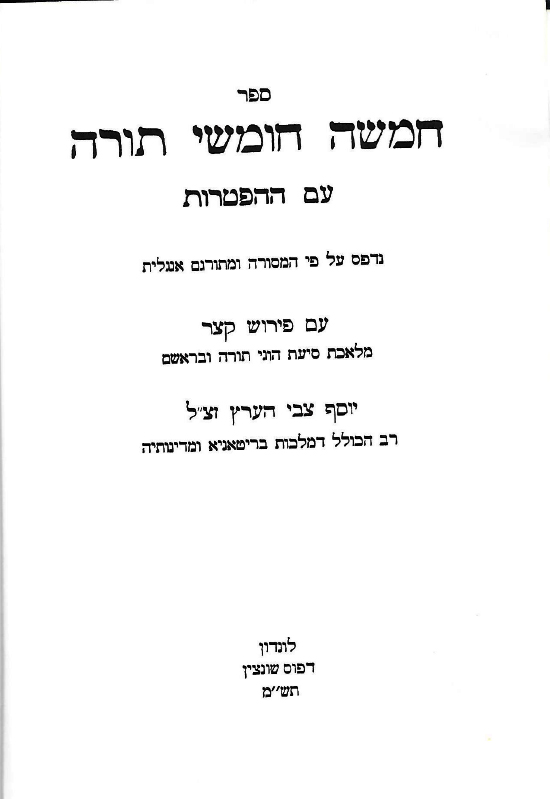
 

The English title page refers to the Chumash as edited by Hertz. The Hebrew title page, which most people don’t even bother looking at, even if they understand Hebrew, refers to a commentary that is the work of a group of Torah scholars headed by Hertz. These are quite different formulations.

Most people who have used the Hertz Chumash, even those who have used it for many years, will not know anything about this group of Torah scholars. Indeed, when people quote from this Chumash, Hertz is given exclusive credit for everything in it. Thus, when citing this Chumash’s commentary, people will say, “Hertz writes.” Yet is this correct?

If we turn to the Chumash’s preface, we learn that Hertz was assisted by J. Abelson, A. Cohen, G. Friedlander and S. Frampton. The first three individuals prepared the commentary to sections of the Torah (the exact sections are listed), and Frampton prepared the commentary to the Haftorahs. Hertz writes: “In placing their respective manuscripts at my disposal, they allowed me the widest editorial discretion. I have condensed or enlarged, re-cast or re-written at will, myself supplying the Additional Notes as well as nearly all the introductory and concluding comments to the various sections.” We see from this that Hertz had an important role, not just as editor, but in contributing content to the Chumash. Yet the commentary itself was not the product of Hertz. He was simply the editor of the material provided by the men mentioned above. In this role, he performed the regular task of an editor who takes texts and condenses and enlarges, re-casts or re-writes, but this editorial involvement does not make the editor the author.

We therefore have to wonder why it is that the men who labored so hard in creating the commentary are given no recognition, apart from the mention of their names in the preface which virtually no one bothers to read. As I already noted, the commentary to the Chumash is universally understood to have been written by Hertz when in fact most of it – other than the “introductory and concluding comments to the various sections” – is not his at all.

Now that the facts have been laid out, I don’t think anyone will be surprised to learn that Abelson, Cohen, and Frampton were not at all happy when the Chumash appeared and they were given no recognition for their labors on the title page. (Friedlander was no longer alive.) They thought that on the title page, following the mention of Hertz as the editor, it should have said something like, “With the collaboration of the Revs. Dr. A. Cohen, Dr. J. Abelson, the Rev. S. Frampton and the late Rev. G. Friedlander.” Hertz responded to their complaint that it had already been established at the initial stages of the planning of the Chumash that the contributors’ names would not appear on the title page.[2] In fact, this a major reason for R. Salis Daiches[3] withdrawing from collaboration on the project. (Obviously, Abelson, Cohen, and Frampton had a different understanding of how Hertz was supposed to acknowledge their work.) Daiches was also unhappy with Hertz’s “editorial policy of extensively rewriting and revising the installments submitted to him by the various annotators.”[4] Hertz later implausibly claimed that his revisions were “an incredible amount of labor, easily ten times the amount of my collaborators.”[5]

Another matter that must be noted is that in the preface found in the first volume of the first edition of the Chumash—it originally appeared in five volumes—Hertz writes that he supplied “nearly all the Additional Notes.” Yet in the one volume edition this sentence has been changed and the word “nearly” has been deleted, making Hertz the only author. Harvey Meirovich has called attention to this, and shows that the Notes dealing with evolution and sacrifices came from R. Isidore Epstein.[6]

I do not know why the following paragraph, which explains the method of the commentary and appeared in the preface to volume 1 of the first edition, was deleted from the preface of the one volume Chumash. This is exactly the sort of explanation of the commentary that the reader would find helpful.

Method of Interpretation: A word must be added as to the method chosen for leading the reader into what the Jewish Mystics called the Garden of Scriptural Truth. The exposition of the plain, natural sense of the Sacred Text must remain the first and foremost aim in a Jewish commentary. But this is not its only purpose and function. The greatest care must be taken not to lose sight of the allegorical teaching and larger meaning of the Scriptural narrative; of its application to the everyday problems of human existence; as well as of its eternal power in the life of Israel and Humanity. In this way alone can the commentator hope not merely to increase the knowledge of the reader, but to deepen his Faith in God, the Torah and Israel.

Also of interest is that the first edition of the Hertz Chumash includes maps which are not found in the one volume edition.

2. In my post here I mentioned that R. Shmuel Wosner defends the practice of women saying שלא עשני גוי and שלא עשני עבד instead of substituting the words גויה and שפחה. R. Yehudah Tesner agrees with R. Wosner and adds the following: If a woman would say שלא עשני גויה this would only mean that she does not want to be a non-Jewish woman. However, she might still prefer to be a non-Jewish man instead of a Jewish woman. Also, if she said שפחה it might only mean that she does not want to be a female maidservant, as this has two negative things, namely, that she is both a woman and enslaved.

שאין רצונה להיות שפחה, שיש בזה תרתי לריעותא, גם אשה וגם משעובדת

However, it might imply that if she could get rid of one of these negative things, i.e., the female, and be a male slave, that this might be acceptable to her. In order to prevent these misunderstandings, R. Tesner says that she must keep the standard text which includes women as part of גוי and עבד. This way she is thanking God that she is not a non-Jew, male or female, and that she is not a slave, male or female.[7]

There is no question in my mind that R. Tesner’s approach is somewhat convoluted and would never represent the thinking of any woman who recited the prayer. I only mention it because R. Tesner takes it for granted that it is better to be born as a Jewish man than a Jewish woman. Yet he also sees as obvious that it is still better to be a free Jewish woman than a male slave.

With regard to this latter point, it is of interest that R. Joseph Teomim states that there are a few things in which a male slave has an advantage over a woman:

עבד חשוב לענין קצת דברים . . . במקצת דברים עדיף מאשה

One of the things he mentions is that a male slave is circumcised, and circumcision is a great mitzvah given to men that women do not have the opportunity to fulfill.[8] This perspective is obviously very different than the outlook advocated by various kiruv speakers that while women are created perfect, men are created defective and thus need a berit milah to get them up to the level of women.[9] I have no doubt that if this argument was first made by someone who identified with Open Orthodoxy, that it would have been regarded as blasphemous for denigrating the commandment of circumcision.

Regarding women not having the opportunity to fulfill the great mitzvah of circumcision (and other mitzvot), I was surprised to find that R. Leon Modena, who was quite “modern” for his time, explains that this is because they do not rank very high in God’s eyes, which is another way of saying that women are simply unworthy of these mitzvot. Here are his misogynistic words:[10]

ומצינו שלא החשיב השי”ת בתורתו הנשים בשום אופן, ולא נתן להן אפי’ אות ברית במילה, ולא רוב מצוות עשה.

Apart from circumcision, it is a popular kiruv perspective that in general women are created with more spiritual perfection, and thus do not need all the mitzvot of men. R. Meir Mazuz attacks this position which he sees as absurd.[11]

דוגמא אחת  מהסילופים: המקשים מצביעים על ברכת “שלא עשני אשה”, והמתרצים מתפלפלים להוכיח שהאשה איננה צריכה כל כך סייגים וגדרים, כי מטבעה דיה במספר מועט של מצוות, ולכן היא מברכת בשמחה רבה “שעשני כרצונו” – שהקב”ה ברא אותה תמימה ושלימה שאיננה צריכה כל כך מצוות, והאיש מברך “שלא עשני אשה” – הוא על דרך שמברכין על הרעה כשם שמברכין על הטובה . . . [ellipses in original] ואילו היה כדבריהם, למה מברכין הנשים ברכת “שעשני כרצונו” בלי שם ומלכות . . . והאנשים מברכים “שלא עשני אשה” בשם ומלכות, ואדרבא איפכא מסתברא?! ובטור א”ח (סימן מ”ו) כתב שנהגו הנשים לברך שעשני כרצונו, ואפשר שנהגו כן כמי שמצדיק עליו את הדין על הרעה . . . ולדעת המתרצים הנ”ל אפשר לומר ג”כ שהגוים עדיפי מישראל, שאינם צריכים לתרי”ג מצוות רק לשבע דוקא, אתמהה.

To R. Mazuz’s words I would only add that if people find it problematic to say that men are created more perfect than women, why do they not find it also problematic to say that women are created more perfect than men? Should I have been offended when a woman once said to me that she is exempt from a number of mitzvot because women are on a higher spiritual level than men, as they are naturally more connected to God, while men can only achieve this connection through mitzvot? I am sure she would have been offended if someone said to her that women are on a lower spiritual level than men, as they are naturally less connected to God, and the evidence of this is that do not have as many mitzvot as men.[12] And what about Torah study? Can we say that men are only commanded to study Torah because they are not at the same spiritual level as women? This would be a complete inversion of the value traditionally assigned to Torah study.[13]

Yisrael Ben Reuven’s book, Male and Female He Created Them (Southfield, 1995), devotes a good deal of discussion to the kiruv perspective. On pp. 132, 133, he writes:

A number of recent books in English propose this idea of women’s spiritual superiority over men, and reportedly, the idea is taught as well in numerous schools for women. The reader should note that none of the books in question offer a classical source for the idea, and none of several teachers of the idea have been able to supply a source when interviewed by this author and numerous individuals known by the author. . . . [T]he teaching contradicts a principle from the Gemara that commandments are placed on a person as a result of his having spirituality (as opposed to his lacking it).

I believe that Ben Reuven is correct in noting that attributing this notion to the Maharal is a mistake. Yet I disagree with his discussion of the view of R. Samson Raphael Hirsch, as Hirsch indeed suggests that women are not commanded in the positive time-bound commandments because they do not need them, for they, by nature, have “greater fervour and more faithful enthusiasm for their God-serving calling.” Contrary to Ben Reuven, doesn’t this mean that they are created with a superior innate spirituality? Men, on the other hand, according to Hirsch, can only reach their spiritual potential through the mitzvot. Hirsch includes circumcision as one of the commandments that men need because they are by nature on a lower spiritual plane then women.[14]

R. Zvi Yehudah Kook also thinks that women are inherently spiritually superior to men. The problem is that men don’t realize this. However, R. Zvi Yehudah claims that in Messianic days when men will understand the truth, they will no longer be able to able to make the blessing שלא עשני אשה, as they will see that women are superior to them.[15]

במצב העכשווי האיש יותר חזק בגופו, ומתוך כך בפרקטיקה האנושית. הוא אקטיבי יותר בכל החיים המעשיים. יש הרגשה שהוא תופס יותר מקום. הרגשה זו היא לפי המדריגה האנושית, והברכות נקבעו על פי ההרגשה האנושית היחסית. זאת התפיסה האנושית הרגילה, והברכה מתייחסת למציאות זו. משום כך אומר האיש כהרגשתו “שלא עשני אשה”, שהרי זו האמת היחסית, והאשה מברכת “שעשני כרצונו”. אך, כאמור, זו תפיסה אנושית חלקית, וההרגשה היא רק עניין יחסי של מצב עכשווי נתון, אמת נוכחית.

לעומת זאת, ההשקפה האלהית, האמת המוחלטת, אינה ענין של הרגשה חולפת, אלא האמת הנצחית מראשיתה ועד סופה. לעתיד לבוא, כאשר גם האדם יכיר את האמת, ויהיה כולו מבחינת “הטוב והמטיב”, לא יוכל לברך “שלא עשני אשה”, שהרי אז יכיר שבניינה של האשה יותר רם, יותר אלהי ופחות אנושי, ממצבו הוא.

For virtually all, the approaches suggested by Hirsch and R. Zvi Yehudah Kook in which women are created more perfect than men would have been inconceivable in pre-modern times. One possible exception, and the only exception I know of, was the sixteenth-century R. Gedaliah Ibn Yahya, author of Shalshelet ha-Kabbalah. He actually enumerates numerous ways in which women are superior to men. He also claims that women are not intellectually inferior to men, and they can thus understand all the wisdoms of the world. In the sixteenth century, this was a very radical position.[16]

Regarding women, R. Yonason Rosman called my attention to the following. The ArtScroll Chumash, p. 1086 (beginning of parashat Nitzavim) states:

On the last day of his life, Moses gathered together every member of the Jewish people, from the most exalted to the lowliest, old and young, men and women, and initiated them for the last time into the covenant of God. What was new about this covenant was the concept of ערבות responsibility for one another, under which every Jew is obligated to help others observe the Torah and to restrain them from violating it. This is why Moses began by enumerating all the different strata of people who stood before him, and why he said (v. 28) that God would not hold them responsible for sins that had been done secretly, but that they would be liable for transgressions committed openly (Or HaChaim).

According to the ArtScroll summary, R. Hayyim Ben Attar, the author of Or ha-Hayyim, states that women are obligated in ערבות. But is this really what he says? Here is his commentary to Deuteronomy 29:9:

R. Hayyim ben Attar actually says the exact opposite of what appears in the ArtScroll summary, in that he states that women are not obligated in ערבות, and they are grouped together with children and proselytes. R. Ben Attar tells us that children are not obligated because they do not have the requisite understanding for such an obligation. Proselytes are not obligated because it is not their place to be rebuking, and thus exercising authority over, those who were born Jewish.[17] Why are women not obligated? R. Ben Attar writes:

ואין הם נתפסים על אחרים שהטף אינם בני דעה והנשים כמו כן הגרים גם כן אין להם להשתרר על ישראל

The sentence is ambiguous, and it all depends on where you put the comma. Here is one way to read the sentence:

ואין הם נתפסים על אחרים שהטף אינם בני דעה והנשים כמו כן, הגרים גם כן אין להם להשתרר על ישראל

If you place the comma after the words והנשים כמו כן, the sentence seemingly means that women are just like children in not having the requisite understanding of the various sins to be obligated in ערבות. R. Yaakov Hayyim Sofer finds it incomprehensible that R. Ben Attar would say that women’s level of understanding is comparable to that of children.[18] He therefore explains that when R. Ben Attar says והנשים כמו כן, he only means to say that the law for women is like the law for children, but not that the reason is the same.

You can also place the comma after the words אינם בני דעה so that one reads the sentence this way:

ואין הם נתפסים על אחרים שהטף אינם בני דעה, והנשים כמו כן הגרים גם כן אין להם להשתרר על ישראל

Now the sentence means that children do not have the requisite understanding to be obligated in ערבות, and women are like proselytes in that it is not their place to be rebuking, and thus exercising authority over, Jewish men. Although this is how R. Avraham Sorotzkin understands the Or ha-Hayyim,[19] I find it difficult as the second half of the sentence does not read well this way.

3. In my post here I referred to Nero and Antoninus and their supposed conversions to Judaism. The Talmud, Gittin 56a, indeed states that Nero converted, and it adds that R. Meir was descended from him. Soncino’s note to the passage reads: “This story may be an echo of the legend that Nero who had committed suicide was still alive and that he would return to reign (v. JE IX, 225).” The Koren Talmud’s note, which is a translation of what appears in Steinsaltz, states that the talmudic story cannot be referring to the famous Nero: “The Roman emperor Nero was killed under strange circumstances and after his death rumors circulated that he was not actually killed but had taken refuge elsewhere.” The note continues that even though Nero is referred to in the passage in Gittin 56a as ,נירון קיסר the story actually refers to another person who was an officer in the Roman army in the campaign against Judea. This person’s name was also Nero, and since he was from the larger Caesar family, he too was called Nero Caesar. This explanation apparently first appears in Seder ha-Dorot.[20]

Graetz thought that the story of Nero converting was part of a rabbinic polemic against Christianity, while Bacher “attributed the origin of the legend to the view which considers the power of Judaism to be so great, that even its greatest enemies become converts either themselves, or, at any rate, their descendants.”[21]

Let me offer another way of explaining the story of Nero’s conversion, which I have not seen anyone else suggest. Josephus tells us that the Jews put up a wall in the Temple to prevent King Agrippa from viewing the sacrificial service. This upset both Agrippa and the Procurator, Festus, and Festus ordered that the wall be torn down. The Jews decided to go over Festus’ head and turned to Nero. Nero’s wife, Poppaea Sabina, pleaded their case, and as a favor to his wife, Nero ordered that the wall should stay.

Why would Poppaea plead the case of the Jews? Josephus tells us that she was a “God-fearer.”[22] Whatever the exact connotations of this term, which has been greatly discussed, she was clearly a sympathizer of the Jews. Josephus tells us that on another occasion she helped secure the release of some Jews who had been placed in prison in Rome. He also tells us that that Poppaea gave him many presents.[23] Could it be that originally the story about the conversion of Nero was said about his wife, and that in the hundreds of years before it was recorded in the Talmud, it was transferred to Nero himself?

As for the Emperor Antoninus, who was friends with R. Judah ha-Nasi, we do not know who this refers to as the title Antoninus was used for various emperors.[24] However, I want to call attention to a different point. In Sefer Yuhasin ha-Shalem, ed. Filipowski, p. 115, in listing the talmudic sages, R. Abraham Zacut includes a “Rabbi Antoninus”. Where does he get such a name? As he indicates, it comes from Mekhilta de-Rabbi Yishmael, and there are actually two separate references there to R. Antoninus.[25] The first reads:[26]

[א”ר אנטונינוס למלך שהוא דן על הכימה [הבימה

The second reads:[27]

…ר’ אנטונינוס אומר ג’ היו והוסיף עליהם עוד אחד והיו ד’

R. Antoninus is being cited as the source for halakhic teachings. Yet the text is corrupt, as was already pointed out by the Vilna Gaon. He emended both passages so that while Antoninus is mentioned, he is not identified as a rabbi.[28]Thus, in the first passage the Vilna Gaon emended it to read:

 [אמר רבי אנטונינוס המלך שהוא דן על הכימה [הבימה

The second passage he emended to read:

רבי אומר ג’ היו הוסיף עליהם עוד אחד והיו ד’ הוסיף אנטונינוס עוד אחד והיו ה’

While the Vilna Gaon may have only sensed intuitively that the text was corrupt, manuscript evidence exists that offers versions similar to or identical with that suggested by the Vilna Gaon.[29]

As for the conversion of Antoninus, R. Solomon Judah Rapoport argues that this is a late, and non-historical, aggadah.[30] He points to a passage in the Jerusalem Talmud, Megillah 1:11, which shows that it was not clear whether Antoninus converted.

אית מילין דאמרין דאתגייר אנטונינוס ואית מילין אמרין דלא אתגייר אנטונינוס

Nevertheless, despite these words, the continuation of this talmudic passage records that he did in fact convert. This is also the conclusion in the Jerusalem Talmud, Sanhedrin 10:5. However, the matter is still not clear, since regarding the Megillah text the Leiden manuscript has a different version which leaves the matter of Antoninus’ conversion undecided.[31] Furthermore, as Shaye J. D. Cohen writes, “the Bavli clearly implies that Antoninus was not a convert, unlike the Roman dignitary Qetia who was.”[32] Cohen also calls attention to Yalkut Shimoni: Isaiah, no. 429, which states that Antoninus was one of the tzadikei umot ha-olam, that is, not a convert.

R. David Zvi Hoffmann examined the various aggadot regarding R. Judah ha-Nasi and Antoninus. With regard to most of them he concludes that they arose in Babylonia long after the events described, and that “it is difficult to find a historical core to them.”[33]He does not tell us whether he regards these stories as simply legends that arose from the people or if they should be seen as didactic tales no different than the numerous other aggadot that describe actions and dialogues of various biblical figures, matters that were also never intended to be taken as historical. R. Hoffmann also discusses how the notion of Antoninus actually converting to Judaism developed from earlier sources that only regard him as a “God fearer.”[34]

Regarding referring to people as rabbis when they do not deserve the title, such as Rabbi Antoninus, here is another interesting example that I believe was pointed out to me many years ago by Prof. Shnayer Leiman. When R. Jonathan Eybeschuetz’s Luhot Edut was reprinted in 1966, the publisher helpfully added an index of names at the back. What seems to have happened is that he went through the index putting “Ha-Rav” before all the names, and mistakenly added this title before Shabbetai Zvi’s name.

When the book was reprinted again by Copy Corner in the 1990s, they fixed this mistake and added שר”י.

It is interesting that in Solomon Zeitlin’s review of Gershom Scholem’s biography of Shabbetai Zvi, he criticizes Scholem for referring to Nathan of Gaza as “Rabbi Nathan.”[35] Had Scholem wished to defend himself from an Orthodox perspective, he could have pointed to the fact that decades after Nathan’s death (and also after Shabbetai Zvi’s death), one of the leading rabbis in Salonika, R. Solomon ben Joseph Amarillo (died 1722), refers to Nathan as הרב הקדוש מהר”ר נתן [36].אשכנזי ז”ל R. Joseph Molho (1692-1768), another leading rabbi in Salonika, refers to Nathan as הרב נתן ז”ל.[37] This positive reference to Nathan is found in R. Molho’s response to R. Solomon ben Isaac Amarillo, who also referred to Nathan this way.[38] In his famous work, Shulhan Gavoah, R. Molho refers to Nathan as follows: וכן קבלו מהרב נתן אשכנזי ז”ל המקובל האלהי.[39] I was surprised to see that in the new edition of Shulhan Gavoah (Jerusalem, 1993), this appears without any censorship, which presumably means that the editor did not know who R. Nathan Ashkenazi is. One final example: The famed R. Moses Zacuto (c. 1620-1697) refers to Nathan as הרב המופלא כמהר”ר נתן הידוע זלה”ה.[40]

Those who are interested in rabbinic history are familiar with R. Naphtali Yaakov Kohn’s nine volume Otzar ha-Gedolim. In vol. 4, p. 125, we find an entry for none other than the notorious Spanish apostate, Joshua Lorki, and his name is followed by שר”י ימ”ש.

Why is such a person included in a book of “gedolim”? The author explains that before he apostatized, he was a rabbi. (I do not believe this is correct. I have never before seen him described as a rabbi and know of no evidence to support such an assumption.) One can easily understand that even if someone was a rabbi, if he later converted, or became a Reform rabbi for that matter, including him in a book of “gedolim” is not going to sit well with many. This is so even though most of the rabbis included in the book are far from what one can consider “gedolim” in the way the term is used today.

Kohn did not print any letters or haskamot in the first four volumes of his work. These first appear in volume 5, and are from such varied figures as R. Joel Teitelbaum and the Chief Rabbis of Haifa. Kohn also includes a four-page letter from R. Yekutiel Yehudah Halberstam, the Klausenberger Rebbe. R. Halberstam saw the entry for Lorki and was very upset. He writes that just as no one would dream of including Dathan and Abiram among the great Jewish leaders, all the more so one should not include Lorki among the rabbis of Jewish history. He further asks, rhetorically, if אותו האיש ימ”ש שר”י   should also be included because he was a student of R. Joshua ben Perahiah?

R. Halberstam is even upset that the book includes an entry for Lorki’s father, and unfairly wonders what type of man he must have been if his son turned out this way. (I say “unfairly” since there are many examples of pious people whose children ended up very differently.) Finally, R. Halberstam makes the following strong point to Kohn: If you are going to sayyemah shemoafter someone’s name, then it has to actually mean something. By including an entry for Lorki in the book, not only are you not blotting out his name, but you are doing the exact opposite by preserving his name for all to see.

ובאמת שאצל המומר לורקי כתב כת”ה בתר שמו ימ”ש שר”י. אבל זה לא רק להלכה אלא גם למעשה ואם אומרים ימח שמו א”כ איך חוקקים שמו להזכירו בזכרון קדוש אחרי שבע מאות שנים?

Kohn thought that it was OK to include an entry for Lorki because he was a rabbi before he apostatized. With this logic it would be OK to also study the Torah works of rabbis who later apostatized, since these works were written before their apostasy. (In part 2 of this post I will deal with rabbis who published seforim and then apostatized.)

5. In my last post here, I wrote that the new RCA siddur will come to be the standard siddur at hundreds of synagogues for decades to come. This was a reasonable conclusion to reach, since ArtScroll is no longer allowed to sell the RCA ArtScroll siddur which has become the standard at Modern Orthodox synagogues. Thus, when these synagogues need to purchase new siddurim – and these siddurim must have the prayers for the State of Israel and the IDF – they would naturally buy the new RCA siddur. Yet it seems that I was mistaken, as I did not anticipate ArtScroll’s response to its anticipated enormous loss of revenue. Here is the ad that many of you have already seen.

ArtScroll is continuing to sell the RCA siddur, minus the name “RCA” on the cover and Rabbi Saul Berman’s introductory essay. Instead of being the RCA edition, this siddur is now called the “Synagogue Edition.” This is designed to ensure that Modern Orthodox synagogues, when they need to buy new siddurim, continue purchasing the ones congregants are used to.

This move by ArtScroll is obviously a serious threat to the success of the new RCA siddur, as the typical Modern Orthodox synagogue will probably find it easier just to buy the new “Synagogue Edition.” It is going to take a lot of effort from the RCA to ensure that the new siddur becomes accepted across America, and only time will tell who will win the battle for the loyalty of the Modern Orthodox synagogues. I don’t know the details of ArtScroll’s contract with the RCA, so I can’t say if what ArtScroll has done is illegal. It certainly appears unethical.

When the original ArtScroll siddur appeared some thirty-five years ago, it immediately caught on, so much so that today it is hard to find an English-speaking Orthodox home that does not have an ArtScroll siddur. This is an enormous historical achievement. However, there was an obvious lack in that the classic ArtScroll siddur did not include the prayers for the State of Israel and the IDF. This meant that it could never be adopted as the siddur for Modern Orthodox synagogues. There were many people who were upset with ArtScroll for not including these prayers. Would it have been so difficult for ArtScroll to have included them with the note that “Some congregations recite these prayers”? In a siddur that found room to include Gott fun Avrohom at Havdalah, for the tiny population of ArtScroll siddur-users that says it, why could it not include prayers recited by many thousands every Shabbat? They could also have put these prayers in the back of the siddur, with the Yotzerot that today hardly anyone says. These steps would have made for an inclusive siddur, and there never would have been a need for the RCA ArtScroll Siddur.

We were led to believe that as a matter of principle, as dictated by ArtScroll’s gedolim, the prayers for the State of Israel and the IDF could not be included. It was thus a surprise that ArtScroll agreed to include these prayers in the RCA edition of the ArtScroll Siddur. The RCA recognized that everyone was moving over from Birnbaum to ArtScroll, and therefore it made sense to produce a Religious Zionist version of ArtScroll. How was ArtScroll able to include the religiously objectionable prayers? Obviously, the reason was money, but there was also deniability, as people could say that it wasn’t actually an ArtScroll siddur. Rather, it was an RCA siddur using the text of ArtScroll, so in this way ArtScroll wasn’t implicated as a partner in religious Zionism and its objectionable prayers.

With the publication of the new “Synagogue Edition” siddur, we now have a situation where ArtScroll itself is publishing a siddur with the prayers for the State of Israel and the IDF. In other words, ArtScroll is publishing a Religious Zionist text. This is definitely news. You can be as cynical as you wish in explaining why when it comes to making lots of money from Modern Orthodox synagogues, Daas Torah can be pushed aside, but it is significant that a so-called haredi publishing house has broken with haredi standards in such a significant way. Nevertheless, I hope that Modern Orthodox synagogues will realize that there is a great difference between the old RCA ArtScroll siddur, which is just the standard ArtScroll siddur with a few extra pages, and the new RCA Siddur which, in its ideological outlook and historical sophistication, is a siddur perfectly suited for today’s Modern Orthodox community.

6. Rabbi Pini Dunner recently publishedMavericks, Mystics and False Messiahs, and I know readers of the Seforim Blog will find it a wonderful read. If you have ever watched any of Dunner’s videos, you know that no one can tell a story like him. The figures and events he discusses (Samuel Falk, Emden-Eybeschuetz dispute, ClevesGet, Lord George Gordon, R. Yudel Rosenberg, Ignatz Timothy Trebitsch-Lincoln) are ones that are perfectly suited for his skill in this area. Readers should not go to this book looking for new discoveries of the sort that he has spoken about in some of his online lectures. Some people will have even read the published works upon which the chapters are based (e.g., Scholem, Leiman, Wasserstein). These sources are discussed in the concluding chapter which is itself fascinating, especially for those who love books. I heartily recommend the book even for those who know the original sources, because no one can bring a story to life quite like Dunner.

There is one thing, however, that I wish had been explained by Dunner. In the longest chapter of the book, dealing with the Emden-Eybeschuetz dispute, there are lengthy dialogues recorded between different people. We also read about when individuals smiled, when they gasped, when they turned pale, when their voice was shaky, when tears flowed down their cheeks, when they sat upright in bed, etc. Occasionally, we find this also in other chapters. Since all this is made up by Dunner (and with regard to the Emden-Eybeschuetz dispute could even be the beginnings of a movie storyline), it would have been helpful for some discussion as to why he decided to spice up the book this way. The most we get is that in the concluding chapter (p. 172), Dunner tells us that portions of the book “have been written in a style that has much more in common with dramatic fiction than with non-fiction history, including details of private conversations, and descriptive elements that may cause readers to wonder about their accuracy.” Yet the reader is never told why Dunner sometimes adopts this approach and at other times he sticks to the facts.

The chapter on the Emden-Eybeschuetz dispute includes as part of the story the legendary account of how R. Emden, on his deathbead, said, “Barukh haba, my revered father, barukh haba, Rabbi Yonatan.”[41] This was understood to mean that he was finally reconciled with his longtime adversary, and explains why they were buried in the same row. Unless one reads the concluding chapter of the book, which deals with the sources, the reader will have no way of knowing that there is no historical basis for this tale. It is attributed in the original source to R. Abraham Shalom Halberstam of Stropkov (1857-1940), though he presumably was repeating a tradition he had heard. The story was obviously invented to create a posthumous peace between the two great rabbis.

I realize that what I have described is part of the liberties taken by any good storyteller. However, anyone who reads the book will wonder why the Emden-Eybeschuetz chapter in particular, which freely mixes fact with fiction, is written in such a different style than the other chapters, which stick much more closely to what the evidence tells us. Dunner has shown that he can be both expert storyteller and historian, but speaking as a fellow historian, my preference would have been not to mix these genres in one book.

[1] Regarding the Hertz Chumash, see the articles by Mitchell First here, and Yosef Lindell here.

[2] See Harvey Meirovich, A Vindication of Judaism: The Polemics of the Hertz Pentateuch (New York and Jerusalem, 1998), pp. 187-189.

[3] Unlike the other contributors, Daiches was actually a rabbi (something not so common in Britain at the time). He received semikhah from the Rabbinical Seminary of Berlin as well as from his father, the great R. Israel Hayyim Daiches, R.  Solomon Cohen of Vilna, and R. Ezekiel Lifshitz of Kalisz. See Hannah Holtschneider, “Salis Daiches –  Towards a Portrait of a Scottish Rabbi,” Jewish Culture and History 16 (2015), p. 4. Holtschneider’s biography of Daiches will be out later this year. See here. The famous author David Daiches was his son, and his book Two Worlds (Edinburgh, 1997) has a lot about Salis Daiches. Here are some passages that I think readers will find of interest, as it speaks to the differences between what it meant to be an Orthodox rabbi in Britain a century ago vs. today.

Pp. 29-30: The electric radiator – which did, I suppose, make some difference, though memory links it only with extreme cold – could be switched on and off on the sabbath, as the electric light also could, in accordance with a decision of my father’s which differentiated his position sharply from that of my grandfather, patriarchal rabbi of an orthodox Jewish congregation in Leeds, who would have been shocked if he had known how cavalierly we treated electricity. Gas light or heat, which required the striking of a match, was another matter that was clearly prohibited. But electricity was a phenomenon unrecognized by the Talmud, and my father felt free to make his own interpretation of the nature of the act of switching on the electric light or heat. He decided that it was not technically ‘kindling a fire’, which a biblical injunction prohibits in the home on the sabbath.”

Pp. 81-82: “For years we travelled with our own meat dishes (for we could not eat off the meat dishes of a non-Jewish house) and Mother had supplies of meat sent out by post from the Edinburgh Jewish butcher. Packing a trunk full of dishes was an arduous business, and eventually Mother gave it up and we went vegetarian throughout August – which was no hardship for Mother could do marvelous things with fish (the term vegetarian in our family meant simply eating no meat but did not exclude fish). Slowly and gradually, and I am sure never consciously on my parents’ part, we relaxed a bit in the matter of diet. When she was first married Mother baked all her own bread, but ceased to do this after her illness in 1919. And on holiday one found oneself going a little further than one would have done in the city. In Edinburgh, we usually ate bread from the Jewish bakery, but occasionally we would get a loaf from a non-Jewish shop. Cakes and biscuits we regularly got from non-Jewish sources. But though Mother would buy ordinary cakes from a non-Jewish baker, she would always make her own pastry, for pastry from a gentile shop was liable to have been made with lard. On holiday, however, pastries started to creep in among the cakes bought for tea, and nobody raised the question of what they were made with.”

I am certain that Daiches is mistaken in his last sentence, and that his father confirmed with the bakery that there were no non-kosher ingredients in these pastries.

Pp. 92: “At home we always covered our heads to pray, and to say grace before and after meals, but we were never expected to keep our heads covered continually. My father wore a black skull cap when receiving members of his congregation in his study, but as the years went by he developed the habit of keeping it in his pocket throughout much of the day and diving hastily for it when the bell rang. In his father’s presence he wore it continually.”

Pp. 174, 176: The rabbi did not believe in a literal personal Messiah; he believed in historical movements, in progress, in amelioration, and in the acceleration of movement in the right direction by the actions of individuals. . . . The Messiah was not a person, but a historical ideal. God, the rabbi was in the habit of telling his congregation, works in history.”

Pp. 175-176: “The priestly benediction recited on High Festivals, when all the Cohens assembled to bless the congregation in the old biblical words of benediction, had been abolished by the rabbi in his Sunderland synagogue and he would not allow it in Edinburgh either.”

[4] Meirovich, A Vindication of Judaism, p. 31.

[5] Meirovich, A Vindication of Judaism, p. 33.

[6] Meirovich, A Vindication of Judaism, pp. 41ff.

[7] Siah Tefilah (Ofakim, 2003), p. 361.

[8] Mishbetzot Zahav, Orah Hayyim 46:4.

[9] See Excursus which will be in part 2 of this post.

[10] Magen ve-Herev, ed Simonsohn (Jerusalem, 1960), p. 47.

[11] See his derashah in R. Rephael Kadir Tsaban, Nefesh Hayah (Bnei Brak, 2007), vol. 2, pp. 269-270.

[12] See e.g, Derashot Rabbi Yehoshua Ibn Shuaib (Cracow, 1573), p. 48a:

כי נשמתן של ישראל הן קדושות יותר מן האומות ומן העבדים הכנעניים הפחותים ואפילו מן הנשים ואם הם שייכי במצות והן מזרע ישראל אין נשמתן כנשמת הזכר השייך בתור’ ובכל המצות עשה ולא תעשה.

[13] R. Shlomo Aviner, in discussing this matter, does not go so far as to say that men are obligated in Torah study because they are not at the same spiritual level of women. However, he comes close, and he is led to this approach because of his understanding of Torah study as leading to devekut, a position which is at odds with the Lithuanian perspective on Torah study. See Aviner, Bat Melekh (Jerusalem, 2013), p. 104:

שאלה: מדוע האשה, שניחנה בבינה יתרה, אינה מחוייבת בלימוד תורה?

תשובה: האיש, שאין בו בינה יתרה, דווקא הוא צריך להרבות בלימוד, אך האשה, שיש לה בינה יתרה, מבינה גם ללא הלימוד הרצוף והממושך. המהר”ל מסביר, שמי שיש לו נטיה טבעית לדבר, הוא משיגו בנקל. ללא נטיב טבעית יש צורך בעמל רב. לאשה באופן טבעי יש נטיה, שהאיש צריך לעמול עליה קשה (מהר”ל, דרוש על התורה עמ’ כז-כח). אלא, עמל לימוד התורה אינו איסוף ידיעות, בעומק הנפש, ודבקות בתורה. האיש הוא קשה עורף, מתקשה לשמוע לכן יש להכותו בגידים (שמות רבה כח ב. רש”י, שמות יט ג), בשוט השכלי של הלימוד. מי שניחן בנטיה טבעית לתורה אינו זקוק ל”גידים” כדי שתחול בו אותה תמורה פנימית, והיא מגיע אליו ביתר קלות . . . זו נטיה עמוקה באישיות האשה, לכן היא מגיעה לדבקות וקישור והתמלאות בתורה בנתיבים שונים מן האיש. האיש מגיע לדבקות זו בנתיב הלימודי, והאשה בנתיב ספיגת הדברים מן החיים.

See here from a Chabad site where we are told that “the female child inherently carries a higher degree of holiness, due to her own biological, life creating capability.” Would anyone today write the same sort of comment, but instead state that the male child has a higher degree of holiness? Faced with a situation where many people believe that women are regarded as inferior in traditional Judaism, defenders of Judaism are often led to offer apologetic answers that argue the reverse, namely, that it is actually women who are more special, spiritual, holy, etc. than men.

In my experience, men never seem to be offended when they hear this. One haredi friend explained to me that this is because the men do not believe it to be true, and thus no reason to be offended if it makes the women feel better. This is a cynical answer, but can anyone come up with a better reason? Imagine the scenario: A Shabbat meal with many guests and the father offers a devar Torah whose upshot is that men are more holy and spiritual than women. This will not go over well and the women (and some men also) will be offended. Yet if the message of the devar Torah is that women are more holy and spiritual, no one will take offense. Why not? And my more basic question is, why we can’t just say that men and women are equally holy and spiritual (albeit with different roles)? Why do people feel a need to say that one is more special than the other?

All this is in the realm of Jewish thought. However, when it comes to explaining halakhic matters in which women might be portrayed in a way that they would take offense at, here too new approaches must be offered. For example, can anyone imagine explaining to modern women why they cannot perform shechitah by telling them what R. Joseph Messas quotes from manuscript from the nineteenth-century R. Jacob Almadyoni (spelling?) of Tlemcen, Mayim Hayyim, vol. 2, Yoreh Deah no. 1?

אין להניח הנשים לשחוט ואפי’ בדיעבד ראוי להחמיר שאף המכשירין יודו האידנא שאין דעת נשי דידן מכוונות כדעת נשי דידהו. ואם על נשיהם אמרו אין חכמה לאשה אלא בפלך [יומא דף ס”ו ע”ב], קו”ח לנשי דידן

[14] See Hirsch’s commentary to Lev. 23:43, and regarding women and circumcision, see also Hirsch to Gen. 17:15. The most comprehensive discussion of Hirsch’s view of women and Judaism is found in Ephraim Chamiel, The Middle Way (Brighton, MA, 2014), vol. 2, pp. 152ff. On p. 153 he titles the section of a chapter: “Revolution: Women are Superior to Men.” Hirsch obviously opposed the notion found in R. David Abudarham that the reason women are not obligated in positive time-bound commandments is because they are “enslaved” to their husband to do his will, and if they were busy performing these commandments they could not serve him properly and this would create marital discord. See Abudarham ha-Shalem (Jerusalem, 1963), p. 25:

והטעם שנפטרו הנשים מהמצות עשה שהזמן גרמא לפי שהאשה משועבדת לבעלה לעשות צרכיו. ואם היתה מחוייבת במצות עשה שהזמן גרמא אפשר שבשעת עשיית המצוה יצוה אותה הבעל לעשות מצותו ואם תעשה מצות הבורא ותניח מצותו אוי לה מבעלה ואם תעשה מצותו ותניח מצות הבורא אוי לה מיוצרה לפיכך פטרה הבורא ממצותיו כדי להיות לה שלום עם בעלה.

The same reason is offered by R. Jacob Anatoli, Malmad ha-Talmidim (Lyck, 1866), pp. 15b-16a:

לפי שהנקיבה היא לעזר הזכר ואל אישה תשוקתה והוא ימשל בה להנהיגה ולהדריכה בדרכיו ולעשות מעשה על פיו והיותה על הדרך הזה הוא גם כן סבה שהיא פטורה מכל מצות עשה שהזמן גרמא כי אלו היתה טרודה לעשות המצות בזמן היה הבעל בלא עזר בזמנים ההם והיתה קטטה נופלת ביניהם ותסור הממשלה המכוונת שהיא לתועלתו ולתועלתה.

R. Ahron Soloveichik adopted an approach similar to that of Hirsch. He claimed that Judaism “recognizes the feminine gender as possessing an innate, unique spiritual blessing as compared with the male gender. . .  [T]he woman has innate spiritual advantage as compared with men.”Logic of the Heart, Logic of the Mind(Jerusalem, 1991), p. 93.

[15] Itturei Kohanim, no. 167 (5759), 4-5; R. Aviner, Panim el Panim (Jerusalem, 2008), p. 194. Significantly, R. Zvi Yehudah’s explanation acknowledges that the blessing שלא עשני אשה implies male superiority. While this was a common understanding in pre-modern times, in recent generations this interpretation was usually rejected. Yet R. Zvi Yehudah claims that the blessing’s formulation was a concession to human feelings. Does this then mean that if a contemporary man recognizes the superiority of women, or even just that they are equal to men, that according to R. Zvi Yehudah he can stop saying this blessing?

[16] See Avraham Grossman “Ma’alot ha-Nashim ve-Adifutan be-Hibur shel R. Gedaliah Ibn Yahya,” Zion 72 (2007), pp. 37-61.

[17] R. Simhah Bunim Lieberman raises a strong objection to Or ha-Hayyim‘s position. See Bi-Shvilei Orayta al Kol Yisrael Arevim Zeh la-Zeh, p. 124:

אבל האמת דעצם דברי האור החיים צ”ע, דאטו מוכיח יש בו שררה, וכי מצאנו איסור לגר להוכיח ישראל שחטא

[18] Edut be-Yaakov, vol. 2, p. 164.

[19] See R. Avraham Sorotzkin, Rinat Yitzhak, Deut. 29:10.

[20] R. Yehiel Heilprin, Seder ha-Dorot (Bnei Brak, 2003), vol. 1, p. 251.

[21] Naomi G. Cohen, “Rabbi Meir, A Descendant of Anatolian Proselytes,” Journal of Jewish Studies 23 (1972), pp. 54-55. Cohen also provides the Graetz reference.

[22] Antiquities 20.8.11.

[23] Life of Flavius Josephus, ch. 3. See A. Andrew Das, Solving the Romans Debate (Minneapolis, 2007), pp. 77ff.; Louis H. Feldman, Jew and Gentile in the Ancient World (Princeton, 1993), p. 351.

[24] R. Maimon ben Joseph (the father of Maimonides), Iggeret ha-Nehamah, trans. Binyamin Klar (Jerusalem, 2007), p. 38, states:

וכבר אמר פעם אחת אחד ממלכי רומי – קללה תבוא על כולם, חוץ מאחד רם המעלה המובדל מהם, הוא אנטונינוס שהיה בדורו של רבנו הקדוש ע”ה.

[25] R. Yehiel Heilprin, Seder ha-Dorot, vol. 2, p. 138, has a version of the Mekhilta that reads Antigonos, and he therefore identifies a “Rabbi Antigonos”.

[26] Beshalah, hakdamah. In the edition with the Netziv’s commentary it is on p. 79.

[27] Beshalah, parashah 1. In the edition with the Netziv’s commentary it is on p. 111.

[28] Surprisingly, Abraham Joshua Heschel did not take note of the Vilna Gaon’s emendation, and cited one of the Mekhilta texts as is. See Torah min ha-Shamayim be-Aspaklaryah shel ha-Dorot (London and New York, 1962), p. 183 n. 3.

[29] See the Horovitz-Rabin edition of the Mekhilta, pp. 82, 89.

[30] See Rapoport, Erekh Milin (Prague, 1852), p. 270.

[31] See the comprehensive discussion in Shaye J. D. Cohen, “The Conversion of Antoninus,” in Peter Schäfer, ed., The Talmud Yerushalmi and Graeco-Roman Culture (Tübingen, 1978), pp. 141-171.

[32] “The Conversion of Antoninus,” pp. 164-165.

[33] “Die Aggadot von Antoninus in Midrash und Talmud,” Magazin für die Wissenschaft des Judenthums 19 (1892), p. 46.

[34] “Die Aggadot von Antoninus in Midrash und Talmud,” pp. 51-52.

[35] See Jewish Quarterly Review 49 (1958), p. 153.

[36] Penei Shlomo (Salonika, 1717), p. 43d.

[37] Ohel Yosef (Salonika, 1756), no. 14 (p. 13a).

[38] Devar Moshe (Salonika, 1750), vol. 3, no. 11 (p. 8a). The three sources just cited are mentioned by Meir Benayahu, Ha-Tenuah ha-Shabta’it be-Yavan (Jerusalem, 1978), pp. 191, 274-275.

[39] Shulhan Gavoah (Salonika, 1756), Orah Hayyim, vol. 2, Hilkhot Yom ha-Kippurim 620 (p. 68a). He also refers to Nathan this way ibid., Hilkhot Rosh ha-Shanah 584 (p. 35a).

[40] See Benayahu, Ha-Tenuah ha-Shabta’it be Yavan, p. 119. For sources regarding Zacuto, see Gershom Scholem, Mehkerei Shabtaut, ed. Yehuda Liebes (Tel Aviv, 1991), p. 528; Bezalel Naor, Post Sabbatian Sabbatianism (Spring Valley, 1999), p. 176 n. 8.

[41] The source of the story for Dunner is David Ginz, Gedulat Yehonatan, vol. 2, p. 286. Abraham Hayyim Simhah Bunim Michaelson, Ohel Avraham (Petrokov, 1911), p. 28b, also heard the story from R. Halberstam, but in his version R. Emden states simply, ברוך הבא אבא.


Tarnopol: A short-lived early 19th century Hebrew press

Tarnopol: A short-lived early 19th century Hebrew press
by Marvin J. Heller[1]

The blossoms have appeared in the land, The time of your song has arrived,
and the voice of the turtledove Is heard in our land.
The green figs form on the fig tree. The vines in blossom give off fragrance.
Arise, my darling; My fair one, come away!
“O my dove, in the cranny of the rocks. Hidden by the cliff.
Let me see your face, Let me hear your voice; For your voice is sweet And your face is comely.”
Catch us the foxes, The little foxes
That ruin the vineyards— For our vineyard is in blossom. (Song of Songs 2:12-15).

Tarnopol (Ternopol), a city with an established Jewish community, dates its founding to the mid-sixteenth century. The community had many positive aspects (blossoms have appeared in the land, The time of your song has arrived), and was home to a Hebrew printing press (The green figs form on the fig tree. The vines in blossom give off fragrance) for a brief time only in the early nineteenth century. Due, however, to the contentious relationship between conflicting segments of the community, that press, after publishing a variety of valuable works, was short lived and closed prematurely (The little foxes that ruin the vineyards).

Tarnopol is in Galicia, in the western Ukraine, approximately 227 miles (365 km.) from Kiev (Kyiv) and 73 miles (117 km,) from Lvov. Although there had been earlier residences in the area, credit for founding the city as a private town in 1540 is given to the Polish hetman, Jan Amor Tarnowski. Tarnowski permitted Jewish settlement almost immediately afterwards in what was his personal domain. The city charter permitted Jews to reside throughout the city, excluding the market place. Initially, the Jewish population was small, comprised of only a few dozen Jews, this based on the head tax paid, the revenues from it being, in 1564, 20 zlotys, rising to 23 the following year. Jews quickly became a majority of the population, with as many as 300 families resident there in the sixteenth and seventeenth centuries.[2] By 1765, the Jewish population of Tarnopol had increased to 1,246 Jews.[3]

In 1548, Tarnopol was granted the privilege of the Magdeburgian Laws, regulations concerning internal autonomy within cities and villages granted by the local ruler, developed by Otto I, Holy Roman Emperor (936–973). In 1566, Tarnopol received the Emporium Right, the duty of storing the merchandise of the merchants passing through the town, and the privilege of the residents of the town to be the first to purchase the merchandise. Tarnopol was fortified and strengthened during the Tartar invasions in 1575 and 1589. In 1621, it became the property of Chancellor Tomash Zamoiski.[4]

A fire in 1623 caused significant damage to the homes in the city, but Zamoiski allowed the Jews to rebuild their homes as well as a new synagogue, this constructed in citadel style, to replace the one destroyed in the fire. Jews could buy and sell goods, excepting some leather merchandise, this to protect the monopoly of Christian shoemakers. Jews could be butchers, but had to provide the owners of the city annually with ten milk stones.

Tarnopol suffered, as did Jewish communities throughout Eastern Europe, from the Chmielnicki massacres of 1648-49 (tah ve-tat) and again in 1653 from the Tartar invasions. Until the ravages of the former occurred, the Jewish community was prosperous. At that time, however, most Jews fled, those remaining being massacred. Jews participated in the defense of the city in the Cossack and Swedish wars. The city, now the property of Alexander Konyetspolski, was reconstructed, but suffered yet again in 1672 when the town’s castles and citadels were bombarded by the Turks. Towards the end of the century the community began to revive, Jewish merchants being dominant in the grain and cattle trades.[5] In 1690, Tarnopol became the private property of the Polish royal family, Subiesky, and subsequently was transferred to the noble Polish family, Pototski, remaining in their possession until 1841 when private ownership of cities was abolished.

An early rabbi in Tarnopol was R. Gershom Nahum R. Meir ben Isaac Tarnopoler, who stated that “Our community is the capital (i.e it was important).” The rabbis active in Tarnopol in the eighteenth century included R. Joshua Heschel Babad, followed by R. Jacob Isaac ben Isaac Landau. Joshua Heschel Babad’s (Babad is an acronym of Benei Av Bet Din, “children of the av bet din,” 1754-1838) itapprobations appear in several of the titles described in this article and served as rabbi of Budzanow and, from 1801, of Tarnopol. He opposed the growing circle of maskilim in Tarnopol and polemicized against their patron, Joseph Perl (below), and, in 1813, of the teaching system in the school founded by Perl where secular studies were taught.[6]

Tarnopol suffered from an outbreak of the Black Plague in 1770, suffering many deaths. Finally, in 1772, Tarnopol was annexed to Austria and from 1809 to1815 was in the possession of the Russians, returning to Austrian rule until it became part of the Western Ukrainian Republic. Its status changed yet again at the end of 1918 when it became part of independent Poland.

In the early eighteenth century Tarnopol was largely Hassidic. Nevertheless, among the significant figures in Tarnopol was Joseph Perl, a prominent Maskil, active in that movement and an opponent of Hassidus.

A Hebrew press was established in Tarnopol in 1812. At that time Nahman Pineles and Jacob Auerbach, accomplished printers, obtained permission from the Russian authorities to establish a Hebrew press, this with the condition that the books to be printed would be approved by the censor. They acquired typographical equipment from the printer Benjamin ben Avigdor and employed two workers, Mordecai ben Zevi Hirsch and Aryeh Leib ben David. Ch. Friedberg informs that this was not an auspicious time to establish a press due to the Napoleonic wars. Nevertheless, it was established with the support of Joseph Perl, who not only provided financial assistance, but also space in his school for the press. He did so in the belief that the books published by the press would be in support of the Haskalah.[7]

The Thesaurus of the Hebrew Book records twenty-two entries, from 1812-13 through 1817.[8] These works are varied. We will describe a portion of them, several in some detail, others in passing, giving a sense of the press’ output.

I

Yeshu’ot Meshiho – Printing is reported to have begun with Don Isaac ben Judah Abrabanel’s (1437-1508) Yeshu’ot Meshiho (the Salvation of His Anointed) in 1812-13.[9] Abrabanel, a noted statesman, biblical exegete, and philosopher, traced his lineage to King David. He was the grandson of Samuel and the son of Judah Abrabanel, the former an advisor to three Kings of Castile, the latter to the King of Portugal. Don Isaac Abrabanel received a thorough Jewish education, studying Talmud under R. Joseph Hayyun (d. 1497), as well as instruction in philosophy, classics, and even Christian theology, this last useful in his defense of Judaism. Abrabanel succeeded his father as treasurer to King Alfonso V of Portugal, during which time he was instrumental in redeeming Jewish captives brought to Portugal. Upon the death of Alfonso in 1481, João II (1481-95) became king of Portugal. In 1483, João accused Abrabanel of participating in a conspiracy. Forewarned, Abrabanel fled to Spain, where he served as an official in the court of Ferdinand and Isabella. In 1492, they offered him the opportunity to remain in Spain as a Jew, but he chose to go into exile and left with other Jews.[10]

A prolific author Abrabanel wrote extensive and highly regarded commentaries on books of the Bible, philosophical works, and a three-part trilogy of consolation on resurrection and redemption. Yeshu’ot Meshiho is the third part of the trilogy. The first parts are Ma’yenei ha-Yeshu’ah (Wells of Salvation), first printed in Ferrara (1551) on the book of Daniel, followed by Mashmi’a ha-Yeshu’ah (Announcing Salvation), first edition published in Salonika (1526); the trilogy is completed with Yeshu’ot Meshiho. The text addresses redemption, the Messiah, and the end of days.[11] This is recorded as the first edition of Yeshu’ot Meshiho in bibliographies, but is extremely rare and was not seen by this writer. It is recorded as an octavo.

Rosh Amanah – Our second work by the Abrabanel, also printed in 1813, is Rosh Amanah, on the principles of faith. First published in Constantinople (1505) this edition was printed in the year “[From Lebanon, my bride, with me!] Trip [look] down from Amana’s peak תשורי מראש אמנה (573 = 1813)” (Song of Songs 4:8), a reference to the principles of faith (Emunah). It was printed in quarto format (40: 30 ff.). Abrabanel completed Rosh Amanah “in Naples at the end of Marheshvan, in the year, ‘The voice of rejoicing רנה (255=November, 1494) and salvation’” (Psalms 118:15), that is, two years after the expulsion of the Jews from Spain. The verso of the title-page has an approbation from R. Joshua Heschel Babad, av bet din of Tarnopol, immediately below it is verses from Judah Abrabanel, the author’s son, and below that a statement that wherever the phrases akum or goi appears it refers to ancient idol worshippers, not to contemporary non-Jews who are upright people.

1813, Rosh Amanah

Next is Abrabanel’s introduction, in which he explains that his purpose in writing the book is twofold, to clarify the confusion resulting from the many lists on the principles of faith and to defend Maimonides from his critics, most importantly R. Hasdai Crescas (c. 1340–c. 1410–11, Or HaShem), and Joseph Albo (15th century, Ikkarim). Stylistically, Rosh Amanah follows the same format as Abrabanel’s other works, that is, he poses a series of questions which he then resolves.

There are twenty-four chapters. In the first twenty-two Abrabanel enumerates twenty-eight objections to Maimonides thirteen principles of faith, twenty taken from Crescas and Albo. Abrabanel subsequently resolves these objections, defending Maimonides from his critics, although he too, in chapter twenty-three, rejects Maimonides’ formulation of a dogma for Judaism. Rosh Amanah begins with a discussion of the thirteen principles, followed (ch. 2-5) with Crescas and Albo’s objections; then nine necessary propositions for the ensuing discussion (6-11); the refutation of the objections (12-21); criticism of Crescas’ and Albo’s formulation (22); Abrabanel’s contention that Judaism has no dogmas (23); and lastly, a discussion of the Mishnah in Sanhedrin (90a), “All Israel has a share in the world to come,” which might seem to posit a dogma for Judaism.[12]

Despite Abrabanel’s contention that Judaism has no dogmas he writes (ch 22) that if he were to, “choose principles to posit for the divine Torah I would lay down one only, the creation of the world. It is the root and foundation . . . and includes the creation at the beginning, the narratives about the Patriarchs, and the miracles and wonders which cannot be believed without belief in creation.”

Rosh Amanah has been published at least nine times to the present, excluding a questionable 1547 Sabbioneta edition, and translated into Latin by Guilielmum Vorstium (Liber de capite fidei, Amsterdam, 1638 and 1684), French by B. Mossé (Le princips de la foi, Avignon, 1884), and English twice, that is, the first five chapters by Isaac Mayer Wise (The Book on the Cardinal Points of Religion), serialized in The Israelite (Cincinnati, 1862), and more recently in its entirety as by M. Kellner (Principles of Faith, Rutherford, 1982).

Hamishah Homshei Torah – Among the other works published at this time were a Hamishah Homshei Torah, that is, a small rabbinic Bible (Mikra’ot Gedolot) with commentaries. Four volumes were published in 1813 and one volume, Bamidbar (Numbers) was published in 1814. The text of Hamishah Homshei Torah, on facing pages, is comprised of the biblical text in square vocalized letters on the right page, and below it in rabbinic letters, R. Aaron of Pesaro’s (d. 1563) Toledot Aharon, a concordance, brief citations to the places where each word or phrase in the Biblical text appear; the commentaries of Rashi; and Siftei Ḥakhamim (R. Shabbetai ben Joseph Bass, 1641-1718), a super-commentary on Rashi. On the facing page is Onkelos in square vocalized letters, the Ba’al ha-Turim (R. Jacob ben Asher, c. 1270-1340) and the continuation of Rashi and Siftei Ḥakhamim, all in rabbinic letters.

Likkuttei Shoshanah – Another very different work, published in 1813/14 is R. Samson Ostropoler of Polonnoye’s (Volhynia, (d. 1648) Likkuttei Shoshanah. Ostropoler, a kabbalist of repute, died on July 22, 1648, at the head of his community in the Chmielnicki massacres. At that time, Ostropoler assembled 300 members of his community into the synagogue and, dressed in shrouds and prayer-shawls, said selihot and prayers until they were slaughtered. R. Nathan Hannover, in Yeven Metsulah on the Chmielnicki massacres, informs that a magid (heavenly teacher) who frequently instructed Ostropoler in the secrets of the Kabbalah, warned him of the impending catastrophe, advising Ostropoler to call the community to repent, which he did but to no avail.[13] Likkuttei Shoshanah, a kabbalistic work, was published in a small format, 20 cm. (8 ff.).

II

Pa’ne’ah RazaR. Isaac ben Judah ha-Levi’s commentary on the Torah, Pa’ne’ah Raza, built upon literal interpretations (peshaṭ) intermingled with gematriot and notarikon (numerical and abbreviated letters of words) is also an 1813 publication. Isaac ben Judah ha-Levi (13th cent.) was one of the Tosafot of Sens, and a student of R. Hayyim (Paltiel) of Falaise. Printed previously in Prague (1607), this edition was published as an octavo (80: 142, [2] ff.).

1813, Pa’ne’ah Raza

The title-page informs that the contents include, in addition to Isaac ben Judah ha-Levi’s commentary the insights of many other rishonim (early sages) who are then noted, and that Pa’ne’ah Raza, is novellae on Hamishah Homshei Torah and Megillah in veiled ways. Among the many virtues that the title-page lists are insightful forms of elucidation, all desirable, sharp, sweet peshat (literal interpretations), queries and responses, and much more. Also included are words of the sages through gematriot, as given at Sinai with sound and flame.

The title-page is followed by R. Joshua Heschel Babad’s approbation and then Isaac ben Judah’s introduction. He begins that “I am the youth of my mother’s house and of my people, ‘a worm and a maggot’ (Avot 3”1), I know my place . . . ‘I am but dust and ashes’ (Genesis 18:27).” The title alludes to his name Pa’ne’ah פענח and Raza רזא, both have a numerical value of 208, the numerical value of his name, Isaac יצחק (208). He has included what he has heard from his teachers, among them Ran, R. [Joseph] of Orleans, R. Joseph Bekhor-Shor, and some sayings of R. Judah he-Hasid, in gematriot and peshat. He also names R. Eliezer of Worms and others, stating that he has noted the name of every contributor where possible; for he does not, heaven forbid, wish to take someone else’s adornment. Where he does not know the name, it is left unspecified.

R. Hayyim Joseph David Azulai (Hida, 1724-1806), notes the wonder (miracle) and foreknowledge in the heart of the author, that Pa’ne’ah Raza, the name given so many years before, standing for Isaac twice, represents both the author and, after many centuries, the editor.[14]

Although Pa’ne’ah Raza is noted for its gematriot and notarikon much of the text is literal explanations. An example is the following, from Exodus 40:35:

“And Moses was not able to enter [into the Tent of Meeting, because the cloud abode on it]. Rashi explains, “the cloud was removed and he entered and He spoke with him.” A difficulty, how if so did He speak with him. For all the days of their encampment the cloud was over it? Furthermore, if so, Aaron and his sons could not enter, in which case, how did they burn the incense, light the menorah, and arrange the lehem ha-Panim? It is possible to say that this was one (another) cloud and during the days of their encampment they were able to enter . . . and R. Eliezer of Worms explains that for one hour the cloud was on it and afterwards removed so that they could enter.

As noted above, Pa’ne’ah Raza was first published in Amsterdam in 1607. This is the third edition, followed, according to the Bet Eked Sefarim, by two additional editions, the last being Warsaw (1928). The National Library of Israel records more recent printings, the latest being Ann Arbor, Michigan (1974) and Jerusalem (2019) editions.[15]

Torat ha-Adam – A work, undated and lacking the place of printing attributed to Tarnopol, although that is uncertain, is R. Samuel ben Shalom’s Torat ha-Adam, an ethical work with kabbalistic content. It was published in c. 1813; measures 23 cm. and comprised of 28 ff.[16] At the top of the title-page is the statement, “Happy is the man who has not forgotten you, and the son of man who finds his strength in You.” The text of the title-page states that it was written by the holy man of God. All who will look into it with open eyes will see how a person has to serve the Lord with a complete and perfect service in order to acquire true completion, for this is why man was created in this world. It further informs that the author, R. Samuel ben Shalom, is a grandson of R. Moses of Ostrog, author of Arugat ha-Bosum on the Song of Songs. The title page is followed by R. Samuel’s introduction, where he writes that he entitled the book Torat ha-Adam because it is how a person should conduct himself all the days of his life in this world. Much of the text is taken from or influenced by the Mishnat Hasidim of R. Emanuel Hai Ricci.[17]

Imrei Binyamin R. Benjamin ben Meir ha-Levi of Brody’s Imrei Binyamin, discourses on the weekly Torah readings, was printed in the year “Of Benjamin he said: Beloved of the LORD, He rests securely beside Him ולבנימין[אמר] ידיד ה ישכן לבטח(574 = 1814)” (Deuteronomy 33:12). Imrei Binyamin was published as an octavo (80: [3], 92 ff.). Although the title-page describes Imrei Binyamin as being on all the weekly Torah readings the text is actually only from the beginning of Bereshit (Genesis) through be-Hukkotai (Leviticus). The title-page informs that these discourses were delivered on Shabbat by Benjamin when he was the maggid mesharim in Berdichev for seventeen years and afterwards in Brody. Imrei Binyamin was brought to press by R. Meir Eliezer ben Pinhas, the author’s grandson. He sadly begins the introduction, “I am the builder of the house of Benjamin, the father of my father.” Benjamin ben Meir had one son only, who predeceased him. In several instances, inserted between the columns of R. Benjamin’s commentary are annotations of Meir Eliezer. He hoped to publish other parts of this work but that, unfortunately, did not happen.[18]

III

Mishlei Shelomo – In 1814, the press published Menahem Mendel Lefin’s (Levin, 1749-1826) Mishlei Shelomo, a bi-lingual octavo format (80: [2], 91 ff.) Hebrew-Yiddish commentary on Proverbs. Lefin, born in Satonov, Podolia, was therefore known as Satonover, and was also referred to as Mikolayev, as he also resided in Mikolayev for an extensive amount of time; spending his last years in Brody and Tarnopol. Lefin received a traditional Jewish education, studying Talmud and rabbinic codes, but early in his life, reportedly by accident, came across and was influenced by Joseph Solomon Delmedigo’s (1591–1655) Elim, dealing with mathematics and physics, motivating him to study those subjects. Lefin subsequently went to Berlin for medical treatment where he was also influence by Moses Mendelssohn (1729–1786), becoming a strong advocate of the Haskalah.

Lefin was a prolific author, his titles including a Hebrew translation of Dr. Samuel-Auguste Tissot’s popular book on medicine; and encouraged by a friendship with Prince Czartoryski, Essai d’un plan de reforme, avant pour objet déclairerhis la Nation Juive en Pologne et de la rdresser par s4es moeurs (An essay upon a Plan of Reform with the Object to Enlighten the Jewish Nation in Poland and to Improve it in Accordance with its Customs); . Lefin’s Hebrew works include Iggrot ha-Hokkmah, Refuot ha-Am, Heshbon ha-Nefesh, which, among other ethical topics, also elaborates on Benjamin Franklin’s Poor Richard’s Almanac, which R. Israel Salanter (1810-83), founder of the Mussar movement, considered an excellent handbook for moral development and had reprinted; a new translation of Maimonides’ More Nevuchim, this in Mishnaic Hebrew, and Alon More, Lefin’s only original work, this an introduction to the philosophy of Maimonides, and Mishlei Shelomo, all in “a delightful prose”.[19]

The brief text of the title-page of Mishlei Shelomo states that it includes a concise new commentary in Ashkenaz (Yiddish) for the benefit of our brothers Beit Yisrael in the lands of Poland. Below that is that it was printed with the permission of the censors. There are two approbations, the first from R. Joshua Heschel Babad, the second from R. Mordecai ben Eliezer Sender Margolious, av bet din, Satonov. Below the approbations is Lefin’s introduction, in which he notes that so Torah should not be forgotten from Israel, he has included commentators and transcribed books of the Bible into different languages. He notes that in later generations with the movements of Jews and forgetfulness, older commentaries are not always understood, particularly in the lands of Ashenaz. Therefore, he has undertaken to bring out a concise commentary for our brothers in those lands, beginning with Proverbs (Mishlei).

1814, Mishlei Shelomo

The text follows, comprised, on facing pages, of the text of Proverbs in vocalized square letters, below it Lefin’s commentary in rabbinic letters, on the recto page. On the verso is Lewin’s translation in square vocalized letters and below it the continuation of the commentary. Zinberg writes that Lefin disregarded the distinction between the spoken and written language, and that Ecclesiastes and Proverbs should not be translated “in the language that the market-Jewess speaks to her customer in the street.” Zinberg describes Lefin’s purpose in the translation, putting an end to the standard style of the translations of the Bible that had been dominant for hundreds of years and according to which the children in the schools had the Biblical text taught and translated to them. He wishes to give ordinary Jews , worn out with toil, the “holy books” without embroidered covers, but in the simple, weekday garment of the colloquial language, with its homely concepts and images, including its Slavisms, as it is spoken at home and in the market place. . . .Mendel Levin-Satanow did not print his translation of Proverbs in the special “women’s type” customary for Judeo-German books, but in square Hebrew letters and with vowels. Levin’s spelling is also characteristic of his translation: he writes the words mainly according to their phonetic sound. Thus we find in his work rufikh, not ruf ikh: nemtzakh, instead of nemt es aykh . . .[20]

Mishlei Shelomo was part of Lefin’s translation of the Bible into Yiddish, of which only the volumes on Proverbs and Ecclesiastes were published. He was able to publish Mishlei Shelomo with the financial aid of Joseph Perl. As noted above, Mishlei Shelomo has approbation from two av bet din. It is rare, indeed unusual, for rabbis to give approbations to books by Maskilim, especially in this case where a sponsor was Joseph Perl, who was opposed to the orthodox establishment.

Waxman observes that Lefin’s translation into the Yiddish vernacular raised the objection, “a hue and cry” among Maskilim who regarded Yiddish as a jargon and wished to reduce its use as much as possible. Tobias Gutman, another maskil, even wrote a pamphlet against Lefin, branding him a traitor to the cause of Hebrew. Leaders of the Galician Maskilim intervened and the pamphlet was not published during Lefin or Gutman’s lifetime. All of this notwithstanding, Lefin’s books were generally popular.

IV

Luach (Calendar) – Three calendars are recorded for the Tarnopol press, that is, 1813,1814, and 1815, all credited to Joseph Perl. Each calendar is octavo in format, the 1814 calendar, our subject calendar, is (80: [9], [4], 1, 11, [1] ff).

Joseph Perl (1773–1839), already noted several times in passing, was a person of import in the Haskalah. He was born in Tarnopol to Todros. a wealthy wine merchant and for a time holder of the communal concession for the tax on meat. As a young man, Perl was attracted to Hassidism, but while a partner in his father’s business he travelled to various locations where he met Maskilim, among them, in Brody, Menahem Mendel Lefin, who inspired Perl. He was deeply involved throughout his life in education, founding a moderate Haskalah school in Tarnopol, one that continued to exist until World War II. Perl served as principal of the school, which initially gave lessons in Perl’s mansion taught in German, boys learning for eight years, girls for five. An opponent of the educational system established by Perl was Joshua Heschel Babad, av bet din of Tarnopol.

1814, Luach (Calendar)

Among his activities in Tarnopol, from 1813 to 1815, was the publication of these calendars, which cited rabbinic sources and popular science. Perl became an opponent of Hassidis, which he felt had left the path of tradition, authoring several anti-Hasidic satires, beginning with Über das Wesen der sekte Chassidim (On the Essence of the Hasidic Sect), written between 1814 and 1816. Next was a Hebrew-Yiddish parody of R. Naḥman of Bratslav, entitled “The Story of the Loss of the Prince,” which mocked Hasidism. His most important work was Megaleh temirin (The Revealer of Secrets; 1819), published under the pseudonym Ovadyah ben Petaḥyah, “harshly critical of Hasidic society, its leaders, and its customs its leaders, and its customs.” Perl wrote yet additional works in the same vein.[21] The activities of Perl and his fellow Maskilim resulted in a ban on the Maskilim by the admorim R. Jacob Orenshtein of Lvov in 1816 and by R. Zevi Hirsch Eichenstein in 1822, and R. T. Israel from Rejin, nicknaming “Joseph Perl ‘the second son of Miriam’” referring to the founder of Christianity.[22]

The cover of the calendar succinctly states that it is a calendar for the year 1814 and on the verso lists the contents, that is, the calendars and other material included within the publication. This is followed by a more detailed title-page that states that it is from the year five thousand תקע”ד ([5] 574 = 1814) from the creation of the world according to the accounting of the people of Israel, followed by its contents, which include the Roman (secular) calendar, other calendars as well as other virtues such as the eastern calendar, sunset, the days (history) of the Roman state, locations where places of justice are closed, concluding that added is a luah ha-lev (heart rest) in which all who read it will find calm for his soul, and, de rigeur, with the permission of the censor.

The verso of the title-page has a list of pertinent contractions for the year 1814 and below the order of Hoshanas (prayers said on Hoshana Rabbah, the seventh day of Sukkot). This is followed by several charts for the molad (appearance of the new moon), chronology of historical events, additional calendars, customs, and customs pertaining to the year 1814, and then luah ha-lev which encompasses such subjects as hospitality, loving thy neighbor, loving Torah and wisdom, charity, honoring one’s parents, and much more. Next is a section entitled examining nature, with subheadings, encompassing such subjects as five things are said about a mad dog (Yoma 88), and concerning products such as grapes and olives. At the end are ethical parables and eleven riddles, for example. who is it that is born a few days after his mother; what is the easiest of all things to do, concluding that the answers will be given in the next calendar.

Shevah Tefillot – Another prayer book, attributed by some to Joseph Perl. It is a small work (15 cm., [40\] pp.), designed for the use of students. The title-page informs that it is “Shevah Tefillot: for the seven days of the week, as the young boys pray daily immediately when they come to learn in the Beit ha-Sefer (yeshivah) which exists to educate the Benei Yisrael (Jewish children) of Tarnopol). Immediately below it is like text in Yiddish. The following page has the verse “He who turns a deaf ear to instruction. His prayer is an abomination” (Proverbs 28:29). The text is comprised of facing pages of prayers for each of the seven days of the week in square vocalized Hebrew letters and in Yiddish in square unvocalized Hebrew. The National Library of Israel (NLI) attributes Shevah Tefillot to the Beit Sefer ha-Hinukh Na’arei Benei Yisrael (Tarnopol), that is the school faculty. The Thesaurus attributes Shevah Tefillot to both the Beit Sefer and Joseph Perl, in contrast to the NLI description which states that the author compiler is unknow. However, given Perl’s involvement with education in Tarnopol the attribution to Perl appears reasonable.

V

Sha’arei Ziyyon – A very different type of work, in contrast to the works of Maskilim, is R. Nathan Nata ben Moses Hannover’s (d. 1683) Sha’arei Ziyyon, a collection of Lurianic kabbalistic prayers, particularly for Tikkun Hazot (midnight prayers in remembrance of the destruction of the Temple and for the restoration to the Land of Israel). Hannover’s birthplace and early background are uncertain. His residence in Zaslav, Volhynia, was apparently peaceful and untroubled, but came to an end with the Chmielnicki massacres of 1648-49 (tah ve-tat), witnessed and recorded by him in Yeven Mezulah. He is reported to have learned Kabbalah with R. Samson Ostropoler of Polonnoye (Volhynia) who died in those massacres (above). In 1683, Hannover, then dayyan in Ungarisch Brod, was murdered while at prayers by a stray bullet fired by raiding Turkish troops.[23]

Hannover was the author of several other important works, among them Yeven Mezulah, which chronicles the experiences of Polish Jewry during the Chmielnicki massacres, based on first person accounts, first edition published in Venice (1653) and Safah Berurah, a popular four language, Hebrew-German-Latin-Italian,, glossary for conversation and as a guidebook for travelers consisting of 2,000 words (Prague, 1660). Another work, Ta’amei Sukkah (Amsterdam, 1652) is a discourse on the festival of Sukkot. Based on a sermon delivered in Cracow in 1646; the work is incomplete. Lack of funds prevented Hannover from publishing the entire work; therefore, he writes, he is publishing one discourse only. No other parts were ever published.[24]

Turning to Sha’arei Ziyyon, it was published in 1815 in a small format, as a 14 cm. sextodecimo (160: 132 ff.). The title is from “The Lord loves the gates of Zion (sha’arei Ziyyon) more than all the dwellings of Jacob” (Psalms 87:2). The title-page informs that Hannover relied on the works of R. Hayyim Vital (1542–1620), the foremost student or R. Isaac Luria (ha-Ari ha-Kodesh, 1534–1572), whose teachings were based on R. Shimon bar Yohai (mid-second century C.E.). The title-page is followed by a description of the seven sha’arim (seven gates) comprising Sha’arei Ziyyon. They are Tikkun Hazot based on Etz ha-Hayyim; Tikkun ha-Nefesh, to be said after Tikkun Hazot with Yedid Nefesh; Tikkun ha-Tefillah according to Kabbalah; Tikkun Kriat ha-Torah; Tikkun Kriat Shema with the appropriate kavvanot; Tikkun shel Erev Rosh Hodesh; and Tikkun Malkhut on Rosh Ha-Shanah and Yom ha-Kippurim. Omitted are the approbations and Hannover’s introduction that appeared in the first edition (Prague, 1682).

Text is generally in a single column in square vocalized letters, occasionally accompanied by commentary in rabbinic letters. This too is in contrast to the first edition which was in a single column in rabbinic type with occasional headers, and some limited text in square letters. Sha’arei Ziyyon is primarily a compilation of existing prayers assembled into one work. Prayers currently recited on special festival days, such as Ribbono shel Olam, said prior to the removal of the Torah from the Ark and the Yehi Ratzon after the priestly blessing are taken from Sha’arei Ziyyon

1815, Sha’arei Ziyyon

Gershom Scholem, in describing the influence of Kabbalah on Jewish life, writes that one of the areas in which it had the greatest influence was prayer. Sha’arei Ziyyon is among the most influential books in this sphere, expressing Lurianic doctrines “of man’s mission on earth, his connections with the power of the upper worlds, the transmigrations of his soul, and his striving to achieve tikkun were woven into prayers that could be appreciated and understood by everyone, or that at least could arouse everyone’s imagination and emotion.”[25] Sylvie-Anne Goldberg describes as Sha’arei Ziyyon “one of the most widely read books in the Jewish world.”[26] The Bet Eked Sefarim enumerates fifty-four editions through 1917.[27] The National Library of Israel records an additional twelve editions through 2019.

Likkutei Zevi – Another liturgical work is R . Zevi Hirsch ben Hayyim Wilhermsdorfer’s Likkutei Zevi, a varied prayer book. Published in 1815 it too is a 14 cm. sextodecimo (160: 102 ff.). Zevi Hirsch was a scholar and printer in Wilhemsdorf, active there for almost three decades, beginning to print in 1712 at the age of twenty-nine. He was the was the author of annotations to a Selihot (1714), Darkei No’am (1724) and Likkutei Zevi (1738) published by him in Wilhemsdorf, as well as Likkutei Naftali (Fuerth, 1769).[28]

The title-page notes that Likkutei Zevi has been printed numerous times and has added prayers for the shelosh regalim, on teshuvah. Likkutei Zevi begins with prayers in large square vocalized letters, followed by prayers in smaller square unvocalized Hebrew and includes material in rabbinic letters. The text is comprised of selections form Psalms, to be said on different occasions and times of the year, such as Hodesh Elul (hafares Nedarim), Rosh HaShanah, and Yom Kippur, Mishnayot for tractates Yoma and Sukkah with the commentary of R. Obadiah Bertinoro, brief halakhot for Sukkah, material on Pesah, Iggerot Teshuvah and Rabbenah Yonah’s Yesod ha-Teshuuvah. Likkutei Zevi has proved to be a popular work, Friedberg records this as the twenty-sixth edition of fifty-eight entries for that work in the Bet Eked Sepharim through 1875, and notes further editions with supplementary material.[29]

VI

We began by noting that the Tarnopol press of Naḥman Pineles and Jacob Auerbach published a variety of valuable works “blossoms have appeared in the land, The time of your song has arrived, and the voice of the turtledove, is heard in our land. The green figs form on the fig tree. The vines in blossom give off fragrance,” this despite being “short lived and closed prematurely.” The examples of the titles issued by the press encompass philosophic, Hassidic (Kabbalistic), and Maskilic works, many clearly designed to be of communal value, such as prayer books, calendars, Hamishah Homshei Torah, and Mishlei Shelomo, others reflecting the diverse composition of the community. The varied works include books by Don Isaac ben Judah Abrabanel, Samson Ostropoler of Polonnoye, Nathan Hannover, and Menahem Mendel Lefin, and Joseph Perl.

Pineles and Auerbach were partners in the press until 1814. After that Friedberg informs that Pineles was the sole printer. He suggests that as Tarnopol was part of the Russian domain the press omitted the place of printing from some title-pages in order to mislead the Austrian censor, citing Yeshu’ot Meshiho, Hamishah Homshei Torah, Imrei Binyamin, Torat ha-Adam, Pa’ne’ah Raza, and others as examples. With the exception of Torat ha-Adam and Likkuttei Shoshanah (below) all of the titles seen and reproduced here give Tarnopol as the place of printing, which supports Friedberg that Pineles printed copies with variant title-pages for different markets. The only problem with Friedberg’s examples is that Friedberg stated that he did not see the title-page of Yeshu’ot Meshiho but included it as an example of work with variant title-pages.[30]


The press ceased printing in Tarnopol in 1817 due to a boycott of the press publications by the Orthodox community for supporting the Haskalah.[31] Prior to that, according to Friedberg, on July 6, (1 Sivan) 1816, after Tarnopol had returned to Austrian rule the press published Mekor Haim (1816) as well as educational works in German. The National Library of Israel lists a small a small number of later works, such as Ibacharta Bachaim (komentarz do Szulchana Arucha) by Hayyim ben Pinchas Schachter (1838) and Ma’aseh Ninveh (Prophezeiung Obadia’s, 1848), the latter also listed by the Thesaurus. The short-lived life of the Tarnopol press and the controversy over the nature of several of its works notwithstanding, in retrospect it can be said that the Tarnopol did press publish a variety of valuable works. Given the brief life of the press and its unfortunate end we might conclude “The little foxes. that ruin the vineyards— For our vineyard is in blossom.”

1813/14 Likkuttei Shoshanah

[1] Once again, I would like to express my appreciation and gratitude to Eli Genauer for reading this article and for his general editorial suggestions. All images in this article are courtesy of the National Library of Israel excepting Likkuttei Shoshanah, which is courtesy of the Library of Agudas Chassidei Chabad Ohel Yosef Yitzhak.

[2] Nathan Michael Gelber and Aharon Weiss. “Tarnopol,” Encyclopaedia Judaica, vol. 19, pp. 516-518; Joseph Jacobs, Schulim Ochser, Jewish Encyclopaedia, vol. 12 pp. 63-64

[3] Jonathon Meir, “”Ternopil,” YIVO Encyclopedia of Jews in Eastern Europe 2 (New Haven & London, 2008), 855-56.

[4] Francine Shapiro,  Project Coordinator, “Tarnopol,” Encyclopedia of Jewish Communities in Poland, Volume II (Ternopil, Ukraine), Translation of “Tarnopol” chapter from Pinkas Hakehillot Polin by translated by Shlomo Sneh with the assistance of Francine Shapiro, pp. 234-51, published by Yad Vashem, Jerusalem. https://www.jewishgen.org/yizkor/pinkas_poland/pol2_00234.html. The following description of Tarnopol is based on this Pinkas.

[5] “Tarnopol,” The Encyclopedia of Jewish life Before and During the Holocaust, editor in chief, Shmuel Spector; consulting editor, Geoffrey Wigoder; foreword by Elie Wiesel II (New York, 2001), III pp. 1291-93.

[6] Joshua Heschel Babad subsequently served briefly in Lublin (1828), but was compelled to leave the city because of his dispute with the Mitnaggedim there. He returned to Tarnopol serving there for almost forty years, until 1837. In 1830, Babad became ill and, in 1838, was replaced as rabbi, by the Maskil Shelomoh Yehudah Rapoport (Shir). Babad’s responsa, Sefer Yehoshu’a (Zolkiew, 1829), on Shulḥan Arukh, was considered a basic halakhic work. (Josef Horovitz, “Babad,” Encyclopedia Judaica, vol. III: vol. 3: pp. 14-15; Haim Gertner, “Babad Family,”; Yivo Encyclopedia, vol. I: pp. 102-03

[7] Ch. Friedberg: History of Hebrew Typography in Poland from its beginning in the year1534 and its development to the present. . . . Second Edition Enlarged, improved and revised from the sources (Tel Aviv, 1950), 148-49 [Hebrew].

[8] Yeshayahu Vinograd, Thesaurus of the Hebrew Book. Listing of Books Printed in Hebrew Letters Since the Beginning of Printing circa 1469 through 1863 II.(Jerusalem, 1993–95), 340-41 {Hebrew].

[9] Friedberg, History of Hebrew Typography, reports that the copy he saw lacked a title-page. He attributes this to the conditions described above.

[10] Benzion, Netanyahu, Don Isaac Abravanel: Statesman & Philosopher, (Philadelphia, 1972), var. cit.

[11] Ch. B. Friedberg, Bet Eked Sepharim, (Israel, n.d.), yod 1061 [Hebrew].

[12] M. Gaster, “Abravanel’s Literary Work,” in Isaac Abravanel. Six Lectures, ed. J. B. Trend and H. Loewe (Cambridge, 1937), pp. 48-49; and Menachem Marc Kellner, ed. and tr. Principles of Faith (Rosh Amanah) (Rutherford, 1982), pp. 11-50.

[13] Ada Rapoport-Albert, “Shimshon ben Pesaḥ of Ostropolye,” YIVO Encyclopedia 2: 1710.

[14] Hayyim Joseph David Azulai, Shem ha-Gedolim haShalem with additions by Menachem Mendel Krengel II (Jerusalem, 1979), p. 134 pe no. 123 [Hebrew].

[15] Ch. Friedberg, Bet Eked Sefarim, (Israel n.d.), pe 575 [Hebrew].

[16] National Library of Israel; Vinograd, Thesaurus of the Hebrew Book, II, 340: 7. In contrast to the two previous citations Friedberg, Bet Eked Sefarim tav records Torat ha-Adam as Tarnopol, 1812

[17] Courtesy of Virtual Judaica.

[18] Bidspirit, Winners lot 102 (January 18, 2021). Imrei Binyamin had an estimated auction price of $300-500, price realized $130. Another copy, Moreshet lot 032 (August 26, 2020), was placed on auction, estimate $350. Not sold. Virtual Judaica (September 19, 2017), estimate $200-500, price realized $100.

[19] Meyer Waxman, A History of Jewish Literature (Cranbury, 1960), vol. III pp. 142-44; Israel Zinberg, A History of Jewish Literature translated by Bernard Martin, VI (Cleveland, 1972-78), pp. 275-280

[20] Zinberg, vol. IX, p.216.

[21] Jonatan Meir, “Perl, Yosef,” YIVO Encyclopedia, vol. 1342-44.

[22] Francine Shapiro, Project Coordinator, “Tarnopol,” Encyclopedia of Jewish Communities in Poland, p.5.

[23] Concerning Hannover see Marvin J. Heller, “R. Nathan Nata ben Moses Hannover: The Life and Works of an Illustrious and Tragic Figure,” Seforim.blogspot.com, December 28, 2018, reprinted in Essays on the Making of the Early Hebrew Book, (Brill, Leiden/Boston, 2021) pp. 256-72.

[24] Concerning other such small books published as a prospective for larger unpublished see Marvin J. Heller, “Books not Printed, Dreams not Realized,” in Further Studies in the Making of the Early Hebrew Book (Brill, Leiden/Boston, 2013), pp. 285-303.

[25] Gershom Scholem, Kabbalah (NewYork, 1973), p. 193.

[26] Sylvie-Anne Goldberg, Crossing the Jabbok: Illness and death in Ashkenazi Judaism in Sixteenth through Ninteenth-Century Prague (Berkeley, 1996), p. 88.

[27] Friedberg, Bet Eked Sefarim, shin 2148. Given all of those editions it should be noted that the Bet Eked Sefarim does not include the Tarnopol edition, which, if it did, would be the thirty-ninth printing or Sha’arei Ziyyon.

[28] Concerning Zevi Hirsch ben Hayyim and his press in Wilhermsdorf see Marvin J. Heller, Printing the Talmud: A History of the Individual Treatises Printed from 1700 to 1750 (Brill, Leiden, 1999), pp. 118-52; Moshe N. Rosenfeld, Jewish Printing in Wilhermsdorf. A Concise Bibliography of Hebrew and Yiddish Publications, Printed in Wilhermsdorf between 1670 and 1739, Showing Aspects of Jewish Life Also seen Mittelfranken Three Centuries Ago Based on Public and Private Collections and Genizah Discoveries. With an Appendix ‘Archival Notes’ by Ralf Rossmeissl (London, 1995), var. cit.

[29] Friedberg, Bet Eked Sefarim, lamed 645.

[30] Friedberg, History of Hebrew Typography, op. cit.

[31] Gelber and Weiss, EJ, op. cit.


Elliott Horowitz — “Between Hebron and Jerusalem”

In a previous post at the Seforim blog, Dan Rabinowitz offered his review of Elliott Horowitz (of Bar-Ilan University and co-editor of Jewish Quarterly Review), Reckless Rites: Purim and the Legacy of Jewish Violence (Princeton University Press, 2006) — available here — and this past shabbat at Kehilat Rayim Ahuvim on the Upper West Side of Manhattan, Horowitz delivered a lecture entitled “Was the Massacre at Mercaz Ha-Rav Committed by Amalekites?”

For those who missed this lecture (myself included), you can read his “Between Hebron and Jerusalem,” posted at JewSchool.com, and available here.


Summary of Jordan Penkower on reading Zekher or Zeikher Amalek

Summary of Jordan Penkower on reading Zekher or Zeikher Amalek

This post originally appeared here. It is a summary of Prof. Jordan Penkower’s Minhag u-Mesorah: ‘Z-kh-r Amalek’ be-hamesh o be-shesh nekudot by his student Yosef Peretz. It appears here with permission, with some additions by the Seforim Blog editor.

It is common practice in most Ashkenazi congregations to read the words z-kh-r Amalek, in Deut. 25:19, twice: once with a tzere under the zayin (zeikher) and once with a segol (zekher). Sephardic congregations, however, who do not distinguish between the pronunciation of these two vowels, read it only once, and they point it with a tzere. What is the origin of this practice, when did it begin, and is this double reading necessary to fulfill the command of reading these verses of Parshat Zakhor, the special reading on the Sabbath before Purim? These questions are discussed in several articles by R. Mordechai Breuer and Dr. J. Penkower,[1] two of the most eminent among contemporary scholars of the masorah and Biblical text. In their opinion, zeikher with a tzere is beyond a shadow of doubt the original and correct pointing of the text; and that is how the verse should be read in Parshat Zakhor. It must be stressed that the custom itself of a double reading is quite surprising and completely unique in Torah reading, for it was customary to decide in favor of one reading or another whenever there was a conflict between variant readings, pointing of vowels, or assignment of cantillation marks (as in cases of kri and ktiv, where a word is written one way but read another). R. David Kimhi, in his Sefer ha-Shorashim (in the manuscript versions), was the first to note the discrepancies regarding the pointing of these vowels in Sephardic biblical manuscripts. Under the root z-kh-r he says: “‘blot out the memory (zekher) of Amalek’ (Deut. 25:19), with six dots (i.e., segol twice), but ‘praise [in remembrance of (le-zekher)] His holy name’ (Ps. 30:5), with five dots (i.e., a tzere and a segol), and this occurs nowhere else; thus it appears in some books [i.e. manuscripts of the bible containing the Masorah]. But in others, z-kh-r is always pointed with five dots.” In other words, Radak noted that in some books he found z-kh-r pointed with segol and in others, with tzere. In printed editions of Sefer ha-Shorashim, however, beginning with the Venice edition and carrying through the 19th century, Radak’s remark concludes with the words “and this occurs nowhere else.” In other words, he found zekher in Parshat Zakhor always pointed with double segol.[2]
Here is a typical example in a manuscript (from 1481):
And here is the Venice edition:Here is the manuscript text restored in Biesenthal and Lebrecht’s Berlin 1847 edition:
Various prayer books and Pentateuchs published in the 16th, 17th and early 18th centuries were redacted according to Radak’s remark as it appears in these printed editions; for example, the siddur of R. Shabtai Sofer (in the word zekher in the Ashrei prayer and in the prayers on the eve of the New Year), and Meor Einayim, the Pentateuch published by R. Wolf Heidenheim.*
The Basel 1579 Seder Tefillot Mi-kol Ha-shanah (Ashkenaz):
The manuscript of R. Shabtai’s siddur:
In 1832, about fifteen years after publication of Heidenheim’s edition, a book by R. Issachar Baer appeared, entitled Ma`aseh Rav, containing a description of the practices of the Vilna Gaon. The author mentions that the Gaon’s disciples disagreed over the way their teacher used to read the word zekher in Parshat Zakhor. The author attested as follows: “When he would read Parshat Zakhor, he would say zekher, with a segol under the letter zayin. R. Hayyim of Volozhin, however, whose endorsement is on the book, wrote there, `As for his writing that in Parshat Zakhor one should read [z-kh-r] with six dots, I heard from the saintly person [i.e., the Gaon of Vilna] that he read with five dots (=zeikher).’ I do not know whether those hearing him were mistaken, and thought they heard segol twice, or whether he changed his practice in his later years.”
Here is the text, with the footnote referring to R. Hayyim of Volozhin’s testimony:

Here is R. Hayyim’s testimony in his approbation at the beginning of this work:

Approximately eighty years later, R. Israel Meir Ha-Cohen, otherwise known as the Hafetz Hayyim, came out with his Mishnah Berurah on the Shulhan Arukh. Since the special reading of Parshat Zakhor is a command from the Torah, and there was some doubt as to the correct reading, he ruled that the words z-kh-r Amalek should be read twice. In his own words, “Some people say it should be read as zeekher Amalek (Deut. 25:19) with a tzere, and others say that it should be read as zekher Amalek with a segol; therefore the correct practice is to read both ways, to satisfy them both” (Mishnah Berurah 685.18). Later, a variety of customs emerged in this regard. Some readers only repeat the two words, z-kh-r Amalek, while others repeat the entire phrase, timhe et z-kh-r Amalek, and still others repeat the entire verse.[3]
Here is the Mishnah Berurah:
As mentioned above, Rabbi Breuer and Dr. Penkower note that the correct pointing of z-kh-r is with a tzere and the custom of double reading is unfounded. This follows from the arguments they cite from the masorah, from the ancient and highly precise Tiberian manuscripts and teachings of the Masoretes. R. Jedidiah Solomon Norzi, a seventeenth century masoretic scholar, held to be the final arbiter on the text of the Bible,[4] wrote a work entitled Minhat Shai, in which he remarks on inaccuracies that entered all the books of the Bible in the 1547-1548 Venice edition of Mikraot Gedolot and other editions published around then.[5] He says nothing about zekher ,which is pointed with a tzere followed by segol, from which it follows that he agreed with this pointing and had no doubts about it being correct.[6]
Minhat Shai from the first edition (Mantua 1742-4):

The most conclusive proof is found in ancient manuscripts, dating to the time of the masorah, and held to be very precise in their pointing and cantillation marks: the Leningrad manuscript (known as B19),[7] the Sassoon 1053 manuscript and others. All point z-kh-r with a tzere under the zayin.[8]
Leningrad manuscript:
Today we have in our hands a famous ancient manuscript, the Keter Aram-Tzova,[9] the most ancient and best authorized text of the entire Bible. The pointing and masoretic annotation of this manuscript were done in Israel over one thousand years ago by Aharon Ben-Asher, considered the greatest Masorete of all generations. Due to Ben-Asher’s precision and reputation, Maimonides chose to base his Hilkhot Sefer Torah on Ben-Asher’s work.[10] In the 15th century, at the latest, the Keter manuscript was transferred to Aleppo, Syria, where it was stored in the Sephardic synagogue until the riots against the Jews of Aleppo (Aram Tzova) that broke out in 1948, during which the manuscript was damaged, most the entire Pentateuch being lost, including Parshat Zakhor. Because the Keter manuscript was so special, the Jews of Aleppo did not allow others to photograph the manuscript or to examine it. Whoever wished to clarify a question of variants in the text had to write down the query and the person in charge would relay the version found in the Keter. The most famous of those addressing queries was R. Jacob Saphir, who submitted over five hundred questions, seeking to find out what variant appeared in the Keter. Fortunately, one of his questions pertained to the pointing of z-kh-r in Parshat Zakhor. The question and response were as follows: “(Deuteronomy) 25:19 z-kh-r h”n [question]. Yes [response].” In other words, is the word z-kh-r pointed in the Keter with five dots [h”n = hamesh nekudot, five dots,i.e., tzere followed by segol]? The answer provided by the keeper of the manuscript, R. Menashe Sitton, was” yes”.[11]
The entry in the published version of this manuscript (Rafael Zer Meorot Natan Le-rabbi Ya’akov Saphir, Leshonenu 50:3,4 Nisan-Tamuz 5746):

Dr. Penkower examined the pointing of z-kh-r in dozens of medieval manuscripts and found that in those manuscripts reputed to be more precise (some of the Sephardic ones) it was pointed with a tzere, and in those reputed to be less precise (some of the Sephardic ones and most of the Ashkenazi ones) it was pointed with a segol. These findings led him to note, “If we were to start taking into account the pointing in manuscripts far removed from the precise Tiberian ones, and were to begin reading doubly all instances of variation between them and the precise manuscripts, the Torah reading each week would last an inordinately long time.”[12] All editions of the Bible today point z-kh-r with tzere followed by segol, leaving no vestige of the double segol variant. One cannot but agree with R. Breuer and Dr. Penkower that there is no need for Ashkenazim to read zekher, for zeikher will suffice. To sum up: * R. David Kimhi mentions two methods of pointing which he observed in Sephardic manuscripts: zekher and zeikher. * The disciples of the Vilna Gaon disagreed about how their Rabbi used to read this word in Parshat Zakhor, whether with a tzere or a segol. * Because of uncertainty as to which was correct, the Mishnah Berurah ruled that z-kh-r Amalek should be read twice, once with tzere and once with segol. * The findings presented by R. Breuer and Dr. Penkower prove conclusively that the correct and original pointing of this word is zeikher (with a tzere). Therefore, in their opinion, one should return to the ancient practice, and all Jewish communities ought to read the word only once, as zeikher. [1] M. Breuer, “Mikraot she-yesh lahem hekhre`a,” Megadim 10 (1990), pp. 97-112; J. S. Penkower, “Minhag u-Mesorah: ‘Z-kh-r Amalek’ be-hamesh o be-shes nekudot” (with appendices, in R. Kasher, M. Tzippor and Y. Tzefati, eds., Iyyunei Mikra u-Farshanut, 4, Bar Ilan University Press, Ramat Gan 1997, pp. 71-127. [2] Penkower (loc. cit., p. 80 ff.) discusses at length the differences between manuscript and printed versions of Sefer ha-Shorashim. [3] On other practices, see Penkower, loc. sit., p. 71, n. 1. [4] Y. Yevin, Mavo la-Masorah ha-Tverianit, Jerusalem 1976, p. 101 ff. [5] J. S. Penkower, Ya`akov Ben Hayyim u-Tzmihat Mahadurat ha-Mikraot ha-Gedolot I-II (Dissertation), Jerusalem 1982. [6] R. Jedidiah Solomon Norzi was preceded by another important masoretic scholar, R. Menahem de Lonzano, author of Or Torah. In his book, he remarks on the same editions of Mikraot Gedolot on the system of vowel pointing and cantillation marks, but also says nothing about z-kh-r being pointed with a tzere followed by segol. [7] The printed Bible published for the IDF, prepared by Prof. A. Dothan, is based on this manuscript.[8]For further detail, see R. Breuer’s article (cited in n. 1), p. 110, and Penkower’s article (cited in n. 2), p. 101. [9] This manuscript is also known as the Aleppo Keter, or simply the Keter for short. [10] Several printed Bibles based on the Keter are available today. The most important of these is undoubtedly the Mikraot Gedolot- ha-Keter, redacted and edited by Prof. Menahem Cohen, Bar Ilan University Press, Ramat Gan 1992 and following years. Thus far five volumes have been published, covering the following six books of the Bible: Joshua-Judges (including a general introduction to the edition), Samuel I and II, Kings I and II, Isaiah, and Genesis vol. 1. [11] The manuscript containing these questions and responsa is known as Meorot Natan. See here.
[12] At the Project on Bible and Masorah at Bar- Ilan University, headed by Prof. M. Cohen, dozens of medieval manuscripts of the Bible were examined, and the findings of these studies reinforce Penkower’s conclusions regarding variant pointings in the manuscripts.
* Seforim Blog editor note: the issue is discussed in the En Hakore commentary included by Heidenheim in Humash Meor Einayim, only in the parashah of Amalek in Exodus 17, not in Deuteronomy. En Hakore is a masoretic commentary by R. Yekutiel (or Zalman) Ha-nakdan who lived in Prague in the 13th century. Here is how it appears in Heidenheim’s Humash Meor Einayim. However, it appears to be a misstatement to say that Heidenheim was among those whose work was “redacted according to Radak’s remark,” for while there is no example of Zekher from Psalms to compare with in his Humash Meor Einayim, Zekher is also pointed with tzere , rather than segol, in the Ashrei prayer included in Humash Moda Le-vina. This would seem to indicate that he did not follow the Radak. He merely published En Hakore, which dealt with the issue raised by Radak.


Answers to Quiz Questions and Other Comments, part 1

Answers to Quiz Questions and Other Comments, part 1
By Marc B. Shapiro
It is now time to announce the names of those who were able to answer the quiz questions I posed. The only two people to answer both questions correctly were Alex Heppenheimer and Yonason Rosman. I fortunately had two CDs so both of them received the prize.

Question no. 1 was: The word for turkey is תרנגול הדו. There is a dagesh in the dalet. Why? Bring a proof for your answer from Berakhot between page 34a and 38a.

Alex Heppenheimer emailed as follows: “The dagesh represents a missing nun in the word הדו. The Aramaic form, in Berachot 36b, is הנדואי. (There is also similarly הנדויין in Yoma 34b and ר’ יהודה הנדואה in Kiddushin 22b.)”

This is correct. The name India (and thus also Hindu) originates with the Persians and Greeks for the land beyond the Indus River. You can see in the Aramaic terms referred to by Heppenheimer that the nun is part of the word. See also the Targum to Esther 1:1 where הדו is translated as .הנדיא Bava Batra 74b, Avodah Zarah 16a, and Bekhorot 37b have other forms of the word, all including the nun.[1] Berakhot 37b refers to נהמא דהנדקא, i.e., “Indian bread.” Targum Ps. Jonathan to Gen. 2:12 translates translates חוילה as הינדקי.

(As to why turkey was referred to by those in Spain, and later the rest of Europe, as “Indian fowl”, that is because when it was first brought back to Europe it was believed to be coming from the area around India, which is where Columbus himself thought that he had ended up.)

For those who are interested in grammatical matters like how the dagesh is used, let me recommend a new book, Adir Amrutzi’s Dikdukei Aviah (Tel Aviv, 2010). In speaking of nuns that drop off, on p. 13 he calls attention to Kiddushin 70a where the word אתרונגא appears. The nun in this word shows us that the plural of etrog is not etrogim, but etrugim, with a dagesh in the gimel and a kubutz under the resh. The singular word etrog should be written as אתרג (All this follows the pattern of tof-tupim [תף-תפים], dov-dubim [דב-דבים]. When the vav holam is in the word, the holam sound remains: חול-חולות, עוף-עופות).

Returning to India, the passage in Berakhot 36b reads: “The preserved ginger which comes from India (הנדואי) is permitted.” The problem is that when you look at Rashi, for his translation of הנדואי he writes: כושיים.

Cushi’im means “Ethiopians” (Translating “Cush” as “Ethiopia” does not imply that it corresponds to the borders of modern day Ethiopia. Some even prefer “Nubia” to Ethiopia”, as Ethiopians are Semitic while Nubians are “Hamitic” [and Cush was a son of Ham]. It perhaps also can refer generally to black Africa. This can explain Pesahim 94a which states that Egypt is one sixtieth of Cush. Also, the Targum to II Chron. 21:16 translates כושים as אפריקאי.)

So where does Rashi get the idea that Cushites are Indians? Did he not know that הנדואי means India? In his commentary to Kiddushin 22b he writes as follows:


הנדואה: מארץ כושי כוש מתרגמינן הנדואה

We see the same identification by Rashi in Yoma 81b.[2] Since the book of Esther distinguishes between India (הדו) and Cush, and Rashi identifies הנדואה with Cush, one might be tempted to conclude that Rashi didn’t realize that הנדואה is the same as הדו. But is it possible that he wouldn’t know this?

And to confuse matters even more, in Avodah Zarah 16a, where הינדואה is mentioned, Rashi explains that it means ארץ הדו.

So not only do we have the problem of Rashi identifying הנדואה as Cush, but we also have the problem of consistency, because in one instance he identifies the place correctly. To add one more thing to the mix, in his commentary to Sukkah 36a Rashi states that Cush is further from the Land of Israel than it is from Babylonia. This means that Rashi thought that Cush is to the east of Babylonia. In other words, Rashi does not believe that Cush is Ethiopia.[3]

So where does Rashi get this notion? He actually gives us his source in his commentary to Yoma 34b, where he refers to the Targum to Jeremiah 13:23. This verse famously states: “Can the Cushi change his skin, or the leopard his spots?” If you look at the Targum on this verse Cushi is translates as .הנדואה In the Targum to Isaiah 11:11 Cush is also identified as India.

So again, I ask, what is going on here? How could the Targum translate Cushi as “Indian”?

P. S. Alexander writes as follows: “It was a common view in ancient geography, shared by Ptolemy and probably also the author of the book of Jubilees . . . that Ethiopia was joined to India in the east. It is this idea that lies behind the [talmudic] statement that Cush and Hodu are adjacent.”[4] He also notes that the Indians dark skin was one reason for the identification. Furthermore, Alexander tell us, there was an ancient belief that there was a land connection between Ethiopia and India south of the Indian Ocean.

Since we have been speaking of India,[5] let me share with you what I found in R. Hayyim Hirschensohn’s Nimukei Rashi on Bamidbar (a copy of which I will give out to the winner of my next quiz[6]). On p. 81b he suggests that the revolt in India against English rule was a punishment of England for splitting the Land of Israel when it created Transjordan.

Returning to the quiz, my second question was: There is a rabbinic phrase that today is used to praise a Torah scholar, but in talmudic days was used in a negative fashion. What am I referring to?

Megillah 28b speaks of a צנא דמלא סיפרי . Today this expression is used to praise scholars. Yet if you look at the talmudic passage its meaning is the exact opposite. Rashi explains:
אינו אלא כסל שמילאוהו ספרים ואין מבין מה בתוכה אף שונה הלכות ולא שימש ת”ח ללמוד שיבינוהו טעמי משנה ופעמים שדברי משנה סותרין זה את זה וצריך לתרצה כגון הכא במאי עסקינן וכגון הא מני רבי פלוני היא וכגון חסורי מיחסרא אינו יודע מה שונה.

Rashi’s explanation should remind people of a phrase used by R. Bahya Ibn Paquda in Hovot ha-Levavot 3:4. In its medieval Hebrew translation it became famous: חמור נושא ספרים. I first heard this expression in yeshiva. Only later did I realize that it came from R. Bahya, and only some time later did I learn that R. Bahya didn’t invent it. Rather, it originates in the Quran 62:5.[7]

* * *

Since this post is not up to my normal length, let me make some more comments. At least one person thinks that my criticism of Artscroll regarding Kalir is unfair. If you recall, I originally criticized them for identifying Kalir as a tanna. In my last post I mentioned that in the first edition of the Artscroll Machzor this identification is rejected, and only in subsequent editions does the Machzor state that Kalir was a tanna. I also claimed that Artscroll knows the truth but in order to mollify its critics, changed what it originally wrote.

This, incidentally, is not the only time that I assume that Artscroll knows what it is writing is incorrect, but writes so anyway. I have a good example of this in the book I am currently working on, so I don’t want to give it away now. I already noted another example in Limits, where I call attention to the introduction to the Artscroll Chumash which states: “Rambam sets forth at much greater length the unanimously held view that every letter and word was given by God to Moses” (emphasis added). This statement, that the view of the Rambam is unanimously held, is false. Furthermore, Artscroll knows it is false, and in its commentary to Deut. 34:5 it mentions the talmudic view that the last verses were given to Joshua.[8]

Here is another example along these lines that I think readers will find interesting. It comes from the new Artscroll Midrash Rabbah, and was called to my attention by R. Avrohom Lieberman (who already called my attention to the Kalir change in the Machzor).

In explaining Tikun Soferim, Artscroll’s note states that this “cannot, Heaven forbid” be taken literally. Yet the editors of Artscroll, who are learned men, know perfectly well that there are traditional sources that state precisely this (See Limits, pp. 98ff). There is no question that the intent of the words “Heaven forbid” is to make the reader think that Artscroll’s perspective is unanimously held.

Since we are now on the subject of Artscroll (the most important and influential Orthodox publishing venture of all time), and lots of people want me to post more on this topic, let me give one final example.[9] It comes from Ecclesiastes, as I dealt with this book in the last series of posts. The upshot of what I and others have already pointed out is something everyone already knew, namely, that Artscroll has a religious agenda. Much like the New York Times’ agenda can be seen not only in the editorial page, but in the news reports as well, so too Artscroll’s agenda is seen not only in the “overviews,”[10] but in the selection of commentaries also. There is enough material for a very long and detailed article spelling all this out.

Eccl. 2:8 states: .עשיתי לי שרים ושרות
What does this mean? The simple explanation is that the author, traditionally Solomon, is telling us about all the wonderful things he amassed with which to enjoy himself, and among them are “men singers and women singers.” Artscroll translates the passage as “I provided myself with various musical instruments.” Now this might be an apologetic translation, but if so, it is not Artscroll that is to be too criticized, but the Talmud, Gittin 68a, since according to Rashi this is how the Talmud explains the words.[11] Artscroll is obviously within its rights to adopt this understanding, even if one assumes that this explanation is not in accord with the simple sense of the verse.

The problem comes with the next passage in the Artscroll commentary which states: “Rav Yosef Kara, Alshich, Metzudas Zion and others translate ‘singers.’” I will get to Kara and Alshich shortly, but let’s begin with Metzudat Tziyon, since this is easiest for most people to access as it appears in the Mikraot Gedolot. He writes as follows:

שרים: משוררים זכרים. ושרות: משוררות נקבות

So now I ask my fair-minded readers: Is Artscroll’s statement that Metzudat Tziyon translates שרים ושרות as “singers” accurate? I think the answer is clearly “no”. Metzudat Tziyon translates the words in question as “male singers and female singers,” and yet—don’t tell me you are surprised—in Artscroll this morphs into “singers”. Why would Artscroll fudge the translation? The answer is obvious. They don’t want people to think that Solomon would have listened to women singing. I am not sure why this is so problematic for them. After all, if Solomon engaged in idolatry (at least according to the biblical text’s simple meaning),, hearing women sing is not so far-fetched. In fact, in his comment on some other words in the verse, R. Jacob Lorberbaum[12] writes as follows):

רמז על שעבר על לא ירבה נשים שהזהירה התורה

Lorberbaum, therefore, has no difficulty in seeing the verse as pointing to misdeeds of Solomon.

Let us now see what Kara and Alshich say on the verse, since they too were quoted by Artscroll. Kara’s commentary is printed in Otzar Tov, ed., Berliner and Hoffmann (Berlin, 1886-1887), p. 10: עשיתי לי שרים ושרות: תיקנתי לי זכרים ונקיבות לשורר לפניי

Alshich explains the verse to be referring to משוררים ומשוררות

So we see that the commentators Artscroll refers to are explicit that the meaning of the passage is “male and female singers.”

Among other sources that interpret this way are Kohelet Rabbati, ad loc:


שרים ושרות: זמרין וזמרתא

Yalkut Shimoni, Kohelet no. 968:

עשיתי לי שרים ושרות: משוררים זכרים ונקבות.

See also the Targum to Eccl. 2:8, where שרים ושרות is translated as .זמריא וזמריתא

R. Moses Almosnino, Yedei Moshe (Tel Aviv, 1986), Eccl. 2:8 (p. 58), even explains why the female singers were desirable, as they helped create a better harmony:


על כן אמר שהיו לו שרים ושרות שהם המשוררים והמשוררות, אנשים ונשים יחד, שבהתמזגם יהיו הקולות ערובות, שקול האשה דקה וקול האיש הוא קול יותר עב, ובהתמזגם יחד יצא השיר בנועם.

When the Jews returned from Babylonia to the Land of Israel in the days of Ezra and Nehemiah, the Bible (Ezra 2:65, Nehemiah 7:65) states explicitly that they came with משוררים ומשוררות, “male and female singers.”

As for how Solomon could listen to women sing, for those who feel the need to answer this question, perhaps Solomon agreed with those authorities who feel that there is no blanket prohibition on hearing a woman’s singing voice,[13] a viewpoint that has recently been resurrected by Rabbis Moshe Lichtenstein,[14] David Bigman[15] and Avraham Shammah.[16] According to this perspective, only singing that is sexually arousing is forbidden.[17] Let us not forget that the Talmud speaks of a woman’s voice. It is the post-Talmudic authorities who clarify that this refers to a singing voice, but does this mean any singing voice or only one that in the minds of normal men could be arousing?

R. Marc Angel agrees with the rabbis mentioned in the last paragraph. He writes: “When the prohibition of “kol ishah” is applied to all instances of women singing in the presence of men, this is a distortion of the intent of the halakha. . . . Men and women may sing in the presence of those of the other gender, as long as the songs are of a religious nature, or of a general cultural nature (e.g., opera, folk songs, lullabies).”[18]

R. Yonatan Rosenzweig doesn’t go so far as to permit one to attend a concert with a female singer, but he does say that since today many people are used to hearing recordings of women’s voices, that possibly it is even permissible to watch a woman singing on television.[19]

A number of years ago there were ads in New York Jewish papers for a concert by Neshama Carlebach. The ads stated that the concert was open for women, as well as for men for whom the singing was permissible. This was a very strange formulation. Knowing that R. Mordechai Tendler was Neshama’s posek, I asked him about this. He explained to me that the language originated with him and was based on the notion that the prohibition against kol ishah is not a blanket prohibition, but depends on whether the singing is sexually arousing. (This approach can be supported by the view found in some rishonim that kol ishah that is not sexually arousing is only forbidden during keriat shema. Otherwise, there is no prohibition.[20]) Therefore, men who are used to hear women sing and will not be aroused by Neshama are permitted to attend the concert, and this explains the strange language in the ads.[21] Tendler also told me that this view of kol ishah as being what we can call a “situational prohibition” rather than an absolute issur, was held by his grandfather, R. Moshe Feinstein.[22]

This opinion, that whether or not a woman’s singing voice is prohibited depends on how men will react to it, will no doubt strike some as “unorthodox.” This approach is definitely not as widely held today as in years past. Yet many people reading this post can recall a time when kol ishah, as a general prohibition, was simply not an issue for the Modern Orthodox, or even for many of the more right-wing Orthodox. This was no different than the situation in Germany, where pretty much all of the Orthodox, including members of Hirsch’s community, saw no problem in attending the opera.

If you went back to the 1960s, other than the hasidim and the tiny yeshiva world, it would be hard to find an Orthodox Jew in New York City who didn’t see the Broadway performance of “Fiddler on the Roof.” I would even assume that that there were some roshei yeshiva who saw it. Until the 1980s there was no problem with Modern Orthodox synagogues sponsoring trips to Broadway musicals. My own shul even put on a performance of “Fiddler on the Roof” in the early 1980s. That would be unimaginable today at almost all Orthodox shuls.[23] (Yet somehow YU is able to continue its long tradition of a fundraising night at the opera, and I have not heard of any attempt by the roshei yeshiva to end this practice.)

Until the 1980s, girls would also have solo singing roles in the musical productions put on by many Modern Orthodox yeshiva high schools and summer camps. (Was there a Modern Orthodox summer camp where girls did not sing?) Readers can correct me if I am wrong, but as far as I know, only Ramaz, Flatbush, and SAR still have girls singing solos.[24] The other schools that have girls sing have them do so in groups, or at least with one other girl.

To bring us back to the earlier era, where women singing was acceptable in the Modern Orthodox world, let me quote Rabbi Marc Angel:

I was raised in the Sephardic community of Seattle, Washington, and well remember our many family gatherings where romances were sung. Jews of great piety sang right along with those of lesser piety. I do not remember anyone ever objecting to the singing of love songs by men and women. In the early 1980s, Haham Dr. Solomon Gaon, himself a Judeo-Spanish-speaking rabbi, taught classes in Sephardic folklore at my Congregation Shearith Israel in New York City. I well remember him singing love songs, enthusiastically and nostalgically. Both of us participated in a program of Sephardic culture sponsored by the Hebrew College of Boston. A female soloist sang a selection of romances, after which Haham Gaon not only applauded loudly but rose to speak in praise of the singer for her beautiful rendition of the songs. Haham Gaon, who served as chief rabbi of the Spanish and Portuguese Congregations of England and as head of the Sephardic Studies Program of Yeshiva University in New York, was a very prominent Orthodox Sephardic rabbi and a man of impeccable piety.[25]

R. Eliezer Berkovits wrote:


Nowadays, the singing of a woman is not fundamentally different from what the original Halakhah termed “her regular voice.” A woman’s voice, even when she is singing, is nothing unusual today, and it is no more distracting during the Shema prayer than that of a man singing. Only in specific amorous situations as in the Song of Songs, may it have a sensual quality.[26]
In Hirsch’s famous Schiller speech, delivered at his Frankfurt school, a note states that male and female students alternatively sang songs.[27] As I pointed out in my own note to the speech, girls were permitted to sing at Hirsch’s school. Mordechai Breuer, Modernity Within Tradition, p. 411 n. 11, calls attention to a report in Jeschurun 18 (1885), p. 11, of a public function at the school at which a teenage girl sang in the presence of a crowded audience.

In Between the Yeshiva World and Modern Orthodoxy, p. 216, I quote Jacob Rosenheim who attempts to explain why Hirsch permitted girls to sing at public examinations in the higher grades (and I also note that this passage was censored in the Netzah translation). A halakhic justification of hearing unmarried girls sing was actually penned by R. Isaac Unna, the rav of Mannheim. The short responsum appears in his Shoalin ve-Dorshin no. 2.

Unna cites the Ba’er Heitev thatקול פנויה מותר . In context, what this means is exactly what it says, namely, that unlike a married woman’s (singing) voice, which is always prohibited, the singing of an unmarried woman is permitted to be heard. When he says this is permitted, he means if it doesn’t cause sexual thoughts. (Moderate sensual thoughts would be permitted according to Maimonides, as I mention below.) If it does, then of course it is forbidden. But this prohibition is a general prohibition against arousing oneself sexually and has nothing to do with the prohibition of kol ishah, which only refers to married women and is apparently based on the assumption that the voice of a married woman is always sexually arousing.[28]

In recent generations, poskim have all written that the פנויה referred to here is one who does not have the status of a Niddah, that is, a pre-pubescent girl. The first source to adopt this approach seems to be the eighteenth-century Peri Megadim, Orah Hayyim 75:3. As far as I can tell, none of the early poskim who discuss the matter even mention this point, and they all assume that פנויה mean an unmarried woman, of any age. This approach also continued among certain poskim even subsequent to the Peri Megadim.

See for example this page R. Jacob Pardo’s Apei Zutrei (Venice, 1797), Even ha-Ezer 21:8:

Pardo is very clear that פנויה means exactly what it says. He compares the halakhah of kol ishah to that of hair covering, and just like only a married woman has to cover her hair, so too it is only a married woman’s voice that is prohibited, not the voice of a single woman. (As mentioned already, this would only be prohibited if it was sexually arousing.) As for extending the prohibition to unmarried women, he sees this as an excessive stringency and applies the rabbinic phrase kol ha-mosif gorea, noting that the people will not listen to such a ruling and this will turn them into brazen sinners.

This is not to say that Pardo approves of listening to single women sing. He doesn’t, and applies to such singing the rabbinic phrase מוטב שיאכלו ישראל בשר תמותות כשרות, which comes from Kiddushin 22a and is stated with reference to something distasteful. It is distasteful, yet permitted nonetheless. Pardo’s careful distinction between what is preferred behavior and what the halakhah actually requires is seen in this comment as well, where he refers to Job. 31:1: “[I made a covenant with mine eyes;] how then should I look upon a maiden?”[29]


הן אמת דלבטל ההרהור יש להחמיר ע”ד ומה אתבונן על בתולה. אך אינו מן הראוי להשוותה לנשואה לאסור מפאת הדין.

Here is a page from R. Aaron ha-Levi, Mateh Aharon (Salonika, 1820), p. 260b, where we see some more interesting comments, including defending a rabbi who permitted listening to the voice of a single woman.

And finally, here is a page from R. Hayyim Kasar’s Shem Tov, a twentieth-century commentary on the Mishneh Torah, Hilkhot Issurei Biah 21:2. While Kasar is quite strict in forbidding a man to hear the voice of an ervah, even if he is not familiar with her, he is also clear that a penuyah means an unmarried woman and that there is no blanket prohibition on hearing her voice, just like there is no blanket prohibition on seeing the hair of an unmarried woman.

I would only add that this makes perfect sense according to Maimonides. If, as Maimonides says, one is permitted to look at an unmarried woman and enjoy her beauty,[30] it stands to reason that one can listen to the singing of an unmarried woman and also enjoy it.[31]

Returning to German Orthodoxy, Der Israelit was the newspaper of the German separatist community. Yet it seems to have had no problem highlighting an Orthodox female opera singer and stressing her commitment to Orthodoxy.[32] Mordechai Breuer called attention to this last point, and I assume that he didn’t have any knowledge of opera or he would have pointed out that the female singer referred to by the paper, Rosa Olitzka (1873-1949), was quite famous in her day. Here is a picture of her.

Right after telling us that Olitzka is the daughter of the hazan of the Berlin Adass Jisroel (i.e., R. Esriel Hildesheimer’s separatist community), Der Israelit mentions her starring as Carmen in the London Opera production. One can find a good deal of material about Olitzka online,[33] and can even purchase recordings of hers.[34] Maybe a reader knows whether she remained observant in her later years.

Breuer also refers to the JüdischePresse’s review of the opera “Samson and Delilah”.[35] While Der Israelit was the paper of the Frankfurt Orthodox, Jüdische Presse was published by the Orthodox of Berlin.[36]

The view that kol ishah is not an absolute prohibition, but depends on whether or not the singing is sensual in nature, was also held by R. Joseph B. Soloveitchik, at least according to R. Aharon Rakeffet.[37] Rakeffet has also reported on a number of occasions that the Rav attended the opera in Berlin.[38] At the Maimonides School first Hanukkah Banquet in 1939, “the program included Betty Brooks, a prominent radio personality singing a variety of Jewish and English songs, Mabel Wingert, a dancer, and Frost and Helene, society dancers.”[39]

R. Ovadiah Yosef’s viewpoint on kol ishah is also worth noting, especially as it has undergone a change. In the first volume of Yabia Omer, published in 1954, R. Ovadiah deals with the following question (Orah Hayyim no. 6):

נשאלתי בדין קול זמר של אשה בגרמפון או ברדיו, אם יש בו משום קול באשה ערוה, וצריך להזהר שלא לשמעו בעת ק”ש ותפלה.
His formulation reflects the notion we have already seen, expressed by some rishonim, that the prohibition of kol ishah is a special prohibition related to shema (and prayer), rather than a general prohibition on hearing women sing (which if sexually arousing would be forbidden on other grounds.)

Here is how he formulates the question and answer in the table of contents:

קול זמר של אשה ברדיו וגרמפון, אין צריך להזהר מלשמעו בשעת ק”ש ותפלה, כשאינו מכיר את המשוררת, ואין בזה משום קול באשה ערוה
We see from here that there is no problem of kol ishah when you are not familiar with the female singer. In other words, you can recite shema and tefillah while hearing this. Again, however, this is not related to the wider issue of sensual songs. If you are “turned on” by hearing a song even if you don’t know the singer, then it is forbidden at all times. But by the same token, since the prohibition of kol ishah is exclusive to shema and tefillah, the implication is that a woman’s voice at other times is not prohibited if it doesn’t arouse sensual feelings.

Based on this understanding of R. Ovadiah’s responsum, I don’t think there is a contradiction between this teshuvah and R. Ovadiah’s well known love for the music of the Egyptian singing sensation Umm Kulthum.[40] Here is what Umm Kulthum looked like in her younger years.

If R. Ovadiah’s responsum in Yabia Omer intended a blanket prohibition on hearing the voice of a woman you are familiar with, rather than just confining this prohibition to shema and tefillah, then we would be confronted with a tremendous contradiction between the responsum and how R. Ovadiah lived his own life. It is not like R. Ovadiah wrote something in his responsum and did something else in his private life where people couldn’t see. His love of Umm Kulthum’s music was something everyone knew about, and he listened to it in the company of others. Clearly, therefore, his responsum which prohibits listening to the singing of one you are familiar with only applies during shema and tefillah. At other times, it is only prohibited if one is sexually aroused by the music, and since R. Ovadiah was not, he was permitted to listen to Umm Kulthum. Rabbi J. David Bleich is therefore incorrect when he summarizes R. Ovadiah’s responsum as follows: “Rabbi Yosef concurs in this ruling but adds that it is forbidden to listen to a female vocalist who is known to the listener even if the woman in question is known to him only through photographs.”[41] (I hope no one attempts to argue that R. Ovadiah didn’t know what Umm Kulthum looked like. She was only the most prominent celebrity in Egypt, with her picture everywhere.)

I was also informed by R. Avraham Yosef that his father, R. Ovadiah, later retracted his ruling in this responsum that if you are familiar with the singer that you can’t hear her voice in shema and tefillah. I later saw that R. Ovadiah himself states as much in Yabia Omer, vol. 9 no. 108:43:

ומה שכתבתי שם שאם ראה אותה בתמונה ג”כ, אסור, אינו מוכרח, שיש לומר . . . “ביודעה ומכירה”, זהו רק כשראה אותה בחיים חיותה במלא קומתה

If you hear her voice while you are saying shema or reciting blessings, R. Ovadiah advises וירכז מחשבתו לכוין בברכותיוR. Ovadiah’s words בחיים חיותה במלא קומתה might be taken to imply that even if you know the woman from television, there still is no prohibition of kol ishah.

R. Avraham Yosef states that while it is permitted to hear a woman sing even if you know what she looks like, it is not permitted to attend a live performance or even watch on television. R. Avraham assumes that alllive and television performances are prohibited, not only those that could be sexually arousing.[42] It also needs to be stated that despite how I interpreted R. Ovadiah, that female singing is only prohibited if it is sensual music, the upshot of what R. Ovadiah states throughout his writings is that by definition a live female singer is sexually arousing and thus prohibited. Although I think the evidence shows that R. Ovadiah agrees that theoretically kol ishah is only forbidden if it leads to <>hirhurim >, in practice he assumes that <>alllive female singing falls into this category. (I wonder, however, if he would also forbid the live singing of a very old woman, which would in no way be sensual.)


I found another interesting passage regarding kol ishah in the Meshivat Nefesh of R. Yohanan Luria (16th century). On p. 144, after explaining how the women of the desert could sing in front of the men (Ex. 15:21), he writes:

ומזה הטעם ראוי למחות לנשים המשוררות לכלות לפני האנשים רק הבתולות שמותרים בזה כדי לחבב הבחורים לקפוץ עליהם לשם אישות.

He makes the same point on the previous page, and concludes (p. 143):

רק הבתולות ראוי להם שיחבבו עצמם על הבריות לקפוץ אחריהם

What it means is that while married women can’t sing in front of men, unmarried women are permitted to do so in order to attract the attention of the young men, similar to what they did in Temple days when they would dance before the eligible bachelors.

Some might be wondering, how was this permitted since married men will also hear the women sing, and being that they are not in the “market” for a wife, what permission is there for them to listen to and be physically attracted to the young women? I think the answer is obvious, that those men who would have had improper thoughts were not supposed to listen to the women, just as I presume they were not supposed to watch the single women dance in Temple days. Yet the Sages did not ban this dancing because of what some men might be thinking, and similarly, Luria permits the singing by single women and is not concerned that some married men might also be listening. The logic behind Luria’s position is that young men looking for brides are supposed to be attracted to young women. The latter dress up nicely so that the men look at them, they put on makeup for this purpose, and yes, they sing in front of the men, all in order to make themselves attractive.

Here is the title page of Luria’s sefer.

I already mentioned the opera, so before concluding I refer you to S.’s post here.

He points to an early eighteenth-century communal decree in Altona-Hamburg-Wandsbek forbidding attendance at the opera, except for on Hanukkah and Purim when it was permitted. The text is also found in Simhah Assaf, Ha-Onshin Aharei Hatimat ha-Talmud, p. 116.

Finally, I would like to point to a very interesting source that as far as I know has never been mentioned in any of the many halakhic articles dealing with kol ishah. I refer to R. Joseph Hayyim’s Imrei Binah, ch. 3, no. 79. Here is the page.

For those who are unclear as to what he means, he explains it himself in his book Ateret Tiferet im Pelaot Rabot. Here is the title page of the book, which for some reason is not on hebrewbooks.org or Otzar ha-Hokhmah. The text that appears in Imrei Binah also appears in this book, and R. Joseph Hayyim’s explanation is found on p. 116 (no. 202).

According to R. Joseph Hayyim, if the singing of an individual woman is accompanied by instruments, meaning that there are “many voices”, then it is permissible. This is an incredible limud zekhut, because pretty much every singer today is accompanied by music.[43]
[1] Referring to the beginning of Esther, where Ahasuerus is said to rule from Hodu to Cush, the Talmud, Megillah 11b, states:
From Hodu to Cush: Rav and Samuel gave different interpretations of this. One said that Hodu is at one end of the world and Cush at the other, and the other said that Hodu and Cush adjoin one another, and that [the meaning is that] as he ruled over Hodu and Cush, so he ruled from one end of the world to the other.
This passage should immediately raise a couple of questions in people’s minds. 1. Since there is no doubt that both amoraim knew where India and Ethiopia were located, why did one of them explain that the two countries are next to each other? How come he didn’t accept the common identification of Cush and Ethiopia? 2. According to the first opinion, that Hodu is at one end of the world and Cush at the other, are we to understand from this that he thought that the world was flat? (I realize that “end of the world” could be used the same way we use it today, but I wonder if that is the peshat.)

[2] See also his commentary to Isaiah 18:1, where he regards Cush as being in the East.

[3] In the last post I spoke a bit about what Rashi regarded as beautiful, based on his commentary to Song of Songs. We also find from other comments of his that he did not regard Cushim as beautiful. Based upon what we have already seen, I assume that for Rashi a Cushi would have an Indian complexion. (See Moed Katan 16b regarding the skin of the Cushites.) In his commentary to Gen. 12:11 he speaks of “black and repulsive people, brothers of the Cushim.” In Num. 12:1 the Torah speaks of the Cushite that Moses married. Rashi does not take this literally and writes: “Because of her beauty she is called Cushite, as one calls his handsome son ‘Cushite’ in order that the evil eye should not have power over him.” (This same passage appears in Midrash Tanhuma 96:13, and see Yitzhak Aviner, Heikhal Rashi [Tel Aviv, 1960], vol. 4, p. 234, that it was inserted from Rashi into the Tanhuma). I think it must be very hard to teach this Rashi in elementary and even high school. One can easily see that if one of the students is a “person of color” or the student’s parent is, that the assumption of this Rashi could be very hurtful to the student. Has any reader had to deal with this?

For the same approach by Rashi, and here too it appears to be his own interpretation (although obviously based on the earlier rabbinic understanding of Cushite), see Sukkah 53a, where it mentions that Solomon had two Cushite servants. Rashi writes:

תרי כושאי: על שם שהיו יפים קרי להו הכי
See Arukh la-Ner, ad loc., who questions Rashi’s explanation, since while the Sages speak of Tziporah as being called Cushite in Num. 12:1 because of her beauty, they never say that a man would be called Cushite if he was handsome. This is precisely why I noted that what Rashi writes here is apparently his own interpretation.

Incidentally, the Artscroll translation to this passage makes as unfortunate error. While the Talmud speaks of “two Cushites”, Artscroll translates תרתי כושאי as “two Cutheans.”


The Vilna Talmud’s version is תרתי כושאי, while Rashi has תרי. Rashi’s text preserves the correct version (see also Arukh ha-Shalem, s. v. כש, p. 348 n. 4) as תרי is masculine while תרתי is feminine. In R. Meir Mazuz’s new book, Darkhei ha-Iyun, p. 5, he deals with these words and calls attention to the common grammatical error when people write תרתי דסתרי. Since דסתרי(=(הסותרים is masculine, the proper formulation is ether תרי דסתרי or תרתי דסתרן.

For more on the identification of Cushite with ugliness, see Jonathan Schorsch, Jews and Blacks in the Early Modern World (Cambridge, 2004), chs. 3-4, and Abraham Melamed, The Image of the Black in Jewish Culture (London, 2003).
[4] “Toponomy of the Targumim,” (unpublished doctoral dissertation, Oxford University, 1974), p. 134.

[5] I think readers will find this document interesting: link (pdf).

It contains the Chief Rabbinate of Israel’s acknowledgment that Hinduism is monotheistic. I don’t even think that one can speak of shituf when it comes to Hinduism. What you have in Hinduism are manifestations of the one God, and this does not appear to violate any Noahide commandment. This is significant since in the Jewish imagination Hinduism has often been seen as a classic example of real idolatry. Thus, right at the beginning of many seforim it states that passages dealing with Gentiles are only referring to idolators in places like India.


Related to the latter point, there is an unbelievable error by the great R. Judah Aszod. In 1833 the Hatam Sofer responded to the following query of a Hungarian rabbi: During Christian religious ceremonies that pass through the city, are Jews permitted to put candles in their windows? The fear was that if the Jews don’t do that, their homes would be attacked on Christian thugs (Hatam Sofer, Yoreh Deah, no. 133 [end]). The Hatam Sofer concluded that while it was permissible to indirectly request a non-Jew to light the candle, it is absolutely forbidden for a Jew to do so.

הישראל אסור לעשות וצריך למסור נפש ע”ז
The same issue is dealt with by the Hatam Sofers’s son in Ketav Sofer, Yoreh Deah no. 84, and a similar issue by his grandson in Da’at Sofer, Yoreh Deah, no. 59. See also R. Eliezer Deutsch, Peri ha-Sadeh, vol. 3 no. 10.

In the Hatam Sofer’s responsum he speaks of the candle lighting that takes place in “India”.

ולענין מה שמסבבים בארץ הודו בע”ז שלהם, וכל הדרים באותו המבוי צריכים להדליק נרות, ויהודים הדרים שם אם אינם מדליקים הם בסכנה מפני ההמונים.
There is no doubt whatsoever that the word “India” is not to be taken literally and that the Hatam Sofer is referring to local Christian practices. After all, he was responding to the question of a Hungarian rabbi! The responsa by his son, grandson, and Deutsch don’t even feel that it is necessary to point this out, as it is so obvious.

It is incredible is that R. Judah Aszod, Yehudah Ya’aleh, Yoreh Deah, no. 170, takes the Hatam Sofer to really be speaking of India, even though as just mentioned, he was responding to a halakhah le-ma’aseh question from Hungary, not from a rabbi in Bombay! This misunderstanding contributes to Aszod’s lenient decision.


לענ”ד הח”ס דוקא קאי על ארץ הודו שמסבבים בע”ז שלהם . . . משא”כ במדינתינו אינו חק המדינה כ”א באיזו מקומות ולא עפ”י המושל אלא מרשעת שונאי ישראל, והדלקת הנרות אצלם נמי רק אין כוונתם להעביר על הדת כ”א שיהודים ישמחו עמהם וזה מותר משום איבה כברמ”א ביו”ד ססי’ קמח . . . וגם בזה”ז לא עובדי ע”ז הן לא מקרי אליל שלהם עכו”ם כמ”ש הש”ך סי’ קנא ס”ק יז.
In this passage he cites two sources. The second one is the Shakh, whom he cites as claiming that the Christian religious item (I assume he means the crucifix) does not have the status of an אליל. However, the Shakh actually says the exact opposite of what Aszod quotes him as saying.

ודוחק לומר דכיון דבזמן הזה לאו עובדי עבודת כוכבים הן לא מיקרי אליל שלהם עבודת כוכבים
The other source he cites is R. Moses Isserles, whose comments are indeed quite significant. I don’t understand why this source is not cited in support of celebrating Thanksgiving even by those who assume that there is some religious component to the holiday.

אם נכנס לעיר ומצאם שמחים ביום חגם ישמח עמהם משום איבה דהוי כמחניף להם ומ”מ בעל נפש ירחיק מלשמוח עמהם אם יוכל לעשות שלא יהיה לו איבה בדבר
Presumably, the opponents of Thanksgiving assume that there is no enmity in not celebrating, so the Rama’s permission doesn’t apply. I wonder though, do the people in Lakewood who require the non-Jewish bus drivers to work on Thanksgiving really think that this insistence doesn’t create enmity?
Returning to the responsum of Aszod, the problems I have pointed to were noted by R. Hayyim Eleazar Shapira, Minhat Eleazar, vol. 1 no. 53:3, and he is dumbfounded. It is precisely with regard to this sort of responsum, where the errors are obvious (misunderstanding the clear meaning of the Hatam Sofer, misquoting the Shakh), and it was published posthumously, that people are often tempted to claim that it is not authentic. I won’t go this far, but is it possible that a student wrote the responsum and Aszod just signed his name without examining it carefully?
[6] As with the other volumes of this series, one can find lots of interesting passages in vol. 4. Here are just a few. P. 56b: Moses opposed the eating of meat, but he could not forbid it because the people would regard this as heresy. P. 98b: Hirschensohn mentions the notion, already expressed by the Vilna Gaon, that sometimes the Talmud’s explanation of the Mishnah is to be understood as a form of derash. In other words, the explanation is not in accord with what the Mishnah really intended. He also refers to Berdyczewski and writes zikhrono li-verakhah after his name. P. 14a: There is no obligation in contemporary times for married women to cover their hair.

וזהוא ההיתר שנוהגים היום ברוב המדינות שהנשים מבנות ישראל הולכות בגלוי הראש, אם שהראשונות שבטלו את המנהג היו נקראות עוברות על דת משה אבל הבאים אחריהם אחרי שכבר נתבטל המנהג אין בזה איסור עוד.
This source has not been mentioned in any of the recent discussions about women’s hair covering. I hope to soon discuss Hirschensohn’s viewpoint at greater length, including his radically new understanding of שער באשה ערוה. I will do so as part of a larger discussion of the issue of women’s hair covering.
[7] See S.’s post here.

[8] R. Moshe Taub reminded me of Artscroll’s commentary to Deut. 34:5, which I neglected to mention in my book.
[9] I had been planning to offer one further example, but I was shown to be wrong. Let me explain: A little while ago R. Natan Slifkin had a post on werewolves, citing R. Efraim ben Shimshon’s strange comments in this regard. See here.

Slifkin earlier had written about this in his Sacred Monsters. None of this was a revelation to me since I had earlier seen the material from R. Efraim in R. Yosef Aryeh Lorincz’ Pelaot Edotekha, vol. 2, pp. 136-137. Not surprisingly, Lorincz takes this all very seriously. Readers might recall that I mentioned Lorincz’ book here. I called attention to his discussion of whether it is permitted to eat the flesh and drink the blood of demons. After this post I had a correspondence with someone who wanted to know what I thought about what Lorincz had written. I told him although I don’t know what the halakhah is in this matter, I nevertheless promise to eat the first demon that Lorincz is able to capture. I further told him that I would even volunteer to shecht it. My correspondent wasn’t seeing the comedy in this, as he thought that this was a very serious issue, that someone whom we are told to respect for his Torah knowledge could actually, in the twenty-first century, be discussing such a matter as a real halakhic problem. He was also adamant that if such a book was published by someone who taught at a Modern Orthodox school, the principal should immediately fire the author. Further correspondence revealed that he also didn’t think that anyone who believed in demons should be allowed to teach at Modern Orthodox schools.

My response to him was that I don’t think we need to get all out of shape about demons. To begin with, and readers can correct me if I am wrong, I don’t think that most people in the American haredi world really believe in demons. Yes, I know they study the talmudic passages that refer to demons, and will mention them as the reason for washing one’s hand three times in the morning, but based on conversations I have had with people in the haredi world (admittedly, most of them from the intellectual elite), I don’t think that they take it seriously. (When I say they don’t “believe” in demons, I mean real belief in the role of demons and how they affect humanity, as expressed in the Talmud and elsewhere.) It is almost like the emperor has no clothes, in that they don’t believe it but continue acting as if they do, afraid of what will happen if they are “outed”. (I have found a similar phenomenon with regard to Daas Torah. I have discussed this issue with many people in the haredi world, and have yet to find even one who accepts the version of Daas Torah advocated by so-called Haredi spokesmen and Yated Neeman.) But even if I am wrong in this, there are lots more important things to keep out of Modern Orthodox schools than an occasional reference to demons. How about the negative comments about non-Jews and even racist statements (sometimes under the guise of Torah) that children are exposed to in Modern Orthodox schools? How about rebbes telling the students that there is such a thing as spontaneous generation, which is akin to telling the students to sign up with Flat Earth society?

Getting back to werewolves, there is someone much better known than R. Efraim who refers to them, namely, Rashi. In his commentary to Job 5:23, Rashi explains that חית השדה means werewolf. (He offers the Old French, for which see Moshe Catane, Otzar ha-Loazim, no. 4208, and Joseph Greenberg, Otzar Loazei Rashi be-Tanakh, p. 211) He further adds that this is also the meaning of אדני השדה (See Kilayim 8:5). I have to admit that I was all set in this post to mention that Artscroll, which always cites Rashi’s interpretation, in this example chose to omit it. Without even examining the commentary, I was sure that Artscroll would choose to avoid mentioning anything about werewolves. Yet when I actually opened up the commentary, prepared by R. Moshe Eisemann, I was pleasantly surprised to see that he indeed tells the truth, and the whole truth, i.e.,, that Rashi was referring to a werewolf. I found something else in this volume that I didn’t expect. In an appendix he discusses whether the commentary attributed to Rashi was actually written by him. Unfortunately, Eisemann did not feel that he should inform the reader which academic sources he used in preparing this appendix.
[10] I don’t understand why Artscroll uses this word. The overviews found at the beginning of their books are actually not overviews. (Look up the word if you are not sure what it means). They should have been called what they are, namely, “introductions.”
[11] The Talmud explains sharim ve-sharot as מיני זמר, and Rashi, Eccl. 2:8, clearly based on the Talmud, explains sharim ve-sharot as מיני כלי זמר. Either Rashi’s text of the Talmud also included the word כלי , or this is how he understood the talmudic expression מיני זמר. (Literally, מיני זמר means “types of music”, and when the word כלי is added it means “various musical instruments.”)
[12] His commentary, Ta’alumot Hokhmah, is found in the standard Mikraot Gedolot.
[13] According to R. Jehiel Jacob Weinberg, the Rambam’s opinion is that kol ishah is only forbidden if one derives sensual pleasure from it. See Seridei Esh, vol. 2 no. 8.
[14] See here.
[15] See here.
[16] See here.
[17] R. Yuval Sherlo does not permit one to attend the opera, but if one is stuck in a situation, such as a soldier at a military event, then he rules that it is permissible to remain even though women are singing. See here.
[18] Conversations 12 (Winter 2012), pp. 43, 47; also available here. At the end of the article, Angel concludes: “Married women need not cover their hair, as long as their hair is maintained in a modest style. The wearing of wigs does not constitute a proper hair-covering for those married women who wish to cover their hair. Rather, such women should wear hats or other head coverings that actually cover their hair.” He also discusses hair covering on YouTube here.
[19] “Kol Ishah Bimeinu,” Tehumin 29 (2009), p. 143.
[20] See Seridei Esh, vol. 2 no. 8, and see also the helpful summary of positions available here.

[21] In support of this view, one can cite Hagahot Maimoniyot, Hilkhot Keriat Shema 3:16:
וקול אע”ג דאינה נראית לעינים הרהור מיהא איכא וכל אלה דוקא שאין רגילות להגלות אבל בתולה הרגילה בגלוי שער לא חיישינן דליכא הרהור וכן בקול לרגיל בו
[22] It seems to me that Tendler’s description of R. Moshe’s opinion is contradicted by Iggerot Moshe, Orah Hayyim 1, no. 26, Orah Hayyim 4, no. 15.

[23] For a contemporary example of an Orthodox synagogue allowing women to sing, see here.

[24] See e.g., here, here, here and here.
[25] Foundations of Sephardic Spirituality (Woodstock, VT, 2006), p. 186.
[26] Jewish Women in Time and Torah (Hoboken, 1990), p. 62. Berkovits also understood the matter of women’s hair covering in the same fashion, and did not regard it as an obligation in contemporary times (heard from Berkovits’ son, Prof. Avraham Berkovits).

[27] See here.
[28] Note the language of the Shulhan Arukh, Even ha-Ezer 21:1: ואסור לשמוע קול ערוה או לראות שערה

I don’t think anyone today assumes that there is a prohibition in seeing the uncovered hair of an ervah, if one is not sexually aroused, the reason being that we see it all the time and are thus used to it. By the same logic, if one is unaffected by hearing a woman sing, even if she is married, there should be no prohibition even according to how I explained the Ba’er Heitev. This is indeed the conclusion of R. Aharon de Toledo, Divrei Hefetz (Salonika, 1795), p. 113a:

עלה בידינו דהא דאמרי’ קול באשה ערוה היינו כשהיא הומיה ושוררת שירי עגבים ומתכווין ליהנות ממנה
However, the subsequent words of Toledo show that he only permits listening to a woman who is singing non-sensual songs on her own. He specifically forbids female songs directed towards men, as in a concert.

[29] The verse from Job is used in an Aggadic sense in Bava Batra 16a and Avot de-Rabbi Nathan, ch. 2, and then used by Maimonides in Hilkhot Issurei Biah 21:3.


ומותר להסתכל בפני הפנויה ולבודקה, בין בתולה בין בעולה, כדי שיראה אם היא נאה בעיניו, יישאנה; ואין בזה צד איסור. ולא עוד, אלא ראוי לעשות כן. אבל לא יסתכל דרך זנות, הרי הוא אומר “ברית, כרתי לעיני; ומה אתבונן, על בתולה”
Since he cites a verse from the book of Job, it appears that looking דרך זנות is only a rabbinic prohibition.
[30] Commentary on Sanhedrin 7:4. What this means is that one can look at a possible future wife and appreciate her beauty, for after all, one is supposed to be attracted to her. As we have seen already, in Hilkhot Issurei Biah 21:3, Maimonides adds a caveat. He states that is forbidden to look at an unmarried woman דרך זנות. What this means is that while one can look at and admire the beauty of a single woman (what I earlier referred to as “moderate sensual thought), one cannot leer at her, i.e., with lascivious intent.
[31] When Maimonides speaks of enjoying an unmarried woman’s beauty, I am certain that he is speaking of a Jewish woman, whom you can marry.
[32] Breuer, Modernity Within Tradition, p. 150. See Der Israelit, April 5, 1894, p. 503. See my post here, where I deal with the unsubstantiated rumor that Hirsch attended the opera. I quote from Prof. Breuer’s email to me where he writes: “When I went to the opera as a boy of 13-14 years my father [Isaac Breuer] did not express his dissatisfaction.”

[33] See e.g. here.
[34] See e.g. here.
[35] Modernity Within Tradition, p. 150.
[36] Since I am speaking about German Orthodoxy, let me use this opportunity to correct something I wrote. In Between the Yeshiva World and Modern Orthodoxy, p. 53, I record the recollection of Judith Grunfeld, “daughter of a learned German rabbi,” that she had never heard of a prohibition against women singing in front of men until she went to Poland (where she taught at the Beth Jacob school). Dr. Yitzchok Levine pointed out to me that Grunfeld’s father, while living in Germany, was actually Hungarian.
[37] Listen to his shiur from Feb. 8, 2010, available here, beginning at 48:20. Rakefet also quotes R. Aharon Lichtenstein that the Rav held that in modern times there is no obligation for married women to cover their hair. Listen to the shiur just mentioned beginning at 62 minutes. I will return to this point in a future post when I deal with R. Michael Broyde’s article on the topic.

[38] See, however, R. Hershel Schachter, Mi-Peninei ha-Rav, p. 269, that the Rav told YU students that due to kol ishah it was forbidden for them to sell tickets to the opera (presumably referring to the annual YU fundraising event). This is not necessarily a contradiction to Rakefet’s point. If the Rav felt that a woman’s singing voice was only prohibited if it was sexually arousing, who can say if that applies to the person you sell the ticket to? Perhaps that is why he told them it was prohibited.
[39] Seth Farber, An American Orthodox Dreamer: Rabbi Joseph B. Soloveitchik and Boston’s Maimonides School (Hanover, NH, 2004), p. 165 n. 19.
[40] See Zvi Alush and Yossi Elituv, Ben Porat Yosef (Or Yehuda, 2004), p. 37. See p. 408 that to this day he listens to her music, and see also the testimony to this in Or Torah, Tevet 5770, pp. 383-384. According to R. Avraham Shammah, cantors used her tunes for various tefillot, a practice that continues to this day. See here, p. 10.
[41] Contemporary Halakhic Problems, vol. 2 p. 151. One could be led to this summary by reading the conclusion of the responsum, which states as follows:

המורם מכל האמור דביודעה ומכירה אפי’ ע”י תמונה אסור לשמוע קולה בגרמפון או ברדיו, אבל אם אינו מכירה מותר, ואין בזה משום קול באשה ערוה.
However, this conclusion needs to be read in conjunction with the question as well as the summary of the answer in the table of contents, both of which are quoted in the text and clearly state that the issue is kol ishah in the context of shema and tefillah.

[42] See here.

[43] For another important limud zekhut by R. Joseph Hayyim, see here. In the newly translated text, we see that R. Joseph Hayyim believed that the practice of European Jewish women to go with uncovered heads can be justified, and is not to be regarded as sinful.