The Fish Motif on Early Hebrew Title-Pages and as Pressmarks

The Fish Motif on Early Hebrew Title-Pages and as Pressmarks

by Marvin J. Heller
            Fish are a symbol replete with meaning, among them, in Judaism, representing fertility and good luck, albeit that fish are not an image that, for most, quickly comes to mind when considering Jewish iconography. Created on the fifth day of creation, fish symbolize fruitfulness, and, as Dr. Joseph Lowin informs, the month of Adar on the Hebrew calendar (February-March, Pisces) is considered “a lucky month for the Jews (mazal dagim).” He adds that in Eastern Europe people named sons Fishl as a symbol of luck, and that in the Bible, the father of Joshua is named fish, that is, Nun, which is fish in Aramaic.[1] Similarly, Ellen Frankel and Betsy Platkin Teutsch note the allusion to fertility and blessing, the former that when Jacob blesses Ephraim and Manasseh, Joseph’s sons, he says “May they multiply abundantly ve-yidgu, like fish) in the midst of the earth” (Genesis 48:16) and the latter to the Leviathan, the great sea monster the Jews will feast upon in the messianic age.[2]

Other biblical references to fish include Dagon, the fish-god of the Philistines, also worshipped elsewhere in the Middle East, mentioned several times in the Bible (Joshua15:41, 19:27; Judges 16:23; I Samuel 5:2–7; and I Chronicles 10:10).  A fish also appears in the biblical story of Jonah, a large fish (dag gadol), not the popular whale that swallowed the prophet.

            Not only Jewish sources and printers used devices that were fish related. The Medjed fish, a species of elephant fish, a medium-sized freshwater fish with a long downturned snout, abundant in the Nile, was worshipped at Oxyrhynchus in ancient Egypt and appears in Egyptian art. Fish are a not infrequent image on medieval coat of arms. Indeed, there are as many as 181 shields of salmon alone in heraldry.[3] The most well-known printer device with a fish is the anchor and dolphin of Aldus Manutius (1449-1515), albeit not strictly speaking a fish, as a dolphin is actually an aquatic marine mammal. Among the most novel of the marine pressmarks is that of the Liege printer J. M. Hovii, active during the latter half of the seventeenth century, whose mark consisted of a mermaid enwrapped about a tree with a skull at the foot of the tree.[4]

            This article is the most recent in a series describing printer’s devices and motifs appearing on the title-pages and with the colophons of early Hebrew printed books.[5] The use of the fish images described here are varied, comprised of pressmarks and full page frames which include representations of marine life. The discussion of the images and the presses are for the sixteenth into the eighteenth century. Although a number and variety of presses that that utilized marks with fish are addressed in this article they are examples only and not necessarily complete. Furthermore, the entries are expansive, that is, printers’ marks are not described in isolation but with discussions of the presses that employed them and examples of the books on which they appeared. Entries are in chronological.[6]

            As noted above, the month of Adar is, if not exactly, coterminous with the astrological sign of Pisces. That sign is represented by a pair of fish swimming in opposite directions, as fish swimming against the stream represents the powerful Pisces potential. They can be ‘sharks’ – charismatic, strong leaders with vision and clarity about leadership that can guide an entire nation, like Moses, who was also a Pisces. But those Pisces who prefer to go with the flow can be weak people who get carried away easily and are prone to addictive patterns of behavior.

Pisces is known for the holiday of Purim. According to the sages, it will be the only holiday to continue to be celebrated throughout the world after the Messiah comes. “When Adar begins, joy enters,” as the famous Hebraic phrase goes. It is a month of happiness, miracles and wonders. It affords us the ability to achieve mind over matter, to overcome our doubts, and connect to the Light.[7]

            Another compatible view of Adar and fish states that “The astral sign of Adar is the fish (Pisces). Fish are very fertile, and for that reason are seen as a sign of blessing and fruitfulness. The Hebrew word for blessing is bracha, from the root letters betreish, kaff. In Jewish numerology (gematria), the letter bet has a value of 2, reish is 200 and kaff is 20. Each of these is the first plural in their number unit. What this tells us is that the Jewish concept of ‘blessing’is intertwined with fertility, represented by the fish of Adar.”[8]

            Our first example of a pressmark with a fish is the most unusual in the article, the only device in which the fish is not only completely inconsistent with the above description but is the least prominent representation of a fish of all the pressmarks in the article. Among the earliest printers to make utilize of the fish in a pressmark is Joseph ben Jacob Shalit in Sabbioneta. Although the Sabbioneta press is commonly associated with Tobias ben Eliezer Foa, it was Shalit who appears to initially have been the motivating force behind the press and, with other partners, the provider of necessary financial support. Tobias Foa is credited with providing only the physical quarters, Duke Vespasian Gonzaga’s patronage, and limited financial assistance. Also associated with the press were Cornelius Adelkind, Vincenzo Conti, and R. Joshua Boaz Baruch, all prominent names in mid-sixteenth century Hebrew printing in Italy.

The first title printed at the press was Don Isaac ben Judah Abrabanel’s (1437-1508) Mirkevet ha‑Mishneh (1551), a commentary on Deuteronomy. Abrabanel began work on Mirkevet ha‑Mishneh when still in Lisbon, unlike the remainder of his commentary on the Torah which was written much later. Its completion was postponed, however, due to his responsibilities at the Portuguese court. The incomplete manuscript of Mirkevet ha-Mishneh was lost when Abrabanel was forced to flee Portugal in 1483. However, on his later peregrinations after the expulsion of the Jews from Spain Abrabanel came to the island of Corfu in 1493, where he serendipitously (miraculously) found a copy of the manuscript. Leaving aside other work he turned to completing this commentary, but after the departure of French troops from Naples, Abrabanel went to Monopoli (Apulia), where Mirkevet ha-Mishneh was finally completed in the first part of 1496.

The title page, dated 5311 Rosh Hodesh Sivan (Wednesday, May 16, 1551) is comprised of an architectural border with standing representations of the mythological Mars and Minerva. This border was first employed by Francesco Minizio Calvo in Rome in 1523 and as late as 1540 in Milan. This is its earliest appearance in a Hebrew book. It would be often reused and copied, appearing on the title pages of books printed as far apart as Salonika and Cracow.[9]

On the final unfoliated leaf are two devices, on the right that of Foa, a palm tree with a lion rampant on each side and affixed to the tree a Magen David, about it the verse, “The righteous flourish like the palm tree” (Psalms 92:13), all within a circle, and to the sides the letters ט and פ for Tobias Foa. On the left is Shalit’s device, a peacock standing on three rocks, facing left, with a fish in its beak within a cartouche, although Avraham Yaari, after describing the peacock with a fish, adds, in parenthesis, (or a worm?). The letters יביש about this device stand for Joseph ben Jacob Shalit. Also printed by the press that year was R. Isaac ben Moses Arama’s (c. 1420–1494) Ḥazut Kashah, on the relationship of philosophy and religion. It too has the Mars and Minerva title-page, but here the last leaf is foliated and has one pressmark only, the peacock with fish of Shalit.[10] Parenthetically, Arama too was a refugee from Spain.

Fig. 1 pressmarks of Joseph Shalit (left) and Tobias Foa (right)

The peacock with fish pressmark was reused by Shalit in Mantua at the press of Venturin Rufinelli with the colophon of several works, for example the late 10th century ethical work based on animal tales, translated from the encyclopedic Arabic Rasa`il ikhwan as-safa` wa khillan al-wafa` (Epistles of the Brethren of Purity and Loyal Friends) into Hebrew by Kalonymus ben Kalonymus (c. 1286-c. 1328) as Iggeret Ba’alei Hayyim (1557). The original is comprised of 52 eclectic volumes (pamphlets) on philosophy, religion, mathematics, logic, and music. The portion from which Iggeret Ba’alei Hayyim is taken appears at the end of the 25th book. The original was prepared by the Brethren of Purity, a secret Arab confraternity which flourished in Basra, Iraq in the second half of the tenth century. The tales themselves have an Indian origin. Four other varied works of note with the peacock with fish pressmark are R. Saadiah ben Joseph Gaon’s (882-942) Sefer ha-Tehiyyah ve-Sefer ha-Pedut (1556) on resurrection; R. Abraham ben Samuel ha-Levi ibn Hasdai’s (13th century) Ben ha-Melekh ve-ha-Nazir (1557), also based on an Indian romance and here derived from the Arabic; Berechiah ben Natronai ha-Nakdan’s (12th-13th century) Mishlei Shu’alim (1557-58) popular collection of fables, and a Haggadah with the Mars and Minerva title-page (1568).

The Shalit pressmark also appears on the title-page of several books printed in Venice at the press of Giovanni di Gara, without mention of Shalit, so that Yaari suggests he was not involved with the books but it was used simply as an ornament. Among the titles with this pressmark are R. David Kimhi’s (Radak, c. 1160-c.1235) commentary on Psalms (1566), R. Moses ben Baruch Almosnino’s (c.1515 – c.1580) Me’ammez Ko’ah (1587-88), R. Samuel ben Abraham Laniado’s (d. 1605) Keli Hemdah (1596), each with a biblical verse about the frame, and R. Aaron ibn Hayyim of Fez’s  (1545–1632) Lev Aharon (1608), this last without the biblical verses about the cartouche. The Shalit pressmark appears in various places in the books, after the introduction, by the colophon, least often on the title-page. Yaari notes that the Shalit device was also employed by Georgi di Cavilli in an Ashkenaz rite Mahzor (1568).[11]

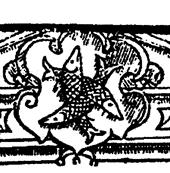
Leaving Italy, for now, and Shalit, we turn to Cracow where Isaac ben Aaron Prostitz, who together with his sons after him, printed Hebrew books for fifty years, beginning in 1569. In 1578, Prostitz printed at least three large format attractive tractates from the Talmud, Avodah ZarahKetubbot, and Rosh Ha-Shanah, the last extant in a ten folio unicum fragment in the library of the Jewish Theological Seminary. Moritz Steinschneider writes that Avodah Zarah was printed “si revera Supplementi tantum instar ad ed. Basil,” and “seu castrata . . .Cracoviae vero supplementi instar excusus,” that is, to compensate for its omission of the entire tractate from the much censored Basle Talmud.[12] Another feature of this tractate is that it is the first employ by Prostitz of the shield with two fish facing in opposite directions, the upper facing left, the lower facing right, above a printer’s inker, as his device.

Prostitz’s apparent next use of this device, this the first noted in bibliographic sources, is a Mahzor (1584) printed with the support of four partners, and reused frequently afterwards on such varied titles as Josippon (1589) at the end of the book, Avot with the commentary Derekh Hayyim by R. Judah Loew ben Bezalel (Maharal of Prague, c. 1525-16) after the introduction (1589), R. Moses ben Jacob Cordovero’s (Ramak, 1522-1570) Pardes Rimmonim (1591), between the books introductions, R. Bahya ben Joseph ibn Paquda’s (late 11th century) Hovot ha-Levavot, after the translator’s preface (1593) and R. Naphtali Hirsch ben Asher Altschuler’s (16th-17th cent.) Ayyalah Sheluha c. 1595. Pardes Rimmonim was actually printed in Cracow/Nowy Dwor, the change in location due to a serious outbreak of plague in Cracow, Prostitz and his family forced to flee to Nowy Dwor with the press’ typographical equipment. Pardes Rimmonim was completed in that location, the only Hebrew book printed in that Nowy Dwor.[13]
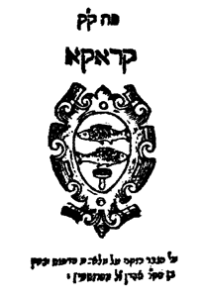
Fig. 2 Pressmark of Isaac Prostitz

Yaari questions Prostitz’s use of this pressmark. While the employ of the printer’s tool is clear, that is not the case for the fish. He suggests that it might be a propitious sign for the partners in the printing of the Mahzor in 1584, which Prostitz continued to use afterwards. This is unlikely, however, for, as we have noted, this device had been employed previously in 1578 on tractate Avodah Zarah. Another possibility is that the fish alludes to the month (Adar) in which Proztitz was born, but he then inquires why the pressmark was not used previously on all the books printed by the press. Yaari notes Steinschneider’s suggestion that the fish represented Prostitz’s entreaty for children, as his sons were borne at an old age. Here to, however, he observes that Prostitz’s four sons were born earlier, being mentioned in the colophon to Toledot Yitzhak in 1593. Another suggestion is that the fish allude to the name of R. Naphtali Hirsch ben Asher Altschuler who was known by all as Hirsch mokhir seforim (bookseller) in Lublin and for whom Prostitz printed books, for example Hovot ha-Levavot, the fish alluding to the name Naphtali, for the portion of the tribe Naphtali included the Kinneret Sea, in which fish were plentiful, but Yaari concludes this is only speculative.[14] I would question why, even if this is true for R. Altschuler, what does this have to do with Prostitiz and why he should have adopted this fish image for his pressmark?

A short lived press existed in Thannhausen, Bavaria, near Augsburg, a zoltot (supplementary festival prayers for the period between Passover and Shavu’ot) and a Mahzor (c. 1594) for the entire year according to the Ashkenaz rite were printed in the last decade of the sixteenth century. The press was a furtive effort to print Hebrew books by R. Isaac Mazia, whose name, it has been suggested, is an abbreviation for mi-zera Yehudim anusim, that is, he was of Marrano origin, or that he had served as rabbi in several communities in southern Germany, together with R. Simeon ben Judah ha-Levi of Guenzburg (Simon zur Gemze) of Frankfurt, who arranged with the Munich printer Adam Berg, to issue those works. When printing the mahzor the printers, concerned about the Christian response to sensitive passages and accusations of blasphemy, left blanks to be filled in by the purchasers.

After an examination of the still incomplete mahzorim by the censor at the University of Ingolstadt the press run of 1,500 copies was destroyed; only five copies are known to be extant today. In August, 1597, Mazia was fined 200 florin and released, while Berg, as late as 1604, was still attempting to have his impounded press returned. All of this occurred despite the fact that the authorities concurred that the mahzorim had been approved for publication by the imperial authorities in Prague. Nevertheless, the printers had neither received nor sought permission from the local authorities in Burgau to print. Moreover, as the books were for export they gave the impression that printing was done with the permission of those authorities.
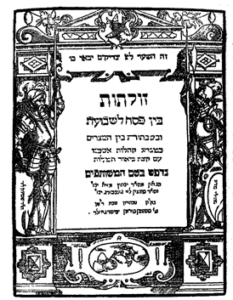
 Fig. 3b Zoltot


Fig. 3a Zoltot Extract

Both titles have a like frame comprised of an ornamental border with three entwined fish at the top (the signet of Mazia), at the sides are armed men in armor each with a shield, the right shield engraved with the name R. [Isaac] Mazia, the left with the name R. Simeon Levi. At the bottom is a laver pouring water on two hands, representative of the [Simeon] Levi. Isaac Yudlov informs that the fish here represent Isaac Mazia; this appearance of three fish as a printer’s mark is apparently unique. [15]

Not long afterwards we find the fish image employed in Lublin at the press of Zevi bar Abraham Kalonymous Jaffe. Lublin has a long and proud history as a Hebrew printing center, beginning with the press established by the family of Hayyim Shahor (Schwarz), that is, his son Isaac and his son-in-law Joseph ben Yakar. This press, through descendants and collateral members, would be active for almost a hundred and fifty years. The presses’ began publishing in 1551, with a folio Polish rite mahzor for the entire year, continuing until 1646 when a fire forced the press to close; printing resumed in 1648 when tah-ve-tat (gezerot Polania, the Chmielnicki massacres of 1648-49), broke out. That and the 1655-60 Swedish Muscovy wars, combined with others conflicts besetting the area made it impossible for Jaffe to continue and he had to close the press. Printing did resume when Solomon Zalman Jaffe ben Jacob Kalmankes of Turobin, encouraged and supported by his father, reestablished a Hebrew press. He printed 30 books until 1685 and the entire Jaffe family is credited with as many as 180 Hebrew titles.
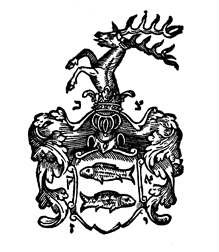
Fig. 4 Pressmark of Zevi Jaffe

A device employed by Zevi Jaffe, found on the title page of tractates in the large folio edition of the Babylonian Talmud published from 1617-1639, and after the introduction to R. Joel Sirkes’ (Bah, 1561–1640), Meishiv Nefesh, and possibly other works is a deer with raised forelegs, above a crown atop a shield with two fish, the upper facing left and the lower facing representative of the fact that he was a Levi, often accompanied by two fish, here too indicating that he was born in the month of Adar.

Among the many prominent printers of Hebrew books in Amsterdam is Uri Phoebus ben Aaron Witmund ha-Levi. He had previously worked for Immanuel Benveniste; in 1658, Uri Phoebus established his own print-shop. He would print about one hundred titles, from 1658 to 1689, the period he was active in Amsterdam, generally traditional works for the Jewish community, encompassing Bibles, prayer-books, halakhic works, haggadotaggadot, and historical treatises (Yosippon). Prostitz’s first pressmark, employed in 1569 on the title-page of R. Naphtali Hertz ben Menahem of Lemberg’s Perush le-Midrash Humash Megillot Rabbah and intermittently afterwards was a stag within a cartouche. Subsequently, Uri Phoebus employed as his device a hand pouring water from a laver, representative of the fact that he was a Levi, often accompanied by two fish, here too indicating that he was born in the month of Adar.

The first usage by Uri Phoebus of this device was in 1660 on the title-page of Ketoret ha-Mizbe’ah, R. Mordecai ben Naphtali Hirsch of Kremsier’s (d. 1670) work on the aggadic portions of tractate Berakhot dealing with the destruction of the Temple and the length of the exile. The title-page of this folio book has an arabesque frame and across the lower half of the page is Uri Phoebus’s fish mark. That device would be frequently used as a decorative ornament in many of the books that Uri Phoebus printed, placed in various locations, after introductions or the colophons.
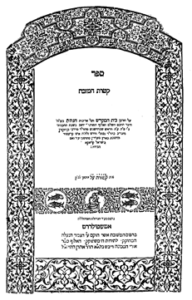
Fig. 5a Ketoret ha-Mizbe’ah

Fig. 5b Ketoret ha-Mizbe’ah Extract

Examples of the fish woodcut appears in other works, but not necessarily on the title-page, for example, in R. Hayyim ben Benjamin Ze’ev Bochner’s Or Hadash (c. 1671-75), on the laws of benedictions in a concise and abridged form, the title page of Or Hadash has an architectural frame headed by an eagle but no fish, that device being but one of several tail-pieces.

In 1662 Uri Phoebus printed an illustrated Haggadah accompanied by the commentary of R. Joseph Shalit ben Jacob Ashkenazi of Padua entitled Nimukei Yosef. The title-page of this quarto Haggadah has an architectural frame with two robed men at the sides, above winged cherubim and between them two fish with the winged head of a cherub. At the bottom are two vignettes; on the left the punishment of Shehem for the rape of Dinah and on the right the tribe of Levi killing the worshipers of the golden calf. In 1667-68, Uri Phoebus printed, also with this title-page, Nahalat Shivah (below and extract to right), R. Samuel ben David Moses ha-Levi’s (c.1625–1681) work on legal documents, particularly relating to divorce and civil matters. Nahalat Shivah has the same title-page as the Haggadah, here dated, “The Messiah ben David is coming משיח בן דוד בא (427 = 1667),” reflecting the referring to the false messiah Shabbetai Zevi. This title-page and fish crest (below) would be reused by Uri Phoebus for many years and elsewhere besides Amsterdam.

Fig. 6a Nahalat Shivah
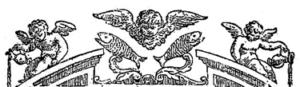
Fig.6 Nahalat Shivah Extract

Other title-pages employed by Uri Phoebus, with different architectural frames but with a like laver and fish image include such varied works as R. Jonah ben Isaac Teomim (d. 1669) of Prague’s Kikayon di-Yonah (1669-70), novellae on tractates of the Babylonian Talmud and, attributed to R. David ben Aryeh Leib of Lida (c. 1650-96) Migdal David (1680), both with the Benveniste frame; and R. Isaac Benjamin Wolf ben Eliezer Lipman (d. c. 1698), rabbi of Landsberg, Germany’s Nahalat Binyamin (1682), the first part of a commentary on the taryag [613] mitzvot and R. Shabbetai ben Meir Ha-Kohen’s (Shakh, 1621–1662) Siftei Kohen, a commentary and halakhic novellae on Shulhan Arukh Hoshen Mishpat these with a frame with rectangular shapes, all with the fish and lave at the apex.[16]  The title-page of Siftei Kohen, the first part of a commentary on the taryag [613] mitzvot dates the beginning of the work to 21 Tammuz, days of the Messiah ימי המשיח (423 = Thursday, July 26, 1663). The colophon dates completion of the work to Monday, 21 Heshvan, in the days of the Messiah בימי   המשיח (425 = November 9, 1664, actually a Sunday), both dates (Messiah) a possible allusion to Shabbbtai Zevi.[17]

Among the more elaborate title-pages is that of the first complete translation of the Bible (1676-78) into Yiddish by R. Jekuthiel ben Isaac Blitz, a rabbi from Witmund, Germany and corrector at the press of Uri Phoebus. This edition was the subject of a serious controversy with the Amsterdam printer Joseph Athias, who published an almost simultaneous and related Yiddish edition by Joseph Witzenhausen printed (Amsterdam, 1679-87).

Fig. 7a Bible – Engraved Front-piece
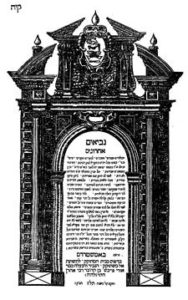
Fig. 7b Later Prophets

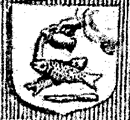
Figs. 7c, 7d Extracts

The Bible has an engraved front-piece title-page with depictions of Moses and Aaron, Mount Sinai at the top, and in the lower right hand corner a coronet and below it the raised hands of the Kohen giving a benediction. In the lower left hand corner is a fish and laver image, here the two fish are crisscrossed. The engraved title page is incorrectly dated תזל כטל (439 = 1679), whereas the like title-pages for each of the biblical divisions are correctly dated  תלז(437 = 1677), such as Later Prophets, below. The text has a separate but like title-page for Former Prophets, Later Prophets, and Writings. Note that in the otherwise like depictions of the fish and laver the position of the laver and water is reversed.

In 1689, Uri Phoebus ceased printing in Amsterdam, in order to relocate to Poland. Faced with competition from the large number of Hebrew printers in Amsterdam, Uri Phoebus felt that he would be more successful in Poland, located closer to its large Jewish population, a major market for the Hebrew printing-houses of Amsterdam. He established the first Hebrew press in Zolkiew in 1691, bringing his typographical material with him. Uri Phoebus’ descendants continued to operate Hebrew printing-presses in Poland into the twentieth century.

One of, if not the first book printed by Uri Phoebus in Zolkiew is R. Mordecai ben Moses Katz of Prostitz’s Derekh Yam ha-Talmud (1692) a super-commentary on the Hiddushei Halakhot of R. Samuel Eliezer ben Judah ha-Levi Edels (Maharsha). The title-page of this small work (40: 8ff.), much worn, appears to be the Benveniste frame, but at the apex is the same fish image as at the apex of Siftei Kohen. Among the decorative material, after the introduction and after the colophon is Uri Phoebus’ four fish mark, one on each side facing a laver from which water is being poured.

Among the other works published by Uri Phoebus in Zolkiew with the Nahalat Shivah title page reproduced above, is R. Jekuthiel ben Solomon Zalman ha-Levi Suesskind’s Dat Yekuthiel (1696,), a concise (80: 16 ff.) versified enumeration of the taryag mitzvoth (613 commandments). After the approbations to Dat Yekuthiel, there are thirteen, is the press mark comprised of four fish and laver. The title-page informs that the manuscript was found by Jekuthiel’s son Jonah of Kalish in his father’s bag, and arranged and brought to press by his grandson Menahem Feibush.

After the approbations is a letter from Jekuthiel to his son Eliezer. Jekuthiel, who was incarcerated at the time, in which he writes from his dark cell of his painful existence, where he had “wormwood, and gall to drink” (cf. Jeremiah 9:14) until “‘My soul is weary of my life’ (Job 10:1) ‘and my soul became impatient’ (Zechariah 11:8) to die in this way with this ‘light bread’ (Numbers 21:5) that I eat, absorbed in all my limbs, ‘the bread of adversity, and the water of affliction’” (Isaiah 30:20). Jekuthiel continues, describing his hardships, and then writes, “I will pay my vows to the Lord” (Psalms 116:14, 18) and that he took “of that which came to my hand a (new) offering” (cf. Genesis 32:14) on the taryag mitzvot. He thought to write on them in verse, “parallel, one with the other” (Exodus 26:17, 36:22), in single stanzas to the end, in the order of the Torah with references to the Hamishah Homshei Torah in the margins. Jekuthiel tells his son to take this as his blessing, which will be for a remembrance for both of them.

Uri Phoebus passed away in c. 1705.[18] He was succeeded in Zolkiew by his son Hayyim David, who had assisted his father at the press. Unfortunately, Hayyim David died shortly after his father, leaving the print-shop, in turn, to his sons, Aaron and Gershon. Uri Phoebus’ descendants continued to operate Hebrew printing-presses in Poland into the twentieth century. Aaron and Gershon did not use the ornamental material brought by Uri Phoebus to Zolkiew, instead preparing new frames that also reflected that they were Levi’im, and employed on such small format books as R. Raphael Lonzano’s Kinyan Avraham (1723) and R. Meir ben Levi’s Likkutei Shoshanim (1727). This ornate frame continued to be used by their descendants, among them Judah Solomon Yarsh Rappaport in Lvov on a Shir ha-Shirim with the commentary Magishi Minhah (1817) in Lvov.[19]
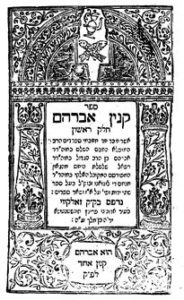
Fig. 8a Kinyan Avraham
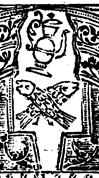
Fig. 8b Kinyan Avraham Extract

            Turning to, Germany, we find two fish, here facing in the same direction, on a title-page with an architectural pillared title-page, and at the bottom a palm tree, about it on the left a crab facing right and on the right two fish, both facing left, the former the sign of Tammuz (Cancer, scorpio), and, as already well noted, the latter the sign of Adar. The two zodiacal emblems may have had a personal significance, but, as Yosef Hayyim Yerushalmi observes describing a slightly later usage “the significance of this combination is difficult to ascertain.[20]

First employed in Fuerth by Joseph ben Solomon Zalman Schneur and his sons from 1691 through 1698, beginning with Torat Kohanim, and other folio volumes, primarily from the Shulhan Arukh, a like frame was subsequently used by Aaron ben Uri Lippman Frankel beginning with a Haggadah, in Sulzbach (below). Aaron was active in Sulzbach from the mid-1690’s until he passed away in 1720 at the age of seventy-five, first utilizing the fish image on a Mahzor printed in 1699 and afterwards in his folio imprints. Among those titles is a Haggadah (1711) with an attractive engraved copperplate front-piece (but without fish) followed by the second architectural pillared title-page described above. The architectural title-page was subsequently reused in Feurth by Hayyim ben Zevi Hirsch, who is credited with printing as many as 164 titles in that location, among the works with this frame and fish mark are several Haggadot (1746, 1752, and 1756).[21]
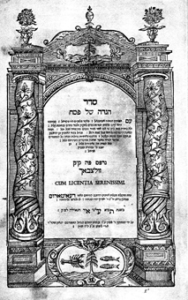
Fig. 9a Aaron ben Uri Lippman Frankel
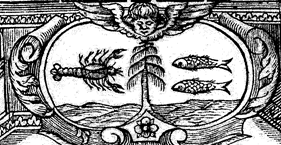
Fig. 9b Aaron ben Uri Lippman Frankel Extract

The site of yet another press that employed fish on the title-page, here apparently once only, was in Wandsbeck, a borough in north-west Hamburg in Schleswig-Holstein. The first printed books in Wandsbeck are dated to the late sixteenth and early seventeenth centuries, beginning with the Astronomiae instauratae Mechanica of Tycho Brahe (1546-1601), the famous Danish astronomer, published in 1598 by the printer Phillip van Ohr. Hebrew printing in Wandsbeck is a later occurrence, beginning approximately a century after its non-Jewish counterparts. It flourished for a brief period, primarily, albeit not solely, at the press of Israel ben Abraham.[22] The Thesaurus of the Hebrew Book enumerates forty-four titles from 1688 through 1744, several of which, including the titles previous to Israel’s sojourn in Wandsbeck, are listed as doubtful and includes duplicates as well.[23]

Israel ben Abraham was a proselyte who, reputedly, had previously been a Catholic priest. After his conversion Israel eschewed the sobriquets common among converts such as Avinu or the Ger (convert). Israel converted to Judaism in Amsterdam, where he wrote a Yiddish-Hebrew grammar Mafte’ach Leshon ha-Kodesh (Amsterdam, 1713). In 1716, after leaving Amsterdam, Israel ben Abraham acquired the typographical equipment belonging to Moses Benjamin Wulff, the court Jew in Dessau, and printed in Koethen, Jessnitz, and then in Wandsbeck from 1726-33, returning, after a brief retirement, to Jessnitz in 1739, printing a small number of titles to 1744.
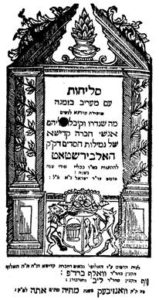
Fig. 10a Selihot with ma’ariv be-zemanah
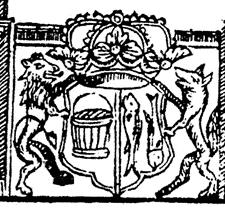
Fig. 10b Selihot with ma’ariv be-zemanah Extract

Selihot with ma’ariv be-zemanah (evening prayers in its time) is one of if not the first dated book attributed to Israel ben Abraham in Wandsbeck; it is a small octavo book (80: 7, 9, [4], 10-13, 13-23, [3] ff.). Its distinct title-page states that it is a Selihot with ma’ariv be-zemanah and that it contains matter pertaining to women; it informs that it was printed “as vowed and accepted upon themselves by the men of the hevra kaddisha (burial society) of the gemilut hasadim (charitable association) of HALBERSTADT,” and that it was “brought to press by the heads, the officers of the hevra kaddisha, R. Wulff and the noble R. Leib Warburg.” The title-page is dated in the year “You resuscitate the dead מחיה מתים אתה (469 = 1709),” a misdate, as noted by Moritz Steinschneider, who rejects the 1709 date (non admittunt; recusus ergo . . .) and dates it to 1730?[24]  At the bottom of the title-page are images of a lion at the left supporting a signet enclosing a pail, at the right a wolf supporting on the right side of the signet, two vertical fish, facing in different directions. The symbolism of these images is not clear, although it might be related to Wulff and Warburg, prominent contemporary family names.

The most dramatic, eye catching title-page with a fish motif was printed in Bad Homburg vor der Höhe at the press of Aaron ben Zevi Hirsch of Dessau. This Homburg is the district town of the Hochtaunuskreis, Hesse, Germany, on the southern slope of the Taunus, bordering, among others, Frankfurt am Main and Oberursel.[25] The title-page appears on successive editions of R. Meir ben Jacob ha-Kohen Schiff’s (Maharam Schiff, 1605-41, var. 1608-44) Hiddushei Halakhot, novellae on tractates of the Talmud, printed in Homburg in 1737, 1741, and 1747. Maharam Schiff, scion of a distinguished rabbinic family, a prodigy, was appointed rabbi of the important city of Fulda at the age of 17, where he was also served as a Rosh Yeshivah. There is a tradition that he was appointed rabbi of Prague in 1641, but if, as his grandson, who brought his works to press, reports, that he lived only 36 years, Maharam Schiff must have passed away immediately after his appointment. Maharam Schiff’s novellae are highly regarded and are reprinted in standard editions of the Talmud.[26]

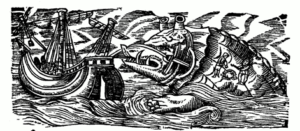
The title-page has a four part frame, the top image of a fish (sea creature) attacking a ship and within the fish two men, apparently roasting a small fish (?). Below the fish (sea creature) appears to be the face of a man. On the other editions the other portions of the frame are varied. A. M. Habermann, in his work on Hebrew title-pages describes the top portion of the frame as mythological.[27]
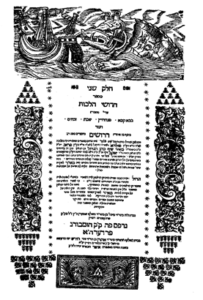
Fig. 11 1741, Hiddushei Halakhot

Returning to Amsterdam, an edition of Avot de-Rabbi Nathan with the commentary Ahavat Hesed (1777) by R. Abraham ben Samuel Witmond (1696-1773), also the author of novellae on the Pentateuch and Babylonian Talmud (1734). Avot de-Rabbi Nathan is one of the minor tractates, fourteen (fifteen, depending upon the enumeration) minor non-canonical tractates of the Talmud today appended to Seder Nezikin. It is an ethical work, considered a supplement to or a further development of Avot but with much aggadic material not related to the Mishnah, suggestive of an aggadic midrash. Ahavat Hesed was published posthumously by Witmond’s son-in-law and grandson at the press of Gerard Johann Janson. The header and place of publication on the title-page are printed in an oversized font in red letters. At the bottom of the page is a pressmark
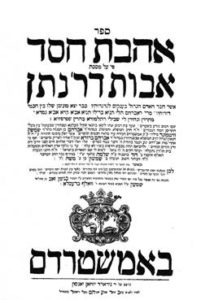
Fig. 12a Ahavat Hesed
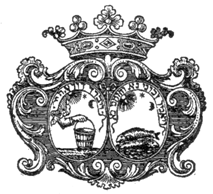
Fig. 12b Ahavat Hesed Extract

At the bottom of the title-page is a shield with topped by a coronet and within it on the right are two fish facing in opposite directions, above them the sun, moon, and a star, and above them the phrase “and (Samson) said, [O Lord God,] remember me, I pray you, and strengthen me” (Judges 16:28); on the left a hand holding a pail above water, again above the sun, moon, and a star, and above the phrase “And David blessed the Lord” (I Chronicles 29:10). Yaari informs that the two phrases, allude to Witmond’s son-in-law, R. David, son of the late Solomon Bloch, together with the author’s grandson, Samson ben Moses, who brought the book to press. Furthermore, the fish refer to Samson ben Moses, born in the month of Adar, the sign of which is a fish, and the pail refers to his son-in-law David, born in the month of Shevat, that month’s sign being a pail.[28]

            The fish image, replete with its symbolism of fertility and good fortune, continued to be used in Jewish imagery and pressmarks. Indeed, shortly after its appearance on Ahavat Hesed it was again employed, if only occasionally, on the title-page of works from another Amsterdam printer, this into the nineteenth century. The usage over centuries depicted here attest to the popularity and power of the fish image, persisting to the present.
[1] Joseph Lowin, “Hebrew Root Word [D-Y-G]” Jewish Heritage on Line Magazine, http://www.jhom.com/topics/fish/lowin.html.
[2] Ellen Frankel and Betsy Platkin Teutsch, The Encyclopedia of Jewish Symbols) Northvale, London, 1995), p. 55.
[3] https://commons.wikimedia.org/wiki/Category:Salmons_in_heraldry
[4] W. Roberts, Printers’ Marks. A Chapter in the History of Typography, (London, 1893), pp. 201-02.
[5] Previous articles in this series are “Mirror-image Monograms as Printers’ Devices on the Title Pages of Hebrew Books Printed in the Seventeenth and Eighteenth Centuries,” Printing History 40 (Rochester, N. Y., 2000), pp. 2-11, reprinted in Studies in the Making of the Early Hebrew Book (Brill, Leiden/Boston, 2008), pp. 33-43; “The Cover Design, ‘The Printer’s Mark of Marc Antonio Giustiniani and the Printing Houses that Utilized It,’” Library Quarterly, 71:3 (Chicago, July, 2001), pp. 383-89, reprinted in Studies, pp. 44-53; “Mars and Minerva on the Hebrew Title Page,” The Papers of the Bibliographical Society of America 98:3 (New York, N. Y., 2004), pp. 269-92, reprinted in Studies, pp. 1-17; “The Bear Motif on Eighteenth Century Hebrew Books” The Papers of the Bibliographical Society of America 102:3 (New York, N. Y., 2008), pp. 341-61, reprinted in Further Studies in the Making of the Early Hebrew Book (Brill, Leiden/Boston, 2013), pp. 57-76; “Akedat Yitzhak (the Binding of Isaac) on the Title-Pages of Early Hebrew Books,” in Further Studies, pp. 35-56; “The Eagle Motif on 16th and 17th Century Hebrew Books,” Printing History, NS 17 (Syracuse, 2015), pp. 16-40; “The Lion Motif on Early Hebrew Title-Pages and Pressmarks,” (Printing History, NS 22, (Syracuse, 2015), pp. 53-71.
[6] Among the primary sources for this article are my The Sixteenth Century Hebrew Book: An Abridged Thesaurus (Brill, Leiden, 2004) and my The Seventeenth Century Hebrew Book: An Abridged Thesaurus. Brill, Leiden/Boston, 2011, and Avraham Yaari, Hebrew Printers’ Marks From the Beginning of Hebrew Printing to the End of the 19th Century, (Jerusalem, 1943), Hebrew with English introduction.
[7] Kabbalah Centre, https://livingwisdom.kabbalah.com/pisces-adar.
[8] Aish.com, http://www.aish.com/h/pur/b/The_Choice_of_Adar.html.
[9] Concerning the widespread use of this frame see my “Mars and Minerva on the Hebrew Title Page,” noted above.
[10] Yaari, Hebrew Printers’ Marks, pp. 12, 132 no. 19.
[11] Yaari, p. 132.
[12] Moritz Steinschneider, Catalogus Liborium Hebraeorum in Bibliotheca Bodleiana (Berlin, 1852-60), col. 220 n. 1407, col. 228 n. 1427.
[13] Nowy Dwor, Polish for ‘new manor’, is the prefix of several locations with that title. Another Nowy Dwor, Nowy Dwor Mazowiecki, was home to a Hebrew press in the late eighteenth – early nineteenth centuries, printing a significant number of Hebrew titles from 1781 through 1818.
[14] Yaari, pp. 26, 139 no. 42.
[15] A. M. Haberman, Title Pages of Hebrew Books (Safed, 1969), pp.m 48,129 no. 34; Isaac Yudlov, Hebrew Printers’ Marks: Fifty-Four Emblems and Marks if Hebrew Printers and Authors (Jeruslaem, 2001), pp. 36-40 [Hebrew]. He also informs that three small fish are the mark of the Gronim family of Prague in the sixteenth century, appearing on their headstones.
[16] Concerning Lida and Migdal David see my“David ben Aryeh Leib of Lida and his Migdal David: Accusations of Plagiarism in Eighteenth Century Amsterdam,” Shofar 19:2 (West Lafayette, Ind., 2001), pp. 117-28, reprinted in Studies in the Making of the Early Hebrew Book, pp. 191-205.
[17] Another work refering to Shabbetai Zevi noted by Ch. B. Friedberg, History of Hebrew Typography of the following Cities in Europe: Amsterdam, Antwerp, Avignon, Basle, Carlsruhe, Cleve, Coethen, Constance, Dessau, Deyhernfurt, Halle, Isny, Jessnitz, Leyden, London, Metz, Strasbourg, Thiengen, Vienna, Zurich. From its beginning in the year 1516 (Antwerp, 1937), p. 29 [Hebrew] published by Uri Phoebus is Tikkun Keria with a depiction of Shabbetai Zevi “sitting upon a throne, high and lifted up” (Isaiah 6:1).
[18] Ch. B. Friedberg, History of Hebrew Typography in Poland from the beginning of the year 1534, and its development up to our days . . . Second Edition, Enlarged, improved and revised from the sources (Tel Aviv, 1950), p. 64 [Hebrew] and Yaari, p. 158, date Uri Phoebus death to 1705. L. Fuks and R. G. In contrast, Fuks-Mansfeld, Hebrew Typography in the Northern Netherlands 1585 – 1815, II (Leiden, 1984), p. 242, writes that although Uri Phoebus was very productive in Zolkiew, he returned to Amsterdam in 1705, where, in 1710, he wrote “a short history of the first settlement of the Sephardic Jews in Amsterdam,” and where he died on 23 Shevat 5475 (17 January, 1715).
[19] Yaari, p. 158.
[20] Yosef Hayyim Yerushalmi, Haggadah and History, A Panorama in Facsimiles of Five Centuries of the Printed Haggadah from the Collections of Harvard University  and the Jewish Theological Society of America, (Philadelphia, 1976), plates 64, 65.
[21] Yeshayahu Vinograd, Thesaurus of the Hebrew Book. Listing of Books Printed in Hebrew Letters Since the Beginning of Printing circa 1469 through 1863 I (Jerusalem, 1993-95), I, p. 450 [Hebrew]; Yaari, pp. 51, 152-52 no, 82; Yudlov, pp. 59-61
[22] Concerning Hebrew printing in Wandsbeck see Marvin J. Heller, “Israel ben Abraham, his Hebrew Printing-Press in Wandsbeck, and the Books he Published,” Further Studies in the Making of the Early Hebrew Book (Brill, Leiden/Boston, 2013), pp. 169-93.
[23] Vinograd, II, pp. 168-69.
[24] Steinschneider, cols. 2792-93 no. 7517, 446-47 no. 2939.
[25] Concerning Hebrew printing in Homburg see my “Early Hebrew Printing in Bad Homburg vor der Höhe,” in progress.
[26] Itzhak Alfassi, “Schiff, Meir ben Jacob Ha-Kohen,” Encyclopaedia Judaica, (Detroit, 2007) vol. 18, p. 131; Mordechai Margalioth, ed. Encyclopedia of Great Men in Israel IV (Tel Aviv, 1986), col. 1028-29 [Hebrew].
[27] A. M. Habermann, Title Pages of Hebrew Books (Tel Aviv, 1969), pp. 104, 134 no. 88 [Hebrew].
[28] Marvin J. Heller, Printing the Talmud: A History of the Printed Editions of the Talmud from the mid-17th Century to the end of the 18th Century and the Presses that published them (Brill: forthcoming); Yaari, Hebrew Printers’ Marks, pp. 89, 169-70 no. 145.


Tracing the history of eating milchigs on Shavuos

Tracing the history of eating milchigs on Shavuos

by Eliezer Brodt
In this post I would like to deal with tracing the early sources for the minhag of eating milchigs on Shavuos. A version of this article was printed last year in the Ami Magazine (# 119). This post contains a few corrections and additions to that version. A much more expanded version of this article will appear in Hebrew shortly (IY”H). Eating the vast array of customary dairy delicacies on Shavuos including, of course, cheesecake, is a minhag that very few people find very difficult. But what is the source of this minhag? This minhag goes back at least to the times of the Rishonim, and varied explanations for it also do.[1] That the minhag of milchigs on Shavuos was observed widely in recent history is very clear. For example, in an informative nineteenth-century Lithuanian memoir, the author describes the milk-based Yom Tov atmosphere:

“And at home there was again roasting and baking namely, many butter cakes! On this Holiday you especially ate all milk and butter dishes. The traditional cheese blintzes with sour cream, a kind of flinsed, were essential… On the second day of Shavuos… a happy mood prevailed; we drank fine aromatic coffee and ate butter cakes and blintshikes.”[2]

In Yeshivas Volozhin, after staying up the whole night, the whole yeshiva would take part in a milchig kiddush at the Netziv’s house.[3] We find the same thing in the Lomza Yeshiva; they had a kiddush after davening with cheesecakes and the like. [4] The question is, where did this minhag of eating milchigs on Shavuos come from? The Rambam, Tur, and Shulchan Aruch do not make any mention of it. In this article, I will trace some of the earliest known sources that we have for this minhag and discuss some of the reasons that are given. This is not an attempt to cover all aspects of this rich minhag, I hope to return this in the future. [5]One of the earliest mentions of this minhag can be found in a Pesach drasha from the Rokeach (1165-1240), which was printed from a manuscript for the first time just a few years ago. [6] Another one of the earliest sources is found in the very interesting work Malmed Hatalmidim from Rav Yaakov Antoli. Rav Antoli was born around 1194 in Provence, in southern France. He married the daughter of Rav Shmuel Ibn Tibon, the famous translator of the Moreh Nevuchim into Hebrew. The Malmed Hatalmidim was only first printed in 1866, with the haskamos of many gedolim, but the manuscript form had been used before that by many Rishonim, most notably the Avudraham.Rav Antoli writes that the custom is to eat milk and honey on Shavuos. He explains that this is because Torah is compared to milk and honey. Since milk is a very important food, so too, the mitzvos of the Torah are food for the soul, he says.[7]
Another early source for eating milchigs is found in the work Even Bochen from Rav Kalonymos ben Kalonymos (1286-1328)[8], where he describes milchig breads made with honey and formed into the shape of a ladder. (We’ll return to the ladder-shaped breads shortly).
Yet another early source can be found in the works of Rav Aharon Hacohen Miluneil (died around 1330) in his early work Kol Bo and in his later work Orchos Chaim. He writes, like the Malmed Hatalmidim, that on Shavuos people have the custom to eat milk and honey because Torah is compared to milk and honey. Women also bake challos with four heads, he says, as a zecher to the lechem hapanim. He says that others dip matzahs left over from Pesach into the spice known as zefrin since it causes happiness.[9] Rav Avigdor Hatzorfoti (died 1275) brings a remez (hint) from the Torah for the minhag. The passuk about Shavuos says, “Ubyom habikurim bihakriyvchem mincha chadasha lashem beshivuaschem.” The beginning letters of the last three words spell out chalav, milk.[10] This minhag is also found in the following early sefarim: the minhagim of the Maharam Merutenberg (written by a talmid of his)[11], Terumas Hadeshen[12], Maharil[13], Rav Isaac Tirina (born around 1380)[14], Meshivas Nefesh from Rabbi Yochanon Luria (1382)[15], Rama[16], Seder Hayom (printed in 1599)[17], Yosef Ometz (1570-1637)[18], and the Shelah Hakodesh (1570-1635).[19]
Aside from the reasons already mentioned, many additional reasons for this minhag have been given over the years. Recently, close to 150 reasons were collected by Rabbi Moshe Dinin in a small work called Kuntres Matamei Moshe. Here are a few reasons and some interesting points related to them. Rav Elyakyim Horowitz says that we eat milchigs because Dovid Hamelech died on Shavuos. The halacha is that when a king dies, all of the Jews have the status of an onen and are not permitted to eat meat.[20] This same reason can also be found in the work of Rabbi Shimon Falk.[21] Rav Avrohom Hershovitz brings the Mishna at the end of Avos, which says that one of the 48 ways the Torah is acquired is through not indulging oneself. Since meat is considered an indulgence, we eat milk products during the chag of Matan Torah as a reminder that this is the way to acquire Torah.[22] Rav Mordechai Leib Zaks points out that in the parsha of Bikurim it says that Hashem gave us the land of milk and honey. Therefore he suggests that the custom is to eat milchigs on the Yom Habikkurim to give thanks to Hashem for giving us the land of milk and honey and as a reminder of the mitzvah of bikkurim, which only included the fruits of Eretz Yisrael, the land of milk and honey.[23] Rabbi Yeshuyah Singer in Zichron B’sefer (printed in 1900) writes an interesting reason which he had heard. The Torah was given on Shabbos. The meat they had prepared before learning the halachos of shechita was assur to eat. It is not permitted to shecht on Shabbos. Therefore Bnei Yisrael had to eat milchigs, as they could not eat the food that they had prepared beforehand.[24]
The Mishna Berurah mentions a similar reason that he heard in the name of “gadol echad.” Immediately after Bnei Yisrael accepted the Torah, they were unable to eat anything but milchigs. The reason for that is because the preparation of kosher meat is very involved. A kosher knife and kosher utensils are necessary. Since this takes a long time, they just cooked milchigs.[25] Who is the “gadol echad” mentioned here? Rabbi Nachum Greenwald located this idea in the work Toldos Yitzchak, first printed in 1868. This idea is mentioned in the name of Rabbi Levi Yitzchak from Berditchev. It is interesting that the Chofetz Chaim did not say the name of the person he heard this idea from.[26] A similar idea can be found in the work Geulas Yisroel first printed in 1821. Rabbi Kapach says that the Jews in Yemen expressed wonder at those who ate just milchigs on Shavuos. They did not like the reason given (as we mentioned before) that the meat slaughtered prior to Matan Torah would be neveilah afterwards, because they argued that only the Erev Rav were unable to shecht before Matan Torah. The rest of the Jews, they claimed, were shechting before Matan Torah, just as we know that the Gemara says that Avraham Avinu kept all the mitzvos of the Torah before they were given.[27] However this statement is not so simple, because even if they were shechting and doing mitzvos before it is heavily debated what that would be considered, since their status as Jews may have changed during Matan Torah. According to many it would follow that after Matan Torah they would need to kasher the utensils and shecht new animals.[28]
Rav Yissachar Teichtal deals with a related issue. He asks that since the Torah was given on Shabbos and they couldn’t shecht and their prior shechita was not kosher, how did they fulfill the obligation of eating meat on Shabbos?[29] Rav Teichtal first mentions the answer of the Zichron Basefer quoted above, which is that they didn’t eat meat that Shabbos. However, Rav Teichtel disagrees. He has an interesting answer to explain how they did indeed have meat on this Shabbos. Basing himself on various sources, he says that they had meat created through the Sefer Yetzirah. The Gemara relates that there were those who were able to create an animal via the Sefer Yetzirah; Rav Teichtal says that that was done here.[30] The Toldos Yitzchak, quoted above, from Reb Levi Yitzchak Berditichever, gives another answer. There is a concept in halacha called Hoiel v’ishtrei ishtrei, which means that if something was permitted at one time, it remains muttar. It follows that they were permitted to eat anything they had prepared beforehand and did not have to throw out their dishes. Then he says that even though it was permitted, the Yidden were stringent and didn’t eat the meat. Since they were accepting the Torah that day, they wanted to be machmir.
A similar idea is found when Moshe Rabbeinu, as a baby, didn’t nurse from a non-Jew even though it was permissible. It appears that this idea is based on a concept found in numerous sources, called chinuch shanei. It means that the first time we do something, we do it in the best way possible, even if other ways are permitted. Moshe Rabbeinu could have been nursed from a non-Jew, but since he was the one who was going to get the Torah, he was kept from doing it. So too, here, the Yidden were machmir by not eating what was entirely permissible.[31]

Speaking of Moshe Rabbeinu, an original reason for this minhag is given by Rabbi Yitzchak Weiss, who says that Moshe Rabbeinu was found by the daughter of Pharaoh on Shavuos. Since they tried to give him milk from a non-Jew and he refused, we eat dairy to remind us of that.[32]

Cheesecake on the clock

Rav Dunner, in a recent article on the topic, lists many gedolim who ate the milchig seudah at night, including the Chazon Ish, Rav Aharon Kotler, Rav Yechezkel Abramsky, and others.[33] It is questionable whether or not there is an obligation to eat meat at night on Yom Tov.[34] In other sources, we see the opposite. There were people who specifically ate milchigs during the day—for example, the Volozhin and Lomza yeshivas, which I mentioned earlier, where there was a kiddush with cheesecake after davening.[35] This is also what the Darchei Teshuvah suggests one should do to avoid many different halachic issues.[36]
There is much discussion in the poskim whether it is permitted to eat milchigs first during the day, and then wait and eat meat. There’s also discussion about how long to wait. Some wait an hour before eating meat. Other poskim deal with the question of whether there is an obligation to bentch after the milchig kiddush.[37] For example, the Knesses Hagedolah (1603-1673) writes that he ate milchigs and honey, then he benched, and after he waited an hour, he ate fleishigs.[38]
However it’s pretty clear that the Magen Avrohom argues when he writes:
ועבי”ד סי’ פ”ט דא”צ להפסיק בב”ה [בברכת המזון] אם אינו אוכל גבינה קשה (סי’ תצד:ו).[39]
What’s interesting is that certain mekubalim did not eat milk the same day they ate meat products. Rabbi Eliyahu de Vidas, author of the Reishes Chochma (d. 1579), in his work Tosos Chaim writes that one should wait 24 hours(!) after eating meat before eating milk. According to this, it wouldn’t be possible to eat milk after meat on Shavuos![40] The Yosef Ometz quotes the Shelah, who says that he would wait 24 hours after meat to eat milk.[41] But later on (in siman 854), he says that people were lenient about this on Shavuos.
Interestingly enough, the Tzror Hamor even says that one should not eat meat within 24 hours of eating milk, and vice versa.
לפי קבלת קדמונינו בא לאסור בשר בחלב. ואמר לא תבשל. ולא אמר לא תאכל. לרמוז לנו כפי חכמי האמת כי אסור לאכול בשר ואחר כך חלב. וכן אסור לאכול חלב ואחר כך בשר. ואעפ”י שנתנו חכמים שיעורים בזה. כבר כתב רשב”י ז”ל כי כמו שאסור חלב אחר בשר. כך אסור לאכול בשר אחר חלב. ודינם שוה לענין השיעור שהוא עד שיתעכל המזון שבמיעיו. שהם כמו שש שעות שהוא זמן מסעודה לסעודה. כי הבישול האמור כאן על בישול האצטומכא הוא. בענין שלא יתבשלו הבשר והחלב באצטומכא בזמן אחד. ולפי שיש אצטומכא מאחרת העיכול. ליראי ה’ ולחושבי שמו אין לאכול גבינה ובשר ביום אחד. וכל שכן בשר וגבינה. וכן נוהגים המדקדקים במצות ואנשי מעשה. והטעם בזה לפי שאין ראוי לערב הכוחות אלו באלו. כח הדין בכח הרחמים. וכח הרחמים בכח הדין. כי הבשר הוא מדת הדין בסוד קץ כל בשר. כי מנפש ועד בשר יכלה הצר. והחלב הוא סוד הרחמים הגמורים המלבינים עונותיהם של ישראל. כאומרו כשלג ילבינו. והחטא הוא אדום בסוד הלעיטני נא מן האדום האדום הזה. ולכן יש להפרידם זה מזה כל אחד על כנו. ואת כל עורב למינו (צרור המור, משפטים, כג:יט).
According to this there would be appear to be no way to eat both milk and meat on Shavuos. The Toras Chaim is also very concerned with this issue of eating meat after milk; he says not to eat milchigs on Shavuos.[42] However, other rabbanim were to the other extreme. The Rokeach writes that his great uncle used to eat cheese, then wash his mouth out and immediately eat meat.[43] There is also a talmid of the Terumas Hadeshen who writes in his work Leket Yosher that his rebbi did the same[44]

From honey to milk

    It would appear that this minhag of eating milchigs ties in with another minhag of Shavuos and perhaps is derived from there.[45] When the talmid of the Maharam Merutenberg brings among the minhagim of the Maharam the minhag to eat milchigs on Shavuos, he brings it right after he brings another minhag: “Special cakes with pesukim on them are made for children as they begin to learn on Shavuos these are made to help them have an open heart [for learning].” There are numerous sources in Rishonim (such as Rokeach and Machzor Vitri) that on Shavuos when a boy begins to learn an elaborate ceremony is performed in which they eat from specially prepared cakes and dip their fingers in honey while saying certain pesukim.[46] This is done to help the boy’s mind open up and is a special segulah to help him remember what he learns. (Some sources do not mention that this was done on Shavuos; most do.)
    This ceremony was done on Shavuos because it is the day we received the Torah. Interestingly, we find sources for a few hundred years in the Rishonim that this minhag continued, at least in German circles. But it appears to have eventually been forgotten. The Shach cites the Rokeach as having mentioned the minhag but says that now it is not done.[47] Rabbi Dovid Ginsburg writes that he only found out about this minhag later on in life and had he known about it earlier he would have definitely done it for his children.[48]
    Rav Yaakov Emden writes that the reason that in earlier times the children excelled in their Jewish education as opposed to in his times was due to that they stopped doing this ceremony quoted in the Rishonim![48] Recently this minhag has been revived as part of the upsherin ceremony. Be that as it may, it is possible that this minhag of eating honey and sweets on Shavuos actually led to the minhag of eating of milchigs, because honey has always been associated with milchigs. As mentioned earlier, some made special milchig breads in the shapes of ladders. In the work Even Bochen from Rav Kalonymos ben Kalonymos we find an explanation, that the gematria of sulam (ladder) is Sinai. The Yosef Ometz and others bring different reasons connecting a ladder and Shavuos.[49]
     Professor Daniel Sperber suggested that the reason why the bread is shaped in the form of a ladder is that it ties in to the ceremonies for children who begin learning. To get the children to ask what is going on we make the breads in an interesting shape, similar to our methods of getting them to ask at the Pesach seder.[50]


  • [1] There are many collections of material on this issue see for example Rabbi Pinchas Schwartz, Minchas Chadasah, pp. 38-44; Rabbi S. Deblitski, Kuntres Hamoyadim, pp. 37-40; Kovet Eitz Chaim (Bobov) 6 (2008) pp. 239-242; an excellent collection of material in Pardes Eliezer, pp. 227-316; Rabbi Freund, Moadyim Lisimcha 6, pp. 490-505 ; Rabbi Yitzchack Tessler, Pininei Minhag, pp. 292-319; Rabbi Oberlander, Kovetz Or Yisroel, 32:104-120 and later updated in his Minhag Avosenu Beyadneu. See also YehudahAvidah in his work on Yiddish foods, Yiddishe Macholim, pp. 43-44; M.Kosover,Yiddishe Macholim, p. 75, 77, 98.
  • [2] Pauline Wengeroff, Memoirs of a Grandmother, 2010, p.150.
  • [3]Reshumot 1, p. 340.
  • [4] See Pirkei Zichronos, (2004) p. 359
  • [5] I hope to return to many other aspects of the minhag in the near future.
  • [6] Drasha Lepesach, ed. Simcha Emanuel (2006), p. 39, 110. See the important comment on this from my friend M. M. Honig in Pininei Minhag, p. 292.
  • [7] Malmed Hatalmdim, p. 121b. I hope to return to this work in a future article; for now see my article in Yeshurun, 24 (2011), p. 457.
  • [8] Even Bochen, p. 34. Mahratz Chiyos in his Kol Sifrei (p. 236) quotes this as an early source for eating milchigs. Both Matai Moshe (siman 692) and Mekor Chaim quote this work when talking about eating milchigs on Shavuos. On Rav Kalonymus ben Kalonymus much has been written already see: Y. Zinberg, Toldos Safrus Yisroel, vol. 1, pp. 411-427; Uberto Cassuto in the intro of the facsimile edition of Mesechtas Purim printed by A. Haberman in 1978; A. Haberman, Toldos Hapiyut Ve-hashira, vol. 2, pp. 142-149; A. Haberman IyunimBshira Ubpyuit, pg 162-179; C. Shirman, Toldos Ha-shira Haivirit Be-sefard, pp. 514-541.
  • [9] Orchos Chaim, p. 78a, Kol Bo, siman 52. Most are not aware that this work was authored by the same person. There were actually those that thought the Kol Bo was authored by a woman; see my Bein Kesseh L’essur (2010) p. 143.
  • [10] See Rav Avigdor Hatzorfoti, p. 478 See his Pirush Rav Avigdor Cohen Tzedek printed in the Toras Chaim edition of Megillas Rus, 2011, p. 53. On Rav Avigdor Hatzorfoti see Simcha Emanuel, Shivrei Luchos, pp. 173-181; E. Kanarfogel, Peering through the Lattices, pp. 107-109.
  • [11] Minhaghim of Maharham, p. 30.
  • [12] Leket Yosher, p. 103
  • [13] Minhaghim p. 85
  • [14] Sefer Minhaghim, Reb Isaac Tirina (2000) p. 67-68. To be more exact this minhag is in the section which is called Hagahos haminhagim. It is unclear exactly who the author is of that section but it assumed to have been written rather early on. On all of this, see S. Spitzer in his introduction to this edition pp. 17-18.
  • [15] Meshivas Nefesh, p. 185. On the dating of this work see Rabbi Yakov Stahl, Deutsche 84, (2010) p. 6.
  • [16] See Igros Moshe OC 1:160. On this topic see this excellent article by my friend Rabbi Yehudah Spitz here.
  • [17] Seder Hayom Shavuos p.78
  • [18] Siman 854
  • [19] Shelah, Mesechtas Shavuos, p. 30a.
  • [20] Zichron Yerushlayim, p. 153. In Reshumot 1, p. 350 we find that some made a special seudah because of this and finished Sefer Tehillim.
  • [21] Shut Shem Mishomon, OC, 2:4, p.15.
  • [22] R. Avraham Eliezer Hershkowitz, Otzar Kol Minhaghei Yeshrun (St. Louis, 1918),p. 201
  • [23]Zemanim, (1951) p. 53 See also his Mili Demordechai, p. 125. For another connection between bikkurim and eating milchigs see Rabbi Shlomo Schick, Seder Minhaghim 1 (1880)pp. 83b-84a.
  • [24] Zichron Besefer, p. 122. See Emes Leyakov (Shulchan Aruch) p. 215 where Rav Yaakov suggests this reason himself and adds some points.
  • [25] Mishna Berurah 494:12. See also Rav Tzvi Farber, Sefer Moadyim, p. 26 (and see there for some other reasons). See also Rabbi Aron Misnik, Minchas Ahron, pp. 102-106; Pardes Eliezer, pp. 279-282.
  • [26] The Chofetz Chaim did not have a problem quoting chassidic sources; he quotes the Shulchan Aruch Harav numerous times. On the Chofetz Chaim and chassidus see what I wrote in the article “Censorship in the Sefer Chofetz Chaim,” here.
  • [27] Halichos Teiman, p. 31. See also Keser Shem Tov, 4 p. 16 who has a similar issue.
  • [28] The status of the Yidden before Matan Torah and the mitzvos performed then has been discussed in numerous works I hope to return to this topic at a later date. See also Rabbi Oberlander (above, note 1) p. 632- 633.
  • [29] Shut Mishnat Sachir, siman 136.
  • [30] Much has been written on how one creates something based on the Sefer Yetzirah and if one can use what has been created through such a method for a mitzvah or the like. I hope to return to this topic at a future date.
  • [31] A subject I hope to return to in the future.
  • [32] Elef Kesav, 1, p. 64.
  • [33] Kovet Eitz Chaim (Bobov) 6 (2008) p. 240
  • [34] See Eitz Chaim Ibid. See Darchei Tesuvah, 89:19.
  • [35] See Pirkei Zicronos, (2004) p. 359.
  • [36] Darchei Tesuvah, 89:19.
  • [37] See Darchei Tesuvah, 89:14; Dershot Mishnat Sachir, 2, pp. 347-348.
  • [38] Shiurei Kness hagedolah, 494. See Shut Sich Yitzchack, 234. On this topic see this excellent article by my friend Rabbi Yehudah Spitz here.
  • [39] I will deal with this Magen Avrhom at great length in the near future B”n.
  • [40] See Tosas Chaim, 2008 p. 79. In the back of this edition there is a lengthy Peirush Ir Hachaim, pp. 245- 249 and for in-depth discussion of this topic see the Pardes Eliezer pp. 233- 238. I will deal with this at greater length in the near future B”n.
  • [41] See Yosef Ometz, siman 137.
  • [42] Toras Chaim, Chullin 83a. However it is worth pointing out that the Toras Chaim in Bava Metzia 86b, says that the reason for eating milchigs on Shavuos is to show the malachim that we are careful about basar b’cholov and that when we eat milk we are careful to do everything halacha says to do before we eat meat.
  • [43] See Drasha of the Rokeach, p. 39
  • [44] Leket Yosher, p. 103
  • [45] This idea was suggested by my friend M.M. Honig. Rabbi Oberlander (above, note 1) also suggests this point. D. Sperber in his Minhagei Yisroel 3, p. 139 also connects the two.
  • [46] See my article on this in Yerushacheinu, 5 (2011) pp. 337-360 especially pp. 344-347.
  • [47] Shach, 245:8.
  • [48] See my article in Yerushacheinu (ibid), p. 347 note 65.
  • [49] Migdol Oz, p. 32.
  • [50] Others have different shapes and reasons; see Rav Yehoshua Falk, Choshevi Machsvos p. 152. See also M. Gidman , Hatorah Vehachaim 3, 108; H. Pollack, Jewish Folkways in Germanic Lands (1648-1806), p. 102, 277
  • [51] Minhagei Yisroel 3, p. 139.


April Fools! Tracing the History of Dreidel Among Neo-Traditionalists and Neo-Hebraists

April Fools! Tracing the History of Dreidel Among Neo-Traditionalists and Neo-Hebraists

These explanations [for playing with the sevivon] are far from reality. Why do no sources dating from the Maccabean period, and only in the last few hundred years, mention playing sevivon? If “Hakhamim” decreed it, or it was the custom in ancient times, of if “Beis Din shel Hashmonaim” established it, why is it not mentioned for all these generations?

Yitzhak Tesler, “Ha-Dreidel (Sevivon) be-Chanukah: Mekoroseha, Ta’amyah, u-Minhagyah,” Or Yisrael, 14 (1999), 50.

I have seen a toy in London called a Teetotum. It is exactly like a Hanucah Trendel with English letters instead of Hebrew on it. But why it is called by its peculiar name, no one can tell me. Of course, the name comes from the letter T, which is inscribed on one of the four sides of the toy; thus T Totum or T takes all. This reminds me of the noted Latin epigram addressed by the boy to the twirling Teetotum Te, totum, amo, amo, te, Teetotum.

Leopold Dukes to Leopold Löw, September 1864.

Only two mitzvot of Chanukah are mentioned in Rabbinic sources: lighting candles and reciting the full Hallel. Over the centuries, many other practices came to be associated with Chanukah. Some are unique to specific geographic regions, while others saw universal adoption. One that is lesser-known today is the custom of Venetian Jews to travel on gondolas, rowing through the city, and greeting each house with a blessing and “a merry Hebrew” carol. Or the custom in Avignon, France, recorded in 1779, that women were permitted in the men’s section of the synagogue during the eight days of Chanukah.[1] Many Jews accept these as the evolution of Jewish practice without requiring any sacred reasons; others are unwilling to do so. These neo-traditionalists locate the practices within the rubric of Jewish ritual and even claim historical legitimacy when there is none. The dreidel is an example of this phenomenon.

The dreidel toy is not Jewish in origin. Instead, dreidel is the ancient game of teetotum that remained popular until at least the twentieth century. Teetotum, at its most basic, is a four-sided dice with a stick in the middle. While some versions use dots or numbers to denote players’ actions, letters are the most commonplace. The letters vary based upon the vernacular, with the name teetotum from the Latin version of T (totum-all), and the remaining letter instructions, A (aufer-take), N (nihil-nothing), D (depone-put down). Even the Hebrew letters are merely a transliteration of the German version: G (ganz-all), H (halb-half), N (nischt-nothing), and S (schict-put).

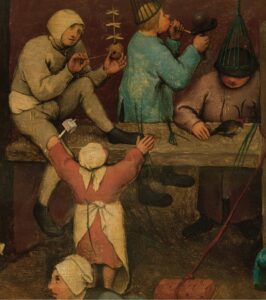
Figure 1 Detail: Pieter Bruegel, Children’s Games, Kunsthistorisches Museum, Vienna

Teetotum is documented in Vienna’s Kunsthistorisches Museum displays Pieter Bruegel the Elder’s (1525/30-1569) masterpiece, “Children’s Games” (1560). Another of his works in the museum is the “Tower of Babel,” which is the subject of a forthcoming post. Children’s Games depicts over two hundred children playing eighty different games. Bruegel’s encyclopedic pictorial catalog of games is unique in the annals of art. A small child is at the bottom left corner, her arms raised, holding a teetotum. (See here for a detailed view and here for Amy Orrock’s excellent article, “Homo ludens: Pieter Bruegel’s Children’s Games and the Humanist Educators,” discussing the purpose and interpretation of the painting within Erasmus’s views on the benefits of play.) Teetotum also appears in the list of games of Bruegel’s near contemporary French author François Rabelais’s (d. 1553) satirical work, Gargantua. The Oxford English Dictionary identifies it as “a favorite Victorian toy.” It appears in well-known English literature such as Lewis Carol’s Through the Looking Glass, where the White Queen (then a white sheep) asks Alice, “Are you a child, or a teetotum.” Other examples are Charles Dickens’ Our Mutual Friend, Edgar Allen Poe’s The System of Doctor Tarr and Professor Fether, and James Joyce’s Finnegans Wake as “finfoefom” (based on Joyce’s unique lettering system).[2]

Despite the widespread awareness of teetotum in Europe from at least the 1500s, the earliest Jewish sources connecting it with Chanukah date to the nineteenth century. Other Chanukah games boast much earlier recognition. For example, R Yosef Yuspa Nördlinger Hahn (1570-1637) mentions chess, tic-tac-toe, cards, and possibly backgammon.[3] Likewise, a 1638 herem banned cards and dice on Chanukah, although chess was excepted.[4] In subsequent Jewish literature, card playing has the most mentions, but that is due to their moral and ethical concerns rather than approval. None of these mention dreidel or any similar game.

The lack of historicity and mesorah was no barrier for 19th-century rabbis, nearly all Hassdic, from asserting Jewish relevance and stating that it is among the customs that qualify as minhag Yisrael Torah. R. Tzvi Elimelech Spira of Dinov is perhaps the most well-known example. In his Bnei Yissaschar, he contrasts the operation of the dreidel with the other Jewish play toy, the Purim gragger. The dreidel is activated from the top, symbolic of the heavenly source of the Chanukah miracle. The gragger is turned from the bottom because the catalysts of the miracle were Mordechai and Ester.

Others explain the symbolism of the dreidel’s letters, נ, ג, ה, ש. According to one explanation, these allude to the two rabbinically sanctioned mitzvot that we have on Chanukah, נרות שמונה (candles all eight nights) and הלל גמר (the complete Hallel). Others note the gematria (numerical value) of the letters, which correspond to the same gematria as משיח (the Messiah). Others still link the letters with גשנה the city Yosef secured for his family in Egypt that appears in the weekly Torah reading that coincides with Chanukah.[5]

None of these, however, locate the dreidel within the Chanukah story, and for that, we need to wait until the early twentieth century. According to this modern origin story, after the Greeks prohibited Torah study, Jewish teachers and students continued to do so surreptitiously in caves. When the authorities discovered these groups, they quickly switched from studying to playing dreidel.

The first appearance of this account appears in a collection of customs published in 1917 in Saint Louis. R. Avraham Eliezer Hirshovitz (1859-1924), originally from Kovno (today Kaunas), Lithuania, and in 1908 emigrated to the United States and was the preacher of Shaary Torah and taught children in Pittsburg, PA.[6] In 1892, he published the first edition of his book on Jewish customs, Minhagei Yeshurun, in Vilna. It includes three haskamos (approbations). The only discussion regarding Chanukah is the source of the name. Seven years later, he published an expanded second edition in Vilna, with 280 customs and now eight additional approbations (he omitted one from the first edition), most notably one from R Yitzchak Elchanan Spektor. R Spektor caveats that he only had time to read a few lines but that “it is a nice work.” Another approbation is from the maskil, Kalman Schulman.[7] We are unaware of any other religious book that bears his approbation. Hirshovitz provides that he obtained “many other approbations and letters of support” that he did not include. Neither of these editions discusses dreidel.

In 1899, Hirshovitz published a further expanded version in Yiddish in Vilna. By then, he had emigrated to the United States. He discusses game playing on Chanukah for the first time, although only cards. He explains that some play cards as it is like war, evoking the military victory over the Greeks. Nonetheless, he disapproves of playing cards, noting that cards are non-Jewish (he does not mention any halakhic reasons or the numerous Jewish sources that explicitly prohibit cards and other forms of gambling on Chanukah).

Finally, in the first American edition, published in Saint Louis in 1918, now with approximately 500 customs, Hirshovitz addresses the custom of playing dreidel. He does not mention any of the Hassidic explanations. Instead, he tells the story of the dreidel and how it was used to hoodwink the Greeks.[8] Despite the complete lack of evidence and the absurdity of the Greeks falling for such a simplistic and completely unrealistic ruse, Hirshovitz’s narrative quickly entered the Jewish collective consciousness. For example, in the collection of customs, Pardes Eliezer devotes an entire chapter to dreidel and explains “that despite the fact dreidel doesn’t appear in the sifrei ha-achronim it does not prove it is a recent custom.” Rather, “kama hokerim” (many scholars) describe it as “an ancient custom, dating to the Hasmonic period,” and then uses Hirshovitz’s story. Or, in the book Minhag Yisrael Torah, Hirshovitz’s narrative is “the simple” explanation.[9] Today, if one does a cursory search on the internet, there are articles from the Aish.com website regarding dreidel entitled “A Serious Game,” or on Chabad.org that describes Hirshovitz’s rationale as “the Classic” and “common” reason, and many others.

Not all were so taken with Hirshovitz’s work. R Shmuel Kraus published a highly critical article in Kiryat Sefer in 1933 that highlights numerous methodological issues with Hirshovitz’s work.[10] While Kraus notes the book was sloppily published with omissions and other defects, he reserves the bulk of his article is devoted to Hirshovitz’s hallucinatory customs and corresponding sources. While the article does not discuss the dreidel, it criticizes Hirshovitz for identifying sources for the “custom” to trick people on April 1, the word “daven” that is identified as either Aramaic or from the English word Dawn and provides a reason why in Europe a Bar Mitzvah boys give a “derasha,” but in the United States a “speech.” Hirshovitz sometimes tries to adopt a more substantive and historically defensible explanation, even citing an article from JQR regarding the Magen David.[11]

While Hirshovitz’s explanation is unsupportable, one hypothesis is worth mentioning. Israel Abrams, in an article that initially appeared in The American Hebrew and republished in his collection Festival Studies, posits that Teetotum:

It is a very ancient game, known to the Greeks and Romans. But why was it specially favoured on Hanucah? No answer has ever been given to this natural question. It may be that the Teetotum was regarded as a very innocent form of gambling, if that be not altogether too harsh a word to use. Many pious people never played cards or any other game of chance, but they may have felt that so simple a game as this was lawful enough. But I can now supplement this with a new suggestion. Teetotum is still in parts of Ireland the indoor recreation of the peasantry at Christmas tide. Now it is well known that such games seldom change their seasons. I should wonder if the Teetotum was a favourite toy elsewhere at Christmas. If so, the Jews may have transferred it to Hanucah. For they never invented their own games, except those of intellectual species such as Hanucah Ketowes [riddles]. The Ketowes even gave rise to a folk proverb: “Zechus Owes, Kein Ketowes,” i.e., I suppose merit of the fathers is not the solution of life’s riddle. Indeed, the moral of Hanucah, is after all, that Judaism must rely on present effort of the children as well as on the past merits of their sires, if it is to remain in any true sense a “Feast of Light.”[12]


The Case of the Origin Story of the Creation of the Word Sevivon

Another mythical story associated with dreidel occurs with the origin of the modern Hebrew word for the toy, sevivon. The most well-known history is found in the autobiography of Eliezer Ben Yehuda’s son, Itamar ben Avi (1882-1943), Im Shahar Atzmotenu, published in 1961. Rochel Berlov, in her article “Me Hidush ha-milah ‘Sevivon’?”, however, demonstrated that the term long predated Itamar. (See also Ester Goldenberg’s article).  David Yeshayahu Silberbusch coined it and first appeared in Hayyim Zelig Slonimski’s journal Ha-Tzefirah on December 24, 1897 (See Zerachyah Lict’s comprehensive article regarding Slonimski’s challenge to the miracle of the oil and Marc Shapiro’s subsequent discussion). A week and a half later, Silberbusch used the word as the title of a satirical article, and it subsequently regularly appeared in the newspaper. In 1923, Levin Kipnis published his now famous song, sevivon, sov, sov, sov. Itamar wrote his autobiography when he was fifty, and it was published posthumously. He tells the story of how

one day, when he and his family were preparing to go on a trip outside the city, outside the wall, I suddenly jumped towards my parents: Mother! Mother! I found a sevivon for Chanukah. My mother hugged and kissed me with admiration. “How beautiful is the word you created, my son!” This is how the word sevivon was created and became standard for decades among all Jewish children. I, the writer of these memories and the one who created it when I was a child, among countless other words that are now incorporated into our language, but [not everyone] recognizes who created them.

Despite this story, the word does not appear in any newspapers his father, Eliezer Ben Yehudah, edited. Moreover, Ben Yehudah did not include it in his monumental dictionary of modern Hebrew. Nonetheless, Itamar’s story was retold countless times in children’s books and treatments of Itamar (and some still think the issue remains unsettled). Zohar Shavit’s assessment of Itamar’s book, which can be equally applied to Hirshovitz’s dreidel origin story, aptly sums up the willingness to accept such tall tales:

Above all, he understood the importance of creating an interesting and fascinating story, apparently even at the expense of historical credibility… It is quite clear that in some of his personal stories, Ben-Avi prefers the interesting story over fidelity to the facts.

Notes:

[1] Recorded in Israel Abrahams, “Hanucah in Olden Times,” in Festival Studies Being Thoughts on the Jewish Year (Philadelphia, 1906), 146, 152.

[2] Joseph Shipley, The Origins of English Words: A Discursive Dictionary of Indo-European Roots (Johns Hopkins University Press, 2001), 411; John P. Anderson, Joyce’s Finnegans Wake: The Curse of Kabbalah (Universal Publishers, 2008), 211-12.

[3] Yosef Kosman, Noheg ka-Tzon Yosef, (Tel Aviv, 1979), 188 n.12; Herman Pollack, Jewish Folkways in Germanic Lands (1648-1806): Studies in Aspects of Daily Life (MIT Press, 1971) 181, 330n184.

[4] Minhagei DK”K Vermisia, Yitzhak Zimmer, ed., vol. 1 (Mefal Toras Hakhmei Ashkenaz, 1988), 238-39.

[5] See R. Yitzhak Tesler, “Ha-Dreidel (Sevivon) be-Chanukah: Mekoroseha, Ta’amyah, u-Minhagyah,” Or Yisrael, 14 (1999), 50-60 (collecting these and other sources).

[6] For biographical and complete bibliographical information, including a discussion of variant versions, see Yosef Goldman, Hebrew Printing in America 1735-1926: A History and Annotated Bibliography (Brooklyn, 2006) n583&622 (see here and here for our review of this work).

[7] For biographical information, see Hillel Noah Steinschneider, Ir Vilna, vol. 2, Mordechai Zalkin, ed. (Hebrew University Magnes Press, Jerusalem, 2002), 182-83.

[8] Avraham Hirshovitz, Otzar Kol Minhagei Yeshurun (St. Louis, 1918), 57. Hirshovitz cites “HaRav Ziv” as his source. But otherwise, it provides no information regarding this person. Two authors from that period use “Ziv,” Yehoshua ben Aba Ziv, who wrote a book of songs and a fictional work in Yiddish on the life of a Yeshiva student. The book of songs, Asifas Shirim: Al Mo’adei ha-Shana (Vilna, 1875), 13-15, includes a song for Chanukah but does not mention dreidel. The other possibility is Nehemiah Shmuel Libowitz, who used the pseudonym “Ziv.” Libowitz was a contemporary of Hirshovitz in America, and although we have not discovered any evidence, it’s possible they met in the United States. That may account for Hirshovitz’s inclusion of the dreidel story in his U.S. edition. Nonetheless, none of Libovitz’s published works include Hirshovitz’s Dreidel story, which includes the book Herod and Agrippa, which touches upon the Hashmonim.

[9] Kollel Damesek Eliezer, Pardes Eliezer, Hanukah, vol. 2 (Machon Damesek Eliezer, Brooklyn, 2004), 650-51; Yosef Lewy, Minhag Yisrael Torah, vol. 3 (Brooklyn, 1997), 216. Gavriel Zinner  however, in his extensive discussion of Chanukah customs and dreidel in his Neta Gavriel, does not mention Hirshovitz’s reason.

[10] Shmuel Kraus, “A.Y. Hirshovitz, Otzar kol Minhagei Yeshurun,” in Kiryat Sefer 11,3 (1934), 311-12.

[11] See Hirshovitz, Otzar Kol Minhagei Yeshurun, 4 (April fools), 28 (speech versus derasha), 88 (JQR).

[12] Abrahams, “Hanucah,” 154-55.


The Ethics of the Case of Amalek: An Alternative Reading of the Biblical Data and the Jewish Tradition

 The Ethics of the Case of Amalek: An Alternative Reading of the Biblical Data and the Jewish Tradition
by Reuven Kimelman
This study of Amalek deals with seven questions.
1. Is the battle against Amalek primarily ethnic or ethical?
2. What is the difference in reading the biblical data starting with Exodus and Deuteronomy or starting with I Samuel 15?
3. What is the evidence that the Bible already seeks ethical justification for punishing Amalek?
4. How does post-biblical literature in general and rabbinic literature in particular further the transformation of Amalek into an ethical category?
5. How is the “Sennacherib principle” applied to Amalek?
6. How is Amalek de-demonized?
7. How can Haman be an Amalekite when according to 1 Chronicles 4:43 the remnant of Amalek had been wiped out?
                                                1. Introduction
This study deals with the wars against Amalek. The popular conception is that the Bible demands their extermination thereby providing a precedent for genocide.[1] This reading of Amalek filters the Torah material through the prism of Saul’s battle against Amalek in the Book of Samuel. The total biblical data is much more ambiguous making the most destructive comments the exception not the rule as will be evident from a systematic analysis of all the Amalek material in the Bible.
                                                2. AMALEK
The first biblical reference to Amalek appears in Exodus 17:
7The place was named Massah and Meribah, because the Israelites quarreled and because they tried the Lord, saying, “Is the Lord present among us or not?” 8Amalek came and fought with Israel at Rephidim. 9Moses said to Joshua, “Pick some men for us, and go out and do battle with
Amalek. Tomorrow I will station myself on the top of the hill, with the rod of God in my hand.” Joshua did as Moses told him and fought with Amalek, while Moses, Aaron, and Hur went up to the top of the hill. 11Then, whenever Moses held up his hand, Israel prevailed; but whenever he let down his hand, Amalek prevailed. 12But Moses’ hands grew heavy; so they took a stone and put it under him and he sat on it, while Aaron and Hur, one on each side, supported his hands; thus his hands were faithful until the sun set. 13And Joshua overwhelmed the people of Amalek with the sword. Then the Lord said to Moses, “Inscribe this in a document as a reminder, and recite in the ears of Joshua:[2] ‘I will utterly blot out the memory of Amalek from under heaven.’ ” 15And Moses built an altar and named it Adonai-nissi. He said, “It means, ‘Hand upon the thro[ne] of the Lo[rd]!’ The Lord will be at war with Amalek throughout the ages.”
This text raises many questions: (1) why could Moses not keep his hands up fully aware that as long as they were raised Israel prevailed, (2) why are the hands of Moses called “faithful,” (3) why was it inscribed in a document and told specifically to Joshua that God — not he — is to blot out Amalek, (4) why is it God — not Israel — who will be at war with Amalek, and if God is waging the war (5) why does God not finish them off as was done with the Egyptians at the Sea rather than extending it throughout the ages. Finally, (6) why do the terms for God and throne appear in the Hebrew orthographically truncated? The inability to account for these matters in literal terms has generated the view that the battle between Amalek and God serves as a metaphor for the conflict between human evil and divine authority where human evil truncates, as if were, the divine presence and authority.[3] The metaphorical reading would account for locating the war with Amalek in Exodus after a crisis of faith — “Is the Lord present among us or not?” (17:7)[4]  and why the hands of Moses are described as faithful, namely, faith generating. It also accounts for its location in Deuteronomy after a warning against dishonest business practices that ends with “For everyone who does those things, everyone who deals dishonestly, is abhorrent to the Lord your God” (25:16).[5]
The appearance of Amalek is thus correlated with the absence of faith and morality. Its presence signifies their absence. The position is epitomized in the rabbinic statement: “As long as the seed of Amalek is in the world neither God’s name nor His throne is whole. Were the seed of Amalek to perish from the world the Name would be whole and the throne would be whole.”[6] In fact, an alternative version explicitly states “the wicked” instead of Amalek.[7] Thus the war against Amalek is not against a specific ethnicity, but the human ethical condition. Such a battle ultimately can only be waged by God not Joshua. Therefore Joshua is pointedly told that what he started with the historical Amalek is not his job to finish since that can only be done by God. In sum, the more Amalek comes to embody moral evil, the more it moves from ethnicity to ethics.
It is generally assumed that the metamorphosis of Amalek from the ethnic to the ethical is a product of post-biblical exegesis, absent in the Bible itself. Alternatively, the aforementioned terminological peculiarities reflect a process of metaphorization already evident in the Bible. The possibility that the Exodus text was already understood metaphorically in the Bible may be gathered from the other references to the actual nation of Amalek which lack awareness of the Exodus text. Thus in the next reference to Amalek, in Numbers 13:29 and 14:25, they are designated by their location only. Numbers 14:43-45 warns Israel:
42Do not go up, lest you be routed by your enemies, for the Lord is not in your midst. 43 For the Amalekites and the Canaanites will be there to face you, and you will fall by the sword, inasmuch as you have turned from following the Lord· and the Lord will not be with you.” 44Yet defiantly they marched toward the crest of the hill country, though neither the Ark of the Covenant nor Moses stirred from the camp. 45And the Amalekites and the Canaanites who dwelt in that hill country came down and pummeled them to/at Hormah.
There is no allusion to the Exodus episode unless it is in the metaphorical explanation that Israel meets defeat because they turn away from God. In any case, there is no command to do away with Amalek nor any special comment about them. In Numbers 24:20, it is predicted that Amalek will be gone or perish forever without any mention that Israel will destroy them.[8] It correlates well with the last biblical mention of Amalek in 1 Chronicles 4:43 where it is recorded that the last remnant of Amalek was done away with as part of its conflict with the tribe of Simeon, but not because of any mandated war against them.
The next reference to Amalek is in Deuteronomy 25. It adds three elements. It seeks to provide a basis for retributive justice by charging Amalek with an unprovoked ambush of the defenseless, seeking to “cut down all the stragglers in your rear.” It is precisely their immorality
that triggered the demand for retribution.[9] It also delays the battle until all the borders have been secured thereby removing it from any defense or security agenda. This process is extended by later authorities who further postponed the struggle with Amalek till the kingship was instituted and the Temple built,[10] while others delayed it to the messianic age.[11] And lastly, it shifts the responsibility for such retribution from God to Israel. It goes like this:
17Bear in mind what Amalek did to you on your journey, after you left Egypt—18how, he surprised you on the march, when you were famished and weary, and undeterred by fear of God, cut down all the stragglers in your rear. 19Therefore, when the Lord your God grants you safety from all your enemies around you, in the land that the Lord your God is giving you as a hereditary portion, you shall blot out the memory of Amalek from under heaven. Do not forget!
This description, especially the expression “undeterred by fear of God,” provoked various classical commentators to level against Amalek a slew of charges such as insolence, immorality in warfare, undermining divine authority,[12] and provoking other nations to attack Israel.[13] Thus it was claimed that they were “justly suffering the punishment which they wrongly strove to deal to others.”[14] Others, however, claimed that the expression “not fearing God” applied to Israel just as do the preceding expressions “famished and weary.”[15] Faulting Israel for “not fearing God” correlates with faulting Israel for the lack of faith, in Exodus 17:7, which precipitated the onslaught of Amalek in 17:8.[16]
 Amalek next appears in The Book of Judges.[17] He is described as a launcher of raids into the Israelite heartland without any special comment. In fact, he is sometimes associated there with Midian, who becomes the object of Israel’s wrath (ibid., 6:15), not Amalek. The absence of any special enmity for Amalek is telling.
The next reference to Amalek in 1 Samuel 15 is fateful. It places the responsibility to blot out the memory of Amalek on the king and identifies “the memory” with all the people and livestock. This position was harmonized with Deuteronomy’s position that it is the people’s responsibility by maintaining that the demand devolves upon the people only when led by a king in an act of war.[18]  It states:
1Samuel said to Saul, “I am the one the Lord sent to anoint you king over His people Israel. Therefore, heed the voice of the Lord’s words. 2‘Thus said the Lord of Hosts: I am exacting the penalty for what Amalek did to Israel, for the assault he made upon them on the road, on their way up from Egypt.’ 3“Now, go attack Amalek, and proscribe all that belongs to him. Spare no one, but kill alike men and women, infants and sucklings, oxen and sheep, camels and asses.”
There are two ways of parsing this section. Either both verse two and three are God’s, or only verse two while three is Samuel’s inference. According to the second parsing, we have here Samuel’s interpretation and application. He places the responsibility to blot out the memory of Amalek on the king, he interprets “blotting out” as physical extermination, and identifies “the memory” with all the people and livestock. Samuel thereby extends the innovation of Deuteronomy seven of including Canaanites in the proscription of Israelite idolators to the Amalekites.[19] This move was perceived as so harsh that the talmudic rabbi, R. Mani, had King Saul himself protest the order objecting that even if the adult males were guilty the children and livestock were not.[20] Since there is no similar objection with regard to the Amalek material in the Torah, the Torah material was not understood as including children and livestock. Saul’s objection in the Talmud must hence be against Samuel’s interpretation that the proscription of Amalek includes the destruction of those who did not partake in Amalek’s dastardly deeds. After all, Exodus faults Amalek for mounting the attack at all, whereas Deuteronomy focuses on their crude cowardice of attacking the stragglers. Both accusations are limited to those who fought.
 Just as Samuel expanded the biblical data, Maimonides later on circumscribed Samuel’s
position and harmonized it with Deuteronomy by limiting the attack on Amalek to the people when led by a king in an act of war.[21] He thus ruled that the appointment of a king precedes the war against Amalek. Since he also ruled there that the destruction of Amalek precedes the building of the Temple,[22] he ends up severely restricting its application to the period between the appointment of the king and the building of the Temple. In biblical chronology, that limits it to the reign of Saul and David. Even that, is not as limiting as the Bible itself since there is no mention of Amalek with regard to David’s failed attempt, or Solomon’s successful attempt, to build the Temple nor do either seek to do away with Amalek. Presumably, Amalek was already irrelevant or that Samuel’s understanding of Amalek was never accepted. This, as shall see, makes most sense of the biblical data.
Besides limiting the morally outrageous ruling on Amalek to a specific time, it was limited by a process of moral justification. This process begins already in Deuteronomy by spelling out their felonious behaviour and continues in the Book of  Samuel. Samuel thus justifies his slaying of the king of Amalek, Agag, not by referring to crimes of long ago but to recent ones, saying: “As your sword has bereaved women, so shall your mother be bereaved among women” (I Samuel 15:33).[23] By understanding the king as representative of the people, a four hundred year vendetta becomes a quid pro quod judicial execution. Only those who have wielded the sword will die by the sword. [24] Lurking behind this understanding is obviously the verse “A man shall be put to death [only] for his own sin” (Deuteronomy 24:16). A verse which was already used in the Bible (2 Kings 14:6 = 2 Chronicles 25:4) to prevent cross-generational vendettas. A similar understanding of the battle against Amalek as justified retribution appears in the reference to Amalek immediately preceding our story in 1 Samuel 14:48: “He (King Saul) was triumphant, defeating the Amalekites and saving Israel from those who have plundered it.” If the Hebrew of “and” is taken, as it sometimes is, as “namely,”[25] then Saul’s defeat of the Amalek is in response to Amalek’s plundering of Israel.
This reading that Amalek should only get as they gave is justified by David’s tit-for-tat response to Amalek’s plundering. 1 Samuel 30 states what Amalek did to Israel:
1By the time David and his men arrived in Ziklag, on the third day, the Amalekites had made a raid into the Negev and against Ziklag; they had stormed Ziklag and burned it down. 2They had taken the women in it captive, low-born and high-born alike; they did not kill any, but carried them off and went their way.
Again Amalek attacked the weak left behind. What did David do? Not knowing what to do he inquired of the Lord:
7David said to the priest Abiathar son of Ahimelech, “Bring the ephod up to me.” 8When Abiathar brought up the ephod to David, inquired of the Lord, “Shall I pursue those raiders? Will I overtake them?” And He answered him, “Pursue, for you shall overtake and you shall rescue.”
Evidently, there was no recourse to any standing order to kill Amalek. Indeed, nothing is made of the fact that they are Amalekites. They are simply called raiders. David’s counterattack sought only to recoup his own. Amalekites who fled are left alone and the livestock is taken as spoil:
17David attacked them from before dawn until the evening of the next day; none of them escaped, except four hundred young men who mounted camels and got away. 18David rescued everything the Amalekites had taken; David also rescued his two wives. 19Nothing of theirs was missing—young or old, sons or daughters, spoil or anything else that had been carried off —David recovered everything. 20David took all the flocks and herds, which [the troops] drove ahead of the other livestock; and they declared, “This is David’s spoil.”
Note that there is no condemnation of David, à la Saul, for not slaying Amalek or for taking the spoil. Similarly, 1 Chronicles 18:11 records that David dedicated to God the spoils of Amalek[26] just as he did to those of Edom, Moab, Ammon, and the Philistines. Again Amalek is treated as other enemies without a distinctive comment or special treatment just as is the case in Psalm 83:7-9 which lists Amalek among the many enemies of Israel. One tradition, cited by Rashi and Radak to 2 Chronicles 20:1, has the Amalekites trying to pass as Ammonites to wage war against Israel in the time of Jehoshaphat, whereas another, based on Numbers 21:1, has them trying to pass as Canaanites to exploit Israel’s vulnerability upon the death of Aaron.[27]
The final case which shows that the treatment of Amalek was not different from other enemies is David’s encounter with the Amalekite who slew King Saul in 2 Samuel 1:
4“What happened?” asked David. “Tell me!” And he told him how the troops had fled the battlefield, and that, moreover, many of the troops had fallen and died; also that Saul and his son Jonathan were dead. 5“How do you know,” David asked the young man who brought him the news, “that Saul and his son Jonathan are dead?” 6The young man who brought him the news answered, “I happened to be at Mount Gilboa, and I saw Saul leaning on his spear, and the chariots and horsemen closing in on him. 7He looked around and saw me, and he called to me. When I responded, ‘At your service,’ 8he asked me, ‘Who are you?’ And I told him that I was an Amalekite. 9Then he said to me, ‘Stand over me, and finish me off for I am in agony and am barely alive.’ 10So I stood over him and finished him off, for I knew that he would never rise from where he was lying. Then I took the crown from his head and the armlet from his arm, and I have brought them here to my lord.” … 13David said to the young man who had brought him the news, “Where are you from?” He replied, “I am the son of a resident alien, an Amalekite.” 14“How did you dare,” David said to him, “to lift your hand and kill the Lord’s anointed?” 15Thereupon David called one of the attendants and said to him, “Come over and strike him!” He struck him down and he died. 16And David said to him, “Your blood be on your own head! Your own mouth testified against you when you said, ‘I put the Lord’s anointed to death.’ ”
The Amalekite who informed David that he had slain Saul at his request expected a reward not retribution. The fact that he tells David that he informed Saul that he is an Amalekite indicates his obliviousness of any Israelite crusade to do away with Amalek. Indeed, as we have seen, David treated Amalek no different than any other enemy.
Samuel’s demand for the wholesale killing of Amalek thus stands as the exception not the norm. It does not even coincide with the other biblical data. After all, if Saul had slain all the Amalekites why did they remain so numerous in David’s time? In Numbers, Judges, and elsewhere in 1 Samuel (14:48, 27:8) Amalek gets the same quid pro quod treatment as other ancient enemies. This is even their lot at the hands of Saul in 1 Samuel 14:48.
The normalization of Amalek reaches its peak in the en passant record of their destruction in 1 Chronicles 4:41-43:
41 Those recorded by name came in the days of King Hezekiah of Judah and attacked their encampments and the Meunim who were found there, and wiped them out to this day, and settled in their place because there was pasture there for their flocks. 42 And some of them, five hundred of the Simeonites, went to mount Seir with Pelatiah, Neariah, Rephaiah, and Uzziel, sons of Ishi, at their head. 43 Having destroyed the last surviving Amalekites, they live there to
this day.
The destruction of the remnant of Amalek is told as part of a local conflict with the tribe of Simeon during the reign Hezekiah in the late eighth century BCE. Neither king, prophet, or God is involved. No biblical precedent is noted. It simply is not a big deal. Any subsequent reference or allusion to Amalek is perforce metaphorical. The major biblical example of the metaphoraization of Amalek is Haman, the would-be exterminator of the Jews in the Book of Esther. The association of Amalek with Haman through the term ‘Agagite’ is a consequential development in the move from the ethnic to the ethical. Since, as 1 Chronicles 4:43 notes, the last Amalekites were done away centuries earlier, the association of Amalek with Haman is part of the move of identifying Amalek with their historical wannabees.  Apparently, aware of the historical problem, the Greek versions of Esther 3:1 call Haman, or his father Hammedatha, a Bougaean or Macedonian not the Agagite. The Talmud itself understood Hammedatha, in Esther 3:1, 10, as an expression of moral opprobrium.[28]
The Haman case is complex and requires extended analysis. It is common to see the conflict between Mordecai and Haman as an episode in the ongoing bout between Israel and Amalek by linking Mordecai with King Saul and Haman with Amalek. Both links are problematic. The identification of Mordecai with Saul is based on identifying Saul with “the son of Jair, the son of Shimi, the son of Kish, a man of Benjamin” (Esther 2:5). The assumption is that Kish is the Benjaminite Kish, the father of Saul (1 Samuel 9:1),[29] yet no mention is made of the most illustrious and pertinent ancestor — King Saul. Moreover, Jair is not a Benjamite name, but rather a son of Manasseh according to Numbers 32:41, or a priest of David according to 2 Samuel 20:26. Finally, Shimi is identified only as a member of the clan of Saul (2 Samuel 16:5), not as a descendant of Saul. Frustrated by these discrepancies, the Talmud takes Jair, Shimi, and Kish to be metaphorical epithets of Mordecai himself.[30]
With regard to designating Haman the Agagite (Esther 3:1, 10; 5:8; 8:1, 3, 5; 9:10, 24), note that Haman is not designated an Amalekite as other Amalekites are but only as an Agagite.[31] Moreover, the antagonism of Haman for Mordecai is attributed to Mordecai’s provocative
behavior (Esther 3:2-5), a stance he maintains even after the decree (Esther 5:9), and not to Haman’s genealogy. There is no evidence that Haman on his own had it in for the Jews.  Similarly, the Greek Addition A to Esther (v. 17) attributes Haman’s ire against Mordecai and his people to Mordecai having exposed the plot against the king of the two eunuchs who, according to Josippon 4, were relatives of Haman. He only becomes subsequently the nefarious model of classical Judeophobia; ticked off by one Jew he seeks to eliminate all Jews.
Note that Haman is not executed because of his genealogy, but because of his murderous machinations. He is specifically hanged on the gallows he prepared for Mordecai as an expression of poetic justice and not for any long standing vendetta. As Samuel justifies Agag’s execution by his iniquitous acts so does the Book of Esther justify Haman’s by his. Neither is punished for the sins of their fathers. Similarly, the Book of Esther no more concludes with a mandate to remember Amalek than does the story of Saul and Agag. In both cases by doing away with the enemy, in Haman’s case also his sons, there remains no remnant in the story itself and the case is closed. Even Haman’s sons are slain not because of their father but because, as 9:5-10 notes, they numbered among the foes of the Jews. Had this been part of a historical vendetta, a tit-for-tat allusion to the impalement of Saul’s sons by the vindictive Gibeonites in 2 Samuel 21:9 would have been in order. Clearly, the moral structure of the book is predicated on a measure for measure system not on any historical retribution or squaring of accounts.
Instructively, if not ironically, Haman’s plan “to destroy, massacre, and exterminate all the Jews, young and old, children and women” (Esther 3:13) smacks of Samuel’s order to Saul: “kill alike men and women, infants and sucklings” (1 Samuel 15:3). In pointing out the moral absurdity of Haman’s designs there is an oblique critique of Samuel’s. Josephus indeed states that Haman’s hatred of the Jews derives from this incident,[32] as if to say that the Jews are now getting as they gave. A vendetta against Amalek has become a vendetta against the Jews. The Midrash, however, sees this as a preemptive comeuppance arguing that “God gave Amalek a taste of his own future work.”[33] The Midrash is extending Samuel’s moral justification for slaying Agag. Just as Samuel justified killing Agag because he killed others, so the Midrash justifies the order for wiping out Amalek because Haman ordered the wiping out of the Jews. Not able to anchor Amalek’s extraordinary punishment in any prior behavior, the Midrash perforce extends its moral compass to include Amalek’s future behavior. In any case, the issue remains moral.
This moral self-criticism extends to comments made about Amalek’s mother Timna. Accordingly to the Talmud, her efforts to convert were rejected by all three Patriarchs. Wanting to join this people at all cost, she marries Isaac’s grandson, through Esau, Eliphaz. The fruit of
this relationship is Amalek who goes on to aggrieve Israel for their having ticked off his mother Timna.[34] The insight is that Israel’s lack of receptivity to converts can trigger a resentment that leads to retributive vindictiveness.
The allusion to the Saul-Amalek incident explains another relevant peculiarity of the Book of Esther. Thrice, it states that “they did not lay hands on the spoils” (9:10, 15, 16) of those persons slain in trying to kill the Jews even though the royal edict (8:11) explicitly permitted it. Since the original decree specifically mentioned (3:13) the right of spoils for the slain Jews why did the Jews not act in kind? Unless it was to avoid transgressing the prohibition against taking the spoils of Amalek mentioned in 1 Samuel 15:3. But the murderous Persians are not of Amalek stock,[35]  unlike the sons of Haman where the same scruple was adhered to (see Esther 9:10). If they are not of Amalek why were they treated as if they were? if not because they were Amalek in character. Despite no chance for spoils, now that government support had been rescinded, they pressed on to kill the Jews. Wanting to kill Jews for its own sake, they are dubbed thrice-fold not just the enemies of the Jews, but also their haters (Esther 9:1, 5, 16).[36]
Acting like Amalek, they are treated as Amalek, no longer an ethnic designation but an ethical metaphor.[37]
Maimonides also makes no special provision for Amalek when he argues that all wars must be preceded by overtures of peace indicating that were Amalek to sue for peace they would not be subject to destruction.[38] The ruling that all must be offered terms of peace flows from the following Midrash:
God commanded Moses to make war on Sihon, as it is said, ‘Engage him in battle’ (Deuteronomy 2:24), but he did not do so.  Instead he sent messengers . . . to Sihon . . . with an offer of peace (Deuteronomy 2:26). God said to him: ‘I commanded you to make war with him, but instead you began with peace; by your life, I shall confirm your decision.  Every war upon which Israel enters shall begin with an offer of peace, as it is written, “When
you approach a city to attack it, you shall offer it terms of peace”
(Deuteronomy 20:10).[39]
Since Joshua is said to have extended such an offer to the Canaanites,[40] and Numbers 27:21 points out Joshua’s need for inquiring of the priestly Urim and Tumim to assess the chances of victory, it is evident that also divinely-commanded wars are predicated on overtures of peace as well as on assessments of the outcome.[41] Moreover, the cross-generational struggle against Amalek, according to Maimonides, is limited to Amalek maintaining the practices of their biblical ancestors of rejecting the Noachide laws which stipulate the norms of human decency and civil society.[42] Were Amalek to accept them they would achieve the status of other Noachites. Again morality trumps biology.
The concern with the humanity of the enemy is also a factor. Referring to Deuteronomy 21:10ff. Josephus says the legislator of the Jews commands “showing consideration even to declared enemies.  He . . . forbids even the spoiling of fallen combatants; he has taken measures to prevent outrage to prisoners of war, especially women.”[43] Apparently reflecting a similar sensibility, R. Joshua claimed that his biblical namesake took pains to prevent the disfigurement of fallen Amalekites,[44] whereas David brought glory to Israel by giving burial to his enemies.[45] It is this consideration for the humanity of the enemy that forms the basis of
Philo’s explanation for the biblical requirement in Numbers 31:19 of expiation for those who fought against Midian. He writes:
For though the slaughter of enemies is lawful, yet one who kills a man, even if he does so justly and in self-defense and under compulsion, has something to answer for, in view of the primal common kinship of mankind.  And therefore, purification was needed for the slayers, to absolve them from what was held to have been a pollution.[46]
The position that the negation of Amalek is ethical not ethnic is also reflected in the following talmudic anecdote about Amalek’s ancestor Esau[47] who was later identified with Rome:
Antoninus (the Roman Emperor) asked Rabbi (Judah the Prince): Will I enter the world to come?” “Yes,” said Rabbi. “But,” said Antoninus, “is it not written, ‘And there will be no remnant to the house of Esau’ ” (Obadiah 18). (Rabbi replied) “The verse refers only to those who act as Esau acted.” We have learned elsewhere likewise: “And there will be no remnant of the house of Esau,” might have been taken to apply to all (of the house of Esau), therefore Scriptures says specifically — “of the house of Esau,” to limit it only to those who act as Esau acted.[48]
Once the criterion becomes behavior and not birth, the Talmud can claim that even the descendants of Haman the Amalekite became students of Torah.[49] Following suit, Maimonides ruled: “We accept converts from all nations of the world.”[50] Radak even entertains the possibility that the Amalekite who refers to himself as a ger in 2 Samuel 1:13 meant a convert to Judaism. For him and Maimonides, the wiping out of Amalek can be accomplished by the wiping out of Amalekite qualities. This is why Maimonides states with regard to Amalek: “It is also a positive commandment to remember always his evil deeds.”[51] He adopts the position of Sifrei Deuteronomy[52] that “remember” is fulfilled with the mouth, and “do not forget” is fulfilled through the heart. No act of violence is mandated against Amalek. So why, according to him, was Amalek punished so harshly to begin with? To deter future Amalek wannabees.[53]
As Amalek became more and more a metaphor for human evil, the eradication of Amalek from the national-historic plane was shifted to the metaphysical and psycho-spiritual.[54] The interioralization of Amalek imposes the duty of eradication on all. This shift parallels the aforementioned rabbinic reading of the Amalek episode in Exodus if not that of the Bible itself.
In the post-biblical period the shift from ethnicity to ethics is total. In both the Saul-Amalek and Haman episodes, Scripture indicates that no one remained. Their ethnicity was also rendered operationally defunct by applying the same “Sennacherib principle” to them that was applied to the long gone Canaanites.[55] This principle was based on the fact that Sennacherib, the king of Assyria, erased the national identity of those he conquered which included all of the nations of ancient Canaan and surrounding nations,[56] as he says: “I have erased the borders of the peoples; I have plundered their treasures, and exiled their vast populations” (Isaiah 10:13). Independent of the “Sennacherib principle,” others limited the moral relevance of the command against Amalek by restricting the waging of a war of total destruction against Amalek to King Saul.[57] Such limitations best reflects the total biblical data. Applying the “Sennacherib principle” and limiting the commandment to a specific period in the past or postponing it to the messianic age effectively removes the case of Amalek from the post-biblical ethical agenda.
In sum, there are four ways of rendering Amalek operationally defunct:
1. The recognition that the mandate for their extermination was a minority position based on Na”kh (1 Samuel 15), not confirmed in the rest of the Bible indeed implicitly denied.
2. The realization that the process of transmuting Amalek into a metaphor for human evil is rooted in the Torah (Exodus 17).
3. The limitation of the conflict to King Saul and/or postponing the battle to the messianic era
4. The application of the same “Sennacherib principle” to Amalek that was applied to the long gone Canaanites.
 These four overlapping stratagems of the biblical and post-biblical exegetical tradition mitigate the ruling regarding the destruction of the Amalekites. This trumping of genealogy by ethics helps account for the absence of any drive to exterminate or dispossess Amalek even when Israel was at the height of its power under the reigns of David and Solomon.
[1]On the practice of
genocide in antiquity, see Louis Feldman, “Remember Amalek!”: Vengeance,
Zealotry, and Group Destruction in the Bible according to Philo, Pseudo-Philo,
and Josephus
, (Cincinnati: Hebrew Union College Press, 2004), pp. 2-6.
[2]Taking kee as
introducing direct speech; see The Hebrew and Aramaic Lexicon of the Old
Testament
, eds. L. Koehler, W. Baumgartner, et al., (3 vols.,
Leiden: Brill, 1994-1996), 2:471a; and Amos Ḥעakham, Sefer Shmot,
(2 vols., Jerusalem: Mosad Harav Kook, 1991), 1:329a.
[3]See Pesikta deRav
Kahana 3; and Pesikta Rabbati 12.
[4] Which is how the
Midrash takes it; see Midrash Tanḥעuma, BeShalaḥע
25, p. 92; and Pesikta deRav Kahana 3.8, ed.
Mandelbaum, 1:47 with parallels in n. 5. Otherwise it should probably be
located several chapters later after the Sinaitic narrative.
[5]So Pesikta de
Rav-Kahana
3.4, ed. Mandelbaum, 1:42-43:
R. Banai, citing R. Huna, began his discourse
[on remembering Amalek] with the verse “A false balance is an abomination to
the Lord …” (Proverbs 11:1). And R. Banai, citing R. Huna, proceeded: When you
see a generation whose measures and balances are false, you may be certain that
a wicked kingdom will come to wage war against such a generation. And the
proof? The verse “A false balance is an abomination to the Lord” … which is
immediately followed by a verse that says, “The immoral kingdom will come and
bring humiliation [to Israel]” (Prov. 11:2).
See Rashi and Abarbanel
to Deuteronomy 25:17 with Tosafot to B. T. Kiddushin
33b, s. v. ve-eima.
[6]Pesikta DeRav Kahana
3.16, ed. Mandelbaum, 1:53 with parallels in n. 8.
[7]See Menaḥem Kasher,
Torah Shelemah
(Jerusalem: Beth Torah Shelemah, 1949-1991), 14:272f.
[8]This may be what allowed
Josephus (Antiquities 3:60) to say that Moses predicted that the
Amalekites would perish with utter annihilation.
[9]As spelled out in the
end of the first stanza of the kerovah of Parshat Zakhor; see the Yotzer
for Parshat Zakhor in The Complete ARTScroll Siddur for
Weekday/ Sabbath/ Festival, Nusach Ashkenaz
(Brooklyn: Mesorah
Publications, 1990), p. 880f.
[10]Sifrei Deuteronomy 67, T.
Sanhedrin 4.5, B. T. Sanhedrin 20b.
[11]The eschatological
reading may already be in the Dead Sea Scroll 4Q252, 4.1-3; see Louis
Feldman, “Remember Amalek!”: Vengeance, Zealotry, and Group
Destruction in the Bible according to Philo, Pseudo-Philo, and Josephus

(Cincinnati: Hebrew Union College Press, 2004), p. 52f. It is clearly already
tannaitic. Rabbi Joshua reads Exodus 17:6 to mean “When God will sit on His
throne and His kingship is established — at that time will the Lord war on
Amalek.” And according to Rabbi Eliezer: “When will their names be blotted out?
When idolatry is uprooted along with its devotees,when the Lord is alone in the
world and His kingdom lasts forever– then the Lord will go out and war on
those people” (Mekhilta deRabbi Ishmael, ed.
Horowitz-Rabin, p. 186). See the version and discussion in Menahem Kahana, The
Two Mekhiltot on the Amalek Portion
[Hebrew] (Jerusalem: Magnes Press,
1999), p. 239f. The Aramaic translation, Targum Jonathan, takes
the word “end” in Numbers 24:20, which refers to Amalek, as an allusion to the
Messianic era. For medievals who also postponed the conflict to the messianic
period, see Moses b. Jacob of Coucy, Sefer Mitsvot Gadol (SeMaG),
negative commandment #226; and R. David b. Zimra (RaDBaZ) with Maimonidean
Glosses to Hilkhot Melakhim 5:5.This probably includes Maimonides
since he made the battle with Amalek contingent upon a king, see his “Laws of
Kings and Their Wars,” 1:2.
[12]See Nachmanides,
Abarbanel, and Sforno ad loc., and Exodus 17:16 along with Josephus, Antiquities
4.304.
[13]See Josephus, Antiquities
3.41; Mekhilta de-Rabbi Ishmael, Amalek 1 (ed. Horovitz-Rabin), p. 176; Mekilta
de-Rabbi Shimon bar Yohai
81 (ed. Epstein-Melamed) 119; and the end of the
second stanza of the kerovah of Parshat Zakhor in The Complete
ARTScroll Siddur for Weekday/ Sabbath/ Festival, Nusach Ashkenaz
(Brooklyn:
Mesorah Publications, 1990), p. 882f.
[14]Philo, The Life
of Moses, 1:218 (LCL 6:391).
[15]Mekhilta, Amalek 1, ed.
Horowitz-Rabin, p. 116, l. 9 (see p. 116, lines 3 and 18). See Ralbag
(Gersonides) as cited by Abarbanel ad loc.
[16]See Midrash Tannaim,
ad loc., ed. Hoffmann, p. 170; and Hizkuni ad loc.
[17]Judges 3:13; 6:3-5, 33;
7:12; 12:15. The
word עמלק
appears also in 5:14, but, based on the Septuagint, probably should be emended
to עמק.
[18]Based on B. T.
Sanhedrin 20b, Maimonides explicitly
states that the commandment devolves only on the collectivity not the
individual; see his Book of Commandments,
end of positive commandments #248. In his “Laws of Kings and Their Wars,” 1:2,
based on 1 Samuel 15:1-3, Maimonides rules that the appointment of a king
precedes the war against Amalek. He also rules there that the destruction of
Amalek precedes the building of the Temple; see Sifrei Deuteronomy  67, ed. Finkelstein, p. 132, with n. 4.
Nonetheless, there is no mention of Amalek with regard to David’s failed
attempt, or Solomon’s successful attempt, to build it. Presumably, Amalek had
already disappeared or was irrelevant.
[19]See Michael Fishbane, The JPS Bible Commentary Haftarot
(Philadelphia: The Jewish Publication Society, 2002), p. 344f.
[20]B. T. Yoma
22b; and Yalqut Shimoni 2:121 (Genesis–Former
Prophets
[10 vols., ed. Heyman-Shiloni, Jerusalem: Mosad Harav Kook,
1973-1999], Former Prophets, p. 242 with parallels).
[21]Based on B. T.
Sanhedrin 20b, Maimonides explicitly
states that the commandment devolves only on the collectivity not the
individual; see his Book of Commandments,
end of positive commandments #248.
[22]“Laws of Kings and Their
Wars,” 1:2; see Sifrei Deuteronomy  67, ed. Finkelstein, p. 132, with n. 4.
[23]This sentiment leads, in
the nineteenth century, Avraham Sachatchover (Bornstein) to reject the idea
that the seed of Amalek is punished for the sins of their fathers, for it is
written (Deuteronomy 24:16): “Fathers shall not be put to death for children,
neither shall children be put to death for fathers.” Thus the punishment
of Amalek is contingent upon their maintaining the ways of their fathers (Avnei Nezer, part 1: Orahע Ḥayyim [New York: Hevrat Nezer, 1954]
2.508).
[24]As Maimonides states:
“Amalek who hastened to use the sword should be exterminated by the sword” (Guide for the Perplexed 3:41. ed. Pines, p. 566); see
Eugene Korn, “Moralization in Jewish Law: Genocide, Divine Commands and
Rabbinic Reasoning,” The Edah Journal
5:2 (Sivan 5766/2006), pp. 2-11, especially p. 9.
[25]See The Hebrew and Aramaic
Lexicon of the Old Testament,
eds. L. Koehler, W. Baumgartner, et al., (3 vols., Leiden: Brill, 1994-1996)
1:258a
[26]Just as Saul, in 1
Samuel 15:15b, claimed was his intention.
[27]See Numbers Rabbah 19.20, Yalkut Shimoni 1:764 with Menahem Kasher, Torah Shleimah 41:196,
nn. 4-5.
[28] צורר בן צורר, see  P. T.
Yevamot  2:5 with Penei Moshe ad loc.; and Agadat Esther 3.1, ed.
Buber, p. 26, along with Louis Ginzberg, Legends
of the Jews
, 7 vols. (Philadelphia: The Jewish Publication Society, 1968)
6:461, n. 88, and 462f., n. 93.
[29]See Midrash Psalms 7.13-15,
and B. T. Moed Qatan 16b
[30]B. T. Megillah
12b; see Menachem Kasher, Torah Sheleimah, Megillat Ester (Jerusalem 1994), p. 60, n. 45.
[31]Accordingly, Targum Rishon adds “Agag son of Amalek” and Targum Sheinei traces the
genealogy all the way back to Esau echoing Genesis 36:12.
[32]Josephus, Antiquities 11.212
[33]Pesikta Rabbati 13.7, ed.
Friedmann, p. 55b; ed. Ulmer, 13.15, p. 205. For the demonization of Amalek,
see the Yotzer for Parshat Zakhor, Birkat Avot, found in The Complete ARTScroll Siddur for Weekday/ Sabbath/ Festival, Nusach
Ashkenaz
(Brooklyn: Mesorah Publications, 1990), pp. 880-883.
[34]See B. T. Sanhedrin 99b, Midrash HaGadol, Genesis, ed. Margulies, p. 609
[35]Pace Targum Rishon 9:6, 12; Rabbenu Baḥעyעa to
Exodus 17:19 and Ralbag to 1 Samuel 15:6
[36]The combination of
“enemies and haters” recurs in the blessing after the Shema of the evening
service referring to Israel’s opponents in general not just the Egyptians.
[37]This is similar to the
classical Soloveitchikean position which identifies Amalek with those groups
whose policy with regard to the Jewish people is “Let us wipe them out as a
nation” (Psalm 83:5). See the discussion of Norman Lamm, “Amalek and the Seven
Nations: A Case of Law vs. Morality,” in War
and Peace in the Jewish
Tradition, ed. Lawrence Schiffman and
Joel Wolowelsky (New York: Yeshiva University Press, 2007), p. 215.
[38]“Laws of Kings and Their
Wars,” 6.1, 4. This became the normative position; see Aviezer Ravitsky,
“Prohibited Wars in Jewish Tradition,” ed. Terry Nardin, The Ethics of War
and Peace (Princeton: Princeton University Press, 1998), pp. 115-127.
[39]Deuteronomy Rabbah 5.13 and Midrash
Tanhעuma, Sעav 5.
[40]“Who came and told the
Cannanites the Israelite were coming to their land?
R. Ishmael b. R. Nahman said, ‘Joshua
sent them three orders: “He who wants to leave may leave; to make peace may
make peace, to make war against us may make war.” ’ The Girgashites left …
The Gibeonites made peace… Thirty-one kings made war and fell” (Leviticus
Rabbah 17.6, ed. Margulies, p. 386 and parallels).
[41]The position that all
wars must be preceded by an overture of peace gained widespread acceptance; see
Maimonides, “Laws of Kings and Their Wars” 6:1, 5; Nahmanides and Rabbenu
Baḥaya to Deuteronomy 20:10; SeMaG
positive mitzvah #118; Sefer Ha-Hעinukh mitzvah #527 along with Minḥat
Hעinukh
, ad loc.; and possibly
Sa’adyah Gaon, see Yeruḥעam Perla, Sefer
Ha-Mitsvot Le-Rabbenu Sa’adyah
(3 vols., Jerusalem, 1973) 3:251-252. Cf. Tosafot, B. T. Gittin 46a, s.v. keivan.
[42]See Maimonides, “Laws of
Kings and Their Wars” 6.4, with Joseph Caro, Kesef Mishnah, ad  loc.; and Avraham Bornstein, Avnei Nezer, to Oraḥע Ḥעayyim
508.
[43]Josephus, Contra Apion II. 212-13.
[44]Mekhilta, Amalek 1, ed.
Horovitz-Rabin, p. 181; ed. Lauterbach, 2:147; and Naftali Zvi Yehudah Berlin, Ha‘ameq Davar to Deuteronomy 17:3.
[45]See Rashi and Radak to 2
Samuel 8:13. In general, no one is to be left unburied. Deut. 21:23 allows for
no exceptions; see B. T. Sanhedrin 46b with Saul Lieberman, “Some
Aspects of After life in Early Rabbinic Literature, in Harry Austryn Wolfson Jubileee Volume (Jerusalem: American Academy
of Jewish Research, 1965), pp. 495-532, 516.
[46]Philo, Moses 1.314.
[47]See Genesis 36:12, 16; I
Chronicles 1:36.
[48]B. T. Avodah
Zarah 10b. A later midrash even
applies “Your priests O Lord,” (Psalm 132:9, or 2 Chronicles 6:41) to Antoninus
the son of Severus; see Bet HaMidrasch,
ed. Jellinek (Jerusalem: Wahrmann, 1967) 3:28; and Yalqut Shimoni 2:429. He
is also included among the ten rulers who became proselytes; see Louis
Ginzberg, Legends of the Jews, 7
vols. (Philadelphia: The Jewish Publication Society, 1968), 6:412, n. 66.
[49]B. T. Sanhedrin 96b, B. T. Gittin 57b. For a range of modern traditional opinion on the
issue, see Yoel Weiss, “Be-Inyan Mi-Benei Banav Shel Haman Lamdu Torah Be-Benei
Beraq, Ve-Ha’im Meqablim Gerim Me-Zera Amaleq,” Kovets Ginat Veradim 1.1 (5768 [20008]), pp. 193-196.
[50]“Laws of Prohibited
Relations,” 12:17.
[51]“Laws of Kings and Their
Wars” 5.5. Not dealing with messianic reality, the subsequent codes, Arba‘ah Turim and the Shulkhan Arukh, make no mention of Amalek’s elimination only the possible
(!) requirement of reading it from the Torah; see Joseph Karo, Shulkhan Arukh, Orakh Hayyim 685:7.
[52]296; see Finkelstein
edition, p. 314, l. 8, with n. 8.
[53]Guide for the Perplexed
3:41 (ed. Pines, p. 566).
[54]See Zohar 3:281b. The approach gained currency in medieval philosophy, in
medieval and Renaissance biblical exegesis, in Kabbalah, in Hasidic literature,
and in other modern traditional commentaries; see Eliot Horowitz, Reckless Rites: Purim and the Legacy of
Jewish Violence
(Princeton: Princeton University Press, 2006), pp. 134-35;
Alan Cooper, “Amalek in Sixteenth Century Jewish Commentary: On the
Internalization of the Enemy,” in The
Bible in the Light of Its Interpreters: Sarah Kamin Memorial Volume
, ed.
Sara Japhet (Jerusalem: Magnes Press, 1994), pp. 491-93; Avi Sagi, “The
Punishment of Amalek in Jewish Tradition: Coping with the Moral Problem,” The Harvard
Theological Review, 87 (1994), pp. 323-346, esp. 331-36; and Yaakov Meidan, Al Derekh
HaAvot (Alon Shvut: Tevunot, 2001), pp. 332-35.
[55]See Elimelech (Elliot)
Horowitz, “From the Generation of Moses to the Generation of the Messiah: Jews
against Amalek and his Descendants,” [Hebrew] Zion 64 (1999), pp.
425-454; and Sagi, “The Punishment of Amalek in Jewish Tradition: Coping with
the Moral Problem,” op. cit. pp. 331-336, who cites Yosef Babad, Minḥat Ḥinukh, 2. 213 (commandment
604); and Avraham Karelitz, Ḥazon Ish Al
Ha-Rambam
(Bnei Brak, 1959), p. 842.
[56]See M. Yadayim 4:4, T. Yadayim 2:17 (ed. Zuckermandel, p.
683), T. Qiddushin 5:4 B. T. Berakhot
28a, B. T. Yoma 54a, with Osעar HaPosqim, Even HaEzer 4.
[57]See Minhעat Hעinukh to Sefer HaHעinukh,
end of mitzvah #604; and Avraham
Karelitz, Ḥעעazon Ish Al
HaRambam (Bnei Brak, 1959), p. 842.


A Knife, Is it A Dangerous Gift for Rosh haShana?

A Knife, Is It A Dangerous Gift for Rosh Hashanah?
By: Bency Eichorn
I. R. Nachman of Breslov’s Position on Knife GivingAs Erev Rosh Hashanah approaches, let me remind you of a popular trend some people, prior to Rosh Hashana, buy knives for their households, or as presents for others. Why all this enthusiasm? Some will explain that buying a new knife for Rosh Hashana is a popular segulah for livelihood. This segulah is so powerful that many wives insist that their husbands buy a new knife each approaching Rosh Hashana. This custom will be discussed in length in a different article. The topic that I wish to discuss here is the other extreme, the widespread superstition that people should avoid buying knives as presents for others, in the belief that possible dangers linger with the giving of a knife. This once very popular superstition has not diminished through time. Recently, I experienced this belief during a simcha of mine. I received many interesting gifts, yet one stuck out. It was a beautiful silver knife, with a single dollar. The giver explained that the dollar was meant to thwart the dangers which linger with the giving of a knife.[1] Immediately a famous quote of Karl Goldmark[2] was whispered into my ears: “Civilized people lose their religion easily, but rarely their superstitions.”
The giving of gifts to friends, family members or the host of a happy occasion is part of our ancient customs. [3] It is found in the Bible as early as the story of Eliezer, the humble servant of Abraham, who is given gifts by his master to give when Eliezer finds a wife for Isaac. When Eliezer meets Rivka and realizes that she is the perfect wife for Isaac, he gives her gold, silver and garments, and to her mother and brother, precious things [Braishis 24:52].[4] This gift was a way of bridging a connection between two people who had no connection before. Then, soon after, Jacob gives Eisav a huge gift consisting of two hundred female goats, and twenty male goats, two hundred ewes, and twenty rams, thirty nursing camels with their colts, forty cows, and ten bulls, twenty female donkeys, and ten male donkeys [Braishis 32:13-20].‘The ritual of giving a present’ is a very integral part of the Jewish culture today as well. [5] Often, gifts are exchanged at family occasions, be it at a brit, bar mitzvah, or wedding. A knife is a very common wedding gift, given its practicality as a kitchen utensil, or its significance as a Judaic piece. However, this gift is often avoided by many people as it is considered a danger in the world of superstition. After much research on this topic, this superstition does not seem to have any concrete basis in central Jewish religious belief.The earliest Jewish source to mention the danger of giving a knife as a gift is an 18th century work, in the name of the great Chasidic Master, Rabbi Nachman of Breslov [1772-1810]. Reb Nosson, a disciple, recorded all the teachings which he heard directly from his teacher. In Sefer Sichot HaRan[6], R. Nosson quotes his teacher, R. Nachman, who in turn refers to a tradition from his great-grandfather, the Holy Baal Shem Tov [Rabbi Yisroel Ben Eliezer, 1698-1760, known by his acronym The Besh”t] and the founder of the Chasidic movement. “In the name of the Baal Shem Tov, that a knife should not be given as a present, which means one should not give his friend a knife for a present.”[7]
Rabbi Nachman did not provide an explanation for this belief. Rather, he refers to it as a tradition that should be guarded and accepted. The fact that his ultimate source is the Besh”t indicates that this belief was not known to the public at large; rather, it was a tradition solely of the Besh”t. Only much later, Rabbi Shabtzi Liphshutz writes in his Shemira Mealyah,[8] based on the Talmud in Baba Metzia 27b, “People do not generally lend a moneybag, a purse because people superstitiously believe [Rash”i there] that by doing so they transfer their good fortune to the borrower.” Rabbi Shabtzi Liphshutz[9] explains that “for the same reason I have a tradition that one should not give his friend a knife for a present.” An additional reason I recently saw states that knives are symbloic of one’s livelihood, therefore one can forfeit his livelihood by giving another a knife.[10] After quoting the tradition of not giving a knife as a present, Rabbi Shmuel Hakatan[11] cites a Midrash,[12] where Resh Lakish told R’ Yehudah, “take nothing from anyone, then you will not have to give anything to anyone.” While sitting there, a woman came and brought him a slaver with a knife on it. He took the knife and returned the salver. Subsequently, a royal courier saw the knife, took a liking to it, and carried it away.[13]
Rabbi Yitzchok Yosef Lerner shlita”h, in his amazing work, Shemiras ha-Guf veha-Nefesh, writes,“There are those that don’t give a knife as a gift to a friend.”[14] This same religious belief is cited in several other contemporary works.[15] II. Potential Problems with this CustomAs we have discussed, the main danger associated with giving a knife as a present is the belief that this action can transfer one’s good fortune, ‘mazal,’ from the giver to the receiver. However, it is difficult to apply the Talmud in Baba Metzia 27b, which appears to be limited to lending a purse or a money bag but not anything else. Assuming arguendo that this principle does apply to knives, the question that must be asked is why are knives singled out over any other present? It is worth stating at the outset that this entire belief regarding gifting knives may be nothing but a belief of the common folk, adapted from the gentiles of the times of the Talmud, who had an incredible influence on the Jews,[16] a point to which we shall return.
Another point to consider is that the earliest source for this belief is Rabbi Nachman of Breslov, who is claiming the source as the Besh”t. It is impossible that Rabbi Nachman heard about this belief directly from the Besh”t as he was not alive during the Besh”t’s lifetime. Therefore, it must be that Rabbi Nachman heard about this belief from a family member, as they were descendents of the Besh”t, or that he heard it from a non-relative in the name of the Besh”t. Because Rabbi Nachman did not hear about this belief directly from the Besh”t, this already casts some doubt on its authenticity, or, at the very least, something was lost in the transmission of this custom. For example, it’s possible that this belief was influenced by gentile practices that occurred in the Besh”t’s lifetime, and then attributed to the Besh”t[17]. Or, it’s possible that this belief is based on a one time occurrence, in which the Besh”t ruled not to give a knife as a present. This would explain why no other disciple of the Besh”t has recorded this belief.This leads us to the obvious problem of why no one else before Rabbi Nachman record this belief, including any of the other disciples of the Besh”t.For example, Rabbi Boruch of Mezhbizh (1753-1811), a grandson of the Besh”t, and, according to many, his supposed successor, does not mention this superstition. To the contrary, Rabbi Boruch of Mezhbizh practiced the opposite of this custom. In a letter to Rabbi Menachem Mendal of Vitebesk he writes, “Please accept from me a minor gift a silver knife and fork, and it should be accepted as a good offering.”[18] Another disciple, who lived a little while later, Rabbi Yaakov Yitzchak of Lublin, otherwise known as The Chozeh of Lublin, would distribute knives to his chasidim on Rosh Hashonah as a segulah for wealth. He is recorded as saying “he [God] ‘cuts’ life for all living beings and as it says he opens his hands and the last letter of each word is the Devine name of wealth.”[19]
Because of the previous point, Rabbi Pinchas Epstein zt”l, in his notes[20] on the Shemira Mealyah, limits the danger of giving knives as a present. He writes, “the reason that the Lubliner had no problem giving knives to his chassidim is because when the knives are brand new knives for the purpose of giving as a segulah, then there is no danger.” Rabbi Epstein zt”l makes an important distinction between giving new and used knives as a present.[21] Although Rabbi Epstien zt”l asserts that “this distinction is very logical” this distinction is difficult to accept as no one else, including Rabbi Nachman and the Shemirah Mealyah make such a distinction. III. Iron in Jewish Thought Perhaps, R. Nacham’s version of the Besh”t’s belief stems from the Biblical and Talmudic (mystical) concept that iron (and the like) should not be present in a place where blessing is found. This concept is based on a verse in Exodus (20:22) “And if you make for me an alter of stones, do not build it of hewn stones; for by wielding your tool you have profaned them,” and on another verse in Devarim (27:5) “An alter of stones, do not wield an iron tool over them.” The Mishnah in Midos (3:4) echoes this idea, “Brought thence whole stones upon which no iron (tool) had been wielded, for iron invalidates (the stones of the alter even) by contact …they did not plaster them with iron trowel lest it touch (the stones) and render (them) invalid…”The Torah does not explain how the alter is profaned by using iron to cut its stones. It was left to Chazal, who explained it in the Mishnah ibid. and Mechilta de-Reb Yishmael.[22] As the Mechilta explains, the alter has the ability to lengthen a man’s life (by way of atonement). It is therefore improper that iron, which is used to shorten man’s life (when used as weapons), come in contact with the alter.[23]That is was constructed without iron was the alter’s perfection. Therefore, there are Rishonim who expain that if the alter came in contact with iron, the material that contradicts its essence, it was deemed profane.[24] There are Rishonim, however, who understood that when iron coexists with the mizbeach, it brings negativity and actual danger into the world.[25]
For a long period of time, iron symbolized the sword, a weapon used to shorten man’s life. Therefore, people were careful not to associate iron with blessing, specifically with the blessing of long life. Many saw it as an actual danger.In the medieval times this concept was applied to a knife left on the table, specifically during Birchat Hamazon. The table which people eat on is considered an alter. As the Talmud[26] explains in the name of Rabbi Yochanan and Rabbi Elazar, “when the Beis Hamikdash was around the alter would atone for Israel, but now the table of a person atones.” Therefore, many laws associated with the alter and the concept of the alter’s sanctity applies to today’s table,[27] including covering the knife during Birchat Hamozon.[28] A knife, made of iron, and the antithesis of blessing, should not be exposed at the “mizbeach table,” specifically during Birchat Hamazon, which is the epitome of blessing.In the same vein, we find that a sword should not be brought into a shul, as prayer lengthens life and a knife shortens life.[29] This concept seems far extended from the original concept which applies to iron on the mizbeach. However, as far extended as it may seem, the reality is that iron (sword/knife) is an antithesis to prayer and the two cannot coexist. It seems clear that the concepts of covering the knife during Birchat Hamazon, and not bringing a knife/sword into a shul, did not proceed medieval times.The Besh”t extended the original law of not placing iron on the mizbeach even further. For example, he preferred not to use an iron mezuzah cover. This is recorded by Rabbi Abraham David Wahrman (1770–1840) in his Da’as Kedoshim.[30] “I heard in the name of the Besh”t that it is better not to place the mezuzah in an iron holder. It is comparable to what Chazal reasoned that it is improper that a thing that shortens ones life should be placed with a thing that lengthens one’s life. The Torah states in the krias shema [Devarim 11:2] that it is in order to lengthen one’s life, and Chazal said this is going on the mitzvah of mezuzah. Also with regard to any metal, one should be careful not to use it as the mezuzah holder.”[31] The Da’as Kedoshim comments on this. “I don’t know if the person that heard this from the Besh’t added the part about all metal, for from Chazal it seems that only by iron do we apply the concept that it is something that shortens one’s life.”[32]
Later, the concept of not placing a mezuzah in an iron holder was recorded in R’ Shabtzi Liphshutz’s Segulas Yisroel[33] and R’ Matzliach Mazuz’s Abiah Segulos,[34] both in the name of the Besh”t.It seems that the Besh”t extended the prohibition of iron on the mizbeach to any circumstance involving iron and blessing (especially of lengthening one’s life), explaining that the two should not coexist.Therefore, one can understand why the Besh”t would prohibit giving a knife as a present. A knife, symbolic of shortening life, is not the ideal item with which to convey messages of love, peace, and blessing. As well, there is a concept of “al tiftach peh sattan.”[35] We do not want the exchange of knives to rouse the Satan to act morbidly. In addition, there may be intrinsic danger in a transaction involving an item which symbolizes death (such as a knife). According to this belief, there is no difference between a new and old knife.In conclusion, it would seem that Rabbi Nachman had a tradition (not to give a knife as a present) from the Besh”t that was unknown to the rest of his disciples.[36] What is certain is that this belief, as a Jewish custom, stems exclusively from the Besh”t. There is no mention of this belief, as a Jewish custom, prior to the Besh”t, and those that record it after his lifetime are all his disciples, or followers.[37]
IV. Non-Jewish Sources Regarding Gifting KnivesAmongst the non-Jews, the superstition of not gifting knives was very widespread and mention of it precedes the first Jewish source by a few hundred years. However, the reason given for this superstition differs from the explanations recorded in Jewish sources. Non Jewish sources, dating back to the year 1470, explain that if a knife is given as a present, it can “cut up,” or destroy love and friendship.The earliest non Jewish source to mention the already widespread superstition preceded Rabbi Nachman by over 300 years. The Gospelles of Dystaues records, “he that gyueth [gave] a payre [pair] of knues [knives] ti his lady paramour on newe yeres daye [on new years days] knowe that theyr loue shall ware colde [know[ing] that their love shall become cold [severed]].”[38] In 1578, Peter Bornemisza echoed this belief in his book, On the Temptation of the Devil, as he writes, “one ought not to give one’s financee a knife.”[39] Soon after ,in the year 1611, Francis Davidson in Peotical Rapsodi writes,“a paire of kniues: Fortune doth giue this paire of Kniues to you. To cut the thred of loue if ’t be not true.” [40]
From its earliest source in the year 1470, this belief could be found in many different parts of the world, especially in England and America.[41] Eventually, around the year 1654,[42] this belief extended not only to knives but to any sharp [metal] tool or object as well, such as pins and scissors. Giving sharp objects as gifts, just like knives, was believed to carry danger, and, it appers that people accepted these “prohibitions.”[43]
In the year 1707,[44] we find that the non-Jews thought up a solution to the danger of giving sharp items/knife as a present. This solution has been employed by both non-Jews[45] and by many Jews up to present day. [46] Specifically, the solution entails the recipient to give money or an item of value to the giver, in return for the knife. I assume that by giving money to the giver, it is considered as the recipient bought the knife, and the knife loses its status as a gift. There is no danger in buying a knife.It is interesting to point out that this non Jewish belief is recorded in the general beliefs of the Iraqi Jews. They believed that one should not give his friend a knife as a present [for the reason given by the gentiles]. However, if the recipient gives the giver a minimal amount of money, then it is permitted.[47] I would assume that the Iraqi Jews were influenced by this very popular belief of the non Jews.Although inconclusive, this widespread superstition of the Gentiles (not to give a knife as a present) may have played a role in the development of the Jewish belief. This claim is not definite; rather an assumption gleaned from the evidence at hand. Hopefully, with ongoing research on this topic, definite evidence will surface and prove the exact origins of this belief, practiced by many Jews.

[1] See later in the article for a comparative study of non Jewish beliefs, which they believe by the receiver giving a dollar you can defend the dangers of such a present. It seems however this relative not only did she possess a non-Jewish superstition and protection(this way of protection does not have to be exclusive to non Jews for it just makes the knife as an acquisition instead of a present), she also mixed it up and gave me the dollar (I am not complaining!).[2] Karl Goldmark (1830-1915), Viennesse Jewish music teacher, composer, and conductor. His autobiography, was translated into English in 1927 under the title Notes from the Life of a Viennese Composer.[3] Whatever the origin of this tradition is, according to one scholar, giving presents is one of the oldest, universal, acts in human history. Horst A. Wessel, The Babylonian Laws, Oxford 1968, pp. 311-13, 343, 377. [4] See Richard Booker, Here Comes The Bride: Jewish Wedding Customs And The Messiah, (Houston: Sounds of the Trumpet, 1995), p. 78; Roni Weinstein, Marriage Rituals Italian Style, Brin: 2004, pp. 262-310. For the custom of the bride gifting presents to the groom see Hershavitz, Otzar kol Minhagai Yeshurun, p. 27; S. M. Lehrman, Jewish Customs and Folklore, London 1949, pp. 143, 149. On giving present upon attending a wedding, see Hershavitz, Otzer Kol Minhagai Yeshurun, p. 30. [5] For the custom of giving gifts on Purim, Chanuka, and marriage occasions to the Rabbi’s see Zohar Chai, Veyairah, Midrash Hanelam 115. For giving charitable gifts to poor by inviting them over Shabbos night, sponsoring candles and Torah covers to the synagogue, funding dowries, and hospital care see Chazeres Hoatoroh, Israel 2008, p. 48;, Hershavitz, Otzar Kol Minhagai Yeshurun, p. 449, . In the Cairo Geniza we find all types of gifts given. See S.D. Goitein, A Mediterranean Society, (University of California Press: 1993) vol. III, p. 22 (gifts from a brother to his sister); id. pp. 167-68 (gifts from husband to his wife); id. vol. I, p. 167 (gifts amongst friends). [6] Sichot Haran no. 9. First printed in 1798-99. Maaglei Tzedek pg. 3a. This tradition is also found in Baal Shem Tov al Hatorah, Parshas Re’ah in the Mekor Mayim Chaim, no. 6.[7] This is not to say that Rabbi Nachman held that a knife had no good usages the world of segulah’s. In Sefer Hamidos, Bayis II 8, R. Nachman is recorded as offering that upon entering a new house bring in a sword or knife. See also, id. segulah II 7, to one who got mute pass a knife… Ibid Segulah II 10, upon entering a new house bring in a knife or sword [See Shaul Mieslish, Sefer Ani Mamin,Israel 1996, pg. 9, brings the very same segulah]. Regarding iron being a positive source to fight off evil and evil spirits, see Joshua Trachtenberg, Jewish Magic and Superstition, New York: 1984, pp. 160, 258, 313 n.14. Frazer, Folklore in the Old Testament, vol. I, p. 521, (“It is said among high caste Hindoos of the Punjab, a Bridegroom on entering the bridal chamber always carries an iron weapon with him to drive away the evil spirits that haunt him.”). Similarly, Trachtenberg, id. p. 174, cites a similar belief by some Jews. Frazer, id. p. 521, records that some brought daggers to drive away evil spirits. [8] Notes on Sefer Shemiras Hanefesh,Yisroel Matisyahu Auerbach, Lemberg: 1871; Shemiras HaNefesh, New York 1992, Preisler ed. no. 153 p. 59.[9] Id. no. 85 p. 59.[10] Segulos Habaal Shem Tov Vetalmidov, Magen Yeshuos Yisroel, 1999, no. 81, in the name of the Sichos Hara”n, notes therein.[11] Rabbi Shmuel Hakatan, Tiferes Shmuel, grandson of Rabbi Shmuel Kaminikar, New York 1926, p. 216. [12] Braishis Rabbah, Vayishlach 87:12.[13] As I wrote it is only an allusion because you can’t prove from here that you should not give a knife as a present. [14] Shemiras Haguf VeHanefesh, Jerusalem 1987, p. 304 siman 243:2[15] Segulos Yisroel,[printed without name of author] Jerusalem 1998, p. 55. Segulos Habaal Shem Tov Vetalmidov, Magen Yeshuos Yisroel, 1999, no. 81. Mechon Zera Avraham, Chazeres Hoatoroh, Israel 2008, p. 344.[16] See Tosfos there that asks why you don’t transgress the prohibition of … c.f. Reshash and Maharatz Chayos, Pischei Teshuvah Y.D. 179:3, and the Toras Chaim. See, Rabbi Yehudah Yudel Rosenberg, Refael Hamalach, p. 14 sub. Hatzlocha, that brings the Gemarah that one should be careful not to lend to his friend his wallet or money belt because by doing so, he will sell or give away his mazel. See also Shaul Mieslish, Sefer Ani Mamin, Israel: 1996, p. 97 also records this precaution.[17] See Baal Shem Al Hatorah for many more segulos that originated from the Besh”t.[18]See Botzina Denehorah, Jerusalem: 2007; Igros Hakodesh, p. 176. Yitzchok Warfel, Sefer Hachasidus, Tel Aviv: 1957 p. 10. See also Aron Surasky, Israel 2000, II pp. 73-74. See also Siach Sarfie Kodesh, Bnai Brak 1989, part 4, pg 141, num. 51, a story “where a great holy Tzaddik sent Rabbi Menachem Mendal of Kotkz a knife as a present. The Kotkzer would not accept the present and said even a one time acceptance can ruin a friendship. It was assumed that he didn’t accept it because because it was not Toveled first. [However it could be explained that the reason he would not accept the present is because he knew of the danger of accepting a knife as a present].See also Yisroel Wasertil, Yeshua Verachamim, p. 19, also in Kovetz Ohr Yisreol, Monsey 1997, p. 128, that Rabbi Moshe Mordechai Bidderman of Lelov would go out on Erev Rosh Hashanah and buy lots of knives and give each of his sons a knife for Rosh Hashanah.[19] R. Mordechai Meneshchiz, Rishfai Aish Hachodosh, Jerusalem: 1997, Kuntres Zichron Tov, p. 72, no. 12. R’ Avraham Yitzchok Sperling, Israel 1982 ed., Shabbath, pg. 118, Num. 246 Notes there. [20] Shemirah Mealyah ibid. pg. 151.[21] It can be assumed that because the giver never used the knife, his mazel is not associated with it, and therefore cannot be transferred when given over to another person. [22] End of Parshas Yisro. See also Toras Kohanim, Kedoshim Perek 11 Halacha 9. Yalkut Shemoni, Kedoshim, no. 624. Midrash Aggadah, Jerusalem: 1971, p. 194 for a alternative reading. [23] See James George Frazer, The Golden Bough, New York 1966, III, Taboo And the Perils Of The Soul, pg. 230, in which he writes “Amongst the Jews no iron tool was used in building the Temple at Jerusalem or in making an alter.” See there in which he brings from early Gentiles sources that they too, held iron as a taboo.[24] As explained in length by the Ramba”n and Tur Ha’oruch Al Hatorah Shemos ibid they write, “Sherak lehidur hamitzvah.” [25] See Rabbeinu Ephraim Al Hatorah, Jerusalem: 1992, Shemos ibid., After writing that iron should not be in contact with the mizbeach because the mizbeach lengthens a man’s life and iron shortens ones life. Therefore one who brings weapons into a shul shortens his life. So it would seem that he connected these to rules for he saw an actual danger by iron being in contact with the mizbeach. See Joshua Trachtenberg, op cit., p. 298 n.5, where he gives a new reason for the danger of a knife and applies it to the covering of a knife by Brichat Hamozon and to the prohibition of bringing a knife into a shul.[26] Chagigah 27a, Menochos 97a. See also Zohar Shemos, Teruma, pg, 153b. [27] Brought by Rabbi Nachman, Sefer Hamidos, Jerusalem p. 52. For a lengthy discussion on this subject see Daniel Sperber, Minhagai Yisroel, Jerusalem: 1994, p. 161.[28] Rokeach no. 332, Shnersohn ed. Jerusalem: 1967, p. 230. Sefer Chasidim, Margolios ed. no. 102, p. 136. See also Minhag Yisroel Torah no. 167. For a lengthy discussion on this topic see the upcoming Yerushosainu. [29] See Kol Bo, Avraham ed. Jerusalem: 2007, p. 334. R’ Moshe of Pramamsla, Mateh Moshe, London: 1958 p. 118.[30] Hilchos Sta”m Hilchos Mezuzah no. 289:1.[31] The Daas Kedoshim ibid. concludes, “however, one does not have to be extra careful.” See R’ Dovid Sperber, Teshuvas Afrakasta Deanyah, Romania: 1940, p, 88, responsum no. 99 (explaining that this means that the proper thing is to be careful). The author asked Rabbi Chaim Kenevsky Shlita”h winter 2008, “Should one be careful not to have a mezuzah holder made of iron”? He answered “that there are those that are makpid, however I am not.”[32] The Magen Avraham end of siman 180, explictly writes that the whole hakpadah is with regard to iron. R’ Moshe Tzvi Landau, Mezusas Melochim, p. 42b, cites the Besh”t that one should be careful not to use a holder of iron, but is not clear that this custom should also apply to all metal and he continues that even regarding iron one does not have to be so stringent not to use it. See R’ Uri Fievel Halevi Braudstien, Mikdash Me’at, where he argues that one does not have to be careful not to have a holder of iron. R’ Yehuda Shienfeld, Osrei Legefen, Jerusalem: 2002, p. 393, responsum no. 551, asserting that the hakpadah is only with metal that you make a knife or sword, such as iron and even copper you should try to be careful not to use it, but other types of metal is fine to use. But see, R’ Dovid Sperber, Teshuvas Afrakasta Deanyah, who asks that it would seem from the poskim that it is not so clear that it doesn’t apply to the also to other metals and on the contrary it would seem it is also prohibited. See also Ohr Yisroel, Monsey N.Y. 2000, 5-1-(17), p. 147.[33] R’ Shabtzi Liphshutz, Segulas Yisroel, Jerusalem: 1993, p. 191.[34]R’ Matzliach Mazuz, Abiah Segulos, Tel Aviv: 2001, p. 19.[35] See Joshua Trachtenberg ibid. pg. 56-57 to what extent people took to be careful not to give any ideas to the Sattan.[36] An explanation to how the Lubliner and others had no problem to buy knives and give them out to others is because if it is for Rosh Hashanah or even a segulah or if it was a present to other for Shabbos Kodesh then there is no danger as the Mitzvah protects. Also it may be offered that if it was bought directly for others so it is like they bought it themselves. [37] We find many instances where Jews gave a knife as a present without hesitation. See Avraham Yari, Masoet Eretz Yisroel, p. 476; see also Hagar Salomon, The Hyena People, California: 1999, pp. 43-44; David Biale, Cultures of the Jews, New York: 2002, p. 984. The people of the Beth Israel are recorded as giving a gift of knives to their Christain friends at the occasion of a wedding. These gifts carried particular symbolic meanings charged with hidden messages. The Manestricher Rebbe, Rabbi Yitzcok Yoel Rabinowitz zt’l although knowing of the belief of the Baal Shem Tov he would still give silver challah knives as a present Lekovod Shabbos (as heard from his son). The present Belz Rebbi shlita”h often gives challah knives a gifts. [As heard from Chasidim]. When the author asked Rabbi Chaim Keneyevski Shlita”h Winter 2008 “Should one be careful not give a knife as a present and is there a source for this superstition “? He answered he never heard of such a thing.[38] Gospelles of Dystaues, pt. 2 xx. (quoted in A Dictionary of Superstitions, Opie & Tatem, Oxford: 1989, p. 217). The Gospel was written around 1470 is an anonymous work that appears to have many contributors, in 1507 it was translated into English a nd published by editor Wynkyn de Worde.[39] Quoted in Teklu Domotoc, Hungarian Folk Beliefs, Indiana: 1981 p. 62.[40] Poetical Rapsodie 6, F. Davidson, 1611, Minors Poems 91:11.[41] Notes and Queries Feb 8, 1890, p. 117, From Two Wise Men and All the Rest Fools, A Comicall Morall, 1619, attributed to George Chapman: Levita: ‘what! Knives? O, I will not take them in any wise: they will cut love.’ See also John Gay, Sheppards Week 26 [Tuesday II 101-102], quoted in a Dictionary of Superstitions and in N&Q Feb. 8, 1890 pg. 117, I quote ‘But woe is me! Such presents luckless prove, for knives; they tell me, always sever love. See Dictionary of superstitions ibid. with many source See North Carolina Folklore, Frank Brown, North Carolina 1961, vol. 6, pg. 632 num. 4650, pg. 473-4 num. 3578-80 [brings may different sources from north American recordings]. Also see Funks and Wagnalls Standard Dictionary of Folklore, 1972, pg. 584. See also A Dictionary of English Folklore, Jacqueline Simpson & Steve Roud, Oxford University Press 2000, pg. 205. See Notes and Queries, Sept. 16, 1893. pg. 231. N&Q. July 22, 1893, pg. 78, Rev. Samuel Bishop, head master of Merchant Taylor’s School 1783-95. wrote the following line on the subject, on presenting a knife to his wife: ‘a knife, they say, dear girl, cuts love, mere modish love it may, for any tool of any kind, can separate what was never joined.’ [A very interesting exclusion to the superstition and a very light look by Bishop of such a known belief]. J.S.T.O.R., Superstition from Oregon, Donald M. Hines, pg. 6 of 14. giving a knife as a gift is bad luck as it cuts friendship. Also Superstition and Maxims from Dutchess Count, N.Y. by Gertuse Barnes 4 of 7, you must not thank any one when given a knife or a pin or anything sharp it will cut the friendship.[42] See Dorthy Osborne, letter 13-15 Jan. 1654, quoted in a Dictionary of Superstitions p. 345 (“Did not you say once you knew where good French tweezes were to bee had? Send me a prayer, they shall cut noe love”). Also in 1707, letters from Elizabeth Wentworth quoted id.(“Dearest brother, I give you a grate many thanks for the siszers you sent me by Mr. Shokman. I gave him six spences for fear that should not cute love one your side: but for mine ‘tis well grounded to fear ather siszers or knife cutting of it”). Also in 1711 in Spectator July 14, quoted in ibid pg. 309 I quote: ‘This very old women had a reputation of a witch… There was not a maid in the parish that would take a pin of her, though she should offer a bag of money with it. See Connoisseur 20 Feb.,1755, quoted in A Dictionary of Superstitions ibid I quote: ‘neither would on any account run the risk of cutting love, by giving or receiving such a gift as a knife or a pair of scissors.’ [43] See a Dictionary of Superstitions id. and p. 309, 345, with many sources. North Carolina Folklore ibid. pg 634, num 4651-4653, and pg. 474, num 3579-3580. N&Q Feb. 24., 1912, pg. 157. A Dictionary of English Folklore ibid, Funk and Wagnalls Standard Dictionary of Folklore ibid. [44] See Letter from Elizabeth Wentworth [Wentworth Papers ed. Cartwright, 76] Feb, 1707, quoted in A Dictionary of Superstition ibid pg. 345. I quote ‘Dearest brother, I give you a grate many thanks for the siszers you sent me by Mr. Shokman. I gave him six spences for fear that should not cut love one your side…See also Grose, Provincial Glossary, superstition 63. brought in a Dictionary of Superstitions ibid. pg. 217 and in a dictionary of English folklore ibid, I quote: ‘ it is unlucky to gift a knife, scissors, razor, or any sharp or cutting instrument, to one’s mistress or friend, as they are apt to cut love and friendship. To avoid the ill effects.. a pin, a farthing, or some trifling recompense, must be taken.’[45] See A Dictionary of Superstitions ibid. pg. 217 and pg. 345 pg. 309. North Carolina Folklore ibid. pg. 473 num 3578, a Dictionary of English Folklore ibid, Funk and Wagnalls standard dictionary of folklore ibid, N&Q May 15, 1858 pg. 391, and in Dec. 14, 1889 pg. 469. Feb. 24 1912 pg. 157. J.S.T.O.R. The Journal of American Folklore vol 36. by Martha Warren Beck [Superstitions collected from American College girls] pg. 4. num. 36, Some West Sussex Superstitions 1878 [lingering in 1860] collected by Charlotte Latham pg. 12 9th of 63, num. 43.[46] For an example, I saw brought down that Reb Tzvi Aryeh Rosenfeld said over that once he went to visit Reb Avraham Sthernhauz zt”l a previous leader of Breslov, and he gave Reb Avraham a challah board and knife. Reb Avraham agreed to accept the board but not the knife until he paid for it. [47] Otzar Hasegulot, Avraham Ben Yaakov, Jerusalem 1991, pg. 124.


Review of Rabbi Eliezer Berkovits, Jewish Women in Time and Torah

Review of Rabbi Eliezer Berkovits, Jewish Women in Time and Torah

Ross Singer

Ross Singer received rabbinic ordination from Professor Rabbi David Weiss Halivni, Rabbi Shear Yashuv Cohen, and Rabbi David Bigman. He has an MA in Talmud and Rabbinics from the Jewish Theological Seminary and is a graduate of the Mandel Jerusalem Fellows. He has published articles in The Edah Journal, The JOFA Journal, Amudim, Lehrhaus, The Jerusalem Post, and The Times of Israel. He is the translator of Gideon Katz’s In Silence and Out Loud: Yeshayahu Leibowitz in Israeli Context.

Ross served as a rabbi in Vancouver, Canada and Baltimore, MD, and currently resides in Israel where he works as an educator and tour guide.

Rabbi Eliezer Berkovits has long been an outlier in the Orthodox world.[1] Over the past two decades, there has been a concerted effort by admirers of R. Berkovits to revive his thought and put it on the agenda. New commentaries to the Haggadah[2] and Megillat Esther[3] have been culled from the large corpus of R. Berkovits’ writings, a sampling of his important essays has been collected and published,[4] major works have been translated into Hebrew and published by Shalem Press, and new editions of his out of print books have been reissued including the subject of this review, his Jewish Women in Time and Torah.

On the backdrop of this trend to cultivate a reconsideration of R. Berkovits’ thought in the Orthodox community, it is important to note that a feature of R. Berkovits’ work may play a role in its marginalization. In the introduction to his English magnum opus, Not in Heaven, R. Eliezer Berkovits writes:

Finally may I be permitted a personal confession. While all my life I have endeavored to take my stand on the foundations of Halakhic Judaism, as it was handed down to me in my father’s house and as I have acquired it from my studies in Y’shibot and later from my great teacher, Rabbi Yehiel J. Weinberg, ז”ל, at the Hildesheimer Rabbinical Seminary in Berlin, in this my work I was determined to be guided exclusively by the traditional halakhic material as I found it and as I have learned to understand it over the years.[5]

While Rabbi Berkovits describes his return to the classic sources as a departure from the approach that he received from his teachers and based upon his own unique understanding, scholars of R. Berkovits’ work have found other halakhists who lay out kindred theories of halakhah. Some theorize that R. Berkovits may have been influenced by R. Moshe Shmuel Glasner, the father of one of his early teachers, R. Akiva Glasner,[6] and Rabbi Chaim Hirshensohn.[7] Despite his “confession,” R. Berkovits’ approach has powerful antecedents that a reader of Not in Heaven will not encounter there. It is not clear why they go unmentioned and unexplored by R. Berkovits. It is clear that a full appreciation of the place of his approach in the broader canvas of halakhic thought requires some filling in of gaps that his work leaves out.

This is particularly true of R. Berkovits’ final work, Jewish Women in Time and Torah. The recent republication of this volume affords us an opportunity to explore analogs of the book’s central thesis that R. Berkovits leaves unmentioned or underdeveloped, and to note some more recent work that picks up on its themes.

Before engaging in the endeavor to uncover the congruity of R. Berkovits’ thought in this work with the larger tradition, let us appreciate two features of this new edition. Firstly, it includes a moving introduction by R. Berkovits’ granddaughter, R. Rahel Berkovits. Her essay gives some important personal and ideological context. Secondly, this new edition uses footnotes as opposed to endnotes used in the earlier edition making it easier to turn to the various sources quoted by R. Berkovits without losing one’s place in the book.

The most significant contribution of the content of Jewish Women in Time and Torah is R. Berkovits’ distinction between “Torah-taught” and “Torah-tolerated.” This distinction lies at the center of the book’s agenda. R. Berkovits explains that the Torah was given into a particular cultural context and as such, it must take that context into consideration in legislating its norms. The Torah must, in certain cases, compromise its highest ideals for the sake of speaking to a particular generation who in their context are unable to understand and accept the fullest aspirations of the Torah. Using a pragmatic strategy, the Torah guides the community towards ever greater fulfillment of its ideals. In R. Berkovits’ own words:

The goals and the values are these forever. But they are taught and applied with the wisdom of understanding that time-conditioned reality cannot be changed overnight. The method of the Torah is to acknowledge reality, to take human nature into account and apply the eternal word to it so far as is possible, thus to teach values and guide behavior, indicating the goal towards which the guided change has to move.[8]

The Torah tolerates time-conditioned realities and they may seep into its norms, however one must distinguish between the Torah-tolerated and the Torah-taught. R. Berkovits asserts that the disparaging statements about women and halakhic inequalities that one finds in Jewish tradition stem from the ancient context into which Torah was given and in which it developed. Such evaluations of women were Torah-tolerated, however none of them were Torah-taught. While R. Berkovits had advocated for decades for adjustments in halakhah for women’s status, he had justified this approach in the past based on his understanding of halakhah’s prioritization of the ethical. In Jewish Women in Time and Torah, he introduces this historiosophy to his English language readers for the first time.[9] According to his read of the history of halakhah, the time is ripe to rid halakhah of what it had compromised on in the past:

It is our task to eliminate whatever remains from the Torah-tolerated, impersonal phase and to establish woman’s status completely on the Torah-taught and prescribed personal level.[10]

To appreciate the significance of this, it may be helpful to look at a question posed to R. Berkovits by R. Shalom Carmy. In a nuanced review of R. Berkovits’ approach, R. Carmy finds much to appreciate. Nevertheless, he echoes the common critique that R. Berkovits’ approach overreaches. R. Carmy notes R. Berkovits’ exasperation over a statement of the Ramban regarding the case of a woman who claims that her husband is repulsive to her without offering independent evidence. While reinforcing the strength of the position that allows the court to force the husband to divorce his wife, Ramban adds that whoever follows the stricter opinion that the court cannot force the husband “has lost nothing, and may be blessed.” R. Berkovits states that, “one remains astounded at such words. To be ‘strict’ in matters of divorce and overlook the happiness of the woman may often be extreme leniency in the implementation of the not insignificant commandment ‘And you shall love your neighbor as yourself.’” Rabbi Carmy takes issue with Rabbi Berkovits critique of Ramban:

We are obligated, as a simple matter of intellectual integrity and a measure of kevod ha-Torah, to understand why Ramban’s theoretical and practical judgements diverge markedly from ours. Such an exercise will yield a better understanding of Torah and a better self-understanding… Rolling one’s eyes in exasperation with the Ramban is not a philosophy.[11]

Rabbi Carmy’s point is an excellent one. How can R. Berkovits so easily discount the Ramban’s statement? Isn’t it too part of the Torah that must be understood and appreciated? If the priority of the ethical is so fundamental to halakhah, why doesn’t the Ramban recognize that? In Jewish Women in Time and Torah, R. Berkovits provides an answer to these questions. Ramban’s acquiescence to an approach in halakhah that diminishes women’s status before the court is a holdover of a Torah-tolerated approach. In our period such an approach should be left behind as we reassert the Torah-taught.[12]

The implications of R. Berkovits’ historiosophy of halakhah are tremendous and raise many questions. It introduces new dimensions to the subjective element of R. Berkovits’ thought. How is one to distinguish in the corpus of Torah between what is merely Torah-tolerated and what is actually Torah-taught? Where does R. Berkovits get such an idea about halakhic evolution and progression? Is this aspect of his thought also a deviation from the teaching he received from his family and teachers? What precedents exist for approaching Torah and halakhah in this way?

Indeed, it seems that R. Berkovits’ historiosophy of halakhah conflicts with the predominant way that Torah is presented in many orthodox circles. One of the opening statements of Bereishit Rabbah presents a conception of Torah that seems antithetical to R. Berkovits’ approach:

A king of flesh and blood who builds a castle does not do so from his own knowledge, but rather with the knowledge of a craftsman, and a craftsman does not build it from his own knowledge; he has scrolls and books in order to know how to make rooms and doorways. So too God looked into the Torah and created the world…[13]

In this depiction, the Torah precedes the world. The Torah then can be seen as pristine and untouched by human history and culture. In such a depiction, the Torah’s commandments cannot bear the taint of any human foibles. The Torah does not tolerate or compromise with or react to history because the Torah precedes history. In my experience, this is the dominant conception of Torah’s relationship to the world in Orthodox circles.[14]

Is there an alternative competing conception to this one upon which R. Berkovits can find precedent? To ground his position in the classical sources, R. Berkovits first quotes from Rashi’s interpretation of Psalms 29:4. Rashi comments, “At the time of the giving of the Torah, God limited His voice in accordance with the strength of the Israelites to receive.”[15] R. Berkovits elaborates explaining that each person received the Torah “in conformity with his own spiritual and moral capacity.” Building on this, R. Berkovits turns to the Rambam’s famous passage in his Guide for the Perplexed about the origin of the sacrifices:

… the prevailing custom in the world was to sacrifice animals… God’s wisdom counseled Him that to command the Jews to give up all that kind of service and annul it completely would have been something that their hearts could not have accepted… For this reason, God allowed the [generally practiced] sacrificial services to remain but directed them away from those created or imagined powers in which there is no truth, to His own name blessed be He.[16]

While R. Berkovits suffices with this one excerpt, the notion that God’s revelation to Israel took into account particular historical circumstances recurs throughout the Rambam’s writings. In a number of places in the Guide, Rambam explains that the Torah’s commandments and teachings are responses to and polemics against the practices and beliefs that had become prevalent among ancient idolators. For example, this is how he explains the reason for the Korban Pesach:

Scripture tells us, according to the version of Onkelos, that the Egyptians worshiped Aries, and therefore abstained from killing sheep, and held shepherds in contempt… For this reason those sects abstained from eating goats’ flesh. …This is [also] the reason why we were commanded to kill a lamb on Passover, and to sprinkle the blood thereof outside on the gates. We had to free ourselves of evil doctrines and to proclaim the opposite, viz., that the very act which was then considered as being the cause of death would be the cause of deliverance from death.[17]

This approach is not limited to the Guide. In his earlier popular works Rambam makes similar suggestions. In the Sefer HaMitzvot (Negative Commandments #43) Rambam already explained that the Torah’s prohibition of shaving off the corners of one’s head is in response to the practice of ancient idolatrous priests shaving that part of their hair. He repeats this explanation in the Mishneh Torah (Hilkhot Avodah Zarah 12:1). The reason for the prohibition of mixing wool and linen together in garments is explained in the Sefer HaMitzvot (Negative Commandments #42) in the same way. In his Letter on Astrology, Rambam again articulates the broad use he makes of the approach:

I also have read in all matters concerning all of idolatry…I have read it and have understood its subject matter and have plumbed the depth of its thought. From those books it became clear to me what the reason is for all the commandments that everyone comes to think of as having no reason at all, other than the decree of Scripture.[18]

Given the claim that the Guide was written as an apologetic work to draw in those who had been lured away from traditional Judaism and therefore might include rhetorical passages that do not represent the most authentic positions of Rambam, these examples[19] are significant.

Another iteration of Rambam’s assertion that the Torah takes into account the exigencies of history found outside of the Guide is found in his Epistle on the Resurrection of the Dead.[20] After reaffirming his earlier pronouncements that the resurrection of the dead is a fundamental Jewish principle, Rambam addresses the absence of any explicit indication of the resurrection of the dead in the Pentateuch. He explains that the notion of the resurrection of the dead was so foreign and difficult to accept in the culture of Moses’ time, that were it to be mentioned, it would have made the acceptance of all the Torah’s other truths and instructions unthinkable. Therefore, God withheld the truth of the resurrection at that time in order to inculcate other more fundamental notions of prophecy and creation. Only after prophecy and creation were well established beliefs did God see fit to reveal the notion of resurrection and therefore we only find resurrection mentioned explicitly in later books of the Bible. Rambam explains that just as the Israelites were led out of Egypt in a circuitous route to avoid the land of the Philistines, “lest the people change their minds when they see war and return to Egypt (Exodus 13:17),” so too the revelation of the resurrection took a circuitous route lest the people reject the Torah. The metaphor of the circuitous path of the exodus is also employed by the Rambam in the Guide to explain his approach to the sacrifices in the passage mentioned above. The impact of the exigencies of human history not only shape the path of the Exodus and the establishment of the sacrificial rites, they also determine that certain information must be omitted from the content of the Torah.

In perhaps the most subtle but also the most profound example of this phenomenon, Rambam seems to hint that the very revelation of the whole of the Torah was a reaction to a particular historical moment. In chapter one of the Mishneh Torah’s Laws of Idolatry, Rambam recounts how all of the progress in creating a monotheistic community was nearly undone during the many years that the Israelites lived in Egypt.

When the Jews extended their stay in Egypt, however, they learned from the [Egyptians’] deeds and began worshiping the stars as they did, with the exception of the tribe of Levi, who clung to the mitzvot of the patriarchs – the tribe of Levi never served false gods. Within a short time, the fundamental principle that Abraham had planted would have been uprooted, and the descendants of Jacob would have returned to the errors of the world and their crookedness.

Seemingly in response to this deterioration, God

brought forth Moses, our teacher, the master of all prophets, and sent him. Once Moses, our teacher began to prophesize, and God chose Israel as His inheritance, He crowned them with mitzvot and informed them of the path to serve Him, and the law prescribed for idol worship and all those who stray after it.

In the Rambam’s retelling it sounds as if the superior level of prophesy bestowed upon Moses and the giving of the mitzvot of the Torah are prompted by a crisis in history – the potential loss of the monotheistic tradition that Abraham founded. As Rabbi Nahum Eliezer Rabinovitch puts it in his commentary to this passage:

We find that Moses’ mission and the transmission of Torah and mitzvot guaranteed that the root that Abraham planted was not uprooted and would never be uprooted.[21]

Rav Shagar suggests that this first chapter of the laws of idolatry should be seen as just one example of a larger phenomenon in the Mishneh Torah:

In my opinion, one should explain the Rambam’s effort in the Mishneh Torah in his historical introductions to various halakhot, like his introduction to the laws of marriage for example, in this way (a historical understanding). The Rambam, in opposition to most of the Torah’s interpreters today, did not hide his conception of the Torah as constructed by history (among other factors) and as adapted to changing human consciousness.[22]

Deeply embedded in Rambam’s thought, and throughout his writings we find that the Torah was shaped by the exigencies of history.

Perhaps the greatest rabbinic figure since Rambam to articulate a similar approach to the impact of history on the formulation of the Torah was Rabbi Abraham Isaac HaCohen Kook. In a letter to the orthodox academic biblical scholar, Moses Seidel, R. Kook writes:

If we find in the Torah certain things which seem to be based on widely accepted ideas of the distant past, but are incompatible with the scientific knowledge of today, we cannot be sure if our current research has produced absolute truth. Even if current understandings are true, there certainly could have been an important and sacred reason for which these matters needed to be explained according to the popular notions of ancient times and not scientifically precise ones. This approach is taken for granted by certain spiritual notions and fundamentals of understanding scriptural narrative like, “the Torah addressed humanity’s evil inclination,” or “[The Torah is formulated] in order to explain in a way that it is intelligible to the [human] ear”, and these instances testify to beloved enduring Divine wisdom.[23]

In another letter to Seidel, Rav Kook writes:

Life must be understood through two parameters, how it is and how it should be… The Divine exalted Torah is that very beloved instrument that cultivates and directs life towards the state that it should be. However, you must be careful not to think that these two parameters have no relationship or connection to each other, for they are related matters just like the changing horizons that one who travels a long journey encounters.[24]

These two letters together produce an approach that is basically the same as R. Berkovits’ – the Torah takes into account “the popular notions of ancient time” even if they are not “precise”, and seeks to move life from “how it is” towards “how it should be” incrementally like “changing horizons.” These ideas find a later iteration in the posthumously published L’nevuchei Hador.

A similar notion can be found in R. Kook’s essay “Fragments of Light.” There he writes:

The long road of development, after man’s fall, also needs physical exertion, which will at times require a meat diet, which is a tax for passage to a more enlightened epoch, from which animals are not exempt…

This is the advantage of the moral sense when it is linked to its divine source. It knows the proper timing for each objective, and it will sometimes suppress its flow in order to gather up its strength for future epochs, something that the impatient kind of morality that is detached from its source would be unable to tolerate. When the animal lust for meat became overpowering, if the flesh of all living beings had been forbidden, then the moral destructiveness, which will always appear at such times, would not have differentiated between man and animal, beast and fowl and every creeping thing on the earth. The knife, the axe, the guillotine, the electric current would have felled them all alike in order to satisfy the vulgar craving of so-called cultured humanity.[25]

These and similar ideas on the consumption of meat in another essay were culled together by R. Kook’s student R. David Cohen into an essay entitled “A Vision of Vegetarianism and Peace.” In R. Berkovits’ terminology, R. Kook is suggesting that the eating of meat is Torah-tolerated but not Torah-taught. Though he never quotes from R. Kook, their approaches clearly share a similar understanding of the necessity for Torah to compromise its highest aspirations in the face of the exigencies of history.

And yet, even as we have seen that R. Kook and the Rambam both teach that the Torah includes elements that are the product of historical circumstances, one could still challenge the notion that this should have any practical ramifications. The same Rambam who in the Guide presents the sacrificial system as a compromise with historical exigencies, in the Mishneh Torah brings all of the details of the halakhah of animal sacrifice. As Rabbi Ira Bedzow articulates it:

Nevertheless, the obligation of sacrifices was never abrogated completely in favor of prayer. In his Book of the Commandments, Maimonides enumerates prayer as the fulfillment of the specific commandment of worshiping God. Yet he also enumerates each commandment of the sacrificial rite even though they could have been included in the general category since they are considered only a way-station on the path to proper worship. Their enumeration shows that as specific commandments, the performance of sacrifices is eternally valid, as is the rest of the Torah.[26]

We could also note that R. Kook was insistent that for his time it was inappropriate to implement the Torah taught vegetarianism. He explicitly discouraged his son from refraining from eating meat.[27] R. Kook was concerned that the time was not yet ripe and the consequences of implementing the Torah’s ideals could backfire. Moreover, even though R. Kook was very unconventional as a thinker, his practical halakhic decisions were often very conservative.

R. Kook’s and Rambam’s reticence to diverge from the Torah-tolerated halakhah towards what they believed was a more ideal Torah teaching is an important point to consider. However, most of what Rabbi Berkovits advocates for in this book is not analogous to the abolition of sacrifice or the wholesale prohibition on consuming meat. In most cases, Rabbi Berkovits is suggesting the adoption of one strain of the halakhah embedded in the Talmudic and post-Talmudic authorities over other strains. For instance, his proposals of women reading Megillat Esther for the community, making Kiddush in their homes, counting for the three that make up the Zimmun and leading the zimmun, all are based on classical sources.

And still, even regarding relatively minor adjustments, how can one be sufficiently confident that one strain is merely tolerated while the other is Torah-taught? Could both be Torah-taught and part of Rabbinic pluralism – a pluralism that R. Berkovits embraces in other contexts?[28] R. Berkovits insists that in these cases one position is a holdover with less legitimacy and the other is an ideal whose time has come. R. Berkovits traces a line from negative statements about women in ancient Greek culture and presumes that parallel statements in the Rabbinic literature must derive from this foreign source. R. Berkovits seems to presume that this is self-evident and does not feel a need to demonstrate causation. One wonders if there is a possibility of a more objective way of separating the “Torah-taught” from the “Torah-tolerated.”

At just about the same time that R. Berkovits was writing up these ideas,[29] R. Nahum Eliezer Rabinovitch was sharing very similar thoughts:

The system of Torah and commandments is two-fold. On the one hand, it conveys concepts, instills eternal values, and directs people to the service of God at the highest levels and to the formation of a society worthy to be the bearer of God’s presence. On the other hand, it encompasses legislation and commands to combat the forces of evil and destruction that erupt within the individual’s soul and the nations’s spirit and to ensure that the necessary conditions for spiritual development are satisfied to the greatest possible extent, given each generation’s situation and the social, economic, and cultural circumstances prevalent at any given time and place. For the first objective, the Torah places before us lofty goals that challenge and motivate the generations, for even the noblest of people cannot attain them in full. At the same time it establishes, for the second objective, criteria for conduct that people can, as a practical matter, accept minimum standards that must be met to avoid endangering the survival of the individual and the society in which he is placed and giving up all hope of spiritual uplift.

R. Rabinovitch and R. Berkovits are laying out very similar ideas to each other at the same time without mentioning each other.

Like R. Berkovits, R. Rabinovitch asserts that halakhah indeed should respond and has responded to progress in history that allows for the raising of “minimum standards” towards “service of God at the highest levels.” He writes:

In the time of the rishonim, R. Gershom, Beacon of the Diaspora, saw that his generation was ready for a ban on divorce without the wife’s consent and for eliminating polygamy, at least within the communities of Western Europe. By now, his enactments have spread through all Israel. Certainly the Sages instituted such enactments – yet they did not draw them out of thin air, but advanced the values already determined by Scripture. In the biblical era, however, the time was not yet ripe, and people were not yet ready for the full realization of that vision. Only over time, as a result of training in the life of Torah, were people’s hearts made ready and did it become possible to draw closer to the goal established by the Torah.[30]

R. Rabinovitch sees in takanat Rabbeinu Gershom an example of the Torah-taught replacing the Torah-tolerated. He powerfully grounds his claim that monogamy is an ideal of the Torah and that polygamy is a compromise with reality, He allows the Torah to present its ideal in its own terms: “Therefore a man shall leave his father and his mother and cleave to his wife and they will become as one flesh” (Genesis 2:24). “I am my beloved’s and my beloved is mine” (Song of Songs 6:2).

It is worthwhile noting some differences between R. Rabinovitch’s presentation and R. Berkovits. R. Rabinovitch’s seems to have a higher threshold for determining the Torah-taught.[31] He is less willing to intuit the Torah’s higher ideals and so all of his examples rely on broad constitutive statements. He also is much less programmatic and ambitious than R. Berkovits. R. Rabinovitch makes the case that this is how Torah works but he does little to lay out what our next steps should be. For those who are convinced of the basic theory of Torah-taught vs. Torah-tolerated, the continuum between the more programmatic and intuitive R. Berkovits and the more conservative modest R. Rabinovitch might provide margins to the discussion of how far one can or should go with this approach.

Before closing, we should note some very recent movement towards these ideas in another realm. While, for R. Rabinovitch, R. Berkovits, and R. Kook, these ideas primarily address ethical qualms that we might have over the discrepancy between our senses of morality and the tradition’s prescriptions, they have also been used recently to address issues arising from the discipline of Biblical Criticism.

In two recently published books, the ideas explored above are brought to shed light on Biblical criticism. R. Joshua Berman’s Ani Maamin and Yeshivat Maale Gilboa’s Gishat HaTemurot seek to address the discrepancies and contradictions in the Torah that scholars of the Documentary Hypothesis make so much of. Both of these books suggest that understanding the Torah’s relationship to historical developments and culture explains these discrepancies in ways that can be harmonized with reverence for the divinity of the text.

R. Berman titles the opening chapter of his book, “The Rabbinic Mandate to Understand the Torah in Ancient Near Eastern Context.” He justifies his approach by quoting the passages from The Guide mentioned above, the Letter on Astrology, Ralbag, and Rav Kook. R. Yehuda Gilad in his article in Gishat HaTemurot brings together Rambam’s passage about sacrifice in The Guide, Rav Kook’s Letter #89, and the Vision of Vegetarianism and Peace and offers an overarching analysis of the ramifications of this approach.

From all this we can see that R. Berkovits’ thesis in Jewish Women in Time and Torah is deeply grounded in the broad oeuvre of Rambam’s writings, and it reverberates with seminal passages in the writings of R. Abraham Isaac HaCohen Kook. It was paralleled by the work of his younger contemporary R. Rabinovitch, and its methodology has been used in two important books to address the challenges of Bible criticism. Perhaps what might seem at first glance to run afoul of common attitudes towards the sanctity of the Torah’s text, should be considered a legitimate and well-trodden path of engaging with the Torah by some of our greatest lights. If so, this can open an exciting and vital debate about the potential ramifications for the proper adjudication of halakhah in our moment in history. The republication of Jewish Women in Time and Torah is an excellent springboard for this debate.

* * * * * * *

Notes

[1] His approach has been disparagingly associated with Conservative Judaism. See R. Chaim Twerski, Academic Journal of Hebrew Theological College 1:2 (April 2003), in the letters section page 101. His yirat shamayim has been called into question. See Allan Nadler, “Eliezer Berkovits’ Not in Heaven,” Tradition 21:3, (Fall 1984), p. 97. While his own teacher, Rabbi Yechiel Ya’akov Weinberg, wrote a glowing approbation of R Berkovits’ work Tnai Bernesuin UVaGet (For an analysis of the controversy around this letter, see Marc B. Shapiro, Between the Yeshiva World and Modern Orthodoxy, (1999), pp. 191-192, footnote 83), in private correspondence, Rabbi Weinberg wrote that an article of R. Berkovits’ “contains harmful ideas that cannot be accepted” (Shapiro, “Rabbi Jehiel Jacob Weinberg on the Limits of Halakhic Development” The Edah Journal 2:2 Tammuz 5762, p. 2). To be sure, in that same letter, R. Weinberg ultimately comes to the general defense of his devoted student, but the statement that R. Berkovits had gone too far in this particular article is telling. When publishing an article by R. Berkovits in 1965, Tradition felt the need to include the following disclaimer: “Although most of our Editorial Board disagree with the views expressed in this essay, Tradition is happy to provide a forum for the provocative ideas presented by Dr. Eliezer Berkovits (‘Orthodox Judaism in a World of Revolutionary Transformations’ (Berkovits 1965).” Gil Graff cites a letter where R. Berkovits himself felt he hadn’t found a place where he felt comfortable in American Jewish life (Gil Graff “Halakhah as Torat Hayyim, Journal of Modern Jewish Studies, April 16, 2019, p. 7).

[2] Reuven Mohl (ed.), Faith and Freedom Passover Haggadah with Commentary from the Writings of Rabbi Eliezer Berkovits, (2019).

[3] Reuven Mohl (ed.), Faith Fulfilled: Megillat Esther and the Ma’ariv Evening Service for Purim with Commentary from the Writings of Rabbi Eliezer Berkovits, (2022).

[4] David Hazony (ed.), Essential Essays on Judaism, (2002).

[5] Eliezer Berkovits, Not in Heaven, (1983) p. 2.

[6] Dr. David Hazony, Prof. Marc Shapiro and Rabbi Nathan Lopes Cordozo have all made this speculation. R. Cardozo writes, “Rabbi Berkovits received his rabbinical training (and semicha – rabbinic ordination) from Rabbi Akiva Glasner (1885-1956), who took over as Chief Rabbi of Klausenburg when his father, Rabbi Moshe Shmuel Glasner (1856-1924) left for Israel. The latter – a staggering, daring figure in the world of Halacha – authored Dor Revi’i, one of the most remarkable works ever written, suggesting an entirely different approach to Jewish Law. The elder Rabbi Glasner had a major influence on Rabbi Berkovits’s halachic thinking and approach” (R. Cardozo, “Faith and Freedom – a book review,” Times of Israel, March 27, 2019 https://blogs.timesofisrael.com/faith-and-freedom-a-book-review/). David Hazony writes, “Yet he had other teachers, as well, whose influence was no less evident than Weinberg’s, even if he does not tell us as much explicitly. Of these, probably the most decisive was Rabbi Akiva Glasner, under whom he studied and received rabbinic ordination during his years in Pressburg, and who officiated at Berkovits’ wedding—a traditional symbol of reverence and, presumably, influence. And though Glasner himself left little record of his views regarding the subjects Berkovits wrote about, we do know that he shared a close affinity with his father, Rabbi Moshe Shmuel Glasner, even succeeding him as chief rabbi of Klausenberg. The elder Glasner was renowned for two controversial beliefs in his time—beliefs that find powerful expression in Berkovits’ writings, and which do not have seemed to be emphasized in those of Weinberg, and which, knowing what we know about how rabbinic dynasties tend to function, are likely to have infused Akiva Glasner’s teachings as well and reached Berkovits through him” (Hazony, Human Responsibility in the Thought of Eliezer Berkovits – Thesis submitted to the Senate of the Hebrew University, July, 2011, p. 31). Professor Shapiro is much more reserved writing that, “Presumably, some of the elder Glasner’s ideas were carried forward by his son, although it is impossible to say if this influenced Berkovits, since he never mentions Glasner in his writings” (Shapiro, “Rabbi Eliezer Berkovits’s Halakic Vision for the Modern Age,” Shofar 31:4, p. 16). R. Glasner may have had explicit influence or subconscious influence on R. Berkovits or perhaps he had no influence at all. Whatever the case may be, R. Berkovits’ approach does have a powerful important antecedent.

[7] See Hazony, Human Responsibility in the Thought of Eliezer Berkovits – Thesis submitted to the Senate of the Hebrew University, July, 2011, pp. 35-36. See also R. Jonathan Sacks, Arguments for the Sake of Heaven, (1995), pp. 196, where R. Sacks puts R. Hirschensohn and R. Berkovits in the same ideological camp.

[8] P. 47.

[9] This idea appears in Hebrew in a less developed form in Berkovits’ article מעמד האישה ביהדות – הבט הלכתי-חברתי that appears in דב רפל (עורך) הפנינה: ספר זכרון לפנינה רפל which was published in 5749 (1988-89) – a year or so before the publication of Jewish Women in Time and Torah.
This article introduces a new element into Rabbi Berkovits’ historiosophy of halakhah. In Not in Heaven, he writes that, “halakha is the application of the Torah to life. But since there is no such thing as life in general, since it is always a certain form of life at a specific time in history, in a specific situation, Torah application means application to a specific time in a specific situation” (pp. 1-2). In his article “The Role of Halakhah,” he writes that “the concrete historical situation is forever changing. Halakhah therefore, as the application of Torah in a given situation, will forever uncover new levels of Torah-depth and Torah-meaning and thus make new facets of Judaism visible… authentic Jewry represents a single application of Torah to a specific constellation of conditions in which Jews find themselves at one time in their history (Berkovits, “Authentic Judaism and Halakhah,” Judaism 19 (1): 66–76). However, In Jewish Women in Time and Torah he goes a step further. It is not just that the adjudication of halakhah’s ideals must be applied and adapted to particular circumstances. Here he is saying that halakhah at times compromises on its ideals during historical periods in which its ideals are unachievable.

[10] Berkovits, Jewish Women in Time and Torah p. 71.

[11] R. Shalom Carmy, “Eliezer Berkovits’s Challenge to Contemporary Orthodoxy, The Torah u-Madda Journal (12/2004), p. 198.

[12] Reading R. Berkovits’ complaints about the agunah issue in his early work highlights the new dimension that the Torah-taught vs. Torah-tolerated conception brings to R. Berkovits thought. In “The Role of Halakhah,” p. 74, he writes, “It has, however, become more serious in our times than it has been even before, First of all, the problem has been psychologically aggravated. Conditions have changed, movies have changed, the position of women in society has changed. People are no longer willing to put up with the problem as they might have done in earlier times. The unresolved status of the problem drives numerous people away from Halakhic Judaism. Often the woman is penalized because of the attitude of the husband. He may refuse to give a get out of spite or because, exploiting the situation, he makes monetary demands on his wife or on her family in return for a religious divorce… The problem of the agunah is a critical problem of Jewish ethics. It challenges the entire concept of derakheha darkhei noam, that the ways of the Torah are ways of pleasantness. It is unquestionably a grave injustice to the woman. Its consequences often lead to self-defeating futility, for in the majority of such problematic cases the parties accept the civil divorces as final and remarry without the benefit of a get.” Modern women’s feelings, injustice, social mores, the fact that there will be remarriages anyway etc. are the issues that R. Berkovits raises here. However, the crisis is not described as the result of an anachronistic compromise. After reading Jewish Women in Time and Torah, the absence of the Torah-taught/Torah-tolerated distinction in this exhaustive diatribe is glaring.

[13] Genesis Rabbah 1:1.

[14] To be sure, R. Berkovits might interpret this passage as referring only to the Torah-taught elements of Torah. However, the passage does not hint at any such distinction and it is my sense that it is not commonly taken that way.

[15] Jewish Women p. 45.

[16] Guide for the Perplexed 3:32 quoted on p. 46 of Jewish Women.

[17] Guide for the Perplexed 3:45. Other examples can be found in this chapter and in 3:30; 3:37; 3:39; 3:46; 3:49 as well.

[18] Twersky, ed. A Maimonides Reader, pp. 465-66.

[19] For some others, see Sefer HaMitzvot Negative commandment #45 and Hilkhot Avodah Zarah 12:7.

[20] See Abraham Halkin (translator), Epistles of Maimonides: Crisis and Leadership (1985), pp. 229-230.

[21] Rabbi Nahum Eliezer Rabinovitch, Yad Peshuta, Hilkhot Avodah Zarah ch. 1 Hebrew:

נמצא שעל ידי שליחותו של משה רבינו ומתן תורה ומצוות הובטח שאותו עיקר ששתלו אברהם לא נעקר ולא ייעקר לעולם

[22] Rabbi Shimon Gershon Rosenberg, Kelim Shvurim (Heb.) 5764, p. 34, n. 18.

[23] Iggrot HaRaya #473, p. 119.

[24] Iggrot HaRa’yah, #89, pp. 94-95.

[25] Translation taken from Ben Zion Bokser, Abraham Isaac Kook, (1978) pp. 318-319.

[26] Ira Bedzow, Halakhic Man Authentic Jew (2009), p. 177.

[27] Iggrot HaRa’yah #802.

[28] Not in Heaven, pp. 50-53.

[29] R. Nahum Eliezer Rabinovitch first lays out the ideas mentioned below in an essay in Maaliyot (a publication of Yeshivat Birkat Moshe) in 1988. R. Berkovits presents these ideas in the same year. See footnote 9 above. Rabbi Rabinovitch’s essay was expanded and republished in a collection of his essays entitled Darkah shel Torah that was published in 1998. The portions quoted here are taken from Joel Linsider’s translation of the expanded essay that appeared in The Edah Journal 3:1 Tevet 5763.

[30] R. Nahum Eliezer Rabinovitch, “The Way of Torah,” The Edah Journal 3:1 Tevet 5763, p. 8.

[31] R. Berkovits’ claim of a Torah ideal of an equality of the sexes might find an anchor in R. Yehuda Herzl Henkin’s essay “Equality Lost.” See R. Y.H. Henkin, Equality Lost.