The Physicians of the Rome Plague of 1656, Yaakov Zahalon and Hananiah Modigliano

The Physicians of the Rome Plague of 1656, Yaakov Zahalon and Hananiah Modigliano
Reclaiming a Long-Lost Role and the
Only Known Example of Father and Son Diplomas

By Edward Reichman

Ellen Wells of the Smithsonian Libraries wrote,[1] “The plague of Rome of 1656 was one of the best recorded medical events of the 17th century. It was referred to in most major political and ecclesiastical histories, in diplomatic correspondence and in personal memoirs. Books and pamphlets were issued in profusion. Commemorative prints were published …” The Jewish physician Yaakov Zahalon[2] contributed to this documentary phenomenon from the Jewish perspective.[3] Zahalon is one of the most famous physicians in Jewish history, and his book Otzar HaHayyim, published in Venice 1683, is one of only few original Hebrew medical treatises written in the premodern era. Therein, Zahalon added to the personal memoir genre of the plague.[4]

In the context of his discussion of pestilential fevers and plague, Zahalon records his recollections, both medical and non-medical, of the Bubonic Plague in Rome of 1656.[5] This passage is well-known and has been partially translated by Friedenwald.[6] It is in this passage that we read of Zahalon preaching from the balconies of the Rome Ghetto due to the closure of synagogues during the plague, an account recalled frequently over this past year.[7]

Zahalon was clearly present and practicing medicine in Rome during the epidemic, as he mentions a first-hand encounter with a patient, Shabtai Kohen, who died with fever and groin swelling, typical of bubonic plague. Zahalon diagnosed an intestinal hernia, despite the insistence of the non-Jewish physician that the patient had succumbed to plague. A diagnosis of plague would have necessitated quarantine of Kohen’s entire household. A postmortem exam confirmed Zahalon’s diagnosis. Yet, Zahalon’s exact role during the plague has remained elusive.

Regarding the administration of medical care in the Ghetto during the plague, Zahalon identifies a number of medical roles. An isolation house, called a Lazaretto, was set up in the Ghetto to accommodate those afflicted with plague.[8] The medical care in the Lazaretto was provided by Samuel Gabai, and his father, Ciroccio (Mordechai), who succumbed to the plague.[9]

Zahalon discusses the division of the ghetto into three sections, each with its appointed physician.[10]

The three physicians who equally divided the medical care of the city were Hananiah Modigliano, Gavriel Lariccia, and Yitzhak Zahalon. Who were these three physicians?

On Lariccia, I have found no additional information, and it is possible that this mention by Zahalon may be the only historical record of his existence. As recorded by Zahalon, Lariccia died during the plague.

On Modigliano, we are fortunate to have archival material. Hananiah Modigliano was a graduate of the University of Siena in 1628 and was one of a mere eleven Jewish graduates from this university from the years 1543 to 1695.[11] His medical diploma is extant and housed in the Jewish Theological Seminary Library.[12]
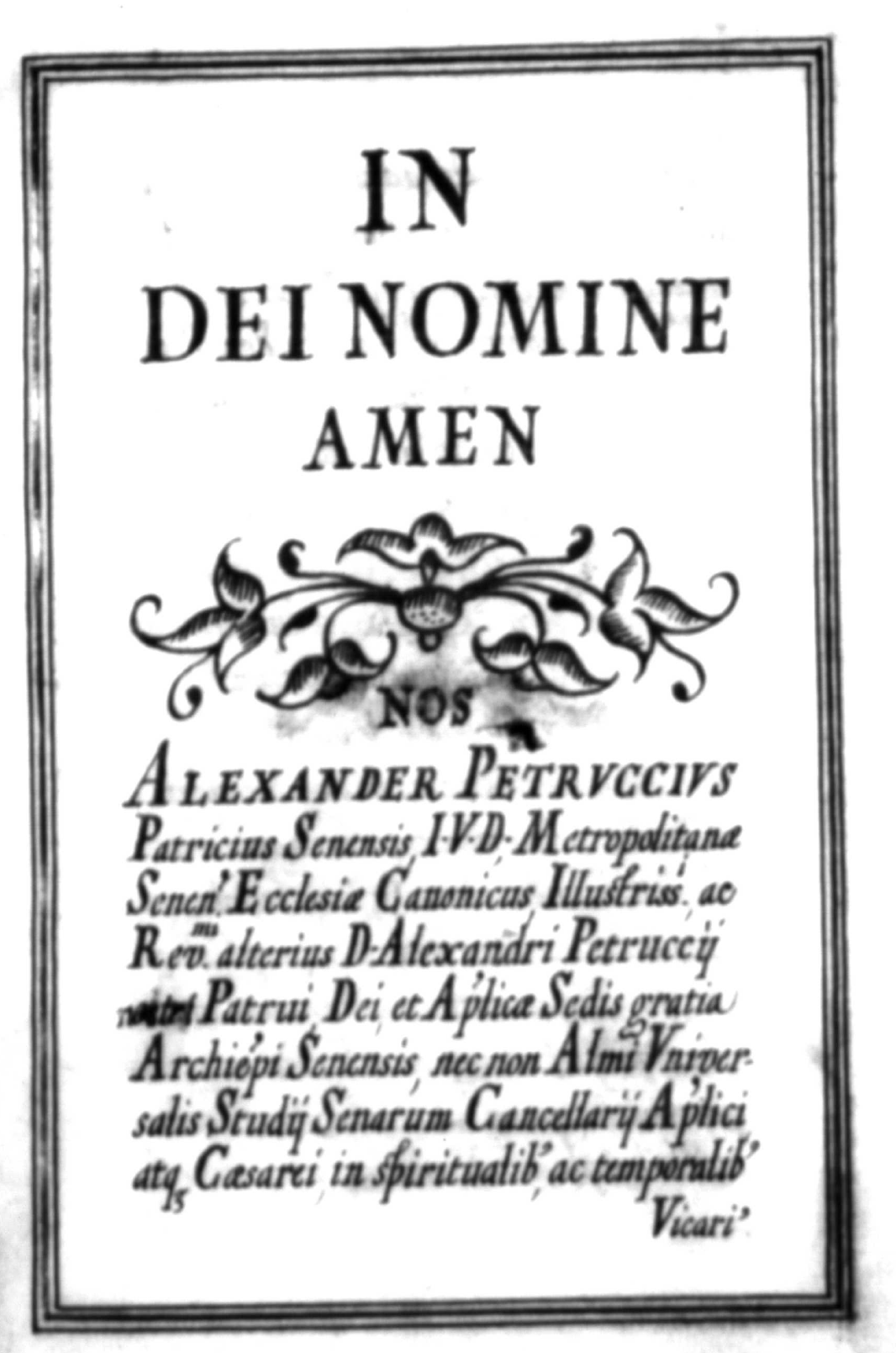
The invocation reads “In Dei Nomine Amen” (in the Name of God, Amen). While I have not seen any other diplomas of this period from the University of Siena,[13] there are a number of extant medical diplomas from this period issued by the University of Padua. The typical Padua diploma invocation reads “In Christi Nomine, Amen” (in the Name of Christ, Amen). The only diplomas that deviated from this norm were those of non-Christian students, in particular diplomas of Jewish graduates. Virtually every Jewish graduate’s diploma begins with the invocation, “In Dei Aeterni Nomine.” It is possible that the University of Siena made the same accommodations for its Jewish graduates as did Padua, few as they may have been.[14] Modigliano was also identified as a Jew in his diploma, with the word “Hebreo” appearing after his name:
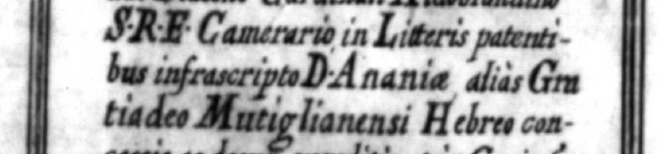
This was also commonly found in the diplomas of the Jewish graduates of Padua, where the word “Hebreus” or “Iudeus” would typically, though not always, follow the name of the Jewish graduates.

We next hear of Modigliano on August 14, 1650, when upon the departure of Rafael Corcos,[15] the Roman Jewish community appointed three new worthy teachers, one of whom was the doctor Hananiah b. Rafael Modigliano.[16] As reported by Zahalon, Hananiah tragically died while serving as a physician for the Jewish community in Rome during the Bubonic Plague of 1656.

Modigliano’s son Raphael was also a physician, as well as a rabbi.[17] Extant medical diplomas of Jewish students are exceedingly rare, yet in this case, we are fortunate not only to possess a copy of Hananiah’s diploma, but we also possess the diploma of his son Raphael as well.[18] This is the only known case of extant father and son diplomas. A copy of his medical diploma from the University of Ferrara in 1662 is below:[19]

The invocation, similar to his father’s diploma, reads, “In Dei Nomine, Amen,” and he is likewise identified as “Hebreus.”

Of note, the document explicitly restricts his medical practice to Jewish patients.

We also have record of Raphael delivering weekly Shabbat sermons in the synagogue in Siena. Moses ben Samuel ben Bassa of Blanes records in his manual for preachers, Tena’ei ha-Darshan,[20] that both he and Raphael Modigliano would deliver weekly sermons, after which they would each provide constructive criticism of the other’s sermon.

What of our third and final physician, Yitzhak Zahalon? Regarding the third of the Jewish plague physicians for Rome in 1656, the author does not reveal additional details about him, despite their sharing the same last name. A few sentences later, however, Yaakov Zahalon enumerates the fatalities of the plague at around eight hundred deaths and mentions his cousin, the young skilled surgeon, Yitzhak Zahalon, amongst the casualties.

This has led at least one scholar to identify the physician in charge of one third of the city as the same Yitzhak Zahalon, the surgeon and cousin of Yaakov, the author. Sosland writes, “Three Jewish doctors are mentioned by Zahalon as having charge over the patients. One of them was a first cousin of our author, a certain Isaac Zahalon, a “skilled surgeon” who died toward the end of the epidemic.”[21]

With the physicians in charge of the medical care of the Lazaretto, as well as the different sections of the Ghetto, accounted for by name, we are left to wonder about the role, if any, the author, Yaakov Zahalon, played during the plague. As Sosland notes, “as to the exact role Jacob filled, we have no direct knowledge.”[22]

Zahalon’s medical work was published in Venice in 1683, and unlike the work of his rough contemporary, Tuviya Cohen, whose Ma’aseh Tuviya has been reprinted numerous times, has not yet merited even a second printing.[23] There is however one extant manuscript of Zahalon’s Otzar HaHayyim housed in the Vatican,[24] dated from no later than 1675, and it is in this manuscript that we find the solution to the riddle of Zahalon’s role in the administration of medical care to the Jews in the Rome Ghetto during the plague.

The manuscript appears to reflect that Otzar HaHayyim was initially part of a larger multi-section work entitled Ohalei Yaakov Otzar HaHokhmot. Zahalon’s medical work is labelled as section two, Hokhmat HaRefuah, the only section in the Vatican manuscript.

Below is the section describing the division of the city into three sections, each with its respective physician.
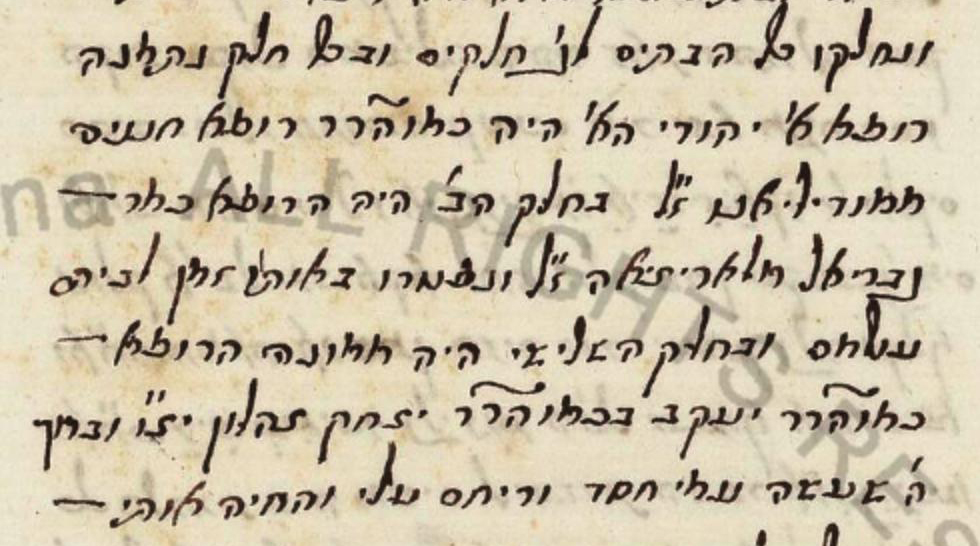
There is one key difference in this passage between the printed edition and the manuscript version. The physician in charge of the third section of the city is not Yitzhak Zahalon, whose identity is ambiguous, but rather, Yaakov ben Yitzhak Zahalon, none other than the author himself! A part of the name was accidentally omitted in the printed work. Zahalon refers to himself here in third person. This correction now facilitates a better understanding of the next sentence in the text, in which Zahalon continues to refer to himself, expressing gratitude to God for having rescued him from the ravages of the plague.

In this vein, I conclude with a comment on Zahalon’s conclusion to his plague passage. Despite the unspeakable tragedies experienced by the Jewish community, Zahalon ends his plague discussion by sharing a positive, though bittersweet, thought reflecting the continuity of the Jewish community:
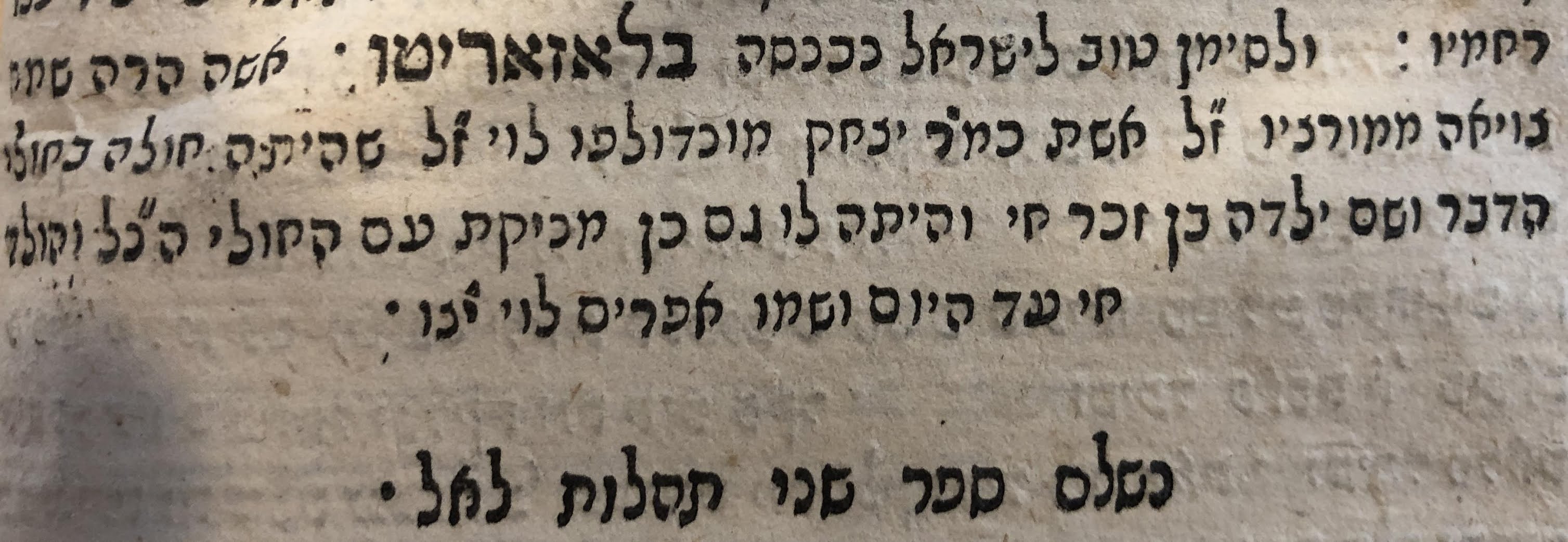
As a good sign for the people of Israel, a pregnant woman named Zivia, the wife Yitzhak Mondolfo, contracted the plague, and though confined to the Lazaretto, was able to deliver a healthy child, whom she was able to nurse for a period before her demise. In the final line of this section in the printed work, we read that the child was still alive “until today,” and that his name was Efraim Levi. Though Zahalon’s book was published in 1683, this line appears in the manuscript, thus “until today” would be some twenty years after the plague.

While this indeed is some form of consolation, the manuscript adds an additional sentence which yields a far more powerful conclusion.

“And the circumcision was performed there (in the Lazaretto), and I say to you by your blood you shall live, and I say to you by your blood you shall live.” Zahalon concludes with the phrase from Yechezkel 16:6 which is traditionally recited as part of the circumcision ceremony. The allusion here to the plague is obvious.

Omitting this last sentence denies us not only the additional factual information about the performance of the circumcision in the Lazaretto, itself a remarkable event, but also Zahalon’s homiletic flourish which marked the community’s (re)birth after the tragedies of the plague. As I write these words, we are still in this midst of the Covid 19 pandemic, though the dissemination of the vaccines portends, God willing, for its cessation in the near future. These final intended words of Zahalon resonate deeply with us today, perhaps even more so than they would have when Otzar HaHayyim was published, some three decades after the plague.

[1] Ellen B. Wells, “Prints Commemorating the Rome 1656 Plague Epidemic,” Annali dell’Istituto e Museo di Storia della Scienza di Firenze 10 (1985), 15-21.
[2] On Zahalon, see Harry A. Savitz, “Jacob Zahalon, and His Book, ‘The Treasure of Life,’” New England Journal of Medicine 213:4 (July, 1935), 167-176; Harry Friedenwald, “Jacob Zahalon of Rome: Rabbi, Physician, Author and Moralist,” in his The Jews and Medicine 1 (Ktav Publishing House: New York, 1967), 268-279; J. Ph. Hes, “Jacob Zahalon on Hypochondriasis,” (Hebrew) Koroth 4:5-7 (December, 1967), 444-447; A. Danon, A. Kadar and D. V. Zaitchek, “Physiology and Pathology of Lactation in Zahalon’s Work,” (Hebrew) Koroth 4:11-12 (December, 1968), 667-678; D. Margalit, “Shmirath Habriuth by Maimonides and Comment by R. Jacob Zahalon,” (Hebrew) Koroth 5:1-2 (September, 1969), 96-98; Yehoshua Leibowitz, “R’ Yaakov Zahalon Ish Roma uPizmono liShabbat Hannukah 1687,” Sefer Zikaron liHayyim Enzo Sereni: Ketavim al Yehudei Roma (Shlomo Mayer Institute: Jerusalem, 5731), 166-181; Jonathan Jarashow, “Yakov Zahalon and the Jewish Attitude Towards Medicine,” Koroth 9:9-10 (1989), 725-736; Zohar Amar, Maimonides’ Regimen Sanitatis: Commentary of R. Jacob Zahalon on “Hilchot Deot” – Chapter Four, With an Added Brief Preface to the Treatise Ozar ha-Hayyim (Hebrew) (Neve-Tzuf, 2002); Samuel Kottek, “Pediatrics in the work Otzar HaHayyim of Jacob Zahalon,” (French), in Gad Freudenthal and Samuel Kottek, eds., Melanges d’Histoire de la Medicine Hebraique: Etudes Choisies de la Revue d’Histoir de la Medicine Hebraique (1948-1985) (Brill: Leiden, 2003), 183-207; Eliezer Brodt, Bein Keseh Le’Asor (Jerusalem, 5768), 184-185; Eliezer Brodt, “Segulot leZikaron uPetihat haLev,” Yerushateinu 5 (5771), 337-360, esp. 352; Michal Altbauer-Rudnik, “Love For All: The Medical Discussion of Lovesickness in Jacob Zahalon’s The Treasure of Life (Otzar Ha-Hayyim),” in Asaph Ben-Tov, Yaakov Deutsch and Tamar Herzig (eds.) Knowledge and Religion in Early Modern Europe: Studies in Honor of Michael Heyd (Brill: Leiden, 2013), 87-106. For discussion of the sources of Zahalon’s medical work, see Iris Idelson-Shein, “Rabbis of the (Scientific) Revolution: Revealing the Hidden Corpus of Early Modern Translations Produced by Jewish Religious Thinkers.” American Historical Review 126, no. 1. Forthcoming, March 2021.
[3] For the response of the Italian Jewish community to plagues in this period, including the plague in Rome of 1656, see Yaffa Kohen, The Development of Organizational Structures by the Italian Jewish Communities to Cope with the Plagues of the Sixteenth and Seventeenth Centuries (Hebrew) (Doctoral Dissertation: Bar Ilan University, submitted Tishrei, 5740). I thank Naomi Abraham, librarian at Bar Ilan University, for her truly exceptional efforts in making this dissertation available to me in the midst of the Covid pandemic.
[4] For more on this passage and on the plague in the Jewish Ghetto of Rome, see Yehoshua Leibowitz, “Bubonic Plague in the Ghetto of Rome (1656): Descriptions by Zahalon and by Gastaldi,” (Hebrew) Koroth 4: 3-4 (June, 1967), 155-169; Kohen, op. cit., 72-95.
[5] Y. Zahalon, Otzar HaHayyim (Venice, 1683), 21a-21b. Elsewhere we have discussed the Jewish physicians of the 1631 plague in Padua. See E. Reichman, “From Graduation to Contagion: Jewish Physicians Facing Plague in Padua, 1631” Lehrhaus (thelehrhaus.com), September 8, 2020.
[6] See H. Friedenwald, “Jacob Zahalon of Rome,” in his The Jews and Medicine (Johns Hopkins Press: Baltimore, 1944), 268-279.
[7] On Zahalon’s abilities and reputation as an orator, see Henry A. Sosland, A Guide for Preachers: The Or HaDarshan of Jacob Zahalon—A Seventeenth Century Italian Preacher’s Manual (Jewish Theological Seminary: New York, 1987). On the plague sermons, see pgs. 23-28.
[8]  See, for example, Guenter Risse, “Seventeenth-century Pest Houses or Lazarettos: Rome 1656,” in his Mending Bodies, Saving Souls: A History of Hospitals (Oxford University Press, 1999), 190-214.
[9] On the medical members of the Gabai (and Zahalon) families, see S. Plashkes, “Two Jewish Medical Families in 17th Century Italy: Gabai and Zahalon,” (Hebrew) Koroth 3:1-2 (October, 1962), 97-99.
[10] Otzar HaHayyim 21b.
[11] Israele Zoller, “I Medici Ebrei Laureati a Siena negli Anni 1543-1695,” Revista Israelitica 10 (1913), 60-70 and 100-110. In contrast, the University of Padua counts 127 Jewish medical graduates from 1617 to 1695. See A. Modena and E. Morpurgo, Medici E Chirurghi Ebrei Dottorati E Licenziati Nell’Universita di Padova dal 1617 al 1816 (Italian) (Forni Editore, 1967). For Jewish graduates of Padua earlier than this period, see D. Carpi, “Jews who received medical degrees from the University of Padua in the 16th and early 17th centuries,” (Hebrew) in Scritti in Memoria di Nathan Cassuto (Ben Tzvi Publishers: Jerusalem, 1986), 62-91.
[12] JTS, MS 8519. I thank Sharon Liberman Mintz for bringing this diploma to my attention. As part of my research interest in Jewish medical history, I have sought out copies of medical diplomas of Jewish students from previous centuries. Sharon, aware of this interest, notified me of a medical diploma in the JTS collection. The record does not identify the graduate but lists the University of Siena as the granting institution. I had never seen a diploma of a Jewish medical student from this institution; the majority of extant medical diplomas of Jewish students are from the University of Padua. However, due to the Covid 19 pandemic, access to the original diploma, stored in the remote site of the library, has been impossible. Fortunately, the National Library of Israel had taken black and white photographs of this document some years ago, and I was able to acquire copies. Since the onset of the pandemic, I have been focusing of the history of pandemics in Jewish medical history. When I received the copies of the diploma, and read the name, Hananiah Modigliano, it sounded familiar to me. It was a short while until I realized that I had seen the name mentioned in Zahalon’s passage on the plague.
[13] As per the librarian for the University of Siena Archives, the university does not possess any diplomas of this period.
[14] On the differences in the diplomas of Jewish medical graduates of the University of Padua, see E. Reichman, “Confessions of a Would-be Forger: The Medical Diploma of Tobias Cohn (Tuviya Ha-Rofeh) and Other Jewish Medical Graduates of the University of Padua,” in Kenneth Collins and Samuel Kottek, eds., Ma’ase Tuviya (Venice, 1708): Tuviya Cohen on Medicine and Science (Muriel and Philip Berman Medical Library of the Hebrew University of Jerusalem: Jerusalem, 2019), in press; E. Reichman, “The ‘Doctored’ Medical Diploma of Samuel, the Son of Menasseh ben Israel: Forgery or ‘For Jewry’?” Seforim Blog (https://seforimblog.com) (forthcoming).
[15] The Corcos family was a prominent Jewish Italian family. Another Jewish graduate of the University of Siena was Isaac Corcos, who graduated in 1654. See Zoller, op. cit. He may have been a relative and possibly a brother of Raphael Corcos.
[16] See H. Volgstein and P. Reiger, Geschichte der Juden in Rom, 2 vol (Berlin, 1895-1896), 267.
[17] On Raphael Modigliano, see Asher Salah, La Republique des Lettres: Rabbins, ecrivains et medecins juifs en Italie au XVIIIe Siecle (Brill: Leiden, 2007), 428-429.
[18] What makes this even more exceptional is that Hananiah’s diploma is the only known Jewish diploma from the University of Siena, and Raphael’s diploma is one of only two known Jewish diplomas from the University of Ferrara, the other being from 1802 (Samuel Vita Della Volta).
[19] The diploma was originally part of the Valmadonna Trust Library, Ms. 292, and is now incorporated into the National Library of Israel, system n. 990000822160205171. See Benjamin Richler, The Hebrew Manuscripts in the Valmadonna Trust Library (Valmadonna Trust: London, 1998), n. 269.
[20] Columbia University Library, Ms. X 893 T 15, p. 15a. See Sosland, op. cit., 82-83.
[21] Sosland, op. cit., 25. Others just listed the name as Isaac Zahalon without comment. See H. Volgstein and P. Reiger, Geschichte der Juden in Rom, 2 vol (Berlin, 1895-1896), 212-213.
[22] Sosland, op. cit., 25.
[23] Some years ago, Chaim Reich, ah, of Renaissance Hebraica, produced a high-quality reproduction of Otzar HaHayyim. I thank Rabbi Eliezer Brodt, who owns one of these copies, for this information.
[24] The manuscript is available online at https://digi.vatlib.it/mss/detail/Vat.ebr.466. On this manuscript see, Malachi Beit-Arié and Nurit Pasternak, Hebrew Manuscripts in the Vatican Library (Vatican City, 2008), 405. I have only compared the manuscript to the printed edition for this brief passage. A comprehensive comparison remains to be done.


Jewish Treasures From Oxford Libraries

JEWISH TREASURES FROM OXFORD LIBRARIES

By Paul Shaviv

Ed. Rebecca Abrams and Cesar Merchan-Hamann / Bodleian Library, University of Oxford, 2020 / ISBN 978 1 85124 502 4 / Available in the USA via Amazon $55

307pp, 140 full-colour plates

Oxford,[1] the ‘City of Dreaming Spires’, is one of the world’s greatest repositories of Hebraica and Judaica, both books and manuscripts.

This sumptuous volume was initiated at the encouragement and support of Martin J. Gross, a New Jersey philanthropist and Jewish community activist. It is a bargain at the price. The book is absolutely handsome – the quality of the printing is outstanding, and it is printed on 135gsm paper.

The core of ‘Jewish Treasures from Oxford Libraries’ describes seven collectors and their eponymous collections, which together constitute the Hebraica holding of the Bodleian library; plus a description of smaller, but important, holdings of some individual College libraries; and the Genizah fragments held in Oxford. There are additional essays describing the history of the Bodleian itself, and the role of successive Librarians in encouraging the acquisition of Hebrew (and other ‘Oriental’) manuscripts; of the great cataloguers (Neubauer and Cowley); and of other benefactors, including the amazing figure of John Selden.[2]

Each chapter is written by different scholars. Archbishop Laud (1573–1645), by Giles Mandelbrote; Edward Pococke (1604-1691) by Benjamin Williams; Robert Huntington (1637-1701) by Simon Mills and Cesar Merchan-Hamann; Benjamin Kennicott (1718-1783) by Theodor Dunkelgrun; Matteo Luigi Canonici (1727-1805) by Dorit Raines; Rabbi David Oppenheim (1664-1736) by Joshua Teplitzky; and Heimann Joseph Michael (1792-1846) by Saverio Campanini. Each describes the biography of the collector, the characteristics and most important items of their collection, and how and why they amassed them.

The first thing that readers will note is that only the last two are Jewish. Even in the case of David Oppenheim, his unique collection of approximately 4,500 printed books and just under 1,000 bound volumes of manuscripts languished in storage in Europe until Revd. Alexander Nicoll, the Regius Professor of Hebrew, engineered its purchase by the Library. Otherwise they are a parade of Anglican Divines and Christian Hebraists (except Canonici, who was a Jesuit), witness to the intense interest (and expertise) in Hebrew and Jewish Studies by non-Jewish scholars in the sixteenth and seventeenth centuries. The stories of the collections are fascinating. Ambassadors, merchants and missionaries all have a part in purchasing (and pursuing) manuscripts. A special place seems to be occupied by the ‘Chaplains’ attached to the Embassies – one can surmise that they both had some expertise in Hebrew, even if rudimentary, and also perhaps time to devote to the ‘hunt’. We visit the great cities of the ‘Orient’ – Constantinople, Damascus, Aleppo, Cairo, and of Europe – Italy, Spain and Germany.

The objectives and interests of each collector were different. Some – Oppenheim is the obvious example – were happy to scoop up whatever was on the market. Kennicott was interested in Biblical material, resulting in his two-volume study of variations in extant biblical texts. Along the way, each of them acquired examples of the most magnificent decorated and illuminated works, covering the entire span of Judaica – texts, contracts, ketubot, from every place. The calligraphy itself is to be savoured and enjoyed. As mentioned, the 140 full-colour (and often full-page) plates do all of this justice.

Although overshadowed by Cambridge, Oxford too has significant Genizah holdings – described by Nadia Vidro. These were acquired in the nineteenth century and pre-dated Solomon Schechter’s bulk removal of the Genizah contents to Cambridge. They are apparently strong in Talmudic texts, and also include an autograph copy of Rambam’s Mishneh Torah – complete with alterations and editing notes. Adolph Neubauer sifted through the material; kept the largest fragments, often complete or semi-complete pages – and rejected the remainder, which were sold on to Elkan Adler. Neubauer could not foresee the techniques available later, and utilized in Cambridge, to read, identify and reap the benefits of the tiniest pieces.

It is very difficult to summarize such a wide-ranging work in a short review. I am left with several thoughts:

  • In the case of the Bodleian, their holdings were purchased, not plundered, although the circumstances by which the objects came into the possession of previous owners is not necessarily known. The scholarship, and enthusiasms, of the Christian Hebraists, familiar to scholars, is of course little appreciated in today’s wider Jewish community. Were it not for them, many, many of these works would be lost. Were it not for the conscientious curation and preservation of these books and manuscripts by non-Jewish, mainly academic, libraries, they would almost certainly be lost, and even if they existed, would probably be far less accessible.

  • The sheer aesthetic beauty of many of the manuscripts speaks of a different culture. Even if, as is surmised, many were illustrated by non-Jewish professional artists[3] – they were commissioned by Jewish patrons. Even the almost-certainly Jewish artists (of Ketubot and the like) seem to show a joyfulness absent from our contemporary production of texts; which I take as a reflection of a certain dour outlook and philosophy. The same comment could be made about the narrowness of contemporary religious publishing compared to the width of thought, concern and scholarship of our forebears.

  • On a different perspective, as an (ex-pat) Anglo-Jew, and a former graduate student of Jewish Studies at Oxford (way back in the 1970’s!), I have to again sigh at the neglect of its own treasures by the Anglo-Jewish community[4]. Even the initiator of this project hails from New Jersey! Perhaps a ray of optimism may come from the fairly recent appointment of Prof. Judith Olszowy Schlanger as head of the Oxford Centre for Hebrew and Jewish Studies (formerly housed at Yarnton Manor)? Until now, most of the OCHJS Presidents have been specialists in one or another aspect of the ancient world, or of other, wider areas of Jewish study. This is not to disparage any of these eminent scholars in any way whatsoever! But Professor Olszowy Schlanger has already published on Anglo-Norman and pre-Expulsion manuscripts; perhaps we will see fresh scholarship on English and European rabbinic study from her Presidency, from still-to-be-researched corners of the Bodleian!

A great read, a great book to possess, and – happy are they who may receive this book as a perfect gift!

[1] The city has a rich Jewish history of its own, which is thought to date back to 1075. Two (!) complementary websites both give excellent information and resources about Jewish Oxford. The first site, sponsored by the local Jewish community, whose supervisory committee includes one of the editors of the volume under review, is www.oxfordjewishheritage.co.uk . Clicking on the small window labelled ‘Jewish Heritage’ in the middle of the homepage of Oxford Chabad www.oxfordchabad.org opens up a surprisingly academic and scholarly range of material on Jewish Oxford. Both recommended!
[2] The present Bodley Librarian, Richard Ovenden, writes a Foreword; Cesar Merchan-Hamann a general Introduction; Rahel Fronda writes on the smaller College collections; and Piet van Boxel on the cataloguers. Mr. Martin J. Gross, the book’s ‘prime mover’, contributes an elegant Preface!
[3] See, for example, plate 114, from Ms. Michael 627 – from a Yom Kippur mahzor, where a non-Jewish artist, not knowing which way up the Hebrew is written, has the illustrations drawn upside down on the page.
[4] Painfully, the single most important Anglo-Jewish artefact, the dated pre-Expulsion Chumash mss, shown to H.M. The Queen to demonstrate the depth of Jewish experience in England, was sold at the Valmadonna Auction. The purchaser remains anonymous. It is not known if it is still in the UK. If it is, it is neither displayed nor accessible. The Bomberg Talmud, also sold by the Valmadonna Trust, is now in New York City after being in Westminster Abbey for centuries.


The Greatest Story in the Annals of Jewish Book Collecting

The Greatest Story in the Annals of Jewish Book Collecting
 By Jeremy Brown

Jeremy Brown is the author of New Heavens and a New Earth; The Jewish Reception of Copernican Thought. He writes on science, medicine and the Talmud at Talmudology.com 

As we approach the end of Masechet Yevamot in the Daf Yomi cycle, it seems appropriate to reflect on a legendary story in the annals of Jewish bibliography. This story involves King Henry VIII, the laws of Yevamot, and the greatest private Jewish library in the world.
About thirty years ago, while a medical student in London, I had the good fortune of visiting the Valmadonna Trust Library, that greatest of private Jewish libraries. (How I got there is another story for another time). And while there, I held the Talmud that certainly once belonged to Westminster Abbey. It may also have been owned by Henry VIII, who had brought a Bomberg Talmud from Venice in order to help him end his marriage to Catherineof Aragon, the first of his many wives. The story of Henry VIII’s purchase of the Bomberg Talmud – the first complete printed Talmud – actually hinges on Yevamot, and whether the rules of levirate marriage, or yibum, applied to him. 
Catherine of Aragon was actually a widow, having first been married to Henry’s younger brother Arthur. About six months after Catherine married Arthur he died childless, and in 1509 his older brother Prince Henry married his widow.  One more thing to know: Catherine claimed that her marriage to Arthur had never been consummated; this is important later in the story. (And here is an interesting historic footnote: it was Catherine’s parents, Ferdinand and Isabella who had expelled the Jews from Spain.)
By 1525, Prince Henry had become King Henry VIII, and has had one daughter with Catherine. He wanted a son, and now wished to marry Ann Boleyn. There was, however, a problem:  what was he to do with Catherine, his existing wife?  Divorce, remember, was tricky for this Catholic King. And here is where the Talmud comes in.  
Henry argued that his marriage to Catherine should be dissolved since it was biblically forbidden for a man to marry his sister-in-law. (Henry claimed years earlier that he could marry her because the marriage to his brother had not been consummated. See, I told you that was important information…)
But as we from Masechet Yevamot, the Bible commands a man to marry his widowed sister-in-law if his brother died without children. Since Arthur died childless, it could be argued that Henry was now fulfilling the biblical requirement of levirate marriage – known as yibum. If that was the case, the marriage was kosher and could not be dissolved
How was this conundrum to be resolved? Let’s have Jack Lunzer, the custodian of the library, tell the story. (You can also see the video here. Sorry about the ads. They are beyond our control.) 
As Lunzer tells us, the Talmud was obtained from Venice to help King Henry VIII find a way to divorce his wife (and former sister-in-law) Catherine, and so be free to marry Ann Boleyn. In fact, it’s a little bit more complicated than that. Behind the scenes were Christian scholars who struggled to reconcile the injunction against a man marrying his sister-in-law found in one part of the Bible, with the command to do so under specific circumstances, found in another. In fact the legality of Henry’s marriage had been in doubt for many years, which is why Henry had obtained the Pope’s special permission to marry.
John Stokesley, who later became Bishop of London, argued that the Pope had no authority to override the word of God that forbade a man from marrying his brother’s wife. As a result the dispensation the Pope had given was meaningless, and Henry’s marriage was null and void. In this way, Henry was free to marry.  But what did Stokesley do with the passages in Deuteronomy that require yibum?  He differentiated between them.  The laws in Leviticus, he claimed, were both the word of God and founded on natural reason. In this way they were moral laws; hence they applied to both Jew and Christian.  In contrast, the laws found in Deuteronomy, were judicial laws, which were ordained by God to govern (and punish) the Jews – and the Jews alone. They were never intended to apply to any other people, and so Henry’s Christian levirate marriage to Catherine was of no legal standing. There was therefore no impediment for Henry to marry Ann. As you can imagine, this rather pleased the king.
It remains unclear whether the Valmadonna Library Bomberg Talmud is indeed the very same one that Henry had imported from Venice. According to Sotheby’s and at least one academic, it actually came from the library of an Oxford professor of Hebrew, who bequeathed it to the Abbey. In any event, a Bomberg Talmud lay undisturbed at Westminster Abbey for the next four hundred years.  How Lunzer obtained it for his library is possibly the greatest story in the annals of Jewish book collecting. In the 1950s there was an exhibition in London to commemorate the readmission of the Jews to England under Cromwell. Lunzer noted that one of the books on display, from the collection of Westminster Abbey, was improperly labeled, and was in fact a volume of a Bomberg Talmud. Lunzer called the Abbey the next day, told them of his discovery, and suggested that he send some workers to clean the rest of the undisturbed volumes.  They discovered a complete Bomberg Talmud in pristine condition, and Lunzer wanted it. But despite years of negotiations with the Abbey, Lunzer’s attempts to buy the Talmud were rebuffed.  
Then in April 1980, Lunzer’s luck changed. He read in a brief newspaper article that the original 1065 Charter of Westminster Abbey had been purchased by an American at auction, but because of its cultural significance the British Government was refusing to grant an export license. Lunzer called the Abbey, was invited for tea, and a gentleman’s agreement was reached. He purchased the Charter from the American, presented it to the Abbey, and at a ceremony in the Jerusalem Chamber of Westminster Abbey the nine volumes of Bomberg’s Babylonian Talmud were presented to the Valmadonna Trust. It’s a glorious story, and it’s so much better when Lunzer himself tells it, as he does here: (You can also see the video here,and end it at 14.35. We continue to apologize for those ads.)

The Valmadonna Trust Library – all of its 13,000 books and manuscripts, including the Westminster Abbey Talmud, is now on sale at Sotheby’s in New York. It can be yours for about $35 million.  But if you buy it, you must agree to two conditions set by Lunzer: that the Library remain whole, and that it be made available to scholars. In that way, just as I once held that magical Talmud, others may continue to do so. 


New Volume of Rav Ovadiah Yosef’s “Hazon Ovadiah,” on the halakhot of the Four Fasts, the Three Weeks, Nine Days, Tisha B’Av, and Zekher le-Hurban

New Volume of Rav Ovadiah Yosef’s “Hazon Ovadiah:”
On the halakhot of the Four Fasts, the Three Weeks,
Nine Days, Tisha B’Av, and Zekher le-Hurban
by Eliezer Brodt
A new sefer just reached the seforim stores today, just in time for the three weeks. The newest volume of Chazon Ovadiah of the great gaon Rav Ovadiah Yosef. This sefer includes halakhot on a few areas: the halakhot of the Four Fasts, the Three Weeks (& Nine Days), Tisha B’Av, and halakhot related to Zekher le-Hurban, including going to the Kotel, etc. In the back there are hespedim which Rav Ovadiah delivered for various Gedolim amongst them R. Yitzchak Herzog, R. Zvi Pesach Frank and R. Shlomo Zalman Auerbach. Chazon Ovadiah is 577 pages and includes a very thorough index.

In the past few years we have been privileged to a complete encyclopedic collection on all the Yom Tovim from Rav Ovadiah Yosef. It all started many years ago when he wrote a set of seforim called Chazon Ovadiah on Pesach related topics. These seforim received impressive haskamot from many gedolim, amongst them R. Tvi Pesach Frank and R. Shlomo Yosef Zevin. It appears that this particular project was put on hold and Rav Ovadiah turned his attention to printing his Sheelot u-Teshuvot. Then, a few years ago he started printing his shiurim and notes on the sefer Ben Ish Chai. This resulted in an eight volume set called Halikhot Olam. Finally, after all that, Rav Ovadiah returned to the Yom Tov series, Chazon Ovadiah, starting with Purim than Hilkhot Yom Tov. He then continued with Pesach, Succot, Yomim Noraim and Chanukah. Earlier this year, Tu B’Shevat and Hilkhot Berakhot were printed. Thus far, the set is eight massive volumes. One only hopes that Rav Ovadiah continues this set with Hilkhot Shabbat.

Amongst the reasons why I recommend this particular set of seforim, even if one is not of sefaradic origin is as follows: Rav Ovadiah Yosef is world famous for his unbelievable memory resulting in a tremendous bekiut. [I once joked that he must have had someone develop some computer program and attached it to his brain to help him retain so much information and recall it at all times.] When one uses this work, as with all of his other works, one can find hundred of sources from the Rishonim to extremely obscure Sheelot u-Teshuvot on virtually every topic related to the Yomim Tovim. He even quotes many, very recent seforim. He covers many sugyot quite comprehensively, whereas others Rav Ovadiah simply brings down a few sources. Besides for all this, one has literally hundreds of pesakim of a great gaon on all of these topics.

All this results in making it an excellent reference for Rabbanim, Maggedei shiurim, interested laymen, and any one interested in researching any topic related to the Yomim Tovim. From all the many seforim which are printed every year on the Yomim Tovim, the entire set of Hazon Ovadiah is by far the most impressive in terms of its sources and information.

One interesting point I found in this most recent volume of Chazon Ovadiah was that Rav Ovadiah mentions in the introduction that he uses the highly ‘controversial’ sefer Hemdat Yamim [see here for Dan Rabinowitz’s post on Tu B’Shvat]. Rav Ovadiah justifies his use of this sefer, as many great Sephardi gedolim have used this sefer, ever since it was printed, so although the R. Jacob Emden comes out very strongly against Hemdat Yamim, Rav Ovadiah still quotes from it.


Yehuda Azoulay’s Maran: The Life and Scholarship of Hacham Ovadia Yosef

Yehuda Azoulay’s Maran: The Life and Scholarship of Hacham Ovadia Yosef has just appeared. The Seforim Blog is happy to present this excerpt.

Chapter 17: Back to Jerusalem

In 1958, Hacham Ovadia was invited to serve as a judge on the Jerusalem bet din, beside Rabbi Waldenberg and Rabbi Qafih.[1] His gratitude for being able to move back to Jerusalem is displayed in his third volume of Yabia Omer, published in 1960, and his joy and satisfaction at serving on this prestigious bet din with first-class scholars is evident in a number of places where he mentioned this job.
Rabbi Waldenberg,[2] author of the Tzitz Eliezer responsa, was the head of the bet din and he became Hacham Ovadia’s study partner at this time. Despite their disagreements on many issues of practical halachah,[3] the two enjoyed each other’s company very much. Rabbi Waldenberg was very pleased with the addition of Hacham Ovadia to the bet din; he referred to Yabia Omer in the warmest of terms.[4] Hacham Ovadia as well mentioned Rabbi Waldenberg endearingly throughout his works. He learned much in this forum regarding working on a bet din.[5]
In Petah Tikvah, though Rabbi Katz accorded him great respect and placed him in charge of writing the Sephardic divorces, Hacham Ovadia was frustrated that the court did not see the significance of following Rabbi Yosef Karo for the Sephardic population. Finding himself – the one Sephardic judge – always the minority in the court of three, he could not always convince the two Ashkenazic judges of the importance of his approach.[6] In Jerusalem, he usually served beside the Yemenite Rabbi Qafih, finally creating a majority of Sephardic-Eastern scholars in the courtroom. Rabbi Waldenberg understood early on that, so long as the litigants were Sephardic, the pair could not be swayed by his Ashkenazic leanings and traditions.
In 1964, the issue of ethnic name spellings came up again. This time, however, Hacham Ovadia did not have to resign in protest.
Rabbi Yehezkel Abramsky[7] had been the Av Bet Din of London until his retirement in 1951, when he moved to Bayit Vegan. His bet din in London, who followed his instructions and was still in touch with him for guidance, wrote a divorce with Ashkenazic spelling of the husband’s name “George” for a Sephardic couple; the wife lived in Jerusalem and Hacham Ovadia was on the bet din that reviewed it. The couple themselves preferred the Ashkenazic spelling, but Hacham Ovadia refused to deliver the bill of divorce to the woman, and wrote to the London bet din asking for it to be rewritten. The bet din, however, had followed Rabbi Abramsky’s guidelines in writing the names, so they called Rabbi Abramsky with the story.
Rabbi Abramsky called Rabbi Waldenberg for a meeting and the two agreed that they thought the Ashkenazic spelling correct, but Rabbi Waldenberg was familiar with the tenacity of the two Sephardim on his bet din, and since they were the majority, he explained to Rabbi Abramsky that there was no way they could get the divorce approved without changing the spelling. Eventually, Rabbi Abramsky recognized that he had no recourse but to ask the London bet din to rewrite it.
Maran concluded, “Rabbi Abramsky is indeed a brilliant man, but when it comes to Torah we do not let the honor of any man color our rulings. Our Torah is a Torah of truth.”[8]
Hacham Ovadia’s confidence in and loyalty to his own approach in halachic matters shows up throughout his work on this bet din. Just as he felt it a holy mission to teach halachah without giving precedence to the Ben Ish Hai or the Arizal, he would not change his mind for the honor of teachers, mentors, or peers once he was convinced of his position. In 1962, for example, his bet din had ruled that a husband should not have to pay child support for his stepdaughter in a certain case. The appeals court, which had the final say, overturned the ruling, and sent back the file requesting that their court determine the amount of child support. Hacham Ovadia refused to deal with the procedure, because he continued to maintain that the man should not have to pay. The other members of the court backed him up. He refused to listen to the appeals court against his better judgment, even though it consisted of Rabbi Yaakov Ades – his former teacher, Rabbi Elyashiv – the Torah giant whom Hacham Ovadia held in high esteem, and Rabbi Zolty – a friend and colleague whom he respected as well.[9]
Rabbi Yitzhak Nissim was the Sephardic chief rabbi at that time, following Rabbi Benzion Meir Hai Uziel’s passing in 1953. Sometime during those first few years, Hacham Nissim made it clear to Hacham Ovadia that “I know you will take over for me.” In 1960, as Rabbi Nissim was completing a five-year term, the Sephardic Community Council, headed by the committee’s heads, Elyashar and Sitton, nominated Hacham Ovadia as a candidate for the position.[10] Rabbi Tzvi Pesah Frank pushed him unremittingly to submit his candidacy. At the end of 1962, the rabbis of the Sephardic Council declared Hacham Ovadia the chief rabbi, but in the end, even after postponing the elections twice, Hacham Ovadia did not submit his candidacy, but lingered a few years longer in the world of writing and teaching, his labor of love.

Kol Sinai Magazine[11]

While Hacham Ovadia’s status was steadily rising among the Sephardic sector of Jerusalem through the few hundred who attended his lectures, his true greatness was only known by those who could read Yabia Omer, which was written for a somewhat more scholarly audience.
In 1962, the Sephardic Community Council asked Hacham Ovadia to write a column in its monthly magazine, Kol Sinai. The magazine published biographies and articles that related to Sephardic Jewry. Hacham Ovadia undertook the task, and stood by it monthly for seven years. This magazine, read by many in and out of Israel, is what positioned Hacham Ovadia as the authority and number one address for any Jew, in any area of halachah.
The writing style he adopted in Kol Sinai is nothing like that of Yabia Omer. His magazine articles were very focused and, though he brought support for all his rulings and noted all his sources, he did not go into detail. He generally followed Rabbi Yosef Karo, and noted this whenever the prevalent custom followed the Ben Ish Hai or others. There is no smattering of ethics or stories; these are encyclopedia-like entries by topic: laws of Shabbat, holidays, prayers, etc. He wrote them in language that the layman could understand and relegated any technical discussion or sources to footnotes.
The Hazon Ovadia series on the laws of the festivals, published forty years later, was based on these magazine articles.[12]

Friday Night Classes

Hacham Ovadia delivered a very popular class on Friday nights in Yeshivat Porat Yosef. His brother Naim was the manager of a synagogue, and one week in 1965, he asked his famous elder brother to come speak there. Although Naim knew it probably wasn’t feasible, as Hacham Ovadia had a commitment to Porat Yosef at that time, he nonetheless made his request, and was quite surprised when Hacham Ovadia agreed. That Friday night, he first gave the class in Naim’s synagogue and led the evening prayers there, and afterward left for Porat Yosef to deliver his regular lecture, somewhat later than usual.
While they waited for Hacham Ovadia, Rabbi Binyamin Jorgi informed the students that Hacham Ovadia would arrive late and he gave a mini class in the meantime. Hacham Ovadia arrived about half an hour later and delivered the class as usual.
Toward the end of the lecture, the third floor of the yeshivah suddenly collapsed. Chunks of concrete, iron beams, and planks of wood fell to the street on all sides of the building. The ground floor, however, was unaffected, and everyone within the building remained safe. Had Hacham Ovadia began the class at the usual time, hundreds of students would have been milling around the building at the time of the collapse, and there could have been fatal injuries.
Exiting the building by way of a shattered window and mattresses laid over the debris, the students accompanied Maran all the way home with song and dance. The building was closed off until it was safely renovated.
When Hacham Ovadia spoke to his brother on Sunday, he asked him, “You’ve been managing the synagogue for four years and you never asked me to speak. What made you do so this week, when you knew I wouldn’t be able to come without rearranging my regular class?”
When Naim had no material answer, Hacham Ovadia continued pensively, “And I wonder what made me agree. G-d performs miracles through those who have merit and both of us were fortunate to protect the participants at the Friday night class. This was a truly joyous event.”
Naim suggested that they share the story with a reporter, but Hacham Ovadia insisted there was no need.[13]
Rabbinical High Court
The Rabbinical High Court is the appellate court for Israel’s municipal rabbinical courts. One of the chief rabbis serves as its Av Bet Din. The bet din was established during the years of the British Mandate.
When Hacham Ovadia began his term there, the bet din met in Hechal Shelomo on King George Street. In 1967, it moved to the Old City. Today it shares the Frumin House on King George with the Jerusalem bet din and is headed by Chief Rabbi Yitzhak Yosef.
The Rabbinical High Court appointed new judges in 1965. Hacham Ovadia was already a favored candidate, and he joined at age forty-four. Hacham Salman Hugi-Aboudi,[14] Rabbi Eliezer Goldschmidt,[15] and Rabbi Shaul Yisraeli[16] were appointed on the same occasion.
Already on the bet din were Rabbi Elyashiv,[17] fifty-five at the time, and Rabbi Zolty,[18] who was the same age as Hacham Ovadia.[19]
Hacham Ovadia found a close friend in Rabbi Elyashiv, and said he was like a brother to him.[20] He enjoyed tackling the country’s most complex halachic issues together with Rabbi Elyashiv for he valued the latter’s extraordinary proficiency and clarity of understanding. This friendship between the two leading poskim of the generation continued after Hacham Ovadia became the chief rabbi and Rabbi Elyashiv resigned from his position.
He remained on this bet din, becoming its Av Bet Din with his election to chief rabbi in 1973. As with all his bet din jobs, many of those rulings were printed in Yabia Omer.[21] In 1984, he led the bet din, joined by Rabbi Waldenberg, Rabbi Yitzhak Kolitz,[22] and Rabbi Qafih who was promoted in 1970.[23]
The Sephardic Torah Student[24]
At the beginning of the twentieth century, Porat Yosef was the only major Sephardic yeshivah in Israel. Many Sephardic students went to the Ponevezh yeshivah in Bnei Brak, and when Porat Yosef’s building was destroyed by the Arab Legion during the War of Independence, prominent Jerusalem Sephardic families turned to Ashkenazic yeshivot, especially Kol Torah, run by Rabbi Shelomo Zalman Auerbach. In this way, many hundreds of Sephardic and Yemenite youth internalized the ideas and mentality, and adopted the unique language and dress of their teachers and peers in Lithuanian-style yeshivot.
Students of a yeshivah are in most cases expected to follow the practices of the school; thus Sephardic boys learned to pray with an Ashkenazic accent, at least for those paragraphs recited aloud, wear the garb of a Lithuanian Torah student, and generally conduct themselves according to the norms accepted within those halls. This was a very difficult as well as formative experience for many of these boys.
Hacham Ovadia dealt with the halachic issues that cropped up from this situation,[25] always with the goal of fortifying a distinct Sephardic identity, without alienating the boys from their yeshivot.
Sephardic students of the Ashkenazic Hevron yeshivah asked[26] whether it would be acceptable for them to shave until the first of Av, in accordance with Sephardic custom, or if they were obliged to follow the prevalent custom in the yeshivah and stop shaving from the beginning of the Three Weeks.
Hacham Ovadia answered that since Jews worldwide are aware that Sephardim follow the Shulhan Aruch, and since every group of Jews knows that varying customs are all holy, there is no concern that one will violate the prohibition of splitting the community[27] – a prohibition which does not apply in situations where each group is following its own custom. Everyone must follow his family customs, even within the same synagogue. Nevertheless, he recommended that the boys refrain from shaving, out of respect for and sensitivity to their environment.
Another question[28] deals with the Sephardic custom of wearing tzitzit tucked in, among their Ashkenazic friends who wear them out. According to Kabbalah, tzitzit are tucked inside the pants, to conform with the mandate to “walk modestly with your G-d.”[29] Hacham Ovadia encouraged Sephardic boys to follow this practice and Rabbi Ezra Attiya maintained that “a Sephardic boy who wears his tzitzit out may be guilty of disparaging previous generations.”[30]
Ultimately, however, Hacham Ovadia concluded that the obstacles to developing as a Sephardic yeshivah student in the genuine sense within the Lithuanian yeshivot were insurmountable, as the Ashkenazic yeshivot were fundamentally different from Sephardic ones as far as their underlying visions and goals. This will be discussed more fully in the coming chapters.
Hacham Ovadia, then, wished to reverse the trend of Sephardic boys studying in Ashkenazic yeshivot. He hoped that attracting them back to their own yeshivot would help preserve a unique Sephardic religious identity. Sociologically, he wished to present an alternate image of the ideal Torah lifestyle. Yet perhaps more importantly was the alternative he offered in actual study. He sought to reestablish a distinct Sephardic learning style, which in certain respects is markedly different from that of the Lithuanian Torah world.
Despite the religious intensity of Porat Yosef, the larger Sephardic community in Israel was losing its independent character of cultural codes and halachic customs. The 1940s in Jerusalem saw the Sephardic community join the underground resistance movements, which meant integrating into the Ashkenazic hegemony and cultural assimilation (often characterized by adopting an irreligious lifestyle).[31] Hand in hand with the experience of cultural assimilation, Jerusalem’s Sephardic Jews suffered from a shortage of Torah leadership of any stature. Outside Porat Yosef and its rabbis, few scholars carried the banner of Sephardic tradition, either in Torah study or halachah. Those years witnessed prolific Ashkenazic halachic literature, while Sephardic Jews published next to nothing. Seventy-five percent of rabbinical judges were Ashkenazic. The number of Sephardim who took the test for the judicial rabbinate was negligible and these usually hailed from Lithuanian-style yeshivot and had adopted an Ashkenazic tradition of study and halachic ruling.[32] Meanwhile, most litigants of these bate din were Sephardic.[33]
Sephardic Torah Judaism was in crisis.
Hacham Ovadia jumped in headlong to change all that. In 1965, he approached the heads of the Sephardic committee and established the Study Hall for Rabbis and Rabbinical Judges which would train young men to lead communities and serve as judges carrying the tradition of Sephardic Judaism. The committee provided him with a building that they owned in Talbieh, as well as scholarships. It opened in 1966 with fifteen students. The course provided three years of study, culminating in a test on sections Even Ha’ezer and Hoshen Mishpat, toward the judicial examinations administered by the rabbinate. After the Six Day War, the school moved to the Old City, to synagogue Tiferet Yerushalayim. Hacham Ovadia stood at its head and gave halachah classes three times a week. He tested the young men weekly and supervised their well-being.[34]
There was a yeshivah high school on the premises as well, run at the time by Rabbi Yehuda Amital. Hacham Ovadia maintained a loose connection with the high school, delivering lectures to the students periodically. Upon the graduation of the first class of the yeshivah, Hacham Ovadia pronounced this project “the crown of the Sephardic Committee in Jerusalem, which took the responsibility upon themselves of establishing a generation of rabbis and judges who shall restore the crown to its former glory.”[35]
Hacham Ovadia worked to shape the Sephardic yeshivah world into a vehicle that would continue restoring the crown to its former glory. Later joined by his sons, he established a few elite Sephardic educational institutions that adopted his learning style and halachic methodology. In 1973, when he was elected chief rabbi, he promptly set up a bet midrash for judges called “Hazon Ovadia,” and financed stipends for the married students. The kollel’s alumni serve as judges and rabbis both in Israel and abroad. In 1986, Hacham Ovadia established another kollel, Yehaveh Da’at, with his son, Rabbi David, at its helm. It is considered the premier Sephardic kollel the world over. Hacham Ovadia delivered regular lectures there and kept in close touch with its students. In 1993, Hacham Ovadia opened a yeshivah for higher learning, headed by his son, Rabbi Yitzhak, where hundreds of students were trained in his father’s methods. In 1996, the kollel Ma’or Yisrael opened. At its head stands Rabbi Moshe, Hacham Ovadia’s youngest son. Through these institutions, Maran molded the next generation of Sephardic Torah scholars.
Rabbi Zevin, quoted in the preface to Yabia Omer volume I, cheered the “redeemer” of Sephardic Jewry who will raise it from its humbled state. The editor of Kol Sinai[36] said the same: “This hero has given form to the period of history in which he lived – the period that restored the crown of Torah and glory to Sephardic Jewry – and is the artisan who molded a new spiritual period that shall be known, in the religious annals of our nation, as the period of Rabbi Ovadia Yosef.”
The day Rabbi Attiya disengaged the young man from his father’s shop and brought him back to the yeshivah, Hacham Ovadia was adopted by another world. His spiritual father was the rosh yeshivah, his closest relatives were the boys beside him on the bench, and the library, his playground. It was from the yeshivah that he embarked, protected by his spiritual father, to give his first classes. It was the rosh yeshivah who sat beside him on his first job on the rabbinical court, his intervention which brought him to Cairo, and to him Hacham Ovadia returned at the end of his mission there. His repeated attempts, almost unknown to the public, to establish a body of higher learning for Eastern spiritual leadership, point to the horizon on which his eyes were set: a generation of rabbis and judges proudly bearing the tradition of Sephardic Jews in the holy land of Israel.

[1] Pronounced Kapah; 1917-2000; born in Sana’a, Yemen, he immigrated to Israel in 1943, and worked as a judge on the Jerusalem bet din and then the Rabbinical High Court. He was the rabbi of the Yemenite community and is best known for his translations and commentaries of the Rambam’s works and the translations of other Sephardic literature of that time period.
[2] 1915-2006; Eliezer Yehuda Waldenberg was known as “the Tzitz Eliezer” after his encyclopedic halachic treatise which was one of the great achievements of halachic scholarship of the twentieth century. He was a leading rabbi and Av Bet Din of Jerusalem, and then a judge on the Rabbinical High Court, and was the rabbi of the Sha’are Zedek Medical Center in Jerusalem. He won the Israel Prize for rabbinical studies in 1976. He also wrote Hilchot Medinah, three volumes dealing with halachot regarding the State of Israel.
[3] See, for example, the discussion in chapter 7 regarding whether women should make a blessing when performing time-bound mitzvot such as lulav.
[4] Yabia Omer vol. IV, O.H. 31
[5] Yabia Omer vol. III, introduction; Hazon Ovadia – Eulogies, p. 474
[6] Ovadia Yosef, Biography
[7] 1886-1976; born in present-day Belarus, Rabbi Abramsky studied at premier Lithuanian yeshivot, particularly Brisk, and became a practicing rabbi by the age of seventeen. Following the Russian Revolution, he was at the forefront of opposition to the Communist government’s attempts to repress the Jewish religion and culture. As a result, the Russian government refused Abramsky permission to leave and take up the rabbinate of Petah Tikvah in Palestine in both 1926 and 1928. In 1928, he started a Hebrew magazine, but the Soviet authorities closed it after the first two issues. In 1929, he was arrested and sentenced to five years of hard labor in Siberia. Upon his release in 1931, he moved to London where he was the Av Bet Din until he retired and made aliyah. In Israel, he served as rosh yeshivah of Slabodka. He received the Israel Prize in 1956 for his twenty-four volume Hazon Yehezkel on the Tosefta.
[8] Yabia Omer vol. X, E.H. 34; also retold in Ma’adane Hamelech (Transcriptions of Maran’s Lectures) vol. II, pp. 370-371.
[9] Yabia Omer vol. IX, E.H. 27
[10] Although until then chief rabbis usually served until their passing, the rabbinical establishment was calling for shortening the term and holding elections.
[11] MiMaran ad Maran, pp. 86-87
[12] See introduction to Hazon Ovadia – High Holidays, Sukkot, Hanukah, Tu BeShevat, Purim, and Holidays, where he wrote that the material in those volumes are based on his articles in Kol Sinai forty years earlier.
[13] Sha’ah Tovah interview with Naim
[14] He served until his retirement in 1970.
[15] 1909-1992; born in Lithuania, he aided his teacher Rabbi Yitzhak Isaac Sher in founding the Slabodka yeshivah.
[16] 1909-1995; he was born in Belarus, studied under Rabbi Yehezkel Abramsky in Lithuania, and when he moved to Israel became a prominent religious Zionist rabbi and posek.
[17] He served on this court from 1956 until his resignation in 1973.
[18] Also elected in 1956
[19] Hazon Ovadia – Eulogies, p. 476
[20] Mishpacha, July 2012
[21] For example, a ruling written in 1980, when he was joined by Rabbi Zolty and Rabbi Shaul Yisraeli, is recorded in Yabia Omer vol. VII, H.M. 4.
[22] Yabia Omer vol. VII, E.H. 23; Rabbi Yitzhak Kolitz, 1922-2003, was a Lithuanian Av Bet Din of Tel Aviv, then joined the high court in the late seventies, and became rabbi of Jerusalem in 1983.
[23] Yabia Omer vol. X, E.H. 31
[24] Largely translated and adapted from MiMaran ad Maran, pp. 91-92 and 199-200
[25] E.g., see reply to students in Lakewood, in chapter 44.
[26] Yehaveh Da’at vol. IV, p. 190; see also Hazon Ovadia – Fast Days, p. 159.
[27] See Yevamot 13b based on Devarim 14:1 for the prohibition against forming separate groups among Israel (“lo titgodedu”).
[28] Yabia Omer vol. IX, O.H. 108:18 states that while tzitzit should be worn under the clothing, individuals in Ashkenazic yeshivot, or those new to Judaism, can wear them out.
[29] Yehave Da’at vol. II, p. 5
[30] Ohr LeZion vol. II, p. 27, note 2 by Rabbi Benzion Abba-Shaul
[31] See N. Horowitz, pp. 30-60.
[32] See report by A. Doron, Kol Sinai, 1965, p. 401.
[33] This is the case in many vicinities, as secular Ashkenazim bring their cases to the secular courts system, while the Ashkenazic haredi community is more likely use the rabbinical courts of the Edah Haharedit. Sephardic litigants across the religious spectrum more often bring their complaints to the State-regulated bet din system.
[34] Details found in Bama’aracha, Tishre 1968, p. 1.
[35] MiMaran ad Maran, pp. 91-92
[36] Shevat 1971, page 340


Eliezer Brodt: Review of Halikhot Shlomo, by R. Shlomo Zalman Auerbach

Review of Halikhot Shlomo, by R. Shlomo Zalman Auerbach
By Eliezer Brodt

There is a well known joke which claims that some gedolim have actually been “writing from their graves.”[1] The most famous person to be “guilty” of this charge is R. Moshe Sofer (Hatam Sofer) as he printed nothing[2] in his lifetime and yet we have volumes and volumes of his Torah on literally every area and – to this day – they continue to be published.[3] Obviously, all of this material has come to light through his own notes and those of his many students.

Non-Republished works of R. Shlomo Zalman Auerbach

Another such person, who has had a similarly prolific posthumous literary output – although he did publish Torah novella in his own life time – is R. Shlomo Zalman Auerbach (1910-1995). After his death there has been a printing explosion of his writings covering all topics, including reprints of everything he has ever written! The only works of his not to be reprinted are two amazing works: the Meori Aish – a classic study on electricity and muktzah – and his Madeni Aretz on Shevi’it, as these two works have connections to one of the more controversial gedolim of the past century, R. Avraham Yitzchak Ha-Kohen Kook. As the Meori Aish has a haskamah from Rav Kook and the Madenei Aretz deals at great length with Rav Kook’s views on Shevi’it.

Halikhot Shlomo

For this post, however, I would just like to limit my focus to one of these recent works on R. Shlomo Zalman Auerbach — Halikhot Shlomo.

A few years ago R. Aron Auerbach and R. Y Terger started to print this work. It was printed by Feldheim for a rather low price. The first volume began with Hilkhot Tefilah and Berakhot. After that, they published a second volume discussing the Yom Tovim starting with Rosh Hashana until and including Purim. (Last year they released a limited edition of the Pesach section.) And this year, the third volume has just been published, completing the Yom Tovim, on Pesach and the rest of the year. The goal of this work is to collect everything spanning the gamut of R. Shlomo Zalman’s halakhic interests related to these topics of Tefilah, Berakhot and the Yom Tovim. These volumes are all well organized, culled from all the printed sources and from incidents recorded by his various students. Aside from these sources, they used many manuscripts and notes of R. Shlomo Zalman which have remained unpublished until this point. They try to reference exactly where everything came from; but, at times, this too becomes a bit confusing. The sefer has a nice layout the top part contains the statement of R. Shlomo Zalman, as well as his reasoning for the various pesakim. In the extensive footnotes, the editors demonstrate the breadth of where everything comes from. Sometimes they cite other sources on the topics under discussion. They also include many interesting stories, statements, and anecdotes of advice that R. Shlomo Zalman gave to different people. In addition to all this they include many interesting discussions of R. Shlomo Zalman on Aggadah. At the end of each volume, there is a collection of some lengthier pieces on relevant topics. Besides for all this they included a very thorough index assisting the interested reader in finding almost anything mentioned throughout in the sefer.

I would just like to quote a few interesting discussions from each volume for examples of what makes this work so special as there are literally thousands of gems scattered throughout this work.

Halikhot Shlomo, vol. 1

While talking about having perfectly squared tefillin, R. Shlomo Zalman says that its good enough if, according to viewing it with your eyes and that you do not have to measure the tefillin with a ruler. He than goes on to say – at great length – that the Torah goes according to ones eyes for everything including examining for bugs and checking etrogim (Halikhot Shlomo 1:53, and the footnotes therein).

On the topic of chumrot he writes that one should not just be machmir because he feels like it. Instead, such a position should be reached from one’s own understanding of the topic and that, in this instance, it is in fact the correct position. He contrasts this with the tendency, which can be attributed to many chumrot, which is a result of only utilizing secondary sources and not focusing on the primary sources. He goes on to write that he was very bothered when he would see people walking on shabbat and their wives would be pushing the baby carriages because the man held for himself it was prohibited to use an eruv. He writes that when he was young he was machmir and did not rely on the eruv but, when he got married, he was mater neder (annulled his vow) to be able to help his wife (Halikhot Shlomo 1:55).

Elsewhere they record, that R. Shlomo Zalman once met a chattan walking to shul without a shomer so he accompanied him until he got a shomer. R. Shlomo Zalman explained his actions that already the motzei shabbat before one gets married he is already called a chattan in regard to this that he needs a shomer (Halikhot Shlomo 1:63 1). He writes that a matmid is not one who learns many hours in the day but rather it is someone who learns set times carefully keeping them everyday (Halikhot Shlomo 1:67 2). He writes that a mourner can learn hilkhot aveilut in-depth during the week of shiva (Halikhot Shlomo 1:75 3). Also included is an interesting and in-depth step-by-step teshuva process (Halikhot Shlomo 1:77 4).

At the end of this volume, the editors printed a very interesting piece on the topic of saying ר’ פלוני בן ר’ פלוני – specifically the use of the Rabbi appellation – when calling someone up for an aliya at kriyat haTorah. R. Yosef Zechariah Stern writes that one should not say the title Reb because it is a problem of גבהות in front of God. R Shlomo Zalman, however, defends this custom at great length as we find everyone uses this title. He explains that the reason for its usage was because there are many different prayer customs that Chazal made to go against the tzedukim (צדוקים) to show that we have the Torah – both written and oral. So too, in the times of the Rishonim, there were people who denied the historicity of torah shebal peh, and these individuals were called Karaites; whereas the more-traditional sect of Jews were called Rabanim, and this is why when we call someone to the Torah we say “Reb” to show that he is not a karaite (Halikhot Shlomo 1:370-373; also included, in short, in the third volume, Halikhot Shlomo 3:33- 34).

Halikhot Shlomo, vol. 2

Some interesting points from volume two include: The famous topic of the prayer Machniseh Rachamim and how can it be said as it appears that we are praying to the angels. R. Shlomo Zalman responds to this concern and explains that one can pray to an angel if it is his job to carry the prayers – that is his job! Further, this is why one can sing the song Shalom Aleichem on Friday night as we are only asking them to do their job. However, he said the nussach which appears in kiddush levanah “כשם שאני רוקד כנגדך וכו’ כל לא יוכל כל אויבי לנגוע בי לרעה” makes it appears as if we are praying to the moon and is a mistake! Instead, it should read כשם שאני רוקד כנגדה (Halikhot Shlomo 2:4). When asked which kavonot one should have during the blowing of the shofar he said just that the Torah simply says to blow shofar! (Halikhot Shlomo 2:24). Another interesting idea is that R. Shlomo Zalman did not bless people with sticking out his hands except on very infrequent occasions. He quoted R S Alphandrei that there is no source for giving ones hand in chazal but rather its chukat hagoyim! (Halikhot Shlomo 2:10). At the end of the sefer include, as well, is a very interesting selection as to why the holiday of Hoshanah Rabbah, as a day of judgment or not, is not mentioned in the Torah (Halikhot Shlomo 2:428-434).

Halikhot Shlomo, vol. 3

The third volume of Halikhot Shlomo is the largest thus far, comprising over six hundred pages with many, many interesting and fascinating pieces.

Just to list a few: R. Shlomo Zalman writes that it’s very important to learn Masekhet Moed Koton and Hilkhot Aveilut as well, even though the Hatam Sofer (and others) said that one should not learn it (Halikhot Shlomo 3:439). On Tisha B’Av, R. Shlomo Zalman would read books about the Holocaust (Halikhot Shlomo 3:440). There is also an interesting discussion about the reason of the Mishneh Berurah as to why we eat dairy on Shavuot (Halikhot Shlomo 3:380-381). In regard to Pesach there is an amazing original piece as to why the bechorim (first born) fast on Erev Pesach. R. Shlomo Zalman writes that if it is solely due to the fact that the bechorim were saved from death, then all of the descendants of the bechorim should also fast – not just bechorim! (The answer is a bit more complex and includes several other components to this answer, as well.) To this, R. Shlomo Zalman says that the reason for the fast is not for the fact that they were saved but rather it was because the bechorim were supposed to do the avodah in the Beit Hamikdash, but that they lost it due to the sin of the Golden Calf. So on the fourteenth day of Nissan when they came to the Beit Hamikdash and they saw the kohanim and levi’im doing the beautiful avodah they felt very sad so they did not eat. So they decided to make a day to remember this as there was one time they were able to do this – when Hashem skipped over the houses and to atone for the Golden Calf which caused them to lose this great job (Halikhot Shlomo 3:179-180).

In sum, the Halikhot Shlomo is an excellent work and all in all, I feel that this is a beautiful work and well worth the money.

Sources:
[1] Upon hearing this aphorism, one cannot help but reflect on the passage in the Talmud: “R. Yohanan said in the name of R. Shimon bar Yochai: Any talmid hakham whose teachings are recited in this world, his lips move in the grave” (Yevamot 97a).
[2] Although the Hatam Sofer is the most popular target of posthumous publishing, in fact he did publish one work in his lifetime – although this is not well known. This is probably because his most famous work, his responsa volumes SHU”T Hatam Sofer, were published after he died. The Hatam Sofer died in 1839 and his teshuvot were not published until 1855. But, in the 1826 edition of the Hiddushei R”I Megash on Masekhet Shavout, there was appended a “Kuntres” which contains two Torah pieces and six teshuvot from the Hatam Sofer.
[3] For a discussion of the famous 1799 ruling of the Vilna beit din where they officially prohibited the ascribing any work to the R. Elijah, Gaon of Vilna which had not been personally sanctioned by that rabbinical body, see Gil S. Perl, “Emek ha-Neziv: A Window into the Intellectual Universe of Rabbi Naftali Zvi Yehudah Berlin,” (PhD dissertation, Harvard University, 2006), pp. 219, 226. Notwithstanding this prohibition, works ascribed to R. Elijah, Gaon of Vilna continued to appear for over two centuries. See also the introduction Yeshayahu Vinograd, Ozar Sifre ha-GRA (Jerusalem, 2003) for an extensive discussion surrounding the 1799 ruling of the Vilna beit din.