The Vilna Gaon, part 2 (Review of Eliyahu Stern, The Genius)

The Vilna Gaon, part 2 (Review of Eliyahu Stern, The Genius)
by Marc B. Shapiro
Continued from here.
Another reference by the Gaon to the Guide – in this case it is only attributed to him – is found in his comment to Bava Kamma 92b (commenting on (בירא דשתית מיניה לא תשדי בי קלא, which has been published in a number of different sources, most conveniently in the commentary Anaf Yosef to Ein YaakovBava Kamma 92b. The Gaon quoted the Guide as saying that if you find one good thing in a book you shouldn’t deride it for any other nonsense in it.[1]

This must refer to Maimonides’ comment in the Introduction to the Guide where he writes: “All into whose hands it [the Guide] fall should consider it well, and if it slakes his thirst, though it be only one point from among the many that are obscure, he should thank God and be content with what he has understood.”
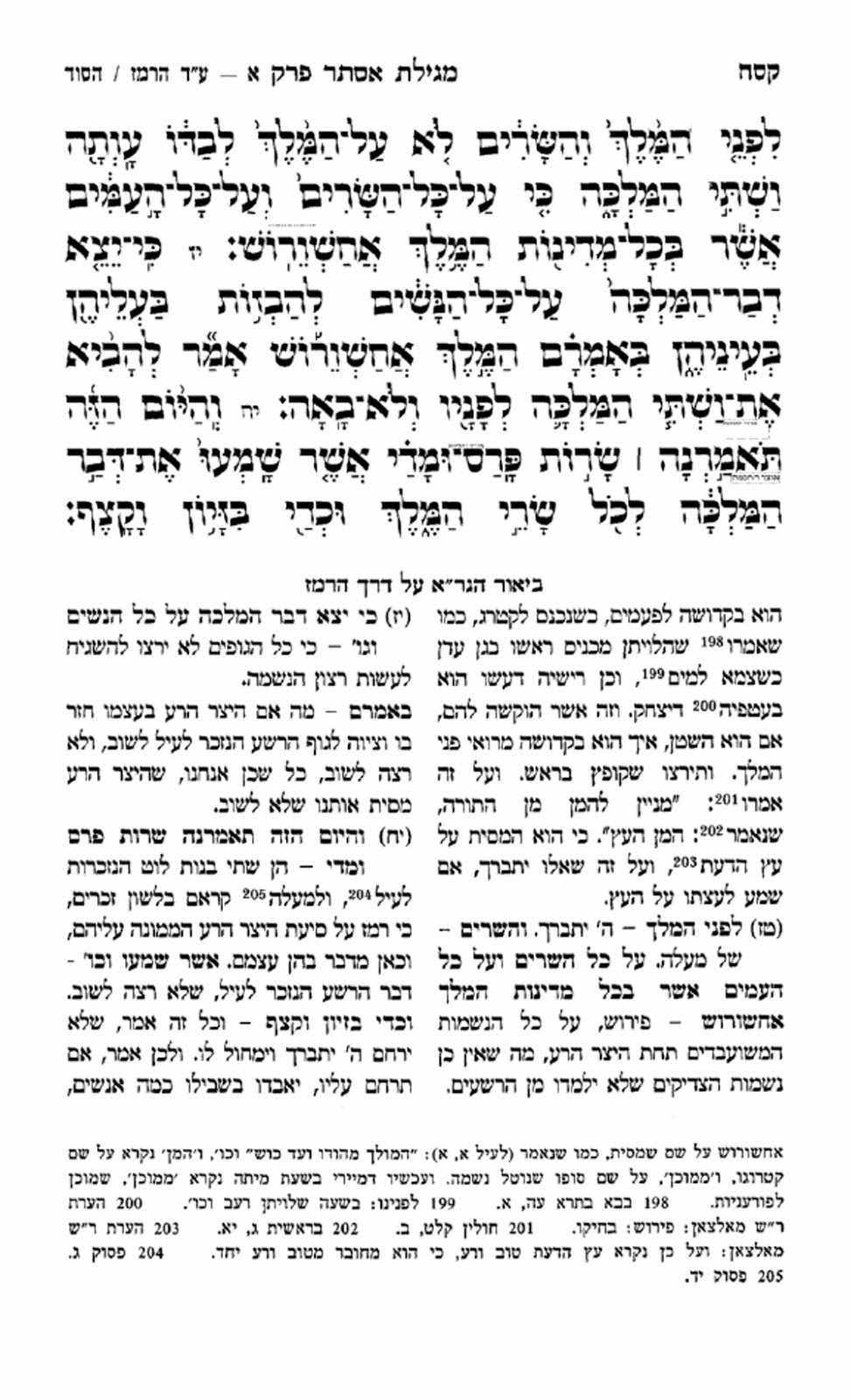
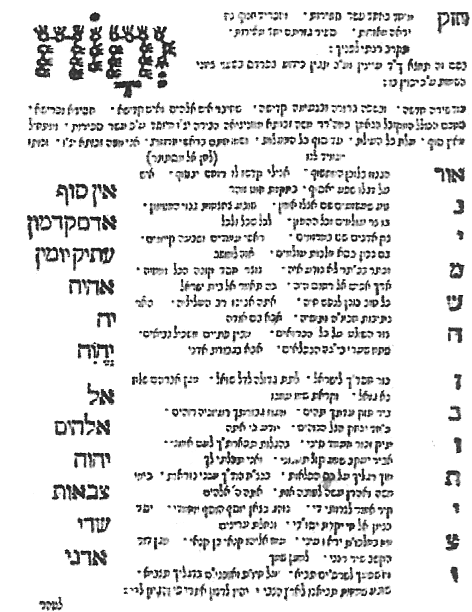
When it comes to the Guide and the Vilna Gaon, there is also a reference in the Gaon’s commentary to Esther 1:18. Here are the pages from the Mossad ha-Rav Kook edition.

As R. Meir Mazuz pointed out,[2] the Gaon is referring to Guide 1:54. However, as you can see, the editor didn’t know this and thus didn’t provide the source.[3]
Here is another example where a learned editor did not know a source in the Guide. In R. Abraham Sofer’s edition of Meiri, Hibbur ha-Teshuvah, p. 170, the Meiri quotes Maimonides, and as you can see in note 4, Sofer comments, “I don’t know where.” Maimonides words are not in any of his halakhic writings, which is why Sofer didn’t know about them, but they do appear in Guide 3:8.

Returning to the Gaon and Maimonides, when it comes to sex the Gaon’s view parallels that of Maimonides in the Guide, although I don’t know if we can speak of influence. Maimonides famously spoke of the sense of touch as being a “disgrace to us.”[4] The Gaon actually had the same opinion in that he regarded sex as something to be loathed and a necessary evil. Only with regard to the spiritual elites did he see something intrinsically positive in it.[5]

שדברי העולם הזה בעצם מאוסים, כמו האכילה, שנוטל מאכל ועושה פרש ורעי וכן המשגל, אבל התכלית, מה שבא מזה הוא טוב, כמו תכלית האכילה שיהא חזק ללמוד תורה, ותכלית המשגל להיות בנים צדיקים וטובים, וזהו תכלית ופעולה. וז”ש בהצדיקים לא מיבעי שהתכלית מזה אצלם טוב, אלא אפילו הפעולה עצמה הוא לחיים, שהן מכוונין בזה ואכילתן כקרבן ממש. וכן בכל דבר.

Yet even when dealing with the righteous, one can only imagine how the Gaon would have reacted if he had seen the following text, from R. Solomon of Karlin, Shema Shelomo (Jerusalem, 1956), p. 96 (sippurim no. 59), in which we see how an unnamed hasidic figure said that he needed sex every day, a statement that shocked his bride to be.[6]


Here is another example where the Gaon’s has the same view as Maimonides in the GuideTamid 1:1 states: “The priests kept watch [throughout the night] at three places in the Temple.” Why? In the Mishneh Torah, Hilkhot Beit-ha-Behirah 8:1, Maimonides says that this is just a matter of showing respect to the Temple, since there is no fear that anything will be stolen. In his commentary to Tamid 1:1 (found in the Vilna ed.), the Gaon explains that the guards were there to prevent unauthorized entry. In Guide 3:45 Maimonides also offers this explanation (in addition to mentioning that the watch was for glory and honor).

Regarding Meiri’s Hibbur ha-Teshuvah, mentioned above, in Saul Lieberman and the Orthodox I mentioned the notes at the end of this volume by Louis Ginzberg, notes that have not yet been removed from newer printings. I neglected to mention this dedication to Ginzberg at the beginning of the volume.

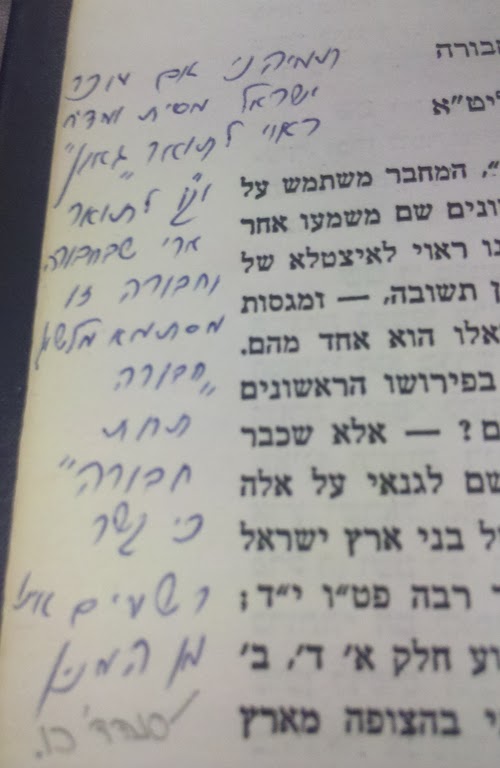
As for Ginzberg’s notes at the end of Hibbur ha-Teshuvah, A reader sent me the following, which shows how Yeshivat Ner Israel’s beit midrash copy of the book is “decorated”.


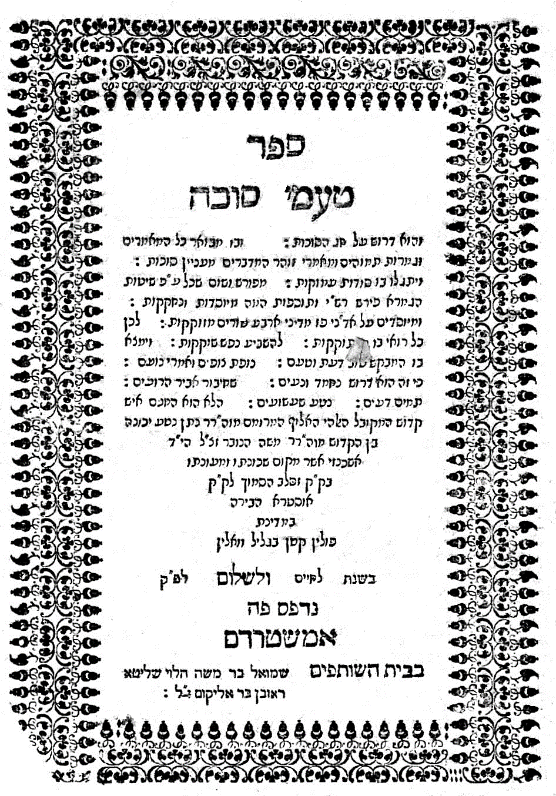
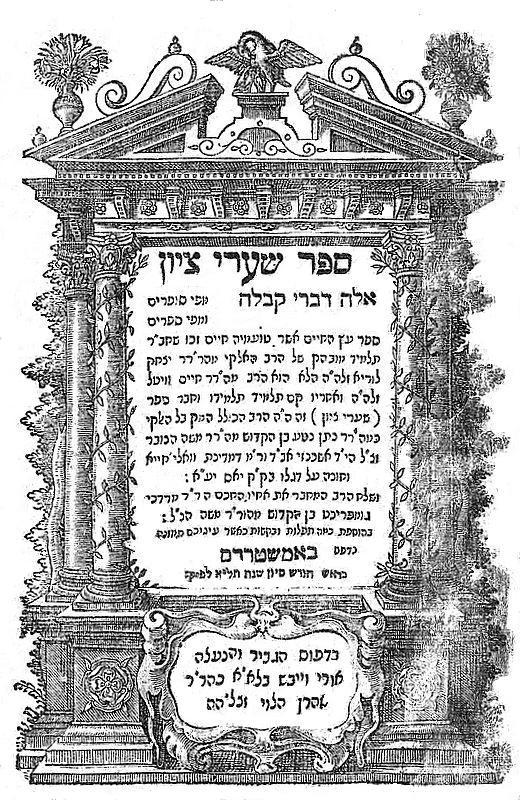
Regarding Sofer’s edition of Hibbur ha-Teshuvah, there is one other important point I must mention. The volume first appeared in 1950 and was subsequently reprinted by Sofer, with no changes to the text of the Meiri or the pagination. This reprint is what appears in the multivolume Beit ha-Behirah that everyone purchases. However, this is unfortunate, because the 1950 edition is far superior. Here is the title page of the first edition, which was published by Yeshiva University.

This edition contains a lengthy and valuable introduction by R. Samuel Mirsky, which deals with various aspects of the Meiri. Furthermore, Mirsky included thirty pages of important notes, many of them textual, that are vital for anyone who studies the Hibbur ha-Teshuvah. (Mirsky also calls attention to the passage in Guide 3:8, which as I noted above, Sofer did not know about.[7]) Quite apart from the 1950 edition, in Talpiot 4 (5710), pp. 417ff., Mirsky published a number of chapters from Hibbur ha-Teshuvah and his notes often call attention to things not mentioned by Sofer. It would therefore be helpful if a new edition of Hibbur ha-Teshuvah was published and included the notes of both Sofer and Mirsky. This new edition should also include the many pages of notes by Yehudah Preis-Horeb and R. Dov Berish Zuckerman that appeared in Talpiot 5 (5712), pp. 880ff., which are also quite valuable.

I can’t explain why Sofer did not include at least Mirsky’s notes when he republished the book. Fortunately, the first edition is available on hebrewbooks.org.

Finally, here is an example where the Gaon’s position is not merely similar to that of Maimonides in the Guide, but is clearly influenced by the latter.[8] In Yahel Or the Gaon states:[9]

כי כל השמות אינן רק משותפין ומושאלין מפעולותיו . . . רק שם הוי”ה . . . והוא שם העצם שאינו מושאל מפעולה רק (מורה) על הויותו תמיד והיותו מעצמו

Here is what Maimonides writes in Guide 1:61 (Ibn Tibbon translation). It is obvious that the Gaon was influenced in this matter by Maimonides’ words.

כל שמותיו יתעלה הנמצאים בספרים כולם נגזרים מן הפעולות, וזה מה שאין העלם בו, אלא שם אחד, והוא יו”ד ה”א וא”ו ה”א, שהוא שם המיוחד לו יתעלה, ולזה נקרא שם המפורש, ענינו, שהוא יורה על עצמו יתעלה הוראה מבוארת אין השתתפות בה . . . להיותו מורה על עצמו יתעלה, מאשר לא ישתתף אחד מן הברואים בהוראה ההיא

P. 109. Stern mentions the report that after the Gaon’s death on Sukkot, when the hasidim continued to celebrate, three hasidim were killed by mitnagdim. It is hard to know whether there is any truth to this story, or to the report of hasidim killing a mitnaged.[10] Unfortunately, in our day we have seen haredi Judaism in Israel descend to a level unimaginable even ten years ago.[11] Harsh rhetoric, which on occasion has led to real violence, is now routine, and the rabbis who use the harsh, and often hateful, speech are never called to account for their actions.[12] It is only a matter of time before we see a religiously motivated murder, and we have already had close calls, including a stabbing at Ponovezh.

Seeing what has occurred in recent months, we can understand why some people might conclude that R. Akiva was right on target when he told his son, “Do not dwell in a town whose leaders are talmidei hakhamim” (Pesahim 112a). In a previous post I already quoted Yeshayahu Leibowitz’s comment that we know the Sages had a sense of humor since they stated תלמידי חכמים מרבים שלום בעולם. Along these lines, many decades ago an unnamed rabbi explained why the blessing reads

הפורש סוכת שלום עלינו ועל כל עמו ישראל ועל ירושלים

The problem with this formulation is that there is no need for Jerusalem to be singled out after mentioning the entire people of Israel. The explanation given is that since Jerusalem has more disputes than anywhere else (and today we could add Bnei Brak) it therefore needs a special mention when asking God to spread over us his shelter of peace.[13]

R. Kook actually claims that the Jewish people are more apt to be involved in internal disputes than any other people. In Kevatzim mi-Ketav Yad Kodsho (Jerusalem, 2006), p. 43, he writes:

ישראל הם עלולים יותר לפירוד ומחלוקת מכל אומה, מפני שריבוי הצביונים שמתחלקים בעמים רבים, כלולים בישראל ביחוד.

I am writing these words not long after a man attacked R. Aharon Leib Steinman, which could easily have caused R. Steinman’s death. So as not to put all the blame on one side, does anyone have any doubt that if Degel ha-Torah was running the show that R. Shmuel Auerbach would right now be under house arrest or sitting in jail? I say this only because I assume that the rhetoric directed against him is hyperbole, because if is not hyperbole, then we should assume that if Degel ha-Torah was in charge he would have been executed by now. Can the rabbis who use this sort of rhetoric really claim that they are innocent when an individual decides to take their words literally and kill someone, even a great Torah scholar? Didn’t these rabbis learn the lesson of the Rabin assassination, that if you call someone a rodef (and thus hayav mitah), someone might very well take you up on this? As for throwing people out of kollels because they didn’t vote for Degel ha-Torah, any kollel that does so should be ineligible for Israeli government money.

Most disappointing in this matter is R. Chaim Kanievsky who seems to think that Torah Judaism has the equivalent of a papacy, and he can thus declare that all are obligated to follow R. Steinman, meaning that there is only one Torah path.[14] This approach first surfaced when R. Elyashiv was ill and R. Kanievsky declared that the torch of leadership had passed to R. Steinman whose word was now law. See here. Have we ever had such a thing in the Lithuanian Torah world where a sage’s unquestioned leadership is formally proclaimed in this manner, as if he were a hasidic rebbe taking over for his deceased father? In the non-hasidic world the people have always chosen their spiritual leaders, as the Sages tell us: עשה לך רב. Never have they been imposed on us from above.

In the booklet Kuntres Tikun Haderah, which is an attack on R. Yehoshua Ehrenberg, the Rosh Yeshiva of the Haderah yeshiva, one of R. Ehrenberg’s great sins is that he declared that “the” gadol ha-dor is not something that can be proclaimed in papal fashion. Here are two of his statements that strike me as entirely reasonable, but which for the followers of R. Kanievsky are enough to turn him into an enemy of Torah Judaism.

ר’ חיים החליט שהרב שטיינמן הוא הגדול. גדול זה לא דבר שאפשר להחליט עליו

לדעתי המושג ,הנהגה, הוא מי שהציבור בפועל שומע בקולו. כמה אחוזים צריך? ר’ חיים חושב שמספיק מה שיש לרב שטיינמן. אולי לא

And here is another statement from R. Ehrenberg, which for his opponents is the height of chutzpah simply because he doesn’t believe that there is currently one authority whose decisions bind everyone.

עוד התבטא בחוצפה עזה: “מאז שהרב אלישיב נפטר אין מנהיג אחד בעם ישראל. אין כזה מושג הנהגה. היום זה התבטל אין אחד שחייבים לשמוע לו

No one is saying that R. Kanievsky shouldn’t express his opinion that his approach is the proper one. But that is very different than what he and his followers have been doing. Declaring that supporters of R. Auerbach are behemot, invalid as witnesses, and should not be given aliyot is just the beginning. אחרי אלף גלגולי מחילות, some believe that R. Kanievsky’s language has unintentionally even verged on incitement to murder. He has followers who will do anything he says, and he has declared that R. Auerbach is a zaken mamre and deserving of sekilah (the death penalty of stoning) for not accepting the leadership of R. Steinman.[15] (Say what you will about R. Auerbach’s politics, he is certainly enough of a Torah scholar to have his own opinion on matters.) R. Kanievsky has also, playing on the word עץ which is how the Bnai Torah party is often referred to, said that its followers should be “hung on a tree”. I assume that this comment was said in a non-serious manner, but as a leader he needs to be aware that there are people who might not see it this way, and take it into their hands to fulfill his words. Was it this sort of language that led followers of Beit Shammai to kill followers of Beit Hillel, a fact attested to by the Jerusalem Talmud?[16] When vitriolic language was used in New Square, we saw how someone decided to take matters into his own hands, and his solution was to burn down a house which would have killed all the inhabitants. Unfortunately, it would no longer be a surprise if one of R. Kanievsky’s followers decided to use violence as part of this milhemet mitzvah.

Considering the shocking things R. Kanievsky has recently said, is it possible that he doesn’t really know the situation, and the people who are meeting with him and getting him to speak about certain matters are really manipulating him? R. Kanievsky has been meeting with people and providing advice for decades and until the last couple of months he never spoke like this. Is there any other explanation for his sudden change of tone? Here is the recording of R. Kanievsky referring to R. Auerbach as deserving sekilah and also referring to him as a zaken mamre and his followers as behemot. I ask the readers, does it sound like R. Kanievsky really understands what is going on? Do we have any idea what sort of information against R. Auerbach various askanim have provided him with?[17]

Let me take you back to an earlier era when we heard the type of rhetoric you can now hear. This is from the front page of the newspaper Davar, Nov. 29, 1972, and came after R. Shlomo Goren was subjected to death threats.

Should we be surprised if what R. Goren was subjected to is soon repeated with R. Auerbach? And even if it doesn’t reach this extreme, we have already seen how much damage can be caused by what the Lithuanian haredim call “השקפה”, to which one can reply:[18]

אין “השקפה” אלא לרעה (ראה רש”י בראשית יח, טז)

Now is as good a time as ever to note that the falsehoods of Yated Ne’eman begin right with the title of this newspaper. The title is derived from Isaiah 22:23 which reads

ותקעתיו יתד במקום נאמן

This means, “And I will fasten him as a peg in a sure place.”

Yet if you look two verses later (Is 22:25) you find the following words

תמוש היתד התקועה במקום נאמן

We see from this is that the word יתד is feminine.[19] Furthermore, throughout rabbinic literature יתד is feminine and it is also feminine in modern Hebrew, meaning that the title of the newspaper should be Yated Ne’emanah.[20] I say this even though there is one biblical verse, Ez. 15:3, where the word is masculine, since I don’t think the newspaper was intending to adopt the usage of one verse in contradiction to the general “Masorah” (as we know how important Masorah is to them).

יתד is a feminine word along the same model – kametz followed by tzeireh – as the following words that are also feminine[21]: חצר, גדר, ירך, כתף


While I think that the newspaper’s title is probably just a simple error, I know some of you conspiracy theorists are thinking about how the people who run Yated don’t like to give the females among us their due, and won’t even publish their pictures, so maybe they see it as disgraceful to have something feminine in the title . . .[22]

Pp. 160-161: Stern records a few of the famous, and from a contemporary perspective, shocking stories about how the Gaon related to his children. “His children divulge that Elijah never once wrote a letter to any of them. Nor when he saw them, once every year or two, did he ever ask about their work or their well-being.” Stern refers to these stories as “painful memories.” I don’t think this is accurate. If they were painful memories, his children would not have recorded them. It might be painful for us to read the stories, but we have to be careful not to project our sense of how parents and grandparents should behave onto a different culture.[23[

Aryeh Morgenstern refers to R. Hayyim of Volozhin’s comment in the introduction to Sifra di-Tzeniuta that the Gaon never asked about how his children were doing and never wrote them letters or read letters from them. According to Morgenstern, this should be seen as a veiled criticism of the Gaon by R. Hayyim, since if he wanted to show people how great the Gaon’s ascetic attachment to Torah was, he didn’t need to bring an example illustrating how the Gaon related to his family.[24] I completely disagree. To suggest that R. Hayyim intended to criticize the Gaon regarding this matter, especially in the introduction to one of the Gaon’s books, is in my mind impossible. While moderns such as Morgenstern might find the description of the Gaon problematic, it was not viewed as such by R. Hayyim, nor by those of our contemporaries who continue to cite this description (and similar ones about other great Torah scholars.)[25]

In an earlier post, available here I noted that David Singer and Moshe Sokol advance the radical view that the Rav’s descriptions of his family members is actually designed to show his opposition to their hyper-intellectualism and pan-halakhism. They write

[T]here is something strange about Soloveitchik’s tales of the Litvaks. The behavior he describes is so radical, so extreme, as to make his presumed heroes seem grotesque. Who, for example, wishing to portray Litvak intellectualism in a positive light, would boast that his father and grandfather set aside all human sentiment and refused ever to enter a cemetery, because a stark encounter with death would have distracted them from the contemplation of the law. Or again, who would tell with pride the following macabre story about his maternal grandfather [referring to the story of R. Elya and his dying daughter]. . . . Stories like this, while ostensibly presented in order to glorify the Litvak, cannot help but evoke strong disapproval in the reader. And this disapproval, it seems safe to assume, is shared in part by Soloveitchik himself, specifically by that part of him which rebels against the Litvak tradition’s spurning of the emotions. The vein of anger that runs through the anecdotal material in “Halakhic Man” is not to be missed.[26]

Again, I find it impossible to accept that the Rav was actually criticizing his father and grandfathers. I say this not because of any pieties, but simply because the Rav’s connection to these people was not merely one of admiration but idolization. It is obvious that Singer and Sokol have a different vantage point than the Rav and traditional Lithuanian Jewish society in general. But why do they assume that what they see as “grotesque” must be shared by the Rav? All one needs to do is peruse haredi hagiographies to find lots of descriptions of what, when it comes to intellect triumphing over emotion, one can call rabbinic counterparts to Mr. Spock.

Returning to Stern, he  also quotes Aliyot Eliyahu’s comment that “to love the path of God and His Torah . . . he [Elijah] had to fight against his human instincts, pause, and let go of his own love for his own children.” Stern notes Solomon Schechter’s comment that Aliyot Eliyahu was “incapable of marking the line between monster and hero,” which again reflects a modern sentiment.

Incidentally, I am sure Schechter’s comment was influenced by what appears in Aliyot Eliyahu, note 51, which is not mentioned by Stern (perhaps because it refers to a segulah?):

סיפר לי גיסי המופלג מ’ זלמן ז”ל נכד הגאון ז”ל, שאמו בת בגר”א היו בני’ מתים כשהם קטנים ר”ל, וכשהיתה מעוברת ממנו [גיסי הנ”ל]., נסעה מביתה [מק’ דיסנא], אל אביה הגר”א שיבקש רחמים שיהיה הולד של קיימא. ובבואה לפניו אמר לה במילים קצרים סגולה לקיום בנים . . . ויותר מזה לא רצה לבטל לדבר עמה.

R. Ephraim Kirschenbaum takes note of this passage and some similar ones and raises the question – which itself I find surprising in a haredi publication – is this proper Torah behavior?[27]

הנה מתיאורים הללו, מגדולים אנשי שם, מצטייר לנו הגר”א כאלו איש אשר מרוב השתקעותו בתורה דוכא כליל כל רגש כלפי ילדיו. האם האדם השלם אמור כך להיות?

The answer his gives, not surprisingly, is that there is a different standard for saintly figures than for the masses.
האמת היא שהגדולים הנ”ל בהלכות ביטול תורה וחומרתו קעסקי, ואין מדבריהם סתירה לפן נוסף.

Stern (p. 161) aptly quotes the Gaon’s suggestion[28]

that one should follow the Babylonian Talmud’s injunction (tractate Eruvin 22a) to “blacken” oneself toward one’s children as a “raven” does to her fledglings. The “raven” the Gaon explains, is “an allegory for the scholar who becomes cruel to his children [so that] he can spend all of his time studying the Torah.”

I would just add to this the quote from the Gaon in R. Samuel Maltzan’s Even Shlomo, ch. 3:4 (emphasis added):

שני מיני גבורה נמצא בעובדי ה’, ונקראים גבורים ואנשי חיל. גבור הוא הכובש את יצרו בעת שבאה העברה לידו, ואנשי חיל הם אבירי הלב בשלמות הבטחון להגות בתורה יום ולילה ושלא להשגיח על בניו ובני ביתו הצועקים ללחם, וכמו שאמרו (עירובין כב ע”א) שחורות כעורב שמשים עצמו אכזרי על בניו כעורב. ומה עושה לו הקב”ה? מזמין לו אדם להחזיקו כיששכר וזבולון.

R. Yitzhak Zilberstein quotes the story found in the introduction to the Gaon’s commentary to Shulhan Arukh according to which the Gaon was so involved in his learning that he forgot about his ill son. Rather than conclude that this is something only for spiritual elites, he seems to regard this as something everyone should strive for. He writes:[29]

וזהו דרגת חשקת התורה, שהוא למעלה מדרגת אהבת התורה, שהחושק בתורה שוכח כל אהבותיו, אפילו ממה שטבע הקב”ה בבריאה, כדוגמת אהבת אב לבן, ויתכן שזה הכונה בגמרא בעירובין (דף כב ע”א) שהתורה מתקיימת במי שמשים עצמו אכזרי על בניו ועל בני ביתו כעורב. דהיינו שחושק בתורה, עד שמשכח כל אהבה אחרת

The removal of what moderns regard as a basic emotional connection to one’s children[30] is also seen the anonymous hagiography of R. Elyashiv, Ha-Shakdan.[31]

I, for one, was quite surprised that this was included in the hagiography, as it runs so much against how people today think about such matters. I also have to say that I find some of what appears in the book very difficult to believe. R. Elyashiv probably knew the entire Talmud by heart, so how are we supposed to believe that he didn’t even know the names of his children?[32]

When Ha-Shakdan appeared I went out on a limb stating that I was sure that this sort of material would never appear in English because of the shocked reaction it would create even among haredi readers in the U.S. It is always dangerous to make predictions about the future, which is why we historians usually stick to the past, but in this case it turns out that I was correct.

In February 2013 Artscroll published an English translation (“adapted and expanded”) of Ha-Shakdan.[33] Without discussing the book or the translation in any detail, let me just call your attention to some of the material that, not surprisingly, was deleted. Here is p. 69 of Ha-Shakdan and p. 123 of the translation.


Notice how in the translation most of the paragraph beginning with the words מעבר לזה have been deleted. I think the reason is obvious, as mentioned already. But is Israeli haredi society really so different when it comes to this sort of thing than American haredi society? That is, won’t Israeli readers be saddened to see sentences such as לא היו לו דיבורים עם הבנות and כשהם באים אצלו בביקורים או בתורנות, אין להם שיחה משותפת בכלל

Here is Ha-Shakdan, pp 62-63, and the translation pp. 105-106.


Notice how the first two paragraphs on p. 62 are not translated and also the first full paragraph on p. 63. Also, in the translation on p. 106, the second paragraph (“Rav Elyashiv’s lack of involvement . . .”) does not appear in the original. The translator obviously thought that this clarification was important for the English-speaking audience.

Here are two other passages from Ha-Shakdan, pp. 96 n. 69 and 251-252, that also don’t appear in the English translation.


Regarding the story on p. 98 n. 69, this should be contrasted with how it is told that R. Avraham Shapiro took up smoking as a way of dealing with the emotional strain of some of the cases he was confronted with as a dayan.

In general, when it comes to the stories reported in Ha-Shakdan, I have to say that I don’t accept the basic message the author is trying to get across. His point is that the stories he tells of R. Elyashiv regarding his indifference to people and events are a result of his complete absorption in Torah study. Yet it should be clear to anyone who reads the book, and knows something about R. Elyashiv, that all we have in these stories are an aspect of R. Elyashiv’s personality that really has nothing to do with absorption in Torah study. There have been plenty of great Torah scholars who were people-persons and conversationalists.

It is obvious that someone who by nature is extremely introverted, as R. Elyashiv was, will be more inclined to find his place among the books than an extrovert. But to describe R. Elyashiv’s personality as a complete outgrowth of Torah study is a distortion and shows a basic ignorance of human psychology. We didn’t need R. Nathan Kamenetsky’s Making of a Godol to realize that great Torah scholars encompass all sorts of personalities and one sort is not any more “authentic” than another. All we can say is that people, including gedolim, are different.[34] While haredim who are knowledgeable about the history of Torah figures love to talk about their different personalities, it is also the case that it is harder in that world to publish something that seriously analyzes a Torah sage’s personality. Yet without such an attempt, you will never get a real biography, only hagiographies.

Here are some quotations from Ha-Shakdan, vol. 2, pp. 246, 248, and plenty more could be added:

הגרי”ש לא מתייחס לכל אחד, וכאשר הוא כן מתייחס למשהו, הוא בוחן בעין משלו כל נושא. הכרעותיו בנושאים רגישים ביותר – ענייניות וחסרות רגש. גם עם צאצאיו, ואפילו הקרובים שביניהם, נוהג הוא באותה ידה של איפוק ואדישות.

כאשר ביום השלישי למלחמה פשטה השמועה שהצבא כבש את העיר העתיקה, והכותל המערבי בידי היהודים, הדבר עורר התרגשות גדולה מאוד. בשלב זה כבר לא עצר בעצמו בעל המעשה, וניגש לרגע לפינתו של רבינו לספר לו כי הצבא כבש כבר את כל מזרח העיר מידי הירדנים! הגרי”ש פסק מהלימוד והקשיב לו עד שכילה לדבר, ולא הגיב כלל. המספר המשיך בהתלהבות: והכותל המערבי גם כן משוחרר! רבינו שמע אותו עד הסוף באדיבות ותשומת לב כדרכו, ובלא שום זיק של התרגשות שב להתנועע ולהחזיר את עיניו בחזרה לגמרא הגדולה להמשיך מהמילה שפסק בה.

There are lot of further examples I can cite from other great rabbis. Here is how the Hafetz Hayyim is described by his son:

Father had no personal friendships with anyone all the days of his life, even though he loved every Jew and especially men learned in the Torah, whom he loved as his very self. Many times did I hear him tell how the daughter of the Vilna Gaon, who lived in another town, once paid a visit to her father. The Gaon inquired after her health and that of her husband and children and then immediately returned to his studies. The daughter began to weep at her father’s apparent indifference, but he declared, “I do not have the time” [in Yiddish, nitoh kein zeit]. So it is not surprising that father, of blessed memory, had no material friendships with anyone . . . . I once heard him explain the verse “And thou shalt love the Lord thy God with all they heart” (Deuteronomy 6:5) to mean that the heart should be so filled with the love of God as to leave no room in it for any other loves.[35]

R. Joseph David Epstein, who cites this passage, hastens to add that this sort of behavior is only intended for the spiritual elites.[36] הדברים האמורים לעיל, על הסתייגות מאהבה משפחה, ועל העלמת עין מצרכי בית, הרי אך לבעלי מדרגה וקדושי עלינו המה

What is one to make of the following story, found in Meir Einei Yisrael (Bnei Brak, 2004), vol. 1, p. 274?:

שמועה התהלכה בינינו שרבי משה לנדינסקי למד שמונה שנים עם חבר בוולוז’ין ולא ידע מה שמו של הבחור. הסיפור הקטן הזה מדגיש את אישיותו העצומה, שהיה בכל הוויתו רק מתמיד, ומעבר ללימוד לא נחשב אצלו שום דבר.

Quite apart from the fact that I don’t believe such a story is possible, I wonder why this is quoted as praise. Is this supposed to be a characteristic of a Torah personality, that you can learn with someone for eight years and never even take the trouble to learn the person’s name? I can’t imagine that the Hafetz Hayyim – R. Londinsky was the rosh yeshiva in Radin – or any of the mussar teachers would think that this is appropriate bein adam le-havero behavior.

Here is another story, found in R. Moshe Sternbuch, Ta’am ve-Da’at, vol. 1, pp. 244-245.


I don’t believe such a story is even remotely possible. R. Akiva Eger was a real person, with real feelings, and he loved his daughter. The idea that he could be at her house for an entire Shabbat, after not having seen her for years, and be so engrossed in learning that he didn’t even notice that a different woman had taken her place is simply not believable. Yet it is significant that the story is told as an example of praise, and R. Sternbuch concludes by pointing to it as an example of how gedolim so involved in Torah study forget everything else in the world.  If you would repeat such a story before a Modern Orthodox crowd they would be horrified. What would the haredi masses think of such a story? Would they be inspired by the commitment to learning above all else, or would they share the Modern Orthodox negative reaction?

R. Yonason Rosman called my attention to the following passage in R. Yitzhak Zilberstein’s Tuvkha Yabiu, vol. 1, p. 38, which describes how a yeshiva student was so involved in his learning that he named a newborn daughter with the same name as one of his other daughters, forgetting he already had a child with that name!

אחד האברכים המצויינים בבני ברק, העמל ויגע בתורה, קרא לבתו שנולדה לו בשם פלוני ורק לאחר מכן נזכר שאחת מבנותיו נקראת כבר בשם זה… המדובר במשפחה ברוכה ילדים עד כדי כך שהאב הספיק לשכוח שכבר נעשה שימוש בשם זה. והוא פלא!

Whether the story ever happened is not important. What is important is that it is being told on the assumption that people will be impressed with the yeshiva student’s total absorption in his studies

To be continued

* * * *

1. In recent years, books have appeared on every possible halakhic topic. This genre keeps expanding and here is the title page of a new book, Asurei ha-Melekh by R. Mordechai Agasi of Boro Park.[37]

I thought nothing could surprise me anymore, but this book certainly did. It is a large two volume set, and the first half of volume one deals with the halakhot relevant to one who is serving time in prison (or as I told a friend, “the halakhot of being in jail”). The rest of the book contains words of inspiration, stories, prayers, etc. all of importance for the prisoner. As the author explains in his introduction, the book is needed because of the increase of haredim in the prisons.

התרבתה, לדאבונינו, האוכלוסייה החרדית בבית הסוהר, וגדלה פי כמה.

It really is incredible when one thinks about this, since not too long ago it would have been simply unimaginable that such a sefer would have been needed.

2. Many people are interested in the Rogochover, R. Joseph Rozin. There is no question that he had a fascinating personality and there are many interesting stories about him. Yet very few people actually study his works because they are so difficult. Until now, nothing of significance has appeared in English on his halakhic thought. Therefore, I am happy to recommend R. Dovber Schwartz’s new book, The Rogochover Gaon, for those seeking to learn about this significant figure.

[1] R. Abba Mari of Lunel, Minhat Kenaot, ed. Dimitrovsky (Jerusalem, 199), p. 317 (ch. 23) wrote:
ואני לא על המחזיק בספרי היונים אני כועס ולא אחשבנו ככופר לא כמחליף חק ולא כעוזב ברית ומפר ואם נמצא בהם דבר טוב אפי’ בדף אחד, מציל על כל הספר
See also R. Jacob Lorberbaum, Ma’aseh Nissim (Jerusalem, 2011), Introduction:
וכבר אמרו וידוע כי בדברי תורה אף אם ימצא דבר אחד טוב מציל על כל הספר כולו
In his Torat Gittin (Jerusalem, 2003), Introduction, he writes:
ואמר החכם כי דבר אחד טוב יציל על כל הספר כולו
See also R. Yissachar Tamar, Alei Tamar (Jerusalem, 1979), Zeraim, vol. 1, Introduction, p. 14.
[2] Or Torah, Iyar 5772, p. 741.
[3] R. Mazuz has more to say about the Mossad ha-Rav Kook edition of this commentary, which I will perhaps return to in a future post..
[4] See The Limits of Orthodox Theology, pp. 15-16.
[5] The quote that follows come from the Oxford ms. of the Gaon’s commentary to Prov. 10:16. See the Mossad ha-Rav Kook edition, p. 110, n. 56.
[6] The story originally appeared in R. Zvi Ezekiel Michaelson’s Pinot ha-Bayit, p. 78.
[7] R. Ovadiah Yosef, Yehaveh Da’at, vol. 5, no. 35, also provides the source that eluded Sofer.
[8] Credit for this example goes to R. Eliyahu Tziyon Sofer, Tziyon Eliyahu (Jerusalem, 2008), p. 273.
[9] (Vilna, 1982 ), vol. 2, p. 19a.
[10] See Mordechai Wilensky, Hasidim u-Mitnagdim (Jerusalem, 1970), vol. 2, p. 178. This report, contained in the early anti-hasidic text Shever Posh’im, includes names and places and was written not long after the event described. Nevertheless, I would not accept the story as historically accurate without confirmation from other sources, which as far as I know has not been found. See also S.’s post here which discusses another alleged murder by Hasidim. In Sippurei Niflaot mi-Gedolei Yisrael (Tel Aviv, 1969), p. 279, it reports that R. Menahem Mendel of Kotzk thought that R. Shmelke of Nikolsburg made a mistake when he forced his “enlightened” opponents to leave the city. What he should have done, according to the Kotzker, is have them killed.
[11] One positive recent development is that at least some people in Bnei Brak have woken up to the sexual abuse problem. See here where parents are advised not to send children outside by themselves. In the letter it refers to incidents related to “kedushat and taharat Yisrael”. What exactly does this mean? The English translation speaks of kedushat Yisrael being “compromised” by certain “terrible incidents”. Does this mean that the kedushat Yisrael of the victims has been compromised? If so, this is an unbelievably offensive statement, since how can the kedushat Yisrael of a victim, who did no wrong, be compromised based on the evil actions of someone else?
[12] R. Zvi Yehudah Kook wrote (Sihot ha-Rav Zvi Yehudah: Bereshit [Jerusalem, 1993], p. 242):
ר’ שלמה זלמן זצ”ל זקני היה אומר על סוג מסוים של קנאים: “הם חיות קדושות, חיות טורפות שקשה לסבול, אבל בסגנון של קדושה.” אמנם קדושים הם, אבל בגלל שנאתם לישראל, מתעכבת אהבת ד’ אליהם, כדברי הגר”א. ביחס לאף לא אחד מגדולי ישראל, לא מצאנו שבח שהיה שונא ישראל. נכון שלפעמים יש צורך במלחמה מעשית, אבל לא בשנאה, שהיא קטנות.
When R. Zvi Yehudah refers to the Gaon he has in mind the Gaon’s comment to Tikunei Zohar, 57b s.v. דבגינייהו where he writes:
דהש”י שונא מקטרג על בניו אף הקדושים
Elsewhere, R. Zvi Yehudah elaborates (Or li-Netivati [Jerusalem, 1989], p. 307:
חטא גדול הוא לקטרג על ישראל ובהרבה ספרים הוא מוזכר. הגר”א אומר :”ד’ יתברך שונא את המקטרגים על בניו – אף הקדושים,” הגר”א משתמש במילה נוראה זו “שונא” – אפילו על קדושים וצדיקים, אם הם מקטרגים על ישראל ח”ו.
See also R. Shlomo Aviner’s commentary to R. Kook, Orot ha-Tehiyah (Beit El, 2009), vol. 2, p. 175.
[13]> Moshe Aharon Perlman, ed., Mi-Pi Dodi (Jerusalem, 1935), p. 22.
[14] In opposition to this, see the continuation of the passage quoted above from Kevatzim mi-Ketav Yad Kodsho, p. 43:
שינויי דעות בכמה ענינים רוחניים וחומריים אינו מעכב, ואדרבא מועיל, מכל הטפוסים יצא הדבר הטוב הכללי. אלא שהכל צריכים להתאחד בנוגע לכללות קיומה של תורה
[15] See here where Chaim Shaulson asks why R. Auerbach as a zaken mamre is hayav sekilah. According to Sanhedrin 11:1 a zaken mamre is to be strangled (henek).
[16] JShabbat 1:4. See Tosafot, Gittin 36b s.v. אלא.
[17] In general, R. Kanievsky, whose unique greatness in Torah knowledge must be acknowledged by everyone, has made a number of astounding statements over the years. (A few years ago the internet was abuzz with his statement that Jews have a different number of teeth than non-Jews, and more recently we all heard about what he said regarding people who have iPhones.) These sorts of statements can charitably be explained by the fact that since his entire world is Torah he relies on intermediaries for knowledge about the wider world. But this raises the question of why he should be the address for questions relating to political matters.
To give an example of the problem I am referring to, here are two pages from R. Shmuel Baruch Genut, Iggeret ha-Melekh (Elad, 2013), pp. 3-4..


R. Kanievsky declares that there is no medical danger from smoking and the doctors don’t know what they are talking about. Despite his unquestioned Torah brilliance, such as answer shows a complete disregard of reality and encourages unhealthy living. I ask those readers from the haredi world, doesn’t this show that perhaps R. Kanievsky is not the best person to ask when it comes to matters outside of “pure” Torah? I don’t ask this to be disrespectful. I would really like to hear from people who follow R. Kanievsky how they see the matter.

Finally, let me say a word about askanim, since I referred to them. While in the case of the incomprehensible attacks on R. Auerbach I raise the possibility that the askanim have poisoned R. Kanievsky’s view of R. Auerbach, I am not one of those who blaime everything on the “evil askanim” The first time I ever really heard the askanim blamed in a major way was when Making of a Godol was banned. In the first few days after the ban appeared, I remember seeing various people on the internet saying that it couldn’t be true, that it was just the askanim, etc. In the last decade there have been numerous other statements and bans that upset many people, especially in the American haredi world, and we have heard over and over again that gadol x couldn’t have said that which was attributed to him, and that it was a creation of the askanim. Yet in almost every case we have seen that American haredi apologists were wrong and the gadol indeed said that which was attributed to him. 

[18] This comment was originally made by R. Yehudah Naki in his note to R. Ovadiah Yosef, Ma’yan Omer, vol. 12, p. 145.
[19] See also Deut. 23:14: ויתד תהיה לך על אזנך.
[20] This was pointed out to me years ago by R. Nathan Kamenetsky.
[21] See Yitzhak Avinery, Heikhal Rashi (Tel Aviv, 1960), vol. 4, p. 436.
[22] When I pointed out the grammatical problem of Yated Ne’eman’s title to R. Meir Mazuz, he responded:
אבל הם כותבים ביום ששי מדור “יתד חָדָה”. ולפי דעתם שהוא לשון זכר צ”ל יתד חָד (כמו קם, שב, רץ, מנחי ע”ו) אא”כ סוברים שהוא אנדרוגינוס, פעם זכר ופעם נקבה
 A few years ago it was reported that R. Mazuz was going to burn pages from Yated Ne’eman as part of the Purim festivities. See  here.
[23] Stern writes:
           
In one startling vignette, they recount that as their father was preparing to leave on a journey of self-reflection, his favorite child, Shlomo Zalman, fell gravely ill. Elijah refused to change his plans. Only after a month away “not thinking about his family or his children” did the Gaon find himself on the toilet one day wondering about the boy’s well-being (for one is not supposed to think thoughts of Torah then.) He immediately returned home.
This story comes from the Gaon’s sons’ introduction to his commentary on Shulhan Arukh, and Stern has accurately reported what appears there with one exception. According to the text, the Gaon was in the בית הרחיצה  when he recalled his son. While today people use the term “washroom” synonymously with “lavatory”, in this text the meaning is “bathhouse” not “toilet”.
The story recorded with the Gaon might also have a connection to Maimonides’ Guide, as Maimonides writes, Guide 3:51, that the time to focus on worldy things is “while you eat or drink or bathe” (emphasis added). This connection was noted by R. Meir Mazuz, Darkhei ha-Iyun (Bnei Brak, 2012), p. 194.
[24] Mistikah u-Meshihiyut me-Aliyat ha-Ramhal ad ha-Gaon mi-Vilna (Jerusalem, 1999), pp. 258-259.
[25] See ibid., where Morgenstern shows that a statement about the Gaon by his grandson was omitted from the introduction to a book. Although this statement refers to how the Gaon expressed no interest in his grandson or his family, I do not believe it was omitted because of a fear that others would regard this as criticism of the Gaon, but rather due to a general concern of how the Gaon would appear in readers’ eyes.
[26] David Singer and Moshe Sokol, “Joseph Soloveitchik: Lonely Man of Faith,” Modern Judaism 2:3 (October 1982), p. 259.
[27] “Peninim be-Mishnat ha-Gra,” Yeshurun 18 (2006), p. 890.
[28] The Gaon’s comment is in Peirush al Kamah Aggadot (Vilna, 1800), pp. 3b-4a (Stern mistakenly gives the reference as pp. 5-6.)
[29] Hashukei Hemed: Sanhedrin, Introduction, pp. 6-7.
[30] R. Yaakov Moshe Harlap describes R. Kook as having such concern for the kelal that his own relationship with his family was not in any way special to him, and he mentions an episode with R. Zvi Yehudah that illustrated this. See his letter in Me-Avnei ha-Makom 11 (2000), pp. 51-53 (part of the letter is found here):
ואף גם בצער קרובי משפחתו לא היה מרגיש בהם יותר ממה שהרגיש באחרים, שכן בכל מבטו ובחוג ידיעתו לא היה נמצא מושג של פרטים כי אם כללים, ומאי נפקא מיניה בינם לבין אחרים

R. Harlap’s description of R. Kook stands at odds with so much else we know about the special relationship between R. Kook and R. Zvi Yehudah.
[31] 3 vols. (Jerusalem, 2010-2013). All references in this post are to volume 1 unless otherwise noted.
[32] See Yeshurun 28 (5773), pp. 349ff., for three letters from the 1950s from R. Elyashiv to R. Chaim Kanievsky. In the greeting at the beginning of these letters he is careful to mention not only his daughter but also his granddaughter.
[33] The English title is Rav Elyashiv: A Life of Diligence and Halachic Leadership. This translation is also noteworthy, in that as far as I know, it is the only time that Artscroll has allowed material explicitly degrading Torah scholars to appear in its books. One does not find this in the works of Jonathan Rosenblum, Aharon Sorasky, or any of the other writers published by Artscroll. While the following sentence is typical of haredi works published in Israel, it is quite shocking that Artscroll included it, while at the same time deleting other parts of the book. P. 176 n. 5: “Rav Yoel Kluft, av beis din of Haifa, once remarked to his students, ‘If I would be offered a job today as a plumber, I would leave dayanus.’ This sharp statement expressed the bitter feelings of Torah-true dayanim toward the establishment that employed them.” So I guess the many dayanim who didn’t (and don’t) feel this way about being part of the Israeli government-funded batei din are not to be regarded as Torah-true.
[34] Yechezkel Moskowitz was kind enough to send me the booklet “עניני השקפה: Notes of a תלמיד” which appeared in 2004 and records various teachings from R. Henoch Leibowitz. The following is relevant to the matter we are discussing (nos. 5 and 24 from the booklet).

No שיחת חולין? We can’t live like that, so לשם שמים we need to keep our שמחת החיים. Some גדולים of the previous דור were able to be serious, but that may have been because of their personality. חפץ חיים did make some jokes occasionally. [RH (Rosh ha-Yeshiva) told us R. Chaim Ozer joked a lot but R. Elchonon rarely ever.] 

As a young man, R’ דוד [R. Dovid Leibowitz] was by the חפץ חיים when a man came in and began complaining to the ח”ח about a certain גדול that he felt had hurt him in a certain way. R’ דוד was sure the ח”ח would reprimand the man for speaking such about a גדול! But the ח”ח just said “Nu, that’s the גדולים of our דור!” R’ דוד learned 2 things. 1) It’s שייך for גדולים to do something wrong. 2) He’s still a גדול! The ח”ח said “that’s the גדולים of our times” meaning he’s still a גדול but he has more faults. In our youth, we think a גדול is by definition perfect — and if he’s not then he’s not a גדול. It’s not so.

See also R. Yitzhak Dadon, ed., Rosh Devarkha (Jerusalem, 2010), p. 548, where R. Avraham Shapiro is quoted about a certain Torah scholar (not R. Elyashiv, so I have been informed by the source of the story). Yet the message is also applicable with regard to Ha-Shakdan and R. Elyashiv, i.e., there isn’t just one path, and devotion to Torah study doesn’t create one identical personality.

בשיחה שהיתה לכמה תלמידים עם רבינו זצ”ל, הוזכר רב פלוני מרבני דורנו, ואחד הנוכחים הוסיף ואמר באזני הנוכחים: הוא צדיק גדול! רבינו ששמע זאת, פנה אל זה ששיבח ושאל בסקרנות: איך אתה יודע? אותו תלמיד השיב: הוא תמיד בכובד ראש, עם פנים רציניות, אף פעם לא ראיתי אותו צוחק . . . מיד דיבר [הגר”א שפירא] בשבח אותו תלמיד חכם מצדדים אחרים שהכיר בו, והוסיף באזני התלמידים ואמר: שלא תחשבו ש”צדיק” זה דוקא מי שלא יודע לחייך, לזה יש לפעמים סיבות אחרות שאינו יודע לחייך, ואפשר להיות צדיק אמיתי עם מצב רוח טוב.

[35] Mikhtevei ha-Rav Hafetz Hayyim (New York, n.d.), Dugma mi-Darkhei Avi, no. 68 (p. 37), translation in Louis Jacobs, Holy Living: Saints and Saintliness in Judaism (Northvale, 1990), p. 51.
[36] Mitzvot ha-Bayit (New York, 1972), vol. 1, p. 138. 
[37] I wonder about the title of the book, which is derived from Gen. 39:20. אסורי is the ketiv, but אסירי is the keri, so why isn’t the title Asirei ha-Melekh?


The Alleged Blindness of R. Jacob Joshua Falk During the Emden-Eibeschuetz Controversy

The Alleged Blindness of R. Jacob Joshua Falk During the Emden-Eibeschuetz Controversy

by Shnayer Leiman

R. Jacob Emden’s animosity toward R. Jonathan Eibeschuetz throughout the Emden-Eibeschuetz controversy could easily be explained away on grounds that are not necessarily bound up with an accusation of heresy. Emden, who proudly depicted himself as “a zealot the son of a zealot,” would hardly pass for Mister Nice Guy. In his autobiography, and certainly in his polemical works, Emden often emerges as a misanthropic, tempestuous, cantankerous, chronically-ill, and incessantly whining social misfit and rabbinic genius who did not suffer either fools or rabbinic scholars gladly. Indeed, he hardly had a kind word to say about most of the rabbis who succeeded his father, R. Zvi Ashkenazi, as Chief Rabbi of Altona, Hamburg, and Wandsbeck, and served during his (Emden’s) lifetime. Emden, whose father and grandfather had served as Chief Rabbis of Altona, Hamburg, and Wandsbeck surely felt that he should have been appointed to succeed them in the rabbinate. That he (Emden) had to live in Altona for some 15 years (1750-1764) as a lay Jew in the shadow of Chief Rabbi Jonathan Eibeschuetz was simply more than he could bear. And the two rabbis lived virtually around the corner from each other in Altona, then a bedroom community for some 200 Jewish families living outside of Hamburg. Not surprisingly, a long list of historians and apologists would suggest that it was jealousy more than heresy that motivated and drove Emden’s animosity toward Eibeschuetz.[1]

It is far more difficult to explain away R. Jacob Joshua Falk’s animosity toward R. Jonathan Eibeschuetz on grounds other than the accusation of heresy. It is called “the Emden-Eibeschuetz” controversy, and rightly so, for those two rabbis initiated the controversy in 1751, would continue the struggle against each other through 1764 (when Eibeschuetz died), and Emden would continue to denigrate Eibeschuetz’ memory for as long as he lived, i.e., until 1776. But during the key early years of the controversy, from 1751 until 1756, the campaign against Eibeschuetz was directed primarily by R. Jacob Joshua Falk, then serving as Chief Rabbi of Frankfurt am Main, and who had formerly served with distinction as Chief Rabbi of Lvov, Berlin, and Metz. He was arguably the גדול הדור, certainly the זקן הדור, and virtually everyone agreed that no other rabbi in the mid-18th century was in a better position to resolve the controversy. He was even-handed, had no axe to grind, and was unrelated to either Emden or Eibeschuetz. Author of the classic work פני יהושע (the first volume appeared in print in Amsterdam, 1739), no one could question either his learning or integrity. In a battle of titans – now Rabbis Falk and Eibeschuetz – that escalated over a five year period, Falk ultimately called for Eibeschuetz to be defrocked. He placed Eibeschuetz under the ban, specifically ruling that he could no longer function as a rabbi, teacher, or preacher either in Altona or anywhere else, until such time that he would appear before a Jewish court of law and his case would be adjudicated . That, of course, never happened. As indicated, defenders of Eibeschuetz could not easily account for Falk’s seemingly acrimonious stance in the Emden-Eibeschuetz controversy.[2]

A possible early mention of Falk’s suffering from blindness appears in an undated letter by R. Nathan Nota Eibeschuetz (circa 1732-1789), son of R. Jonathan Eibeschuetz. The letter was addressed to a rabbinic colleague, an ardent supporter of R. Jonathan Eibeschuetz, and was published surreptitiously by Emden in 1755, during Falk’s lifetime.[3] In it, Nathan Nota Eibeschuetz notes in a postscript that reports have just reached him from a variety of informants that Falk’s [second] wife had died suddenly in Mannheim. Her sudden death had an immediate traumatic effect on Falk, who was overcome with mental confusion and physical pain. Specifically, Eibeschuetz states that Falk “now walks lonely and desolate, depleted of strength, and is no longer able to see.”[4] Although the letter is undated, we know precisely that Falk’s [second] wife died on Monday, October 18, 1751(= 29 Tishre 5512).[5] The letter could only have been written shortly after the event it describes.

It is difficult to assess how much credibility is to be given to such a report. The author of the letter was not an eyewitness to the event he describes. Moreover, he personally viewed Falk as the “enemy,” and could only take delight in describing his mental and physical breakdown.[6] In any event, we know that some four months later Falk obviously recovered, for he remarried on Shushan Purim in 1752,[7] and clearly regained his eyesight (as we will prove below), even if he had lost it temporarily. Doubtless, this report, published in 1755, played a significant role in influencing the later accounts that had much to say about Falk’s blindness during the Emden-Eibeschuetz controversy.

In the 19th century, reports appeared in print that Falk suffered from blindness toward the end of his life. Even if we assume that these reports are accurate accounts of Falk’s state of health in 1756, they speak only of blindness during the last months, weeks, or days of his life.[8] By the 20th century, apologists broadened the period of Falk’s blindness to the entire span of his involvement in the Emden-Eibeschuetz controversy, from 1751 to 1756.[9] Thus, it was claimed that Falk never saw any of the amulets ascribed to Eibeschuetz and never read any of the polemical works published by the Emden forces between 1751 and 1756. He heard only oral reports, and based his rulings upon the misinformation that he was fed. It follows, then, that Falk’s stance in the Emden-Eibeschuetz controversy cannot be used as evidence against the integrity of Eibeschuetz. In the 21st century, more radical apologists would claim that all the letters and broadsides allegedly signed and published by Falk were in fact forged by the anti-Eibeschuetz forces.[10]

Here, we shall attempt to set the record straight. It would seem from a variety of sources that Falk could see perfectly well during the key years of the Emden-Eibeschuetz controversy. He had no problem reading texts as late as August of 1755, when – some 5 months before he died – he published the very last text he would contribute to the literature of the Emden-Eibeschuetz controversy. What follows is a summary list of some key sources, and their dates.

1. Wednesday, August 7, 1754 (=19 Av, 5514). The חיד”א (R. Hayyim Yosef David Azulai, 1724-1806) met with Falk in Worms. An impostor was bankrupting the חיד”א’s fundraising efforts on behalf of the Jewish community of Hebron. The impostor came with forged papers, claiming he was the true emissary of Hebron. He would reach each town and city in Europe before the חיד”א arrived, collect the funds, and abscond. Falk came to the חיד”א’s rescue by comparing חיד”א’s written credentials against his own collection of rabbinic signatures, and as recorded in חיד”א diary, “וירא כי החתימות דידי ודידיה היו לאחדים.” Falk saw that the signatures on both sets of documents were exactly the same, and declared חיד”א to be the only authorized emissary from Hebron.[11] See here:

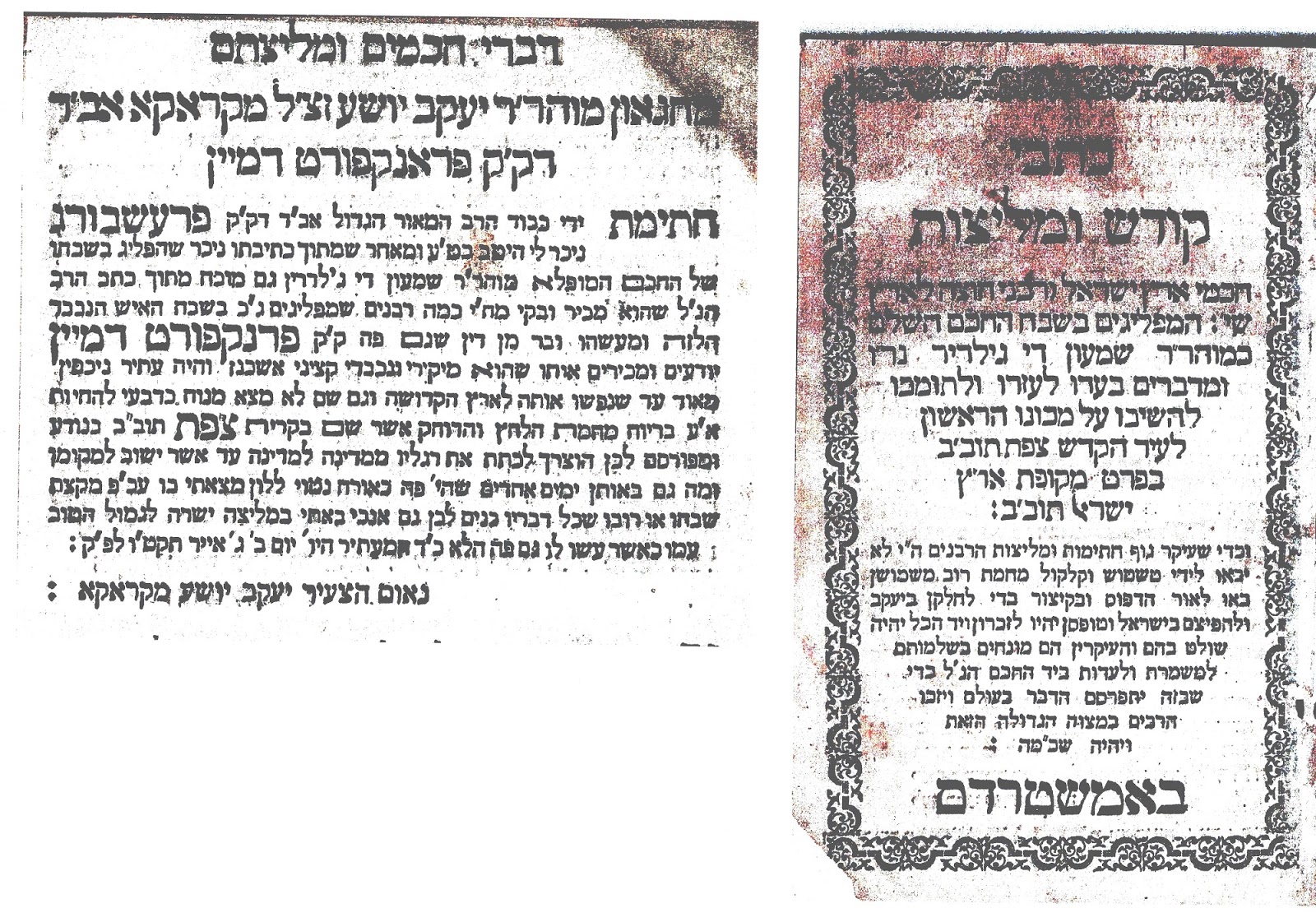
2. Monday, April 14, 1755 (=3 Iyar 5515). Falk wrote a letter on behalf of Simon von Geldern (1720-1788), then an itinerant yeshiva student. Falk writes:

“The signature of the Chief Rabbi of Pressburg [on the letter you showed me] is well known to me, and I recognize it at sight. Since he praises you in his letter… I too agree to write a letter on your behalf.”[12]  See here:


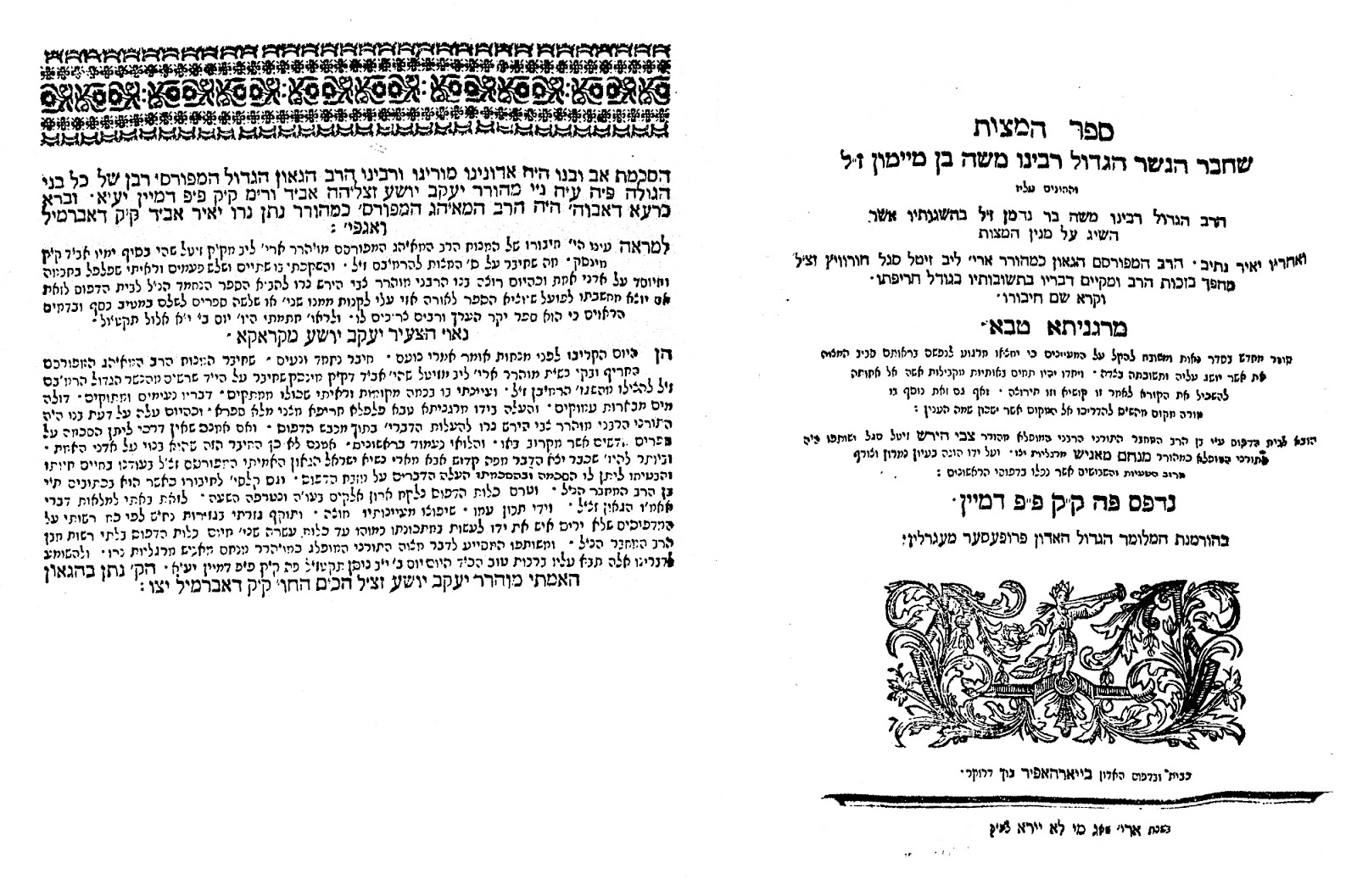
3. Monday, August 18,1755 (11 Elul, 5515). Falk wrote his final letter of approbation for authors of rabbinic works. He wrote 42 altogether. See his הסכמה to R. Aryeh Leib Horowitz’ ספר המצות עם פירוש מרגניתא טבא (Frankfurt, 1756). Falk writes that a copy of R. Aryeh Leib’s מרגניתא טבא was placed before his eyes (italics mine, s.z.l.). He examined it two or three times and saw that the comments were wise and true, and agreed to write a letter of approval.[13] See here.

4. Friday, August 29, 1755 (= 22 Elul 5515). In a broadside entitled חרבות צורים , Falk published his final salvo in the Emden-Eibeschuetz controversy.[14] Some 8 weeks earlier, Eibeschuetz had published לוחת עדות (Altona, 1755), his first published book, and the only one which was devoted to a vigorous denial of the charges made against him that he was a closet Sabbatean. In the book, he addressed the amulets that had been ascribed to him, and called to the stand an impressive list of witnesses for the defense, including many of the leading rabbis in Lithuania, Poland, Bohemia, Moravia, Germany, Italy, Turkey and elsewhere, all of whom attested to his innocence of the charges levelled against him. Falk’s חרבות צורים was the first published book review of לוחת עדות, and a devastating one at that.

For our purposes, what is significant is that Falk indicates that he read the book upon publication, and indeed cites chapter and verse with precision. He even notes that he compared the printed version (in לוחת עדות) of a personal letter that Eibeschuetz had addressed to him in 1754, to the original copy still in his possession, and noticed subtle, if only minor, differences. Apparently, Falk could see quite well, as late as August 29, 1755, when the broadside was penned by him.[15] He died some 5 months later on January 16, 1756 (= 14 Shevat 5516). See here.

In sum, R. Jacob Joshua Falk was not blind during the key years that he participated in the Emden-Eibeschuetz controversy. He may well have suffered from blindness toward the end of his life. If so, this is likely to have occurred sometime after he wrote his final salvo in the Emden-Eibeschuetz controversy on August 29, 1755.[16]

Notes

[1] For a scathing rabbinic critique of Emden’s character, and for samples of the negative impact of his character on his writings, see R. Meir Dan Plotzki, “לכותבי הסתוריא” in דגלנו 2 1922, n. 5-6, pp. 108-110, and n. 10-11, pp. 191-194; and 3(1923), n. 12, pp. 230-233. For a typical historian and apologist who explains away Emden’s animosity as being grounded largely in jealousy, see E. Duckesz, חכמי אה”ו (Hamburg, 1908), pp. 55-63. A wide variety of other motivations for Emden’s animosity have been suggested, including economic factors (see, e.g., M.J. Cohen, Jacob Emden: A Man of Controversy ,Philadelphia, 1937); halakhic issues (see, e.g., Rabbi R. Margulies, סיבת התנגדותו של רבינו יעקב מעמדין לרבינו יהונתן אייבשיץ , Tel-Aviv, 1941); and kabbalistic speculation (see, e.g., Rabbi Y.Y. Safrin, נציב מצותיך [first published in Lemberg, 1858] Jerusalem, 1983, p. 117, and Rabbi A.Y. Schlesinger, קונטרוס שמרו משפט תנינא, Jerusalem, 1914, p. 72a).
[2] On Falk’s role in the Emden-Eibeschuetz controversy, see S.Z. Leiman, “When a Rabbi is Accused of Heresy: The Stance of Rabbi Jacob Joshua Falk in the Emden-Eibeschuetz Controversy,” in D. Frank and M. Goldish, eds., Rabbinic Culture and Its Critics (Detroit, 2008), pp. 435-456.
[3] Emden, ויקם עדות ביעקב (Altona, 1755), pp. 79a-80a (the pagination mistakenly reads: pp. 59a-60a).
[4] Ibid., p. 80. The Hebrew reads: אף גם הוא כעת הולך ערירי וכוחו סר ואור עינו אין אתו.

The plain sense of the phrase אור עינו אין אתו is less than certain. Although some are inclined to render it figuratively, e.g, “his eyes lost their sparkle,” in rabbinic literature it is often rendered literally and refers to loss of sight.

For the figurative sense, see 1 Sam 14:29 ארו עיני (my eyes lit up), Psalm 38:17 ואור עיני גם הם אין אתי (my eyes have lost their luster), and cf. M. Yoma 8:6. The figurative sense, then, refers clearly to the restoration or loss of physical and mental well-being. For the sense “loss of sight,” see, e.g., R. Yosef b. Eliyahu Hazzan, עין יוסף (Smyrna, 1675), introduction; R. Jacob Emden, חלי כתם (Altona, 1775), p. 22b; R. Yissachar Lichtenstein, אהל יששכר (Altona, 1826), letter of approbation by R. Michael May of Breslau; R. Abraham Ha-Levi, אברהם זכרון (Lvov, 1837), letter of approbation by R. Yaakov Orenstein; and R. Yekutiel Yehudah Greenwald, פארי חכמי מדינתינו (Sighet, 1910), p. 38, entry 13. In these (and in other) rabbinic passages, the phrase אור עינו אין אתו is often used interchangeably with the terms עיוור, סומא, and סגי נהור.
[5] See D.A.L. Zinz, עטרת יהושע (Bilgoraj, 1936), p. 19. Her tombstone – moved from the old to the new Jewish cemetery – is preserved to this very day in Mannheim’s New Jewish Cemetery.
[6] Nathan Nota Eibeschuetz adds in the postscript that “starting at her funeral, Falk proclaimed that his punishment was due to his opposition to my [i.e., Nathan Nota Eibeschuetz’] Master, Teacher, and Rabbi, my father the Gaon [Jonathan Eibeschuetz].

[7] Zinz, loc. cit.
[8] See G. Klemperer, “Rabbi Jonathan Eibenschütz,” in Pascheles’ Sippurim 4(1856), pp. 284-5 [also published as a monograph entitled Rabbi Jonathan Eibenschütz (Prague, 1858), pp. 76-77]. Cf. Y. Gastfreund, “תולדות רבי יהונתן אייבענשיטץ” in his אנשי שם (Lyck, 1879), p.17, note. None of these sources provide any detail about a progression from partial to total blindness; they simply assume that at some point toward the end of his life Falk suffered from total blindness.
[9] See, e.g., H.Y.N. Silberberg, קונטרס דרך חיים (Piotrkow, 1931), p. 81.
[10] See, e.g., Y.Y. Vidovsky, “הקדמת המו”ל” in יערות דבש השלם המנוקד (Jerusalem, 2000), vol.1, p. 45, n. 95, whose claims are based upon an egregious misreading of the evidence he presents. Falk’s apologists are not discussed in Y. Barnai’s “יחסה של ההיסטוריוגרפיה האורטודוקסית לשבתאות” in his שבתאות: היבטים חברתיים (Jerusalem, 2000), pp.120-141.
[11] H.Y.D. Azulai, מעגל טוב השלם (Jerusalem, 1934), p. 23.
[12] Simon von Geldern, כתבי קודש ומליצות (Amsterdam, 1760), p. 4b.
[13] A.L. Horowitz, ספר המצות עם פירוש מרגניתא טבא (Frankfurt, 1756), הסכמה printed immediately following the title page (courtesy: HebrewBooks.org). See, however, the הסכמה of Falk’s son on the same page, which raises the possibility that Falk’s הסכמה was dictated by him and recorded by his son. Even so, I don’t think this changes the basic facts recorded in Falk’s הסכמה.
[14] Only one copy of חרבות צורים seems to have survived the vicissitudes of time. It is preserved in a private collection, and the owner, who prefers to remain anonymous, has graciously allowed me to publish the full text anew. I plan to do so in the near future. Here I post a scan only of the opening lines and paragraph, which are relevant to the discussion at hand.
[15] It is possible to claim that Falk was already blind when לוחת עדות was published on June 27, 1755. When a copy reached Falk in Frankfurt, it was read to him by an amanuensis, who also recorded Falk’s response as it was dictated to him. The response was then published in the broadside entitled חרבות צורים. Such a claim, however, is meaningless in terms of apologetics, whose ultimate goal is to dismiss Falk’s testimony as uninformed and meaningless. By June 1755, Falk’s role in the Emden-Eibeschuetz controversy was basically over. It’s everything he said, wrote, and did before June 1755 –when he certainly could see and read – that established his unique and unequivocal stance in the controversy. Moreover, specifically with regard to חרבות צורים, every criticism of Eibeschuetz by Falk is referenced with precision to the appropriate page in לוחת עדות. Every criticism is clever, incisive, and right on target – as one would expect from a tried and tested Sabbatean-buster like Falk. None of the criticisms could be dismissed as the uninformed and meaningless testimony of a blind man who could not read and understand the text of לוחת עדות.
[16] Anecdotal evidence (that can neither be authenticated nor dated with precision) preserves a tradition that Falk wore reading glasses in Lvov. If true, it surely suggests that he was able to see at that early stage in his life (and needed glasses only for reading). Indeed, to the best of my knowledge, no one has ever claimed otherwise. See Zinz, op. cit., pp. 95-6. Elsewhere in the same volume (on p. 25), Zinz writes specifically – without adducing any evidence – that Falk “was blind for several months prior to his death.” This is perfectly consistent with our conclusion


Teffilah Zakah: History of a Controversial Prayer

Teffilah Zakah:
History of a Controversial Prayer*

Yom Kippur has many unique prayers, many of them have been added through the centuries. For instance, R. Hayyim Yosef Dovid Azulai (Hida) has a longer viduy. Another such addition is the prayer known as Teffilah Zakah. In this prayer the person enumerates and connects their various sins with various acts and asks for forgiveness. Additionally, the person forgives any who have caused them pain or harmed them. This prayer was popularized by R. Avraham Danzig, in his Hayye Adam.

There are two reasons offered for reciting this prayer. Dr. Sperber opines (Minhagei Yisrael, vol. 2, p. 37 and esp. n.10) that the purpose of this prayer is to fulfill the opinion of the Ramban who holds that is an additional viduy on directly prior to Kol Nedrei on Erev Yom Kippur. (He offers that either Teffilah Zakah or a piyyut from R. Abraham ibn Ezra, fulfills this purpose). R. Abraham Ashkenazi (Brit Abraham, Warsaw, 1884, no. 129) offers a different reason for Teffilah Zakah. The purpose according to him, is to accept Yom Kippur early. At the end of Teffilah Zakah, one voices that they are accepting “kedushas Yom Kippurim.” In fact, R. Ashkenazi holds that for the purposes of fulfilling the opinion of the Ramban Teffilah Zakah would be insufficient as it differs significantly from the standard viduy. R. Ashkenazi, however, also holds that one should fulfill the Ramban’s opinion and thus recite the regular viduy after Teffilah Zakkah. (Surprisingly, Dr. Sperber doesn’t discuss R. Ashkenazi’s concern).

As mentioned above, Teffilah Zakah has a passage where one forgives others who may have sinned against him. This is necessary, as although Yom Kippur takes care of sins between man and God, it can’t take care of sins between man and man. Thus, it is necessary for each to receive forgiveness from their fellowman to achieve full forgiveness. Teffilah Zakah is long, and this paragraph that forgives others, appears at the end. The Chofetz Chaim attempted to alleviate this problem “and contacted the printers to change the placement of this paragraph of Teffilah Zakah . That is, to place this later paragraph earlier in prayer, to place the paragraph where one forgives others in the middle or the beginning.” According to the Chofetz Chaim’s son, R. Areyeh Leib, some siddurim did in fact shift around the prayer. (Michtevei Chofetz Chaim, p. 21-2 no. 52; quoted in Sperber, Minhagei Yisrael, vol. 4, 274).

The source to popularize this prayer is the book Hayye Adam.[1] Hayye Adam was first published in 1809, then in 1819 (the discussion regarding Teffilah Zakah only appears in this second edition – and thus, perhaps should be called a mahdurah [2]), and the third edition in 1825 – it would be this third edition that would be used for subsequent printing. [3] And, thereafter there was a flood of reprints – by 1960, Hayye Adam had been published at least 103 times (!) – a very popular book by any measure. While the book was reprinted on many occasions there were slight changes (some for the worse – there were many printing errors that crept in). As relevant to our discussion, in some editions, the portion discussing Teffilah Zakah changed as well.[4] The source that R. Danzig lists for Teffilah Zakah (klall 144), is the Sefer Hemdat Yamim. [5] In light of the fact that Hemdat Yamim is controversial in some editions of the Hayye Adam they removed words “Hemdat Yamim” so as not to have that as the source for this prayer.[6] Not all publishers dealt with the mention of Hemdat Yamim in the same manner. The full passage, as per the second edition of the Hayye Adam (see above – this is the first time this prayer appears in the Hayye Adam):

אח”ז ילך לבית הכנסת באימה ורעדה והמנהג בקהלתינו בכל בתי מדרשים להוציא ס”ת מהיכל כמש”כ בכתבי האר”י ז”ל וכבר נדפס בחמדת הימים התפילה שיסדר ואמנם לא כל אדם מבין הדברים רק מי שבא בסוד ה’ ומי שא”י הוא להם כדברי ספר החתום ולכן העתקתי בספרי’ קדמונים תפלה בלשון קל . . . וכו

In the Zolkeiv(1838) edition the words “וכבר נדפס בחמדת הימים” are missing (this makes the next clause – “but not everyone understands those words” and “those words will be like a closed book” unintelligible); while in the Vilna (1849) edition only the words

אח”ז ילך לבית הכנסת באימה ורעדה והמנהג בקהלתינו בכל בתי מדרשים להוציא ס”ת מהיכל כמש”כ בכתבי האר”י ז”ל

and the rest of the paragraph explaining why R. Danzig was required to create a new prayer in a “simple language” doesn’t appear. In the Vilna (1895) edition they have as follows:

אח”ז ילך לבית הכנסת באימה ורעדה והמנהג בקהלתינו בכל בתי מדרשים להוציא ס”ת מהיכל כמש”כ בכתבי האר”י ז”ל והעתקתי בספרים קדמונים לומר אז וידיו בלשון קל

This way they avoid the ambiguous pronoun (the problem with the Zolkeiv) and provide background for the prayer generally, of course they have still altered what R. Danzig found unremarkable.

The twin factors [7] of the use of a suspect work, Hemdat Yamim, and the creation of a new prayer, made some hesitant to adopt Teffilah Zakah. In the Tosefot Hayyim, a commentary on the Hayye Adam written by R. Meshulum Finkelstein, [8] deals with both of these issues and defends the recitation of Teffilah Zakah (klall 144 n.31). First, he alleges the prayer is not the same as that in Hemdat Yamim.[9] Second, he argues that the concern of saying a later prayer – this concern is attributed to the AriZal and is why, according to some the Yigdal prayer is not recited in some circles – is applicable to “yehidei segulah” (special people) and not to the masses. This is demonstrated by the many piyyutim we recite which are later than the cut-off date for prayers (R. Eliezer HaKalir – whenever he may have lived). Additionally, according to some, any prayer that has been accepted by the masses, this concern is not applicable.[10]

What is worthwhile mentioning is that R. Danzig is not the only talmid HaGra to use the Hemdat Yamim. He is also not the only talmid HaGra to have his work censored for such an inclusion. R. Eliach (Avi HaYeshivos, pp. 184-186) notes that the talmidei HaGra had no problem using and praising the Hemdat Yamim. Aside from R. Danzig, R. Alexander Suesskind, author of the Yesod V’Soresh HaAvodah, in his Last Will and Testament he praises the study of Hemdat Yamim. In at least one edition of R. Suesskind’s Last Will and Testament, Tzavah Yesod V’Soresh HaAvodah, Jerusalem, 1955, the reference to the Hemdat Yamim was removed. Thus, on the one hand we have a group of people who had no issues using the Hemdat Yamim, while on the other hand, there is another group of people who wish to remove any such references.

Whatever the ultimate source of this prayer, there is no doubt that today, it is a popular one.

Notes

*The fullest discussion of this prayer can be found in Mordechai Meyer’s article “On ‘Teffilah Zakah'” in Kenishta, vol. 2 pp. 119-138 including the language above of the various editions of the Hayye Adam.

[1] According to R. Barukh haLevi Epstein, (Mekor Barukh, vol. 3 p. 1260 [end of chapter 21]), R. Danzig titled the book Hayye Adam to avoid any attempt to abridge it as it would then be titled Kitzur Hayye Adam (Shortening the Life of Man). If this is true, it appears it did not help as in 1854 an abridged version was published although the title was Kitzur M’Sefer Hayye Adam (An Abridgement of the Work Hayye Adam). Interestingly, R. Y.S. Nathenson refers to the Sefer Hayye Adam as Kitzur Hayye Adam. Shu”t Shoel u’Meshiv, vol. 2 no. 14 (it is unclear whether there should be a Hey prior to Hayye Adam that would have R. Nathenson as merely listing the Sefer Hayye Adam as an abridgment and the “kitzur” part would not be part of the title.)

[2] For the use of this term “mahdurah” and when it should be applied and more specifically should this second edition of the Hayye Adam should be deemed a mahdurah m’Tukenet or mahdurah Sheneiah, see Y.S. Speigel, Amudim b’Toldot Sefer HaIvri: Kitveah v’Hatakah, Ramat Gan, 2005, 109-60.

[3] Teffilah Zakah was published separately numerous times under the title Teffilah Zakah (it was here it seems the usage of Teffilah Zakah became popular – R. Danzig never refers to it as Teffilah Zakah). The first time it was published was in Minsk, 1833 (see Meir, supra, p. 122)(there is possibly one earlier print by a year or so, in Russia also around 1830 but this is not definite) and republished as a seperate prayer on numerous occasions (by 1900 it had been published close to 50 times). It was first incorporated into the Machzor in 1882 in the Romm edition of the Machzor. (Meir, p. 124) Although the title of Teffilah Zakah was well established as late as 1856 this prayer was published under the title Teffilah HaEtkah M’Sefer Hayye Adam and not Teffilah Zakah.

[4] While the exact nusach of Teffilah Zakah does not appear in Hemdat Yamim, much of it does (see notes below for more). There are those who claim that since the teffilah is not the same, thus, Teffilah Zakah doesn’t really come from Hemdat Yamin. This is wrong. First, R. Danzig states it does – so he had no problem with it. Second, even if it is not word for word, and R. Danzig “improved” on the one in Hemdat Yamim, at the very least the basis for it, and much of it does in fact come from Hemdat Yamim. But, it is unsurprising that people would go to great lengths to void Hemdat Yamim as the source for this popular prayer.

[4] The removal of the mention of Hemdat Yamim both here and in other cases (including the discussion below regarding R. Suesskind’s work) is discussed by R. S. Divlitsky, “HaShmotot Mahdirim,” in Taggim, 1 (1969), 76-77 [Ya’ari, in Talmuot Sefer, also mentions the change to the Hayye Adam see under index under Hayye Adam]. For other examples of removal or changes to various editions of the Hayye Adam see R. A.I. Goldroth, “Al HaSefer ‘Hayye Adam’ U’Mechbro,” in Sefer Margoliyos, Jerusalem, 1973, pp. 262-67 esp. n.1. For a discussion about Teffilah Zakah, as well as the Hayye Adam see R. E. Levin & M. I. Blau, “Teffilah Zakah,” in Mishpacha, Kulmus, Tishrei, 2008, 16-19; and Blau’s earlier article, “Al Sefer Hemdat Yamim,” in Kovetz Bet Ahron v’Yisrael, Nissan, 2004 (112), pp. 161-164.

[5] In the Zolikav, 1838, Vilna, 1849; Tchernowitz, 1864; editions the words Hemdat Yamim are cut out and instead, the line reads, “in the works of the AriZal” and then has Teffilah Zakah. This is not the only mention of Hemdat Yamim in Hayye Adam. When discussing (klall 145) what happens if one has a nocturnal emission on Yom Kippur the Hayye Adam again cites to the Hemdat Yamim. In some editions the words “Hemdat Yamim” are missing, in others, it is abbreviated (“ח”ה”), so only those “in the know” will be able to understand.

[6] There is a third concern raised by the former Pupa Rebbi, who notes that as Teffilah Zakah discusses inappropriate sexual behavior, one should avoid saying it as it may lead to improper thoughts about the possible improper behavior. See R. G. Zinner, Neta Gavreil, Hilchot Yom HaKippurim, Jerusalem, 2001, p. 185 n.4. For a list of those who did not say Teffilah Zakah, see Y. Mondshein, Otzar Minhagei Chabad, [Jerusalem], 1995, pp. 200-01. Among other reasons, a similar reason to the Pupa Rebbi is offered by the wife of the Tzemach Tzedek. Additionally, a entirely new reason is given – that Teffilah Zakah is actually a deficient or inadequate prayer. As it is so bad is why, perversly, it has become so popular because, it seems, people like junk. See id. at n.1 in the name of the Sefer Areyeh Sha’ag.
See also, R. T. Ohrenreich, Katseh haMateh, in Mateh Efrahim, no. 619:17 who offers other methods to fulfill the opinions who hold one must do a viduy prior to the onset of Yom Kippur in lieu of Teffilah Zakah.

[7] It was first published in the Warsaw, 1888 edition of the Hayye Adam. R. Finkelstein wrote not only a commentary on Hayye Adam but also on the Matteh Efrahim, Elef HaMogan, first published in Mateh Efrahim HaShalem, Pitrokov, 1908. He also published a collection of commentaries on the Mishna under the title Tosefot Hakhomim, Warsaw, 1916.

[8] See note 4 above. This justification is bizarre. First, as noted above, the Hayye Adam says he is using the Hemdat Yamim – so at the very least he had no problem if it was there. Second, there are entire passages that do appear in Hemdat Yamim. For instance, the Hemdat Yamim has using kissing the sefer Torah to fix various sins (p. 291 of Tzuriel ed. – all citations are to this edition). Or there is an extensive discussion about the inability to fix something that someone stole from someone else (p. 229-36). There is another list of sins that mimic that in Teffilah Zakah (p. 252-57).

[9] This reasoning appears somewhat circular in that how did the prayer get started if one is prohibited from saying it to begin with? Even if one assumes this is merely extending the concept of “im ain neviem, beni neviem hamah,” it doesn’t excuse the R. Danzig from advocating for something that is prohibited.


R. Nathan Nata ben Moses Hannover: The Life and Works of an Illustrious and Tragic Figure

R. Nathan Nata ben Moses Hannover:
The Life and Works of an Illustrious and Tragic Figure
by
Marvin J. Heller[1]
Save me, O God; for the waters have come up to my soul. I sink in deep mire (yeven mezulah), where there is no standing; I have come into deep waters, and the flood sweeps over me. I am weary of my crying; my throat is parched; my eyes fail while I wait for my God. Those who hate me without cause are more than the hairs of my head; those who would destroy me, who are my enemies wrongfully, are mighty. (Psalms 69:2-4).
In 1683, R. Nathan Nata ben Moses Hannover, dayyan in Ungarisch Brod, was murdered while at prayers by a stray bullet fired by raiding Turkish troops. Thus was the untimely death of a multifaceted individual, author of highly valued and varied books, congregational rabbi and dayyan, who recorded the tribulations of late seventeenth century Jewry
Hannover’s birthplace and early background is uncertain. Varied locations and accounts are given for Hannover’s origin and early background. Nepi- Ghirondi suggests that Hannover was from Cracow and, based on references in Yeven Mezulah, that he was a student of the kabbalist R. Hayyim ben Abraham ha-Kohen (Tur Bareket c. 1585-1655). Moritz Steinschneider demurs, writing “Nostrum cum Natan Cracoviensi confundit Ghirondi,” that is, Ghirondi is in error and Hannover is not to be confused with R. Nathan of Cracow. William B. Helmreich writes that “Hannover was born in Ostrog, Volhynia in the early twenties of the seventeenth century.
According to Helmreich, Hannover’s parents left Germany at the end of the previous century when the Jews were expelled from Germany. He suggests that they likely lived in Hanover as it was common practice for Jews to take the name of the community in which they resided. He adds that Ostrog was a center of Torah studies and that after studying with his father, apparently a learned man, who perished in the Chmielnicki massacres, Hannover studied in the Ostrog yeshiva headed by R. Samuel Edels (Maharsha, 1555 – 1631). He is also reported to have learned Kabbalah with R. Samson Ostropoler of Polonnoye (Volhynia) who died on July 22, 1648 at the head of his community in the Chmielnicki massacres.[2]
Hannover married the daughter of R. Abraham of Zaslav, had two daughters, it is not known whether he had other children, and delivered sermons and discourses, often based on kabbalistic works. Hannover’s residence in Zaslav, Volhynia, apparently peaceful and untroubled, came to an end with the Chmielnicki massacres of 1648-49 (tah ve-tat), witnessed and recorded by him in Yeven Mezulah. He subsequently wandered throughout Europe, travelling from southeastern Poland to Germany, Amsterdam, Venice, Livorno (Leghorn), and Moldavia. In Venice, Hannover studied Lurianic Kabbalah with Italian and Safed kabbalists then in Italy. For a time, Hannover served as rabbi in Livorno, before accepting several positions in Eastern Europe, the last as dayyan in Ungarisch Brod, Moravia, where, he was murdered by a stray bullet while at prayers, as noted above.[3]
In explaining these peregrinations, David B. Ruderman writes that the many migrations of Jewish intellectuals at this time “especially the large and conspicuous movements of persecuted or economically deprived Jews, constituted a vital dimension of early modern Jewish culture,” citing Hannover as one of many examples.[4] This article, both historical and bibliographic in nature, will describe the books authored by Hannover and the presses that published them. We begin, however, with a brief background as to the events that preceded and caused Hannover’s itinerant life, and are described in detail in Yeven Mezulah.
I
Jewish life in the sixteenth and first half of the seventeenth century Poland was noticeably better than elsewhere in contemporary Christian Europe, resulting in considerable Jewish immigration to Poland, for example, Hannover’s family relocation from Germany to Poland. This is reflected in the correspondence and responsa of the time. Bernard D. Weinryb quotes from R. Moses Isserles (Rema, 1530-90) and R. Hayyim ben Bezalel (c. 1520–1588) to bring contemporary sources in support of this position. Two examples, the Rema and Hayyim ben Bezalel, respectively write,
In this country [Poland] there is no fierce hatred of us as in Germany. May it so continue until the advent of the Messiah.’ He also says: `You will be better off in this country . . . you have here peace of mind. . . .
It is known that, thank God, His people is in this land not despised and despoiled. Therefore a non-Jew coming to the Jewish street has respect for the public and is afraid to behave like a villain against Jews, while in Germany every Jew is wronged and oppressed the day long. . . .[5]
This is not to say that disabilities were not recognized and anti-Semitism was not present. Salo Wittmayer Baron writes, for example, that Jesuit colleges frequently became the centers of agitation and disturbances directed against the Jews. Jewish pedestrians passing the Jesuit college in Cracow were required to pay 4 groszy, if on horseback 6 groszy, and if passing with horse and buggy 12 groszy.[6] Nevertheless, Jewish life in Poland at the time was still understood to be better than elsewhere. All of this changed in 1648 with the Chmielnicki massacres of 1648–49 (gezerot taḥ ve-tat תחתט), led by Bogdan Chmielnicki (1595–1657) head of a Cossack and peasant uprising against Polish rule in the Ukraine in which the Cossacks and Tartars “acted with savage and unremitting cruelty against the Jews.” Chmielnicki is regarded as “one of the most sinister oppressors of the Jews of all generations.”[7]
The sources vary in their accounts of the number of victims. Among the sources quoted by Israel Zinberg those who perished are estimated by R. Mordecai of Kremsier (Le-Korot ha-Gezerot) at 120,000 and R. Samuel Feivish Feitel (Tit ha-Yaven) at 670,000.[8] In contrast, a contemporary writer, Shaul Stampfer, writes that “The number of Jewish lives lost and communities destroyed was immense. However, the impression of destruction was greater than the destruction itself” suggesting that the true number “appears to be no more than 18,000-20,000 out of a population of about 40,000.”[9]
Jonathon Israel, while noting that the Chmielnicki massacres of 1648 was “a horrific episode which dwarfed every other Jewish tragedy between 1492 and the Nazi Holocaust.” He concludes, in contrast to most other historians of the period, that it “was less a turning-point in the history of Polish Jewry than a brutal but relatively short interruption in its steady growth and expansion.” The traditional position that it was a “decisive turn for the worse” for Polish Jewry is, based on more recent research, to place “events in a misleading light.”[10]
In counterpoint, Simha Assaf quotes R. Shabbetai Sheftel Horowitz, son of R. Isaiah Horowitz (Ha-Shelah ha-Kadosh, c.1565–1630), who writes concerning gezerot taḥ ve-tat that the “third Churban (destruction of the Temple) done in our days in the years taḥ ve-tat . . . truly was comparable to the first and second Churban.” Assaf notes that from that time and on the Jews of Poland left to fill positions in the west, especially in Germany. In Poland communities remained depleted, impoverished, and even intellectually in decline until the nineteenth century.[11]
II
All of this is reflected in Hannover’s itinerant life and, as the chronicler of these events, in his Yeven Mezulah. Nevertheless Hannover’s first published work, Ta’amei Sukkah, is quite different. Based on a sermon delivered in Cracow in 1646 it was published in Amsterdam in 1652 at the press of Samuel bar Moses and Reuben bar Eliakim. In format it is a medium quarto (40: 12 ff.).[12] Samuel bar Moses ha-Levi was, together with Judah [Leib] ben Mordecai ben Mordecai [Gimpel] of Posen, the first Ashkenazi printers in Amsterdam. After their partnership ended in 1651, Samuel ben Moses continued to publish for a brief period in partnership with Reuben ben Eliakim of Mainz. Among their publications is Ta’amei Sukkah.
 
As the title-page makes clear, Ta’amei Sukkah is a discourse on the festival of Sukkot, explaining Talmudic statements by way of esoteric allusions. The title-page states that in the discourse,
are explained all of the hard-to-understand sayings and Talmudic adages, and the accounts in the Zohar related to Sukkot. In it are revealed deep esoterica, explained and made intelligible according to and based on the Talmud, Rashi, and Tosafot and; “set upon sockets of fine gold” (Song of Songs 5:15). . . . to satisfy the soul’s yearning. In it the seeker will find “good judgment and knowledge” (cf. Psalms 119:66), “the honeycomb” and “pleasant words” (Psalms 19:11, Proverbs 15:26, 16:24), for this is a treasured and desirable discourse. . . .
The title page is dated “to life and to peace ולשלום” (412 = 1652″; the colophon dates completion of the work to the month Menahem (Av) Zion and Israel “And this is the Torah וזאת התורה אשר (412 = July/August 1652) which Moses set before the people of Israel” (Deuteronomy 4:44). Hannover’s introduction (1b) follows. He emphasizes his youth and informs that he has written discourses on the entire Torah and festivals, entitled Neta Sha’ashu’im because it contains his name.
Lack of funds have prevented Hannover from publishing the entire work; therefore, at this time he is printing this discourse only, delivered in Cracow in 1646. Hannover’s plaint that due to a lack of funds he has been unable to publish the entire book and at this time is printing one discourse only, really just a pamphlet, that is, Ta’amei Sukkah, is not unique. Indeed, what makes Hannover different from other authors with like difficulties is that in contrast to the other authors, who are printing medium excerpts of their works in hopes of finding a patron to support publication of the larger tome, those authors are today unknown except for their medium works. Hannover, in contrast is relatively well known, if only because of his other published titles.[13]
Hannover entitles this discourse Ta’amei Sukkah because it is on Sukkah and the arba’ah minim; it explains wondrous midrashim and sayings in the Zohar and Talmud relating to Sukkot; and furthermore, the numerical value of Ta’amei טעמי (129) equals his name Nata נטע (129). The text follows, set in two columns in rabbinic type with leaders in square letters. Ta’amei Sukkah is a multi-faceted work with kabbalistic and midrashic content. Within the text are several headings in which Hannover notes that, based on the prior section, he will now explain a Midrash RabbahZohar, or other work, such as the Alshekh. At the end of Ta’amei Sukkah, after the colophon is a tail-piece, the bear pressmark.[14] Ta’amei Sukkah has been reprinted once, in Podgorze (1902).
III
The following year, continuing his peripatetic movements, Hannover was in Venice where he published Yeven Mezulah, his detailed chronicle of the horrific experiences of Polish Jewry during the Chmielnicki massacres of 1648-49 (tah ve-tat) in which, according to contemporary sources, as many as several hundred thousand Jews were murdered and hundreds of communities destroyed.[15] This, the first edition of Yeven Mezulah, is based on first person accounts taken from oral testimony and other contemporary works. It was printed at the Vendramin press in 1653, also in quarto format (40: 24 ff.). Founded in 1630 by Giovanni Vendramin this press, broke the monopoly enjoyed until then by Bragadin. For the first ten years the press operated under the name of its founder, but after his death it became known by the names Commissaria Vendramina and Stamparia Vendramina. The press eventually joined with that of Bragadin and the combined presses continued to operate well into the eighteenth century.[16]
The title is from, “[I sink in] deep mire (yeven mezulah), [where there is no standing; I have come into deep waters, and the flood sweeps over me]” (Psalms 69:3). The title page, which has an architectural frame and is dated “coming ביאת (413 = 1653) of the Messiah,” states that it comes to relate the decrees and wars in the lands of Russia, Lithuania, and Poland. There is an introduction from Hannover, which begins,
I am the man who has seen affliction by the rod of his wrath” (Lamentations 3:1), when the Lord smote His people Israel, His first born. He cast down from Heaven to Earth His glory, the land of Poland, His delight. “Beautiful for situation, the joy of the whole earth” (Psalms 48:3) “The Lord has swallowed all the habitations of Jacob without pity” (Lamentations 2:2) “the lot of his inheritance” (Deuteronomy 3 2:9) “and remembered not his footstool in the day of his anger!” (Lamentations 2:1). All of this was foreseen by King David )may he rest in peace( when he prophesied the joining of the Kadarim (Tartars) and the Greeks to destroy Israel His chosen people in the year זאת (408 = 1648).
Hannover has entitled the work Yeven Mezulah because the events that transpired it are alluded to in Psalms. Also, yeven (yavanim – Greeks) refers to the Ukrainians, who belonged to the Greek Orthodox Church. Hannover writes that he has recorded both major and minor occurrences, all the decrees and persecutions, and their dates, so that families can calculate when their relatives perished. He also describes the customs of Polish Jewry, their religious devotion, based upon the pillars that support the world (ref. Avot 1:2, 18), and notes the high level of Torah scholarship, unmatched elsewhere. Yeven Mezulah has been described as “a complex work that recounts not only the cruel fate of Ukrainian Jewry, but also the socioeconomic and political factors that led up to the rebellion. . . . it is noteworthy that he is able to give details of various political and military developments within the Polish camp.”[17]
The introduction concludes with a request that the book be purchased to enable him to publish Neta Sha’ashu’im, a work that, as noted above, was never published. It then records in detail the tribulations that befell Eastern European Jewry, concluding with a description of the inner life of the Jews, how they lived in accordance with the pillars of Torah, Divine Service, charity, truth, justice, and peace, set forth in AvotYeven Mezulah is organized by community, describing what befell them, excepting an intermediate section on Chmielnicki. Two examples, the first a description of what occurred in 1Nemirow, relating how Chmielnicki and his followers gained entry by the ruse of flying Polish flags and thus passing themselves off as a relief force.
The people of the city were fully aware of this trickery, and nevertheless called to the Jews in the fortress: “Open the gate. This is a Polish army which has come to save you from the hands of your enemies . . . No sooner had the gates been opened than the Cossacks entered with drawn swords, and the townspeople too, armed with spears and scythes, and some only with clubs, and they killed the Jews in large numbers. Women and young girls were ravished, but some of the women and maidens jumped into the moat surrounding the fortress in order that the uncircumcised should not defile them. . . . but the Ukrainians swam after them with their swords and their scythes, and killed them in the water. Some of the enemy shot with their guns into the water, and killed them till the water became red with the blood of the slain. . . . The number of the slain and drowned in the holy community of Nemirow was about six thousand. They perished by all sorts of terrible deaths. . . . May God avenge their blood.
The second example, concerns R. Samson Ostropoler of Polonnoye (Volhynia), and his community,
Among them was a wise and understanding divinely inspired Kabbalist whose name was, Our Teacher and Master Rabbi Samson of the holy community of Ostropole. An angel would appear to him every day to teach him the mysteries of the Torah. . . . He preached frequently in the synagogue and exhorted the people to repent so that the evil would not come to pass. Accordingly all the communities repented sincerely but it did not avail, for the evil decree had already been sealed.
When the enemies and oppressors invaded the city, the above mentioned mystic and three hundred of the most prominent citizens, all dressed in shrouds, with prayer shawls over their heads, entered the synagogue and engaged in fervent prayer. When the enemies arrived they killed all of them upon the sacred ground of the synagogue, may God avenge their blood. Many hundreds who managed to survive were forced to change their faith and many hundreds were taken captive by the Tartars.[18]
A critical view of Yeven Mezulah is expressed by Edward Fram who writes that Hannover, in describing the massacre of Jews in Tulczyn, copied from other works, particularly Zok ha-Ittim, at times paraphrased those works, and “in some instances he took events said to have happened elsewhere and wove them into his own tale of Tulczyn,” without acknowledging his debt, melding them into his own tale of the massacre in Tulczyn. Fram suggests that Hannover did so because Zok ha-Ittim was not compelling enough to emphasize Jewish martyrdom and “place 1648 in the tradition of past tragedies, [therefore] a more resolute image of martyrdom would be necessary.”[19]
Nevertheless, Yeven Mezulah is regarded as the classic and most important work on tah ve-tat and has been frequently reprinted as well as having been translated into Yiddish, French, German, Russian, Polish, and English.
IV
We next, in terms of Hannover’s publications, find him in Prague, where he published Safah Berurah, a popular four language, Hebrew-German-Latin-Italian, glossary for conversation and as a guidebook for travelers. Printed at the renowned press of the Benei Jacob Bak, opened as early as 1605. Safah Berurah is a medium format book (80: [44] ff.). The title is from, “For then I will convert the peoples to a clear language (safah berurah)” (Zephaniah 3:9). The title page states,
Behold, and see” (Lamentations 1:12) this new thing that was not before. The holy tongue (Hebrew), Ashkenaz, Italian, and Latin spread out flawlessly. It is good for women and men, the aged and elderly, adolescents and young, teacher and businessmen and also before the uneducated, who travel through all lands, “And you shall teach them to your children, speaking of them, so that your days may be multiplied” (cf. Deuteronomy 11:19,-21), and in this merit may He send to our Messiah speedily in our day. Amen Selah.
The Lord grant us the merit to come soon to the holy land הקדושה (420 = 1660).
 
The introduction follows, in which Hannover repeats the description of the book from the title-page and adds that it is based on the words in the Torah, the twenty-four books of the Bible, and some words from the six Sedorim (Mishnayot). He follows “after the reapers” (Ruth 2:7), gleaning every strange word in the sheaf: from concordances, Mirkevet ha-Mishneh, and commentaries.[20] Safah Berurah is so entitled because from this straightforward work all four languages will be pure and clear. In the second paragraph, in a mediumer font, Hannover explains the structure of the work, and that the Ashkenaz is not, with rare exception, that of the gentiles but of the Jews (Yiddish), but that the Latin is of the highest order, in order to be able to speak before kings and nobles.
This is followed by a list of the twenty she’arim that make up Safah Berurah, that is, the divisions of the book, which is not alphabetic but by subject. This arrangement was apparently followed because Hannover believed that it would be more convenient for conversation to be able to locate words related by subject. The first two she’arim include terms dealing with the Divine and Torah; the next three with earthly objects; six through nine, fish, birds, animals and humans; continuing with material objects; such as clothing, jewelry, metal, arms, tools, nations, including proper forms of address, business, arithmetic, calendar, and grammar.
The approximately 2,000 words comprising the text follow, in four columns, from right to left, of Hebrew, Ashkenaz, Italian, and Latin, all in square vocalized Hebrew letters. At the end of the book are errata by language and a colophon in which Hannover thanks Gabriel Blanis and Jacob Szebrsziner for their assistance with the Italian and Latin, and notes that it was necessary to reduce the size of the glossary due to conditions in Poland, where there are no buyers.[21]
Safah Berurah has also been republished several times, beginning with an edition prepared by Jacob Koppel ben Wolf that included French at the press of Moses ben Abraham Mendes Coitinho (Amsterdam, 1701), and even an edition with Greek and Turkish (lacking place and date.[22]
Sha’arei Ziyyon, Hannover’s, last published title, is a collection of Lurianic kabbalistic prayers, particularly for Tikkun Hazot (midnight prayers). First printed in Prague in the year “The trees of the Lord have their fill; the cedars of Lebanon, which he has planted ישבעו עצי י’י ארזי לבנון אשר נטע (422= 1662)” (Psalms 104:16), also at the press of Benei Jacob Bak. Sha’arei Ziyyon is a medium work set in octavo format (80: [38] ff.). The title is from “The Lord loves the gates of Zion (sha’arei Ziyyon) more than all the dwellings of Jacob” (Psalms 87:2).
The following text and images are from the Amsterdam 1671 edition, published by Uri Phoebus ben Aaron ha-Levi in quarto in format (40: 54 ff.). Similar but not identical to the earlier Prague printing this edition is dated Rosh Hodesh Sivan 431 (Sunday, May 10, 1671). The title-page has an architectural frame with an eagle at the apex surrounds the text.[23] The text states,
These are the words of Kabbalah according to the scribes and according to the texts, Sefer Etz Hayyim, those who taste it merit life, written by the foremost student of the Godly rav, R. Isaac Luria, that is, R. Hayyim Vital. After him rose up students of his students and wrote this work (Sha’arei Ziyyon) . . .
The author sent his brother R. Mordecai Gumpricht ben Moses with many additional prayers and supplications, as can be seen . . .
The title-page is followed by the approbations reprinted from the first Prague edition, from R. Nahman ben Meir Kohen of Keremenec, R. Samuel ben Meir of Ostrow, and R. Israel ben Aaron Benzion of Satanow. They are followed by Hannover’s introduction, which concludes with a description of the seven sha’arim comprising Sha’arei ZiyyonTikkun Hazot based on R. Hayyim Vital’s Etz ha-HayyimTikkun ha-Nefesh, to be said after Tikkun Hazot with Yedid NefeshTikkun ha-Tefillah according to Kabbalah; Tikkun Kriat ha-TorahTikkun Kriat Shema with the appropriate kavvanotTikkun shel Erev Rosh Hodesh; and Tikkun Malkhut on Rosh Ha-Shanah and Yom ha-Kippurim.
Text is in a single column in rabbinic type, with headers, initial phrases, and some limited text in square letters. The volume concludes with an epilogue dating the conclusion of the work to “half of (15) Kislev, ‘And he shall judge the world תבל (Tuesday, November 17, 1671) in righteousness’ (Psalms 9:9) and compassion.” Printing was supervised by Mordecai Gumpricht ben Moses, Hannover’s brother.[24]
Sha’arei Ziyyon is primarily a compilation of existing prayers assembled into one work. Prayers such as Ribbono shel Olam, recited today prior to the removal of the Torah from the Ark by R. Jeremiah of Wertheim and the Yehi Ratzon after the priestly blessing are taken from Sha’arei Ziyyon. This edition, as stated on the title-page, is much expanded from the first edition (80 38 ff.). It contains additional prayers, piyyutim, and supplications, some of considerable length, among them prayers for someone incarcerated, for those who are ill, and has verse for the dedication of a new Torah scroll in the synagogue.[25]
Gershom Scholem, in describing the influence of Kabbalah on Jewish life writes that one of the areas in which it had the greatest influence was prayer. Among the most influential books in this sphere was Sha’arei Ziyyon in which Lurianic doctrines “of man’s mission on earth, his connections with the power of the upper worlds, the transmigrations of his soul, and his striving to achieve tikkun were woven into prayers that could be appreciated and understood by everyone, or that at least could arouse everyone’s imagination and emotion.”[26]
The popularity of Sha’arei Ziyyon is such that it has been described by Sylvie-Anne Goldberg as “one of the most widely read books in the Jewish world.”[27] Indeed, Sha’arei Ziyyon was reprinted in Prague three times in the seventeenth century (1682, 1688, 1692), and three additional times within a decade, in Dyhernfurth ([1689]), Wilhermsdorf (1690) and Dessau (1698). The Bet Eked Sefarim enumerates fifty-four editions through 1917.[28]
Hannover’s life reflects the times in which he lived, both in the adversity and travail he faced but also in how he overcame them. Just as the Jews of mid-seventeenth century Europe had their lives uprooted but survived to rebuild thriving communities so too Hannover’s accomplishments stand out. Not only did he both live and survive to chronicle the struggles and turmoil of gezerot tah ve-tat in Yeven Metzulah but he also wrote such varied books as Safah Berurah, a lexicography, and Sha’arei Ziyyon, a liturgical work, all three important and much reprinted titles. In addition, Hannover was the author of Neta Sha’ashu’im, noted above; Neṭa Ne’eman, a Kabbalistic work; a discourse on Purim, extant in manuscript, and a commentary on Otiyyot de-Rabbi Akiva, no longer extant. In addition to the printed editions of his books Hannover’s works were sufficiently popular that they were often copied by hand and numerous manuscripts of his works are extant. KTIV, the International Collection of Digitized Hebrew Manuscripts records twenty-six entries under Nathan Hannover, the most popular being by far being Sha’arei Ziyyon.[29]
Despite experiencing suffering and tragedy, Nathan Nata Hannover survived to live a life of meaning and leave us a legacy of value. Yeven Metzulah concludes that the Jews who escaped from the swords of their enemies were treated with kindness in Moravia, Austria, Bohemia, Italy, and especially Germany, given food, drink, lodging, garments, and gifts “each according to his importance,”
May their justice appear before God to shield them and all Israel wherever they are congregated, so that Israel may dwell in peace and tranquility in their habitations. May their merit be counted for us and for our children, that the Lord should hearken to our cries and gather our dispersed from the four corners of the earth, and send us our righteous Messiah, speedily in our day. Amen, Selah..
 
Seforim Blog Editors’ note:
 
For more sources on the significance of the work Sha’arei Ziyyon see Eliezer Brodt’s post on the Seforim Blog here specifically the section headed שערי ציון. Footnote 33 has some more current Hebrew literature on the sefer, and also of interest is the appendix where Brodt has a whole new look at  the relationship between this work and the Magen Avraham.
 
In addition, it’s worth noting that a beautiful new edition of the Sha’arei Ziyyon was printed in 2012 based on the first edition, and the volume includes his Ta’amei Sukkah. The Yeven Mezulah also has also been reprinted a few times in recent years.
[1] I would like to express my appreciation to Eli Genauer for reading the article and his comments. Images are courtesy of the Library of Congress, the Jewish National and University Library, the Valmadonna Trust Library, Ozar ha-Hochmah, and of Virtual Judaica.
[2] Ḥananel Nepi, Mordecai Samuel Ghirondi, Toledot Gedolei Yisrael (Trieste, 1853), p. 270 [Hebrew]; Moritz Steinschneider, Catalogus Liborium Hebraeorum in Bibliotheca Bodleiana (CB, Berlin, 1852-60), col. 2044; and William B. Helmreich, forward to Nathan Nata Hannover, Abyss of Despair (Yeven Metzulah), translator Abraham J. Mesch, (New York, 1950; reprint, New Brunswick, London, 1983), pp. 13-15; Israel Zinberg, A History of Jewish Literature IV (New York, 1975), translated by Bernard Martin, pp. 122-23.
[3] Hersh Goldwurm, ed. The Early Acharonim (Brooklyn, 1989), p. 194; Mordechai Margalioth, ed., Encyclopedia of Great Men in Israel IV (Tel Aviv, 1986), cols. 1181-82 [Hebrew].
[4] David B. Ruderman, Early Modern Jewry: A New Cultural History (Princeton, N. J., 2011), pp. 41, 51.
[5] Bernard D. Weinryb, The Jews of Poland; a Social and Economic History of the Jewish Community in Poland from 1100 to 1800 (Philadelphia, 1972), p. 166.
[6] Salo Wittmayer Baron, A social and religious history of the Jews XVI (Philadelphia, 1976), p. 98.
[7] Shmuel Ettinger, “Chmielnicki (Khmelnitski), Bogdan,” Encyclopaedia Judaica, edited by Michael Berenbaum and Fred Skolnik, vol. 4 (2007), pp. 654-656.
[8] Zinberg, p. 122.
[9] Shaul Stampfer, “What Actually Happened to the Jews of Ukraine in 1648?” Jewish History, 17:2 (2003), pp. 221-222.
[10] Jonathon Israel, European Jewry in the Age of Mercantilism 1550-1750 (London ; Portland, Or, 1998) p. 99.
[11] Simha Assaf, “The Inner Life of Polish Jewry (Prior to the Period of the Haskalah” Be-Ohole Yaʻaḳov: Peraḳim me-hHaye ha-Tarbut shel ha-Yehudim bi-Yeme ha-Benayim (Jerusalem, 1943), p. 80 [Hebrew].
[12] L. Fuks and R. G. Fuks Mansfeld, Hebrew Typography in the Northern Netherlands 1585 – 1815 (Leiden, 1984-87), I p. 197 no. 275.
[13]  Concerning such medium books published as a prospectus see my “Books not Printed, Dreams not Realized,” in Further Studies in the Making of the Early Hebrew Book (Brill, Leiden/Boston, 2013), pp. 285-303.
[14] Concerning the varied usage of the bear pressmark see my “The Bear Motif on Eighteenth Century Hebrew Books” The Papers of the Bibliographical Society of America 102:3 (New York, N. Y., 2008), pp. 341-61, reprinted in Further Studies, pp. 57-76.
[15] Other contemporary works describing the horrors of tah ve-tat are R. Samuel Feivush ben Nathan Feitel’s Tit ha-Yaven (Venice, c. 1650), R. Meir ben Samuel of Shcherbreshin’s Zok ha-Ittim (Cracow, 1650), and R. Jacob ben ha-kodesh (the holy, suggesting that he was among the murdered) Simeon of Tomashov’s Ohel Ya’akov (Venice, 1662). The latter writing ““Light became darkness” (Job 18:6) for me, for they killed my wife and three sons, “and I lived in the land of Nod” (cf. Genesis 4:16) until 1656. In that year arose grievous troubles, old and also new, and I came uponmidat ha-din (strict justice) and “Disaster upon disaster” (Ezekiel 7:26), plunder after plunder, until finally I encountered pestilence, sword, famine, and captivity and every day was worse than before. Also to be noted are selihot commemorating tah ve-tat (1648-19) such as R. Gabriel ben Joshua Heschel Schlussburg’s Petah Teshuvah ([1651], Amsterdam) selihot and lamentation on the Jews massacred in tah ve-tat (written as a commentary on the book of Lamentations and R. Shabbetai ben Meir ha-Kohen (Shah)’s Selihot ve-Kinnot (Megillat Eifah, 1651, Amsterdam).
[16] David Amram, The Makers of Hebrew Books in Italy (Philadelphia, 1909, reprint London, 1963), p. 372; Joshua Bloch, “Venetian Printers of Hebrew Books,” in Hebrew Printing and Bibliography (New York, 1976), p. 86.

[17] Adam Teller, “Hannover, Natan Note,” YIVO Encyclopedia of Jews in Eastern Europe 1 (New Haven & London, 2008), p. 656.

[18] Both translations are from Mesch, pp. 51, 63-64 respectively.
[19] Edward Fram, “Creating a Tale of Martyrdom in Tulczyn, 1648,” Jewish History and Jewish MemoryEssays in Honor of Yosef Hayim Yerushalmi, ed. Elisheva Carlebach, John M. Efron, David N. Myers (Hanover, 1998), pp. 90-91.
[20] Mirkevet ha-Mishneh (Cracow, 1534), by Asher Anshel of Cracow, is a concordance and glossary of the Bible. Published by Samuel, Asher, and Elyakim, sons of Hayyim Halicz, it was the first Yiddish book printed in Poland. Concerning Mirkevet ha-Mishneh see Marvin J. Heller, The Sixteenth Century Hebrew Book: An Abridged Thesaurus I (Brill, Leiden, 2004), pp. 216-17.
[21] Shimeon Brisman, History and Guide to Judaic Dictionaries and Concordances (Hoboken, 2000), pp. 44-46.
[22] Ch. B. Friedberg, Bet Eked Sepharim, (Israel, n.d.), shin 2223 [Hebrew].
[23] “The Eagle Motif on 16th and 17th Century Hebrew Books,” Printing History, NS 17 (Syracuse, 2015), pp. 16-40.
[24] Fuks and R. G. Fuks Mansfeld, II pp. 263-64 no. 32.
[25] A. Z. Idelsohn, Jewish Liturgy and Its Development (1932, reprint New York, 1995), pp. 55, 80, 259.
[26] Gershom Scholem, Kabbalah (NewYork, 1973), p. 193.
[27] Sylvie-Anne Goldberg, Crossing the JabbokIllness and death in Ashkenazi Judaism in Sixteenth through Ninteenth-Century Prague (Berkeley, 1996), p. 88.
[28] Friedberg, Bet Eked Sepharimshin 2148.
[29] I would like to thank Eli Genauer for bringing this to my attention. The address for KTIV is http://web.nli.org.il/sites/nlis/en/manuscript.


Dovid Bashevkin – Perpetual Prophecy: An Intellectual Tribute to Reb Zadok ha-Kohen of Lublin on his 110th Yahrzeit

Perpetual Prophecy:
An Intellectual Tribute to Reb Zadok ha-Kohen of Lublin on his 110th Yahrzeit
by Dovid Bashevkin
Reb Zadok ha-Kohen Rabinowitz of Lublin (hereafter: “Reb Zadok”) was born in 1823 into a noted rabbinic family. From a young age, we are told, he displayed signs of astonishing genius.[1] While many of these stories are questionable, it is evident that by the time he celebrated his bar mitzvah he was extremely thoroughly familiar with the standard rabbinic corpus and could navigate it easily.[2] By the time he turned twenty he had already written several works on Talmudic law and showed his interest in matters historical. From studying his earlier works it becomes abundantly clear that even prior to his later Hasidic transformation he was quite an original thinker. Though many of his works are in the form of traditional rabbinic writing, there is much that is truly striking, both in terms of the topics which he broached, which included historiography, chronology,[3] and astronomy, and the manner in which they were discussed. From an early age he was quite fond of amalgamating the normally distinct worlds of legal Talmudic discussion and aggadah.
During the mid-twentieth-century, Reb Zadok’s thought was first taught in America by R. Shraga Feivel Mendowitz, who gave classes on his works during his tenure as administrator and Rosh Yeshiva at Yeshivas Torah V’Daas.[4] The works of Reb Zadok also deeply influenced the works of R. Eliyahu Dessler,[5] R. Gedaliah Shor,[6] and R. Yitzchak Hutner.[7] These roshei yeshiva brought Reb Zadok’s works to American yeshivot. Often unknown to those studying the works of these aforementioned rabbis, some of who rarely, if at all, cite Reb Zadok by name, the thought and influence of Reb Zadok is manifest in their work. It is fair to say that the resurgence of the study of what has become known as “mahshava” in contemporary yeshivot truly owes a great deal of credit to the works of Reb Zadok.
The academic study of Reb Zadok is surely in debt to Prof. Yaakov Elman, who brought the thought of Reb Zadok to the English speaking academic world in a series of articles published over the past twenty-five years.[8] His analysis of many of the central themes simultaneously charted new grounds in Hasidic scholarship and remain the standard from which subsequent scholarship on Reb Zadok is measured.[9]
Recently, Reb Zadok has begun to receive much deserved attention from the academic community. Historians, theologians, and sociologists have begun to explore the works of “The Kohen,” as he is often referred to colloquially, for his timeless and penetrating approach to Jewish thought. On the occasion of Reb Zadok’s 110th yahrzeit, a brief history of Reb Zadok’s thought, as expounded in the last few generations and a never-before-published original essay (“The World as a Book: Religious Polemic, Hasidei Ashkenaz, and the Thought of Reb Zadok”), is presented for the readers of the Seforim blog.
The turning point in Reb Zadok’s life was his divorce from his first wife. At the age of twenty-one, after getting married in his mid-teens, he decided to seek a divorce. The reasons for his insistence on a divorce are not clear, though it seems that Reb Zadok was led to believe that his wife had not maintained the level of piety that was required for him, as a Rav and Kohen. His wife, however, refused to accept a bill of divorce, forcing Reb Zadok to travel as an itinerant scholar throughout Europe in order to obtain a heter meah rabbanan.[10] Of the many rabbinic personalities he met during the trip, it was R. Mordechai Yosef Leiner of Izbica who would completely transform Reb Zadok’s life.[11]
After his encounter with the Rebbe of Izbica, Reb Zadok decided to begin living as a Hasid. Though such a transition, as pointed out by Alan Brill, was certainly not as dramatic as it would have been several generations earlier, when the Hasidic-Mitnaggedic feud was in its fullest thrust, the cultural change was still quite significant. Reb Zadok spent nearly a decade at the court of R. Leiner after which he left to remarry and settle near Lublin. His second marriage, sadly, did not produce any children. For the remainder of his life, Reb Zadok remained immersed in study and contemplation from which he produced volumes of writings, none of which were published in his lifetime. He spent thirty-four years, from 1854 until 1888, in seclusion. It was only during the final thirteen years of his life, following the death of his dear friend R. Leible Eiger (who had succeeded R. Leiner after his death in 1854), that Reb Zadok functioned as a traditional Hasidic Rebbe.[12] On the ninth of Elul (Monday, 3 September 1900), in the seventy-seventh year of his life, Reb Zadok passed away.
Reb Zadok incorporated his own life struggles and frustrations into his own work. Over the course of his life there were two struggles that loomed large: his divorce and subsequent wandering through Europe, and his childlessness. Regarding the former, it is difficult to find even an allusion to the emotional toll which this difficulty took on Reb Zadok’s life. However with regard to the latter, it is quite clear that his childlessness was a major theme in his works. The title of Reb Zadok’s sermon collection, Pri Tzadik, is an allusion to his own perception of his children (referred to Rabbinic literature as pri [“fruits] of an individual) being the Torah teachings imparted to his students.[13] Additionally, Reb Zadok dedicated an entire work, entitled Poked Akarim (“The Visiting of the Barren”), first printed in 1922, for this theme to be made apparent.
The only source of directly autobiographical information from Reb Zadok is his fascinating work, Divrei Halomot (“The Message of Dreams”), first printed in 1903, of his own documentation of his dreams. The dreams, which are dated starting in 1845 and end in 1883, are mostly theological or Talmudic in nature, but many autobiographical insights can be gleaned from them as well.[14] Particularly, as been noted by several scholars, the third dream recorded, dated 1843, has provided particularly rich insight into Reb Zadok’s self-perception:
“I dreamt a dream [when I was present in Izbica] in which certain ideas were reveled to me from the roots of my soul. And among the ideas which were told to me is that the generation of Messiah will consist of those souls of the Generation of the Wilderness… whom are in turn comprised of the souls of the Flood… and they (the Generations of the Flood) corrupted their ways and sinned in what is known in rabbinic works as the sin of youth[15]… and the rectification of this is in the Generation of the Wilderness for which is was called ‘the kindness of youth.’ As it is written “I have remembered for you the kindness of my youth.” (Jeremiah 2:2).”[16]
Undoubtedly, this text, described by Reb Zadok himself as “the roots of my soul,” is the most authoritative presentation of Reb Zadok’s self-image in his extant writings. While its interpretation is ambiguous, the thrust of the dream is the powerful religious energy which is present even in sins and the potential to channel such energy into positive direction, ultimately resulting in the redemption. Why this relates to “the root” Reb Zadok’s soul is less clear. What emerges from this dream is THE central role the Hasidic idea of “descent in order to elevate” played in Reb Zadok’s life, where in his methodology, as articulated by Yaakov Elman, “the great Lurianic drama of cosmic catastrophe and slow rebuilding takes on a decided epistemologic cast.” This “cosmic drama,” which Reb Zadok brilliantly presents through his mastery of halakha, aggada, and the unfolding of Jewish History, was just as evident in the story of his life.
While the following appendix is, of course, not an exhaustive presentation of Reb Zadok’s thought, the following brief essay should serve as a call for scholars from across academic disciplines to carefully re-consider Reb Zadok’s contribution to modern intellectual thought.
Appendix:
The World as a Book:
Religious Polemic, Hasidei Ashkenaz, and the Thought of Reb Zadok
Sweet are the uses of adversity,
Which like the toad, ugly and venomous,
Wears yet a precious jewel in his head;
And this is our life, exempt from public haunt,
Finds tongues in trees, books in the running brooks,
Sermons in stones, and good in everything
-William Shakespeare (As You Like It, Act II, 1.14-17)
Mainstream Orthodox Jewish religious thought views the Bible as the exclusive representation of God’s will. Certainly, experiential reality may serve as testimony to His will or may inspire others to follow His will, however the arbiter of what His will precisely is, is restricted to the domain of the Bible. This view is clearly reflected in the oft-cited formulation of the Zohar that “God looked into the Torah and created the world.”[17] The all encompassing will of God is clearly represented in the statement by the Torah, while “the world” is merely an expression of its truth. The world is not given any independent status as a prophet of sorts for the word of God.
Yet, a second model exists. Reb Zadok cites that he has heard from his master, “That God created a book, and that is the world, and the commentary (on the book), and that is that Torah. For the Torah is akin to a commentary of God’s possessions.”[18] This analogy clearly places a greater focus on the world as a repository for Godly revelation. While the Torah clearly functions as a means of deciphering for the revelatory code of the world, it still remains to be seen within this analogy if the world can relate the will of God without the expository aid of the Torah. Moreover, does this analogy leave room for the possibility that the World may contain truths that do not even exist within the Torah? In order to understand the broader implications of this analogy, this essay will explore its origins and counterparts predating Reb Zadok and its specific influence on his general theology.
The notion that the word of God is revealed in two books, the Bible and the “Book of Nature,” dates back to beginning of the Common Era.[19] Throughout the centuries this idea was developed by many thinkers, each of whom expanded and evolved the scope and nature of the implications of this concept. While discussing its relationship to the Hasidei Ashkenaz, which will be discussed later, Haym Soloveitchik has argued that the analogy of the world as a book played an essential role in medieval thought:
“This implicit doctrine of dual revelation bears a familial resemblance to the common idea of the ‘book of creatures,’ which, in one form or another, shaped the entire medieval perception of the outside world and, as it also underlay most of its art, found expression in every frontal, portal, and stained-glass window of the cathedrals of the time. The doctrine taught that God has declared Himself in two manifestations: in the Holy Scriptures and in the Book of Nature. The world of sense is what it appears to be – a structure of physical objects – but it is at the same time a mirror and mystical typology of the attributes of the Creator Himself.”[20]
Following the humanistic revolution and the Renaissance the notion of the “Book of Nature” lost its prominence in Christian theology. The advances of science and humanistic thinking forced Christians to focus on other ideas to further their own theological agenda.[21]
Overall it seems there are two primary themes that can be culled from the vast array of presentations this analogy has taken in Christian thought relate to its objective and its substance. Firstly, in regards to its objective, the analogy served an important polemical role in the Church’s battles with the Cathar heresy which maintained that a “radical dualism of evil matter and divine spirit” existed in the world. Cathar dogma was founded upon the notion that two Gods existed, one evil who was the creator of matter, and one good, who controlled the world of spirituality.[22]
This approach is innovative for two reasons. By definition, proposing that God has revealed Himself outside the explicit prophetic revelation of Scriptures is novel to a normally prophetically based religion. Yet Christian theologians were uniquely innovative in that they actively pursued God’s implicit revelation in nature in its most basic sense, namely, flora and fauna. While other theologians were content with the first innovation, it was a markedly Christian exercise to search for Gods message in the pedals of roses and the contours of a nut.[23]
Eventually, with the advent of the scientific revolution, the Church and its sacrosanct “Book of Nature” faced tremendous controversy. The Galileo affair managed to shift the astronomical view of our universe and consequently redefine the essence of the Book of nature.
In response to a letter from his student Castelli, who informed him of the concerns of the Grand Duchess Christina regarding the relationship between religious dogma and Copernican theory, Galileo wrote her a short essay entitled “Letter to the Grand Duchess.” It was in these letters, to his student Castelli in 1613 (“Letter to Castelli”) and to the Grand Duchess in 1615, that Galileo began to release the shackles restricting the Book of Nature to the Domain of the Book of Scriptures. Later, in 1623 Galileo finally made it abundantly clear in which domain the Book of Nature resided.[24] He wrote:
“Philosophy is written in this grand book, the universe, which stands continually open to our gaze. But the book cannot be understood unless one first learns to comprehend the language and read the letters in which it is composed. It is written in the language of mathematics, and its characters are triangles, circles, and other geometric figures without which it is humanly impossible to understand a single word of it; without these, one wanders about in a dark labyrinth.”[25]
The sacred Book of Nature, which had for so long served as theological tool of the Church was now beginning to lose its authority. Galileo was careful not to deny the authority of the Book of Scriptures; it was with the interpretive framework of the Book of Nature that he took issue. Criticizing the Church’s claim as the exclusive authority in the Book of Nature’s interpretation, he felt the church had overstepped its boundaries in so narrowly defining the scope of legitimate interpretation. In his opinion the Church believed that, “Theology is the queen of all the sciences and hence must not in any way lower herself to accommodate the principles of other less dignified disciplines subordinated to her; rather, there others must submit to her as to a supreme empress and change and revise their conclusions in accordance with theological rules and decrees.”[26] Galileo did not seek to delegitimize the Church’s claim to truth in the Book of Scriptures; he just wanted that the Book of Nature be approached and understood on its own terms as a concurrent source of truth, rather than a truth subordinate to the truth of the Church.
Scholars have pointed out that it was not Galileo’s intention to engage in religious polemic, and he was, in fact, quite hesitant to respond to the Duchess, due to his concern that his innovative ideas would shake her faith. Most notably, Galileo never published the letter, a testament to his honest intentions to simply allay the Duchess’s theological concerns. However the letter did eventually circulate locally and found its way into the Congregation of the Holy Office in Rome, eventually setting the stage for Galileo’s trial of 1633 and the placement of Copernicus’ De revolutionibus on the banned Index of the Church.[27]
Ultimately Galileo’s presentation of the parallel truths of the Book of Nature and the Book of Scriptures did not help mitigate the attacks of his persecutors. As described by Biagioli, “The book of nature, therefore, was a Trojan horse: it seemed to pay homage to the theologians and their regime of truth, but it would have restricted their authority if they allowed it through their gates.” The Church did not allow itself to be fooled.
Emerging from this entire affair is a new chapter in the evolution of the interpretive framework of the Book or Nature. No longer was nature a hermeneutical resource for theological pontification, now it had a life and a message of its own, independent from theological dogma.
As the “Book of the Nature” received serious attention in the world of Christian theology, it also managed to infiltrate the medieval world Hasidei Ashkenaz. In a pioneering study, Haym Soloveitchik presented the primary text of the Hasidei Ashkenaz as Sefer Hasidim and explained that “underlying much of Sefer Hasidim, is the idea that the will of God, the rezon ha-Bore has not been cabined or confined within the overt dictates of the Torah, written or oral.”[28] The author of Sefer Hasidim seemed convinced that a vast body of unexpressed commandments exists outside of the explicit ruling of the Torah. Soloveitchik suggested that such an assumption is derived from “the vast disparity between Biblical and Rabbinic norms, and the testimony of God’s actions (both His wrath and His favor) in the Bible and in daily experience, [which] stand witness to the operation in history of standards of judgment other than those articulated in the Torah.”[29] Indeed, the introduction to Sefer Hasidim makes this goal quite clear:
“[This book] is written for those who fear God and are mindful of His name. There is a hasid whose heart desires, out of love for his Creator, to do His will, but he is unaware of all these things-which thing to avoid and how to execute profoundly the wish of the Creator. For this reason the Sefer Hasidim was written so that all who fear God and those returning to their Creator with an undivided heart may read it and know and understand what is incumbent upon them to do and what they must avoid.”[30]
Perhaps this statement may not at first glance seem relevant to the previous discussion, but it underlying assumption is extremely important to the general notion of the Book of Nature. Heretofore in Jewish theology it was generally assumed that all of God’s commandments were explicit either in the Written Law or the Oral Law which was simultaneously handed to Moses on Sinai. Generations following the canonization of the Talmud viewed it is the final authority on Jewish law not only in terms of deciding existing law but also in determining which laws even existed. Those within the Hasidei Ashkenaz were revolutionary in the sense that they suggested that the Law as revealed through the existing Torah was incomplete and an independent set of directives could be derived implicitly that had not been previously expounded in the Bible or Talmud.
To be sure, as Soloveitchik is quick to point out, the notion of a separate implicit revelation played significantly different roles in Hasidic thought and Christian theology. The differences, as presented by Soloveitchik, were as follows:
“The Hasidic doctrine dealt with Divine imperatives, the Christian one with Divine attributes; the former asserted deductions of new truths, the latter symbolic reflections of known ones. They share, however, one common assumption: outside the binding, canonized corpus, a ‘larger scripture,’ as it were, exists which can yield up religious truths upon proper inspection.”
Regardless of Soloveitchik’s distinction, the innovation of the Hasidei Ashkenaz serves as a powerful precedent in Jewish theology for extra-Biblical revelation. Reb Zadok employs the analogy of “The Book” in several different places and contexts.
As previously mentioned, in Reb Zadok’s first work after becoming joining the Hasidic ranks of Izbica, he presents the following:
“Every day there are innovations in Torah, for God recreated every day his works of the world, and the works of the world (maaseh bereishit) is through the Torah as cited in the beginning of Bereishit Rabbah,[31] and logically the recreation of the world as well is though the Torah. And it is for this reason that after the blessing [of the Shema] ‘Yotzer ha-Meorot,’ which relates to the recognition of the recreation of the world every day, [the Rabbis] established a second blessing which functions as a blessing on the Torah as explained in [TB] Berahot 11b (i.e. ‘Ahava Rabba’). One requests (to God) to know the innovations of the Torah which are through the recreation of the world. And as I have heard, that God created a book, and that is the world (olam),[32] and the commentary (on the book), and that is that Torah. For the Torah is akin to a commentary of God’s possessions.”[33]
As is typical of much of Reb Zadok’s writings in Tzidkat ha-Tzadik, he is quite brief and does not go onto lengthy expositions as found in his later writings. In this passage it is seems clear that he is following traditional Jewish thought in ascribing precedence to the book of God (i.e. the Torah) over the book of Nature. His citation of the classical passage in Midrash Rabbah, aside from lending traditional pedigree to his thought,[34] clearly articulated the traditional Jewish view that the world is an outgrowth of the Torah and not vice versa. After establishing this traditional premise, Reb Zadok proceeded to present an atypical understanding of the relationship between the Torah and the world, namely, that the World is a book while the Torah is mere commentary. Certainly it seems fair to presume that a commentary is ancillary to the book to which it is attached; therefore this relationship must be more carefully examined and defined in the context of broader Jewish thought and the full scope of Reb Zadok’s writings.
In his work Mahshavot Harutz, Reb Zadok returns to and elaborates upon the usages of the book analogy.[35] In this essay, he proposed that the essence of all existence in this world is comprised of the letters of the Torah. Similar to his previously cited comments, he once again invokes the oft-quoted passage in Bereishit Rabbah that the Torah is the blueprint of the world. However in this passage he elaborates much further upon the concept of the world as a book and its relationship to the Torah.
Reb Zadok began the essay by citing the Talmudic passage that on Rosh Hashanah “three books are opened”: The book of the righteous, the book of the wicked, and the book of the ambivalent. Each of these books, in Reb Zadok’s thematic archetype, corresponds to a different expression of spiritual existence. The book of the righteous corresponds to the objective truth contained in the Written Torah, which in effect corresponds to the world of writing. The book of the ambivalent corresponds to the Oral Law thus representing the world of speech. While the Book of the wicked, corresponding to the implicit essence of spirituality, which is the only vestige of spiritual connectivity which remains for the wicked, this, says Reb Zadok, is the world of thought. Such a presentation is counterintuitive, for it posits that the highest expression of truth is found in the Book of the Wicked. Yet, it is precisely the transcendental nature of this concealed element of Godliness which demands that it be referred to as “The Book of the Wicked;” for the only remaining grasp which the wicked have into the world of spirituality exists within this book.
Though Reb Zadok expands his tripartite correspondence, what is crucial for our discussion is his explanation as to why the Talmud ascribes the description of “writing” to all three books, even the book of thought. He writes:
“And the language of writing is relevant in all (three books). For all of them are called books…and also on the book of thought its writing is the physical world which is a remnant of the letters of thought which are faintly recognizable through their (i.e. the wicked) actions. And so I have received that this entire world is a book which God created. And it appears to me that as a child I saw such a formulation in the work Me’or Einayim[36] which cited the formulation in a gentile work of pedagogy. Seemingly, it was found there a slight parallel of this idea that all of the creations of the world are the forms of the letters which God inscribed in his book, the worlds. The Torah is the commentary on that book and adorns the world with truth for within the Torah the letters of thought are explicitly manifest, as opposed to in the World which only presents vestige and a remnant. And through the Torah we are able to understand the hints of the remnants and recognize that within the worldly actions contain the thoughts of God. Nevertheless, one must bear in mind, that all worldly actions and creations of the world are a Book unto themselves on which the letters of God’s thoughts are inscribed through great concealment. There is no creation which is not marked for a specific purpose in the mind of God.”[37]
In this remarkable passage, Reb Zadok presents more clearly his understanding of the relationship between the Book of Nature and the Book of Scriptures. Reb Zadok believed that the experiential world functioned as a means of revelation, though the cryptic revelatory language of the world is chiefly deciphered though the explanation of the Torah. Yet all of the experiences of the world are infused with spiritual and theological significance through which God’s glory can be revealed. It is clear from the passage that “The Book of Nature” in Reb Zadok’s thought it not restricted to mere flora and fauna, but encompasses more broadly the entire experiential world. Whether such experiential revelation can ever occur without the aegis of the Torah still remains to be seen.
Another point worthy of note in this passage is Reb Zadok’s willingness to cite a Gentile work which obscurely alludes to his idea. In fact, citing the controversial work Me’or Einayim, is in itself quite noteworthy bearing in mind the scathing criticism the work endured in previous generations. Certainly such citations should be seen in light of Reb Zadok’s general open mindedness to scholarly inquiry, particularly historical studies,[38] and his nuanced attitude toward gentile wisdom, all of which have been previously noted by scholars.[39] Ironically, this controversial citation may very well be justified based on the import of the very idea he is citing it for, namely, that all of creation, even gentiles, are passages in the God’s grand book: The World.
Reb Zadok’s view of the “Book of Nature” contrasts strongly to the Christian conception. Whereas Christians took a markedly literal approach to the theological messages of nature, in Reb Zadok’s works such messages are restricted to experiential sentiments and personal directives. Reb Zadok’s avoidance of homiletical deductions from nature’s structure sidesteps the potentially officious theological implications of the Book of Nature which arose for the Church during the time of Galileo.
Reb Zadok’s conception of the revelatory consequences of the “Book of Nature” appears in his novel understanding of the “bat kol” (trans: heavenly voice). Departing from the more traditional description of the bat kol,[40] which understood the phenomena quite literally, Reb Zadok proposed a new approach (which seems to be theologically rooted in his aforementioned conception of “The Book of Nature”):
“And our Rabbis have revealed to us stories which discuss the bat kol, which is defined as listening to the voices of everyday people who are discussing daily matters and do have other intentions. Rather one listener is able to be informed, through their words, what is required of him… Namely, God articulates the will of his voice through regular people. Even though they have their own intentions when they speak and the directives do not seem to emanate from God with intention and clarity, rather His will relates to us implicitly…For example when God wishes good it is manifest personally in each of his creations according to their conception of good. The Jewish people relate according to their conception of good, gentiles relate each according to their own conception…and so it is with all creations according to their own conception. And therefore it is nearly impossible to define what is the implicit will that God intends to impart since it is manifest through different being, each with their own conceptions and notions of that message.”[41]
Undoubtedly, Reb Zadok maintains that there are vital messages contained in the Book of Nature. However, the implicit revelatory message through which the Book of Nature operates often obfuscates our ability to properly decipher its contents. The Torah contains God’s explicit spoken word, while Nature, or more precisely experiential life, only relates implicitly God unarticulated will. Yet all of Nature remains, as Reb Zadok often quotes from his Hasidic predecessor R. Simha Bunim of Przysucha, “a means of acquiring God.”[42]
Indeed, Reb Zadok allowed for the actual interpretation of Natures message, yet only by those properly initiated to the methods of interpreting bat kol, as demonstrated in a widely-told story:
“As is well known in the name of Zusia of blessed memory that he was once walking along the road and it chanced upon him that a Gentile wagon driver, who was transporting hay, fell over. The man requested help, to which he responded, ‘I cannot.’ The Gentile said to him, “You can, but you just do not want to.” Regarding this Rebbe Zusia said to himself that it must be an allusion to the fallen hey (referring to the fifth letter in the Hebrew alphabet) represented in God’s name. It has fallen and it is in my power to pick it up, I just don’t want to. And so it is with all occurrences that chance upon a person, for all worldly events are really spiritual allusions.”[43]
Reb Zadok believed that the everyday experiences of life are in truth lessons which provide spiritual guidance. Often these experiences can compel one to reexamine or develop a novel approach to Torah scholarship. As Reb Zadok relates in several places, the Talmud classic presentation of a legal opinion, “A’leiba d’man d’amar,” derives from the leiv, the experiential heart, of each scholar.[44] Yet unlike to the Christian conception, which allowed viewed the Book of Scriptures and the Book of Nature as competing voices, Reb Zadok only considers the Book of the World on matters which have not yet been clearly articulated in the Torah. Though the prophetic gates of the Book of Scriptures have closed, God continues to speak.

Dovid Bashevkin studied for several years at Yeshivat Shaalavim and at Ner Israel Rabbinical College, and is completing his rabbinic ordination at RIETS (Yeshiva University), and holds an MA in Jewish philosophy the Bernard Revel Graduate School (Yeshiva University), where he focused on Polish Hasidut and the writings of Reb Zadok ha-Kohen of Lublin and studied with Prof. Yaakov Elman. The article was written on the occasion of the sixth yahrzeit, on 2 Ellul, of his grandmother, Zlata Golda bas Gershon Binyamin ha-Levi a”h. The author would like to offer a tremendous thanks to his mentor, Prof. Yaakov Elman, who continuously offers selflessly of his time, energy, and much saged advice to an ever inquiring and searching student, and under whose guidance this essay was privileged to have been written. Special thanks, as well, is extended to a very dear and longtime-friend, the ever patient and indefatigable Menachem Butler, for his assistance in many of the nuances of this essay, and to the editors (and readers) of the Seforim blog for their gracious consideration of this essay. Of course, any errors contained in this essay are the responsibility of the author, and he can be reached here (dovidbash@yahoo.com).
[1] For some astounding tales of genius and piety from Reb Zadok’s youth, of which include recitation of a blessing on his mother’s milk and the ability to count how many leaves were on a tree, see Abraham Isaac Rabinovitch, Malachei Elyon (Jerusalem: Otzar HaSippurim, 1966), 19 (Hebrew). For more general information on Reb Zadok’s life, though mostly hagiographic, see ibid. 18-32; see also Shlomo Zalman Sheragaʼi and Avraham Bick, be-Heikhal Izbica-Lublin (Jerusalem: Mosad ha-Rav Kook, 1977; Hebrew) which includes some fascinating, though almost certainly apocryphal, tales about Reb Zadok’s initial meeting with R. Mordechai Yosef Leiner. Also see the more recent work, Sefer ha-Kohen (Bnei Brak: Mekhon Shem Olam, 2004), 11-24 (Hebrew).
[2] The sermon delivered at his bar mitzvah has been subsequently published in Collected Writings of Reb Zadok of Lublin, vol. 2 (Jerusalem: Mekor ha-Seforim, 2001), Meishev Tzedek, 69-78 (Hebrew), and bears the mark of a mature and erudite scholar. Additionally see Reb Zadok, Or Zaruah, 53, which contains some remarks he wrote at the age of thirteen.
[3] See Reb Zadok, Kuntres Zikeron la-Rishonim printed in Sinai 21 (Nisan, 1947) and Kuntres Shemot ba-Aretz which discuss, respectively, the history and chronology of the prophets and the post-Talmudic sages. Reb Zadok himself dates Zikeron la-Rishonim as being written in 5597 (1837), thus placing this astounding work under the pen of a thirteen year old!
[4] This was reported to me by several students who attended these classes. See, as well, Aharon Suraski, Sheluha de-Rahmana (New York: Feldheim 1992), 126. I am especially grateful to Prof. Shnayer Z. Leiman for his assistance in locating this source.
[5] For example see Mikhtav me-Eliyahu, vol. 3 (Bnei Brak: Committee for the Publication of the Writings of E.L. Dessler, 1964), 277-278 (Hebrew).
[6] For example see Or Gedalyahu: Sihot u’Mamarim ‘al Mo’adim (Brooklyn, 1981), esp. the talks on Hanukkah.
[7] R. Hutner’s relationship with Reb Zadok’s work is particularly mysterious. Nowhere in Pahad Yitzhak does R. Hutner mention Reb Zadok explicitly by name, though those familiar with Reb Zadok’s work can sense his influence throughout. The only explicit reference to Reb Zadok can be found in an introductory letter to the publication of work Alfasi Zuta, later republished in his collected letters #80, where R. Hutner cites a passage from Reb Zadok’s Sefer Zichronot, one of his lesser studied works, explaining the permissibility to learn the works of the students of the R. Yisrael Sarug, despite the ban imposed by R. Hayyim Vital on learning Kabbalah of the Arizal from any sources other than his own. R. Hutner’s citation of this obscure passage in R. Zadok’s works definitely betrays his intimate familiarity with his works. Why Reb Zadok is never cited by name in Pahad Yitzhak is a matter which must be considered and see Steven S. Schwarzschild, “An Introduction to the Thought of R. Isaac Hutner,” Modern Judaism 5:3 (October 1985): 235-277, who discussed some of the influences of Reb Zadok’s Rebbe, R. Mordechai Yosef Leiner of Izbica on the thought of R. Hutner, and noted (in 264n27) that “R. Hutner occasionally cites R. Zadok, in a heavily chassidic, messianic context: cf. e.g. ‘This Week’s Biblical Lesson’ (Yiddish), Algemeiner Journal, Dec. 23, 1977, p. 5, col. 5,” and see also Yaakov Elman, “R. Zadok Hakohen on the History of Halakah,” Tradition 21:4 (Fall 1985): 20-22 (“Addendum”). Surprisingly, the recent exhaustive and important work by Shlomo Kasirer, “Repentance in the Thought of R. Isaac Hutner,” (PhD dissertation, Bar-Ilan University, 2009; Hebrew) does not consider the influence of Reb Zadok on R. Hutner.
[8] Shai Hadari should certainly be given due credit for his Hebrew works on Reb Zadok, the first academic presentation of R. Zadok’s works, in Shai Hadari, “Roshei Hodashim be-Mishnei R. Zadok ha-Kohen,” Sinai 56:1-2 (1965): 84-99 (Hebrew); idem, “Purim be-Mishnato shel R. Zadok ha-Kohen mi-Lublin,” Sinai 46:6 (1960): 333-369 (Hebrew); idem, “Shir Shel Yom,” Sinai 53:1-6 (1963): 75-91 (Hebrew). In addition, an excellent biographical portrait can be found in Alan Brill, Thinking God: The Mysticism of Rabbi Zadok of Lublin (Jersey City, NJ: Ktav Publishing House, 2002), 15-51, though (to date) the most comprehensive analysis of Reb Zadok’s overall works and thought remains Amira Liwer, “Oral Torah in the Writings of Reb Zadok ha-Kohen of Lublin,” (PhD dissertation, Hebrew University, 2006; Hebrew), and see, as well, her earlier work in Amira Liwer, “Paradoxical Themes in the Writings of Reb Zadok ha-Kohen of Lublin,” (MA thesis, Touro College, 1992; Hebrew). Those interested in comparative theology would certainly enjoy Chaim Hirsch, Ahavat Tzedek (Jerusalem, 2002; Hebrew), which compares the thought of Reb Zadok to that of R. Kook. In a similar vein, see Bezalel Naor, “Zedonot Na’aseh ki-Zekhuyot be-Mishnato shel ha-Rav Kook,” Sinai 97 (1983): 78-87 (Hebrew); and see also idem, “Hashpat Nefesh ha-Hayyim al Reb Zadok ha-Kohein mi-Lublin,” Sinai 104 (1989): 186-188 (Hebrew). Much can be learned from the overlap and nuanced differences of these innovative thinkers. For a comprehensive bibliography of Reb Zadok’s works, and secondary works discussing Reb Zadok’s life and scholarship, see Gershon Kitsis, ed., Me’at Latzadik (Jerusalem: Beis Publications, 2000; Hebrew), and Alan Brill, Thinking God, 378-390 (Appendix I).
[9] See Yaakov Elman, “R. Zadok Hakohen on the History of Halakah,” Tradition 21:4 (Fall 1985): 1-26; idem, “Reb Zadok Hakohen of Lublin on Prophecy in the Halakhic Process,” Jewish Law Association Studies 1 (1985): 1-16; idem, “The History of Gentile Wisdom According to R. Zadok ha-Kohen of Lublin,” Journal of Jewish Thought & Philosophy 3:1 (1993): 153-187; idem, “Progressive Derash and Retrospective Peshat: Nonhalakhic Considerations in Talmud Torah,” in Shalom Carmy, ed., Modern Scholarship in the Study of Torah: Contributions and Limitations (Northvale, NJ: Jason Aronson, 1996), 227-87; and idem, “The Rebirth of Omnisignificant Biblical Exegesis in the Nineteenth and Twentieth Centuries,” Jewish Studies Internet Journal 2 (2003): 199-249.
[10] A heter meah rabbanan is a document signed by one hundred rabbis which allows one to take a second wife in the event that the current wife refuses to willingly accept a divorce. The specific Halakhic details of this document, while fascinating, are beyond the scope of this paper. For more on the issues surrounding this document see “Herem de-Rabbeinu Gershom,” Encyclopedia Talmudit, vol. 17, cols. 378-454, esp. 447-452 (Hebrew).
[11] See Alan Brill, Thinking God, 24, for an impressive list of some of the personalities encountered during his travels. Notably, Reb Zadok is mentioned in R. Joseph Shaul Nathenson’s Shoel u-Meshiv 6th ed., no. 54.
R. Mordechai Yosef Leiner, originally a student of R. Simcha Bunim of Prysucha, and afterwards of R. Menachem Mendal of Kotzk, famously departed Koztk in 1840 to establish his own Hasidic court. For more details on the life of R. Leiner and the reasons for his schism with R. Menachem Mendel, see Morris M. Fairstein, All is in the Hands of Heaven: The Teaching of Rabbi Mordechai Joseph Liener of Izbica (New York, 1989), and, more recently, in idem, “Kotsk-Izbica Dispute: Theological or Personal?” Kabbalah 17 (2008): 75-79. A more detailed discussion of Izbica’s radical philosophy of determinism and sin can be found in Aviezer Cohen, “Self-Consciousness in Mei haa-Shiloah As the Nexus Between God and Man” (PhD dissertation, Ben-Gurion University of the Negev, 2006; Hebrew), and Aviezer Cohen, “Capability as a Criterion for Observance and Non-Observance of the Mitzvot: Religious Existentialism in the Thought of Franz Rosenzweig and Rabbi Mordechai Leiner of Izbica,” in Haviva Pedaya and Ephraim Meir, eds., Judaism, Topics, Fragments, Faces, Identities: Jubilee Volume in Honor of Rivka (Beer-Sheva: Ben-Gurion University of the Negev Press, 2007), 525-575 (Hebrew). See also the important work by Shaul Magid, Hasidism on the Margin: Reconciliation, Antinomianism, and Messianism in Izbica/Radzin Hasidism (Madison: University of Wisconsin Press, 2003), and Don Seeman, “Martyrdom, Emotion and the Work of Ritual in R. Mordecai Joseph Leiner’s Mei ha-Shiloah,” AJS Review 27:2 (November 2003): 253-280.
[12] R. Leible Eiger was the grandson of the pre-eminent Rav, R. Akiva Eiger and the son of R. Shlomo Eiger, a major rabbinic figure in his own right. Similar to Reb Zadok, he also left his Lithuanian upbringing for the world of Hasidut. Initially he began as a student of R. Menachem Mendel Morgenstern, the Rebbe of Kotzk, however he left in 1840 with the court of R. Mordechai Yosef Leiner to Izbica. Reb Zadok’s and R. Leible’s similar life trajectories made them natural friends and they remained as such their entire lives. For more on the life of R. Leible, see the three volume work Yehudah leKasho (Tel Aviv, 1999) and for a letter from Reb Zadok to R. Leible, responding to the former’s legal query regarding the laws of circumcision, see Collected Writings of Reb Zadok of Lublin, vol. 5 (Jerusalem: Mekor ha-Seforim, 2001), Levushei Tzedakah, 34-35 (Hebrew). R. Leible’s works, Torat Emet and Imrei Emet, have not received any attention in the academic community and a complete study on the intellectual oeuvre remains a scholarly desideratum.
[13] See Elchanan Dov’s biographical sketch appended to Reb Zadok, Otzar ha-Melekh (Bnei Brak: Yahadut, 1968), 3, who cited Midrash Tanhuma, Noah 3, which reads: “When a person leaves the world without children he is pained and tearful. God says to him: Why are you crying? Because you did not grow any fruits in this world? There is a fruit more beautiful than children…the Torah of which it is written, ‘The fruits of the Righteous is the Tree of Life.’”
[14] See the important study by Martin Ritter, “Scholarship as a Priestly Craft: Harry A. Wolfson on Tradition in a Secular Age,” in Klaus Herrmann, Margarete Schlüter, and Giuseppe Veltri, eds., Jewish Studies Between the Disciplines: Papers in honor of Peter Schäfer on the Occasion of his Sixtieth Birthday (Leiden and Boston: Brill, 2003), 435-455, who has noted that “only by a careful reconstruction of the scholar’s complete writings is [the reader] able to discover the speculative underlying dimension that is often inter-woven with dry and long-winded interpretations. For later generations it thus remains a complex challenge to reconstruct the ideas of those polymaths from their vast publications, correspondence, and papers” (436). The same methodological inquiry, suggested Ritter, could be extended to Henry Corbin, Étienne Gilson, Erwin R. Goodenough, Gershom Scholem, and Leo Strauss, and one would not be incorrect to also include Reb Zadok, and R. Nahman of Bratslav, R. Joseph B. Soloveitchik, among others.
[15] This is a rabbinic euphemism for the sin of wasting seed, about which see Shilo Pachter, “Shmirat ha-Berit: The History of the Prohibition of Wasting Seed,” (PhD dissertation, Bar Ilan University, 2006), esp. 247-255, for a discussion of Reb Zadok. Recently, Reb Zadok’s theology has been used to formulate an appropriate response to the growing issue of sexual impropriety within the Modern Orthodox community, as discussed in Jennie Rosenfeld, “Talmudic Re-Readings: Toward a Modern Orthodox Sexual Ethic,” (PhD dissertation, City University of New York, 2008), esp. 73-123 (“Nineteenth Century Polish Hasidism’s Radical Ethics: R. Mordekhai Yosef Leiner of Izbica and R. Zadok ha-Kohen of Lublin”), and though her interpretations and applications are often questionable, the discussion is nonetheless fascinating. For an additional perspective, listen to the lecture by R. Mayer Twersky and Dr. David Pelcovitz, “Maintaining Kedusha in an Overexposed Society,” YUTorah.org, delivered on 8 February 2009, available here (http://tinyurl.com/274omzd).
[16] See Alan Brill, Thinking God, 27.
[17] Zohar, vol. 2, 161a.
[18] This comment is prefaced with “sha’mati” (trans: I have heard) indicating, as all of his comments which such prefaces, that he heard this from his Rebbe, R. Mordechai Yosef Leiner of Izbica. For more on the phrase “I have heard” in the writings of Reb Zadok and its relationship to the similar “I have received” found in his works, see Amira Liwer, “Oral Torah in the Writings of Reb Zadok ha-Kohen of Lublin,” (PhD dissertation, Hebrew University, 2006), 426-428 (Hebrew). Yaakov Elman, “The Rebirth of Omnisignificant Biblical Exegesis in the Nineteenth and Twentieth Centuries,” Jewish Studies Internet Journal 2 (2003), 224n62, cites the comments of Mei ha-Shiloah on TB Nedarim (22b) as a source for Reb Zadok’s words. However, Liwer points out, 373n26, that the aforementioned source in Mei ha-Shiloah does not present the analogy of the world as a book, but rather relates that the Torah incorporates all of the knowledge of the world. Liwer does, however, cite two sources in Mei ha-Shiloah which refer to the Jewish people as a book, which, as will be discussed later, seems to be the essential point and source of Reb Zadok’s comments.
[19] For a detailed history of this concept see E.R. Curtius, European Literature and the Latin Middle Ages, trans. W.R. Trask (New York: Harper & Row, 1953), 304, who cites an early Babylonian reference to stars as “the writing of the sky.” See also Ilse N. Bulhof, The Language of Science: A Study of the Relationship between Literature and Science in the Perspective of a Hermeneutical Ontology. With a Case Study of Darwin’s The Origin of Species (Leiden: Brill, 1992), passim, and C.J. Glacken, Traces on the Rhodian Shore: Nature and Culture in Western Thought from Ancient Times to the End of the Eighteenth Century (Berkeley: University of California Press, 1967), 204.
[20] Haym Soloveitchik, “Three Themes in the Sefer Hasidim,” AJS Review 1 (1976): 315-16.
[21] For a more detailed discussion of the interaction of science and nature in Christian theology, see David C. Lindberg and Ronald L. Numbers, eds., God & Nature: Historical Essays on the Encounter between Christianity and Science (Berkeley: University of California Press, 1986).
[22] See Per Binde, “Nature in Roman Catholic Tradition,” Anthropological Quarterly 74:1 (January 2001): 15-27. In regards to its substance, the analogy has a markedly literalist tone to its message. Nature was not simply a product of God’s handiwork, but His spiritual message can be deciphered from within Nature to inspire man. Émile Mâle cites a gross example of literalism from Adam of Victor who, while contemplating a nut, remarked, “What is a nut if not the image of Jesus? The green and fleshy sheath is His flesh, His humanity. The wood of the shell is the wood of the Cross on which that flesh suffered. But the kernel of the nut from which men gain nourishment is His hidden divinity.” See Émile Mâle, The Gothic Image: Religious Art in France of the Thirteenth Century (New York, 1953), 30, citing Adam of St. Victor, Sequentia. Patrol, cxcvi, col. 1433. Mâle also noted other literalist interpretations of the spiritual message within nature such as Peter of Mora musing on the roses of a pedal and Hugh of St. Victor thoughts of the dove.
[23] This is not to say that such ruminations do not appear in Jewish theology. Certainly, reflections on the significance of the structure of nature are only to be found scattered in Jewish thought (see for example TB Eiruvin 100b). However the centrality and seriousness of this discipline is entirely absent and on whole the practice altogether disappeared following the redaction of the Talmud.
[24] See Mario Biagioli, “Stress in the Book of Nature: the Supplemental Logic of Galileo’s Realism,” MLN 118:3 (April 2003): 557-585, for a detailed analysis of evolution of the Book of Nature in Galileo’s thought.
[25] Galileo, “The Assayer (1623),” in Stillman Drake, trans., Discoveries and Opinions of Galileo (New York: Doubleday, 1957), 238.
[26] Galileo, “Letter to the Grand Duchess (1615),” in Maurice Finocchiaro, The Galileo Affair: A Documentary History (Berkeley: University of California Press, 1989), 99.
[27] For more details on the affair, see Maurice Finocchiaro, The Galileo Affair: A Documentary History (Berkeley: University of California Press, 1989).
[28] Haym Soloveitchik, “Three Themes in Sefer Hasidim,” 313.
[29] Ibid., 314.
[30] “Introduction,” in Judah Wistinetzki, ed., Sefer Hasidim (Berlin: M’kize Nirdamim, 1891), trans. Soloveitchik, in ibid., 312. For a related article on the background of Sefer Hasidim, see Ivan G. Marcus, “The Recensions and Structure of Sefer Hasidim,” Proceedings of the American Academy for Jewish Research 45 (1978): 131-153; and on the early 152 sections of Sefer Hasidim (dubbed “Sefer Hasidim I”), see Haym Soloveitchik, “Piety, Pietism and German Pietism: ‘Sefer Hasidim I’ and the Influence of Hasidei Ashkenaz,” Jewish Quarterly Review 92:3-4 (January-April 2002): 455-493. See, as well, the recent symposium about Sefer Hasidim that appeared in Jewish Quarterly Review 96:1 (Winter 2006).
[31] Most likely this is referring to the first passage in the introduction to Bereishit Rabbah which, based on Proverbs 8:30, refers to Torah as an instrument of a craftsman used in order to fashion the world.
[32] Our translation of the word “olam” as “the world” is important as it clearly varies from the Christian concept of “The Book of Nature.”
[33] Tzidkat ha-Tzadik 216.
[34] Reb Zadok truly made an art out of finding traditional textual support for otherwise innovative ideas. His expertise in this area was twofold. Firstly the very act of finding sources for ideas which were genuinely innovative and oftentimes radical. Secondly his command of such a wide ranch of sources allowed him to ‘create’ fascinating connections between texts which were seemingly unrelated. Oftentimes he would find support for Kabbalistic idea in Halakhic texts. For a more detailed discussion regarding Reb Zadok’s methods of interpretation, see Amira Liwer, “Oral Torah in the Writings of Reb Zadok ha-Kohen of Lublin,” (PhD dissertation, Hebrew University, 2006), especially 379-382 (Hebrew).
[35] Mahshavot Harutz #11.
[36] Written by Azariah de’ Rossi (1513-1578). For more on the thought of Azariah de Rossi and the work Me’or Einayim, see Lester A. Segal, Historical Consciousness and Religious Tradition in Azariah de’ Rossi’s Me’or ‘Einayim (Philadelphia: Jewish Publication Society, 1988), Giuseppe Veltri, “The Humanist Sense of History and the Jewish Idea of Tradition: Azaria de’ Rossi’s Critique of Philo Alexandrinus,” Jewish Studies Quarterly 2:4 (1995): 372-393, the very important scholarly contribution in Azariah de Rossi, The Light of the Eyes, trans. Joanna Weinberg (New Haven: Yale University Press, 2001), as well as Giuseppe Veltri, “Conceptions of History: Azariah de’ Rossi,” in Renaissance Philosophy in Jewish Garb: Foundations and Challenges in Jewish Thought on the Eve of Modernity (Leiden & Boston: Brill, 2009), 73-96.
[37] Mahshavot Harutz ibid.
[38] See the work of Reb Zadok, “Kuntres Zikeron la-Rishonim,” published many years later in Sinai 21 (Nisan, 1947) and Kutres Shemot ba-Aretz which discuss, respectively, the history and chronology of the prophets and the post-Talmudic sages. For further discussion regarding Reb Zadok’s iconoclastic approach to historical study and scholarly analysis see Gershon Kitsis, ed., Me’at Latzadik (Jerusalem: Beis Publications, 2000), 255-268 (Hebrew).
[39] For a detailed analysis of Reb Zadok’s innovative approach towards Gentile wisdom, see Yaakov Elman, “The History of Gentile Wisdom According to R. Zadok ha-Kohen of Lublin,” Journal of Jewish Thought & Philosophy 3:1 (1993): 153-187.
[40] About “bat kol,” see Encyclopedia Talmudit, vol. 5, cols. 1-4 (Hebrew). See also Aspaklarya, vol. 4 (Jeruslaem: Hotzat Aspaklarya, 1998), 381-385 (Hebrew).
[41] Dover Tzedek #111.
[42] Reb Zadok cites this statement of R. Simcha Bunim, which is a Hasidic reinterpretation of Psalms 104:24, in several places. For some examples see Tzidkat ha-Tzadik #232, Mahshavot Harutz, ibid. Reb Zadok was deeply influenced by the thought of Przysucha and in many ways his thought is built upon the foundation built by Przysucha. Though Reb Zadok personally never studied under R. Simcha Bunim, his Hasidic master, R. Mordechai Yosef Leiner of Izbica, was initially a student of R. Simcha Bunim. Thought much has been written about the influence of Izbica on Reb Zadok’s thought, sadly, the effects of Przysucha have been generally neglected by the scholarly community. For more on the life of R. Simcha Bunim of Przysucha, see the very important work by Michael Rosen, The Quest for Authenticity: The Thought of Reb Simhah Bunim (Jerusalem: Urim Publication, 2008), and see the earlier article by Alan Brill, “Grandeur and Humility in the Writings of R. Simha Bunim of Przysucha,” in Yaakov Elman and Jeffrey S. Gurock, eds., Hazon Nahum: Studies in Jewish Law, Thought, and History Presented to Dr. Norman Lamm on the Occasion of His Seventieth Birthday (New York: Yeshiva University Press, 1997), 419-448.
[43] Pri Tzadik Nassoh #13. See also Pri Zadik Balak #2. This approach, that the experiential life of man serves as a repository for God’s messages, can also be found in other Jewish thinkers, most notably R. Nahman of Bratslav (in, for example, Likkutei Moharan 54:2). For more on the intriguing relationship between Reb Zadok and R. Nachman’s writings, see my unpublished essay “Between Bratslav and Lublin,” written as a graduate seminar paper for Prof. Jonathan Dauber at the Bernard Revel Graduate School (Yeshiva University).
[44] See Likkutei Amarim #7, Divrei Halomot #23, and Pri Tzadik, Naso #5.


Was Professor Saul Lieberman “Orthodox” or “Conservative”? [1]

Was Professor Saul Lieberman “Orthodox” or “Conservative”? [1]
by David Golinkin
Saul Lieberman (1898–1983) is universally regarded by Talmud scholars as the foremost talmudist of his generation, and some regard him as one of the foremost talmudists of all times.
Immanuel Low wrote to him in Hebrew in 1938: “In the depth of your articles there are many sparks of the spirit of the Gaon of Vilna.” E. S. Rosenthal wrote in Hebrew in 1963: “… until we can almost say about him: there was no king like him before him, according to his custom and his method.” Jacob Neusner, who later attacked Lieberman after Lieberman had panned Neusner’s Yerushalmi translation, wrote to Lieberman on December 10, 1981: “I am enjoying Hayerushalmi Kifshuto so much, that I wanted to tell you so…. It reminds me of why I have long ago concluded you are the greatest exegete of rabbinic texts of the twentieth century and among the true greats among the ones I have studied and used—of all times.” Yitzhak Rafael wrote in Hebrew in 1983: “I am not authorized nor do I dare assert that Professor Rabbi Saul Lieberman z”l was the greatest Talmud scholar in recent generations, but it seems that no one would attempt to dispute this assertion.” David Weiss Halivni wrote in 1986: “Professor Lieberman was not only a yahid b’doro, unique in his generation, but a yahid b’dorotav, unique in all generations.” Elijah Schochet wrote in 1988: “Rabbeinu Eliyahu, the Gaon of Vilna, was born on the first day of Pesah, 1720. Rabbeinu Shaul, our own Gaon, was laid to rest on the eve of Pesah, 1983. Between them, there was no other like Saul Lieberman.”[2]
Finally, in 2002, Israel Ta-Shema recounted an amazing story that took place in 1981, in which he asked Professor Lieberman a riddle about the Yerushalmi. Ta-Shema had heard the riddle from Rabbi Shlomo Goren in 1961 and since then had been unable to find the answer. Professor Lieberman spent about three minutes in silence, during which he opened one volume of the Yerushalmi and closed it. Finally he returned to the bookshelf, pulled out Yerushalmi Sotah 2:1, and showed Ta-Shema the correct answer. Lieberman later explained to Ta-Shema that “in my youth, I would have answered immediately that the answer is not in the Yerushalmi at all. But now that I am old, I do not rely on my memory, which is already weakened; and therefore I decided to flip through all the pages of the Yerushalmi in my mind, in order to make certain that it is not found in any place. And when I arrived at chapter 2 of Sotah, I found the place and showed you.” Ta-Shema concluded the story: “I had the merit over the course of the years to be a frequent visitor to the houses of quite a few of the greatest talmidei hakhamim [scholars] of the generation and among the beki’im [those who possess encyclopedic knowledge] in their generation … but [bekiut] of such magnitude I have never seen, not before and not after, and the memory of that Shabbat has not departed from me until today.”[3]
In addition to his amazing memory and breadth of knowledge, Lieberman was one of the most prolific Talmud scholars of all times. He published 225 books and articles, for a total of approximately 11,500 pages—devoted, for the most part, to the explication of rabbinic texts.[4] Finally, he published books and articles related to almost every area of Jewish studies, including Bible, Dead Sea Scrolls, Mishnah, Tosefta, Yerushalmi, Bavli, ancient piyyut, Hellenism, Greek, Latin, and medieval rabbinic literature.[5] Therefore, it is not surprising that over eighty books and articles have been devoted to Lieberman and his œuvre between 1948 and 2008.[6] Indeed, three entire books have been published about Lieberman since 2002.[7]
This essay will respond to the most recent monograph, Marc Shapiro’s Saul Lieberman and the Orthodox.[8] Professor Shapiro has shown in his writings that he is adept at archival research.[9] This monograph is no exception; it quotes and/or publishes at least twenty-five letters related to Lieberman. Indeed, it should be entitled “What the Orthodox Thought of Saul Lieberman,” since it quotes the opinions of Rabbis Yaakov Halevi Herzog, Yitzhak Nissim, Shlomo Goren, Isser Yehuda Unterman, Abraham Isaac Hakohen Kook, Meir Ben-Zion Hai Uziel, Ḥayim Ozer Grodzinsky, Isaiah Karelitz, Pinchas Hirshprung, Meshulam Rathe, Mordechai Gifter, Yehiel Yaakov Weinberg, Yehudah Leib Maimon, Yaakov Yisrael Kanievsky, David Zvi Hillman, Yaakov Kamenetski, Aaron Kotler, Menahem Mendel Kasher, Shlomo Yosef Zevin, Menahem Mendel Shneerson, Ze’ev Wolf Leiter, Samuel Belkin, Yosef Dov Soloveitchik, and She’ar Yashuv Cohen. We are in debt to Marc Shapiro for this very useful anthology based on archival sources.
However, it would appear that Shapiro has missed the mark regarding three critical points: (1) the character of the Jewish Theological Seminary from 1940 and following, (2) Lieberman’s motives for accepting a position at JTS and remaining there, and (3) whether Lieberman consider himself “Orthodox” or “Conservative.” This essay will address these three critical issues in Lieberman’s biography.
The Character of the Jewish Theological Seminary from 1940 and Following

Shapiro’s basic assumption is that Lieberman was “Orthodox” and JTS was “Conservative.” Thus, he writes: “It can be imagined what a shock it was for the Orthodox when in 1940 the internationally renowned Jerusalem illui Saul Lieberman accepted an invitation to join the Seminary faculty.”[10] This assumption about JTS, which repeats itself throughout the monograph, is basically incorrect, for the following nine reasons:
1.   During most of the years that Lieberman taught at JTS (1940–1983), almost all of the Talmud faculty at JTS were “Orthodox” or strictly observant Jews, including Rabbis Alexander Marx, Louis Ginzberg, Louis Finkelstein, Moses Hyamson, Abraham Sofer, Moshe Zucker, H. Z. Dimitrovsky, A. S. Rosenthal, Yehezkel Kutscher, Mordechai Margaliot, Jose Faur, David Weiss Halivni, Dov Zlotnick, Israel Francus, and Shamma Friedman.
2.   During the 1940s and 1950s, most of the students at JTS were observant Jews; a large percentage of them came from Orthodox homes and/or were graduates of Yeshiva College. This point is stressed by Schochet and Spiro in their recent biography of Lieberman, and more importantly, it is stressed by Shapiro himself: Between 1946 and 1957, 60% of JTS rabbinical students came from Orthodox homes and 30% were graduates of Yeshiva College.[11] Similarly, both Rabbi Isaac Klein and my father, Rabbi Noah Golinkin z”l, began their studies at Yeshiva University in the 1930s and then transferred to JTS. Rabbi Klein said that he did so in order to learn the critical methodologies of Professor Louis Ginzberg. Indeed, he received s’mikhah yoreh yoreh yadin yadin from Ginzberg. He certainly was not looking for a more lax halakhic approach.[12]
3.   From 1940 to the late 1950s, the division between Orthodox and Conservative Judaism was not at all clear. Indeed, this was pointed out by Shapiro himself as well as by other scholars, such as Jonathan Sarna.[13]
4.   Beginning in the 1950s, the mehitzah become the main dividing line between Orthodox and Conservative Judaism,[14] but the Seminary synagogue maintained separate seating for men and women from the days of Solomon Schechter until Professor Lieberman passed away in 1983.[15]
5.   During all of the years that Lieberman taught at JTS, the Seminary synagogue did not use any of the siddurim produced by the Rabbinical Assembly and edited by Rabbis Silverman, Hadas, or Harlow. It used, instead, a rather obscure Orthodox prayer book edited by Rabbi A. Th. Philips. Indeed, I was informed by someone who prayed in the Seminary synagogue with Professor Lieberman for nine years that at one point, two of the students told Professor Lieberman that the Philips siddurim were falling apart. They, of course, wanted to replace Philips with a more modern siddur. Professor Lieberman said that he would take care of the problem. He then proceeded to purchase two boxes of brand new Philips siddurim! [16]
6.   From 1940 until 1959, Higher Criticism of the Bible was not taught at JTS.[17] This opposition began way back in the days of Sabato Morais, who headed JTS from 1887 until 1897.[18] Solomon Schechter, who served as president of JTS from 1902 until 1915, called Higher Criticism “Higher Anti-Semitism.”[19] Cyrus Adler, who was president of JTS from 1915 until 1940, was also opposed to Biblical Criticism; in his day, Bible was taught at JTS with medieval Bible commentators.[20] Finally, Louis Finkelstein, who headed JTS from 1940 until 1972, was also opposed to Higher Criticism.[21] In 1944, he asked Lieberman to “gently” tell H. L. Ginsberg to write his article on biblical history in a proposed volume entitled Judaism and the Jews “from an extremely conservative point of view,” so as to “avoid various pitfalls of higher criticism.”[22]
7.   Furthermore, in the 1940s when Lieberman started teaching at JTS, the rabbinical students dressed just like rabbinical students at Yeshiva University.[23]
8.   More importantly, Louis Finkelstein, who together with Louis Ginzberg invited Lieberman to teach at JTS in 1940, saw JTS—as had Solomon Schechter and Cyrus Adler before him[24] —as an institution for k’lal yisrael, the collective Jewish people, and not just of the Conservative Movement. Finkelstein stated in 1941: “If someone calls us traditional, orthodox or conservative, it is he who makes a division in Judaism, not us … I think that the members of the faculty generally prefer the term ‘traditional Judaism’….”[25] After quoting this passage, Schochet and Spiro add: “Finkelstein preferred viewing JTS as an umbrella institution for all traditional Jews, which he hoped would attract to it Orthodox Jews, rather than one reflecting a specific denominational ideology. Finkelstein made no secret of the fact that he hoped that Orthodoxy would eventually find a home at the Seminary. He would therefore counsel his associates, ‘Let’s not be too Conservative; let’s not prevent [Orthodox Jews] from coming.’”[26]
Indeed, Shapiro himself stresses[27] that when Haim Zalman Dimitrovsky came to study with Lieberman at JTS in 1951, he did not even know that JTS had a connection with the Conservative Movement!
9.   Finally, Shapiro himself[28] quotes a letter written by Rabbi Yehiel Yaakov Weinberg in 1948, when he was informed by someone supposedly “in the know” that Finkelstein was interested in him joining the faculty, alongside Ginzberg and Lieberman. Weinberg wrote to his friend Samuel Atlas (in Hebrew): “How could it be possible that they are asking me, when they have two great teachers like L. Ginzberg and Sh. Lieberman?” Weinberg did not say that he could not teach at JTS because it was Conservative or heretical; he simply said that they did not need him, because they already had Ginzberg and Lieberman.
Thus, from 1940 when Lieberman began to teach at JTS, until 1959—and, to a large extent, until 1972, when Louis Finkelstein retired—it was difficult to call JTS a Conservative institution. The faculty and students were mostly Orthodox or traditional; the lines between the movements were not clearly drawn; the Seminary synagogue maintained separate seating and used an Orthodox prayerbook; Higher Criticism was not taught; and the students at JTS even dressed like the students at YU. Louis Finkelstein viewed JTS as an institution for k’lal yisrael and even Rabbi Weinberg had no ideological objections to teaching at JTS.
Thus, there is no basis for Shapiro’s surprise that an “Orthodox” Jew like Lieberman accepted a position teaching at a “Conservative” institution.
Lieberman’s Motives for Leaving Israel, Accepting a Position at JTS, and Remaining There Until the End of His Life

Shapiro says[29] that Lieberman’s main motives were economic security, which he did not have in Jerusalem, and a desire to draw the students at JTS nearer to Torah and Judaism. These points are undoubtedly true, but I believe that there are at least six reasons why Lieberman left Israel, came to JTS, and stayed there for forty-three years:
1.   Saul Lieberman could not earn a living in Jerusalem. This is what Rabbi Meir Bar-Ilan, Lieberman’s father-in-law, told Rabbi Aaron Pechenik and others,[30] and this was the reason that Lieberman later gave Pechenik for remaining there.[31] Indeed, while in Israel (1927–1940), Lieberman worked as a clerk at the Tel-Aviv Chamber of Commerce, as a teacher in Herzlia, as a part-time lecturer at the Mizrahi Teachers Institute.[32] as a secretary at Yeshivat Shaar Hashamayim, as a Talmud teacher at Hebrew University (from 1932–1937, a position from which he was fired and only received severance pay a year later),[33] and as Dean of the Harry Fischel Institute for Talmudic Research.[34]
2.   Shapiro also says that Lieberman wanted to draw the students at JTS closer to Torah and Judaism,[35] as indicated by his brother Meir, by Pnina Herzog, and in a letter to Gershom Scholem from 1941. Furthermore, Lieberman himself said this in a Hebrew letter to Hapardes in 1945, which Shapiro published in 2003. There he says: “Young Jewish men are innocent (t’mimim) and there is nothing that will influence them more than the light of Torah planted by a teacher who believes in the holiness of the Torah.”36] 
3.   At Hebrew University, Lieberman’s Talmud course in the 1930s shrank from six to two students, he was fired, and Hebrew University refused to award him a Ph.D. for Talmuda Shel Kisrin or Tosefet Rishonim.[37] The Harry Fischel Institute, which Lieberman headed for five years, was not an academic institution. Indeed, Lieberman himself spelled out in 1937 the requirements for Talmud scholarship; the students at Harry Fischel did not possess many of those qualifications.[38] In other words, at Hebrew University he had scholars to talk to but no job, while at Harry Fischel he had a job but no one to talk to. Thus, in 1940, JTS was the only serious academic center of Jewish studies in the world, as Lieberman himself wrote to Louis Ginzberg in Hebrew on April 30, 1940: “And I also hope that I could bring benefit to your Bet Midrash, which is now the only scientific institution [i.e., of Jewish studies] in our world.”[39]
4.   In 1940, and for most of the years that Lieberman taught there, JTS had the best Jewish library in the world, with a large collection of manuscripts and Genizah fragments.[40] Schochet and Spiro relate that Seminary librarian, Nahum Sarna, advised Menahem Schmelzer, his successor, to open the Rare Book Room at any time so that Lieberman could consult the thirteenth-century manuscript of the Mishneh Torah, which was placed on a table there especially for his use.[41] 
5.   Lieberman had a very warm relationship with Louis Ginzberg of JTS.[42] They met in 1929 when Ginzberg served as visiting lecturer at Hebrew University and Ginzberg asked Lieberman to prepare for publication Ginzberg’s lecture, “The Significance of Halakhah for Jewish History.” They then corresponded from 1930 to 1940. Louis Finkelstein explicitly praised Ginzberg for his indefatigable efforts to persuade Lieberman to come to JTS. This special relationship is evident from a Hebrew letter from Lieberman to Ginzberg from 1940.[43]
6.   Finally, Lieberman had an incredibly close relationship with Louis Finkelstein, who gave Lieberman whatever he needed and treated him like a king. Their relationship has been dealt with at length by Schochet and Spiro.[44] A few examples will suffice: Rabbi Bernard Mandelbaum, long-time Vice President of JTS, said: “Finkelstein gave Lieberman whatever he needed.”[45] Lieberman said as much in his Hebrew introduction to Hilkhot Hayerushalmi in 1947: “And last but not least is my friend, Rabbi E. A. Finkelstein, the President of our Bet Midrash, who provides me with special conditions for Talmud Torah and work with all possible convenience.”[46]
But their relationship went way beyond one of providing scholarly needs. Finkelstein viewed Lieberman as the most important Talmud scholar in the world and he told him so, both privately and publicly, on a regular basis. He referred to Lieberman’s arrival in the United States as “a historic one in the development of American Judaism … Even if the Seminary across the years had done nothing else than lay the foundation for such a work [=Tosefta Kifshutah on Zera’im], the institution would have justified itself.”[47] Finkelstein further stated that “Professor Lieberman does not exist for the Seminary; the Seminary exists for Professor Lieberman.” Faculty member Professor Judah Goldin once said, “Finkelstein believed in God and worshipped Lieberman.”[48] 
On December 1, 1959, Finkelstein informed Lieberman that he would become Rector of JTS, with all the powers and no administrative responsibilities: “It seems obvious to me that with your increasing preoccupation with the Tosefta Kifshutah (which …will turn out to be probably the most significant single accomplishment of the Seminary) …”[49] In a letter to Edward B. Lawson, American Ambassador to Israel, in 1955, Finkelstein introduced Lieberman as “Professor of Talmud in the Seminary and one of the most learned men in the world.”[50] Finally, when Finkelstein got Lieberman involved in the agunah dilemma in 1953, he introduced the Lieberman ketubah at the Rabbinical Assembly Convention in hyperbolic terms and compared it to the accomplishments of the tannaim.[51]
Thus, it appears that Lieberman came to JTS and stayed there for six reasons: because he could not earn a living in Jerusalem; in order to draw the students closer to Torah and Judaism; because JTS was the only scientific institution of Jewish studies in the world; because JTS had the best Jewish studies library in the world, to which he had open access at all times; because of his warm relationship with Louis Ginzberg between 1929 and 1953; and because of his unique relationship with Louis Finkelstein from the 1930s until 1983.
Did Lieberman Consider Himself “Orthodox” or “Conservative”?

Shapiro claims that Lieberman “regarded himself as an Orthodox Jew”[52] and he faults me[53] for categorizing Lieberman as a Conservative rabbi,[54] but he himself writes: 
In 1959, Lieberman became rector of the Seminary, and one of his responsibilities was “guarding the general religious policy of the institution.” Thus, there is certainly justice in the assertion that whatever his personal religious commitments, Lieberman had become part and parcel of the Conservative Movement and was assisting it at the time that the Orthodox were attempting to expose what they regarded as the Conservatives’ distortion of halakhah.[55]
Shapiro’s confusion is well-justified; I myself have debated whether Lieberman considered himself Orthodox or Conservative.[56]
On the one hand, he taught at the only Conservative rabbinical seminary from 1940 until 1983, and he served as its rector from 1959 until 1983. When he proposed his takkanah regarding the ketubah to the Conservative Rabbinical Assembly in 1953, he attacked “the Orthodox rabbis”:
I saw that some of you were accused of being frightened by the Orthodox rabbis. I want to tell you that I am not frightened by them at all. I want, therefore, to give you a point of information. In truth, they were frightened, and I want you to know why they were frightened. They weren’t afraid that the Bet Din would issue some takkanot. No, not at all. They were afraid that the Bet Din will issue takkanot in accordance with the law.
As a matter of fact, one of the very important members of the Orthodox rabbis said so in many words: If this Bet Din of the Rabbinical Assembly will issue atakkanah, that will be takkanato kalkalato. It will be a great misfortune because they will get authority and that is the reason why they oppose this. Many of them think that [if] that Bet Din will begin to move in this line, the movement can become strong and it will affect them.[57] 
When, during the negotiations about a Joint Bet Din, the Orthodox insisted that the RA sanction rabbis who perform a wedding even without aget, “Lieberman’s spontaneous response was that the Conservative Jews do not like inquisitions …”[58] He also wrote a letter that enabled Rabbi Theodore Friedman, a leading Conservative rabbi, to receive permission to perform weddings in Jerusalem, and another letter to Chief Rabbi Unterman in 1964, which defended the gittin performed by Rabbi Israel Silverman and other Conservative rabbis.[59]
On the other hand, Schochet and Spiro cite an undated interview in the Jerusalem Post in which “Lieberman explicitly stated that he himself was not a Conservative Jew; however, he praised Conservative Jews for their sincerity and their success in appealing to young people.”[60] Furthermore, in 1974, the Israeli daily Maariv published an article claiming that Golda Meir had asked Lieberman to influence the Conservative Movement to accept a compromise on the “Who Is a Jew” issue. Lieberman was described there as “one of the leaders of the Conservative Movement and as the Vice-President of the Jewish Theological Seminary in New York.” Lieberman wrote an indignant letter to the editor in Hebrew in which he denied the whole story and in which he said:
I am not one of the heads of the Conservative Movement and I am not, nor have I ever been, the Vice President of the [Jewish] Theological Seminary. I teach Torah to the Jewish people and I don’t understand much about politics.[61]
Finally, when a group of Seminary professors, graduates, and students held a “Conference on Halakhic Process” in 1979 in order to urge JTS not to ordain women, Lieberman wrote a letter to the Conference praising them for deciding to discuss “how to guard the last spark of the halakhah, that it should not be extinguished.”[62]
There are three possible ways to interpret this contradictory data. The first approach is followed by Hillel Goldberg, who, in a nasty review of Schochet and Spiro’s biography, would have us believe that Lieberman was Orthodox and taught and stayed at JTS simply because it was a cushy job which allowed him to do his research.[63] This approach contradicts everything we know about Lieberman’s piety and integrity, and barely merits a response. The second approach is put forth by Marc Shapiro, who maintains throughout his monograph that Lieberman was “Orthodox.” When he defended Conservative rabbis during the attempts to set up a joint Bet Din, “Lieberman was only reflecting on the mindset of the Conservative rabbinate, not describing his own feelings.”[64]
There is, however, a third way to interpret the data. I agree with Shapiro that Lieberman did not consider himself “Conservative.” However, neither did he consider himself “Orthodox.” An “Orthodox” Jew would not have spoken about Orthodox rabbis in the third person and in such a critical tone as Lieberman used in the 1950s. Furthermore, neither Shapiro nor Schochet and Spiro adduce even one text in which Lieberman himself calls himself “Orthodox.” Shapiro[65] simply refers to Schochet and Spiro.[66] but the latter offer no such proof. They quote Rabbi Berel Wein, who said that Lieberman “was personally an observant Jew.” They quote Rabbi Emanuel Rackman who said that Lieberman was “a Jew whose Orthodoxy was beyond question.” They themselves say: “These citations from prominent Orthodox rabbis reflect the common perception that Saul Lieberman was indeed ‘Orthodox’ in his religious practices” (emphasis added). They then cite numerous instances of “his firm adherence to halakhic practice and accepted custom.” They later quote someone who said that Lieberman “stressed that he wanted to be known as ‘Orthodox’ (note 266), but Lieberman himself never wrote such a thing.”
Furthermore, Shapiro mistranslates a key passage in Lieberman’s important Hebrew letter to Hapardes from 1945, which Shapiro himself published in 2003. Shapiro writes:
In his letter, Lieberman states that at the Seminary he is permitted to teach what he wishes. He also mentions that if another two or three Orthodox teachers joined the faculty (italics added), they could turn it into a wonderful place.[67]
However, that is not what Lieberman wrote. He wrote:
זהו מוסד חשוב שלו היו נכנסים לשם עוד שנים שלשה מורים משלומי אמוני ישראל היו מהפכים אותו לבית ספר למופת
This is an important institution. If two or three teachers “who seek the welfare of the faithful in Israel” [cf. II Samuel 20:19] would enter it, they would turn it into an exemplary school.[68]
Similarly, in his 1964 letter to Rabbi Unterman defending the gittin of Rabbi Israel Silverman.[69] he states that “Rabbi Silverman, when he was my student, observed Torah and mitzvot as is fitting.”
היה שומר תורה ומצוות כראוי וכיאות
He goes on to say
that it is essential to arrange matters related to gittin in America, and if there is good will on all sides, it is possible to arrive at a mutual agreement. Otherwise, I am afraid that chaos will take over this profession too and we will come to a similar situation to giving a hekhsher to a treif kitchen in an Israeli boat. And behold this hekhsher was not given by the Conservatives (who rejected the offer with disgust), but by an irresponsible group which calls itself Orthodox, and this group also performs gittin!
The picture that emerges from Lieberman’s letter to Hapardes in 1945, from his attempt to set up a joint Bet Din in 1953, and from his letter about gittin in 1964, is that Lieberman meant exactly what he said in his letter to Maariv in 1974: “I teach Torah to the Jewish people and I don’t care much about politics—that is: I am neither ‘Orthodox’ nor ‘Conservative.’ There are “Conservative” rabbis who are halakhic and there are ‘Orthodox’ rabbis who are not. I care that the teachers at JTS should be sh’lomei emunei yisrael and that the students and graduates should beshomrei torah u-mitzvot ka-rauy v’khayaut.” Lieberman did not care about labels but rather about substance, and in this he was a true disciple of Rabbi Judah the Prince who said: Al tistakkeil ba-kankan, ella b’mah she-yeish bo—do not look at the vessel, but rather at its substance.[70] 
Notes

[1] This article is based on a lecture given in Hebrew in Jerusalem on Professor Lieberman’s 30th Yahrzeit, 9 Nisan 5773 (2013). It originally appeared in Conservative Judaism 65 (Summer 2014), pp. 13-29, published here with the permission of The Rabbinical Assembly.
[2] The first quotation is from Elijah J. Schochet and Solomon Spiro, Saul Lieberman: The Man and His Work (New York: Jewish Theological Seminary, 2005), p. 303 (and cf. pp. 53, 139). The other quotations are from David Golinkin, “The Influence of Seminary Professors on Halakhah in the Conservative Movement, 1902–1968,” in Jack Wertheimer, ed., Tradition Renewed: A History of the Jewish Theological Seminary, vol. 2 (New York: Jewish Theological Seminary, 1997), p. 473, n. 36. For Lieberman’s attack on Neusner’s translation of the Yerushalmi, see Journal of the American Oriental Society 104:2 (April–June 1984), pp. 315–319. For Neusner’s counterattacks against Lieberman, see History and Theory 27:3 (1988), pp. 241–260 = Jacob Neusner, Wrong Ways and Right Ways in the Study of Formative Judaism (Atlanta: Scholars Press, 1988), pp. 3–27; and idem, Why There Never Was a Talmud of Caesarea: Saul Lieberman’s Mistakes (Atlanta: Scholars Press, 1994).
[3] Ta-Shema in Meir Lubetski, ed., Saul Lieberman (1898–1983): Talmudic Scholar and Classicist (Lewiston, Queenston, Lampeter: The Edwin Mellen Press, 2002), pp. 88-90 = Israel Ta-Shema, Knesset Mehkarim, vol. 4 (Jerusalem: 2010), pp. 337–339 (Hebrew). See Shamma Friedman in Lubetski, pp. 91–95, for an explanation of the riddle.
[4] A. S. Rosenthal wrote in Proceedings of the American Academy for Jewish Research 31 (1963), Hebrew section, p. 1, that Lieberman wrote 10,000 pages. A careful count of Tuvia Preschel’s 1993 bibliography of Lieberman in Shamma Friedman, ed., Sefer Hazikaron L’rabbi Shaul Lieberman (New York and Jerusalem: Jewish Theological Seminary, 1993), pp. 1–28, adds up to approximately 11,500 pages.
[5] See Preschel’s bibliography (above, n. 4) as well as the essays in the Lubetski volume.
[6] See Golinkin, pp. 472–473, n. 35, for a listing of thirty items and Elinor Grinet, “A Bibliography About Saul Lieberman: The Man and His Work,” in Lubetski, pp. 91–96, for seventy-seven items (some of them overlap). More recent works include: Aviad Hacohen, Madda’ei Ha-yahadut 42 (5763–64), pp. 289–301; a letter from Lieberman to the editor of Hapardes from 1945, published by Marc Shapiro in Kitvei Ha-Gaon Rabbi Yehiel Yaakov Weinberg, vol. 2 (Scranton: University of Scranton Press, 2003), pp. 449–450; review of new edition of Hayerushalmi Kif-shuto edited by Menahem Katz (New York and Jerusalem, 2008), by Yehoshua Schwartz in Makor Rishon Hatzofeh,April 11, 2008, pp. 10, 13; Naomi G. Cohen, “In Memoriam: Chana Safrai (1946–2008), Friend and Colleague,” in Nashim 15 (Spring 5768/2008), pp. 198, 201. For reactions to Schochet and Spiro’s book, see: Hillel Goldberg, Tradition 40:3 (Fall 2007), pp. 69–75; Aaron Rakefet, Tradition 40:4 (Winter 2007), pp. 68–74; and Bernard Septimus and David Horwitz, Tradition 41:1 (Spring 2008), pp. 114–115.
[7] The books are Lubetski (n. 3 above), Schochet and Spiro (n. 1 above), and Shapiro (n. 8 below).
[8] Marc B. Shapiro, Saul Lieberman and the Orthodox (Scranton: University of Scranton Press, 2006).
[9] See, for example, his book Between the Yeshiva World and Modern Orthodoxy: The Life and Works of Rabbi Jehiel Jacob Weinberg, 1884–1966 (London and Portland: Littman Library of Jewish Civilization, 1999); Kitvei Ha-gaon Rabbi Yehiel Yaakov Weinberg, 2 vols (Scranton: University of Scranton Press 1998 and 2003); and “Scholars and Friends: Rabbi Jehiel Jacob Weinberg and Professor Samuel Atlas,” in The Torah Umadda Journal 7 (1997), pp. 105–121.
[10] Shapiro, p. 16.
[11] Schochet and Spiro, p. 22, and Shapiro, p. 16. Both base themselves on Jeffrey S. Gurock, “Yeshiva Students at the Jewish Theological Seminary,” in Wertheimer (n. 2 above), vol. 1, p. 473.
[12] Regarding Rabbi Isaac Klein, see what I wrote in my introduction to his Responsa and Halakhic Studies, second revised and expanded edition (Jerusalem: Schechter Institute of Jewish Studies, 2005), p. xii.
[13] Shapiro, pp. 14–15; Jonathan Sarna, American Judaism: A History (New Haven and London:Yale University Press, 2004), pp. 237ff. Shapiro, pp.14–15.
[14] See my book The Status of Women in Jewish Law: Responsa (Jerusalem: Schechter Institute of Jewish Studies, 2012), pp. 14–15, and n. 27; p. 31, n.3; pp. 308–340.
[15] See JTS Semi-Centennial Volume (New York: Jewish Theological Seminary, 1939), p. 59; Jonathan Sarna, “The Debate Over Mixed Seating in the American Synagogue,” in Jack Wertheimer, ed. The American Synagogue: A Sanctuary Transformed (Cambridge: Cambridge University Press, 1987), pp. 379–380; David Golinkin, ed., The Responsa of Prof. Louis Ginzberg (New York and Jerusalem: Jewish Theological Seminary, 1996), pp. 85–100; Wertheimer, vol. 1, p. 395, Harvey E. Goldberg, “Becoming History: Perspectives on the Seminary Faculty at Mid-Century”, Schochet and Spiro, p. 22.
[16] Personal communication from Dr. Baruch Schwartz, April 13, 2008. The siddur was entitled Daily Prayers with a Revised English Translation (New York: Hebrew Publishing Co., 1914), and reprints.
[17] David Ellenson and Lee Bycel, “A Seminary of Sacred Learning: The JTS Rabbinical Curriculum in Historical Perspective,” Wertheimer, vol. 2, p. 559.
[18] Ibid., pp. 536, 656.
[19] Solomon Schechter, Seminary Addresses and Other Papers (New York: The Burning Bush Press, 1959), pp. 35–39 and cf. pp. 1–7.
[20] David Ellenson and Lee Bycel, “A Seminary of Sacred Learning: The JTS Rabbinical Curriculum in Historical Perspective,” Wertheimer, vol. 2, p. 546.
[21] JTS Semi-Centennial Volume, p. 25.
[22] Schochet and Spiro, p. 29.
[23] Compare the pictures in Jeffrey Gurock, The Men and Women of Yeshiva (New York: Columbia University Press, 1988), after p. 120; to the pictures in Baila R. Shargel, “The Texture of Seminary Life During the Finkelstein Era,” Wertheimer, vol. 1, pp. 527, 535.
[24] Regarding Schechter, see Mel Scult, “Schechter’s Seminary,” in Wertheimer, vol. 1, pp. 58–59; Michael Panitz in Robert Fierstien and Jonathan Waxman, eds., Solomon Schechter in America: A Centennial Tribute (New York: The Joint Convention Committee, 2002), p. 14; and Solomon Schechter, Seminary Addresses and Other Papers, pp. 48–49. Regarding Adler, see Schochet and Spiro, p. 17, which is based on Mel Scult (in Wertheimer, vol. 1), pp. 85–88.
[25] Schochet and Spiro, pp. 21–22.
[26] Ibid., p. 22. Regarding Finkelstein’s desire for JTS to serve all denominations, see Michael B. Greenbaum, “The Finkelstein Era,” in Wertheimer, vol. 1, pp. 163ff.; Jack Wertheimer, “JTS and the Conservative Movement,” in Wertheimer, vol. 2, pp. 419–420; and Michael B. Greenbaum, Louis Finkelstein and the Conservative Movement: Conflict and Growth (Binghamton: Global Publications, 2001), pp. 48, 60–67. Ibid., p.22.
[27] Shapiro, p. 48.
[28] Ibid., p. 9, n. 30.
[29] Shapiro, pp. 17–18.
[30] Ibid., p. 17.
[31] Ibid.
[32] See Saul Lieberman, Mehkarim B’torat Eretz Yisrael, ed. David Rosenthal (Jerusalem: Magnes, 1991), pp. 601–602, for a beautiful vignette from that period of time.
[33] Schochet and Spiro, pp. 8–10.
[34] Ibid., pp. 10–11.
[35] Shapiro, p. 18.
[36] Shapiro, Kitvei Ha-gaon Rabbi Yehiel Yaakov Weinberg, vol. 2 (Scranton: University of Scranton Press, 2003), p. 449.
[37] Schochet and Spiro, pp. 9–10.
[38] Ibid., pp. 10–11; and cf. Lieberman’s English introduction to Harry Fischel Institute Publications, Section III, Rishonim, vol. 1 (Jerusalem: Harry Fischel Institute Press, 1937), pp. vi-viii, where he spells out the qualities necessary to do scientific talmudic research. My thanks to Professor Shamma Friedman, who called my attention to this passage a number of years ago. Cf. Preschel (n. 4 above), who lists this article in item 36 even though the Hebrew and English introductions to that volume are totally different. Ibid., pp.10–11.
[39] Shapiro, Hebrew side, p. 17, also quoted in the English side, n. 64.
[40] Regarding the Seminary library, see Alexander Marx in The JTS Semi-Centennial Volume, pp. 87–120; Menahem Schmelzer, ed., Alexander Marx, Bibliographical Studies and Notes, (New York: Jewish Theological Seminary and Ktav, 1977); Herman Dicker, Of Learning and Libraries: The Seminary Library at One Hundred (New York: Jewish Theological Seminary, 1988); and Menahem Schmelzer, “Building a Great Judaica Library—At What Price?” in Wertheimer, vol. 1, pp. 678–715.
[41] Schochet and Spiro, p. 16.
[42] Ibid., pp. 9, 18–20.
[43] Shapiro, Hebrew section, pp. 17–18.
[44] Schochet and Spiro, pp. 23–39.
[45] Ibid., p. 16.
[46] Saul Lieberman, Hilkhot Hayerushalmi L’harambam (New York: Jewish Theological Seminary, 1947), p. 3
[47] Schochet and Spiro, p. 24.
[48] Both quotations are from Schochet and Spiro, p. 26.
[49] Ibid., p. 37.
[50] Ibid., p. 40.
[51] David Golinkin, ed., Proceedings of the Committee on Jewish Law and Standards of the Conservative Movement 1927–1970 (New York and Jerusalem: The Rabbinical Assembly and the Institute of Applied Halakhah [of the Schechter Institute], 1997), vol. 2, pp. 825–829.
[52] Shapiro, p. 26.
[53] Ibid., p.20, n. 72
[54] Golinkin, Proceedings, vol. 1, p. v.
[55] Ibid., p. 24.
[56] Golinkin, “Influence,” pp. 451–452. Golinkin, “Influence,”pp.451–452.
[57] Shapiro, pp. 26–27 = Proceedings of the Rabbinical Assembly 17 (1953), pp. 75–76 = Golinkin, Proceedings, vol. 2, pp. 810–811.
[58] Rabbi Wolfe Kelman, unpublished letter to Sheldon Engelmayer, May 14, 1987. I received a copy from Professor Jack Wertheimer and I gave a copy to Marc Shapiro, who quotes from the letter in his monograph, p. 20.
[59] Golinkin, “Influence,” p. 452, n. 55. Shapiro published the second letter on the Hebrew side of his book, pp. 33–34.
[60] Schochet and Spiro, p. 99, end of n. 163.
[61] I quoted this letter in Golinkin, “Influence,” p. 452. Shapiro published the entire letter in Shapiro, Hebrew side, pp. 35–36 and discusses it on the English side, p. 20, n. 72.
[62] Shapiro, Hebrew side, p. 40.
[63] See above, n. 5.
[64] Shapiro, p. 20, n. 72.
[65] Ibid.
[66] Schochet and Spiro, pp. 66 ff., 99 n. 163.
[67] Shapiro, p. 22.
[68] Shapiro, Kitvei Ha-gaon Rabbi Yehiel Yaakov Weinberg, vol. 2 (Scranton: University of Scranton Press, 2003), pp. 449.
[69] Shapiro, Hebrew section, pp. 33-34
[70] Pirkei Avot 4:20.