Ba-Yamim ha-Hem Ba-Zeman ha-Zeh: Were Jews Involved in Iran’s First Political Upheaval?

Ba-Yamim ha-Hem Ba-Zeman ha-Zeh: Were Jews Involved in Iran’s First Political Upheaval?

Aton M. Holzer

The Persian Empire was founded via the conquests of Cyrus II following his rise to the Anshan throne in 559 BCE. Cyrus, celebrated in the Hebrew Bible as the liberator whose decree permitted the Return to Zion, was succeeded by his son Cambyses, who is not mentioned in the Bible. Cambyses was followed for a brief period by his brother [or someone claiming to be] Bardiya (known in Greek sources as Smerdis or Tanyoxarces), until Darius I overthrew him.

The Behistun inscription of Darius I, an ancient trilingual text carved into a rock face at Mount Bīsotūn, which overlooks the main road from Babylon to Media, presents the case for Darius’s royal legitimacy. It begins by tracing Darius’s lineage back to the mythical royal ancestor Achaemenes and his son Teispes, great-grandfather of Cyrus, and then recounts his struggle against Gaumâta, a Median magus (priest) who, in Darius’s telling, impersonated royal heir Bardiya.

Gaumâta declared his rebellion on 14 Viyakhna (the eleventh month) from atop Mount Arakadris and was crowned on 9 Garmapada (the fourth month).[1] He was ultimately defeated by a coalition of seven nobles, including Utana, son of Thukhra, and was executed by Darius on 10 Bagayad (the seventh month). Traditionally, modern scholarship has viewed Darius’s claims of royal ancestry and Smerdis’s imposture as fabrications to justify a coup d’état, but this assumption has recently been called into question.[2]

26 …Darius the King 27 declares: This is what was done by me when the king 28 I did become. The son of Cyrus, of our family, Cambyses by name — 29 he was the king here. Of that Cambyses [there] was a brother, 30 Smerdis by name, having the same mother and father as Cambyses. And then Cambyses 31 struck down that Smerdis. When Cambyses struck down Smerdis, 32 it did not become known among the people that [he] had struck down Smerdis. And then Cambyses 33 went to Egypt. And when Cambyses went to Egypt, the people grew treacherous, 34 and thus deceit rose rampantly in both Persia and Media and 35 in the [Empire’s] other lands. Darius the King declares: Later, 36 there was one man, a Magian, Gaumâta by name, and he rose up from Paishiyauvada. 37 [There is] a mountain in Persia named Arakadri. From there, when fourteen days of the month of Viyakhna 38 were completed, he rose up, [and] he deceived the people [saying] thus: 39 “I am Smerdis, the son of Cyrus who [is] brother of Cambyses.” 40 Thereupon, all the people became rebellious against Cambyses and went over to him, [Smerdis], 41 Persia and Media and the other lands, [and] he seized the kingdom. 42 Nine days were completed in the month of Garmapada [when] he seized the kingdom thus. 43 And then Cambyses died by his own hand …

48 … Darius the king declares: There was no man, 49 neither Persian nor Median nor any among our family who could render that Gaumâta 50 kingdom-deprived. The people feared him greatly, 51 lest he would strike down the numerous people who knew him previously as Smerdis; 52 lest he would strike down the people on account of this: “Lest he who would know me [would know that] I am not Smerdis, 53 the son of Cyrus.” No one dared to say anything 54 against Gaumâta the Magian until I came. After that, 55 I asked Ahura Mazda for help, [and] Ahura Mazda bore me aid. 56 Ten days of the month of Bagayad were completed when, with a small number of men, 57 I struck down that Gaumâta the Magian and those men who 58 were his foremost allies. [There was] a fortress called Sikayauvati, a land called Nisaya, 59 in Media, [and] there I struck him down. I seized the kingdom [from] him, [and] by the will 60 of Ahura Mazda, I became king. Ahura Mazda bestowed the kingdom to me…[3]

…Says Darius the king: These (are) the men who were there then when I slew Gaumâta the Magian, who called himself Bardiya; then these men cooperated as my allies; Intaphernes (Vidafarnah) by name, the son of Vayaspara, a Persian; Otanes (Utāna) by name, the son of Thukhra, a Persian; Gobryas (Gaubaruva) by name, the son of Mardonius, a Persian; Hydarnes (Vidarna) by name, the son of Bagabigna, a Persian; Megabyzus (Bagabuxša) by name, the son of Daduhya, a Persian; Ardumaniš by name, the son of Vahauka, a Persian.[4]

The information from the Behistun inscription is enriched by Herodotus and fragments from Ctesias’ now-lost Persica, which are preserved in the writings of the Byzantine scholar Photius. In Herodotus’ Histories (3.68-3.87), a Persian noble named Otanes is depicted as the chief conspirator against the impostor Smerdis/Gaumâta-Bardiya, rather than Darius, who is actually the last to join the conspiracy. It was Otanes’ daughter, Phaedyme, one of Smerdis’ wives, who discovered the imposture because Smerdis lacked ears, which had been removed by Cyrus as punishment for earlier misdeeds (in Ctesias’ account, it is not a queen, but a eunuch, who informs the entire army of the deception). Otanes invited Aspathines and Gobryas for a discussion, and each subsequently recruited another conspirator. Darius joined them last, but quickly became the most vocal. They entered Smerdis’ palace without difficulty, and carried out the assassination.

The subsequent events in Herodotus also differ from Darius’ account. According to Herodotus, The Seven convened shortly after Smerdis’ death to discuss the future form of government. Otanes proposed a democracy, Megabyzus suggested an oligarchy (or aristocracy), and Darius advocated for a monarchy. After four members sided with Darius in favor of monarchy, they then needed to determine who would become King. They agreed on a competition: the one whose horse neighed first at dawn would become King. Otanes declined, leaving six conspirators to meet the next day. Darius prevailed by means of a ruse, and thus became the King of the Achaemenid Empire.

While the Behistun inscription portrays Darius as an unquestionable leader and future King, Herodotus downplays his significance and adds numerous details to the events, though the eventual outcome and main points of the revolt, including the names, remain unchanged. The seven conspirators became the most important officers of the empire, and the families of each of these seven continued to play key roles in Achaemenid governance until Alexander’s conquest.[5]

But one conspirator played an outsized role in the Empire’s affairs. Herodotus describes:

These were the three opinions presented at the meeting, and after the other four of the seven men decided in favor of the last one, Otanes, despite his eagerness to establish isonomy, recognized that he had lost the argument, and he now addressed them all: “My comrades, it is clear that one of us must become King, and whether he who will be entrusted with the administration of the kingdom is chosen by lot, by the majority of the Persians, or by some other method, I shall not compete with you, for I wish neither to rule nor to be ruled. So I now withdraw from this contest on the following condition: that neither I nor my descendants will be subject to you.” When he had stated this requirement, the other six agreed to it, and so he took no part in the competition among them but stood aside with an attitude of neutrality. And even now, Otanes’ family is the only free one among the Persians; it submits to rule only as much as it wants to, although it does not transgress Persian laws. The remaining six then deliberated about how they could most fairly establish one of themselves in the position of King. First they all agreed that if the kingship did go to one of them, Otanes and his descendants would be granted yearly allotments of Median clothing and every other gift thought to be most honorable in Persia. They decided to grant him these gifts because he had been the first to plan the conspiracy and bring them all together. And in addition to these perquisites for Otanes, they resolved to establish other privileges that they would share in common: they agreed that anyone of the seven would be allowed to go into the palace without an official to announce him, unless the King happened to be sleeping with a woman at the time, and that the King would not be permitted to marry a woman from any families other than their own… (Histories 3.83-3.84)[6]

In Herodotus’ account, Otanes advocates for Persia to transition to a democracy. Scholars[7] often view this debate as an apocryphal reflection of Herodotus’ own thoughts on governance, influenced by the democracy-oligarchy conflicts at the onset of the Peloponnesian War. Nonetheless, Herodotus himself notes contemporaneous skepticism, and asserts that Otanes nonetheless championed democracy (6.43). When outvoted in favor of maintaining the monarchy, Otanes relinquishes any claim to kingship, requesting only that he and his descendants be granted independence from royal rule (3.83). Ultimately, Darius triumphs among the six remaining contenders by resorting to deceit in a contest. Otanes, identified as “one of the seven,” reappears in Herodotus (Histories 3.141.1) as a commander of the Persian army. He is further noted as the father of Amestris, Xerxes I’s wife, and as the general during the campaign against the Greeks in 480 (7.61.2). This is forty-two years after the conspiracy – at which time Otanes already had a grown daughter in Bardiya’s harem – which would make Otanes, if living, quite old for such a task.

Pierre Briant[8] argued that the Otanes who led the campaign in 480, whom Herodotus identifies as the father of Amestris, was a different individual altogether. Rüdiger Schmitt posits that Herodotus may have been mistaken about the general in 480, who probably was one of Otanes’ sons, but maintains that Amestris was indeed Otanes’ daughter – such a royal marriage would have made good sense, in order to further cement the Darius-Otanes lineal alliance.[9]

In the Biblical Book of Esther, Xerxes’ wife is Esther. The historicity of Esther, once roundly rejected in scholarly circles, has recently gained some support. A recent article by faculty at the University of Tehran (!)[10] highlights numerous details within the Masoretic text of Esther that could only have arisen from direct familiarity with “the details of the administrative system, rules, and customs of the Achaemenian Empire and court,” without mediation by Greek sources. Coupled with the fact that Esther contains many Persian loanwords but no Greek ones, this evidence supports dating Esther, at the latest, to the end of the Achaemenid empire or the very beginning of the Hellenistic period—i.e., a time when the Achaemenid dynastic line was still a living memory. Scholars have suggested that the name Esther might be an apocopated form of Amestris, and the name given for her father, avi hayil, meaning ‘father of the soldiers,’ could be a title rather than a proper name, indicating a military commander.[11]

Following out this line of thinking – granting historicity to both the book of Esther and Persian and Greek sources, to the maximum extent possible – leads to some interesting possibilities.

In the Biblical book, Esther’s apparent selection through a contest might have been a strategic charade by Xerxes, a king known for cosmopolitanism and promoting equality among his subjects,[12] to give the impression of being open to marriage alliances with his diverse peoples, even as the contest for chief queen was really among a much smaller pool – since he preferred to marry a Persian from one of the seven families, in consonance with the agreement of the seven. (Otanes is explicitly identified as a Persian in the Behistun inscription.)

But how could Esther be both Persian and Judean?

One might suggest that Otanes’ Persian credentials were fabricated. The “Persians” were not averse to fabricating their own fictional ancestries; indeed, some skeptics suggest that even Darius I might have done so concerning his royal lineage as depicted in the Behistun Inscription.[13] Or perhaps Amestris was a product of intermarriage, Persian by her father but of a Judean mother — the question of whether ethnicity is passed in a patrilineal or matrilineal manner was unresolved in the early years of empire, both are reflected in the evidence, and concerns with the details of adjudicating conflicts of ethnicities are actually hashed out in the “constitutional laws,” data of Darius, as preserved at Behistun and Naqsh-e Rostam.[14]

But none of this is necessary. Recent studies argue that Persian ethnicity, in the early Achaemenid period, was actually a new construct:

“To be ‘Persian’ is unlikely to have denoted partaking in a cultural identity that was the direct heir and linear continuation of a migrant Indo-Iranian identity; instead, it meant to subscribe to a relatively new and inclusive identity, informed by both Elamite and Indo-Iranian traditions and developed and transformed pari passu with the incredible dynamism from which the Persian empire emerged… Of course, it may well be that in certain aspects of being ‘Persian’ the Indo-Iranian side was or became dominant, but that is not the essence: what matters is that both founding traditions were transformed and merged to the extent that one may speak of a new ethnicity or ethnic identity – the Persian ethnogenesis.”[15]

Judean ancestry or worship of the God of Israel, even if professed, would not have posed a barrier, in Achaemenid eyes, to identification with the constructed Persian ethnicity; Mazdaism, in whatever form it may have taken, was not confirmed as the ruling class’ religion until or after Darius,[16] and many cults continued to be worshipped in the Persian heartland.[17] The possibility that Amestris’ late “Persian” father-Darius co-conspirator Otanes, the commander of Persian forces, was of Judean ancestry and even creed, is thus not at odds with any Achaemenid imperial marriage policy. Nonetheless, once Darius embraced Zoroastrianism as the official state religion, and “Judaism” emerged as a distinct ethnicity,[18] the Persian nobleman’s family would have had reason to hide both.

If Otanes is indeed the character identified in the Megillah as avi hayil, a “crypto-Jew”, he might just have been the greatest shtadlan of all time. According to the Behistun inscription, Gaumâta had either destroyed or halted work on temples of which he disapproved — “the temples which Gaumâta, the Magian, had destroyed, I restored to the people.” Whether or not the disruption of Cyrus’s promise to rebuild the Jewish Temple was a motivating factor in Otanes’ conspiratorial intervention, Darius’s unusually fervent and forceful insistence on the reconstruction of the Jewish Temple (Ezra 6:11-12) makes good sense if a repayment of a debt to his good friend and benefactor.

This could potentially also resolve a longstanding crux interpretum in Esther (3:2-4): why did Mordechai refuse to bow to Haman? If we consider Herodotus’ account – which indicates that Otanes’ family remained free from subjugation to Darius’ descendants – it might explain why Mordechai[19] chose to uphold the privilege their ancestor had secured and refrained from bowing before the king or his representatives.

In a highly original and ambitious article[20] published some time ago, which rejects Herodotus in favor of the historicity of Esther (and Daniel), Chaim Heifetz posited that Gaumâta—as a magus-priest and religious absolutist linked to the ancient Median religion—was engaged in a religious conflict against the abstract (imperial form of) Zoroastrianism, which Jews and their religion found to be a more natural ally. He suggests that Haman “the Agagite” was a literary-theological construct derived from historical memory of Gaumâta. According to this reading, the very first Persian regime change—the overthrow of genocidal religious fanatics—bears a striking resemblance to the last, kein tihiyeh lanu.

  1. Incidentally, the anniversary of the date recorded in II Melakhim 25:3 as that of the breaching of the walls of Jerusalem by Nebuchadnezzar. 14 Adar is of course Purim, and 10 Tishrei is Yom Kippur – fascinating but not more than that, given no evidence of Judean-Persian calendrical synchronization.
  2. Amir Ahmadi, “The Bīsotūn Inscription-A Jeopardy of Achaemenid History.” Journal of Archeology and Ancient History 27 (2020) 1-55; .‏Zarghamee, Reza. “A Contribution to the Discourse Regarding a Teispid-Achaemenid Dynastic Divide.” Ancient History Bulletin 39 (2025) 3-4, 86-124.
  3. Translation by Scott L. Harvey, Winfred P. Lehmann, and Jonathan Slocum, Old Iranian Online, Lesson 8: Old Persian, archived at https://lrc.la.utexas.edu/eieol/aveol/80 and accessed January 14, 2026.
  4. Translation by Herbert Cushing Tolman, The Behistan Inscription of King Darius (Vanderbilt University, 1908),‏ 35.
  5. Libor Pruša, “Seven Against Mage: Darius and His Co-Conspirators,” Sapiens ubique civis 3 (2022), 27-56.‏
  6. Translations of Herodotus are from Robert B., Strassler, ed., The Landmark Herodotus: the Histories (Vintage, 2009).
  7. Farane Zaidi, “The Controversies and Skepticisms of the Constitutional Debate in Herodotus 3.80-82.” Ipso Facto: The Carleton Journal of Interdisciplinary Humanities 3 (2024), 49-62; Breno Battistin Sebastiani, “Herodotus’ Allusions to Democracy in Books 7 and 8: Between Heuristic Device and Purposeful Action,” Greece & Rome 72:2 (2025), 203-223.‏
  8. Pierre Briant, From Cyrus to Alexander: A History of the Persian Empire (Eisenbrauns, 2002), p. 135.
  9. Rüdiger Schmitt, Iranische Anthroponyme in den erhaltenen Resten von Ktesias’ Werk (Verlag der ÖAW, 2006), 174-176.‏
  10. Morteza Arabzadeh Sarbanani, “Revisiting the Book of Esther: Assessing the Historical Significance of the Masoretic Version for the Achaemenian History.” Persica Antiqua 3:4 (2023), 19-32.
  11. Robert Gordis, “Religion, wisdom and history in the book of Esther: a new solution to an ancient crux.” Journal of Biblical Literature 100:3 (1981), 359-388; Mitchell First, “The Origin of Ta ‘anit Esther.” AJS Review 34:2 (2010), 309-351.
  12. Kristin Kleber, “Taxation in the Achaemenid Empire.” Oxford Handbooks Online. Classical Studies. Oxford University press, 2015. See also Aton Holzer, “Esther, Feminist Ethics, and the Creation of Jewish Community,” The Lehrhaus, March 13, 2022, archived at https://thelehrhaus.com/scholarship/esther-feminist-ethics-and-the-creation-of-jewish-community/ and accessed January 15, 2026.
  13. Pierre Briant, “Achaemenids.” Oxford Research Encyclopedia of Classics, 2015.
  14. Hilmar Klinkott, “How to Govern an Empire? The Inscriptions of Darius I As a Constitutional Program,” archived at https://pourdavoud.ucla.edu/video/how-to-govern-an-empire-the-inscriptions-of-darius-i-as-a-constitutional-program/ and accessed February 22, 2023.
  15. Wouter FM Henkelman, “Humban and Auramazda: Royal Gods in a Persian Landscape,” in Henkelman, Wouter FM, and Céline Redard, eds., Persian Religion in the Achaemenid Period-La religion perse à l’époque achéménide. (Harrassowitz Verlag, 2017), 302.
  16. Philip G. Kreyenbroek, “Zoroastrianism under the Achaemenians: A non-essentialist approach.” In J. Curtis, St. J. Simpson. L., eds., The world of Achaemenid Persia: history, art and society in Iran and the ancient Near East (I.B. Tauris, 2010), 103-109.
  17. Wouter FM Henkelman, “Practice of worship in the Achaemenid heartland.” A Companion to the Achaemenid Persian Empire 2 (Wiley, 2021), 1243-1270.
  18. Aton M. Holzer, “Esther, Empire, and the Emergence of Jewish Ethnicity,” Journal for the Study of Judaism 56:4-5 (2025), 371-395.‏
  19. And possibly others from Otanes’ family, had they been stationed at the king’s gates rather than leading armies — see Herodotus Histories 7.62 and 7.82.
  20. Chaim S. Heifetz, “Malkhut Paras U-Madai be-Tekufat Bayit Sheini u-Lefaneha – Iyun Mehudash,” Megadim 14 (1991), 78-147.


Judah Wistinetzky and Mishloach Manot to his American friends

Ari Kinsberg is one of the great young scholars of American Jewish History (under 40), as he has spent several years researching and editing the two-volume magisterial Hebrew Printing in America 1735-1926: A History and Annotated Bibliography (see Seforim blog reviews here and here).

In honor of Purim 5767 [2007], Ari has recently written about Judah Wistinetzky (1844-1908) and the latter’s Ayelet ha-Shahar, given as mishloach manot gift to his friends. For those of us who have not yet seen a copy of Ayelet ha-Shahar, Kinsberg provides a description of the small volume and also provides some biographical background to Judah Wistinetzky, highlighting the latter’s American connections. (For example: Did you know that he had arrived in America several years prior to publishing Sefer Hasidim in 1892?!?)

See here for Ari Kinsberg’s “A Litvish Maskil and His Literary Mishlo’ah Manot,” where he also provides a brief biography of Wistinetzky, based on Hebrew Printing in America (vol. 1, p. 376).


Tussle Over Horowitz’s Book

As I mentioned before, Elliott Horowitz wrote an excellent book on Purim and its connection with violence. But, as some are wont to do, instead of reading a book objectively they come into a book with all sorts of preconceived notions. This was typified by Hillel Halkin’s review of Horowitz’s book. In the June 2006 issue of Commentary Magazine, Halkin reviewed Horowitz’s book. I did not bother to mention this, solely because it was painfully obvious Halkin did not read the first half of the book, or chose to ignore it (as Horowitz points out in his response), and that Halkin was only interested in finding fault. Halkin takes issue with the very notion that Jews could be violent and thus can not believe (or address) most of Horwitz’s points. In fact, much of Horowitz’s thesis had already been published years ago in his articles on the topics. (Perhaps Halkin doesn’t read academic journals? Although he feels it fine to review an academic work).

Well in the October 2006 issue of Commentary Magazine, Elliott Horowitz responses as does Halkin. Halkin’s response, however, is so juvenile and void of content, he does more to undermine his position than anything Horowitz could have done. Halkin to buttress his position resorts to name calling and a general ad hominem attack. So, for example, Halkin starts by noting

As I stated in my review, Elliot Horowitz wrote an interesting but not entirely honest book. How he has written an uninteresting and thoroughly dishonest letter.

Setting aside Halkin’s vitriolics, Horowitz, as he is wont to do, uses the terrific image of the Godfather movies to prove his point. He notes that there is a distinction between the Godfather and Bonnie and Clyde, one which just has violence and the other which explores it. Horowitz, thus illuminates his purpose of exploring the sources and theological underpinnings of his thesis. [Now, there are not that many Jewish academics who cite to movies (or as he does in another of his articles compares the imagery in a haggadah to Bugs Bunny) so this somewhat is refreshing.] Halkin, of course, fails to note this (apparently he is not one for subtleties) and instead turns the movie quote into a childish retort of

If Horowitz wanted to write a Jewish version of The Godfather . . . he should have done a movie script.

Additionally, Halkin fails to address most of Horowitz’s most salient points. So, Halkin still ignores the entire first half of Howowitz’s book and fails to explain the rampent use of the term Amalek to this day. It is disappointing that Commentary publishes such drivel, but does demonstrate that one should not judge a book by its cover nor a review (or reviewer) by its inclusion in Commentary.

You can read the full exchange here for yourself until the end of October 2006.


Yaakov Mark and Two Episodes from Vilna’s Great Synagogue Related to Yom Kippur

Yaakov Mark and Two Episodes from Vilna’s Great Synagogue Related to Yom Kippur

David Livni was born in Vilna in 1870. He was educated in traditional Orthodox schools and joined the proto-Zionist Hovevi Tzion movement. In 1906, he and his wife and five children moved to Israel. The children were among the first students of Herzliya Gymnasium, and David was one of the founders of Tel Aviv and its Great Synagogue. He served on its board until he fell out with its leadership regarding financial matters. Construction of the synagogue began in 1920. Delays, design challenges, and a lack of funding caused the construction to proceed at a snail’s pace, well behind schedule. According to Livni, a significant issue was the board’s leadership. In a pamphlet he self-published in early 1927, Binyan bet-ha-keneset ha-gadol be-Tel-Aviv: ṿe-taʻalule ha-gabaʼim, he accused the chairman and his son-in-law (who was also on the board), of gross mismanagement and even misappropriation of construction funds. Additionally, Livni alleges that the chairman filled the board with “yes men” and could rule unchecked. Construction was finally completed in 1930, although with all the changes, the resulting building is a hodgepodge of architectural styles.

Courtesy of the Hebraica Section of the Library of Congress’ African and Middle Eastern Division

In 1928, he began publishing a series in Ha’aretz newspaper describing the Vilna that he remembered. These were eventually collected and published in book format, Yerushalayim de-Lita, in 1930, in two volumes (available here and here). On September 23, 1928, the day before Yom Kippur, his article, “Yom ha-Kippur in Vilna Over Forty Years Ago,” appeared in Ha’aretz. He describes a unique custom of the Great Synagogue of Vilna. The Magid Mesharim would give a sermon the night before Erev Yom Kippur. Livni relates one of those occasions when “R. Yankel Charif (the Gaon R. Yaakov Yosef),” delivered the sermon. R. Yaakov Yosef is best known for his later sojourn to the United States to take up the position of the “Chief Rabbi of New York,” he initially served as rabbi in three Lithuanian towns and, in 1883, was selected as Vilna’s official Maggid, preacher. The moniker “charif” referred to his quick mind and was bestowed upon him during his time in Volozhin Yeshiva.

Title Page of Yerushalim de-Lita from the copy Livni gifted to Dr. Moshe Glickson, the founder and editor of Haaretz, where the articles originally appeared.

Jacob Mark, in his collection of biographies from 1927, originally in Yiddish, Gedoylim fun unzer tsayt: monografyes, karakter-shtrikhen un zikhroynes, and partially translated into Hebrew in 1957, Bi-meḥitsatam shel gedole ha-dor : biografiyot, sipurim, imrot ve-sihot holin shel gedole Yisraʼel ba-dor ha-kodem, devotes a chapter to R. Yosef. According to Mark, by the time R. Yosef arrived in the United States, he was well into his decline, and when he arrived, he had “lost his harifus, the power of his sermons, and his power of Torah.” Mark, therefore, limits his discussion to R. Yosef’s European years.

Mark knew R. Yosef personally. They met when R. Yosef moved to Zhagory and assumed the position of the town’s rabbi where Mark lived. R. Yosef was a student of R. Yisrael Salanter and “among the first young rabbis to spread R. Yisrael’s approach – that a rabbi’s purpose is not to decided legal issues and engage in intellectual debates with scholars – rather to relate to the people and improve their character and bring them closer to Judaism; in fact, this might be [the rabbi’s] fundamental purpose.” Consequently, R. Yosef devoted considerable time honing his sermonic skills and deliberately sought out the commoner. Mark suggests that R. Yosef was particularly suited for this role because he did not come from a rabbinic lineage. Instead, his family was poor and seeing his father struggle to make a living and yet spend freely on R. Yosef’s education impressed upon him that simple Jews have a special love of the Torah and sacrifice even more than middle-class Jews. R. Yosef incorporated these themes in his sermons.

R. Yosef published some of his sermons in 1888 in Vilna. But they are of the more traditional rabbinic type and do not necessarily display the unique nature of his speaking style. However, the Erev Yom Kippur sermon Livni recounts preserves an example of R. Yosef’s oratory emphasis on the people and expresses his love and appreciation of them.

Rabbi Yaakov Yosef’s Sermon on the Eve of Yom Kippur

Livni begins by describing R. Yosef’s humility and that he conveys that despite his lofty position, he is uncertain of his worth,

and is not sure of his life, like our brothers. The Israelites in Romania and Morocco (he means Russia) are not sure of their lives; they make a living like a dog picking up bones under the table of strangers, rolling in the garbage, being deported, and being beaten like dogs.

At that moment, it was as if the spirit of God was hovering in the space above the synagogue, over the crowd of three thousand heads, all turned and lifted their eyes toward the speaker. They were crowded and glued side by side, standing on their feet and swallowing every word from Rabbi Yankili’s mouth. And Rabbi Yankili is standing next to the Aron Ha-Kodesh, his palms outstretched towards the people, his eyes closed, his mouth producing pearls, … his sharpness dripping from his mouth like pure gold, worshiping the heart, going down the stomach chambers, coming out of the heart and entering the heart sometimes like hot coals, sometimes like life-giving dew. At that time, he appears like Ish Elokhim – his face is holy. Rabbi Yankili does not provoke the people to revenge, and he does not sow hatred toward the nations of the world, who shed the blood of Israel like water. He neither absolves them from sin for money nor pecuniary reward….

Yom Kippur itself is the most reliable bill of forgiveness and atonement for transgressions between a person and a guarantor – Erev Yom Kippur is the surest deed for transgressions between a person and his friend. All the fasts, ha-chagim, ha-mo’adim, whether of Shabbat or Shabbat Shabbaton – Yom Ha-Kippurim – [pale in comparison to Erev Yom Kippur]. No nation or language can imitate one day a year – the eve of Yom Kippur.

Morai ve-Rabbosai! The world’s nations reconcile with each other and ask for forgiveness through fire and blood, through the war between themselves. And us? – Through asking for forgiveness between a man and his friend on the eve of Yom Kippur. The world’s nations accepted the statement: “By your sword, you will live!” And we: “ve-chai bahem,” “and live by them,” and you shall not die by them. Morai ve-Rabbosai! It is written: ‘ve-amcha kulum tzadikim ‘and among you all are righteous,’ and who is called righteous? The one who annuls the decrees of the Almighty! The Almighty decrees on the human beings: that they will starve for bread, that they will get sick, that they will die of hunger [], that their children will roll in the streets without the Torah, that their babies and their sucklings will wallow in the open air, that their sons and daughters will be subject to another people, to an immoral culture. The Almighty decrees, and the righteous person comes and cancels: he distributes his bread for hunger, builds a hospital, a nursing home, Talmud Torah, yeshivot, children’s homes, and evening classes for craftsmen. The man who sits within the four cubits of the Halacha, wrapped in a Talis crowned with tefillin, is not called a righteous person but a hasid. Tzadki HaShem be-kol derakhav ve-hasid. He starts as a tzaddik and eventually a Hasid. Every Jew is considered a Tzadik. Who is the Jew who has not given and will not give charity to people experiencing poverty tomorrow? Who is the nation, and what is it, that distributes charity in one day, in a quarter of a day, like the Jewish nation on Erev Yom Kippur, with a generous hand and pure heart?

Rabbi Yankili stands and pleads and calls the people to repent of regret for the past and to accept the future; he does not demand asceticism, does not impose fines, does not decree haramos, does not step on the head of the people with arrogance or ego. He stands and beseeches for the good of the people of Israel before our Father in Heaven, like the Kohen Gadol in his time, in the holiest of holies. He asks for mercy on behalf of the people of Israel – a life in which there is no shame and a dignified livelihood, neither by smuggling the border customs nor by despicable and dangerous businesses, which blacken the face of the Israeli nation like the rim of a cauldron, a year of salvation and comfort without the pain of raising children.

Morai ve-Rabbosai! Hear our voice, God and God… the voice of the drowning son in a sea of ​​troubles, troubles from the outside: persecutions, evil decrees, riots in Romania and Morocco (that is, Russia), and internal troubles: the pains of raising children, hatred for nothing, seeking honor, whistleblowers.”

Morai ve-Rabbosai! Rather than asking our holy Torah to advocate on our behalf, we will ask for forgiveness from her for hurting her honor. Morai ve-Rabbosai! We will bow our heads before our Torah, our Mother, the Mother of all religions and teachings. We will appease our Mother with our Torah, have mercy on the only son, on the people of Israel, and grant that we may fulfill all the Torah’s commandments, including those that depend on the land. And we will be able to return to our country and renew our days as before, as before, as before”!!!

Lately, I must ask for forgiveness from you, teachers, and gentlemen: I woke up and woke you up from your deep slumber like the sun with its hammer that makes the summer sleepy and awakens the sleepers. How bitter, how many vain words I poured over your heads, like vomit. As Kohelet repeats: “This too is vanity, and this too is striving after nothing,” saying and repeating and saying: “vanity vanity vanity vanity.” Why does he have to repeat several times vanity, vanity, all vanity? Wasn’t it enough for him at the end of the book: “Vanity, vanity said Ecclesiastes everything is vain!” Because the sum of zeros, whether one or many, is still zero. But there is a big difference between one zero and many if you add one number before them – all of the meaningless things, the zero, can be elevated and become significant when you add “the One” before them. Ultimately, everything is heard (all of the zeros) – fear God!

Livni finishes by saying, “When Rabbi Yankili Harif opened the Ark of the Covenant, a loud howl erupted in the audience, and the entire building was filled with courage and trembling.”

Cholera and Yom Kippur: 1848

Some forty years earlier, another dramatic event occurred in Vilna’s Great Synagogue, this one on Yom Kippur itself. Like the one above, we are indebted to Yaakov Mark and his book. In this instance, it provides the only eyewitness account of an episode that, in its various retellings, underwent unverifiable and imprecise metamorphoses.

There were at least four major cholera outbreaks during the nineteenth century in the Russian Empire. One of the most severe began in 1847, and by the time it subsided in 1851, it killed over one million in the Empire. By 1848, it had reached Vilna, and the question arose of whether one should fast on Yom Kippur. The structure of the first two major surveys of Vilna Jewish history are biographies of significant personalities interlaced with historical research and expositions. The first, Shmuel Yosef Fuenn’s Kiryat Ne’amanah, published in 1860, with an introduction and extensive endnotes by R. Mattityahu Strashun, and the second, Hillel Noach Steinschneider’s Ir Vilna, published in 1900. Steinschneider’s begins where Fuenn’s ends. Fuenn’s second wife was among those who perished of cholera in 1848.

Imaging of the podium at the Great Synagogue of Vilnius, İmage: UAB Inlusion Netforms.

An archeological team recently uncovered the floor of the Bimah.  See here for a description of their find as well as earlier findings. Loïc Salfati produced a full-length documentary on the history of the Great Synagogue and the excavations.

The 1848 episode first appears in Steinschneider, and he provides that before Yom Kippur, broadsides were posted throughout Vilna proclaiming that one can eat on Yom Kippur, the piyyutim should be shortened and that people should spend time outdoors to get fresh air. According to Steinschneider, on Yom Kippur, after Shachris, in the Great Synagogue, where there were some three thousand congregants, R. Yisrael Salanter ascended the Bimah with a piece of cake and made the boreh mineh mezonos blessing and ate it. In a footnote, he records that one of the congregation’s leaders objected to R. Yisrael’s unilateral decision to publicly violate Yom Kippur without the consent of the leading Rabbis. Despite Steinschneider’s general reliability, this is one instance where the details are apparently incorrect. Steinschneider does not cite anyone or any source for his retelling of this episode. Indeed, the description is internally inconsistent. If the widely distributed broadsides before the holiday explicitly declared that “one should not fast on Yom Kippur,” what was the objection to R. Yisrael’s behavior and the rationale that the Rabbis did not otherwise agree? Moreover, even one permitted to eat on Yom Kippur generally can only less than a shiur, pachos pachos, and Reb Yisrael allegedly ate “a cake” without regard to size.

Mark, unlike Steinschneider, presents the episode differently, which is more consistent with the legal details and, most critically, from an eyewitness. Mark acknowledges other versions — including Steinschneider’s — and argues that these “are not factually accurate,.” They are only “legends.” Mark’s source was R. Shimon Strashun, a prominent member of Vilna’s Jewish community (and a distant relative of R. Shmuel Strashun), “who was an eyewitness in the shul.” Strashun told Mark that “prior to Yom Kippur, Reb Yisrael, with the agreement of the Moreh Tzedek, placed broadsides in all the shuls, that because of the cholera epidemic, they would not say the additional piyutim and, instead sit outside in the fresh air. In the foyers of the shuls, they should put out small amounts of cake, less than a shiur, to use when necessary. On Yom Kippur, after Shachris, R. Yisrael ascended the Bimah of the Great Synagogue and announced to the congregation that anyone who feels weak does not need to ask a doctor and may go to the foyers to eat, but to only eat with breaks [i.e. pachos pachos] and avoid violating the Biblical prohibition. Immediately after R. Yisrael descended from the Bimah, the chief Moreh Horaah, Reb Betzalel, went up to the Bimah and protested, in the name of the Moreh Horaah, [Reb Yisrael’s position] that one is not required to first consult a Rabbi before eating. But the truth is that Reb Yisrael never ate anything.”

Mark’s retelling is consistent with the general legal principles governing a person who is ill, albeit with a controversy regarding consulting a rabbi before breaking someone’s fast during a communal plague. There is no explicit contradiction between the broadsides and Reb Yisrael’s or Reb Betzalel HaKohen’s positions. Instead, it appears that the broadsides, whether due to oversight or that it was unnecessary, did not specifically address whether one must consult a rabbi.

Notes: I am grateful for Sharon Horowitz of the Hebraica section at the Library of Congress for providing the scans of Livni’s pamphlet.

The Hebrew translation of Mark’s work is a substantially abridged version that omits the second portion devoted to “masklim,” with the exception of R. Mattityahu Strashun. Additionally, even the translated portion is shortened, and, in some instances sections and words are omitted that censor potentially controversial materials. But there are no significant changes in the Hebrew version for both episodes discussed here.

The various versions of the Reb Yisrael Salanter episode are collected by Nathan Kamenetsky, in Making of a Godol, vol. I, (2002), 1104-1121. Nonetheless, his attempts to reconcile the discrepancies and harmonize the various versions is unconvincing. Dr. Leiman discusses this at length in his speech that is available here.

For a general discussion regarding plagues and the Jewish responses see Jermey Brown, The Eleventh Plague: Jews and Pandemics from the Bible to COVID-19 (Oxford University Press, New York: 2023) (see pp. 151-53, for his discussion of the Reb Yisrael Salanter episode); see also Eliezer Brodt, “Towards a Bibliography of Coronavirus Related Articles & Seforim Written in the Past Month (Updated): Black Wedding and Other Segulot,” Seforim Blog, May 4, 2020.


Conservative Conversions, Some Grammatical Points, and a Newly Published Section of a Letter from R. Joseph B. Soloveitchik

Conservative Conversions, Some Grammatical Points, and a Newly Published Section of a Letter from R. Joseph B. Soloveitchik

Marc B. Shapiro

 
1. Since I mentioned R. Ovadiah Hoffman in the last post, I would be remiss in not noting that he and his brother, R. Yissachar Dov, recently published volume 4 of Ha-Mashbir, devoted to R. Ovadiah Yosef. It can be purchased here.
The volume contains a previously unpublished letter by R. Ovadiah Yosef that I provided, dealing with a rabbi who improperly converted people. It also contains a number of other noteworthy sections, such as R. Ovadiah’s notes to R. Ben Zion Uziel’s Mishpetei Uziel, talmudic notes from R. Uziel published from manuscript, R. Meir Mazuz’s notes to R. Ovadiah’s Yehaveh Da’at, and many valuable articles by contemporary Torah scholars, including the editors. Of particular interest to me was R. Yissachar Dov Hoffman’s article on the practice of a number of great Torah sages of prior generations not to kiss their children. Such a practice is so much against the contemporary mindset of what is regarded as healthy that, as R. Hoffman notes, even a Satmar rabbi, R. Israel David Harfenes, has stated that “in our time it is forbidden to follow this path” (p. 293).
Apropos of the above-mentioned responsum on conversion by R. Ovadiah Yosef, in Beit Hillel, Adar 5770, R. Yisrael Meir Yonah deals with a conversion done by a Conservative beit din. He rules that in this particular case the conversion is valid. This ruling was affirmed by R. Ovadiah.In his responsum, R. Yonah states that R. Moses Feinstein regarded Conservative conversions as doubtful conversions rather than completely invalid, and brought two supposed proofs for this. I responded to R. Yonah in Beit Hillel 43 (Heshvan 5770), and you can see my letter here.[1]

To his credit, R. Yonah acknowledged that he was mistaken in his reading of R. Feinstein’s responsum.[2] It is also the case, as I mention in my letter, that it is possible that a conversion done by a Conservative rabbi, especially from years ago, could be halakhically valid. R. Feinstein himself, who wrote very strongly against Conservative conversions, also writes about such a conversion: כמעט ברור שאין עושין הגרות כדין. The word כמעט shows us that even R. Moshe recognized that there are times when a Conservative conversion can be halakhically valid. In Mesorat Moshe, vol. 1, p. 327, we see as well that R. Moshe acknowledged the possibility that a Conservative conversion could be valid:
אולי יש להסתפק דאפשר לא היו ב”ד של פסולים, דיש אנשים, בעצם דתיים ומאמינים, שמחמת דוחק פרנסה מקבלים משרה כרבנים אצלם, ואפילו אם למדו בסמינר שלהם, אולי בעצמו כן מאמין. ולפיכך למעשה, אם זה אפשר לברר, תבררו. ואם קשה לברר, אז אולי שייך להגיד השערה, שאם זה בכפר או עיר רחוק מעיקר ישוב היהדות הדתי מסתמא אין להסתפק, בוודאי אינו כלום. ואם זה בעיר שיש בו ישוב דתי, נו, אזי כן יש ספק.
I also know someone who offers eyewitness testimony that R. Moshe did not think that every Conservative conversion could be voided without investigation, especially as this would mean that women married to these converts would then be able to remarry without a get. R. Moshe was not willing to go this far.
Similarly, R. Ovadiah Yosef, when asked about a Conservative conversion, replied that before giving a ruling it was necessary to find out which Conservative rabbi did the conversion, “since the Conservatives are not all alike.”[3]
R. Ovadiah was also asked about a woman who had become religious and was interested in going out with a kohen for the purpose of marriage. The problem was that she had slept with a man whose mother was converted by a Conservative rabbi. This man’s family was somewhat traditional as they kept kosher, made kiddush, and lit Shabbat candles. Could the woman in question marry a kohen, which is forbidden if she had slept with a non-Jew? The answer to this question depends on the status of the man whose mother was converted by a Conservative rabbi. If the conversion was invalid then the man was also to be regarded as a non-Jew, and the woman we are discussing, who slept with this man, would be forbidden to a kohen.
R. Ovadiah replied that the woman could marry a kohen, which means that be-diavad he accepted the Conservative conversion. He gave this ruling without even seeking further knowledge about the particular rabbi who did the conversion under question, which appears to me to be an incredible leniency. In seeking to explain this ruling, R. Yehudah Naki writes, “We see that they observed some mitzvot, so be-diavad there is more room to be lenient, at least not to forbid others” (that is, to forbid the woman from marrying the kohen).[4]
As mentioned, R. Ovadiah accepted R. Yonah’s pesak that a particular conversion carried out by a Conservative beit din was valid. In this case, the daughter of a woman who had been converted wished to marry a kohen. This would only be allowed if the daughter was born Jewish, meaning that everything depended on the status of her mother’s conversion. Here is how R. Yonah described this particular Conservative beit din.[5]
ובירורים שעשינו בנ”ד התברר לנו שב”ד הזה שגיירוה, הם אנשים שנקראים וידועים כשומרי תורה ומצוות, ובעצם הם אורטודוכסים, וגם הגיור שעשו, ע”פ כל החקירות ודרישות שעשיתי, הקפידו בכל הדברים כולם, הן בטבילה, חציצה וכו’ וכו’, הן בקבלת מצות, ולימודי יהדות קודם הגיור, לא פחות ואולי יותר, מהרבה בתי דינים אחרים שנחשבים לחרדיים. וא”כ אין כל סיבה לפע”ד לפסול גיור זה.
Here is R. Ovadiah’s affirmation of R. Yonah’s pesak, from Beit Hillel, Adar 5770, p. 60.

That a Conservative conversion might be valid also appears to be assumed by R. Mordechai Eliyahu. This is what he writes in his Ma’amar Mordechai, vol. 2, Even ha-Ezer, no. 16:
ובענין הגר שנתגייר אצל הקונסרבטיבים והוא אינו שומר תורה ומצוות, והיה לכם ספק אם אפשר לכתוב שם יהודי שניתן לו, שם שלא השתמש בו מעולם, או לכתוב בן אאע”ה. נראה לי, מאחר וכל עצם נתינת הגט של אדם זה הוא לחומרא ולא מדינא, כי מי אמר שגרותו – גרות, וגיוריהם של הרבנים הקונסרבטיבים – גיור . . .
R. Eliyahu does not say that there is absolutely no reason for a get when dealing with a Conservative conversion. Rather, he refers to it as a humra. Also, note how he states, “who says that his conversion was a [valid] conversion?” This is the language of safek. He does not say, “certainly his conversion was invalid.”[6]
2. In a previous post here I mentioned a few common pronunciation mistakes in Kiddush. There is one more that I would like to mention, but it is a little more complicated than the ones I previous noted. In the Friday night kiddush we say כי הוא יום תחלה למקראי קודש. Where is one supposed to put the accent in the word למקראי? If you look at ArtScroll you find that it puts the accent on the penultimate syllable, the ר. However, Koren and most of the other siddurim I checked put the accent on the final syllable, the א.
I don’t know why this should be a matter of dispute, because the Torah itself uses the expression מקראי קודש three times (Lev. 23:2, 4, 37), and in every case the accent in מקראי is on the final syllable.[7] The Yom Tov morning kiddush also begins: אלה מועדי ה’ מקראי קודש. For some reason ArtScroll is not consistent, and in this case it puts the accent in מקראי on the א.
After my last post someone emailed me pointing out that another “common mistake” is that in Birkat ha-Mazon, in the second paragraph, people say נודה לך putting the accent on the first syllable instead of the second. In fact, the tune for Birkat ha-Mazon that American children are taught at schools around the country has the word נודה recited with the accent on the first syllable. Should we now start teaching all the children differently, so that they pronounce נודה with the accent on the second syllable which is how ArtScroll, Koren, and almost all the other siddurim have it?
Actually, this matter is not clear at all. I say this because if you open up a Tanakh to Psalms 79:13 and look at the words נודה לך you will find different versions. Some have the word נודה with the accent on the final syllable and others have the accent on the first syllable. The Aleppo Codex has the accent on the first syllable and puts a dagesh in the ל of לך. Although the practice of American children (and adults) pronouncing the word נודה with the accent on the first syllable has nothing to do with the Aleppo Codex, the fact that this pronunciation appears in such an important source means that there is no reason to change how the children are taught. However, this creates a problem because in the Amidah, in Modim, we say נודה לך ונספר תהלתך. If we are going to recite נודה of Birkat ha-Mazon with the accent on the first syllable, then we should be consistent and do the same thing in the Amidah, in ברוך ה’ לעולם in ma’ariv: נודה לך לעולם, and also in the so-called “Three-Faceted Blessing” (ברכה מעין שלש – Al ha-Mihyah): ונודה לך על הארץ.
Speaking of consistency, in Birkat ha-Mazon, the Amidah, ברוך ה’ לעולם, and the Three-Faceted Blessing, both the regular ArtScroll siddur and Koren have the accent in נודה on the final syllable. However, in the Amidah, ברוך ה’ לעולם, and the Three-Faceted-Blessing they both place a dagesh in the ל of ונודה לך and נודה לך, but do not place a dagesh in the ל of נודה לך in Birkat ha-Mazon. This makes no sense. If there is a dagesh in one there must be a dagesh in all of them. (In the Hebrew-only ArtScroll siddur they also put a dagesh in the in the ל of נודה לך in Birkat ha-Mazon.)
I think it is a mistake for ArtScroll and Koren to place a dagesh in לך in any of these instances. Since no exception with נודה לך is found in Tanakh, the only reason there would be a dagesh in לך is if the word נודה has the accent on the first syllable, as in the Aleppo Codex (and unlike what appears in ArtScroll and Koren), or if there is a makef between the two words.[8]
Regarding the word נודה, it is worth noting that in Ein Ke-loheinu there is no question that נודה is to be read with the accent on the final syllable (as the matter of where to put the accent in נודה only concerns the phrase נודה לך). Here is an example where the common tune, which puts the accent on the first syllable, cannot be defended grammatically.
I noticed two mistakes in the regular ArtScroll siddur which appear correctly in Koren. In the morning blessings we say אשר נתן לשכוי בינה. Where is the accent in the word לשכוי? ArtScroll puts the accent on the final syllable, and Koren puts the accent on the penultimate syllable, on the ש. Koren is correct as there is an explicit verse in Job 38:36: מי נתן לשכוי בינה. If you look at the trop on this verse you will find that the accent in לשכוי is on the penultimate syllable. Interestingly, in the Hebrew-only ArtScroll siddur they get this right.
The other mistake is that in Birkat ha-Mazon on Sukkot we say:
הרחמן הוא יקים לנו את סכת דויד הנופלת
ArtScroll puts a kamatz under the פ in הנופלת. Koren puts a segol and that is correct. We see this from the appearance of the word in Amos 9:11, and there is no change of vowel even on the etnahta.[9]
I also found an example where ArtScroll gets it right and Koren is mistaken. In ma’ariv, in the paragraph ואמונה כל זאת, we say העושה לנו נסים. Koren has העושה with the accent on the final syllable and the ל of לנו with a dagesh. Yet this doesn’t work. For there to be a dagesh in the ל, the prior word, העושה, has to have the accent on the penultimate syllable, which is how it appears in ArtScroll.
Another example where ArtScroll gets it right and Koren gets it wrong is in the morning blessings where we say שעשה לי כל צרכי. Koren puts the accent in שעשה on the final syllable. Yet this is a mistake, and as is correctly found in ArtScroll the accent is on the penultimate syllable, the ע.
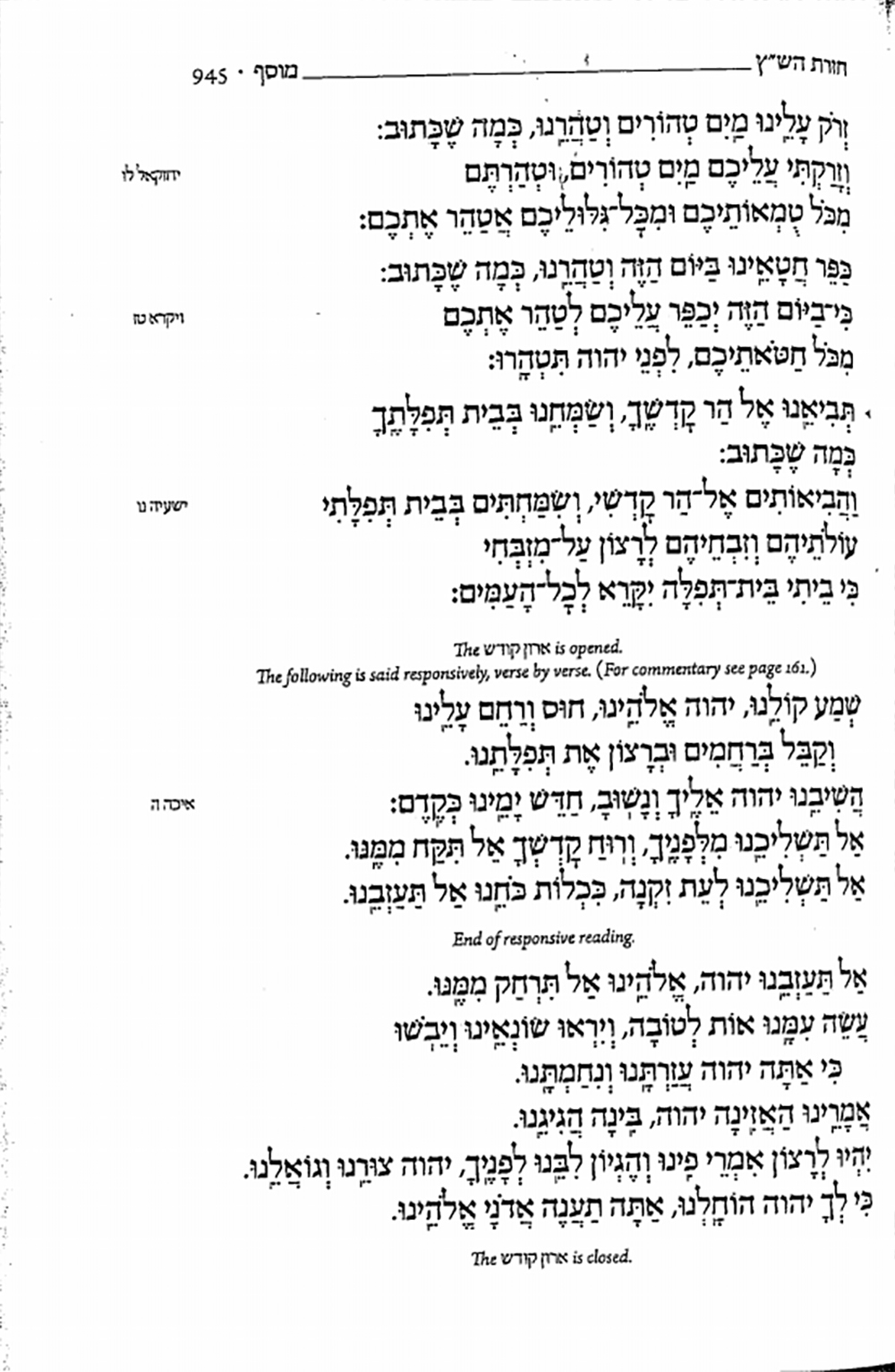
Since I have been speaking about the ArtScroll siddur, let me add a couple of comments about the Yom Kippur Machzor. Here is how Shema Kolenu appears in my copy of the Yom Kippur Machzor (p. 596).

The instructions tell us that “the first six verses of the following prayer are recited responsively, chazzan then congregation.” The problem is that I have never seen a synagogue that says the verses beginning אמרינו and אל תעזבנו responsively. What all these synagogues do is say the following four verses responsively:
שמע קולנו
השיבנו
אל תשליכנו מלפניך
אל תשליכנו לעת זקנה
In my experience, not only does no one say the verses beginning אמרינו and אל תעזבנו responsively, but they don’t say יהיו לרצון quietly either.
The text recorded by ArtScroll is the one found in many old Ashkenazic machzorim. So when and how were אמרינו and אל תעזבנו dropped from the responsive reading, or is it that from the beginning they were not included? As for יהיו לרצון, the old machzorim do not indicate that this is said quietly, so was there ever a tradition to recite it quietly or is ArtScroll simply trying to make sense of a verse that is found in the Machzor but no longer appears to be recited? If יהיו לרצון was originally part of the public reading, we again have to ask, why was it dropped?
Recognizing the problem, in the new edition of the ArtScroll machzor they made a change.
As you can see, אל תעזבנו has now been pushed to the next paragraph. We are also instructed that both אמרינו and יהיו לרצון are to be said quietly. Yet this doesn’t seem to make any sense, as those who are reciting Shema Kolenu responsively will not be saying these verses quietly. And again, I ask, is there any real tradition that these verses are to be said quietly, or is this something made up by people in an attempt to keep the traditional text of the Machzor while dealing with the fact that these verses are not part of the responsive reading? Unfortunately, when updating the Machzor, ArtScroll did not correct the instructions which still refer to the “first six verses” as being recited responsively, when instead it should say the “following four verses”.
Here is how Koren has the prayer.
This version, which puts אמרינו and יהיו לרצון before the final verse, is also attested to in prior machzorim, though the order found in ArtScroll appears to be the older version.To sum up, I am not sure what the best path for ArtScroll would have been. On the one hand, they could have adopted the version found in Koren, which solves all the problems. Keeping what appears to be the more authentic version, which they did, also makes sense, but then they were forced to add the instructions that certain verses are to be said silently. I have checked numerous old machzorim and there is no indication that these verses are to be said silently. Was there perhaps an oral tradition in this matter? Perhaps readers can comment on this. In any event, ArtScroll’s instructions are problematic, since, as mentioned, if people are reciting the prayer responsively, they are not going to be inserting two consecutive sentences quietly.

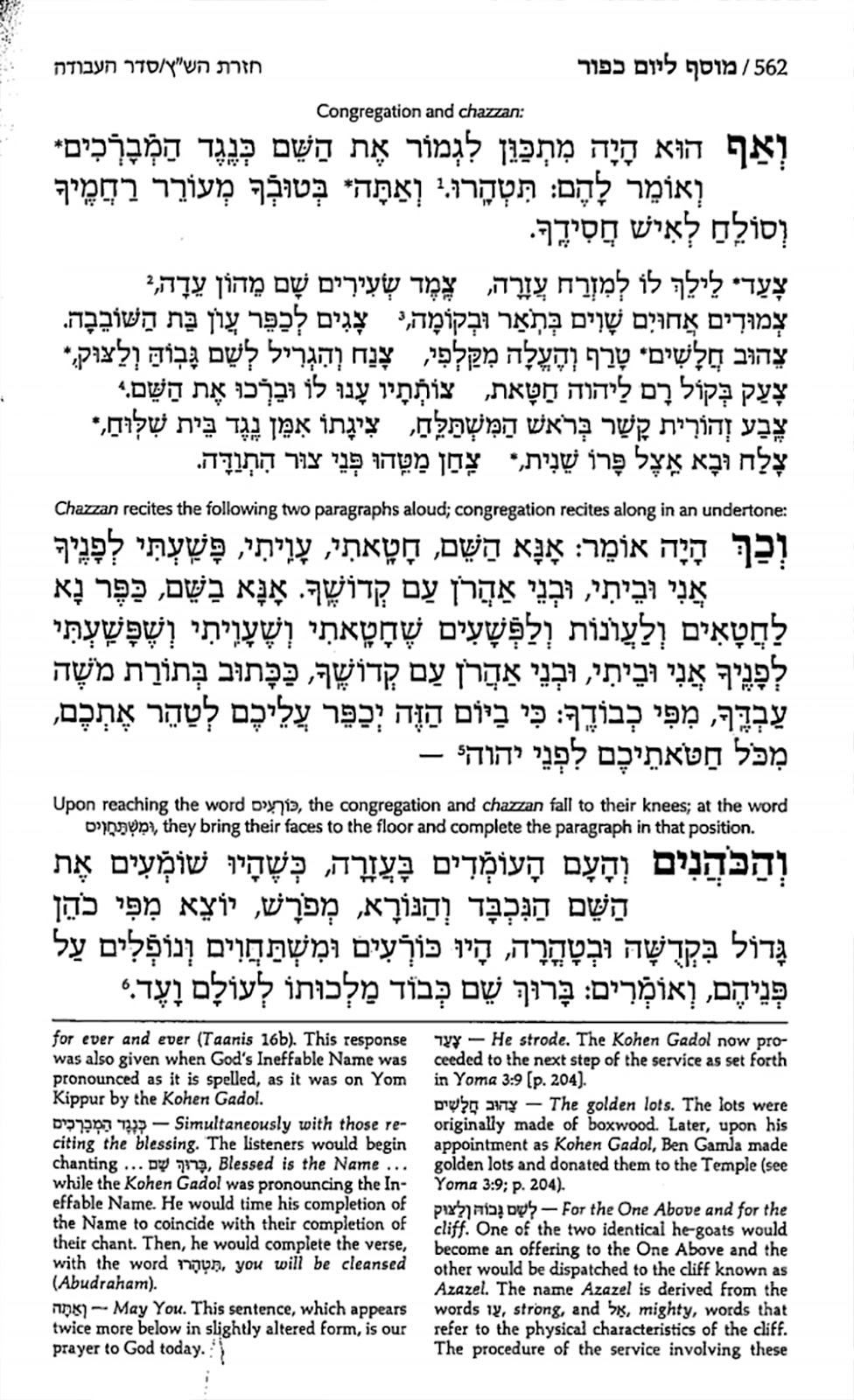
I noticed another interesting change in the ArtScroll Yom Kippur machzor between the old edition and the new one. Here is והכהנים והעם in the old edition.
It reads היו כורעים ומשתחוים ומודים ונופלים על פניהם.
Here is the new edition, where the word ומודים has been deleted. ArtScroll neglected to change the English translation, so it still appears, now incorrectly, as: “they would kneel and prostrate themselves, give thanks, fall upon their faces.”
Why was the word ומודים deleted? Based on what I have been able to determine, the version without the word ומודים is more common, so presumably that is the reason. Although most people might just chalk this up to a different girsa, R. Soloveitchik saw great significance in the alternative versions, and explained their different implications.[10]
Here are a couple of random mistakes I found in ArtScroll. (I use the ArtScroll siddur every day of the week, which is how I have come across these. I am sure that if I used Koren, I would find mistakes there too.) In the ArtScroll siddur, p. 86 it reads:
ואל מאורי אור שעשית, יפארוך, סלה
There is a dagesh in the ס of סלה. This means that the comma after יפארוך is a mistake, as you cannot place a dagesh in this ס if preceded by a comma.
Another mistake is found on p. 702, in the prayer for dew, which states בעם זו בזו. Its translation is correct: “Among this people, through this prayer.” However, I would have preferred if it appeared as follows: “Among this people, through this [prayer],” which would be a more accurate rendition of the few words. (This is indeed how it is translated in the ArtScroll Passover Machzor.)ArtScroll vocalizes these words be-am zu be-zu. Yet this is incorrect. בזו should be pronounced be-zo, referring to תפלה, the feminine Hebrew word for prayer. Koren gets this correct. This confusion of ArtScroll with zu and zo is also found on p. 202, where in the marriage service we find בטבעת זו and ArtScroll pronounces it zu, instead of zo. Again, Koren gets it right. (The word זו often appears in the Talmud, and the ArtScroll Talmud always pronounces it correctly.)

Let me close with one final mistake in ArtScroll, or perhaps it is not a mistake; readers can decide on their own. The ArtScroll Ohel Sarah Women’s Siddur is a special siddur designed for women. On the very first page of the prayers, this siddur has מודה אני with a segol under the ד. In a women’s siddur doesn’t there need to be a kamatz under the ד so that it reads modah?
This might reflect a broader issue. My experience is that in co-ed kindergartens the girls are also taught to say modeh. This might not be surprising, but I was also told by a number of people that even in girls-only kindergartens, both Ashkenazic and even some Sephardic ones, the girls are taught to say modeh. No doubt recognizing this problem, R. Yitzhak Yosef makes a point of placing a kamatz under the ד so that people will know how women are to pronounce the word.[11] R. Shlomo Zalman Auerbach likewise told the women in his family to say modah.[12]It is noteworthy that in one of the editions of Wolf Heidenheim’s Siddur Sefat Emet, found on Otzar ha-Hokhmah, girls are instructed to say modah.

However, this edition appeared after Heidenheim’s death, and unfortunately there is no way to determine exactly when. (The Basel 1956 date on the title page is just the date of the photo-offset edition, not the original.) As far as I can tell, none of the siddurim that appeared in Heidenheim’s lifetime distinguish between men and women with regard to modeh-modah.In response to questioners, R. Hayyim Kanievsky also stated that women are to pronounce the word as modah.[13] Despite this, when R. Meir Arbah asked Rebbetzin Batsheva Kanievsky, R. Hayyim’s wife, what she did, she replied that she pronounced it modeh![14]

The ArtScroll Women’s siddur also has שלא עשני גוי and not גויה and שלא עשני עבד instead of שפחה. This too would seem to be incorrect in a women’s siddur, but the standard version is defended by R. Shmuel Wosner, as he claims that the words גוי and עבד include both men and women.[15] More about this in the next post.
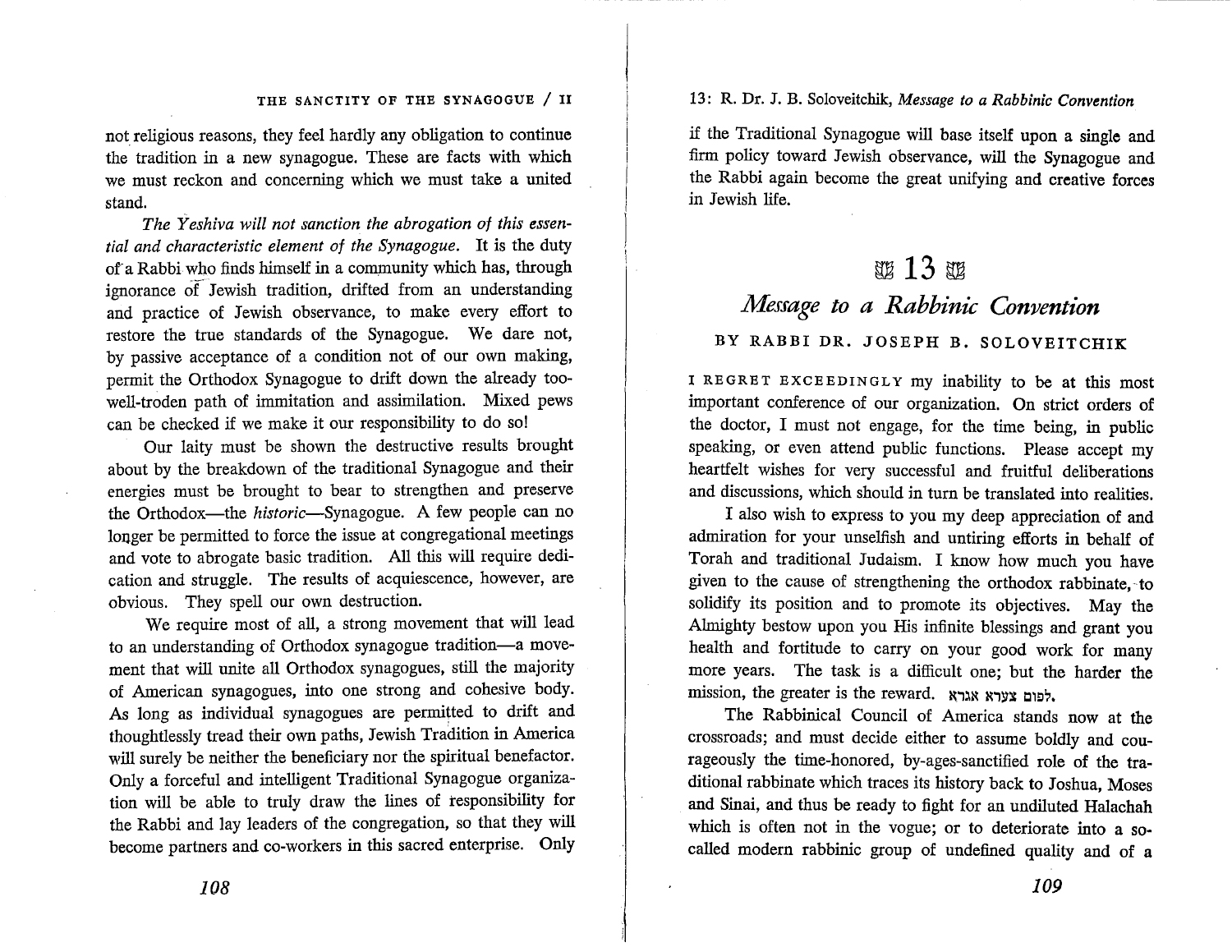
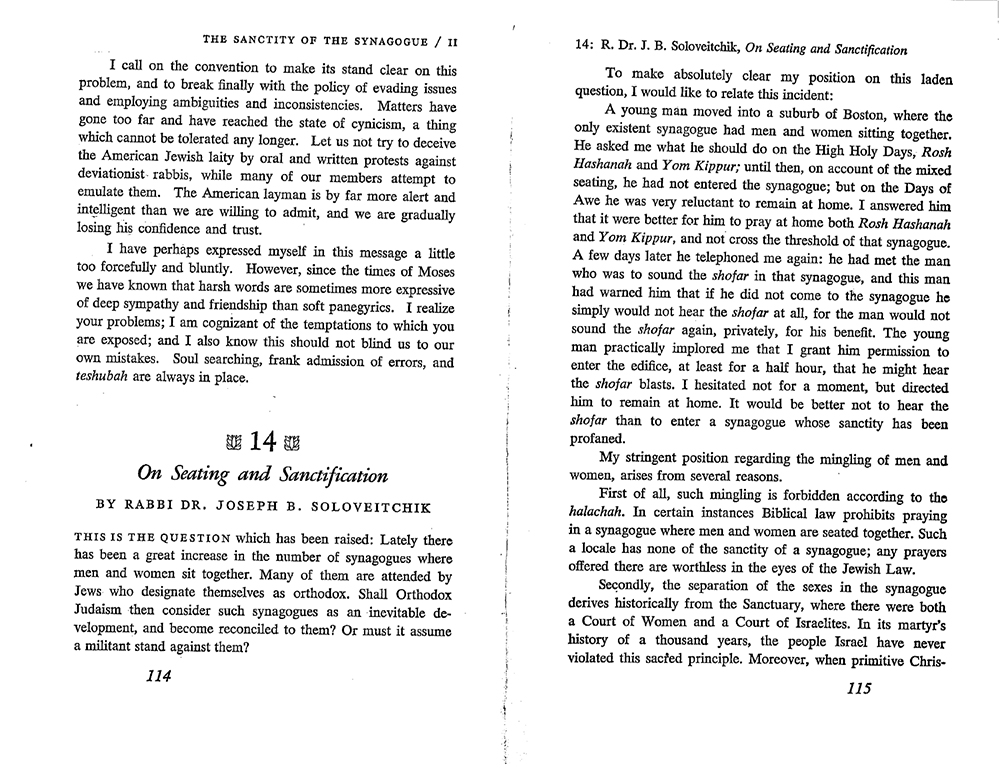
3. We all know that everything written by R. Joseph B. Soloveitchik is precious.[16] One area in which the Rav was very eloquent and forceful was with regard to the necessity of having a mehitzah in shul. In Baruch Litvin’s 1959 book, The Sanctity of the Synagogue, pp. 109-114, it prints a letter from the Rav to an RCA convention. 


This letter has been reprinted in Nathaniel Helfgot, Community, Covenant and Commitment, pp. 139-142.
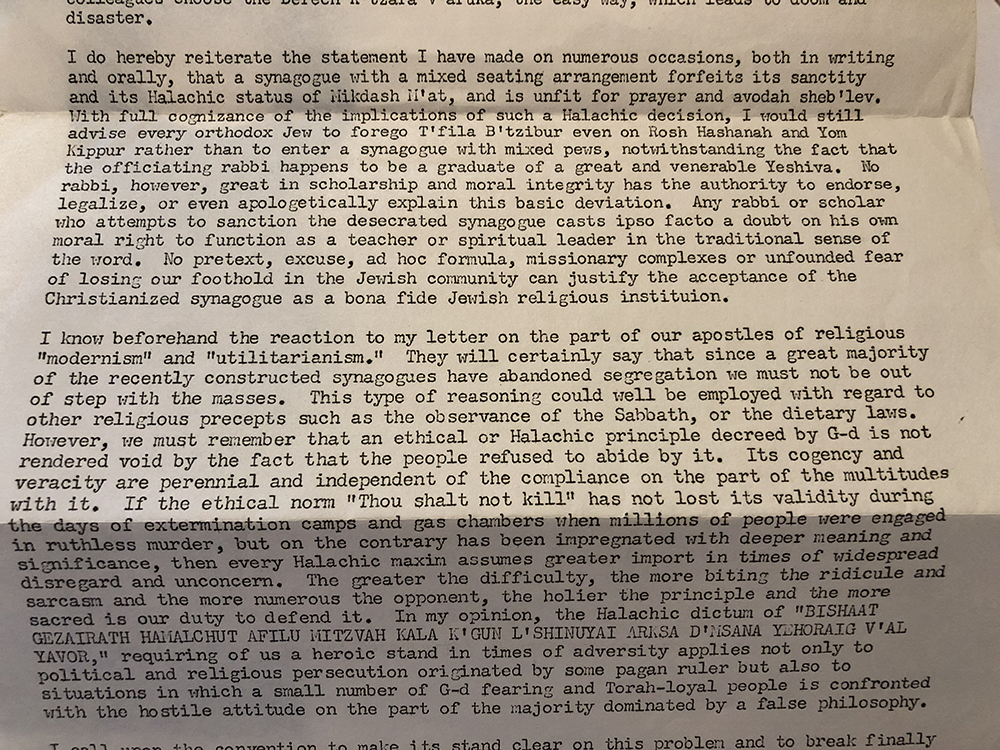
Moshe Schwartz found a copy of the original letter in the papers of his grandfather, R. Gedaliah Dov Schwartz. I thank him for sending it to me.

One interesting point which is not found in the Litvin book is that the Rav’s letter, while intended for RCA members, was addressed to R. David Hollander, the president of the RCA at the time. This is important to note because in the second paragraph he is speaking personally to R. Hollander and praising him for his good works. However, the reader of the letter in Litvin’s book will mistakenly think that the Rav is speaking to the RCA as a whole.
Furthermore, some of what R. Soloveitchik included was deleted from the letter as it appeared in the Litvin book. This was apparently because his points were not specifically relevant to the mehitzah issue. I am happy to be able to present here the omitted words of the Rav which until now have never been published, and which present an important personal statement about the halakhic process. Readers should note the end of the second paragraph that is transcribed below, as it is criticism of certain members of the RCA. Similar sentiments are found earlier in the letter (Litvin, p. 110, first paragraph), where the Rav concludes his paragraph with the strong words: “However, many of our colleagues choose the derech ketzarah va’aruchah, the easy way which leads to doom and destruction.”
As chairman of the Vaad Halachah I intended to inform the conference about our activities during the past year. Since I am prevented from doing so I have asked my friend Rabbi Joseph Weiss to take my place.
Permit me to say the following. One of the fundamentals of my faith is that the Halachah is an all-inclusive discipline and system of thought capable of meeting any challenge of modern times and of confronting the most perplexing problems which a technically progressive and scientifically minded society may periodically pose. This optimistic formula, however, cannot always be successfully applied because of the limited knowledge and the imperfect intellectual capability of the human being. I for one, am not always able to behold the Halachic truth and to see the light under all circumstances. Many a time I grope in the dark, pondering, examining and re-examining an intricate Halachic problem – and find myself unable to arrive at a clear decision. Even the Talmud has not solved all problems and has not answered all questions. The Teiku is a very prominent and characteristic feature of Torah She-B’al Peh. We members of the Halachah Commission are not partners in a contracting firm whose task it is to provide every member of the Rabbinical Council of America with a clear-cut answer to his problems. Quite often the solution eludes us. We are beset by grave doubts. We face many alternatives not knowing which to choose since each is supported by sound logical reasoning. We cannot be guided in our decisions by emotional factors or pragmatic arbitrariness and hence we are impelled to employ in such situations the principle of “B’divrai Torah Haloch Achar Hamachmir” which seems to inconvenience some of our members.
Religious Jews have of late developed an intolerant attitude towards what they call the shyness and reluctance on the part of scholars to commit themselves on Halachic issues, not knowing that there is no omniscience in this world and that doubt is an integral part of the Halachic experience as it is of every scientific performance. A rabbi who thinks that he can solve all problems is implicitly admitting his own ignorance. I implore the convention to abstain from leveling charges of evasion at the Halachah Commission. Let us not repeat the complaints which are so common in religious circles in Israel about a lack of boldness on the part of the rabbinate. They come, for the most part, from people who are not conversant with Halachic scholarship. If there is in our ranks some one wise enough to undertake to answer all Halachic questions by return mail, I would not hesitate to relinquish my position as chairman to him.
In the last paragraph of the letter, as it appears in Litvin, p. 114, the following words that I have underlined are omitted (and this appears to be a simple mistake rather than an intentional deletion): “I realize your problems, I am cognizant of the temptations to which you are exposed and I also know the great work you have been doing in the remote parts of our country.”
In this case I think that the Rav is speaking to the RCA members as a whole, not to R. Hollander personally.
The P.S. found in the Rav’s letter is also of interest.
P.S., I would suggest that the convention adopt a resolution condemning the Humphrey Bill pertaining to humane method of slaughter. The convention should also send a letter of thanks to the State Department for the special attention of Assistant Secretary Herbert Hoover, Jr., for its stand against the proposed calendar reform.
4. In my previous post about young rabbis I neglected to mention another such rabbi. R. Yekutiel Yehudah Teitelbaum (born 1912) succeeded his father as rabbi of the town of Sighet, and also as leader of the local hasidic group, at the age of 14.[17]
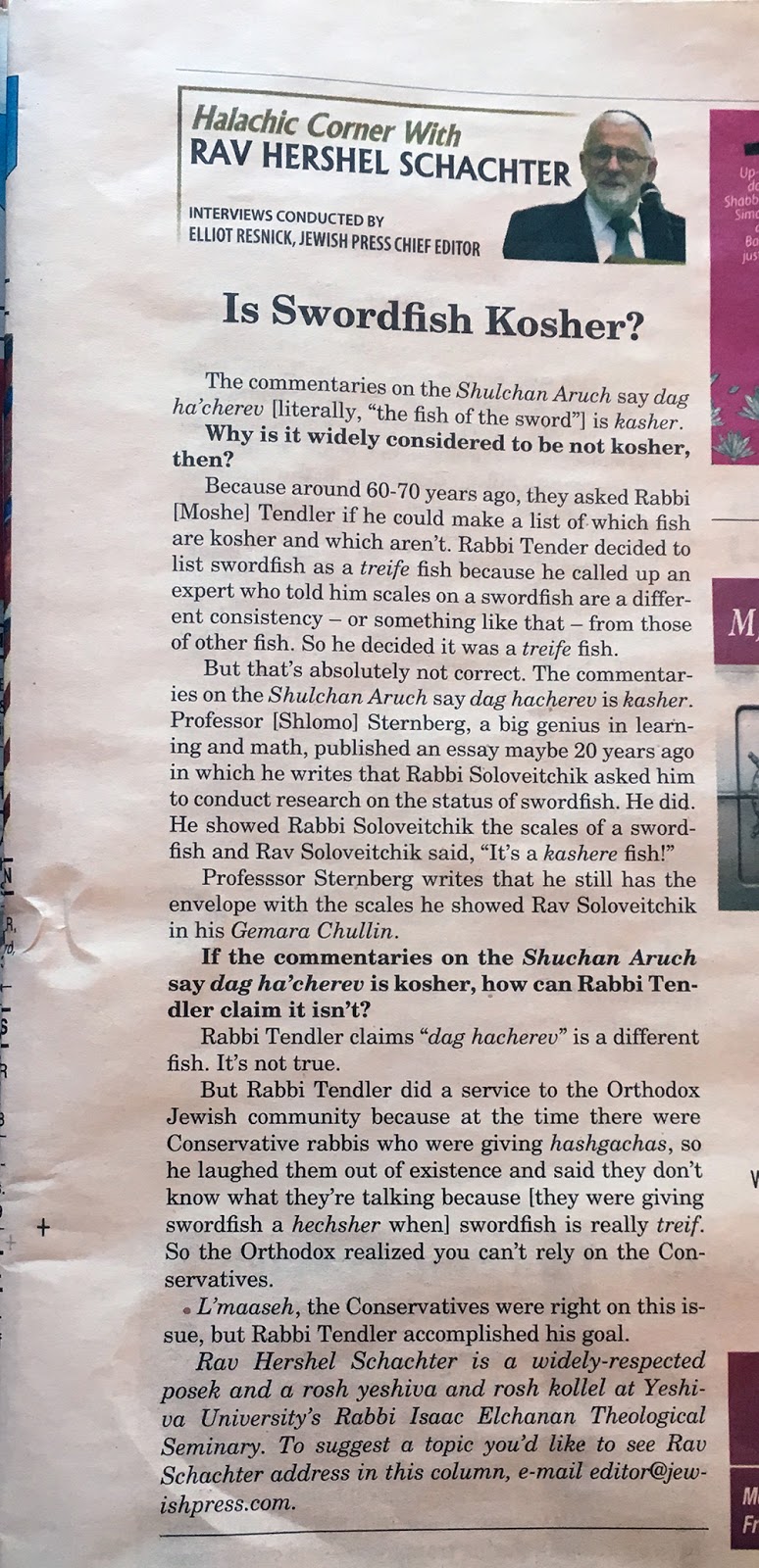
5. In addition to being the posek of the OU, R. Hershel Schachter is also the one Kashrut Vaads all over America turn to for halakhic decisions. That being the case, now that R. Schachter has publicly declared that swordfish is kosher[18] (his private opinion has been known for a long time), how come no Vaads in the United States will certify it as kosher? (In the first half of the twentieth century Orthodox Jews in the U.S. ate swordfish. See my post here.) Does this mean that in the U.S. the practice of not eating swordfish is for all intents and purposes now regarded as binding, and cannot be overturned even by a great posek?

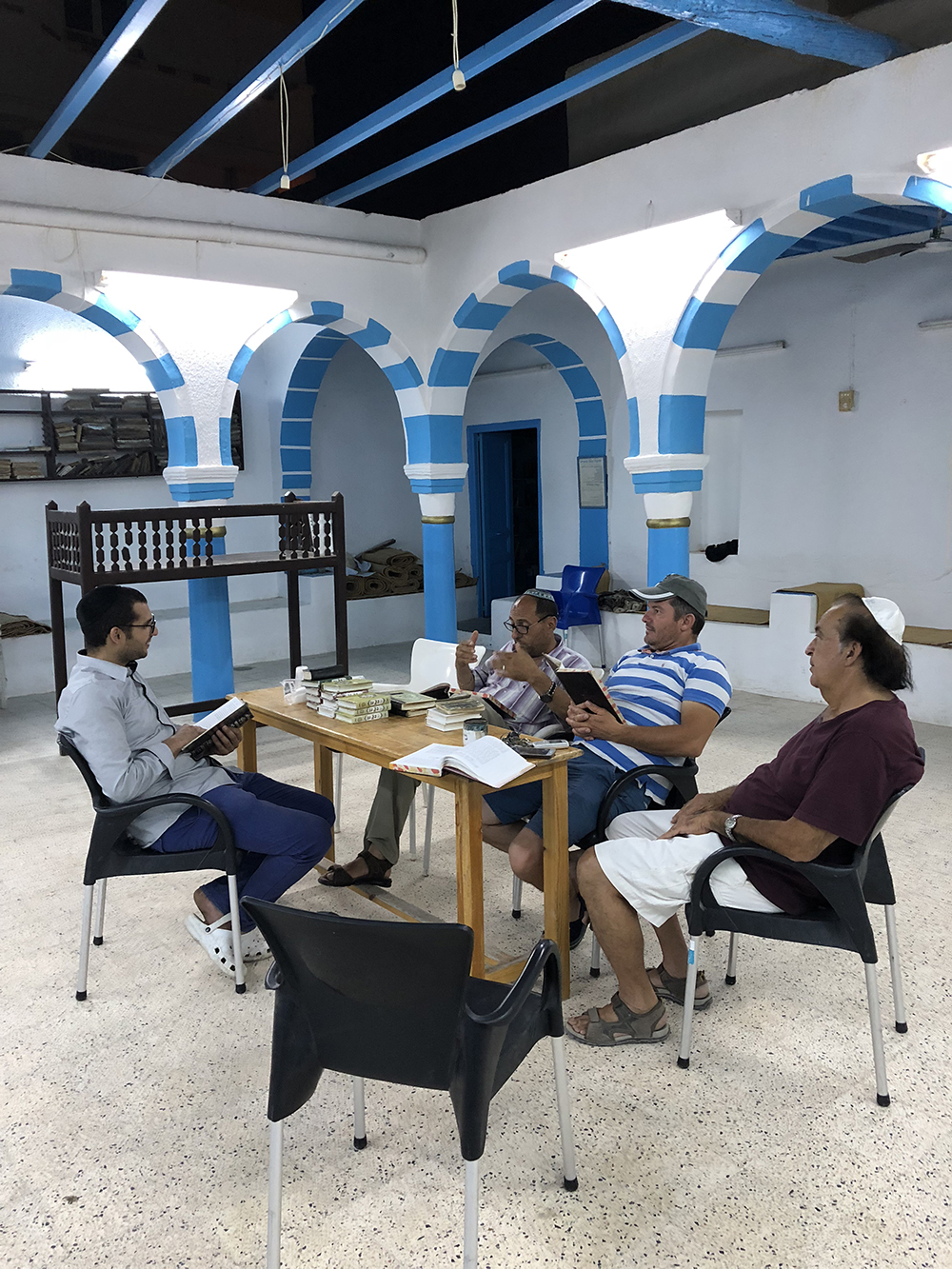
6. Last summer I spent time in Djerba, Tunisia. I hope to write up my impressions of this amazing community of over one thousand Jews, all of whom are shomer Shabbat. Djerba, and the nearby town of Zarzis which has around a hundred Jews, are the last Arabic speaking Jewish communities in the world. (In Tunis and Morocco the Jews speak French.) Here are some pictures from inside the R. Pinhas Yanah synagogue in Djerba, where you can see the signs in Arabic. 


Here is a small learning group in one of the synagogues after ma’ariv. They invited me to participate but not knowing Arabic I couldn’t follow.

When I came back one of my friends told me that I must share one particular story on the Seforim Blog, so here goes. There are fourteen different synagogues in Djerba. After visiting a number of them I noticed that they had no women’s sections. I asked one of the rabbis about the lack of ezrat nashim. He replied, in words that must sound blasphemous to Modern Orthodox ears, “What do women have to do with a synagogue?” While in the U.S. we build “women friendly” mehitzot, so that as much as possible the women can feel part of the synagogue service, in Djerba women’s spirituality has nothing to do with the synagogue. While I later learned that three of the synagogues do have an ezrat nashim, women never attend on Shabbat, only on Rosh ha-Shanah, Yom Kippur, and Purim. The popular Modern Orthodox notion that it is important for women, especially unmarried ones, to attend synagogue on Shabbat is something the women of Djerba know nothing about.
___________
[1] If I were writing the letter today, I would not refer to R. Ahron Soloveichik as rosh ha-rabanim and mara de-atra. I did so to give him respect, but it is not really accurate. While many people certainly did regard him as the leading rabbi of Chicago, and accepted his halakhic rulings as authoritative, this was by no means everyone’s opinion. Regarding R. Moshe Feinstein’s view permitting the non-Orthodox to use the community mikveh for their conversions, which is mentioned in my letter, it is important to note that this was only when the non-Orthodox institutions contributed to building the mikveh.
[2] The same mistake made by R. Yonah is also made by R. Yehudah Naki in his notes to R. Ovadiah Yosef, Ma’yan Omer, vol. 7, pp. 362-363, 390, 400-401.
[3] Ma’yan Omer, vol. 7, no. 38.
[4] Ma’yan Omer, vol. 7, no. 42.
[5] Beit Hillel, Adar 5770, p.
[6] R. Eliyahu’s responsum was sent to R. Gavriel Cohen, who has a beit din in Los Angeles. See here. This Beit Din also does conversions, and they have a very detailed curriculum for prospective converts. You can see a practice test of the 45 topics prospective converts are supposed to learn about here.
I have to say that until the last generation, converts were never required to have such detailed knowledge. Leaving aside all of the detailed issues of Jewish law the convert is instructed to learn about (including “Trumot and Maasarot, Challah, Bikurim, Maaser Ani and other types of charity”), does a convert really need to know about Elijah at Mt. Carmel or about “Tzedukim, Prushim, Charedim, Zealots (anti Romans and Greeks)”? Does a convert need to be able to “develop in detail” the following: Joshua, Judges (“mention at least 10 Judges and their stories”), Samuel, Saul, Jonathan, Isaiah, Jeremiah, the Twelve Prophets, Daniel, Ezra-Nehemiah, to list just some of the topics required? And  what about Rif, Rosh, Rashba, Tur, Zohar, Kabbalah, Shabbetai Zvi, Orhot TzadikimMesilat Yesharim, etc.? Since when do converts need to know about these things?
In the section dealing with the history of converts, R. Cohen’s website mentions Nero and Antoninus as things to know. Does this mean that if the future convert does not believe that these Roman emperors actually converted to Judaism, that he will not be accepted? (My next post will discuss Nero and Antoninus.) On the positive side, if even yeshiva educated people knew all the things the converts are being asked about, we would be in very good shape.
Contrast all this with how Maimonides says that we deal with future converts, in words that today would be regarded as “non-Orthodox,” or presenting a very low standard. Issurei Biah 14:2 states: “He [the prospective convert] should then be made acquainted with the principles of the faith, which are the oneness of God and the prohibition of idolatry. These matters should be discussed in great detail; he should then be told, though not at great length, about some of the less weighty and some of the more weighty commandments.”
[7] See also here.
[8] See Israel Yeivin, Introduction to the Tiberian Masorah, trans. E. J. Revell (n.p., 1980), no. 404. See also R. Adir Amrutzi, Dikdukei Aviah (Tel Aviv, 2010), p. 146. Regarding the Aleppo Codex and use of the dagesh, the following point is also of interest. Many people wonder why in Hallel the words הושיעה נא and הצליחה נא, taken from Ps. 118:25, only have a dagesh in the נ in הושיעה נא. In fact, in the Aleppo Codex both occurrences of the word נא have a dagesh. Also of interest, since it goes against what one would expect from the grammatical rules, the Aleppo Codex puts the accent on the final syllable of both הושיעה and הצליחה, and there is no makef after either of these words. See Yeivin, Introduction to the Tiberian Masorah, p. 291.
Regarding the makef, ArtScroll has omitted it from its siddur. Yet once they do so, it appears to me that there are a number of corrections that need to be made. For example, in shaharit of Shabbat we read
מי ידמה לך ומי ישוה לך
ArtScroll tells us that ידמה and ישוה have the accent on the final syllable and ArtScroll also puts a dagesh in the ל of לך. Yet the Masoretes who told us that in such a case you put a dagesh in the ל, also told us that you would only do so if there is a makef connecting the word לך and the prior word. Since ArtScroll has deleted the makef, why should the dagesh be included, as there is no reason for one without the other? (Koren also includes the dagesh without a makef.)
For those who want to be technical, once the makef is removed we even have a problem with the word כל. כל, meaning “all”, is only spelled with a kamatz (katan) when it is connected with a makef. However, when the makef is removed it is to be spelled with a holem. (The two exceptions are Ps. 35:10 and Prov. 19:7.) See Bayit Ne’eman 130 (15 Tishrei 5779), p. 5.
In biblical Hebrew there is even a word כל with a kamatz (gadol) and no makef. It is found in Isaiah 40:12:
וכל בשלש עפר הארץ
The passage means, “and comprehended the dust of the earth in a shalish-measure.” The word כל with a kamatz and no makef is from the root כול. The word כל with a kamatz and makef, which is the word we are all familiar with, is from the root כלל.
[9] This point was also noted by the Dikdukian here. For those who don’t know this website, it is a great resource for anyone interested in grammatical matters.
[10] Shiurei Ha-Grid: Kuntres Avodat Yom ha-Kippurim (Jerusalem, 2005), pp. 66-67.
[11] Otzar Dinim la-Ishah ve-la-Bat, ch. 1, no. 2 (p. 22), Yalkut YosefDinei Hashkamat ha-Boker, 1:9. It is noteworthy that R. Yom Tov Lippman Heller was also interested in ensuring proper pronunciation. Mishnah, Toharot 8:5 reads: שוטה אחת בעיר. Tosafot Yom Tov comments:
בקמץ הטי”ת כמו כי רועה היא (בראשית כט)
[12] Halikhot Shlomo, Tefilah, ch. 2 n. 17.
[13] Halikhot Hayyim, ch. 1 no. 1, Da’at Notah, vol. 1, p. 16. The very title of the last book mentioned is an example of what we are talking about, as it is more common for people to write “da’at noteh”, but this is not grammatical.
[14] Meir Oz, vol. 1, p. 27.
[15] Shevet ha-Levi, vol. 10, no. 8.

[16] I have been fortunate to discover a number of unknown letters by the Rav which I hope to publish.
[17] See Isaac Lewin, ed., Eleh Ezkerah (New York, 1961), vol. 4, p. 147. R. Jacob Elimelech Paneth was chosen to succeed his father as rabbi of Marosújvár at age fourteen, but he did not assume the office in practice until four or five years later. See Yosef Kohen, Hakhmei Transylvania (Jerusalem, 1989), p. 37. I thank R. Baruch Oberlander for informing me of the Hungarian name of the city R. Paneth served in.
[18] The interview with R. Schachter reprinted in this post is from the Jewish Press, April 20, 2018.


The Pew Report and the Orthodox Community (and Other Assorted Comments), part 1

The Pew Report and the Orthodox Community (and Other Assorted Comments), part 1
Marc B. Shapiro
1. Here is a short piece I wrote a right after the appearance of the Pew Report. (The endnote is not part of the original article.)
There has been a great deal of discussion in the wake of the recent release of the Pew Research Center’s “Portrait of Jewish Americans.” Some have focused on the report’s evidence of increasing intermarriage and lack of any Jewish connection of many in the younger generation. Others have zeroed in on some of the survey’s anomalies and results that are simply not correct. For example, the survey informs us that 1% of Ultra-Orthodox Jews had a Christmas tree last year. I would be willing to bet that in the entire world there isn’t even one Ultra-Orthodox Jew with a Christmas tree, and 1% means at least a few thousand Ultra Orthodox households have Christmas trees. After adding in the Modern Orthodox, we are told that 4% of Orthodox Jews have Christmas trees. Being that the survey places the Orthodox at 10% of the Jewish population, and also tells us that there are 5.3 million adult Jews (another one the survey’s surprises), this leads to the result that more than 21,000 adult Orthodox Jews have Christmas trees in their homes.Since these results are not just improbable, but impossible, it raises the general question of how reliable the survey is when it comes to the Orthodox. Can anyone believe the survey when it tells us that in the 18-29 age bracket the Modern Orthodox only account for 1% of the country’s Jews while the Ultra-Orthodox account for 9%, or that in the 30-49 age bracket, the Modern Orthodox are 3% and the Ultra Orthodox 10%. We are also are told that 24% of Ultra-Orthodox Jews handle money on Shabbat but only 19 percent of Modern Orthodox Jews do so. (Who was it that said the Ultra-Orthodox are frummer than the Modern Orthodox?!)

When you read results like these you can only wonder what went wrong, and I hope we get some explanation as to how such results were generated. (Professor Jonathan Sarna has written to me that all surveys have absurd results for various reasons, and “one is to look at broad trends and ignore absurdities.”) Perhaps there was confusion about the way the questions were asked. Such confusion is the only way I can explain that only 64% of the Ultra-Orthodox agree that a person can be Jewish if he works on the Sabbath. The truth is that every Ultra-Orthodox Jew knows that a person who works on the Sabbath is still Jewish (albeit a sinning Jew). I presume that those who answered “no” to the question understood it to be asking if one can be a “good Jew” and work on the Sabbath. (In case anyone has been wondering, I use the term “Ultra-Orthodox” since that is what the survey uses. I don’t know why no one told the survey directors that this term is no longer regarded as appropriate.)

The sort of anomalies I have mentioned appear to be confined to matters of religious life, and other areas seem more believable. For example, we are told that 37% of Modern Orthodox households have incomes in excess of $150,000, which places them in the top ten percent of Americans. This strikes me as on the mark and illustrates one of the great problems with Modern Orthodoxy in the United States. Anyone who has been to Israel knows that there are non-haredi Orthodox Jews in all areas of life. You see men with kippot who are bus drivers, security guards, and doing every other job imaginable. Yet in the United States, Modern Orthodoxy has become largely an upper middle class phenomenon. The cost of a Modern Orthodox lifestyle, which includes expensive schools and camps, is simply beyond most people’s reach. I believe that this cost is a major reason why the Modern Orthodox camp has not picked up much in the way of ba’alei teshuvah.[1]

I have no doubt that many of the non-Orthodox admire the Modern Orthodox lifestyle, and would be willing to try it out, before learning the cost. Many non-Orthodox would also be happy to send their kids to Modern Orthodox schools, but they are not going to sacrifice a middle class lifestyle for this. Those who grow up Modern Orthodox and remain in the community are prepared to make the financial sacrifices (as well as limiting how many children they have). But for those who are not part of the community, the entry fee is simply too high. Needless to say, there are also those among the Modern Orthodox who drift away because of the financial cost, and this drifting often begin when the first child is enrolled in public school. As I see it, the financial burden is the great Achilles’ heel of Modern Orthodoxy, and what prevents it from any real growth. By the same token, those of us in the Modern Orthodox world must recognize that one of the great strengths of the haredi community is that there is room in it for everyone, from the wealthy real estate developer to the blue-collar worker. If, as so many predict, the future of American Orthodoxy is with the haredim, money (or lack of it) will play an important role in this story.

* * * * * *
The Pew Report reported very high levels of intermarriage in the Jewish community.[2] Yet even among those who would never dream of intermarrying, we know that some engage in sexual relations with non-Jews. There is an interesting responsum in this regard by the late R. Moshe Stern, the Debrecener Rav, Be’er Moshe, vol. 4 no. 141.
R. Stern testifies to receiving numerous questions regarding this matter by the very people engaged in such behavior. For those who don’t know anything about R. Stern and who asked him questions, I can tell you that these were definitely not Modern Orthodox people or members of the Lithuanian yeshiva world.[3]
This volume of Be’er Moshe was reprinted in 1984 without any changes. However, sometime after that the volume was reprinted again. There is no indication of when this took place, as the title page is the same as the 1984 edition. (Presumably, the reprint was after R. Stern’s passing in the summer of 1997.)
Someone called my attention to how the responsum appears in this most recent reprint.
The censorship of this responsum can only have one purpose, namely, so that people don’t learn about how some members of R. Stern’s community were having sexual relations with non-Jewish women.
What is the remedy for these men who are intimate with non-Jewish women? Repentance, of course. Yet there is a very strange opinion as to how to go about this repentance. R. Solomon Ephraim Luntshitz, in his Keli Yekar[4] to Numbers 19:21, says something which is so “out of the box” that I am shocked that it has not yet been censored from the Mikraot Gedolot. (Yes, I realize that it is just a matter of time.)

R. Luntshitz is discussing the statement in Yoma 86b: “How is one proved a repentant sinner? Rav Judah said: If the object which caused his original transgression comes before him on two occasions, and he keeps away from it. Rav Judah indicated: With the same woman, at the same time, in the same place.” In context, this means only what it says, but not that someone should actually put himself in this situation. Yet this is exactly the lesson R. Luntshitz derives.
He refers to Berakhot 34b, “In the place where penitents stand even the wholly righteous cannot stand.” R. Luntschitz cites an opinion that the ba’al teshuvah (penitent) of a sexual sin has to put himself in the exact same situation as he was before, that is, to be alone with the very same woman and overcome his inclination. This is not permitted to one who is “wholly righteous” since he is forbidden to put himself in this situation. But the penitent needs to do this in order for his repentance to be complete, and this explains how a wholly righteous one cannot stand where the penitent stands, since the penitent has to put himself in a situation that would be forbidden for the righteous one. R. Luntshitz explains that the very act of repentance, i.e., being alone with the woman, “makes the pure [the tzaddik] impure and the impure [the sinner] pure.”
This is a strange passage for any number of reasons, not least of which that the action of being alone with the woman is itself sinful, even if it never leads to any sexual activity. Yet R. Luntshitz tells us that in this case we have an exception, and true repentance requires intentionally putting oneself in the exact same situation one was beforehand and this time overcoming one’s inclination. Of course, there is no guarantee that the person will emerge successfully from this self-imposed test. R. Israel Isserlein reports such an occurrence, where an individual put himself in this situation in order to achieve proper repentance, but ended up sinning again![5] Sefer Hasidim earlier warned against falling into precisely this trap.[6]
R. Luntschitz’s point is also found in his Olelot Ephraim, vol. 2, no. 228, showing that he was entirely convinced of his position.
R. Luntschitz was the rabbi of Prague, yet a later incumbent of this position, R. Ezekiel Landau, strongly rejects R. Luntschitz’s point. He acknowledges that many shared R. Luntschitz’s error, which I think is interesting since I can’t imagine anyone having such an opinion today.[7] R. Landau doesn’t tell us who else advocated R. Luntschitz’s view, but R. Mordechai Harris,[8] R. Dovid Yoel Weiss,[9] R. Yaakov Levi,[10] and Nahum Rakover[11] provide sources. Among these sources are R. Joseph ben Judah Loeb Jacob, Rav Yevi (Netanya, 2012), to Psalms 36:3, who quotes the Baal Shem Tov as offering the same approach as R. Luntschitz.
Jewish men getting together with non-Jewish women is, of course, not a new thing. The Talmud, Sanhedrin 82a, already refers to this possibility with regard to Torah scholars (!), concluding: “If he is a scholar, he shall have no awakening [i.e., teaching] among the sages and none responding among the disciples.”[12] Avodah Zarah 69b-70a deals with the status of kosher wine on the table when Jewish men are sitting together with a non-Jewish prostitute. Yom Tov Assis, in his article “Sexual Behaviour in Mediaeval Hispano-Jewish Society,”[13] discusses the situation in Spain where it was not uncommon for Jews to have non-Jewish mistresses.[14] Avraham Grossman also deals with this matter and his discussion includes other parts of medieval Europe as well.[15]
In R. Judah ben Asher’s responsa (Zikhron Yehudah, no. 91), we are told about the problem of Jews having sex with their non-Jewish slave girls (and also having impregnating them). A few centuries later, R. David Ibn Zimra testifies that there were men, learned in Torah, who even thought it was permissible for them to have sex with their slaves.[16]
The fact that the prohibition on occasional sexual relations (דרך זנות) with non-Jewish women is only rabbinic[17] no doubt contributed to many not taking it very seriously.[18] Maimonides, Hilkhot Issurei Biah 12:2, writes:
אבל הבא על הגויה דרך זנות מכין אותו מכת מרדות מדברי סופרים גזירה שמא יבוא להתחתן. ואם ייחדה לו בזנות חייב עליה משום נידה, ומשום שפחה, ומשום גויה, ומשום זונה. ואם לא ייחדה לו אלא נקרית מקרה אינו חייב אלא משום גויה. וכל חיובין אלו מדבריהן.
R. Moses Isserles [19] even mentions the view of the Tur that intermarriage itself (דרך אישות) is only a rabbinic prohibition.[20] The Bah explains the Tur’s view, Even ha-Ezer 16, as follows, leaving no doubt as to the matter:

אבל בשאר אומות . . . אין בהן איסור כלל מן התורה ואפילו בא עליהן דרך אישות אלא גזירה דרבנן.
This approach, incidentally, could explain how Esther married Ahasuerus, as the prohibition on intermarriage was not yet established.
Maimonides disagrees with the Tur and assumes that there is a biblical prohibition to marry any non-Jew (דרך חתנות), not simply the seven Canaanite nations. Therefore, he claims that Solomon converted all the women he married.[21] However, R. Raphael Berdugo disagrees, and states that there was no halakhic problem with Solomon marrying these women without converting them.[22] This leads him to discuss the story of Pinhas killing Zimri and the whole concept of kana’in pog’in bo. R. Berdugo explains that kana’in pog’in bo only applies when dealing with sexual relations that are public, promiscuous, and the woman is an idolator.[23]
ולא אמרו קנאין פוגעין בו אלא דרך הפקר ועובדת ע”ז ובפרהסיא.
According to R. Berdugo, following the Tur, Jews who are married to non-Jews are only violating a rabbinic prohibition. I mention this since I recently met someone who thought that in messianic days intermarried Jews will be subject to kana’in pog’in bo. I originally thought that this was a clear error. If you look at Maimonides’ formulation, Hilkhot Issurei Biah 12:4, you find that contrary to R. Berdugo he indeed includes all non-Jews, not just idolators, as subject to kana’in pog’in bo. (And see his very strong words against Jewish-Gentile sexual relations in Hilkhot Issure Biah 12:6-7.) Yet he is just as explicit that the sexual intercourse has to be public, just like with Zimri.
כל הבועל גויה בין דרך חתנות בין דרך זנות אם בעלה בפרהסיא, והוא שיבעול לעיני עשרה מישראל.
Based on this, it was clear to me that according that according to Maimonides (following Avodah Zarah 36b) an intermarried Jew is not subject to kana’in pog’in bo, as living together is not the same thing as שיבעול לעיני עשרה. Even if one were to reject this point, in the very next halakhah Maimonides states:
ואין הקנאי רשאי לפגוע בהם אלא בשעת מעשה כזמרי . . . אבל אם פירש אין הורגין אותו.
This means that the act of zealotry must take place during the actual sexual act, or at least this is what I thought. But when I investigated a bit I learnt that while my understanding is shared by many, there are also many who assume otherwise. For example, the always interesting R. Shemariah Menasheh Adler states that an intermarried man is indeed subject to kana’in pog’in bo.[24] He claims that Maimonides’ statement just quoted only refers to one who is engaged in an act of promiscuous sex in public. With such a man he can only be killed in the act, but Maimonides is not referring here to a man who is publicly living with a non-Jew. In such a case, R. Adler claims, there is no need for the zealotry to be בשעת מעשה. As for Maimonides’ explicit words כל הבועל גויה בין דרך חתנות R. Adler claims that this only refers to the first act of marital sexual intercourse, and that it needs to be in public for kana’in pog’in bo to be applicable, but not once they have already established a home and are living together. R. Adler also quotes R. Solomon Kluger[25] as agreeing with his basic point, and I have found others as well.[26]
We have seen lots of strange stuff in recent years. Is it only a matter of time before someone disgusted with the high rate of intermarriage decides to act the part of kana’in pog’in bo?
It is also worth noting that most commentators and halakhists assume that kana’in pog’in bo only applies when there is a Jewish man and a non-Jewish woman, not the reverse. Despite this, we indeed have some examples in Jewish history of “honor killings”. For example, in 1311 a Jewish woman who married a Christian and became pregnant was killed by her brothers.[27]
In 1557 an Italian Jew killed his sister because her alleged sexual activity embarrassed the family. Elliot Horowitz, who mentions this case, adds: “Azariah Finzi, the girl’s father, saw fit to defend this action by his only son, asserting that it was ‘inappropriate for one calling himself a Jew, especially a member of one of the best families, to suffer a veil of shame upon his face, being mocked by all who see him for the blemish attached to his family’s reputation.’”[28]
In Teshuvot Hagahot Maimoniyot to Sefer Nashim, no. 25 (found in the standard printings of the Mishneh Torah), there is a responsum which describes how a woman cheated on her husband, apparently with a local non-Jew, and became pregnant. According to her father, she also killed her baby (“the mamzer”[29]) after it was born. Her father, worried that she would apostatize, asked, indeed pleaded with, the local rabbis to permit him to kill his daughter by drowning her in the river. The rabbis turned the request down.
בא אביה של שרה לפני שנים ממנו החתומים למטה ובא לימלך בנו להורות לו אם מותר להרוג בתו לטובעה בנהר ולאבדה מן העולם . . . [אמר אביה] אני מבקשכם בכל מיני תחינה שתתירו לי להורגה.
The case is actually quite sad since she was probably a teenager in over her head. The responsum describes how she would run away from home but her mother would convince her to come back. When her father rebuked her for her behavior, her reply was, “I am not the first woman who did something bad.”R. Asher Ben Jehiel, She’elot u-Teshuvot ha-Rosh 18:13, deals with a case of a woman who was intimate with a non-Jew and became pregnant from him. R. Asher affirms the local rabbi’s decision to cut off her nose. (See also R. Matityahu Strashun, Mivhar Ketavim [Jerusalem, 1969], p. 158 n. 3.)

Also relevant is a very strange story recorded in Ta’anit 24a. It begins by telling us that R. Yose ben Abin left his teacher, R. Yose of Yokeret. His reason was, “How could the man who showed no mercy to his son and daughter show mercy to me?” Let’s leave aside the story of R. Yose of Yokeret and his son. Here is what the Talmud records about him and his daughter.
He had a beautiful daughter. One day he saw a man boring a hole in the fence so that he might catch a glimpse of her. He said to the man, “What is [the meaning of] this?” The man answered: “Master, if I am not worthy enough to marry her, may I not at least be worthy to catch a glimpse of her?” Thereupon he exclaimed: “My daughter, you are a source of trouble to mankind, return to the dust so that men may not sin because of you.”
Although he did not physically kill his daughter, he did express the wish that she die (according to some it was an actual curse), and in the opinion of many commentators this is exactly what happened (see Hagahot ha-Bah, ad loc.). What makes this text so shocking is that the daughter was entirely innocent of any improper behavior. In other words, it was her very existence as a beautiful woman that created the problem, and as such it was better that she simply exit this world before any more men were led into sinful thoughts. I see no way that this story can be brought into line with mainstream rabbinic thought, despite many attempts to do so.[30] (At a future time I can present some lessons that contemporary moralists have derived from this story, which also are quite shocking.)
Returning to the matter of Jewish-Gentile sexual relations, while the Shulhan Arukh, Even ha-Ezer 16:1, following Maimonides, Hilkhot Issurei Biah 12:2, tells us that occasional sexual relations (i.e., no marital relationship) with a non-Jewish woman is only rabbinically prohibited,[31] R. Nissim of Gerona disagrees. Yet if we are indeed dealing with a Torah prohibition then what does the Talmud[32] mean when it states that the Hasmonean Beit Din decreed against sex with a non-Jewish woman? If it was already forbidden according to the Torah, there would be no need for such a decree.
R. Nissim suggests that the Hasmonean Beit Din’s decree was designed to add an additional penalty onto an already existing prohibition. It is not that occasional sex with a non-Jewish woman was banned by the Hasmonean Beit Din, but they merely added the penalty of lashes. The reason for this, R. Nissim points out, is that sometimes people are not concerned about heavenly punishments like karet, but they are concerned with an earthly punishment.[33]
Yet this is a minority view, and the standard approach is that there is no biblical prohibition on occasional private sex with a non-Jewish woman. Here is how the Encylopedia Talmudit sums up the matter[34]:
הבא על הגויה דרך זנות, איסורו מדברי סופרים, גזרה שמא יבוא להתחתן.
(In case people are wondering, I don’t think that this is the sort of information that should be spread among the masses, precisely because that some people might decide that violating a rabbinic prohibition is not such a big deal.)
I keep stressing Jewish men and non-Jewish women, since the situation of Jewish women and non-Jewish men has its own issues that should be postponed to another post. But with regard to Jewish women who are intermarried, let me note that according to R. Ovadiah Yosef, such a woman should be told to go to the mikveh. He also adds that she should not tell the mikveh lady about her situation (I assume because she might then be refused entry).[35]
To be continued.

* * * * * *


In an earlier post here I mentioned some of the shocking things said by R. Chaim Kanievsky about R. Shmuel Auerbach. Someone asked me if I could put together a list of the harshest things said by Torah scholars about their contemporaries. This would be an interesting project, and we can also find some very harsh things in this regard in talmudic and midrashic literature. I must stress, however, that often these shocking (to our ears) statements are not as harsh as they sound, since they were not meant to be taken literally. Some rabbis use figures of speech that everyone understands are simply part of a literary genre.
Here is one such example. R. Abba Mari of Lunel, in his attack against the Jewish rationalists, tells us that if he had the power he would do as follows to his opponent[36]:
אקרע סגור לבו להיות בדמו ממרס.
This means “I will cut open his heart so as to stir his blood.” I am sure people in medieval times would also be offended by such a statement. Yet its meaning then was far removed from what it would mean today, and if any of our contemporaries spoke like this we would assume he needed to be institutionalized.
After reading the post, some also wrote to me to express dissatisfaction with the rabbinic leadership in the haredi world. Contrary to what some think, this sort of feeling is not new, and in every generation people have been disappointed with the rabbinic greats. Here, for example, is what appears in the anonymous letter printed at the beginning of R. Mordechai Benet’s Parashat Mordechai.
ואף הגדולים וחכימי דרא לא משגיחים רק לעצמם בלחודוהי לזכות עצמם בלחוד אבל לא לזכות דרא לעורר תשובה בעלמא.
Finally, a couple of people corresponded with me regarding the stories of great rabbis who had totally sublimated their emotions. There are other stories that could be told of rabbis who were not even (at least outwardly) emotionally affected by the death of a child. This is sometimes held up as an example of piety and acceptance of God’s decree. Yet R. David Ibn Zimra (Radbaz) had an entirely different perspective.[37] Regarding one of the “gedolei ha-dor” who when his son died did not shed a tear, Radbaz was asked if this is a good characteristic or not. In his reply, Radbaz does not mince words about how wrong this is, seeing such “piety” as cruel, un-Jewish, and evidence of a psychological problem (to use a modern formulation):
זו מדה רעה מורה על קושי הלב ועל רוע תכונת הנפש והיא מדת אכזריות והוא דרך הפילוסופים האומרים כי זה העולם הכל הוא מעשה תעתועים
[1] Alan Brill has recently written as follows:
Centrism requires its members to live in the top six percent of U.S. income. The community is known for kitsch engagements and weddings, and other signs of conspicuous consumption in the name of religion. In the face of the recent economic downturn many will remain in the community and follow whatever guarantees survival in suburbia.
“The Emerging Popular Culture and the Centrist Community,” in Yehuda Sarna, ed., Developing a Jewish Perspective on Culture (New York, 2014), p. 30. As with everything else Brill writes, this essay is well worth reading. On this same page he refers to the fact, noted by others, that for most Centrist Orthodox Jews, their Orthodoxy has nothing to do with doctrine but is about lifestyle and family values.
Being Orthodox is about family on Shabbat, shiva calls, hospital visits, sharing simchas, and helping others. They consider the warmth of the community as their Orthodox Judaism, yet are oblivious to doctrine and practice demarcations. . . . Many define faith as “everyday morality” rather than institutional commitment or theological Orthodoxy.
I would add that not only is this not new, I believe it is how traditional Judaism has always functioned and is applicable to much of the haredi world as well. In other words, many in the Orthodox world would agree with the Reconstructionist saying, “Belonging is more important than believing.” See Mel Scult, The Radical American Judaism of Mordecai M. Kaplan (Bloomington, 2014), p. xiii.
From Brill’s article I learnt that Aish Hatorah put on a recent Purim megilah reading “that featured as emcee and guests of honor the non-Jewish Chris Noth, who played Mr. Big on Sex and the City, and Snooki, of the MTV show Jersey Shore.” See also here. Brill uses this example, and others, to show the influence of contemporary culture.
I am fascinated by how the haredi world tolerates this sort of thing in the name of kiruv. I personally am very turned off by this, but am apparently in the minority. When I told a couple of twenty-somethings that I think that the following Aish video, with almost three millions hits, makes a mockery of what Yom ha-Din is all about, they thought I was simply out of touch. Yet as I noted to them, contrary to the implication of the video, Rosh ha-Shanah is indeed about spending the day in synagogue in prayer, not about having fun and breakdancing to non-Jewish music.
[2] See my earlier discussions of intermarriage here and here.
Regarding another type of “intermarriage”, see Francesca Trivellato, The Familiarity of Strangers (New Haven, 2009), p. 94, that Sephardim in seventeenth-century Amsterdam were forbidden by their community to marry Ashkenazim. (Poor Sephardim were also given a higher charity subsidy than Ashkenazim.)
[3] See Be’er Moshe, vol. 4, no. 146:26-27, where R. Stern speaks very strongly against the practice in Boro Park and Willamsburg of  men and women going for walks on Shabbat on Yom Tov, as this leads to a mingling of the sexes.
[4] For some reason the title of this commentary is almost always written as Keli Yakar, yet the second word should be Yekar, as appears in Prov. 20:15.
[5] Leket Yosher, ed. Kinarti (Jerusalem, 2010), Hilkhot Yom ha-Kippurim, p. 304.
[6] Sefer Hasidim, ed. Margaliyot, no. 167. While preparing my Torah in Motion classes on R. Joseph Hayyim I found a strange passage in his Ben YehoyadaSotah 36b. Although the Talmud, ibid., records the view that Joseph intended to sin with Potiphar’s wife, R. Joseph Hayyim says that this is not to be taken literally. Rather, Joseph’s intention was to inflame his lust for her so that would then be able to overcome it which would be a great spiritual victory. He says the same thing about King David and Abigail. Although the simple meaning of the Talmud, Megillah 14b, is that David wished to have sex with her, R. Joseph Hayyim states that here, too, all David wished was to arouse his lust in order to then overcome it.
וכן היה הענין אצל דוד הע”ה, בענין אביגיל כשתבע אותה דודאי חלילה לנו לחשוב על אותו צדיק אשר לבו חלל בקרבו, שביקש לחטוא בא”א, אלא כוונתו היתה לעורר התאוה בקרבו, ולהעביר אש החשק בלבבו, כדי שבעת שיגיע לנקודת המעשה ינתק עבותות התאוה, ויכבה אש החשק כרגע, ויחדל ויפרוש מעשות רע
(R. Luntshitz, in the passage from Keli Yekar I cited, specifically states that only one who has already sinned in such a fashion and is engaged in repentance can put himself in this situation, but a tzaddik is absolutely forbidden to do so).
R. Joseph Hayyim’s comment reminds me of the notion that one who has not sinned, and thus has nothing to repent for, should purposely commit a sin. This will then allow him to fulfill the mitzvah of teshuvah, which he would otherwise not be able to do. In a future post I will discuss this.
Regarding King David, I found something quite strange in Etan Levine, Marital Relations in Ancient Judaism (Wiesbaden, 2009), p. 129. Levine writes: “And though the sages hardly regarded extramarital affairs as meritorious, their antipathy to divorce led some of them to opine that extra-marital relations with an unattached, sexually-permitted female was preferable to terminating a marriage.” This might be true, but no valid source is cited to support this idea.. In his note to the quoted passage, Levine writes: “King David’s case was interpreted as proof: it was to prevent his divorcing any of the 18 wives permitted to a king that he was allowed to sexually tryst (יחוד) with Abishag without marrying her (I Ki. 1:1f.). See the Babylonian-born Simeon bar Abba (d. ca. 310CE), a disciple of Rabbi Johanan whose homily he cites in Tb Sanhedrin 22a.” To begin with, R. Shaman (שמן) bar Abba is not quoting R. Johanan in Sanhedrin 22a. What he says is that the fact that David was permitted yihud with Abishag shows how much divorce was disapproved of, for otherwise he would have divorced one of his wives and married Abishag. But where does Levine get the notion that yihud means “sexually tryst.” The Bible itself (!) is explicit that David “knew her not.”
[7] Derushei ha-Tzelah (Warsaw, 1886), derush 1, no. 11.
[8] Yad Mordechai (Jerusalem, 1955), pp. 43-44.
[9] Megadim Hadashim: Berakhot (Jerusalem, 2008), pp. 360-361.
[10] Gan Naul (n.p., 2009), pp. 108ff.
[11] Takanat ha-Shavim (Jerusalem, 2007), pp. 588ff., 595ff.
[12] The Talmud’s teaching (quoted by Shulhan Arukh, Even ha-Ezer 16:2) is very clear, and events of recent years have shown us that even Torah scholars are not immune to such behavior. Yet I can’t say I was surprised to find that even these clear words are distorted. R. Gedalyah Axelrod, Migdal Tzofim, p. 148 (parashat Pinhas), states that the Talmud and Shulhan Arukh couldn’t really mean that a Torah scholar might have sexual relations with a non-Jew. Therefore, he explains that they really mean that the Torah scholar causes others to do so, by performing fraudulent conversions, and these “converted” women (who are still halakhically non-Jewish) then marry Jews. This is very nice darshanut, but how can anyone take this seriously as an actual explanation of the Talmud and Shulhan Arukh? The Maharal knew better, and in Derekh Hayyim 4:4 he gives the following example:
עשרה תלמידי חכמים יושבים ואחד נכנס לבית זונות ולא נודע איזה שזה מחלל שם שמים בסתר.
See also R. Hayyim Vital, Sefer ha-Hezyonot, ed. Eshkoli (Jerusalem, 1954), p. 33: 

ליל שבת שעברה שכב תלמיד חכם הנקרא בעדת הספרדים “חכם” עם גויה אחת

[13] In Ada Rapoport-Albert and Steven J. Zipperstein, ed., Jewish History: Essays in Honour of Chimen Abramsky (London, 1988), pp. 25-59.

[14] See Sefer Hasidim, ed. Margaliyot, no. 701, that the level of Jewish sexual morality will mirror what appears in society at large.
כמו שמנהג הנכרים כן מנהגי היהודים ברוב מקומות כגון אם הנכרים גדורים בעריות כך יהיו בני היהודים הנולדים באותה עיר.
See also R. Solomon Ben Adret, She’elot u-Teshuvot ha-Rashba, vol. 1, no. 1209:
ובנות ישראל צנועות הן אלא שהדור מנוולתן.
I was surprised to see Michael Satlow write: “There is no rabbinic law against intercourse with a prostitute.” Tasting the Dish: Rabbinic Rhetorics of Sexuality (Atlanta 1995), p. 166. This is incorrect, as Sanhedrin 82a explicitly states:
בית דינו של חשמונאי גזרו הבא על הכותית [ס”א הגויה] חייב עליה משום נדה שפחה וכו’
See also Geoffrey Alderman’s article, “It is Not a Sin to Visit a Prostitute,” in his The Communal Gadfly (Brighton, 2009), pp. 267-268. I don’t know how he can write such nonsense as the following:
As far as I am aware, there is no general halachic prohibition on Jewish men sleeping with prostitutes, unless the whore is herself Jewish. If not, then, according to the Talmud, a Jewish man who feels the need to visit a prostitute must simply take care to do so in a town in which he is not known – which strikes me as very sound advice.
If the whore is Jewish, however, we are faced with the certainty of multiple acts of adultery [!], all of which are prohibited. This is because intercourse is itself a form of marriage. So the first Jewish man a prostitute consorts with becomes her husband [!]; if she wishes to consort with anyone else, this first Jewish customer will have to give her a get [!]. So will the second, and so on. [!] (I am ignoring for my present purposes, considerations of mikveh, since I have yet to learn of any brothel that has one.)
It is actually a common kabbalistic view that one who has sex with a non-Jewish woman will be reincarnated as a Jewish prostitute. See e.g., R. David Ibn Zimra, Metzudat David, no. 612.
[15] Hasidot u-Mordot (Jerusalem, 2001), pp. 229ff.
[16] She’elot u-Teshuvot ha-Radbaz, vol. 1, no. 48.
[17] See Sanhedrin, 82a, Avodah Zarah 36b, Mishneh Torah, Hilkhot Issurei Biah 12:1-2; Shulhan Arukh, Even ha-Ezer 16:1, and the commentaries ad loc. R. Moses Isserles, Darkhei Moshe, Hoshen Mishpat 34:4, writes:
בא על הגויה לא מיפסל רק מדרבנן דהא אינו אלא מגזירת בית דין של חשמונאי.
R. Shlomo Goren, Mishnat ha-Medinah (Jerusalem, 1999), p. 142, points out that sex with a non-Jewish woman does not fall under the category of arayot, even rabbinically.
ועל אף חומר האיסור אין זה מגדרי איסור עריות אפי’ מדרבנן.
R. Joseph Kafih, commentary to Mishneh TorahIssurei Biah 12:2, raises a problem with the standard understanding of Maimonides that occasional sex with a non-Jewish woman is only a rabbinic prohibition. Even though Maimonides, Issurei Biah 12:2, writes ולא אסרה תורה אלא דרך חתנות, what is one to do with halakhah 9 [no. 8 in R. Kafih’s edition] which implies the opposite? R. Kafih writes
ומה יעשה בדברי רבנו לקמן הל’ ח שגויה הנבעלת לישראל תיהרג מפני שבאה תקלה לישראל על ידה, ולדבריו [דברי המעשה רקח] שאין אסור דאוריתא איזה תקלה באה על ידה?
Presumably, Maimonides in halakhah 9 is only referring to a public sexual act, which would be regarded as a biblical violation.
[18] After writing this sentence I found that R. Solomon Ibn Verga said the same thing. See Shevet Yehudah (Jerusalem, 1955), p. 134: 

כבר התחילו בספרד לתת עיניהם בבנות הארץ מרוב ההרגל וקצתם לקחו היתר לאמר כי אין בו אלא מלקות

I don’t mean to imply that there wasn’t sexual immorality involving Jewish men and Jewish women, as there was plenty of this as well. R. Asher ben Jehiel, Teshuvot ha-Rosh, nol. 37:1, even speaks about the practice of engaged couples living together (לדור ביחד) before marriage. He tells us that the women did not go to the mikveh since they were embarrassed to do so before marriage. But they weren’t embarrassed to live together before marriage.

[19] Even ha-Ezer 16:1.
[20] Since the consequences of intermarriage are so devastating, one must wonder why there is no explicit biblical prohibition. Be that as it may, in coming years watch for the Conservative movement to halakhically legitimize intermarriage by relying on the view that it is only rabbinically prohibited. As with other rabbinic prohibitions previously abolished by the Conservatives, they will argue that this too can be set aside for important societal concerns.
Maggid Mishneh, Hilkhot Ishut 1:4, recognizes that one cannot logically explain why certain sexual acts are biblically prohibited and others had to wait for the Sages to prohibit them.
ואל תתמה היאך תהיה הישראלית ביאתה בזנות בלאו והגויה מדברי סופרים לפי שאיסור העריות הוא בגזירה ודבר שאין לו טעם בכל פרטיו. והנה תראה שאם חמותו היא בסקילה [צ”ל בשריפה] ואם אמו מדברי סופרים בלבד ונדות בישראלית הוא מן התורה בכרת ובגויה אין נדות כלל אלא מדברי סופרים.
Regarding the Tur’s assertion that there is no biblical prohibition to marry women who are not of the Canaanite nations, this has been hard for many to accept. The Arukh ha-Shulhan, Even ha-Ezer 16:2, states that “it appears to me” that even according to this opinion, if the Jewish man and non-Jewish woman actually live together there is a Torah prohibition. How could the Arukh ha-Shulhan say this when the Tur, Even ha-Ezer 16, states explicitly that contrary to Maimonides, sexual relations דרך אישות with contemporary non-Jewish women does not incur a biblical penalty? Is there a real distinction between sexual relations דרך אישות and living together as husband and wife?. Here are the Arukh ha-Shulhan’s words (following which he cites a talmudic proof for his understanding):
ומ”מ יראה לי דאפילו להחולקים על הרמב”ם מ”מ אם היא בביתו ובועל אותה תמיד כדרך איש ואשתו חייב עלה מדאורייתא
For others who argue that despite the simple sense of his words, the Tur must hold that there is still a biblical prohibition for a Jew to marry a non-Jew, see Otzar ha-Poskim, Even ha-Ezer 16:1. See also R. J. David Bleich, Contemporary Halakhic Problems, vol. 2, p. 273.
Nevertheless, the severity of the stricture against intermarriage tends to indicate that, even according to the Tur, some form of biblical prohibition against intermarriage with non-Jews who are not members of the Seven Nations must exist. The question to be resolved is the nature of the biblical prohibition.
With reference to those who have argued that intermarriage (and even non-marital Jewish-Gentile sexual relations) violates Torah law, Shaye J. D. Cohen writes: “This may be good halakhah and good preventative medicine, but it is bad history and bad exegesis.” “From the Bible to the Talmud: The Prohibition of Intermarriage,” Hebrew Annual Review 7 (1983), p. 30.
[21] Hilkhot Issurei Biah 12:2, 13:14.
[22] Mesamhei Lev (Jerusalem, 1990), commentary to ch. 1 (p. 229).
[23] See Hilkhot Issurei Biah 12:5 that there is no kana’in pog’in bo when it comes to a ger toshav.
[24] See Geulat Yisrael (London, 1950), pp. 95ff.
[25] Commentary to Even ha-Ezer 16:2, in the standard eds.
[26] See also R. J. David Bleich, Contemporary Halakhic Problems, vol. 2, pp. 275ff., who argues that intermarriage is the equivalent of a public act of sexual intercourse, and thus biblically forbidden according to all.
[27] See Renée Levine Melammed, “The Jewish Woman in Medieval Iberia,” in Jonathan Ray, ed., The Jew in Medieval Iberia 1100-1500 (Boston, 2012), p. 272.
[28] “Jewish Confraternal Piety in Sixteenth-Century Ferrara: Continuity and Change,” in Nicholas Terpstra, ed., The Politics of Ritual Kinship (Cambridge, 2000), p. 159.
[29] Although her father called the baby ממזר מן הגוי, the term was only being used colloquially, since a child of a non-Jew is not halakhically a mamzer.
[30] R. Samuel Edels, Maharsha, ad loc., states explicitly that R. Yose of Yokeret was wrong in cursing her so that she die. )How many other examples do we have of commentators criticizing talmudic sages?) However, I don’t think Maharsha’s approach will make matters much easier for many readers, because he suggests that instead R. Yose should have cursed her that she become ugly!
ולא יפה עשה לקללה שתשוב לעפרה בשביל כך אלא כי אם לקללה שתשוב לשחרוריתה.
R. Mordechai Karvalho of Tunis, Meira Dakhya (Livorno, 1792), ad loc., also wonders why the daughter had to die. After all, “are we commanded to kill everyone who is beautiful?” He suggests that R. Yose should have kept her inside the house so no man would ever see her.
ובתו ג”כ היא לא עשתה שום עבירה וא”כ היל”ל להחביאה בחדרי חדרים שלא יראה אותה שום אדם ולא ימיתינה וכי מי שהוא יפה תאר מצווין אנו להמיתו
This idea, of keeping unmarried women off the street, is found in various Jewish sources. In his recently published Asaf ha-Mazkir, p. 61, R. Meir Mazuz refers to R. David Kimhi’s commentary to 2 Sam. 13:2: 

ודרך הבתולות בישראל להיות צנועות בבית ולא תצאנה החוצה
R. Mazuz also refers to R. Asher ben Jehiel, Piskei ha-Rosh, Ketubot 7:15, who says that in Spain the בנות, which I assume also means unmarried women, would only go to the bathhouse in the middle of the night, since they were accustomed not be seen outside. In order to show that this was the practice of the pious women of medieval Spain, R. Mazuz cites another source, Tikunei Zohar, no. 58:
צריכא ברתא דאיהי בתולה למהוי סגורה ומסוגרת בבית אביה

With reference to my question at the beginning of this note, R. Mazuz, Asaf ha-Mazkir, p. 128, cites the great R. Raphael Joseph Hazan, Hikrei Lev, vol. 1, Yoreh Deah, no. 26 (p. 29b), that R. Simeon ben Yohai was mistaken in thinking that animals are subject to individual providence:


דרשב”י לא ידע . . . אבל האמת אינו כן
R Mazuz cannot accept this sort of language when dealing with R. Simeon ben Yohai:
דמה כוחנו לחלוק על רשב”י בסברא בעלמא, ומה ידענו ולא ידע

Not noted by R. Mazuz is that R. Hayyim Palache cites R. Hazan without objection. See Amudei Hayyim (Izmir, 1875), p. 101a.
[31] In Hilkhot Issurei Biah, 12:6 (followed by Shulhan Arukh 16:2), Maimonides writes that if one who had sex with a non-Jewish woman is not killed by kana’im or given lashes by beit din עונשו מפורש בדברי קבלה שהוא בכרת. The context of this halakhah, and the previous ones, is an act of public sexual relations, the sort that is a Torah violation and subject to kana’in pog’im bo. Yet some understand Maimonides to be also referring to private sexual relations דרך זנות. See Beit Shmuel, Even ha-Ezer 16:4. This position is hard to understand, since as has been pointed out by others, how can there be karet on a rabbinic prohibition? A punishment of karet would seem to imply that we are dealing with a Torah violation, yet Maimonides is explicit that this is not the case with non-public and non-marital sexual relations with a non-Jewish woman. This problem leads R Yosef Rein, Penei Yosef: Sanhedrin (Bnei Brak, 2009), p. 648, to offer the original suggestion that Maimonides is talking about כרת מדרבנן. To complicate the matter even more, in Sefer ha-Mitzvot, neg. com. no. 52, Maimonides indeed states that there is karet for non-public sexual relations with a non-Jewish woman, which contradicts his position in the Mishneh Torah. R. Kafih, in his commentary on Sefer ha-Mitzvot, explains:

כלומר שעונשו חמור כחייבי כרתות
Needless to say, this is a very unlikely explanation, and if Maimonides wanted to say what R. Kafih writes, he could have easily done so instead of speaking of actual karet.
[32] Sanhedrin 82a, Avodah Zarah 36b.
[33] See Hiddushei ha-Ran, Sanhedrin 82a, and also R. Aryeh Leib Heller, Avnei Miluim, Even ha-Ezer 16:1:3. R. Simhah Lieberman, Bi-Shevilei ha-Amim, no. 14, has a very good discussion of the matter. See also the sources showing the seriousness of the offense in R. Michael Bacharach, Arugat ha-Bosem, Even ha-Ezer 16:2. R. Aviad Sar Shalom Basilea also argues against those who claim that occasional sexual relations with a non-Jewish woman is only rabbinically prohibited. See Emunat Hakhamim (Mantua, 1730), ch. 29. Among the points he makes is if occasional sex with a non-Jewish woman is only rabbinically forbidden, then what is the point of the yefat toar law? This is a special law that permitted what otherwise was already forbidden. He also quotes R. Judah Briel that sex with a non-Jewish woman is included as part the prohibition of wasting one’s seed. (It is not clear if R. Briel is speaking homiletically or halakhically. See also Torah Shelemah, Ex. 20, no. 334, for the midrashic statement that one who has sex with a non-Jewish woman violates fourteen [!] separate Torah prohibitions. Regarding this statement, see also Louis Epstein, Sex Laws and Customs in Judaism [New York, 1967], p. 176.)
R. Basilea’s point about yefat toar can easily be refuted. See e.g., Mizrachi to Deut. 21:11 who suggests that the entire point of the law is to permit sex with a married non-Jewish woman, something that otherwise would be forbidden. It implies nothing about occasional private sex with an unmarried non-Jewish woman, which was permitted in the days of the Torah.
כיון שבבית שהוא בצינעה בא עליה הביאה ראשונה למה לי קרא להתירה הא לא אסרה תורה אלא דרך חתנות אבל דרך זנות בביאה ראשונה שאינה אלא מפני יצרו הרע אין איסורה אלא מדברי סופרים ולמה לי קרא למשרייה ושמא יש לומר דמשום אשת איש איצטריך קרא להתירה וצ”ע . . . כל הפרשה הזאת לא נכתבה אלא באשת איש . . . מדאצטריך קרא להתירה בשעת שביה מכלל שבאשת איש דאסירא בעלמא קמיירי, דאי בפנויה [שריא] אפילו בעלמא, כ”ש בשעת שביה, וזהו הנכון אצלי
According to some, another novelty of the yefat toar law is that it also permits rape, which otherwise is forbidden.See also James Diamond, “The Deuteronomic ‘Pretty Woman’ Law: Prefiguring Feminism and Freud in Nahmanides,” Jewish Social Studies 14 (Winter 2008), pp. 61-85.

I previously discussed yefat toar here and here.
To the sources I cited, add R. Eliezer of Metz, Sefer Yereim, ed. Schiff, no. 20, who specifically states that a yefat toar cannot be raped ([called to my attention by R. Chaim Rapoport], and see Toafot Re’em, ad. loc., note 13, that this is already a talmudic dispute).
On the other hand, Maggid Mishneh, Hilkhot Ishut 14:17, states:
וענין יפת תואר חדוש הוא ולא התירה אותה תורה אלא כנגד יצר הרע . . . ובעלה בעל כרחה
R. Pinhas Horowitz, Ha-Makneh, Kiddushin 22a, understands Rashi to permit rape of a yefat toar (I haven’t seen others who agree with this).
מה שפירש”י ז”ל דקידושין תופסין בה אין לפרש שיכול לקדש אותה בע”כ דלא מצינו קידושין בע”כ כי אם ביבמה אלא דע”כ הכי קאמר קרא דלאח’ הגירות בת ליקוחין היא אם מתרצית להתקדש לו ואם לא מתרצת יבא עלי’ בע”כ דהיינו שהתירה התורה נגד היצה”ר
It is precisely with these sorts of passages in mind that, as I have quoted on a number of occasions, R. Jehiel Jacob Weinberg states that when there is a dispute among the early authorities, we should decide the halakhah in accord with contemporary sensibilities.
ואגלה להדר”ג [הגרא”י אונטרמן] מה שבלבי: שמקום שיש מחלוקת הראשונים צריכים הרבנים להכריע נגד אותה הדעה, שהיא רחוקה מדעת הבריות וגורמת לזלזול וללעג נגד תוה”ק (כתבי הגאון רבי יחיאל יעקב וויינברג, חלק א סי’ לב).
See also my post here.There are a number of laws in the Torah that are not in line with modern conceptions of morality (the one most in the news these days deals with homosexuality). But I think yefat toar is unique in that I have never seen an English language discussion of the law in an Orthodox publication that actually deals with its parameters in any detail, and cites what the rishonim say about the law. (Searching on the internet I found Jacob Bernstein, “Eshet Yefat To’ar: A New Look” here, but this too does not elaborate in sufficient detail on the morally difficult aspects of the matter.) Could it be that this law is more morally problematic for moderns than the laws dealing with homosexuality and slavery of which we have seen endless discussions? And if so, why?

Here is one final source regarding yefat toar. R. Reuven Katz, Duda’ei Reuven, vol. 2, p. 217, states explicitly that the heter of yefat toar is not proper or ethical, but nevertheless in necessary. While this is a quite provocative formulation, it really reflects the outlook of the Sages. Nevertheless, I don’t know if any contemporary halakhic authorities would write this way (emphasis added).
אמנם קיים בנסיבות מיוחדות היתר לדבר שאינו הגון ומוסרי, כיון שהתנאים אינם יכולים להתעלם מתופעה זה
Regarding rape, there is one other strange thing I would like to share. Maimonides, Hilkhot Ishut 15:17, forbids marital rape. In a case where a woman is in a situation of yibum, and she does not want the Levirate marriage, she is not forced and instead the man must take part in the halitzah ceremony (although according to Maimonides she is regarded as a moredet). See Hilkhot Yibum ve-Halitzah 1:2, 2:10. However, there is a special halakhah when it comes to yibum that even if the man forces her to have sex, it is still a valid yibum and she becomes his wife. (Hilkhot Ishut 2:3).
R. Isaiah of Trani (the Elder), Teshuvot ha-Rid, ed. Wertheimer (Jerusalem, 1987), no. 59, responds to an unnamed questioner who thought that it was permissible for a levir to force his sister-in-law to have sex with him (i.e., to rape her). R. Isaiah expresses his surprise that anyone could make such a mistake (although he acknowledges having heard of others who also erred in this way):
מה שכתבתה [!] למה אין כופין את היבמה להתייבם לא נכונו הדברים האלה לומר לאיש חכם, שלא עלתה על לב אדם שנכפה את היבמה להתייבם . . . אם היבמה אינה רוצה להתייבם והיבם רוצה שנכוף אותה לפניו לא היה ולא נברא
R. Isaiah then states that if the levir was chasing after the woman to rape her (in order to fulfill the mitzvah of yibum), we are commanded to save her from him, even if we have to kill him. (See R. Avraham Shapiro, Shiurei Maran Ha-Gaon Rabbi Avraham Shapiro: Yevamot, Gittin [Jerusalem, 1995] p. 170.)
So far we haven’t seen anything surprising. But in his note to R. Isaiah’s responsum, the editor, R. Avraham Yosef Wertheimer, writes as follows:
ומש”כ רבינו דמצוה להצילה מידו זה חידוש גדול דהא עכ”פ הוא מקיים מצות יבום ולמה עלינו למנוע ממנו אותה מצוה
Wertheimer doesn’t understand why R. Isaiah thinks it is necessary to stop the levir from raping the woman, since after all, he is intending to perform a mitzvah. How Wertheimer could write this after seeing what R. Isaiah explains in his responsum is beyond me.
In a future post I will discuss how the commentators deal with Maimonides, Hilkhot Melakhim 4:4, which appears to be saying that the king may take women as his wives and concubines even against their will.
[34] Vol. 5, s.v. goy, col. 297. See also vol. 3, s.v. boel aramit.
[35] Ma’yan Omer, vol. 7, p. 26. See, however, ibid., p. 294, that on another occasion R. Ovadiah saw no need to instruct intermarried women to go to the mivkeh (and see ibid. for the editor’s explanation of the different answers). See also R. Rafael Evers, Va-Shav va-Rafa, vol. 3, no. 147, for R. Yitzhak Shmuel Schechter’s responsum stating that an intermarried woman should go to the mikveh. This is a very practical question today. Pretty much every outreach minyan has attendees who are intermarried or living with non-Jews. I have also come across people in such circumstances in regular Modern Orthodox synagogues.
When it comes to sexually active single women, both R. Ovadiah and R. Moshe Sternbuch believe that they should be allowed to use the mikveh if they so desire. See Ma’yan Omer, vol. 7, pp. 234, Teshuvot ve-Hanhagot, vol. 1, no. 484. See also Ma’yan Omer, vol. 7, p. 261, that we should not advise women to do this (i.e., it is only if they come on their own that they should be allowed to use the mikveh).
[36] Teshuvot ha-Rashba, ed. Dimitrovsky, vol. 1, p. 639. See Neuman, The Jews in Spain (Philadelphia, 1944), vol. 2, p. 125.
[37] She’elot u-Teshuvot Ha-Radbaz, no. 985. See also R. Solomon Schueck, Torah Shelemah (Satmar, 1909), vol. 2, p. 114b-115a.